LETTERS TO GUY

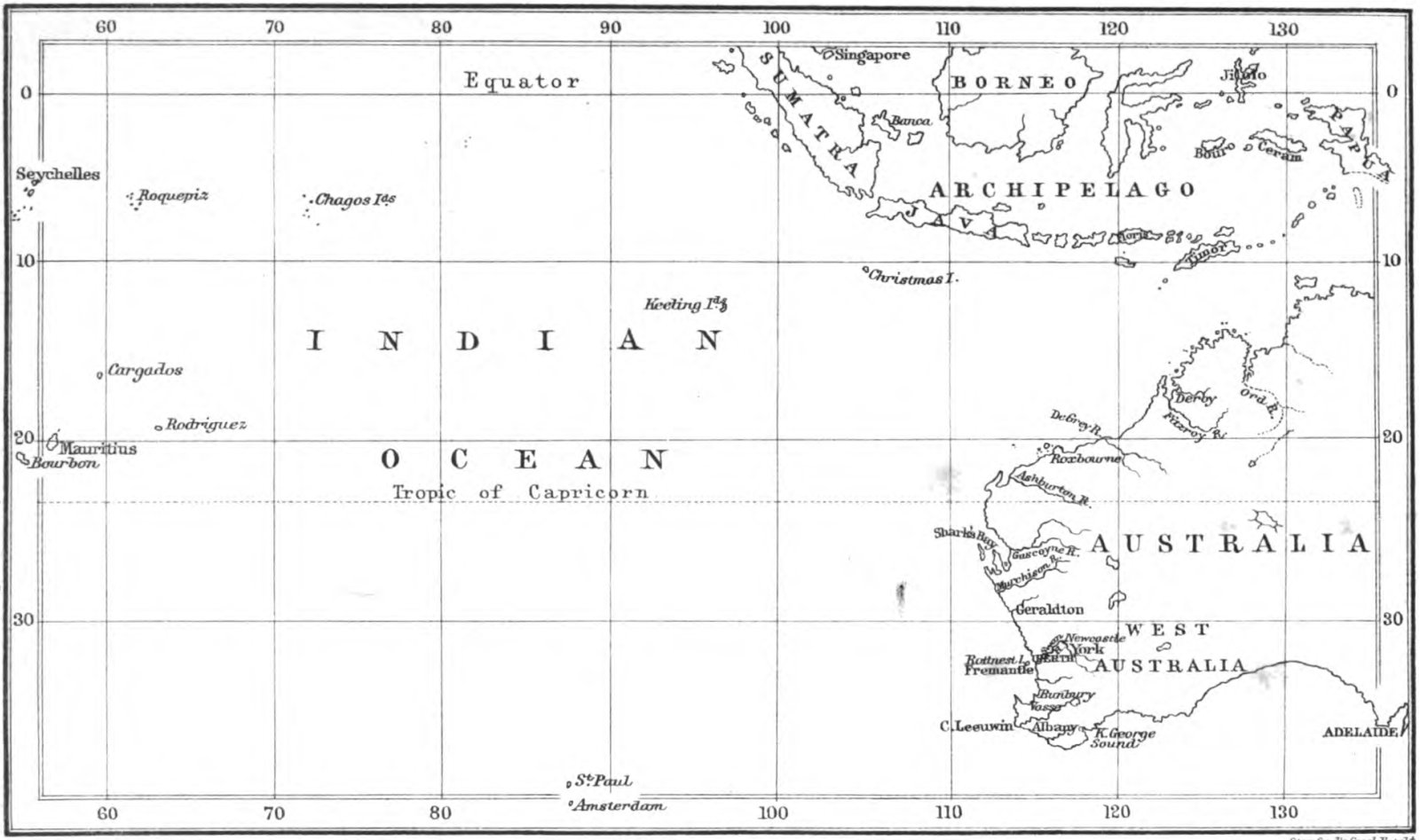
Stanford’s Geogl. Estabt.
London: Macmillan & Co.
LETTERS TO GUY
By LADY BARKER
(LADY BROOME)
AUTHOR OF “STATION LIFE IN NEW ZEALAND,” “STORIES ABOUT,” ETC.
London
MACMILLAN AND CO.
1885
Printed by R. & R. Clark, Edinburgh.
Whole book · 20 sections
Stanford’s Geogl. Estabt.
London: Macmillan & Co.
LETTERS TO GUY
By LADY BARKER
(LADY BROOME)
AUTHOR OF “STATION LIFE IN NEW ZEALAND,” “STORIES ABOUT,” ETC.
London
MACMILLAN AND CO.
1885
Printed by R. & R. Clark, Edinburgh.
Adelaide, May 1883.
This is the first opportunity I have had of writing to my boy since we left Mauritius, a fortnight ago. It has been very cold nearly all the time—cold at least to us, after the bright warm sun and soft wind of our early winter days in Mauritius. At first we were all glad to feel the fresh wintry air, but soon we began to wrap ourselves up and walk quickly about the deck, or keep down below in the fine saloon of the big French steamer after it became dark. It was a beautiful ship; large, and very clean and comfortable; and there were just enough passengers on board to be sociable without being overcrowded.
Both Louis and my little maid Catherine were dismally ill at first, but they quickly got better; and Louis soon found out all manner of ways of what he considered “helping” the sailors, who were wonderfully kind to him, and seemed much amused at the little English boy’s love for the sea and everything about a ship. I don’t think the log was once heaved during the daylight hours without his assistance, and he easily learned the French words to tell me the rate of speed at which we steamed. But the puppy—Monsieur Puppy—and Rosidore, father’s French valet, suffered terribly from the cold. Rosidore wrapped himself up every day in extra comforters and greatcoats till he looked like an immense wool-bale, and at last he found a warm corner near the great funnel, and never stirred from its shelter. The poor puppy—Tip’s small yellow pug-son—did not know what to make of the cold. He could not understand how the sun could have so little warmth in it; but still he frisked about a great deal whenever he was allowed upon deck, and “dèmandé-d” biscuits from every one. You must know Monsieur Puppy only understands French as yet, for he has never left Mauritius, where he was born a year ago; the sailors make a great pet of him, and spoil him dreadfully.
The sky and sea looked grayer and more dull to our eyes each succeeding morning, whilst the good ship was ploughing her way steadily towards the south-east through the rough rolling waves. We had no actual bad weather, but at this winter time of year the great stretch of Indian Ocean, which lies between the little island of Mauritius and the huge island-continent of Australia, is always rough and troubled with these big waves rolling uneasily, and there were constant heavy showers of cold rain. Still, in so comfortable a ship, with our large deck-cabins to sleep and sit in, it was not at all disagreeable, and we were always cheered by hearing the officers of the ship declare the passage would be a good and quick one.
The very day fortnight that we had sailed out of Port Louis Harbour was spent standing on deck, all through the short daylight hours, watching the immense coast-line of Australia growing more and more distinct. Its endless stretch of sandy beach, with low hills behind, made a great contrast to the last land we had looked on—the sharp high peaks, brilliant with the sunset glow, of the lovely little island of Mauritius. It was very provoking, too, to know that we were now going quite out of our real way, and leaving behind us the exact spot in Western Australia where we wanted to land, and that we should have to come all the way back and round Cape Leewin again. At one time we were only a very few hours’ steam from the nearest point to our new home; and Monsieur Puppy, at least, would have been pleased to get on shore. But still we were very glad of the opportunity of seeing something of the Eastern Colonies of Australia, and I don’t know which of our party was the most delighted when at last the big engines, which had been gradually slowing down, stopped their ceaseless throb, throbbing; then came a moment’s pause, and finally a great splash,—that was the anchor dropping down,—leaving us a long way from land however, at a place called Glenelg, near Adelaide, the capital of South Australia. By this time the short winter day was over, and it would have been quite dark except that fortunately the moon chanced to be bright and full.
Though we had arranged to take only a few of our tiresome boxes with us, still it seemed a weary while before we were all ready to get into the small steam-tug which came alongside directly. The polite French captain handed me down the side of his vessel with many pretty speeches, and Louis took leave of all his sailor friends in his best French. Then the little tug puffed off towards the land, bustling bravely along over the calm moonlit sea. But oh, how cold it was! bitterly, piercingly cold. It must have been about ten o’clock at night, and we thought regretfully of our nice warm cabin and snug berths. Catherine and I put Louis between us, and sheltered him as well as we could, though he would ever so much rather have been darting about the ship and helping (such help!) everybody. Rosidore seemed quite frozen and paralysed by cold, and poor Monsieur Puppy crouched shivering at his feet. I must tell you here that the cold made the poor little dog very ill, and he nearly died next day. However, a clever dog-doctor at Adelaide managed to cure him. I reproached myself afterwards for not having taken more care of him during that freezing half-hour; but I was occupied in huddling Louis up, and I thought Rosidore would have looked better after Monsieur Puppy.
We landed on a long pier sticking ever so far out into the sea, and our luggage was put on trucks and wheeled swiftly along on a little tram. But we all had to walk a very long way. As it happened, we were glad of the exercise to warm us, and we all chanced to be well and strong, and it was a beautiful night, as bright as day. One could not help thinking, however, how dreadful it might have been on a dark and wet stormy night, and if any of us had been sick or weak. Then came a long wait at the railway station, and you may fancy how sleepy Louis was by the time we lifted him into the nice big railway saloon, which the Governor of Adelaide had kindly sent for us. It was funny to be in a railway carriage which seemed to be passing through the middle of a wide street nearly all the time, and Louis solemnly inquired whether any little boys were ever run over? I would not give much for his legs or arms if he lived in the neighbourhood; but the Adelaide children are probably wise enough to keep off the rails. The shops, with which nearly all the streets appeared to be lined, looked gay and busy though it was nearly midnight, and lots of people were about—returning from the theatre, I heard.
At last we reached the station at Adelaide, and then all our troubles from cold and sleepiness came to an end directly. A nice warm carriage, a few minutes’ swift drive, then a big brightly-lighted house, kind outstretched hands of welcome, blazing fires, supper which we were all much too sleepy to eat, and then delicious beds.
Can’t you imagine how nice it must have been to wake up the next morning and rush to the windows and let in all the sunshine, and look out on trees and distant houses and green hills, after two weeks of seeing nothing but big dark, dark blue waves tumbling over each other? We all thought it delightful, I assure you, and set forth directly after breakfast, to walk about and see everything and go everywhere. We used often to say to one another, “How much Guy would like that!” But your turn will come some day you know, and the best thing for you now is to be working hard at your lessons at school, and playing in the cricket and football fields, and growing to be a man, and what is more, an Englishman who must be a credit to his country, and proud of her wherever he goes. My boy will try to be that, won’t he?
Well, on one of our sight-seeing days we saw lots and lots of boys who would be a credit to any country, and of whom South Australia might indeed be proud; for we went with the Minister of Education all over the splendid Government schools. Louis liked best—for he is quite as enthusiastic a soldier as he is a sailor—the drill-yard at drill hour in one of the schools. The boys had real muskets, with only the barrels shortened, and they went through all manner of military exercises, almost as cleverly as if they had been real, grown-up soldiers. And they looked so bright, and strong, and healthy, and happy! Very tall, as are nearly all Colonial boys, but handsome and jolly.
One could not help thinking several times about what is said in the papers about the difficulty of finding soldiers of the right stamp for our army, and if ever I am consulted on the subject, my advice to the authorities will certainly be to try and get hold of some of these smart, ready-made soldier-lads! And then they were by no means ignorant or idle in other respects. No, their copy-books looked as neat and nice as possible, and they all read and recited capitally. And you never saw such numbers of children as were ranged on the benches of each school! After that day of school-visiting, I felt as if I had got into a fairy city, where each inhabitant was either a bright-faced schoolboy, or a modest pretty schoolgirl, or, better than all, a rosy, warmly-dressed, and delightfully impudent “infant”; for there were rows upon rows of these little people who sang their songs and clapped their hands, and milked imaginary cows all in fine style, and with many friendly grins. At one school the pupils, both girls and boys, sang really beautifully, not ordinary school songs, but lovely part music in unison. As you may suppose, the schoolmasters and mistresses who had this wonderfully forward rising generation under their care needed to be clever and to know a great deal. I felt most of the time that had I been one of the pupils, I should constantly be in disgrace for ignorance. Do you think you would?
The shops seemed capital, and sold all sorts of nice things. Louis bought himself a splendid knife out of his savings, so Catherine bought some sticking-plaster directly! Then there were such nice book-shops. I longed to have lots of money to buy books to read on the rest of the voyage, and I did manage to get one or two. Father was the naughtiest. He went out and bought me a beautiful bracelet, for which piece of extravagance he ought to be well scolded. If we had stopped much longer in Adelaide I don’t think one of the party would have had any—what you used to call—“pennies” left at all.
We did a great deal of sight-seeing besides the schools, and I assure you Adelaide is not only a very fine, large city, with imposing, handsome buildings now, but it promises to be twice as large, and four times as handsome, within the next ten years. It is no age at all for a large town, but to look at it you would suppose it had been standing there for a century at least. It is now midwinter, when it is naturally rainy, but we have lighted on perfect weather so far, crisp and cold and clear, and yet the sunshine is quite warm.
One bright afternoon we drove up—climbed up, I might say—to Marble Hill, the charming country-seat which South Australia provides for her Governor during the hot summer months, and where, I believe, it is always cool and pleasant. You can’t think how pretty the road was—very steep, but at every turn a lovely valley opened out, or else wooded hillsides, still gay with a remnant of autumn leaves on vine and fruit trees. Here and there a Devonshire-like coombe sharply cleft the range, and gabled cottage roofs peeped out from snug sheltering trees and rocks.
The view from the house, when you reach it, is wide and fair, and winding walks and rides have been made in every direction. Inside all is comfortable and commodious, and we had a merry tea-drinking before packing ourselves again into the carriages. But we had lingered to watch the beautiful sunset, so every wrap and rug was welcome, and we came downhill all the way with the break hard down every yard.
You may imagine how sorry we felt when the pleasant four days of our stay were over, and our delightful drives and walks came to an end, and it was necessary once more to pack up and go on board another steamer. It was the Queen’s Birthday, and unfortunately such a wet day! I felt so sorry for all the holiday folk, and a little sorry for ourselves, for although we went on board the P. and O. steamer at a different place, still we were just as much out of doors, standing about in a cold drizzle waiting for the tug, and getting very wet and dirty. They seemed so used to fine weather at Adelaide that they don’t take any care of travellers on a wet day. But I must confess I would rather have had the wet winter weather, without shelter, than have been obliged to stand exposed to the broiling summer sun and dust.
However, we got on board the huge Carthage at last, Monsieur Puppy and all, and off we set once more. If you look at the map you will see exactly where we had to go. Straight back again across what is called the “Great Australian Bight”—a big, big bay, with quite as bad a character for tumbling ships about as the Bay of Biscay; and unfortunately the Bight is much bigger than what Louis’s Zulu nurse used to call the “Bisky Bay,” and so takes longer to cross and has more time in which to knock one about. At first we had horrid weather. I ventured on deck for a little, and got myself tied into a nice lying-down chair; one of a row of some fifty or sixty such chairs all securely—as we fancied—lashed to a hawser. But the ship gave one sudden heavy roll down on our side. The rope strained or gave in some way, and we all immediately presented the absurd sight of rising to our feet, with our chairs firmly lashed to our backs. After balancing ourselves there and then for an instant, every one, sick and well, old and young, fell forward flat on their faces, still with a chair over each one. The last thing I heard, before I was quite covered up with my rugs and pillows and chair, was a perfect roar of laughter from the well people who were standing all about, and who saw us. It was too sudden for them to prevent our toppling over, and, although they all threw away their pipes and cigars and ran to pick us up directly, they could not help laughing first. Can you not fancy how absurd we must have looked? And our faces for that brief instant! Frightened, sleepy, sick, and cross all at once. Father helped me up, and I felt very much affronted at the way he was laughing, and yet it was not really unkind, for no one was in the least hurt; we were all too much huddled up with fur-rugs and shawls and pillows for that. So I said, in a very huffy voice, that I would go down below, and I went, and found Catherine and Louis quite warm and snug in their berths, but much too sea-sick to stir, or even to laugh when I told them of our absurd tumble. Then I got into my berth too, and dozed and read all the rest of the time until the weather cleared.
Albany, 28th May.
Yesterday, Sunday, was fine and clear though cold, and we had Divine service in the large saloon below, which was as full of passengers as it could hold, for nearly every one had shaken off their sea-sickness. Even Catherine and Louis were up, and they are always the last to appear on deck. But I don’t suppose any one, in any part of the world, ever saw such a morning as this, when the Carthage dropped anchor in the beautiful big bay which has two names. The old name is “King George’s Sound,” and the new name is “Albany.” You may think you know what a fine morning is—a Devonshire spring morning we’ll say—but I really don’t believe there ever was, in any part of the world, such a morning, or indeed such a day, as this Monday, just over, has been. I may tell you that it was still, and sunny, and fresh; but how can I make you see the wonderful blue and golden light over everything, or breathe the air which was cool without being cold, and warm without being hot. It was just simply delicious, and you could not have found a happier party anywhere than we must have looked as we sat, closely packed, in the little steam launch which was skimming over the bay. We could not really say anything except “Isn’t it lovely?” unless we said “How delicious!” for a change. Bold headlands shut in the immense bay, so that we seemed to be sailing on a huge lake, with many little islands dotted about it, which looked green and charming to our sea-tired eyes as we fizzed and bustled along, with blue above and blue below, past them. The distant bluffs rose grandly against the cloud-swept sky, and a fairer scene than this spacious harbour encloses no one need desire to behold. As the land was neared we could see, on shore, fluttering flags, and red coats, and green arches, and all sorts of gay and pleasant ways of welcome. Everybody had come down to the pier to receive your father, and I felt very choky and foolish, because I was really, in my heart, so pleased and glad to find our new home such a charming place, and so many people thus kind and cordial in welcoming us. And then, besides the personal feeling of gratitude to individuals for their pretty and hospitable greeting, I always have a proud swelling of my heart to see how loyal Englishmen are, all over the world, and specially in Australia; loyal even when such thousands and thousands of miles of sea stretch between them and their Queen and Empress. All these arches and flags and mottoes are very nice as welcoming your father, but how much nicer do they become when they are just the words in which the West Australians say, “We love our dear Queen so much that we are ready to be cordial and pleasant to whoever She chooses to send to represent Her.” So, whenever I tell you of all the honour and hospitality shown to your father and me, you must always first think that it is really our darling Queen to whom all her distant subjects vie with each other in showing their love and loyalty.
Later in the day Louis privately informed me that he, at one time, intended to be a governor, but had finally given up the idea, because he liked when he came to a strange place to “look about him quietly” (as if he ever did anything quietly!) And there were always so many people and so many “lessons” to say—he regards speeches and addresses in the light of lessons—that he preferred a more private and undistinguished position. He added that all the time he was standing by my side on the pier, he was longing to be under it, climbing about among the rafters or supports, or else fishing off it. However, Louis had his opinions quite to himself, for we all were very pleased with the kind and pretty welcome given to us, and presently we got into a carriage and drove up to the hotel. There were banners and flags and mottoes of welcome everywhere, and people came out on their balconies and cheered, and I could not help laughing at one woman who waved a baby at me! She did indeed. She ran out on her balcony carrying a tiny baby wrapped up in a large shawl, and she waved baby and shawl and all. Louis was greatly delighted at that.
Like all people who have been even four days at sea, the first thing we wanted to do was to take a long walk, and I don’t know that we did anything else which would interest you to hear about that day. It is a pity I can’t make you see the pretty views from every point at Albany, or give you a better idea of what great capabilities it possesses. I think it is really the most magnificent natural harbour I have ever seen.
31st May.—We are just starting again in a steamer to go up the coast to Fremantle, the nearest harbour to Perth, but I shall have time to tell you how we have spent the last two days before I am sent for. Everything is packed up and has gone on board, and only I and my travelling-bag have been left behind. A message has just come up from the captain of the steamer to say there is “no hurry,” and I am too old a traveller not to know what that means. It means that the weather is so bad, and the gale of wind blowing so strongly outside in our teeth, that we are just as well on the land for any progress we should be making.
Yes, our lovely, lovely Monday remained a beautiful day to the very last, just to show us what the climate could be if it took any trouble to be fine, and then it changed in the night, or rather the wind changed, and it has been raining and blowing ever since, and is bitterly cold. But then you must remember it is winter, and we want every drop of rain we can get between May and November, for we must not expect more than an occasional shower after that. So no one grumbles at the wet weather, though the rain has battered the arches and drenched the mottoes, and the flags have had to be taken down, and we have regularly been paddling about to banquets and lunches, and even to the ball.
A ball is a great event here, and it was a thousand pities it rained so dreadfully, as no one dreamed of stopping away, and most of the guests had to walk, and the rain made everything rather soppy and wretched. We had a carriage, but it was only intended for fine weather, and the driver conceived the brilliant idea of sheltering us from the pelting storm by rigging up a sort of tilt-cart cover. But this cover was merely of brown Holland, and only prevented us from putting up any umbrellas. So we got drenched, and though I am afraid I felt rather cold and cross when we came back home to the little inn, about midnight, I was obliged to sit down on the edge of my bed and have a good laugh at my cap. You would have laughed too, you unkind boy, if you had seen it! The poor thing had been a smart evening cap with flowers on it when I went out, and now it was a funny little limp rag of lace with no particular shape, only some odd bits of wet gummy silk and muslin and wire still clinging to it. The flowers had turned into these queer bits of stuff, and all the colour which had been on them had been washed out on to the lace, which looked exactly like the rag Louis wipes his paint-brushes on when he is colouring a battle-piece! But the best of the joke was next morning (still pouring) when Catherine came in and I pointed to it. She was speechless with horror, and could not see any joke in it at all. But when I showed it after breakfast to father and Louis, they were greatly amused, and teased Catherine a good deal about having one cap less to pack up.
There is still “no hurry” I am told, so I shall have time to tell you about the natives. A good many of them collected yesterday in front of the hotel to see papa, and there was one big old man who called himself their king. His crown, by the way, consisted of the rim of a very ancient straw hat, of which he was extremely proud. They are generally wretched and squalid looking, but each of these men was wrapped in a good warm dark blanket, and were receiving rations of flour and tea and tobacco, as they needed them. Money must not be given because they are sure to spend it in rum. So the only return your father could make for all their rapturous greeting, and the performances I’m going to tell you about, was to order double rations of flour to be issued, and to send them lots of tobacco.
During the one fine hour yesterday I heard a good deal of laughing and calling “Guvna,” and I went out on the balcony of the hotel to see what the cheerful noise meant; there I saw a circle of natives squatting on the patch of grass across the road. They set up a great shout of “Guvna” when they saw me, but still it was not me whom they wanted, and I had to go in and make Pater leave his writing and come out to look on, for it was he whom they were calling for. I need hardly say that Louis, already the proud possessor of a native spear, was looking on in rapt delight, and that the puppy kept frisking round the circle, now challenging the wretched curs of dogs, belonging to the natives, to single combat, and the next moment protesting against the whole performance by barking furiously.
The first “act” was supposed to represent kangaroo hunting; and you never saw anything so clever as the way the native made himself look exactly like a kangaroo. I am sure no other human being could possibly have imitated an animal so closely. Branches of trees had been stuck into the ground to represent a forest or “bush,” as they call it here, and presently the supposed kangaroo hopped cautiously out into the open, looking warily about him, and began to feed. I thought Louis would have had a fit from delight when the kangaroo, still nibbling a bit of grass, sat up and scratched himself, exactly like a real creature, turning his head from side to side. And he did well to be cautious; for now from the shelter of the branches a hunter comes stealing slowly out. He is crouching low and carrying a light spear in his right hand; his faithful dog, watching every movement of his finger, is creeping behind him. The instant the kangaroo stops feeding, the hunter darts like a swallow behind the supposed tree, and the dog also is not to be seen anywhere. However, after carefully looking round, sniffing the air and perplexedly scratching his ear, the kangaroo makes up his mind that it is all perfectly safe. He finds a little water and laps it with great delight, and as the grass about the spot may fairly be supposed to be damp and green, he shows his delight at the good feed he has come across, and proceeds to roll on the ground. But not for long, he is evidently uneasy, and after cautiously looking round begins to move off, first with slow hops, turning his head anxiously about, and then—too late, for the spear comes flying through the air—with quick convulsive bounds; but the spear is quivering in his side, and the dog, something like a gaunt greyhound, is fast gaining on him, and in another moment has pulled him down, and the hunter runs up to finish the poor kangaroo with a second spear. Both he and the dog, however, have to take care to keep out of the way of the wounded animal’s hind legs, for he is kicking vigorously.
It was really admirably done, and the dog entered into the spirit of the little play, and acted as well as the natives. Louis begged for it all over again, of course, but a couple more men stepped out, and began stalking an emeu. That had to be differently arranged, for the emeu lives on vast sandy plains, so all the branches were pulled up and the emeu was supposed to be discovered slowly wandering over a desolate bare country, looking for his breakfast. The clever part of this performance was the way the man huddled himself up in his blanket to make the hunchy body of the great bird, and then put up one lean bare arm for the neck, and the hand, crooked at the wrist, was twisted anxiously from side to side, just as an emeu would turn his head. There were no trees, only low bushes here and there, so the hunter pulled up one of these bushes and carried it in his hand, crouching low down behind it, and whenever the emeu turned his head that way, hunter and bush became as still as possible, and after a good look at the bush,—which certainly was not so near, the emeu thought, when he last saw it,—the big bird would go on feeding, kicking up the sand, or turning over a stone to search for something under it. You must know the emeu has nearly as good a digestion as the ostrich, and can eat anything. This was a longer performance, for it is very difficult to get near the emeu, so many disappointments were supposed to occur; the emeu, after glancing suspiciously at the bush, would move, with swift easy strides, farther away, and the poor hunter must then begin all over again. I don’t really know how long this pantomime might have gone on, if the rain had not recommenced; so the emeu relaxed his watchfulness, the hunter crept quite close holding his bush before him, then dropped it and flung a “kylie” (as they call it here, but it is nearly the same thing as the boomerang of the other colonies), which hit the bird’s head and stunned him, allowing the hunter to run up and finish him with a light club. It seems the emeu is very easily killed, so it was quite true to nature that so slight a weapon could kill so big a bird.
A message came at noon to say that the captain of the little coasting steamer thought we might venture out to sea, for the wind showed signs of moderating, and your father is anxious to get up to Perth, nearly 350 miles up the coast, as soon as possible. Another reason for hurry is that the two little seaports on the way, the Vasse and Bunbury, have been making themselves gay these two days past, with flags and arches, and getting feasts ready; and they are constantly sending distracted telegrams to ask when the governor will arrive, for if it had not been for this tremendous gale we should have started long ago. So we go on board and start, leaving Catherine and Louis, and Monsieur Puppy, to come overland in a comfortable covered carriage, with a pair of steady old horses, and a careful driver. They will take about five days on the way, for by land it is about 256 miles, chiefly through thick forests. The roads are bad after the rain, but if the weather becomes fine it will be better for them than another voyage.
Perth, 3d June.
We only arrived last night, tired and jaded and worn, but a good sleep and a bright lovely morning has already taken the sting out of the memory of all our seafaring troubles.
I am afraid we were in too great a hurry to start that Thursday morning upon which I last wrote. We got on board easily, and then steamed right out into a terrific sea. And it rained! you could not tell which was the spray dashing up, and which was the rain pouring down. The little steamer pushed bravely on, and managed to keep her head the right way, but that was about all she could manage. The weather became worse and worse every hour, the nearer we crept, fighting every knot of distance against the freshening wind, and huge tumbling waves, to Cape Leewin. This means the Cape of the Lioness, and one can easily fancy what a knocking about the old Dutch navigators must have got just hereabouts, when they christened the bold headland by such a fierce name.
I remained on deck, huddled up with every sort of rug and covering, but not even a huge tarpaulin, thrown over me and my chair by the kind captain, could keep me either dry or warm. So, after the top of a big sea had jumped on deck, and washed across, nearly carrying me overboard with it, I thought it would, at all events, be drier and warmer down below, so I lurched and tumbled and struggled down the tiny companion into my wee cabin. I assure you it felt as if we were inside a cockle shell, the way the poor little steamer was tossed about like a cork on the waves. She must have been a capital sea-boat, for not a drop of water found its way down below, and she bobbed about like a duck, still fighting her way slowly on round that terrible Leewin. To say that we were all ill—to say that we could not keep in any one position for half a minute at a time, but had to hold on tight to whatever was nearest in order to keep ourselves in our berths at all, is but to give you a very faint idea of our misery! One could not help laughing at the way our clothes and bags and boxes behaved! I derived some faint amusement from watching the antics of my bonnet. As for picking it up myself, or caring what became of it, I was far too ill for such an exertion. The stewardess used to totter and tumble into my cabin whenever she could, and she always seemed shocked and disappointed to find this bonnet in some strange and unexpected place, no matter how carefully she had secured it. No peg could keep it for five minutes, even when tied on, nor would it stay in a berth, and more than once it rolled right out into the saloon, and it was constantly found among the glasses and bottles in the bar. Everything else slid about, but nothing was so lively as that bonnet, and not even its being occasionally trodden on by your father—who lurched in from time to time during that dreadful long night to ask how I was getting on, and to tell me how wretched he felt—could keep it at all quiet in one place.
Then I have an absurd memory of stopping somewhere (that was in the middle of the second night), and hearing that we had reached some place, and that a deputation had come on board to welcome Pater! The ship seemed comparatively quiet, for we had got into some kind of a harbour, but the sea still ran high, and there was not much difference in the motion. I thought the gentlemen who ventured out to the ship on that dark stormy night must have been extremely brave as well as polite. My wee cabin was only separated from the saloon by a jalousie, so I could hear everything; and, faint and ill as I felt, it was impossible to help laughing. First of all some one said, in a tone of surprise, “Why, here’s a bonnet!” (I think that was at the foot of the companion ladder), and when I had finished a furtive hysterical giggle at that, I was set off again by the absurd contrast between the polite speeches of the Governor and his Private Secretary, and the weak and quavering voices in which they were uttered. It was too comic, also, when I caught a glimpse through the swaying curtain before my door, of their tall dressing-gowned figures, and pale woebegone faces. I could only thank the Fates that I had not to get up and receive a deputation! What finally made me laugh till I cried, was hearing some one, in a strong, bluff, land voice, ask one of our gentlemen how he liked Western Australia? And if you could have heard the dejected, weak, sea-sick voice, in which the wretched voyager answered, “Oh, very much, indeed; I think it is delightful!” and then came a hearty “that’s right,” in reply. Whenever I could even think of anything except keeping myself in my berth, I felt thankful that poor little Louis and Catherine were not with us.
About mid-day on Saturday, that was the day before yesterday, we at last got under lee of the land, and the wind moderated and the sun shone out again, and it was once more a bright and sunny afternoon when the Otway slowly warped herself up to the pier at Freemantle, and we could see more arches and flags, and a guard of honour, and crowds of people. When at last the little gangway was fixed there was quite a rush of officials and other gentlemen and ladies on board to welcome your father. Everybody seemed very kind and nice, and so sorry that the passage had been such a rough one. I felt weak and exhausted and could hardly stand; but it was delightful to feel one had got to the end of the long, long voyage at last, and everybody looked so cordial and cheery that I took courage to keep up, besides being much revived by the sight and smell of an enormous and beautiful nosegay which one of the ladies brought me. After a little we landed and walked through lanes of pleasant-looking civil people until we got to a place made gay with flags and flowers and red cloth; then came speeches of welcome and some champagne, and everybody drank everybody else’s health, and so on to the railway station and into the special train in waiting (which had been made bright with boughs and bouquets), and up to Perth in less than an hour.
The Perth Railway Station looked really extremely pretty, with its red carpets and green boughs, and rosettes of red geranium, and a very great many people were there, besides lots of ladies and children. One sweet, pretty little boy came forward with a bouquet as big as himself for me, and I was so pleased that I could not help stooping down and giving him a kiss, for he made me think of all of you when you were little, only “Harold” was ever so much prettier! So now I had two big nosegays to carry, and my hands were quite filled with flowers. We drove as quickly as possible to Government House, for your father had to put on his uniform and go to the Town Hall to be sworn in, and we were obliged to make great haste, for it was fast growing dark. But there was just time to drink a cup of tea, standing all ready in the drawing-room, before we had to get into the carriage again and drive through the decorated streets. The big clock struck five as we arrived, to find an immense crowd inside and outside the handsome building which is the Perth Town Hall, and where the Mayor, in his robes, waited to receive us. Everything seemed very well arranged, and we were taken to our places without any difficulty. Then began all sorts of ceremonies which it would not interest you to hear about, and indeed of which I can hardly remember anything, for the whole place, platform and all, seemed to be swaying about like the deck of the Otway. Just as father took his oath the artillery outside boomed out the salute, and I feebly thought how glad I was not to be in the carriage with the very prancing horses!
It was delicious to get back to a blazing fire and a good dinner, and it was great fun looking all over the large and handsome house which is to be our new home. As we were sitting down to dinner a telegram arrived from Louis and Catherine to say they had reached a place called Kojonup, and were going to sleep there that night, having got so far quite safely and with beautiful weather. You may imagine how glad I was to have news of them. I feared they might be rain-bound at some little roadside inn.
Government House, Perth,
18th June.
It is actually a whole fortnight since my last letter, but you can hardly fancy how busy I have been. The big boxes arrived safely, and we have had such an unpacking and settling! Hanging up pictures, changing the furniture about in the ridiculous way one does in a new house, and finding out all sorts of pretty walks and views in the garden. It is really a charming house, and though it looks very large from outside, it is not really too big, even for our modest establishment. The rooms are of a beautiful shape and size, besides being very conveniently arranged; and the verandahs or cloisters, as they are called, give shade and privacy to the sitting-rooms, besides making a nice place to walk in of a wet afternoon. The garden is extremely pretty, with its sloping terraces down to the waters’ edge, of which the broad estuary of the Swan River makes a fine expanse. The river here is as wide as a lake, with low wooded shores opposite, and a ruined mill gleaming out from among the trees. Of a calm still day, when every leaf and twig is mirrored in the water, it is beautiful; but it often rises into quite big waves with white crests.
What I most delight in out of doors is a good-sized paddock, green with couch-grass which, they tell me, lasts all summer; nice stables and poultry houses stand in the middle of it, and there is lots of room for my cows and chickens and pigs. We must not expect many flowers in the garden, for it is midwinter; but quantities of geraniums are in blossom, and they seem to grow almost wild in this sandy soil, the violets too are in profusion, that delicious sort called the “Blue Czar.” The turf is very green, and I have already seen a great many different sorts of trees from different climates and places all growing happily together, such as oaks and oleanders, gum trees and olives, bananas and willows. There are also several large fig trees, as well as peach, apricot, apple, pear, and almond trees, and I am sure Louis will have what he calls “a good time” in the summer among the fruit.
I cannot find any raspberry, gooseberry, or currant bushes, but large beds of strawberries slope down nearly to the water’s edge; and I ought certainly to tell you about the long arcades of vines which stretch in every direction, quite bare at this time of year, except for a russet leaf here and there. The varieties of grapes growing all over the garden appear to be endless, trained on espaliers as well as over these long arcades; and I can see from my window clumps of bamboo, and big tufts of handsome pampas grass and of the New Zealand flax. It is all extremely pretty, and we are delighted with our new home, I assure you. There are nice walks too about Perth, if it ever comes to pass that I have time to go out for a walk, but as yet I am much too tired by the afternoon for anything except a cup of tea and a rest when it has grown really too dark to settle things any more.
I need hardly say that the very first place to be arranged was Louis’s little room next mine, and it looked as cosy and bright as possible by the time the travellers drove up, on a lovely sunshiny morning, about mid-day, three days after I last wrote. Happily the weather remained gloriously fine until they were safely housed here, and you may imagine how thankful I felt when I heard the wind and rain beating on the roof the very first night after they had arrived, and thought that my little boy was snug in bed in the next room. He and Catherine declare they enjoyed themselves immensely, driving slowly through the dense bush, only going 35 or 40 miles a day. They took nearly a week about it, stopping to lunch at mid-day out in the bush or forest, under the shade of the big trees, and lighting a fire to boil their potatoes or their kettle. This was half the fun to Louis, who declares he is now an expert bushman, and is always inviting me to come and “camp out” in the bush. They were under the charge of a police constable who drove, and who seems to have taken great care of them. Louis tells me, with breathless delight, of seeing kangaroos darting across the track, almost in front of the horses, and of flocks of screaming white cockatoos overhead, and of having himself dislodged an opossum rat from a hollow log, which he was turning over lest a snake should have taken up its winter quarters there. They did not start until after breakfast each day, and managed to get under shelter by the early dark evenings. Only once were they out after five o’clock, and then it was over a very bad bit of road, where the horses had to walk nearly all the way, so deep were the water-filled holes. I really believe Louis liked that belated bit the best of all the journey.
He was full of stories, as you may imagine, but the one you will like to hear is about the puppy, who also enjoyed the overland journey hugely. You must know Monsieur Puppy, unlike every other pug I ever heard of, is a capital ratter, and flies at everything he suspects of being a rat. One day they had stopped to lunch near a settler’s cottage, and whilst they were eating their cold pressed-beef and biscuit, a sow and a lot of baby pigs came grunting up to see what they could get. The pigs were very, very small and quite black. Puppy must have thought they were rats, for in an instant he had darted at them, seized one unoffending little pig by the back of its neck, and was shaking it violently. You can imagine the scene, can’t you? The old mother’s grunting dismay, the shrieks of the captured pig, and the squeals and rapid flight of the rest of the family. Nothing would induce the puppy to let go; even when the sow ran at him he merely took his victim farther off, and if he dropped the wretched little animal for a moment, it was only to seize it again in a firmer grip and shake it even more furiously. He could not understand what sort of rat he had got hold of, which screamed so loudly, and I am sure the pig could not think what strange wild beast had caught him. Louis and Catherine declare they could not interfere for the little pig’s protection, because they were laughing so much that they had no voice to call off Monsieur Puppy, and it was only the appearance of an old woman with a broom which persuaded puppy to let go. But he was very pleased with himself for a long time afterwards, though he evidently suspected there must have been a mistake somewhere.
We are having deluges of rain every day just now, and it is extremely cold, but I am much too busy to think about the weather, and we never can get enough rain here, so every one speaks of the wet weather as a “splendid season.” There are such quantities of things to do and to buy. For we seem to need everything all at once! Horses, cows, cocks and hens and ducks; but everybody is very kind in advising, and helping us to supply our needs. A thousand times a day Louis and I say, “Don’t you wish Guy were here?”—to see something specially delightful—but I can’t allow myself to go on thinking about that. Some day you will be with us we hope, and we must only look steadily forward to that happy time.
Louis has been reading the Swiss Family Robinson on board ship, and is very keen on carrying out their mode of life here. In fact he has cut down so many young bamboos to build huts, lighted so many fires in the garden, and generally done so much mischief that within three days of his arrival I had to pack him off to school. Fortunately the High School is a very good one, with a capital head master (curiously enough, a great friend of your former “Head”), and it is not too far off for the young pickle to walk up to school at nine o’clock every morning. It is generally raining when he ought to be coming back in the afternoon, and it is quite in vain that I send up an umbrella and greatcoat for him. He considers it much more delightful and “grown up” to start off in a pelting shower, dodge my messenger, and arrive at home drenched and breathless. One day he returned on pony-back, hatless, and holding tight on to the saddle fore and aft. He had begged for a ride from one of his schoolfellows, and the pony had galloped off as soon as Louis mounted. This was “scarcely wonderful,” as Alice says in Wonderland, for he had made himself a spur of a long orange thorn, and as he has never ridden in his life he had no more idea of holding in the pony than a monkey would have had. However, he was by no means daunted, and will no doubt try again very soon, in spite of my precautions.
We have given, and been to, a great many balls and dinners and pleasant parties of all sorts, but, although they were very nice and amusing to ourselves, still I fear you would not care to be told about them, nor would it interest you to hear about our excursions to Fremantle and Guildford, or about the visits to Schools and Orphanages which we have made; and I cannot yet tell you as much as you would like to know about the various football clubs or cricket matches. You must wait till summer for them, you know.
Geraldton, 3d October 1883.
If you look on your little map you will see where we are—a long way up North, and you must remember that means warmer latitudes. The spring weather has been delicious for some time past, and Perth looked extremely pretty when we left. All the trees were out in blossom and leaf, the grass as green as possible on the terraces, and my beautiful garden full of flowers and vegetables, with lots of fruit already showing everywhere.
Our start was made from Fremantle one bright afternoon, more than a week ago, and we had a quick and prosperous voyage up here, keeping land in sight most of the way. This place is a growing and flourishing seaport, known almost equally well by either of its two names, Champion Bay or Geraldton. They certainly seem very extravagant in names in Western Australia! We did our 300 miles along the coast in about twenty-one hours, and steamed up to this jetty exactly at noon the day after we started. The whole place had been made gay with flags and Venetian masts and arches everywhere, and the good people of Geraldton were just putting the finishing touches to a sort of four-sided arch—like a room without roof or walls—of bush flowers as we came in sight, an hour or two earlier than had been expected. You never saw anything so perfectly beautiful and fragrant, and all the time Pater stood there, receiving addresses and reading his replies, I had leisure to look first at one side of this exquisite bower and then at the other. The dear little school children, drawn up on one side, sang their “God save the Queen” very sweetly, and my hands were soon filled to overflowing with beautiful nosegays, given to me by sundry pretty little girls.
Although no one had dared to be actually ill on such a calm voyage, still I had eaten nothing all the time, and felt very shaky and pale and dishevelled. Indeed, we were all very glad to find ourselves delightfully established in a most comfortable and well-furnished hotel, where baths and breakfast—or rather luncheon—soon set us to rights again. Directly afterwards we set out for a long drive by the seashore, the Governor taking every opportunity to inspect something. You must know that when we come to a strange place I want to see one set of things and father wants to see quite a different set, so it is difficult to make the plans and movements of both fit in! For instance, during this drive we passed a beautiful garden, and an old gentleman, who was standing at the gate, asked us to come in. Of course I was delighted, and jumped out of the carriage directly, but your father said, “Very well, you can stay here; I should like to go on and look over that lighthouse,” and in an instant the carriage and everybody in it had dashed off! However, it was not too long before they came back again, but by that time I was beginning to feel quite ashamed of the heap of flowers my kind host had given me.
Ever since that afternoon we have been busy, whirling about in all directions, visiting schools, hospitals, churches, institutions of all sorts and kinds, and making excursions in every direction. That was our daylight work, and every night brought its banquet or entertainment of some sort, for the Geraldton people have evidently royal ideas of hospitality. One day we went—a large party—up to Northampton, about 35 miles off, by rail. Everything had been charmingly arranged, and it was a lovely day, though we seem to have jumped suddenly about six weeks farther on into summer, but that is because we have come so much farther north, and you have to remember how upside down we are, and that the very points of the compass mean different things.
I was much touched and pleased at one little roadside station where the engine stopped for water, and where a knot of the stokers and railway people had assembled, and came shyly forward with an immense bouquet of the beautiful pink and white everlastings, growing on the low hills round, which they had gathered, and gave me. It was neatly and tastefully made up, and they looked pleased at my genuine delight with it. Then just before reaching Northampton we were slowly passing the crossing which was on the way to a very large sheep station. Every one of course had a holiday, but before coming into the little town the shearers and all the station hands had congregated at this place to give three tremendous cheers for “our squatter Governor,” and to fling a shower of flowers into the already bower-like railway saloon. I liked that very much, for it was entirely the men’s own sudden idea, and it was so hearty and genuine. They were pleased because your father had once owned a sheep station in dear New Zealand, and they thought he would know all about sheep.
Everybody seemed to be at the railway station (which, I should say if I were asked, was entirely built of flowers) when we got there, and there were more addresses and replies to be received and read before we drove off to a pretty place quite near, to lunch. After lunch we set off to visit the lead mines, some 6 or 8 miles away, and your father inspected everything to his heart’s content, whilst I lazily sat on a bag of lead in a shed and drank tea. There is an enormous quantity of excellent ore in these fine mines, but unfortunately the price is now so low that the mines are not at all prosperous, which seems a great pity. Good miners have been brought from England, and a great deal of money invested, and now it is all a dead loss, they say.
Next day the Governor had been asked to drive in, or plant, the first pole of the new telegraph line, stretching far, far away through the wild and distant country between this and Roebourne in the North-West territory. The pretty ceremony took place in another bush-bower, arranged so as to shelter us from the sun; and there were heaps of speeches and good wishes for the new line. I asked for, and was given, a little bit of the great coil of telegraph wire, and they hammered it into a sort of bangle or bracelet for me on the spot. So you will see it some day, as I shall always wear it.
I could not help thinking, as I looked at the great stack of telegraph poles, and the tons of wire lying at our feet, and then at the little band of sunburnt, bearded, resolute-looking men standing by, who were going to carry it over country, where fatigue and hardships and dangers from drought and hunger, and even from natives, beset them on every side; where for months and months they would have no shelter at night, and sleep in their blankets on the ground, how wonderful it all was! How proud we ought to be that there are plenty of such brave and fearless men to be found, who step forward and say, “We will carry your line for you; we will open up the country and put the other end of that slender wire into the hands of our few countrymen, hundreds and hundreds of miles away, so that if they are in trouble or danger they can let you know and you can send help.” I hope, dear, you are old enough to understand what I mean, and to thrill—soldier though we hope you are going to be some day—at the thought of these other dauntless soldiers in the battle of colonisation.
There was just time, after all this, to drive out to that sheep station I told you about, from which the shearers had come, and to lunch and go over the wool-shed; a visit which delighted your father, for old times’ sake, and so back by the train. It was late in the lovely, soft, balmy evening, when we reached our nice hotel at Geraldton, very sunburnt and sleepy.
I am now finishing my letter before breakfast in the verandah, from which I can see the process of packing going on in the street below, packing the bags and little portmanteaus into the carriages for the long overland journey, I mean; for all our own packing was done yesterday, and the big boxes are to come round by the steamer next week. We can only take with us just the barest necessaries, for they say every pound weight will tell on the horses when we get to the sand-plains. I really believe nothing of mine would have been taken if Catherine had not stood in the street, watching the packing, for whenever some one in a coaxing tone of voice would say, holding up my poor little package, “Need this go,” Catherine cried, “Yes, certainly; whatever else is left behind that must go; it is my lady’s.” So the end was that everything got itself packed in, even to the case of soda water, which stood apparently a very bad chance at one time on account of its size and weight.
I hear hammering going on, and when I peep cautiously round the corner, see that all the pretty mottoes of welcome are being changed for equally kind farewell greetings and good wishes. If I have not told you about the splendid ball Geraldton gave us last night, it is because you are hardly old enough to care to hear about it. If you were only a girl now, I should know that even at thirteen years of age you would like to be told of the pretty decorations which turned the large hall into a really lovely ballroom, a room which would have made a sensation in London on account of the extraordinary wealth and beauty of the flowers. There were lots of pretty girls in pretty frocks, and it all looked gay and bright. But I really believe the part you would have liked best to see was the smart Guard of Honour—all stalwart Volunteers—which received the Governor on his arrival and departure.
I see groups of people assembling outside, and here are pattering steps coming along the verandah, which belong to some sweet little girls, each carrying a nosegay nearly as big as herself. My bouquet of last night, made entirely of bush flowers, must certainly be taken on with me, for it is still quite fresh, and far too lovely to part from, so I know one carriage (four are standing packed outside!) which bids fair to be filled with flowers.
Now for breakfast and then half-a-hundred adieus. It is a perfect morning, with a light air just cooling the brilliant sunshine, and everything is still sparkling with the heavy dew which keeps things alive during the long months without rain, which lie before us.
Dongarra, 4th October.
There is so much to write about that I must begin my letter at once from here, where we are most comfortably housed, and from whence we make our final start to-morrow morning.
The drive of yesterday and the day before was delightful; we went about 40 miles each day. The first night we slept at a capital hotel, in order to have time for a banquet to your father, given by the farmers and settlers of the district, and where a sort of little agricultural show was also to be held, to which we went. The name of that place was Hampton, and an early but heavy shower of rain made our start next morning delightful, so fresh and fragrant was the air, besides laying the dust. The roads, so far, have been very good, and the open country looks green and pretty, with low hills making a dark blue edge to the horizon. The wattle bushes were all covered with their yellow tufts of bloom, and a network of white clematis seemed to spread over every clump. There were, besides this gold and silver colouring, great patches of pink, or else what looks like a giant field of ox-eyed daisies. But they are not daisies at all, only large everlastings. We are accustomed to think of everlastings as stupid little dusty buttons, hardly worthy of the name of flowers at all. So it was quite a surprise to see acres upon acres covered with these large lovely and brilliant blossoms, which are yet everlastings, and will live for months. It is a long time before they fade and get powdery, which is all that happens to them in the way of perishing.
We drove in a sort of procession of little carriages, which got along much better than big ones would have done, and allowed of the horses being constantly changed. First came the Governor and his private secretary, driven by the Member for the district, and with two mounted orderlies, following close behind. Then I was very happy in the next carriage, because my charming driver—the Resident Magistrate—knew every leaf and flower, and could tell me their names, and all about the birds. This carriage of ours was simply a mass of nosegays. They were piled up in front till we appeared to have an apron of flowers over our knees. Then came two more vehicles, one with the Inspector of Police, who had charge of us, and another gentleman, and the last held the servants. So you see we made quite a grand procession.
At each little hamlet along the road, wherever even two or three houses stood, the people who lived in them had either built an arch across the road, or sometimes they just tied the trees at their gate together, and decorated them with flowers and flags. Kind words and “Welcomes” waved from every cottage door. You can’t think how bright and pretty it all looked, or how cordial was the greeting everywhere. At one little “township”—village you would call it—the school children had been drawn up under a pretty arch, and they sang the National Anthem very sweetly, your father pausing in his carriage beneath the span of flowers to listen. He then drove on, amid tremendous cheering, and when my little phaeton passed under, what do you think happened? A string was pulled and a shower of tiny nosegays, artfully concealed at the top of the arch, tumbled down right into the carriage, nearly smothering me! The children clapped their hands, and shouted with glee at my astonishment! Even the horses gave a jump at this sudden rain of flowers, and for a long time after bits of bouquets remained sticking all over their harness.
One of the prettiest things, however, happened at a very desolate part of the road. A little cottage stood all by itself, a short way back in a field, and the grown-up people belonging to it must have locked it up, and gone off to make holiday at the next township; for no one was to be seen except some nice little children, who had been left behind, apparently in charge of the eldest, a small personage of about eight years old. These little people had determined to give a greeting of their very own to the Governor. So the biggest of them had taken a stick, and traced a huge “Welcome” in large and wobbly letters in the sand, right across the road. The rest had picked the everlastings near, and had thickly filled in the hollows, so as to make an immense pink word for papa to drive across. And after all they seemed much too timid to come forward and be thanked and petted, but stood huddled together with their backs turned to us at their little gate, shyly glancing over their shoulders to make sure the Governor’s carriage had crossed their flower-greeting. I thought it was very pretty of them, and father was greatly touched and pleased.
Farms lie all along the road between Geraldton and Dongarra, and the young wheat looked green and nice after the heavy spring showers.
Dongarra itself is quite a biggish place, and stands a little back from the sea, at the mouth of the Irwin river. It is very prettily placed, and the approach looked charming under arches of bush flowers which spanned the road every few yards, until we drove up to the Mechanics’ Institute, where a splendid arch had been built, and the modest little building itself was literally hidden by flowers and ferns. There we all got out, and Pater received and answered the usual addresses, and the school children sang really charmingly, and it was all very gay and pleasant. As I told you before, you must remember that all this kindness to your father means, and all the addresses begin and end with, expressions of devoted loyalty to our Queen; and it is just feeling that is what every arch and flower and motto signifies, which makes the charm of it all. It is so nice to see the trouble the people must have taken all along the road, and how they vie with each other in expressions of attachment to our Sovereign.
A few miles out of Dongarra, an immense cavalcade of gentlemen-farmers on horseback came out to meet the Governor; they first greeted him warmly, and then surrounded his carriage and escorted him back into Dongarra.
We are making the most of our rest and comfort here, in this delightful house, for to-morrow morning early we begin our real, rough, long, overland journey. The great Van has arrived from Perth to take us on,—a much diminished party,—and I hear nothing but questions as to whether the harness, whipple-trees, axles, etc., are all right, for a break-down would be a “terrible business”; the van looks stout enough, however, to bear any amount of jolting, and resembles a large scarlet tray with seats across, and mounted upon huge strong wheels. There are some 200 miles still between us and Perth. They do not look much, perhaps, on the map, but it is a good distance, I assure you; and we have met the usual fate of adventurous travellers, in being much and warmly dissuaded from starting at all.
It will be time to set off directly; but I must first tell you that I have been standing in the road for the last hour watching the packing or rather loading of the van, before the four horses are put in. It has been an anxious business for those responsible, and many have been the consultations over the distributions of the load. Gun-cases have been stowed away, wraps and pillows, our modest luggage, a box of soda water, and a basket of tinned provisions and biscuits, to eke out our wayside inn fare. At the last moment a dangling hat-box, very battered and broken, was hung on to the back, containing a livery-hat. It looked so ridiculous, and I feel sure its next neighbour, a kettle, will soon pommel it into bits. Then there are spare whipple-trees, ropes, halters, buckets, nose-bags, blankets, and all sorts of queer, but necessary, odds and ends. We look exactly like the Swiss family Robinson, even to the extraordinary hats and veils we have all mounted as shelter from the sun and flies. How you would enjoy it, and Louis will never cease regretting that he has been left at school in Perth. We part here from all our kind escort of friends, who return to Geraldton, and we only take on one small carriage beside the van and one orderly. Your father is going to ride, attended by some gentlemen, this first day’s stage, because it is a short one, just a little over 30 miles, and he wants to see some outlying farms, etc., of importance. So now I must shut up my writing-case, and say good-bye to my charming hostess, and kiss her sweet little children, who have been hanging about me ever since I arrived yesterday, to hear stories about all of you, when you were their age. I am afraid these stories have generally been thrilling accounts of your scrapes and monkey-tricks!
Fancy my nearly forgetting to tell you that yesterday afternoon, directly after luncheon, we all started (as if we had not had enough driving!) to go down to the little harbour, at the mouth of the Irwin river, 3 or 4 miles off. Pater wanted to see the jetty, and we all went too, children and all. There were a great many people assembled, and father made a thorough inspection of the little place, and heard what was needed in the way of harbour works, and so forth. Then when we came back all the school children were sent for, and we gave them a famous scramble for sugar-plums in the garden. There were such myriads of large fierce-looking black ants swarming all over the paths, that I was dreadfully afraid of the little bare legs getting nipped; but I was assured that these big ants are always much too busy building and storing their food to go out of their way to bite. The children’s legs did not seem to be in the least danger. Now we are really off; the Governor must have started, for I hear the blacksmith’s anvil firing off a salute, and there are anxious inquiries as to where I can possibly be.
Coming! coming!
“Long’s,” 6th October.
I must go on with the story of our journey from where I left off—just as we were starting from Dongarra. That first day’s stage was not specially interesting, nor was the place we slept at very clean or comfortable. One of the gentlemen slept in the chaff-cutter, preferring clean straw and his own blankets, under a shed, to the look of the bed offered to him. I believe the driver and orderly took the seats out of the van and slept in that! However, one good effect of the rather rough accommodation was that we all got up in the dark and had packed ourselves again into the van and were ready to start with the first gleam of daylight.
After a mile or so we entered upon the great “sand plains,” as they are called, but this is really a strip of the Sahara or Desert which lies in the centre of Australia; a little corner or tail of it comes down here and makes a narrow belt, less than 70 miles across, between the capital land round Dongarra, and the good sheep-country at the other side of the sand-belt. There is no way of escaping it, and all that the Government have been able to do is to dig a well and fence it in, and put rude hollow tree-troughs for the sheep and cattle to drink at, wherever they could find water. So it is just possible to get stock across this bit of desert, especially after the winter rains, when the wells are full. Then, every here and there, some 10 or 12 miles apart, perhaps, is a little copse or thicket, like an oasis, of an acre or two, where the shepherd can camp and make his fire and let his sheep rest and feed a little. But it must be very anxious work travelling with stock across here, and no one does it who can go by any other route. We indulged in many speculations as to the change the railway will create some day in the near future.
I don’t know if I can in the least make you understand what this bit of country was like, and it looked still more weird and strange, seeing it as we did, for the first time, with the dawn gradually spreading over it, and the sun coming up, red and round, over the distant eastern edge. If you can fancy an ocean of sand instead of water you will have some faint idea of the way we could see all round us for miles and miles and miles. And not a calm ocean, either—an ocean with waves and large billows turned into sudden stillness, as though by a magic wand. We drove up and down these billows, keeping close to the telegraph poles all the time, and seeing no other hoof or wheel marks than those made by our own van on its way up to Dongarra three or four days ago. It was not possible to go out of a foot’s pace anywhere, and when we had to climb up one of the billows of sand we went very, very slowly. The fine sand poured off the broad high wheels as if it were water, and you could hear no sound except the creaking of the carriage and an occasional word of encouragement from the driver to the staunch, good horses, who stooped their heads low and pulled bravely and steadily along. The gentlemen tried to get a shot at a hawk which appeared now and then in front of us, but it would not let any one with a gun get within range, and we saw no other game that first day.
Just at first the low bushes were scant and bare, but when we got fairly into the sand-plains the flowers began. Is not that strange? I thought of that verse in the Bible about the desert blossoming like a rose, and felt that I knew now for the first time what it meant. During many months of the year all this sandy waste is absolutely bare and desolate; but our overland journey had been so timed that we should cross it when all the wild flowers were out. And it was certainly the most wonderful sight you can imagine, nor do I expect that anything I can write can give you the least idea of their beauty. The first wonder is that they are there at all, for the little bushes on which they grow seem just to sit lightly on the top of the sand; and there they are, blooming away without a drop of water, and under a fierce sun. They do not last more than three months in blossom under these conditions, but they are very astonishing and beautiful.
Before we started people used to say, “And then you will see our wild flowers,” and I used carelessly to answer “Shall I?” and think no more about it. Dear me, I feel now that hitherto I have never seen any wild flowers at all! I wanted to stop the van every minute, get out the ladder, climb down, and pick (or pull up the whole bush, for that was the shortest way) some perfectly exquisite flower. But we should have been on the sand-plains now if I had done that. The orderly used to jump off his horse and pick me anything specially wonderful and beautiful. And the quantity was so bewildering. One would come to a patch of a heavenly blue flower, the most beautiful bright blue you ever saw in your life in any flower; and that patch of blue would stretch away all round you as far as your eye could reach for miles and miles, only broken here and there, perhaps, with tufts of tall crimson flowers, or a huge patch of pink everlastings, and clumps of feathery gray “smoke plant.” I am afraid boys don’t care much about flowers, so I had better not bore you with my ecstasies. It is of no use drying them or trying to preserve them in any way, for that would give you as little idea of their loveliness as a mummy does of a human being.
The utter absence of animal life—the profound silence, and then this brilliant world of flowers stretching round about—made one feel as if it were all a dream. On and on we slowly crept, noiselessly ploughing through the sand. We were all so taken up gazing at the flowers, that except an occasional “Oh!” of delight no one spoke hardly. But by and by, towards noon, the driver pointed to a distant dark edge and said, “There’s Tipper’s Thicket.” We were extremely glad to hear that, for Tipper’s Thicket meant lunch, and rest, and fresh horses. It was only about 15 miles off from our sleeping-place of last night, and yet we had been ever since daylight creeping towards it; so you can imagine how slowly we travelled.
I am afraid we began to remember then that we were both hungry and thirsty, and that we had to make breakfast and lunch into one meal, having only had some tea, and bread and butter about 5 A.M.; and I anxiously asked whether the kettle had been packed up, and the bottles filled with fresh water for tea. Yes; it is all right, and the horses seem to know that food and rest is before them, poor dears, and stoop their heads down and pull along at a brisker walk. And so we drove up to Tipper’s Thicket in capital time, with a perfect sky and sun overhead, a fairy world of flowers around, a delicious little breeze blowing, not enough to disturb the sand, but just sufficient to cool the air for the horses, and we were all as hungry as hunters, and as merry as schoolboys. Such bustling about for firewood, such careful filling of the kettle—for water is far more precious than gold hereabouts—such unpacking of baskets and little boxes! The result is a capital luncheon, and it adds to one’s enjoyment of the chicken pie, and the jam puffs, and the tea, to watch the horses, with noses buried in their bags, munching away in great comfort, having first been allowed a delightful roll in the sand, which dried them thoroughly. They shall have a good drink presently, and are even now eagerly eyeing the buckets which are standing in the sun to take the chill off the water, for the little pool at Tipper’s Thicket is shaded by trees, and icy cold.
You can’t think what a pretty spot it was, with its clump of trees and brushwood to shade us, and the green grass to lie on, and even a few twittering birds. No doubt there were native dogs in it, too, but we did not see them. Think of what an unexpected feast they will have to-night, but the birds will have been beforehand with the fragments and crumbs. Naturally, when we had all eaten as much as we could, and the gentlemen—cramped by sitting still so long—were strolling about smoking, some one asked, “And who was Tipper, pray?”
Tipper had been a shepherd of a rather solitary turn of mind, who had built himself a comfortable hut here and lived all alone, but delighted to entertain any stray passers-by. Poor Tipper had, however, been cruelly murdered some years ago by natives, for the sake of his blankets and a bottle of rum. No one missed Tipper, and it was not till some returning overland traveller thought it surprising he should not be about his hut, that poor Tipper’s bones were sought, and found hidden carelessly away, with a native spear lying close by them; and that is all that is known of Tipper’s fate. But it is said that no shepherd will camp here by night, and even the natives avoid the spot after dark.
It was sad to listen to this tragic story, after we had all been laughing and speculating about Tipper. One could quite understand choosing this spot to settle in if one wished for solitude, it was so very pretty. Our informant had himself known poor Tipper, and said he had made himself very comfortable in a Robinson Crusoe sort of fashion.
But we must not delay any longer. The fresh horses, sent on overnight, have had a splendid rest and feed here, and look quite fit to take us on. The country is just the same; and I must really try and not say anything more about the flowers, but it is very difficult to leave off attempting to describe them. I suspect you will like better to hear that we startled several kangaroos this afternoon; once or twice they jumped up almost under the horses’ feet, stared at us for an instant, and then hopped off, slowly at first, as it seemed, but each hop covered more distance, and they cleared the bushes in fine style. We stopped to watch the first two or three we saw, but afterwards the driver shook his head and murmured something about wanting every moment of daylight for the rough bit of road which we should have to cross just before our sleeping-place. And that bit was rough! A long, narrow belt of scrub and trees seemed quite to spoil the sand which, if heavy, was at least not dangerous. But in this copse—a copse on a large scale—the road or track, for it was a road only made with an axe, took us over fallen tree-trunks, roots sticking up, deep holes, and sharp dangerous pitches into what, for a few weeks after heavy rain, was a watercourse. You can’t imagine what places we went over! The van tilted over to one side, or else gave a great bounce and flung us about here and there, and yet when we got over the obstacle, lo, we were all safe and sound, and nothing broken—neither harness, nor springs, nor bones!
It was very nice, just as the sun was setting, to see a fence, and soon after to drive up past a woolshed to a nice little house, where a blazing fire and capital supper awaited us, with the kindest possible welcome. All the shearers and station-hands had turned out to cheer and welcome the Governor, and we were specially interested to see quite a large group of natives among them, of whom their employer gave an excellent character. It was too late, and we were too tired and jolted to talk to them that evening, so we waited till next morning when there would be half an hour to spare before our early start. They all mustered gladly at six o’clock to see their “Big Guvna,” who talked most kindly to them, and asked them all sorts of questions. One or two spoke English in their odd fashion, and they all looked delighted, and seemed happy and contented. There were two or three women—lubras they call them—and a few piccaninnies. It is still very cold at night, so each was wrapped up in her blankets and furs. Of course they were not in war-dress, nor had they spears or shields, for they were peaceable and—I was going to say hard working, but I fear they are hardly that. Their master, our kind host, told one of the women to turn out her pouch or pocket. It was made of a young kangaroo skin, and was something like a Highland sporran. It had very much the same sort of things in it which you boys delight to carry about in your pockets. Everybody, even the other natives, laughed immensely, as first a bit of string tumbled out, then a queer-shaped bone (that was a charm), then a tiny bit of soap, then a broken pipe, some buttons, then a few bright beads, a lump of black-boy gum, and, last of all, a little bit of looking-glass, about two inches square. That was a great treasure, and wrapped up in leaves.
Each of these smiling “black fellows,” as they call themselves, was made happy with a shilling, and the piccaninnies, not very many—had a sixpence put into their wee black paws, which they first solemnly stared at, and then tried to choke themselves with, after the fashion of babies all over the world.
Berkshire Valley,
Monday, 8th October.
Our mid-day rest and lunch to-day, after a very long stage, was at a comfortable sort of farm, or rather sheep-station house. We were still on the sand-plains, so the sheep had to be kept farther back where there was good feed for them; but it had been found more convenient, as was the case where we slept last night, to have the house, and farm, and woolshed close to the road and the telegraph poles. In fact there was a telegraph station here cleverly worked by one of the daughters of the house. A pretty garden lay round this house, planted with lots of fruit trees, oranges, figs, and peaches, and plenty of vines. It was too early for fruit yet, but there appeared to be lots of vegetables. Of course the house had been built where they could easily get water by digging wells.
We were very glad of the shaded rest indoors, for the glare was getting rather wearying to our eyes, and it was delightful to sit in the verandah, looking over the garden, and shelter ourselves from the flood of sunshine behind a thick screen of creepers. But all the halts on this journey have to be very brief, for we must always be housed by dark, on account of bad bits of road only safe to travel over with plenty of light, and the houses lie very far apart. So another long afternoon was spent slowly toiling through miles of heavy sand, but this is the last and longest stage of the worst part of the “sand-plains,” and towards its close we got upon patches of gravel, and the clumps of trees were not so distant from each other, and here and there we could see a small homestead standing a little way back from the track.
The orderly brought me this afternoon such a beautiful and curious flower, or rather two flowers, which he had picked from a low tree—not a bush, he said, and indeed they seemed to belong to one of the endless varieties of gum trees, from the aromatic smell of the stalk and leaves. One was a large beautiful crimson flower, like a closely-set ball of fringe—or like a cactus flower, cut short and trimmed. The bud was the curious part however. It was as large as the flower, but it had on a comical night-cap or extinguisher, of a pale green, and you could not see a division or place where it was likely to open anywhere. I must tell you the night-cap ended atop, in a tall fantastic peak or stem; in fact it was exactly like the barreta, or pointed cap the Portuguese lads wear in Madeira.
Well, I held these flowers carefully in my hand for about an hour, and was looking about me at the endless stretch of flowers when some one cried, “Look, look,” and there was my bud blowing! The green cap had split exactly half-way down the green bowl which held the flower as neatly as if cut round by the sharpest pen-knife, and it was rising slowly, slowly, with the vivid crimson fringe bursting out below it. I wish I had seen the beginning. In a moment or two the cap had lifted itself quite off and fell into my lap. It was as lovely, in its way, as the flower, and of a delicate fragrant green, lined with a soft web like the finest white satin. But the curious part was that, although I tried directly, before the flower was half a minute old, nothing would induce the cap to fit on again. It was too small, or rather the flower became too large in an instant of time. I wanted to bring these blossoms and the green cap safely into Perth and ask Ethel to paint them for me, but, alas, though I put them in water directly I arrived at a house, they were quite shrunken and withered next morning.
Another curious thing happened. During the last part of this afternoon’s stage our road lay for some miles through one of these copses, of which the track had been roughly chopped out from among the bushes years ago. By this time the trees had sprouted vigorously again from the stumps, so we had to drive over the low thick bushes. The horses did not seem to mind them, in fact, I think they rather liked the thorough brushing they got underneath from the fragrant pliable boughs. And the van rolled boldly over them. You could hear an incessant swish of branches against the planks beneath your feet, and when we looked behind, the thick low brushwood had lifted itself up again, so that it was difficult to believe such a large heavy vehicle, with four horses, had passed over it. I don’t think it would have ever entered the head of an English coachman to attempt to drive along that track (you cannot call it a road), or over those bushes, whereas our driver regarded the sort of green avenue ahead as calmly as if it had been a good turnpike road.
Of course we only went at a foot’s pace, and as there were no flowers to be seen, and I was getting rather fidgety and tired, I kept pulling the low branches of the taller bushes which pushed themselves into my side of the carriage. On one of these bushes, which thus came into my hands, the most curious insect was perched. It was about three inches long, and was exactly like the slenderest twig of the young gum tree on which it grew. Its colour was precisely the same, the body being of the same thickness and shape and colour as the red stem of the little branch, and the legs exactly like the slim narrow green leaves. If it had not moved two slender horns just in front of its black dots of eyes I could not have believed it was alive. However, in an instant, whilst we were still staring at it, and I had determined to preserve it and send it home to you, it gave a mighty leap with these long leaf-like legs right out of the carriage, and the moment it touched the bush on which it alighted you could no longer perceive it, so exactly did it match the stem. Do you know what a mantis is? It was, I think, one of that kind of insect.
I shall never get on if I stop to describe all the curious things by the way.
There is nothing special to tell of our sleeping-place that night, except that after supper Pater having some papers he wanted to look at quietly, we settled him in the little parlour with a couple of candles, and I went into the verandah with the two gentlemen and walked up and down whilst they smoked. Of course we could plainly see into the lighted room through its closed glass window, and once, when we turned to come back from the other end of the long verandah, a group of natives had taken up a position, huddled up against the window, and were staring in with all their might at your father, who had his back to them. One of my companions spoke their dialect—you can hardly call it a language—perfectly, and began talking to them. I wish I could remember all they said, it was so amusing, accompanied by low sweet laughter, for it is very odd how musically a savage can laugh. I used to notice the same thing with our Kaffir or Zulu servants in Natal. They would make a hideous noise among themselves; but if I was talking to Maria, or Prüfer’s Jack, or Zulu Tom, and they happened to laugh, it was the most melodious sound one ever heard. So with these people. They have a sort of instinctive courteous manner when speaking to a white person who addresses them kindly, and their splendid teeth are often shown in a smile; and though a savage seldom understands a joke, he laughs very agreeably when he does.
These natives were quite serious at first, explaining how they had heard that “Big Guvna” was passing that way, and how they had come from far, just to look at him. They were not dreaming of begging, and looked sleek and fat, with lots of furs and blankets. One of the gentlemen put some finely scented chopped tobacco into the hand of a man who was only looking on, not talking. He sniffed it, found it different to the strong coarse stuff he knew, and hastily returned it, shaking his head and smiling, as much as to say, “That’s a very good joke, but you don’t take me in!” So the other gentleman hastened to explain that it was “Guvna’s baccy” and all right. Then they sniffed it again and finally decided to venture on it, amid much low laughter. “We keep-um, nothing bad;” “um” has to be added to nearly every word, and “nothing” is the only negative they understand; “nothing bad” means “not bad.”
The next day took us out of the sand-plains, of which I fear we were getting rather tired, in spite of the flowers which seemed different, and if possible more beautiful every day, and when we halted for lunch it was in a charming spot with bigger trees and open glades. Just before arriving, however, we saw an emeu stalking about amid the low flower-covered bushes. It appeared quite fearless and took very little notice of us, but a dog would have startled it at once. It looked so handsome, and its great size matched the vast far-stretching plain which is its feeding-ground. Of course it was not tame, except as creatures who have never seen a man and a gun are tame.
Towards the close of the afternoon we passed a thick belt of forest (such a jolty track as ran through it!) and found ourselves at once on greatly improved land, with signs of culture and progress on every side. This was an outlying farm of the famous Spanish Mission-Station of New Norcia, and we turned aside a few yards off the track to pay a short visit to the good Brothers. We first noticed there the cross which is sometimes placed on the white smooth stem of a gum tree to mark the Mission boundary. I did not get out of the van, because it is such a business climbing in and out by an iron ladder; but the Governor and his gentlemen went in, and were most hospitably welcomed. After that we pushed on as fast as we could to get here before dark.
It would indeed have been a pity if the daylight had not lasted long enough to let us see all the beautiful arches and banners and loyal mottoes of welcome, which were hung out from even the outlying cottages of this large and prosperous property. It all belongs to one gentleman, and is like an English model farm on an enormously large scale. Everything looks substantial and handsome, very different to the rough makeshift contrivances the poor settlers are generally obliged to manage with. The land seems extremely good, and it is cleared and cultivated in thoroughly English style. The homestead looked comfortable as well as pretty when we had safely passed through the last arch and found ourselves at its hospitable threshold. After our reception and a cup of delicious tea, I devoted myself to making friends with a beautiful cockatoo, of the rare sort called by the natives “jockolokol,”—a creamy white, with orange and red crest, a delicate pink lining to the wings, and with brilliant crimson among the tail feathers. It was quite tame, drinking some water which was dripping from a little pump. We made friends directly, and I felt quite sorry when it became cross and sleepy, and insisted on being put into its cage in the verandah.
You may imagine how well we rested last night in our comfortable little bedrooms, with delicious, clean beds; and we all declare this morning that we feel as fresh as though we had not travelled a yard, whereas Geraldton lies about 150 miles behind us, and you must remember that between 60 and 70 miles of that distance has been through heavy sand and at a foot’s pace. Now we can get along faster, and the road is more interesting and more peopled, but I shall always be glad to have seen the wonderful flower-world of the sand-plains.
Joy to the world! My kind hostess has just given me the beautiful cockatoo! I am so delighted. I should like to take it on in the van with me, but I fear it must be left behind now, and sent down to Perth later in a barred box by the first wool-dray.
Mission Station, New Norcia,
10th October 1883.
I am writing late at night for we start at daylight to-morrow, having a long journey, more than 84 miles, to make before dark, as the Governor wishes to reach Perth in time to catch the outgoing English mail.
I think you would have enjoyed this stopping place more than all the others, and you can’t think how picturesque and charming it looked as we drove up about five o’clock the evening after I last wrote. We had halted for lunch and tea that day at two comfortable and prosperous stations, and our road had afterwards lain through partly cleared forest, with occasional bits of open and cultivated country. Every now and then we had passed small “mobs” of sheep feeding in the “bush,” guarded by a native shepherd and his dogs, and we had seen many paroquets and small birds flitting among the tall trees. There are lots of wild turkeys about—I forgot to tell you we had seen as well as tasted these, in and about Geraldton—but no one could get a shot at them, nor at the “Gnows,” curious birds, something between a common hen and a pheasant, but with the habits of an ostrich! They lay the most enormous eggs, twice the size of an ordinary hen’s egg, and then cover them up in the sand; no nest, just a hole in the sand. The parents don’t trouble their heads any more about the chicks; the sun hatches the eggs, and the instant the young birds come out they can take care of themselves as to food. But the hawks probably get many a meal off them.
However, to return to New Norcia. As soon as we came upon the Mission land we observed here and there a large cross “blazed” upon the trunks of the trees as a boundary mark, and after we had slowly mounted a rather long incline, more than a hill, we came upon the prettiest imaginable sight. Just below us lay a wide fertile valley, with a large and prosperous village or, indeed, town, mapped out by excellent roads and streets, with neat little houses on either side. In the centre stood a good-sized chapel, with fine schools near it; and the large monastery on the opposite side of the road seemed to have a splendid garden at the back, stretching down to the river-side. Between our cavalcade, however, and this building were many arches and flags, and a great concourse of people, chiefly natives and half-castes, all in their best clothes. From amongst these a procession of the good Fathers and the lay Brothers soon detached itself and advanced to meet your father, singing a hymn of welcome. It was really a beautiful sight, and the splendour of the afternoon made it still more beautiful.
We alighted as soon as we met the Fathers, and the Governor walked with them up to the big arch spanning the gateway of the monastery. There an address was presented, and presently we went into the large courtyard, round three sides of which the monastery is built. In front of the wide verandah, on the left, all the school children were drawn up, and behind them again stood the band. Yes, a regular stringed band, some eighteen or twenty strong, of native boys; one playing a big double bass, others violins, a ’cello and so forth. Such nice little fellows—black as jet, but intelligent, well-looking, and well-mannered, and earnest in their work. They were admirably trained and taught, led by a very musical lay Brother.
After the inevitable “God save,” the children sang hymns and some of their own little songs quite charmingly; and then all the men on the station were allowed to let off their guns, in a sort of informal salute, this being their great idea of enjoying themselves. As we were safely on our own feet I did not mind it, but I wonder what the horses would have thought of such popping and banging. I espied one half-caste native who was evidently dreadfully afraid of his gun, and fired it off very much as I should have done, had fate compelled me to discharge a musket. He wriggled and crouched behind the others, turned his head away, held his gun as far off as possible, and high up in the air, tugging desperately at the trigger all the time; just as he must have been beginning to hope that it did not intend to go off at all, pouf, came a great bang, and he flung it down and ran off. He was a stalwart young fellow, and all his braver neighbours laughed heartily at him.
We had a delicious supper and most comfortable beds, and only woke next morning to hear the splendid bell, as old as the time of Charles V., ringing for matins. It is impossible to imagine anything more devoted and beautiful than the life these good Fathers lead, or more encouraging than the results of their mission work of about thirty-five years. You can imagine how hard it must have been at first to catch these savages, and to teach them anything at all; and knowing this made it more wonderful to see all these civilised, comfortable, industrious people, whose parents were very little better than beasts of the field in habits and customs. But perseverance and kindness and infinite patience have worked a change like a miracle. One saw the result of it all during the long, pleasant day spent in visiting schools and workshops, going into the neat, comfortable cottages, and finally sitting down to watch a capital game of cricket between the natives and the lay Brothers, most of whom were Spaniards, or of Spanish descent. You would have liked to see that game, and I am sure the way the natives ran would have astonished you! They make capital cricketers, with their correct eye and accurate aim, and love of the game.
Before this the gentlemen had taken a long walk to visit the more distant fields and vineyards, and they too returned delighted with what they had seen. And the good Fathers are so simple with it all, so earnest to do good, so hopeful, such loyal subjects of the land they live in, and so hospitable. Every one speaks well of them, and of the Mission, and of their work. I am afraid you schoolboys would have enjoyed only too much the delicious, sweet things the lay Brother, who cooked, made for us. Such wonderful cakes, such delicate sweeties! Frugal and abstemious as they are themselves, they lavish all sorts of dainties on their visitors. Not only did we eat a shameful quantity of these nice things, but the carriage was loaded with quantities of delicacies, beautiful oranges, a fine, flat kind of macaroni, an ethereal sort of méringue, and all sorts of nice things.
This evening, after our supper-dinner, between seven and eight o’clock, we took our chairs out and sat in the courtyard under the soft, bright starlight, whilst, at my request, the children played and sang again to us. The performance did not last so long as I should have liked, for we did not wish to keep the little people up too late, but it was very charming, and we had a famous scramble for sugar-plums afterwards. They trooped off just as the moon was rising, and we heard their shrill, sweet voices calling out “good-night” to us and to each other for quite a long time.
Do you know what Benedictines are? Well, these good Fathers belong to that Order; I don’t understand much about it myself, but I can only say that any order, or any creed, or any country, may well be proud of such excellent, devoted men, and of the results of their life’s work.
Now I must really go to bed, for we start at daylight to-morrow. Every light is out except mine; but my last written word must be to tell you once more how hospitable and kind every one has been to us, and how thoroughly we have all enjoyed our delightful little visit to the New Norcia Mission.
Government House, Perth,
13th October 1883.
I am obliged to scribble very fast to get any of my English letters ready for to-day’s mail. But I must make time to tell you what a famous drive we had in from New Norcia the day before yesterday. I believe it has never been done before on wheels, all in one day; and we took exactly eleven hours to travel 85 miles. There were three relays of horses, and the van was much lighter, because all the cases of tinned provisions, and the soda water, and fresh water for tea, etc., had gradually been consumed. The good fathers tried, however, to make up the weight by all the good things they heaped on us; and I am sure, you and all your schoolfellows would have liked to have “looted” that van ten minutes after our start!
The road was very pretty, and nothing could have been more delightful than the early rattling drive through the forest, taking us to the top of Bindoon Hill by sunrise. It is not much of a hill after all; but in this flat country it is considered quite a precipitous and danger-place. Just at the bottom a very shallow little stream crosses the road, only enough to wet the horses’ hoofs; but even that amount of running water was a welcome and novel sight. The road was fairly good all the way, and we trotted along at a fine pace, halting at noon, for exactly one hour of rest and luncheon. Then in and on again with a fresh third team, and in two hours and a half we rattled and jingled up to our own door, triumphant but somewhat jaded, and weary as well as dusty. The poor orderly had collapsed at Guildford, for his horse refused with much good sense and firmness to pass its stable-door.
Monsieur Puppy was very glad to see me, and so were the other parrots and pets of all sorts and kinds. You shall hear about them some other day.
Cullum, near Newcastle, 31st October.
I have not been able to write much lately, for you see we are again on our travels, and moving about every day is bad for my letters! Whilst we were in Perth (only ten days) we were very gay as well as very busy; and among other festivities I gave away the prizes at some capital athletic sports. It was a lovely afternoon, and the sports were held on a green and pretty spot, almost close to the water’s edge. You would have enjoyed seeing the young men and boys run and jump even more than I did. It was also amusing to watch a flock of large pelicans which sat on the water, gravely looking on at the sports from a safe distance. I wonder what they thought of the shouting and applause? Every now and then a great bird rose heavily up and slowly sailed away; evidently his nerves could not stand the noise.
We had not had time to get rid of our sunburn before we started again, on the 23d, for York. The first 10 or 12 miles was by rail to the pretty and large village of Guildford, nestled amongst its fields and vineyards. We could not stop there this time, but we had often been there before, and it was barely nine o’clock, on a perfect morning, before we were rolling away from the railway station in the old familiar van. This time we did not need to take water or provisions with us; but then our best clothes had to be carried, for we were going into highly civilised regions, instead of rumbling over the dear desolate old sand-plains. So the van looked just as much of a Noah’s ark, or rather a parcel’s delivery cart on a large scale, as ever.
Eastward from Perth I have been looking, ever since I arrived last June, on a certain blue range of rather low hills—the only rising ground to be seen except the Bluff, called Mount Eliza, which is the final headland of a low range outside Perth. These higher hills lie between Perth and York, so that morning we had to cross them, and a very pretty drive it turned out to be. A good road and an easy incline made it pleasant travelling, and the glimpses of the wide plains below us all in their spring green were really charming. The only adventure you would like to hear of is that I nearly sat down on a snake! The road ahead, from where we stopped to lunch, looked so shady and pretty that we all strolled on, leaving orders for the van to follow. But it did not catch us up very soon, and we sat down to wait for it. Just as I was going to seat myself on a log, which had on a sort of loose greatcoat of thick bark, some one said, “Take care, that is the very place for a snake;” so I tapped the bark with my parasol, and out darted a small but active snake, who had hidden himself between the tree and the bark. There are lots of snakes about in the summer, they say, and this is a dangerous time, because they are just beginning to wake up and feel lively after their short winter’s sleep. We also passed several iguanas basking in the sunshine—hideous rugged lizards, a foot or more long—frightful to look at, but perfectly harmless, and a favourite native delicacy. They declare it tastes exactly like chicken.
A couple of miles out of York we were met by a great number of ladies and gentlemen, who escorted us back to the arches and welcomes of that pretty little town. I must say I feel dreadfully ashamed of the untidy, dusty figure I generally present on these public entries. The gentlemen manage much better, for, by taking off an overcoat, and producing a tall hat from a box under the seat, they fill me with envy by their suddenly full-dressed and respectable appearance. In spite of all my efforts I always feel more or less dishevelled, and cannot arrange for a fresh toilette in this rapid manner, though I do my best with a dust-cloak and a veil.
On this occasion, however, these personal fears were entirely swallowed up in great anxiety about the behaviour of the horses. The team for the last stage was a very spirited one, and it became so excited by the other horses galloping alongside, besides the cheering and the waving of fluttering banners and pennons, that by the time we reached the centre arch, and they caught sight of the Volunteers, the leaders had evidently made up their minds that the only safe place was inside the carriage; so they swerved suddenly round, and the next thing I saw was a horse’s head just at my feet, as I sat in the high tray. However, they were soon turned round and securely held, whilst the ladder was fixed and we descended, with what grace and dignity we could manage, from our perches. I am afraid you would laugh very much if you could see me climbing in and out of that van. Everybody near seems rather anxious for my safety, so I suppose it looks as perilous as it feels. And as the ladder has gradually got very much bent by the sudden onward starts of the horses, whilst it was still in position, the danger and awkwardness increases every journey.
I did not see how pretty York was until next day, when we managed to find time to go up to the top of the highest of the low hills which form the cup or hollow in which it nestles. Large fields of fine wheat and oats and barley, made immensely big and beautiful green patches in every direction; the houses also looked picturesque and comfortable, and nearly all of them had gardens round them. The house where we were most kindly taken in, and most hospitably entertained, seemed specially pretty, and more like a large Swiss châlet, as we looked down on it from our little pinnacle.
The weather remained lovely, though rather warmer than when we were last on our travels, and I enjoyed the long excursions to the small outlying townships or large stations which made up part of the programme of each day. You see the main object of these visits to the different parts of this huge colony is, that your father may make himself acquainted with the country, so that when questions of railways or harbours, or any other kind of improvement, come before him, he may know what sort of place they are talking or writing about. And, as I told you before, all the Queen’s far-away subjects take the only way they have of showing their love and loyalty, and so make Her representative’s visit to their little towns one constant scene of welcome and entertainment. This is all very nice, and quite as it should be, but the long, rapid drives through this fine air make me so sleepy! And just when I want to tumble into bed, and go off to sleep like a dormouse, poor old Mater often has to put on a smart gown and her best cap and go to a ball! Luckily I wake up after a little, and manage to enjoy myself nearly as much as your father does, but I envy him for never looking tired or sleepy.
There were lots of balls and banquets and parties of all sorts at York, and so there are here, but we are a long way off—12 miles—from the pretty little township of Newcastle, staying at a charming country-house, where everything is very English and comfortable. The road between York and Newcastle is the prettiest I have yet seen, and one part of it, through a forest by the side of a river, was really lovely. The two little towns only lie about 35 miles apart, and we stopped to lunch at a nice village—one day to be probably a place of great importance—called Northam, where we hungry travellers were splendidly fed and comforted, and sent on our way, through many arches, rejoicing.
The land of this part of the country, called the Eastern Districts, is capital, and it is fairly thickly settled with prosperous-looking farms. I don’t think I have seen any curious animals to tell you about because, naturally, the noise the lumbering old van makes scares the creatures away, all except a stolid iguana, whom we now and then pass asleep on the sunny road, and who sometimes allows himself to be driven over sooner than move. Occasionally a kangaroo or two dart across the path, or a snake, basking in the sunshine, wriggles away under the nearest bush. I have caught sight occasionally of a little animal, something like a squirrel, scurrying up a tree, but it was only a large opossum rat. A flash of brilliant green, like a wet jewel, means a covey of startled paroquets; but the handsomest birds I have seen are the hawks, which are so large that they look more like falcons or eagles. There are some flowers, though nothing like the wondrous growth of the sand-plains, and we pass lots of ferns and orchids.
The strangest animal (or is it a reptile, I wonder?) hereabouts is what the natives call a York Devil. It is quite ugly enough for its name, but seems peaceable and harmless enough. It must possess something of the nature of a chameleon, for it changes its colour gradually to match the stone or gravel or wood on which it finds itself. It is about the size of the palm of a man’s hand, with a queer, rugged, knobby body, and four short feet like a lizard’s; its long neck and spiky head give it a weird and uncanny look. I cannot say it is very lively, nor did I perceive that it ate anything. I kept one, tethered by its leg to the tap of a water-barrel in the garden, for some days; but as I was told that they invariably die, and die slowly after months of starvation, I could not be happy until I had taken it to its favourite rocks, and let it loose. I suspect it lives on small flies and things it cannot get, except on a wild hillside, for it is always found among rocks and in a desolate spot. I should have liked to keep one, but it seemed too cruel to starve an inoffensive creature to death merely because it looked odd. I could not hear that, in spite of their aggressive name, the poor little York devils ever did the least harm to any one, nor are there very many of them.
Our pleasant stay here is just over. To-morrow we are to drive early into Newcastle, for all sorts of festivities in the daytime—an agricultural show, a bazaar, and a banquet—winding up with a ball at night, and then we have to start early next morning, for a rapid drive into Perth. So it is settled that we sleep at a friend’s house in Newcastle to-morrow, to save the horses the extra 12 miles before they begin their journey.
Government House, Perth,
24th November.
The day after I last wrote was, as I expected, a very full and busy one; but we managed an early start next morning, and bowled along the capital road between Newcastle and Perth at a fine rate, arriving safe and sound, but as brown as berries, in Perth. The early summer days were just setting in, and it was still delicious, and not too hot. I enjoy the garden immensely, and you would enjoy the figs! Indeed a quantity of fruit of all sorts is now coming on; the long arcades of vines seem absolutely laden with grapes, and the peach trees have to be propped up, to enable the boughs to support the weight of fruit. Melons and cucumbers appear to be in great abundance, and so do green peas, asparagus, and all other English vegetables. When we returned to town we found the Ice Company in full force, so we can have lots of ice every day.
Louis was delighted to see us; but he can think and talk of nothing else but cricket, which I fear he regards as the most important object of his school-life.
We have been at home just three weeks—very busy ones, I assure you—and every now and then we have had two or three days of extremely hot weather. That only happens when a hot wind blows, and then there is nothing for it except to shut up the house, pull down all the green blinds to keep out the flies, and sit in the dark! However, this state of things does not last long, and is generally brought to an end by heavy rain, which revives us quite as much as it does the grass and the garden.
I have not told you half enough about the cows and the poultry! They are all very happy, and get on famously. I have lots of little chickens, and ducks, and baby turkeys. But the hawks lead me a sad life, and seem to be far too clever to get themselves trapped or shot. Then every Sunday evening there is a long list of casualties to report, because the horses are allowed to run in the paddock on that day, and they generally reward me for the indulgence by galloping wildly over my youngest chickens, and leaving many killed and wounded behind them. Monsieur Puppy, too, got himself into sad disgrace the other day. I think I told you that he was great at rats, didn’t I? In Mauritius he often had the pleasure of catching either a rat or a wild creature called a tanrac (something between a small hedgehog and a large rat), but here he cannot find anything better than a mouse, which he despises. Well, the other day he was in the paddock with me, and something suddenly moved in the long grass. In an instant Puppy had pounced on it, snapped it up and flung it over his head. Alas and alas! it was not a rat, but only a dear little duckling. Puppy was quite horrified, and turned the poor little corpse over and over, evidently in hopes that if he could only put it on its legs it would recover. But it was quite dead, and you never saw any dog so thoroughly ashamed of his mistake as Monsieur Puppy was. He kept close to me all the rest of the time, and did not venture even to look at a fowl or duck. I think he is rather afraid of the three or four big black swans which live in the pond, and he does not understand how I can have courage to let them swim up and eat bread out of my hand. He tried to make friends with a cygnet, a gawky, light-brown creature, who waddles awkwardly about the gardener’s cottage door; but the cygnet declines steadily all Puppy’s playful advances.
There have been two or three bazaars since our return, and the one at Fremantle, for the beautiful parish church there, was very large, and really extremely pretty. I confess I am very glad of them, because I can buy such heaps of toys; different and better toys than those in the shops here. Do you want to know why I am buying up all the toys in the place, until my dressing-room looks like a shop? Well, I will tell you, but it is a profound secret. I am going to have a Christmas tree, or rather three or four Christmas trees, for a lot of the school children, and all the Mission children and orphans must come as well as my friends’ children, and the tree will probably have to be repeated over and over again; so you see I want a good many toys. A box is on its way from England with tapers, and flags, and beads, and glistening things, and even a large waxen angel is coming 8000 miles to perch on the very tiptop. Louis is wildly excited about it, but as he wants to spin all the tops, and blow all the bugles, to say nothing of “borrowing” all the knives, Catherine has to keep the key of the dressing-room in her pocket.
This large house is so cool and comfortable, and the garden is so green and pretty and delightful, that I confess to being rather sorry to have to pack up and start again—to-morrow, actually!—on a third and still more distant tour. I have told you all about the visit to the north (that was to Geraldton); then to the east—York; and now we are going to the south, down the coast up which we came on our arrival. And I am sorry to leave the canaries, for I have had a huge cage made for them, and lots of little yellow birds are just arriving from Melbourne and Sydney. It is pleasant to see their delight when I turn them into their fine big new home, with all its baths, and with a small field of green at one end. There are nests, too, in the corners, and they set to work at once to take possession of them, so it is a pity to leave all the nurseries. The cage stands on the sheltered side of the large wide verandah, where the birdies can get plenty of sunshine, and yet be sheltered from the cold winds—which we have occasionally, even in summer—as well as from the hot winds. The little creatures sing as if they would burst their throats, and are already as tame as possible.
You would be amused if you could see how delighted the sentries are to have this big cage to look at, and I am told they declare sentry duty is ever so much pleasanter now that they have my canaries to break its monotony! At all events I feel secure from cats, for I am sure the sentry would not allow a cat within dangerous distance! It is rather amusing to think of these old soldiers, nearly all of whom wear medals; some have been through the Crimean campaign; two of them have ridden in the famous Balaklava charge; several have served all through the dreadful Indian mutiny; and now, in the evening of their days, their duties consist in strolling up and down between gay flower-borders and keeping guard over singing birds! They are called “Pensioners,” and are the veterans of the Imperial force, which used to be kept here in old convict days. They have comfortable barracks, and a grant of land and good pay, so the fine old soldiers are very well off in this beautiful climate. Some of them have taken their discharge and settled in various parts of the country, and only enough remain to furnish the guards at Government House. There used to be guards at the Treasury and other public offices; but when the convicts were taken away there was no longer any occasion for armed soldiers anywhere. We are a very peaceable and orderly community, and the boys are the only troublesome element of our little society. I don’t mean Louis specially, but all the boys! I can’t help thinking it is the fine air which gets into their heads and makes them so wild. Certain it is that in the other and larger colonies the “grown ups” are quite bullied by the “larrikins” or street boys. Ours have not yet got to that pitch, and I can’t help laughing at the reports I hear of their misdemeanours,—probably because my own boys have taught me what boys are capable of!
The other afternoon when I was driving through Fremantle the schools had just broken up and the young monkeys could find nothing better to do in the way of exercise than to tear after the carriage shouting and hurrahing. The lady who was with me looked much alarmed, and whispered “the larrikins”; but I stopped at a little shop which had sticks of sweeties in its window, and addressed the foremost urchin (such a pretty blue-eyed boy, with the heavenly expression of the conventional seraph), declaring that I did not like troublesome boys, but that good quiet lads should have a stick of barley sugar apiece. Every boy became astoundingly good directly, and ever since I have had no shouting or hurrahing. Your father laughs at me, and says, “So that’s your receipt for managing larrikins, is it?” But I think it is a very good one, don’t you?
I have never told you about Fremantle at all, and yet I drive nearly every afternoon along the road between Perth and that port, which winds under the Bluff, “Mount Eliza,” I mentioned before. The view is so pretty, first of our own broad Swan river, then of another large lake called “Melville Water”; after that comes a charming bit of bush or forest; and then the road rises uphill until you get a lovely view over the sea, with Rottnest and all the islands on the wide blue stretch of ocean.
Just outside Fremantle there is a long steep and narrow bridge across the wide mouth of the “Swan,” and then we drive through some very pretty suburbs of neat, nice little houses, standing in gay gardens, until we get to the town itself. Not a very large one, but growing every day, and it has already capital shops. A little Government Cottage perches on a cliff by the seashore, and I often have tea in its summer parlour, while Louis enjoys a scramble on the rocks. I hope some day we may have a fine harbour, and that I may see lots of big steamers in the beautiful bay, just below the cottage windows.
There is a railway between Perth and Fremantle, which is of course a great convenience; but I prefer the drive, partly because of choosing one’s own time, and partly because the road is so very pretty, and fairly good, all the way. I assure you there is great rejoicing when I propose to Louis and Catherine to drive them down to Fremantle; but I am so busy I have not time to do so half as often as I should like. On our way there, a few days ago, we saw a huge snake basking in the sunshine on some low sand-hills, a little way off the road. Though it was too far off—a dozen yards or so—to do us any harm, the horse on that side shied violently at it. Coming back, an hour or two later, it was no longer there, but a much smaller snake was lying dead by the roadside. I hear legends of a whole colony of snakes who are said to inhabit the vast underground cellars at Government House in Perth, but no one seems inclined to find out their truth. A good-sized snake was slain in single combat by a gentleman visitor on a path in our garden the other day; but I have not yet seen any nearer than this large one asleep on the sand.
Bunbury, 8th December.
We have done a great deal of travelling lately, though not as much as usual has been performed in the red van. By the way it is a dark green van now, picked out with broad streaks of yellow!
The day after I wrote last, we all drove down by eight o’clock in the morning to Fremantle—such a perfectly lovely morning as it was!—and Catherine and I were soon put safely on board the little steamer Otway, lying all ready at the pier. One of the gentlemen came with us to take care of us, and he settled us both comfortably on the top of a skylight (not a glass one!) rather aft, and covered us up with opossum rugs, for the moment we got out to sea it became very cold in spite of the sunshine. It was really quite calm, but in rather less than an hour Catherine struggled up from beneath her fur covering, showing a very white face, and said in a faint voice, “I think I’ll go below now, please, my lady;” so down she went and was extremely wretched, until we dropped anchor, at five o’clock, just off Bunbury. That was one of the places we passed, as though in a dream of misery, when we came round from Albany, in the storm last June, and therefore it seemed quite new this time. All this part of the Australian coast is flat and not at all pretty, as seen from the sea; but the people who live in it are so kind, and hearty, and hospitable, that one need not look for any attraction beyond their beaming faces and outstretched hands of welcome.
Several gentlemen came on board to receive me, and take me on shore in a boat, which I was very glad to do, directly, for I began to feel uncomfortable, as the little vessel was bobbing up and down like a cork. It had been arranged for the Governor to come two days later, overland; so of course there was no formal reception for me, only a few friends came down and took us quietly to the hotel, where I was very glad to rest and unpack. The next day we drove and walked, and amused ourselves in our own way; but the day after I was driven out some miles on the Perth road to meet your father. When the van came up I got into it, and drove back to Bunbury, with the Governor, and pretended I had just arrived! There was a great reception then, and balls, and banquets, and shows, began at once; but between these festivities the thing I best liked doing was driving 3 or 4 miles out of Bunbury, along a very pretty road, to the most enchanting garden you ever saw. It was not a stiff, prim, regular garden, but a small valley, cleared from amid the dense surrounding forest, and planted with all sorts and conditions of flowers. Everything was in masses, lovely to look at, and sweet to smell. And the dear charming lady, who has lived there for a great many years, loves flowers as well as I do, and understands them a million times better, and so we both talked flowers to our heart’s content. I can’t tell you how happy I was in that beautiful garden, and every spare moment I drove out to it, over and over again.
After a week’s stay—the hottest week I ever spent in my life, anywhere—we got into the van once more and drove, some 50 miles or so, down the coast to a little seaside place, called the Vasse. A thunderstorm and deluges of rain the night before had beaten down the fierce hot wind and cooled the air, so the weather became once more pleasant, and not too hot. The Bunbury people were very unhappy at our having chanced upon the hottest week they said they had ever known for our visit, and of course the heat was more insupportable in the small rooms of the little hotel, which have no through draught through them, and were therefore like ovens. Catherine’s tiny bedroom was so suffocatingly hot, with its zinc roof, that it made her quite ill, and I had to leave her behind, with a nurse to take care of her.
The road to the Vasse has been made through very pretty forest; we passed herds of cattle feeding, and horses also, on good pasture-land. We reached the little town itself about 5 P.M.; it looked gay and pretty, with its arches and flags, and—what I always think quite the prettiest feature of these receptions—the bands of school children in their smart white frocks and gay sashes. The boys are there too, of course, but are more difficult to keep in order, and have a tendency to break into hurrahs and cheers, and noise generally, to the great agitation of the pretty young ladies who have them in charge. But the girls are very quiet and demure, and make a delightful mass of colour and brightness on their side of the arch. Next, if not before, the school children, I love the heaps and heaps of nosegays I get,—great big nosegays, of which I never can have too many, though no one, except the gentleman we read about, who had all those hands, could possibly carry so many nosegays at once.
You would hardly believe after that hot week at Bunbury that the next week, at the Vasse, could have been so cold. I liked it, but the uncertain showery weather was rather hard upon your father, and the gentlemen who rode about with him in every direction, on excursions to see everything. One delightful place they told me of, attracted me very much by its name. What do you think of “Cattle-chosen”? And the nice part of the story is that the cattle did choose it, long ago. When first brought there the clever cows were allowed to roam about a little while, and choose where they liked best to feed. They did not hesitate in the least, but went straight to this very spot and settled themselves down among the trees. They found splendid grass and water, and shade, and everything they needed. So their owner just built himself a nice house on rising ground, and made a garden, and has lived there like a fairy tale, happy ever after, and the cattle of that station are famous for being quiet and contented, and therefore fat.
The Vasse is a very pretty little place, and the climate most healthy and delicious. I had a pleasant drive one afternoon, with the clergyman’s wife, to a primitive sort of small Mission Home for native children. It was a cottage in a romantic-looking spot in the very heart of the forest, where the children can play about, and follow their own wild and savage instincts, for it does not do to coop them up in ever so nice a playground. Their health suffers if they have not a certain amount of freedom, and they dig up queer roots, and occasionally catch and broil a snake. But when I saw them they were neatly dressed, and looked quite as civilised as any school children anywhere. Their manners were simple and natural, and they seemed very affectionate, and grateful, and happy. About a dozen girls and boys were at home, and I had a very pleasant hour with them. They immediately took me into their entire confidence, and showed me all the favourite play-places, and the little Mia-mias, or huts, they had built under the trees, and the boys’ play-spears. How Louis would have enjoyed it all! Only he would probably have insisted on being left at the Mission, “for always,” as he says. When we had thoroughly explored the play-places in the forest we came back to the cottage, and the elder children read very nicely to me, and sang pretty hymns and produced their copy-books, and finally, they showed me their gardens, which were really very nicely kept. Each little girl was then made rapturously happy with a fair-haired doll, and I gave each boy a ball or a top, and there were also baskets of cakes, and stout parcels of “lollies,” to be found under the seat of the carriage, and so we left after many pretty thanks and farewells.
Your father started early this morning, with two gentlemen, to go overland—across country they say no one has yet ever driven through—to make his way down to Albany, some 80 miles away. But another of the gentlemen and I got into the van (papa had to travel in a strong small carriage, with a second trap following) a couple of hours after they had left and drove back to Bunbury, to pick up Catherine who is now better, and make the best of our way to Perth, overland. So here I am writing at night, rather tired after the long jolty drive from the Vasse, but all packed and ready for our early start to-morrow.
Perth, 10th December.
I need not tell you anything about our journey which ended happily yesterday, except that I had a reception all to myself at a charming little township, still called by the native name Pinjarrah. I am very proud of the kind fuss they made about me there, because it was not official, and if I had not been so horribly frightened I should have liked it still better. All the ladies, young and old, of the district round, determined to give me a welcome of their own arranging and devising; and we drove up through a lovely arch to the door of a new Mechanics’ Institute, and I was cordially received,—all by ladies,—for the gentlemen had to keep in the background! and comforted with delicious tea and cakes, and laden with nosegays; but then came the terrifying part of it—the address. My one comfort and support was to observe that the lady who read it seemed every bit as frightened as I was. We stood opposite to each other and quaked! She told me afterwards that my obvious terror was the only thing which supported her, and when I saw how she trembled I took courage. I wonder whether any of the gentlemen—still in the background—laughed? However, our speeches did not take more than two minutes a-piece to read, and when they were over I revived directly, and enjoyed myself greatly. The dear little school children were all there, and sang sweetly and charmingly, and then we scrambled into the van again, and drove up to the Squire’s house—such a pretty place, and a very good house. Here poor sick Catherine and I were petted, and fed, and nursed to our heart’s content, and if I had not been in such a hurry to catch this English mail, I should have liked nothing better than to rest, as we were begged to do, for a day or so. Not only were our hosts all that a traveller’s heart could wish, but the garden had walks bordered by camellias as big as our biggest laurel bushes, and there was a huge myrtle tree one mass of blossom.
Yes—I did not forget to ask about your birds’ eggs, but it is difficult if not impossible to get eggs on account of the lofty trees. You may track a bird to its nest, and then find there is a smooth slippery trunk of 150 feet, without a knot between the ground and the lowest branch. Or else, after you have scrambled up to where you saw the bird disappear, you find the tree is hollow, and that you are as far from the nest as ever. There are lots of birds; cockatoos, different sorts of parrots, magpies, and so on; but it really seems impossible to get at their eggs. I have been given some emeu’s eggs for you, and some “Gnow’s” eggs, and black swan’s eggs; but you will observe that these birds lay their eggs on the ground! The moment it comes to a nest in a tree, it is built too high up for even a native to get at; and there are such a lot of trees it is almost impossible to see where a bird even perches. Dear things, I am glad they are so safe; but the farmers complain dreadfully of the way the large white cockatoos eat up their wheat, and they lay poisoned grain about for the “pretty cockies,” who sometimes drop, apparently out of the sky, dead at your feet. This is after they have been on a foraging excursion to the wheat-fields, and have picked up grains steeped in arsenic.
Government House, Perth,
30th December.
Whilst we were away rumours had reached us that there was a severe epidemic of measles in Perth, but I had no idea of how severe it really was, until my return. Not only did I find half the servants down with it, but all the tradesmen’s messengers were laid up. An un-measly boy was a treasure in Perth during December, and hardly to be obtained at any price, and all the public offices found themselves at their wits’ end for want of clerks and messengers. One morning I was passing through the hall, and I saw a nice gentlemanly-looking little boy standing timidly at the door, and holding out a telegram. It seems he was walking past the door of the Telegraph Office when the clerk came out, in despair at not finding any of his boys at their posts, and begged this little passer-by to carry the telegram to me, which he did, and got well paid in sugar-plums!
Perth was without bread one fine morning. All the bakers had gone to bed with measles. I could not get myself supplied with butter or meat, besides having no bread. The only thing people seemed to want were lemons. All day long I received messages asking for a few lemons, of which luckily there were great quantities in the garden. And the worst of it was that several people died entirely of not knowing how to take care of themselves, for it was unusually damp, showery weather, and they left windows open, or even managed to get up and go out of doors, and consequently got a chill. It is more than thirty years since an outbreak of measles has appeared in the colony, so there was a whole generation to catch the disease. Fortunately Louis had it in England, and so had two of my maids, and they—I don’t mean to include Louis!—helped me to look after the sick people near me. In one case a woman, whose husband was away, owed her life, I am sure, entirely to the care of one of my maids, who was, by the way, a perfect stranger to her. This girl used to go every morning and evening, make the sick woman’s bed for her, arrange her room, and leave her well supplied with nourishment, and lemonade, and put everything within her reach, for she was far too ill to nurse herself, and all her neighbours were equally bad. Luckily I had lots of chickens, and I spent half my time in the kitchen, superintending the making of chicken-broth, for my cook was ill, and her very inefficient substitute would have turned out a truly queer compound if left to herself.
The first few days after we returned were wet and damp, but when they had passed, the weather became broiling. A hot wind set in and blew for a week, and really the whole place became as hot as an oven. The nights were as hot as the days, in fact hotter, because during the day the house used to be tightly closed, with all its green blinds pulled down, so it felt cool, and dark, and pleasant. But after sunset the shut-up rooms seemed to stifle one, and the windows, when opened, only let in air which might have been heated in a furnace.
One Sunday night about eight o’clock I was sitting out on the upper terrace of the garden, with one of the gentlemen of the staff watching for Louis and Catherine’s return from evening church. I had been afraid to let them come with me to the Cathedral that morning, on account of the heat of the sun, and they both liked going at night on the chance of the church being cooler. As we sat on the terrace, with our backs to that expanse of water I have told you about, a splendid meteor, large, bright, and dazzling, shot over our heads, and seemed to drop more slowly than meteors generally do, into the dark belt of trees before us. It was much too hot to talk, and we had been sitting silent, only thinking how best to defend ourselves with large palm-leaf fans from the clouds of mosquitoes. In this silence, just as the meteor flashed over us, we heard a distinct loud splash in the water beneath and beyond us, exactly as would be made by a little wave breaking all along the shore. “What is that?” we both cried, quite as much startled by the splash as by the meteor. Afterwards I was told that all the people, whose houses looked upon the sheet of water, heard the wave-like splash as well as ourselves, and they supposed it had been caused by the fishes, who had probably been as much startled as we were by the sudden bright light,—giving a jump all at once. Some people, who live quite close to the water’s edge, declare that they have heard this sudden sound like a wave breaking on the shore on other occasions, when the fish might have been frightened. It only shows that, like ourselves, the fish were evidently sitting at their hall doors on account of the heat!
The fruit is all ripening fast, and you would enjoy the plates of delicious green figs at breakfast every morning. The grapes are hanging down in clusters from the long green arcades. If they ever got thinned or pruned I dare say they would be very nice to eat; but, as they are entirely left to themselves, they only manage to be little hard berries, tightly squeezed together, and rather sour. Other people have good grapes, and I often get beautiful bunches sent to me. My roses do not seem to mind the heat, and I have quantities of them; but neither roses nor mignonette smell quite so sweet beneath this scorching sun as they do in England.
You must not think we have this horrid hot wind always. It seldom blows for more than three or four days at a time, and when it is not blowing, the summer, though hot, is quite bearable, and the nights are cool and pleasant. The measles have been raging all the month; and one consequence of the epidemic is that I have had to put off my Christmas tree until after our return from Rottnest, whither we go next week for three months. I am sure I could not get twenty children together, instead of the five hundred I hope to have; and even those twenty would be just recovering from measles, and probably would look very weak and wan.
The Governor came back from his long drive the day before Christmas. I wish he had time to tell you about it, for I cannot do so half as well. The distances he has gone over astonish me more than they would you, for I know the roads, and you have no idea of what a bush-track can be like. He made a circuit of nearly 400 miles between the Vasse and Albany, going over very rough country, but contriving to reach a settler’s house each night. He was rather surprised to find what nice comfortable homes these back-settlers had built for themselves; and, when once you reached one of the stations, you would never dream that it and its inmates were buried in the heart of a forest. They seemed all pleasant and nice and well-informed people, besides being the very soul of hospitality. There were books and music, and evidences of refinement and taste; and the ladies looked as pretty and merry and nicely dressed as if they lived only a little way from an English country town.
Wherever he stopped his hosts used always to advise him to turn back, because they thought the traps could never, never get through the forest. But Pater kept on, and eventually got through all right, though he had one or two adventures. Once, driving through a very thick part, the light top or tilt of his trap caught in a strong branch and snapped right off! It is stuck there now, and will remain in the heart of that desolate “Bush” for many and many a year. I wonder what the cockatoos and opossums will think of it? Another time he was driving along quietly, but something frightened the horses of the trap behind him, and they bolted. It was, of course, impossible for anything but a squirrel to have got out of their way, so they rushed right into the back of the carriage in front, and one of the horses laid its head affectionately on papa’s shoulder! It must have looked very absurd to see him tugging at the bit and trying to lift this great heavy head up. However they soon put themselves to rights and went on. It was impossible to see any distance on account of the thick trees all round; but they seem to have passed through what settlers call “good country” for horses and cattle. Once they crossed a river with the horses swimming behind, and the crazy boat was nearly weighed down to the waters’ edge by the trap. Mr. Plimsoll would have been very unhappy if he could have seen them. Besides rivers, there were swamps and bogs and all sorts of difficulties to be surmounted; but the driver brought them safely through dangers and bad places which an English coachman would have declared impassable.
Fancy the flights of cockatoos, with their pretty yellow crests up, startled by the sight of a trap; but Pater said they seemed quite tame—much too tame the settlers declare. A few kangaroos crossed the track sometimes; but they were off and hidden in the dense forest in an instant. A dog might have got one, perhaps; but huntsmen, especially in a carriage, had no chance whatever.
I asked if anything very curious had been seen in the forests? and was told that the strangest thing had been an odd root or trunk of a tree, which grew a little way off the track, and which looked exactly like a gate-post. It stood straight up, and was neatly rounded off and smooth, without branch or leaf, and stood about 5 feet high. It must have had a very odd appearance among all the tall trees and thick underwood. Some of the trees were splendid mahogany, and really magnificent. That hot weather we suffered from in Perth was just beginning when the adventurous travellers arrived at Albany; so it was fortunate they had reached shelter, and a place where those scorching winds—which blow to them across a bit of the sea—are not so broiling as they are by the time they get to us, 250 miles farther up the coast.
After a few days’ stay at Albany—devoted to business and looking about at everything, in the splendid harbour as well as on land—they all set out at three o’clock one midsummer morning and never stopped, except for a few minutes to change horses—every 20 or 30 miles—until they reached Perth at noon precisely the next day. The mails take fifty-six hours to do this distance, though they too are supposed to go through without stopping; but Pater did the 254 miles in thirty-three hours, to every one’s great astonishment, as that “beats the record” by a good deal. They would even have done it in less time, only in the night, when they must all have been dozing (it was about 10 P.M., and they had been in the carriage then for nineteen hours!), they drove into a waggon slowly creeping along the road. You may suppose what a terrible crash they made, doing no great harm, however, except to one wheel; fortunately they were only a mile or so from the post-house, so they were able to get another trap and come on directly. Still, they lost nearly two hours, and would have taken this tremendous drive in thirty-one hours, had they been able to keep awake just then.
We had a broiling Christmas day, and rather a dull and sad one, for everybody is still either laid up with measles or nursing those that are sick, and you see a good many black dresses, I grieve to say. What a year of travel by land and sea it has been for us all! Your father has done the most, and has really and truly been over more than 1000 miles by land alone, in the six months we have been here. I think I have done most by sea. Many days, when we have been out on our tours, I have stayed at home and rested; whilst he and the other gentlemen have ridden or driven 50 miles between breakfast and dinner, and called that an “off-day”!
2d January.
We all went to the races yesterday; but although the horses were really very good, and the racing capital, I did not enjoy it much, it was so very, very hot. No wind fortunately, but a blazing sun, and then when we went to eat our luncheon under some trees, the ants tried to eat us up all the time! Such big black ants! but I don’t really believe they are so fierce as they look, for I have often seen them swarming on a garden path, where dogs and children were playing, and no one ever seemed to get bitten. However, one must not talk about ants at a race-meeting! The dear horses were really very good, and ran well. This is a good country for them, and I am sure it might be made to supply horses to the whole world; but hardly any one yet has had either capital or knowledge enough to set about it properly, so there are very few really good-looking animals to be found. They are very cheap and do a lot of work, but they are not much to look at. You seldom see a handsome horse, and still more seldom a handsome pair of horses. Papa has a capital stout cob called “Jarrah,” who is as clever as he is powerful, which is saying a good deal.
Now we are off to Rottnest for three months.
Rottnest Island,
30th January 1884.
Here we are comfortably established in our charming summer home, and I must tell you all about it, from the very beginning! First of all you must know Rottnest is a little island about a dozen miles long, and 3 miles wide, some 12 or 14 miles from the mainland, right in the track of the cool sea-breezes. There was a time when I actually thought the name—meaning “rat’s nest,” and given by the Dutch discoverers long, long ago—ugly, but now I like it, and would not change it on any account. High hills run down the middle of the island, and on the highest peak stands a lighthouse. There is a nice little Government Cottage which stands on a green rising ground in a lovely situation, with the most delicious beach and bathing-place imaginable just below it, only a few yards off. The house holds lots of small bedrooms which is exactly what is wanted over here, and everything seems capitally planned and arranged for our summer picnic life. The cottage stands in a sort of enclosure neatly walled in, with grass all round, and green as any emerald when I first saw it last September; now, alas, all the herbage everywhere has turned into a sort of coarse yellow straw. Our little island still remains green, however, because of the thick wattle-scrub, with which it is entirely covered, and through which roads and paths have been cut in every direction. These wattle-bushes were a mass of vivid golden blossom in the early spring, but only an occasional stray yellow patch is to be found in summer.
Then there is also, about half a mile from the house, but entirely hidden by trees, a large prison for natives. Native prisoners have to be kept over here, because they can enjoy much more of the liberty which is necessary to their lives and health, on an island, than on the mainland, where, unless they worked in chains, escape would be easy. As one sails across from Fremantle, the Cottage gleams white and pretty from its green setting, and, higher up the curved coast-line of the little island, you see the Superintendent’s house, the warders’ cottages, the pilot-station, etc., peeping out, small as toy houses, in front of the trees which conceal the larger prison buildings. There are no other dwellings of any sort on the island, except the salt manufactory, farther inland, which is worked by prison labour, and no one is even permitted to land on Rottnest without a special order.
This is your father’s third visit to it. The first time he came, only a few weeks after our arrival, having heard that a severe epidemic of influenza had broken out among the native prisoners, and that some of them had died. It was then wild and wintry weather, with constant gales blowing; and the only way of getting across to the island was in an open boat, safe enough, but sure to be a voyage of wet and discomfort. There seemed to be difficulties in the way of taking a doctor over, nor did Pater feel sure the natives had everything possible to save their lives or to cure them. At all events he thought he ought to go and see for himself how they were being taken care of; so one wild and gusty morning, in spite of warnings of a bad passage, father and his private secretary (who, I may mention, was not at all ill, and enjoyed the tempestuous sail across immensely, just as you would have done!), and a doctor with lots of medical stores and comforts, set sail in an open boat, and a fine wetting they had for some five or six hours, tossing about in the teeth of a wintry gale, over a rough bit of sea. I must say I was very glad when a telegram arrived from the harbour-master at Fremantle to say the boat had reached Rottnest in safety; for the previous message, saying it had started, had added a prophecy of a bad passage.
However, they arrived safely, cold and wet, sick and hungry, but all these disagreeables soon righted themselves, and then they set off to the prison, where most of the daylight hours of their three days’ stay were spent, arranging a hospital, nursing and doctoring the poor sick natives, and doing everything possible to save their lives. The chief difficulty lay in getting them to take nourishing food. The influenza took away their appetites, and they would not touch the strong mutton-broth, or beef-tea, or wine, or anything provided for them. What the sick men probably pined for was a bit of fried snake, or a nice tender iguana, or some bush delicacy of that sort. At last some one thought of trying porridge or rice, boiled in preserved milk (there are neither cows nor goats on the island, for they cannot live there), and the patients liked that very much, and ate it, and many of them began to get better.
As soon as the gale moderated the gentlemen all came back, and another doctor went over, and we had nothing but good news of recovery after that. Then, in September, just before the Council closed (the Legislative Council is our Parliament, you must know), the Meda, H.M.’s surveying ship of the station, came back from her long cruise on the northwest coast; and before she went into dock, the captain kindly offered to take me over for a peep at Rottnest. So we made up a little picnic party of about eight people, and had a delicious sail of less than two hours across, on an exquisite spring morning; and then the dear little Meda sailed herself back again to Fremantle, returning a couple of days later, to fetch us home, in an equally swift and pleasant manner. How you would have enjoyed it all! I fell tremendously in love with the charming little island, and we made excursions in every direction, for it was then cold enough to take long walks. Ever since that visit I have been raving of the delightfulness of Rottnest, and looking forward with great eagerness to coming over for the summer, and here we are at last, bag and baggage.
The Meda brought us over this time also, having spent the intervening three months in making herself new and smart and trim; so I need hardly tell you that we had a quick and delightful voyage. She just glided across the bay and dropped her anchor to lee of a tiny island, close to Rottnest, for the water then became too shallow for her. We all got into various boats with as little delay as possible, and rowed swiftly across the half mile of smooth water to the little pier. What a ridiculous party we must have looked as we landed, for the Meda had turned herself into a perfect Noah’s ark for that voyage. The riding-horses, and the two cows, with tons of hay and all the biggest boxes, the large cage for the canaries, etc., had all gone over in luggers the day before—when the private secretary had received an agonised telegram to say that one of the cows had “taken charge” of the Fremantle jetty, and no one could go near her. I am afraid we all laughed very much at the picture this message conjured up before us; however, Mrs. Cow was lassoed at last, and put on board her lugger, with a lot of dry seaweed to lie on, and taken across to her summer home, where there is nothing whatever for her to eat, except what is brought from the mainland.
However, to return to our landing this time. The servants came first, all very limp and pale and sea-sick, and laden with hat-boxes and brown-paper parcels of their own, staggering up the little wooden pier, which has a bathing-house at the end of it. Louis followed, very white and wan, and more limp than any one, but carrying a basket with a white kitten in it. Monsieur Puppy soon leaped on shore, and took possession of his new home, with a perfect fury of barking. Then one small cage after another was handed out of the boats, full of cockatoos and parrots and paroquets and canaries. Next came barred wooden boxes with ducks, turkeys, guinea-fowls, and chickens; hampers of flowers; a large box of ice (that is our great comfort this weather—we have very good ice, plentiful and cheap, artificially made, from 1st November to 1st March). Our first meal was like a picnic; for everything had been brought over ready cooked, and I was impatient to get luncheon finished that I might see to the comfort of my birds. The canaries’ large cage stood all ready for them in a sheltered corner of the verandah, where they will not be blown away by the strong winds which sweep over our little island; and it was pretty to see the delight with which the birds once more found themselves in it, with lots of space and baths, and a heap of green. Even the fluffy, baby-canaries, who have made the voyage in a basket, seemed to enjoy having plenty of room in which to flounder about with wide open beaks, after their parents.
The parrots were, perhaps, most glad of all to be set free in a large room (more than a cage), with wire-netting walls, and a zinc roof, and with plenty of shrubs growing in it, which stands about 30 yards behind the house among the trees. They had been diligently gnawing away at their cages, and would soon have got through the bars, especially the Albany cockatoo, with its huge strong beak. And the poultry were very glad to be turned loose at the back of the paddock. The stables are some way off, near the prison, so we did not see the horses; but the cows looked sulkily tranquil, lying in the shade, each with a bundle of hay before her. They miss the long, cool, couch-grass in their paddock at Perth—grass which keeps green till the very end of summer. However, all possible arrangements have been made for their comfort, and they are to have the tops of young bamboo-grass, pig-melons (which they love), and pears(!), sent over in quantities for them twice a week.
You must know that water is our great treasure here. An enormous tank, covered in and locked up, has been built in former years for the use of the house, and it collects all the rainfall of the long wet winters. I am afraid to say how many thousand gallons it holds; but then we use a good deal for cooking and drinking, and the cows are obliged to drink it too, as the well-water, which is strongly tinctured with magnesia, makes them ill. There are wells or water-holes in different places, but they all taste more or less strongly of magnesia.
After the pets had been attended to, I found plenty to do in arranging the pretty little house. When I had seen it in September I had been obliged to acknowledge that the furniture was woefully shabby and dirty; and no wonder, for it had been in use for ages. But, thanks to the liberality of the Legislative Council, sufficient money was forthcoming to make it fresh and clean and bright as heart could wish. Everything in a little place like this is, of course, extremely simple, but none the less pretty and comfortable, and I am delighted with it all, and as for Louis and the puppy, they are quite wild with joy.
I cannot make up my mind whether the view is more charming from the verandah at the back of the house, or from the balcony upstairs in front, overlooking the sea. Behind the house, looking across a green copse or thicket of wattles, you see a chain of salt lakes lying at the foot of the little range of hills I have mentioned, and many more are hidden away among the hills. These lakes are astonishingly blue, with the crystallised salt lying on their shores like snow, or sometimes blown lightly about in pure white flakes and bubbles. The sharp contrast between the dazzling white and brilliant blue, and the vivid pale green of the trees, is most curious and beautiful; and there seems always to be a crisp cool breeze blowing across the lakes. I never look out without seeing myriads of snipe feeding on the water, and it is difficult, when the sun shines on their white wing-tips, to distinguish them from the flying flakes of salt.
However hot I may be—and the mid-day sun is very roasting—I only have to turn the corner of that upstair verandah to find a deliciously cool air blowing. But, perhaps, I like to do whatever loitering I can find time for in front, where the look-out is over the stretch of blue water between us and the low shores opposite. There is a heliograph station at Fremantle, the nearest point of land, and I can easily make out the flashes by which we talk, from our station here, to the people on the mainland. I like best, however, to sit down in an armchair and look straight across the bay, with its wonderful lights and shadows, and dark blue and light blue breadths of water. Even Louis, restless as he is, will stand for what he calls “a tiny while” by my side, silently gazing at the beautiful sparkling ocean. It is the thick patches of wrack and other seaweed, and the shoal-water, streaking the “deep blue sea,” which make so much variety; you can scarcely imagine from any words I can find how brilliant and beautiful this same seaweed is when it is washed up on the shore.
Then there are ridges of reef close by, where—even at the stillest dawn, long after the rough west wind has died away, and before the sea-breeze has woke up to come gently, gently creeping over the mirror-like water—you can see long white lines of foam heaving up against the sunken rocks. Amid these breakers still stick up the tall masts of a fine steamer, which went ashore there, a year or two ago, and sank almost immediately. Her davits are above water now, and it is the dream of Louis’s life to get out to the wreck. The moment the breeze springs up this peaceable-looking quiet wash of water will show itself in its true colours, as a barrier of fierce breakers thundering their threats in our ears.
I can only long and wish for you to see it all with your own eyes, for nothing I can write, nor any picture I could make, gives you the least idea of how delicious it is. Seven o’clock in the morning is perhaps the most enchanting time, and it is then I go down with Louis to bathe from the little wooden hut at the end of the pier. It is really larger than it looks, and is divided into a couple of comfortable dressing-rooms, and inside its shelter a flight of steps, the lower ones very slippery with seaweed and long sea-grasses, takes us down into the sea just beneath the pier. From there we can easily get into the deeper part of the lovely blue water by walking along a firm white sand-floor. No rocks or sharp-pointed stones are there to wound one’s feet; it is indeed a perfect bathing-place, and is kept entirely for us ladies, a brushwood hut and sheltering breakwind being built every summer, a little farther down the shore in deeper water, for the gentlemen.
I always look carefully over the edge of the pier, before going into the bathing-house, lest a basking shark should be asleep too near; for there are plenty of legends about sharks seen close by. However, as ladies and children have bathed here for the last twenty years without accident or adventure, I suppose we are pretty safe. At all events the water is much too tempting, specially to Louis, not to be worth running even a risk for; I only go through the preliminary scouting because I promised Pater to do so. We never venture out very far, as no one but Louis likes to take more than one foot at a time off the delicious firm sand. He flounders and gasps and sinks, and splutters up again, and declares he is swimming. I don’t know what name you would give to his performances, but they seem very rash to me, whose fault is certainly not a want of caution in the water.
It is all very delicious, and if the day is excusably hot we come down again, just before luncheon, for another dip. Louis would spend his whole time in the water if I allowed him, and indeed it requires a sharp look-out to prevent him. He is a little cured, just for the moment, of his mania for going in the sea at all hours and places; for the other day he got into trouble by it. Directly after his early dinner he slipped away, of course without leave, and went with some of the warders’ children to bathe much higher up the coast. The boys began ducking each other, and whilst Louis’s head was under water, a “cobbler” caught him a sharp slap on the side of the face. This creature is like a small octopus, and at the moment it gives its slap it squirts out a horrid acrid juice. By the time Louis could huddle on his clothes and run home, you never saw such a state as his face was in. One eye was entirely closed (fortunately the sight is not injured), a thick rash had come out all over his face, and the marks of the blow could plainly be seen, looking as if five very long thin fingers had given him a box on the ear. The pain was very severe—a tingling, smarting sensation. It was quite curious the size to which his head swelled, and it altered Louis’s little face so much for a couple of days that I am sure you would not have known him. There was nothing to be done except bathe his face in warm milk and water, and induce him to lie down in a cool room. I think he is cured of clandestine bathing for the present.
Rottnest Island, February.
There have been patches, as it were, of hot disagreeable weather, since I last wrote, but generally, even if the morning has been close and sultry since sunrise, the sea-breeze comes stealing down about noon and freshens the air. The land wind keeps us cool at night, and our great anxiety is that it may last late enough to bring the twice-a-week boat over. Sometimes it dies away provokingly, just when the poor boat has got half-way across, and then we watch it anxiously through the big telescope, as the flapping sails try to catch every puff of wind, and we can plainly see the alternate attempts at rowing and sailing. The crew are always terribly hot and tired by the time they get here,—about one o’clock,—poor fellows, and then they have only a short rest before a start back must be made, for fear of being again belated. The stillest day of all was one unfortunate time when the doctor was urgently wanted on the island. He left Fremantle before nine o’clock, and did not get to Rottnest until six in the evening! Then he had to start again homewards a couple of hours later, and was kept out all night, for there was no wind either way. It was really dreadful for him and for all the men in the boat. When we get our little steam-tug this cannot happen any more, but it is very tiresome this year.
Boat-day is always very fussy. There are boxes on boxes of fruit, flowers, and vegetables, from Perth—ice, stores, and all sorts of things about which I am anxious—empty boxes to be returned, clothes to go to and from the laundress, and so forth. Then nearly every boat brings or takes away friends who are kind enough to come over and enliven our solitude. I am always inquiring about, and watching the wind on their account, particularly if there are ladies and children among the passengers. There seems always to be too much or too little wind, when I specially want a perfect day for my guests! However, no one makes the least fuss about it, and I really believe I am much more concerned for them than they are for themselves!
All the animals and pets share in the benefits of boat-day. The cows get green fodder, rushes, tops of young pears, and melons; the canaries regale themselves on fresh chickweed, and even the wild birds get grapes! Impudent little creatures! these “white eyes” (so called from a white ring round their eyes) are, flying in at my fruit-room window, and actually digging their long pointed beaks into the bunches of grapes, or into the ripe peaches and apricots, whilst Catherine and I are still arranging the quantities and quantities of fruit. I try to pacify them by giving them all the old fruit, but they prefer it fresh! Even a muslin blind at the window is very little protection, they contrive to get under it, or else peck away till they make a hole big enough to get through.
I wonder Louis does not die of fruit. He is eating it all day long, just as you would do, I suspect, if you were here. He always takes a great bunch of grapes to bed with him, and falls asleep eating them.
All this time I have never said a word about the shooting, and yet it is the great feature of the place. Nearly every spring myriads of snipe come over to the island. They are not regular snipe, but something between a plover and a land-rail; pretty slender birds, with long beaks and legs, and black and white plumage. They come in thousands to feed on the salt lakes I have told you about, and are delicious eating. No one can tell where they go to during eight or nine months of the year, for they are never seen on the mainland, and are very uncertain in the length of their annual visits to Rottnest. Sometimes they only remain for six weeks, another year they will stay four months. There are great quantities of them this year. Almost the first question Pater asked, when we landed on the 2d of January, was, “Have the snipe come?” And all the gentlemen inquire about them the moment they arrive, no matter whether the voyage has been long or short, rough or much too smooth.
About four o’clock every afternoon great preparations for the tramp after snipe begin. Strong boots are needed, for the shores of the lakes seem strewn with extremely rough and sharp little stones, and the rocks are cruelly pointed. Breakwinds or shelters of brushwood have been built on most of the little spits of shingle, which here and there jut out into the lakes, and a sportsman can thus creep up behind them to a favourite feeding-place. For after a week or two the snipe become exceedingly wild and shy, and it would be difficult to get near them. They generally feed in the middle of the lakes far out of shot, and even when they are closer into the shore, no one without the help of these breakwinds could get near them with a gun. There appears always to be a friendly little gull or two feeding close by, whose sharp eyes give the alarm directly; and after you have cautiously and carefully stalked a feeding flock nearly to within range, up gets the screaming gull, alarms the snipe, then comes a whirr and wheeling rise of slender bird-forms from the blue water, and away they all sweep over the low hills, or across the stony shores, to settle down again a couple of miles farther off. It is very tantalising, and all the guns, generally three or four every evening, seldom succeed in bringing me in more than I absolutely need for next day’s larder.
Some hares are still to be seen on the island, and I have constantly caught a glimpse of them feeding at sunset on the open glades. But they have been shot down so much in former years that it is necessary to give them two or three years’ protection, so no one shoots them now. I have turned out several pairs of guinea-fowl, remembering what good sport they gave at Rodrigues, but I fear the numerous hawks and wild-cats will prevent much increase.
The wild ducks come down to the water-holes in the early morning and late at night, and sometimes allow the sportsmen to get a shot at them; but they require very careful stalking, for they are even more wild and shy than the snipe, and still more on the alert. I am always glad when the shooters bring me in a duck, but it is rather a rare occurrence. Pater does so oftener than any one else, for he has learned by constantly going after them how best to get near; but I confess I don’t think any duck can be worth the trouble he and the other gentlemen take. Such crawling, almost on their faces, through grass and low bushes, dragging their guns after them, such patient watching, such early rising, and such late long tramps home at dark, after what has literally been a “wild duck chase.”
Sometimes the snipe or ducks fall, when shot, in the very middle of the lake, so the gentlemen always take a couple of native prisoners with them to act as retrievers. The men delight in the excursion, and it is always made a reward for good behaviour. They are keen sportsmen and keep a sharp look-out for what they call “big fellow” (that is, ducks), and also for “’nipe.” Their delight and astonishment at a successful shot is great, and they are always eager to wade or swim out to bring the birds in. After they come back, a stick or two of tobacco sends them home blissfully happy. I have not time this mail to tell you about the natives, but you shall have a letter about them next month. I must finish about the shooting this time.
It would amuse you to watch, as I do, a hawk who comes out every evening. I am sure he watches us at tea in the verandah and sees the gentlemen collecting their cartridges and looking at their guns, and generally getting themselves ready. The moment we (the puppy and I generally walk with the least ardent of the sportsmen, who are not likely to want to go too far!) get clear of the house and paddock, and set our faces towards the lake, the hawk appears, circling round and round us all the time, getting as his reward, now and then, a snipe which falls too far out in the lake, and which he can pick up and bear off in triumph, long before the native can swim out to it. If ever a wounded snipe flutters down on the shore, even close by, the hawk, with a savage cry swoops down on it directly, and the chances are he has begun his supper before we can drive him off. When I think it is getting dark, and consequently time to turn our faces homeward, my favourite argument is, “The hawk has gone home.”
There is capital fishing, but it is difficult to go either fishing or sailing, because the only boats on the island belong to the Pilot Station, and they and their crews are constantly wanted to go out and bring some ship in through the rather difficult passage made by all these little islands, which look as if they had once upon a time been broken off from the big mainland. Rottnest is the largest, and has a lighthouse as I have told you, but there are several others. One is famous for snakes, another is supposed to support lots of rabbits, though, as all the islands except Rottnest are quite barren, I can’t make out what the poor bunnies live upon. Our dear little island has nothing ugly about it, except its old Dutch name, and even that is a libel, for I don’t believe there is anything larger than a mouse—there are lots of those—to be found on it.
I often drive up to the lighthouse, partly to look at the beautiful view, and feel the fresh cool breeze which always blows up there, and partly to take the keeper and his family some of our abundance of fruit and vegetables. It is far too windy for a garden, and only a few cabbages can be grown even in the sheltered parts near the prison, so grapes and melons are a treat, as well as the newspapers I always put at the bottom of the basket.
We have droll adventures sometimes in these drives. The island trap—for I really cannot call it a carriage—is the most absurdly high, and heavy, and solid affair you ever saw. It is of the nature of a dog-cart, but a very rudimentary dog-cart, and was built in the prison on the mainland, long ago in the old convict days, being then considered a triumph of the coach-building art. A huge royal crown in every colour of the rainbow is the much admired decoration of its massive panels. The difficulty of climbing into this conveyance is great, and even when you are in you feel that you are going to tumble out again directly; and I can’t make out now how it is that we don’t fall over the low rail when the horse, who seems much too small, and very much below us, begins to trot. But you are so jogged and jolted, even on the good smooth roads which have been made by prisoners all over the island, that you can’t remonstrate, and have to devote all your attention to keeping yourself on your perch.
There have been several small upsets all more or less of a ludicrous nature, and with no worse results than slight cuts and bruises. Once, when a couple of gentlemen were coming fast downhill (one of them was very heavy) the horse objected to the weight on his back, and suddenly flung up his heels, which caught in some of the complicated iron circles on which the body of the trap rests. Of course, the whole affair upset into the wattle bushes, and the horse’s leg was found to be so firmly fixed amid the ironwork, that the carriage had to be unscrewed and taken to pieces before he could be set free.
Another time a reckless driver insisted on careering fast over ground covered with tussocks, and after an alarming amount of swaying from side to side over the trap went. A good deal of sticking-plaster and arnica was needed after that mishap. I have never “assisted” at any of these adventures, for I always insist on great caution and circumspection. My favourite drive is across some rough country, lying between us and the other side of the island. The beach there is quite different, with different shells, and even strewn with more beautiful seaweed than on our bit of coast. I cannot get near it, however, in the dog-cart, and we have to get out some way off and cross the intervening sand-hills and cliffs on foot. The scramble, however, is very nice, and the breeze on that windward side delicious after a hot day; and then we discover such constant surprises in fairy coves and miniature bays, strewn with brilliant seaweed and strange and curious creatures, that Ethel—a girl-friend who often comes over for a little sea-bathing and general frolic—and I are always begging to go there, instead of being taken out snipe-shooting.
I wonder which you would like best? the shooting I suspect, as Louis does; but our scrambles are delicious too, specially when we can coax a couple of the gentlemen to bring the smallest and lightest boat round the point, and meet us, and row us home by moonlight. But we have no chance of their liking to do this unless the cartridges have run short until next boat-day, or else, for some reason or another, the snipe have not come down to the lakes, or the “big fellows” are keeping very close.
A sort of “natural jetty,” as it is called, runs out for about half a mile from the southern point of the island. It shelters our harbour beautifully, and breaks the force of the great rolling waves from seaward. Some of the gentlemen have walked along it, out to the very end on a calm day; but it is a dangerous performance at the best of times, for it is extremely slippery, and the water is always a-wash over it, making it difficult to keep any sort of foothold. There are generally quantities of screaming sea-gulls on it, and shags, and even wild duck often go there; and I have seen thousands of snipe feeding on the dry part which is sometimes above water. The sportsmen often try to get near enough for a shot, but have never been able to hit anything smaller than a gull. Large poles, with thick bushes lashed on them, stand boldly on this sort of causeway to warn vessels not to try, even at high water, to get across instead of going round it; and there is a very large bush, quite like a tree, tied securely to the furthest point, as a landmark. Every year a pair of hawks come down to this bleak exposed spot, and make a nest, and rear a brood in defiance of all attempts to dislodge them. The sea-gulls lay their eggs on the numerous little rocks close by, and it is easy in the season to get plenty of them.
The fishing is splendid, and the fish delicious. Close to the pier one gets shoals of a small fish like white bait, and there are lots of a large but delicate tasting cray fish. If you go farther out for a few miles to the good fishing banks, you are sure of capital sport. But, as I said before, one cannot always get the boat; and to enjoy this place thoroughly we ought to have a boat or two of our own. One day, when we were all out fishing on a bank called “Jerusalem” (all the fish caught there are known as “Jew fish”), a huge fish swallowed my hook; I was nearly pulled out of the boat by my struggling prize, and finally was only too glad to give over my line to the stalwart coxswain, and he actually needed help before he could pull the fish into the boat.
Rottnest, 3d March.
Which shall I tell you about first, the natives or the pets? I think I remember promising to tell you about the natives, so I will begin with them.
There are about one hundred and fifty native prisoners over here, and it is rather curious to hear what their crimes have been. Sometimes they have committed the most causeless and senseless murders imaginable—murders so entirely without any reason that the judge has hesitated to hang them, because they appear to have acted on just a savage impulse. Last year a particularly brutal murder was committed, where the murderers had a motive and were sufficiently civilised to understand what they were doing, so they had to be hung, alas! not merely as a punishment, but as a warning. But if there is any possible chance that the culprit may not have understood the wickedness of his act, then the criminal is sent over here, where he is kindly treated, and well taken care of, and where his punishment will be made into a means of civilisation for him. So that when it is over, and the man is sent back to his own tribe, it is hoped that he may be better, and not worse, for his stay at Rottnest.
Every Sunday the prisoners are allowed to roam about at perfect liberty all over the island to get their own food, so that they may not entirely forget how to provide for themselves. They have their breakfast before they go out and their supper after they come in; but they delight in finding dinner for themselves. First of all, they fashion small spears and fishing-lines, and go and fish, and they hunt for all the snakes in the island, and lizards, and every other native delicacy. Little fires are lighted—always in a safe place, where the bush cannot catch fire,—and the natives lie down and sleep by them, and all the time are as happy and merry as schoolboys, never doing the least mischief, or touching anything which does not belong to them. I never miss any of my fowls or ducks, nor do prisoners misbehave themselves in any way. At sunset you see them trooping in, jolly as possible, laughing and chatting to each other. No warder goes out with them on Sunday, and the only things carefully guarded are boats, lest they should escape to the mainland. It is out of the question to attempt to enforce the discipline of an ordinary convict prison with these people. The natives are just like children, more or less irresponsible, and whilst we try to control and teach them the rights of life and property, we have to do so kindly, patiently, and good-humouredly.
Even after they are shut up in their prison at night in cells, which are a thousand times more comfortable than their Mia-mias, or huts, the warders do not prevent their singing, and talking, and laughing; and if they keep up the noise too long, a good-humoured “Come, come, boys; too much noise make-um” from the superintendent is enough to restore quiet and peace directly.
The natives are seldom actually lazy, though they cannot be said to like hard work; but the light tasks to which they are put generally interest and amuse them, and they behave perfectly well. Your father goes out quite alone after his ducks of an evening, with a couple of murderers as retrievers, and it is very amusing to hear their conversations. One man, Peter by name, is going out of prison next month, and is very fond of telling us what he would “Give Guvna eat-um,” if he came to see him up in his own country. “Wild turkey give-um, fish, p’raps; very good lizard, plenty worms” (I forget the unpronounceable name he has for this delicacy), “show Guvna how kangaroo spear-um,” and so forth. Peter’s little mistake consisted in spearing a woman who was wrangling with his wife. He declares he only meant to spear her leg (a spear in the leg is considered the gentlest possible hint that your company is not desired just then); but “wife knock up hand, spear go so, hit woman throat; she very sick—die. Peter nothing bad fellow, woman bad fellow, come wife talk-um.” That is his idea of the affair; but I think he has learned over here not to be quite so ready with his spear.
Then some of them are in for sheep-stealing. They pretend they don’t know why a sheep should not be as fair game for a spear as a kangaroo; but it is not possible to accept this excuse, and the juries find it equally hard to believe that the native is as ignorant as he pretends to be, specially as he shows great ingenuity in hiding the remains of the mutton-feast.
Tribal murders are another difficulty in our path of civilisation. One man, a chief, perhaps, at all events a “prominent citizen,” dies from natural causes; the tribe at once draw lots who shall go and kill another man in another tribe, as nearly as possible the equal of the dead chief in size and age and tribal importance; and he, upon whom the lot fell, would be disgraced for ever, cast out from among his own people, and probably killed, if he made the faintest objection to the task. One gentle, inoffensive-looking young man was pointed out to me as a murderer. His mother had died lately, and the remedy proposed and insisted on by his relatives, as a cure for the unusual degree of grief her death caused the youth, was to go and murder a woman of the same age of another tribe. He did so, and was quite surprised that his own sorrow for his mother was not lessened. “Me just same cry-um.”
Then they get mischievous impulses to take a life, which they don’t know how to resist, specially if they have the chance to spear a white man. I heard a story the other day of a settler, far away in the interior, who was exceptionally kind to the natives round, and they, in their turn, were thoroughly devoted to him. He was one day walking in a thick bush, with a black servant following him, armed for the chase. The native presently came up and earnestly begged leave to walk first in the narrow path, because he did not know how long he would be able to resist the impulse to fling his spear at the back of the white man walking before him.
Their endurance of pain is something marvellous; we saw many little instances of it at Rottnest, and I was much amused at our friend Peter, who hurt his foot during one of the shooting excursions I have told you about. We felt much concern at the sight of the bleeding toe, and strict orders were given that Peter should not do any work, and that his foot should be properly attended to. Next evening, however, Peter appeared, ready to walk any number of miles, with a bit of rag round the wounded toe, and scoffing at the idea of not going out to look for “big fellow,” or “’nipe”!
But here is a story I have copied for you from a delightful book by Mr. Brough Smyth.[1] It is in one of two splendid big volumes full of pictures and stories which would delight you, and half of the second volume is taken up with an account of Western Australia which I read with much interest. Mr. Smyth says this story was told him by some one else, but it is doubtless perfectly true.
[1] Aborigines of Victoria, Trübner and Co.
“In the summer of 1852 I started on horseback from Albany, to pay a visit about 70 miles south-east, accompanied by a native on foot. We travelled about 40 miles the first day, and camped for the night in a clump of tea-tree scrub near a water-hole. After cooking and eating our supper I observed the native, who had said nothing to me on the subject, collect the hot embers of the fire together, and deliberately place his right foot in the glowing mass for a moment, and then suddenly withdraw it, stamping on the ground and uttering a long-drawn guttural sound of mingled pain and satisfaction. This he repeated several times. On my inquiring the meaning of his strange conduct he only said ‘Me carpenter make-um’ (that is, ‘I am mending my foot’), and then showed me his charred great toe, the nail of which had been torn off by a stump during the journey, and the pain of which he had borne with stoical composure. He proceeded on his journey next morning as if nothing had happened, his toe bound up in a piece of native tea-tree bark.”
When the English first began to settle in this part of Australia they found the natives fearfully burned and charred all over their bodies, from their habit of getting into the fire at night for warmth. Now that the Government provide them with blankets, and the settlers and others often give them cast-off clothes, they do not roast themselves so much, though they still love a little bit of fire in the shade, on even the very hottest day.
One evening we went, a large merry party, up to the jail at dark to see a corrobberie. It was an evening of intense delight to “the boys,” as the prisoners are called, as great a pleasure as giving a very smart ball would be to us, and they had been busy all the afternoon painting themselves, and decorating their hair. The chief adornment consisted in a streak of some white clay between each rib, and similar daubs of white and a red pigment they find among the rocks inland, smeared all over their faces, in a pattern or design; while their heads were more like a crow’s nest than anything else I can think of. A couple of large brushwood fires were lighted in the centre of the big courtyard, and a few natives stood by to feed the flames. The dancers supplied the music themselves, and the most curious part of the performance was the way they all gave the grunt or “wuff” exactly in unison. Every movement of the one hundred and twenty performers was made absolutely and entirely together, like one man, and the grunts which guided them were equally exact in time. It was a weird and striking scene; but we became weary of watching it long before the dancers grew tired. However, at one good-humoured word of dismissal, the performance instantly broke up, and “the boys” trooped off, laughing and gay, to their cells, happy in the promise of a half-holiday and a stick of tobacco apiece, as a reward for their exertions.
More wonderful and interesting, however, is it to see them throw the kylie (what is called the boomerang in other parts of Australia), a curiously curved and flat stick, about a foot long and two or three inches wide. There are heavier “ground kylies,” which skim along the ground, describing marvellous turns and twists, and they would certainly break the leg of any bird or beast they hit; but their gyrations are nothing compared to those of a good air-kylie in skilful hands. A great open space is needed to watch the flight of a well-thrown air-kylie. The eye can scarcely follow the movement of the lithe body or the deft turn of the wrist with which the kylie leaves the hand, and soars up into space, and is lost to sight for a second or two, before you catch a glimpse of what looks like a bird circling high above. The circles grow narrower, and the bird becomes a trifle larger. It turns round completely, and changes its course just at the last, and finally comes wheeling down, only a bit of flat stick and not a bird after all, near its sender’s feet. No description can possibly give you the least idea of this wonderful performance—the ease with which the kylie can be thrown, the height to which it will soar, nor the wide and varying circles it describes. There were some very good kylie-throwers among the native prisoners; and, for my part, I never wearied of watching them as they flung, in friendly rivalry, their bird-like weapons in an immense open field at the back of the house. Their aim is so astoundingly accurate. When one sees these weapons skimming through the air, high above one’s head, it requires a good deal of confidence to believe that they will not kill some one in their descent; but no accident ever happens to the scattered groups of watchers. The thrower knows exactly where his kylie will fall after it has finished its “gyres and gimbles” on its own account, and he takes up his position accordingly.
The spear-throwing is also very wonderful. The spears are so very long, and, in our hands, would be so utterly unmanageable. They will throw spears at each other for hours, each man having only a short, narrow grooved shield to protect himself—a wooden shield a couple of feet long by 5 or 6 inches wide—I could not protect myself from a skilfully thrown knitting-needle with so slender a defence; yet each spear is caught and turned aside upon this absurd buckler with the greatest ease. The war-spears have notched and barbed heads, and are cruel-looking weapons, modelled evidently from a shark’s jaw; but the light hunting-spear, sharply-pointed, with needles of flint fixed in the point by one of the wonderful gums they find in the bush, is a much more business-like affair. These they throw with a broad, flat holder, called a wammeroo, from which they propel the spear with a capital aim and great force. I have often thought how much I should like to take some of these natives home, and show you their kylie and spear-throwing performances; but the poor men never could stand the English climate, and I don’t believe you could easily find a space sufficiently clear of trees, where they would not be liable to break a cottage window, or some one’s head.
What is so wonderful in these native weapons is the skill and accuracy with which they are fashioned, absolutely without tools. I have seen a “scoop,” as they call it, hollowed out of very hard wood, in the first instance by fire, but shaped and smoothed with infinite patience and labour by means of a rude chisel made of a flint stuck into a cleft of wood. The scoop was smooth and symmetrical, quite light, and of a shape which would allow of its being carried easily on the back or on the head. It answered the purpose of either a basket or a bucket, according to what was needed. Their spears show perhaps the greatest ingenuity, and I don’t know which I find most curious; the light hunting-spear, thrown with unerring precision by means of the flat, short board I have described, and pointed with a sharp shell or a thorn or a flint, or the heavy war-spears, some 10 or 12 feet long, with elaborately carved barbs, all in pointed notches like shark’s teeth. Of course their only models are taken from nature, but their contrivances are wonderful. They weave mats very cleverly to wear, as well as to carry bundles, or to lie on; and the skins of whatever animals they hunt are carefully dried and made soft. The shields, too, are grooved in a neat and accurate zigzag pattern with alternate lines of red and white colour made out of pigments. I have seen a sort of rope or twine twisted from kangaroo fur, which was just like a rude yarn from sheep’s wool. Their hatchets are very ingenious, the centre being made of a large lump of “black-boy” gum, which is worked up when warm into a solid lump, into each end of which a sort of blade made of flint is fastened; the handle, of course, is a piece of wood, but the whole tool is admirably fitted for its work.
Perhaps the “message sticks” are the most curious, with their smooth surface on which all the news of the place is neatly and carefully drawn. It looks like etching, and is done with a finely-pointed red-hot stick; it is really the newspaper of the district. You see the long strip of land, with its post and rail fence, or the two or three rude little houses which constitute the nucleus of what is going to be a great city, perhaps; or else there is an unmistakable bit of a harbour, and the fleet of pearlers is just coming in, with every sail set and a fair wind. Here is the outline of a pathetic story, plainly told: There are some trees just indicated, men stand by an open grave, horses are picketed behind, and there is the rude cross in the corner, where a little clearing has already been made to mark a former explorer’s grave.
The natives are now giving up making weapons or household utensils, for there are few places where they cannot procure English equivalents, which are of course ever so much more convenient; and many of the people express themselves to me as being now ashamed of their primitive contrivances. The tribal feeling is, however, still very strong, and each tribe yet retains its different dialect, as well as its distinguishing marks and customs.
You can easily imagine how impossible it is to get hold of the natives after they are grown up—for they are a very debased sort of savage—and to teach or civilise them in any way. So we chiefly look to what we can do for the children, to improve the condition of the next generation; and every effort is made to take the little creatures away from their parents if there is reason to believe them to be ill-treated; but if the parents are kind, then many inducements are held out to the mother to come and settle near the children, where she can see for herself that they are happy and well-cared for. But generally the older natives soon get tired of any settled mode of life and go off suddenly, perhaps taking their little ones with them. Of course we can only persuade, not compel, but it is disappointing to lose the care of a dear intelligent little child, who might have been trained to much good. I am very fond of the Mission children, whose home, under our Bishop’s care, is in Perth, and I often go to visit them, besides seeing them every Sunday, smiling and neat and happy looking, on their way to or from church.
Rottnest Island, 16th March.
Now I really must tell you about the pets. They have been kept waiting quite a long time, and they would amuse you immensely, if you were here to see and play with them.
Monsieur Puppy of course comes first, as he considers himself of the greatest importance; and he certainly is very amusing. He is delighted with the sea and the stretches of soft sand, in which he can dig for imaginary bones, until he completely disappears, and you only see a tightly curled tail wagging amid a shower of sand. The ridiculous part of the Puppy is that he is really only a small, half-bred Japanese pug, and he tries to be all sorts of other dogs! He is positively a capital terrier, and a rat has no chance against him for an instant’s life. Here, he is trying hard to be a retriever or water-dog, and boldly rushes in to fetch out sticks and seaweed and anything you throw—not too far out into the sea. How you would laugh at his puzzled and disgusted face, when he gets a mouthful of salt water, and can’t think why it should be so nasty. When he has floundered on shore he turns round and barks vehemently at the sea, and then dashes up to the house, and asks some one, in his own fashion, to rub him dry! Besides all these occupations he considers himself the watchdog of the establishment, and I often wonder the native lad, who brings down the constant heliographic messages, etc., to the Governor’s office, is not afraid of being torn to pieces by Puppy, who of course never dreams of biting him, but keeps up a furious barking at the poor boy.
I have not time to tell you of half his tricks and accomplishments. The most amusing, perhaps, is the way he drinks the Queen’s health after dinner. It has always been the custom at all Government Houses for the Governor not only to propose the Queen’s health at parties, but every day, when we are quite alone, the first thing after dessert is put on the table, the glasses are filled, and Pater says “The Queen”! Monsieur Puppy has learned that biscuits now begin, and although he has been trained to lie quietly at my feet, without stirring all dinner-time, the moment the magic words are said, Puppy utters a peculiar grunt of satisfaction, disentangles himself from my skirts, in which he has been coiled up, comes out, and sits up to beg, first giving his three cheers or “wuffs.” Sometimes he is so fast asleep and muffled up that he does not hear at first, but if I say the two words again, distinctly, you hear his funny little grunt, and out he comes directly.
He “dies for his country,” and pretends to be an impostor routed by a policeman, and goes “on trust” in every imaginable way, and takes mighty leaps for his biscuits, and does all sorts of tricks. Louis and he are great friends, though poor Puppy goes through a good deal of teasing at Louis’s hands. He is always trying to incite Puppy to catch the crabs which are disturbed by all the digging and scratching in the sand they do between them; but Monsieur has had one lesson which will last him the summer. The first crab Puppy dug out went to bay, with a little bit of rock behind it, and stood there waving its long nippers at the little dog who barked furiously, and made gallant dashes to try and get inside the crab’s guard. But no, it was no use, and Puppy soon perceived that this new kind of rat must be dealt with in some different fashion. After considering a moment—the crab having meantime folded its claws meekly before it, as soon as ever Puppy stopped barking—he gave a sudden swift slap at it, with his front paw, just as a cat would. But the crab was on the look-out; and the next thing we saw was Puppy dancing about on three legs, yelling and howling, with the crab hanging on to his forepaw. It was no use trying to bite, for there was another claw quite ready to seize his ear or nose. So when I could get near enough, for laughing, I boldly seized the crab from behind, and forced the nippers open, and then flung it far away into the sea. Puppy instantly dashed after it; but, all the same, he remembers the lesson.
When we first came over here there were three tame emeus in the paddock, but two of them have been killed by accidents. They were a great deal too tame, for they would walk about the verandah and poke their long necks and spoon-like bills in at every window, snapping up everything they saw. We lost keys, and thimbles, and various other trifles; and I never could keep any bird-seed or fruit for my canaries; the emeus got it all. The horses were always very much afraid of them, and it was dangerous to attempt to mount unless you knew where the emeus were. A tall bird would be sure to come round the corner and frighten your horse out of its wits. They were terrible thieves too, and one of them met its death in consequence of an enraged cook flinging a cleaver at it, when he returned after a moment’s absence, just in time to see the last of his nice dish of mutton-chops disappearing down the emeu’s long throat. The natives had a splendid feast off the emeus who came to grief, and reported, with much satisfied rubbing of their stomachs, that they were “fat fellows.”
There are numberless flocks of pretty little paroquets on the island, something like those Australian zebra-marked paroquets you often see in cages in England, only these are prettier, I suppose from being wild; their plumage is more brilliant and delicate. I used to notice large flocks of these lovely little creatures drinking at the different water-holes about the island, specially at one small shallow pond, just outside the paddock. So I determined to try and tame them, and now they are so perfectly fearless and friendly, that one of my great regrets in leaving Rottnest at the end of this month is knowing how much my paroquets will miss me. I used to scatter canary seed, and put saucers of water, just outside the verandah, in which we always take our afternoon tea, for it is cool, and in deep shade, with a lovely view over the bay. Between us and the sea is what is meant for a lawn; but during these three dry months, when there is scarcely any dew, and not a single drop of rain falls, every blade of grass becomes burnt up and yellow. However, the paroquets are not fastidious, and come down on the lawn in great numbers every afternoon at tea-time.
At first only two or three came; but I suppose they reported favourably of their feasts off bird-seed and cake crumbs, for every evening the number of my guests increases; and they arrive earlier. If I am lying down upstairs, and feel lazy about getting up to afternoon tea (remember I have been up since daylight, and very busy until about two o’clock, when we all take a siesta), Louis looks over the balcony, and cries out, “Oh there are such quantities of paroquets, the lawn is quite covered with them;” and then I have to get up directly and go down. The moment one appears, a green cloud seems to lift itself up from the ground, but only a very little way. I fling out a handful of seed, and the cloud drops down on it directly. Then we go to tea, and the boldest of the little birds come close to our feet picking up crumbs, quite fearlessly. They are so sweet and charming and it is great fun to watch their squabbles, and their cleverness. They know four o’clock quite well, and you can see them collecting in the trees round about, soon after three. As soon as ever the tea-table is brought out they all fly down on the lawn, and I feel that it is very wrong of me ever to keep them waiting.
Well, those are some of my wild pets. Now for my tame ones. Once a week, on Sunday afternoons, all the cockatoos and parrots are let out of that big cage I have told you about, and invited to tea on the lawn. This is their great treat and delight, and I really believe they know Sunday quite well, for as soon as ever I appear at the door of their cage to go in and bring them out, I am greeted with wilder yells and shrieks of joy than usual, and there is great hurry and eagerness to secure a good seat on my shoulder or arm, for the short journey to the front of the house. When we arrive I have to sit down on a shawl on the what-ought-to-be grass, and all the birds come to tea with me, drinking out of my cup (if it is at all too hot they invariably tip it over), nibbling at my cake, and eating voraciously of the little heap of canary seed I have taken the precaution to provide. Then they make excursions in every direction, exploring, tearing up the grass-roots, and doing all the mischief they possibly can.
The “Biaco”—native name for a lovely soft pink and gray parrot—is sadly jealous, and leads every one near me a life of bites and pecks. The Puppy, who can’t understand why he should be turned away from his favourite place at my feet, has a dreadful time of tweaks and nips of tail and ears. I wonder he does not snap at the birds, but he is too much astonished at these sudden attacks to do more than jump aside. The cockatoos are not a bit afraid of him, and will stalk him in the most absurd way, watching till he is asleep, and then sidle round a corner, make a sudden swift dash and nip at his tail, or even his foot. It is sheer spite, nothing else, and Puppy can’t understand it at all. Even my special pet, a wee gray paroquet, with orange wattles and long tail feathers, from the Toojay district, is spiteful to the Puppy, and will climb down, from its favourite perch on my shoulder, to bite poor Puppy’s tail. I have one splendid brilliant parrot, with a long tail of every colour of the rainbow, but it is too fierce and wild to let out of the cage. It whistles very well, and picks up every tune it hears. The only name we know it by is the absurd one of “twenty-eight,” because its wild note is exactly like those words.
Among my pets, however, is a large cockatoo from Albany. It is an ugly bird, of a dirty white plumage, with a pale yellow crest, and a large light blue ring round its eye. I never saw so large and cruel-looking a beak, and, although it is as tame as possible, and seems incapable of biting, I confess to some inward tremors when it lays this beak affectionately against my face and kisses me all over, or takes my finger gently between its strong jaws. This bird talks capitally, and picks up every word at once. It barks and mews like a dog or cat, and used to shout and call out exactly like the children it heard passing in the street in Perth on their way to school. “Come along, Tommy,” or else “Wait for me, can’t yer?” and so forth. All the other parrots seem afraid of it, so I suppose that beak can bite if needful.
Besides the white cockatoo I have five “jokolokols.” This is the native name for the prettiest of all the wild cockatoos, but it is also the most delicate, and can seldom be brought to England. It is a large handsome bird of a milk-white plumage, which looks so exquisitely clean that visitors often ask me if I wash my “jokolokols.” No; they wash themselves, the dear things, and preen their lovely feathers among the gum bushes and wattle trees in the cage. Their snowy wings are lined with delicate pink, and the crest—a very large one—is superb, with its fan of shaded crimson feathers standing boldly up at the least alarm. Round the beak and eyes is a circle of shaded pink feathers, fading softly off into the white plumage. Two very young birds, fully fledged, but with ridiculous callow beaks, were brought to me some time ago in Perth, and I have had to finish rearing them. Such a business as it has been, and such appetites as those birds possessed! They were never satisfied, and were wont to begin and shriek for their breakfast at daylight. Louis and I took it in turns to feed them with bread crumbs and sweet rusks soaked in tepid water, and we used to shovel quantities of this soft stuff down their capacious throats. It was no matter if even I had just given them an enormous supper, whenever they caught a glimpse of me in the garden, they set up wild and clamorous yells for “more,” and I used often to be quite cross when father would say, “I am sure you starve those poor birds; you had better go and feed them.” That was just what the jokolokols wanted, and they were delighted to get an extra supper. They are very handsome birds now, and you may imagine how tame they must be. They had to learn to feed themselves, however, during one of my excursions last year, when they were left to the gardener’s care, and he had not time to spoil them as I did.
I saw such an absurd race or chase, whichever you like to call it, between two of my parrots, or rather between a small clever gray parrot, who talked perfectly well, and a strange fierce cockatoo of great physical strength and prowess, but no intellect. This cockatoo, called “Joe,” could not speak a word, and was very jealous of the admiration and petting the little pink and gray parrot attracted to itself. Each bird had one wing cut, so they were on equal terms as to flying; but the white cockatoo could walk, or waddle rather, much faster, and chased the gray on every possible opportunity. Generally there was a bush or tree or friendly passer-by, with whom the parrot could take refuge; but on this occasion the cockatoo had set out to run poor little Griselda down. Every chance was in his favour, for the race took place on a long narrow terrace walk, with neither bush nor tree very near, and the parrot had only been able to secure a very short start.
I was really within easy saving distance, though they could not see me, and should certainly have interfered had I thought Griselda was in danger; but it was very amusing to watch the way she daunted and delayed the cockatoo. Even by the help of her beak on the ground, which she used as a third leg, the poor little bird could not keep much ahead of the cockatoo, who waddled more swiftly and easily. When he got too near, quite close behind in fact, the parrot would stop short, turn round so as to face her enemy, stretch her wings out, crane her head forward, and yell at the pitch of her voice the word “Boy,” in the most perfectly human tone. The cockatoo had evidently never heard any of his species speak, and must have considered this human voice, proceeding from a bird’s throat, nothing less than witchcraft or sorcery. He always stopped dead short, and remained as it were turned to stone by surprise, standing motionless, with his beautiful crest raised high up, staring stupidly at Griselda who, the moment she had produced the intended effect, turned round and scuffled away once more as fast as ever she could. The instant Joe could pull himself together he started after her in hot pursuit, to be again checked by the word “Guard,” called in equally distinct tones. There was no need for my interference at all, and Griselda saved herself by her own cleverness entirely.
Besides their Sunday afternoon tea-parties with me, the parrots and cockatoos are let out whenever I can spare time, and they all assemble at the door of their cage the moment they see me, in case I am able and willing to open it. As soon as they are let out they waddle and flutter off to their favourite places in the garden or on the lawn. There is generally some particular berry they love, and I keep them well supplied with raw vegetables. Once, and once only, they found their way to the kitchen-garden, and had a field-day among the green peas! Some of them can fly in spite of their cut wings, and keep me in a state of anxiety by their prolonged excursions to the nearest tree-tops. However, when the others are put back into the aviary—they always walk in of their own accord—I am sure to hear a rustle and cry behind or above me, and this is the truant, swiftly descending from his lofty branch in a great hurry, and terribly afraid of being shut out.
And now I have only left myself a little space to tell you of my canaries. They have been sent to me from Sydney and from Melbourne. Such beauties, as yellow as gold, and the cocks sing splendidly. They have an enormous cage divided in two, and with nests all round in which they rear many families. It was a terrible business moving this great cage over here just after Christmas. The instant it was taken down from its stand or table the poor baby canaries tumbled out of the nests in every direction. I was in despair, and gave them up for lost. However, I collected the little bare and hideous creatures (more like bubbles with beaks than respectable young birds!), put them in a basket, fed them as well as I could for a day or so, and then, the moment we arrived here, returned them to their parents’ care. Strange to say they all lived, and are now as big as the old ones.
The cage stands on the sheltered side of the verandah, where the wind is not too strong, and the gay singing of my little pets enlivens the house without deafening us. They are so happy with incessant fresh baths and heaps of green food. Two pair of very well-bred canaries were sent to me the other day from England in a small travelling cage. The voyage had proved a terribly long one, and my little birdies must have felt it dreadfully. They arrived quite bald, and had not a feather of a tail left among them, but I am sure they will soon recover. The cocks sing away as if nothing was the matter, and it was pretty to see their astonishment and delight at the space provided for them. They behaved exactly as we should do after many weeks of a sea-voyage. They first took a bath—a series of baths in fact—and then flew down on the heap of green food, and ate as if they never meant to stop! I can’t bear to keep a canary in a small cage; but these birds have as much room as they can possibly want—over 6 feet each way, and lots of gravel and water and green food. The ants are our only trouble, and if I do not take care that the saucers of water in which the castors of the cage stand are always full, a swarming line of ants makes its way up the mahogany legs, and then the whole cage has to be turned out.
Sometimes an emeu comes gravely stepping round the corner and looks in, then I hear a terrified “tweeing,” and have to go and drive away the greedy intruder. Or else one of the cows puts her head in at the verandah in search of pears, and I am obliged to bribe her to follow me round to her proper side of the house by a large slice of water-melon. So you see my pets bully me a good deal, in one fashion or another.
Government House, Perth,
1st May 1884.
Before we left Rottnest at the end of March, the dry weather showed signs of breaking up, and the extreme heat gave way before an occasional distant thunderstorm, of which only a few heavy drops of rain reached our island; but even these cooled the air, and freshened us up amazingly. One great inconvenience which we escaped by spending the summer at Rottnest, has been the extra heat caused by the numerous bush fires on the mainland. They could be seen, blazing belts of fire by night, and thick clouds of smoke by day, in three or four places at once along the coast. Sometimes it looked as though Fremantle itself must be on fire, but the morning light showed us the smoke hanging heavily over the background, and the white houses of the little Port gleaming cheerfully in their accustomed place.
It is impossible to say what sets the bush on fire so often during the summer. Of course, sometimes it is owing to gross carelessness, but more often the blaze is started by a burning-glass, made by an accidental bit of an old bottle flung aside months, or it may be years, before the sun happens to find it out. The sheltering bush into which the glass was thrown has perhaps been cut down, or itself burned in a former fire; the scanty grass and leaves are just so much dry tinder, and a little extra heat in the sun’s rays is all that is necessary. It is, however, curious to see how long and how fiercely a fire will rage through a “bush” (remember I mean a giant forest!) and how little real damage it will do. Of course until the next heavy rains everything looks charred and ruined; but when the spring comes round again, all the herbage and underwood is greener than ever; the few trees which have fallen are as busy putting forth young shoots as if they knew nothing of the fire, and only the blackened stems of the thick enormous jarrah trees are left to show what has happened. This blackening only means singeing, and the tree is as good as ever.
I had to go across to Perth on business for a couple of days, at the end of February, and I can hardly tell you what an aggravation of the heat these immense fires caused. As I drove up from Fremantle I saw how one fire had only been stopped, by a wide and bare bit of road, from burning up a little homestead on the opposite side of the way. The poor people who lived in the cottage must have been sadly frightened, for the tops of the tall gum trees, close by, had plainly been on fire at one time, and their bit of garden looked quite scorched from the flames darting across the road. On the return sail across the bay we specially noticed how cool and light the air became, in spite of a hot sun, as soon as we got far enough away from land to escape the breath of the fires.
For the last month the evenings and mornings have been deliciously fresh, and the nights really cold. Certainly the spring and autumn months are exquisite in Western Australia. Long stretches of absolutely perfect weather. Some days of the summer are too hot for comfort, and there are rather long intervals of cold rain and wind in winter; but neither extreme lasts for more than a week or two at a time, and is therefore quite bearable.
I have been very busy ever since my return arranging all the nice new furniture, and enjoying the flowers and fruit of the garden which has remained green all summer. Every other blade of grass in and about Perth looked shrivelled and burnt up at the end of April; but these cool arcades of vines, and clumps of shady olives keep as delightfully green and fresh. The abundance of fruit is nearly over, but we still have grapes and figs, and the oranges are coming in. The quality of the fruit is not very good, but that is only for want of proper pruning and grafting. Sandy as the soil is, it appears capable of growing anything with cultivation. I dare say you would have been quite content with the peaches, pears, and apricots, which were very sweet, though small, and rather tasteless, but in great quantities. There are lots of almonds, too, in the garden, and a few apples.
The only thing I have to tell you about this mail is my postponed Christmas trees; you remember they had to be put off, first, on account of the measles, next, for our going to Rottnest, and even after that, for other reasons. However, we luckily chanced on three absolutely perfect days towards the middle of April, and upwards of five hundred children in Perth saw a Christmas tree for the first time in their lives, in Easter week. I don’t believe we could have had the trees at Christmas, even if the measles had not broken out, for I am sure the tapers would all have melted in the shut-up room, large as it was.
The first afternoon I gave a sort of large garden-party, to which all my friends’ children, as well as themselves, were asked; and very pretty the little people looked in their smart frocks, with eyes wide-opened from expectation. The brilliant tree, with its large dangling waxen angel, rather alarmed the younger ones; but they only clung the more to their mothers’ hands, and were soon quite bold and happy, with a drum, or trumpet, or something which made a hideous noise. All my friends declare I have turned quiet Perth into an unbearable place by my musical instruments!
One of the groups which helped to make this first Tree-day so pretty was formed by my “Own Cadet Corps.” I assure you I am very proud of my soldier lads; they know their drill so well, and are ardent in the performance of their duties. They furnished the Guard of Honour for the tree, and you can’t think how smart they looked. We have more recruits than uniforms, and I really believe if I could only clothe them, I should have a youthful regiment all to myself. They have spent an afternoon here occasionally before this, and gone through their military exercises on the lawn, in a highly satisfactory manner, enjoying a game of football, and a heavy tea afterwards, immensely. Their captain who has, by the way, ever so many other things to do, takes such enormous pains with them that it would be odd if they were less perfect in their drill than they are. The serjeant is a very fine handsome lad, and Louis is the corporal! I am sure if either of those boys eventually becomes a Field Marshal (which is the least I expect from them), their bâtons will not give them half as much pride and delight as their stripes have afforded them. Perhaps the soldier to whom my heart most inclines, is a wee dot, full of martial ardour, but of such tender years, that not only is he too small for the ranks (that fault will be cured next year we hope!), but his rifle has to be made for him. The other boys carry rifles of a disused pattern, cut short in the barrels, but still capable of being fired off. The only time I ever feel inclined to summarily disband my Corps is when I know they are going out for ball practice, with real cartridges in their pouches. I live in terror of Louis’s secreting one of these deadly missiles, and practising in the garden. It is quite dangerous enough as it is to walk in the garden and have a light spear, tipped with a needle or pin, thrown with terribly accurate aim, flitting past you, nor do I find Louis’s shout of “Don’t be afraid, I’m aiming over your head!” at all reassuring.
But to return to my tree, I confess that I enjoyed the second day more, and the third day most of all. It was so satisfactory to see the way the school children first ate an enormous tea, then had a noisy game of romps on the large lawn, and finally, as soon as it grew dusk enough to light up, the sight of the tree. I could invite but fifty girls or boys from each school, and that only represented about a-third of their number. Still we numbered over two hundred that second evening, and still more on the third. The children came in charge of their teachers, looked very nice, and behaved perfectly well. After tea and a romp outside they marched in, one school at a time, took a good look at the tree, and then Pater—who enjoyed it every bit as much as I did—helped me to hand each child its little gift from the tables at the side. We did not touch the tree till the last evening, and then we “looted” it for the amusement of the Orphans.
As I told you, we enjoyed this third evening the most of all. In the first place it seemed a greater treat to these poor lonely little people, whose lives are not so brightened by amusement and presents as those of the children who can live at home with their parents; and in the next funnier things happened. Besides one hundred and fifty Orphans I had contingents from the children of the Police, from the Pensioners’ children, the Volunteer Band, all the Mission children, and a great many outsiders who did not belong to any particular class. We recognised several little guests on that third day, who had also been present the day before, which was against all rules; but they were so intensely happy it was impossible to send them away, and I contented myself by not giving them a second lot of presents. However, they did not mind that; what they most cared for was the romp on the grass, and another sight of the tree. One funny, fat, little fellow was standing at the tea-table munching a bun with great contentment, when father came up and recognised him as having been there the day before. He wore such a conspicuous cap, with a large red tuft at top, that one could not help knowing him again, so the Governor said, “Hulloa! you were here yesterday, weren’t you? Who are you?” The little chap looked up as brave as possible, nodded his head, and said fearlessly, in answer to the two questions, “Yes, I was, sorr; I’m an Independent, and I’m coming again to-morrow.” You may think how we all laughed.
Another very pretty sight was the serjeant of Pensioners, with the dozen little children he was in charge of, and whom he kept near him all the time. The contrast between this fine handsome old soldier, covered with medals, and the group of blooming children at his knee, was really charming. He apologised gravely to me for the wilfulness of a thirteenth child, who had refused to stop behind and had run after him, not being included in what he called “the draft.” One could not help laughing at this little monkey, but he was much too pretty to scold; he had huddled on his best clothes in such a hurry they were all upside down, and he carried his shoes in his hand. The anxiety and eagerness in his chubby face was something wonderful, and when I laughed and said, “Oh yes, he may stop,” he gave a sigh of relief, and instantly sat down on the grass to put on his new shoes.
It was a brilliant moonlight night, and, even after coming out of the tree-lighted room, everything looked as clear as day. The children were quite as much pleased with the tapers and flags and shiny things off the tree as with their presents. The dear little orphans from the Roman Catholic Homes grouped themselves in front of the house, and before they left sang, quite charmingly, some of their prettiest songs, winding up with God save the Queen, “by the whole strength of the company!”
It was all very successful, and personally I enjoyed it quite as much as even the small “Independent.” The children, big and little, rich and poor, all looked so nice, and behaved so admirably well. My one regret was that I could not manage to have all those who were left out in the cold, for want of room, poor little dears; and I make many projects of trying to have other Trees, specially for them, next year, please God.
I was quite astonished to find how many children attended the various schools in Perth. I should think there must be about eight hundred; a good many for so small a place.
I am sure I never could have got a bun into each child’s mouth, or a present into its hand, those two last days, if it had not been for “my girls.” You don’t know anything yet about my girls, do you? Ah, well! I am sorry for your ignorance. Imagine being able to choose from a bevy of charming volunteer daughters, with not an ugly one among them. They are all quite as useful and as devoted to me as if they were real daughters fifty times over. Whenever I want flowers settled, or children fed, or help with bazaar work, or anything, I have only to summon “my girls,” and lo, whatever is pressing on me with a sense of weight, is done directly. At these Trees, not only did they slave at the tea-tables, saving me all trouble and fatigue, but one took the bags of marbles in her charge, another the tiny sacks of sugar-plums, a third the flags, a fourth the spare tapers (which I really believe the children prized more than anything else), and so forth. My Cadet Corps was highly ornamental that first day, but my girls not only looked like so many blossoms, but were exceedingly useful on the three afternoons, and must have been much more tired than I was, when everything had ended happily.
Government House, Perth,
June 1884.
I have never told you of two or three delightful picnics we have had, lunching in the bush each time. The ground was carpeted with a quantity of maiden-hair fern, and lovely flowers, though no flowers are equal in my eyes to the glories of the sand-plains. But it was very delightful strolling about in the cool green shade, or sitting down on a fallen log and listening to the whistling and chattering of the magpies. Louis’s chief delight consisted each time in making a fire in the hollow trunk of a tree, which served as a fireplace, with a famous chimney.
He had a still greater pleasure at one larger and later picnic, when he went with some gentlemen up the hillsides, and set fire to several “black-boy” stumps. The whole country is a mass of “black-boy.” I don’t know how to describe it. The name tells you more than I could, for the dark stem stands up tall and straight just like a black boy, with a shaggy green head. The trunk is the curious part, for a slender pith stick runs through it, and round this stick is set a sort of ring, 5 or 6 inches wide, of resinous flakes, black outside, which burn splendidly, and are the finest things in the world for lighting or reviving a fire. Inside, they look like varnished splinters, and are full of resinous aromatic tar, or pitch. We are making gas out of them for Fremantle and Perth.
I always have a boxful of these chips (they weigh scarcely anything) in a corner of the drawing-room, and am glad of an excuse for throwing a shovelful on my fire, so splendid is the blaze, and so nice the smell. In a country where there is so much camping-out, and consequently where fires are so often wanted at a moment’s notice, Nature has kindly provided the best kindling wood in the whole world for travellers and explorers!
You can, therefore, imagine Louis’s glee at putting a match into the dead leaves which always hang down beneath the green crown of the black-boys, and so making a splendid blaze. The hillsides seemed lit, as though by torches, as each straight stem caught and flared straight and steadily up in the still sunset air. I often think it might be worth some one’s while to teach all England, and indeed, all Europe, the advantage of “black-boy,” as kindling wood. It is just one of the many things one sees in a new world like this, lying ready to man’s hand, waiting for him to come and take it, and use it.
Our winter has now set in too severely, however, for loitering picnics, or other pleasant ways of dawdling out of doors in delightful weather. It rains a good deal in winter, and blows also; but we have “spells” of simply enchanting sunny days, and very cold nights. Unless it is a thoroughly wet day, I seldom have a fire until towards sunset; but by five o’clock when it is nearly dark we are glad of a fragrant, blazing wood-fire.
On one of these brilliant Saturday afternoons I made a “kylie tea” on the racecourse, some 5 miles away from Perth. I took a large party, riding and driving, and there was also a dog-cart, with the kylie-throwers—native policemen—and the tea. You would have liked it immensely, and although it was really very cold, even in the sun, when we stood still to watch the two men fling their kylies, still I could hardly get any one to turn their backs on the circling flights, and come to the fire and have tea. We were obliged to go as far away as we could from glass windows and people; and the racecourse was the only place without trees.
“Freddy,” one of the native policemen, flung his weapons very well, but not quite so marvellously as some of the prisoners I saw at Rottnest. He was out of practice and too civilised, for he had been “tame” for many years, and was a good specimen of an aboriginal. The police have many such men in their employ as “trackers,” and they will always guide the mounted white policeman on the steps of any one who is “wanted.” It is not of the least use an evildoer trying to escape here, unless he does so by water, for a native “tracker” will follow him up without the least difficulty. Louis’s great ambition is to be a “tracker,” and he was never so pleased as when I used to pretend, over at Rottnest, not to know my way about, and he “tracked” for me. He is as sharp as a needle, and few wayside signs escape his quick eye. All the gentlemen tried their hands at kylie-throwing; but of course no one could do it in the least like “Freddy.” Louis is his most promising pupil, and has really caught some idea of the turn of the wrist which sends the kylie circling away, exactly like a bird.
The favourite amusement just now of a fine Saturday afternoon, when all the public offices close at mid-day, is a paper-chase, and I am always coaxed to take tea out to the appointed place where they finish. I spoiled the “hounds” by doing so the first chase, and ever after whenever the “hare” went out to look for a new line of country possible for the horses, he was sure to add, “and there is a capital place where you can take tea out, quite easy to get at in a carriage.” Of course, my road is over quite a different line of country, and I borrow the famous old van, with its four horses, fill it with pretty girls (my girls!) and take my own carriage, besides a dog-cart for the tea.
The “meet” is always here, in front of the house, and a very pretty sight it is. Between thirty and forty riders, some of them ladies, nearly all well-mounted, and quite all looking like going. The hares, with a mounted native to carry the sackful of scent, have only about five minutes’ start, so you may imagine how fast they scurry off, the native grinning from ear to ear. The last one sees of those first three is the flash of this man’s white teeth, as he looks back on the waiting riders. Of course the hounds have to go quite slowly until they get outside the town, and then, when they pick up the scent, off they all gallop, helter-skelter, as fast as ever the horses can carry them. There is no open country which is not sandy near Perth, so the hares have to lead through bush more or less thick, where the actual ground is good enough naturally, but the trees grow very close together, and you come upon old saw-pits or holes which have been dug for some purpose or the other. I can tell you it takes a bold rider, and a clever as well as a strong horse, to go paper-chasing through our bush!
If you could see the line of country they follow, you would think it only possible to get along if you went very slowly and carefully, picking your way among great trunks of trees, and keeping a sharp look-out for the pit-falls which are round every corner. But instead of this the hounds (on horseback!) pelt along, darting among the trees, as hard as ever the horses can go. It is of no use whatever attempting to guide your steed. He guides himself much better than you can possibly do; and the way a clever “bush-horse” dodges among the trees, leaving space for his rider’s leg, jumps over the fallen logs, shaves the very edge of a saw-pit, must be seen to be understood. “Jarrah” covers himself with glory in these chases, and appears to like the fun quite as well as father does.
Whilst the hounds are scurrying after the scent—a round of some 10 or 15 miles—I and the van, and the girls, and the tea, all go quietly out to the finish, light our fire, put the kettle on to boil, and then stroll about and pick flowers; for, no matter how completely we are in midwinter, there are sure to be some pretty blossoms too late or too soon in coming out. And we find curious things besides. Between the bark and wood of a fallen log, the other day, we found an extraordinary insect. It was about 3 inches long, and something between a caterpillar and a centipede in appearance, exactly the colour—very light brown—of the wood it rested on; but the strange part was its head. This head was flat, and wider than any other part of its body; it seemed to be of the nature of a bladder which the creature inflated and contracted at pleasure. We watched this bubble-like head for a long time with the deepest interest, until our attention was distracted by the sound of racing hoofs, and we only just got back to the tea-cloth and the fire, in time to see the hares dart in like a flash of lightning, and jump off their horses without being caught.
Only one or two of the hounds were at all close to them, and there was plenty of time to loosen the girths, throw a blanket over each steaming horse, and revive the equally breathless hares with tea, before the rest of the hounds streamed in, in groups of six or eight at a time; all laughing and full of their own or their neighbours’ adventures. The servants, as well as the mounted orderlies we bring with us, have always plenty to do in looking after the horses, and taking care that they don’t catch cold, for it is simply freezingly cold out of the sunshine, which is fast waning, in the short winter afternoon, by the time they all reach the finish and the tea. I am very proud of the way the ladies ride. They are always among the first arrivals, and have evidently been more careful than the men; for there are fewer scratched faces, or torn garments. Indeed, a needle and thread always comes out with these hunt-teas, and is in great request before we start homewards. I don’t wonder that they are anxious for me to take out something for them to drink, for they are all so thirsty, so thirsty! Whilst I and my staff of girls are as busy as possible, pouring out cup after cup of tea, I sometimes hear the pop of a soda-water cork behind me, then a silence, a deep sigh, and a murmured “That is refreshing!” and a hound comes round the corner wiping his lips, and looking very contented.
I believe they all delight to horrify me by tales of the hair-breadth escapes they have had, and the dangers they have run; and I confess to a feeling of deep thankfulness when the last straggler arrives safe, though probably without a hat and rather ragged, having missed the scent and got hopelessly “bushed.” I anxiously count all my ladies, and after them the married men, to make sure that none are missing. I tell the young gentlemen-hounds that they are not so valuable, and can take care of themselves! If I ask where Mr. So-and-so is, the answer has occasionally been, “Oh! I last saw him standing on his head in a clump of bushes;” or else, “I should think he was trying to catch his horse, and find his hat;” but it is capital sport they all declare, though I secretly wonder what pleasure can lie in going full speed through a thick forest after little bits of paper! I suppose the danger is the chief attraction; and the exercise is certainly a fine thing for men who are kept a great deal at their desks.
So we all finish our tea, leave the servants to pack up the empty cups and saucers, and set out homewards in the crisp evening air. We, in the carriages, get home long before the riders, who only jog easily along the good road, out of consideration for the fagged horses who have threaded the bush so gallantly under them. Just before they enter the main street they generally form into cavalry order, “by fours,” and, in this military fashion, ride steadily up to our gate, where the leaders break off and turn in. After that the squadron rapidly melts away, with many a cheery “good-night” ringing through the crisp air; and so home to dinner, and a sleep such as generally only you schoolboys know how to sleep.
There used to be capital kangaroo hunting round Perth, but of course you would now have to go a good long way, probably 100 miles or so, before you would come across kangaroo tracks. They keep a good deal in the bush, but always choose country where the feed is good, and where water can be found. So the sheep and cattle farmers don’t like this, and chase the poor beast still farther and farther away. I have had several kangaroo tails sent to me, and they make capital soup, like oxtail soup, with a strong flavour of hare. The meat is rather dark and stringy; but when it is well and slowly cooked, cased in dough as the gipsies bake, and eaten with currant-jelly, we declare it is nearly as nice as red-deer venison!
Just now, in consequence of a good reward offered by Government, all the professional hunters are going after the “dingoes” or native dogs. A handsome beast enough, something like a jackal, with a very bushy tail. These dogs are the worst enemies the sheep can have, worse than a “black fellow,” for he sometimes misses, and the dingo never does; then you can track and catch a native and send him over to Rottnest, if he is very incorrigible, whereas a dingo is almost impossible to catch.
One of the hardest cases I know about dingoes has occurred at the station of a friend of ours. Last year he fenced in a good large bit of “country,” what he calls a “paddock,” but what you would call a shire! There was good feed and water, and everything a sheep’s heart could desire within these stout post and rails. Alas, the fence had been run round the favourite camping-ground of at least one or two dingoes, and when the poor sheep were driven into their carefully prepared paddock to fatten, it became simply a case of providing the dingoes with a nightly supper, without their having much trouble to get it. In vain the owner of the station, as soon as ever he discovered the state of affairs, called his shepherds and stockmen and his sons together, and carefully organised raids upon these beasts. Night after night the hunters perched themselves in trees, near to where a mob of sheep had camped. The dingoes knew quite well the men were there, and went off to sup elsewhere. The paddock was carefully “driven,” but the dingoes rushed past, and escaped the fire of every gun. They seemed to bear a charmed life. The most carefully aimed shot missed, or the gun hung fire. All sorts of accidents happened to the huntsmen, whilst the dingoes got off scot-free, and the poor dear sheep grew thinner and fewer every moonlight night. I think I should take out a mitrailleuse and see if that would not “fetch them”! They laugh at poisoned meat and won’t even sniff at it. It is really too provoking, and quite a serious trouble. Every time I see the master of the station I anxiously inquire whether he has caught even one dingo yet.
I am coming home soon for six months to put Louis to school (he is really getting too much of a larrikin!). And I assure you, delightful as it will be to see you all, I am sorry to turn my back, even for so short a time, upon our friends here. It is such a thoroughly home-like place, one has no feeling of strangeness or uprootedness in it.
We have been here now just a year, and it is impossible to imagine a happier, healthier, or pleasanter time than we have all had. The Colony itself is in a most interesting and hopeful stage of its existence, and daily attracts a greater share of public attention. We are going to have made for us, in exchange for some of our millions of acres, long lines of railway, which will link our distant places together. Harbours are to be improved, lighthouses built, a web of telegraph wires spun from one end of the huge territory to the other, all sorts of long-needed improvements undertaken. Some day, perhaps, in the near future, we shall be more on a par with our wealthy and prosperous sister-colonies; but whatever may be our gain in those coming golden days, I hope, with all my heart, that Western Australians may never lose the loyalty of nature, simplicity of life, or manliness of heart, which they now possess. “Poor, but honest,” might well be their motto; and I, for one, look upon it as a proud one.
THE END.
Printed by R. & R. Clark, Edinburgh.
Transcriber’s Notes:
Variations in spelling and hyphenation are retained.
Perceived typographical errors have been changed.
New original cover art included with this eBook is granted to the public domain.