In Camp on the Gros Ventre,
September 6, 1914.
My Dear Friend,—
I have neglected you for almost a week, but when you read this letter
and learn why, I feel sure you will forgive me.
To begin with, we bade Mrs. Mortimer good-bye, and started out to find
better fishing than the pretty little stream we were on afforded us.
Our way lay up Green River and we were getting nearer our final
camp-ground all the time, but we were in no hurry to begin hunting, so
we were just loitering along. There were a great many little lakes
along the valley, and thousands of duck. Mr. Stewart was driving, but
as he wanted to shoot ducks, I took the lines and drove along. There
is so much that is beautiful, and I was trying so hard to see it all,
that I took the wrong road; but none of us noticed it at first, and
then we didn’t think it worth while to turn back.
The road we were on had lain along the foothills, but when I first
thought I had missed the right road we were coming down into a grassy
valley. Mr. Stewart came across a marshy stretch of meadow and climbed
up on the wagon. The ground was more level, and on every side were
marshes and pools; the willows grew higher here so that we couldn’t
see far ahead. Mrs. O’Shaughnessy was behind, and she called out,
“Say, I believe we are off the road.” Elizabeth said she had noticed a
road winding off on our right; so we agreed that I must have taken the
wrong one, but as we couldn’t turn in the willows, we had to go on.
Soon we reached higher, drier ground and passed through a yellow grove
of quaking asp.
A man came along with an axe on his shoulder, and Mr. Stewart asked
him about the road. “Yes,” he said, “you are off the main road, but
on a better. You’ll cross the same stream you were going to camp on,
right at my ranch. It is just a little way across here and it’s almost
sundown, so I will show you the way.”
He strode along ahead. We drove through an avenue of great dark pines
and across a log bridge that spanned a noisy, brawling stream. The man
opened a set of bars and we drove into a big clean corral. Comfortable
sheds and stables lined one side, and big stacks of hay were
conveniently placed. He began to help unharness the teams, saying that
they might just as well run in his meadow, as he was through haying;
then the horses would be safe while we fished. He insisted on our
stopping in his cabin, which we found to be a comfortable two-room
affair with a veranda the whole length. The biggest pines
overshadowed the house; just behind it was a garden, in which some
late vegetables were still growing. The air was rather frosty and some
worried hens were trying hard to cover some chirping half-feathered
chicks.
It was such a homey place that we felt welcome and perfectly
comfortable at once. The inside of the house will not be hard to
describe. It was clean as could be, but with a typical bachelor’s
cleanliness: there was no dirt, but a great deal of disorder. Across
the head of the iron bed was hung a miscellany of socks, neckties, and
suspenders. A discouraging assortment of boots, shoes, and leggings
protruded from beneath the bed. Some calendars ornamented the wall,
and upon a table stood a smoky lamp and some tobacco and a smelly
pipe. On a rack over the door lay a rifle.
Pretty soon our host came bustling in and exclaimed, “The kitchen is
more pleasant than this room and there’s a fire there, too.” Then,
catching sight of his lamp, he picked it up hurriedly and said, “Jest
as shore as I leave anything undone, that shore somebody comes and
sees how slouchy I am. Come on into the kitchen where you can warm,
and I’ll clean this lamp. One of the cows was sick this morning; I
hurried over things so as to doctor her, and I forgot the lamp. I
smoke and the lamp smokes to keep me company.”
The kitchen would have delighted the heart of any one. Two great
windows, one in the east and one in the south, gave plenty of
sunlight. A shining new range and a fine assortment of vessels—which
were not all yet in their place—were in one corner. There was a slow
ticking clock up on a high shelf; near the door stood a homemade
wash-stand with a tin basin, and above it hung a long narrow mirror.
On the back of the door was a towel-rack. The floor was made of white
pine and was spotlessly clean. In the center of the room stood the
table, with a cover of red oilcloth. Some chairs were placed about the
table, but our host quickly hauled them out for us. He opened his
storeroom and told us to “dish in dirty-face,” and help ourselves to
anything we wanted, because we were to be his “somebody come” for that
night; then he hurried out to help with the teams again. He was so
friendly and so likeable that we didn’t feel a bit backward about
“dishin’ in,” and it was not long before we had a smoking supper on
the table.
While we were at supper he said, “I wonder, now, if any of you women
can make aprons and bonnets. I don’t mean them dinky little things
like they make now, but rale wearin’ things like they used to make.”
I was afraid of another advertisement romance and didn’t reply, but
Mrs. O’Shaughnessy said, “Indade we can, none better.”
Then he answered, “I want a blue chambray bonnet and a bunch of aprons
made for my mother. She is on the way here from Pennsylvania. I ain’t
seen her for fifteen years. I left home longer ’n that ago, but I
remember everything,—just how everything looked,—and I’d like to
have things inside the house as nearly like home as I can, anyway.”
I didn’t know how long we could stop there, so I still made no
promises, but Mrs. O’Shaughnessy could easily answer every question
for a dozen women.
“Have you the cloth?” she asked.
Yes, he said; he had had it for a long time, but he had not had it
sewn because he had not been sure mother could come.
“What’s your name?” asked Mrs. O’Shaughnessy.
He hesitated a moment, then said, “Daniel Holt.”
I wondered why he hesitated, but forgot all about it when Clyde said
we would stop there for a few days, if we wanted to help Mr. Holt.
Mrs. O’Shaughnessy’s mind was already made up. Elizabeth said she
would be glad to help, and I was not long in deciding when Daniel
said, “I’ll take it as a rale friendly favor if you women could help,
because mother ain’t had what could rightly be called a home since I
left home. She’s crippled, too, and I want to do all I can. I know
she’d just like to have some aprons and a sunbonnet.”
His eyes had such a pathetic, appealing look that I was ashamed, and
we at once began planning our work. Daniel helped with the dishes and
as soon as they were done brought out his cloth. He had a heap of
it,—a bolt of checked gingham, enough blue chambray for half a dozen
bonnets, and a great many remnants which he said he had bought from
peddlers from time to time. Mrs. O’Shaughnessy selected what she said
we would begin on, and dampened it so as to shrink it by morning. We
then spread our beds and made ready for an early start next day.
Next morning we ate breakfast by the light of the lamp that smoked for
the sake of companionship, and then started to cut out our work.
Daniel and Mr. Stewart went fishing, and we packed their lunch so as
to have them out of the way all day. I undertook the making of the
bonnet, because I knew how, and because I can remember the kind my
mother wore; I reckoned Daniel’s mother would have worn about the
same style. Mrs. O’Shaughnessy and Elizabeth can both cross-stitch, so
they went out to Daniel’s granary and ripped up some grain-bags, in
order to get the thread with which they were sewed, to work one apron
in cross-stitch.
But when we were ready to sew we were dismayed, for there was no
machine. Mrs. O’Shaughnessy, however, was of the opinion that some
one in the country must have a sewing machine, so she saddled a horse
and went out, she said, to “beat the brush.”
She was hardly out of sight before a man rode up and said there had
been a telephone message saying that Mrs. Holt had arrived in Rock
Springs, and was on her way as far as Newfork in an automobile. That
threw Elizabeth and myself into a panic. We posted the messenger off
on a hunt for Daniel. Elizabeth soon got over her flurry and went at
her cross-stitching. I hardly knew what to do, but acting from force
of habit, I reckon, I began cleaning. A powerfully good way to reason
out things sometimes is to work; and just then I had to work. I began
on the storeroom, which was well lighted and which was also used as a
pantry. As soon as I began straightening up I began to wonder where
the mother would sleep. By arranging things in the storeroom a little
differently, I was able to make room for a bed and a trunk. I decided
on putting Daniel there; so then I began work in earnest. Elizabeth
laid down her work and helped me. We tacked white cheesecloth over the
wall, and although the floor was clean, we scrubbed it to freshen it.
We polished the window until it sparkled. We were right in the middle
of our work when Mrs. O’Shaughnessy came, and Daniel with her.
They were all excitement, but Mrs. O’Shaughnessy is a real general and
soon marshaled her forces. Daniel had to go to Newfork after his
mother; that would take three days. Mrs. O’Shaughnessy pointed out to
him the need of a few pieces of furniture; so he took a wagon and
team, which he got a neighbor to drive, while he took another team and
a buggy for his mother. Newfork is a day’s drive beyond Pinedale, and
the necessary furniture could be had in Pinedale; so the neighbor went
along and brought back a new bed, a rocker, and some rugs. But of
course he had to stay overnight. I was for keeping right on
house-cleaning; but as Mrs. O’Shaughnessy had arranged for us all to
come and sew that afternoon at a near-by house, we took our sewing and
clambered into the buckboard and set out.
We found Mrs. Bonham a pleasant little woman whose husband had earned
her pretty new machine by chewing tobacco. I reckon you think that is
a mighty funny method of earning anything, but some tobacco has tags
which are redeemable, and the machine was one of the premiums. Mrs.
Bonham just beamed with pride as she rolled out her machine. “I never
had a machine before,” she explained. “I just went to the neighbors’
when I had to sew. So of course I wanted a machine awfully bad. So
Frank jest chawed and chawed, and I saved every tag till we got
enough, and last year we got the machine. Frank is chawin’ out a clock
now; but that won’t take him so long as the machine did.”
Well, the “chawed-out” machine did splendidly, and we turned out some
good work that afternoon. I completed the blue bonnet which was to be
used as “best,” and made a “splint” bonnet. Mrs. O’Shaughnessy and
Elizabeth did well on their aprons. We took turns about at the machine
and not a minute was wasted. Mrs. Bonham showed us some crochet lace
which she said she hoped to sell; and right at once Mrs.
O’Shaughnessy’s fertile mind begin to hatch plans. She would make Mrs.
Holt a “Sunday apron,” she said, and she bought the lace to trim it
with. I thought Mrs. Holt must be an old-fashioned lady who liked
pillow-shams. Mrs. Bonham had a pretty pair she was willing to sell.
On one was worked, “Good Morning”; on the other, “Good Night”; it was
done with red cotton. The shams had a dainty edge of homemade lace.
Elizabeth would not be outdone; she purchased a star quilt pieced in
red and white. At sundown we went home. We were all tired, but as soon
as supper was over we went to work again. We took down the bed and set
it up in Dan’s new quarters, and we made such headway on what had been
his bedroom that we knew we could finish in a little while next day.
The next morning, as soon as we had breakfasted, Mrs. O’Shaughnessy
and Elizabeth went back to sew, taking with them a lot of white
cheesecloth for lining for the bedroom we were preparing for Mrs.
Holt. Mr. Stewart had had fine luck fishing, but he said he felt plumb
left out with so much bustling about and he not helping. He is very
handy with a saw and hammer, and he contrived what we called a “chist
of drawers,” for Daniel’s room. The “chist” had only one drawer; into
that we put all the gloves, ties, handkerchiefs, and suspenders, and
on the shelves below we put his shoes and boots. Then I made a blue
curtain for the “chist” and one for the window, and the room looked
plumb nice, I can tell you. I liked the “chist” so well that I asked
Mr. Stewart to make something of the kind for Mrs. Holt’s room. He
said there wouldn’t be time, but he went to work on it.
Promptly at noon Mrs. O’Shaughnessy and Elizabeth came with the lining
for the room. We worked like beavers, and had the room sweet and ready
by mid-afternoon, when the man came from Pinedale with the new
furniture. In just a little while we had the room in perfect order:
the bed nicely made with soft, new blankets for sheets; the pretty
star quilt on, and the nice, clean pillows protected by the shams.
They could buy no rugs, but a weaver of rag carpets in Pinedale had
some pieces of carpet which Daniel sent back to us. They were really
better and greatly more in keeping. We were very proud of the pretty
white and red room when we were through. Only the kitchen was left,
but we decided we could clean that early next day; so we sat down to
sew and to plan the next day’s dinner. We could hear Mr. Stewart out
in the barn hammering and sawing on the “chist.”
While we were debating whether to have fried chicken or trout for
dinner, two little girls, both on one horse, rode up. They entered
shyly, and after carefully explaining to us that they had heard that a
wagon-load of women were buying everything they could see, had run Mr.
Holt off, and were living in his house, they told us they had come to
sell us some blueing. When they got two dollars’ worth sold, the
blueing company would send them a big doll; so, please, would we buy a
lot?
We didn’t think we could use any blueing, but we hated to disappoint
the little things. We talked along, and presently they told us of
their mother’s flowers. Daniel had told us his mother always had a
red flower in her kitchen window. When the little girls assured us
their mother had a red geranium in bloom, Mrs. O’Shaughnessy set out
to get it; and about dark she returned with a beautiful plant just
beginning to bloom. We were all as happy as children; we had all
worked very hard, too. Mr. Stewart said we deserved no sympathy
because we cleaned a perfectly clean house; but, anyway, we felt much
better for having gone over it.
The “chist” was finished early next morning. It would have looked
better, perhaps, if it had had a little paint, but as we had no paint
and were short of time, we persuaded ourselves it looked beautiful
with only its clean, pretty curtain. We didn’t make many changes in
the kitchen. All we did was to take down the mirror and turn it
lengthways above the mantel-shelf over the fireplace. We put the new
rocker in the bright, sunny corner, where it would be easier for dim
old eyes to see to read or sew. We set the geranium on the broad clean
sill of the window, and I think you would have agreed with us that it
was a cozy, cheerful home to come to after fifteen years of lonely
homelessness. We couldn’t get the dinner question settled, so we
“dished in dirty-face”; each cooked what she thought best. Like
Samantha Ann Allen, we had “everything good and plenty of it.”
Elizabeth took a real interest and worked well. She is the dearest
girl and would be a precious daughter to some mother. She has not yet
told us anything about herself. All we know is, she taught school
somewhere in the East. She was a little surprised at the way we took
possession of a stranger’s home, but she enjoyed it as much as we. “It
is so nice to be doing something for some one again, something real
homey and family-like,” she remarked as she laid the table for dinner.
We had dinner almost ready when we heard the wheels crossing the mossy
log bridge. We raced to let down the bars. Beside Daniel sat a dear
dumpy little woman, her head very much bundled up with a lot of old
black veils. Daniel drove through the corral, into the yard, and
right up to the door. He helped her out so gently. She kept
admonishing him, “Careful, Danyul, careful.” He handed out her crutch
and helped her into the kitchen, where she sank, panting, into the
rocker. “It is my leg,” she explained; “it has been that way ever
since Danyul was a baby.” Then she pleaded, “Careful, careful,” to
Elizabeth, who was tenderly unwrapping her. “I wouldn’t have anything
happen to this brown alapacky for anything; it is my very best, and
I’ve had it ever since before I went to the pore farm; but I wanted to
look nice for Danyul, comin’ to his home for the first time an’ all.”
We had the happiest dinner party I ever remember. It would be
powerfully hard for me to say which was happier, “Danyul” or his
mother. They just beamed upon each other. She was proud of her boy and
his pleasant home. “Danyul says he’s got a little red heifer for me
and he’s got ten cows of his own. Now ain’t that fine? It is a pity we
can’t have a few apple trees,—a little orchard. We’d live like
kings, we would that.” We explained to her how we got our fruit by
parcel post, and Danyul said he would order his winter supply of
apples at once.
As soon as dinner was over, Danyul had to mend a fence so as to keep
his cattle in their own pasture. Mr. Stewart went to help and we women
were left alone. We improved the time well. Mrs. Holt would not lie
down and rest, as we tried to persuade her to, but hobbled about,
admiring everything. She was delighted with the big, clean cellar and
its orderly bins, in which Danyul was beginning to store his
vegetables. She was as pleased as a child with her room, and almost
wept when we told her which were “welcoming presents” from us. She was
particularly delighted with her red flower, and Mrs. O’Shaughnessy
will be happy for days remembering it was she who gave it. I shall be
happy longer than that remembering how tickled she was with her
bonnets.
She wanted to wipe the dishes, so she and I did up the dishes while
Mrs. O’Shaughnessy and Elizabeth put some finishing stitches in on
their aprons. She sat on the highest seat we could find, and as she
deftly handled the dishes she told us this:—
“I should think you would wonder why Danyul ain’t got me out of the
porehouse before now. I’ve been there more ’n ten years, but Danyul
didn’t know it till a month ago. Charlotte Nash wrote him. Neither
Danyul nor me are any master-hand at writin’, and then I didn’t want
him to know anyhow. When Danyul got into trouble, I signed over the
little farm his pa left us, to pay the lawyer person to defend him.
Danyul had enough trouble, so he went to the penitentiary without
finding out I was homeless. I should think you would be put out to
know Danyul has been to the pen, but he has. He always said to me that
he never done what he was accused of, so I am not going to tell you
what it was. Danyul was always a good boy, honest and good to me and
a hard worker. I ain’t got no call to doubt him when he says he’s
innocent.
“Well, I fought his case the best I could, but he got ten years. Then
the lawyer person claimed the home an’ all, so I went out to work, but
bein’ crippled I found it hard. When Danyul had been gone four years I
had saved enough to buy my brown alapacky and go to see him. He looked
pale and sad,—afraid even to speak to his own mother. I went back to
work as broke up as Danyul, and that winter I come down with such a
long spell of sickness that they sent me to the pore farm. I always
wrote to Danyul on his birthday and I couldn’t bear to let him know
where I was.
“Soon’s his time was out, he come here; he couldn’t bear the scorn
that he’d get at home, so he come out to this big, free West, and took
the chance it offers. Once he wrote and asked me if I would like to
live West. He said if I did, after he got a start I must sell out and
come to him. Bless his heart, all that time I was going to my meals
just when I was told to and eatin’ just what I was helped to, going to
bed and getting up at some one else’s word! Oh, it was bitter, but I
didn’t want Danyul to taste it; so, when I didn’t come, he thought I
didn’t want to give up the old home, and didn’t say no more about it.
Charlotte was on the pore farm too, until her cousin died and she got
left a home and enough to live on. Sometimes she would come out to the
farm and take me back with her for a little visit. She was good that
way. I never would tell her about Danyul; but this summer I was
helpin’ her dry apples and somehow she jist coaxed the secret out. She
wrote to Danyul, and he wrote to me, and here I am. Danyul and me are
so happy that we are goin’ to send a ticket back to the farm for
Maggie Harper. She ain’t got no home and will be glad to help me and
get a rale home.”
Mrs. O’Shaughnessy and Elizabeth debated what more was needed to make
the kitchen a bit more homey. Mrs. O’Shaughnessy said a red cushion
for the rocker, and Elizabeth said a white cat to lie on the hearth.
Mrs. Holt said, “Yes, I do need ’em both,—only it must be an old
stray tabby cat. This house is going to be the shelter of the
homeless.”
Well, I can’t tell you any more about the Holts because we left next
morning. Danyul came across the bridge to bid us good-bye. He said he
could never thank us enough, but it is we who should be and are
thankful. We got a little glow of happiness from their great blaze. We
are all so glad to know that everything is secure and bright for the
Holts in the future.
That stop is the cause of my missing two letters to you, but this
letter is as long as half a dozen letters should be. You know I never
could get along with few words. I’ll try to do better next time. But I
can’t imagine how I shall get the letters mailed. We are miles and
miles and miles away in the mountains; it is two days’ ride to a
post-office, so maybe I will not get letters to you as often as I
planned.
Sincerely yours,
Elinore Rupert Stewart.
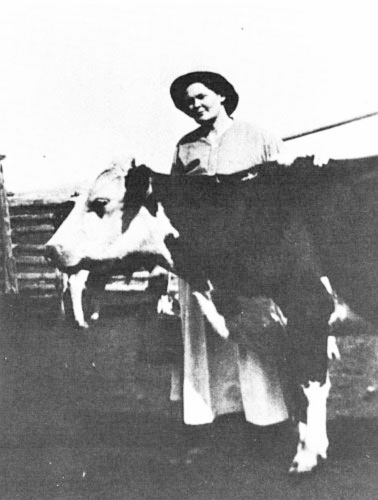 Photograph courtesy of Clyde Stewart