The sympathetic and discerning biographer
of John Keats says, in the
memoir prefixed to Moxon’s edition of
the Poems[1], “The publication of three
small volumes of verse, some earnest
friendships, one profound passion, and
a premature death are the main incidents
here to be recorded.” These
words have long become “household
words,” at all events in the household
of those who make the lives and works
of English poets their special study;
and nothing is likely to be discovered
which shall alter the fact thus set forth.
But that documents illustrating the fact
should from time to time come to the
surface, is to be expected; and the
present volume portrays the “one profound
passion” as perfectly as it is
possible for such a passion to be portrayed
without the revelation of things
too sacred for even the most reverent
and worshipful public gaze, while it
gives considerable insight into the
refinements of a nature only too keenly
sensitive to pain and injury and the
inherent hardness of things mundane.
The three final years of Keats’s life
are in all respects the fullest of vivid
interest for those who, admiring the
poet and loving the memory of the
man, would fain form some conception
of the working of those forces within
him which went to the shaping of his
greatest works and his greatest woes.
In those three years were produced
most of the compositions wherein the
lover of poetry can discern the supreme
hand of a master, the ultimate and
sovereign perfection beyond which, in
point of quality, the poet could never
have gone had he lived a hundred years,
whatever he might have done in magnitude
and variety; and in those years
sprang up and grew the one passion of
his life, sweet to him as honey in the
intervals of brightness and unimpeded
vigour which he enjoyed, bitter as
wormwood in those times of sickness
and poverty and the deepening shadow
of death which we have learned to
associate almost constantly with our
thoughts of him.
Of certain phases of his life during
these final years we have long had substantial
and most fascinating records in
the beautiful collection of documents
entrusted to Lord Houghton, and to
what admirable purpose used, all who
name the name of Keats know too well
to need reminding,—documents published,
it is true, under certain restrictions,
and subject to the depreciatory
operation of asterisks and blanks of
varying significance and magnitude,
proper enough, no doubt, thirty years
ago, but surely now a needless affliction.
But of the all-important phases in the
healthy and morbid psychology of the
poet connected with the over-mastering
passion of his latter days, the record
was necessarily scanty,—a few hints
scattered through the letters written in
moderately good health, and a few
agonized and burning utterances wrung
from him, in the despair of his soul, in
those last three letters addressed to
Charles Brown,—one during the sea
voyage and two after the arrival of
Keats and Severn in Italy.
It was with the profoundest feeling
of the sacredness as well as the great
importance of the record entrusted to
me that I approached the letters now at
length laid before the public: after
reading them through, it seemed to me
that I knew Keats to some extent as a
different being from the Keats I had
known; the features of his mind took
clearer form; and certain mental and
moral characteristics not before evident
made their appearance. It remained to
consider whether this enhanced knowledge
of so noble a soul should be
confined to two or three persons, or
should not rather be given to the world
at large; and the decision arrived at
was that the world’s claim to participate
in the gift of these letters was
good.
The office of editor was not an arduous
one so far as the text is concerned,
for the letters are wholly free from anything
which it seems desirable to omit;
they are legibly and, except in some
minute and trivial details, correctly
written, leaving little to do beyond the
correction of a few obvious clerical
errors, and such amendment of punctuation
as is invariably required by letters
not written for the press. The arrangement
of the series in proper sequence,
however, was not nearly so simple a
matter; for, except as regards the first
nine, the evidence in this behalf is
almost wholly inferential and collateral;
and I have had to be content with strong
probability in many cases in which it is
impossible to arrive at any absolute
certainty. Of the whole thirty-seven
letters, not one bears the date of the
year, except as furnished in the postmarks
of numbers I to IX; two only go
so far as to specify in writing the day of
the month, or even the month itself;
and one of these two Keats has dated a
day later than the date shewn by the
postmark. Those which passed through
the post, numbers I to IX, are fully
addressed to “Miss Brawne, Wentworth
Place, Hampstead,” the word “Middx.”
being added in the case of the six from
the country, but not in that of the three
from London. Numbers X to XVII and
XIX to XXXII are addressed simply
to “Miss Brawne”; while numbers
XVIII, XXXIII, XXXIV, and XXXVI
are addressed to “Mrs. Brawne,” and
numbers XXXV and XXXVII bear
no address whatever.
These material details are not without
a psychological significance: the total
absence of interest in the progress of
time (the sordid current time) tallies
with the profound worship of things so
remote as perfect beauty; and the
addressing of four of the letters to
Mrs. Brawne instead of Miss Brawne
indicates, to my mind, not mere
accident, but a sensitiveness to observation
from any unaccustomed quarter:
three of the letters so addressed were
certainly written at Kentish Town, and
would not be likely to be sent by the
same hand usually employed to take
those written while the poet was next
door to his betrothed; the other one
was, I have no doubt, sent only from
one house to the other; but perhaps the
usual messenger may have chanced to
be out of the way.
The letters fall naturally into three
groups, namely (1) those written during
Keats’s sojourn with Charles Armitage
Brown in the Isle of Wight, and his
brief stay in lodgings in Westminster in
the Summer and Autumn of 1819, (2)
those written from Brown’s house in
Wentworth Place during Keats’s illness
in the early part of 1820 and sent by
hand to Mrs. Brawne’s house, next door,
and (3) those written after he was able
to leave Wentworth Place to stay with
Leigh Hunt at Kentish Town, and
before his departure for Italy in September,
1820. Of the order of the first
and last groups there is no reasonable
doubt; and, although there can be no
absolute certainty in regard to the whole
series of the central group, I do not
think any important error will have been
made in the arrangement here adopted.
The slight service to be done beside
this of arranging the letters, involving a
great deal of minute investigation, was
simply to elucidate as far as possible by
brief foot-notes references that were not
self-explanatory, to give such attainable
particulars of the principal persons and
places concerned as are desirable by
way of illustration, and to fix as nearly
as may be the chronology of that part
of Keats’s life at the time represented
by these letters,—especially the two
important dates involved. The first
date is that of the passion which Keats
conceived for Miss Brawne,—the second
that of the rupture of a blood-vessel,
marking distinctly the poet’s graveward
tendency,—two events probably connected
with some intimacy, and concerning
which it is not unnoteworthy
that we should have to be making
guesses at all. If these and other conjectural
conclusions turn out to be inaccurate
(which I do not think will be
the case), they can only be proved so
by the production of more documents;
and if documents be produced confuting
my conclusions, my aim will have been
attained by two steps instead of one.
The lady to whom these letters were
addressed was born on the 9th of
August in the year 1800, and baptized
Frances, though, as usual with bearers
of that name, she was habitually called
Fanny. Her father, Mr. Samuel Brawne,
a gentleman of independent means,
died while she was still a child; and
Mrs. Brawne then went to reside at
Hampstead, with her three children,
Fanny, Samuel, and Margaret. Samuel,
being next in age to Fanny, was a youth
going to school in 1819; and Margaret
was many years younger than her sister,
being in fact a child at the time of the
engagement to Keats, which event took
place certainly between the Autumn of
1818 and the Summer of 1819, and
probably, as I find good reason to
suppose, quite early in the year 1819.
In the Summer of 1818 Mrs. Brawne
and her children occupied the house of
Charles Armitage Brown next to that
of Mr. and Mrs. Charles Wentworth
Dilke, in Wentworth Place, Hampstead,
which is not now known by that name.
On Brown’s return from Scotland, the
Brawne’s moved to another house in the
neighbourhood; but they afterwards returned
to Wentworth Place, occupying
the house of Mr. Dilke. Mr. Severn
remembered that when he visited Keats
during the residence of the poet with
Brown, Keats used to take his visitor
“next door” to call upon the Brawne
family. “The house was double,”
wrote Mr. Severn, “and had side
entrances.”
It is said to have been at the house
of Mr. Dilke, who was the grandfather
of the present Baronet of that name,
that Keats first met Miss Brawne. Mr.
Dilke eventually gave up possession of
his residence in Wentworth Place, and
took quarters in Great Smith Street,
Westminster, where he and Mrs. Dilke
went to live in order that their only child,
bearing his father’s name, and afterwards
the first Baronet, might be educated at
Westminster School.
Keats’s well known weakness in regard
to the statement of dates leaves us
without such assistance as might be expected
from his general correspondence
in fixing the date of this first meeting
with Miss Brawne. I learn from members
of her family that it was certainly
in 1818; and, as far as I can judge, it
must have been in the last quarter of
that year; for it seems pretty evident
that he had not conceived the passion,
which was his “pleasure and torment,”
up to the end of October, and had conceived
it before Tom’s death “early in
December”; and, as he says in Letter
III of the present series, “the very first
week I knew you I wrote myself your
vassal,” we must perforce regard the
date of first meeting as between the
end of October and the beginning of
December, 1818.
In conducting the reader to this conclusion
it will be necessary to remove a
misapprehension which has been current
for nearly thirty years in regard to a
passage in the letter that yields us our
starting-point. This is the long letter
to George Keats, dated the 29th of
October, 1818, given in Lord Houghton’s
Life, Letters, &c.,[2] and commencing at
page 227 of Vol. I, wherein is the following
passage:
“The Misses —— are very kind to
me, but they have lately displeased me
much, and in this way:—now I am
coming the Richardson!—On my return,
the first day I called, they were in a sort
of taking or bustle about a cousin of theirs,
who, having fallen out with her grandpapa
in a serious manner, was invited by
Mrs. —— to take asylum in her house.
She is an East-Indian, and ought to be
her grandfather’s heir. At the time I
called, Mrs. —— was in conference with
her up stairs, and the young ladies were
warm in her praise down stairs, calling
her genteel, interesting, and a thousand
other pretty things, to which I gave no
heed, not being partial to nine days’
wonders. Now all is completely
changed: they hate her, and, from
what I hear, she is not without faults of
a real kind; but she has others, which
are more apt to make women of inferior
claims hate her. She is not a Cleopatra,
but is, at least, a Charmian: she has a
rich Eastern look; she has fine eyes, and
fine manners. When she comes into the
room she makes the same impression as
the beauty of a leopardess. She is too
fine and too conscious of herself to repulse
any man who may address her:
from habit she thinks that nothing particular.
I always find myself more at ease
with such a woman: the picture before
me always gives me a life and animation
which I cannot possibly feel with anything
inferior. I am, at such times, too
much occupied in admiring to be awkward
or in a tremble: I forget myself
entirely, because I live in her. You will,
by this time, think I am in love with
her, so, before I go any further, I will
tell you I am not. She kept me awake
one night, as a tune of Mozart’s might
do. I speak of the thing as a pastime
and an amusement, than which I can
feel none deeper than a conversation
with an imperial woman, the very ‘yes’
and ‘no’ of whose life is to me a banquet.
I don’t cry to take the moon
home with me in my pocket, nor do I
fret to leave her behind me. I like her,
and her like, because one has no sensations:
what we both are is taken for
granted. You will suppose I have, by
this, had much talk with her—no such
thing; there are the Misses —— on the
look out. They think I don’t admire
her because I don’t stare at her; they
call her a flirt to me—what a want of
knowledge! She walks across a room
in such a manner that a man is drawn
towards her with a magnetic power; this
they call flirting! They do not know
things; they do not know what a woman
is. I believe, though, she has faults, the
same as Charmian and Cleopatra might
have had. Yet she is a fine thing, speaking
in a worldly way; for there are two
distinct tempers of mind in which we
judge of things—the worldly, theatrical
and pantomimical; and the unearthly,
spiritual and ethereal. In the former,
Bonaparte, Lord Byron, and this Charmian,
hold the first place in our minds;
in the latter, John Howard, Bishop
Hooker rocking his child’s cradle, and
you, my dear sister, are the conquering
feelings. As a man of the world, I love
the rich talk of a Charmian; as an
eternal being, I love the thought of you.
I should like her to ruin me, and I
should like you to save me.
‘I am free from men of pleasure’s cares,
By dint of feelings far more deep than theirs.’
This is ‘Lord Byron,’ and is one of the
finest things he has said.”
Now it is clear from this passage that
a lady had made a certain impression
on Keats; and Lord Houghton in his
latest publication states explicitly what
is only indicated in general terms in
the Memoirs published in 1848 and
1867,—that the lady here described
was Miss Brawne. In the earlier
Memoirs, three letters to Rice, Woodhouse,
and Reynolds follow the long
letter to George Keats; then comes the
statement that “the lady alluded to in
the above pages inspired Keats with
the passion that only ceased with his
existence”; and, as the letter to Reynolds
contains references to a lady, it
might have been possible to regard
Lord Houghton’s expression as an allusion
to that letter only. But in the
brief and masterly Memoir prefixed to
the Aldine Edition of Keats[3], his Lordship
cites the passage from the letter of
the 29th of October as descriptive of
Miss Brawne,—thus confirming by
explicit statement what has all along
passed current as tradition in literary
circles.
When Lord Houghton’s inestimable
volumes of 1848 were given to the
world there might have been indelicacy
in making too close a scrutiny into the
bearings of these passages; but the
time has now come when such cannot
be the case; and I am enabled to give
the grounds on which it is absolutely
certain that the allusion here was not
to Miss Brawne. As Lord Houghton
has elsewhere recorded, Keats met Miss
Brawne at the house of Mr. and Mrs.
Dilke, who had no daughters, while the
relationship of “the Misses ——” and
“Mrs. ——” of the passage in question
is clearly that of mother and daughters.
Mrs. Brawne had already been settled with
her children at Hampstead for several
years at this time, whereas this cousin
of “the Misses ——” had just arrived
when Keats returned there from Teignmouth.
The “Charmian” of this anecdote
was an East-Indian, having a
grandfather to quarrel with; while Miss
Brawne never had a grandfather living
during her life, and her family had not
the remotest connexion with the East
Indies. Moreover, Keats’s sister, who
is still happily alive, assures me positively
that the reference is not to Miss
Brawne. In regard to the blank for a
surname, I had judged from various
considerations internal and external
that it should be filled by that of
Reynolds; and, on asking Mr. Severn
(without expressing any view whatever)
whether he knew to whom the story
related, he wrote to me that he knew
the story well from Keats, and that the
reference is to the Misses Reynolds, the
sisters of John Hamilton Reynolds.
Mr. Severn does not know the name of
the cousin of these ladies.
It is clear then that the lady who had
impressed Keats some little time before
the 29th of October, 1818, and was
still fresh in his mind, was not Fanny
Brawne. That the impression was not
lasting the event shewed; and we may
safely assume that it was really limited
in the way which Keats himself
averred,—that he was not “in love with
her.” But it is incredible, almost, that, in
his affectionate frankness with his brother,
he would ever have written thus of
another woman, had he been already
enamoured of Fanny Brawne. This
view is strengthened by reading the
letter to the end: in such a perusal we
come upon the following passage:
“Notwithstanding your happiness and
your recommendations, I hope I shall
never marry: though the most beautiful
creature were waiting for me at the
end of a journey or a walk; though the
carpet were of silk, and the curtains of
the morning clouds, the chairs and
sofas stuffed with cygnet’s down, the
food manna, the wine beyond claret, the
window opening on Winandermere, I
should not feel, or rather my happiness
should not be, so fine; my solitude is
sublime—for, instead of what I have
described, there is a sublimity to welcome
me home; the roaring of the
wind is my wife; and the stars through
my window-panes are my children; the
mighty abstract Idea of Beauty in all
things, I have, stifles the more divided
and minute domestic happiness. An
amiable wife and sweet children I contemplate
as part of that Beauty, but I
must have a thousand of those beautiful
particles to fill up my heart. I feel more
and more every day, as my imagination
strengthens, that I do not live in this
world alone, but in a thousand worlds.
No sooner am I alone, than shapes of
epic greatness are stationed around me,
and serve my spirit the office which is
equivalent to a King’s Body-guard:
‘then Tragedy with scepter’d pall comes
sweeping by:’ according to my state of
mind, I am with Achilles shouting in the
trenches, or with Theocritus in the vales
of Sicily; or throw my whole being into
Troilus, and, repeating those lines, ‘I
wander like a lost soul upon the Stygian
bank, staying for waftage,’ I melt into
the air with a voluptuousness so delicate,
that I am content to be alone. Those
things, combined with the opinion I
have formed of the generality of women,
who appear to me as children to whom
I would rather give a sugar-plum than
my time, form a barrier against matrimony
which I rejoice in. I have
written this that you might see that I
have my share of the highest pleasures
of life, and that though I may choose
to pass my days alone, I shall be no
solitary; you see there is nothing
splenetic in all this. The only thing
that can ever affect me personally for
more than one short passing day, is any
doubt about my powers of poetry: I
seldom have any, and I look with hope
to the nighing time when I shall have
none.”[4]
There is but little after this in the
letter, and apparently no break between
the time at which he thus expressed
himself and that at which he
signed the letter and added—“This is
my birthday.” If therefore my conclusion
as to the negative value of this
and the “Charmian” passage be correct,
we may say that he was certainly not
enamoured of Miss Brawne up to the
29th of October, 1818, although it is
tolerably clear, from the evidence of
Mr. Dilke, that Keats first met her
about October or November. Again,
in a highly interesting and important
letter to Keats’s most intimate friend
John Hamilton Reynolds, a letter
which Lord Houghton placed immediately
after one to Woodhouse dated
the 18th of December, 1818, we read
the following ominous passage suggesting
a doom not long to be deferred:—
“I never was in love, yet the voice
and shape of a woman has haunted me
these two days—at such a time when
the relief, the feverish relief of poetry,
seems a much less crime. This morning
poetry has conquered—I have relapsed
into those abstractions which are my
only life—I feel escaped from a new,
strange, and threatening sorrow, and I
am thankful for it. There is an awful
warmth about my heart, like a load of
Immortality.
“Poor Tom—that woman and poetry
were ringing changes in my senses.
Now I am, in comparison, happy.”[5]
There is no date to this letter; and,
although it was most reasonable to
suppose that the fervid expressions used
pointed to the real heroine of the poet’s
tragedy,—that he wrote in one of those
moments of mastery of the intellect over
the emotions such as he experienced
when writing the extraordinary fifth
Letter of the present series,—the fact is
that the reference is to “Charmian,” and
that the letter was misplaced by Lord
Houghton. It really belongs to September
1818, and should precede instead
of following this “Charmian” letter.
When Keats wrote the next letter in
Lord Houghton’s series (also undated)
to George and his wife, Tom was dead;
and there is another clue to the date in
the fact that he transcribes a letter from
Miss Jane Porter dated the 4th of
December, 1818. After making this
transcript he proceeds to draw the following
verbal portrait of a young lady:
“Shall I give you Miss ——? She
is about my height, with a fine style of
countenance of the lengthened sort; she
wants sentiment in every feature; she
manages to make her hair look well;
her nostrils are very fine, though a little
painful; her mouth is bad and good;
her profile is better than her full face,
which, indeed, is not full, but pale and
thin, without showing any bone; her
shape is very graceful, and so are her
movements; her arms are good, her
hands bad-ish, her feet tolerable. She
is not seventeen, but she is ignorant;
monstrous in her behaviour, flying out
in all directions, calling people such
names that I was forced lately to make
use of the term—Minx: this is, I think,
from no innate vice, but from a penchant
she has for acting stylishly. I am,
however, tired of such style, and shall
decline any more of it. She had a
friend to visit her lately; you have
known plenty such—she plays the
music, but without one sensation but
the feel of the ivory at her fingers; she
is a downright Miss, without one set-off.
We hated her, and smoked her,
and baited her, and, I think, drove her
away. Miss ——, thinks her a paragon
of fashion, and says she is the only
woman in the world she would change
persons with. What a stupe,—she is as
superior as a rose to a dandelion.”[6]
There is nothing explicit as to the
date of this passage; but there is no
longer any doubt that this sketch has
reference to Miss Brawne, and that
Keats had now found that most dangerous
of objects a woman “alternating
attraction and repulsion.”
The lady’s children assured me that
the description answered to the facts
in every particular except that of age:
the correct expression would be “not
nineteen”; but Keats was not infallible
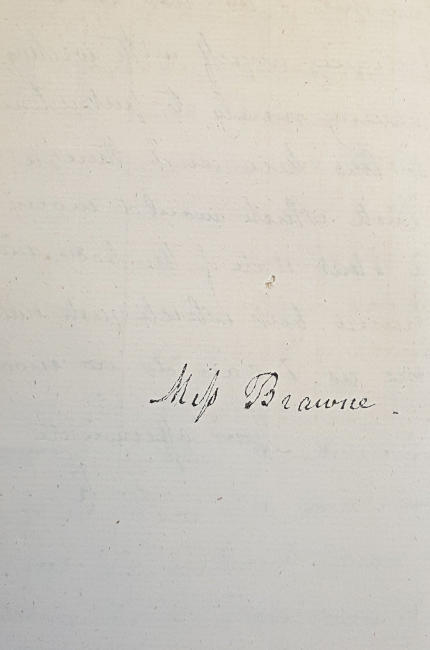
on such a point; and the holograph
letter in which he wrote “Miss Brawne”
in full shews that he made a mistake
as to her age. When he wrote this passage,
he was, I should judge, feeling a
certain resentment analogous to what
found a much more tender expression
in the first letter of the present series,
when the circumstances made increased
tenderness a matter of course,—a resentment
of the feeling that he was becoming
enslaved.
There is no announcement of his
engagement in the original letter to his
brother and sister-in-law, which I have
read; and it would seem improbable
that he was engaged when he wrote
it. But of the journal letter begun
on the 14th of February, 1819, and
finished on the 3rd of May, only a
part of the holograph is accessible;
and there may possibly have been
such an announcement in the missing
part, while, under some date between
the 19th of March and the 15th of
April, Keats writes the following paragraph
and sonnet, from which it might
be inferred that the engagement had
been announced in an unpublished
letter.
“I am afraid that your anxiety for
me leads you to fear for the violence of
my temperament, continually smothered
down: for that reason, I did not intend
to have sent you the following Sonnet;
but look over the two last pages, and
ask yourself if I have not that in me
which will bear the buffets of the world.
It will be the best comment on my
Sonnet; it will show you that it was
written with no agony but that of
ignorance, with no thirst but that of
knowledge, when pushed to the point;
though the first steps to it were through
my human passions, they went away,
and I wrote with my mind, and, perhaps,
I must confess, a little bit of my heart.
Why did I laugh to-night? No voice will tell:
No God, no Demon of severe response,
Deigns to reply from Heaven or from Hell.
Then to my human heart I turn at once.
Heart! Thou and I are here sad and alone;
I say, why did I laugh? O mortal pain!
O Darkness! Darkness! ever must I moan,
To question Heaven and Hell and Heart in vain.
Why did I laugh? I know this Being’s lease,
My fancy to its utmost blisses spreads;
Yet would I on this very midnight cease,
And the world’s gaudy ensigns see in shreds;
Verse, Fame, and Beauty are intense indeed,
But Death intenser—Death is Life’s high meed.”
[7]
Again in the same letter, on the 15th
of April, Keats says “Brown, this morning,
is writing some Spenserian stanzas
against Miss B —— and me,”—a reference,
doubtless, to Miss Brawne, probably indicative
of the engagement being an
understood thing; and, seemingly on the
same date, he writes as follows:
“The fifth canto of Dante pleases me
more and more; it is that one in which
he meets with Paulo and Francesca. I
had passed many days in rather a low
state of mind, and in the midst of them
I dreamt of being in that region of Hell.
The dream was one of the most delightful
enjoyments I ever had in my life; I
floated about the wheeling atmosphere,
as it is described, with a beautiful figure,
to whose lips mine were joined, it
seemed for an age; and in the midst of
all this cold and darkness I was warm;
ever-flowery tree-tops sprung up, and
we rested on them, sometimes with the
lightness of a cloud, till the wind blew
us away again. I tried a Sonnet on it:
there are fourteen lines in it, but nothing
of what I felt. Oh! that I could dream
it every night.
As Hermes once took to his feathers light,
When lulled Argus, baffled, swoon’d and slept,
So on a Delphic reed, my idle spright,
So play’d, so charm’d, so conquer’d, so bereft
The dragon-world of all its hundred eyes,
And seeing it asleep, so fled away,
Not to pure Ida with its snow-cold skies,
Nor unto Tempe, where Jove grieved a day,
But to that second circle of sad Hell,
Where in the gust, the whirlwind, and the flaw
Of rain and hail-stones, lovers need not tell
Their sorrows,—pale were the sweet lips I saw,
Pale were the lips I kiss’d, and fair the form
I floated with, about that melancholy storm.”
[8]
The meaning of this dream is sufficiently
clear without any light from the
fact that the sonnet itself was written in
a little volume given by Keats to Miss
Brawne, a volume of Taylor & Hessey’s
miniature edition of Cary’s Dante, which
had remained up to the year 1877 in
the possession of that lady’s family.[9]
Although the present citation of extant
documents does not avail to fix the
date of Keats’s passion more nearly than
to shew that it almost certainly lies
somewhere between the 29th of October
and beginning of December, 1818, there
can be little doubt that, if a competent
person should be permitted to examine
all the original documents concerned,
the date might be ascertained much
more nearly;—that is to say that the
particular “first week” of acquaintance
in which Keats “wrote himself the
vassal” of Miss Brawne, as he says (see
page 13), might be identified. But in
any case it must be well to bring into
juxtaposition these passages bearing upon
the subject of the letters now made
public.
The natural inference from all we
know of the matter in hand is that after
his brother Tom’s death, Keats’s passion
had more time and more temptation
to feed upon itself; and that, as an
unoccupied man living in the same
village with the object of that passion,
an avowal followed pretty speedily. It
is not surprising that there are no letters
to shew for the first half of the
year 1819, during which Keats and Miss
Brawne probably saw each other constantly,
and to judge from the expressions
in Letter XI, were in the habit of
walking out together.
The tone of Letter I is unsuggestive
of more than a few weeks’ engagement;
but it is impossible, on this alone, to
found safely any conclusion whatever.
From the date of that letter, the 3rd of
July, 1819, we have plainer sailing for
awhile: Keats appears to have remained
in the Isle of Wight till the 11th or
12th of August, when he and Brown
crossed from Cowes to Southampton
and proceeded to Winchester. At page
19 we read under the date “9 August,”
“This day week we shall move to Winchester”;
but in the letter bearing the
postmark of the 16th (though dated the
17th) Keats says he has been in Winchester
four days; so that the patience
of the friends with Shanklin did not
hold out for anything like a week.
At Winchester the poet remained till
the 11th of September, when bad news
from George Keats hurried him up to
Town for a few days: he meant to have
returned on the 15th, and was certainly
there again by the 22nd, remaining
until some day between the 1st and
10th of October, by which date he
seems to have taken up his abode at
lodgings in College Street, Westminster.
Here he cannot have remained long;
for on the 19th he was already proposing
to return to Hampstead; and it must
have been very soon after this that he
accepted the invitation of Brown to
“domesticate with” him again at Wentworth
Place; and on the 19th of the
next month he was writing from that
place to his friend and publisher, Taylor.[10]
This brings us to the fatal winter of
1819-20, during which, until the date of
Keats’s first bad illness, we should not
expect any more letters to Miss Brawne,
because, in the natural course of things,
he would be seeing her daily.
The absence of any current record as
to the exact date whereon he was struck
down with that particular phase of his
malady which he himself felt from the
first to be fatal, must have seemed
peculiarly regretworthy to Keats’s lovers;
but it is not impossible to deduce from
the various materials at command the
day to which Lord Houghton’s account
refers. This well-known passage leaves
us in no doubt as to the place wherein
the beginning of the end came upon the
poet,—the house of Charles Brown; but
the day we must seek for ourselves.
Passing over such premonitions of
disease as that recorded in the letter to
George Keats and his wife dated the
14th of February, 1819, and printed at
page 257 of the first volume of the
Life, namely that he had “kept in doors
lately, resolved, if possible, to rid” himself
of “sore throat,”—the first date important
to bear in mind is Thursday, the
13th of January, 1820, which is given
at the head of a somewhat remarkable
version of a well-known letter addressed
to Mrs. George Keats. This letter first
appeared without date in the Life; but,
on the 25th of June, 1877, it was printed
in the New York World, with many
striking variations from the previous
text, and with several additions, including
the date already quoted, the genuineness
of which I can see no reason for
doubting. The letter begins thus in
the Life, Letters, &c.—
“My dear Sister,
By the time you receive this
your troubles will be over, and George
have returned to you.”
In The World it opens thus—
“My dear Sis.: By the time that you
receive this your troubles will be over.
I wish you knew that they were half
over; I mean that George is safe in
England, and in good health.”
It is not my part to account here for
the verbal inconsistency between these
two versions; but the inconsistency as
regards fact, which has been charged
against them, is surely not real. Both
versions alike indicate that Keats was
writing with the knowledge that his
letter would not reach Mrs. George
Keats till after the return of her husband
from his sudden and short visit to
England; and, assuming the genuineness
of another document, this was
certainly the case.
In The Philobiblion[11] for August, 1862,
was printed a fragment purporting to be
from a letter of Keats’s, which seems to
me, on internal evidence alone, of indubitable
authenticity; and, if it is
Keats’s, it must belong to the particular
letter now under consideration. It is
headed Friday 27th, is written in higher
spirits, if anything, than the rest of this
brilliant letter, giving a ludicrous string
of comparisons for Mrs. George Keats’s
sister-in-law, Mrs. Henry Wylie, which,
together with a final joke, were apparently
deemed unripe for publication in
1848, being represented by asterisks in
the Life, Letters, &c. (Vol. II, p. 49).
The fragment closes with the promise of
“a close written sheet on the first of
next month,” varying in phrase, just as
the World version of the whole letter
varies, from Lord Houghton’s.[12]
Keats explains, under the inaccurate
and unexplicit date Friday 27th, that
he has been writing a letter for George
to take back to his wife, has unfortunately
forgotten to bring it to town, and
will have to send it on to Liverpool,
whither George has departed that morning
“by the coach,” at six o’clock. The
27th of January, 1820, was a Thursday,
not a Friday; and there can be hardly
any doubt that George Keats left London
on the 28th of January, 1820, because
John, who professed to know
nothing of the days of the month, seems
generally to have known the days of the
week; and this Friday cannot have
been in any other month: it was after
the 13th of January, and before the 16th
of February, on which day Keats wrote
to Rice, referring to his illness.[13] But
whether the date at the head of the
fragment should be Thursday 27th or
Friday 28th is immaterial for our present
purpose, because the Thursday after
that date would be the same day in either
case; and it was on the Thursday after
George left London that Keats was
taken ill. This appears from the following
passage extracted by Sir Charles
Dilke from a letter of George Keats’s
to John, and communicated to The
Athenæum of the 4th of August, 1877:
“Louisville, June 18th, 1820.
My dear John,
Where will our miseries end? So
soon as the Thursday after I left
London you were attacked with a dangerous
illness, an hour after I left this
for England my little girl became so ill
as to approach the grave, dragging our
dear George after her. You are recovered
(thank [sic] I hear the bad and
good news together), they are recovered,
and yet....”
Thus, it was on Thursday, the 3rd of
February, 1820, that Keats, as recounted
by Lord Houghton (Vol. II, pp. 53-4),
returned home at about eleven o’clock,
“in a state of strange physical excitement,”
and told Brown he had received
a severe chill outside the stage-coach,—that
he coughed up some blood on
getting into bed, and read in its colour
his death-warrant. Mr. Severn tells
me that Keats left his bed-room within
a week of his being taken ill: within a
fortnight, as we have seen, he was so
far better as to be writing (dismally
enough, it is true) to Rice; but, that
he was confined to the house for some
months, is evident. The whole of the
letters forming the second division of
the series, Numbers X to XXXII, seem
to me to have been written during this
confinement; and I should doubt whether
Keats did much better, if any,
than realize his hope of getting out for
a walk on the 1st of May.
At that time he was not sufficiently
recovered to accompany Brown on his
second tour in Scotland; and was yet
well enough by the 7th to be at Gravesend
with his friend for the final parting.
I understand from the Life, Letters, &c.
(Vol. II, p. 60), that Keats then went
at once to Kentish Town: Lord Houghton
says “to lodge at Kentish Town, to
be near his friend Leigh Hunt”; but
Hunt says in his Autobiography (1850),
Vol. II, p. 207, “On Brown’s leaving
home a second time, ... Keats, who was
too ill to accompany him, came to reside
with me, when his last and best volume
of poems appeared....”[14] These accounts
are not necessarily contradictory; for
Keats may have tried lodgings near
Hunt first, and moved under the same
roof with his friend when the lodgings
became intolerable, as those in College
Street had done before. He was reading
the proofs of Lamia, Isabella, &c.
on the 11th of June, as shown by a
letter to Taylor of that date;[15] and, on
the 28th, appeared in The Indicator,
beside the Sonnet
“As Hermes once took to his feathers light....”
the paper entitled “A Now,” at the
composition of which Keats is said to
have been not only present but assisting;[16]
and, as Hunt wrote pretty much
“from hand to mouth” for The Indicator,
we may safely assume that Keats was
with him, at all events till just the end
of June. On a second attack of spitting
of blood, he returned to Wentworth
Place to be nursed by Mrs. and Miss
Brawne; and he was writing from there
to Taylor on the 14th of August.
Between these two attacks he would
seem to have written the letters forming
the third series, Numbers XXXIII to
XXXVII. I suspect the desperate tone
of Number XXXVII had some weight
in bringing about the return to Wentworth
Place; and that this was the last
letter Keats ever wrote to Fanny
Brawne; for Mr. Severn tells me that
his friend was absolutely unable to
write to her either on the voyage or
in Italy.
There are certain passages in the letters,
taking exception to Miss Brawne’s
behaviour, particularly with Charles
Armitage Brown, which should not, I
think, be read without making good
allowance for the extreme sensitiveness
natural to Keats, and exaggerated to
the last degree by terrible misfortunes.
Keats was himself endowed with such
an exquisite refinement of nature, and,
without being in any degree a prophet
or propagandist like Shelley, was so
intensely in earnest both in art and in
life, that anything that smacked of
trifling with the sacred passion of love
must have been to him more horrible
and appalling than to most persons of
refinement and culture. Add to this
that, for the greater part of the time
during which his good or evil hap cast
him near the object of his affection, his
robust spirit of endurance was disarmed
by the advancing operations of disease,
and his discomfiture in this behalf aggravated
by material difficulties of the
most galling kind; and we need not
be surprised to find things that might
otherwise have been deemed of small
account making a violent impression
upon him. In a memoir[17] of his friend
Dilke, written by that gentleman’s
grandson, there is an extract from
some letter or journal, emanating from
whom, and at what date, we are not
told, but probably from Mr. or Mrs.
Dilke, and which is significant enough:
it is at page 11:
“It is quite a settled thing between
Keats and Miss ——. God help them.
It’s a bad thing for them. The mother
says she cannot prevent it, and that her
only hope is that it will go off. He
don’t like anyone to look at her or to
speak to her.”
This indicates, at all events, a morbid
susceptibility on the part of Keats as to
the relations of his betrothed with the
rest of the world, and must be taken
into account in weighing his own words
in this connexion. That things went
uncomfortably enough to attract the
attention of others is indicated again
in an extract which Sir Charles Dilke
has published on the same page with the
foregoing, from a letter written to Mrs.
Dilke by Miss Reynolds:
“I hear that Keats is going to Rome,
which must please all his friends on every
account. I sincerely hope it will benefit
his health, poor fellow! His mind and
spirits must be bettered by it; and
absence may probably weaken, if not
break off, a connexion that has been a
most unhappy one for him.”
Unhappy, the connexion doubtless
was, as the connexion of a doomed man
with the whole world is likely to be;
but it would be unfair to assume that the
engagement to Miss Brawne took a more
unfortunate turn than any engagement
would probably take for a man circumstanced
as Keats was,—a man without
independent means, and debarred by
ill-health from earning an independence.
Above all, it would be both unsafe and
extremely unfair to conclude that either
Miss Brawne or Keats’s amiable and
admirable true friend Charles Brown
was guilty of any real levity.
That Keats’s passion was the cause of
his death is an assumption which also
should be looked at with reserve.
Shelley’s immortal Elegy and Byron’s
ribald stanzas have been yoked together
to draw down the track of years the
false notion that adverse criticism killed
him; and now that that form of murder
has been shewn not to have been committed,
there seems to be a reluctance to
admit that there was no killing in the
matter. Sir Charles Dilke says, at page
7 of the Memoir already cited, that
Keats “‘gave in’ to a passion which
killed him as surely as ever any man was
killed by love.” This may be perfectly
true; for perhaps love never did kill any
man; but surely it must be superfluous
to assume any such dire agency in the
decease of a man who had hereditary
consumption. Coleridge’s often-quoted
verdict, “There is death in that hand,”
does not stand alone; and the careful
reader of Keats’s Life and Letters will
find ample evidence of a state of health
likely to lead but to one result,—such as
the passage already cited in regard
to his staying at home determined
to rid himself of sore throat, the
account of his return, invalided, from
the tour in Scotland, which his friends
agreed he ought never to have undertaken,
and his own statement to Mr.
Dilke, printed in the Life, Letters, &c.
(Vol. II, p. 7), that he “was not in very
good health” when at Shanklin.
Lord Houghton’s fine perception of
character and implied fact sufficed to
prevent his giving any colour to the
supposition that Keats was not sufficiently
cherished and considered in his
latter days: the reproaches that occur
in some of the present letters do not
lead me to alter the impression conveyed
to me on this subject by his Lordship’s
memoirs; nor do I doubt that others
will make the necessary allowance for
the fevered condition of the poet’s mind
and the harassed state of body and spirit.
Mr. Severn tells me that Mrs. and Miss
Brawne felt the keenest regret that
they had not followed him and Keats to
Rome; and, indeed, I understand that
there was some talk of a marriage taking
place before the departure. Even
twenty years after Keats’s death, when
Mr. Severn returned to England, the
bereaved lady was unable to receive him
on account of the extreme painfulness
of the associations connected with him.
In Sir Charles Dilke’s Memoir of his
grandfather, there is a strange passage
wherein he quotes from a letter of
Miss Brawne’s written ten years after
Keats’s death,—a passage which might
lead to an inference very far from the
truth:
“Keats died admired only by his
personal friends, and by Shelley; and
even ten years after his death, when
the first memoir was proposed, the
woman he had loved had so little belief
in his poetic reputation, that she wrote
to Mr. Dilke, ‘The kindest act would be
to let him rest for ever in the obscurity
to which circumstances have condemned
him.’”
That Miss Brawne should have written
thus at the end of ten years’ widowhood
does not by any means imply
weakness of belief in Keats’s fame.
Obscurity of life is not identical with
obscurity of works; and any one must
surely perceive that an application made
to her for material for a biography,
or even any proposal to publish one,
must have been intensely painful to
her. She could not bear any discussion
of him, and was, till her death in
1865, peculiarly reticent about him;
but in her latter years, as a matron
with grown-up children, when the world
had decided that Keats was not to be
left in that obscurity, she said more
than once that the letters of the poet,
which form the present volume, and
about which she was otherwise most
uncommunicative, should be carefully
guarded, “as they would some day be
considered of value.”
It would be irrelevant to the present
purpose to recount the facts of this
honoured lady’s life; but one or two
personal traits may be recorded. She
had the gift of independence or self-sufficingness
in a high degree; and it was
not easy to turn her from a settled purpose.
This strength of character showed
itself in a noticeable manner in the great
crisis of her life, and in a manner, too,
that has to some extent robbed her of
the small credit of devotion to the man
whose love she had accepted; for those
who knew the truth would not have it
discussed, and those who decried her
did not know the truth.
On the news of Keats’s death, she
cut her hair short and took to a widow’s
cap and mourning. She wandered about
solitary, day after day, on Hampstead
Heath, frequently alarming the family
by staying there far into the night, and
having to be sought with lanterns.
Before friends and acquaintance she
affected a buoyancy of spirit which has
tended to wrong her memory; but her
sister carried into advanced life the
recollection that, when the stress of
keeping up appearances passed, Fanny
spent such time as she remained at home
in her own room,—into which the child
would peer with awe, and see the unwedded
widow poring in helpless despair
over Keats’s letters.
Without being in general a systematic
student she was a voluminous reader in
widely varying branches of literature;
and some out-of-the-way subjects she
followed up with great perseverance. One
of her strong points of learning was the
history of costume, in which she was so
well read as to be able to answer any
question of detail at a moment’s notice.
This was quite independent of individual
adornment; though, à propos of Keats’s
remark, “she manages to make her hair
look well,” it may be mentioned that
some special pains were taken in this
particular, the hair being worn in curls
over the forehead, interlaced with ribands.
She was an eager politician, with very
strong convictions, fiery and animated
in discussion; and this characteristic
she preserved till the end.
The sonnet on Keats’s preference for
blue eyes,
“Blue! ’tis the hue of heaven,” &c.,
written in reply to John Hamilton Reynolds’s
sonnet[18] in which a preference is
expressed for dark eyes,—
“Dark eyes are dearer far
Than orbs that mock the hyacinthine bell”—
has no immediate connexion with Miss
Brawne; but it is of interest to note
that the colour of her eyes was blue, so
that the poet was faithful to his preference.
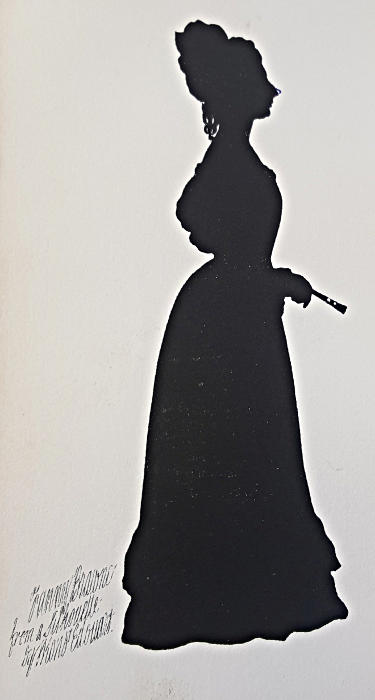
No good portrait of her is extant,
except the silhouette of which a reproduction
is given opposite page 3: a
miniature which is perhaps no longer
extant is said by her family to have
been almost worthless, while the silhouette
is regarded as characteristic and
accurate as far as such things can be.
Mr. Severn, however, told me that the
draped figure in Titian’s picture of
Sacred and Profane Love, in the Borghese
Palace at Rome, resembled her
greatly, so much so that he used to
visit it frequently, and copied it, on this
account. Keats, it seems, never saw
this noble picture containing the only
satisfactory likeness of Fanny Brawne.
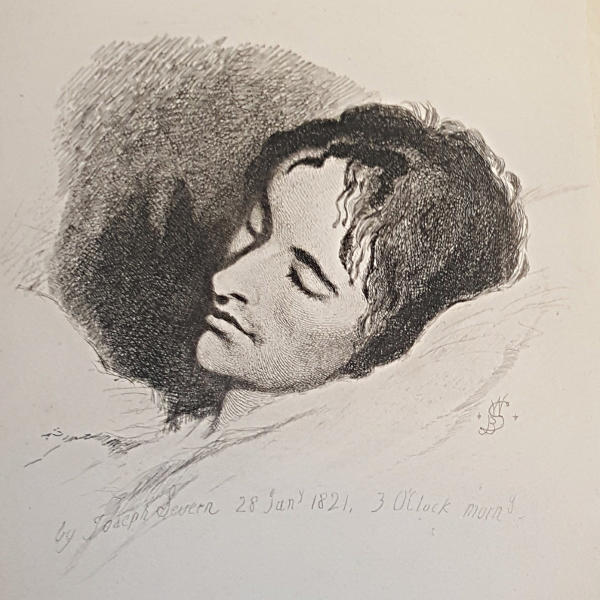
The portrait of Keats which forms
the frontispiece to this volume has been
etched by Mr. W. B. Scott from a drawing
of Severn’s, to which the following
words are attached:
“28th Jany. 3 o’clock mg. Drawn
to keep me awake—a deadly sweat was
on him all this night.”
Keats’s old schoolfellow, the late
Charles Cowden Clarke, assured me in
1876 that this drawing was “a marvellously
correct likeness.”
Postscript.—During the past ten years
my work in connexion with the writings
and doings of Keats has involved the
discovery and examination of a great
mass of documents of a more or less
authoritative kind, both printed and
manuscript; and many points which
were matters of conjecture in 1877 are
now no longer so.
Others also have busied themselves
about Keats; and, since the foregoing
remarks were first published in 1878,
Mr. J. G. Speed, a grandson of George
Keats, has identified himself with the
contributor to the New York World,
alluded to at pages xlviii and xlix, in
reissuing in America Lord Houghton’s
edition of Keats’s Poems, together with
a collection of letters.[19] This work,
though containing one new letter, unhappily
threw no real light whatever
either on the inconsistencies of text
already referred to or on any other
question connected with Keats. Later,
Professor Sidney Colvin has issued, with
a very different result, his volume on
Keats[20] included in the “English Men of
Letters” series; and I have not hesitated
to use, without individual specification,
such illustrative facts as have become
available, whether from Mr. Colvin’s work
or from my own edition of Keats’s whole
writings,[21] which also appeared some
time after the publication of the Letters
to Fanny Brawne, though years before
Mr. Colvin’s book.
Two letters, traced since the body of
the present volume passed through the
press are added at the close of the
series; and I have now reason to think
that the letter numbered XXVIII should
precede that numbered XXV, the date
being probably the 23rd or 25th of
February, 1820, rather than the 4th of
March as suggested in the foot-note at
page 78.
The cousin of the Misses Reynolds
whom Keats described as a Charmian
was Miss Jane Cox,[22] at least so I was
most positively assured by Miss
Charlotte Reynolds in 1883.
It is now pretty clear that the intention
to return to Winchester on the
14th of September, 1819, was not carried
out quite literally, and that Keats really
returned to that city on the 15th. In
regard to the foot-note at page 33, it
should now be stated that, in a letter
post-marked the 16th of October, 1819,
he speaks of having returned to Hampstead
after lodging two or three days in
the neighbourhood of Mrs. Dilke.
Having mentioned in the foot-note at
page 101 that Keats had elsewhere recorded
himself and Tom as firm believers
in immortality, I must now state that
the record cited was a garbled one.
Lord Houghton, working from transcripts
furnished to him by the late Mr.
Jeffrey, the second husband of George
Keats’s widow, printed the words “I
have a firm belief in immortality, and
so had Tom.” The corresponding sentence
in the autograph letter is “I have
scarce a doubt of an immortality of
some kind or another, neither had
Tom.”
Finally, it remains to supply an omission
which I find it hard to account for.
In Medwin’s Life of Shelley occur some
important extracts about Keats, seeming
to emanate from Fanny Brawne. In
1877 I learnt from the lady’s family
that Medwin’s mysteriously introduced
correspondent was no other than she.
Indeed I had actually cut the relative
portion of Medwin’s book out for use
in this Introduction; but by some inexplicable
oversight I omitted even to
refer to it; and it remained for Professor
Colvin to call attention to it. I now
gladly follow his lead in citing words
which have a direct bearing upon the
vexed question of the appreciation of
Keats by her whom he loved; and, in
the appendix to the present edition, the
passage in question will be found.
H. BUXTON FORMAN.
46 Marlborough Hill, St. John’s Wood,
November, 1888.