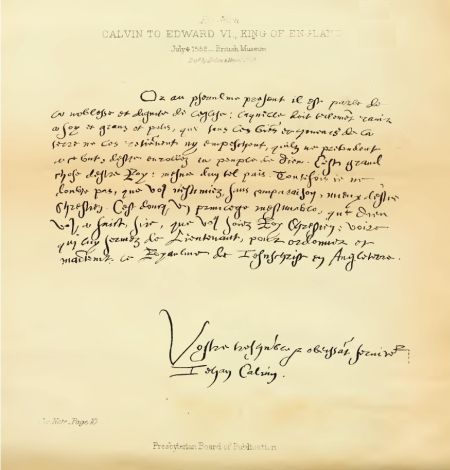
Geneva, [October] 1541.
Madame,—I humbly beseech you that you would take in
good part my boldness in writing these present, deeming that,
should you find therein a too great plainness, it proceeds not
so much from rashness, or from overweening self-conceit, as
from pure and true affection for your service in our Lord. For
albeit that I do acknowledge myself a very unprofitable servant
of the Church, it hath, notwithstanding, been found expedient
to employ me in that station, according to the grace which the
Lord has imparted to me; and it has even occurred to me that
there was a need-be for my doing so, if I wished to acquit
myself of my duty, not merely because I feel myself obliged, in
regard to you, to seek, in so far as is possible for me, and in the
way of duty, your welfare and advantage, howbeit that such
motive is alone sufficient to stir me up to action, but rather that,
considering the state and pre-eminence in which the Lord has
set you, it seems to us all, we whom the Lord by his goodness
has called to be ministers of his holy word, ought to keep in
special remembrance, to apply ourselves to the bestowal of some
pains for you, and the more so because, more than most princely
persons, you are able to promote and advance the kingdom of
Christ. I have, besides, observed in you such fear of God and
such disposed faithfulness of obedience, that independently of
the high rank which he has vouchsafed you among men, I do
so value the graces which he hath put upon you, even to
such a degree, that I would think myself accursed should I
have omitted the occasions of any profitable service, in so far
as they might be presented to me. This is certainly what I
can say without any feigning or flattery, but in sincerity of
heart, and speaking as in His presence who knows all our
secret thoughts.
Madame, by other worthy persons who have passed through
here at different times, I have been given to understand how
Master François, whom you have appointed preacher to your
household, after having acquitted himself well in preaching,
as well at least as could be expected of him, had persuaded
you that it would not be a bad thing, after having heard
mass, to hold some sort of communion, which must be somehow
the Supper of our Lord; this proceeding, which was not approved
of by one of your ladies, who, according to the knowledge
which she had received of God, did not wish against her conscience
to meddle with what she considered to be wrong in
itself, and has been the occasion, on the representation of the
said Master François, to have some way or other turned away
from her the good-will which you have been wont to bear her;
so that matters have reached such a height, that you have
intimated that all those who do as she does, ought not to be
supported, inasmuch as, by their importunity, they give birth
to scandals to no purpose among the faithful. Wherefore,
concluding that a thing of so much importance must not be
concealed, seeing that you had been given to understand that
matters were otherwise than they are, according as it has
pleased the Lord to reveal himself to me in Scripture, I have
thought it right to communicate to you what the Lord has given
me of understanding in that matter. But while I have been in
some doubt and hesitation about doing so, I have been given to
understand, on the part of Madame de Pons,[311] that you wished
very much to be more fully instructed, the more so that, besides
the many difficulties which you see, on the other hand, it is very
difficult to come to a satisfactory solution of them. This message
has all the more confirmed me in my purpose to venture
to essay the giving you a faithful exposition so far as I know,
in order that afterward you may judge for yourself, and in so
far as you shall have fully understood God's truth, that you
may follow in all obedience, seeing that your zeal is not of the
kind that rebels against it, but receives the truth in love and
with all benign affection. Yet all this notwithstanding, Madame,
before that I begin, I beseech you not to take up any suspicion
of me, as though I did this, having been put up to it by some
persons of your household, or to favour any one in particular;
for I can assure you, before God, that I do so without having
been requested by any one, and only on the advertisement, as I
have already assured you, of persons passing through this way,
who never thought that I could have the means of any direct
communication. On the other hand, I would rather desire to
be cast down into the lowest depths of the abyss, than to twist
about or wrest the truth of God, to make it suit the hatred or
to procure the favour of any creature whatsoever. But what
makes me speak out is, that I cannot bear that the word of
God should be thus to you concealed, perverted, depraved, and
corrupted in such essential things, by those in whom you have
some confidence, to whom you have given authority.
Touching Master François, to speak soberly, I would to a
certainty put you upon your guard not to confide too unreservedly
in his doctrine. Should I do so, I need have no reason
to fear, that mayhap you may entertain some bad opinion of
me, as though I might speak from hatred or envy of this personage.
For I have neither matter nor occasion of envy in any
way toward him; and the hatred which, up to the present hour,
I have felt toward him, is such, that I have at all times, to
the utmost of my power, made it my business to edify him in
well doing. But when I perceive that any one, owing to an
ill-informed conscience, sets himself to overthrow the word of
the Lord, and to extinguish the light of Truth, I could by no
means pardon him, even were he my own father a hundred
times over. As for this same individual, I have been aware,
from having long known him, that whatsoever small understanding
of the Scripture God has vouchsafed him, he has always
made subserve his own profit and ambition, preaching
wherever he saw that it would be a help to gratify his avarice,
forbearing to preach wherever he found that it began to be
troublesome to him; and then for all that, as often as he could
procure hearers, persons of credit to countenance him, and
the wealthy to fill his wallet or his purse, who required him
to give glory to God, he has taken the trouble to satisfy them
by almost always selling them his word. On the other hand,
again, wherever he met with any trouble or persecution, he had
always his denial ready to escape from it, to such a degree, that
one could not know in regard to him whether the holy and sacred
word of God was but a sport and mockery; insomuch that he
turned it into a farce, playing at one time one character, and at
another the part of another, according to the pastime he finds
in it. As to his life, I do not touch upon that, except that one
could desire that it were better in a minister of the word. I
know, Madame, that the duty of a Christian man is not to detract
from his neighbour; and that is what I have not wished
to do, for had I been desirous to speak ill of him, I have plenty
of other material concerning him which I conceal. But our
Lord does not mean, when we see a wolf, under the colour and
appearance of a pastor, scattering his flock, that we should
quail in silence through fear of speaking evil of him. He
rather commands us to discover the perversity of those who,
like the pestilence, corrupt by their infection, and mar the face
of the Church. And as for myself, neither would I have
taken that method here if I saw any better remedy, taking
into account the mortal fury of that sort of people which I
do thereby provoke against myself. For I have not at this
day so fierce warfare with any as with those who, under
the shadow of the Gospel, wear a rough garment outwardly
toward princes, amazing and entertaining them by their finesse
and subtilty, enshrouded in some cloud, as it were, without
ever leading them to the right object. But how could I do
otherwise? If I do not address myself to them, it is because
I see their heart to be so divested of all fear of God, that
speaking of his judgment to them, is but a mere fable or a
pleasant tale. But when I describe them such as they are, to
make them aware that they could carry their abuse no farther,
I find that by this method they are more restrained from
further seduction and abuse. This very person I have oftentimes
set about trying to bring back into the good way, so far
even as to make him confess his iniquity; albeit, that impudently
he would excuse himself before men, being convicted in his
own conscience before God. Notwithstanding, with a horrible
obstinacy and hardness of heart, he would persist in saying, that
he could not desist from doing that which he knew to be bad,
except that on one occasion, after having seen some treatise of
mine, with grievous imprecations on himself he protested that
he would never assist at the mass, because it was such a gross
abomination. But I know my man so well, that I scarcely
count more on his oath than upon the chattering of a magpie.
Howsoever, Madame, as I would not that he did persevere in
ill-doing, to the great detriment of yourself and of the people
of God, I feel constrained to warn you by my intimation, seeing
that as regarded him, he would not profit by taking advantage
of it. What I have told you about him is so certain, that I do
not wish you to give credit to it until you have first of all found
out by experience that it is true; for if you pay attention, you
will see at a glance that he preaches the word of God only in
so far as he wishes to gratify you, in order to catch benefices or
other prey, and in the meantime not to displease any one who
can do him hurt.
Now, Madame, having done with this personage, I come to
the present matter. He gives you to understand that the mass
is neither so wicked nor abominable, but that it is allowable to
say it, and to the faithful to hear it, so that those who make
this a matter of conscience are the disturbers of the Church,
stirring up scandals among the weak, whom we are commanded
to strengthen. As regards the first point, I doubt whether I
ought to stop to argue it, inasmuch as I reckon that you are so
fully resolved, already, that the mass is a sacrilege, the most
execrable that one can imagine, that I fear to make myself
appear ridiculous to you in taking the pains to prove to you a
thing about which you can be nowise in doubt. And, besides,
the small compass of a letter cannot comprise that which is
enough to fill a large book. Yet, notwithstanding, I will touch
briefly upon it, and, as it were, in a cursory way, in order that
you may not have any doubt. In so far as the mass is a sacrifice,
appointed by men for the redemption and salvation of the
living and the dead, as their canon bears, it is an unbearable
blasphemy by which the passion of Jesus Christ is quite overthrown
and set aside, as if it were of no effect whatever.
For that we say, the faithful have been purchased by the blood
of Jesus, have obtained thereby the remission of their sins,
righteousness, and the hope of eternal life, that belief must
imply so far that the blessed Saviour, in offering up himself to
the Father, and presenting himself to be sacrificed, has offered
himself an eternal sacrifice by which our iniquities have been
purged and cleansed, ourselves received into the grace of the
Father, and made partakers of the heavenly inheritance, as the
Apostle declares very fully in the Epistle to the Hebrews. If,
then, the death of Jesus be not acknowledged as the only
sacrifice which has been once made for all, in order that it
might have an eternal efficacy, what more remains except that
it be effaced entirely, as being altogether ineffectual? I know
well, that these liars, to cover their abomination, say, that they
make the same sacrifice which Jesus has made; but from
that statement there arise several blasphemies. For that sacrifice
could be made by no one except by himself. And the
Apostle says,[312] that if he is now sacrificed, it follows, that he
must suffer still. Therefore, you can see, that one of two
things must here take place: either to acknowledge the horrible
blasphemy of the mass, and to detest it; or, in approving it, to
trample under foot the cross of Jesus. How much it is contrary
to the Supper of Christ, I leave you to consider with yourself,
after that you have read in Scripture the words of institution.[313]
But the crowning desecration which they commit, is the idolatry
which they perpetrate by adoring a creature instead of God, a
thing which is altogether inexcusable. Taking these considerations
into view, let us look well to it, since we can neither
speak nor hear such things without grievously offending God
by communicating in such abominations. For how can we
pretend that we are not justly reproved for having consented
to such iniquities, since we do receive them with greater
honour and reverence than we do the word of God? If
you wish to know how far that is pleasing to the Lord God,
he declares by his prophet Ezekiel, in the 20th chapter,
where he tells the people of Israel, that they love to practise
open idolatry like the Gentiles, that they made mention of
his name along with the name of their idols, as wishing to
compass their own ends contrary to his statutes, by which he
was to be served in worship, and by setting up their own foolish
inventions, by which they were made to fall away from his
word; on the other hand, the Prophet telling them that he
will scatter all those who swear by his name, avouching him
as their God, while, at the same time, they witness against
themselves in adoring some other than him alone. Should
some one object, that externals in religion are quite indifferent,
that what is required is only that the heart within should be
upright, to that our Lord answers, that he will be glorified in
our body, which he has purchased with his blood, that he
requires the confession of the mouth, and that all our prayers
should be consecrated to his honour, without being any way
contaminated or defiled by anything displeasing to him. But,
because this would be too long to treat of here, as it ought to
be, you can have recourse, for your more full information, to
the treatise, where I hope that you will find reasons enough
to satisfy you. The scandal still remains, which your almoner
says troubles the consciences of the weak, when any one esteemed
a believer holds the mass in such horror that he would not in
any way come in contact with it, that he neither wished to find
it here nor to meet with it elsewhere.[314] But he does not consider
that, in reference to those things which are either commanded
or forbidden of God, although it might offend the whole
world, we must not go beyond his ordinances. That which is
commanded us, to support and strengthen our weak brethren,
by doing nothing which may wound or offend them, refers to
lesser things of no great consequence, which are of themselves
indifferent and permitted of our Christian liberty, as the whole
of Scripture bears. Besides, all those commands about not
scandalizing our neighbour, tend to his edification in welldoing,
as St. Paul points out in the 15th of the Romans. It
follows, therefore, that we must not seek to please him in those
things which do not tend to edification, but to destruction.
And thence we have the doctrine of St. Paul in the First
Epistle to the Corinthians, chapters viii. and x., where he says,
that if by any external action of ours our neighbour is built
up in wrong-doing, albeit on our part there may have been no
violation of conscience, yet that we sin against God and destroy
our brother. As is here the case: we know the mass to be
cursed and execrable; we assist thereat to content the ignorant;
those who see us assisting at it conclude that we approve
by so doing, and they then follow our example. St. Paul
counts that a great crime, although we make no difficulty about
it. Wherefore, Madame, I do beseech you not to permit that
under the name of scandal any one should beguile you; for
there is not a more pernicious scandal in this world than when
our Christian brother, by our example, is entrapped in ruin
and driven forward into error. If we would avoid all scandal
we must cast Jesus Christ behind us, who is the stone of offence
at which the most part of the world trips and stumbles. And
even thus has he been a scandal to the Jews and Israelites to
whom he was sent, as always a large portion of that nation
has been offended and stumbled in the worship of their God.
We must, therefore, hold fast by this rule, that, in reference to
things which are either commanded or forbidden of God, it is
mainly requisite in the doing or forbearing that he may not be
baulked of his due obedience, though we should offend the
whole world. But since it is so, that Christ and his Evangel
are a scandal to the evil-disposed and malignant, we must expect,
if we would follow him, that they must always be a
scandal to us. As for things which are free and indifferent,
that is to say, which, according to our opportunity, we can
either do or omit the doing of, we ought to suit ourselves to the
convenience of our Christian brethren, in order that our liberty
may be subject to choice; and even in doing so, regard must
be had so to support their infirmity as that they may be built
up in God; for if, by our example, we lead them on and draw
them in to do what they consider to be wrong, we are the means
of their destruction. There are few, indeed, who have had
experience of the truth of God, who do not know in some
measure the iniquity of the mass. When they well know what
sort of a thing it is, it is impossible that they should not desire
to flee from it. While they scruple and are in doubt about it,
whenever they perceive that we communicate, they follow our
example, without caring for being further resolved in the
matter. Here is the worst scandal that can happen them,
seeing that their consciences are wrung unto death. If what I
hear is true, that he would have you to believe that affair to be
of so small importance that German Churches make no question
at all about it, that is, that those of one persuasion let
alone and permit the other to have the mass, in this he
inflicts a great damage and injury upon the Churches of God,
in charging them with a practice which you will acknowledge
to be false whenever you shall be pleased to make inquiry for
yourself. For not only among all the Churches which have
received the Evangel, but in the judgment of private individuals,
this article is quite agreed on, that the abomination of
the mass must not continue. And to that effect Capito, who
is one of those who set themselves to moderate the zeal of
others in these matters, has written a book of late, which he
has dedicated[315] to the King of England, wherein he teaches
that it is the duty of Christian princes to abolish in their
country such execrable idolatry, if they wish to do their duty
as might be expected of them. There is, in short, in our day,
no man of any renown who is not quite agreed on that point.
Well, then, Madame, seeing that it has pleased the Lord
God, of his goodness and infinite compassion, to visit you
with the knowledge of his name, and to enlighten you in the
truth of his holy Evangel, acknowledge your calling to which
he has called you. For he has drawn us forth out of the
depths of darkness, where we were detained captives, in order
that we may follow uprightly the light of his word, without
declining either to the one side or to the other, and that we
seek more and more to be instructed by him, so that we may
profit more abundantly in that holy wisdom wherein he has
made some beginning among us; and, above all, to look to
it carefully that we do not restrain his Spirit, as do those
who shut their eyes and ears to the evident plain truth, being
content to remain ignorant of that which the Lord would have
them know and understand. It is not thus that he would
have us to do, out of mere dread that the Lord will punish such
contempt and ingratitude; but rather we ought to study to
profit continually in the school of this good Master, until
we shall have attained perfection in his doctrine, which will
be when we are free from this downweighing and earthly
coil of the flesh, praying, with good David, that he would
instruct us in the doing of his will. Surely, if we go forward
advancing therein with zealous affection, he will so guide
us that he will not let us go astray out of the right path.
And although there are still some remains of ignorance in us,
he will vouchsafe a more full revelation, when there is need
for it, seeing that he knows the right season better than do we.
The main point is to understand how his holy doctrine ought
to become fruitful, and so bring forth fruit in us, and that is
when it so transforms us by the renewal of our heart and mind,
that his radiant glory, which consists in innocence, integrity,
and holiness, relumes the soul within us. If it be not thus
with us, we take the name of God in vain when we glorify ourselves
by making our boast that we know the Evangel. I do
not say this to admonish you to do what you do not do at present,
but on purpose that the work of God, which is already
begun in you, may be confirmed from day to day.
But only, as I have already at the commencement, I beseech
you to pardon my simplicity. Should it be your pleasure to
have more full instruction in this argument, and especially
how a Christian person ought to govern himself in regard to
scandals, I will attempt, so far as the Lord shall enable me, to
satisfy you. In the meantime, I send you an epistle[316] upon the
subject, as you will see, if you think it worth your while to
devote some hours to it at your leisure; and besides that, a
little tract,[317] which I have put together lately, which, as I hope,
by reason of its brevity, may serve as a help to consolation,
inasmuch as it contains full enough doctrine.[318] [That the Lord
may have a care over you in this your infirmity, and that he
would manifest in you the efficacy of his Spirit in such a way
that you may be as much honoured in his household as he has
elevated you in station and dignity among men.]
[Fr. autogr. minute.—Library of Geneva. Vol. 196.]