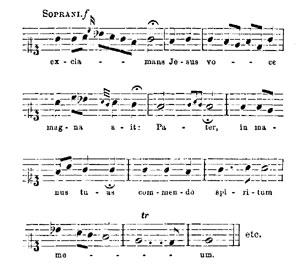
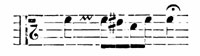
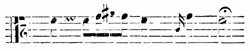
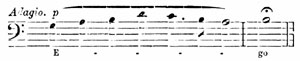
Never, in the whole course of my travels, do I
remember a more glorious and inspiriting day for a
journey than yesterday. At an early hour in the
morning the sky was grey and cloudy, but the sun
presently burst forth; the air was cool and fresh,
and being Ascension Sunday the people were all
dressed in their best. In one village I saw them
crowding into church as I passed, in another coming
away from divine service, and, last of all, playing
at bowls. The gardens were bright with tulips, and
I drove quickly past, eagerly looking at everything.
At Weissenfels they gave me a little basket carriage,
and at Naumburg an open droschky. My
effects, including my hat and cloak, were piled
upon it behind. I bought a few bunches of lilies-of-the-valley,
and thus I travelled on through the
country, as if on a pleasure excursion.
Some collegians came up to me beyond Naumburg,
and envied me. We then drove past President
G——, seated in a small carriage, which
evidently had some difficulty in containing him, and
his daughters or wives; in short, the two ladies
with him, who appeared equally envious of my
position. We actually trotted up the Kösen Hill,
for the horses scarcely drew bridle, and overtook
several heavily-laden carriages, the drivers of which
no doubt also envied me, for I was really to be
envied. The scenery had a charming air of spring—so
cheerful and gay, and blooming. The sun sank
solemnly behind the hills, and presently we came up
with the Russian minister and his suite, in two
heavy carriages, each with four horses, in true
ponderous official array; and my light droschky
darted past him like a hare.
In the evening I got a pair of restive horses, so
that I had my little annoyance also, (according to
my theory, enhancing pleasure,) and not a single
bar did I compose all day, but enjoyed complete
idleness. It was a delicious day, and one I shall
not soon forget. I close this description with the
remark, that the children in Eckartsberge dance
merry rounds hand-in-hand, just as ours do at home,
and that the appearance of a stranger did not in
the least disturb them, in spite of his distinguished
air; I should have liked to join in their game.
I wrote this before going to see Goethe, early in
the forenoon, after a walk in the park; but I could
not find a moment to finish my letter till now. I
shall probably remain here for a couple of days,
which is no sacrifice, for I never saw the old gentleman
so cheerful and amiable as on this occasion, or
so talkative and communicative. My especial reason
however for staying two days longer, is a very
agreeable one, and makes me almost vain, or I
ought rather to say proud, and I do not intend to
keep it secret from you,—Goethe, you must know,
sent me a letter yesterday addressed to an artist
here, a painter, which I am to deliver myself; and
Ottilie confided to me that it contains a commission
to take my portrait, as Goethe wishes to place it in a
collection of likenesses he has recently commenced
of his friends. This circumstance gratified me exceedingly;
as however I have not yet seen the
complaisant artist who is to accomplish this, nor has
he seen me, it is probable that I shall have to remain
here until the day after to-morrow. I don't in the
least regret this, for, as I have told you, I live a
most agreeable life here, and thoroughly enjoy the
society of the old poet. I have dined with him
every day, and am invited again to-day. This evening
there is to be a party at his house, where I am
to play. It is quite delightful to hear him conversing
on every subject, and seeking information on
all points.
I must however tell you everything regularly and
in order, so that you may know each separate detail.
Early in the day I went to see Ottilie, who, though
still delicate, and often complaining, I thought
more cheerful than formerly, and quite as kind and
amiable as ever towards myself. We have been
constantly together since then, and it has been a
source of much pleasure to me to know her more
intimately. Ulrike is more agreeable and charming
than formerly; a certain earnestness pervades her
whole nature, and she has now a degree of repose,
and a depth of feeling, that render her one of the
most attractive creatures I have ever met. The
two boys, Walter and Wolf, are lively, studious,
cordial lads, and to hear them talking about
"Grandpapa's Faust," is most pleasant.
But to return to my narrative. I sent Zelter's
letter at once to Goethe, who immediately invited
me to dinner. I thought him very little changed
in appearance, but at first rather silent and apathetic;
I think he wished to see how I demeaned
myself. I was vexed, and thought that possibly he
was always now in this mood. Happily the conversation
turned on the Frauen-Vereine in Weimar, and
on the 'Chaos,' a humorous paper circulated among
themselves by the ladies here, I having soared so
high as to be a contributor to this undertaking.
All at once the old man became quite gay, laughing
at the two ladies about their charities and intellectualism,
and their subscriptions and hospital work,
which he seems cordially to detest. He called on
me to aid him in his onslaught, and as I did not
require to be asked twice, he speedily became just
what he used to be, and at last more kind and confidential
than I had ever seen him. The assault
soon became general. The 'Robber Bride' of Ries,
he said contained all that an artist in these days
required to live happily,—a robber and a bride;
then he attacked the young people of the present
day for their universal tendency to languor and
melancholy, and related the story of a young lady
to whom he had once paid court, and who also felt
some interest in him; a discussion on the exhibitions
followed, and a fancy bazaar for the poor,
where the ladies of Weimar were the shopwomen,
and where he declared it was impossible to purchase
anything because the young people made a private
agreement among themselves, and hid the different
articles till the proper purchasers appeared.
After dinner he all at once began—"Gute Kinder—hübsche
Kinder—muss immer lustig sein—tolles
Volk," etc., his eyes looking like those of a
drowsy old lion. Then he begged me to play to
him, and said it seemed strange that he had heard
no music for so long; that he supposed we had
made great progress, but he knew nothing of it.
He wished me to tell him a great deal on the
subject, saying "Do let us have a little rational
conversation together;" and turning to Ottilie, he
said, "No doubt you have already made your own
wise arrangements, but they must yield to my
express orders, which are, that you must make tea
here this evening, that we may be all together
again." When in return she asked him if it would
not make him too late, as Riemer was coming to
work with him, he replied, "As you gave your children
a holiday from their Latin to-day, that they
might hear Felix play, I think you might also give
me one day of relaxation from my work." He
invited me to return to dinner, and I played a great
deal to him in the evening.
My three Welsh pieces, dedicated to three English
sisters, have great success here;[2] and I am
trying to rub up my English. As I had begged
Goethe to address me as thou, he desired Ottilie to
say to me on the following day, in that case I must
remain longer than the two days I had fixed, otherwise
he could not regain the more familiar habit I
wished. He repeated this to me himself, saying that
he did not think I should lose much by staying a
little longer, and invited me always to dine with
him when I had no other engagement. I have consequently
been with him every day, and yesterday I
told him a great deal about Scotland, and Hengstenberg,
and Spontini, and Hegel's 'Æsthetics.'[3] He
sent me to Tiefurth with the ladies, but prohibited
my driving to Berka, because a very pretty girl lived
there, and he did not wish to plunge me into misery.
I thought to myself, this was indeed the Goethe
of whom people will one day say, that he was not
one single individual, but consisted of several little
Goethiden. I am to play over to him to-day various
pieces of Bach, Haydn, and Mozart, and thus lead
him on, as he said, to the present day
I should indeed have been very foolish to have
regretted my delay; besides, I am a conscientious
traveller, and have seen the Library, and 'Iphigenia
in Aulis.' Hummel has struck out all the octaves,
etc.
Felix.
I have just received your welcome letter, written
on Ascension Day. I cannot help myself, but must
still write to you from this place. I will soon send
you, dear Fanny, a copy of my symphony; I am
having it written out here, and mean to forward it
to Leipzig (where perhaps it will be performed),
with strict orders to deliver it into your own hands,
as soon as possible. Try to collect opinions as to
the title I ought to select; Reformation Symphony,
Confession Symphony, Symphony for a Church Festival,
Juvenile Symphony, or whatever you like.
Write to me on this subject, and instead of a number
of stupid suggestions, send me one clever one;
still, I should rather like to hear some of the
nonsensical ones sure to be devised on the occasion.
Yesterday evening I was at a party at Goethe's,
and played alone the whole evening,—the Concert-Stück,
the Invitation à la Valse, and Weber's Polonaise
in C, my three Welsh pieces, and my Scotch
Sonata. It was over by ten o'clock, but I of course
stayed till twelve o'clock, when we had all sorts of
fun, dancing and singing; so you see I lead a most
jovial life here. The old gentleman goes to his
room regularly at nine o'clock, and as soon as he is
gone, we begin our frolics, and never separate
before midnight.
To-morrow my portrait is to be finished; a large
black-crayon sketch, and very like; but I look
rather sulky. Goethe is so friendly and kind to me,
that I don't know how to thank him sufficiently, or
what to do to deserve it. In the forenoon he likes
me to play to him the compositions of the various
great masters, in chronological order, for an hour,
and also tell him the progress they have made,
while he sits in a dark corner, like a Jupiter tonans,
his old eyes flashing on me. He did not wish to
hear anything of Beethoven's, but I told him that
I could not let him off, and played the first part of
the Symphony in C minor. It seemed to have a
singular effect on him; at first he said, "This
causes no emotion, nothing but astonishment: it is
grandios." He continued grumbling in this way,
and after a long pause he began again,—"It is very
grand, very wild; it makes one fear that the house
is about to fall down; and what must it be when
played by a number of men together!" During
dinner, in the midst of another subject, he alluded
to it again. You know that I dine with him every
day, when he questions me very minutely, and is
always so gay and communicative after dinner, that
we generally remain together alone for an hour
while he speaks on uninterruptedly.
I have no greater pleasure than when he brings
out engravings, and explains them to me, or gives
his opinion of Ernani, or Lamartine's Elegies, or
the theatre, or pretty girls. He has several times
lately invited people, which he rarely does now,
so that most of the guests had not seen him
for a long time. I then play a great deal, and he
compliments me before all these people, and "ganz
stupend" is his favourite expression. To-day he
has invited a number of Weimar beauties on my
account, because he thinks that I ought to enjoy
the society of young people. If I go up to him on
such occasions, he says, "My young friend, you
must join the ladies, and make yourself agreeable
to them." I am not however devoid of tact, so I
contrived to have him asked yesterday whether I
did not come too often; but he growled out to
Ottilie, who put the question to him, that "he must
now begin to speak to me in good earnest, for I had
such clear ideas, that he hoped to learn much from
me." I became twice as tall in my own estimation,
when Ottilie repeated this to me. He said so to
me himself yesterday; and when he declared that
there were many subjects he had at heart that I
must explain to him, I said, "Oh, certainly!" but
I thought, "This is an honour I can never forget,"—often
it is the very reverse.
Felix.
It is a long time since I have written to you, and
I fear you may have been anxious on my account.
You must not be angry with me, for it was really
no fault of mine, and I have been not a little annoyed
about it. I expedited my journey as well as
I could, inquiring everywhere about diligences, and
invariably receiving false information. I travelled
through one night on purpose to enable me to
write to you by this day's post, of which I was told
at Nürnberg; and when at last I arrive, I find that
no post leaves here to-day: it is enough to drive
one wild, and I feel out of all patience with Germany
and her petty Principalities, her different
kinds of money, her diligences, which require an
hour and a quarter for a German mile, and her
Thuringian forests, where there is incessant rain
and wind,—nay, even with her 'Fidelio' this very
evening, for, though dead beat, I must do my duty
by going to see it, when I would far rather go to bed.
Pray do not be angry with me, or scold me for my
delay in writing; I do assure you that this very
night while I was travelling, I thought I saw peeping
through the clouds the shadow of your threatening
finger; but I shall now proceed to explain
why I could not write sooner.
Some days after my last letter from Weimar, I
wished, as I told you, to set off for this place, and
said so during dinner to Goethe, who made no
reply. After dinner however he withdrew with
Ottilie into the recess of a window, and said, "You
must persuade him to remain." She endeavoured to
prevail on me to do so, and walked up and down in
the garden with me. I wished however to show
that I was a man of determination, so I remained
steady to my resolve. Then came the old gentleman
himself, and said he saw no use in my being in
such a hurry; that he had still a great deal to tell
me, and I had still a great deal to play to him; and
what I had told him as to the object of my journey,
was really all nonsense,—Weimar was my present object,—and
he could not see that I was likely to find
in tables-d'hôte elsewhere, what I could not obtain
here: I would see plenty of hotels in my travels.
He talked on in this style, which touched my heart,
especially as Ottilie and Ulrike added their persuasions,
assuring me that the old gentleman much
more often insisted on people going away, than on
their remaining; and as no one can be so sure of
enjoying a number of happy days, that he can
afford to throw away those that cannot fail to be
pleasant, and as they promised to go with me to
Jena, I resolved not to be a man of determination,
and agreed to stay.
Seldom in the course of my life have I so little
regretted any resolution as on this occasion, for the
following day was by far the most delightful that I
ever passed in Goethe's house. After an early
drive, I found old Goethe very cheerful; he began
to converse on various subjects, passing from the
'Muette de Portici' to Walter Scott, and thence to
the beauties in Weimar; to the 'Students,' and the
'Robbers,' and so on to Schiller; then he spoke on
uninterruptedly for more than an hour, with the
utmost animation, about Schiller's life and writings,
and his position in Weimar. He proceeded to
speak of the late Grand-Duke, and of the year 1775,
which he designated as the intellectual spring of
Germany, declaring that no man living could describe
it so well as he could; indeed, it had been
his intention to have devoted the second volume of
his life to this subject; but what with botany, and
meteorology, and other stuff of the same kind, for
which no one cared a straw, he had not yet been
able to fulfil his purpose. He proceeded to relate
various anecdotes of the time when he was director
of the theatre, and when I wished to thank him, he
said, "It is mere chance, it all comes to light
incidentally,—called forth by your welcome presence."
These words sounded marvellously pleasant
to me; in short, it was one of those conversations
that a man can never forget so long as he lives.
Next day he made me a present of a sheet of the
manuscript of 'Faust,' and at the bottom of the
page he wrote, "To my dear young friend F. M. B.,
mighty, yet delicate master of the piano—a friendly
souvenir of happy May days in 1830. J. W. von
Goethe." He also gave me three letters of introduction
to take with me.
If that relentless 'Fidelio' did not begin at so
early an hour. I could tell you much more, but as it
is, I have only time to detail my farewell interview
with the old gentleman. At the very beginning of
my visit to Weimar, I spoke of a print taken from
Adrian von Ostade, of a peasant family praying,
which nine years ago made a deep impression on
me. When I went at an early hour to take leave of
Goethe, I found him seated beside a large portfolio,
and he said, "So you are actually going away? I
must try to keep all right till you return; but at all
events we won't part now without some pious
feelings, so let us once more look at the praying
family together." He told me that I must sometimes
write to him—(courage! courage! I mean to
do so from this very place), and then he embraced
me, and we drove off to Jena, where the Frommans
received me with much kindness, and where the
same evening I took leave of Ottilie and Ulrike,
and came on here.
Nine o'clock.—'Fidelio' is over; and while waiting
for supper I add a few words.
Schechner is very much gone off; the quality of
her voice has become husky; she repeatedly sang
flat, yet there were moments when her expression
was so touching, that I wept in my own fashion; all
the others were bad, and there was also much to
censure in the performance. Still, there is great
talent in the orchestra, and the style in which they
played the overture was very good. Certainly our
Germany is a strange land; producing great people,
but not appreciating them; possessing many fine
singers and intellectual artists, but none sufficiently
modest and subordinate to render their parts faithfully,
and without false pretension. Marzeline introduces
all sorts of flourishes into her part; Jaquino
is a blockhead; the minister a simpleton: and when a
German like Beethoven writes an opera, then comes
a German like Stuntz or Poissl (or whoever it may
have been) and strikes out the ritournelle, and
similar unnecessary passages; another German adds
a trombone part to his symphonies; a third declares
that Beethoven is overloaded: and thus is a great
man sacrificed.
Farewell! be happy and merry; and may all my
heartfelt wishes for you be fulfilled.
Felix.
To Fanny Hensel.
My dearest Sister,
I received your letter of the 5th this morning; I
see from it that you are not yet quite well. I wish
I were with you, and could see you, and talk to
you; but this is impossible, so I have written a
song for you expressive of my wishes and thoughts.
You were in my mind when I composed it, and
I was in a tender mood. There is indeed nothing
very new in it. You know me well, and what I am;
in no respect am I changed, so you may smile at
this and rejoice. I could say and wish many other
things for you, but none better; and this letter too
shall contain nothing else. You know that I am
always your own; and may it please God to bestow
on you all that I hope and pray.
[Listen]
Dearest Mother,
"How a travelling musician bore his bad luck in
Salzburg." A fragment from the unwritten journal
of Count F. M. B. (continuation.) After I had
finished my last letter to you, a regular day of misfortunes
commenced for me. I took up my pencil,
and so entirely destroyed two of my pet sketches,
taken in the Bavarian mountains, that I was obliged
to tear them from my book, and to throw them out
of the window. This provoked me exceedingly; so
to divert my mind, I went to the Capuchin Hill: of
course I contrived to lose my way, and at the very
moment, when I at last found myself on the summit,
it began to rain so furiously that I was forced to
run down again with all speed under the shelter of
an umbrella. Well! I resolved at all events to
have a look at the monastery at the foot of the
hill, so I rang the bell, when I suddenly recollected
that I had not sufficient money to give the monk
who was to show the building, and as this is a kind
of thing that they take highly amiss, I hurried away
without waiting till the porter appeared.
I then closed my packet of letters for Leipzig,
and took it myself to the post, but there I was told,
that it must first be examined at the Custom-house;
so thither I went. They kept me waiting a whole
hour, till they composed a certificate of three lines,
and behaved so saucily that I was forced to quarrel
with them. Hang Salzburg! thought I; so I
ordered horses for Ischl, where I hoped to escape
from all my bad luck. No horses were to be had
without a permission from the police. I went to
the police office. "No permission can be granted
till you bring your passport." Why pursue the
subject? After innumerable delays, and running
about hither and thither, the wished-for post-carriage
arrived. My dinner was over, my luggage
ready, and I thought that at last all was in good
train: my bill and the servants fees were paid.
Just as I reached the door, I saw two handsome
open carriages approaching at a foot's pace, and the
people of the inn hurrying to receive the travellers,
who were following on foot. I however paid no
attention to the new arrivals, but jumped into my
carriage. I observed, that at the same moment,
one of the travelling carriages drew up close to
mine, and that a lady was seated in it,—but what a
lady! That you may not instantly jump to the
conclusion that I had suddenly fallen in love, which
would have been the crowning point of my unlucky
day, I must tell you that she was an elderly lady;
but she looked very amiable and benevolent; she
wore a black dress, and a massive gold chain, and
smiled good-humouredly when she paid the postilion
his fare. Heaven knows why I continued to arrange
my luggage instead of driving off. I did look
across continually at the other carriage, and though
the lady was an entire stranger to me I felt a strong
inclination to address her. It might be mere imagination
on my part, but I do think that she too looked
at the dusty traveller in his student's cap. At
length she got out of the carriage, and stood close
to the door of my vehicle, leaning her hand on it,
and I required all my knowledge of the common
proprieties of travelling, not to get out myself and
say to her, "Dear lady, what may your name be?"
Routine however conquered, and I called out with
an air of dignity, "Postilion! go on!" on which the
lady quickly withdrew her hand, and we set off. I
felt in no very pleasant humour, and while thinking
over the events of the day, I fell asleep.
A carriage with two gentlemen passing us, woke
me up, and the following dialogue ensued between
the postilion and myself. I. These gentlemen are
coming from Ischl, so I shall probably find no
horses there. He. Oh! the two carriages that
stopped at the Inn were also from Ischl; still there
is no doubt you will get horses. I. Are you sure
they came from Ischl? He. Quite sure: they go
there every year, and were here last summer also;
I drove them. It is a baroness from Vienna,
(Heavens! thought I,) and she is dreadfully rich, and
has such handsome daughters. When they went to
Berchtesgaden to visit the mines, I drove them, and
very nice they looked in their miner's dresses: they
have a grand estate, and yet they speak to us quite
familiarly. Halt! cried I; what name?—Don't
know.—Pereira?[4]—Not sure.—Drive back,—said I
in a resolute tone.—If I do, we shall not reach Ischl
to-night, and we have got over the worst hill; you
can learn the name at the next stage.—I hesitated,
and we drove on. They did not know the name at
the next stage, nor at the following one either. At
length, at the end of seven long wearisome hours,
we arrived, and before I left the carriage, I said,
who were the party who drove to Salzburg this
morning in two carriages? and received the quiet
reply,—Baroness Pereira; she proceeds to Gastein
early to-morrow morning, but returns four or five
days hence. Now I had arrived at a certainty, and I
also spoke to her driver, who said that none of the
family were here. The two gentlemen I met in a carriage
on the road, were sons of the Baroness (the
very two I had never seen). In addition to all this, I
remembered a wretched portrait that I had once
got a glimpse of at our aunt H——'s, and the lady
in the black dress was Baroness Pereira! Heaven
knows when I may have another opportunity of
seeing her! I do not think that she ever could
have made a more pleasing impression on me, and
I shall not assuredly soon forget her attractive
appearance, and her kind expression of countenance.
Nothing is more unsatisfactory than a presentiment;
we all experience them, but we never
discover till too late, that they really were presentiments.
I would have returned then and there,
and travelled through the night, but I reflected that
I should only overtake her at the very moment of
her departure, or that possibly she might have left
Salzburg before my arrival, and that I should thus
frustrate all the plan of my journey to Vienna. At
one moment I thought of going to Gastein, but I
could not help feeling that Salzburg had treated
me very badly, so I once more said adieu, and went
to bed very crest-fallen. Next morning I desired
that her empty house should be pointed out to me,
and made a sketch of it for you, dear mother. My
bad luck, however, was still growling in the distance,
for I could find no favourable spot to take
my sketch from. Besides, they charged me more
than a ducat at the inn for one night's entertainment,
etc., etc. I gave utterance to various anathemas,
both in English and German, and drove
away, laying aside among the things of the past,
Ischl, Salzburg, Baroness Pereira, and the Traunsee;
and so I came on here, where I have taken a day's
rest.
To-morrow I intend to pursue my journey, and
(D. V.) to sleep in Vienna the day after. I will
write to you further from thence. Thus ended my
day of misfortunes; "truth, and no poetry," not
even the leaning the hand against the door of my
carriage is invention; all is a portrait taken from
life. The most incomprehensible thing is that I
should have totally overlooked Flora, who it seems
was also there, for the old lady in a tartan cloak,
who went into the inn, was Frau von W——, and
the old gentleman with green spectacles who followed
her, could not well have been Flora? In
short, when things once take a wrong turn, they
will have their course. I can write no more to-day,
for my disappointment is still too recent; in my
next letter I will describe the Salzkammergut, and
all the beauties of my journey yesterday. How
right Devrient was to advise me to take this route!
The Traunstein also, and the Traun Falls, are wonderfully
fine; and after all, the world is a very
pleasant world, and it is fortunate for me that you
are in it, and that I shall find letters from you the
day after to-morrow, and possibly much that is
agreeable besides. Dear Fanny, I mean now to
compose my Non nobis, and the symphony in A
minor. Dear Rebecca, if you could hear me singing
"Im warmen Thal" in a spasmodic fashion, you
would think it rather deplorable; you could sing it
better. Oh, Paul! can you declare that you understand
the Schein Gulden, W. W. Gulden, heavy
Gulden, light Gulden, Conventions Gulden, and the
devil and his grandmother's Gulden? I don't, one
bit. I wish therefore that you were with me, but
for many reasons besides this one. Farewell!
Dear Brother,
Peals of bells, drums and music, carriages on carriages,
people hurrying in all directions, everywhere
gay crowds, such is the general aspect around me,
for to-morrow is to be the coronation of the King,
which the whole city has been expecting since
yesterday, and are now imploring that the sky may
clear up, and wake bright and cheerful, for the
grand ceremony which ought to have taken place
yesterday was obliged to be deferred on account of
the torrents of rain. This afternoon the sky is blue
and beautiful, and the moon is now shining down
tranquilly on the tumult of the city. To-morrow at
a very early hour the Crown Prince is to take his
oaths (as King of Hungary) in the large Market-place;
he is then to go to church in grand procession,
attended by a whole array of bishops and
nobles of the realm, and afterwards rides up the
Königsberg, which lies opposite my windows, in
order to wave his sword towards the banks of the
Danube and the four quarters of the globe, in token
that he takes possession of his new realm.
This excursion has made me acquainted with a
new country; for Hungary with her magnates, her
high dignitaries, her Oriental luxury, and also her
barbarism, is to be seen here, and the streets offer a
spectacle which is to me both novel and striking.
We really seem here to approach closer to the East;
the miserably obtuse peasants or serfs; the troops
of gipsies; the equipages and retainers of the
nobles overloaded with gold and gems, (for the
grandees themselves are only visible through the
closed windows of their carriages); then the singularly
bold national physiognomy, the yellow hue,
the long moustaches, the soft foreign idiom—all
this makes the most motley impression in the world.
Early yesterday I went alone through the streets.
First came a long array of jovial officers, on spirited
little horses; behind them a crew of gipsies, making
music; succeeded by Vienna fashionables, with eye-glasses
and kid gloves, conversing with a Capuchin
monk; then a couple of uncivilized peasants in
long white coats, their hats pressed down on their
foreheads, and their straight black hair cut even all
round, (they have reddish-brown complexions, a
languid gait, and an indescribable expression of
savage stupidity and indifference); then came a
couple of sharp, acute-looking students of theology,
in their long blue coats, walking arm-in-arm; Hungarian
proprietors in their dark blue national
costume; court servants; and numbers of carriages
every moment arriving, covered with mud. I followed
the crowd as they slowly moved on up the hill,
and so at last I arrived at the dilapidated castle,
which commands an extensive view of the whole
city and the Danube. People were looking down
on all sides from the ancient white walls, and from
the towers and balconies; in every corner boys
were scribbling their names on the walls for the
benefit of posterity; in a small chamber (perhaps
once on a time a chapel, or a sleeping-apartment)
an ox was in the act of being roasted whole, and as
it turned on the spit, the people shouted with delight;
a succession of cannons bristled before the
castle, destined to bellow forth their appropriate
thunders at the coronation.
Below, on the Danube, which runs very rapidly
here, darting with the speed of an arrow through
the pontoon bridge, lay a new steamer, that had
just arrived, laden with strangers; then the extensive
view of the flat but wooded country, and
meadows overflowed by the Danube; of the embankments
and streets swarming with human beings,
and mountains clothed with Hungarian vines—all
this was not a little strange and foreign. Then the
pleasant contrast of living in the same house with
the best and most friendly people in the world, and
finding novelty doubly interesting in their society.
These were really among the happy days, dear
brother, that a kind Providence so often and so
richly bestows on me.
The King is crowned—the ceremony was wonderfully
fine. How can I even try to describe it to
you? An hour hence we will all drive back to
Vienna, and thence I pursue my journey. There is
a tremendous uproar under my windows, and the
Burgher-guards are flocking together, but only for
the purpose of shouting "Vivat!" I pushed my
way through the crowd, while our ladies saw everything
from the windows, and never can I forget the
effect of all this brilliant and almost fabulous magnificence.
In the great square of the Hospitallers the people
were closely packed together, for there the oaths
were to be taken on a platform hung with cloth;
and afterwards the people were to be allowed the
privilege of tearing down the cloth for their own
use; close by was a fountain spouting red and
white Hungarian wine. The grenadiers could not
keep back the people; one unlucky hackney coach
that stopped for a moment was instantly covered
with men, who clambered on the spokes of the
wheels, and on the roof, and on the box, swarming
on it like ants, so that the coachman, unable to
drive on without becoming a murderer, was forced
to wait quietly where he was. When the procession
arrived, which was received bare-headed, I had the
utmost difficulty in taking off my hat, and holding
it above my head; an old Hungarian, however,
behind me, whose view it intercepted, quickly devised
a remedy, for without ceremony he made a
snatch at my unlucky hat, and in an instant flattened
it to the size of a cap; then they yelled as if
they had all been spitted, and fought for the cloth; in
short they were a mob; but my Magyars! the
fellows look as if they were born noblemen, and
privileged to live at ease, looking very melancholy,
but riding like the devil.
When the procession descended the hill, first
came the court servants, covered with embroidery,
the trumpeters and kettle drums, the heralds and all
that class, and then suddenly galloped along the
street a mad Count, en pleine carrière, his horse
plunging and capering, and the caparisons edged
with gold; the Count himself a mass of diamonds,
rare herons' plumes, and velvet embroidery (though
he had not yet assumed his state uniform, being
bound to ride so madly—Count Sandor is the name
of this furious cavalier.) He had an ivory sceptre
in his hand with which he urged on his horse,
causing it each time to rear, and to make a tremendous
bound forward.
When his wild career was over, a procession of
about sixty more magnates arrived, all in the same
fantastic splendour, with handsome coloured turbans,
twisted moustaches, and dark eyes. One rode
a white horse covered with a gold net; another a
dark grey, the bridle and housings studded with
diamonds; then came a black charger with purple
cloth caparisons. One magnate was attired from
head to foot in sky blue, thickly embroidered with
gold, a white turban, and a long white dolman;
another in cloth of gold, with a purple dolman;
each one more rich and gaudy than the other, and
all riding so boldly and fearlessly, and with such
defiant gallantry, that it was quite a pleasure to
look at them. At length came the Hungarian
Guards, with Esterhazy at their head, dazzling in
gems and pearl embroidery. How can I describe
the scene? You ought to have seen the procession
deploy and halt in the spacious square, and all the
jewels and bright colours, and the lofty golden
mitres of the bishops, and the crucifixes glittering
in the brilliant sunshine like a thousand stars!
Well, to-morrow, God willing, I proceed on my
journey. Now, dear brother, you have a letter, so
pray write soon, and let me hear how you are getting
on. So you have had an émeute in Berlin?
and that, too, an émeute of tailors' apprentices?
What did it all mean? Once more I send you my
farewell from Germany, my dear parents, and
brother and sisters. I am leaving Hungary for
Italy, and thence I hope to write to you more frequently
and more at leisure. Be of good cheer,
dear Paul, and go forwards in a confident spirit;
rejoice with those that rejoice, and do not forget
the brother who is wandering about the world.
Yours, Felix.
Italy at last! and what I have all my life considered
as the greatest possible felicity, is now begun,
and I am basking in it. The day has been so fruitful
in enjoyment, that I must, now that it is evening,
endeavour to collect my thoughts a little to write to
you, my dear parents, and to thank you for having
bestowed such happiness on me. You also, my
dear brother and sisters, are often in my thoughts.
How much I wish for you, Paul, to be with me here,
once more to enjoy your delight in our rapid travels
by sea and by land; and I should like to prove to
you, Hensel, that the "Assumption of the Blessed
Virgin" is the most divine work ever produced by
the hands of man. You are not here, however, so
I am obliged to give vent to my enthusiasm in bad
Italian to the laquais de place, who stands still and
listens.
I shall however become quite confused, if things
are to go on as they have done on this first day,
when every hour brought with it so much never to
be forgotten, that I do not know where to find sufficient
grasp of intellect to comprehend it all properly.
I saw the "Assumption," then a whole
gallery of paintings in the Manfrini Palace; then
a church festival in the church where hangs Titian's
St. Peter; afterwards St. Mark's, and in the afternoon
I had a row on the Adriatic, and visited the
public gardens, where the people lie on the grass
and eat. I then returned to the Piazza of St.
Mark, where in the twilight there is always an immense
crowd and crush of people; and all this I
was obliged to see to-day, because there is so much
that is novel and interesting to be seen to-morrow.
But I must now relate methodically how I came
hither by water, (for, as Telemachus says, to do so
by land would be no easy matter,) and so I begin
my history at Gratz, which is certainly the most
tiresome hole in the world, and where you yawn all
day; and why should I have stayed a single day
longer, on account of a (he) relation? How can a
traveller with any experience possibly accept of a
brother, who is also an ensign, in the place of a
charming mother and sister? In short, the man did
not know what to do with me, for which I forgive
him freely, and shall not defame him to his mother,
when I perform my promise and write to her; but
he took me to the theatre to see the "Rehbock,"
the most wretched, silly, objectionable piece that
the late Kotzebue ever wrote; and moreover he
declared it to be very good and very amusing, and
this is not to be forgiven, for this Rehbock has such
a haut goût or fumet, that it could not even please
a cat: but at all events I have left Gratz, for here
I am in Venice.
My old vetturino woke me up at four o'clock in
the dark, and the horse crawled off with us both.
I thought of you, dear father, at least a hundred
times during our journey of two days. You would
certainly have gone wild with impatience, and possibly
assaulted the coachman also, for at every
little declivity, he got slowly off the box, deliberately
put on the drag, and crept up the smallest
hill at a snail's pace; then he thought fit to walk
beside his horses for a time, to stretch his legs:
every possible conveyance passed us on the road,
even when drawn by dogs or donkeys, and when at
last, at a steep hill, the fellow put on two oxen as
leaders, whose pace exactly corresponded with that
of his horse, I had the greatest difficulty in not
belabouring him, indeed I did so more than once;
but he then gravely assured me that we were going
at a capital pace, and I had no means of proving
the contrary. Moreover he always passed the night
in the most detestable pot-houses, starting again at
four o'clock in the morning, so on arriving at
Klagenfurt I was fairly worn out; but when in
answer to my question as to the time the Venetian
diligence set out, I received the answer,—in an hour
hence,—I seemed to revive. I was promised a place,
and I also got a good supper. The diligence,
indeed, did not arrive for two hours after its time,
having been detained by deep snow on the Sömmering,
but still it came at last. Three Italians were
inside, and chattered so that I could scarcely get
to sleep, but my snoring fairly silenced them after
a time.
At last morning broke, and as we drove into Resciutta,
the driver said, that on the other side of the
bridge there, no one understood a word of German. I
therefore took leave of my mother tongue for a long
time to come, and we drove over the bridge. The
style of the houses immediately beyond was entirely
different. The flat roofs with their convex tiles, the
deep windows, the high white walls, and lofty square
towers, all betokened another land. The pale olive
faces of the men, the innumerable beggars who besieged
the carriage, the various small chapels,
brightly and carefully painted on every side with
flowers, the nuns, monks, and so forth, were all
symptomatic of Italy. The monotonous character
of the whole scenery however, and of the road we
were travelling, passing through bare white rocks,
along the banks of a river with a rough rocky bed,
in summer creeping along in the form of a tiny
brook, certainly does not seem characteristic of
Italy. "I purposely made this passage rather
meagre, in order that the subject might be more
distinctly heard," says Abt Vogler; and I almost
think that Providence has done pretty much the
same here, for when we had passed Ospedaletto the
subject did come out well, and a fine sight it was. I
had imagined that the first impression of Italy would
be like that of a sudden explosion, violent and startling;
I have not hitherto found this to be the case.
The effect produced on me has been rather that of
a genial warmth, mildness and cheerfulness, and an
indescribable sensation of pervading content and
satisfaction.
After passing Ospedaletto we entered a plain,
leaving the blue mountains behind us; the sun shone
bright and warm through the foliage of the vines;
the road winding through orchards, in which the
trees were connected by trailing boughs. I felt as
if I were at home again, and knew every object, and
was once more about to take possession of it all.
The carriage too seemed to fly over the smooth
road, and towards evening we arrived at Udine,
where we passed the night, when for the first time
I ordered my supper in Italian, my tongue skating
as if on slippery ice, first gliding into English, and
then stumbling afresh. Moreover next morning I
was famously cheated, but I did not in the least
care, and on we went. It happened to be Sunday,
and on every side people were coming along, in
bright southern costumes, and flowers; the women
with roses in their hair. Light single-horse carriages
drove past, and men were riding to church
on donkeys; at the inns, groups of idlers were to
be seen in the most picturesque, indolent attitudes:
among others, one man placed his arm quietly
round his wife's waist, and swung round with her
and then they went on their way; this sounds trivial
enough, and yet it had a pretty effect. Venetian
villas now were occasionally visible from the road,
and by degrees became more frequent, till at length
our way led past houses, trees, and gardens like a
park. The whole country had a gay festive air,
as if a Prince were expected to make his grand
entry, and the vine-branches with their rich purple
grapes hanging in festoons from the trees, made
the most lovely of all festive wreaths. The inhabitants
were all gaily dressed and adorned, and a few
scattered cypresses only enhanced the general
effect.
In Treviso there was an illumination, paper
lanterns suspended in every part of the great
square, and a large gaudy transparency in the
centre. Some most lovely girls were walking about,
in their long white veils and scarlet petticoats. It
was quite dark when we arrived at Mestre last
night, when we got into a boat, and in a dead calm,
gently rowed across to Venice. On our passage
thither, where nothing but water is to be seen, and
distant lights, we saw a small rock which stands in
the midst of the sea; on this a lamp was burning;
all the sailors took off their hats as we passed, and
one of them said, this was the "Madonna of Tempests,"
which are often most dangerous and violent
here. We then glided quietly into the great city,
under innumerable bridges, without sound of post-horns,
or rattling of wheels, or toll-keepers; the
passage now became more thronged, and numbers
of ships were lying near; past the theatre, where
gondolas in long rows lie waiting for their masters,
just as our own carriages do at home, then into the
great canal, past the church of St. Mark, the Lions,
the palace of the Doges, and the Bridge of Sighs.
The obscurity of night only enhanced my delight
on hearing the familiar names, and seeing the dark
outlines.
And so I am actually in Venice! Well, to-day I
have seen the finest pictures in the world, and have
at last personally made the acquaintance of a very
admirable man, whom hitherto I only knew by name—I
allude to a certain Signor Giorgione, an inimitable
artist—and also to Pordenone, who paints the
most noble portraits, both of himself and many of
his simple scholars, in such a devout, faithful, and
pious spirit, that you seem to converse with him,
and to feel an affection for him. Who would not
have been confused by all this? But if I am to
speak of Titian, I must do so in a more reverent
mood. Till now, I never knew that he was the felicitous
artist I have this day seen him to be. That
he thoroughly enjoyed life, in all its beauty and fulness,
the picture in Paris proves; but he has fathomed
the depths of human sorrow, as well as the joys of
Heaven. His glorious "Entombment," and also
the "Assumption," fully evince this. How Mary
floats on the cloud, while a waving movement seems
to pervade the whole picture; how you see at a
glance her very breathing, her awe, and piety, and
in short a thousand feelings,—all words seem poor
and commonplace in comparison! The three angels
too, on the right of the picture, are of the highest
order of beauty,—pure, serene loveliness, so unconscious,
so bright and so seraphic. But no more of
this! or I must perforce become poetical, or indeed
am so already, and this does not at all suit me; but
I shall certainly see it every day.
I must however say a few words about the "Entombment,"
as you have the engraving. Look at it,
and think of me. This picture represents the conclusion
of a great tragedy: so still, so grand, and
so acutely painful. Magdalene is supporting Mary,
fearing that she will die of anguish; she endeavours
to lead her away, but looks round herself once more,
evidently wishing to imprint this spectacle indelibly
on her heart, thinking that it is for the last time;
it surpasses everything; and then the sorrowing
John, who sympathizes and suffers with Mary; and
Joseph, who absorbed in his piety, and occupied
with the tomb, directs and conducts the whole; and
Christ himself, lying there so tranquil, having endured
to the end: then the blaze of brilliant colour,
and the gloomy mottled sky! It is a composition
that speaks to my heart and fills me with enthusiasm,
and will never leave my memory.
I believe few things I have yet to see in Italy will
affect me so deeply; but you know that I am devoid
of all prejudices, and I give you a fresh proof of this
by telling you that the "Martyrdom of St. Peter,"
from which I expected the most, pleased me the
least of the three; it did not strike me as being a
complete whole; the landscape, which is very fine,
seemed to me to predominate too much. Then I was
dissatisfied with the disposition in the picture of two
victims and only one murderer; (for the small figure
in the distant background does not remedy this).
I could not bring myself to consider it a martyrdom.
But probably I am in error, and I intend to study it
more carefully to-morrow; my contemplation of it,
besides, was disturbed by some one strumming most
sacrilegiously on the organ, and these sacred forms
were forced to listen to such miserable opera finales!
But this matters not: where such pictures are, I
require no organist. I play the organ in my thoughts
for myself, and feel as little irritated by such trash
as I should be by an ignorant rabble. Titian, however,
was a man well adapted to improve others; so
I shall try to profit by him, and to rejoice that I am
in Italy. At this moment the gondoliers are shouting
to each other, and the lights are reflected in the
depths of the waters; one is playing a guitar, and
singing to it. It is a charming night. Farewell!
and think of me in every happy hour as I do of you.
Felix.
To Professor Zelter.[5]
Dear Professor,
I have entered Italy at last, and I intend this
letter to be the commencement of a regular series
of reports, which I purpose transmitting to you, of
all that appears to me particularly worthy of notice.
Though I only now for the first time write to you, I
must beg you to impute the blame to the state of
constant excitement in which I lived, both in Munich
and in Vienna. It was needless for me to describe to
you the parties in Munich, which I attended every
evening, and where I played the piano more unremittingly
than I ever did in my life before; one soirée
succeeding another so closely, that I really had
not a moment to collect my thoughts. Moreover,
it would not have particularly interested you, for
after all, "good society which does not offer materials
for the smallest epigram," is equally vapid in a
letter. I hope that you have not taken amiss my
long silence, and that I may expect a few lines from
you, even if they contain nothing save that you are
well and cheerful.
The aspect of the world at this moment is very
bleak and stormy, and much that was once thought
durable and unchangeable, has been swept away in
the course of a couple of days. It is then doubly
welcome to hear well-known voices, to convince us
that there are certain things which cannot be annihilated
or demolished, but remain firm and steadfast.
You must know that I am at this moment
very uneasy at not having received any news from
home for some weeks past. I found no letters from
my family, either at Trieste or here, so a few lines
from you, written in your old fashion, would both
cheer and gratify me, especially as it would prove
that you think of me with the same kindness that
you have always done from my childhood to the
present time.
My family have no doubt told you of the exhilarating
impression made on me by the first sight of the
plains of Italy. I hurry from one enjoyment to
another hour by hour, and constantly see something
novel and fresh; but immediately on my arrival I
discovered some masterpieces of art, which I study
with deep attention, and contemplate daily for a
couple of hours at least. These are three pictures
by Titian. The "Presentation of Mary as a Child
in the Temple;" the "Assumption of the Virgin;"
and the "Entombment of Christ." There is also a
portrait by Giorgione, representing a girl with a
cithern in her hand, plunged in thought, and looking
forth from the picture in serious meditation (she is
apparently about to begin a song, and you feel as if
you must do the same): besides many others.
To see these alone would be worth a journey to
Venice; for the fruitfulness, genius, and devotion
of the great men who painted these pictures, seem
to emanate from them afresh as often as you gaze
at their works, and I do not much regret that I
have scarcely heard any music here; for I suppose
I must not venture to include the music of the
angels, in the "Assumption," encircling Mary with
joyous shouts of welcome; one gaily beating the
tambourine, a couple of others blowing away on
strange crooked flutes, while another charming
group are singing—or the music floating in the
thoughts of the cithern player. I have only once
heard anything on the organ, and miserable it
was. I was gazing at Titian's "Martyrdom of St.
Peter" in the Franciscan Church. Divine service
was going on, and nothing inspires me with more
solemn awe than when on the very spot for which
they were originally created and painted, those
ancient pictures in all their grandeur, gradually
steal forth out of the darkness in which the long
lapse of time has veiled them.
As I was earnestly contemplating the enchanting
evening landscape with its trees, and angels among
the boughs, the organ commenced. The first sound
was quite in harmony with my feelings; but the
second, third, and in fact all the rest, quickly roused
me from my reveries, and sent me straight home,
for the man was playing in church and during
divine service, and in the presence of respectable
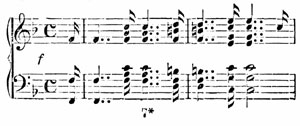
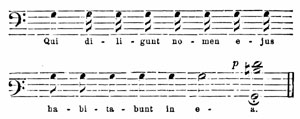
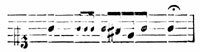
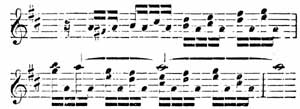
people, thus:
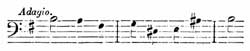
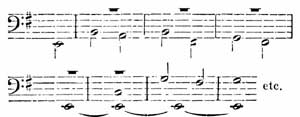
[Listen]
with the "Martyrdom of St. Peter" actually close
beside him! I was therefore in no great hurry to
make the acquaintance of the organist. There is
no regular Opera here at this moment, and the gondoliers
no longer sing, Tasso's stanzas; moreover,
what I have hitherto seen of modern Venetian art,
consists of poems framed and glazed on the subject
of Titian's pictures, or Rinaldo and Armida,
by a new Venetian painter, or a St. Cecilia by a
ditto, besides various specimens of architecture in
no style at all; as all these are totally insignificant,
I cling to the ancient masters, and study how they
worked. Often, after doing so, I feel a musical inspiration,
and since I came here I have been busily
engaged in composition.
Before I left Vienna, a friend of mine made me a
present of Luther's Hymns, and on reading them
over I was again so much struck by their power, that
I intend to compose music for several next winter.
I have nearly completed here the choral "Aus tiefer
Noth," for four voices a capella; and the Christmas
hymn, "Vom Himmel hoch," is already in my head.
I wish also to set the following hymns to music:
"Ach Gott, vom Himmel sieh darein," "Wir glauben
all' an einen Gott," "Verleih uns Frieden," "Mitten
wir im Leben sind," and finally "Ein' feste
Burg." The latter, however, it is my intention to
compose for a choir and orchestra. Pray write to
me about this project of mine, and say whether you
approve of my retaining the ancient melodies in
them all, but not adhering to them too strictly:
for instance, if I were to take the first verse of
"Vom Himmel hoch" as a separate grand chorus.
Besides this, I am hard at work at an orchestral
overture, and if an opportunity for an opera offered
it would be most welcome.
I finished two pieces of sacred music in Vienna—a
choral in three movements for chorus and orchestra
("O! Haupt voll Blut und Wunden") and
an Ave Maria for a choir of eight voices, a capella.
The people I associated with there were so dissipated
and frivolous, that I became quite spiritually-minded,
and conducted myself like a divine among
them. Moreover, not one of the best pianoforte
players there, male or female, ever played a note of
Beethoven, and when I hinted that he and Mozart
were not to be despised, they said, "So you are an
admirer of classical music?"—"Yes," said I.
To-morrow I intend to go to Bologna to have a
glance at the St. Cecilia, and then proceed by
Florence to Rome, where I hope (D. V.) to arrive
eight or ten days hence. I will then write to you
more satisfactorily. I only wished to make a beginning
to-day, and to beg you not to forget me, and
kindly to accept my heartfelt wishes for your health
and happiness. Your faithful
Felix.
Here am I in Florence, the air warm and the sky
bright; everything is beautiful and glorious, "wo
blieb die Erde," as Goethe says. I have now received
your letter of the 3rd, by which I see that
you are all well, that my anxiety was needless, that
you are all going on as usual, and thinking of me;
so I feel happy again, and can now see everything,
and enjoy everything, and am able to write to you;
in short, my mind is at rest on the main point. I
made my journey here amid a thousand doubts and
fears, quite uncertain whether to go direct to Rome,
because I did not expect any letters at Florence.
Fortunately, however, I decided on coming here,
and now it is of no consequence how the misunderstanding
arose, that caused me to wait for letters in
Venice, while you had written to Florence; all I
can promise is to endeavour in future to be less
over-anxious. My driver pointed out a spot between
the hills, on which lay a blue mist, and said
"Ecco Firenze!" I eagerly looked towards the
place, and saw the round dome looming out of the
mist before me, and the spacious wide valley in
which the city is situated. My love of travel revived
when at last Florence appeared. I looked at
some willow-trees (as I thought) beside the road,
when the driver said, "Buon olio," and then I saw
that they were hanging full of olives.
My driver, as a genus, is undoubtedly a most villanous
knave, thief, and impostor; he has cheated me
and half-starved me, and yet I think him almost
amiable from his enthusiastic animal nature. About
an hour before we arrived in Florence he said that
the beautiful scenery was now about to commence;
and true it is that the fair land of Italy does first
begin then. There are villas on every height, and
decorated old walls, with sloping terraces of roses
and aloes, flowers and grapes and olive leaves, the
sharp points of cypresses, and the flat tops of pines,
all sharply defined against the sky; then handsome
square faces, busy life on the roads on every side,
and at a distance in the valley, the blue city.
So I drove confidently into Florence in my little
open carriage, and though I looked shabby and
dusty, like one coming from the Apennines, I cared
little for that. I passed recklessly through all
the smart equipages from which the most refined
English ladies looked at me; while I thought it may
one day actually come to pass that you who are now
looking down on the roturier, may shake hands
with him, the only difference being a little clean
linen and so forth. By the time that we came to
the battisterio, I no longer felt diffident, but gave
orders to drive to the Post, and then I was really
happy, for I received three letters,—yours of the
22nd and the 3rd, and my father's also. I was now
quite delighted, and as we drove along beside the
Arno, to Schneider's celebrated hotel, the world
seemed once more a very pleasant world.
The Apennines are really not so beautiful as I
had imagined; for the name always suggested to me
richly wooded, picturesque hills, covered with vegetation,
whereas they are merely a long chain of
melancholy bleak hills; and the little verdure there
is, not gratifying to the eye. There are no dwellings
to be seen, no merry brooks or rills; only an
occasional stream, its broad bed dried up, or a little
water-channel. Add to this the shameful roguery
of the inhabitants: really, at last, I became quite
confused and perplexed, by their incessant cheating,
and could scarcely discover for what object they
were lying. I therefore, once for all, invariably
protested against every demand they made, and
declared that I would not pay at all if they asked
more than I chose to give; so in this way I managed
very tolerably.
Last night I was again in grand quarters: I had
made an agreement with the vetturino for board
and lodging, and all I required. The natural consequence
was, that the fellow took me to the most
detestable little inns, and actually starved me. So
late yesterday we arrived at a solitary pothouse,
the filth of which no pen can describe. The stair
was strewed with heaps of dead leaves and firewood;
moreover the cold was intense, and they invited me
to warm myself in the kitchen, which I agreed to
do. A bench was placed for me beside the fire; a
whole troop of peasants were standing about, also
warming themselves. I looked quite regal from my
bench on the hearth among this rough set of fellows,
who, in their broad-leaved hats, lit up by the fire, and
babbling in their incomprehensible dialect, looked
vastly suspicious characters. I made them prepare
my soup under my own eyes, giving moreover good
advice on the subject; but, after all, it was not
eatable.
I entered into conversation with my subjects
from my throne on the hearth, and they pointed out
to me a little hill in the distance incessantly vomiting
forth flames, which had a singular effect in the
dark ("Raticosa" is the name of the hill), and then
I was conducted to my bed-room. The landlord
took hold of the sackcloth sheets, and said, "Very
fine linen!" but I slept as sound as a bear, and before
falling asleep I said to myself, Now you are in
the Apennines: and next morning, after getting no
breakfast, my vetturino civilly asked me how I
liked my night's entertainment. The fellow talked
a great deal of nonsense about politics, and the
present state of France, abused his horse in German
for being born in Switzerland, and spoke French to
the beggars who swarmed round the cabriolet, while
I corrected many a fault in his pronunciation.
I now intend to go once more to the Tribune, to be
inspired with feelings of reverence. There is a particular
place where I like to sit, as the little Venus
de' Medici is directly opposite, and above, that of
Titian, and by turning rather to the left, I have a
view of the Madonna del Cardello, a favourite picture
of mine, and which invariably reminds me of
la belle Jardinière, and seems to me a kindred
creation; and also the Fornarina, which made no
great impression on me from the first, for I know
the engraving, which is very faithful, and the face
has, I think, a most disagreeable and even ordinary
expression. In gazing thus, however, at the two
Venuses, their loveliness inspires a feeling of piety;
it is as if the two spirits who could produce such
creations, were flying through the hall and grasping
you as they passed.
Titian must have been a marvellous man, and
enjoyed his life in his works; still the fair Medici
is not to be slighted, and then the divine Niobe
with all her children: while we gaze at her, we can
find no words. I have not yet been to the Pitti
Palace, which possesses the Saint Ezekiel, and the
Madonna della Sedia, of Raphael. I saw the gardens
of the palace yesterday in sunshine; they are
superb, and the thick solid stems of the myrtles
and laurels, and the innumerable cypresses, made
a strange exotic impression on me; but when I
declare that I consider beeches, limes, oaks, and
firs, ten times more beautiful and picturesque, I
think I hear Hensel exclaim, "Oh, the northern
bear!"
After the soft rain of yesterday, the air is so mild
and genial, that I am at this moment seated at the
open window writing to you; and indeed it is
pleasant enough to see the people going about the
streets, offering the prettiest baskets of flowers,
fresh violets, roses, and pinks. Two days ago,
being satiated with all pictures, statues, vases, and
museums, I resolved to take a long walk till sunset;
so after buying a bunch of narcissuses and heliotropes,
I went up the hill through the vineyards. It
was one of the most delightful walks I ever remember;
every one must feel revived and refreshed at the
sight of nature in such a garb as this, and a thousand
happy thoughts passed through my mind.
First of all, I went to a villa called Bello
Sguardo, whence the whole of Florence and its spacious
valley are to be seen, and I thoroughly enjoyed
the view of the superb city and its massive towers
and palaces. But most of all I admired the countless
villas, covering every hill and every acclivity
as far as the eye can reach, as if the city extended
beyond the mountains into the far distance. And
when I took up a telescope and looked down on the
valley through the blue mists, every portion of it
seemed thickly dotted with bright objects and white
villas, while such a large circle of dwellings inspired
me with a feeling of home and comfort.
I proceeded far over the hills to the highest point
I could see, on which stood an ancient tower, and
when I reached it I found all the people throughout
the building busily engaged in making wine, drying
grapes, and repairing casks. It proved to be
Galileo's tower, from which he used to make his
discoveries and observations; from here also there
was a very extensive view, and the girl who took
me to the roof of the tower related a number of
stories in her peculiar dialect, which I scarcely
understood at all; but she afterwards presented me
with some of her sweet dried grapes, which I ate
with great gusto. And so I went on to another
tower I saw at a distance, but could not manage to
find my way; and examining my map as I went
along, I stumbled on a traveller busily searching
his map also; the only difference between us being,
that he was an old Frenchman with green spectacles,
who addressed me thus, "È questo S. Miniato al
Monte, Signor?" With admirable decision I replied,
"Sì, Signor;" and it turned out that I was
right. A. F—— immediately recurred to my
memory, as she had advised me to see this monastery,
which is indeed wonderfully fine.
When I tell you I went from there to the Boboli
Gardens, where I saw the sun set, and at night
enjoyed the brightest moonlight, you may imagine
how much I was invigorated by my ramble. I will
write to you about the pictures here some other
time, for to-day it is too late, as I have still to take
leave of the Pitti Palace and the great Gallery, and
to gaze once more at my Venus, who is not indeed
mentioned before ladies, but whose beauty is truly
divine. The courier goes at five o'clock, and God
willing, I shall be in Rome the day after to-morrow.
From thence you shall hear again.
Felix.
... I refrain from writing longer in this melancholy
strain; for just as your letter, after a lapse of
fourteen days, has saddened me, my answer will
have the same effect on you fourteen days hence.
You would write to me in the same style, and so it
might go on for ever. As four weeks must pass before
I can receive any answer, I feel that I ought to
restrict myself to relating events past and present,
and not dwell much on the particular frame of my
mind at the moment, which is indeed usually sufficiently
manifest in the narrative given, and the
various occurrences described.
I have scarcely yet arrived at the conviction that
I am now actually in Rome; and when yesterday,
just as day was breaking, I drove across a bridge
with statues, under a deep blue sky, and in dazzling
white moonlight, and the courier said, "Ponte
Molle," it all seemed to me like a dream, and at the
same moment I saw before me my sick-bed in
London a year ago, and my rough Scotch journey,
and Munich, and Vienna, and the pines on these
hills. The journey from Florence to Rome has
very few attractions. Siena, which is, I understand
worth seeing, we passed through during the night.
It was unpleasant to see a regular Government
courier compelled to take a military escort, which
was doubled at night; still it must be absolutely
necessary, as he is obliged to pay for it. In these
days this ought not to be the case. In the meantime
everything progresses, and there are moments
when the bound forwards is actually visible.
I was still in Florence, waiting for the departure
of the post, reading a French newspaper, when at
the very moment the bell sounded, I read among
the advertisements, "Vie de Siebenkäs, par Jean
Paul." Many reflections occurred to me as to so
many men of renown gradually vanishing from our
sight, and our great geniuses having such homage
paid to them after their death, and yet during their
life, Lafontaine's novels and French vaudevilles
alone make any impression on their fellow-countrymen;
while we only strive to appreciate the very
refuse of the French, and neglect Beaumarchais
and Rousseau. However, it matters little after all.
The first thing connected with music that I met
with here, was the "Tod Jesu," by Graun, which
an Abbate here, Fortunato Santini, has translated
faithfully and admirably into Italian. It appears
that the music of this heretic has been sent along
with the translation to Naples, where it is to be
produced this winter at a great festival, and I hear
that the musical world there are quite enchanted
with it, and are studying the work with infinite
love and enthusiasm. I understand that the Abbate
has been long impatiently expecting me, because he
hopes to obtain considerable information from me
about German music, and thinks I may also have
the score of Bach's "Passion." Thus music progresses
onwards, as sure to pierce through as the
sun; if mists still prevail, it is merely a sign that
the spring-time has not yet come, but come again
it must and will! Farewell! and from my heart I
say,—May a merciful Providence preserve you all
in health and happiness!
Felix.
I must now write to you of my first week in
Rome; how I have arranged my time, how I look
forward to the winter, and what impression the
glorious objects by which I am surrounded have
made on me; but this is no easy task. I feel as if
I were entirely changed since I came here. Formerly
when I wished to check my haste and
impatience to press forward, and to continue my
journey more rapidly, I attributed this eagerness
merely to the force of habit, but I am now fully
persuaded that it arose entirely from my anxiety to
reach this goal. Now that I have at last attained
it my mood is so tranquil and joyous, and yet so
earnest, that I shall not attempt to describe it to
you. What it is that thus works on me I cannot
exactly define; for the awe-inspiring Coliseum, and
the brilliant Vatican, and the genial air of spring,
all contribute to make me feel thus, and so do the
kindly people, my comfortable apartments, and
everything else. At all events I am different from
what I was. I am better in health and happier
than I have been for a long time, and take delight
in my work, and feel such an inclination for it, that
I expect to accomplish much more than I anticipated;
indeed, I have already done a good deal. If
it pleases Providence to grant me a continuation of
this happy mood, I look forward to the most delightful
and productive winter.
Picture to yourself a small house, with two windows
in front, in the Piazza di Spagna, No. 5 which
all day long enjoys the warm sun, and an apartment
on the first floor, where there is a good Viennese
grand piano: on the table are some portraits of
Palestrina, Allegri, etc., along with the scores of
their works, and a Latin psalm-book, from which I
am to compose the Non Nobis;—such is my present
abode. The Capitol was too far away, besides I
had a great dread of the cold air, which here I have
no cause to guard against; for when I look out of
my window in the morning across the square, I see
every object sharply defined in the sunshine against
the blue sky. My landlord was formerly a captain
in the French army, and his daughter has the most
splendid contralto voice I ever heard. Above me
lives a Prussian captain, with whom I talk politics,—in
short, the situation is excellent.
When I come into the room early in the morning,
and see the sun shining so brightly on the breakfast-table
(you see I am marred as a poet), I feel so
cheerful and comfortable, for it is now far on in the
autumn, and who in our country at this season looks
for warmth, or a bright sky, or grapes and flowers?
After breakfast I begin my work, and play, and
sing, and compose till near noon. Then Rome in
all her vast dimensions lies before me like an interesting
problem to enjoy; but I go deliberately to
work, daily selecting some different object appertaining
to history. One day I visit the ruins of the
ancient city; another I go to the Borghese gallery,
or to the Capitol, or St. Peter's, or the Vatican.
Each day is thus made memorable, and as I take
my time, each object becomes firmly and indelibly
impressed on me. When I am occupied in the
forenoon I am willing to leave off, and should like
to continue my writing, but I say to myself that I
must see the Vatican, and when I am actually there,
I equally dislike leaving it; thus each of my occupations
causes me the most genuine pleasure, and
one enjoyment follows another.
Just as Venice, with her past, reminded me of a
vast monument: her crumbling modern palaces,
and the perpetual remembrance of former splendour,
causing sad and discordant sensations; so
does the past of Rome suggest the impersonation
of history; her monuments elevate the soul, inspiring
solemn yet serene feelings, and it is a thought
fraught with exultation that man is capable of
producing creations, which, after the lapse of a
thousand years, still renovate and animate others.
When I have fairly imprinted an object like this
on my mind, and each day a fresh one, twilight has
usually arrived and the day is over.
I then visit my friends and acquaintances, when
we mutually communicate what each has done,
which means enjoyed here, and are reciprocally
pleased. I have been most evenings at Bendemann's
and Hübner's, where German artists usually assemble,
and I sometimes go to Schadow's. The Abbate
Santini is a valuable acquaintance for me, as he
has a very complete library of ancient Italian
music, and he kindly gives or lends me anything I
like, for no one can be more obliging. At night he
makes either Ahlborn or me accompany him home,
as an Abbate being seen alone at night in the
streets would bring him into evil repute. That
such youngsters as Ahlborn and I should act as
duennas to a priest of sixty is diverting enough.
The Duchess of —— gave me a list of old music
which she was anxious to procure copies of if possible.
Santini's collection contains all this, and I am
much obliged to him for having furnished me with
copies, for I am now looking through them all, and
becoming acquainted with them. I beg you will
send me for him, as a token of my gratitude, the six
cantatas of Sebastian Bach, published by Marx at
Simrock's, or some of his pieces for the organ. I
should however prefer the cantatas: he already has
the "Magnificat" and the Motets, and others. He
has translated the "Singet dem Herrn ein neues
Lied," and intends it to be executed at Naples, for
which he deserves a reward. I am writing to Zelter
all particulars about the Papal singers, whom I
have heard three times,—in the Quirinal, in the
Monte Cavallo, and once in San Carlo.
I look forward with delight to seeing Bunsen,
we shall have much to discuss together, and I have
likewise an idea that he has got some work for me;
if I can conscientiously undertake it, I will do so
gladly, and render it all the justice in my power.
Among my home pleasures I include that of reading
for the first time Goethe's Journey to Italy; and I
must avow that it is a source of great satisfaction
to me to find that he arrived in Rome the very
same day that I did; that he also went first to the
Quirinal, and heard a Requiem there; that he was
seized with the same fit of impatience in Florence
and Bologna; and felt the same tranquil, or as he calls
it, solid spirit here: indeed, everything that he describes,
I exactly experience myself, so I am pleased.
He speaks in detail of a large picture of Titian's
in the Vatican, and declares that its meaning is not
to be devised; only a number of figures standing
beautifully grouped together. I fancy, however,
that I have discovered a very deep sense in it, and
I believe that whoever finds the most beauties in
Titian, is sure to be most in the right, for he was a
glorious man. Though he has not had the opportunity
of displaying and diffusing his genius here,
as Raphael has done in the Vatican, still I can
never forget his three pictures in Venice, and to
these I may add the one in the Vatican, which I
saw for the first time this morning. If any one
could come into the world with full consciousness,
every object around would smile on him with the
same vivid life and animation, that these pictures do
on us. "The School of Athens," and the "Disputa,"
and the "Peter," stand before us precisely as they
were created; and then the entrance through splendid
open arches, whence you can see the Piazza of
St. Peter's, and Rome, and the blue Alban hills; and
above our heads figures from the Old Testament,
and a thousand bright little angels, and arabesques
of fruit, and garlands of flowers; and then on to
the gallery!
You may well be proud, dear Hensel, for your
copy of the "Transfiguration" is superb! The
pleasing emotion which seizes me, when I see for
the first time some immortal work, and the pervading
idea and chief impression it inspires, I did
not experience on this occasion from the original,
but from your copy. The first effect of this picture
to-day, was precisely the same that yours had previously
made on me; and it was not till after
considerable research and contemplation that I
succeeded in finding out anything new to me. On
the other hand, the Madonna di Foligno dawned on
me in the whole splendour of her loveliness. I
have passed a happy morning in the midst of all
these glorious works; as yet I have not visited the
statues, but have reserved my first impression of
them for another day.
Thus every morning brings me fresh anticipations,
and every day fulfils them. The sun is again
shining on my breakfast-table and I am now going
to my daily work. I will send you, dear Fanny, by
the first opportunity, what I composed in Vienna,
and anything else that may be finished, and my
sketch-book to Rebecca; but I am far from being
pleased with it this time, so I intend to study attentively
the sketches of the landscape painters here,
in order to acquire if possible a new manner. I
tried to produce one of my own, but it would not
do!
To-day I am going to the Lateran, and the ruins
of ancient Rome; and in the evening to a kind
English family, whose acquaintance I made here.
Pray send me a good many letters of introduction.
I am exceedingly anxious to know numbers of people,
especially Italians. So I live on happily, and
think of you in every pleasant moment. May you
also be happy, and rejoice with me at the prospect
which lies before me here!
Felix M. B.
Dear Fanny,
No post left this the day before yesterday, and I
could not talk to you, so when I remembered that
my letter must necessarily remain two days before
it left Rome, I felt it impossible to write; but I
thought of you times without number, and wished
you every happiness, and congratulated myself that
you were born a certain number of years ago. It is,
indeed, cheering to think what charming, rational
beings, are to be found in the world; and you are
certainly one of these. Continue cheerful, bright,
and well, and make no great change in yourself. I
don't think you require to be much better; may
good fortune ever abide with you!
And now I think these are all my birthday good
wishes; for really it is not fair to expect that a man
of my calibre should wish you also a fresh stock of
musical ideas; besides you are very unreasonable
in complaining of any deficiency in that respect.
Per Bacco! if you had the inclination, you certainly
have sufficient genius to compose, and if you have
no desire to do so, why grumble so much? If I had
a baby to nurse, I certainly should not write any
scores, and as I have to compose Non Nobis, I
cannot unluckily carry my nephew about in my
arms. But to speak seriously, your child is scarcely
six months old yet, and you can think of anything
but Sebastian?[6] (not Bach!) Be thankful that you
have him. Music only retreats when there is no
longer a place for her, and I am not surprised that
you are not an unnatural mother. However, you
have my best wishes on your birthday, for all that
your heart desires; so I may as well wish you half-a-dozen
melodies into the bargain; not that this
will be of much use.
In Rome here, we celebrated the 14th of November
by the sky shining, in blue and festive array,
and breathing on us warm genial air. So I went on
pleasantly towards the Capitol and into church,
where I heard a miserable sermon from ——, who
is no doubt a very good man, but to my mind has
a most morose style of preaching; and any one
who could irritate me on such a day, in the Capitol,
and in church, must have an especial talent for so
doing. I afterwards went to call on Bunsen, who
had just arrived. He and his wife received me
most kindly, and we conversed on much that was
interesting, including politics and regrets for your
absence. Apropos, my favourite work that I am
now studying is Goethe's 'Lili's Park,' especially
three portions: "Kehr' ich mich um, und brumm:"
then, "Eh la menotte;" and best of all, "Die ganze
Luft ist warm, ist blüthevoll," where decidedly
clarionets must be introduced. I mean to make it
the subject of a scherzo for a symphony.
Yesterday, at dinner at Bunsen's, we had among
others a German musician. Oh, heavens! I wish I
were a Frenchman! The man said to me, "Music
must be handled every day." "Why?" replied I,
which rather embarrassed him. He also spoke of
earnest purpose; and said that Spohr had no earnest
purpose, but that he had distinctly discerned gleams
of an earnest purpose in my Tu es Petrus. The
fellow, however, has a small property at Frascati,
and is about to lay down the profession of music.
We have not got so far as that yet!
After dinner came Catel, Eggers, Senf, Wolf,
then a painter, and then two more, and others. I
played the piano, and they asked for pieces by
Sebastian Bach, so I played numbers of his compositions,
which were much admired. I also explained
clearly to them the mode in which the "Passion" is
executed; for they seemed scarcely to believe it.
Bunsen possesses it, arranged for the piano; he
showed it to the Papal singers, and they said before
witnesses, that such music could not possibly be
executed by human voices. I think the contrary.
It seems, however, that Trautwein is about to publish
the score of the Passion of St. John. I suppose
I must order a set of studs for Paris, à la Back.
To-day Bunsen is to take me to Baini's, whom he
has not seen for a year as he never goes out except
to hear confessions. I am glad to know him, and
shall endeavour to improve my intimacy with him,
for he can solve many an enigma for me. Old
Santini continues as kind as ever. When we are
together in society, if I praise any particular piece
or am not acquainted with it, next morning he is
sure to knock gently at my door, and to bring me
the piece in question carefully wrapped up in a
blue pocket-handkerchief; I, in return, accompany
him home every evening; and we have a great
regard for each other. He also brought me his Te
Deum, written in eight parts, requesting me to
correct some of the modulations, as G major predominates
too much; so I mean to try if I cannot
introduce some A minor or E minor.
I am now very anxious to become acquainted
with a good many Italians. I visit at the house of
a certain Maestro di San Giovanni Laterano, whose
daughters are musical, but not pretty, so this does
not count for much. If therefore you can send me
letters, pray do so. I work in the morning; at noon
I see and admire, and thus the day glides away till
sunset: but I should like in the evening to associate
with the Roman world. My kind English
friends have arrived from Venice; Lord Harrowby
and his family are to pass the winter here.
Schadow, Bendeman, Bunsen, Tippelskirch, all receive
every evening; in short I have no lack of
acquaintances, but I should like to know some
Italians also.
The present, dear Fanny, that I have prepared
for your birthday, is a psalm, for chorus and orchestra,
Non nobis, Domine. You know the melody
well; there is an air in it which has a good
ending, and the last chorus will I hope please you.
I hear that next week I shall have an opportunity
of sending it to you, along with a quantity of new
music. I intend now to finish my overture, and
then (D.V.) to proceed with my symphony. A
pianoforte concerto, too, that I wish to write for
Paris, begins to float in my head. If Providence
kindly bestows on me success and bright days, I
hope we shall enjoy them together. Farewell!
May you be happy!
Felix.
My dear Brother and Sisters,
You know how much I dislike, at a distance of
two hundred miles, and fourteen days' journey from
you, to offer good advice. I mean to do so, however,
for once. Let me tell you therefore of a
mistake in your conduct, and in truth the same that
I once made myself. I do assure you that never in
my life have I known my father write in so irritable
a strain as since I came to Rome, and so I wish to
ask you if you cannot devise some domestic recipe
to cheer him a little? I mean by forbearance and
yielding to his wishes, and in this manner, by allowing
my father's view of any subject to predominate
over your own; then, not to speak at all on topics
that irritate him; and instead of saying shameful,
say unpleasant; or instead of superb, very fair.
This method has often a wonderfully good effect;
and I put it, with all submission to yourselves,
whether it might not be equally successful in this
case? For, with the exception of the great events
of the world, ill-humour often seems to me to proceed
from the same cause that my father's did when
I chose to pursue my own path in my musical
studies. He was then in a constant state of irritation,
incessantly abusing Beethoven and all visionaries;
and this often vexed me very much, and
made me sometimes very unamiable. At that very
time something new came out, which put my father
out of sorts, and made him I believe not a little
uneasy. So long therefore as I persisted in extolling
and exalting my Beethoven, the evil
became daily worse; and one day, if I remember
rightly, I was even sent out of the room. At last, however,
it occurred to me that I might speak a great
deal of truth, and yet avoid the particular truth
obnoxious to my father; so the aspect of affairs
speedily began to improve, and soon all went well.
Perhaps you may have in some degree forgotten
that you ought now and then to be forbearing, and
not aggressive. My father considers himself both
much older and more irritable than, thank God, he
really is; but it is our duty always to submit our
opinion to his, even if the truth be as much on our
side, as it often is on his, when opposed to us.
Strive, then, to praise what he likes, and do not
attack what is implanted in his heart, more especially
ancient established ideas. Do not commend
what is new till it has made some progress in the
world, and acquired a name, for till then it is a
mere matter of taste. Try to draw my father into
your circle, and be playful and kind to him. In
short, try to smooth and to equalize things; and remember
that I, who am now an experienced man of
the world, never yet knew any family, taking into
due consideration all defects and failings, who have
hitherto lived so happily together as ours.
Do not send me any answer to this, for you will
not receive it for a month, and by that time no
doubt some fresh topic will have arisen; besides, if
I have spoken nonsense, I do not wish to be scolded
by you; and if I have spoken properly, I hope you
will follow my good advice.
Just as I was going to set to work at the "Hebrides,"
arrived Herr B——, a musical professor from
Magdeburg. He played me over a whole book of
songs, and an Ave Maria, and begged to have the
benefit of my opinion. I seemed in the position of
a juvenile Nestor, and made him some insipid
speeches, but this caused me the loss of a morning
in Rome, which is a pity. The Choral, "Mitten wir
im Leben sind," is finished, and is certainly one of
the best sacred pieces that I have yet composed.
After I have completed the Hebrides, I think of
arranging Händel's Solomon for future performance,
with proper curtailments, etc. I then purpose
writing the Christmas music of "Vom Himmel
hoch," and the symphony in A minor; perhaps also
some pieces for the piano, and a concerto, etc., just
as they come into my head.
I own I do sadly miss some friend to whom I could
communicate my new works, and who could examine
the score along with me, and play a bass or a flute;
whereas now when a piece is finished I must lay it
aside in my desk without its giving pleasure to any
one. London spoiled me in this respect. I can
never again expect to meet all together such friends
as I had there. Here I can only say the half of
what I think, and leave the best half unspoken;
whereas there it was not necessary to say more than
the half, because the other half was a mere matter
of course, and already understood. Still, this is a
most delightful place.
We young people went lately to Albano, and set
off in the most lovely weather. The road to Frascati
passed under the great aqueduct, its dark brown
outlines standing out sharply defined against the
clear blue sky; thence we proceeded to the monastery
at Grotta Ferrata, where there are some beautiful
frescoes by Domenichino; then to Marino, very
picturesquely situated on a hill, and proceeding
along the margin of the lake we reached Castel Gandolfo.
The scenery, like my first impression of Italy,
is by no means so striking or so wonderfully beautiful
as is generally supposed, but most pleasing and
gratifying to the eye, and the outlines undulating
and picturesque, forming a perfect whole, with its
entourage and distribution of light.
Here I must deliver a eulogy on monks; they
finish a picture at once, giving it tone and colour,
with their wide loose gowns, their pious meditative,
gait, and their dark aspect. A beautiful shady
avenue of evergreen oaks runs along the lake from
Castel Gandolfo to Albano, where monks of every
order are swarming, animating the scenery and yet
marking its solitude. Near the city a couple of
begging monks were walking together; further on, a
whole troop of young Jesuits; then we saw an elegant
young priest in a thicket reading; beyond this
two more were standing in the wood with their guns,
watching for birds. Then we came to a monastery,
encircled by a number of small chapels. At last all
was solitude; but at that moment appeared a dirty,
stupid-looking Capuchin, laden with huge nosegays,
which he placed before the various shrines, kneeling
down in front of them before proceeding to decorate
them.
As we passed on, we met two old prelates engaged
in eager conversation. The bell for vespers was
ringing in the monastery of Albano, and even on
the summit of the highest hill stands a Passionist
convent, where they are only permitted to speak for
a single hour daily, and occupy themselves solely in
reading the history of the passion of Christ. In
Albano, among girls with pitchers on their heads,
vendors of flowers and vegetables, and all the crowd
and tumult, we saw a coal-black dumb monk, returning
to Monte Cavo, who formed a singular contrast
to the rest of the scene. They seem to have taken
entire possession of all this splendid country, and
form a strange melancholy ground-tone for all that
is lively, gay, and free, and the ever-living cheerfulness
bestowed by nature. It is as if men, on that
very account, required a counterpoise. This is not
however my case, and I need no contrast to enable
me to enjoy what I see.
I am often with Bunsen, and as he likes to turn
the conversation on the subject of his Liturgy and
its musical portions, which I consider very deficient,
I am perfectly plain-spoken, and give him a straight-forward
opinion; and I believe this is the only way
to establish a mutual understanding. We have had
several long, serious discussions, and I hope we
shall eventually know each other better. Yesterday
Palestrina's music was performed at Bunsen's house
(as on every Monday), and then for the first time I
played before the Roman musicians in corpore. I
am quite aware of the necessity in every foreign city
of playing so as to make myself understood by the
audience. This makes me usually feel rather embarrassed,
and such was the case with me yesterday.
After the Papal singers finished Palestrina's music,
it was my turn to play something. A brilliant piece
would have been unsuitable, and there had been
more than enough of serious music; I therefore
begged Astolfi, the Director, to give me a theme, so
he lightly touched the notes with one finger thus:—
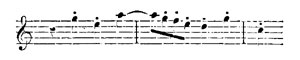
[Listen]
smiling as he did so. The black-frocked Abbati
pressed round me and seemed highly delighted. I
observed this, and it inspirited me so much that
towards the end I succeeded famously; they clapped
their hands like mad, and Bunsen declared that I
had astounded the clergy; in short, the affair went
off well. There is no encouraging prospect of any
public performance here, so society is the only resource,
which is fishing in troubled waters.
Yours, Felix.
To come home from Bunsen's by moonlight, with
your letter in my pocket, and then to read it through
leisurely at night,—this is a degree of pleasure I
wish many may enjoy. In all probability I shall stay
here the whole winter, and not go to Naples till
April. It is so delightful to look round on every
side, and to appreciate it all properly. There is
much that must be thought over, in order to receive
a due impression from it. I have also within myself
so much work requiring both quiet and industry,
that I feel anything like haste would be utter destruction;
and though I adhere faithfully to my
system, to receive each day only one fresh image
into my mind, still I am sometimes compelled even
then to give myself a day of rest, that I may not
become confused. I write you a short letter to-day,
because I must for the present adhere to my work;
and yet I cannot refrain from culling all the beauty
that lies at my feet. The weather, too, is brutto
and cold, so that I am not in a very communicative
mood. The Pope is dying, or possibly dead by this
time. "We shall soon get a new one," say the
Italians, coolly. His death will not affect the Carnival,
nor the church festivals, with their pomps
and processions, and fine music; and as there will
be in addition to these, solemn requiems, and the
lying-in-state at St. Peter's, they care little about it,
provided it does not occur in February.
I am delighted to hear that Mantius sings my
songs, and likes them. Give him my kind regards,
and ask him why he does not perform his promise,
and write to me. I have written to him repeatedly
in the shape of music. In the "Ave Maria," and in
the choral "Aus tiefer Noth," some passages are
composed expressly for him, and he will sing them
charmingly. In the "Ave," which is a salutation,
a tenor solo takes the lead of the choir (I thought
of a disciple all the time). As the piece is in A
major, and goes rather high at the words Benedicta
tu, he must prepare his high A; it will vibrate
well. Ask him to sing you a song I sent to Devrient
from Venice, "Von schlechtem Lebenswandel."
It is expressive of mingled joy and despair; no
doubt he will sing it well. Show it to no one, but
confine it solely to forty eyes. Ritz[7] too never
writes, and yet I am constantly longing for his violin
and his depth of feeling when he plays, which
all recurs to my mind when I see his welcome writing.
I am now working daily at the "Hebrides,"
and will send it to Ritz as soon as it is finished. It
is quite a piece to suit him—so very singular.
Next time I write I will tell you more of myself.
I work hard, and lead a pleasant, happy life; my
mirror is stuck full of Italian, German, and English
visiting-cards, and I spend every evening with one
of my acquaintances. There is a truly Babylonian
confusion of tongues in my head, for English,
Italian, German and French are all mixed up together
in it. Two days ago I again extemporized
before the Papal singers. The fellows had contrived
to get hold of the most strange, quaint
theme for me, wishing to put my powers to the test.
They call me, however, l'insuperabile professorone,
and are particularly kind and friendly. I much
wished to have described to you the Sunday music in
the Sistina, a soirée at Torlonia's, the Vatican, St.
Onofrio, Guido's Aurora, and other small matters,
but I reserve them for my next letter. The post
is about to set off, and this letter with it. My
good wishes are always with you, to-day and ever.
Yours, Felix.
I cannot even to-day manage to write to you as
fully as I wish. Heaven knows how time flies here!
I was introduced this week to several agreeable
English families, and so I have the prospect of many
pleasant evenings this winter. I am much with
Bunsen. I intend also to cultivate Baini. I think
he conceives me to be only a brutissimo Tedesco, so
that I have a famous opportunity of becoming well
acquainted with him. His compositions are certainly
of no great value, and the same may be said of the
whole music here. The wish is not wanting, but the
means do not exist. The orchestra is below contempt.
Mdlle. Carl,[8] (who is engaged as prima
donna assoluta for the season, at both the principal
theatres here,) is now arrived, and begins to make
la pluie et le beau temps. The Papal singers even
are becoming old; they are almost all unmusical,
and do not execute even the most established pieces
in tune. The whole choir consists of thirty-two
singers, but that number are rarely together. Concerts
are given by the so-called Philharmonic Society,
but only with the piano. There is no orchestra, and
when recently they wished to perform Haydn's
"Creation," the instrumentalists declared it was
impossible to play it. The sounds they bring out of
their wind instruments, are such as in Germany we
have no conception of.
The Pope is dead, and the Conclave assembles on
the 14th. A great part of the winter will be occupied
with the ceremonies of his funeral, and the enthronement
of the new Pope. All music therefore
and large parties must be at an end, so I very much
doubt whether I shall be able to undertake any public
performance during my stay here; but I do not
regret this, for there are so many varied objects to
enjoy inwardly, that my dwelling on these and meditating
on them is no disadvantage. The performance
of Graun's "Passion" in Naples, and more especially
the translation of Sebastian Bach's, prove that the
good cause is sure eventually to make its way,
though it will neither kindle enthusiasm, nor will it
be appreciated. It is no worse however with regard
to music—in fact, rather better—than with their
estimate of every other branch of the fine arts; for
when some of Raphael's Loggie are with inconceivable
recklessness and disgraceful barbarism actually
defaced, to give place to inscriptions in pencil; when
the lower parts of the arabesques are totally destroyed,
because Italians with knives, and Heaven
knows what else besides, inscribe their insignificant
names there; when one person painted in large
letters under the Apollo Belvedere, 'Christ;' when
an altar has been erected in front of Michael Angelo's
"Last Judgment," so large that it hides the
centre of the picture, thus destroying the whole
effect; when cattle are driven through the splendid
saloons of the Villa Madama, the walls of which are
painted by Giulio Romano, and fodder is stored in
them, simply from indifference towards the beautiful,—all
this is certainly much worse than a bad orchestra,
and painters must be even more distressed
by such things than I am by their miserable music.
The fact is, that the people are mentally enervated
and apathetic. They have a religion, but
they do not believe in it; they have a Pope and a
Government, but they turn them into ridicule; they
can recall a brilliant and heroic past, but they do
not value it. It is thus no marvel that they do not
delight in Art, for they are indifferent to all that is
earnest. It is really quite revolting to see their
unconcern about the death of the Pope, and their
unseemly merriment during the ceremonies. I myself
saw the corpse lying in state, and the priests
standing round incessantly whispering and laughing;
and at this moment, when masses are being
said for his soul, they are in the very same church
hammering away at the scaffolding of the catafalque,
so that the strokes of the hammers and the noise of
the workpeople entirely prevent any one hearing
the religious services. As soon as the Cardinals
assemble in conclave, satires appear against them,
where, for instance, they parody the Litanies, and instead
of praying to be delivered from each particular
sin, they name the bad qualities of each well-known
cardinal; or, again, they perform an entire opera,
where all the characters are Cardinals, one being
the primo amoroso, another the tiranno assoluto, a
third, stage candle-snuffer, etc. This could not be
the case where the people took any pleasure in Art.
Formerly it was no better, but they had faith then;
and it is this which makes the difference. Nature,
however, and the genial December atmosphere, and
the outlines of the Alban hills, stretching as far as
the sea, all remain unchanged. There they can
scribble no names, or compose no inscriptions.
These every one can still individually enjoy in all
their freshness, and to these I cling. I feel much
the want of a friend here, to whom I could freely
unbosom myself; who could read my music as I
write it, thus making it doubly precious in my
eyes; in whose society I could feel an interest, and
enjoy repose; and honestly learn from him, (it would
not require a very wise man for this purpose.) But
just as trees are not ordained to grow up into the
sky, so probably such a man is not likely to be
found here; and the good fortune I have hitherto
so richly enjoyed elsewhere, is not to fall to my
share at present; so I must hum over my melodies
to myself, and I dare say I shall do well enough.
Felix.
Dear Father,
It is a year this very day since we kept your
birthday at Hensel's, and now let me give you some
account of Rome, as I did at that time of London.
I intend to finish my Overture to the "Einsame
Insel"[9] as a present to you, and if I write under it
the 11th December, when I take up the sheets I
shall feel as if I were about to place them in your
hands. You would probably say that you could not
read them, but still I should have offered you the
best it was in my power to give; and though I
desire to do this every day, still there is a peculiar
feeling connected with a birthday. Would I were
with you! I need not offer you my good wishes,
for you know them all already, and the deep interest
I, and all of us, take in your happiness and welfare,
and that we cannot wish any good for you, that is
not reflected doubly on ourselves. To-day is a holiday.
I rejoice in thinking how cheerful you are at
home; and when I repeat to you how happily I
live here, I feel as if this were also a felicitation.
A period like this, when serious thought and enjoyment
are combined, is indeed most cheering and
invigorating. Every time I enter my room I rejoice
that I am not obliged to pursue my journey on the
following day, and that I may quietly postpone
many things till the morrow—that I am in Rome!
Hitherto much that passed through my brain was
swept away by fresh ideas, each new impression
chasing away the previous one, while here, on the
contrary, they are all in turn properly developed.
I never remember having worked with so much zeal,
and if I am to complete all that I have projected, I
must be very industrious during the winter. I am
indeed deprived of the great delight of showing my
finished compositions to one who could take pleasure
in them, and enter into them along with me;
but this impels me to return to my labours, which
please me most when I am fairly in the midst of
them. And now this must be combined with the
various solemnities, and festivals of every kind,
which are to supplant my work for a few days; and
as I have resolved to see and to enjoy all I possibly
can, I do not allow my occupation to prevent this,
and shall then return with fresh zeal to my composition.
This is indeed a delightful existence! My health
is as good as possible, though the hot wind, called
here the sirocco, rather attacks my nerves, and I
find I must beware of playing the piano much, or
at night; besides it is easy for me to refrain from
doing so for a few days, as for some weeks past I
have been playing almost every evening. Bunsen,
who often warns me against playing if I find it prejudicial,
gave a large party yesterday, where nevertheless
I was obliged to play; but it was a pleasure
to me, for I had the opportunity of making so many
agreeable acquaintances. Thorwaldsen, in particular,
expressed himself in so gratifying a manner
with regard to me, that I felt quite proud, for I
honor him as one of the greatest of men, and
always have revered him. He looks like a lion,
and the very sight of his face is invigorating. You
feel at once that he must be a noble artist; his
eyes look so clear, as if with him every object must
assume a definite form and image. Moreover he is
very gentle, and kind, and mild, because his nature
is so superior; and yet he seems to be able to enjoy
every trifle. It is a real source of pleasure to see
a great man, and to know that the creator of works
that will endure for ever stands before you in person;
a living being with all his attributes, and
individuality, and genius, and yet a man like others.
Now your actual birthday is arrived! A few
lines of music suggested themselves to me on the
occasion, and though they may not be worth much,
the congratulations I have been in the habit of offering,
were of quite as little value. Fanny may add
the second part. I have only written what occurred
to my mind as I entered the room, the sun shining,
on your birthday:—
[Listen]
Bunsen has just been here, and begs me to send
you his best regards and congratulations. He is all
kindness and courtesy towards me, and as you wish
to know, I think I may say that we suit each other
remarkably well. The few words you wrote about
P—— recalled him to my memory in all his offensiveness.
The Abbate Santini ought to be an
obscure man compared with him, for he never
attempts to magnify his own importance by impertinence
or self-sufficiency. P—— is one of those
collectors who make learning and libraries distasteful
to others by their narrow-mindedness, whereas
Santini is a genuine collector, in the best sense of
the word, caring little whether his collection be of
much value in a pecuniary point of view. He therefore
gives everything away indiscriminately, and is
only anxious to procure something new, for his chief
object is the diffusion and universal knowledge of
ancient music. I have not seen him lately, as every
morning now he figures, ex officio, in his violet gown
at St. Peter's; but if he has made use of some ancient
text, he will say so without scruple, as he has
no wish to be thought the first discoverer. He is,
in fact, a man of limited capacity; and this I consider
great praise in a certain sense, for though he is
neither a musical nor any other luminary, and even
bears some resemblance to Lessing's inquisitive friar,
still he knows how to confine himself within his own
sphere. Music itself does not interest him much, if
he can only have it on his shelves; and he is, and
esteems himself to be, simply a quiet, zealous collector.
I must admit that he is fatiguing, and not
altogether free from irritability; still I love any one
who adopts and perseveres in some particular pursuit,
prosecuting it to the best of his ability, and
endeavouring to perfect it for the benefit of mankind,
and I think every one ought to esteem him just the
same, whether he chance to be tiresome or agreeable.
I wish you would read this aloud to P——. It
always makes me furious when men who have no
pursuit, presume to criticize those who wish to effect
something, even on a small scale; so on this very
account I took the liberty of rebuking lately a certain
musician in society here. He began to speak
of Mozart, and as Bunsen and his sister love Palestrina,
he tried to flatter their tastes by asking me,
for instance, what I thought of the worthy Mozart,
and all his sins. I however replied, that so far as I
was concerned, I should feel only too happy to renounce
all my virtues in exchange for Mozart's sins:
but that of course I could not venture to pronounce
on the extent of his virtues. The people all laughed,
and were highly amused. How strange it is that
such persons should feel no awe of so great a name!
It is some consolation, however, that it is the same
in every sphere of art, as the painters here are quite
as bad. They are most formidable to look at, sitting
in their Café Greco. I scarcely ever go there, for
I dislike both them and their favourite places of resort.
It is a small dark room, about eight feet
square, where on one side you may smoke, but not
on the other; so they sit round on benches, with
their broad-leaved hats on their heads, and their
huge mastiffs beside them; their cheeks and throats,
and the whole of their faces covered with hair, puffing
forth clouds of smoke (only on one side of the
room), and saying rude things to each other, while
the mastiffs swarm with vermin. A neckcloth or a
coat would be quite innovations. Any portion of
the face visible through the beard, is hid by spectacles;
so they drink coffee, and speak of Titian and
Pordenone, just as if they were sitting beside them,
and also wore beards and wide-awakes! Moreover,
they paint such sickly Madonnas and feeble saints,
and such milk-sop heroes, that I feel the strongest
inclination to knock them down. These infernal
critics do not even shrink from discussing Titian's
picture in the Vatican, about which you asked me;
they say that it has neither subject nor meaning; yet
it never seems to occur to them, that a master who
had so long studied a picture with due love and
reverence, must have had quite as deep an insight
into the subject as they are likely to have, even with
their coloured spectacles. And if in the course of
my life I accomplish nothing but this, I am at all
events determined to say the most harsh and cutting
things to those who show no reverence towards their
masters, and then I shall at least have performed
one good work. But there they stand, and see all
the splendour of those creations, so far transcending
their own conceptions, and yet dare to criticize them.
In this picture there are three stages, or whatever
they are called the same as in the "Transfiguration."
Below, saints and martyrs are represented in suffering
and abasement; on every face is depicted sadness,
nay almost impatience; one figure in rich
episcopal robes looks upwards, with the most eager
and agonized longing, as if weeping, but he cannot
see all that is floating above his head, but which we
see, standing in front of the picture. Above, Mary
and her Child are in a cloud, radiant with joy, and
surrounded by angels, who have woven many garlands;
the Holy Child holds one of these, and seems
as if about to crown the saints beneath, but his
Mother withholds his hand for the moment. The
contrast between the pain and suffering below,
whence St. Sebastian looks forth out of the picture
with such gloom and almost apathy, and the lofty
unalloyed exultation in the clouds above, where
crowns and palms are already awaiting him, is truly
admirable. High above the group of Mary, hovers
the Holy Spirit, from whom emanates a bright
streaming light, thus forming the apex of the whole
composition. I have just remembered that Goethe,
at the beginning of his first visit to Rome, describes
and admires this picture; but I no longer have the
book to enable me to read it over, and to compare
my description with his. He speaks of it in considerable
detail. It was at that time in the Quirinal,
and subsequently transferred to the Vatican;
whether it was painted on a given subject, as some
allege, or not, is of no moment. Titian has imbued
it with his genius and his poetical feeling, and has
thus made it his own. I like Schadow much, and am
often with him; on every occasion, and especially in
his own department, he is mild and clear-judging,
doing justice with due modesty to all that is truly
great; he recently said that Titian had never painted
an indifferent or an uninteresting picture, and I believe
he is right; for life and enthusiasm and the soundest
vigour are displayed in all his productions, and where
these are, it is good to be also. There is one singular
and fortunate peculiarity here: though all the
objects have been, a thousand times over, described,
discussed, copied, and criticized, in praise or blame,
by the greatest masters, and the most insignificant
scholars, cleverly or stupidly, still they never fail to
make a fresh and sublime impression on all, affecting
each person according to his own individuality.
Here we can take refuge from man in all that surrounds
us; in Berlin it is often exactly the reverse.
I have this moment received your letter of the
27th, and am pleased to find that I have already
answered many of the questions it contains. There
is no hurry about the letters I asked for, as I have
now made almost more acquaintances than I
wish; besides, late hours, and playing so much, do
not suit me in Rome, so I can await the arrival of
these letters very patiently: it was not so at the
time I urged you to send them. I cannot however
understand what you mean by your allusion to
coteries which I ought to have outgrown, for I
know that I, and all of us, invariably dreaded and
detested what is usually so called,—that is, a
frivolous, exclusive circle of society, clinging to
empty outward forms. Among persons, however,
who daily meet, while their mutual objects of
interest remain the same, who have no sympathy
with public life (and this is certainly the case
in Berlin, with the exception of the theatre), it is
not unnatural that they should form for themselves
a gay, cheerful, and original mode of treating passing
events, and that this should give rise to a
peculiar, and perhaps monotonous style of conversation;
but this by no means constitutes a coterie.
I feel convinced that I shall never belong to one,
whether I am in Rome or Wittenberg. I am glad
that the last words I was writing when your letter
arrived, chanced to be that in Berlin you must take
refuge in society from all that surrounds you; thus
proving that I had no spirit of coterie, which invariably
estranges men from each other. I should
deeply regret your observing anything of the kind
in me or in any of us, except indeed for the moment.
Forgive me, my dear father, for defending myself
so warmly, but this word is most repugnant to my
feelings, and you say in your letters that I am always
to speak out what I think in a straightforward
manner, so pray do not take this amiss.
I was in St. Peter's to-day, where the grand
solemnities called the absolutions have begun for
the Pope, and which last till Tuesday, when the
Cardinals assemble in conclave. The building surpasses
all powers of description. It appears to me
like some great work of nature, a forest, a mass of
rocks, or something similar; for I never can realize
the idea that it is the work of man. You strive to
distinguish the ceiling as little as the canopy of
heaven. You lose your way in St. Peter's, you
take a walk in it, and ramble till you are quite
tired; when divine service is performed and chanted
there, you are not aware of it till you come quite
close. The angels in the Baptistery are monstrous
giants; the doves, colossal birds of prey; you lose
all idea of measurement with the eye, or proportion;
and yet who does not feel his heart expand,
when standing under the dome, and gazing up at
it? At present a monstrous catafalque has been
erected in the nave in this shape.[10] The coffin is
placed in the centre under the pillars; the thing is
totally devoid of taste, and yet it has a wondrous
effect. The upper circle is thickly studded with
lights, so are all the ornaments; the lower circle is
lighted in the same way, and over the coffin hangs
a burning lamp, and innumerable lights are blazing
under the statues. The whole structure is more
than a hundred feet high, and stands exactly opposite
the entrance. The guards of honour, and the
Swiss, march about in the quadrangle; in every
corner sits a Cardinal in deep mourning, attended
by his servants, who hold large burning torches,
and then the singing commences with responses, in
the simple and monotonous tone you no doubt remember.
It is the only occasion when there is any
singing in the middle of the church, and the effect
is wonderful. Those who place themselves among
the singers (as I do) and watch them, are forcibly
impressed by the scene: for they all stand round a
colossal book from which they sing, and this book
is in turn lit up by a colossal torch that burns
before it; while the choir are eagerly pressing forward
in their vestments, in order to see and to sing
properly: and Baini with his monk's face, marking
time with his hand, and occasionally joining in the
chant with a stentorian voice. To watch all these
different Italian faces, was most interesting; one
enjoyment quickly succeeds another here, and it is
the same in their churches, especially in St. Peter's,
where by moving a few steps the whole scene is
changed. I went to the very furthest end, whence
there was indeed a wonderful coup d'œil. Through
the spiral columns of the high altar, which is confessedly
as high as the palace in Berlin, far beyond
the space of the cupola, the whole mass of the
catafalque was seen in diminished perspective, with
its rows of lights, and numbers of small human
beings crowding round it. When the music commences,
the sounds do not reach the other end for
a long time, but echo and float in the vast space,
so that the most singular and vague harmonies are
borne towards you. If you change your position,
and place yourself right in front of the catafalque,
beyond the blaze of light and the brilliant pageantry,
you have the dusky cupola replete with blue vapour;
all this is quite indescribable. Such is Rome!
This has become a long letter, so I must conclude;
it will reach you on Christmas-day. May
you all enjoy it happily! I send each of you presents,
which are to be dispatched two days hence,
and will arrive in time for the anniversary of your
silver wedding-day. Many glad festivals are thus
crowded together, and I scarcely know whether to
imagine myself with you to-day, and to wish you,
dear father, all possible happiness, or to arrive with
my letter at Christmas, and not to be allowed by
my mother to pass through the room with the
Christmas-tree. I am afraid I must be contented
with thinking of you.—Farewell all! May you be
happy!
Felix.
I have just received your letter, which brings me
the intelligence of Goethe's illness. What I personally
feel at this news I cannot express. This
whole evening his words, "I must try to keep all
right till your return," have sounded continually in
my ears, to the exclusion of every other thought:
when he is gone, Germany will assume a very
different aspect for artists. I have never thought
of Germany without feeling heartfelt joy and pride
that Goethe lived there; and the rising generation
seem for the most part so weakly and feeble, that it
makes my heart sink within me. He is the last;
and with him closes a happy prosperous period for
us! This year ends in solemn sadness.
In my former letter I told you of the more serious
aspect of Roman life; but as I wish to describe to
you how I live, I must now tell you of the gayeties
that have prevailed during this week.
To-day we have the most genial sunshine, a blue
sky, and a transparent atmosphere, and on such days
I have my own mode of passing my time. I work
hard till eleven o'clock, and from that hour till
dark, I do nothing but breathe the air. For the
first time, for some days past, we yesterday had
fine weather. After therefore working for a time
in the morning at "Solomon," I went to the Monte
Pincio, where I rambled about the whole day. The
effect of this exhilarating air is quite magical; and
when I arose to-day, and again saw bright sunshine,
I exulted in the thoughts of the entire idleness I
was again about to indulge in. The whole world is
on foot, revelling in a December spring. Every
moment you meet some acquaintance, with whom
you lounge about for a time, then leave him, and
once more enjoy your solitary revery. There are
swarms of handsome faces to be seen. As the sun
declines, the appearance of the whole landscape,
and every hue, undergo a change. When the Ave
Maria sounds, it is time to go to the church of
Trinità de' Monti, where French nuns sing; and it
is charming to hear them. I declare to heaven that
I am become quite tolerant, and listen to bad music
with edification; but what can I do? the composition
is positively ridiculous; the organ playing even
more absurd. But it is twilight, and the whole of
the small bright church is filled with persons kneeling,
lit up by the sinking sun each time that the
door is opened; both the singing nuns have the
sweetest voices in the world, quite tender and
touching, more especially when one of them sings
the responses in her melodious voice, which we are
accustomed to hear chanted by priests in a loud,
harsh, monotonous tone. The impression is very
singular; moreover, it is well known that no one is
permitted to see the fair singers,—so this caused me
to form a strange resolution. I have composed
something to suit their voices, which I observed
very minutely, and I mean to send it to them,—there
are several modes to which I can have recourse
to accomplish this. That they will sing it,
I feel quite assured; and it will be pleasant for me
to hear my chant performed by persons whom I
never saw, especially as they must in turn sing it to
the barbaro Tedesco, whom they also never beheld.
I am charmed with this idea. The text is in Latin,—a
Prayer to Mary. Does not this notion please
you?[11]
After church I walk again on the hill until it is
quite dark, when Madame Vernet and her daughter,
and pretty Madame V—— (for whose acquaintance
I have to thank Roesel), are much admired by us
Germans, and we form groups round them, or follow,
or walk beside them. The background is
formed by haggard painters with terrific beards;
they smoke tobacco on the Monte Pincio, whistle to
their huge dogs, and enjoy the sunset in their own
way.
As I am in a frivolous mood to-day, I must relate
to you, dear sisters, every particular of a ball I
lately attended, and where I danced with a degree
of zeal I never did before. I had spoken a few fair
words to the maître de danse (who stands in the
middle here, and regulates everything), consequently
he allowed the galop to continue for more than half
an hour, so I was in my element, and pleasantly
conscious that I was dancing in the Palazzo Albani,
in Rome, and also with the prettiest girl in it,
according to the verdict of the competent judges
(Thorwaldsen, Vernet, etc.) The way in which I became
acquainted with her is also an anecdote of
Rome. I was at Torlonia's first ball, though not dancing,
as I knew none of the ladies present, but merely
looking at the people. Suddenly some one tapped
me on the shoulder, saying, "So you also are admiring
the English beauty; I am quite dazzled." It
was Thorwaldsen himself standing at the door, lost
in admiration; scarcely had he said this, when we
heard a torrent of words behind us,—"Mais où
est-elle donc, cette petite Anglaise? Ma femme
m'a envoyé pour la regarder. Per Bacco!" It
was quite clear that this little thin Frenchman, with
stiff, grey hair, and the ribbon of the Legion of
Honour, must be Horace Vernet. He now discussed
the youthful beauty with Thorwaldsen, in the
most earnest and scientific manner; and it was
quite a pleasure to me to see these two old masters
admiring the young girl together, while she was
dancing away, quite unconcerned. They were then
presented to her parents, but I felt very insignificant,
as I could not join in the conversation. A
few days afterwards, however, I was with some
acquaintances whom I knew through the Attwoods,
at Venice, they having invited me for the purpose
of presenting me to some of their friends; and
these friends turned out to be the very persons I
have been speaking of; so your son and brother was
highly delighted.
My pianoforte playing is a source of great gratification
to me here. You know how Thorwaldsen
loves music, and I sometimes play to him in the
morning while he is at work. He has an excellent
instrument in his studio, and when I look at the
old gentleman and see him kneading his brown
clay, and delicately fining off an arm, or a fold of
drapery,—in short, when he is creating what we must
all admire when completed, as an enduring work,—then
I do indeed rejoice that I have the means of
bestowing any enjoyment on him. Nevertheless, I
have not fallen into arrear with my own tasks.
The "Hebrides" is completed at last, and a strange
production it is. The chant for the nuns is in my
head; and I think of composing Luther's choral
for Christmas, but on this occasion I must do so
quite alone; and it will be a more serious affair this
time, and so will the anniversary of your silver
wedding-day, when I intend to have a great many
lights, and to sing my "Liederspiel," and to have a
peep at my English bâton. After the new year, I
intend to resume instrumental music, and to write
several things for the piano, and probably a symphony
of some kind, for two have been haunting my
brain.
I have lately frequented a most delightful spot,—the
tomb of Cecilia Metella. The Sabine hills had
a sprinkling of snow, but it was glorious sunshine;
the Alban hills were like a dream or a vision.
There is no such thing as distance in Italy, for all
the houses on the hills can be counted, with their
roofs and windows. I have thus inhaled this air to
satiety; and to-morrow in all probability, more
serious occupations will be resumed, for the sky is
cloudy, and it is raining hard, but what a spring
this will be!
This is the shortest day, and very gloomy, as might
have been anticipated; so to-day nothing can be
thought of but fugues, chorals, balls, etc. But I
must say a few words about Guido's "Aurora,"
which I often visit; it is a picture the very type of
haste and impetus; for surely no man ever imagined
such hurry and tumult, such sounding and clashing.
Painters maintain that it is lighted from two sides,—they
have my full permission to light theirs from
three if it will improve them,—but the difference
lies elsewhere.
I really cannot compose a tolerable song here, for
who is there to sing it to me? But I am writing a
grand fugue, "Wir glauben all," and sing it to myself
in such a fashion that my friend the Captain
rushes downstairs in alarm, puts in his head, and
asks what I want. I answer—a counter theme.
But how much I do really want; and yet how much
I have got! Thus life passes onwards.
Felix.
Rome in wet weather is the most odious, uncomfortable
place imaginable. For some days past we
have had incessant storms and cold, and streams of
water from the sky; and I can scarcely comprehend
how, only one week ago, I could write you a letter
full of rambles and orange-trees and all that is
beautiful: in such weather as this everything becomes
ugly. Still, I must write to you about it,
otherwise my previous letter would not have the
advantage of contrast, and of that there is no lack.
If in Germany we can form no conception of the
bright winter days here, quite as little can we realize
a really wet winter day in Rome; everything is
arranged for fine weather, so the bad is borne like a
public calamity, and in the hope of better times.
There is no shelter anywhere; in my room, which is
usually so comfortable, the water pours in through
the windows, which will not shut fast; the wind
whistles through the doors, which will not close; the
stone floor chills you in spite of double mattings,
and the smoke from the chimney is driven into the
room, because the fire will not burn; foreigners
shiver and freeze here like tailors.
All this is, however, actual luxury when compared
with the streets; and when I am obliged to go out,
I consider it a positive misfortune. Rome, as every
one knows, is built on seven large hills; but there
are a number of smaller ones besides, and all the
streets are sloping, so the water pours down them,
and rushes towards you; nowhere is there a raised
footpath, or a trottoir; at the stair of the Piazza di
Spagna, there is a flood like the great water-works
in Wilhelms-Höhe; the Tiber has overflowed its
banks, and inundated the adjacent streets: this,
then, is the water from below. From above come
violent showers of rain, but that is the least part.
The houses have no water-spouts, and the long roofs
slant precipitously, but, being of different lengths,
this causes an incessant violent inundation on both
sides of the street, so that go where you will, close
to the houses, or in the middle of the streets, beside
a barber's shop or a palace, you are sure to be deluged,
and, quite unawares, you find yourself standing
under a tremendous shower-bath, the water pelting
on your umbrella, while a stream is running before
you that you cannot jump over, so you are obliged
to return the way you came: this is the water overhead.
Then the carriages drive as rapidly as possible,
and close to the houses, so that you must retreat
into the doorways till they are past; they not only
splash men and houses, but each other, so that when
two meet, one must drive into the gutter, which,
being a rapid current, the consequences are lamentable.
Lately I saw an Abbate hurrying along, whose
umbrella chancing to knock off the broad-brimmed
hat of a peasant, it fell with the crown exposed to
one of these deluges, and when the man went to pick
it up, it was quite filled with water. "Scusi," said
the Abbate. "Padronè," replied the peasant. The
hackney coaches moreover only ply till five o'clock,
so if you go to a party at night, it costs you a scudo.
Fiat justitia et pereat mundus—Rome in rainy
weather is vastly disagreeable.
I see by a letter of Devrient's, that one I wrote
to him from Venice, and which I took to the post
myself on the 17th of October, had not reached
him on the 19th of November. It would appear
also, that another which I sent the same day to
Munich had not arrived; both these letters contained
music, and this accounts for the loss. At
that very time in Venice they carried off all my
manuscripts to the Custom-house, after visiting my
effects at night, shortly before the departure of the
post, and I only received them again here, after
much worry and writing backwards and forwards.
Every one assured me that the cause of this was a
secret correspondence being suspected in cipher in
the manuscript music. I could scarcely credit such
intolerable stupidity; but as my two letters from
Venice containing music have not arrived, and
these only, the thing is clear enough. I intend
to complain of this to the Austrian ambassador
here, but it will do no good, and the letters are
lost, which I much regret. Farewell!
Felix.
For a week past we have had the most lovely
spring weather. Young girls are carrying about
nosegays of violets and anemones, which they
gather early in the morning at the Villa Pamfili.
The streets and squares swarm with gaily attired
pedestrians; the Ave Maria has already been
advanced twenty minutes, but what is become of
the winter? Some little time ago it indeed reminded
me of my work, to which I now mean to
apply steadily, for I own that during the gay social
life of the previous weeks, I had rather neglected
it. I have nearly completed the arrangement of
"Solomon," and also my Christmas anthem, which
consists of five numbers; the two symphonies also
begin to assume a more definite form, and I particularly
wish to finish them here. Probably I shall be
able to accomplish this during Lent, when parties
cease (especially balls) and spring begins, and then
I shall have both time and inclination to compose,
in which case I hope to have a good store of new
works. Any performance of them here is quite out
of the question. The orchestras are worse than
any one could believe; both musicians, and a right
feeling for music, are wanting. The two or three
violin performers play just as they choose, and join
in when they please; the wind instruments are
tuned either too high or too low; and they execute
flourishes like those we are accustomed to hear in
farm-yards, but hardly so good; in short the whole
forms a Dutch concert, and this applies even to compositions
with which they are familiar.
The question is, whether all this could be radically
reformed by introducing other people into the
orchestra, by teaching the musicians time, and by
instructing them in first principles. I think in that
case the people would no doubt take pleasure in it;
so long, however, as this is not done, no improvement
can be hoped for, and every one seems so indifferent
on the subject, that there is not the
slightest prospect of such a thing. I heard a solo
on the flute, where the flute was more than a quarter
of a tone too high; it set my teeth on edge, but no
one remarked it, and when at the end a shake
came, they applauded mechanically. If it were
even a shade better with regard to singing! The
great singers have left the country. Lablache,
David, Lalande, Pisaroni, etc., sing in Paris, and
the minor ones who remain, copy their inspired
moments, which they caricature in the most insupportable
manner.
We in Germany may perhaps wish to accomplish
something false or impossible, but it is, and always
will be, quite dissimilar; and just as a cicisbeo
will for ever be odious and repulsive to my feelings,
so is it also with Italian music. I may be too
obtuse to comprehend either; but I shall never feel
otherwise; and recently, at the Philharmonic, after
the music of Pacini and Bellini, when the Cavaliere
Ricci begged me to accompany him in "Non più
andrai," the very first notes were so utterly different
and so infinitely remote from all the previous music,
that the matter was clear to me then, and never will
it be equalized, so long as there is such a blue sky,
and such a charming winter as the present. In the
same way the Swiss can paint no beautiful scenery,
precisely because they have it the whole day before
their eyes. "Les Allemands traitent la musique
comme une affaire d'état," says Spontini, and I
accept the axiom. I lately heard some musicians
here talking of their composers, and I listened in
silence. One quoted ——, but the others interrupted
him, saying he could not be considered an
Italian, for the German school still clung to him,
and he had never been able to get rid of it; consequently
he had never been at home in Italy: we
Germans say precisely the reverse of him, and it
must be not a little trying to find yourself so entre
deux, and without any fatherland. So far as I am
concerned I stick to my own colours, which are
quite honourable enough for me.
Last night a theatre that Torlonia has undertaken
and organized, was opened with a new opera of Pacini's.
The crowd was great, and every box filled
with handsome, well-dressed people; young Torlonia
appeared in a stage-box with his mother, the old
Duchess, and they were immensely applauded. The
audience called out Bravo, Torlonia, grazie, grazie!
Opposite to him was Jerome, with his suite, and
covered with orders: in the next box Countess
Samoilow, etc. Over the orchestra is a picture of
Time pointing to the dial of the clock, which revolves
slowly, and is enough to make any one melancholy.
Pacini then appeared at the piano, and was
kindly welcomed. He had prepared no overture, so
the opera began with a chorus, accompanied by
strokes on an anvil tuned in the proper key. The
Corsair came forward, sang his aria, and was applauded,
on which the Corsair above, and the
Maestro below, bowed (this pirate is a contralto,
and sung by Mademoiselle Mariani); a variety of
airs followed, and the piece became very tiresome.
This seemed to be also the opinion of the public, for
when Pacini's grand finale began, the whole pit
stood up, talking to each other as loud as they
could, laughing and turning their backs on the stage.
Madame Samoilow fainted in her box, and was carried
out. Pacini glided away from the piano, and
at the end of the act, the curtain fell in the midst
of a great tumult. Then came the grand ballet of
Barbe Bleue, followed by the last act of the opera.
As the audience were now in a mood for it, they
hissed the whole ballet from the very beginning, and
accompanied the second act also with hooting and
laughter. At the close Torlonia was called for, but
he would not appear.
This is the matter-of-fact narrative of a first performance
at the opening of a theatre in Rome. I had
anticipated much amusement, so I came away considerably
out of humour; still, if the music had made
furore, I should have been very indignant, for it is
so wretched that it really is beneath all criticism.
But that they should turn their backs on their favourite
Pacini, whom they wished to crown in the
Capitol, parody his melodies, and sing them in a
ludicrous style, this does, I confess, provoke me not
a little, and is likewise a proof of how low such a
musician stands in the public opinion. Another
time they will carry him home on their shoulders;
but this is no compensation. They would not act
thus in France with regard to Boieldieu; independent
of all love of art, a sense of propriety would
prevent their doing so: but enough of this subject,
for it is too vexatious.
Why should Italy still insist on being the land of
Art, while it is in reality the Land of Nature, thus
delighting every heart! I have already described
to you my walks to the Monte Pincio. I continue
them daily. I went lately with the Vollards to
Ponte Nomentano, a solitary dilapidated bridge in
the spacious green Campagna. Many ruins from
the days of ancient Rome, and many watch-towers
from the Middle Ages, are scattered over this long
succession of meadows; chains of hills rise towards
the horizon, now partially covered with snow, and
fantastically varied in form and colour by the
shadows of the clouds. And there is also the enchanting,
vapoury vision of the Alban hills, which
change their hues like a chameleon, as you gaze at
them,—where you can see for miles little white
chapels glittering on the dark ground of the hills,
as far as the Passionist Convent on the summit,
and whence you can trace the road winding through
thickets, and the hills sloping downwards to the
Lake of Albano, while a hermitage peeps through
the trees. The distance is equal to that from Berlin
to Potsdam, say I as a good Berliner; but that
it is a lovely vision, I say in earnest. No lack of
music there; it echoes and vibrates there on every
side; not in the vapid, tasteless theatres. So we
rambled about, chasing each other in the Campagna,
and jumping over the fences, and when the sun went
down we drove home, feeling so weary, and yet so self-satisfied
and pleased, as if we had done great things;
and so we have, if we rightly appreciated it all.
I have now applied myself again to drawing, and
have latterly put in some tints, as I should be glad
to be able to recall some of these bright hues, and
practice quickens the perceptions. I must now
tell you, dear mother, of a great, very great pleasure
I recently enjoyed, because you will rejoice with
me. Two days ago I was for the first time in a
small circle with Horace Vernet, and played there.
He had previously told me that his most favourite
and esteemed music was "Don Juan," especially
the Duet and the Commendatore at the end; and as
I highly approved of such sentiments on his part,
the result was, that while playing a prelude to
Weber's Concert-Stück, I imperceptibly glided further
into extemporizing—thought I would please
him by taking these themes, and so I worked them
up fancifully for some time. This caused him a
degree of delight far beyond what I ever knew my
music produce in any one, and we became at once
more intimate. Afterwards he suddenly came up
to me, and whispered that we must make an exchange,
for that he also was an improvisatore; and
when I was naturally curious to know what he
meant, he said it was his secret. He is however
like a little child, and could not conceal it for more
than a quarter of an hour, when he came in again,
and taking me into the next room, he asked me if I
had any time to spare, as he had stretched and
prepared a canvas, and proposed painting my portrait
on it, which I was to keep in memory of this
day, or roll it up and send it to you, or take it with
me, just as I chose. He said he should have no
easy task with his improvisation, but at all events
he would attempt it. I was only too glad to give
my consent, and cannot tell you how much I was
enchanted with the delight and enthusiasm he evidently
felt in my playing.
It was in every respect a happy evening; as I
ascended the hill with him, all was so still and
peaceful, and only one window lit up in the large
dark villa.[12] Fragments of music floated on the
air, and its echoes in the dark night, mingled with
the murmuring of fountains, were sweeter than I can
describe. Two young students were drilling in the
anteroom, while the third acted the part of lieutenant,
and commanded in good form. In another
room my friend Montfort, who gained the prize for
music in the Conservatorium, was seated at a piano,
and others were standing round, singing a chorus;
but it went very badly. They urged another young
man to join them, and when he said that he did not
know how to sing, his friend rejoined, "Qu'est-ce
que ça fait? c'est toujours une voix de plus!" I
helped them as I best could, and we were well
amused. Afterwards we danced, and I wish you
could have seen Louisa Vernet dancing the Saltarella
with her father. When at length she was
forced to stop for a few moments, and snatched up
a tambourine, playing with the utmost spirit,
and relieving us, who could really scarcely any
longer move our hands, I wished I had been a
painter, for what a superb picture she would have
made! Her mother is the kindest creature in the
world, and the grandfather, Charles Vernet (who
paints such splendid horses), danced a quadrille the
same evening with so much ease, making so many
entrechats, and varying his steps so gracefully, that
it is a sad pity he should actually be seventy-two
years of age. Every day he rides, and tires out two
horses, paints and draws a little, and spends the
evening in society.
In my next letter I must tell you of my acquaintance
with Robert, who has just finished an admirable
picture, "The Harvest," and also describe my
recent visits with Bunsen to the studios of Cornelius,
Koch, Overbeck, etc. My time is fully occupied,
for there is plenty to do and to see; unluckily I cannot
make time elastic, however much I may strive to
extend it. I have as yet said nothing of Raphael's
portrait as a child, and Titian's "Nymphs Bathing,"
who in a piquant enough fashion are designated
"Sacred and Profane Love," one being in full gala
costume, while the other is devoid of all drapery,[13]
or of my exquisite "Madonna di Foligno," or of
Francesco Francia, the most guileless and devout
painter in the world; or of poor Guido Reni, whom
the bearded painters of the present day treat with
such contempt, and yet he painted a certain Aurora,
and many other splendid objects besides; but what
avails description? It is well for me that I can
revel in the sight of them. When we meet, I may
perhaps be able to give you a better idea of them.
Your Felix.
I intended not to write to you till my birthday, but
possibly two days hence I may not be in a writing
mood, and must drive all fancies away by hard work.
It does not seem probable that the Papal military
band will surprise me in the morning,[14] and as I
have told all my acquaintances that I was born on
the 25th, I think the day will glide quietly by; I
prefer this to a trivial half-and-half celebration. I
will place your portrait before me in the morning,
and feel happy in looking at it and in thinking of
you. I shall then play over my military overture,
and select my favourite dish for dinner, from the
carte at the Lepre. It is not unprofitable to be
obliged to do all this for one's self, both on birthdays
and other days. I feel isolated enough, and am
rather partial to the other extreme. At night the
Torlonias are so obliging as to give a ball to eight
hundred persons; on Wednesday, the day before,
and on Friday, the day after my birthday, I am invited
to the house of some English friends. During
the previous week, I have been busily engaged in
sight-seeing, and revisited many well-known objects;—thus
I was in the Vatican, the Farnesina, Corsini,
the Villa Lante, Borghese, etc. Two days ago I
saw the frescoes for the first time in Bartholdy's
house;[15] inasmuch as the English ladies who reside
there, and who have transformed the painted saloon
into a sleeping apartment, with a four-post bed,
would never hitherto permit me to enter it. So this
was my first visit to my uncle's house, where at last
I saw his pictures, and the view of the city. It was
a noble, regal idea to have these frescoes; and the
execution of such a sublime thought, in spite of every
kind of impediment and annoyance, simply in order
that the design should be carried out, seems to me
very charming.
But to turn to an entirely different subject. In
many circles here, it is the fashion to consider piety
and dulness synonymous, and yet they are very different;
our German clergyman here is not behindhand
in this respect. There are men in Rome with
an amount of fanaticism credible in the sixteenth
century, but quite monstrous in the present day;
they all wish to make converts, abusing each other
in a Christian manner, and each ridiculing the belief
of his neighbour, till it is quite too sad to hear them.
As if to have simplicity, and to be simple, were the
same thing! Unfortunately I must here retract my
favourite axiom, that goodwill can effect all things,
ability must accompany it; but I am soaring too
high, and my father will lecture me. I wish this
letter were better, but we have snow on the ground;
the roofs in the Piazza di Spagna are quite white,
and heavy clouds of snow are gathering; nothing
can be more odious to us Southerners, and we are
freezing. The Monte Pincio is a mass of ice. Your
Northern Lights have their revenge on us. Who
can write or think with any degree of warmth? I
was so pleased at the idea of being a whole winter
without snow, but now I must give up that notion.
The Italians say that spring breezes will come in a
few days; then gay life, and gay letters, will be resumed.
Farewell! may you enjoy every good, and
think of me.
Felix.
The Pope is elected: the Pope is crowned. He
performed mass in St. Peter's on Sunday, and conferred
his benediction; in the evening the dome
was illuminated, succeeded by the Girandola; the
Carnival began on Saturday, and pursues its headlong
course in the most motley forms. The city
has been illuminated each evening. Last night
there was a ball at the French Embassy; to-day the
Spanish Ambassador gives a grand entertainment.
Next door to me they sell confetti, and how they do
shout! And now I might as well stop, for why
attempt to describe what is, in fact, indescribable?
You ought to make Hensel tell you of these splendid
fêtes, which in pomp, brilliancy, and animation,
surpass all the imagination can conceive, for my
sober pen is not equal to the task. What a different
aspect everything has assumed during the last
eight days, for now the mildest and most genial sun
is shining, and we remain in the balcony enjoying
the air till after sunset. Oh, that I could enclose
for you, in this letter, only one quarter of an hour of
all this pleasure, or tell you how life actually flies in
Rome, every minute bringing its own memorable delights!
It is not difficult to give fêtes here; if the
simple architectural outlines are lighted up, the
dome of St. Peter's blazes forth in the dark purple
atmosphere, calmly shining. If there are fireworks,
they brighten the gloomy solid walls of the Castle
of St. Angelo, and fall into the Tiber; when they
commence their fantastic fêtes in February, the most
lustrous sun shines down on them and beautifies
them. It is a wondrous land.
But I must not forget to tell you that I spent my
birthday very differently from what I expected. I
must however be brief, for an hour hence I go to
join the Carnival in the Corso. My birthday had
three celebrations—the eve, the birthday itself, and
the day after. On the 2nd of February, Santini
was sitting in my room in the morning, and in
answer to my impatient questions about the Conclave,
he replied with a diplomatic air, that there
was little chance of a Pope being elected before
Easter. Herr Brisbane also called, and told me
that after leaving Berlin, he had been in Constantinople,
and Smyrna, etc., and inquired after all his
acquaintances in Berlin, when suddenly the report
of a cannon was heard, and then another, and the
people rushed across the Piazza di Spagna, shouting
with all their might. We three started off, Heaven
knows how, and ran breathlessly to the Quirinal,
where the man was just retreating, who had shouted
through a broken window—"Annuncio vobis gaudium
magnum; habemus Papam R. E. dominum
Capellari, qui nomen assumsit Gregorius XVI."
All the Cardinals now crowded into the balcony, to
breathe fresh air, and laughed, and talked together
It was the first time they had been in the open air
for fifty days, and yet they looked so gay, their red
caps shining brightly in the sun; the whole Piazza
was filled with people, who clambered on the obelisk,
and on the horses of Phidias, and the statues projected
far above in the air. Carriage after carriage
drove up, amid jostling and shouting. Then the
new Pope appeared, and before him was borne the
golden cross, and he blessed the crowd for the first
time, while the people at the same moment prayed,
and cried "Hurrah!" All the bells in Rome were
ringing, and there was firing of cannons, and flourishes
of trumpets, and military music. This was
the eve of my birthday.
Next morning I followed the crowd down the long
street to the Piazza of St. Peter's, which looked
finer than I had ever seen it, lit up brightly by the
sun, and swarming with carriages; the Cardinals in
their red coaches, driving in state to the sacristy,
with servants in embroidered liveries, and people
innumerable, of every nation, rank, and condition;
and high above them the dome and the church
seeming to float in blue vapour, for there was considerable
mist in the morning air. And I thought
that Capellari would probably appropriate all this
to himself when he saw it; but I knew better. It
was all to celebrate my birthday; and the election of
the Pope, and the homage, a mere spectacle in honour
of me; but it was well and naturally performed; and
so long as I live. I shall never forget it.
The Church of St. Peter's was crowded to the
door. The Pope was borne in on his throne, and
fans of peacocks' feathers carried before him, and
then set down on the High Altar, when the Papal
singers intoned, "Tu es sacerdos magnus." I only
heard two or three chords, but it required no more;
the sound was enough. Then one Cardinal succeeded
another, kissing the Pope's foot and his
hands, when he in turn embraced them. After surveying
all this for a time, standing closely pressed
by a crowd, and unable to move, to look suddenly
aloft to the dome, as far as the lantern, inspires a
singular sensation. I was with Diodati, among a
throng of Capuchins; these saintly men are far from
being devotional on an occasion of this kind, and by
no means cleanly. But I must hasten on; the Carnival
is beginning, and I must not lose any portion
of it.
At night, (in honour of my birthday,) barrels of
pitch were burned in all the streets, and the Propaganda
illuminated. The people thought this was
owing to its being the former residence of the Pope,
but I knew it was because I lived exactly opposite,
and I had only to lean out of my window to enjoy it
all. Then came Torlonia's ball, and in every corner
were seen glimpses of red caps above, and red stockings
below. The following day they worked very
hard at scaffoldings, platforms, and stages for the
Carnival; edicts were posted up about horse-racing,
and specimens of masks were displayed at the
windows, and (in celebration of the day following my
birthday) the illumination of the dome, and the Girandola
were fixed for Sunday. On Saturday all the
world went to the Capitol, to witness the form of the
Jews' supplications to be suffered to remain in the
Sacred City for another year; a request which is
refused at the foot of the hill, but after repeated
entreaties, granted on the summit, and the Ghetto is
assigned to them. It was a tiresome affair; we
waited two hours, and after all, understood the
oration of the Jews as little as the answer of the
Christians. I came down again in very bad humour,
and thought that the Carnival had commenced
rather unpropitiously. So I arrived in the Corso
and was driving along, thinking no evil, when I was
suddenly assailed by a shower of sugar comfits. I
looked up; they had been flung by some young ladies
whom I had seen occasionally at balls, but scarcely
knew, and when in my embarrassment I took off my
hat to bow to them, the pelting began in right earnest.
Their carriage drove on, and in the next was Miss
T——, a delicate young Englishwoman. I tried to
bow to her, but she pelted me too, so I became quite
desperate, and clutching the confetti, I flung them
back bravely; there were swarms of my acquaintances,
and my blue coat was soon as white as that of
a miller. The B——s were standing on a balcony,
flinging confetti like hail at my head; and thus pelting
and pelted, amid a thousand jests and jeers, and
the most extravagant masks, the day ended with
races.
The following day there was no carnival, but as a
compensation, the Pope conferred his benediction
from the Loggia, in the Piazza of St. Peter's; he
was consecrated as Bishop in the Church, and at
night the dome was lighted up. The sudden, nay
instantaneous change the illumination of the building
effects, you must ask Hensel to paint or to describe,
whichever he prefers. Nothing can be more startling
than the sudden and surprising vision, of so many
hundred human beings, previously invisible, now revealed
as it were in the air, working and moving
about—and the glorious Girandola,—but who can
conceive it! Now the gaieties recommence. Farewell!
in my next letter I mean to continue my description.
Yesterday, at the Carnival, flowers and
bonbons were indiscriminately thrown, and a mask
gave me a bouquet, which I have dried, and mean to
bring home for you. All idea of occupation is out
of the question at present; I have only composed
one little song; but when Lent comes, I intend to be
more industrious. Who can at such a moment think
either of writing or music? I must go out, so farewell,
dear ones.
Felix.
A thousand thanks for your letter of the 8th,
which I received yesterday, on my return from
Tivoli. I cannot tell you, dear Fanny, how much I
am delighted with your plan about the Sunday music.
This idea of yours is most brilliant, and I do entreat
of you, for Heaven's sake, not to let it die away
again; on the contrary, pray give your travelling
brother a commission to write something new for
you. He will gladly do so, for he is quite charmed
with you, and with your project. You must let me
know what voices you have, and also take counsel
with your subjects as to what they like best (for
the people, O Fanny, have rights). I think it
would be a good plan to place before them something
easy, interesting and pleasing,—for instance,
the Litany of Sebastian Bach. But to speak seriously,
I recommend the "Shepherd of Israel," or
the "Dixit Dominus," of Hændel.
Do you mean to play something during the intervals
to these people? I think this would not be
unprofitable to either party, for they must have time
to take breath, and you must study the piano, and
thus it would become a vocal and instrumental concert.
I wish so much that I could be one of the
audience, and compliment you afterwards. Be discreet
and indulgent, and avoid fatiguing either
yourself or the voices of your singers. Do not be
irritable when things go badly; say very little on the
subject to any one. Lastly, above all, endeavour to
prevent the choir feeling any tedium, for this is the
principal point. One of my pieces certainly owes
its birth to this Sunday music. When you wrote to
me about it lately, I reflected whether there was anything
I could send you, thus reviving an old favourite
scheme of mine, which has however now assumed
such vast proportions, that I cannot let you have
any part of it by E——, but you shall have it at
some future time.
Listen and wonder! Since I left Vienna I have
partly composed Goethe's first "Walpurgis Night,"
but have not yet had courage to write it down. The
composition has now assumed a form, and become
a grand Cantata, with full orchestra, and may turn
out well. At the opening there are songs of spring,
etc., and plenty of others of the same kind. Afterwards,
when the watchmen with their "Gabeln, und
Zacken, und Eulen," make a great noise, the fairy
frolics begin, and you know that I have a particular
foible for them; the sacrificial Druids then appear,
with their trombones in C major, when the watchmen
come in again in alarm, and here I mean to
introduce a light mysterious tripping chorus; and
lastly to conclude with a grand sacrificial hymn.
Do you not think that this might develop into a
new style of Cantata? I have an instrumental introduction,
as a matter of course, and the effect of
the whole is very spirited. I hope it will soon be
finished. I have once more begun to compose with
fresh vigour, and the Italian symphony makes rapid
progress; it will be the most sportive piece I have
yet composed, especially the last movement. I
have not yet decided on the adagio, and think I
shall reserve it for Naples. "Verleih uns Frieden"
is completed, and "Wir glauben all" will also be
ready in a few days. The Scotch symphony alone
is not yet quite to my liking; if any brilliant idea
occurs to me, I will seize it at once, quickly write it
down, and finish it at last.
Felix.
While I write this date, I shrink from the thought
of how time flies. Before this month is at an end
the Holy Week begins, and when it is over, my stay
in Rome will be drawing to a close. I now try to
reflect whether I have made the best use of my time,
and on every side I perceive a deficiency. If I
could only compass one of my two symphonies! I
must and will reserve the Italian one till I have seen
Naples, which must play a part in it, but the other
also seems to elude my grasp; the more I try to
seize it and the nearer the end of this delightful
quiet Roman period approaches, the more am I perplexed,
and the less do I seem to succeed. I feel as
if it will be long indeed before I can write again as
freely as here, and so I am eager to finish what I
have to do, but I make no progress. The "Walpurgis
Night" alone gets on quickly, and I hope it
will soon be accomplished. Besides, I cannot resist
every day sketching, that I may carry away with me
reminiscences of my favourite haunts. There is still
much that I wish to see, so I perfectly well know
that this month will suddenly come to an end, and
much remain undone; and indeed it is quite too
beautiful here.
Rome is considerably changed, and neither so gay
nor so cheerful as formerly.[16] Almost all my acquaintances
are gone; the promenades and streets
are deserted, the galleries closed, and it is impossible
to gain admittance into them. All news from
without almost entirely fails us, (for we saw the
details about Bologna first in the 'Allgemeine
Zeitung' yesterday;) people seldom or never congregate
together; in fact, everything has subsided
into entire rest; but then the weather is lovely, and
no one can deprive us of this warm, balmy atmosphere.
Those who are most to be pitied in the
present state of affairs are the Vernet ladies, who
are unpleasantly situated here. The hatred of the
entire Roman populace is, strangely enough, directed
against the French Pensionaries, believing that
their influence alone could easily effect a revolution.
Threatening anonymous letters have been repeatedly
sent to Vernet; indeed he one day found an armed
Transteverin stationed in front of the windows of
his studio, who however took to flight when Vernet
fetched his gun: and as the ladies are now entirely
alone, and isolated in the villa, their family are
naturally very uneasy. Still all continues quiet and
serene within the city, and I am quite convinced it
will remain so.
The German painters are really more contemptible
than I can tell you. Not only have they cut
off their whiskers and moustaches, and their long
hair and beards, openly declaring that as soon as all
danger is at an end they will let them grow again,
but these tall stalwart fellows go home as soon as it
is dark, lock themselves in, and discuss their fears
together. They call Horace Vernet a braggart,
and yet he is very different from these miserable
creatures, whose conduct makes me cordially despise
them. Latterly I occasionally visited some of the
modern studios. Thorwaldsen has just finished a
statue in clay of Lord Byron. He is seated amidst
ancient ruins, his feet resting on the capital of a
column, while he is gazing into the distance,
evidently about to write something on the tablets
he holds in his hand. He is represented not in
Roman costume, but in a simple modern dress, and
I think it looks well, and does not destroy the
general effect. The statue has the natural air and
easy pose so remarkable in all this sculptor's works,
and yet the poet looks sufficiently gloomy and
elegiac, though not affected. I must some day write
you a whole letter about the 'Triumph of Alexander,'
for never did any piece of sculpture make
such an impression on me; I go there every week,
and stand gazing at that alone, and enter Babylon
along with the Conqueror. I lately called on
A——; he has brought with him some admirable
pencil sketches from Naples and Sicily, so I should
be glad to take some hints from him, but I fear that
he is a considerable exaggerator, and does not
sketch faithfully. His landscape of the Colosseum,
at H. B., is a beautiful romance; for I cannot say
that in the original I ever perceived woods of large
cypresses and orange-trees, or fountains or thickets
in the centre, extending to the ruins. Moreover,
his moustaches have also disappeared.
I have something amusing to tell you in conclusion.
I wish, O my Fanny, that as a contrast to
your Sunday harmony you had heard the music we
perpetrated last Sunday evening. We wished to
sing the Psalms of Marcello, being Lent, and the
best dilettanti consequently assembled. A Papal
singer was in the middle, a maestro at the piano,
and we sang. When a soprano solo came, all the
ladies pressed forward, each insisting on singing it,
so it was executed as a tutti. The tenor by my side
never alighted on the right note, and rambled about
in the most insecure regions. When I chimed in as
second tenor, he dropped into my part, and when I
tried to assist him, he seemed to think that was my
original part, and kept steadily to his own. The
Papal singer at one instant sang in the soprano
falsetto, and presently took the first bass; soon
after he quaked out the alt, and when all that was
of no avail, he smiled sorrowfully across at me, and
we nodded mysteriously to each other. The maestro,
in striving to set us all right, repeatedly lost his
own place, being a bar behind, or one in advance,
and thus we sang with the most complete anarchy,
just as we thought fit. Suddenly came a very
solemn solo passage for the bass, which all attacked
valiantly, but at the second bar broke into a chorus
of loud laughter, in which we unanimously joined,
so the affair ended in high good-humour. The
people who had come as audience talked at the
pitch of their voices, and then went out and dispersed.
Eynard came in and listened to our music
for a time, then made a horrid grimace, and was
seen no more. Farewell! Health and happiness
attend you all!
Felix.
The letters of introduction that R—— sent me,
have been of no use to me here. L—— likewise,
to whom I was presented by Bunsen, has not taken
the smallest notice of me, and tries to look the
other way when we meet. I rather suspect the
man is an aristocrat. Albani admitted me, so I
had the honour of conversing for half an hour with
a Cardinal. After reading the introductory letter,
he asked me if I was a pensioner of the King of
Hanover. "No," said I. He supposed that I must
have seen St. Peter's? "Yes," said I. As I knew
Meyerbeer, he assured me that he could not endure
his music; it was too scientific for him; indeed,
everything he wrote was so learned, and so devoid
of melody, that you at once saw that he was a
German, and the Germans, mon ami, have not the
most remote conception of what melody is! "No,"
said I. "In my scores," continued he, "all sing; not
only the voices sing, but also the first violin sings,
and the second violin also, and the oboe sings, and
so it goes on, even to the horns, and last of all the
double-bass sings too." I was naturally desirous, in
all humility, to see some of his music; he was
modest, however, and would show me nothing, but
he said that wishing to make my stay in Rome a
agreeable as possible, he hoped I would pay a visit
to his villa, and I might take as many of my
friends with me as I chose. It was near such and
such a place. I thanked him very much, and subsequently
boasted considerably of this gracious
permission; but presently discovered that this villa
is open to the public, and any one can go there
who chooses. Since that time I have heard no
more of him, and as this and some other instances
have inspired me with respect, mingled with aversion,
towards the highest Roman circles, I resolved
not to deliver the letter to Gabrielli, and was satisfied
by having the whole Bonaparte family pointed
out to me on the promenade, where I met them
daily.
I think Mizkiewicz very tiresome. He possesses
that kind of indifference which bores both himself
and others, though the ladies persist in designating
it melancholy and lassitude; but this makes it no
better in my eyes. If he looks at St. Peter's, he deplores
the times of the hierarchy; if the sky is blue
and beautiful, he wishes it were dull and gloomy; if
it is gloomy, he is freezing; if he sees the Colosseum,
he wishes he had lived at that period. I wonder
what sort of a figure he would have made in the days
of Titus!
You inquire about Horace Vernet, and this is,
indeed, a pleasant theme. I believe I may say that
I have learned something from him, and every one
may do the same. He produces with incredible
facility and freshness. When a form meets his eye
which touches his feelings, he instantly adopts it,
and while others are deliberating whether it can be
called beautiful, and praising or censuring, he has
long completed his work, entirely deranging our
æsthetical standard. Though this facility cannot be
acquired, still its principle is admirable, and the
serenity which springs from it, and the energy it
calls forth in working, nothing else can replace.
Among the alleys of evergreen trees, where at this
season of blossoms the fragrance is so charming, in
the midst of the shrubberies and gardens of the Villa
Medicis, stands a small house, in which as you approach
you invariably hear a tumult,—shouting and
wrangling, or a piece executed on a trumpet, or the
barking of dogs; this is Vernet's atelier. The most
picturesque disorder everywhere prevails; guns, a
hunting-horn, a monkey, palettes, a couple of dead
hares or rabbits; the walls covered with pictures,
finished and unfinished. "The Investiture of the
National Cockade" (an eccentric picture which does
not please me), portraits recently begun of Thorwaldsen,
Eynard, Latour-Maubourg, some horses, a
sketch of Judith, and studies for it; the portrait of
the Pope, a couple of Moorish heads, bagpipers,
Papal soldiers, my unworthy self, Cain and Abel,
and last of all a drawing of the interior of the place
itself, all hang up in his studio.
Lately his hands were quite full, owing to the
number of portraits bespoken from him; but in the
street, he saw one of the Campagna peasants, who
are armed and mounted by Government, and ride
about Rome. The singular costume caught the
artist's eye, and next day he began a picture representing
a similar peasant, sitting on his horse in bad
weather in the Campagna, and seizing his gun in
order to take aim at some one with it; in the distance
are visible a small troop of soldiers, and the desolate
plain. The minute details of the weapon, where the
peasant peeps through the soldier's uniform, the
wretched horse and its shabby trappings, the discomfort
prevalent throughout, and the Italian
phlegm in the bearded fellow, make a charming little
picture; and no one can help envying him, who sees
the real delight with which his brush traverses the
stretched canvas, at one moment putting in a little
rivulet, and a couple of soldiers, and a button on the
saddle; then lining the soldier's great-coat with
green. Numbers of people come to look on: during
my first sitting twenty persons, at least, arrived one
after the other. Countess E—— asked him to allow
her to be present when he was at work; but when he
darted on it as a hungry man does on food, her
amazement was great. The whole family are, as I
told you, good people, and when old Charles talks
about his father Joseph, you must feel respect for
them, and I maintain that they are noble. Good-bye,
for it is late, and I must send my letter to the Post.
Felix.
In the midst of the Holy Week. To-morrow for
the first time I am to hear the Miserere, and while
you last Sunday performed "The Passion," the Cardinals
and all the priesthood here received twisted
palms and olive-branches. The Stabat Mater of
Palestrina was sung, and there was a grand procession.
My work has got on badly during the last
few days. Spring is in all her bloom; a genial blue
sky without, such as we at most only dream of,
and a journey to Naples in my every thought; so
even a quiet time to write is not to be found. C——,
who is usually a cool fellow, has written me such a
glowing letter from Naples! The most prosaic men
become poetical when they speak of it. The finest
season of the year in Italy, is from the 15th of April
to the 15th of May. Who can wonder that I find it
impossible to return to my misty Scotch mood? I
have therefore laid aside the Scotch symphony for
the present, but hope to write out the "Walpurgis
Night" here. I shall manage to do so if I work hard
to-day and to-morrow, and if we have bad weather,
for really a fine day is too great a temptation. As
soon as an impediment occurs, I hope to find some
resource in the open air, so I go out and think of
anything and everything but my composition, and do
nothing but lounge about, and when the church bells
begin to ring, it is the Ave Maria already. All I
want now is a short overture. If I can accomplish
this, the thing is complete, and I can write it out in a
couple of days. Then I have done with music, and
leaving all music-paper here, I shall go off to Naples,
where, please God, I mean to do nothing.
Two French friends of mine have tempted me to
flâner with them a good deal of late. When they
are together, it is either a perpetual tragedy, or
comedy,—as you will. Y—— distorts everything,
without a spark of talent, always groping in the
dark, but esteeming himself the creator of a new
world; writing moreover the most frightful things,
and yet dreaming and thinking of nothing but
Beethoven, Schiller, and Goethe; a victim at the
same time to the most boundless vanity, and looking
down condescendingly on Mozart and Haydn, so
that all his enthusiasm seems to me very doubtful.
Z—— has been toiling for three months at a little
rondo on a Portuguese theme; he arranges neatly
and brilliantly, and according to rule, and he now
intends to set about composing six waltzes, and is
in a state of perfect ecstasy if I will only play him
over a number of Vienna waltzes. He has a high
esteem for Beethoven, but also for Rossini and for
Bellini, and no doubt for Auber,—in short, for
everybody. Then my turn comes to be praised,
who would be only too glad to murder Y——, till
he chances to eulogize Gluck, when I can quite
agree with him. I like nevertheless to walk about
with these two, for they are the only musicians
here, and both very pleasant, amiable persons. All
this forms an amusing contrast.
You say, dear mother, that Y—— must have a
fixed aim in his art; but this is far from being my
opinion. I believe he wishes to be married, and is
in fact worse than the other, because he is by far
the most affected of the two. I really cannot stand
his obtrusive enthusiasm, and the gloomy despondency
he assumes before ladies,—this stereotyped
genius in black and white; and if he were not a
Frenchman, (and it is always pleasant to associate
with them, as they have invariably something interesting
to say,) it would be beyond endurance. A
week hence, I shall probably write you my last
letter from Rome, and then you shall hear of me
from Naples. It is still quite uncertain whether I
go to Sicily or not; I almost think not, as in any
event I must have recourse to a steamboat, and it
is not yet settled that one is to go.
In haste, yours, Felix.
The Holy Week is over, and my passport to
Naples prepared. My room begins to look empty,
and my winter in Rome is now among my reminiscences
of the past. I intend to leave this in a few
days, and my next letter (D. V.) shall be from
Naples. Interesting and amusing as the winter in
Rome has been, it has closed with a truly memorable
week; for what I have seen and heard far
surpassed my expectations, and being the conclusion,
I will endeavour in this, my last letter from
Rome, to give you a full description of it all. People
have often both zealously praised and censured
the ceremonies of the Holy Week, and have yet
omitted, as is often the case, the chief point, namely
its perfection as a complete whole. My father may
probably remember the description of Mdlle. de
R——, who after all only did what most people do,
who write or talk about music and art, when in a
hoarse and prosaic voice she attempted at dinner to
give us some idea of the fine clear Papal choir.
Many others have given the mere music, and been
dissatisfied, because external adjuncts are required
to produce the full effect. Those persons may be
in the right; still so long as these indispensable
externals are there, and especially in such entire
perfection, so long will it impress others; and just
as I feel convinced that place, time, order, the vast
crowd of human beings awaiting in the most profound
silence the moment for the music to begin,
contribute largely to the effect, so do I contemn the
idea of deliberately separating what ought in fact to
be indivisible, and this for the purpose of exhibiting
a certain portion, which may thus be depreciated.
That man must be despicable indeed, on whom
the devotion and reverence of a vast assemblage
did not make a corresponding impression of devotion
and reverence, even if they were worshipping
the Golden Calf; let him alone destroy this, who
can replace it by something better.
Whether one person repeats it from another,
whether it comes up to its great reputation, or is
merely the effect of the imagination, is quite the
same thing. It suffices that we have a perfect
totality, which has exercised the most powerful influence
for centuries past, and still exercises it, and
therefore I reverence it, as I do every species of real
perfection. I leave it to theologians to pronounce
on its religious influence, for the various opinions on
that point are of no great value. There is more to
be considered than the mere ceremonies: for me it
is sufficient, as I already said, that in any sphere the
object should be fully carried out, so far as ability
will permit, with fidelity and conscientiousness, to
call forth my respect and sympathy. Thus you must
not expect from me a formal critique on the singing,
as to whether they intoned correctly or incorrectly,
in tune or out of tune, or whether the compositions
are fine. I would rather strive to show you, that as
a whole the affair cannot fail to make a solemn impression,
and that everything contributes to this
result, and as last week I enjoyed music, forms, and
ceremonies, without severing them, revelling in the
perfect whole, so I do not intend to separate them
in this letter. The technical part, to which I naturally
paid particular attention, I mean to detail more
minutely to Zelter.
The first ceremony was on Palm Sunday, when
the concourse of people was so great, that I could
not make my way through the crowd to my usual
place on what is called the Prelates' Bench, but was
forced to remain among the Guard of Honour,
where indeed I had a very good view of the solemnities,
but could not follow the singing properly, as
they pronounced the words very indistinctly, and on
that day I had no book. The result was that on this
first day, the various antiphons, Gospels, and Psalms,
and the mode of chanting, instead of reading, which
is employed here in its primitive form, made the
most confused and singular impression on me. I
had no clear conception what rule they followed
with regard to the various cadences. I took considerable
pains gradually to discover their method,
and succeeded so well, that at the end of the Holy
Week I could have sung with them. I thus also
escaped the extreme weariness, so universally complained
of during the endless Psalms before the
Miserere; for I quickly detected any variety in
the monotony, and when perfectly assured of any particular
cadence, I instantly wrote it down; so I made
out by degrees (which indeed I deserved) the melodies
of eight Psalms. I also noted down the antiphons,
etc., and was thus incessantly occupied and interested.
The first Sunday, however, as I already told you,
I could not make it all out satisfactorily: I only
knew that the choir sang "Hosanna in excelsis," and
intoned various hymns, while twisted palms were
offered to the Pope, which he distributed among the
Cardinals. These palms are long branches decorated
with buttons, crosses, and crowns, all entirely made
of dried palm-leaves, which makes them look like
gold. The Cardinals, who are seated in the Chapel
in the form of a quadrangle, with the abbati at their
feet, now advance each in turn to receive their
palms, with which they return to their places; then
come the bishops, monks, abbati, and all the other
orders of the priesthood; the Papal singers, the
knights, and others, who receive olive-branches
entwined with palm-leaves. This makes a long procession,
during which the choir continues to sing
unremittingly. The abbati hold the long palms of
their cardinals like the lances of sentinels, slanting
them on the ground before them, and at this moment
there is a brilliancy of colour in the chapel that I
never before saw at any ceremony. There were
the Cardinals in their gold embroidered robes and
red caps, and the violet abbati in front of them,
with golden palms in their hands, and further in
advance, the gaudy servants of the Pope, the Greek
priests, the patriarchs in the most gorgeous attire;
the Capuchins with long white beards, and all the
other religious Orders; then again the Swiss, in
their popinjay uniforms, all carrying green olive-branches,
while singing is going on the whole time;
though certainly it is scarcely possible to distinguish
what is being sung, yet the mere sound is sufficient
to delight the ear.
The Pope's throne is then carried in, on which he
is elevated in all processions, and where I saw Pius
VIII. enthroned on the day of my arrival (vide the
'Heliodorus' of Raphael, where he is portrayed).
The Cardinals, two and two, with their palms, head
the procession, and the folding doors of the chapel
being thrown open, it slowly defiles through them.
The singing, which has hitherto incessantly prevailed,
like an element, becomes fainter and fainter, for the
singers also walk in the procession, and at length are
only indistinctly heard, the sound dying away in the
distance. Then a choir in the chapel bursts forth
with a query, to which the distant one breathes a
faint response; and so it goes on for a time, till the
procession again draws near, and the choirs reunite.
Let them sing how or what they please, this cannot
fail to produce a fine effect; and though it is quite
true that nothing can be more monotonous, and even
devoid of form, than the hymns all' unisono, being
without any proper connection, and sung fortissimo
throughout, still I appeal to the impression that as
a whole it must make on every one. After the procession
returns, the Gospel is chanted in the most
singular tone, and is succeeded by the Mass. I must
not omit here to make mention of my favourite moment;
I mean the Credo. The priest takes his place
for the first time in the centre, before the altar, and
after a short pause, intones in his hoarse old voice
the Credo of Sebastian Bach. When he has finished,
the priests stand up, the Cardinals leave
their seats, and advance into the middle of the
chapel, where they form a circle, all repeating the
continuation in a loud voice, "Patrem omnipotentem,"
etc. The choir then chimes in, singing the
same words. When I for the first time heard my
well-known
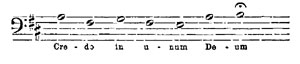
[Listen]
and all the grave monks round me began to recite
in loud and eager tones, I felt quite excited, for this
is the moment I still like the best of all. After
the ceremony, Santini made me a present of his
olive-branch, which I carried in my hand the whole
day when I was walking about, for the weather was
beautiful. The Stabat Mater which succeeds the
Credo, made much less effect; they sang it incorrectly
and out of tune, and likewise curtailed it
considerably. The 'Sing Akademie' executes it infinitely
better. There is nothing on Monday or
Tuesday; but on Wednesday, at half-past four, the
nocturns begin.
The Psalms are sung in alternate verses by two
choirs, though invariably by one class of voices,
basses or tenors. For an hour and a half, therefore,
nothing but the most monotonous music is heard;
the Psalms are only once interrupted by the Lamentations,
and this is the first moment when, after a
long time, a complete chord is given. This chord
is very softly intoned, and the whole piece sung
pianissimo, while the Psalms are shouted out as much
as possible, and always upon one note, and the words
uttered with the utmost rapidity, a cadence occurring
at the end of each verse, which defines the
different characteristics of the various melodies.
It is not therefore surprising that the mere soft
sound (in G major) of the first Lamentation, should
produce so touching an effect. Once more the
single tone recommences; a wax light is extinguished
at the end of each Psalm, so that in the
course of an hour and a half the fifteen lights round
the altar are all out; six large-sized candles still
burn in the vestibule. The whole strength of the
choir, with alti and soprani, etc., intone fortissimo
and unisono, a new melody, the "Canticum Zachariæ,"
in D minor, singing it slowly and solemnly in
the deepening gloom; the last remaining lights are
then extinguished. The Pope leaves his throne,
and falls on his knees before the altar, while all
around do the same, repeating a paternoster sub
silentio; that is, a pause ensues, during which you
know that each Catholic present says the Lord's
Prayer, and immediately afterwards the Miserere
begins pianissimo thus:—
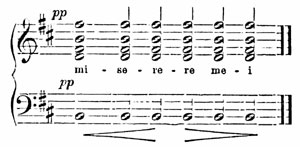
[Listen]
This is to me the most sublime moment of the
whole. You can easily picture to yourself what
follows, but not this commencement. The continuation,
which is the Miserere of Allegri, is a simple
sequence of chords, grounded either on tradition,
or what appears to me much more probable, merely
embellishments, introduced by some clever maestro
for the fine voices at his disposal, and especially for
a very high soprano. These embellimenti always
recur on the same chords, and as they are cleverly
constructed, and beautifully adapted for the voice,
it is invariably pleasing to hear them repeated. I
could not discover anything unearthly or mysterious
in the music; indeed, I am perfectly contented that
its beauty should be earthly and comprehensible.
I refer you, dearest Fanny, to my letter to Zelter.
On the first day they sang Baini's Miserere.
On Thursday, at nine o'clock in the morning, the
solemnities recommenced, and lasted till one o'clock.
There was High Mass, and afterwards a procession.
The Pope conferred his benediction from the Loggia
of the Quirinal, and washed the feet of thirteen
priests, who are supposed to represent the pilgrims,
and were seated in a row, wearing white gowns and
white caps, and who afterwards dine. The crowd
of English ladies was extraordinary, and the whole
affair repugnant to my feelings. The Psalms began
again in the afternoon, and lasted on this occasion
till half past seven. Some portions of the Miserere
were taken from Baini, but the greater part were
Allegri's. It was almost dark in the chapel when
the Miserere commenced. I clambered up a tall
ladder standing there by chance, and so I had the
whole chapel crowded with people, and the kneeling
Pope and his Cardinals, and the music, beneath me.
It had a splendid effect. On Friday forenoon the
chapel was stripped of every decoration, and the
Pope and Cardinals in mourning. The history of
the Passion, according to St. John, the music by
Vittoria, was sung; then the Improperia of Palestrina,
during which the Pope and all the others,
taking off their shoes, advance to the cross and
adore it. In the evening Baini's Miserere was
given, which they sang infinitely the best.
Early on Saturday, in the baptistery of the Lateran,
Heathens, Jews, and Mahomedans were baptized, all
represented by a little child, who screeched the whole
time, and subsequently some young priests received
consecration for the first time. On Sunday the Pope
himself performed High Mass in the Quirinal, and
subsequently pronounced his benediction on the
people, and then all was over. It is now Saturday,
the 9th of April, and to-morrow at an early hour I
get into a carriage and set off for Naples, where a
new style of beauty awaits me. You will perceive by
the end of this letter that I write in haste. This is
my last day, and a great deal yet to be done. I do
not therefore finish my letter to Zelter, but will send
it from Naples. I wish my description to be correct,
and my approaching journey distracts my attention
sadly. Thus I am off to Naples; the weather is clearing
up, and the sun shining, which it has not done for
some days past. My passport is prepared, the carriage
ordered, and I am looking forward to the months
of spring. Adieu!
Felix.
Dear Rebecca,
This must stand in lieu of a birthday letter: may
it wear a holiday aspect for you! It arrives late in
the day, but with equally sincere good wishes. Your
birthday itself I passed in a singular but delightful
manner, though I could not write, having neither
pens nor ink; in fact, I was in the very middle of the
Pontine Marshes. May the ensuing year bring you
every happiness, and may we meet somewhere! If
you were thinking of me on that day, our thoughts
must have met either on the Brenner or at Inspruck;
for I was constantly thinking of you. Even without
looking at the date of this letter, you will at once
perceive by its tone that I am in Naples. I have not
yet been able to compass one serious quiet reflection,
there is everywhere such jovial life here, inviting you
to do nothing, and to think of nothing, and even the
example of so many thousand people has an irresistible
influence. I do not indeed intend that this should
continue, but I see plainly that it must go on for the
first few days. I stand for hours on my balcony,
gazing at Vesuvius and the Bay.
But I must now endeavour to resume my old descriptive
style, or my materials will accumulate so
much that I shall become confused, and I fear you
may not be able to follow me properly. So much
that is novel crowds on me, that a journal would be
requisite to detail to you my life and my state of excitement.
So I begin by acknowledging that I deeply
regretted leaving Rome. My life there was so quiet,
and yet so full of interest, having made many kind
and friendly acquaintances, with whom I had become
so domesticated, that the last days of my stay, with
all their discomforts and perpetual running about,
seemed doubly odious. The last evening I went to
Vernet's to thank him for my portrait, which is now
finished, and to take leave of him. We had some
music, talked politics, and played chess, and then I
went down the Monte Pincio to my own house,
packed up my things, and the next morning drove
off with my travelling companions. As I gazed out
of the cabriolet at the scenery, I could dream to my
heart's desire. When we arrived at our night quarters,
we all went out walking. The two days glided
past more like a pleasure excursion than a journey.
The road from Rome to Naples is indeed the
most luxuriant that I know, and the whole mode of
travelling most agreeable. You fly through the
plain; for a very slight gratuity the postilions gallop
their horses like mad, which is very advisable in
the Marshes. If you wish to contemplate the
scenery, you have only to abstain from offering any
gratuity, and you are soon driven slowly enough.
The road from Albano, by Ariccia and Genzano, as
far as Velletri, runs between hills, and is shaded by
trees of every kind; uphill and downhill, through
avenues of elms, past monasteries and shrines. On
one side is the Campagna, with its heather, and its
bright hues; beyond comes the sea, glittering charmingly
in the sunshine, and above, the clearest sky;
for since Sunday morning the weather has been
glorious.
Well! we drove into Velletri, our night quarters,
where a great Church festival was going on. Handsome
women with primitive faces were pacing the
alleys in groups, and men were standing together
wrapped in cloaks, in the street. The church was
decorated with garlands of green leaves, and as we
drove past it we heard the sounds of a double
bass and some violins; fireworks were prepared in
the square; the sun went down clear and serene,
and the Pontine Marshes, with their thousand colours,
and the rocks rearing their heads one by one
against the horizon, indicated the course we were
to pursue on the following day. After supper I
resolved to go out again for a short time, and discovered
a kind of illumination; the streets were
swarming with people, and when I at last came to
the spot where the church stood, I saw, on turning
the corner, that the whole street had burning
torches on each side, and in the middle the people
were walking up and down, crowding together, and
pleased to see each other so distinctly at night. I
cannot tell you what a pretty sight it was. The
concourse was greatest before the church; I pressed
forward into it along with the rest. The little
building was filled with people kneeling, adoring
the Host, which was exposed; no one spoke a word,
nor was there any music. This stillness, the lighted
church, and the many kneeling women with white
handkerchiefs on their heads, and white gowns, had
a striking effect. When I left the church a shrewd,
handsome Italian boy explained the whole festival,
assuring me that it would have been far finer had
it not been for the recent disturbances, for they had
been the cause of depriving the people of the horseraces,
and barrels of pitch, etc., and on this account
it was unlucky that the Austrians had not come
sooner.
The following morning, at six o'clock, we pursued
our way through the Pontine Marshes. It is a species
of Bergstrasse. You drive through a straight
avenue of trees along a plain. On one side of the
avenue is a continued chain of hills, on the other
the Marshes. They are, however, covered with
innumerable flowers, which smell very sweet; but
in the long-run this becomes very stupefying, and I
distinctly felt the oppression of the atmosphere, in
spite of the fine weather. A canal runs along
beside the chaussée, constructed by the orders of
Pius VI. to form a conduit for the marshes, where
we saw a number of buffaloes wallowing, their heads
emerging out of the water, and apparently enjoying
themselves. The straight, level road has a singular
appearance. You see the chain of hills at the end
of the avenue when you come to the first station,
and again at the second and third, the only difference
being that as you advance so many miles
nearer, the hills loom gradually larger. Terracina,
which is situated exactly at the end of this avenue,
is invisible till you come quite close to it. On
making a sudden turn to the left, round the corner
of a rock, the whole expanse of the sea lies before
you. Citron-gardens, and palms, and a variety of
plants of Southern growth, clothe the declivity in
front of the town; towers appearing above the
thickets, and the harbour projecting into the sea.
To me, the finest object in nature is, and always will
be, the ocean. I love it almost more than the sky.
Nothing in Naples made a more enchanting impression
on my mind than the sea, and I always feel
happy when I see before me the spacious surface of
waters.
The South, properly speaking, begins at Terracina.
This is another land, and every plant and every
bush reminds you of it. Above all, the two mighty
ridges of hills delighted me, between which the road
runs; they were totally devoid of bushes or trees,
but clothed entirely with masses of golden wall-flowers,
so that they had a bright yellow hue, and
the fragrance was almost too strong. There is a
great want of grass and large trees. The old robbers'
nests of Fondi and Itri looked very piratical
and gloomy. The houses are built against the walls
of the rocks, and there are likewise some large towers
of the date of the Middle Ages. Many sentinels and
posts were stationed on the tops of the hills; but we
made out our journey without any adventure. We
remained all night in Mola di Gaeta; there we saw
the renowned balcony whence you look over orange
and citron groves to the blue sea, with Vesuvius and
the islands in the far distance. This was on the 11th
of April. As I had been celebrating your birthday
all day long in my own thoughts, I could not in the
evening resist informing my companions that it was
your birthday; so your health was drunk again and
again. An old Englishman, who was of the party,
wished me a "happy return to my sister." I emptied
the glass to your health, and thought of you. Remain
unchanged till we meet again.
With such thoughts in my head, I went in the
evening to the citron-garden, close to the sea-shore,
and listened to the waves rolling in from afar, and
breaking on the shore, and sometimes gently rippling
and splashing. It was indeed a heavenly night.
Among a thousand other thoughts, Grillparzer's
poem recurred to my memory, which it is almost impossible
to set to music; for which reason, I suppose,
Fanny has composed a charming melody on it; but I
do not jest when I say that I sang the song over repeatedly
to myself, for I was standing on the very
spot he describes. The sea had subsided, and was
now calm, and at rest; this was the first song. The
second followed next day, for the sea was like a
meadow or pure ether as you gazed at it, and pretty
women nodded their heads, and so did olives and
cypresses; but they were all equally brown, so I remained
in a poetic mood.
What is it that shines through the leaves, and
glitters like gold? Only cartridges and sabres; for
the King had been reviewing some troops in Sant'
Agata, and soldiers defiled on both sides of the
path, who had the more merit in my eyes because
they resembled the Prussians, and for a long time
past I have seen only Papal soldiers. Some carried
dark-lanterns on their muskets, as they had been
marching all night. The whole effect was bold and
gay. We now came to a short rocky pass, from
which you descend into the valley of Campana, the
most enchanting spot I have ever seen; it is like a
boundless garden, covered entirely with plants and
vegetation as far as the eye can reach. On one side
are the blue outlines of the sea, on the other an
undulating range of hills above which snowy peaks
project; and at a great distance Vesuvius and the
islands, bathed in blue vapours, start up on the level
surface; large avenues of trees intersect the vast
space, and a verdant growth forces its way from
under every stone. Everywhere you see grotesque
aloes and cactuses, and the fragrance and vegetation
are quite unparalleled.
The pleasure we enjoy in England through men,
we here enjoy through nature; and as there is no
corner there, however small, of which some one has
not taken possession in order to cultivate and adorn
it, so here there is no spot which Nature has not
appropriated, bringing forth on it flowers and herbs,
and all that is beautiful. The Campana valley is
fruitfulness itself. On the whole of the vast immeasurable
surface bounded in the far distance by
blue hills and a blue sea, nothing but green meets
the eye. At last you come to Capua. I cannot
blame Hannibal for remaining too long there.
From Capua to Naples the road runs uninterruptedly
between trees, with hanging vines, till at the end of
the avenue, Vesuvius, and the sea, with Capri, and
a mass of houses, lie before you. I am living here
in St. Lucia as if in heaven; for in the first place I
see before me Vesuvius, and the hills as far as Castellamare,
and the bay, and in the second place, I
am living up three stories high. Unfortunately that
traitor Vesuvius does not smoke at all, and looks
precisely like any other fine mountain; but at night
the people float in lighted boats on the Bay, to
catch sword-fish. This has a pretty enough effect.
Farewell!
Felix.
We are so accustomed to find that everything
turns out quite differently from what we expected
and calculated, that you will feel no surprise when
instead of a letter like a journal, you receive a very
short one, merely saying that I am quite well, and
little else.
As for the scenery, I cannot describe it, and if
you have no conception of what it really is, after all
that has been said and written on the subject, there
is little chance of my enlightening you; for what
makes it so indescribably beautiful, is precisely that
it is not of a nature to admit of description. Any
other detail I could send you would be about my
life here; but it is so simple, that a very few words
suffice to depict it. I do not wish to make any acquaintances,
for I am resolved not to remain here
longer than a few weeks. I intend to make various
excursions to see the country, and all I desire here,
is to become thoroughly intimate with nature: so I
go to bed at nine o'clock, and rise at five, to refresh
myself by gazing from my balcony at Vesuvius, the
sea, and the coast of Sorrento, in the bright morning
light. I have also taken very long solitary
rambles, discovering beautiful views for myself, and
I have infinite satisfaction in finding that what I
consider the loveliest spot of all is almost entirely
unknown to the Neapolitans. During these excursions
I sought out some house on a height, to which
I scrambled up; or else merely followed any path I
fancied, allowing myself to be surprised by night
and moonshine, and making acquaintance with vine-dressers,
in order to learn my way back; arriving
at last at home about nine o'clock, very tired,
through the Villa Reale. The view from this villa,
of the sea and the enchanting Capri by moonlight,
is truly charming, and so is the almost overpowering
fragrance of the acacias in full bloom, and the fruit-trees
scattered all over with rose-coloured blossoms,
looking like trees with pink foliage,—all this is
indeed quite indescribable.
As I live chiefly with and in nature, I can write
less than usual; perhaps we may talk it over when
we meet, and the sketches in our sitting-room at
home will furnish materials and reminiscences for
conversation. One thing I must not however omit,
dear Fanny, which is, that I quite approve of your
taste when I recall what you told me years ago that
your favorite spot was the island of Nisida. Perhaps
you may have forgotten this, but I have not.
It looks as if it were made expressly for pleasure-grounds.
On emerging from the thicket of Bagnuolo,
Nisida has quite a startling effect, rising out of the
sea, so near, so large and so green; while the other
islands, Procida, Ischia, and Capri, stand afar off,
and indistinct in their blue tints. After the murder
of Cæsar, Brutus took refuge in this island, and
Cicero visited him there; the sea lay between them
then, and the rocks, covered with vegetation, bent
over the sea, just as they do now. These are the
antiquities that interest me, and are infinitely more
suggestive than crumbling mason-work. There is a
degree of innate superstition and dishonesty among
the people here that is totally inconceivable, and
this has often even marred my pleasure in nature;
for the Swiss, of whom my father complained so
much, are positively guileless, primitive beings,
compared with the Neapolitans. My landlord invariably
gives me too little change for a piastre,
and when I tell him of it, he coolly fetches the remainder.
The only acquaintances I intend to make
here are musical ones, that I may leave nothing
incomplete,—for instance Fodor, who does not sing
in public, Donizetti, Coccia, etc.
I now conclude by a few words to you, dear
Father. You write to me that you disapprove of
my going to Sicily; I have consequently given up
this plan, though I cannot deny that I do so with
great reluctance, for it was really more than a mere
whim on my part. There is no danger to be apprehended,
and, as if on purpose to vex me, a steamer
leaves this city on the 4th of May, which is to make
the entire tour; and a good many Germans, and probably
the minister here, are to take advantage of it.
I should have liked to see a mountain vomiting forth
flames, as Vesuvius has been hitherto so unkind as
not even to smoke. Your instructions however
have till now so entirely coincided with my own inclinations,
that I cannot allow the first opportunity
I have of showing my obedience to your wishes
(even when opposed to my own), to pass without
complying with them, so I have effaced Sicily from
my travelling route. Perhaps we may meet sooner
in consequence of this; and now farewell, for I am
going to walk to Capo di Monte.
Felix.
It is now nearly a fortnight since I have heard
from you. I do earnestly hope that nothing unpleasant
has occurred, and every day I expect the
post will bring me tidings of you all. My letters
from Naples are of little value, for I am too deeply
absorbed here to be able easily to extricate myself,
and to write descriptive letters. Besides, when we
had bad weather lately, I took advantage of it to
resume my labours, and zealously applied myself to
my "Walpurgis Night," which daily increases in
interest for me, so I employ every spare moment in
completing it. I hope to finish it in a few days, and
I think it will turn out well. If I continue in my
present mood, I shall finish my Italian symphony
also in Italy, in which case I shall have a famous
store to bring home with me, the fruits of this winter.
Moreover every day I have something new to
see. I generally make my excursions with the
Schadows.
Yesterday we went to Pompeii. It looks as if it
had been burnt down, or like a recently deserted
city. As both of these always seem to me deeply
affecting, the impression made on me was the most
melancholy that I have yet experienced in Italy.
It is as if the inhabitants had just gone out, and yet
almost every object tells of another religion and
another life; in short, of seventeen hundred years
ago; and the French and English ladies scramble
about as gaily as possible, and sketch it all. It is
the old tragedy of the Past and the Present, a
problem I never can solve. Lively Naples is indeed
a pleasant contrast; but it is painful to see the
crowd of wretched beggars who waylay you in every
street and path, swarming round the carriage the
instant it stops. The old white-haired men particularly
distress me, and such a mass of misery exceeds
all belief. If you are walking on the sea-shore, and
gazing at the islands, and then chance to look round
at the land, you find yourself the centre of a group
of cripples, who make a trade of their infirmities;
or you discover (which lately happened to me) that
you are surrounded by thirty or forty children, all
whining out their favourite phrase, "Muoio di fame,"
and rattling their jaws to show that they have nothing
to eat. All this forms a most repulsive contrast;
and yet to me it is still more repugnant that you
must entirely renounce the great pleasure of seeing
happy faces; for even when you have given the
richest gratuities to guards, waiters, or workpeople,
in short, to whom you will, the invariable rejoinder
is, "Nienti di più?" in which case you may be very
sure that you have given too much. If it is the
proper sum, they give it back with the greatest
apparent indignation, and then return and beg to
have it again. These are trifles, certainly, but they
show the lamentable condition of the people. I
have even gone so far as to feel provoked with the
perpetual smiling aspect of nature, when in the
most retired spots troops of beggars everywhere
assailed me, some even persisting in following me a
long way. It is only when I am quietly seated in
my own room, gazing down on the Bay, and on
Vesuvius, that being totally alone with them I feel
really cheerful and happy.
To-day we are to ascend the hill to visit the
Camaldoli Monastery, and to-morrow, if the weather
permits, we proceed to Procida and Ischia. I go
this evening to Madame Fodor's with Donizetti,
Benedict, etc. She is very kind and amiable towards
me, and her singing has given me great pleasure,
for she has wonderful facility, and executes her
fiorituri with so much taste, that it is easy to see
how many things Sonntag acquired from her, especially
the mezza voce, which Fodor, whose voice
is no longer full and fresh, most prudently and
judiciously introduces into many passages. As she
is not singing at the theatre, I am most fortunate in
having made her acquaintance personally. The
theatre is now closed for some weeks, because the
blood of St. Januarius is shortly to liquefy. What
I heard at the opera previously did not repay the
trouble of going. The orchestra, like that in Rome,
was worse than in any part of Germany, and not
even one tolerable female singer. Tamburini alone,
with his vigorous bass voice, imparted some life to
the whole. Those who wish to hear Italian operas,
must now-a-days go to Paris or London. Heaven
grant that this may not eventually be the case with
German music also!
I must however return to my "Witches," so you
must forgive my not writing any more to-day. This
whole letter seems to hover in uncertainty, or rather
I do so in my "Walpurgis Night," whether I am to
introduce the big drum or not. "Zacken, Gabeln,
und wilde Klapperstöcke," seem to force me to the
big drum, but moderation dissuades me. I certainly
am the only person who ever composed for the scene
on the Brocken without employing a piccolo-flute,
but I can't help regretting the big drum, and before
I can receive Fanny's advice, the "Walpurgis
Night" will be finished and packed up. I shall
then set off again on my travels, and Heaven knows
what I may have in my head by that time. I feel
convinced that Fanny would say yes; still, I feel
very doubtful; at all events a vast noise is indispensable.
Oh, Rebecca! can you not procure the words of
some songs, and send them to me? I feel quite in
the humour for them, and you must require something
new to sing. If you can furnish me with some
pretty verses, old or new, gay or grave, I will compose
something in a style to suit your voice. I am
at your service for any compact of this kind. Pray
do send me wherewithal to work at, during my journey,
in the inns. Now, farewell to you all! May
you be as happy as I ever wish you to be, and think
of me!
Felix.
On Saturday, the 14th of May, at two o'clock, I
told my driver to turn the carriage. We were opposite
the Temple of Ceres at Pæstum, the most
southern point of my journey. The carriage consequently
turned towards the north, and from that
moment, as I journey onwards, I am every hour
drawing nearer to you. It is about a year now since
I travelled with my father to Dessau and Leipzig;
the time in fact exactly corresponds, for it was
about the half-year. I have made good use of the
past year. I have acquired considerable experience
and many new impressions. Both in Rome and here
I have been very busy, but no change has occurred
in my outward circumstances; and till the beginning
of the new year, in fact so long as I am in
Italy, it will probably be the same. This period
has not however been less valuable to me than some
when outwardly, and in the opinion of others, I have
appeared to make greater progress; for there must
always be a close connection between the two. If
I have gathered experience, it cannot fail to influence
me outwardly, and I shall allow no opportunity
to escape to show that it has done so. Possibly
some such may occur before the end of my journey,
so I may for the present continue to enjoy nature,
and the blue sky, during the months that still remain
for me in Italy, without thinking of anything
else; for there alone lies true art, now in Italy,—there
and in her monuments; and there it will ever
remain; and there we shall ever find it, for our instruction
and delight, so long as Vesuvius stands,
and so long as the balmy air, and the sea, and the
trees do not pass away.
In spite of all this, I am enough of a musician to
own that I do heartily long once more to hear an
orchestra or a full chorus where there is at least
some sound, for here there is nothing of the sort.
This is our peculiar province, and to be so long
deprived of such an element, leaves a sad void.
The orchestra and chorus here are like those in our
second-rate provincial towns, only more harsh and
incorrect. The first violinist, all through the opera,
beats the four quarters of each bar on a tin candle-stick,
which is often more distinctly heard than the
voices (it sounds somewhat like obbligati castanets,
only louder); and yet in spite of this the voices are
never together. Every little instrumental solo is
adorned with old-fashioned flourishes, and a bad
tone pervades the whole performance, which is
totally devoid of genius, fire, or spirit. The singers
are the worst Italian ones I ever heard anywhere
(except, indeed, in Italy), and those who wish to
have a true idea of Italian singing must go to Paris
or to London. Even the Dresden company, whom I
heard last year in Leipzig, are superior to any here.
This is but natural, for in the boundless misery that
prevails in Naples, where can the bases of a theatre
be found, which of course requires considerable
capital? The days when every Italian was a born
musician, if indeed they ever existed, are long gone
by. They treat music like any other fashionable
article, with total indifference; in fact, they scarcely
pay it the homage of outward respect, so it is not
to be wondered at that every single person of talent
should, as regularly as they appear, transfer themselves
to foreign countries, where they are better
appreciated, their position better defined, and where
they find opportunities of hearing and learning
something profitable and inspiriting.
The only really good singer here is Tamburini;
he has, however, long since been heard in Vienna
and Paris, and I believe in London also; so now,
when he begins to discover that his voice is on the
decline, he comes back to Italy. I cannot admit
either that the Italians alone understand the art of
singing; for there is no music, however florid. I
have ever heard executed by Italians, that Sonntag
cannot accomplish, and in even greater perfection.
She certainly, as she acknowledges, learned much
from Fodor; but why should not another German
in turn learn the same from Sonntag? and Malibran
is a Spaniard. Italy can no longer claim the glorious
appellation of "the land of music;" in truth,
she has already lost it, and possibly she may yet do
so even in the opinion of the world, though this
is problematical. I was lately in company with
some professional musicians, who were speaking of
a new opera by a Neapolitan, Coccia; and one of
them asked if it was clever. "Probably it is," said
another, "for Coccia was long in England, where he
studied, and some of his compositions are much
liked there." This struck me as very remarkable, for
in England they would have spoken exactly in the
same way of Italy; but quo me rapis? I say
nothing to you, dear sisters, in this letter, but in the
course of a few days I mean to send you a little
pamphlet dedicated to you. Do not be alarmed, it
is not poetry; the thing is simply entitled "Journal
of an Excursion to the Islands, in May."
Felix.
My dear Sisters,
As my journal is become too stupid and uninteresting
to send you, I must at least supply you with
an abrégé of my history. You must know, then,
that on Friday, the 20th of May, we breakfasted in
corpore at Naples, on fruit, etc.; this in corpore includes
the travelling party to Ischia, consisting of
Ed. Bendemann, T. Hildebrand, Carl Sohn, and
Felix Mendelssohn Bartholdy. My knapsack was
not very heavy, for it contained scarcely anything
but Goethe's poems, and three shirts; so we packed
ourselves into a hired carriage, and drove through
the grotto of Posilippo to Pozzuoli. The road runs
along by the sea, and nothing can be more lovely; so
it is all the more painful to witness the horrible collection
of cripples, blind men, beggars, and galley
slaves, in short, the poor wretches of every description
who there await you, amid the holiday aspect
of nature.
I seated myself quietly on the mole and sketched,
while the others plodded and toiled through the
Temple of Serapis, the theatres, the hot springs,
and extinct volcanoes, which I had already seen to
satiety on three different occasions. Then, like youthful
patriarchs or nomads, we collected all our goods
and chattels, cloaks, knapsacks, books and portfolios
on donkeys, and placing ourselves also on them, we
made the tour of the Bay of Baiæ, as far as the
Lake of Avernus, where you are obliged to buy fish
for dinner; we crossed the hill to Cumæ (vide
Goethe's 'Wanderer') and descended on Baiæ,
where we ate and rested. We then looked at more
ruined temples, ancient baths, and other things of
the kind, and thus evening had arrived before we
crossed the bay.
At half-past nine we arrived at the little town of
Ischia, where we found every corner of the only inn
fully occupied, so we resolved to go on to Don Tommaso's;
a journey of two hours nominally, but which
we performed in an hour and a quarter. The evening
was deliciously cool, and innumerable glow-worms,
who allowed us to catch them, were scattered on the
vine-branches, and fig-trees, and shrubs. When we
at last arrived, somewhat fatigued, at Don Tommaso's
house, about eleven o'clock, we found all the
people still up, clean rooms, fresh fruits, and a friendly
deacon to wait on us, so we remained comfortably
seated opposite a heap of cherries till midnight. The
next morning the weather was bad, and the rain incessant,
so we could not ascend the Epomeo, and as we
seemed little disposed to converse (we did not get on in
this respect, Heaven knows why!) the affair would
have become rather a bore, if Don Tommaso had not
possessed the prettiest poultry-yard and farm in
Europe. Right in front of the door stands a large
leafy orange-tree covered with ripe fruit, and from
under its branches a stair leads to the dwelling. Each
of the white stone steps is decorated with a large vase
of flowers, these steps leading to a spacious open hall,
whence through an archway you look down on the
whole farm-yard, with its orange-trees, stairs, thatched
roofs, wine casks and pitchers, donkeys and peacocks.
That a foreground may not be wanting, an Indian fig-tree
stands under the walled arch, so luxuriant that
it is fastened to the wall with ropes. The background
is formed by vineyards with summer-houses,
and the adjacent heights of the Monte Epomeo.
Being protected from the rain by the archway, the
party seated themselves there under shelter, and
sketched the various objects in the farm the best
way they could, the whole livelong day. I was on
no ceremony, and sketched along with them, and I
think I in some degree profited by so doing. At
night we had a terrific storm, and as I was lying in
bed, I remarked that the thunder growled tremendously
on Monte Epomeo, and the echoes continued
to vibrate like those on the Lake of Lucerne, but
even for a greater length of time.
Next morning, Sunday, the weather was again fine.
We went to Foria, and saw the people going to the
cathedral in their holiday costumes. The women
wore their well-known head-dress of folds of white
muslin placed flat on the head; the men were standing
in the square before the church, in their bright
red caps, gossiping about politics, and we gradually
wound our way through these festal villages up the
hill. It is a huge rugged volcano, full of fissures,
ravines, cavities, and steep precipices. The cavities
being used for wine cellars, they are filled with large
casks. Every declivity is clothed with vines and
fig-trees, or mulberry-trees. Corn grows on the sides
of the steep rocks, and yields more than one crop
every year. The ravines are covered with ivy, and
innumerable bright-coloured flowers and herbs, and
wherever there is a vacant space, young chestnut-trees
shoot up, furnishing the most delightful shade.
The last village, Fontana, lies in the midst of verdure
and vegetation. As we climbed higher, the
sky became overcast and gloomy, and by the time
we reached the most elevated peaks of the rocks, a
thick fog had come on. The vapours flitted about,
and although the rugged outlines of the rocks, and
the telegraph, and the cross, stood forth strangely in
the clouds, still we could not see even the smallest
portion of the view. Soon afterwards rain commenced,
and as it was impossible to remain, and
wait as you do on the Righi, we were obliged to take
leave of Epomeo without having made his acquaintance.
We ran down in the rain, one rushing after
the other, and I do believe that we were scarcely an
hour in returning.
Next day we went to Capri. This place has
something Eastern in its aspect, with the glowing
heat reflected from its rocky white walls, its palm-trees,
and the rounded domes of the churches that
look like mosques. The sirocco was burning, and
rendered me quite unfit to enjoy anything; for
really climbing up five hundred and thirty-seven
steps to Anacapri in this frightful heat, and then
coming down again, is toil only fit for a horse.
True, the sea is wondrously lovely, looking down
on it from the summit of the bleak rock, and
through the singular fissures of the jagged peaks,
so strangely formed.
But above all, I must tell you of the blue grotto,
for it is not known to every one, as you can only
enter it either in very calm weather, or by swimming.
The rocks there project precipitously into the sea,
and are probably as steep under the water as above
it. A huge cavity has been hollowed out by nature,
but in such a manner, that round the whole circumference
of the grotto, the rocks rest on the sea in
all their breadth, or rather are sunk precipitously
into it, and ascend thence to the vault of the cavern.
The sea fills the whole space of the grotto,
the entrance to which lies under the water, only a
very small portion of the opening projecting above
the water, and through this narrow space you can
only pass in a small boat, in which you must lie
flat. When you are once in, the whole extent of
the huge cave and its vault is revealed, and you can
row about in it with perfect ease, as if under a dome.
The light of the sun also pierces through the opening
into the grotto underneath the sea, but broken
and dimmed by the green sea water, and thence it
is that such magical visions arise. The whole of
the rocks are sky-blue and green in the twilight,
resembling the hue of moonshine, yet every nook,
and every depth, is distinctly visible. The water is
thoroughly lighted up and brilliantly illuminated
by the light of the sun, so that the dark skiff glides
over a bright shining surface. The colour is the
most dazzling blue I ever saw, without shadow or
cloud, like a pane of opal glass; and as the sun
shines down, you can plainly discern all that is
going on under the water, while the whole depths of
the sea with its living creatures are disclosed. You
can see the coral insects and polypuses clinging to
the rocks, and far below, fishes of different species
meeting and swimming past each other. The rocks
become deeper in colour as they go lower into the
water, and are quite black at the end of the grotto,
where they are closely crowded together, and still
further under them, you can see crabs, fishes, and
reptiles in the clear waters. Every stroke too of
the oars echoes strangely under the vault, and as
you row round the wall, new objects come to light.
I do wish you could see it, for the effect is singularly
magical. On turning towards the opening by
which you entered, the daylight seen through it
seems bright orange, and by moving even a few
paces you are entirely isolated under the rock in
the sea, with its own peculiar sunlight: it is as if
you were actually living under the water for a time.
We then proceeded to Procida, where the women
adopt the Greek dress, but do not look at all
prettier from doing so. Curious faces were peeping
from every window. A couple of Jesuits, in black
gowns and with gloomy countenances, were seated
in a gay arbour of vines, evidently enjoying themselves,
and made a good picture. Then we crossed
the sea to Pozzuoli, and through the grotto of
Posilippo again home.
I cannot write to Paul about his change of residence,
and his entrance into the great, wide world
of London, because he mentions casually, that he
will probably leave for London in the course of
three weeks, so my letter could not possibly reach
him in Berlin; a week hence I shall take my chance,
and address to my brother in London. That smoky
place is fated to be now and ever my favourite residence;
my heart glows when I even think of it,
and I paint to myself my return there, passing
through Paris, and finding Paul independent, alone,
and another man, in the dear old haunts; when he
will present me to his new friends, and I will present
him to my old ones, and we shall live and dwell
together: so even at this moment I am all impatience
soon to go there. I see by some newspapers
my friends have sent me, that my name is not forgotten,
and so I hope when I return to London, to
be able to work steadily, which I was previously
unable to do, being forced to go to Italy. If they
make any difficulty in Munich about my opera, or if
I cannot get a libretto that I like, I intend in that
case to compose an opera for London. I know that
I could receive a commission to do so, as soon as I
chose. I am also bringing some new pieces with
me for the Philharmonic, and so I shall have made
good use of my time.
As my evenings here are at my own disposal, I
read a little French and English. The "Barricades"
and "Les États de Blois" particularly interest me,
as while I read them I realize with horror a period
which we have often heard extolled as a vigorous
epoch, too soon passed away. Though these books
seem to me to have many faults, yet the delineation
of the two opposite leaders is but too correct; both
were weak, irresolute, miserable hypocrites, and I
thank God that the so highly-prized middle ages
are gone never to return. Say nothing of this to
any disciple of Hegel's, but it is so nevertheless;
and the more I read and think on the subject, the
more I feel this to be true. Sterne has become a
great favourite of mine. I remembered that Goethe
once spoke to me of the 'Sentimental Journey,'
and said that it was impossible for any one better
to paint what a froward and perverse thing is the
human heart. I chanced to meet with the book,
and thought I should like to read it. It pleases me
very much. I think it very subtle, and beautifully
conceived and expressed.
There are very few German books to be had here.
I am therefore restricted to Goethe's Poems, and
assuredly these are suggestive enough, and always
new. I feel especial interest in those poems which
he evidently composed in or near Naples, such as
Alexis and Dora; for I daily see from my window
how this wonderful work was created. Indeed,
which is often the case with master-pieces, I often
suddenly and involuntarily think, that the very same
ideas might have occurred to myself on a similar
occasion, and as if Goethe had only by some chance
been the first to express them.
With regard to the poem, "Gott segne dich, junge
Frau," I maintain that I have discovered its locality
and dined with the woman herself; but of course she
is now grown old, and the boy she was then nursing
is become a stalwart vine-dresser. Her house lies
between Pozzuoli and Baiæ, "eines Tempels Trümmern,"
and is fully three miles from Cumæ. You
may imagine therefore with what new light and
truth these poems dawn on me, and the different
feeling with which I now regard and study them.
I say nothing of Mignon's song at present, but it is
singular that Goethe and Thorwaldsen are still
living, that Beethoven only died a few years ago,
and yet H—— declares that German art is as dead
as a rat. Quod non. So much the worse for him
if he really feels thus; but when I reflect for a time
on his conclusions, they appear to me very shallow.
Apropos, Schadow, who returns to Düsseldorf in
the course of a few days, has promised to extract,
if possible, some new songs for me from Immermann,
which rejoices me much. That man is a true poet,
which is proved by his letters, and everything that
he has written. Count Platen is a little, shrivelled,
wheezing old man, with gold spectacles, yet not
more than five-and-thirty! He quite startled me.
The Greeks look very different! He abuses the
Germans terribly, forgetting however that he does
so in German. But farewell for to-day.
Felix.
My dear Parents,
It is indeed high time that I should write to you
a rational, methodical letter, for I fear that none of
those from Naples were worth much. It really
seemed as if the atmosphere there deterred every
one from serious reflection, at least I very seldom
succeeded in collecting my thoughts or ideas; and
now I have been scarcely more than a few hours
here, when I once more resume that Roman tranquillity,
and grave serenity, which I alluded to in my
former letters from this place. I cannot express
how infinitely better I love Rome than Naples.
People allege that Rome is monotonous, of one
uniform hue, melancholy, and solitary. It is certainly
true that Naples is more like a great European
city, more lively and varied, and more cosmopolitan;
but I may say to you confidentially, that I begin
gradually to feel the most decided hatred of all that
is cosmopolitan;—I dislike it, just as I dislike
many-sidedness, which, moreover, I rather think I
do not much believe in. Anything that aspires to
be distinguished, or beautiful, or really great, must
be one-sided; but then this one side must be brought
to a state of the most consummate perfection, and
no man can deny that such is the case at Rome.
Naples seems to me too small to be called properly
a great city; all the life and bustle are confined
to two large thoroughfares—the Toledo, and the
coast from the harbour to the Chiaja. Naples does
not realize to my mind the idea of a centre for a
great nation, which London offers in such perfection;
chiefly indeed because it is deficient in a
people: for the fishermen and lazzaroni I cannot
designate as a people, they are more like savages,
and their centre is not Naples, but the sea. The
middle classes, by which I mean those who pursue
various trades, and the working citizens who form
the basis of other great towns, are quite subordinate;
indeed, I may almost say that such a class is
not to be found there. It was this that often made
me feel out of humour during my stay in Naples,
much as I loved and enjoyed the scenery; but as a
dissatisfied feeling constantly recurred, I think I
at last discovered the cause to lie within myself. I
cannot say that I was precisely unwell during the
incessant sirocco, but it was more disagreeable than
an indisposition which passes away in a few days. I
felt languid, disinclined for all that was serious,—in
fact, lazy. I lounged about the streets all day with
a morose face, and would have preferred lying on
the ground, without the trouble of thinking, or wishing,
or doing anything; then it suddenly occurred to
me, that the principal classes in Naples live in reality
precisely in the same manner; that consequently
the source of my depression did not spring from
myself, as I had feared, but from the whole combination
of air, climate, etc. The atmosphere is suitable
for grandees who rise late, never require to go out on
foot, never think (for this is heating), sleep away a
couple of hours on a sofa in the afternoon, then eat
ice, and drive to the theatre at night, where again
they do not find anything to think about, but
simply make and receive visits. On the other
hand, the climate is equally suitable for a fellow in
a shirt, with naked legs and arms, who also has no
occasion to move about—begging for a few grani
when he has literally nothing left to live on—taking
his afternoon's siesta stretched on the ground, or
on the quay, or on the stone pavement (the pedestrians
step over him, or shove him aside if he lies
right in the middle). He fetches his frutti di mare
himself out of the sea, sleeps wherever he may
chance to find himself at night; in short, he employs
every moment in doing exactly what he likes best,
just as an animal does.
These are the two principal classes of Naples.
By far the largest portion of the population of the
Toledo there, consists of gaily dressed ladies and
gentlemen, or husbands and wives driving together
in handsome equipages, or of those olive sans-culottes
who sometimes carry about fish for sale, brawling in
the most stentorian way, or bearing burdens when
they have no longer any money left. I believe there
are few indeed who have any settled occupation, or
follow up any pursuit with zeal and perseverance,
or who like work for the sake of working. Goethe
says that the misfortune of the North is, that people
there always wish to be doing something, and striving
after some end; and he goes on to say, that an
Italian was right, who advised him not to think so
much, for it would only give him a headache. I
suspect however that he was merely jesting; at all
events, he did not act in this manner himself, but, on
the contrary, like a genuine Northman. If however
he means that the difference of character is produced
by nature, and subservient to her influence, then
there is no doubt that he is quite in the right. I can
perfectly conceive that it must be so, and why wolves
howl; still it is not necessary to howl along with them.
The proverb should be exactly reversed. Those
who, owing to their position, are obliged to work,
and must consequently both think and bestir themselves,
treat the matter as a necessary evil, which
brings them in money, and when they actually have
it, they too live like the great, or the naked, gentlemen.
Thus there is no shop where you are not
cheated. Natives of Naples, who have been customers
for many years, are obliged to bargain, and to
be as much on their guard as foreigners; and one of
my acquaintances, who had dealt at the same shop
for fifteen years, told me that during the whole
of that period there had been invariably the same
battle about a few scudi, and that nothing could
prevent it.
Thence it is that there is so little industry or competition,
and that Donizetti finishes an opera in ten
days; to be sure, it is sometimes hissed, but that
does not matter, for it is paid for all the same, and
he can then go about amusing himself. If at last
however his reputation becomes endangered, he will
in that case be forced really to work, which he would
find by no means agreeable. This is why he sometimes
writes an opera in three weeks, bestowing
considerable pains on a couple of airs in it, so that
they may please the public, and then he can afford
once more to divert himself, and once more to write
trash. Their painters, in the same way, paint the
most incredibly bad pictures, far inferior even to
their music. Their architects also erect buildings
in the worst taste; among others, an imitation, on a
small scale, of St. Peter's, in the Chinese style.
But what does it matter? the pictures are bright in
colour, the music makes plenty of noise, the buildings
give plenty of shade, and the Neapolitan grandees
ask no more.
My physical mood was similar to theirs, everything
inspiring me with a wish to be idle, and to
lounge about, and sleep; yet I was constantly saying
to myself that this was wrong; and striving to
occupy myself, and to work, which I could not
accomplish. Hence arose the querulous tone of
some of the letters I wrote to you, and I could only
escape from such a mood by rambling over the hills,
where nature is so divine, making every man feel
grateful and cheerful. I did not neglect the musicians,
and we had a great deal of music, but I cared
little in reality for their flattering encomiums.
Fodor is hitherto the only genuine artist, male or
female, that I have seen in Italy; elsewhere I should
probably have found a great many faults with her
singing, but I overlooked them all, because when
she sings it is real music, and after such a long privation,
that was most acceptable.
Now however I am once more in old Rome, where
life is very different. There are processions daily, for
last week was the Corpus Domini; and just as I left
the city during the celebration of the week following
the Holy Week, I now return after the Corpus
Christi to find them engaged in the same way. It
made a singular impression on me to see that the
streets had in the interim assumed such an aspect
of summer: on all sides booths with lemons and
iced water, the people in light dresses, the windows
open, and the jalousies closed. You sit at the
doors of coffee-houses, and eat gelato in quantities;
the Corso swarms with equipages, for people
no longer walk much, and though in reality I miss
no dear friends or relatives, yet I felt quite moved
when I once more saw the Piazza di Spagna, and
the familiar names written up on the corners of the
streets. I shall stay here for about a week, and then
proceed northwards.
The Infiorata is on Thursday, but it is not yet
quite certain that it will take place, because they
have some apprehensions of a revolution; but I
hope I shall witness this ceremony. I mean to take
advantage of this opportunity to see the hills once
more, and then to set off for the north. Wish me
a good journey, for I am on the eve of departure.
It is a year this very day since I arrived in Munich,
heard 'Fidelio,' and wrote to you. We have not
met since then; but, please God, we shall see each
other again before another year.
Felix.
Dear Professor,
It was my intention some time ago to have written
you a description of the music during the Holy
Week, but my journey to Naples intervened, and
during my stay there, I was so constantly occupied
in wandering among the mountains, and in gazing
at the sea, that I had not a moment's leisure to
write; hence arose the delay for which I now beg to
apologize. Since then I have not heard a single
note worth remembering; in Naples the music is
most inferior. During the last two months, therefore,
I have no musical reminiscences to send you,
save those of the Holy Week, which however made
so indelible an impression on my mind, that they
will be always fresh in my memory. I already described
to my parents the effect of the whole ceremonies,
and they probably sent you the letter.
It was fortunate that I resolved to listen to the
various Offices with earnest and close attention, and
still more so, that from the very first moment I felt
sensations of reverence and piety. I consider such
a mood indispensable for the reception of new ideas,
and no portion of the general effect escaped me,
although I took care to watch each separate detail.
The ceremonies commenced on Wednesday, at half
past four o'clock, with the antiphon "Zelus domus
tuæ." A little book containing the Offices for the
Holy Week explains the sense of the various solemnities.
"Each Nocturn contains three Psalms,
signifying that Christ died for all, and also symbolical
of the three laws, the natural, the written,
and the evangelical. The 'Domine labia mea' and
the 'Deus in adjutorium' were not sung on this
occasion, when the death of our Saviour and Master
is deplored, as slain by the hands of wicked
godless men. The fifteen lights represent the
twelve apostles and the three Marys." (In this
manner the book contains much curious information
on this subject, so I mean to bring it with me for you.)
The Psalms are chanted fortissimo by all the male
voices of two choirs. Each verse is divided into
two parts, like a question and answer, or rather,
classified into A and B; the first chorus sings A,
and the second replies with B. All the words, with
the exception of the last, are sung with extreme rapidity
on one note, but on the last they make a short
"melisma," which is different in the first and second
verse. The whole Psalm, with all its verses, is sung
on this melody, or tono as they call it, and I wrote
down seven of these toni, which were employed
during the three days. You cannot conceive how
tiresome and monotonous the effect is, and how
harshly and mechanically they chant through the
Psalms. The first tonus which they sang was—

[Listen]
[Listen]
Thus the whole forty-two verses of the Psalm are
sung in precisely the same manner; one half of the
verse ending in G, A, G, the other in G, E, G.
They sing with the accent of a number of men
quarrelling violently, and it sounds as if they were
shouting out furiously one against another. The
closing words of each Psalm are chanted more
slowly and impressively, a long "triad" being substituted
for the "melisma," sung piano. For instance,
this is the first:—
[Listen]
An antiphon, and sometimes more than one,
serves as an introduction to each Psalm. These
are generally sung by two counter-tenor voices, in
canto fermo, in harsh, hard tones; the first half of
each verse in the same style, and the second responded
to by the chorus of male voices that I already
described. I have kept the several antiphons that
I wrote down, that you may compare them with the
book. On the afternoon of Wednesday, the 68th,
69th, and 70th Psalms were sung. (By the bye,
this division of the verses of the Psalms sung in
turns by each chorus, is one of the innovations that
Bunsen has introduced into the Evangelical Church
here; he also ushers in each choral by an antiphon,
composed by Georg, a musician who resides here,
in the style of canti fermi, first sung by a few
voices, succeeded by a choral, such as "Ein' feste
Burg ist unser Gott.") After the 70th Psalm
comes a paternoster sub silentio—that is, all present
stand up, and a short silent inward prayer ensues,
and a pause.
Then commences the first Lamentation of Jeremiah,
sung in a low subdued tone, in the key of G
major, a solemn and fine composition of Palestrina's.
The solos are chanted entirely by high tenor voices,
swelling and subsiding alternately, in the most delicate
gradations, sometimes floating almost inaudibly,
and gently blending the various harmonies;
being sung without any bass voices, and immediately
succeeding the previous harsh intonation of the
Psalms, the effect is truly heavenly. It is rather
unfortunate however that those very parts which
ought to be sung with the deepest emotion and
reverence, being evidently those composed with
peculiar fervour, should chance to be merely the
titles of the chapter or verse, aleph, beth, gimel, etc.,
and that the beautiful commencement, which sounds
as if it came direct from Heaven, should be precisely
on these words, "Incipit Lamentatio Jeremiæ Prophetæ
Lectio I." This must be not a little repulsive
to every Protestant heart, and if there be any
design to introduce a similar mode of chanting into
our churches, it appears to me that this will always
be a stumbling-block; for any one who sings
"chapter first" cannot possibly feel any pious emotions,
however beautiful the music may be, let him
strive as he will.
My little book indeed says, "Vedendo profetizzato
il crocifiggimento con gran pietà, si cantano eziandio
molto lamentevolmente aleph, e le altre simili
parole, che sono le lettere dell' alfabeto Ebreo,
perchè erano in costume di porsi in ogni canzone in
luogo di lamento, come è questa. Ciascuna lettera
ha in se, tutto it sentimento di quel versetto che la
segue, ed è come un argomento di esso;" but this
explanation is not worth much. After this the 71st,
72nd, and 73rd Psalms are sung in the same manner,
with their antiphons. These are apportioned
to the various voices. The soprano begins, "In
monte Oliveti," on which the bass voices chime in
forte, "Oravit ad Patrem: Pater," etc. Then follow
the lessons, from the treatise of Saint Augustine on
the Psalms. The strange mode in which these are
chanted appeared to me very extraordinary when I
heard them for the first time on Palm Sunday, without
knowing what it meant. A solitary voice is
heard reciting on one note, not as in the Psalms,
but very slowly and impressively, making the tone
ring out clearly.
There are different cadences employed for the
different punctuation of the words, to represent a
comma, interrogation, and full stop. Perhaps you
are already acquainted with these: to me they were
a novelty, and appeared very singular. The first,
for example, was chanted by a powerful bass voice
in G. If a comma occurs, he sings so, on the last
word:—
[Listen]
an interrogation thus:—
[Listen]
a full stop:—
[Listen]
For example:—
[Listen]
I cannot describe to you how strange the falling
cadence from A to C sounds; especially when the
bass is followed by a soprano, who begins on D, and
makes the same falling cadence from E to G; then
an alto does the same in his key; for they sang
three different lessons alternately with the canto
fermo. I send you a specimen of the mode in which
they render the canto fermo, regardless both of the
words and the sense. The phrase "better he had
never been born" was thus sung:—
[Listen]
quite fortissimo and monotonously. Then came the
Psalms 74, 75, and 76, followed by three lessons,
succeeded by the Miserere, sung in the same style
as the preceding Psalms, in the following tonus:—
[Listen]
[Listen]
It will be long before you can improve on this.
Then followed Psalms 8, 62, and 66; "Canticum
Moysi" in its own tone. Psalms 148, 149, and 150
came next, and then antiphons. During this time
the lights on the altar are all extinguished, save one
which is placed behind the altar. Six wax candles
still continue to burn high above the entrance, the
rest of the space is already dim, and now the whole
chorus unisono intone with the full strength of their
voices the "Canticum Zachariæ," during which the
last remaining lights are extinguished. The mighty
swelling chorus in the gloom, and the solemn vibration
of so many voices, have a wonderfully fine
effect.
The melody (in D minor) is also very beautiful.
At the close all is profound darkness. An antiphon
begins on the sentence, "Now he that betrayed him
gave them a sign," and continues to the words "that
same is he, hold him fast." Then all present fall on
their knees, and one solitary voice softly sings,
"Christus factus est pro nobis obediens usque ad
mortem;" on the second day is added, "mortem
autem crucis;" and on Good Friday, "propter
quod et Deus exaltavit illum, et dedit illi Nomen,
quod est super omne nomen." A pause ensues,
during which each person repeats the Paternoster
to himself. During this silent prayer, a death-like
silence prevails in the whole church; presently the
Miserere commences, with a chord softly breathed
by the voices, and gradually branching off into two
choirs. This beginning, and its first harmonious
vibration, certainly made the deepest impression on
me. For an hour and a half previously, one voice
alone had been heard chanting almost without any
variety; after the pause came an admirably constructed
chord, which has the finest possible effect,
causing every one to feel in their hearts the power
of music; it is this indeed that is so striking. The
best voices are reserved for the Miserere, which is
sung with the greatest variety of effect, the voices
swelling and dying away, from the softest piano to
the full strength of the choir. No wonder that it
should excite deep emotion in every heart. Moreover
they do not neglect the power of contrast;
verse after verse being chanted by all the male
voices in unison, forte, and harshly. At the beginning
of the subsequent verses, the lovely, rich, soft
sounds of voices steal on the ear, lasting only for a
short space, and succeeded by a chorus of male
voices. During the verses sung in monotone, every
one knows how beautifully the softer choir are about
to uplift their voices; soon they are again heard,
again to die away too quickly, and before the
thoughts can be collected, the service is over.
On the first day, when the Miserere of Baini was
given in the key of B minor, they sang thus:—"Miserere
mei Deus" to "misericordiam tuam" from
the music, with solo voices, two choirs using the
whole strength of voices at their command; then all
the bass singers commenced tutti forte by F sharp,
chanting on that note "et secundum multitudinem"
to "iniquitatem meam," which is immediately succeeded
by a soft chord in B minor, and so on, to the
last verse of all, which they sing with their entire
strength; a second short silent prayer ensues, when
all the Cardinals scrape their feet noisily on the pavement,
which betokens the close of the ceremony. My
little book says, "This noise is symbolical of the
tumult made by the Hebrews in seizing Christ." It
may be so, but it sounded exactly like the commotion
in the pit of a theatre, when the beginning of a play
is delayed, or when it is finally condemned. The
single taper still burning, is then brought from behind
the altar, and all silently disperse by its solitary light.
On leaving the chapel, I must not omit to mention
the striking effect of the blazing chandelier lighting
up the great vestibule, when the Cardinals and their
attendant priests traverse the illuminated Quirinal
through ranks of Swiss Guards. The Miserere sung
on the first day was Baini's, a composition entirely
devoid of life or power, like all his works; still it had
chords and music, and so it made a certain impression.
On the second day they gave some pieces by Allegri
and Bai. On Good Friday all the music was
Bai's. As Allegri composed only one verse, on
which the rest are chanted, I heard the three compositions
which they gave on that day. It is however
quite immaterial which they sing, for the embellimenti
are pretty much the same in all three. Each chord
has its embellimento, thus very little of the original
composition is to be discovered. How these embellimenti
have crept in they will not say. It is maintained
that they are traditional; but this I entirely
disbelieve. In the first place no musical tradition is
to be relied on; besides, how is it possible to carry
down a five-part movement to the present time, from
mere hearsay? It does not sound like it. It is evident
that they have been more recently added; and
it appears to me that the director, having had good
high voices at his command, and wishing to employ
them during the Holy Week, wrote down for their
use ornamental phrases, founded on the simple unadorned
chords, to enable them to give full scope
and effect to their voices. They certainly are not of
ancient date, but are composed with infinite talent
and taste, and their effect is admirable; one in particular
is often repeated, and makes so deep an impression,
that when it begins, an evident excitement
pervades all present; indeed, in any discussion as to
the mode of executing this music, and when people
say that the voices do not seem like the voices of
men, but those of angels from on high, and that these
sounds can never he heard elsewhere, it is this particular
embellimento to which they invariably allude.
For example, in the Miserere, whether that of Bai
or Allegri (for they have recourse to the same embellimenti
in both) these are the consecutive
chords:—
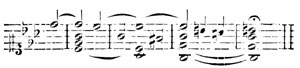
[Listen]
Instead of this, they sing it so:—
[Listen]
The soprano intones the high C in a pure soft
voice, allowing it to vibrate for a time, and slowly
gliding down, while the alto holds the C steadily, so
that at first I was under the delusion that the high
C was still held by the soprano; the skill, too, with
which the harmony is gradually developed is truly
admirable. The other embellimenti are adapted in
the same way to the consecutive chords: but the
first one is by far the most beautiful. I can give no
opinion as to the particular mode of executing the
music; but what I once read, that some particular
acoustic contrivance caused the continued vibration
of the sounds, is an entire fable, quite as much so as
the assertion that they sing from tradition, and without
any fixed time, one voice simply following the
other; for I saw plainly enough the shadow of Baini's
long arm moving up and down; indeed, he sometimes
struck his music-desk quite audibly. There is no
lack of mystery too, on the part of the singers and
others: for example, they never say beforehand
what particular Miserere they intend to sing, but
that it will be decided at the moment, etc., etc.
The key in which they sing, depends on the purity
of the voices. The first day it was in B minor, the
second and third in E minor, but each time they
finished almost in B flat minor.
The chief soprano, Mariano, came from the mountains
to Rome expressly to sing on this occasion,
and it is to him I owe hearing the embellimenti with
their highest notes. However careful and attentive
the singers may be, still the negligence and bad
habits of the whole previous year have their revenge,
consequently the most fearful dissonance sometimes
occurs.
I must not forget to tell you that on the Thursday,
when the Miserere was about to begin, I clambered
up a ladder leaning against the wall, and was thus
placed close to the roof of the chapel, so that I
had the music, the priests, and the people far beneath
me in gloom and shadow. Seated thus alone
without the vicinity of any obtrusive stranger, the
impression made on me was very profound. But to
proceed: you must have had more than enough of
Misereres in these pages, and I intend to bring you
more particular details, both verbal and written.
On Thursday, at half-past ten o'clock, high Mass
was celebrated. They sang an eight-part composition
of Fazzini's, in no way remarkable. I reserve
for you some canti fermi and antiphons, which I
wrote down at the time, and my little book describes
the order of the various services and the meaning of
the different ceremonies. At the "Gloria in Excelsis"
all the bells in Rome peal forth, and are not
rung again till after Good Friday. The hours are
marked in the churches by wooden clappers. The
words of the "Gloria," the signal for all the strange
tumult of bells, were chanted from the altar by old
Cardinal Pacca, in a feeble trembling voice; this
being succeeded by the choirs and all the bells, had a
striking effect. After the "Credo" they sang the
"Fratres ego enim" of Palestrina, but in the most
unfinished and careless manner. The washing of
the pilgrims' feet followed, and a procession in which
all the singers join; Baini beating time from a large
book carried before him, making signs first to one,
and then to another, while the singers pressed forward
to look at the music, counting the time as they
walked, and then chiming in,—the Pope being borne
aloft in his state chair. All this I have already described
to my parents.
In the evening there were Psalms, Lamentations,
Lessons, and the Miserere again, scarcely differing
from those of the previous day. One lesson was
chanted by a soprano solo on a peculiar melody, that
I mean to bring home with me. It is an adagio, in
long-drawn notes, and lasts a quarter of an hour at
least. There is no pause in the music, and the
melody lies very high, and yet it was executed with
the most pure, clear, and even intonation. The
singer did not drop his tone so much as a single
comma, the very last notes swelling and dying away
as even and full as at the beginning; it was, indeed, a
masterly performance. I was struck with the meaning
they attach to the word appoggiatura. If the melody
goes from C to D, or from C to E, they sing thus:—
[Listen]
[Listen]
[Listen]
[Listen]
[Listen]
and this they call an appoggiatura. Whatever they
may choose to designate it, the effect is most disagreeable,
and it must require long habit not to be
discomposed by this strange practice, which reminds
me very much of our old women at home in church;
moreover the effect is the same. I saw in my book
that the "Tenebræ" was to be sung, and thinking
that it would interest you to know how it is given in
the Papal chapel, I was on the watch with a sharp-pointed
pencil when it commenced, and send you
herewith the principal parts. It was sung very
quick, and forte throughout, without exception.
The beginning was:—
[Listen]
Then
[Listen]
I cannot help it, but I own it does irritate me to
hear such holy and touching words sung to such
dull, drawling music. They say it is canto fermo,
Gregorian, etc.; no matter. If at that period there
was neither the feeling nor the capability to write
in a different style, at all events we have now the
power to do so, and certainly this mechanical monotony
is not to be found in the scriptural words;
they are all truth and freshness, and moreover expressed
in the most simple and natural manner.
Why then make them sound like a mere formula?
and, in truth, such singing as this is nothing more!
The word "Pater" with a little flourish, the "meum"
with a little shake, the "ut quid me"—can this be
called sacred music? There is certainly no false
expression in it, because there is none of any kind;
but does not this very fact prove the desecration of
the words? A hundred times during the ceremony
I was driven wild by such things as these; and then
came people in a state of ecstasy, saying how splendid
it had all been. This sounded to me like a bad
joke, and yet they were quite in earnest!
At Mass early on Friday morning, the chapel is
stripped of all its decorations, the altar uncovered,
and the Pope and Cardinals in mourning. The
"Passion," from St. John, was sung, composed by
Vittoria, but the words of the people in the chorus
alone are his, the rest are chanted according to an established
formula: but more of this hereafter. The
whole appeared to me too trivial and monotonous,
I was quite out of humour, and, in fact, dissatisfied
with the affair altogether. One of the two following
modes ought to be adopted. The "Passion" ought
either to be recited quietly by the priest, as St.
John relates it, in which case there is no occasion
for the chorus to sing "Crucifige eum," nor for the
alto to represent Pilate—or else the scene should be
so thoroughly realized, that it ought to make me feel
as if I were actually present, and saw it all myself.
In that event, Pilate ought to sing just as he would
have spoken, the chorus shout out "Crucifige" in a
tone anything but sacred; and then, through the
impress of entire truth, and the dignity of the object
represented, the singing would become sacred church
music.
I require no under-current of thought when I hear
music, which is not to me "a mere medium to elevate
the mind to piety," as they say here, but a distinct
language speaking plainly to me; for though the
sense is expressed by the words, it is equally contained
in the music. This is the case with the
"Passion" of Sebastian Bach; but as they sing it
here, it is very imperfect, being neither a simple
narrative, nor yet a grand solemn dramatic truth.
The chorus sings "Barabbam" to the same sacred
chords as "et in terra pax." Pilate speaks exactly
in the same manner as the Evangelist. The voice
that represents our blessed Saviour commences
always piano, in order to have one definite distinction,
but when the chorus breaks loose, shouting out
their sacred chords, it seems entirely devoid of
meaning. Pray forgive these strictures. I now
proceed to simple narration again. The Evangelist
is a tenor, and the mode of chanting, the same as
that of the Lessons, with a peculiar falling cadence
at the comma, interrogation, and full stop. The
Evangelist intones on D, and sings thus at a full
stop:—
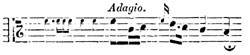
[Listen]
at a comma:—
[Listen]
and at the conclusion, when another personage
enters, so:—
[Listen]
Christ is represented by a bass, and commences
always thus:—
[Listen]
I could not catch the formula, though I noted down
several parts, which I can show you when I return:
among others, the words spoken on the Cross. All
the other personages,—Pilate, Peter, the Maid, and
the High Priest,—are altos, and sing this melody
only:—
[Listen]
The chorus sings the words of the people from
their places above, while everything else is sung
from the altar. I must really mark down here as a
curiosity the "Crucifige," just as I noted it at the
time:—
[Listen]
The "Barabbam" too is most singular;—very
tame Jews indeed! But my letter is already too
long, so I shall discuss the subject no further.
Prayers are then offered up for all nations and institutions,
each separately designated. When the
prayer for the Jews is uttered, no one kneels, as
they do at all the others, nor is Amen said. They
pray pro perfidis Judæis, and the author of my
book discovers an explanation of this also. Then
follows the Adoration of the Cross; a small crucifix
is placed in the centre of the chapel, and all approach
barefooted (without shoes), fall down before
it and kiss it; during this time the "Improperia"
are sung. I have only once heard this composition,
but it seems to me to be one of Palestrina's finest
works, and they sing it with remarkable enthusiasm.
There is surprising delicacy and harmony in its
execution by the choir; they are careful to place
every passage in its proper light, and to render it
sufficiently prominent without making it too conspicuous—one
chord blending softly with the other.
Moreover, the ceremony is very solemn and dignified,
and the most profound silence reigns in the
chapel.
They sing the oft-recurring Greek "Holy" in
the most admirable manner, each time with the
sane smoothness and expression. You will be not
a little surprised, however, when you see it written
down, for they sing as follows:—
[Listen]
Such passages as that at the commencement,
where all the voices sing the very same embellishment,
repeatedly occur, and the ear becomes accustomed
to them. The effect of the whole is
undoubtedly superb. I only wish you could hear
the tenors in the first chorus, and the mode in which
they take the high A on the word "Theos;" the
note is so long-drawn and ringing, though softly
breathed, that it sounds most touching. This is
repeated again and again till all in the chapel have
performed the Adoration of the Cross; but as on
this occasion the crowd was not very great, I unluckily
had not the opportunity of hearing it as
often as I could have wished.
I quite understand why the "Improperias" produced
the strongest effect on Goethe, for they are
nearly the most faultless of all, as both music and
ceremonies, and everything connected with them,
are in the most entire harmony. A procession follows
to fetch the Host, which had been exposed and
adored on the previous evening in another chapel of
the Quirinal, lighted up by many hundred wax-lights.
The morning service closed at half-past one with a
hymn in canto fermo. At half-past three in the
afternoon the first nocturn began, with the Psalms,
Lessons, etc. I corrected what I had written
down, heard the Miserere of Baini, and about seven
o'clock followed the Cardinals home through the
illuminated vestibule—so all was now seen, and all
was now over.
I was anxious, dear Professor, to describe the
Holy Week to you minutely, as they were memorable
days to me, every hour bringing with it something
interesting and long anticipated. I also
particularly rejoiced in feeling that, in spite of the
excitement and the numerous discussions in praise
or blame, the solemnities made as vivid an impression
on me, as if I had been quite free from all
previous prejudice or prepossession. I thus saw the
truth confirmed, that perfection, even in a sphere
the most foreign to us, leaves its own stamp on the
mind. May you read this long letter with even half
the pleasure I feel in recalling the period of the
Holy Week at Rome.
Yours faithfully,
Felix Mendelssohn Bartholdy
Dear Sisters,
On such a day as this my paternal home and those
I love are much in my thoughts; my feelings on
this point are rather singular. If I feel at any time
unwell, or fatigued, or out of humour, I have no
particular longing for my own home or for my
family; but when brighter days ensue, when every
hour makes an indelible impression, and every
moment brings with it glad and pleasant sensations
then I ardently wish that I were with you, or you
with me; and no minute passes without my thinking
of one or other of you, to whom I have something
particular to say.
I have to-day passed the whole forenoon, from ten
till three, in the gallery; it was glorious! Besides
all the beautiful work I saw, from which so much
fresh benefit is always to be derived, I wandered
about among the pictures, feeling so much sympathy,
and such kindly emotions in gazing at them. I now
first thoroughly realized the great charm of a large
collection of the highest works of art. You pass
from one to the other, sitting and dreaming for an
hour before some picture, and then on to the next.
Yesterday was a holiday here, so to-day the Palazzo
degli Uffizi was crowded with people who had
come into the city to see the races, and to visit the
far-famed gallery; chiefly peasants, male and female,
in their country costumes. All the apartments
were thrown open, and as I was about to contemplate
them for the last time. I contrived to slip
quietly through the crowd, and to remain quite
solitary, for I knew that I had not one acquaintance
among them.
The busts of the various princes who founded and
enriched this collection, are placed near the entrance,
at the top of the staircase. I suppose I must have
been peculiarly susceptible to-day, for the faces of
the Medici interested me exceedingly; they looked
so noble and refined, so proud and so dignified. I
stood looking at them for a long time, and imprinted
on my memory those countenances of world-wide
renown.
I then went to the Tribune. This room is so delightfully
small you can traverse it in fifteen paces,
and yet it contains a world of art. I again sought
out my favourite armchair, which stands under the
statue of the "Slave Whetting his Knife" (L'Arrotino),
and taking possession of it, I enjoyed myself
for a couple of hours; for here, at one glance, I had
the "Madonna del Cardellino," "Pope Julius II.," a
female portrait by Raphael, and above it a lovely
Holy Family, by Perugino; and so close to me that
I could have touched the statue with my hand, the
Venus de' Medici; beyond, that of Titian; on the
other side, the "Apollino" and the "Wrestlers"
(Lottatori); in front of the Raphael, the merry
Greek Dancing Faun, who seems to feel an uncouth
delight in discordant music, for the fellow has just
struck two cymbals together, and is listening to the
sound, while treading with his foot on a kind of
Pan's pipes, as an accompaniment: what a clown he
is! The space between is occupied by other pictures
of Raphael's, a portrait by Titian, a Domenichino,
etc., and all these within the circumference of
a small semicircle, no larger than one of your own
rooms. This is a spot where a man feels his own
insignificance, and may well learn to be humble.
I occasionally walked through the other rooms,
where a large picture by Leonardo da Vinci, only
commenced and sketched in, with all its wild dashes
and strokes, is very suggestive. I was especially
struck with the genius of the monk Fra Bartolommeo,
who must have been a man of the most devout,
tender, and earnest spirit. There is a small picture
of his here, which I discovered for myself. It is
about the size of this sheet of paper, in two divisions,
and represents the "Adoration" and the "Presentation
in the Temple." The figures are about two-thirds
of a finger-length in size, but finished in the
most exquisite and consummate manner, with the
most brilliant colouring, the brightest decorations,
and in the most genial sunshine. You can see in
the picture itself, that the pious maestro has taken
delight in painting it, and in finishing the most minute
details; probably with the view of giving it
away, to gratify some friend. We feel as if the
painter belonged to it, and still ought to be sitting
before his work, or had only this moment left it. I
felt the same with regard to many pictures to-day,
especially that of the "Madonna del Cardellino,"
which Raphael painted as a wedding-gift, and a surprise
for his friend. I could not help meditating on
all these great men, so long passed away from earth,
though their whole inner soul is still displayed in
such lustre to us, and to all the world.
While reflecting on these things, I came by chance
into the room containing the portraits of great
painters. I formerly merely regarded them in the
light of valuable curiosities, for there are more
than three hundred portraits, chiefly painted by the
masters themselves, so that you see at the same
moment the man and his work; but to-day a fresh
idea dawned on me with regard to them,—that each
painter resembles his own productions, and that
each while painting his own likeness, has been careful
to represent himself just as he really was. In
this way you become personally acquainted with all
these great men, and thus a new light is shed on
many things. I will discuss this point more minutely
with you when we meet; but I must not omit to
say, that the portrait of Raphael is almost the most
touching likeness I have yet seen of him. In the
centre of a large rich screen, entirely covered with
portraits, hangs a small solitary picture, without
any particular designation, but the eye is instantly
arrested by it; this is Raphael—youthful, very pale
and delicate, and with such onward aspirations,
such longing and wistfulness in the mouth and eyes,
that it is as if you could see into his very soul.
That he cannot succeed in expressing all that he
sees and feels, and is thus impelled to go forward,
and that he must die an early death,—all this is
written on his mournful, suffering, yet fervid countenance,
and when looking at his dark eyes, which
glance at you out of the very depths of his soul,
and at the pained and contracted mouth, you cannot
resist a feeling of awe.
How I wish you could see the portrait that hangs
above it; that of Michael Angelo, an ugly, muscular,
savage, rugged fellow, in all the vigour of life, looking
gruff and morose; and on the other side a wise,
grave man, with the aspect of a lion, Leonardo da
Vinci; but you cannot see this portrait, and I will
not describe it in writing, but tell you of it when we
meet. Believe me, however, it is truly glorious.
Then I passed on to the Niobe, which of all statues
makes the greatest impression on me; and back
again to my painters, and to the Tribune, and
through the Corridors, where the Roman Emperors,
with their dignified yet knavish physiognomies,
stare you in the face; and last of all I took a final
leave of the Medici family.
It was indeed a morning never to be forgotten.
Do not suppose however that I mean to assert
that all days are spent thus. You must battle your
way through the present living mob, before you can
arrive at the nobility, long since dead, and those
who have not a strong arm are sure to come badly
off in the conflict. Such a journey as mine from
Rome to Perugia, and on here, is no joke. Jean
Paul says that the presence of a person who openly
hates you is most painful and oppressive. Such a
being is the Roman vetturino: he grants you no
sleep; exposes you to hunger and thirst; at night,
when he is bound to provide you with your pranzo,
he contrives that you shall not arrive till midnight,
when every one is of course asleep, and you are
only too thankful to get a bed. In the morning he
sets off before four o'clock, and rests his horses at
noon for five hours, but invariably in some solitary
little wayside inn, where nothing is to be had. Each
day he makes out about six German miles, and
drives piano, while the sun burns fortissimo.
I was very badly off owing to all this, for my
fellow-travellers were far from being congenial;
three Jesuits inside, and in the cabriolet, where I
particularly desired to sit, a most disagreeable Venetian
lady. If I wished to escape from her, I was
obliged to go inside, and listen to the praises of
Charles X., and to hear that Ariosto ought to have
been burnt as a corrupt writer, subversive of all
morality. It was still worse outside, and we never
seemed to get on. The first day, after a journey of
four hours, the axletree broke, and we were obliged
to remain for nine hours in the same house in the
Campagna where we chanced to be, and at last to
stay all night. If there was a church on the road
that we had an opportunity of visiting, the most
beautiful and devotional creations of Perugino, or
Giotto, or Cimabue, enchanted our eyes; and so we
passed from irritation to delight, and then to irritation
again. This was a wretched state to be in. I
was not in the least amused by it all; and if Nature
had not bestowed on us bright moonshine at the
Lake of Thrasymene, and if the scenery had not
been so wonderfully fine, and if in every town we
had not seen a superb church, and if we had not
passed through a large city each day as we journeyed
on, and if—but you see I am not easily satisfied.
The route however was beautiful, and I must now
describe my arrival in Florence, which also includes
my whole Italian life of the previous days. At Incisa,
half a day's journey from Florence, my vetturino
became so intolerable from his insolence and
abuse, that I found it necessary to take out my
luggage, and to tell him to drive to the devil,—which
he accordingly did, rather against his will.
It was Midsummer's day, and a celebrated fête
was to take place in Florence the same evening,
which I would on no account whatever have missed.
This is just the kind of thing that the Italians take
advantage of, so the landlady at Incisa offered me a
carriage at four times the proper fare. When I refused
to take it, she said I might try to procure
another; and so I accordingly did, but found that no
carriages for hire were to be had, only post-horses.
I went to the Post, and was there told, to my disgust,
that they were at my landlady's, and that she
had wished to make me pay an exorbitant price for
them. I went back and demanded horses. She
said, if I did not choose to pay what she asked, I
should have none. I desired to see the regulations,
which they are all obliged to have. She said there
was no occasion to show them, and turned her back
on me. The use of physical strength, which plays a
great part here, was resorted to by me on this occasion,
for I seized her and pushed her back into a
room (for we were standing in the passage) and then
hurried down the street to the Podestà. It turned
out however that there was no such person in the
town, but that he lived four miles off. The affair
became every instant more disagreeable, the crowd
of boys at my heels increasing at every step. Fortunately
a decent-looking man came up, to whom the
mob seemed to show some respect; so I accosted
him, and explained all that had occurred. He sympathized
with me, and took me to a vine-dresser's
who had a little carriage for hire.
The whole crowd now congregated before his door,
many pressing forward into the house after me, and
shouting that I was mad; but the carriage drove up,
and I threw a few scudi to an old beggar, on which
they all called out that I was a bravo Signore, and
wished me buon viaggio. The moderate price the
man demanded more fully showed me the abominable
overcharge of the landlady. The carriage was easy,
and the horses went on at a good pace, and so we
travelled across the hills to Florence. In the course
of half an hour we overtook my lazy vetturino. I
put up my umbrella to defend me from the sun, and
I scarcely ever travelled so pleasantly and so comfortably
as during those few hours, having left all
annoyances behind me, and before me the prospect
of the beautiful fête.
Very soon the Duomo, and the hundreds of villas
scattered through the valleys, were visible. Once
more we passed by decorated terraces, and the tops
of trees seen over them; the Arno valley looking
lovelier than ever. And so I arrived here in good
spirits and dined; and even while doing so I heard a
tumult, and looking out of the window I saw crowds,
both young and old, all hurrying in their holiday
costumes across the bridges.
I followed them to the Corso, and then to the
races; afterwards to the illuminated Pergola, and
last of all to a masked ball in the Goldoni Theatre.
At one o'clock in the morning I went towards home,
thinking that the whole affair was over; but the
Arno was still covered with gondolas, illuminated by
coloured lamps, and crossing each other in every
direction. Under the bridge a large ship was passing,
hung with green lanterns; the water shone
brightly as it rippled along, while a still brighter
moon looked down on the whole scene. I recalled
to myself the various occurrences of the day, and
the thoughts that had chased each other through
my mind, and resolved to write them all to you. It
is in fact a reminiscence for myself, for it may not be
so suggestive to you, but it will one day be of service
to me, enabling me to recall various scenes
connected with fair Italy.
Extract from a Letter to Frau von Pereira,
in Vienna.
At first I resolved not to answer your letter until
I had fulfilled your injunctions, and composed
"Napoleon's Midnight Review;" and now I have
to ask your forgiveness for not having done so,
but there is a peculiarity in this matter. I take
music in a very serious light, and I consider it quite
inadmissible to compose anything that I do not
thoroughly feel. It is just as if I were to utter a
falsehood; for notes have as distinct a meaning as
words, perhaps even a more definite sense. Now it
appears to me almost impossible to compose for a
descriptive poem. The mass of compositions of this
nature do not militate against this opinion, but
rather prove its truth; for I am not acquainted with
one single work of the kind that has been successful.
You are placed between a dramatic conception or a
mere narrative; the one, in the "Erl König," causes
the willows to rustle, the child to shriek, and the
horse to gallop. The other imagines a ballad singer,
calmly narrating the horrible tale, as you would a
ghost story, and this is the most accurate view of
the two; Reichardt almost invariably adopted this
reading, but it does not suit me; the music stands
in my way. I feel in a far more spectral spirit when
I read such a poem quietly to myself, and imagine
the rest, than when it is depicted, or related to me.
It does not answer to look on "Napoleon's Midnight
Review" as a narrative, inasmuch as no
particular person speaks, and the poem is not written
in the style of a ballad. It seems to me more like a
clever conception than a poem; it strikes me that
the poet himself placed no great faith in his misty
forms.
I could indeed have composed music for it in the
same descriptive style, as Neukomm and Fischhof,
in Vienna. I might have introduced a very novel
rolling of drums in the bass, and blasts of trumpets
in the treble, and have brought in all sorts of hobgoblins.
But I love my serious elements of sound
too well to do anything of the sort; for this kind of
thing always appears to me a joke; somewhat like
the painting's in juvenile spelling-books, where
the roofs are coloured bright red, to make the
children aware they are intended for roofs; and I
should have been most reluctant to write out and
send you anything incomplete, or that did not entirely
please myself, because I always wish you to
have the best I can accomplish.
Felix.
This letter will probably be the last (D.V.) that I
shall write to you from an Italian city; I may possibly
send you another from the Borromean Islands,
which I intend to visit in a few days, but do not rely
on this.
My week here has been one of the most agreeable
and amusing that I have passed in Italy; and how
this could be the case in Milan, hitherto utterly unknown
to me, I shall now proceed to relate. In the
first place, I immediately secured a small piano, and
attacked with rabbia that endless "Walpurgis
Night," to finish the thing at last; and to-morrow
morning it will be completed, except the overture;
for as yet I have not quite made up my mind whether
it shall be a grand symphony, or a short introduction
breathing of spring. I should like to take the
opinion of some adept on this point. I must say
the conclusion has turned out better than I myself
expected. The hobgoblins and the bearded Druid,
with the trombones sounding behind him, diverted
me immensely, and so I passed two forenoons very
happily.
'Tasso' also contributed to my pleasure, which I
have now for the first time been able to read with
facility; it is a splendid poem. I was glad to be
already well acquainted with Goethe's 'Tasso;'
being constantly reminded of it by the principal
passages of the Italian poet, whose verse, like that
of Goethe, is so dreamy, harmonious, and tender, its
sweet melody delighting the ear. Your favourite
passage, dear father, "Era la notte allor," struck me
as very beautiful, but the stanzas that I admire
most, are those descriptive of Clorinda's death;
they are so wonderfully imaginative, and fine. The
close however does not quite please me. Tancred's
'Lamentations' are, I think, more charmingly composed
than true to nature; they contain too many
clever ideas and antitheses; and even the words of
the hermit, which soothe him, sound more like a
censure on the hermit himself. I should infallibly
have killed him on the spot, if he had talked to me
in such a strain.
Recently I was reading the episode of 'Armida'
in a carriage, surrounded by a company of Italian
actors, who were incessantly singing Rossini's "Ma
trema, trema," when suddenly there recurred to my
thoughts Gluck's "Vous m'allez quitter," and Rinaldo's
falling asleep, and the voyage in the air—and
I felt in a most melting mood. This is genuine
music; thus have men felt, and thus have men
spoken, and such strains can never die. I do cordially
hate the present licentious style. Do not take
it amiss; your motto is, Without hatred, no love,—and
I did feel so moved when I thought of Gluck,
and his grand embodiments.
Every evening I was in society, owing to a mad
prank, which however proved very successful. I
think I have invented this kind of eccentric proceeding,
and may take out a patent for it, as I have
already made my most agreeable acquaintances ex
abrupto, without letters or introductions of any
kind.
I asked by chance on my arrival at Milan the
name of the Commandant, and the laquais de place
named General Ertmann. I instantly thought of
Beethoven's Sonata in A major, and its dedication;
and as I had heard all that was good of Madame
Ertmann, from those who knew her; that she was
so kind, and had bestowed such loving care on
Beethoven, and played herself so beautifully, I, next
morning, at a suitable hour for a visit, put on a
black coat, desired that the Government-house
should be pointed out to me, and occupied myself
on the way thither by composing some pretty
speeches for the General's lady, and went on boldly.
I cannot however deny that I felt rather dismayed
when I was told that the General lived in the first
story, facing the street; and when I was fairly in
the splendid vaulted hall, I was seized with a sudden
panic, and would fain have turned back: but I
could not help thinking that it was vastly provincial
on my part to take fright at a vaulted hall, so I
went straight up to a group of soldiers standing
near, and asked an old man in a short nankeen
jacket, if General Ertmann lived there, intending
then to send in my name to the lady. Unluckily
the man replied, "I am General Ertmann: what is
your pleasure?" This was unpleasant, as I was
forced to have recourse to the speech I had prepared.
The General, however, did not seem particularly
edified by my statement, and wished to
know whom he had the honour of addressing. This
also was far from agreeable, but fortunately he was
acquainted with my name, and became very polite:
his wife, he said was not at home, but I should find
her at two o'clock, or any hour after that which
might suit me.
I was glad that all had gone off so well, and in
the meantime went to the Brera, where I passed the
time in studying the 'Sposalizio' of Raphael, and
at two o'clock I presented myself to Freifrau
Dorothea von Ertmann. She received me with
much courtesy, and was most obliging, playing me
Beethoven's Sonata in C sharp minor, and the one
in D minor. The old General, who now appeared
in his handsome grey uniform, covered with orders,
was quite enchanted, and had tears of delight in
his eyes, because it was so long since he had heard
his wife play; he said there was not a person in
Milan who cared to hear what I had heard. She
mentioned the trio in B major, but said she could
not remember it. I played it, and sang the other
parts: this enchanted the old couple, and so their
acquaintance was soon made.
Since then their kindness to me is so great that it
quite overwhelms me. The old General shows me
all the remarkable objects in Milan; in the afternoon
his lady takes me in her carriage to drive on
the Corso, and at night we have music till one
o'clock in the morning. Yesterday at an early hour
they drove with me in the environs; at noon I dined
with them, and in the evening there was a party.
They are the most agreeable and cultivated couple
you can imagine, and both as much in love with each
other as if they were a newly wedded pair,—and
yet they have been married for four-and-thirty years.
Yesterday he spoke of his profession, of military
life, of personal courage, and similar subjects, with
a degree of lucidity, and liberality of feeling, that
I scarcely ever met with, except in my father. The
General has been now an officer for six-and-forty
years, and you should really see him galloping beside
his wife's carriage in the park,—the old gentleman
looking so dignified and animated!
She plays Beethoven's works admirably, though
it is so long since she studied them; she sometimes
rather exaggerates the expression, dwelling too long
on one passage, and then hurrying the next; but
there are many parts that she plays splendidly, and
I think I have learned something from her. When
sometimes she can bring no more tone out of the
instrument, and begins to sing in a voice that emanates
from the very depths of her soul, she reminds
me of you, dear Fanny, though you are infinitely
her superior. When I was approaching the end of
the adagio in the B major trio, she exclaimed, "The
amount of expression here is beyond any one's playing;"
and it is quite true of this passage.
The following day, when I went there again to
play her the symphony in C minor, she insisted on
my taking off my coat, as the day was so hot. In
the intervals of our music she related the most interesting
anecdotes of Beethoven, and that when
she was playing to him in the evening he not unfrequently
used the snuffers as a tooth-pick! She told
me that when she lost her last child, Beethoven at
first shrank from coming to her house; but at length
he invited her to visit him, and when she arrived,
she found him seated at the piano, and simply
saying, "Let us speak to each other by music," he
played on for more than an hour, and, as she expressed
it, "he said much to me, and at last gave
me consolation." In short I am now in the most
genial mood, and quite at my ease, having no
occasion to resort to any disguise, or to be silent,
for we understand each other admirably on all
points. She played the Kreutzer Sonata yesterday
with violin accompaniment, and when the violin-player
(an Austrian cavalry officer) made a long
flourish, à la Paganini, at the beginning of the
adagio, the old General made such a desperate
grimace, that I nearly fell off my chair from
laughing.
I called on Teschner, as you, dear mother, desired
me to do so; such a musician however is as depressing
as a thick fog. Madame Ertmann has more
soul in her little finger than that fellow has in his
whole body, with his formidable moustaches, behind
which he seems to lie in ambush. There is no
public music in Milan; they still speak with enthusiasm
of last winter, when Pasta and Rubini sang
here, but say that they were miserably supported,
and the orchestra and choruses bad. I however
heard Pasta six years ago in Paris, and I can do the
same every year, with the addition of a good orchestra
and a good chorus, and many other advantages;
so it is evident that if I wish to hear Italian music,
I must go to Paris or to England. The Germans
however take it amiss when you say this, and persist
par force in singing, playing, and acquiring new
ideas here, declaring this is the land of inspiration;
while I maintain that inspiration is peculiar to no
country, but floats about in the air.
Two days ago I was in the morning theatre here,
and was amused. There you can see more of
the life of the people than in any other part of Italy.
It is a large theatre with boxes, the pit filled with
wooden benches, on which you can find places if you
come early; the stage is like every other stage, but
there is no roof either over the pit or boxes, so that
the bright sun shines into the theatre and into the
eyes of the actors. Moreover, the piece they gave
was in the Milanese dialect. You feel as if you
were secretly watching all these complicated and
diverting situations, and might take part in them if
necessary, and thus the most familiar comic dilemmas
become novel and interesting; and the public
seem to feel the most lively interest in them. And
now, good night. I wished to talk to you a little
before going to bed, and so it has become a letter.
Felix.
Extracts from two Letters to Edward Devrient.
You reproach me with being two-and-twenty without
having yet acquired fame. To this I can only
reply, had it been the will of Providence that I
should be renowned at the age of two-and-twenty, I
no doubt should have been so. I cannot help it, for
I no more write to gain a name, than to obtain a
Kapellmeister's place. It would be a good thing if
I could secure both. But so long as I do not
actually starve, so long is it my duty to write only
as I feel, and according to what is in my heart, and
to leave the results to Him who disposes of other
and greater matters. Every day, however, I am
more sincerely anxious to write exactly as I feel,
and to have even less regard than ever to external
views; and when I have composed a piece just as it
sprang from my heart, then I have done my duty
towards it; and whether it brings hereafter fame,
honour, decorations, or snuff-boxes, etc., is a matter
of indifference to me. If you mean, however, that I
have neglected, or delayed perfecting myself, or my
compositions, then I beg you will distinctly and
clearly say in what respect and wherein I have done
so. This would be indeed a serious reproach.
You wish me to write operas, and think I am
unwise not to have done so long ago. I answer,
place a right libretto in my hand, and in two months
the work shall be completed, for every day I feel
more eager to write an opera. I think that it may
become something fresh and spirited, if I begin it
now; but I have got no words yet, and I assuredly
never will write music for any poetry that does not
inspire me with enthusiasm. If you know a man
capable of writing the libretto of an opera, for
Heaven's sake tell me his name, that is all I want.
But till I have the words, you would not wish me to
be idle—even if it were possible for me to be so?
I have recently written a good deal of sacred
music; that is quite as much a necessity to me, as
the impulse that often induces people to study some
particular book, the Bible, or others, as the only
reading they care for at the time. If it bears any
resemblance to Sebastian Bach, it is again no fault
of mine, for I wrote it just according to the mood I
was in; and if the words inspired me with a mood
akin to that of old Bach, I shall value it all the
more, for I am sure you do not think that I would
merely copy his form, without the substance; if it
were so, I should feel such disgust and such a void,
that I could never again finish a composition.
Since then I have written a grand piece of music
which will probably impress the public at large—the
first "Walpurgis Night" of Goethe. I began
it simply because it pleased me, and inspired me
with fervour, and never thought that it was to be
performed; but now that it lies finished before me, I
see that it is quite suitable for a great Concertstück,
and you must sing the Bearded Pagan Priest at my
first subscription concert in Berlin. I wrote it expressly
to suit your voice; and as I have hitherto
found that the pieces I have composed with least
reference to the public are precisely those which
gave them the greatest satisfaction, so no doubt it
will be on this occasion also. I only mention this
to prove to you that I do not neglect the practical.
To be sure this is invariably an after-thought, for
who the deuce could write music, the most unpractical
thing in the world—the very reason why I love
it so dearly—and yet think all the time of the practical!
It is just as if a lover were to bring a
declaration of love to his mistress in rhyme and
verse, and recite it to her.
I am now going to Munich, where they have
offered me an opera, to see if I can find a man there
who is a poet, for I will only have a man who has
a certain portion of fire and genius. I do not expect
a giant, and if I fail in meeting with a poet
there, I shall probably make Immermann's acquaintance
for this express purpose, and if he is not the
man either, I shall try for him in London. I always
fancy that the right man has not yet appeared; but
what can I do to find him out? He certainly does
not live in the Reichmann Hotel, nor next door; so
where does he live? Pray write to me on this subject;
although I firmly believe that a kind Providence,
who sends us all things in due time when we
stand in need of them, will supply this also if
necessary; still we must do our duty, and look
round us—and I do wish the libretto were found.
In the meantime I write as good music as I can,
and hope to make progress, and we already agreed,
when discussing this affair in my room, that, as I
said before, I am not responsible for the rest. But
enough now of this dry tone. I really have become
once more almost morose and impatient, and yet I
had so firmly resolved never again to be so!
I quite feel that any opera I were to write now,
would not be nearly so good as any second one I
might compose afterwards; and that I must first
enter on the new path I propose to myself, and pursue
it for some little time, in order to discover
whither it will lead, and how far it will go, whereas
in instrumental music I already begin to know exactly
what I really intend. Having worked so much
in this sphere, I feel much more clear and tranquil
with regard to it—in short, it urges me onwards.
Besides, I have been made very humble lately, by a
chance occurrence that still dwells on my mind.
In the valley of Engelberg I found Schiller's
"Wilhelm Tell," and on reading it over again, I
was anew enchanted and fascinated by such a glorious
work of art, and by all the passion, fire, and
fervour it displays. An expression of Goethe's
suddenly recurred to my mind. In the course of
a long conversation about Schiller, he said that
Schiller had been able to supply two great tragedies
every year, besides other poems. This business-like
term supply, struck me as the more remarkable on
reading this fresh, vigorous work; and such energy
seemed to me so wonderfully grand, that I felt as if
in the course of my life I had never yet produced
anything of importance; all my works seem so
isolated. I feel as if I too must one day supply
something. Pray do not think this presumptuous;
but rather believe that I only say so because I know
what ought to be, and what is not. Where I am
to find the opportunity, or even a glimpse of one, is
hitherto to me quite a mystery. If however it be
my mission, I firmly believe that the opportunity
will be granted, and if I do not profit by it another
will; but in that case I cannot divine why I feel
such an impulse to press onwards. If you could
succeed in not thinking about singers, decorations,
and situations, but feel solely absorbed in representing
men, nature, and life, I am convinced that you
would yourself write the best libretto of any one
living; for a person who is so familiar with the
stage as you are, could not possibly write anything
undramatic, and I really do not know what you
could wish to change in your poetry. If there be
an innate feeling for nature and melody, the verses
cannot fail to be musical, even though they sound
rather lame in the libretto; but so far as I am concerned,
you may write prose if you like, I will
compose music for it. But when one form is to be
moulded into another, when the verses are to be
made musically, but not felt musically, when fine
words are to replace outwardly what is utterly
deficient in fine feeling inwardly—there you are
right—this is a dilemma from which no man can
extricate himself; for as surely as pure metre,
happy thoughts, and classical language do not
suffice to make a good poem, unless a certain flash
of poetical inspiration pervades the whole, so an
opera can only become thoroughly musical, and
accordingly thoroughly dramatic, by a vivid feeling
of life in all the characters.
There is a passage on this subject in Beaumarchais,
who is censured because he makes his
personages utter too few fine thoughts, and has put
too few poetical phrases into their mouths. He
answers, that this is not his fault. He must confess
that during the whole time he was writing the piece,
he was engaged in the most lively conversation with
his dramatis personæ: that while seated at his writing
table he was exclaming: "Figaro, prends garde,
le Comte sait tout!—Ah! Comtesse, quelle imprudence!—vite,
sauve-toi, petit page;" and then he
wrote down their answers, whatever they chanced
to be,—nothing more. This strikes me as being
both true and charming.
The sketch of the opera introducing an Italian
Carnival, and the close in Switzerland, I already
knew, but was not aware that it was yours. Be so
good however as to describe Switzerland with great
vigour, and immense spirit. If you are to depict
an effeminate Switzerland, with jodeln and languishing,
such as I saw here in the theatre last night in
the 'Swiss Family,' when the very mountains and
Alpine horns became sentimental, I shall lose all
patience, and criticize you severely in Spener's
paper. I beg you will make it full of animation,
and write to me again on the subject.
You no doubt imagine that you inhale the fragrance
of orange-flowers, see blue sky, and a bright
sun, and a clear lake, when you merely read the
date of this letter. Not at all! The weather is
atrocious, rain pouring down, and claps of thunder
heard at intervals;—the hills look frightfully bleak,
as if the world were enshrouded in clouds; the lake
is grey, and the sky sombre. I can smell no orange-flowers,
and this island might quite as appropriately
be called "Isola Brutta!" and this has gone on for
three days! My unfortunate cloak! I am confessedly
the "spirit of negation" (I refer to my
mother), and as it is at present the fashion with
every one not to consider the Borromean Islands
"by any means so beautiful," and somewhat formal;
and as the weather seems resolved to disgust me
with this spot,—from a spirit of opposition I maintain
that it is perfectly lovely. The approach to
these islands, where you see crowded together green
terraces with quaint statues, and many old-fashioned
decorations, along with verdant foliage, and every
species of southern vegetation, has a peculiar charm
for me, and yet something affecting and solemn too.
For what I last year saw in all the luxuriance and
exuberance of wild nature, and to which my eye had
become so accustomed, I find now cultivated by art,
and about to pass away from me for ever. There
are citron-hedges and orange-bushes; and sharp-pointed
aloes shoot up from the walls—it is just as
if, at the end of a piece, the beginning were to be
repeated; and this, as you know, I particularly like.
In the steamboat was the first peasant girl I have
seen here in Swiss costume; the people speak a bad
half-French Italian. This is my last letter from
Italy, but believe me the Italian lakes are not the
least interesting objects in this country; anzi,—I
never saw any more beautiful. People tried to persuade
me that the gigantic forms of the Swiss Alps
that have haunted me from my childhood[17] had been
exaggerated by my imagination, and that after all
a snowy mountain was not in reality so grand as I
thought. I almost dreaded being undeceived, but
at first sight of the foreground of the Alps from the
Lake of Como, veiled in clouds, with here and there
a surface of bright snow, sharp black points rearing
their heads, and sinking precipitously into the lake,
the hills first scattered over with trees and villages,
and covered with moss, and then bleak and desolate,
and on every side deep ravines filled with
snow,—I felt just as I formerly did, and saw that I
had exaggerated nothing.
In the Alps all is more free, more sharply defined;
more uncivilized, if you will: yet I always feel there
both healthier and happier. I have just returned
from the gardens of the Palace, which I visited in
the midst of the rain. I wished to imitate Albano,[18]
and sent for a barber to open a vein: he however
misunderstood my purpose, and shaved me instead,—a
very pardonable mistake. Gondolas are landing
on every part of the island, for to-day is the fête
following the great festival of yesterday, in honour
of which the P. P. Borromeo sent for singers and
musicians from Milan, to sing and play to the
islanders. The gardener asked me if I knew what
a wind instrument was. I said with a clear conscience
that I did; and he replied that I ought to
try to imagine the effect of thirty such instruments,
and violins and basses, all played at once; but indeed
I could not possibly imagine it, for it must be heard
to be believed. The sounds (continued he) seemed
to come from Heaven, and all this was produced by
philharmony. What he meant by this term I know
not; but the music had evidently made more impression
on him, than the best orchestra often does on
musical connoisseurs. At this moment some one
has just begun to play the organ in the church for
Divine service, in the following strain:—
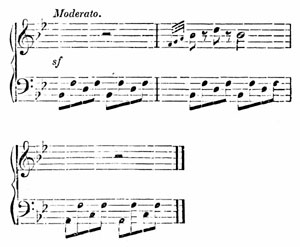
[Listen]
Full organ in the bass, Bourdon 16, and reed stops,
have a very fine effect. The fellow has come all the
way from Milan, too, expressly to make this disturbance
in the church. I must go there for a little,
so farewell for a few moments. I intend to remain
here for the night, instead of crossing the lake
again, for I am so much pleased with this little
island. I certainly cannot say that I have slept
soundly for the last two nights; one night owing to
the innumerable claps of thunder, the next owing to
the innumerable fleas; and, in all probability, I have
to-night the prospect of both combined. But as the
following morning I shall be speaking French, and
have left Italy, and crossed the Simplon, I mean to
ramble about all this day and to-morrow in true
Italian fashion.
I must now relate to you historically how I happened
to come here. At the very last moment of
my stay in Milan, the Ertmanns came to my room to
bid me farewell, and we took leave of each other
more cordially than I have done of any one for
many a long day. I promised to send you many
kind wishes from them, though they are unacquainted
with you, and I also agreed to write to them occasionally.
Another valued acquaintance I made
there, is Herr Mozart, who holds an office in Milan;
but he is a musician, heart and soul. He is said to
bear the strongest resemblance to his father, especially
in disposition; for the very same phrases
that affect the feelings in his father's letters, from
their candour and simplicity, constantly recur in the
conversation of the son, whom no one can fail to
love from the moment he is known. For instance,
I consider it a very charming trait in him, that he is
as jealous of the fame and name of his father, as if
he were an incipient young musician; and one evening,
at the Ertmanns', when a great many of
Beethoven's works had been played, the Baroness
asked me in a whisper to play something of Mozart's,
otherwise his son would be quite mortified; so when
I played the overture to "Don Juan," he began to
thaw, and begged me to play also the overture to
the "Flauto Magico" of his "Vatter," and seemed
to feel truly filial delight in hearing it: it is impossible
not to like him.
He gave me letters to some friends near the Lake
of Como, which procured me for once a glimpse of
Italian provincial life, and I amused myself famously
there for a few days with the Doctor, the Apothecary,
the Judge, and other people of the locality. There
were very lively discussions on the subject of Sand,
and many expressed great admiration of him; this
appeared strange to me, as the occurrence is of such
distant date that no one any longer argues on the
subject. They also spoke of Shakspeare's plays,
which are now being translated into Italian. The
Doctor said that the tragedies were good, but that
there were some plays about witches that were too
stupid and childish: one, in particular, "Il Sonno
d' una Notte di Mezza State." In it the stale device
occurred of a piece being rehearsed in the play,
and it was full of anachronisms and childish ideas;
on which they all chimed in that it was very silly
and advised me not to read it.[19] I remained meekly
silent, and attempted no defence! I bathed frequently
in the Lake, and sketched, and yesterday
rowed on the Lake of Lugano, which frowned
sternly on us with its cascades and dark canopy of
clouds; then across the hills to Luvino, and to-day
I came here by steam.
Evening.—I have this moment returned from the
Isola Madre, and most splendid it is; spacious, and
full of terraces, citron-hedges, and evergreen shrubs.
The weather has at last become less inclement; thus
the large white house on the island, with its ruins
and terraces, looked very pretty. It is indeed a
unique land, and I only wish I could bring with me
to Berlin a portion of the same balmy air that I inhaled
when in the boat to-day. You have nothing
like it, and I would rather you enjoyed it, than all
the people who imbibe it here. A fiercely moustachioed
German was with me in the boat, who examined
all the beautiful scenery as if he were about
to purchase it and thought it too dear. Presently
I heard a trait quite in the style of Jean Paul.
When we were walking on the island, surrounded by
verdure, an Italian, who was of the party, observed
that this was a spot well adapted for lovers to ramble
in, and to enjoy the charms of nature. "Ah!
yes!" said I, in a languishing tone. "It was on
this account," continued he, "that I separated from
my wife ten years ago; I established her at Venice
in a small tobacconist's shop, and now I live as I
please. You must one day do the same."
The old boatman told us that he had rowed General
Bonaparte on this lake, and related various
anecdotes of him and Murat. He said Murat was
a most extraordinary man; all the time that he was
rowing him on the lake, he never ceased singing to
himself for a single moment, and once when setting
off on a journey he gave him his spirit-flask, and said
he would buy another for himself in Milan. I cannot
tell why these little traits, especially the singing,
seemed to realize the man in my mind more than
many a book of history.
The "Walpurgis Nacht" is finished and revised,
and the overture will soon be equally far advanced.
The only person who has heard it as yet, is Mozart,
and he was so delighted with it that the well-known
composition caused me fresh pleasure; he insisted
on my publishing it immediately. Pray forgive this
letter, written in true student phraseology. You no
doubt perceive from its style that I have not worn a
neckcloth for a week past; but I wished you to
know how gay and happy I have been during the
days spent among the mountains, and with what
pleasure I look forward to those that yet await me.
Yours, Felix.
My dear Parents,
I cannot refrain from writing to you from time to
time, to thank you for my wondrously beautiful
journey; and if I ever did so before, I must do so
again now, for more delightful days than those on
my journey hither, and during my stay here, I never
experienced. Fortunately you already know this
valley, so there is no occasion for me to describe it
to you; indeed, how could I possibly have done so?
But this I may say, that nowhere has nature in all
her glory met my eyes in such brightness as here,
both when I saw it with you for the first time and
now; and as every one who sees it, ought to thank
God for having given him faculties to comprehend,
and to appreciate such grandeur, so I must also
thank you for having supplied me with the means of
enjoying such a pleasure.
I had been told that I exaggerated the forms of
the mountains in my imagination; but yesterday, at
the hour of sunset, I was pacing up and down in
front of the house, and each time that I turned my
back on the mountains, I endeavoured vividly to
represent to myself these gigantic masses, and each
time when I again faced them, they far exceeded my
previous conceptions. Like the morning that we
drove away from this when the sun was rising[20] (no
doubt you remember it) the hills have been clear
and lovely ever since I arrived. The snow pure,
and sharply defined, and apparently near in the dark
blue atmosphere; the glaciers thundering unremittingly,
as the ice is melting; when clouds gather,
they lie lightly on the base of the mountains, the
summits of which stand forth clear above. Would
that we could see them together! I have passed
this whole day here quietly, and entirely alone. I
wished to sketch the outlines of the mountains, so I
went out and found an admirable point of view, but
when I opened my book, the paper seemed so very
small that I hesitated about attempting it. I have
indeed succeeded in giving the outlines what is
called correctly,—but every stroke looks so formal,
when compared with the grace and freedom which
everywhere here pervade nature. And then the
splendour of colour! In short, this is the most
brilliant point of my travels; and the whole of my
excursion on foot, so solitary, independent, and
enjoyable, is something new to me, and a hitherto
unknown pleasure.
I must however relate how I came here, otherwise
my letter at last will contain nothing but exclamations.
As I previously wrote to you, I had the most
odious weather on the Lago Maggiore, and the
Islands. It continued so incessantly stormy, cold,
and wet, that the same evening I took my place in
the diligence in rather a sulky humour, and we drove
on towards the Simplon. Scarcely had we been
journeying for half an hour, when the moon came
out, the clouds dispersed, and next morning the
weather was most bright and beautiful. I felt almost
ashamed of this undeserved good fortune, and I
could now thoroughly enjoy the glorious scenery;
the road winding first through high green valleys,
then through rocky ravines and meadows, and at
last past glaciers and snowy mountains. I had with
me a little French book on the subject of the Simplon
road, which both pleased and affected me; for
the subject was Napoleon's correspondence with the
Directoire about the projected work, and the first
report of the General who crossed the mountain.
With what spirit and vigour these letters are
written! and yet a little swagger too, but with such
a glow of enthusiasm that it quite touched me, as I
was driven along this capital level road by an
Austrian postilion. I compared the fire and poetry
displayed in every description contained in these
letters (I mean those of the subaltern General) with
the eloquence of the present day, which leaves you
so terribly cold and is so odiously prosaic in all its
philanthropic views, and so lame—where there is
plenty of fanfaronnade, but no genuine youth—and
I could not but feel that a great epoch has passed
away for ever. I was unable to divest myself of the
idea that Napoleon never saw this work—one of his
favourite conceptions—for he never crossed the
Simplon when the road was finished, and was thus
deprived of this great gratification. High up, in
the Simplon village, all is bleak, and I actually
shivered from cold for the first time during the last
year and a half. A neat civil Frenchwoman keeps
the inn on the summit, and it would not be easy to
describe the sensation of satisfaction caused by its
thrifty cleanliness, which is nowhere to be found in
Italy.
We then descended into the Valais, as far as
Brieg, where I stayed all night, overjoyed to find
myself once more among honest, natural people, who
could speak German, and who plundered me into
the bargain in the most infamous manner. The
following day I drove through the Valais—an enchanting
journey: the road all along, like those you
have seen in Switzerland, ran between two lofty
ranges of mountains, their snowy peaks starting up
at intervals, and through avenues of green, leafy
walnut-trees, standing in front of pretty brown
houses,—below, the wild grey Rhone,—past Lenk,
and every quarter of an hour a village with a little
church. From Martigny I travelled for the first
time in my life literally on foot, and as I found the
guides too dear I went on quite alone, and started
with my cloak and knapsack on my shoulders.
About a couple of hours later I met a stout peasant
lad, who became my guide, and also carried my knapsack;
and so we went on past Forclas to Trient, a
little dairy village, where I breakfasted on milk and
honey, and thence to the Col de Balme.
The whole valley of Chamouni, and Mont Blanc,
with all its precipitous glaciers, lay before me bathed
in sunshine. A party of gentlemen and ladies (one
of the latter very pretty and young) came from the
opposite side on mules, with a number of guides;
scarcely had we all assembled under one roof, when
subtle vapours began to rise, shrouding first the
mountain and then the valley, and at last thickly
covering every object, so that soon nothing was to
be seen. The ladies were afraid of going out into
the fog, just as if they were not already in the midst
of it; at last they set off, and from the window I
watched the singular spectacle of the caravan
leaving the house, all laughing, and talking loudly
in French and English and patois. The voices
presently became indistinct; then the figures likewise;
and last of all I saw the pretty girl in her wide
Scotch cloak; then only glimpses of grey shadows
at intervals, and they all disappeared. A few minutes
later I ran down the opposite side of the mountain
with my guide; we soon emerged once more into
sunshine, and entered the green valley of Chamouni
with its glaciers; and at length arrived here at the
Union. I have just returned from a ramble to
Montanvert, the Mer de Glace, and to the source of
the Arveiron. You know this splendid scenery, and
so you will forgive me, if, instead of going to Geneva
to-morrow, I first make the tour of Mont Blanc, that
I may become acquainted with this personage from
the southern side also, which is I hear the most
striking. Farewell, dear parents! May we have a
happy meeting!—Yours,
Felix.
My dear Sisters,
You have, I know, read Ritter's "Afrika" from
beginning to end, but still I do not think you know
where Charney is situated, so fetch out Keller's old
travelling map, that you may be able to accompany
me on my wanderings. Trace with your finger a
line from Vevay to Clarens, and thence to the Dent
de Jaman; this line represents a footpath; and where
your finger has been my legs also went this morning—for
it is now only half-past seven, and I am still
fasting. I mean to breakfast here, and am writing
to you in a neat wooden room, waiting till the milk
is made warm for me; without, I have a view of the
bright blue lake; and so I now begin my journal, and
mean to continue it as I best can during my pedestrian
tour.
After breakfast.—Heavens! here is a pretty business.
My landlady has just told me with a long
face, that there is not a creature in the village to
show me the way across the Dent, or to carry my
knapsack, except a young girl; the men being all at
work. I usually set off every morning very early
and quite alone, with my bundle on my shoulders,
because I find the guides from the inns both too
expensive and too tiresome; a couple of hours later
I hire the first honest-looking lad I see, and so I
travel famously on foot. I need not say how enchanting
the lake and the road hither were; you
must recall for yourself all the beauties you once
enjoyed there. The footpath is in continued shade,
under walnut-trees and up hill,—past villas and
castles,—along the lake which glitters through the
foliage; villages everywhere, and brooks and streams
rushing along from every nook, in every village;
then the neat tidy houses,—it is all quite too charming,
and you feel so fresh and so free. Here comes
the girl with her steeple hat. I can tell you she is
vastly pretty into the bargain, and her name is
Pauline; she has just packed my things into her
wicker basket. Adieu!
I have had the most delightful journey. What
would I not give to procure you such a day! But
then you must first become two youths and be able to
climb actively, and drink milk when the opportunity
offered, and treat with contempt the intense heat,
the many rocks in the way, the innumerable holes in
the path, and the still larger holes in your boots,
and I fear you are rather too dainty for this; but it
was most lovely! I shall never forget my journey
with Pauline; she is one of the nicest girls I ever
met, so pretty and healthy-looking, and naturally
intelligent; she told me anecdotes about her village,
and I in return told her about Italy; but I know
who was the most amused.
The previous Sunday, all the young people of distinction
in her village had gone to a place far across
the mountain, to dance there in the afternoon. They
set off shortly after midnight, arrived while it was
still dark, lighted a large fire and made coffee. Towards
morning the men had running and wrestling
matches before the ladies, (we passed a broken hedge
testifying to the truth of this;) then they danced, and
were at home again by Sunday evening, and early on
Monday morning they all resumed their labours in
the vineyards. By Heavens, I felt a strong inclination
to become a Vaudois peasant, while I was listening
to Pauline, when from above she pointed out to
me the villages where they dance when the cherries
are ripe, and others where they dance when the cows
go to pasture in the meadows and give milk. To-morrow
they are to dance in St. Gingolph; they row
across the lake, and any one who can play, takes his
instrument with him; but Pauline is not to be of the
party, because her mother will not allow it, from
dread of the wide lake, and many other girls also
do not go for the same reason, as they all cling together.
She then asked my leave to say good-day to a
cousin of hers, and ran down to a neat cottage in the
meadow; soon the two girls came out together and
sat on a bench and chattered; on the Col de Jaman
above, I saw her relations busily mowing, and herding
the cows.
What cries and shouts ensued! Then those above
began to jodel, on which they all laughed. I did not
understand one syllable of their patois, except the
beginning, which was, Adieu Pierrot! All these
sounds were taken up by a merry mad echo, that
shouted and laughed and jodelled too. Towards
noon we arrived at Allière. When I had rested for
a time, I once more shouldered my knapsack, for a
fat old man provoked me by offering to carry it for
me; then Pauline and I shook hands, and we took
leave of each other. I descended into the meadows,
and if you do not care about Pauline, or if I have
bored you with her, it is not my fault, but that of the
mode in which I have described her; nothing could
be more pleasant in reality, and so was my further
journey. I came to a cherry-orchard, where the
people were gathering the fruit, so I lay down on the
grass and ate cherries for a time along with them.
I took my mid-day rest at Latine, in a clean wooden
house. The carpenter who built it gave me his company
to some roast lamb, and pointed out to me with
pride every table, and press, and chair.
At length I arrived here, at night, through dazzling
green meadows, interspersed with houses, surrounded
by fir-trees and rivulets: the church here stands on a
velvet green eminence; more houses in the distance,
and still further away, huts and rocks; and in a
ravine, patches of snow still lying on the plain. It
is one of those idyllic spots such as we have seen
together in Wattwyl, but the village smaller and the
mountains more green and lofty. I must conclude
however to-day by a high eulogy on the Canton de
Vaud. Of all the countries I know this is the most
beautiful, and it is the spot where I should most like
to live when I become really old. The people are so
contented, and look so well, and the country also.
Coming from Italy it is quite touching to see the
honesty that still exists in the world,—happy faces,
a total absence of beggars, or saucy officials: in short,
there is the most complete contrast between the two
nations. I thank God for having created so much
that is beautiful; and may it be His gracious will to
permit us all, whether in Berlin, England, or in the
Château d'Oex, to enjoy a happy evening and a
tranquil night!
The lightning and thunder are terrific outside, and
torrents of rain besides; in the mountains you first
learn respect for weather. I have not gone further,
for it would have been such a pity to traverse the
lovely Simmen valley under an umbrella. It was
grey morning, but delightfully cool for walking in
the forenoon. The valley at Saanen, and the whole
road, is incredibly fresh and gay. I am never weary
of looking at the verdure. I do believe that if
during a long life I were always gazing at undulating
verdant meadows, dotted over with reddish-brown
houses, I should always experience the same
pleasure in looking at them. The road winds the
whole way through meadows of this kind, and past
running streams.
At noon I dined at Zweisimmen, in one of those
enormous Bernese houses, where everything glitters
with neatness and cleanliness, and where even the
smallest detail is carefully attended to. I there
dispatched my knapsack by the diligence to Interlaken,
and am now about to walk as a regular
pedestrian through the country; a shirt in my
pocket, a brush and comb, and my sketch-book, this
is all I require; but I am very tired. May the
weather be fine to-morrow!
A pretty affair! the weather is three times as bad
as ever. I must give up my plan of going to Interlaken
to-day, as there is no possibility of getting
on. For the last few hours the water has been
pouring straight down, as if the clouds above had
been fairly squeezed out; the roads are as soft as
feather-beds; only occasional shreds of the mountains
are to be seen, and even these but rarely. I
almost thought sometimes that I was in the Margravate
of Brandenburg, and the Simmen valley looked
perfectly flat. I was obliged to button my waistcoat
tight over my sketch-book, for very soon my
umbrella was of no use whatever, and so I arrived
here to dinner about one o'clock. I had my breakfast
in the following place. [Vide page 234.]
I sketched this on the spot with a pen, so do not
laugh at the bold stream. I passed the night very
uncomfortably at Boltigen. There was no room in
the inn, owing to a fair, so I was obliged to lodge
in an adjacent house, where there were swarms of
vermin quite as bad as in Italy, a creaking house
clock, striking hoarsely every hour, and a baby that
screeched the whole night. I really could not help
for a time noticing the child's cries, for it screamed
in every possible key, expressive of every possible
emotion; first angry, then furious, then whining, and
when it could screech no longer, it grunted in a
deep bass. Let no one tell me that we must wish
to return to the days of our childhood, because children
are so happy. I am convinced that such a
little mortal as this, flies into a rage just as we do,
and has also his sleepless nights, and his passions,
and so forth.
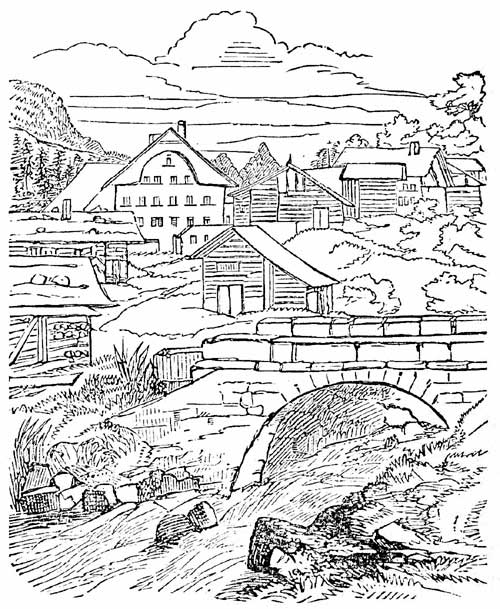
This philosophical view occurred to me this morning,
while I was sketching Weissenburg, and so I
wished to communicate it to you on the spot; but I
took up the 'Constitutionnel,' in which I read that
Casimir Périer wishes to resign, and many other
things that furnish matter for reflection; among
others a most remarkable article on the cholera,
which I should like to transcribe, for it is so extraordinary.
The existence of this disease is totally
and absolutely denied; only one person had it in
Dantzic,—a Jew,—and he got well. Then followed
a number of "Hegelisms" in French, and the election
of the deputies—oh world!—As soon as I had
finished reading the paper, I was obliged to set off
again in the rain through the meadows. No such
enchanting country as this is to be seen, even in a
dream; in the worst weather, the little churches, and
the numerous houses, and shrubs, and rills are still
truly lovely. The verdure to-day was quite in its
element. Dinner has been long over, and it is still
pouring. I intend to go no further than Spiez this
evening. I regret much that I can neither see this
place, which seems beautifully situated, nor Spiez,
which I know from Rösel's sketches. This is, in
fact, the climax of the whole Simmen valley, and
thence the old song says:—
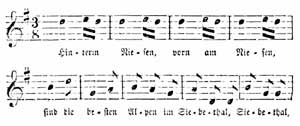
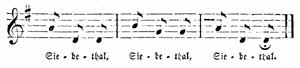
[Listen]
I sang this the whole day while walking along.
The Siebethal, however, showed no gratitude for the
compliment, and the rain continued unremittingly.
They could not take me in at Spiez, for there is
no inn there where you can lodge, so I was obliged
to return here. I very much admired the situation
of Spiez; it is built on a rock, which projects into
the lake, with numbers of turrets, and gables, and
peaks. There I saw a manor-house, with an orangery;
a sulky-looking nobleman with two sporting
dogs at his heels; a little church, and terraces with
bright flowers. It was all very lovely. To-morrow
I shall see it from the other side, if the weather permits.
To-day it has rained for three hours consecutively,
and I was well soaked on the way here. The
mountain streams are superb in such weather, for
they leap and rage furiously. I crossed one of these
demons, the Kander, which seemed to have taken
leave of its senses, leaping and blustering, and
foaming; the water looked quite brown, and scattered
its yellow spray in all directions. A black
peak of the mountains was here and there visible
through the rain-laden clouds, which hung deeper
into the valley than I ever before saw them. Yet
the day was most enjoyable.
To-day the weather is worse than ever. It has
rained the whole night through, and this morning
too it is pouring. I have however intimated that
I shall not set out in such weather, and if it continues
I shall write to you again to-night from
Wyler. In the meantime I have an opportunity
of making acquaintance with my Swiss host. They
are very primitive. I could not get on my shoes,
because they had shrunk, owing to the rain. The
landlady asked if I wished to have a shoe-horn; and
as I said I did, she brought me a tablespoon; but
it answered the purpose. And moreover they are
eager politicians. Over my bed hangs a horrible
distorted face, under which is written. "Brinz
Baniadofsgi." If he had not a kind of Polish costume,
it would be difficult to discover whether it is
intended for a man or a woman, for neither the portrait
itself nor the inscription throw much light on
the subject.
All jesting is turned into sad earnest, which in
these days may easily be the case. The storm has
raged furiously, and caused great damage and
devastation; the people here say that they remember
no more violent storm and rain for many years;
and the hurricane rushes on with such incredible
rapidity. This morning early the weather was
merely wet and disagreeable, and yet this afternoon
all the bridges are swept away, and every passage
blocked up for the moment. There has been a
landslip at the Lake of Brienz, and everything is in
an uproar.
I have just heard here that war has been proclaimed
in Europe; so the world certainly bears a
wild, bleak aspect at this time, and I ought to feel
thankful, that at all events for the present I have a
warm room here, and a comfortable roof over my
head. The rain ceased for a time early this morning,
and I thought that the clouds were fairly
exhausted; so I left Wyler, but soon found that
the roads were sadly cut up; but worse was to
come; the rain began again gently, but came down
so violently about nine o'clock, and in such sudden
squalls, that it was evident something strange was
brewing. I crept into a half built hut, where a
great mass of fodder was lying, and nestled comfortably
among the fragrant hay. A soldier of the
Canton, who was on his way to Thun, also crept in
from the other side, and in the course of an hour, as
the weather did not improve, we went on our different
paths.
I was obliged to take shelter again under a roof
at Leisengen, and waited there a long time; but as
my luggage was at Interlaken, a distance of only
two hours from thence, I thought that I would set
the weather at defiance; so about one o'clock I set
out for Interlaken. There was literally nothing to
be seen but the grey surface of the lake,—no mountains,
and seldom even the outlines of the opposite
shore. The little springs, which as you may remember
often run along by the footpaths, had swollen into
streams, through which I was obliged to wade; and
where the road was hilly, the waters accumulated
in the hollows and formed a pool, so I was forced to
jump over dripping hedges, into marshy meadows;
the small blocks of wood—by means of which
brooks are crossed here—lay deep under the water; at
one moment I found myself between two of these
brooks, which had run into each other, and for a
considerable time I was obliged to walk against the
current, above my ankles in water. All the streams
are black, or chocolate-brown, looking like earth
flowing along. Torrents poured down from above;
the wind shook down the water from the dripping
walnut-trees; the waterfalls which tumble into the
lake thundered frightfully from both shores. You
could trace the course of the brown muddy streaks,
rushing along through the pure waters of the lake,
which, in the midst of all this uproar, remained perfectly
tranquil, its surface scarcely ruffled, quietly
receiving all the blustering streams that poured
into its bosom.
A man now came up, who had taken off his shoes
and stockings, and turned up his trowsers. This
made me feel rather nervous. Presently I met two
women, who said that I could not go through the
village, for all the bridges were gone. I asked how
far it was to Interlaken. "A good hour," they said.
I could not make up my mind to turn back, so I went
on towards the village, where the people shouted to
me from the windows, that I could come no further,
because the waters were rushing down so impetuously
from the mountains; and certainly there was a fine
commotion in the middle of the village. The muddy
stream had swept everything along with it, eddying
round the houses, and running along the meadows
and footpaths, and finally thundering down into the
lake. Luckily there was a little boat there, in which
I was ferried across to Neuhaus, though this expedition
in an open boat, in torrents of rain, was far from
pleasant. My condition, when I arrived at Neuhaus,
was miserable enough; I looked as if I wore
long black boots over my light-coloured trowsers,
my shoes and stockings quite up to my knees, dark
brown; then came the original white, then a soaked
blue paletôt; even my sketch-book, that I had buttoned
under my waistcoat, was wet through.
I arrived in this plight at Interlaken, where I
was very ill received, for the people there either
could not or would not find room for me, and so I
was forced to return to Untersee, where I am
famously lodged, and most comfortable. Singularly
enough, I had been all along anticipating with such
pleasure revisiting the inn at Interlaken, of which
I had so many reminiscences, and I drove up in my
little Neuhaus carriage to the Nuss-Baum Platz,
and saw the well-known glass gallery; the pretty
landlady, too, came to the door, but somewhat aged
and altered. Neither the dreadful storms, nor the
various discomforts I had endured, annoyed me half
so much as not being able to remain at Interlaken,
consequently for the first time since I left Vevay I
was out of humour for half an hour, and obliged to
[Listen]
sing Beethoven's adagio in A flat major, three or
four times over, before I could recover my equanimity.
I learned here, for the first time, the damage
the storm had already done, and may yet do, for the
rain is still incessant.
Half-past Nine o'clock at Night.—The bridge at
Zweilütschenen is carried away; the vetturini from
Brienz, and Grindelwald, will not encounter the risk
of driving home, from the fear of some rock falling
on their heads. The water here has risen to within
a foot and a half of the Aar bridge; the gloom of
the sky I cannot describe. I mean to wait here patiently;
besides, I do not require the aid of localities,
to enable me to summon up my reminiscences. They
have given me a room where there is a piano; it
indeed bears the date of the year 1794, and somewhat
resembles in tone the little old "Silbermann"
in my room at home, so I took a fancy to it at the
very first chord I struck, and it also recalls you to
my mind. This piano has outlived many things, and
probably never dreamt that I was likely to compose
by its aid, as I was not born till 1809, now fully
two-and-twenty years ago; in the meantime, the
piano, though seven-and-thirty years old, has plenty
of good material in it yet.
I have some new "Lieder" in hand, dear sisters.
You have not seen my favourite one in E major
"Auf der Reise,"—it is very sentimental. I am now
composing one which will not, I fear, be very good;
but it will, at all events, please us three, for it is at
least well intended. The words are Goethe's, but I
don't say what they are; it is very daring in me to
compose for this poetry, and the words are by no
means suitable for music, but I thought them so
divinely beautiful, that I could not resist singing
them to myself. Enough for to-day; so good night,
dear ones.
The weather this morning is clear and bright, and
the storm has passed away; would that all storms
ended as quickly, and were as soon allayed! I have
passed a glorious day, sketching, composing, and
inhaling fresh air. In the afternoon I went on horseback
to Interlaken, for no man can go there on foot
at this moment. The whole road is flooded, so that
even on horseback I got very wet. In this place,
too, every street is inundated and impassable. How
beautiful Interlaken is! How humble and insignificant
we feel when we see how splendid the good
Lord has made this world; and nowhere can you see
it in greater magnificence than here. I sketched for
my father one of the walnut-trees he so much admires,
and for the same reason I mean to send him a
faithful drawing of one of the Bernese houses. Various
parties of ladies and gentlemen, and children,
drove past and stared at me; I thought to myself
that they were now enjoying the same luxury I
formerly did, and would fain have called out to them
not to forget this! Towards evening, the snowy
mountains were glowing in the clearest outlines and
in the loveliest hues.
When I came back. I asked for some music paper,
and they referred me to their Pastor, and he to the
Forest-ranger, whose daughter gave me two pretty
neat sheets. The "Lied" which I alluded to yesterday
is now finished; I cannot help after all telling you
what it is—but you must not laugh at me—it is actually,—but
don't think I am seized with hydrophobia—a
sonnet, "Die Liebende schreibt."[21] I am afraid
its merit is not great; I think it was more inwardly
felt than outwardly well expressed; still there are
some good passages in it, and to-morrow I am going
to set to music a little poem of Uhland's; a couple
of pieces for the piano are also in progress. I can
unfortunately form no judgment of my new compositions;
I cannot tell whether they are good or bad;
and this arises from the circumstance that all the
people to whom I have played anything for the last
twelve months, forthwith glibly declared it to be
wonderfully beautiful, and that will never do. I
really wish that some one would let me have a little
rational blame once more, or what would be still
more agreeable, a little rational praise, and then I
should find it less indispensable to act the censor
towards myself, and to be so distrustful of my own
powers. Nevertheless, I must go on writing in the
meantime.
When I was at the Forest-ranger's, I heard that
the whole country was devastated, and the most sad
intelligence comes from all sides. All the bridges in
the Hasli valley are entirely swept away, and also
many houses and cottages. A man came here to-day
from Lauterbrunnen, and he was up to his shoulders
in water; the high road is ruined, and what sounded
most dismal of all to me, a quantity of furniture and
household things were seen floating down the Kander,
coming no one knows whence. Happily the
waters are beginning to subside, but the damage they
have done cannot so easily be repaired. My travelling
plans have also been considerably disturbed by
these inundations, for, if there be any risk, I shall
certainly not go into the mountains.
So I now close the first part of my journal, and
send it off to you. To-morrow I shall begin a new
one, for I intend then to go to Lauterbrunnen. The
road is practicable for pedestrians, and not an idea
of any danger; travellers from thence have come
here to-day, but for carriages, the road will not be
passable during the remainder of the year. I purpose,
therefore, proceeding across the Lesser Scheideck
to Grindelwald, and by the Great Scheideck
to Meiringen; by Furka and Grimsel to Altorf, and
so on to Lucerne; storms, rain, and everything else
permitting,—which means, if God will. This morning
early, I was on the Harder, and saw the mountains
in the utmost splendour. I never remember
the Jungfrau so clear and so glowing as both yesterday
evening and at early dawn to-day. I rode back
to Interlaken, where I finished my sketch of the
walnut-tree. After that I composed for a time, and
wrote three waltzes for the Forest-ranger's daughter
on the remaining music-paper she had given me,
politely presenting them to her myself. I have just
returned from a watery expedition to an inundated
reading-room, as I wished to see how the Poles are
getting on—unluckily there is no reference to them
in the papers. I must now occupy myself till the
evening in packing, but I am most reluctant to leave
this room, where I am so comfortable, and shall
sadly miss my little piano. I intend to sketch the
view from this window with my pen on the back of
my letter, and also to write out my second "Lied,"
and then Untersee will soon also belong to my
reminiscences. "Ach! wie schnell!" I quote
myself, which is not over-modest, but these lines
recur to me but too often when the days are shortening,
the leaves of the travelling map turned over,
and first Weimar, then Munich, and lastly Vienna,
are all things of the past year. Well! here you
have my window! [Vide page 246.]
An hour later.—My plans are altered, and I stay
here till the day after to-morrow. The people say that
by that time the roads will be considerably better, and
there is plenty here both to see and to sketch. The
Aar has not risen to such a height for seventy years.
To-day people were stationed on the bridge, with
poles and hooks, watching to catch any fragments
of the broken-down bridges. It did look so strange
to see a black object come swimming along in the
distance from the hills, which was at last recognized
to be a piece of balustrade, or a cross-beam, or
something of the sort, when all the people made a
rush at it, and tried to fish it up with their hooks,
and at length succeeded in dragging the monster
out of the water. But enough of water,—that is,
of my journal. It is now evening, and dark. I am
writing by candle-light, and should he so glad if I
could knock at your door, and take my seat beside
you at the round table. It is the old story over
again. Wherever it is bright and cheerful, and I
am well and happy, I most keenly feel your absence,
and most long to be with you again. Who knows,
however, whether we may not come here together in
future years, and then think of this day, as we now
do of former ones? But as none can tell whether
this may ever come to pass, I shall meditate no
longer on the subject, but write out my "Lied,"
take another peep of the mountains, wish you all
happiness and good fortune, and thus close my
journal.
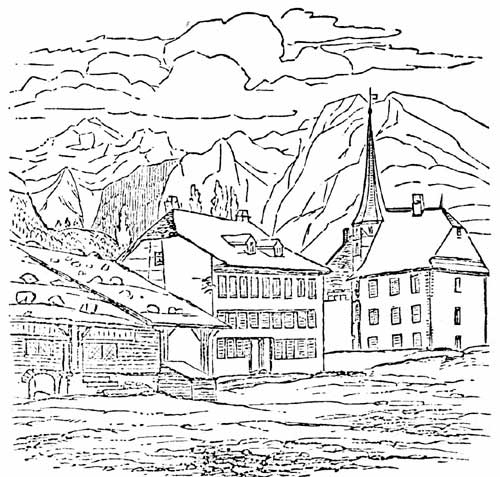
I have just returned from an expedition on foot
to the Schmadri Bach, and the Breithorn. All that
you can by possibility conceive as to the grandeur
and imposing forms of the mountains here, must fall
far short of the reality of nature. That Goethe could
write nothing in Switzerland but a few weak poems,
and still weaker letters, is to me as incomprehensible
as many other things in this world. The road
here is again in a lamentable state; where, six days
ago, there was the most beautiful highway, there is
now only a desolate mass of rocks; numbers of
huge blocks lying about, and heaps of rubbish and
sand. No trace whatever of human hands to be
seen. The waters, indeed, have entirely subsided,
but they are still in a troubled state, for from time
to time you can hear the stones tossed about, and
the waterfalls also in the midst of their white foam,
roll down black stones into the valley.
My guide pointed out to me a pretty new house,
standing in the midst of a wild turbulent stream;
he said that it belonged to his brother-in-law and
formerly stood in a beautiful meadow, which had
been very profitable; the man was obliged to leave
the house during the night; the meadow has disappeared
for ever, and masses of pebbles and stones
have usurped its place. "He never was rich, but
now he is poor," said he, in concluding his sad story.
The strangest thing is, that in the very centre of
this frightful devastation,—the Lütschine having
overflowed the whole extent of the valley—among
the marshy meadows, and masses of rocks, where
there is no longer even a trace of a road, stands a
char-à-banc—and is likely to stand for some time
to come. It chanced that the people in it wished
to drive through at the very time of the hurricane;
then came the inundation, so they were forced to
leave the carriage and everything else to fate, thus
the char-à-banc is still standing waiting there. It
was a very frightful sight when we reached the spot,
where the whole valley, with its roads and embankments,
is a perfect rocky sea; and my guide, who
went first, kept whispering to himself, "'sisch
furchtbar!" The torrent had carried into the middle
of the stream some large trunks of trees, which
are standing aloft; for at the same moment some
huge fragments of rocks having been flung against
them, the bare trees were closely wedged in betwixt
them, and they now stand nearly perpendicular in
the bed of the river.
I should never come to an end were I to try to
tell you all the various forms of havoc which I saw
between this place and Untersee. Still the beauty
of the valley made a stronger impression on me
than I can describe. It is much to be regretted,
that when you were in this country, you went
no further than Staubbach; for it is from there
that the valley of Lauterbrunnen really begins.
The Schwarzer Mönch, and all the other snowy
mountains in the background, become more mighty
and grand, and on every side bright foaming cascades
tumble into the valley. You gradually approach
the mountains covered with snow, and the
glaciers in the background, through pine woods,
and oaks, and maple-trees. The moist meadows,
too, were covered with a profusion of brilliant
flowers—snakewort, the wild scabious, campanulas,
and many others. The Lütschine had accumulated
masses of stones at the sides, having swept along
fragments of rocks, as my guide said, "bigger than
a stove," then the carved brown wooden houses, and
the hedges; it is all beautiful beyond measure!
Unfortunately we could not get to the Schmadri
Bach, as bridges, paths, and fords, were all gone;
but it was a walk I can never forget.
I also tried to sketch the Mönch; but what can
you hope to do with a small pencil? Hegel indeed
says, "that every single human thought is more
sublime than the whole of Nature;" but in this place
I consider that too presumptuous; the axiom sounds
indeed very fine, but is a confounded paradox nevertheless.
I am quite contented, in the meantime, to
adhere to Nature, which is the safest of the two.
You know the situation of the inn here, and if you
cannot recall it, refer to my former Swiss drawing
book, where you will find it sketched, badly enough,
and where I put in a footpath in front, from imagination,
which made me laugh heartily to-day, when I
thought of it. I am at this moment looking out of
the same window, and gazing at the dark mountains,
for it is late in the evening, that is, a quarter to
eight o'clock, and I have an idea, which is "more
sublime than the whole of Nature"—I mean to go
to bed; so good night, dear ones.
From the dairy hut on the Wengern Alp, in
heavenly weather, I send you my greetings.
I could not write more to you early this morning;
I was most reluctant to leave the Jungfrau. What
a day this has been for me! Ever since we were
here together I have wished to see the Lesser
Scheideck once more. So I woke early to-day, with
some misgivings, for so much might intervene—bad
weather, clouds, rain, fogs—but none of these
occurred. It was a day as if made on purpose for
me to cross the Wengern Alp. The sky was flecked
with white clouds, floating far above the highest
snowy peaks; no mists below on any of the mountains,
and all their pinnacles glittering brightly in
the morning air; every undulation, and the face of
every hill, clear and distinct. Why should I even
attempt to portray it? You have already seen the
Wengern Alp, but at that time we had bad weather,
whereas to-day the whole mountain range was in
holiday attire. Nothing was wanting; from thundering
avalanches, to its being Sunday, and people
dressed in their best going to church, just as it was
then.
The hills had only dwelt in my memory as gigantic
peaks, for their great altitude had entirely absorbed
me. To-day I was struck with amazement at the
immense extent of their base, their solid, spacious
masses, and the connection of all these huge piles,
which seem to lean towards each other, and to reach
out their hands to one another. In addition to this
you must imagine every glacier, and snowy plateau,
and point of rock, dazzlingly lighted up and glittering.
Then the far summits of distant mountain
ranges stretching hither, as if surveying the others.
I do believe that such are the thoughts of the
Almighty. Those who do not yet know Him, may
here see Him, and the nature He created, visibly
displayed. Then the fresh, bracing air, which refreshes
you when weary, and cools you when it is
warm,—and so many springs! I must at some future
time write you a separate treatise on springs, but
I have not time for it to-day, as I have something
particular to tell you.
Now you will say, I suppose, he came down the
mountain again, and is going to inform us once more
how beautiful Switzerland is. Not at all. When I
arrived at the herdsman's hut, I was told that in a
meadow far up the Alps, there was to be a great fête
this very day, and I saw people at intervals climbing
the mountain. I was not at all fatigued; an Alpine
fête is not to be seen every day; the weather said,
yes; the guide was willing. "Let us go to Intramen,"
said I. The old herdsman went first, so we
were obliged to climb very vigorously; for Intramen
is more than a thousand feet higher than the
Lesser Scheideck. The herdsman was a ruthless
fellow, for he ran on before us like a cat; he soon
took pity on my guide, and relieved him of my cloak
and knapsack, but even with them he continued to
push forward so eagerly that we really could not
keep up with him. The path was frightfully steep;
he extolled it, however, saying that there was a much
nearer, but much steeper track: he was about sixty
years of age, and when my youthful guide and I
with difficulty surmounted a hill, we invariably saw
him descending the next one. We walked on for
two hours in the most fatiguing path I ever encountered;
first a steep ascent, then down again into a
hollow, over heaps of crumbling stones, and brooks
and ditches, across two meadows covered with snow,
in the most profound solitude, without a footpath,
or the most remote trace of the hand of man; occasionally
we could still hear the avalanches from the
Jungfrau; otherwise all was still, and not a tree to
be seen.
When this silence and solitude had continued for
some time, and we had clambered to the top of a
grassy acclivity, we suddenly came in sight of a vast
number of people standing in a circle, laughing,
speaking, and shouting. They were all in gay
dresses, and had flowers in their hats; there were
a great many girls, some tables with casks of wine,
and all around deep solemn silence, and tremendous
mountains. It was singular that while I was in the
act of climbing, I thought of nothing but rocks and
stones, and the snow and the track; but the moment
I saw human beings, all the rest was forgotten, and
I only thought of men, and their sports, and the
merry fête. It was really a fine sight. The scene
was in a spacious green meadow far above the
clouds; opposite were the snowy mountains in all
their prodigious altitude, more especially the dome
of the great Eiger, the Schreckhorn, and the Wetterhörner,
and all the others as far as the Blümli's Alp;
the Lauterbrunnen valley lay far beneath us in the
misty depths, quite small, as well as our road of
yesterday, with all the little cataracts like threads,
the houses like dots, and the trees like grass. Far
in the background the Lake of Thun occasionally
glanced out of the mist.
The crowd now began wrestling, and singing, and
drinking, and laughing; all healthy, strong men. I
was much amused by the wrestling, which I had
never before seen. The girls served the men with
Kirschwasser and Schnapps; the flasks passed from
hand to hand, and I drank with them, and gave three
little children some cakes, which made them quite
happy; a very tipsy old peasant sang me some
songs; then they all sang; then the guide favoured
us with a modern song; and then little boys fought.
Everything pleased me on the Alps, and I remained
lying there till towards evening, and made myself
quite at home. We descended rapidly into the meadows
below, and soon descried the familiar inn, and
its windows glittering in the evening sun; a fresh
breeze from the glaciers began to blow; this soon
cooled us. It is now getting late, and from time to
time avalanches are heard,—so thus has my Sunday
been spent.—A fête-day indeed!
I am shivering with cold! Outside thick snow is
falling, and the wind raging and blustering. We
are eight thousand feet above the level of the sea,
and a long tract of snow to traverse, but here I am!
Nothing can be seen; all day the weather has been
dreadful. When I remember how fine it was yesterday,
while I earnestly wish that it may be as fine to-morrow,
it reminds me of life, for we are always
hovering between the past and the future. Our
excursion of yesterday seems as far past and remote,
as if I knew it only from old memories, and had
scarcely been present myself; for to-day when during
five mortal hours we were struggling on, against
rain and fog, sticking in the mud, and seeing nothing
round us but grey vapours, I could scarcely realize
that it ever was or ever will be again fine weather,
or that I ever lay idly stretched on this wet marshy
grass. Besides, everything here wears such a wintry
aspect; heated stoves, thick snow, cloaks, freezing,
shivering people. I am at this moment in the highest
inn in Europe; and just as in St. Peter's, you
look down on every church, and on the Simplon,
upon every road, so from hence I look down on all
other inns; but not morally, for this is little more
than a few wooden planks. Never mind. I am
now going to bed, and I will no longer watch my
own breath. Good night! "Tom's a cold."
I have not been able to open my journal for two
or three days, as when night came I had no longer
time for anything, but to dry myself and my clothes
at the fire, to warm myself, to sigh over the weather,
like the stove behind which I took refuge, and to
sleep a good deal; besides, I did not wish to try your
patience, by my everlasting repetitions of how deep
I had sunk in the mud, and how incessantly it rained,
and so forth. During the last few days in reality I
went through the most beautiful country, and yet
saw nothing but thick fogs, and water in the sky,
and from the sky, and on the earth. I passed places
that I had long wished to visit, without being able
to enjoy them; what also damped my writing mood,
was being obliged to battle with the weather, and if
it continues the same, I shall only write occasionally,
for really I should have nothing to say, but "a grey
sky—rain and fog." I have been on the Faulhorn,
the Great Scheideck, on Grimsel Spital, and to-day
I crossed Grimsel and Furka, and the principal objects
I have seen were the points of my shabby umbrella,
and I had not even a glimpse of the huge
mountains. At one moment, to-day, the Finsteraarhorn
came to light, but it looked as savage as if it
wished to devour us; and yet if we were a single
half-hour without rain, it was truly beautiful. A
journey on foot through this country, even in the
most unfavourable weather, is the most enchanting
thing you can possibly imagine; if the sky were
bright, I think the excess of pleasure would be quite
overpowering; I must not therefore complain too
much of the weather, for I have had my full share
of enjoyment.
During the last few days I felt like Tantalus.
When I was on the Scheideck, a glimpse of the
lower part of the Wetterhorn was sometimes visible
through the clouds, and it seemed beyond measure
magnificent and sublime; but I only saw the base.
On the Faulhorn, I could not distinguish objects
fifty paces off, although I stayed there till ten
o'clock in the morning. We went down to the
Scheideck in a heavy snow-storm, by a very wet and
difficult path, which the incessant rain had made
worse than usual. We arrived at Grimsel Spital in
rain and storm. To-day I wished to have ascended
the Sidelhorn, but was obliged to give it up on account
of the fog. The Mayenwand was shrouded in
grey clouds, and we had only a single peep of the
Finsteraarhorn, when we were on the Furka. We
also arrived here in a torrent of rain and water
everywhere, but all this does not signify. My guide
is a capital fellow: if it rains, he sings and jodels;
if it is fine, so much the better; and though I failed
in seeing some of the finest objects, still I saw a
great deal that was interesting.
On this occasion I have formed a particular
friendship for the glaciers; they are indeed, the
most marvellous monsters in the world. How
strangely they are all tumbled about; here, a row
of jagged points, there, toppling crags, and above,
towers and bastions, while on every side, crevices
and ravines are visible, all of the most wondrous
pure ice, that rejects all soil of earth, casting up
again on the surface the stones, sand, and gravel,
flung down by the mountains. Then the superb
colouring, when the sun shines on them, and their
mysterious advance—they sometimes move on a foot
and a half in a single day, so that the people in the
village are in the greatest anxiety and alarm, when
the glacier arrives so quietly, and yet with such
irresistible force, for it shivers rocks and stones
when they lie in the way—then the ominous crashing
and thundering, and the rushing of so many springs
near and round. They are splendid miracles. I
was in the Rosenlaui glacier, which forms a kind of
cave, that you can creep through; it looks as if
built of emeralds, only more transparent. Above,
around, on all sides, you can see rivulets running
between the clear ice. In the centre of this narrow
passage, the ice has left a large round window,
through which you look down on the valley, and
issue forth again under an arch of ice, and high
above, black peaks rear their heads, from which
masses of ice roll down in the boldest undulations.
The glacier of the Rhone is the most imposing that
I have seen, and the sun burst forth on it as we
passed early this morning. This is a suggestive
sight, and you get a casual glimpse of the rocky
peak of a mountain, a plateau covered with snow,
cataracts, and bridges spanning them, and masses of
crumbling stones and rocks; in short, even if you
see little in Switzerland, it is at all events more
than is to be seen in any other country.
I have been drawing very busily, and think I have
made some progress. I even tried to sketch the
Jungfrau; it will at least serve as a reminiscence,
and I can enjoy the thought that these strokes were
actually made on the spot itself. I see people rushing
through Switzerland, and declaring that they
find nothing to admire there, or anywhere else
(except themselves); not the least affected nor
roused, remaining cold and prosaic, even in presence
of the mountains; when I meet such people
I should like to give them a good drubbing.
Two Englishmen and an English lady are at this
moment sitting beside me near the stove; they are
as wooden as sticks. We have been travelling the
same road for a couple of days, and I declare the
people have never uttered a syllable except of abuse,
that there were no fireplaces either on the Grimsel,
or here; but that there are mountains here, is a fact
to which they never allude; their whole journey is
occupied in scolding their guide, who laughs at
them, in quarrelling with the innkeepers, and in
yawning in each others' faces. They think everything
commonplace, because they are themselves
commonplace, therefore they are not happier in
Switzerland than they would be in Bernau. I maintain
that happiness is relative; another would thank
God that he could see all this, and so I will be that
other!
A day made for a journey; fine, and enjoyable,
and bracing. When we wished to start this morning
at six o'clock, there was such a storm of sleet and
snow that we were obliged to wait till nine o'clock,
when the sun came forth, the clouds dispersed, and
we had delightful bright weather as far as this place;
but now sombre clouds, heavy with rain, have collected
over the lake, so that no doubt to-morrow the
old troubles will break loose again. But how glorious
this day has been, so clear and sunny—we had the
most charming journey! You know the St. Gothard
Road in all its beauty; you lose much by coming
down from above, instead of ascending from this
point, for the grand surprise of the Urner Loch is
entirely lost, and the new road which has been made,
with all the grandeur, as well as convenience, of the
Simplon, impairs the effect of the Devil's Bridge:
inasmuch as close beside it a new arch, much bolder
and larger, has been constructed, which makes the
old bridge look quite insignificant, but the ancient
crumbling walls look much more romantic and picturesque.
Though the view of Andermatt is thus lost,
and the new Devil's Bridge far from being poetical,
still you go merrily downhill all day, on a delightfully
smooth road, flying rapidly past the various
localities, and instead of being sprinkled by the foam
of the waterfall on the old bridge as formerly, and
endangered by the wind, you now pass along far
above the stream, between two ranges of solid
parapets.
We came past Göschenen and Wasen and presently
appeared the huge firs and beech-trees close to Amsteg;
then the charming valley of Altorf, with its
cottages, meadows, and woods, its rocks and snowy
mountains. We rested at Altorf in a Capuchin
Convent, situated on a height; and finally, here I
am on the banks of the Vierwaldstadt Lake. To-morrow
I purpose crossing the lake to Lucerne,
where I hope to find letters from you. I shall then
also get rid of a party of young people from Berlin,
who have been pursuing almost the same route with
me, meeting me at every turn, and boring me terribly;
the patriotism of a lieutenant, a dyer, and a
young carpenter,—all three bent on destroying
France,—was peculiarly distasteful to me.
I crossed the Vierwaldstadt Lake early this morning,
in a continued pour of rain, and found your
welcome letter of the 5th in Lucerne. As it contained
nothing but good tidings, I immediately
arranged a tour of three days to Unterwalden and
the Brünig. I intend to call again at Lucerne for
your next letter, and then I am off to the West, and
out of Switzerland. I shall take leave of it with
deep regret. The country is beautiful beyond all
conception; and though the weather is again odious,—rain
and storms the whole day, and all through
the night,—yet the Tellen Platte, the Grütli, Brunnen
and Schwytz, and the dazzling green of the
meadows this evening in Unterwalden, are too lovely
ever to be forgotten. The hue of this green is most
unique, refreshing the eye and the whole being. I
shall certainly attend to your kind precautionary
injunctions, dear Mother, but you need be under
no apprehensions about me. I am by no means
careless with regard to my health, and have not, for
a long time, felt so well as during my pedestrian
excursions in Switzerland. If eating, and drinking,
and sleeping, and music in one's head, can make a
man healthy, then, God be praised, I may well call
myself so; for my guide and I vie with each other
in eating and drinking, and not less so unluckily in
singing. In sleeping alone I surpass him; and
though I sometimes disturb him by my trumpet or
oboe tones, he in turn cuts short my morning sleep.
Please God, therefore, we shall have a happy meeting.
Before that time arrives, however, many a page
of my journal must yet travel to you; but even this
interval will quickly pass, just as everything quickly
passes, except indeed what is best of all!—so let us
be true and loving to each other.
Felix.
My heart is so full that I must tell you about it.
In this enchanting valley I have just taken up
Schiller's "Wilhelm Tell," and read half of the first
scene; there is surely no genius like that of Germany!
Heaven knows why it is so, but I do think
that no other nation could fully comprehend such an
opening scene, far less be able to compose it. This
is what I call a poem, and a beginning; first the
pure, clear verse, in which the lake, smooth as a
mirror, and all else, is so vividly described, and then
the slow commonplace Swiss talk, and Baumgarten
coming in,—it is quite glorious! How fresh, how
powerful, how exciting! We have no such work as
this in music, and yet even that sphere ought one
day to produce something equally perfect. It is so
admirable in him too, to have created an entire
Switzerland for himself, inasmuch as he never saw
it, and yet all is so faithful and so strikingly truthful;
the people and life, the scenery and nature. I
was delighted when the old innkeeper here, in a
solitary mountain village, brought me from the
monastery the book with the well-known characters
and old familiar names; but the opening again quite
surpassed all my expectations. It is now more
than four years since I read it. I mean presently to
go over to the monastery, to work off my excitement
on the organ.
Do not be astonished at my enthusiasm, but read
the scene through again yourself, and then you will
find my excitement quite natural. Such passages
as those where all the shepherds and hunters shout
"Save him! save him!" in the close at the Grütli,
when the sun is about to rise, could indeed only
have occurred to a German, and above all to
Schiller; and the whole piece is crowded with
similar passages. Let me refer to that particular
one at the end of the second scene, where Tell comes
with the rescued Baumgarten to Stauffacher, and
the agitating conference closes in such tranquillity
and peace: this, along with the beauty of the
thought, is so thoroughly Swiss. Then the beginning
of the Grütli—the symphony which the orchestra
ought to play at the end I composed in my
mind to-day, because I could do nothing satisfactory
on the little organ: altogether a variety of plans
and ideas occurred to me. There is a vast deal to
do in this world, and I mean to be industrious. The
expression that Goethe made use of to me, that
Schiller could have supplied two great tragedies
every year, with its business-like tone, always inspired
me with particular respect: but not till this
morning did the full force of its signification become
clear to me, and it has made me feel that I must set
to work in earnest. Even the mistakes are captivating,
and there is something grand in them; and
though certainly Bertha, Rudenz, and old Attinghausen,
seem to me great blemishes, still Schiller's
idea is evident, and he was in a manner forced to do
as he has done; and it is consolatory to find that
even so great a man could for once commit such an
egregious mistake.
I have passed a most enjoyable morning, and I
feel in the kind of mood which makes you long to
recall such a man to life, in order to thank him, and
inspiring an earnest desire, one day, to compose a
work which shall impress others with similar feelings.
Probably you do not understand what induced me
to take up my quarters here in Engelberg. It happened
thus:—I have not had a single day's rest
since I left Untersee, and therefore wished to remain
for a day at Meiringen, but was tempted by the
lovely weather in the morning, to come on here.
The usual rain and wind assailed me on the mountains,
and so I arrived very tired. This is the
nicest inn imaginable,—clean, tidy, very small and
rustic,—an old white-haired innkeeper; a wooden
house, situated in a meadow, a little apart from the
road; and the people so kind and cordial, that I feel
quite at home. I think this kind of domestic comfort
is only to be found among those who speak the
German tongue; at all events, I never met with it
anywhere else; and though other nations may not
feel the want of it, or scarcely care about it, still I
am a native of Hamburg, and so it makes me feel
happy and at home. It is not therefore strange that
I decided on taking my day's rest here with these
worthy old people. My room has windows on every
side, commanding a view of the valley: the room is
prettily panelled with wood; some coloured texts
and a crucifix are hanging on the walls; there is a
solid green stove, and a bench encircling it, and two
lofty bedsteads. When I am lying in bed I have
the following view:—
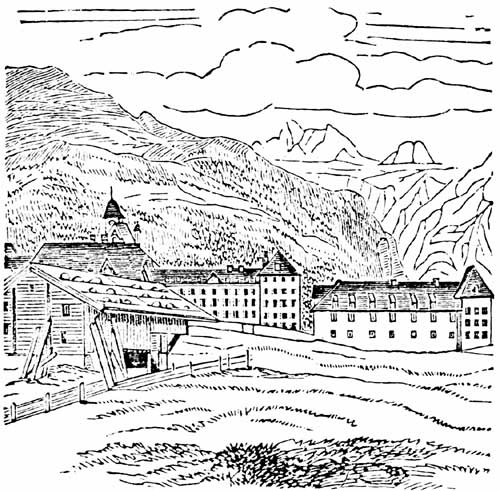
I have failed again in my buildings, and in the
hills too, but I hope to make a better sketch of it
for you in my book, if the weather is tolerable to-morrow.
I shall always consider this valley to be
one of the loveliest in all Switzerland. I have not
yet seen the gigantic mountains by which it is encompassed,
as they have been all day shrouded in
mist; but the beautiful meadows, the numerous
brooks, the houses, and the foot of the hills, so far
as I could see them, are exquisitely lovely. The
green of the Unterwalden is more brilliant than in
any other canton, and it is celebrated for its meadows
even among the Swiss. The previous journey too
from Sarnen was enchanting, and never did I see
larger or finer trees, or a more fruitful country.
Moreover the road is attended with as few difficulties
as if you were traversing a large garden; the
declivities are clothed with tall slender beeches; the
stones overgrown by moss and herbs; then there
are springs, brooks, small lakes, and houses: on one
side is a view of the Unterwalden and its green
plains; and shortly after a view of the whole vale
of Hasli, the snowy mountains, and cataracts leaping
down from rocky precipices; the road too is shaded
the whole way by enormous trees.
Yesterday, early, as I told you, I was tempted by
the bright sun to cross the Genthel valley to ascend
the Joch, but on the summit the most dreadful
weather set in; we were obliged to make our way
through the snow, and this was sometimes anything
but pleasant. We speedily, however, emerged out
of the sleet and snow, and an enchanting moment
ensued, when the clouds broke, while we were still
standing in them; and far beneath us, we saw
through the mists as through a black veil, the
green valley of Engelberg. We soon made our way
down, and heard the silvery bell of the monastery
ring out the Ave Maria. We next saw the white
building on the meadow, and arrived here after an
expedition of nine hours. I need not say how
acceptable at such a time is a comfortable inn, and
how good the rice and milk seems, and how long you
sleep next morning.
To-day we have had very disagreeable weather, so
they brought me "Wilhelm Tell" from the library
of the monastery, and the rest you know. I was
much struck by Schiller having so completely failed
in portraying Rudenz, for the whole character is
feeble, and without sufficient motive, and it seems
as if he had resolved purposely to represent him
throughout, in the worst possible light. His words,
in the scene with the apple, might tend to redeem
him, but being preceded by that with Bertha, they
make no impression. When he joins the Swiss, after
the death of Attinghausen, it might be supposed
that he is changed, but he instantly proclaims that
his Bertha is carried off, so again he has as little
merit as ever. It occurred to me that if he had
uttered the very same manly words against Gessler,
without the explanation with Bertha having previously
taken place, and if such a result had arisen
out of this in the following act, the character would
have been much better, and the explanatory scene
not so merely theatrical as it now is. This is certainly
very like the egg and the hen, but I should
like to hear your opinion on the subject. I dare not
speak to one of our learned men on such matters;
these gentlemen are a vast deal too wise! If however
I chance some of these days to meet one of
those youthful modern poets, who look down on
Schiller, and only partly approve of him; so much
the worse for him, for I must infallibly crush him to
death.
Now, good night; I must rise very early to-morrow;
it is to be a grand fête to-day in the monastery,
and a solemn religious service, and I am to play the
organ for them. The monks were listening this
morning while I was extemporizing a little, and
were so pleased, that they invited me to play the
people in and out at their festival to-morrow. The
father organist has also given me the subject on
which I am to extemporize; it is better than any
that would have occurred to an organist in Italy.
[Listen]
I shall see to-morrow what I can make of this. I
played a couple of new pieces of mine on the organ
this afternoon in the church, and they sounded
rather well. When I came past the monastery the
same evening, the church was closed, and scarcely
were the doors shut, when the monks began to sing
nocturns fervently, in the dark church; they intoned
the deep B, which vibrated splendidly, and could be
heard far down the valley.
This has been another splendid day—the weather
bright and enjoyable, and the bluest sky that I have
seen since I left Chamouni; it was a holiday in the
village, and in all the mountains. After long-continued
fogs, and every variety of bad weather, once
more to see from the window in the morning the
clear range of mountains and their pinnacles, is indeed
a grand spectacle. They are acknowledged to
be finest after rain, and to-day they looked as fresh
as if newly created. This valley is not surpassed
by any in Switzerland. If I ever return here this
shall be my head-quarters, for it is even more lovely,
and more spacious and unconfined than Chamouni,
and more free than Interlaken. The Spann-örter
are incredibly grand peaks, and the round Titlis
heavily laden with snow, the foot of which lies in the
meadows, and the effect of the Urner rocks in the
distance, are also well worth seeing: it is now full
moon, and the valley is clothed in beauty.
This whole day I have done nothing but sketch,
and play the organ: in the morning I performed my
duties as organist—it was a grand affair. The organ
stands close to the high altar, next to the stalls for
the "patres;"—so I took my place in the midst of
the monks, a very Saul among the prophets. An
impatient Benedictine at my side played the double
bass, and others the violins; one of their dignitaries
was first violin. The pater præceptor stood in front
of me, sang a solo, and conducted with a long stick,
as thick as my arm. The élèves in the monastery
formed the choir, in their black cowls; an old decayed
rustic played on an old decayed oboe, and at
a little distance two more were puffing away composedly
at two huge trumpets with green tassels;
and yet with all this the affair was gratifying. It
was impossible not to like the people, for they had
plenty of zeal, and all worked away as well as they
could. A mass, by Emmerich, was given, and every
note of it betrayed its "powder and pigtail." I
played thorough-bass faithfully from my ciphered
part, adding wind instruments from time to time,
when I was weary; made the responses, extemporized
on the appointed theme, and at the end, by
desire of the Prelate, played a march, in spite of my
repugnance to do this on the organ, and was then
honourably dismissed.
This afternoon I played again alone to the monks,
who gave me the finest subjects in the world—the
"Credo" among others—a fantasia on the latter was
very successful; it is the only one that in my life I
ever wished I could have written down, but now I
can only remember its general purport, and must
ask permission to send Fanny, in this letter, a passage
that I do not wish to forget. By degrees various
counter subjects were introduced in opposition to
the canto fermo; first dotted notes, then triplets,
at last rapid semiquavers, through which the "Credo"
was to work its way; quite at the close, the semiquavers
became very wild, and arpeggios followed on
the whole organ in G minor. I proceeded to take up
the theme on the pedal in long notes (during the
continued arpeggios), so that it ended with A. On
the A, I made a pedal point in arpeggios, and then
it suddenly occurred to me to play the arpeggios
with the left hand alone, so that the right hand
could introduce the "Credo" again in the treble
with A, thus:—
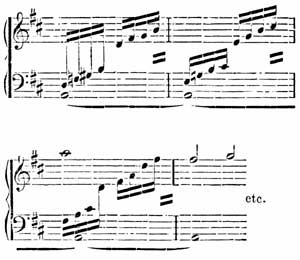
[Listen]
etc.
This was followed by a stop on the last note, and
a pause, and then it concluded. I wish you had
heard it, for I am sure you would have been pleased.
It was time for the monks to go to complines, and
we took leave of each other cordially. They wished
to give me letters of introduction for some other
places in Unterwalden, but I declined this, as I intend
to go to Lucerne early to-morrow, and after
that I expect not to be more than five or six days
longer in Switzerland.—Your
Felix.
To Wilhelm Taubert.
I wish to offer you my thanks, but I really do not
know where to begin first; whether for the pleasure
your songs caused me in Milan, or for your kind
letter which I received yesterday; both however are
closely connected, and so I think we have already
made acquaintance. It is quite as fitting that we
should be presented to each other through the
medium of music-paper, as by a third person in
society; indeed I think that in the former case you
feel even more intimate and confidential. Moreover,
persons who introduce any one often pronounce the
name so indistinctly, that you seldom know who is
standing before you; and they never say one word
as to whether the man is gay and good-humoured,
or melancholy and gloomy. So we are infinitely
better off. Your songs have pronounced your name
clearly and plainly; they also disclose what you
think and what you are; that you love music, and
wish to make progress; so thus perhaps I know you
better than if we had frequently met.
What a source of pleasure it is, and how cheering,
to know there is another musician in the world who
has the same purposes and aspirations, and who follows
the same path as yourself; perhaps you cannot
feel this so strongly as I do at this moment, who
have just come from a country where music no longer
exists among the people. I never before could have
believed this of any nation, and least of all of Italy,
with such rich and luxuriant nature, and such
glorious, inspiriting antecedents. But alas! the
occurrences I latterly witnessed there, fully proved
to me that even more than harmony is dead in that
land; it would indeed be marvellous if any music
could exist where there is no solid principle. At
last I was really bewildered, and thought that I
must have become a hypochondriac, for all the buffoonery
I saw was most distasteful to me, and yet a
vast number of serious people and sedate citizens
entered into it. When they played me anything of
their own, and afterwards praised and extolled my
pieces, I cannot tell you how repugnant it was to
me; I felt disposed to become a hermit, with beard
and cowl, and the whole world was at a discount with
me. In Italy you first learn to value a true musician;
that is, one whose thoughts are absorbed in
music, and not in money, or decorations, or ladies,
or fame; it is doubly delightful when you find that,
without your being aware of it, your own ideas exist
and are developed elsewhere; your songs therefore
gave me especial pleasure, because I could gather
from them that you must be a genuine musician, and
so let us mutually stretch out our hands across the
mountains.
I beg that you will also look on me in the light
of a friend, and not write so formally as to my
"counsel" and "teaching." This portion of your
letter makes me feel almost nervous, and I scarcely
know what to say; the most agreeable part however
is your promise to send me something to Munich,
and to write to me again. I will then tell you
frankly and freely my honest opinion, and you shall
do the same with regard to my new compositions,
and thus I think we shall give each other good
counsel. I am very eager to see those recent works
of yours that you have promised me, for I do not
doubt that I shall receive much gratification from
them, and many things which are only foreshadowed
in the former songs, will probably in these become
manifest and distinct. I shall therefore say nothing
to-day of the impression your songs have made on
me, because possibly any suggestion or question
may be already answered in what you are about to
send me. I earnestly entreat of you to write to me
fully, and in detail, about yourself, in order that we
may become better acquainted. I can then write to
you what I purpose and what I think, and thus we
shall continue in close connection.
Let me know what you have recently composed
and are now composing; your mode of life in Berlin,
and your plans for the future; in short all that concerns
your musical life, which will be of the greatest
interest to me. Probably this will be obvious in
the music you have so kindly promised me, but fortunately
both may be combined. Have you hitherto
composed nothing on a greater scale; some wild
symphony, or opera, or something of the kind? I,
for my part, feel at this moment the most invincible
desire to write an opera, and yet I have scarcely
leisure even to commence any work, however small.
I do believe that if the libretto were to be given to
me to-day, the opera would be written by to-morrow,
so strong is my impulse towards it. Formerly the
bare idea of a symphony was so exciting, that I
could think of nothing else when one was in my
head; the sound of instruments has such a solemn
and glorious effect; and yet for some time past I
have laid aside a symphony that I had commenced,
in order to compose on a cantata of Goethe's merely
because it included, besides the orchestra, voices
and a chorus. I intend now, indeed, to complete
the symphony, but there is nothing I so strongly
covet as a regular opera.
Where the libretto is to come from I know less
than ever since last night, when for the first time
for more than a year I saw a German æsthetic
paper. The German Parnassus seems in as disorganized
a condition as European politics. God help
us! I was obliged to digest the supercilious Menzel,
who presumed modestly to depreciate Goethe,—and
the supercilious Grabbe, who modestly depreciates
Shakspeare,—and the philosophers who proclaim
Schiller to be rather trivial! Is this new, arrogant,
overbearing spirit, this perverse cynicism, as odious
to you as it is to me? and are you of the same
opinion with myself, that the first and most indispensable
quality of any artist is to feel respect for
great men, and to bow down in spirit before them;
to recognize their merits, and not to endeavour to
extinguish their great flame, in order that his own
feeble rushlight may burn a little brighter? If a
person be incapable of feeling true greatness, I
should like to know how he intends to make me feel
it? And as all these people, with their airs of
contempt, only at last succeed in producing imitations
of this or that particular form, without any presentiment
of free, fresh, creative power, unfettered
by individual opinion, or æsthetics or criticism, or
the whole world besides; as this is the case, do they
not deserve to be abused? and I do abuse them.
Pray do not take this amiss; perhaps I have gone
too far. But, it was long since I had read anything
of the kind, and it vexes me to see that such folly
still goes on, and that the philosopher who maintains
that art is dead, still persists in declaring that it is
so; as if art could in reality ever die.
These are truly strange, wild, and troubled times;
and let those who feel that art is no more, allow it
for Heaven's sake to rest in peace; but however
roughly the storm may rage without, it cannot so
quickly succeed in sweeping away the dwelling; and
he who works on quietly within, fixing his thoughts
on his own capabilities and purposes, and not on
those of others, will see the hurricane blow over,
and afterwards find it difficult to realize that it
ever was so violent as it appeared at the time. I
have resolved to act thus so long as I can, and to
pursue my path steadily, for at all events no one
will deny that music still exists, and that is the chief
thing.
How cheering it is to meet with a person who has
chosen the same object and the same means as
yourself! and I would fain tell you how gratifying
each new corroboration of this is to me, but I
scarcely know how to do so. You must imagine it
for yourself, and your own thoughts must supply any
deficiencies; so farewell! Pray let me hear from
you soon, and frequently. I beg to send my kindest
wishes to our dear friend Berger;[22] I have been
long intending to write to him, but have never yet
accomplished it. I shall certainly however do so
one of these days. Forgive this long, dry letter,
next time it shall be more interesting, and now once
more farewell.—Yours,
Felix Mendelssohn Bartholdy.
I am on the Righi! I need say no more, for you
know this mountain. What can be more grand or
superb? I left Lucerne early this morning. All
the mountains were obscured, and the weather-wise
prophesied bad weather. As however I have always
found that the very opposite of what the wise people
say invariably occurs! I tried to make out signs for
myself, though hitherto, in spite of their aid, I have
found my predictions quite as false as those of the
others; but this morning I really thought the weather
very tolerable; still, as I did not wish to begin my
ascent while all was still shrouded in vapour (for
the Faulhorn had taught me caution), I spent the
whole morning in sauntering round the foot of the
Righi, gazing eagerly upwards, to see if the mists
were likely to clear off. At last, about twelve
o'clock, at Küssnacht, I stood on the cross path
leading towards the Righi to the right, and Immensee
to the left; and making up my mind not to see
the Righi on this occasion, I took a tender farewell
of it, and went through the Hohle Gasse to the
Lake of Zug, along a charming path, past the water,
to Arth; but could not resist frequently glancing at
the summit of the Righi Culm, to see if it was becoming
clearer; and while I was dining at Arth it
did clear up. The wind was very favourable, the
clouds lifted on every side; so I made up my mind
to begin the ascent.
There was no time to lose, however, if I wished to
witness the sunset; so I went along at a steady
mountain pace, and in the course of two hours and
three-quarters I reached the Culm, and the well-known
house. I then became aware that there were
about forty men standing on the top, uplifting their
hands in admiration, and making signs in a state of
the greatest excitement. I ran up, and a new and
wondrous sight it was. All the valleys were filled
with fogs and clouds, and above them the lofty, snowy
crests of the mountains and the glaciers and black
rocks stood out bright and clear. The mists swept
onwards, veiling a portion of the scenery; then came
forth the Bernese Alps, the Jungfrau, the Mönch,
and the Finsteraarhorn; then Titlis, and the Unterwalden
mountains. At last the whole range was
distinctly visible; the clouds in the valleys now also
began to roll away, disclosing the lakes of Lucerne
and Zug, and towards the hour of sunset, only thin
streaks of bright vapour still floated on the landscape.
Coming from the Alp, and then looking
towards the Righi, it was as if the overture and
other portions were repeated at the end of an opera.
All the spots whence you have seen such sublime
scenery, the Wengern Alp, the Wetter Hörner,
the valley of Engelberg, here meet the eye once
more in close vicinity, and you can take leave of
them all. I had imagined that it was only at first,
when still ignorant of the glaciers, that so great
an impression was made, from the influence of surprise,
but I think the effect at the last is even more
striking than ever.
Yesterday and to-day I gratefully recalled the
happy auspices under which I first made acquaintance
with this part of the world. The remembrance
of your profound admiration of these wonders, elevating
you above every-day life, has contributed not
a little to awaken and to quicken my own perception
of them. I often to-day recurred to your delight, and
the deep impression it made on me at the time. So
the Righi is evidently disposed to be gracious to our
family, and in consequence of this kindly feeling
towards us, conferred on me to-day a sunrise quite
as brilliant and splendid as when you were here.
The waning moon, the lively Alpine horn, the long-protracted
rosy dawn which first stole over the cold.
shadowy, snowy mountains, the white clouds on the
Lake of Zug, the clear, sharp peaks bending towards
each other in all directions, the light which gradually
crept on the heights, the restless, shivering people,
wrapped in coverlets, the monks from Maria zum
Schnee, nothing was wanting.
I could not tear myself away from this spectacle,
and remained on the summit for six consecutive
hours, gazing at the mountains. I thought that
when next I saw them there might be many changes,
so I wished to imprint the sight indelibly on my
memory. People came and went, and talked of
these anxious, troubled times, of politics, and of the
grand mountain range before us.
Thus the morning passed away, and at last, at
half-past ten o'clock, I was obliged to go; indeed it
was high time, as I wished to get to Einsiedel the
same day, by Hacken. On my way, however, in the
steep path leading to Lowerz, my trusty old umbrella,
which also served me as a mountain staff, broke to
pieces; this detained me, so that I preferred remaining
here, and to-morrow I hope to be quite fresh for
a start.
(Year of rains and storms.) Motto of the copper-smith—"If
you can't sing a new song, then begin
the old one afresh." Here am I again in the midst
of fogs and clouds, unable to go either backwards or
forwards, and if fortune specially favours us, we may
have a slight inundation into the bargain. When I
crossed the lake, the boatmen prophesied very fine
weather, consequently the rain began half an hour
later, and is not likely soon to cease, for there are
piles of heavy, gloomy clouds, such as you can only
see on the mountains. If it were twice as bad three
days hence, I should not care, but it would be
grievous indeed if Switzerland were to take leave of
me with so ill-omened an aspect.
I have this moment returned from the church,
where I have been playing the organ for three hours,
far into the twilight: an old man, a cripple, blew the
bellows for me, and except him, there was not a
single soul in the church. The only stops I found
available, were a very weak croaking flute, and a
quavering deep pedal diapason, of sixteen feet. I
contrived to extemporize with these materials, and
at last subsided into a choral melody in E minor,
without being able to remember what it was. I
could not get rid of it, when all at once it occurred
to me that it was a Litany, the music of which was
in my head because the words were in my heart, so
then I had a wide field, and plenty of food for extemporizing.
At length the consumptive deep bass
resounded quite alone in E minor, thus:—
[Listen]
and then came in its turn the flute, high up in the
treble, with the choral in the same key, and so the
sounds of the organ gradually died away, and I was
obliged to stop, from the church being so dark.
In the meantime there was a terrible hurricane of
wind and rain outside, and not a trace of the grand
lofty rocky precipices; the most dreary weather! and
then I read some dreary newspapers, and everything
wore a grey hue. Tell me, Fanny, do you know
Auber's "Parisienne?" I consider it the very worst
thing he has ever produced, perhaps because the
subject was really sublime, and for other reasons
also. Auber alone could have been guilty of composing
for a great nation, in the most violent state
of excitement, a cold, insignificant piece, quite
commonplace, and trivial. The refrain revolts
me every time I think of it,—it is as if children
were playing with a drum, and singing to it—only
more objectionable. The words also are worthless;
little antitheses and points are quite out of place
here. Then the emptiness of the music! a march
for acrobats, and at the end a mere miserable imitation
of the "Marseillaise." Such music is not what
this epoch demands. Woe to us if it be indeed
what suits this epoch,—if a mere copy of the Marseillaise
Hymn be all that is required. What in the
latter is full of fire, and spirit, and impetus, is in
the former ostentatious, cold, calculated, and artificial.
The "Marseillaise" is as superior to the
"Parisienne" as everything produced by genuine
enthusiasm must be, to what is made for a purpose,
even if it be with a view to promote enthusiasm; it
will never reach the heart, because it does not come
from the heart.
By the way, I never saw such a striking identity
between a poet and a musician, as between Auber
and Clauren. Auber faithfully renders note for
note, what the other writes word for word—braggadocio,
degrading sensuality, pedantry, epicurism,
and parodies of foreign nationality. But why should
Clauren be effaced from the literature of the day?
Is it prejudicial to any one that he should remain
where he is? and do you read what is really good
with less interest? Any young poet must indeed be
degenerate, if he does not cordially hate and despise
such trash; but it is only too true that the people
like him; so it is all very well, it is only the people's
own loss. Write me your opinion of the "Parisienne."
I sometimes sing it to myself for fun, as I
go along; it makes a man walk like a chorister in a
procession.
Wretched weather! it has rained all night, and
all the morning too, and the cold as severe as in
winter; deep snow is lying on the adjacent hills.
There has been again a tremendous inundation in
Appenzell, which has done the greatest damage, and
destroyed all the roads. At the Lake of Zurich,
there are numbers of pilgrimages, and processions,
on account of the weather. I was obliged to drive
here this morning, as all the footpaths were covered
with mud and water. I shall remain till to-morrow,
when the diligence passes through at an early hour,
and I intend to go with it up the valley of the Rhine,
as far as Altstetten.
To-morrow I shall probably have reached, or
crossed, the boundaries of Switzerland, for my pleasure
excursion is now over. Autumn is arrived, and
I have no right to complain if I pass a few tiresome
days, after so many enchanting ones, that I can
never forget. On the contrary, I think I almost like
it; there is always enough to be done, even in Sargans,
(a wretched hole,) and in a regular deluge,
like that of to-day—for happily an organ is always
to be found in this country; they are certainly
small, and the lower octave, both in the key-board
and the pedal, imperfect, or as I call it, crippled;
but still they are organs, and that is enough for me.
I have been playing all this morning, and really
begun to practise, for it is a shame that I cannot play
Sebastian Bach's principal works. I intend, if I
can manage it, to practise for an hour every day in
Munich, as after a couple of hours' work to-day, I
certainly made considerable progress with my feet
(nota bene, sitting). Ritz once told me that
Schneider, in Dresden, played him the D major
fugue, in the "wohl-temperirten Clavier," on the
organ, supplying the bass with the pedal.
[Listen]
This had hitherto appeared to me so fabulous, that I
could never properly comprehend it. It recurred to
me this morning when I was playing the organ, so I
instantly attempted it, and I at least see that it is
far from being impossible, and that I shall accomplish
it. The subject went pretty well, so I practised
passages from the D major fugue, for the
organ, from the F major toccata, and the G minor
fugue, all of which I knew by heart. If I find a
tolerable organ in Munich, and not an imperfect
one, I will certainly conquer these, and feel childish
delight at the idea of playing such pieces on the
organ. The F major toccata, with the modulation
at the close, sounded as if the church were about
to tumble down; what a giant that Cantor was!
Besides organ-playing, I have a good many
sketches to finish, in my new drawing book, (one
was entirely filled in Engelberg) and then I must
eat like six hundred wrestlers. After dinner I
practise the organ again, and thus a rainy day
passes at Sargans. It seems prettily situated, with
a castle on the hill, but I cannot go a step beyond
the door.
Evening.—Yesterday at this time, I still projected
a pedestrian tour, and wished at all events to
go through the whole of the Appenzell. It was a
strange feeling when I learned that all mountain
excursions were probably at an end for this year:
the heights are covered with deep snow, for just as
it has rained here, in the valley, for thirty-six hours,
it has snowed incessantly on the hills above. The
flocks have been obliged to come down into the
valley from the Alps, where they ought to have remained
for a whole month yet, so that all idea of
any footpaths is out of the question. Yesterday I
was still on the hills, but now they will be inaccessible
for six months to come. My pedestrian excursions
are over; wondrously beautiful they were, and
I shall never forget them.
I mean to work hard at music, and high time
that I should. I played on the organ till twilight,
and was trampling energetically on the pedal, when
we suddenly became aware that the deep C sharp
in the great diapason, went buzzing softly on without
ceasing; all our pressing, and shaking, and
thumping on the keys, was of no avail, so we were
obliged to climb into the organ among the big pipes.
The C sharp continued gently humming,—the fault
lay in the bellows; the organist was in the greatest
perplexity, because to-morrow is a fête day; at last
I stuffed my handkerchief into the pipe, and there
was no more buzzing, but no more C sharp either.
I played this passage incessantly, all the same:—
[Listen]
and it did very well.
I am now going to finish my sketch of the Glacier
of the Rhone, and then the day will be at my own
disposal; which means that I am going to sleep.
I will write to you on the next page to-morrow evening
wherever I am, for to-day I have no idea where
I shall be. Good night! Eight is striking in F
minor, and it is raining and blowing in F sharp
minor or G sharp minor; in short, in every possible
sharp key.
[Listen]
Motto—"Vous pensez que je suis l'Abbé de St.
Gall" (Citoyen).[23] I do feel so comfortable here,
after braving such storms and tempests. During
the four hours when I was crossing the mountains
from Altstetten to this place, I was engaged in a
regular battle with the elements; when I tell you
that I never experienced anything like the storm,
nor even imagined anything approaching to it, this
does not say much; but the oldest people in the
Canton declare the same: a large manufactory has
been demolished, and several persons killed. To-morrow,
in my last letter from Switzerland, I will
tell you of my being again obliged to travel on
foot, and arriving here, after crossing by Appenzell,
which looked like Egypt after the seven plagues.
The bell is now ringing for dinner, and I mean to
feast like an abbot.
Opposite me lies Switzerland, with her dark blue
mountains, pedestrian journeys, storms, and glorious
heights and valleys. Here ends the greatest part of
my journey, and my journal also.
At noon to-day, I crossed the wild grey Rhine in
a ferry-boat, above Rheineck, and now here I am,
already in Bavaria. I have of course entirely given
up my projected excursion on foot, through the
Bavarian mountains; for it would be folly to attempt
anything of the kind this year. For the last four
days it has rained more or less with incessant vehemence;
it seemed as if Providence were wroth. I
passed to-day through extensive orchards, which
were not under water, but fairly submerged by mud
and clay; everything looks deplorable and depressing;
you must therefore forgive the doleful style
of this last sheet. I never in any landscape saw a
more dreary sight than the sward of the green hills,
covered with deep snow; while below, the fruit-trees,
with their ripe fruit, were standing reflected in the
water. The scanty covering of muddy snow, which
lay on the fir-woods and meadows, looked the personification
of all that was dismal. A Sargans
burgher told me that in 1811 this little town had
been entirely burnt down, and recently with difficulty
rebuilt; that they depend chiefly on the produce
of their vineyards, which have been this year
destroyed by hail-storms, and the Alps also were
now no longer available; this gives rise to serious
reflections, and to anxious thoughts with regard to
this year.
It is singular enough that if I am obliged to go
on foot in such weather, and fairly exposed to it, I
am not in the least annoyed; on the contrary, I
rather rejoice in setting it at defiance. When I
arrived by the diligence yesterday at Altstetten, in
freezing cold, like a day in December, I found that
there was no carriage road to Tourgen, to which
place I had unluckily sent on my cloak and knapsack
on the last fine day. I was obliged to have them
the same evening, for the cold was intense, so I did
not hesitate long, but set off once more for the last
time to cross the mountains, and arrived in the
Canton of Appenzell.
The state of the woods, and hills, and meadows,
and little bridges, baffles all description; being Sunday,
and divine service going on, I failed in procuring
a guide; not a living soul met me the whole
way, for all the people had crept into their houses,
so I toiled on quite alone towards Tourgen. To
pass through a wood in such weather, and along
such paths, inspires a wonderful sense of independence.
Moreover I am now quite perfect in the
Swiss jodeln and crowing, so I shouted lustily, and
jodelled several airs at the pitch of my voice, and
arrived in Tourgen in capital spirits. The people
in the inn there were rude and saucy, so I politely
said, "You be hanged! I shall go on;" and taking
out my map, I found that St. Gall was the nearest
convenient place, and in fact the only practicable
route. I could not succeed in persuading any one
to go with me in such horrible weather, so I resolved
to carry my own things, abusing all Swiss cordiality.
Shortly afterwards, however, came the reverse of
the medal, which not unfrequently occurs. I went to
the peasant who had brought my luggage here, and
found him in his pretty newly-built wooden house,
and I had thus an opportunity of seeing a veritable
and genuine Swiss interior, just as we imagine it to
be. He and his whole family were sitting round a
table, the house clean and warm, and the stove
burning. The old man rose and gave me his hand,
and insisted on my taking a seat; he then sent
through the whole place to try to get me a carriage,
or a man to carry my things, but as no one would
either drive or walk, he at last sent his own son with
me. He only asked two Batzen for carrying my
knapsack for two hours. A very pretty fair daughter
was sitting at the table sewing, the mother reading
a thick book, and the old man himself studying
the newspapers; it was a charming picture.
When at last I set off, the weather seemed to say,
"If you defy me I can defy you also," for the storm
broke loose with redoubled violence, and an invisible
hand appeared to seize my umbrella at intervals,
shaking it and crumpling it together, and my fingers
were so benumbed that I could scarcely hold it fast;
the paths were so desperately slippery that my guide
fell sprawling full length before me in the mud; but
what cared we? We jodelled and reviled the weather
to our hearts' content, and at last we passed the
Nunnery, which we greeted by a serenade, and soon
after reached St. Gall.
Our journey was happily over, and yesterday I
drove here, and at night met with a wonderful
organ, on which I could play "Schmücke dich, O
liebe Seele!" to my heart's content.
To-day I proceed to Memmingen, to-morrow to
Augsburg; the day after, God willing, to Munich;
and thus, I may now say, I have been in Switzerland.
Perhaps I have rather bored you by all the trivial
occurrences I have detailed. These are gloomy
times, but we need not be so; and when I sent you
my journal, it was chiefly to show you that I thought
of you whenever I was pleased and happy, and was
with you in spirit. The shabby, dripping pedestrian
bids you farewell, and a town gentleman, with
visiting-cards, fine linen, and a black coat, will write
to you next time. Farewell.
Felix.
Burgher Letter from Munich.
It is a delightful feeling to wake in the morning
and to know that you are to score a grand allegro
with all sorts of instruments, and various oboes and
trumpets, while bright weather holds out the hope
of a cheering long walk in the afternoon.
I have enjoyed these pleasures for a whole week
past, so the favourable impression that Munich
made on me during my first visit, is now very much
enhanced. I scarcely know any place where I feel
so comfortable and domesticated as here. It is
indeed very delightful to be surrounded by cheerful
faces, and your own to be so also, and to know every
man you meet in the streets.
I am now preparing for my concert, so my hands
are pretty full; my acquaintances every instant
interrupting me in my work, the lovely weather
tempting me to go out, and the copyists, in turn,
forcing me to stay at home; all this constitutes the
most agreeable and exciting life. I was obliged to
put off my concert, on account of the October festival,
which begins next Sunday, and lasts all the
week. Every evening there is to be a performance
at the theatre, and a ball, so all idea of an orchestra
or a concert-room is out of the question. On Monday
evening, however, the 17th, at half-past six,
think of me,—for then we dash off with thirty violins,
and two sets of wind instruments.
The first part begins with the symphony in C
minor, the second with the "Midsummer Night's
Dream." The first part closes with my new concerto
in G minor, and at the end of the second I have unwillingly
agreed to extemporize. Believe me, I do
so very reluctantly, but the people insist upon it.
Bärmann has decided on playing again; Breiting,
Mlle. Vial, Loehle, Bayer, and Pellegrini are the
singers who are to execute a piece together. The
locality is the large Odeon Hall, and the performance
for the benefit of the poor in Munich. The magistrates
invite the orchestra, and the burgomasters the
singers. Every morning I am engaged in writing,
correcting, and scoring till one o'clock, when I go
to Scheidel's coffee-house in the Kaufinger Gasse,
where I know each face by heart, and find the same
people every day in the same position; two playing
chess, three looking on, five reading the newspapers,
six eating their dinner, and I am the seventh. After
dinner Bärmann usually comes to fetch me, and we
make arrangements about the concert, or after a
walk we have cheese and beer, and then I return
home and set to work again.
This time I have declined all invitations for the
evening; but there are so many agreeable houses, to
which I can go uninvited, that a light is seldom to
be seen in my room on the parterre till after eight
o'clock. You must know that I lodge on a level
with the street, in a room which was once a shop, so
that if I unbar the shutters of my glass door, one
step brings me into the middle of the street, and any
one passing along, can put his head in at the window,
and say good morning. Next to me a Greek lodges,
who is learning the piano, and he is truly odious;
but to make up for that, my landlord's daughter,
who wears a round silver cap and is very slender,
looks all the prettier.
I have music in my rooms at four o'clock in the
afternoon, three times every week: Bärmann, Breiting,
Staudacher, young Poissl, and others, come
regularly, and we have a musical picnic. In this way
I become acquainted with operas, which, most unpardonably,
I have not yet either heard or seen; such
as Lodoiska, Faniska, Medea; also the Preciosa, Abu
Hassan, etc. The theatre lends us the scores.
Last Wednesday we had capital fun; several
wagers had been lost, and it was agreed that we
should enjoy the fruits of them all together; and
after various suggestions, we at last decided on
having a musical soirée in my room, and to invite
all the dignitaries; so a list was made out of about
thirty persons; several also came uninvited, who
were presented to us by mutual friends. There was
a sad want of space; at first we proposed placing
several people on my bed, but it was surprising the
number of patient sheep who managed to cram into
my small room. The whole affair was most lively
and successful. E—— was present, as dulcet as
ever, languishing in all the glory of poetical enthusiasm,
and grey stockings; in short, tiresome beyond
all description.
First I played my old quartett in B minor; then
Breiting sang "Adelaide;" Herr S—— played variations
on the violin (doing himself no credit); Bärmann
performed Beethoven's first quartett (in F
major), which he had arranged for two clarionets,
corno di bassetto, and bassoon; an air from "Euryanthe"
followed, which was furiously encored, and
as a finale I extemporized—tried hard to get off—but
they made such a tremendous uproar that nolens
I was forced to comply, though I had nothing in
my head, but wine-glasses, benches, cold roast meat,
and ham.
The Cornelius ladies were next-door with my landlord
and his family, to listen to me; the Schauroths
were making a visit on the first story for the same
purpose, and even in the hall, and in the street,
people were standing; in addition to all this, the
heat of the crowded room, the deafening noise,
the gay audience; and when at last the time for
eating and drinking arrived, the uproar was at its
height; we fraternized glass in hand, and gave
toasts; the more formal guests with their grave
faces, sat in the midst of the jovial throng, apparently
quite contented, and we did not separate till
half-past one in the morning.
The following evening formed a striking contrast.
I was summoned to play before the Queen, and the
Court; there all was proper and polite, and polished,
and every time you moved your elbow, you pushed
against an Excellency; the most smooth and complimentary
phrases circulated in the room, and I, the
roturier, stood in the midst of them, with my citizen
heart, and my aching head! I managed however to
get on pretty well, and at the end, I was commanded
to extemporize on Royal themes, which I did, and
was mightily commended; what pleased me most
was, that when I had finished my extempore playing,
the Queen said to me, that it was strange the power
I possessed of carrying away my audience, for that
during such music, no one could think of anything
else; on which I begged to apologize for carrying
away Her Majesty, etc.
This, you see, is the mode in which I pass my time
in Munich. I forgot, however, to say, that every
day at twelve o'clock, I give little Mademoiselle
L—— an hour's instruction in double counterpoint,
and four-part composition, etc., which makes me
realize more than ever the stupidity and confusion
of most masters and books on this subject; for
nothing can be more clear than the whole thing
when properly explained.
She is one of the sweetest creatures I ever saw,
Imagine a small, delicate-looking, pale girl, with
noble but not pretty features, so singular and interesting,
that it is difficult to turn your eyes from her;
while all her gestures and every word are full of
genius. She has the gift of composing songs, and
singing them in a way I never heard before, causing
me the most unalloyed musical delight I ever experienced.
When she is seated at the piano, and
begins one of the songs, the sounds are quite unique;
the music floats strangely to and fro, and every note
expresses the most profound and refined feeling.
When she sings the first note in her tender tones,
every one present subsides into a quiet and thoughtful
mood, and each, in his own way, is deeply
affected.
If you could but hear her voice! so innocent, so
unconsciously lovely, emanating from her inmost
soul, and yet so tranquil! Last year the genius
was all there; she had written no song that did not
contain some bright flash of talent, and then M——
and I sounded forth her praises to the musical
world; still no one seemed to place much faith in
us; but since that time, she has made the most
remarkable progress. Those who are not affected
by her present singing, can have no feeling at all;
but unluckily it is now the fashion to beg the young
girl to sing her songs, and then the lights are removed
from the piano, in order that the society may
enjoy the plaintive strains.
This forms an unpleasant contrast, and repeatedly
when I was to have played something after her, I
was quite unable, and declined doing so. It is
probable that she may one day be spoiled by all this
praise, because she has no one to comprehend or to
guide her; and, strangely enough, she is as yet entirely
devoid of all musical cultivation; she knows
very little, and can scarcely distinguish good music
from bad; in fact, except her own pieces, she thinks
all else that she hears wonderfully fine. If she were
at length to become satisfied as it were with herself,
it would be all over with her. I have, for my part,
done what I could, and implored her parents and
herself in the most urgent manner, to avoid society,
and not to allow such divine genius to be wasted.
Heaven grant that I may be successful! I may,
perhaps, dear sisters, soon send you some of her
songs that she has copied out for me, in token of her
gratitude for my teaching her what she already
knows from nature; and because I have really led
her to good and solid music.
I also play on the organ every day for an hour,
but unfortunately I cannot practise properly, as the
pedal is short of five upper notes, so that I cannot
play any of Sebastian Bach's passages on it; but
the stops are wonderfully beautiful, by the aid of
which you can vary chorals; so I dwell with delight
on the celestial, liquid tone of the instrument.
Moreover, Fanny, I have here discovered the particular
stops which ought to be used in Sebastian
Bach's "Schmücke dich, O liebe Seele." They seem
actually made for this melody, and sound so touching,
that a tremor invariably seizes me, when I begin to
play it. For the flowing parts I have a flute stop of
eight feet, and also a very soft one of four feet, which
continually floats above the Choral. You have
heard this effect in Berlin; but there is a keyboard
for the Choral with nothing but reed stops, so I employ
a mellow oboe and a soft clarion (four feet) and
a viola; these give the Choral in subdued and touching
tones, like distant human voices, singing from
the depths of the heart.
Sunday, Monday, and Tuesday, by the time you
will have received this letter, I shall be on the "Theresien
Wiese," with eighty thousand other people; so
think of me there, and farewell.
Felix.
Dear Father,
Pray forgive me for not having written to you for
so long. The last few days previous to my concert,
were passed in such bustle and confusion, that I
really had not a moment's leisure; besides I preferred
writing to you after my concert was over,
that I might tell you all about it, hence the long interval
between this and my former letter.
I write to you in particular to-day, because it is
so long since I have had a single line from you; I
do beg you will soon write to me, if only to say that
you are well, and to send me your kind wishes.
You know this always makes me glad and happy;
therefore excuse my addressing this letter, with all
the little details of my concert, to you. My mother,
and sisters, were desirous to hear them, but I was
anxious to say how eagerly I hope for a few lines
from you. Pray let me have them. It is a long
time since you wrote to me!
My concert took place yesterday, and was much
more brilliant and successful than I expected. The
affair went off well, and with much spirit. The
orchestra played admirably, and the receipts for
the benefit of the poor will be large. A few days
after my former letter, I attended a general rehearsal,
where the whole band were assembled, and in
addition to the official invitation the orchestra had
received, I was obliged to invite them verbally in a
polite speech, in the theatre. This, to me, was the
most trying part of the whole concert; still I did
not object to it, for I really wished to know the
sensations of a man who gives a concert, and this
ceremony forms part of it. I stationed myself therefore
at the prompter's box, and addressed the performers
very courteously, who took off their hats,
and when my speech was finished, there was a
general murmur of assent. On the following day
there were upwards of seventy signatures to the
circular. Immediately afterwards, I had the pleasure
of finding that the chorus singers had sent
one of their leaders to me, to ask if I had not composed
some chorus that I should like to be sung, in
which case, they would all be happy to sing it
gratis. Although I had decided not to give more
than three pieces of my composition, still the offer
was very gratifying, and the hearty sympathy especially
delighted me, for even the regimental musicians
whom I had to engage for the English horns
and trumpets, positively refused to accept a single
kreuzer, and we had above eighty performers in the
orchestra.
Then came all the tiresome minor arrangements
about advertisements, tickets, preliminary rehearsals,
etc., and in addition to all this, it was the week of
the October festival. In Munich the days and hours
always glide past so very rapidly, that when they are
gone, it really seems as if they had never been, and
this is more peculiarly the case during this October
festival. Every afternoon about three o'clock you
repair to the spacious, green "Theresien Wiese,"
which is swarming with people, and it is impossible
to get away till the evening, for every one finds
acquaintances without end, and something to talk
about, or to look at; a fat ox, target-shooting, a
race, or pretty girls in gold and silver caps, etc.
Any affair you are engaged in, can be concluded
there, for the whole town is congregated on the
meadow, and not till the mists begin to rise, does
the crowd disperse, and return towards the "Frauen
Thürme." The people are in constant motion, running
about in all directions, while the snowy mountains
in the distance look clear and tranquil, each
day giving promise of a bright morrow, and fulfilling
that promise; and, what after all is the chief thing,
none but careless happy faces to be seen, with the
occasional exception perhaps of a few Deputies,
drinking coffee in the open air, and discussing the
lamentable condition of the people,—while the
people themselves are standing round them looking
as happy as possible. On the first day the King
distributes the prizes himself, taking off his hat to
each winner of a prize, and giving his hand to the
peasants, or laying hold of their arms and shaking
them; now I think this all very proper, as here externally
at least society appears more blended, but
whether it sinks deep into the heart, we can discuss
together at some future time. I adhere to my first
opinion; at all events it is so far well, that the
absurd restraints of etiquette should not be too
strictly observed outwardly, and so it is always
something gained.
My first rehearsal took place early on Saturday.
We had about thirty-two violins, six double-basses,
and double sets of wind instruments, etc.: but,
Heaven knows why, the rehearsal went badly; I
was forced to rehearse my symphony in C minor
alone for two hours. My concerto did not go at all
satisfactorily. We had only time to play over the
"Midsummer Night's Dream" once, and even then
so hurriedly, that I wished to withdraw it from the
bills; but Bärmann would not hear of this, and assured
me that they would do it better next time. I
therefore was forced to wait in considerable anxiety
for the next rehearsal: in the meantime there was
happily a great ball on Sunday evening, which was
very enjoyable, so I recovered my spirits, and arrived
next morning at the general rehearsal in high good
humour, and with perfect confidence. I started off
at once with the overture; we played it over again
and again, till at last it went well, and we did the
same with my concerto, so that the whole rehearsal
was quite satisfactory.
On my way to the concert at night, when I heard
the rattling of the carriages, I began to feel real
pleasure in the whole affair. The Court arrived at
half-past six. I took up my little English bâton, and
conducted my symphony. The orchestra played
magnificently, and with a degree of fire and enthusiasm
that I never heard equalled under my
direction; they all crashed in at the forte, and the
scherzo was most light and delicate; it seemed to
please the audience exceedingly, and the King was
always the first to applaud. Then my fat friend,
Breiting, sang the air in A flat major from "Euryanthe,"
and the public shouted "Da capo!" and
were in good humour, and showed good taste.
Breiting was delighted, so he sang with spirit, and
quite beautifully. Then came my concerto; I was
received with long and loud applause; the orchestra
accompanied me well, and the composition had also
its merits, and gave much satisfaction to the audience;
they wished to recall me, in order to give me
another round of applause, according to the prevailing
fashion here, but I was modest, and would
not appear. Between the parts the King got hold
of me, and praised me highly, asking all sorts of
questions, and whether I was related to the Bartholdy
in Rome, to whose house he was in the habit of
going, because it was the cradle of modern art,
etc.[24]
The second part commenced with the "Midsummer
Night's Dream," which went admirably, and
excited a great sensation; then Bärmann played,
and after that we had the finale in A major from
Lodoiska. I however did not hear either of these,
as I was resting and cooling in the anteroom.
When I appeared to extemporize, I was again enthusiastically
received. The King had given me
the theme of "Non più andrai," on which I was to
improviser. My former opinion is now fully confirmed,
that it is an absurdity to extemporize in
public. I have seldom felt so like a fool as when I
took my place at the piano, to present to the public
the fruits of my inspiration; but the audience were
quite contented, and there was no end of their
applause. They called me forward again, and the
Queen said all that was courteous; but I was
annoyed, for I was far from being satisfied with myself,
and I am resolved never again to extemporize
in public,—it is both an abuse and an absurdity.
So this is an account of my concert of the 17th,
which is now among the things of the past. There
were eleven hundred people present, so the poor
may well be satisfied: but enough of all this. Farewell!
May every happiness attend you all!
Felix.
Dear Father,
Receive my hearty thanks for your letter of the
7th. Though I do not quite apprehend your meaning
on some points, and also may differ from you, still I
have no doubt that this will come all right when we
talk things over together, especially if you permit
me, as you have always hitherto done, to express
my opinion in a straight-forward manner. I allude
chiefly to your suggestion, that I should procure a
libretto for an opera from some French poet, and
then have it translated, and compose the music for
the Munich stage.[25]
Above all, I must tell you how sincerely I regret
that you have only now made known to me your
views on this subject. I went to Düsseldorf, as you
know, expressly to consult with Immermann on the
point. I found him ready, and willing; he accepted
the proposal, promising to send me the poem by the
end of May at the latest, so I do not myself see how
it is possible for me now to draw back; indeed I do
not wish it, as I place entire confidence in him. I
do not in the least understand what you allude to
in your last letter, about Immermann, and his incapacity
to write an opera. Although I by no
means agree with you in this opinion, still it would
have been my duty to have settled nothing without
your express sanction, and I could have arranged
the affair by letter from here, I believed however
that I was acting quite to your satisfaction when I
made him my offer. In addition to this, some new
poems that he read to me, convinced me more than
ever that he was a true poet, and supposing that I
had an equal choice in merit, I would always decide
rather in favour of a German than a French libretto;
and lastly, he has fixed on a subject which has been
long in my thoughts, and which, if I am not mistaken,
my mother wished to see made into an opera,—I
mean Shakspeare's "Tempest". I was therefore
particularly pleased with this, so I shall doubly regret
if you do not approve of what I have done. In
any event, however, I entreat that you will neither
be displeased with me, nor distrustful with regard to
the work, nor cease to take any interest in it.
From what I know of Immermann, I feel assured
I may expect a first-rate libretto. What I alluded
to about his solitary life, merely referred to his inward
feelings and perceptions; for in other respects
he is well acquainted with what is passing in the
world. He knows what people like, and what to
give them; but above all he is a genuine artist,
which is the chief thing; but I am sure I need not
say that I will not compose music for any words I do
not consider really good, or which do not inspire me,
and for this purpose it is essential that I should
have your approval. I intend to reflect deeply on
the poem before I begin the music. The dramatic
interest or (in the best sense) the theatrical portion,
I shall of course immediately communicate to you,
and in short look on the affair in the serious light it
deserves. The first step however is taken, and I
cannot tell you how deeply I should regret your not
being pleased.
There is however one thing which consoles me,
and it is that if I were to rely on my own judgment,
I would again act precisely as I have now done,
though I have had an opportunity of becoming acquainted
with a great deal of French poetry, and
seeing it in the most favourable light. Pray pardon
me for saying exactly what I think. To compose
for the translation of a French libretto, seems to me
for various reasons impracticable, and I have an idea
that you are in favour of it more on account of the
success which it is likely to enjoy than for its own
intrinsic merit. Moreover I well remember how
much you disliked the subject of the "Muette de
Portici," a Muette too who had gone astray, and of
"Wilhelm Tell," which the author seems almost
purposely to have rendered tedious.
The success however these enjoy all over Germany
does not assuredly depend on the work itself
being either good or dramatic, for "Tell" is neither,
but on their coming from Paris, and having pleased
there. Certainly there is one sure road to fame in
Germany,—that by Paris and London; still it is
not the only one; this is proved not only by all
Weber's works, but also by those of Spohr, whose
"Faust" is here considered classical music, and
which is to be given at the great Opera-house in
London next season. Besides, I could not possibly
take that course, as my great opera has been bespoken
for Munich, and I have accepted the commission.
I am resolved therefore to make the
attempt in Germany, and to remain and work there
so long as I can continue to do so, and yet maintain
myself, for this I consider my first duty. If I find
that I cannot do this, then I must leave it for
London or Paris, where it is easier to get on. I
see indeed where I should be better remunerated
and more honoured, and live more gaily, and at
my ease, than in Germany, where a man must press
forward, and toil, and take no rest,—still, if I can
succeed there, I prefer the latter.
None of the new libretti here, would in my opinion
be attended with any success whatever, if brought
out for the first time on a German stage. One of
the distinctive characteristics of them all, is precisely
of a nature that I should resolutely oppose,
although the taste of the present day may demand
it, and I quite admit that it may in general be more
prudent to go with the current than to struggle
against it. I allude to that of immorality. In
"Robert le Diable" the nuns come one after the
other to allure the hero of the piece, till at last the
abbess succeeds in doing so: the same hero is conveyed
by magic into the apartment of her whom he
loves, and casts her from him in an attitude which
the public here applauds, and probably all Germany
will do the same; she then implores his mercy in a
grand aria. In another opera a young girl divests
herself of her garments, and sings a song to the
effect that next day at this time she will be married;
all this produces effect, but I have no music for
such things. I consider it ignoble, so if the present
epoch exacts this style, and considers it indispensable,
then I will write oratorios.
Another strong reason why it would prove impracticable
is that no French poet would undertake to
furnish me with a poem. Indeed, it is no easy
matter to procure one from them for this stage, for
all the best authors are overwhelmed with commissions.
At the same time I think it quite possible
that I might succeed in getting one; still it never
would occur to any of them to write a libretto for a
German theatre. In the first place it would be
much more feasible to give the opera here, and
infinitely more rational too; in the second place,
they would decline writing for any other stage than
the French; in fact they could not realize any other.
Above all it would be impossible to procure for them
a sum equivalent to what they receive here from the
theatres, and what they draw as their share from the
part d'auteur.
I know you will forgive me for having told you
my opinion without reserve. You always allowed
me to do so in conversation, so I hope you will not
put a wrong construction on what I have written,
and I beg you will amend my views by communicating
your own.—Your
Felix.
Dear Rebecca,
I went yesterday to the Chambre des Députés,
and I must now tell you about it; but what do you
care about the Chambre des Députés? It is a political
song, and you would rather hear whether I
have composed any love songs, or bridal songs, or
wedding songs; but it is a sad pity, that no songs
but political ones are composed here. I believe I
never in my life passed three such unmusical weeks
as these. I feel as if I never could again think of
composing; this all arises from the "juste milieu;"
but it is still worse to be with musicians, for they do
not wrangle about politics, but lament over them.
One has lost his place, another his title, a third his
money, and they say this all proceeds from the
"Milieu."
Yesterday I saw the "Milieu," in a light grey
coat, and with a noble air, in the first place on the
Ministerial bench. He was sharply attacked by
M. Mauguin, who has a very long nose. Of course
you don't care for all this; but what of that? I
must have a chat with you. In Italy I was lazy, in
Switzerland a wild student, in Munich a consumer
of cheese and beer, and so in Paris I must talk
politics. I intended to have composed various symphonies,
and to have written some songs for certain
ladies in Frankfort, Düsseldorf, and Berlin; but as
yet not a chance of it. Paris obtrudes herself, and
as above all things I must now see Paris, so I am
busily engaged in seeing it, and am dumb.
Moreover I am freezing with cold—another drawback.
I cannot contrive to make my room warm,
and I am not to get another and warmer apartment,
till New Year's Day. In a dark little hole on the
ground floor, overlooking a small damp garden,
where my feet are like ice, how can I possibly write
music? It is bitterly cold, and an Italian like myself
is peculiarly susceptible. At this moment a
man outside my window is singing a political song
to a guitar.
I live a reckless life—out morning, noon, and
night: to-day at Baillot's; to-morrow I go to some
friends of the Bigots; the next day, Valentin;
Monday, Fould; Tuesday, Hiller; Wednesday, Gérard;
and the previous week it was just the same.
In the forenoon I rush off to the Louvre, and gaze at
the Raphaels, and my favourite Titian; a person
might well wish for a dozen more eyes to look at
such a picture.
Yesterday I was in the Chamber of Peers, who
were engaged in pronouncing judgment on their own
hereditary rights, and I saw M. Pasquier's wig. The
day before I paid two musical visits, to the grumbling
Cherubini, and the kind Herz. There is a large
sign-board before the house: "Manufacture de
Pianos, par Henri Herz, Marchand de Modes et de
Nouveautés." I thought this formed one, not observing
that it was a notice of two different firms, so
I went in below, and found myself surrounded by
gauze, and lace, and trimmings: so, rather abashed,
I asked where the pianos were. A number of Herz's
fair scholars with industrious faces, were waiting
upstairs. I sat down by the fire and read your
interesting account of our dear father's birthday,
and so forth. Herz presently arrived, and gave
audience to his pupils. We were very loving, recalled
old times, and besprinkled each other mutually
with great praise. On his pianos is inscribed:
"Médaille d'or. Exposition de 1827." This was
very imposing.
From thence I went to Erard's, where I tried over
his instruments, and remarked written on them in
large letters: "Médaille d'or. Exposition de 1827."
My respect seemed to diminish. When I went home
I opened my own instrument by Pleyel, and to be
sure there also I saw in large letters: "Médaille d'or.
Exposition de 1827." The matter is like the title
of "Hofrath," but it is characteristic. It is alleged
that the chambers are about to discuss the following
proposition: "Tous les Français du sexe masculin
ont dès leur naissance le droit de porter l'ordre de
la Légion d'Honneur," and the permission to appear
without the order, can only be obtained by special
services. You really scarcely see a man in the
street without a bit of coloured ribbon, so it is no
longer a distinction.
Apropos, shall I be lithographed full length?
Answer what you will, I don't intend to do it. One
afternoon in Berlin, when I was standing unter den
Linden before Schenk's shop looking at H——'s
and W——'s lithographs, I made a solemn vow to
myself, unheard by man, that I would never allow
myself to be hung up till I became a great man.
The temptation in Munich was strong; there they
wished to drape me with a Carbonaro cloak, a stormy
sky in the background, and my fac-simile underneath,
but I happily got off by adhering to my principles.
Here again I am rather tempted, for the likenesses
are very striking, but I keep my vow; and if, after
all, I never do become a great man, though posterity
will be deprived of a portrait, it will have an absurdity
the less.
It is now the 24th, and we had a very pleasant
evening at Baillot's yesterday. He plays beautifully,
and had collected a very musical society of attentive
ladies and enthusiastic gentlemen, and I have seldom
been so well amused in any circle, or enjoyed such
honours. It was the greatest possible delight to me
to hear my quartett in E flat major (dedicated to B.
P.) performed in Paris by Baillot's quartett, and
they executed it with fire and spirit. They commenced
with a quintett by Bocherini, an old-fashioned
perruque, but a very amiable old gentleman underneath
it. The company then asked for a sonata of
Bach's; we selected the one in A major; old familiar
tones dawned once more on me, of the time when
Baillot played it with Madame Bigot.[26] We urged
each other on, the affair became animated, and so
thoroughly amused both us and our audience, that
we immediately commenced the one in E major, and
next time we mean to introduce the four others.
Then my turn came to play a solo. I was in the
vein to extemporize successfully, and felt that I did
so. The guests being now in a graver mood, I took
three themes from the previous sonatas, and worked
them up to my heart's content; it seemed to give
immense pleasure to those present, for they shouted
and applauded like mad. Then Baillot gave my
quartett; his manner towards me has something
very kind, and I was doubly pleased, as he is rather
cold at first and seldom makes advances to any
one. He appears a good deal depressed by the loss
of his situation. I saw a number of old well-known
faces, and they asked after you all, and recalled
many anecdotes of that former period.
When I was passing through Louvain two years
ago with my "Liederspiel" in my head, and my
injured knee,[27] I seized the brass handle of a pump
to prevent myself from falling; and when I returned
this year in the same miserable diligence, driven by
a postilion exactly similar, with a big queue, the
"Liederspiel," my knee, and Italy, were all things
of the past; and yet the handle of the pump was
still hanging there, as clean and brightly rubbed up
as ever, having survived 1830, and all the revolutionary
storms, and remaining quite unchanged.
This is sentimental; my father must not read it, for
it is the old story of the past and the present, which
we discussed so eagerly one fine evening, and which
recurs to me among the crowd here at every step.
I thought of it at the Madeleine, and when I went to
aunt J——'s, and at the Hôtel des Princes, and at
the gallery, which my father showed me fifteen years
ago, and when I saw the coloured signs, which at
that time impressed me exceedingly, and are now
grown brown and shabby.
Moreover this is Christmas Eve; but I feel little
interest in it, or in New Year's Night either. Please
God, another year may wear a very different aspect,
and I will not then go to the theatre on Christmas
Eve, as I am about to do to-night, to hear Lablache
and Rossini for the first time. How little I care
about it! I should much prefer Polichinelles and
apples to-day, and I think it very doubtful whether
the orchestra will play as pretty a symphony as my
"Kinder-Sinfonie."[28] I must be satisfied with it
however. I am now modulating into the minor key,
a fault with which the "École Allemande" are often
reproached, and as I profess not to belong to the
latter, the French say I am cosmopolite. Heaven
defend me from being anything of the kind!
And now good-bye; a thousand compliments from
Bertin de Vaux, Girod de l'Ain, Dupont de l'Eure,
Tracy, Sacy, Passy and other kind friends. I had
intended to have told you in this letter how Salverte
attacked the Ministers, and how during this time a
little émeute took place on the Pont Neuf; how I
sat in the Chambers along with Franck, in the midst
of St. Simoniens; how witty Dupin was; but no
more at present. May you all be well and happy
this evening, and thinking of me!
Felix.
Dear Madam Fanny,
For three months past I have been thinking of
writing you a musical letter, but my procrastination
has its revenge, for though I have been a fortnight
here, I don't know whether I shall still be able to do
so. I have appeared in every possible mood here;
in that of an inquiring, admiring traveller; a coxcomb;
a Frenchman, and yesterday actually as a
Peer of France; but not yet as a musician. Indeed
there is little likelihood of the latter, for the aspect
of music here is miserable enough.
The concerts in the Conservatoire, which were my
great object, probably will not take place at all, because
the Commission of the Ministry wished to give
a Commission to the Commission of the society, to
deprive a Commission of Professors of their share of
the profits; on which the Commission of the Conservatoire
replied to the Commission of the Ministry,
that they might go and be hanged (suspended), and
then they would not consent to it. The newspapers
make some very severe comments on this, but you
need not read them, as these papers are prohibited
in Berlin; but you don't lose much by this. The
Opéra Comique is bankrupt, and so it has had
relâche since I came; at the Grand Opéra, they
only give little operas, which amuse me, though
they neither provoke nor excite me. "Armida" was
the last great opera, but they gave it in three acts,
and this was two years ago. Choron's "Institut"
is closed, the "Chapelle Royale" is gone out like a
light; not a single Mass is to be heard on Sundays
in all Paris, unless accompanied by serpents. Malibran
is to appear here next week for the last time.
So much the better, say you: retire within yourself,
and write music for "Ach Gott vom Himmel," or a
symphony, or the new violin quartett which you
mentioned in your letter to me of the 28th, or any
other serious composition; but this is even more
impossible, for what is going on here is most deeply
interesting, and entices you out, suggesting matter
for thought and memory and absorbing every moment
of time. Accordingly I was yesterday in the
Chambre des Pairs, and counted along with them
the votes, destined to abolish a very ancient privilege;
immediately afterwards I hurried off to the
Théâtre Français, where Mars was to appear for
the first time for a year past; (she is fascinating
beyond conception; a voice that we shall never hear
equalled, causing you to weep, and yet to feel pleasure
in doing so). To-day I must see Taglioni again,
who along with Mars constitutes two Graces (if I
find a third in my travels, I mean to marry her),
and afterwards I mean to go to Gérard's classical
salon. I lately went to hear Lablache and Rubini,
after hearing Odillon Barrot quarrel with the Ministry.
Having seen the pictures in the Louvre in the
morning, I went to Baillot's; so what chance is there
of living in retirement? The outer world is too
tempting.
There are moments, however, when my thoughts
turn inwards—such as on that memorable evening,
when Lablache sang so beautifully, or on Christmas-day,
when there were no bells and no festivities, or
when Paul's letter came from London, inviting me
to visit him next spring; the said spring to be
passed in England. Then I feel that all that now
interests me is merely superficial: that I am neither
a politician, nor a dancer, nor an actor, nor a bel
esprit, but a musician—so I take courage, and am
now writing a professional letter to my dear sister.
My conscience smote me, especially when I read
about your new music that you so carefully conducted
on my father's birthday, and I reproached
myself for not having said a single word to you
about your previous composition; but I cannot let
you off that, my colleague! What the deuce made
you think of setting your G horns so high? Did
you ever hear a G horn take the high G without a
squeak? I only put this to yourself! and at the
end of this introduction, when wind instruments
come in, does not the following note

stare you in the face, and do not these deep oboes
growl away all pastoral feeling, and all bloom? Do
you not know that you ought to take out a license
to sanction your writing the low B for oboes, and
that it is only permitted on particular occasions,
such as witches, or some great grief? Has not the
composer evidently, in the A major air, overloaded
the voice by too many other parts, so that the delicate
intention, and the lovely melody of this otherwise
charming piece, with all its beauties, is quite
obscured and eclipsed?
To speak seriously, however, this aria is very
beautiful, and particularly fascinating. But I have
a remark to make about your two choruses, which
indeed applies rather to the text than to you. These
two choruses are not sufficiently original. This
sounds absurd; but my opinion is that it is the fault
of the words, that express nothing original; one
single expression might have improved the whole, but
as they now stand, they would be equally suitable for
church music, a cantata, an offertorium, etc. Where,
however, they are not of such universal application,
as for example, the lament at the end, they seem to
be sentimental and not natural. The words of the
last chorus are too material ("mit dem kraftlosen
Mund, und der sich regenden Zunge"). At the
beginning of the aria alone, are the words vigorous
and spirited, and from them emanated the whole of
your lovely piece of music. The choruses are of
course fine, for they are written by you; but in the
first place, it seems to me that they might be by any
other good master, and secondly, as if they were not
necessarily what they are, indeed as if they might
have been differently composed. This arises from
the poetry not imposing any particular music. I
know that the latter is often the case with my own
compositions; but though I am fully aware of the
beam in my own eyes, I would fain extract the mote
from yours, to relieve you at once from its pressure.
My résumé therefore is, that I would advise you
to be more cautious in the choice of your words,
because, after all, it is not everything in the Bible,
even if it suits the theme, that is suggestive of
music; but you have probably obviated these objections
of mine in your new cantata, before being
aware of them, in which case, I might as well have
said nothing. So much the better if it be so, and
then you can prosecute me for defamation! So far
as your music and composition are concerned, they
quite suit my taste; the young lady's cloven foot
nowhere peeps forth, and if I knew any Kapellmeister
capable of writing such music, I would give him a
place at my court. Fortunately I know no such
person, and there is no occasion to place you at my
right hand at court, as you are there already.[29]
When do you mean to send me something new to
cheer me? Pray do so soon! As far as regards
myself, shortly after my arrival here, I had one of
those attacks of musical spleen, when all music, and
more especially one's own, becomes actually hateful.
I felt thoroughly unmusical, and did nothing but eat
and sleep, and that revived me. F——, to whom I
complained of my state, instantly constructed a
musical theory on the subject, proving that it could
not be otherwise; I however think exactly the
reverse; but though we are so entirely dissimilar,
and have as many differences as a Bushman and
Caffre, still we like each other exceedingly.
With L——, too, I get on famously. He is very
pleasing, and the most dilettante of all the dilettanti
I ever met. He knows everything by heart, and
plays wrong basses to them all; he is only deficient
in arrogance, for with all his undeniable
talent, he is very modest and retiring. I am much
with him, because he is a benevolent, kind-hearted
man; we should thoroughly agree on all points, if
he would not consider me a doctrinaire, and persist
in talking politics (a subject that I wish to avoid
for at least a hundred and twenty reasons; and
chiefly because I don't in the least understand it);
besides, he delights in hitting at Germany, and in
depreciating London in favour of Paris. Both these
things are prejudicial to my constitution, and whoever
assails that, I must defend it and dispute with
him.
I was yesterday studying your new music, and
enjoying it, when Kalkbrenner came in, and played
various new compositions. The man is become
quite romantic, purloins themes, ideas, and similar
trifles, from Hiller, writes pieces in F sharp minor,
practises every day for several hours, and is as he
always was, a knowing fellow. Every time I see
him, he inquires after "my charming sister, whom
he likes so much, and who has such a fine talent for
playing and composing." My invariable reply is,
that she has not given up music, that she is very industrious,
and that I love her very much; which is
all true. And now farewell, dear sister. May you
be well and happy, and may we meet at the New
Year.
Felix.
To Carl Immermann in Düsseldorf.
You permitted me to give you occasional tidings
of myself, and since I came here, I have daily intended
to do so; the excitement here is however so
great, that till to-day I have never been able to write.
When I contrast this constant whirl and commotion,
and the thousand distractions among a foreign
people, with your house in the garden, and your
warm winter room, your wish to exchange with me
and to come here in my place, often recurs to me,
and I almost wish I had taken you at your word.
You must indeed in that case have remained all the
same in your winter room, so that I might come out
to you through the snow, take my usual place in the
corner, and listen to the "Schwanritter;" for there
is more life in it than in all the tumult here.
In a word, I rejoice at the prospect of my return
to Germany; everything there is indeed on a small
scale, and homely, if you will, but men live there;
men who know what art really is, who do not admire,
nor praise, in fact who do not criticize, but create.
You do not admit this, but it is only because you are
yourself among the number.
I beg you will not however think that I am like
one of those German youths with long hair, lounging
about listlessly, and pronouncing the French superficial,
and Paris frivolous. I only say all this because
I now thoroughly enjoy and admire Paris, and am
becoming better acquainted with it, and especially
as I am writing to you in Düsseldorf. I have, on the
contrary, cast myself headlong into the vortex, and
do nothing the whole day but see new objects, the
Chambers of Peers and Deputies, pictures and theatres,
dio- neo- cosmo- and panoramas, constant parties,
etc. Moreover, the musicians here are as numerous
as the sands on the sea-shore, all hating each other;
so each must be individually visited, and wary diplomacy
is advisable, for they are all gossips, and what
one says to another, the whole corps know next
morning.
The days have thus flown past hitherto as if only
half as long as they were in reality, and as yet I have
not been able to compose a single bar; in a few days,
however, this exotic life will cease. My head is now
dizzy from all I have seen and wondered at; but I
then intend to collect my thoughts, and set to work,
when I shall feel once more happy and domesticated.
My chief pleasure is going to the little theatres in
the evening, because there French life and the
French people are truly mirrored; the "Gymnase
Dramatique" is my particular favourite, where
nothing is given but small vaudevilles. The extreme
bitterness and deep animosity which pervade
all these little comedies, are most remarkable, and
although partially cloaked by the prettiest phrases,
and the most lively acting, become only the more
conspicuous. Politics everywhere play the chief
part, which might have sufficed to make me dislike
these theatres, for we have enough of them elsewhere;
but the politics of the "Gymnase" are of a
light and ironical description,—referring to the occurrences
of the day, and to the newspapers, in order
to excite laughter and applause, and at last you
can't help laughing and applauding with the rest.
Politics and sensuality are the two grand points of
interest, round which everything circles; and in the
many pieces I have seen, an attack on the Ministry,
and a scene of seduction, were never absent.
The whole style of the vaudeville, introducing
certain conventional music at the end of the scene
in every piece, when the actors partly sing and
partly declaim some couplets with a witty point, is
thoroughly French; we could never learn this, nor
in fact wish to do so, for this mode of connecting
the wit of the day with an established refrain, does
not exist in our conversation, nor in our ideas. I
cannot imagine anything more striking and effective,
nor yet more prosaic.
A great sensation has been recently caused here,
by a new piece at the Gymnase, "Le Luthier de
Lisbonne," which forms the delight of the public.
A stranger is announced in the play-bills; scarcely
does he appear when all the audience begin to laugh
and to applaud, and you learn that the actor is a
close imitation of Don Miguel, in gestures, manner,
and costume; he proceeds to announce that he is a
king, and the fortune of the piece is made. The
more stupid, uncivilized, and uncouth, the Unknown
appears, the greater is the enjoyment of the public,
who allow none of his gestures or speeches to pass unobserved.
He takes refuge from a riot in the house
of this instrument maker, who is the most devoted
of all royalists, but unluckily the husband of a very
pretty woman. One of Don Miguel's favourites has
forced her to grant him a rendezvous for the ensuing
night, and he begs the king—who arrives at this
moment—to give him his aid, by causing the husband
to be beheaded. Don Miguel replies, "Très volontiers,"
and while the Luthier recognizes him, and
falls at his feet, beside himself from joy, Don Miguel
signs his death-warrant, but also that of his favourite,
whom he means to replace with the pretty woman.
At each enormity that he commits, we laugh and
applaud, and are immensely delighted with this
stupid stage Don Miguel. So ends the first act.
In the second, it is supposed to be midnight; the
pretty wife alone and agitated. Don Miguel jumps
in at the window, and does all in his power to gain
her favour, making her dance and sing to him, but
she cannot endure him, and falls at his feet, imploring
him to spare her; on which he seizes her,
and drags her repeatedly round the stage, and if she
did not make a snatch at a knife, and then a sudden
knocking ensue, she might have been in a bad plight;
at the close, the worthy Luthier rescues the king
from the hands of the French soldiery, who are just
arrived, and of whose valour, and love of liberty, he
has a great horror. So the piece ends happily.
A little comedy followed, where the wife betrays
her husband, and has a lover; and another, where
the man is faithless to his wife, and is maintained by
his mistress; this is succeeded by a satire on the
new constructions in the Tuileries, and on the Ministry,
and so it goes on.
I cannot say how it may be at the French Opera,
for it is bankrupt, so there has been no acting there
since I came. In the Académie Royale, however,
Meyerbeer's "Robert le Diable" is played every
night with great success; the house is always
crowded, and the music has given general satisfaction.
There is an expenditure of all possible means
of producing stage effect, that I never saw equalled
on any stage. All who can sing, dance, or act in
Paris, sing, dance, and act on this occasion.
The sujet is romantic; that is, the devil appears
in the piece—(this is quite sufficient romance and
imagination for the Parisians). It is however very
bad; and were it not for two brilliant scenes of
seduction it would produce no effect whatever.
The devil is a poor devil, and appears in armour,
for the purpose of leading astray his son Robert, a
Norman knight, who loves a Sicilian princess. He
succeeds in inducing him to stake his money and all
his personal property (that is, his sword) at dice,
and then makes him commit sacrilege, giving him a
magic branch, which enables him to penetrate into
the Princess's apartment, and renders him irresistible.
The son does all this with apparent willingness;
but when at the end he is to assign himself to his
father, who declares that he loves him, and cannot
live without him, the devil, or rather the poet
Scribe, introduces a peasant girl, who has in her
possession the will of Robert's deceased mother,
and reads him the document, which makes him
doubt the story he has been told; so the devil is
obliged to sink down through a trap-door at midnight,
with his purpose unfulfilled, on which Robert
marries the Princess, and the peasant girl, it seems,
is intended to represent the principle of good. The
devil is called Bertram.
I cannot imagine how any music could be composed
on such a cold, formal extravaganza as this,
and so the opera does not satisfy me. It is throughout
frigid and heartless; and where this is the case
it produces no effect on me. The people extol the
music, but where warmth and truth are wanting, I
have no test to apply.
Michael Beer set off to-day for Havre. It seems
he intends to compose poetry there; and I now remember
that when I met you one day at Schadow's,
and maintained that he was no poet, your rejoinder
was, "That is a matter of taste." I seldom see
Heine, because he is entirely absorbed in liberal
ideas and in politics. He has recently published
sixty "Frühlings Lieder." Very few of them seem
to me either genuine or truthful, but these few are
indeed inimitable. Have you read them? They
appeared in the second volume of the "Reisebilder."
Börne intends to publish some new volumes of letters:
he and I are full of enthusiasm for Malibran
and Taglioni; all these gentlemen are abusing and
reviling Germany and all that is German, and yet
they cannot speak even tolerable French; I think
this rather provoking.
Pray excuse my having sent you so much gossip,
and for writing to you on such a disreputable margin
of paper; but it is long since we met; and as for a
time I could see you every day, it has become quite
a necessity to write to you; so you must not take it
amiss. You once promised to send me a few lines
in reply: I don't know whether I may venture to
remind you of this, but I should really be glad to
hear how you pass your time, and what novelty a
certain cupboard in the corner contains; how you
get on with "Merlin," and my "Schwanritter," the
sound of which still vibrates in my ears like sweet
music; and also whether you sometimes think of me,
and of next May, and "The Tempest." It is certainly
expecting a good deal to ask you for an early
reply to my letter, but I fear that you had enough
of the first, and would rather not receive a second;
therefore I take courage, and beg for an answer
to this one. But I need not have asked this, for
you usually guess my wishes before I can utter
them; and if you are as kindly disposed towards
me now as you were then, you will fulfil this desire
of mine as you did all the others.—Yours,
Felix Mendelssohn Bartholdy.
I now first begin to feel at home here, and really
to know Paris; it is indeed the most singular and
amusing place imaginable; but for one who is no
politician, it does not possess so much interest. So
I have become a doctrinaire. I read my newspaper
every morning, form my own opinion about peace
and war, and, only among friends, confess that I
know nothing of the matter.
This is however not the case with F——, who is
completely absorbed in the vortex of dilettantism and
dogmatism, and really believes himself quite adapted
to be a Minister. It is a sad pity, for nothing good
will ever come of it. He has sufficient sense to be
always occupied, but not enough to conduct any
affair. He is a dilettante on all points, and has a
clever knack of criticizing others, but he produces
nothing. We continue on the same intimate terms,
meeting every day, and liking each other's society,
but inwardly we remain strangers. I suspect that
he writes for the public papers; he is very much
with Heine, and chatters abuse against Germany
like a magpie; all this I much dislike, and as I
really have a sincere regard for him, it worries me.
I suppose I must try to become accustomed to it,
but it is really too sad to know where a person is
deficient, and yet to be unable to remedy their
defects. Moreover he grows visibly older; so this
irregular, unoccupied life is the less suitable for
him.
A—— has left his parents' house, and gone to the
Rue Monsigny,[30] where body and soul are equally
engrossed. I have in my possession an appeal
to mankind from P—— in which he makes his confession
of faith, and invites every one to surrender
a share of his property, however small, to the St.
Simoniens; calling on all artists to devote their
genius in future to this religion; to compose better
music than Rossini or Beethoven; to build temples
of peace, and to paint like Raphael or David. I have
twenty copies of this pamphlet, which P—— desired
me, dear Father, to send to you. I rest satisfied by
sending you one, which you will find quite enough,
and even that one, by some private hand of course.
It is a bad sign of the state of the public mind
here, that such a monstrous doctrine, in such detestable
prose, should ever have existed, or impressed
others; for it appears that the students of the Polytechnic
School take considerable interest in it. It
is difficult to say how far it may be carried, when
there is temptation offered on every side, promising
honour to one, fame to another; to me, an admiring
public, and to the poor, money; while by their cold
estimate of talent, they check all effort, and all
progress. And then their ideas as to universal
brotherhood, their disbelief in hell, and the devil,
and eternal perdition, and of the annihilation of all
egotism,—ideas, which in our country spring from
nature, and prevail in every part of Christendom,
and without which I should not wish to live, but
which they however regard as a new invention and
discovery, constantly repeating that they mean to
transform the world, and to render mankind happy.
A—— coolly tells me that he does not require to
improve himself, but others only; because he is not
at all imperfect, but on the contrary, perfect. They
not only praise and compliment each other, but all
those whom they wish to gain over; extolling any
talent or capability you may possess, and lamenting
that such great powers should be lost, by adhering
to the old-fashioned notions of duty, vocation, and
action, as they were formerly interpreted. When I
listen to all this, it does seem to me a melancholy
mystification. I attended a meeting last Sunday,
where all the Fathers sat in a circle: then came
the principal Father and demanded their reports,
praising and blaming them, addressing the assembly,
and issuing his commands; to me it was quite awful!
A—— has completely renounced his parents, and
lives with the Fathers, his disciples, and is endeavouring
to procure a loan for their benefit; but
enough of this subject!
A Pole gives a concert next week, where I am to
play in a composition for six performers, along with
Kalkbrenner, Hiller, and Co.; do not be surprised
therefore if you see my name mutilated, as in the
"Messager" lately, when the death of Professor
Flegel (Hegel) was announced from Berlin, and all
the papers copied it.
I have set to work again, and live most agreeably.
I have not yet been able to write to you about the
theatres, although they occupy me very much. How
plain are the symptoms of bitterness and excitement
even in the most insignificant farce; how invariably
everything bears a reference to politics; how completely
what is called the Romantic School has
infected all the Parisians, for they think of nothing
on the stage now but the plague, the gallows, the
devil, etc., one striving to outstrip the other in
horrors, and in liberalism; in the midst of these
misères and fooleries, how charming is a talent like
that of Léontine Fay, who is the perfection of grace
and fascination, and remains unsullied by the absurdities
she is compelled to utter and to act. How
strange all these contrasts are! but this I reserve
for future discussion.
Felix.
In every letter of yours I receive a little hit, because
my answers are not very punctual, and so I
reply without delay to your questions, dear Fanny,
with regard to the new works that I am about to
publish.
It occurred to me that the octett and the quintett
might make a very good appearance among my
works, being in fact better than many compositions
that already figure there. As the publication of
these pieces costs me nothing, but, on the contrary,
I derive profit from them, and not wishing to confuse
their chronological order, my idea is to publish the
following pieces at Easter:—quintett and octett
(the latter also arranged as a duet), "Midsummer
Night's Dream," seven songs without words, six
songs with words; on my return to Germany, six
pieces of sacred music, and finally, if I can get
any one to print it, and to pay for it, the symphony
in D minor. As soon as I have performed "Meeresstille"
at my concert in Berlin, it will also appear.
I cannot however bring out "The Hebrides" here,
because, as I wrote to you at the time, I do not
consider it finished; the middle movement forte in
D major is very stupid, and the whole modulations
savour more of counterpoint, than of train oil and
seagulls and salt fish—and it ought to be exactly
the reverse. I like the piece too well to allow it to
be performed in an imperfect state, and I hope
soon to be able to work at it, and to have it ready
for England, and the Michaelmas fair at Leipzig.
You inquire also why I do not compose the Italian
symphony in A major. Because I am composing the
Saxon overture in A minor, which is to precede the
"Walpurgis Night," that the work may be played
with all due honour at the said Berlin concert, and
elsewhere.
You wish me to remove to the Marais, and to
write the whole day. My dear child, that would
never do; I have, at the most, only the prospect of
three months to see Paris, so I must throw myself
into the stream; indeed, this is why I came; everything
here is too bright, and too attractive to be
neglected; it rounds off my pleasant travelling
reminiscences, and forms a fine colossal key-stone,
and so I consider that to see Paris is at this moment
my chief vocation. The publishers too are standing
on each side of me like veritable Satans, demanding
music for the piano, and offering to pay for it. By
Heavens! I don't know whether I shall be able to
withstand this, or write some kind of trio; for I hope
you believe me to be superior to the temptation of a
pot-pourri; but I should like to compose a couple
of good trios.
On Thursday the first rehearsal of my overture
takes place, which is to be performed in the second
concert at the "Conservatoire." In the third my
symphony in D minor is to follow. Habeneck talks
of seven or eight rehearsals, which will be very welcome
to me. Moreover I am also to play something
at Erard's concert; so I shall play my Munich concerto,
but I must first practise it well. Then, a note
is lying beside me, "Le Président du Conseil, Ministre
de l'Intérieur, et Madame Casimir Périer
prient," etc., on Monday evening to a ball; this
evening there is to be music at Habeneck's; to-morrow
at Schlesinger's; Tuesday, the first public soirée
at Baillot's; on Wednesday, Hiller plays his Concerto
in the Hôtel de Ville, and this always lasts till
past midnight. Let those who like it, lead a solitary
life! these are all things that cannot be refused. So
when am I to compose? In the forenoon? Yesterday,
first Hiller came, then Kalkbrenner, then Habeneck.
The day before that, came Baillot, Eichthal,
and Rodrigues. Perhaps very early in the morning?
Well, I do compose then—so you are confuted!
P—— was with me yesterday, talking St. Simonienism,
and either from a conviction of my stupidity,
or my shrewdness, he made me disclosures which
shocked me so much, that I resolved never again to
go either to him or to his confederates. Early this
morning Hiller rushed in, and told me he had just
witnessed the arrest of the St. Simoniens. He wished
to hear their orations; but the Fathers did not
come. All of a sudden soldiers made their way in,
and requested those present to disperse as quickly
as possible, inasmuch as M. Enfantin and the others
had been arrested in the Rue Monsigny. A party
of National Guards are placed in the street, and
other soldiers marched up there; everything is
sealed up, and now the procès will begin. My B
minor quartett, which is lying in the Rue Monsigny,
is also sealed up. The adagio alone is in the style
of the "juste Milieu," all the other parts mouvement.
I suppose I shall eventually be obliged to
play it before a jury.
I was lately standing beside the Abbé Bardin at
a large party, listening to the performance of my
quartett in A minor. At the last movement my
neighbour pulled my coat, and said: "Il a cela dans
une de ses sinfonies." "Qui?" said I, rather embarrassed.
"Beethoven, l'auteur de ce quatuor," said
he, with a consequential air. This was a very
doubtful compliment! but is it not famous that my
quartett should be played in the classes of the
Conservatoire, and that the pupils there are practising
off their fingers to play "Ist es wahr?"
I have just come from St. Sulpice, where the
organist showed off his organ to me; it sounded
like a full chorus of old women's voices; but they
maintain that it is the finest organ in Europe if it
were only put into proper order, which would cost
thirty thousand francs. The effect of the canto
fermo, accompanied by a serpent, those who have
not heard it could scarcely conceive, and clumsy
bells are ringing all the time.
The post is going, so I must conclude my gossip,
or I might go on in this manner till the day after
to-morrow. I have not yet told you that Bach's
"Passion" is announced for performance in London,
at Easter, in the Italian Opera House.—Yours,
Felix.
You will, I am sure, excuse my writing you only
a few words to-day: it was but yesterday that I
heard of my irreparable loss.[31] Many hopes, and a
pleasant bright period of my life have departed with
him, and I never again can feel so happy. I must
now set about forming new plans, and building fresh
castles in the air; the former ones are irrevocably
gone, for he was interwoven with them all. I shall
never be able to think of my boyish days, nor of the
ensuing ones, without connecting him with them, and
I had hoped, till now, that it might be the same for
the future. I must endeavour to inure myself to
this, but I can recall no one thing without being
reminded of him; I shall never hear music, or write
it, without thinking of him; all this makes the rending
asunder of such a tie doubly distressing. The
former epoch has now wholly passed away, but not
only do I lose that, but also the man I so sincerely
loved. If I never had any especial reason for loving
him, or if I no longer had such reasons, I must
have loved him all the same, even without a reason.
He loved me too, and the knowledge that there was
such a man in the world—one on whom you could
repose, and who lived to love you, and whose wishes
and aims were identical with your own—this is all
over: it is the most severe blow I have ever received,
and never can I forget him.
This was the celebration of my birthday. When
I was listening to Baillot on Tuesday, and said to
Hiller that I only knew one man who could play the
music I loved for me, L—— was standing beside me,
and knew what had happened, but did not give me
the letter. He was not aware indeed that yesterday
was my birthday, but he broke it to me by degrees
yesterday morning, and then I recalled previous
anniversaries, and took a review of the past, as every
one should on his birthday; I remembered how invariably
on this day he arrived with some special gift
which he had long thought of, and which was always
as pleasing and agreeable and welcome as himself.
The day was a melancholy one to me: I could neither
do anything, nor think of anything, but the one
subject.
To-day I have compelled myself to work, and succeeded.
My overture in A minor is finished. I think
of writing some pieces here, which will be well remunerated.
I beg you will tell me every particular about him,
and every detail, no matter how trifling; it will be a
comfort to me to hear of him once more. The octett
parts, so neatly copied by him, are lying before me
at this moment, and remind me of him. I hope
shortly to recover my usual equanimity, and to be
able to write to you in better spirits and more at
length. A new chapter in my life has begun, but
as yet it has no title. Your
Felix.
I am now leading a quiet, pleasant life here;
neither my present frame of mind, nor the pleasures
of society, tempt me to enter into gaiety. Here, and
indeed everywhere else, society is uninteresting, and
not improving, and owing to the late hours, monopolizing
a great deal of time. I do not refuse, however,
when there is to be good music. I will write all
particulars to Zelter of the first concert in the Conservatoire.
The performers there play quite admirably,
and in so finished a style, that it is indeed a
pleasure to hear them; they delight in it themselves,
and each takes the greatest possible trouble; the
leader is an energetic, experienced musician, so they
cannot fail to go well together.
To-morrow my A minor quartett is to be performed
in public. Cherubini says of Beethoven's
later music, "Ça me fait éternuer," and so I think it
probable that the whole public will sneeze to-morrow.
The performers are Baillot, Sauzay, Urhan, and
Norblin—the best here.
My overture in A minor is completed; it represents
bad weather. A few days ago I finished an introduction,
where it thaws, and spring arrives; I have
counted the sheets of the "Walpurgis Night," revised
the seven numbers a little, and then boldly
written underneath—Milan, July; Paris, February.
I think it will please you. I must now write an
adagio for my quintett without delay; the performers
are calling loudly for one, and they are right.
I do wish you could hear a rehearsal of my "Midsummer
Night's Dream" at the Conservatoire, where
they play it most beautifully. It is not yet certain
whether it will be ready by next Sunday; there are
to be two more rehearsals before then, but as yet it
has only been twice played over. I think however
that it will do, and I would rather it was given on
Sunday than at the third concert, because I am to
play on behalf of the poor on the 26th (something of
Weber's), and on the 27th at Erard's concert (my
Munich Concerto), and at other places, and I should
like my composition to appear first at the "Conservatoire."
I am also to play there, and the members
are anxious that I should give them a Sonata of
Beethoven's; it may seem bold, but I prefer his Concerto
in G major, which is quite unknown here.
I look forward with the utmost delight to the
symphony in D minor, which is to be rehearsed next
week; I certainly never dreamt that I should hear it
in Paris for the first time.
I often visit the theatre, where I see a great display
of wit and talent, but a degree of immorality
that almost exceeds belief. It is supposed that no
lady can go to the "Gymnase"—still they do go.
Depict me to yourself as reading "Notre Dame,"
dining with one or other of my acquaintances every
day, and taking advantage of the lovely bright
spring weather after three o'clock, to take a walk,
and to pay a few visits, and to look at the gaily-dressed
ladies and gentlemen in the splendid gardens
of the Tuileries—then you will have my day in Paris.
Adieu.
Felix.
Almost every letter that I receive from you now
announces some sad loss. Yesterday I got the one
in which you tell me about poor U——, whom I
shall no longer find with you; so this is not a time
for idle talk; I feel that I must work, and strive to
make progress.
I have composed a grand adagio as an intermezzo
for the quintett. It is called "Nachruf," and it
occurred to me, as I had to compose something for
Baillot, who plays so beautifully, and is so kindly
disposed towards me, and who wishes to perform it
in public; and yet he is only a recent acquaintance.
Two days ago my overture to the "Midsummer
Night's Dream" was given for the first time at a
concert in the Conservatoire. It caused me great
pleasure, for it went admirably, and seemed also to
please the audience. It is to be repeated at one of
the ensuing concerts, and my symphony, which has
been rather delayed on this account, is to be rehearsed
on Friday or Saturday. In the fourth or
fifth concert, I am to play Beethoven's Concerto in
G major.
The musicians are all amazement at the honours
conferred on me by the Conservatoire. They played
my A minor quartett wonderfully last Tuesday, with
such fire and precision, that it was delightful to
listen to them, and as I can never again hear Ritz,
I shall probably never hear it better given. It appeared
to make a great impression on the audience,
and at the scherzo they were quite uproarious.
It is now high time, dear father, to write you a
few words with regard to my travelling plans, and
on this occasion in a more serious strain than usual,
for many reasons. I must first, in taking a general
view of the past, refer to what you designed to be
the chief object of my journey; desiring me strictly
to adhere to it. I was closely to examine the
various countries, and to fix on the one where I
wished to live and to work; I was further to make
known my name and capabilities, in order that the
people, among whom I resolved to settle, should
receive me well, and not be wholly ignorant of my
career; and, finally, I was to take advantage of my
own good fortune, and your kindness, to press
forward in my subsequent efforts. It is a happy
feeling to be able to say, that I believe this has
been the case.
Always excepting those mistakes which are not
discovered till too late, I think I have fulfilled the
appointed object. People now know that I exist,
and that I have a purpose, and any talent that I
display, they are ready to approve and to accept.
They have made advances to me here, and proposed
to take my music, which they seldom do; as all the
others, even Onslow, have been obliged to offer their
compositions. The London Philharmonic have requested
me to perform something new of my own
there on the 10th of March. I also got the commission
from Munich without taking any step whatever
to obtain it, and indeed not till after my concert.
It is my intention to give a concert here (if possible)
and certainly in London in April, if the cholera
does not prevent my going there; and this on my
own account, in order to make money; I hope,
therefore, I may say that I have also fulfilled this
part of your wish—that I should make myself known
to the public before returning to you.
Your injunction, too, to make choice of the country
that I preferred to live in, I have equally performed,
at least in a general point of view. That country is
Germany. This is a point on which I have now
quite made up my mind. I cannot yet, however,
decide on the particular city, for the most important
of all, which for various reasons has so many attractions
for me. I have not yet thought of in this light—I
allude to Berlin. On my return, therefore, I must
ascertain whether I can remain and establish myself
there, according to my views and wishes, after having
seen and enjoyed other places.
This is also why I do not endeavour to get the
commission for an opera here. If I compose really
good music, which in these days is indispensable, it
will both be understood and valued in Germany.
(This has been the case with all the good operas
there.) If I compose indifferent music, it will be
quickly forgotten in Germany, but here it would
be often performed and extolled, and sent to Germany,
and given there on the authority of Paris, as
we daily see. But I do not choose this; and if I am
not capable of composing good music, I have no
wish to be praised for it. So I shall first try Germany;
and if things go so badly that I can no longer
live there, I can then have recourse to some foreign
country. Besides, few German theatres are so bad
or in so dilapidated a condition as the Opéra Comique
here. One bankruptcy succeeds another. When
Cherubini is asked why he does not allow his operas
to be given there, he replies, "Je ne sais pas donner
des opéras, sans chœur, sans orchestre, sans chanteurs,
et sans décorations." The Grand Opéra has
bespoken operas for years to come, so there is no
chance of anything being accepted by it for the
next three or four years.
In the meantime therefore I intend to return to
you to write my "Tempest," and to see how it succeeds.
The plan, therefore, dear father, that I
wish to lay before you is this—to remain here till
the end of March, or the beginning of April, (the
invitation to the Philharmonic for the 10th of March,
I have of course declined, or rather postponed,) then
to go to London for a couple of months. If the
Rhenish musical festival takes place, to which I am
summoned, I shall go to Düsseldorf; and if not, return
direct to you by the shortest road, and be by
your side in the garden soon after Whitsunday.
Farewell!
Felix.
Dear Mother,
[Listen]
This is the 15th of March, 1832. May every happiness
and good attend you on this day. You prefer
receiving my letter on your birthday, to its being
written on the day itself; but forgive me for saying
that I cannot reconcile myself to this. My father
said that no one could tell what might occur subsequently,
therefore the letter ought to arrive on the
anniversary of the day; but then I have this feeling
in double measure, as I neither in that case know
what is to occur to you on that day, nor to myself;
but if your birthday be actually arrived, then
I almost feel as if I were beside you, though you
cannot hear my congratulations; but I can then
send them to you, without any other solicitude than
that of absence. This too will soon be over, please
God. May He preserve you, and all at home, happily
to me!
I have now begun to throw myself in right earnest
into a musical life, and as I know this must be satisfactory
to you, I will write some details; for a letter
and a sketch-book that I wished to send you some
days ago by Mortier's aide-de-camp, are still waiting,
like all Paris, for the departure of the Marshal,
which does not however take place. If the letter
and the book do eventually reach you through this
man, pray give a kind reception to the whole consignment,
but especially to the man (Count Perthuis),
for he is one of the most friendly and amiable
persons I ever met with.
I had told you in that letter, that I am to play
Beethoven's Concerto in G major two days hence,
in the Conservatoire, and that the whole Court are
to be present for the first time at the concert.
K—— is ready to poison me from envy; he at first
tried by a thousand intrigues to prevent my playing
altogether, and when he heard that the Queen was
actually coming, the did everything in his power to
get me out of the way. Happily all the other members
of the Conservatoire, the all-powerful Habeneck
in particular, are my faithful allies, and so he signally
failed. He is the only musician here who acts unkindly
and hypocritically towards me; and though I
never placed much confidence in him, still it is always
a very painful sensation to know that you are in the
society of a person who hates you, but is careful not
to show it.
I could not finish this letter, because during the
last few days the incessant music I told you of, has
been so overwhelming, that I really scarcely knew
which way to turn. A mere catalogue therefore of
all I have done, and have still to do, must suffice for
to-day, and at the same time plead my excuse.
I have just come back from a rehearsal at the
Conservatoire. We rehearsed steadily; twice yesterday,
and to-day almost everything repeated, but
now all goes swimmingly. If the audience to-morrow
are only half as enchanted as the orchestra to-day,
we shall do well; for they shouted loudly for
the adagio da capo, and Habeneck made them a
little speech, to point out to them that at the close
there was a solo bar, which they must be so good as
to wait for. You would be gratified to see all the
little kindnesses and courtesies the latter shows me.
At the end of each movement of the symphony, he
asks me if there is anything I do not approve of, so
I have been able for the first time, to introduce into
the French orchestra some favourite nuances of
my own.
After the rehearsal Baillot played my octett in his
class, and if any man in the world can play it, he is
the man. His performance was finer than I ever
heard it, and so was that of Urhan, Norblin, and the
others, who all attacked the piece with the most
ardent energy and spirit.
Besides all this, I must finish the arrangement of
the overture and the octett, and revise the quintett,
as Simrock has bought it. I must write out
"Lieder," and enjoy the author's delight of working
up my B minor quartett, for it is to be brought out
here by two different publishers, who have requested
me to make some alterations before it is published.
Finally, I have soirées every evening. To-night
Bohrer's; to-morrow a fête, with all the violin
gamins of the Conservatoire; next day, Rothschild;
Tuesday, the Société des Beaux-Arts; Wednesday
my octett at the Abbé Bardin's; Thursday my octett
at Madame Kiéné's; Friday, a concert at Érard's;
Sunday, a concert at Léo's; and lastly, on Monday—laugh
if you choose—my octett is to be performed
in a church, at a funeral Mass in commemoration of
Beethoven. This is the strangest thing the world
ever yet saw, but I could not refuse, and I in some
degree enjoy the thoughts of being present, when
Low Mass is read during the scherzo. I can
scarcely imagine anything more absurd than a
priest at the altar and my scherzo going on. It is
like travelling incognito. Last of all Baillot gives
a grand concert on the 7th of April, and so I have
promised him to remain here till then, and to play
a Concerto of Mozart's for him, and some other
piece.
On the 8th I take my place in the diligence, and
set off to London, but before doing so I shall have
heard my symphony in the Conservatoire, and sold
various pieces, and shall leave this, rejoicing in the
friendly reception I have met with from the musicians
here.—Farewell!
Felix.
Pray forgive my long silence, but I had nothing
cheering to communicate, and am always very unwilling
to write gloomy letters. Indeed, this being
the case, I had better still have remained silent,
for I am in anything but a gay mood. But now
that we have the spectre here,[32] I mean to write to
you regularly, that you may know that I am well,
and pursuing my work.
The sad news of Goethe's loss makes me feel poor
indeed! What a blow to the country! It is another
of those mournful events connected with my stay
here, which will always recur to my mind at the
very name of Paris; and not all the kindness I have
received, nor the tumult and excitement, nor the
life and gaiety here, can ever efface this impression.
May it please God to preserve me from still worse
tidings, and grant us all a happy meeting; this is
the chief thing!
Various circumstances have induced me to delay
my departure from here for at least a fortnight,—that
is, till the middle of April; and the idea of my
concert has begun to revive in my mind; I mean to
accomplish it too, if the cholera does not deter
people from musical, or any other kind of réunions.
We shall know this in the course of a week, and in
any case I must remain here till then. I believe
however that everything will go on in the usual
regular course, and "Figaro" prove to be in the
right, who wrote an article called "Enfoncé le
choléra," in which he says that Paris is the grave of
all reputations, for no one there ever admired anything;
yawning at Paganini (he does not seem to
please much this time), and not even looking round
in the street at an Emperor or a Dey; so possibly
this malady might also lose its formidable reputation
there.
Count Perthuis has no doubt told you of my
playing at the Conservatoire. The French say that
it was un beau succès, and the audience were pleased.
The Queen, too, sent me all sorts of fine compliments
on the subject. On Saturday I am again to
play twice in public. My octett, in church on Monday
last, exceeded in absurdity anything the world
ever saw or heard of. While the priest was officiating
at the altar during the scherzo, it really sounded
like "Fliegenschnauz und Mückennas, verfluchte
Dilettanten." The people however considered it
very fine sacred music.
I am indeed delighted, dear Father, that my quartett
in B minor pleases you; it is a favourite of
mine, and I like to play it, although the adagio is
much too cloying; still, the scherzo that follows has
all the more effect. I can see that you seem rather
inclined to deride my A minor quartett, when you
say that there is a piece of instrumental music which
has made you rack your brains to discover the composer's
thoughts; when, in fact, he probably had no
thoughts at all. I must defend the work, for I love
it; but it certainly depends very much on the way
in which it is executed, and one single musician who
could perform it with zeal and sympathy, as Taubert
did, would make a vast difference.—Your
Felix.
Extract from a letter from London.
I wish I could only describe how happy I feel to
be here once more; how much I like everything,
and how gratified I am by the kindness of old
friends; but as it is all going on at this moment, I
must be brief for to-day.
I have also a number of people to seek out whom
I have not yet seen, whilst I have been living with
Klingemann, Rosen, and Moscheles, in as close intimacy
as if we had never been parted. They form
the nucleus of my present sojourn; we see each
other every day; it is such a pleasure to me to be
once more with good, earnest men, and true friends,
with whom I do not require to be on my guard, nor
to study them either. Moscheles and his wife show
me a degree of touching kindness, which I value the
more as my regard for them increases; and then the
feeling of restored health, as if I lived afresh, and
had come anew into this world—all these are combined.[33]
I cannot describe to you the happiness of these
first weeks here. As from time to time every evil
seems to accumulate, as it did during my winter in
Paris, where I lost some of my most beloved friends,
and never felt at home, and at last became very ill;
so the reverse sometimes occurs, and thus it is in
this charming country, where I am once more
amongst friends, and am well, and among well-wishers,
and enjoy in the fullest measure the sensation
of returning health. Moreover it is warm, the
lilacs are in bloom, and music is going on: only
imagine how pleasant all this is!
I must really describe one happy morning last
week: of all the flattering demonstrations I have
hitherto received, it is the one which has most
touched and affected me, and perhaps the only one
which I shall always recall with fresh pleasure.
There was a rehearsal last Saturday at the Philharmonic,
where however nothing of mine was given,
my overture not being yet written out. After "Beethoven's
Pastoral Symphony," during which I was
in a box, I wished to go into the room to talk to
some old friends; scarcely, however, had I gone
down below, when one of the orchestra called out,
"There is Mendelssohn!" on which they all began
shouting, and clapping their hands to such a degree,
that for a time I really did not know what to do;
and when this was over, another called out "Welcome
to him!" on which the same uproar recommenced,
and I was obliged to cross the room, and to
clamber into the orchestra and return thanks.
Never can I forget it, for it was more precious to
me than any distinction, as it showed me that the
musicians loved me, and rejoiced at my coming, and
I cannot tell you what a glad feeling this was.
Dear Father,
I have received your letter of the 9th; God grant
that Zelter may by this time be safe, and out of
danger! You say indeed that he already is so, but
I shall anxiously expect your next letter, to see the
news of his recovery confirmed. I have dreaded
this ever since Goethe's death, but when it actually
occurs, it is a very different thing. May Heaven
avert it!
Pray tell me also what your mean by saying "there
is no doubt that Zelter both wishes, and requires, to
have you with him, because, at all events for the
present, it is quite impossible for him to carry on
the Academy, whence it is evident that if you do not
undertake it, another must." Has Zelter expressed
this wish to you, or do you only imagine that he entertains
it? If the former were the case, I would
instantly, on receiving your reply, write to Zelter,
and offer him every service in my power, of every
kind, and try to relieve him from all his labours, for
as long a period as he desired; and this it certainly
would be my duty to do.
I intended to have written to Lichtenstein before
my return about the proposal formerly made to me,[34]
but of course I have given up all thoughts of doing
so at present; for on no account would I assume
that Zelter could not resume his duties, and even in
that event, I could not reconcile myself to discuss
the matter with any one but himself; every other
mode of proceeding I should consider unfair towards
him. If however he requires my services, I am
ready, and shall rejoice if I can be of any use to him,
but still more so, if he does not want me, and is entirely
recovered. I beg you will write me a few
words on this subject.
I must now inform you of my plans and engagements
till I leave this. Yesterday I finished the
"Rondeau brillant," and I am to play it this day
week at Mori's evening concert. The day after I
rehearse my Munich Concerto at the Philharmonic,
and play it on Monday the 28th at their concert; on
the 1st of June Moscheles' concert, where, with him,
I play a Concerto of Mozart's for two pianos, and
conduct my two overtures, "The Hebrides" and
"The Midsummer Night's Dream." Finally, the
last Philharmonic is on the 11th, where I am to
conduct some piece.
I must finish the arrangement for Cramer, and
some "Lieder" for the piano, also some songs with
English words, besides some German ones for myself,
for after all it is spring, and the lilacs are in
bloom. Last Monday "The Hebrides" was given
for the first time in the Philharmonic; it went admirably,
and sounded very quaint among a variety
of Rossini pieces. The audience received both me
and my work with extreme kindness. This evening
is Mr. Vaughan's concert; but I am sure you must
be quite sick of hearing of so many concerts, so I
conclude.
These are hard times, and many are laid low![35]
May it please God to preserve you all to me, and
to grant us a joyful meeting! You will receive this
letter from the same villa whence I wrote to you
three years ago last November, just before my
return.
I have now come out here for a few days to rest,
and to collect my thoughts, just as I did at that
time, on account of my health. All is unchanged
here; my room is precisely the same; even the music
in the old cupboard stands exactly in the same spot;
the people are quite as considerate, and quiet, and
attentive as formerly, and the three years have
passed over both them and their house, as peacefully
as if half the world had not been uprooted during
that period.
It is pleasant to see; the only difference is, that we
have now gay spring, and apple-blossoms, and lilacs,
and all kinds of flowers, whereas at that time we
had autumn, with its fogs and blazing fires; but how
much is now gone for ever, that we then still had;
this gives much food for thought. Just as at that
time I wrote to you saying little, save "farewell till
we meet;" so must it be to-day also. It will indeed
be a graver meeting, and I bring no "Liederspiel"
with me composed in this room, as the former one
was, but God grant I may only find you all well.
You write, dear Fanny, that I ought especially to
hasten my return, in order if possible to secure the
situation in the Academy; but this I do not choose
to do. I shall return as soon as I can, because my
father writes that he wishes me to do so; I therefore
intend to set off in about a fortnight, but solely for
that reason; the other motive would rather tend to
detain me here, indeed, if any motive could do so;
for I will in no manner solicit the situation.
When I reminded my father formerly of the proposal
of the Director, the reason which he then
advanced against it, seemed to me perfectly just; he
said that he regarded this place rather as a sinecure
for more advanced years, "when the Academy might
be resorted to as a harbour of refuge." For the
next few years I aspire as little to this as to any
other situation; my purpose is to live by the fruits
of my labours, just as I do here, and my resolve is
to be independent. Considering the peculiar position
of the Academy, the small salary they give, and
the great influence they might exercise, the place of
Director seems to me only an honourable post, which
I have no desire to sue for. If they were to offer it
to me, I would accept it, because I promised formerly
to do so; but only for a settled time and on certain
conditions; and if they do not intend to offer it,
then my presence can be of no possible use. I do
not certainly require to convince them of my capability
for the office, and I neither will, nor can,
intrigue. Besides, for the reasons I mentioned in a
previous letter, I cannot leave England till after the
11th, and the affair will no doubt be decided before
that time.
I beg that no step of any kind may be taken on
my behalf, except that which my father mentioned
concerning my immediate return; but nothing in
the smallest degree approaching to solicitation; and
when they do make their choice, I only hope that
they may find a man who will perform his duties
with as much zeal as old Zelter.
I received the intelligence in the morning just as
I was going to write to him; then came a rehearsal
of my new piece for the piano, with its wild gaiety,
and when the musicians were applauding and complimenting
me, I could not help feeling strongly,
that I was indeed in a foreign land. I then came
here, where I found both men and places unchanged;
but Hauser unexpectedly arrived, and we fell into
each other's arms, and recalled the happy days we
had enjoyed together in South Germany the previous
autumn, and all that has passed away for ever,
during the last six months. Your mournful news
was always present to me in its sad reality—so this
is the manner in which I have spent the last few
days here. Forgive me for not being able to write
properly to-day. I go to town this evening to play,
and also to-morrow, Sunday, and Monday.
I have now a favour to ask of you, dear Father, in
reference to the cantatas of Sebastian Bach, which
Zelter possessed. If you can possibly prevent their
being disposed of before my return, pray do so, for
I am most anxious at any price to see the entire
collection before it is dispersed.
I might have told you of many agreeable things
that have occurred to me during the last few weeks,
for every day brings me fresh proofs that the people
like me, and are glad to associate with me; which is
gratifying, and makes my life here easy and pleasant;
but to-day I really cannot. Perhaps in my next
letter my spirits may be sufficiently restored, to
return to my usual narrative style.
Many remembrances from the Moscheles; they
are excellent people, and after so long an interval,
it is most cheering once more to meet an artist,
who is not a victim to envy, jealousy, or miserable
egotism. He makes continued and steady progress
in his art.
The warm sun is shining out-of-doors, so I shall
now go down into the garden, to perform some
gymnastics there, and to smell the lilacs; this will
show you that I am well.
On the day that I received the news of Zelter's
death, I thought that I should have had a serious
illness, and indeed during the whole of the ensuing
week I could not shake off this feeling. My manifold
engagements however have now diverted my
thoughts, and brought me to myself, or rather out
of myself. I am well again, and very busy.
First of all I must thank you, dear Father, for
your kind letter. It is in a great measure already
answered by my previous one, but I will now repeat
why I decline sending any application to the committee.
In the first place, I quite agree with your former
opinion, that this situation in the Academy is not
desirable at the outset of my career; indeed I could
only accept it for a certain time, and under particular
conditions, and even then, solely to perform my
previous promise. If I solicit it, I am bound to
accept the place, as they choose to give it, and to
comply with their conditions as to salary, duties,
etc., though I do not as yet even know what these
are.
In the second place, the reason they gave you
why I should write, seems to me neither a true nor
a straightforward one. They say they wish to be
certain I will accept of it, and that on this account
I must enroll myself among the candidates; but they
offered it to me three years ago, and Lichtenstein
said they did so to ascertain if I would take it, and
begged me to give a distinct answer on this point;
at that time I said yes, that I was willing to carry it
on, along with Rungenhagen. I am not sure that I
should think the same now; but as I said so then, I
can no longer draw back, and must keep my word.
It is not necessary to repeat my assent, for as I once
gave it, so it must remain; still less can I do so
when I should have to offer myself to them for the
post they once offered to me. If they were disposed
to adhere to their former offer, they would not require
me to take a step which they took themselves
three years ago; on the contrary, they would remember
the assent I then gave, for they must know that
I am incapable of breaking such a promise.
A confirmation of my former promise is therefore
quite unnecessary, and if they intend to appoint
another to the situation, my letter would not prevent
their doing so. I must further refer to my letter
from Paris, in which I told you that I wished to
return to Berlin in the spring, as it was the only city
in Germany with which I was still unacquainted.
This is my well-weighed purpose; I do not know
how I shall get on in Berlin, or whether I shall be
able to remain there,—that is, whether I shall be
able to enjoy the same facilities for work, and progress,
that are offered to me in other places. The
only house that I know in Berlin is our own, and I
feel certain I shall be quite happy there; but I must
also be in a position to be actively employed, and
this I shall discover when I return. I hope that all
will come to pass as I wish, for of course the spot
where you live must be always dearest to me; but
till I know this to a certainty I do not wish to fetter
myself by any situation.
I conclude, because I have a vast deal to do to
enable me to set off after the next Philharmonic.
I must publish several pieces before I go; I receive
numbers of commissions on all sides, and some
so gratifying that I exceedingly regret not being able
to set to work at once.
Among others, I this morning got a note from a
publisher, who wishes me to give him the score of
two grand pieces of sacred music, for morning and
evening service; you may imagine how much I am
pleased with this proposal, and immediately on my
arrival in the Leipziger Strasse I intend to begin
them.
"The Hebrides" I mean to reserve for a time for
myself, before arranging it as a duet; but my new
rondo is in hand, and I must finish those everlasting
"Lieder" for the piano, as well as various other
arrangements, and probably the Concerto. I played
it last Monday in the Philharmonic, and I think I
never in my life had such success. The audience
were crazy with delight, and declared it was my
best work.
I am now going to Moscheles' concert, to conduct
there, and to play Mozart's Concerto, in which I
have inserted two long cadences for each of us.
Felix.