Wall of Tarquinius Superbus, 1.—Circus of Sallust, 1.—Temple of Venus Erycina, 2.—Villa
by Milizia, 2.—Fontana di Termini, 2.—Santa Maria della Vittoria, 2.—Bath of
Dioclesian, 3.—Church of San Bernardo, 3.—Santa Maria degli Angeli, 4.—Convent, 5.—Agger
of Servius Tullius, 5.—Church of Santa Bibiena, 5.—Temple of Minerva Medica,
5.—Columbarium of the family Aruntia, 5.—Temple of Venus and Cupid, 6.—Arch
of Dolabella and Silanus, 6.—San Stefano Rotondo, 6.—Navicella, 7.—Church of Santa
Maria di Navicella, 7.—Church of Santi Giovanni e Paolo, 7.—Nymphæum, 8.—Church
of San Gregorio, 8.—Chapel of St. Andrew, 8.—Septizonium, 8.—Circus Maximus, 9.—Aventine,
9.—Church of Santa Saba, 9.—Monte Testaccio, 9.—Burying-ground, 10.—Pyramid
of Caius Cestius, 10.—Arch of San Lazzaro, 10.—Strada Marmorata, 10.—Madama
Lucrezia, 10.—Church of S. Marco, 10.—Palazzo di Venezia, 11.—Rinuccini, 11.—Altieri,
11.—Doria, 11.—Sciarra, 11.—Monte Citorio, 12.—Solar obelisk, 12.—Palazzo
Ghigi, 12.
Church of San Carlo nel Corso, 13.—Gesù e Maria, 13.—Palazzo Rondadini, 13.—Mausoleum
of Augustus, 13.—Ripetta, 13.—Palazzo Borghese, 14.—Church of Sant Agostino,
14.—San Luigi de’ Francesi, 14.—Palazzo Madama, 14.—Piazza Navona, 15.—Portico
of the church of San Pantaleo, 15.—Palazzo Braschi, 15.—Pasquin, 16.—Church of
Santa Maria dell’ Anima, 16.—Church of Santa Maria della Pace, 16.—Cloisters, 16.—Chiesa
Nuova, 17.—Oratorio of San Filippo Neri, 17.—San Giovanni de’ Fiorentini, 17.—Bridge
of Sant Angelo, 17.—Mausoleum of Hadrian, 17.—Hospital of Spirito Santo, 18.—Porta
di Spirito Santo, 18.—Church of Sant Onofrio, 18.—Palazzo Corsini, 19.—Fontana
di Ponte Sisto, 20.—Church of the Trinità de Pellegrini, 20.—Monte di Pietà, 20.—Botanic
garden, 20.—Fontana Paolina, 20.—San Pietro in Montorio, 20.—Tempietto of Bramante,
21.—Santa Cecilia, 21.—Isola Tiberina, 22.—Temple of Æsculapius, 22.—Palazzo Mattei,
22.—San Carlo a’ Catinari, 22.—Santa Maria sopra Minerva, 22.—Statue of our Saviour,
iv23.—Porta del Popolo, 23.—Walls, 23.—Muro torto, 23.—Porta Pia, 23.—Prætorian
camp, 24.—Porta San Lorenzo, 24.—Porta Maggiore, 24.—Aqueducts, 24.—Anfiteatro
castrense, 25.—Porta San Giovanni, 25.—Porta Latina, 25.—Porta San Sebastiano,
25.—Porta San Paolo, 26.
Baths of Caracalla, 39.—Great Halls, 39.—Tomb of the Scipios, 40.—Arch of Drusus, 41.—Sepulchre
of Mars, 41.—Church of Domine quo vadis, 42.—Church of St. Sebastian, 42.—Catacombs,
42.—Spoliarium, 43.—Very ancient sepulchre, 43.—Circus of Caracalla,
43.—Temple of Honour and Virtue, 44.—Temple of the Tempest, 44.—Temple of Bacchus
at the Caffarelli, 45.—Grotto of Egeria, 45.—Temple of Rediculus, 46.—Sepulchre
of Cecilia Metella, 47.—Appian Way, 48.—Roma Vecchia, 48.—Roman roads, 48.—Roman
Temples, 49.—Tre Fontane, 49.—Villa Pamfili, 49.—Workshops (Canova), 50.—Thorwaldson,
50.—Fragments of Veii, 51.
Campagna, 52.—Lago de’ Tartari, 52.—Lago di Solfatara, 53.—Ponte Lucano, 54.—Plautian
monument, 54.—Sepulchres of the Sereni, 54.—Hadrian’s villa, 54.—Stage to Tivoli,
57.—Figures of Saints and Gods, 57.—Temple of Vesta, 57.—Opus incertum, 57.—Church
of St. George, 59.—Waterfall, 59.—Villas, 60.—Villa of Horace, 61.—Villa of
Q. Varus, 61.—Cyclopean Walls, 62.—Villa of V. Bassus, 64.—Vetriano, 64.—Quarries
of travertine, 64.—Aqueducts, 65.—Cascatelli, 66.—Acqua Aurea, 66.—Temple of the
World, 67.—Temple of Tosse, 67.—Villa of Mæcenas, 67.—Temple of Hercules, 67.—Portico
of Hercules, 67.—Villa d’Este, 67.
Aqueducts, 68.—Road to Vico Varo, 70.—Villa of Syphax, 70.—Vico Varo, 70.—Rocca
Giovane, 70.—Licenza, 71.—Fons Bandusiæ, 71.—Villa of Horace, 72.—Convent of San
vCosimato, 72.—Valley of the Anio, 72.—Subiaco, 73.—Baths of Nero, 73.—Convent of
Santa Scolastica, 74.—Convent of St. Benedict, 74.—Road to Palestrina, 75.—Genezzano,
75.—Palestrina, 76.—Temple of Fortune, 76.—Cyclopean Walls, 77.—Temple of
the Sun, 77.—Villa of Constantine, 78.—Roman pavement, 78.
Procession to obtain rain, 79.—St. Peter’s toe, 79.—Frascati, 79.—Grotto Ferrata, 80.—Tusculum,
80.—Mondragone, 81.—Sepulchre of L. V. Corvinus, 81.—Rocca del Papa,
81.—Monte Cavo, 82.—Via triumphalis, 82.—Villa of Domitian, 83.—Villa of Pompey, 83.—Lago
di Albano, 83.—Emissario, 84.—Baths of Diana, 84.—Thermæ at Albano, 85.—Tomb
of the Curiatii, 85.—Remains of the Appian way, 85.—Aricia, 85.—Lake of Nemi,
85.—Nemi, 86.—Velletri, 86.—Cross-roads, 87.—Cora, 87.—Temple of Hercules, 87.—Temple
of Castor and Pollux, 88.—Vases found at Marino, 88.—Ostia, 90.—Mal aria,
90.—Port of Trajan, 91.—Sea-shore, 92.—Veii, 92.—Gabii, 93.—Sylva sacra, 94.—Nettuno,
94.—Antium, 94.—Ardea, 94.
Companions in journey, 95.—Church at Monte Rosi, 96.—Nepi, 96.—Cività castellana, 96.—Poetical
labourer, 97.—Otricoli, 97.—Narni, 97.—Terni, 97.—Cascade, 98.—Somma,
102.—Spoleto, 102.—Temple of Clitumnus, 103.—Foligno, 104.—Perugia, 104.—Thrasymene,
105.—Cortona, 106.—Grotto of Pythagoras, 106.—Arezzo, 106.—Church of the
Pieve, 106.—Chapel in cathedral, 107.—Effects of slender supports, 108.—Murder, 108.
Boboli gardens, 110.—Cascine, 110.—Comparison of Florence and Rome, 110.—Walk to
Bologna, 111.—Volcano, 111.—Boiling spring, 112.—Cathedral at Modena, 113.—Italian
Gothic, 113.—Reggio, 113.—Santa Maria di Consolazione, 113.—Parma, 114.—Cathedral,
114.—Baptistery, 114.—Paintings of Coreggio, 114.—Church of the Steccata, 114.—Academy,
115.—Palace, 115.—Language, 115.—Po, 116.—Mantua, 116.—Cathedral,
116.—Palazzo del Tè, 117.—Church of St. Sebastian, 117.—Sant Andrea, 117.—Fish-market,
118.—Ponte di Lago Scuro, 118.—Ferrara, 119.—Cathedral, 120.—Echoes, 120.—Journey
to Imola, 121.—Faenza, 121.—Raphael, 121.—Agriculture, &c. 122.
Ravenna, 124.—Church of San Vittore, 124.—Spirito Santo, 125.—Church of Santa Agata
Maggiore, 125.—Monograms, 126.—San Giovanni della Sagra, 126.—San Francesco,
127.—S. Apollinare nuova, 127.—S. Apollinare at Classe, 127.—Baptistery, 128.—Santa
viMaria in Cosmedim, 129.—S. Vitale, 129.—Sepulchre of Galla Placidia, 130.—Sepulchre
of Theodoric, 131.—Palace of Theodoric, 132.—Library and museum, 133.—Tomb of
Dante, 133.—Cathedral, 133.—Campanile, 133.—Pine wood, 133.—Rimini, 134.—Bridge
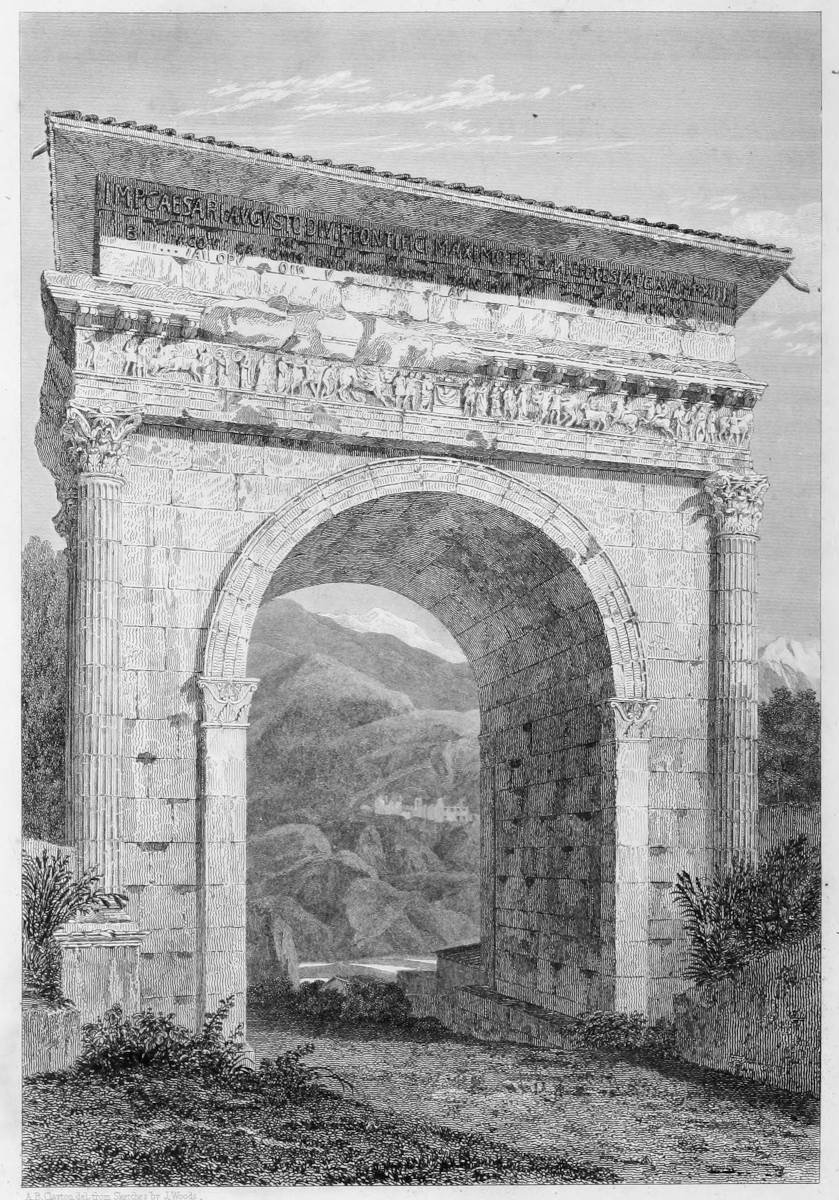
of Augustus, 134.—Arch of Augustus, 134.—Cathedral, 135.—Want of patriotic feeling
among the Italians, 136.—Senegaglia, 137.—Ancona, 137.—Arch of Trajan, 137.—Cathedral,
138.—Santa Maria della Piazza Collegiata, 138.—Loreto, 139.—Piazza, 139.—Church,
139.—Holy house, 139.—Apothecary’s shop, 140.—Sermon, 140.—Miracles,
142.—Journey to Macerata, 142.—Theatre, 143.—Apennines, 143.—Return to Rome,
144.—Roman amusements, 146.
Use of bricks, 163.—Republican edifices, 163.—Progress of ornament, 165.—Character of
the Italians, 168.—Division of employment at Rome, 169.—Rome, the capital of the
world, 169.—Purgatory, 172.—Present state of Italy, 172.
Feeling for art in Italy, 174.—Journey to Naples, 174.—Postillion murdered, 175.—Terracina,
176.—Fondi, 177.—Itri, 177.—Sepulchre of Cicero at Mola, 177.—Capua, 177.—Inn
at Naples, 178.—Palaces, 178.—Royal palace, 178.—Theatre of San Carlo, 178.—Castello
nuovo, 178.—Palace of the Studii, 179.—Cathedral, 179.—Church of Santa
Restituta, 181.—Chapel of San Gennaro, 181.—Gerolomini, 182.—Church of St. Paul,
182.—Sangro chapel, 182.—Church of San Domenico maggiore, 183.—Santa Chiara, 183.—Trinità
maggiore, 184.—Annunziata, 184.—San Pietro ad aram, 184.—Santa Maria del
Carmine, 184.—Blood of St. Januarius, 185.—Neapolitan life, 186.—Coins, 187.—Comparison
of Rome and Naples, 189.—Toledo, 190.—Views from Naples, 190.—Chiaja,
190.—Capo di Monte, 191.—Albergo Reale de’ poveri, 191.
Grotto of Pausilippo, 192.—Pozzuoli, 193.—Temple of Jupiter Serapis, 193.—Temple of
Neptune, 196.—Amphitheatre, 197.—Solfatara, 197.—Lake of Agnano, 198.—Grotto del
Cane, 198.—Villa of Cicero, 199.—Monte nuovo, 199.—Arco Felice, 199.—Cuma,
199.—Amphitheatre, 199.—Lake of Acheron, 199.—Stufe of Tritola, 200.—Baths of
Nero, 200.—Lucrine Lake, 200.—Lake of Avernus, 200.—Bridge of Caligula, 201.—Bases
viiof columns in the sea, 201.—Campanian way, 201.—La Mergellina, 202.—Santa
Maria del parto, 202.—Hill of Pausilippo, 202.—Tomb of Virgil, 202.—Excursion to
Baiæ, 203.—School of Virgil, 203.—Capo Miseno, 204.—Dragonara, 204.—Elysian
fields, 204.—Piscina mirabile, 204.—Cento camarelle, 204.—Tomb of Agrippina, 204.—Temple
of Hercules, 204.—Temple of Venus genitrix, 205.—Temple of Mercury, 205.—Temple
of Diana, 205.—Ruins at Baiæ, 205.—Camaldoli, 206.—Excursion to Pompei,
207.—Herculaneum, 208.—Torre del Greco, 208.—Torre dell’ Annunziata, 208.—Pompei,
208.—Ponte della Maddelena, 209.—Old Capua, 209.—Caserta, 210.
Journey to Bari, 211.—Robbers taken into service, 212.—Foggia, 214.—Bari, 214.—Cathedral,
215.—Church of San Nicola, 215.—Norman church at Bari, 215.—Residence at
Bari, 216.—Journey to Otranto, 216.—Lecce, 218.—Style of architecture, 218.—Otranto,
219.—Olive trees, 219.—Voyage to Corfu, 220.—Modern Greek buildings, 220.—Greek
dress, 220.—Soil of Corfu, 221.—Journey to Santa Maura, 222.—Agioneesi, 222.—Santa
Maura, 224.—Leucas, 224.—Voyage to Patras, 225.—Voyage to Vostizza, 226.—Journey
to Corinth, 227.—Antiquities at Corinth, 228.—Voyage to Athens, 228.
Greek apartments, and mode of life, 229.—Topography, 230.—Ilissus, 231.—Cephisus, 231.—Nature
of rock, 232.—Effect of first-rate productions, 232.—Review of objects in
journey, 233.—Arrival at Athens, 234.—Monument of Lysicrates, 234.—Tower of the
winds, 234.—Portico of the market, 234.—Stoa, 234.—Gymnasium, 234.—Temple of
Theseus, 234.—Situations of buildings, 235.—Greek temples, 235.—Tiles, 237.—External
painting, 237.—Comparison of Greek and Roman ornaments, 239.
Propylæa, 241.—Temple of Victory without wings, 241.—Very ancient constructions, 246.—Mode
of finishing, 246.—Parthenon, 246.—Situation of religious buildings, 247.—Effects
of explosion, 248.—Nature of quarries of Pentelic marble, 251.—Desire of obtaining
fragments, 253.—Temple of Erectheus, 254.—Temple of Minerva Polias, 257.—Temple
of Pandrosus, 257.
Comparison of Rome and Athens, 259.—Walls of the Acropolis, 261.—Grotto of Pan, 261.—Large
entablature, 261.—More very ancient walls, 262.—Choragic monuments, 262.—Theatre
of Bacchus, 262.—Odeum, 262.—Temple of Jupiter Olympus, 262.—Progress of
viiifoliage, 263.—Arch of Hadrian, 265.—Areopagus, 266.—Pnyx, 266.—Monument of
Philopappus, 266.—Stadium of Herodes Atticus, 267.—Bridge over the Ilissus, 267.—Tombs,
267.—Academy, 268.—Colonia, 268.—Lyceum, 268.—Turkish architecture, 268.—Greek
churches, 269.
Piræus, 271.—Tomb of Themistocles, 271.—Munychia, 271.—Phalerus, 272.—Excursion to
Daphne, 272.—Written rock, 273.—Salt streams, 273.—Excursion to Hymettus, 274.—Climate
of Athens, 275.—Modern Greek, 275.—Mode of life, 278.—Dancing dervises, 279.—Greek
carnival, 280.—Greek dress, 281.—Schools in Greece, 285.
Temple of Jupiter Panhellenius in Egina, 287.—Comparison of Greek and English scenery,
288.—Temple of Minerva at Sunium, 289.—Remains at Thoricus, 289.—Plain of Marathon,
290.—Ruins at Rhamnus, 291.—Return to Athens, 292.—Plague, 292.
Temple near the port of Egina, 295.—Pidhavro, or Epidaurus, 296.—Hiero, 296.—Theatre,
297.—Nafplia, 298.—Tyrins, 298.—Argos, 298.—Ruins of Mycene, 299.—Ruins of
Nemæa, 301.—Arrival at Corinth, 301.—Basilica, the ancient Sicyon, 302.—Voyage to
Patras, 303.—Singular Medusa, 303.—Greek mountains, 303.—Earthquake, 304.—Roman
aqueduct at Patras, 305.—Quarantine, 305.—Voyage to Malta, 305.
Quarantine, 307.—Architecture of Malta, 308.—Church of San Giovanni Battista, 309.—Church
of San Agostino, 309.—Church of San Domenico, 309.—Palace, 310.—Guard-house,
310.—Library, 310.—Staircases, 310.—Whitewash, 311.—Village churches, 311.—Villages,
311.—Residence, 311.—Language, 312.—Lusieri’s drawings, 312.—Celtic antiquity,
312.—Hills, 312.—Plague, 313.—Cathedral at Città Vecchia, 314.—Grotto of St.
Paul, 315.—Boschetto, 315.—Races, 315.—Maltese dress, 315.—Government, 316.
Trabaccolo, 317.—Agusta, 317.—Syracuse, 318.—Temple of Minerva, 318.—Cathedral,
318.—Temple of Diana, 319.—Arethusa (fountain), 319.—Colonnade without the island,
319.—Amphitheatre, 319.—Latomiæ, 319.—Paradiso, 319.—Ear of Dionysius, 319.—Theatre,
ix320.—Fortifications, 320.—Epipolis, 320.—Aqueducts, 321.—Other Latomiæ,
321.—Capuchin convent, 321.—Cemetery, 321.—Catacombs, 321.—Fountain Cyane, 321.—Temple
of Jupiter, 321.—Coffee-houses and people, 321.—Journey to Catania, 322.—Catania,
323.—Museum of the prince of Biscari, 323.—Don Mario, 324.—Baths, 324.—Theatres,
324.—Amphitheatre, 324.—Circular chamber, 324.—Cathedral, 325.—Museum
of the Cav. Gioeni, 325.—Museum of the Baron Ricupero, 325.—Museum at the Benedictine
convent, 325.—Lava, 325.—Excursion to the summit of Ætna, 326.
Ætna, 329.—Journey from Catania, 329.—Taormina, 330.—Theatre, 330.—Tombs, 331.—Gothic
doorway, 332.—Journey to Messina, 332.—Cathedral, 333.—Church of Santa
Maria Annunziata, 334.—San Giovanni Battista, 334.—Mountains of Calabria, 334.—Speronara,
334.—Voyage to Palermo, 335.—Palermo, 336.—Comparison of different
views, 336.—Opinions of the Sicilians as to their own antiquities, 337.—Castle of Zisa,
338.—Casteddu, 338.—Cathedral, 339.—San Niccolò della Kalsa, 340.—Botanic garden,
341.
Journey to Agrigentum, 342.—Belli Frati, 342.—Royal forest of Busambra, 342.—Fibrous
carbonate of lime, 343.—Offensiveness of the streams, 343.—Girgenti, 344.—Oratory of
Phalaris, 344.—Temple of Juno, 345.—Temple of Concord, 345.—Temple of Hercules,
345.—Temple of Jupiter, 346.—Tomb of Theron, 347.—Temple of Æsculapius, 347.—Temple
of Castor and Pollux, 347.—Temple of Jupiter Polieus, 348.—Micaceous marble,
348.—Cathedral, 348.—Warm wind and warm springs at Sciacca, 348.—Journey to Selinus,
349.—Temples at Selinus, 349.—Peculiar capitals, 350.—Ancient quarries, 352.—Journey
to Segesta, 352.—Temple at Segesta, 352.—Theatre, 353.—Alcamo, 353.—Parthenico,
353.—Cathedral at Monreale, 354.—Orlando Furioso made into a farce, 354.—Excursion
to Cefalù, 355.—Cathedral, 356.—House of Roger, 356.—Cyclopean edifices,
356.—Termini, 356.—Voyage to Naples, 357.
Accommodations at Pompei, 358.—Soldiers’ quarters, 359.—Covered theatre, 360.—Larger
theatre, 361.—Large court and temple of Hercules, 361.—Ionic portico, 362.—Schools,
363.—Temple of Isis, 363.—Temple of Æsculapius, 363.—Forum, 364.—Courts of Justice,
365.—Basilica, 365.—Temple of Venus, 366.—Portico of Eumachia, 367.—Temple of
Mercury, 368.—Recess, with number of altars, 368.—Temple of Jupiter, 368.—Triumphal
arches, 369.—Amphitheatre, 369.—Private houses, 369.—Paintings, 370.—Tombs, 371.—Villas,
372.—Mosaics, 373.—Indications of the means of confinement and of punishment,
373.—Pantheon, 374.—Baths, 374.—House of tragic poet, 375.—House of Fuller, 375.
Tuscans and Neapolitans, 376.—Villa Galla, 377.—Journey to Pæstum, 377.—Temple of
Neptune at Pæstum, 378.—Basilica, 379.—Amphitheatre, 379.—Theatre, 379.—Peculiar
style of capital, 379.—Temple of Ceres, 380.—Other foundations, 380.—Walls and gates,
380.—Salt springs, 380.—Tombs, 381.—Cathedral at Salerno, 381.—Ancient baptistery at
Nocera, 382.
Neapolitan vetturini, 383.—Journey to Rome, 383.—Anxur, 384.—Palace of Theodoric,
384.—Dead-letter office, 385.—Residence at Rome, 385.—Italian preaching, 386.—Capuchin
sermon, 386.—Catechising, 386.—Canova’s church, 387.—Dragging the Tiber, 387.—Entertainments
and illuminations in honour of the emperor’s visit to Rome, 387.
Journey to Florence, 389.—Assisi, 389.—Temple of the Corinthian order, 389.—Cathedral,
389.—Church and convent of St. Francis, 389.—Santa Maria degli Angeli, 390.—Hut of
St. Francis, 390.—Residence at Florence, 390.—Vaulting, 391.—Academy, 391.—Pietre
dure, 391.—Monte Asenario, 392.—Pratolino, 392.—Journey to Leghorn, 392.—Leghorn,
393.—Pisa, 393.—Peculiar style of architecture, 393.—Cathedral, 393.—Baptistery, 396.—Campo
Santo, 397.—Leaning tower, 397.—Church of Santa Maria della Spina, 397.—Domestic
architecture, 398.—Baths, 398.—Wood of Pisa, 398.
Lancasterian schools at Florence, 399.—Lancasterian schools at Siena, 401.—Arithmetic,
402.—Schools at the Albergo de’ Poveri, 403.—Schools of the Frati Cristiani, 404.—Romans
and Carthaginians, 404.—Scuole pie at Rome, 405.—Scuole pie at Florence,
405.—Contests, 406.—Collegio Romano, 407.—Institution at Florence, 407.—Tuscan
system of education, 408.
Lucca, 409.—Cathedral, 409.—St. Michael, 410.—S. Frediano, 411.—Santa Maria foris
portam, 411.—S. Giusto, 412.—S. Cristoforo, 412.—Progressive dates, 412.—Cathedral
at Pistoja, 412.—Sant Andrea, 413.—Baptistery, 413.—Cathedral at Prato, 413.—Ramparts
of Lucca, 413.—Baths of Lucca, 413.—Forest of chesnut trees, 414.—Prato Fiorito,
xi414.—Road across the mountains to Modena, 415.—Lignite at Ghivizzano, 415.—Viareggio,
415.—Roman baths at Massaciuccoli, 415.—La Bettona, 416.—Monte Cimone,
416.—Woods on the Apennines, 416.—School among the Apennines, 416.—Flames at
Birigazza, 416.—Journey to Carrara, 416.—Marble quarries, 417.—Cathedral, 417.—School
of sculpture, 417.—Lerici, 418.—Porto Venere, 418.—Gulf of Spezia, 418.—Journey
to Genoa, 418.—Genoa, 420.—Cathedral at Genoa, 420.—S. Cyr, 420.—Church
of S. M. Annunziata, 420.—Santa Maria di Carignano, 420.—Statue of St. Sebastian by
Puget, 420.—Church of St. Ambrose, 421.—Church of St. Stephen, 421.—Tomb of Doria,
421.—Palaces, 421.—Poor-house at Genoa, 421.—Journey to Turin, 422.—Turin, 422.—Cathedral,
423.—Chapel of the Santo Sudario, 423.—San Filippo, 423.—San Lorenzo,
424.—Smaller churches at Turin, 424.—Arsenal, 424.—Theatre, 424.—Palaces, 424.—Botanic
garden, 425.—Superga, 425.—Arch of Augustus at Susa, 426.—Walk over
Mount Cenis, 427.—Cathedral at Chamberi, 428.—Antiquities at Aix, 429.—Journey to
Geneva, 429.
1LETTERS OF AN ARCHITECT.
LETTER XXXI. ROME.
Rome, May, 1817.
Our present walk must include a larger circuit than the former. We
pass through the Piazza Barberini, and along the Via di San Basilio,
which will presently lead us beyond the inhabited district of the city,
and an Englishman begins to feel himself in the country, though within
the walls. Here is the Villa Ludovisi, but it is difficult to gain admission;
we therefore turn to the right, and at the Viccolo delle Fiamme,
enter into the gardens, which, like those passed through by Aladdin, in
the Arabian Nights, are not divided by fences from one another, but
merely secured on the part towards the road. The first thing which
offers itself to our observation is a fragment of a wall of large stones, said
to be a remnant of that built by Tarquinius Superbus, which was itself a
restoration in more solid masonry, of the one first erected by Servius
Tullius, to include the Quirinal within the circuit of Rome. A little
farther we trace distinctly the form of the circus of Sallust, which occupies
a continuation of the hollow between the Pincian and Quirinal
hills; and close by it, but not uniformly in a parallel direction, is a series
of arches and substructions supporting the hill; but the fragment of Tarquinius
Superbus seems to have nothing to do, either with the circus or
with these substructions. It is a trifle in itself, but its antiquity gives it
interest, and more is said to have been disclosed by digging. At some
distance, along the foot of the substructions abovementioned, and close
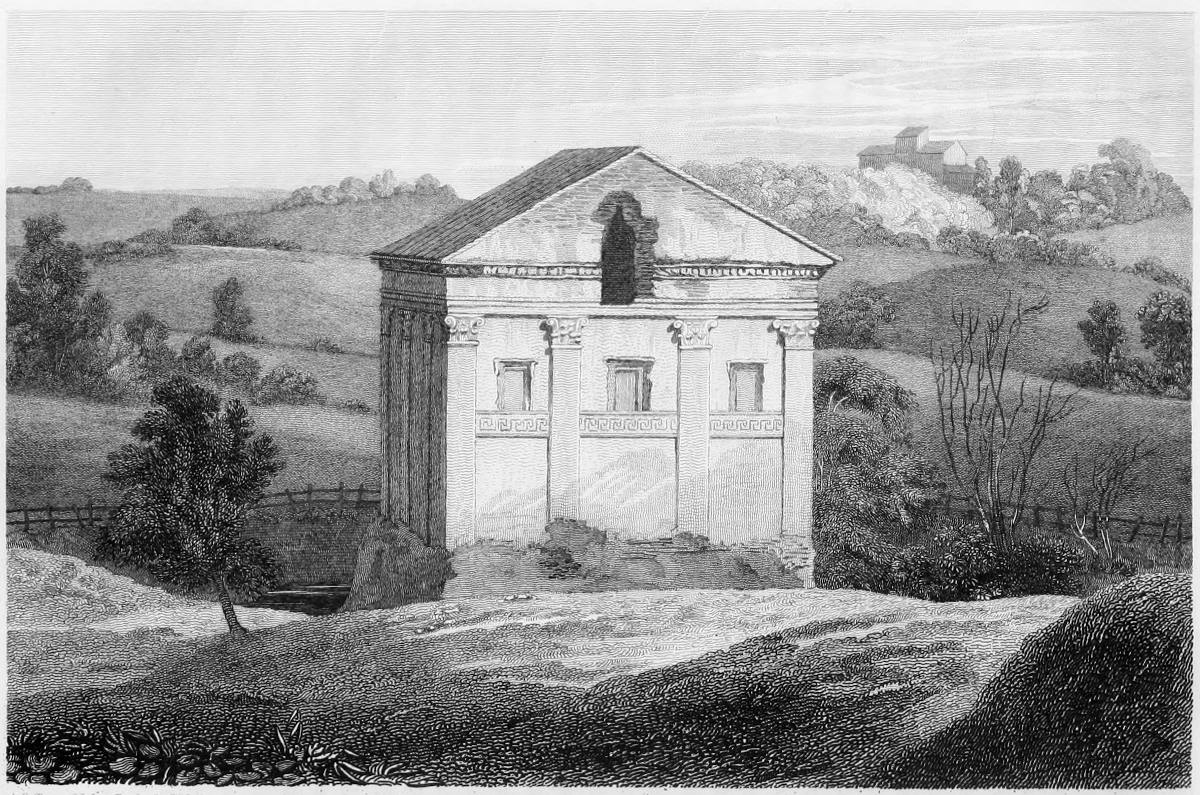
2upon the circus, we reach the Temple of Venus Erycina (let the antiquaries
quarrel about the name, I use that by which it is commonly distinguished).
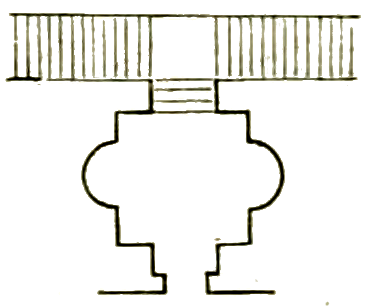
The principal part consists of a circular, domed chamber,
almost buried in the earth and rubbish which has descended from the hill
above, with a small semicircular niche, and two square recesses on each
side, two of which are open, and give admission to the building. The
principal entrance is from a little vestibule, by means of a large arch;
and a corresponding arch, with a similar vestibule, opens to the deep cell
or adytum of the temple; both these arches interrupt the line of the
springing of the dome. This and the other fragments abound in reticulated
work.
Issuing from the vineyards, and crossing the long street of the Porta
Pia, we may follow the Via del Macao, to look at a house built under the
direction of Milizia; but though an able writer on architecture, he was
not a good architect.
Our next object will be the Fontana di Termini, the water of which is
called Felice, from the name of Sixtus the Fifth, before his elevation to
the pontificate; since by him the water was conducted from Colonna to
Rome, and this fountain erected under the direction of Fontana. You
are surprised both at the quantity of water, and the display of architecture
at these Roman fountains. Here are four Ionic columns, with
three niches in the intercolumns, from which the water issues; and so far
the architectural composition is good, but above there is a pedestal,
made of a most disproportionate size, in order to receive the great letters
of the inscription, and over that a sort of circular pediment, and other
ornaments, which are quite sickening. The sculpture in the niches is
large and conspicuous, but in bad taste, and the two beautiful Egyptian
lions of basalt, which adorn the lower part, are the most estimable part
of the composition. Even these are ill used by the insertion of small
pipes, through which they awkwardly squirt out a little water.
Santa Maria della Vittoria just by, in the Strada di Porta Pia, if not
one of the beautiful, is at least one of the rich churches of Rome. It
was built by Carlo Maderno, who has used a Sicilian alabaster of a dark
brown colour, which is not a good material for architecture, and overcharged
it with gilding and ornaments. There is even a pretence of
forming the doors of this alabaster, which is in bad taste. Doors should
either be of wood or metal. The door of a tomb alone, which is supposed
3to open only once in two or three years, may be permitted to be
of marble. The church is not visited so much for its architecture, as
for some fine paintings of Domenichino, Guercino, and Guido;[1] and for
a Santa Teresa in marble by Bernini, which is said to be his masterpiece.
The saint is supposed to be dying in the ecstacies of divine love, but the
figure wants nature, and the death is a smirking angel, with a gilt dart.
Under the principal altar, (which is very rich and very ugly) are preserved
the bones of some female saint, I forget who, covered up in a
waxen image, and this is gaily dressed in blue and white satin; because,
as the priest who conducted me round the church, judiciously observed,
the skeleton was a black and disagreeable object, very inconsistent with
the appearance of such an elegant altar.
We now pass to the baths of Dioclesian, the remains of which are more
considerable than those of any other of the ancient thermæ. These
ruins still contain two churches, one of which is dedicated to San Bernardo.
It is a small, circular building, placed just at the angle of the
outer inclosure, but all the ancient ornaments are gone, except the
naked panelling of the dome, and this has been covered with modern
stucco. It is in octagons and small squares. There are thirty-two octagons
in the circumference, which makes them too small, especially in the
upper part. The order in this temple is perhaps rather too high in proportion
to the building. The cornice architravata, with which it terminates,
has hardly the dimensions of a good architrave, and then comes the
dome and its panels, without any interval. The comparison of this with
the Pantheon, where the order is too small, may lead us to the just proportions.
To avoid the expense of carving, the ornaments are painted
on the stucco, and have either been badly executed, or they have faded.
The choir forms a deep recess, of which the arched opening is perhaps
rather too high, but not so as to interrupt the circular cornice of the
order. The effect of the organ, and of the voices of the choir issuing
from this recess, appeared to me particularly fine. From the convent behind,
we see the remains of the theatre, and one may sometimes obtain
admission into the garden which contains it, but there is little to deserve
notice. Another circular building corresponding with this, is used as a
granary.
The principal object remaining in these baths is the great hall, now
4converted into the Church of Santa Maria degli Angeli. This was performed
under M. A. Buonarroti, who made the principal entrance at the
end. Vanvitelli, the last of the celebrated architects of Italy, re-opened
the ancient entrance on the side, and by uniting the circular vestibule
with the chief room, and adding a choir on the opposite side, he gave the
church length in that direction. The four side niches have been filled
up, and the length, or what is now the width, is increased, by opening
into it two other chambers. In its present state, the great hall, with the
two additional rooms, forms a transept; but as this hall constitutes, on
every account, the principal feature of the place, it ought certainly to
form the nave, and the alteration was injudicious. We do not expect
great purity of taste in the time of Dioclesian, yet the details are by no
means contemptible, and the largeness and boldness of the parts produce
a great appearance of magnificence.
The first room which we now enter is a circular vestibule, where the
supine arches of the four openings are particularly offensive, because they
are very large in proportion to the building; some scheme arches in the
great hall are also disagreeable, but the hall itself is a noble room,
and produces the full effect of its large dimensions. There is a pleasure
arising from these large and simple parts, which it is impossible to describe,
and which I long in vain to communicate to you. The old
work is generally distinguishable from the modern additions; indeed, no
pains have been taken to copy exactly the antique. Of the principal
columns, four have Corinthian, and four Composite capitals; and this
seems to have been originally the case, though the columns themselves
are now, some of granite, and some of stuccoed brickwork. The groined
vaulting is whitewashed, and has no ornament, except the brass knobs to
which the lamps were anciently suspended.
The ground of the church has been raised, because it was damp; we
wonder why it should not rather have been drained, since the situation is
elevated. The present want of height is a sensible defect; it does not,
I think, exceed two-thirds of the width, and perhaps was not originally
more than three-fourths. I would by no means attempt in this style of
architecture to emulate the proportionate height of the Gothic, whose
peculiar character requires great elevation; but the height ought not to
appear less than the width, and therefore should probably a little exceed
it. If it is more than this, it should be sufficiently increased to make the
5height the characteristic of the room, the dimension which first impresses
itself on the observer. Intermediate proportions would be inferior to
either; it is not in architecture alone that half measures fail.
From the church we may visit the convent, both for its ancient fragments,
and its modern architecture. It contains a large square, of which
the centre is adorned by some noble cypresses, and the surrounding cloisters
are said to be the production of M. Angelo. The disposition of the
kitchen chimney in this convent pleased me much; it is a deep recess
lighted by two windows, and having the stoves placed along the middle.
Besides the general flue to take off the steam, &c. there are some smaller
ones for the smoke.
Proceeding from these baths to the extremity of the Via del Macao,
we find in a vineyard, a mound of earth said to be part of the agger of
Servius Tullius, and the range of arches stretching towards the gate of
San Lorenzo, is part of the Marcian aqueduct, now carrying the Acqua
Felice; but I shall reserve aqueducts and gates to a future letter, and pass
on to the church of Santa Bibiena, where there are some ancient columns,
and a statue of the saint by Bernini. It has been much admired, but like
so many other works of this artist, fails in the want of apparent ease and
simplicity of nature. By a gate which is not always open, we may pass
into the inclosure containing the ruin, usually called the temple of Minerva
Medica, rising in the midst of artichokes and brocoli. The principal
remain is a large, domed, decagonal hall, a form not common in the
Roman antiquities, with nine large niches, each occupying almost the
whole of their respective sides, the tenth being the situation of the doorway;
and a window over each. The dome is partly destroyed, and the
remaining portion perforated in many places, shewing the ancient construction
to have been formed by ribs tending to a centre, while the intervals
are filled up with rubble. There are some remains of other rooms
adjoining. The whole is overgrown with the lentiscus and other shrubs
and plants. It forms a picturesque object, but it seems impossible to determine
its primitive destination.
Near this is the Columbarium, or sepulchre of the Aruntian family.
You may think there is little resemblance between a tomb and a dove-cot,
but this name arises from the little recesses, compared to pigeon-holes,
which contain the cinerary urns. It is, I believe, the most perfect of any
remaining, and accessible about Rome, but it is seldom that any body is
6in the way, to exhibit it, and I have not yet been able to obtain admission.
We leave this vineyard just by the Porta Maggiore, and passing
under the beautifully built, brick arch of the Claudian aqueduct, continue
our walk to the Temple of Venus and Cupid, which stands in the garden
of a convent. A part of the great niche is nearly all of this which is left
standing. Some of the brick facing remains, and a few other foundations
of walls, little above ground. The shattered piers and arches of the ancient
aqueducts exhibited in these gardens, are perhaps more interesting
than the fragment of the temple. By this, is the church of the holy
cross, which I have already described to you, as that of the Santa Croce
in Gerusalemme, and the Anfiteatro Castrense, which I mean to describe
with the city wall, of which it forms part. We then pass under the wall
among rows of trees, on turf now covered with the Anemone hortensis, to
the church of St. John Lateran, stopping by the way to look at the Triclinium
and the Scala Santa. After passing these objects we arrive at the
baptistery of Constantine; the obelisk, which is the largest in Rome,
and the hospital; a fine establishment, but according to the Roman
theory, subject to mal aria nearly as much as the larger receptacle at
Santo Spirito, which is under the Vatican and close to the Tiber, while
this is in an elevated and airy situation. From this we follow a narrow,
winding, and unfrequented lane, which will lead us under the ancient
arch of Dolabella and Silanus, consuls under Augustus, in the year of
Rome 763. It was of travertine, but it has been eked out with brickwork
under Nero, in order to make it carry a portion of the Aqua Claudia
from the Cœlian hill to the Palatine.
The Church of San Stefano rotondo is a curious edifice, which has
been supposed by some, to have been a temple of Faunus, or of Claudius;
others say, with every appearance of reason, that it was no temple
at all; but when they proceed to state that it was a market, I follow them
with less confidence. The body, or most elevated part, consists of a circular
wall supported on twenty columns and two piers. The columns are
not all of a size, but on an average are about four diameters apart, and
about eight and a half high. The architrave, frieze, and cornice united,
only form a sort of architrave, of perhaps one diameter and a half; yet it
does not look so much oppressed by the great wall above, as the engravings
we have of it give us reason to expect. Faulty and defective as it
is, it perhaps might serve as a lesson, that a wall rising immediately on
7the architrave of a circular colonnade, would not have an unpleasing effect;
and that with this simple arrangement, a height equal to the width,
would be quite sufficient. At present the building is singularly spoilt, by
a wall running across the middle of it, apparently to support the roof;
but it is in fact as useless as it is ugly. This wall is open below, with
three arches resting on the side walls, and on two Corinthian columns.
The capitals of the circular colonnade are Ionic, various, but all bad, and
the bases of all forms. The two middle columns are very fine, with good
bases, and Corinthian capitals. The cross wall is conjectured not to have
been a part of the original building, but nobody knows when it was
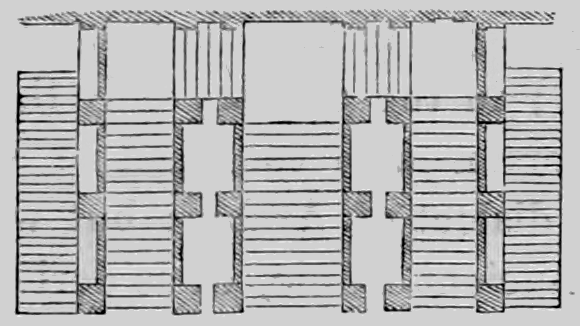
added. A double aisle surrounds this central part, divided by a range of
columns, which are smaller than those of the first circle, and not disposed
so as to have any correspondence with them. The outer circuit is a plain
wall, but part of the second aisle is divided into chapels. It is completely
a building made up with the spoils of others, and the few restorations are
miserably executed; circumstances which favour the idea that it was
erected in the time of Constantine. It is too bad for us to believe it of
an earlier date, and after him, few if any public buildings were executed
in Rome, except churches. The piety or superstition of the times seems
to have continued the erection of these during the darkest and most unhappy
periods of falling Italy; yet there seems to be a deficiency, even of
religious structures, from the beginning of the fourth, till towards the end
of the seventh century, when a new character and new relations began to
develop themselves.
At a very little distance from the church of San Stefano, is the Navicella,
a marble boat, placed by Leo the Tenth in front of a church which
receives its name from it, but where Leo found it, I cannot tell you. The
church was designed by Raphael; a range of five arches forms a sort of
portico, above which rises the nave, corresponding in width to three of
these arches, and finishing with a pediment. The simplicity of the design,
and its apparent correspondence with the internal structure, produce
a pleasing effect; but instead of one large window in the end of the
nave, Raphael has introduced three small ones, of which the middle is
circular, and the composition is sadly spoilt by them. Giulio Romano was
employed in painting the internal friezes.
After leaving the Navicella, we may visit the Church of Santi Giovanni e
Paolo, enriched like so many others, with antique columns of granite and
8marble, both in the portico and in the nave. I have already mentioned
the antiquities in the convent. Continuing our walk along the lane on
the side of the church, we pass between massive substructions, and in the
garden adjoining there are considerable remains, principally I believe, of
the aqueduct of Nero, which is a branch of the Claudian. Piranesi places
here the Nymphæum of Nero, with which he unites the Vivarium built
by Domitian; here also the house of Scaurus is supposed to have stood,
and these fragments may be parts of one or the other, or perhaps of both.
Issuing from this lane, we turn to the left, and ascend to the Church of
San Gregorio, which is preceded by one of those courts, or atria, which
you know I always admire; but in this there is nothing particularly
good, beyond the general disposition. The grand object here is not
the church, but an adjoining chapel dedicated to St. Andrew, which is
one of three united together, but having no communication with the
church. This chapel is adorned with two frescos, (not to mention minor
objects) one of which represents the flagellation of the saint, by Domenichino,
and the other his adoration of the cross, previous to his martyrdom,
by Guido. They are very fine, but they are beginning to suffer.
Descending from the church of San Gregorio towards the south-west,
we reach the southern angle of the Palatine, where the Septizonium formerly
stood. It was destroyed by Sixtus the Fifth, and the columns, and
probably some of the other materials, were employed in the Vatican. Antiquaries
have imagined from the name, that seven successive orders must
have been employed here, not reflecting that three orders would produce
the appearance of seven zones or bands. First, the pedestal on which the
whole is placed, which forms a solid mass; then a range of columns and
voids; then another solid mass composed of the entablature of the first
order, and the continued plinth and pedestals of the second. The fourth
zone would be composed of the columns of the second order, and the voids
between them; these open bands having always a different character and
appearance from the solid ones, however composed. The fifth of the entablature
and pedestals as before, or if there were no pedestals, by the entablature
alone. These solid zones would have the appearance of being
striped horizontally by the shadows of the mouldings, while the columns
would give to the open bands the appearance of being striped vertically.
Sixthly, the columns of the third order. Seventhly, the entablature, and
whatever might crown the edifice, and this disposition is exactly correspondent
9with the idea we entertain of the building from old engravings.
In this part, and along the south-western side of the hills, the remains
on the Palatine are very considerable, consisting of lofty piers, and extended
arches, but every trace of ornamental architecture has disappeared.
Here also we find all that is to be seen of the Circus Maximus, i. e. the
general form, favoured by the natural shape of the ground between the
Palatine and Aventine hills. I shall not occupy you with any long dissertation
on the ancient circus, or on the obscure god Consus, to whom it
was dedicated. You know that the general form, in spite of the name,
was that of an oblong, with one semicircular end; the other end was not
straight, but somewhat curved and inclined, in order as much as possible
to put each chariot which started from it, in an equally advantageous situation,
and the spina was not placed either precisely in the centre, or exactly
parallel to the sides, but in such a manner as to form a road continually
narrower as the chariots proceeded in the circuit. A few burrs of
rubble-work, and fragments of nearly buried arches, the foundations of the
sedili, are all the remains. And now, leaving the baths of Caracalla and
the tomb of the Scipios, for the subjects of a future letter, we will cross the
Aventine, a hill divided into two summits, on which are the two churches
of Santa Prisca, and Santa Saba, and a ruined convent, from which there is
a fine view of Rome, and which is itself a very picturesque object. Both
these churches contain ancient columns; that of Santa Saba is said in the
guide-book, to have twenty-five, two of which are of black porphyry. I
found fourteen in the nave, not all alike. Most of the capitals are Ionic,
but of different sizes, some pretty well executed, but much degraded;
others originally bad; some are merely bossed out, and have never been
finished: one is Corinthian, and one is Composite. There are said to
be others built up in the wall, but they must be very small. About the
altar, are two columns which seem to be chiefly of quartz, but with spots
of hornblende, and two of a dark veined marble, but what is meant by
black porphyry I do not know. Those of dark marble have Composite
capitals, which Uggeri says are of serpentine, but I did not particularly
observe them. The front exhibits a gallery of small columns, standing
on a high unadorned wall. The contrast is piquant, but perhaps more
so where the form is circular, as at the back of Santi Giovanni e Paolo.
On descending the Aventine we have Monte Testaccio in full view. It
10is a hill 260 feet high, made of potsherds. The meadows in which it
stands, are the property of the Roman people, and the scene of many of
their festivities. One corner of them forms a burying-ground for heretics,
just under the pyramid of Caius Cestius. Who it was that provided for
himself such a conspicuous sepulchre, is not determined; but this work of
three hundred and thirty days, does not impress one with any great ideas
of magnificence; yet it is 113 feet high, and certainly forms a great mass of
masonry. There is a chamber within, which is not always accessible, on
account of the water. Some pieces of columns were found in digging at
the base of the pyramid, two of which were put together and fixed at the
angles of the building. I have no idea how they were originally applied,
as there does not seem sufficient authority to supply a court and a surrounding
portico. These meadows and the mount offer some amusement
to the botanist in the spring; the mount especially is almost covered with
orchideæ, amongst which Ophrys apifera and tenthredinifera, and Orchis
papilionacea, are the most abundant. I found here also Ophrys hiulca and
arachnitis of the Flora Romana.
Our next object is the brick arch of San Lazzaro, through which the
road passes, though it is filled up nearly to its springing. There are several
substructions at the foot of the hill, which appear to have belonged to the
same edifice, but what that was, nobody knows.
Hence we walk to the beginning of the Strada Marmorata, the ancient
Littus Marmorea, so called, as they say, because the marbles brought from
various countries were usually landed here; a very disappointing reason
for so fine a name. On the right is a pathway up the hill, and some fragments
of antiquity are discernible, particularly a considerable portion of
an ancient cornice, built up in a wall. If we continue this upper track, we
pass by the churches of Sant Alessio and Santa Sabina, and descend on the
Circus Maximus. The other keeps along the shore of the Tiber, and we
may notice other substructions on the hill; and in the river, if the water
be low, some traces of the Pons Sublicius.
Returning towards the Corso, we may pass by a female colossal bust,
which might almost do for a companion to Dr. Clarke’s Ceres, in the vestibule
of the public library at Cambridge. It is supposed to be an Isis,
but the Romans call it Madama Lucrezia. It stands in a little street which
derives its name from the figure, and which opens into the Piazza di San
Marco. I have not mentioned the church which gives name to this piazza,
11among the basilicas, but it however, deserves some notice. The front, of two
stories, each of three arches, is neat and unaffected. It was erected in 1468
under Paul II., by Giuliano di Majano, together with the great palace adjoining.
Internally, the nave is separated from the side-aisles by twenty columns
coated with Sicilian jasper; these support arches, and at a considerable
height above them runs a cornice. In the upper part is a range of
semicircular-headed windows, and then a flat ceiling with square coffers.
The worst part of this composition is in the space between the capitals of
the columns, and the cornice, which is altogether ill managed. At the end
is a semicircular tribune enriched with mosaics.
The principal front of the Palazzo di Venezia is towards the Piazza. It
has an air of solid massive grandeur and of defence, not ill-suited to each
other, but there is no other merit.
In this square is also the Palazzo Rinuccini, with five equal windows in
front; a small, but much admired edifice. The management of the angles
is bad; the finish at top is very bad; the consoles spaced unequally in
order to receive the windows, have a bad effect; the doorway is bald, and
poor; and all the details are bad; yet with all these faults, such is the efficacy
of simplicity, joined to a just distribution of the principal parts,
that I, with everybody else, acknowledge it to be a very fine building.
Returning a few steps towards the church of the Jesuits, we find the
Palazzo Altieri, an immense pile, once famous for its collection of paintings,
but they are now dispersed. The front, towards the Via della Galla,
is very good, or at least the masses are fine. That towards the Piazza del
Gesù is crowded, and much inferior.
Proceeding along the Corso, we find an immense building that nobody
admires, the Palazzo Doria; nor are the rooms within handsome, but the
collection of paintings is very fine. The beauty of the Sciarra Palace is
much injured by its admired doorway, which is neither good in itself, nor
at all suited to its place. In other respects the general distribution of the
building is fine, and the parts are well proportioned. Internally, there is
a collection of paintings, not large, at least compared with many others at
Rome, but exceedingly beautiful. On the upper floor are two fine
apartments, decorated in perhaps rather a thin taste, yet on the whole,
very elegant. The last room of the principal suite presents the idea of a
frame work of gold covered with drapery. It certainly cannot vie with
the magnificence of regular architecture, yet it forms an agreeable, and
12elegant variety, in a suite where the general character is rather that of
grace and lightness, than of solidity.
After leaving this we may walk to Monte Citorio, an elevation only of
a few feet, which would hardly be observed, unless the name attracted attention.
It is said to be produced by the ruins of the Theatre of Statilius
Taurus. On the top is a large building called by the same name,
containing the courts of justice. The convexity of the front is injurious
to its effect. The architect has left, or rather made, some of the window-sills
at the extremes of the building, and some other parts, of large irregular
masses of stone. I cannot comprehend his motive.
In front of this building is the solar obelisk, which Augustus brought
from Egypt, and fixed in the Campus Martius as the gnomon of a sundial.
It was found buried and broken in 1748, but was not repaired and re-erected
till 1789. The height of the obelisk itself is 68 feet, and it is
better, because more simply mounted, than most others in Rome; indeed
the pedestal seems to be the ancient Roman one, but the moderns could
not be contented without adding a little metal at the top.
I shall not take you to the Palazzo Ghigi to admire the external architecture,
which has little merit except in size, or to see the collections,
though there are some fine paintings, and some ancient statues restored
by Canova, but to see some of the rooms themselves, which are very
handsome. One in particular will be numbered among the handsomest
rooms (of small dimensions) in Europe. It is 40 feet 9 inches long, 17
feet 9 inches wide, and about 28 feet high, with pilasters on a continued
plinth, and a coved ceiling with arches above. The interpilasters are
groined into the cove; the angles, both entering and salient, have bold
wreaths of flowers; the mouldings, and ornaments of the centre panels,
are white upon a buff ground.
With this palace I conclude my letter, having brought you again into
the neighbourhood of the Piazza di Spagna. Our next excursion must be
to the Trastevere.
LETTER XXXII. TRASTEVERE—WALLS.
13
Rome, May, 1817.
I concluded my last with a promise, or perhaps I should say a threat, of
a walk in the Trastevere, which I am now about to perform. I shall not
however, entirely skip over the intervening ground, but glean whatever
occurs on the way; and first I will take you to San Carlo, in the Corso; a
church which looks better at a distance than near, because the general
form of the front is that of a Greek temple crowned with a pediment, but
on approaching we find so many breaks and angles, cutting through cornice,
pediment, and everything else, that all beauty of design is lost: the
interior is good, but there are others better of the same sort in Rome.
Another church in the Corso, is that of Gesù e Maria. Not by any means
one of the largest, or richest churches in this city, yet a priest who accompanied
me, assured me that he had spent 7,000 crowns, raised entirely by
voluntary contributions, in putting up an altar, and otherwise decorating
one of the side chapels; and there is no reason to distrust his information.
It was dedicated to La Madonna del divin Ajuto, and the father gave me
her picture.
Not far from this is the Palazzo Rondadini, famous not in itself, but
for two exquisite festoons of fruit and leaves in white marble, built up in
the wall of the court. At a very short distance is the Mausoleum of Augustus,
originally a vast circular edifice, composed of concentric circles,
rising higher as they approached the middle, and forming a succession of
terraces adorned with trees,[2] as we learn from the medals representing it.
The outer circle, or perhaps circles, are now destroyed; and we have
only the central mass formed of rubble, with facings of reticulated work,
and the upper part reduced into an amphitheatre for the exhibition of
fire-works, and of bull-fights. What is below I do not know. Piroli has
given a section which represents it as nearly solid.
Our next step will be to the Ripetta, the resort of the smaller barks
which navigate the Tiber. A large flight of steps leads down to the water,
14and a ferry will, if you please, carry you to a footpath across some meadows,
affording a pleasanter, but somewhat longer, walk to the Vatican.
The long succession of streets which conducts us to the Ponte Sant Angelo,
is one of the most disagreeable of the principal avenues of Rome. In it
we find the great Palazzo Borghese, shaped as you are told, like a harpsichord,
not however from any predilection for this form, but to accommodate
it to the shape of the ground. Externally, it has no architectural
merit except that of size. Each story has its mezzanine, an arrangement
which would be convenient in a large hotel, for the independent accommodation
of a number of families, but which wants the unity of a princely
residence. The court is admired by some persons, but I do not much
like it; it is surrounded by arches supported on coupled columns; an arrangement
which has neither the solidity of a pier, nor the lightness, and
grace, of a single column.
But who thinks of the architecture, while painting here displays all its
glories. The collection is immense, but what is more, the pictures are
wonderfully fine. The Deposition from the cross, though executed before
Raphael had gained the richness and force of colour exhibited in his latest
pictures, in design, and expression, may rank with anything he ever did.
I must not begin upon this subject; criticisms on paintings if not excellent,
are worthless, and since I cannot hope that mine will stand in the
first predicament, I will not expose them to the latter imputation.
The Church of Sant Agostino, is not praiseworthy for its architecture,
but it contains some fine Guercinos, and a head of Isaiah by Raphael,
which is much admired. In the convent is a library of old books (there
are no new ones in Rome), which is open to the public every morning
from eight to twelve, except on feast days.
From Sant Agostino, we may visit San Luigi de’ Francesi, which is very
rich, and rather handsome (I speak of the inside, the outsides of Roman
churches I seldom pretend to criticise). The dome springs from the same
height as the vaulting of the nave, the diameter being from angle to angle.
Its merits consist in a remarkably fine Francesco Bassan, a painter usually
little thought of in Rome but this is really worth seeing for the character
of the heads; and a chapel, containing a copy by Guido, of the Santa Cecilia
of Raphael, and adorned by the frescos of Domenichino.
We pass by the Palazzo del Governo, i. e. the police office, a rich, but
not handsome building, formerly the Palazzo Madama, and by the Sapienza,
15of which I have already given you some account, and we may go
through the church of San Giacomo degli Spagnoli into the Piazza Navona,
the ancient Circus Agonalis, or rather the Circus of Alexander Severus,
the form of which it preserves. There are no remains visible, but probably
some might be found in the cellars of the surrounding houses, if it
were worth while to search for them. In the circuit of this long opening,
we may admire the church of Santa Agnese, the Palazzo Pamfili adjoining,
and the Palazzo Braschi, which I shall shortly describe to you; but of the
latter little is seen.
Within the Piazza, the ornaments are three fountains; the middle consists
of a great rock, with figures of rivers rising from a large basin; the
rock is perforated in both directions, yet on the top is placed an obelisk
fifty-one feet high, which was found in the circus of Caracalla. This absurdity
is the admired work of Bernini, who is said himself to have been
so much ashamed of it, that he pulled up the blinds of his carriage whenever
he passed the Piazza Navona to avoid seeing it. Races are sometimes
exhibited here, and the people are said to enjoy them the more, because
the sharp turn at one end, taking place on the hard pavement, frequently
produces serious accidents. If so, something of the detestable
gladiator taste of the empire still subsists at Rome, but I hope, for the honour
of human nature, that it is not true.
A portico has recently been added to the church of San Pantaleo, in
which the Ionic order of the Athenian temple of Erectheus has been imitated;
but the moulding within the volute is too strongly marked, and the
recess which separates its folds is too deep; these faults quite spoil its
effect. It is besides an order of very peculiar character, not suited to
every situation.
Close by this is the Braschi Palace, of great size, and built of excellent,
pale-coloured brickwork, with stone ornaments. The foundations were
laid, according to Uggeri, in this manner. After the trenches were dug,
water was introduced to the depth of about a foot, and stones and liquid
mortar were thrown in, without order, and formed one solid mass, upon
which the walls were afterwards built. According to the same writer
this method is common in Rome, and certainly the present edifice does
credit to the practice.
Though irregular in its form, and not very good in its details, there is
16perhaps, no building in Rome which has more the air of a palace. A
coach was turning round in the hall, as I entered it for the first time.
The staircase is very noble, and rich in marbles; the steps are supported
on arches resting on columns, and these arches are not semicircles, with an
upright addition to the lower part, to compensate for the different heights
at which the columns are placed, but are curved immediately from the
lower column, as well as from the upper; the tangent at each springing
being vertical. The effect is grand, but the arrangement is not satisfactory,
nor have I ever seen any that was, in an open staircase of more than
one story, where the steps were too wide to be well supported by their
insertion into the wall. There is a collection of ancient marbles in some
unfinished rooms, the pride of which is an exquisite colossal statue of
Antinous, found at Palestrina. There are also paintings on the second
floor, but I could not obtain admittance.
At the angle of this palace is the mutilated trunk called Pasquin, the
ancient receptacle of squibs against the government, and against conspicuous
individuals; but he speaks no more, though the name is preserved.
If we continue our walk at the back of the Piazza Navona, we shall
find the Church of the Santa Maria dell’ Anima: so called from an image
of the Madonna with two little figures kneeling to her, representing two
souls of the faithful. It would appear therefore, that it ought to be delle
anime. The piers are very slender, and the church has this singularity,
that the side aisles are as high as the middle. The effect is good, and we
may be sure it is owing to the disposition, since the eye is not cheated
into admiration by any richness of ornament, or beauty of detail. The
altar-piece is by Giulio Romano, a fine picture, but much blackened.
Near this is the Church of Santa Maria della Pace, which has on the
outside, a large, semicircular, Doric portico, with coupled columns. There
seems no reason for the coupling, and all the other parts are bad. Here
are the Sybils of Raphael, which, though they have lost something of their
original value by time and retouching, are still fine frescos; and this
church also exhibits a small quantity of very beautiful cinque cento ornament.
There are also some frescos of Albano.
The cloisters are the design of Bramante; they are formed by arches
between columns and pedestals below; and columns backed by little
piers, and detached columns over the crown of the arch, form a gallery
17above. The effect is not displeasing, yet when the columns are thus placed
upon arches, (if such a liberty is to be allowed at all) it is better to keep
them very small, and put two in each space.
In this quarter of the city stands also the Chiesa Nuova, rich and ugly.
In the altar-piece, Rubens has painted one picture within another; the
Madonna and Child being separated by a gilt frame from the figures
which are adoring them, and which seem therefore to be adoring the picture.
Adjoining it is the Oratorio of San Filippo Neri, where you will
only go, if you wish to see how ill a great sum of money can be spent.
Before crossing the Tiber, we may visit the Church of San Giovanni de’
Fiorentini, begun by Michael Angelo Buonarroti, but continued either by
Giacomo della Porta, or by Sansovino, for it is uncertain which was employed.
I should rather attribute it to Sansovino, for Giacomo della Porta
is more confused in his arrangement. A continued pedestal runs above the
cornice, from which springs a waggon-headed vault with the windows
groined into it; and if on this vault there were ribs of architecture, instead
of its being whitewashed, as it really is, the disposition and proportions
would have a good effect.
The bridge of Sant Angelo was erected by Hadrian, re-erected by Clement
VII., and adorned, or disfigured, with unmeaning statues by Bernini,
under Clement IX. I do not know that figures are always to be rejected
on the balustrades of houses or bridges, yet in fact they seldom look well.
This bridge consists of three large arches and two smaller ones on each side,
the larger only giving a passage to the river at its usual level, and forming
a water-way of 178 feet. The depth in the arches for the greatest part of
the year is about 22 feet, according to Piranesi, from whom I have taken
these dimensions. In the month of August it falls as low as to 17. In
the winter floods it rises to 34, and in 1750 it rose to 43 feet. The whole
width of the stream below the bridge is 248 feet in common cases, but it
may spread to above 400 without overflowing its banks. I do not know
its rate, but it seems a pretty rapid current.
Immediately opposite the bridge, stands the Mausoleum of Hadrian.
Augustus built his sepulchre for himself and his family, including servants
and dependents, and a large building, if not a sumptuous one, seems necessary
for such a purpose. Hadrian is supposed to have built his, with
all the selfishness of despotism, for himself alone. Hadrian shall never be
my hero; he had no high and generous feeling; yet even he, in his immense
18villa at Tivoli, had some view towards his fellow-creatures, their
wants and welfare. Enough remained of the spirit of liberty to convince
him, that his glory was intimately connected with their use and advantage,
while Louis XIV. at Versailles, seems to have had all his thoughts begin
and end in himself. What remains of this vast burying-place consists of
a basement 253 feet square, with a circular tower in the centre, about 192
feet in diameter. This circular part is now a mere mass, but it is said to
have been highly adorned with marbles and statues, and surrounded with
a magnificent circle of the beautiful columns which are still shown in
the church of St. Paul. Notwithstanding this evidence the fact is very
doubtful.
St. Gregory saw an angel on the top of this Mausoleum, in the year
593, and from that, the building has obtained the name of Castello di Sant
Angelo. Perhaps it would be more correct to say, that the name is derived
from the figure of an angel in bronze, commemorative of the event
or of the tradition, which now majestically crowns the edifice. This
statue was not erected till the time of Benedict XIV., but it was preceded
by one executed in marble by Raffaello di monte Lupo.
From this castle are exhibited the famous fireworks of the 28th and
29th June, the feasts of St. Peter and St. Paul, originally designed by
Michael Angelo. The first flight of rockets is 4,500, and it forms a complete
canopy of fire. The exhibition is over in an hour, and does not
linger through half the night. In exhibitions of this sort, and in the
lengthened entertainments at theatres and balls, it seems as if there were
something in the English character which impels us to drain the cup of
pleasure to the dregs.
And now, instead of going up to the Vatican, we will keep to the left,
along the street, and by the hospital of the Spirito Santo, where the
mortality of the patients is said to be one in three, but I suspect there
are circumstances which make a comparison of this sort very fallacious;
and to the gate now distinguished by the same name, which divides two
parts of the city. It was begun by Michael Angelo, and never was finished,
and probably never will be; what is built is in good character, but follows,
I know not why, a curved line, when a straight one would have been
better. We do not hence pursue our way at once by the long street
called the Lungara, but turn up by Sant Onofrio, a church erected about
the middle of the fifteenth century, where we see some frescos of Domenichino,
19worthy a better subject than the legend of St. Jerome; a beautiful
Madonna by Leonardo da Vinci; and the tomb of Tasso. Here was
also the tomb of Barclay, the author of the Argenis; and the tomb may
still exist, but the stone which marked it is gone, because as the priest told
me it was roba spurca. I do not know what he meant.
We now return to the Lungara, a long street parallel with the Tiber,
with some good houses, or as they are here called, palaces, amongst which
are the Farnesina, which I have already described, and the Corsini, which
really does deserve the name. It extends above 200 feet along the street,
presenting on the principal story, a range of seventeen windows. Though
large, it is not handsome. The entrance however, is truly magnificent.
Passing through a spacious vestibule, we arrive at the foot of the staircase,
which diverging to the right and left, returns in the centre, leaving
space for a carriage-road underneath it. Here is an admirable collection
of pictures, which I shall not pretend to enumerate, and a fine library,
open to the public from nine to twelve, for a considerable portion of the
year, but not much attended to of late, as perhaps you will conclude, when
I tell you that it contains four copies of the first volume of Stuart’s Athens,
and none of the second or third, and when a stranger goes, the librarians
seem to perform their task grudgingly. Many things of this sort were
at one time to be found in Rome, but none of them are now kept up with
spirit.
Behind the palace is the Villa, for as I have already said, this term is applied
in Italy to the ground, and not to the buildings. It is delightfully
20situated on the slope of the Janiculum, but all this part lies under a horrible
imputation of mal aria.
Issuing from this palace we may descend to the Ponte Sisto, the ancient
Janiculensis, but the present edifice is I believe entirely modern. On the
other side is the fountain of this name. The water guggles from a hole
in a wall forming the back of an arched recess, into a vase just below,
over the edges of which it runs, and falls into the basin at bottom. The
architecture is not bad, but the principal fall ought to have been first. A
few steps farther on, is the Church of the Santissima Trinità, famous for
a picture of the Trinity by Guido. If the head of the Deity had been intended
for that of Moses, it would be universally acknowledged sublime,
but the attempt to represent this subject, must always produce disappointment
or disgust.
Near this is the Monte di Pietà, a public establishment for lending
money on pledges, and resembling perhaps in some degree our savings
banks.
We return again over the bridge, and ascending by the mills supplied
from the Fontana Paolina, go to the botanic garden, which contains but
few plants.[3] It occupies a situation just above the fountain, which indeed
pours forth a river. There are three equal arches discharging as
many equal streams of water, and two smaller ones, with only a spout in
each. An enormous attic rises above these arches, to receive the inscription,
and the whole is crowned with a sort of pediment ornament, much
like that at the Fontana Felice, somewhat larger, and considerably worse.
The whole merit of the thing consists in the great abundance of water;
but it is said not to be good. I do not know precisely whether it is
brought from the lake of Bracciano, or from springs in that neighbourhood.
It is clear and bright, and supplies fountains and turns mills, to
which purpose it is almost exclusively applied, as well as any water
could do.
A short walk conducts us to the Church of San Pietro in Montorio, rising
on an advancing point of the Janiculum, and commanding a glorious
view, including almost all the objects of antiquity in Rome which can
possibly be comprised in any general view; and nearly all the modern
21city, with its domes and palaces; the Tiber; the seven hills, or rather six,
for the eye cannot hence distinguish the Viminal, three of which are
covered with gardens and vineyards; Monte Testaccio; great part of the
walls, and the country beyond them; Monte Albano; and the Apennines.
The church itself has two orders in front, each presenting a single pilaster
at each angle of the building. The lower includes a large and
handsome doorway, the upper a single circular window. The simplicity
of this disposition renders it superior to most of the church fronts in
Rome. It was built about 1500, at the expense of Isabella of Spain, wife
of Ferdinand the Fourth.
Within this church was once the glory of modern art, the Transfiguration
of Raphael, now in the Vatican, after its journey to Paris; and there
still is a Flagellation, coloured by Sebastian del Piombo, from the design
of Michael Angelo. It is an admirable painting, but like all frescos, in a
state of decay.[4]
In the cloister of the convent annexed to this church, is the famous Tempietto
of Bramante, built on the spot where St. Peter was crucified; and
the hole in which the cross stood, is shewn exactly in the centre of the
present building. It is a little circular structure, surrounded by a peristyle
of sixteen Doric columns, and this circle of columns, with its pedestal
and the steps up to it, is beautiful. Everything is well proportioned,
and in its just place; but the upper part of the edifice is not good.
The parts within the portico are crowded and confused, and the inside
has little or no beauty.
From San Pietro we descend to the Church of Santa Maria in Trastevere,
and to that of San Grisogono, both of which I have described to you.
That of Santa Cecilia is in a similar style, with ancient columns, and originally
a flat ceiling, but this is now replaced by a low elliptical vault, leaving
space only for very low windows. The disposition is displeasing in
itself, and the more so, from its want of suitableness to the lower parts;
an appearance of lightness may be given to a small arch, which cannot by
any means be preserved in a continued vault. A row of columns supporting
22such a vault, has therefore always the appearance of insufficiency.
The statue of the saint is much admired.
We will now leave the Trastevere, and pass over the Bridge of Cestius,
now of St. Bartholomew, into the island, which is also dedicated to that
saint; considerable vestiges of the ancient bridge remain. It was built
in the 788th year of Rome, but restored in 368 of the Christian era. In a
convent in the island, we find a waxen bust of one of the monks, who was
a friend of Canova, made by that artist. It is admirably executed, and
coloured like nature, but the stillness of the open blue eyes represents
death, and not life. In the garden of the same convent, and from the
shore just below it, you may see the small remnants of the temple of Æsculapius,
which was built in the form of a ship. Something of this shape is
still distinguishable, and also a portion of the serpent. The temple of
Vesta, the mouth of the Cloaca maxima, and Ponte Rotto, unite into a
fine composition, as seen from the point of the island. After crossing the
other branch of the Tiber, on the Ponte di Quattro Capi, which retains in
its piers some fragments of the Pons Fabricius, built in 733 of Rome;
we may visit the Palazzo Mattei, which I notice, not for its architecture,
nor for its paintings, though it contains a fine collection, but for the great
quantity of bas-reliefs, built up in the walls. They would make an interesting
museum, if put together in a place where they were well seen; but
here, besides being exposed to the injuries of the weather, they are almost
lost as separate objects, and they take away from what beauty there
is in the architecture. In the lower court are some valuable fragments
of architectural ornament, built up in the same manner, and in particular,
two semicircular windows, where the rich foliage which occupies great
part of the opening, shews that the ancients knew how to produce an effect,
somewhat similar to that of the tracery in our Gothic windows, and
in some respects superior to it, without at all departing from the character
of their own architecture.
I have not mentioned the Church of San Carlo a’ Catinari, which however
is a fine church, in the form of a Greek cross, or rather a Latin cross
reversed, for the choir forms a longer arm than the others, and even these,
being nearly equal to the width of the dome, are rather too deep. The
gilding and ornament is spotty, but the frescos of Domenichino are very
good, not equal however, to those at Sant Andrea.
In our way home we may look at the Church of Santa Maria sopra Minerva,
23in front of which is a paltry little obelisk, mounted upon the back
of an elephant. The church was built about 1370, and retains a good
deal of the work of that period, but it is only a sort of ill-understood Gothic.
This church contains the celebrated statue of our Saviour supporting
his cross, by Michael Angelo. Milizia calls it a ruffian, which
however it is not; though the action is rather strong. The expression
of the head in some points of view is fine, and even sublime; but not
equally so in all; the muscles are large and flabby.
In the annexed convent is a library, said to be one of the richest in
Italy; it was founded by Cardinal Casanatta, who left a considerable sum
for its support, but like other things at Rome, it is a century behind
London and Paris, and the Index expurgatorius is a great enemy to all
public libraries.
Having given you an account of what is found in the inside of this
great city, I shall proceed to the walls which enclose it, beginning with
the Porta del Popolo, for the small part between this and the river presents
no object of interest. This gate, according to the guide-books,
was re-built from a design by Michael Angelo, and executed under the
direction of Vignola; but it is not good, and part of it is more ancient,
for the holes in the external towers, now filled up, but evidently made in
order to get at the metal cramps which fastened the stones together, attest
the antiquity of the lower part.
Turning to the right, the wall, strengthened with buttresses and arched
recesses, forms the support of the Pincian hill. In this part we find the
Muro torto, a great square mass, placed at an angle in the circuit, and
corresponding in construction with the walls, that is, it is of rubble-work,
with a facing of reticulated tufo. It considerably overhangs its base.
There is no opening below, but above there appear to have been recesses
and arches, corresponding with those of the wall. Antiquaries are
not agreed as to what it has been. Beyond these we have towers and
curtains of more modern work, erected for the purpose of city walls.
Here and there a very ragged foundation occurs, which is perhaps of earlier
date, and in one or two places there are blocks of marble, and other
more decisive indications of ancient edifices.
The Porta Pia was opened by Pius the Fourth, in 1561. The designs
were Michael Angelo’s, but it has never been finished, nor would it be
handsome if it were. Here, by way of ornament, we see pateras with linen
24hanging over them, said to represent a barber’s basin and towel, and to
have been intended by M. A. Buonarroti as a reproach to his employer
for the lowness of his origin; but conveying a much severer reproach
against M. Angelo himself, if the story be true; but it is exceedingly improbable.
After this we distinguish the external form of the Prætorian camp, and
the wall is plain and without towers. In one place there are arches in
the upper part, and traces of walls advancing at right angles. After this
is a gateway stopt up, with one large scheme arch below, and six little
arches above. Then comes the Porta San Lorenzo, built in the same
style, perhaps by Aurelian, and repaired in 403, under the most unconquered
princes, Arcadius and Honorius, as is recorded by an inscription.
Within this is an arch of the aqueduct of the Aqua Marcia, repaired
successively by Augustus, Titus, and Caracalla. There are stones disposed
pedimentwise over the arch, and one of the ancient inscriptions
runs horizontally across these stones. The walls continue to be of brick,
with many towers, till we arrive at the angle by the Porta Maggiore,
where some ancient aqueducts enter the walls. The Porta Maggiore is
constructed of large blocks of travertine, and consisted anciently of two
arches, as was usual in city gates, and three niches ornamented internally
with cornices and pediments, one between, and one on each side of the
entrances. It is supposed in the first instance to have formed part of an
aqueduct, afterwards built up in the city walls; and if of five arches of an
aqueduct three were filled up, and the two intermediate ones left open, a
similar arrangement would result. Only one arch is now open, and the one
which has been stopped up, does not seem to correspond exactly either in
height or direction, with that through which the road passes. Two watercourses,
the Anio novus and the Claudia, passed over it anciently, and the
Acqua Felice has since been conducted through it. Three large inscriptions
give due honours to Claudius, Vespasian, and Titus. Just to the north
of this gate three other water-courses enter the wall of the city. The two
upper are the Julia and Tepula, in rubble-work, which rest upon the constructions
in peperino, of the Marcia. Another half buried, supposed
to be the Anio vetus, is seen at the bottom. I hope in a succeeding walk
to be able to give you some further idea of these aqueducts. To the
right, as you issue from the gate, you find the wall made up of an ancient
aqueduct, by filling up the arches; this is also observable on the inside,
25where, from the garden containing the temple of Venus and Cupid, you
may trace a considerable portion of the different constructions.
A little after leaving these aqueducts, you arrive at the remains of an
amphitheatre, part of the circuit of which is built up in the walls; it consists
of a range of Corinthian columns with arches between them, all of
brick, and a small fragment of a second range; the brickwork is pretty
well executed, but by no means equal to that of the temple of Rediculus.
It is remarkable that the bricks of the arches are laid to a centre considerably
lower than the centre of the curve. They are redder and longer
than the others.
In this part are various traces of old foundations built up in the circuit
of the wall, and nearer to the Porta San Giovanni, some reticulated work
occurs. This gate is entirely modern, and not of an architecture to require
any attention. Very near to it is another gate which has been
stopped up. After this the walls are of very shabby brickwork, propt up
by buttresses of different dates, and here and there shewing traces of the
old work of walls or sepulchres. Here as I was making my memoranda,
(in May, 1817) I found a poor wretch who was seeking, if by chance he
could find anything which could be eaten, among the refuse vegetables
which the gardeners had thrown over the walls. I gave him two bajocs,
for which he was extremely grateful, and would kiss my hand. I did
not like absolutely to refuse the customary expression of gratitude, but
I quite felt the dirt. This may serve to shew to what a state the people
here are reduced, by the failure, or at least the great deficiency both of
the vintage and the harvest, last year.
The next gate is the Porta Latina, which is shut. There is the fragment
of a brick edifice, just out of the walls, in the style of the temple of
Rediculus, but of the Doric order, with two half columns of brick. In
one place among the old peperino constructions which support the
wall, are appearances which indicate a casing of marble or travertine.
At a small distance is the Porta San Sebastiano, the lower part of
which is of squared blocks of marble, well put together. This projecting
part of the present walls is far beyond the ancient circuit, and the character
of the work is quite different from that of the Porta San Lorenzo, or
Porta Maggiore, but has more affinity with that of the Porta del Popolo.
Above the marble, the towers are carried up square, in brickwork, but
the highest part is circular.
26Between this and the Porta San Paolo, besides the usual, or perhaps
more than the usual portion of included fragments, many of which were
probably tombs, we have traces of more recent works, and of the fortifications
of modern times. Beyond the Porta San Paolo, there is no road
under the walls, and I did not attempt to find my way through the vineyards,
to the shores of the Tiber. Inside, however, they exhibit a series
of open arches towards Monte Testaccio, and the Prati del Popolo
Romano.
LETTER XXXIII. NEIGHBOURHOOD OF ROME.
27
Rome, May, 1817.
You perhaps imagine, from having heard of the dreary and desolate Campagna,
that there are no agreeable walks about the city, but if you have
formed any such notion, you are very much mistaken. The ground about
Rome is exceedingly well disposed for pleasant scenery; the country
being intersected by several valleys of no great width, each bounded by
steep banks of moderate height, from the top of which you catch the
gently varied line of Monte Albano, and the distant Apennines. One of
these, Monte Velino, is still covered with snow. The Leonessa held it
for a long while; but the highest summit of this part of the chain, which
is the Gran Sasso, rising to an elevation of very nearly 9,000 feet, is not
visible from any place near Rome. All these points of the Apennines are
in the Neapolitan territory. Each valley has nearly a flat bottom, forming
rich meadows, which in winter are very wet, and many of them are at
times inundated. Wherever art has interfered to adorn these slopes, or
where some natural patch of wood is suffered to grow, the effect is highly
pleasing, especially if in addition, some picturesque ruin crown the summit.
Sometimes when the eye is elevated above these slopes, such features
enrich the nearer landscape, while the long lines of the ancient aqueducts
give an interest to the middle distance; but it must be confessed
that little advantage is made of this disposition of the ground, and that
the general character of uncultivated nakedness is far from agreeable.
I will take you in this letter through the Porta del Popolo, and our
first visit shall be to the house or casino, once inhabited by Raphael. It
stands in a garden close by the walls, and is without architectural ornament,
yet it forms a good object; to which the woods of the Villa Borghese
extending behind it, contribute not a little. Within is a chamber
adorned with the most beautiful little fancies, such as one may suppose
would be floating in the mind of a Raphael, and which he might find pleasure
in tracing as they occurred, without using any labour about them, or
working on any predetermined plan. A parcel of delightful little cherubs
28have stolen the arrows of Cupid, who is represented asleep, and they are
amusing themselves with shooting at a target; there are also four rounds
with female heads, one of which is particularly beautiful. Other figures
seated among the arabesques are highly graceful, and there is in all so
much life and nature, that it is quite a pleasure to look at them.
Returning from this we pass into the Villa Borghese, through a gateway
whose piers are copied from two sepulchres which have been supposed
to mark the entrance to Adrian’s villa, near Tivoli. These are surmounted
by two eagles of a fine, broad, noble character. The villa itself
is a garden or pleasure ground, said to be three miles in circumference,
with shady walks, which we found delightful as early as the 4th February,
and tall stone pines scattered about the more open parts. These trees,
and the Ilices are the most important circumstances in the beauty of the
place. There is a pretty lake, and a considerable variety of ground and
of scenery; and several buildings, not perhaps very beautiful in themselves,
but assisting the general character of the place. Art appears
everywhere, but not obtrusively, and without pretence. The upper casino,
if not beautiful on the outside, produces at least a rich and magnificent
effect. The general disposition is good, but the roofs are not well
managed, and the middle is too high; it looks better, as do most of these
over-ornamented fronts, in reality, than in a drawing or engraving, because
the artist almost always makes the ornaments too prominent. The
gallery within is a noble room, about 65 feet long, 30 broad, and 33 high;
the enrichments are gold and white, on chocolate and blue. Here was
once a superb collection of antiques, but it has been purchased by the
French government, and now forms a large part of the collection of the
Louvre. Bernini’s figures remain, but they are too affected to please;
there are also some landscapes and other paintings of no great merit, in
the different rooms, but the apartments themselves are of handsome proportions
and well disposed. Returning almost to the Porta del Popolo,
and thence keeping along the Via Flaminia, we find the Villa Poniatowski,
very pleasant and containing a good many antiques, but not of
great value; there are a great number of fancy capitals, variations of the
Corinthian, some of which are good, but more bad or indifferent.
A little farther is the Villa Giulia, which I have already described; and
there is another edifice of simple and not unpleasing architecture, attributed
to Antonio Sangallo, also belonging to a villa or vigna Giulia. By
29these, a lane called Via dell’ Arco Scuro, leads to the Aqua Acetosa, a
mineral spring on the banks of the Tiber, having very much the taste of
ink. I have also mentioned the chapel of St. Andrew, by Vignola, which
is the next object in following the road. A little before arriving at the
Ponte Molle, we find another chapel of St. Andrew, or rather a monument
erected on the spot, where according to tradition, Pius II., in 1463,
met the head of the apostle on its arrival at Rome. Upon a square basement,
whose height is probably rather greater than its width, is a little
edifice with a column in each angle, a doorway between them in each face,
and a pediment above; the four fronts being all precisely alike. Over
this is an octagonal drum of very small height, and a little, scaly cupola,
surmounted by a cross. The composition is simple and pleasing, for a
little thing, but it would not do for a large one.
The Ponte Molle, the ancient Pons Milvius, is the uppermost of the
ancient bridges about Rome over the Tiber. It was originally built in
the year of Rome 645; but it is doubtful if anything we see remaining
be of that period. Yet there is some ancient work in the piers, which
is easily distinguished from the later masonry of the arches, attributed to
Nicolas V. Till 1805 it was encumbered by an inconvenient tower at
one end; but being at that time damaged by an inundation, the road was
straightened, and made more commodious, and the tower converted into a
sort of triumphal arch; but it boasts no beauty. After crossing the bridge
we will take the right hand road up the hill, which coasts the valley of the
Tiber. At the distance of about two miles, we again descend, and the
road is cut into the hill, shewing it to consist of a gravel principally composed
of rounded pebbles of an argillaceous limestone; near the bottom
is the Torre di Quinto, standing, not upon this gravel, but upon a fresh
water limestone, like the travertine, or the deposit of the Tartar lake, with
similar indications of having been formed on reeds, twigs, &c. This again
rests on a volcanic tufo, very unequal in substance and surface. The
lower part of the limestone includes numerous fragments of this tufo, but
there are none of them in the upper part of the bed. The tower itself is
of the middle ages.
Beyond the little valley which succeeds, we find a spur of similar limestone,
resting on tufo. We cannot distinctly see this pass under the mass
of lava, or peperino, or tufo, which forms the next hill, but from its position
30we may suppose this to be the case. This mass forms a precipice
perhaps in some parts 100 feet high, immediately above the road, which
here keeps the valley; it exhibits considerable tendency to perpendicular
fissures. The bottom of this bed is exhibited in three different places; in
the first it rests upon a calcareous gravel, like that of the opposite hill;
in the second, on a softish uniform sandstone, which, whether it be volcanic
or not, I cannot tell; in the third, on a soft peperino, very different
from the mass above, or from anything else in the neighbourhood. In all
these, the line of separation is perfectly distinct. A grotto, the tomb of
the family of Naso, usually called the tomb of Ovid, is worked in the sandstone.
It is adorned with ancient paintings on stucco. A little farther
are some other tombs of considerable magnitude; one of them appears
to have been a pyramid, or cone, on a square basement. Another was
circular externally, with twelve niches, or perhaps eleven niches and a
door, and a Greek cross within. A third exhibits merely foundations,
nearly level with the plain. Still farther is another pyramidal tomb, which
I did not visit.
After satisfying our curiosity here, we return by the same road to the
Ponte Molle; afterwards keeping the right bank of the river, and passing
through some vineyards still more to the right, we ascend the hill to the
Villa Madama. The building, which has never been finished, presents
its flank to the side of the hill; a deep loggia in the garden front, has
been ornamented with paintings by Giulio Romano, who is also the reputed
architect of the villa. This deep loggia, too complicated perhaps
in its form, is nevertheless very elegant, and the terrace garden beyond it
offers a fine view of the Campagna. All is now neglected and forlorn.
Between this and Rome we may cross Monte Mario, so called, not from
the Roman general, but from a villa on the summit, belonging at one time
to a certain Mario Mellini. This is the highest hill in the immediate
neighbourhood of Rome, and a noble terrace shaded with cypresses commands
a magnificent view both of the city and country, from the Apennines
to the Mediterranean. If instead of following the road from this
place to Rome, we keep a little to the right, we shall find ourselves in the
Valle d’ Inferno. Whether this has its name from the mal aria, or from
its being infested with robbers, I shall not undertake to decide. It certainly
is not from the character of the scenery, which is that of a green
31secluded valley, winding between steep woody banks of small elevation.
If it had not been for its botany I should never have visited it. We re-enter
Rome by the Porta Angelica.
A.B. Clayton del. from Sketches by J. Woods
Edwards. Sculp
Ponte Salaria.
London. Published by J & A. Arch, Cornhill. March 1st. 1828.
Our next walk shall be out of the Porta Salaria, on which road the
first object is the Villa Albani. The ground floor of the principal building
presents a range of ten Ionic pilasters, and in each interpilaster is an arch
supported on two small columns. Above, are two ranges of windows, of
which the upper ones are circular; and Corinthian pilasters. The distribution
of the wings is exactly like that of the lower part of the centre, but
on a smaller scale. It must be acknowledged that the masses are well
proportioned and finely disposed; this is attributed to the cardinal for
whom the villa was made. But the details are bad; for this the architect
is answerable. In the inside, the great saloon is a very rich and beautiful
room, about 60 feet long, 20 wide, and 30 high. The cabinets are rather
too small, but they are handsome rooms, each with a single light. Opposite
to this is the café, where there is an open semicircular gallery with
Doric pilasters, and eleven arches on Doric columns disposed like those of
the principal building. Here again the general proportions are good, and
the details bad. There are some other smaller edifices, which I shall not
particularize; and it does not come into my plan to attempt the description
of the noble collection of marbles which this villa contains. They
tell you of hundreds taken away by the French, of which eleven I think,
have been restored, but the number is still immense. The views from this
villa are magnificent, and on more than one occasion I have seen from these
gardens, the Apennines lighted up by the setting sun, in exquisite beauty.
The Ponte Salario is said to have been ruined by Totila, and restored
by Narses, but the inscriptions which commemorated those events were
lost in 1798, when the bridge was cut by the retreating Neapolitans. It
consists of one large arch, perhaps 90 feet wide, and two small ones, one
of which is now filled up. The ancient work seems to have been of peperino,
the repairs are of travertine, brick, and rubble. Some of the stones
of the parapet are still remaining; they are formed thus,
32the middle being a sort of pyramid. Beyond this bridge there is a tomb
transformed into a tower, and the road leads us to the site of the ancient
Fidene; but I turned to the right after crossing the river, and kept under
the bank which forms the valley, as far as the Ponte Lamentano, where a
large brick arch in the work above, as well as that of the bridge itself, has
the appearance of a Roman construction.
Instead of crossing this bridge, we may turn for a few steps along the
road to the left, as far as the Mons Sacer, interesting from its place in
Roman history, but not in itself a spot distinctly marked either by nature
or art. Just at its foot are the remains of two sepulchres; one, which
has been an edifice of considerable magnificence, surrounded by a circular
colonnade, is ingeniously assigned by the people of Rome to Menenius
Agrippa. He was there in his life-time to tell his parable to the plebeians,
and therefore he must have been buried there. There are not however,
any columns remaining, or anything of much interest in the fragment.
The other is still more ruined.
In spite of their extremely dilapidated state, these fragments render the
walks about Rome very interesting. They abound in all directions,
chiefly on the east of the Tiber, but much more in some places than in
others, and allow full liberty for the imagination to speculate on their ancient
forms and destinations; for though a few conjectures have been bestowed
upon some of them, there is little but conjecture at the best, and
nine tenths of the fragments are without any probable guess at what they
may have been. A large portion were certainly tombs, but of whom, and
of what period, is forgotten.
I often wish for a tolerable map of the neighbourhood, which would
show the position of the different objects of our curiosity, especially of the
antiquities, and it appears to me a strong feature of the sluggishness of
modern Rome, that a work so extremely desirable, should have been so
entirely neglected. I say entirely, for Sickler’s miserable map of Latium
is not worth mention. I feel the want in nothing more, than in endeavouring
to trace the aqueducts. The ancient ones were eleven in number, viz.,
the Aqua Appia, A.U.C. 442; the Anio vetus, A.U.C. 481; the Aqua
Tepula, A.U.C. 628; the Aqua Marcia, A.U.C. 640; the Aqua Julia,
A.U.C. 721; the Aqua Virginis, A.U.C. 735; the Aqua Alsietina, A.U.C.
753; the Aqua Claudia, the Anio novus, the Aqua Trajana, and the Aqua
Sabatina; the two last are on the west side of the Tiber. Of these aqueducts,
33the Aqua Virginis still remains, the Acqua Felice may possibly contain
the water formerly transported in the channel of the Aqua Tepula,
and the Acqua Paolina supplies the place of the Aqua Alsietina. These
aqueducts had a few branches in the early part of their course to receive
different supplies; and other branches within, and near the city, to distribute
their waters: the whole amount of water exceeded 10,000 quinarii,
or as Piranesi says 14,000, but how much this quinarius was, is not I believe
certainly known. Poleni considers it as a pipe whose diameter is
equal to a good-sized finger ring, or about three quarters of an inch. Not
a very precise measure, and if it were, yet as we are ignorant at what
depth under the usual surface these pipes were placed, or of any other
datum by which to determine the velocity of the water, it would be too
imperfect to enable us to form a tolerable judgment of the quantity intended.
The quinarius may have been of the diameter of a coin of that
name, or it may have been the name of a liquid measure equal to five
quarters of the sextarius, and the sextarius is about a pint; but then we
want the time in which such a measure was supplied. According to Forcellini,
and he quotes Frontino, a quinarius is a pipe of the diameter of
five quadrantes, and a quadrans, on the same authority, is a quarter of a
foot. This would be preposterous, and the ancient remains show, that
on an average, the section of each watercourse could not have exceeded
an area of ten square feet. A quinarius then is five fourths of something,
this seems all that is certain. A circular opening, three-quarters of
an inch in diameter, at the depth of four feet from the surface, which is
maintained always to the same level, will emit fifty-one cubic inches per
second.[5]
Most of the aqueducts approach each other near the Porta Maggiore.
The Aqua Virginis, which enters Rome near the Villa Borghese, and the
Trasteverine ones being alone wanting, and the modern Acqua Felice
may be added to the number. This last runs along the wall from that
gate to the Porta San Lorenzo, and then leaving the wall, is seen directing
its course towards the Certosa. I shall therefore conduct you to the Porta
Maggiore, and then tell you what is to be seen of them beyond it; but
before we arrive at the gate, especially if we go from St. John Lateran, we
34see considerable remains of a branch of the Claudian, built, as we are told,
by Nero, to conduct the water to the Palatine; and a little before arriving
at the gate, a lane leading to the church of Santa Croce runs under it, and
we have full opportunity to examine. It is of beautiful brickwork, at
least the facings are so, and is meant for a gateway, since it is composed
of one large arch in the middle, and two small arches, one over the other,
on each side; and there have been architectural ornaments. The ancient
watercourse runs at the top, above these upper arches; but there is one
at present, suspended as it were in the upper part of the large arch, and
passing at the bottom of the upper side arches, which I suppose to be a
branch from the modern Acqua Felice; at least it is only from that, that
it can now obtain its water. I have already mentioned to you the remains
connected with the wall near the Porta Maggiore, as seen from the inside
of the city; the three channels which pass over the gate, and the four
which enter the wall on the left as you go out of the gate. The lowest
and most ancient, the Aqua Appia enters the city, according to Piranesi,
a little to the right of the gate, and winds over the Aventine; but it is almost
everywhere buried, nor have I seen it in any one place at Rome,
unless it be the lowest of those at the Porta Maggiore, as Piranesi’s plan
seems to indicate; but this is usually considered to belong to the Anio
vetus. Those which go over the gate are the Aqua Claudia, and Anio
novus. There is a series of arches of more ancient date accompanying
these along the wall, but what may become of it afterwards I cannot tell.
There is no range of arches near the Porta Maggiore connecting with
any of the four earlier aqueducts, nor have I been able to determine them
with certainty at a greater distance. We see indeed abundant remains of
aqueducts, whose long branches are conspicuous objects; winding over
the extensive plain, without any apparent reason for the irregularities of
their course, which are the more remarkable as they sometimes cross each
other; and this circumstance, added to their number, and their mutilated
state, renders it difficult to trace them, or to assign to each the arches
which belong to it. The elevation doubtless is a very important indication,
but this requires the careful levelling and measurement of different
parts. The materials are a further guide. In the three which enter the
wall together near the Porta Maggiore, the two upper watercourses, supposed
to be the Julia and Tepula, are formed of brick and rubble; the
lower, that of the Aqua Marcia, is of square blocks of peperino, and the
35supporting pier is also of that construction. When the Julia was erected
in 729 A.U.C., the Tepula is said to have been added to it. I do not understand
what is meant by the expression, since the water is accounted for separately,
and we still see their distinct channels, but it unfortunately throws
a doubt on the date of the present remains; without which we might make
a very near approximation to the period of the introduction of rubble-work
into these buildings; between 612 A.U.C., the date of the Marcia,
and 627 A.U.C., which was that of the Tepula. Of the remaining fragments,
some are of stone, others of brickwork, but the former cannot be traced
for any continuance; and while two or three are sometimes supported on
one range of arches, in other places almost every one seems to have a
range to itself. It is curious to trace these repairs executed fifteen centuries
ago; the execution of the brickwork in most instances, or perhaps in
all, shows them to be decidedly prior to the age of Constantine, and the
principal restorations in all probability took place when the upper watercourses
were added. They generally consist of brick arches, built within
the ancient stone ones, sometimes resting on the old piers, but more often
carried down to the ground, and in some cases the whole arch has been
filled up, or only a mere doorway left at the bottom. Sometimes this internal
work has been wholly or partially destroyed; sometimes the original
stone-work has disappeared, as the owner of the ground happened to
want bricks or squared stones. In one place the ancient piers have been
entirely buried in the more recent brickwork; but the brickwork has been
broken, and the original stone-work taken away, presenting a very singular,
and at first sight, wholly unaccountable appearance; in other parts the
whole has fallen, apparently without having had these brick additions, for
a range of parallel mounds marks the situation of the prostrate piers.
Continuing along the road to Præneste, the ancient Via Labicana, for
some distance, with these aqueducts and fragments of aqueducts on the
right, and observing another, crossing a valley on a much lower level, perhaps
connected with the lowest watercourse (that of the Anio vetus)
at the Porta Maggiore, we arrive at the Torre Pignattara, said to be
the tomb of Helena, the mother of Constantine. Here was found the
other great porphyry sarcophagus now in the Vatican, the position of the
first I have already mentioned in the church of Santa Constanza. The sculpture
is far from good, but it is better than the former. It is said to have
been repaired in modern times at the expense of 20,000 crowns, otherwise
36it might be deemed too good for the age of Constantine. The tower itself
is a circular brick building of considerable size, with two stories externally,
each of eight arches. There has been a large external niche in the part
opposite to the present entrance, and some projecting stones announce a
cornice, or perhaps a peristyle, above the lower range of arches. There
probably was never much to be admired in it either for design or execution.
The dome which covers it is constructed with earthen pots, and
the building has thence obtained its name, Pignattara, signifying a pipkin.
The really good things in Roman architecture, of which anything remains
to us, are comparatively very few. The temple of Vesta is rather
Greek than Roman. Then we have the three columns of Jupiter Stator;
three of Jupiter Tonans; the temple of Antoninus and Faustina; that of
Mars Ultor, and the portico of the Pantheon, all six of the Corinthian
order, nor have we anything of much value of any other. There are magnificent
fragments besides, and in particular, some of the marble ornaments
in the forum of Trajan raise a high idea of its beauty and perfection. But
there is no other building which can be considered as a model. The
erections of the four first emperors were generally in good style, and a
sentiment of correct taste and feeling existed till the time of Trajan. Under
that emperor, the productions of Apollodorus are decidedly superior to
most of the edifices which preceded his time, but the artist and the purity
of the art were destroyed by Hadrian. Some traces of beauty remain under
Severus, but these are gradually lost between him and Constantine.
A common country mason in England would make as good designs, would
draw the architecture with as much truth and correctness, and execute
the ornaments, sculpture included, as well as the artists employed by Constantine.
The degree of degradation to which the fine arts had fallen in
that period is a very remarkable phenomenon in the history of the human
mind; for the empire, though torn and suffering in many parts, was still
great and powerful; and both for individuals, and for the public, the
arts must still have been exercised. Yet the architects of Constantine’s
reign could not find workmen who could give the mouldings a regular
curve, or even preserve them in a straight line, or form an even surface.
Beyond the tower of the Pignattara, are a great number of little
ruins, mostly of rubble, with a facing of reticulated work in tufo, just
of the sort which Vitruvius describes as calculated to last eighty years;
yet without being very thick, these walls have probably seen twenty such
37periods. Most of these buildings have been rectangular, but there is one
circular brick building, and there is also a fragment constructed of large
blocks of peperino, probably of an early date, and some constructions of
opus incertum. Leaving the Præneste road, and turning to the left, I
passed another piece of an aqueduct, not rising above the more elevated
parts of the Campagna, but which from its position, I should conclude
not to be of the same work with a similar piece which I had before left
on the right. The remains of both are of rubble-work. This is supposed
by Nibby to be the Aqua Alexandrina. Some time after, returning
towards Rome, I reached a large round building situate on the ancient
Via Prenestina, a road which is now little used, called Torre degli Schiavi,
or otherwise the temple of Hope. It is a large, circular, domed, brick
building; with two ranges of corbels for cornices, and indications of a
large base moulding. The brickwork is not very good. Internally,
there are four niches, two small arched recesses, one larger one, and
opposite to this last, the doorway. It is of better design than the Torre
Pignattara, and has had a portico in front, so that it was almost a
miniature of the Pantheon. Some of the stucco remains, and traces of
the ornaments, and even of figures, may be observed upon the dome.
There appears to have been a range of these figures encircling the dome
at the springing, and over them a large ovolo, these eight arches (all in
painting), and over these other ornaments. Everything is too much
decayed to enable us to judge of the effect, or to fix upon a period for
the execution. Some figures of saints, evidently of a later date than the
paintings just mentioned, prove it to have been used as a Christian
church, which was also the case with the Torre Pignattara. The
dome is lightened, as in that building, by the use of pots. The foundations
shew that it had a portico, which like that of the Pantheon, contained
a large niche on each side of the entrance into the building.
There is a circular vault below, supported on a central pier. Several
fragments of walls, and remains of foundations may be traced in the
neighbourhood, and many of the buildings must have been of considerable
size. There is one arrangement which occurs several times here
and elsewhere; two, three, or even four, parallel vaults are found below,
each of these vaults being sometimes divided into two lengths, by
a cross wall; and just as many chambers above, which also have been
vaulted. In each of the lower vaults, there appears to have been a door
38at one end, and no other opening; the upper rooms are in most instances,
too much ruined for us to decide on what they have been; but in the one
by the Torre degli Schiavi, which is the most perfect I have seen, enough
remains to tell pretty decidedly that there was neither door nor window
above or below; and neither fireplace nor staircase, nor are there any
niches, either for statues, or for the dead bodies, or for cinerary urns, or
any deposit from water. What can this have been?
At a little distance is a fragment of another circular building, of the
same sort of work, but smaller and more ruinous, and also more buried
in its ruins. Enough remains to shew that the dome has been fluted,
with a small fillet on the angle of each flute: the flutes have been rounded
off in some degree at the bottom. The outside is of reticulated tufo,
and seems to have been square. At the distance of a few steps is a
building, which is of brick, and octangular below, and of rubble above,
the outside covering having disappeared. A tower is built upon part
of it, the residence of—I forget who; some noble or robber, names which
appear synonymous in the middle ages at Rome. This also is domed.
Within are four niches, three recesses, and the door; and we observe
here that there have been a circular vault below, and central pier, as in
the principal edifice. Some ornaments in relief on the stucco still
exist in one of the niches. On one side are some additional buildings,
but there has been no door of communication between them and the
circular part. There are many other fragments, but these are the most
perfect. This group of ruins is sometimes called Roma Vecchia, but
there is another Roma Vecchia more considerable, on the Appian way,
of which I shall give you some account in my next walk.
Returning to Rome, we find a small building of very neat brickwork,
somewhat in the style of the temple of Rediculus, of which my next
ramble will also contain an account, but in worse taste, and therefore
probably later. It has a lofty frieze, adorned with arches, another proof
of the decline of the art.
LETTER XXXIV. NEIGHBOURHOOD OF ROME.
39
Rome, May, 1817.
Beginning with the Porta del Popolo, and following in the direction of
the sun, I have taken you in succession out of the different gates; but
we will now set out by the gate of St. Sebastian, and return by that of
San Giovanni, which would precede it in regular order. Before arriving
at the gate, we meet with three objects deserving notice, which though
within the walls, were too distantly situated to be included in our former
walks. The first of these is the great ruin of the Baths of Caracalla. The
general plan of the Roman thermæ seems to have been that of a large,
rectangular, central building, placed in a spacious enclosure, surrounded
by smaller edifices, and on one side of this court there was a large open
theatre, or rather cavea. This disposition may be traced in the three which
exist the most perfectly; of the others we have not sufficient materials to
decide whether it was adopted or not; and only conclude it to have been
so from analogy. It is very conspicuous in the Baths of Caracalla, only
the cavea, instead of being semicircular, is in the form of half a stadium, or
circus. The ruins of these baths are very considerable, and are impressive
by their vast square mass; and internally, the immense piles of brick
and rubble give it a solemnity of character with which the deep, still blue
of an Italian sky is in perfect harmony, though the tints of the ruin are of
rich and glowing colours. However often one may visit them, it is always
with repeated pleasure that we ramble among their massive constructions.
The great central chamber seems, like the great hall still remaining in
the baths of Dioclesian, to have been covered with groined arches. It
was probably the first instance of groined arches covering a space of any
considerable extent, and as there can be no doubt that so striking a novelty
would be admired and repeated, we are not surprised at finding it in
all the later thermæ. It is true that Palladio introduces this disposition
in his plans of all the baths, but he appears in this, as in some other instances,
to have supplied the deficiencies of one, by adapting to it the parts
of another, without sufficient authority. The great central building was
40composed internally of two large colonnaded courts, one at each end,
and vast halls, and a multitude of smaller chambers between, and on
each side of them; on each side of the outer circuit of buildings, there
seem to have been other edifices disposed circularly, and an octagonal
room, which has the appearance of a hall of entrance, occurred at each
end. In one of these the celebrated Toro Farnese is said to have been
found, but I believe the fact is doubtful. We find in the part which now
remains horizontal lines, which probably mark the situations of the marble
cornices, and many other indications of the enrichments which have been
taken away: we trace also pipes in the wall in various places, some apparently
intended to take off the smoke, while others were to introduce
water.
1826.
The Conte di Velo has been at the expense of excavating a considerable
part of these baths. Many fragments were found of sculpture and of architecture,
and an immense quantity of pieces of different coloured marbles.
The white marble of the architecture was Pentelic. At the depth
of six or eight feet, the ancient mosaic pavement was discovered, and
even below this are several curious arrangements of walls and conduits
which I do not comprehend. At the exhibition in the French academy,
there were some beautiful drawings of all the discoveries here made, with
a complete restoration of the edifice; in some parts very happy; in others
very doubtful. The artist has carefully commemorated some comparatively
trifling excavations made by the French academy, and does not
even mention the name of the Conte di Velo, by whose means he has been
enabled to give interest to his drawings.
1817.
The ancient Romans did not permit their dead to be buried within the
city, or if there are a few exceptions, they were granted with a very
sparing hand, and the tombs of the Campus Martius are obliterated, except
a few great ones, by the modern city. The sepulchre of the Scipios
is without the ancient walls, in an opposite direction, but within those of
Aurelian. An inscription was dug up here so long ago as 1616, but the
antiquaries having fixed upon a building considerably farther on, as the
41tomb of the Scipios, were unanimous in their opinion that it must be a
forgery, and it was not till 1780, that the proprietor of the Vigna, working
to enlarge his cellar, dug into the ancient excavation, and found the remarkable
sarcophagus now in the Vatican, and many other inscribed tablets,
which put the matter out of all doubt. It appears originally to have been a
quarry of pozzolana, or more probably of tufo, before it was appropriated
as a tomb. The ancient entrance is formed by an arch of peperino,
adorned with half columns, and this is nearly all the masonry of an early
date. Some additions in brick and tufo, seem to have been made afterwards;
and still later constructions, of a style of masonry corresponding
with that of the circus of Caracalla, were carried through it, or along
one side of it. The falling in of the earth had not only covered, but had
completely obliterated all traces of the ancient entrance; and a small casino
for the vine-dresser, one of those little things so often constructed on the
ancient tombs, still farther tended to conceal from the observer any object
of interest; a few pieces of old rubble-work are too frequent about the
Campagna to excite attention.
Just before passing the walls, we find the Arch of Claudius Drusus,
built by the senate in 745 A. U. C., eight years before the Christian era,
and ornamented, as is said, with trophies of German victories. Over the
arch, on the face towards the city, one may perceive indications of a frieze
and architrave, and the bed moulding of the cornice, but none of the corona:
there are also remains of a small pediment, hardly extending across
the opening of the arch. All this belongs to the original edifice, and is
easily distinguished from the aqueduct of Caracalla carried over it; to
execute which, it appears to have been necessary to cut down the work
internally, nearly as low as to the key-stone of the arch. On the external
face are two marble columns of the Composite order. The architrave
of these remains, but nothing above it, and all the rest of the edifice
has been stripped of the marble covering with which it was once coated.
I have already described to you the gate of St. Sebastian. Immediately
after passing it, you enter a vineyard on the right, to see, as you
are told, the Sepolcro di Marte; it is of neat brickwork; the bricks on
the external facings being cut to a sharp edge, as in some other buildings
which I shall describe to you: internally, we find a simple waggon-headed
vault, with slight caissoons in stucco, but no other ornament; and
niches for cinerary urns. After this are other fragments, all of sepulchres,
42for we are now on or near the Appian way. Names have been given,
but without authority, and the ruins are mostly mere masses of rubble,
to which no form can be assigned. Some however are larger, and contain
vaulted chambers, others are domed. Indeed the form, the extent,
and the materials of the more perfect remains all vary, but it would be
tedious to enumerate them. On the left-hand side of the road, opposite
to one of these, which is of considerable comparative importance, and formerly
attributed to the Scipios, is the little church of Domine quo vadis,
so called because St. Peter, having escaped from prison at Rome, met
here our Saviour bearing his cross; and in these words, for he preferred
Latin to Hebrew, Syriac, or Greek, asked him where he was going. Our
Saviour replied that he was going to be crucified a second time. St. Peter
it appears understood the hint, and returned to submit to the martyrdom
required of him. This is not to be found in the Acts of the
Apostles, but is not the less firmly believed on that account; and moreover
you are shown the impression of our Saviour’s foot in the stone on
which he stood. It was politic, at least, to weave all these little circumstances
into the history of St. Peter; they became united to all the earliest
impressions of the Romans, and are easily connected with the idea
of St. Peter having been bishop of Rome, and of the consequent superior
dignity and authority of that church.
There is nothing to claim your attention in the architecture of the
Church of St. Sebastian; but in a subterraneous chapel is a beautiful
bust of the saint, by Bernini, full of expression; and here also is the entrance
to the most extensive catacombs about Rome. They consist of
crooked winding passages in tufo and pozzolana, in three stories, which
as the levels are not always exactly preserved, are easily made into seven
by those who wish to increase the appearance of the marvellous. The
niches for the bodies are mere square recesses, about the length of a human
body, and just big enough to receive it; but there are some larger ones
forming an arch, at the bottom of which the body was placed: wherever
these larger arched niches are found, there is a little apartment, whose
rude sides have been coated with stucco. I will not however venture to
say that there are no stuccoed rooms without niches, but the two circumstances
generally go together. They pretend to have found here, the
bodies of 174,000 martyrs. A collection of itself sufficient to stock all
Europe with relicks.
43A little beyond this is the Spoliarium, or Mutatorium; or it is a temple,
according to Palladio, or anything else you please. It has been generally
supposed to have supplied some purpose dependent on the circus
of Caracalla, with which it has however no connexion. It consists of a
round edifice inclosed in a court. The central building is formed by
a circular wall, with an octagonal pier in the middle supporting a vault;
the whole forming doubtless the basement of a large domed hall above,
which no longer exists. The work is of rubble, which within the vault
is faced with bricks, laid regularly, but with a great deal of mortar;
the vault is altogether of rubble. There are niches in the middle pier,
and its octagonal form seems not essential, since the vault rises upon
a circle described within it. The surrounding wall of the court is built
of alternate layers of brick and stone, or rather of tufo, for it hardly
deserves the name of stone. Within it, are remains of piers formed of
brick only, and there are some vestiges of the vaulting with which the
intervening space was covered, forming a continued arcade round three
sides of the court, or perhaps all four, but that towards the road is quite
destroyed. Close on the outside of this court is a sepulchre, long attributed
to the Servilian family, but as the true burying-place of that
family has been since found at a considerable distance, and determined
by inscriptions, this remains without a name. It is of a square form
without and within, and is covered, not with a proper vault, but pyramidally,
on the principle of the dos d’âne. There are, however, rough
arches to some of the openings; a passage is carried all round the
building in the thickness of the walls. The whole construction is certainly
very singular, and appears to be of high antiquity, but I cannot
pretend to assign a probable date.
From these remains we pass to the Circus of Caracalla, not that it was
built by that emperor, for it is probably of a much later period, but it
was known from medals that Caracalla erected a circus, and the antiquaries
could not tell where to find it, while here they had a circus without
a name. Whoever built it, it is a very interesting ruin, because it
exhibits more perfectly than any other, the arrangement of the ancient
circus. The surrounding walls are constructed like those of the court
of the mutatorium, with alternate layers of brick and small stones; the
continued vault which supported the seats, is of rubble, but with large
44earthen vases in the upper part, to lighten the work. The line of Carceres
which forms the square end, if I may use the word square so loosely, is
oblique in position with respect to the side walls, and curved in itself, in
order to put all the chariots upon an equality at starting; and the spina
for a similar reason is neither along the middle of the arena, nor exactly
parallel to one of its sides, but so disposed that the passage gets narrower
through its whole progress. At the semicircular end is the Porta Triumphalis,[6]
through which the victor left the circus. The obelisk which
now embellishes the Piazza Navona, once decorated the spine of this
place.
Overlooking this circus, are various ruins, of which we may reckon
five distinct fragments, each at some distance from the other; and a long
terrace, supported in part upon vaults, to one of which you still find an
entrance. The stucco is still remaining, and we observe painted lines
drawn very neatly and correctly round panels, of which the ornaments
in the middle have been taken away: from what remains, we may conclude
that the whole was well finished. Some of these fragments of
edifices have been supposed to belong to the temple of Honour and
Virtue, built by Marcellus, after the conquest of Sicily, in the year of
Rome 544; for this, however, there is not the shadow of proof, and the
style of construction, of rubble faced with brick, is similar to that of imperial
times.
We will now make a diversion from the road, in order to visit some
antiquities which occupy a retired situation to the left, in or near the
little valley called the Caffarelli. The first we meet with, just on the
brow of the hill, is the little edifice called the Temple of the Tempest.
There are some small buildings about Rome, covered with the sort of
vault which the French call dos d’âne, but I do not know that we have
any correspondent English term. The rubble and mortar of which it is
composed, seem to have been laid on planks rising in a triangular form,
and to sustain themselves when these are removed, entirely by the
cement. This little building is one of them. It is said to have been
erected A. U. C. 547, (before C. 206.) by P. C. Scipio, in consequence of
a vow which he made when overtaken by a storm in returning from
45Spain; and I have observed two tombs, one of which I have just described
to you, the roof of which is constructed on the same principle,
in the form of the frustum of a pyramid; both very much dilapidated.
I am inclined to attribute to all three a high antiquity, probably as high
as that assigned by tradition to the temple of the Tempest; but of this
building I must observe, that only a small part can by any possibility
boast a claim to the name: additions have been made at different times.
The oldest part is formed of rubble-work, of fragments of lava; the later
(and these walls are built close against the others) of a rubble-work of
tufo, faced with reticulated work, and since that, a dwellinghouse has
been erected on the top, which is now in ruins. At a little distance is a
building called the Temple of Bacchus, or by Uggeri, and some others,
the Temple of Honour and Virtue. Four Corinthian columns of pretty
good design and workmanship form the front, but they are spaced wide
apart, and surmounted by a miserable architrave. Above this is what
may be considered as an enormous frieze, which, as well as the cornice, is
of brick. On one side is a fragment of a wall of alternate brick and tufo,
not close against the wall of the temple, or parallel to it. The walls of the
present building are all brick, at least as to the facing; and in converting
it to a church, the spaces between the columns have been filled up with
an ill-built wall of brick, and fragments of stone. The original brickwork
is neat and good, but the bricks are not cut to a sharp edge, as
they are in some other examples. Internally, a range of stones projecting
from the walls, forms a series of corbels supporting flat arches of
brick: above every alternate stone is a pilaster, and there were probably
columns below, so that it was a room adorned with two orders of architecture.
Some stucco panels remain on the vault, and along the springing
there is a row of trophies in considerable relief. The columns alone
belong to a building of good time, but the edifice, in its first state, is
probably not much earlier than Constantine, and perhaps later: the alterations
and conversion into a church are not recorded; we only see the
fact. Something was done in 1634, but I do not know what.
Below this, in the valley, is the Grotto of the nymph Egeria, a
cavern, perhaps originally formed by nature in the side of the hill, but
enlarged and made regular by art, and the soft rock everywhere covered
with brick, and reticulated work. It appears to have been formed into
46a symmetrical building adorned with niches; in one of which, at the end
of the grotto, is a fragment of a male statue. The supply of water is
but small, but the vault and walls, covered with the beautiful Adiantum
Capillus Veneris, show the general moisture of the soil.
Continuing down the valley, we meet with the Temple of Rediculus:
the body of the work is of rubble, but it is faced with very neat brickwork,
in which the horizontal surfaces of the bricks have been rubbed
or cut away, in order to give room for the mortar, when the edges externally
were almost in contact, as in the tomb called the sepulchre of
Mars, and in some others near the mutatorium, which I have not particularly
mentioned. I did not observe that any of the bricks were broken
in consequence of this process, an effect which I think would certainly
follow if a modern architect were to direct such a mode of proceeding.
It has Corinthian pilasters at the back, which is the most conspicuous
part, the foliage of whose capitals is also cut in brick. On one side are
portions of two octagonal columns recessed in the wall, while the other
side is plain. It has windows; and many of the ornaments round them,
and in the cornice, and also a band, ornamented with a fret, which surrounds
the edifice between the pilasters, seem to have been moulded in
the clay, before being burnt. There are evident traces of a portico, towards
the streamlet which waters the valley, so that the whole together
must have formed a complete little prostyle temple. Within, the vault
which separates the basement, from what would have been on such a supposition
the floor of the temple, is broken away; and in this basement, on
the west side, or end, is a row of small arches, which some antiquaries say
are not parts of the building, but have been put up to support fodder for
the cattle. As, however, traces of similar arches may be observed in the
construction of the wall on the south side, whose surface is destroyed, I
suspect that they were for the reception of cinerary urns. Whatever
was the purpose of the erection, there are several buildings of a similar
disposition about Rome, and therefore probably intended for a similar
object. Most of them have been supposed to be temples, but I believe
all contain appearances in the basement story, (for each has a basement
story) of having been used as places of sepulture after burning: yet
they are not placed immediately on the great roads, as sepulchres usually
were, nor is there any certain sepulchre in which this form has been
47adopted. This little building was probably of as correct a design, and of
as finished an execution, as any of them; and by a fortunate coincidence is
the best preserved.
A. B. Clayton del. from Sketches by J. Woods
Edwards. Sculp.
Temple of Rediculus.
London. Published by J & A. Arch. Cornhill March 1st. 1828
Returning to the Appian way, and ascending the ridge, along which
it is carried for several miles, we arrive at the Sepulchre of Cecilia Metella,
the wife of Crassus; probably of the rich Crassus, for after every
allowance for individual wealth, and Roman luxury and ostentation, we are
still, in spite of the inscription, at a loss to believe that such a mole should
have been erected to contain the bones of one woman. The vast square
basement is of rubble, formed of fragments of peperino, with large blocks
of travertine built into the mass, to unite with and support the facing of
travertine, which once covered the whole, but of which only these heading-blocks
remain. In this part there are said to be three small chambers,
(to which however I could discover no entrance) and in one of these
was found the sarcophagus now in the court of the Palazzo Farnese.
The circular part of the edifice rose abruptly, as far as we can judge
from the remains, from this square mass, without any preparation to
reconcile the change of form: this upper circular part forms a tower
about 60 feet in diameter, and of which the walls are 20 feet thick at the
bottom, and more higher up, since the opening diminishes upwards in a
conical form. Uggeri assigns 87 French feet to the whole diameter, and
only 20 feet to the circular chamber; perhaps he is right: I did not
measure it. Like all other ruins of any consequence, this was converted
into a fortress, or rather made part of a large castle, during the wars of
the Roman barons, and was the eyry of the Gaetani family. These sons
of rapine and spoil seem to have troubled themselves little about the
mal aria. After leaving this monument, and the Gothic fortress in which
it was afterwards included, the tombs become very frequent. The fortress
occupies exactly the brow of a range of hill extending in a direct
line from Albano, and evidently formed by a current of lava, and there
are considerable quarries just by it, which supply Rome with paving-stones.
The most simple form of the ancient sepulchre was that of a square, or
circular tower, of no great height or size, on a square basement. Fragments
of white marble remain in sufficient quantity, to shew that a large
proportion of the tombs must have been covered with this material, but
for the most part, the existing ruins are merely indistinct masses of rubble.
48Some are of brick, but these are usually of greater extent, and more
complicated forms, with domes and arches; and are probably of later date.
These sepulchral chambers are disposed in a single line on each side of
the Appian way, but a little further on, we find a great number of fragments
scattered over a considerable extent, and called Roma Vecchia.
There are about Rome several buildings more or less closely resembling
what I have above described under the name of the temple of
Rediculus. Many of these have evident traces of a portico of four
columns: one of them has two orders in height, and there are other
trifling differences; but in the whole, there is a striking similarity both
of design and execution. The facing is uniformly of very neat brickwork,
and they are probably all nearly of the same period. There are
three such at this Roma Vecchia (for there is more than one Roma
Vecchia); four more near the modern road to Naples, one of which has
been christened the temple of Fortuna Muliebris, and two or three, out
of the Porta San Lorenzo.
Beyond Roma Vecchia we meet again with tombs, and with a farmhouse,
most of the walls of which seem to be ancient. Near this there has
been a magnificent pyramidal sepulchre, surrounded in its original state
by arches, and probably by a colonnade. I extended my walk to an
immense round mass, which has formed the basement of some spacious
mausoleum; it was unfortunately locked up, nor could I find anybody
in the little cottage with which it is at present crowned to give me
entrance. Then leaving the Appian way, though marked still further by
its line of tombs, and crossing the modern road to Albano and Naples, I
found myself again among the ranges of those aqueducts, of which I
have already given you some description. The Marana, or Acqua Crabra,
here runs among them, conducted on the top of a small mound, and
crossing in some places both lines of aqueducts. In Italy, the Roman
roads do not by any means adhere to the direct straight line which characterizes
them in England. Our country was a forest when these works
were undertaken: Italy was highly cultivated, and divided into private
estates, and this perhaps has in many cases given rise to the windings,
both of the roads and aqueducts: indeed it is difficult to account for the
abrupt turns of the latter on any other principle. By the sides of these
aqueducts there are other ruins occupying a considerable extent, but no
one of them announces any building of much importance. There are
49vaults, domes, and arches, and one of those great niches so common in
the Roman ruins; where the whole end of a building, or much the
greater part of it, was made semicircular, and covered with half a dome.
In the baths, similar large niches frequently stand quite insulated, but
where they occur in the position above described, they seem at one time
to have been considered as a decided proof that the edifice to which they
belonged, was a temple, and hardly anything was acknowledged to be a
temple, where enough remained to shew that no such niche had existed.
It is unfortunate that we have only scattered fragments of the temples of
Rome, but it seems probable that this arrangement did form in them a
very usual termination. Nothing of the sort is found in any Greek
temple; but though the Romans borrowed largely from the religious
practices and observances of the Greeks, they must have drawn something
from other sources. Their square cells (not oblong, as in the Greek
buildings), their niches, their vaults, their round temples, and the windows
they made in them, were perhaps derived from the Etruscans,
together with many of the superstitious rites, and the haruspices, which
history teaches us to have been derived from that people.
As I have already mentioned the Basilica, I shall find very little to
describe out of the Porta di San Paolo. There is a place called Tre
Fontane, where there are three churches, and in one of them, three
springs of warm water, or rather I believe, one spring with three openings.
The tradition of the place is, that St. Paul was here beheaded;
that where his head fell, a warm spring burst out; that it bounded; and
where it fell a second time, another spring arose, but not so warm as the
first; it bounded again; and produced a third spring, which was nearly
cold. There is however so little difference, that I persuaded an English
gentleman who was with me that the one said to be the warmest was
the coldest. How I hate these ridiculous additions to a story not in
itself improbable! The great church is long and low, with some pointed
vaulting. That containing the spring is handsome internally, but the best
is an octagonal church by Vignola, which rises in a very fine pyramidal
form.
I have already given you something of the western bank of the Tiber
in my first walk, where I returned by Monte Mario and the Valle
d’Inferno. The only thing remaining on this side is the Villa Pamfili,
which is one of the largest about Rome; that is, not the house, but the
50grounds and gardens. On the road are the remains of an ancient aqueduct,
which are frequently brought in to support the modern Acqua
Paolina. What in English we should call the villa, but which is here
known by the name of casino, can hardly be called handsome, and yet it
pleases, and the terraces and the flat garden below, cut partly into the
hill, the fragments of architecture, the fountains, the groves of towering
stone pines, and the views in both directions, make it a place to which
you willingly return again and again. The situation of the house is not
well chosen. The pride of the artist was to counteract nature, not to
follow her, and gently bring her into his service; but the situation of the
grounds is very fine. Though high, it has a terrible reputation for mal
aria. To the botanist it has another interest, as being the station of
several rare plants.
It is among the attractions of Rome, that the Studii or workshops of
the artists, and especially of the sculptors, are so easily accessible. That
of Canova is announced by the fragments of sculpture which are about
it, and built up in the walls externally. The great excellence of this
admirable artist lies in female figures, and in those of very young men,
with a character rather of grace, than of strength. Hence his Cupid
and Psyche; Venus and Adonis; the Graces; his Venus; Hebe; Magdalene;
and others of this sort, attract universal admiration. Canova is
not a mere sculptor, he also paints well, and is in all respects a most
liberal man; witness the busts of the great men of Italy put up by him
at the Pantheon. Liberal not only in giving what must cost him a
considerable sum, but still more so, in permitting the young men who
perform these busts under his inspection and direction, to affix their
names as artists. He is about to build a church in his native town.
The body of the building is to be like that of the Pantheon, while the
portico will be imitated from the Parthenon. I asked his architect how
much it would cost, he replied that he could not pretend to say, as in
the country where it was to be erected, the stone is probably cheap, and
a considerable portion of the labour, particularly in the carriage of materials,
would be done gratis by the peasantry, who would consider it
meritorious to forward so good a work; but that such a building could
hardly be erected in Rome for less than 240,000 scudi.
Thorwaldson is celebrated for the grouping of his bas-reliefs, and for
his busts, particularly of the male figures, which are admirable. The
51restoration of the marbles found at Egina is committed to his care, and
has required no small attention and judgment to determine the places of
the smaller fragments, but there are a great many still remaining, which
cannot be connected together. The restorations are so perfect, that it
seems to me impossible to distinguish the old work from the new, but I
have already given you my sentiments on this subject. What are capable
of restoration consist of seventeen statues, and the body and the limbs frequently
exhibit very fine sculpture, but the faces are all alike, with a sort
of smirk on each; they are devoid both of individual character, and of the
expression of passion. Some are draped, others naked, and on some of
the draped ones we may trace an appearance of scales, when exposed in
certain positions to the light. The group at the front of the temple represented
a combat, with a Minerva standing between them, entirely unconcerned
at what is going on on each side of her. This latter is of a
very ancient style, almost Egyptian. It appears, that on the immediate
apex of the pediment, a small ornament was placed with a figure on each
side, still small, but taller than the ornament in the middle, and there are
fragments of two griffins, supposed to have stood on the angles of the pediment,
the heads being turned from the centre of the building, so that in
both cases the disposition of the ornaments contradicts the inclination of
the architectural parts, instead of following it, as has been usually practised
in modern times.
It is worth while, among the scattered objects of curiosity, to visit the
fragments dug up at Veii, belonging to a Sig. Georgi, and now to be disposed
of.[7] There is a remarkably fine sitting statue of Tiberius, and an
erect one, said to be of Germanicus, with many busts, but nothing later
than Nero. It is evident that these fragments have nothing to do with
the ancient Veii. The inscriptions prove the existence of a later city of
that name, which appears to have occupied a small part of the former site.
No regular plan of excavation has been pursued, but the marbles were
found in holes dug here and there. Bronze figures and medals were also
discovered, but many of these are said to have been stolen.
LETTER XXXV. TIVOLI.
52
Tivoli, 24th May, 1817.
My first excursion to Tivoli was in the beginning of March; I have
lately paid it a second visit, in part of a more extended ramble; and I
shall give you the account of both excursions together. We leave Rome
by the Porta San Lorenzo, but I say nothing concerning the antiquities in
the immediate neighbourhood, as I have written enough about them to
tire out your patience. After we had passed the Ponte Mammolo, the soil
continues for some miles to consist of a decomposed tufo, rather sandy,
but one would think not unfitted for vegetation, yet there is little corn,
and the land is mostly sheepwalk, which in a country and climate too dry
for perennial grasses to flourish, cannot be very productive. The near
scenes are dreary enough, and a heavy atmosphere shut out the distant
objects. A little way on the left of the road, about ten miles from Rome,
is an old castle of the Borghese family, which nobody visits, for antiquities
of the middle ages have no interest here. There are many
fragments scattered about over this, and every other part of the Campagna,
but it would require a book to describe them all; and no small
ingenuity, to determine the nature of the edifices of which they have
formed part.[8] About twelve miles from Rome is a little pool among
bushes on the left, called Lago de’ Tartari. It is a mere pond of muddy
yellowish water, with little or no peculiar taste, and neither receiving
nor emitting any stream. The water deposits a copious crust of limestone
upon all substances in it. It varies very much in height at different
seasons, and the whole soil around is formed of its deposits: wherever
the ground is broken we perceive bundles of pipes, and here and there a
bit of reed remaining in the pipe, and proving the mode of its formation:
above these pipes is generally a confused mass, deposited apparently on
decaying fragments of vegetables. This sort of soil extends for a considerable
53distance, and as you may suppose, is incapable of cultivation;
yet a few bushes grow on it, and abundance of the Senecio leucanthemifolius,
and of some other plants not very common. On leaving this soil
we pass on to another deposit of a substance less hard, and said to contain
sulphur, or sulphuric acid, but nearly equally barren, and of much
greater extent; about the middle, a stream of sulphureous water crosses
the road, slightly warm, pretty clear, of a blue colour, and exhaling an
odour which is perceived at a considerable distance. The taste is sulphureous,
and I should say saltish, but Mr. P. D. called it acid. We left the
carriage and walked up the stream; and at a little distance from the
road, were surprised to see several branches separating themselves from
the principal stream, and losing themselves in hollows of the ground. All
these streams, which deposit considerable quantities of stony matter,
form about them, not a continuous solid mass, but one full of caverns and
hollows, extending in all directions. Sometimes they are employed in
spreading still farther the barren crusts of their peculiar deposit, and
sometimes probably in filling up the old channels, after which of course
the stream has to find a new one, but as it is rather disposed from the
form of the ground to spread over the surface, than to find its way in a
single channel, an artificial one has been made for it down to the Anio.
These swallows are repeated in different places, so that the stream becomes
larger as we ascend, and perhaps where it issues from the little
Lago di Solfatara, may be not much inferior in quantity to the New
River, but running much faster in a smaller bed. In March I was inclined
to call it hot, but I suppose the temperature does not equal 80° of
Fahrenheit. Reeds grow abundantly on the banks, and one or two species
of conferva, especially an Oscillatoria, resembling C. fontinalis of Dillwyn,
which is what the books and the guides call bitumen. The lake is
a mere pond, but is said to be very deep; the water at the edges is not
so hot as where the stream issues from it. Detached bubbles are continually
rising in all parts, and when a stone, or even a clod of earth is thrown
in, a violent ebullition is produced, which lasts several minutes. Almost
close to the lake, there is a ruined building, believed to be the remains of
an ancient bath. There are two other lakes, still smaller, but all very
deep; the size of all of them is continually diminishing, from the progress
of vegetation; and the matted roots of reeds sometimes form floating
islands, and extend over the surface of the water. Here, according to
54the antiquaries, Virgil places the scene where Latinus consulted the oracle
of Faunus; but even if we can suppose the plain to have once abounded
with wood, a fact which the nature of the soil renders highly improbable,
how can we place them sub altâ albuneâ, when the country is nearly flat,
or how can a spring rising in a deep pool be said to resound? But I leave
these difficulties to wiser heads, and will continue my route towards
Tivoli. At sixteen miles from Rome is the Ponte Lucano, another ancient
bridge over the Teverone, but with some modern patching. Close
by this is a fine circular monument, with several inscriptions belonging
to the Plautian family, which is said to have been originally from Tivoli,
but was much distinguished at Rome in the latter part of the republic,
and the early part of the empire. It is a very fine object, and its strength
and solidity have tempted some of the noble robbers of the lower ages, to
convert it into a fortress, of which there are considerable remains at the
top, but I could not get into it.
After passing the bridge, at a little distance from the road, there are two
monuments, called the Sepolcri de’ Sereni, each of which has consisted of a
basement of squared blocks of travertine, with an arched recess in front
and behind, and a small doorway in the arch, opening into a little chamber.
The upper part consisted of a pedestal adorned with a bas-relief;
one of them has been removed or destroyed, but the other still exists,
though damaged more by violence than by time. These monuments are
supposed by some persons (Nibby says, bizzarramente) to have adorned
the entrance to Hadrian’s villa; and their perfect correspondence of
form and position, with the direction of their sides towards the villa, incline
me to subscribe to this opinion. The prince Borghese has imitated
them in the entrance to his villa, by the Porta del Popolo, at Rome.
Beyond these, on a hill nearly detached, amidst tall cypresses, magnificent
stone pines, and other products of a luxurious vegetation, appear the
ruins of the Villa Adriana. The extent is immense. We walked for
above a mile among arches, great semi-domed recesses, long walls and
corridors, and spacious courts; through an immense number of small
apartments, and some large halls. In many places the painted stucco remains,
with the ornaments upon it in relief. The rich marbles and porphyries
which encrusted the walls, the marble columns and cornices, and
the numerous statues which once adorned the spacious porticos, are all
gone; much has been taken to Rome, much has been burnt to lime; and
55a great deal has been carelessly or wantonly destroyed. The varied
forms of the remaining masses, the pines, the cypresses, the olives, the
ilices, and the deciduous trees, with the different shrubs growing on the
ruins themselves, and by which they are more or less shaded, and whose
colouring contrasts admirably with the warm brown of the buildings, together
with the advantages of the natural situation, form a succession of
the most beautiful and picturesque scenery. All the magnificence of this
spot does not however seem to have been merely for one individual.
Besides the imperial apartments, and the habitations of the officers and
guards, there were apartments provided for men of science, and everything
necessary for study and instruction, as well as for amusement.
Here were three theatres, besides a circular building, which is called, on
account of some figures of seamonsters found there, a maritime theatre.
Nibby pronounces it a bath for swimming; to me it seems a little amphitheatre,
and I saw no indication that it had ever contained water.
There were also a stadium, baths, public libraries, and places of exercise,
an academy, and I will not pretend to tell you how many temples; at
least, you are shewn ruins which go by these names, and there is no deficiency
of room, or of fragments of masonry, to be assigned to each. You
must add to these a canopus, which as nobody knows what it was, I hope
you will imagine to be something of the utmost magnificence. From
what still exists, it seems to have been a temple, partly subterraneous, at
the end of a valley in some degree artificial, and with constructions on
each side of it, and spacious and highly ornamented subterraneous chambers.
You will imagine apartments for the emperor, his attendants, and
his guards; but there is another thing which you will not imagine, which
is a subterraneous gallery, said to be for exercise on horseback, but which
are perhaps the inferi mentioned by Spartian; they form a square, of
which the circuit exceeds half a mile.
Beyond all these, are various foundations, and the remains of aqueducts,
and further still some other considerable remains, which perhaps
did not belong to this villa. Including these, the whole extent is about
two miles in a straight line. All the existing buildings are of rubble,
with brick or reticulated facings; and this is I believe, the last instance
of any considerable quantity of reticulated work. The baths of Caracalla
have it not. We may conclude from Vitruvius that the practice began
in the age of Augustus, and that it must therefore have lasted one hundred
56and eighty years. Even the bricks here have been taken away for
modern use, at the evident risk of occasioning the fall of the edifice to
which they belonged. Much as has been discovered among these ruins, it
does not appear that any settled plan was ever pursued in the excavations;
and perhaps much may yet remain to be discovered in point of
valuable objects, and certainly much to determine the disposition of the
buildings, of which no good plan, even as to the remains above-ground,
has ever been published. Thus much however is certain, that no one
symmetrical design prevailed throughout the whole. The buildings
were disposed either as the convenience of situation, or the shape of
the ground suggested. It has been said, and is repeated by every writer
on the subject, that Hadrian had here collected imitations of all the buildings
which he had seen in different parts of his empire; but of all the
fragments which remain, there is not one, of which the plan does not
shew it to have been entirely Roman. There is not a single morsel, that
could by any possibility have belonged to an ancient edifice of Greece or
Egypt; not one to which parallel remains may not be found in the neighbourhood
of Rome, where no suspicion was ever entertained of such an
imitation. We may imagine the representation was not very exact, when
we find a little flat valley between sandy slopes of 40 or 50 feet high, and
watered by a brook of the smallest size, dignified by the name of the magnificent
mountain pass, through which the Peneus pours its waters to the
sea. It is possible that all these imitations were of solid stone or marble,
and have tempted spoliation by the value of the material, but then we
should expect to find at Rome vestiges of the architecture as well as of
the sculpture of this villa.
From Hadrian’s villa we continued our way to Tivoli, a dirty disagreeable
town in a noble situation. It is seated on a spur of land, which separates
the valley of the Anio or Teverone, from the open Campagna;
on one side is a descent of 30 or 40 feet to the upper part of the river; on
the other, a slope of some hundreds to the part of it below the falls. This
spur seems quite to divert the river from its general line of course, and
forces it to bend round in a semicircular form. The upper part of it is
formed from a deposition from the water itself, the lower appears to consist
of volcanic substances.
There are two inns at Tivoli. In the yard of one of these is the Sybil’s
temple, or rather the circular temple of Vesta, which has so long gone by
57that name; the Sybil’s temple is more probably a small edifice just by.
On my first visit to Tivoli, which as I have said, was in the beginning
of March, we hastily made the usual round, and returned to Rome, having
been out two days and one night. The second visit has been made more at
leisure. I went up in a sort of stage which goes every day to Tivoli;
one of the party was a Tivolese woman, who had been purchasing trinkets
and sweetmeats at Rome, for herself and her children. In her dress,
she wore her stays outside, as is usual with her countrywomen, and instead
of a cap had a handkerchief, or napkin, folded up into an oblong
strip, pinned on the head, and hanging down the back. I suppose this
was once the fashion in our island, since the term kerchief indicates a covering
for the head. She anxiously called my attention to a picture of our
Saviour, in one of the little chapels on the road, which had performed miracles.
Whether the picture, or the Saviour performed the miracles, she did
not seem clearly to comprehend. The ancient Italians had very confused
ideas on the identity of their different deities, and while in general they
acknowledged only one Jupiter optimus maximus, seemed still to have a
separate Jupiter to every temple. Suetonius tells us a story of Augustus,
to whom Jupiter Capitolinus appeared in a dream, complaining that he
had deprived him of his accustomed votaries, by building a temple to
Jupiter Tonans; yet the Jupiter of the Capitol was certainly the god
reputed to hold the thunder. If the place of worship was indifferent to
the deity, it was not so to the priests. A similar confusion exists in modern
Italy, and perhaps may be traced to a similar source. There is
only one Saviour, and one Virgin Mary, yet to address our prayers to the
Saviour or Madonna of such a chapel, is not exactly the same thing as to
adore those of another, and there are churches dedicated to our Lady of
Loreto, as if this were not the Virgin Mary. Misson gives a curious account
of a conversation he had with a monk on this subject.
To return to the Temple of Vesta, which is always the first object at
Tivoli. I shall not attempt to describe the beauties of the ruin, because
it has been so often done before, and because no description can do justice
to the reality; but I will point out a few particulars in the construction,
with which perhaps you are not so familiar. The cell is formed of
opus incertum, which has been described by Vitruvius as a masonry of
small pieces of irregular shape, fitted together, and united by mortar.
Some writers have supposed that by this term he meant the Cyclopean
58walls, which are constructed of large pieces without mortar, (of these I
shall tell you more hereafter) but his description is sufficiently precise
to leave no doubt of his meaning. Of this opus incertum we have reason
to think that it was in use in the time of Sylla, and probably much before;
and the complaint of Vitruvius, that it was in his time giving way
to the opus reticulatum, which though neater, was less strong; together
with the want of existing remains which are known to be of later
date; will justify us in concluding that it was discontinued in the reign
of Augustus. There are some letters on the architrave, the remains
of an inscription, but all that exists is L. Gellius, L. F. There was,
I believe, a Lucius Gellius in the time of Sylla, but I cannot now recollect
where I met with the name. Now the construction of the walls, and
the forms of the capital very much resemble some fragments remaining
at Palestrina, belonging to the temple of Fortune, which we know to
have been restored and greatly enlarged by Sylla; and at Pompei there
are capitals of a similar taste, but evidently much prior to the earthquake
which preceded its final calamity; and putting all these circumstances together
we may, with some probability, assign this building to the time of
Sylla. These capitals are not ornamented with the leaves, either of the
acanthus or the olive, but with some which rather resemble those of the
Verbascum sinuatum; and neither they, nor any part of the building, offer
the least trace of Greek taste, as distinguished from that of Rome. We
do not find at Rome any examples of similar capitals, except an unappropriated
fragment or two of peperino, which may have belonged to the
same period. Within the cell is a recess, which seems to have been the
work of later ages. It has a large doorway, and a window, both of which
are considerably smaller upwards. The material of the opus incertum is
a sort of tufo, but the dressings which surround the door and window, together
with the external order, and the continued pedestal on which it
stands, are of a coarse, calcareous, fresh-water deposit, much resembling
travertine. This, in the columns at least, and perhaps everywhere else,
was covered with a very thin coat of fine, hard stucco, and the opus reticulatum
was probably covered with stucco also, but it must have had more
substance, or it would not have concealed the little inequalities of the
work below. The cornice has no modillions, and the dentil band is uncut;
otherwise it would have been a regular Ionic entablature, as directed
by Vitruvius. The columns have settled a little outwards, as is evident
59from the openings in the entablature. Here are sufficient vestiges of steps,
to prove that they descended laterally, and were not brought straight out, as
they are usually published, but there is not enough remaining to make out
distinctly all the particulars. After the temple of Vesta, to which I paid
not one, but many visits, I noticed the little square edifice just by, now the
church of St. George. Little remains but the back of the temple, and a
portion of one flank, with Ionic half-columns very much decayed; showing
it to have been a tetrastyle, pseudo-peripteral temple, of the most ancient,
and simplest form. It has no beauty in itself, and in some points
of view is very much in the way of the other temple, which it almost
touches. I should tell you that Lord Bristol bought the circular temple.
The bargain was completed, and the owner was just preparing to pull it
down and ship it for England, when an order from the government put a
stop to the proceeding. This temple, or at least the columns and entablature,
has been closely imitated at the N. W. corner of the bank of
England, and a portion of its circular form is also adopted.
The next objects were the Waterfall and the Grotto of Neptune. Fontana
built a wall to preserve a head of water for the forges, and the use
of the city, and the water now tumbles over this, and the rocks upon
which it is built, for the height of about sixty feet, and after dashing and
foaming for some yards among broken masses, loses itself in a dark and
deep recess. A winding path descends by the Ionic temple, presenting
a succession of the most romantic views, to the grotto of Neptune. We
are astonished to see scenery so wild in the midst of cultivation, and
close to, nay almost within the circuit of a town of considerable size.
Near the path we are shown the impression of a wheel, which having
been buried in the rock deposited from the water, and since decayed, has
left the exact mould of a considerable portion of the circumference, and
of some of the spokes. All around you, from the top to the bottom of
the deep chasm, rather than valley, to which you are descending; a depth
I suppose, of not less than 250 feet, you see nothing but the rock thus
formed by the river. The water, which had disappeared after its leap
down the great cascade, rushes out of the grotto of Neptune in another
fall, and when standing to look at it at the distance of 50 or 60 yards, the
spray descends like a heavy shower, which a strong wind drives against
the face. On the other side, another portion of the river falls from an
opening in the rock in the upper part of the chasm, and our position between
60the two, produces a strange undefined confusion in the head, which
it is impossible to describe. The streams unite below us, and after tumbling
a little way among rocks, they are lost in another cavern, called the
grotto of the Syren; but all these names are modern fancies, which merely
serve to distinguish the different places. You may cross the stream over
the last-mentioned grotto, and descending on the opposite side, enter
into its mouth and look down the abyss. All these caverns are very much
inclined in their direction, and the water falls, rather than flows through
them. The inequality of the ground renders it necessary to make a long
circuit in order to reach the lower part of the river; and in so doing you
may observe, or fancy you observe, some remains of the ancient bridge,
which stood nearly where is now the grotto of the Syren, deeply encrusted
in this universal deposit. Looking upwards, you see the temple, the
city, the rocks, the falls, combined in the most magical manner. It is a
scene however, which it is difficult to characterize. It might be called
sublime, if the objects of beauty were not so numerous; and if its sublimity
and beauty were less impressive, you would pronounce it the most
picturesque view that was ever beheld. Some parts of the rocks are
covered with aloes; their tall flower-stalks rising above the olive groves;
and some with the Indian fig; both of which give a singularity to the
scene which renders it more attractive. The river after its second disappearance,
bubbles up with great force at the foot of a high rock, in a
most delightful sequestered spot. It is said to deposit about one inch
and a half per annum of its solid tartar; if so it ought to be continually
elevating its bed, yet there is a hole thirty or forty feet above its present
level, through which it has evidently run, and still higher, another passage;
indeed, as I said before, the whole rock to the very summit, is of
the same nature, and its formation has forced the water through partial
channels at different elevations, instead of always keeping the lowest part
of the valley. This deposit only takes place where the water is disturbed,
and above the town there is none of it.
From this spot we have to climb again into a road which runs on the
slope of the hills opposite to the town; but do not imagine that we have
to regret this exertion; every step of the way abounds with such varied
beauty, that we are glad of anything which detains us. I shall not attempt
to carry you to the numerous villas about Tivoli; you can hardly
walk a furlong in any direction without stumbling on some of their ruins,
61but I shall mention a few of them as they occur. The next object in the
usual tour is the Villa of Horace; not that he had any villa on the spot,
but there were fragments which wanted a name, and they gave it a very
pretty one, not forgetful of his relation to Mæcenas, whose pretended habitation
stands on the opposite side of the valley. It is a pity to doubt,
but after having examined, you cannot have any confident belief. These
ruins, like all the rest, are merely some of the substructions and vaults,
made in order to obtain a level surface for the principal apartment, and
probably for the court of the villa. Nature has pretty generally denied
this about Tivoli, and all the ancient villas in the neighbourhood are on
slopes, where works of this sort were necessary, and they were carried to
an immense extent. Other constructions followed lower down, to support
the gardens and fishponds, forming a succession of terraces, of which
the modern Italians have frequently taken advantage to plant their olive-grounds.
It seems to me, that the Romans were fond of such situations
and modes of construction, as we frequently see them where they might
have been avoided without much difficulty, and it is even probable that
they often resided in these semi-subterranean apartments, which would be
cooler than those exposed all round to the air. There are some peculiarities
of disposition and construction in this villa of Horace, as indeed
most of the remains have something which renders them remarkable; and
it is extremely interesting to stand on the spot, and to speculate on the
probable use of the different parts; but this is a gratification which would
be lost in description. The vast extent also of these half-ruined vaults
impresses the mind with a sort of admiration; we seem to have got
among a race whose exertions were not limited by the weakness and poverty
of modern man. A little beyond, at the intersection of two roads,
is the Villa of Quintilius Varus, one of the largest of these immense places,
and I have wandered through, and over the vaults, and on the terraces of
the gardens, with an astonishment continually increasing. We may add
to the effect of the ruins themselves, that all the situations are enchanting;
some command more perfectly the Campagna and distant
Rome; others enjoy better the delightful valley of the Anio, where rocks
and cultivation, vines, olives, and natural woods, unite to enrich and vary
the scene; and the cascatelle pour down the steep and rocky bank in
white foam, and occasion a light mist which hangs as a beautiful veil over
the surrounding objects. Amongst however, the charms of this valley, I
62should not omit the Styrax officinalis, which grows abundantly in some
parts, and is now covered with flowers; I am assured that the fruit
yields an excellent oil, not inferior to that of the olive, and sometimes in
greater quantity.
The usual tour follows the left-hand of the two roads abovementioned,
but I one day took the right-hand path, with a young abate, a relation
of the landlord of the inn, to look after Cyclopean walls.
In England, a little more than 200 years carries us back to a distinct
and peculiar style of architecture, and we consequently consider its productions
as antiquities. In Italy, what does not exceed 400 years is absolutely
modern, and a production is hardly considered as ancient, unless
it date at least before the destruction of the Roman empire, under the
reign of Augustulus, at the close of the 5th century. The buildings of
the early emperors have an undoubted claim to the title, and still more
those of the republic; but what name shall we apply to those which were
erected 1,800 years before Christ. This date is boldly claimed for some of
the Cyclopean walls; of which construction, it is said, that there are 108
citadels in Italy, and the thorough-going Italian antiquary, though he is
contented to admit, that the oldest were not erected more than 2760 years
before the Christian era, yet will not admit that any of them can be more
recent than the foundation of Rome. They were, according to him, introduced
into Italy by Saturn, but their earliest use in the temple of
Hercules, at Tyre, was 2,760 years before Christ. Leaving these suppositions,
we may be justified in considering the walls in question as the
earliest remains of building in Italy. They are, as you know, built with
great irregular blocks of stone, made even on the face, or nearly so, not
squared, nor laid in regular courses, but the inequalities are fitted to each
other as much as possible, and the interstices filled up with smaller stones.
In what is probably the earliest style of all, no tool seems to have been applied
to the stone, but the rude masses are merely heaped on one another,
taking care in the position of each successive block, to place it where it
would most nearly fit into the work, and probably keeping the smoothest
side outwards, to form the face of the wall; but the work is always
rude and uneven. In the second style, the tool has been used more or
less, in order to make the great stones fit with some degree of accuracy;
and in both these, one may easily conceive the use of the leaden rule described
by Herodotus, which, being bent to the internal angle, left on the
63top of the wall, would be applied to the external angles of the stone
intended to be placed in it. In the third sort of Cyclopean walls, lines
nearly horizontal are decidedly more numerous than those in any other direction,
and here and there, are some appearances of level courses. These, in
later times, predominated more and more, till in the fourth and last style,
the only irregularity is found in the unequal thickness of the stones of the
same course, corrected sometimes by the introduction of a sloping line, or
more often by a notch to let the larger stone into the course above or below.
Though I believe this to have been the general progress of the art, yet you
must not imagine them as distinctly characterizing different periods; on the
contrary, there is hardly any considerable wall of Cyclopean masonry, which
does not exhibit in different parts, two of these methods; and sometimes
three are found, without any appearance that they have been restorations
of different periods; we may however observe, that the second style is
most common in Latium, the fourth in Tuscany; the third is perhaps
about equally diffused in both countries. At all times, these blocks
were used without cement, and all that I have hitherto seen, are mere
terrace walls against a hill, and exhibiting in consequence one face only;
but I am told of instances where both sides are seen, and that in such
cases two walls are built back to back, without any attention to the regularity,
or evenness of what was to be the internal part, and without any
filling in. No arches, that is, no system of wedges mutually supporting
each other, is to be found, though such an arrangement would seem to
grow more easily out of these inclined lines, than from regular courses of
stones; but where there are openings, (of which I have seen none hitherto)
there is a very large stone, worked square, and laid horizontally to cover
it; and in one instance, at Arpino (perhaps because the builders could not
meet with a stone large enough to cover the opening,) the size of the
aperture is reduced by advancing courses, into the form of a pointed arch.
There is indeed a real arch at Fiesole, which by some has been supposed
to be part of the Cyclopean construction, but both the arch and the fragment
on which it rests are obviously of a date much posterior. There are
many remains of Cyclopean walls both at Tivoli and Palestrina, and as
according to Virgil, Tibur and Præneste were founded about the time
that Æneas landed in Italy; this epoch has been assigned to their construction,
but it must be confessed, that the argument is not altogether
conclusive. It is held essential to Cyclopean walls, that there should be
64no cement, and à fortiori, no rubble-work employed in their composition;
but in this neighbourhood, at what is called the villa of Brutus,
which I shall shortly mention to you; there is a wall of Cyclopean masonry,
resting for its whole length, and apparently backed in its whole extent
by a wall of rubble. This Cyclopean wall has been faced by another
of opus reticulatum, so common in the time of Augustus, and in that of
the first emperors, and which may be seen in almost all the villas about
Tivoli. It seems that the Romans did not like the appearance of these
large irregular blocks, and covered them with a masonry of small fragments
more suited to their taste. These circumstances render it probable
that none of these walls are so late as the time of the emperors, but
we have no proof that they were not in use a century before that period.
There are some of these walls in the villa attributed to Ventidius
Bassus, which appear to rest on a rubble-work, held together by cement;
but without digging, I could not be quite certain. We continued our
walk considerably farther, and found at Vetriano other considerable fragments
of Cyclopean walls, but always built to support the earth behind
them, and to support terraces. The stones are worked with some approach
to horizontal courses and the wall strengthened by buttresses. There
are breaks enough to show that it is backed by emplecton, or rubble-work,
for its whole extent, and this emplecton is perfectly rude, and without any
appearance of having been laid by hand, so that it destroys a theory I had
formed which pretended to distinguish the rubble-work connected with
the Cyclopean walls from that of a later period. Here are some mosaics
quite on the surface: they seem still to be very numerous about Tivoli,
notwithstanding the quantities which have been removed or destroyed,
but in general it is necessary to dig for them. Not far from Vetriano,
there are Roman constructions in brick, and the foundations and mosaics
of a Roman villa have been found by digging in the vineyards. Here also
is an oil-mill, and it appears evident that the oil has corroded the stone.
Nearer to Tivoli there is another considerable Cyclopean wall, which is
distinctly rusticated, and has large and solid buttresses.
From Vetriano I continued my way alone (the abate returning to his
dinner), to the quarries of travertine, where I was shewn two great
blocks going to England in the shape of the eagles of the villa Borghese.
The part they are at present working has the appearance of being a deposit,
filling up an ancient excavation. The quality of the stone is
65exactly like that of the Lago de Tartari, except that it is much more
compact; but it is as evidently a fresh-water formation. The quarryman
assured me that the bones of a Christian had been found there.
These quarries extend to within a moderate distance of the Solfatara, already
described. The ancient quarries are in the same bed, but on the
opposite side of the road to Rome. They are now filled with bushes,
and form a hollow near the river, perhaps two miles round, an excellent
harbour for game. In crossing from one to the other I passed two aqueducts,
one of which divides itself into two branches. The length, the
number, and the winding course of these aqueducts, render it extremely
difficult to trace them, or to comprehend their disposition; indeed,
for a passing stranger, it is impossible, and it could only be done by
a most careful survey, and an accurate determination of the position,
and the level of every fragment. The nature of the tufo, or deposit on
their sides, would perhaps yield some assistance. We are surprised at
this point to observe their rapid declension: about Tivoli we see them
winding along, to accommodate themselves to the form of the hill, and to
maintain their elevation; here they are almost on the level of the upper
part of the Campagna, at least 300 feet lower than those which are observed
at a distance of not more than two miles. After leaving the quarries,
I passed over the Ponte Lucano, and by the Plautian monument,
and leaving Hadrian’s villa on the right, and the road to Tivoli on the
left, went directly up the hill to look after more Cyclopean walls, and to
see the villas of Brutus and Cassius. The remains of these are of immense
extent, but they are only substructions like the rest; by substructions,
however, you must not understand mere foundations of walls just
peeping above the surface; they consist of long walls and vaults, sometimes
parallel with the direction of the hill, and sometimes in that of the
slope, supporting terraces covered with earth, and olive-trees. The lower
terrace of the villa of Brutus must be above 400 feet long, and the
wall which supports it near 40 feet high. The second is nearly of the
same length, and about 30 feet in height, but interrupted. The third is
also considerable; that of Cassius was larger, but not so regular. The
ilex, the lentiscus, and various other shrubs, hung about these ruins;
and the broad deep green leaves of the fig, contrast with the light silvery
gray spray of the olive. Indeed, in this neighbourhood, every waste
66spot of ground presents a collection of beautiful shrubs, most of which
are now in flower. Higher up the mountain, the gray rocks are principally
covered with the Spanish broom, and a large coarse grass (Arundo
ampelodesmus) though not without a mixture of the humbler growth of
cistuses and helianthema. All this sounds very beautiful, and in fact it
is so, but the features are so much hid by the continued grove of olive-trees,
that they are almost lost in the effect of the general scenery, and
you may pass through the country, and see very little of it.
This digression has entirely carried me away from the usual tour,
which was the first I made, and which I had begun to describe to you. I
left it just at the villa of Quintilius Varus. From every opening in this
part of the walk you have a view of the long portico of the villa of
Mæcenas, crowning the opposite hill, on lofty arched substructions, and
of the Cascatelle, rushing down the slope in sheets of foam, into the
valley beneath. We may leave the road soon after the bifurcation, where
I took the right-hand track, and keeping still more to the left, than the
left-hand path, descend to the bottom of the hill, to enjoy more fully the
view of the Cascatelle. The prospect varies at every step of the descent.
We first lose the distant Campagna, which is disclosed from the
upper part of the slope, and soon afterwards the olive-groves beyond the
villa of Mæcenas; while the villa itself seems more majestically placed;
the water falling in various directions becomes of more consequence;
and the rich woods of the high bank opposite to us display all their
beauties. The great Cascatella furnishes a considerable mass of water,
but though the fall is much higher than any that I have before described,
yet as it occupies a much more open situation, the character
of the scenery has less of the sublime than that about the grotto of the
Syren, and more of the beautiful.
There are a great many other fragments of villas about here, but as
they have nothing very characteristic, I shall not stop to enumerate
them. We will therefore pass on to the Ponticelli, or Ponte Acquorio,
but before crossing it, I will mention a beautiful spring called Acqua
Aurea, which rises by the side of the river, just above the bridge, and
gives to it the latter name: the former is thought to be a corruption of
Pons Gellius. You are told that a scheme was once in agitation to carry
this water to Rome, but on taking its level, it was found to be too low.
67This does not seem to me at all probable. The Teverone is a pretty
brisk stream; and in a course, which, including the windings, must
equal twenty-five miles, it can hardly fall less than 75 feet, in which case
the Acqua Aurea might enter Rome, not indeed at the Porta Maggiore,
but 50 feet above the level of the Tiber. The Lea, from Hertford to Stratford,
runs about the same distance, and I think not more rapidly, and
though we have to remount the Thames from thence to London, we find
the reservoir of the New River 84 feet above the tide.
The ancient road to Tivoli passed over this bridge, and some fragments
of the ancient work remain. At a very small distance is a cavern,
partly, if not entirely artificial, with some niches on the side, called the
Temple of the World; and on ascending the hill, we find a domed,
octagonal hall, denominated Tempio della Tosse, but supposed by antiquaries
to have derived its name from an ancient Tivolese family. Its
ancient destination is unknown, but in after-times it appears to have
been converted into a church, and retains some traces of such an appropriation.
Our next object is the Villa of Mæcenas, where the remains are more
considerable than in any other, exhibiting, besides the usual substructions,
part of a court surrounded by half columns and arches, and a long
gallery, whence you command the valley below. The ancient Roman
road passed under this villa, part of which was lately appropriated to a
foundery for cannon, and an abundant stream of water still dashes through
the deserted vaults.
Within the city, a circular wall of reticulated work, at the back of
the cathedral, is supposed to mark the position of the Temple of Hercules;
and a double range of vaults of considerable length, is known by
the name of the Portico of Hercules. It has square pilasters in front,
which serve as buttresses to the vaulting.
The construction of the Villa d’Este is on a scale which may entitle it
to be mentioned among these ancient productions. Terrace rises above
terrace, and a copious supply of water rushes down an artificial rock 34
feet in height, spreading in a beautiful manner as it descends, while the
whole is crowned by the long façade of the palace.
LETTER XXXVI. SUBIACO—PALESTRINA.
68
Rome, 31st May, 1817.
After I had pretty well explored the neighbourhood of Tivoli on that
side towards the Campagna, I was desirous to look at the aqueducts remaining
on the other side. About two miles from my inn, at a place
where a brook called Fosso degli Arci crosses the road to Siciliano, are
several fragments. Fosso, as perhaps you know, is the Roman name for a
brook. The Roman aqueducts which derive their origin from the valley
of the Anio above Tivoli are, the Anio vetus, the Marcia, the Anio
novus, and the Claudia. The first we meet with at this place is the
Marcia, which is here subterraneous, running along the side of the
hill. It passes under that of the Anio vetus where that crosses the road,
and is there composed of a mass of rubble, intermixed with some brickwork.
We then lose it; but some piers of the same nature, on the steep
banks of the brook, probably belong to it. The second is the Anio vetus,
which passes here on a higher level than the Marcia, contrary to
what takes place at Rome, where the latter is the highest; but it is supposed
to be known by its thick crust of deposit, the water of this arriving
turbid at Rome, while the others were clear. Yet the crust of the Claudia
is of immense thickness, and indeed it seems too abundant in all of
them, to be depended upon to distinguish any one. This tartar is deposited
at the top as well as at the sides, proving the channel to have been
completely filled. We have the evidence of Frontinus to prove, that the
water of the Anio vetus might have been brought on a much higher level
to the city, had it been supported in its course on numerous arches, like
the Claudia and Anio novus. It here crosses a depressed part of the
road, over an arch constructed of square stones. The core of the work
is of rubble, but there is no appearance of brick. Frontinus says that it is
taken from the river at the twentieth mile above Tibur, but antiquaries
dispute whether this is twenty miles from Rome, the words above Tibur
being added to show its position; or whether its origin be twenty miles
from Tibur or Tivoli. The length of its course being forty-three miles,
69seems too much for one supposition, and too little for the other, considering
how much it winds. It is considerably elevated, and Cabral and
Del Re assure us, that its level at Tivoli is one hundred and fifty palms,
or above a hundred feet above the river; a difference far too great to be
obtained in the course of a mile or two; which is all that can be allowed, if
the distance be measured from Rome. A few paces beyond the channel
of the Anio vetus, the Claudian aqueduct crosses the road on a lofty arch
of rubble, faced with brick. There are some blocks of tufo on both sides
of the stream, which look as if they had supported an aqueduct lower
than any of these, but they are perhaps the remains of an ancient bridge,
which is more unequivocally the case with some other fragments of
rubble-work. This aqueduct may again be seen among the vineyards,
crossing a valley nearer to Tivoli, and there is a considerable construction,
perhaps connected with it, between the road and the Anio. On the
other side of the Fosso degli Arci, we meet again with the remains of
two of these aqueducts. They are soon lost, but about a mile further
on, we find a massive construction upon arches crossing a little valley,
and just beyond this, an apparent ramification, and a much more extensive
range of arches, but more destroyed. I endeavoured to trace this
branch, which seems to be that which Frontinus mentions as having been
made and then deserted. It perforates the hill, crosses another valley in
two parallel lines, which unite again, passes through another hill, and is
found coasting the valley of the Fosso degli Arci, considerably above the
place where I had quitted it. The foundations are carried to the edge of
the brook, and the watercourse here could only be just high enough to
enable it to pass the natural channel of the little stream without obstructing
it: here we lose it. Where the channel itself can be examined, we
find a deposit of tartar, but not of the thickness that it is down below.
All the hills thus perforated are of a volcanic tufo, or peperino, for although
the valley of the Anio be essentially among the limestone of the
Apennines, yet for some miles above Tivoli, it abounds in abrupt eminences
of volcanic deposits. Towards Vico Varo we again see traces of
an aqueduct crossing the Anio, which is probably the Marcia, or a tributary
stream called Augusta, said to be equal in purity to itself. Below
Tivoli, we find again three of these aqueducts, on the slope of the hill
above the villa of Hadrian. The Anio vetus is traced round an ancient
sepulchre, at a very small distance from Tivoli, and the sharp curve it
70makes to avoid the tomb, has occasioned so large a deposit, as to prevent
the free passage of the water; and a new channel was consequently
formed for it. Their course here is in a direction nearly opposite to
that of Rome, and I am always at a loss to know why their constructors
should take so much pains to maintain an elevation so greatly beyond
what appears necessary.
On the 25th I left Tivoli, intending to walk to the villa of Horace, and
afterwards to Subiaco. The road follows the valley of the Anio, and numerous
fragments of vaults and foundations, are evidence that villas were
erected also on this side of Tivoli, but there are none to be compared in
situation, or in the importance of the existing ruins, to those which command
the Campagna. An inscription found in one of these has occasioned
it to be supposed that the Numidian Syphax resided here, as it is
known that he died in the neighbourhood; but the genuineness of the
monument is disputed. About eight miles from Tivoli we reach Vico
Varo, the Varia of Horace. The name remains, though nothing of the
ancient town is in existence, except part of the walls, constructed of large
squared blocks of stone. I had heard of a temple here, but found instead
a half Gothic chapel of an octagonal form, and of the latest period. In
inquiring for this chapel I had plenty of offers to carry me there, and to
Licenza, and the villa of Horace, and I engaged a ragged little fellow for
that purpose; on the way he told me how many Ingresi he had served,
and what fine handsome men they were; and of course how generous,
and how well they had paid him. He inquired my name, and when I had
told him, he exclaimed, “Bel nome, era il nome del marito di nostra signora,”
and I was immediately, “Sor Giuseppe,” “Sor mio Giuseppe,” and “Caro
mio sor Giuseppe.” He then proceeded to tell me that he had gone to
bed without supper, and had eaten nothing that morning; “e nondimeno
sto sempre allegro così,” but a modification was added afterwards, that
he had eaten nothing but the tops of the traveller’s joy (Clematis vitalba),
which indeed we saw a parcel of women and children gathering for a similar
purpose. Our path lay up the valley of Ustica, a fertile and beautiful
vale, cultivated at the bottom, with woods on the slopes of the hills,
and villages on the tops. One of these, called Rocca Giovane, is supposed
by some antiquaries to occupy the site of the putre fanum Vacunæ
mentioned by Horace. The opinion rests on the authority of an inscription
found, or said to have been found there, of the emperor Vespasian; recording
71the restoration of a temple of Victory, fallen into decay by age,
and it is supposed that Vacuna and Victory were names of the same goddess.
The valley divides at the foot of the mountains, into three little valleys,
or ravines, each watered by a streamlet. The middle is the principal
one, and since my return I have been told of a beautiful spring which furnishes
it, at the distance of two or three miles, which my informant considered
as the true Fons Bandusiæ of Horace. Licenza, the ancient Digentia,
stands on a high point of land between this and the right-hand, or
eastern branch, and we were obliged to climb up to the village in order
to find the present occupier of the villa of Horace; my plan had been to
obtain a bed there; but appearances were not promising, and finding
myself in good time, I determined to return, and proceed to San Cosimato;
I therefore procured some eggs and curd, the best dinner to be had,
and walked with my new guide to Fonte Bello, supposed, but without
sufficient reason, to be the Fons Bandusiæ. We are here quite among
the mountains. The fountain is a small spring at the foot of an insignificant
rock, the water of which does not taste cold, and therefore has probably
been previously exposed to the influence of the air. A little above
this is a larger rock, hollowed out into caves, and shaded with trees and
shrubs (but unfortunately, not with ilex), and from its foot a few trifling
threads of water passed over the ground, between it and the before-mentioned
rock, and joined the water of the spring: the situation is a
narrow, rocky ravine, filled with wood, above which Monte Gennaro
rises in several summits, and forms, with its ramifications, all these valleys.
The point immediately above us, on the south, is called Monte Campitelli,
and is pointed out by the people of the place, as the ancient Lucretilis,
a name which more probably belonged to the whole mass of mountain.
In passing from the spring to the villa of Horace, we met with another
supply of water, much more copious and beautiful, but this is conducted
artificially along the hill, and discharges itself over an arch into a large
basin; it is called the Fonte del Oratino. There is a third spring, but
of the smallest size, immediately behind the villa. Of this villa itself
there are no apparent remains, except one trifling fragment of wall; but
there is a flat space now occupied by one vineyard and part of another,
whose surface has the appearance of an artificial level, under which, at the
depth of about eighteen inches, traces of foundations are observable, and
a mosaic pavement in good preservation. They told me of vaults and
72baths, but altogether under the present surface. There can be no doubt
that Horace’s Sabine villa was hereabouts, in the upper part of this valley;
and it may have been on this very spot, but we have no proof. As for
the Fons Bandusiæ, I am afraid that we have no sort of reason for believing
it to be in this neighbourhood. The Abbé Chaupy, who has published
a long work on the subject, insists that it was near Venosa, the
native country of Horace; and he even finds there the name of Bandulia,
which is sufficiently near. Unfortunately, there is no fountain, but that
may have been filled up in the lapse of eighteen centuries. I hope you
are perfectly convinced.[9] After seeing what was to be seen, I returned
down the valley, but instead of keeping the road by which I had ascended,
directed my course to the Franciscan convent of San Cosimato, where
the good fathers gave me a supper and bed, and entertained me with a
number of stories about snakes found among these mountains. I gave
my young ragamuffin his dinner at Licenza, and five pauls when I got
to the gate of the convent, but he still begged for more, and followed me
into the monastery, and into my bed-room to obtain it. I told the superior
how much I had given, and he replied that it was too much, and that
two pauls would have been sufficient: all this passed in the boy’s hearing,
yet he still continued his importunity. The lower classes here seem to
find no shame in begging, under any circumstances. As nothing is therefore
lost by it, and they may possibly gain, they consider that it is foolish to lose
anything for want of asking, or even of urging their demands to the utmost.
The situation of this convent is on the edge of a wild romantic chasm,
through which the Anio passes. Between Vico Varo and Tivoli this river
runs quietly along an open valley, generally through a soil of a volcanic
deposit; and where we see the more solid rock, it is the native limestone of
the Apennines. A long tongue of land begins somewhere in the neighbourhood
of Vico Varo, which extending obliquely along the valley, seems at one
time to have dammed up its waters till they found or formed the present
cleft. This tongue is entirely of a stony deposit like that at Tivoli,
and abounds with caverns, some of which are shewn as the residence of
St. Benedict. Near Fonte Bello is a rock, the fragments scaling from
which have exactly the appearance of giallo antico; in other places we
meet with a calcareous breccia, and in one place I observed a dark trap-like
73looking substance. It is remarkable that none of the springs in this
valley appear to form the deposit which the river leaves so abundantly in
certain places.
I do not know if I should give you any idea of the country above this
convent, by comparing it to the finest parts of South Wales; the points
of difference are perhaps more numerous than those of resemblance:
there is more cultivation; the wood is carried higher up the mountains;
and the high rocky points above, are higher and more abrupt. In one
respect it is very different from anything in our country; the villages
are on the hill tops, and if you were to imagine Settle placed on the summit
of the High hills which rise behind it, or Giggleswick at the top of
the scar which bears its name, you will still have a very inadequate idea
of their situation. Defence and health have probably been the original
motives, but they must be very inconvenient places of residence. The
magnificence of this scenery increases as we proceed, and the valley
alternately contracted into passes, or dilated into basin-like hollows,
affords continual variety. The late wet weather had brought agriculture
to life again, and the inhabitants were busily employed in its labours.
The soil seems very rich, and there are fine, flat bottoms, which are
planted with maple trees supporting vines, and underneath these, various
crops, of which Indian corn is the principal. Some poles just put into
the ground are, as I was told, of a tree which yields sugar. This is intended
also to support the vines, but as there were no leaves, I could not
tell if it was the sugar maple. On the road side are some beautiful
springs, the supplies perhaps of some of the ancient aqueducts.
Subiaco stands on a rock quite at the extremity of the open part of
the valley; all beyond as far as I could see was mountain and ravine. I
asked for the Osteria, and was directed to a very good-looking house,
when a well-dressed man came up, and telling me I should get nothing
there, recommended me to another a little further on; I complied with
his advice, but on asking for some food at this latter place, the answer
was “Non c’è niente.” I thought I had not gained much by the exchange,
but at last I succeeded in obtaining a frittata, and bread and
cheese and lettuce, and then set out to see the baths of Nero. In the
way we pass the remains of a very extensive building, which is said to
have been the palace of that emperor. The baths themselves consist of
a few vaults of no great interest, but the situation is remarkable, on the
74edge of a deep and rocky ravine, in which runs the Teverone or Anio.
Tradition reports the lower part of this ravine to have been once a lake,
and indeed the circumstances of the place are such as might easily
suggest such an idea. The river passes through a break in the ridge of
limestone rock; and the opening, though it must be near 100 feet deep,
is not more than 20 or 30 wide. On the opposite side of this ravine
stands the convent of Santa Scolastica, most picturesquely placed, which
I visited the next morning in spite of the rain; and a little farther is
that of St. Benedict. Various caverns at different heights in the face of
an almost perpendicular rock, were ennobled by the retreat of St. Benedict.
The wall of the convent is built close against the lower part of
this rock, which retreats sufficiently to form commodious apartments in
the upper part of the building, and we find here a church of considerable
size, communicating by flights of steps, with a series of chapels, which
occupy the ancient caverns, of all of which the native rock continues to
make a part. The lowest of these chapels is I think at least 60 feet
below the church. The irregular disposition; the variety of levels,
several of which are seen frequently at one view; the broad flights of
steps by which they communicate with each other; the mixture of
natural grottos with the piers and vaults of Gothic architecture, all of
which are covered with paintings; together with the savage character
of the external scenery, combine to produce an effect, which is I believe
perfectly unique, and would be alone worth the trip to Subiaco. Nor
must we forget that the paintings themselves possess a double interest,
from the fine character and expression of many of the heads, and from
being some of the earliest specimens of the restoration of the arts in
Italy. At Santa Scolastica are some fragments taken from the baths of
Nero. Little columns about four feet and a half high, of rich marbles,
are attributed to this source. At St. Benedict I observed nothing of the
sort, but its architecture has another merit from the introduction of the
pointed arch in the eleventh century; yet Italy is not the place for
studying Gothic architecture. My guide to these places was a youth,
who reminded me so strongly of one of my English friends, that I could
hardly help speaking to him in English. On coming away, I inquired
for my bill, and this youth was sent up to me with the message, “Si
crede che deve essere uno scudo.” An extravagant demand could hardly
be made more modestly, and it was extravagant in proportion to the
75accommodation, and to what is usually paid in Italy. I returned for
answer, that I was willing to pay seven pauls, and the reply was that I
might pay what I pleased. The Italian innkeepers in these remote places
are ready enough to make an exorbitant demand, but they are equally
ready to retract, if they find that you know pretty well what ought to be
paid. Do not pretend to satisfy them; if they perceive that you expect
from them any acknowledgment of that sort, “Signor, è poco,” would
be the answer, should you give them ten times their due.
The weather continued very threatening, but I hired a mule to carry
me to Samida, twelve miles distant, half-way to Palestrina. The road ascends
the hills, and makes many a turn to preserve in some degree its
elevation, in passing from one village to another, and yet we seem to be
always going up or down. From this track we look down upon rich
bottoms of some extent; the sides of the hills are likewise in general of
a fertile loam, with only one or two sandy spots, and now and then a mass
of rock bursting from the slope. The road passes all the way through
vineyards, olive-grounds, corn-fields, meadows, and woods of chesnut. The
produce of the latter forms among the Apennines a very important part
of the food of the inhabitants, but the peasants were employed in many
cases in grubbing them up, to make room for a more profitable crop, and
that in situations, where the slopes were steeper and longer, than in any
cultivated ground I have ever seen in England. The distant views, as the
path attained the more elevated ground, presented a succession of mountains
of varied shapes, mostly covered with wood, but with a few bare and
rocky summits rising to a great height. Those we had seen from Rome
covered with snow, could be at no great distance, but the clouds hung
low, and either from this circumstance, or from my being too closely
surrounded by lower eminences, I saw nothing of them. It seemed a
very long and laborious ascent to Rocca San Stefano; but when there, on
looking up to the left, I saw another village on a point of rock far above
me. The road was in general a good mule-path, but there were some
bad spots. I left my mule at Samida, which is the highest point on the
road, and proceeded on foot to Genezano, which is situated on an advancing
point of rock, deep in the valley below. I was surprised to find
it so large and populous a place. The want of easy internal communication
prepares us to expect nothing but small towns in these parts. What
a difference good roads would make here! A gentleman at the gate
76pressed me eagerly to take some refreshment with him, and as I had
some curiosity as well as he, I should certainly have accepted his invitation,
if it had not been getting late; and I was unwilling to postpone my
arrival at Palestrina, on account of the difficulty I apprehended of obtaining
accommodation for the night. I passed through Cavi, and across
a comparatively level country, at least, with only low and fertile hills, instead
of mountains; and intersected by winding valleys, bounded by steep
slopes. It was rich and woody; there was however something about it
which put me in mind of our manufacturing districts. I found no difficulty
in getting a lodging at Palestrina, and I engaged a boy to shew me
the objects of the neighbourhood for twenty-five bajocchi per day, a
bargain with which he was well pleased, but like all the Italians, wanted
something more than his agreement when we parted.
The next day was principally spent in examining the remains of the
Temple of Fortune, for which this city was once celebrated. The temple
and its appendages must have been enormous. I mentioned to you having
seen at Paris, the drawings of this edifice by M. Huyot. He had traced
the existing remains with the greatest care, and finding that the various
edifices of which he determined the plans, were so placed as to admit a
corresponding series opposite to them, and in one or two cases observing
the vestiges of such correspondent buildings, he concluded the whole to
be on one uniform symmetrical plan, and imagined buildings for whose
existence there was hardly any evidence; however, everybody acknowledges
the care and accuracy with which he examined the present ruins,
and the judgment with which he has in general supplied the deficiencies.
The only fault found is, that in some instances he has done too much.
What remains of the decorative architecture corresponds with that of the
round temple at Tivoli; and is probably, as I have already observed, of
the time of Sylla. The rest consists of a succession of terraces, some of
which are raised upon vaults, and some are supported by Cyclopean
walls. These were the platforms on which the temples (for there were
several subordinate temples dedicated to other divinities) and attendant
edifices were erected. Of these accessory edifices scarcely anything remains.
The modern town stands on the site of this extensive building,
and does not even occupy the whole of it. The gardens belonging to the
prince Barberini are placed on part of one of the lower terraces, and are
partly supported on seven great vaults, each above 100 feet long, and more
77than 20 feet wide; they are lofty, but do not appear to have been erected
for any other purpose than the support of the terrace. The middle of
this terrace would have rested on firm ground, but the other extremity
wanted, and probably had, supports of a similar nature, which are now destroyed.
Wherever we turn ourselves in Palestrina, we find fragments of
antiquity. The lower terrace was perhaps an addition of some of the
emperors. A great deal was no doubt the work of Sylla, and some other
parts were probably of an earlier date. We find here a considerable
quantity of the opus incertum; and besides the capitals and bases, which
resemble those of the temple of Vesta at Tivoli, there is a peculiar Ionic
entablature, with very narrow dentils. Above the rest is a large semicircular
wall, which now makes part of the foundation of the palace of the
prince Barberini; and in the middle of this there is a small circular edifice,
which M. Huyot considers as also built upon the ancient foundations,
but I could not obtain any direct evidence for this opinion. If it
were really the case, it must have been the principal object; the cell or
adytum of the temple of Fortune itself; a very small centre to so large
a mass of building. I know of no other example either of ancient or
modern times where so great a number of edifices, and occupying so
great an extent, were combined into one regular and symmetrical plan;
and our admiration is still increased when we consider that it was necessary,
not only to erect the building, but absolutely to build a place for it
to stand on. I doubt after all, if it ever were a handsome fabric, and certainly
at present, it cannot boast much attraction as an object merely of
beauty. A fragment below it, called the Temple of the Sun, is a picturesque
object, and might be united with an admirable landscape, the spectator
looking towards Monte Albano; but like a great many other ruins,
it stands in a vineyard, where the vines prevent any good view from within
its circuit; and standing on the outside, the high enclosure hides a great
part of the building. I forgot to mention a curious mosaic in the palace
of prince Barberini, supposed to represent the animals of Egypt. The
name of each is written in Greek characters underneath the figure.
There are also representations of buildings, but if they are not given
more faithfully than the animals, there is not much to be learned from
them in architecture. After a hasty look over the different fragments in
this temple, I went to some other Cyclopean walls, running obliquely up
the hill. The antiquaries say that these were prior to the erection of the
78ancient Præneste, which was built at the foot of the hill below the present
town. Præneste, according to Virgil, was just founded when Æneas
landed in Italy. About three fourths of a mile from the town is another
temple of the Sun, or at least, what my Cicerone called by that name, but
I suspect he made a mistake, and did not report correctly the tradition of
the place. After this we took a walk to what is called the Palace of Constantine.
The ruins consist of numerous vaults and foundations, very
much in the style of those about Tivoli, and probably much earlier than
Constantine. A church has since been erected upon them. At Palestrina
I lived upon pigeons, for which the place is famous; they are so
large that I found one of them a good dinner. On the 29th I took my
place for Rome in a sort of stage, which does not go with perfect regularity.
The conversation was very much about a certain Barbone, who had
committed great depredations in the vicinity; and of other robbers, and
robberies, but we had two soldiers in the party, and thought that we had
nothing to fear. These robbers are said to have increased under the government
of the French: the peasantry here hated it, and to avoid the
conscription and other oppressions, they retired to their mountains, and
took up this trade, which they are now unwilling to abandon, and the mistaken
lenity of the papal government encourages them to persevere. I
have passed no uninhabited tracts, such as the fancy represents to us as
the abode of banditti, but I suppose there are many such among the mountains.
Part of the modern road to Rome runs on the pavement of the ancient
Via Palestrina, but whatever are its merits in solidity and durability,
it is not convenient. Its too smooth and even surface does not afford a
sure footing to the horses.
LETTER XXXVII. TUSCULUM, ALBANO, OSTIA.
79
Rome, 18th June, 1817.
After my return from Palestrina, I stayed but a few days in Rome,
and again set out to visit other places in the neighbourhood. In that interval
I was present at a procession to obtain rain; as the wet which I
found so inconvenient at Tivoli and Subiaco, does not seem to have reached
the vicinity of Rome. The Piazza in front of St. Peter’s was decorated
by posts bound round with oak branches, and the portico of the church
hung with crimson damask, striped with gold. The poor pope was carried
round the square, kneeling, and leaning indeed upon cushions, but
entirely wrapt up, except the head, in hot and heavy garments, and immoveable;
he did not appear in health, and everybody seemed to compassionate
him: it is a pity a wax figure could not be substituted in his
place. The procession afterwards entered the church, but there was
nothing remarkable in the ceremonies.
I am surprised at your incredulity about St. Peter’s toe. It is considerably
worn; I intended for your satisfaction to have measured precisely
the waste, but I have not yet done it. The marble foot of Michael
Angelo’s Christ in the Minerva, was so much worn, that it was deemed
necessary to give it a brass slipper, which begins to feel the effects of this
mode of devotion; yet for one kiss on this, St. Peter must have ten. It
is not however exclusively by kissing; the devotees rub it with their hands,
and apply it to the forehead, before and after putting their lips to it.
My next excursion began with Frascati, where I went in a diligence
of the same nature as those which run to Tivoli and Palestrina. We
observed as usual, from the road, a variety of ruins, and among others,
some very extensive ones at the foot of the hill, supposed to be the remains
of the villa of Lucullus, but with considerable restorations of a later
date. Frascati is situated on a considerable ascent, though the hill continues
to rise still more behind it. At the lower part of the declivity are
the remains of two villas; and at a convent a little below the town, some
very extensive substructions, which dispute with those already mentioned,
80the honour of being the villa of Lucullus. I found here a locanda,
or sort of lodging-house, and nearly opposite to it a trattoria. It is astonishing
that places so much frequented as these about Rome, should be
so deficient in good inns. I spent the afternoon in looking at some of
the villas immediately above the town, and enjoying the beauty of the
scenery; and the next morning walked to Grotto Ferrata, a delightful
path, through groves of different species of oak (Quercus Robur, Cerris,
and Ilex) with frequent catches of the Campagna, but without that full
exposure which its naked barrenness makes disagreeable. Grotto Ferrata
is a convent seated on the edge of a little valley, with some foundations,
which are said to have belonged to the villa of Cicero, and boasts some
very beautiful frescos of Domenichino, particularly the celebrated demoniac
boy. I continued my walk as far as Marino, to see some other paintings,
one of which is an admirable production of Guercino. In returning,
I followed a road higher up the hill, but it would have been better to
have kept lower down, where several fragments of antiquity are distinguishable.
My next walk was to Tusculum, which belongs to Lucien Buonaparte;
the villa in which he usually resides is called Rufanelli. On the
road, I stopt at a convent to see a crucifix painted by Guido; a little
figure about six inches long painted upon a cross; and a St. Francis, by
Paul Brill, which is uncommonly fine for him. The villa at Rufanelli
commands a very fine view, but it is rather too elevated for picturesque
beauty. About it are numerous fragments of architecture, which Lucien
Buonaparte has dug up in the neighbourhood, but they are not generally
in a good style. The excavations at present in hand are at the top
of the hill, where the ancient town stood. There are vestiges of an amphitheatre,
called by the people the school of Cicero, and some more interesting
remains of a theatre, while in every part we see fragments of
ancient foundations. The town was destroyed only about the year 1200,
which seems almost to bring it into modern times; but these places
which continue to occupy for long a period their ancient situations, are
not the most favourable for antiquities. Continual changes, adapting the
buildings to new purposes, destroy the ancient arrangement. The great
rage for altering and renewing everything does not however seem to
have taken place in Italy till the fifteenth and sixteenth centuries, when
new churches, new convents, and new palaces, consumed the old materials
81with great rapidity. The ancient columns were then removed to
new positions, and what was left either of Roman or Gothic, was buried
in new walls, or under new decorations. We trace here the ancient
streets, and can fix the position of two gates. Beyond the further gate
there is a portion of the ancient city wall, of squared stones, which however
divides singularly into two parts, and both parts are afterwards lost
among reticulated work. Just at the division there are an ancient reservoir
and fountain. The reservoir is covered with two sloping stones instead
of a vault. Many curious little particulars have been discovered in
these excavations, which are very interesting to a person on the spot,
when the mind is excited and directed to the subject. Much of the earth
thrown out from them is as complete a cinder, as if it were just ejected
from Vesuvius, and the direction of the hills is such, that we might easily
fancy them surrounding an enormous crater, from which the present
Monte Cavo has arisen.
From Tusculum I walked to Mondragone, a vast palace of the princes
Borghese, misled by a false report of ancient walls. In the afternoon I
visited an ancient fragment in the town, said to be the monument of Lucullus;
and they pretend that an inscription was found there to that effect,
but where that inscription now is, nobody could tell me. My last
object was a large circular monument, the sepulchre of Lucius Valerius
Corvinus, below the town, and nearly at the foot of the hill. It seems
to have been in the style of the Plautian monument, or of the Cecilia Metella.
Next morning I set out, after an early breakfast, intending to reach the
summit of Monte Albano, or of Monte Cavo, which is its common name.
The road at first passes among cultivated enclosures, which change as it
approaches Rocca del Papa, into delightful groves of chesnut. Rocca del
Papa is a village situated on a lofty pinnacle, composed of a heap of cinders,
forming part of the edge of an ancient volcano. In a hot climate we
feel the advantage a town enjoys in occupying these points of land; the
only wonder is, that the necessity of cultivating the valleys, has not induced
people to choose such as were rather less elevated; for the peasantry
seem to live very much in the towns, and not each on the land he cultivates,
as in England. It has been supposed that the unhealthiness of the
Campagna arose from the hot days and cold nights there experienced; but
the inhabitants of these places, labouring all day in the close valleys, and
82returning at night to their airy dwellings, must experience much greater
difference; and yet all these places are reckoned perfectly healthy. From
Rocca del Papa, a narrow ridge extends to the summit of the hill, and the
path lies along this ridge; it is covered with wood, but nevertheless we
see below us at intervals the Campi di Annibale, on the one side, forming
the bottom of the ancient crater, and on the other, on a much lower level,
the extended Campagna, and the city of Rome; the most conspicuous object
of which is the church of St. John Lateran. The latter part of the
way is along the ancient Via Triumphalis, much of the pavement of which
remains. A convent has taken the place of the ancient temple of Jupiter
Latialis, and a few fragments of wall, and numbers of the squared stones
employed in the building attest the existence of the former edifice. There
is a garden attached to the convent, occupying precisely the summit of the
hill, the soil under which is said to be full of fragments. I should suppose
Monte Cavo to be about as much elevated above Rome, as Ingleborough
is above the little town at its base, i. e. about 2,000 or 2,200
feet, yet here is a productive garden, with fruit-trees and a fine meadow.
We cease to associate the idea of mountains, with that of barrenness,
which are so strongly connected in our cold and wet climate.
In descending, I followed the ancient Via Triumphalis, as far as it was
traceable; but missing my way, returned almost to Rocca del Papa. I
could hardly regret the error, as the walk from thence towards Albano
is exceedingly beautiful, overlooking the lake and the Campagna, but in
the latter part of the way, the woods become thicker, and exclude all
view. Discontented with the confinement, I scrambled to the edge of the
crater which contains the lake of Albano, and found a charming path
among the woods on its slope, by which I continued to the ridge of the
hill just above Albano, popping the pods of the bladder senna, by way
of amusement, as I went along. I found an excellent inn at Albano,
and after getting some dinner, returned to enjoy the view from the line
of hills which surrounds this beautiful lake; the fine circular sheet of
water is expanded below us; over the edge of the surrounding hills we
see the Campagna, but greatly foreshortened, and Rome in the distance;
on the other side is the convent of Palazzuolo, crowning its steepest and
highest bank, and above that Monte Albano, covered with wood. In the
way I examined the ruins of the amphitheatre, but very little remains.
While looking at it I was joined by rather a shabbily dressed young man,
83about, I suppose, eighteen years old, who talked to me on various subjects,
repeated verses of Horace and Virgil, in a manner which shewed,
not only that he understood them, but was capable of entering into their
beauties, and gave me afterwards some Latin verses of his own. He conducted
me by a short road, as he said, to some of the ruins of the villa of
Domitian, now occupied by the house and gardens of the Villa Barberini.
It has been immense; but at present we find nothing remaining but great
vaults and substructions; a most beautiful sunset, which I enjoyed from
its terraces to the greatest advantage, made ample amends for the deficiency
of the antiquities. Next morning I went to the villa of Pompey, the
present Villa Doria; you know the Italians when they speak of the villa,
do not mean the house, which is palazzo, palazzino, or casino, but the
whole enclosure, containing, besides the small place appropriated merely
to pleasure and show, a large garden cultivated for profit, and frequently
vineyards, olive-grounds, and corn-fields. It was disputed at a Roman
academy what constituted the difference between a villa and a vigna, and
it was decided that they are the same thing. The ornamental part usually
consists of a few terrace-walks, with clipt edges of bay, or sometimes
shaded with ilex; and it is only a few of the principal, immediately about
Rome, which considerably differ from this description. Such a villa is that
of Doria at Albano, but it includes also a most delightful little bit of
wood, which entirely covers the ancient ruins. The white houses of Albano,
seen among the dark foliage of the venerable ilices, had the prettiest
effect imaginable. Hence I walked to Castel Gandolfo, and down to the
shores of the lake, which must be near 300 feet below the palace of the
popes. Some fishermen were drawing their nets, but all they had caught
consisted of two or three moderate sized tench, and a quantity of small
fry. My principal object here was of course to see the celebrated Emissario,
which as you know is an artificial subterraneous channel, of considerable
length, made by the Romans to discharge the waters of the lake, and
it is still the only passage they have; but the story of its formation is a
very strange one. During the siege of Veii, the waters of the lake rose in
dry weather to a very extraordinary elevation, so that the Romans were
afraid it would overflow; terrified by the prodigy, they sent ambassadors
to Delphi to learn what was to be done, and the answer enjoined
them to let out the waters, but to take care that they did not flow into
the sea. Now the lake is a complete crater, without any continued valley
84by which it could ever have found a natural outlet, and to have
overflowed the edges of the basin would have required an elevation, above
the present level, of I suppose 150 feet.[10] A few trifling springs on the
banks, and probably some underwater, form its permanent supplies, and
the country which drains into it, is of such small extent, that I do not believe
six inches of rain would raise it thirty feet from its present level, and
not a fourth part of that, if the water stood nearly up to the top of its
banks. Perhaps this wonderful rise proceeded from some volcanic discharge;
yet the danger does not seem to have been very pressing, since
the Romans had time to send to Greece for instructions. The direction
of the existing channel is nearly in a line towards the shore, but the natural
direction of the hollows which receive it, conduct it towards the
Tiber, into which it at present flows, yet it may have been dispersed, and
perhaps in summer lost before it arrived there. The whole looks very
much like a scheme to procure an irrigation for some lands whose dry
soil produced but little. If the lake was to be lowered 150 feet, the tapping
it would be both difficult and dangerous; but if it was only necessary
to lower it 15 or 20, the execution would not require any great degree of
contrivance; and the soil, which is a soft rock, yielding probably in its hardest
parts to the pick-axe, and yet everywhere firm enough to maintain
itself, facilitated the enterprize. It is however a wonderful work; above
a mile and a half in length, and 250 feet from the surface. The front of
it was faced with stones, leaving a rectangular opening, covered with a
large square block of peperino, which is the material of the rest of the
work, and this stone being found near Albano, is likely to have been more
exclusively in use here than at Rome. This is probably the original work,
but in front, there is now a vault of no great extent, of the same material,
but not bonded with the other, and this may perhaps have been an addition
or restoration of the emperor Claudius. The water re-appears from
under an arch of rubble-work, which I do not take to be very ancient,
and after washing all the dirty linen of Albano, runs off, as I have said, towards
the Tiber.
I have conducted you away from the lake, without mentioning to you
a ruin which is here called the baths of Diana. It is composed of several
parts, but the principal is a large vault, formed in an excavation in the
85slope of the hills. It is a delightful retreat on a hot day, and commands a
beautiful view over the lake, though the richness of the vegetation immediately
surrounding, hides the water too much. There are some remains,
supposed to be of Thermæ, at Albano, which in certain points of view form
a fine mass, but I did not see anything characteristic of their destination.
Just out of the town, on the road to Naples, is a monument, which has
been called the tomb of the Curiatii, but it now seems rather the fashion
to consider it a monument erected to Pompey. Nibby thinks it the sepulchre
of Aruns, the son of Porsenna, who lost his life in an unsuccessful
attack on Aricia; and attributes another tomb to Pompey, at the opposite
end of Albano, which appears to have been a tower of three stories
in height, cased with marble. His chief argument for each is, that he has
found no testimony to the contrary among the ancient writers. Amongst
other proofs that the edifice in question is the tomb of Aruns, he quotes
Varro’s description of the tomb of Porsenna, as given by Pliny. This
appears to have had some resemblance to the present monument, and
gives a colour to suppose it an Etruscan edifice, but does not at all connect
it with Aruns. It consists of a square basement, supporting five
cones, one at each angle, and a larger one in the middle. The masonry is
of rubble, formed of fragments of peperino bedded in mortar, and the
outside has been covered with large square blocks of peperino. If it be
really Etruscan, it would serve to shew that the Romans derived their
usual mode of building, i. e. a rubble mass cased with squared stones or
bricks, from that people. Farther on, we find the old Appian way, now
no longer used, supported to a considerable height, on a wall built of peperino;
and in its neighbourhood, some vestiges of the ancient Aricia;
the modern town is placed above it.
On the 11th I walked along a very pleasant, and in general a shaded
road, through Aricia, or La Riccia, to Genzano. La Riccia is a very
picturesque town on the top of a rock, overlooking a little hollow of its
own, which probably was once the crater of a volcano, afterwards a lake,
and is now a fertile and cultivated valley. Genzano is on one of the
points above the Lake of Nemi. The edge of these craters, as you may
easily suppose, becomes in time broken down in various places, leaving
some parts higher than the rest; and one of these remaining elevated
portions of the circuit, gives a situation to Genzano. Here I left the high
road to Naples, and kept the road to Nemi, on the north side of the lake,
86pursuing, for part of my route, an ancient Roman way. The lake is very
beautiful, with woody banks mixed with cultivation, and a little valley,
prolonged from its upper side, is richly cultivated; but though these volcanic
lakes have their charms, they are generally inferior to the more varied
forms of those which do not owe their origin to such a source. It is
true that the steep bank which surrounds them is not everywhere of the
same height, and is occasionally broken by an advancing mass of firmer
rock; yet its continuity is sufficiently perfect to produce a degree of monotony;
and whichever way you view it, it is still the same round basin,
and cannot present those beautiful reaches which so much enhance the
charm of some of our own lakes; nor can we expect the receding lines of
mountains which indicate the continuation of the valley. But the still expanse
of water reflecting the dark blue sky, the rich vegetation, the dark
woods which cover the slopes, the magnificent trees which hang over the
water, and the rugged points which start here and there from the edge
of the crater, form a landscape in which you feel it impossible to be tired
of wandering. Nemi itself stands on the highest and boldest of these
rocky points, yet the soil looks more like a heap of cinders than a mass of
solid stone. Between Nemi and Velletri, I lost my way in the woods
which here overspread the country, but I reached the latter city in good
time, and took up my quarters at an inn, which was once the palace of the
Lancelotti family, and at the back of which is a noble open gallery, about
120 feet long, commanding a most magnificent view over a broad valley,
of the nature of the Campagna, but not so wide, and with more cultivation
and more wood; and of the Volscian mountains. More to the right
are the Pontine marshes, (and these are not in general naked) the long
slip of woody country which divides the Campagna and the marshes from
the shore, Monte Circello, and the sea. As a considerable portion of the
day still remained, I procured a horse to carry me to Cora; it had only
one stirrup, which was very short, and very small; and to guide it, something
more like a halter than a bridle, was fastened to the head of the animal;
the saddle was high and peaked. Thus equipped, I set forth on my
expedition on a paved road among vineyards. After some time the pavement
ceased, and I passed among pastures, and corn-fields, slightly, or not
at all enclosed, but where cultivation seemed to be rather extending itself,
and by a little lake, and afterwards along a shady lane, deep in mud,
though for some time we have had no rain. On reaching the foot of the
87mountains, and coasting them by a gradual ascent towards Cora, I found
the road frequently to consist of a broken-up pavement; the worst of all
possible tracks, but very frequent in the cross roads of Italy. The pavement
is made and left; in rainy weather a little current is formed on one
side or the other, or sometimes on both; and this undermines the external
stones, which soon become loose, and are displaced; and by such a process,
sometimes half, sometimes the whole pavement, is worn away; a
few isolated fragments still are seen, the rest is an uncertain covering of
large stones. A steep descent precedes the entrance into Cora, although
the town occupies a high hill. I found the streets so steep and slippery,
that I was glad to get off and lead my horse. When I had reached the
inn, and put my horse in the stable, I desired the landlord to give him
something to eat. He called out for some hay, and down came two trusses
out of the two pair of stairs window. I walked up to the room from
whence this supply came, and was surprised to find that it wanted some
steps of the height of a court on the side of the house, and which afforded
another entrance. This may give you some idea of the inequality of
the ground. Just below the town is a deep ravine, or rather a cleft
in the limestone rock, and the town itself is seated on a rocky hill, of a
conical form, which rises immediately from the edge of this chasm. It is
almost detached from the chain of Volscian mountains, though placed in
a recess amongst them. “Cora è due paesi,” said a boy to me, holding
up his thumb and forefinger. The Italians never mention a number under
ten, without holding up their fingers, the thumb always occupying the
first place; “uno di sotto e uno di sopra.” My inn was in the lower part
of the lower town, although I had found the ascent to it so troublesome.
The Temple of Hercules is in a convent at the top of the upper. The
portico, which has four columns in front, and two in each flank, remains
tolerably perfect, and though rather too small, and rather too slender in
its proportions for the exalted situation it occupies, produces a very pleasing
effect. The elevation of the columns in proportion to their diameter,
is not at all displeasing when we are near the edifice; and if they were
stuccoed, as was probably the case, the apparent diameter would have
been somewhat larger. The smallness of the architrave is much more objectionable,
and the abacus also is too small. The style, as well as the
proportions, is between the Greek and Roman Doric, but the columns
have bases, which are hardly to be found in any other example, either
88Greek or Roman. These bases are so much decayed, that one cannot
venture to decide on the form of the mouldings, but I think there was no
fillet. The pilaster capital differs from that of the column. In the lower
town there are some remains of a temple of Castor and Pollux. It is of
the Corinthian order, and the foliage is in the Greek style, and in, and
about it are many portions of Cyclopean walls. A Roman bridge still
exists over the deep and narrow chasm I have before mentioned, and in
the chasm is a mill (not ancient), where corn is ground for the inhabitants
of Cora, after heavy rains; but it is only in such circumstances
that there is any water in the hollow. There are some cloisters of the
middle ages in the church of Santa Olivia, which deserve to be looked at.
They are in two stories, with twice as many arches in the upper as the
lower, all resting upon columns; there is a good space between the stories,
but it wants a little more ornament. In one church, the font is an
ancient altar, with rams’ heads at the corners.
After looking over these antiquities on the evening of my arrival, and
the following morning, I returned to Velletri. I had been able to get
coffee for my breakfast at Cora, but no milk, which in a mountainous
country rather surprised me; but for luncheon I obtained some ricotta,
which is goat’s milk curd, boiled I believe, and pressed into little baskets.
On the 13th I left the high road, and crossed the fields by a shorter path
to Genzano. The scenery is delightful, but the heat was oppressive, for
there was no wind, and the path is very much exposed to the sun. From
Genzano, I descended to the lake of Nemi to look at the Emissario, which
I had missed before, and which was hardly worth visiting, but some fine
plane trees growing by the side of the water, and shading it by their
spreading branches, very much embellished the scene.
The inn where I had before resided at Albano was full, but I found the
other, which is the posthouse, equally good. A little while ago, some
vases were said to be found under a bed of lava near Marino, but afterwards
the story was so far changed, that instead of lava, the superincumbent
bed was peperino. This peperino is certainly a volcanic production,
and as there is no tradition among the nations of Italy connected with the
Romans, that Monte Albano was an active volcano, an uncertain, but
tremendous antiquity was assigned to these vases. On the other hand,
although peperino be composed of volcanic substances, and sometimes, as
on the borders of the lake of Albano, is certainly in the situation where it
89was left by the action of the fire, yet it is probable that in some cases the
materials may have been acted upon by water, and consolidated in a new
spot: even on this supposition we must consider them as the vestiges of a
town prior to Alba Longa, which was itself destroyed by Tullus Hostilius
in the first century of Rome. Bits of iron, resembling nails of different
sizes, are said to have been found in the body of peperino, but there
are many details of the circumstances of place, and condition, which have
not been observed, and which cannot now be ascertained, the excavations
in which the vases were found having been filled up; and this hasty destruction
of evidence has thrown a suspicion on the story, for it may well
be supposed that the urns were placed in some old hollow, or quarry, in
this peperino. The number is considerable; they appear to be all sepulchral,
and one great vase has contained several smaller ones. The largest
of these included vases has the form of a hut, closed by a door which fastens
by a little rod of brass, and they usually contain fragments of burnt
bones, various ornaments, little models of shields, spears, &c., and one
of a wheel; things apparently indicating the occupations of the deceased.
They are all of rude workmanship; not all equally so, but we may doubt if
the potter’s wheel was employed in the formation of any of them. Signor
Visconti has published an account of them which has no merit, except towards
the owner, a Signor Giuseppe Carnovale, who wants to sell the vases,
and for whom this little work may serve as a puff. It is said that similar
things have been found in Germany, and that these are therefore probably
the productions of the middle ages. I left Albano on the 15th, at four
o’clock in the morning, and arrived at Rome about half past seven. Nothing
can be more delightful than the early hours of an Italian summer’s day,
clear, bright, and fresh, without any oppressive sensation of heat.
Before I close this letter I must give you an account of another excursion,
or rather of two excursions, each of a single day, down to Ostia. I
do not undertake in these expeditions to describe everything that I see.
Many of the objects are so similar that they would appear the same in
description, though we always find difference enough to interest us in the
reality. I might indeed have said something about the reservoir of Marius
at Albano, and about the prætorian camp, attributed to Domitian, in
the same neighbourhood, one of the stones of which is fifteen feet and a
half long, and where Nibby is sure that there were four towers, for he saw
90traces of one of them; but I shall leave these, and a hundred other things
which would scarcely interest you.
My first trip to Ostia was on the 15th of April, a fine frosty morning,
when there was ice on the puddles and at the edges of the brooks, but
elsewhere everything was dry and dusty. The corn on the hills began to
look yellow for want of rain, but that in the valleys was strong and healthy,
and the hawthorn was just coming into flower in spite of the frost, which
has come this year so much after its usual time. The road follows the
valley of the Tiber, which is bounded by low hills, descending pretty
steeply towards the stream; sometimes close to the river, sometimes receding
from it, and leaving a wide and fertile plain. In the first part of
the way it is well cultivated, but thinly inhabited; farther on, cultivation
diminishes, and ceases when we ascend an advancing and conspicuous
point of these hills, and descend into the remains of the sacred wood. It
is here mere brushwood, but at a distance to the left we may perceive
plenty of large trees. The cutting down of this sacred wood is said to
have occasioned the mal aria to extend much more about Rome; but this
mal aria is a very mysterious affair, and many inconsistent stories are
told about it. The letting in the sea breezes has ruined the country; yet
the sea-shore is more healthy than the land immediately behind it.
Within the walls of Rome some houses are said to be totally uninhabitable
in the summer, while others, a hundred yards distant, because they
are a little higher, a little farther from the Tiber, or from the country, or
more surrounded by other houses, are pronounced entirely free. Out of
Rome, and in the less inhabited parts within its walls, the hills are
reckoned better than the valleys; but in modern Rome, the lower part of
the city is more healthy than the upper. The Romans fancy that turning
up the ground, in order to make a public garden on Monte Pincio, has
made the street below it unhealthy. This mal aria occurs in the heats of
summer, and in autumn, but this spring has been very unhealthy in Rome,
and I believe, all over Italy. Among the numerous causes to which the
mal aria is attributed, the alternation of hot days and cold nights, or rather
perhaps, of hot sun and cold wind, is one; and we had a great deal of this
during the months of March and April, but perhaps we shall find the root
of the present disorder, rather in the scarcity of food, and the consequent
bad nourishment of the people. The quantity of asphodel (Asphodelus
91ramosus) in this wood gives it a very un-English appearance. After passing
the wood, the road lies for two or three miles across a marsh, comprising
a large pool, or lake. These pieces of water in flat countries frequently
have considerable beauty; but I do not think that a Norfolk
Broad, though somewhat similar, would give you any adequate idea of
this mere. It is of considerable size, and the dark shade of the woods of
Castel Fusano, with trees of the stone pine rising over some gently swelling
hills at the further end, formed a beautiful feature; while as we approached
Ostia, the high hills of Albano united with this wood and water
to compose a charming landscape.
The present town of Ostia is a miserable place, with a castle of the
middle ages, which is certainly picturesque. The remains of the old city
are at some distance; a large space of ground, all covered over with foundations
and substructions. The principal building remaining is a rectangular
brick edifice, probably a temple, in front of which was a portico; but
the columns, and all the ornamental architecture, have been destroyed or
taken away; some fragments still lying about, and others which have been
removed to the Vatican, announce it to have been of a very beautiful Corinthian
order; and both the style and execution correspond so precisely
with the remains of the forum of Trajan at Rome, that I have no doubt
in assigning it to the same period, and the same architect. A great deal
of digging has been performed here at different times, but as usual, with
the mere object of finding marbles or bronzes, without any regular system
of operations, and without the precaution of making any exact plan
of the foundations of buildings thus exposed and covered up again. On the
other side of the principal branch of the Tiber are the remains of the port and
basin of Trajan, now a shallow lake. It appears to have been a heptagonal
basin of perhaps half a mile in diameter. The regularity of the form has
been disturbed by time, but we may still trace the walls which surrounded
it, and which indeed form a great part of its present boundary.
Some of the marble posts to which the ships were moored, still remain;
and there are fragments of what were probably warehouses, and buildings
of that nature attached to this port. There is also a circular building
which perhaps was a temple. The whole together was truly a magnificent
undertaking, but whether it was a judicious one may perhaps be
doubted. As a port, nature has declared against it, and it is destroyed,
nor does there seem to have been any provision for keeping it clear.
92From Ostia I walked down to the shore, among brushwood of a hundred
flowering shrubs. The sand hills nearest the sea are chiefly covered
with junipers. The sand itself is dark, and has a dirty look, arising
from its colour; its material is chiefly volcanic. Herds of buffaloes graze
in these woods, the ugliest of the ox tribe. They are said to be sometimes
mischievous, and are therefore not very pleasant companions in a solitary
walk; but though they frequently approached to stare at me, they always
dispersed before I came very near them.
1826.
There are two or three other very interesting excursions which may be
made in the neighbourhood of Rome. One of these is to Veii, where I
have just been in company with my friends Scott and Pardini. The
situation of this city has been, as you know, long a subject of dispute, but
it is now determined with so much certainty, that one wonders how it could
ever have been doubted. It is only very lately that the Roman antiquaries
have suspected that a careful examination of the localities might help to
determine questions of this sort. We leave the road to Florence just beyond
the tenth mile-stone, and a practicable carriage-way conducts us to
Isola Farnese, a small village with a baronial palace, and various excavations
in the precipitous and almost insulated rock of tufo on which it
stands. At the foot of this rock runs a little stream, and an extensive
platform at the top of the opposite steep ascent is the site of the ancient
Veii. The bank is steep all round, and the boundary of the city followed
the sinuosities of the hill. Parts of the ancient walls remain. They are
of squared masonry, about eight or nine feet thick, and the blocks not
very large. There are a few fragments of Roman times scattered about;
and in a rock above the Cremera, (another little brook which afterwards
unites with that below Isola Farnese) there are remains of sepulchres,
which perhaps belonged to the ancient city. Yet we find here the usual
sepulchral niche, with the cinerary urn at bottom, and some remains of
the stucco, and of the red paint which adorned it. One of them has a recess
within the niche to receive a tablet with the inscription, and part of
the iron nails by which this tablet was attached to the rock may still be
distinguished. At a little distance are other rocks cut in a similar manner.
All of them are on the steep irregular bank between the city and the
93stream. Ascending by the banks of this little brook, we come to the
Ponte Sodo, where the rivulet has been turned from its natural bed, and
passes through a subterranean channel under a spur of the hill of Veii. I
suspect this to be a Roman, not an Etruscan work, but I cannot explain
why it was done. Just where the water enters, this perforation divides
another channel obliquely, the two parts of which are seen at an elevation
of about ten feet above the bottom of the present opening. At the other
end is a small niche for a tablet.
Another of our excursions was to Gabii. We passed round the north
end of its little lake, and found a few fragments of what was probably the
wall of the ancient city, but the Roman town stood at some distance near
the southern end of the lake. Here, some years ago, excavations were
made, which it is said exhibited the plan of the forum; but after the marbles,
which were the object of search, had been obtained, the place was
filled up again, and no memorial preserved of any particulars. In this
part are the remains of what has been supposed to be the temple of Juno
of the ancient Gabii, but it has no evidence of such high antiquity. It
appears to have had columns round three sides, but no posticum. The
walls are thin, composed of squared blocks of Gabian stone, which is of
the nature of peperino, but harder, and of a coarser grain, and abounds
with large fragments of a compact lava. Within the temple, at three
or four feet from the end, appears to have been an inclosure of metal with
three openings, two of which had gates, but the central one was entirely
free. The pavement is partly of a plain white mosaic, partly of stucco,
and in one place both, the stucco lying over the mosaic. The external
columns had deep flutes with a fillet between, and I think with an Attic
base. They were therefore not Doric, but I could not find the least portion
of a capital to determine what was the order employed. They have
been covered at one time with a thick stucco. The court had small chambers
on each side, and a semicircular flight of steps opposite to the front
of the temple: just without the inclosure are the remains of a small edifice
of large squared blocks of masonry. The whole hill is cut up by extensive
quarries.
I will add to these an account of an excursion to Nettuno, and the ancient
Antium, made with two Italian friends. One of the party had to
stop at Albano, which took us a little out of our way and occasioned us
to miss Boville. The road from Albano runs along the edge of the ancient
94crater below Aricia, and the descent thence into the regular road was
hardly passable. We procured bread, wine, and eggs, at Carrocelli; in a
miserable hovel inhabited only half the year. Here we entered the Sylva
Sacra, where numberless tracks are marked in the deep sandy soil, and
make a guide necessary. We found few traces of antiquity on the shore
at Nettuno, but there are numerous foundations in the sea, and particularly
a large, and symmetrical building, which we contemplated at leisure
from the window of our bed-room. The shore between this and Porto
d’ Anzo is edged with a low cliff, chiefly composed of agglutinated shells.
Fragments of Roman buildings abound both on the shore and in the water.
The cliffs are much broken, and being fringed with shrubs, have
a very picturesque appearance. The great mass of antiquities is beyond
the present village of Porto d’ Anzo. Here we trace the piers of the ancient
harbour of Antium, and the quantity of substructions is immense:
all is imperial, and full of reticulated work. The more ancient city was
perhaps on the hill behind, which seems to be artificially separated from
the rest of the range. We lost our way in the sacred wood, which between
Nettuno and Ardea abounds with noble trees of cork, ilex, oak and
cerro. Sometimes filled up with underwood, at others almost clear, and
now and then exhibiting open spaces of pasture. Before reaching Ardea,
the volcanic points of the hills form perpendicular crests, which frequently
appear to have been cut, and caves are numerous. The present Ardea
occupies a small detached rock; and where nature has denied the perpendicular
crest, it is supplied by walls. About two thirds of a mile from the
present circuit are two long artificial mounds; and in the hollow between
them, the remains of a gateway. About a mile further are two more aggeres.
In both these places the hollow from which the earth has been taken to
form the mounds, is on the side farthest from the city. Everywhere else
the long, tongue-shaped hill furnishes a natural defence. Great part of
our way back to Rome lay along the ancient Via Ardeatina.
LETTER XXXVIII. JOURNEY TO FLORENCE.
95
Florence, 10th July, 1817.
I heard so much at Rome of various objects in the north of Italy which
I had omitted, that I determined to appropriate a couple of months to
supply the deficiency, and to form a judgment at least, whether these
things were worth seeing or no. I therefore set off with a Vetturino on
the 25th of June. My companions were an Italian country gentleman and
his son, and a priest who was tutor in a gentleman’s family at Narni; all
very pleasant people. A man of small landed property in this country, generally
I believe, attends to the cultivation of his own estate. The rich employ
something between bailiffs and tenants, the proprietor finding capital
and stock, and receiving a certain portion of the gross produce, varying according
to the nature of the crop, and of the soil; but a class of tenants
working on their own capitals, for their own advantage, on ground belonging
to another man, but of which the use is for a time secured to
them, and paying only a fixed annual rent, is a character very scarce, or
entirely wanting in Italy. The young gentleman had been drawn for the
conscription during the authority of the French; and he gave me an account
of the various methods put in practice by himself and his companions,
to escape the journey. He also amused me with an account of part
of the contest between the Romans, under the French government, and
the Neapolitans, who at one time occupied a very strong position at Cavi,
near Cività Castellana. A detachment of about 200 French were posted
in the latter town, and they had raised about 800 inhabitants of the Roman
states; the Neapolitans were about 5,000. When the Romans were drawn
up in the square at Cività Castellana, a report was spread that the enemy
was coming, and they all fell flat upon their faces. By reproaches, threats,
and encouragements, and by reminding them of the ancient celebrity of
the Roman name, the French at last persuaded them to rise, and to march
out of the town. When the Neapolitans saw the Roman troops advancing,
they thought it best to run away in time, lest they should lose the opportunity.
A small body of Calabrians declared that it was a shame to
96decline the contest, and that let the Neapolitan commander do what he
would, they should maintain their post; but they were not in sufficient
number to effect anything.
As far as Monte Rosi we followed the same road as that by which I had
entered Rome, over the desolate Campagna. A church there, at the entrance
of the village, is of a pleasing form; it is a little whitewashed
thing, so that it wants the process of an artist’s mind in separating the
good from the bad, to discover that the form is beautiful. The world in
general is exceedingly unwilling to acknowledge beauty of form when the
material is bad, and on the other hand, where the materials are good, it is
very ready to praise the form also, if that be anything tolerable; the one
is a much more obvious and indisputable merit than the other. In what
the beauty of form in the present case consists, I have not been able to determine.
It is an octagonal dome, with four projections below, forming a
Greek cross, with a little tower on each side of the entrance, inferior in
height to the dome. I call them towers and not turrets because they are
continued down to the ground, and turrets might be understood as only
elevations raised upon the front. Some lower buildings fill up the square,
and at each angle is a paltry little obelisk, not at all well shaped, yet certainly
contributing to the general beauty of the composition.
Just after leaving Monte Rosi we quitted the Siena road, and keeping to
the right, passed through fine groves of oak to Nepi, a town situated on
the edge of a deep ravine, and slept at Cività Castellana, which stands on
a point of land between two such ravines, deeper than that at Nepi, and
very wild and picturesque. The country here is intersected by several
97of these inaccessible valleys, and the strength of the situation gave birth
to a conjecture that this must be the position of the ancient Veii, which
cost the Romans a ten years siege. There is a cathedral, with a portico
of small columns of granite and marble, and a mosaic frieze something in
the style of San Lorenzo fuori delle mura, at Rome. The middle doorway
is of the Lombard architecture, with two columns on each side, the outermost
of which are supported on two lions: the inside has been modernized.
At Cività Castellana I left two of my companions: the next
morning was very foggy, but I set out on foot before the carriage, and
crossed a bridge which must be at least 120 feet high, over one of the
ravines. It consists of two ranges of arches, and there was to have been
a third, which would have kept the road up to a level with the banks, but
this has never been executed. A little beyond I entered into conversation
with a labourer going to reap for some friends of his, as he told me, on
land belonging to a convent just by; he had first been a monk, then
a soldier, and was now going to labour for the love he bore to religion.
He assured me that he possessed a very fine picture by Giotto, but it was
then at Viterbo; repeated some verses of his own composition in praise
of the English, and concluded with asking me for charity. After leaving
Cività Castellana I saw no more of these ravines. The road follows the
valley of the Tiber, first on one side of the stream, and afterwards on the
other. The scenery seems very pleasant, but it was obscured by the fogs.
We passed by some Roman fragments, and afterwards by the ruins of
Otriculum, but I could not stop to examine them. From the modern
town of Otricoli, which stands considerably higher than the old one, the
road lies among mountains and forests famous for game. Narni is near
the extremity of this elevated road, on the edge of a deep limestone valley,
which put me in mind of Dovedale, but it is more woody. It presents
quite a different character from the deep ravines we crossed the preceding
day, which are more like Shanklin Chine very much magnified. At Narni,
or rather below it, are the remains of a Roman bridge, in which, besides
the destruction of the arches, one of the piers has sunk perpendicularly,
which breaks the ideal connexion between the different parts.
The road from here to Terni lies in a cultivated valley, but I believe not
in general of a very good soil. At Terni I had a young guide who assured
me that he was well acquainted with all the “meraviglie” in the
neighbourhood; and we walked round the town to see the few antiquities
98it contains. There is an amphitheatre, or at least a few vaults of what
has once been one, some walls of reticulated work, and a temple of the
Sun, or if you wish to give it any other name, I will not dispute the point
with you. It is a small circular building, the under part of which is probably
of the lower empire, and the upper still later. Tacitus is said to
have been a citizen of Terni, but there are no memorials of him existing.
The modern buildings are hardly worth much attention. There is an
unfinished elliptical church; every example of this form serves to show
the superiority of the circle. I was also conducted to see a splendid altar
in this church, which cost 18,000 crowns; it is rich in marbles, not handsome,
yet not without something agreeable. The next morning we went
to see the famous cascade. My attendant called the Nero (the “sulfureâ
Nar albus aquâ” of Virgil) “un Tevere,” as if he understood that to be the
general name of a river. The proper name of that at Terni he conceived
to be Negro, but as he saw the waters were white, he invented a Bianco to
communicate its colour. This boy gave me a good specimen of the
facility with which in these parts the l, following a vowel and preceding
a consonant, is turned into r, arbero for albero seems natural enough, but I
was rather puzzled at first by his using morto for molto. He told me
moreover, that Napoleon was a great man, it was a pity he turned out
the friars, but the boy could not be persuaded that he had done anything
else wrong. Under his government they used to have plenty of olives,
but since that time their crops have been small, and he heartily wished
him back, that they might again have abundance. You may conceive
from this that he was as ignorant as possible; but he was not stupid, and
probably reflected the opinions of those about him. After all, he seems
to have had a most philosophical idea of causation. His sentiments may
serve as proof that the common people here are not averse to the
French. We do not readily associate the idea of benefits with the persons
we dislike.
The celebrated Cascata delle marmore is about five miles from Terni,
(7,447 metres, to be very exact); the name is said to be owing to the rapid
deposition of the water “quia ibi Marmor et Saxum crescit,” and you
have the authority of Pliny for this etymology. For nearly three miles
the road continues along the valley of the Nar, in one part of which, by
the side of the road, pozzuolana is said to be found; and this is supposed
to be connected with a shower of milk, which according to Livy, fell at
99Terni in the year of Rome 194. After this we ascend to Papigno,
whence there are two roads, the upper leading to the top, and the lower
to the bottom of the fall. I first took the upper, which ascends very
rapidly on the slope of a limestone hill, commanding a view up a valley,
deeper and bolder than that at Narni, with less wood on its slopes, but
with more trees and more cultivation at the bottom. After this the
ascent is trifling, and we pass for the last three quarters of a mile nearly
on a plain, which sounds hollow to the tread; bearing everywhere traces
of the course of the water, and formed indeed from its concretions. The
traveller is first conducted to the channel in which the water runs above
the fall; the width of this is fifty-one feet and a quarter;[11] the descent
one foot in twenty; and the rapidity of the current ten feet and a half[12]
per second, or about seven miles per hour. If you are not in the secret,
you will wonder at these precise dimensions, but in fact this is an artificial
channel. The Velino, like the Anio, instead of continually wearing
for itself a deeper channel, fills up its bed with a calcareous rock, not very
hard indeed, but still a rock, and not an earthy sediment which might be
displaced by the first heavy rains; and we find it very early blocking up
its own course, and subjecting the valley above, to frequent inundations.
In the year of Rome 481, (271 before Christ) a channel was cut by Marcus
Curius Dentatus for the discharge of its waters into the Nar. In the
year of Rome 700, some quarrels arose, but we know not precisely on
what ground, between the inhabitants of Reati above the fall, and those
of Terni below; and in the time of Tiberius a great flood happening in
the Tiber, which did much mischief at Rome, commissioners were appointed
to examine into the causes of this injury, and to consider the
means of obviating such irregularities in future. These wiseheads reported,
that in order to attain this object, it would be expedient to stop
up all the rivers by which the Tiber is fed. I need not tell you that this
scheme was never executed. After this the channel continued to perform
its duty, till about the year 1400; that is, for the space of 1,680 years from
the period of its first execution; but it appears at that time to have become
so much choked up, that the superior valley was again subject to
frequent inundations. The Reatines began to open a new canal, but the
inhabitants of Terni opposed it, and a war between the two cities was
the consequence. Braccio di Montone, tyrant of Perugia (that name is
100well applied in every sense to the Italian Reguli of the fifteenth century)
interfered, and a new channel was made; but probably on a small scale,
as it was soon filled up again, and in 1546, we find Sangallo appointed by
Paul the Third to make a sufficient opening. Terni and the cities below
the fall, including Rome itself, raised a great outcry against this undertaking,
on the plea that they should be subject to frequent inundations,
if an outlet were given to these waters. The channel was however
made, but it was soon found that it had not been cut sufficiently deep,
and in 1596, under the direction of Giovanni Fontana, a new work was
undertaken. This architect, or rather as we should call him engineer,
appears to have contented himself with re-opening for the greatest part
of the way, the old channel of M. C. Dentatus, but as that made a very
obtuse angle towards the fall, Fontana abandoned it there, and continued
his work in a straight line to the valley of the Nar. Owing to this change
the Velino joined that river at right angles, at the foot of a rock called
Pennarosa, in a part where its bed was very much confined; and moreover
it brought down with it some considerable fragments of rock. These
causes combined forced back the Nar, and occasioned considerable inundations
in the upper part of that river; new quarrels were the consequence,
and numerous inconsistencies were written. Father Gaudio,
on the part of the inhabitants of Terni, undertook to prove that a larger
river rushing with the utmost violence into a smaller one, at right angles
with the course of the latter, could not possibly occasion any rise of its
waters above the junction, but on the contrary must give them an impulse
which would tend to drain the superior valley. These disputes
were not settled till the year 1785, when a new cut brought off the
waters of the Velino obliquely into the Nar, and all complaints ceased.
We are conducted to different points to look down on this tremendous
fall, but the best view is from a little summerhouse, on a projecting point
considerably below the brow, which is said to have been built for the accommodation
of Napoleon. The lower part of the cataract is not however
visible at this point, but we contemplate a most tremendous fall,
rushing among rocks, and over a precipice so perpendicular, that the
water is detached from it for a considerable distance, and loses itself in
thunder among the foam and spray of the gulf below. The first fall takes
place where the stream is yet confined among the rocks of the channel,
here much broken; and may perhaps have an elevation of 40 or 50 feet.
101The second, or perpendicular part, has a descent of 598[13] feet; if in fact
this measure do not include also the first fall. Afterwards it strikes
against a rock, and rushes down repeated falls, so close as to form one almost
continued sheet of foam, for 240[14] feet more, into the Nar, so that
the whole height is 838[15] feet. The Itinerario d’Italia, not content with
this height, great as it is, assigns a fall of 1,063 French feet. I know not
on what authority. Mine is a little book by Joseph Riccardi, printed at
Spoleto in 1818, entitled, Ricerche istoriche e fisiche sulla caduta delle
marmore, &c. a very distinct and well-written account, which bears internal
marks of authenticity and correctness, though I confess that if I had
to guess the height, I should not have said more than between 400 and
500 feet, including every thing; but in these great elevations the judgment
gets lost for want of sufficient objects of comparison. According
to the same author, the supply of water, when the river was lowest in the
year 1807, was 4,640 cubic metres per minute, i. e. above 160,000 English
cubic feet; the greatest quantity per minute in the same year, was 19,310
cubic metres, or 675,000 English cubic feet. The New River, I believe,
yields about 3,000 cubic feet in the same time. The Thames at Laleham,
after a very dry summer, was found to yield 1,155 cubic feet in a second,
or 69,300 in a minute; the comparison is rather startling, and one cannot
help suspecting some mistake in the measures. The width and rapidity,
as before given, do not at all exceed probability; but with these,
an average depth of above four feet and a half, would be required to supply
the given quantity of water in dry weather. This I had no means of
estimating. It is however a considerable river. After seeing the upper
part of the cascade, I returned to the lower road, which conducts us along
the valley to the foot of it. This approach is delightful, and is perhaps
better worth seeing than the cascade itself. After the roads divide at
Papigno, we descend into the bottom, cross the river, and pass a house,
forming a very picturesque object in the landscape, which, as the boy
told me, belonged to a milordo of the city of Terni. Thence we pass
among vineyards and lofty trees, and afterwards through groves of full
grown ilex, between impending rocks. We see here more of the lower
part of the fall, and find that even after all we have contemplated from
the upper part, the river still bounds from rock to rock, before it
unites with the Nar, but the direction of the different parts is so various,
102that it is impossible to catch the whole at one view. The fall itself may
be rivalled by those of Tivoli, though here is more water, and greater
height, but nothing at Tivoli, or at any other place that I have seen, can
afford a parallel to the valley by which we approach it.
Riccardi speaks of the admirable effect in winter from the ice formed
at the bottom. The valley of Terni, measured I suppose at the city itself,
is 346 feet above the sea, and the bottom of the fall may be 100 or
150 feet more, but this is not a height to account for any material difference
of climate, and we certainly should not have expected much effect
from the frost. As I have not seen it in that state, I will copy his description.
“The appearance of the fall in winter does not deserve less attention.
The ice accumulating at the bottom of the precipice, forms
itself into enormous masses, which appear to be the disproportioned columns
of some huge pile of building; while the icicles hanging from
above, seem as if they would lengthen themselves to the bottom of the
gulf. The river itself, increased in volume, brings down various substances
of different colours, which unite the beautiful, to the sublime effect
produced by the vast rush of water, and masses of ice; and this is
farther heightened by the vertical rainbows of more than a semicircle,
which exhibit themselves in the spray, and by a number of other horizontal
rainbows.” What these horizontal rainbows may be, I cannot pretend
to explain.
In the afternoon I hired a caratella to Spoleto. The road winds over
a branch of the Apennines, and is here called the Somma; it passes in
fact through a very winding opening in the mountain, which is very
pleasant, but has no striking feature, and no extensive view from the upper
part. Spoleto itself is situated on a rocky hill almost insulated, or I
might say quite insulated, as the neck is so low that we hardly observe
it. A magnificent aqueduct, said to be a Roman work, but which in fact
is the work of a Roman cardinal in the fifteenth century, supplies the
town with water. This passes the deep and narrow valley which separates
the hill from the general mass of mountain, supported on a single
range of arches near 250 feet high. Some of the arches are however divided
into two in height, and others have been so, which are not so now,
but I am at a loss to conceive the motive of the alteration. The water is
collected from two or three springs among the mountains, and falls 30 or
40 feet before passing the aqueduct. Advantage of this fall has been
103taken to build a mill; and the same stream which furnishes a supply of
water to the town, also grinds its corn. There are several fragments of
Roman antiquity at Spoleto, one of which is a bridge lately discovered.
The torrent has changed its bed, and the bridge was in consequence buried
for many centuries. An ancient arch within the town is called Porta
Fuga, from a tradition that Hannibal attacked the town on that side, and
was obliged to retreat with great loss. If you believe all the stories told
about this general in Italy, it would seem as if he had entered the country
to beat the Romans, and to be beaten by every little city in the land.
There is also another Roman arch within the city, and some foundations
of uncertain purpose, which appear to be connected with it; and in the
upper part of the town are other remains, said to have been part of a
palace of Theodoric; and about the citadel we may observe some portions
of Cyclopean masonry.
Among the erections of a later period is a Gothic cathedral, modernized
internally, and partially so on the outside. These alterations in the
style and character of a building never produce a good effect. A little
out of the town there are some remains of an ancient temple, now included
in a convent. The plan seems to have been of a very complicated
form, but the Romans did not preserve the Grecian simplicity of design in
their sacred edifices; and this has not been an edifice of the good time of
Roman taste. There are several columns, but all misplaced.
The Temple of Clitumnus by the road side, a few miles beyond Spoleto,
is likewise a building of a late style, probably not much more ancient
than Constantine. I might have known what it was from the prints
which have been published, yet I expected a prettier thing, both in itself
and its situation. There seems no deficiency in the number of columns
externally, and I do not understand to what the story, related by Hobhouse
in his Notes to Childe Harolde, alludes. He tells us that a certain
brother Hilarion, with the approbation of the bishop of Spoleto, demolished
great part of the porticos, and sold four of the columns for eighteen
crowns. Four small shafts have indeed been removed from the inside,
but these could only have been about nine inches in diameter, and
had nothing to do with any portico. The outer columns are covered with
leaves slightly waved, and marked with a mid-rib, and not with fish scales,
as has been supposed. The lowest range is raffled. The bases of the
pilasters have no projection towards the column. The entrances must
104have been on the sides, and not in the front. The walls of the cella are
thicker than the width of the pilasters. The parts unite badly together,
and the workmanship is as bad as the design. The country however is
rich and beautiful, though the situation of the temple commands no view
of it; the road passes by the edge of a fine plain, bounded by mountains,
which are partly cultivated, and partly covered with wood.
At Foligno there is a cathedral whose outside is Gothic, but the interior
is modernized as usual. I could not however enter, for an epidemic fever
was very prevalent, and owing to the practice of burying the dead very
slightly in the churches, the cathedral and some others had become so
offensive, that it was thought proper to shut them up.[16] At Narni they
had found a saint (San Rocco) who had power over the disease; (you
might doubt whether they were talking of a magician, or a quack medicine)
and by making a few processions in his honour, they had speedily
got rid of it. At Terni, the first rains had washed it away, but at Foligno
it was still raging with considerable violence.
Perugia is at the top of a very high hill, where the vetturini usually
employ the additional strength of a pair of bullocks, but my light caratella
did not require that assistance, especially since I as usual, walked up
myself. It commands noble views over two rich and extensive valleys,
watered by the Clitumnus and the Tiber. I stayed there all Sunday, and
had the opportunity of seeing some very fine paintings, especially of Pietro
Perugino, who has left many admirable works in his native city; and
some very curious architecture. There is a Roman arch said to have
been built by Augustus, but we can hardly acknowledge this, since the
frieze of its entablature is ornamented with pilasters, instead of triglyphs;
a licence which cannot be supposed to have taken place so early,
though the Roman architects indulged themselves in a good deal of
whim and caprice, especially in these provincial cities. A circular building,
covered by a wooden roof, like that of the church of San Stefano rotondo
at Rome, and not by a dome, is said to have been an ancient temple,
and is doubtless a Roman building, but of late times. The columns
have been taken from buildings still more ancient; they are sixteen in
105number, of granite, cipollino, bigio antico, and marmo greco; differing
in their sizes, and in their capitals. The cathedral is Gothic; the vault
of the side aisles springing at the same height as that of the nave. The
piers are round, and very slender, and all the arches are tied with iron;
yet it would be beautiful, if it were not so party-coloured. The Palazzo
pubblico may also deserve notice, as an example of Italian Gothic; but
it is not handsome. At the church of San Domenico I had the pleasure
of seeing a continued vault, uninterrupted even by a window. These experiments
in design are invaluable to an architect; and here, in spite of
the disadvantages arising from the building never having been terminated,
and from the whitewash which covers what is finished, the effect
is very fine. Behind the altar were crimson hangings which shut out the
choir, and the scene was certainly improved by them; in such a case the
interruption of the transept between the nave and the altar is not objectionable,
and at times, when the transept is lighter than the nave, even
produces an uncommonly beautiful effect; but then the altar should
only be in a slight recess, and receive the full effect of the light of the
transept, and the architecture of the nave must by no means be resumed.
The front of the church of San Francesco is an interesting, and
very handsome specimen of the early Italian architecture. A simple rectangular
front, surmounted by a pediment, includes the large arch; and this
simplicity of design, and apparent correspondence with the construction
and internal disposition, is very pleasing. There is here indeed too much
ornament, but it is well disposed and well executed.
There is at Perugia a most capital ground for playing at pallone, but
it is never used. This game consists in driving backwards and forwards
a large leather ball, filled with compressed air, and made as tight as possible;
but it soon wants re-filling. The blow is given by the wrist or
lower part of the arm, which is armed for this purpose with a large
wooden cylinder, covered with knobs externally, that the ball may not
slip upon it.
On Monday morning I quitted Perugia, again in a caratella, which is a
four-wheeled chaise, with a head, and a seat in front for the driver. The
whole ride to Cortona is very pleasant, but the descent to the lake of Perugia,
the ancient Thrasymene, and the ascent again from it, are exquisitely
beautiful. The lake itself is a large irregular piece of water, of
which the general outline is roundish; the hills slope gently towards it,
106gradually rising as they recede into mountains, neither very bold, nor very
high, yet you would not call them tame. They are well varied in their
forms, and almost everywhere covered by wood or cultivation.
Soon after leaving the lake, we enter Tuscany, and the advantage here
both in cultivation and picturesque beauty, is in favour of the papal
states. Cortona is on the top of a high hill, and commands a view of an
extensive valley, but its situation is not to be compared to that of Perugia.
I expected to have found more interest at Cortona than was really
the case; the principal antiquities are the walls of the city, of Cyclopean
masonry, not of the earliest style, but of that where the stones lie for the
most part in courses nearly horizontal; and a small sepulchral chamber,
a little below the town, called the grotto of Pythagoras. It is built of
large blocks of sandstone; the doorway remains, and the rebate for the
door, and two holes in the sill and lintel for the pivot on which it turned.
It is arched over, the arch being composed of four, or perhaps five stones,
each of which is the whole length of the edifice, and rests upon a rudely
semicircular stone at each end. These arch-stones are really wedge-shaped
in the section, though in this case such a form would not be necessary
for their support; but the builders, whoever they were, were
without doubt acquainted with the principle of the arch, though perhaps
afraid to confide much to it. The room is internally about seven feet
square, and has had small square recesses at the sides, perhaps for cinerary
urns. I had been taught to expect a good museum of antiquities, but it
had been dispersed in order to save it from the Neapolitans, and seemed
not likely to be ever restored. The fever had driven the gentlemen of
the place to their country residences, and I could not gain admission to
the private collections.
From Cortona I proceeded to Arezzo, where there are the remains of
an amphitheatre, but not of much consequence. The cathedral, and the
church of the Pieve, interested me much more. The latter is a very singular
building. The front has four stories of ornament, and the tower
which arises from it at one angle, has five stories more, each of which has
two double windows. The upper story of the front presents a range of
thirty-three openings, and thirty-two little columns with fancy capitals;
most of them are octangular, but some are cylindrical, and one is a statue,
some of them have zigzag, and others spiral flutes. They stand on plinths
of different sizes, and support a horizontal architrave. The next story is
107a series of twenty-five arches on twenty-four columns, very little, if at all,
bigger than those above. There is equal or greater variety in their forms,
for in addition to those above mentioned, we find one fasciculated shaft,
and one covered with ascending leaves. Below this, is a range of thirteen
larger arches, also on columns, with the same irregularity of shape; some
standing on bases, with plinths, some without plinths, and some with neither.
In this story there is a small wheel window. The lower range is of
five arches only, of which the middle is the highest; there is a corbel over
each spandril, which perhaps has supported a statue; and some unconnected,
and irregularly disposed portions of ornament. You see from this
account that the whole has amazingly the air of being made up of fragments,
but it is difficult to imagine where such a multitude of different
things in so small a scale could have been found. The Aretines say, that
the building as it stands, was an ancient temple, which it certainly was
not.
Internally, the vaulting is composed of a mixture of semicircular, and
of very obtusely pointed arches, like some of that at the church of St.
Mark at Venice, and probably it is nearly of the date of the front galleries
of that edifice (about 1100). The nave is not vaulted. The back of the
choir shows the beautiful effect sometimes produced by a range of small
columns placed over a high wall, either plain, or slightly recessed. I
would not engage that in many cases, this strong contrast should not be
disagreeable, but I think it succeeds best when, as in this instance, the
plan is circular.
The cathedral is a fine Gothic building; that is, fine as an edifice of the
Italian Gothic, but not to be compared with the best examples of that
style in France and England. It is very dark, but that darkness, the
first time I visited it, set off to great advantage a side chapel of this form,
108producing the effect of a Greek cross with shallow recesses; it was evening,
but the candles at the altar were bright points, which could hardly
yet be said to give any light; behind the altar there were crimson hangings,
which hid the windows of the little recesses behind them, and the external
daylight had no other effect than to give brilliancy to their colour.
The only light diffused through the chapel proceeded from the upper
part. The richness of the altar increased by the candles, and by the
hangings; the light and elegant proportions of the chapel sufficiently illuminated,
but not glaring; and its contrast with the gloomy magnificence
of the cathedral, whose bounds were totally lost among the clustered columns,
produced an effect quite magical. Seen by full daylight, however,
the architecture of the chapel, of a mixed style, did not please me so well,
and it then appeared too gaudily painted. Still the justness of its general
proportions may claim for it the praise of an elegant building, though quite
out of all acknowledged rules.
The cloisters of the convent at the Badia, consist of a range of arches
supported on columns; and over these there is a range of small columns,
very wide apart, supporting the roof. It is, I believe, an advantage that
these supports are so far asunder, as they thereby assist the idea of lightness
attributed to the roof. Where the slenderness and wide separation of
the supports below can persuade the spectator that the parts above are very
light, it is a beauty; one indeed not to be sought on every occasion, but
admirable in its proper place. But where this persuasion is not accomplished,
and the upper parts are manifestly heavy, the slenderness of the
lower is a very great defect. Where columns stand over arches, it is absolutely
necessary to have a considerable space over the latter; otherwise
the effect is poor and meagre.
I left Arezzo on Tuesday, and slept at Monte Varco, travelling through
a country of clay hills, singularly intersected by deep ravines. Where the
soil is not held together by the roots of trees, broom, &c. the lower part of
the bank seems to get washed away by the torrent at the bottom, and the
earth falls, so as to leave perpendicular precipices, and broken and detached
points. My vetturino was very unwilling to proceed so far, yet we
got in by nine o’clock, which at this time of year is not late. In the morning
he came to me with the tale of a man who had been murdered in the
night, in going from here to Florence. I thought at first that he only wanted
to alarm me, as a punishment for having urged him to go on in the dusk,
109the evening before, but I found afterwards that his tale was too true. A
young man going alone in a sort of one horse chaise, from San Giovanni
to Florence, in order to make some purchases there, for which he carried
the money with him, was attacked, about one o’clock in the morning, by
some robbers, who appear to have been aware of the circumstances. They
broke his skull with the blow of some blunt instrument, and had taken
the key, and inserted it in the lock of the box which contained the money,
but something must have alarmed them, as they proceeded no farther.
The horse returned home with his master, who lived a few hours afterwards,
but unable to speak, and nearly insensible. We learned these particulars
in passing through San Giovanni. The attack took place at a
bridge close by a picture of the Madonna, as was judged by the blood
found on that spot. We saw the bridge and the Madonna, but no
blood; and I confess I do not understand the feelings of my driver, who
kissed the little chapel with great emotion, and put some money into the
box. If the poor fellow’s life had been saved I should have comprehended
him better. We reached Florence about three o’clock that afternoon, and
I dismissed my driver, whom I had found very civil and attentive, and I
believe very honest, and now I shall dismiss my letter.
LETTER XXXIX. MODENA—PARMA—MANTUA—FERRARA.
110
Ravenna, 5th August, 1817.
I have already given you an account of the buildings of Florence, and
shall not repeat my criticisms, but rather confine myself to such subjects
as were not suited to the time of year when I was there before. The
Boboli gardens are very beautiful, rather for their external views than
for their interior distribution. They present, I think, the very finest
views of the country about Florence. My visits there in July were, as
you will suppose, much more pleasant than they could have been in December.
The Cascine, the dairy-farm of the grand duke, is also a very
pleasant place; a mixture of grove, thicket, and meadow, extending
along the banks of the Arno. Fiesole I had seen before, and I repeated
my visit more leisurely on this occasion, but the scenery of Tuscany will
bear no comparison with the finer parts of the Roman Apennines. The
little hills, almost all of the same form, are everywhere covered with olive
bushes rather than trees; and though perhaps the country about Florence
is more productive, yet considered as scenery, it is inferior in richness,
in magnificence, and in variety. With regard to Roman antiquities,
the difference, or rather the contrast, is still greater. The remains of
Tusculum are more considerable than all that is seen in the neighbourhood
of Florence, and those form but a small portion of the objects
of that nature about Frescati, which again is poor, compared with Tivoli,
Palestrina, or Albano. Even their boasted Etruscan walls have
by no means the singularity, or the character of antiquity, which we find
in those of Latium. The appearance of the modern city, though certainly
very fine, shrinks before the magnificence of Rome; and when you
view the whitewash and macigno of the churches, you must not recall
to mind the solidity of appearance, and the splendid display of marble,
painting, and gilding, which adorns those of the ancient capital of Europe.
Nothing holds its importance, except the collections of the Public
Gallery, and of the Pitti palace. One of the charms of Rome seems
to consist in its possessing a peculiar expression, from the greatest and
111most important particulars, even to the most trifling details. Everything
there is striking and characteristic. The desolate Campagna; the large uninhabited
tract within its walls; and even the large pale gray oxen, whose
horns might almost match those of the Abyssinian cattle, all contribute
to the general effect; and in spite of the surrounding desolation, there is
probably no city in the world which presents so great a variety of picturesque
scenery in its immediate neighbourhood as Rome; and then every
spot belongs to history, and to a wonderful and interesting history with
which we are all acquainted. We never feel the value of Rome so
strongly as in returning to what we admired before.
I left Florence about three o’clock on Tuesday afternoon, and went in
a vettura to the Maschere; a poor little inn, about eighteen miles distant;
there we slept, but I let my companions proceed without me the next
day, meaning to follow them on foot. A wet morning detained me some
time, and when at length I set off, the clouds were still hanging low on
the mountains. I had dressed myself as lightly as possible, and I felt it
rather cold. The walk was however delightful. The scenery everywhere
fine, but so equally so, that it did not tempt the pencil; cultivated valleys,
sloping hills, and woody mountains, succeeded one after another.
The highest point of the pass is called the Fiuta; it has the reputation
of being always windy, and when I crossed it, fully maintained its fame.
I was much amused by the figures who passed me, closely wrapped up in
their cloaks, with their hats tied fast upon their heads, and shrinking
from the blast. The northern side is more wild than the south. There
is less wood, and more rock, and one or two remarkable crags. They are
however ragged crags, and have nothing of the solidity of the Alpine
masses. Further on are considerable cliffs, which are kept naked and
perpendicular, by the action of water at the bottom. These produce a
very different effect on the mind from the precipices of the Alps, whose
firmness seems to defy vegetation. I left the road before reaching Pietra
Mala, in order to see what is called the Volcano. I was directed to a
tract of broken ground of no great extent, but though frequently within
a hundred yards of the spot, it was a considerable time before I discovered
the flames, putting my hand in the meanwhile to every crack in the
soil, to try if I could feel any warmth, and imagining from time to time
that I perceived a sulphureous smell; at last however, I succeeded, and
it was certainly very curious to see a portion of a field on fire without any
112apparent cause. The flames issued from a space twenty-two feet long
and five feet wide, and there were traces of its action for about four
times that space. It is always of more consequence in winter and wet
weather, than it is in summer. A plant was growing within a yard of
the flames, and corn within about two yards, evidently ripened by their
warmth beyond the rest of the field. There was no visible smoke, not
the least smell of sulphur, but that of a clear coal fire; no soot is deposited,
but a trifling white efflorescence is observable on some of the stones exposed
to the flames. The soil about it seemed to be clay mixed with
fragments of limestone, and the flames issued from among these fragments,
or perhaps partially among rocks of the same nature in situ, but I think
they were all detached pieces. The cliffs at a little distance appeared to
be also of limestone, but in some little brooks which the road passes, the
rock had rather the appearance of a grit. There are likewise some black
ragged crags in the neighbourhood.
From this place I passed through Pietra Mala, and went to the boiling
spring, which deserved its name still less than the volcano, for there was
no water. Its situation was marked by a little spot of bare ground, not
three yards in diameter, in the midst of a meadow; and in the middle of
this is a small saucer-shaped hollow, about three feet in diameter, in which
the earth retained a little moisture. On the application of a candle to
the edges of this saucer, they took fire, which showed that a vapour was
issuing from the spot, but I could perceive no smell, either before or after
the application of flame. My guide had filled some bottles with water at
a brook by the way, in order to fill them with the gas at the spring, but
the total absence of water disappointed him. Such bottles of air are kept
corked up by the people of the inn, who, when they wish to show the effect
to strangers, apply a light to the mouth, pouring water at the same time
into the bottle. I slept at Scarica l’Asino, and returned to my old quarters
at Bologna, but the bed-room I had used before was occupied by a
Roman marquis, commissioned, as I understood, from the Holy See, to
correct some abuses in the collection of the taxes. Another therefore was
assigned to me, within that of the master and mistress, who told me that I
should find the doors always open, and might pass through it whenever I
pleased, without occasioning any inconvenience. The Roman gentleman,
and another, a lawyer from Ancona, were always of the dinner
party, and instead of dressing for the meal, as in England, we always undrest,
113pulling off the coat which had been used for walking about in the
city, and generally the waistcoat and neckcloth, and putting on a nankin
jacket. Dinner is not a company meal, that is, not one at which persons
make an exhibition to their friends of the luxuries they have the means of
furnishing to them, but it is by no means a solitary one, and here, besides
the persons living in the house, seven in number, there was generally
some friend to partake of it.
Of Bologna I have already said all that occurs to me. I left it on the
19th, and went to Modena, where I hardly found so much to interest me
as I had anticipated. There is a large ducal palace, and a Gothic cathedral,
which is not handsome. Internally, the lower arches seem to be
circular, and most of the upper ones pointed: there is a wheel, or marigold
window over the entrance, where the rays are formed of little
columns, and finish in pointed arches. The choir is elevated, and in the
sub-choir below it, we find a forest of little shafts, some of which rest on
figures of animals. The front columns at the doorways, both of the west
and south entrance, are supported on animals. The principal front consists
of a higher gable in the middle, and a sloping roof on each side, the
middle division occupying about half the entire extent: and it has a large
wheel window, already mentioned, in the upper part.
There is sometimes a simplicity and good proportion in the general
design of a façade of an Italian Gothic, which is very pleasing;
and in some instances the disposition of the smaller parts is well managed.
I would not recommend that they should be copied altogether,
but they afford useful hints for design. Most of these are unfinished, and
by this at least we avoid having the building spoilt by bad details. The
usual ornament consists of ranges of little arches under the cornices.
There is a Gothic cathedral at Reggio, but it has been nearly all modernized,
and hardly deserves notice. The Madonna di Consolazione is a
114very handsome modern church. The form is a Greek cross, with arms,
whose depth is equal to the breadth, and a semicircle is added to form the
choir. At Parma there is a cathedral built in the eleventh century, and
dedicated in 1105; not Gothic, since there are no pointed arches in the
original work. The vaulting of the nave is elliptical: a circumstance I
do not remember having met with elsewhere in a building of this era.
The whole is darkly painted; the vaulting of the nave by Girolamo Mazzola,
and the walls by a Lactantius Gambara. The dome at the intersection
is ornamented with one of the most celebrated productions of Coreggio,
and I am willing to believe that it is very fine; but it is lighted
by a set of little windows just below the painting, which render a good
view of it impossible; it has also been damaged by the wet. The choir
is elevated, and there is a chapel beneath it full of columns, more considerable
than that at Modena, and presenting some very picturesque effects.
The front here forms one large gable, plentifully adorned with horizontal
and inclined ranges of small arches, and minute ornamental arches under
the raking cornice, such as I have before described to you at Milan and
Verona. It has no leading feature, and I much prefer the division into
three parts. The shafts of the doorway rest as usual on animals. This
front has no circular window.
Just by the cathedral is the Baptistery, a high octagonal building,
erected about 1196, by an architect of the name of Antelmi, or Antélami.
On the outside the entrance is formed by a large arch, with three shafts
on each side, as in Gothic buildings, and four colonnades, one above another,
of small shafts over it, with a wide and nearly plain band between
each. The upper, a fifth range, has still smaller shafts, placed closer together,
and pointed arches; it is probably an addition to the original design;
but as the building was certainly not completed before 1260, it
may never have been finished in any other manner. The angles are
rounded, or rather, they are truncated, and replaced by two plane surfaces,
and finished at the summit by turrets, but the upper part of these is not
coeval with the rest of the building. The inside is sixteen-sided.
There is another cupola finely painted by Coreggio, at the church of
St. John the Evangelist, and this, though liable to a similar objection in
the mode of lighting, yet is more intelligible than that at the cathedral,
from the smaller number and greater size of the figures. The church is
somewhat in the Brunelleschi style. I next went to the Steccata, said to
115be a work of Bramante. Some portions of the tribune were painted by
Parmegiano, not the whole, for having received a considerable portion
of the money agreed upon, and not proceeding as fast as the monks expected,
they imprisoned him in order to oblige him to complete his contract,
at which he was so enraged that he spoilt great part of what he
had executed, and quitted the place. The church is a Greek cross, with
very short arms, and a semicircular end to each. It is very darkly painted;
the internal proportions are fine, and there is something of a pleasing
solemnity in its gloomy appearance. On the outside, the central dome
rests on a drum, ornamented with small columns and arches, which has a
good effect, but the rest is not worth criticism.
There is a very fine collection of paintings at the academy at Parma;
some of them have been at Paris, but I believe all have been restored to
Parma to which it had any claim. Among these is the exquisite picture
of St. Jerome, by Coreggio, which you must have seen at the Louvre, and
several other admirable paintings by that artist, but nothing which can
be compared to this. There are also many fine productions of the Lombard
and Bolognese schools. Here is also an interesting museum of antiques, consisting
principally of objects found at Velleia, a city destroyed by the fall of
a mountain, about the end of the fourth century; and a public library, containing
eighty thousand volumes; the cases are about fifteen feet high, and
the moveable steps as much as nine, but the librarian assured me that this
disposition was not found inconvenient. All these are contained in a
great palace, intended by the dukes of Parma for their residence, but certainly
not on a scale corresponding with the extent of their dominions.
Only about half of the design has been erected, and great part of that is
still unfinished, yet besides the establishments already mentioned, it contains
a great theatre, 300 feet long, which in fact is neither beautiful nor
convenient, but very remarkable on account of the distinctness with which
one hears even a low voice on the stage through every part; it is all of
wood, and all the planks are disposed vertically, which is not consistent
with the plan usually adopted for the distant propagation of sound.
There is also another smaller theatre, and I know not what besides, all
upon the first floor. I have resolved not to tire you with accounts of
paintings, otherwise I should be tempted to say a little more of those
which form the great boast of this city. The language here is a mixture
of Milanese, Bolognese, and Venetian, “Se vol vder nteck chais,” said a
116boy to me, who wanted to obtain a little money by shewing me the Baptistery,
to which I certainly did not want his guidance. You are to pronounce
the letters as if you were reading English. The police officer
who took my passport at the gate was startled at its length, “tutt quest
passport,” and to save himself the labour of reading it, requested to know
if I were “posdent o ngoziant,” and when I had satisfied him on that
point, begged for something to buy “npocdpan.”
From Parma I proceeded to Mantua. In this part of Italy the vines
are frequently supported on elms, but the elms are small, and universally
pollards. The Indian corn was just showing its silky filaments, but all
the sorts of grain you have in England were cleared away. We crossed
the Po by a ferry; the water was muddy, as I believe it always is; the
banks are a sandy loam, and the water is continually eating away the
earth on one side, and depositing its silt on the other. These changes of
its bed are said to be productive of frequent litigations. I cannot say
much for the pleasantness of the road, which lay entirely on a dead flat,
but in a fertile and highly cultivated country. Mantua is situated very
low, and in the midst of the waters, and the fortifications have none of
that show, which one is apt to expect from their military reputation: but
I believe this lowness, and want of appearance, is one source of its
strength. I observed on the road, parties of women winding silk out of a
large cauldron, where the water was kept nearly boiling by a fire underneath
it.
As in the time of its greatest prosperity, Giulio Romano was made the
arbiter of everything that was erected at Mantua, I expected to have found
some degree of uniformity of style in its buildings, but on the contrary it is, I
think, the most whimsical and capricious in its architecture of any city in
Italy. The cathedral was a Gothic building of brick, and one or two
fragments of the old edifice remain in a very picturesque style. The side
chapels form a range of extremely acute gables, or perhaps I should say
pediments, for the horizontal cornice is continued across them, while there
is merely a small moulding on the rake, which cannot be called a cornice,
and it is difficult to give them an appropriate name; below are two lancet
windows, and turrets between the chapels, rising on a sort of buttress. I
do not pretend to decide upon the date. It was altered, or perhaps rather
rebuilt by Giulio Romano; and the inside is from his designs, but with
some more modern alterations. As it stands now it might be esteemed a
117bad imitation of Santa Maria Maggiore at Rome, but with double ranges
of side-aisles. The columns stand very wide apart. Giulio Romano was
fond of giving an appearance of squareness in his principal divisions, as I
have already observed to you in the account of some of his works. The
clerestory is an upper order of pilasters, which as usual in churches of
this design, is too large in proportion to the lower. There is not a window
over every intercolumn, but they alternate with niches. The first
aisle on each side is arched; the second has a flat covering. The church
forms a cross with a small cupola at the intersection; it is too high in
proportion to its width.
The Palace of the Tè is said, but erroneously, to have derived its
name from its ground plan presenting a form similar to that of the letter.
This is also of the architecture of Giulio Romano. The spaces between
the columns or pilasters are nearly as wide as they are high. In the internal
architecture there is little to admire, but there is a great deal of fine
painting by this artist and his pupils.
There are two churches in Mantua, built from the design of L. B. Alberti.
The first I shall mention is that of St. Sebastian. The front has,
on the ground level, an arcade of five arches, with pilasters between, very
small in proportion to the great square mass above. The entablature,
which finishes the building under the pediment, is cut by a little arch,
which contains a window, and underneath this has been a fresco of Andrea
Mantegna. Internally, the room has the shape of a Greek cross,
with slight recesses, one of which is filled up with a gallery supported on
columns and arches, very well introduced; but the details are not good,
and the whole is whitewashed. The other, and much the finer church, is
that of Sant Andrea, which may fairly be considered as one of the handsomest
in Italy. The doorway is ornamented with an imitation of the
pilaster foliage in the Villa Medici at Rome, which I have before mentioned
to you, and it is well drawn, and well executed, except that a vase
is substituted at the bottom for the beautiful group of acanthus leaves
which exists in the original. Internally, the nave is supported on pilasters,
which are alternately about three and a half, and seven diameters
apart, the largest spaces being arched chapels. The pilasters are all panelled,
and filled with painted ornaments, which have rather too much opposition
of colour. The vault is unbroken, and has regular square panels.
The principal light is from the drum of the cupola, but there are also
118semicircular windows at the extremities of the side chapels, and small
circular windows over the narrower interpilasters, which would be better
omitted. This edifice was begun in 1470, but the whole was not completed
till so late as 1782, so that considerable alteration may have been
made in the original design. It is about 340 feet long, and the nave is
about 60 feet wide and 90 high.
There is a bridge over the branch of the Mincio which traverses the
city, on which Giulio Romano erected an open arcade for the fish-market.
Over the arches is a low story, divided into nearly square compartments,
and a window in each. The design is good, as is that of the public
slaughter-house, also built over the river, and which is still plainer, as
there is no cornice over the arches, and no mouldings or panelling above,
except the cornice which crowns the building.
Mantua, you know, is in a great measure surrounded by a lake, formed
by damming up the waters of the Mincio. This lake is traversed by two
long bridges, or perhaps I should rather call them dams, which are in
some parts perforated by arches, to let out the superfluous water. At the
extremity of the upper bridge there is a gateway attributed to Giulio
Romano, which is really a handsome composition; but it would be difficult
to describe it. The dwelling of this painter-architect is also exhibited.
He has been very whimsical in the composition, and one can see no object
for the mode in which he has managed it.
Mantua upon the whole is neither a fine city, nor in a pleasant situation.
The best part is the Piazza Virgiliana, which is a large square, surrounded
with trees, and open on one side to the lake, and to the distant
Alps.
From Mantua I descended in a passage-boat to Ferrara, but there is no
great beauty of river scenery either on the Mincio or the Po. We did
not reach Ponte di Lago Scuro till past nine, and an insolent underling at
the customhouse, told us we might carry our things back to the boat, for
that nothing would be passed that night, nor should we ourselves be permitted
to proceed. After waiting a little while however, the superior
made his appearance, and all our matters were arranged without farther
difficulty, but the stories we heard of a gang of robbers going about the
country in small parties, induced us to put up with very bad accommodations
at Ponte di Lago Scuro, rather than to go at once to Ferrara.
There were several circumstances which persuaded me that these stories
119were excessively exaggerated, but it was most prudent to stay. The
bridges over the Po, from one of which this place derives part of its
name, have less claim to the appellation than any I ever saw. A string of
eight or ten boats is made by fastening them together with long ropes;
the upper one is moored in the middle of the river, and the ferry-boat is
attached to the lowest, and by help of a large rudder, on which the stream
acts diagonally, swings across from one side of the water to the other.
On the next morning we reached Ferrara at half-past eight, and I spent
the day in looking at the architecture and paintings of the city. I have
already mentioned the Duomo in a former letter, but as I surveyed it at
this time more at my leisure, I shall give you some further account of it.
It was consecrated in 1135, and of this ancient part, the front, and great
part of the sides still remain. Internally, however, all the earlier work
is destroyed or covered up. The semicircular end of the choir was
erected in 1499. For the ancient sculpture we have the name of a certain
Nicolaus:
“Fo Niclao sculptore
“E Gliemo fo l’auctore.”
but we have not the name of the architect who designed the façade; for
this Gliemo was Guglielmo degli Adelardi, a nobleman, at whose expense
the church was built. The architect of the circular part is said to have
been a Ferrarese, of the name of Biagio Rosette, one of the early restorers
of Italian architecture, who died in 1516, but I know not at what
age, and I cannot find his name in Milizia. The remainder of the part
beyond the transept was modernized in 1637, and the rest of the church
between 1712 and 1735. The front is divided into three equal parts,
each surmounted with a gable, and ornamented with horizontal ranges of
pointed arches, and smaller arches also pointed, are disposed under the
rake of the gable. In each gable there is a small wheel-window. The
porch has a semicircular arch resting on columns. Whatever may be
said for ranges of arches supported on columns, these single arches, with
merely one slender column on each side, must be reprobated in every
style of architecture. A small turret resting on a square base carried
down to the ground, and crowned with a pinnacle, separates the gables,
and a similar ornament seems to have been adopted at the extreme angles
of the front, but the upper part of them has been destroyed. The flanks
are ornamented, not with pointed, but with semicircular arches. There
120is, however, an ornament above the upper range, which exhibits the reversed
arch, but it may have been an addition. This want of correspondence
between the side and front, makes one suspect that they are not
precisely of the same date, and the flank is probably the oldest, as the
architecture corresponds with that of other edifices in Italy of the
eleventh century, and the early part of the twelfth; the front I should
think posterior to the dedication. The inside contains some good paintings,
but nothing fine in architecture, and there are many fine pictures
in the churches and palaces of the city, but nothing of first-rate excellence.
The best are principally by Guercino and Garofalo. The general
style of architecture is much superior to what I have lately seen north
of the Po. The city does not boast any remarkable building, any more
than any of the very fine paintings, but the palaces have an air of solidity
and magnificence. The straight streets in the new parts of the town
want houses, and there are too many traces of decay; yet, when an enumeration
was made in 1784, Ferrara and its suburbs contained 31,253 inhabitants,
which is far more than you would suppose from present appearances.
As it seems to possess no advantages of situation either for
commerce or habitation, we may wonder that it should contain so many,
but in the time of its glory, in the thirteenth century, under the family
of Este, at first as chief magistrates, and afterwards as hereditary governors,
either acting independently, or holding of the pope, Ferrara is
computed to have contained more than twice the number. Its greatest
celebrity arises from its association with the names of Ariosto and Tasso,
who paid in praise, the ambiguous patronage of the house of Este. The
habitation of Ariosto is still shewn; it was built by himself. It is a
pity he had not a better architect. His chair and inkstand, and a portion
of the original manuscript of the Orlando are preserved in it.
There is a church at Ferrara famous for its echoes. The nave seems
to have been intended to present a series of cupolas, as the side aisles
actually do on a smaller scale, but in its present state, at the point where
the square is reduced to a circle, a flat ceiling is introduced instead of a
cupola. Standing under any one of these, the slightest foot-step is repeated
a great many times, but so rapidly, that it is difficult to count the
reverberations. I reckoned sixteen, but the effect is rather a continued
clatter than a succession of distinct sounds. From Ferrara I returned to
my old quarters at Bologna, and spent a few days in endeavouring to
121understand the construction of modern Greek, with the help of Mezzofanti;
after which I set off on my return by way of Ancona and Loreto
to Rome.
I left Bologna at midnight on the 2d of August. My companions
were an Italian gentleman and his lady, inhabitants of Urbino, who were
returning home after a visit to Florence. They complained that they
could not understand a word of Bolognese. We reached Imola at about
six in the morning, where we stayed about an hour, and I visited the cathedral,
but I have nothing worth telling you about it. Our next
stopping place was Faenza, which has given the French name to earthenware.
The piazza here is surrounded by arches on columns, and over
this a wide colonnade supporting a slight roof. The upper columns are
on detached pedestals, with balustrades between them; a continued pedestal
would have been better, but an arrangement of this sort round a
large opening has an architectural effect. The church has its nave divided
into squares, and in each large arch are two smaller ones opening
into the side aisles. This change of design never succeeds. I left my
companions at Faenza, whence a sediola, a sort of one-horse chair, conveyed
me to Ravenna.
My driver amused me with a story about Raphael. This artist, according
to the tale, stayed five or six days somewhere at an inn, and paid
for nothing, as indeed he had no money, and the account becoming
rather high, the landlord was alarmed, and urged payment. Raphael demanded
the account, and when he had received it, painted the requisite
number of sequins upon the table, and something over. He then called
for the landlord, and meeting him at the door, pointed to the table, saying,
“There is your account,” and passed on. The landlord, seeing, as he
thought, the gold, and not doubting that he was generously paid, attended
his guest to the gate of the inn, and having seen him depart, returned
to take his money, but was very much surprised on attempting to
sweep it off into his hand, to find that nothing moved; he repeated the
action with no better success. He then called in the waiters and his
neighbours; but though every body saw the money there, nobody could
lay hold of it. At last, an Englishman passed that way, (in relating
these stories to an Englishman, they never fail to introduce one of his
countrymen) who told them it was a most valuable painting, worth a
thousand crowns. The landlord, however, was contented to sell his
122table for a hundred sequins, (about 50l.). What the uneducated mind admires
in a painting is deception, and that alone, and if Raphael was a
great painter, he must, according to their notions, have possessed that
power in a high degree. You hear his name, and those of the other
great painters of Italy, frequently in the mouths of the common people,
but this is the way in which they think of them.
You want me to say something of manufacturing and agricultural industry,
but you apply to a very incompetent person, as my attention is
too strongly directed to other inquiries, to allow me time to enter into
the details of these subjects. Yet, of the first, if I say little, I might
plead that there is little to be said. I saw, indeed, at Milan, some very
beautiful cloth. There was a public exhibition for premiums; but these
hot-bed productions, fostered by the government more for shew than utility,
are no criterion by which to judge of the productions of the country.
The political revolutions to which Italy has lately been subject must have
had an adverse influence, and an arbitrary and changing system of taxation
must prevent the employment of any considerable capital. As to the
agriculture, it seems very generally extended, though not perhaps very
perfect. The proprietor is in a sort of partnership with the cultivator,
finding the necessary capital, while the latter finds labour, and there is
commonly an agent employed by the large proprietors, to see that the
countryman performs his part of the bargain, without secreting any of
the profits. With the exception of the Campagna, even the Roman
states are generally in cultivation, and in that there are considerable
difficulties in the way, though the accounts of mal aria may be exaggerated.
The mountains are often better cultivated than the plains, where
the slope is not too steep to admit of it. In our climate, when we arrive
at the height of twelve or fifteen hundred feet, the cold and wet will
hardly permit any profit to the agriculturist; but in Italy, corn will
ripen well in elevations of between three and four thousand, and deciduous
trees flourish. This gives to Italian mountain scenery a character
extremely different from that of our own country. There are no
dreary moors, no wide bogs, and even no heathy commons. The sandy
shores, steep, crumbling banks of clay or sand, and soil of naked rock, are
necessarily abandoned, but elsewhere the land is employed, and seems in
general fertile. This year has been remarkably dry, and they say that the
crops of Indian corn are suffering on that account. The wheat harvest
123has been good, and the grapes are very abundant; the market at Bologna
exhibited a profusion of fruit. Peaches were in immense abundance;
more than you will see of apples and pears in any London market.
The best were sold to me as a stranger, at three bajocs the pound, containing
about four full sized peaches. Figs two bajocs. Of melons there
is also a prodigious number. A good sized one costs four or five bajocs;
the water-melons cost more, because they are larger. There are plenty
of pears, but not very good; few apples. Grapes are just coming in;
they are hardly in fact yet ripe, but the Italians give a decided preference
to unripe fruit.
LETTER XL. RAVENNA.
124
Rome, August, 1817.
There are several churches at Ravenna of the fifth and sixth centuries,
a period, whose architectural productions are very rare. At the beginning
of the fifth century this city became the capital of the western empire,
and as it was also the seat of government of the Ostrogoths, and afterwards
of the Exarchs, it must have enjoyed a pretty long period of comparative
prosperity, when every thing else was in ruin. Yet we have by
no means a long series of dates in these remains. The Empress Galla
Placidia, sister of Honorius and Arcadius, seems to have built a good deal
between 425 and 450, the year of her death. Afterwards, Theodoric,
who reigned here from 492 to 526, embellished the city with the best edifices
the times were capable of producing; and the impulse given to architecture
seems to have lasted about twenty years after his death. You
are indeed shewn a church, San Vittore, which pretends to be of the early
part of the fourth century, but what remains of it, even if its history
were true, is a mere barn, without character. The interval which elapsed
between the first and last of the churches of this period, which still remain
tolerably perfect, was not accompanied with any change of style: the ancient
basilican form, consisting of three naves, divided by two ranges of
columns supporting arches, prevailed in most of them. Above the arches
is a high wall with narrow windows, fewer in number than the arches below,
and rarely corresponding with them in position: the roof was of
timber, and not concealed from view; and the middle nave terminates
in a semicircular recess covered with mosaics, forming the apsis. They
are much like St. Paul’s at Rome, but on a reduced scale, and with only
one range of columns on each side, or perhaps they are rather more like
some of the smaller of the ancient churches in that city. Such is the
church of the Spirito Santo, built probably early in the sixth century,
which owes its name to a tradition, that on this spot, the eleven immediate
successors of St. Apollinaris, first bishop of Ravenna, were chosen
by the visible agency of the Holy Ghost, which descended on them successively
125in the form of a dove. The columns here are of beautiful materials,
but of bad workmanship. I think not however, worse than those
of Constantine’s time. Architecture seems to have lost more in the
twenty years between Dioclesian and Constantine, than in the two
hundred between the latter emperor and Theodoric; but perhaps I
should find, had I the means of a closer investigation, that I had been
deceived in attributing to the earliest of these three periods, columns
and ornaments which had once formed part of some earlier edifice. If
however, we do not observe in the workmanship, any very distinct marks
of difference between the productions of the fourth and sixth centuries,
we do in the design of the ornamental parts; the capitals and mouldings in
the latter being much more fanciful. In the time of Constantine the architects
seem to have copied the antique, though very badly. Under
Theodoric they abandoned it wantonly, and we find frequent indications
of the whimsical style of capital which afterwards prevailed in the Gothic.
In the same building, however, each capital is alike, or at least intended
to be so. A block from which the arch springs is uniformly placed over
the capital; it is in the shape of the inverted frustum of a pyramid, but
not perfectly regular, as it generally slopes more on the front and back
than on the sides. In the early Saxon architecture, (I use this incorrect
term for want of a better) a block is sometimes found above the capital,
to support the springing of the arch, but it is in the shape of a thickened
abacus, and has sometimes dentils or mouldings, which show it to be a
degradation of the whole entablature; at St. Mark’s, at Venice, and at
Ravenna, it is evidently a stone block, without any relation to the parts
of the ancient order.
The arrangement of this church, or I may say generally of these
churches, is far from displeasing; they are light, and in some degree
elegant; and they would be much more so if the details were better;
and if they were not injured by modern chapels and restorations of a
very different taste. The plan leads the eye to the high altar, and to
the large niche enriched with mosaics and gilding, in front of which it
stands.
The earliest remaining church of this style at Ravenna, if we may believe
Beltrami, (Il forestiere instruito delle cose notabili della città di Ravenna)
is that of Santa Agata Maggiore, which was completed about the
year 417. Here again, are columns of granite and rich marbles, with the
126same general design, and the same mode of finishing. The columns are
of unequal heights, and the impost blocks are also unequal, but not so as
to reduce the springing of the arches to one level. Indeed, even these
blocks seem to be the spoils of an earlier building. The height of the
nave is about equal to its width, which is hardly as much as it ought to
be. There seems at one time to have been a fashion at Ravenna, to introduce
monograms among the ornaments of the blocks over the capitals.
We have in this church the earliest example, and the latest in San Vitale,
which was built in 534. What names they were intended to commemorate
is very uncertain, as each writer on the subject forms a new conjecture
of his own. The following is at Santa Agata,
and Montfaucon makes out from it the words Titus Cornelius Nepos,
and Zirardini, an antiquary of Ravenna, Petrus Episcopus. You will
conceive, that inscriptions which may be interpreted so differently, are
perfect enigmas, from which nothing can be learned; but it appears to
me that both these learned men are decidedly wrong, since the monogram
contains an F, and no E. The pulpit of this church is of a single piece of
marble, and seems to have been cut out of one drum of a fluted column,
about five feet and a half in diameter. It is supposed to have been some
ornamental or monumental column, for Ravenna does not boast any ancient
edifice which would require a column of that size.
San Giovanni della Sagra was built in 425 by Galla Placidia, in consequence
of a vow she had made, when, having been overtaken by a storm
in returning from Constantinople, she was saved from shipwreck by the
intercession of St. John the evangelist. After it was built, the lady
sought far and wide for some relic of the tutelar saint, but in vain. Her
confessor, St. Barbaziano, proposed that they should pass a night in
prayer in the new church, in order to obtain of the Lord by miracle, what
human means had failed to procure. During the night St. John appeared
in pontifical vestments, with a censer in his hand, incensing the
127temple and the altar; St. Barbaziano saw him first, and knowing him for
the beloved disciple of our Saviour, pointed him out to the empress, who
with great joy ran to throw herself on her knees before him, and to embrace
his feet. The saint immediately vanished, leaving behind him the
sandal of his right foot. The empress having thus obtained the desired
relic, deposited it somewhere in the church, but the precise spot is unknown.
The story is represented in sculpture over the principal entrance,
and as this doorway is a production of the pointed architecture
of the thirteenth century, we may obtain an approximation to the date
of the legend. I admire, however, the modesty which refrained from
producing the sacred relic. The church itself was of the usual form,
with marble columns, and a great niche adorned with mosaics; but the
mosaics are gone, and the nave has been a good deal modernized.
San Francesco is another church of the same disposition, which has undergone
a similar treatment; this seems also of the time of Galla Placidia.
Sant Apollinare Nuovo, which deserves the first place among these
buildings for its magnitude and decorations, is a foundation of Theodoric,
but the choir is comparatively modern. It has, according to Beltrami,
the sort of portico called Ardica, a word derived from the Greek ναρθεξ,
but I do not understand precisely in what its peculiarity consists. It is
formed by means of groined arches supported on columns. Internally,
this church seems to have been in every respect more highly finished
than any of the others. The windows are more numerous, and there is
a continued moulding under them. The nave terminates in a large ornamented
arch, and the walls are adorned with mosaics, some of the
heads in which have a good deal of character. One of these mosaics represents
the front of the palace of Theodoric; three large, but unequal
arches in the centre, support a pediment, and a range of smaller and
lower arches extends on each side. All the arches rest on columns, and
veils hang between the columns. This has no sort of resemblance to
the fragment still remaining, of which I shall speak by and by, but perhaps
that was no part of the front.
The last church of this style in date, and the last I shall give you any
account of, is that of St. Apollinaris, at Classe, about three miles from
Ravenna. Classis seems to have been the station of the Roman fleet,
and to have formed, with Ravenna proper and Cæsarea, one great city.
It was adorned, we are told, with magnificent public edifices, and with
128numerous churches. Nothing, however, now remains, except this church,
with its bell-tower; and a few of the buildings of the convent. St.
Apollinaris was the beloved disciple of St. Peter. He was the apostle
and teacher of the people of Ravenna, and the church was built upon the
ruins of the temple of Apollo. It is a pity that this gives a sort of
double occasion to the name, and throws a doubt on both stories. The
building was erected by order of Justinian, and consecrated by the archbishop
St. Maximian in the year 549. The columns which support the
nave are of very beautiful Greek marble. The windows are in pairs,
few and small; each pair is seen externally in an arched recess, of which
there is a series, both in the clerestory, and in the aisles below. The
latter were probably connected with the portico, which returned along
the sides of the church, as well as occupying the front, but these lateral
parts are now destroyed. To return to the inside: the columns are valuable
for their materials alone: they are badly worked, and the capitals
are very rude and clumsy imitations of those of the Composite order. The
height of the nave is about a quarter more than the width; and the proportion
is very good. The aisles are very wide, and I believe this contributes
to the light and agreeable appearance of the building. In the nave, the
walls are mostly whitewashed; but the tribune or apsis is covered with
mosaics, as is the arch in front of it. Whitewash is not an agreeable
finish anywhere, but this disposition of it is at least better than that
which I have complained of in the Florentine churches. There is a
representation of the transfiguration in the tribune, which, if it do not
in itself possess much merit either of design or execution, is nevertheless
curious, as an attempt of that period, to express an historical fact, instead
of the mere upright unemployed figures of saints usually exhibited
in these mosaics. Indeed, Ravenna is quite the place to study the architecture
and painting of these two centuries, but I doubt if it can shew
any sculpture. Sant Apollinare is rich in sarcophagi and inscribed marbles,
but I allowed myself there much too short a time. In fact, I almost always
have to lament, after leaving a city of much interest, that I had
passed through it too hastily.
I shall now proceed to some other religious edifices, in which this general
arrangement was not observed. The Baptistery is an octagonal
building almost covered with mosaics, and containing also some bas-reliefs
in stucco, perhaps not of the same date. It has a number of little
129columns of pavonazetto, bigio antico, and marmo greco, taken from
ancient edifices. Externally, there is a small square opening above the
door, which is also square-headed; and above, each face presents two
double-headed windows. The date of the building is supposed to be that
of the ancient cathedral now destroyed, that is, the latter end of the fourth
century: the mosaic is attributed to an archbishop Neone, who lived
about the year 430. It covers the dome, as well as most of the walls. The
baptism of our Saviour in the Jordan by St. John, is represented on the
former, and the river-god seems also to be introduced into the composition.
As is usual in the ancient baptisteries, there was originally preparation
for baptism by immersion, but like most of the other buildings at
Ravenna, it has been filled up two or three feet, in order to be above the
water, of which the soil is full. It seems at first sight as if the removal
of the sea from Ravenna should have made the ground drier, but a little
reflection will convince us that the contrary must be the case, as the sea
continuing on the same level, the water has farther to run before it can
discharge itself, and for water thus to drain itself through the earth, a
considerable inclination is necessary.
The Church of Santa Maria in Cosmedim, or at least the ancient part
of it, was also a baptistery. It was appropriated to the use of the
Arians, between whom and the Catholics, or rather the Athanasians,
there was nothing in common. The lower part has been modernized,
but the mosaic of the dome still remains. On this also is represented
the Baptism of our Saviour, with the right hand of the baptist on his
head, as if to press him gently into the water. This and other mosaics
at Ravenna have been published by Campini, Vet. Monim.
The Church of San Vitale is another octagonal building which was
quite the boast of its age. It was begun by Julianus Argentarius, in
conjunction with Saint Ecclesio, who lived about 534, and consecrated
by St. Maximian, who lived in the middle of the sixth century. Eight
piers support as many arches; between the piers are semicircular recesses
of two stories, each story having two columns, between which and
the principal piers are three arches. The spaces between these columns,
on the lower part, open into the side aisles, in the upper, into a gallery.
Above the principal arches, the building becomes circular, and terminates
in a dome, which for the purpose of lightness is constructed of empty
earthen pots. I have already mentioned some instances of this sort of
130work at Rome; there are other examples at Ravenna, but this is the
most perfect, and the most interesting. The pots are of two sorts: those
forming the dome are small and twisted; and beginning horizontally,
have the point of one inserted in the mouth of the preceding, in a continued
spiral. The others, which partially fill the spandrils, are larger,
twisted only at the point, and placed vertically. The form of the lower
part of the building, and consequently of the general circuit of the
edifice, appears to be irregular; and the ancient entrance opposite the
recess for the altar, having been shut up on the erection of the annexed
monastery, the present is disadvantageously opened on one side. The
building is highly, but unequally enriched with marbles and historical
mosaics; and contains some ancient bas-reliefs and inscriptions. Several
monograms are sculptured on the impost blocks, the search after whose
meaning has long been the amusement of the antiquaries of Ravenna.
Most of them however still remain without even a probable guess at
the explanation. The lower columns of the seven semicircular recesses
are of Greek marble, and very well wrought, except two or three; all the
upper ones are ill executed. We may be sure that those which are well
formed were taken from older buildings, but not quite so certain that all
the ill-made ones were formed originally for this. The effect of this
whimsical architecture is very striking. The architect has produced a
great deal of beauty quite out of all the usual rules; not so much perhaps,
as if he had employed his taste and talents in a more correct style,
but still in sufficient degree to make his work an object deserving the
study of future architects, which a handsomer building might not have
been. Singularity often merits examination, when it by no means deserves
imitation.
A little church in the shape of a cross, dedicated to Sts. Nazarus and
Celsus, forms the Sepulchre of Galla Placidia, who built it in her lifetime.
It is about 40 feet long, and 32 in the transept; the arms being about
14 feet wide. The walls were once covered with marbles; these have
disappeared, but all the vaulting is still covered with figures and arabesques
in mosaic. On each side of the nave a plain marble sarcophagus
is incrusted in the wall; and there is a larger one, adorned with
sculpture, at each end of the transept; but the largest of all, which stands
at the head of the cross, and once contained the bones of the empress
herself, is quite plain, having been, as is supposed, originally covered
131with metal. There is said to have been a small window at the back of
this chest, through which, in 1577, some children put a lighted candle,
and the clothes and body of the empress were thereby consumed; on
which account it was shut up; but I could discern no trace of its
existence.
A.B. Clayton. del. from Sketches by J. Woods.
Tomb of Theoderic.
A far more curious tomb is that of Theodoric, which stands a little
way out of Ravenna. The building is decagonal below, and circular on
the upper part: the decagon of the basement is somewhat larger than
the superior edifice. Each face has a deep recess, covered with a semicircular
arch, whose stones are notched into one another. This basement
is now half buried, and the water stands in it: an oblique flight
of steps on each side of the division which faces the approach, conducts
us to the upper story. This has also ten sides externally on the lower
part, but is circular within. Each side, except that which contains the
door, has two square-headed recesses, and each recess is placed under
an arch, the support of which is not carried down to the ground, but
projects from the face of the work. In front of these recesses and
arches, tradition says that there has been a range of columns, but I could
discern no certain traces of such an ornament, and the space to receive
them, arising from the projection of the basement beyond the upper
part of the edifice, is very narrow for such a purpose. The work
looks unfinished, and I have no doubt that something more than what
at present exists was either executed or intended, but I cannot form any
probable conjecture of what it was. Immediately over these arches
there is a broad circular band, above which all the work is circular.
This band is interrupted by the vault-stones, forming a straight arch
above the door, which are very curiously notched together, and there
is nevertheless a small opening between these and the cornice and architrave
below, made in order that the latter might not be in any danger
of being broken by the settlement of the arch. The mouldings round
the doorway are small and confused. Above the circular band we find
a plain face of wall, with some small windows irregularly disposed, and
then a massive cornice, of really a very fine character, and well adapted
to a sepulchral building; and this solidity of character is well preserved
throughout the edifice, but the range of little columns, if it ever existed,
must have formed a singular contrast. The inside is a plain circular
room, with a niche opposite the door, apparently for an altar, but the
132present altar is modern. The most wonderful part of the building is
the roof, of which I have purposely avoided speaking till the last. It
is a dome, the internal diameter of which is thirty,[17] the external thirty-five
and a half[18] English feet, formed entirely out of one enormous
stone; a crack now divides it into two very unequal parts, which is
attributed to a stroke of lightning; and its form and irregularity clearly
announce it to have taken place after the stone was raised, though it may
have happened during the settlement of the mass into its new situation.
On the inside, the depth of the part hollowed out is ten feet, the whole
thickness of the original stone about fourteen feet, the thickness at the
edges two feet nine inches. I will not pledge myself for the minute accuracy
of these dimensions, but none of them can err more than two or three
inches. The weight of such a stone, even reckoning sixteen cubic feet to
the ton, must considerably exceed two hundred tons. On the outside are
twelve large, perforated projections, which doubtless served as so many
handles in raising it, and which are perhaps favourable to its general
appearance. Some names upon these have led to the notion that they
supported the statues of eight apostles and the four evangelists, but
as their upper surface is not level, this could hardly have been the case.
It is perhaps more probable that these names were given to the engines,
or perhaps to the windlasses, one to each handle, used in raising this
enormous mass. There is a little projection on the summit, which is
now surmounted merely with an iron cross; but a sarcophagus, or bath
of porphyry, at present standing in front of the palace of Theodoric,
is said originally to have occupied the situation. The stone, of which
the lower parts of the edifice are composed, is a light-coloured limestone,
of a fracture between earthy and slaty, abounding in petrifactions. The
roof is described by the earlier authors as of granite, by Beltrami and the
later ones, it is said to be of the same quality as the rest of the building;
but viewed from below, it has the appearance of a dark gray sandstone,
unlike the walls both in grain and colour.
A fragment still remains, which is known by tradition as the Palace of
Theodoric. It forms a little symmetrical façade in three parts; the centre
has an arched gateway in the lower part, and over this a large niche,
with a triple entrance at the back. The sides are recessed, terminating
above in four arches, which are supported in each on three columns, and
133these rest upon as many corbels. The capitals are Gothic imitations of
the Corinthian, but in the disposition, we may trace a similarity to the
taste of Dioclesian’s palace at Spalatro.
One monastery at Ravenna has been appropriated to the purposes of a
public library and museum. The former is said to contain fifty thousand
volumes. The museum contains a few objects of natural history, a few
antiquities, a few casts for the use of the academy, and a few paintings.
If this does not sound very magnificently, you must recollect that the establishment
is young, and that Ravenna is no longer a flourishing city.
You may abuse the Italians as you please, but can you shew me any
country where, under similar circumstances of prosperity or decay, equal
public spirit has been exhibited? Ravenna contains a memorial of how
much this public spirit has frequently degenerated into party spirit,
which are more nearly allied than it is pleasant to allow, the tomb of
Dante; certainly one of the greatest, boldest, and most original geniuses
of modern days, but who, exiled by a party from his native Florence,
employed his wonderful talents in devoting to Hell and infamy his political
enemies, and placing in Paradise, or in the way there, all his own
party, however morally reprehensible.
I have led you through Ravenna without saying a word to you about
the Cathedral. This was a magnificent building, erected towards the end
of the fourth century, having double side aisles, supported on fifty-six
columns of various marbles; but all this is past, and the modern building
was raised in 1734 by the archbishop Maffeo Niccolò Farsetti, at his
own expense. These instances of individuals laying out great sums in
public buildings are much more common in Italy than anywhere else;
we could not produce one such edifice to their twenty. I am sorry the
architecture is not as praiseworthy as the act. It contains two very beautiful
frescos by Guido; the other churches are not rich in paintings, but
there are some good ones in the private galleries.
The Campanile is all that remains of the old building, or rather perhaps
it was an intermediate erection of about the eleventh century. It
has several points of resemblance with the baptistery. But it hardly deserves
a particular description.
I left Ravenna on the sixth for Rimini; the road lies through the Pineta,
a flat sandy tract near the shore, covered with stone pines (Pinus
pinea). The bushes, where there are any, are so low that the eye looks over
134them, and the foliage of the pines never descends low enough to unite with
them. The scenery in consequence wants the variety of a deciduous forest;
yet it would afford some good studies, and as the sea is said to make several
little harbours, these would probably present home scenes of considerable
beauty. This wood extends twenty-five miles from the river
Lamon, one of the mouths of the Po, to the city of Cervia; its greatest
width is three miles. It belongs almost entirely to the regular ecclesiastics,
and produces annually about two thousand rubbii of cones (2,034
quarters) and affords a considerable revenue.
I breakfasted, or dined, as you please, at eleven o’clock at Cesenatico,
and then continued my journey to Rimini. My guide on the way amused
me with a long story of a family of several brothers and one sister, who
haunted the Pineta as robbers; the brothers were all taken or killed, and
at last the sister was taken and calzelata. I puzzled my head to think
why they should give her shoes, and whether any punishment by means
of iron slippers, or something of that sort, could be in use; and it was not
till he had repeated the words several times that I found calzelata meant
carcerata, and it seems here that the r is commonly changed into l; while
on the other side of the Apennines, the l is frequently changed into r.
Rimini contains a bridge which is attributed to the time of Augustus.
It is well built, as you may imagine, since it has lasted so long, and apparently,
as to the solid mass of the work, with hardly any repairs; but it is
not handsome, nor are the ornaments and mouldings well chosen. My
driver assured me that it was erected by the Devil, St. Julian having promised
him his own soul as a reward; but the saint was the greater knave
of the two, and cheated his adversary out of the bargain. There is also
a triumphal arch, the pediment of which, like that of Drusus at Rome,
hardly extends beyond the opening. It is worth observation, that the
cornice has no corona. I have been apt to consider the suppression of so
important a member, as a proof of the decline of Roman art, but this arch
is confidently and universally attributed to Augustus, and Fabretti even
thinks he has proved that Vitruvius was the architect. Yet the inscriptions,
on which I believe the evidence for the period of its construction
principally rests, seem to me discordant fragments, not all belonging
to the situations which they now occupy. The seven middle vault-stones
are continued through the architrave, and the bull’s head on the key-stone
interrupts its line, and there are some other peculiarities in the
135details, yet it would be a very handsome structure if it were not for the
silly little pediment.
The Cathedral, which was restored and altered by Leon Battista Alberti,
interested me more than any of these. The works of this artist
are few, and lie rather out of the beaten track, and they are particularly
interesting, not merely as he was practically one of the earliest restorers
of Roman architecture, but as he was the first who reduced it into
a system by his writing. The old building was of pointed architecture,
but I know not of what date, and it is so completely covered by more recent
work, that we cannot attempt to form any judgment concerning the
time of its erection, from the appearance of what remains in sight. The
front, and the one flank, which is exposed to public view, are entirely by
L. B. Alberti, and an inscription on the frieze gives us the date of 1450.
The front consists of four columns, whose order is a compound of Doric
and Ionic, neither of them well understood; and three arches, of which the
middle is the largest, and contains the doorway; while the side ones are
merely shallow recesses. These columns are set upon a continued basement,
which is unfortunately cut through by the doorway, but in other
respects the proportions are good, and suited to the style adopted. I
should say that the columns were too far apart, if they were introduced as
essential parts of the building, but Alberti has used them as Palladio
has so frequently done, as ornaments, which may indeed contribute to
the firmness of the edifice, but are not absolutely necessary to its support;
and the entablature, consistently with this view of their office,
breaks round them. The upper part is not completed, but we learn from
a medal that there were to be pilasters over the two middle columns below,
supporting an ornamented arch, with a portion of a circular pediment
on each side. It is probably better that it has not been executed,
but here also we find something of the disposition afterwards followed
more successfully by Palladio. The flank is much better than the front,
from the beautiful simplicity of its seven equal arches, rising on insulated
piers; each pier has a panel, which though they are quite shallow, is a
great defect. Above each pier there is a circle of porphyry, surrounded
by a wreath; and at a moderate distance over these, the entablature, corresponding
with that of the front. In each arch there is a stone sarcophagus,
and the whole is elevated on a continued basement. The
136only fault in the composition is the panelling of the piers. Everything
else is beautiful.
On the inside, the arches of the nave are pointed, almost the only
circumstance retained of their original form. The piers are now ornamented
with architraves and Corinthian pilasters; the former of which
are cut up by a multitude of small mouldings, but each still retains the
character of an architrave. The pilasters are divided in their heights,
like towers of several stories, composed of a succession of distinct architectural
compositions. We wonder to see the effects of so pure a taste
without, combined with such puerilities within. The materials of this
church are said to have been drawn from various Roman antiquities, and
particularly from the church of St. Apollinaris at Classe, but there is no
appearance of any ancient fragments.
There are some trifling remains of a theatre or amphitheatre at Rimini.
They consist of one or two arches, principally of brickwork, but with the
introduction of a portion of stone, built up in the walls of the town; but
there is nothing visible to detain us long.
The same vetturino who had brought me from Faenza to Ravenna,
and afterwards to Rimini, conducted me the next day to Pesaro; he was
a grumbling fellow, abusing monks and priests, and the government of
priests, without measure. To say a man is a priest, according to him, is
to say that he is a scoundrel; and yet with striking inconsistency, he pronounced
that Bonaparte did nothing wrong, except turning out the friars.
Even the inclemency of the seasons, and the scarcity of the late winter,
was all attributed to the poor pope or his ministers. These sentiments are
extremely common among the lower classes in the papal states; and if in
the provincial towns, we consult the opinions of those a little higher in
station, the only difference we shall find is, that these do not regret the
suppression of monasteries, by whose almsgiving they did not profit. A
more serious charge advanced by my vetturino against the present government
is, that it has taken the burden off the rich, and oppressed the
poor with a double weight of taxes. The French policy seems rather to
have been to oppress the upper classes. I know not whether the papal government
have only restored the balance, or have in fact overloaded the
opposite scale. I wanted to know if he would like to see the Germans in
possession of this part of Italy; he did not at all care about it, and I abused
137him for the want of patriotism to the best of my ability, but he was quite
insensible to my reproaches; in fact, how can we expect that those whose
hopes and fears are absorbed by the doubt of gaining their daily bread,
should have much feeling to spare for national liberty. It is indeed
wonderful to observe how generally and strongly such feelings exist,
where they are favoured by somewhat of republican institutions; but
the Romagnuolo sees himself no part of the state; he is already the
subject of a power which he considers as foreign, and perceives very
little difference in that respect between Romans and Germans. An
Englishman is always seeking in Italy for an Italian spirit of honour and
independence, but under the circumstances which have so long oppressed
this country, no such feeling can exist in the commonalty, though it
may take place in men of liberal minds and enlarged views; the effect of
reflection, and not of habit or of passion. A man of the people may be
a Genoese, or a Florentine, or a Roman, but not an Italian.
Almost the only thing which excited my admiration at Pesaro, was a
beautiful painting by Barocci. I found there a sedia going to Senegaglia,
and agreed with the driver to take me to Ancona. The Itinerary mentions
a Roman arch at Fano, but I inquired for it in vain; and you perhaps,
equally in vain, have been expecting that I should say something
about the Rubicon, but it is uncertain which of the little rivers which
cross the road, has a right to the name, and such things are nothing when
sought out in the midst of doubts.
I slept at Senegaglia: here is one of the three great fairs of the Mediterranean;
another is at Beaucaire: I do not recollect the place of the
third. It did not seem to me equal in display to that of Beaucaire, and
as it is entirely in the town, has not the picturesque effect of the tents
and trees of the other. We reached Ancona about two o’clock, a city
whose houses rise in one heap, one high above the other, without a tree
either in it or about it. In the midst of this mass, a little portico of a
church makes a singularly agreeable contrast. I delivered my letters,
but they were between people only connected by business, and I have
never found such letters of any use in Italy, unless indeed they contained
a credit, and I wanted money: perhaps if I got into a scrape, I
might find them advantageous.
There is a celebrated arch at Ancona, in honour of Trajan, erected on
the ancient mole, which being higher and narrower than the present pier,
138they form two levels, nearly of equal breadth, of which the arch crosses
only the higher, and shows an elevated basement on one side. It is
of white marble, and though perhaps rather too high, yet the proportions
are pleasing, and the appearance noble and magnificent, an effect to which
its situation greatly contributes. The mouldings are rather confused; none
of them are enriched with sculpture, except those upon the key-stone.
There are various holes remaining, which render it probable that the
figures and ornaments were of metal, but except these holes no sign of
them remains.
The Cathedral, dedicated to San Cyriaco, is a curious building, but not
by any means beautiful. It was built by Margaritone, an architect of
the thirteenth century. The roofs are so combined, that the whole rises
in a sort of tent-like form not ungracefully, and it is crowned with a
dome upon a lofty drum, the former being covered with varnished tiles
of different colours. The porch is formed by an arch supported on
columns, which again rest on figures of animals, and these are completely
worked round, so as to exhibit the false bearing of the columns, in which
probably the artist prided himself. As this porch has every appearance
of being of the date of the church, we might at least fix a period in which
these animal-propt columns were in fashion, but unfortunately we only
know of Margaritone, that he died at the age of seventy-seven, and probably
before the year 1300. I may add, that this church was not a production
of his old age. The doorway is ornamented with a series of columns supporting
arches; diminishing in width as they approach the opening: a
very common arrangement in the later Norman and early Gothic. In this
instance the arches are pointed. There is a small circular window over
the porch, and a range of simple arches, forming part of the enrichment
under the raking cornice. The inside forms a Greek cross, except that
an addition to the further tribune has taken place in modern times, but
as it has little to recommend it, I shall spare you the description. All the
arches are circular, except those of the doorway already mentioned, and
this exception does not include the porch, the arch of which is a semicircle.
There is a curious little church or chapel at Ancona, dedicated to Santa
Maria della Piazza Collegiata. The front is covered with small semicircular
arches, each formed of one enriched moulding, and resting on little
columns, imitated from the Corinthian. All the ornaments exhibit a good
139deal of Roman taste, but there is certainly nothing Roman in the disposition.
The gable, instead of being carried up to a point, is cut off by a
horizontal line. I do not know the date, but I should attribute it to the
eleventh century, or early in the twelfth.
There is little good in the civil or domestic architecture of Ancona,
nor is there much to excite the attention of the antiquary, though some
pointed arches and ornaments of the middle ages, may be observed among
the later productions.
I stayed through Monday in this city, because I could not persuade the
vetturino to depart: these gentlemen put me not a little in mind of
Fielding’s description of a stage-coachman in England, and I think it
would be very amusing to read on an Italian tour, the description of an
English journey a century ago; the points of resemblance would be very
numerous. On Tuesday morning we started, but not till seven o’clock:
the country is hilly, and the road continually ascending and descending:
the land all cultivated, and small pollard trees scattered about, are used to
support the vines. The most indulgent traveller could hardly call it
either romantic, picturesque, beautiful, rich, or pleasing; yet the Itinerary
speaks favourably of it.
Loreto is a miserable little town, with an unfinished Piazza, and a very
large church. This Piazza is of an oblong form, and was intended to have
a double range of arches on three sides, and the church on the fourth; it
would thus have formed an avenue with two stories of arcades, leading to
the church, a disposition I have already had occasion to praise: and here,
enough is done, to shew that it would have been very beautiful, though the
church itself is not praiseworthy. It is said on the spot to have been designed
by Michael Angelo, and executed by Bramante, but this cannot be, since
M. Angelo did not attend to architecture till some years after Bramante’s
death. The nave of the church internally may be called a sort of Gothic.
It has square piers, with a little shaft at each angle; it has neither richness,
lightness, nor the appearance of solidity. Beyond the nave there is
an octagonal space covered with a dome, and there are three tribunes,
forming the arms of the cross, but even this part is not handsome. The
Holy House, which is said to have been the habitation of the Virgin, and
miraculously transported by angels to Loreto, is erected in the octagonal
space. It appears to be built of Apennine limestone, but is so polished by
kisses, and blackened by the smoke of the lamps, that it is difficult to tell
140what it is. Instead of a roof, it is covered with a vault, which is confessedly
modern, the old timber-work having decayed. Externally, it is encrusted
with a coat of white marble, with Corinthian columns, and rich ornaments;
the architecture of Bramante, and good of its kind, but it is of a kind which
I do not greatly admire. Italian monumental architecture, with some favourable
exceptions, is composed of little parts, and highly ornamented. It
is more broken than that of their larger edifices, often handsome, and with
great beauty and delicacy in the details, but without anything magnificent
or impressive; hardly ever with any character as monuments, except that
as the eye becomes accustomed to see them in this form, we obtain an
habitual association; and sentiments of death and eternity may be awakened
in the mind; but without such habits the style would rather seem accordant
with scenes of temporary gaiety. Yet in all countries, and in all
ages, it has been customary to decorate tombs highly, and even splendidly.
The treasury is a large and very handsome room, simple in its form, and
not overloaded with ornaments. The ceiling, as is usual in Italy, has a
large cove, leaving only a small flat space in the middle; and in these large
and lofty rooms, the arrangement produces a magnificent effect. It was
pillaged of course in the late revolutions, but they have again collected a
few good paintings, and some elegant gold cups, and other things of that
sort, enriched with pearls and precious stones; the gifts of the kings and
queens of modern times.
Attached to the religious institutions of Italy, there is frequently an
apothecary’s shop; and I believe generally speaking, these are the places
where the best drugs are sold. The Spezieria at Loreto, is not however,
so famous for its drugs, as for its jars of earthenware. They are said to
have been executed from designs by Raphael, but we do not find in them
any trace of his excellences, or of his peculiarities of manner.
After seeing the lions of Loreto, and walking a little about the town, I
returned to the Piazza. A large concourse of people was assembled,
listening to a preacher, who was delivering his exhortations from a temporary
scaffold erected for that purpose. You know that in the Catholic
church, preaching is not considered as part of the duty of the parish
priest, but devolves on persons who devote themselves more particularly
to that object. Sometimes there is only one preacher, and the sermon is
given, as with us, after the service, but it is generally a pretty long one;
at other times one preacher succeeds another, and the stream of instruction
141flows uninterruptedly for many hours. A chair was provided for the
orator on the present occasion, but he made little use of it, walking for
the most part backwards and forwards on the platform. This space certainly
gives room for more varied and graceful action than the confinement
in a tub, or in a pulpit like a tub. A man talking earnestly with his
friends will naturally at times advance or recede a step or two, but he
rarely thumps either a cushion or a table. I joined the crowd, and found
that the preacher’s subject was the abuse of confession. He was endeavouring
to impress on his audience the necessity of sincere, heartfelt
repentance; and of perfect candour, and openness on the part of the
penitent; otherwise, he assured us that the confession, in spite of any
penance we might perform, and of any absolution we might receive, was
merely to be added to the list of our crimes, and made the subject
of deeper penitence, and more honest confession. Not content with
generals he descended to particulars, and described with great spirit and
animation, the shifts of the sinner to avoid too great an exposure of his
fault, and yet to obtain, as he erroneously imagined, the benefits of confession
and absolution. “Oh do not go to such a one,” says one young
man to another, “he is a terrible bore, and asks questions without end; go
to another,” and he mentions some confessor who has the reputation of
a more easy disposition: “and mind, go to his left side, not to his right.”
“But why?” demands his companion. “Oh because he is deaf on the left
side, and will not hear half of what you say. But do not go yet, never go
till about noon.” “Why so?” again demands the other, “because,” continues
his more cunning adviser, “they always get tired, and perhaps hungry
about that time, and wanting to get away, are not half so particular.” He
gave us a great deal more of these representations, with the excuses of
people of different sexes and situations, and all with a great deal of spirit
and humour. It had, to be sure, something of the effect of a comedy, and
made every body laugh, and yet I think it would be remembered. My
companions settled that he was troppo buffo, but on talking farther with
them, it seemed to me that they condemned him, because they felt the
sting. After some hymns had been sung, another preacher followed, with
a large crucifix planted by him, to which however he did not address himself,
as is frequently done in Italy. He preached very well, and gave us a
very good sermon, rather commonplace perhaps, about mortal sins; and
by keeping quite in generals, gave every body an opportunity of admiring
142him, because nobody applied it to himself. My travelling companions
wondered how I could doubt about the holy house, as so many miracles
had been wrought by it, particularly a well-authenticated story of a man
who had stolen a candlestick, but having sat down with it on the road,
could not get up again. I suggested that these miracles only took place
against petty robbers, and that when the whole was plundered on a late
occasion, the Virgin or her image was quiet. One of the party seemed
very much surprised at the difficulty I made about miracles: “Why,” says
he, “all history is full of miracles.” He began to cite a number from
Livy; and I found that he believed them, just as firmly as those of his
own church. These Italians are brought up among miracles; their mind,
or their fancy, is filled with them from their childhood, and they would
sooner reject all the moral and doctrinal truths of the Christian religion,
than give up their belief in the miraculous interposition of our Lady of
the seven sorrows, or of St. Antony of Padua. Nor is this much to be
wondered at; the gospel is taken for granted, but the particular merits of
a favourite saint require full exposition, and frequent repetition; the
priest dwells on these, and the multitude forgets that there is anything
of more importance. In England, instead of contending who has the
greatest and most miracle-working saint, we split upon doctrinal points,
and sects are formed, but the process is very similar. The attention is
directed to peculiar and disputable doctrines, generally of little importance,
and the great truths in which nearly all Christians are agreed, are
thrown into the back ground. One would think that persons who could
appeal with confidence to inspired books, would carefully distinguish
the doctrines explicitly laid down in them, from those which are only
deduced from them by the application of human reason, which, however
clear it may appear, is, as we know from experience, abundantly subject
to error; but this is not the case, and in every sect or division of the
Christian world, it is to the strenuous advocate of disputed or disputable
opinions, that the praise of faith is applied.
In the morning of the 13th we left Loreto, and proceeded to Macerata.
The country is hilly, and all of it cultivated, much like that of the day
before, and the trees, though numerous, are of so little consequence, that
the general appearance is rather that of nakedness. The road lay along
the bottom, and exposed here and there a shelly sandstone, which appeared
to me of a very recent formation. I was told of coal existing not
143far from Macerata, but pyritous, and in small quantity; but my informant,
an inhabitant of Macerata, assured me that it was found of good quality,
and in considerable beds, in the hills further to the west.
Just before arriving at Macerata, we pass the remains of a theatre of
considerable size, and of some other adjoining buildings; but as nothing
now exists but vaults and foundations, we cannot determine precisely
what the edifices may have been.
I walked into some of the churches at Macerata, one of which, of an
elliptical form, I thought handsome, and it is adorned with paintings of
considerable merit, but our stay was short.
The approach to, and entrance amongst the mountains about Tolentino,
is very beautiful. It is not Alpine, but high, wooded hills of varied forms,
with a bright stream at the bottom, by which the road afterwards runs,
constitute the charm. As we proceed, the hills become more naked and
lumpy in their forms, instead of bolder and more romantic, as I had expected.
We slept at a little village called Val Cimara, at an inn where supper
and bed were announced on the sign, for 35 bajocs, and in the following
morning continued our route to Serra Valle. The vetturino system, as I have
I believe, told you before, is to make two long stages per diem, stopping a
considerable time at noon, for refreshment to the horses, and the company.
In winter about two hours is allowed for this, or sometimes three; but in
summer they take four or five, that they may avoid travelling in the hottest
part of the day. I walked on from Serra Valle, which is a pleasant
pass among the mountains, in hopes of finding some fine scenery, thus in
the heart of the Apennines; but I was sadly disappointed; they are here
only naked, rounded hills, not very high, and the road is entirely open,
and exposed to a burning sun. There is plenty of opportunity for walking,
in travelling with a vetturino, as we go only about three and a half, or
four English miles per hour, but it is only by making use of the stopping-time
that we can have the opportunity of observing the country or its productions,
or of sketching the scenery. I passed through a large basin hollow,
which seemed to have no outlet low enough to drain it, and its flat bottom
gave it much the appearance of having been a lake. A little further, another
hollow occurs, of smaller size, not so completely surrounded, and
with a marsh at the bottom, but even here there appeared to be no regular
discharge for the water. When we began to descend, the scenery improved,
and afterwards, on opening on to the flat country about Foligno,
144became very beautiful; so that I had walked over decidedly the most uninteresting
part of the passage. I slept at Foligno, and on awaking the
next morning, was surprised to find it broad daylight, and no signs of departure;
I went down into the stable, and soon learned that my vetturino
had made up his mind to stay there all day. The morning was spent in
quarrelling with him, and with the master of the inn, who was also owner
of the carriage and horses, for not performing their bargain. We had
never had our full complement, and the passengers had been dropping off
on the road; in consequence the driver wanted to wait at every place we
came to, in hopes of obtaining passengers; promising to proceed and not
performing; and my journey was a very unpleasant one.
I left Foligno at last at three o’clock in the afternoon, with only one
companion, and we slept at Spoleto; the next morning we set off before
four, and arrived early at Terni, where the driver chose to stop, though
had he really been in earnest, as he pretended to be, about getting to
Rome, he ought to have proceeded to Narni. However, since this was
the case, I determined to make another visit to the cascade, and on
returning found the vetturino waiting for me, not to set off, though the
time fixed for our departure was already past, but to tell me that it would
kill his horses to go on in the heat of the day, and to propose that I should
proceed in a caratella, which would travel post all night, and get to Rome
by the time he had promised me. I do not know when I have felt so
much out of humour, for he had certainly determined from the first not to
proceed, though he had promised to continue his journey at one o’clock;
and if he had told me so on our arrival, although I wished to get to Rome
as soon as I could, yet a few more hours might have been passed delightfully
about the waterfall. He had brought me back from a place I was
reluctant to leave, to one where I had no object to pursue, and this, only
to deceive me. However, after a little scolding, I went to look at the caratella;
it was a sociable, with a fixed head; the two back seats were comfortable
enough, but they were occupied, and I should have been placed
with my back to the horses, on a very confined and uncomfortable seat,
and without any support for my head. I therefore refused this conveyance,
and he then offered me a little thing with one horse, and after some
time, on a promise to be at Rome at one hour of the night (half-past eight),
I agreed. My companion afterwards told me that he did not like it, and
that he had made signs to me to refuse. I asked him why he did not
145speak, to which he replied, “Sarebbe cosa di farmi amazzare,” just as if the
comfort of the journey were not as much his affair as mine. In fact we
got on very badly, as the horse was, according to the driver’s phrase, lunatico,
that is, subject to fits of obstinacy, and withal exceedingly dull. We
had about three hours sleep at Otricoli. At La Storta, the last post from
Rome, where we stopt to refresh the horse, I desired a room in which I
might wash myself a little, before eating; they showed me into one which
opened from the saloon, and leaving my jacket there for a few minutes,
while I was in the saloon, I was robbed of two gold Napoleons: I
thought no one could have entered the chamber without my seeing them,
but I afterwards observed another door, which appeared to be fastened,
and which the chambermaid assured me was walled up. I insisted on
having the door opened that I might see the wall, or else that I should
be conducted into the apartment with which it had formerly communicated.
The landlady poured forth all sorts of abuse for my unjust suspicions,
and impertinent curiosity; it was her bed-room, and what business
had I to spy into all her secrets: but after a hard and long contest, I
obtained my point, and found an unoccupied chamber; and instead of a
wall, there was only a slight bolt, which I drew back with ease and without
noise, and opened the door. As soon as I arrived at Rome, I made a
written report of all these circumstances to the police, with a plan, to show
the disposition of the rooms, and recovered the money without any reduction.
The summer amusements at Rome are not very captivating, there is a
bad theatre about three times per week, where the entrance to the pit is six
bajocs (3¼d.). Marionette, entrance to the pit, one bajoc, to the boxes, two:
then there is the Giuoco di Pallone, the looking at which may entertain
one occasionally for a little time. There is now an advertisement posted
up in the streets, addressed to the learned people of Rome, and offering
them for two bajocs a spectacle both pleasing and instructive, in various
physical machines, exhibiting in their proper colours the sacred history.
Then on Sundays, and sometimes also on Saturdays, is a bull-fight in the
Mausoleum of Augustus; and afterwards music and fireworks in the same
place. I went to see one of these bull-fights, and found it less cruel than I
expected. The chief part of it consisted in letting out a bull, or a cow, or
a buffalo, into the arena, where about half a dozen men with red flags stood
ready for it; the animal ran at the flag, and the man slipt on one side, and
146then kept provoking it to renewed attacks, very much like a parcel of
boys exposing themselves to be caught at play by one of their companions,
and not with much more danger. When the animal is tired, they drive
him back into his stable and take another. Two or three were worried
with dogs, and in this the sentiment excited was merely that of cruelty;
but the mischief, on the day when I was there, was not great. The animals
seemed all willing to be quiet, and all the excitement that could be
given, only roused them to temporary acts of offence. In the middle of
the arena there was a figure suspended to a rope, which the bull hardly ever
condescended to notice; and a little figure bobbed up and down, from
a hole in the ground, and disappeared whenever the animal ran at it. The
last part of the exhibition consisted in an attempt to pluck off a small
plate, or medal, tied on to the forehead of one of the most savage animals,
and here certainly was a great display of address, activity, and perseverance.
I have more sympathy with these qualities in men than in dogs,
but I do not feel any wish to repeat the visit.
I wish I could transplant you for five minutes into the great coffee-house
here, at about seven o’clock on a Sunday evening. It is frequented by
ladies of all ranks as well as by gentlemen, the rich take their servants;
there must, I think, sometimes be two thousand people eating ices, and
the waiters and servants bustling about, and making as much noise as possible.
The principal room is about seventy feet long, and there are four
others filled with company, and beyond these a suite of billiard rooms, and
generally in one of them, people playing a game like bowls, on the billiard
table. These rooms occupy the whole extent of the Palazzo Ruspoli, extending,
I suppose, two hundred and fifty feet along the Corso. Behind,
there is a garden, about one hundred and twenty feet square, (all these
dimensions are guesses) shaded with orange trees and oleanders, and also
full of company.
LETTER XLI. ACADEMIES.
147
Rome, August, 1817.
It is reported here, that the Pope has offered a palace to the Prince
Regent for the purpose of receiving an English academy. The French,
you know, have an excellent establishment here on a large scale, occupying
the house of the Villa Medici. They have dwelling-rooms for
the students, and workshops for such as require them; a suite of apartments
for the director; a common dining-room; a handsome suite for the
public exhibitions; and a fine gallery of casts. An English establishment
might be formed on a much less expensive plan. It would not be necessary,
or even desirable, to maintain the students; but if it were in contemplation
to provide any further assistance of that sort, beyond what is
now done by the Royal Academy, it would be better to supply it from a
perfectly distinct fund. The most essential requisite is a point of union,
and the facility of reference, which would be obtained by a library, and a
collection of casts; and two or three thousand pounds at first, and ten or
twelve hundred per annum afterward, would be amply sufficient for every
useful purpose. An institution on a much more moderate scale than even
the one above mentioned, and such as would be within the reach of many
English gentlemen, would be a very great advantage, and the patron
would immortalize himself by it. A library is the most important object,
and the necessary attendance on it, the most expensive one; but by properly
availing oneself of the assistance of the students, that might be
much diminished. We must in this case give up any idea of a librarian
who should be capable of directing their studies. His duty would be
merely to take care of the books, and there are many very competent persons
in Rome who could execute this office, and attend at stated times for
very little remuneration; not perhaps English, but Germans or Italians;
and in this way a sum of five hundred pounds for the commencement, and
from two to three hundred per annum, would accomplish the most important
objects. New books are of more consequence than old, both because
the student ought to be pretty well acquainted with the latter before he
148visits Italy; and because they are to be found in the Roman libraries,
where a new book seldom enters. Books of established merit are the
next things to be procured; then architectural casts; the productions of
sculpture are so much more accessible, and conveniently situated for the
student, than those of architecture, that casts of the latter are of prior importance.
But though the students in sculpture will prefer copying the
originals, casts of the finest statues must not be neglected, with the opportunity
of displaying them in different positions, and under different
lights.
1826.
In the winter of 1821 the English artists who resided at Rome established
an evening academy for the purpose of studying from the living
model, defraying the expenses by occasional subscriptions among themselves.
The advantages of such an institution were felt and valued, and
the interest with which the artists regarded their infant academy, was
communicated to many of their countrymen. Subscriptions were raised,
and the Royal Academy gave both their sanction and assistance. The object
of the institution was not merely to provide accommodation for the
students who happened to be at Rome at the time of its formation, but to
found a permanent school for the benefit of British artists, where they
might pursue their studies unimpeded by the inconveniences attending
crowded schools, and without being indebted to the liberality of foreign
institutions. It was therefore resolved to defray the current expenses, as
nearly as possible, from the interest of the money subscribed, and this
now amounts to 331 scudi per annum, which is sufficient to cover the expenses,
on the present very small scale. But in its actual state, though
highly useful, it must still be acknowledged to be very insufficient. It
possesses one cast, that of the Apollo; a few books, but no library, nor
indeed any room in which either that, or a collection of casts, could be
placed. The rent of a suitable range of apartments would alone swallow
up twice the whole income of the academy. However, as additional
subscriptions are obtained every year, the fund continues slowly to increase,
and I trust will continue to do so till the whole is placed in a state
worthy of the English nation. It is peculiarly a national concern, for the
artist who has exerted himself the most for its prosperity, leaves Rome
149in a year or two, and reaps no other advantage from his labours, than the
reflection of having contributed something to the common good.
1817.
The Roman Academy occupies an extensive building,[19] and seems in general
to be well regulated; there are four professors; of ornamental architecture;
of perspective; of the theory of architecture; and of the
practice; and I believe each professor gives a lesson or a lecture twice a
week. Among the students, the first year is supposed to be employed in
elementary architecture; the second in copying plans, elevations, sections,
and other architectural drawings; and the four following in the theory
and practice of architecture. As at Paris, a programma, or subject for design,
is given out about once a month, which the students study at home,
and bring their labours to the professor for his criticisms and corrections;
and once a year a more elaborate production is required, and a silver medal
given to each of those, who execute their task with care and ability.
The standard work on the orders, in the Roman, and I believe, in all the
academies of France and Italy, is that of Giacomo Barozzi da Vignola, which
perhaps is hardly so good in that respect as the publication of Sir William
Chambers; but there is no writer who has accomplished a greater revolution
in architecture in Italy, than Milizia, and his influence is felt everywhere,
though we hardly know his name in England. He has written his own
life, and as it is very short, and very characteristic, I will give it to you.
“Every body ought to write the history of his own life, in order to incite
himself continually to mend it, and in order to furnish to posterity
something of the present time which may be depended on. On this account,
I who have written so many lives, now write a sketch of my own.
I was born at Oria, a little town in the Terra di Otranto, in the kingdom
of Naples, in 1725. I was the only son of the richest, and noblest family
of the hamlet. At nine years old I was taken to Padua, where an uncle
of mine, who had been driven from home by some youthful errors, exercised
the profession of medicine. There I studied the belles lettres to
very little purpose, and after seven years, ran away from Padua, on account
of some reproofs received from my uncle, and wandered to Bobbio, near
Piacenza, whence I wrote to my parents; and after going to Pavia and
150Milan, I came to Rome, where my father met me. He conducted me to
Naples, and left me to continue my studies at that capital. I studied a
little of logic and metaphysics under the celebrated Abate Genovese, and
natural philosophy and geometry under Padre Orlandi, a Celestine monk.
But I ran away also from Naples, prompted by a desire to see the world,
and especially France, but was obliged to turn back again from Leghorn
for want of money. I then returned home to Oria, where, after a long
continuance of an idle and heedless life, I retired into a country house
to study the sciences. At last, at the age of twenty-five, I married a lady
of Gallipoli, of a good family and an agreeable disposition; and there I
fixed myself, with some application to books, but more to pleasure.
“Having obtained a more comfortable provision from my father, I
came with my wife to Rome, and after remaining there a year and a half,
returned to Gallipoli for another year, and then fixed myself at Rome.
Here I have continued to study, and took a fancy to architecture without
being able to draw. Enamoured of this art, which I think the most beautiful,
and most useful of all, I wrote the Lives of the most celebrated Architects,
which was well received by the public, though the criticisms were
severe and the style unpolished.
“After this I translated the article, Bleeding, from the Encyclopædia,
and gave a trimming to the physicians and to medicine. Afterwards, I
compiled the Elements of pure Mathematics, according to the Abbé de la
Caille, for my own improvement, and it was printed at Rome at the instance
of some of my friends. I then wrote other works, and shall continue
writing as long as I live. A treatise on the stage was much controverted
at Rome. When I conceived that I had made some progress in my
architectural studies, I wrote with a degree of bravura, the Elements of
Civil Architecture, which has been reprinted many times. My Art of seeing
in the Fine Arts is a little book which made some noise in the world,
and particularly displeased the stupid adorers of Buonarroti. In compliance
afterwards with the wishes of a distinguished friend (Cav. Zulian,
ambassador of the republic of Venice at Rome), I undertook to write a
work to point out the beauties and deformities of ancient and modern
Rome; and I published the first part with the title of Roma delle belle
Arti del Disegno; but the persecution of ignorant professors rendered it
necessary to suspend the second and third. After this work I attached
myself to natural history, and wrote a great deal on plants and animals,
151without printing anything, except the translation of Bowles’s Introduction
to the Natural History and Physical Geography of Spain, which was
published at Parma. After this, Bailly’s History of Ancient and Modern
Astronomy came into my hands, and I made an abridgment of it in one
volume in octavo. The Encyclopædia Methodica furnished me with the
means of making a Pocket Dictionary of the Fine Arts, published in two
volumes. The article, Engraving, in this dictionary, was also printed
separately, with some additions. In compliance with the wish of my
illustrious friend the Cav. D. Nicola de Azara, I exerted myself considerably
in the compilation of the works of Mengs. I have now completed
a Dictionary of Domestic Medicine, on the plan of that of W.
Buchan, a Scotch physician, which, if printed, will make two volumes in
octavo, and will be intelligible to everybody. Another little work on political
economy is now in the press; a subject to which I have attached
myself, in spite of the unsuitable circumstances of the present times.”
Milizia died in March, 1798, of an inflammation in the lungs.
From this rambling compiler, whose attention was directed sometimes
one way, and sometimes another, you will perhaps expect nothing but an
echo of the opinions of others in a form somewhat different. I know nothing
of his other works, but in architecture he is remarkable for the
boldness of his original speculations. He seems to have been a man of a
powerful understanding, not very patient of labour; confident in himself;
not taking up opinions on the faith of another; and never hesitating to
expose, and to defend his own. Architecture exactly wanted such a writer.
It was in a languid state in Italy, vibrating like politics and religion, between
a slavish adherence to rules not understood, and entire license.
He who had liberated himself from these arbitrary shackles, considered
himself free from all restraint, and never thought of being reasonable,
either in his submission or rebellion. Milizia applies reason to every
thing, and his fault is in being too reasonable, that is, in endeavouring to
found upon reason, certain practices which are only conventional, and
which we follow because experience has shewn that they please, without
our being able to assign the cause of this pleasure. He writes with spirit,
and frequently with a severe sarcastic wit which will insure his being
read; and he possesses a singularly happy and forcible mode of expression,
to which the Italian language in his hands, seems wonderfully
suited: had he written in one of our northern languages, he would have
152been frequently forced and harsh, and it would be difficult to translate
him, and preserve any portion of his spirit, without falling into this defect.
Though strongly vindicating his own freedom, he is much inclined
to lay down arbitrary rules for others, and even to applaud a despotic
exertion of the authority of government in matters of taste; not considering
that the true use of rules is to guide, not to govern us; that they
are merely the direction posts which mark the road pursued by some of
those who have advanced farthest towards the conception of perfect
beauty. Other, and even better roads, may possibly exist, but it does not
show good sense to be ignorant of what has been proved good, or to desert
the known track without well understanding what it is, and what direction
it takes, as well as the nature of the country we have to pass over.
I shall proceed to give you some notion of the individual works
of this author, taking them in the order in which he mentions them,
which is that of their production. The Memorie degli Architetti is preceded
by a general view of the principles of the art. He contends that
architecture is an imitative art, and he makes its claim to be considered
as one of the fine arts, to consist in this imitation. In this he is evidently
wrong, as the claim of this, or any other, to a place among the fine arts,
depends on its power of exciting mental emotion. He then proceeds to
give what he considers as fixed and unalterable rules, which, as they are
here given in a condensed form, and are the same which he insists upon
in his later works, I shall translate.
“Architecture, like every other fine art, is subject to the following
general rules.
1. “In all its productions, we should find an agreeable correspondence
of the parts with the whole. This is known by the name of symmetry.
2. “It ought to have variety, lest the spectator’s attention should be
wearied; and unity, which is opposed to confusion and disorder. This
is comprehended in the term eurithmia.
3. “Convenience, or suitableness, is also a necessary quality. This
consists in a just application of symmetry and eurithmia, and of that relation
which ought to subsist between an edifice, and the purpose to
which it is applied; between the details of ornament, and the general appearance
of the building, chusing the most appropriate, and the style
which accords best with the magnificence or simplicity of the structure.
4. “If architecture be the daughter of necessity, every beauty which
153it possesses ought to connect itself with that necessity, and to appear made
for some useful purpose. In every art which administers to pleasure, the
artifice ought not to be discovered; every thing done for mere ornament
is a defect.
5. “The principal ornaments of architecture are its orders, which in fact
are rather to be considered as the skeleton, and most essential part of the
edifice, than as mere ornament. We might therefore define the orders, necessary
ornaments arising from the nature of the edifice. All the other decorations
of architecture are subject to the same law.
6. “Consequently, in architecture the decoration is the result of the
construction. Nothing is ever to be seen in a fabric, that has not its appropriate
use, and is not an essential part of the structure: the office that
it indicates, it ought to perform.
7. “Consequently, nothing is admissible for which a good reason cannot
be rendered.
8. “These reasons are to be deduced from the origin and analysis of
that primitive natural architecture, the hut; from whence has arisen the
beautiful imitative art of civil architecture. This is the pole-star of the
artist in his works, and of the intelligent observer in examining them.
Everything should rest upon truth and verisimilitude. What could not
really exist, cannot be approved, although evidently a matter of mere
show.
9. “Examples and authority, however they may be appealed to, will
never influence him who wishes to be reasonable.
“These principles are constant, positive, general; because they depend
on the nature of the thing itself; and on good sense. Taken together,
they constitute the true and essential beauty of architecture; if they are
kept out of view, adieu architecture. It is no more a science or an art,
but is changed into mere fashion, caprice, or delirium.”
You see there are some things in these first principles which might be
criticised, or at least, which require explanation; there is much more of
a disputable nature in the details, but all is laid down in the same authoritative
manner. Other rules are to be despised; his are to be obeyed; and
he seems to think, that if the rules are good, the artist has only to follow
them in order to produce the highest degree of beauty; a theory, you
know, totally opposite to mine, who hold, that in all the fine arts, rules
can do comparatively little to produce beauty; the expression of Mind is
154the great essential; and if the mind itself contain it not, no rules, no labour,
can ever make good the deficiency.
The work itself consists of a chronological account of architects, a
mode of compilation in which the Italians are very rich, and where the
names of Tiraboschi, Lanzi, and Milizia, will always be mentioned with
praise. In the earlier parts there are perhaps many things on very slight
authority, but the author seems always to have sought carefully, the best
within his reach. The criticisms are more severe, where he had the opportunity
of judging for himself, than where he adopts them from others;
but he is always animated, and ready to admire what is excellent, as well
as to ridicule what is defective. It is gratifying to an architect to observe,
that almost all the great men in that profession were long lived, and of a
good moral character.
The Principii di Architettura Civile, in three octavo volumes, contains
the same view of the subject, carried out into all its bearings, as that
sketched in the preface to the Memorie degli Architetti. In spite of the
apparently limited nature of the subject, he has made great part of his
book interesting, and even amusing. Like Vitruvius, he is fond of introducing
a little natural history, and he is hardly more correct, or more to
the purpose than his Latin original. I have sometimes had thoughts of
translating both this and the preceding, but I must be permitted to leave
out some of these accessories.
Of the Arte di Vedere, I have already made mention on two or three
occasions. Milizia had probably been disgusted by the extravagant
praises so lavishly bestowed on Michael Angelo, and echoed from one
writer to another; and in this book he sees nothing but his defects. No
wonder then, that it offended the “stupid adorers of Buonarroti,” and the
sensible ones too. On this, and several other occasions, Milizia gives to
Mengs a degree of praise which the present age disclaims. In the Roma
delle belle Arti, praise and blame are more mixed. The offence seems to
have been taken from the force and spirit of the remarks, rather than
their direction; he may sometimes exaggerate, but he rarely blames on
grounds either insufficient or mistaken. The Dictionary is by no means
a mere compilation; Milizia could not write without criticising, and no
man was less disposed to adopt implicitly the observations and sentiments
of another. He has in these works frequently repeated himself, but they
all contain much original matter.
155It seems ridiculous to compare the advantages which an English student
in architecture may derive from our academy, with those offered at
Paris or Rome, but the spirit and energy of individuals makes up what
is wanting in public instruction. A most important part of an architect’s
education, is that which he receives abroad, but perhaps a little more assistance
at home might enable him to employ his time to greater advantage.
It is impossible to give any precise rules, because the best possible
line of conduct will vary with the talents, the acquirements, and disposition
of the individual; some observations however may be made
which will apply to all.
A certain portion of knowledge ought to be attained at home, and
therefore my first undertaking will be to point out what ought to be
learned, previous to any attempt at improvement by travelling. A task
the more necessary, because there is, as far as I know, no instruction now
usually given, either public or private, by which it is indicated. The student
in architecture has to consider four objects, which have no natural
connexion with each other, but which nevertheless must be united in the
erection of every edifice, beauty, solidity, convenience, and economy. Our
exclusion for many years from the continent, no less perhaps than a somewhat
severe, and rigid spirit, which requires in every thing utility, and
almost limits that utility to bodily accommodation, has inclined us to
neglect the study of the beautiful. Other reasons might be added, and in
particular the notion very prevalent among the students themselves, that
the conception of beauty, and the capacity of producing it, are gifts of
nature, not the fruit of application; “Poeta nascitur, non fit,” they apply
to artists as well as to poets, and support their opinion by the very remarkable
fact, that the great men in every country have been formed independently
of academies, and that after such establishments are formed,
great men cease. There is undoubtedly some truth in this, and it would
be very desirable that some one capable of the task would undertake to
explain the reason of the deficiency; but when it is applied as a reason
against study, it is, as far as regards architecture, completely false. Because
supposing even that the highest beauties should present themselves
unsought to the man of genius, yet, whatever talent he might have, it
would require great study to be able to comprehend the relation between
the object to be produced, and the drawings and descriptions by which it
is to be explained to others. Nor is it at all true that the most celebrated
156architects have wanted the means of instruction. Palladio, and all the
others who have highly distinguished themselves, have enriched their
fancy, and purified their taste, by studying the ancient monuments of
Rome. Michael Angelo in his old age was found by Cardinal Farnese at
the Coliseum, when the ground was covered with snow, and replied
to the inquiries of the cardinal, that he was there to study architecture.
According to the usual practice of our architects, a lad, after he has
left school, where he has learned to read and write, arithmetic, a little
geometry, and perhaps a very little drawing, together with some other
things not applicable to architecture, is placed in an architect’s office,
where his first employments are probably, to copy particulars of work,
without understanding them, and to square dimensions from nine in the
morning till seven or eight in the evening. After this, if he is studiously
inclined, he may perhaps go to the academy at Somerset House, where in
the course of a year, he may hear six lectures on architecture, provided
that is, that the professor is neither sick, nor idle, nor too busy to give
them; or he will employ himself at home in making designs, without at
all knowing what are the requisites for any mode of design whatever.
When thus, as it were almost in spite of his master, he has learned to
draw a little, he may be employed in copying plans, and afterwards elevations
and sections, or in measuring the works erected by his superior,
not to make himself master of their beauties, but in order to furnish the
materials for estimating their value. Perhaps the difficulty of improving
himself under these disadvantages may give a stimulus to his exertions;
and he does not come out of the office so ignorant as might be expected.
Nor indeed, although his professed instructor will not teach, will he refuse
him an opportunity of occasionally frequenting private schools of
drawing and perspective, or of attending sometimes at the library of the
Academy, or in the model-room. He may also perhaps have exercised
himself in measuring and drawing the subjects proposed for annual premiums,
but with all this it is impossible that he should be prepared to
travel with advantage.
I would not recommend every one to travel. Those who prosecute
architecture merely as a means of obtaining money, without any pleasure
in any part of it, without any desire of fame, or any generous
admiration of excellence, had much better stay at home. They may
157rest confidently assured that travelling will never pay. It would indeed
be better that such should not addict themselves to architecture in the
first instance, or to any of the fine arts; the same exertion of talents and
industry would assuredly have been more profitably employed in another
direction. The pleasure arising from the occupation itself, the respectability
attending its honourable exercise, the hope of future reputation
and fame, will entice in this direction a greater number of young men than
would otherwise fall to its share; and these things are always to be considered
as part of payment. Yet this, though true in all countries, is probably
less so in England, than anywhere else, because we almost measure
a man’s merit by the money he gets, or at least by that which he is
able to spend; and therefore without travelling, and without any intimate
knowledge of his profession, a young man need not despair of making his
way. And especially, if he join agreeable manners to attention to business,
he will find employers, who will care even less than he can do, for
science and art; and he may perhaps in time be on the Board of Works.
Our ministers will rarely take the trouble to appreciate any superior acquirements
in architecture; witness the mode in which various public
bodies have furnished themselves with architects; witness the report on
the postoffice, where it was stated, if I recollect right, that as much ornament
was not required, it mattered little whom they employed as architect.
As if such an edifice, because it did not pretend to be magnificent,
were to be entirely devoid of character; as if good proportions, and
a graceful distribution of the different parts, did not form a most essential
part of the study of the architect; and were not even more rare, and
more important qualifications, than the employment of ornament; and as
if convenience, solidity, and economy, were not more securely obtained
under the direction of a skilful artist.
Notwithstanding these absurdities, he who has nobler views need not
despair. We have many gentlemen in England, who join to a cultivated
mind and correct taste, a very extensive knowledge of architecture; and
sooner or later, merit will find its true place in the public esteem, which
follows where such men lead the way. Leaving therefore the ignorant
and grovelling, to be protected by those who resemble them, I shall proceed
to consider what ought to be known, and what done by him who
travels to improve himself.
In the first place, I require of him that he should be able to read
158French and Italian with tolerable facility, and that he should speak them
both a little. He ought to understand well the orders of architecture, so
as to be able to sketch any one correctly without reference to his books,
and to be acquainted with their varieties in the principal published examples.
He must have been accustomed to draw, from casts or from the
stone, the usual architectural ornaments, and particularly the Corinthian
capital; making of them plans, elevations, sections, and views: every
thing necessary in order completely to understand them himself, and to
enable him to explain them to others. I say nothing of his ability to take
the general plans, &c. of buildings, because I consider it as a matter of
course. He should be capable of representing these ornaments justly,
not only on flat, but also on curved surfaces, as for instance, on a vault
or a dome; and this not only geometrically, but also in perspective,
and he must understand exactly the forms assumed in perspective by the
different curves of the Doric capital, and of the Attic base, and the effect
of light and shade upon them: a subject perhaps, in spite of its extreme
simplicity, more difficult to manage than the Corinthian capital. All
these seem to be absolutely necessary to facilitate the correct understanding
and delineation of the objects he may meet with on his journey; and
their effects, both as single objects, and in combination with other parts
and accompaniments. Let me add, that if he had at least attempted to model
some of them, it would be a great advantage to him, as this act requires
a still more precise acquaintance with form, than even the correct
drawing. He should also be able to sketch landscapes and figures; not as
a professed painter or sculptor, but enough to explain the effect both of
situation, and of the addition of statues and bas-reliefs; and to form at
least a scale to his drawings, by the introduction of living objects.
This power of sketching is considered by some architects as a luxury
of the art, rather than as essential to the perfection of the artist; but it
appears to me of the greatest importance. The geometrical designs, the
measures both of the parts, and of the whole, he may obtain from books;
what he is particularly to study is the relation between these, and the
effect produced on his mind by the use of these measures; his sketches
are records of his own feelings, and therefore engravings would not
supply their place; even if we had good views, which is notoriously not
the case, of most of the admired buildings of Europe; nor is it enough
to consider a design merely from one point of view; it should be examined
159from many points, and compared, mentally at least, with the geometrical
drawing. It is exactly that relation of cause and effect which is
the proper object of his study. As for figures, if he is making drawings
on a large scale, it will be better to apply to an artist, but he cannot
always do this, and ought to be able to supply them tolerably well of
himself. I do not in either case require that he should be a finished artist,
but merely that he should be able to express himself in this language
with intelligence and feeling. Some of these acquirements are perhaps
better attained in Paris than in London; and in consequence, some of our
artists, before travelling into Italy, have put themselves for a year under
the direction of a French architect, and frequented the academy. The plan
is a good one on many accounts, although perhaps many parents might
tremble, at leaving a young man, at an age when the passions are strong,
and reason weak, exposed without any shelter, to the temptations of Paris.
The propriety of this will depend very much on the character and circumstances
of the student, nor can I pretend to give any advice on the
subject. In point of architecture, every nation has a manner of its own.
Some peculiar defects would probably be avoided by free intercourse
with the artists of other countries, and the instructions at the French
academy are very good.
So much for the beautiful in architecture: in construction there is less
to be learned in travelling, but the student must not be ignorant of it.
He should know the elements of geometry and the mathematics, and of
their application to mechanics. He must be acquainted with the usual
method of forming roofs, and floors, and the principles which determine
the magnitudes of the different parts; and will have learned the general
rules which regulate the thickness of piers and walls, which have to support
the action of vaults and arches. It is not necessary that he should
be a profound mathematician, or able on every occasion to calculate the
value of active and opposing forces. Calculations have been made by
much better mathematicians than he is likely to be, and besides, such
results are subject to so many exceptions and modifications, arising from
the imperfect nature of the materials, that experience at last is found to
be the principal guide.
Convenience is principally studied in plans, but the manners of different
countries vary so widely, that what would be perfectly satisfactory
in one place, would be considered as very defective in another: nevertheless,
160it is useful to observe the different distribution of the apartments
in different places, and to understand their merits as connected with the
manners of the inhabitants.
The study of economy, that is, of the best employment of a given quantity
of materials and labour, or what amounts to the same thing, the
performance of any given work with the least possible quantity of materials
and labour, must accompany that of construction and solidity. The
habit of noticing in every case how far it has been observed, and where it
has failed, will greatly strengthen the judgment on this subject; but we
must always remember, that the formation of a less beautiful or less
durable building by smaller means, is not economy, but parsimony.
An architect should not be a mere artist; he ought to have some
tincture both of literature and science, and also some knowledge of history.
Not to draw from it irrelevant fables, as Vitruvius tells us, but to
enrich the mind and strengthen the understanding. In every work of
art, and I may be forgiven for repeating the sentiment, the highest value
is in the impression of the mind of the artist; and how can that deserve
admiration which is the product of feebleness or fatuity?
These previous reflections, on what a student ought to know before he
travels, will pretty well point out to us what he has to do while in
foreign countries. I shall not attempt to indicate the particular edifices
which deserve his attention; but I would rather recommend him to
study whatever strikes him most. He will get on faster, and probably
farther, by carefully improving his natural taste, than in endeavouring to
form to himself another. And let him never forget that the object of his
study is to trace out beauties, not to enumerate defects, and congratulate
himself on his own superiority, or on that of his country: he is to hunt
out what is excellent, and to separate the gold from the dross; and if in
buildings generally praised, he cannot find any thing to admire, he may
be pretty confident that there is some defect in himself. Their merits
perhaps may consist in particulars to which he is less sensible than many
other people, and he may think such particulars more highly valued than
they deserve, and he may possibly be right in so thinking; yet if he be
not capable of seeing those merits, it must be attributed to his want of
eyesight.
Many students in architecture seem to employ themselves wholly in
measuring different buildings, ancient or modern, and imagine that while
161so doing, their time is necessarily well employed. To a certain degree
this is a desirable occupation, and it fills the portfolio, and makes a great
display of industry; yet it is possible to be more industrious, and more
usefully so, and have less to shew. No artist has the notion of ever
following any of these buildings minutely in his own productions. Who
would ever think of copying the Pantheon in its precise dimensions, and
in its details, or what employer either public or private could ever require
it? and if it were to be done, have we not engravings which would
be sufficiently exact? In a length of 144 feet, it is impossible to consider
an inch or two more or less, as of any importance. Nor is the wish to
return with a great number of laborious drawings a reasonable motive.
After the first month or two they are neglected, and as they have little
beauty in themselves, and are not wanted for imitation, they sleep perhaps
for ever in the portfolio. The real motive for measuring any building
is to understand it better. The student’s attention is forced in succession
on each individual part; he gets it as it were by heart, and what
he possesses on paper is of little value compared with that which he fixes
in his mind, and indeed the principal merit of the first is, that it recals the
latter, which among so many objects might be forgotten.
What the student has to do then, is to see every ancient building, and
every modern building of consequence. To remark whatever pleases
him, and to note it on paper, either in writing, or by sketches, or rather
by both. To consider what are the circumstances to which the effect
which he admires is owing; whether in the general distribution of the
masses, in the disposition of the orders, or in the minuter details; and
to take such dimensions, and make such drawings, as would enable
him upon occasion to produce a similar effect; and this mental process
is to be applied, not merely to the beauty, but also to the solidity, convenience,
and economy of the edifice. This will form his principal employment;
but besides this he will find it advantageous to notice, whatever
either in plan, or in ornament, gives character to one edifice, or to one
style of architecture; to copy in detail a few of the most beautiful ornaments,
whether of friezes or of capitals, or of any other part; and to
go completely through, in plans, sections, &c., one or two ancient, and
one or two modern buildings, till he makes himself quite master of the
feeling of the artist. As for the time employed, it is by no means of
consequence that every one should see every thing. One may visit the
162South of France, which another may neglect. Some may repair to one
city of Italy, and others to another. One may pass over slightly, what
another studies with the greatest care; but every one should see Rome
and Vicenza. I may add Pæstum, and out of Italy, Athens. No person
can form a just idea of any style of architecture, without seeing its
best examples. Prints may recal what we have seen, but they give a
very imperfect notion of the degree of excellence of what we have not
seen. We must study the Corinthian at Rome, the Doric, in its more
solid and massy form at Pæstum; in its more graceful proportions at
Athens; if there were any Ionic building remaining tolerably perfect in
Asia Minor, I should send him to that country, but this I am afraid is
not the case. Rome will be his head quarters, because it is convenient
to fix oneself principally in one place, and Rome, from the multitude of
its objects both ancient and modern, and from the society obtained among
artists of all nations, who resort thither, is far preferable to any other
city. Here, if he stay two years, including one summer at Tivoli and
Palestrina, and another at Terni, Assisi, &c., he will not find it too much.
Eight months would do for all the North of Italy, and three more for
Naples and Pæstum, provided he do not go to Sicily, which I do not
consider as necessary; there is no Doric edifice in that island equal to the
great temple at Pæstum. Considering the inconvenient travelling, and the
quarantine, he ought to allow at least a year for Greece, half of which
should be spent at Athens. And these, with the time of going and returning,
will occupy somewhat more than four years; and if Sicily or the
South of France be added, something may be taken from other objects to
bring it within four years and a half: it is probably better that the student
should set out with the prospect of an earlier return, for four years
and a half seems a long while, both to a young man and to his parents;
and the former may perhaps relax in his efforts, when he sees the time
before him, more clearly than the employments which are to fill it up.
LETTER XLII. SPECULATIONS AT ROME.
163
Rome, August, 1817.
Suetonius, in the life of Augustus, tells us, that that emperor boasted
that he had found Rome of brick, and left it of marble. We must, I conceive,
not take this expression too literally, but merely as a description of
increased magnificence. The words attributed to him by Dion, that he
had found it of earth, and left it of stone, are nearer the truth, if we suppose
the term stone to be applied to all materials of a durable nature, as
that of earth would certainly imply what was soft and easily perishing.
I have frequently heard the expression of Suetonius contended for as the
literal description of a fact; but of the monuments remaining, known to
be prior to the time of Augustus, not one is of brick: while on the contrary,
from his time downwards, brick was evidently used in the greatest
abundance. Vitruvius, who certainly did not publish his work before
the time of Augustus, is diffuse in his account of unburnt bricks, but
says nothing about the formation of burnt bricks, which seems to prove
that they were not then in common use at Rome. He proceeds to state,
that very good and durable buildings may be made of burnt bricks, and
cites as examples, several buildings in old Greece, and in Magna Græcia.
Another circumstance, which indicates that bricks were little used at
that period, is found in his account of pozzolana, pulvis puteolana, which
he describes as an excellent material for building, and as found about
Baia and mount Vesuvius, while in fact this substance is very abundant
about Rome, and nearly, if not quite universal, in the ancient brick and
rubble-work there.
If however there are no brick monuments remaining, which date certainly
before the time of Augustus, there are many such, which have
been supposed to be of republican times. The Circus maximus is attributed
to Romulus, and some brickwork may be observed among the
trifling fragments which are shewn as its ruins, but as no one can believe
that these are of the time of Romulus, we may as well suppose them
after, as before, that of Augustus; especially as the work is of the same
164nature as that of the palace of the Cæsars just behind it. The earliest
aqueducts were of the time of the republic, but these form a curious
lesson against the early use of brickwork; although sometimes quoted in
its favour. The temple of Saturn is also said to be ancient; but whether
the lofty brick wall, just by the arch of Constantine, be a part
of the temple, and whether if it be so, the temple was not rebuilt under
the emperors, are both disputable points. It exhibits an abuse of the
use of arches, which in this example occur in the solid of the wall, when
there are no openings below, or none which at all correspond with the
upper arches. Such an abuse does not seem likely to have been introduced
very early, yet we find something of it in the Pantheon, as has
been already noticed. Another edifice which pretends to an early date,
is that usually called the temple of Rediculus, built to commemorate the
retreat of Hannibal. But Hannibal, according to the antiquaries, approached
Rome, not in this quarter, but in the neighbourhood of the
Porta Salaria, and such a temple would probably have been built near
the spot where he advanced nearest to the walls. The present building
is in a valley far from the old circuit of the city, and not at all suited to
a reconnoitring position, and the character of the work does not announce
an early period of the art of building or of brickmaking.
The stone buildings supposed to be prior to the time of Augustus are,
the Cloaca maxima, and some portions of the aqueducts, of which as
much use has not been made in the history of architecture as might be.
Without them, the Cloaca maxima stands the single example of the use
of the arch, from the foundation of Rome to the government of the
Cæsars; these at least form stepping-stones in that long interval, though
still few and far apart. Some portions of the bridges also are considered as
republican, but I think only of the piers; and there are vestiges of the
temple of Æsculapius, and of the temple of Filial Piety. We may add to
these the Tabularium, and a few other fragments about the Capitol, the
Mamertine prisons, the sepulchre of Caius Poplicus Bibulus, the temple
of Fortuna virilis, seven columns of the temple of Pudicitia patricia, and
the temple of Vesta, or, if you like it better, the temple of Hercules
vincitor, for I have a book to demonstrate that this latter is the true
appellation. A circular temple of this name was built somewhere hereabouts
in the year 480 of Rome, but the author of the book is willing to
suppose that it was rebuilt by some of the first emperors. I have before
165stated some reasons which incline me to think this edifice earlier than
the emperors, though it may perhaps have been considerably repaired
and restored by them; but I am not at all willing to believe it so early
as 480 A. U. C. In fact, whether it be the temple of Vesta, of Hercules
vincitor, or of any other god or goddess, we have only supposition as to
the date of its existing remains. The tomb of the Scipios is of peperino;
the brickwork found in it is of posterior erection. The fragment called
the temple of Concord is placed by Milizia among the edifices of the
republic, but it has no claim to such antiquity.
Of the time of the Emperors, we have six or eight fragments of temples,
entirely of stone; but all the great ruins, the baths, the Coliseum,
the temple of Peace, are in great measure of brick. In the temple of
Jupiter Stator, the foundations which supported the walls and columns
were of stone, but all the intermediate spaces were filled with rubble, so
as to form a solid mass of masonry. The rubble and brick were perhaps
cased with marble, or the exposed parts were of travertine; and perhaps
both this and peperino would come under the term marmor, among the
Latins, as they are now frequently included in the marmi of the Italians.
In the history of ornamental architecture, we may observe that the
Composite order was not introduced so early as the time of Augustus, but
we have not materials to determine the precise date of its invention. It
seems to be the order of a people who loved richness of effect, but had
not patience or skill to attain the delicacy of the Corinthian: yet there
are some examples highly beautiful in design, and exquisitely finished.
The remains in the church of Santa Maria in Cosmedim form an example
of this, and the capital which adorns the entrance of the baptistery of
Constantine is another not less beautiful, but it differs so much in the
arrangement of its parts, that if we consider such little particulars as
essential characters, it could hardly be considered as the same order.
Among the fragments at Rome, we have hundreds of specimens, equally,
or more anomalous, but in general of far inferior workmanship, and it
would be more convenient to class all these much ornamented capitals as
varieties of the Corinthian. The earliest Corinthian entablature was
without modillions, and in no wise different from the Ionic. Modillions
were probably introduced about the time of Augustus, and the dentils
were diminished to make room for them, and even at times omitted; but
this fashion does not seem to have lasted. The dentils came in again,
166but reduced in size, or at least in length; perhaps not in width, for they
are proportionally much wider and farther apart, but frequently connected
at top, the dentil-band being only cut partially, or else some little
ornament was introduced on the upper part of the interval: this indeed
occurs in some monuments of the Augustan age. In the same manner
the eggs became wider and farther apart, and the little processes between
them, which at first were mere points, became arrow-heads. In the
temple of Jupiter tonans, each ovolo is laid in the hollow of a leaf, and
is itself carved on the surface; and at the same time that the leaves of
the capital became more united with the solid which they surround, the
ovoli were executed so as to stand more detached from the back ground.
This process continued to the time of Dioclesian. The capitals of his
baths are not of contemptible workmanship, nor is the entablature bad,
though very much inferior in every respect to those of the age of
Augustus, and even of Septimius Severus. In the short interval between
Dioclesian and Constantine, the builders seem to have forgotten
everything; between the reign of Constantine and the death of Honorius,
a period of above one hundred years, I have seen no building of any consequence.
Some fragments may exist, but as we neither know the history
of their erection, nor find any distinguishing peculiarities in the
objects themselves, they can furnish us with no assistance in tracing the
progress, or rather the downfal of architecture. We may perhaps attribute
to this period, the church or basilica of San Lorenzo. The columns
and capitals of any edifice then erected at Rome, were probably always
taken from older buildings, and the entablature frequently made out of
the fragments of former entablatures; but in the portico of that church
there is an entablature made for the building, with a high frieze in
mosaic, and the mouldings of the cornice are composed of lines nearly
straight, and with ornaments of little relief. Of buildings erected during
the government of the empress Placidia, and afterwards under the reign
of Theodoric, that is, from 425 to 450, and again in the first half of the
sixth century, there are seven churches, a baptistery, and two mausolea,
existing at Ravenna, which I have already described. In the time of
Dioclesian, and before that period, when arches and columns were used
together, the arches sprung from the top of the entablature; in Constantine’s
time, the practice was to spring them from the capitals of the columns;
and in some countries we find this practice existing to a comparatively
167recent period, especially in cloisters. But the northern nations,
in their attempt to copy Roman architecture, imitated rather that of the
time of Dioclesian, than of a later date. They however, diminished
very much the entablature, and ultimately reduced it to a mere slab over
the capital, on which some of the appropriate ornaments of the ancient
entablature might still be traced. On the other hand, the architects employed
by Theodoric introduced a solid block under the springing, which
is evidently derived from the construction of a stone arch, and not from
that of a wooden entablature. The same arrangement occurs at St. Mark’s
at Venice. This peculiarity forms one striking point of difference between
the architecture of the age of Constantine, and of that of Theodoric;
another is in the use of corbels: the small columns of the latter age
frequently standing upon them; and the impost of the arch is sometimes
lengthened out into a corbel, and supported by a column, which is not
placed under its extremity; the impost continuing beyond its support,
and sustaining a wall, considerably advanced before the face of the
columns. Something of this sort occurs in Dioclesian’s palace at Spalatro,
but I have not observed it in any of Constantine’s buildings.
A third distinctive mark may be found in the ornaments, and especially
in the capitals; in point of execution there is not much difference, but
the design in Theodoric’s time is much inferior. The artists no longer
endeavoured to imitate the antique, but introduced badly imagined fancies
of their own. Theodoric was educated at Constantinople, and probably
procured his artists from that city. At a later period we know the
church of St. Mark at Venice to have been built under the direction of a
Greek architect, and though an interval of several centuries occurred
between these erections, we yet observe many points of resemblance;
and may reasonably consider some of these peculiarities to arise from the
Greek school of art in the later ages. We meet occasionally in other
places with traces of the employment of Greek artists, quite enough to
shew, that though they combined with the western and northern nations
in the degradation of architecture, each nation however, following a road
in some degree peculiar to itself, yet that they had nothing to do with
the new, and very different style, which arose out of that degradation, and
which we now call Gothic.
There was little good architecture out of Rome, at least in Italy:
there is an arch at Rimini which is attributed to Augustus, and probably
168with justice, though the inscription on which it principally depends
does not seem to occupy its original situation; and we see at
Ancona an arch dedicated to Trajan. The latter is of simple form and
pleasing proportion, but the details of both are bad.
You ask me what I think of the Italians, and reproach me with forgetting
that there are inhabitants in the palaces I describe, and worshippers
in the churches. The buildings are always before me, but what
means have I, while thus hastily rambling from place to place, of entering
into the character of the people? Yet not to appear rebellious to your
authority, I will give you such a sketch as I can, but I fear it will be
like those half dozen strokes which a smatterer in drawing sometimes
calls a view from nature, but which nobody can understand but himself.
In the first place the character of the people in the various
states in Italy is considerably different. The Milanese is not like the
inhabitant of Venice, nor is either like the Tuscan. The Tuscan
peasantry are among the best of the class in Europe. They are
cleanly in their houses and persons; they might not perhaps be considered
so in Flanders, but they certainly must in Italy; civil and courteous
to strangers, and I believe just and honest in their dealings: and
add to this, they have a very remarkable felicity of expression in their
beautiful language, though they abuse it a little in the pronunciation.
They seem to hit naturally upon the very best words possible, and their
grammar is almost always correct. The inhabitants of Perugia and
Assisi partake with them in their civility and appearance of kindness
towards strangers; but this is not the general character of the Roman
states, where they are reserved, and sometimes almost sullen, especially
in the Campagna. I can fancy that I see in the Romans traces of their
ancient character, but perhaps with more of their ferocity under the
emperors, and during the middle ages, than of the independence of
their early history. Yet there seems to be something of that also. Their
ferocity will give way to instruction, and a better religion, if that be permitted
them: it is perhaps of all others the quality most unfavourable
to liberty. If it had shown itself in the secession to Mons Sacer, the republic
must have been destroyed, and Rome could have risen no more.
The Roman is proud; the Tuscan is vain; so is the Neapolitan, but in
a very different way; the latter is the French vanity exaggerated; the
former, that of the Welsh rendered more reasonable; but in all these
169varieties, I think you rate the Italian character far too low. The germ
of many excellences is there; nay, they are half-developed, but an oppressive
religion, and a depressive government, hinder their expansion.
There is a curious division of employments at Rome, according to the
places whence the persons come. The Romagnuoli, from the north of
the Apennines, arrive to cultivate the land in October, and return in
February. The Marcheggiani come from the Mark of Ancona, in January
or February, for a similar purpose. About half of these return at Easter,
the rest remain till the end of June, and the corn is sometimes reaped
by them, but they leave the neighbourhood of Rome immediately afterwards,
and the labours are continued by the subjects of Naples, principally
from the Abruzzi. Men from Genoa and Lucca labour in the
olive-grounds. People from Amatrici dig and transport the earth; and
this also forms the occupation of some of those from Aquila. Other
labourers from Aquila cut wood upon the mountains, but those who cut
it on the shore are from another district. The Amatriciani are also porters
in the squares and markets, but those on the Ripa are Genoese.
House-porters are Grisons, or from the Valtellina. Bakers are from Friuli.
Men from Norcia employ themselves in curing hogsflesh in various
ways, and in making sausages. Butchers, shoemakers, workers in wool,
hackney-coachmen, and a large portion of the domestic servants, are Romans.
The people of the Abruzzi generally consider Rome as their
capital, and it is said that about one third of the students in the Roman
colleges are from that country. One third are Corsicans, and the remainder
Romans.
I have sometimes amused myself with a splendid dream of making
Rome the capital of the civilized world, or if you will, the point of union;
for I wish to give it influence, not authority. It seems to me that such
a centre would be extremely desirable; that Rome would be the best
place for it; and that the head of the government of such an intellectual
capital ought to be a religious, if I may make such a substantive; but
that nevertheless it ought to be a free government; and I am prepared to
prove logically against all the world, these four propositions, and some
others connected with them; but since I am persuaded that neither you
nor any body else would attend to my arguments, I may as well spare
myself the trouble of writing them. Yet I do not think it such a visionary
170scheme; and if I were pope, I would instantly set about it. The
character of pride, which I have attributed to the Roman, is much in
favour of my plan; gratified by considering himself as belonging to the
first city in the universe, he is more willing than most other people to
see a stranger flourishing beside him, because he feels it in some degree
a tribute to the pre-eminence of his native place. Rome has always
been famous for the illustrious strangers she has adopted, rather than
for the talents of her own citizens, and it is surely more honourable thus
to naturalize, than to produce great men; the latter seems a matter
of chance, the former to depend on the generous feelings of the inhabitants.
To succeed in such a plan, Rome must be free; this perhaps is the
most important condition of any. It is very striking to observe the desolate
state of many cities in Italy—once populous, powerful, and flourishing;
now spiritless, and half-inhabited.[20] Their time of prosperity was
one of wars without, and tumult within. Their decay has taken place
under a government comparatively mild; they are neither attacked by
external enemies, nor torn to pieces by internal dissensions. Added to
this, the old governments were radically bad, they were alternately aristocratical
and democratical; both forms, which when used unmixed, as was
remarkably the case in Italy, are essentially vicious, because they seek the
good of a part only. The true idea of a republic is that whose object is
the whole, where every existing rank, from the prince to the artisan and
peasant, has its due share of influence and equal protection; and the
representative government of England is doubtless that which approaches
nearest to this beau ideal. Yet bad as they were, there was
freedom enough in these Italian cities to counterbalance, and more than
counterbalance, the numerous evils to which they were exposed. He
who reads Gibbon with attention may observe effects of arbitrary power,
and bad institutions, in the decline, not of the Roman empire, but of
Italy, under the reign of Constantine, while she was yet uninjured by
171barbarians; or if his curiosity, and his patience will support him through
the pages of Denina, he may there find this idea more fully dwelt upon,
though the author is a professed and decided advocate of arbitrary
power, thinking,
Che assoluto, dispotico governo
`E buono per l’estate, e per l’inverno.
But you will perhaps tell me that however desirable liberty may be in
other cases, yet that where the head of the government is also the head of
the Roman Catholic church, the government must be despotic, because
the character of the religious institutions requires it. You are mistaken.
The Roman pontiff during the middle ages was, on the general system of
policy, the friend of liberty, and of the people; he was driven from home,
tossed about by the potentates whom he offended, stript at times of almost
every thing, yet his influence and authority increased during these
vicissitudes, and declined when prudential motives led him to become the
tool of other sovereigns. The rule of faith has generally been narrowed
to please them, and not him. If he would regain his consequence, he
must again be the advocate of rational freedom, mental and bodily, religious
and political; his monks must be collections of men of learning and
talent; he must suppress his beggars, who obtain more contempt than
riches. The circumstances of the times are such, that the most magnanimous
conduct is the truest policy. The purest morality and the most enlightened
religion are precisely the means by which he could obtain the
greatest influence. Religion would very soon take a new tone with free
institutions; several practices would be altered, and many abuses would
gradually fall, but in all this the only care of the pope would be, not to
identify himself with the falling parts of the system. Men are generally
willing enough to separate the persons, and legitimate authority of their
rulers, from the abuses of the government, if their superiors will let them.
I doubt if confession would stand, though Voltaire praises the institution.
No man ought in any degree to be released from the responsibility of his
own actions; the introduction of rational liberty necessarily brings with
it a higher tone of moral feeling. In despotic governments the will of
the master gets confounded with the moral law, and this is encouraged
by confession to a priest, whose system seems to include the support of
all arbitrary governments. Inspiration, and the power of working miracles,
172would be canvassed as they are in England. Purgatory would probably
give way, at least we should not see such notices as the following:
“Chi visiterà questa Ven. Basilica de’Ss Cosimo e Damiano nelle Giorni
qui notate, confessato e communicato, acquisterà Indulgenza plenaria,
come per rescritto di Nostro Signore Papa Pio settimo li 23 Decembre,
1808.”
Then follows a list of twenty-eight days.
“Indulgenza plenaria alla Capella di S. Antonio in uno de’ Martedì di
ciascuna mese del anno da eleggersi ad arbitrio di chiunque confessato e
communicato.
“E più.
“Sette Anni ed altre tante quarantine d’indulgenza in tutti gli altri
Martedì dell’ anno.”
The Italians, especially those of the Roman states, do not seem very
well contented with their present political situation. They are discontented
with the pope because they have had bad crops since his return.
This year the wheat harvest has been excellent, the grapes are abundant
and good, the olives show the fairest promise; these things will
no doubt have their effect on the political feelings of the commonalty,
but the maize is likely to be deficient, and the poor pope will have the
blame. You will think it perhaps too much of a sneer, if I were to say,
that as the pope does pretend to have some influence in the government
of the world, discontent on such accounts is more reasonable under him,
than it would be under a secular prince. But there can be no doubt that
the superstition, so carefully preserved among the Italians, renders an association
of that sort more easy. Accustomed to consider every thing
that happens as a judgment or a miracle, taught to believe that weather
favourable to their wishes, and good harvests, are the result of ceremonies
and processions, how can they fail to attribute the bad to similar causes,
and to imagine a defective year, to be a consequence of the displeasure of
the Almighty against their rulers. The cessation of the conscription also
produced a bad effect rather than a good one, in occasioning discontent.
It was less oppressive in Italy than in France, and though productive of
great misery to individuals and families, and probably of great demoralization,
it nevertheless would have taken off a great many mouths which
173now eat and rail at home. Then, though the French government taxed
heavily, yet it spent liberally. Now, the taxes are still heavier, and the
expenses greatly reduced; the produce, according to common report,
going to Austria, but I do not understand why.
The bad air of Rome and of the Campagna have I suspect been greatly
exaggerated. In the latter, there seems to be a want of wholesome water:
Rome is abundantly supplied, and this is perhaps partly the reason why
the city is more wholesome than the country. Another source of disease is
to be sought in the nature of the food eaten by the poor. When a man
breakfasts on cucumbers, dines on melons, and sups on love-apples, what
has he to support him? In the spring, they have, instead of these, purslain,
artichokes, and lettuces. Fruit is dearer at Rome than at Bologna,
but vegetables are good and plentiful. A lady, last night, was complaining
that she could only get fifteen pauls for a cart load of lettuces, forty-five
pauls being equal to a pound sterling. A mass of artichokes, consisting
of twenty-six, cost this spring two bajocs. They are small, and being
boiled till they are soft, are eaten whole. Love-apples have sometimes
been sold as low as twelve pounds for a bajoc. Wheaten bread at the
same time bears about two thirds of the price it does in England.
Polenta is cheaper, but the temptation is great to fill the belly with a
food, which if less wholesome, is more savoury, as well as at a lower price.
LETTER XLIII. NAPLES.
174
Rome, 28th September, 1817.
I do not know if you are tired of Rome, but I know that I am not.
Rome is the paradise of artists; it is full of their objects and their recollections;
but what most contributes to make the residence in Italy in
general, and of Rome in particular, so interesting to us, is the universal
sympathy which is accorded to the objects of our pursuit. From the
prince to the peasant, the most educated to the most ignorant, all seem to
find pleasure in the productions of the fine arts; and it is this sympathy
which more than any one thing makes life pass agreeably; the want of
it is always distressing. Why have heretics been burnt, but because they
wanted sympathy with the people? Or at least the people believing that
to be the case, has had no sympathy with them. What is it but the supposed
want of sympathy which makes the populace so hostile to bakers
and corndealers? It imagines them to rejoice in that dearness of provisions
which is a cause of suffering to the poor, and it therefore considers
them with aversion. But I have got to moralizing, when I should be
giving an account of my journey here. The first steps are to get a passport,
and a certificate of health; no questions are asked on demanding
the latter, and all you have to do is to pay a few bajocs. It seems that
there has been some suspicion of a contagious disease at Naples, and the
Roman government has consequently required a certificate of health from
all persons coming from Naples. By way of reprisal, the Neapolitan government
now requires a similar certificate with all those coming from
Rome. The vetturino as usual disappointed me as to the time of departure,
but on the 26th of August we left Rome. I cannot boast much of
the pleasantness of the party, with a wrongheaded driver, a foolish papa
and mamma, and a spoilt child. Some of the scenes between the father
and child were so disgusting, that I shall not venture to put them on
paper. The former told me that he had educated the boy according to
the system of an English author named Baloxello, who taught that a
child should never be contradicted. Besides these there was a Frenchman,
175who was very pleasant and good-humoured; but he had loaded the
carriage with a quantity of merchandize, and this was the source of considerable
trouble and delay at the customhouses. In the cabriolet were
two Englishmen, of whom I saw little.
We slept the first night at Velletri, and were stopt the next morning at
Cisterna with the story of a postillion who had been murdered the night
before, in crossing the Pontine Marshes. The passenger within the carriage
had escaped with the loss of a considerable sum of money, but the
poor postillion, perhaps because he had not stopt immediately when ordered,
or perhaps without any preceding salutation, had three bullets in
his body. The horse on which he rode was also killed. The bystanders
recommended us to take a guard, and our vetturino was very eager to
persuade us to do so, but we reflected that there could be no danger in
broad daylight, when the whole country was alarmed, and when besides,
the robbers had plenty of money; and we proceeded without one. The
body of the postillion was lying on the road, whence it seems that it
could not be moved, till the appointed officer had been to examine it.
The traveller had certainly been very imprudent in crossing the marshes
without a guard in the dark, especially as he was known to carry money;
and perhaps still more so to stop and sup, as he did, at a miserable little
inn on the way. We stopt (but in the day) at the same place, and I could
not help reflecting that I was perhaps in the very room where the robbery
of the night before had been planned, and every thing prepared for
its execution. The air across these marshes is delightfully soft and
pleasant, but I felt no more disposition to sleep than I always do, when
after early rising, I am travelling through a flat country. The Frenchman
however, was determined we should not sleep, and by the help of
talking, and a bottle of vinaigre des quatre voleurs, he gained his point as
to those within the carriage, but the Englishmen in the cabriolet slept,
and felt no inconvenience. I have met them several times at Naples, and
it seems one of them has had something of an ague, but not immediately
after the journey. The scenery for the greatest part of the way across
these celebrated marshes is very pleasant; it is more like travelling
through the New Forest, than across Romney Marsh; and the distant
mountains present a feature of beauty which neither of these possesses.
A brisk, transparent stream ran sometimes on one side of us, sometimes
on the other, and sometimes bounded both sides of the road. The wild
176vine clambered over the tops of the trees, and hung in graceful festoons
from branch to branch. Maize seemed the chief object of cultivation,
and the plants looked remarkably strong and healthy. We stopped for the
night at Terracina, a very picturesque situation. The inn is on the shore,
together with the customhouse, and a few other buildings, while the city
is on a hill just by. I ran up to see the remains of a temple, which are
now built up in the walls of the cathedral. They consist of two fusts of
Corinthian columns, and a portion of wall, with an ornamented fascia;
all raised over a high continued basement. The cathedral also exhibits
internally some detached columns, and other fragments of antiquity.
There are also remains of Cyclopean walls, but nothing of much consequence.
On a much higher and bolder eminence are the walls of the
ancient Anxur, but this I had no time to visit. About Terracina we first
meet with myrtles, and the vegetation assumes a different character, indicative
of a warmer climate. This arises partly from the change of soil,
from the volcanic deposits of the neighbourhood of Rome, to a limestone
rock; and partly perhaps from our proximity to the sea, as well as from
the more southern latitude. Our vetturino had engaged to set off at two
o’clock in the morning, but as he had fixed the same time the night before,
and was not himself ready till past four, I concluded that the same
thing would happen again. After we had separated, the Italian sent down
a private message that he would not set off before daybreak. The next
morning, when at a little after four we were all ready to depart, the vetturino
declared that in consequence of this delay, he should be a day later
at Naples, and that he would not set off at all, unless we would agree to
pay; not only our own expenses, but his and his horses for the additional
night. To this the Italian, who had with some difficulty been brought to
confess the message, would not agree, and of course none of the other passengers
would undertake it. On the contrary, I assured him that far from
paying any thing additional, I would not even pay him the remainder of
my agreement, unless he would so far fulfil his part, as to take me to Naples
in four days at the latest. The terms of our agreement were that
he should do it in three days and a half. At last, finding the case hopeless,
he put to, but it was past five before we left Terracina. We had
another quarrel at the Torre del Epitaffio, where one of the police-officers
insisted on putting a great water-melon into the cabriolet, which rolling
against the legs of the passengers, would have been no pleasant companion.
177They expostulated, moderately at first, then angrily, and at last
tossed out the melon, which falling on the hard road was broken to pieces.
A great storm ensued, but it had no consequences. On our first entering
the Neapolitan territory, the road is delightful, coasting the foot of the
calcareous mountains of the Volsci. On the right, we have sometimes
the sea, sometimes a varied valley, from which the projecting parts of the
coast rise in detached points, and appear almost to form a chain of islands.
The gardens, filled with large orange-trees, growing in all their native
beauty of form, constitute a striking feature in the approach to Fondi. At
that city, the Neapolitan custom-house detained us more than two hours.
The next place is Itri, a very picturesque town, where there are Cyclopean
walls. In approaching to Mola di Gaeta, the Sepulchre of Cicero is
pointed out to us; a frustum of a cone of rubble-work rises on a square
basement, which has been faced with large squared stones. The original
summit has been destroyed, and a circular tower of the middle ages occupies
its place; unfortunately, the evidence is not entirely satisfactory as
to the purpose of its erection, yet the death of the illustrious Roman
must have taken place in the neighbourhood, and may have occurred on
this very spot.
We did not get to Mola di Gaeta till nearly four o’clock. Here again
was a quarrel, the vetturino declaring that his mules must rest at least
three hours, and that since we insisted on going to Naples the next day,
we must travel all night. It was in vain to argue, he was much more obstinate
than his mules, but fortunately he wanted a little sleep himself,
and we stopt for a few hours at Santa Agata de’ Goti. At Capua he found
that his mules only required an hour and a half, when I should have been
well pleased to have stayed three hours, in which case I might have
visited old Capua. In the modern city there is little except a few columns
in the cathedral, of granite, cipollino, and bigio antico, which are
hardly sufficient to interest a man who has just left Rome. From Capua
the country appears covered with a continued grove of small poplars,
over which the vines climb luxuriantly; and below, wheat and Indian corn
are cultivated. I was on the watch for Vesuvius; the weather was hazy,
but I distinguished it a little before our arrival at Capua crested with a
slender column of smoke, and as we approached Naples, we caught occasional
glimpses of it tipped with red, and shewing now and then a small
eruption. We had to stop at three custom-houses, but our vetturino
178would not take us to our inns, which is the usual practice, but drove directly
to his own stopping place, and after all, had the impudence to demand
a buona mano. I have engaged a room at an inn called the Speranzella,
for three carlines a day, a carline being worth about fourpence
halfpenny. The master is a Milanese, and the head waiter a Tuscan,
and both thank God that they are not Neapolitans. The Lazzaroni
wanted two piastres (or dollars) for carrying my trunk, but were contented
with half of one, knowing then that they had been paid twice as
much as they ought to have had.
The architecture of the palaces at Naples does not call for any particular
remarks. It is true that they have large parts, and frequently exhibit
a fine unbroken mass, which always has a magnificent effect; but
the proportions are seldom very good, and the details almost always bad.
These observations apply to the royal palace as well as to those of individuals.
It stands in a square, and presents on the principal floor a continued
range of twenty-one windows, on an unbroken front of 520 palms,
or about 447 English feet; the height is 110 palms, or 94 feet. In all
this the design is perfectly simple, except a little disarrangement in the
centre, which is a defect of no great importance. Such an extent must
have a noble effect. The architect was Domenico Fontana, and he
opened the lower part into an arcade; but “in order to strengthen the
building,” says Romanelli, “the alternate arches have since been filled
up.” Whatever was the motive, the beauty of the building has suffered
greatly.
Attached to the palace is the great Theatre of San Carlo. Some degree
of caprice seems allowable in the architecture of a modern theatre, at
least it is usually found there, partly perhaps on account of the difficulty
of adapting the usual arrangements to such a purpose. The front of the
present building consists of an arcade below, and small columns above,
with a large pier at each angle, and a very obtusely triangular summit.
We may perhaps allow some merit to the general idea, but the faults are
so numerous, that if I were to enumerate them, you would be at a loss to
conceive how it could have any beauty. The Castello Nuovo was the
residence of the kings of Naples, and is now connected with the palace,
in order to form a refuge to the sovereign in case of any public disturbance.
A triumphal arch within the first line of fortifications is deserving
of attention, not so much for its own merit, which however is not contemptible,
179as for the history of the art. It was built by Pietro Martino,
a Milanese, under Alphonsus the First, who died in 1458. I do not
find the name of this architect in Milizia, but we may presume him contemporary
with L. B. Alberti, who was born in 1398. The design is
completely in the style called here cinque cento, and it may be considered
as one of the largest and most elaborate productions of that period,
as well as one of the earliest. It abounds with sculpture, some of which
is very good, but as a piece of architecture, the whole is not pleasing.
The Palace of the Studii is a fine building, and contains a noble collection
of statues, inferior only to those of the Capitol and Vatican, and perhaps
of the gallery at Florence. In painting, it yields to Rome, Florence,
and Bologna; but in bronzes, and Etruscan vases, exceeds every other.
These latter form of themselves a very extensive, and very intricate object
of study; connected with the mythology, and anecdote-history of
the ancients. I have no intention to enter into so difficult a subject, but
shall content myself with admiring the beauty of the forms, and the graceful
attitudes and actions of the figures. These merits hardly ever fail,
though the drawing of particular parts is often defective. Attached to
the Studio there is a library, and I believe it is a good one, but not so
easy of access as most of the continental libraries, where you merely
walk in, and by a simple application to the librarian, obtain any book
you may want. A large collection of architectural fragments is exposed
in one of the courts, a considerable portion of which came from
Pozzuoli. I was desirous of making a few sketches, in order to compare
them with what I had met elsewhere, but an attendant was sent to
tell me that no drawings could be made there without permission of the
director. To him therefore I applied, and his answer was, “If you apply
to your minister, and obtain an order from the government, as you
did with respect to Pompei, I must give you permission.”
After so long a forbearance I must claim the privilege of taking you
a round among the churches, although after enjoying at Rome the
splendid display from the time of Constantine to the present day, those
of Naples appear rather flat and insipid. To begin with the cathedral.
You are told that it was built by Constantine on the ruins of the temple
of Apollo; sounding words, not entirely without meaning, since if not
true of the main body of the cathedral itself, it may be partly so, with
reference to a small church of Santa Restituta, opening into the cathedral,
180and forming a sort of large side chapel. The body of the present
edifice was begun under Charles the First, of Anjou, in 1280, and a
building was completed by Charles the Second in 1299. This is said by
Vasi to have been ruined by an earthquake in 1456, and restored in the
Gothic style by Nicola Pisano, under Alphonsus the First. Now we do
not know precisely the date either of the birth, or death of this artist, but
we find Giovanni da Pisa, who was probably his son, employed in the
Campo Santo at Pisa in 1278, and Nicola was probably at that time
either dead, or advanced in years. It is then possible that he was employed
at Naples in the original edifice, but not in this restoration. Milizia
attributes the front to a pupil of Nicola, named Maglione, but even
this can only apply to the primitive erection, and not to any restoration
under Alphonso. The front was erected in 1407, (therefore before the
earthquake) but restored in 1788. As it is still Gothic, I suppose this
restoration to have consisted merely in bungling repairs of the old work.
We may consider, therefore, the original design as far as we can trace it,
as an example of the architecture of the beginning of the fifteenth century
at Naples, a period at which Brunelleschi was flourishing at Florence,
and the Gothic forms were already discarded. I conceive it to have
offered the sort of arrangement exhibited in the following sketch, with a
large gable in the middle, perhaps formed on an equilateral triangle, and
a smaller and more acute one on each side.
The upper gable is now truncated, and the spaces between the smaller
ones and the building, are walled up, forming an uglier front than you can
181well conceive, out of what really appears to have been a pleasing composition.
The cathedral at Mantua seems to have been an edifice of the
same style.
The inside is almost all modernized; two or three of the side chapels
alone retaining traces of the time of their erection. It is said to contain
110 columns of Egyptian granite and African breccia, belonging to the
ancient temple of Apollo; but if so, they must have been very small, less
than eighteen inches in diameter, and they are now all covered with
stucco. (You see the English churchwardens have authority for what
they do.) I rather, however, doubt the fact. On the left hand is the
ancient church of Santa Restituta; here are indubitably many ancient
shafts. They are all small, but vary both in size, and material. The capitals
are in bad condition; one or two may have been good, but in general
they are of poor design, and bad workmanship; few of them fit the
shafts; large moulded blocks are placed above the capitals to receive the
springing of the arches. These are now pointed, but were at first probably
semicircular. The Gothic work patched upon the original building
has been rococoed,[21] and the whole is perfectly devoid of architectural
effect.
Opposite the church of Santa Restituta is the Chapel of San Gennaro,
which has the form of a Greek cross, and is perhaps more splendid than
beautiful, although not without some architectural merit. Two elegant
columns of verde antico adorn the entrance. The whole is rich, with
various marbles, and with several showy altars, and forms in itself a little
church. On a feast-day, fifty-three busts of the saints, protectors of
Naples, are exhibited to the devotion of the people in this chapel; thirty-five
of these are of silver, the remaining eighteen of bronze. Behind the
principal altar there is a little cupboard in the wall, closed with doors of
silver, where I am told that the skull of St. Januarius is preserved, and the
famous blood, which forms the standing miracle of the city. There are
in this chapel some admirable productions of Domenichino; and Guido
was also engaged to employ here his pencil, but the jealousy of the Neapolitan
artists prompted them to poison the former, and the latter was frightened
182away by their machinations and conspiracies against him. In the
treasury behind, you are shewn a multitude of relicks, and rich presents,
but nothing which has made much impression on my memory. There
are some Gothic tombs in this church, and a fine Gothic pulpit and canopy.
In this part of Naples we find several buildings of the renaissance,
(I wish I could express this neatly in English), and many little chapels
and altars in the churches of that style, which is everywhere very distinctly
marked. The relief of the different parts is small, the entablature
frequently breaks round the pilaster, which thus becomes a mere decoration;
the ornaments are light and elegant, and the execution generally
beautiful; the character is rather Greek than Roman, though the plans
are such as the purity of Greek taste would not have tolerated. In the
edifices of that period there is always something to be admired, yet it
must be confessed that it is a mode of art which succeeds better in small
compositions than in large structures; and the former, whether from the
abundance of talent among the artists, or from some other circumstance
with which I am unacquainted, are almost always good: possessing beautiful
proportions, and just feeling.
The Church of the Gerolomini is very near the cathedral. The nave is
formed by beautiful granite shafts, supporting arches, and above them are
an entablature, a second order, and a flat ceiling; the decorations are exceedingly
tawdry, but the proportions are good.
At a short distance is the Church of San Paolo, where two fine ancient
Corinthian columns, with a portion of the architrave over each, advance
from the front of the building, and seem to wonder at their own situation,
now perfectly unmeaning. They are the remains of a temple of
Castor and Pollux, built by one Julius Tarsus, freedman of Tiberius.
The portico was entire so late as the year 1688, when Misson saw it, but
it was thrown down by an earthquake towards the end of that year.
There are some other traces about, of the walls of this temple, but nothing
of any interest. Within the church there is a profusion of gilding and
fine marbles. The disposition is bad, with alternate large and small
arches, the largest of which are too small for the order employed in them.
Yet the dark rich marbles harmonize with the low proportions, and produce
a pleasing impression in spite of the faults of the architecture.
There is a little chapel in this neighbourhood belonging to the princes
of Sangro, famous for three statues, in which the artist has endeavoured
183to please by a trick, and the appearance of difficulty overcome. The
first is the figure of Modesty, covered with a thin, transparent veil. Disinganno
is represented under the figure of a man struggling to liberate
himself from a net, which envelops his body, and the third is a dead Christ,
also covered with a veil, but less thin and delicate than that which seems
half to conceal the figure of Modesty. They are all fine things in their
way.
The Church of San Domenico Maggiore is more interesting to the antiquary,
than beautiful in the eyes of the architect; indeed, almost the
only things which will interest the latter, are two chapels of the cinque
cento, (1508 and 1513) which however, are not very fine examples of
the style of that period. The stone-work is Gothic. The piers were
originally square, with a semicircular shaft on each side, but these shafts
have been cut away, in order to make a sort of pilaster of the remainder,
and the deficiency of strength is supplied by iron ties. The building is
further defaced by modern stucco and whitewash. There are Gothic
tombs of 1340, 1357, 1385.
The Church of Santa Chiara is also Gothic externally, and modernized
within. The front has not been completed, but as far as we can judge of
the intended arrangement, it was good. There were three doors below,
a rose window above, and a tower-like buttress at each angle. Internally,
it consists of a large simple nave, with low side chapels of little projection
on the sides, and a gallery over them. It is a very light and elegant
room, too light perhaps for a church. I suspect that it owes much of its
cheerful magnificence to the comparative smallness of the lower order,
the upper range of arches, in which the windows are placed, thus becoming
the principal. Perhaps also the same cause may make it appear
larger than it otherwise would, as the smaller arches are easily compared
to the human figure. It is certainly a finely proportioned room, and
though the details are not good, yet on the whole the parts are well distributed.
Here also are four Gothic tombs; two of them bear date 1365
and 1362. The other two are without date, but one of them at least appears
earlier than the dated ones. They are all nearly of the same style,
and the ancient high altar of the church corresponds with them. Columns,
with angels in front, support the soros; above this, under a tent, or pavilion,
lies the figure of the deceased, and two angels are holding back the
curtains. In one of them a statue of the Virgin is placed over this pavilion.
184A lofty tower, detached from the church, exhibits the Grecian
orders, and as it is said to have been built by the elder Masuccio in 1310,
the Neapolitans have claimed the merit of being the first to bring back
the Roman architecture. The mistake is, however, sufficiently palpable;
the lower part of the structure is indeed of that early date, and in a very
fine, bold style of art, but without the least trace of Greek or Roman
forms; the upper is adorned with two orders; but it differs from the
lower in the character of the workmanship, as well as in the style of design,
and is considerably posterior.
The Church of the Trinità Maggiore, or of Gesù Nuovo, is principally
remarkable for having the face of each stone in front cut into a pyramidal
form. The inside is a mixture of plaster and rich marble, excessively
gaudy, and in the worst taste imaginable.
These churches are all in the same part of Naples, and are seen in a
walk from the Toledo to the cathedral. The Church of the Annunciation
is more distant. It is really a noble edifice, of modern architecture,
though the disposition is rather too complicated. There are three
chapels on each side of the nave, with doubled columns between them,
and a continued unbroken entablature. The plan of the choir is more
intricate, and reminded me of Santa Maria in Campitelli, at Rome. I first
saw this church on a feast-day, when it was adorned with hangings of white
muslin, and blue and crimson satin, forming a sort of lofty tent over the
altar, enriched with gold and silver spangles and ornaments, and festoons
of flowers. Neapolitan taste here seemed to be quite at home. It was
the prettiest thing of the kind I ever saw, for the Roman hangings,
though very rich, have a sort of gravity, not to say heaviness about them,
producing an effect totally different from the gaiety and splendour of this
decoration.
The Church of San Pietro ad Aram is not far from that of the Annunciation;
it is large and rich, with eight arches on each side of the nave;
this is a frequent number in the Neapolitan churches, while those in Rome
seldom have more than three principal divisions, with perhaps a smaller
one adjoining the intersection.
The Carmine is also a large and rich church, but inferior in point of
architecture. The ex voto offerings are here very numerous. I visited
several other churches, in which there is a profusion of architectural ornament,
but the general character is that of dull, commonplace extravagance,
185as devoid of imagination, as it is of graceful proportion and good
sense.
You will not suppose that I could reside at Naples, during the time of
the liquefaction of the blood of Saint Januarius, or San Gennajo, or Gennaro,
as he is called here, without going to witness this celebrated miracle.
I was at the cathedral on the 19th, but it did not succeed on that day.
The blood is exhibited for eight days successively, and it rarely if ever
happens that it melts every day: it would be making the miracle too
common. On the 26th I went again. There were many persons in the
chapel, but it was by no means full, and they readily admitted me beyond
the railing, into the inclosure by the altar. In a few minutes the officer
appeared with his keys, and opened the little cupboard behind the altar,
in which the blood is kept, and the priest took out the vessel. I looked
as attentively as I could, to see if there were any appearance of ice in the
cupboard, but I saw nothing. The outer vessel is in the shape of a large
circular snuff-box, with a glass top and bottom: on one side is a handle,
which appeared to be a hollow tube, open at the bottom, and to have no
connexion with the interior of the vessel; opposite to this is a crown,
and in the midst of the crown a moveable crucifix, fixed only at the base,
which falls about as the vessel is held in different positions, but I do not
think that either the crown or the handle had any thing to do with the
liquefaction. Within this outer vessel are two vials, one very small, and
spotted internally with a dark substance which adheres to the glass, and
which may probably have been blood; this suffers no change: the other
is a larger vial, in the form of a flattened spheroid, with a short neck,
containing a dark looking substance, opake or nearly so, and forming a
level line at about two thirds of the height of the vial. After this vessel
was taken from its cupboard, it was placed upon a stand, and some old
women, who are said to be hired for that purpose, began to squall. The
silver bust of Saint Januarius was then produced, dressed in a mitre, and
other garments of the priesthood; and a cross suspended to a collar of
pearls was hung round his neck. This mitre was soon afterwards changed
for another, two nosegays of artificial flowers were stuck in his breast;
and thus adorned, he stood on the altar with his face towards the people,
during the whole of the ceremony. When this was arranged, the officiating
priest (I do not know whether it was the archbishop,) resumed
the vessel containing the blood, kissed it, put it to his forehead, and
186kissed it again, as he had done on taking it out of the cupboard, and
began to recite a service. After the regular service on the occasion,
other prayers, &c. were added, since the blood shewed yet no inclination
of dissolving. Meanwhile the old women became more and more noisy,
their voices were elevated to the highest scolding pitch, and one would
imagine they were abusing all the saints in heaven, instead of praying for
mercy. At last the blood melted, and they began to bless St. Januarius,
and to weep for joy. The first indication of fluidity was, that the dark
looking mass slipped round, when the vessel was inverted; the external
matter then very soon became quite fluid, but there was a lump in the
middle which diminished continually, but was not entirely gone when I
came away. I was near enough to have touched the officiating priest
during any part of the ceremony, and therefore you may depend upon
this as an accurate account of what took place that day. All the appearances
seem to indicate the effect of increased temperature, affecting, as it
naturally would do, first the external part of the mass. The chapel
became very hot during the ceremony, from the great number of people
and of candles, but it is evident, from the way in which it is kept, that
this warmth can penetrate very slowly to the vial of blood. One difficulty
seems to arise from the unequal times at which it melts, under circumstances
apparently very similar. A morning or two before, Mr. L. saw
it performed in ten minutes, and yet there were not many persons present;
the morning in which I saw it, it took thirty-five minutes, and
sometimes it does not melt at all. The part that became fluid was not
merely softened. It ran quite freely, and without adhering to the glass.
I should conceive it to be some resinous substance dissolved in spirits of
turpentine, and if there were such a mixture which would dissolve at
uncertain temperatures, I should be glad to suppose it to be that, because
it is unpleasant to charge such a number of persons, as must necessarily
partake in it, with so gross an imposture. But I am afraid my
condition will be pronounced impossible.
Every Italian city has some peculiarities of custom or language which
are amusing to a stranger, though sometimes, it must be confessed, they
are rather annoying. Here about daybreak, or a little before, I am
awaked by a number of confused sounds, but I go to sleep again in spite
of them. My breakfast is usually taken at a coffee-house, and in my way
there, I discover in what these voices consisted, at least in some degree;
187for as the language here is any thing but pure Tuscan, I cannot pretend
to understand the whole of it. Perhaps in all countries the criers of
goods form something of a dialect of their own, as in London, where a
stranger might well be puzzled to find out their meaning. And then
there are elisions, which are only explained by the action, or by the goods
exposed for sale. One is bawling “quattro grani, quattro grani,” meaning
that he has figs to sell, at four grains the rotolo. A Neapolitan rotolo
consists of thirty-three ounces, and amounts very nearly to two pounds
avoirdupois. The grain is a tenth part of a carline, and that again the
twelfth of a piastre, which wants a few grains of a Spanish dollar. A
grain is therefore something less than one halfpenny. The coins which
represent it may afford some new lessons in arithmetic. Theoretically,
two tornesi are equal to one grain. But we have pieces of ten tornesi
worth four grains, of eight tornesi equal also to four grains, eight tornesi
equal two grains and a half, five tornesi equal two grains: when the
coins are very numerous, even these erroneous marks are better than
none at all, as they enable us to identify the piece with certainty. What
is pleasant enough is, that the copper coins of 1816 have the head of
Ferdinand the Fourth, while those of 1817 have, in the legend, Ferdinand
the First, his majesty having been graciously pleased in the interval to
annihilate three of his ancestors. To return to the figs, they are small,
but very good, and neatly piled up in small round baskets, with leaves
between them, and flowers stuck among them by way of ornament.
Close by, another fellow is calling “tre grani, quattro grani,” as the
price of the different sorts of grapes, which are disposed in the same manner,
and with the same attention to decoration. This indeed is quite the
character of the Neapolitan. “O che bella cosa,” cries his neighbour,
and he has cut up a melon into pieces, which he sells for half a grain
each. “Quanto è bello,” thunders forth the butcher, who admires with
rapture the meat he wishes you to buy.
You find by this time that my way from the inn to the Toledo
lies through a sort of market, but it is merely a short street of shops
and stalls. “Carità, signore, carità, pell’ amore di Maria santissima.”
“Signore, ps, signore,” says the shoeblack, and he points to my shoes,
requesting I would permit him to black them. They have just been
cleaned; no matter, he is ready to clean them again. “Andiamo,” cries a
vetturino, or rather callessiere. I ask where we are to go, and he runs
188over the names of half a dozen places in the neighbourhood, Portici, Pozzuoli,
Baia. I take shelter from all this in a coffee-house, endeavouring
to choose one where they are not roasting coffee at the door, or preparing
cakes of chocolate within; and where they do not permit the customers
to have their boots cleaned in the room. Perhaps after breakfast I wish
to go to some place in the neighbourhood, and I have no difficulty in finding
a conveyance. “How much,” I ask, “must I give you to take me to
Pozzuoli?” “Tre piastre, va bene?” “No,” I reply, “it is too much.”
“Well, how much will you give?” “Five carlines,” is my answer. “Oh
Sir! five carlines to go seven miles, and stay there all day, and bring you
back again?” things, by the by, which he did not at all intend to include
in his first bargain. “But I do not want you to stay, or to bring me back,
but merely to take me there.” “Una piastra, va bene?” “No.” “Including
buona mano and every thing.” I walk on. “Ps Signore, otto
carlini?” “No.” “Sette?” “No.” “Sei?” “Well, including the buona
mano.” “Oh! you will give me a bottle.” “Not a grain more, six carlines
and nothing beside.” “Andiamo.” He brings up his little one-horse
chaise, in which two people can just sit. I get in, and he seats himself
at the bottom, or perhaps gets up behind, offering me the reins, which
I never take, but retaining himself the whip. This he smacks, and we set
off at a round trot, or perhaps at a gallop. At the end of the journey, he
affects to be very much surprised that you pay him no more than his bargain.
The next contest is with the Ciceroni of the place, who are ambitious
of the honour of serving you for half a dollar, or for less, if they are
rather thin of visitors; and last again with the vetturini in returning. With
all this, whether they succeed or fail, they are never uncivil. You have to
bargain at the shops almost as much as with the vetturini. “Amongst so
many,” said a French gentleman to me, soon after my arrival, “it is not
possible that there should not be some honest man; I can only say, that
during a residence of eight years, I have not had the good fortune to meet
with one.” “It would be very uncharitable to suppose,” observed an English
gentleman, who had equal, or superior opportunities of knowing, and
the conversation happened on the same day, “that among a population of
six millions, there should be no honest man; and it is possible that one or
two whom I know may be men of honour, but the exceptions are so few,
that it is fair to say, that from the king upon the throne, to the lowest
lazzaroni in the streets, they are all knaves.”
189Eating and drinking are more expensive here than at Rome, which is
said to be owing to heavier duties; but it must be confessed that you are
better treated at the trattorie, and better served. There is no bargaining
at these places; they have printed lists of their articles, with the prices
affixed. If you prefer ordering a dinner altogether, you may have an excellent
one for six carlines, or, if you wish to be luxurious, for ten, when
you will have eight dishes, besides various little things to excite the appetite,
fruit, and wine of a better quality than that commonly drunk.
There cannot be a stronger contrast than between Rome and Naples.
In the former city every thing breathes repose; the streets are not deserted,
but you meet only with persons going soberly about on their several
occasions; and except perhaps, for about an hour in an evening in the
Corso, there is no crowd, no bustle. If you pass beyond the walls, you
may walk for miles along the silent and open roads of the Campagna, and
see only a few shepherds tending their flocks. Here it is one everlasting
tumult, every street seems crowded, the whole population is out of doors,
and in incessant motion. You look along the Toledo (the principal street
in Naples) and see nothing but heads, and here and there a carriage passing
among them at a quick pace, while the driver is incessantly calling out
“Badi,” to warn the foot passengers to get out of his way. Accidents
seem unavoidable, yet they rarely happen, and the punishment is, I understand,
very severe. The roads about the city are everywhere full of people,
the same incessant motion prevails everywhere. The Neapolitans are
very noisy, yet they are fond of answering by signs rather than by words,
and in the shops I find them very sparing of their replies and of their
trouble. When I have had occasion to ask for anything not quite in common
use, one shopkeeper has replied very civilly “No, signore,” a second
answers plain “No,” a third thinks he has it, but does not know where it
is. If I will call again, perhaps he may find it; a fourth merely screws
up his mouth into a semicircle, and a fifth cocks up his chin, both of which
are Neapolitan negatives. However you must take care what you are
about, for another screw of the mouth means yes, and when they have to
give you any direction, they point with the chin. This language of signs
and inarticulate sounds is not that of nature, it is just as arbitrary and
conventional as that of words.
In an evening I often walk down to the Strada de’ Giganti, to watch the
190explosions of Vesuvius. In the day time we only see puffs of smoke, but
at night there are frequent bursts of red hot cinders, like a great Chinese
gerb. They are often so abundant, that for a few seconds after the explosion,
the top of the mountain appears red hot. On passing Torre del
Greco one night after dark, these explosions appeared very magnificent,
and I could distinguish the individual stones, and see them roll down the
mountain, and hear the dull heavy noise of their fall like distant thunder.
Other cities have beautiful walks in the neighbourhood, but at Naples
we find them within the town itself. It is a short walk from my lodging
into the Toledo, a noble street, nearly a mile long, for which the Neapolitans
are indebted to their viceroy, Don Pietro di Toledo, and from thence
I enter the square, or as it is called here, the Largo del Palazzo, on one
side of which is the royal palace, and on the other is to be the new
church,[22] built in consequence of a vow made by his present majesty if
he should ever be restored to his Neapolitan dominions.
The Strada de’ Giganti issues from the square on the side opposite the
Toledo. On one side of it there are houses, on the other the royal printing-office
and the arsenal; which are buildings on a so much lower level,
that we overlook them, and command great part of the bay, and particularly
mount Vesuvius.
Continuing our walk, after a short interruption of the scenery, which
rather enhances than diminishes the pleasure, we arrive at Santa Lucia,
whence the whole mountainous, and highly varied promontory of Sorrento
is displayed; and passing beyond the point to which is appended the
Castel dell’ Uovo, we arrive at the Chiaja, a walk adorned with ilices, sumach,
acacia, and other trees; whence we may contemplate the promontory
of Pausilippo, and the rugged island of Capri almost closing the bay.
I give you the leading and central features only of each scene; each contains
something of the adjoining ones, and it would be difficult to tell which is
the most beautiful. In the midst of the Chiaja is a fountain, decorated
with the celebrated group called the Toro Farnese, which was found in
the baths of Caracalla at Rome. It consists of four figures besides the
191bull, but has required considerable restorations, and seems now to be suffering
from the action of the sea air.[23]
Another walk, hardly beyond the city, will conduct us to Capo di Monte,
a royal palace, in a delightful situation, but which I believe has never
been finished. A pretty high range of sand hills extends, but in a descending
line, from the Camaldoli to this place, and hereabouts it is covered
with gardens and vineyards, and exhibits the most delightful views
of Vesuvius and the bay of Naples, and as the hill is very much broken in
its form, it offers also the advantage of continual variety in the accompaniments
and position of the scene. Sometimes we find delightful little recesses
in the ravines, home scenes, with little or nothing of the distance,
but most inviting retreats from the heat of the day. Cultivation however
covers every part so closely, that few of these are admitted, and besides,
they are supposed to be unhealthy, and the present luxury would be too
dearly paid for in a tertian fever. I was offered a suite of five rooms,
opening on to a terrace, and commanding one of the best points of view,
for fifty ducats per annum; there was also a kitchen, and one or two other
rooms behind.
The sand is in most places, where the hill has been cut into, firm enough
to maintain a perpendicular face. It has just that degree of tenacity
which is most favourable to the operations of the miner, and accordingly,
we here find the extensive catacombs of San Gennaro.
We might include in this walk the immense royal workhouse (Albergo
Reale de’ Poveri), intended to contain all the poor of the kingdom of Naples.
If completed, the length would have been 2,370 palms, but at present
the front is only 1,560, and the number of poor is about 800. They
were to be taught everything, and since they were found unequal to the
lowest offices in society, an attempt was to be made to fit them in their
old age for the higher ones.
LETTER XLIV. NEIGHBOURHOOD OF NAPLES.
192
Naples, 10th October, 1817.
Having in my last given you a little sketch of Naples, and of my mode
of life there, I shall now proceed to some account of its neighbourhood.
The first time of my going to Pozzuoli was on foot; I walked through
the Chiaja, and afterwards along a short street, a sudden turn in which
exposes the lofty entrance of the Grotto of Pausilippo. Just at the point
where this turn takes place, there is a little monument, erected in 1668;
which is introduced into most of the published views of the grotto, but
the entrance cannot be seen till we arrive at the monument, and consequently
their union in one scene is fictitious. Beyond this point there is
a high rock on each side of the road, not made perpendicular by nature,
but cut so by art, and on the top of the left-hand precipice is the tomb of
Virgil, which however I could not distinguish from below; and another
more visible fragment exhibiting a portion of a vault, which is, I suppose,
a tomb, but I know not of whom. The grotto is at present about ninety
feet high at the entrance, but diminishes as we proceed towards the
middle; it existed in Roman times, but was complained of as narrow and
dusty, and it was necessary to ascend part of the hill in order to reach the
entrance. Robert, King of Naples, passing through it one day with Petrarc,
required his opinion on the tradition of the neighbourhood, that
Virgil had formed it by magic in a single night; but the poet replied, that
he saw many marks of iron, but none of demons. Alphonso the First
lowered part of the road on the side towards Naples, but D. Pietro di Toledo,
viceroy in 1537, cut it down to the present level, and consequently
gave it its actual height, and enlarged it considerably. The paving is still
more recent, and it is now lighted by lamps night and day. As I walked
through it leisurely, frequently stopping to look at the rock, and at the
effects of the external scene, as seen through the narrow and lofty arch, I
perceived nowhere any deficiency of light; but on other occasions, when
I have passed it rapidly in a corribolo, I was hardly able to distinguish
any object. From the termination of the grotto, after passing through
193the miserable village of Fuori Grotta, a straight road between vine-covered
poplars, leads down to the sea-shore, which we coast for two or
three miles, to Pozzuoli; the scenery is beautiful, but the sea is shallow
and rocky. We pass under cliffs of lava, ejected from the Solfatara, rising
in broken masses immediately above the road. The town is on a projecting
rock, most picturesque in itself, and in its situation; and abundance
of fragments of walls and vaults are seen on its rocky and broken shores,
but they are mere fragments. Inside, there are some remains of the temple
of Augustus, which appears to have been pseudo-peripteral, as the
tops of six half-columns are seen in the wall of the cathedral, but all the
ornament of the capital is gone, and we can only just determine the order
to have been Corinthian. The architrave is of three faces, but without
intermediate mouldings, and there are no traces of enrichment, either on
this or the remaining course of stones which appears to have formed the
frieze; but these members are rather small, and the cornice is wholly wanting.
There is said to have been an inscription on the frontispiece, but I
could find neither frontispiece nor inscription. We are also conducted to a
statue of Q. Flavius Ma sius, a letter being deficient before the s, who
he was I cannot tell; and to a pedestal dedicated to Tiberius, and supposed
to have supported a statue of that emperor. It is adorned by fourteen
female figures, representing as many cities of Asia, which having
been injured, or destroyed by an earthquake, were restored by him. There
is a name to each, but I have some doubt of their genuineness.
The most valuable antiquity is just out of the town, consisting of the
Temple of Jupiter Serapis, and warm baths attached to it. Romanelli
Viaggio a Pozzuoli, etc. p. 129, says, that by an inscription found there,
it is ascertained to have been erected in the seventh century of Rome;
but nothing of that date is now to be determined. You will find a plan
in the next page, which I have subjoined, in order to render my description
intelligible.
a, cavern with a copious spring of warm water. b, smaller spring. c, cell of temple. d d, rooms with perforated benches. e e e, the columns which are still erect. f f f, channel which carries off most of the hot water to the sea. g g, additional channel for the hot water, formed by breaking through the wall at h. i i, marble tubs.
The principal feature seems to have consisted of an open portico, of four
beautiful columns in front, and two columns and two antæ behind. Three
of the front columns are still standing. They are of cipollino, containing
crystals of quartz, and about 4 feet 10 inches in diameter. The lower
part of the shaft, for about 8 feet, is very perfect, for 5 feet more it is perforated
in all directions by a marine shell-fish; the upper part is without
perforations, and considerably weatherworn. This upper part, we know,
194was long exposed to the weather, the lower part was protected by being
buried in the earth till about 1750; but how the central part of the column
should have been under water, and perforated by the pholas, while still
erect in its place, is a standing puzzle for antiquaries and naturalists.
The cell was small, open in front, or only inclosed by an iron grating,
and terminated by a semicircular apsis, containing one large and deep
niche and two smaller ones. An upright joint divides the circular part of
195the work from the rest, and it is possible it may have been an addition.
Part of the variegated marble pavement remains. In front of each of the
four external columns there was a pedestal, probably to support a statue,
and before the middle intercolumniation is a ring, to which it has been
supposed that the victims intended for sacrifice were attached. The
court in which this portico or temple stood, has also been surrounded by
columns, and remaining fragments of these, and of their entablature, show
that some of them were acted upon by the pholas, in the same manner as
the principal columns; while others were perhaps thrown down and covered
with earth, before this singular phænomenon took place. There is
neither capital nor entablature remaining to the larger columns; the bases
are Corinthian, and from these, and the workmanship of the columns, we
may judge of the excellence of the architecture, both in taste and in execution.
The remains of the court are also of the Corinthian order, but
the columns have Attic bases, and both the style and execution of the ornament
are decidedly inferior to those of the principal building, and announce
a more recent date. A large circle of columns on a raised platform,
occupied the centre of this colonnaded court. They appear too slender
to have supported a domical covering, and some remaining fragments
of a circular entablature, which are finished alike on both sides, induce me
to believe that they merely formed a screen round the platform. In front
of each column, but not rising so high as the platform, there is a pedestal,
which was doubtless covered with marble. In two of the spaces between
these pedestals are as many marble cylinders, which have been called
altars, by those who did not observe that they were hollow; and mouths of
wells, by those who did not observe that they were closed at the bottom;
they are strictly marble tubs, but as in many other circumstances of this
building, we are obliged to confess our ignorance of their use. There
was a series of small chambers round the court, which alternately opened
internally, and towards an external passage; the former uniformly exhibit
traces of having been lined with marble, which is not the case with
the others. In some of those at the western end there are a few steps,
which seem to indicate an upper story over some of these rooms, if not
over all, but there are no vestiges of vaults, or any sort of covering in any
part. Opposite to the principal columns there is a larger division, which
probably formed the vestibulum of the building. The most curious circumstances
of the plan occur in two rooms occupying the angles of the
196east side of the building. In these we may observe a channel for water
close to the walls, then a small space, and then a smaller channel. Over
the first channel there was a continued bench, pierced with holes about 6½
inches in diameter, and 16 inches apart, regularly spaced. The guides
tell you that the plan was to put one leg in one of these holes, and the
other in another, and let the feet dangle in the warm water below; but
they are not disposed in pairs. In the best preserved of these two chambers
there is at present a current of water in the larger channel, but this
is effected by means of a mere hole in the wall, which has been broken
through in modern times. The spring which supplies this, rises copiously
in an artificial excavation behind the cell of the temple. It is
just high enough to give a current to the water across the pavement of
the court, and it passes partly in this direction, and partly by a channel
cut for it on the south side of the edifice. The pavement is below high
water mark, and accordingly, we find it occasionally covered with water.
There are two other springs behind the cell, the water of which is cold;
all three are mineralized, but with different tastes. Much more of these
remains might still have existed, and perhaps enough to satisfy our curiosity
in every particular, if instead of preserving the objects as they were
discovered, the Neapolitan court had not employed them in the ornamental
architecture of Caserta. Other fragments were taken to the museum
at Portici, or to the Studii at Naples, where, standing entirely detached,
and without any memorial, they are comparatively of little value.
The preceding account is the result not of one, but of several visits to
Pozzuoli. The first time that I was there, after leaving the temple, I
ascended the hill behind it to some ruins of considerable extent, called
with very little reason, the Temple of Neptune. They consist of two
massive parallel walls, each I suppose, 300 feet long. The space between
has been covered by vaults in different directions, and at different elevations.
The brow of the hill here forms a noble terrace, whence the views
are admirable. At one end of this terrace is a monument, probably sepulchral,
in the form of a little temple. The front was adorned with
four brick half columns, and there were five, or possibly six, on the sides;
but internally it appears almost solid. A little farther back is the fragment
of a room covered with a circular dome, which has been named the
Temple of Diana. All these are so buried among vines and poplars,
that it is impossible to obtain any general view of them; and as for the
197architecture, none remains; they are mere masses of brick and rubble
walls, mixed with reticulated work. The amphitheatre is of similar materials,
and overgrown in the same manner. It has been a large one, but
its great object of attraction to the modern Italians is the cell where San
Gennajo was confined, previously to being exposed to wild beasts on
the arena. At a convent at a little distance a stone is shown, said to
have been stained with his blood. At the time when the blood of the
saint liquefies at Naples, the mark on this stone becomes of a bright red,
which, after eight days, gradually fades into a dull brown, which is its
permanent colour; there is no standing against so many sham miracles.
It becomes not charity, but folly, to hesitate in pronouncing the monks a
set of impostors. The views here are exquisite, for the convent is just
on the brow of the hill, and wherever circumstances admit any command
of distant objects, the landscape is most beautiful; yet all this beauty is
passed over as a matter of course, after a short residence on the spot, and
we walk about without noticing it, except now and then from some point
where it is seen to particular advantage, or when some circumstances in
the sky, or in the mind of the spectator, awaken his attention.
Our next object was the Solfatara, evidently the crater of an extinct volcano,
or at least, of one so far extinct as to throw up no fire, and to make no
eruptions, but it still smokes, or rather steams, for what arises is a vapour
charged with sulphureous acid, which will moisten, and not burn, a paper
exposed to it, but which deposits beautiful crystals of sulphur and alum
on the borders of the opening from which it issues. The steam issues
with considerable violence and a hissing noise. The Solfatara presents a
plain, of a form nearly circular, surrounded by steep broken banks. The
soil is of a whitish clay, without grass, but it supports bushes of chesnut,
which also cover great part of the surrounding banks, and great abundance
of the Inula viscosa. The ground sounds hollow, but this arises
merely from the spongy texture of the soil, for in digging for sulphur
they have proceeded, through a nearly homogeneous substance, to the
depth of fifty palms, nearly as many English feet, when their further progress
was stopped by the quantity of hot water. The sulphur seems
more or less disseminated through the whole mass of this clay. In the
part which is dug out, it amounts nearly to one fourth, and is purified on
the spot. From the Solfatara I proceeded towards the lake of Agnano,
and the Grotto del Cane, but the boy who had accompanied me insisted
198that these were not included in the bargain we had made, as they were
close by Naples, and not near Pozzuoli, I stated my reasons for the contrary
opinion, and offered to pay him in proportion to what he had already
performed, but I found that I could not obtain attention, and that he still
persisted in his assertion, that these were close by Naples, when therefore
I had once made him understand me, I walked on without replying to his
remonstrances. This was a new subject of grief, which made him quite
forget the other, and he began to cry about it, “Ma rispondete Signore,
parlate, per l’amor di Dio, una parola, una parola sola,” finding me inexorable,
“O sangue di Dio!” he exclaimed, and many other exclamations and
invocations familiar to a Neapolitan, and his tears flowed afresh in greater
profusion than ever; but at last finding he could make no impression, he
became quiet, and did not even grumble when I paid him; he would not
have been an Italian if he had not asked for more. He was a youth of
about fifteen, who called himself Giovanni. We parted very good friends,
with a particular request that I would call for him when I came again to
Pozzuoli, which I have done several times, and always have been perfectly
satisfied with him. He is civil and intelligent, and if he cannot
cheat me himself, seems quite to have made up his mind that nobody
else shall.
The lake of Agnano is a pretty little circular piece of water, more
varied in its banks than the volcanic lakes about Rome. It abounds in
wild fowl, but is said to be destitute of fish. There are some remains of
ancient baths, which have been rudely fitted up for modern use, under
the name of Stufe di San Germano, a stufa being a steaming place, as
opposed to a bath where you enter the water. A hot sulphureous vapour
issues from the rock, which is supposed in many cases to be very conducive
to health. After walking about 100 yards by the side of the lake,
where the ground was covered with frogs three deep, on which it was impossible
to avoid treading, we arrived at the Grotto del Cane. I had refused
the dog, but I suppose he does not suffer greatly, since he accompanied
us of his own accord to the mouth of the grotto. This is merely
a little hollow in the side of the hill, hardly deserving the name of a cave,
but fastened with a door for fear of accidents. I could hardly stand upright
in it. A warm vapour rises about eighteen inches from the ground,
which extinguishes a torch instantly. From this I walked back to Naples,
being already nearly two miles on the road, but I shall here add the account
199of some farther excursions, in one of which I engaged the corribolo
from Naples, as far as the Arco Felice. We pass under what is called the
Villa of Cicero, at a small distance from Pozzuoli. It only consists of
rubble walls, partially faced with reticulated tufo, and is certainly misnamed.
We pass behind Monte Nuovo, which as all the world knows,
rose in one night. The present height is 460 feet, but it appears at first
to have been considerably greater. The old crater is covered with herbage,
but there is one spot on the outside where the ground is still warm.
Beyond this hill we look down to the left on the lake of Avernus, no
longer a pestiferous lake which birds cannot fly over; but as it is evidently
one of the volcanic craters with which this country abounded, one knows
not what formerly may have been the case. Although looking down
upon one crater, we still seem inclosed in a larger one, whose circuit is
penetrated by the Arco Felice. This is pretended to have been part of the
circumference of the ancient Cuma, but it is a Roman work formed of
rubble-work faced with brick, wherever it is not part of the natural rock.
The Citadel of Cuma is more than half a mile distant: in our progress
to it we pass the Temple of the Giants, a piece of brick and rubble-work,
containing a large niche, and two or three other small fragments of no account.
What remains of the citadel is a wall against a hill, in one part of
considerable height. It is composed internally of large tufo, rubble, and
mortar, externally of large squared blocks of a coarse lava. There are
various vaults and walls on the slope of the hill below, the work of
which is between the reticulated and uncertain; lower down still, is the
magnificent opening of the Grotto of the Sybil, which appears to be a
natural cave, but contains an ascending flight of steps leading to nothing,
at least there is at present no practicable way beyond it, but there appears
to have been a small opening now filled with rubbish. It was perhaps
by this passage that Narses took the citadel, but it seems hardly
large enough to admit a man, and more suited for a tube by which the
oracles were delivered in the temple above. After leaving these objects,
we proceed to the Amphitheatre, which occupies a natural hollow in the
ground. There is no appearance of vaults.
Continuing our course to the south, we arrive at the Lago del Fusaro,
or Acheron: there is a singular contrast between these terrible names
and the lovely scenes which surround one; but the borders of these lakes
are still dreadful by their insalubrity; this is a reasonable mal aria, such as
one might expect from circumstances: a shallow stagnant lake in a strip
200of flat and marshy land, stretches along the foot of the hills parallel to
the sea. The water is almost filled with putrefying confervæ, and being
used in addition, as a place for steeping hemp, must be a disagreeable
neighbour. It abounds, like several other lakes of the same sort in this
district, with fish, and oysters, which adhere to stakes fixed in the bottom
for that purpose: from this lake I crossed the hill which forms the western
boundary of the bay of Naples, and without stopping at Baia, which
lay close on the south, turned to the north and visited the baths of Nero,
and Stufe of Tritola: the road is here cut in the rock for some distance,
and nearly at the extremity of the gallery there are several chambers cut
also in the soft rock, and a long winding passage, apparently artificial,
which conducts to a pool of hot salt water. You are told that it will harden
an egg in two minutes. I took off my coat and neckcloth and followed
my guide. The heat at first was almost suffocating. However, by stooping
very low, I found it more supportable, and afterwards a profuse perspiration
relieved me, so that while the man was cooking his egg, I was
perfectly at ease: he took with him a bucket, which he dipped into the
water, and then put the egg into the bucket; he held it there three
minutes, and the white was not entirely fixed, so that the temperature is
probably less than 212, but being salt, if it had really boiled it would have
been more. As nearly as I could estimate, the water here is at the level of
the sea. The baths of Nero are close by, consisting of a large vaulted chamber
cut in the rock, with some preparation for baths. I then came to the
Lago Lucrino, famous now, as formerly, for its oysters, and swarming
with fish, but it has been much diminished in size by the eruption of
Monte Nuovo. We pass along a lane, and through vineyards to the left,
to the grotto of the Sybil, that at Cuma being her town-house, and this
her country residence; here are a long gallery passing through a subordinate
hill, several chambers, and a bath with stone beds, where the
vaults and walls are covered with mosaics; all these rooms have about
18 inches of water in them. The path afterwards ascends till it reaches
a brick archway, at which we stare with wonder, as its situation seems
perfectly unaccountable. It perhaps formed the original entrance, but at
present all direct communication with the day is prevented by the earth
which fills up the farther part.
All this is very near the lake of Avernus. Close on its banks are the
remains of a large domed room called the Temple of Apollo, or of Proserpine;
behind it are several small chambers. What it was, I cannot tell,
201the fragments here are so numerous that the attempt to determine their
names seems a hopeless task.
My guide had been contending with me very strenuously, that the hot
water of the stufe of Tritola, proceeded from the Solfatara passing by a
natural channel under the sea. As I was walking leisurely back along
the shore, he desired me to put my hand into the sea, I did so mechanically,
and started back on finding both the sand and the water quite
hot; this was a great triumph for him, for he considered his position to
be perfectly proved. Nearer to Pozzuoli are the bases of a range of columns
in the sea; they are in a straight line, and apparently horizontal, so that
they do not give the idea of having slipt from their original position, but
rather of an elevation in the level of the sea: this is not so mysterious as
the circumstances of the columns of the temple of Serapis, but even
with these smaller things, it is difficult to hit upon any theory which will
consistently explain all the phenomena, and to save trouble we cut the
knot and say that the ground has been heaved or depressed by the action
of subterraneous fires.
On approaching to Pozzuoli we discern, projecting from an angle of
the hill on which the city stands, the remains of a mole which inclosed
the ancient port. It consists of brick arches, the springing of which is
below the usual level of the sea, and it is this circumstance probably which
has obtained for it the popular name of the bridge of Caligola. It must
have been a noble work, and is evidently a Roman one; once consisting,
as we are told, of twenty-five arches, of which we may perhaps now make
out traces of thirteen.
On another occasion I walked from Pozzuoli along the ancient Campanian
way, where the multitude of ancient tombs is very interesting,
and several of them in a state almost perfect:
202many of the urns remain, because they are in such abundance that no
one has thought proper to take them away: they are entirely plain.
Much of the stucco ornament and of the colours which enriched it, exist,
as fresh apparently as when first executed.
Instead of passing through the grotto of Pausilippo, we may take a
road which is called La Mergellina, near the shore of the bay, whence we
enjoy the most delightful views. The hill of Pausilippo, so named from
a village on its summit, forms a long narrow ridge, which advancing into
the sea, divides the bay of Pozzuoli from that of Naples. At the beginning
is a small church dedicated to Santa Maria del Parto, which contains
the tomb of Sanazzaro. This monument is decorated with the
figures of Apollo and Minerva, but the piety of the neighbouring inhabitants
has changed the names to David and Judith. The road soon
leaves the water’s edge, and ascends obliquely to the ridge of the hill, nor
is it possible to keep close to the sea, though there are several paths
leading down to it. The modern houses are very picturesque, standing
frequently half in the water, or on some insulated rock, connected by an
arch with the shore. About the grotto, and in the nearest part of the
promontory, the Roman antiquities are few; but as we approach the point,
they crowd upon us in rapid succession, baptized by different names of
temples, baths, fishponds, villas and schools.[24]
I returned over the hill of Pausilippo; for part of the way the view is
confined between the walls of the vineyards, but wherever there is any
opening, the scenery is delightful, including on one side, the bay of Pozzuoli,
with the islands of Ischia, Procida and Nisida; and on the other,
the city of Naples, which rising on this side on the Chiatamone, and terminated
at one end by the castle of St. Elmo, and at the other by the
Castel del Uovo, forms a most picturesque object. Beyond it lie Vesuvius,
the long mountainous promontory of Sorrento, and the rugged island of
Capri. I took the tomb of Virgil in the descent. It is a small, square,
vaulted chamber, which has been surmounted by a circular edifice, formerly
on the road side, but now on the edge of the cliff, which has been
cut down full 50 feet to make the present road more commodious. It is
very much ruined, and covered with ivy and creeping shrubs, and all the
ornaments and inscriptions, external and internal, have been taken away.
203I believe I told you that there were two Englishmen in the cabriolet
in my journey to Naples. The statement was not quite correct, as they
are Scotchmen, but we do not mind these little differences so far from
home. We took a boat together a few days ago to visit Baiæ. There were
three men, and the agreement was for sixteen carlines. The men were
moderate in their demands, for at first they only asked thirty carlines,
and perhaps had we gone without a bargain, would not have required
more than forty, and as a general rule at Naples, the man who does not
ask you more than twice what he ought to have beforehand, or three
times as much after the service is performed, has treated you well. The
trip was delightful, we set off about half-past eight, and touched first at
the point beyond Pausilippo. Virgil’s school is here, and several other
antiquities, christened the Temple of Fortune, of Augustus, the villa of
Lucullus, of Pollio, and the fishponds of the latter, where he fed his lampreys
on human flesh: but these pretended fishponds are long vaulted
chambers, and were probably reservoirs for water, like so many others
scattered in all directions in this neighbourhood. In a climate like England,
where the rain is divided through the year, such reservoirs would
be comparatively of little use; but here, where it rains in three days more
than as many inches, and then no more for several months, they are of
great value. A single fit of rainy weather, which usually lasts from three
to five days, might fill a large reservoir to the depth of 12 or 15 feet, and
provide a small but constant supply of water through the summer. There
are other vaults scattered about in the vineyards, which have not been
reservoirs, for they have doors in them. Other remains again are shapeless
masses, or mere traces of foundations, some in the sea, and some on
land, and so numerous, so mixed, and so confused, that it would be hardly
possible to mark what belongs to one edifice, and what to another. Some
of them indeed are so deeply buried in the hill, that they seem rather the
productions of nature than of art: the prevailing style of workmanship is
rubble, faced with a reticulated work of very soft stone, which is less
durable than the mortar which cemented it, and yet the mortar here is
seldom very good; but even this imperfection of materials enhances our
wonder; where the waste is so considerable, and yet so much still remains,
what must the edifices once have been! The hill consists of a soft, sandy
rock, which has furnished the materials of the buildings, and we cannot
help reflecting, that one stormy English winter would wash half these
204antiquities away. In one place, a long vault is cut in the rock, which perhaps
furnished a subterraneous road to some villa. It is very extensive, but
the earth has fallen in, and rendered the farther part inaccessible. Leaving
this point, we passed by the island of Nisida, an extinct volcano, part
of which has been eaten away by the tides, and thence crossed the bay of
Pozzuoli to Cape Miseno. Here again we landed in the port, and examined
the remains of the ancient city. There are the foundations of a
small theatre and some other fragments; and at a short distance, on a little
peninsula, are some caverns called the Dragonara, said to have been made
by Nero, to convey the hot waters from Baiæ, but it has no appearance of
a water conduit, and was perhaps a reservoir. The lower part of one
opening, which is stuccoed, and appears to be ancient, seems adverse to
my theory, but there is now fresh water standing in some parts, hardly if
at all above the level of the sea. The port is very beautiful, but shallow.
Just behind it is the Dead Sea, and on its shores the Elysian fields, which
like so many other places about Naples, are covered with a grove of vine-supporting
poplars. After satisfying ourselves here, we proceeded to
Bauli, or as the boatmen pronounced it, Bagoli, near which is the Piscina
mirabile, a reservoir of water supposed to have been constructed for the
supply of the Roman fleet at Miseno. It is about 250 feet long, above 80
wide, and 25 high, or deep. The Romans seem to have been fond of
these large reservoirs, and always vaulted them over. Here is a thick
and very hard tartar deposited from the water over the stucco, but the
stucco itself is not particularly hard, and those who tell you that it is, are
speaking of the tartar. Thence we went to the Cento Camarelle, which
consist of one room above, and various branched and winding passages
below, all cut in the rock, but sometimes lined with rubble-work, and
always with stucco. Some have imagined they were prisons, others fancy
them to be substructions of some destroyed villa; there is no probability
that they were either, but I cannot tell what to make of them. The
situation is delightful, commanding the islands, the Mare Morto, and the
Elysian fields. On the road between the landing-place and these antiquities,
are many other remains which I shall not attempt to particularize.
Quite on the shore is a fragment called the tomb of Agrippina, but it
has rather the appearance of a little theatre. There is also a so-called
temple of Hercules, but a few fragments of foundations may be named
anything.
205Returning to our boat, we proceeded to Baiæ, where are the temples
of Venus Genitrix, of Diana Lucifera, and of Mercury, names which at
least serve to distinguish the objects. The first is octagonal externally,
built of brick and reticulated tufo: it forms a good object among the
vines. Behind it are some small chambers ornamented in stucco, called
the baths of Venus. The Temple of Mercury, called also Truglio, a
word of uncertain derivation, is a large, domed room nearly entire, but
in which the ground is considerably raised. It is about 130 feet in
diameter, and is famous for an echo, which repeats a sound several times,
an effect apparently owing to the manner in which the dome is broken:
there are many smaller buildings about it, and it appears to be a place
well worth investigation. The reticulated work in some of the vaults is
covered with a stucco containing fragments of marble, which seem to
have been commonly used as a sort of gauge, when a marble lining was
intended. The Temple of Diana is also a rotunda, and half the dome remains,
shewing that there was no opening at the top, which there is in
the temple of Mercury. The hills seem to be cut away to make room
for these buildings, many of which are still half underground. They are
generally of tufo faced with brick, and sometimes with alternate layers of
brick and tufo.
Among all these ruins there is perhaps no one which individually
would make much impression, and the ornamental architecture has long
disappeared, but the immense number of fragments scattered in all directions,
keeps up a continual feeling of astonishment. Wherever we see
some mass of masonry, or some half-ruined vault, we are reminded of
Rome, of her luxurious senators, and of their eagerness to enjoy the delights
which Baiæ could afford. The recollection is principally of selfishness,
slavery, and cruelty. The stern virtues of republican Rome, which
have so much power over the imagination, are not here called to mind.
About Baiæ the peasants do not mention Cicero and Virgil, whose names
cast something of a redeeming spell over the ruins at Pozzuoli and
Pausilippo. All is vice, and the mind feels a sort of satisfaction in the
destruction even of objects, which considered in themselves, might have
been highly beautiful. Yet I doubt this. Architecture seems highly
sensible of mental degradation, and the caprices of an over-indulged
taste, tend rapidly to deprive her of every beauty. In point of scenery,
nothing can be more enchanting. The broken coast rising into rocky
206hills of various forms; sometimes projecting into headlands, sometimes retiring
into charming bays, where the unruffled mirror doubles by reflecting
every beauty, presents an inexhaustible variety. It nowhere rises
so high as to be of difficult access, it is everywhere inhabitable, and even
now, everywhere inhabited and cultivated. The loose, steep banks, which
at Hastings or the Isle of Wight would only be spotted with tufts of rank
grass, are here luxuriantly covered with vines. The bay of Naples takes
the appearance of a large lake, and Vesuvius, the bold and rugged promontory
of Sorrento, and the high summit of Ischia, form a delightful
contrast to the milder beauties of the near landscape. We did not get
back till ten o’clock in the evening, and could not at that time enter the
harbour, as no boats are admitted at night, but we landed at a part
called Santa Lucia, which suited us better.
I walked a day or two after this to the Camaldoli, a convent on the
summit of a hill, which rises above all the places I have just been describing.
The roads about Naples are generally in close lanes between
the walls of the vineyards, and the country is full of little villages; but as
I began to ascend the hill, the walls were exchanged for high, sandy
banks, sprinkled with bushes of chesnut. The more level ground is
covered with vineyards to a considerable elevation, but extensive woods
cover the higher part of the hill, and descend into the deep ravines which
intersect it. From the garden of the monastery, the prospect is wonderfully
fine, comprehending the whole bay of Naples, with the surrounding
islands and mountains, the ridges of the Apennines, and the coast, as far
as Monte Circello, sixty miles distant; yet there was an appearance of
haziness in the atmosphere. The lake of Agnano seemed to be just below
me. The fathers complain that the steeping hemp and flax in that
lake renders the air unwholesome; yet it is two miles off, and the elevation
of the convent must exceed 1,000 feet. Many winding ravines
penetrate into this hill, which afford a solitary walk at a small distance
from the city, and there are many little patches of wood, besides that
which spreads over the summit of the hill, which afford a pleasant shade,
and are interesting to the botanist by the variety of plants to be found
there. Yet in spite of the glorious views from some points, and the romantic
home scenes in others, the country about Naples is not generally
an agreeable one for foot rambles. It is too uniformly covered, and I long
at times for a quiet path, through pleasant meadows, to a country church.
207Perhaps one of the greatest defects I find here is, that there are no
country churches; not that there are no churches in the country; on
the contrary, they are numerous, but they all partake of what in persons
we call shabby genteel; rags and lace: always a wish of display. Sometimes
they are fine buildings, and sometimes occupy noble situations, with
a platform in front, whence you have a magnificent prospect. But they
are never calculated to excite those ideas of retiring, unobtrusive piety,
which give so great a charm to our English ones. I believe too, I miss
the churchyards.
“The rugged elms, the yew tree’s shade,
Where heaves the turf in many a mouldering heap,”
and where
“Their names, their years spelt by the unlettered muse,
The place of fame and elegy supply;
And many a holy text around she strews,
That teach the rustic moralist to die.”
Then the villages are not collections of neat cottages, each with its little
garden, and its trim hedge, but of large, shabby, forlorn-looking houses,
disposed on each side of a narrow, crooked street, always uneven, often
stony, the remains of a former pavement, and where high, stone walls
shut out all view from the traveller.
I have been once to Pompei, but I do not intend to enter into any particulars
of that place, till I have obtained permission to make drawings
there, and have seen it more at leisure. I will, however, give you some
account of my excursion. The first object on the road is Portici, where
the kings of Naples have erected a palace, and where there is a museum,
consisting almost exclusively of paintings discovered at Herculaneum,
Stabia, and Pompei; the other articles having now been mostly removed
to Naples.[25] Some of them are very beautifully designed, and many of
the ornaments are highly elegant. The figures in general are spirited
and graceful, but the drawing is by no means exact in the detail.
In the old part of the palace, the apartments are very tawdry; one room
is entirely lined with porcelain, with representations of figures and landscapes;
the effect is ugliness, but those fitted up by Murat for himself
and his queen are very beautiful.
208At Herculaneum nothing is shown but the Theatre, and that by torch-light,
as it is entirely subterraneous, and the whole consequently cannot
be displayed at once; but we trace the disposition as well as we can, as
we reach the different parts separately, by means of passages cut in the
rock. This is not a lava, but a hard tufo, formed by the concretion of
the small substances thrown out by the volcano, and afterwards apparently
consolidated by water. It has very accurately adapted itself to
the form of the walls and vaults of the ancient city. Not only have the
excavations ceased, but some parts which were dug out have been filled
up again for fear of injury to the town, and particularly to the palace
above.
After leaving Portici, the road is not good, but we pass through Torre
del Greco and Torre dell’ Annunziata, in our way to Pompei. The
former place is intersected by the streams of lava which have so often
destroyed it. They present a tolerably even surface on the whole extent,
but excessively rough and broken in the detail, which you see when you
are on it, but at a little distance the eye passes over these inequalities,
and the whole has the appearance of a field of rich soil, cross ploughed,
with the clods unbroken, and still perfectly naked. The tower of the
principal church is half buried, and in two or three other churches the
ancient doorway has been filled up, and the present entrance is by a descending
flight of steps, through what was originally the large front
window. Torre dell’ Annunziata is famous for its manufacture of maccaroni.
Pompei lies quite beyond Vesuvius, and recollecting its catastrophe,
we are surprised at its distance from the mountain. We are not suffered
(unless a permission to draw have been previously obtained) to go about
without a guide, and these take you in regular succession to the soldiers’
quarters, the theatres, the amphitheatre, the forum, with its surrounding
temples and public buildings, to several private houses, to the street of
the tombs, and the villa of Marcus Arrius Diomed. The whole having
been covered with earth, many of the walls look as if they were new.
We see almost everywhere ancient columns of stone covered by later
work in stucco; the first design and execution being much superior to
the more recent; a circumstance not to have been expected, as the eruption
which destroyed the city took place in the reign of Titus, when
209the fine arts are usually supposed to have been in a state of high perfection.
An earthquake had considerably damaged the city sixteen years
before the fatal eruption which overwhelmed it, and we still readily
trace the half finished restorations. This helps us in many cases to a
precise date, which we could not otherwise have obtained. The names
of the inhabitants remain written on the walls just by the door, but
where the termination is observed, it is always in the accusative case, a
circumstance which has puzzled the antiquaries. The profession is
judged from the indications observed within. In one house surgeon’s
instruments were discovered, and it is remarkable, that the room where
these were found, has a large window open to the sky, and not under a
portico, which is the case with almost all the other openings in the interior
of the houses at Pompei: in another, wine-jars, still tinged with the
fur of the wine; in another, cups, and marks of these having been placed
wet on the marble-covered counter, has given occasion to believe that
the place was one where hot liquors were sold, something in the nature
of a modern coffee-house; in another was the iron-work of a carriage,
with the impression of the wood on the earth, and sometimes bits of
charcoal. We spent five hours in merely looking about us, and as it appeared
at the time rather hastily than otherwise. It brings antiquity
home to us, and produces a feeling of intimacy and sympathy with it,
which nothing else can give.
Another excursion not to be neglected in the neighbourhood of Naples
is to Caserta. Two architectural friends accompanied me on this
occasion, and we first visited the Ponte della Maddalena, an aqueduct,
as you know, across a deep valley, made in order to convey water to the
foolish cascade at Caserta. I believe the water does further service, but
this seems the principal object for maintaining it at so great an elevation.
We slept at Caserta, and the next morning, the 1st of October, went
to old Capua, where there are remains of a gateway, and of an amphitheatre,
of many tombs, and probably of some villas. The gateway, as
was usual at the entrance of cities, is of two arches, that those who entered
might not interrupt such as were going out. There are three
niches, and evident signs of a marble covering. The outside of the city-gates
was a place of meeting for the inhabitants, and a large portion of
ornament was therefore justly bestowed upon them.
210After satisfying our curiosity at old Capua, we returned to Caserta and
visited the palace, an enormous pile of building, but with no effect externally
corresponding to its vast size. The interior corridor is however
very fine, and the staircase and the landing from it still more so, but it is
vexatious to reflect that much of the marble used here was pillaged from
the temple of Jupiter Serapis at Pozzuoli. The apartments are not in
general very handsomely finished, but some of them are beautiful. In
particular the king’s cabinet, with porphyry styles, and green panels with
black and gold borders, pleased me very much.
The gardens are not beautiful, and a feeling of dissatisfaction is produced,
when we see the enormous expense of the aqueduct, employed to
produce an ugly and ill-placed cascade. The palace itself is placed too
low, for though the ground rises gradually towards it for a great distance,
the slope is not of itself perceptible; and if it had been erected on part
of the still gentle, but sensible ascent behind the present edifice, the
situation would have been admirable, both for the appearance of the
building, and the pleasantness of the views from it.
LETTER XLV. JOURNEY TO ATHENS.
211
Athens, January, 1818.
My friend Mr. Sharp and myself left Naples on the 11th of October.
We had made a special agreement with a vetturino to convey us to Bari,
and had entered into a great many particulars which our experience on
former occasions had pointed out to us as expedient, but unfortunately we
either forgot to mention, or mentioned it so casually, that we could neither
of us be sure of having done so, that the usual expenses were to be
paid. I had been very much hurried the day before, as is frequently the
case with travellers just setting out on a new expedition, and did not get
to bed till past one. At half past two a man was sent to call me. It was
part of our agreement that we should not set off till five o’clock, and this
interruption made me very angry; I therefore scolded the man and sent
him away, but I could not sleep any more. This is one of the usual
plagues of Italian travelling, and a very great one it is, since the time allowed
for repose on such occasions, is seldom so much that we can well afford
to lose any of it. The vetturino had promised that the carriage should
come for us to the inn, but this part of his bargain he now refused to
perform. This formed the subject of the second quarrel, and as soon as
we arrived at the place from whence we were to start, we disagreed
about the expenses. I have certainly had more exercise in scolding in
Italian, than I ever had in English; scolding and bargaining are here
qualifications of every day necessity. We found two gentlemen going the
same road for seventeen ducats each, while we were each to pay twenty-four;
this seemed to indicate that we were grossly cheated, or that the
expenses had really been considered in our bargain, and the vetturino
was so used to lying reasons, that he never thought of giving the really
good one which he had to urge, which was, that these gentlemen were
only going to Foggia, about two thirds of the distance. After a time all
things were settled, only as a last trick we found that he had directed the
driver to demand Spanish dollars, which are worth a few grains more than
the Neapolitan piastres. The road lies along a comparatively level country,
212among groves of poplars supporting vines, to Cardinale, seventeen miles
distant. Here the hills begin, and Sharp and myself went forward on foot
up the first ascent, but the road winds between woody slopes, and we had
no view over the country we had past. The descent exhibits a rich valley,
bounded by a great variety of hills and mountains. Some parts are cultivated
with corn or vines, others are covered with wood, while occasionally,
a bold and craggy cliff gives spirit and variety to the scene. The
road continues along this valley to Avellino, and here ended our first day’s
journey, twenty-six Neapolitan, or about thirty-one English miles from
Naples. Yet the road is neither bad nor hilly. Five carriages full of company
left Naples together, which probably was the occasion of some delay,
and made it very difficult to obtain accommodation at the inns; but
it was desirable in point of security, as the road is not in very high esteem,
although guarded in the worst part by a band of sixty-five robbers taken
into the king’s service. On looking round at the different parties, S. and
myself decided that our own companions were the most agreeable of the
whole; of the two who were with us in the carriage, one was a gentleman
perhaps thirty years old, who had been an officer in the French armies, and
served afterwards under Joachim; for the latter circumstance he is now
dismissed, although his appointments were at first confirmed to him by the
present government. Our English laws have decided that it is no crime
to serve the king de facto; the restored sovereigns of Italy have not
adopted that salutary maxim, but in punishing men for doing their duty,
have given their subjects a lesson that it belongs to them to decide who
ought to be king; and have rejected their best officers from the service.
Our companion made no complaints, but simply mentioned the facts as
inquiries occurred in the course of conversation. An Italian is almost
always improved by foreign military service. It enlarges his mind and
improves his manners, without lowering his standard of morality; he is
generally free from the puppyism, and violent esprit de corps, of which the
French officers are accused. In all parts of the world the middle classes
of society are the most moral; in Italy they are also the best informed, as
instruction to a certain point is of easy attainment, although beyond this
point, the progress of the human mind is checked as much as possible by
the religious and political institutions of the country, and if a nobleman
can read and write his own name, it seems as much as is expected. This
state of things cannot last, but the French, in their revolutionary frenzy,
213put the lowest class at the top, and the remedy was worse than the disease.
Revolutions are essentially bad things; the chances are terribly against a
good ending; but a circulation of ranks, in which superior talents and
virtues among the people gradually advance themselves and their families,
while the higher classes, when unsupported by personal qualifications, as
gently sink again into the mass, is essential to the sane condition of
the body politic. Add to this a constitution where every one has
his due weight; and let me add, that let his portion of political consequence
be ever so small, no man ought to be entirely a cypher; and national
prosperity must be the result. Our other companion was a brother
of this officer, quite as much as the other inclined to render us those little
services in which a native can so easily assist a stranger, not very well informed,
but with considerable desire of becoming so. In the serpe, or cabriolet,
were three natives of Livello, a town in Apulia, a little out of the
high road. One had been a soldier, the second had also, I believe, been
in service; the third was studying medicine at Naples. The most perfect
equality seemed to prevail among them; they were all young, civil,
and good humoured. Towards the end of the second day, the scenery became
open and dreary. Sharp said it resembled the Yorkshire wolds; I
compared it to the South Downs, but the hills were higher and not quite
so naked. We slept at Ariano, where the antiquities are hardly worth
notice; and the next day, a string of ten carriages set out together for
mutual protection in passing the most dangerous part of the road near
Ponte Bovino, where two carriages had been robbed the day before.
Two young men from Lecce who had their guns with them, walked by
the side of their carriages at the most suspicious spots, and there were
two gens d’armes on horseback, and another escort belonging to a carriage
travelling post, which here kept company with us. After the first
mile or two the road lay along a valley, sensibly descending on the whole,
though we occasionally had to cross little hills; these were rocky and
bushy; rough, but neither bold nor high, and there is a great deal of uncultivated
ground; this style of country continued to Ponte Bovino,
where on a former occasion our officer had been attacked by robbers
while he was sitting at supper, though he had a band of fifty men with
him. Here we could procure nothing for dinner but bread and mozzarelli.
These are pieces of curd, rather than cheese, from buffaloes’ milk, which
are very good when roasted. At Rome similar things are called provature,
214but the name of these little items of food varies in almost every
province. At Ponte Bovino we leave the valley, and on crossing the
last hill of this part of the Apennines, the whole of Apulia, a dull and
naked flat, lay before us, with the high, downy-looking Monte Gargaro
in the distance. The third day’s journey concluded at Foggia, which is
rather a handsome city, and exhibits some remains of Gothic, or rather
of Lombard architecture in the cathedral, and some good pieces of the
renaissance. We parted at this place from our agreeable companions, and
at four the next morning, (14th of October) we renewed our journey,
along a deep clayey track, through a flat open country, in a continued
rain. Our remaining companions left us at Cerignola, and we proceeded
alone to Barletta, where we arrived late, and had great difficulty in procuring
beds. I could not see the English consul, but as we learned that
a vessel which we had some hopes of finding here bound for Corfu, had
already sailed, we determined to make no delay, but proceed according
to our agreement to Bari. The weather during almost the whole journey
was very wet, and still continued so, but the scenery improves from
Barletta. It is true there is little variety in the ground, but it is less
naked, and several towns, each standing in a very picturesque manner on
a low limestone point advancing into the Adriatic, form a succession of
pleasing objects. Their long horizontal lines seem to unite them with
the rocky projections on which they are placed, and are finely contrasted
with the tall and slender campanile, which is rarely wanting. The road
passes on the outside of these towns, as in fact their situation places
them rather out of its line, and their narrow and crooked streets render
it desirable to avoid them. At Bari also a new road has been made
outside of the town, although a small circuit is necessary for that purpose.
In architecture Bari offers little interest, yet it is not without
some buildings which deserve notice. The town occupies the situation
already described, of a low limestone promontory, and the cathedral and
one or two other churches, boast of domes. These are near to the cathedral
and to the lofty campanile. They group remarkably well, and
having no rivals, form the town into a single composition from whichever
side you consider it. Another part of the line is well broken by the
solid mass of a large church dedicated to San Nicola, but this is a plain,
lofty building without tower or dome. Each of these churches seems to
have been designed for two towers, but the general effect is better as it
215is. The cathedral externally is very much in the style of those of Lombardy,
but the ancient doorway has been removed; and the appropriate
divisions of a large wheel window which adorns the front, are also
wanting, to the great detriment of its appearance; but though with
these and some other accessories which have likewise been taken away,
it might have been rich, it never could have been handsome; and the
flanks certainly were neither rich nor handsome, nor even characteristic
of a great public edifice, a fault more rare with those early architects.
Some smaller circular windows have preserved their internal divisions,
but these have rather the appearance of perforations in a single stone,
than of being formed by intersecting rods. The campanile is a small
tower on the top of a larger one, attached to the end of the transept,
which is itself very tall and slender. Internally, the church has been
modernized, but something of the simplicity of the ancient arrangement
is preserved, and the richness of the choir, which is merely a large niche,
highly decorated, is set off by the plainness of the other parts of the
edifice.
The Church of San Nicola, the patron saint of Bari, is perhaps larger
than the cathedral. It has been left imperfect, but retains more of its
original structure. The architecture is Lombard, and we are informed
that it was finished in 1197. Some of the ornaments are Gothic, but
these may have been added. The shafts of the doorway rest on figures
of animals. Internally, we are reminded in some parts of the arrangement
of the church of St. Mark at Venice, but not of its rich decorations.
A gilt and ornamented ceiling of comparatively modern date rests on
whitewashed walls.
One little church at Bari has a small wheel window in the upper part,
and in the lower a doorway, which we may call Norman. The mouldings
of the jaumbs are continued round the arch without any indication
of column or capital, or any thing to mark the commencement of the
curve.
The English consul at Bari assured us that a boat to Corfu would
cost three hundred dollars, as the usual price, but that with his interference
we might obtain it for two hundred and fifty, or possibly, when
we appeared to be startled at the price, for two hundred. We have
since learned that such a thing may be had for one hundred and twenty,
but the consul saw our anxiety to be gone. Sir H. Lushington had
216written to the consul at Otranto, in order to obtain for us a passage in the
courier’s boat from that city, to Corfu. It did not seem quite certain that
our object would be attained, but we thought it better to take our chance
there, than pay such a price for a boat from Bari. The illness of my
companion detained us a month in the latter place. We hired a lodging,
and found a trattoria in the same house, which was very convenient in
some respects, but Bari beats even Naples for noise. My occasional
companions at the trattoria tell me that Bari is the most stupid, ignorant,
brutish, ill ordered, and ugly place on the coast. Though a city of
twenty-eight thousand inhabitants, it has no bookseller, and a few volumes
in a tailor’s shop, formed all the literature I could find in the
place, nor could either the consul, or the doctor, help me to a single
work. The former indeed was useful at first to buy a little meat, or a
fowl to make broth for S., but I found afterwards that it was much
better to take that office on myself, and the superintendence of every
other; for though I procured a man nurse, and the old woman of the
house and her servant professed to do every thing, yet they did little
but talk to each other in the highest scolding pitch in the sick man’s
room, when I was not present; nor could I depend on the apothecary’s
preparing the medicines, unless I stood by to look at him. The consul
came, and said speriamo so often, that if I were not of a very sanguine
temperament, I should have been quite in despair. I do not know whether
in this he was prompted merely by curiosity, or whether, as he
found he could make nothing of us alive, he hoped we might be more
profitable to him dead, for he was continually teasing me with his proposed
arrangements for the funeral. I amused myself as well as I could,
studying Romaic, and sometimes collecting plants, but I was sadly at a
loss for books, since I had made no provision for so long a stay. Towards
the end of the time, I made an acquaintance with a lawyer of
Conversano, who with his son was staying at Bari about some business;
and by his means I procured an Ariosto, and he also taught us to use
the Italian cards, which served to amuse the invalid while he was yet too
weak to go out. At last we made our bargain for Otranto (with the
accent on the first syllable) for twenty-four ducats. The journey was to
be performed in four days; and we retained the power to dismiss our
vetturino at the end of any day, if we should find the journey too
fatiguing, paying at the rate of six ducats per diem, and in that case one
217ducat additional. In the morning however we had a quarrel, because he
had promised a close carriage, and brought an open one, that is, a four-wheel
carriage with a fixed head and sides, and curtains to let down in
front; but at last we set off in it. The day was fine, and even hot.
For the first four or five miles there is an artificial road, the termination
of which was marked by a deep trench. Afterwards we had merely a
track on the native soil, which is generally a rough uneven rock. The
country is inclosed, forming olive-gardens, with corn underneath, and
vines and fig-trees. The former are kept short, as in the south of
France, and not trained to any support. After a time we got into a
more naked country near the shore, which you might call a heath, only
there is little or none of that plant, the principal ornaments being the
bushes of lentiscus, and of a shrubby thyme or marjoram, and the leaves
of the Asphodelus ramosus, and of the Scilla maritima, but the flowers
were quite over. The little town of Pulignano is seated among plains
of naked rock, intersected in almost every direction by exceedingly deep
ruts. I thought it impossible to proceed, but our driver was very careful
and very skilful. We slept the first night at Monopoli, which is
again among groves of olive-trees, and our next day’s journey of thirty-six
miles, was almost always in stiff clay, which on the whole was a relief,
for we were so sore and bruised by the jolting of the first day, that I do
not know how we could have borne a second on a road equally rugged.
The ground between the olive-trees was no longer cultivated with grain,
but covered with bushes of lentiscus, phillyrea, myrtle, various species
of cistus, and the Quercus coccifera. A range of hills on the right agreeably
diversified the prospect, and on the left the blue waves of the Adriatic
sometimes appeared between the boles of the olives, and sometimes over
their summits. We observed neither house nor living creature for a
large portion of this day’s journey, which terminated at a miserable
village called San Vito. Among the olives we frequently meet with
trees of the Ceratonia siliqua, whose sweet pods are much eaten in Italy,
but the variety introduced from these sources did not prevent a feeling
of tiresome monotony, from the continued prevalence of the olive-grove.
The direction of the road is marked by two parallel, low, stone walls, but
for the most part it is quite impassable, and the track in use sometimes
lying on one side of it, and sometimes on the other, we frequently had
to cross the road and its boundary walls. The third day conducted us
218from San Vito to Lecce, and in the wilder parts the abundance of arbutus
in flower, and loaded at the same time with its scarlet fruit, was very
beautiful. Lecce is a fine city: you would complain in England that the
streets were narrow, and laugh at some of the extravagancies of architecture,
but you could find very few places to come in competition with it,
or which had so much the appearance of a little capital. No money
appears to have been spared in embellishing the churches, and it is a
pity it was not spent under the influence of a better taste. We had not
much daylight to see it, but a beautiful bright moon, and a clear cold
atmosphere. The fourth day’s journey was a short one to Otranto,
mostly over downs or heaths, covered with low shrubby plants, lentiscus,
phillyrea, myrtle, pyracanthus, and different sorts of cistus, but at this time
of year the effect of all together at a little distance, is much like that of
an English common covered with furze, and occasional bushes of thorn.
On entering the town we crossed a clear little stream, called the Idro, of
the smallest size indeed, but it was the first running water we had seen
since leaving Barletta, a distance of a hundred and fifty or a hundred and
sixty miles. There is neither albergo, locanda, nor trattoria in the place,
but the consul procured us a good lodging, and did all in his power to
make us comfortable without expecting to make a bargain of us. There
is no fine architecture at Otranto of any date, but there are curious
hints, as indeed there are in most of the towns along the coast. The
large balconies which frequently occupy the whole extent of the front,
have a very good effect. The lower part appears very solid, with few
and small openings, and the balcony itself generally partakes of the same
massive character.
219The style of the upper part is much lighter. Sometimes the centre of
the building falls back in the upper stories, while the balcony runs across
the opening, and over it a trellis is carried, supporting vines, and the
contrast of colour and form thus produced is very beautiful and picturesque.
In some houses at Otranto this recess is arched over, and
this disposition is also usually ornamented with vines. These contrivances
for living out of doors are better suited to a warm climate than
to such a one as ours; yet I think some of these arrangements would not
be unmanageable in our country. There are a great many effects produceable
from open porticos and galleries, which give the Italian architecture
a great advantage. We copy such dispositions, but with us
there appears a want of good sense in them, which more than compensates
the effect of light and shade; while in Italy, the appearance of air
and shade is also that of comfort and pleasure.
There is an ancient church at Otranto, containing some remains of
classic antiquity, said to be derived from a temple of Minerva; but I can
point out nothing as particularly beautiful, except a fine marigold window,
which is probably of a later date than the body of the building. The
bases and capitals of the columns are at best of the lower empire. Unfortunately
for the lovers of romance, the castle is a commonplace fortification
of the sixteenth century, without any thing venerable or
picturesque about it.
We were conducted by our consul to an olive-ground, of which there
are authentic records of the planting, at the beginning of the sixteenth
century. The trees are therefore about three hundred years old; they
still bear, but are much decayed; yet I should think we have seen older.
At least we have seen much larger. The ladies in the south of Italy
have rather shrill voices, and in the lower class of females, when they are
earnest about any thing, (and they are earnest about every trifle) this
becomes quite a scold. I have already mentioned those at Bari, where
the maid-servant seemed always to speak in a whirlwind; and the woman
who took care of the house where we lodged at Otranto, and who
cooked and did every thing for us, was so strong in her expressions of
gratitude, that Sharp insisted she was scolding. The consul had received
a letter directed to me from Sir H. Lushington, but not knowing what to
make of the address, he had opened it, and contrived to obtain the sense
of its contents. It was fortunate for us that he did so, as an order from
220Corfu is necessary, in order to be permitted to make use of the courier’s
boat, and he had forwarded the letter, and procured for us the permission.
After waiting four days for a southerly wind to bring over the boat,
and two more for a northerly one, we left Otranto and Italy on the 29th
of November. Our passage was performed in about thirty hours. The
coast of Albania, as we approached it, appeared to be composed of high
and craggy mountains, for the most part of a bare and desolate appearance.
Corfu at first also presents a ridge of craggy mountains, but less
high and more varied, and whose lower parts are covered with olives.
As we get nearer we distinguish lower ranges of hills between these
mountains and the shore. The town of Corfu stands on the eastern side
of the island towards Albania, and seems to be placed on the shore of a
noble lake. The situation is delightful, and the views towards the
island the most beautiful you can imagine: a very irregular chain of
mountains appears to run down its middle; nearer, are hills covered with
wood and olives, and the shores are varied with a succession of bays
and promontories, sprinkled with villages, and enriched with gardens
and vineyards. Across the water, the scenery is more grand, but monotonous,
savage, and desolate. The mountains form a more continued
line, and Tomarit, covered with deep snow, appears above the general
range, but at this time of year there are many patches of snow scattered
over the Albanian mountains. We were much struck on our arrival at
Corfu with the total difference in the style of architecture, as compared
with that of Italy; which, as Corfu is rather an Italian than a Greek city,
we did not expect. Instead of large rooms, and lofty ceilings, we found
small chambers, in which I can do little more than stand upright. And
in the principal streets the footpaths run under arcades, which are so low,
that in many places I cannot conveniently walk under them. The windows
are large in proportion to the scale of the building, and the spaces
between them, both horizontally and vertically, very small. In short,
the whole disposition is mean and paltry, and the materials are in no
respects better.
It is not only the houses which strike one as novelties at Corfu. Here
we first see the Greek dress in common use, and the full garments and
rich colours give an air of consequence, which however is perhaps, as
much the effect of novelty as of any thing else. It excites however, a
feeling something like surprise, when first we see men so dressed employed
221in field labour, and yet on a nearer approach, we perceive that it is as
ragged and shabby as that of the lower classes with us. The Greeks of
the islands generally wear a sort of night-cap on the head, and have abundance
of hair, which is often brown towards the points, and very unlike
the fine black hair of the Italians. They wear a waistcoat with sleeves,
and over this another waistcoat without sleeves, of a different colour, and
both more or less embroidered; a red or blue sash, and very full petticoats,
reaching a little below the knee, and stitched up at the bottom, except
two holes for the legs to pass through. The stockings are frequently
white with red seams. The dress of the Albanian peasants is much the
same in form, but it is of coarser materials, and of undyed wool, except
blue and red threads, which are fastened in at places, to serve as embroidery.
The officers here have a very good library, and I found what I did
not expect, a copy of Stuart’s Athens, including the fourth volume.
The chief produce of Corfu is oil. The Venetian government gave a
reward for each tree that was planted, and assigned a punishment for
cutting one down. The oil is said to be very good, and it ought to be
cheaper here than in the Neapolitan territory, where land pays taxes to
the amount of 27 per cent. on the produce, while here it only pays 3;
however, if less go to the government, more probably goes to the landlord.
The mountains seem to consist principally of limestone, and from
the specimens I saw of the rock and its fossil contents, I should conclude
it analogous to our chalk, but much harder. The lower hills are sandstone
lying on the limestone, and a siliceous angular breccia occurs, whose
position I could not ascertain; there is also a coarse gritty limestone, and
a slaty clay, with thin beds of sulphur.
We staid at Corfu only as long as the weather obliged us; and as the
strong, south wind which prevented our departure brought almost continual
rain, we consequently saw little of the neighbourhood, and Corfu
presents few antiquities. There are some faint traces of the ancient Corcyra,
and in its neighbourhood we observed a singular Doric capital, the
projection of the ovolo being equal to the upper semidiameter of the column;
it is of small dimensions. We also observed a pilaster capital, corresponding
in size with that of the column, which put me in mind of some
of those at Pæstum. I have no doubt that these fragments are antique,
but on the precise degree of antiquity I do not pretend to decide. The
port remains; a beautiful lake, surrounded with every charm of cultivation,
222wood and mountain, but very shallow, and its borders are said to
be highly unwholesome.
Sharpe and I dined sometimes at the English tavern, and so completely
had we become used to Italian customs, that it seemed quite strange to
us to eat out of blue ware, to have soup, with only a little vermicelli at the
bottom, instead of being almost filled with it, to have fish follow the soup,
a little glass for the wine, iron forks, and to have them and the knives
changed with each change of plate. This is I imagine not an ancient custom
in England, for some passages in Swift seem to indicate that it was by
no means a regular practice in his time. We were told that we should find
this tavern very dear, yet soup, fish, duck, shrimps, pudding, wine, and
fruit, cost only half a crown a head, though dressed at our own time; a
privilege we have not been able to obtain of late either for love or money.
At the Italian trattoria a dinner cost 2s. 1d., which is dearer in proportion,
both in the quality of food, and the conveniences afforded.
We agreed with the captain of a small open boat to take us to Santa
Maura, or to Cefalonia, as the wind would best permit, and on Saturday
evening received a notice to come on board in order to start early in the
morning. There was no great comfort in such a sleeping-place, but we
prepared to submit. However, two officers of the Calabrian corps, who
were to be of the party, came to tell us that they had fixed not to leave
town till the morning. We ordered some provisions, but when we inquired
for them in the morning, we found they had been forgotten or disposed
of, and we were obliged to set off with a very short allowance. The
boat was about two miles from Corfu, and we did not leave the shore till
nine o’clock, in a dead calm. About eleven a breeze sprung up from the
south with dark clouds; I wanted to return, as the stormy weather we
had lately had from that quarter had taught me something of what we
were to expect. The boatmen however continued to row against the
wind, which increased during the day, and at dusk we entered a bay on
the coast of Albania, fifteen or twenty miles from Corfu, and moored at
the back of a little uninhabited island called Agioneesi (Ἁγιοννησι). Our
boat was like one of the open fishing boats which are used on the English
coast, but more clumsily made, and with a sort of basket-work along the
edge to stick pegs into for the oars, and other purposes. A few moveable
boards, which covered a cargo of beans, formed a deck to stand upon, and
when moored, the boatmen took down the mast and laid it horizontally,
223to form the ridge of a tent, which they completed with a sort of coarse
flannel and the sails; under this we crept, but there was no room to
stand, or even to sit upright, except in the middle. The night was wet
and windy, so was the next day, and our tent proved a very imperfect
protection against the torrents of rain. We got out upon the island in
spite of the weather, but it is a mere rock, covered with low bushes of
myrtle, bay, coronilla, lentiscus, arbutus, &c. On the top are a few fragments
of the walls of a ruined church. We saw abundance of narcissus
and cyclamen, but a few turnips or cabbages would have been vastly preferable
to all these vegetable beauties. In the evening we finished our
provisions, and the captain made a great difficulty of letting us have any
more. On the following night the storms were still more violent. Tuesday
was no better. Wednesday furnished some hopes, but they were
soon disappointed, and we were obliged to attack our cargo of beans,
which were very bad, and half eaten by weevils. The bread was all gone,
and we had only a hard and gritty biscuit to supply its place. On Friday
the weather relaxed so far as to enable us to change our position, and we
anchored under the main-land, which gave us an opportunity of sending
for food to a town (Gomenitza) about six miles distant, where we
got fowls, a sort of polenta to serve for bread, bad wine, and salted
sprats. The captain and his crew partook of the bread and wine without
asking leave, or thanking us. The fowls we took more care of. The
change of place had also enabled us to find the arbutus loaded with berries,
of which there were none on our barren rock. My companions told me
that if I eat many they would occasion madness, but I made what might
be called a meal of them without any inconvenience. On Saturday morning
we left the bay and the island, and rowed a few miles between a range
of small islands and the main. Beyond this shelter we found a swell
which frightened our cowardly mariners, and they turned back to a little
creek, where we got on shore, lighted a fire, killed, plucked, boiled, and
eat three of our fowls, and roasted the two which remained for the next
day. On Sunday the weather was beautiful, and the swell had evidently
subsided, but our Greeks would not move. Whether however, our wine
inspired them, or some other circumstances had given them courage, I
know not, but at seven in the evening they determined to set off, and we
wrapt ourselves up as well as we could for the night. We heard the
clock at Parga announce midnight, and found ourselves in the morning,
224proceeding towards the outside of Santa Maura, in order to hold our direct
course to Cefalonia, but a swell again alarmed our boatmen, and at about
ten o’clock they changed their course, in order to pass through the channel
between Santa Maura and the main. It cost two hours to recover our
ground, and I do not know how many lies in order to escape contumacia,
or quarantine, to which it seems we should have been subject had it been
known that we had touched the Turkish shore. Here we quitted our
boat, but we found the captain did not go on Monday, though the day
was fine, and the wind was favourable. Afterwards we had again rain
and south winds.
One of our companions in this voyage, a young Cefalonian, had a great
desire to be a soldier, and to march with a body of his countrymen to
Constantinople, laying waste the whole country with fire and sword.
This he was persuaded was quite practicable, as one Greek is at any time
a match for ten Turks. I think this love of soldiering seems to increase
in proportion as the nation has less courage. We found a little inn at
Santa Maura kept by a Sicilian, who complained of the Greeks as great
knaves. Our accommodations were not magnificent, but we did very
well.
Santa Maura is a small wooden town on the shore of a very shallow
channel, which separates the island from Albania; so shallow, that the
usual boats are made out of a single tree, and preserve their ancient name,
monoxylon. They will only at the most hold two persons. This shallow
water, and the salt works just by, make the place very unhealthy in the
autumn. The castle is on a long spit of flat sand, which is supposed
formerly to have been an isthmus, and in order to avoid a very long
circuit in going to it from the town, we have to cross a bridge, about
three quarters of a mile long and three feet wide; it is without any defence,
and so exposed to the wind, that a picket guard in crossing it has
been forced into the bay, which, though not deep in water, is very much
so in mud. In bad weather therefore, the crossing may be considered
as dangerous, and one day, when we had engaged to dine with Colonel
Ross, the violence of the wind and rain prevented us keeping our appointment.
We visited the remains of the ancient Leucas, or perhaps of Neritus,
where however there is nothing but an extensive line of walls, mostly of
Cyclopean masonry, but there is part of a tower built in parallel courses,
225and in one place the Cyclopean wall is double, the intermediate space
being filled with earth. There are no vestiges of other buildings, public
or private, except a fragment of a little column, and in one place a circular
pit, widening downwards, perhaps a receptacle for corn. I mentioned
to you some openings of this sort at Fiesole, but there it was
among tombs, which would seem to indicate some other purpose, and
Clarke describes a similar pit at the top of the Mount of Olives, near Jerusalem,
on which he speculates largely. We could not find even the
fragment of a moulding. The situation is delightful, commanding extensive
views both to the north and south. Ithaca and Cefalonia, with the
Gulf of Arta, the shores of Albania, and the lesser hills backed by the
majestic range of the snow-covered Pindus, enter into the prospect.
The island of Santa Maura seems almost to consist of a single mass of
limestone, but it contains in its bosom some romantic rocky valleys, and
fine plains in several places towards the shore. The uplands are generally
cultivated in corn. The lower ground in the neighbourhood of the
town is an almost continued olive-grove. The temperature of a copious
spring, which is conducted to the town, was 62°, at the spot where it
gushes out from the limestone rock, that of the air being 55°.
We engaged a boat to carry us to Patras for twenty-five dollars, but
the bad weather confined us till the 23rd, when we went on board our
vessel, which was in quarantine. A contrary wind sprung up, and after
spending the night moored to a bank on the side of a salt lagune, we
returned to the town. The term of quarantine of the boat just then expired,
and we were enabled to get back to our old quarters. On the 28th
we again got into motion, and made about forty miles that day. At
night we brought up under an uninhabited island called Scrofa, which,
though somewhat larger and higher, could not fail to put us in mind of
our old shelter at Agioneesi, especially as we were detained there all the
29th by easterly winds. On the 30th the wind was not unfavourable, but
the boatmen thought the swell too much for them. About noon we persuaded
them at least to get out to see how it was. Our track lay round
a flat sandy point, where the waves ran very high and sharp; the sailors
were steady and skilful, but our boat seemed hardly equal to it. With
such a wind they said it would be impossible to land at Patras, and
therefore, after sailing about two hours, we stopped among the shallows
and sand banks at the mouth of the Aspropotamos, about eight miles
226from Messolungi, and fifteen from Patras. The next morning a favourable
breeze encouraged us to proceed, but it soon changed, and drove us
back again. After a little interval the westerly wind again sprung up,
and we made a second attempt with the same result, but at last all wind
ceased, and we rowed across to Patras. It was too late to seek after a
lodging, but we applied to the consul, Mr. Cartwright, as we had had
quite enough of the boat, and he very hospitably took us in himself.
Three English travellers were also in his house, and the contrast in passing
unexpectedly into polished society, with all its comforts and conveniences,
immediately from our rough accommodations, was very striking.
A favourable westerly wind again enticed us to try our fortune at sea,
but with our usual ill success, as we had to stop at Vostizza several
days, with only the amusement of advancing for a few miles in the
morning and returning again in the evening. At last, our patience being
exhausted, we continued our journey by land. Our luggage had increased
during our progress, and our desire on leaving Naples to reduce
it as much as possible, had rendered it more inconvenient. We had no
Greek servant, we could not speak the language, and were totally unacquainted
with the practices of the country. These considerations had
made us more willing to accept the boat which was offered to us at Patras,
but fortunately we had given permission to a Greek to accompany
us, who was going, as he said, to procure the payment of a debt from the
bey of Corinth, and we found him very useful.
Vostizza is seated on the brow of a long ridge of gravel hill, which,
high and bluff towards the west, gradually loses itself in the plain towards
the east. This gravel is in some parts almost wholly composed of fragments
of limestone, in others, siliceous stones predominate; they are of
various sizes, more or less rounded, and form sometimes a loose gravel,
and sometimes are cemented into a hard rock. The soil is very cavernous,
probably from this difference of structure, and particularly so towards
the east end, where the town of Vostizza stands. At the foot of the cliff
there is a copious spring of good water, and by it a magnificent plane-tree.
Vostizza has lately suffered by an earthquake, and the sea on this
occasion is said to have bathed the lower branches of this tree, an elevation
of about fifteen feet from its present level. Another range of hills
behind Vostizza, higher and bolder than the gravelly eminences above-mentioned,
I conjecture, from its forms, to be of sandstone, and again,
227behind these, there is a third range, more lofty and compact, which is
covered with pines, and sprinkled with snow. The opposite hills of Albania
are wild and dreary. Behind them we distinguished Parnassus, a
ridge of the purest white.
We were glad to leave this place, and at last, on the 11th we set off
with four mules towards Corinth. The day was fine, the scenery delightful,
and the road for horses pretty good; we were obliged to turn
out of our way towards Megaspeli, as the river which descends from it
was unfordable, and it was necessary to seek the assistance of a bridge.
We were far from regretting this interruption, as it brought us to the
mouth of a most beautiful romantic valley, with more of an Alpine than
an Apennine character, richly wooded even along the summits of the
lofty crags, and bounded at the distance by snowy mountains. Afterwards
we passed along a delightful natural terrace, which seems made for
a road, and after recurring again for some time to the shore, crossed the
mouth of a fine valley, which seems blocked up by a singular castle-like
mountain, and thence, on a slope covered with Pinus halepensis, Arbutus
Andrachne and Unedo, and a vast variety of evergreen shrubs. The
hollows sheltered the oleander, and the crags above were covered with
pines. At night we reached a khan, that is, a room with a good wood
fire, which was kept up all night, and in which we found a mat, whereon
we laid our quilts and reposed ourselves. The next day also we passed
some beautiful spots. In one of these we had the scenery of a pleasure-ground,
a beautiful lawn with scattered trees and shrubs; and the torrent
beds covered with a fine sand, looked like winding, gravel walks beautifully
fringed with oleander and other plants, but on the whole, the journey
was less pleasant than that of the day before.
As we proceeded, Parnassus became a very conspicuous object on the
opposite shore, and Helicon of much inferior elevation, looked when we
first distinguished it, like a sculptor’s lion couchant without a head. I
gathered the fruit of the myrtle-groves which we often had to traverse,
and found the flavour much better than I expected. That of the Arbutus
Andrachne is smaller and more insipid than the berries of the common
arbutus, and these are not very good.
The third day was very cold, and the last half of the way over a bleak
and naked plain to Corinth. We arrived there about four o’clock, and
obtained a lodging at the house of a Fourlan physician, Andrea Simonetti,
228who supplied us with a very comfortable room, and with mattresses, and
some other luxuries to sleep on; he makes no difficulty of receiving money,
which is much better than if one had to pay him in presents, but he
is rather greedy, and his son still more so. The wife of the latter secreted
a silk handkerchief, which I did not discover till my arrival here. The
old man had another son who died last summer; he praised him to us,
and declared that his death had deprived him of all comfort; “c’è un altro,
ma—” This ma was very expressive, and I could not help pitying him.
You may suppose we hastened to the temple figured in Stuart, the
first building we saw of Grecian times. In his days eleven columns were
still standing. Now there are only six, but it is yet a magnificent ruin,
and pleased me better than I expected, for I had anticipated a heaviness
in the enormously projecting capitals, which is not found in them. The
material is sandstone, but it has been covered by a thin coat of hard
stucco, of which traces are visible in some of the flutes, on one capital,
and on the internal face of the architrave. In this stucco, instead of sand,
the workmen appear to have used coarsely pounded crystals of calcareous
spar, whose fragments still glitter in the sun. The columns, I think,
have had an entasis, but the angles of the flutes are so much broken that
it is impossible to be very decided on the subject. There are fragments
of columns on a much larger scale in another place, and several portions
of brick buildings, which must probably be attributed to Roman times.
One to the east of the present town, of mixed brick and stone, has been
an octagonal, domed chamber, with eight niches. In this direction there
is also an amphitheatre sunk into the ground, not very large, nor magnificent.
We traced the ancient city walls for some distance, but they
present no particulars of much interest.
No traveller is permitted to pass the Isthmus by land without an order
from the pashaw of Tripolizza, which it would require eight days to obtain.
We were therefore once more obliged to try the sea, and leaving
Corinth on the afternoon of the 15th, we rode to Cenchrea, and after some
difficulties with the custom-house officer, stretched ourselves in the boat,
and were awakened next morning at four o’clock with the intelligence
that we were in the harbour of the Piræus. The custom-house again was
the source of some delay, but in the mean time we sent up to the
city for horses, and before ten arrived at Athens.
LETTER XLVI. ATHENS.
229
Athens, February, 1818.
I gave you in my last an account of our journey from Naples to Athens,
and before I plunge into antiquities, I will complete the sketch with the
description of our accommodations and manner of life here. Our intention
was to have gone to the French convent, but we found the rooms
occupied. The padre, for there is but one, recommended us to a lodging
belonging to a man called Giacomo, and we slept there one night, but
afterwards established ourselves more comfortably in the house of Demetri
Zografo, where we hired two rooms for fifteen dollars per month.
The largest is about 22 feet long and 12 wide, with a divân at one end,
and six low windows, all at the upper part of the room, the object being
apparently, that those who are seated on the divân may commodiously
look out of window in all directions. These windows have glazed wooden
casements, which are only slightly put up during the winter, and meant to
be altogether taken away in the summer, and outside shutters, the fastenings
of which are apt to give way in a high wind. Above these windows
runs a continued shelf all round the room, and higher than this, and over
the windows already mentioned, are six other small windows, with panes
of coloured glass disposed in an ornamental pattern, and protected on
the outside by another casement of horn. These openings are not intended
either to give light or air, but merely as ornaments. Every genteel
room in Turkey is divided into two parts; one for the company, the dais
of our ancestors, and the other for the servants. In general there is a
step from one to the other, which does not exist in our apartment, but
the distinction is completely marked in the ornaments. The small cornice
extends no farther than the more honourable portion, and the arabesque
pattern of the ceiling, which is painted on a dark ground, corresponds to
this part only. In the lower part of the room is a lamp; it is of glass, in
the shape of an inverted sugar loaf, and nearly full of water, a little oil
swims over this, and in the oil three corks sustain a floating wick. This
is lighted as soon as it is dark, whether I am at home or not, for it is not
230lighted on my account, but in honour of a picture of the Virgin on the
shelf over my bed. The servant moreover, comes in occasionally with an
incense-pot, which she waves before the painting, muttering what is probably
a prayer, at the same time.
This is our common room, and I have had a bed made up for me in one
corner of it, the other room is much smaller, with a divân on three sides,
but rather narrow for a bed, and S. is obliged to bolster it out with
cushions. There is no fireplace in either, and we use charcoal to warm
ourselves, nor is there any danger of suffocation from this practice, for
there is no ceiling below, and the boards of the floor are not so closely
joined, but that the fixed air may leak through them as fast as it descends.
Both rooms open into a gallery, or perhaps you would call it a shed,
which fronts the north; and from whence we have a view of the temple
of Theseus, of the plain of Athens, the olive-grove, the banks of the
Cephisus, and beyond these of the mountains of Parnes, Corydalus, and
Cithæron. A solitary palm-tree commemorated by Lord Byron, also
adorns the prospect. On the opposite side we can peep out of our windows,
and see the Acropolis, or at least the rock on which it stands, and
nearer to us the bare Areopagus; for half the ancient city was erected on
barren limestone rocks, on which we still trace almost everywhere the
marks of human labour, for the foundation of public and private buildings,
for receptacles of grain, and probably for reservoirs of water.
Our eating here is nearly the same as in Italy. Our host, who is also
our cook, adds lemon juice and eggs to the soup, which is a very laudable
addition, and generally gives us a sauce of these materials to our boiled
meat. We have good cauliflowers, generally brought in with a little
grated cheese over them. The cabbages also are good, but lettuce and
celery are very poor. Jerusalem artichokes supply the place of potatoes,
and these are all the vegetables that Athens furnishes at this season. At
first we found it difficult to have any milk, either morning or evening, but
that is now more abundant, and we have even added to our breakfast-table,
a dish called yergouti (γεργουτι), which is sour goat’s milk curd, and
I think it very good. The honey also is excellent. Our evenings are
lighted by long, wax candles, very thick at one end, and very thin at the
other, so that they would well deserve the name of tapers.
You know the situation of Athens. The Acropolis crowns an abrupt
and rocky hill about five miles from the sea, and the ancient city spread
231round its base, and over some other hills of the same nature to the south
and west, but the modern town is clustered principally on the north-eastern
side of the citadel. These hills, though steep and rugged towards the top,
slope gently at their bases into a fertile plain, watered by the Cephisus,
at the distance of about half a mile from Athens. The upper part of this
low tract is covered with olives; but towards the Piræus, (which stands
on a separate cluster of eminences) it is marshy. The Ilissus passes close
by the town among the hills, but even at this season it is a dry channel,
without water except at one place, where a little spring rising at the foot
of some marble rocks which cross the channel, is supposed to be the
fountain Callirrhoe or Enneacrune, and serves for one of the washing-places
of the inhabitants; but whether the name be rightly given to it
or not, it is I believe only the reappearance of a little thread of water
which the hollow actually contains a little higher up, and is speedily lost
again amongst loose stones and rocks of mica slate. Yet in this part the
rock is marked by several artificial channels for water, and evidently
polished by its action, and there are likewise other similar channels
higher up, and unconnected with the bed of the river. The opposite
slope of the ravine was once crowned by the little Ionic temple, published
in the first volume of Stuart’s Athens; but that has now disappeared,
nothing remaining but the foundations of the semicircular apsis, added to
make it a church. About a mile above the town, a small current is led
away from the bed of the Ilissus, to supply modern Athens, but all together
would fall far short of the contents of a London gutter after a
shower. The Cephisus is said to present in its upper part a copious and
beautiful stream of excellent water, but it diminishes as it descends, partly
from being diverted for the purposes of cultivation, and partly perhaps
from the loose nature of the soil. We were told that even in winter this
larger river does not reach the sea, but this is calumny, for it forms a pool
between Cape Colias and Munychia, whence a stream passes into the
Saronic gulf, which I could hardly cross without getting wetshod.
Returning to the ground at Athens, we find the Areopagus on the
north-western descent of the Acropolis, and forming an appendage to it:
a hollow to the south-west of these eminences, separates these from a long
hill, divided into three summits, now called the Musæum, the Pnyx, and
the Lycabettus; for the first name we have sufficient authority, the
second is not so clear, and for the last, I can find no reason, except that
232we have the name in ancient authors, without knowing to what eminence
it was applied, and here is a hill without any other name; but I shall use
all these names, and some other doubtful ones, just as if they rested on
the most perfect chain of evidence, for the sake of convenience.
The Musæum is very nearly as high as the Acropolis; the other summits
are lower: on the opposite side of the town, but at a greater distance,
the hill of St. George, supposed to be the ancient Anchesmus, overtops
them all; and its narrow summit is crowned with a small chapel.
To the south-east, on the other side of the Ilissus, our views are
bounded by the great, rounded mass of Hymettus; while from various
points looking up the stream, we perceive the more lofty, and more picturesquely
formed Pentelicus. Across the plain, and the Cephisus, is the
long range of Parnes, ending in the lower hills of Corydalus and Aigialos;
but if you wish to complete the picture, as seen from the eminences about
Athens, you must add to these objects the Saronic gulf, with its surrounding
mountains, the islands of Egina and Salamis, the mountains of Megara,
Cithæron, the Acropolis of Corinth, and mount Cyllene; names
crowded with recollections which spread a charm on every spot over
which the eye wanders.
The rock here is generally limestone, but not all of one formation; in
the bottoms, and on the high mountains, it is united with mica slate.
Anchesmus, and the hills about Athens, if not of mountain lime, are perhaps
oolitic, though the stone is very hard and compact, and frequently
somewhat translucent, and I have not been able to discover any shells in
it. There is a conglomerate, where fragments of primitive rocks are
united by a calcareous cement, which seems to contain magnesia, and may
correspond with our magnesian limestone, while the hills of the Piræus are
of a soft calcareous sandstone, containing shells of a much later period.
A sandstone at the base of the Musæum is perhaps gray wacke, but I
will not detain you on a subject of which I understand so little.
I have given you this description of the country, in order not to interrupt
by it the account of its antiquities, to which I will now proceed.
I had formed the most sanguine expectations of the beauty of the edifices,
and I was not disappointed. First-rate productions never disappoint us,
if we have formed a tolerably precise idea of what we are to see. It is
the expectation, not of the object, but of being surprised and delighted,
without any distinct notion of why this is to happen, which is disappointed;
233and indeed the state of mind seems almost to ensure that feeling,
since it most readily takes place with those whose previous habits
have not led them to feel much interest in the objects they are about
to visit.
At Rome we see abundance of antiquities scattered about the streets,
or collected in museums, or still standing in their original situations; and
many of these are very beautiful both in design and workmanship. About
Naples too, there is an abundance of ancient fragments, but for the most
part, what remain on the ground are mere walls and vaults of coarse
stone, too imperfect to exhibit design, and entirely without anything that
may be called architecture; one may ramble for hours among ruins without
meeting with even a fragment of a column, or a bit of marble. The
temple at Pozzuoli forms an exception, but there, though you have many
of the parts, you have very little of the effect of the architecture. The
same is in some degree true of Pompei, arising from the total deficiency
of the superior parts, yet Pompei, as far as it goes, is an admirable school
of architecture, exhibiting the manner in which the ancients, at least the
Italian Greeks, applied their style of building to private habitations. But
there is nothing at Pompei of the higher and more perfect style; and in
general we find the execution very indifferent, and in some instances
miserably bad, even in their temples. From Naples to Corfu, we meet
with, I may almost say, no antiquities. In the Ionian islands we may
seek out with difficulty a few remaining portions of a wall, a bit or two
of a cornice, and one or two inscriptions. At Patras they shew a single
Corinthian capital of indifferent workmanship; and in the road thence to
Corinth, there is nothing to be met with but one or two insignificant
scraps of wall. At the time therefore of our arrival at Corinth, we had
experienced a long abstinence from the principal object of our pursuit,
and we were pleased merely with the sight of the fragments of marble
which are abundantly scattered over the fields in the neighbourhood of
that city, and still more with one or two pieces of Corinthian shafts in
the town, and with the six Doric columns still erect, which have formed
part of a temple. At Cenchrea we were too late to see anything, and too
impatient to get to Athens, to stop to look about us at the Piræus. From
that port we could just see the top of the temple of Minerva in the Acropolis,
a sight which stimulated us still farther, and we were vexed that
the necessity of attending to our luggage would not permit us to proceed
234rapidly. There are two roads into the town. We took the right-hand,
leaving on the left the monument of Philopappus, which has at a distance
merely the effect of a tower. The first object that struck our view
was the Temple of Jupiter Olympus, of which there remain sixteen lofty
columns still erect, and in their places. Except the Pantheon, Rome
offers no ruin of equal consequence, of good architecture, for neither the
Coliseum, nor any other theatre, nor amphitheatre in Italy can come
under that description. In rambling about to find a lodging, I passed
by the Monument of Lysicrates, the exquisite beauty of whose proportions
and details are sadly spoilt by its present situation, where the wall
of the court-yard of the monastery, joins that of the monastery itself, so
that one bit of it is seen in the street, one within the court, and another
in the inside of the house. You may imagine how this must spoil a
monument seven feet in diameter. In our first walk we passed by the
Tower of the Winds, now a place for the performance of dancing
dervishes, but incumbered with other buildings; and the mouldings and
sculptures of which are rather clumsy in design, as well as in the execution.
Behind this building there are remains of the aqueduct which
supplied the Clepsydra. Stuart has published it without being aware of
its purpose, and he has omitted to notice some remarkable peculiarities.
Each pier is of one stone, and the pilasters are cut upon it, so as to lean
inwards, as if to oppose the lateral thrust of the arch, a precaution quite
unnecessary as each arch is likewise formed out of a single stone. Soon
afterwards we came to the Portico of the market, which though not to
be compared to the best examples here, is yet a very handsome building.
We then passed by the building called by Stuart the Stoa, or Portico;
but which now seems more generally considered as the Pantheon of
Hadrian. The columns have more colour than those of the temple of
Jupiter, but they appear to be of the same material; the capitals are
poor in design, and the entablature badly composed, but it is an antique,
and we are sensible that it must have been a splendid building. All these
occur within the distance of a few paces: not much farther is a fragment,
supposed to be the Gymnasium, built by Ptolemy, but this is merely a
portion of marble wall.
After these comes the Temple of Theseus, and here I must detain you
a little; it is an almost perfect building of the best style of Grecian art;
supposed to be just prior to the administration of Pericles. You have
235no conception of what a beautiful thing it is. It stands quite detached,
on a little point of land running out from the hill of the Areopagus. The
situation is admirable, better than that of the temple of Jupiter Olympus;
the building is more perfect, the material as good, or indeed better; for
this is of pure white marble, and the other has veins and defective blocks.
The workmanship appears to have been superior, but the joints have
been loosened, and some of the stones dislocated, probably by the shock
of an earthquake: it falls far short in magnitude, but to make amends it
is connected with the wonderful tale of Athenian glory; while what remains
at least of the other, is the work of some later period. I have
quite made up my mind, that the best situation for almost any sort of
building is an advancing point of land; not an insulated summit, let that
summit be high or low, sheltered or unsheltered, and never in a hollow.
Prior park near Bath, though standing very high, is in a hollow, and loses
half the praise its architecture would obtain, if it were better placed.
Half way down, on the point forming one side of the little valley in
which it stands, it would be better sheltered, have a more pleasing variety
of view, be more accessible, and form incomparably a better object. The
most admired buildings generally occupy situations of this sort, and they
sometimes get a degree of credit for their architecture which should in
fact be given to their position. But the architecture of the temple of
Theseus is as beautiful as the site. The point it stands on is so little elevated,
that a person might leave Athens without perceiving it to be
placed on any hill at all, yet nobody can fail to observe that it is a conspicuous
object, and looks well in every point of view.
The cell of a Greek temple, is you know a simple, oblong building. In
the earlier periods it was probably nearly destitute of ornament, and except
for the cornice, and for the smallness of the dimensions, much like a
barn. Afterwards a porch was added, supported by columns, and the entablature
began to receive some embellishment. Even this disposition,
when the front came into view, was highly beautiful, and more so when
an additional range of columns was added to the portico. Afterwards
columns were added at the back also, by which means the variety and
contrast produced by them, would catch the attention from every point
of view. The next step was to continue the columns all round, and this
is the arrangement at the temple of Theseus.
The simple cell had, I believe, no peculiar appellation, and yet from
236the great multitude of temples existing in ancient Greece, many of which
seem to have been very small, it is probable they were not uncommon.
Temples of the second sort were said to be in antis, because in them the
flank walls were prolonged beyond the front, so as to form the sides of
the porch, and these prolongations were terminated in pilasters having
three faces: which pilasters were called antæ. The third arrangement
was called prostyle; the fourth amphiprostyle; the fifth peripteral: besides
these were also the dipteral temples, having two rows of columns round
the cell, (such was the temple of Jupiter Olympus in this place) and
pseudodipteral, which differed from the dipteral by the want of the inner
range of columns, and from the peripteral by having a much larger space
between the cell and the surrounding colonnade. In all these, the same general
form was preserved, a simple oblong; and you see that in all of them,
I can account for the admiration bestowed upon them by a recurrence to
my favourite maxim of simplicity of form, and richness of detail. This
richness of detail has its limits, and the work may be overloaded, even
when the ornaments do not (as they frequently do in Italian architecture,)
interrupt, or obscure the simplicity of the design: but the liberty allowed
is very wide. The simple cell must always have been deficient in that
respect, for though the walls and cornices might be richly ornamented,
yet these details could not have produced sufficient effect on the whole
composition; for that purpose it is necessary that the building should be
divided into principal masses, whose position with respect to each other
must produce some degree of variety and intricacy. The temple in antis
must also in some degree be deficient in richness, and I know no temple
of this sort which has been much admired; but the prostyle, and still
more the amphiprostyle, if well proportioned, will always be admitted into
the rank of beautiful buildings. From almost every point of view you
see at least one column gracefully detaching itself from the mass of the
building, and the nakedness of the side walls contrasts with the bright
lights and shadows of the ends, and claims our admiration even when
compared with the higher finish of the peripteral temple. The eye however
will not be satisfied with some intricacy in the disposition of the
general masses; it will require a similar gratification when it comes to
examine the details; and we find this accomplished by fluting the columns,
moulding the capitals, dividing the frieze at least by triglyphs,
and frequently placing sculpture in the intervals between them; adorning
237the pediments with sculpture, and placing antefixæ, or ornamental convex
tiles along the eaves.
The ancients used two sorts of tiles in covering each building; the
first were flat, but turned up at the edges, they were trays with the ends
cut off, made a little smaller at one end than at the other, that they might
lap one into the other; but if such tiles were simply laid side by side,
the water would run in between them, and to prevent this, other semicircular,
or semipolygonal, i. e. convex tiles, were placed over the joint.
These tiles ran in ribs, from the ridge of the roof down to the eaves, and
the last of them at the eaves, had an elevated and ornamented end; and
the range of these ornamented ends, which in the celebrated edifices of
Athens, were of white marble, running above the cornice, greatly enhanced
the appearance of splendour, and must have had considerable influence
even on the distant appearance of the building. In temples of
the Ionic and Corinthian orders, the richness of decoration was carried
still farther, though there was by no means the difference between those,
and a highly finished Doric temple, which might at first sight be imagined.
However between a Doric prostyle temple, and a dipteral temple
of the Corinthian order, the distance is immense, yet each has peculiar
beauties, and he who prefers the one, has no right to reproach with want
of taste, him who approves the other.
To return to the temple of Theseus; all the ornaments of the roof are
gone; the sculptures of the pediment have disappeared. Those of the
frieze exist only in the front, and on the four adjacent metopes in each
side. The two columns between the antæ of the pronaos (or porch) have
been removed to make room for the apsis, or semicircular terminating
recess of the Greek church; and the corresponding ones of the posticum
have been very much damaged. An arch of rough stones occupies the
place of the original roof of the cell. Many of the marble beams and
slabs which formed the ceiling of the peristyle still remain, the rest is
open. In general effect, the building thus loses something by want of
shade, and more by the loss of its roof ornaments; yet enough remains
to exhibit the great beauty of the ancient Greek temple.
I now come to another part of the detail, in which our knowledge of
the practice of the Greeks is very imperfect, and of which the good sense
or good taste may be considered very doubtful; there have been painted
or gilt ornaments, or probably both, within the peristyle of the temple of
238Theseus, and the same thing occurs in that of Minerva; we do not see
in the present edifice any traces of external painting,[26] but some marks
of it may be traced on the Parthenon, and in one or two other instances,
and particularly in the temple of Jupiter, in the island of Egina, and it is
therefore conjectured that a similar finish was given to those of Athens.
Perhaps this painting was not in any of these cases coeval with the
building, for Pliny, I think, mentions the painted soffites as an invention
of the age of Alexander. That at Egina seems to have been of the gayest
hues. The subject of the sculpture in the pediment of that temple was a
combat, with a statue of Minerva standing armed in the middle. Some
of the figures are clothed, (these fight with bows and arrows) others
who have swords and shields are naked. On the flesh no marks of paint
have been discovered, but they are found in the dress and on the shields.
That of Minerva was blue with a red border, (I write from memory, and
perhaps may have reversed the colours) but in general there is only sufficient
mark remaining to determine that something has been laid on, but not
enough to distinguish precisely what was the colour, or whether the effect
has not been produced by a mordaunt to fix the gilding. You will observe
that this painting was not to imitate nature; for deception, if attainable,
would be absurd; but to give relief and effect to the figures,
and different parts of the building. Would this contribute to the general
richness of effect? Supposing it done as well as possible, would
it please a correct taste? My prejudices are strongly against it, yet I
should extremely like to see a temple so decorated with all its colours
perfect. Gilding, if applied with judgment, certainly enhances the beauty
of a building (and my prejudices were once strongly against that also),
and there seems no reason à priori, why colours should not have a similar
effect. Within the peristyle we may more readily admit them. It would
be like colours and gilding on the inside of a room, a practice which has
obtained everywhere, and in all ages. It may seem rather extravagant to
employ white marble to receive the colours, but if the colour be better
than white, white marble is a very good substance to paint upon, and
perhaps no other would have retained the traces so long. In the temple
of Theseus the architrave and frieze are continued uninterruptedly on
the inside of the columns; from these, marble beams or joists, were laid,
239reaching to the wall of the cell, and between these, marble slabs of considerable
thickness, each slab being perforated by square holes, and a small
square of marble applied to close each perforation, making them into
coffers. At the top of the frieze, and at the corresponding height of the
wall of the cell, was a flat band, on which was painted a Greek fret, and
some mouldings ornamented with leaves; one of the displaced beams has
flowers in this part; I believe it is one which has belonged to the ceiling
of the pronaos, and not to that of the peristyle; but all these, you
well understand, are regular architectural leaves and flowers, not copies
of natural ones. The mouldings in the coffers are painted with eggs and
leaves, and in the soffite of each coffer was a star, which appears to have
been of gold on a blue ground. There was no carving to any of the
mouldings. This description would nearly apply to all the temples of the
Grecian Doric order. I do not know how the colouring has been managed
in the other orders.
In England, we colour the walls and leave the ceilings white; the
Greeks on the contrary seem to have coloured the ceiling and left the
walls white; and still in their houses, we may see whitewashed plaster
walls, and painted, wooden ceilings. Whether painted or carved, there is
a marked difference between the ornamental style of the Greeks and Romans.
The former made their ornaments much smaller in proportion to
the building than the latter, and there is a degree of simplicity and elegance
of design, and a neatness and delicacy of execution in Greek buildings,
which you would seek for in vain in Italy; while on the other
hand, in the Roman edifices, there is a full and rich magnificence, which
is not to be found in those of Greece. The beauty of both is, that the
same feeling is observed throughout, and that in each building, all the
parts are in perfect harmony. While in modern structures it frequently
happens that one beauty is copied from one ancient building, and another
from another, and their union only produces disgust. This difference of
character was preserved, though perhaps in a less degree, even to the
latest times of Grecian art; and at Rome, there are one or two buildings
which exhibit indications of Greek taste, and have been supposed on that
account to be the production of Greek artists.
The capitals of the temple of Theseus (if I may venture to find any
fault in so perfect a design) are rather flat: the overhanging of the architrave,
240a common feature in this order, does not displease, but the advance
of the fillet beyond the triglyphs is offensive.
It may give you some idea of the state of the useful arts in Athens to
know, that we found it difficult to procure a ladder to ascend the Temple
of Theseus, although, by the help of the apsis of the church, one of about
ten feet long, for which we were indebted to M. Fauvel, answered our
purpose. We found a fragment of a marble tile on the top, but it is not
certain that the whole covering was of marble. There are rows of cramp
holes in pairs, on the top of the cornice, near the edge, having probably
supported the ornamental tiles, or antefixæ; and along the pediment are
similar holes, disposed singly at equal distances, and at the top some
larger and deeper holes for fixing the acroterium. At the bottom of the
slope of the pediment there are several small holes, which perhaps fixed
the ornament in that part, and we find vestiges of this kind, of the insertion
of statues in the eastern tympanum. Here was the original front,
for the doorway marked by Stuart at the western end, did not belong to
the temple, but to the church which succeeded it. The spaces between
the internal columns at the west end were filled up with marble slabs,
rising as high as the necking of the capitals, but to what use the space so
inclosed was applied, or what entrance was left to it, I cannot tell.
LETTER XLVII. ACROPOLIS.
241
Athens, March, 1818.
Athens puts one in mind of Rome, from the number of fragments of architecture
and sculpture everywhere scattered about. In the walls, in
the court-yards, in the churches, we are continually meeting with something
too trifling, or too much mutilated, to be of value in itself, but
powerfully impressing the imagination with the idea of what has been.
The great treasure of Grecian architecture is in the Acropolis, where
there are three buildings, of which the remains are considerable; the
Propylæa, or entrance, the temple of Minerva, and another edifice, which
has been supposed to contain three temples, viz. those of Erectheus, of
Minerva Polias, and of the nymph Pandrosus. The two first-mentioned
buildings are of the Doric order, and it is here you see all the perfection
of Greek masonry; horizontal joints so close, that after the lapse of 2,000
years, you cannot introduce the finest edge, nor even follow them everywhere
by the eye; and vertical ones, of which you only see occasional indications;
and this on a plain surface of white marble, a substance in
which above all others, the slightest mark is visible.
In order to understand the following description of the Propylæa, I
recommend you to open the second volume of Stuart’s Athens, and lay
the plan of the edifice before you.
After passing two paltry modern gateways, over the inner of which
is an ancient architrave and frieze, you perceive some old substructions
on the right, but to what edifice they belonged it is difficult to say; they
are very far below the level of the temple of Victory without wings,
marked D in Stuart’s plan. Of this temple there are now no vestiges
whatever, except a few scattered fragments built up in the modern walls,
which probably belonged to it. We have evidence that such a temple
did exist thereabouts, but not of its exact position, for Stuart mentions it
as entirely destroyed in his time, to make room for the grand battery; yet
he has marked for it a space more than 30 feet long, and 20 wide, although
242Wheeler, in whose time it still existed, describes it as a small
edifice of about 15 feet by 9, dimensions which hardly admit the supposition
of columns between the antæ.
Stuart calls this building the temple of Aglauros, but he is undoubtedly
wrong. Revett has corrected him in the fourth volume, and you
will therefore permit me to call it the temple of Victory without wings,
and to consider the room B, as that which was adorned with the paintings
of Polygnotus. The use of the terms right and left applied to the
object viewed, and not to the spectator, which is the origin of Stuart’s
mistake, seems to be derived from heraldry.
Beyond these foundations, and after having passed under the great battery,
you turn to the right, leaving on the left a tall pier supposed to
have supported an equestrian statue. It is formed of courses, alternately
thicker and thinner, and bears an inscription in honour of Marcus Agrippa;
and though Pausanias seems to have considered it as ancient (at least
he speaks of equestrian statues of doubtful purport in this part,) our modern
connoisseurs pronounce it to be of Roman times. Similar masonry
occurs in the remains supposed to be of the Gymnasium of Ptolemy, but
is not found in any of the earlier buildings of the republic. The opposite
and corresponding pier is entirely destroyed, or built up, but we may acknowledge
that such a one probably existed. Of the flight of steps represented
as extending from one to the other, not only there are no traces,
but it is I believe demonstrable, that there never were such. The entrance
into the Propylæa was formed by an inclined plane, intersecting
the advancing courses in front of the building, which are not properly
steps, but successive plinths, forming a basement to the edifice. The
lowermost of these plinths is of black marble, in front of the two side
buildings, but not so under the central part. Under this plinth of black
marble, there is in the north wing, a course of white[27] marble, shewing the
intention of exposing the upright face; for the corresponding course in
the central building, which was not intended to be seen, is of rough limestone.
These steps are four in number, instead of three, as given by
Revett, and under these, we see three courses, which in the centre
buildings are all, as I have before said, of limestone; two of the upper
243ones are broken about the entrance, but not cut through like the marble
plinths; the lowest is entire. Each plinth advances a little, and reduces
the opening to 11 feet 10.9 inches. All this we leave on the left, as not
only the entrance, but all the intercolumniations have been walled up by
the Turks, in order to form another battery; and ascend along the line
marked by Stuart, observing the want of correspondence between the
two wings, and also that from the deficiency of space on the rock, the
south wing could never have been the exact counterpart of that on the
north. Revett, who made this plan, has marked a column, an anta, and
a square pillar between them, as if they ranged in one line, and one is apt
to suppose that they might have supported a common architrave, but
this does not seem to have been the case; what we have remaining to
mark the place of the column and pillar, are the sinkings prepared for
them in the progress of the work, which I shall hereafter explain; and
the anta and pillar appear to have ranged in one line, but the column
did not range with them. There are marks of a gate between the column
and pillar, and perhaps of a marble slab filling up the space between
the anta and pillar, but I must confess myself unable to comprehend
the arrangement.
We will pass from this into the inside of the building, leaving for a
time its external appearance, towards the Acropolis. The upper part is
now occupied by a battery, and there are no remains of the front columns
rising above it, as there were in Stuart’s time, except one capital at the
angle. Below is a vault, abounding in dust and dirt, where by digging
and scraping, we may see the inclined plane already mentioned, as giving
admission into the Acropolis, part of the old pavement, and the base of
one of the Ionic columns. The inclined plane sinks below the rest of the
pavement, towards the entrance, and rises above it towards the internal
circuit of the Acropolis; it is transversely ribbed, to give secure footing
to the horses in ascending it.
Revett found a piece of the upper part of the shaft of an Ionic column,
2 feet 10 inches in diameter, and conceiving them to occupy a height of
33 feet 7 inches, he concluded from what he conceived to be the proportions
of this order among the Greeks, that they must have stood on pedestals;
but the base above-mentioned proves that they did not; and as
the height seems correctly deduced from the surrounding parts, and we
may add between one fourth and one fifth to obtain the diameter of the
244lower part, it follows that these columns must have been about nine and
a half diameters in height.
The doorways which gave entrance to the Acropolis, are five in number,
and placed between piers, towards the back of the edifice. The inclined
plane gave access to the central one, the others were approached
by steps, they bear some marks of having been adorned with architraves
of metal. There is a small sinking, apparently formed to receive it, 1 foot
9.8 inches in width, to the larger opening: and one of 13.7 inches
in width to the two adjacent ones, yet there are no cramp-holes, except
in the upper part; the smaller side doorways are filled up with earth.
Over each opening a stone is placed edgewise, occupying in consequence
the height of two common courses. This plan seems to have been uniformly
adopted above the doorways of the Athenian buildings, and will
guide us in several instances to determine what openings were originally
intended, and what were not. On the eastern side of this wall, the traces
of a metallic architrave are much more certain, since besides the change
of colour in the marble, there is a regular series of cramp-holes; yet how
it was managed is still a subject of some difficulty. Taking the central
opening as my example, (and the two others are similarly designed) we
find on the edge of the opening a band, not of a very uniform width, in
which the surface of the marble has not been finished, and then one in
which the surface made quite smooth, is of a whiter colour than elsewhere;
apparently from having been sheltered from the air; both these
must have been covered by the architrave, and their united width is
1 foot 10.4 inches. On the highest stone of the jamb there is a deep
and double sinking, which seems to have been intended to receive a
strong block, projecting from the face of the architrave; my notion is,
that this block had a hole on the under side to receive the pivot of the
door, which worked in a corresponding hole in another block of bronze
at the base, and consequently lay when shut, against the wall, without
being let into it. I should perhaps hardly have ventured to express this
opinion, if it were not strengthened by the appearance of the grooves receiving
the metal plate on which the doors opened, at the entrance of the
opisthodomus of the Parthenon. The centre from which these grooves are
drawn is not within the thickness of the wall.
The jambs of these doorways, viewed laterally, exhibit several sinkings
about two inches deep, which doubtless were made with some object
245at present unknown. The height of the centre opening was equal to
fifteen courses,[28] each of nearly 1 foot 7.4 inches in thickness, making in
all 24 feet 1.9 inch, on a width of 13 feet 4.75 inches. The secondary
openings are of eleven courses, or 17 feet 8.5 inches, on a width of
9 feet 3.6 inches. The side doors are of six courses, 9 feet 7.8 inches,
with a width of 4 feet 8 inches. All the piers rest on a continued course
of black marble.
Many fragments of the coffers of the ceiling lie scattered about; they
rested on marble joists, 15 inches and a half wide; the longest piece of
these which we could find, is only 3 feet 11 inches in length, but this was
a fragment. The depth being only 7 inches and a half, is not calculated
for a beam of 20 feet, and they must therefore have rested on larger
beams, but I cannot determine how the Propylæa were covered, or whether
the central part was covered at all.
Revett has given a section which includes the northern flank of the
middle building, exhibiting the very curious manner in which the stones
are arranged, as if they were cut away to make room for the roof of a
side building, now destroyed. There are two cornices on this flank, one
of which is continued from that of the outer portico; the lower is an internal
one, that is, it is composed of such members as we find in Greek
architecture to be appropriated to internal decoration.
There are several other particulars relating to these side buildings, both
remaining and destroyed, and to their union with the centre, but it would
swell my letter to an essay, were I to enumerate them all, and besides, I
have not the means of elucidating them satisfactorily. I will however,
observe to you, that the flank wall on each side of the central building
was carried up above the cornice of the wings, and these wings were not
crowned with a pediment, but probably had a flat roof.
The Propylæa are said to have cost 460,000l. a sum so enormous in
proportion to the modern extent of the edifice, that some writers have
supposed it must be meant to include the whole of the constructions of
Pericles’s administration in the Acropolis. Buildings in marble will cost
more than those of brick, even though the marble should be found in the
vicinity; and if the distance to the Pentelic quarries was not great, yet
246the roads were bad; none of the modern expedients for facilitating
transport were in use, and the expense must have been more than double
what it would have been with us, with our taxes and turnpikes. Workmanship
put together like the nicest operations in ivory, must also have
cost very much more than the clumsy masonry of modern times; but
after all these considerations, the sum still seems very great, even if we
take into consideration that a great extent of subordinate edifices has
disappeared.
There are two particulars relating to the Propylæa, and to the works
about them, which I have not yet mentioned. We see in various places
remains of piers and walls of a very ancient masonry, of limestone, and
not of marble; apparently earlier than the time of Pericles; there is such
a fragment under the north-west angle of the northern wing of the Propylæa,
whose lines not exactly corresponding with those of the work
above, prove that they did not form part of that design. The base of the
pier which contains the inscription to Agrippa, is of a grayish slaty marble,
not used in the upper parts, and this perhaps may also be more ancient
than the pier it supports.
The other circumstance is, that the work has not been completely
finished, and that we are thereby enabled to trace the mode of execution.
It appears that the Athenians worked the marble to an even, but not a
very smooth face, with a toothed chisel, before they placed the blocks in
the work, and that they afterwards went over the whole exposed surface,
and finished it to the greatest smoothness and nicety, but without polish,
taking off in this operation about one fifth of an inch; and this has been
the practice on the horizontal, as well as on the upright surfaces, for the
columns of the Propylæa are sunk in to about that depth below the general
level. The place intended for their reception was sunk before the lower
cylinders were placed, and lest any inconvenience should arise from the
wet remaining there, before the building was completed, a small channel
has been cut from the recess to carry off the water. In the steps, the
adjoining faces are carefully finished at the internal angles, but both are
left rough at the external angles, by which means the accidents and wear
which take place during the execution of the work, would rarely be of
any consequence.
Many of the circumstances which make the temple of Theseus so
beautiful, concur also to the perfection of the Parthenon, and it has some
247advantages. It is larger and more magnificent, has been adorned with a
greater quantity of sculpture, and occupies a more commanding situation.
Both buildings look larger than they really are, and the Parthenon the
most so. This effect is, I am persuaded, partly produced by the simplicity
of the design, and the justness of the proportion; and partly by the situation,
especially that of the latter, which occupies the top of a rock of
small extent. This position then would require me to make some exception
to my general rule, that each building is best placed on an advancing
point of ground, and to explain, if I can, what are the circumstances
which form the exception; but in fact, when I come to examine
more minutely into the subject, I find that so far from having made up
my mind as to the choice of situation, there is nothing more difficult
than to lay down any general law upon the subject. I think however,
that a good deal depends upon the intention of the building, and on the
ideas associated with it; and that a public building, and especially one
for the purposes of religion, may occupy, and will even look better for
occupying, an exposed and insulated situation, and one domineering over
all the neighbouring objects, which would be displeasing in a private
dwelling; and this does not depend upon any notion of convenience, (in
the English sense of the word) for such situations are generally inconvenient
for any purpose, but to a certain perception of character; however,
I shall leave this knotty point to another opportunity, and return
to the Parthenon, and again request you, in reading my remarks, to lay
Stuart’s plan before you.
The temple, to speak technically of it, is peripteral, octastyle, and hypæthral.
The proportions every body acknowledges to be highly beautiful.
This is easily stated in words, but the feeling arising from the perception
of that beauty is incommunicable. In the front, the proportion
of every part seems exactly what it ought to be, but I believe in the
flank, that I prefer the proportions of the temple of Theseus. Why a
continued colonnade, crowned by a straight entablature, should require
more slender proportions than one supporting a pediment, I cannot tell;
but such seems to be the fact. Yet, as in the Parthenon, the height of
the column is five diameters and fourteen twenty-fourths, very nearly,
and in the Theseum the height is only five diameters, and fifteen twenty-fourths;
the difference seems too small to produce any sensible effect; but
the intercolumniations in the Parthenon are only equal to about one diameter,
248and two sevenths of the columns, while in the Theseum they are one
and two thirds, and to this greater space is doubtless owing the lighter
appearance of the latter. The whole is, as you know, of Pentelic marble;
the part exposed to the action of the south wind, which probably carries
with it saline particles, is white, and somewhat corroded; the other parts
are stained exactly of the hue of burnt terra Siena, but some places take
a dingier tint, perhaps from the effect of the explosion, while the north
side is partially varied with the sulphur yellow of the Lichen candelarius.
The western end, which, though the part opposite to the entrance
of the Acropolis, is in fact the back of the temple, represented the contest
of Neptune and Minerva; and the relative position of the deities,
and of the benefits they offered to the Athenians, is well explained by
Wilkins by reference to a medal. Behind the statues the tympanum is
faced by upright slabs of marble, some of which are hollowed out at the
back, I do not know why, and you might, perhaps, creep behind the two
figures which remain, which are those said to be of Hadrian and Sabina;
but though all these statues were finished all round, as you know, by
having seen them in London, there was certainly no provision made for
a close inspection after they were up in their places.
These two remaining statues have lost their heads, and consequently
all that entitled them to their appellation, and the remaining fragment of
cornice has fallen from its first position, and rests upon the figures. The
metopes of this front are almost obliterated, but the sculpture of the
inner frieze is exquisite, perhaps the finest piece of the whole circuit.
Sometimes when this is lighted by the declining sun, the effect is inconceivably
beautiful; but this effect never could have had place in the
perfect state of the building, because it is only owing to the want of
ceiling and roof in the peristyle, that it is ever illuminated by the direct
light of the sky.
You would imagine from the way in which Wilkins endeavours to correct
an error which Wheeler never made, that the columns of this temple
were in five pieces, but this is not true; the number of drums or
frusta is eleven or twelve, but the junction in those which have suffered
no violence is so beautifully fine, that it is frequently impossible to trace
it, even on the smooth surface of white marble.
The inner range of columns is more shattered than the outer, and
here we begin to be sensible of the immediate effects of the explosion
249occasioned by the bombs of the Venetians in 1687. The space between
the internal columns, forming the pronaos, appears to have been filled up
with a metal grating resting on a sill of marble. The holes for fastening
it still remain, and the situation of the plinth, on which this grating
rested, is indicated by the parts cut away to receive it at the foot of the
columns. The doorway is 16 feet 8 inches wide in the original work, but
it has been contracted by blocks of marble, at some more recent period;
probably when the edifice was converted into a Greek church, and this has
misled Stuart. Besides the evidence of this being a posterior contraction,
arising from the inferior nature of the work, and its total want of
connexion with the wall of the cell, we may observe also that some of
the stones used are covered with inscriptions. No ornamental architrave
remains to the door, but there are vestiges whence we may conclude that
this part was of metal, as in the Propylæa.
When you have once entered the building you see the manner in
which it has suffered. The powder must have been near the middle;
and on each side, both the wall of the cell, and the columns of the peristyle
have been thrown down. At the eastern end, the walls and the
inner range of columns are destroyed. Perhaps towards the west, the
walls still existed between the ancient temple and the opisthodomus,
and protected in some degree the western end; but that wall is now entirely
destroyed, and the surface of the wall of the cell everywhere
shattered, exposing a raw white fracture.
But we are not yet fairly within the temple; we must first consider
the Opisthodomus. It is paved with slabs of white marble 8 inches
thick, 5 feet 8 inches long, and 3 feet 11 inches wide, all bedded in rough
masonry, or on the native rock. There are four square blocks of a larger
size, being 5 feet 10 inches square, and 14 inches thick; placed in corresponding
situations, so as to divide the area of the room into nine equal
parts, and appearing to have received the columns which supported the
roof. Stuart has imagined six such columns, but without sufficient reason.
We may distinguish on the pavement marks of the openings of the
doors, consisting of grooves forming portions of circles, which have
probably received plates of metal. The centre from which these segments
are described, is, as has been already mentioned, clear of the
thickness of the walls. It is doubtful if there were originally any opening
between this chamber and the cell of the temple. If such existed,
250it was probably a small side door, but a large central doorway doubtless
existed here while the building was occupied as a church. Stuart has
remarked a sinking round the larger space which formed the hypæthral
cell of the temple, at the distance of 15 feet from the walls; but he
has not noticed some peculiarities in the pavement, which are of considerable
importance in understanding the construction and arrangement
of the building. There is first a pavement of marble slabs, 8 inches
thick, as in the opisthodomus, 10 feet 3 inches and a half wide at the
end, and not quite so much at the side: next to this is a course 4
feet wide, and 14 inches thick, doubtless intended to receive the columns
of the internal peristyle. At one angle of the parallelogram, formed
by this series of slabs, there are faint traces of the position of a column
about 3 feet 9 inches in diameter, and as these blocks are regularly
spaced, we may ascertain that the distance from centre to centre of the
columns was about 11 feet 6 inches, and consequently the space between
them was 7 feet 9 inches, while in the other intervals, the space from
centre to centre was 12 feet 11 inches, and the clear intercolumniation
about 9 feet 2 inches. The ancients always placed the internal columns,
and those of their courts, proportionally farther apart than the external
ones. At Pæstum, where the outer columns are only one and a tenth
diameter apart, the inner are nearly one and two fifths; at Egina, those
of the external peristyle are about one diameter and two thirds asunder,
those of the internal, two and one third. In the Propylæa, the spaces
between the external columns seem to be about one diameter and a half,
if we exclude the large middle entrance, the internal about two and a
half. In the latter case, the internal columns were Ionic, and it is very
possible that this was also the case in the Parthenon, but we have not the
slightest fragment remaining; a circumstance which seems to me very
remarkable. Was no use made of them in the church? and if so, why
were they rejected?
The lines of the small columns traced by Stuart, are sufficiently evident,
but they were probably parts of the church, not of the temple; for
besides that their diminutive size renders them unsuitable for the internal
structure of such a building, and that their remaining fragments are of
very indifferent workmanship, their situation does not correspond with
the division of the marble slabs, which in an edifice so regularly and
systematically constructed, is alone a sufficient reason for rejecting them.
251It may seem remarkable that the original columns should not have left
on the pavement more distinct traces of their existence; but while the
Greeks united with wooden blocks, and sometimes by other means, the
different portions of the column, they placed the lowest part, without
preparation, on the smooth pavement. In some instances, in the temple
of Theseus, less than half the column remains, and not the slightest
indication is visible on the pavement to shew that the other half ever
existed. Within the sinking of the pavement already mentioned, we
find again the eight-inch marble paving, but in one part slabs of limestone
occupy its place. These are supposed to have supported the statue
of the goddess. Mr. B. very justly observed, that where every thing is
thus of white marble, a statue of that material would have wanted its
just consequence. It was necessary to employ a more expensive substance
to give it sufficient relief in the imagination.
A considerable portion of the paving remains in its place, but some
has been removed, and in the opisthodomus a large slab of marble
moulded on the edge, appeared underneath the pavement, which must
have been buried at the time of the erection of the temple. Before leaving
the inside, I must conduct you up a staircase, which the Turks have
made in a little tower at the south-west angle of the building. We may
by its means observe many particulars, which are not so easily discernible
from below. The examination of the Athenian edifices leads to the
conclusion, that the white Pentelic marble was obtainable in slabs of
considerable length and breadth, but that the thickness was more limited.
In the walls of the cell of the Parthenon, the courses are of 1 foot 8
inches and two thirds. In the Erectheum and the Propylæa, they are
somewhat less. When a greater width is required, either to form a
plinth course, or to cover the opening of a doorway, the slab is uniformly
set on edge.
In the frusta of the columns, the stones are thicker; one in the Parthenon
being 3 feet 7.8 inches in thickness; but probably that part of
the quarry which would furnish blocks of such a thickness, did not
afford them of considerable length. The architrave of the Parthenon
is 5 feet 9 inches wide, and is got out in three thicknesses, probably
on account of the difficulty of procuring pieces 14 feet long, and 2
feet 10 inches and a half thick, which would have been required, had it
been constructed, as is more usually the case, in two blocks. In the
252frieze, there was not the same necessity that the work should be perfectly
solid, and accordingly only two beds were used, leaving a vacancy
of about 10 inches in the middle. Thus this peculiarity which Clarke
discovered to be owing to the dishonesty of the workmen, and Wilkins
considers a proof of great science and foresight, may with greater probability
be attributed to the nature of the quarry.
The ceiling of the pronaos and posticum was formed by marble joists
supporting slabs of the same material, which contained the lacunariæ;
but in the lateral peristyle, these slabs were laid from the wall to the
external epistylium, without the intervention of joists.
You may see here in several places marks of ancient ornamental painting,
and in some instances of painting of two different styles and dates,
one of which has been over the other. In parts sheltered from the weather,
there are even indications of painting on the outside cornice. There
are some very curious contrivances in the construction of the cornice,
at the south-west angle, with which I will not at present trouble you, as I
do not think them very good.
I have already explained to you the system of covering in these temples;
the ornamental tiles are disposed in the Theseum, one over each
triglyph; in the Parthenon there was also one over each metope;
in the first building therefore, they were a little more than 4 feet apart,
in the latter about 3 feet 6 inches. For some unknown reason, the
tiles themselves do not correspond with this disposition of the ornaments;
the latter are therefore entirely detached from the former; and
the real stops of the convex tiles are small triangular projections, placed
back, so as not to be seen from below; three of them occupying the
dimensions of two antefixæ and the intervening space. Vast heaps of
ruins lie around, as you may suppose, but on the south side, part of
a continued basement of coarse limestone may be seen under the three
steps. Three courses of this limestone are exposed, and part of the
fourth; each about 1 foot 9 inches in height. The uppermost projects
4 feet from the step, and the upper surface is sunk about 5 inches,
probably to receive a covering of marble: the next course projects
18 inches, the two lowest each about half an inch. I cannot tell how
far this basement extends, or what its whole height may be; but in
front there is an appearance of vaults, which puzzle me much more, as
they seem to imply a very considerable elevation of the front of the
253temple above the ground on which it stood. I only perceived them by
some holes broken in at the summit, and they are too much filled up with
rubbish to enable us to trace their extent; perhaps they were only partial
hollows, filled up in ancient times as well as in modern.
On the north side, the heaps are perhaps still greater than on the
south, and Fauvel told us that the earth had not been opened, and consequently,
as none of the friezes on this side remained on the building,
it was probable that a great quantity of sculpture would be found. On
speaking subsequently to Lusieri about this circumstance, he assured me
that he had begun to dig in that part, but the Turks informed him that
limekilns had been erected there, in which all the sculpture that could
be found had been burnt by preference. He continued however his
excavations, till finding the limekilns, without the occurrence of any
bas-reliefs, he at length gave up the search. It is amusing to hear how
uniformly Fauvel and Lusieri disagree in their statements: the latter
strenuously denies that he has done any thing to injure any building,
except in the one instance of removing the Cariatic columns; while the
former accuses him of having occasioned a great deal of ruin in his operations
to remove the sculpture, and even of wantonly destroying objects
where no advantage was to be derived. The last charge is improbable,
and in some degree invalidates the former. Indeed it is said on the other
hand, that Fauvel endeavoured to obtain these spoils for his own government,
and that he now exaggerates the evil from disappointment;
but I am afraid considerable mischief has been done. With regard to
the sculptures taken away, it must be observed that they were most of
them very much exposed, that the young Turks are eager enough to
break off whatever they can reach, in hopes of disposing of them to the
Franks, and that the petty officers and sailors, who either in merchant
ships, or vessels of war, visit these shores, have a great propensity to
break off fragments as memorials. Thousands of broken pieces, evidently
from the building, and which they might almost fit on to it, lie
about, but nothing will satisfy them, unless they perform their share of
mutilation; and repeatedly, on my visits to the Acropolis, I have beheld
with sorrow new fractures on the drapery of the Caryatides, the only
objects now within their reach.
Less remains of the eastern end, or front of the temple, than of the
west. We see there holes which are said to have afforded the means of
254support to certain shields which were suspended on the architrave, whose
history is not very clear; and there is occasionally a slight green circular
stain, produced by the edges of the shields themselves. They were about
3 feet 6 inches in diameter. There was one under each metope, and
under the drops of each triglyph are the holes by which the bronze
letters of an inscription were fixed. I made a copy of these, but I am
afraid it will be impossible to restore the letters.
Having despatched the Propylæa and the Parthenon, I have now to
give you some account of the triple temple of Erectheus, Minerva Polias,
and the nymph Pandrosus. And first of the hexastyle temple, which is
that of Erectheus, and which is sometimes also called the temple of
Neptune, because it contained an altar to that deity, and because here
was said to be the well of salt water which sprung up at the contest between
Neptune and Minerva; but Pausanias, who calls the whole edifice a
double building, διπλοῦν ὄικημα, does not specify in which part of it this
well was found.
Stuart in his view represents six columns as erect in their places, with
the continued architrave and frieze; there are now only five. The architrave
over these remains, but the frieze is gone, except two pieces of the
black marble, one of which is misplaced; the other column was taken
away by lord Elgin, and is now in the British Museum. These columns
are very much damaged in the lower part, so that it is difficult to determine
their exact diameter. The base is not well given in Stuart. They
have had a very extended apophysis, like that of Jupiter Stator at Rome,
and I am persuaded that Stuart has not made them too small. They are
therefore very nearly, or perhaps quite ten diameters in height, and they
do not appear too slender; but you will recollect that they have a very
large and ornamental capital, which certainly takes off from the appearance
of height, and communicates a character, which like that of the
Corinthian order, is in harmony with more delicate proportions. The
contrast between the plainness of the frieze, and the richness of decoration
obtained in the flank, by the continuation of the ornaments of the
capitals, must have struck you as an inconsistency, but in the original, the
frieze is of black marble, and the cramp holes on the surface shew it to
have been enriched, probably with figures of gilt bronze; so that the
whole together possessed in the highest degree that air of gaiety and
splendour, which seems so congenial both to the character and taste of
255the Athenians. This black marble,[29] having lost its polish, and being
stained by the weather, and perhaps by lichens, has changed its hue into
a dull gray, and has been passed over, without notice of the material. I
believe Mr. Bedford was the first to remark it; but in mentioning the
name of the discoverer in this instance, I do not mean to claim merit in
other circumstances, when I do not name the source of my information.
The fact is, that I rarely know to whom the honour ought to be attributed:
some things have been pointed out to me by Fauvel, others by
Lusieri, or by other persons, and I have combined them unconsciously
with Sharp’s observations and my own; but I believe the man who has
done most towards the complete elucidation of these antiquities is Baron
Haller, a German, who unfortunately for me, and for all lovers of the fine
arts, died last year.
Passing to the inside of the Erectheum, we find all the pavement of the
cell removed. The walls for the most part are formed of single blocks,
occupying its whole thickness; cramped together, both horizontally and
vertically, but the sort of dado-course which you may observe above the
base, in the flank elevation given by Stuart, is, or was, in two thicknesses
set on edge. The inner slabs have been taken away, so that it is wonderful
the wall stands. The parts intended to be exposed both inside
and outside, are of Pentelic marble, but those which were entirely hid
are of Magnesian limestone, and this peculiarity enables us to determine
that the pavement of the cell was lower than that of the portico, for not
only the course, which rising above the pavement as high as the top of
the base moulding, might be expected to be so, is of marble; but there is
another course of marble below it, and again, as you approach the cross
wall, marked (a) on Stuart’s plan, there is a third course of marble under
the dado. This cross wall does not rise to the height of the outside
pavement, and there are no traces of its junction with the side walls
above, while on the contrary, though the cross wall (b) is entirely destroyed,
and the lower parts of the side walls where this would have
joined, are smooth and even up to the height of four courses above what
I have called the dado-course, yet above that, the interrupted surface
shows the insertion of the bond-stones, and attests the existence of such
a wall. It is probable that the lower part was open, and perhaps there
256were pilasters of metal, and six columns, either of metal or marble in the
opening. This back part is so filled up with rubbish, that I could only
determine one course lower than those in the first cell, to be of marble.
In the north wall there is a row of small holes, very neatly bored; there
are several such ranges both here, and in the Propylæa, but I do not know
their use.
The greatest peculiarities of this building exist in the wall at the
western end. I will say nothing about the windows and pilasters, of which
we have no other Greek examples, nor of a recess in the upper part at
the south-west angle, taken out of the thickness of the walls, which is
quite unaccountable, but direct your attention to the basement. In this
we find a doorway under one of the internal pilasters, and consequently
also under one of the external semicolumns. M. Fauvel contends, that
this opening is not coeval with the building, but has been broken through
for some purpose of later convenience; and Stuart, by altogether omitting
it, seems to have been of the same opinion. It is however of the original
construction, for the face of the work within the opening corresponds
with that of the face of the building, without any marks of the stones
having been cut, or in any way altered, and there are no marks of cramps,
which since the walls are cramped, as above-mentioned, in both directions,
must inevitably have been visible had there originally been no opening.
These seem to me pretty strong proofs, but there is another perhaps
still more convincing. I have already mentioned the method adopted in
these edifices to obtain strength over the openings, by setting the blocks
on edge, and making the course double the height of the adjoining courses;
this is the case here; a large block, equal to two courses, occurs above
the opening. A door in such a situation appears remarkable, but an
opening under the angle of the building at the very point of its junction
with the Pandroseum, is still more extraordinary: this requires greater
strength, and accordingly is covered by a great stone occupying three
courses; 14 feet 6 inches and three quarters long, 4 feet 9 inches and
three quarters high, and 2 feet 2 inches and three quarters thick. The
top of the door marked by Stuart, as giving an entrance to the Pandroseum,
is immediately under the surbase moulding of the gallery, 2
feet 3 inches and a quarter above the pavement of the portico of the
Erectheum; that of the door under the gallery is two courses lower, or
2573 feet 2 inches and a half, while the door under the angle is yet one
course lower: all this contrivance may perhaps have had some reference
to the access to the spring of salt water; but without considerable excavations
the problem cannot be solved.
I have put together what I had to say of this cell, whether, in fact,
belonging to one, two, or three temples; and I will now conduct you to
the tetrastyle portico, supposed to be that of Minerva Polias, which, to
say the truth, is rather awkwardly joined to the first; at least the junction
at the posterior angle seems to be ill managed. This is unfortunately
a powder magazine, and the intercolumniations are consequently
filled up with walls of rubble, so that the proportions of the columns
cannot be observed, but for some reason every body at once prefers this
to the hexastyle portico; and the capitals of the columns, though almost
buried in the coarse masonry, are universally admired. As the difference
between these, and those of the Erectheum, is so small as to be passed
over as a trifle of no consequence in an examination of the prints, it
would be desirable to find out from what the difference of effect arises,
but I have not been able to determine the question. The bases and lower
parts of the columns are buried, but one of them is accessible by digging,
and it appears to have been ornamented with inserted pieces of coloured
glass. I apprehend that the plain fillet under the necking of the capital
in this temple, and the flat eye of the capital in both, have been
finished either with ornaments of gilt bronze, or of coloured glass, or
stones. The angular volute, in this example, is made so thin, as to be
very sensibly translucent; we did not gain admittance to the inside, for
in order to avoid the danger of explosions, the Turks have walled up the
opening, and are obliged to make a hole in the wall when they want any
powder. I have very little to say about the Pandroseum; the opening
I have noticed at the angle of its junction with the gallery, indicates
a considerable depth to the internal pavement. Lusieri says, that he
has dug, and that there are certainly no traces of a wall or spring; but
it is not at all clear that it is to be sought for in this part, nor am I
satisfied that he dug deep enough. Externally, a wall comes against
the pedestal of the caryatides, and the parts behind it are less finished
than those in front, but no conclusion can be drawn from this, since the
building was not entirely completed; some of the pilaster capitals are
258only partially carved, and in the back front of the gallery the last finish of
the walls is not carried down to the ground. The little pateræ in the
architrave of the Pandroseum were probably intended to be carved, if
they were not rather enriched with flowers of gilt metal.
All the three fine buildings of the Acropolis have been used in succession
as powder magazines, and have suffered from explosions.
LETTER XLVIII. OTHER ANTIQUITIES OF ATHENS.
259
Athens, March, 1818.
It is fortunate for us that we have more remains of the two cities where
architecture was carried to the greatest perfection, than of any other.
The immensity of Rome, and the vast multitude of public buildings
which adorned it, might lead one to expect that we should meet there
with more remains than elsewhere, but Athens never was a very large
city, nor do the public buildings in it appear to have been constructed
on a larger scale than in many others. In each of these cities we probably
see the remains of some of the finest examples. Judging from the
fragments found at Rome, we may pronounce that there were many
other buildings of great beauty, but none which we could wish to exchange
for the temple of Mars Ultor, of Jupiter Stator, of Jupiter
Tonans, of Antoninus and Faustina, or for the portico of the Pantheon.
The temple of Jupiter Capitolinus was indeed larger than any
of these, but we may doubt if its architecture were better, or even so
good. Here there are fewer objects to distract the attention, and we may
be assured that the Parthenon, the Erectheum, the Propylæa, and the
temple of Theseus, were the principal objects of beauty in the time of
Athenian splendour, and if there were others which rivalled, there were
none which pretended to surpass them. That we have remains of
the best edifices of Hadrian and Herodes Atticus, is not quite so certain,
but we know from several examples that architecture had fallen, at
that period, from the dignity and purity which it possessed in the time
of Pericles.
I have, on a former occasion, attempted to explain what were the peculiarities
of situation which gave effect to the Roman buildings. They
occupied in many instances points of land advancing into the general
line of the valley of the Tiber. The spectator was in the centre, the
objects were round him. In Athens it was exactly the reverse; the objects
were grouped together on a hill in the centre, which displayed its
magnificence on every side. At Rome, the beholder was dazzled by
260the multiplicity of objects. At Athens he was impressed by their simplicity
and unity, for, from every point of view, the public edifices which
crowded the summit, and were disposed on the slopes of the Acropolis,
would combine to form a single whole. In both nature and art seemed
to have united to produce an harmonious effect, and even in the style of
architecture, the richness and grandeur of the Roman, and the grace and
elegance of the Athenian, seem alike suited to the disposition of the
buildings, and the stations they occupied. It is remarkable, that both
these cities should have been so admirably placed. Paris hardly offers a
single marked situation; Naples would have been better, had some of
its principal edifices occupied the Chiatamone; Milan is on a flat;
Florence merely in a fine valley. London would be preferable to any of
these for the display of architecture, but we have taken no advantage of
the steep bank rising from the Thames, which, though rather too low,
would nevertheless afford admirable situations for public buildings. The
present circumstances of Athens and Rome are no less strikingly opposed
to each other than the situation and style of architecture. Rome
is adorned, and frequently incumbered with modern magnificence; the
Athenian ruins are either insulated or surrounded by mere huts. At
Rome the buildings are numerous, and very much decayed; at Athens
they are few, and much more perfect. Indeed, the mere lapse of time
seems to have had very little effect on those of the latter city. Earthquakes
have shaken, explosions have shattered, and avarice has despoiled
them, but a great deal of what remains, remains absolutely perfect, except
in the more delicate and exposed sculpture, and even of the sculpture a
considerable portion is as fresh as if it were only just finished. The modern
manners of Greece and Italy have introduced a style of domestic
architecture in the two cities completely different. In one country each
family inhabits a story, or perhaps only a suite of apartments, and many
families live consequently under the same roof. In the other, such a
system would be profanation: each family occupies its own little house,
shut out from the rest of the world by being placed in a court, and instead
of six or seven stories, as in Italy, we here rarely find more than
two. Nature seems to delight in adding to these contrasts. At Rome
the atmosphere is remarkably quiet; at Athens the winds are frequent
and impetuous. At Rome, on the contrary, the recurrence of thunder-storms
is frequent, and they are extremely violent; at Athens, thunder
261is rare: but this remark is so very wide of my subject, that it reminds
me to return to it.
You will think I have said enough of the Acropolis, but I must still
take you round the outside of the walls, and we will notice a few adjoining
antiquities as we proceed. There is a sitting statue of early Greek
workmanship on the ascent to the Acropolis, and a beautiful, but much
injured capital of a peculiar style near the entrance; there is also in the
way up a fountain of brackish water, which is said to run only in summer.
A well within the Acropolis, the water of which is not good, is
perhaps connected with this. Beginning below the Propylæa, we observe
between that edifice and the lower modern battery, some ancient
piers built up in the present walls, which seem to announce the most ancient
access to the Acropolis, the materials and style of masonry are
like that which I have mentioned as existing under the north-west angle
of the Propylæa, and as being in all likelihood, prior to the age of Pericles.
Taking our course along the northern side of the hill, we meet
with the grotto of Pan; a hollow in the rock of no great extent, with
numerous square and circular recesses cut apparently for the reception
of votive tablets. At a little distance there is a vault descending from
the Acropolis, and some steps passing over part of it; these steps have
been thought to belong to the entrance of the original Acropolis, but
this is at best very doubtful, and I have no theory as to their probable
object or date. Proceeding farther, the rock is extremely uneven, both
in height and direction, and there are many hollows in it, but of no considerable
depth. Some of them appear to have had votive tablets, and
perhaps architectural ornaments. In the wall above, we see parts of an
enormous entablature; it is twice interrupted, but recurs again at the
same level, as if it were placed by design, and not accidentally. The architrave,
triglyphs, and cornice, are of limestone; but the metopes are
slabs of marble. Two theories have been made for this; one is supported
by M. Fauvel, who thinks it a portion of the regular finish of the work.
If so its size was proportioned, not to the mere height of the wall, for in
some places the space below this crowning is hardly more than the
height of the entablature itself, but to that of the rock and wall together.
The other theory takes into consideration what we are told of
the mode of erecting these walls after the Persian invasion, when to
avoid the effects of Lacedæmonian jealousy, they were reconstructed in
262the greatest haste, and of any materials which first came to hand, however
previously employed. These fragments, therefore, may either have
belonged to the old temple of Minerva, or to that of Jupiter Olympus,
which was also a large edifice of the Doric order. I should incline to
Fauvel’s opinion, were it not that several marble frusta of columns, a little
farther on, which seem to correspond in size with this entablature, give
some additional weight to the latter theory. These frusta are not finished;
the circular shape is determined, and a smoothed ring on the edge of
each frustum marks the intended size of the column, but the rest of the
surface is rough, and the projections left as means to lift them into their
places still remain. Farther on there are vestiges of very ancient walls
below the foot of the rock, which may be traced at intervals more than
half round the Acropolis; at the east end is a large cavern, which penetrates
the rock to a considerable extent: it seems to be formed by the destruction
of a loose breccia, which in some parts becomes a mere gravel.
Turning round to the south side we meet with several ancient foundations
composed of large blocks of Magnesian limestone. Just above the
choragic monument of Thrasyllus, there are two detached columns,
with triangular capitals, ornamented with leaves and volutes, but of little
beauty; these are also testimonials of the same sort with that monument,
and have supported tripods, as is shewn by the cramp-holes remaining
at the top. In one of them a statue has probably at some period
taken the place of the tripod, and the square pedestal placed on the
abacus to receive it still remains. Below this monument is a large
hollow, which is supposed to have contained the theatre of Bacchus, for
it is now generally acknowledged, that what Stuart has published under
that name, is the theatre of Herodes Atticus. The range of arches extending
from the hollow to the latter building seems a very mixed production,
with no very clear intimations of genuine antiquity. The Odeum,
or theatre of Herodes, is partly of brick, and partly of Magnesian limestone.
I shall not attempt to follow the order of place in the few remaining
remarks I have to make on Athenian antiquities.
I mentioned the Temple of Jupiter Olympus on our arrival, but so important
an edifice must not be passed over with so slight a notice. A building
under this name was begun by Pisistratus, or perhaps still earlier.
This we may suppose to have been destroyed by the Persians. Pericles
263seems to have done nothing towards its completion or re-erection; perhaps
Jupiter, in his time, was not a popular deity. Livy mentions it as
built by Antiochus, and as the only temple worthy the majesty of the god;
but the passage is defective. Vitruvius also says that it was built by Antiochus,
and that Cossutius, a Roman, was the architect. According to
Pliny, Sylla carried away its columns to Rome, but in the immense multitude
of fragments remaining in that city, there is not a single example of
a column, or a portion of a column, of large diameter, of Pentelic marble.
Several Asiatic sovereigns are said to have paid their court to Augustus
by contributing to its restoration (an odd way of gaining favour), and to
this epoch I would attribute all the existing columns, for it contains several
particulars which render it probable that it was prior to Hadrian’s
time. To judge of the date of a building, either by its design or execution,
it is necessary to compare many different works, for every edifice
will have something peculiar to itself, and without several examples it is
impossible to distinguish these individual peculiarities from those which
are characteristic of the age; and we have few examples of architecture in
Greece, whose date we can determine, between the time of Alexander
and that of Hadrian. My principal guide in this instance is in the foliage
of the capitals. I have already mentioned to you the difference of forms
adopted by the artists of Greece and Rome in this respect, and that the
latter usually made the lower divisions of the leaves to lap over the other,
(fig. 4) while the former only made them touch; but there also appears to
have been a pretty regular progress among the Greeks themselves in the
arrangement of these divisions. In the earlier examples, the upper point
of the lower division just touches the lowest point of the division above it,
(fig. 1). This is the case in the monument of Lysicrates, (I am sorry to say
that Stuart is not good authority in this respect, he has nowhere sufficiently
264attended to the character of the foliage), and such also is the case
in this temple of Jupiter Olympus. Afterwards the upper point of the
lower division touched not the point, but the side of the division above
it: (fig. 2) of this we have only fragments. In the latest specimens two
points of the lower divisions touch, or nearly touch, the sides of the upper:
(fig. 3) of this the fragments are very numerous, and often executed in a
very dry and tasteless manner. What I suppose Clarke to mean by his
early Corinthian capital, is often thus formed, and is the work of the lower
empire. In the arch of Hadrian this practice is begun, but not fully established,
and the leaves are gracefully drawn. Now if you ask me why
I refer these columns to the time of Augustus rather than that of Antiochus,
to which these observations seem to apply at least equally well, I
must refer you to the authority of Pliny, and the spoliation of Sylla; for
I have no internal evidence.
Fig 1.
Fig 2.
Fig 3.
Fig 4.
In all ruins the mind speculates on what the building has been, and
where the remains are magnificent, on the power, the riches, the zeal,
and intelligence requisite to produce it; and finds no small degree of
pleasure in that employment. In this temple there is ample field for
such speculations, enough still remains to indicate both the disposition
of the building, and that of the court in which it stood, which was probably
surrounded with columns. The columns remaining belonged to
the temple itself; the smaller ones were more easily taken away; the
size of the large ones has been their protection. One of them, which
was standing in Stuart’s time, has however been destroyed by a governor
of Athens, and the materials employed in the erection of a mosque, but
the experiment did not succeed; for the pashaw of Negropont hearing
of it, made it a pretence to extort money from him, on the ground that
he had appropriated to himself the property of the grand signor. These
columns are above 6 feet in diameter, and nearly 60 feet high, that is,
they are somewhat thicker than those of the portico of Covent Garden
theatre, and almost twice as high. They are of the Corinthian order,
and their sculptured capitals still remain. There must have been originally,
at least one hundred and sixteen of them: they are of Pentelic
marble, but many of the blocks are much veined with mica slate, and resemble
cipollino, but with a purer ground. It appears probable that
thicker blocks might be obtained of this, than of the pure white marble.
The workmanship is excellent, though perhaps not equal to that of the
265Phidian architecture. Their physical beauty is enhanced by the various
effects of their grouping, as seen in different positions, and by the stains
of a yellowish, or rather of an orange hue, which time has produced in
all the edifices of this marble. It is probably owing to the action of the
air on a small quantity of iron, contained in the mica which the Pentelic
marble is never without. As perfect buildings, perhaps the original colour
was the best, but as ruins, their beauty is certainly increased by the
present tints. These remains are unincumbered by any modern building,
except a little sort of hut, erected on a piece of the architrave, the traditional
residence of a Stylite; and they are placed on an artificial platform,
on a bank rising from the Ilissus, supported by a buttressed wall, part
of which still remains. The height of the bases is unequal, and the
plinths of the inner columns rest on blocks of hard limestone, but there
is a sinking of about two inches below them, as if to receive a marble
pavement. One of the outer range of plinths also rests on a similar
limestone, except in front, where there is a block of marble, and the top
of this would have been exactly level with the surface of the marble
pavement. The three first columns of the south range rest on marble,
and the paving between them is of the same material.
The gateway known by the name of the Arch of Hadrian is near these
columns. It has perhaps rather a foolish and unmeaning look, and the
more so, from the comparison of its little columns with their gigantic
neighbours. Yet still it is an interesting monument; the beauty of the
material, the excellence of the workmanship, the almost perfect state in
which it exists, and a certain lightness and even elegance in the disposition
of its upper part, demand a considerable degree of admiration.
Wilkins has proposed a new reading of the inscription over the gateway,
by which he makes the city of Theseus to lie on the outside of this archway,
and the city of Hadrian between it and the Acropolis. I could
not resist the temptation of making a view of it, standing directly in
front, and looking north-westward. In this position,[30] the writer tells us
that the Acropolis is out of the field of view, while according to my
notions it occupies half the picture.
266I will spare you any details of the Gymnasium of Ptolemy, or of the
Stoa, since I have no additions to make to your knowledge of either.
The narrow ridge of the Areopagus would hardly afford room for a
court of justice, but the rocks are cut in all parts, apparently for the reception
of buildings, and this is also in a considerable degree the case
with the hill called Lycabettus; indeed all the three hills, Lycabettus,
Pnyx, and Musæum, are covered with traces of human labour. Among
them are subterranean cones, probably receptacles for corn, and from
one of these cones we observed a passage into a cylindrical pit, not bigger
than a well. Fragments of terra cotta also abound in some places, and
now and then a small piece of marble, but this material was probably
little, if at all used, in private buildings.
The area on the Pnyx, supposed to be the place of assembly, is in
part sustained by a wall of vast stones, forming a line convex outwards;
the largest of them is about 10 feet by 8 on the face, but I do not
know its thickness. The space above is nearly a large sector of a circle,
not much less than a semicircle, with the beema (βημα) in the centre of the
circle. This remains as a raised platform with steps up to it, but the
area slopes in all directions from the beema, a circumstance very inconvenient
for public speaking. Just above this is another area, somewhat
similar, but on a smaller scale, and the rocks above it are cut in a manner
which might make one imagine a sort of pulpit in this part also. From
this upper area the sea may be seen, which from the lower would be
quite invisible. In both instances the speaker must have turned his
back upon it. Can these circumstances have anything to do with the
change in the situation of the beema attributed to the thirty tyrants?
By the side of the lower beema, which is much more distinct than the
other, there are a number of little, square recesses, which are supposed to
have been intended to receive tablets of notices, or of decrees.
After descending a little from this area, we begin the ascent of the
third and highest of these three hills; which abounds like the others with
vestiges of ancient habitancy, and here and there exhibits a small portion
of the foundation of the city wall. The monument of Philopappus
crowns the summit. I have nothing particular to say of this edifice, but
the view from it is very fine, comprising the whole of the plain of Athens,
and the Saronic Gulf, and their surrounding mountains, beyond which
267other mountains appear in distant perspective. Indeed when lighted up,
as I have seen it under a brilliant sunset, it presents a scene of matchless
splendour, as enchanting to the senses as to the imagination.
The Stadium of Herodes Atticus is a little way out of Athens, among
(if I may so express myself) the roots of Hymettus. The eminences
which immediately bound it seem to have approached each other, but
their absolute union at the circular end is artificial. The short valley
thus obtained was lengthened by two great piers of rubble-work; the
stone facing which once completed them is gone, and exposes the rubble,
evidently laid in successive courses with a coat of stucco or mortar between
each. On the right hand are vast foundations of the same nature,
forming, as is supposed, the substruction of the temple of Victory, and of
the immense flight of steps continued to it from the Stadium: on the
left are traces of other edifices, which are said to have constituted parts
of the temple of Fortune. The channel of an occasional torrent passes
under the mound at the upper end. The whole effect must have been
very splendid in its original state, but it is now almost reduced again to
its natural condition. All its marbles and squared stones have been taken
away, and the fragments of rubble which remain are hardly distinguishable
from the native rock, which bursts frequently from the soil all around.
The course was perhaps further lengthened by a magnificent bridge, certainly
not wanted for crossing the Ilissus, and as the width of the way at
the top must have been more than 60 feet, it could hardly have been
intended for a mere passage, even if the Ilissus were really a river. Stuart
figures the three arches as remaining, but they have all now disappeared,
and some peasants were at work when I was there in detaching the
squared masonry of the piers, so that a few shapeless masses of rubble
will probably, in a few years, be all that remains.
The neighbourhood of Athens is everywhere scattered over with ruins,
a large portion of which appear to have been tombs. With so many unappropriated
fragments, it is almost impossible that we should not find
some which might be conceived to be those of the celebrated men of
Athens, and accordingly we find many of their names attached to these
fragments. They are however, nothing more than foundations, rarely
rising more than a few inches above the soil. The evidence of their appropriation
is very unsatisfactory, and there is nothing in the remains
themselves which would enable us to determine the nature of the edifice.
268Of those mentioned by Pausanias, it is probable that the greater part
were little more than those of our burying-grounds, a small mound of
earth, with a short column, or steelee, generally thickest upwards, placed
instead of a headstone. Three men in ten days could have performed but
little, and there was a law to limit to this degree of exertion the expense
of a sepulchre. The place of the Academy is guessed at, rather than
known. There can hardly be any great error, but there are no remains,
for the few fragments of capitals, and other mouldings of buildings in
that direction, cannot be traced to it. The two hills of Colonia are sufficiently
evident; natural indications are more durable than artificial. The
supposed situation of the Lyceum is in a smaller olive-grove on the Ilissus,
a little above Athens, and hereabouts fragments have been found, but
there is nothing to identify the precise spot. The whole ground abounds
in these vestiges, and many of the travellers here amuse themselves in
searching for antiquities. The usual expense in digging is to pay each
man sixty parás per diem, with an additional present on any considerable
discovery, and twelve parás per diem for every man employed is paid to
the owner of the land.
After my speculations on the ancient, I should like to give you some
account of the modern productions, but my idea of Turkish architecture
is very imperfect, and will probably remain so, as the only place in
which it can be appreciated is Constantinople. Yet in what I have seen
there are some beautiful particulars, though perhaps, even more than in
Italy, they are beauties of a hot climate. The stables, and some of the
offices, are on the ground-floor. In our own lodging, the stoves for cooking
are under the steps which ascend externally to the upper apartments.
The rooms of the master of the family, and many also of those appropriated
to the servants are on the first floor. There is occasionally a low
story, or mezzanine, between the basement and the principal rooms, but
never anything over the latter, except that in large houses there is sometimes
a sort of tower rising above the general roof, and containing one
large room with windows on three sides, or perhaps all round it. Such a
room as this, was the hall with twenty-four windows which terminated
the palace of Aladdin in the Arabian Nights. The best house I have
seen is that of the bey of Corinth; the principal part of the building is in
the form of the letter L, forming two sides of a square, and in the corner
is a flight of steps leading to the gallery and the principal floor. This
269gallery is never omitted in any decent house; it is always of wood, and
the principal rooms open immediately into it. Our verandas seem to be
imitated from it, but its greater depth, and projecting roof, with deeply
ornamented eaves, render it much superior in effect. The entrance into
this palace, like that of other houses, is by a court, but externally, the
walls rise immediately on the summit of a steep, rocky bank, below which
are the gardens, and it thus commands a view of the plain and gulf of
Corinth, and the situation is very good both for seeing and being seen;
though the almost naked plain of Corinth does not form a very fine foreground.
Underneath the gallery, in the court, is a range of arches, which
in England you might call Saxon, supported on short, round pillars, which
do not correspond with the posts of the gallery above. The walls of this
gallery have been ornamentally painted, but the painting and ornaments
are almost gone. Beyond the part now described is a range of offices,
and beyond these the women’s apartments, which are of course invisible.
The interior of a Turkish room seems formed everywhere on the same
model, and the one I have already described to you in our own lodging,
though of the poorer sort, is on the same plan with the rest. The
lower part is sometimes as large as the upper, sometimes much smaller.
A little wooden shaft commonly runs up the sides from the step which
separates the two levels, and something of the sort is frequently continued
across the room, on the ceiling. The divân surrounds usually three sides
of the upper part of the room; here the Turk or Greek reclines for the
greatest part of the day, smoking his long pipe, or looking out of the
windows, which extend as far as the divân itself; and here, I believe, he
sleeps at night. All this part of the dwelling, among the richer Turks, is
ornamented with painting and gilding, fancifully, and sometimes tastefully
disposed, and the cushions and backs of the divân are covered with
silk, and embroidered. The poorer content themselves with inferior materials
and less decoration. Every visitor is presented with a pipe and a
cup of coffee, and generally with sweetmeats. The porcelain coffee-cup
is placed within a cup of metal, often richly ornamented, and it is a merit
that the liquor should be very thick. All these little particulars strike
the attention when we first meet with them, but they are nothing in words,
because they have been so often described that the words are become familiar,
though the customs are new.
The early antiquities of this place are so interesting, and the Christian
270ones of so little importance, that I find it requires a considerable effort to
turn my attention at all towards them. The principal church is a gloomy
building, divided by ranges of columns, and not distinctly exhibiting the
form of the Greek cross. A little church dedicated to St. George, on the
side towards mount Anchesmus, is more characteristic. The body of the
building is nearly square, with a porch of the whole width opening by
three arches. A Greek cross rises above the square, and the intersection
is crowned with an octagonal lantern, having a shaft at each angle, supporting
a curved rib, and a narrow semicircular-headed opening on each
side. The dome is tiled and springs from the angles, so that, as in some
churches I have noticed to you in the south of France, the upright faces
of the sides of the octagon cut into it. The whole width of this edifice is
but 27 feet, and another little church dedicated to the same saint, a little
below the monument of Thrasyllus, is still smaller, the nave being but 7
feet wide, but it is very well constructed. These Greek churches, like
the ancient temples, must have been for the priests, and not for the
people.
LETTER XLIX. NEIGHBOURHOOD OF ATHENS.
271
Athens, April, 1818.
One of the first objects in the neighbourhood of Athens is the Piræus,
and we may still discover traces of the ancient road, and of the ruts
made by the wheels in the solid rock; and some remains of the long
walls. A convent and the custom-house now form the whole town; yet
the port is a very good harbour. According to Captain M. it is capable
of containing fifteen or twenty large ships, of the size of an English frigate,
and a great number of smaller ones; and in addition to this, the
road on the outside is so well sheltered by the island of Salamis, and the
holding ground is so good, that it may be esteemed almost equal to a
harbour.
We walked along the shore by the ruins of a Doric temple. The rocks
are cut, as they are about Athens, for the reception of buildings, and
there are moreover considerable quarries. The Syracusans confined their
Athenian prisoners in their quarries; and the Athenians placed here the
captives taken at Syracuse; but the stone of the Piræus is not so firm as
that of Syracuse, and the hills are of less extent; the prisoners were consequently
able to work their way out. It is rather a friable limestone,
containing shells. We crossed over from the port to what is called the
Tomb of Themistocles, but there are many difficulties in the way of our
belief. A level surface, now frequently covered by the sea, was cut in
the rocks, and on it was raised a lofty Ionic column; this has been overthrown,
but the pieces of the shaft remain, and even a fragment of the
capital, by which we are enabled to determine the order; and close to
the place on which it stood, some oblong sepulchres are cut in the rock.
In these, as in many of the tombs about Athens, there is a sort of double
grave; a deep groove separating the immediate receptacle of the body
from the rest of the rock, and there appears to have been a cover to this
receptacle, besides the larger one to the tomb or grave. From this point
we are able to trace the wall of the city by a continued heap of stones
along the whole of the winding coast, as far as Munychia. This port
272consists of a somewhat elliptical basin, with a narrow and shallow entrance.
There are remains of a theatre, and of a temple in its vicinity;
and on the hill above are more considerable traces of another theatre;
besides tombs without number, some of which are very curious. We were
told of three temples, but we noticed only the foundations of two, and
missed also the vestiges of the citadel of the Piræus, and some Cyclopean
walls. The port of Phalerus was completed by artificial means, into an
almost circular form; parts of the piers remain, but the whole is extremely
shallow. To the east of the Piræus and of the bay of Phalerus, is
the small promontory of Cape Colias. It is composed of a soft and recent
limestone; even more so than that of the quarries above mentioned,
containing organic remains.
I must give you an account of another excursion which I made on the
7th of March, in company with Mr. B. Our route passed through the olive-groves,
and we crossed several channels of the Cephisus, all alike destitute
of running water. The one farthest from Athens had most the appearance
of being the natural channel, as its banks were fringed with
bushes, but we did not find the traces of an ancient bridge, which are
said to exist in this part. On leaving the olive-grove we pass by one of
the small chapels so numerous about Athens; they are the erections of
individuals, and I believe service is performed in them once a year, on
the feast-day of the patron saint; and almost all of them contain some
fragments of antiquity. From Athens to the grove is a continued but
very gentle descent, the grove itself is nearly on a level, but on leaving it
we immediately begin to ascend. About a mile beyond it, on the road to
Daphne, there is a most admirable distant view of Athens, better perhaps
in the morning, when the parts are a good deal massed in shade, from the
light being behind them, than in the evening, when the details are
brought out by the setting sun. A conical hill on the right, at the entrance
of the defile between the hills Aigialos and Corydalus, is supposed
to be the ancient Pœcilon, and to have been crowned with a temple of
Apollo; but though there are almost everywhere abundant traces of
foundations, there is nothing which can be distinctly made out as the remains
of a temple. The rocks on the road, till we arrive at the foot of
this hill, are of mica slate; at that point we find the breccia already mentioned
as belonging probably to the Magnesian limestone, and the upper
273part both of the Pœcilon, and of the adjoining mountains, is of a limestone,
which I imagined at the time to rest upon the breccia.
Daphne is a convent seated in the defile above-mentioned, where a
wood of pines (Pinus maritima, or Halepensis) stretches over the Corydalus,
and gives a charm to the scenery, which is felt the more from the
usual nakedness of the Athenian hills. There are a few architectural
fragments, and many squared stones at Daphne, and several foundations
of walls, but nothing of much consequence.
From the convent we rode to the Written-rock, at the farther end of
the same defile, on the road to Eleusis. Here, on a smoothed face of
stone, are several recesses for ex voto tablets, or perhaps for little statues
or other offerings. The offerings are gone, but with some difficulty we
may trace portions of the inscriptions below them. Many of these are
covered with a thin deposit of hard stalagmite, which it appears must
have proceeded from the mere action of the weather on the surface of the
stone; for from the situation of the rocks, it is hardly possible that any
current of water should have passed over them. Before arriving at the
Written-rock, we may observe vestiges of the ancient sacred way, supported
in places on a sort of terrace, formed merely of natural fragments
found on the spot, untooled, and uncemented; and in other places are
marks of wheels, on a surface quite as uneven as that of the road to the
Piræus. There are said also to be traces of a temple of Venus, but I
could make nothing out. From this spot we walked to the top of Ægialus,
whence we enjoyed a glorious view over the gulf and island of Salamis,
the Thriasian plains of Eleusis, the mountains of Kerata and Cithæron,
and a distant view of snowy summits in the Morea. Beyond this
range of hills we find a salt lake. The beds of limestone apparently corresponding
with that of the immediate neighbourhood of Athens, continue
quite to the base of the hill, but it is probable that the salt is deposited
in a partial formation of the red marl, which may intervene between
this and the Magnesian limestone. The fertility of the celebrated vale of
Eleusis agrees well with such an idea; the red marl often decomposing
into a productive soil, when it can obtain sufficient moisture. The water
of this salt pool or lake, is kept up by a dam to the height of two or three
feet above the sea, and a copious current issues from it. At a little distance
there is another pool of the same sort, which also furnishes a considerable
274issue of salt water. Pausanias supposes these streams to originate
from the sea on the eastern shore of Attica. We returned along
the shore, where the limestone rocks exhibit large crevices, filled up with
a yellowish stalagmite or alabaster.[31] The breccia here appears again, and
as I conceived at the time, running under the limestone rock. A little,
pleasant, but uncultivated valley, opening to the shore, preceded our entrance
to the defile on this side. It is sprinkled with olive and carob
trees, and with a thorny tree something like an almond, now in full
flower.[32] Corydalus is here also covered with the Pinus Halepensis, but
Ægialus has only bushes.
On the 26th of March I went up Hymettus, in company with Sir F.
A. who has been visiting Athens with a party from Corfu, among whom
is Dr. Skey. The road takes a direction nearly east, to the convent of
St. Cyrian, or as I understood the name, St. Sergian. It lies up the valley
of the Ilissus, and afterwards follows a ravine uniting with it, or perhaps
forming a part of it, for amongst the ravines descending from this
mountain, I find it difficult to decide which water-course ought to preserve
the name. In our way we observed a beautiful ornament over the
entrance of a metokhi, or farm establishment. The convent is embosomed
in a shady little hollow at the foot of the mountain, and has by it a pretty
copious spring of good water, which however soon disappears, being
either diverted, or evaporated among the olive-grounds, or lost amongst
the rocks and stones. There are some badly worked columns, and some
bad capitals, not originally made for them. There is also another, but
smaller and less perfect fragment of the ornament we had seen over the
gateway of the metokhi, and a ram’s head at the fountain. No doubt this
delicious spot was anciently appropriated, but nothing remains to determine
in what manner. Dr. S. and myself ascended the mountain from
this point on foot. The whole of it seems to consist of a limestone, intimately
connected with the mica slate, though the greater part contains
little or no mica; and not to be of the same nature with that of the Musæum
or Pnyx. I imagine the convent to stand about 400 feet above the sea,
and the mountain to rise about 1,600 feet above the convent. On the side
275towards Athens it descends in rugged and uneven slopes, but on the opposite
side, it is very broken and precipitous. We saw Parnassus, a mass
of snow; Helicon, with two or three white stripes near the top; Cyllene,
and a long range from it, deeply capped with snow, and Delphi in Eubœa,
where the snow descended in ribs almost half way down; all the other
mountains were clear, and we had an extensive and varied prospect of
sea and land, but the day was not favourable. A very deep ravine tending
to the west, tempted Dr. S. and myself to its examination. Some of the
rocks were of a very white and pure marble, but there were no marks of
its having been quarried. Others were of breccia, lying on the steep
slope of the mountain, and broken off abruptly, so as to have at first sight,
the appearance of running under the marble. The ravine is two or three
miles in length, covered with bushes, and in the upper part are trees
of the Pinus Halepensis, but we descended without seeing or hearing
any signs of any animal bigger than an insect, and very few of them.
The weather during the first part of our stay at Athens was in general
very fine and pleasant, the glass rising to near 60° in the shade during the
day. The wind was sometimes cold, but we had hardly any rain. A high
wind when it occurs is particularly inconvenient to me, as I have no sufficient
means of fastening the window-shutters of my room. On the night
of the 20th of January we had a good deal of snow, and on the following
morning every thing was covered. About the middle of February we
frequently saw heavy clouds, and rain or snow falling on the mountains.
The thermometer has never been so low as 30°, and it is well that it seldom
approaches even to the freezing point, for on such occasions the effects
are very unpleasant; no milk, no eggs, no linen can be washed; in
fact nothing proceeds, and all the shops are shut; while at home, the
chambers pervious in all directions to the winds, formed a very poor protection
against the keen north-easter, which made the latter part of
February and the earlier part of March, very much like a March month
in England. We had even a little snow on the 20th.
I found soon after my arrival that Mr. B. had engaged a Greek master,
who as he said, put him in a fever whenever he came. I therefore engaged
our consul to recommend another, who was, as I discovered on his
first visit, hardly able to speak a word of Italian; what was worse, he did
not at all understand the art of teaching, nor was he ready in comprehending
what was required of him. Neither Mr. B.’s master nor mine
276have any distinct notions of grammar, and perhaps the modern Greek, or
Romaic, can hardly be said to have a grammar, or even to be a written
language; for the books published by Coray and others in Germany and
Italy, are written in a compound of ancient and modern, which each author
makes for himself, and which a Greek of these degenerate days can
understand very imperfectly, unless he be acquainted with the ancient
Hellenic. After twelve lessons, in which I made very little progress, I
dismissed my teacher, and S. is now trying his hand with him. He has
at least the merit of being very good tempered, and so willing to teach,
that he never leaves us till he is fairly turned out of the room. Nothing
can be more different in sound than the ancient Greek, as spoken by one
of their descendants, and the language called Greek by us; and this is
owing to two circumstances: the attention which the moderns pay to accent
rather than quantity; and the pronunciation of the vowels. An
Englishman, I believe, entirely disregards all the marks of accent, and
places the principal stress upon the penultima, if it be long; and on
the antepenultima, if the penultima be short; thus transferring to one
language, the arbitrary rule acknowledged in another, and with whatever
authority there is, decidedly against him. The marks of accent are said
to have been of late invention, but they were surely intended to denote
something in the intonation of the language. If ancient, they might have
lost their meaning at an early period, and have been preserved by habit;
but if they were additions, they had reference to a pronunciation which
then existed, and probably to one which had long existed, for we all
know with how much difficulty innovations are admitted into an established
language. By the same rule, the spiritus must have had some
meaning, but the modern Greeks wholly neglect it. They read by accent,
and I think in general without any regard to quantity; but when the
subject is poetry, the quantity becomes perceptible, and the ear readily
distinguishes some degree of rhythm.
The present Greeks pronounce the iota, the eta, the upsilon, and the
two diphthongs ει and οι, all exactly alike, and resembling, when short,
our short i, when long our double ee. The English pronunciation may be
wrong, but that of the Greeks cannot be right. It is very improbable
that the ancients should have added letters to the alphabet to express
sounds for which they had already characters. And unless something of
importance has been lost, we must at least deny them all praise of ingenuity
277in the formation of their alphabet. What I have above mentioned,
are the most striking particulars of the present pronunciation, but there
are others of considerable importance. No difference is made between
the epsilon, and the ai diphthong; none between the omicron and omega
in common conversation. Beta is pronounced like our v; delta, like th
in thy; gamma, before α, ο, or ω, is a guttural, bearing the same relation
to the guttural chi, as our hard g bears to k. Before the other vowels
and diphthongs, gamma is y consonant with a guttural prefixed. Kappa
is like our k before the α, ο, or ω, but before the other vowels and diphthongs,
it takes a y consonant in addition, and this at Athens, and I believe
in most places, is very frequently corrupted into our soft ch. Since
all the languages which have deduced their mode of writing from the
Greeks, give two sounds to each of those two letters (for c, not k, is the
legitimate daughter of the kappa) it is highly probable that some such
difference existed in the original. Upsilon after a vowel is v or f. These
particulars should, I think, be attended to, in transferring modern
Greek or Romaic words into our own language.[33] Some names are naturalized,
and these I would not attempt to alter; but in writing down the
few places which will be less known to you, I have followed a regular system;
β is v; δ th; γ and κ I leave as g and k; χ, I have ventured to express
by kh, which avoids the ambiguity of our ch. In the vowels and
diphthongs, α is a; αι is æ: a recurrence to the old mode which suits tolerably
well with our pronunciation, ε is e; ει is ei; η is ee; which is sometimes
short with us, as in been, as well as with the modern Greeks; ι is i;
ο and ω are both o; οι, œ; υ is f or v, according as it is actually sounded
when it follows a vowel; y in other cases. This plan you see leaves the
etymologies quite as clear as at present, and if it do not follow all the
niceties of pronunciation, which it would be difficult to express to an
English eye, these niceties are not well settled among the Greeks themselves.
I have also added the accent, without which our idea of the
word is very imperfect.
The modern Greeks do not pretend that their grammar is the same as
that of their ancestors. In many words they form all the oblique cases,
by the omission of the s of the nominative; as, ὁ Σωκράτης, makes in the
genitive and accusative (they have no dative) τοῦ and τον Σωκράτη; in the
278vocative case it ought by theory to make ω Σώκρατες, in which case the
position of the accent would be changed. I was considering one day
whether I had ever observed this to take place, when the little Greek servant
of the house began calling the second son of my landlord; she began
with Θεμιστόκλη, but as he did not answer it was changed to Θεμίστοκλη, and
afterwards to Θεμιστοκλῆ. It seems to me that in vocatives there is a natural
tendency to strengthen and lengthen the last syllable, but I have no
system to account for her throwing back the accent at the second call, for
she certainly never changed the terminating vowel. In the pronouns, the
genitives μοῦ, μᾶς, and σᾶς, are used for all cases, but I am told that at
Constantinople, the dative is preserved: τοῦ λόγουμου, signifies, I myself,
τοῦ λόγουσου, thyself, &c. I do not understand on what principle this
idiom is founded. In verbs the modern Greeks have lost the infinitive.
They have retained a preter-perfect tense in the indicative, but form the
future by a compound of θέλω; however, they seem to be in a fair way of
forming a new future by contracting θέλω into θὰ, and incorporating it
with the verb.
We have settled here into a very regular course of life. I rise between
one and two, Turkish time, which begins at sunset, and is reckoned in
twice twelve hours. We breakfast at three. At first we had tea, but our
stock being exhausted, we now take coffee; in the winter we used eggs
instead of milk, but as the spring came on, milk became plentiful. We
stay at home studying Romaic or modern Greek, or completing and arranging
the observations of the preceding day till seven or eight, and then
go out and examine some building in its details, as far as we can make
them out, and about twelve return to dinner. After this S. smokes two
or three pipes, and I used to get through one, in order to be in the
fashion, but I have now abandoned the attempt, and only take a whiff or
two when I am paying visits. These pipes consist of wooden tubes about
6 feet long; those made of the shoots of the cherry tree are reckoned
best. They have a bowl of earthenware at one end, some of the best and
most beautiful of which are made at Thebes, and an amber mouth-piece
at the other. It is said that you may use one of these from the mouth of
a person who has the plague, without any danger of infection, but I had
rather not try the experiment. A little tray is placed on the ground to
receive the bowl of your pipe, as the tube is of course too long to be managed
by the hand.
279This course has been occasionally interrupted by visiting, especially
during the carnival, of which I shall give you an account presently, and
sometimes by our attention to occasional objects of curiosity. One of
these is the exhibition of the dancing dervises, who use the tower of the
winds as the place of their devotions, but they do not always dance. Mr.
Sharp and myself entered just as they begun their chaunt, and walked
through the midst of them to the gallery appropriated to the reception
of strangers, without their taking the least notice of us. They were not
at that time all assembled, and the greatest number present at one time
was twenty-eight, besides a young man with a child in his arms, who
took but little part in the ceremony, and went away before it was half
over. The performers were of all ages, from six to sixty, and one old
man, I should suppose, to be much more. You know all the orientals
sit with their legs crossed under them, and as these are covered by their
long garments, they look as if they had none, but the body seems a pivot
placed in a socket. The performers sing, and move their bodies backward
and forward without bending them, which very much strengthens this
idea, and you may conceive what a ridiculous effect it has. They began
chaunting slowly, and not loud, but got faster and louder as they proceeded,
three boys all the while beating a drum with straps of hard leather.
Suddenly the chaunt changed, and another set of words was used.
Each chaunt consists of only two or three words, but I have not yet
learned what they are. After a short pause they began a third chaunt.
Each chaunt was quicker and more animated than the preceding, and
some of the young men seemed exhausted by the effort; for independently
of repeating the words as fast, and as loud as they can, without allowing
themselves to take breath, they move the body incessantly backward
and forward, with the head nodding this way and that, as if it were
loose upon the shoulders. Some exerted themselves very much, others
used no violent effort. The former began to pant for breath, and occasionally
to utter a sort of groan, but on a sudden, all stopt, with their
hands crossed on the breast, and the head bowed down; after they had
raised themselves again, one of them began what I suppose was a
hymn, but the singing is not at all to the taste of the rest of Europe;
being very monotonous and performed through the nose. After this we
had more chaunting, and during one interval, it was part of the ceremony
to look at the palms of their hands, and in another occasionally to
280cover their faces with them. At last they all bowed down with their
lips to the ground, and after a short space, got up and kissed each other.
The younger ones kissed the hand of the oldest, who in return put it
upon their heads, apparently giving them his blessing. They then departed,
much to my disappointment, as I had hoped to see the dance.
On another occasion I was more fortunate, and witnessed the conclusion
of the ceremony. After the part before described, they threw off
their upper robes and began to dance, moving in a circle with advancing
and retreating steps, as in the common dance of the country, but without
hopping; an old man came forward into the centre of the circle, and
performed the same sort of motion, but with more violence, and after him
several others successively presented themselves; stamping and flinging
about their arms and heads in the most extravagant manner. Their
head-dresses during this exertion came off, and the long hair which had
been confined under them floated over their shoulders, and added to their
picturesque appearance. Many had the first part of the head shaved,
but all had long hair, generally almost black. At one time two came into
the circle together, and holding each other’s hands, whirled round with
great rapidity. It was a problem after we came out, whether this were
fanaticism or imposture. The younger ones seemed to join in it rather
as good fun, than from either the one or the other, and as they begin
very young, they probably repeat it as they get older from habit, without
any thought of religion in the performance, but merely with a
view to get money; but in the leaders, it would be difficult to find a
softer name than imposture. They are supported without being at all
esteemed, and are said to be more licentious than the generality of the
Turks.
The pleasures of the Greek carnival last but four days; the Saturdays
and Sundays of two consecutive weeks. The Greeks were very full of
it, for they told us, that they might for those four days wear masks, and
what they valued much more, dress as Turks, or as Franks, which seems
the summit of Greek ambition; and we expected yesterday to see the
streets full of such exhibitions. We however rambled about the town,
and through the bazar, without meeting anything of the sort, and almost
without seeing any body. The most remarkable occurrence was that
two young dervises were exercising their lungs in the temple of
Theseus. They had very good voices; it is a pity the style of singing
281was not better. At dinner our young attendant, the son of our landlord,
who is named Themistocles, told us that some Greeks had been bastinadoed
for wearing masks, their Turkish masters telling them, that if
they were inclined to wear masks, or dress as Franks, they might do it
at home. This seemed to reduce the liberty of the carnival within very
narrow limits, and to those who have no other liberty than that of
making fools of themselves once a year, even this is a matter of importance.
In the evening we went to a ball given by the English consul;
the invitation was for two (that is, two hours after sunset): we got there
about half past; several people were already assembled, but others continued
to arrive for I suppose two hours more, the men were squatting
on the divân on one side of the room, and the ladies on the other. The
dresses were not cast just in a mould for either sex, yet the differences
were not great, and I shall endeavour to give you a general idea of it.
Of the under garment of the men, nothing appeared but a little bit at
the wrist. In some, this part had the form of an open sleeve of white,
figured silk; in others, a close sleeve of striped silk: in one or two a
thin edge of white appeared at the neck, but whether it was part of the
same vesture, I cannot tell. Over this is a long robe, generally of
striped silk, reaching to the feet, only frequently one may just see beneath
it, the bottom of their large loose pantaloons; these appear in some to
be tied round the ancle, but are so large that the folds hang over the
foot; in others they are shorter, and not tied; under these is a pair of
stockings of yellow leather, and the slippers are usually of the same
colour. The sleeves of this robe are very large and open; it is tied round
the waist by a sash, or sometimes by a shawl, and the folds above this
ligature serve for pockets. It is considered a mark of dignity to have
these very full, but the appearance produced is far from graceful. Over
this robe is a short cloak, trimmed with fur, with sleeves coming down a
little below the elbows; and over this another cloak, also trimmed or lined
with fur, with sleeves a little longer, and which reaches nearly to the
ankles. This load of cloathing seems to be considered necessary to an
appearance of respectability. On the head they wear a kaloupi, or
kaloupáki, or as it is more commonly called, a kalpáki, which is a high,
obconical cap, of a dark brown colour, very large and very ugly; but I
am told they are nothing in size to the kalpáki worn at Constantinople,
which are a yard high. The priests wear a smaller head-dress called kamilaski,
282and this, and wearing the beard, seem the only marks of distinction.
All wear under these a little red skull-cap, called fesí, the reason
they assign for which is, that being obliged to shave all the fore part of
the head, they would otherwise be very cold in the churches when the
outer covering is taken off. This shaving the head is a badge of servitude
required of them by the Turks. The difference of dress between
Turks and Greeks is rather marked by several little particulars, and the
degree of richness, in proportion to the circumstances of the owner, than
by any one article. In the streets the common people wear on their
heads the fesí and a shervétta, that is, a coloured turban, going twice
round the head. The Turks wear it white, when it is called a kuflí, or
with a greater number of revolutions, and then it is an achmendié, but at
Athens many Greeks may wear the white turban, and to some three
turns are permitted, but if you see these on a poor man, he is a Turk.
The richer Turks wear the kabouki, which is a good deal like the kalpáki,
but generally fluted, and with a white turban round the bottom
of it. This combination is never seen among the Greeks. The common
Greeks wear loose breeches, a close jacket bound round the waist with
a sash, and having loose sleeves; a pair of close drawers, reaching to the
ankles, sometimes appears from under the loose breeches. Among the
Turks, this is embroidered, as are the jackets and cloak. Those among
the latter who can afford it, have the embroidery of gold, and a richly
worked sash, with a pair of great pistols; the stocks thickly studded
with gold or silver, and a large knife also ornamented with the precious
metals. Some of the Greeks have the privilege of wearing gold embroidery
in small quantity, but in general this is prohibited, and they
endeavour to shew their dignity by the quantity of clothing. The
Turks do not load themselves so much, and are therefore much better
dressed. The use of red slippers is entirely confined to the Turks.
The dress of the ladies is composed nearly of the same parts as that
of the men. The hair is usually disposed in a number of little plaits,
each surrounded by a band of pearls, and diamonds hang down among
them; sometimes the plaits are fewer, and sometimes it is left in a natural
state; in all it appears to be dyed nearly of one colour, a dark brown,
inclining when seen by daylight to purple. On the top of the head
there is a sort of small cap, made of pearls, and frequently with an ornament
of diamonds in front; this is generally bordered by one, two, or
283three rows of gold coins. A white handkerchief conceals the neck, and
the opening which this leaves below the throat, is occupied by a pearl
necklace, forming a sort of web, and this also is sometimes bordered by
gold coins. The under garment appears only at the wrist, sometimes
of white, embroidered silk, hanging loose; sometimes confined by a succession
of pearl bracelets. The gown has loose sleeves; over this is a
cloak, of which the upper part is usually of fur, the lower has pieces of
satin, or rather, I believe of a web of gold and silk of various patterns
let into it, which is no improvement. The ladies present at the ball
were not in general handsome, but there were pretty women amongst
them, or rather some who had been pretty, for no unmarried woman appears
on these occasions. As for the dress of the Turkish women, I can
tell you of nothing but quite the outside. When we meet them in the
streets, they are enveloped in a long cloak, over which a white shawl is
worn, covering the upper part of the body, and the head; and passing
close under the nose. Under this white shawl appears a black veil, which
covers the front part of the head, and the upper part of the face; the
projection of the nose at its junction with the white shawl, just gives
them a hole to peep and breathe through, but nothing is seen. In spite
however, of all these precautions, they generally turn to the wall when
they meet me. Nothing can be more ugly than this head-dress. The
Greek women are prohibited from wearing it, but I have no doubt that
if permitted they would put it on, for the ambition of the Greeks is to
dress like the Turks. My Greek master, whom I thought the quietest,
dullest, and meekest animal that ever existed, put on the dress of a Turk,
and with it seemed to have put on his confidence and presumption. Somebody
told him he looked well in that dress; and his answer was, that they
ought not to admire his assumed character, which was little deserving
of esteem, but that which he really possessed, and was natural to him,
and which merited all their admiration. In the morning he borrowed
my coat to act the Frank, and I heard he had chosen to represent himself
as a consul, “because he was a lover of glory, and a paltry character
did not please him.” I find since that he is a poet, and he has given me
some verses in praise of the vizir, or pashaw of Negropont, which he
assures me are perfect, and that I shall acknowledge their excellence
when I am better acquainted with Romaic.
To return to the consul’s ball. Company continued to arrive, till we
284were three deep round the upper part of the room; the first row squatting
at the back of the divân; then a row at the edge, among whom were
the few Europeans present, and before these, another row on the ground,
the lower part of the room was occupied by the musicians, by the servants,
and by a mixed crowd, consisting I believe of any body who
might choose to come. To clear the room a little, the consul caused a
drum to beat time to a dance in the court, and then the dance began
within. The space however left for the dancers was only about 10 feet
wide, and 16 or 18 feet long. At first they were few in number, and the
figure was regular and graceful, but as the number increased, all became
confusion. I excused myself in the first dance, but all I could do I was
dragged into a second. I did not fret much about it. They knew me
of course entirely ignorant of the movement, and when twenty people
are dancing together, where they have hardly room to stand, it is impossible
to observe well, time, tune, or figure. Afterwards they invited me
to waltz, that I escaped, but I did not succeed so well in the English
country dances; however half the guests were as ignorant of this as myself;
another night it was ten times worse, for nothing would do but I
must lead the dance with the consul’s lady. You may suppose, that one
who had never before in his life attempted to dance, did not cut a very
capital figure, but I got through it as well as I could. The music was
merely a twang too without the least variety, produced by a fiddle, and a
tambourine. I doubt if the instruments would compass an octave. The
refreshments were first coffee, and then a little spoonful of sweetmeat,
afterwards lemonade, and at last punch.
The company had begun to separate the first night when I came away,
about two o’clock. (English time.) The next night, and the following
week, they kept it up much later, but I did not stay.
The leader of the revels on these occasions was a priest, the consul’s
brother, whose mad high spirits put everybody in motion; nor did this
seem to be considered as at all indecorous to the priestly character, only
the ladies observed it was a pity he could not marry. The patriarch at
Constantinople appoints some one who will pay him well, archbishop
of Athens. The archbishop makes anybody a priest for money. All their
duty consists in the performance of certain ceremonies in the church,
and on various occasions in the houses of individuals. They read a service
which few of them understand; no pastoral attention to their flock
285is expected, and the people have no religious instruction, either public
or private. You may think that Christianity is not very pure amongst
an illiterate people under such circumstances. Let me add, that among
the schools at Athens, there is no instruction in arithmetic, and that the
eldest son of our host, a boy near thirteen, is just beginning to unite the
alphabet. A celebrated performer on the violin, who is also a poet, attended
on one evening of the carnival at the consul’s ball; he was pointed
out to me as a modern Pindar, and certainly fiddled much better than the
others; but the music, both of Turks and Greeks, is exceedingly heavy
and monotonous: he sung too, and his voice was not bad, but he sung
through the nose. One evening a lady of the party also sung, but in the
same manner. The most popular Greek songs are those which lament
the lost glory of the nation, and call upon their countrymen to remember
and imitate the deeds of their ancestors. It was Swift, was it not, who
said that if they would let him write the ballads of a nation, who would
might write its laws? He would have done it in vain in Greece.[34]
Sir F. A. spoke to me about establishing Lancasterian schools at
Corfu, and in the other Ionian islands. It would be very desirable, because
these islands would form a point, from which education might be
extended over the adjacent continent, and it would probably much forward
it in Italy, where superstition and bad governments will oppose it.
I should not despair of making the Turks adopt it in time, if it were introduced
without any attempts at proselytism, and the lessons consequently
adapted to their religion. I have so much confidence in Christianity,
that I think, that where the mind is informed, and the passions
regulated, it follows almost of course; and this indirect mode, in which
there is nothing paltry or dishonest, because it proceeds by opening the
mind to the perception of truth, and only supposes that men will become
Christians in proportion as Christianity is true, appears to me much preferable
to the more direct one which calls forth old habits and prejudices
in opposition. I do not however mean to condemn the individual who
exposes himself to danger and death, in teaching his religion. A warm
and generous enthusiasm will sometimes succeed by neglecting general
rules. Such enthusiasm may be just in itself, and may be accompanied
by a certain prudence suited to such feelings; but a society must regulate
itself more by the maxims of human wisdom, and this would require that,
286whatever is done for the diffusion of instruction among the Turks, the
Greeks and the Romans, should be entirely detached from all views
of proselytism, either present or future. There must be no jesuitical
pretence of impartiality, and an after creeping in of religious maxims.
To communicate the means of judging impartially is the object, the only
prudent, perhaps the only allowable object; for the exciting religious
dissensions is an evil not heedlessly to be encountered.
LETTER L. EXCURSION ROUND ATTICA.
287
Athens, May, 1817.
Capt. Murray, of the Satellite, was at Athens for a short time in
February, and returned on the 15th of April, when he invited Mr. B., Mr.
Sharp, and myself to accompany him round Attica. We accepted the
invitation with great pleasure, and went on board the vessel on the 20th.
Capt. M. relinquished his own cabin to his guests; we were close stowed,
but we did very well, and fared capitally. On the 21st we landed at
Egina, and walked up to the temple, supposed to be that of Jupiter Panhellenius,
over a rough soil of volcanic substances, imbedded, in most
places, in a limestone cement, containing shells. The hills are covered
with bushes of different kinds of cistus, and other flowering shrubs, and
the usual pine-tree abounded in some parts. The temple is at the top
of a hill, but with higher eminences about it, about two miles from the
sea-shore. It is a peripteral temple, like that of Theseus, but the architrave
of the pronaos was not carried across the peristyle, as in that
temple. There are six columns in front, and twelve on the flanks: the
intercolumniation is more than one and a half diameter, and the columns
appear in consequence rather straggling. The capitals seemed to me
too large. The plan published in the Ionian antiquities gives twenty-three
external columns, and five smaller ones of the internal peristyle,
(it was an hypæthral temple;) but only sixteen of these columns are now
standing. We may trace the whole disposition, and there are vestiges
of the inclined plane which ascended to the platform; for the steps, or
rather plinths on which a Greek temple was placed, were frequently so
high as to render the ascent difficult. The pieces of the frieze, and
some of those of the architrave, exhibit at their ends horse-shoe grooves,
to admit the ropes by which the stones were hoisted into their places,
and also to leave it disengaged when the stones were fixed.
The view from hence is exceedingly fine; whatever beauties other
countries may boast, Greece is unrivalled in her coast scenery. The
foreground is rich with rock, bushes, and sometimes with trees; beyond
288these is a fine cultivated plain, and a succession of mountain distances
follows, with the sea occasionally intervening. After all, I doubt if an
Englishman immediately transported here from his own country, would
enjoy the full effect of this scenery. The eye gets accustomed to a certain
style of beauty, and when we observe a deficiency in some particular
to which we have been habituated, even though the want should be
compensated by equal or superior excellences, yet the first feeling is
that of disappointment. The gentleman’s seat embosomed in tufted
trees, the neat cottage and comfortable farmhouse, the scattered village,
“with taper spire that points to heaven;” every thing in short which
constitutes what may be called the moral beauty of the English landscape,
is wanting in Greece. Instead of these, our associations are all of a
melancholy cast, connected as they are with the history of a people once
so glorious, now so fallen! And is it the Turks who have effected this?
Why then did a country so extensive, so populous as it once was, so
rich in natural productions, fall a contemptible sacrifice to barbarian
power? The evil was already inflicted; Greece, no longer free, lost
under a despotic government every noble sentiment, and then fell an
easy prey. The Turkish yoke is more galling because it is imposed by
foreigners, of a different language, and of a different religion; and oppression
exercised thus by a stranger nation, increases from year to year;
for power necessarily encroaches where it meets no effectual resistance.
Yet if the Greek empire had continued to the present day, it may be
doubted if the condition of the subject would have been essentially better
than it is at present. We have fine extensive plains, covered with corn
or vines, possessing a beauty quite their own, and contrasting in the
most pleasing manner with the rugged mountains; groves of olive-trees,
and the dark blue sea, and a sky of almost as deep a colour; yet reflecting
a strong clear light. Nor do there want clouds to vary the effect of
the landscape; but rarely, and then but for a short period, the continued
gray covering so common in England. Change all your dull, cloudy
days, and your fogs, into a clear sunshine, and you may imagine the
climate of Greece, except that seldom or never will you see in England
the bright, but intense colour of the sky. Sharp and myself would have
been very glad to stay longer at this temple, but we were drawn away by
our companions, and sailed in the night towards Sunium, which was in
view when we rose in the morning. The situation is perhaps even finer
289than that of Egina, but I can give you no idea of the beauty of these
scenes, so unlike in character to any thing you have about you. In our
climate a mountain is generally an object of gloomy magnificence.
Rocks, mountains and storms, go much together in imagination, but
here such an association is completely broken, and the barren mountain,
and the naked rock, seem only objects for the sun to shine on. All
nature looks cheerful and happy, and our melancholy recollections are
almost driven away by the brilliancy of the prospect.
At Sunium eleven columns remain in their places, and the marble is
kept rather of a raw, and overbearing whiteness by the action of the sea
air. This stone seems to belong to the neighbourhood; it is white, with
somewhat of a conchoidal fracture, less beautiful than the Pentelic, from
being less translucent, yet it is a handsome material, and the building is
a noble object. The order as you know is Doric, and as it is one of the
examples cited by Vitruvius at the end of the fourth book, it may
possibly explain his expression of columns being added “dextra ac
sinistra ad humeros pronai,” but the arrangement here is like that at
the temple of Theseus, and not resembling any thing we know in the
Acropolis, to which Vitruvius also refers. The minuter parts are too
much corroded by the action of the sea air, to furnish good materials
for drawing the mouldings. Some barbarians of the English and French
tribes have been daubing on the ruins in great letters the names of their
respective vessels. Terrace walls and other fragments add to the apparent
importance of the edifice. Among them are the foundations of a
Propylæum, but we could not stay long enough to enter into the details
of the neighbourhood. The hills are covered with bushes, (shrubs you
would call them in England) among which is a great quantity of the
Quercus coccifera, but I did not observe any of the Quercus Esculus, or
Vallonia oak, which Dr. Clarke noticed here.
After spending some hours among these objects, we redescended to
the ship, and turning round the extreme point of Attica, arrived in the
evening at Porto Mandril, which is sheltered by Macroneesi, or Long
Island. The ancient Thoricus was situated in this bay, and we find the
remains of a temple, or, according to the Dilettanti society, of an open
portico, with fourteen columns on each side, and seven at each end.
They also state, that on the longest sides, the middle intercolumniation
was larger than the others, which is I dare say correct, though in my
290hasty view of the place I did not notice this peculiarity; and they
imagine a row of columns along the centre. I have nothing to add to
their account, except that the building never was completely finished,
and does not appear to have been very well executed. There is also an
ancient theatre at Thoricus, of very rude workmanship and irregular
form; and two square towers, likewise of very rustic execution. On the
opposite side of the valley, there are many foundations, and at a little
distance, great heaps of slag and scoriæ from the ore of the ancient silver
mines, still untouched by vegetation. I could learn nothing of the mines
themselves, nor did I see any traces which would lead me towards them,
but they are probably not far from the shore, for as the mountains are
covered with wood, the advantage of smelting the ore near the spot
where it was dug is very obvious. The whole country here seems to
belong to a formation of mica slate abounding in marble, (should not this
composition have a name of its own?) and the superincumbent beds are
very partial and trifling, both in thickness and extent. At Sunium, on
the contrary, and along the whole western coast, the rock belongs to
later formations.
We staid at Porto Mandril all the 23rd, and on the 24th beat up
against the wind to Marathon. On the 25th we landed, and after a
long ramble over the plain, returned to breakfast in a tent prepared for
us on the shore. Here we took leave of Capt. M. and his officers, to
whose attentions we were so much indebted, and proceeded to a little
village called Vraunon, where we procured a large room in a convent.
It is very disagreeable to doubt about the locality of such a victory as
that of Marathon, and fortunately, as far as the plain is concerned, there
is no room for hesitation, but the appropriations of particular objects do
not probably deserve much confidence. Near the shore, a reedy slip of
land, with small pools of water, extends along the southern half of the
bay; behind this, the ground is apparently flat for near a mile, after
which it rises gradually towards the hills. Quite at the southern extremity
of the plain, there is a marsh formed by a little stream of water.
On the rest of the coast a sandy tract follows the shore, the southern
part of which is partially covered with bushes, but as we proceed along
it towards the north-east, we meet with a wood of the Pinus maritima,
containing also a few trees of Pinus Pinea, intermixed: behind this sandy
tract there is a dead flat, which seemed to have been recently covered
291with water; and at the extremity of this, directing our steps northwards,
and immediately under the hills, are two little lakes, and not far from
them a pool, supplied by a spring of water, beautiful to the eye, but as
we were assured, of a bad quality.
A.B. Clayton del. from Sketches by J. Woods.
Edwards. Sculp.
Plain of Marathon.
London. Published by J & A Arch. Cornhill, March 1st. 1828.
Vraunon is seated at the edge of the plain, on the roots of Pentelicus.
The village of Marathon is at a little distance up a valley which opens
into the plain. Near Vraunon we are shewn two tumuli, which have
been imagined to contain the bones of the Athenians and Platæans who
fell in the conflict, but they are so nearly obliterated, that I should have
passed them without notice, had they not been particularly pointed out
to me. At some distance to the south, a much larger, and very conspicuous
tumulus is assigned to the Persians, but Pausanias does not seem
to have been aware of its existence. In our next day’s excursion, we
thought we could distinguish traces of other tumuli, considerably more
to the eastward, as well as some foundations of buildings, which might
merit investigation.
There is a deep ravine behind Vraunon, which exposes beds of white
Pentelic marble, and of the veined marble of the portico at Athens. The
Styrax officinalis added to the beauty of the scene by its profusion of
flowers. On the 26th, we rode over to Rhamnus, now called Hebræocastro.
The first part of the way lies across the plain of Marathon, and
by the edge of the marsh, great part of which is now dry, but it bears
marks of being occasionally overflowed. Afterwards we passed by the
vestiges of an ancient temple, and began to ascend the hills, over ground
covered with cistus (Cistus Monspeliensis); and afterwards through beautiful
forest scenery shaded with the Vallonia oak (Quercus Esculus).[35]
The situation of the temples at Rhamnus again called forth our
warmest admiration, and in scenes of such surpassing beauty one is
generally disposed to think the last best. The immediate neighbourhood
is wild and desolate, broken with rocks, and covered with brushwood;
and the finely varied lines of the island of Eubœa, with its cultivation,
its olive-grounds, woods, rugged hills, and snowy mountains, were
spread before us, beyond a sea of the deepest blue, and illuminated from
a sky, which, though brilliant, exhibited a proportional intensity of
colour. There were two temples almost touching each other, but not
parallel, and very little is standing of either: one is very ancient, of
292Cyclopean masonry; it is supposed to have been lined with wood, and
some of the nails of this lining have been found: the other is of the finest
period of Grecian art, built, as we are told by Pausanias, by Alcamenes, a
pupil of Phidias; but for a description I shall refer you to the work of
the Dilettanti Society.[36] Fragments of very fine sculpture lie about in
great profusion, and I could not but regret that the missionaries of that
society had not employed themselves in collecting and arranging them,
instead of, as they are accused of doing, breaking some which were more
perfect. The town of Rhamnus was about a mile from these temples, on
an insulated hill close by the shore; there are considerable remains of
the walls, and within the inclosure, a marble chair, and some other
fragments.
We returned by the road we came to Vraunon, and slept in the same
convent, intending on the 27th to visit the quarries of Pentelicus, but
I had for some time past been troubled with indisposition, and a
gathering in the knee during this excursion had been exceedingly painful.
It was highly inflamed by the exertion of going to Rhamnus, and
my courage failed at the prospect of a still more painful effort. I
therefore took the shortest road to Athens, with Capt. T., who very
kindly accompanied me, while Messrs. B. and S. rode round by the village
of Marathon. Our route lay across some of the lower branches of
Pentelicus, following a steep and rugged road, among bushes of Arbutus
Unedo and A. Andrachne, with sometimes woods of pine, or groves of Vallonia
oak. We passed through the village of Kephisia, near the sources
of the Cephissus, an elevated situation, but well watered by little rills
collected from Pentelicus, and surrounded by olive-grounds and vineyards,
and gardens filled with almond, quince, and fig-trees. We were
detained at the gate of Athens, on account of increasing reports of the
plague at Negropont and Thebes, and could not obtain admittance without
the interference of our consul.
The plague is a curious disease, and the regulations adopted in different
places to prevent it, are still more so. At Negropont, (a corruption
of Evripo, which is the real modern name) about sixty miles from Athens,
it has existed more than a twelvemonth, and as it is the residence of the
pashaw, whose jurisdiction extends over Athens, the communication is
direct, and very frequent. At first there was a vaivode at Athens who
293was willing to take some precautions: I know not what they were, but
they must have been very trifling. When the present vaivode came, the
Greeks applied to him to authorize similar measures; he replied, that if
they presumed to set a guard at the gate, he would order him to be shot;
and that if any man shut up his shop in consequence of reports about the
plague, he should be immediately bastinadoed. In the course of this
spring the disorder spread to some villages near Thebes, and the European
consuls at Athens made an application to the pashaw of Negropont,
who authorized them to station a guard at each entrance into the town.
This was accordingly done: two of the gates less used were nailed up,
and the earth heaped against them, for the double purpose of keeping
them closed, and of preventing any unlucky wight from creeping beneath
them; but in one place a large hole in the city walls, through which a
short man might walk upright, was left unnoticed; and there were several
mounds of earth against them, by means of which a person might get
over with little difficulty. In this state of things, a French gentleman
from Salonica arrived at Athens, having slept in his way at Thebes. He
was stopped at the gate, and sent for the French consul to obtain admittance;
but after a short time, being tired of waiting, put spurs to his
horse, and galloped into the city, in spite of the opposition of the guard.
I dined in company with him the very same day, and he assured us that
the plague was undoubtedly in Thebes. The hole in the wall was then
stopped up, the mounds of earth dug away, and a guard established on
the frontier, of which our landlord was a member. Within two days, a
messenger from Negropont threatened to shoot the guard, and entered
in spite of it. Meanwhile reports increased; it was said that the plague
had reached Megara and Eleusis, and a letter from Thebes was shewn, by
authority of the vaivode, stating that eighty persons had there died of it
in the course of a month. Athens is principally supplied with corn from
that neighbourhood, and we were told afterwards, that the vaivode having
a considerable quantity on his hands, encouraged these reports, in order
to enhance his price, and had even falsified the letter, by changing eight
to eighty. Soon after this I left Athens with a bill of health, which
procured me admission at Egina; but when at Corinth, I heard of many
persons, and amongst others, the French consul general, having been
stopped at the port of Cenchrea, and not permitted to come to Corinth,
although they had clean bills of health from Athens. We had very minute
294accounts of the plague from Athens itself, and the old physician was exceedingly
angry with me for doubting them, but before I left Corinth,
he produced us documents which proved the former statements to have
been false.
The plague has diverted my narration from its regular course, but I
now return to the order of events. A difference in the mode of computing
Easter between the Greek and Roman churches, made it arrive
very early this year in Italy, and very late here, not indeed till the 28th
of April. On that day the Greeks and Albanians, drest in their best
clothes, assemble with music and dancing at the temple of Theseus. The
Greeks here dress generally in dark colours, but the Albanians prefer
lively hues, and the petticoat of the men is always white, but with a
coloured border. The scene was gay and splendid, and the more interesting,
as it probably conveyed a picture of ancient times, and is perhaps
the offspring of some pagan festival; it was however, over at noon;
and the parties dispersed to their homes.
On leaving us at Marathon, Capt. M. very kindly gave an invitation to
Sharp and myself to meet him at Hydra, when he would take us to
Malta.
Various circumstances induced Mr. Sharp to avail himself of this opportunity,
and he left me on the 3rd of May. On the next day Mr. B.
set off for the Argolis, whither I promised to follow him as soon as the
swelling on my knee would permit me to move. It had always been part
of my plan to visit at least, Eleusis, Megara, Thebes, and other places
within a short journey of Athens; if not to make a longer tour on the
Greek continent, as soon as the spring was a little advanced; but the increasing
reports of the plague have made me change my determination.
It is not that I feel myself in much personal danger, but the continual
precautions, and the necessity of performing a sort of quarantine at every
town, would have made travelling exceedingly unpleasant.
LETTER LI. FROM ATHENS TO MALTA.
295
Lazaretto at Malta, 6th June, 1818.
I left Athens on the 9th of May with regret, for I had been so much
interrupted, that all I had wished and intended to perform was by no
means accomplished. The boatmen who were to take me to Egina, as
usual in Greece, were not ready near the appointed time; the fair wind
died away, and we arrived at Egina so late that the harbour-master was
gone to bed. No one was permitted to land, and we were consequently
obliged to remain in the boat all night. In the morning I went on shore,
and visited the remains of a Doric temple near the port. In the time of
Chandler there were two columns erect, and a portion of the architrave,
but the architrave and one capital disappeared some time ago. The
storms of last December, which had annoyed us so much in coming to
Greece, threw down the most perfect of the remaining columns, I measured
its beautiful capital, which is certainly one of the best examples existing.
A few traces of terrace-walls remain, but as the situation is on a
gentle eminence, entirely under cultivation, and close to a comparatively
thriving town, the circumstances are unfavourable to its preservation. A
considerable portion of the ancient walls of the port also exist, but I
could not distinctly make out their arrangement. The piers are formed
of external courses of pretty large stretchers, alternately filled in with
two headers and three stretchers, the external joint always remaining
perpendicular over that below.
Some subterraneous chambers have been lately discovered in the
neighbourhood of this town, but they have been filled up again, and I
only saw a few inscriptions of late date, i. e. not 2,000 years old. The
ancient city of Egina was on a mountain, about two miles distant, and it
is only a few years ago that the inhabitants began to descend to a more
convenient situation. They have bought some privileges of the Turks,
and are flourishing greatly under this partial glimpse of liberty, though
they have no assurance of its continuance. Those who are habitually secure
in the exercise of their own rights, can form no idea of the elasticity
296of the human mind when a little relieved from oppression. The town is
neat and clean, and about five years ago they began to build a church,
which is by far the largest I have seen in Greece. The houses have no pretence
to magnificence, but they seem to contain all the essentials of Greek
comfort, and every thing announces a thriving place. After this ramble,
I returned to take another look at the remains of the temple, when a woman
called me to her, and showed me an ivory pin, which she assured me
had been taken out of the middle of the column when it was overturned;
if so it must have been used as a centre in describing the column. I
offered her a rubia for it. This is a small gold coin worth one hundred
and ten parás, or about two shillings, or two and a penny. I should have
offered more, but was pretty certain that if genuine, I should not obtain
it; for, entirely ignorant of what might be demanded for objects
of antiquity, the Greek peasantry endeavour to obtain as many offers as
they can, in order to form their judgment, and never part with it to the
first bidder.
Before noon I was on board another boat to go to Pidhavro, or Epidaurus,
but the calms made it evening before we arrived there; however,
I had time to walk to the site of the ancient town on a little peninsulated
hill, but it is marked only by the remains of the Cyclopean wall which
defended it. The stones are well fitted together, and sometimes notched
into the adjoining ones; one part shows two faces, and the interval is now
filled up with dirt. The open ground was almost covered with spiders’
webs, forming funnels leading to a hole in the earth, probably occupied
by the animal. At the foot of the hill is a small fragment of brickwork,
which appears to have been a bath; and there are traces of an aqueduct.
In a wood by the way there is a recumbent statue of Pentelic marble, of
fine style, but as you may suppose, much mutilated; and there are also
some fragments of drapery of less merit.
The next morning I proceeded to Hiero, the chief seat of the worship
of Æsculapius. Foundations of temples, baths, and aqueducts; of a
theatre, a stadium, and various other buildings, announce its former magnificence;
but in so wild and remote a place, it seems surprising that nothing
but foundations should remain. The situation occupies part of an
elevated valley, of varied surface, and surrounded by mountains, neither
high, bold, nor woody, but which by contrast must have heightened the
effect of the display of architecture beneath them.
297One of the first objects which fixed my attention was a spring bubbling
up through sand, and throwing up a little milky cloud when disturbed, perhaps
from a portion of pipeclay in the soil; for it had no mineral taste or
smell. One supposes that there must have been a medicinal spring of
some sort, to give reputation to the place, and make it appropriate to the
worship of the god of medicine; but if any such existed, it is now buried
under the heaps of rubbish, for besides this spring, the only water I could
find was a little rill descending from the mountains, equally destitute of
mineral appearances, but warm, and tasting of decomposed vegetable
matter, as if exposed to the air and sun in a course of some length. By
the existing remains of aqueducts tending towards this streamlet, it seems
to have supplied the water of the baths and cisterns. I next visited a
large bath, which appears to have been originally of stone, but repaired
with brick. The arch is used in both parts. The aqueduct which supplied
it, is a small square conduit with a semicircular channel on the
lower stone, calculated for a very small current of water: below this ruin
we again met with evidences of baths and aqueducts. Pausanias mentions
the theatre as the most beautiful in Greece, but in whatever its superiority
may have consisted, it has now disappeared, and we see only a
hollow on the side of the mountain, surrounded by seats of a red and white
marble, and half overgrown with bushes. Some foundations of the proscenium
may be observed, but they are merely indications that something
once stood there, and without digging it would not be possible to make
out even its ground plan. Passing among fragments, and over numerous
old foundations, we arrive at the Stadium, which is also a hollow, but of a
different shape; and the seats do not remain. At some distance, and not
very far from my first entrance into this valley, is an extensive marble pavement,
which apparently once belonged to a large temple, but there is no
vestige either of walls or columns. Some Roman antiquities in the lower
part closed my observations. On the road hence to Lycourió there are
some inscriptions, and fragments of mouldings. An extremely beautiful
ornament of a large size remains among the fragments of Hiero, and there
is abundance of pieces of tiles, many of which were painted with frets, or
with leaves. There is also at Agia Marina, near Lycourió, a little bit of
Cyclopean masonry, which might be taken for a pyramid, but for an irregularity
on the south side. It was probably a tomb.
I was very ill at Hiero, and even anticipated the probability of being
298laid up at Lycourió, the nearest village, where I dined and passed the
night. However, the next morning I exerted myself to proceed in my
journey to Nafplia, for Lycourió is certainly not a place in which a man
would be confined by illness if he could possibly avoid it. In the way I
observed some forts of Cyclopean masonry, and visited one of them, but
found nothing except these great, rude walls of unworked stones, and
without cement, supporting the earth behind them.
I expected to meet Mr. B. at Nafplia, but he had proceeded to Argos,
and after resting about an hour at the house of the French consul, I followed
him. In the way I visited the ruins of Tyrins. The walls are of
the rudest Cyclopean masonry, the stones seem to have been selected to
fit their intended situations, and not to have been touched with a tool, and
this was probably effected by the use of the Phœnician rule mentioned
by Herodotus. A strip of lead was bent into the angle intended to be
filled up, and then the same strip reversed was applied to the stones collected
for use. In one instance however, on the east side, we find a stone
with a sunk face and two holes in it, and a circular sinking below. Besides
these walls, we may observe here a sort of gallery covered by the
advance of the successive courses of stone; but after all, the great
interest of the place is, that you see the very walls admired by Homer
2,500 years ago. The figure of Tyrins has been compared to that of a
ship, but there is more imagination than truth in the resemblance.
I was rather glad to find that Mr. B. had left Argos, for I felt myself so
completely exhausted, that it would have been a painful effort to speak
only a dozen words. My attendant procured for me very comfortable
quarters at the house of a Greek, where I spent the next day, partly to
rest myself, and partly to recover my watch, which I had taken out at
Nafplia and very carelessly left behind me.
Argos is situated at the foot of a high hill, on the edge of one of the
finest plains in Greece. The length of this plain must be nearly fifteen
miles, its breadth eight or ten; and if but a little kingdom, it must be confessed
a most noble estate for Agamemnon. It is bounded by ranges of
varied and picturesque mountains, rising in successive distances, and by
the fine gulf of Argos. It wants indeed the olive-grove of the plain of
Athens, but its greater extent, greater fertility, and more broken and varied
boundary, give it the decided preference in natural beauty. The older
antiquities of Argos consist only of a few fragments of Cyclopean walls,
299the stones of which are artificially fitted together. Of Roman times
there are some remains of temples, or baths, of an aqueduct, and of a theatre.
There is also a long, subterraneous chamber cut in the rock, the
receptacle of either corn or water; and at the top of a hill the ruins of a
Venetian fortress, built partly on ancient foundations, make a conspicuous
figure. Argos itself is a collection of mud cottages; yet in general
they do not look either shabby or dirty, and as they are mixed with gardens
and fruit-trees, and with the domes and slender minarets of the
Turkish mosques, and the tall cypresses which surround them, Argos
has on the whole a very pleasing appearance. A number of Albanian
children crowded about me while I was drawing: some of the girls were
very beautiful.
While I was here, a Turk of consequence, with an order from the
vaivode applied for admission into the house of my landlord: a representation
that his rooms were already occupied by a milordhos, released
him from the intrusion, greatly to his satisfaction. His English guest
gave him little trouble, and paid for the use of every thing he had. The
Turk would have given him a great deal of trouble, made use of the best
of every thing, and paid little, or perhaps nothing. The Greeks of the
Morea are very much oppressed, but rather by the Turks than by the
Turkish government. They pay one seventh of the gross produce of the
land, animate and inanimate, but the taxgatherers live at free quarters,
and exact presents besides, and a Turk of any consequence feels himself
entitled to take their fruit and fowls whenever he pleases, at his own
prices. These things are not indeed according to law, but as justice
is neither pure nor impartially administered, it is a dangerous resource.
I left Argos on the 14th, and visited the ruins of Mycene, where the
gates, the walls, and the circular, subterranean chambers called treasuries,
are perhaps the most interesting relics remaining of early Grecian antiquity.
The ruins occupy some eminences at the foot of the mountains
opposite to Argos. I hunted in vain for some curious fragments, said by
Sir W. Gell to exist near a small chapel, and guided by him, descended to
a bridge which he thinks was formed by advancing courses of stone,
but I could see no traces of such a construction. It seemed to me a rude
pier of unhewn stones, probably supporting beams laid across the torrent.
The Treasury of Atreus is a circular room about 56 feet in diameter,
300covered by the successive advance of each course of stones, which are cut
into something of a curve. The top has been broken in, by which means
we have sufficient light to examine it, but the present approach is along a
deep trench which has been recently dug, to the ancient entrance; how
this doorway was originally accessible, I do not very well know. In spite
of its position and of its antiquity, it has something like a regular architrave,
and above this, there is a triangular opening, which perhaps has been
occupied by a piece of sculpture; at least a comparison with the gate of
the citadel would lead us to such a conclusion. The motive of leaving
such a space, covered like the room itself, by the advance of each course,
was to relieve the lintel from the superincumbent weight; this lintel is in
two pieces, the innermost of which is about 27 feet long, 19 feet wide, and
above 4 feet thick. What can have been the motive of using such an
immense slab, is not readily conceived, and the labour of placing it must
have been immense; they probably had not to transport it far; for it is,
I believe, of the rock of the mountain, a calcareous breccia, perhaps a
Magnesian limestone; three holes are cut in it, two of which may have
been to receive the pivots of the doors.
The inside of the room is supposed to have been covered with plates
of bronze. The holes for the bronze pins which fastened this covering
are visible all over it, and some stumps of the pins themselves may be
discovered by a careful examination, but I did not see any sticking out
from the face of the work, as Clarke has represented them. There is an
internal chamber, which seemed to me merely an excavation in the rock.
Dodwell considers it as an artificially constructed chamber like the other,
and not disencumbered from the compact earth, which has filled great
part of both of them. There is another edifice of the same nature nearer
to the citadel, a little broken in at the top, but otherwise inaccessible.
The citadel itself exhibits a large circuit of Cyclopean walls, composed of
stones which have been in some degree shaped by human labour. In
some parts of the wall they have been very accurately fitted, in others
they are more loosely put together. The gateway recedes, and you arrive
at it through a sort of lane formed by the walls, and almost filled up with
bushes of the Vitex Agnus Castus. It is ornamented with two figures of
animals, which occupy a triangular space over the entrance; they have
lost their heads, perhaps by violence, as they do not seem much weather-worn;
but I will not detain you with a subject on which so much has
301been written by those whose pursuits have better qualified them to do
justice to this interesting relick, perhaps the most ancient bas-relief in existence,
for the figures on the Egyptian temples can hardly be included
in that name. The pivot-holes in the lintel in which the doors worked,
remain very perfect, and they are here placed in a square rebate. Besides
these objects, there are here a curious old gateway, and some other
fragments; but the weather was wet, and I was very unwell; so that I
did not give to the place half the examination it deserved.
On leaving Mycene I continued my journey up a pleasant, but uncultivated
valley, above which are some hollows in the rocks, said to have
been the haunts of the Nemæan lion. I left it at last, and crossed the
mountain, or rather hill, on the left, in order to visit the ruins of the
temple of Jupiter at Nemæa. They lie in an open valley about five miles
long, and one and a half broad, (to judge by the eye) for the most part
cultivated, but without habitation. The Greek or Albanian peasant, for
the latter seem to be scattered everywhere, sows his land, and leaves it
with scarcely any attendance till harvest, when he erects a hut, in which
he resides till he has reaped and carried away the produce, living the
rest of the year in the towns, or in villages, where he may unite with
his countrymen for mutual protection. It is better thus to snatch what
nature will give, than to obtain at more expense a larger quantity subject
to the extortion of the Turks.
There are three columns erect at Nemæa, but a large proportion of the
whole number lie as they have fallen. It was not a building of any very
high degree of beauty; the proportions are too slender, and the capitals
too small. The walls were built of slabs set on edge, in two thicknesses,
the horizontal joints being broken, while the middle upright joint continued
all the way. There are some fragments of other buildings, and the
hollow of a theatre.
Various foundations and other fragments of architecture occur in the
way from Nemæa to Kourtessa, where I slept. I believe these are the remains
of Cleone, but my attendant pretended to have found out that these
are at Clenai, a village not in the direct road to Corinth. After riding
two hours the next morning in their supposed direction, it appeared
clearly that he had been misled, and we took the nearest path to Corinth,
passing in this instance behind the Acropolis. I went immediately to my
old lodging, at the house of the physician, who told me that four English
302gentlemen were residing in his house, but they were gone out to draw. I
walked to the temple and found them there; three of them were artists,
two of whom, Mr. Eastlake and Mr. Kinnaird, I had known at Rome,
and the third, Mr. Barry, brought me a letter of introduction from England.
This was a very pleasant meeting for me, and induced me to stay
more contentedly at Corinth than I otherwise should have done. They
were impatient to arrive at Athens, but the confident reports we had of
the plague in that city, made them determine to remain a day or two here,
in hopes of obtaining more certain accounts. I soon learnt that the
packet would not sail before the 25th, which would have given me
time to visit Tripolizza and Phigalea, had I been well enough. Meanwhile
I paid a visit with one of the party to Basilica, the ancient Sicyon.
The theatre there is very curious, because with the site and disposition
of a Greek theatre, it exhibits an arched entrance on each side.
If we combine the history of the place with the appearances on the
spot, we shall confidently conclude that this arch is prior to the time of
Augustus, but I cannot venture to fix on a more precise date. There is
also a stadium, and the natural hollow in the hill not having been long
enough, the lower part has been carried out beyond it, and supported by
Cyclopean walls.
These ruins are at some distance beyond the present village, on the
summit of a sloping terrace of gravel or rubble, such as I have already
described to you at Vostizza. Somewhat nearer, and lower down, there
are remains of some large, brick edifices, probably of Roman construction,
and foundations of several buildings, but apparently not so perfect as to
enable us to determine their plans and destinations. Some of them are
formed of large stones, others of brick, and their scattered remains extend
almost to the site of the present village. The situation altogether
occupies an elevated plane a little inclined, intersected by deep and ragged
ravines, and breaking down suddenly into a lower plain, which is a
continuation of that of Corinth, and extends to the gulf, whose magnificent
expanse lies beneath us.
On our return we found the physician in a great fume, as he had been
informed that some French gentlemen had arrived at Kenkhrea, and sent
a messenger to him. This man had not arrived, but old Andrea declared
he should not come near him, and that if he spoke to him at all, it should
be out of the window. Within an hour the man was in the house, assuring
303us that there was no plague at Athens. This determined my
friends to prosecute their journey in spite of the remonstrances of Andrea,
who still insisted that he had proof that there was; and in the evening
I engaged a passage in a boat, and set off for Patras.
On the 19th of May we spent the whole day on the water, pleasantly
sailing with a hardly sensible breeze. Patches of snow still marked several
summits of the Morea, and there was seen one patch on the first or
gravelly range. Helicon appeared clear, but I was looking at the southern
face of this mountain, and at the northern of those in the Morea.
Parnassus retained a considerable quantity, but not a complete covering.
A mountain to the north-west was entirely capped with it, and it spread
a great way down the sides. I am not able to determine what mountain
this is, and my boatmen have no name for it, but it seems to occupy the
situation where Mount Corax is placed in some maps. I amused myself
with examining the different appearances of a singular Medusa. The
animal in its most perfect state, is a firm, pellucid, bagshaped jelly, with
a deep orange spot in the lower part, but never quite at the bottom of
the bag; from this point runs a band, in which the substance is thicker
and firmer than elsewhere, and which terminates at each end, at the
mouth of the bag. In smaller specimens we can hardly perceive a row of
minute orange-coloured dots along this band, but in the larger ones these
are very conspicuous; at last the thinner parts seem to dissolve, and we
observe the strings floating in the water, extending several feet in length,
and composed of little masses of jelly hanging together like beads, each
with its orange spot. These as they divide, begin again to exhibit something
of a bag-like form, and the process recommences. It was so abundant,
that I had no difficulty in obtaining specimens in all its stages: the
boatmen called it takhándri.
On the 20th about noon I arrived at Patras, where by the assistance
of Mr. Green, the brother of the new consul, I obtained a very good
lodging; the consul himself being absent to pay his respects to the pashaw
of Tripolizza.
From this neighbourhood, the mountain north-west of Parnassus
opens into a very rugged ridge, three points of which I take to be higher
than Parnassus. There are patches of snow on the mountain immediately
behind Patras, and more on Mount Voidias, which may be considered
perhaps as part of the same. One more to the south, which I took
304to be Olenus, presented a vast cap of white. Supposing that in this latitude,
on the 20th of May, there will be no snow on a mountain less than
5,000 feet high, and that Parnassus is 8,500, and Hymettus 2,000, I should
estimate the heights of these Greek mountains as follows:
Feet.
Highest points of the mountain ridge west of Salona
11,000
Olenus
10,000
Parnassus
8,500
Conical mountain near Olenus
8,000
Mountain which as seen from Athens, I had supposed to be Cyllene, and which is I believe, that which as seen from the gulf of Corinth, the boatmen named Mallevó
7,800
Mountain south-west of Argos. Sakoniâs
7,000
Voidias
5,800
Highest point of the conglomerate mountains about half way along the gulf of Corinth
5,200
Mountain immediately behind Vostizza
5,000
Helicon
4,200
Cithæron
3,700
Parnes
3,400
Analeepsis, table mountain above Nemæa
3,200
Pentelicus
2,800
High castle-like cliffs on the gulf of Corinth
2,800
Hymettus
2,000
Acro Corinthus
1,600
Anchesmus
800
On the 22nd, as I was drawing in my room, I felt the house shake as if
a loaded waggon had taken the corner of it. As there are neither waggons
nor carts in the Morea, I concluded it must be an earthquake, and
went out to ascertain the fact; a party of women were preparing vegetables
for their dinner in the gallery, from whom I gained the information I
wanted; but it seemed to excite no sensation among them, and they continued
their employment as if it were a thing of every day occurrence.
Indeed earthquakes are said to happen in this neighbourhood about once
a week.
I believe I have before mentioned a Corinthian capital existing here.
305There are also some very picturesque remains of a Roman aqueduct, built
of brick, and overgrown with ivy; part of it is however, still in use, and
the water is conducted by its means nearly to the highest part of the
town. There is a castle, but a considerable portion of the wall was
ruined some years ago by an explosion, and the Turks have not repaired
it. This seems not of much consequence, as the garrison consists only of
a single black, who was asleep in the gateway as I passed. It is commanded
by some adjoining hills.
The European consuls here had agreed to establish a quarantine of
seven days for all who came from Roumelia, i. e. from Albania and the
northern shore of the gulf of Corinth; and likewise for all such as came
from Corinth, either by land or sea, without a clean bill of health; but as
there are twenty ways into the town by land, and a guard only on one,
and as any boat might land half a mile from the usual station, and the
crew walk by night through the vineyards into the town, without a
chance of opposition, the plan seems impracticable. Added to this, Ali
Pashaw is very much afraid of the plague, and has both the will and the
power to take precautions, while Corinth is much exposed to it, and the
bey, though backed by the pashaw of the Morea, has but little authority
for any purpose opposed to the general habits and superstitions of the
Turks. From all I could learn, it appeared that the English consul was
the only one willing to enforce this rule against his own countrymen, and
while I was there, some unfortunate English travellers were the only sufferers.
On the evening of the 27th I went on board the packet in company
with three English gentlemen, whom I had met at Athens. At half-past
eleven we set sail with a strong wind and tide in our favour, but they
both ceased very shortly; however the next day we reached Zante, but
could only go on shore at the Parlatorio, which is a little piece of ground
surrounded by a double rail, where one may see and talk to the inhabitants
without being near enough to touch them. I went there once to
see the place, but found nothing to tempt me a second time. On the 29th
a strong wind sprung up, which increased on the 30th; in the evening the
captain attempted to weigh anchor, but the gale was so high that the
ship began to drift, and we were obliged to cut the rope and run. The
gale lasted till midnight, and all the next day we had a calm, and a heavy
306rolling sea. On the first of June we made Cape Spartavento, on the
coast of Calabria; on the second we saw Mount Ætna, with patches of
snow, but very much obscured by clouds. On the 3rd we left Mount
Ætna, and in the evening got round Cape Passaro, a long point of low
hills, forming the southern extremity of Sicily (you see how slow our
progress was), and on the 4th arrived at Malta, where we are destined
to do penance in lazaretto, but I shall leave this to a future letter.
LETTER LII. MALTA.
307
Malta, 8th July, 1818.
The city we now call Malta includes four towns, Valetta, Florian, Vittoriosa,
and Borgo, but these names have given way in common use to
that of the island. The principal part is seated on a point of land between
two noble harbours, the northern of which is appropriated to vessels
in quarantine, and on the northern shore of this is the Lazaretto.
We occupied there two large rooms, about 27 feet square, and near 20
high. We had a vaulted gallery to walk in about 120 feet long, and a
terrace of nearly the same length. The windows command a view of
the harbour, and of a series of walls and batteries rising one above
another, forming the fortifications of Malta, or rather of Valetta; and
something of the town is seen above them. To the right are scattered
houses and plots of land, inclosed by stone walls with very little appearance
of green among them. A boat came every morning with milk,
fruit, and vegetables, and we established a communication with an innkeeper
in the town for our dinners. It cost each of us a little more
than two dollars per diem, which certainly is not extravagant, for we
must expect to pay more at such places, than where we are our own
masters. The guardiano appointed to see that we observe the rules of
quarantine, is said usually to act also as a servant, and expects to receive
at the end of his imprisonment, for he is confined with the travellers,
some addition to his regular pay, but the one assigned to us was a
stupid old fellow, who would do nothing. Fortunately, my companions
had an Italian servant who was willing to do every thing. Meanwhile
we amused ourselves with reading, playing at chess, &c. Mr. Calvert
has been so good as to furnish us with books. It is amusing when any
body comes to visit us, (which amounts only to a conversation of a few
minutes at the entrance of the building) to see them shrink from us if we
happen to approach, lest we should incautiously touch them.
The quarantine at Malta for vessels from Turkey is of forty days; but
the king’s ships, and this packet, are let off for thirty, on the assumption
308that they do not carry susceptible goods; and besides, the time they are
on the voyage is allowed as part of the quarantine. S. who came here
with Capt. Murray, as I have already said, left me a note, to state that
he had escaped quarantine by a miracle of San Tommaso. The governor
indeed, seems to use a dispensing power, which shows that he does
not think the quarantine regulations of much importance; indeed, in
many respects they must be deemed unreasonable, for I do not suppose
that there is a man in Malta so timid as to have abstained from communication
with us for fear of the plague, although what they suffered from
it must be still fresh in their memory. Just before that disease made
its appearance at Malta, a ship laden with old hospital rags, (a curious
cargo) left that island for England, having on board some invalid officers;
the ship sailed slowly, and before her arrival, news had reached London
that the plague had appeared in Malta; she was consequently ordered
into a quarantine for eighty days, but a representation being made that
such a confinement would probably prove fatal to some of the officers
who had come to England merely on account of their health, all these
were at once freed from restraint, but the ship and crew had still to
undergo their appointed time.
We gained our liberty on the 20th of June, and established ourselves
at a comfortable inn kept by an Englishman, who is also a tailor. Our
first occupation was to walk about the town. La Valetta, the principal
division, is a very handsome city, with straight streets, and large well
built stone houses; at least, they appear well built, but I am told the
mode of construction is very defective. Most of the houses have stone
balconies over the door, or in some part of the front, with bold projections
well supported. There is no want of material, for the whole island
is a rock of soft, coarse, limestone, of I believe, a very late formation.
It is of a good colour, and works easily, but yields to the weather, and is
not calculated for nice execution.
Zante looks like a place of importance after the miserable collections
of hovels called towns in Turkey, but there is more difference between
Malta and Zante, than between Zante and Patras. The streets, for the
south of Europe, are wide; they are very much up and down hill, and
it is probably owing to this circumstance that they are usually very clean.
Besides the balconies already mentioned to the larger houses, those of all
sizes have architraves to the windows and doors, with some additional
309ornament to the latter, and a good cornice. The balcony occurs sometimes
only in the centre, at others it extends along the whole front, and
is not unfrequently repeated in the second story. I know of nothing in
England which will enable you to judge of the effect of these bold and
massive, but ornamental projections; our taste has run so exclusively
into the opposite and more economical side, that we seem to have
forgotten that simplicity without relief is mere tameness and insipidity.
We however, thus escape the reproach of having spent much money in
badly imagined ornaments, which is so often urged against the Italians;
but in spite of the bad taste, or perhaps rather of the bad judgment, which
frequently appears, we must still confess, that wherever we can find a
little space to distinguish the objects, the interior of an Italian town is
beyond comparison superior to that of an English one. Bath has more
the appearance of an Italian city, than any other town in England; and
in the greater width of the streets, and perhaps in the more correct style
of ornament, it has the advantage; the great defect is the littleness both
of the useful and ornamental parts.
The churches in Malta are handsome. That dedicated to St. John the
Baptist is the principal, and is also the one which pleases me the best.
The roof is a continued vault, and when I first visited it, the side arches
were covered by a tapestry of rich and handsome colours, leaving only
low, square openings underneath into the side aisles. This does not
sound well in description, yet it was certainly very handsome; and I
thought even better than when the arches were exposed, and I saw the
full height of the openings. The floor is composed of the very rich, inlaid,
marble tombstones of the knights, and the space is almost filled: the
walls of the side chapels are covered with gilt carving. In one of these
is a fine painting of St. John the Baptist, which may probably be considered
as the masterpiece of Mattia Prete (il Calabrese), whose works are
very frequent in this city. Here also are some good paintings by Caracciuoli,
a Neapolitan artist.
The Church of Sant Agostino is in the form of a Greek cross, and
though the arms are rather too long, and it is rather deficient in simplicity,
it is a light and elegant room.
The new Church of San Domenico pleases me in another way; by the
size and openness of the side aisles. Where this is effected without the
appearance of weakness, it is sure to please, and it is probably a circumstance
310of this sort which has contributed to the reputation of two
very different buildings; the cathedral at Amiens, and the church of St.
Stephen, Walbrook.
The governor’s palace is a large, but not a handsome building; the
principal defect arises from the irregular disposition of the windows;
it has a large balcony at each angle of the principal face, and on each of
them a sort of glazed box, and this has a bad effect. These boxes upon
the balconies are very frequent in Malta. They are painted of a gray or
dull green colour, and do not rise so high as the windows behind them.
They might perhaps be admissible occasionally as a source of variety,
but are very injurious in a building which makes any pretence to magnificence.
The front of this palace forms one side of the Piazza. Opposite to it
is the guard-house, with a handsome portico of Greek Doric, rather out
of its place amongst so much Corinthian work, and profuse ornament.
Each order is in itself capable of considerable variety of expression and
character, and it is better to avail oneself of this, than to introduce
another so completely different. A balustrade on the top serves to unite
this portico with the body of the building, but it forms an inharmonious
appendage to so severe an order. There is another Square on the flank
of the palace, one side of which is formed by a building which contains
the public library, and this is really a very fine structure. It presents a
range of seven arches on the ground plan, and as many windows above,
with half columns in the piers. These half columns are set in recesses,
which is not the best way of disposing them, but when the proportions
are good, the architect avoids by this means the appearance of weakness
below, or of too great weight above; evils always avoided with difficulty,
when a range of arches is employed to sustain a series of single columns.
The staircase of this building is very handsome, at least the lower part of
it, rising from a square vestibule with two semicircular recesses.
311The most magnificent staircase at Malta is in the Albergo of Castille.
A noble, single flight forms the lower part; this divides to the right and
left in two branches, up to the principal story. The ascent to the second
floor is continued laterally beyond the lower part, and not over it; and
where this disposition is practicable, a fine staircase is much more easily
obtained, than where the flights are repeated over one another.
Instead of stuccoing the walls, the Maltese builders cover them with a
whitewash as thick as paste, and lay this over the mouldings as well as on
the plain surface, a plan destructive of all beauty of detail.
The village churches in Malta are remarkably fine, and one in particular
at Zeitun would merit minute examination. We see there, as in some
places in Italy, a range of lofty open arches, rising above the external wall
of the side aisles, to skreen the roof. The judgment is not altogether satisfied
with this piece of magnificence, because the idea is excited, that it
is intended in some measure to conceal the construction, and it seems too
much for such an object; yet the eye is pleased. There is also a great
deal of architecture in the private houses in the villages. A decorated
doorway, with a window on each side, and a bold projecting balcony over
it is the usual disposition. Sometimes the house is continued above this,
with a large arch opening onto the balcony; sometimes the higher part
of the edifice is set back, and the balustrade of the balcony is continued
in front of a terrace, and in either case the appearance is very handsome,
and the parts are never crowded together. The fault of these villages is,
that they have nothing rural about them. The houses are placed close
together, or at least with few and small intervals, and one or two palm-trees,
with a few carobs, figs, or cactus, peeping above the stone wall,
is all that can be seen of vegetation.
I passed my time very pleasantly in Malta, thanks to Mr. Calvert, Mr.
Fletcher, and Col. Whitmore, to all of whom I am very much indebted.
The latter, nature intended for an architect, since she has given him not
312only taste and invention, but the prophetic view of the effect produced
by his designs. I have made acquaintance also with Dr. Naudi, who is
very busily employed about printing a Maltese bible; and when executed,
it is probable that he and the compositor will be able to read it. He
is himself of opinion that there will be in the island nearly half a dozen
other persons, but I have found no one to agree with him. Some attempts
have been previously made to write Maltese, but it is not yet
settled what character ought to be adopted. In the town almost every
body can speak Italian; in the country only the native language is understood,
but every person who can read or write does it in Italian.
The Maltese itself is a dialect of Arabic; but whether it may be considered
as a relic of the ancient Punic, or as derived from the Saracens of
the middle ages, I leave to wiser heads to decide. The latter appear to
have been only possessors of the country, and not to have formed its population.
They were possessors also in Sicily, where they have left little
of their language. I called also on Mr. Corner, whose garden is
adorned with gazelles and Numidian cranes, and who has shown me some
exquisite drawings of Lusieri, but almost all unfinished. Some of them
are executed on three sheets of antiquarian, i. e., they are above 13 feet
long, and filled with the minutest details, all copied on the spot from nature.
Dr. Naudi likewise took me to the principal architect of the place,
who talked a great deal about purity of design, and correct imitation of
the ancients, and then shewed me a design full of absurdities, of which
he boasted as circumstances quite new, and of his own invention. We
afterwards called on the professor of painting, and on the librarian, who
has very considerable talents as a painter of domestic life, but no opportunities
to improve them. The library is open to every body; it is a
fine room, and contains a good collection of books, but it has at present
no funds for its increase, or for the addition of any modern publication.
There are said to be some curious tombs in Malta, which I have not
seen, but I visited what is thought to be a Celtic antiquity, at a place
called Krendi, on the south side of the island. It is composed of large
stones set on their edges, or in some instances upright on the end. The
disposition has been, I think, in a form composed of four or five portions
of circles, united to inclose an area. Some of the stones have been
worked; and a circular hole, and a sort of rebate in one of them, are evidently
artificial. Near this is a range of hills of perhaps 500 feet elevation,
313the highest on the island. I was not on them, but all the island
which I did see seemed to be composed of a calcareous rock of recent
formation, abounding in places with shark’s teeth. Dr. Naudi shewed me,
however, some marbles which were dug somewhere in the island, but he
could not point out the precise spot. I was told of Greek antiquities,
but they only amount to obscure traces of foundations, formed of blocks
of considerable size. At Casal Zurico indeed there is a little edifice,
which is perhaps of a Greek period. It has the appearance of a large
pedestal, but it contains a small room now used as a dairy.
Another excursion was to Cività Vecchia, to a festa. The church there
is considered as the chief church in the island. On my way I listened to
a long and curious account of the plague at Malta, of which, as it rested
on little points which strongly excite the attention of those exposed to
danger, and not on any medical details, I shall give you a few heads.
Leaving all the various suppositions as to the manner of its entrance,
which after all are only suppositions, I shall pass at once to the effects of
its appearance in the island. The Maltese for a considerable time refused
to believe that it was the plague, and prided themselves on touching
suspected people. Every body felt how injurious such an infectious disorder
must be to a city depending on commerce, and it was therefore
considered as a want of patriotism to call it the plague; and they were
not convinced, till the contagion had fixed itself too widely both in town
and country, to allow of precautionary measures. Afterwards, in the
height of the disorder, the scenes were horrible. When a man was taken
ill, he was immediately conveyed to sheds erected in the ditches of the
town, and his family were conveyed to another part of them. If no
disease appeared in the latter, they were removed in succession to other
parts, till the danger was thought to be over, and they were dismissed.
If on the contrary, any of the party fell ill, he was immediately transferred
to the diseased ditch, under a shed which afforded very imperfect
shelter, either from the sun or rain, almost without attendance, and what
was worse, without water; it is even said that many died raving mad
from thirst. The only persons who could be obtained to carry the sick
and dead, were of the lowest class and worst character, many of them
were released from jails for that purpose; they wore pitched dresses, and
were directed to oil themselves frequently, and their time seems to have
been long or short in proportion as they complied with this direction.
314The only one who survived after the disorder had ceased, says that he
oiled himself constantly twice a day. The pay was four dollars per diem,
which was received every morning, and the survivors were the heirs of
their deceased brethren. Besides this they plundered wherever they
went, and were suspected of having committed murders, when the relations
of the deceased defended their property. They lived in riot and
drunkenness, but it was thought that they could not have spent all their
profits, and that a great accumulation would be found at last. An English
sailor is said to have received 800 dollars from this source, I do not
know how or why, but no such hoards as had been imagined were ever
discovered. These people were called beccamorti, the common name in
Italy for those employed in carrying dead bodies; if they saw in a shed,
a body which appeared to be dead, they threw in a hook, and if no cries
were heard, cast it into the cart. One man who is now alive, cried out
on this occasion. Oh ho! cried the beccamorte, we must come for you
to-morrow. The sufferer was wounded by the hook, and bled profusely,
not having the means of stopping it, and to this bleeding he attributes the
preservation of his life. A law was made that any one having the disorder
and concealing it, should be shot, and one man was executed in
consequence; an old woman was also brought up for the same purpose,
who died as she arrived at the appointed place.
After the plague had ceased in the city, it was renewed by digging up
property which had been buried; and just at this moment some alarm is
excited by the discovery of certain jewels which were concealed at that
time; but as they were immediately reported to the police, and the jewels
themselves, as well as all who had been concerned in the discovery, conveyed
to the lazaretto, there does not seem much danger, especially as
they are objects, which according to the received theory, are incapable of
retaining the infection. We did not arrive at the Cathedral at Città Vecchia,
till the ceremonies of the festa were almost finished. It is a fine
church of the usual Italian style, for though built in the twelfth century,
it underwent a complete restoration in 1693. It is richly ornamented,
and of course as it was a festa, covered with drapery, which was of crimson
damask festooned in the arches, and with a deep fringe of gold. This
is much better than the Roman fashion of striped drapery. The music
was very fine. After the mass an old canonico showed us what remained
of their finery. The French are said to have carried away twenty-four
315cart-loads of plate. From the cathedral we proceeded to the grotto of
St. Paul, where all visitors are told that the earth is endued with wonderful
medicinal powers, and that it is annually taken away in great quantities
without increasing the size of the cavern. According to the Acts,
St. Paul was hospitably entertained by M. Publius, the governor of the
island. This does not well agree with his living in a cave, and it could
not have been his immediate retreat from the shipwreck, since it is some
miles from the shore; but the good people here do not trouble themselves
about trifling inconsistencies. Of Publius, they have made not only a
Christian, but a saint. We were shown a fragment of the arm-bone of
St. Paul, a most beautiful piece, as our conductor told us. It is enclosed
in a glass case, over which is placed a golden arm of the natural size.
From Città Vecchia we proceeded to the Bosketto, an old palace of
the grand master, where there is a garden shaded with orange-trees, the
accustomed scene of the amusements of the morning, these however, were
nearly over when we got there. I left my companions in order to obtain
a glance of what was going on. The people were wandering about, or
collected in groupes; some dancing Maltese dances, others singing Maltese
songs, with the hand up to the ear, as is the practice in Greece. It
is always done by the criers at the mosques, and I was told in Greece,
that in this case it is an imitation of a habit adopted by Mahomet. We
dined on the ground, and then remounted our caleshes, (covered carriages,
each with one horse, and the driver running by the side) to return to the
races at Città Vecchia; the ground may be three quarters of a mile long,
not quite straight, and rather uphill from the starting post. The first
race was performed by asses, the second by mules; both these animals are
remarkably large and handsome in Malta. The third was by ponies, and
the second of these, a white one, was one of the most beautiful animals I
ever saw. The fourth and last race was of horses. They all start with
riders, who are boys, without either saddle or bridle, and very few of
them reach at the end of the race, but I understood that none were hurt.
As the horses reach the goal, the owners run in to seize them, and a
scene of the greatest confusion ensues. The number of spectators was
far beyond what I expected to see collected in this little island. The
women were drest mostly in black. The men had long caps of blue or
red hanging half way down the back, white or Nankin trowsers, and frequently
silk waistcoats, adorned with four rows of large, worked, silver
316balls, suspended on short chains, in the place of buttons. The jacket at
this time of year is usually suspended over the left shoulder. In returning
I had another companion, the calesh only holding two persons, who
gave me some account of the politics of the island. Sir Alexander Ball,
the first governor, was extremely affable in his manners, and always accessible,
this gave him influence to get a petition sent to England against
restoring Malta to the order, but he could persuade nobody but those
dependent upon himself to take an active part in it. Though well satisfied
with the English, especially as long as the war lasted, the Maltese
would have been, and would now be perfectly content to have the order
back again. The government of the knights was not oppressive, and
the money which they drew from other countries and spent in Malta,
gave activity to the place; but the inhabitants would not like to have
the knights again, without their foreign revenues. Corn at Malta is
always at forty Maltese scudi the salma,[37] being bought up by government
at Taganrock and Odessa, and sold uniformly at that price. The
Maltese scudo is worth about 1s. 10d., and the salma is not quite equal
to an English quarter. It is computed that the islands produce annually
20,000 salma, and that 70,000 are imported. The Maltese say it would
be better to bring the market to Malta, and for the government to buy
up what individuals brought, but this could not answer, unless government
would give up its monopoly. Spain used to take the cotton twist
made in these islands, but they have lately made new regulations which
shut out this article of commerce, and the prohibition is said to be
severely felt.
LETTER LIII. SYRACUSE—CATANIA.
317
Catania, 31st July, 1818.
My departure from Malta was delayed by adverse winds, but at last, on
Monday the 13th of July, I was awakened with the notice that the trabaccolo
in which I had engaged my passage, was on the point of sailing.
A trabaccolo is a small, decked boat with two masts: the present was a
trading vessel bound for Venice, but stopping in the way at Agusta to
take in a cargo of salt. It contained no regular accommodation for passengers,
but there was plenty of room, and they made me up a bed,
where I slept very comfortably. Some of the sailors were among the
handsomest and best made men I have ever seen; all from the Venetian
states, or from those of the Pope, bordering on the Adriatic. We arrived
by the gentlest motion at Agusta, about six o’clock on Tuesday evening.
On Wednesday I took possession of the single room called a lazaretto,
and with the assistance of the supercargo and sailors of the vessel, formed
my establishment: I had a couch, a table, and six chairs, an uncommon
portion of furniture for a lazaretto. On the 18th I obtained my release,
being transformed by the magicians of the town into an officer of engineers,
by which means I obtained the privilege of counting the two
days spent on the voyage as part of the quarantine. It is said to be
owing to Sir T. Maitland’s negligence of quarantine regulations at Malta,
that we have any quarantine to undergo on passing from that island into
Sicily. Yet in other places, rank seems to be considered as a preservative
against contagion, of which I could cite you examples if it were worth
while. The Maltese are now threatened with a longer quarantine, on
account of the jewels I have already mentioned to you, as having been
hidden during the plague at Malta, and lately discovered. I thought this
merely a contrivance to obtain money from me, but I have since found
that after allowing communication for a fortnight on the usual terms,
i. e. five days’ quarantine, an order was really issued on this account, to
extend it to twenty-eight days. I took a walk through the town, where
there was nothing to tempt me to stay; but although Agusta presents
318nothing very beautiful, yet there are some porticos, arcades, balustrades,
and cornices in a long, straight, narrow street, which produce a very picturesque
effect. I hired a boat for two pieces (about 8s. 9d.) to Santa
Bonaccia. The boatmen would not take me to Syracuse, because they
would have had to pay three pieces for port dues, and they told me it
would cost me another to get through the examinations at the health-office,
but after landing three miles off, you may enter the town without
having to answer a single question. These three miles are altogether
within the limits of the ancient city, and the little hamlet of Santa Bonaccia,
is far from being at the extremity of the ancient walls. Indeed, besides
the island on which alone the present town is placed, Syracuse
altogether, comprising the quarters or cities of Acradina, Tyche, and
Neapolis, appears to have occupied a space which forms nearly an equilateral
triangle of five miles on each face, and it is said to have contained
2,000,000 inhabitants. I found a very comfortable inn, the Golden Lion,
rather dear, but the landlord, if willing to obtain a good profit for himself,
was very ready to give me both information and assistance, in order
that I should not be imposed on by others.
Ortygia seems at first to have been an island rising in a gentle slope,
and sheltering the magnificent harbour; time and perhaps the rubbish of
the old city filled up the narrow channel, and it became a peninsula, but
to complete the modern fortification this has been cut through, and it is
again become an island, and has taken the name once belonging to the
whole extent of the former city. The principal antiquity is the ancient
temple of Minerva, which has been transformed into the cathedral church.
Arches have been opened in the walls of the cell, while the intervals of
the columns of the peristyle have been filled up; and by this means, what
was the cell of the temple, is become the nave of the church, and the side
aisles are obtained from the surrounding colonnades. This operation, and
the loss of the ancient entablature have obliterated all the effect of the
original edifice; we may still understand that it has been a noble building,
impressive from the massive solidity of the Doric order, as executed
in Sicily; but its ponderous capitals, thick proportions, and imperfect
material, will not permit it to be placed in comparison with the union of
grace and majesty, of just proportions, beautiful material, and exquisite
workmanship, which distinguish the edifices of Athens.
The modern front of the Cathedral forms as great a contrast as possible
319with the ancient work, a light Corinthian, cut up in every direction;
yet though sinning against every rule of good sense and good taste,
it is not without something pleasing in its airy lightness.
We find in Syracuse the remains of another temple, which has been
called that of Diana, merely because Cicero mentions two temples, one
dedicated to Minerva, and one to Diana, and the vestiges of two temples
still exist, one of which was doubtless that of Minerva. The temple
mentioned by Cicero seems to have been a magnificent building, and one
might expect to find columns as large, or perhaps larger than those of
the other edifice; whereas, these measured just below the capital are
little more than 2 feet in diameter. The projection of the abacus must
be enormous, since it is about 6 feet square, but the whole is so much
damaged, and so awkwardly built up in modern walls, that it is difficult
to determine the dimensions. These disproportioned capitals are little
more than 18 inches apart, and altogether it seems to have been a building
of a very curious style of architecture.
The present situation of the Fountain of Arethusa is said to have
nothing ancient but the name, and it certainly can boast of no beauty.
The water issues from beneath an arch, but is supposed to be supplied
by the ancient spring, except that in forming the ditch of the fortifications,
the natural channels have been in some degree disturbed, and the
water thereby rendered brackish. On leaving the island we meet with
one standing column and some bases, the remains of a range of at least
seven, which are said to have been part of a portico; but I know not
why they might not have belonged to a temple.
The Amphitheatre is at some distance; it is considered as a Roman
building, or rather it is a hollow, perhaps an old quarry appropriated by
the Romans to their favourite diversions. It was small, and not at all
proportioned to the size of the city. Some subterraneous corridors still
exist.
The ancient quarries extend almost across the ancient city, and being
cut down to a great depth, above 100 feet, show the thickness of this
bed of calcareous rock. One of these is called the Paradiso, and at one
angle of it there is a long winding cavern formed artificially, and well
known under the appellation of the ear of Dionysius. Some persons
have imagined it connected with the theatre, behind which it runs, but
this opinion has no more to recommend it, than the vulgar tradition.
320There is a channel cut along the highest part of the roof, which turns
suddenly round into a little chamber above the entrance; at the other
end this channel seems continued beyond the accessible parts of the
grotto, but its exit is unknown. The whole form, and the sweeping
lines of its plan and section, exhibit evident traces of a design for some
particular purpose; but from the unfinished appearance of the further
end, it may be doubted if it ever was completed.
The Theatre occupies a most beautiful situation; the circuit of the
steps, and of one precinction remain, but the lower part, and the foundations
of the proscenium, if any exist, are hid in a canneto, i. e. a place in
which reeds are grown. There is a very curious arrangement immediately
below the precinction, the purpose of which I do not understand,
which you will comprehend better from a sketch, than from any description
I could give.
A little above the theatre there is a washing-place in front of a cavern,
which has a very picturesque effect. The water is supplied by an aqueduct,
which nearly follows the line of an ancient one, and the water
afterwards turns a mill on the steps of the theatre. Beyond this is the
Strada Sepolcrale; a street cut in the rock, about 20 feet deep, and
with sepulchral niches and chambers also cut out of the solid rock on
each side. A longer excursion in the same direction took me to the
Hexapylon, Epipolis, or Citadel, and the extremity of the ancient walls,
at the highest and most distant point of the triangle. It is about five
miles from the present town, where the ground rises gradually into a very
narrow ridge, and then breaks down suddenly. Underneath the point
thus formed, there is a passage of considerable width, opening in each
direction beyond the walls. There are also sally-ports for cavalry, and
altogether the remains of ancient fortifications in this part are very curious
and important. A conical hill, about three fourths of a mile beyond,
called the Belvidere, which overlooks the whole extent of the city, has
been supposed by some to be the ancient fortress of the Hexapylon, but
there are not sufficient remains to force our assent to such an opinion.
321The view is very fine, and the whole country here very pleasant, but still
higher hills rise at a short distance on the north, and limit the prospect.
There is an ancient aqueduct cut in the rock, and a little below it a
modern channel, which is, I believe, what now supplies the washing-place
above-mentioned, and turns the mill in the theatre.
I have noticed one quarry in which the ear of Dionysius is situated.
Great part of it is now garden and olive-ground, and there are other
caverns, one of which is used as a rope-walk. An insulated mass rises
in the midst, crowned with the ruins of a building, which are quite inaccessible.
This quarry is the westernmost of the range. To the east are
several others of a similar nature, and the gardens of a Capuchin convent
occupy the eastern extremity of this range of quarries; a place as romantic
as it is singular, where the richest vegetation intervenes between
perpendicular faces of naked rock, which here likewise has been partially
hollowed out into caverns. There is a vault below the church, where the
good fathers are kept after death. They are first buried, and probably
the earth has some drying property, then taken up, and seated in their
Capuchin dresses in this place, where they have a very shocking appearance.
After some years they fall to pieces, and make room for others.
The Catacombs are also supposed to have been quarries. The entrance
is in a convent, which exhibits indications of Norman architecture, but
circular arches are here united with running foliage in the capitals.
Something of a regular plan seems to have been followed in these very
extensive excavations.
I could not leave Syracuse without visiting the Fountain Cyane, which
is a little pool, somewhat larger than the New River head near Ware,
but less regular in its form, and furnishing a more copious supply of
water. The banks of the stream issuing from it are covered with the
Arundo Donax, and with the Papyrus. It is deep, but so choaked with
vegetation that the boat could hardly get along. On an eminence, at a
small distance, are parts of the shafts of two Doric columns, of considerable
size, but without capitals: they are standing erect in their places,
and are believed to be the remains of a temple of Jupiter Olympus.
Wilkins supposes them columns of the interior rather than of the outer
peristyle, because they have only sixteen flutes. These flutes terminate
abruptly at about one foot from the bottom.
There is in most of the Italian cities a coffee-house called the Casino,
322which is a place of resort for the nobles. At Syracuse they have a constitutional
coffee-house, which will admit also respectable persons engaged
in commerce, and others who cannot prove their membership of any
noble family. These were established under English influence in several
Sicilian cities, and I spent some pleasant evenings in this at Syracuse.
The favourite game is draughts, in which, without any increase of the
number of squares, the king has the power which we give to him at
Polish draughts. The usual game in Italy does not permit a private in
any case to take an adverse king, but in other respects the game is
played as with us. In Greece sixteen men are used on each side, and
they move either forward or laterally, never diagonally or backward, and
take by passing over any unsupported man, just as we do, but in the
direction in which they move.
Syracuse contains more of interest to the antiquary than to the architect,
yet, since leaving it, I have regretted that I did not make a longer
stay, and visit Noto and Ispica. At the latter place the chambers cut
out of the rock on each side of a narrow valley are so numerous, as to
merit the name of a subterraneous city.
I left Syracuse on the morning of the 24th of July, having engaged
two horses, at two dollars each, to convey myself and my luggage to
Catania. My landlord told me that it was an excellent road, perfectly
carozzabile, but I suppose by a carriage, he must have meant a lettica,
which is a sedan-chair, carried by mules, for certainly a wheel-carriage
could not get along; yet the prince of Biscari praises it as an excellent
road. We had hardly proceeded two miles when the baggage-horse, with
the muleteer upon him, slipt and fell, and after two or three miles more,
mine came down suddenly. After a little while my horse fell a second time,
and I was bruised by the fall. This made the rest of my ride very painful:
I obliged the guide to change horses, and to say the truth, felt it
rather as an insult to my horsemanship, that he arrived at Catania without
any farther accident. Between Syracuse and Agusta are the remains
of a monument, supposed to have been a pyramid, or an acute cone, but
it appears to me to have been a column: the purpose of its erection is
unknown. At about eighteen miles from Syracuse we left the limestone
beds, and came to a country probably volcanic. At twenty-four
miles, we stopt at a little house near the sea-shore, where nothing was to
be had but bad wine. However, I had taken the precaution to carry
323with me some bread, and a cold roast duck. The remaining eighteen
miles are along a sandy district near the shore, the road probably
never being a mile from the sea; for the whole forty-two miles we pass
neither town nor village, and a great portion of the land is uncultivated.
It wants water perhaps, but that seems to be attainable. The first part
of the ride was the most beautiful, but the whole wanted an ornament it
would have had in clearer weather. Ætna would, in that case, have been
a conspicuous object. As it was I only obscurely traced his base, and
the summit was always hid in the clouds.
Catania has lately suffered from an earthquake, which did not absolutely
throw down many houses, but it injured them so much that numbers
are incapable of being repaired; others less damaged, are propped
up till the owners can restore them, and the principal street exhibits almost
a continued range of these temporary supports. Nothing can look
more forlorn, and even the width of the street contributes to its desolate
appearance. Half the houses seem to have been in an unfinished state
before the earthquake, but not uninhabited; a roof has been applied to
the ground-floor or first story, and in that condition they remain, and
are likely to remain, unless a fresh catastrophe should level them with
the ground. In a town so subject to earthquakes, the usual Italian
style of architecture, consisting of many lofty stories one over the other,
should be abandoned, and low houses of one principal story, little or not
at all elevated, and at most of only one small story above, ought to be
adopted. A city so built may be very beautiful, especially if intermixed
with groves and gardens, though its character of beauty will be perfectly
distinct from that produced by narrow streets and lofty palaces.
Here the principal streets are too wide, and the want of shade is a sensible
inconvenience.
On the 25th I visited the museum of the prince of Biscari, which, if
not like those of Rome, is very interesting from the number of Sicilian
antiquities it contains. The department of natural history is poor, and the
whole is neglected, as the present prince does not partake of the taste of
his illustrious ancestor. I afterwards went to the baths, to two theatres,
and an amphitheatre, which are all under the care of an old servant of
the prince. He seems a good sort of man, but the waiter of the inn
demands half of all that he receives from travellers; a truth which I suspected
324from the first, but which I ascertained afterwards on visiting the
principal theatre a second time without him. This waiter, who is called
Don Mario, is the most impudent and shameless knave I ever met with,
and the landlord of the house being lately dead, the widow commits
everything to his care, which makes the residence at the Leon d’oro very
disagreeable.
The Baths are in the neighbourhood of the cathedral, and I believe
partly under it; what remains is altogether subterraneous, they consist of
a very irregular collection of vaulted rooms, none of them very large, but
we distinguish the place of the hypocaust, and some other of the little arrangements
which must have been necessary in such an establishment.
There are also other baths which we know from inscriptions were termed
Achillei, and that is just all we know about them. Of the Theatres
one is small. It was probably covered, and is supposed to have been
an odeum, or musical theatre. The taste of the Sicilians must have
been different then from what it is now, since in modern times they
would probably have built a large theatre for music, and a small one
for theatrical representations. The other is large, and was uncovered,
and the descent into the present ruins by a large flight of steps, is picturesque.
They are both clogged up with modern houses, and also, particularly
the larger one, with the earth and rubbish which has filled up
the lower part. They are therefore understood with difficulty, and did
not present to me features sufficiently interesting to make me wish to enter
minutely into the details. They are both of Roman, not of Greek architecture.
The remains of the amphitheatre are still less considerable, but the
construction of these edifices is so simple and uniform, that a very small
portion enables us to comprehend the arrangement of the whole. Some
of the arches have been filled with lava, which must have entered in a
fluid state, since it fits closely to all the parts of the artificial structure.
I was also conducted to a place where some remains of the ancient walls
have been surmounted by the lava. They are on the lower side of the
town, and not, as might be expected, in the part opposed to the mountain.
As the lava gets cool, it probably accumulates more rapidly. Besides
these there is a circular domed room of Roman times, which is perhaps
the most perfect antiquity remaining here. It is remarkable that a town,
so repeatedly destroyed by earthquakes and torrents of lava, should exhibit
325so many remains of antiquity; and I think we may derive from them
this important lesson, that circular forms offer the best resistance to
these causes of destruction.
In spite of the many calamities the place has suffered, a portion of the
ancient cathedral, built by Roger, the first Norman king of Sicily, still
remains. The chief part of the present edifice is modern, and the interior
is a fine room. The piers consist of double pilasters, and between the
arches there is much ornament; but as the architecture is not interrupted
by it, the exuberance does not displease. The choir exhibits the pointed
arch. I will not undertake to say that this was of the time of Roger,
but it is not improbable. He did not die till 1154, and there are other
pointed arches of as early a date.
On the 26th I visited the noble collection of the Cavalier Gioeni, consisting
chiefly of products of the volcano, whose overwhelming interest
seems to have prevented naturalists from attending to any other part of
the island. Although I had no introduction, the cavalier received me with
the greatest politeness, and attended me himself: he thinks the ancient
serpentine (which is a green porphyry, though not the stone known in
Italy under that name,) to be a Sicilian stone. It is found in rounded
masses on the shore, and at the back of Ætna, but not in sitû. Amber he
considers a hardened bitumen which issues from the rocks as a clear fluid,
but though found on the shores and rivers of Sicily in its complete state,
the intermediate progress has never been detected.
There are two other fine museums in Catania, one belonging to the Benedictine
convent, and the other to the baron Ricupero. At the latter
also, the master was so obliging as to exhibit everything himself, and he
showed himself to be thoroughly versed in coins and in Etruscan vases.
The large glass cases of the Benedictines are dark and dirty. I was rather
after the appointed time, of which the librarian did not fail to remind me,
and when I began to apologize, begged me not to mention it, as it was
his duty to wait for me. I have met with a similar answer where I was
persuaded it was rather meant as a compliment than an incivility, and
perhaps that was the case in this instance, but I confess it considerably
shortened my examination.
I rambled one evening over a wide tract of lava which the prince of
Biscari has endeavoured to reclaim. There are a few fig-trees in the hollows,
and some caper plants scattered about the rocks. The Indian fig
326seems to do as well, or perhaps better than anything else, but all these
are occupants merely of a few crevices, into which perhaps, the rain may
have washed a little soil, or in some instances they may open a communication
with the old surface below. The rock itself supports nothing but
crustaceous lichens, and that very partially; yet the lava is, I believe, one
hundred and twenty years old.
From Catania I determined to visit the summit of Ætna, and therefore
took a horse to Nicolosi, about twelve miles distant. The road is very
rough, among rocks of lava, but the country in general is extremely fertile:
we have nothing here but the opposite extremes, either exuberant
fertility, or utter barrenness. From this place I ascended on foot, in the
hope of finding a great variety of natural productions, and examining
them and the scenery at leisure; the first four miles from Nicolosi are on
a bed of cinders, but mixed in the latter part of the way with small rocks
of lava; then we pass about four miles of the woody region, and near the
extremity of this division of the ascent is the Spelonca del Capriole,
where we stopt to eat and to rest. Though we arrived there about one
o’clock, my guide was very desirous of staying till midnight, and ascending
the remaining part of the mountain in the dark, I preferred walking while
I could see the objects about me, but found much less to interest me than
I had expected. Ætna boasts that it stands single and alone, but this
very circumstance robs it of great part of its beauty. Already, at Nicolosi,
we were too much above other objects to enjoy much pleasure from
them, and higher up we are continually sensible of this defect. The
little conical hills scattered abundantly over the lower slopes, afford indeed
some relief to the eye, but they are too small and too similar to satisfy
it, or to excite the imagination. Each of these is generally divided
into two summits by a hollow or groove passing through them from the
west of north to the east of south. The woody region is on this route less
extensive than I had anticipated; and though the trees are of a good size,
there is nothing remarkable about them. They are mostly a variety of
Quercus Robur, with a downy leaf, but beech and ilex are intermixed. No
fern, except Pteris aquilina, and no rare mosses. Here are no bold crags,
no wild and deep ravines, no foaming torrents, not even a moist rock, or
a wet piece of ground, or a little spring or rill, except just below the
patches of snow; and these, after a course of a few yards, unaccompanied
by any trace of vegetation, disappear. The moisture of the atmosphere
327supports a few scattered plants in the loose soil. Everywhere cinders,
and nothing but cinders. Ætna is a mountain of dust and ashes. The
beds of lava are equally cinders in appearance. If we consider one of
these as a fluid, moving mass, half a mile wide, and 20 or 30 feet
thick, it is a sublime and terrible object, but the rough, naked plain
which remains, is merely ugly; and the bare, rocky bank, not presenting
any unbroken mass even in proportion to its trifling elevation, is hardly
of sufficient consequence to form a feature in the landscape. Ætna is a
volcano, and it has no interest but what it derives from this character.
We continued traversing its heavy heaps of dark sand till a little before
sunset, when we arrived at the Casa Inglese. During the night lightning
was frequent, but the mountain made no noise and exhibited no light. I
could hardly fancy myself so close to the most celebrated burning mountain
in Europe.
About half an hour before sunrise my guide called me up and we began
to ascend the cone. We first passed over a rough bed of lava, afterwards
we mounted a slope of snow, which crackled under the feet as if fresh
frozen. The snow, however, by no means forms a continued cap to the
mountain, but is found merely in patches and hollows, and it can hardly
be said that the mountain enters the snow-line, unless we suppose a considerable
space at the summit to be warmed by the transmission of heated
vapour. At the same time it is difficult to say exactly what the snow-line
is. We might probably fix it where the mean temperature of summer,
i. e. of the two hottest months of the year, does not exceed 32°, but this
is in some degree both vague and arbitrary, and not easily determined.
The ascent of the cone of loose cinders is very fatiguing, as they slide
back at almost every step. In many places there are little spiracles of
what I supposed at first to be smoke, but they proved to be steam, with
but a slightly sulphureous smell. I was delighted when, by my guide’s motions,
I perceived that he had arrived at the edge of the crater, but the pleasure
was soon changed into disappointment. The sun was rising amongst
clouds. A dense, white vapour, greatly below me, covered almost all
Sicily, and the crater itself was so full of steam that I could see nothing.
This steam however, partially cleared away at intervals, and by watching
my opportunity, I was able to form a pretty distinct idea of the great
crater. The edges are steep and rugged, and smoke, or rather steam,
was rising almost everywhere; within, there were three little volcanoes,
328i. e. small, conical hills, each with its crater. The largest of these was
quiet; the other two sent out smoke or steam; but no flames, or ignited
matter, have been seen here for six years.
In descending, we passed by the Philosopher’s tower, reduced to a
small fragment of rubble-work, and curious only from its situation. At a
little distance from this we reached the edge of a wide valley, or hollow,
which I think interested me more than anything else. It appears at some
time to have been the ancient crater, before the present upper cone was
raised, and a tremendous one it must have been. It is now a vast basin
of I suppose full two miles in diameter, surrounded by broken, craggy
precipices. On the slopes there is here and there some appearance of
vegetation, but it is exceedingly trifling, and the bottom is all black and
bare. About eight years ago a crater was formed within the basin, and
a stream of lava issued from it a quarter of a mile in length, but not passing
the bounds of this valley of desolation. Smoke was still issuing from
its summit. I regretted much that I had not followed a plan I once
conceived of descending to Taormina, which would have carried me
through much more interesting scenes than the ascent from Catania, and
I should have seen the famous chesnut-tree; but it was too late, for we
had no provisions, and none were to be had in that direction. I therefore
returned to Nicolosi, which we reached a little after noon, and there
hired a mule to convey me back to Catania.
LETTER LIV. TAORMINA—MESSINA—PALERMO.
329
Palermo, 15th August, 1818.
I left Catania on the first of August. The views of Ætna suffer as much
as the views from it, by its perfect unity. In ascending other mountains
we maintain a sort of contest with the inferior hills, and are pleased
to see them, one after the other, confess our superiority and lose their
consequence. The same hills in looking at a mountain, form a sort of
scale, which assists in our estimate of its magnitude. Some huge mass
perhaps, at no great distance, impresses us with its magnitude, while
yet the trees and buildings upon it enable us to measure its size. As we
recede, other eminences bright with the hues of heaven, rise in rich succession,
behind that which at first we had thought so immense; and beyond
the rest the lofty summit, whose colour almost mixes with the sky,
rises in supreme majesty. The mind measures the more distant by the
nearer object, and the powers of the imagination are excited to the utmost.
From the want of all these accessories, Ætna does not look so high
as Parnassus, which yet I apprehend it considerably exceeds. The snow
had diminished greatly since I first saw it on my way to Malta, yet the
patches were considerable, even on its southern face, a circumstance the
more remarkable in a mountain where there are few considerable hollows.
Perhaps however, the cinders, in spite of their black colour, are very bad
conductors of heat, for dry as was the absolute surface on Ætna, the mule
in most parts, exposed a degree of moisture at every footstep; and this
surprised me very much, when connected with the general nakedness and
barrenness of the mountain.
Though the clouds hung low, and I was rather out of humour from
being cheated at Catania, and from finding myself mounted on a bad
horse, yet I found the scenery along the base of Ætna very delightful.
The country is inhabited and cultivated, with abundance of olives and
other trees, and beautiful little eminences rise gently between the road
and the shore; and though this richness and fertility is occasionally interrupted
by beds of lava, yet these are but slight blemishes, and perhaps
330contributed by contrast to enhance the pleasure. On approaching Taormina
it became still finer. Some bold, advancing summits appeared dimly
through the clouds, with deep, woody valleys between them, and farther
off the rugged mountains of Taormina, ridgy and interrupted, and contrasting
strongly in their broken, irregular forms, with Ætna and its dependent
cones. The road is execrable. The waiter at Catania assured
me that an excellent road had been made by the English all the way to
Messina, but this was a lie invented to put me in a good humour, that I
might bleed more freely. A tax indeed was laid on for the purpose of
forming such a work, but the money has never reached its object. I
procured some macaroni and love apples at a village called Le Giarre, and
about an hour before sunset climbed the steep hill of Taormina, in company
with the innkeeper, whom we found on the shore, and who conducted
me to his house. I hastily walked to some of the principal objects.
The town occupies a lofty situation, but on one side are two rocks, rising
considerably higher; and the ancient theatre occupies the hollow between
them. On the other side of the town there is a still loftier eminence,
crowned with a castle; a second fortress, called Mola, is some hundred
feet higher than the first, and beyond this the ground rises interruptedly
to Monte Venere, which, if my landlord may be trusted, is nearly equal to
Ætna, but whose elevation I should not estimate at much more than
3,000 feet; perhaps however, I did not see the loftiest summit. I returned
to the theatre on the following morning. It is a fine, and very
interesting relick, but my eye was diverted from nearer objects by the
magnificent view spreading full in front of the koilon. It is here that Ætna
appears in all his majesty. The long, descending line seems almost interminable,
and hence too we distinguish the vast hollow which I had looked
into from the summit, and which forms a grand feature in the scene;
though I suspect that my knowledge of what they indicated, rendered its
outlines much more impressive to me, than they would have been to a
stranger.
The ruins of the Theatre are very considerable, and highly interesting
from the preservation of the proscenium. It is of brick, but appears to
have been adorned with marble columns and entablatures, and was perhaps
cased with marble; circumstances which rather indicate a Roman
than a Greek construction. A range of arches crowns the slope of the
Sedili, running in part, along the very ridge of the hill.
331On returning to dinner from the theatre, a guide came to offer me his
services to point out the antiquities of the place. Two had applied the
evening before. The first had attended kings and princes, and written sonnets
in their praise, which he did me the honour to repeat to me. The
other was a painter, an architect, and a poet, and had a son who was quite
a prodigy; he also favoured me with some of his verses, but as I was
neither king, prince, nor even a nobleman, I did not accept the services
of either. These antiquities, besides the theatre, consist of part of the
city walls, aqueducts, reservoirs, and tombs, and what is called a naumachia,
which is a large, oblong court, sunk in the earth, and surrounded
with niches. The wall, and these niches are built of brick, and there is
a vault behind one part of them; but for the most part they seem to be
against the earth.
The tombs are successions of vaulted chambers, partly built of brick,
partly cut in the rock, and frequently placed over one another, in two,
three, or even four stories. A wall seems to have been uniformly erected
in front, in which a small square opening was left to each vault. There
is a fragment of Greek building in the church of San Pancrazio, but the
lower part has suffered, because the stone is reputed a remedy for fevers:
we may observe some other remains of little consequence, but probably
Roman, in the same neighbourhood. There are also some specimens of
early Gothic in Taormina, in which the doorways are of a singular, but
by no means unpleasing style. The opening is square, with a small console
within each upper angle; and round it is a wide face, perfectly
plain; beyond this are clustered shafts, and the abacus of the capital is
continued over the doorway; over this is a pointed arch, with the same
peculiarity of a broad flat member between the opening and the mouldings.
332
The rocks about the theatre, and I believe in general, those on which
Taormina is placed, are calcareous. It seems, by what I could distinguish
of it, to be a gray, hard limestone, not at all crystalline, with white
veins, but in the hills behind, and in a ravine which I passed after leaving
the place, I observed also an argillaceous rock with a shining surface,
somewhat unctuous to the touch. The inhabitants say that there are
mines of copper and lead in the neighbourhood, but not now worked.
I had bargained for two dollars per horse from Catania to Taormina,
and there I agreed with the vetturino, that if he would stay one day at
his own expense, I would give him two dollars per horse more to Messina.
This you see is four dollars per horse for three days, or one and
one-third dollar per day, which I apprehend is about the fair value
of the service; but of course a long journey for a single day deserves
higher pay.
On the 3rd of August we left Taormina. After descending the hill,
the road lies principally along the shore; except that at Alessio we have
to climb over a rocky point of red and gray limestone with white veins;
and towards Messina, a plain of some extent intervenes between us and
the sea. The beach is composed of sand and small stones, except at the
openings of the ravines, where the torrents have brought down large,
333rounded fragments, among which the horses pick their way as well as
they can; the magnificent royal road not being discernible. These blocks
consist of masses of a grit stone, passing into breccia; of clay-slate, of
mica-slate, and of granitic stones, the latter frequently in great quantity,
but I saw neither this, nor mica-slate, in sitû. There are also blocks of
decomposing granite, lying on the limestone, on the north side of the
promontory at Alessio. The hills to the left are frequently broken into
pyramidal buttresses.
Messina, like Catania, bears traces of the earthquakes from which it
has suffered, but a longer interval has elapsed, and there are no houses
propt up, though there are many half ruined. The cathedral is a large
building of Norman times. The front displays a sort of Italian Gothic,
with a little modernization, the whole forming a very poor composition.
In the flank is the ornamented window, published from Mr. Smirke’s
drawings, in the Archæologia, which has excited so much controversy;
but it is evidently an addition, and probably of the fifteenth century.
The inside is divided into three naves by two ranges, each of twelve antique
columns. They are not all of a size, but on an average may be
considered as about five diameters apart. These are the spoils of more
ancient structures, but the capitals are of the date of the church. The
bases are all Attic, badly shaped, but without any indications of the Gothic
taste. Two are new, and one of these is decidedly the worst in the
church. In the choir, the half dome is covered with an early mosaic.
The effect of this arrangement, i. e. of a double colonnade leading to an
enriched recess, is as usual, very fine, though many of the details are
bad. A well proportioned range of pilasters and arches of the cinque
cento occupies part of the side-aisles, and there is a good tomb of the
same date, and also some altars. Two of these are alike, each of two columns,
whose distance apart is about two fifths of their height; behind
each column is a pilaster, and both columns and pilasters are covered
with carving, and the niche between them is surrounded by two bands of
ornaments, but these are for the most part lightly marked, and the whole
forms an elegant composition. Another altar of the same period, and similarly
enriched, would perhaps not be inferior, if some panelling in the
back wall were not objectionable. Yet here the columns are their full
height apart. Proportion is no doubt of great importance in architecture,
but it is not only one proportion which will please. When I
334first entered the church, it was the evening of a festa. The end altar of
each nave was splendidly illuminated, and the long, half-obscure avenues,
each leading to a blaze of light, produced a sublime effect. Yet the columns
had begun to receive some tapestry of spiral stripes, and the capitals
were shrouded with canopies of crimson damask fringed with gold,
preparatory to the fuller decorations of the following day; and these in
some degree disturbed the harmony of the scene. Of these capitals, one
or two are ancient Corinthian, of good style, but damaged; the others
are Gothic imitations of an early date, that is, with distinct leaves and no
running foliage. The guide books in Sicily do not condescend to notice
Gothic antiquities, and we do not readily find the histories of these
buildings. Some of the churches present a great deal of inlaid work of
marble and hard stones, and we may sometimes see one part of a building
thus highly finished, while the rest is merely whitewashed. The pictures
in general seem to be very bad.
Six columns on the inside of the Church of the Vergine Annunziata
della nazione Catalana, and a few fragments on the out, are said to have
been taken from a temple of Neptune. At San Giovanni Battista della
nazione Florentina there are six columns, which are supposed to have once
belonged to a temple of Hercules; but they are probably from different
buildings, since three are of granite, two of cipollino, and one is of
marmo Greco; the bases are Attic, but with rather deep hollows, and
were probably made for the church. The side doorways have an ornament
seemingly made for them, which is completely Roman, and not ill
executed, while it is applied to a disposition of the parts which we should
call Norman.
The mountain behind Messina is said to be 3,500 feet in height. It is
the usual storehouse of snow; but this failed last winter, and they were
obliged to import it from Calabria. The mountains there form a more
solid and continued mass, but they break down in pyramidal buttresses
like those of Sicily, and the nearer ones have the appearance of a similar,
sandy, or gravelly composition. The principal range retains the snow
till the beginning of June, and may therefore be about 6,000 feet in
height. The harbour of Messina is said to be too deep, part of it being
as much as forty fathoms.
I engaged a place in a speronara to Palermo for eight dollars; it was
called L’Addolorata, which appeared rather ominous. An awning at one
335end would protect a few passengers from the sun, and I was to share this
part with only one companion; but the master, whose name was Santo la
Camera, cheated me in that, and in everything else that he could. To
endeavour to elude his share of the bargain, and yet claim the full execution
of mine, seemed not to be against his moral code. The distance is
one hundred and ninety miles, and it is usually performed in two days, or
at most three, always coasting along the shore. The speronara is an open
boat, above 40 feet long, and I suppose 10 wide in the broadest part;
the first 4½ feet from the stern is a space allotted to the steersman;
the awning extends for about as much more; next are benches for eight
rowers, and towards the prow a single mast, to which they contrive to
fix four sails when the wind is gentle and favourable. In the covered
part I found two companions. The first a cavaliere, who was always called
eccellenza, and treated with great respect by the rest of the party; the
other a priest, whom the captain of the vessel assured me had previously
paid for his journey from Palermo to Messina, but now on his return gave
nothing for his passage; but he himself informed me at first, that he paid
four dollars, afterwards he said six. I believe they were both lies to serve
a countryman, as my inquiries were evidently directed to ascertain the
justice of what I paid myself; and afterwards, when I reproached the
captain with being paid twice over for the use of the cabin, the truth
made its appearance. The space immediately before the awning, and between
the benches, was filled up, and mattrasses and rags were spread for
four women, two men, and three children, all of whom the captain had
taken out of charity, i. e. on their paying for the passage; the crew consisted
of seven men and three boys, and one other passenger was stationed
in the prow.
We left Messina on the 9th and rowed all night against the wind: of
course I saw nothing of these celebrated straits beyond what I had enjoyed
from the neighbourhood of Messina. The northern coast of Sicily
is very mountainous, higher ones rising inland beyond those which skirt
the shore. The latter expose a mixture of wood and cultivation, and
there are frequently small cultivated plains at their feet, forming altogether
a delightful appearance. Ætna I did not see, I believe because hid in
the clouds, but the nearer hills present such a continued barrier that it
could only have been visible from a few points. About twenty-five miles
from Palermo is the wide open valley of Termini, the ancient Himera,
336and this was the only considerable opening I observed, but we might
have passed others in the dark; for partly rowing, and partly sailing, we
continued our course without intermission. On the right were the Lipari
Islands, all mountainous, and almost all inclining in form to a single
truncated cone, or to a combination of cones; nevertheless there are some
which, from their shapes, I should suspect not to be entirely volcanic.
We reached Palermo on the evening of the 11th.
Palermo is situated on a beautiful bay, which bears a competition with
that of Naples, but the situation of the city is nearly on a flat, and the
mountains which encircle its noble plain, have throughout a similarity of
character; both which circumstances limit, not the beauty of any particular
scene, but the variety of the whole. These surrounding mountains
are nevertheless finely broken and varied in their details. The highest
summits may perhaps rise between three and four thousand feet, but in
the back ground we distinguish, in clear weather, the vast mass of the
Nebrodes, now called mountains of the Madonnia. I was led to expect,
before I reached Sicily, that they always had a snowy cap, but this is not
the case, though they may perhaps always preserve snow in their hollows.
You enjoy this scene to great advantage from the Marina, a public promenade
extending along the shore, bordered by good houses, which however,
are irregularly disposed, rising mostly upon a continued terrace.
At the extremity of this place the view is embellished by the fine groves
of the botanic garden; beyond this we see the spacious and well cultivated
plain rising gently towards the abrupt mountains I have already mentioned,
which recede in successive distances, till the series is lost in the
Nebrodes. In the opposite direction is Monte Pellegrino, a fine detached
hill, but deficient in wood.
If an Englishman were transported in rapid succession to the bay of
Naples, to Corfu, to the citadel of Athens, to Messina, and to Palermo,
which would he prefer? or if he contemplated the morning sun gradually
lighting up Ætna from the theatre of Taormina, would he not pronounce
it finer than any of them? I have seen each at no very long interval, but
I cannot decide; that which is present always seems the most beautiful,
and if I give to Athens the preference, it is, perhaps, that a thrilling sensation
of its past glory mingles with the emotion produced by the scenery;
and certainly it is that in which the circumstances of beauty to which we
are habituated in England are most deficient. There are no villages, no
337gentlemen’s seats; no trees near enough to be distinctly seen, except in
the gray stripe of the olive-grove. No mixture of shade and cultivation;
no farm-houses; no ivy-covered ruins; no running stream; no bold cliffs;
and if there are high mountains, they are at such a distance, that all their
asperities are softened down into an even tint. What then is there at
Athens? There are the brilliant aerial tints shed over sea and land; a
succession of hills of finely varied forms, with the waters of the Saronic
gulf glittering among them at different distances; the mountains of the
Peloponnesus; the Acropolis of Corinth; the isles of Egina and Salamis;
the Piræus; the plain of Athens; and the gray olive-grove finely contrasting
with the yellow hue of the plain. Nearer are the Pnyx, the Areopagus,
and the remains of the Propylæa: and the white marble columns of
the Parthenon, against one of which the spectator is leaning, though
they hardly make part of the view, yet certainly contribute to its effect.
Palermo has two good, straight streets, crossing each other at right angles;
two squares, one of which is in front of the royal palace; and the
Marino, which bounds the city on the east. The rest of the town is
composed of narrow, crooked and dirty streets. Indeed this was the
state of the whole city till 1564, when the viceroy, Don Pedro di Toledo,
began to form the two principal avenues. These are of good width; and
the palaces which border them, though not of correct, are by no means
of contemptible architecture. The antiquities are principally of Norman
times, with one or two edifices which claim, and probably with justice, a
Saracenic origin, without being of a much earlier date. To me, who have
been so long examining the remains of Grecian liberty, these seem quite
modern; however, some of them are of great historical value, and I shall
proceed to give you a little account of them, observing by the way, that
the common people of Sicily have lost all pride of their Greek ancestry,
and confound in their accounts all who were not Christians, or rather
Roman Catholics, under the name of Saracens; or if they acknowledge
some difference of nation, they do not at all doubt that they lived about
the same period, and one very wise cicerone assured me on his honour,
that some of the city walls built by the said Greeks or Saracens, had been
injured by the universal deluge. A priest in one of the churches maintained
that one part of the building had been erected by the French; I
asked at what time? At the time the Romans governed the island.
338There is a Saracenic castle called Zisa, just out of Palermo; its origin
indeed has been disputed, but there is a peculiarity of style in its architecture,
and a correspondence with some of the buildings existing in
Turkey, which leaves no doubt of the fact. The windows have been
altered, except a few small, square ones in the lower part, but the wall is
ornamented with obtusely pointed arches, very slightly recessed, and
without ornament. The principal entrance is under a scheme arch within
a very highly pointed one, which is probably an alteration. This and
two others open into a corridor which has been modernized, and opposite
to the middle arch of the corridor, there is a large archway opening
into an ancient hall. Three sides of this hall retain their original disposition,
and it is altogether the most curious part of the building. It
is a square room with four recesses, one of which communicates with
the corridor, as above mentioned, and gives air and light to the room.
The roof is a groined and obtusely pointed vault, but without ornament;
a very small shaft stands at each salient angle of each of the three recesses.
There are some ornaments in mosaic in the upper part of the
walls, and above these an arch, which is neither groin, vault, nor dome,
but a combination of little arches, and bits of arches, so intricately disposed,
that after spending three or four hours in the endeavour to express
it on paper, I have been at last obliged to give it up. There is a fountain
in the middle, and did the corridor open on a lawn, or into a garden, you
could hardly imagine a more delightful retreat on a hot day.
Another Saracenic ruin, but at some distance from the city, is called
Casteddu, i. e.Castello; the Sicilians uniformly changing double l into
double d, and the terminal o into u. It is of considerable extent, and
ornamented with obtusely pointed arches, and very slightly retreating
faces. It also exhibits some arches nearly flat, which are probably modern;
and there are small square-headed windows which belong apparently
to the ancient work; and long loop-holes, which are likewise
terminated by a lintel. Among the arches, some have key-stones, and
others have not. Close by this building there is a smaller edifice of the
same sort, and there are other remains of walls and mounds, on one of
which is an old olive-tree, 12 feet in diameter at the base. These are
all seated on a pool called Mare d’aquadolce, which is supplied by
copious springs of fine water, rising at the foot of the mountains; and
339close by these springs there is another fragment, consisting of a mixture
of squared stones and brickwork, and having pointed arches, which may
perhaps be Saracenic.
These are the principal objects referred to Saracenic times, and though
the arches are pointed, yet they can hardly be said to be edifices belonging
to the pointed style of architecture. They have a character peculiarly
their own, and are readily distinguished from the Norman edifices
of this country. To these I now turn; and first, as is reasonable, I must
say something about the Cathedral. This was founded I believe, by
William the Second, called the good, in 1187. It contains the sepulchre
of his grandfather Roger, first Norman king of Sicily, and of his father,
William the bad. These were at first deposited in a small chapel built
by Roger, which was pulled down to make way for the church. The
tomb of Roger is a plain sarcophagus, composed of slabs of porphyry,
under a canopy, having the form of a little temple, with four columns,
and an architrave enriched with mosaics. Those of some other Sicilian
princes are disposed in the same manner, but with more ornament.
Considerable alterations and additions have been made at different periods
to the church, and lately the artists have proceeded with a view of
imitating the old style, which renders the analysis more difficult, but if
there are parts certainly of more recent dates, and others very doubtful,
there still remains externally a large portion undoubtedly of the original
work. In the succession of slightly retreating faces, and the obtusely
pointed arches, the Norman architects appear to have followed their
Saracenic predecessors; they introduced a greater quantity of moulding,
but still there is less of this than we should find in Norman buildings of
as high a finish in France or England. They brought with them also
their zigzag, of which no traces occur in the Saracenic remains; but
instead of forming it by carved mouldings, it generally consists of black
marble inlaid on a white, or light-coloured ground. Other Norman
ornaments also occur, partly in relief, but more often in inlaid work.
The western extremity has a square termination, instead of a gable; and
it is flanked with a little tower at each angle, of a very whimsical taste.
In the centre is a large and lofty arch, but interrupted, as in the annexed
sketch.
340
The upper part contains a comparatively small window. The doorway
below preserves its arch entire, but the external moulding is broken and
recomposed in a zigzag manner. The composition has no beauty, and is
certainly not coeval with the building. I cannot pretend to assign it a
date, but there are in it no traces of the restoration of Roman architecture.
The principal entrance is on the south side, by an open porch of
three arches, and this is also an adjunct, perhaps of the fourteenth
century.
There are several buildings of the middle ages in Palermo, which
enable one to trace the progress of the art. The most interesting is
perhaps the Church of San Niccolò della Kalsa, the tower of which
abounds in inlaid work, and we may trace in it imitations, both of the
Norman ornaments, and of those of Roman architecture; but the combinations
of the former are more complicated than those of the cathedral.
This was probably erected in the twelfth century. In the Saracenic
architecture we find no carved mouldings, the artist depending entirely
for their enrichments on inlaid work and mosaics. The Normans
adopted this style, but applied it to their own favourite ornaments, and
mixed with it carved mouldings; the carving came gradually more into
use, and inlaying and mosaics diminished, and the latest example pointed
out to me of the latter, is in the Palazzo de’ tribunali, erected in 1307.
341Even the zigzag ornament was in use till 1302, as it is exhibited in the
church of St. Francis, which is of that date. The front of the church
of San Niccolò della Kalsa, was probably erected after the tower, and indeed
after 1306, which is the date of the earliest tomb in the church; the
ornaments are less Norman, and the effect is made to depend on mouldings,
and not on inlaid work. Yet the distribution is simple, and it is
very far from the richness or intricacy of the portals of the French or
English ecclesiastical edifices of that period.
J. Hawksworth Sculp.
ST. Nicolò Della Kalsa at Palermo.
London, Published by J. & A. Arch. Cornhill. March 1st 1828.
There is a good botanic garden at Palermo, and the warmth of the
climate gives us an opportunity of seeing many of our green-house plants
growing freely and in great perfection in the open air. Among them
we may observe the sugar-cane, the papyrus, and the banana; and the
botanist will also be gratified by meeting with many Sicilian plants, which
are hardly to be seen elsewhere. The casino was designed by M. du
Fourny, whom I have already mentioned to you at Paris: the general
form is good, but the details do not please me. The metopes (for the
order is Doric) are ornamented with different fruits. The idea is ingenious,
but it ought to have exhibited the various modes of fructification,
especially such as tend to elucidate the different families of plants. In the
present instance, they have neither been well chosen nor well executed.
LETTER LV. AGRIGENTUM—SELINUS—SEGESTA.
342
Naples, 22nd Sept. 1818.
I bargained with a sensale to be taken to Girgenti in two days and a
half for six Sicilian dollars, each of which is a trifle less in value than the
Spanish dollar. These sensali, who are the brokers of the horse-keepers,
generally take care to have a good share of the profit; and I found in this
case that the owner of the horse, who accompanied me on foot, and who
was on his return to Alicata, was to have forty tari for his portion, a
tari being the twelfth part of a dollar. We set out on Monday the 17th.
The road lies for some distance along the shore, then winds up a fine valley,
the varied forms and receding distances of whose boundary mountains
offer a succession of beautiful scenes.
At Casteglione[38] we leave the valley, and proceed over naked hills,
which in spring are covered with corn, but at this season the burnt up
stubble or bare earth presented a uniform dead brown, like that of some
dreary moor. We passed some baths furnished with a pretty copious
spring of warm water, without taste, issuing from the foot of a rock,
which I believe to be of limestone, but it was capped with a breccia composed
of rounded fragments of different substances, the base of which is
a hard, reddish stone. Warm springs in this island seem more common
than cold. Hence, we descended to Belli Frati, which is placed in a
beautiful open valley abounding in vineyards and orchards: and the
slopes of the hills are covered with olives; higher up are corn, rocks and
brushwood; but the principal feature is a very bold face of mountain at
some distance, of great extent, covered with fine wood, except where the
perpendicular rock will not admit its growth, and except various little
beautiful openings among the trees. This is, I believe, part of the royal
forest or chase of Busambra. Above this mountain rise more distant
summits, which were only obscurely seen among the clouds. My guide’s
scheme was to stop at this place, twenty-two miles from Palermo, but he
343was willing to proceed, and so was I, as there was plenty of day remaining.
We therefore continued our route to San Giuseppe, about nine
miles further. Here also is a pretty valley, and the flowering heads of
the aloes rising abundantly among, and above the olives, had the charm
of novelty as well as beauty. San Giuseppe is a miserable solitary hovel,
which contained no separate apartments, and had I remained there, I
could only have slept on the straw, among the vetturini and their mules.
I therefore determined to push on to Alcara, thirty-nine miles from Palermo,
and here with some difficulty I obtained a bed. The hesitation
about giving me one was merely adopted in order to form a plea for a
more exorbitant charge. This latter part of the road led me over a considerable
mountain, (Serra Fareschia) and I found myself enveloped in
the clouds. If this had not been the case, I was too late in the evening
to have seen from them any extensive prospect, but as far I could judge,
the country was entirely destitute of wood; and my journey the next
morning to Fontana Fredda was of the same character. Here again is a
pleasant valley, and finding myself fatigued and rather unwell I stopt for
the night. The place derives its name from a well of excellent water.
The scenery is of a very peculiar character, arising from the frequent
mural precipices formed by the hills. The substance of those in the immediate
neighbourhood I supposed to be gypsum from its translucency,
and brilliant fracture, but it effervesces with acids, and is therefore I suppose,
a carbonate of lime. The structure seems to be somewhat fibrous.
There is, however, also a quantity of gypsum on the road. Higher up, the
mountains offer another series of mural precipices, equally vertical, and of
perhaps about the same height, which may be from one to two hundred
feet. These appear to be of a conglomerate, but I did not approach
near enough to any one of them to be certain of the fact. During the
first day we passed many beds of rivers, but only one of them contained a
stream of water, and that was poisoned by the flax and hemp steeped in
it. On the second day, after a long descent from Alcara, we arrived at
the banks of the Fiume, or rather Fiumara, di San Pietro, in some parts
of which the water ran, while in others we saw only a bed of stones; but
this also was extremely offensive. The third day, the first part of our
course lay near the same river; the quantity of water was increased, but
the smell remained the same. It was an excessive disappointment to
me, when after riding and walking a long way under a hot sun, and seeing
344in the distance the sparkling of the water, to find on a nearer approach,
that what ought to give a charm to every thing about it, was only
productive of disgust. Even when a clear stream does occur, a Sicilian,
having perhaps formed his ideas of running water from its general offensiveness,
never either drinks it himself, or lets his cattle drink of it, but
the water of various springs is conducted here and there, through covered
channels, to troughs on the road sides prepared for that purpose.
After a few miles we crossed a range of high, clayey hills, in parts of
which sulphur is dug, and arrived before noon at Girgenti. The modern
city stands high on the southern slope of a steep hill, which forms
on the summit, a narrow ridge. The highest part has perhaps an elevation
of 800 feet. It commands a full view of the sea and the intervening
country, interspersed with vineyards, and orchards, and groves of olive
and almond-trees; a delightful prospect. About half-way between this
and the shore stand the ruins of the ancient Agrigentum. The way to
them from Girgenti is on a continued descent, but they nevertheless occupy
a rocky and picturesque eminence, which shows them to great advantage.
I had been warned not to go to the Benedictine convent, and
recommended to stay at that of the Capuchins, which among other merits,
has that of being on the outskirts of the town, and towards the ruins; but
I prefer the sovereignty of my own apartment in an inn, where it is
practicable; and finding that there was a locanda in the place, I made
my arrangements there, and though I cannot boast greatly of my accommodations,
yet I must doubt their being better at the Capuchin convent.
I delivered a letter to Don Guglielmo Salice, who was exceedingly civil,
and in compliance with what he conceived to be English customs,
offered me rum in the morning, and tea at noon. Afterwards taking a
boy whom I found at the city gate for a guide, I walked down to the
temples.
The first antiquity we meet with is called the Oratory of Phalaris;
but from the multiplication of small mouldings, I conjecture it to be of
Roman times; the pilasters have bases, while the architrave shews the
guttæ belonging to the triglyphs of the Doric order.
A wide interval occurs between this temple and the rest, but the walk
is very pleasant among vineyards and olive-groves, with here and there
some trifling fragment of a wall or an aqueduct. The principal objects
form a single series, occupying the ridge of a hill, which, steep on one
345side, is almost precipitous on the other. This ridge is between two and
three miles from the sea, but only partially open to it; the eastern point
is the highest, and may perhaps have an elevation of 250 feet. Here we
find a ruin usually called the Temple of Juno. Eleven columns with
their architrave are still standing, and several other single columns, more
or less perfect. The proportions and forms are beautiful, and the sober
brown colour of the stone is in perfect harmony with the scene. These
tinted ruins, the brown rock from which they rise, the dark green of the
carob, and the sober gray of the olive-trees, among which they stand,
and all seen against the deep blue sky, have an indescribable air of repose.
In this edifice there are vestiges of smaller steps below the two
principal ones in front of the pronaos, and at the foot of these smaller
steps there is a course hollowed out on the surface, as if for a drain, and
after an interval of about 27 feet, a mass of masonry, which bears the appearance
of steps rising from the temple, as if to give a view of what
was going forward within, or immediately in front of the edifice.
From the temple of Juno we walk among the ancient quarries, sepulchres,
granaries, and cisterns, to that of Concord; both these names
are very uncertain, or rather perhaps it is pretty clear that they are erroneous,
but they serve for distinction. Here all the columns are standing,
and the walls of the cell, and both fronts, are nearly entire. His Sicilian
majesty has had it patched and plastered, and an inscription on marble
records restorations executed in stucco. This slab and inscription have,
I suspect, cost more than the repairs, and will probably remain to puzzle
antiquaries when all traces of the latter have disappeared. The architecture
of this temple is inferior to that of Juno. The situation is similar,
but less lofty. The entasis of the columns is less evident. The capitals
of the pilasters are clumsy, and look ill in the work as well as in
drawing. Here also are traces of an extended platform, before the east
front, but none of the mode of entering from it, into the temple, nor is
there any appearance of steps on the opposite side of the platform.
There is not enough of the back wall remaining, to determine whether
there was a door between the posticum and the temple.
Continuing our progress westward, partly among thick plantations of
Indian fig, we arrive at the Temple of Hercules. This has been much
larger than either of the others, but only one fragment of a column is
erect. Many others are lying as they fell, and the ruins form quite a hill.
346The columns were nearly 7 feet in diameter, and about 30 feet high.
The clear width of the peristyle was about 11 feet. It appears to have
been hexastyle and peripteral, with columns not much more than one
diameter apart.
After crossing a little hollow, which probably marks the situation of
the ancient outlet of the city towards the port, we find the tremendous
ruin of the Temple of Jupiter. Enough remains to shew that it was in
bad taste, and of bad construction, but of immense proportions. The
stone employed in the Sicilian antiquities is too coarse in its grain, and of
too soft and perishable a nature, for the exact discrimination of the forms
of the smaller parts. The mere waste of time and weather seems to have
been sufficient to reduce the temples to their present state, and in the
building before us, the material has I think been crushed in many parts
by the superincumbent weight. Do not however form too bad an opinion
of it, but recollect that it is 2,200 years since Agrigentum ceased to
flourish. This temple was pseudoperipteral, i. e. surrounded by half
columns attached to the wall. Part of the middle column still remaining
at the east end, shows that there were seven of these behind; and we
may make out fourteen on each flank, including the angular ones; but
whether there was a central column in front, or how that part was managed
we cannot determine. An excavation has been made on the line
of the front, in order to solve this question, but it shows nothing but the
regular courses of the foundations. More extensive excavations on the
north side expose the immense substructions on which the temple rested,
rising in a flight of steep steps, at the top of which several of the ancient
columns form each a considerable tumulus of its own ruins. We can
with difficulty discover some filleting, and perhaps a curved moulding,
forming a sort of base. Within, two rows of enormous piers divide
the space into three aisles, but of these, the foundations alone remain,
and various schemes have been devised to connect these piers with certain
colossal figures, which are supposed to have given to the edifice the
name of temple of the Giants, by which it has long been known. Fragments
of sculpture are indeed found of a vast size, as we might suppose
they would be, if forming an essential part of such a building. Some of
the stones were of enormous bulk, but in general they were small. The
half columns were built up in this manner,
347
each course being in eight pieces, but each capital was composed of two
large blocks. The architrave is in three heights, and the lower stone
rests merely on the projections of the capitals. The frieze is in one
height, and so is the cornice, except the sima, which is wanting. The
projection of the cornice appears to have been nearly 7 feet. The
stones of the frieze were lifted into their places by means of a horse-shoe
groove at each end, but those of the cornice required two such grooves.
We find fragments of ornamented ovolos, of two different sizes, one of
which, and perhaps both, belonged to an internal cornice. The sculpture
has the smirking character of the early attempts to represent the gods,
and we may distinctly trace in one fragment the features of Venus.
If, instead of proceeding directly to this temple after leaving that
of Hercules, we descend the hollow, we meet almost immediately with a
little edifice of a mixed order, placed on an elevated basement. This is
usually called the Tomb of Theron, on the same principle, I suppose, that
we are told lucus is derived à non lucendo. All we know of the tomb of
Theron is, that it was split by lightning, and this little edifice shows no
trace of such an accident. Various guesses have been made, but in fact
we have no clue to guide us to what it has been, or to the period of its
erection; and farther off on the plain is a ruin, now called the Temple of
Æsculapius. Wilkins has given a representation of part of the back
wall in the antiquities of Magna Græcia, but one of the antæ in front
still exists, and the enclosure of the staircase as in the temple of Concord:
so that the plan may be confidently restored. It was a pseudoamphiprostyle,
i. e. it had a portico or pronaos in front, no columns on the
sides, and only half columns behind.
Returning to the temple of Jupiter, and resuming our course to the
north-west, we find some heaps of ruins, which, as my cicerone asserted,
belonged to the temple of Castor and Pollux; and further on are two
columns, which he pronounced to be the temple of Æsculapius, while he
gave the name of Vulcan to the temple in the plain below. These two
columns are considered by Wilkins as part of the temple of Castor and
348Pollux, and I think he is quite as good authority as my little guide, for
where there are few visitors, these smaller ruins do not get established
names.
Besides these temples, there are in the present city some foundations
and stumps of columns of the Temple of Jupiter Polieus; and in the cathedral
is a beautiful vase, and a sarcophagus which is much celebrated;
one side and one end of the latter are of very good sculpture; the other
two are rough in form and finish. It is of a white marble, containing mica,
which scales off in places, as in the Pentelic marble; but there are fragments
of a similar material in the museum of the prince of Biscari, and
I observed pebbles of the same nature in the Fiumare, at the eastern part
of Sicily, so that it is perhaps a Sicilian stone. This cathedral is Gothic,
and said to be of the 15th century, but I found nothing to interest me
in it. The lower part of the Campanile was erected by a man who died
in 1485. The rest is of later date, and the arches mostly terminate in reversed
curves, yet even here we find the little columns and zigzag ornaments
of the Norman, and early English architecture. While I was at
Girgenti one man stabbed two others. The first in consequence of a
quarrel, of which I could not learn the particulars, the second, because he
thought he was going to apprehend him. The offender was secured and
taken to jail. It has excited a great commotion in the city, which may
be considered as a proof that such things do not often happen.
The soil of Agrigentum and Girgenti is a coarse, brown limestone, full
of modern shells, but perhaps not very thick, (i. e. short of 100 feet.) It
appears to repose on a formation of clay and gypsum. An older limestone
is found up the valley, a few miles from Girgenti.
On the 26th of August I left Girgenti for Monte Allegro, a corruption
of the ancient name of Heraclea, which stood in this neighbourhood;
and on the morning of the 27th proceeded to Sciacca. About three
miles from Sciacca, on the top of a high limestone hill, are the stufe of
San Calogero, consisting of a cavern, nearly at the top of a precipice,
whence issues a very strong, hot wind, loaded with vapour, but without
any disagreeable smell. This cavern bends round so rapidly, that the
channel must approach very near the surface of the cliff. The limestone
is generally of a brownish colour, and in beds nearly horizontal; the hot
wind is said to be strongest in windy weather.
Just by the town of Sciacca there are springs of hot water, (not however
349boiling) having a sulphurous smell, and an intensely salt taste, and
depositing sulphur in their course. They are so copious as to form the
chief supply of a mill just below them. Near to these there is a spring
slightly warm, the taste of which is not unlike that of skimmed milk. The
same hollow furnishes a small chalybeate, and it is said that there were
not long ago two or three more springs of different qualities, which are
now lost. The bank of the little hollow immediately above these springs
consists of a white, argillaceous rock, such as I had already met with on
the way, lying under a conglomerate, and throwing out the water. A
brown friable stone lies over the argillaceous rock on one bank, while on
the opposite side it is covered by a shaly grit, and over that by a compact
limestone containing shells. In the afternoon we proceeded to
Memplice, or Menfrice, where there is a miserable inn swarming with
vermin. I waked in the night and brushed them off my pillow as lightly
as I could, but they seem to harbour principally in the broken plaster of
the walls, and never attacked me in such numbers after I adopted the
plan of drawing my bed away from the side of the room.
With Sciacca I left the mountains, and entered a country of a completely
different character; an extensive elevated plain, intersected by
winding valleys, which divide it into flat-topped hills of nearly equal elevation.
These tops are very stony, and are partially cultivated in vineyards
and olive-grounds. The valleys are loamy, and all in corn. We crossed a
river which occupies a valley of greater extent and more beauty than the
rest, where the upper ground is covered with a forest of cork-trees, but
the stream itself is as usual very offensive; and afterwards entered a
great plain covered with brushwood, at the extremity of which stand, or
rather lie, the ruins of Selinus, or as it was called by the Romans, of
Selinuntum. These ruins are divided by a sandy valley into two distinct
parts, each occupying its own eminence. On that at which we first arrive,
there are the ruins of three large temples, one of which is emphatically
called the Great Temple. About 45 feet of one column is still erect.
It is above 10 feet in diameter, and looks like a tower, while the fragments
heaped around seem the ruins of a city rather than of a temple.
The magnitude of this edifice is far more impressive than that of the temple
of Jupiter at Agrigentum. The columns and entablature are not
built up as in that edifice, but formed of large masses; and the perception
of this circumstance harmonizes in the mind with their massive proportions
and vast magnitude. One block of the architrave (probably the angular
350one) measures 26 feet 2 inches in length, is 4 feet 9 inches wide, and
6 feet 10½ inches high; but the most striking masses of stone are those
which form the great capitals, each of which has been cut out of a block
13 feet square. The shape of these capitals is very peculiar. I have
seen nothing like them in Greece, except a fragment on a very small scale,
which I noticed at Corfu. The common Grecian Doric capitals in the
best examples, form a sort of ogee, and we find this curve in that of the
third temple on this eminence, (fig. 1,) but in the great temple a deep
hollow interrupts the flow of the lines as in fig. 2.
Fig 1.
Fig 2.
The fragments of this temple are on so large a scale that it is no easy
matter to clamber among them. There are traces of the existence of a
comparatively very small, internal, Doric order, and also of a still smaller
Ionic. All the particulars of this immense building might be obtained,
but it would be a labour of considerable time, and of some expense, for
although one would not attempt to remove any of the larger masses, yet
many of those of a smaller size, and these are not small, must be taken
out of the way.
This, and indeed all the temples here, seem to have been thrown down
by violence, perhaps by an earthquake; as although the surfaces are
much weather-worn, the stone is not in general so wasted as to have
endangered the stability of the building, and many of the columns might
be set up again. They have fallen inwards from both sides, but those on
the south the most regularly so. The stone, though of the same nature
as that at Agrigentum, is of a much superior quality, being both firmer,
and of a finer grain.
A. B. Clayton del. from Sketches by J. Woods
Wm. Miller. Sculp.
Ruins of Selinus.
351Just by the great temple are the ruins of a second, in which many of
the lower drums of the columns still remain in their places; and a few
yards farther off, there are parts of a third temple, which is of better architecture
than either of the others, or at least more pleasing to me.
The three temples now described are supposed to have been out of the
city. On the opposite hill, which is hardly a mile distant, there are the
distinct ruins of three other temples, and traces of two or three smaller
edifices. The eminence on which they stand is surrounded by a terrace-wall,
which has been imagined to be that of the city. It sets off at each
course, presenting the appearance of a very steep flight of steps, and this
is sufficient to determine that it was not built for defence. The whole
hill was probably holy ground, and these walls formed a common basement
to the sacred edifices with which it was crowned. Two of these
temples have the peculiar form of capital which I have just noticed as
existing in the great Temple. They are less beautiful than those of
the Athenian Doric, but the parts harmonize well together, and the
effect seems to have been well understood. I can easily imagine that it
would find many advocates in England, particularly among those who
admire bold projections and deep shadows. This peculiarity is not however
to be found in all these buildings. Three of the larger temples exhibit
it, in the other three the capitals resemble those of the Greek order.
The northernmost of the three, on the second hill, is an example of this
Sicilian Doric, and as the surface of the stone is more wasted in this than
in any other example, without any apparent reason for the difference in
the nature of the stone, we may conclude that it was not a recent innovation;
but neither will a comparison of the condition of these edifices entitle
us to suppose it a very ancient method, which afterwards gave way
to the imitation of the Greeks, for the edifice which, after this, has the
appearance of the highest antiquity, exhibits the more usual form. In
one of the temples on the second eminence, eleven of the columns of the
north side lie parallel to each other, and apparently just as they fell.
They fell to the north, and this is the general direction in all these ruins,
though with some exceptions.
We know nothing of all this heap of magnificence, but that it belonged
to the city of Selinus, which was destroyed by the elder Hannibal about
450 years before Christ. There was afterwards a Roman colony called
Selinuntum, but the style of the six principal temples renders it certain
that these buildings are of Grecian origin.
352I slept at Castel Vetrano, where I had some difficulty in procuring a
bed, and returned on the 29th and 31st to the ruins, but I found the daily
ride rather fatiguing. The road, for about four miles from the temples,
crosses a plain very gently descending towards the sea, covered with Pistacia
Lentiscus, Daphne Gnidium, the prickly broom (Spartium spinosum),
and the tree-spurge (Euphorbia dendroides), the two latter of which bear
leaves in the winter, and show their naked stems in the summer. Nearer
to Castel Vetrano, the track passes a very pretty valley, and the whole of
this part is an exceedingly stony soil, but covered with olive-trees and
vineyards; the latter in particular, seem to delight in this sort of soil, and
produce some of the best wine in Sicily. On the 30th I rode to the
quarries of Selinus, which are about eight miles from Castel Vetrano, and
six from the temples. They are particularly curious, because several
pieces of columns, whose dimensions show them to have been intended
for the large temple, lie scattered about. Others have been prepared by
a channel cut round them, while the base still remains attached to the native
rock. I suspect however, that all these are rejected blocks; and
they consequently do not form any proof that the solid masses of the
building were not completed. Neither here nor at the temple do we perceive
any means provided for raising these immense stones to their places,
and I am at a loss to conceive how it was performed, but there are
even, square sinkings, in one end of several, which were probably made
in order to receive cubes to assist in fixing them together. My guide assured
me that they had been cut in order to steady the stone on the head
of the giant who carried it. In some of the smaller pieces there are
lewis holes.
On the 1st of September I left Castel Vetrano, and proceeded over
naked hills to Calatafimi. We here again cross beds of selenite, and of a
white, argillaceous rock, which forms rounded eminences, and afterwards,
hills of a porous carbonate of lime. These are more broken and varied
than the former, and many of the mountains at a distance are exceedingly
abrupt in their forms. At Salemi the tops are of conglomerate, which
seems to lie on the calcareous beds. The next morning a ride of about
four miles brought me from Calatafimi to Segesta, where there is a temple
remarkable for having all the columns of the external peristyle still erect,
while the cell has disappeared. There are, however, some traces of foundations,
but the soil is entirely rock, and these were perhaps only erected
to make good deficiencies in the level, without determining the position
353of the walls. The architecture has neither great beauty, nor decided
singularity, when compared with other Sicilian buildings, but it is unfinished,
and this, though a source of imperfection, generally exhibits some
circumstances in the mode of proceeding which render the ruin more interesting.
These columns are not fluted, and whether the artist proposed
that they should be so may be doubted, though it was probably intended
to rework the whole surface. On the steps, and in some blocks of the
frieze, the projections left for raising them into their places are still seen.
The progress was curious, for while in the steps, the arrisses are formed
correctly as guides for finishing the work, and the general face is left
rough; in the abaci of the capitals, the face was worked and the angles
left, in order that they might not be injured in the placing; and a similar
method was adopted in the architraves. The situation of this edifice is
singular, as there is neither sea-port nor productive plain in its immediate
neighbourhood. Various ruins of buildings belonging to the ancient city
may be observed on a hill just by the temple. The principal of these is
the Theatre. The building is of a gray limestone, containing very compressed
nodules of flint; the whole cavea remains, reclining against the
slope of the hill, but the natural curve being insufficient, it has been made
out by art. There is a doorway in each flank wall, with an opening to a
descending passage under the sedile. This doorway is only 2 feet 2 inches
wide, and the head is semicircular. This part is not however constructed
of wedges, but cut out of a single stone.
After a stay of six hours at Segesta, I resumed my route to Alcamo,
which is seated on an elevated plain, intersected by winding valleys, and
sheltered by surrounding mountains, but open to the sea. It is fertile and
well cultivated. Parthenico, a village at the extremity of this plain, is a
most delightful spot. The mountains above it are covered with wood,
and a magnificent crag rising above the houses is beautifully fringed with
trees. Hence we command the whole plain of Alcamo, containing a mixture
of vineyards, olive-grounds, and orchards; and beyond these is the
noble bay, with its steep and craggy shores. From Parthenico we ascend
the mountains, which after a little time resume their accustomed nakedness,
but the road is really a magnificent work, winding along the side of
a deep and narrow valley. It rises to a considerable elevation, perhaps
2,000 feet. There were vineyards at the highest parts, but only in warm
and sheltered situations. From the summit, one long descent conducted
354us through Monreale to Palermo, where on my return, I was informed
that the packet would not sail for ten days, and that a quarantine had
just been established at Naples for all vessels from Palermo, on account of
reports of a plague at Tunis, and an infectious fever at Malta; intelligence
which, to say the truth, sent me to bed in the dismals, for I am getting
very anxious to finish my observations at Naples and Rome, and to return
to England and to you.
I have told you nothing about Monreale, which nevertheless deserves
notice, both for its situation, and the magnificent Norman Cathedral it
contains, rich with marble columns, and the walls covered with ornaments
and historical compositions in mosaic, the ground of which is principally
gold. It was erected by William the Second, who reigned from 1166 to
1189. The arches are all pointed, but many of the ornaments are like
those of our Anglo-Norman period, only instead of being carved, they are
for the most part executed in inlaid marbles. Other ornaments are evidently
copied from the Roman, and are by no means ill executed. These also
are principally in mosaic, or inlaid work, but there is also a portion of
very good carving. The western doorway is particularly rich and handsome.
The successive projection of the parts is very small, and this character
I have already noticed as prevailing also in the Saracenic buildings
in Sicily. About Monreale the aloe is very abundant, and I once counted
ninety-eight flowering stems in one view. It is employed as a fence, but
it is not a good one, for though excellent for one or two years before
flowering, yet as the old plant dies immediately afterwards, two or three
years elapse before the offsets are sufficiently advanced to supply its place
effectually. I sometimes also see the cactus employed as a fence, but
after some time the lower part loses its prickles, and men and animals
may creep through.
I went to the play the day after my return from Segesta, and saw (will
you believe it?[39]) the whole story of Orlando Furioso cut down into a farce!
All those episodes were omitted in which neither Orlando nor Angelica
had any share, but everything relating to them was carefully preserved,
not excepting Astolpho’s smelling bottle with Orlando’s wits, though Astolpho
makes his appearance on the stage merely on this occasion. A
character called Lappanio is added, as a servant to Orlando, and this character,
355or rather this actor, in his native character of a Palermitan buffoon,
is pushed into every transaction. As a buffoon he is excellent: he
has a great deal of humour, and never betrays the least consciousness of
the bursts of laughter which he excites; but as he speaks Sicilian I could
not always understand him.
J. Hawksworth, Sculp.
Doorway of the Cathedral at Monreale
London Published by J & A. Arch Cornhill March 1st. 1828
Having been able on the 10th to ascertain that the packet would not
depart before the 14th, I determined to employ the interval in seeing the
cathedral of Cefalù, built by Roger, the first Norman king of Sicily, in
1146, in consequence of a vow, when he was in danger of shipwreck.
The chief roads, for the distance of from twenty to thirty miles from
Palermo, are carriageable, a circumstance which is spoken of with great
admiration in Sicily; and a sort of stage goes every day to Termini,
which is twenty-three English miles from Palermo. The journey was
performed without changing horses in about three hours and a half. We
set out a little before four. The road is very pleasant, passing mostly along
the shore, except where it crosses the isthmus on which Bagaria is seated.
It is in excellent order, and must have been made at considerable expense,
for in one place the rock is cut down to the depth of thirty or forty
feet to admit it.
I found that two of my companions in this stage were going to Cefalù
as well as myself, and I put myself under their guidance. They would
not proceed at night, because we had to pass over a well watered plain,
producing abundance of rice, but infamous for mal aria. I was therefore
conducted to a little inn (perhaps there was no better in the place), and
we engaged horses at eleven tarì each to take us to our destination (about
twenty-two miles), fixing our time of departure at half-past two in the
morning. It was not very punctually adhered to, but we set off at half-past
three, which I thought quite early enough, for it was still dark, and
reached Cefalù in five hours and a half. The road still follows the shore,
but during the latter part of the way, it passes through a delightful country,
among vineyards and olive-grounds, with the sea glittering through
every opening, and the fine promontories which bound the gulf of Termini
occasionally showing themselves. Fine, woody mountains rise gradually
from the shore, becoming more abrupt in their upper parts, and
presenting here and there a magnificent cliff: behind these, but not in
view from Cefalù itself, are the mountains of the Madonnia, a vast mass,
which is said to consist of limestone.
356The zigzag mouldings, cut billets, and deficiency of mosaics in the
essential parts of the architecture, give to the Cathedral more appearance
of the Norman style, than is exhibited in that of Palermo. Some of the
ornamental arches are acutely pointed, while on the other hand, the principal
doorway has a decidedly horse-shoe arch without a point.
Near the cathedral is a building called the House of Roger, which
though nearly similar in style, is perhaps somewhat later in date. In the
windows three small arches are included in one larger, and all are pointed,
and spring on the same line, like those of the upper story of the aisles at
Nôtre Dame at Paris.
The old city of Cefalù was upon the hill before Roger founded his cathedral
near the shore, but this seems to have drawn down the town into
its own neighbourhood. My landlord gave me a sketch of the history
of the place. First were the worshippers of idols. Then the Catholics.
Then, long before the Saracens, came Diana, whose house may still be
seen at the top of the hill. I thought at first this had been the goddess
Diana, but I found afterwards that she went to France and married the
king’s son. I could not learn who came between her and the Saracens.
The latter were driven out by Roger. This house of Diana, at least I
believe the fragment which I visited to be what the landlord intended,
though my guide said it was the old cathedral, is a very curious structure.
It is of Cyclopean masonry, with two rooms and a passage between
them: it exhibits three doorways, and appears to have been a dwellinghouse,
and if so, is probably quite unique. We have city-walls and terrace-walls
of this construction, and a temple at Rhamnus, but no other buildings
that I know of anywhere else.
For a Sicilian city of second rate, my accommodations at Cefalù were
very good. I could have stayed there two or three days with pleasure,
but I was unwilling to risk the loss of the packet. On the 12th therefore,
I retraced my way to Termini, where I had more daylight than on the
former occasion. The country here also is very beautiful, but the mountains
are not so woody as at Cefalù. The baths which have given a name
to the place, seem to rise in a breccia containing rounded pebbles of grit
and limestone. They are salt, and merely tepid, as the hand may be held
in them without inconvenience. The base of the rock on which the
castle stands is of a gray limestone, with nodules of a yellowish brown
colour, and veins of white; it is topped with a coarse grit in thin strata.
Beyond Termini I noticed a white, argillaceous rock, and I was told that
357gypsum is dug about half-way between Termini and Cefalù; nearer the
latter city the soil is of grit, but the hills at that place consist of a fœtid
limestone abounding in shells. It will take a polish, and is used as
marble.
J. Hawksworth Sculp.
Cyclopæan Wall at Cephalù.
London. Published by J & A. Arch. Cornhill. March 1st 1828.
The next morning I resumed my post in the diligence from Termini to
Palermo. One of the company was a young citizen of Palermo, who
complained frequently that he had not sufficient respect paid to him on
that account. “One would think all here were cavaliers, a Palermitan is
not worth attention.” He did not seem to obtain his object by these complaints,
but they were made without ill-humour, and nobody denied his
claims or laughed at them. The Sicilians are a vain people. They are
frequently telling you how much the Sicilians have done, even if they are
obliged to go back to Archimedes to find it out, and to remind you that
the Syracusans defeated the forces which the Athenians sent against
them; forgetting that it could be no great praise for a city which, according
to their own account, contained two millions of people, to defeat
the forces of one of eighty thousand. They also frequently refer to the
Sicilian vespers; an event of which I trust we should be far from proud
in England.
The passage in the packet from Palermo to Naples cost nine ounces,
an ounce being two Sicilian dollars and a half; and for this the passenger
is spesato, i. e. provided with as much food as he pleases, and each
has a little room to himself which is numbered, and on taking his place
he may secure any unoccupied number he pleases. We were ordered
on board at half-past five on the 16th, and as I did not learn this till near
five, on returning from a walk, my things were packed up in a great hurry.
I soon found, however, that there was no reason to be uneasy, and went
to the play to see Lappanio once more. A little after midnight the
passengers went on board, and at about three o’clock on the morning of
the 17th we left the harbour. The packet would have entered the bay
of Naples on the 18th, if the captain had not made a mistake of ten
miles in his position, which threw us to the south, while a strong wind
from the north-west prevented us from recovering the consequence of
the error, and it was not till about noon on the 20th, that we entered
the port. The quarantine regulations had been repealed, a few petty
fees carried us through the custom-house, and I resumed possession of
my old quarters at the Locanda della Speranzella.
LETTER LVI. POMPEI.
358
Naples, 9th November, 1818.
I have been so long accustomed to watch for opportunities of sending
letters, and to feel disappointed on missing any, that I do not know how
to reconcile myself to the power of sending them twice a week, when I
have neither time nor matter for such frequent correspondence; but my
feelings are altogether different from what they were when I was here a
year ago. The novelties of my journey are over, and what remains for
me to do, is merely to revisit cities I have already seen, or others very similar
to them, and inhabited by people whose manners and language are
grown familiar to me. Returning to Naples seemed in some degree like
coming home; the shops, the streets, the buildings, and many faces I recollected
at once, and found that many persons recollected me. I received
at my inn the welcome of an old acquaintance.
The people here, both men and women, look uncommonly handsome,
which perhaps will make you think poorly of the Greeks and Sicilians.
The bay has lost nothing in its impression of beauty from the scenes I
have since contemplated; only the mountains appear less than my memory
had represented them. The city is decidedly finer than Palermo,
though while in that city, I was inclined to dispute its pre-eminence.
I staid a few days at Pompei, or rather at Torre dell’ Annunziata, in
the beginning of October, and returned to it again at the middle of the
month; but thinking I might as well save the time spent in walking
backwards and forwards between these two places, I removed after a few
days to a wine-house, which is close by the excavations. I could procure
there neither coffee nor milk, but lived on meat, maccaroni, and love-apples.
At first there was no cause for complaint, but after some days the
landlord’s efforts began to relax, of which I complained on leaving him.
He seemed conscious that he was in fault, and promised that if I would
come again, he would treat me from beginning to end to my heart’s content.
My chamber was indeed a sort of store-room, but if the apartment
was not splendid, I had at least a clean pair of sheets. One large window
359opened down to the floor, and on to the terraced roof of the lower part
of the house, which was easily accessible by means of the rubbish accumulated
from the excavations behind; nearly opposite to this, but high
up in the room, there was another small window, which I usually left
open, while I shut the larger one. My landlord one morning observing
this arrangement, cautioned me very gravely against it, recommending
me either to shut both windows, or to leave both open; for said he, if the
air come in on one side, and find a free passage, it will go out without
doing any harm; but if it is confined, you will certainly suffer from it. I
shall quote this dictum in England when I hear about draughts.
In the beginning of November I returned again to Pompei, and now
that I fancy myself pretty well acquainted with what is to be seen there,
I shall proceed to give you some account of this most interesting place,
which I have hitherto postponed, with the intention of combining all I
had to say on the subject, in one general view.
The first object at Pompei on the south side of the city, is a large
square court, surrounded with columns, usually called the Soldiers’ Quarters.
Parts of almost all the columns are standing, and many remain of
the full height, and with their capitals, but no part of the original construction
above the capitals now exists; however, when first dug out, the
decayed woodwork still retained its forms, and one angle has been restored
precisely on the ancient model; at least such is the information
given to us on the spot, and it is this restoration I am about to describe
to you. The architrave consists of a piece of timber, slight for its position,
and shewing distinctly the origin of the small and insufficient architrave
found in the examples of the Roman Doric, and considered afterwards
as constituting a part of the character of that order. Round the
court are a number of little chambers, and in some places the remains of
staircases. There is a projecting gallery under the portico, which communicates
with the chambers of the upper story. This gallery was defended
by a railing with intersecting braces, the top of which is rather
lower than the capitals of the columns, and the gallery is therefore partly
in the roof; the tiles are of two sorts, flat, with raised edges laid upon
the rafters, and semicircular, placed over the joints of the first. The
chimneys are covered with similar tiles, but a projection on each side,
open beneath, gives an exit for the smoke in a downward direction. We
observe from the different styles of workmanship, that the walls were
360built at various times, but never in a very solid manner, and that the columns,
which were originally of a slender Greek Doric, of pleasing proportion,
and well suited to the small size, and simple character of the
place, were afterwards covered with an enormously thick coat of very
indifferent stucco. On the lower parts of all the columns this stucco was
painted red, on the upper part of four of them, two in the middle of each
longer side of the court, blue; and on the others alternately red and yellow.
The whole of this stucco and painted work must be considered
as a gross deformity, and I hope you do not suppose that what I have
said on former occasions in favour of rich detail, and of colouring, was
intended to include every multiplication of small parts, or every mode of
diversifying colour. In its original state, as a court surrounded by seventy-four
stone columns of a sober gray colour, it must have had a
pleasing and respectable, if not a magnificent appearance. Columns alone
are sufficient to produce that effect, for which I want a word, and which
I find it difficult to explain to my own satisfaction, but which in the disposition
of the principal parts, corresponds with the richness produced by
the smaller elements of sculpture, moulding, and carving. A modern Italian
church with its broken entablatures, multiplied pilasters, and corners
of pilasters, festoons, niches, and broken pediments over them, abounds
more in detail than a Greek temple. Yet at a little distance the former
looks poor, because it wants this richness in the distribution of the larger
parts.
On one side of the court is a recess, ornamented with Ionic columns.
This mixture of the orders seems to have been common in ancient times,
and is not objectionable in a circumstance like this, where the more ornamented
work belongs to a smaller and more highly finished building
within the larger. Where the second order forms the internal part of the
same building, as in the Greek propylæa, it is more doubtful; and must
at once be reprobated in the temple of Apollo at Bassæ, near Phygaleia,
if it be true that one Corinthian column existed in the internal, Ionic peristyle
of a temple externally Doric.
We pass from this court to another, where a few brick columns irregularly
placed afforded a sheltered communication to the two theatres; and
thence turn to the right into the small, or covered theatre. The scene is
here a plain wall, and is said to be of modern erection. The seats are of
lava, moulded at the edge, except the lower ones for the senators, &c.
361who are supposed to have had the convenience of cushions, and perhaps
of a sort of stool or chair. A portion remains of the rich marble pavement
of the orchestra. Over the side entrances are spaces supposed to
have been occupied, each by a sort of box for some distinguished persons,
but the position of the staircases seems to announce an intimate connexion
with the actors. Like most other buildings at Pompei, this edifice
exhibits traces of the earthquake which preceded by sixteen years,
the fatal eruption, and of consequent restorations.
The Large Theatre has been lined with marble; and the Scene is ornamented
with niches and advancing pedestals, some of which apparently
supported columns and statues. The arrangement is very much like that
at Taormina, and with the assistance of these, and of the one at Herculaneum,
we may form some idea of the architectural arrangement and decoration
of the ancient stage. The style was not very pure, but nevertheless
may have possessed its share of beauty, considered merely as ornament.
Perhaps the mode here adopted, may have given birth to the
lighter and more fantastic architecture, so abundantly painted in the
baths and chambers of the ancients.
In this theatre we find a recess in the lower part of the sedile, and
marks in the stone, apparently of the means of affixing a permanent chair.
The recess is opposite the middle of the scene, but the holes for the chair
are not in the centre of the recess; but would leave room for another
moveable chair by its side. In front of the chairs there is an inscription
to Marcus Holconius Rufus, Duumvir. Some of the seats are numbered,
by which we learn that 15¼ inches were allowed for each spectator.
From the upper part of the great theatre we pass into another large
court, surrounded with columns of the Doric order; they are of stone,
covered with a thin, fine, hard coat of stucco, probably coeval with the
building. This court is much larger than that of the Soldiers’ Quarters,
but from its irregularity, and much more imperfect condition, is less interesting.
We enjoy from it however, and from the upper part of the
theatre, a most beautiful view of part of the bay of Naples, the mountain
range behind Castellammare and Sorrento, and the island of Capri. Within
the court are the ruins of the Temple of Hercules, hardly elevated above
the soil. It is called also the Great Temple, a name which seemed ridiculous
enough to me, just come from Sicily, where one column of the
temple of Jupiter at Agrigentum contains as much solid material, as the
362whole of such an edifice as this when perfect. Some persons have doubted
whether it was a temple at all, since from a comparison of the different
dimensions, it appears probable that there were seven columns in front,[40]
and eleven on the sides, including those of the angles, but the unequal
number in front is not decisive against its religious character, though it
probably in that case announces a very high antiquity; and this idea is
favoured by other circumstances. The large and heavily projecting capital
is exceedingly weather-worn, and the manner in which the fragments were
found, indicates that it lay as a ruin even before the earthquake. There
are some little buildings just in front of it, which form a puzzle to the
antiquaries, but I shall content myself with endeavouring to explain
what I think I do understand, and not lose myself in unsatisfactory discussions
on objects which I do not. There is a semicircular bench near
the temple, suited alike for prospect or conversation. This court communicates
with the street by means of a graceful Ionic portico of the
same taste as that in the Soldiers’ Quarters; but as this is a more perfect
example, I shall endeavour to give you some idea of it. Two pilasters,
each with a three quarter column joined to it, and six insulated columns
form the front of a recess; the lower diameter of the column
appears to have been 2 feet, the upper is 20¼ inches, the flutes
finishing square, one inch and one third under the necking. The capitals
have four similar faces, the volutes being formed something in the manner
of the external one of the angular capital of a Greek Ionic. In that,
however, if we take our example from the temple of Minerva Polias at
Athens (see Stuart), the lower rim of the volute on each face is curved
on the plan so as to keep it perpendicularly, or nearly perpendicularly,
under the upper rim, and the face of the volute consequently upright. In
these, the curve of the volute begins much earlier, leaving but a small flat
surface above the ovolo, and the lower part of the rim is returned parallel,
or very nearly parallel to the diagonal of the abacus, which, giving
to the volute the appearance of looking downwards, produces a very
marked character. The eggs are very small, not exceeding one third of
the whole height of the convex moulding, or ovolo, which they adorn, or
rather they are not eggs, but a berry, of which half only is shewn, laid on
a double leaf. The entablature used both for this order and the ancient
Corinthian of Italy, has the dentils very narrow and close together, more
363like the ends of boards placed vertically, than of joists or rafters. In this
instance they are twice as numerous as the beads of the moulding immediately
above them. The Pompeians were evidently fond of strongly
marked lines in their mouldings. To produce that effect they introduced
very deep sinkings in various parts, both in the Doric and Ionic orders.
Behind the theatre is an oblong court called the Schools, surrounded
by a neat Doric colonnade. The name has been given it on account of
two pedestals, one about 8 inches higher than the other, and a flight of
stone steps connected with them which rises above the highest. It may
have been of the nature of an auction room, but nothing that I know of
has been invented to account for the two pedestals thus placed, and for
the steps rising above both. Adjoining to this court is the Temple of
Isis, which was never perhaps very beautiful, but it is now difficult to
trace the original design under the incumbering load of more recent
stucco. An inscription assures us that this edifice was re-built in consequence
of an earthquake, and if, as seems probable, we may understand
this of the earthquake of the year 63, it will fix the date of this bad
stucco work. The columns of the cell are older, and of stone, but not in
their original positions; those of the court, brick; all appear to have been
stuccoed at the same time. This temple can hardly be said to offer simplicity
of design; variety of parts it certainly has, and abundance of details;
it finds many admirers, and in its present state of ruin offers some
striking effects, and probably did so when perfect. It was a picturesque,
rather than a beautiful object, and the smallness of the court is an advantage
to it.
Very near to the temple of Isis is a small square cell attributed to
Æsculapius, in which there are remains of a handsome pilaster capital,
resembling in style those of Tivoli, but of superior execution. A flight of
steps occurs at a little distance from the cell, leaving space for a small
tetrastyle portico. The god was probably out of fashion, for there are
no marks of restorations. At the foot of the steps is a tomb or altar, ornamented
with Doric triglyphs, and having much of the character of
the tomb of Scipio, of which I dare say you have seen engravings in
abundance. Next to this temple is a house belonging to a sculptor,
known by the tools found there, and by the unfinished works.
From this part of Pompei (all the objects I have hitherto mentioned
lying close together) are two streets which are now cleared out, leading
364to the forum. In the way we meet only with private houses, of which
by and by I shall give you a general idea.
In spite of bad architecture, small parts, and many encumbering pedestals
placed for ornament, or to receive the statues of the gods and
benefactors of the city, the Forum certainly was magnificent. What
then may we imagine those of Rome to have been, where the size of the
parts, and of the whole, the materials and the architecture, were so much
superior. Magnificence in Italy is a very different thing from what it is
north of the Alps, but that of the Romans appears as much to have surpassed
modern Italy, as this latter surpasses that of the northern nations.
This Forum was an oblong above 500 feet in length, and about 140 in
width. At the south end is a double range of columns. A single row,
but apparently supporting another above it, extended all along the west
side. On the east side there seems not to have been a continued range,
but a succession of detached porticos belonging to the different public
buildings; or if the range of columns was continued, it was probably
without a roof, since the space between it and the walls is always great,
though very unequal. Some remains of cornice exist, complete on both
faces, and there are plug-holes on the top of this cornice, which render it
probable that the whole was crowned by a range of statues, or other
ornaments. On the north, between two decorative arches, are the remains
of the temple of Jupiter. Here is a magnificent, though somewhat
irregular avenue, leading to a splendid object, and though encumbered
by too many pedestals and statues, yet these being fine objects in themselves,
were probably not very injurious to the expression of magnificence.
Their very number alone would produce a striking effect, heightened
rather than diminished by the irregular manner in which they are placed,
because this apparent confusion, like that of the stars, would make the
number appear greater. The surrounding buildings were worthy of
the situation they occupied. Near the southern end we see very evidently
the progress of restorations. The older columns were a well-wrought
Doric, of a dark coloured, volcanic stone, much resembling
peperino, the lower part of the shaft being cut into a prism of twenty
faces, while the upper part had as many flutes; the capital was handsome,
and the entablature by no means inelegant. The later columns
are of coarse limestone or travertine, clumsy in design throughout the
whole order, and very irregularly and unskilfully executed. There are
365remains scattered about of an Ionic order, which seems to have surmounted
the Doric. On the south side of the forum there are three
large halls, which according to some persons were temples, while others
suppose them to have been courts of justice. They must have been in
great measure built or rebuilt after the earthquake, as most of the brickwork
still looks fresh and new, and they have never been completed.
The first building on the western side is called the Basilica. It consisted
of a magnificent court surrounded by colonnades, the columns of which
were of considerable size. At the upper end are the remains of the ornamented
tribune, or seat of justice, adorned with smaller columns, and
faced and cased with marble. Some doubts arise as to the disposition of
some of the parts, but enough remains to furnish a very interesting comment
on what the ancients have left us respecting their basilicas. The
open court is about 37 feet wide and 141 feet long. The columns surrounding
it are twenty-eight in number; and of these, the bases and lower
parts of the shaft, curiously formed of bricks made for the purpose, are
still to be seen, together with some traces of the stucco with which they
have been covered. This stucco appears to have been in great measure
knocked off, probably in order to prepare for the restoration of the brickwork
after the earthquake. These columns are 3 feet 5½ inches in diameter
measured in the brickwork on the angle of the flutes, and could
not have been less than 3 feet 7 inches in the stucco. Corresponding in
position with these columns, is a series of half columns, against the walls
of the building, but if measured likewise in the brickwork, their diameter
is only 2 feet 8¼ inches; too small apparently to be carried up to the
same height as the entire columns, and too large to admit a gallery above
them within the principal order. A considerable number of capitals were
found within the circuit of the building, but it does not appear that any
of them can be attributed with certainty to either of these orders.
They were of two sorts; the one an Ionic, resembling that of the portico
before mentioned, but with the addition of a bold flower springing upwards
and inwards from the base of the volute. The diameter of the
capitals of this nature, below the necking, varies from 2 feet 5 inches to
2 feet 1 inch. It may be considered quite as a new style (to us) of the
Ionic order. The other is Corinthian, in the style of Tivoli, which was
without doubt that of Italy, before the general employment of Greek
artists and Greek taste. The Corinthian column is 1 foot 6½ inches in
366diameter under the necking, and fluted; whereas the shaft of the Ionic
column appears to have been quite plain. No entablature is found which
can probably be attributed to either of these orders, but we may conclude
from other examples, as well as from the authority of Vitruvius,
that the dentilled cornice without the modillions was used in both. The
dentils here, as already observed, bore a peculiar character. Both these
capitals have been coated with a fine stucco, rarely exceeding half an
inch in thickness.
Besides these four kinds of columns, we have the remains of another
set, probably Corinthian, which adorned the tribunal; these are 1 foot 9
inches in the bottom diameter, and consequently not unsuitable for the
Corinthian capitals above described; but only six such entire capitals
would have been required, and above twenty exist of that size and
character; and besides we may observe stones which seem to form
part of the shaft under these capitals, 21½ inches in diameter, or rather
more than that of the remaining bases. Some of these capitals are attached
to square blocks of stone, but these differ from the others by a
row of low water-leaves, immediately under the volutes and caulicolæ.
The Basilica was closed in front by portcullises, the grooves for which
remain. It is remarkable that in this part we see the stucco of two different
operations. Each is in two coats. The earliest is very good and
firm, the two coats not occupying half an inch; but it has evidently in
most places been cut away to make room for the second, of which very
little remains, and that little is much inferior to the older work. The
two coats occupied about one inch.
Next to the basilica is the Temple of Venus, surrounded with a colonnaded
court, and standing itself on a lofty basement. This court is very
curious, as we find in it fragments of columns of the Ionic order about
2 feet in diameter, resembling those of the basilica, but without a central
flower in the capital, and of a Doric entablature. The capitals have
been defaced in order to receive a poorly designed Corinthian foliage of
stucco, and the old lines and decorations of the entablature were entirely
hid by a plaster coating, full of ornaments, painted in all the colours of
the rainbow. I suspect that this entablature in its original form belonged
to some other building. Perhaps it made part of that of the
forum previous to the earthquake. Before every other column there
appear to have been a pedestal and a statue. Nine columns occupy the
367entrance side, and the door was not in the centre; but the Pompeians
do not seem to have been in any respect remarkable for the accuracy of
their workmanship. The stucco walls of this court have been elegantly
painted. In one part this stucco is laid on tiles, which by means of little
feet are kept hollow from the walls. An aqueduct at the back, probably
rendered such a precaution necessary. The temple seems to have been
hexastyle and peripteral, though not only the columns, but the external
stones of the basement on which they stood, have been displaced, so that
it appears at first sight as if there could have been no room for them.
Some fragments remain below, which probably formed parts of the shafts.
Both the cell and the portico were ornamented with mosaic pavements.
Returning to the forum, we find beyond this temple, a range of piers
and arches, built also after the earthquake, and opening into a large hall
or court, which exhibits no appearance of decoration.
On the east side of the forum, beginning again from the south end,
we have first a double portico, in front of a large decorated enclosure,
then a large building, which has been very richly ornamented. A range
of columns separated it from the forum, and the remains of a pedestal
in front of each column gives reason to suppose that there were an equal
number of statues. Behind is a wall ornamented with arches and niches,
which probably also contained statues. The whole of this work was
faced with marble, and the wide space between the wall and the columns
exhibits remains of a marble paving. Within, was a large court, surrounded
by columns, with a continued gallery on three sides, and three
niches at the end. A statue was found here, but the place appeared to
have been previously despoiled. This may have proceeded from the researches
of the inhabitants themselves, who probably returned after the
danger was over to seek for their property; or it may have been done
at a recent period; for many marbles have at intervals been dug up
at Pompei, but the different claims of the finder, the landlord, and the
government, occasioned the concealment of the place of discovery. It
was known however, that numerous fragments had been found here; and
acknowledged that some ancient city had probably occupied the site,
though for a long time the learned were perfectly agreed that it was not
Pompei. An inscription collected from the remaining portions of the
epistylium of the columns towards the forum, which is also repeated at
a smaller entrance from the Via de’ mercanti, informs us that this chalcidicum
368and cryptoporticus, were built and dedicated by a certain Eumachia.
Here would seem to be the means of explaining two rather
obscure terms of architecture, but nothing has been made of them.
Continuing our progress along the east side of the forum, we arrive
at another enclosure surrounded with pilasters and niches, and a little
temple or sanctuary in the middle of the side opposite to the entrance.
It appears unfinished, and it is very probable that this and the building
just mentioned were ruined by the earthquake, and not restored. There
is a platform in front of the cell, the steps to which are behind the
platform, and on the flank of the cell; in front of this platform there is a
very beautiful marble pedestal, or altar. This building is called the
Temple of Mercury. The angles of the court are all oblique: there are
many little irregularities of this sort in the edifices of Pompei.
Beyond this we come to a spacious recess, 59 feet wide, which seems
to have been open in front. It had a large niche at the bottom, a pedestal
in the middle, and a secondary recess, with an altar at each side.
There are small niches, as if for eight other altars, in this edifice, but if
all fragments of brick or rubble that carry to us the appearance of altars,
were really dedicated to the worship of their divinities, the Pompeians
must have been a very religious people. This building was incrusted
with marble, and whatever may have been its destination, it was evidently
a magnificent and highly finished structure. Further on are some small
rooms, with a marble portico in front, with the peculiarity already noticed,
of a cornice which projects, and is complete on both sides, so as to
render it doubtful if it were not a mere screen of single columns rather
than a portico.
The northern end of the forum is occupied by the Temple of Jupiter,
which is prostyle and pseudoperipteral, with six Corinthian columns in
front, above 3 feet in diameter: this is large for Pompei: those of the portico
of the forum are little more than two, and when we consider that the
temple is elevated on a high basement, and that being of the Corinthian order,
these columns were probably considerably higher in proportion than
the others, as well as more ornamented, we shall find that the temple preserved
its due superiority as the leading object in the place. The capitals
are lying on the ground, and we may observe in them the original coat of
stucco following the stone, and over that another thicker, not precisely
in the same disposition, and much inferior both in drawing and execution.
369As it seems probable that these were thrown down by the earthquake
and not restored, they would indicate an earlier date than that
before obtained for this miserable stucco; and perhaps we may attribute
it to the colony introduced by Sylla. This temple was hexastyle, prostyle,
and hypæthral. The internal opening was surrounded by Ionic
columns, and there are three little cells at the extremity, the use of which
is unknown but their masonry is not bonded with that of the building,
and they may therefore have been additions. There is a triumphal arch
on each side of this temple. Both have been ornamented with marble,
and probably with statues, but one more richly than the other. They
are not in corresponding positions, the plainest being brought forward to
the front of the portico of the temple of Jupiter, while the more ornamented
is kept back, and even partly behind it.
The streets towards the Amphitheatre are not cleared out, and this
monument stands quite detached from any other object of interest. It
resembles in essentials other amphitheatres, and seems to have been almost
without external ornament. There are some peculiarities of construction
and of access, but nothing of importance.
I shall not enter into a particular description of each private house,
but endeavour to give you a general idea of their disposition and effect.
There are of course a great many which have no architecture, properly so
called, but are merely built to occupy a little ground, and at little expense;
even these had each an internal court. In the larger edifices, the parts
towards the streets were let out for shops, except that the owner preserved
one division to give an entrance into the principal apartment. This entrance
was wide and lofty, and adorned with pilasters; through it you pass
into the atrium, which was usually an oblong on the plan, with one or three
recesses towards the end, the whole forming, together with the entrance,
a sort of Latin cross; the middle part of the cross being open to the sky.
Sometimes the projection of roof, which covered everything but this
opening, was supported by columns, forming in that case, the Tuscan
atrium of Vitruvius, and the recesses are the exhedræ, or perhaps the
alæ. Even in this part there is considerable variety, as the design was
modified to suit the convenience, the taste, or the caprice of the proprietor.
Small apartments are disposed round the atrium, and receive
their light from it, not by means of windows, though there are also a few
windows to be found, but by the doors, which are very high, and of which
370the upper part was probably left open for that purpose. In most of the
houses there was nothing more, or the back of the atrium opened merely
into a little garden; but in the larger mansions, beyond the atrium, we find
the cavædium, a court surrounded with columns, with exhedræ similar
to those of the atrium, and giving light to other apartments. In the
house of Pansa, the exhedra at the bottom of the cavædium opened into
a colonnade towards the garden. The effect, looking through two courts,
and in fact through all the principal parts of the edifice, must have been
very striking, and it is so still; but you would not like to live in a house,
even in a warm climate, where all the sitting rooms were exposed, and no
retirement or privacy to be obtained, but in a badly lighted bed-chamber.
In spite of this reflection, one cannot see this arrangement without longing
to produce something of the same effect, consistently with our customs
and our climate, but it is, I am afraid impossible. The exhedræ, or
intermediate spaces between the atrium and cavædium, or either of these
and the garden, are among the most richly decorated parts of the house.
This openness both ways would produce an agreeable coolness in hot
weather. There is always a little passage on the side to provide against
their becoming thoroughfares for the family, and there are sometimes
traces of a balustrade, and of provision for a temporary division by a
curtain, which might be occasionally drawn either for warmth or privacy.
In the private houses as well as the public buildings, we may see examples
of the depraved taste of the period, and bad plaster preferred to
good stone-work, but in general the columns in the houses are of brick
covered with stucco, and all the ornaments are of painted stucco. All
the houses seem to have been ornamented with painting, and even the
outside of the gate of the city has been stuccoed and painted. These
painted decorations are of a light, fantastic architecture, but frequently of
graceful forms. A similar style occurs in the baths of Titus at Rome,
and the subjects have often been published. In the panels formed by these
architectural representations, we find paintings of figures, of men and
animals, of buildings, and of landscapes. The architectural part I am little
inclined precisely to imitate even in painting, yet I think something may
be extracted from it, and applied to the decoration of rooms with great
advantage; and many hints may be gained from it. The paintings of
buildings (as objects) which sometimes occur, are done without taste,
and without any just perspective; they may give hints to the antiquary,
371rather than to the artist. You have heard the paintings of the figures
compared to the compositions of Raphael or Guido. The comparison is
ridiculous; they might more reasonably be put in competition with those
of Polydore Caravaggio. The composition is very simple, but almost
always good, hardly ever comprising more than two or three figures.
The details of drawing are defective, but the form and attitude are
graceful; the action lively and spirited, the colouring at once rich and
natural. In short the effect is almost always pleasing; and without pretending
to consider them as rivalling the first-rate productions of modern
art, one may safely assert, that if we were to compare them with the
decorations of the walls of any city of modern Europe, the advantage
would be greatly, very greatly in favour of Pompei. The landscapes are
much inferior to the figures.
You know that in these houses almost every utensil of the kitchen
has been found, and of the other domestic establishments and toilet of
the ancients, even to the little vessels of rouge with which the ladies
heightened their colour. These are removed to the museum of Portici,
or most of them now to that at Naples. It was the best thing which
could be done, they would not have borne exposure to the air, and it
would be too much to expect that a whole city should be converted into
a covered museum. The same may be said of the best paintings; but
enough is left to shew how they were disposed, and a few of them have
sheds erected to protect them from the injurious effects of the atmosphere.
Several narrow and inconvenient steps are remaining in various parts,
which prove the occasional existence at least of an upper story, and some
have vaults underneath, where the inequality of the ground required it.
Just out of the best preserved gateway, on the north-west of the city,
is a long avenue of tombs. The most usual form is that of a large, oblong
pedestal, surmounted with a scroll at each end, and placed on a high basement;
but some of them are square buildings, ornamented with columns
or pilasters, the foliage of whose capitals is in the style of those of Tivoli;
and one is round. Two of the first sort remain nearly perfect, and are
really very handsome; a great many others, stripped of their marble casings,
offer to the eye mere masses of rubble-work; yet, damaged and imperfect
as they are, they produce a powerful impression; perhaps however,
rather because there is enough remaining to guide the imagination to the
rest, than from the combinations which actually remain. In one of these
372tombs there was a marble door turning on pivots, a method which seems
to have been generally adopted in the doors of the ancients: this door has
been repaired. In another the cinerary urn, lamps, &c. are left in their
niches, just as they were discovered: even these we find ornamented with
stucco and painting in the same style as the houses. Besides the tombs,
there are in the same street, three exhedræ, or semicircular benches of
stone, each with a stone back; and the bench is terminated at each end with
the winged leg of a lion; a favourite ornament at Pompei. One of these
exhedræ is covered, but the covering seems not to have made part of the
original design. We find also here a Triclinium, supposed to be for the
lectisternium. It consists of a small court, about 19 feet by 13. The
couch surrounding three sides of the table is a mass of rubble-work
covered with stucco, the surface sloping from a small, oblong table, which
is placed in the middle. Immediately in front of this table is a still
smaller circular pedestal.
Many marble fragments are scattered about this part of the excavations,
some of them are capitals, with a row of eight leaves at bottom,
a flower or head above the leaves, and a kind of winged ornament; and a
volute at the angle, formed of a sort of water-leaf, with a long curled
point. Capitals exactly similar, are not unfrequent among the Athenian
fragments, and as these at Pompei are of Pentelic marble, it is probable
that they were brought from Athens.
Behind the tombs on each side of the way, there are remains of villas,
one of which is attributed to Cicero; but these are very imperfectly exposed.
At the end of the range is one belonging to Marcus Arrius
Diomedes, which is a very interesting specimen of the domestic architecture
of the time. The entrance is at the corner of a court, surrounded
by columns, which are painted red and yellow. In one part there is a
semicircular room, with three large openings into an unoccupied piece of
ground, which one is apt to fancy, in compliance with our own habits, to
have been irregularly ornamented with shrubs and flowers, and to have
merited the name of a garden. There are two baths, one for hot, the
other for cold water, with the stoves for warming the former, and several
small rooms about them. At the back is a large court, surrounded by an
open gallery, where square pillars and flat brick arches supply the place
of columns and epistylia. This gallery is a story below the level of the
entrance floor; a terrace on that level overlooks it, and there are vaulted
373rooms, which you might call cellars, underneath the terrace, but their rich
decorations shew the taste of the owners for the coolness of these semi-subterranean
apartments.
The mosaics at Pompei are of two sorts; the first has a groundwork
of stucco, with a pattern formed of little squares of white marble, or
sometimes of black, or of both, fixed into it. The footway of the streets
is generally done in this manner; the white squares are placed diagonally
in continued lines, at a considerable distance apart, and more appearance
of design is produced from this simple arrangement than you would easily
conceive; in the houses, where it is executed with more care, the effect
is very good, but that composed of black squares is decidedly inferior to
that where white alone are employed. The more finished mosaics are
composed entirely of small squares, or tessere, generally black and white,
but sometimes also of various colours; the patterns are very fanciful,
some of them very good, but among the good there is nothing which has
not long been in use in modern times, for one sort of ornament or another.
These mosaics do not seem very ancient in Pompei, for wherever one
finds them in use among the ancient architecture, they uniformly bury a
portion of the lower part of it.
1826.
Since my former visits I find some additions to the number of objects
which have been excavated. A new street usually known by the name of
Strada de’ Mercanti has been opened into the forum. Part of this street
was exposed in 1818, but the whole is now cleared, and the communication
with the theatres completed. Towards the forum there is a step,
and just at the foot of this step, a small cone, and about three feet above
it, some places rubbed smooth, and somewhat hollow. Sir W. Gell has
suggested that to stand upon this cone might be a mode of punishment.
In another place in the same street there are remains of iron staples in the
wall. One apparently to confine the elbow, and one to fasten a chain round
the neck of some unfortunate offender. The stone here has been rubbed
smooth and hollow by the shoulder, and in some degree also by the head
of the prisoner; and there are other places in the street which seem to
have been rubbed by the shoulder. If we suppose the ancients to have
374chained to their posts, the slaves who were employed as shopmen, we can
hardly imagine that the confinement was so close as to give occasion to
these marks.
An edifice of considerable splendour has been discovered at the north-east
angle of the forum. Twelve pedestals disposed in a circle in the
midst of a large open court, are imagined to have supported as many statues
of the Dii majores gentium, and the building has thence obtained
the name of Pantheon. The court seems to have been surrounded with
columns, and to have had a temple-like hall at the further end, on each
side of which was a large, irregular room, and one of these has a sort of
dresser or counter, with a sloping top, along three of its sides. On the
right hand of him who entered from the forum, was a double range of
small rooms or cells, one over the other, which communicated by means
of a wooden gallery, and probably of a wooden staircase, though of the
latter no traces now remain. The walls exhibit historic paintings of no
small merit, but neither the stucco nor the painting appear to have been
completed. In the same neighbourhood, but beyond the bounds of the
forum, we find the Temple of Fortune, a simple, tetrastyle, prostyle
edifice on an elevated basement, which you ascend by a flight of steps.
Near this are the Baths; the remaining vaulting of which rises so near
the surface that we are surprised they should have remained so long unnoticed.
There are four rooms; the first we enter was the spoliarium, or
undressing room, and some traces were found of the pegs fixed in the
wall to receive the clothes of the bathers. From this we may pass into
the frigidarium, a room with a small, circular, cold bath, or into the
tepidarium or sudatorium, in the wall of which we find a series of small
niches, divided by caryatides; an immense brazier of bronze, stamped
with a cow, in allusion to the name of the maker, Flaminius Vacca; and
two benches of the same material. Beyond this room is the calidarium,
containing a vessel of warm water, where the bathers seem to have been
seated, leaning their backs against the sloping marble side. One end of
this room is semicircular, and in this part there were five windows, in
each of which, and also in one in the cold bath, were plates of very thick
glass. Both the sudatorium and calidarium were lined with tiles, a
little detached from the walls, which received the stucco. Another set of
baths less ornamented, in an adjoining edifice, was for the use of the
plebeians, or of the women.
375Another interesting object among the late excavations is the House of
the Tragic Poet: which however is more remarkable for the paintings
with which it was adorned, than for the merits of its architecture. At the
entrance is the figure of a dog in mosaic, with the inscription Cave Canem.
The apartments are numerous and well finished, but one little
closet with a stove, seems all that was allotted for the slaves or their employments.
Here was found a cistern, of which, if the cicerone may be
trusted, the substance has been analyzed, and found to consist of two
parts of lead to one of copper. The substance is firm, and seems little, if
at all oxidated, so that perhaps it might be worth imitating. Close by is
the house of a fuller, with many of the conveniences and utensils of his
trade; and what is curious, representations of different parts of the process
painted on the piers.
I went yesterday to a private collection of paintings; and though I had
applied for permission without any sort of introduction, the proprietor
met me at the door, and attended me round the rooms; taking down
many of the pictures, some of which are very fine ones, in order to place
them in the best lights. The same gentleman possesses also some admirable
fictile vases, but he is afraid of obtaining any reputation for these,
as the government claims the right of purchasing all the finest for itself.
The tenacity with which the Tuscans still maintain their claim to these
vases, and to the style of ruins found at Pæstum, with every sort of evidence
against them, is a curious exemplification of the character of that
people. A Tuscan cannot bear to give up any thing which appears to
make for the honour of his country. The Neapolitans are perhaps equally
vain, though in a different way, and without so good a foundation.
They have indeed produced at least one good historian, but they seem
to have persuaded Eustace that their list of authors was superior to any
thing France could shew, and to have made him believe that the lazzaroni
were a race of angels descended on the earth to run on errands,
carry parcels, and do all sorts of odd jobs for the Neapolitans. What
would I think surprise you most with respect to these lazzaroni is, that
they are so much like the poorer class in other cities. Certainly not
worse clothed, though more lightly so than would be comfortable in
London; nor dirtier; and I believe better fed than in most other places.
The mildness of the climate enables them to sleep in the open air, and
you see them frequently curled up in the basket with which they are
provided to carry their loads; but it is not true of the greater part, that
they are without any fixed habitation. In most parts of Italy the tradesmen
are not accustomed to send their goods home, but he who goes to
market hires a porter and a basket, like Amina in the Arabian nights, to
carry his goods for him, and for this the lazzarone is always at hand.
377They reckon here, that at this time of year, the clouds are three days
gathering, and three or five in discharging themselves; after this there
is usually an interval of completely fine weather which is truly delightful;
and except on one or two wet evenings, I have had no wish for a
fire. Two years ago at this season in Venice, I was in the midst of frost
and snow. On the 10th I dined and slept at the Villa Galla, which is
now occupied by Sir H. L. It is a delightful place, on a hill just out of
Naples. The house stands on the top of a steep bank, which forms the
head of a deep ravine, the grounds at present are all poplar-grove and
vineyard, but with a very trifling sacrifice a most delightful pleasure-ground
might be formed. Can you fancy Hampstead heath within view
of a beautiful bay surrounded by fine mountains, and Vesuvius included
in the prospect; with all the luxuriant vegetation of a warm climate, and
all the brilliancy of an Italian sky? The most delightful part was however,
within doors, and here we planned an expedition to Pæstum, of
which I proceed to give you an account.
We set out on the 12th, passing through Portici, Torre del Greco, and
Torre dell’ Annunziata, and changed horses at Scafati; beyond this the
road assumes a new sort of beauty, passing along a winding valley between
rocks and wooded steeps, mixed with buildings and cultivation,
till we open again on the beautiful bay of Salerno. This tract occupies
the neck of the bold, mountainous promontory, which divides the two
bays, and is full of the most romantic and beautiful scenery. The bay
of Salerno is perhaps even finer than that of Naples; making up for the
want of Vesuvius by long perspectives of distant mountains, which
reminded me of the shores of Greece, and might almost vie with them,
were their names as well known. We slept at Salerno, and at four
o’clock next morning were seated in the carriage, and proceeded by a
beautiful moonlight to Eboli. The high road does not pass through the
town, and the inn is not within the walls, but the road to Pæstum turns
off a little before reaching it. A little beyond Eboli, the banks of the Sele,
or Silero, exhibit some very pleasing scenery. The road winds along the
shores of the river, under a steep and woody bank; on the opposite side
of the stream are a mixture of wood and lawn, and the towers of the royal
palace of Persano, bosomed in tufted trees; beyond are gentle hills and
lofty mountains in successive distances, the lower parts of which are
covered with wood, the upper bare and craggy.
378I was agreeably surprised at Pæstum with the magnificence of the
principal Temple. I had imagined, that after Greece and Sicily, there
was nothing to be found in this style to excite much interest; but there
is no edifice in Sicily which can compare with it, as the temples there
which remain tolerably perfect are much inferior in size; and those
which would equal or surpass it in size, are too much ruined to exhibit
the effect of the architecture. This is almost entire, except the walls of
the cell, and it is perhaps an advantage that most of these are destroyed,
as it exposes the internal colonnades. In elegance, the Athenian temples
are far superior; and in the details of architecture as originally formed,
or in the perfection in which they still remain, nothing can rival the
edifices of Athens; but the colouring of the coarse stone of which the
temple at Pæstum is built, varying from rich brown to gray, is beautiful,
and harmonizes admirably with the character of the building; the proportions,
though solid, are good; the whole is in perfect harmony; its
character has been thoroughly felt and preserved, and in the impress of
magnificence, or rather perhaps of sublimity, no building in the world is
superior. It is as you know of the Grecian Doric order, in its earliest
and most solid proportions, hexastyle, peripteral, and hypæthral, with
fourteen columns on the flanks. The cella is considerably raised, and I
do not comprehend how the ascent to it was managed. Wilkins mentions
steps, but I could find no traces of any. There is a small sinking
both in the inside and outside peristyles, which was perhaps filled with an
ornamented stucco, like those at Pompei, containing square bits of marble
regularly disposed; but I think more probably with slabs of marble,
or at least of a more compact and even stone than that of which the
temple is built. One of the young attendants at the cathedral at Salerno
assured me that the Byzantine pavements in that church came from
Pæstum; and as he knew nothing about these sinkings, the coincidence
is remarkable, though we cannot admit his fact. There is no sinking in
the exposed part of the central court, but a double one at the doorway.
I must here notice, that you generally find in the published plans of the
Grecian temples, a central doorway into the posticum, or opisthodomus,
but it is doubtful if such an opening ever existed in the original disposition
of the building. The wall of the cell is constructed in two thicknesses,
like that of the temple at Nemæa which I have before described
to you. The drops of the mutules are altogether wanting, the small
379round holes remaining in which they were inserted. I conceived at the
time that they must have been either of marble or of metal, but I have
been since assured that one or two of them have been found, and that
they are of the same material as the rest of the building. The sima of
the pediments has also disappeared, and there are several little peculiarities
in the construction about which I shall not occupy your attention,
and various cuttings in the columns, which indicate their appropriation
to posterior uses. I could find no traces of stucco on the exterior
columns, but there is a good deal remaining on the walls, antæ, columns,
and capitals of the pronaos, very firm, but not very thin. On one column
of the interior, I could also distinguish it, but thicker and less hard.
The Basilica (a name which may serve for distinction,) is very near
the temple of Neptune. The stone is of a grayer colour, which Wilkins
attributes to its more recent erection. There are nine columns in front,
and consequently one in the centre, with which, a range along the middle
of the building corresponds. This seems inconvenient, but we know
not the purpose of the edifice. If there was a pediment, the central
column would have a very displeasing effect, but otherwise might pass
with little notice. The columns diminish in a line very much curved,
and having something the appearance of barrels, are consequently very
ugly; the necking is Sicilian. The mouldings and some of the capitals
were executed in a soft grit, which is much wasted by the weather. The
steps to this building are not so high as to be inaccessible, and there are
vestiges of steps opposite, ascending from the building.
There is the peristyle of another temple remaining, which is usually
distinguished by the name of Ceres; but between this and the buildings
already described there are vestiges of two other considerable structures.
One is an Amphitheatre, of which nothing remains but traces of its general
form, and a winding vault. The other is called by Vasi the Theatre,
but the people here name it the Temple of Peace. The capital of the
380column resembles some I have already described at Pompei. It is ornamented
with two rows of leaves; the first of eight, the second of four;
the long points of the latter seem to have curled round to form the volute,
but these are now broken away. The shaft had flutes and fillets,
and an Attic base. The antæ were furnished with capitals of a similar
form. The frieze had triglyphs, and the metopes were ornamented with
sculpture, not of the earliest antiquity; yet it may have been executed before
the Romans had possession of Pæstum; (A. U. C. 481,) but the rough
nature of the porous limestone renders it difficult to form a judgment.
The Temple of Ceres is of the Doric order, hexastyle, peripteral, and I
believe hypæthral. So far it resembled the great temple, but in other
respects it approached more nearly to the architecture of the basilica.
I could find no appearance of stucco on the columns. The pavement of
the peristyle is sunk, and filled in with a reddish stucco and square
pieces of white marble, like many of those at Pompei. Courses of softer
stone were prepared for the execution of the mouldings, and we trace the
remains of a carved ornament on the ogee, which crowns the architrave,
but I could not make out distinctly what it had been. Some tombs
have been constructed against the wall of the cell on one side. Parts of
the foundation of the peribolus still remain, which show its form to have
been irregular.
A few other ancient foundations exist within the present circuit of the
walls; one perhaps may be distinguished as a temple, but they are not
worth dwelling upon. The walls themselves are much more interesting.
At the northern gateway, by which we enter from Eboli, they are much
broken down, but my friend Mr. T. L. Donaldson has observed there,
what escaped my notice, a curious arrangement for the defence of the
entrance. At the western gate they are hardly marked, except by the
mound of earth and stones which shews their position. At the southern,
are vestiges of a round tower, but of smaller masonry. This gateway
seems to have cut the walls obliquely, and the arrangement appears to
have been remarkable, but I had not sufficient time to attempt making it
out; and perhaps the object would not have been attainable even with
digging. Some brackish springs rise nearly under the walls on the
north-west of the city, and at the southern gate we find a brisk and pellucid
streamlet, the water of which is also saltish, and it is said to be so
at its source, some miles distant among the mountains. There is one well
381in the town, the water of which is pretty good. The most perfect part of
the circuit is that between the southern and eastern gates. The walls are
there constructed of large, square blocks, and those of the towers are perhaps
still larger. Some of the wall-stones pass behind the towers, while
on the other hand, some of the stones of the towers enter into the wall,
but the courses of stone in the walls do not generally correspond with
those in the towers. There were apparently two windows on each external
face of the tower, with round heads cut out of the stone, but these
were perhaps made afterwards, as they are larger than is suitable for
such a situation. These towers are very irregularly disposed, and a
large portion of the circuit is entirely without them. In one part we see
marks of several postern gates, apparently too close together to be of any
use; yet they evidently belong to the original work. The arch of the
eastern gateway remains entire. I thought at first that I could pronounce
it a posterior work, but my opinion was shaken by a further examination;
yet I would not venture to assert that it was coeval with the
rest, or adduce it as a proof that the use of arches was known at the period
when Pæstum was founded.
On the northern side of the city we find the remains of ancient sepulchres.
They have been mostly subterraneous, and covered with two
slabs, inclining against each other. There is one circular, and above-ground,
which has, I think, been domed.
We returned the same evening to Salerno, and the next morning climbed
up to the castle behind the town, and had some glorious views in the ascent.
I was delighted to have companions who enjoyed fine scenery, a
feeling from which the French and Italians seem almost exempt. The
Germans have it, but by no means so generally as the English, and I
have sometimes heard it pointed out as a very singular feature in the national
character.
The court of the cathedral at Salerno is surrounded by columns of various
materials, with capitals and bases of various styles, which do not fit
the columns. These support low square piers, and semicircular arches.
There are also many ancient sarcophagi, and some of the middle ages.
All this roba antica, according to a young attendant of the cathedral, was
brought from Pæstum, but I believe it is all of Roman times. The inside
of the church has been modernized, but it contains sarcophagi,
Byzantine pavements, and ancient pulpits or reading desks. One of these
382is of immense size, and is supported on twelve columns, which are probably
ancient, though the capitals are of the middle ages.
In descending to the crypt, there is a curious ancient bas-relief, with a
boat, but it is in a very bad light. The crypt itself is large. It is incrusted
with inlaid marble like figured tapestry, and in the middle is
an altar with two faces. There are some Gothic cloisters in the church
of San Domenico, but I only saw them from the hill above.
In our way back we stopt at Nocera to see an ancient temple, or rather
baptistery. In its present form we may pronounce it not older than
the time of Constantine, but it is formed of fragments of better times.
The columns, of which there are thirty, are beautifully formed, and of the
richest marbles. The capitals have been good, but are much wasted, and
some were badly supplied when the present building was erected; the
same is true of the bases. The columns are not all precisely of the same
height, but the difference is trifling; they support a dome; and although
every thing but the columns is of the rudest workmanship, the architect
has happened to hit so good a proportion, that the appearance is uncommonly
pleasing, and vastly superior to the two buildings at Rome, and
the one at Perugia, which have the same general disposition.
LETTER LVIII. JOURNEY TO ROME, AND LAST RESIDENCE THERE.
383
Rome, 28th April, 1819.
If you believe a Neapolitan, in bargaining with him you have to do with
the honestest fellow in the world, though he candidly confesses his countrymen
are rather apt to be roguishly inclined. On my application to a
vetturino to take me to Rome, he demanded 13 piastres, (58s. 6d.) and
told me he must be four days and a half on the road. I offered him 10;
(9 is the usual sum, but I have known it done for 7½, besides the buona
mano) he replied, that he was not like other Italians, but always treated
with German sincerity. I then applied at the office of the government
courier, where I found that the fare to Terracina was nine ducats. (33s.
9d.) They could make no agreement beyond, but observed that the courier
himself would perhaps make such an engagement. The courier assured
me that the office place was taken; that he must submit to great inconvenience
in giving up his own place to accommodate me; that he was
totally incapable of a lie, or of taking any advantage of travellers, and
that he could do nothing for me under 22 piastres. (4l. 19s.) Terracina
is more than half-way, and I therefore went back to the office and secured
the office place, which in spite of the asseverations of my man of honour,
was not taken. The courier’s vettura will carry four persons, two of
whom are sheltered above and on the sides; the other two are entirely
exposed. We set out at two o’clock on the 27th, and I believe he felt a
little ashamed in meeting me as the only passenger. Perhaps it was in
consequence of this feeling, that when we were hardly out of Naples, he
stopt at a wine-house, and repeated his calls so frequently, as to get completely
drunk. After sickness and sleep had relieved him, a worse misfortune
occurred, for, deceived I believe by the doubtful light of the moon,
the postillion drove over a bank and overturned us. Nobody was materially
hurt, but I bruised my head, and the carriage was much broken,
which contributed to the discomfort of the rest of the journey. “O
mamma mia, mamma mia,” exclaimed the poor post-boy, “Sarà la rovina
di casa mia. O mamma mia!” He did not however confine himself to lamentations,
384but exerted himself strenuously to raise the carriage, and the
bodily exertion seemed to be necessary to allay his mental feelings. We
sent off a boy who had attended us, I know not why, in one direction,
and the soldier who escorted us in another. We had struck a light, and set
the vehicle on its wheels again before any assistance arrived, but we were
not able of ourselves to replace it in the road: four soldiers at last came,
and we found ourselves once more in a condition to proceed. The post-boy
offered to the soldiers twenty-five grains, which he said was all he
had. They were refused with so good a grace, and with such expressions
of good-will, that I was vexed to find the refusal a mere trap to get more.
After all, as they had come two miles in the night; the recompense was
not at all in proportion to the trouble, or the occasion.
We arrived at Terracina about nine o’clock in the morning, and I had
to wait there for the Roman courier till four in the afternoon, which gave
me an opportunity of visiting the remains of Anxur. I had on a former
occasion walked through the present town,[42] which stands a little out of
the road, and therefore leaving it on the left, kept up the high and rocky
hill, which is considered to have been the situation of the ancient city.
There is a great extent of wall remaining, all of opus incertum and early
rubble-work. The gateway by which I entered appears to have been
finished in an arch, but all the vaulting stones are gone. The walls are
flanked by semicircular towers, which seem in the lower part to have
been solid masses, at least I could discover no appearance of an opening.
There are one or two ruined tombs near the summit of the hill, and various
fragments of walls, but the largest remaining antiquity is a fine gallery
of thirteen arches, and as many rooms opening into it, usually called the
palace of Theodoric; and as it is known that he sometimes resided here,
such a destination is not improbable; but the existing portion so strongly
resembles the substructions so frequently met with of Roman villas, that I
am tempted to attribute to it an earlier origin. There is likewise a smaller
edifice, exhibiting the same general disposition, but parts of it are certainly
of later date. On the stucco of this are traces of paintings of the
heads of saints; and it probably has been at one time part of a monastery.
From the top of this hill there is a magnificent view. Some of the
mountains on the north-east were covered with snow. They appeared to
me less distant than the island of Ischia, and must be the Monte Agatone
385of Orgiazzi’s map of Italy, lying near the lake of Celano; but it was snow
of this season, not perennial.
Returning to the inn, I at length found the Roman courier, and learnt
that the fare to Rome was ten scudi; forty-five shillings for sixty miles
seemed a very high price, and I suspected that the fare from Rome to
Terracina must be considerably less, but I had no alternative. We arrived
at Rome about four o’clock in the morning, and for some hours I
could find no shelter for my head but in a coffee-room, some of which are
open all night.
On revisiting Rome I determined to make a trial to find some letters
which I had heard of, but which never reached me. On inquiry I found,
that after three months’ probation in the office, all letters directed, not
only to Rome, but to all cities in the Roman states, are deposited in an
upper chamber. I readily got admission, and was left with one clerk to
hunt as long as I pleased. I calculated, on counting those of one box
which I looked over, and comparing it with what I saw around me, that
there could not be less than 200,000 letters in this room. Being deposited
in succession every month, a slight degree of arrangement dependant
on the date was observable, but this seemed mere accident. We
looked over about 5000, amongst which, I found two to myself; one of
May, 1817, and one of August, 1818.
My present residence at Rome is almost as unfavourable for providing
materials for letters as a residence in London would be. I am entering
into numerous little details either of construction or ornament, reading
what I can procure of Roman antiquities, sometimes drawing, sometimes
merely noting what I have observed; employments carrying little or no
interest except to an architect or antiquary; and indeed an architect at
Rome can hardly escape something of the latter character. Some things
I had seen very imperfectly on my former residence; a few others in the
neighbourhood I had not visited at all.[43] My society is almost exclusively
English, and I see but little of them. There is one exception; I
have made acquaintance with a young Italian student in architecture, with
whom I am much pleased, and who spends a great deal of time with me.
We have been to Tivoli together, but even there I do not find any thing
new which would interest you, though, if there were the same sort of
pleasure in turning to description, as there is in revisiting these beautiful
386scenes, you would never be tired of it. Sometimes I go to a play; but
whether I am grown more fastidious, or that the theatres are really not
so well provided as they were in a former year, they do not attract me
much. Sometimes I attend a preaching. The Padre Pacifico has the
reputation of being the best preacher now in Rome, and he is certainly
a very eloquent man. The most common fault of the Italian preachers
is, that they strive too hard to be pathetic; but there is of course less of
this in their best preachers, than in those of inferior merit. Followers
generally caricature their leader. We may observe too, both in the
theatres and the pulpit, that the best performers have the least of that
peculiar chant which belongs to the Italian language, and which in England
I have heard admired as one of its great excellences. On one
occasion I listened to a Capuchin preaching in the Coliseum; his subject
was a comparison between the Virgin Mary, and the river Jordan; which
descends from Lebanon, as the virgin descended from heaven; and he
added a great deal of stuff, which you would not thank me for remembering.
I asked one of the more respectable clergy why such conduct was permitted?
and he pleaded that it was necessary to please the lower classes
with nonsense, as hogs are fed with garbage. To amuse and to cheat the
people has been too often the endeavour of those who think themselves
called to rule the world; but if they vitiate the taste of the multitude by
furnishing them with unwholesome food, it is the fault of the teachers,
not of the people, if the latter lose their relish for plain and salutary
truths; and this argument seems to come with a very bad grace from the
Roman Catholic clergy. The watchfulness over the press, and the refusal
of the scriptures to the people, can only be defended on the plea of
refusing to them, not only every thing but good and wholesome food,
but all such as they can by any means misdigest, if I may coin a word,
and continue my metaphor. Particular truths may be hurtful at certain
times, general ones are good at all times; and he who imagines that the
multitude is incapable of understanding the principles which guide his
own conduct, has either mistaken his way, or is led by vanity to attribute
to himself a superiority over his fellow-creatures which he does not
possess.
On another occasion I heard a priest catechizing some children in the
same place. Among other things he questioned them as to how many
sorts of sin there were, and how many sorts of repentance. The children
387certainly understood neither question nor answer. All that they
could learn was, when their teacher pronounced one set of syllables, to
reply in another set furnished for them; and fortunate that it was so.
What should they learn, but that all sin is displeasing to God, and that
a deep and heartfelt sorrow, accompanied with earnest desires to do
better in future, is the only true repentance? To attempt to make them
nice casuists is certainly not the way to make them honest men.
Canova has done me the honour to consult me about a church which
he is going to build at Posanio in the Venetian states, his native place.
It is to consist of a dome 90 feet in diameter, with a portico copied from
the Parthenon. I doubt if the parts will harmonize well, but as that was
already decided, I contented myself with suggesting a few minor alterations,
which will not be adopted. I inquired of the architect how much
it would cost. He said that he could not tell how much it would cost at
Posanio, where the stone was at hand, and where the peasantry would
probably assist considerably, without compensation; but that in Rome
such a building could not be executed for less than 250,000 crowns. It
is a noble thing for such a man as Canova to lay out his money in public
edifices, and it is very pleasing to contemplate the willingness of the
peasantry to assist in a useful work, where their parts are likely soon to
be forgotten. In England it is difficult to find people who will play the
second fiddle at their own expense, since all the honour and praise go to
the leader.
We have had a scheme for dragging the Tiber, which is a most
palpable job; yet I meet persons eager about it, who are not at all
likely to have any share of the profits. I have just made a calculation,
that if the expenses amount to 33,000 crowns, which is the proposed sum;
and the value of the objects found to 72,576 crowns, which seems quite
as much as can reasonably be expected; then the Pope, who contributes
nothing, would claim to the value of 27,216; the director or superintendent
would receive for his services 12,360; and the subscribers would
receive their money back again, losing nothing but the interest for two
years.
The fêtes here in honour of the emperor are very splendid, and the
illumination of St. Peter’s finer than any thing I had been able to imagine,
in spite of all the descriptions I had heard of it. All the leading
lines of the architecture were marked with lamps, which appeared very
388brilliant, and from the great extent of the edifice, superior to any thing I
had before seen. Suddenly at one hour of the night, i. e. about an hour and
a quarter after sunset, the sudden inflammation of all the greater lamps, or
lampioni, almost made it doubtful if the previous illumination had existed.
The operation of lighting these lampioni over the whole building did not
occupy three minutes. It is said that above six hundred men are employed
for the purpose, and the effect is quite magical. After this, came the
fireworks at Castle St. Angelo. A flight of 4,500 rockets (and very fine
rockets) made a complete canopy of fire. You may suppose that a circular
building, near 200 feet in diameter, rising on a large, square basement,
and standing entirely detached, is an admirable place for such an
exhibition; and every advantage is made of the situation.
Another night we had a festival, with illuminations and fireworks at
the Capitol, at the same hour of the evening; the effect was superb.
What pleased me best was a fountain of fire, which seemed to rise with
the rushing force of a Chinese gerb from the centre of a bason, and fell
copiously over its circumference in the softer fire of the Roman candle.
Inside, the rooms were hung with white and coloured draperies, ornamented
with gold stars. The emperor may I think be satisfied with his
reception from the government, but I do not know whether he will like
that from the people, who seem to behold him at best with great indifference.
I am told they are displeased with him for having given up the title
of Roman emperor, a whimsical source of discontent. His manners are
merely negative; not haughty and distant, but at the same time without
any thing gracious or prepossessing.
LETTER LIX. JOURNEY TO FLORENCE—PISA
389
Pisa, 18th May, 1819.
There was so great a scarcity of vetture at Rome, that I could not get
away till the 30th of April, and then it was along the road by Perugia,
which I had seen at my leisure and did not intend to revisit. I had pleasant
companions, and a civil and obliging vetturino, which makes a great
deal of difference in the comfort of an Italian journey. We slept the first
night at Cività Castellana. The second day we were detained above an hour
at Narni by one of the party, who being a canonico, and the day a festa,
could not eat till he had attended mass; and not finding any priest performing,
was obliged to officiate himself. From Terni we made an excursion
to visit the cascade, but it was in a soaking rain, as was the case
during the greater part of the three first days of our journey. On the
fourth it was finer; and we engaged our driver to stop at the Madonna
degli Angeli, a noble church built by Vignola, while we walked up to
Assisi, seated on a hill about two miles from the road. It is a neat city,
with very steep streets, and the inhabitants saluted us with great civility
and an appearance of kindness, unlike the sort of half-sulkiness we meet
with in those bordering on the Campagna di Roma. Here is an ancient
Corinthian temple, or at least a portico, almost entire. The columns are
on high plinths, or plain pedestals, between which the steps are formed;
the foliage of the capitals is like that of the Greek capitals of the temple
of Vesta at Rome, or of Castor and Pollux at Cora. A thick stucco
covers the flutes, and almost fills up the scotia. It is perhaps an addition,
but the stone is roughly worked, and must have been intended for stucco.
The Cathedral has a curious Gothic front. The nave is a continued
vault, without groins, and without windows; and this comparatively dark
avenue, leading to a spacious, and well lighted centre, pleased me much.
From this I went to the Convent of St. Francis, a very extensive pile,
and finely placed. There are two churches, one over the other: in the
lower of these they were celebrating the forty hours (i. e. the consecrated
wafer is exposed during that time). The building, naturally gloomy, was
390very much darkened for the purpose, while the high altar was brilliantly
illuminated, and here again was a very fine, picturesque effect. The Italians
frequently darken their churches, in order to enhance the splendour
of the altar, and perhaps also because they consider a degree of gloom as
favourable to religious impressions; but in general they require that the
building should be naturally light, to exhibit the riches of the architecture,
and the painting and sculpture with which it is adorned; as well as
to admit a character of cheerfulness and splendour in their gayer festivals.
The Roman Catholics press all the lighter emotions of the heart into the
service of religion, which with us maintains a more solemn and serious
character. The upper church is a simple, Gothic hall, with some very interesting
early paintings. It is without side aisles, pretty well proportioned,
although it might perhaps have been more lofty, and much, and
perhaps rather gaudily, ornamented. Yet certainly painting and gilding,
if well applied, tend to deepen the impression, even of the most severe
and solemn styles of architecture.
Below Assisi is a large church built by Vignola, and dedicated to Santa
Maria degli Angeli. The meaning of this title I cannot tell you, but it is
not uncommon in Italy. It is a fine church, but without any great display
externally. Internally, the vault of the nave is unbroken by windows,
and only receives a chastened light from those of the side aisles. The effect
is solemn and beautiful. The choir has windows in the vault, and
thus brings into comparison the two methods, certainly to the disadvantage
of the latter. In the centre is a small Gothic building, which is an
object of great veneration, as having been the residence of St. Francis.
On the outside of the church is a long cistern, with twenty-six spouts of
water continually running into it; in England we should have been content
with one or two, but the twenty-six keep the water so much the
purer, and it is one of the charms of Italian architecture, that the imagination
is not continually dragged down to listen to the excuses of a painful
economy. We passed Perugia without stopping, and slept at a miserable
inn called Casa del Piano. At Arezzo we only got out for a few
minutes to see the cathedral, and reached Florence about half-past six in
the evening of the fifth day, in a soaking rain.
The short time I spent at Florence on this visit passed very pleasantly
among artists and botanists. I have been introduced to Benvenuti, the
best painter in Florence, and perhaps in Italy. In design and composition
391he is decidedly superior to Camuccini of Rome; indeed I know no
paintings in which the story is more clearly and distinctly told than in
those of this artist. In expression and colouring, he is equal to the Roman;
in drawing, both as to truth, and beauty of form, he is inferior.
He looked at my sketches; and I am happy to find that I have enough to
tire out every body; for when the attention begins to be fatigued, it
leaves the imagination at liberty to suppose them more, and better, than
they really are. Sr. Digni di Cambray and Puccianti are architects to
the grand duke. The latter conducted me to some alterations in the
Pitti palace. He was covering rooms 25 feet wide (this is a guess) with
a simple vault of bricks laid flatwise, but in a diagonal direction, in plaster.
The bricks are 12 inches long, 6 wide, and 2 thick, so that the latter
dimension is the thickness of the vault, except occasional ribs formed
by another course of bricks, also laid flat; no centering is used, except a
cut board as a guide; and the vault thus formed, may be walked over
without danger.
I did not on my former visits say any thing to you about the Academy
in this place, and I will now endeavour to supply the deficiency. I
first visited the school of design; the drawings used as copies are far inferior
to those of Rome, both in selection and execution. The exclusive
admiration of the Tuscans for what is Tuscan, is here a great disadvantage.
The collection of casts is a very good one, but in many of the
figures, the parts have not been carefully put together; it occupies three
rooms. In architecture and ornament, the Academy of San Lucca has
the advantage; whether you consider the means of instruction, or the
progress actually made by the pupils. The library is not rich in large
folios; and what is an artist’s library without them? The gallery of
painting contains some good Peruginos, and many pictures which are
admired by the Tuscans, merely because they are Tuscan. However,
if they have little charm for the painter, they possess much interest, as
elucidations of the history of the art.
Another subject of attention which I have before neglected, is the execution
of pictures and ornaments in hard stones (pietre dure) such as
agates and jaspers, which are usually inlaid in some dark coloured stone.
It is a government manufacture, but I inquired what might be estimated
as the expense of a moderate sized slab of porphyry, with an inlaid
wreath and quiver, and was informed that it would be about 6000
392sequins. It is a beautiful and durable manufacture, but by no means in
proportion to the expense. The performers speak with a sort of contempt
of the easily made mosaics of Rome. The museum of the grand
duke contains very considerable treasures in natural history, but is
chiefly celebrated for its anatomical wax models, particularly those relating
to childbirth; perhaps not the best subject for an exhibition so completely
public, but admirable for the truth and accuracy of imitation.
On the 11th of May I went up Monte Asenario with Dr. Carlo Passerini,
assistant professor of botany here. The distance from Florence is
about eleven miles, and nearly all of it on an ascent. It is passable for a
carriage, except about half a mile from the summit, which I should think
must be as much as 2000 feet above the Arno. The view presents a
great succession of wild, Apennine scenery, consisting of steep banks and
angular ridges, rather than of rocks and precipices, a great deal of brushwood,
but little timber. To the east, one point arose, with a few spots
of snow, which I judge to be the mountain whence the Tiber takes its
rise. To the west and north-west were several snowy summits. The
botany offered perhaps more rarities to an Italian than to an Englishman.
There were some Alpine plants, and a few others which I had not
seen before, and several English plants which my companion considered
as prizes. We stopt at a villa of the grand duke called Pratolino. He
has lately extended its bounds; and its future circuit, for the late accessions
are not yet united in a common fence, will exceed five miles. What
is now included (and the present extent is considerable) is really in the
English style; with too many serpentine walks perhaps, a defect not uncommon
in our country, but without all the ins and outs, and crincum-crancums
of what is usually called on the continent an English garden.
The mixture of fine trees and lawns, with the views of the deep and cultivated
valley below, and occasionally of the wider vale of the Arno, form
a delightful scene.
I took leave of my Florentine friends on Thursday, and on Friday the
14th of May set off for Leghorn. The road has little hill, but the valley of
the Arno, sometimes extending into a rich and extensive plain, sometimes
contracted between steep and rocky banks, half covered with
stone pines, forms a continued source of interest. To the north, at a
distance rose the Apennines, still tipped with snow in various places,
and in particular one abrupt mountain almost detached from the rest,
393formed a bold and magnificent object. On all this we turned our backs
in order to reach Leghorn, and passed about sixteen miles of dead flat,
everywhere cultivated. There are pretty high hills, perhaps of an elevation
of six or seven hundred feet, beginning about two or three miles
from the city, which greatly embellish the scene. Leghorn is a lively,
bustling place, with wider streets than most of the Italian cities, bordered,
not with palaces, but with respectable looking houses; these are
usually very lofty, and the lowest, or perhaps the two lowest stories
are often appropriated to the purpose of warehouses. I have to mount
two pair of stairs to reach the lowest floor of my inn, and the magazines
below, contain, among other things, a quantity of salt fish, whose
perfume is certainly no recommendation to the apartments above.
Pisa has been a noble city, and its history is very interesting, but you
know I do not trouble you with the histories of cities, though I do sometimes
with that of particular buildings, which I am afraid you consider
much less interesting; but the shoemaker must not go beyond his last.
Ample remains still exist of its ancient magnificence, and four of the
most conspicuous and celebrated objects are found in a large grass-grown
piazza at the northern angle of the city. We here meet with a style of
architecture, which I believe is peculiar to this part of Italy. The Cathedral
is 297 feet long, 108 wide on the body of the nave, 228 on the
length of the transept. The front is 127 feet high. The lower part exhibits
a range of seven arches, resting on six attached columns and two
pilasters. The middle arch is larger than the others. Over these are nineteen
smaller arches, occupying the whole extent. This brings us up to the
roof of the side aisles, and a second row of arches corresponding with
these in size, and nearly in height, is cut off on the sides by the sloping
roof, so that there are nine entire arches and five commencements on
each side: above these is a range of eight arches, somewhat higher than
either of those immediately below them, forming the end of the clerestory,
and as many more, taller in the middle and diminishing in height
towards the sides, occupy the gable or pediment: each arch here is perfect,
but it rests on a lower base, while under the roof of the aisles the
arches are cut off. The lines of the centre part are not carried down, so
as to preserve the appearance of a self-supported mass; it is not a lofty
centre with two lower wings, but one building, finishing in a truncated
394pediment, surrounded by another smaller one, of which the pediment is
entire. In the four upper stories all the arches rest on insulated columns.
I am thus particular in my description, not because I admire
the arrangement, but because it characterizes a style of architecture
which prevailed in these parts in the twelfth and thirteenth centuries. The
architect of this church was Busketus. I write it with the Latin termination,
because our knowledge of him proceeds from a Latin epitaph.
He is preferred in this composition to the Dulichian leader. The one
by his wisdom destroyed the walls of Troy, while the other raised those
of this basilica. This Dulichian leader must be Ulysses; and the name
of the place has nothing to do with Busketus; and yet this appears to be
the only authority for the usual opinion, that he was a Greek artist. If
we could determine whence he had copied the peculiarities of his architecture,
we might perhaps make a reasonable guess at his country; but as
far as I can find, if they did not originate in his own mind, his types have
been destroyed. The time in which he lived is not exactly fixed; some
authors asserting, on the strength of documents which they pretend to
have examined, that the church was begun in 1005, and finished in 1015;
while others, supported by an inscription on the building, which seems
decisive, assert that it was begun in 1063, and conclude from some early
Pisan writers, that it was finished in 1092. The difference is of no great
consequence. On the flank of the edifice, a range of pilasters corresponds
with the columns of the front, and like them is surmounted with arches;
but the second range of pilasters on the side, occupies the height both of
column and arch in the front, and supports a continued architrave. The
clerestory presents a range of arches on attached columns, considerably
wider apart than the upper pilasters of the side aisles: this want of exact
correspondence may not be a defect, since there is no necessary connexion
between the parts, but it disappoints the eye. The dome has no
great elevation, and is surrounded in the lower part by a range of insulated
columns supporting arches. Whether these are part of the original
design, I know not; but some ornaments with which they are
crowned, and perhaps the dome itself, I conclude to have been restorations
after a fire which took place in 1596. The whole design of the
flank has a simplicity and harmony which are very pleasing. We enter
by magnificent bronze doors, sculptured from the designs of Giovanni
395Bologna de Douay; an addition I do not recollect to have before met
with, and which seems to trace the art from Flanders. The subordinate
artists have all names which point them out as Italians.
Internally, the building forms on the ground plan a Latin cross, with
double aisles to the nave and square part of the choir, with sixty-eight
columns supporting arches on the ground-floor, and four piers supporting
an elliptical dome. The lateral tribunes however, do not open entirely
into the nave, and consequently rather appear as two additional
edifices, than as forming what should properly be called a transept.
Above the first order there are galleries, with a pier over each column
below, and supporting an arch of the same extent, but divided into two
smaller arches by the help of a little, intermediate column. Above these
arches is a high wall, in the upper part of which are small, semicircular
headed windows. Milizia sneers at these insignificant openings; yet
they shed a pleasant, diffused light, without ever becoming in themselves
important objects. The ceiling is flat: that of the side aisles alone is
vaulted: thus you see the internal disposition is very much like that of
some of the Roman basilicas. The galleries of the choir are rather
higher than those of the nave, and the pointed arch occurs at the extremity
of the latter. The lower columns may be classed in two sizes, those
which divide the side aisles being smaller than those of the nave, but
each range has varieties. The larger are of granite; of the smaller, some
are granite, some marble, of various sorts; two or three are fluted, the
rest are plain; and these smaller columns differ also in height, giving sufficient
proof of their having been made up of the materials of more ancient
buildings. Some perhaps were brought from the East, as the Pisans
carried on at that epoch a very extensive commerce. Some of the capitals
are Composite, but more are Corinthian; and these vary in diameter,
height, character, and proportion to the column. The apophysis is generally
large, and the bases are of meagre, and ill understood Attic, but
not all precisely alike, or bearing the same proportion to the columns.
One base only is of the form peculiar to the Corinthian order. Some of
the granite appears to be that of Sardinia, or of the isle of Elba, and
columns of this material could hardly have come from the Levant. We
may observe also pavonazzo, cippolino, and Egyptian granite. A large
plinth at bottom, and a sort of pedestal above the capital, have enabled
the architect to spring all his arches from the same height.
396The Baptistery stands nearly opposite to the western front of the cathedral.
This is a large, circular building, above 160 feet in diameter externally,
and about 176 feet high. It was begun in 1152, and finished in 1154,
the architect being Dioti Salvi. The whole of what appears to the eye up
to the dome is of marble. At bottom there is a circle of twenty three-quarter
columns supporting as many arches, and in the spaces, four richly
ornamented doorways, and fifteen small windows. Above these is a circle
adorned with sixty small, detached columns, supporting arches, every two
arches being surmounted with a triangular gable, and between every two
gables is a pinnacle. Over this is another story, with twenty small
windows, each also with its gable, and a buttress in each interval, surmounted
by an open shrine or tabernacle. Above all this is a dome, and
above the dome an obtuse cone. This is its present state, but you know
no small controversy has arisen with respect to this building, because if
all these Gothic ornaments really formed part of the original design, it
proves the use of that style of architecture as early as the middle of the
twelfth century. The controversy can only last at a distance, for every
practised eye which looks at the work with such an object, must discern
that all these pointed ornaments are certainly additions of a posterior
date. The first range of gables dividing the building into thirty parts instead
of twenty, as is the case above and below, quite destroys the symmetry
and unity of design; at the same time it is easier to pronounce
what was not, than to determine what was, the original termination of
this part. I strongly suspect that when first erected, this baptistery terminated
in a spire or cone, rising on the inner circuit of arches, which I
shall presently describe, and that the present obtuse cone rising above the
dome, formed a part of the original spire. The dome itself is quite inessential
to the rest of the building, and if taken away, all the important
parts would be complete without it; the little cupola which at present
terminates the cone, I should also pronounce to be an addition, as it harmonizes
with the rest neither in appearance nor construction.
Internally, we find a circle of eight columns and four piers, supporting
twelve arches, with a gallery above, divided in the same manner; but instead
of columns of Sardinian or Elban granite like those below, there are
only piers formed of joined pilasters; and above these two stories of arches,
rises the cone, which is exposed to view internally for its whole height.
The Pulpit is of an octagonal form, supported on columns; and a large,
397octagonal, marble inclosure is provided for baptism by immersion; in the
centre of this basin, there is now a lofty pedestal supporting a statue.
This furniture (for such it actually is) is very handsome; but the building
itself wants finish, and one cannot say that it is well proportioned.
In the same square with the cathedral and baptistery is the Campo
Santo, built to receive a cargo of earth from the Holy Land, which might
sanctify the ground which was to contain the relicks of the illustrious
Pisans. It is an oblong, or rather rhomboidal court, very narrow in proportion
to its length, surrounded by arcades of white marble. All the
arches of this arcade except four, have been filled with a sort of Gothic
tracery, entirely detached in the construction; differing considerably in
the style of work; and to introduce which the old mouldings and ornaments
have in places evidently been cut away; yet this like the baptistery
has been made a subject of dispute. We have two inscriptions to
help us in the dates, one of them stating the completion of the building
in 1283, under the direction of Giovanni Pisano; the other the completion
of the arches, which doubtless applies to this tracery, in 1464. This
building is rendered more interesting by the ancient paintings with which
the walls are nearly covered; and also by several sarcophagi, and other
remains of antiquity, which it contains.
Just behind the cathedral is the famous Leaning Tower. It is a cylinder,
surrounded on the ground with a wall, and half columns and arches;
above by six stories of columns supporting arches, leaving an open gallery
in each story, between the columns and the wall. Three of these
stories follow the same line of inclination as that on the ground; the
fourth is a very little rectified; the fifth and sixth are themselves in one
line, but form a very sensible angle with the work below. Above this is
another story of smaller extent, which is very nearly erect. It would
have small pretensions to beauty were it altogether upright; but at present
it is quite as displeasing as it is wonderful.
Several other churches in Pisa might deserve attention from their
architecture, and the numerous columns and other remains which embellish
them; but there is nothing which strikes me as new in their disposition
and effect. The little Church of Santa Maria della Spina, close to
the river, is of somewhat later date. It was begun in 1230, but most of what
is now seen must be attributed to about 1300: it is a very rich little
morsel of Gothic architecture; and if rather heavy, when compared with
398our best works, is nevertheless an elegant little building. Pisa altogether
is a magnificent city, especially in the celebrated Via lung’ Arno, yet
there is little that I could particularize in its domestic architecture.
There are some curious old façades, and a richly ornamented Gothic front
of brickwork in the Lung’ Arno, part of which, now occupied by the
Caffè dell’ Ussaro, is worth notice.
On Tuesday, I went with the younger Dr. Savi, son to the professor of
botany in the university, to the baths of Pisa. The rock in the neighbourhood
seems a dark gray limestone. The water as it rises has a temperature
of from 95° to 104° in the different springs; it is clear and tasteless;
several other springs rise in the neighbourhood, just sensibly warm
to the hand. The mountain behind, called the Fageta, which we ascended
in order to botanize, is pretty high, but without any bold rocks; the soil
consists of mica-slate, and clay-slate, with great masses of a quartz breccia,
perhaps belonging to the old red sandstone. The lower slopes are
covered with olives, higher up are chesnut-trees and pines: the latter are
all small, being cut periodically for small timber, or for fuel. We failed in
finding some orchidiæ which I had been taught to expect, but in other
respects were pretty successful in our search. The water of a clear and
copious spring in these hills is conducted to Pisa. The next morning
from five to ten was spent in an excursion to the wood of Pisa; a flat
tract, covered with trees and bushes, which extends a great way along the
coast, between the cultivated land and the sea. It offers little variety or
beauty, nor was the botany much better than the scenery, but considerable
tracts were almost covered with the Serapias cordigera. We passed
through the farm of the grand duke, and saw some of his camels at work
on the road.
LETTER LX. SCHOOLS.
399
1826.
Before leaving Italy, I must give you a little account of what I have
seen here with respect to education. In Florence and Naples there are
district schools, where all poor children inhabiting within certain limits,
receive instruction gratis. From what I hear of them, I imagine they
are not very well conducted in either place, but though I have made
two or three attempts, I have not seen any of them in action, excepting
one of those at Naples, which is conducted on the system of mutual instruction.
In other cases the children had not arrived when I called, or
they were just gone, or they were gone, or going to mass, or it was holy-day.
At Rome I could hear of no gratuitous instruction in the commencement
of reading and writing, but after these first steps have been
attained, there is considerable facility there, and I believe all over Italy,
for a poor lad to improve himself further, especially in learning Latin.
There are three Lancasterian schools at Florence. Two of them are
supported by a society; the other is at the expense of the Conte Bardi.
Of the two under the management of the society, the principal is that at
Santa Chiara. The master (Signor abate Bracciolini) is zealous and intelligent,
but he is afraid of teaching too much, or rather some of the
committee are afraid lest too much should be taught; on the plea, that
by exciting in too high a degree, the ambition of the children, or of their
parents, it may be an occasion of rendering the former unhappy. The
parents are frequently very desirous of having a son in one of the learned
professions; and the youth thus pushed forward, without the funds
which would enable him to wait patiently for the slow returns obtained
from these employments, and without that respect for his own character,
and for that of the class to which he belongs, which he might
have acquired by being brought up in a more respectable station in society;
is tempted to a line of conduct, which tends to lower both himself
and his profession in the public estimation. The argument is specious,
but I suspect it is a mere bugbear, since there are schools in Florence of
400a higher sort, where any such parent may send his child gratis. The salary
of the master is only one hundred and fifty scudi per annum. I regret
that he has not seen other schools, as he is not sufficiently aware of
what boys are capable. The writing is perhaps the best conducted part.
The monitors have half an hour’s instruction after the close of the morning
school; it consists on Monday in a sort of lecture on grammar, and
as the Signor abate tells me, in morals; he writes on a black board false
sentiments and false grammar, and requires the pupils to correct them;
but on the morning in which I attended this exercise, he only gave
false spelling; and on other occasions, the additional instruction had rather
the character of a lecture, than a lesson; giving the children nothing
to do but to hear; a defect which prevails in degree throughout
the establishment. He professes to require that the scholars should answer
from reflection, and not from memory. Yet he would be much discontented
if the result of that reflection were any thing but the echo of
his own lesson, and even if it differed much in words. No change of
place is admitted at any time; the exertions were rather languid, and a
good deal of scolding was required. The master never having seen a
good school, is too easily contented, and too ready to prompt the answers;
yet he is on the whole a good master, and desirous, from disposition
as well as from principle, of the improvement of his pupils. On
Tuesday he teaches them linear drawing, i. e. forming by hand geometrical
figures, but with no attempt at exactness; and only one boy is to be
employed at a time, while the others look on, lest they should get on too
fast. The numbers on the registers at Santa Chiara, are about one hundred
and fifty. The average number in attendance is about one hundred
and twenty. They try offences by jury, apportioning certain punishments
to certain misdemeanors; and the master assures me that he has
often admired their caution and sound judgment, and has been surprised
to see so much philosophy among a set of ragged little boys. He amused
me one day by the expression he employed to one of the children, who
was disputing some matter with the monitor, assuring him that the monitor
was a “persona sacro-santa,” and that his dicta were to be implicitly
obeyed. As a reward for the best boys, a society of merit is instituted;
they have the name, and a medal, which they take away with
them. The second school is in the Strada Sangallo, and it partakes of
the same merits, and the same defects. The masters in both are too
401closely tied down under the superintendence of the committee, or of the
inspector appointed by it, and cannot have the pleasure in the school,
they otherwise might have. Requiring a strict adherence to the letter
of instructions is not the way to produce excellence; nor ought we ever
to forget, what is true in a great many things besides religion, that “the
letter killeth, but the spirit giveth life.” There were two very good
general monitors in the school at Sangallo; and the master acknowledged
it. One of them was about to be sent to the Scuole pie, “E così,”
said I to this lad, “tu hai imparato tutto ciò che si può imparare in questa
scuola.” “Sì signore,” was the reply. It is a curious fancy that you
render a poor boy insensible of the elevation which he has attained, by
fixing his attention downwards, and never suffering him to look upwards,
and see how much there is above him. The Conte Bardi has made some
alterations in the mode of instruction, and has printed two or three little
school books which are probably useful; yet I always consider, that with
us, one great advantage of employing the Bible is, that it keeps out children’s
books. The school seemed to me hardly equal to the one at Santa
Chiara, except in point of obedience to general orders, and there it certainly
has the advantage. The master told me he was there to maintain
order, and did not consider the instruction as his province. This is a
great mistake. If the master is not looked up to for his superior knowledge,
either he or the desire of improvement must suffer. It is also a
mistake, though springing from a generous motive on the part of the
count, that the boys most advanced, are sent to other places for further
improvement; both the example, and their services in instructing others,
are thus lost to the school. All these schools have fallen off considerably
in their numbers since their first establishment: I am not satisfied why.
The preceding observations were principally made at the latter end of
the summer of 1825. After an absence of nearly a year, I revisited the
schools, and the master at Santa Chiara assured me that no jury had
been held, and no corporal punishment inflicted in the interval. I am
always rather suspicious of these disclaimers of all corporal punishment;
but I will confess that I never saw a school where there was less appearance
of anything of the sort being employed. There are similar
institutions at Siena, at Poggi Bonzi, at Leghorn, and at Pistoja. That
at Siena had obtained some reputation for teaching arithmetic, but this
seemed to be owing to the superintendence of the Cavaliere Spanocchi,
402rather than to the ability of the master. The Cavaliere complained
that his exertions in favour of the school had excited jealousy. I could
not but feel how impossible it would be, that a Wilberforce or an Allen
should arise under a despotic government. It is not that the grand
duke or his leading ministers, would oppose their schemes; on the contrary,
they would probably encourage and promote them, after they had
become of sufficient importance to attract their notice; but when any
philanthropic individual first began to obtain by his exertions for the
public benefit, the esteem and confidence of his fellow-citizens, the jealousy
of the inferior authorities would mark him as an object for all
sorts of misrepresentation, and petty persecution.
I did not find the arithmetic very good anywhere; at Santa Chiara,
there was no boy who could with facility go through a sum of simple
multiplication by seven. At Siena, it is hardly possible that the progress
should be considerable, since the pupils only attend the school one hour
in the day. At Pistoja the master boasted much of his contrivances for
teaching numeration perfectly. I arrived rather late, and a large proportion
of the boys had departed before he gave me a class, in order
that I might try their proficiency in this respect. I began—9909. Not
one could write it. Only two wrote 900 correctly, and these did not
know where to place it, under the first number, to form a sum in addition.
They use at that school a curious method in teaching Italian
grammar. The pupils of the lowest class are to read, distinguishing the
first four parts of speech, and neglecting the rest; the next class distinguishes
two more, and the third three more. I do not perceive the
advantage of it.
Before the counter-revolution of 1821, there were several district
schools of mutual instruction at Naples. At that time they were all
shut up for ten months, and one alone has been re-opened on that system
in the city; but there is also one at the Albergo de’ poveri. At the district
school, the children were but about forty, and the master seemed
much disheartened, being thwarted in all his efforts for its improvement.
The pupils may not read even an authorised history of the Old Testament,
and are forbidden to go beyond the four first, simple rules of
arithmetic, so that to add up a sum of money would be a trangression.
Under such circumstances we cannot wonder that the school should be
languid and inefficient. Where the limits of instruction are very much
403narrowed, the little within those limits is always badly taught. The
hours are from eight to half-past ten in the morning, and when I was in
Naples, there was no afternoon school.
I paid a visit also to the Albergo de’ poveri, or Reclusorio, as it is
sometimes called. It contains a deaf and dumb school, not confined to
those in the poor-house, but receiving other pupils labouring under
these deficiencies. The number is about forty. Others perhaps could,
but only one lad did actually speak to me. The instruction seems to be
good, but perhaps a little metaphysical. Thus, in order to show that
spongia and gialla form but one idea, the pupil is directed at times to
mix the letters, writing them s g p i o a n, l g l i a a. The Lancasterian
school here is not good: the master scolds and threatens. The monitors
beat the negligent pupils with a bat, on the hand, and they seemed to do
it with thorough good will, the master paying no sort of attention to
their proceedings. The same bat is also frequently applied to their posteriors.
The number of the school is 360, but the actual attendance falls
short of 300, although all the pupils reside in the house. It is a great
disadvantage, that as soon as a boy has made some progress, he is transferred
to a superior school, of which there are four within the house.
In the second school (which, on the usual plan of the Italian schools is
in reality a single class), one lad was called out to me, who read very
well a portion of sacred history, but he did not know to what nation
Samson belonged, and it seems that they are never questioned at all as
to the meaning of what they read. One pupil, who was I suppose, at
least eighteen, understood the rule of three and fellowship, but he was
shown me as something wonderful, and was sensible of the extraordinary
proficiency he had made. Another lad of about the same age was sent
here by his father as incorrigible at home. Neither master nor pupil
seemed to think much of this, till some observations of mine made the
latter ashamed of himself. After all he was a quiet, modest looking lad,
and the accusation against him was of impertinence, so that I cannot
help suspecting his father might be as much in fault as himself. In the
third school there was a similar offender of perhaps twenty years of age,
who told me that it was only a colpa di gioventù, and that he was not at
all ashamed of it. Formerly there were other schools “fin alla filosofia,”
but the upper branches are now lopped off. One for drawing is still retained,
and there is a theatre in the establishment.
404From the Lancasterian schools, I will proceed to those of the Frati
Cristiani, which is, I believe, an order similar to that which has been denominated
in France Frères Ignorantins. I am told that there is a very
good school of this sort at Orvieto, but I did not call upon the master at
a time proper to see it in action. The school of this nature of which I
have seen the most, and the one also which appears to have attained the
highest reputation, is that at San Salvadore in Lauro, at Rome. On my
first visit, the superior received me rather kindly than politely, and
seemed pleased with the interest I took in the establishment. There
are four schools, or classes, each in a separate room; the lowest contains
about one hundred and twenty boys under one master; they were all
occupied in reading the same thing in succession, the master frequently
interrupting the regular order, in order to keep alive the attention; just
as in the class of a good Bell’s school. Nothing but reading is here
taught, and the children must at least know their letters before they
come. There are about eighty pupils in the second school, who are
learning reading, writing, and the four first rules in arithmetic, in their
simple forms. I saw only the writing, which is good. The pupils of
the third class are about eighty or ninety. The subjects of instruction
are the same, with the addition of the compound forms of these rules.
In the fourth class there are about eighty lads of from fourteen to eighteen.
Arithmetic is carried farther, and some idea given of geometry. The
writing is far better than any thing I saw at Florence. There is also a
school of architecture, or at least a room for that purpose, but it is not
in operation. In all these schools the boys are divided into two parties
in order to excite emulation. This practice is almost universal in Italy,
and emperors, consuls, and dictators, are appointed among the leading
boys, and in this school there are also decurions, whose business it
is to correct the errors of the others. The two parties are here
called Romans and Carthaginians; and the master did me the favour
to fix a day on which I might be present at a contest between them.
It was merely in reading; indeed the practice here does not seem to
be extended to other branches of instruction. The conditions at first
were easy, and gradually became more strict, when the omission or insertion
of a stop, or the repetition of a word was fatal, the culprit being
considered as a dead man. On the whole I was much pleased, but rather
surprised to see lads of eighteen or nineteen at a school of this sort. It
405appears that this institution has a high reputation for teaching writing
and arithmetic; and boys frequently come here for a year on that account,
after they have received the rest of their education elsewhere. The dictator
too, I suspect to have been one who had left the school, and that
the master engaged him to come in order to make a better exhibition.
On another occasion the master directed the repetition of certain
pieces which the pupils had learnt by rote. Those who were prepared
with any such, were requested to hold up their hands, and many were
immediately raised. The pieces were short, and after each, the number
of candidates seemed to increase. The subjects were various; history,
natural history, wonders, morals; no poetry. In general the repetition
was too quick, but in other respects very fair.
There are three Scuole Pie at Rome, i. e. not three separate establishments,
but three large classes, each having its own room and its
own master, but forming altogether what we should consider as one
school. It is required that every child should be able to read and write
before he comes. In the first class they are improved in reading, and
taught the first rudiments of Latin grammar. In the second, Latin
grammar to the end of the accidence. In the third, syntax, and construing
in writing, Cicero’s letters. The instruction at this establishment
used to be carried to a greater extent, but the French appropriated
the site and the means, and these have not been restored to them, nor
are, I suppose, likely to be, as the Jesuits grasp at everything relating
to education, and those who desire further instruction are referred to
the Collegio Romano, which is under the direction of that society. The
master in each school, having no other assistance, does sometimes avail
himself in a small degree of that of the elder boys, but the separation
into distinct schools renders it impossible to make this very effective.
The pupils are also sometimes set to question one another, but these are
book questions and book answers. The whole number of pupils falls
short of two hundred.
The Scuole Pie at Florence form a much more important establishment.
The number of pupils is between eight and nine hundred. There
are six schools of “lettere,” that is, of Latin and Italian grammar and
composition; one of writing; two of arithmetic; besides which there are
lectures or lessons (something between the two) on geometry, natural
philosophy, the higher branches of mathematics, and their application to
406mechanics and to astronomy; and also on rhetoric and the belles lettres,
the text book for which is our Blair. One cannot see such an establishment
at a glance, nor can one very well, at least without forming a decided
intimacy with some of the professors, poke one’s nose into every
corner, and examine all the good and bad details and results of the system.
As it was, I thought while I was cross-questioning the Padre
Rettore and four professors, on various points of instruction and discipline,
what some of the Dons of our own great schools would have replied
to similar interrogations. Here is sometimes a professor of theology,
but they had lost one some time ago, and had not yet supplied his place.
These professors have lodging, food, and clothing, as monks, but they are
not paid for teaching. On the contrary, Padre Georgi, professor of natural
philosophy, applied some time ago for an allowance for the expenses of
his course, and the purchase of instruments, &c., and an annual sum of ten
pounds was assigned him, while his expenses are forty or fifty. Inghirami,
the mathematical professor, is considered as one of the first mathematicians
in Italy. I will not however, enter into the detail, even of the
comparatively small part of the establishment which I personally examined,
but give you an account, on the authority of the Padre Rettore, of
a practice in use here, which with some modifications, seems to be very general
in Italy, and at which I have already hinted. The scholastic year begins
in November; the pupils then, poor things, come into the school, as
they did into the world, naked and without honours or dignities. During
the first month they gain diligenze, for saying their lessons well, which
are noted in a book, and a boy who has obtained any of these, may immediately
begin to play with them, betting as many diligenze as he pleases
with another boy, that he will perform a task or a lesson better or in less
time than the other; and of this the master is the judge. On the 1st of
December, he who has most diligenze becomes emperor of the Romans;
the second is emperor of the Greeks; the third Roman consul; the
fourth Greek consul, and so on through the names of many other offices.
After this the individual bettings still continue in some degree, but the
great contest is between the two parties. On one occasion the poor
Greeks lost all their diligenze; they then staked their titles, and were reduced
to the condition of privates; the last resource was their seats in
the school; and losing these, they were obliged to perform all their lessons
standing. They were however so much excited, that they soon acquired
407new diligenze by their lessons, and renewing the contest, regained in about
two months all they had lost. The first thing that strikes one here is,
that it must form a set of gamblers; but by fixing the result of each contest
to the loss and gain of a small number of diligenze, or in a struggle of
parties, to the loss or gain of a fixed number of diligenze to every member
of each party, this would I think be obviated; and perhaps if not for a
permanency, yet it might in a degree be occasionally imitated with advantage.
A young lad from the Conte Bardi’s school, whom I had engaged
to copy some writing for me, had previously been in a school
where these parties were called Romans and Carthaginians. He had been
principe Romano, and his imagination was evidently much excited. He
preferred this school to the Lancasterian, and thought he learnt more rapidly.
The merit of this plan seems to me to consist in this, that it interests
the elder boys in the improvement of the younger.
As my object has rather been the schools of the poor than the rich, I
have not paid much attention to those of a more finished character. In
the Collegio Romano, the two parties are called Romans and Carthaginians;
and my informant (for I did not visit it) had been emperor of the
latter. There is an examination every month, generally depending on
the translation of some Latin author. The first boy is princeps principum;
the second, princeps senatûs; the third, princeps juventutis. Then come
five or six principes designati; as many principes majorum gentium; then
principes minorum gentium. The studentes primæ notæ, classis prima follow,
the same classis secunda and classis tertia; and in like manner those
secundæ notæ and tertiæ notæ. At last come the pupils nullius notæ,
which is a great disgrace, and a distinct seat in the school is assigned
them, as being unworthy to mix with the rest. Any boy may challenge
any other of the class immediately above him, and a princeps designatus
may challenge any one of the three superior principes, and these challenges
are frequent, and keep up a strong emulation in the school. After
a lad has occupied for a certain time the situation of one of the superior
principes, he becomes a dictator, in order to leave an opening for the
younger students. A dictator may be challenged, but does not lose his
rank till he has been twice defeated.
A society of young men, who themselves undertake the various branches
of instruction, have lately formed a new institution at Florence, for the
purpose of education. The object is perhaps partly to provide for themselves,
but partly also from a sincere desire to introduce a more perfect
408method. The director questioned a little boy eight years old on the metaphysics
of grammar, and he answered in a manner which I should not
have thought possible in such a child. The replies were doubtless from
memory, for it was impossible he should understand so abstruse a subject;
but the questions were very much varied, and his answers were not by
rote, or in a set form of words, but the subjects of the lessons he had
heard, must have been combined by the boy himself. Notwithstanding
this successful display, I thought the mode of instruction too abstract and
metaphysical. Natural history and natural philosophy were at first included
in the course, but these have since been abandoned, because the
Florentine mothers were alarmed at the idea of their children becoming
materialists. I will not trouble you with the details, but I rather mention
this establishment as one which exemplifies the present Italian, or rather
Tuscan, system of education. It fixes a high standard of excellence, and
in part attains it. It loves to see the tree flourish in a good soil, to grow
large and strong; but it must not take its natural form, but that which
man gives it. The Italian teacher is eager to adopt and explain the improvements
in every science and every art; but even in so doing he is not
without perhaps an unconscious tendency towards his own power and
consequence. He would enlarge the premises in order to diminish the
desire of rambling; he would lengthen the chain, that the impatience of
his pupils may never break it; but still there must be a chain or a boundary.
He guides the thoughts in every direction towards which they
shew a decided tendency, in order that the pupil may never trust to his
own sagacity, or find out the way for himself. I multiply my comparisons,
because I feel that I do not yet fully explain myself. Nor is it very
easy to make myself understood on the subject. If I were to state this to
an Italian, he would plead that young people are taught to reflect and to
think for themselves; and I in return should say that this is the very thing
of which I complain. They are taught to think, in order that their
thoughts may never wander from the beaten track. Yet I must confess
that at the age of ten or twelve, we are all so much creatures of imitation
and instruction, that it is difficult to determine any deficiency on this
head, and still more difficult to prove it; and one cannot examine the older
pupils so freely, even if the professor permitted it, and the order of the
schools were such as to give us an opportunity. Is this at all intelligible
to you? and does it seem in any degree to account for the want of originality
in the present Italian character?
LETTER LXI. LUCCA—GENEVA.
409
Geneva, 3rd July, 1818.
I left Pisa for Lucca on the 19th of May. The road is very good, and
I may add very pleasant, entering the plain of Lucca through the pass
by which the Serchio quits it. The valley of Lucca is very flat, looking
like a lake which has been filled up; and in fact, if the Serchio breaks its
banks, great part of it is overflowed. There are in the city, some vestiges
of a Roman amphitheatre, which has determined the direction of
some of the present streets; but the principal architectural objects are
the churches. Many of these are very curious buildings. All of them
more or less imitations of the cathedral of Pisa; smaller indeed in size,
but some among them are decidedly superior in the proportions and disposition
of the parts. The architects are supposed to have been disciples
of Busketus, and we must fix their dates in the eleventh and twelfth
centuries. To begin with the Cathedral dedicated to St. Martin; the
body of which is said to have been built in the eleventh century (Trenta,
Guida del Forestiere per la città e il contado di Lucca), while the portico
was added in 1204 and 1233, and the choir completed between 1308 and
1320. There are two inscriptions on the front, one in the portico ‘Hoc
opus cepit fieri ab Elenato et Aldibrando operariis, A. D.MCCXXXIII; and
one among the ornaments of the part above the portico, ‘Condidit electi
tam pulcras dextra Guidecti, MCCIV.; from which you may conclude
if you please, that the upper part was erected before the lower. I give
the honour of the design to Guidectus, and suppose the operarii to have
been employed on the sculpture and ornament, some of which was executed
by Nicola da Pisa. In front, there is a porch of three large, semicircular
arches resting on piers, which are adorned with small shafts. Within
this porch, against the wall of the church, is a range of smaller arches,
three of which are occupied by as many doorways. Each doorway has
an enormous architrave enriched with figures, and a cornice. Over the
three large arches of the porch are three ranges of smaller arches resting
on little columns variously ornamented; the upper range extending only
410as far as the front of the clerestory. It was probably intended to add a
gable ornamented in the same manner with columns and arches; but this
has not been executed, and the building at present terminates abruptly.
Perhaps on the whole, if completed, it would have formed the finest example
of any in which this style of architecture was fully displayed. There
is a great deal of carving, and of inlaying of black and white marble over
the whole. On the inside, pilasters grouped together, make a bundled
pier. Some obtusely pointed arches are introduced; but in general, the
arches are semicircular. Each arch of the nave supports two well proportioned
arches above, forming a very lofty triforium; these arches are
now filled in with tracery, but this is an addition: there was no tracery
in the original design. The windows of the aisles are very small; they
are narrow and pointed. In the clerestory, a small, circular window occurs
over each pair of the arches of the triforium. This sparing introduction
of light I have noticed to you on various occasions, both in Italy and
the South of France. The transept is badly managed, the upper part
being separated from the nave, as in the cathedral at Pisa. This perhaps
may be considered as a proof of antiquity, yet in other places we find the
transept fully displayed in the twelfth, and perhaps in the eleventh century.
An inscription at the back of the choir gives us the dates of 1308
and 1320, but this can only apply to some alterations and repairs, which
may be distinguished without difficulty; for the whole of the outside is
otherwise of the style of the front, but more simple.
The next church in consequence is that of St. Michael; or perhaps I
should say the first, for it makes the greatest display. It is said to have
existed in 778, and I will not gainsay it. The front however, is probably
not much earlier than that of the cathedral. It is very lofty, and exhibits
seven arches in the lowest range, fourteen in each of the two next; and
six in each of those apparently belonging to the clerestory; the whole is
finished by a colossal, gilt, winged figure of the archangel Michael, whose
quill feathers, as is reported, are made to turn in their sockets, in order to
offer less resistance to the wind. Though the raking lines admitted in this
façade are evidently intended to give the idea of the sloping roofs of the
centre and side aisles, yet in fact the upper part is a mere screen, rising
very far above the roof, and the flank only presents a range of arches, corresponding
with the larger arches of the front, with one story of small
arches above them. Internally, the nave is formed of arches resting on
411columns, and above these there is a high wall with small windows; this
extent of unadorned, plain surface forms a singular contrast with the
richness of the external appearance, where marble and columns are so
profusely lavished.
J. Hawksworth Sculp.
ST. Michael at Lucca.
London, Published by J. & A. Arch. Cornhill March 1st. 1828.
Another curious old church, earlier in its construction than either of
these, is that of San Frediano. The first mention of it is in a record of
the year 685, and another in 686 again notices it. We learn from these,
that Faulone, majordomo to Cunipert, king of the Lombards, restored
and enriched the monastery. Frequent notices occur both of the monastery
and church in the succeeding centuries, but nothing to indicate that
the latter has ever been rebuilt or materially altered. The central part
of the front is brought solidly down to the ground. The lower division
is nearly square and perfectly plain, except at the door, which has very
wide pilasters and an ornamented architrave, and there is a low arched
opening immediately above it. A range of little, Ionic half columns supporting
an architrave, occurs over this plain surface. Two very small
windows are observed in this division. The third contains one high,
narrow, and pointed window, and on each side of it a row of figures on a
gold, mosaic ground. The fourth story, which rises into a gable, is also
ornamented with a mosaic, of which the ground is gold. It represents the
Saviour in the middle, and an angel on each side worshipping him. This
front has been attributed to an Abbot Rosone, who lived in the twelfth
century, but the style of the lower part is so similar to that of the body
of the edifice, that I am inclined to believe it coeval with the rest, and to
limit the abbot’s praise to the erection of the upper part, with the pointed
window and the mosaics. The use of these little columns as ornaments,
dates at least as early as the time of Dioclesian. The side aisles
being double, form very wide wings, each having a door of the same
style as that in the centre, and two circular windows unequal in size and
situation, but alike in the two wings. Internally, arches upon columns
of granite and cipollino support a lofty, plain wall with small windows.
The great height of this flat surface is perhaps always the defect of this
style of building, but the light so obtained is very pleasant. There is no
transept, but a semicircular recess or apsis, for the ancient choir exists
in this and in each of the other churches.
Another church, more exactly in the Pisan mode of architecture than
the preceding, is dedicated to Santa Maria foris portam. The front is
412composed of seven arches, resting on half columns and pilasters, with
three square doorways, and a low arched recess over each. Above this
there are two ranges of arches on detached columns, and a circular window
in the gable, which however is of brickwork, and unfinished.
I must mention another church of this sort, on account of the ponderous
magnificence of its three doorways. Over each is a very thick architrave,
but that of the central opening alone, is enriched with carving, and
the arch over the door, including a semicircular window, rests upon two
animals. The lower part, including the slope in front of the roof of the
aisles, is without columns; in the clerestory are two ranges of columns,
each supporting arches, those of the upper tier rising into the gable. I
suspect the lower part here, to be more ancient than the upper, as I do
in the church of San Cristoforo.
The last-mentioned church exhibits perhaps one of the best proportioned
of these fronts. It is striped horizontally with gray and white
marble. There are five arches below, and none above, excepting some
small, ornamental ones under the raking cornices, which resemble those
of Lombardy, and a rose window in the clerestory.
If I had to guess at the progressive dates of these buildings, I should
give the first place to San Frediano, and say that the façade, as it now
stands, might possibly precede the erection of the cathedral at Pisa.
The lower part of San Giusto would occupy the next place in chronological
order. That of Santa Maria foris portam, the third. The front of
San Michele would follow, and then that of the cathedral; but these, together
with the upper part of San Giusto and the lower part of San
Cristoforo, must be nearly of the same date. Lastly, the upper part of
San Cristoforo, and the Gothic alterations in the body of the cathedral.
The whole space of time occupied by this series may have begun soon
after the year 1000, and continued to 1250. I might considerably enlarge
the number of examples, but you will think I have already written
enough on this subject. Several of the village churches about Lucca
bear marks of having been erected at the same period. The cathedral at
Pistoja exhibits a similar taste, but the little columns are formed of the
gloomy macigno instead of marble, and the building is in other respects
inferior. There are some interesting monuments within, bearing date
1337 and 1338, which seem rather to belong to the cinque cento, than to
so early a period. The design is Roman, and some parts are very beautiful.
413There is also a monument in the style of those of the Scaligers at
Verona. Perhaps the oldest church that can be considered as belonging
to this style, is that of Sant Andrea at Pistoja, but here we have only a
single range of arches resting on half columns, and over that an entablature,
which might be Roman. The Baptistery in the same city, on the
other hand, is one of the latest; the parts being Gothic, and really forming
a handsome edifice. A similar taste prevailed at Prato. The ornamental
stone of the cathedral there, is a dark green serpentine, frequently with
whitish spots, which is brought from quarries about three miles from the
city.
A walk round the ramparts at Lucca gives you a very good idea of the
surrounding country. Near you is a rich cultivated valley of very even
surface; beyond this, about north-west by west, the mountains rise in
distant succession to a lofty point, called Pico d’Uccello, or Lapania, where
there is a patch or two of snow, but the rocks are for the most part too
steep to retain it. The entrance of the valley of the Serchio into the
basin of Lucca takes place nearly north of Lucca, but there is hardly any
distinguishable separation of the mountains. Pleasant, shady hills towards
the north and north-east hide the more distant elevations, except that the
summit of Monte Pellegrino just rises above them. To the east the plain
appears boundless. On the south, rises the chain of hills above the baths
of Pisa, and between these and the western range, the Serchio finds a
passage where the eye does not from Lucca perceive any opening. The
scene is very varied, and everywhere very beautiful.
All the relations of my young friend Pardini, are anxious to treat me
with the utmost kindness in return for the little attention I showed to him
at Rome; I must be treated at the coffee-houses and at the theatre, and
wherever else they think I can receive any amusement. His father insisted
upon taking me to the baths of Lucca, and on my departure from
that city, I found it impossible to pay any thing at the inn: I called for the
account, scolded, and did all but quarrel, but it was in vain; and as I
found I could not refuse their kindness without offence, I at last gave
up the point.
We had a soaking wet ride to the baths, but the rich bunches of saxifrage
which fringed the rocks, only looked the more beautiful. The immediate
situation of the baths has little to recommend it, it is among steep
slopes and narrow valleys, partially cultivated with vines and olives, but
414the whole seems taken out of an immense forest of chesnut-trees, which
extends for many miles in all directions. It has all the appearance of a
native forest, yet I was assured that each tree had been grafted; and indeed,
on examination, there seemed sufficient proof of this assertion,
though some of them are five or six feet in diameter. Two streams, the
Lima and the Camaglione, meet at the foot of a small, but steep hill,
which is connected only by a very narrow ridge with the general mass.
Four sets of warm springs rise from this peninsulated hill, the lowest
perhaps at an elevation of a hundred feet above the junction of the
streams, the highest not less than two hundred and fifty. The temperature
of the hottest is 128 or 129 of Fahrenheit. The soil is everywhere a
micaceous grit, except at one point, where we see a calcareous rock, accompanied
with a breccia of rounded pebbles, the cement of which is, I
believe, also calcareous, dipping rapidly under the hill.
The next morning began in the same way, but after a time it cleared
up, and I proceeded to visit the Prato Fiorito, a mountain a few miles
distant, of whose botanical treasures both learned and ignorant had talked
to me with raptures. It amused me as I walked along to hear my guide
ask the peasants if the field were in flower. It is in fact, a high, sloping
meadow of close turf, intermixed with mosses, and embellished at this
season with quantities of the Narcissus poeticus, here called violets, and
Gentiana acaulis. There is also a profusion of cowslips, which are here
rarities. Lilium Martagon, and L. croceum, Pæonia officinalis, and
many other showy plants, are said to be very abundant at a later season.
The elevation of the summit does not probably exceed 4,000 feet, as snow
lies on it very little even in the winter. On the south-east it is precipitous,
and some of the neighbouring mountains are very craggy, but
clouds obscured the higher ridges, which occasionally appeared covered
with forests, and the summits streaked with snow. The view is quite
Apennine, exhibiting steep slopes and sharp ridges, without the solid
masses which characterize the Alps. The mountain on which we stand
(Monte a Celle) divides into two heads. One which seems to be entirely
of limestone, carries on its back the Prato Fiorito. The other is called
Monte Coronata, probably from a thick bed of chert, which forms a crest
near its summit. The back and summit of this are covered with what
appears to be a red marl, sometimes containing a dark red jasper. The
limestone has a conchoidal fracture, and smells when breathed upon. I
415observed one ribbed, bivalve shell, and a portion of a smooth shell on
the ascent of Monte Coronata; but these were the only traces I could find
of organic remains.
1825.
A new road has been made across the mountains to Modena, which is
perhaps the most interesting to a naturalist, of all the carriageable passes
of the Apennines. We there see the limestone in the valleys and lower
hills frequently following the shape of the ground, the strata dipping
sometimes one way and sometimes another: sometimes they are horizontal,
and sometimes vertical. The upper beds are thin, and interstratified
with a red, jaspery substance. The higher parts of the mountains
are formed of a solid, micaceous grit, not without some disturbance, but
in general dipping at a comparatively small angle towards the north-east.
In one part the road cuts through the limestone, where a rock of this
grit rises almost perpendicularly above it. On returning from Terraglio,
which was my sleeping-place on an excursion along this road, I went a
little out of my way up the valley of the Serchio to Ghivizzano, where I
was told that a bed of coal had been discovered, but I found only a lignite,
under a bed of coarse gravel. The greatest thickness of the lignite
is about two feet. A large portion has evidently been wood; the rest
seems to consist of leaves, but I could not determine any species; perhaps
by digging into the hill we might find more perfect remains.
On this occasion I also visited Viareggio, the only port possessed by
the government of Lucca, or rather the only place on the shore, for it
cannot be called a port. A wide marshy tract, and a strip of sand separate
the mountains from the sea; the sand is in great measure covered
with the wood, and immediately south of Viareggio this consists principally
of the Pinus Pinaster. There is a considerable lake; and on its
borders, at a place called Massa Ciuccoli, at the foot of the hills, there are
remains of baths, which probably belonged to some Roman villa. I went
from Viareggio by water, and found enough to gratify me in the antiquities,
though they are hardly such as could excite any interest in the
description. In 1826 I crossed the Apennines from Pistoja to Modena.
The road is much less interesting than that from Lucca to Modena,
but there is a tolerable inn at La Bettona, just at the summit of the pass;
416an accommodation which the other wants. The distance between them is
small, and the roads unite a few miles beyond the summit. The highest
point of the Apennines in this neighbourhood is Monte Cimone, which
is hardly ever free from snow, and must exceed 7,000 feet in elevation.
It advances a little north from the general range, and on the Modena
side towers over all the rest. My guide in a walk from La Bettona, an
intelligent woodman, assured me that there was limestone in almost all
the bottoms. The wood-cutters fell the trees, (chiefly the Pinus Pinea)
and form oars and other articles; but the great staple is oars. Afterwards
come the charcoal-makers; and since the establishment of some
iron-founderies in the valleys, the natural reproduction falls far short of
the waste, and no means are taken to supply it, though it seems to be
agreed that the wasteful character of the torrents descending from the
Apennines is very much increased by the destruction of the woods.
A little beyond the summit I overtook a boy who was going to school.
We past near the establishment, which seems a very large one. The
boy said there were so many schools that he could tell nothing of the
number of boys. This is the Italian practice. The pupils are divided
into several large classes, and each class forms a school, occupying its
peculiar room, and having its own master. I stopt at Birigazza, to see
what is called a volcano, i. e. flames issuing from the ground. These are
much stronger than those of Pietra Mala were when I saw them in
1817, but the weather had been rainy before I arrived at Birigazza, and
the flames are always most considerable in wet weather. They sometimes
go out, and do not inflame again of themselves. The smell was
that of a clear, coal fire, and I could distinguish nothing of that of sulphur.
There was a small deposit of soot on some of the stones. There
seem to be several of these places on the northern side of the Apennines.
1819.
On the 24th of May I left Lucca. After crossing a low part of the
ridge, which forms the western boundary of the valley of the Serchio, the
road lies along a wide plain, extending from the mountains to the sea.
It is said to be marshy in many parts, but except in one or two places,
this is hid from the eye by the luxuriant vegetation. The immediate
neighbourhood of the road abounds in olives. On the right are chesnut-covered
417mountains, whose craggy summits were lost in the clouds. At
Pietra Santa there is a Gothic cathedral with a rose window. The
columns of the nave are of a beautiful, reddish breccia. There is another
church with a Gothic front in that town. Massa stands at the entrance
of a fine valley opening among the Apennines, and watered by a brilliant
stream. Carrara is at some distance up another valley, sheltered by bold
and craggy mountains, which have a look of greater solidity than is
common among the Apennines. The road between the two cities passes
over a ridge, which seems principally to consist of a dark, bituminous
limestone. The marble quarries occupy three or four descending ridges,
uniting in a lofty mountain called Monte Sagro, which exhibited a few
spots of snow; but it did not appear to be one of the highest in the district.
On leaving Carrara we ascend by the side of a little brook, which
runs through it, and soon arrive at the beds of dove-coloured marble,
here called bardiglio: higher up the valley are the beds of white marble.
They are very much inclined, but not following any common direction.
Only a few of these beds produce marble of such a grain and transparency
as to be highly prized by the statuary; and from these beds, if
they get one block in ten which preserves a good colour throughout,
they are satisfied; higher up still, the marble becomes of a dull, dead
colour, but of this much larger blocks may be obtained. The principal
quarries of veined marble are in a parallel valley, which I did not visit.
There is a Cathedral at Carrara, which seems to have been begun in
imitation of that at Pisa. It is in five divisions below, but each division
except the centre has two arches. In the upper part there are slender
shafts and pointed arches to the raking semigables of the side aisles, but
a richly ornamented square, with an elegant rose-window in its centre,
occupies great part of the middle division of the building. The smaller
structure, which no doubt was to have crowned the truncated gable, has
never been erected. There is a school of sculpture at Carrara, in which
at least the materials of study are to be found. Great attention has been
very properly paid to architectural ornament, but the effect has not been
happy, as the productions are dry and tasteless, though considerable mechanical
skill is displayed.
After having seen the lions of Carrara I engaged a carriage to Lerici.
The wide valley of the Magra divides the hills which surround the gulf
of Spezia from the mass of the Apennines. I walked to the old castle at
418Lerici, picturesquely situated on an advancing point, which sheltering the
little cove behind it, forms the harbour. On Wednesday, in spite of the
bad weather, I visited the island of Palmari, close to Porto Venere at the
mouth of the gulf of Spezia, where are the quarries of black and yellow
marble; this gives hardly any smell on rubbing. The beds dip about eight
degrees to the north, or a little to the east of north. Some cliffs in the
island appear of a pale gray or buffish limestone, with yellowish veins,
probably the effect of exposure. From this island we command fine
views of the noble gulf of Spezia, which is everywhere beautiful, although
the shapes of the mountains which bound it on the north, are perhaps
rather lumpish. On the opposite side, the lower slopes are covered with
olives, above are vines and chesnuts, but many of the summits are rocky
and naked. The quarantine for the port of Genoa is established in a
cove in this gulf.
On the evening of the 27th I went on board a felucca to go to Genoa.
We crossed the gulf almost in a calm, and then a contrary wind detained
us at Porto Venere. I had predicted this result, but the master assured
me so positively from all his past experience, that there was no danger
of such an event, that I was persuaded to accompany him, not however
without contemplating the possibility of getting out and walking. I do
not often complain of fleas, but they swarmed so in this instance, as to
hasten my determination of going by land. Accordingly, after one night
in the boat, finding another passenger in the same disposition, we hired a
little open boat for La Spezia, and thence walked to Borghetto.
I found my companion fidgetty and fretful. He was a Frenchman,
almost ignorant of the Italian language, but seemed to have very little inclination
for talking. A mile or two before Borghetto he met an Italian
priest, with whom he entered into conversation in dog Latin; and he
liked his new companion so much better than the old, that on arriving at
the inn at Borghetto, he told the landlord that I should sleep there, but
that the priest and himself were going on immediately, on horseback. It
was really my intention to stay, but I had not said so, and therefore considered
this as a declaration that he wished to get rid of me. However,
he soon quarrelled with the landlord about his bill, and about his
horses and his luggage; and abusing the priest for throwing difficulties
in the way, said he should give up proceeding for that night, and walk
with me in the morning; but I had no more inclination for his company,
419than he had before witnessed for mine, and told him that I intended to
proceed on horseback; and the priest very good humouredly offering to
accompany him on foot that evening to Matarano, they made it up, and set
off together, and I saw no more of them.
The next morning I procured a horse and rode two posts to Matarano,
but how many miles my informants disagreed. The rocks in general
were covered with a loamy soil, but one hill was remarkably black, and
broke so like coal, that I could not persuade myself that it was not so,
till I found it did not stain my fingers. At Matarano I obtained another
horse to carry me to Bracco. The road is continually up and down hill,
though always at a very considerable elevation. The country is excessively
rugged; it seemed nature grown poor and old.
I afterwards pursued my journey on foot to Chiavari. A long descent
from Bracco brought me to the sea-shore, where I met an Englishman,
who asked me some questions in French. I replied in the same language:
he then said “Stop,” and began to feel in his pocket for a paper of directions.
I said, that since I perceived he was an Englishman, I should answer
him in English. He started from me, “God bless me, I am an
Englishman.” His surprise seeming to be not so much at finding me one,
as at discovering for the first time that he was so himself. He said he
had walked 1,500 miles in France, and never in his whole journey used
any sort of carriage except now and then a boat to cross a ferry or a bay.
He was very anxious that I should return with him to Ponte di Sestri,
which I had passed about a mile before, and take a glass of wine with
him; but I was neither disposed to drink nor to return.
The next morning was wet at first, and the clouds hung low all day,
yet I had a very pleasant walk to Areco. This day’s journey was mostly
along the old road, which is very hilly; the new one is to keep a better
level, and when completed will be a noble work. The present way takes
advantage of a tunnel cut for a considerable distance, which will make
part of the new road.
At Areco I found a carriage going to Genoa, and procured a place in
it for three lire. By the way we passed Rapalo, which is, I think, the
most beautiful part of the gulf, and carriages are frequently passing
from thence to Genoa, so that it is very accessible.
Genoa struck me at first view as presenting a long, and somewhat elevated
horizontal line, advancing from the mountains to the sea; a fine
420composition, but completely different from what I had been taught to expect.
The loftier mountains here recede considerably from the shore,
but the interval is filled with high and steep hills, and the horizontal line
was a very deceiving appearance, for of all cities I ever was in, it is the
most uneven; and in most situations it takes the appearance usually ascribed
to it of an amphitheatre rising from the sea. The palaces of
Genoa are more celebrated than her churches, and in fact I shall have
little to say concerning the latter. The Cathedral, dedicated to St.
Lawrence, was built in the eleventh century, consecrated in 1118 by the
pope Pelagius II., and restored in 1300. The front belongs to the latter
date; the lower part is occupied by three pointed arches, with the little
columns and other appendages of Gothic architecture. There is one
marigold window in the centre, and several smaller ones. The intention
was probably to erect two towers, but of these only one has been executed,
and that at a later period, and it does not preserve the character
of the rest of the building. There is not the least trace in this edifice of
the taste which prevailed at Pisa and Lucca. Internally, the first arch is
Gothic, and corresponds in style with the front; in the remaining part,
small pointed arches rest on single columns. The latter are probably original
parts of the building, and the arches above them, I suppose to have
been originally semicircular.
I should not mention the Church of St. Cyr, if it were not boasted of
for the richness of its marble. The nave has arches resting on coupled
columns, which are rather gouty. It is one among the many proofs, that
a profusion of rich and beautiful materials may be employed without producing
either richness or beauty. The Annunziata is another example
of the same sort; but such are not wanting in Genoa. The Church of
Santa Maria di Carignano is a fine building of modern architecture, in
the form of a Greek cross, with a lofty dome in the centre. The arms
are rather too long, and the entablature is poor and meagre. The vault
is divided into thirteen panels, which is too many; but the lines are well
preserved, and considered with respect to its interior, it will occupy a
distinguished place among the most beautiful churches of modern times.
In this church is the statue of St. Sebastian by Puget, which alone is well
worth a visit. Bernini never did any thing to equal it, and if Puget had
always worked in this manner, he would have been the first statuary of
modern times.
421Besides these, the churches of St. Ambrose and St. Stephen must be
visited for their paintings, and St. Matthew for the tomb of a truly great
man, Andrea Doria. In the rest a few paintings are scattered about, and
there is abundance of fine marble and of gilding, but in general disposed
without taste or effect.
But if Genoa is not much distinguished for the beauty of her churches,
she may justly be proud of her Palaces; and if you walk along the three
continuous streets of Balbis, Nuova, and Nuovissima, looking into the
courts and staircases on each hand as you proceed, you may indeed think
yourself in a city of kings. The usual disposition exhibits a large hall
supported partly on columns leading to a court surrounded by arcades,
the arches of which likewise rest upon columns. On one side of the
streets, these courts are on a level with the external pavement; on the
other, the rapid rise of the ground is compensated by a flight of marble
steps. Beyond this court is the great staircase rising on each hand, and
further still is frequently a small garden, shaded with oranges; so far the
composition is admirable; it is invariably open to public view; and the
long perspective of halls, courts, columns, arches, and flights of steps,
produce a most magnificent effect, and this is still further enhanced when
the splendour of the marble is contrasted with the dark shade of the
orange-groves. But the chief merit of the buildings lies in these parts.
There are internally fine apartments, but by no means of a magnificence
corresponding with that of the entrance. The other streets of Genoa are
narrow and dark; but even here we find some noble edifices. In the Palazzo
Brignola there is a large collection of paintings; in the Durazzo
a very good one. I think these two may suffice in that respect for any
person who is not a professed connoisseur.
I missed somehow the saloon of the Serra palace, which is said to be
the finest in Genoa.
The Poor-house at Genoa exceeds all you can conceive of magnificent
poor-houses. It is a stately palace, extending above 560 feet each way,
and inclosing four equal courts, each about 170 feet square. The internal
buildings, dividing the courts, form a cross, in the middle of which
is the chapel, or at least the altar; the different classes of inmates occupying
the arms during the time of public service: it boasts a Pietà of
Michael Angelo, in which the attitude and half-closed eyes of the Virgin
seem to indicate that she is about to faint on the dead body of her son,
422but the lips are firm. This poor-house will contain 2,200 persons, and includes
a manufacture of lace, linen cloths, and other objects. The great
hospital is also a large and magnificent building.
I left Genoa on the 9th of June by the diligence, at three o’clock in the
morning, and passed the long ascent of the Bocchetta in a violent storm.
We slept at Alessandria. The next morning we were called at one o’clock,
and set off at two. The upper part of the Tanaro and Po, and the numerous
rivers which fall into them in the early part of their course, seem to
traverse one vast lake-like plain, which has two outlets; one a narrow
gorge among sandy hills, through which the Tanaro finds its passage; the
other wider, and less distinctly marked, below Turin. I breakfasted at
Asti at eight, but the rest of the party waited till eleven, when they
dined at Villa Nuova. From this place to Moncaglieri, the near scenery
is flat and uninteresting, with hardly elevation enough to exhibit the
tremendous barrier of the distant Alps, more than half surrounding us,
which from elevated points in other parts of the road, we saw covered
with eternal snow. It seemed an extravagance to think of passing them,
and I could not but reflect on the vanity of attempting to keep out an
enemy by any artificial ramparts, when a barrier like this had never protected
Italy. I took up my quarters at Turin, at the Pension Suisse,
where I was in every respect very comfortable.
I could almost persuade myself at Turin that Italy was already left.
The language seemed lost at Genoa, and those who there spoke to me in
Tuscan, or who speak it here, do it with an evident effort, and in some
degree as a foreign language; I think indeed they seem less familiar with
it, than with the French. The weather is cloudy, wet, and rather cold,
and the sky seems even still less Italian than the language.
Now, that I have seen the best productions of architecture, what I
shall meet with in the rest of my journey will have comparatively little
interest. The seeing new things is no longer a novelty, and unless the
object be very striking it hardly makes any impression. Turin makes no
shew at a distance; it is built quite on the flat; the domes and towers are
neither numerous nor lofty, and on looking down on the city from the
neighbouring hills, the dingy red tile roofs have a disagreeable appearance.
Within, the architecture is uniformly bad, and differs only in degree.
The houses are of brick intended for stucco, and not stuccoed. This is
the fashion of the place, and yet it is a fine, and even magnificent city.
423The houses are large, the parts on a large scale, the windows and doors
are always ornamented, and the houses are crowned with a cornice. Nor
are the uniformly straight streets so disagreeable as might be imagined.
The houses themselves are not all alike, though sometimes there are rows
of considerable extent. Of the streets some open into a square, some
terminate in another street, some expose a view of the plain country,
some of the more distant hills, and some of the snowy Alps, so that
hardly any two have exactly the same character.
The Duomo at Turin was built by the cardinal Domenico di Rovere,
in 1491. It is said that he ordered his architect to make a beautiful
building, and to spare no expense; but that the artist, from some pique
against his employer, complied with the latter direction, but not with the
former. One may believe his treachery against his employer, but hardly
that against himself: at the same time every one acknowledges that he
has not made a beautiful building. Above the altar, an arched opening
exposes the Chapel of the Santo Sudario, i. e. of the linen cloth which
received the body of our Saviour when it was taken down from the cross.
We hear a long story of the manner in which this relic came to Turin,
of which the most evident part is, that it was not honestly obtained.
The chapel is on a higher level than the church. It is circular, and
built of black, or rather dark gray marble. The cupola is formed of
arched ribs, on chords of the circle; from the summits of which other
similar ribs spring in succession, thus forming a sort of dome. It is not
handsome, but Guarini its architect is more licentious than Borromini,
without the feeling which sometimes shines through the extravagance of
the latter. The other famous Piedmontese architect, Ivara or Juvarra,
is of the same sort. Neither of these were natives of Piedmont, but
they seem to have been principally employed in this country.
The Church of San Filippo is perhaps the finest at Turin, but it is not
very handsome. The architects of this city have been fond of dividing
the nave into large parts, and redividing each of these into a centre and
two sides, by an arch resting on two columns, and smaller openings
between these and the piers. The effect is not at all good, nor is it
possible it should be so; every thing which divides the parts into separate
compositions weakens the effect of the whole, by destroying its
unity. San Lorenzo is curious from its fantastical dome, formed on ribs,
424each of which is the chord of three eighths of a circle; we readily trace in
this, the architect of the chapel of the Sudario. The Church of Santa
Maria della Consolata, that of Corpus Domini, and that of San Martino,
are all rich in marbles, many of which are beautiful, though not equal to
those of Rome. The architecture is bad in all. It seems as if the French
had made a bad copy of the early Italian, and the Piedmontese had again
copied the French very badly, with a considerable addition of extravagance
and affectation in each part of the process.
The Arsenal is a building which has a character of solidity suitable to
its purpose, but the details, particularly those of the lower part, are very
bad. The entrance is at the angle, which has some advantages both in
convenience and picturesque effect. The palace is not a handsome
building, nor is it particularly otherwise. It is large, but has not the
magnificence which is expected in a royal mansion. Within, the rooms
are too much adorned with gilding and looking-glass, yet the principal
apartments are rich and splendid, if not beautiful; and this is some merit,
for we have abundant evidence that costly materials may be disposed so
as to leave a poor and meagre appearance. The collection of paintings is
very fine, and there are among them a great many excellent productions
of the Flemish school.
The principal theatre, which is united to the palace, is 83 feet wide.
In the roof, the architect has endeavoured to unite in one system of timbers
both the king-post and queen-post truss.
The style of ornament is not good, but there is hardly ever any representation
at this theatre. That of Carignano is the one in common use.
The private palaces of Turin would strike a stranger who had just
crossed the Alps as very magnificent, but one who has been much in
Italy, will have met with too many on as grand a scale, and in a purer
taste, to bestow on them much attention. That of Prince Carignano
is spacious, but the architect, Guarini, was totally incapable of appreciating
425the value of simplicity. I observed among those of a smaller size
two architectural features which particularly pleased me: in one the
entrance is at the angle of the building, and the perspective on the diagonal
has an agreeable and singular effect. That of the other is a spacious
hall; and beyond it is a magnificent staircase ascending to the right
and left. The coachman drives into the hall, and between the lower
flights of the staircase, where he may let down his charge on either side,
and then continue under the upper united flight into the court. The
inhabitants of Turin say, that there are only two palaces in the city
in which the owners are exposed to the weather in getting in and out
of their carriages, and these were built by French architects. The
climate renders such a provision useful, but the experience of Paris
and London shews that it may be dispensed with. The care with
which men provide against a disagreeable event is not in proportion to its
frequency. A Frenchman, in expressing to me his satisfaction with the
open gigs of Naples, added that they would be very unsuitable to so wet
a climate as that of Paris. The Londoners seem to be of a different
opinion. The Botanic garden at Turin is that of a royal palace, now for
the most part destroyed. The superintendent Piottaz is very zealous for
its improvement; but the want of funds, and other circumstances, have
impeded him, and we cannot at present say much in its praise. I found
there a young woman employed in making drawings of the plants it contains;
and as for a long period, fifty of these drawings have been executed
every year, (always by members of the same family,) the collection
is a large one, but as might be expected from such an arrangement,
they hardly rise above a respectable mediocrity.
On two different occasions I have walked over the hills south-east of
Turin. The second excursion was on the 15th, when professor Balbis
kindly accompanied me to the Superga. The church there is built, as
you know, on the spot whence Prince Eugene, and the Duke of Savoy
in 1706, surveyed the position of the French army then besieging Turin.
The prince there formed his plans for forcing the enemy to raise the
siege; and the edifice was begun in 1715. It is externally circular, with
a portico of eight columns, which the architect could find no better way
of arranging than the following.
426
They are very much bellied, and being built up of small pieces, the whole
effect is poor. Internally, the arrangement proceeds on a design of eight
larger columns disposed in a circle, (but at unequal distances) and supporting
a circular entablature; but filled in octagonally with straight
walls pierced with arches. This disposition has the disagreeable effect
of two buildings, one within the other, without any harmony of parts or
character. A chapel underneath forms the burial-place of the princes of
Savoy. The last deceased occupies a station in front, and retreats to a
recess behind when his successor comes to occupy his place. The situation
of this church and convent, for the thing would have been imperfect
without the latter, is uncommonly fine. They occupy the highest summit
of a range of hills completely separated from the Alps by the Po and its
immediate valley, which gives the eye full liberty to wander over those
immense masses. Unfortunately for me, they were, at the time of my
visit, enveloped in thick clouds. The valley of the Po and numerous
ranges of lower hills were spread out before me, but the air was nowhere
clear, and consequently the view was not seen to advantage, but we had
a delightful walk, and good botanical success.
On the 18th of June I rode in a soaking rain from Turin to Susa, a
city surrounded on three sides by snow-topped mountains. I spent
some time at the Arch, which is a fine, but simple building of white marble.
The upper part is destroyed, but enough of the Attic remains to
exhibit the inscription. On the upper course, in a single line, are the
following letters, which remain very perfect: Imp. Caesari Augusto
divi f. pontifici maximo tribunic. potestate xx Imp. xiii.
The second course seems to have contained three lines of inscription,
but the upper is so nearly destroyed, as to suggest the idea that the line
above it must have been restored; the part most exposed could hardly
have remained perfect while that below it suffered so much. Many letters
of the third line, (the middle line of the second course of stones,) are
distinguishable, but I could not make out the words reported by Millin.
427The general proportions are not unpleasing, but it is rather singular that
the columns are set on a pedestal which raises them considerably above
the pilasters of the arch; this diminishes their size and apparent importance.
The details of the entablature are in bad taste, and the frieze is
ornamented with a bas-relief of men and monsters rudely executed.
A.B. Clayton, del. from Sketches by J. Woods.
Arch of Augustus at Susa.
London. Published by J & A Arch. Cornhill, March 1st. 1828.
On the 19th, I walked up to the Madonna del Coà, which Sr. Balbis
had recommended me to visit for the botany, and was much gratified in
that respect; the rock is a decomposing mica-slate, a sort of soil which is
almost always very productive.
I left Susa on the 20th, and ascended Mount Cenis on foot. The scenes
are on a grand scale, but have not much variety, and we gain little as we
ascend but the prospect of a more extended waste of snow. I had however
a very pleasant walk, and was amused all the way, both by the scenery
and the plants. The road, nearly in its highest part, passes over a
comparative plain about six miles in length, with a lake in the middle.
Towards the Italian end of this plain there is a little village, which has a
better title than Myrrem, near Lauterbrunnen, to be considered the
highest in Europe. This plain has three outlets: one towards Lanslebourg,
one towards Briançon, and one towards Susa; but the water is all
discharged by the last.
I staid one day on Mount Cenis to botanize, walking up to the snow,
first on one side of the valley, and then on the other. I thought myself
very successful; but I was too early for some of the greatest rarities, as
the more level parts of the higher elevations were still covered with snow.
Remains of last year’s snow existed even below the level of the inn. You
see nothing of the plains of Italy from the top, and must even descend
for a considerable distance before you can catch the hills about Turin
through the long perspective of the valley of Susa. The highest part of
the pass over Mount Cenis is 2,057 feet above Lanslebourg; 6,887 above
the sea. Roche Melun, which according to Millin is the highest point
in the neighbourhood, is 11,240 feet above the sea. On the 22nd, I
resumed my walk on the long descent down to Lanslebourg. The woods
abounded in plants which would delight an English botanist. Not feeling
at all fatigued, I continued my route on foot to Verney; but there is
little interest in this part of the walk, and this induced me to procure there
a sort of cart with a suspended seat, in which I rode to Modana. The
river here runs very deep among the rocks, and a little stream which
428falls into it makes two magnificent cascades one after the other. It
would be better to ride from Lanslebourg to Verney, and to walk
from thence to Modana. At the latter place I slept, and setting off
again at four the following morning, walked to St. Michel, which is
seated in a beautiful little circular plain, environed by remarkably rude
and craggy mountains. A bare rock, which seems to close the valley,
the spur of a tremendously rugged mountain called La Bonne, is a particularly
striking object. Hereabouts vineyards begin to make their
appearance, the country above being too cold for them. Lanslebourg is
4,830 feet above the sea; St. Michel, perhaps 1,600. From St. Michel, I
went in a char à banc to La Chambre; thence I walked to La Chapelle,
intending to procure a horse or carriage to convey me to Aiguebelle, but
being disappointed, and the inn having a very forlorn appearance, I proceeded
on foot. At Aiguebelle I found a vetturino, who had offered me
a place at Modana the evening before, and agreed to accompany him the
next day to Chamberi. The day’s journey had been mostly through
pleasant valleys, well shaded and well cultivated, watered by the impetuous
Are, a branch of the Isere, and confined frequently within very
narrow limits by abrupt and lofty mountains. Towards Aiguebelle the
river makes extensive marshes. After leaving Aiguebelle we enter the
valley of the Isere. Towards Chamberi the country becomes more open,
and the road lies among gravelly hills cultivated with corn, and shaded
with walnut-trees; while limestone mountains, resembling Giggleswick
scars in appearance, but higher and bolder, bound the vale at no great
distance.
There is a Cathedral at Chamberi of late Gothic: the style is rich, but
the edifice being unfinished, it has little effect. It is probably of the
latter half of the fifteenth century. The Sainte Chapelle is perhaps a
little earlier, and the gateway of the prisons preceded both. This is all I
could observe of pointed architecture, and the whole is but little. I
walked to Charmettes, at one time the residence of J. J. Rousseau.
Part of my walk was over rocky hills, inhabited by spiders of taste, for
the remains of the wings shewed that they fed almost exclusively on the
Papilio Apollo. Finding a voiture on the point of starting, I took a
place in it for Geneva. We left Chamberi about a quarter before five,
and passed through a pleasant country of gravelly hills, shaded by oaks
and chesnut-trees, and bounded in the distance by limestone precipices. I
429slept at Aix, whose antiquities were soon despatched; a Doric triumphal
arch, in a very imperfect state, is all the architecture, but there are considerable
remains of ancient baths which are interesting, and would be
much more so if the whole were cleared out.
At three the next morning we resumed our journey through a similar
country as far as Frangi, but from hence till we approached Geneva, the
scenery was less pleasant.
By a mistake of the artist, two Turkish figures have been here introduced, and the engraver neglected to comply with the author’s desire that they should be omitted.
The figures on the capitals were not drawn on the spot, the author having merely made a memorandum of their general disposition. They have therefore been copied from those of other buildings, in order not to leave a disagreeable blank in the drawing.
3. Another has been since established, and from the zeal and intelligence of Signor Ernesto
Mauri, the present professor, will doubtless become more valuable; but I am afraid the funds
are not sufficient to do it justice.
4. On returning to Rome in 1818, I found this had been cleaned and restored by Pomaroli.
The operation was admirably performed, and brought out many circumstances which were lost
in its former state. These things become absolutely necessary in old paintings, yet supposing
nothing of the master to be lost, which is hardly possible, our confidence that what we see is
his production, is nevertheless inevitably diminished.
5. I do not know where I obtained this. In Dr. Rees’s Cyclopedia, Art. Discharge, a pipe of
1 inch diameter, at a depth of 4 feet, is said to discharge 8,135 cubic feet per minute, which
would give 76 per second, with a pipe of ¾ of an inch.
6. Recent excavations show that there were steps at this gate, and it could not therefore
have been for the passage of the triumphant charioteers.
7. They have since been purchased and placed in the Vatican.
8. Nibby published a work in 1819 on the neighbourhood of Rome, including Tivoli,
Albano, and other places: it may be of use as a guide, but the subject deserved something
better.
9. Nibby, in his Viaggio antiquario ne’ contorni di Roma assents to Chaupy’s discovery, but
is determined to have here also a Fons Bandusiæ.
10. Nevertheless Sir W. Gell has since observed a channel, which he thinks may have been
the ancient watercourse, I believe at about this elevation.
16. I visited it on a later occasion; the form is that of a Latin cross, each arm of the transept
being a square, with a groined vault and an entablature across the arch, resting on swelling
half columns. The nave is composed of two such squares; the choir is semicircular.
The effect is not bad, nor good enough to be imitated.
19. It has since been turned out to make room for the Jesuits.
20. Chateauvieux contends that this is owing to the greater attention paid to agriculture, and
the consequent residence of a greater proportion of the inhabitants in the country. But the
same author confirms what the observation of every traveller in Italy must have suggested,
that the Italians now create nothing, even for agriculture; their utmost efforts are hardly sufficient
to maintain the important works formed by republican Italy.
21. This is a word in use among the French artists, but is hardly legitimated in the language,
and I know not whence it came, but it is a useful term. It is applied to the architectural
ornaments of the 17th century, adopted, as they so often have been, without taste, and without
meaning.
22. In 1827 I found the solids of this edifice completed. It is a large domical building
with two wings, formed by two colonnades each of a quarter of a circle. I do not much like
either the masses or the details. The situation is bad; it ought to have been on the hill, not
under it; and by offering a second object in the Largo del Palazzo it destroys the unity of the
scene.
24. The road up the Mergellina was formed under the government of Murat; the descent on
the other side was not I believe completed till 1824, and ruined again by the fall of part of
the hill in November, 1825.
26. My friend Mr. T. L. Donaldson informs me, that he remarked some remains of a blue
colour, on the under side of the mutules; this had escaped my observation.
27. I feel confident that this is the case, but I only mention it from memory, as I have no
note on the subject.
28. I had noted eighteen to the central, and fourteen to the secondary openings, but my accurate
friend, Mr. T. L. Donaldson, assures me there are but fifteen and eleven, and this agrees
with Revett’s drawings.
29. Wilkins calls it a thin slab, but it is ten inches and three quarters in thickness.
30. Wilkins indeed directs us to look from the south, but this must be from inattention. He
cannot mean that by looking very obliquely through the arch you may avoid all view of the
Acropolis; such a statement would not help his argument.
31. I do not know why mineralogists have assigned this name to a sulphate of lime; the
ornamental marble generally so called, is a carbonate of lime, and I believe always a stalagmite.
43. These observations have been incorporated in the former letters from Rome.
Transcriber’s Note
This book uses inconsistent spelling and hyphenation, which were retained
in the ebook version. Ditto marks, dashes and spaces used to represent repeated text have
been replaced with the text that they represent. Some corrections have been made to the text, including
normalizing punctuation. Spelling in the table of contents has been adjusted to main text.
Page numbers in the Index and table of contents were corrected
where errors were found. Further corrections are noted below:
p. 11: compared with many others at at Rome -> compared with many others at Rome
p. 38: This groupe of ruins -> This group of ruins
p. 45: the form of the frustrum -> the form of the frustum
p. 50: in the carriage of mateterials -> in the carriage of materials
p. 59: and and of some of the spokes -> and of some of the spokes