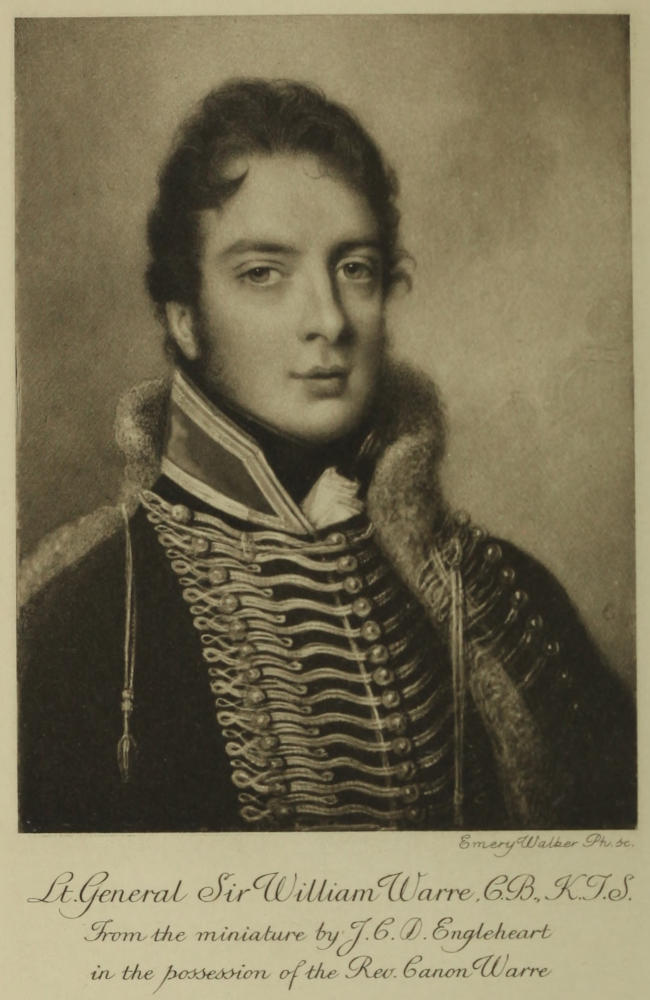
From the miniature by J.C.D. Engleheart
in the possession of the Rev. Canon Warre
Emery Walker, Ph.sc.
LETTERS FROM THE
PENINSULA
1808-1812
BY LIEUT.-GEN. SIR WILLIAM WARRE C.B., K.T.S.
EDITED BY HIS NEPHEW
THE REV. EDMOND WARRE, D.D., C.B., M.V.O.
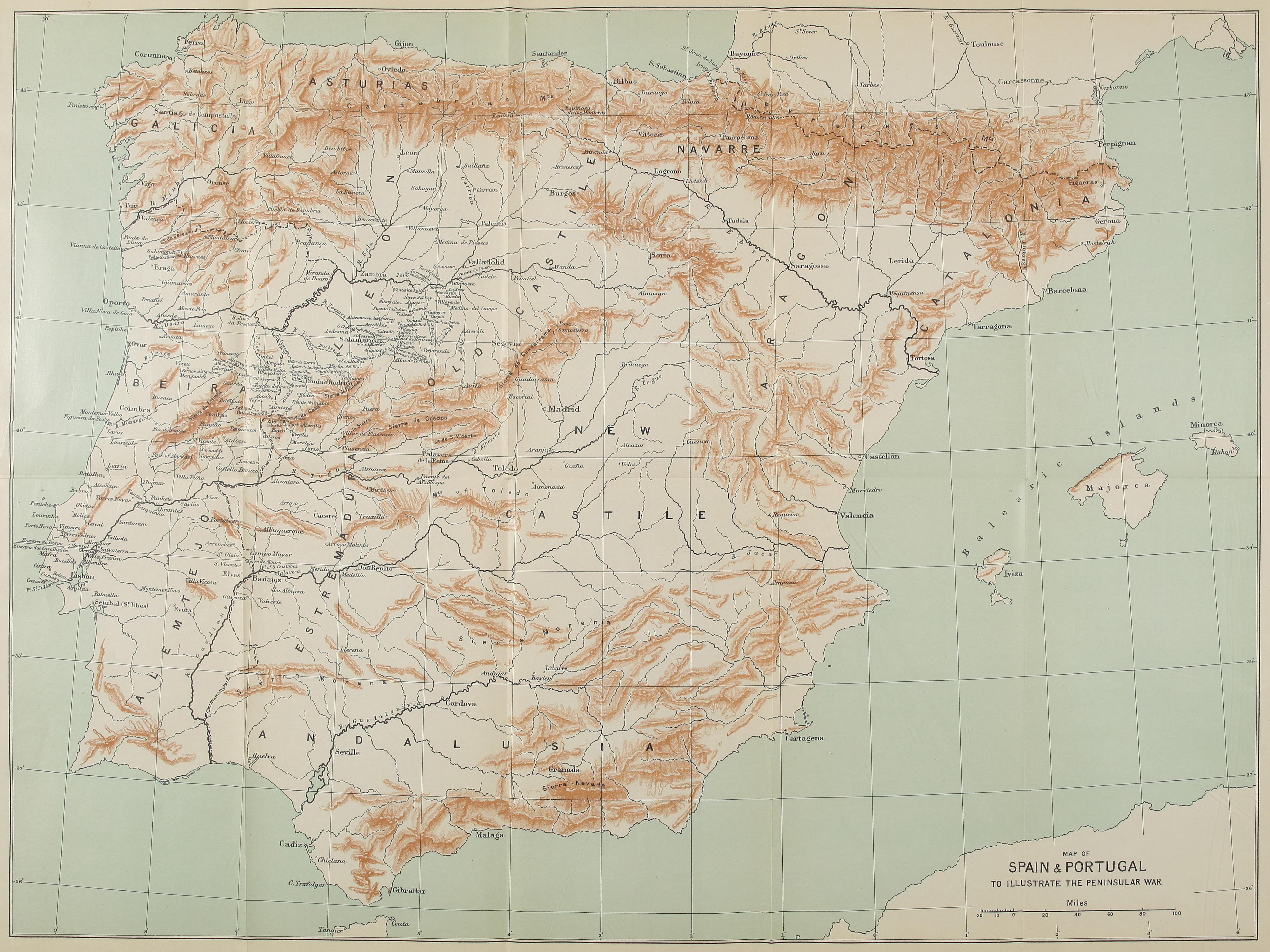
WITH FRONTISPIECE AND MAP
LONDON
JOHN MURRAY, ALBEMARLE STREET, W.
1909
PREFACE
Some years before his death in 1875, my father
entrusted to me a packet containing letters written
by his eldest brother, my uncle, Sir William Warre,
from the Peninsula during his service there from
1808 to 1812.
The packet was not opened by me until the
year 1908.
The letters, on perusal, seemed to be of interest,
as giving a graphic description of the life and
opinions of an officer serving on the Staff during
the Peninsular War, and, in particular, of one
immediately concerned in the organisation of the
Portuguese army.
Moreover, the letters, which are written on the
spot and without reserve, being chiefly addressed to
his father or mother, seem to reflect in some
measure, as regards the campaign, and as to home
politics, to which there are plentiful allusions, the
conversation and opinions of the Headquarters’ Staff
at the time; and further, the intimate acquaintance
of the writer with the Portuguese character, and
with the methods of the Portuguese Government,
enhances the illustration of the difficulties which
had to be overcome in the effort of Great Britain to
save her ally from the crushing yoke of French
imperial despotism.
Mr James Warre of Oporto, the father of Sir
William Warre, was a man of great ability, and of
influence both in Portugal and at home. He was a
partner in the firm of Warre & Co., which was at
the time one of the leading commercial houses in
Oporto—an old firm, established in the seventeenth
century—with which, however, the family connection
was severed at the death of Sir William Warre’s
brother George, in the year 1850.
The letters themselves, considering the circumstances
under which they were written, are very
fairly legible; but in places there are lacunæ which
are sometimes difficult to fill up. The orthography
is not at all consistent—often old-fashioned, sometimes
faulty. I have corrected it in some places,
but in many have left it as in the original.
I cannot claim to have any particular knowledge
of military history, and, as regards the brief introductions
to the several chapters, wish to acknowledge
in limine my indebtedness to Napier’s great
work, to Professor Oman’s three most interesting
volumes, which bring the story of the war down to
1810, and to Sir Herbert Maxwell’s Life of the
Duke of Wellington.
I am indebted also to my cousin, Mr George
Warre, for help in translating the Portuguese words
and phrases that occur in the letters.
My thanks are also due to my cousin, Mrs Wm.
Rathbone, for kindly allowing me to use several of
the collection of family letters in her possession,
extracts from which help to fill up some of the gaps
in the correspondence.
Lastly, I must acknowledge my debt of gratitude
to my friend and publisher, Mr John Murray, for his
most valuable help in many ways. Without his
assistance, the map which illustrates the volume
could not have been constructed.
Sir John Moore takes command of British troops in Portugal.
Nov. 13.
Moore at Salamanca.
” 23.
Battle of Tudela. Spaniards defeated.
Dec. 4.
Napoleon arrives at Madrid.
” 15.
Soult with 15,000 men at Saldaña.
” 20.
Moore reaches Mayorga; junction with Baird.
” 21.
Combat of Sahagun.
” 22.
Napoleon’s pursuit of Moore begins.
” 23.
Avanilla, near Sahagun, 5½ leagues from Saldaña, half-past
5 P.M.—orders to march on Saldaña,
6 P.M.; news received about 7
P.M. of Napoleon’s advance;
Moore resolves on and orders retreat.
” 28.
Benavente.
” 29.
Astorga.
” 31.
Bembibre.
Napoleon leaves the pursuit to Soult and returns to France.
1809.
Jan.
Retreat of Sir John Moore’s army continued.
Jan. 2.
Bembibre.
” 3.
Villa Franca.
” 6.
Rearguard finds army at Lugo in position.
” 8-9.
Lugo evacuated.
” 9-10.
Betanzos.
” 11.
Corunna—no transports.
” 14.
Transports arrive.
” 16.
Battle of Corunna.
” 17.
Embarkation completed.
” 18.
H.M.S. Barfleur sails from Corunna.
” 23.
Arrives Plymouth.
Feb. 20.
Fall of Saragossa.
Feb. (end).
Beresford appointed to command Portuguese army.
March (early).
Beresford arrives at Lisbon.
March 10-20.
Soult’s operations in Portugal; capture of Oporto.
” 29.
Battle of Medellin—Spaniards defeated.
April 22.
Sir A. Wellesley arrives in Lisbon.
May 12-22.
Oporto retaken; Soult’s retreat to Orense and Lugo.
June.
Advance of British army from Abrantes.
July 27-28.
Battle of Talavera.
Aug. 4.
Wellesley retires on Badajos.
Oct. 18.
Battle of Tamames—French defeated.
Nov. 19.
Battle of Ocaña—Spaniards defeated.
” 29.
Battle of Alba de Tormes—Spaniards defeated.
1810.
Jan.
Lord Wellington retires into Portugal.
Jan. and Feb.
The French invade Andalusia.
Feb. 1.
King Joseph enters Seville.
Siege of Cadiz.
” 12.
Badajos summoned by Mortier.
March to April 22.
Siege of Astorga.
May to July 9.
Siege of Ciudad Rodrigo.
July 24.
Combat of the Coa.
July to Aug. 27.
Siege of Almeida.
Sept. 16.
Masséna advances into Portugal.
” 27.
Battle of Bussaco.
Oct. 1-9.
Wellington retires within the lines of Torres Vedras.
Oct. to Nov.
Masséna before the lines.
Nov. 14.
Masséna retreats to Santarem.
Dec. 21.
Soult moves northward to support Masséna.
1811.
Jan. 27.
Soult invests Badajos.
March 5.
Masséna leaves Santarem.
” 11.
Surrender of Badajos; Soult returns to the South.
” 15.
Foz d’Aronce.
” 29.
The Allies take Guarda.
April 3.
Combat of Sabugal.
Masséna leaves Portugal.
” 20.
Wellington to the Alemtejo.
May 2.
Masséna resumes the offensive.
” 4.
Beresford lays siege to Badajos.
” 5.
Battle of Fuentes d’Onoro.
” 8.
Masséna retreats; is removed from command.
” 10.
Brennier escapes with garrison from Almeida.
” 12.
Soult raises the siege of Badajos.
” 16.
Battle of Albuera.
King Joseph leaves Madrid.
Marmont takes command of the army of Portugal.
” 25.
Reinvestment of Badajos.
June 12.
Siege raised the second time.
The French retire from Estremadura.
Aug. 8.
Wellington blockades Ciudad Rodrigo.
Sept. 21.
Marmont advances to relieve Ciudad Rodrigo.
” 24.
Action at El Bodon.
” 25-27.
The Allies retreat, and take up position covering the line of the Coa.
” 27.
The French withdrawal—Marmont to Talavera, Dorsenne to Salamanca.
Ciudad Rodrigo again invested.
The British army goes into cantonments on the Coa.
Marmont concentrates near Toledo.
1812.
Jan. 8.
Siege of Ciudad Rodrigo.
” 19.
Taking of Ciudad Rodrigo by storm.
March 16.
Siege of Badajos.
April 6-7.
Taking of Badajos.
May 18.
Hill destroys bridge at Almaraz.
June.
Wellington advances into Castille.
June 17.
Allies enter Salamanca.
” 27.
Forts at Salamanca taken.
July 22.
Battle of Salamanca—Beresford severely wounded.
Aug. 12.
Allies enter Madrid.
Sept.
Siege of Burgos.
Oct.
Retreat from Burgos.
Nov.
Winter quarters near Ciudad Rodrigo.
MEMOIR OF WILLIAM WARRE
William Warre, the subject of this Memoir, was the
eldest son of James Warre of Oporto, and Eleanor, née
Greg, his wife. He was born at Oporto, 15th April 1784,
and spent most of his childhood there. He was sent to
Harrow, but seems to have left early, and to have been
placed in the office of Messrs Warre & Co., of which
his uncle, William Warre, was the senior partner, in order
that he might learn the business which both his uncle
and his father desired him to follow.
But his own strong wish was to be a soldier, and, as
it turned out, a piece of mischief achieved that which
arguments and entreaties had failed to obtain. One day
in the office, when letters had to be got ready for the
mail, the duty of sealing them, in which, after the fashion
of the day much wax, red or black, was consumed,
devolved upon the young clerk, who, observing that
the pigtail of Pedro Alves, the Portuguese member of
the firm, had lapped over to his side of the desk, while
the old gentleman was enjoying a peaceful post-prandial
slumber, felt moved to play a practical joke, which had
momentous consequences. He poured the red wax upon
the ribbon of the pigtail, fastening it to the desk, sealed
it with the seal of the firm, and fled. Great was the
wrath that ensued. No apologies could be accepted.
It was the end of his commercial career.
He was then sent to a private tutor at Bonn to learn
foreign languages, and to prepare for the Army. On the
breaking out of the war between France and Austria, he
and another fellow-student joined the Austrians, and went
out, as they said, to see the fun. As luck would have it,
they were taken prisoners in a skirmish, and were
brought before General Custine, who commanded the
French force in the neighbourhood. Custine, seeing that
they were English and mere boys, scolded them and
told them that it was very lucky for them that Marshal
Davoust had not arrived to take over the command,
“for,” said he, “he would have hanged you without mercy
on the nearest tree. Now go back to your books and
your tutor, and don’t meddle with affairs which do not
concern you.”
Shortly after this William Warre was sent back to
England, and on the 5th November 1803, when he was
19 years of age, received his commission in the 52nd
Light Infantry, then under the command of Sir John
Moore. He served with the 52nd till 25th April 1805,
when he was promoted Lieutenant in the 98th, which
was then in Canada. He did not, however, proceed
thither, having purchased promotion as Captain in the
23rd Dragoons.
He served with this regiment in Ireland until the
summer of 1807, when he was sent to the Royal Military
College, then established at High Wycombe, to study
for Staff employment.
In 1808 General Ferguson selected him as A.D.C., and
took him with him to Portugal. There he was present at
the combat of Roliça, and at the Battle of Vimeiro, both
of which are described in his letters. His health gave
way under the hardships of this campaign, and he was
detained ill at Lisbon for several months. His knowledge
of the Portuguese language enhanced the value of his
services, and after his recovery, General Ferguson having
returned to England, he was attached by General
Beresford to his personal staff, and served with him as
his principal A.D.C. until the year 1812.
Captain Warre took part in Sir John Moore’s retreat
and, with General Beresford, was the last to embark after
the Battle of Corunna, 16th January 1809.
In March 1809, Beresford, with the rank of Field-Marshal,
was placed in chief command of the Portuguese
Army, and employed Captain Warre, his A.D.C., in the
organisation of the national troops. He entered the
Portuguese service and was promoted therein to the
rank of Major, and appointed first A.D.C. to the Field-Marshal.
After the passage of the Douro, May 1809, Major Warre
was sent forward by Beresford to raise the armed peasantry
in the province of Minho, with a view to harassing the
French forces under Marshal Soult, which were then in
full retreat. He succeeded in getting the peasantry to
dismantle the bridges of Ponte Nova and the Saltador,
but could not get them to destroy their own means of
communication. Had this been done the French army
was lost. The delay, however, caused by the necessity
of forcing and repairing the bridges, cost the French
the loss of many men and horses,[1] and of most of the
spoil they were carrying off from Oporto. Unfortunately
the letters in which these operations were described are
wanting. But for the rest of the long campaign up
to the battle of Salamanca, with the exception of Talavera,
when he was with Beresford in Portugal, and of Albuera,
and Bussaco, from which he was absent through illness, his
letters are fairly consecutive comments of an actor in
the events which occurred during that period of heroic
struggle.
On 30th May 1811 he was promoted by Brevet to
the rank of Major in the English Army, and to that of
Lieutenant-Colonel in the Portuguese Army. At the
last siege of Badajos, he was the senior Staff Officer at
the summons of Fort Christobal, and had the honour of
taking prisoners the Generals Philippon and Weyland,
who surrendered their swords to him.
In the battle of Salamanca, 1812, he was with his chief,
Marshal Beresford, when the latter was severely wounded,
and, as narrated in the letters, carried him into the town,
nursed him through his illness, and went with him to
Lisbon.
In 1813 Major Warre was promoted to the rank of
Lieutenant-Colonel in the English Army, and resigned
his commission in the Portuguese Army. He received
from the King of Portugal medals for his conduct at
Vimeiro, at the siege and assault of Ciudad Rodrigo, and
for the two sieges of Badajos, also a medal for the four
campaigns. He was also made a Knight of the Order of
the Tower and Sword, and of the Order of St Bento
d’Avis.
In 1813 he was sent to the Cape of Good Hope, where
he was appointed Q.M.G., a post which he held till 1819.
In November 1812 he had married Selina, youngest
daughter of Christopher Maling of West Herrington and
Hillton, in the county of Durham. By her he had a
family of three sons and two daughters. His youngest
son, Henry, born 1819 at the Cape, was afterwards
General Sir Henry Warre, K.C.B. His wife died
3rd February 1821.
In November 1820 he returned to England, and in
1821, by reason of ill-health, went on half-pay.
In May 1823 he was appointed A.Q.M.G. in
Ireland, and in 1826 was transferred to a similar appointment
in England. In 1826-1827 he served on the
Staff of the Army sent to Lisbon under the command of
Sir William Clinton, G.C.B.
On 22nd July 1830 he became a full Colonel. He
served again on the Staff in Ireland till 1836, when he was
appointed to the command at Chatham. He held this
appointment till his promotion to the rank of Major-General
23rd November 1841. It was during his command
that the Review took place which is immortalised
by Dickens in Pickwick. He was made C.B., and was
Knighted in 1839. In 1842 he was placed in command
of the North-Western District. Subsequently he
was transferred to the Northern District, with his Headquarters
at York. Reference is made to him in the letters
of Queen Victoria (vol. i., p. 150).
He gave up the command at York in the year 1851,
and, liking the place and neighbourhood, remained there
in a residence which he rented at Bishopthorpe. His
health broke down in 1852, and in the following year he
died, and was buried in the churchyard at Bishopthorpe.
The church has since been pulled down, and the churchyard,
which is adjacent to the gardens of the Archiepiscopal
Palace, closed. His tomb is on the south side of the old
graveyard, and bears the following inscription:—
SACRED TO THE MEMORY
OF
LIEUTENANT-GENERAL SIR WILLIAM WARRE
C.B., K.T.S., K.C., St Bento D’Avis Colonel of the 94th Regiment Died at York, 26th July 1853, aged 69 Years.
LETTERS FROM THE PENINSULA — 1808 CHAPTER I — INTRODUCTION — LETTERS
In June 1808 the British Government determined
to send assistance to the Spaniards, who had risen
in revolt against the French domination in the
Peninsula.
Spain, which had been an enemy, was now
regarded as a friend.
In the previous year, an expedition under
General Whitelock had been despatched to invade
the Spanish Colonies in America, with disastrous
results. In 1808 a force of about 9000 men was
already assembled in Ireland, with a view to
renewing this attempt under a more competent
General. But in the altered circumstances the
destination of these troops was changed, and they
were placed under the command of Lieut.-General
Sir Arthur Wellesley, with orders to proceed
to Portugal and to co-operate with the Spaniards
and Portuguese in attacking the French.
Beside the troops ready to embark in Ireland
there were two Brigades—Anstruther’s and Acland’s,
quartered at Harwich and Ramsgate respectively—available
for immediate service abroad. These
were added to Wellesley’s command. And in
addition to these there were at this time about 5000
men, under General Spencer, observing Cadiz, who
could join the expedition on Portuguese soil.
Lastly, there was a force of about 10,000 men under
Sir John Moore, who had been sent to the Baltic
to co-operate with the Swedes, a task which proved
impracticable. These were on their way home, and
were ordered to Portugal, though some time
elapsed before they could join their comrades in the
Peninsula.
Major-General Ferguson, with his Aides-de-Camp,
Capt. Warre and Capt. Mellish, embarked at
Portsmouth in H.M.S. Resistance—Capt. Adam—in
May; but their destination at that time was quite
uncertain, though General Ferguson, nominally at
least, belonged to the force under General Spencer’s
command. After some further delay, owing to
contrary winds, the Resistance arrived at Cork,
where Sir Arthur Wellesley on 7th June assumed
the command of the troops assembled. The news
of the Spanish insurrection had already reached
England, and although quite uncertain as yet as to
their future movements, everyone seems to have
taken it for granted that they were to sail at once.
As it turned out, they had many weeks to wait
before the actual start took place.
The six letters written in May and June, though
not belonging properly to the letters from the
Peninsula, have been included in the series, as
giving an account not altogether uninteresting of the
kind of life led while waiting for orders to sail, the
needs and necessities recorded, and the ideas generally
entertained by the writer as set forth in his
correspondence. The difficulties respecting the
soldier servant, whom he was so anxious to take
with him, have an almost tragic interest in view of
the ultimate fate of the man, which is afterwards
described in the letters.
Not without interest also are the sidelights
occasionally thrown upon the jealousy with which
Colonels of Regiments regarded the taking of
officers from service with the Regiment for Staff
employment, and the indications of the necessity of
influence in high quarters to obtain any appointment
of the kind. But more than all is the
evidence of the enthusiasm which pervaded all
ranks—enthusiasm for a glorious cause, which was
no less than the liberation of Europe from the
domination of the tyrant, who had trampled right
and justice under foot, and was without gainsaying
England’s bitterest and deadliest foe.
Portsmouth, May 22, 1808.
Here we are, my dearest Father, after a very
hasty journey and pleasant, as constant rain and a
complete overturn about ½ a mile short of Kingston,
from which Capt. Mellish and myself escaped quite
safe, except a few trifling bruises and a sprained
thumb I got, which renders my writing somewhat
difficult—with these exceptions it was as pleasant
as could be to me, leaving all those dearest to me
in the world.
We have just got all our baggage, and go on
board ourselves this evening. Capt. Adam appears
to be a very fine gentlemanly young man, and
much inclined to show us every civility.
We shall sail as soon as the wind is fair, and
are much hurried. Should my things arrive this
evening they will be in time, otherwise I fear not.
Nothing can be kinder than the General. I think
myself every moment more fortunate in going with
him. Pray get some advice about Rankin. I
shall send him on shore at Cork, if I can, and have
no answer from Seymour.[2] If I am not able to
send him on shore, the advice I want you to get is,
how to get him leave to go, as if he were not gone
but to Cork. Pray write. It may find me on
board the Resistance, Cork. I will write every
opportunity. May God bless and preserve you
all and give you every happiness, is the constant
prayer of your affectionate son,
Many thanks, my dear Father, for your letter of
yesterday, and the books and wine, about which
I have just written to Messrs Smith and Atkins,
directing them, if we are sailed, to send it to care
of Markland at Gibraltar. Here we are with the
wind as foul as it can blow, and too hard to put
to sea. We shall sail the first opportunity, and
are not a little anxious to get off. Nothing can
exceed the General’s and Capt. Adam’s kindness.
We are as comfortable as on shore, and as happy
as possible.
We have not the least idea of our destination.
Reports I never believe. If the General does not
know, it is not likely any newspaper can. I
received my books and wine safe, for which accept
my thanks. The books, at all events, I could not
read if I had them not. They are therefore as
well with me, and God knows how long we may be
on board or away.
I am glad you intend to call on the Duke. It
is as well; and pray do not forget to assure Ld.
Mostyn of my gratitude and sense of his kindness
towards me. I have written, or rather I wrote
the day I left town to Seymour, but, should I not
get his answer at Cork, must send Rankin on
shore; and to go without a servant is very inconvenient
indeed. Therefore I think, if you could
hire me a steady, honest servant, it would be worth
while his coming to Cork to me; or the General
thinks it would be better to ask General Calvert,
by “empenho”[3] to send me an order to Cork for him
to accompany me at all events.
Adieu; we are ordered off by signal. May God
preserve and bless you all, is the constant prayer of
your affectionate son,
Till yesterday, on Sir A. Wellesley’s
arrival at Cork to take the command, our sailing
was so uncertain, that I did not write to you, for
other news, except that we are all well, from hence
I had none to tell. We now expect to sail the day
after to-morrow, Sunday, if the wind is fair. The
glorious accounts from Spain have hurried us off,
and I believe there is now no doubt that that
is our destination, but what part we know not.
The Rendezvous is Tangier bay, in case of
parting company, which looks like Cadiz (this
entre nous).
We are exceedingly anxious to get away, after
six weeks’ delay. The Army are in the highest
spirits; indeed the cause we are engaged in is the
noblest a soldier could wish, and to support the
liberties and independence of a country so lately
our enemy. To forget all animosity and cordially
join against the common enemy of Europe, the
would-be Tyrant of the world, is worthy of the
British name; and a soldier’s heart must be cold
indeed that would not warm with enthusiasm in
such a cause. I am not one of the most sanguine;
you know my opinion of armed mobs, though in
this, from the accounts we have received, there is
an appearance of system and order that promises
well. May God assist the Right. It may be the
crisis of the Tyrant’s power. If he fails now, it
may open the eyes of Europe.
I will write by every opportunity and let you
know how we are going on, and the news, and a line
when we sail. The General’s best thanks for your
present of maps. They are most acceptable to him.
He is gone with Adam and Mellish to Cork to dine
with the Mayor, or dine in publick in honour of Sir
Arthur. I was asked, but having a good deal to
do, and not fancying a crowd, have sent an excuse.
We have been very gay here ever since we arrived,
but long to be off.
How unfortunate we were not to be with
Spencer at landing at Cadiz. There will be yet
something I hope to be done. Boney will not
easily give up his point, and a more beautiful army
never embarked, for its size, from any place. We
have been joined by 45th, 4 troops 20 Lt. Dns., and
2 companies Artillery, besides a very large Staff, and
are to be by the 36th Regt. The troops are very
healthy, in all about 9650 men.
I have not heard further about remaining in the
23rd. Seymour has allowed me to take Rankin, if
I can get a man to exchange. Stuart is trying to
get me one from the 9th Foot, but they are all so
high in spirits at going on service, I fear of his
getting one. I think we shall certainly sail on
Sunday, if possible. Write to me, in case we should
go to Porto, direct Gibraltar, and tell me if I can
do anything there; depend on my punctuality
and exertions. Such a thing might happen as
going in there. Our party is much augmented on
board Resistance. Generals Crawfurd and Fane
1 A.-de-C. or 2, 1 Bᵈᵉ Major, and a civil Secretary.
It will not be so pleasant as hitherto. Patience, it
is a million times better than a transport.
From your ever affectionate son,
Wm. Warre.
Pray desire Hawkes Piccadilly to send me a
Hat and Feather, the same shape exactly as the last,
by 1st opportunity; my old one is gone to pieces.
Adieu.
Cove, June 17, 1808.
My Dear Father,
I have to thank you for your kind
letter on the 11th inst., and for that you wrote to
Genl. Payne, in which you have said everything
that can be said. I am much afraid he is offended
with my carrying my point in spite of him.
It is however of consequence my remaining in
the Regiment, as more Captains are quitting it I
hear, and I have therefore this day written to
Greenwood’s with the enclosed paper of exchange
signed, of which letter you have an extract annexed.
It may do good, and cannot do any harm.
Seymour, I think, will do what he can for me;
his letters are as friendly as possible, though he will
not allow me to take Rankin, which is very
annoying, particularly now that I have bought a
horse, nor do I know what to do for a servant here.
There is no such thing, and as all the troops are
now embarked, and we may be ordered to sail every
hour, I have no time to write for one. I should
therefore be much obliged to you, if you would
enquire about some honest, trusty man, who must
understand horses, and send him out to join me at
Gibraltar. Agree about wages, clothes, etc., and
send him out to join me at Gibraltar, or off Cadiz,
as soon as a conveyance offers. To be on service
without a trusty servant will be exceedingly unpleasant.
We know nothing further of our destination or
plans. We have been here amusing ourselves in
perfect idleness, though very gayly. We yesterday
dined on board Ld. Thomond’s yacht, and went in
the evening to a play, acted by the Officers of the
Resistance, for the poor of Cove. It was exceedingly
crowded, and went off very well. I have bought a
nice little hack, a mare, the only thing of the kind
I could get for the price, 30 guineas Irish, for
which I drew yesterday on you. They ask 50, 60,
70, for nice hacks, and the Genl. and Mellish have
been obliged to pay it. I got mine from an
Artillery Officer, through a friend of mine, and am
very lucky. I also further drew upon you for £20
British to Mr Mayhew, of which Mellish has half and
is to pay me in the money of the country we go to.
I hope we shall now leave this very soon. All the
Regts. are embarked, and we only wait for orders.
I will write as soon as they arrive. I rejoice to
hear that dear Tom[4] was safe at Stockholm, and
daily expected. God send him safe, dear fellow. It
would have been great happiness to have seen him
before I sailed, but I shall now be satisfied with
hearing of his safe arrival. Give him my kindest
love and welcome home.
Pray assure Lord Rosslyn when you see him of
my high sense of his Lordship’s goodness, and that
if I must quit the 23rd, I shall feel highly gratified
by being in his Regiment. Pray get my uncle to
get the Duchess to speak to Gordon about the
exchange. As things are now, it is really a very
hard case that I must give up my chance of
advancement because I am anxious to learn experience
of my profession, and it has disgusted me not
a little. In the midst of this idleness, such is the
confusion and hurry that we can scarcely settle to
anything. Report says we are going to Spain.
I am working hard at Spanish, as is Mellish, who is
a very clever fellow.
Stuart, my old friend, embarked to-day. His
Regiment marched in, in the finest order, and got
great credit. He desires to be most kindly
remembered, as does the General. I believe
General Hill, who commanded at Fermoy when I
was there, goes with us in the Resistance. He is a
very pleasant, mild man, and much liked. He
commands here till the arrival of the Commander-in-Chief,
Sir A. Wellesley, I believe certainly; but
whether he will come here, or we join him at sea,
is not known.
Wm. Warre.
Extract of my Letter to Greenwood & Cox.
“June 17, 1808.
“The objection to my accompanying Major
General Ferguson (the number of Captns. then on the
Staff from the Regt.) being now removed by Captn.
F’s exchange, I hope H.R. Highness and Major-General
Payne will be pleased to allow me to remain
in the 23rd, to which, independent of the number
of steps I shall lose by the exchange, I am much
attached, and shall only quit from my great desire of
acquiring experience in my profession on actual
service, of which I saw but little prospect in the Regt.
at present. Any emolument I can receive from my
Staff situation, I can assure H.R.H., is not an
object, my only wish being to render myself, as
far as lays in my power, useful in the service,
however great the loss [I may] suffer by entering
another Regt. as younger Captain from one in
which I am so high up.
“I have the honour to request you will lay this
before H.R.H., at the same time assuring him of
my willingness to fulfil the conditions under which
he was pleased to allow me to accompany Major-Genl.
Ferguson, by exchanging into any Regt. of
Dragoons H.R.H. may think proper. I have the
honour, etc., etc.”
I have desired them to write to me what answer
the Duke gives.
[4] Thomas Warre, second son of James Warre, a merchant in St
Petersburg, escaped from Russia to Sweden after war had been
declared against England.
Cove, June 22, 1808.
My Dearest Father,
I have this morning received your
kind letter of the 16th, and am very much obliged
to you for the Maps, which will be most acceptable,
as I have hunted all over Cork without finding
anything of the kind, and I think there is little
doubt of Spain’s being our destination in the first
place. I shall offer them to the General, but I
fear he will not be prevailed on to accept them. He
is always ready to oblige or give anything away
himself, but would not take a pen from anyone, if
he thought he deprived him of it. I shall note
carefully what you say respecting ... though on
his score of fortune, I think you have been misinformed.
He is not amiable in his manners, but
very clever, and though very good friends, we are not
likely ever to be very intimate or confidential. A
sort of outward cordiality must seem to exist, placed
as we are together in situation.
I am most sincerely rejoiced that Douglas is
coming to join us. For him I have really a very
warm regard, and should Johnstone succeed, shall
have with me two of my greatest friends. Our
General has nothing to do with the present Expedition.
He belongs to Spencer, and is ordered to
proceed by the first safe conveyance (a man-of-war)
but, should one not offer, to remain in the Resistance;
this entre nous. He has applied, but none offers,
and I think there is very little doubt of our all
having the same destination. He is naturally very
anxious to join his Brigade at his post off Cadiz,
but we should all quit the Resistance with very great
regret. Nothing can be more pleasant than our
situation with so excellent a fellow as Adam.
I was in great hopes of hearing of dear Tom’s
safe arrival, and hope still to have that happiness
before we sail. Enclosed I send him a few lines
welcome home. They but faintly express a brother’s
feelings at his escape, and return, after so long an
absence, to the bosom of his family.
All the troops are embarked, and certainly finer,
as far as they go, never were seen. We now only
wait for orders and Sir A. Wellesley, who is expected
to-day, and will I hope bring some further orders
for Genl. Ferguson. As to Rankin, I have written
to Seymour to allow him to exchange into the 9th
Foot. Stuart has been so good as to promise to get
one of his men to do so, and I trust the General,
who, by the bye, it was that wrote, will have an
answer.
I have no answer to my letter about buying his
discharge, which I fear will not be allowed. It
will be abominably unpleasant to embark with a
horse and no servant. As to Payne [nothing]
but the steps and prospects I have in his Regiment
would induce me to remain in it, though Seymour’s
letters are highly kind and flattering. Payne
considering dispassionately, has but little right to
be angry at my using all my endeavours to get a
very advantageous situation, although in spite of
him; nor can I rate my services so low, as to
suppose they are a matter of indifference to my
Regiment, particularly considering the sacrifices I
offered to make on my return to England. His
not answering your letter is want of good breeding.
Seymour’s letter to him, however, perhaps makes
him hesitate.
We have been endeavouring to establish a ball
here this evening for the relief of the poor distressed
wives of the Soldiers, but it is a very bad day and
I fear we shall have but thin attendance. I have
been much troubled with the toothache, and
yesterday had the unruly member drawn with
much difficulty, and to-day my face is very sore
and swelled; but, as I was one of the chief
instigators of this ball, I must go, though not at
all in the humour for it. Adieu, my dearest father.
Ever your most affectionate son,
Wm. Warre.
The Genl. thanks you for your kind messages,
and desires to be most kindly remembered.
Cove, June 27, 1808.
My Dearest Mother,
Even had I not this morning
received your most kind and affectionate letter
by Douglas with the locket, it was my intention
to have written a few lines, nor have I time for
much more, as we dine at a Mr Frankland’s some
way in the country, and I have a good deal of
writing on hand. Accept my best thanks for the
letter and locket which shall never quit me, though
you know I did not want it as a souvenir. I wish
it was the Talisman, so famous in the “Arabian
Nights,” that conveyed its possessor in an instant
wherever he wished. I should often visit the
happy circle at Hendon.
We really know no more of our destination
than you do, except that we all belong to the same,
and are to join General Spencer at Gibraltar, which
is a great satisfaction. Hitherto we have been
longing for an opportunity to get out to him, not
knowing but this expedition might have quite a
different destination.
We have a large list of the Staff, among which
are many friends of mine. Sir A. Wellesley, Lieut.-Genl.
commands in chief, and under him are Major
Genls. Spencer, Hill, Ferguson, Br. Genls. Fane,
Crawford, Nightingale. Col. Torrens is Mily.
Secretary, and a long list of Staff-officers, which I
need not trouble you with reading. Genls. Fane and
Crawford go in the Resistance with us, which will
take away greatly in point of room. The latter and
his Brigade Major I know very well, the former not
at all, though I hear he is a very good man. I could
have dispensed with him very well, as they just turn
us poor ADCₛ out of our snug berths, and strangers
will prevent that pleasant gaiety and freedom we
have enjoyed hitherto.
It is very uncertain when we shall sail. We
are waiting for the Donegal 74, Capt. Malcolm,
and Crocodile frigate, and for some transports,
with Artillery and Cavalry, and some empty ones
to thin those now here, which are very much
crowded, though hitherto quite healthy. The
additional room allowed looks like a longer voyage
than we expected, though Cavalry and our taking
horses seems to contradict this idea. I am rather
for going to Spain. It is a noble service assisting
a nation fighting for its independence, and it is
impossible to say what a brave people fighting for
liberty, and actuated at the same time by resentment
for great injuries, and a bigoted attachment
to ancient customs may do, if properly supported.
At all events, our assisting to the utmost of our
power the mother country will greatly facilitate our
establishing the independence of America, whither
I hope will be our ultimate destination.
Sir A. W. is a very good officer, and much
esteemed, and I trust we have neither a Whitelock
or Gower amongst us. I have not been very well
to-day—I expect from the effects of bad water—and
so liable to catch cold, that the General has made
me put on flannel, and I find myself better since I
have ordered a dozen of waistcoats of it at Cork.
We had a gay ball here on Friday, in a storehouse
fitted up with flags, for the relief of the
distressed soldiers’ wives. We had a good many
people, and collected about £50 free of expenses,
little enough among so many objects. I have had
a good deal of trouble, but who would grudge it in
such a cause? To-morrow there is a ball for the
poor wounded Dutchmen taken in the Guelderland.
I have never seen greater objects. Poor fellows!
they fought very bravely, but knew nothing of their
business. Our Frigate only lost one killed and one
wounded, and they 60 in both.[5] I went to see them,
and the Genl. has sent the Officer refreshments and
wine. He is an excellent man. His purse is
always open to distress, even too much. He is, I
fear, often imposed upon. I am much pleased for
many reasons, you may suppose, with Mr Adamson’s
kindness. Pray thank him most kindly from me.
As for Moll, I shall be much affronted if he talks of
paying for her. He must accept her as a very
small proof of my friendship and very high regard
for him, to say nothing of his kindness to me and
my gratitude for it. I hope Hardy will suit dear
Emily, and she will have him as a present from her
affectionate brother. I shall be able to afford not to
sell him, if we have a long voyage, and think she will
like him with greater pleasure as a present from me.
I was rejoiced to see my friend Douglas, he is gone
in to Cork to-day and returns to-morrow....
I am anxiously waiting to hear of dear Tom’s
arrival. Write to me the moment he does. We
are not likely to sail for some time,
Yrs., etc.,
Wm. W.
[5] See James’s Naval History, vol. iv., p. 324 ff. May 19, 1808.
“Guelderland,” Dutch 36-gun frigate taken by the “Virginie.”
1808 CHAPTER II — INTRODUCTION — LETTERS
After long delay the expedition under Lieut.-General
Sir Arthur Wellesley sailed from Cork
on 12th July. Meanwhile the Government had
altered its mind as to the command of the army,
and, after Sir Arthur Wellesley had sailed, entrusted
the command of the whole force to Sir
Hew Dalrymple. Under him were, in order of
seniority, Sir Harry Burrard, Sir John Moore, Sir
Arthur Wellesley, who thus, after his arrival in
Portugal, found himself as the junior Lt.-General
only fourth in command.
On 26th July the fleet reached Porto Roads,
and on 1st August and the following days, the
troops were landed at Figueira, in Mondego Bay,
not without difficulty, owing to the surf, which from
the open Atlantic beats with violence on the
unprotected coast.
It was not till 9th August that the army was
able to move forward. Difficulties as to transport
were almost insuperable, and some guns had to be
left behind. Wellesley had determined to take the
coast road, wishing to pick up on his way towards
Lisbon the Brigades of Anstruther and Acland
which had sailed on July 19th, but had not yet
arrived. His impression was that Junot, the
French Marshal, had 10,000 troops under his
command, but he had under-estimated these, which
amounted in reality to about 26,000; though it was
true that Junot had detached about 7000 under
Loison to quell the insurrection in the Alemtejo.
On hearing of the landing in Mondego Bay,
Junot hastily recalled Loison, with orders to join
De la Borde, who, with 5000 men, was sent forward
to observe and check the British army, till a concentration
of the French forces could take place.
Loison, however, whose force had a long and weary
march, was delayed at Santarem, and, on the day of
Roliça, was full fifteen miles away from the scene of
the fight. De la Borde, who left Lisbon on August
6th, advanced as far as Alcobaça, but fell back on a
position he had selected near Roliça. On August
16th the forces came into contact, and on the 17th
was fought the first combat of the Peninsular War,
which takes its name from Roliça. The action is
described in the letter from Lourinhao. Wellesley
after the action moved on still by the coast-line,
neglecting Loison and allowing him unmolested to
join Junot at Cercal. He was anxious to pick
up Acland and Anstruther, who were reported
off Peniche. They landed at Porto Novo, at
the mouth of the little river Maceira, 12 miles
south of Roliça.
Meanwhile Junot, after many delays, had moved
by Villa Franca on Torres Vedras. It was not
until the 20th that he learnt for certain that the
British force was keeping the coast road. On the
evening of the 20th he was ten miles south of
Vimiero, where the British army lay covering the
disembarkation of the two Brigades. During the
night the French army marched, and at dawn on
the 21st found itself close under the British position.
Followed on that day the Battle of Vimiero, which
is graphically described in the letters.
The victory was won; but to the disgust of the
army, and afterwards of the whole British nation,
it was shorn of its glory, and possible advantages,
by the command of Sir Harry Burrard, who landed
in the course of the morning of the 21st, superseding
Sir Arthur Wellesley, and forbidding all
pursuit. Burrard himself was shortly superseded
by Sir Hew Dalrymple, and the result which
ensued, in the Convention of Cintra, is too well
known to need comment here.
After the battle of Vimiero, William Warre was
laid up with an attack of enteric fever, which
brought him to death’s door. He recovered slowly,
and by the month of October was sufficiently well
to see active service again as A.D.C. to General
Beresford, who commanded a brigade in the army
of which Sir John Moore was the C.-in-C. General
Ferguson had not, as he had expected, returned
from England.
Porto Roads, July 25, 1808.
My Dear Father,
We arrived this morning off this
place, which was the appointed Rendezvous. I
have not been able to communicate with the
shore yet, and it is very uncertain whether I shall
be able to see my friends there, or land at all. I
have just heard a Frigate is going to England, and
the boat is waiting to take my letter, so I have only
time to say we are all well. I think we are to land
at Lisbon and attack Junot. This is my idea, but
nothing is known. To express my feelings at
seeing the spot of my birth, the place in which I
spent some of the happiest days of my life, would be
impossible, or how tantalised at not being able to
communicate. Should we land, you shall hear
further and by first opportunity. At present they
are calling for my letter.
Your ever affectionate son,
Wm. Warre.
I have opened this to say that I have a message
from the Commodore, saying he is sorry it will not
be possible for me to land, as they only wait for
Sir A. Wellesley’s return from shore to make sail.
They are making dispositions for the anchoring of
the fleet and landing. Spencer is to join us. I
am much disappointed at not landing or communicating
with shore.
[6] “With greatest regrets,” or, as we should say, “With much
love.”
Monday evening, July 25th, 1808. Off Ovar.
Dearest Father,
The enclosed is a second time returned
to me, and as the Peacock’s boat, by whom it is to
go, is delayed a few minutes, I have opened it to tell
you we are making all sail for Figueira, where we
are to land to-morrow morning in order, I understand,
to cut off a French Corps marching to
Lisbon to Junot’s assistance, and then to march to
Lisbon and try his mettle. I cannot imagine what
Corps is meant, as the annexed is the official
account of their disposition in Spain (minus 18,000
said to be killed in Spain, and some must have been
in Portugal), viz. (?9000) at St Sebastian, 6000
Pampelona, 15,000 Barcelona, closely besieged by
the Patriots in great force, 10,000 Burgos, 2000
Vittoria, 50,000 Madrid and adjacent country,
16,000 Lisbon, said to be now reduced to 12,000.
I have no accounts of the state of the country.
We made sail to the southward immediately, and
not a single boat came on board. Adieu.
I will write after our landing, if opportunity
offers. The most anxious moment I ever felt was
seeing Porto and not being able either to write or
go near. Every house I could see looked beautiful
to me who felt how happy I had been there.
Camp Lavos, Nr. Figueira, Aug. 8, 1808.
My Dearest Mother,
I have seized the opportunity of a
few leisure moments to write a few lines just to tell
you I am quite well, though a good deal fagged and
burnt by being constantly exposed to the sun, and
the exertions, which my knowledge of the language,
and our situation, render indispensable; though I
feel the sincerest pleasure in being in any way
useful to my country or the service, and fully
recompensed by it for every fatigue.
We disembarked the first of this month. It
took three days to land the whole army, and had
we been opposed from the land I am positive we
could never have effected it, so great is the surf
both on the coast and the bar. However, thank
God, the whole army landed without any loss but
a horse or two, and now occupy a position at this
place, or rather with our left to the village and right
to the sea, where we have been waiting for the
arrival of General Spencer and his Corps, who
arrived, and have been landing yesterday and to-day,
I trust without any loss, though the surf is very
heavy.
We advance to attack Monsr. Junot the day
after to-morrow; the advance guard, under Genl.
Fane, to-morrow. It is several days’ march. The
severest part of the business is in these infamous
roads and scorching sun, which with the large train
of Artillery and Baggage will oblige us to move
very slow. Junot has in all about 14,000 men, but
he cannot long resist, being about to be completely
surrounded by us, about 13 to 15,000 in all, from
the North, and by a corps of about 6000 Portuguese;
and from the North bank of the Tagus, from
Badajos, by a corps of 10,000 men from General
Castanhos’ army in Spain, I hear, the bravest fine
fellows possible, as is their General, and indeed the
whole of the Spaniards in arms. Nothing can
exceed their courage and enmity to the French.
Hitherto their conduct has been most noble, and
their praise in everybody’s mouth. Andalusia is
clear of French. Dupont and his army capitulated
to be sent to France with his arms, a curious concession
from the Spaniards, who are so much in
want of them. Three armies of French have been
taken or destroyed, and Castanhos is in full march
towards Madrid, and every hope entertained of his
success. 8000 of the French who had surrendered
were massacred by the Spanish peasantry, so great
is their animosity. All this is positive information.
Castanhos has 45,000 men, 4000 of which excellent
cavalry, and about 23,000 Regulars. He is a very
mild man, but a fine fellow as ever was. Whittingham
was in the action with Castanhos; his conduct
most gallant, and his praise universal in the army.
He is appointed a Colonel in the Spanish service,
as a proof of the esteem he is held in. The
Portuguese have about 28,000 men in all the
kingdom, in arms of all descriptions, all badly
armed, and I fear not so enthusiastic in the cause
(though they boast much) as their neighbours the
Spaniards. As to what the English papers say,
do not believe a word of it. I never read such a
parcel of nonsense.
General Ferguson’s staff here occupy an old
fellow’s house, where we are comfortable enough,
from Mrs Wm. Archer of Figueira’s attention in
sending us out everything we can want. Otherwise
I know not what we should have done, as Figueira
is 4½ miles off, and not a thing eatable or drinkable
(besides the rations) nearer. We are up in the
morning at 3 A.M., and, what with visiting the outposts,
or line, and guards, 7 or 8 hours a day on
horse or mule back, so that we are quite ready to
lie down 3 in a small room (for which luxury we are
not a little envied), at nine o’clock, and sleep as
sound as on the finest down beds in the world, but
for turning out now and then in the night, to
interpret or some other trifle (from nobody speaking
the language but me in the Brigade), which now
consists of the 66th, 40th, 71st Highlanders, all
tried Regiments on service, and longing to meet
these so much vaunted Frenchmen....
From your ever most affectionate son,
Wm. Warre.
The General desires kindest remembrances.
He is the best man almost I ever met.
Lourinhao, 12 miles from Peniche (South),
August 19, 1808.
I have just time to tell you I am well and quite
safe. We had a very sharp action the day before
yesterday, at a strong position at Roliça, near
Obidos. The French were strongly posted at first
in the plain, and then retired to a mountain almost
inaccessible. But what could resist the gallantry
of our brave fellows? They clambered up exposed
to a tremendous fire, and drove them for several
miles, killing a great many and taking two pieces
of cannon. Our army lost about 500 men in killed
and wounded, and a very large proportion of
Officers. The 29th Regt. suffered most, and
lost 19 Officers killed and wounded, the Col. (Lake)
among the former. The 9th also suffered, and my
poor friend Stuart badly, I fear mortally, wounded.
Capt. Bradford of 3rd Guards, and a Lieut. R.
Dawson[7] killed, a fine gallant fellow. Our Brigade
having been sent to turn the right, arrived rather
late, and were scarcely engaged. We lost a few
men—5 or 6—and poor Capt. Geary of the
Artillery, after firing 4 shots at the enemy in most
masterly style.
The French fought most gallantly, and their
retreat does honour to their military character.
They were inferior to us greatly in numbers. First
commanded by Laborde, who it is said is badly
wounded, and then by Junot, who arrived from
Lisbon, though his column did not get up in time.
Their loss from every account is nearly 1000.
General orders to-day thank 9th, 29th, 5th, and Rifle
corps for noble conduct. Though obliged at times
to climb on hands and feet, nothing could restrain
their impetuosity. Poor Stuart fell calling to his
officers to see that his young Regt. did their duty,
and not to mind him. Poor, dear friend, I fear he
cannot live. We marched to this place yesterday
to cover the landing of the troops under Genl.
Anstruther, and have just received orders to advance
towards Lisbon.
The French retreated, all night of the action,
by the new road. I wish we had pursued them,
but feel every confidence in Sir A. W.
Hitherto we have had a most harassing march
in the sun, and suffered much from the heat, though
all healthy and in high spirits. We shall give the
French a good dressing wherever we meet them,
and in 3 or 4 days shall be in Lisbon victorious....
Since I wrote to you a few days ago
by Col. Brown we have had a most glorious and
memorable day for England. The French attacked
us yesterday in our position with their whole force,
near 15,000 men. The attack was expected at
daybreak, and would have been so, had they not
been delayed by the roads. We had laid by our
arms about 2 hours, after turning out before daybreak
as usual, when the 40th, part of General
Ferguson’s Brigade, had their picquet driven in, and
beat to arms.
Our noble General, of whose gallantry and
conduct it is almost impossible to give an idea, was
soon on the mountain, our quarters being about ½
mile off in a small town, Vimiero. From thence we
could perceive the enemy advancing to attack the
centre of the army, and a strong column marching
to turn the hill on which the General’s Brigade was,
with Cavalry and Artillery; but as they had to
make a considerable round, we had full time to
prepare.
Sir A. W. (who commanded, Sir H. Burrard
not having landed) ordered up several Brigades, and
made the most masterly disposition. The centre
of the army, from which we were divided by a deep
valley, was soon attacked with great vigour, but
they received such a check, that we had soon the
glory of seeing the French staggered and then
relax in their attack. At this time General
Ferguson’s Brigade, and those under General
Spencer, who commanded this wing, were briskly
attacked, but our noble General in about ½ hour
after the fire commenced ordered his Brigade to
charge, leading himself in a manner beyond all
praise (it is enough, too, that the Commander-in-Chief
considers him to have most contributed to
the completest victory that could be obtained
without cavalry to follow it up). The French gave
way, and were followed with three cheers by the
whole Brigade. A part rallied, but the 36th and
71st charged them with an irresistible impetuosity,
led on by our brave General, and drove them from
their guns, of which they took four, with as many
tumbrils. The victory was now certain, though they
again rallied once more, and were again dispersed
by the 71st. Our Artillery completed the triumph
of this glorious day. To speak of the conduct of
any body would in me seem presumptuous. Every
soldier seemed a hero. The fire for some time was
tremendous, and the field strewed with our brave
fellows in charging the guns. My horse, a
beautiful, nice creature, I had received but a few days
before from Porto, which cost me 38 Moidores, was
shot in several places and fell dead. I got on
another belonging to a Dragoon, but so tired he
could not move; and when I had the cloak shot
away from before me, I thought it high time to
dismount and join the 36th, who were advancing,
and with them I had the honour to remain during
the rest of the action. The loss of the French is
very great, upward of 1200 killed and wounded left
on the field, besides prisoners. Our army lost about
500 in killed and wounded, and a good many Officers.
The only one you know is little Ewart, shot through
the leg, not dangerously I hope. The French army
was commanded by Junot, Laborde, Loison,
Charlot, Brennier. The two latter were taken
with a great many Officers, and thirteen pieces of
cannon.
We could adore Ferguson for his bravery and
skill and coolness in a fire like hail about him. His
orderly, a very fine trooper of the 20th Drns., was
shot close to me, and I fear cannot live. My poor
friend Stuart of the 9th died two days ago, after the
fight at Roliça, universally lamented—to me a loss
I have not yet recovered. I was much attached to
him. I have not time to write any more particulars.
I am very much fatigued, having been yesterday till
past 5 P.M. collecting the wounded English and
French, and conducting them to a place of safety
from the Portuguese cowards, who won’t fight a ⅟₁₆
of a Frenchman with arms, but plunder and murder
the wounded, poor wretches. Had I time I could
tell you such things of these countrymen of mine,[8]
that you would not wonder at my despising them
and having unpleasantly changed my opinion of
their character.
I am very happy to tell you none of our Staff
were killed. I have suffered a good deal all night
and to-day from a bowel complaint, but am better.
I wish we had advanced to-day and followed up our
victory, without giving them time to rally from a
check they are so little used to.
Adieu; God bless you all. Kindest love to them,
from your most affectionate son,
I should be most ungrateful did I let
another opportunity pass of thanking you for your
very kind letters of 25 July, 1st Aug., 3 Sept., which
latter I received yesterday, and am, believe me, most
sensible to the praise and approbation of friends so
infinitely dear to me.
You will long before this have heard of the
dreadful illness and narrow escape I have had since
the action, the extreme weakness occasioned by which
alone prevented my writing to you and my uncle
William by the Donegal, who went home as one of
the escort to the Russian Fleet. I never suffered so
much in my life as during those 14 days I was at
the worst, though the fever left me on the 4th or
5th day for a time. I had very slender hopes I
should ever again see my beloved family and
friends. I have now been on shore a week, and so
much recovered and gaining so much strength that
I am able to take a walk every day a short way,
and am getting my flesh again, though still very
thin, the disorder having left me a perfect skeleton.
I even yesterday paid a visit to some friends of the
Barnardo Bettrão’s, and sat there a considerable time.
To the Friar (Frè Barnardo), one of the family, I
am indebted for the most friendly attention and
kindness. He has been most anxious to procure
me every comfort and supply every want I could
have in my situation.
I think of going to Cintra next week for a few
days, for change of air and quiet. As soon as I am
able to undertake the journey, I shall go to Porto,
as Genl. Ferguson is going to England for a short
time on particular family business. I have determined
to remain behind, as I consider myself bound
to join my Regt. should I return to England, and
have great doubts whether they would allow me to
return, which would be provoking, if there was
anything to be done, and I am the more inclined to do
this, as from the Government of this country having
written to beg my worthy kind friend in the Albany
to come over, I have great hopes of embracing him
once more at Maçarellos.
I feel great “Saudades,”[9] notwithstanding, at
being obliged to postpone the happiness of seeing
you all, after such a narrow escape, but trust the
time is at all events not very far distant, and that
we shall yet talk over dangers past with additional
accounts to tell and battles to fight over, for I hope
they will not leave so fine an army idle at such a
time....
You ask me for some account of the battle. I
will give it you nearly in the same words as I have
written to my friends and Uncle William. After
having had all the fag and labor, it is hard not to
have been able to partake in the least of the exultation
and joy of the victory, or enter into the rejoicings
of this place, for eight days illuminated, and
every heart elated at the French having left it. The
last division embarked two days ago, but have not
sailed. The 1st and 2nd, I believe, have.
The Natives have murdered every straggler or
unfortunate Frenchman they met behind the column,
and, but for very strong English guards and patrols,
would destroy every person who supported them,
and their houses. It is cowardly in them now, but
when we hear of the ferocious cruelties and insolence,
of the system of robbery and plunder and murder,
almost incredible had we not seen such proofs of
it, we cannot wonder at the fury of this naturally
passionate and revengeful people.
Now to the battle. We had received information
on the evening of the 20th that the enemy
intended to attack us next morning, but this was
generally discredited. We were as usual every
morning under arms an hour before daybreak, and
remained after daybreak longer than usual, when,
not perceiving anything of the enemy, the troops
were dismissed, and Genl. Ferguson and his Staff
again retired to our straw at a house about ½ a
mile from Camp at the town of Vimiero. About
8 I was woke by a Serjeant, who told me our
picquets of the 40th on the left were driven in and
the enemy advancing. I ran to tell Genl. Ferguson,
and we were soon on horseback and on the hill
on the left, from whence we had a full view of
the French Army, on its march to attack us in
two strong columns. The strongest and principal
attack was on our centre, and the other against the
hill, and left of our position, which was separated
from the centre by a deep valley covered with vineyards,
occupied by our light troops, and to the top
of which Genl. Ferguson ordered his Brigade
to advance to await their attack.
Sir A. Wellesley arrived soon after, as I had
been sent to tell him of the attack, and perceiving
the intention of the Enemy, ordered Genl. Bowes’
and Genl. Ackland’s brigades to support Genl.
Ferguson’s; and made his dispositions in the most
cool and masterly style, as from our commanding
situation we could see all the movements of the
French and of our own army. Our light troops in the
centre, consisting of the 60th 5th Batt. (Riflemen)
and 95 Rifle Corps, supported by the 50th, were
by this warmly engaged and with various success,
though they behaved most nobly; but were at last
forced to retire before the French column, who
advanced with the utmost confidence to the attack,
expecting, as we have since heard, that we should
have given way immediately, but were so warmly
received that they retired.
They made several attacks, and endeavoured to
turn both flanks of the centre, but were received on
their left by the 97th, who charged them and drove
them through a wood, and on their right by the
52nd 2nd Batt. and 50th, and 43rd 2 Batt., who
defeated them also, though very unequal in numbers,
and very hard pressed by the French columns.
The enemy suffered so much that they soon
retired in confusion. Our Artillery was excellently
well served, and they were pursued by our handful
of Cavalry of the 20 Dgns. and some Portuguese
Dgns., but who, venturing too eagerly in
pursuit, the French rallied, and our people extricated
themselves with great difficulty, losing a
great many Officers and men, among the rest Col.
Taylor killed.
While part of this was going on, we were
spectators of the fight from the hill, and the account
I gave of the rest of what passed in the centre is
from what I can collect. The column that was to
attack us had a round to make, and did not arrive
till long after the centre was engaged. They
advanced in column—cavalry, infantry, artillery—with
great confidence, and were well received by
our light troops. As soon as they were within
reach Genl. Ferguson ordered his Brigade to charge
them, which was done with all the intrepidity and
courage of British soldiers, and the enemy retired
before us, keeping up a sharp fire. A part of them
rallied, but Genl. Ferguson hurraed the 36th, a very
weak though fine Regt. to charge, which was done in
great style three successive times, till, as they were
very much thinned, and in some disorder from the
rapid advance, I was sent back to hasten the
support which was far behind, the gallant little
Regiment forming to rally again under cover of a
hedge of American aloes though much pressed. I
just returned in time to join the 71st, who were
charging 6 pieces of the enemy’s cannon that were
retiring, and the fire at this time from the enemy
was really tremendous.
The enemy attempted to rally and advanced
with drums beating, but the 71st charged them so
manfully that they retired in confusion, and the
retreat became general.
Thus ended this glorious day, in which the
valor and intrepidity of our gallant fellows was
most conspicuous. Their appearance would have
made a stone feel in such a cause. As to Genl.
Ferguson, all I could say would not be half what he
deserved in praise. His gallantry and judgement
decided the day on the left. My only astonishment
and that of everybody else is how he escaped.
He was always in advance in the hottest fire
animating everybody by his noble example. I
have not seen any return of the killed and wounded.
The general idea is that we lost about 5 or 600
men, about as many as in the affairs of the 16th and
17th, when we lost a great many officers, our fellows
storming an almost perpendicular rock in face of
the enemy, who own they were never more
astonished. I there lost my dear friend Stuart
of the 9th, one of my oldest and greatest friends.
It appears odd to weep in the midst of an action,
but I was so shocked by the sudden change of a
friendly shake of the hand about two hours before,
(when our Brigade parted from them with Genl.
Bowes to turn the enemy’s flank), and his dying in
great pain, exclaiming to his officers to see that his
young Regt. did their duty, that the tears ran down
my face like a child’s. The 29th had 15 officers
killed, wounded, and prisoners in that affair.
The loss of the French in the first affairs must
have been from 800 to 1000 in killed and wounded,
on the 21st near 4000 in killed, wounded, and
prisoners. Our Artillery, which was extremely well
served, did great execution, particularly the new
shells filled with Musquet Balls invented by Major
Shrapnell. The action was over before 2 P.M., and
I was left the whole evening to collect the wounded
French, and save them from being massacred by
the natives, who plundered everyone they could.
I remained till evening on this harassing and
affecting duty, contemplating all the miseries and
tortures war can inflict on human nature in all
shapes. To this, added to the anxiety and fatigue
I had previously undergone in the sun, and being
very unwell before, I attribute the severe illness,
which has prevented my partaking in the general
joy and exultation at our success, but from which
I am recovering very fast.
I was much surprised to see D’Aeth, who is a
charming fellow. He is going to Porto in the
Eclipse, to which he is appointed Acting Commander.
I have given him some letters, which I hope will
make it pleasant to him; but I was much more
astonished to see Wm. Archibald, whom I thought
in the Warrior with Spranger. He came and dined
with me, and comes to-morrow to breakfast to take
this and some other letters on board a ship that is to
sail for England. He is very well, he says, and very
happy in his ship and Captn., but I think he looks
very pale and thin. He is very much grown. It
is some years since I saw him and I should scarcely
have known him again.
I must mention to you two instances of noble
conduct in and among many others I had an opportunity
of observing. These are of the two cousins
M’Kayes of the 71st. One of them was Piper to the
Regt., a remarkably handsome fine fellow, and was
playing to the men while advancing to charge, when
he was wounded badly in the lower part of the belly
and fell. He recovered himself almost immediately
and continued to play on the ground till quite
exhausted. I afterwards saw him in a hovel, where
we collected the wounded, surrounded by them, both
French and English. I shook him by the hand and
told him I was very sorry to see so fine a fellow so
badly hurt; he answered, “Indeed, Captain, I fear I
am done for, but there are some of these poor fellows,
pointing to the French, who are very bad indeed.”
The other a Corporal had taken the French General
Brennier prisoner, who offered him his watch and
money, but M’Kay told him to keep his money, he
would have need of it, and took neither. A rare
instance of forbearance in any soldier in action.
I have written till I am so tired, I fear I cannot
write more. I will if possible in the morning, but
I wish at all events you would send my dearest
Mother this letter as it gives so much detail, and,
having written so long a one to my uncle William,
I cannot write another account and know she will
like to hear all these particulars. If I do not write
to-morrow I will by the very first ship that goes.
Sept. 18th.—I am very much better to-day, so
much that I intend going into Lisbon in a carriage.
Yrs. affecly.,
W. Warre.
Direct to me, care of any resident here to
forward it by enquiry where I am. I know none
but Portuguese.
I wrote a few lines by General
Ferguson who went home in the Plover, and by
the same ship were also, I believe, forwarded two
long letters with some details of the action, which
you will of course see.
The indignation expressed in all the English
Papers at the Capitulation made subsequent to that
is scarce equal to what has been felt by every
individual of the Army, whose glory and the
gratitude of their countrymen (their best reward)
has been so completely frittered away. This in a
political point of view is the least of its evils. The
consequences of sending to France 25,000 to join
Buonaparte in his reconquering Spain and Portugal,
men who have marched, and countermarched all
over the country, may still be most disastrous, for
I never can imagine that the struggle of these
countries, (I should rather say Spain, for this
country is not in a state to do anything for itself),
is more than begun. The Tyrant will not so easily
give up his point, but will march all his disposable
force, and best Generals against her, unless indeed
some unforeseen diversion in the north, or on the
Continent, put some weight in the balance, in
favour of Spain.
As the French retreat and approach France,
they come nearer their supplies, etc., properly their
base of operation. While in separate armies the
gallant Spaniards could by numbers surround and
cut off their supplies and communications, and by
enthusiasm and impetuosity overcome them. But
the case is far different, when a regular army is
collected and within reach of its supplies, nor have
we of late heard of any material success of the
Spaniards. I do not mean by this, that a nation
like Spain urged by such motives for enthusiasm
and revenge is not able, if unanimous, to gain at
last and maintain its independence, but that it must
be at the expense of many thousand lives, of proofs
of the greatest fortitude and constancy, not, if, as
they are doing in this country, they totally neglect
their army, who instead of learning the very elements
of their duty, of which they are totally ignorant,
are employed in rejoicings and illuminations, or
talking big of actions and valour, who never saw a
shot fired.
I live almost constantly with Portuguese, and
have had a great deal of conversation with them.
Some of the most enlightened foresee the consequences
of the Government as now established, and
the utter ruin of the Country. They speak sensibly
on the subject, and affect to feel its situation, but
no one steps forward to point out the defects.
The Regency as appointed by the Prince in the
midst of hurry and confusion, was as lame a
Government as could well be, mostly all old superannuated
Generals, who had never seen an enemy,
or lawyers, who if they knew anything of the jurisprudence
of their country, are entirely ignorant of
Politics and Finance. Pedro de Mello is supposed
to understand the interior regulation of the country,
its police, and resources in men, etc., but little of
finance. He has been very properly removed for
his conduct during the stay of the French, as were
Principe al Castro, Conde de St Payo, and the
Marquez de Abrantes, the latter being a prisoner in
France. To supply these they have chosen the
Bishop of Porto, and the Marquez das Minas, a
very young man, of whom I hear that he has no
other merit than that he wears a very gay uniform
and a very long feather. Thus in a country,
whose finances are in such a deplorable condition
that they have been obliged to pay the Police
Guard out of the funds voluntarily raised for the
support of the Army on its march, they have not
chosen one man who has the least practice or
knowledge in that branch, nor have they attempted
to improve the state of their army.
Their decrees since they came into power are as
puerile and weak as might be expected. In short,
all classes call out against the want of vigour and
(the) ignorance of their rulers, though themselves
wrapped up in the most unaccountable apathy and
egotism.
I am getting my strength and health very fast.
I removed last week from the lodgings I was in to
the house of a Senhor Manoel Maçedo, who married
Lucas Siabra’s daughter. Nothing can exceed his
kindness and attention. We were going for billets
in the town, but having been introduced to us by
Frè Bernardo Bettrão (by us I mean also Major
Wilson 97th, who was wounded on the 21st, and we
have been ever since together) he called and
insisted upon our coming to his house, and would
take no apology, assuring us that we should go and
dine and live where we pleased. But since we have
been in his house he not only feeds us but any
friend who comes to see us. He is a man of very
large property, but only lately married. He is very
much attached to everything that is English. He
has lived a great deal in Brazil and shewed me
some curious accounts of the natives of the interior,
and a plan he proposed for their civilization, very
well written and with wonderful liberality and
tolerance for a Portuguese. Frè Bernardo Bettrão
has been most friendly and constant in his attention,
and introduced me to several of my Uncle’s friends,
who have been very attentive, particularly Lucas
Siabra, the Lieutenant-General of the Police, to
whose house we are at all times welcome. Society
in Lisbon, or amusements, there are none. The
opera is closed for want of funds, and in private
families, that is the few that are in Lisbon, people
meet of an evening, sometimes with great formality,
but the change, and distrust of difference of opinion,
while the French were here, and petty intrigues,
evidently cast a gloom over every Portuguese.
In the town, but for the strong English
Guards and Picquets, the mob would have
murdered, and destroyed the houses of everybody
connected with the French, and even now, if a
French deserter, or spy (for I am informed many
have been detected) is found, the cry of “Hè
Francez” is enough, unless some English are near,
to have him murdered without mercy, and many
have been murdered.
I intend setting out from this for Porto about
the end of next week, with Frè Bernardo. We
shall travel slow as I wish to see Coimbra, and am
not yet equal to long journeys, though quite wonderfully
recovered, considering how ill I was. I will
write as soon as I arrive there and have seen how
things are going on. I am very anxious to hear
from some of my dear friends. Except a letter of
the 3rd from Hardy I have not a line from home,
though all my friends have heard since, and therefore
suppose my letters are wandering about Lisbon.
I have made every enquiry for them. Having
been so little out, nobody knows where I am to be
found, and I fear they are lost, if any came. In
future pray direct to the care of Senhor Carlos Oniel
or any of your correspondents, who will easily find me
out. I called yesterday on Madame Mantzoro.
She received me with great politeness and attention,
and desired me to remember her most kindly to you
and my Uncle. She and all the family are well.
If the 23rd have sailed, or are to sail, and that
Genl. Ferguson should not return, or be employed
elsewhere, pray send me out the things I wrote for,
and also in addition a white Dragoon sword-belt which
is in George Street; and from Hoby, who had my
measure, two pairs of long Regent boots, but these
only if 23rd should embark, and the General not be
employed, as if he is, I should hope he would wish
to have me with him anywhere. I long to see him
back here. In his absence I am quite desamparado.[10]
Adieu, my dear Father. Daily in my own quiet
hermitage, ...
When I think of my own native land,
In a moment I seem to be there;
But alas! recollection at hand,
Soon hurries me back to despair;
“to despair” is too strong, but certainly to great
Saudades. Pray remember me to all my friends
also in the village, and believe me ever, Yr. most
affectionate and dutiful Son,
Wm. Warre.
P.S.—Lane the tailor having sent me a coat I
cannot wear, it is so tight, and with Buff lining, I
have written to him for the last he shall ever make
for me, though he alone has my measure, and I will
thank you to send it to me to this place, as soon as
possible, as I have not a coat to wear of an evening,
owing to this disappointment. Pray direct your
next to Porto, as I shall most probably be there for
the next month or 6 weeks, unless something
unexpected happens. We have sent 8000 men to
Elvas and several Regiments into Cantonments at
Abrantes, Santarem, Almeida, etc., etc., which does
not look like the armies moving at present into
Spain—to re-embark, there are but few Transports.
4000 Dons were to sail to-day for Barcelona.
Between the 29th of September and the 23rd of
December 1808 no letters have been preserved in
this collection. But in the interval much had
happened.
After the Convention of Cintra, the French
evacuated Portugal, though slowly. It was not
until the second week of October that the last of
them were embarked. The exasperation of the
Portuguese against them, as well as against the
Convention, was great, and it was with difficulty in
some cases that they were protected from the fury
of the populace in Lisbon and in Oporto.
In the month of October, Sir John Moore took
over the command of the British army. He found
to his hand a fine body of troops, but an absolute
want of organisation as regards transport and
commissariat. It was a full month before he was
able to move, and even then want of knowledge of
the roads led to the sending round of the Artillery
with Sir John Hope by a circuitous route, causing
many days’ delay. During the whole of this time,
great pressure was brought to bear on him, urging
him to advance towards Madrid to the support of
the patriot armies in Spain. On 11th November
he entered Spain, and reached Salamanca on the 13th,
but it was not till 23rd November that his army
was concentrated. A force under Sir David Baird,
which had been landed at Corunna, was ordered to
move through Galicia and to effect a junction with
him, which, however, owing to counter orders which
were in turn countermanded, did not take place till
nearly a month later.
Meanwhile, Napoleon, set free for the moment
from complications in Central Europe by the Treaty
of Erfurth, was pouring reinforcements amounting
to 200,000 men into the Peninsula.
The Spaniards, defeated utterly at Burgos
(10th November), at Espinosa (11th November),
and at Tudela (23rd November), were now practically
without any organised force in the field, and it
seemed as if Sir John Moore would find himself in
the presence of overwhelming French forces.
Fortunately for the British army, Napoleon, who
arrived at Madrid on 4th December, was unaware
of the position of Moore at Salamanca, and believed
that the English were in full retreat for Lisbon.
On 13th December, an intercepted dispatch
revealed to Moore the distribution of the French
forces, and more especially the isolated position of
Soult with 16,000 men at Saldaña. Accordingly, he
determined to move north to Mayorga, where on
20th December he was joined by Baird. On 21st
December, the combat of Sahagun occurred, the
most brilliant exploit on the part of the British
cavalry during the whole war.[11]
On the evening of 23rd December, when the
army was just starting to attack Soult at Saldaña,
Moore received the news that Napoleon had turned
north from Madrid and was hastening with all his
forces to overwhelm him.
The letter of William Warre dated 23rd
December, 5.30 P.M., is singular in noting the
exact time at which the orders were given to march
against Soult at Saldaña. Among the letters it is
unique in its tone, as if the writer was oppressed
with a presentiment that he was marching to his
death. It reflects in some measure the feeling
which had been current in the army owing to the
period of uncertainty and disappointment through
which it had been passing. Within half an hour of
the time at which the letter was written, Moore had
received the news of Napoleon’s advance. The
columns which had marched to attack Soult were
ordered to return to Sahagun, and within twelve
hours the celebrated retreat on Corunna had begun.
The next letter belongs to 1809.
The new year saw the army of Sir John Moore
toiling through the snows of the highlands of
Galicia on its disastrous retreat to Corunna, of the
miseries of which a glimpse is given in Letter of
4th January 1809 from near Lugo.
Then came the battle of Corunna, and the
tragic death of the Commander of the army in the
moment of victory. General Beresford’s Brigade
covered the embarkation. The General and his
A.D.C. were the last men to get into the boats.
They arrived safely at Plymouth in H.M.S.
Barfleur on 23rd January. But the stay at home
was not to be for long.
Before the end of February, Beresford, who
understood and spoke Portuguese, was appointed
Commander-in-Chief of the Portuguese army.
He retained the services of Captain Warre as his
A.D.C. They arrived in Lisbon early in March.
The work before him was the organisation of
the Portuguese forces, a task of no little magnitude
and difficulty, to which there is abundant reference
in the letters.
Sir A. Wellesley arrived in Lisbon towards the
end of April, and within a short time important
movements were on foot. The French under
Marshal Soult had moved southwards from Galicia,
and in March had taken Oporto.
Before the end of May, Sir A. Wellesley had
retaken Oporto, and Soult had been driven northward,
leaving his baggage and artillery and his sick
behind him, into the wilds of Galicia.
There followed, after an interval, the summer
campaign, which ended with the battle of Talavera.
After this, owing to the behaviour of the Spaniards,
the British army retired on Badajos, and went into
cantonments.
The Portuguese army, which had not taken any
part in the Talavera campaign, was meantime growing
steadily in numbers and discipline.
In October the Spaniards gained a victory at
Tamames, but in November suffered two disastrous
defeats at Ocaña and Alba de Tormes.
Peace had now been made between France
and Austria, and the French paused while awaiting
the reinforcements which were pouring into the
Peninsula preparatory to an attack on Portugal, and
the attempt to drive the British army to the sea.
During this year Captain Warre was fully
occupied with the work of organising the Portuguese
forces, translating drill books, visiting and
inspecting various corps, and other necessary work.
His time was much disturbed by two anxieties.
His servant Rankin, of whom he had thought well
(see Letter of 23rd December 1808), turned out to
be a rogue and a thief. He was tried by Court
Martial and shot, in accordance with the severity of
martial law which was prevalent at the time.
His elder sister, Clara, who was a Roman
Catholic, had taken the veil and was a nun in the
convent at Lamego. On the invasion of Portugal
by the French from the north, the question of how
she could be removed into a place of safety
exercised her brother’s mind greatly. The French
were notorious for their ill-treatment of convents
and other ecclesiastical establishments. But the
difficulties in the way of her removal, added to her
own desire to stay with the rest of the nuns, were
insuperable.
Fortunately, after Soult retired from Oporto,
they were not molested, and the good lady lived on
to a good old age in the convent at Lamego.
The letters to his father with regard to expenses,
which the latter deemed excessive, illustrate the
financial difficulties with which a good many officers
serving in the field and their families must have
been troubled during those years of strife and bad
business.
A note on the back of the last Letter of the
year seems to indicate the nature of a reply to
application for clothing for the Portuguese troops
made to some English firm.
Avanilla, Nr. Sahagun (5½ leagues from
Saldanha), Dec. 23, 1808, ½-past 5 P.M.
Though, as you will suppose, my beloved Parents,
not a little hurried, I cannot leave this place to
march towards the enemy at Saldanha, without a
few lines, which although I am sure not necessary to
convince you how much I feel, or how grateful for all
the affection, love, and kindness I have ever received,
will I am sure be a gratification in case of the worst.
Should I fall, my dearest friends, do not grieve for me.
It has been the fate of many and much finer fellows
than I am, and I fall in a just and glorious cause,
trusting to my God and my Saviour to forgive me
and have mercy on my soul. I do not know
of any crime that I have committed, that should
make me fear death, but we are all liable to err.
At all events I have not disgraced myself or my
family. That would be worse than a hundred
deaths, or to lose your affection.
The French are at Saldanha, 5¾ leagues from
this. We march at 6 this evening to arrive at
daybreak, not much over-matched in numbers. I
have not a doubt of the issue of the contest. Our
cavalry have hitherto behaved most gallantly and
taken in all from 500 to 800 men, great booty, and
26 officers....
Rankin has served me very faithfully and
honestly, particularly during my severe illness. I
would like him to have his discharge bought, and
10£ to take him home. We shall have a cold
march to-night, but shall be warm when we see
these so vaunted robbers. The Last Bugle
sounds. Adieu, may every happiness attend my
dearest Parents. Do not regret, I conjure you, the
loss of an individual in so glorious a cause. Your
ever attached and affecte. son,
Wm. Warre.
My heavy baggage is at Lisbon at Senhor
Manoel de Maçedos, 68 Rua das Tunas.
Sobrado, between Lugo and St Jago,
Jany. 4, 1809.
My Dearest Father,
I have only time to say I am quite
well, thank God. We have been rather harassed
lately, having retreated from Sahagun to this place
sometimes by night and forced marches, which
have nearly knocked up all our men. We have
not halted for 22 days, and marched in that time
near 70 leagues. For myself I have fared very
well compared to officers not on the Staff and men.
I suppose no men ever did more, or any army,
some even officers barefoot.
We are now ordered this instant to return to
Lugo, which has disappointed our hopes of returning
home. For this country we can do nothing.
They will do nothing for themselves. Never have
a nation been more infamously deceived than the
English about this country. The people are willing,
I believe, but neither army, officers, clothes or
anything necessary; and I fear many traitors.
We have not seen, since we have been in the
country, a symptom of organisation, or, till lately,
even a Recruit. Nothing can be more really
despicable than their army, and in want of everything;
though in abundance—Such miserable
arrangement! In short, I have no hopes of any
success, and am not a little annoyed at our
return.
I had intended to go to Porto, and had leave
if we quitted the country. I might be of use to my
family, particularly my dear Uncle, in getting his
things away. My name would, I know, and some
firmness be required. Clara could not remain in
Portugal. From some French officers, Prisoners
to us, I know Priests, Nuns, and Friars, would not
be spared. Write to me implicitly your wishes on
this head. I dare any trouble or risk, you know, for
any of my Family. Also send your instructions as
to my conduct at Porto, and if your letter is likely
to reach me in time, whether I shall go there or no.
I can get leave, I know, and intended going from
St Jago.
Kindest love to my beloved Mother, Brothers
and Sisters, and to my Uncles. I have never had an
opportunity even of writing to say I am well, and
am uncertain whether you will ever receive this.
Pray write to me. I have no greater happiness
than your letters. I have only received yrs. of 24th
Dec. in postscript to my Uncle’s, and one before
(date I cannot recollect), also one from Genl.
Ferguson, whom I shall be most happy to see,
though I rejoice that he has escaped this winter
campaign. I never wish to serve another, particularly
for such a morose uncivil set, who will only
talk. Adieu, may God bless you all, and may
I soon have the happiness of embracing you.
Remember me most kindly to the Adamsons, and
believe me, ever most affectionately yours in the
greatest haste,
W. W.
P.S.—Everything should be moved from Porto,
I think. I will write by first opportunity.
Our cavalry have distinguished themselves.
This letter in perfect confidence from Yrs.
W. W.
We have had tremendous weather, particularly
during our march over the mountains. As long as
I have health, however, I do not care for myself,
though I am not yet really hardened enough to misery
and wretchedness, not to be unhappy at contemplating
the miseries of war in our men and the wretched
inhabitants of the country. May our beloved
country never be a scene of warfare. Better ½ of
its men should die on the beach.
Barfleur, at Sea, Jany. 18, 1809.
My Dearest Friends,
I have just time to say I am quite
well, and happy in the prospect of soon seeing all
my beloved friends, after our disastrous and most
harassing retreat from Lugo. We arrived at
Coruña and found no transports, they arrived a few
days after, but before we could embark the French
attacked us on the 16th, with all their force, in our
most disadvantageous position. They were repulsed
by a valour which only English troops can possess,
though exposed to a tremendous commanding fire of
cannon. Poor Sir John Moore was killed. Sir
David Baird lost his arm. Our loss in killed and
wounded is very great, though not so much as that
of the enemy.
Our Brigade, which was in the Town to cover
the embarkation, moved to cover a road to the right
of the position, but were not attacked, or engaged
at all, as was expected. We were therefore
contemplators only of the gallant and astonishing
firmness of our comrades. The 50th and the 42nd
suffered most.
During the night most of our army embarked.
Genl. Beresford’s Brigade covered the embarkation,
having retired into the works of the town. The
French approached in the morning close to us.
We gave them a warm reception with our 24 prs.
assisted by the Spaniards, who on this occasion
behaved very well. The enemy fired on our
transports most, and several went on shore and
were lost in the confusion. Our situation was
most critical all the next day and night, till (we)
embarked the whole, about one in the morning.
Fortunately the enemy did not fire on the town,
and suffered us to embark, (or were totally ignorant
of it), without annoying us. We were very weak,
just enough to man the works, and dreaded an
assault, the boats being able to take only 500 at a
time, and weather very bad. However we not
only got ourselves but most of the wounded in
safety, though all most overcome with fatigue.
Adieu, in hopes of soon seeing you, My dearest
Parents. Kindest love to all my friends, from your
most affectionate Son,
Wm. Warre.
(Note, in Henry Warre’s writing, “Received 24th
Jany. at night.”)
Plymouth, Jany. 23, 1809.
At last, my Dearest Mother, I have the happiness
to tell you of our safe arrival at this place.
I wrote a few lines in a great hurry from off Coruña,
which I hope you received. I long to reach town,
and shall set off as soon as possible in a chaise,
with Col. Douglas of Wycombe. We go by Bath,
where we shall shake the Hardies by the hand, and
in 4 days shall, I hope, embrace all my beloved
family. I am very far from well, and most in need
of rest. A constant bowel complaint, occasioned
by fatigue and being constantly wet, has pulled me
down very much. I am a mere skeleton, but
rest and the happiness of seeing all that is dearest
to me will soon, I think, recover me.
To describe our anxiety, and what we went
through at Coruña the last day and night, is not
easy. Suffice it to say, we had (but for Mr Samuel
How) been left behind, and now instead of being
in our dear native country, should have been marching
prisoners to France. The thought even now
makes me shudder. Nearly exhausted and
harassed to death, we were in a bad state to
undertake such a journey. We, however, were
more fortunate and brought off all our sick and
wounded except very few.
Don’t forget our last conversation. I have
indulged in it in my most distressing moments.
What a spur it has been to exertion I leave you
to guess.
Adieu; kindest love to my dear Father, Emily,
Uncle Wm., etc., etc., etc., from, Dearest Mother,
Your most truly Affectionate
Wm. Warre.
P.S.—Pray buy me some worsted socks very
long in the feet, I am almost naked as to foot,
having worn my present pair at least ten days.
Lisbon, March 3, 1809.
My Dearest Father,
We arrived here yesterday, safe and
well, after a very pleasant voyage of 8 days. The
Portuguese are in high spirits, and promise well.
They have had some skirmishing on the Minho,
and repulsed the French, whose numbers we know
nothing certain of. Of course these accounts are
much exaggerated, but if they can be made to think
they can resist, and stand fire, it is a great point.
As to our own destination I as yet know nothing.
The Portuguese army is on the frontier
towards Monte Rey. I suppose we shall join
them. Romana is near there, and, I hear, has
collected a considerable force, and is in spirits as
is the Marquez de Valliadacen, who is with them.
It is, it seems, the general opinion that the French
under Thomier, about 10,000 men, will endeavour
to penetrate by the Minho, and that the Portuguese
are determined to give them fight. By the last
accounts from the frontier not a Frenchman had
passed it. Something may yet be done.
The Spaniards under Cuesta and the Duke of
Infantado have advanced towards the border of the
Sierra Morena nearest Madrid, and at least our
official accounts tell us that they speak with
confidence, and are in high spirits. Romana wants
nothing but ammunition, which has been sent, and
we spoke at sea and brought into this with us a
Spanish schooner with 105,000 dollars for the
Asturians, who has proceeded.
Every thing that I hear confirms my opinion
that our retreat from Spain, etc., etc., etc., was
inconsiderate, and I fear will place us in rather
a disgraceful light. This entre nous. The French
after they entered Coruña acknowledged having
lost 1000 men killed on the 16th, and of course
more than as many wounded. They spoke highly
of the bravery of our men. This we have from
the General’s Italian servants, whom we left there,
and who were in Gurèa’s house when Laborde took
up his Quarters there. This I believe certain, that
Buonaparte has returned to Paris, and taken his
Imperial Guards with him.
The Brest fleet 16 S. L. and 3 frigates is out.
We were becalmed off Cape Finisterre only a few
hours before they came up bringing the breeze.
It was a narrow escape. Yesterday Sir John
Duckworth was off here with 11 S. L. and 2 frigates,
and was joined from here by 2 S. L., the Norge
and Conqueror, and is in pursuit of them. God send
he may come up with them. The issue is not
doubtful.
So much for Public News. I send on mere
reports, though I do not entirely vouch for the
whole being true. The Portuguese are very
anxious for Sir Arthur Wellesley. They think he
would do everything that is possible. Nothing can
exceed the high idea they have of him, and they
are right.
I am very sorry to tell you that I hear Alvez
had not shipped any of your wines, and had near
340 pipes on hand. They complain of want of
instructions from you, but could, I believe, if he
had exerted himself, have got freight for most.
Ignorant as I am of business, and particularly of
the instructions you may have given him, I feel
great delicacy in writing and giving any orders.
He never, I think, can have received my letter from
Coruña. Croft certainly did not. I shall write to
him by to-morrow post, desiring him to give me an
account of how your affairs are, at the same time
taking upon myself to desire him, if not contrary to
any instructions he may have received from you,
to charter at all events a vessel to ship off all your
wines (if he can get one), but to wait for convoy
unless the business presses very much. Though
things look brighter than I expected, the fate of
war is so uncertain, and the odds are against us,
so that I think no time should be lost. I should
have chartered a vessel here, but on consulting with
our worthy friend James Butler, he seems not to
think it worth while till I hear from Alvez, and
there is no English ship at present in this port.
I have felt much distressed at this apparent want of
foresight, but suppose the last packet must have
brought him your instructions. Nothing can be
kinder than the interest that Wm. Naylor and
Butler take in your concerns, but with great
delicacy. It was said on Change at Porto that
several Packets only brought 2 letters from my
Uncle to John Benito, which caused a smile. I
write this to you, my dearest Friend, because these
sort of smiles, I fear, do much harm in business.
This I heard from other quarters. Croft is here,
but I have not yet met him. My heavy baggage,
which was left here, I will send by the Amazon
to England. I write this by the Peacock sloop of
war, though in great haste. I am quite well.
I have so many things to do and think of that
I hope I shall not have time to be sick. I will
write again by the first opportunity. In meantime
may God bless and preserve you all. Give my
kindest and warmest love to my dearest Mother,
etc., etc., and from Yr. ever most affectionate Son,
Wm. Warre.
The weather is most delightful though very
warm. The change from England is very striking.
Adieu.
I hope the wines I ordered from Spain, have or
will be sent.
Lisbon, April 1, 1809.
My Dearest Father,
In addition to what I wrote to my
mother by this Conveyance, the Diligent Gun Brig,
which has been delayed by the Bar, I have merely
time to communicate the very disastrous news of
the taking of Porto by the French. We have as
yet received no particulars, and only know that the
Bishop, and one British officer, Captn. Arenschild
of Artillery, the G. Legion, were arrived at
Coimbra.
From the complete state of insubordination of
the populace of that city, this event we have for
some time foreseen, and in the state of indiscipline
and insubordination of the Portuguese army, any
assistance we could have sent would have, I much
fear, only added to our loss, as they would have
been also hurried away by, and as intractable as,
the mob, who, cruel and sanguinary to an excess
against themselves or prisoners, are always timid
and cowardly. They have assassinated many people
there, amongst others Oliveira the former Governor,
who was in gaol. They also murdered nine or ten
French prisoners, and let all the felons loose.
Such was their wretched state that they would obey
no one, and rendered it highly dangerous to
attempt any plan to secure a retreat, in case of
accidents, as you would risk being murdered. I
therefore fear our loss in men and arms very great,
but we have no details.
The Mob, some days before, broke into a
magazine of arms, which they plundered, and then
seized the Fort of St Johns, allowing no ship to
go out. I have therefore every reason to fear your
ship with wine, which was loaded, was unable to get
out. The Captain had moved over to the other side
of the water, which is however within shot. The
wines in the Lodges, if they have, as I hope,
destroyed the Bridge, are still safe, for bad as this
news is, I have still hopes that Soult and his
division are in a bad scrape, and weaker in numbers
than generally supposed. The Provinces behind
him are in a state of insurrection, and I trust
Silveira will get into their rear, as he is now
disembarrassed by the taking (by him) of the Fort
of St Francisco at Chaves, with 870, added to 200
in Chaves, when he before entered, who were sick,
upwards of a thousand, and 300 killed. He has
also taken more mules, horses, artillery, etc., etc.,
than were in the place when taken by the French,
and his own loss trifling.
Galicia is certainly in a state of complete
insurrection and full of enthusiasm and spirit.
They have summoned Vigo, and given the French
garrison only 24 hours to decide in. Tuy is also
surrounded and expected to fall. Thus the retreat
or communications of Soult’s Corps (of whose
numbers we are ignorant, but cannot believe exceed
15,000 men) are pretty well cut off, and, unless
supported by the Corps, which threatens us by the
banks of the Tagus, and at present besieges
Ciudad Rodrigo, will, I hope, be destroyed.
We have also a report here to-day that the
Duke of Albuquerque and Cuesta have joined and
given Victor a beating, which we give little credit
to, as we knew of Victor’s precipitate retreat from
pursuing Cuesta towards the South, and being
followed by that General, whose retreat was a very
masterly movement, and I suspect had really drawn
the French into a cul de sac, which they discovered
before it was intended they should, but late enough
to enable their rear to be turned. Urbina, it is
said, is advancing towards Madrid. If Austria
would but declare, everything might yet go well.
Our friend Whittingham has distinguished
himself very much, and been thanked in orders by
the Spanish General, I am not sure which. He
was quite well with the Carolina army. The people
here are quiet at present, though not much pleased
with the inactivity of the English force. They are
great fools, and know nothing about the matter,
though I myself wish our people would make a
movement. Adieu, in great haste, with kindest
love to all at home, ever yr. most affectionate Son,
Wm. Warre.
Major P.F., Aide-de-Camp.
April 7, 1809.
My Dear Father,
I take the opportunity of Fred Crofts
going in the Amazon to send you receipts for my
Staff pay. I also yesterday drew on you, dated 5th
inst., to Dr Deane or order £56, 10s, amount of a
Spanish horse bought of him, and which by providing
me with two horses renders it unnecessary
you should be at any trouble about buying me any,
as the General having given me one, I have now 3,
which is enough.
Croft will tell you all the news and all about me,
which it is out of my power to do now myself, as
Croft will tell you. We leave this to-morrow for
the army at Thomar, which the Marshal is going
to take Command of.
By the Amazon I have sent all my heavy baggage,
five cases, etc., and some sweetmeats, which
pray send to Ferguson to present to Mrs Ferguson
with my best respects. I have also sent some
chains directed to my Mother, which she will be so
good as to distribute as directed. I am most
anxious to hear from you and will write myself on
the first opportunity.
As I have only time now to beg my kindest love,
and assure you I am ever most Affectionately Yours,
Wm. Warre.
Hdqrs., Thomar, April 27, 1809.
My Dear Father,
Many thanks for your very affectionate
letters of the 10th, 7th, 5th April, which I
received all together, and which were most pleasing
to me, whose happiness so much depends upon
your approval of my conduct.
You will long before this arrives have heard of
the melancholy fate of Oporto. It did not in the
least surprise me. I was sure it would be taken
the moment it was attacked in earnest; the
inevitable consequence of insubordination and
anarchy. I hope you had ensured your property.
I was of course delighted to use every exertion in
my power, and am very much indebted to Mr Villiers
for his friendly assistance. Long before the crisis
he offered me a transport or more to go round and
bring away the property, which I refused in
consequence of letters from Pedro Alvez stating
that one ship was arrived, and another daily
expected, and fearing that the expense of chartering
them would be lost. At the same time I was
unaware of how little resistance would be made at
Braga, and the Passes of Salamonde, etc. Since
that Mr Villiers wrote, as did also Noble, very
strong letters to Capt. Loring of the Niobe to
render every assistance, but these were too late and
have since been returned to me, as also one you
wrote to Chiappe with some accounts, which I
opened, and have ready to deliver when an opportunity,
I trust not very remote, shall enable me, as
also those you send me now.
We expect to march immediately to drive that
miscreant Soult out of Porto. The General went
two days ago to Lisbon to meet Sir A. Wellesley,
and as soon as he returns this evening or to-morrow,
we shall all advance. I was left here to continue
to form the Algarve Brigade, the finest in the
service, and who march to-morrow morning.
I have every hope that Soult has committed
himself by his rapid advance, and since detached
Corps, one of which 7 to 8000 have attacked
Silveira at Amarante two days successively. He has
defended himself bravely as did the Regt. No. 9
(Peña Macor) commanded by Major Patrick, who
came over with us, and who is, poor fellow, I fear,
badly wounded, after distinguishing himself very
much. Silveira expected to be attacked next
morning, and will, I fear, not be able to resist,
as the Militias and Ordenança had abandoned
him.
Victor has called everything to him near
Merida, from Salamanca, and even Zamora, which
looks as if he was close pressed, and leaves our
Eastern frontier unmenaced for the present.
Cuesta has certainly reassembled 20,000 Infantry
and 5500 horse and has pushed forward his
advanced guards. If the Spaniards can reassemble
their armies in so short a time after being dispersed
they must in the end destroy the French, unless
they receive great succours, which I believe impossible.
My friend Col. D’Urban, who was in the battle
of Medellin, assures me he never saw any troops
behave better than the Infantry, or worse than the
Cavalry, of Cuesta’s army. And I think this was,
as well as the loss of the army, in a great measure
owing to Cuesta’s bad order of battle, in the
extended line without any reserve whatever, his
Cavalry in the first line advancing with the Infantry
at their pace, and his having allowed the enemy to
pass the Bridge of Medellin and deploy before he
attacked them. He committed the same fault at
Rio Seco, and suffered for it. It appears an
infatuation, and as unaccountable as Victor’s not
attempting to pursue the Spaniards, who fled in
confusion, even with his Cavalry, which leads me
to suppose he must have suffered more than we are
aware of.
The enemy have occupied Valença de Tuy
without resistance, Vianna, Ponte de Lima, Penafiel,
and desolated these unhappy countries. On this
side their posts are at Ovar and on the Vouga, and
our advance on this side of that river, under Col.
Trant. They have constant skirmishes which
signify nothing except wasting ammunition. In
Porto itself there are not above 800 or 1000 men,
and they are organising a Portuguese Legion, for
which they have got some men.
I was in a state of the greatest anxiety about
poor dear Clara, to whom I had written several
letters without receiving an answer, till yesterday,
when, by a letter from my worthy friend Bettrão,
I heard she with the rest of the ladies had quitted
the convent on the news of the approach of the
French, and their entering Porto, and had travelled
on foot over the mountains to Mesão Frio, and then
to Ancede, where she now is with another nun, a
friend of hers, with some of Frè Bernardo’s
relations who have afforded her every protection,
and he has written to them to give her every
assistance. She was quite well, he tells me. I
immediately despatched John Benito by the extra
post, with a letter to her and 15 Pieces, besides an
order for 15 more, in case of necessity, desiring him
to stay with her as servant, and to remove her as
a guard, in case of absolute necessity towards
Lisbon, where I intend to place her with Sʳ Lucas
de Siabra’s family, if she is forced to fly, till I can
make some proper arrangement. If danger should
not press, she is to stay where she is, till I can get
away to see her myself and make other arrangements.
At present the chances of war are so
uncertain that I think she is better out of the
convent, the marked objects of vengeance to these
unprincipled invaders. Frè Bernardo, to whom I
have sent John Benito, (in whom I have every
confidence from his attachment to our family and
honesty), will give him the orders he thinks
necessary, and he will stay with her as her servant,
and in case of removal guard, till I can make any
other arrangement.
I have got three pretty good horses and therefore,
unless you have already sent them, do not
think it worth while being at the expense of sending
out any more.
The Portuguese troops immediately under the
instruction of British officers are coming on very
well. I could have wished we had been allowed
more time, but even now have great hopes of some
corps. The men may be made anything we please
of, with proper management, and, wherever I have
had authority, I have soon settled the little mean
jealousies and tricks of the officers, and without, I
hope, gaining much ill will. I endeavour to combine
inflexible firmness with politeness of manner.
I know it is the only way to make these fellows
respect you, and the mass of officers is miserable
indeed. This, however, will in time be altered.
Merit is the great recommendation with the
General, not grey hairs and number of years
service, however much to be respected, for these
Subalterns, some of whom should be anything but
soldiers.
I am very happy to hear the 23rd are coming
out to this country, and should like much to join
them, if I could with propriety. It is a fine dashing
service, but this I fear is impossible, and I begin to
learn the necessity of commanding my wishes
and feelings. At all events I completely agree
with you that it would be folly to quit the
Dragoons, when I have two years longer to serve
as Captn., and God knows what changes may occur
in that period.
Every officer I have heard speak on the subject
is much dissatisfied with the new C. in C., particularly
those who most know him; and, setting H. R.
Highness’s morality aside, he did incalculable good
to the army, and I am sure we cannot have a better,
at least that I know of, and this is the opinion of,
I believe, the majority of the army.
By the new regulations of service we shall have
Brigadiers at 60 years of age, and Generals in
night cap and slippers, prudent and inactive as they
formerly were, and as the Portuguese are. It is
surprising that people can suppose a man unfit to
command, till he has attained an age at which
enterprise and activity generally cease. I should
not be surprised to see some years hence advertised
in the papers of the day restorative cordials for
Generals taking commands, or patent easy-chairs
for foreign service, addressed to the Generals of
the British army.
I am much obliged to you for your kind attention
to Custine’s letter,[12] and the advance of 10£. I
would not wish you to commit yourself in cashing
his bills to any considerable amount. He was once
in Germany very civil to me, and I am happy to
be able to repay him. I should have been better
satisfied with the parole d’honneur of a gentleman,
than that of a French officer, which goes very little
way in my opinion. He is a prisoner, and in
distress, poor fellow. I therefore in moderation
will be very happy to afford him some assistance,
and I hope he will not deceive the idea I have
formed of him.
I have just heard that the 3rd and 4th heavy
Dragoons are arrived and landed at Lisbon.
My Boots, etc., will be a valuable acquisition to
me, and which, as well as the plans you are so good
as to send, are arrived.
Pray give my kindest love to all at Home,
from, my Dearest Father, your ever Affectionate
and Dutiful Son,
Wm. Warre.
I wrote two days ago to my mother, and suppose
the letter will go by the same conveyance as this.
Adieu.
Though I wrote to you a very long
letter by last Packet, and am now somewhat prest
for time, I will not delay thanking you for your
affectionate letters of 20th of May and 1st of June,
which did not reach me till yesterday, having
travelled to Porto and back again after me, and in
it my uncle Wm’s. very kind letter of 20th May, for
which pray thank him with my kindest love, and
tell him I will answer very shortly, as also Hardy’s,
whose entire recovery gives me the sincerest
pleasure, and I hope soon to hear that he has got a
ship. At a time when so much is doing in all parts
of the world, I know it must be irksome to him to
be unemployed.
We were to have left this place yesterday
to join the army assembled about Guarda, etc., and
to advance into Spain as an army of observation,
but business has prevented the General, and we
only set off to-morrow morning, and proceed direct
to Guarda, where we shall remain but a few days, I
suppose.
Most of the English officers who came over to
join the Portuguese army have accepted the Pay.
I have however refused it, as I cannot see any
credit in serving them for the pittance of Pay,
particularly when I know they are so poor they
cannot pay their own Officers. Besides, I consider
that receiving Pay invalidates in some measure my
claims on future promotion in my own service, and
in some degree deprives me, I consider, of the right
of quitting this when I choose. I am ready, as I
told the Marshal, to exert myself for the service of
this Country without being any weight or charge to
them. They have certainly some claims to my
service from the kindness my family has for a long
series of years experienced, and if H.R.H. hereafter
chooses to reward me in the end, he can do so,
without my being an expense to his Government,
and, if he does not, I am pretty tolerably indifferent,
and shall be satisfied with having done my duty. I
certainly very much dislike this service and their
mean intrigue and absurd presumption, which
shades their good qualities, and would therefore
avoid any possible reason for my being kept with it
longer than suits my convenience and I consider
my duty requires. I hope you therefore will
approve of my having declined any emolument for
my services.
The conduct of the English Government in
refusing the step of rank to those Officers who
have come out, or, being here appointed, have
joined the Army, is very extraordinary. They now
have only an additional step in the Portuguese, and
the pay of both. I am astonished any British
officer will come out on these terms.
I will write to you whenever an opportunity
occurs. In the meantime, my Dearest Father, give
my kindest love to all at Home, and believe me
Affectionately Your Dutiful Son,
Wm. Warre.
I do not send the certificate of horses lost at
Coruña, as we have written home for the printed
form, when I shall know how it is to be filled up.
Adieu.
Lacebo, 10th August, 1809.
My Dear Father,
An unfortunate accident of having
dislocated the knuckles of my right hand, and
having broke one of the small bones, obliges me to
apply to my friend Captn. Souza to serve as an
amanuensis. It being now nearly a month since
the accident happened, I am afraid you will be very
anxious to hear from me. I am in other respects
perfectly well, and so far recovered from this, that
I but yesterday returned from travelling night and
day to the English Hd. Quarters post and back
again. I have not yet, however, quite the use of my
hand.
You will long before this have heard of the
battle of Talavera perhaps the most glorious ever
gained, if we consider the disproportion of numbers.
Not having had the good fortune to be present
I can give no further particulars than you will have
seen by Sir Arthur’s despatch. The attacks were
most vigorous and repeated by upwards of 40,000
men in heavy columns, first against the left, then
the right, and afterwards along the whole British line
which was occupied by about 19,000 men. Nothing
however could overcome the steadiness and gallantry
of our troops. After having been engaged the
26th and 27th, the greatest part of the night
between the 27th and 28th, and from daybreak till
night that day, the enemy was completely repulsed,
leaving 11,000 killed and wounded on the field, and
the next morning retired 4 leagues to Sebola. Our
loss was also very considerable, about 4500 killed
and wounded. You will be sorry to hear that the
23rd lost half their men in a charge, and among a
great many officers wounded are Capt. Howard
badly, Drake ditto. He was taken and afterwards
released by the enemy, Allen wounded and taken,
D. W. Russell slightly, Frankland slightly, Lieut.
Anderson badly, and 226 men killed and wounded.
I saw Col. Seymour and Dance, who are quite well.
The Regt. was ordered to charge two columns of
the enemy, who were deploying, but who unfortunately
had time to form square without there being
time for the order being revoked, and they
unfortunately persevered in attempting an attack
which it was impossible should succeed.
The British army as usual has been deprived of
the fruits of their glorious victory; for Soult, Ney,
and Mortier, having penetrated from Castille to
Placencia with 34,000 men, added to the impossibility
of placing any dependance upon the Spaniards,
who during and after the battle of Talavera had remained,
except their Artillery, entirely spectators,
with 20,000 men, exposing the British army to finding
itself between two fires, besides entirely cutting
off its retreat and communications with Portugal,
obliged Sir Arthur to retire by the bridge of
Arçobispo to the other side of the Tagus; that of
Almaraz was already occupied by the enemy.
Cuesta, who was left at Talavera to keep the army
of Victor in check, I suppose not feeling very
confident in his troops, set off after Sir Arthur,
thus abandoning all such of our wounded, who
could not crawl along the road, to the enemy, who
however, it must be confessed, on all occasions have
treated the English prisoners with great humanity.
We have moved forward with the Portuguese
army to occupy the strong passes near this place,
and assist, as far as we may be able with our small
force of 12,000 men, the British and Spanish armies,
the former of which occupies a position on the
South Bank of the Tagus at Almaraz, the latter at
Arçobispo. The names of these passes are Perales
and Gata and are at four leagues distance from
Coria. The French have advanced towards
Talavera from Placencia. Our army are in very
good spirits, and will, I have no doubt, maintain
their character better than their neighbours, in
whom, you know, I never had much confidence.
I am happy to tell you that Jack Prince is well,
also Genl. Fane. Poor Milman is badly wounded,
as is Sir W. Sheridan.
I am much obliged to you for the boots and my
glass, which I have received, and which I was in
great want of.
I will write to you again the moment I am able,
and in the meantime I have only to add that I
remain, my dear Father, with love to all at home,
Your very affectionate Son,
Wm. Warre, A.D.C.
I beg you will believe my hand is really of no
consequence and nearly well, nor do I find it a bit
the worse for a ride of fifty hours de suite to the
British Head Quarters and 36 back, and I am
otherwise in as good health as I ever was.
Los Hoyos, August 13.
I have been unable to forward this letter before to-day
and have merely to add that my hand is much
better. We continue near these passes, though we
made the other day a movement to Salteros, but
retired again to the same position, and established
our Head Quarters at this place. I believe Soult’s,
Ney’s, etc., army are moving again into Castille by
Baños without deigning to take notice of us. The
cowardly Spaniards have suffered the enemy to pass
the bridge at Arçobispo with very little resistance,
and now occupy the passes in which I left the
British army, on its right flank.
Every day convinces me more strongly that the
fate of these countries depends entirely upon
Austria, of which, you may well imagine, we are
most anxious for positive accounts. We have had
a French bulletin with accounts of an armistice,
and other rumours of a peace. But as they have all
come from the French, I trust unfounded. I hope
you will let all your arrangements, with regard to
Portugal, depend upon the successes in Germany.
Yrs. most affectionately,
Wm. Warre.
Salvaterra, August 18, 1809.
My Dearest Mother,
I take the opportunity of being able
to write to give you some account of myself and
our proceedings. My hand, as you will see by my
being able to write, is nearly well, though still weak.
I suffered a good deal from it, from not applying
the proper remedies, and supposing I had merely
dislocated two of my knuckles, for my hand and
arm had swelled so much, from travelling day after
day in the excessive heat, that it was not till I
arrived at the English Head Quarters express a
month after, and consulted an English surgeon,
that I discovered that one of the small bones in the
back of the hand was broken. Nature, however,
has joined it, and I trust in a few weeks I shall be
entirely as strong as ever. It has been a serious
inconvenience, particularly when near the enemy,
and expecting to be engaged. Except in writing,
however, it never has prevented my duty, though
I confess sometimes, after a sleepless night, I could
almost have cried from pain and vexation.
I dictated a letter to my father from Acebo and
Los Hoyos, fearing you would be very anxious at not
hearing from me, which I hope has been received.
We have now made a forward movement to
Moralega in order to straiten the enemy in his
foraging. They constantly dislodged a post we
had at Coria, where they came for provisions, nor
was it in our power to prevent them, and the
inhabitants, who had not fled, either from fear or
treason, seemed more ready to supply them than us,
so much so in every direction, added to the
ignorance and want of arrangement in our Commissaries,
that our troops have suffered greatly
from want of provisions, particularly bread. The
selfish unfriendly conduct of the Spaniards high
and low, not giving us any hopes of a supply,
Marshal Beresford has been forced to retreat
towards this place, on his way to Castello Branco,
in order to feed his troops, who are in great
distress, without even seeing the enemy, or his
making the least forward movement towards us,
except in small foraging parties, to Coria, near
where they have caught a valuable convoy of
English hospital stores, I cannot help thinking, in
a great measure from the excessive ignorance and
want of energy in the Purveyor, who was seven days
considering whether the French would come there
or not.
As to the conduct of the Spaniards, both to the
English and this army, it has been most shameful.
I shall not enlarge on this disagreeable subject. It
is enough to say both armies are very much
irritated. They have every wish that we should
fight for them, but do not deign to treat us with
common civility, or our men, when sick or wounded,
with common humanity. They conceal their
provisions, drive away their cattle, and when
possible escape themselves, leaving either friends or
foes to subsist as well as they can, complaining
however most loudly and bitterly if a single cabbage
is taken without leave. When our men have been
starving they have refused to sell even a loaf, and
if they did, at a most exorbitant price. They will
rob your very stores almost in your sight, and, though
every town and village expects you are to stay for
its defence, they will not, except forced, contribute
in any way to assist. This is the complaint, and
universal in both English and Portuguese armies,
and as for their soldiers fighting, I never thought
they would. They never have. The French treat
them with the utmost contempt. 5300 and odd
brave soldiers of the British were killed or
wounded at Talavera without 45,000 Spaniards,
who were present, moving in any way to their
support; and since, 3000 wounded of these were
abandoned by that old brute Cuesta in Talavera,
contrary to Sir A. Wellesley’s orders or intention,
and without any attack on the part of the enemy.
This obstinate surly old ignorant fellow is,
thank God, removed. He was, to say the best of
him, quite superannuated, and so violent and
obstinate that everybody feared him but his
enemies.
There never was such folly as sending an army
into Spain again. The character of the Spaniards
is so selfish, jealous, and proud, with all the surliness
of Englishmen, and not a spark of their good
qualities, that a foreign army in their country must
always risk being abandoned. They, besides, will
not fight for themselves, and it is impossible
England alone can defend them. This picture is
perhaps strong, and I really feel much irritated
against them, but I am sure it is the opinion of
almost every individual. The inhabitants fly in all
directions at the approach of the enemy, and whenever
your army comes, they fancy the enemy are
coming also. You are therefore unable to procure
subsistence, and of course equally so to defend
them. The magistrates fly, to avoid the trouble of
providing you, as everything is concealed. All the
towns we have been in are nearly abandoned, and
we have been forced to break into empty houses for
a lodging. In short, war in any shape is a horrid
scourge to the inhabitants.
We are in very low spirits at the bad accounts
from Austria. A peace in that country will decide
the fate of these most undoubtedly. We may
prolong the war and sacrifice many lives, but I am
convinced that it will be to no purpose, and even
should Sir A.W., who, it is reported, is to be made
Commander in Chief in Spain, and a most clever
fine fellow as ever existed, be able to avert their
ultimate destruction, another brilliant victory, or
even more, if the Tyrant overruns Germany, and
Austria falls, cannot alter my opinion, and I shall
doubly regret every British life that is lost after that
country makes peace.
Poor Whittingham, who is a Brigadier in the
Spanish Service, was shot through the cheek and
hurt severely, while endeavouring most gallantly to
rally a Spanish regiment of cavalry. He is however
doing well. I am much annoyed at not being
able to get any account of Harvey. Milman is
badly wounded. These are the only officers I have
heard of that you know. Fremantle is well.
Castello Branco, August 20th.
We arrived here yesterday, and will, I hope, remain
some days to refresh our poor patient half-starved
soldiers, and observe the enemy’s motions. A
strong corps of theirs forced the Pass of Baños
defended by Sir R. Wilson and about 3000 men,
Portuguese and Spaniards. They resisted the
whole day, but had no guns, and were forced to
retreat to avoid being surrounded.
It is impossible to judge yet of what the plans
of the French can be, particularly this Corps, which
has re-entered Castile and marched towards Salamanca,
leaving 10 or 12,000 men at Placencia; nor
have I the least idea of what Sir A. Wellesley’s
intentions are. I over and over again wish I was
with his brave army. It is wretched unsatisfactory
work being with this; nothing but constant vexation
and disgust, particularly of their Officers.
The men, poor devils, are patient and obedient,
voilà tout, I think, yet the British Officers with the
regiments think they would fight. I am convinced
this would depend entirely on circumstances, and
if they do unfortunately get beaten, I fear they will
at any rate not hazard it again. What a different
army I was with a year ago! How gloriously
employed where with such soldiers! If Austria
makes peace, I shall soon have the happiness again
of embracing my beloved family, for the game will
be soon settled in these countries.
I think the French will move towards Zamora,
and threaten Portugal immediately, to draw away
our army from this quarter, and Sir A. W., if
possible, out of Spain, to protect it.
Adieu, my dearest Mother, kindest love to my
Father, etc., etc., etc., from Your Ever Affectionate
Son,
Wm. Warre.
You sent me out last year, which I never got,
a new Aide-de-Camp’s coat. If it is in existence
and not lost, pray send it to Lisbon to me, as I
sometimes wear it, and do not wish to make another
Portuguese, which is very expensive.
Hd. Qrs., Lisbon, Sept. 6, 1809.
My Dearest Father,
I wrote to my mother from Castello
Branco, as soon as my hand which I broke would
permit me without inconvenience, which I hope
you have received. My hand is now quite well.
We left Castello Branco on the 30th. The
greatest part of the army having marched, in
different divisions, to occupy cantonments at
Abrantes, Thomar, Vizeu, Coimbra, etc., in order
to be able to feed them and clothe them, so as to
be enabled to take the field again, with some
chance of health, as soon as the enemy, who has
also retired into cantonments, shall attempt anything.
We know they want rest as much as we
do, and have divided their corps, Soult at Coria,
Placencia, Larza, etc., Marchand at Salamanca,
etc., etc., Mortier at Zamora, Toro, etc. This is
the army that was in our front. Of that of Victor
I know nothing. Nor do I even know where Sir
A. Wellesley is.
We quitted Spain (Coria, Placencia, etc.), partly
from orders from Sir A. W. partly because we
were absolutely starved, and the cursed Spaniards
would do nothing for us, concealed all means of
subsistence, and fled as fast as approached. The
French, who have not the same necessity of
temporising as we have, will know how to extract
what is left, though we know from deserters that
they are very badly off. At Castello Branco also
the army would not exist many days longer together,
and our Commissariat, and even distribution
of what little we had was infamous. There was
no remedy left but to divide the army into corps,
station them where they may be assembled at
the shortest notice, and at whatever point we may
be attacked, and meantime employ ourselves in
getting them clothed and disciplined, of which there
is much want after all their exertions. The men,
poor fellows, are well enough, very obedient, willing,
and patient, but also naturally dirty and careless of
their persons, dreadfully sickly, and they have a
natural softness, or want of fortitude, which makes
them yield immediately without exertion to sickness
or fatigue. The Officers, for the most part,
are detestable, mean, ignorant, and self-sufficient.
It is incredible the little mean intrigues, the
apathy, and want of military sentiment, Marshal
Beresford has had to work against. Nothing but a
very severe discipline can overcome these, and
which I hope he will follow.
Should however Austria fall, and France turn
her whole force this way, I fear the ruin of these
countries could but be for a short time delayed, and
at the expense of many lives. The events in
Germany, as I before wrote, should decide your
conduct with regard to this. I merely venture an
opinion in a military point of view. I confess in
this last campaign I felt not the least wish to see
the Portuguese troops engaged. If we had been
beat, we were lost, and the state of our men from
hunger, fatigue, want of proper clothing, made me
feel but slender hopes of the contrary. We were,
however, most anxious to afford every assistance in
our power by a diversion in favour of our gallant
noble countrymen with Sir A. W., and in such light
would have regretted no loss, and certainly dared
any danger.
We came from Castello Branco to Abrantes in
one day by Niza, in a day nearly 20 leagues, or 70
odd English miles. It was dreadfully hot, and
I think I never suffered more from fatigue and
heat. We left Castello Branco at 12 at night, and
I rode my own horse to Niza, where, however, I got
a tired post mule, who could only get half way to
Gaveon, and made me walk a great part of the way.
In consequence it was near 7 P.M. before I got into
Abrantes. The rest had arrived at two. We left
that next day in a boat for Lisbon at 5 in the
morning, and arrived about 6 next morning. It
was rather a tiresome voyage, nor can I say much
for the beauties of the banks of this famous River.
It is also very shallow above Vallados, so that even
in an English flat we were constantly on shore.
Just about Abrantes, (which the Marshal has made
very strong) and Santarem, it is pretty enough.
Also near Barcinha and Tancos, where the banks
are higher than they are generally.
Rankin has turned out one of the greatest
villains I ever met with. He had latterly behaved
most infamously, and I had reason to suspect him
of stealing, but could bring no absolute proof. I,
however, had determined he should join his Regt.
as soon as I should come near it. However at
Castello Branco I detected him in falsifying a ration
return from 2 to 12 rations of bread and wine,
adding the 1, and turned him off at Niza to a party
of the 23rd. On coming to Lisbon, however, I
have discovered that he has robbed not only me of
a great many articles of value, but in every place
we have been he must have done the same, as on
examining his trunk, which, however, a friend of
his had removed out of my room here, and opened,
but had not had time to secrete, I discovered a
large amount of Bank Notes and silver and gold,
many stolen articles, among others a spoon belonging
to this house, a very valuable gold and agate snuff-box;
and, though he made me buy him clothes just
before we left Lisbon, saying he was quite naked, a
large quantity of every kind. I have sent off to
General Crawford who commands at Niza, to have
him confined closely, and shall write to Sir A.
Wellesley for a Court Martial on him. I do not so
much mind what I have myself lost, however provoking,
but am vexed beyond anything at his having
plundered everybody wherever we went. Though
I have sent up to General Crawford, I have no
doubt he has deserted, as he asked me for money
at Niza, stole one of my double barrelled Pistols
and all my shaving things. As a great part of his
money is in English Bank Notes, I should not at
all wonder if he had robbed your house. You
would be astonished at the rascality that has come
out against him since he was detected, and that
he should have so long deceived us.
I got a letter from Clara the other day. She
was quite well. Should things go worse, I will get
an order for her to quit the convent, and act for
the best, as circumstances may occur, and as I
think you wish.
Sept. 8th.—We are just returned from reviewing
the Cavalry which has been for some time organising
here, that is reducing some Regiments to act
as dismounted, and from them endeavouring to
complete some squadrons of the others effective.
They are tolerably equipped, but I think no great
things, certainly the worst arm of its kind in
Portugal. They will, however, soon be able to
march. It has rained incessantly during the 5
hours we have been out, and I suppose the
Marshal staid in it to accustom them a não ter medo
a chuva,[13] though I fear in consequence many will be
troubled with dores de bariga,[14] a disorder we have
found very prevalent among the officers going to
Spain, and for which we had numberless petitions
to go to Caldas, till it became proverbial for not
wishing to serve. It is currently reported some
of the wretched old crook-kneed horses we ran
intend to petition for a like indulgence, fearing their
strength will not be sufficient to carry them through
the campaign. It should be granted. The 3 eldest
cornets of one Regt. make up near 180 years age!
Pray give my kindest love to my dear mother,
etc., and believe me most truly, my dear Father, your
very affectionate son,
I have been most truly vexed at not
receiving your very affectionate letters of 5th July
and 2nd August, annexed with my dear mother’s
of 10th July, till yesterday, late in the evening.
The stupid clerks in the army post-office sent them
up to Lord Wellington’s army. I have for some
time past been very fidgety at not hearing, and the
three last packets do not bring me a line from
anyone, or they also are gone to the English army
while I am in Lisbon.
I am sorry my letter was so expensive. It was
Col. Brown’s brother’s fault, who told me it would
go free. With regard to the affairs of this country
I have nothing new to communicate, and observe
from your letter we are perfectly agreed. Nor
shall I say anything further to Pedro Alvez, as you
have given him your orders. Just what I intended
to have done, had not the French army retired into
cantonments. Only I will apprise him with all
possible speed, should any unexpected danger arise.
Also about Clara, I had already determined to
apply for a permission for her to quit the convent,
which I will do, and act on it as circumstances
may require. I think, however, she is better there
as long as she can be so without risk. With
regard to Madeira, I am unable on so short consideration
to give any opinion. I am told there is
a most respectable convent there, but the means of
transport, admission, etc., etc., have of course some
difficulty. I should also like to bring it about with
her so that it should appear rather her own wish
than ours, which may be done with a little management.
On this subject, however, I will write further
when better informed.
You wish to know my situation in the country,
etc., etc. It is simply this, I have the rank of
Major, but neither pay, nor allowances, or fixed
regiment. It was intended to have given those
who chose it the Portuguese pay, that is those who
got no rank, by entering it, in their own service.
This I refused, and have already informed you of
my reasons, which I hope you approve. However,
since I find we are not to get it, as we receive
English staff pay, and Batt and Forage, I received
the other day, which, however, they threaten to
make me refund, (150 f. for horses), and besides
this I neither have nor do receive one farthing from
their Government, or any besides my English pay.
I could indeed make it out very well on my Staff
pay, but for my losses in horses. Within this four
months I have paid 80 guineas for one horse. He
is completely lame and at Pinhel; 50 do. for
another, left at Lamego, water in his chest. I have
been forced to ride a black horse, which the General
lent me, the whole campaign, as to buying horses at
any price is impossible, except at Lisbon. Here I
yesterday bought a mare blind of an eye, though a
very nice one, for 40 gns. In this case, as you will
suppose, with very expensive dress, I cannot save
much towards my majority.
Since Rankin robbed me and was turned off, I
have found it impossible to get a servant of any
kind who would look after myself and horses, and
am at last obliged to hire a Valet de Chambre (to
avoid paying 800 Reis per diem to a Valet de place,
who does nothing). He is highly recommended,
has the care of everything, overlooks the stable,
and finds himself in everything at 4 moidores a
month. I shall not however keep him longer, when
I can get an English groom.
I will send you the statement of losses at
Coruña as soon as I can get an opportunity, and a
printed form. The conduct of our Government
towards the young men who entered the Portuguese
service, and have exerted themselves very much, all
meritorious young Officers, in not giving them the
step of rank, in consequence of which most will quit
it, at this most critical moment; and their giving
rank to men totally out of the army, as Brigadiers,
to come and command English Lt.-Cols. and
Majors, is most extraordinary and disgusting.
Beresford’s exertions have been constant and
unremitting and their excellent effect daily visible,
but the Government have behaved shamefully to
him in many respects.
As to myself, I perfectly agree with you, though
I think not quite so desconfiado as you suspect. I
am much obliged to you for sending the encommendas
and will write to Porto about them. I will make
the Fidalgos pay, or nada feito.[15]
I do not yet know when we quit Lisbon. It of
course depends much on the movements of the enemy.
You shall hear from me when we do. I believe our
army is getting on very well, but, unless Government
will make the Magistrates do their duty, and
most severe examples of what deserters are caught,
it (will be) impossible to keep them together, while
they know that they can return home with impunity
when they like. There is also a disgusting delay in
getting anything done, when everything should be
vigour and activity, and I really sometimes wonder
at Beresford’s perseverance and patience. A less
firm man would have done nothing with them.
We look to Germany with the greatest anxiety.
The renewal of hostilities is something, but the
consequences are not less a matter of anxiety and
fear than their Armistice. God prosper them.
Their cause is that of Europe.
Adieu. Kindest love to all at home from, dearest
friend, your ever affectionate Son,
I avail myself of my friend Bushes
going to England to send you my claims for losses
at Corunna, which I will be much obliged to you to
endeavour to recover for me from the Board of
Claims which I hear is sitting. Van Diest can put
you in the way, as also to recover for my horse
killed at the Vimiero, which I was informed I had
been allowed, at Salamanca, where I gave in my
claim, by order of Sir John Moore, and which
having done precludes my including it in my losses
now; and being at a distance from Hd. Quarters
I could never receive it.
I intended to have written a long letter from this
to my dear mother by this conveyance, but have so
much to do to-day that it is impossible. We go to
St Ubes, Palmela, etc., to-morrow to visit the posts
in that country, and I fear before we return, in two
or three days, the Packet will have sailed, but she
shall hear from me the very first opportunity. We
are getting the army clothed and disciplined with all
diligence during this quiet interval. The French
are, I suppose, doing the same, as all the armies
have been for some time in statu quo.
We long for a Packet. Never was a more
anxious moment. I flatter myself with the idea
that, if the affairs in Austria were favourable to
the French, we should have heard them. Both
parties seem to await some decisive news from that
quarter, and the Spaniards, I hear, promise fair. I
don’t believe a word they promise, unless I see more
sincerity in them than hitherto.
I have taken no steps as yet about dear Clara.
It is needless to alarm her or her friends, till we
have more certain intelligence and reason to act,
for, whatever I say or do, people draw conclusions
from, and judge of the situation of affairs—and
above all things we must avoid appearing to despond,
or give the thing up. I will, however, shortly inform
you of my plans, which I hope you will approve. I
am in perfect health and latterly as idle as any private
gentleman need to be. I wish we had something
active going on, and were in the field again. I
always think I like Lisbon best when away, and
vice versâ. Such is human nature.
Adieu, my dearest Father; kindest love to all my
dear friends at Hendon and elsewhere, from yours
ever most Affectionately and Dutifully,
Wm. Warre.
Lisbon, 10th October 1809.
My Dear Father,
I have to thank you for your very
kind letter of 18th September, and will, you may
depend upon it, do everything that my affection
can dictate, or yours wish, respecting dear Clara.
I am, however, sorry you have written to Pedro
Alvez who has sent me your letter, as in these times
we cannot be too cautious in giving the slightest
reason of mistrust or despondency. I do not by
any means consider the danger as so pressing or
near as you do, and my dear Father will suppose,
I am sure, that if I did I would not risk the safety
of one so dear to me. At the same time I cannot
see the use of alarming her unnecessarily, particularly
as being my sister, take what precautions we
may and desire what secrecy we will, it will spread
in the country. They will fancy that I, and consequently
the Marshal, think there is danger to be
apprehended. You know the nature of the people,
and their malicious propensities are not improved
by the unsettled revolutionary state in which they
have latterly been. It is almost impossible I
should not have notice of the danger approaching
in time to remove her to a place of safety, and
subsequently, wherever you may think proper. In
the meantime I have already drawn up a petition
to the Regency, which I have no doubt they will
grant, to remove her to a respectable house in
Lisbon. And then if occasion press, I can be
at hand to assist her, and we need not at once
send her to England with strangers, contrary to
what I know also is her wish, unless there was
absolute danger. I will write to Pedro Alvez, and
wait your further orders. To her I will say nothing
till it is time to act, and you may be quite at rest
that I will not risk anything, and I think I can
depend on the Marshal’s friendly assistance.
I am much vexed at ... bill being protested.
He is a very brave gallant officer, was much distressed,
and I felt happy in relieving him. I would
have given him the money, raising it as I could, if
that was all, for I admire his conduct as a soldier,
but feel much hurt that he should have deceived
me, and have written to him as much, and he will
pay the money, I have no doubt. Genl. ... also
had 41 fl. which he has not paid, and I have written
to him, and sent him the account.
I am I confess much surprised at the manner of
your letter with regard to my taking up money at
Porto. I went there ill, and had no means of
getting a farthing any other way. Expence with
servants was inevitable, and when I was forced to
pay 40 guineas for a horse unexpectedly, I was
unable to remit to Porto, as I told Pedro I
should, and desired him not to send the account
home till he heard from me. I do not at the same
time deny that I spent more than I absolutely
need, but it was under particular circumstances,
and intended to have been paid by my Bat. and
Forage money, £42 odd I had to receive, which
the loss of my horses prevented. Nor did I
imagine at all events even with that expence, I
exceeded my pay, which I hope you constantly
receive in England, as I never receive any here but
my Staff pay as A.D.C.
With regard to my Portuguese Commission, I
refused the pay of it for reasons I already stated.
From the tenour of your former letters, I was in
hopes you would have approved, and most sincerely
regret you do not. I have a feeling of dislike to
taking the pay of any Sovereign but my own, and,
as I am now circumstanced, I merely consider myself
as indirectly serving my own King and country, and
they have a right to my services, however insignificant,
without any further pay or emolument, and
shall think myself fully rewarded if Marshal
Beresford’s exertions are successful, and that we
can give the cursed oppressors of Europe a good
beating with Portuguese troops. Under certain
circumstances I have not a doubt we should. They
are perfectly subordinate and their discipline
progressively getting into a very good state. I
hope they will soon be completely clothed and
equipped and as respectable an army under British
Officers as any.
From Spain we have no news. The French
appear to wait accounts from Germany previous to
any operation of consequence. The English army
is getting healthy and is in good spirits. I see
little of absolute despondency except in some
English newspapers, or discontented Officers, and
most sincerely hope the new Ministry will not
discontinue their exertions for the defence of this
country, if affairs go well in Germany.
The approaching rainy season renders the
advance of an enemy into Portugal very difficult,
and confines our defence to particular posts. The
British army is, I believe, going into cantonments
about Elvas, Badajos, etc., etc. Ours between
Abrantes and Coimbra. The former in a very good
state of defence commands the Tagus and secures
our right, while we are in reach of all the passes of
Muradal, etc., and within reach of the Douro if
necessary.
The money for the encommendas I will remit, as
also Drafts for two pipes of wine, sent by your
house to Sir David Dundas and Capt. Otter by
desire of Col. Delaney and Major Brown, who will
forward the bills of loading. I am very much
obliged by your kind attention about the encommendas;
which are much approved, though I
think particularly the hat ornaments tawdry, and
such as I would not wear, and Souza’s sabre of
wretched quality and badly finished, which it will
be right to tell Hawkes. I am vexed at it, for the
prices are for the best. Rankin I have had tried by
a General Court Martial for robbery. Never was
such a scene of iniquity as I discovered. I fear it
will go very hard with him, and am therefore glad
that I only prosecuted for what he stole from other
people, passing over my own losses.
Pray give my kindest love to all at home, and
believe me ever, my dear kind friend and affectionate
Father, your most sincerely and affectionately,
Wm. Warre.
Pray tell my uncle Wm. with my love that I
have received his empenho[16] for Corporal of the 6th,
and will do what I can for him.
Many thanks, my dearest Mother, for your very
affectionate letter.
It is still uncertain when we leave Lisbon and
must depend on circumstances. I long for a more
active life than this, though far from an unpleasant
one. We yesterday received a pleasing account of
the defeat of a French Division of 12,000 men
commanded by Genl. Marchand, Ney having, it is
said, returned to France. They attacked the Duque
del Parque, who was in his position near Tamames,
but he completely defeated them after a very sharp
action, and took 300 arms, 1 12-pounder, 1 colour.
They left 1200 men dead on the field, and were
pursued 4 leagues by the Spanish Cavalry and
Light Troops, who killed a great many more.
Their loss is therefore estimated at 2000 or more,
as they retired in great confusion to Salamanca,
near 8 leagues. I most sincerely rejoice the
Spaniards should have done this by themselves.
It will give them confidence, and persuade them
that with a little perseverance the invaders can be
conquered.
The Spanish cavalry at first ran away, but
falling back on their Infantry Regts. they fired on
them and forced them to attack the enemy, when
they regained what they had lost in so infamous a
manner. The Spanish Horse Artillery, which is
anything but light artillery, was taken in the
beginning of the action, but most gallantly retaken
by their Infantry with the bayonet, and they
throughout appear to have behaved with great
courage. I am ignorant of their force, but know
that they had not been joined by Ballasteros’
Division, which they expect, and will, I hope, make
some use of this victory. It augurs well in young
troops, and I approve greatly of the system of
firing on those that misbehave. It is thus the
French Revolutionary Army gained such victories
at the commencement, when indisciplined and
badly officered. The Duque himself appears to have
behaved with great valour and conduct, and to
have exposed himself everywhere he thought that
his presence might avail. I know him, and I
confess am agreeably surprised, for, though very
gentlemanly, I had little idea of him as a soldier on
a great occasion.
Last night about 10 o’clock, just after I had
gone to bed, I was alarmed by a very sharp shock
of an earthquake. It lasted several seconds and
was generally felt, even in the playhouse, and
occasioned some alarm. From the long continued
heat and dry weather it has been expected. But
the rain seems now to set in. I hope we shall have
no more. My curiosity is completely gratified. It
was strong enough to wake me, and lasted some
time after I sat up in my bed, not quite determined
what to do. To-night we are all going to a very
grand ball at Mr Villiers’ the envoy, on his going
away, universally respected and regretted. I have
the highest esteem for him and owe him some
gratitude for his kindness to me. A better or
kinder man could not be, and he was much esteemed
by the natives. Lord Wellesley is expected here,
though this is only what I hear as a report. Lord
Wellington leaves this to-morrow for the army.
I wrote to dear Emily by the last packet about
some friends of mine, most amiable good people, to
whom I, as well as every English Officer, owe a great
deal. I am sure you would like them, and I therefore
beg you to second my petition for them to stay
with you some time, should they be forced to quit
the country, till they can get settled in some degree
in England previous to going to Brazil.
With kindest love to all, believe me, My dear
Mother, Yours affectionately,
Wm. Warre.
The Ball was very handsome, and also the
supper in grand style, which table many of my Portuguese
friends, who dined at No. 3, did not seem
to disapprove.
Lisbon, October 26, 1809.
My Dear Father,
As I write to my mother by this
conveyance, and tell her all the news, this merely
serves to enclose 1st and 2nd of exchange, for some
wine shipped by your house at Porto for Capt.
Otter by the direction of Major Brown. I have
not yet received that from Lt.-Col. Delaney, for
a pipe shipped by his order to Sir D. Dundas, but
will remit it as soon as I do. I also enclose my
final account current with Messrs Armit &
Borough, Dublin, and their bill on Hammersley’s
for the balance, £53, 18s. 8d. Greenwood & Cox
must therefore have 5 months’ pay of mine in their
hands, and I enclose accordingly a bill for £90,
which I will thank you to place to my credit.
I observe with the greatest surprise, in a letter
from my Dear Mother, that my expences at Porto
amounted to £500, nor can I imagine it possible,
and accordingly write to Pedro Alvez for a statement.
I should have thought £100 far beyond the
mark exclusive of Genl. ... account, and ...
bill for 133 dollars, and I really am completely at
a loss to account for it. It is true I was in one
respect at an unnecessary expence, and gave the
servants a present each. Poor devils, they had
lost all they had, and told me, except old Domingos,
my uncle’s allowance to them had ceased, and
compassion for their sufferings made me give more
than at the time I thought I could afford.
Rankin previous to his execution confessed
having robbed me at different times to the amount
of 40£ or more. Others were perhaps more
immediately guilty than this unfortunate fellow
[but] I fear having no other proof than the confessions
of a condemned man, it will be impossible to
bring them to justice. I have fortunately discovered
the most valuable part of the property,
and am happy in being able to restore it to its
owners. The sum of money found, and which he
confessed to have been in great measure mine,
the Court martial ordered to be given to the fund
at Lloyds, as they were ignorant of the right
owners. I have no objection to that, as I could not
wish to possess this money after prosecuting him,
but should have felt as well pleased to have given
it myself. The money for the encommendas I will
remit as soon as I can collect the whole.... I
have written to about the protested bill and have
no doubt he will pay, though I fear he is still much
distressed. Public news of any consequence we have
none. Lord Wellington leaves to-morrow for the
army; when we go is uncertain. We most anxiously
look for news from Austria. It must decide almost
everything.
Adieu, my dearest Father; believe me ever yr.
affectionate Son,
Wm. Warre.
Lisbon, Dec. 1st, 1809.
My Dearest Mother,
Your affectionate son does allow that
you never miss an opportunity of doing or saying
everything that can contribute to his happiness,
and that it is indeed a very agreeable way you
have chosen of making up to him for his anxiety
at not hearing from home....
Poor Rankin died very penitent. It was the
most afflicting scene I ever witnessed. Could my
exertions have saved him, though duty forced me
to prosecute him, I would have been happy indeed.
I am sorry to tell you his accomplice, and I think
instigator to wickedness, has been detected and
tried, and will I fear share the same fate. He is a
private servant of the General’s. I hope Ld. Wellington
will think one example sufficient, and mitigate
his punishment. However convinced I am that
it was an imperious duty to society, who can help
feeling much annoyed at the idea of being so instrumental
in bringing these poor wretches to justice?
Nature pleads sometimes louder than policy and right,
and I regret I ever knew anything of the matter.
Our departure from Lisbon has been repeatedly
postponed for some reason or other. It was fixed
for next Monday, but I believe will not then take
place. A tour round the provinces at this wet
season will not be a journey of pleasure. But it
is absolutely necessary we should know the board
on which we are to play our game. We must do
our best. The country possesses many great
advantages for a defending army and the business
may be prolonged. Providence, however, must
decide the issue as it pleases, though I certainly
think the Peace with Austria, and the late total rout[17]
of the Spaniards, augur ill. No considerable reinforcements
have yet arrived from France. A very
large army must be left in Germany. The season
is greatly unfavourable to attack, particularly in
this country, which abounds in Rivers, in winter
impassable, and in difficult passes. All these
thoughts leave room for conjecture how long we
may remain quiet. The Spanish army was completely
destroyed and by their own ignorant
dispositions, and their obstinacy in persisting in
their old system, and if they continue, it will be so,
every time they meet the French. Never was
there a stronger proof of how unavailing courage
and enthusiasm are against discipline and order.
Their men are led, and go to the very mouth of
certain destruction, by the ignorance of their
generals and officers, and these are so bigoted to
the system they fancy they know, that nothing but
such woeful experience can cure them. I do not
wonder the men run away. I wonder much more
they ever go so far, knowing as they do the
ignorance and often treason of their leaders. I
send all the letters open enclosed to you, and beg
you will seal and send them.
Dec. 2nd, Monday.—We certainly leave this
on Wednesday next for our tour to the Northern
frontiers and provinces.
I have nothing further to add but my kindest
love to my dear Father. I am, etc., etc., from your
ever affectionate Son,
Wm. Warre.
P.S.—Prior is going on very well, and desires to
be remembered. He is a very good Officer and has
a good heart, though very weak in some things. I
have no doubt he will yet make an excellent
member of society.
I have to thank you for your very
kind letters of the 15th Novr. and 20th Decr., the
latter this moment received, and, as I have a short
leisure I answer it immediately. Marshal Beresford
is gone with Lord Wellington to Torres Novas to
see the Algarve Brigade men, and left me to
continue my translation of Instructions for Light
Infantry, a tiresome undertaking, but most necessary,
and for the appearance of which I am much
hurried. While in Lisbon Dundas’ Book was
translated under my direction, and has, I am happy
to say, already been of essential use, and gained me
some credit.
I have considered my account very carefully and
am a good deal surprized at the amount. Some
expences were unavoidable from circumstances such
as horses and mules. My expences at Oporto
in 1808 [were heavy], as, though Genl. Beresford
insisted on paying many things, it was impossible
for him to be there in my own house without great
expence, particularly as I was then living as a
guest in his family. The expences with Hams
and Plumbs were most thoughtless. Indeed I
never dreamt of the expence and thought they were
to be paid for by those who ordered them. Genl.
Payne has repaid me the 41$510 advanced for him
at Porto. Genl. Beresford’s 46$085 in 1808 I will
enquire about. In short, my dear Father, the
expences for the last few years I feel are very great,
and from the unfortunate turn of business I most
sincerely regret it. I am most sensible and feel
how happy you would be and always have been
when in your power to make me the most liberal
allowance, and hope for the future this conviction
of your kindness will make me square my expences
to my means. Hitherto, my greatest expences,
horses, I have been most unfortunate in. I must
be well mounted to be able to do the duty with
Marshal B. Unfortunately though I have paid
very high prices, all my horses and mules have
turned out ill, and even both my last purchases
have been unlucky. I bought a mare strongly
recommended with the whole of my last Batt. and
Forage money, but the day we left Lisbon she very
near broke my neck, and falling upon me lamed me
for a fortnight, but I am quite well again. The
mule also I bought, when leaving Lisbon, for 100
dollars, and appeared so fine a one, has swelled in
the legs and I scarce know what I shall do to get
my servant on. I hate being obliged instantly to
make excuses, but feel that you have an undoubted
right to know why I do not make it out on my
Staff pay. My Regimental pay I intend while I
remain in Portugal shall go towards the bills you
pay for me, and unless unforeseen accident occurs,
hope to make it out on my Staff pay, though it will,
I know, be with very considerable difficulty, for our
expences are unavoidably not inconsiderable. With
regard to the Maçarellos, I have written to my
Uncle as you wish, and very strongly, and hope you
are convinced that I cannot have greater pleasure
than meeting them on every occasion.
With regard to dear Clara I intend asking
leave in a few days at Coimbra to go to see her, and
will write to you from Porto, what arrangements I
have made. The Patriarch has promised to obtain
the leave for her to quit the Convent, from the
Nuncio, and, you may depend upon it, I will run no
risk as to her safety. My friends, the Marquis and
Marchioness of Louriçal, have offered to give her
an asylum should it be necessary, and I should not
wish to have her in a more amiable family, but this
is really a very delicate step to take both in regard
to her, who has many prejudices to overcome,
besides her own, not small ones, as to quitting the
Convent, and my official situation in this country.
I will, however, see how the ground lies, and inform
you further from Oporto.
I do not with you consider danger so near or
that the French will attack us till the spring. The
loss of the battle of Ocaña, though highly disastrous,
and, moreover, the loss of the Duque del Parque’s
army, might have decided much, if the French had
forces to follow up their success, but as it is I think
the Dons will have time to recover themselves, and
have (at least we hope so) gained in experience.
The causes of their defeats are very apparent.
Their Cavalry are always placed in a situation where,
even if they were brave, which we have no reason
to suppose, they are exposed to certain destruction.
Their Officers are even worse than those of the
Infantry, which is decidedly brave and deserves
much more our pity than contempt for their misfortunes.
In the battle at Ocaña, the Genl. in Chief left
the field before his army, and left them to fight it
out in their own way, and set off in a different
direction, to avoid even the confusion of his own
routed Army. All the fine squibs in the papers
about him are not true. The Duque del Parque’s
army, after having fought most gallantly and effected
its retreat, dispersed in a panic occasioned by some
Dragoons galloping in, and calling out, vienen,
vienen, when there was not an enemy within
several leagues. So much for their disposition
and Officers, who could never rally them at all.
The loss I most regret on these occasions are the
arms, which the fools throw away in their flight,
and more irreparable than men of which they
ought to have no want.
The French will have a difficult job to drive us
out, both from the nature of the country, want of
provisions and means of transport, and the very
improved state of the Portuguese army, which in
itself speaks sufficiently for Beresford’s exertions,
and the propriety of the severe, or rather firm,
conduct he went upon from the first. In many
respects he has been infamously used by both
Governments, but I suppose he has the good of his
country and common sense too much at heart to
complain or remonstrate. I think he could not feel
annoyed at the appointment of Ld. Wellington to
be Marshal-General and Comr.-in-Chief of the
troops while in the field only, which he is, but the
manner in which it was done has much disgusted
us all. His own feelings I know not, and indeed
I am not fond of writing or speaking on these
subjects, and merely mention it to you as my own
ideas.
The Portuguese army, notwithstanding the
numberless difficulties to which he is constantly
exposed, from imbecility and mean contemptible
jealousy and intrigue, will be a sufficient testimony,
I have no doubt, both in its apparent discipline and
conduct before the enemy, whenever it shall be our
fortune to meet him. I confess myself rather
anxious for the trial. It will shew us what Officers
are subject to dores de bariga and enable us to get
rid of them, and make examples of this worst part
of their army, though now there are really many
very promising young Officers, and the old ones
have in great measure been got rid of. Lord W.
as well as every British Officer have been very
much, though agreeably, surprised at the state of
our troops. I am inclined to think that had they
justice done unto them in the common comforts,
I may say necessaries of life, clothing and food,
they would make as good soldiers as any in the
world. None are certainly more intelligent or
willing, or bear hardships and privation more
humbly.
As to Custine,[18] I see not the least occasion for
your advancing him a farthing more. My obligations
to him I think quite sufficiently repaid, and
has behaved dishonorably about the bill. Therefore
in future I cannot think you have any occasion
to answer his letters.
I am much obliged to you for your kindness to
young Lacerda, but I certainly had no idea of your
asking his family to stay in the house. The
Louriçals are the only people I would think of
asking so great an inconvenience for, and for them
only for the great friendship they have shown me,
and the very bad health of the Marchioness, and
this only had you been at Hendon. In town I
know it is quite out of the question, and even at
Hendon it would not much signify, as we could
assist them in getting a lodging or house. But at
all events I hope, whether I am in England or not,
should they be forced out of the country, you will
be very civil to them.
Pray give my kindest love to them and to all,
the dear uncle of Hendon Place, when you meet
again, and believe me ever, my dear Father, your
very affectionate Son,
Wm. Warre.
I shall join Marshal B. at Oporto from Arouca,
and when they make the tour of the Northern
Province, which would have been very pleasant in
summer. The Marshal desired me to remember
him most kindly to you and my mother, whom pray
thank for her kind letter to me, which I will answer
very soon.
The beginning of the year 1810 saw the army
of Lord Wellington withdrawn from Spain, and
awaiting in Portugal the attack of the French,
which seemed the inevitable. It was destined to
wait many months before the blow fell. King
Joseph and his advisers committed the error of
invading Andalusia, the subjugation of which,
and the siege of Cadiz, involved the employment
of the larger portion of the forces at their disposal.
Before they could invade Portugal, it was necessary
for them to give time for reinforcements to arrive
from France. The Emperor, having concluded
peace with Austria, was now able to spare some
of his legions for the complete conquest of the
Peninsula. But the time of waiting was long.
Astorga in the north did not fall till 22nd April;
Ciudad Rodrigo was not taken till 9th July.
In July the opposing forces were brought into
contact on the 24th in the Combat of the Coa, in
which, owing to the obstinacy of General Crawfurd,
the Light Division was severely handled by very
superior numbers and nearly cut off. Followed
the advance of the French army and the siege of
Almeida, which was taken on 27th August.
Meanwhile, during these weary months of waiting,
the Portuguese army was growing in numbers
and steadily improving in efficiency and discipline.
The language used concerning it in the letters is
full of confidence, and offers a contrast to the
rather despondent tone of the references to it
at the beginning of the previous year.
Major Warre, after a very busy time in August,
seems to have been attacked by his old malady
and to have been sent to Lisbon. He thus, much
to his chagrin, missed Bussaco and the retreat to
the lines of Torres Vedras. Early in October he
had recovered sufficiently to rejoin the Marshal at
his Headquarters within the lines. But the hard
life and exposure resulted in a very serious relapse,
which brought him to death’s door, and the Medical
Board determined that he must be sent home. He
arrived at Falmouth, after a bad voyage of ten days,
early in November, and the last two letters of this
year’s series, from Falmouth and Honiton respectively,
indicate a very tedious journey and a precarious
state of health.
Lisbon, Feb. 6, 1810.
My Dear Kind Mother,
I was made quite happy, on my
arrival three days since at this place, by receiving
your affectionate letter of 29th Decr. and 1st Jany.
(I have also received yours of Dec. 12th)....
I own I think you very much more gloomy than
necessary as to public affairs, and do not agree with
you as to Ministers, as I approve much of many of
their measures. Our misfortunes in Spain they
neither could foresee or prevent. Who could
imagine the Spaniards would betray those who went
to their assistance? Cowards they are not—that is
the soldier. He is capable of being equal to any in
the world. But without Officers, or of course
confidence, without discipline and betrayed by their
Government, what could they do?
Our last accounts, and their enemy being before
Cadiz, was as unexpected as an earthquake, and quite
as unaccountable, as that Spain has no army. They
[the French] will find it very difficult to conquer this
country, and though things in Spain are certainly
very dispiriting, the game is not lost. Nothing,
however, but a revolution (horrid as the idea is to
humanity) can save it, and that is already begun, I
suspect, and I hope the traitors will fall. I am
quite of the opinion that Public safety is the Supreme
Law, and the cant of humanity, when the country
is to be saved, I consider as weak and unmanly.
They have paid dearly for a bigoted adherence to
old absurd forms and prejudices. I do not mean
that a revolution and popular Government will now
save them. But I am sure that it is the only thing
that can. They are very enthusiastical and violent,
and they abhor the French, against whom their fury
will be directed as well as against their Government
and traitors; and in this tumult some great
characters may start up.
As to Flushing, our expedition there was
disastrous, but well meant. Who could foresee
that Austria would so soon make peace? And the
diversion, had it continued the war, would have been
of great consequence. Besides, as a soldier, I think
we make too much fuss about the loss of men
where a great object is to be obtained. Victorious
or beaten we must lose men, but while we regret
their loss individually, we should not as a public one,
in so glorious and just a cause, that of our political
existence as a nation.
I write to Tom some account of our tour, which
was very pleasant, though rapid. We travelled
near 200 leagues in less than two months. Nothing
can exceed the beauty of part of the country we
went through, and we had only one day rain, and
our inspection of the progress of the discipline of
the Portuguese troops was as pleasant as our most
sanguine wishes could expect.
I am very sorry you had not received the letters
I wrote from this in answer to that you wrote in
company from Hendon, which I answered, each
individually. I wrote also to my father and Emily
in December, which letters I hope you have since
received, and I only did not write from Porto, as I
intended, from really not having time hardly to
sleep or eat, what between duty and grand ceremonies
and rejoicings. Nothing can have been
more honourable or flattering to the Marshal than
his reception in that City, and indeed in every
place we have been in throughout the country, and
he deserves it for his unremitted exertions, and
Herculean labour. There exists not a more
honourable firm man or a more zealous Patriot.
His failings are mere foibles of a temper naturally
warm and hasty, and great zeal to have everything
right, without much patience. Those who accuse
him of severity are either those who have felt it
because they deserved it, their friends, or people
wilfully ignorant of the state in which he found the
army. And of how much he has foreborne, as to
myself, I declare I do not know one instance of
severity, and [do know] numberless ones of his
mercy, and goodness of heart, where others would
have been less lenient. You see I insensibly fall
into politics, or the shop, so called, but one naturally
writes about what one’s mind is constantly
occupied with, and as the subject is not uninteresting
I hope you will not be angry at my writing to a
lady on such grave matters as Politics and
Tactics, or rather more properly speaking, on
public concerns.
I was three days at Arouca with dear Clara,
who is a most amiable sensible woman. Her
manners and sense are really quite astonishing for
one so constantly secluded from the world. She
was quite well. We put the convent in a terrible
fuss by the Marshal’s arrival to breakfast there, on
his way to Vizeu. It was very kind of him to go to
pay her a visit, and he was very much pleased with
her.
I have got an order from the Nuncio to remove
her where I please, in case of danger, but it is not
quite what I wanted, and I shall try to get a more
general one, and bring her to Lisbon, when
necessary, where my friends the Louriçals will be
glad to receive her. The Marchioness has just lost
her sister the Duchess of Laffões, and has the care
and guardianship of the young Duchess and her
sister, nieces to the Prince, a dismal prospect for
her, poor thing, in the present state of public
affairs, but notwithstanding she will not allow me to
place Clara anywhere else, and she cannot be with
more amiable charming people. Adieu, as I write
to Tom and know that he will see this letter, and
you his, shall say no more, but beg you will give
kindest love to my dear father, with thanks for his
letter, from your sincerely affectionate Son,
Wm. Warre.
Lisbon, Feb. 17, 1810.
My Dear Father,
I avail myself of Frank Van Zeller’s
going to England to thank you for your very kind
attention in sending me the books by John Croft,
and it was odd that I had, not half an hour before,
finished the translation into Portuguese of that on
Light Infantry, when yours arrived. It is, however,
not less welcome, as coming from you, and shall
supply the place of the old one in our marches.
The great coat having brought a letter enclosed
in it addressed to the Marshal, it is a doubt whether
it is for him or for me. It came directed to me, and
the letter enclosed is very equivocal. At all events
it does not fit me and does him, and therefore he
shall keep it, and if it is intended for me, he can
send for one in its place that will fit me. This sort
of great coat, however, is of little use on horseback,
as it does not cover the knees. And as we can
carry but little weight on our horses and but very
little baggage, a cloak lined with any warm but
light stuff is much better, as we oftener want a
cloak to sleep in than to keep out the rain, and I
have latterly practised riding with an oil skin cape
over my great coat, and not minding the rain, so
long as I have anything dry to wrap myself up in,
or sleep in, when we arrive. Indeed my cloth coat
gets so soon wet, is so heavy when filled with
water, and takes so many days drying, that I
never carry it with me, in order to save both
myself and horse, and I find that we get as used to
being wet, and mind it as little, as we do many
other very disagreeable things.
Croft tells me you said something to him about
a bear skin, which you would send me, but I feel
equally obliged by your affectionate intention, and
do not wish you to put yourself to the unnecessary
expense, as I have already a very good one, a
former present from Tom, and which I recovered
after poor King’s death at Talavera.
I wrote so lately to Tom that I have very little
more news to communicate. Cadiz since the
Duque d’Albuquerque got in with 6000 men, and
the sailing of English and Portuguese Succours is,
I think, out of immediate danger, and indeed if the
accounts we have from Spain, and the non-arrival
of reinforcements is true, as we suppose, I cannot
imagine that the French army can maintain itself
in Andalusia, and the movement appears to have
been a very rash one (though they succeeded in
preventing the Cortes, a great object) and one
which they may bitterly repent. It is, however,
impossible to say. They are very clever fellows,
and have too much experience to make any very
great faults, and it is impossible for us to know the
secret causes or encouragement which induced
them to take such a step. Even the people who
are about a General Officer Commanding know
very little of the motives which weigh in his mind
and make him act, and but very few indeed are
capable, at the moment, of judging of its
expediency or propriety, even long after, when
results are known, and time has developed many of
the circumstances, and the real situation in which
they were placed. We cannot be too cautious in
blaming or approving the conduct of one entrusted
with such a command. For we can never fully
know what passes in his mind (unless greatly in
his confidence), or the numberless combinations he
must regard. We can only form to ourselves an
opinion of how far, and with what propriety
apparent, he has deviated from, or adhered to, the
certain fixed principles of war, which are subject to
as much modification as the variety of the ground
to which they must be adapted.
They have also advanced a Corps of 6 to 8000
men upon Badajos, in which Romana is with 6000
men, and a lesser towards Olivença, another upon
Ciudad Rodrigo, which, I hear, is not strong, but
am ignorant of their numbers, or of what garrison
is in the place.
These Corps threaten us direct, but I am of
the opinion that it is merely a demonstration in
order to deceive and restrain the British and Portuguese
army, by making them jealous of their approach,
and collecting the forces for fear of an immediate
attack, as I have a letter from a friend of mine
in Spain who denies that any reinforcements have
arrived, and says he had just spoken with a Spanish
Courier, who passed Bayonne on the 19th ulmo.,
and reports that no reinforcements had arrived
there at that period, or were any immediately
expected, and that the state of the Public mind in
France was far from favourable to Buonaparte.
Of this you may believe as much as you please,
combining it with what reports you have in
England. Spaniards more frequently report what
they wish than what is true, as we all well know to
our cost.
General Hill’s Corps, British and Portuguese,
have been marched towards Elvas to cover our
sick and wounded at that place. The Portuguese
troops are in very high spirits and seem anxious to
meet the enemy. They are in a very improved
state of discipline, and promise well. It would be
unfair to doubt them with these qualities. Poor
fellows, they fight for everything that is dear to
them. I never saw a Regt. embark in better style
or higher spirits than 20th Portuguese Regt. did
for Cadiz a few days ago. They embarked 1400
strong, and lost only 6 deserted, which does them
and their country great honour. Several men
came and enlisted at the moment the Regt. was
embarking, and one fine fellow I enlisted myself as
the Regt. marched off. The son of the Viscondessa
de Misquetella also enlisted at that moment.
Everything proclaims an active spring, and I am
very glad of it. The French will, I dare hope, find
themselves mistaken in the Portuguese troops, and
though I am not sanguine as to the final result,
unless Spain does more than she has done yet, I
am sure the Conquest will cost them very dear.
Pray thank ... for their affecte. letters by
John Croft, whom I was much astonished to see
in Lisbon, and also for the bonnets for Lumiaces
which are much approved. I have also received
your letters by Mr Knox and Stanhope and that
from my Uncle Wm., and will, of course, shew them
every kindness in my power, though I regret the
state of the Public mind, which is a bar to much
society, and my mixing very little in any society
whatever, will prevent my shewing them as much of
it as I could wish. I have offered them my horses,
and will endeavour to ask them here as often as I
can.
Our stay is very doubtful, and of course very
much depends upon the movements of the enemy,
nor have I yet an idea as to where our Hd. Qrs. are
to be. Your most truly affectionate,
Wm. Warre.
Lisbon, March 10, 1810.
My Dearest Mother,
We have been unexpectedly delayed
in Lisbon some days owing to the dreadful storms
we have experienced for the last 8 days, during
which it has rained in torrents, and blown almost a
hurricane. Great damage has been done in the
River, and for several days and nights we have
heard nothing but signals and guns of distress in
the River even above Lisbon, though I have not
yet heard of many lives being lost. I comforted
myself with the idea that it will fill our Rivers for
us, and render all the fords impassable. We are
likely to remain a day or two longer in Lisbon and
then go to Coimbra, which for the present will be the
Marshal’s Hd. Qrs. The enemy has latterly been
very quiet, and we have had very quiet winter
quarters, a luxury very rare in the present system
of warfare. This, however, cannot now last long,
and I hope ere long some movement will be made
on one side or the other.
The supineness of the Spaniards is truly distressing.
Poor devils, they have been most
shamefully betrayed by their Government, and
public confidence appears in that country quite lost.
It is really mortifying, for they are an enthusiastic
and spirited people, and have shown on some
occasions that they are not deficient in individual
courage. I wish they were in half the state of
discipline and organisation of the Portuguese, and
the French would not then find it an easy task to
maintain themselves in that country with their
present force; and nothing but the French being
perfectly well informed of the real state of that
unfortunate nation could have induced them to
make the rash movements which they have, for,
in any other point of view, they appear much
allied to absolute folly.
With regard to this country much is to be said,
but my motto is “Nil Desperandum.” Our Commanders
are very clever, and of course know better
than anybody how they can defend the country,
and every Officer who feels like a soldier should not
form, or at least communicate, theories of his own,
but make up his mind to share their fate, be it
what it may.
To put my mind at rest I have obtained an
order to remove dear Clara to the Convent of the
Esperança at this place. This from the Nuncio
who has also written a very kind letter to the
Bishop of Lamego to facilitate the business.
These I gave to the Patriarch a fortnight ago,
and he told me to set my mind at rest, and that he
would arrange the whole business for me in the best
manner. She will be within reach of the Marshal’s
protection in case I should be at a distance in time
of need, should it come to that extremity, and my
friend the Marchioness of Louriçal has promised
to treat her as if she belonged to her family, and it
is to her exertions and friendly interference that I
am indebted for having her admitted into this convent,
which is the best, and the Lady Abbess a
friend of hers. Should they be forced to embark,
of which I see however no present probability,
she will take her with her, and even should that
not be easy, I feel confident I can depend upon the
Marshal’s friendship and protection, therefore pray
tell my dear Father, that he may set his mind quite
at rest, and she is truly deserving of all our love
and affection.
My stay in Lisbon this time has been anything
but amusing. There has been very little gaiety, and
my time fully employed with my friend John Campbell
in compiling a set of regulations for the Cavalry,
the last I hope I shall be bothered with, for I know
from experience that we may write out our finger
ends, and nobody thank one, even if we were to put
the regulations into Hexameter and Pentameter
verse!
Pray give my kindest love to my dear Father,
etc., and remember me most kindly to all my
friends. Ever, my dearest kind Mother, your
truly affectionate Son,
Wm. Warre.
I have not heard from any of you for some
time.
Coimbra, March 21st, 1810.
My Dear Father,
We arrived here yesterday from
Lisbon after a rather tedious and rainy journey,
and have for the present established our Hd. Qrs.
here, but for how long it is impossible to say, or
where we shall go when we do move. Both must
depend entirely upon the enemy, who have given
us a much longer period of tranquillity than I
expected. The bubble, however, must soon burst,
and I expect to hear daily of their making some
movement, for we have very good reason to suppose
they are much distressed by the want of provisions,
a want they are not likely to mend by entering
this country, in itself considerably exhausted, and
where every means will be taken to place what is
remaining out of their reach, or destroy it, in case
we should be forced to retreat.
I am anxious that the campaign should begin;
and to be able to judge of what our Portuguese
will in reality do. I confess I have very great
hopes of them. Their discipline is most wonderfully
improved, perhaps fully as good as necessary
for active service, and only wants confirming. I fear
their relaxing, when they get out of the immediate
control of British Officers, before the enemy, and
the class of their own Officers, though very much
improved and mostly young men, have scarce
experience and firmness enough to control them as
we could wish. Their pay, which has in some
cases been more than doubled, gives them the
means now of living like gentlemen and with
respectability. In some cases it is better than ours
in proportion, and since the service becomes an
object, they will, we must hope, exert themselves,
that they may not be deprived of it, which they
certainly will without remorse, if they misbehave
at all.
Our cavalry is also getting into a very respectable
state, and now very tolerably mounted. I
saw the 4th commanded by Lt.-Col. Campbell,
Augustus’ brother, manœuvre at Lisbon at a gallop
extremely well, certainly beyond anything Portuguese
Officers had any idea of, and they are certainly
equalled by the 1st Brigade, and Madden’s the 2nd,
which is mounted on mares, and I doubt will be
able to bear the work equal to the other. It is an
experiment, and my private opinion is that it will
not succeed. Two Brigades of very fine infantry,
the 1st cavalry, and 3rd Brigade of Artillery, are
with Genl. Hill on the Frontier of Alemtejo, and I
believe several other Brigades will be attached to
the British Army in the Beira, and I think it most
probable that some English Regts., as a reserve,
will be attached to Marshal Beresford’s Corps
d’Armée. But where we are to go, or what to do,
I am perfectly ignorant.
I shall be much obliged to you to send me out
a map of Spain and Portugal, published by Fadan,
and compiled by Nantiat. It appears to be the
best extant, and I am in want of a good one, so
much so that you will much oblige me by sending it
out by the very first opportunity, and Col. D’Urban,
our Quarter-master General, begs me to procure
him one also. They must be pasted on canvas
and in strong cases. I have just been calling
on General Payne, who asked very kindly after
you.
The Spaniards have attacked the French at
Caçeres and at Valverde and beat them, killing at
each a General, one of Division. Though these
affairs are of no great consequence in themselves,
they may revive the dormant enthusiasm and
patriotism of the Spaniards, but I confess I have
very slender expectation of it. At Valverde it was
done in a very slovenly manner, for they completely
surprised the French, and the French General was
in bed, but they amused themselves murdering a
few unfortunate devils whom they first met, and let
him get away with some Dragoons. At Caçeres
had their Cavalry behaved as well as their Infantry
they would have taken or destroyed all the French,
who prepared to receive them, but were completely
beaten and followed for about a league.
Believe me ever most truely your affectionate
Son,
Wm. Warre.
There has been a little trifling outpost work
beyond Almeida on the Agueda. We had one
Hussar killed. But this is of no consequence and
leads to nothing.
March 23, 1810, W. W.
Coimbra, March 30, 1810.
My Dearest Brother,
The last two days have been fertile in
happiness, as in them I have received all the letters
from my dear family. Yours of the 5th is this
instant arrived. The breeches, etc., by Col. Brown
I have received and not before they were wanted.
I am much amused by the cause, though sorry for
the fright you are all in. We cannot ourselves see
any reason for this dread, and are spending our
time pleasantly enough in peace and quietness, so
much so that we are all sighing for a more active
scene. Now I confess I do not think this far
distant, but that the result is to be so disastrous to
us I do not believe. I cannot think where the
people in England get their information, certainly
not from Portugal. It must be from “Bony,” or it
would not be given such disastrous colours, alarming
our beloved families without any reason. You
know my opinion of the ultimate result of the
contest, unless something unexpected turns up in
the north, or in Spain. But we are only at the
beginning, and there is a great deal to be done
before we are forced to embark yet, if it should ever
come to that.
What most annoys me is our British House of
Commons, particularly the late Debates. Bonaparte
can never want spies or intelligence, while
that House tells our exact force and dispositions.
I love the liberty which distinguishes their discussions,
but abhor the folly which makes each side
sacrifice the interests of their country to their
villainous party interest. They will tell the force,
station, expence, of your armies; they will foment
discontent and distrust, treat your allies with
disrespect, and (with regard to what they said of
Portugal) with falsehood, to vex Ministers and get
themselves in, and vice versâ, for I think one as bad
as the other.
I am much delighted with your account of my
Mother, whom pray tell that she need not be in the
least alarmed about her tall son, who will take great
care of himself for her sake, and that at present he
cannot see any danger except of growing too fat,
from having little to do and good living, and I will
write to her by the next Packet.
I cannot tell you what will be done with the
Portuguese troops, who are really in very high
state of drill and appearance, and, I have no doubt
myself, will do their duty. For I do not know very
well myself; at all events, my private opinion is that
it would be folly to leave them for the French, but
these are after considerations, and no doubt when
it comes to that push, proper measures will be
taken....
Hd. Qrs., Mango Alde, May 3rd, 1810.
My Dearest Father,
It is indeed difficult to express to
you the pleasure with which I read your very
affectionate kind letter of the 8th of April. The
approbation you express of my conduct (founded
on the flattering accounts of my friends always
willing to gratify a parent’s feelings) is the greatest
reward I can ever wish for.
I avail myself of a courier, which the Marshal
is sending to Lisbon, to write these few lines and to
inform you that soon after my return from Porto
to Coimbra, the Marshal went over to Vizeu, but
I remained behind to rest my horses. But on the
26th, owing to some movement of the mounseers
upon Ciudad Rodrigo, our army received orders to
march immediately, which they did on the 27th,
on which day I arrived at Vizeu, and found, to my
great satisfaction, that the Marshal, who, I heard,
was ill, was nearly recovered, and only suffered from
a very severe cold. We remained there till the 1st,
giving time to our troops to arrive, and then moved
the Hd. Quarters to this place, and to-day, the 3rd
May, we move on the Fornos d’Algodres, where we
expect to remain a few days. This, however, must
depend on the movements of the enemy, or Lord
Wellington’s plans, and I am as ignorant of the
intentions of the one as of the other. I conjecture
that if they persist in the siege of Ciudad Rodrigo,
an action is inevitable. Our Army is in the highest
spirits—and we all wish it. Notwithstanding the
very unfavourable weather we have had, as it has
rained incessantly during the whole of their march,
the Portuguese troops are in the highest spirits,
and seem anxious to prove the good effects of their
discipline and reorganisation.
English Hd. Qrs. are at Celorico and the Army
in that neighbourhood advanced as far as Gallegos.
The French are about Tamames, St Espiritu, and
advances before Cd. Rodrigo. Ballesteros, in the
Sierra Morena, has been beaten, but not routed,
“que milagre.”[19] Genl. Hill made a forward movement
at the end of last month in order to disengage
O’Donnel the Spanish General, who was at Albuquerque.
But on the French retreating he returned
to Portalegre. Their Germans and Italians desert
in great numbers. I have seen several parties of
them who are remarkably fine men, and very well
clothed, but they complain of never being paid, and
that the French treat them like canaille. Nor have
they enough to eat. Many more would desert, but
they are afraid of the Spanish and Portuguese
peasantry, who murder every thing that wears a
French uniform. Yesterday 23 went through from
Braganza. They were Prussians taken at Jena
and forced to serve. They told me they had rather
serve us than the enemies of their country. I never
saw finer men.
I now come, my dear Father, to a part that
interests us more nearly, and I am very sorry to
tell you that dear Clara has (notwithstanding the
trouble I was at in preparing everything for her
removal) refused to quit the convent. I have
written to her in the strongest manner, and urged
the propriety of this temporary inconvenience in the
most forcible language, telling her how impossible
it will be for me, should real danger occur, to break
my trust by warning her even distantly, my principal
reason for wishing to remove her, but all in
vain. The nuns do all they can to prevent her,
and every intrigue is used. It is their interest they
fancy that she should remain, and you know the
power those silly women have over her mind. She
is, I fear, unwell with the agitation, and when Frè
Bernardo went to bring her away, she pleaded
illness not to see him, and he came away as he
went. I am much vexed and annoyed at her resistance,
but can do no more. It places me in a most
unpleasant situation. I, however, enclose hers and
the Abbess’ answers to my letters, and from them
you will be able to judge of what I have had to
fight against. I really believe, poor thing, that she
is ill, and dare not press her farther, and trust only
that neither herself or any of her friends may have
reason to repent her folly.
I am very much obliged to you for the maps of
the Tagus, Spain, and Portugal. The latter I much
wanted.
I am not surprised at Wilson’s not mentioning the
Marshal, who has no reason to be pleased with him.
Nobody will deny him courage and talents as a
Partizan, but to those who know facts, the attempt
at thanks in the House are more adapted to make
him appear ridiculous, than to do him honour. He
can never want a trumpeter while he lives, and no
man better knows the art de se faire valoir. He
must really be a clever fellow, to have, with 700
undisciplined Portuguese, checked 30,000 French,
terrified them much, and at the same time covered
upper and lower Beira, Almeida, Ciudad Rodrigo,
and ensured the retreat of English detachments,
which the enemy never attempted to impede. Many
other of his deeds, mentioned by the Hon. member,
we never heard of. He is a very good fellow
as a companion, and a very able light troop
Officer, and if he would not attempt to be more
than he really is, would be more respected. His
conduct to the Marshal I can never approve, and
he himself must feel lowered in his own estimation
by it.
I have been obliged to leave a horse I gave 80
guineas for lame at Coimbra, and am reduced to
two. On my return to Lisbon, however, whenever
that period arrives I shall be able to buy another
without drawing on England at all.
Pray give my kindest love to dear Mother, etc.
Adieu my dearest Father. Ever your most
obliged and most sincerely affectionate son,
Wm. Warre.
The Marshal desires to be most kindly remembered.
H. Brown, who, poor fellow, has been very
unwell at Lisbon, desires me in all his letters to say
as much.
P.S.—Ciudad Rodrigo is a wretched place,
considered as a fortified town, perhaps à l’abri of a
coup de main, but I think would not stand a regular
siege for a week. Our neighbourhood may
encourage the inhabitants however, while it checks
the assailants, and they may do wonders as many
other Spanish towns have. I fear Astorga has
fallen, though I do not know it for certain. We
have lost a few men at Cadiz and Col. le Febre our
Chief Engineer, while evacuating an advanced work,
which the enemy had nearly demolished with their
artillery.
We have had our Hd. Qrs. at this place for
some days, nor do I for the present see much
chance of our moving. It is a miserable little
place, and in the whole of this house there are but
half a dozen panes of glass in one window, and we
are three in a small room, through the ceiling of
which we receive light enough to save us the
trouble of opening the window. It is, however,
better than many we have had, and shall have, and
therefore we are quite contented. Besides the house
is full of Senhoras, pretty enough, if they would
wash their faces and comb their hair, but you know
Fidalgas and Fidalgos d’Albea have a right
ab origine to be as filthy as they please, so long as
they have finery and tinsel. I am much amused
with the airs and affectation of these grands du
village, who however, we must confess, are very
kind and civil, and, to their no small and our very
great annoyance, dine and breakfast with us à
l’Anglaise.
We went last week over to Celorico the English
Hd. Quarters, and staid two days, on one of which
we went over to Guarda and reviewed two Portuguese
Regts. under torrents of rain, such as I never
before recollect. Indeed, for the last three months
this weather has been constant, as in that time we
have not had three fine days. It looks better
to-day, and for the sake of the troops I sincerely
hope it will settle. I was much flattered by Lord
Wellington’s reception and kindness to me, and
respect him too much to be indifferent to his good
opinion. He appears confident and in spirits, and
all his army are in the finest order, as are indeed
comparatively our Portuguese, who have all shown
great spirit in this hasty advance, and the greatest
wish to meet the enemy.
I forgot to mention to you our family consists
of six or seven grown up young ladies, all of whom
firmly believe that your letter was from a love, as I
walked into my room to read it, and seemed much
pleased at the receipt of it. They rally me very
much about a Minha Carida, and I do not deny I
love you very much! I have a Valet de Chambre,
a Portuguese, one of the finest gentlemen I know,
but not a bad servant, if he was less affected, and
less fond of his ease. He is a much greater man
than I am. I have also a man from the 23rd, a
very decent quiet groom and very fond of his
horses.
With kindest love, believe me, etc. etc. etc.,
Wm. Warre.
Hd. Quarters, Fornos D’Algodres, 15 May 1810.
My Dear Father,
I wrote to you a few posts ago from
Mangoalde, informing you of the very bad success
I had in my attempt to remove dear Clara to
Lisbon. After having everything arranged I am
sorry to say that the agitation and distress it
occasioned her was the cause of a slight fever.
Poor thing! such is the effect of superstition and
popish influence, and I have been much alarmed
about her. However she is much better, indeed,
I hope, by this time quite recovered. My situation
with regard to her is very unpleasant. I dread
urging the business or committing myself by writing
very strongly to her; and still, in prudence, I cannot
be happy while she remains there. There is
certainly no immediate cause of dread of the enemy,
but a battle may decide much, and I know too
much of war ever to wish any person that is dear
to me to be even distantly exposed to its chances.
I am therefore anxiously waiting to know your
wishes about how I am to proceed. I much fear
her health would suffer materially by insisting on her
removal, and on the other hand, when there shall be
any immediate cause of alarm, how can I risk
alarming a whole Province by informing her of it.
How difficult it is sometimes to reconcile private
feelings to public duty! The latter, however, is
imperious.
I have been much flattered lately by Ld.
Wellington’s reception of me, and lately remained
two days at his Hd. Qrs. at Celorico 2 leagues from
here. He has applied to me to procure him one
Hghd. of very fine old Port. He does not care
about the price, and wishes me to get you to take
care of it for him in London. At Oporto it is
impossible to get any old wine, and I therefore told
him I would write to you, and beg your assistance.
It is, I suppose, for some very particular purpose,
and I shall therefore be glad to know how far you
can assist me. It may be bem empregado,[20] and may
lead to an acquaintance on our return to England
between you and a man of first-rate abilities. He
says he thinks you ought to get one for him in
return for his having taken away my snuff-box,
though I am sorry to confess he has not made me
leave off that vile custom, though he made me
promise not to carry a box, to the no small annoyance
of my friends on whom I must trust for my
supply.
I have received the price of the Pipe of wine
shipped by you for Sir David Dundas, and delay
sending it, in the first place, till I can get a bill,
and in the next, that having received it in six
Milfour pieces, I can scarce bring myself to part
with them, as they are very scarce, and Dollars most
inconvenient to carry about. I will write to Mr
John Bell, who pays us, to buy a bill for the number
of Dollars, and remit it to you, or will buy one
myself, if I can, before next packet.
Our accounts from the French army are that
they are very sickly; in Salamanca are about 2000
sick, who die 30 or 40 of a day. Their troops are
also much dissatisfied, particularly the Germans
and Italians, who compose the chief part, and those
desert very fast, and would much more, if they were
not exposed to be murdered by the Peasantry,
whether deserters or prisoners. It is really horrible,
and defeats the exertions which are making to
entice them to fly from their oppressors, and they
are willing enough but for these difficulties. Some
have come over horses and all. I never saw
handsomer or finer looking men. They all agree
in complaining that they are never paid, and but
indifferently fed, and that they are constantly
harassed and marched about. From the accounts
we have, the French force immediately before us
may be of 30,000 men, more or less, and certainly
sickly. The constant rains which have continued
for the last 3 months have been much against them.
It is pretty sure now that they intend to attack
Ciudad Rodrigo, which is a place of no strength,
and their heavy artillery is on its march to that
place, which has been summoned in a very imperative
manner. Masséna is reported to have arrived
to take the command of the whole of this army. I
am most anxious to know what steps Lord
Wellington will take to prevent the reduction of
Ciudad Rodrigo. It is of, I consider, the greatest
consequence that it should be protected, if possible.
It is a sort of outer door to our house, and, in the
possession of the enemy, would enable him to
establish his Magazines, Hospitals, etc., nearer to
our frontier than we could wish. Ld. Wellington
and Marshal Beresford know best however, and I
shall feel confident of the propriety of whatever they
do. I shall rejoice very much at quitting this miserable
village, where we are very badly off.
Our troops as well as the English are well, and
in high spirits, though in my opinion these cantonments
in small detached villages are greatly
detrimental to their discipline, of which, however
forward and astonishing, they cannot have acquired
yet that habit which will admit of any relaxation.
I am, however, confident that where they are
commanded by British Officers they will behave
well, and that, at the end of the Campaign, they
will have acquired a character as Troops. It will
indeed be heart-breaking to poor Marshal Beresford
if they do not. His exertions have been Herculean
and indefatigable, and their good effects felt in
every branch of the Legislature, and has even now
done enough to establish his character as a very
superior, strong-minded, clever Officer, and should his
labours be crowned with the success they deserve,
he will become one of the most eminent men in
England, and have deserved more of this country
than they can ever repay. I cannot sufficiently
admire the firmness and understanding with which
he has overcome difficulties, which would have
disheartened and overturned the plans of most,
even very superior men. He is just the man for
this particular service. Waters passed through
this place yesterday with General Stewart. He is
quite well, and gave me great pleasure by the
accounts he gave me of all the dear family. By
him I received the chart of the Tagus, for which I
am very much obliged to you, as also for the
drawers, which I fear are somewhat too small for me,
but must do.
I feel considerably distressed at the accounts
from England. I always felt that we had nothing
to fear against our foreign enemies whilst united
amongst ourselves, and have long observed the
struggles of a particular and very infamous set of
men, to sap the public confidence in their Government
and Constitution, for it is at that they now
strike direct, and neither the respectability of the
King, nor the critical situation of the country, can
prevent these fellows from endeavouring to create
confusion and a revolution, in which the mob are to
have the lead, for by that alone can such designing
unprincipled miscreants be countenanced or exalted
to any power. I consider the question as no longer
one of opposition against Ministers; that I should
not mind. It is in the very nature of our constitution.
But the question is now whether the country
is in such a distressed situation from unhappy
political circumstances—whether the want of
unanimity of Ministers, and the state of mind of the
dregs of Society, are in such a state, that Sir F. B.[21]
and his gang can expect to be able to overturn the
constitution, and raise themselves upon the wreck
of their country. I have no patience that such
fellows have so long gone on without punishment,
and the seeds of civil discord once sown, there is
no knowing where it may end. There are never
wanting factious, needy men to foment it, who,
having nothing to lose but their lives, would
sacrifice their country to gain something in the
appearance of power. Respectability is out of the
question.
Adieu. Pray now and then send me the
general opinions of the day. To us at this distance
they are highly interesting. Pray give my most
affecte. love to my dear mother, etc., etc., etc., and
believe me, Ever my dear Father Your most
affectionate son,
W. W.
P.S.—
Fornos D’Algodres, May 23rd, 1810.
Masséna is just arrived to take the command of
the army of Portugal now between Ciudad Rodrigo
and Salamanca, which consists of Ney, Soult, and
Mortier’s Divisions. He is one of B.’s best generals.
I dare say he will shortly attempt something, but
we are too well prepared to fear much his first
attack, but how far we shall ultimately be able to
resist numbers upon numbers, unless Spain assists
us, is another question.
As you desire to hear from me
immediately I will not lose a moment in thanking
you for your dear letter of the 15th and 24th April,
and for your affectionate kind wishes on my
birthday....
We have been in this Quarter near a month and
most heartily tired of it. It is a miserable little
village on the side of a very high mountain, opposite
to the famous mountains of the Estrella, and about
a mile from the river Mondego, and 8 from Celorico
the Hd. Qrs. of Lord Wellington.
I have lately changed my abode, as in the last
the rain ran in upon my bed, and we were three in
a very small room with one window without a pane
of glass. Indeed in the whole of the Marshal’s
Quarters there are but 6 in one window. We only
had one bason and one jug, and you may imagine
the squabbling as to who was to wash first. I have
deposed some silkworms from my present room,
and have at least the luxury of being alone, and
having a broken pewter bason, none of the cleanest,
to myself. There’s luxury for you! The rain however,
which has been incessant for the last 3 months
or more, has found its way in, and runs in tolerable
streams in four parts of my dismal abode. My bed
escapes, and my bason and some broken jars catch
water. Therefore I am rather well off.
At the General’s, my last Quarter, we had 7 or 8
grown up young ladies, des grands du Village, the
most affected stupid misses I ever met with in
any barbarous country. They never were three
miles from home, and ape notwithstanding from
hearsay what they fancy great people should do.
They think me I believe very proud, and the
young ladies are mighty shy. I am not, however,
quite safe from the attacks of a maiden aunt of 30
to 40 with little cat’s eyes and bad teeth. I think
she will find I am bomb-proof to her kind looks and
sighs. She has already begun to try what disdain
will do, to my great joy and amusement. You
would be much entertained to see us assemble at
breakfast and dinner, near 20 people. We have
succeeded at last in making them wash their hands
and faces, and if we remain long enough no doubt
will also attain the desideratum of combing their
hair, even for breakfast, or rather before breakfast,
and once or twice a week, oftener than on Sunday
morning.
Public news I have none to tell you, except the
arrival of Masséna to command the army of
Portugal, which is between Ciudad Rodrigo and
Salamanca. He is a very clever enterprising
Officer, and will soon give us something to do, I
have no doubt, but we are not at all afraid of him,
as our troops both English and Portuguese are in
the highest spirits, and the latter so much improved
that they hardly know themselves again. I have
no doubt they will do their duty, but should wish to
break them in by degrees....
Ever yr. most affectionate Brother,
Wm. W.
Extract from a Letter of Thomas Warre
London, June 20, 1810.
My Dear Father,
I write these few lines to inform you I
this morning received a long letter from William,
from Fornos d’Algodres, June 6th, the same place
they were in before. He is very well and writes in
very good spirits. They have had dreadful bad
weather by continual rains.
The French have invested Ciudad Rodrigo
closer, but William thinks before they attack that
place, they will drive in our advance corps, General
Crawfurd’s Division, which overlooks their operations,
and should they succeed in driving them in,
Beresford’s forces must retire to concentrate. But
William does not expect they will succeed, not being
in sufficient force. He still speaks favourably of
the native troops, who are kept a good deal on the
alert. They have lately had great feasting. Ld.
Wellington on the 4th inst. gave a dinner to
Beresford, which was returned by him, and all went
off remarkably well.
William has again written to poor Clara, but
fears nothing he can urge will induce her to move
at present. I lament it exceedingly....
On getting to Throgmorton St. I found a few
lines from Capt. Hardy. The date is 28th of May
off Fernesen in the Gt. Belt. He merely says that
he is quite well, and that they are proceeding on
to the Baltic, that is the St George, Formidable,
Stately and Resolution, and that nothing had
occurred worth noticing.
Extract from a Letter of Thomas Warre
Hendon Place, July 8, 1810.
[I deferred writing to you as I expected to find
letters in town from Wm., which we did of 13th
June.]
He wrote as usual in great spirits, but the
crisis of their fate approaches. The French had
completed their bridges across the Agueda, so
Cd. Rodrigo was invested, but their heavy artillery
had stuck in the mud near Tamames, somewhere
between Salamanca and C. Rodrigo. They have
three Corps d’Armée, viz.: Junot, Ney, and Regnier’s,
which is opposed to Genl. Hill to the Southward.
Their force he supposes to be 60 to 70,000, very
sick and discontented. Much will depend on their
first sweep, but if the Portuguese troops fulfil the
promise they give at present, he has no doubt they
shall give them a good licking. Ld. Wellington’s
Hd. Qrs. were at Celorico. The front of the allied
army extended from Pinhel to Guarda. Adv. gd.
at Gallegos, 2 leagues from C. Rodrigo and the
advanced Picket at Marialva, close to the French
outposts. I saw Col. Ross yesterday. He has
exchanged into the 48th; both Batts. of which are
in Portugal in Genl. Hill’s Division. He had seen a
letter from Ld. Wellington to one of Mrs Ross’s
Brothers. He writes in great spirits. My Father
likewise saw a letter yesterday from General Off. of
high rank, who said that their position was an
excellent one, and that the C. in. C. has made the
most judicious arrangements. All this is very good
as far as it goes, but I shall look for the next
arrivals with much anxious impatience.
Hd. Qrs., Fornos D’Algodres, June 20, 1810.
My Dear Father,
I am sorry to tell you that the
Marshal has not yet received any answer from the
Government respecting the admission of Rice and
Grain free of duty; and I begin to fear that their
usual narrow and absurd policy opposes more
obstacles to this very desirable object than was at
first expected. Indeed, if so, nothing can be more
absurd, as although the harvest promises very well,
particularly Rice and Barley, owing to the uncommon
lateness of the season, the Indian corn is in
most places but just sown, and in many not yet.
Much must therefore depend upon the dryness of
the latter end of the Autumn, and before that I
think the scarcity will be so great, that they will be
forced, though late, to open their ports, and give
every encouragement to importation, or starve.
The men and oxen have been kept away from
their agricultural pursuits, to attend the armies
with their carts, and this has delayed and impeded
very much the ploughing, and hoeing, and reaping,
as has also in some degree the very great consumption
of cattle. The moment the Marshal gets an
answer I will write to you, and to Porto to Pedro
Alvez, which I have not done hitherto, because in
the first place I could tell him nothing decisive, and
in the next, it appeared to me prudent that it
should be kept quite a secret that such an allowance
in point of duties was in agitation.
The weather has at last set in very hot, which I
hope will increase the great sickness of the French,
who have been mostly exposed to the continued
rains we have had till now. Our people, both
English and Portuguese, are getting into the most
satisfactory state of health, having been under
cover and quiet.
The Enemy continues almost in statu quo.
They have completed their bridges over the Agueda
at Val d’Espino, and covered them by a small tête
de pont. By their means the investment of Ciudad
Rodrigo is completed. Their heavy Artillery and
Mortars are, I believe, still fast in the mud half-way
to Salamanca, but this hot weather will now
soon enable them to bring them up. After which
I have no idea that Ciudad Rodrigo can hold out
a fortnight, from its construction, which is completely
irregular and very defective, besides being in
some degree commanded at about 800 yards. This
will probably be the prelude to our play, and then
we shall all become actors. They seem very shy
of us, and I do not believe have as yet completed
their preparations, or collected a sufficient force to
attack us. Their foreigners continue to desert in
considerable numbers, and more would I am sure
come over, but for the steps the French have taken
to prevent them. Our advanced Picquets have
frequent skirmishes with them, which lead to
nothing but wounding a few men and horses on
each side.
We went over two days ago to Francozo to
inspect a Portuguese Brigade with Lord Wellington,
and afterwards to Minucal (?) to see the 16th Lt.
Dgns., who are in very fine order, and made a most
excellent review. At Francozo we visited the
Nuns. The Porteress gave Lord Wellington, etc.,
etc., leave to enter, and some of us rambled all over
the Convent. I never saw more poverty, misery,
and dirt, except indeed some of the cells which were
tolerably neat. Most of the Nuns were in the
Choro at prayers, and not a little astonished at
seeing a large party of men appear at the door from
the inside. There were some pretty girls enough,
but they were so long at Prayers, that we could not
stop to speak with them, and had the full and free
range of their abode. This visit of the great
people will furnish conversation, I dare say, for
years!
The price of Indian Corn at Montemor Velho,
which regulates for Coimbra and all that neighbourhood,
was last week at 11 Testoons[22] the Alqueire.
It had been at 12 T. the fortnight before.
Believe me ever, my dear Father, Your most
sincerely affectionate son,
Wm. Warre.
[22] Testoon = about 5d. Alqueire = about 3 Imp. gallons.
To His Brother
Hd. Qrs., P.A. Francoso, Nr. Pinhel, June 27, 1810.
My Dear Tom,
We removed our Hd. Qrs. here two
days ago and the English Hd. Qrs. to Almeida, on
account of the very interesting situation of Ciudad
Rodrigo, and to be within reach of immediate
information respecting any movements of the French
Army, which becomes every day more interesting.
Their heavy Artillery being arrived, they on the
evening of the 24th commenced a brisk fire on the
place, which was returned with great vivacity by
the besieged, and continued until 10 o’clock on the
25th in the morning, when a most tremendous
explosion took place in the French lines from their
Powder Magazine blowing up, (N.B. has since been
ascertained to have been in the town), and immediately
after two lesser explosions (which were in the
French lines). The quantity of Powder must have
been very great, as it was seen at this place by
several of our officers, nearly 40 miles off, and at
Almeida, half-way between this and the Ciudad
Rodrigo, the shock was very strongly felt, and
Governor Cox writes that it shook the whole place.
Certain it is that the French batteries ceased firing
and the Spaniards continued for two hours after.
If their loss is what we suppose from these circumstances,
it will be a most serious loss to them,
as I know not how soon they can replace it in
Spain, and will probably delay their attack upon us
for 6 weeks or 2 months, a great point gained for
us, whose object is by gaining time to complete the
discipline of our Army, etc., and who are getting
very healthy. These, however, are the effects we
wish for, and, like other people, we are very apt to
fancy the probability of what we wish for, though
at the same time you must not imagine that we are
the least afraid of them even now. We know that
their army is very sickly. They average deaths
46 to 50 a day, are in want of everything, and their
intercepted letters show that they are very much
disgusted. The Spaniards carry on a desultory
and most destructive warfare. They scarcely dare
move out of their Quarters without risking to be
assassinated, and their losses in this way and by
desertion are very great in every part of Spain.
They drive in our Picquets now and then.
They have a great superiority of Cavalry, but
nothing of any consequence has taken place. But
if the greatest part of their powder is not destroyed,
we may expect something every day. I cannot
think they will let Crawfurd with the advance
Guard remain so near them. Their and our
vedettes are 400 to 500 paces from each other and
we overlook their camp, which is very extensive, I
suspect more so than they have any occasion for,
considering the number of men they have. They
are quite up to all this sort of humbug. If our
Portuguese do as we expect, we are not uneasy
as to the result, and if we lick them what a
glorious day for Old England! I like this place
better than Fornos, though we are not very well
off either, and have a large Brigade of Infantry with
us in the town. I am very well, the only annoyance
is my face, which as well as my lips always
peel and are very sore. By the end of the campaign
I daresay we may pass ourselves off for Portuguese
Indians, or any other tawny gentry you please.
Adieu, etc.
Francoso, July 9, 1810.
July 2.—Hardinge and myself left Francoso
about 6 in the evening to visit the advanced guard
and outposts of the Army under Br. Genl. Crawfurd
stationed in front of Gallegos, in New Castile, with
his Hd. Qrs. at Almeida, about 4 miles in the rear.
We arrived late in the evening at Pinhel, where we
remained the night. Next morning set out after
breakfasting with our friend Major Murphy of the
88th, (the Bishop of Pinhel being absent from
Pinhel,) having dined at Francoso the day we
left it for Almeida, the direct road to which we
missed, and proceeded by an almost impassable path
down to the Coa, which here on either side presents
a most formidable position, totally impracticable for
cavalry and artillery except over the bridge and
high road leading to Almeida from Freixedas,
Guarda, Pinhel, etc. According to the reports of
its whole course from its confluence into the Douro
to near Alfaiates, with the exception of two leagues
beyond Almeida towards its source, it presents,
from the very great steepness and rocky soil of its
banks, a most formidable barrier to any army
attempting to advance towards Vizeu, Celorico,
Guarda, or Francozo, from the neighbourhood of
Ciudad Rodrigo. It is, however, liable to be turned
by Sabugal, or Castello Branco, and opposed to a
superior army its great extent is a very serious
inconvenience, as any part of the line being forced
must oblige the rest to retire.
While Almeida, which is about a mile and a
half from the river on the Spanish side, holds out,
I consider any attack by that road as not to be feared.
Though the greatest part of the descent to the
bridge is out of sight of the town, the enemy’s
movements would be very much impeded in attempting
to advance. Considering all circumstances, the
great superiority of the enemy and nature of a great
part of our troops, I have much doubt in my own
mind of any position being attempted to be defended
on the Coa, as a general one for the Army, but this
a few days must show, and I am no way in the
secret.
We crossed the Coa at a very bad ford called
Veia, about a mile below the bridge, and arrived at
Almeida, waited on Governor Cox; and, after
walking round the works (which from their nature
I do not at all envy him the defence of, considering
the troops he has, mostly Militia,) continued our
march to Fort Conception to see our friend Lt. Col.
Sutton, who had been appointed Governor, when
there was an intention to defend it. But since the
great superiority of the enemy rendered it impossible
to attempt to relieve the brave Spaniards in
Ciudad Rodrigo, it has been resolved to blow it up,
and it has for that purpose been mined all round.
When the enemy seriously advance this beautiful
Fort will be entirely destroyed. It is a thousand
pities. I never saw a more complete or perfect
fortification with every part bomb-proof, even
stabling for 200 horses. Its outworks are admirably
adapted to defend the approaches, which are all
round a perfect natural glacis to several hundred
yards. Of the necessity of the measure I am no
judge, but fear it will much vex the Spaniards.
We arrived about 3 o’clock at Almeida, and
dined with Genl. Crawfurd, with whom after dinner
we rode out to look at the French posts beyond the
little river Azara, over which there is a bridge of
stone leading to the village of Marialva, and about
a mile beyond Gallegos. Along this line were
about 3 squadrons of the German 1st Hussars
doing the outpost duty, their reserves in Gallegos.
I went down to the bridge and endeavoured to
persuade two French Officers to come down and
speak to me. They were, however, very shy, and
only came near enough for me to tell them that
some friends of theirs, who were taken prisoners
near Chaves a year and a half ago, were well. I
observed they were constructing a wooden bridge a
short distance to the left of the former, and from
the exhausted appearance of the Forage on the other
side, their having removed the cars from blocking
up the stone bridge, and certain reports of deserters,
it appeared very probable they would drive in our
posts next morning, the 4th July. They had there
and near Carpio about 5 or 6 Regts. of Cavalry
and some Infantry, 4 to 5000 men I should guess
in all. Our Infantry, consisting of the 43rd, 52nd,
Rifle Corps, and two Portuguese Caçadores Battns.,
one very good and the other very bad, were
stationed in the woods in front of Alumeda, about 3
or 4 miles in our rear.
At daybreak they crossed the little river Azara
over their two bridges, and drove in our Picquets.
They had 12 squadrons and 2 Brigades of Infantry,
but our three squadrons were supported by a troop
of Horse Artillery, which kept them in check and
enabled our little body to retreat in safety on the
Infantry though close pressed and skirmishing very
sharply the whole way. It was the prettiest thing,
en fait de guerre, I ever saw. The retreat was
very well conducted. Their Artillery could not
come up till near the end of the affair, and ours
killed a great many of their men and horses, while
our Cavalry were in comparative safety. Their
numbers enabled them constantly to turn our
flanks, and the superiority of our horses as often
to get out of the scrape.
A party of the German Hussars under Capt.
Kranckenberg behaved particularly well, charging
at the passage of a small bridge a very superior
number of the enemy, though supported by four
Squadrons within pistol shot on the other side. It
was very well done. Two French Officers were
severely wounded and some men, and one prisoner
was taken, though, poor devil, he was covered with
wounds, 6 in the head, and his arm nearly cut off,
also run through the body, and wonderful to say,
he is expected to recover. The French seemed
much irritated at this check, and kept up a very
brisk fire up the road we retreated by, within about
50 yards from us. Nor were they sparing in abuse,
and confident of still cutting us off, when we arrived
at our Infantry which checked them, and a Squadron
of their 3rd Hussars coming unexpectedly on the
3rd P. Caçadores (an excellent Corps commanded
by Lt.-Col. Elder) received a very warm salutation
which dispersed them. The Battalion behaved very
steadily and well, and give us hopes of the Portuguese
troops, on whose conduct the issue of this
Campaign must in a great measure depend.
The Division commenced its retreat towards
Fort Conception covered by the Cavalry, whom I
here quitted, having offered myself to act as aide-de-camp
to Genl. Crawfurd. The Infantry returned
in very good order through Alumeda towards Fort
Conception, and General Carrera with his Spaniards,
who were in our rear, by the fords of Algardon to a
very strong position covering the roads that way.
These Spaniards are remarkably fine men, about
3000 well clothed, though not uniformly, and armed.
I did not, however, think much of their discipline or
regularity. Hardinge placed them, and seemed to
be much pleased with General Carrera’s appearance
and manner.
The French gave up the pursuit about half a
league from Fort Conception, and retired again to
Gallegos, on this side of which place they established
their vedettes, having attained, what I
suppose was their intention, a new ground to forage
on, and having reconnoitred our force, to ascertain
whether or not Lord Wellington had come up with
the army. Our loss was about 4 or 5 men wounded
and as many horses. That of the French, so far
as we could see, and have since heard from
deserters, several Officers and about 30 or 40 men
killed and wounded. After halting about two
hours near the Fort, our advanced guard took up
a position at Val de la Mula, on the Portuguese
frontier, with the Cavalry about a league in front,
leaving a space of about a league between their
vedettes and ours. And this ended this little affair
which Hardinge and myself had so much wished to
see, and which was certainly very instructive. Au
reste a great deal of firing to very little purpose. A
strong proof of how ineffectual the skirmishing of
Cavalry is, except to cover the retreat of larger
bodies, and prevent the columns being fired into.
Our people and theirs were constantly within 30
yards of one another firing with no effect, though
neither party had any idea of fear. When it can
possibly be avoided the less powder wasted this
way the better. The best arm for Cavalry is the
sword or sabre, a well broken horse and firm
presence of mind, reserving the pistol or carbine
merely for the purpose of vedettes, or covering
some movement.
At Val de la Mula Col. Pakenham asked us to
breakfast and afterwards to dinner, and during the
whole of our stay we are much indebted to his
civility, as also to Capt. Rowan and Wm. Campbell,
brother to Augustus, who prevented our ever
wanting a meal or forage for our horses during our
stay. General Crawfurd was also very civil to us.
While retreating he sent me with some letters to
Governor Cox at Almeida, whom, however, I was
fortunate enough to meet at Val de la Mula, which
saved me a very tiresome ride, and enabled me to
return immediately, but everything was over, and
I was so tired that I was very glad to lay down in
the guard-room of the Fort, which was evacuated,
to take a nap, which was not of long duration, as I
had taken possession of the mattress of a Spanish
shepherdess of no very gentle nature, who was so
clamorous and violent in claiming her property,
that I was forced to yield it up for fear I might not
escape so well from her gentle paws, as I had from
the French. Besides, poor things, I could not but
pity them. It was most distressing to see them
abandoning their habitations, and flying away from
the miscreants, loaded with what little property
they could carry away, crying and lamenting,
followed by their helpless children, while the men
drove away their cattle, and all uncertain where
they might find a place of safety. In Portugal the
natural animosity which exists so violently on the
frontiers, and which even the similarity of their
misfortunes and distress cannot do away, they had
but a dismal prospect of meeting with a friendly
reception. I pitied them from my heart, to relieve
was not in my power. How little does the independent
happy English Peasant know how to value the
peace and security in which he lives! And how
would those miscreants who preach discontent and
faction through the country, giving them ideas of
wants and liberties which are incompatible with
society and government, how would they blush if
they were to witness the sufferings and oppression
which these poor people undergo! They would see
that in England alone the peasantry are now happy
and free, and would see their own infamy in sowing
the seeds of discord and civil dissension among
that happy people, when every mind should be
united and heart joined to resist the oppressor of
mankind! If reform is necessary let us wait for
moments of peace with foreign enemies, when we
do not risk, by dividing amongst ourselves, the
entire ruin of the most perfect fabric of government
that ever existed, even with all its faults, and give
every advantage to our enemies by exposing as
some of our Senators do, by way of opposition to
Ministers, or to get themselves in, our forces, intentions,
weakness, faults, etc., etc., in fact, for the sake
of a popular speech in the House, tell the enemy
everything they ought most to conceal, even the
stations and exact numbers of the troops, of ourselves,
or of our allies. This conduct leads us half
way to our ruin, and we shall repent it when it is
too late.
On the 5th, early in the morning, Hardinge
and myself rode out beyond Alumeda, towards
Gallegos, till near the enemies posts, to see what
damage we had done them the day before and what
they were about. We found in the road two of
their dead and some horses, evidently from the
effects of our Artillery, as they were much mangled,
and we also saw some more to the right and left of
the road at a distance. A very large flight of
vultures of very large size were flying about them,
and on the ground, which added much to the disgust
of the scene, and after ascertaining the positions
of their vedettes, we hastened to return. Being but
indifferently mounted, and at a great distance from
our outposts, we were very much afraid of being cut
off by some of their patrols, and, returning through
Alumeda, I was just observing to Hardinge that we
should look very foolish if we were to be taken, when
I turned my head and saw a French Hussar close to
us. Hardinge had not even his sabre, having
broken it the day before, and I saw nothing was
to be done but to charge him, for which purpose I
drew my pistol and galloped at him, when he surrendered,
a no very glorious prize, as his horse was
so tired that he could not move out of a very slow
pace, and it was with difficulty and anxiety we got
him into one of our picquets. He was a French
lad, and told me he had deserted that morning,
owing to the ill-treatment of his chief, and the want
of everything they experienced in their Camp, and
said he intended to go to England and work at his
trade, a cabinet maker, as he had a cousin there,
whom he intended to enquire for at the Commune
(police office), though he had not heard of him for 4
years. I have great doubts of his being a deserter
at all, and rather think he was as much surprised
to see us, as we were to see him. He is quite
a Frenchman, and contradicted himself twenty
times!
We arrived at our quarters at 8 o’clock, and
breakfasted with Col. Pakenham. After which we
set out, 5 in number, well armed and mounted, to
reconnoitre the enemy on our left, and proceeded
without meeting any as far as Villa de Porco and
Barcilha, from the heights above which we
distinctly saw with our glasses Ciudad Rodrigo,
which was keeping up a very heavy fire, and
defending itself as if it were manned by heroes.
Let them now surrender when they may. They
have done their duty, and it is heartbreaking to
think we can in no way assist them.
At Barcilha our party divided. Hardinge, Col.
Pakenham, and Capt. Cotton went by the right, and
Capt. Shaw, A.D.C. to Genl. Crawfurd, and myself
agreed to go and visit Villar de Ciervo, and all that
line, and ascertain whether the French had occupied
all those places, or Villar de la Egoa, where there
are some excellent fords over the Agueda, and
which, being in rear considerably of our left on the
4th, gave Genl. Crawfurd no small anxiety. We
met nothing, and returned about 4 to dinner, having
suffered only from the extreme heat, which fagged
me a good deal, being rather bilious, and prevented
my accompanying them in the evening, instead of
which I paid a visit to my friends in the 52nd,
whom I was very glad to see looking as well as
ever I saw them at Shorncliff, though perhaps with
less pipeclay.
Next day was spent nearly in the same way.
In the morning we rode out reconnoitring to
Alumeda, dined afterwards with General Crawfurd,
and set off on our return to Pinhel, 4 leagues, where
we arrived late at night and slept, and next day
came home, after a most delightful trip, and having
just seen what we wished and expected. The
retreat of the advanced guard had for some days
appeared inevitable, and it was to see how it would
be conducted that we went over.
The desertion continues from the French in
great numbers, 8 to 12 of a day while we remained
with the advance guard, and they all agree in
stating that their Army is badly off for provisions,
and the foreigners much disgusted, and would
desert in greater numbers but for the vigilant
means that are taken to prevent. Junot and Ney
with their Corps are before C. Rodrigo, and I believe
also Masséna, as are also the traitors Alorna,
Pampeluna, Sancos Mezeude, against whom no
measures are taken by this Government, and we
know they are supplied with money, etc., from their
estates in this country, which are not sequestered or
disturbed. So much for weakness and infatuation!
The count Doidga(?) has been declared infamous and
his offspring for three generations, and his property
sequestered. He is a poor wretch and can do no
harm, though not less a traitor, while these
scoundrels, with arms in their hands, known traitors
before the Prince embarked, and treated by him
with great lenity, are suffered to attack their native
country with impunity. It is most disgusting.
I do not think the French will attempt anything
till C. Rodrigo falls, which, notwithstanding their
heroic conduct, cannot be long delayed. It will
enable the French to establish their magazines and
hospital. What the plans for the Campaign are I
know not. Everything promises a very warm one,
and I confess I look with some anxiety to the
conduct of the Portuguese troops, on whom much,
nay everything, must depend. They promise well,
it is true, in every respect, but still they are very
young troops and never tried. The force against
us is very superior. But on the other hand the
greater must be the difficulty of supplying them
and means of transport. We retire on our supplies
while they advance from them. And everybody
has great confidence both in Lord Wellington and
Marshal Beresford, and if the native troops fight
like men, I have not a doubt we shall succeed,
though the loss must be inevitably great on both
sides.
My own idea of their attack is that they will
keep their principal Corps in our front, leave
Regnier with his Corps, and keep Hill in check in
the Alemtejo, while with a strong column they
endeavour to force the passes near Castello Branco,
or by Sabugal, endeavouring to unite near Thomar.
By this means if Hill retires and crosses the Tagus,
either at Villa Velha or Abrantes, the Alemtejo is
left open, and we cannot but feel some anxiety for
the Capital, or rather for the opposite side of the
river, which would occasion great confusion. Hill
must then defend the passage of the Tagus, which
abounds in fords as low as Salvaterra, and also
endeavour to check the enemy’s advance by the
passes of Salhadas, etc., from Castello Branco or
Abrantes, and if either of these movements of the
enemy succeed, I should imagine the whole Army
must fall back from the Upper Beira upon our
works round Lisbon, that is Torres Vedras,
Bucellas, etc., etc., for fear of its communications
with Lisbon and our stores. Or if they do not
attempt Alemtejo, I think they will attempt advancing
in three columns by Castello Branco from Coria
and Placencia, and from Guinaldo, etc., by Sabugal,
and in our front by Celorico or Guarda, endeavouring
to unite beyond the Sierra de Estrella. In
this case we shall come into play immediately.
Almeida, I think, they will merely mask by a strong
Corps, and leave in their rear. If they succeed, the
place must fall of course. If not, there is not force
enough in it to annoy them. These are my own
private opinions, and, from the very little means I
have of information, must be considered as mere
speculations, and as such, if erroneous, I may be
excused, as I really know not how far they may
agree with any others.
Hd. Qrs., Francoso, July 10, 1810.
My Dear Father,
I received your letters of 13th, 15th
June, on the 1st of this month, and my having been
absent at the outposts alone prevented me writing
by last packet to thank you for the very interesting
information you give me about Ferguson in particular,
and the other occurrences of the day, as also for the
affectionate friendship and solicitude on my account,
which would be a sufficient reward in themselves
for anything I can ever do.
I send you, annexed, a sort of journal of my
proceedings during my little excursion to the outposts,
which was very interesting. It was written
in considerable hurry and just as the things
occurred to me. The opinions also merely speculative,
as I have but little means of positive information.
I should therefore wish you to consider it as
merely for your amusement and confidential, and
for those few who can feel any interest in such
trifles because they concern me.
Our situation becomes every day more interesting.
The heroic defence of Ciudad Rodrigo has
delayed the operations against this country, but I
consider that it is impossible the place can hold out
much longer.
What the issue of this contest may be, it is very
difficult to guess. The enemy have certainly from
70 to 80,000 men, and we as certainly Troops of the
Line not so many, though we have other advantages
which they cannot have, particularly the
people and the country in our favor. Lord Wellington
and the Marshal appear very confident and in
high spirits, and so does the whole army, who are
in excellent order. Our Chiefs know best the
real situation in which they stand, and the confidence
every one feels in them will make the Army
do wonders. Much must depend upon the
Portuguese troops. At all events I think
prudence would dictate the removal of all property
from this country, and leaving as little to chance of
war in point of business as possible, and although I
by no means wish to croak, when I consider the
great superiority of the enemy in numbers, and the
nature of our Troops, with many other circumstances,
I confess I do not feel quite so confident of
our ultimate success. But I shall not form any
decided opinion till I see our people tried.
Pray thank my dear mother for her kind letter
of the 30th May from Hendon, and Tom for his of
the 19th June, and for Greenwood and Cox’s
abstract of my account. I am a good deal
surprised they have not received my claim for
losses. By the account I see they have received no
part of them and suspect they do not much exert
themselves, as I know other Officers have received
theirs. By Tom’s letter I observe a warrant has
been issued for £36, 15s., I suppose for my horse
shot at Vimiero.
I hope you have had a pleasant trip to Woburn
and Holkham. I am always happy when I hear of
your amusing yourself in a way I know to be so
much to your satisfaction.
I have got at Lisbon two Merino Rams and 3
Ewes. They tell me they are very fine, and my
difficulty now is how to send them to you. I write
by to-day’s post to Messrs Bulkeley to beg them to
take charge of them for you, and send them by the
first ship to London, and shall inform you of their
answer. If you had no place to keep them yourself,
and nobody else you wish to give them to, pray
present them to my uncle Greg with my kind love. I
am, however, a good deal bothered about getting them
home, being myself at such a distance from Lisbon.
Adieu; pray give my kindest love to my
dearest mother, and believe me ever your most truely
Affectionate and Dutiful Son,
Wm. Warre.
I will tell Ld. W. about the pipe of wine when I
see him, and am much obliged by your attention
about it.
July 11th.—A very heavy firing and cannonade
was heard yesterday morning at Ciudad Rodrigo,
which is a proof that the place still holds out.
Poor fellows, I fear they will pay dear for their
heroic gallantry, since we cannot assist them.
I have been able to hear nothing further about
the free importation of rice and grain, and I fear
it will not be allowed from the delay.
Hd. Qrs., Francoso, July 25, 1810.
My Dear Father,
I have but just time to write you
a few lines that neither you nor my mother may
be anxious about me, when you hear of the unfortunate
affair of our Advanced Guard yesterday,
at which, however, I was not even present. The
French attacked Br. Genl. Crawfurd’s Division,
consisting of 43, 52, 95, and 1st and 3rd Portuguese
Caçadores, about 3000 men, and some squadrons of
Cavalry, with 23 squadrons and about 10 to 12,000
Infantry. I fear there was some delay in retiring
across the Coa, and, being very close prest in their
retreat, our brave fellows suffered very considerable
loss, about 300 killed and wounded and 30 Officers.
The 43rd I hear have suffered most, and have 14
Officers killed and wounded, as also the 95th, of
whose loss I am ignorant, except of the death of
poor Capt. Creagh. Col. Nutt of 43rd is killed and
Capt. Hull wounded. They had arrived from
England the evening before. The 52nd also lost
some men and Officers, but I have not been able to
hear any names, except that of Lt.-Col. Barclay
being slightly wounded in the head. The 3rd
Caçadores under Col. Elder behaved very well, and
suffered some loss.
I am sorry I cannot add as much for the 1st,
who did not behave so, and ran off at the very
beginning, though their Col. d’Arilez, a very fine
young man, behaved very well, as also some of the
Officers. So much for want of discipline and confidence.
I had before expressed my fears about
them. I am just about setting off to enquire into
the business, and I hope a most severe example
may be made to prevent the recurrence of such a
horrid disgraceful business. If they will not fight
from feelings of patriotism or honour, they must be
made to do so from fear of a more infamous death,
and a more certain one, if they deserve it. It is a
measure of peremptory necessity; though I have
much pleasure in being able to add that in an
attack which Regnier made on Salvaterra away to
our right, the 1st Portuguese Cavalry commanded
by Col. Pays of Mangoalde behaved most nobly,
charged three times, and as often repulsed the
enemy, and at last completely drove them back, and
I believe the French had the superiority in numbers.
Our advance guard having effected its retreat at all
before so very great a superiority is most fortunate,
that is across the Coa, whose banks are tremendously
steep, and the road narrow. The French
three times attempted to force the bridge after
them but were repulsed, and lost a good many men
on it. The tremendously heavy rains and storm
we have had these last two days had fortunately
spoiled the Fords of the River entirely. Otherwise
I much fear our little Corps would have been entirely
cut off and taken.
The English kept possession of the bank till
early this morning, when the whole line was abandoned
and our advance established at Carvalhos or
Carvalhal. The French vedettes are on this side
the river, and Almeida is consequently in some
degree invested. I scarce believe they will besiege
it, but rather content themselves with blockading
and starving it, which will not be easy, as they have
4 months’ provisions complete. Pray send Augustus
Campbell word that I hear both John and William
are well, the former I am not sure was engaged.
Wm. was of course with Crawfurd. I fear you will
be scarce able to read this very hasty scrawl, but I
have at this moment so many things to do in order
to get away before late in the evening to reach
Freixedas to-night, that they must serve as my
excuse. You shall hear from me every opportunity.
Adieu. Pray give my kindest love, etc. Yr. ever
dutiful and affectionate Son,
Wm. Warre.
Lagiosa, August 8, 1810.
My Dearest Father,
Many many thanks for your very
kind letter from Eastley End of the 16th July, and
for the excellent account you give me of all my friends.
We continue here very quietly, and except the
taking of a few prisoners at the outposts in front,
and the peasantry having risen and killed a good
many of the enemy, who straggle into the villages
to plunder or seek for food, nothing of any consequence
has occurred since my last.
The French appear to be preparing for the
siege of Almeida, but have not yet established any
batteries. From the accounts of all deserters and
prisoners they are much distressed for provisions,
particularly bread, which as the Peasantry all fly
from their ill-treatment, they are forced to thrash
out, carry to the mills, and grind and bake themselves.
In some places the Officers alone have
bread, in others they sometimes receive 3 lb. between
8 men. They are also much in want of shoes. A
very intelligent Italian sergeant, who was brought
in yesterday, assured me that their 66th Regt. lost
on the 24th Ultmo., in the attack near Almeida,
500 killed and wounded, and the other two Regiments
also a very large proportion. They therefore
must have lost upwards of 1000 men in all, which
is more than we supposed. They continue to
desert in great numbers whenever they have the
opportunity.
Our Portuguese troops are behaving very well.
The 1st Regt. of Dns. at Atalaya towards Castello
Branco attacked 80 French who were in the town,
killed 25, and took 20 men and horses. Yesterday
evening an account arrived from Bragança that a
squadron of the 12th Dns. had been attacked by a
French squadron, which they defeated, took 40 men
and horses Prisoners, and killed all the rest, except
2 Officers and a soldier who escaped. Many of
these Prisoners are badly wounded. The Portuguese
squadron must have behaved very well to
have done the business so effectually, and although
these small affairs are of no great consequence (in
themselves), yet they give us very pleasant hopes of
what the Portuguese [troops] will do when more
seriously engaged.
I have this instant been to see three French
Cavalry, who deserted yesterday evening. They
say they did so because they are starved, and that
25 of the 3rd Hussars and 8 more of their men had
deserted the day before. These men, who are
native French, come over mounted and completely
armed. They say that nothing but desperation
could make the Infantry go leagues from the Army
to get food at the risk they run from the Peasantry,
and that their Regt. of the 15th Chasseurs à
Cheval have in 4 months been reduced from 900 to
400 men by sickness (which is very great in their
army) and loss of horses. These men belong to
the 6th Corps, Ney’s, and could tell us nothing
about Almeida. Adieu; Believe me ever yr. most
truely affectionate Son,
Wm. Warre.
I hope my father will receive the Merinos safe
which I sent him, and that they will turn out well. I
wish him to keep them or dispose of them just as
he pleases.
I send a letter from Clara, which pray deliver
to him.
Lagiosa, 22nd August 1810.
My Dear Father,
I intended to have written (you will
be amused at this beginning and the length of the
letter, which I write at a gallop, expecting every
moment that the Marshal will mount) you a long
letter to-day, but, being on the move, I have only
time to tell you that our Army has again made a
forward movement, and we this day change our Hd.
Quarters to Avelans da Ribeira, to the right of
Alberca, which becomes for the present Lord
Wellns. Hd. Quarters. The Army is all on the
move, but I am ignorant of what the intention of
our Generals is, whether to cross the Coa and raise
the siege of Almeida, on which place they have not
yet that we know of opened their batteries, or
whether by a diversion on this side favor the
disturbances which have been reported to have
arisen in Spain. Whatever it is, it is a forward
movement. Everybody is in high spirits.
The distance to which Junot has removed with
his Corps d’Armée, and Regnier being occupied by
General Hill, it leaves only the 6th Corps, Ney’s, to
besiege Almeida, and, if the other Corps are really
at such a distance as not to be able to support it, it
would be a shame for us to let them take that place
before our faces. As yet we know pretty correctly
from deserters, who continue to come over in
considerable numbers, that they have only
completed the first parallel, and were at work at
constructing the batteries in it. Their heavy guns
had arrived but were not mounted. The garrison
keep up a very brisk fire, and the enemy have lost
some men. They press forward very boldly at daybreak,
their light troops close to the place, and fire
into the enclosures to annoy the gunners.
But Br. Genl. Cox, the Governor, by telegraph
informs us that he does not much mind them, and
that the garrison is in excellent spirits. Hitherto
the Portuguese have had all the firing on their side.
When the batteries open from the enemy, we shall
be better able to judge how resolute they are. I
daresay they will do very well.
I can, however, assure you that the situation of
the French in Spain is most distressing. Officers
of rank from Madrid write to France (intercepted
correspondence) that they are reduced to the
greatest necessity. Joseph the usurper, with an
army of 250,000 men in Spain, is only in possession
of that part of his kingdom which the Troops
occupy. The supplies from Cordova and Grenada
to Madrid are no longer sure, indeed most precarious.
In short, all orders write almost in utter despair,
and conjure Buonaparte to alter his system with
regard to that wretched country. The army have
not been paid for ten months, and in many parts,
particularly Almeida and its neighbourhood, are
dreadfully distressed for bread, and all the foreigners
ready to desert the first opportunity. Buonaparte
says he can only give them yearly 24 millions of
Francs (1 million sterling), what folly! The tyrant
recommends rigour, which is all in our favour, and
his party from Spain write that if the Emperor
cannot be got to alter his plans with regard to the
Spaniards, they cannot with all their force and
advantage answer for the consequences.
Kellerman with all his Divisions of cavalry
cannot prevent the excursions of the Peasantry to
the very gates of Valladolid. We have also reports
of great disturbances in Madrid, and the movements
of the French Corps make me believe it.
We have had no affair of consequence since my
last to Emily. The Eagle which Silveira took with
the Swiss Battalion at Puebla de Senabria arrived
here. It is an imitation of the Roman Eagles, and
I think an ugly one. It has, however, its effect upon
the volatile courage and vanity of the French. To
them a cap of liberty, or emblem of slavery, is equal,
so long as it flatters the self-sufficiency and vain-glory
of the grand nation. The Battalion is gone to
Coruña to embark for England. None will return to
France. They will almost to a man enlist with us.
I must again request, my dearest Father, to
consider this information about Spain as confidential
for the present. At all events not to
mention my name, though I do not see any harm
in your mentioning it, though not as coming from
me.
This is the anniversary of the Battle of Vimiero,
and at this time that day we were warmly engaged.
I hope our next day may be as brilliant. Our
army both English and Portuguese is in excellent
health and spirits. I have great faith that our
Portuguese will astonish the French most unpleasantly
for them.
Adieu. Kindest and most affecte. love to my
dearest Mother, etc., etc. Yr. ever affectionate and
Dutiful Son,
Wm. Warre.
I have written this letter in such a hurry that I
fear you will have considerable difficulty in either
reading or understanding, but pray excuse it, as I
have been every moment expecting to be called
away. Adieu, Adieu.
May every blessing and happiness attend you
and all my dear, dear family.
P.S.—I had little idea I should have had time
to-day to write when I wrote this yesterday.
By the enclosed, which I send open, you will see
that we have halted two days. But as I am
completely ignorant of what the intentions were of
our chiefs, it would be folly to attempt to account
for it.
W. W.
Avelans da Riveira, 22nd Aug.
Hd. Qrs. Lagiosa, 29th Aug. 1810.
Many many thanks, my dearest Father, for your
letter of the 1st, and the expressions of your
affectionate approbation which will ever make the
greatest pride, as well as the greatest happiness
of my life. You will see that we have again
retired to this place, on the unexpected fall
of Almeida, which we suppose surrendered on
the 27th. The enemy’s batteries opened from
different sides and very briskly on the night of 25th
to 26th. We could distinctly see and hear them
firing. On the 27th I was dining at the outposts
with General Slade, when a report arrived that, no
firing being heard for several hours on either
side, the place must have been taken. I hurried
up to the Telegraph in front of Freixedas and from
what I could see through the glass I had not
a doubt of the event, as I could see people coming
in and out and the rampart crowded over the gate.
Many Officers who were present saw the same.
But the next night a heavy firing was heard, which
has confused me a good deal, as I thought myself
positive, and do, of what I saw through a glass,
and this certainly appears a contradiction to it.
Next morning Ld. Wellington and the Marshal
went up at daybreak, and I suppose thought there
was no doubt of the place being taken, though still
some doubt of when, and orders were given for the
army to retire again, which was done yesterday and
continues to-day, though we do not leave this place,
nor, I suppose, shall till the enemy advance.
There was a little skirmishing at the outposts
yesterday, and I am sorry to say Capt. Ligon of the
26th is wounded in the neck, I do not know
whether badly. Our advance vedettes remain
where they were, in front of Freixedas, extending
towards Pinhel, in which place the French are.
How long things may remain in this state it is
quite impossible to say. My opinion is that the
enemy is not yet in force to advance. Nor will the
state of affairs in Spain allow it for the present.
At all events they must have considerable garrisons
and posts of communication, and by drawing
them into the interior, destroying the means of
subsistence, mills, and forcing the inhabitants to
fly on their approach, which they are ready enough
to do, I trust we shall be able to meet them on
equal terms, and where we please, to give a good
account of them. I hate grumbling and croaking,
and think it most unsoldierlike in an army such as
ours, even were we less strong. We must trust to
the fortune de la guerre, and the abilities of our
Generals. I wish that every English Officer
thought the same and wrote less nonsense to their
friends at home.
As to Almeida, it is quite an enigma, how it
came to yield so soon. No breach can have been
made, and from the opinion I have of General Cox,
I much fear either he was killed, or the garrison
forced him to this step. As, however, we know
nothing but on conjecture it is as prudent and
liberal to suspend our judgment. A week more or
less must at all events have brought us to this, and
it is a most ridiculous idea to despond at the event,
as if it altered our situation.
On the 22nd there was a very gallant little
affair at Ladoeiro between Castello Branco and
Salvaterra. Capt. White of the 13th Lt. Dns.
with a troop of that Regt. and a troop of the 4th
Portuguese Cavalry (our friend John Campbell’s
Reg.) attacked 60 French Cavalry, and without
the loss of a man or horse, took 50 men, 7 corporals,
3 sergts., and 2 Officers. The Capt. and some men
endeavoured to escape on foot, but were afterwards
killed by the Peasantry. So that not one went
back to tell the tale, and the French, thinking the
whole had deserted, sent out another party in
search of them. They had 7 or 8 men wounded,
and Capt. White speaks very highly of the gallantry
and good conduct of Cornet Raymundo Oliveira
and the Portuguese Troop, who charged in very
great style and tumbled the Mounseers over in a
minute.
I am quite delighted that you are pleased with
my having got the Merinos, which I am sorry to
say missed their passage to London owing to a
mistake. They are in the care of Messrs Bulkely,
who have promised to forward them by the first
opportunity. Should I be able to procure any of
a very good breed, I will, you may depend, never
forget you. I am quite vexed I did not get 15
when I got these, which I hear are very fine, but I
was then quite at a loss how I should get them
home.
I received a very kind letter from Col. Ross
from Sarzedas. He was quite well, and I am happy
to hear is coming into the Portuguese service,
where he will, I expect, command a Brigade. I have
said everything in my power to the Marshal about
him, and I have no doubt he will do everything for
him. Mrs R. and the children, he tells me, are at
Weymouth. Pray thank Tom for his letter which
I will answer on the first opportunity. Also pray
tell my Uncle Wm. with my kindest love that I
have received a letter from the Honble. A. C.
Johnstone with his letter enclosed, requesting me
to procure him a letter from the Marshal to the
Marquis de la Romana, which I have done, and in
very strong terms, and I shall be happy to hear it
has answered his purpose. Should he come into
our neighbourhood, I will shew him every attention
in my power, as he may depend upon, I will to any
friend he may recommend to me. Adieu, my
dearest Father; pray give my kindest love to my
beloved Mother, Emily, etc. Yr. ever dutiful and
most truely affectionate son,
Wm. Warre.
I am astonished at Greenwood not having
received my Coruña losses. The Board of Claims
is dissolved; I think it very hard.
I have this moment seen a letter from Guarda
stating a French Colonel to be arrived there a
prisoner, and that a Lieut.-Col. was killed. They
were, it is said, reconnoitring with Masséna at
Naves d’Haver, and missed their way in the fog
and rain, which was not improbable, as I never saw
such tremendous thunderstorms as we had
yesterday and the night before. The same letter
also says Almeida is taken, and the Governor
reported to be killed.
6 in the evening, August 29, 1810.
My Dear Father,
I have since writing this morning
heard the official account of the surrender of
Almeida, and the fact is this. On the morning
of the 27th a shell fell near the principal magazine
as they were in it and making cartridges, the door
being open the whole blew up with an explosion
that destroyed a considerable part of the town, and
of course created the greatest confusion in the place.
Cox, finding all his ammunition gone, except a few
rounds, sent to propose surrendering in case the
garrison might be allowed to join our army, which
in consequence of the intervention of the Marquez
D’Alorna, Pampeluna, and other Portuguese traitors,
was refused by Masséna. Cox declared he would
not surrender under other conditions, and recommenced
the fire till next morning (the 28th) when
every cartridge being used he was forced to
surrender as Prisoners of war. As the garrison
marched out and were formed on the glacis, it was
offered them to either march prisoners to France,
or enter the service of Napoleon. To a man they
refused the former (sic)[23] (except one Major of Artillery
who had been before tried as a Traitor), a most
noble act on the part of a garrison mostly Militia,
which strongly shews the spirit of the people. I
also much rejoice in my friend Cox having got off
with honour and credit to himself and the British
nation.
The French Colonel and some men who were
taken with him, passed through this since I wrote.
He belongs to the Gendarmerie and is a handsome
looking fellow, though he has a very sneaking
appearance. He as well as his companions were
wounded. The Lt.-Col., his friend, was killed. We
last night took 9 Dns. prisoners at Freixedas
which the French occupied, and have since again
abandoned. Adieu. Yr. most affecte. Son,
Wm. W.
I am writing as hard as I can, so pray excuse the
difficulty you will have in reading this Postscript.
The Major of Artillery Barretto, who proved a
traitor, was sent by Cox as a flag of truce. The
scoundrel told all he knew, and never even returned
to the place. I suppose he found it too warm a
berth, and was devilish glad to get out of it. A
traitor is almost always a coward. He flies from a
greater hoping to find a lesser danger with the
enemy, or from the same reason that a man robs
or murders, from natural vice or villainy. What
miscreants are Alorna, etc., etc.
[23] There is some confusion here; to make good sense “the latter”
should be read. But see Oman, vol. iii., p. 275.
Extract from Letter, dated Hendon Place,
Oct. 2, 1810.
Hendon Place, Oct. 2, 1810.
No arrivals, and of course no news from dear
William. Lord W. had retreated towards Vizeu.
We presume things were going on as usual on the
11th, as Paris papers to the 23rd are in town, and
they hear at Paris in eleven days from the army.
Extract from Letter, Hendon Place,
16th Oct. 1810.
Hendon Place, 16th Oct. 1810.
I give you joy of the glorious news. How
delightful it is that the Portuguese have behaved so
nobly. They have shown Bony’s ‘spoiled child of
Fortune’ what they can do when well organised
and commanded. Some of the Regts. were commanded
by Portuguese. It will give dear William
great satisfaction, though he will be sadly disappointed
at not being there. He had been afflicted
with his old complaint—was gone to the rear to
recover. I do pity him not sharing in the glory
when he has partaken so much of the fatigue, and
General Beresford’s army having borne the whole
brunt of the action makes it doubly mortifying as
such an opportunity may not again offer. I long
for letters from him, but fear we have no chance till
the Packet arrives. Capt. Burgh told Papa he was
quite recovered.
The French have concentrated their whole
force, and were so determined to carry the day they
only brought Frenchmen into the field. They
would not trust their foreigners, who continue to
desert in great numbers. Masséna applied to Lord
Wellington for permission to bury his dead, which
was refused, as Ld. W. wanted to ascertain their
numbers.—Above 2000 were interred, and the
general proportion is 3½ wounded to 1 killed. On
this occasion it is supposed to be much greater, as
the French had no artillery or cavalry, and we
played away after them with grape and shot from
our artillery down the hills.
Four of the Pintos are among the wounded or
killed. A cousin of theirs is wounded.
A. E. W.
Extract from Letter dated Hendon, 25th Oct.
1810, referring to W. W.’s Letter, Oct. 6.
Hendon, 25th Oct. 1810.
At last we have got letters from Dear William.
They are of a very old date (6th Oct.) and must
have been unaccountably delayed in London, as the
Packet of the 8th has been long arrived and one of
the 16th arrived on Monday. Poor dear fellow, he
has had another dismal voyage of pain and suffering
from Figueira to Lisbon, but again met with
kind friends, and is, God be praised, restored to
health—in one of the letters he says Jack Croft
joined him as soon as he heard of his being ill
at Coimbra, and accompanied him in a crowded
transport of sick and wounded, sharing the floor
and his bearskin, and administered to him and his
fellow sufferers every comfort in his power, and on
his arrival at Lisbon took the trouble off his hands
of seeking for a lodging for a poor little fellow
under his protection, who had lost a leg and been
obliged to suffer two operations for it, but is now
likely to do well. A son of Sir J. Frederick’s, Major
Stanhope, saw William on the 12th at Belem. He
was then so much recovered that he talked of
joining the Marshal (now Sir W. B.) in a day or
two. I suppose you will like to have an extract.
The first part of his letter is all about my mother’s
illness, as he had just received my letters acquainting
him of it. He then says he has recovered his
strength and looks so wonderfully fat, every one is
astonished at it. “It will, however, require a fortnight
or 3 weeks’ quiet sea-bathing to confirm the
tone of my nerves, which have been a good deal
shook by resisting a very tedious and debilitating
illness in hopes of sharing in the glory of my
companions: and it has been a bitter disappointment
to have been in the rear during the late
glorious actions, when the Portuguese troops
behaved so nobly. What a pleasure it must be to
the Marshal. And he deserves it, for his exertions
(for which success is the best payment) and for his
excellent honourable character. I believe everybody
now does him justice for the honour and
rectitude of his intentions. Of the movements of the
army I know little, but believe they are falling
back on the positions at Mafra, etc., which are
entrenched and prodigiously strong. If the French
press forward I think a decisive and good battle
inevitable, but I do not think they will, and, if they
do, I have not a doubt of the result, and Nap. will
have got into a pretty scrape. If they beat us, we
have equally strong positions at St Juliens, but
this God forbid. For the sake of the poor natives
I trust all will be well. They deserve it for their
loyalty and willingness, but I really have great confidence
that the infamous invader will get a complete
defeat. The French left 3000 dead on the
field at Busaco. How they could attempt to attack
such a position I know not, nor can I conceive,
except that they entirely despised the Portuguese
Infantry. Inganarao says they were mistaken!
but we have yet to give them better proof of it.
Clara is safe and well at Porto, and her
obstinacy in staying in the Convent has caused me
great anxiety—
A. E. W.
Major Elliot’s treatise on the defence of
Portugal is remarkably well worth reading, and
gives a very just and true and impartial account
of the people and country.
Hd. Qrs., P.A., Casal Eschin, a mile to the Eastward of Enxara dos Cavaleiros, 5 l. from Lisbon,
Oct. 20, 1810.
My Dearest Father,
You will see from the date that I am
quite recovered, and have joined the Army and my
excellent friend the Marshal, who, to my great joy
I found on my return two or three days ago, quite
well notwithstanding the fatigue he has undergone,
I was in such a constant fidget in Lisbon, and so
uncomfortable that I could not remain any longer,
particularly as the weather did not admit of my sea-bathing,
which was my principal object in going to
Belem.
I am much disappointed at not hearing from the
family last packet. A packet is daily expected and
I trust I shall be more fortunate.
On my return I found our Army in a position
as strong as anything can well be imagined, studded
with Redoubts and Batteries, extending from the
front of Torres Vedras to the Tagus at Alhandra,
by Bucellas, on the chain of hills which runs behind
Sobral, nearly from the sea to the river. It is
rather an extended one, but a part is so strong by
nature, and by art, that the troops can with great
safety in great part be spared to repel the enemy
wherever he may attack, and I feel not a doubt of his
being forced to abandon the enterprize and retreat,
or that if he attack us, scarcely a more desperate
measure than the other, he will be completely
defeated and destroyed.
Masséna, as far as my very slender knowledge
of these matters goes, is in a most desperate scrape,
and I scarce see how it is possible to get out of it
without the loss of a great part of his army. I
cannot account for his incautious advance, for he
has little reason to doubt the conduct of the Portuguese
after the Busaco business, and could scarce
be such a fool as to imagine that because we retired,
we were hurrying to embark without fighting a
battle, after having so completely beaten him at
Busaco. I dare say he had no idea of the great
strength of these lines. I had none myself, though
I had seen parts of them. But now that he is close
to us, I cannot see how he can avoid fighting us.
Even should we be unfortunate, we have other
strong lines to retire to, and we must fight him
again. As for embarking, I do not see how that
is to be accomplished, if we are defeated, and did I
feel less confident of victory, and less fearful that
they will not attack us, I should think the game as
desperate for us as for them. However, nothing can
exceed the confidence and spirit of our army, who
are very well provided, while we know for certain
the French want entirely for bread, and must soon
for meat. At present they have enough. Their
Officers tell them they are to be in Lisbon in a fortnight,
but the reports of their deserters, and their
number, sufficiently prove how little they are
believed.
Trant and Genl. Miller and Colonel Wilson
advanced suddenly with a large body upon Coimbra,
and took about 5000 sick and wounded, 80 Officers
and a whole company of the Marines of the
Imperial guard, who have all except about 200
arrived at Porto, and are long e’er this embarked.
It was a dashing movement which completely
destroys the enemy’s communications that way
with Spain, and has spread the greatest terror and
dismay in the French Army, as well as great
disgust at their sick being abandoned, with so
weak a garrison as 300 men. Many of these
wretches must die and have died. Such are the
horrors of war, but one cannot pity them, when we
consider the enormities and cruelties they commit
everywhere, where they pass, they are a horde of
the most savage Banditti, and, desperately miserable
themselves, they spread terror and desolation
wherever they approach.
We go every morning to a large work near
Sobral, in which place they are, and from whence
we see almost all our own position, and what they
are about. Their posts are about ¼ mile from it,
and close to ours. Junot’s and Ney’s Corps
d’armée in our front in the different villages, but
most encamped near a large pine wood, and in it,
about 3 miles in our front. And this is their principal
force, about 30 to 35,000 men; and Regnier’s
corps is on our right near the Tagus in front of
Hill. Ld. Wellington’s dispositions are very much
approved by everybody, and said to be masterly.
As far as I can judge, I think so too.
The greatest cordiality exists between the
Portuguese and English troops, and they are so
disposed as mutually to support and encourage
each other, without much being risked by their
misconduct should it be so, which nobody now fears,
or could in justice the most captious, after the
proofs they have given of their courage and good
will.
J. Croft came yesterday and shared my bearskin
with me on the softest straw I could procure, and
this morning he rode at daybreak with me to the
Battery, where I showed him the lions. It was
very interesting, as there were several movements
on the part of the enemy, who appeared to be
concentrating their force in the wood I before
mentioned, and near it, fronting our centre. But
my own private opinion is that if they attack us at
all, they will attack the left.
Croft afterwards set off again for his son, and
as I did not think I should be able to get back
again in time to write, I begged him to mention
that he had seen me and I was well. I have, however,
fortunately returned in time to write this hasty
scrawl with a wretched pen and greasy paper, which
must excuse me with you for the difficulty you may
have in reading it.
I have received the second part of the translation
on the Defence of Portugal, but have not had
time to read a line yet, for we breakfast at ½-past
4 and dine at six, which, with a good deal of riding,
makes us most ready to avail ourselves of all
leisure moments to sleep.
Adieu. I hope my next may be to announce a
most glorious victory, of which I have not a doubt,
whenever they attack us, and which from circumstances
I do not think they can long delay, and we
are quite ready to receive them.
Believe me, my dear Father, Ever most gratefully
and most affectionately, Yours,
Wm. Warre.
From some deserters from the enemy’s Cavalry
who are come in we hear that they are practising or
rather drilling their men to charge with the bayonet.
It is rather ridiculous at this time of day, after
pompous boasting of having carried everything at
the points of their bayonets. They cannot drill
their hearts and minds, and we shall always beat
them at that work, as our fellows’ minds and nerves
require no drilling.
Falmouth, Nov. 14, 1810.
My Dear Father,
I am very much afraid you will
receive this letter before that I wrote to go by last
Packet, and which, owing to a provoking mistake,
was left behind and goes in this. By it you will
see that after I rejoined the Marshal my illness and
pains returned with increased violence, and it was
intended to prepare you for what I feared would be
the consequence, my being forced to return home.
But still I was most unwilling to quit my post, and
give up at such an interesting crisis, the chance of
an opportunity of making myself known. And this
made me bear for upwards of a fortnight the torture
of laying on the ground with but little comfort and
less rest. It could not, however, last long, and my
horse falling with me and on my bad leg and bruising
it, forced me to go to Lisbon, and have a
consultation on my case, when after some deliberation
it was determined that I should go home, and
I accordingly embarked on board the Walsingham
Packet, and after a very rough and tiresome voyage
of 10 days, we are at length arrived at this place, at
which I shall be forced to delay a day or two before
I can venture to travel. When I came on board I
was almost a cripple, and suffered an agony of pain
beyond anything I can describe. However I have,
thank God, for the last two or three nights been
able to sleep a little, though I am very weak, and the
cold pinches me much. By avoiding with great
care catching cold, and by slow journeys, I trust
when I arrive in London that I shall at least be free
from pain. I hope to be able to get to town in
about 8 days or less, if I find I can bear the
journey well. Poor Ross is arrived with me and
will remain a few days. He is better, I think,
considerably than when he came on board, but still
very weak and low. He goes to Bath, as soon as
he can travel. My last will give you all the news,
since which things remained in statu quo when we
sailed. The general opinion was that Masséna was
about to retreat. Loison’s division had passed the
Zezere. With most affecte. love, etc., etc., yr.
affecte. son,
Wm. Warre.
Honiton, Nov. 18, 1810.
My Dear, Dear Father,
I arrived at this place this evening
after being three days on the road since I left
Falmouth, and most completely tired of Cornish
moors and Cornish travelling at 4½ miles an hour.
I only reached Bodmin instead of Launceston the
first day, and Oakhampton on the next, and though
I intended to have remained this day at Exeter and
rested, I resolved, having lost a day, to push on,
and, except I find myself unusually unwell, shall
proceed by short stages to London without halting
an entire day anywhere, and about the 22nd I hope
to arrive. I am happy to say I have borne the
journey better than I expected notwithstanding the
weather, which has been much against me. I am,
however, a good deal fatigued, and it is not unlikely
I may be forced to remain a day on the road. I
did not send you the reports by the Stag merchant
vessel from Oporto, as considering dates and circumstances
they appear to me quite improbable, not to
say quite impossible. That a battle took place so
that accounts reached Porto on the 7th is impossible,
(as we sailed on the 4th, and such a thing was not
expected), except indeed we can do away all improbabilities,
those of the French attacking us, and
then, en militaire, I do believe their defeat inevitable,
and that Ld. Wn. attacked them I do not
believe. Pray give my most affecte. love to my
beloved Mother, I am, etc., etc., Yr. ever affectionate
son,
Wm. Warre.
1811. CHAPTER V — INTRODUCTION — LETTERS
During the early part of the year William Warre
was at home, an invalid, under the care of his
family. He gradually recovered his strength, and
by the end of April was pronounced convalescent,
the medical authorities allowing him to start for
Portugal as soon after 1st May as he could find
conveyance.
Meanwhile great events had occurred in the
Peninsula, absence from which fretted him much.
In January 1811 Marshal Soult had invested
Badajos, which was surrendered by Imaz on 11th
March. After securing Badajos, Soult, whose
presence was required in Andalusia, returned to the
south.
Masséna had early in March retired from
Santarem, but still held on tenaciously to Portuguese
soil, from which he was not driven till after
the combat of Sabugal on 3rd April. In the
interval Beresford had recaptured Campo Mayor
and Olivença. He had now 22,000 men under his
command. With these he proceeded to lay siege
to Badajos. Wellington, who on 20th April had
come to Elvas, was soon summoned back to his
army, which was investing Almeida, by the news of
a forward movement on the part of Masséna.
Reinforced by detachments from Bessières, he had
now a force of full 40,000 men at his disposal, and
was strong in cavalry, in which the allies were weak.
Followed on 5th May the battle of Fuentes d’Onoro,
which was fought to cover the blockade of Almeida,
and was almost not a victory for Wellington. On
the 8th the French retreated. On the 10th the
French garrison of Almeida, under General Brennier,
made their escape. Meantime Soult from the
south again advanced to relieve Badajos, which
Beresford was besieging with no adequate battering
train. The latter took up a position at Albuera, a
few miles to the south-east of Badajos, where, on the
16th of May, was fought the fiercest battle of the
war, the memories of which have been enshrined in
immortal prose by Napier. Towards the middle of
May, Marmont succeeded Masséna in the command
of the army of Portugal. Poor King Joseph about
the same time attempted, but in vain, to divest his
head of the crown, which caused it so much uneasiness,
and to retire into private life. On 25th May
Badajos was for a second time surrounded, but not
for long. The siege was raised again early in June.
At the end of May, Wellington was blockading
Ciudad Rodrigo.
Hostilities after this dragged on without any
events of great moment, until in September Marmont
advanced to relieve Ciudad Rodrigo. After the
action of El Bodon, the allied army, which was in a
critical position, in the face of superior numbers and
a vastly superior force of cavalry, withdrew to the
hilly ground of the upper valley of the Coa, and the
French Marshal, having missed the opportunity of
striking a decisive blow, retired, with the result that
Ciudad Rodrigo was again invested. The fact was
that the country was exhausted, and the French
army, which had lived upon the country, could no
longer find supplies.
Major Warre, who reached Beresford’s headquarters
towards the end of May, found the Marshal
rather failing in health after the stress of Badajos
and two unsuccessful sieges, and the tremendous
anxiety of Albuera. His first letter after his arrival
is written on 20th June from St Olaia, about eight
miles from Campo Mayor. With the exception of
a reconnaissance in force by Soult, which had no
important result, nothing of moment occurred, and
during the hot months the armies on either side
were comparatively quiescent. The Marshal, whose
health was much impaired, spent the rest of the
year at Lisbon and Cintra. Meanwhile, the organisation
and improvement of the Portuguese army
continued, notwithstanding the difficulties arising
from the impecuniosity and incapacity of the
Portuguese Government, of which frequent complaints
recur in the letters.
Portsmouth, May 5th, 1811.
My Dearest Father,
Here we are still with very little
progress in obtaining a passage, as both the Port
Mahon and Spitfire are very much crowded.
However, if the worst happens, I think Jack will
be able to get a berth in the latter, and I will go in
the Westmorland with my horses. But perhaps
some new conveyance may start up, and while the
wind continues in this quarter, (nor does it appear
likely to change) we must wait patiently for what
may occur, though it is really a trial of patience to
be mewed up in this stupid place without exactly
knowing what to do, or how we are to get away.
Jack is a dear fellow, and a most agreeable companion,
and I shall really feel very much annoyed
if we are separated, though I certainly think it is
best to go anyhow in the same convoy, and we can
then unite again as soon as we arrive in Lisbon.
As to how I go I do not much care. I am very
well in health, though a little heated, and I do not
see that it signifies much whether I take Epsom
salts in a transport, or crowded in a Sloop of
War’s cabin, and God knows of late years I have
been pretty well used to roughing it. We yesterday
fed Capt. Digby, and Capt. Ellis of the Spitfire,
who has been very civil to us both, but appears
rather an odd one. He said he would try to get
one or both of us (yesterday morning) with his
Officers, but has not since mentioned the circumstance,
which makes me think that either he has
not communicated with his ship from the badness
of the weather, or that it is impossible to accommodate
us. To-morrow we dine with Capt.
Bouverie of the Medusa, if the wind does not come
about, and now you have all our plans....
Portsmouth, May 7th, 1811.
My Dearest Father,
Many thanks for your very kind
letters and for the enquiries you have made about
my passage. My last will have informed you that
we had given up all hopes of either the Spitfire
or the Port Mahon, and from yours I have but
slender hopes of the Romulus, and have therefore
this morning desired my servant to purchase some
stock, and have made enquiries about a transport
that I may apply for an order, which Capt. Patton
will give me. However, as the wind is still set in
to the S.W. we may be here some days, and something
pleasanter may turn up. What I most regret
in this arrangement is being separated from my
friend Jack, whom I really cannot advise or approve
of going in a transport at all.
Capt. Patton knows nothing of the Braave, nor
is she yet come round. Should Mr Sydenham
certainly go, I would, if I was sure of a passage
with him, wait, for we should be before the convoy
at all events. I shall, however, go in a transport
should I hear nothing further. I have seen Capt.
Knox of the Fiorenzo, who left Lisbon the 27th.
He brings no news whatever, but says the natives
were in the highest spirits. I have not been able
as yet to obtain a passage for Jack’s horse in the
Fleet, but as he has got the butcher’s horse from
Plymouth, I do not think it of any consequence
whether he goes or not.... Walker and the
horses are quite well. He has behaved very well,
and I have therefore sent him some fresh stock on
board, for which he is very grateful. My new
groom also seems to be a good lad. Yrs., etc.,
Wm. W.
My promotion will be in course, and we can do
nothing further. As to ... letter, it does not
much signify what he wrote, com todos nada[24], the
best way is not to irritate the little worm, who
will be vexed enough to find he has outwitted himself,
and will no doubt try his ingenuity in plaguing
me whenever he has an opportunity.
I am much obliged to you for your
letter of the 7th and for ensuring my horses’ lives,
as well risk of capture, etc., which, everything considered,
is as well, and I will direct great care to be
taken of them, which I have done, at all events for
my own sake, as money would be a very trifling
compensation for what I could not replace. I have
made every enquiry about the Braave Charter,
but can hear nothing of her. Capt. Patton from
her description says he thinks she must be a Navy
store ship, and that they are out of his jurisdiction.
I enquired about her at the Dockyard, but they
also know nothing of her. I however ascertained
that to go in her, if she is what I suppose, I must
pay my passage, which would not be worth while,
as I can have one for nothing in a regular transport.
As, however, the wind continues still in the S.S.W.
I shall take no further steps till the morning, in the
hope of hearing something further from you about
Mr Sydenham, as the Port Mahon, which is named
and certainly waiting for a messenger, is so over-crowded
already with Generals Hill and Campbell
and their Staffs, that I can see no possibility of
their stowing any more on board of so small a brig.
I have not been able to hear anything about my
shirts and servant’s livery, though I have enquired
everywhere here about them. At the Crown,
where my mother says they were sent, they know
nothing of them. It would be provoking to lose
them as well as the bearskin, which Mr W. Turner
says he knows nothing of. I would therefore be
much obliged to you to desire Dunn to enquire at
the place from whence they were sent, and to let me
know by what conveyance, and when forwarded,
also how directed. I am at the Fountain Inn.
Jack is quite well and desires his kind love to all
in George Street. We are, as you may suppose, not
a little tired of Portsmouth, but as the weather is
clearer now perhaps the wind may change, and
then it will be most provoking to be separated, but
my anxiety to get out increases, and I shall go
anyhow.
Ever, my dear Father, Most affectionately yours,
Wm. Warre.
I have got Jack’s horse on board in the Westmorland
with my horses, and, as he will have thus
two horses at Lisbon, think he is very right in taking
out his groom with him. Adieu.
Hd. Qrs., St Olaia, June 20, 1811.
My Dear Father,
... I am very much obliged to Arbuthnot and to
you for your trouble about my promotion, which, I
suppose, is by this settled. I think your letter to
Torrens a very proper one, and I myself wrote to
him by last packet and to M’Mahon, which I
thought right, and really felt a strong inclination to
do, expressing my gratitude for all his and Mrs
M’Mahon’s kindness, which has been uniform and
most obliging, but we must not press any business
there for the present, though after all, what I have
got, I must have had without any interest, except
Beresford’s.
The Marshal is, I am happy to observe, somewhat
better, though he will require some time of
quiet of body and mind to put him quite right
again, and I really hope, if Marshal Soult leaves us
alone for the present, as I think most likely, that
the Marshal will go to Lisbon for a month or six
weeks, and try sea-bathing and a change of air.
But till the intentions of the enemy can be
positively ascertained, I know he will not be
persuaded to move to the rear.
This movement of the army to the rear will, I
hope, satisfy our newsmongers as to the propriety
of raising the siege of Badajos. It was about just
in time, or we should have had to fight a battle,
perhaps against a very superior force, and under
every disadvantage. It would have been a good
thing to have taken the place, but we had a very
limited period to do it in, much too much so for an
attack en rêgle. It was worth attempting, and our
failing only proves that the place required a more
regular attack, for which it is evident we had lost
time. It is now free again, and our Army has
retired, leaving Elvas to its right, and now occupies
this place, Campo Mayor, towards Portalegre, and
Hill’s and Cole’s Divisions and the heavy Cavalry
the woods round Torre de Mouro, about 4 miles,
half-way between this and Campo Mayor, in which
is the 1st Dns. and some P. Cavalry, and the 11th
Lt. Dns. and 12 Hussars are at Elvas and near it,
and give that outpost duty.
We dined yesterday with Ld. Wellington at St
Vincente, about ½-way (5 miles) between this and
Elvas, where he has a very pretty Quinta, and after
dinner we rode to the Camp (4 miles) and Torre de
Mouro, and nearly to Campo Mayor, to look over
the positions (4 more), and we had then 8 to ride
back to this, which is not a bad afternoon’s ride,
and it was very late when we got here. This is a
little town, and we are pretty well off, notwithstanding
its being a good deal crowded with 13th Lt.
Dns. and General Castanhos’ Hd. Qrs., who has now
no army. He is a good-natured well-meaning man,
but not remarkable either for talent or judgement.
I do not think the enemy will advance immediately,
though greatly superior to us in number. They
must be as anxious as we can be to rest and refit,
and can hardly have recovered their defeat at
Albuera, though in numbers increased by the
junction of Marmont and Drouet with their Corps,
and he must first besiege and take Elvas, which,
(though I have no very high opinion of either its
Governor, or the principal part of its garrison, and
know it to have very weak points,) would I hope at
all events delay him some weeks....
The Portuguese Government are wretchedly off
for money. Nothing whatever is paid for. The
Officers have not had a farthing for four months,
and when I sent for my pay, the answer was não
ha dinheiro. Things cannot long go on so, and I
fear all the Marshal’s exertions hitherto will have
been to no avail, and the country go completely to
ruin in spite of him and all his zeal and activity,
unless some remedy is applied to the horrid mismanagement
and almost torpid want of energy in
the Government. We want for everything, and
have not the means, or are we likely that I can see
to have them, for the most trifling occurrences. I
feel for the Marshal, to whom these disgusts are, I
am sure, a great cause of his illness.
No event has given me individually greater
pleasure, or will be received by the army in general
with more satisfaction than the appointment of the
Duke of York, who, notwithstanding the malice of
his enemies, and the mischievous revolutionary
exertions of a set of low-bred soi-disant reformers,
was a most excellent Commr. in Chief, and certainly
brought the Army to a point of discipline and
systematic order that claims from it its utmost
gratitude. As to his private amours they are
nothing to us, and most indecently brought forward
by that set, who perhaps the least ought to have
agitated it, from motives most unwarrantable, as we
all know. Pray remember me most kindly to
General Ferguson and Farrer, and to Ross,
Campbell, my friend John Brown, of whom I rejoice
to hear such good accounts, and to his brother.
With kindest love to all, etc., etc. Ever, my dear
Father, etc.,
Wm. W.
We have a report of a brilliant victory by Sir C.
Cotton in the Mediterranean against 9 sail and
2 frigates of the enemy with 10,000 men for
Catalonia from Toulon, but it requires confirmation.
Don Josè desires to be remembered to you.
Pray make my best respects to his Excellency the
Ambassador.
I hear from dear Jacko that he is quite well, amusing
himself very pleasantly. The Marshal desires to
be most kindly remembered to you; pray do also say
the same from me to his brother.
St Olaia, June 27, 1811.
My Dearest, Kind Father,
Though I have little to add to what
I wrote to you, and my letters to dear Emily and
my Uncle William contain all the no news I have to
send, I will not delay thanking you for yours of the
5th and 8th and for the newspapers.... We
have been kept very alert lately by a reconnaissance
Marshal Soult made on the 22nd on Campo Mayor,
with 14 Squadrons, pushing at the same time 1000
Cavalry and as many Infantry close up to Elvas.
He saw nothing, but I am sorry to say we lost
upwards of 100 men and horses, which is a very
serious loss to us at present, mostly of the 10th and
2nd German Hussars. It is attributed to some
mismanagement in posting our Pickets (which I
thought very apparent), and by no means the fault
of the Officers commanding them. Poor Lutyens
while retiring from a party which had crossed the
Guadiana in his rear, most unfortunately mistook a
French body of Cavalry for his own reserve, and
did not find out his mistake till too late. He then,
however, very gallantly attempted to fight his way
through them, but was at last overpowered, losing
5 or 7 killed and 20 wounded, and the remainder of
40 taken with himself and another Officer. One
Officer escaped wounded. We have not since seen
anything of the enemy, and it is my opinion that
they will not at present attack us, as some think,
though it is very difficult to say what those fellows
may risk, they are so presumptuous and insolent,
though Albuera and the other beatings they have
received, must have at least given them prudence
and a better opinion of us, and I am unwilling to
believe that, now that Badajos is relieved, and he
can have no immediate object to gain, he will risk
an action which if unsuccessful to him must have
the most disastrous consequences, and perhaps
decide the fate of the Peninsula, if he should have
a war to divide his attention to the North. It is
the largest army they have in Spain, and all they
can collect from all parts of the South.
It would appear to me the height of rashness to
venture it at one cast against troops which have
just beaten the two Corps of which it is composed,
and without any positive advantage to gain, for
they cannot yet be in a state to advance far into
Portugal. I am well aware of the consequences
which would attend a defeat of us, against their
superior Cavalry and numbers, but I feel so
confident that this is scarce possible from the state
and high spirits of our brave troops, that I have
not the least uneasiness about it, and I also am
much pleased with our position, which, I think,
though not strong by nature, will enable us to
bring all our troops into play in the manner best
suited to them, and for the use of the bayonet,
which in the hands of a British soldier is always
decisive. Nor are our brave Portuguese by any
means unaware of its utility or backward in applying
it with full vigour. The whole army are in the
best spirits and most willing to give these boasting
miscreants another dressing before we go into
quarters, which are, however, very necessary.
I think, when it is decided that the enemy do
not mean to attack us, and that they retire from
before us, that the Marshal will go to Lisbon,
which I shall be most glad of for his sake, as I
think he requires rest both of body and mind,
though, thank God, he is much better than when I
first arrived. I quite agree with all you say in his
praise. He has indeed deserved all that can be
said, and it has been truly gratifying to read the
manner in which the thanks of the House were
voted to him. He is of course much pleased and
flattered by the approbation of his country, but he
is as modest and diffident of what concerns himself
as he is brave and clever in the field. We are on
the very best terms, and I am as happy as I can
be, notwithstanding the heat and turning out at 3
A.M. and then riding all day. We sleep the better
for it, and in this respect I am in great luxury, as
I have a little camp bed of Count D’Alva’s, with
sheets, etc., etc., which I like so well, and so much
better than my cloak and bearskin, since he went
away, that I intend to buy a camp bed at Lisbon
and always carry one in future.
Pray have my newspaper, The Day, sent
regularly every day; it is a great comfort, and
besides enables me to oblige a great many people.
Though I sincerely rejoice when anything can be
done for my cousins at Rugby, I am extremely
sorry that anything should have been asked of Lord
Mulgrave, however obligingly granted. I have
good reasons for being decidedly against any
application whatever being made to him on any
account, and do intreat you that you will never
allow any; not knowing him, you can have no idea
what harm it does, though a very worthy old man,
and though we should call and shew him every
respect which is his due. I did wish to be under
no obligation, and am much vexed that anything
should have been asked. It was my intention to
have tried by another channel, to have had the boy
admitted, but would not have consented to this.
It is, however, now too late, and he has behaved very
kindly, but for the future pray never think of such
a thing....
[MS. torn, part wanting.]
... it must have handsome round Staff “tawsels”
and ribbons at the sides, but must not be gold
laced, as the new regulation is, Deos nos livre. I
suppose our good chiefs do not think our Generals
or Staff get killed off fast enough that they order
them cocked hats with gold binding. It must only
be meant for Wimbledon. There are no Voltigeurs
there, and a gold laced cocked hat, though very
ugly, is a very harmless thing—not here.
Extract from Letters to his Sisters.
July 1, St. Olaia.
We move to-morrow to Lisbon for a few weeks,
which I am not sorry for, as the French are not
likely to disturb us, and this place is horribly dull
unless we had something to do.
I daresay the whole army will go into Quarters
during the hottest months....
We are here four in a very small quarter, and
not a pane of glass in the whole house, or a wooden
floor, which we should not mind at all, if there was
anything going on or likely, but the French are as
glad, and as likely to be quiet, as we are for the
present....
I see I am gazetted as Major at last, and the
Marshal has recommended me for the Portuguese
Lt.-Colonelcy, as I am nearly the eldest Major in
their Army, and several have gone over my head,
to whom I am to be antedated.
Lisbon, July 5, 1811.
I am quite well after my very tiresome journey
with the Hd. Qrs. baggage, for the Marshal has
been here these two days and left me to bring the
Hd. Qrs. Staff. A pretty set to be bear leader to
indeed!
Lisbon, August 2nd, 1811.
My Dearest Father,
... Nothing can give us greater pleasure than to
see you in this country, and I assure you the
Marshal will also be very happy to see you, and I
think your presence may be useful in the north at
Porto. I think this country for the present quite
safe, and if Russia declares against France, or
even continues her threatening posture, so as to
occupy a large portion of his force in the north of
Germany, things have never looked better in the
Peninsula. If not, it is quite impossible to foretell
the events of a Campaign, or what may happen
from one moment to another, particularly if the
Spaniards persist in not doing anything. It is a
curious perverseness their dislike to a foreign command,
particularly where they confess they want
it, in their armies, and their pride and vain-glory,
which one would naturally expect would be the
stimulus to anything, in order to avoid subjugation,
will probably be the real causes, with the
ignorance and treason of their gentry, of their
ultimate fall.
As to a battle immediately I do not see the least
chance of it. I think the army will shortly make
some movement, but as yet I know nothing about
it. I pay no attention, and wish you would not, to
the nonsense of our wise politicians of London, who
speculate mostly, either from very bad information,
or as best suits their views.
As to your informant about Ld. Wn. starving
the South as well as the North of Portugal, I
confess the speech savours as much of roguery
as of ignorance, and I should have a very poor
opinion of any Englishman who could make such
an observation, unless he wishes purposely to discourage
the people from continuing this glorious
struggle for everything that is dear to man. He
shews himself as ignorant of the country as of the
means it offers for defence, and of the enemy’s
decided superiority in numbers, which can only be
overcome by drawing him away from his resources,
and weakening him before we can strike.
In the action of Mina near Vittoria the French
were completely beaten by his guerilla, which for
that sort of corps is more organised than usual, and
consists of 4 Bns. and a Regt. of Cavalry, from 4
to 5000 men. They make a good partisan corps,
but have neither solidity nor system enough to be
much better than a rather more disciplined and
subordinate mob, as yet.
The Galicians and Asturians, like the other
parts of Spain, I do not think likely to do much
at present. Their Government gives them no
encouragement, and but little hope of any effectual
support, and they, poor devils, have felt how
inadequate they are alone to resist regular troops.
The fall of Tarragona was a serious disaster,
though expected, and may have a bad moral effect
upon the mind of the populace, besides giving a
handle to the ill disposed, which order of people I
cannot say have increased in Spain, though I fear
the indifferents, who are nearly as bad, certainly
have. At the same time I have not a doubt that,
where the people are not kept under by force, was
there any fair prospect of success, or any disaster
to happen to the French, the whole would rise
against their oppressors, whom they detest—at least,
I think, the whole of the lower orders.
I am much obliged to you for the papers with
the vote of thanks from the City to the Marshal.
They were never better bestowed. He had never
heard of them before. I am very glad Le Marchant
is coming out, as I think it is what he wished, and
I have no doubt that with his extensive theoretical
knowledge, and the practice he formerly had, he
will be a great acquisition to our Army. I hope my
friend Johnstone will get leave to come out with
him.
I have heard of no disagreement amongst our
Generals, or that the Marshal ever had any idea
of going home. We are for the present very
quietly settled, and most comfortably, at that lovely
place Cintra, where we are likely to remain till some
general movement takes place, and something to
be done. The air agrees extremely well with the
Marshal, who is very well. I never was so well for
many years. It is very remarkable that the climate
of Cintra is as different from Lisbon as London is.
We have not had a day of heat, while here they
have suffered very much. The fog morning and
evening keeps us, with the number of trees, constantly
cool. The rash I had continues, and has
increased, but the Doctors tell me it is rather beneficial
than otherwise, and desire me to do nothing
to it. It gives me no inconvenience. They call it
“Morphen,” and most certainly, notwithstanding,
my general health never was better. I came in
yesterday on business and return to-morrow. The
Marshal also. He is at Caxias, nr. St Julians,
at the Admiral’s.... I have just heard that a
Packet is coming in with a mail in 4 days from
Falmouth, but have not heard that the bag is
landed....
Wm. W.
Cintra, August 17, 1811.
My Dear Father,
I have not written to you by the last
Packet, as I wrote to some of the family, and had
really nothing in particular to communicate. We
have been for the last four or five days in Lisbon,
as the Marshal had a good deal to arrange with the
Government, who, as usual with the people in power
in this country, are the more impracticable in proportion
as the danger is removed; and foresight or
a liberal policy is not to be expected from people
who cannot carry their views beyond the present
moment, and though quite impotent in affairs of
State, and as ignorant as obstinate, are extremely
jealous of the power entrusted to them. Scarce a
plan or arrangement, even military, is proposed by
the military chiefs, but becomes a subject of discussion,
and if not rejected, mostly so delayed that the
object is either lost, or rendered far less effective.
It is most disgusting, and if they do not alter, it is
quite impossible but the army must go to pieces in
spite of even the exertions and firmness of the
Marshal. The Brother[25] to your friend is the worst.
Nothing can exceed his vanity and self-sufficiency
except his ignorance.[26]
The Marshal is quite well. The coolness and
fine air of this beautiful spot agrees wonderfully
with him, and, if we remain a week, or a fortnight
longer, I think he will have acquired so much
bracing and strength, that he will be fully equal to
a campaign, and after next month the heat is not
very oppressive.
Lord W. has invested Ciudad Rodrigo with his
cavalry and light troops, but not quite closely. I
hope we shall be more successful in this siege than
our last, and have acquired a little more experience.
The accounts we have of the number and state of
the garrison are very favourable to us, and you
know I have not a very great opinion of the strength
of the place, but we have but very little experience
in this sort of warfare. Hd. Qrs. are, I believe, at
Fuentes Guinaldo. I hope the Marshal will have
arranged his business and move up in time, as I do
not expect we shall break ground for this some time.
Jack is returned from his tour, with which he is
much pleased, though it does not seem to have
increased his military zeal. He saw some Divisions
on the march, which has given him some idea of the
miseries of even a summer campaign, and of the
fatigue and inconvenience to which Regt. Officers
and men are exposed. What would he think of one in
winter? I think it will do him a great deal of good.
I wish a great many more of our English country
gentlemen could see a little of real warfare, which
they affect to discuss so freely. Jack is quite well,
and both Lord Balgonie and he were, I believe,
heartily glad to get back to Lisbon again. They had
not time to get used to fleas, mosquitoes, and no beds.
I am extremely anxious to hear when you
determine upon coming to this country, though I
fear it will not be before we leave this and Lisbon,
as I was in great hopes you might have contrived.
If you are to come, I think it is a pity you should
put it off till much later in the year. But pray let
me know, and what you wish me to do. Such as
they are, I hope you will take my rooms at Cathariz,
which I will have prepared for you, though I am
afraid that, if we are out of town, a large empty
house is not the most pleasant abode. I can make
no arrangement for you till I know whether and
when you come. It will be most provoking if we
should have marched to the army, and therefore
pray do not delay longer than indispensable....
The Marshal has sent the Brigadier Lemos his
military secretary to the Rio de Janeiro on business.
He will return almost immediately. As I think it
not unlikely the Prince may send some honours by
him to his officers, it may be a good opportunity to
get Dr Ds.[27] to write directly to the Count de
Linhares[28] about the Commandos. As to the other
business we spoke of, from what I hear and know
of things in this country the idea gives me far more
pain than pleasure, and I hope it may never take
place. You must be careful that Dr Ds. has not a
hint of my extreme dislike to his brothers and their
ministry. Yrs., etc.,
[27] Domingos Antonio de Sousa Contentro, afterwards Conde
de Funchal.
[28] The eldest of the Brothers Sousa, Prime Minister at Rio Janeiro.
Cintra, August 23, 1811.
My Dear Father,
... I hope you will not delay your departure
for this country till much later in the year, and
expect by next Packet some further information of
your intentions on the subject. I should doubt
your finding us here at all events, as I think it very
likely we shall join the army again early next month,
when the siege of Ciudad Rodrigo will be going on.
At present our troops are all around it at a distance,
in cantonments, quite quiet, though the place is
invested, and for the present the enemy do not
show any intention of disturbing us; at least, I
have heard of no movement on their part that
indicates it. But I cannot think they will quietly
allow us to take the place. It is to them well worth
risking a battle for, if they intend ever to enter
Portugal again. I cannot even guess whether
Ld. Wn. will think it worth his while. At this
distance I have but general and very imperfect information
of the army, and it is dangerous to venture
upon conjectures on such a subject.
The Spaniards continue to do nothing, at least
on a great scale, and my hopes of any great effort
on their part gradually diminish as the accounts
arrive of reinforcements entering from France,
though it is true in very inconsiderable numbers.
We cannot make out that they yet exceed 9 to
12,000 men, which is nothing for the Peninsula. I
look to Russia with some anxiety, as much must
depend upon her conduct in our future operations.
Your opinion, I am sorry to observe, is not favourable,
though I think it evident there is some great
misunderstanding or resistance to the Tyrant’s will
on the part of that Emperor, and, from the nature
of the man, I should suppose he will not allow him
to oppose him long with impunity. In the disordered
state in which we understand the Russian finance to
be, it is perhaps better, till she can make peace with
the Turk, that she should hold her doubtful posture.
I am surprised you have not received a letter I
sent you with the Gazette containing my Portuguese
promotion. For the present, at least, I am
Lt.-Colonel. Except the rank, I have not one
advantage pecuniary or otherwise by my Brevet
Majority, but I keep my Staff situation, and unless
I should get an effective majority of Cavalry, it is
as good a situation as I can have, and I have not
the least inclination to quit that service.
I am vexed that I have been able to get nothing
done for Casey, who is well deserving his promotion.
I have written several times to Brown,
but have no answer, and I know, from my own
situation, how very unpleasant it is to be importuned
upon these subjects. Perhaps Greenwood could do
something for him. The purchase money is, I
believe, in Tom’s hands.
We have yet no account of the honours conferred
by the P. R. of P. on the Marshals, and at
any rate I do not think them equal to their deserts,
and, unless their Pensions are better paid than
usual in these cases, they will not be much the
richer for them.
I am glad that you have met the Douglas
family. There cannot be a finer fellow or better
Officer than he is, and more universally respected
and beloved. He is a very great friend of mine.
I saw him just before we left St Olaia. He was
quite well. General Houston is gone home unwell.
Campbell arrived the day before yesterday, and
writes that he is quite well.
We are in daily expectation of accounts of the
poor King’s death, but while I believe every one
must regret the loss of such a Sovereign and such
a man, considering his sufferings and the present
state of the nation, I hardly think it can be a subject
of great sorrow to lose him, however much we
loved and respected the royal and excellent qualities
of such a King.
Your accounts of the internal politics of the
country are extremely interesting, but with you I
think it is quite impossible to guess the Prince
Regent’s intentions, or what his conduct may be
after the King’s death, and we all naturally look
with great anxiety to the first steps of his reign as
a criterion to judge of what we are to expect....
Campbell is this moment arrived. I never saw
him looking better. He was detained 5 weeks at
Portsmouth and nearly a month on his passage....
Jack is also here quite well after his trip to Castello
Branco, where he saw some Divisions marching, and
the sight of their hardships, even in a peaceable
move distant from the enemy, has not increased his
military zeal. It does these English amateurs a
vast deal of good to see a little how things are
carried on, and what soldiers go through on service,
though I think it quite folly for any person, whose
duty does not demand it of him, to expose himself
as many have, and been laughed at. For after all
they but prove what nobody doubted, that they are
not afraid of their flesh....
We continue to spend our time very pleasantly.
The Marshal has a slight cold and lumbago, which
will, I hope, soon pass away. He is otherwise very
well....
Aug. 24—The Marshal is much better to-day.
He desires to be most kindly remembered to you.
We have nothing new. The Duke of Leinster,
Lords Clare and Delaware, are arrived in Lisbon,
and going up to the army. Yrs., etc.,
Wm. Warre.
The Marshal is Count of Francozo, and Lord
W. of Vimiero, but they have not yet the Regent’s
permission to accept the titles—which, being compared
with Silveira, are not at all flattering to any
person but him, and completely marred the P.
Regent of P.’s intention of obliging them, for though
nobody will deny Silveira considerable merit, it is
folly to rank him with the other two. Nor has he
ever done anything to deserve such a rank. Poor
Baçelar, who commands him, was at least entitled
to H. R. H. notice.
Cintra, Sept. 7, 1811.
My Dear Father,
I am much disappointed at not
hearing from any of you the last two packets,
though from my not having any letter at all, I
must think it is owing to some mistake either
at the Horse Guards, or at the Army Post Office,
Lisbon.... I hope this will find you preparing
to give me the pleasure of seeing you in this
country, as I should be extremely sorry, if you
intend to come at all, that you should delay it till
much later in the year, and I had hoped you might
come while we remain at this place or at Lisbon.
The Marshal does not yet talk of moving, but I
should guess we shall not remain longer than this
month, as the business that called him to the
Capital appears now to be nearly concluded.
We continue to amuse ourselves very well, and
certainly if we are to be quiet, could not be in
pleasanter or better quarters. Jack is with us and
very well, and, whenever the time comes, I shall
part with him with great regret. I have met few
better hearted or more sensible fellows, and he
has made himself much liked and esteemed by the
whole of our Staff.
I do not think the siege of Ciudad Rodrigo is
now likely to take place. The supineness of our
Spanish neighbours would enable the enemy to
collect a force much superior to us for its relief,
without any risk to themselves, and Ld. Wn. would
fight to a very great disadvantage encumbered
with the stores and train necessary for a siege;
and, in case of disaster, the loss of them would be
serious indeed. In the present demolished state of
Almeida, that place could be of no assistance to him.
Were it otherwise, the siege might be undertaken,
as in case of their advancing in force to relieve it,
he could in a few hours place it (the train) in comparative
safety, and in case of a defeat, it would
enable him to cover his retreat, and get some part
of it away. At present Almeida is rather a weight
than otherwise to us.
Marmont has moved up part of his Corps
through the Puerto de Baños, but I do not know that
he has advanced himself, though it is not improbable
he may draw near our cantonments to observe
Ld. W.’s motions. He is not strong enough to
prevent his Lordship from undertaking the siege, if
he wished it, but I rather suspect that the Corps
which was collecting at Benevente, whatever its
previous destination might have been, will also
move to that quarter, in consequence of the advance
of the allied army, and perhaps join with him, for
I can never suppose that the enemy will allow us
to take that town, which is of such importance to
them, if they ever intend to enter Portugal again,
and which I cannot doubt they will; and, for many
reasons, notwithstanding the happiness it would
be to me to see you, I should recommend, unless
your plans are fixed, and that you can come
immediately, or that your presence is quite necessary,
that you would delay it till the spring, for I
think this winter will decide much as to the fate
of the Peninsula, which, (this is quite entre nous)
I fear, if great reinforcements arrive, and that
Napoleon’s attention is not otherwise diverted, the
unaccountable folly of the Spanish Government,
and the consequent apathy and acquiescence of
the people, has again placed in the balance; and it
appears probable we shall have another active
winter in this country again.
The Spanish Government have received, I hear,
within the last twelvemonths 18 millions of Dollars,
of which latterly 5 millions; and, notwithstanding,
I do not hear that their rabble, called an army, is a
bit better provided, or that any effectual step has
been taken to organise them, or oppose more
effectual resistance to their invaders. It is truly
lamentable. It appears that Blake has been
defeated at Grenada, and I believe it. It was to
be expected, and will always happen where he
commands, for I do not believe there was ever a
worse General; and these defeats completely destroy
even the slight remains of confidence the naturally
brave Spaniards had left. They will soon not fight
at all, and I am sure it is not to be wondered at....
Genl. Le Marchant has been here for a day or
two, and has been quite delighted with the beauty
of the place. He is quite well. We have had the
Duke of Leinster and Lords Clare and Delaware
and Mr Fitzgerald, who left us this morning.
They are remarkably unaffected fine young men,
and an excellent sample of our young Fidalgos.
Ever yrs., etc.,
Wm. Warre.
Lisbon, 17th Oct. 1811.
My Dearest Father,
... I am extremely anxious for the arrival of
another Packet, which is due, to be able to form
some idea of when I may expect you in this country,
as I find you still continue your intention of giving
us the happiness of a visit.
Things are now quiet on the frontier, and I
think may continue so for some time longer.
Indeed I should not suppose anything will be now
seriously undertaken by the Enemy till the
spring. I therefore think the sooner you can come
the better, and I certainly would not wait till the
season is much further advanced, as what you say
about the Wine Company is true, and nobody feels
the tyranny and oppression of this monopolizing
Body more than the inhabitants of this country
themselves, you know. But with regard to the
fulfilment of treaties with the English, no nation
seems to think that necessary, and we are consequently
always laughed at. John Bull is a noble
beast, and has more good qualities than any other
animal in the world, but en fait de politique he is
generally a great gull. Witness Sicily, Portugal,
Spain, Prussia, Russia, etc., etc., etc., etc. But, as
I should not suppose your presence in London
necessary to forward its execution, I think it
would be a great advantage for you to be here on
the spot, and make your own arrangements, which
so many others are doing before you. The name
alone in the country would have weight, but it
must not be allowed to be forgotten if you resolve
ever to resume the business, as people will seek
other channels for their business, and not be able
to disengage themselves for you, even if they
wished it. But, as you know all this much better
than I do, I hope next mail to hear your decision
on the subject.
The Marshal, poor fellow, has been very
unwell, and that has delayed us much longer here
than we expected. We left the Prayas 4 days ago,
as the air very much disagreed with him, and are at
our old Head Quarters. He is more comfortable
in his own house than anywhere else, and he
requires in his present state every indulgence. I
have been very anxious indeed about him, but he is
now, thank God, much better, though still very
weak, and it is therefore uncertain when we may be
able to move as there is nothing likely to be doing
for the present, and I am very anxious about it, as
I think he is as well here as anywhere. His
complaint is a low fever and great debility, which
has been hanging about him for some months, and
which, though it sometimes leaves him for a few
days, has never given him time to gain strength;
and his constant employment and hard work of
mind and body have also greatly retarded his
getting well. I should much fear we shall be gone
before your arrival notwithstanding, which I shall
regret extremely, as it would have been a great
comfort and happiness to have seen you while we
are quietly settled.
With regard to the honours to Officers I can
tell you that Forjas[29] had nothing whatever to do
with the List, or could he send any in without an
order from the Regency, who are alone to blame.
Much has been said upon the subject, and it seems
very extraordinary that they should ever have
thought of conferring Military Honours, without
reference to the Commander in Chief of their army,
who most certainly is the best judge of who deserves
them. But these, like most other things in this
country, are ruled by meanness, jealousy, and
intrigue, nor can we expect any good and energetical
measures while the Principal and Patriarch,
ignorant, bigoted, and presumptuous, and mean
enough to have recourse to any dirtiness to attain
their ends, are in the Regency, and Count Linhares
in the Ministry, for he backs his ignorant meddling
brother through everything, even in spite of the
opinions of the other members. Forjas is often
blamed, and most undeservedly so. I do believe
him to be a very honorable and well-intentioned
man, and certainly a man of good abilities, and no
intrigue and meanness has been neglected to ruin
him in Brazil. The P—h hates him, and would
willingly, if he dare, replace him by any of his
creatures, whom he tries to force into every
situation. Quite entre nous there never was a more
mischievous little animal, or a more treacherous one.
And pray be very careful in any opinions you give
to Dn.—Ds. that he may suppose from me. He is
of the same party and may do a great deal of harm.
For they at present rather suppose I never trouble
my head about them.
As to my own Honours, I shall be proud of any
military ones, when they come, if conformable to my
rank. But I put no trust in promises, and quite
think with you that your friend knows nothing of
the matter. But his strong recommendation to
that quarter must have considerable weight. I feel
an unconquerable aversion to soliciting any honours,
and would not for the world appear to have given
any opinion on the subject.
With regard to the representation he made of the
poverty of this Government, I do not believe it to
the extent he says, though they are certainly
distrest, and must be, while there is so much mismanagement,
and so many useless hangers-on to be
satisfied. As to a Loan, I quite agree with you, that
they must be honest, or, what is not an easy undertaking
at present, they must persuade the lenders
that they are honest, in their intentions at least.
I should be glad to hear that the Princess
Charlotta really again got into power. She is at
least energetical, and the changes you fear are most
desirable from their consequent changes here.
We have no news from the army except an
account of Don Julian Sanchez and his guerrilla
having taken the General, Governor of Ciudad
Rodrigo, Regnioux, while taking his promenade
outside the town, and most of the cattle belonging
to the garrison. I do not know the particulars, but
it appears to have been a neat business enough.
We all miss dear Jack very much....
Remember me to General Leith, should you see
him. I have a great regard for him. He is
generally much esteemed. I am not likely to see
Douglas for some time. When I do I will give him
your message. Hardinge desires me to thank you
most kindly for undertaking his commission of
seals. Yrs., etc.,
After a very long delay I was at
length made very happy by your most kind letter
from Cowes....
I quite agree with you about the infamous Wine
Company at Porto, but I think that it cannot stand
long, even supposing we are such dupes as to allow the
P. Government to infringe so directly on the Treaty.
It is a grievous oppression on the farmer, and so
generally disliked, that I much doubt, when the
terror of French dominion is removed, they will
submit either to this or many other oppressions.
O Povo esta mto. desabusado, e seria mto. melhor
conceder ehe algums destes privilegios, que em nada
contribuem para o bem do estado, mas mto. para o
bem de hums poucos de individuos, ò menos penso que
o que contribue não sofre o odio de huma tão sega
politica.[30]
I therefore hope to have the happiness of giving
you an abraço early in the spring, and am not sorry
you did not come out at this advanced period of
the year, when you would have found very great
difficulty in travelling in a country desolate and
almost depopulated, in bad weather, and as I could
not foresee that our excellent Marshal would fall
ill again, I had given up all hopes of meeting you
in Lisbon, at all events. We were to have moved
to-day, but H. E. has been very unwell, and though
now, thank God, much better, our departure cannot
take place till the beginning of next month. He
has great confidence in the good effects of a change
of air and travelling. I confess I rather dread the
effects of any fatigue or cold for him after what
happened lately, when a not very long ride quite
threw him back. If good wishes, not only from
his own family, but from all ranks of the people
could avail, he would have been long since well, and
it is, and must at all events be, a pleasant reflection
to him in illness to see how universally he is
regretted, and the fears his illness has raised
amongst almost the whole nation.
I have not a word of public news to send you.
The Prince d’Aremberg, Colonel of the 27th
Chasseurs à Cheval, and married to the Empress
Josephine’s niece, is arrived here, and 1400
prisoners taken at Arroio del Molino by Hill. He
is an insignificant looking creature, and not reckoned
a great Officer. Genl. Bron is not yet arrived. I
have dined with the Lt.-Col. of their 40th Regt.
He is a fine intelligent young man, but quite a
Frenchman. He lies without the least hesitation.
He half cries at times at his misfortune, but, when
he has drank a little wine, sings and dances, and
seems to forget entirely that he is a Prisoner. I
am going this morning to take the Lt.-Col. of 34th
F.A. to make some purchases he wants, and then
to dine at Hardinge’s. I think him steadier a
good deal than the other, who is a most amusing
companion, and less of a soldier. This man is
reserved, but I know what he says is true, and
therefore we intend to try what the bon vin de
Bordeaux will do towards opening his heart,[31] for we
often get very interesting information in this way,
and, though I hate and despise the fellows, I am
rather amused by them now and then.
I think we are likely to remain quiet at Villa
Formosa beyond the Coa, where we fix our Hd.
Qrs. It was entirely destroyed by the French, but
we have had doors and window-shutters put to
some of the Houses. But I expect we shall passar
m’tos. frios, and I dread it for the Marshal. I do
not think the French will make any movement till
Ciudad Rodrigo is again distressed for provisions,
and then they will probably throw some convoy in
which I do not know how we are to prevent, when
the Agueda is full and not fordable, unless by a
general action beyond it, and that is most unlikely,
and I therefore do not myself expect that anything
more than outpost business perhaps will be done
before the spring. The enemy have certainly
received great reinforcements during the course of
the year, but even these (say 40,000 men) have
not covered the casualties and losses of men in
their armies, which are evidently much reduced.
I have no reason to alter my opinion about the
Spaniards. You know what it is, and I do not
expect more from them than I did, and, if Russia
does not in the spring declare against Napoleon,
the fate of the Peninsula is in my opinion still very
doubtful.
As you do not mention anything further in
your letters about my business which you said Dr.
Domingos wished to be perfectly secret, I hope it
is given up entirely, and if not, that you will not
press it. It would throw me out of the line of my
profession, and place me in a situation I do not
think I should be fit for, or can like. You however,
my dear Father, know my situation, and I never
willingly have or will act contrary to your opinion
or wishes.
A Packet is coming in, but I fear we shall not
have the letters before the mail for England closes.
Yrs., etc., etc.,
Wm. Warre.
[30] The lower classes are greatly undeceived, and it would be much
better to concede to them some of these privileges, which in no way
contribute to the welfare of the State, but much to the benefit of some
few individuals. At least I think that he who takes this course will
not incur the odium of such a blind policy.
[31]Cf. Maxwell’s Life of the Duke of Wellington, vol. i., p. 357.
Lisbon, Nov. 30, 1811.
My Dearest Father,
I quite agree with you on the subject of the
Wine Company, and do hope we will behave on this
occasion with more energy. I hate half measures,
and no man in his senses can, I should think,
doubt of the ultimate advantage to the Country by
doing away with this odious and oppressive monopoly,
which is only persevered in from the narrow
views and interested politicks of a few individuals,
aided by a little ready money advanced now and
then to the Government.
Hardinge desires me to thank you in the kindest
manner for the seals, and to be also remembered
to you.
You really give me credit for more reserve in
my letters than I deserve, for I really know nothing,
and think we are likely to be quiet for some time.
The Marshal is, I am happy to say, very much
better, though still pale and thin. He is very
anxious to move, and I know we shall set out as
soon as he prudently can. I suppose in about a
week or ten days.... Yrs., etc.,
Wm. W.
Extract from Letters to his Sisters.
Lisbon, Dec. 6, 1811.
The Marshal was to have left this
for the Army a week ago, and it was his intention
to go on Sunday, the day after to-morrow, but a
fresh cold will, however, I perceive, detain him
some days. He is still very weak and liable to
catch cold at the least exposure, which makes me
feel quite a horror of his attempting to move at
this time of year. But he is very anxious to join
the army, and go I see we shall the moment he is
able to move. We go to Abrantes first, then
Thomar and Coimbra, to inspect the different
Depôts of the recruits, and from thence to the Army,
to Villa Formoza on the Coa, where we fix our Hd.
Qrs. for I daresay the winter. As I see not the
slightest prospect of anything being done, the
Marshal’s health causes my principal anxiety.
His loss, or suspension for any time from his duty,
would be a very serious misfortune for this Country.
Everybody feels it and laments his indisposition.
It is to-day very cold, so much so that, as we are
not blessed with fireplaces in this country, and have
the plague of many doors and windows, all of which
require caulking, I can hardly write—and notwithstanding
he will go to a review of the Commercial
Volunteer Regiment, composed of merchants and
gentlemen of Lisbon, who have done all the duties
for two years in the town with the greatest zeal
and regularity. They are magnificently appointed
at their own expense, Cavalry and Infantry, and
upwards of 1300 strong. I wish they were 10
leagues off, that the Marshal might not risk a
worse cold to pay them a compliment.
We had a most ridiculous hoax here on the 2nd,
which put all Lisbon in a ferment. An English
Officer gave out, and hand bills were spread all over
the town, that for a wager of £500 he was to walk
across the Tagus, from Belem to the opposite bank,
in a pair of Cork Boots of wonderful construction.
The joke took most completely. Everybody
was anxious to see this wonderful performance,
which was to take place at one o’clock, and even
the day before every Chaise, Mule, Horse, Donkey,
Boat or Barge, was in requisition, and great prices
paid. At an early hour on the 2nd, the beach near
Belem was thronged, “grandees” and “little dees,”
great and small, men, women, and children, of all
nations and professions, continued to pour in. The
day was very fine and the Coup d’œil most beautiful.
The river was crowded almost near 1¾ mile with
vessels of every description, and the beach and
streets with carriages, equestrians, and pedestrians.
At the appointed hour a report was spread that the
man could not pass till four on account of the tide,
and the Mobility and the Nobility waited in anxious
expectation, though many began to suspect the
Humbug and plenty retired. I had accidentally got a
hint of its being a hoax the day before, and therefore
only rode down in the afternoon, and a more laughable
or absurd scene I never beheld. The people
began to be undeceived, some laughed, some were
angry, and meeting in their retreat those who
undeceived by the way, went only to laugh at the
others, and rallying them most unmercifully made
them ten times worse. The Portuguese consoled
themselves with the idea that the English were as
great fools as themselves. Thinks I to myself, they
always are on the subject of wonders. I rode
quietly along the pavement and was exceedingly
amused with the observations of the people. I
laughed so much that I was hardly able to sit on
my horse, and got a little abuse in consequence
which I was prepared to answer and laugh at. A
great many of my friends were there. To these I
bowed respectfully with a malicious smile, and,
“how did you like the man with the boots?”
Many ladies and gentlemen in order to have a
better view took possession of the Tower at low
water, and were so intent upon the beautiful scene on
the River, that they quite forgot that the tide would
shut them in, and were obliged to be at the expense
of Boat hire to take them back to their carriages.
Others availed themselves of men’s backs, horses,
and any conveyance according to their finances, the
water being only a few feet deep, but it was really a
most ridiculous sight. Nothing is talked of now in
Lisbon but the man with Cork Boots, and it has
given rise to the drollest reports and lies. Some
even swear they saw him, and describe his figure,
dress, etc. Thinks I to myself, “What a ...”
Others say he attempted it and failed. Others
that his boots sprung a leak and required caulking.
Thinks I to myself, “They all l...” and that is likely,
for they have wickedly that vice in this country....
We do not move on Sunday, or for some days,
as the Marshal has again caught a bad cold and is
unwell....
Poor Walter has misbehaved, and I have sent
him home to his Regt. He is a poor devil. His
misfortune is to be a great fool.
Lisbon, Dec. 14, 1811.
My Dearest Mother,
... The Marshal is much better and
again talks of leaving Lisbon next Wednesday
morning. I hope he will not again relapse, but
even if he continues to mend, I am not quite easy
about the journey for him at this time of year, and
as there is absolutely no prospect of anything being
done at present in the way of operations, both
armies appearing to have gone very quietly into
Winter quarters, I think him very imprudent in
venturing, but perhaps the change of air may do
him great good.
We go first to Abrantes, Thomar, and Coimbra.
I told you I should write a stupid letter, and John
Brown is putting all my rhapsodies to flight by his
noise. He desires his love to E.’s poodle, and to be
remembered to the rest of the family. We are
going at 3 o’clock to a grand funeral of Brigadier-General
Coleman, who died of fever after suffering a
great deal. He is to be buried with military honours.
No man ever died more generally or deservedly
lamented, and, what is more than anything distressing,
is that he leaves his poor father and mother
and sisters, who depended on him for support, in
rather painful circumstances. His poor old father
resigned the office of Sergeant-at-Arms to him
moyennant a pension, which he loses with his son.
I am very sorry for him: what a pity he left the
House of Commons to come here at all!...
I hope the Company at Porto’s business may be
settled to my father’s satisfaction, but that he will
not come out till the spring, for it is almost
impossible to travel in this desolated country in
winter. Yrs., etc., etc.,
Wm. W.
1812. CHAPTER VI — INTRODUCTION — LETTERS
During the last three months of the year 1811,
Wellington had been secretly preparing for the
siege of Ciudad Rodrigo. Almeida was put into
a state of defence, and artillery and siege material
and stores of all kinds accumulated in that fortress.
Meanwhile General Hill to the south by his movements
seemed to threaten Badajos, and kept the
enemy in expectation of a third attack in that
quarter.
On the 1st of January 1812, Wellington, with
35,000 men, moved suddenly upon Ciudad Rodrigo,
which was held by the French with a garrison of
nearly 2000 men. On the 8th the redoubt on the
great Teson was taken by the 52nd Regiment, and
on the 19th, two practicable breaches having been
made, the assault was ordered, and the town taken
by storm—not, however, without loss of men and
Officers, among whom fell Robert Crawfurd, the
famous leader of the Light Division.
After securing Ciudad Rodrigo, Wellington lost
no time in preparing for the attack on Badajos,
which he was determined to take at all cost. A
glance at the map shows how with Ciudad Rodrigo
and Badajos in the hands of the French, Portugal
could not be in any way secure. Before any step
could be taken to threaten Madrid, or the northern
line of French communications, it was absolutely
necessary that both these fortresses should be in
the hands of the Allies.
Marshal Beresford, who was now in much better
health, reached Elvas on the 6th of March. Within
ten days of that date, he had crossed the Guadiana
with 15,000 men, and, covered to the east and
south-east by the forces under General Hill and
General Graham respectively, invested Badajos.
The events of the siege, and the taking of
Badajos, are described in the letters, which also are
not silent concerning the horrors that followed the
assault and capture of the town.
After this success, for which a terrible price had
been paid in the loss of nearly 5000 Officers and
men killed and wounded, no rest was allowed or
indeed possible for the Allies. To the south was
Soult with nearly 25,000 men, whose advance, however,
upon hearing of the fall of Badajos, was
checked, and his attention diverted from the allied
army, by the movements of Spanish forces in
Andalusia and the necessity of saving Seville. To
the east was King Joseph with 20,000 men protecting
Madrid, from whom, however, there was not
for the moment much to fear. But to the north
was Marmont with nearly 70,000 men threatening
Ciudad Rodrigo. As usual, the movements of the
French armies were hampered by the impossibility
of finding subsistence in regions already desolated
and exhausted by warfare; while combination
between them became increasingly difficult, owing to
the jealousies and dissensions which reigned among
their chiefs. The Emperor himself was now
far away, and fully occupied with his designs upon
Russia.
Upon hearing that Marmont was moving westwards,
Wellington hastened from Badajos by forced
marches to the north, securing his right flank by
the destruction of the bridge over the Tagus at
Almaraz, which was effected by General Hill on the
18th of May.
It was now the turn of the Allies to take the
offensive in the field, and Wellington determined
to attack the so-called army of Portugal under
Marmont, whose forces, however, were at the time
greater than he supposed.
Accordingly, on the 13th of June, the allied army
entered Castile, with Salamanca as its objective.
Marshal Marmont, who was expecting reinforcements,
retired before the Allies, and on the 16th of
June evacuated Salamanca, leaving, however, some
forts, the guns of which commanded the bridge over
the Tormes, garrisoned by about 800 men. As the
letters show, the strength of these forts was much
underrated by the Allies, and they were a cause
of considerable annoyance. Their reduction was
not effected till the 27th of June.
After this Marmont retired behind the Douro,
across which he desired to draw Wellington. The
manœuvres which followed are difficult to describe,
or indeed to understand. The armies marched and
countermarched, till at last by a skilful manœuvre
Marmont was able to throw his force across the
Tormes and to threaten Wellington’s line of retreat
upon Ciudad Rodrigo. This attempt culminated on
the afternoon of 22nd July in the battle of Salamanca.
At the moment when Marmont pushed forward
his left under Thomières to gain the high ground,
which would enable him to command the road leading
to the south-west through Miranda, Wellington,
detecting his mistake, launched his attack on the
French army. The battle, which is graphically
described in the letters, resulted in the total defeat
of the French, with the loss of guns and Eagles, and
Colours, and many Generals. Marmont himself
was badly wounded, and lost 6000 men killed and
wounded, besides 7000 prisoners.
Nor was the loss of the Allies other than severe.
General le Marchant was killed, and five Generals,
including Beresford, wounded, while the death-roll
included 41 Officers and 658 men, and the other
casualties amounted to 253 Officers and 4273 men
wounded or missing.
When his Marshal was wounded, his A.D.C.
remained and carried him off the field, and with
some difficulty conveyed him to Salamanca, where
he nursed him through his illness, and accompanied
him when convalescent to Lisbon.
With the battle of Salamanca the letters come
to a conclusion. Major Warre returned to
England, and, having received a Staff appointment
at the Cape, proceeded thither in 1813.
Torres Novas, Jany. 4, 1812.
My Dear Father,
We are at length clear of Lisbon,
and thus far on our journey to the Army. We
were to have gone to Abrantes, but the heavy rain
has prevented us, and we must therefore make the
best of our very indifferent quarters, which are
perhaps better than we shall often have, and at
least the Marshal has a fire in his room. He is
much better, and, so long as he is comfortable, we
cannot mind how we A.D.C.’s are off. We are
pretty well used to rough it, and must expect hereafter
seldom to meet with even such quarters as
these. I am very well in health.
Coimbra, 10th Jany., 1812.
Dearest Mother,
... We arrived here the day before
yesterday after a tolerably pleasant journey, though
we had a good deal of rain the first days. Latterly
the weather though very cold has been very fine.
And, as we came by the route by which the enemy
retreated last year, and the Marshal was very communicative
and pointed everything out to us, it was
extremely interesting. But it was impossible to
pass through a country so completely devastated
without feelings of horror and pity for suffering
humanity. Nothing can exceed the wanton cruelty
and barbarity of those wretches. We passed many
formerly fine towns nearly entirely burnt or
destroyed, and scarcely saw a house or village but
shewed evident proofs of their barbarous wanton
cruelty and destruction. It is quite impossible to
give people in England an adequate idea of the
sufferings of these unhappy people. We even at
this period saw many people and children absolutely
starving and living upon nettles and herbs they
gathered in the fields.
We leave this the day, and are to go by the
route the French turned our position at Busaco,
before, last year, which with the Marshal will be
highly interesting. The siege of Ciudad Rodrigo
is determined upon and will begin about this time.
It will be a very instructive lesson to us, and will, I
hope, be managed better than that of Badajos. We
want experience in these matters, and I am very
glad we shall have something to do. If we can
succeed in making the French assemble their army
at this season and distressed as they are for provisions
and transport, we shall gain a great point, as
we shall draw them off from the Asturias, Aragon,
the neighbourhood of Madrid, and Estremadura,
which will be a great diversion in favour of the
Spaniards, and as the loss to the enemy must be
very great, even if we are obliged to retreat, and to
raise the siege, we shall have gained a great deal,
and if they let us take the place, which I do not
expect, the advantage is evident, as it secures that
frontier and gives us an entrance into Castile.
According as they collect a greater or less number
we shall fight them, I suppose, or not, and in my
humble opinion the whole of this movement is
highly judicious, as well as Hill’s advance into
Estremadura, which will draw off, I trust, Soult’s
attention from Ballasteros.
We are all quite well, and I think the journey
has done the Marshal good, as he is in high spirits.
The fine weather seems likely to continue, and that
we shall join the army without any more wettings,
which, though they have done us no harm, are not
pleasant, as the weather is very cold....
Wm. W.
Gallegos, Jany. 20, 1812.
My Dearest Father,
I have only just time to tell you that
Ciudad Rodrigo is ours. It was taken by storm
yesterday evening at 7 o clock. The Batteries
had been firing away from 30 24-pounders since the
morning of the 14th, and before yesterday evening
two breaches, one a very extensive one, and a
lesser, were deemed practicable, and the 3rd
(Picton’s) and the Light Divn. (Crawfurd’s) were
ordered to storm, supported by an attack on the
opposite side of the town from Pack’s Portuguese
Brigade, who were to escalade the wall and take
the enemy in the rear. They were quite prepared,
but nothing could resist the ardour and impetuosity
of our Troops, and in 20 minutes after the storm
began they were in full possession of the town, and
in less than ¼ of an hour Lord Wn. and the
Marshal were in it in perfect safety from the
enemy’s resistance. Indeed no part of their Staff
were much exposed during the whole time, and
we are all safe and perfectly well. The Regts.
employed were the 52nd, 45th, 74th, 88th, 43rd,
95th, and some more British, which I cannot now
recollect, the 1st, 2nd, 3rd, 4th, Caçadores, and
16th and 1st Portuguese Infantry.
Our loss in men has been less than we could
possibly have expected, had the garrison made a
more vigorous resistance, but the proportion of
Officers has been very great. Poor Genl. M’Minnon
was killed by the blowing up of a magazine,
which killed a great many of our men, and young
Beresford of the 88th, the Marshal’s nephew, is
wounded by it, but not dangerously. General
Crawfurd is wounded, I fear, very badly. General
Vandeleur not dangerously, Col. Colborne (52nd)
severely, and poor George Napier (52nd), who
commanded their storming party, and has been
wounded in every action, has lost an arm, but is
doing very well. Pray send word to Mrs Gibbs
that Gibbs is quite well. Dobbs, poor fellow, is
killed. Ewart, young Dawson, and Royds are
quite well. Pray send word to their friends. I am
so much hurried and fagged I can hardly write,
but I do not wish Major Gordon to go without
writing a few lines. I remained in Ciudad Rodrigo
last night, and it would have been impossible even
for me to form an idea of the horrors and misery
of a town taken by storm. It was on fire in several
places. It was quite impossible to prevent its
being plundered. It was quite dreadful, and the
scene which presented itself this morning on the
breaches, and the streets, beyond my pen to
describe. Another magazine blew up to-day and
destroyed about 50 of the prisoners and a few of
our men.
It is quite out of my power to do justice to the
heroism and gallantry of our troops both British
and Portuguese. It is not easy to express my
admiration. They seemed to surpass their wonted
bravery and intrepid contempt of danger. Nor can
I describe the awful feelings of suspense and
anxiety before or during the storm. There cannot
be a grander or more impressive sight, and I had
full time to experience the fulness of these feelings
as I was little exposed, or was there indeed time for
any danger except to the storming parties, as they
drove everything before them, and we scarce
thought the business begun when the Hurrahs
announced their glorious and well-earned victory.
The whole siege has been a most interesting and
grand sight; and even the French Prisoners this
morning cannot help expressing their admiration of
the gallantry of our artillery and troops. The
88th and 45th have suffered most.
Pack’s Portuguese had escaladed the walls, and
were in the Town, when they heard the Hurrahs
of the others. There never was a better planned
enterprize or more completely successful. Marmont
and Dorsenne were collecting to relieve the place,
and would arrive 3 days hence, but it is impossible
to guess what they will do, now that the place is
taken. They cannot be equal to us, and I do not
expect they will attempt to disturb us. If they do,
I am sure they will repent it. I have not a doubt
of the result.
I am perfectly well, though much harassed and
tired, but a night’s rest will set that to rights. I
will certainly write again by packet. Yrs., etc.
Wm. W.
I am so bewildered yet that I cannot collect my
ideas. Do not therefore pray shew my letter, and
excuse such an incoherent scrawl.
Extracts from Letters to Sisters.
Elvas, March 6, 1812.
I avail myself of the departure of an extra
courier for Lisbon to thank you for your letter....
We arrived here about an hour ago, all quite well,
and think we shall remain for some time, or till the
siege of Badajos is over. We came by Villa
Viçosa and visited the Palace of the P. R. which is
without doors or windows, which the soldiers of all
parties have gradually burnt. It is a pity, as in
one room there are really some fine pictures, painted
on the ceiling, of the Dukes of Braganza, which will
be quite spoiled. The Park is very handsome in
their way. We should call it rather a forest, and
there are a great many deer, which looked very
pretty, but the wild boars, being of a more contemplative,
solitary turn, kept themselves concealed, for
which want of respect one is ordered to be shot for
our table. He had better have made his appearance
at once, and had the honor of being shot by a
Marshal or A.D.C. The weather is very fine and
dry, but rather too warm. We have been since the
2nd coming, and had a tolerably pleasant journey,
being received everywhere with the greatest Honors,
bells ringing, Guards of Honor, illuminations, etc.,
and never exceeding 5 leagues a day, except the
first, so that we were never fatigued, or our horses,
and had plenty of time to look about us, and make
our observations, and, being with the Marshal, we
are at least sure of always having plenty to eat. If
I could be in good spirits, I should have perhaps
enjoyed this mode of travelling through a country
in state very much. As it is, it was rather a bore,
and I am glad we are likely to be quiet for a short
time anywhere, though a large fortified city full of
troops is not exactly the place I should have chosen.
The beautiful Quinta we had here last year is
pulled down, house and all, when the suburbs were
destroyed for being too near the body of the place,
which is now very much improved and strengthened
by some very fine new works in front of the town,
and which makes it highly respectable, but I could
not look at the remains of our beautiful shady walks
and fountains without great regret.
Ld. Wn. will not, I believe, arrive for a day or
two. The Army are on their march, but will not
arrive to assemble on this frontier till the 10th or
12th, when I suppose poor old Badajos will be
serenaded again. If we succeed as well as we did
at Ciudad Rodrigo, we shall do well enough, but a
protracted siege is to me the most tiresome thing in
the world, and two have quite satisfied my curiosity
as far as that goes.
John Campbell is here, very well, but quite
disfigured by having his face all covered with his
mustachios and whiskers. He is full Colonel in the
P. service, and desires to be most kindly remembered
to you all. He is a very excellent fellow. I
wrote yesterday a very hasty scrawl, and thought I
should not have any time to write any more as the
courier went off, but to-day Mr Stuart the Envoy,
who is here, is sending off one express, and I will
therefore not omit to tell you I am in health
quite well.
I have just got a note from young Cowell of the
Guards, who wants me to obtain leave for him to
shoot deer, etc., in the Prince’s Park at Villa Viçosa,
a pretty modest request, which I am sorry I cannot
comply with, as I cannot obtain leave even for
myself.
The style and writing of my letter will shew you
the bustle and hurry I am writing in. Every Officer
in the Garrison, and all the Authorities, Civil and
Military, have been here to be presented and make
their bows, I suppose some hundreds, which, added
to a long ride in a hot day, has condensed my powers
of composition and made me stupider than usual.
Elvas, March 18, 1812.
My Dear Father,
I did not receive your long and kind
letter of the 10th Feby. till the 16th inst., the same
day on which I received yours of the 8th of March.
I have intended thanking you for both for the last
two days, but, as the investment of Badajos was
begun on the 16th and completed yesterday, I had
not a moment’s time, having been almost constantly
on horseback. I could wish to have written you a
long letter, but I find that at present it is impossible,
for though I have remained at home to-day on
purpose, I am a good deal fagged and hurried....
I am very much obliged to you for your most
interesting ideas and communications on the politics
of the day with you. They are to me most interesting,
and I am happy to think that generally on
these subjects our sentiments are exactly the same.
But I have not now time to enter on the subject.
I regret Lord Wellesley’s going out, as I have a
very high opinion of his talents, and am quite convinced
that the surest means of keeping the war
ultimately from our own shores, is to persecute it
vigorously on the Peninsula, where everything has
hitherto been as successful as brilliant both to our
interests and national glory. And I fear by his
removal from office these exertions may be relaxed,
and our brave General not seconded with the zeal
he deserves, for I never considered Ld. Castlereagh
as a decided public character....
With regard to ...’s letter, I can only say that
I should be very sorry to allow any officer to purchase
the majority over my head, if I could afford to
purchase it. If not, it is no use saying anything on
the subject. But if I could, ever so well, I do
not think it would be worth my while to enter into
Colonel ...’s exorbitant demands, and as I do not
wish to be like the dog in the manger, I shall not
prevent him from making what arrangements he
pleases with ... by exchanges, etc. But could I
afford it I most decidedly think that, should such a
thing offer as direct purchase, I should do very
wrong in not taking it, and trusting to my interest
to avoid joining. At present I am literally no
more than Captn., and must become an effective
Major before I can either purchase or get a Lt.-Colonelcy,
except by Brevet, which I assure you is
most improbable, and at all events I could exchange
to Infantry as Major, if by that means I could
remain in the country to the end of the Campaign.
I shall answer ... that he may do as he pleases,
as it is not worth my while to give so much, beyond
the Regulation, for the Majority. But, if you can
afford to do it, I should be very sorry that he purchased
over my head, should ... from length of
service be allowed to sell his commission, which
from the style of ...’s letter I rather suspect may
be the case. But certainly, even if I had the money,
I would not give more than the Regulation, or allow
any officer to do it over my head, by informing the
Agents that I was ready to purchase at the regulation.
But if ... chooses to make any bargain
with ... by exchanges, etc., I have no objection.
With regard to any place of emolument, or settled
situation in this country, I must frankly tell you
that there is no rank that they could give me in
their service which would induce me to remain
permanently in it, or beyond the Campaign,
during which I do not think I can quit it with
propriety.
My next situation will probably be the command
of some Regiment when, by the obtaining my
effective Majority, the Marshal may not be able to
keep me on his Personal Staff. In that, as in every
other situation, I shall endeavour to do my duty to
this country with zeal and assiduity, while I think
my services are required, but no longer than that
we are on service, and that there is an English
army in the country, and, while that is the case, I
shall use all my interest to remain, however otherwise
unpleasant to me. But you may rely on it
that, the moment the law of necessity is removed,
there will be but little credit and no pleasure to be
gained in the Portuguese service under such a
Government.
The siege of Badajos commenced on the 16th,
when the place was partly invested by the Marshal,
as Ld. Wellington was rather unwell. We had a
little skirmishing but of no consequence, and the
place was civil enough to fire very little at us, and
the lateness of the time the columns arrived prevented
the place from being completely invested.
Ld. Wn., who is quite well again, thank God, did so
yesterday without loss, and yesterday evening
they commenced breaking ground in front of the
Picorina, a small work in advance of the town, on
the other side of the Guadiana, on which side all
our attacks seem to be directed and not against
St Christopher, which, as well as the town generally,
the enemy have greatly improved, and have
built a strong redoubt, where our batteries were
against St Christopher last year.
The firing this morning has been pretty brisk
notwithstanding the heavy rain, which came on
last night, and is rather unfortunate for our poor
fellows, most of whom, however, have tents. Both
Hd. Qrs. were to have encamped yesterday, but by
some accident or other, it is put off till to-morrow,
when I hope the weather will moderate. Our Hd.
Qrs. Camp is about a mile ½ from the town, and
quite out of sight under a little hill, where we shall
be snug enough if the weather holds up. If not
we must have paciencia, and make the best of it.
I have a very good tent. I remained at home to-day
in order to write to you, but I will add to my
letter before the Courier sets off, and let you know
how things go on. I have no doubt that, with the
great means we have, we shall take the place, if the
enemy give us fair time. But in my opinion a
general action is almost certain. I do not for a
moment doubt the result, but on it the fate of
Badajos will probably depend. Our battering train
is very complete. We have 16 24-lbers. 20 18-lbs.
16 5½-inch. or 24-lb. Howitzers, with 10 18-lbs. in
reserve at Evora. The 3rd, 4th, and Light Divisions
and the Algarve Brigade, with the necessary
Artillery and Engineers, and 14th Lt. Dns. and 3rd
P. Cavalry, are the Armée de Siège, and Graham
and Hill, the two worthy new knights, command
the Army of observation, which consists of the 1st,
2nd, 9th, 7th, Divisions and some Cavalry Regts., and
occupy from Caçeres by Merida, Almendralejo, Los
Santos, Zafra, towards Frejenal, having on their
right in the Condado de Niebla the Spanish general
Morilho, with about 4000 men, in observation.
Marmont, it is said, is collecting on the Tagus,
and I also expect Soult will move up as many
troops as they can bring together from all parts
for the relief of the Town. But, I think, we shall
have near 60,000 Bayonets, and that is quite
enough to beat any force they can collect in a
month. The 5th Division is on its march up, but
I do not know whether it will join the army of
observation or the siege. The 14th Lt. Dns.
arrive here to-morrow, and will, with the 3rd P.
Cavalry, take the siege duties.
The only casualties to-day are 6 or 7 killed or
wounded and 1 French Officer killed. The trench
is as much advanced as can be expected, considering
the constant heavy rain which had set in and is
very unfortunate for our poor fellows.
Both Hd. Qrs. encamp near Badajos to-morrow.
Lord Wellington will be much obliged to you
if you would have the Pipe of wine bottled for him,
marked with his name, and taken care of for him in
a good place till his return, as he wishes to keep it
as a bonne bouche! I saw young Cowell the day
before yesterday. He was quite well, and is a fine
gentlemanly fellow as possible, and seems to like
the business very much.
General Leith is very well, and on his march
here with his division, the 5th. Pray carefully avoid
mentioning the probability of a general action, or the
badness of the weather, to my mother. I have
merely told her that we were encamped at a distance
from Badajos to facilitate our communications,
which so far is true, and I think my dear sisters
also need know nothing about the matter....
Camp before Badajos, 20th.
We have had most dismal weather since we
began the siege. It has rained incessantly. It
however goes on very well, and our loss in the
trenches not very great.
The enemy made a sortie yesterday about 11
to 12 A.M., with about 2500 men, but were repulsed
with loss it is supposed of about 300 men. We
have also lost some men, but I do not know
exactly how many. Poor Capt. Cuthbert, A.D.C. to
General Picton, was killed by a cannon shot. Lt.-Col.
Fletcher, Chief Engineer, wounded slightly, and
some more Officers. I hear we had 80 men killed.
Some of their Dragoons galloped into our Engineer
Camp, but of 4, 3 paid the price of their temerity.
Hill has taken 4 Officers and some few men at
Merida, and, if the weather would but hold up, we
should go on famously here. The Prisoners
yesterday say that General Verlet commanded the
sortie, and I have also heard that they had two
Officers killed on 16th. They are keeping up at
this moment a brisk fire from the town, which
I hope in a few days we shall be able to answer.
Our trench runs very near the Fort Picorina.
From both parties a pretty brisk fire of musquetry
is kept up.
I enclose my answer to ... which, if you
approve of, you can deliver; if not, as you know my
sentiments on the subject, you can answer for me.
Lord Wellington came into camp yesterday, but
we were not able to move till this morning, and
have escaped a most boisterous night. I am quite
well in health notwithstanding our hard work, and,
if the weather would moderate, should be rather
glad to be encamped, as it will save some very
fatiguing rides. I will send you a return of our
forces by my next. At present I have not time,
nor after such a long epistle would you wish me
to enter into the other subjects of your letter, but I
am most happy to find our Politics are exactly the
same. I am very sorry for poor Farmer’s death.
Poor Vesey is melancholy indeed for his family.
C’est la fortune de la guerre. We never allow
people’s deaths, who are not nearly connected with
us, to disturb us much, or we should always be
unhappy.... Yrs., etc.,
Wm. W.
It is not easy to write connectedly with such a
noisy serenade, but as we are out of danger, we
shall soon be accustomed to the noise. You shall
hear from me constantly.
Extracts from Letters to Sisters
Camp before Badajos, March 29, 1812.
I am amused with your complaining of the
noise the Parrot makes, which prevents your
writing, when I am at this moment, and constantly
since the Siege began, serenaded by the roar of
cannons and musquetry of both sides. We are out
of danger, but have all the advantage of the noise,
and if I was to write only when we are quiet, my
friends would have reason to complain of me, but
habit reconciles us to everything, and we sleep as
sound in the uproar now as if in Lisbon. They
sometimes disturb us at daybreak when the fire is
always heavier, and to-morrow and the next day,
when the breaching Batteries open, we shall have
an additional bass of near 30 great violoncellos.
Pray give my love to Aunt Jane. She would
think ill, though I don’t, of her own countrymen, if
she had seen how coolly Pat put all the “Frinch to
dith” in the Fort the other night. The Connaughts
(88th) have declared that “they will patronise Ld.
Welln. no longer if he accepts any “Campititation”
from the Governor, “for sure, if they can but get a
cavity in the wall, they will get in every bit of
them”!...
You must not quiz my spelling or writing, as,
please remember, I am writing in a tent on my bed,
and that those varlets the French are making more
noise than the Parrot. It is really impertinent of
them, but they do not know that I am writing to
you.
April 3rd.—Quite well.
Camp before Badajos, April 2nd, 1812.
My Dear Father,
Since I wrote to you on the 27th the
siege has gone on very well indeed, and the weather
has been fine though rather too hot, which has in a
great measure made up for the very bad weather we
had at the commencement, which certainly retarded
us two full days. Our men have worked very hard,
notwithstanding the very heavy fire from the place,
which the enemy have kept up at times, and
which our Ricochet Batteries did not prevent much,
and some of them even suffered very considerably
themselves, particularly No. 5, and No. 6, which
is a Howitzer Battery. They are most to our
right, and exposed to a commanding fire from the
Castle.
Though our loss has not hitherto been very
great considering, we have to lament that of some
very valuable Officers, amongst others that of Capt.
Mulcaster of the Engineers, Lt. Connell of the
Artillery, two most promising young men and
universally esteemed. On the 29th poor Major
Thomson, the Commg. Officer of the 88th, was
killed by my side in the 8 gun breaching Battery.
We had been walking together in the trenches and
went down to see how far the Battery was advanced,
and when it would be ready. The enemy kept up
a heavy fire of musquetry on it, as it was only 150
yards from their covered way. We were standing
up with Major M’Lean of the 1st Caçadores when
they fired at us and hit poor Thomson through the
head, and M’Lean had his watch broke. I
fortunately jumped down in time and escaped, as
they hit instead the sandbag I was leaning against,
which did quite as well. These escapes are not at
all extraordinary in our trenches, as our 2nd
parallel is nowhere more than 400 yards from the
covered way of the town, and in many (places)
much less. The 6 gun breaching Battery is only
200, and a new one, which is constructing, and will
be ready to-morrow morning, much less. But
notwithstanding the enemy’s fire of shot, shells,
grape and musquetry, it is astonishing the little
damage they do, or how few men comparatively are
hit. The 8 gun breaching Battery opened on the
30th against the flank of the Bastion of St Maria,
with considerable effects, but it drew upon it the
whole fire of the Place, and suffered a good deal
itself. On the 31st the 12 gun Battery of 24 prs.
and the 6 gun By. of 18 prs. opened against the
right face of the Bastion of La Trinidad, with
excellent effect, and though it has proved a very
tough one, the old wall is now coming down very
fast, and as it is more forward a great deal than
that on the flank of St Maria, the 6 gun Battery
was also this morning turned against it, and I have
great hopes that on the 4th or 5th at furthest it will
be ready for the general assault. It will be a
glorious night, and I have not a doubt, though there
are great disadvantages to overcome, that we shall
take the Town, and the enemy will probably retire
into the Castle, which is an old Moorish or Gothic
one, and from whence they will be forced to capitulate,
as well as the adjacent forts.
Our Artillerymen, both British and Portuguese,
have fired extremely well indeed, much better than
the enemy, whose fire, though at times very brisk,
is very ill directed, and their shells do very little
harm, though tolerably well thrown, on account of
some mismanagement in their fuses. They either
burst too soon, or so late that everybody has time
to get out of their way. Yesterday and the day
before their fire was heavier than I ever have seen
it before in the siege, but to-day it has been very
slack indeed on their side. We have lost two
very good Portuguese Artillery Officers, Captn.
Julio Cæsar D’Amoral and Barceiros, both very
gallant good Officers, and Capt. Dundas of the
British Artillery, and Lieut. Grimes, badly wounded.
The former has lost an arm. Major M’Leod of the
Engineers is doing well. He is a very zealous and
good Officer.
The conduct of the Portuguese Troops during
the whole Siege, and under very trying circumstances,
has been most exemplary, particularly their
Artillery, which is really very good. It is difficult
to say which troops, the British or Portuguese, are
the most indifferent to danger. In both it is quite
remarkable. But John goes to work more steadily
and sullenly, while the Portuguese must be well led,
and have his joke. They are great wits in their
way, and, without the resolution and impenetrable
sang froid of the British, which no danger can
disturb, they have more patience and subordination
under greater privations and hardship. But the
Portuguese has not the bodily strength of the
former, is naturally lazy, and is not used to our
pickaxes and shovels. Therefore on the working
parties the British do their work better in half
the time. But both seem equally careless of danger.
They agree perfectly well together, and amongst
the men there is scarce an instance of disagreement
or disturbance.
On the evening of the 30th the Enemy made a
small sortie with 2 or 300 men against a working
party of 200 men of the Algarve Brigade who were
constructing a small Redoubt, on the other side of
the Guadiana opposite St Christopher’s Fort
Napoleon, and who allowed them to come close up
to them, gave them a volley, and drove them in a
moment back into their works, leaving their
Commanding Officer and some men dead on the
field, since which they have never ventured to
molest them, though they are only 2600 men,
Portuguese, and part of the 3rd P. Cavalry without
a British Regiment, the 5th Divn. (Leith’s) having
marched to Valverde to be ready to join Graham,
should it be necessary, which I much doubt, for I
hope we shall be in the place before either Soult or
Marmont can possibly arrive to relieve it.
With regard to what they are about, we have
so many reports, and so different, that I do not
know exactly what to believe, but do not think they
can collect a sufficient force in time. I think by
the 4th or 5th the breaches will be ready for a
general assault. We shall lose a great many men,
but I have not a doubt we shall take the Place.
General Graham’s expedition against Drouet
did not succeed. The enemy had too good information,
or were too vigilant, and they could only
come up with their rearguard of cavalry, and there
was a little skirmishing.
Ewart is getting on quite well. His wound was
slight through the fleshy part of the arm. All our
other friends are well. You will of course, my dear
Father, not show this letter to ... or mention my
being exposed at all. There is no occasion for
them to know that I have anything to do with the
trenches or Batteries.
April 3rd.
Our new 6 gun Battery (opened) against St
Pedro curtain, but I have not yet heard with what
effect. An attempt was made last night to blow up
the dam which confines the water in the inundation
and ditch of the place, but though our fine
fellows, Captn. Douglas and Robert Campbell, with
their Companies, contrived to creep unperceived to
the place which is behind the Ravelin and St Roque,
and about 50 yards from the wall of the town, the
explosion had not the desired effect, but we had not
a man hurt.
General Graham has returned to Villa Franca.
Yrs., etc.,
Wm. Warre.
We have a pretty little spot for our Hd. Qrs.
opposite the English Troupe D’Orée, under a little
hill, which just conceals us from the town, whence
they have never molested us, though they sometimes
fire along the road 40 yards to our left, and, if we
are quite safe, we have at all events all the advantage
of the noise, which is at intervals like the rolling of
thunder.
Badajos Camp, April 7.
My Dear Father,
I have the happiness of communicating
to you the capture of Badajos by assault
last night after a most obstinate resistance, and
with, I am grieved to add, as a painful counterpoise
to the exaltation of victory, very severe loss.
Since I wrote to you on the 3rd the breaches
have become daily more practicable, and the day
before yesterday a new one, which was begun
between the two others, was also very forward and
yesterday practicable. It was intended to have
stormed the day before, but the enemy’s defences
were considered in too perfect a state, and the
fire of most of our Batteries was directed for the
last two days against the new breach, and to
silence and dismount their guns.
The attack took place last night at 10 o’clock.
The Light Division was to storm the breach in the
flank of the Bastion of St Maria. This consists of
43rd, 52nd, 95th, 1st, and 3rd, P. Caçadores.
The 4th Division (Genl. Colville’s), the 7th, 23rd,
48th, 40th, and 27th, were to storm the main breach,
while the 3rd Division (Picton’s), the 5th, 45th, 88th,
74th, 94th, 77th, with 9 and 21 Portuguese, attacked
the Castle by escalade, and General Leith’s (the
5th Div.), consisting of the 4th, 9th, 1st, 44th, 30th,
38th, were partly in reserve, and partly escaladed a
weak part of the town near the Guadiana.
The advances to the breaches were found much
more difficult than was expected, having to descend
before the main ditch into a very deep avant fossé,
and the enemy perfectly prepared to receive them
with mines, shells, entrenchments, in short a most
excellent system of defence. Our brave fellows did
all that men could do, but they were mown down
by hundreds, and their Officers mostly killed or
wounded, and, after losing a great many men, they
were repulsed, but fortunately the two attacks
which were the least probable, by escalade, having
succeeded, Picton having got into the old Moorish
Castle, which commands the town, and part of
Leith’s people (General Walker’s Brigade) on the
left, another rush was made at the breaches by
part of the Light Division, and, about daybreak,
the town and its adjacent forts were in our
possession, with Philippon the Governor, a General
Weyland, a great many Officers, and about 3500
prisoners.
I dare not enter into the detail of our loss.
The papers will too soon publish the painful news.
Of all my friends Dawson is the only one I can say
is safe, and Hunt. The remainder I know nothing
of for certain, but that the loss of 52nd, and of
that whole division, very great indeed, as well as of
the 4th, Generals Bowes, Colville, and Walker,
wounded, and poor Gibbs. Merry 52nd Regt.
wounded, but not very badly. Jones, Poole,
Madden, killed. I am, thank God, quite well,
though very much tired and fagged. I was on
horseback all yesterday, (and the weather is dreadfully
hot,) and all night, or on foot, and such a
night, I think, I never spent of suspense, horror,
and expectation. I was sent before daybreak, as
soon as our men were in the town, to endeavour to
establish a communication, across the Bridge and
tête de Pont, with Genl. Bowes, who was on that
side. I met Lord Fitzroy Somerset, who was
going on nearly the same duty, and at the tête de
Pont we found an Officer and 40 men, and in Fort
St Christopher, whither we heard he had retreated,
the Governor Genl. Philippon, General Weyland,
and a great many officers, all of whom surrendered
immediately, on our summoning them, and the
Chiefs we conducted to Lord Wellington.
It is most extraordinary that, notwithstanding
the obstinate defence, and causes of animosity
which our men had, and all their previous determinations,
they gave quarter to almost every Frenchman,
and I really believe their loss in killed and wounded
must be comparatively very small to ours. The
Marshal and everybody belonging to this Hd. Qrs.
escaped unhurt, and are well, as also all Lord
Wellington’s Staff. My friends of the 4th Regt.
have suffered very much indeed. There was scarce
a Regiment engaged that has not, for the fire at
the breaches was immense, and from the depth of
the ditches, and accumulated means of defence, it
appears to me that it was almost impossible for our
brave fellows to force them, and it was most
fortunate that the side attacks succeeded at the
Castle and at the Bastion of St Vincente. I am
so tired I can say no more. God Almighty bless
you all. My kindest love. Your most affectionate
Son,
Wm. Warre.
[Written across the above]
8th April.
My Dearest Father,
I avail myself of the delay of the
Officer, who is to carry the despatches, to tell you
that I am quite well, notwithstanding the fatigue
of the other night which I have nearly got over.
I think I never was more completely fagged in my
life than I was till I got to bed last night, for
mind and body had been on the constant stretch
for 36 hours incessantly.
I am just returned from the town, to which I
had not been since the night of the storm.
The breaches and advance to them present a
dreadful spectacle even now that the wounded are
removed. Our loss was very great indeed, particularly
in Officers. I think, including the losses
during the siege, we have upwards of 3000 killed
and wounded. Many Regiments (had) almost all
their Officers hit in some way or other, though I
do not think the proportion of killed equal to that
of the wounded. The town also has suffered much
from the effect of three sieges within a year, and
being taken by assault, when it was almost impossible
to restrain the avarice and licentiousness of the
soldiery, which so greatly sullies the brilliancy of
their conduct and victory, and forces their Officers
to blush for the excesses of the very men they
before admired as heroes. Fortunately a greater
part of the inhabitants had quitted the place
previously. Those that remained have paid dearly
for their folly, and have but little reason to rejoice in
the victory of their friends. However, it is perhaps
impossible entirely to prevent these excesses, when
the place is taken in the manner this was. And it
is also as prudent to hold our tongues, and shut our
eyes on miseries it is out of our power to prevent,
but must deeply feel, and our hearts and wishes
naturally but longingly turn to dear, dear old
England, and those beloved friends it contains, as
we pray Almighty God to preserve them from the
horrid scourge of war as the greatest of human
miseries.
The enemy’s defence was admirably prepared at
all points, and does great honor to the talents of
the Chief Engineer, as well as the great improvements
he has made in the works of the place since
the last siege. Everything bespeaks of great
activity and talent, and in a few months hence the
conquest would have been much more difficult.
Could one forget what rascals these fellows are,
one would admire their gallantry and military
abilities as they deserve, but they do nothing from
laudable motives, and we are forced from many
circumstances to attribute even this obstinate
defence rather to fear of their relentless Tyrant, than
to any motives of honour and proper military
spirit.
Their entrenchments behind the breaches,
Chevaux de frise of Sword Blades, etc., were very
formidable, and, added to the difficulty of access to
the Breaches from heavy fire, made it almost
impossible to force them, had not our escalading
parties fortunately succeeded. Generals Colville,
Walker, Harvey, P. Bowes, and Kemp, are
wounded. I had written General Picton, but it was
only a contusion from a spent ball and not worth
mentioning.
Soult was advancing, but I believe with not
sufficient force, to endeavour to relieve the place,
and perhaps, in conjunction with Marmont, to have
fought us, if necessary, but I now have little doubt
that he will retire again towards Seville. His
advance was at Villa Franca, but I fear has retired
again. We are yet unable to foresee Soult’s intentions.
He is within 8 leagues of us, his advance
guard. But he has not more than 30 to 35,000
men, and we could fight nearly double that number.
I wish to God he would advance.
Marmont was between the Agueda and Coa
threatening Almeida and Ciudad Rodrigo, but I
trust he will now be forced to retreat. The latter
place is but ill provided with provisions, but
Spaniards require little, and it would hold out some
time. Unless he retreats I suspect part of our Army
will march again towards the North. Marmont,
however, cannot at all events subsist there long.
Camp before Badajos, April 10th, 1812.
My Dear Father,
Though very much pressed for time
I will not let the mail go without adding a few lines
to what I wrote you the day before yesterday,
particularly as I shall be unable to-morrow to wish
you many happy returns of your birthday, as I
shall go into Elvas.
Our people are now busily employed in filling
up the trenches and destroying our Batteries. By
yesterday evening most of the dead were buried,
though from the unavoidable confusion on such
occasions and their great number, it was delayed
till the spectacle became more horrid than can
easily be conceived.
The inhabitants also are beginning to return.
Most of them had left at the beginning of the siege,
and many to fly from the horror of a storm on the
morning that we entered, so that since order was
restored on the morning of the 8th, and most of our
people except the garrison turned out, the town
looks quite deserted, and in many parts is nothing
but a miserable heap of ruins. Great pains are
taking to clean the streets and clear away the
rubbish, which will, I hope, prevent any great sickness
from ensuing, and the weather has fortunately
become much cooler.
Soult had advanced to Villa Franca with about
30,000 men, but hearing that the place was taken,
and that Ballasteros had entered Seville, he yesterday
morning commenced his retreat again rapidly
towards the Sierra Morena, to prevent Ballasteros
from attacking the Cartucha where the French have
huge magazines of stores of all kinds. I hope he
will in the first place destroy the Arsenal and
Foundry, for he can hardly expect to hold it, if the
French were to return in force, which was most
probable, and these have been of the greatest use
to them. Soult’s communication with Victor now
and Cadiz must be very difficult.
Marmont also, with about 17,000 men, was
between the Agueda and Coa, and threatened
Ciudad Rodrigo and Almeida, towards which latter
place he had sent about 4000 men to attempt to
take it by escalade, but they were repulsed most
gallantly by the militia under Trant and Colonel
Le Mesurier the Governor. Yrs., etc.,
Wm. Warre.
The Marshal, Hardinge, etc., are quite well.
Gibb’s wound is, I hope, not bad.
Merry (52nd) is dead of his.
Nava, on the Road between
Sabugal
and Alfaiates, April 24, 1812.
My Dearest Father,
Having just heard that the mail is
detained I will not miss telling you that I am well.
I wrote yesterday to Jack, but in such a hurry that
I had not even time to read my letter over, and fear
he will have much difficulty in reading and making
sense of my letter, as I was obliged to write standing
on an old broken chest at Malcato, and am
now using the same description of table, though
with the luxury of an old broken chair. It is
impossible to give you an adequate idea of the
misery in every village into which the enemy have
entered, as they have destroyed everything that
they could not carry away, and in my present habitation
a considerable part of the floor has been torn
up, and the windows, doors, and furniture burnt,
except my old chair and chest, which appear to
have placed the flames at defiance. Hunger and
famine surround us in all directions among the
unhappy peasantry, and our charity to some few
has now completely exhausted our means. Money
is of little use where nothing is to be bought. All
our forage for our horses, for the last two days,
consists in what we can cut in the fields, which
even have not escaped the rapacity of the enemy.
Marmont has retreated across the Agueda, and
is I believe in full march to Salamanca. We have
communicated with both Almeida and Ciudad
Rodrigo. I do not myself think that Ld. Wn.
can pursue them much farther as the country is a
desert, and our supplies very distant, owing to
his rapid and long march of 200 miles since the
14th inst. As far as Castello Branco we had
most wretched weather, but latterly it has been fine,
though cold.
Thus has ended Marshal Marmont’s grand
diversion with his whole Army. He advanced to
Castello Branco, Covilhao, and Fundão, plundered
the already often plundered places between them
and the Frontier, and drove away some cattle. He
blockaded Ciudad Rodrigo, and threatened Almeida,
but was warmly received on a reconnaissance he
made there, and never made any further attempt.
His army has suffered dreadfully from want. The
prisoners and deserters describe it as equal to when
they retired from the Lines, and the few cattle
he could catch in this mountainous country could
afford him a very scanty and precarious supply.
The moment we crossed the Tagus he fell back,
the Division on his left upon Peña Maior and
Sabugal, and we were in hopes for a day or two
that he would wait for us, but that soon vanished,
for as we advanced he fell back, and finally across
the Agueda without waiting even to see our advance
guard. Had Badajos held out some time longer
this diversion might have been of some consequence,
as Ciudad Rodrigo would have been much distressed
for provisions, and Almeida not in the safest state of
defence. As it is, all he has got has been his trouble
for his pains, great sufferings to his army, and a
hasty retreat before an army but very little superior
in numbers to his own.
Lord Wn.’s rapid movement appears to have
astonished him a good deal, and hitherto the Army
has suffered no privations. Those we do are
owing to the ignorance and obstinate indolence of
the Portuguese Commissariat. I am perfectly ignorant
of Ld. Wn.’s intentions, but should not
imagine we should advance much further for the
present. To-morrow we move to Fuente Guinaldo,
4 leagues. We were to have gone there to-day, but
the enemy was still with their advances too near for
Hd. Qrs., or rather were supposed to be, for it
appears they retired last night.
Our approaches at Badajos have been filled up
and levelled and the breaches put in some temporary
state of defence. We have therefore nothing to
fear from that quarter, as Soult is fully occupied in
keeping Andalusia. Had Badajos not fallen, and
that he had persevered in advancing, he would have
got a famous licking, as we should have been equal
at least to him, leaving 10,000 men to carry on the
siege. But Ballasteros’ advance to Seville embarrassed
him very much, and a defeat would be ruinous
to him, or Marmont, who to the great disappointment
of our army seems determined not to risk it.
I am perfectly well, though we have all had a
good deal of fatigue and knocking about in this
wretched Beira. I fear our horses will suffer most,
which annoys me more than anything, and a person
must be more hardened than I am to warfare to be
either very happy, or in good spirits, surrounded as
we are by scenes of misery and distress beyond
what we can give our happy countrymen in England
an idea of. I do not think it by any means improbable
that we shall return to the Alemtejo, and
that the active scenes of this Campaign, which is
far from being over, will be in Spanish Estremadura.
But this is mere conjecture. The present
object is to revictual Ciudad Rodrigo and Almeida,
and place them in a respectable state of defence. I
hear very well of the Spanish garrison of the former.
All our wounded at Badajos are, I understand,
doing extremely well. This change of weather
from great heat to cool and rain has been quite
providential and saved many lives.
The Marshall, Hardinge, Arbuthnot, etc., are
quite well. Hardinge got a shot through his coat
at the assault, and as usual behaved with great zeal
and courage. Sewell is, poor fellow, ill again and
must return to England. I fear much that his is a
bad case. Yrs., etc.,
Wm. Warre.
Ld. Wn.’s Hd. Qrs. are at Alfaiates to-day, as
badly off as we are. To-morrow he will be at
Fuente Guinaldo.
P.S.—I have written on two half sheets for the
best reason in the world!
Extract from Letter to Sister.
Fuente Guinaldo, May 20, 1812.
I must begin in order to prepare you for the
worst by telling you that this is a very stupid place,
that I am very stupid, and that I have nothing to
say, and therefore you must receive a very stupid
letter....
I am quite well, though we are all heartily tired
of Fuente Guinaldo where our only amusement is
hunting. Yesterday we went out to a grand Chasse
au Sanglier, but the only bore we got was a great
wetting, for it rained incessantly after we were
posted behind trees and rocks, and while a great
many peasants were driving the woods towards us,
and not a single boar or wolf made its appearance.
We were so completely wet through that when I
tried to fire at a fox which passed close to me, my
gun missed fire, being quite wet, and we returned
home two leagues in despair. It would have been
a very pretty scene if the weather had been fine, as
we went out a large party, and a great many peasants,
and all in great glee. We should have found some
wild animals, as there are a great many, particularly
wolves, who have had the impudence to walk away
with several mules and horses from this place, but
it rained so heavily, that both the wolves and boars
remained at home, and were not to be seen, and we
became cold geese for going to see them in such
weather. We hope before we leave this to have
another hunting party, as it must be a very gay
and fine spectacle in fine weather. The Peasantry
are obliged by law to go out on these occasions, as the
destruction of these animals is beneficial to the
whole community. The people that are armed are
placed behind trees or rocks, or hid in the brushwood
forming a sort of chain round a particular part of
the mountain, and the remainder go in with dogs,
and by their shouts and noise drive the animals
towards you.... We do not know when we are
to leave this place, or in what direction we are to
move. It is so great a secret and so well kept that
I cannot even guess it, but I am sure I shall have
no great regret for Guinaldo whichever way we
go.... I can hardly write at all, and to add to my
misfortunes they have just been trying a poor devil
of a Commissary at the same table, and I wonder I
have not entered some minutes of his examination.
Fuente Guinaldo, May 28, 1812.
My Dear Father,
I had yesterday the pleasure to receive
your very affectionate and kind letter, and with all
my soul I thank you for all the solicitude you
express about me, and congratulations on my
escape at Badajos. I have hitherto been very
fortunate, and have much cause to be grateful to
Almighty God for his infinite goodness in protecting
me. It appears to mortals almost a lottery. Some
are never hit, while others less exposed never go
into action without.
I felt painfully the loss of so many friends, but
in this profession we dare not long indulge or
admit such feelings. It would but ensure continued
misery, and such is the force of habit or prejudice
that one scarcely feels for the death of a friend in
action, whose death if from illness or other cause
would be a source of real affliction; and fortunate
it is that it is so. We are all quite well here
(barring a broken shin I got from a stone, which has
confined me for a day or two, but is now getting
well) and all most anxious for a move, though it is
yet a secret which way it is to be. As far as conjecture
goes I do not think we shall recross the
Tagus, for the present at all events, and probably
move forward towards Salamanca.
Sir Rowland Hill’s success at Almaraz has put
us all in great spirits, and must have puzzled the
enemy a good deal as to Lord Wellington’s plans.
This affair has been conducted with his usual
judgement and gallantry. The General had arrived
by a rapid march in front of the Enemy’s works at
Mirabete, which is a strong pass over the mountains
leading to the Bridge at Almaraz, and about a
league distant from it, but he was delayed here a
few days, as he found the works were not to be
carried by a coup de main, nor could he while they
were in the enemy’s possession get his Artillery
over the steep rocky mountains in order to attack
the Forts, which protected more immediately the
Enemy’s Arsenal, Barracks, Bridge, etc. He therefore
left it behind, and a Corps to observe the Fort,
and made his Infantry scramble over the mountains
with nothing but their fire-locks, and immediately
attacked with the greatest gallantry the enemy’s
works on the other side of the River, and carried
them, turning their fire on those which they had
over the Bridge on this side, which they were forced
to abandon, and he got possession of the whole,
except those at Mirabete, with the loss of only two
Captns. killed, about 9 Officers wounded, 25 men
killed, and 120 or 130 wounded. I have not seen
the return. The enemy lost 300 taken Prisoners,
and 200 were drowned by the Bridge giving way, or
killed. 300 cars of different descriptions, the
Bridge, Arsenal, and Barracks they had constructed,
a large Depôt of Stores and Provisions, all the
works, and two large Pontoons they had on the
stocks, completely destroyed, and the communication
the most direct between the North of Spain and
Castile cut off, which must annoy the French very
much, and force them to communicate by the
Bridge of Arçobispo, which is considerably about.
Major Currie, A.D.C. to Sir R. Hill, goes home
with the account, but as he goes by the Packet,
which has been detained, I think it the surest way
to send this in the mail.
The enemy on hearing of this affair have
evacuated Ledesma, and only left a very small
garrison to take care of their sick at Salamanca,
which shows that they do not think of opposing us
should we move on in that direction.
Hill had moved again towards Medellin and Don
Benito, which will force the enemy to withdraw the
small parties they have in that neighbourhood, or
advance in force, which I do not think they are
likely to do.
Lord Wellington has adopted a new plan in
order to derive a more effectual assistance from the
Spaniards. Each British Regiment, except the
Guards and Dragoons, are allowed to enlist ten men
per Company of a certain stature, 5 ft. 6 inches, who
are to be in every respect treated as British soldiers,
to serve as long as the Army remains in the Peninsula,
and then to have a month’s pay to take them
to their homes. I think it is a most excellent plan,
and I have very little doubt we shall very soon get
the whole number, 5000, and they will make excellent
recruits, for in point of activity and fineness of
appearance the Spanish Peasantry are certainly
inferior to none, and this measure may hereafter
serve as a foundation for a more regular Spanish
Army, and Napoleon will be greatly annoyed at our
having adopted this measure of filling up our
casualties, without draining England, and with
recruits little inferior to our own in appearance or
physical strength.
I went yesterday to a Review of the Light
Division, 43rd, 52nd, 95th, 1 and 3 Caçadores, and a
troop of R. Artillery. It was a most animating
sight, and they moved very well. Ld. Wn. was
apparently much satisfied with them. They are
getting very strong again in numbers, nearly 3000
in the field, but very weak in Officers from the losses
at Cd. Rodrigo and Badajos.
[Remainder of letter wanting.]
[On a small sheet separate.]
May 30th.
The mail has been detained, and I therefore
open my letter to add that Hill has returned to his
old positions after resting his troops a few days at
Truxillo. Graham has also returned to his cantonments
at Port Alegre, having advanced to Caçeres
and Albuquerque to support Hamilton’s Division,
in case Drouet had thought proper to assault
it in Hill’s absence. Everything is quiet in our
front. I am laid up with my broken shin, but more
from prudence than necessity. As we are likely to
move soon, I thought it best to get it well while I
could, for fear that by moving in the heat it might
give me a great deal of trouble. It was deep and
on the bone, and I sillily neglected it at first. It
is now getting much better. The Marshal is quite
well. Poor Sewell has left us and gone home ill, I
fear very seriously so, whether from his liver or
consumption....
Pray see about the places I mentioned, what
can be done about them. They are highly
desirable in every point of view, and there are
several of the same description abroad, but I have
no great fancy to go to the West Indies or further
East than the Cape, though should such a situation
be offered me in the East, I scarce think I could
refuse it....
Salamanca, June 17, 1812.
My Dearest Mother,
I have hesitated whether I should
write to you to thank you for yours of 30th of May,
or to my father for his of 21st and 27th.... We
arrived here yesterday, the enemy having retired
towards the River Douro, only leaving a small
garrison in a fort they have made in the town round
the Convent of St Vicente, and round which they
have pulled down all the houses. It is, however, a
very bad fortification and was not finished. I have
therefore no idea that it can stand a day, when our
Battery opens, which will be to-morrow morning.
We are quite out of danger in this part of the town
and very comfortably quartered.
The Army crossed the Agueda in 3 columns on
the 13th. The right, commanded by Sir J. Graham,
marched by Tamames; the centre, by General Leith,
marched by San Meñios; and the left, by General
Picton, by St Espiritu and Martin d’El Rio. These
roads run parallel very near to each other, so that
the Army was nearly assembled every night. On
the 13th the River Yeltes, the 14th the Huebra,
and the 15th the Valmaza. We saw nothing of the
enemy till the 15th. When about two leagues from
this the Advance Guard fell in with some Cavalry,
about 5 Regts. supported by 1500 Infantry, near
the Town, with which our Cavalry skirmished with
very little loss, and as our Columns advanced
gradually drove them back upon the City, within
two miles of which our posts were established.
They took from the enemy an Officer and about
20 men. Our loss is 3 Officers wounded slightly,
and about 7 men wounded and some horses.
Yesterday at 1 A.M. Marmont left this, with
his Cavalry, taking the road to Toro, and only
leaving a garrison in the Fort or Convent, which
appears to me sacrificed, for they cannot hold out.
Our Cavalry passed the Tormes without opposition
and occupied the town, avoiding the streets which
lead to the Fort, and the left column and Advance
Guard moving to the Villages in front of this, and
the greater part of the Cavalry. The Enemy
attacked the Cavalry Picquets in the evening, but
were immediately driven back, and to-day, when we
rode out at daybreak, we could only see them at a
great distance, where I suppose they will watch our
movements, but most probably retire as we advance
towards the Douro, which appears to be Ld. Wn.’s
plan, and the French have yet no force to meet our
Army. But I do not suppose Ld. Wellington will
himself advance further than that, but he keeps his
plans a profound secret, and the whole Army follow
him with confidence and affection wherever he
chooses to lead us.
We have been everywhere received with the
greatest cordiality and joy by the Spaniards as their
deliverers from the oppressive tyranny of the
French, much more than ever I saw before. At
this place yesterday it was quite affecting to see the
joy of the inhabitants. Many absolutely cried for
joy, and we were embraced, or had to shake hands
with everybody we met. One old woman hugged
and kissed Ld. Wn. to his great annoyance, and
one man literally kissed my horse as I rode into
the town. We were followed through the streets
with cheers and vivas, which have annoyed the
Frenchmen a good deal, and they revenged themselves
by firing at everyone they saw in the cross
streets leading to their works. They have pulled
down a considerable part of the town to lay open
the space round them, and down to the bridge, over
which nobody can as yet pass safely. But in two
days I hope they must surrender, or be taken by
storm. It is such an insignificant place that nobody
except the troops immediately employed in making
the battery or covering the workmen, seem to
trouble their heads about them, and walk about the
streets, men, women, and children, in perfect safety
and with the greatest unconcern.
I am perfectly well though a little fagged, as we
have for the last few days had an active life both
for mind and body. We generally get up at 3
o’clock and ride till 11 or 12, and sometimes again
in the Evening. Everything is done to avoid the
heat of the day, which, however, has not been very
great, as we are very high above the sea in this part
of the Country. There is almost always a breeze,
and at this moment the Bejar mountains, which are
at no great distance, are covered with snow.
Parts of this fine city have suffered very much
from the Enemy, who have destroyed part of it to
make their Fort, and yesterday burnt a suburb that
was near it, but notwithstanding there are some
beautiful buildings left, particularly the Cathedral,
which is magnificent. But the monsters fired at the
steeple yesterday and knocked away a very beautiful
buttress, and nobody is allowed to go there, to
avoid drawing their attention in that direction at all.
I quite agree with you about the state of the
Country (sc. England). It is most lamentable
though most disgraceful at the time, that in the
middle of Peace our worthless manufacturers,
excited by still more worthless because wiser Politicians,
are killing and rioting amongst themselves.
In this town, yesterday evening, the people were,
in the very centre of warfare, dancing and gay in
almost every street. Such are the dispensations of
Providence. There is no accounting for such things,
and it shows how little people know when they
ought to be happy and contented, and how unjust
to repine at whatever our fate may be. But it is
Human nature, and I blush to think that I must cease
to consider the British the high minded generous
people they used to be. It can hardly be believed
that Englishmen could glory in the most cowardly
of all revenge, that of assassination, with which they
have so often rebuked other nations.
Your countrymen (sc. The Irish) have behaved
very well, and most sincerely I wish them the
reward they deserve, and every civil liberty which
is compatible with the Constitution of the State. I
have written a very stupid and hurried letter, which
pray excuse as I have been up since 3 o’clock, and
did not go to bed till past 11, besides a long ride,
but I never was in better health in my life, and so
are the whole army. Yrs., etc.,
Wm. Warre.
I am so tired I can hardly write, so pray excuse
my stupid letter to my dear Father.
Salamanca, 25 June 1812.
My Dearest Father,
I have been too constantly occupied
since the 17th to write even a few lines to anybody.
I gave in my letter of that date some account of
our advance to this place....
We have had a most interesting though harassing
time of it since I wrote. On the 18th we began
to fire at the Fort, from a Convent near it, with
field-pieces, and next day, finding it much stronger
than was expected, 4 iron 18 Prs. were mounted,
which knocked down very soon one end of the
Convent, but the works, which we found to be by
no means so easily forced, were not at all injured,
and the enemy seemed determined to make a
gallant resistance. On the 19th, in the morning,
accounts arrived that Marmont and his whole army
were advancing in sight. The 6th Division under
Clinton was therefore left to carry on the attack of
the Forts, and the rest of the army assembled in a
position tolerably strong for an army of equal
strength, the left near St Christoval de la Cuesta
extending in rear of Castillejos de Morisco and
Morisco towards the Tormes, from which our right,
however, was some distance, though the ground is
strong and we could easily move to it if all attacked
in that direction. The Spanish Corps of about 3000
men under Don Carlos d’Espanha, and 800 Cavalry
Guerrillas under Dn. Julian Sanchez, were on our
left on some strong ground in continuation of
our line.
On arriving there we distinctly saw the French
army advancing towards us from Toro, by Aldea
Nueva, Archidiacono, etc., etc., in heavy columns
of Infantry with a strong advance guard, and about
3000 Cavalry.
The day was very unfavourable, as we had
heavy rains and thunderstorms, which however
have cooled the air, and since been of great use to
us. During the night of the 20th the enemy
advanced, and occupied the ground within cannon
range of our position, and the villages of Castillejos
and Morisco, concealing their numbers by the
inequalities of the ground, and certainly giving us
every occasion to believe they had come down
determined to fight, which everybody was glad of,
as it would save a great deal of trouble in going
after them, away from our resources, and which we
could not do till we had taken the Fort in the
Town, which completely commands and prevents
our making any use of the Bridge.
Nothing, however, was done on the 20th,
except a pretty brisk cannonade towards evening
on both sides, though it did not last long. We
lost a few horses of the Heavy Dragoons, and there
was some skirmishing on the right with the 11th
Lt. Dns. and 1st German Hussars.
On the 21st the enemy continued all day to
receive very strong reinforcements. We were so
close, and overlooked their position so completely,
that we could see everything that entered their lines
and every movement they made.
Everybody expected that they would have
attacked next morning, as it was known that Marmont
had received every succour he could, except
Bonnet’s Division from the Asturias, which was not
expected to be coming up, but we were again
disappointed. They only occupied a small hill on
our right near Morisco, which overlooked our position,
but from which they were driven by part of
the 7th Division, which cost about 60 or 70 killed
and wounded, but the enemy’s Cavalry and Infantry
must have suffered a good deal from our cannonade
and musquetry, as they were very close to each other.
The enemy seemed jealous of their left flank, which
was not at all secure, and moved the greater part of
his Cavalry, and a column of Infantry to strengthen
it, but nothing more was done, except that our
Cavalry chased Marmont, who had advanced a
good way to our left to reconnoitre, but he had
some Infantry with him and they could do nothing
against it. The enemy fired a few cannon shot at
them, which did very little harm.
The next morning, to our great surprise, we
found the enemy had retired, and when the day
broke saw them moving off at a short distance
towards our Right, and then halted on some heights,
about 6 miles in front of our position. The Cavalry
was sent forward to pursue them, and took up a line
of vedettes very near them. Lord Wellington and
the Marshal rode out to reconnoitre them, but I do
not think anybody could make out anything of
their intentions. We were very close to them, and
they appeared to be halted near Aldea Rubia, and
Morréra, to allow their baggage to move off to the
rear, which, however, does not seem to have been
the case, for they are still there.
We thought this morning that they had retired
further, in consequence of which we returned early
to this place and the Baggage was ordered up, but
I have just heard that they are still near the same
ground.
Marmont yesterday crossed the Tormes with
about 5000 men, Cavalry and Infantry, to manœuvre
to get Lord Wn. from his position, I suppose, or to
endeavour to get off the garrison of the Fort, which
still holds out. But not succeeding they returned
in the evening, having contented themselves with
cannonading the Heavy Cavalry of the German
Legion, who behaved with great steadiness and
gallantry and have received Ld. Wn’s. thanks.
Several Divisions were moved to our right,
ready to cross, and the 1st Div. was at the ford of
Sta. Martha. The 7th went over to prevent any
attempt towards the Bridge of the town and to
support our Cavalry. The whole day was spent
in manœuvring.
After the unaccountable movements of the
enemy lately, it is impossible even to guess the
probable result of all these movements. I think a
general action probable. Till they retired, I
thought it was inevitable. For I suppose there
was scarcely ever such a thing heard of as two
hostile armies being without any obstacle between
them, the lines within cannon shot of one another,
and the advanced vedettes short musquet shot, without
a Battle. Marmont, I think, certainly intended
to fight, but his courage failed him. Our position
is tolerable but very extensive, and we have thrown
up some parapets to cover the Artillery. From the
Enemy’s lines they could not see our force, and
could have but little idea either of its strength or
disposition. I have not a doubt that we should
have beat him, and shall now, whenever he chooses
to fight us, even though joined by Bonnet from the
Asturias, which an Officer of theirs, who deserted
this morning, says they expect would be in two
days, and that he was at Valladolid yesterday.
But this is not believed generally, and he certainly
shows no inclination to fight until he arrives.
Some people say that it is a pity Lord Wn. did
not attack him on the 20th before his reinforcements
arrived, and when he was so near us. But I
think Ld. Wn. knows what is right to do. He
must to have attacked him given up the advantage
of his position, and advanced along a plain a very
great distance, without any cover, exposed to a
heavy fire. He must have forced two Villages,
and his loss would be much greater than by waiting
for the enemy, and a very great victory to his army
would almost be a defeat. For if this army gets
crippled very much it cannot continue the operations.
For my own part I feel perfect confidence in
anything he decides upon, though I shall be glad of
anything that will give us a few days rest, and I
think we had better fight them here than further on.
Our mode of life has been latterly extremely
harassing. On the march up we turned out at
3 A.M. and only marched part of the day. Latterly,
as the Marshal has generally returned 5 or 6 miles
to town, we usually rise at 1 A.M. and often, after
either riding all day, or broiling in the sun, on a
position, which has not a twig to defend us from
the sun, or a drop of water but at a distance, we do
not get anything to eat, or home till 9 or 10 at
night, and rise again at one, so that we are all
completely tired, and our faces so burnt that we
cannot bear to touch them. The weather, however,
has been very favourable, as there has always been
a breeze. The mornings are very cold, but the
whole army are extremely healthy, and I am quite
well. I had hoped these vagabonds were off, and
that we should have had a good night’s sleep
instead of 3 hours, but I suspect that we shall
move as usual at one, and therefore took a nap this
morning.
The Fort still holds out. Some 24-lber.
Howitzers have fired with the 10 prs. against it, and
a large part of the building of the Convent was
knocked down, but the works are otherwise unimpaired.
It was attempted to be stormed on the
night of the 23rd but failed. We lost some Officers
and about 150 men killed and wounded. Poor
General Bowes, who was wounded at Badajos, is
killed, I believe, and Sir George Colquhoun of the
Queen’s. The Commandant had been previously
summoned to surrender, but, while the flag of truce
was up, he answered that he had had a communication
from his army, and would listen to no proposals.
I hope he will now be given no terms. He
deserves to be cut to pieces with his Garrison, not
for his obstinate defence of the Fort, that is right
enough, but for his wanton and cruel barbarity in
firing upon the town and killing or wounding
several people, or for firing and defacing the
beautiful Cathedral, one of the most magnificent
works in Europe, without a shadow of utility, and
from mere love of mischief. We have been obliged
to desist from firing for want of ammunition, but I
hope the day after to-morrow we shall have enough
in, and, unless Mr Marmont can beat us before that,
I think we shall knock the place about his ears.
Their loss inside has already been very great we
know, and if the fellow had only defended himself
like a gentleman, everybody would have admired
his defence.
There seem great doubts whether or not
Bonnet is coming up from the Asturias to join
Marmont, though the deserters say he is, but,
whether or no, I think we need be under no alarm
for the result of a Battle.
Soult is said to be advancing from the South,
and Hill has taken up his old position at
Albuera....
The Enemy in the villages they have entered
have proceeded with their usual barbarity, unroofed
and quite destroyed them de fond en comble. I
could never give you an idea of the scenes we witness
of misery and suffering, nor do I wish to attempt
it....
Of your domestic news in England I say
nothing. The Ministry, and a country, showing
that they have lost that noble, generous spirit for
which they were so remarkable, are not very
cheering topics, and I am too much fagged to dwell
on anything so disgusting. I wish we had some of
the soi-disant Patriots here for a month. Yrs., etc.,
Wm. Warre.
The Marshal is, thank God, perfectly well, and
so is Ld. Wn., which, considering all his mind and
body go through, is wonderful.
Villa Escusa, Prov. of Toro, June 30th, 1812.
My Dearest Father,
Since I wrote to you on the 25th
from Salamanca a very hasty letter, our military
situation has altered very much, and you will see
by the map that we are already two marches in
advance. The Forts at Salamanca, which had
given us more trouble than was at first expected,
were taken on the morning of the 27th. On the
evening of the 26th, our Reserve Ammunition
having arrived, a battery was opened against the
rear of the advanced Fort of St Catano with
excellent effect, and the Convent of St Vicente, in
the principal Fort, was set on fire by red hot shot,
but as night came on, and the breach in St Catano
was not practicable, the firing ceased from the
Batteries till morning. The enemy kept up their
fire with great briskness the whole evening, but we
lost very few men. In the morning the firing was
renewed, and when we returned from the position
with Ld. Welln., it was found that the breach in the
outwork was practicable, and the Convent in a
famous blaze. The Garrison appeared cowed and
in considerable confusion and fired very little.
The morning had been rainy and unpleasant, but
towards 10 o’clock it cleared and everything was
ready for the assault, when the enemy sent out
several flags of Truce, but it appeared that they
only wanted to gain time and perhaps put out the
fire. They asked 3 hours to consider it, but as we
had no time to lose, the Fort was attacked, and
surrendered with very little resistance, and was
taken possession of by our troops. We had only
one man killed, and 5 or 6 wounded, even at the
points assaulted, and our people behaved with their
usual humanity to the enemy. We found these
Forts a great deal stronger than we had any idea
of, with deep ditches, the whole faced with strong
masonry, the stones for which they took from
about a 3rd of the town and some of the most
beautiful buildings which they had pulled down to
make an Esplanade round their works. They also
had excellent casements and splinter proofs, and
but for the circumstance of the place being on fire,
they did not appear to have any more reason to
surrender now, as far as their works went, than
the first day.
The enemy had between 5 and 600 men in them,
and the Commandant who did his duty very well,
and is a fine young man enough, told me they had
3 Officers killed, 11 wounded, 40 men killed and
about 140 wounded during the siege. They had
mounted 29 guns and 7 Howitzers; a large quantity
of ammunition and stores of all descriptions for
their whole army, clothing, provisions, etc.
The flames gained so fast that it was impossible
to extinguish them, and it was feared that the
Magazine would blow up. The wounded were
therefore removed as quickly as possible, and
some of the stores that evening, and nobody
allowed to go near it. It, however, fortunately did
not explode, and all that was not burnt has been
removed, and proper Officers have been left completely
to demolish the Forts.
The capture of these Forts was of the greatest
consequence, as they most completely commanded
the bridge over the Tormes, and gave the enemy,
in case of any accident, a nearer way to cross than
we had by the Fords; besides opening a direct and
easier communication for our provisions, etc.
On the 27th, next morning as the day broke, we
found that Marmont had retired, and on advancing
about two leagues to reconnoitre him with the
Cavalry, we came up with his rear-guard near
Pitiegna, who retired on our approach. The
enemy seemed to take the road to Valladolid,
retiring rapidly. Yesterday our whole army
advanced in three columns, the advance guard to
Aldea Nueva de Figueroa and Parada de Rubiales,
and the army to near the little stream of Orbada,
at which place were Ld. Wellington’s Hd. Qrs., and
ours at Pajares.
To-day the army has again advanced to the
River Guarena, the left at Fuente Sanco, and
advance at Guaratte.
Ld. Wn.’s Hd. Qrs. are at Fuenta da Capeña, the
right of the army near Castrillo, and our Hd. Qrs.
at this place.
The whole army continue healthy and in high
spirits. We have only seen the enemy’s posts at a
distance, and their army, it appears to have crossed
the Douro, over which they have destroyed all the
bridges except those of Toro and Zamorra. It is
impossible to know what Ld. Wn.’s intentions are.
The position at Toro is very strong, and 6 leagues
from hence.
General D’Urban with about 1000 P. Cavalry
are manœuvring in rear of the enemy, and the
Galician Army under Santo Cildes is also at
Astorga trying to take the French Fort, or
advanced on their rear. He has, I believe, about
15,000 men.
Mina and Longa’s Guerillas and Mendizabel’s
Corps are near Burgos or Valladolid.
Therefore the enemy will find himself assez reserré,
but whether Lord W. intends to force his position,
or to manœuvre to make him quit it without an
action, it is, I believe, known to himself, the Marshal,
and Sir T. Graham alone. We feel quite confident
in what he may think proper, and a day or two
will show. I do not think he will fight if he can do
without. But if he does, I have no doubt we shall
beat them most completely.
In Estremadura Drouet, finding General Hill
steady, has retired from Villa Franca, and our people
have moved forward to Sta. Martha, etc., etc.
Nothing can exceed the joy of all classes of the
people of this country at their delivery from their
insolent oppressors. For two nights after the
Fort was taken they were dancing and singing all
night in almost every street (which were illuminated),
nothing was heard but the tabor and pipe and
castanets. Next morning there was a grand Te
Deum in the Cathedral, and the town gave a ball
in the evening, to which, however, not many
Officers went, as it began at 10, and we were to
march at ½ past 3, and had not had 4 hours’ sleep
(at least Staff Officers) any night since the 19th, so
that we were very glad to get some rest.
I amongst others did not go. I never was in
better health in my life notwithstanding the really
harassing, fatiguing time we have had latterly for
mind and body. The weather has fortunately not
been very hot, and we have had a constant breeze,
or I scarce know what we should have done on that
scorching hill all day without shelter of any description,
or water....
I hear Admiral Martin is coming to Lisbon to
supersede the Berkeleys. I think you know him,
or that my Uncles do. He can be sometimes
very useful to me, and I therefore wish you would
continue to have me strongly recommended to him.
The old administration continuing in has astonished
us not a little. I should hardly think it could
stand. Yrs., etc.,
Wm. Warre.
We look anxiously towards Russia, and I hope
they will not fight a general action but retire and
draw the Tyrant on. If they fight they will be
beat, I fear.
The Marshal and Lord Wn. are perfectly well,
which I wonder at, for they have scarce a moment’s
rest for mind and body. Sir T. Graham has equally
not had a moment quiet, and I am sorry to say had
a painful disorder in one of his eyes. He is one of
the most excellent, worthy men I know anywhere,
and like Hill beloved by everybody. Ferguson is
arrived at Lisbon, and I am sorry to say has been
unwell. I saw Genl. Leith to-day quite well. He
desired to be most kindly remembered to you, as
do Le Marchant, Hardinge, Douglas, and the
Marshal.
La Seca, Provce. of Valladolid, July 7th, 1812.
My Dear Father,
Since I wrote to you on the 30th
from Villa Escusa the Enemy have gradually
retired, and the Allied Army have occupied on the
1st a bivouac on the River Trabancos with Head
Quarters at Alaejos, and on the 2nd it moved
towards the river Zapardiel, with the right at
Medina del Campo, and the left extending towards
Torrecilla, while Lord Wellington moved himself
with the Cavalry Light Division and Pack’s Portuguese
Brigade, supported by the 3rd Divn. and the
Spanish Infantry and Bradford’s P. Bge., on Rueda,
to induce the Enemy to cross the Douro at Tordesillas,
while the main body of the Army moved
parallel to it so as to threaten their communication
with Madrid. At Rueda we came up with the
Enemy’s rear-guard, and a sharp skirmish and
cannonade took place in which the Enemy lost
considerably owing to not bringing up their guns
till very late in the day, and our loss was only a
few horses. They gradually retired, and as we
gained the high ground between Rueda and
Tordesillas, we could distinctly see the greater part
of the Enemy’s army formed in large massive
Columns covered by their Cavalry preparing to
cross the River, which they did in the course of the
day without Ld. Welln. being able to interrupt them,
as he had only his Cavalry and advance guard up.
In the evening he took up his Hd. Qrs. at Villa
Verde, and the Marshal at Nava del Rey.
The Army has been nearly in the same positions
ever since, but on the 4th he moved to Rueda
and the Marshal to this place (La Seca). The
troops are placed so as to watch the different fords
of the Douro, and be ready to move at once in any
direction circumstances may require, and are
extremely healthy and in high spirits.
The 3rd Division and Spaniards under Don
Carlos d’Espanhana are near Pollos on the Douro
watching the Fords.
On the 3rd Ld. Wn. and the Marshal made a
reconnaissance on them with some cavalry and that
Division. The Enemy had 5 Battns. and some
cavalry, which on being cannonaded retired to the
heights behind the Fords, and some of our people
got over and have since established themselves on
the other side. They returned our fire very briskly
but with no effect, as their shot all fell short, and
we have very few men hurt by the skirmishing.
The Enemy appear to have concentrated their
force on Valladolid, leaving some strong Corps on
the Douro to watch us, and sometimes patrolling
to about 2 leagues from this on the river Adaja. I
do not think they are yet in force to undertake
anything against us, and Ld. Welln.’s plans are too
well kept to himself for it to be possible for any one
to guess what they may be. I think, if we advance,
the enemy will fight us. I have not a doubt of the
result, in the state of their army, whose morale
appears gone. But how far Ld. W. may think
right to risk an action is quite another question.
Though the harvest is extremely abundant this
year, it is not yet ready. Deserters report that
they are much distressed for provisions at Valladolid.
If this is true (which I doubt), Lord Wn.
perhaps intends to force them back by waiting
patiently till they have exhausted what they have.
But these are all speculations without much data,
and Ld. Welln.’s despatch may give you better
grounds to conjecture upon than I can.
The Country, through which we have marched
from Salamanca, is extremely fertile and well cultivated,
producing abundance of corn of all descriptions,
sometimes in one year for the consumption of
three, and this year the crops are remarkably fine,
though much has been consumed and more destroyed
uselessly by both armies. The country on this
side of Villa Escusa produces mostly wine, and the
whole face of the country is covered with vineyards,
which give it a very rich appearance in general.
The country is flat and quite open, almost totally
without trees, and not much water. From the
want of the two latter our troops have suffered
considerably, for the weather, though far from so
hot as Portugal, has been hot to people marching
and obliged to be always exposed to it. We have
had a very harassing, fatiguing life of it since we
left Guinaldo, and are much the better for the few
days’ rest we have had here. The towns in this
part of Spain are generally very large, clean, and
populous. The houses particularly neat. Nothing
can exceed the joy and acclamations with which the
Army is everywhere received by all classes. That
there are many traitors I believe, but that the joy
of the greater part is sincere it is impossible to
doubt. Nothing can have been more oppressive or
insolent than the conduct of the French for the last
4 years. They levied enormous and repeated contributions
upon the people, at the same time that
they deprived them in kind of the means of paying
them. Military executions and coercion followed
of course, and all its miseries. It will scarcely be
believed that even at this moment they have several
of the principal Ladies and inhabitants of this large
town prisoners at Tordesillas as hostages for the
payment of some of their requisitions.
While writing, Mr Bertie of the 12th Lt. Dns.
has brought me a letter of introduction from you,
and on every account, both as the Admiral’s son
and from your letter, I shall be most happy to have
it in my power to show him any kindness or civility.
He is a very fine lad and quite well. We yesterday
received letters and papers to the 19th....
From circumstances that have occurred I am no
longer so anxious about the Majority of Infantry,
unless with the certainty of returning to the
Cavalry. The other situations are indeed desirable,
if not beyond my reach, but many considerations
have now determined me otherwise to remain in the
Cavalry. Lt.-Genl. Sir T. Graham left the Army
yesterday for England to consult the best advice
about a disorder in one of his eyes. I fear it is a
bad case. He is regretted by everybody and the
Army as a most excellent zealous soldier, and a
most amiable worthy man. I know none I have a
higher respect and veneration for. Yrs., etc.,
Wm. Warre.
Extract from Letter to Sister.
La Seca, July 10, 1812.
It is a terrible thing to be tanned by the sun.
I have been half grilled for the last month, which
has cost my nose and lips a great deal of flesh. It
is expensive on the score of skin, but it is in a good
cause, and my nose suffers like a martyr. It has
completely spoiled all complexions, and made us
like hideous creatures. I shall not burn your
letters—if my baggage should be taken, the French
will derive great amusement from them, and being
of Political importance we shall have them in the
Moniteur with notes! I have no news to tell you
of the Army. The French are on one side of the
river, and we are on the other. Both parties are
very civil to each other, and both seem on the qui
vive for fear the other should cross and attack him.
It is comical enough to see hostile troops quietly
watering their horses, or washing, within 30 or 40
yards of each other, like perfect good friends. We
are forbid to talk to them for fear of spoiling our
French, and are therefore highly profuse in bows
and dumbshow. I hate the very sight of the
villains, but it is no use for either party to annoy
the other when nothing is to be gained by it.
We are quartered in a very nice town, about two
leagues from the river, where the people are very
civil to us. I am quite well, though much thinner
for our marching, and I do not believe that anybody
is sorry for the week’s quiet halt we have had.
La Seca, July 13, 1812.
My Dear Father,
I have to thank you for your letter
of the 17 ultmo. and your very interesting communications
on the domestic politics of the country,
and also for the printed correspondence. Your
letter, etc., did not arrive till by last packet, and
should have done so by the former, and I therefore
had seen all these discussions between parties in
the newspapers, and the only conclusion I have
drawn is that there is no public spirit in any party.
Each acts from its own particular prejudice, or
party spirit, and they care little about the country,
unless they can serve it exactly in their own way.
I am glad of anything that saves us from a Grenville
administration, and am therefore not sorry the
present Ministry have been continued, though I
have not much confidence in them, and should have
preferred one that included Ld. Wellesley. The
first measures of this administration plainly say, we
have not strength to act up to our own principles
in certain leading questions. We will therefore act
contrary to our principles to keep our places. This
appears to be the real state of the case, though as
to the measures themselves to which I refer, except
with regard to the Americans, I hope great good
from them, but though most decidedly for the
admission of the Catholics to all rights we possess
ourselves, I am not for granting them one bit more.
Their Church in temporal matters must be subordinate
to the King. The King’s rights with
regard to the rejection or nomination of their
Bishops must be the same as our own, and
which is nearly the same as in Portugal, Spain,
France (formerly), and almost every other Roman
Catholic country. None of those countries ever
thought of a clergy independent of the crown, or
that the Pope had any power whatever in the
Temporal arrangements of any kingdom. The
Consistory (Claustro) assembled at Salamanca on
this very subject of Irish Emancipation in, I think,
1789, declared that any country which admitted
such a principle would be a traitor to itself, of whatever
sect the Sovereign might be, Protestant or
Catholic. If therefore the R. C. of Ireland insist
on greater rights and liberties, in their religious
liberty, than the rest of their fellow subjects possess,
or object to the veto (at least) in the King, I shall
strongly suspect that they have other purposes in
their discontent, and shall think any concession
dangerous.
We continue here much in the same state as
when I wrote to you last week. Since then the
enemy have been joined by Bonnet from the
Asturias with about 4 to 5000 men, but do not
show at present any disposition to attack us. They
have manœuvred a good deal. Indeed they seem
to keep their people in constant motion. Till lately
they seemed to be drawing everything to their right
towards Toro, and the position of our troops was
altered from perpendicular to parallel to the Douro,
the 5 and 6 Dns. moving to Nava del Rey, the 4th
to Foncastin. The 3rd and Spaniards continue at
Pollos, and the 1st and 7th at Medina del Campo,
the advance guard and Lt. Cavalry at Rueda and
this place, and our Picquets watch the fords of the
Douro and of the Adaja. Yesterday morning we
saw a large column of about 4000 returning towards
Tordesillas, from whence they had marched the
evening before towards the fords at Herreros and
Torresilla de la Abadessa, but to what end all
this marching and countermarching of theirs can be,
I cannot guess. If they mean to harass us they
do not succeed, for though we narrowly watch
every movement they make, Ld. Wn. is not easily
humbugged, and lets them wear out their shoes as
much they please without disturbing his army.
The enemy’s Hd. Qrs. are, I believe, at
Tordesillas, where they have one or two Divisions,
1 at Simancas, 1 opposite Pollos and Herreros, 1 at
Toro. In short they extend along the river from
Simancas to Toro, and have their reserves and
Depôt at Valladolid. As to the exact disposition
of their troops it is impossible to say, as they are
continually moving.
I believe the whole Army would rejoice if they
would cross the River and attack us, as I am quite
confident we should beat them, though they have
80 pieces of cannon. Their Cavalry is much
inferior to ours in every respect, and they have such
want of horses that they have taken all the Infantry
officers’ horses to mount their cavalry, and which
has given great disgust, and would, I should think,
benefit them very little.
What Lord Wn.’s plans are I cannot even
guess. He is best informed and best able to
decide what is best. We must therefore quietly
wait the event, and, in the healthy state and high
spirits of the army, we have little to fear for the
result.
I do not doubt much that he is waiting for Santo
Cildes with the Galician army, who are besieging
the Fort at Astorga, to advance and co-operate
with him previous to any movement on our part.
But this is only guess. I am surprised that the
French, who have, I believe, nearly equal numbers,
do not attack us before this co-operation can take
place, particularly as they do not seem to expect
any further reinforcements.
Our posts on the river continue very near each
other, very amicably, and literally nothing has been
done by posts of any consequence since I wrote to
you. The account I sent you was of the Portuguese
Army only, and it has since rather increased,
as we have left sick and wounded.
The enemy have also some posts at Villa
Nueva and Puente de Douro and on the river
Adaja....
With regard to the purchase of the majority of
Infantry, as I had purchased my Troop, the purchase
of a majority of Infantry required no advance. On
the contrary, by the regulation there would be a
surplus of £500, and my intention was to have
remained in the Infantry for some time at least.
But other considerations have since decided me not
to go into the Infantry at all, except I got a permanent
Staff situation, or was quite sure of returning
to the Cavalry immediately. I do not quite agree
that the command of a Portuguese Battn. would be
much less eligible than my present situation, as far
as the means of distinguishing myself goes, as I
should then have a positive command and responsibility,
and now have, nor can have, neither, and it
must at last come to that, or to my joining my
British Regiment.... Yrs., etc.,
Wm. Warre.
A very dreadful accident happened at Salamanca
since we left it. A very large quantity of powder
which had been taken in the Fort and was deposited
in the Town caught fire and blew up, in consequence
of the folly of a Spanish Officer, who was
guarding it, smoking. Two streets were, I hear,
almost totally destroyed. The whole guard and
upwards of 100 Spaniards (inhabitants) killed and
wounded, and some soldiers. The town was otherwise
very much damaged and all the windows broke,
and in the greatest confusion, as everybody fled
into the country, many en chemise, it having
happened at 8 o’clock in the morning. It happened
very near one of our hospitals, but fortunately killed
very few of our sick or wounded. The weather
has latterly been exceedingly hot, and it is very
fortunate that we have not been moving, as our
people are suffering a good deal from want of wood
and water.
July 14th.—By an intercepted mail from Paris
to Madrid which was taken by Longa, who killed
the 400 men who escorted it except 12, who, he
says, did not show so strong an inclination to leave
their bodies there, we have Moniteurs to the 24th,
by which it appears that Boney was arrived at
Konigsberg. Amongst a great many letters,
amatory, friendly, etc., there is one from the Spanish
Ambassador at St Petersburg, who describes the
state of the Russian Armies as very formidable
and in excellent order—both on the frontiers of
Poland and Turkey. The Emperor and Romanzow
without any boasting, he says, are quietly determined
to try the event. They wish to settle matters
with Napoleon amicably if possible, but will not
even hear of the Commercial system. All the
letters complain of not hearing from their friends in
Spain, and of the frequent interception of the mails
by the Guerillas. Adieu—we have nothing new
with this Army. I am well.
Salamanca, July 24, 1812.
My Dear Father,
I have very, very great pleasure in
communicating to you one of the most decisive and
complete victories that was ever gained by the
valour and intrepidity of our brave troops, but
alas! my exultation and joy are not without great
diminution, for our brave and excellent Marshal is
severely wounded, as well as a great many of our
brave Generals, but for none of course can I feel as
I do for our worthy Marshal. It is, however,
though painful and severe, not certainly a dangerous
wound, and this country, as well as his own,
will, I trust, be only temporarily deprived of his
most necessary services and example.
We have been terribly harassed since the 16th,
day and night, owing to Marmont having crossed
the Douro by a skilful movement upon Toro, at
which place he sent a force across, and drew our
army to that neighbourhood, and then by a forced
march returned and crossed at Tordesillas, and
immediately commenced his manœuvres to turn
the right flank of our army, which forced Lord
Wellington gradually to fall back successively
behind the Guarena and Tormes.
On the 18th our army made a forward movement
towards Alaejos and Nava again, but, the Lt.
Division coming up with the enemy at Castrejon,
a sharp cannonade and skirmishing took place,
and the direction of the Army was altered to
the direction of Torrecilla de la Orden, as the
enemy seemed determined to move round our
flank. (It is necessary to observe that we had
retired the night before to Fuente La Peña,
Castrello, and Canizal, in consequence of the
enemy having crossed at Toro, and were at this time
advancing, having heard that he had recrossed again
and was at Nava and Alaejos.) Several Divisions
were ordered up, and all the Cavalry to support
the Lt. Division, but finding the enemy in great
force and the ground offering no position, we were
forced to retire under a heavy cannonade, which
they renewed again as they gained the heights
above the river Guarena. But our loss was very
trifling indeed considering. Towards evening the
enemy endeavoured to move round our left flank
with two Divisions, and sent a Brigade to attack a
height on which our left rested, but they were
charged most gallantly by the 27th and 40th,
supported by the 11th and 23rd Portuguese, and
completely routed, paying us with great interest
for our losses. They lost upwards of 500 men, of
which we took 130 prisoners. The Marshal was
at this time slightly wounded by a grape shot in
the thigh, but very slightly, and we had one Officer
killed and about 150 to 160 men killed and wounded.
I do not know what our loss was in the whole day.
On the evening of the 19th we saw the whole of
the enemy’s army in march to turn our right
apparently, and the disposition of our army was
altered to La Vallesa, where the next day both
armies were at daybreak close together, and a battle
seemed inevitable. Lord Wellington began to form
on a perfect plan to receive them, and they never
had a finer opportunity, but though their whole
force seemed to threaten destruction to our right,
they suddenly moved off by their left along some
heights, and Lord Wellington moved his army, in
order of Battle, in two lines, along the plain and
halted at night between Cabeça Vellozo and
Pitiegna, our people much harassed and fatigued, as
the heat was incessant, and no water hardly to be
found. But I suppose there never was a more
interesting or beautiful sight than that of two
hostile armies of upwards of 35,000 men each moving
parallel within a mile and a half of each other
and often within cannon range.
On the 21st our army was forced to cross the
Tormes, by Marmont’s moving round it, and took
up a position at night to cover Salamanca, our left
to the Tormes, our right to some isolated heights
in rear of Calbaraza de Ariba and beyond Na.
Senora de la Peña, the enemy moving to the
woods nearly ½ way between Alva de Tormes and
Calbarasa, having crossed at Ençina. During
all these days there was a great deal of skirmishing
and cannonading on both sides, and we were all
greatly harassed and fatigued, having scarce time
to rest or eat, and on horseback all day long, and
the troops suffered much from the excessive heat
and almost incessant marching.
On the forever glorious 22nd we found the
enemy at daybreak in our front, but at a distance,
and some skirmishing took place about a hill they
had got in our front, which it was as well that we
should have. It was, however, strongly supported
by them, and Lord Welln. did not think it worth
while to lose many lives in retaking it, and our
people were ordered to withdraw.
As the morning advanced the enemy got
possession, before our people could, of a very strong
and commanding height which was on our right,
and as they continued to move in that direction the
position of our army was altered, and we every
instant expected to be attacked, as the enemy had
the finest opportunity during this change of position.
But it was ordained otherwise by that great and
merciful Disposer of all events, and we remained
quiet till a little before 4 in the evening, when the
enemy opened a most tremendous cannonade upon
our whole line from, I should guess, upwards of 50
pieces of cannon, and soon after pushed forward a
crowd of sharpshooters, it should appear, however,
only to insult our army, as they were not supported,
and the heavy columns they had on the hills did
not move forward. I suppose that Monr. Marmont,
with French insolence, thought, because we had
not attacked him before, and had moved back to
counter manœuvre him and to avoid being turned,
that we were afraid of him, and that he could thus
insult us with impunity, but retribution was at
hand, and before sunset he was doomed to pay
most dearly for his impertinence by the entire ruin
of his army and loss of at least ⅓ of it.
About 5 o’clock Lord Wellington ordered our
lines to advance, having previously detailed the 3rd
Division and all our Cavalry to turn the enemy’s left.
The Army moved forward most gallantly under
a heavy cannonade to the attack of the heights on
which the enemy was posted, at the same time
that Major General Pakenham with the 3rd Div.
attacked the height on their left and succeeded in
forcing it notwithstanding the enemy’s obstinate
resistance, and afterwards advanced along their line,
completely doubling it up, as the rest of the army
advanced in its front. As we came near, they
kept up a most galling fire of grape and musquetry
on our line, and in many places stood most gallantly,
but it was impossible to resist the steady though
impetuous advance of our brave troops, which no
loss can make waver or delay, and they were soon
driven from their first position to a second behind
the right of it, which, our troops being reformed,
was successively attacked, and at last carried, notwithstanding
our people being sometimes repulsed
by the gallant charges of the enemy and the heavy
fire of Artillery to which they were exposed in
advancing.
It was near sunset, and in endeavouring to
make a Portuguese Brigade charge the enemy,
(who were driving the 4th Division back with 5
Bns.) in flank, that our excellent Marshal was
wounded, while exerting himself, as he always does
with the greatest zeal and gallantry, and by his
noble example, to cover the 4th Divn. by this flank
charge. But they soon rallied and regained the
ground they had lost by the sudden attack of the
enemy, and the heights were retaken just as the
Marshal was hit.
I was obliged to quit the field with him, and
with some difficulty got him to the rear, and to
this place at 11 at night, after having his wounds
drest on the road.
The battle, however, continued with unabated
fury till late in the evening, and the enemy fought
at last from despair, but pursued with undiminished
ardour by our troops, notwithstanding the fatigue
they had gone through. They at last broke and
fled in all directions in the most compleat confusion
and dismay, followed by our people, who only halted
for the night at two leagues beyond the field in
which the battle commenced, and next day, yesterday,
Lord Wellington continued the pursuit with
10,000 men to near Peñazanda, where the enemy
had taken up a position. Several partial engagements
have taken place since, in which both our
Cavalry and Infantry have constantly routed the
enemy, who now desert to us in hundreds every
hour.
Marmont is said to have died of his wound.
We know he had lost an arm.
The enemy have left upwards, I hear, of 5000
dead on the field on these three days. We have
taken 1 General, 2 Eagles, 2 Standards, 20 guns,
and near 6000 prisoners, but this as well as our loss,
which is computed at 3000 killed and wounded,
(but a very large proportion of General Officers) I
tell you from hearsay, as I have not been able to
leave the Marshal since, and the Gazette will tell
you better, but I believe it to be nearly true. Of
the Prisoners, 4000 and odd hundred have been sent
off from hence to the rear, and 1500 were taken in
one bunch by the 4th Dragoons, or Heavy Germans,
yesterday evening, and I should think I do not
exaggerate at all in stating the loss of the French
at from 15 to 16,000 men. There never was a
more compleat rout. They are flying in all
directions, and either come or are brought in in
hundreds at a time. I am much annoyed at being
here at such a moment, but more a thousand times
at the cause.
I need say nothing in praise of the allied troops:
their conduct and the event speaks stronger in
their favour than any words of mine could. Our
Cavalry constantly charged their Infantry and
Cavalry, and upset everything that opposed them.
I am very sorry indeed to tell you that poor
General Le Marchant was killed charging at the
Head of his Brigade with his usual gallantry and
judgment. He is universally regretted, and in him
the service has lost one of its best Cavalry Officers.
I feel very much for his unfortunate young family
now left without father or mother.
Generals Leith, Cole, Sir Stapleton Cotton, are
also here wounded but not dangerously, and Maj.-General
Victor Allen badly. We hear that
Marmont is dead of his wounds. It is, I believe,
certain that he lost an arm, which makes this likely.
Nearly the whole of the enemy’s Baggage was
taken by the Portuguese 3 Regts. of Cavalry under
D’Urban, who behaved very well indeed, and twice
charged the enemy’s Infantry, and once their
Cavalry, with compleat success, and the General
speaks in the highest terms of them.
I mentioned that we remained quiet all day
nearly till 4 o’clock, but it was not so, as there was
a great deal of skirmishing and cannonading at
times. The battle made me forget, I suppose, all
the rest.
I am very well. I was nearly knocked up by
the constant fatigue and exposure to the sun, but
the victory set me nearly right again, and the rest
we have had here the last two days entirely so. I
cannot be enough grateful to Almighty God for
his infinite goodness and protection for the last
fortnight, and particularly during the hard fought
battle, but I escaped very well with two shots on
my sword scabbard, and one thro’ my holster, which
is as near as I ever wish to have them.
The Marshal is quite free from fever, and doing
as well as possible. The ball entered the side
below the left breast, and, slanting round the
external part of the ribs, was cut out at the back
about 4 inches below. The bone is not supposed
to be injured at all, and it is thought that the ball
went round it thro’ the muscles. His wound in the
thigh, which was very slight, is nearly quite well.
Being separated from Hd. Qrs. we find great
difficulty in sending our letters, and I much fear
may miss the Officer who is to carry the despatches....
I wrote a few lines to ... and sent them off
yesterday to take their chance of finding him still at
Hd. Qrs. I should also have written to you, but
that I have not been able to leave the Marshal a
moment, and am now writing close to him, and
constantly interrupted, which will, I hope, excuse
this incoherent epistle.
General Leith is doing very well indeed, and it
is now found that the ball has not hurt the elbow
joint. Of all our other friends I dare say nothing,
for all I know is from hearsay, and may be wrong,
and of those that are hurt the Gazette will too soon
give the distressing account.
I saw Ferguson the 21st. He was quite well.
I have not heard of him since, but I hope that he is
not hurt. The Guards have, I hear, lost very few
Officers. I only know of a Mr White of the 3rd
Guards Lt. Company being wounded.
25th.—The Marshal continues to go on as
well as possible and has no fever. Generals Leith,
Cotton, Cole, also are doing well. Yrs., etc.,
Wm. Warre.
Lord Wellington is continuing the pursuit of
the enemy, who are retiring in great confusion.
He was shot thro’ his Cloak and Holsters during
the action, but, thank God, not hurt.
Salamanca, July 27, 1812.
My Dear Father,
I wrote to you on the 24th an account
of the most glorious and decisive battle of the 22nd,
and also telling you of our worthy Marshal being
severely wounded. I am now most happy to be
able to assure you that he is very much better, and
doing as well as possible, is quite free from fever,
and has kept very well. The ball does not appear
to have touched the ribs, but to have gone round
the muscles of the side. Lord Wellington has continued
the pursuit of the enemy, who has retired in
great confusion, and his Lordship was yesterday at
Aldea Seca. Joseph Buonaparte had advanced to
reinforce Marmont, but hearing of his disaster had
retired, not before we had taken one of his Picquets.
I have not yet seen any return of the loss on
either side. I believe ours to be between 3 and
4000 killed and wounded. Poor Le Marchant, whose
son has just left me to return to England, was
killed charging most gallantly at the head of his
Brigade, and is a great loss to the Service (as he
was an excellent Officer), and to his numerous
family, who are now without father or mother. I
pity them from my soul. Sir Stapleton Cotton,
Genls. Leith, Cole, and Victor Allen, who are here,
are doing very well. Leith’s wound is a severe one
through his arm obliquely, but it has not broken
the bone. His nephew Leith Hay is wounded, not
badly, through the leg. The town is full of wounded
Officers, who are mostly doing very well indeed.
Poor Antonio de Lacerda’s son died, and he is himself
here wounded. The son was a remarkably fine
gallant lad, and the poor father is in great affliction.
The Enemy continue their retreat towards
Madrid. We calculate their total loss at 15,000.
We have 2 Generals, 2 Eagles, 2 Standards, 19
guns, and upwards of 6000 prisoners, and from the
appearance of the field of battle, I should suppose
they had left 1500 to 2000 dead on the field besides
what they lost after they retired from their last
position, and in the subsequent pursuit, in which
they have been followed up very close, and compleatly
routed whenever our advance has been able
to come up with their rear-guard. Marmont,
Bonnet, Clauzel, Thomier, are said to be badly
wounded, besides Carrière and Gravier wounded
and taken. The latter, I believe, is dead since.
Owing to the Army having advanced and the
few means of transport, many of the wounded,
particularly of the French, have suffered horribly,
for, three days after, I saw a great many still lying,
who had received no assistance or were likely to
till next day, and had lain scorching in the sun
without a drop of water or the least shade. It was
a most dreadful sight. These are the horrid
miseries of war. No person who has not witnessed
them can possibly form any idea of what they are.
Humanity shudders at the very idea, and we turn
with detestation and disgust to the sole author of
such miseries. What punishment can be sufficient
for him! Many of the poor wretches have crawled
to this. Many made crutches of the barrels of the
firelocks and their shoes. Cruel and villainous as
they are themselves, and even were during the
action to our people, one cannot help feeling for
them and longing to be able to assist them. But
our own people have suffered almost as much, and
they are our first care.
I am very well and have quite recovered the
fatigue we went through for several days, but I am
most happy that the Marshal is doing so well.
During the action I escaped quite providentially, as
I have a shot through my holster and two on my
sword scabbard, but as long as they keep at that
distance I shall be very well satisfied.
I think we shall remain here quietly for some
weeks. Indeed I do not think Ld. Wn. can pursue
them much further, as they are moving back upon
their reinforcements, and have the strong passes of
Guadalajara in their rear, and, besides that, our
troops must have some rest, having been so much
harassed lately.
What may be the consequences of this splendid
victory it is not easy to say. They must be very
great, for we have never gained a more decisive or
more compleat one, or followed it up so rapidly. I
think it must bring Soult up from the South and
raise the siege of Cadiz. Marmont’s Army is quite
crippled for a time, having lost all its baggage and
so many guns and men. They were joined by about
1500 Cavalry and some guns the Evening of the
Action, which were beat next day.
Young Cowell is here unwell, but not wounded,
and is getting well fast. I shall take care of him.
The Guards were scarcely engaged and have lost
few men and no Officer that I have heard of. My
friend Jackson is quite well. Pray, if any Officer
should be coming to the Army, send me 2 lb. of good
black Tea. It will be a great treat. Yrs., etc.,
Wm. Warre.
Molloy was taken for a minute by the French
Cavalry, but got off. I am very anxious to hear if
you have done anything about the appointment I
mentioned to the Cape. This action has confirmed
my opinion that we may be shot at all day and
exert ourselves as much as we please, [but according
to the] proverb, “It is a bad thing to be second
fiddles to a second fiddle.”
Extract from Letter to Sister
Salamanca, Aug. 29th, 1812.
While you were amusing yourself with quizzing
your brother Wm. and abusing him for not being
in love with Honour and Glory, I was straining my
arms to reach one little leaf of the laurel tree,
which, to a fanciful imagination, is considered a
sort of introduction to those gentlemen. Lo!
while you and ... were trembling at the rolling
of the thunderstorm, and ... thinking of Honour
and Glory, I was amused by an equally loud though
less innocent storm from about 70 pieces of cannon,
of which 50 belonged to the adverse gods who
fulminated us for 7 hours, as hard as they could,
and with malice prepense, but with very little effect
except the effect of the sublime, of which there was
a good deal, for I think it combined so much of
beauty and grandeur and Awe that certainly
Edmund Burke would have classed it with the
sublime. As for Beauty, ça va sans dire. You
cannot think how beautiful it is to be cannonaded
all day, being very tired and hungry, and at 5 P.M.
instead of setting to to eat a good dinner, to set to
to give the French a good beating in a very strong
position, which, however, is the best part of the
whole divertissement, and though Ld. Welln.
naturally got all the Laurels, it was a most glorious
business, and would almost put even me in conceit
with Honor and Glory....
Since then we have been very peaceably settled
here, and the Marshal recovering very fast from
the delightful effects of Honor and Glory. I
rather expect in a few days we shall leave this for
Lisbon by Oporto. It will be an exceedingly
interesting journey as, not being able yet to ride, he
goes in a carriage as far as San Joaô da Pesqueira
(vide the map), and from thence down the Douro,
which is beautiful, to Oporto, and from thence in
some ship of war to Lisbon. The only thing I am
sorry for is not seeing Segovia or Madrid.
Extract from Letter to Sister.
(?) Salamanca, Sept. 2nd, 1812.
We leave this to-morrow morning for Porto on
our way to Lisbon. We go down the Douro,
which at this time of year is quite beautiful, and I
think altogether this jaunt promises to be very
pleasant, and, if the sea voyage agrees with me,
and that the Marshal remains any time at Lisbon,
you must not be astonished if I pay you a visit for
three weeks or a month, but this is a great secret
yet. Say nothing about it to anybody, till I see
how things are, when we arrive at Lisbon, as
everything must depend upon that. The Marshal
and myself are again upon excellent terms. We
have great battles sometimes, but they never last
very long....
Of Public news I have not a word to send you.
The enemy have evacuated Zamora, and are preparing
to retire again on any motion of Lord
Wellington’s towards Burgos.
Of the six divisions which formerly composed
that Army of Portugal (Marmont’s) it has now
only 3 Divns. commanded by Foy, Maucune, and
Clausel. The latter commands ad interim, till
Bonnet recovers from his wounds. Marmont has
asked for leave to return to France for the recovery
of his health. His wounds are of a very bad
nature. The whole army is of about 15,000 men
(out of 42,000) and about 1700 Cavalry, and do not
seem at all inclined to fight against English honour
and glory again. King Joseph is at Valencia.
Lord William [Bentinck] at Madrid, but some of our
Divisions have moved towards the Douro to drive the
enemy further back. They will retire, I am sure, as
soon as these seem to advance in earnest. We are
in hourly expectation of hearing that the enemy have
raised the siege of Cadiz and have abandoned
Andalusia. Everything seemed to indicate their
intention of doing so. And we have a proclamation
of Soult’s, in which he avows it, and endeavours to
console the Spaniards for his absence, and promises
to return as soon as he can, good natured soul!
I have just seen the garrison of Guadalaxara
marched in. About 800 men, a great part renegade
Spaniards, and in most miserable plight, as their
better countrymen have plundered them of everything,
and I don’t pity them. I hate a traitor
worse than a Frenchman. There is a General with
them and some field Officers, etc., etc.
Transcriber’s Note: Map is clickable for a larger version