France, September 7th.
On the same day on which the British took Guillemont and reached Ginchy
and Leuze Wood; on the same day on which the French pushed their line
almost to Combles; at the same time as the British attacked Thiépval
from the front, the Australians, for the fifth time, delivered a blow at
the wedge which they have all the while been driving into Thiépval from
the back, along the ridge whose crest runs northwards from Pozières past
Mouquet Farm.
It was a heavy punch this time. I cannot tell of all these fierce
struggles here—they shall be told in full some day. In the earliest
steps towards Mouquet British troops attacked on the Australian flank,
and at least once the fighting which they met with was appallingly
heavy. Victorians, South Australians, New South Welshmen have each dealt
their blow at it. The Australians have been in heavy fighting, almost
daily, for six solid weeks; they started with three of the most terrible
battles that have ever been fought—few people, even here, realise how
heavy that fighting was. Then the tension eased as they struck those
first blows northwards. As they neared Mouquet the resistance increased.
Each of the last five blows has been stiffer to drive. On each occasion
the wedge has been driven a little farther forward. This time the blow
was heavier and the wedge went farther.
The attack was made just as a summer night was reddening into dawn. Away
to the rear over Guillemont—for the Australians were pushing almost in
an opposite direction from the great British attack—the first light of
day glowed angrily on the lower edges of the leaden clouds. You could
faintly distinguish objects a hundred yards away. Our field guns, from
behind the hills, broke suddenly into a tempest of fire, which tore a
curtain of dust from the red shell craters carpeting the ridge. A few
minutes later the bombardment lengthened, and the line of Queenslanders,
Tasmanians and Western Australians rushed for the trenches ahead of
them.
On the left, well down the shoulder of the hill towards Thiépval, was
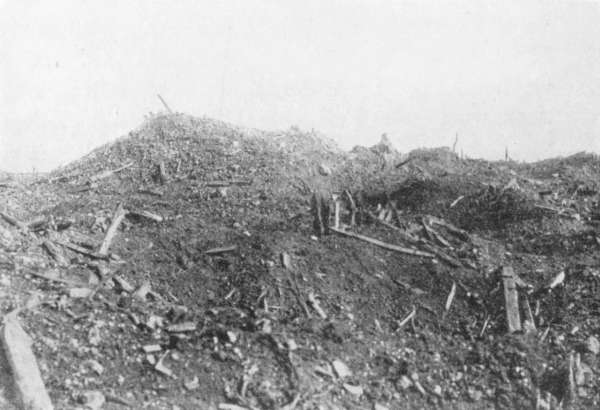
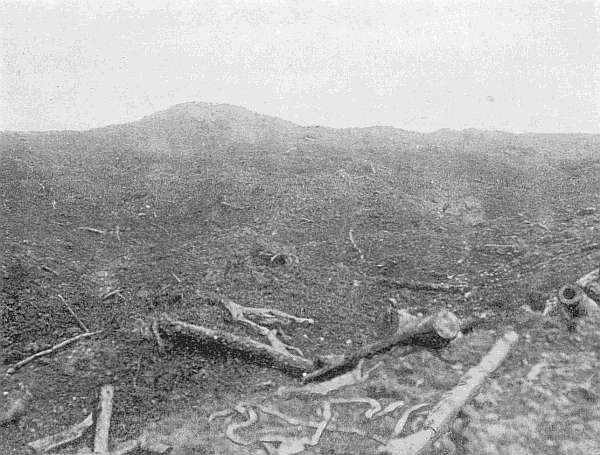
the dust-heap of craters and ashes, with odd ends of some shattered
timber sticking out of it, which goes by the name of Mouquet Farm. It
was a big, important homestead some months ago. To-day it is the
wreckage of a log roof, waterlogged in a boundless tawny sea of craters.
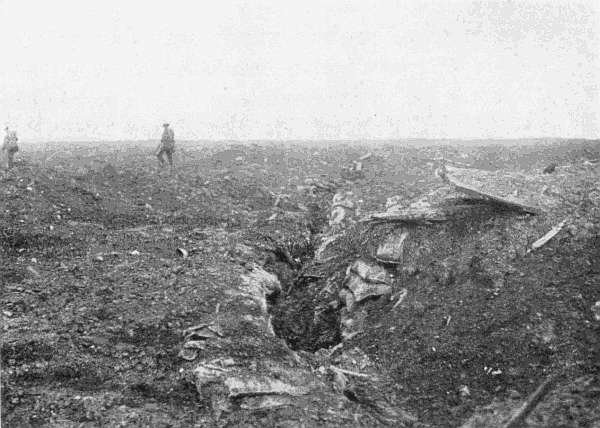
There is no sign of a trench left in it—the entrances of the dug-outs
may be found here and there like rat-holes, about half a dozen of them,
behind dishevelled heaps of rubbish. They open into craters now—no
doubt each opening has been scratched clear of debris a dozen times. You
have to get into some of them by crawling on hands and knees.
The first charge took the Western Australians far beyond the farm. They
reached a position two hundred yards farther and started to dig in
there. Within an hour or two they had a fairly good trench out amongst
the craters well in front of the farm. The farm behind them ought to be
solidly ours with such a line in front of it. A separate body of men,
some of them Tasmanians, came like a whirlwind on their heels into the
farm. The part of the garrison which was lying out in front in a rough
line of shell craters found them on top of the craters before they knew
that there were British troops anywhere about. They were captured and
sent back. The Australians tumbled over the debris into the farm itself.
The fight that raged for two days on this ridge was not one of those in
which the enemy put up his hands as soon as our men came on to him. Far
on the top of the hill to the right, and in the maze of trenches
between, and in the dug-outs of the farm on the left, he was fighting
stiffly over the whole front. In the dim light, as the party which was
to take the farm rushed into it, a machine-gun was barking at them from
somewhere inside that rubbish yard itself. They could hear the bark
obviously very close to them, but it was impossible to say where it came
from, whether thirty yards away or fifty. They knew it must be firing
from behind one of the heaps of rubbish where the entrances of the
dug-outs probably were, firing obliquely and to its rear at the men who
rushed past it. They chose the heap which seemed most probable, and
fired six rifle grenades all at once into it. There was a clatter and
dust; the machine-gun went out like a candle. Later they found it lying
smashed at the mouth of a shaft there.
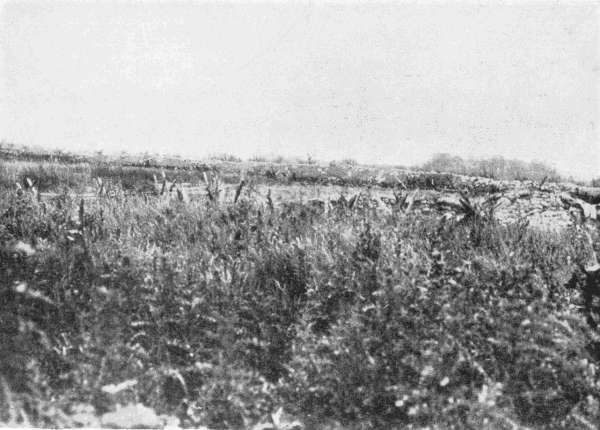
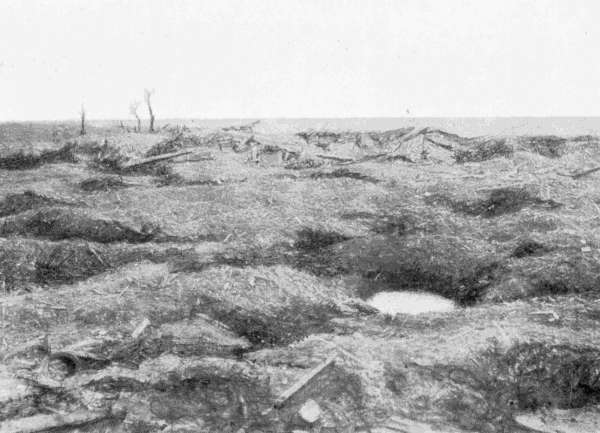 THE TUMBLED HEAP OF BRICKS AND TIMBER WHICH THE WORLD
KNOWS AS MOQUET FARM
THE TUMBLED HEAP OF BRICKS AND TIMBER WHICH THE WORLD
KNOWS AS MOQUET FARM
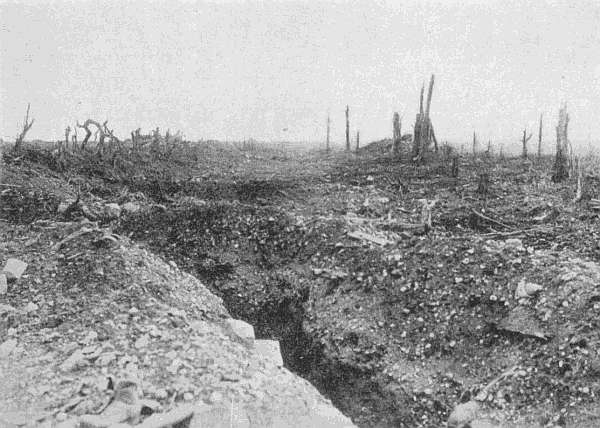
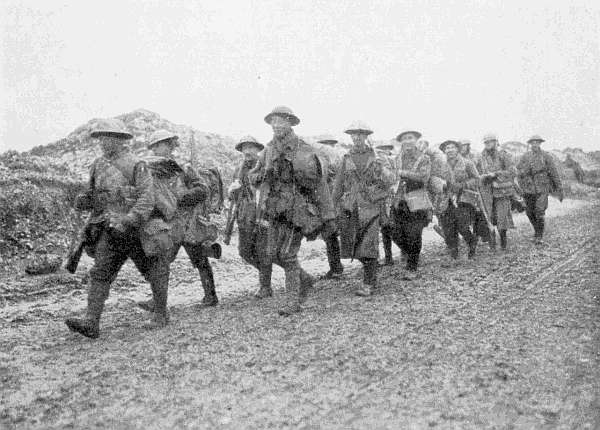 "PAST THE MUD HEAPS SCRAPED BY THE ROAD GANGS" (see p. 192)
The Germans fought them from their rat-holes. When a man peered down the
dark staircase shaft, he sometimes received a shot from below,
sometimes a rifle grenade fired through a hole in a sandbag barricade,
which the Germans had made at the bottom of the stair. Occasionally a
face would be seen peering up from below—for they refused to come
out—and our men would fling down a bomb or fire a couple of shots. But
those on the top of the stair always have the advantage. The Germans
were bombed and shot out of entrance after entrance, and at last came up
through the only exit left to them. Finding Australians swarming through
the place, they surrendered; and the whole garrison of Mouquet Farm was
accounted for. Those who were not lying dead in the craters and
dust-heap were prisoners. Mouquet Farm was ours, and a line of
Australian infantry was entrenching itself far ahead of it.
On the ridge the charge had farther to go. It swarmed over one German
trench and on to a more distant one. The Germans fought it from their
trench. The rush was a long one, and the German had time to find his
feet after the bombardment. But the men he was standing up to were the
offshoot of a famous Queensland regiment; and, though the German
guardsmen showed more fight than any Germans we have met, they had no
match for the fire of these boys. The trench is said to have been
crowded with German dead and wounded. On the left the German tried at
once to bomb his way back into the trench he had lost, and for a time he
made some headway. Part of the line was driven out of the trench into
the craters on our side of it. But before the bombing party had gone
far, the Queenslanders were into the trench again with bomb and bayonet,
and the trenches on the right flank of the attack were solidly ours.
The Queenslanders who reached this trench and took it, found themselves
looking out over a wide expanse of country. Miles in front of them, and
far away to their flank, there stretched a virgin land. They were upon
the crest of the ridge, and the landscape before them was the country
behind the German lines. Except for a gentle rise, somewhat farther
northward behind Thiépval, they had reached about the highest point upon
the northern end of the ridge.
The connecting trenches, between Mouquet Farm and the ridge above and
behind it, were attacked by the Tasmanians. The fire was very heavy, and
for a moment it looked as if this part of the line, and the
Queenslanders immediately next to it, would not be able to get in.
Officer after officer was hit. Leading amongst these was a senior
captain, an officer old for his rank, but one who was known to almost
every man in the force as one of the most striking personalities in
Gallipoli. He had two sons in the Australian force, officers practically
of his own rank. He was one of the first men on to Anzac Beach; and was
the last Australian who left it: Captain Littler.
I had seen him just as he was leaving for the fight, some hours before.
He carried no weapon but a walking-stick. "I have never carried anything
else into action," he said, "and I am not going to begin now." He was
ill with rheumatism and looked it, and the doctor had advised that he
ought not to be with his company. But he came back to them that evening
for the fight; and one could see that it made a world of difference to
them. He was a man whom his own men swore by. Personally, one breathed
more easily knowing that he was with them. It would be his last big
fight, he told me.
Half-way through that charge, in the thick of the whirl of it, he was
seen standing, leaning heavily upon his stick. It was touch and go at
the moment whether the trench was won or lost. "Are you hit, sir?"
asked several around him. Then they noticed a gash in his leg and the
blood running from it—and he seemed to be hit through the chest as
well.
"I will reach that trench if the boys do," he said.
"Have no fear of that, sir," was the answer. A sergeant asked him for
his stick. Then—with the voice of a big man, like his officer, the
sergeant shouted, and waved his stick, and took the men on. In the
half-dark his figure was not unlike that of his commander. They made one
further rush and were in the trench.
They were utterly isolated in the trench when they reached it. A German
machine-gun was cracking away in the same trench to their right, firing
between them and the trench they had come from. There was barbed wire in
front of it. When they tried to force a way with bombs up the trench to
the gun, German bombers in craters behind the trench showered bombs on
to them. Then a sergeant crawled out between the wire and the
machine-gun—crawled on his stomach right up to the gun and shot the
gunner with his revolver. "I've killed three of them," he said, as he
crawled back. Presently a shell fell on him and shattered him. But our
bombers, like the Germans, crept out into craters behind the trench,
and bombed the German bombers out of their shelter. That opened the way
along the trench, and they found the three machine-gunners, shot as the
sergeant had said. The Tasmanians went swiftly along the trench after
that, and presently saw a row of good Australian heads in a sap well in
front of them. There went up a cheer. Other German guardsmen, who had
been lying in craters in front of the trench, and in a scrap of trench
beyond, heard the cheering; seeing that there were Australians on both
sides of them, they stumbled to their feet and threw up their hands.
They were marched off to the rear, and the Tasmanians joined up with the
Queenslanders.
So the centre was joined to the right. On the left it was uncertain
whether it was joined or not. There was a line of trench to be seen on
that side running back towards the German lines. It was merely a more
regular line of mud amongst the irregular mud-heaps of the craters; but
there were the heads of the men looking out from it—so clearly it was a
trench. As the light grew they could make out men leaning on their arms
and elbows, looking over the parapet. Every available glass was turned
on them, but it was too dark still to see if they were Australians. Two
scouts were sent forward, creeping from hole to hole. Both were shot. A
machine-gun was turned at once on to the line of heads. They started
hopping back down their tumbled sap towards the German rear. Clearly
they were Germans. The machine-gun made fast practice as the line of
backs showed behind the parapet.
There were Germans, not Australians, in the trenches on the Tasmanians'
left—in the same trench as they. The flank there was in the air. There
was nothing to do except to barricade the trench and hold the flank as
best they could.
And for the next two days they held it, shelled with every sort of gun
and trench mortar, although fresh companies of the Prussian Guard
Reserve constantly filed in to the gap which existed between this point
and Mouquet Farm. Their old leader, who had promised to reach that
trench with them, was not there. They found him lying dead within a few
yards of it, straight in front of the machine-gun which they had
silenced. So Littler had kept his promise—and lost his life. They had a
young officer and a few sergeants. All through that day their numbers
slowly dwindled. They held the trench all the next night, and in the
grey dawn of the second day a sentry, looking over the trench, saw the
Germans a little way outside of it. As he pointed them out he fell back
shot through the head. They told the Queenslanders, and the
Queenslanders came out instantly and bombed from their side, in rear of
the Germans. The Queensland officer was shot dead, but the Germans were
cleared out or killed.
That afternoon the Germans attacked that open flank with heavy
artillery. For hours shell after shell crashed into the earth around. A
heavy battery found the barricade and put its four big shells
systematically round it. They reduced the garrison as far as possible,
and four or five only were kept by the barricade. They were not all
Australians now.
For the end of the Australian work was coming very near. But that
occasion deserves a letter to itself.
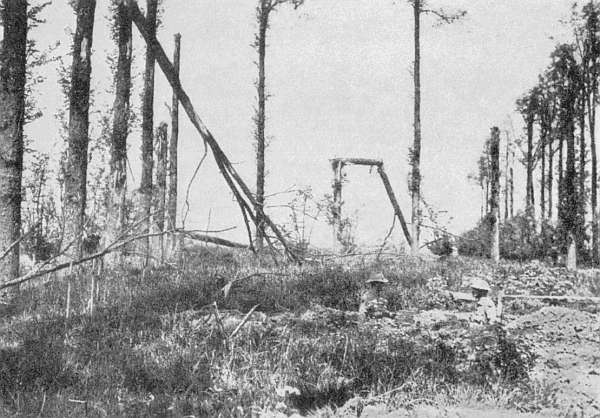
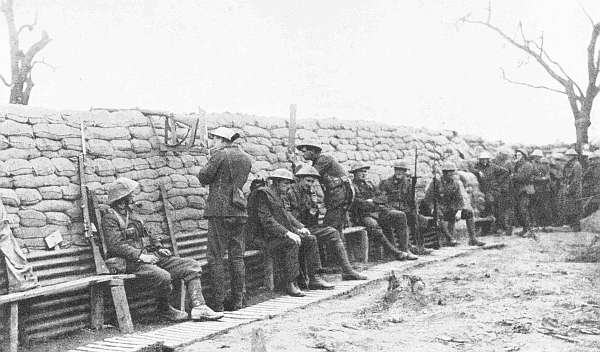
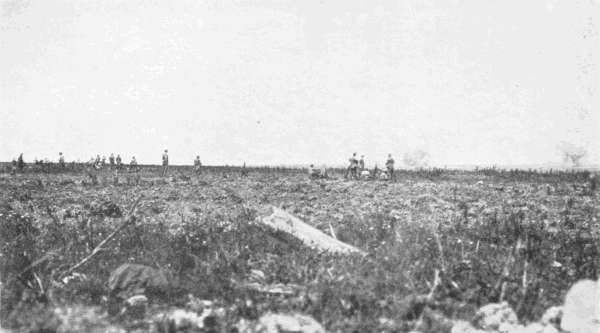 AUSTRALIANS WATCHING THE BOMBARDMENT OF POZIÈRS