To Mrs. Austin.
Grand
Cairo,
Tuesday, November 11, 1862.
Dearest Mutter,
I write to you out of the real Arabian Nights. Well may
the Prophet (whose name be exalted) smile when he looks on
Cairo. It is a golden existence, all sunshine and poetry,
and, I must add, kindness and civility. I came up
last Thursday by railway with the American Consul-General, a
charming person, and had to stay at this horrid Shepheard’s
Hotel. But I do little but sleep here. Hekekian Bey,
a learned old Armenian, takes care of me every day, and the
Amerian Vice-Consul is my sacrifice. I went on Sunday to
his child’s christening, and heard Sakna, the
‘Restorer of Hearts.’ She is wonderfully like
Rachel, and her singing is hinreisend from expression and
passion. Mr. Wilkinson (the Consul) is a Levantine, and his
wife Armenian, so they had a grand fantasia; people feasted all
over the house and in the street. Arab music
schmetterte, women yelled the zaghareet, black
servants served sweetmeats, pipes, and coffee, and behaved as if
they belonged to the company, and I was strongly under the
impression that I was at Nurreddin’s wedding with the
Vizier’s daughter. Yesterday I went to Heliopolis
with Hekekian Bey and his wife, and visited an Armenian country
lady close by.
My servant Omar turns out a jewel. He has
déterré an excellent boat for the Nile
voyage, and I am to be mistress of a captain, a mate, eight men
and a cabin boy for £25 a month. I went to Boulak,
the port of Cairo, and saw various boats, and admired the way in
which the English travellers pay for their insolence and
caprices. Similar boats cost people with dragomans
£50 to £65. But, then, ‘I shall lick the
fellows,’ etc., is what I hear all round. The
dragoman, I conclude, pockets the difference. The owner of
the boat, Sid Achmet el-Berberi, asked £30, whereupon I
touched my breast, mouth and eyes, and stated through Omar that I
was not, like other Ingeleez, made of money, but would give
£20. He then showed another boat at £20, very
much worse, and I departed (with fresh civilities) and looked at
others, and saw two more for £20; but neither was clean,
and neither had a little boat for landing. Meanwhile Sid
Achmet came after me and explained that, if I was not like other
Ingeleez in money, I likewise differed in politeness, and had
refrained from abuse, etc., etc., and I should have the boat for
£25. It was so very excellent in all fittings, and so
much larger, that I thought it would make a great difference in
health, so I said if he would go before the American Vice-Consul
(who is looked on as a sharp hand) and would promise all he said
to me before him, it should be well.
Mr. Thayer, the American Consul-General, gives me letters to
every consular agent depending on him; and two Coptic merchants
whom I met at the fantasia have already begged me to
‘honour their houses.’ I rather think the poor
agents, who are all Armenians and Copts, will think I am the
republic in person. The weather has been all this time like
a splendid English August, and I hope I shall get rid of my cough
in time, but it has been very bad. There is no cold at
night here as at the Cape, but it is nothing like so clear and
bright.
Omar took Sally sightseeing all day while I was away, into
several mosques; in one he begged her to wait a minute while he
said a prayer. They compare notes about their respective
countries and are great friends; but he is put out at my not
having provided her with a husband long ago, as is one’s
duty towards a ‘female servant,’ which almost always
here means a slave.
Of all the falsehoods I have heard about the East, that about
women being old hags at thirty is the biggest. Among the
poor fellah women it may be true enough, but not nearly as much
as in Germany; and I have now seen a considerable number of
Levantine ladies looking very handsome, or at least comely, till
fifty. Sakna, the Arab Grisi, is fifty-five—an ugly
face, I am told (she was veiled and one only saw the eyes and
glimpses of her mouth when she drank water), but the figure of a
leopard, all grace and beauty, and a splendid voice of its kind,
harsh but thrilling like Malibran’s. I guessed her
about thirty, or perhaps thirty-five. When she improvised,
the finesse and grace of her whole Wesen were
ravishing. I was on the point of shouting out
‘Wallah!’ as heartily as the natives. The eight
younger Halmeh (i.e., learned women, which the English
call Almeh and think is an improper word) were ugly and
screeched. Sakna was treated with great consideration and
quite as a friend by the Armenian ladies with whom she talked
between her songs. She is a Muslimeh and very rich and
charitable; she gets £50 for a night’s singing at
least.
It would be very easy to learn colloquial Arabic, as they all
speak with such perfect distinctness that one can follow the
sentences and catch the words one knows as they are
repeated. I think I know forty or fifty words already,
besides my ‘salaam aleikum’ and
‘backsheesh.’
The reverse of the brilliant side of the medal is sad enough:
deserted palaces, and crowded hovels scarce good enough for
pigstyes. ‘One day man see his dinner, and one other
day none at all,’ as Omar observes; and the children are
shocking from bad food, dirt and overwork, but the little
pot-bellied, blear-eyed wretches grow up into noble young men and
women under all their difficulties. The faces are all sad
and rather what the Scotch call ‘dour,’ not
méchant at all, but harsh, like their voices.
All the melody is in walk and gesture; they are as graceful as
cats, and the women have exactly the ‘breasts like
pomegranates’ of their poetry. A tall Bedaween woman
came up to us in the field yesterday to shake hands and look at
us. She wore a white sackcloth shift and veil, und
weiter nichts, and asked Mrs. Hekekian a good many questions
about me, looked at my face and hands, but took no notice of my
rather smart gown which the village women admired so much, shook
hands again with the air of a princess, wished me health and
happiness, and strode off across the graveyard like a stately
ghost. She was on a journey all alone, and somehow it
looked very solemn and affecting to see her walking away towards
the desert in the setting sun like Hagar. All is so
Scriptural in the country here. Sally called out in the
railroad, ‘There is Boaz, sitting in the cornfield’;
and so it was, and there he has sat for how many thousand
years,—and Sakna sang just like Miriam in one war-song.
Wednesday.—My contract was drawn up and signed by
the American Vice-Consul to-day, and my Reis kissed my hand in
due form, after which I went to the bazaar to buy the needful
pots and pans. The transaction lasted an hour. The
copper is so much per oka, the workmanship so much; every article
is weighed by a sworn weigher and a ticket sent with it.
More Arabian Nights. The shopkeeper compares notes with me
about numerals, and is as much amused as I. He treats me to
coffee and a pipe from a neighbouring shop while Omar eloquently
depreciates the goods and offers half the value. A
water-seller offers a brass cup of water; I drink, and give the
huge sum of twopence, and he distributes the contents of his skin
to the crowd (there always is a crowd) in my honour. It
seems I have done a pious action. Finally a boy is called
to carry the batterie de cuisine, while Omar brandishes a
gigantic kettle which he has picked up a little bruised for four
shillings. The boy has a donkey which I mount astride
à l’Arabe, while the boy carries all the
copper things on his head. We are rather a grand
procession, and quite enjoy the fury of the dragomans and other
leeches who hang on the English at such independent proceedings,
and Omar gets reviled for spoiling the trade by being cook,
dragoman, and all in one.
I went this morning with Hekekian Bey to the two earliest
mosques. The Touloun is exquisite—noble, simple, and
what ornament there is is the most delicate lacework and
embossing in stone and wood. This Arab architecture is even
more lovely than our Gothic. The Touloun is now a vast
poorhouse, a nest of paupers. I went into three of their
lodgings. Several Turkish families were in a large square
room neatly divided into little partitions with old mats hung on
ropes. In each were as many bits of carpet, mat and
patchwork as the poor owner could collect, and a small chest and
a little brick cooking-place in one corner of the room with three
earthern pipkins for I don’t know how many
people;—that was all—they possess no sort of
furniture, but all was scrupulously clean and no bad smell
whatever. A little boy seized my hand and showed where he
slept, ate and cooked with the most expressive pantomime.
As there were women, Hekekian could not come in, but when I came
out an old man told us they received three loaves (cakes as big
as a sailor’s biscuit), four piastres a
month—i.e., eightpence per adult—a suit of
clothes a year, and on festive occasions lentil soup. Such
is the almshouse here. A little crowd belonging to the
house had collected, and I gave sixpence to an old man, who
transferred it to the first old man to be divided among
them all, ten or twelve people at least, mostly blind or
lame. The poverty wrings my heart. We took leave with
salaams and politeness like the best society, and then turned
into an Arab hut stuck against the lovely arches. I stooped
low under the door, and several women crowded in. This was
still poorer, for there were no mats or rags of carpet, a still
worse cooking-place, a sort of dog-kennel piled up of loose
stones to sleep in, which contained a small chest and the print
of human forms on the stone floor. It was, however, quite
free from dust, and perfectly sweet. I gave the young woman
who had led me in sixpence, and here the difference between Turk
and Arab appeared. The division of this created a perfect
storm of noise, and we left the five or six Arab women
out-shrieking a whole rookery. I ought to say that no one
begged at all.
Friday.—I went to-day on a donkey to a mosque in
the bazaar, of what we call Arabesque style, like the Alhambra,
very handsome. The Kibleh was very beautiful, and as I was
admiring it Omar pulled a lemon out of his breast and smeared it
on the porphyry pillar on one side of the arch, and then
entreated me to lick it. It cures all diseases. The
old man who showed the mosque pulled eagerly at my arm to make me
perform this absurd ceremony, and I thought I should have been
forced to do it. The base of the pillar was clogged with
lemon-juice. I then went to the tombs of the
Khalìfah; one of the great ones had such arches and such
wondrous cupolas but all in ruins. There are scores of
these noble buildings, any one of which is a treasure, falling to
decay. The next, strange to say, was in perfect
repair. I got off the donkey, and Omar fidgeted and
hesitated a little and consulted with a woman who had the
key. As there were no overshoes I pulled my boots off, and
was rewarded by seeing the footprints of Mohammed on two black
stones, and a lovely little mosque, a sort of Sainte
Chapelle. Omar prayed with ardent fervour and went out
backwards, saluting the Prophet aloud. To my surprise the
woman was highly pleased with sixpence, and did not ask for
more. When I remarked this, Omar said that no Frank had
ever been inside to his knowledge. A mosque-keeper of the
sterner sex would not have let me in. I returned home
through endless streets and squares of Moslem tombs, those of the
Memlooks among them. It was very striking; and it was
getting so dark that I thought of Nurreddin Bey, and wondered if
a Jinn would take me anywhere if I took up my night’s
lodging in one of the comfortable little cupola-covered
buildings.
My Coptic friend has just called in to say that his brother
expects me at Kenneh. I find nothing but civility and a
desire to please. My boat is the Zint el Bachreyn,
and I carry the English flag and a small American distinguishing
pennant as a signal to my consular agents. We sail next
Wednesday. Good-bye for the present, dearest Mutter.
To Sir Alexander Duff
Gordon.
Boat off
Embabeh,
November 21, 1862.
Dearest Alick,
We embarked yesterday, and after the fashion of Eastern
caravans are abiding to-day at a village opposite Cairo; it is
Friday, and therefore would be improper and unlucky to set out on
our journey. The scenes on the river are wonderfully
diverting and curious, so much life and movement. But the
boatmen are sophisticated; my crew have all sported new white
drawers in honour of the Sitti Ingleezee’s supposed
modesty—of course compensation will be expected. Poor
fellows! they are very well mannered and quiet in their rags and
misery, and their queer little humming song is rather pretty,
‘Eyah Mohammad, eyah Mohammad,’ ad infinitum,
except when an energetic man cries
‘Yallah!’—i.e., ‘O
God!’—which means ‘go it’ in everyday
life. Omar is gone to fetch one or two more
‘unconsidered trifles,’ and I have been explaining
the defects to be remedied in the cabin door, broken window,
etc., to my Reis with the help of six words of Arabic and dumb
show, which they understand and answer with wonderful
quickness.
The air on the river is certainly quite
celestial—totally unlike the damp, chilly feeling of the
hotel and Frank quarter of Cairo. The Isbekeeyeh, or public
garden, where all the Franks live, was a lake, I believe, and is
still very damp.
I shall go up to the second Cataract as fast as possible, and
return back at leisure. Hekekian Bey came to take leave
yesterday, and lent me several books; pray tell Senior what a
kindness his introduction was. It would have been rather
dismal in Cairo—if one could be dismal there—without
a soul to speak to. I was sorry to know no Turks or Arabs,
and have no opportunity of seeing any but the tradesman of whom I
bought my stores but that was very amusing. The young man
of whom I bought my finjaans was so handsome, elegant and
melancholy that I know he was the lover of the Sultan’s
favourite slave. How I wish you were here to enjoy all
this, so new, so beautiful, and yet so familiar, life—and
you would like the people, poor things! they are complete
children, but amiable children.
I went into the village here, where I was a curiosity, and
some women took me into their houses and showed me their
sleeping-place, cookery, poultry, etc.; and a man followed me to
keep off the children, but no backsheesh was asked for, which
showed that Europeans were rare there. The utter
destitution is terrible to see, though in this climate of course
it matters less, but the much-talked-of dirt is simply utter
poverty. The poor souls are as clean as Nile mud and water
will make their bodies, and they have not a second shirt, or any
bed but dried mud.
Give my love to my darlings, and don’t be uneasy if you
don’t get letters. My cough has been better now for
five days without a bad return of it, so I hope it is really
better; it is the first reprieve for so long. The sun is so
hot, a regular broil, November 21, and all doors and windows open
in the cabin—a delicious breeze.
To Mrs. Austin.
Feshn,
Monday, November 30, 1862.
Dearest Mutter,
I have now been enjoying this most delightful way of life for
ten days, and am certainly much better. I begin to eat and
sleep again, and cough less. My crew are a great amusement
to me. They are mostly men from near the first Cataract
above Assouan, sleek-skinned, gentle, patient, merry black
fellows. The little black Reis is the very picture of
good-nature and full of fun, ‘chaffing’ the girls as
we pass the villages, and always smiling. The steersman is
of lighter complexion, also very cheery, but decidedly
pious. He prays five times a day and utters ejaculations to
the apostle Rusool continually. He hurt his ankle on one
leg and his instep on the other with a rusty nail, and they
festered. I dressed them with poultices, and then with lint
and strapping, with perfect success, to the great admiration of
all hands, and he announced how much better he felt,
‘Alhamdulillah, kieth-el-hairack khateer ya Sitti’
(Praise be to God and thanks without end O Lady), and everyone
echoed, ‘kieth-el-hairack khateer.’ The most
important person is the
‘weled’—boy—Achmet. The most merry,
clever, omnipresent little rascal, with an ugly little pug face,
a shape like an antique Cupid, liberally displayed, and a skin of
dark brown velvet. His voice, shrill and clear, is always
heard foremost; he cooks for the crew, he jumps overboard with
the rope and gives advice on all occasions, grinds the coffee
with the end of a stick in a mortar, which he holds between his
feet, and uses the same large stick to walk proudly before me,
brandishing it if I go ashore for a minute, and ordering
everybody out of the way. ‘Ya Achmet!’ resounds
all day whenever anybody wants anything, and the
‘weled’ is always ready and able. My favourite
is Osman, a tall, long-limbed black who seems to have stepped out
of a hieroglyphical drawing, shirt, skull-cap and all. He
has only those two garments, and how anyone contrives to look so
inconceivably ‘neat and respectable’ (as Sally truly
remarked) in that costume is a mystery. He is always at
work, always cheerful, but rather silent—in short, the able
seaman and steady, respectable ‘hand’ par
excellence. Then we have El Zankalonee from near Cairo,
an old fellow of white complexion and a valuable person, an
inexhaustible teller of stories at night and always en
train, full of jokes and remarkable for a dry humour much
relished by the crew. I wish I understood the stories,
which sound delightful, all about Sultans and Efreets, with
effective ‘points,’ at which all hands exclaim
‘Mashallah!’ or ‘Ah!’ (as long as you can
drawl it). The jokes, perhaps, I may as well be ignorant
of. There is a certain Shereef who does nothing but laugh
and work and be obliging; helps Omar with one hand and Sally with
the other, and looks like a great innocent black child. The
rest of the dozen are of various colours, sizes and ages, some
quite old, but all very quiet and well-behaved.
We have had either dead calm or contrary wind all the time and
the men have worked very hard at the tow-rope. On Friday I
proclaimed a halt in the afternoon at a village at prayer-time
for the pious Muslims to go to the mosque; this gave great
satisfaction, though only five went, Reis, steersman, Zankalonee
and two old men. The up-river men never pray at all, and
Osman occupied himself by buying salt out of another boat and
stowing it away to take up to his family, as it is terribly dear
high up the river. At Benisouef we halted to buy meat and
bread, it is comme qui dirait an assize town, there is one
butcher who kills one sheep a day. I walked about the
streets escorted by Omar in front and two sailors with huge
staves behind, and created a sensation accordingly. It is a
dull little country town with a wretched palace of Said
Pasha. On Sunday we halted at Bibbeh, where I caught sight
of a large Coptic church and sallied forth to see whether they
would let me in. The road lay past the house of the headman
of the village, and there ‘in the gate’ sat a
patriarch, surrounded by his servants and his cattle. Over
the gateway were crosses and queer constellations of dots, more
like Mithraic symbols than anything Christian, but Girgis was a
Copt, though the chosen head of the Muslim village. He rose
as I came up, stepped out and salaamed, then took my hand and
said I must go into his house before I saw the church and enter
the hareem. His old mother, who looked a hundred, and his
pretty wife, were very friendly; but, as I had to leave Omar at
the door, our talk soon came to an end, and Girgis took me out
into the divan, without the sacred precincts of the hareem.
Of course we had pipes and coffee, and he pressed me to stay some
days, to eat with him every day and to accept all his house
contained. I took the milk he offered, and asked him to
visit me in the boat, saying I must return before sunset when it
gets cold, as I was ill. The house was a curious specimen
of a wealthy man’s house—I could not describe it if I
tried, but I felt I was acting a passage of the Old
Testament. We went to the church, which outside looked like
nine beehives in a box. Inside, the nine domes resting on
square pillars were very handsome. Girgis was putting it
into thorough repair at his own expense, and it will cost a good
deal, I think, to repair and renew the fine old wood panelling of
such minute and intricate workmanship. The church is
divided by three screens; one in front of the eastern three domes
is impervious and conceals the holy of holies. He opened
the horseshoe door for me to look in, but explained that no
Hareem might cross the threshold. All was in confusion
owing to the repairs which were actively going on without the
slightest regard to Sunday; but he took up a large bundle, kissed
it, and showed it me. What it contained I cannot guess, and
I scrupled to inquire through a Muslim interpreter. To the
right of this sanctum is the tomb of a Muslim saint! enclosed
under the adjoining dome. Here we went in and Girgis kissed
the tomb on one side while Omar salaamed it on the other—a
pleasant sight. They were much more particular about our
shoes than in the mosques. Omar wanted to tie handkerchiefs
over my boots like at Cairo, but the priest objected and made me
take them off and march about in the brick and mortar rubbish in
my stockings. I wished to hear the service, but it was not
till sunset, and, as far as I could make out, not different on
Sunday to other days. The Hareems are behind the screen
furthest removed from the holy screen, behind a third screen
where also was the font, locked up and shaped like a Muslim tomb
in little. (Hareem is used here just like the German
Frauenzimmer, to mean a respectable woman. Girgis
spoke of me to Omar as ‘Hareem.’) The Copts
have but one wife, but they shut her up much closer than the
Arabs. The children were sweetly pretty, so unlike the Arab
brats, and the men very good-looking. They did not seem to
acknowledge me at all as a co-religionnaire, and asked
whether we of the English religion did not marry our brothers and
sisters.
The priest then asked me to drink coffee at his house close
by, and there I ‘sat in the gate’—i.e.,
in a large sort of den raised 2 feet from the ground and matted,
to the left of the gate. A crowd of Copts collected and
squatted about, and we were joined by the mason who was repairing
the church, a fine, burly, rough-bearded old Mussulman, who told
how the Sheykh buried in the church of Bibbeh had appeared to him
three nights running at Cairo and ordered him to leave his work
and go to Bibbeh and mend his church, and how he came and offered
to do so without pay if the Copts would find the materials.
He spoke with evident pride, as one who had received a Divine
command, and the Copts all confirmed the story and everyone was
highly gratified by the miracle. I asked Omar if he thought
it was all true, and he had no doubt of it. The mason he
knew to be a respectable man in full work, and Girgis added that
he had tried to get a man to come for years for the purpose
without success. It is not often that a dead saint
contrives to be equally agreeable to Christians and Mussulmans,
and here was the staunch old ‘true believer’ working
away in the sanctuary which they would not allow an English
fellow-Christian to enter.
Whilst we sat hearing all these wonders, the sheep and cattle
pushed in between us, coming home at eve. The venerable old
priest looked so like Father Abraham, and the whole scene was
so pastoral and Biblical that I felt quite as if my wish
was fulfilled to live a little a few thousands of years
ago. They wanted me to stay many days, and then Girgis said
I must stop at Feshn where he had a fine house and garden, and he
would go on horseback and meet me there, and would give me a
whole troop of Fellaheen to pull the boat up quick.
Omar’s eyes twinkled with fun as he translated this, and
said he knew the Sitt would cry out, as she always did about the
Fellaheen, as if she were hurt herself. He told Girgis that
the English customs did not allow people to work without pay,
which evidently seemed very absurd to the whole party.
Gebel Sheyk
Embarak,
Thursday.
I stopped last night at Feshn, but finding this morning that
my Coptic friends were not expected till the afternoon, I would
not spend the whole day, and came on still against wind and
stream. If I could speak Arabic I should have enjoyed a few
days with Girgis and his family immensely, to learn their
Ansichten a little; but Omar’s English is too
imperfect to get beyond elementary subjects. The thing that
strikes me most is the tolerant spirit that I see
everywhere. They say ‘Ah! it is your custom,’
and express no sort of condemnation, and Muslims and Christians
appear perfectly good friends, as my story of Bibbeh goes to
prove. I have yet to see the much-talked-of fanaticism, at
present I have not met with a symptom of it. There were
thirteen Copt families at Bibbeh and a considerable Muslim
population, who had elected Girgis their headman and kissed his
hand very heartily as our procession moved through the
streets. Omar said he was a very good man and much
liked.
The villages look like slight elevations in the mud banks cut
into square shapes. The best houses have neither paint,
whitewash, plaster, bricks nor windows, nor any visible
roofs. They don’t give one the notion of human
dwellings at all at first, but soon the eye gets used to the
absence of all that constitutes a house in Europe, the impression
of wretchedness wears off, and one sees how picturesque they are,
with palm-trees and tall pigeon-houses, and here and there the
dome over a saint’s tomb. The men at work on the
river-banks are exactly the same colour as the Nile mud, with
just the warmer hue of the blood circulating beneath the
skin. Prometheus has just formed them out of the universal
material at hand, and the sun breathed life into them. Poor
fellows—even the boatmen, ragged crew as they are—say
‘Ah, Fellaheen!’ with a contemptuous pity when they
see me watch the villagers at work.
The other day four huge barges passed us towed by a steamer
and crammed with hundreds of the poor souls torn from their homes
to work at the Isthmus of Suez, or some palace of the
Pasha’s, for a nominal piastre a day, and find their own
bread and water and cloak. One of my crew, Andrasool, a
black savage whose function is always to jump overboard whenever
the rope gets entangled or anything is wanted, recognised some
relations of his from a village close to Assouan. There was
much shouting and poor Andrasool looked very mournful all
day. It may be his turn next. Some of the crew
disloyally remarked that they were sure the men there wished they
were working for a Sitti Ingleez, as Andrasool told them he
was. Think too what splendid pay it must be that the
boat-owner can give out of £25 a month to twelve men, after
taking his own profits, the interest of money being enormous.
When I call my crew black, don’t think of negroes.
They are elegantly-shaped Arabs and all gentlemen in manners, and
the black is transparent, with amber reflets under it in
the sunshine; a negro looks blue beside them. I have
learned a great deal that is curious from Omar’s
confidences, who tells me his family affairs and talks about the
women of his family, which he would not to a man. He
refused to speak to his brother, a very grand dragoman, who was
with the Prince of Wales, and who came up to us in the hotel at
Cairo and addressed Omar, who turned his back on him. I
asked the reason, and Omar told me how his brother had a wife,
‘An old wife, been with him long time, very good
wife.’ She had had three children—all
dead. All at once the dragoman, who is much older than
Omar, declared he would divorce her and marry a young
woman. Omar said, ‘No, don’t do that; keep her
in your house as head of your home, and take one of your two
black slave girls as your Hareem.’ But the other
insisted, and married a young Turkish wife; whereupon Omar took
his poor old sister-in-law to live with him and his own young
wife, and cut his grand brother dead. See how
characteristic!—the urging his brother to take the young
slave girl ‘as his Hareem,’ like a respectable
man—that would have been all right; but what he did was
‘not good.’ I’ll trouble you (as Mrs.
Grote used to say) to settle these questions to everyone’s
satisfaction. I own Omar seemed to me to take a view
against which I had nothing to say. His account of his
other brother, a confectioner’s household with two wives,
was very curious. He and they, with his wife and
sister-in-law, all live together, and one of the brother’s
wives has six children—three sleep with their own mother
and three with their other mother—and all is quite
harmonious.
Siout,
December 10.
I could not send a letter from Minieh, where we stopped, and I
visited a sugar manufactory and a gentlemanly Turk, who
superintended the district, the Moudir. I heard a boy
singing a Zikr (the ninety-nine attributes of God) to a
set of dervishes in a mosque, and I think I never heard anything
more beautiful and affecting. Ordinary Arab singing is
harsh and nasal, but it can be wonderfully moving. Since we
left Minieh we have suffered dreadfully from the cold; the
chickens died of it, and the Arabs look blue and pinched.
Of course it is my weather and there never was such cold
and such incessant contrary winds known. To-day was better,
and Wassef, a Copt here, lent me his superb donkey to go up to
the tomb in the mountain. The tomb is a mere cavern, so
defaced, but the view of beautiful Siout standing in the midst of
a loop of the Nile was ravishing. A green deeper and
brighter than England, graceful minarets in crowds, a picturesque
bridge, gardens, palm-trees, then the river beyond it, the barren
yellow cliffs as a frame all around that. At our feet a
woman was being carried to the grave, and the boys’ voices
rang out the Koran full and clear as the long
procession—first white turbans and then black veils and
robes—wound along. It is all a dream to me. You
can’t think what an odd effect it is to take up an English
book and read it and then look up and hear the men cry,
‘Yah Mohammad.’ ‘Bless thee, Bottom, how
art thou translated;’ it is the reverse of all one’s
former life when one sat in England and read of the East.
‘Und nun sitz ich mitten drein’ in the real,
true Arabian Nights, and don’t know whether ‘I be I
as I suppose I be’ or not.
Tell Alick the news, for I have not written to any but
you. I do so long for my Rainie. The little Copt
girls are like her, only pale; but they don’t let you
admire them for fear of the evil-eye.
To Sir Alexander Duff
Gordon.
Thebes,
December 20, 1862.
Dear Alick,
I have had a long, dawdling voyage up here, but enjoyed it
much, and have seen and heard many curious things. I only
stop here for letters and shall go on at once to Wady Halfeh, as
the weather is very cold still, and I shall be better able to
enjoy the ruins when I return about a month hence, and shall
certainly prefer the tropics now. I can’t describe
the kindness of the Copts. The men I met at a party in
Cairo wrote to all their friends and relations to be civil to
me. Wassef’s attentions consisted first in lending me
his superb donkey and accompanying me about all day. Next
morning arrived a procession headed by his clerk, a gentlemanly
young Copt, and consisting of five black memlooks carrying a live
sheep, a huge basket of the most delicious bread, a pile of
cricket-balls of creamy butter, a large copper caldron of milk
and a cage of poultry. I was confounded, and tried to give
a good baksheesh to the clerk, but he utterly declined. At
Girgeh one Mishrehgi was waiting for me, and was in despair
because he had only time to get a few hundred eggs, two turkeys,
a heap of butter and a can of milk. At Keneh one Issa
(Jesus) also lent a donkey, and sent me three boxes of delicious
Mecca dates, which Omar thought stingy. Such attentions are
agreeable here where good food is not to be had except as a
gift. They all made me promise to see them again on my
return and dine at their houses, and Wassef wanted to make a
fantasia and have dancing girls. How you would love the
Arab women in the country villages. I wandered off the
other day alone, while the men were mending the rudder, and fell
in with a troop of them carrying water-jars—such sweet,
graceful beings, all smiles and grace. One beautiful woman
pointed to the village and made signs of eating and took my hand
to lead me. I went with her, admiring them as they
walked. Omar came running after and wondered I was not
afraid. I laughed, and said they were much too pretty and
kindly-looking to frighten anyone, which amused them immensely
when he told them so. They all wanted me to go and eat in
their houses, and I had a great mind to it, but the wind was fair
and the boat waiting, so I bid my beautiful friends
farewell. They asked if we wanted anything—milk or
eggs—for they would give it with pleasure, it was not their
custom to sell things, they said, I offered a bit of money to a
little naked child, but his mother would not let him take
it. I shall never forget the sweet, engaging creatures at
that little village, or the dignified politeness of an old weaver
whose loom I walked in to look at, and who also wished to
‘set a piece of bread before me.’ It is the
true poetical pastoral life of the Bible in the villages where
the English have not been, and happily they don’t land at
the little places. Thebes has become an English
watering-place. There are now nine boats lying here, and
the great object is to do the Nile as fast as
possible. It is a race up to Wady Halfeh or Assouan.
I have gained so much during this month that I hope the remaining
three will do real good, as the weather will improve with the new
year they tell me. All the English stay here and
‘make Christmas,’ as Omar calls it, but I shall go on
and do my devotions with the Copts at Esneh or Edfou. I
found that their seeming disinclination to let one attend their
service arose from an idea that we English would not recognise
them as Christians. I wrote a curious story of a miracle to
my mother, I find that I was wrong about the saint being a
Mussulman (and so is Murray); he is no less than Mar Girghis, our
own St. George himself. Why he selected a Mussulman mason I
suppose he best knows.
In a week I shall be in Nubia. Some year we must all
make this voyage; you would revel in it. Kiss my darlings
for me.
To Sir Alexander Duff
Gordon.
Thebes,
February 11, 1863.
Dearest Alick,
On arriving here last night I found one letter from you, dated
December 10, and have received nothing else. Pray write
again forthwith to Cairo where I hope to stay some weeks. A
clever old dragoman I met at Philæ offers to lend me
furniture for a lodging or a tent for the desert, and when I
hesitated he said he was very well off and it was not his
business to sell things, but only to be paid for his services by
rich people, and that if I did not accept it as he meant it he
should be quite hurt. This is what I have met with from
everything Arab—nothing but kindness and politeness.
I shall say farewell to Egypt with real feeling; among other
things, it will be quite a pang to part with Omar who has been my
shadow all this time and for whom I have quite an affection, he
is so thoroughly good and amiable.
I am really much better I hope and believe, though only within
the last week or two. We have had the coldest winter ever
known in Nubia, such bitter north-east winds, but when the wind
by great favour did not blow, the weather was heavenly. If
the millennium really does come I shall take a good bit of mine
on the Nile. At Assouan I had been strolling about in that
most poetically melancholy spot, the granite quarry of old Egypt
and burial-place of Muslim martyrs, and as I came homewards along
the bank a party of slave merchants, who had just loaded their
goods for Senaar from the boat on the camels, asked me to dinner,
and, oh! how delicious it felt to sit on a mat among the camels
and strange bales of goods and eat the hot tough bread, sour milk
and dates, offered with such stately courtesy. We got quite
intimate over our leather cup of sherbet (brown sugar and water),
and the handsome jet-black men, with features as beautiful as
those of the young Bacchus, described the distant lands in a way
which would have charmed Herodotus. They proposed to me to
join them, ‘they had food enough,’ and Omar and I
were equally inclined to go. It is of no use to talk of the
ruins; everybody has said, I suppose, all that can be said, but
Philæ surpassed my expectations. No wonder the Arab
legends of Ans el Wogood are so romantic, and Abou Simbel and
many more. The scribbling of names is quite infamous,
beautiful paintings are defaced by Tomkins and Hobson, but worst
of all Prince Pückler Muskau has engraved his and his
Ordenskreuz in huge letters on the naked breast of that
august and pathetic giant who sits at Abou Simbel. I wish
someone would kick him for his profanity.
I have eaten many odd things with odd people in queer places,
dined in a respectable Nubian family (the castor-oil was trying),
been to a Nubian wedding—such a dance I saw. Made
friends with a man much looked up to in his place
(Kalabshee—notorious for cutting throats), inasmuch as he
had killed several intrusive tax-gatherers and recruiting
officers. He was very gentlemanly and kind and carried me
up a place so steep I could not have reached it. Just below
the cataract—by-the-by going up is nothing but noise and
shouting, but coming down is fine fun—Fantasia
khateer as my excellent little Nubian pilot said. My
sailors all prayed away manfully and were horribly
frightened. I confess my pulse quickened, but I don’t
think it was fear. Well, below the cataract I stopped for a
religious fête, and went to a holy tomb with the darweesh,
so extraordinarily handsome and graceful—the true
feingemacht noble Bedaween type. He took care of me
through the crowd, who never had seen a Frank woman before and
crowded fearfully, and pushed the true believers unmercifully to
make way for me. He was particularly pleased at my not
being afraid of Arabs; I laughed, and asked if he was afraid of
us. ‘Oh no! he would like to come to England; when
there he would work to eat and drink, and then sit and sleep in
the church.’ I was positively ashamed to tell my
religious friend that with us the ‘house of God’ is
not the house of the poor stranger. I asked him to eat with
me but he was holding a preliminary Ramadan (it begins next
week), and could not; but he brought his handsome sister, who was
richly dressed, and begged me to visit him and eat of his bread,
cheese and milk. Such is the treatment one finds if one
leaves the highroad and the backsheesh-hunting parasites.
There are plenty of ‘gentlemen’ barefooted and clad
in a shirt and cloak ready to pay attentions which you may return
with a civil look and greeting, and if you offer a cup of coffee
and a seat on the floor you give great pleasure, still more if
you eat the dourah and dates, or bread and sour milk with an
appetite.
At Koom Ombo we met a Rifaee darweesh with his basket of tame
snakes. After a little talk he proposed to initiate me, and
so we sat down and held hands like people marrying. Omar
sat behind me and repeated the words as my ‘Wakeel,’
then the Rifaee twisted a cobra round our joined hands and
requested me to spit on it, he did the same and I was pronounced
safe and enveloped in snakes. My sailors groaned and Omar
shuddered as the snakes put out their tongues—the darweesh
and I smiled at each other like Roman augurs. I need not
say the creatures were toothless.
It is worth going to Nubia to see the girls. Up to
twelve or thirteen they are neatly dressed in a bead necklace and
a leather fringe 4 inches wide round the loins, and anything so
absolutely perfect as their shapes or so sweetly innocent as
their look can’t be conceived. My pilot’s
little girl came in the dress mentioned before carrying a present
of cooked fish on her head and some fresh eggs; she was four
years old and so klug. I gave her a captain’s
biscuit and some figs, and the little pet sat with her little
legs tucked under her, and ate it so manierlich and was so
long over it, and wrapped up some more white biscuit to take home
in a little rag of a veil so carefully. I longed to steal
her, she was such a darling. Two beautiful young Nubian
women visited me in my boat, with hair in little plaits finished
off with lumps of yellow clay burnished like golden tags, soft,
deep bronze skins, and lips and eyes fit for Isis and
Hathor. Their very dress and ornaments were the same as
those represented in the tombs, and I felt inclined to ask them
how many thousand years old they were. In their house I sat
on an ancient Egyptian couch with the semicircular head-rest, and
drank out of crockery which looked antique, and they brought a
present of dates in a basket such as you may see in the British
Museum. They are dressed in drapery like Greek statues, and
are as perfect, but have hard, bold faces, and, though far
handsomer, lack the charm of the Arab women; and the men, except
at Kalabshee and those from far up the country, are not such
gentlemen as the Arabs.
Everyone is cursing the French here. Forty thousand men
always at work at the Suez Canal at starvation-point, does not
endear them to the Arabs. There is great excitement as to
what the new Pasha will do. If he ceases to give forced
labour, the Canal, I suppose, must be given up. Well, I
must leave off and send my letter to Mustapha Aga to
forward. I shall stay here ten days or so, and then return
slowly to Cairo on March 10, the last day of Ramadan. I
will stay a short time at Cairo, and then take a small boat and
drop down to Alexandria and see Janet. How I did wish for
my darling Rainie to play with Achmet in the boat and see the
pretty Nubian boys and girls. I have seen and heard so
much, that like M. de Conti je voudrais être levé
pour l’aller dire. I long to bore you with
traveller’s tales. Pray write soon.
Omar wanted to hear all that ‘the gentleman’ said
about ‘weled and bint’ (boy and girl), and was quite
delighted to hear of Maurice’s good report at school, he
thinks that the ‘Abou el welàd’ (father of the
children—you, to wit) will send a sheep to the
‘fikee’ who teaches him. I have learned a new
code of propriety altogether—célà a du bon
et du mauvais, like ours. When I said ‘my
husband’ Omar blushed and gently corrected me; when my
donkey fell in the streets he cried with vexation, and on my
mentioning the fall to Hekekian Bey he was quite indignant.
‘Why you say it, ma’am? that shame’—a
faux pas in fact. On the other hand they mention all
that belongs to the production of children with perfect
satisfaction and pleasure. A very pleasing, modest and
handsome Nubian young woman, wishing to give me the best present
she could think of, brought me a mat of her own making, and which
had been her marriage-bed. It was a gift both friendly and
honourable, and I treasure it accordingly. Omar gave me a
description of his own marriage, appealing to my sympathy about
the distress of absence from his wife. I intimated that
English people were not accustomed to some words and might be
shocked, on which he said, ‘Of course I not speak of my
Hareem to English gentleman, but to good Lady can speak
it.’
Good-bye, dear Alick, no, that is improper: I must say
‘O my Lord’ or ‘Abou Maurice.’
To Mrs. Austin.
A few miles
below Girgeh,
March 7, 1863.
Dearest Mutter,
I was so glad to find from your letter (which Janet sent me to
Thebes by a steamer) that mine from Siout had reached you
safely. First and foremost I am wonderfully better.
In Cairo the winter has been terribly cold and damp, as the
Coptic priest told me yesterday at Girgeh. So I don’t
repent the expense of the boat for j’en ai pour mon
argent—I am all the money better and really
think of getting well. Now that I know the ways of this
country a little, which Herodotus truly says is like no other, I
see that I might have gone and lived at Thebes or at Keneh or
Assouan on next to nothing, but then how could I know it?
The English have raised a mirage of false wants and extravagance
which the servants of the country of course, some from interest
and others from mere ignorance, do their best to keep up.
As soon as I had succeeded in really persuading Omar that I was
not as rich as a Pasha and had no wish to be thought so, he
immediately turned over a new leaf as to what must be had and
said ‘Oh, if I could have thought an English lady would
have eaten and lived and done the least like Arab people, I might
have hired a house at Keneh for you, and we might have gone up in
a clean passenger boat, but I thought no English could bear
it.’ At Cairo, where we shall be, Inshallaha, on the
19th, Omar will get a lodging and borrow a few mattresses and a
table and chair and, as he says, ‘keep the money in our
pockets instead of giving it to the hotel.’ I hope
Alick got my letter from Thebes, and that he told you that I had
dined with ‘the blameless Ethiopians.’ I have
seen all the temples in Nubia and down as far as I have come, and
nine of the tombs at Thebes. Some are wonderfully
beautiful—Abou Simbel, Kalabshee, Room Ombo—a little
temple at El Kab, lovely—three tombs at Thebes and most of
all Abydos; Edfou and Dendera are the most perfect, Edfou quite
perfect, but far less beautiful. But the most lovely object
my eyes ever saw is the island of Philæ. It gives one
quite the supernatural feeling of Claude’s best landscapes,
only not the least like them—ganz anders. The
Arabs say that Ans el Wogood, the most beautiful of men, built it
for his most beautiful beloved, and there they lived in perfect
beauty and happiness all alone. If the weather had not been
so cold while I was there I should have lived in the temple, in a
chamber sculptured with the mystery of Osiris’ burial and
resurrection. Omar cleaned it out and meant to move my
things there for a few days, but it was too cold to sleep in a
room without a door. The winds have been extraordinarily
cold this year, and are so still. We have had very little
of the fine warm weather, and really been pinched with cold most
of the time. On the shore away from the river would be much
better for invalids.
Mustapha Aga, the consular agent at Thebes, has offered me a
house of his, up among the tombs in the finest air, if ever I
want it. He was very kind and hospitable indeed to all the
English there. I went into his hareem, and liked his
wife’s manners very much. It was charming to see that
she henpecked her handsome old husband completely. They had
fine children and his boy, about thirteen or so, rode and played
Jereed one day when Abdallah Pasha had ordered the people of the
neighbourhood to do it for General Parker. I never saw so
beautiful a performance. The old General and I were quite
excited, and he tried it to the great amusement of the Sheykh el
Beled. Some young Englishmen were rather grand about it,
but declined mounting the horses and trying a throw. The
Sheykh and young Hassan and then old Mustapha wheeled round and
round like beautiful hawks, and caught the palm-sticks thrown at
them as they dashed round. It was superb, and the horses
were good, though the saddles and bridles were rags and ends of
rope, and the men mere tatterdemalions. A little below
Thebes I stopped, and walked inland to Koos to see a noble old
mosque falling to ruin. No English had ever been there and
we were surrounded by a crowd in the bazaar. Instantly five
or six tall fellows with long sticks improvised themselves our
body-guard and kept the people off, who du reste were
perfectly civil and only curious to see such strange
‘Hareem,’ and after seeing us well out of the town
evaporated as quietly as they came without a word. I gave
about ten-pence to buy oil, as it is Ramadan and the mosque ought
to be lighted, and the old servant of the mosque kindly promised
me full justice at the Day of Judgment, as I was one of those
Nasranee of whom the Lord Mohammed said that they are not proud
and wish well to the Muslimeen. The Pasha had confiscated
all the lands belonging to the mosque, and allowed 300
piastres—not £2 a month—for all expenses; of
course the noble old building with its beautiful carving and
arabesque mouldings must fall down. There was a smaller one
beside it, where he declared that anciently forty girls lived
unmarried and recited the Koran—Muslim nuns, in fact.
I intend to ask the Alim, for whom I have a letter from Mustapha,
about such an anomaly.
Some way above Bellianeh Omar asked eagerly leave to stop the
boat as a great Sheyk had called to us, and we should inevitably
have some disaster if we disobeyed. So we stopped and Omar
said, ‘come and see the Sheyk, ma’am.’ I
walked off and presently found about thirty people, including all
my own men, sitting on the ground round St. Simon
Stylites—without the column. A hideous old man like
Polyphemus, utterly naked, with the skin of a rhinoceros all
cracked with the weather, sat there, and had sat day and night,
summer and winter, motionless for twenty years. He never
prays, he never washes, he does not keep Ramadan, and yet he is a
saint. Of course I expected a good hearty curse from such a
man, but he was delighted with my visit, asked me to sit down,
ordered his servant to bring me sugar-cane, asked my name and
tried to repeat it over and over again, and was quite talkative
and full of jokes and compliments, and took no notice of anyone
else. Omar and my crew smiled and nodded, and all
congratulated me heartily. Such a distinction proves my own
excellence (as the Sheyk knows all people’s thoughts), and
is sure to be followed by good fortune. Finally Omar
proposed to say the Fathah in which all joined except the Sheykh,
who looked rather bored by the interruption, and desired us not
to go so soon, unless I were in a hurry. A party of
Bedaween came up on camels with presents for the holy man, but he
took no notice of them, and went on questioning Omar about me,
and answering my questions. What struck me was the total
absence of any sanctimonious air about the old fellow, he was
quite worldly and jocose; I suppose he knew that his position was
secure, and thought his dirt and nakedness proved his holiness
enough. Omar then recited the Fathah again, and we rose and
gave the servants a few foddahs—the saint takes no notice
of this part of the proceeding—but he asked me to send him
twice my hand full of rice for his dinner, an honour so great
that there was a murmur of congratulation through the whole
assembly. I asked Omar how a man could be a saint who
neglected all the duties of a Muslim, and I found that he fully
believed that Sheykh Seleem could be in two places at once, that
while he sits there on the shore he is also at Mecca, performing
every sacred function and dressed all in green. ‘Many
people have seen him there, ma’am, quite true.’
From Bellianeh we rode on pack-donkeys without bridles to
Abydos, six miles through the most beautiful crops ever
seen. The absence of weeds and blight is wonderful, and the
green of Egypt, where it is green, would make English green look
black. Beautiful cattle, sheep and camels were eating the
delicious clover, while their owners camped there in reed huts
during the time the crops are growing. Such a lovely scene,
all sweetness and plenty. We ate our bread and dates in
Osiris’ temple, and a woman offered us buffalo milk on our
way home, which we drank warm out of the huge earthen pan it had
been milked in. At Girgeh I found my former friend Mishregi
absent, but his servants told some of his friends of my arrival,
and about seven or eight big black turbans soon gathered in the
boat. A darling little Coptic boy came with his father and
wanted a ‘kitaab’ (book) to write in, so I
made one with paper and the cover of my old pocket-book, and gave
him a pencil. I also bethought me of showing him
‘pickys’ in a book, which was so glorious a novelty
that he wanted to go with me to my town, ‘Beled
Ingleez,’ where more such books were to be found.
Siout,
March 9.
I found here letters from Alick, telling me of dear Lord
Lansdowne’s death. Of course I know that his time was
come, but the thought that I shall never see his face again, that
all that kindness and affection is gone out of my life, is a
great blow. No friend could leave such a blank to me as
that old and faithful one, though the death of younger ones might
be more tragic; but so many things seem gone with him into the
grave. Many indeed will mourn that kind, wise, steadfast
man—Antiqua fides. No one nowadays will be so
noble with such unconsciousness and simplicity. I have
bought two Coptic turbans to make a black dress out of. I
thought I should like to wear it for him—here, where
‘compliment’ is out of the question.
I also found a letter from Janet, who has been very ill; the
account was so bad that I have telegraphed to hear how she is,
and shall go at once to Alexandria if she is not better. If
she is I shall hold to my plan and see Beni Hassan and the
Pyramids on my way to Cairo. I found my kind friend the
Copt Wassef kinder than ever. He went off to telegraph to
Alexandria for me, and showed so much feeling and real kindness
that I was quite touched.
I was grieved to hear that you had been ill again, dearest
Mutter. The best is that I feel so much better that I think
I may come home again without fear; I still have an irritable
cough, but it has begun to have lucid intervals, and is far less
frequent. I can walk four or five miles and my appetite is
good. All this in spite of really cold weather in a boat
where nothing shuts within two fingers’ breadths. I
long to be again with my own people.
Please send this to Alick, to whom I will write again from
Cairo.
To Sir Alexander Duff
Gordon.
March 10, 1863.
‘If in the street I led thee, dearest,
Though the veil hid thy face divine,
They who beheld thy graceful motion
Would stagger as though drunk with wine.
Nay, e’en the holy Sheykh, while praying
For guidance in the narrow way,
Must needs leave off, and on the traces
Of thine enchanting footsteps stray.
O ye who go down in the boats to Dumyat,
Cross, I beseech ye, the stream to Budallah;
Seek my beloved, and beg that she will not
Forget me, I pray and implore her by Allah.
‘Fair as two moons is the face of my sweetheart,
And as to her neck and her bosom—Mashallah.
And unless to my love I am soon reunited
Death is my portion—I swear it by Allah.’
Thus sings Ali Asleemee, the most debraillé of
my crew, a hashshásh, [48] but a singer and a
good fellow. The translation is not free, though the
sentiments are. I merely rhymed Omar’s literal
word-for-word interpretation. The songs are all in a
similar strain, except one funny one abusing the ‘Sheykh
el-Beled, may the fleas bite him.’ Horrid
imprecation! as I know to my cost, for after visiting the Coptic
monks at Girgeh I came home to the boat with myriads. Sally
said she felt like Rameses the Great, so tremendous was the
slaughter of the active enemy.
I had written the first page just as I got to Siout and was
stopped by bad news of Janet; but now all is right again, and I
am to meet her in Cairo, and she proposes a jaunt to Suez and to
Damietta. I have got a superb illumination to-night,
improvised by Omar in honour of the Prince of Wales’s
marriage, and consequently am writing with flaring candles, my
lantern being on duty at the masthead, and the men are singing an
epithalamium and beating the tarabookeh as loud as they can.
You will have seen my letter to my mother, and heard how much
better I am for the glorious air of Nubia and the high
up-country. Already we are returning into misty
weather. I dined and spent the day with Wassef and his
Hareem, such an amiable, kindly household. I was charmed
with their manner to each other, to the slaves and family.
The slaves (all Muslims) told Omar what an excellent master they
had. He had meant to make a dance-fantasia, but as I had
not good news it was countermanded. Poor Wassef ate his
boiled beans rather ruefully, while his wife and I had an
excellent dinner, she being excused fasting on account of a
coming baby. The Copt fast is no joke, neither butter,
milk, eggs nor fish being allowed for fifty-five days. They
made Sally dine with us, and Omar was admitted to wait and
interpret. Wassef’s younger brother waited on him as
in the Bible, and his clerk, a nice young fellow, assisted.
Black slaves brought the dishes in, and capital the food
was. There was plenty of joking between the lady and Omar
about Ramadan, which he had broken, and the Nasranee fast, and
also about the number of wives allowed, the young clerk
intimating that he rather liked that point in Islam. I have
promised to spend ten or twelve days at their house if ever I go
up the Nile again. I have also promised to send Wassef all
particulars as to the expense, etc. of educating his boy in
England, and to look after him and have him to our house in the
holidays. I can’t describe how anxiously kind these
people were to me. One gets such a wonderful amount of
sympathy and real hearty kindness here. A curious instance
of the affinity of the British mind for prejudice is the way in
which every Englishman I have seen scorns the Eastern Christians,
and droll enough that sinners like Kinglake and I should be the
only people to feel the tie of the ‘common faith’
(vide ‘Eothen’). A very pious Scotch
gentleman wondered that I could think of entering a Copt’s
house, adding that they were the publicans (tax-gatherers) of
this country, which is partly true. I felt inclined to
mention that better company than he or I had dined with
publicans, and even sinners.
The Copts are evidently the ancient Egyptians. The
slightly aquiline nose and long eye are the very same as the
profiles of the tombs and temples, and also like the very
earliest Byzantine pictures; du reste, the face is
handsome, but generally sallow and rather inclined to puffiness,
and the figure wants the grace of the Arabs. Nor has any
Copt the thoroughbred, distingué look of the
meanest man or woman of good Arab blood. Their feet are the
long-toed, flattish foot of the Egyptian statue, while the Arab
foot is classically perfect and you could put your hand under the
instep. The beauty of the Ababdeh, black, naked, and
shaggy-haired, is quite marvellous. I never saw such
delicate limbs and features, or such eyes and teeth.
Cairo,
March 19.
After leaving Siout I caught cold. The worst of going up
the Nile is that one must come down again and find horrid fogs,
and cold nights with sultry days. So I did not attempt
Sakhara and the Pyramids, but came a day before my appointed time
to Cairo. Up here in the town it is much warmer and dryer,
and my cough is better already. I found all your letters in
many volumes, and was so excited over reading them that I could
not sleep one moment last night, so excuse dulness, but I thought
you’d like to know I was safe in Briggs’ bank, and
expecting Janet and Ross to-night.
To Mrs. Austin.
Cairo,
April 9, 1863.
Dearest Mutter,
I write to you because I know Janet is sure to write to
Alick. I have had a very severe attack of bronchitis.
As I seemed to be getting worse after Janet and Ross left for
Alexandria, Omar very wisely sent for Hekekian Bey, who came at
once bringing De Leo Bey, the surgeon-in-chief of the
Pasha’s troops, and also the doctor to the hareem. He
has been most kind, coming two and three times a day at
first. He won’t take any fee, sous
prétexte that he is officier du Pasha; I must
send him a present from England. As to Hekekian Bey, he is
absolutely the Good Samaritan, and these Orientals do their
kindnesses with such an air of enjoyment to themselves that it
seems quite a favour to let them wait upon one. Hekekian
comes in every day with his handsome old face and a budget of
news, all the gossip of the Sultan and his doings. I shall
always fancy the Good Samaritan in a tarboosh with a white beard
and very long eyes. I am out of bed to-day for the second
time, and waiting for a warm day to go out. Sally saw the
illuminations last night; the Turkish bazaar she says was
gorgeous. The Sultan and all his suite have not eaten bread
here, all their food comes from Constantinople. To-morrow
the Mahmaal goes—think of my missing that sight!
C’est désclant.
I have a black slave—a real one. I looked at her
little ears wondering they had not been bored for rings.
She fancied I wished them bored (she was sitting on the floor
close at my side), and in a minute she stood up and showed me her
ear with a great pin through it: ‘Is that well,
lady?’ the creature is eight years old. The shock
nearly made me faint. What extremities of terror had
reduced that little mind to such a state. She is very good
and gentle, and sews quite nicely already. When she first
came, she tells me, she thought I should eat her; now her one
dread is that I should leave her behind. She sings a wild
song of joy to Maurice’s picture and about the little
Sitt. She was sent from Khartoum as a present to Mr.
Thayer, who has no woman-servant at all. He fetched me to
look at her, and when I saw the terror-stricken creature being
coarsely pulled about by his cook and groom, I said I would take
her for the present. Sally teaches her, and she is very
good; but now she has set her whole little black soul upon
me. De Leo can give no opinion as to what I ought to do, as
he knows little but Egypt, and thinks England rather like Norway,
I fancy. Only don’t let me be put in a dreadful
mountain valley; I hear the drip, drip, drip of Eaux Bonnes in
bad dreams still, when I am chilly and oppressed in my
sleep. I’ll write again soon, send this to Alick,
please.
To Sir Alexander Duff
Gordon.
Cairo,
April 13, 1863.
Dearest Alick,
You will have heard from my mother of my ill luck, falling
sick again. The fact is that the spring in Egypt is very
trying, and I came down the river a full month too soon.
People do tell such lies about the heat. To-day is the
first warm day we have had; till now I have been shivering, and
Sally too. I have been out twice, and saw the holy Mahmaal
rest for its first station outside the town, it is a deeply
affecting sight—all those men prepared to endure such
hardship. They halt among the tombs of the Khalìfah,
such a spot. Omar’s eyes were full of tears and his
voice shaking with emotion, as he talked about it and pointed out
the Mahmaal and the Sheykh al-Gemel, who leads the sacred camel,
naked to the waist with flowing hair. Muslim piety is so
unlike what Europeans think it is, so full of tender emotions, so
much more sentimental than we imagine—and it is wonderfully
strong. I used to hear Omar praying outside my door while I
was so ill, ‘O God, make her better. O my God, let
her sleep,’ as naturally as we should say, ‘I hope
she’ll have a good night.’
The Sultan’s coming is a kind of riddle. No one
knows what he wants. The Pasha has ordered all the women of
the lower classes to keep indoors while he is here. Arab
women are outspoken, and might shout out their grievances to the
great Sultan.
April 15.—I continue to get better slowly, and in
a few days will go down to Alexandria. Omar is gone to
Boulak to inquire the cost of a boat, as I am not fond of the
railroad, and have a good deal of heavy baggage, cooking
utensils, etc., which the railway charges enormously for.
The black slave girl, sent as a present to the American
Consul-General, is as happy as possible, and sings quaint, soft
little Kordofan songs all day. I hope you won’t
object to my bringing her home. She wails so terribly when
Omar tells her she is not my slave, for fear I should leave her,
and insists on being my slave. She wants to be a present to
Rainie, the little Sitt, and laughs out so heartily at the
thought of her. She is very quiet and gentle, poor little
savage, and the utter slavishness of the poor little soul quite
upsets me; she has no will of her own. Now she has taken to
talking, and tells all her woes and how batal (bad)
everyone was at Khartoum; and then she rubs her little black nose
on my hand, and laughs so merrily, and says all is quyis
keteer (very good) here, and she hugs herself with
delight. I think Rainie will like her very much.
I am going to visit an old Muslim French painter’s
family. He has an Arab wife and grown-up daughters, and is
a very agreeable old man with a store of Arab legends; I am going
to persuade him to write them and let me translate them into
English. The Sultan goes away to-day. Even water to
drink has been brought from Constantinople; I heard that from
Hekekian Bey, who formerly owned the eunuch who is now Kislar
Aghasy to the Sultan himself. Hekekian had the honour of
kissing his old slave’s hand. If anyone tries to make
you believe any bosh about civilization in Egypt, laugh at
it. The real life and the real people are exactly as
described in the most veracious of books, the ‘Thousand and
One Nights’; the tyranny is the same, the people are not
altered—and very charming people they are. If I could
but speak the language I could get into Arab society here through
two or three different people, and see more than many Europeans
who have lived here all their lives. The Arabs are keenly
alive to the least prejudice against them, but when they feel
quite safe on that point they rather like the amusement of a
stranger.
Omar devised a glorious scheme, if I were only well and
strong, of putting me in a takterrawan and taking me to Mecca in
the character of his mother, supposed to be a Turk. To a
European man, of course, it would be impossible, but an
enterprising woman might do it easily with a Muslim
confederate. Fancy seeing the pilgrimage! In a few
days I shall go down to Alexandria, if it makes me ill again I
must return to Europe or go to Beyrout. I can’t get a
boat under £12; thus do the Arabs understand competition;
the owner of boats said so few were wanted, times were bad on
account of the railway, etc., he must have double what he used to
charge. In vain Omar argued that that was not the way to
get employment. ‘Maleesh!’ (Never mind!), and
so I must go by rail. Is not that Eastern? Up the
river, where there is no railroad, I might have had it at half
that rate. All you have ever told me as most Spanish in
Spain is in full vigour here, and also I am reminded of Ireland
at every turn; the same causes produce the same effects.
To-day the Khamseen is blowing and it is decidedly hot, quite
unlike the heat at the Cape; this is close and gloomy, no
sunshine. Altogether the climate is far less bright than I
expected, very, very inferior to the Cape. Nevertheless, I
heartily agree to the Arab saying: ‘He who has drunk Nile
water will ever long to drink it again’; and when a
graceful woman in a blue shirt and veil lifts a huge jar from her
shoulder and holds it to your lips with a hearty smile and
welcome, it tastes doubly sweet.
Alhamdulillah! Sally says all other water is like
bad small-beer compared to sweet ale after the Nile water.
When the Khamseen is over, Omar insists on my going to see the
tree and the well where Sittina Mariam rested with Seyidna Issa
[55] in her arms during the flight into
Egypt. It is venerated by Christian and Muslim alike, and
is a great place for feasting and holiday-making out of doors,
which the Arabs so dearly love. Do write and tell me what
you wish me to do. If it were not that I cannot endure not
to see you and the children, I would stay here and take a house
at the Abbassieh in the desert; but I could not endure it.
Nor can I endure this wandering life much longer. I must
come home and die in peace if I don’t get really
better. Write to Alexandria next.
To Mr. Tom Taylor.
Cairo,
April 18, 1863.
My dear Tom,
Your letter and Laura’s were a great pleasure to me in
this distant land. I could not answer before, as I have
been very ill. But Samaritans came with oil and wine and
comforted me. It had an odd, dreary effect to hear my
friend Hekekian Bey, a learned old Armenian, and De Leo Bey, my
doctor, discoursing Turkish at my bedside, while my faithful Omar
cried and prayed Yah Robbeena! Yah Saatir! (O
Lord! O Preserver!) ‘don’t let her
die.’
Alick is quite right that I am in love with the Arabs’
ways, and I have contrived to see and know more of family life
than many Europeans who have lived here for years. When the
Arabs feel that one really cares for them, they heartily return
it. If I could only speak the language I could see
anything. Cairo is the Arabian Nights; there is a
little Frankish varnish here and there, but the government, the
people—all is unchanged since that most veracious book was
written. No words can describe the departure of the holy
Mahmal and the pilgrims for Mecca. I spent half the day
loitering about in the Bedaween tents admiring the glorious, free
people. To see a Bedaween and his wife walk through the
streets of Cairo is superb. Her hand resting on his
shoulder, and scarcely deigning to cover her haughty face, she
looks down on the Egyptian veiled woman who carries the heavy
burden and walks behind her lord and master.
By no deed of my own have I become a slave-owner. The
American Consul-General turned over to me a black girl of eight
or nine, and in consequence of her reports the poor little black
boy who is the slave and marmiton of the cook here has been
entreating Omar to beg me to buy him and take him with me.
It is touching to see the two poor little black things recounting
their woes and comparing notes. I went yesterday to deposit
my cooking things and boat furniture at my washerwoman’s
house. Seeing me arrive on my donkey, followed by a cargo
of household goods, about eight or ten Arab women thronged round
delighted at the idea that I was coming to live in their quarter,
and offering me neighbourly services. Of course all rushed
upstairs, and my old washerwoman was put to great expense in
pipes and coffee. I think, as you, that I must have the
‘black drop,’ and that the Arabs see it, for I am
always told that I am like them, with praises of my former good
looks. ‘You were beautiful Hareem once.’
Nothing is more striking to me than the way in which one is
constantly reminded of Herodotus. The Christianity and the
Islam of this country are full of the ancient worship, and the
sacred animals have all taken service with Muslim saints.
At Minieh one reigns over crocodiles; higher up I saw the hole of
Æsculapius’ serpent at Gebel Sheykh Hereedee, and I
fed the birds—as did Herodotus—who used to tear the
cordage of boats which refused to feed them, and who are now the
servants of Sheykh Naooneh, and still come on board by scores for
the bread which no Reis dares refuse them. Bubastis’
cats are still fed in the Cadi’s court at public expense in
Cairo, and behave with singular decorum when ‘the servant
of the cats’ serves them their dinner. Among gods,
Amun Ra, the sun-god and serpent-killer, calls himself Mar Girgis
(St. George), and is worshipped by Christians and Muslims in the
same churches, and Osiris holds his festivals as riotously as
ever at Tanta in the Delta, under the name of Seyd el
Bedawee. The fellah women offer sacrifices to the
Nile, and walk round ancient statues in order to have
children. The ceremonies at births and burials are not
Muslim, but ancient Egyptian.
The Copts are far more close and reserved and backward than
the Arabs, and they have been so repudiated by Europeans that
they are doubly shy of us. The Europeans resent being
called ‘Nazranee’ as a genteel Hebrew gentleman may
shrink from ‘Jew.’ But I said boldly,
‘Ana Nazraneeh. Alhamdulillah!’
(I am a Nazranee. Praise be to God), and found that it was
much approved by the Muslims as well as the Copts. Curious
things are to be seen here in religion—Muslims praying at
the tomb of Mar Girgis (St. George) and the resting-places of
Sittina Mariam and Seyidna Issa, and miracles, brand-new, of an
equally mixed description.
If you have any power over any artists, send them to paint
here. No words can describe either the picturesque beauty
of Cairo or the splendid forms of the people in Upper Egypt, and
above all in Nubia. I was in raptures at seeing how superb
an animal man (and woman) really is. My donkey-girl at
Thebes, dressed like a Greek statue—Ward es-Sham (the Rose
of Syria)—was a feast to the eyes; and here, too, what
grace and sweetness, and how good is a drink of Nile water out of
an amphora held to your lips by a woman as graceful as she is
kindly. ‘May it benefit thee,’ she says,
smiling with all her beautiful teeth and eyes.
‘Alhamdulillah,’ you reply; and it is worth
thanking God for. The days of the beauty of Cairo are
numbered. The mosques are falling to decay, the exquisite
lattice windows rotting away and replaced by European glass and
jalousies. Only the people and the Government remain
unchanged. Read all the pretty paragraphs about
civilisation here, and then say, Bosh!
If you know anyone coming here and wanting a good servant and
dragoman, recommend my dear Omar Abou el-Haláweh of
Alexandria. He has been my friend and companion, as well as
my cook and general servant, now for six months, and we are very
sad at our approaching separation. I am to spend a day in
his house with his young wife at Alexandria, and to eat his
bread. He sadly wants to go with me to Europe and to see my
children. Sally, I think, is almost as fond of the Arabs as
I am, and very popular. My poor ragged crew were for ever
calling out ‘Yah Sara’ for some assistance or other,
hurt fingers or such calamities; and the quantity of doctoring I
did was fearful. Sally was constantly wishing for you to
see all manner of things and to sketch. What a yarn I have
made!
To Mrs. Austin.
Alexandria,
May 12, 1863.
Dearest Mutter,
I have been here a fortnight, but the climate disagrees so
much with me that I am going back to Cairo at once by the advice
of the doctor of the Suez Canal. I cannot shake off my
cough here. Mr. Thayer kindly lends me his nice little
bachelor house, and I take Omar back again for the job. It
is very hot here, but with a sea-breeze which strikes me like
ice; strong people enjoy it, but it gives even Janet cold in the
head. She is very well, I think, and seems very
happy. She is Times correspondent and does it very
well.
I am terribly disappointed at not being as materially better
as I had hoped I should be while in Upper Egypt. I cannot
express the longing I have for home and my children, and how much
I feel the sort of suspense it all causes to you and to Alick,
and my desire to be with you.
One must come to the East to understand absolute
equality. As there is no education and no reason why the
donkey-boy who runs behind me may not become a great man, and as
all Muslims are ipso facto equal; money and rank are
looked on as mere accidents, and my savoir vivre was
highly thought of because I sat down with Fellaheen and treated
everyone as they treat each other. In Alexandria all that
is changed. The European ideas and customs have
extinguished the Arab altogether, and those who remain are not
improved by the contact. Only the Bedaween preserve
their haughty nonchalance. I found the Mograbee
bazaar full of them when I went to buy a white cloak, and was
amused at the way in which one splendid bronze figure, who lay on
the shop-front, moved one leg to let me sit down. They got
interested in my purchase, and assisted in making the bargain and
wrapping the cloak round me Bedawee fashion, and they too
complimented me on having ‘the face of the Arab,’
which means Bedaween. I wanted a little Arab dress for
Rainie, but could not find one, as at her age none are worn in
the desert.
I dined one day with Omar, or rather I ate at his house, for
he would not eat with me. His sister-in-law cooked a most
admirable dinner, and everyone was delighted. It was an
interesting family circle. A very respectable elder brother
a confectioner, whose elder wife was a black woman, a really
remarkable person, who speaks Italian perfectly, and gave me a
great deal of information and asked such intelligent
questions. She ruled the house but had no children, so he
had married a fair, gentle-looking Arab woman who had six
children, and all lived in perfect harmony. Omar’s
wife is a tall, handsome girl of his own age, with very good
manners. She had been outside the door of the close little
court which constituted the house once since her
marriage. I now begin to understand all about the
wesen with the women. There is a good deal of
chivalry in some respects, and in the respectable lower and
middle classes the result is not so bad. I suspect that
among the rich few are very happy. But I don’t know
them, or anything of the Turkish ways. I will go and see
the black woman again and hear more, her conversation was really
interesting.
To Sir Alexander Duff
Gordon.
Alexandria,
May 12, 1863.
Dearest Alick,
I only got your letter an hour ago, and the mail goes out at
four. I enclose to you the letter I had written to my
mother, so I need not repeat about my plans. Continue to
write here, a letter comes as soon and safer. My general
health is so much stronger and better—especially before I
had this last severe attack—that I still hope, though it is
a severe trial of patience not to throw it up and come home for
good. It would be delightful to have you at Cairo now I
have pots and pans and all needful for a house, but a carpet and
a few mattresses, if you could camp with me à
l’Arabe.
How you would revel in old Masr el-Kahira, peep up at lattice
windows, gape like a gasheem (green one) in the bazaar, go
wild over the mosques, laugh at portly Turks and dignified
Sheykhs on their white donkeys, drink sherbet in the streets,
ride wildly about on a donkey, peer under black veils at
beautiful eyes and feel generally intoxicated! I am quite a
good cicerone now of the glorious old city. Omar is in
raptures at the idea that the Sidi el Kebir (the Great Master)
might come, and still more if he brought the ‘little
master.’ He plans meeting you on the steamboat and
bringing you to me, that I may kiss your hand first of all.
Mashallah! How our hearts would be dilated!
To Mrs. Austin.
Masr
el-Kahira, Cairo,
May 21, 1863.
Dearest Mutter,
I came here on Saturday night. To-day is Wednesday, and
I am already much better. I have attached an excellent
donkey and his master, a delightful youth called Hassan, to my
household for fifteen piastres (under two shillings) a day.
They live at the door, and Hassan cleans the stairs and goes
errands during the heat of the day, and I ride out very early, at
six or seven, and again at five. The air is delicious
now. It is very hot for a few hours, but not stifling, and
the breeze does not chill one as it does at Alexandria. I
live all day and all night with open windows, and plenty of fresh
warm air is the best of remedies. I can do no better than
stay here till the heat becomes too great. I left little
Zeyneb at Alexandria with Janet’s maid Ellen who quite
loves her, and begged to keep her ‘for company,’ and
also to help in their removal to the new house. She clung
about me and made me promise to come back to her, but was content
to stop with Ellen, whose affection she of course returns.
It was pleasant to see her so happy, and how she relished being
‘put to bed’ with a kiss by Ellen or Sally. Her
Turkish master, whom she pronounces to have been batal
(bad), called her Salaam es-Sidi (the Peace of her Master); but
she said that in her own village she used to be Zeyneb, and so we
call her. She has grown fatter and, if possible,
blacker. Mahbrooka (Good Fortune), the elder wife of Hegab,
the confectioner, was much interested in her, as her fate had
been the same. She was bought by an Italian who lived with
her till his death, when she married Hegab. She is a pious
Muslimeh, and invoked the intercession of Seyidna Mohammad for me
when I told her I had no intention of baptizing Zeyneb by force,
as had been done to her.
The fault of my lodging here is the noise. We are on the
road from the railway and there is no quiet except in the few hot
hours, when nothing is heard but the cool tinkle of the
Sakka’s brass cup as he sells water in the street, or
perchance erksoos (liquorice-water), or caroub or raisin
sherbet. The erksoos is rather bitter and very
good. I drink it a good deal, for drink one must; a gulleh
of water is soon gone. A gulleh is a wide-mouthed porous
jar, and Nile water drunk out of it without the intervention of a
glass is delicious. Omar goes to market every morning with
a donkey—I went too, and was much amused—and cooks,
and in the evening goes out with me if I want him. I told
him I had recommended him highly, and hoped he would get good
employment; but he declares that he will go with no one else so
long as I come to Egypt, whatever the difference of wages may
be. ‘The bread I eat with you is sweet’—a
pretty little unconscious antithesis to Dante. I have been
advising his brother Hajjee Ali to start a hotel at Thebes for
invalids, and he has already set about getting a house there;
there is one. Next winter there will be steamers
twice a week—to Assouan! Juvenal’s distant
Syene, where he died in banishment. My old washerwoman sent
me a fervent entreaty through Omar that I would dine with her one
day, since I had made Cairo delightful with my presence. If
one will only devour these people’s food, they are
enchanted; they like that much better than a present. So I
will honour her house some day. Good old Hannah, she is
divorced for being too fat and old, and replaced by a young Turk
whose family sponge on Hajjee Ali and are condescending. If
I could afford it, I would have a sketch of a beloved old mosque
of mine, falling to decay, and with three palm-trees growing in
the middle of it. Indeed, I would have a book full, for all
is exquisite, and alas, all is going. The old Copt quarter
is entamé, and hideous, shabby French houses, like
the one I live in, are being run up; and in this weather how much
better would be the Arab courtyard, with its mastabah and
fountain!
There is a quarrel now in the street; how they talk and
gesticulate, and everybody puts in a word; a boy has upset a
cake-seller’s tray, ‘Naal Abu’k!’
(Curses on your father) he claims six piastres damages, and
everyone gives an opinion pour ou contre. We all
look out of the window; my opposite neighbour, the pretty
Armenian woman, leans out, and her diamond head-ornaments and
earrings glitter as she laughs like a child. The Christian
dyer is also very active in the row, which, like all Arab rows,
ends in nothing; it evaporates in fine theatrical gestures and
lots of talk. Curious! In the street they are so
noisy, but get the same men in a coffee-shop or anywhere, and
they are the quietest of mankind. Only one man speaks at a
time, the rest listen, and never interrupt; twenty men
don’t make the noise of three Europeans.
Hekekian Bey is my near neighbour, and he comes in and we
fronder the Government. His heart is sore with
disinterested grief for the sufferings of the people.
‘Don’t they deserve to be decently governed, to be
allowed a little happiness and prosperity? They are so
docile, so contented; are they not a good people?’
Those were his words as he was recounting some new
iniquity. Of course half these acts are done under pretext
of improving and civilizing, and the Europeans applaud and say,
‘Oh, but nothing could be done without forced
labour,’ and the poor Fellaheen are marched off in gangs
like convicts, and their families starve, and (who’d have
thought it) the population keeps diminishing. No wonder the
cry is, ‘Let the English Queen come and take
us.’ You see, I don’t see things quite as Ross
does, but mine is another standpunkt, and my heart is with
the Arabs. I care less about opening up the trade with the
Soudan and all the new railways, and I should like to see person
and property safe, which no one’s is here (Europeans, of
course, excepted). Ismail Pasha got the Sultan to allow him
to take 90,000 feddans of uncultivated land for himself as
private property, very well, but the late Viceroy Said granted
eight years ago certain uncultivated lands to a good many Turks,
his employés, in hopes of founding a landed
aristocracy and inducing them to spend their capital in
cultivation. They did so, and now Ismail Pasha takes their
improved land and gives them feddan for feddan of his new land,
which will take five years to bring into cultivation,
instead. He forces them to sign a voluntary deed of
exchange, or they go off to Fazogloo, a hot Siberia whence none
return. The Sultan also left a large sum of money for
religious institutions and charities—Muslim, Jew, and
Christian. None have received a foddah. It is true
the Sultan and his suite plundered the Pasha and the people here;
but from all I hear the Sultan really wishes to do good.
What is wanted here is hands to till the ground, and wages are
very high; food, of course, gets dearer, and the forced labour
inflicts more suffering than before, and the population will
decrease yet faster. This appears to me to be a state of
things in which it is no use to say that public works must be
made at any cost. The wealth will perhaps be increased, if
meanwhile the people are not exterminated. Then, every new
Pasha builds a huge new palace while those of his predecessors
fall to ruin. Mehemet Ali’s sons even cut down the
trees of his beautiful botanical garden and planted beans there;
so money is constantly wasted more than if it were thrown into
the Nile, for then the Fellaheen would not have to spend their
time, so much wanted for agriculture, in building hideous
barrack-like so-called palaces. What chokes me is to hear
English people talk of the stick being ‘the only way to
manage Arabs’ as if anyone could doubt that it is the
easiest way to manage any people where it can be used with
impunity.
Sunday.—I went to a large unfinished new Coptic
church this morning. Omar went with me up to the
women’s gallery, and was discreetly going back when he saw
me in the right place, but the Coptic women began to talk to him
and asked questions about me all the time I was looking down on
the strange scene below. I believe they celebrate the
ancient mysteries still. The clashing of cymbals, the
chanting, a humming unlike any sound I ever heard, the strange
yellow copes covered with stranger devices—it was
wunderlich. At the end everyone went away, and I
went down and took off my shoes to go and look at the
church. While I was doing so a side-door opened and a
procession entered. A priest dressed in the usual black
robe and turban of all Copts carrying a trident-shaped sort of
candlestick, another with cymbals, a lot of little boys, and two
young ecclesiastics of some sort in the yellow satin copes
(contrasting queerly with the familiar tarboosh of common life on
their heads), these carried little babies and huge wax tapers,
each a baby and a taper. They marched round and round three
times, the cymbals going furiously, and chanting a jig
tune. The dear little tiny boys marched just in front of
the priest with such a pretty little solemn, consequential
air. Then they all stopped in front of the sanctuary, and
the priest untied a sort of broad-coloured tape which was round
each of the babies, reciting something in Coptic all the time,
and finally touched their foreheads and hands with water.
This is a ceremony subsequent to baptism after I don’t know
how many days, but the priest ties and then unties the
bands. Of what is this symbolical? Je m’y
perds. Then an old man gave a little round cake of
bread, with a cabalistic-looking pattern on it, both to Omar and
to me, which was certainly baked for Isis. A lot of
closely-veiled women stood on one side in the aisle, and among
them the mothers of the babies who received them from the men in
yellow copes at the end of the ceremony. One of these young
men was very handsome, and as he stood looking down and smiling
on the baby he held, with the light of the torch sharpening the
lines of his features, would have made a lovely picture.
The expression was sweeter than St. Vincent de Paul, because his
smile told that he could have played with the baby as well as
have prayed for it. In this country one gets to see how
much more beautiful a perfectly natural expression is than any
degree of the mystical expression of the best painters, and it is
so refreshing that no one tries to look pious. The Muslim
looks serious, and often warlike, as he stands at prayer.
The Christian just keeps his everyday face. When the Muslim
gets into a state of devotional frenzy he does not think of
making a face, and it is quite tremendous. I don’t
think the Copt has any such ardours, but the scene this morning
was all the more touching that no one was ‘behaving him or
herself’ at all. A little acolyte peeped into the
sacramental cup and swigged off the drops left in it with the
most innocent air, and no one rebuked him, and the quite little
children ran about in the sanctuary—up to seven they are
privileged—and only they and the priests enter it. It
is a pretty commentary on the words ‘Suffer the little
children,’ etc.
I am more and more annoyed at not being able to ask questions
for myself, as I don’t like to ask through a Muslim and no
Copts speak any foreign language, or very very few. Omar
and Hassan had been at five this morning to the tomb of Sittina
Zeyneb, one of the daughters of the Prophet, to ‘see
her’ (Sunday is her day of reception), and say the Fathah
at her tomb. Next Friday the great Bairam begins and every
Muslim eats a bit of meat at his richer neighbour’s
expense. It is the day on which the pilgrims go up the
sacred mount near Mecca, to hear the sermon which terminates the
Haj. Yesterday I went to call on pretty Mrs. Wilkinson, she
is an Armenian of the Greek faith, and was gone to pray at the
convent of Mar Girgis (St. George) to cure the pains a bad
rheumatic fever has left in her hands. Evidently Mar Girgis
is simply Ammon Ra, the God of the Sun and great serpent-slayer,
who is still revered in Egypt by all sects, and Seyd el-Bedawee
is as certainly one form of Osiris. His festivals, held
twice a year at Tanta, still display the symbol of the Creator of
all things. All is thus here—the women wail the dead,
as on the old sculptures, all the ceremonies are pagan, and would
shock an Indian Mussulman as much as his objection to eat with a
Christian shocks an Arab. This country is a palimpsest, in
which the Bible is written over Herodotus, and the Koran over
that. In the towns the Koran is most visible, in the
country Herodotus. I fancy it is most marked and most
curious among the Copts, whose churches are shaped like the
ancient temples, but they are so much less accessible than the
Arabs that I know less of their customs.
Now I have filled such a long letter I hardly know if it is
worth sending, and whether you will be amused by my commonplaces
of Eastern life. I kill a sheep next Friday, and Omar will
cook a stupendous dish for the poor Fellaheen who are lying about
the railway-station, waiting to be taken to work somewhere.
That is to be my Bairam, and Omar hopes for great benefit for me
from the process.
To Sir Alexander Duff
Gordon.
Cairo,
May 25, 1863.
Dearest Alick,
I have spun such a yarn to my mother that I shall make it
serve for both. It may amuse you to see what impression
Cairo makes. I ride along on my valiant donkey led by the
stalwart Hassan and attended by Omar, and constantly say,
‘Oh, if our master were here, how pleased he would
be’—husband is not a correct word.
I went out to the tombs yesterday. Fancy that Omar
witnessed the destruction of some sixty-eight or so of the most
exquisite buildings—the tombs and mosques of the Arab
Khaleefehs, which Said Pasha used to divert himself with
bombarding for practice for his artillery. Omar was then in
the boy corps of camel artillery, now disbanded. Thus the
Pasha added the piquancy of sacrilege to barbarity.
The street and the neighbours would divert you. Opposite
lives a Christian dyer who must be a seventh brother of the
admirable barber. The same impertinence, loquacity, and
love of meddling in everybody’s business. I long to
see him thrashed, though he is a constant comedy. My
delightful servant, Omar Abou-el-Halláweh (the father of
sweets)—his family are pastrycooks—is the type of all
the amiable jeune premiers of the stories. I am
privately of opinion that he is Bedr-ed-Deen Hassan, the more
that he can make cream tarts and there is no pepper in
them. Cream tarts are not very good, but lamb stuffed with
pistachio nuts fulfils all one’s dreams of
excellence. The Arabs next door and the Levantines opposite
are quiet enough, but how do they eat all the cucumbers
they buy of the man who cries them every morning as ‘fruit
gathered by sweet girls in the garden with the early
dew.’
The more I see of the back-slums of Cairo, the more in love I
am with it. The oldest European towns are tame and regular
in comparison, and the people are so pleasant. If you smile
at anything that amuses you, you get the kindest, brightest
smiles in return; they give hospitality with their faces, and if
one brings out a few words, ‘Mashallah! what Arabic the
Sitt Ingleez speaks.’ The Arabs are clever enough to
understand the amusement of a stranger and to enter into it, and
are amused in turn, and they are wonderfully unprejudiced.
When Omar explains to me their views on various matters, he adds:
‘The Arab people think so—I know not if right;’
and the way in which the Arab merchants worked the electric
telegraph, and the eagerness of the Fellaheen for steam-ploughs,
are quite extraordinary. They are extremely clever and nice
children, easily amused, easily roused into a fury which lasts
five minutes and leaves no malice, and half the lying and
cheating of which they are accused comes from misunderstanding
and ignorance. When I first took Omar he was by way of
‘ten pounds, twenty pounds,’ being nothing for my
dignity. But as soon as I told him that ‘my master
was a Bey who got £100 a month and no backsheesh,’ he
was as careful as if for himself. They see us come here and
do what only their greatest Pashas do, hire a boat to ourselves,
and, of course, think our wealth is boundless. The lying is
mostly from fright. They dare not suggest a difference of
opinion to a European, and lie to get out of scrapes which blind
obedience has often got them into. As to the charges of
shopkeepers, that is the custom, and the haggling a ceremony you
must submit to. It is for the purchaser or employer to
offer a price and fix wages—the reverse of Europe—and
if you ask the price they ask something fabulous at random.
I hope to go home next month, as soon as it gets too hot here
and is likely to be warm enough in England. I do so long to
see the children again.
To Sir Alexander Duff
Gordon.
Alexandria,
October 19, 1863.
We had a wretched voyage, good weather, but such a
pétaudière of a ship. I am competent
to describe the horrors of the middle passage—hunger,
suffocation, dirt, and such canaille, high and low, on
board. The only gentleman was a poor Moor going to Mecca
(who stowed his wife and family in a spare boiler on deck).
I saw him washing his children in the morning!
‘Que c’est degoutant!’ was the cry of
the French spectators. If an Arab washes he is a sale
cochon—no wonder! A delicious man who sat near me
on deck, when the sun came round to our side, growled between his
clenched teeth: ‘Voilà un tas d’intrigants
a l’ombre tandis que le soleil me grille, moi,’ a
good resume of French politics, methinks. Well, on arriving
at noon of Friday, I was consoled for all by seeing Janet in a
boat looking as fresh and bright and merry as ever she could
look. The heat has evidently not hurt her at all.
Omar’s joy was intense. He has had an offer of a
place as messenger with the mails to Suez and back, £60 a
year; and also his brother wanted him for Lady Herbert of Lea,
who has engaged Hajjee Ali, and Ali promised high pay, but Omar
said that he could not leave me. ‘I think my God give
her to me to take care of her, how then I leave her if she not
well and not very rich? I can’t speak to my God if I
do bad things like that.’ I am going to his house
to-day to see the baby and Hajjee Hannah, who is just come down
from Cairo. Omar is gone to try to get a dahabieh to go up
the river, as I hear that the half-railway, half-steamer journey
is dreadfully inconvenient and fatiguing, and the sight of the
overflowing Nile is said to be magnificent, it is all over the
land and eight miles of the railway gone. Omar kisses your
hand and is charmed with the knife, but far more that my family
should know his name and be satisfied with my servant.
I cannot live in Thayer’s house because the march of
civilization has led a party of French and Wallachian women into
the ground-floor thereof to instruct the ignorant Arabs in
drinking, card-playing, and other vices. So I will consult
Hajjee Hannah to-day; she may know of an empty house and would
make divan cushions for me. Zeyneb is much grown and very
active and intelligent, but a little louder and bolder than she
was owing to the maids here wanting to christianize her, and
taking her out unveiled, and letting her be among the men.
However, she is as affectionate as ever, and delighted at the
prospect of going with me. I have replaced the veil, and
Sally has checked her tongue and scolded her sister Ellen for
want of decorum, to the amazement of the latter. Janet has
a darling Nubian boy. Oh dear! what an elegant person Omar
seemed after the French ‘gentleman,’ and how noble
was old Hamees’s (Janet’s doorkeeper) paternal but
reverential blessing! It is a real comfort to live in a
nation of truly well-bred people and to encounter kindness after
the savage incivility of France.
Tuesday, October
20.
Omar has got a boat for £13, which is not more than the
railway would cost now that half must be done by steamer and a
bit on donkeys or on foot. Poor Hajjee Hannah was quite
knocked up by the journey down; I shall take her up in my
boat. Two and a half hours to sit grilling at noonday on
the banks, and two miles to walk carrying one’s own baggage
is hard lines for a fat old woman. Everything is almost
double in price owing to the cattle murrain and the high
Nile. Such an inundation as this year was never known
before. Does the blue God resent Speke’s intrusion on
his privacy? It will be a glorious sight, but the damage to
crops, and even to the last year’s stacks of grain and
beans, is frightful. One sails among the palm-trees and
over the submerged cotton-fields. Ismail Pasha has been
very active, but, alas! his ‘eye is bad,’ and there
have been as many calamities as under Pharaoh in his short
reign. The cattle murrain is fearful, and is now beginning
in Cairo and Upper Egypt. Ross reckons the loss at twelve
millions sterling in cattle. The gazelles in the desert
have it too, but not horses, asses or goats.
To Sir Alexander Duff
Gordon.
Alexandria,
October 26, 1863.
Dearest Alick,
I went to two hareems the other day with a little boy of
Mustapha Aga’s, and was much pleased. A very pleasant
Turkish lady put out all her splendid bedding and dresses for me,
and was most amiable. At another a superb Arab with most
grande dame manners, dressed in white cotton and with
unpainted face, received me statelily. Her house would
drive you wild, such antique enamelled tiles covering the panels
of the walls, all divided by carved woods, and such carved
screens and galleries, all very old and rather dilapidated, but
superb, and the lady worthy of the house. A bold-eyed slave
girl with a baby put herself forward for admiration, and was
ordered to bring coffee with such cool though polite
imperiousness. One of our great ladies can’t half
crush a rival in comparison, she does it too coarsely. The
quiet scorn of the pale-faced, black-haired Arab was beyond any
English powers. Then it was fun to open the lattice and
make me look out on the square, and to wonder what the neighbours
would say at the sight of my face and European hat. She
asked about my children and blessed them repeatedly, and took my
hand very kindly in doing so, for fear I should think her envious
and fear her eye—she had none.
Tuesday.—The post goes out to-morrow, and I have
such a cold I must stay in bed and cannot write much. I go
on Thursday and shall go to Briggs’ house. Pray write
to me at Cairo. Sally and I are both unwell and anxious to
get up the river. I can’t write more.
To Sir Alexander Duff
Gordon.
Kafr
Zeyat,
October 31, 1863.
Dearest Alick,
We left Alexandria on Thursday about noon, and sailed with a
fair wind along the Mahmoudieh Canal. My little boat flies
like a bird, and my men are a capital set of fellows, bold and
careful sailors. I have only seven in all, but they work
well, and at a pinch Omar leaves the pots and pans and handles a
rope or a pole manfully. We sailed all night and passed the
locks at Atleh at four o’clock yesterday, and were greeted
by old Nile tearing down like a torrent. The river is
magnificent, ‘seven men’s height,’ my Reis
says, above its usual pitch; it has gone down five or six feet
and left a sad scene of havoc on either side. However what
the Nile takes he repays with threefold interest, they say.
The women are at work rebuilding their mud huts, and the men
repairing the dykes. A Frenchman told me he was on board a
Pasha’s steamer under M. de Lesseps’ command, and
they passed a flooded village where two hundred or so people
stood on their roofs crying for help. Would you, could you,
believe it that they passed on and left them to drown? None
but an eyewitness could have made me believe such villainy.
All to-day we sailed in such heavenly weather—a sky like
nothing but its most beautiful self. At the bend of the
river just now we had a grand struggle to get round, and got
entangled with a big timber boat. My crew got so vehement
that I had to come out with an imperious request to everyone to
bless the Prophet. Then the boat nearly pulled the men into
the stream, and they pulled and hauled and struggled up to their
waists in mud and water, and Omar brandished his pole and shouted
‘Islam el Islam!’ which gave a fresh spirit to the
poor fellows, and round we came with a dash and caught the breeze
again. Now we have put up for the night, and shall pass the
railway-bridge to-morrow. The railway is all under water
from here up to Tantah—eight miles—and in many places
higher up.
To Sir Alexander Duff
Gordon.
Cairo,
November 14, 1863.
Here I am at last in my old quarters at Thayer’s house,
after a tiresome negotiation with the Vice-Consul, who had taken
possession and invented the story of women on the
ground-floor. I was a week in Briggs’ damp house, and
too ill to write. The morning I arrived at Cairo I was
seized with hæmorrhage, and had two days of it; however,
since then I am better. I was very foolish to stay a
fortnight in Alexandria.
The passage under the railway-bridge at Tantah (which is only
opened once in two days) was most exciting and pretty. Such
a scramble and dash of boats—two or three hundred at
least. Old Zedan, the steersman, slid under the noses of
the big boats with my little Cangia and through the gates
before they were well open, and we saw the rush and confusion
behind us at our ease, and headed the whole fleet for a few
miles. Then we stuck, and Zedan raged; but we got off in an
hour and again overtook and passed all. And then we saw the
spectacle of devastation—whole villages gone, submerged and
melted, mud to mud, and the people with their animals encamped on
spits of sand or on the dykes in long rows of ragged makeshift
tents, while we sailed over where they had lived. Cotton
rotting in all directions and the dry tops crackling under the
bows of the boat. When we stopped to buy milk, the poor
woman exclaimed: ‘Milk! from where? Do you want it
out of my breasts?’ However, she took our saucepan
and went to get some from another family. No one refuses it
if they have a drop left, for they all believe the murrain to be
a punishment for churlishness to strangers—by whom
committed no one can say. Nor would they fix a price, or
take more than the old rate. But here everything has
doubled in price.
Never did a present give such pleasure as Mme. De Leo’s
bracelet. De Leo came quite overflowing with gratitude at
my having remembered such a trifle as his attending me and coming
three times a day! He thinks me looking better, and advises
me to stay on here till I feel it cold. Mr. Thayer’s
underling has been doing Levantine rogueries, selling the
American protégé’s claims to the Egyptian
Government, and I witnessed a curious phase of Eastern
life. Omar, when he found him in my house, went and
ordered him out. I was ill in bed, and knew nothing till it
was done, and when I asked Omar how he came to do it, he told me
to be civil to him if I saw him as it was not for me to know what
he was; that was his (Omar’s) business. At the same
time Mr. Thayer’s servant sent him a telegram so insolent
that it amounted to a kicking. Such is the Nemesis for
being a rogue here. The servants know you, and let you feel
it. I was quite ‘flabbergasted’ at Omar, who is
so reverential to me and to the Rosses, and who I fancied
trembled before every European, taking such a tone to a man in
the position of a ‘gentleman.’ It is a fresh
proof of the feeling of actual equality among men that lies at
the bottom of such great inequality of position. Hekekian
Bey has seen a Turkish Pasha’s shins kicked by his own
servants, who were cognizant of his misdeeds. Finally, on
Thursday we got the keys of the house, and Omar came with two
ferashes and shovelled out the Levantine dirt, and scoured
and scrubbed; and on Friday afternoon (yesterday) we came
in. Zeyneb has been very good ever since she has been with
us, she will soon be a complete ‘dragowoman,’ for she
is learning Arabic from Omar and English from us fast. In
Janet’s house she only heard a sort of ‘lingua
franca’ of Greek, Italian, Nubian and English. She
asked me ‘How piccolo bint?’ (How’s the
little girl?) a fine specimen of Alexandrian. Ross is here,
and will dine with me to-night before starting by an express
train which Ismail Pasha gives him.
On Thursday evening I rode to the Abbassieh, and met all the
schoolboys going home for their Friday. Such a pretty
sight! The little Turks on grand horses with velvet
trappings and two or three sais running before them, and the Arab
boys fetched—some by proud fathers on handsome donkeys,
some by trusty servants on foot, some by poor mothers astride on
shabby donkeys and taking up their darlings before them, some two
and three on one donkey, and crowds on foot. Such a number
of lovely faces—all dressed in white European-cut clothes
and red tarbooshes.
Last night we had a wedding opposite. A pretty boy,
about Maurice’s size, or rather less, with a friend of his
own size, dressed like him in a scarlet robe and turban, on each
side, and surrounded by men carrying tapers and singing songs,
and preceded by cressets flaring. He stepped along like
Agag, very slowly and mincingly, and looked very shy and
pretty. My poor Hassan (donkey-driver) is ill—I fear
very ill. His father came with the donkey for me, and kept
drawing his sleeve over his eyes and sighing so heavily.
‘Yah Hassan meskeen! yah Hassan ibn!’
(Oh poor Hassan! oh Hassan my son!); and then, in a resigned
tone, ‘Allah kereem’ (God is merciful).
I will go and see him this morning, and have a doctor to him
‘by force,’ as Omar says, if he is very bad.
There is something heart-rending in the patient, helpless
suffering of these people.
Sunday.—Abu Hassan reported his son so much
better that I did not go after him, having several things to do,
and Omar being deep in cooking a festin de Balthazar
because Ross was to dine with me. The weather is
delicious—much what we had at Bournemouth in
summer—but there is a great deal of sickness, and I fear
there will be more, from people burying dead cattle on their
premises inside the town. It costs 100 gersh to bury
one outside the town. All labour is rendered scarce, too,
as well as food dear, and the streets are not cleaned and water
hard to get. My sakka comes very irregularly, and
makes quite a favour of supplying us with water. All this
must tell heavily on the poor. Hekekian’s wife had
seventy head of cattle on her farm—one wretched bullock is
left; and, of seven to water the house in Cairo, also one left,
and that expected to die. I wonder what ill-conditioned
fellow of a Moses is at the bottom of it. Hajjee Ali has
just been here, and offers me his tents if I like to go up to
Thebes and not live in a boat, so that I may not be dependent on
getting a house there. He is engaged by Lady Herbert of
Lea, so will not go to Syria this year and has all his tents to
spare. I fancy I might be very comfortable among the tombs
of the Kings or in the valley of Assaseef with good tents.
It is never cold at all among the hills at Thebes—au
contraire. On the sunny side of the valley you are
broiled and stunned with heat in January, and in the shade it is
heavenly. How I do wish you could come too, how you would
enjoy it! I shall rather like the change from a boat life
to a Bedawee one, with my own sheep and chickens and horse about
the tent, and a small following of ragged retainers; moreover, it
will be considerably cheaper, I think.
To Mrs. Austin.
Cairo,
November 21, 1863.
Dearest Mutter,
I shall stay on here till it gets colder, and then go up the
Nile either in a steamer or a boat. The old father of my
donkey-boy, Hassan, gave me a fine illustration of Arab feeling
towards women to-day. I asked if Abd el-Kader was coming
here, as I had heard; he did not know, and asked me if he were
not Achul en-Benàt, a brother of girls. I
prosaically said I did not know if he had sisters.
‘The Arabs, O lady, call that man a “brother of
girls” to whom God has given a clean heart to love all
women as his sisters, and strength and courage to fight for their
protection.’ Omar suggested a ‘thorough
gentleman’ as the equivalent of Abou Hassan’s
title. Our European galimatias about the
‘smiles of the fair,’ etc., look very mean beside
‘Achul en Benàt,’ methinks. Moreover,
they carry it into common life. Omar was telling me of some
little family tribulations, showing that he is not a little
henpecked. His wife wanted all his money. I asked how
much she had of her own, as I knew she had property.
‘Oh, ma’am! I can’t speak of that, shame
for me if I ask what money she got.’ A man married at
Alexandria, and took home the daily provisions for the first
week; after that he neglected it for two days, and came home with
a lemon in his hand. He asked for some dinner, and his wife
placed the stool and the tray and the washing basin and napkin,
and in the tray the lemon cut in quarters. ‘Well, and
the dinner?’ ‘Dinner! you want dinner?
Where from? What man are you to want women when you
don’t keep them? I am going to the Cadi to be
divorced from you;’ and she did. The man must provide
all necessaries for his Hareem, and if she has money or earns any
she spends it in dress; if she makes him a skullcap or a
handkerchief he must pay her for her work. Tout
n’est pas roses for these Eastern tyrants, not to speak
of the unbridled license of tongue allowed to women and
children. Zeyneb hectors Omar and I cannot persuade him to
check her. ‘How I say anything to it, that one
child?’ Of course, the children are insupportable,
and, I fancy, the women little better.
A poor neighbour of mine lost his little boy yesterday, and
came out in the streets, as usual, for sympathy. He stood
under my window leaning his head against the wall, and sobbing
and crying till, literally, his tears wetted the dust. He
was too grieved to tear off his turban or to lament in form, but
clasped his hands and cried, ‘Yah weled, yah weled, yah
weled’ (O my boy, my boy). The bean-seller opposite
shut his shop, the dyer took no notice but smoked his pipe.
Some people passed on, but many stopped and stood round the poor
man, saying nothing, but looking concerned. Two were
well-dressed Copts on handsome donkeys, who dismounted, and all
waited till he went home, when about twenty men accompanied him
with a respectful air. How strange it seems to us to go out
into the street and call on the passers-by to grieve with
one! I was at the house of Hekekian Bey the other day when
he received a parcel from his former slave, now the
Sultan’s chief eunuch. It contained a very fine
photograph of the eunuch—whose face, though negro, is very
intelligent and of charming expression—a present of
illustrated English books, and some printed music composed by the
Sultan, Abd el Aziz, himself. O tempera! O
mores! one was a waltz. The very ugliest and scrubbiest
of street dogs has adopted me—like the Irishman who wrote
to Lord Lansdowne that he had selected him as his
patron—and he guards the house and follows me in the
street. He is rewarded with scraps, and Sally cost me a new
tin mug by letting the dog drink out of the old one, which was
used to scoop the water from the jars, forgetting that Omar and
Zeyneb could not drink after the poor beast.
Monday.—I went yesterday to the port of Cairo,
Boulak, to see Hassaneyn Effendi about boats. He was gone
up the Nile, and I sat with his wife—a very nice Turkish
woman who speaks English to perfection—and heard all sorts
of curious things. I heard the whole story of an unhappy
marriage made by Leyla, my hostess’s sister, and much Cairo
gossip. Like all Eastern ladies that I have seen she
complains of indigestion, and said she knew she ought to go out
more and to walk, but custom e contra il nostro
decoro.
Mr. Thayer will be back in Egypt on December 15, so I shall
embark about that time, as he may want his house here. It
is now a little fresh in the early morning, but like fine English
summer weather.
Tuesday.—Since I have been here my cough is
nearly gone, and I am better for having good food again.
Omar manages to get good mutton, and I have discovered that some
of the Nile fish is excellent. The abyad, six or
eight feet long and very fat, is delicious, and I am told there
are still better; the eels are delicate and good too.
Maurice might hook an abyad, but how would he land
him? The worst is that everything is just double the price
of last year, as, of course, no beef can be eaten at all, and the
draught oxen being dead makes labour dear as well. The high
Nile was a small misfortune compared to the murrain. There
is a legend about it, of course. A certain Sheykh el-Beled
(burgomaster) of some place—not mentioned—lost his
cattle, and being rich defied God, said he did not care, and
bought as many more; they died too, and he continued impenitent
and defiant, and bought on till he was ruined, and now he is
sinking into the earth bodily, though his friends dig and dig
without ceasing night and day. It is curious how like the
German legends the Arab ones are. All those about wasting
bread wantonly are almost identical. If a bit is dirty,
Omar carefully gives it to the dog; if clean, he keeps it in a
drawer for making breadcrumbs for cutlets; not a bit must fall on
the floor. In other things they are careless enough, but
das liebe Brod is sacred—vide Grimm’s
Deutsche Sagen. I am constantly struck with
resemblances to German customs. A Fellah wedding is very
like the German Bauern hochzeit firing of guns and display
of household goods, only on a camel instead of a cart. I
have been trying to get a teacher of Arabic, but it is very hard
to find one who knows any European language, and the consular
dragoman asks four dollars a lesson. I must wait till I get
to Thebes, where I think a certain young Said can teach me.
Meanwhile I am beginning to understand rather more and to speak a
very little. Please direct to me to Briggs and Co. at
Cairo; if I am gone, the letters will follow up the river.
To Mrs. Ross.
Cairo,
December 1, 1863.
Dearest Janet,
I should much like to go with Thayer if his times and seasons
will suit mine; but I cannot wait indefinitely, still less come
down the river before the end of April. But most likely the
Pasha will give him a boat. It is getting cold here and I
feel my throat sore to-day. I went to see Hassan yesterday,
he is much better, but very weak and pale. It is such a
nice family—old father, mother, and sister, all well-bred
and pleasing like Hassan himself. He almost shrieked at
hearing of your fall, and is most anxious to see you when you
come here. Zeyneb, after behaving very well for three
weeks, has turned quietly sullen and displays great religious
intolerance. It would seem that the Berberi men have put it
into her head that we are inferior beings, and she pretends not
to be able to eat because she thinks everything is pig.
Omar’s eating the food does not convince her. As she
evidently does not like us I will offer her to Mrs. Hekekian Bey,
and if she does not do there, in a household of black Mussulman
slaves, they must pass her on to a Turkish house. She is
very clever and I am sorry, but to keep a sullen face about me is
more than I can endure, as I have shown her every possible
kindness. I think she despises Omar for his affection
towards me. How much easier it is to instil the bad part of
religion than the good; it is really a curious phenomenon in so
young a child. She waits capitally at table, and can do
most things, but she won’t move if the fancy takes her
except when ordered, and spends her time on the terrace.
One thing is that the life is dull for a child, and I think she
will be happier in a larger, more bustling house. I
don’t know whether, after the fearful example of Mrs. B., I
can venture to travel up the Nile with such a
séducteur as our dear Mr. Thayer. What do you
think? Will gray hairs on my side and mutual bad
lungs guarantee our international virtue; or will someone ask the
Pater when he means to divorce me? Would it be considered
that Yankeedoodle had ‘stuck a feather in his cap’ by
leading a British matron and grandmother astray?
To Sir Alexander Duff
Gordon.
Cairo,
December 2, 1863.
Dearest Alick,
It is beginning to be cold here, and I only await the results
of my inquiries about possible houses at Thebes to hire a boat
and depart. Yesterday I saw a camel go through the eye of a
needle—i.e., the low arched door of an enclosure; he
must kneel and bow his head to creep through—and thus the
rich man must humble himself. See how a false translation
spoils a good metaphor, and turns a familiar simile into a
ferociously communist sentiment. I expect Henry and Janet
here in four or five days when her ancle allows her to
travel. If I get a house at Thebes, I will only hire a boat
up and dismiss it, and trust to Allah for my return. There
are rumours of troubles at Jeddah, and a sort of expectation of
fighting somewhere next spring; even here people are buying arms
to a great extent, I think the gunsmiths’ bazaar looks
unusually lively. I do look forward to next November and
your coming here; I know you would donkey-ride all day in a state
of ecstasy. I never saw so good a servant as Omar and such
a nice creature, so pleasant and good. When I hear and see
what other people spend here in travelling and in living, and
what bother they have, I say: ‘May God favour Omar and his
descendants.’
I stayed in bed yesterday for a cold, and my next-door
neighbour, a Coptic merchant, kept me awake all night by auditing
his accounts with his clerk. How would you like to chant
your rows of figures? He had just bought lots of cotton,
and I had to get into my door on Monday over a camel’s
back, the street being filled with bales.
[The house at Thebes of which my mother speaks in the
following letter was built about 1815, over the ancient temple of
Khem, by Mr. Salt, English Consul-General in Egypt. He was
an archæologist and a student of hieroglyphics, and when
Belzoni landed at Alexandria was struck by his ability, and sent
him up to Thebes to superintend the removal of the great bust of
Memnon, now in the British Museum. Belzoni, I believe,
lived for some time in Mr. Salt’s house, which afterwards
became the property of the French Government, and was known as
the Maison de France; it was pulled down in 1884 when the
great temple of Luxor was excavated by M. Maspero. My late
friend Miss A. B. Edwards wrote a description of his work in the
Illustrated London News, from which I give a few
extracts:
‘Squatters settled upon the temple like a
swarm of mason bees; and the extent of the mischief they
perpetrated in the course of centuries may be gathered from the
fact that they raised the level of the surrounding soil to such a
height that the obelisks, the colossi, and the entrance pylon
were buried to a depth of 40 feet, while inside the building the
level of the native village was 50 feet above the original
pavement. Seven months ago the first court contained not
only the local mosque, but a labyrinthine maze of mud structures,
numbering some thirty dwellings, and eighty strawsheds, besides
yards, stables, and pigeon-towers, the whole being intersected by
innumerable lanes and passages. Two large
mansions—real mansions, spacious and, in Arab fashion,
luxurious,—blocked the great Colonnade of Horembebi; while
the second court, and all the open spaces and ruined parts of the
upper end of the Temple, were encumbered by sheepfolds,
goat-yards, poultry-yards, donkey-sheds, clusters of mud huts,
refuse-heaps, and piles of broken pottery. Upon the roof of
the portico there stood a large, rambling, ruinous old house, the
property of the French Government, and known as the “Maison
de France” . . . Within its walls the illustrious
Champollion and his ally Rosellini lived and worked together in
1829, during part of their long sojourn at Thebes. Here the
naval officers sent out by the French in 1831 to remove the
obelisk which now stands in the Place de la Concorde took up
their temporary quarters. And here, most interesting to
English readers, Lady Duff Gordon lingered through some of her
last winters, and wrote most of her delightful “Letters
from Egypt.” A little balcony with a broken veranda
and a bit of lattice-work parapet, juts out above some mud walls
at the end of the building. Upon that balcony she was wont
to sit in the cool of the evening, watching the boats upon the
river and the magical effect of the after-glow upon the Libyan
mountains opposite. All these buildings—“Maison
de France,” stores, yards, etc. . . . are all swept
away.’]
To Sir Alexander Duff
Gordon.
Cairo,
December 17, 1863.
Dearest Alick,
At last I hope I shall get off in a few days. I have had
one delay and bother after another, chiefly caused by relying on
the fine speeches of Mr. D. On applying straight to the
French Consulate at Alexandria, Janet got me the loan of the
Maison de France at Thebes at once. M. Mounier, the
agent to Halim Pasha, is going up to Esneh, and will let me
travel in the steamer which is to tow his dahabieh. It will
be dirty, but will cost little and take me out of this dreadful
cold weather in five or six days.
December 22.—I wrote the above five days ago,
since when I have had to turn out of Thayer’s house, as his
new Vice-Consul wanted it, and am back at Briggs’. M.
Mounier is waiting in frantic impatience to set off, and I ditto;
but Ismail Pasha keeps him from day to day. The worry of
depending on anyone in the East is beyond belief. Tell your
mother that Lady Herbert is gone up the river; her son was much
the better for Cairo. I saw Pietro, her courier, who is
stupendously grand, he offered Omar £8 a month to go with
them; you may imagine how Pietro despised his heathenish
ignorance in preferring to stay with me for £3. It
quite confirmed him in his contempt for the Arabs.
You would have laughed to hear me buying a carpet. I saw
an old broker with one on his shoulder in the bazaar, and asked
the price, ‘eight napoleons’—then it was
unfolded and spread in the street, to the great inconvenience of
passers-by, just in front of a coffee-shop. I look at it
superciliously, and say, ‘Three hundred piastres, O
uncle,’ the poor old broker cries out in despair to the men
sitting outside the coffee-shop: ‘O Muslims, hear that and
look at this excellent carpet. Three hundred
piastres! By the faith, it is worth two
thousand!’ But the men take my part and one mildly
says: ‘I wonder that an old man as thou art should tell us
that this lady, who is a traveller and a person of experience,
values it at three hundred—thinkest thou we will give thee
more?’ Then another suggests that if the lady will
consent to give four napoleons, he had better take them, and that
settles it. Everybody gives an opinion here, and the price
is fixed by a sort of improvised jury.
Christmas Day.—At last my departure is
fixed. I embark to-morrow afternoon at Boulak, and we
sail—or steam, rather—on Sunday morning early, and
expect to reach Thebes in eight days. I heard a curious
illustration of Arab manners to-day. I met Hassan, the
janissary of the American Consulate, a very respectable, good
man. He told me he had married another wife since last
year—I asked what for. It was the widow of his
brother who had always lived with him in the same house, and who
died leaving two boys. She is neither young nor handsome,
but he considered it his duty to provide for her and the
children, and not to let her marry a stranger. So you see
that polygamy is not always sensual indulgence, and a man may
practise greater self-sacrifice so than by talking sentiment
about deceased wives’ sisters. Hassan has £3 a
month, and two wives come expensive. I said, laughing, to
Omar as we left him, that I did not think the two wives sounded
very comfortable. ‘Oh no! not comfortable at all for
the man, but he take care of the women, that’s what is
proper—that is the good Mussulman.’
I shall have the company of a Turkish Effendi on my
voyage—a Commissioner of Inland Revenue, in fact, going to
look after the tax-gatherers in the Saeed. I wonder whether
he will be civil. Sally is gone with some English servants
out to the Virgin’s tree, the great picnic frolic of
Cairene Christians, and, indeed, of Muslimeen also at some
seasons. Omar is gone to a Khatmeh—a reading
of the Koran—at Hassan the donkey-boy’s house.
I was asked, but am afraid of the night air. A good deal of
religious celebration goes on now, the middle of the month of
Regeb, six weeks before Ramadan. I rather dread Ramadan as
Omar is sure to be faint and ill, and everybody else cross during
the first five days or so; then their stomachs get into
training. The new passenger-steamers have been promised
ever since the 6th, and will not now go till after the
races—6th or 7th of next month. Fancy the Cairo
races! It is growing dreadfully Cockney here, I must go to
Timbuctoo: and we are to have a railway to Mecca, and take return
tickets for the Haj from all parts of the world.
To Mrs. Austin.
Boulak, on board
a river steam-boat,
December 27, 1863.
Dearest Mutter,
After infinite delays and worries, we are at last on board,
and shall sail to-morrow morning. After all was comfortably
settled, Ismail Pasha sent for all the steamers up to
Rhoda, near Minieh, and at the same time ordered a Turkish
General to come up instantly somehow. So Latif Pasha, the
head of the steamers, had to turn me out of the best cabin, and
if I had not come myself, and taken rather forcible possession of
the forecastle cabin, the servants of the Turkish General would
not have allowed Omar to embark the baggage. He had been
waiting all the morning in despair on the bank; but at four I
arrived, and ordered the hammals to carry the goods into
the forecabin, and walked on board myself, where the Arab captain
pantomimically placed me in his right eye and on the top of his
head. Once installed, this has become a hareem, and I may
defy the Turkish Effendi with success. I have got a
good-sized cabin with good, clean divans round three sides for
Sally and myself. Omar will sleep on deck and cook where he
can. A poor Turkish lady is to inhabit a sort of dusthole
by the side of my cabin; if she seems decent, I will entertain
her hospitably. There is no furniture of any sort but the
divan, and we cook our own food, bring our own candles, jugs,
basins, beds and everything. If Sally and I were not such
complete Arabs we should think it very miserable; but as things
stand this year we say, Alhamdulillah it is no
worse! Luckily it is a very warm night, so we can make our
arrangements unchilled. There is no door to the cabin, so
we nail up an old plaid, and, as no one ever looks into a hareem,
it is quite enough. All on board are Arabs—captain,
engineer, and men. An English Sitt is a novelty, and the
captain is unhappy that things are not alla Franca for
me. We are to tow three dahabiehs—M. Mounier’s,
one belonging to the envoy from the Sultan of Darfour, and
another. Three steamers were to have done it, but the Pasha
had a fancy for all the boats, and so our poor little craft must
do her best. Only fancy the Queen ordering all the river
steamers up to Windsor!
At Minieh the Turkish General leaves us, and we shall have the
boat to ourselves, so the captain has just been down to tell
me. I should like to go with the gentlemen from Darfor, as
you may suppose. See what strange combinations of people
float on old Nile. Two Englishwomen, one French (Mme.
Mounier), one Frenchman, Turks, Arabs, Negroes, Circassians, and
men from Darfor, all in one party; perhaps the third boat
contains some other strange element. The Turks are from
Constantinople and can’t speak Arabic, and make faces at
the muddy river water, which, indeed, I would rather have
filtered.
I hope to have letters from home to-morrow morning.
Hassan, my faithful donkey-boy, will go to the post as soon as it
is open and bring them down to Boulak. Darling Rainie sent
me a card with a cock robin for Christmas; how terribly I miss
her dear little face and talk! I am pretty well now; I only
feel rather weaker than before and more easily tired. I
send you a kind letter of Mme. Tastu’s, who got her son to
lend me the house at Thebes.
To Sir Alexander Duff
Gordon.
On board the
steamer, near Siout,
Sunday, January 3, 1864.
Dearest Alick,
We left Cairo last Sunday morning, and a wonderfully queer
company we were. I had been promised all the steamer to
myself, but owing to Ismail Pasha’s caprices our little
steamer had to do the work of three—i.e., to carry
passengers, to tow M. Mounier’s dahabieh, and to tow the
oldest, dirtiest, queerest Nubian boat, in which the young son of
the Sultan of Darfoor and the Sultan’s envoy, a handsome
black of Dongola (not a negro), had visited Ismail Pasha.
The best cabin was taken by a sulky old one-eyed Turkish Pasha,
so I had the fore-cabin, luckily a large one, where I slept with
Sally on one divan and I on the other, and Omar at my feet.
He tried sleeping on deck, but the Pasha’s Arnouts were too
bad company, and the captain begged me to ‘cover my
face’ and let my servant sleep at my feet. Besides,
there was a poor old asthmatic Turkish Effendi going to collect
the taxes, and a lot of women in the engine-room, and children
also. It would have been insupportable but for the hearty
politeness of the Arab captain, a regular ‘old salt,’
and owing to his attention and care it was only very amusing.
At Benisouef, the first town above Cairo (seventy miles), we
found no coals: the Pasha had been up and taken them all.
So we kicked our heels on the bank all day, with the prospect of
doing so for a week. The captain brought H.R.H. of Darfoor
to visit me, and to beg me to make him hear reason about the
delay, as I, being English, must know that a steamer could not go
without coals. H.R.H. was a pretty imperious little nigger
about eleven or twelve, dressed in a yellow silk kuftan and a
scarlet burnous, who cut the good old captain short by saying,
‘Why, she is a woman; she can’t talk to
me.’ ‘Wallah! wallah! what a way to talk to
English Hareem!’ shrieked the captain, who was about to
lose his temper; but I had a happy idea and produced a box of
French sweetmeats, which altered the young Prince’s views
at once. I asked if he had brothers. ‘Who can
count them? they are like mice.’ He said that the
Pasha had given him only a few presents, and was evidently not
pleased. Some of his suite are the most formidable-looking
wild beasts in human shape I ever beheld—bulldogs and
wild-boars black as ink, red-eyed, and, ye gods! such jowls and
throats and teeth!—others like monkeys, with arms down to
their knees.
The Illyrian Arnouts on board our boat are revoltingly
white—like fish or drowned people, no pink in the tallowy
skin at all. There were Greeks also who left us at Minieh
(second large town), and the old Pasha left this morning at
Rodah. The captain at once ordered all my goods into the
cabin he had left and turned out the Turkish Effendi, who wanted
to stay and sleep with us. No impropriety! he said he was
an old man and sick, and my company would be agreeable to him;
then he said he was ashamed before the people to be turned out by
an English woman. So I was civil and begged him to pass the
day and to dine with me, and that set all right, and now after
dinner he has gone off quite pleasantly to the fore-cabin and
left me here. I have a stern-cabin, a saloon and an
anteroom here, so we are comfortable enough—only the
fleas! Never till now did I know what fleas could be; even
Omar groaned and tossed in his sleep, and Sally and I woke every
ten minutes. Perhaps this cabin may be better, some fleas
may have landed in the beds of the Turks. I send a dish
from my table every day henceforth to the captain; as I take the
place of a Pasha it is part of my dignity to do so; and as I
occupy the kitchen and burn the ship’s coals, I may as well
let the captain dine a little at my expense. In the day I
go up and sit in his cabin on deck, and we talk as well as we can
without an interpreter. The old fellow is sixty-seven, but
does not look more than forty-five. He has just the air and
manner of a seafaring-man with us, and has been wrecked four
times—the last in the Black Sea during the Crimean War,
when he was taken prisoner by the Russians and sent to Moscow for
three years, until the peace. He has a charming boy of
eleven with him, and he tells me he has twelve children in all,
but only one wife, and is as strict a monogamist as Dr. Primrose,
for he told me he should not marry again if she died, nor he
believed would she. He is surprised at my gray hair.
There are a good many Copts on board too, of a rather low
class and not pleasant. The Christian gentlemen are very
pleasant, but the low are low indeed compared to the
Muslimeen, and one gets a feeling of dirtiness about them to see
them eat all among the coals, and then squat there and pull out
their beads to pray without washing their hands even. It
does look nasty when compared to the Muslim coming up clean
washed, and standing erect and manly—looking to his
prayers; besides they are coarse in their manners and
conversation and have not the Arab respect for women. I
only speak of the common people—not of educated
Copts. The best fun was to hear the Greeks (one of whom
spoke English) abusing the Copts—rogues, heretics,
schismatics from the Greek Church, ignorant, rapacious, cunning,
impudent, etc., etc. In short, they narrated the whole
fable about their own sweet selves. I am quite surprised to
see how well these men manage their work. The boat is quite
as clean as an English boat as crowded could be kept, and the
engine in beautiful order. The head-engineer, Achmet
Effendi, and indeed all the crew and captain too, wear English
clothes and use the universal ‘All right, stop
her—fooreh (full) speed, half speed—turn her
head,’ etc. I was delighted to hear ‘All
right—go ahead—el-Fathah’ in one
breath. Here we always say the Fathah (first chapter
of the Koran, nearly identical with the Lord’s Prayer) when
starting on a journey, concluding a bargain, etc. The
combination was very quaint. There are rats and fleas on
board, but neither bugs nor cockroaches. Already the
climate has changed, the air is sensibly drier and clearer and
the weather much warmer, and we are not yet at Siout. I
remarked last year that the climate changed most at Keneh, forty
miles below Thebes. The banks are terribly broken and
washed away by the inundation, and the Nile far higher even now
than it was six weeks earlier last year.
At Benisouef, which used to be the great cattle place, not a
buffalo was left, and we could not get a drop of milk. But
since we left Minieh we see them again, and I hear the disease is
not spreading up the river. Omar told me that the poor
people at Benisouef were complaining of the drought and prospect
of scarcity, as they could no longer water the land for want of
oxen. I paid ten napoleons passage-money, and shall give
four or five more as backsheesh, as I have given a good deal of
trouble with all my luggage, beddings, furniture, provisions for
four months, etc., and the boat’s people have been more
than civil, really kind and attentive to us; but a bad dahabieh
would have cost forty, so I am greatly the gainer. Nothing
can exceed the muddle, uncertainty and carelessness of the
‘administration’ at Cairo: no coals at the depots,
boats announced to sail and dawdling on three weeks, no order and
no care for anybody’s convenience but the Pasha’s
own. But the subordinates on board the boats do their work
perfectly well. We go only half as quickly as we ought
because we have two very heavy dahabiehs in tow instead of one;
but no time is lost, as long as the light lasts we go, and start
again as soon as the moon rises. The people on board have
promoted me in rank—and call me ‘el-Ameereh,’
an obsolete Arab title which the engineer thinks is the
equivalent of ‘Ladysheep,’ as he calls it.
‘Sitti,’ he said, was the same as
‘Meessees.’ I don’t know how he acquired
his ideas on the subject of English precedence.
Omar has just come in with coffee, and begs me to give his
best salaam to his big master and his little master and lady, and
not to forget to tell them he is their servant and my memlook
(slave) ‘from one hand to the other’ (the whole
body). If we stay at all at Siout, I will ride a donkey up
to Wassef’s house, and leave this letter for him to send
down with his next opportunity to Cairo. At Keneh we must
try to find time to buy two filters and some gullehs
(water-coolers); they are made there. At Thebes nothing can
be got.
How I do wish you were here to enjoy all the new and strange
sights! I am sure it would amuse you, and as the fleas
don’t bite you there would be no drawback. Janet sent
me a photo of dear little Rainie; it is ugly, but very like the
‘zuweyeh’ (little one). Give her no end of
kisses, and thank her for the cock robin, which pleased me quite
as much as she thought it would.
To Sir Alexander Duff
Gordon.
Tuesday, January 5,
1864.
We left Siout this afternoon. The captain had announced
that we should start at ten o’clock, so I did not go into
the town, but sent Omar to buy food and give my letter and best
salaam to Wassef. But the men of Darfoor all went off
declaring that they would stop, promising to cut off the
captain’s head if he went without them. Hassan
Effendi, the Turk, was furious, and threatened to telegraph his
complaints to Cairo if we did not go directly, and the poor
captain was in a sad quandary. He appealed to me, peaceably
sitting on the trunk of a palm-tree with some poor
fellaheen (of whom more anon). I uttered the longest
sentence I could compose in Arabic, to the effect that he was
captain, and that while on the boat we were all bound to obey
him. ‘Mashallah! one English Hareem is worth
more than ten men for sense; these Ingeleez have only one word
both for themselves and for other people:
doghree—doghree (right is right); this
Ameereh is ready to obey like a memlook, and when she has to
command—whew!’—with a most expressive toss back
of the head. The bank was crowded with poor
fellaheen who had been taken for soldiers and sent to
await the Pasha’s arrival at Girgeh; three weeks they lay
there, and were then sent down to Soohaj (the Pasha wanted to see
them himself and pick out the men he liked); eight days more at
Soohaj, then to Siout eight days more, and meanwhile Ismail Pasha
has gone back to Cairo and the poor souls may wait indefinitely,
for no one will venture to remind the Pasha of their trifling
existence. Wallah, wallah!
While I was walking on the bank with M. and Mme. Mounier, a
person came up and saluted them whose appearance puzzled
me. Don’t call me a Persian when I tell you it was an
eccentric Bedawee young lady. She was eighteen or twenty at
most, dressed like a young man, but small and feminine and rather
pretty, except that one eye was blind. Her dress was
handsome, and she had women’s jewels, diamonds, etc., and a
European watch and chain. Her manner was excellent, quite
ungenirt, and not the least impudent or swaggering, and I
was told—indeed, I could hear—that her language was
beautiful, a thing much esteemed among Arabs. She is a
virgin and fond of travelling and of men’s society, being
very clever, so she has her dromedary and goes about quite
alone. No one seemed surprised, no one stared, and when I
asked if it was proper, our captain was surprised.
‘Why not? if she does not wish to marry, she can go alone;
if she does, she can marry—what harm? She is a virgin
and free.’ She went to breakfast with the Mouniers on
their boat (Mme. M. is Egyptian born, and both speak Arabic
perfectly), and the young lady had many things to ask them, she
said. She expressed her opinions pretty freely as far as I
could understand her. Mme. Mounier had heard of her before,
and said she was much respected and admired. M. Mounier had
heard that she was a spy of the Pasha’s, but the people on
board the boat here say that the truth was that she went before
Said Pasha herself to complain of some tyrannical Moodir who
ground and imprisoned the fellaheen—a bold thing for
a girl to do. To me she seems, anyhow, far the most curious
thing I have yet seen.
The weather is already much warmer, it is nine in the evening,
we are steaming along and I sit with the cabin window open.
My cough is, of course, a great deal better.
Inshallah! Above Keneh (about another 150 miles) it
will go away. To-day, for the first time, I pulled my cloak
over my head in the sun, it was so stinging hot—quite
delicious, and it is the 5th of January. Poveri voi
in the cold! Our captain was prisoner for three years at
Moscow and at Bakshi Serai, and declares he never saw the sun at
all—hard lines for an Egyptian. Do you remember the
cigarettes you bought for me at Eaux Bonnes? Well, I gave
them to the old Turkish Effendi, who is dreadfully asthmatic, and
he is enchanted; of course five other people came to be cured
directly. The rhubarb pills are a real comfort to
travellers, for they can’t do much harm, and inspire great
confidence.
Luckily we left all the fleas behind in the fore-cabin, for
the benefit of the poor old Turk, who, I hear, suffers
severely. The divans were all brand-new, and the fleas came
in the cotton stuffing, for there are no live things of any sort
in the rest of the boat.
Girgeh,
January 9, 1864.
We have put in here for the night. To-day we took on
board three convicts in chains, two bound for Fazogloo, one for
calumny and perjury, and one for manslaughter. Hard labour
for life in that climate will soon dispose of them. The
third is a petty thief from Keneh who has been a year in chains
in the Custom-house of Alexandria, and is now being taken back to
be shown in his own place in his chains. The causes
célèbres of this country would be curious
reading; they do their crimes so differently to us. If I
can get hold of anyone who can relate a few cases well,
I’ll write them down. Omar has told me a few, but he
may not know the details quite exactly.
I made further inquiries about the Bedawee lady, who is older
than she looks, for she has travelled constantly for ten
years. She is rich and much respected, and received in all
the best houses, where she sits with the men all day and sleeps
in the hareem. She has been in the interior of Africa and
to Mecca, speaks Turkish, and M. Mounier says he found her
extremely agreeable, full of interesting information about all
the countries she had visited. As soon as I can talk I must
try and find her out; she likes the company of Europeans.
Here is a contribution to folk-lore, new even to Lane I
think. When the coffee-seller lights his stove in the
morning, he makes two cups of coffee of the best and nicely
sugared, and pours them out all over the stove, saying,
‘God bless or favour Sheykh Shadhilee and his
descendants.’ The blessing on the saint who invented
coffee of course I knew, and often utter, but the libation is new
to me. You see the ancient religion crops up even through
the severe faith of Islam. If I could describe all the
details of an Arab, and still more of a Coptic, wedding, you
would think I was relating the mysteries of Isis. At one
house I saw the bride’s father looking pale and anxious,
and Omar said, ‘I think he wants to hold his stomach with
both hands till the women tell him if his daughter makes his face
white.’ It was such a good phrase for the sinking at
heart of anxiety. It certainly seems more reasonable that a
woman’s misconduct should blacken her father’s face
than her husband’s. There are a good many things
about hareem here which I am barbarian enough to think extremely
good and rational. An old Turk of Cairo, who had been in
Europe, was talking to an Englishman a short time ago, who
politely chaffed him about Mussulman license. The venerable
Muslim replied, ‘Pray, how many women have you, who are
quite young, seen (that is the Eastern phrase) in your whole
life?’ The Englishman could not count—of course
not. ‘Well, young man, I am old, and was married at
twelve, and I have seen in all my life seven women; four are
dead, and three are happy and comfortable in my house.
Where are all yours?’ Hassaneyn Effendi heard
the conversation, which passed in French, and was amused at the
question.
I find that the criminal convicted of calumny accused,
together with twenty-nine others not in custody, the
Sheykh-el-Beled of his place of murdering his servant, and
produced a basket full of bones as proof, but the Sheykh-el-Beled
produced the living man, and his detractor gets hard labour for
life. The proceeding is characteristic of the childish
ruses of this country. I inquired whether the thief
who was dragged in chains through the streets would be able to
find work, and was told, ‘Oh, certainly; is he not a poor
man? For the sake of God everyone will be ready to help
him.’ An absolute uncertainty of justice naturally
leads to this result. Our captain was quite shocked to hear
that in my country we did not like to employ a returned
convict.
Luxor,
January 13, 1864.
We spent all the afternoon of Saturday at Keneh, where I dined
with the English Consul, a worthy old Arab, who also invited our
captain, and we all sat round his copper tray on the floor and
ate with our fingers, the captain, who sat next me, picking out
the best bits and feeding me and Sally with them. After
dinner the French Consul, a Copt, one Jesus Buktor, sent to
invite me to a fantasia at his house, where I found the Mouniers,
the Moudir, and some other Turks, and a disagreeable Italian, who
stared at me as if I had been young and pretty, and put Omar into
a great fury. I was glad to see the dancing-girls, but I
liked old Seyyid Achmet’s patriarchal ways much better than
the tone of the Frenchified Copt. At first I thought the
dancing queer and dull. One girl was very handsome, but
cold and uninteresting; one who sang was also very pretty and
engaging, and a dear little thing. But the dancing was
contortions, more or less graceful, very wonderful as
gymnastic feats, and no more. But the captain called out to
one Latifeh, an ugly, clumsy-looking wench, to show the Sitt what
she could do. And then it was revealed to me. The
ugly girl started on her feet and became the ‘serpent of
old Nile,’—the head, shoulders and arms eagerly bent
forward, waist in, and haunches advanced on the bent
knees—the posture of a cobra about to spring. I could
not call it voluptuous any more than Racine’s
Phèdre. It is Venus toute entière
à sa proie attachée, and to me seemed
tragic. It is far more realistic than the
‘fandango,’ and far less coquettish, because the
thing represented is au grande sérieux, not
travestied, gazé, or played with; and like all such
things, the Arab men don’t think it the least
improper. Of course the girls don’t commit any
indecorums before European women, except the dance itself.
Seyyid Achmet would have given me a fantasia, but he feared I
might have men with me, and he had had a great annoyance with two
Englishmen who wanted to make the girls dance naked, which they
objected to, and he had to turn them out of his house after
hospitably entertaining them.
Our procession home to the boat was very droll. Mme.
Mounier could not ride an Arab saddle, so I lent her mine and
enfourché’d my donkey, and away we went with
men running with ‘meshhaals’ (fire-baskets on long
poles) and lanterns, and the captain shouting out ‘Full
speed!’ and such English phrases all the way—like a
regular old salt as he is. We got here last night, and this
morning Mustapha A’gha and the Nazir came down to conduct
me up to my palace. I have such a big rambling house all
over the top of the temple of Khem. How I wish I had you
and the chicks to fill it! We had about twenty
fellahs to clean the dust of three years’
accumulation, and my room looks quite handsome with carpets and a
divan. Mustapha’s little girl found her way here when
she heard I was come, and it seemed quite pleasant to have her
playing on the carpet with a dolly and some sugar-plums, and
making a feast for dolly on a saucer, arranging the sugar-plums
Arab fashion. She was monstrously pleased with
Rainie’s picture and kissed it. Such a quiet, nice
little brown tot, and curiously like Rainie and walnut-juice.
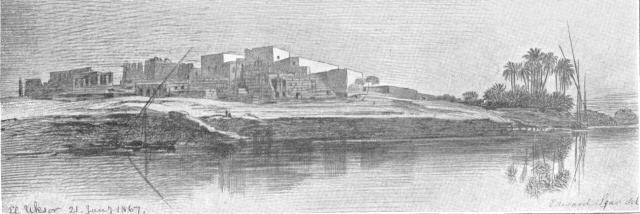
The view all round my house is magnificent on every side, over
the Nile in front facing north-west, and over a splendid range of
green and distant orange buff hills to the south-east, where I
have a spacious covered terrace. It is rough and dusty to
the extreme, but will be very pleasant. Mustapha came in
just now to offer me the loan of a horse, and to ask me to go to
the mosque in a few nights to see the illumination in honour of a
great Sheykh, a son of Sidi Hosseyn or Hassan. I asked
whether my presence might not offend any Muslimeen, and he would
not hear of such a thing. The sun set while he was here,
and he asked if I objected to his praying in my presence, and
went through his four rekahs very comfortably on my
carpet. My next-door neighbour (across the courtyard all
filled with antiquities) is a nice little Copt who looks like an
antique statue himself. I shall voisiner with his
family. He sent me coffee as soon as I arrived, and came to
help. I am invited to El-Moutaneh, a few hours up the
river, to visit the Mouniers, and to Keneh to visit Seyyid
Achmet, and also the head of the merchants there who settled the
price of a carpet for me in the bazaar, and seemed to like
me. He was just one of those handsome, high-bred, elderly
merchants with whom a story always begins in the Arabian
Nights. When I can talk I will go and see a real Arab
hareem. A very nice English couple, a man and his wife,
gave me breakfast in their boat, and turned out to be business
connections of Ross’s, of the name of Arrowsmith; they were
going to Assouan, and I shall see them on their way back. I
asked Mustapha about the Arab young lady, and he spoke very
highly of her, and is to let me know if she comes here and to
offer hospitality from me: he did not know her name—she is
called ‘el Hággeh’ (the
Pilgrimess).
Thursday.—Now I am settled in my Theban palace,
it seems more and more beautiful, and I am quite melancholy that
you cannot be here to enjoy it. The house is very large and
has good thick walls, the comfort of which we feel to-day for it
blows a hurricane; but indoors it is not at all cold. I
have glass windows and doors to some of the rooms. It is a
lovely dwelling. Two funny little owls as big as my fist
live in the wall under my window, and come up and peep in,
walking on tip-toe, and looking inquisitive like the owls in the
hieroglyphics; and a splendid horus (the sacred hawk) frequents
my lofty balcony. Another of my contemplar gods I
sacrilegiously killed last night, a whip snake. Omar is
rather in consternation for fear it should be ‘the snake of
the house,’ for Islam has not dethroned the Dii lares et
tutelares.
I have been ‘sapping’ at the Alif Bey (A B
C) to-day, under the direction of Sheykh Yussuf, a graceful,
sweet-looking young man, with a dark brown face and such fine
manners, in his fellah dress—a coarse brown woollen
shirt, a libdeh, or felt skull-cap, and a common red shawl
round his head and shoulders; writing the wrong way is very hard
work. Some men came to mend the staircase, which had fallen
in and which consists of huge solid blocks of stone. One
crushed his thumb and I had to operate on it. It is
extraordinary how these people bear pain; he never winced in the
least, and went off thanking God and the lady quite
cheerfully. Till to-day the weather has been quite
heavenly; last night I sat with my window open, it was so
warm. If only I had you all here! How Rainie would
play in the temple, Maurice fish in the Nile, and you go about
with your spectacles on your nose. I think you would
discard Frangi dress and take to a brown shirt and a
libdeh, and soon be as brown as any fellah.
It was so curious to see Sheykh Yussuf blush from shyness when he
came in first; it shows quite as much in the coffee-brown Arab
skin as in the fairest European—quite unlike the much
lighter-coloured mulatto or Malay, who never change colour at
all. A photographer who is living here showed me
photographs done high up the White Nile. One negro girl is
so splendid that I must get him to do me a copy to send
you. She is not perfect like the Nubians, but so superbly
strong and majestic. If I can get hold of a handsome
fellahah here, I’ll get her photographed to show you
in Europe what a woman’s breast can be, for I never knew it
before I came here—it is the most beautiful thing in the
world. The dancing-girl I saw moved her breasts by some
extraordinary muscular effort, first one and then the other; they
were just like pomegranates and gloriously independent of stays
or any support.
To Sir Alexander Duff
Gordon.
Wednesday, January 20,
1864.
I received your welcome letters of December 15 and 25 on
Monday, to my great joy, but was much grieved to hear of
Thomas’s death, and still more so to hear from Janet that
Thackeray and Mrs. Alison were dead. She died the morning I
left Cairo, so her last act almost was to send sweetmeats to the
boat after me on the evening before. Poor dear soul her
sweetness and patience were very touching. We have had a
week of piercing winds, and yesterday I stayed in bed, to the
great surprise of Mustapha’s little girl who came to see
me. To-day was beautiful again, and I mounted old
Mustapha’s cob pony and jogged over his farm with him, and
lunched on delicious sour cream and fateereh at a
neighbouring village, to the great delight of the
fellaheen. It was more Biblical than ever; the
people were all relations of Mustapha’s, and to see Sidi
Omar, the head of the household, and the ‘young men coming
in from the field,’ and the ‘flocks and herds and
camels and asses,’ was like a beautiful dream. All
these people are of high blood, and a sort of ‘roll of
Battle’ is kept here for the genealogies of the noble Arabs
who came in with Amr—the first Arab conqueror and
lieutenant of Omar. Not one of these brown men, who do not
own a second shirt, would give his brown daughter to the greatest
Turkish Pasha. This country noblesse is more
interesting to me by far than the town people, though Omar, who
is quite a Cockney, and piques himself on being
‘delicate,’ turns up his nose at their beggarly
pride, as Londoners used to do at bare-legged Highlanders.
The air of perfect equality—except as to the respect due to
the head of the clan—with which the villagers treated
Mustapha, and which he fully returned, made it all seem so very
gentlemanly. They are not so dazzled by a little show, and
far more manly than the Cairenes. I am on visiting terms
with all the ‘county families’ resident in Luxor
already. The Názir (magistrate) is a very nice
person, and my Sheykh Yussuf, who is of the highest blood (being
descended from Abu-l-Hajjaj himself), is quite charming.
There is an intelligent little German here as Austrian Consul,
who draws nicely. I went into his house, and was startled
by hearing a pretty Arab boy, his servant, inquire,
‘Soll ich den Kaffee bringen?’ What
next? They are all mad to learn languages, and Mustapha
begs me and Sally to teach his little girl Zeyneb English.
Friday, 22nd.—Yesterday I rode over to
Karnac, with Mustapha’s sais running by my
side. Glorious hot sun and delicious air. To hear the
sais chatter away, his tongue running as fast as his feet,
made me deeply envious of his lungs. Mustapha joined me,
and pressed me to go to visit the Sheykh’s tomb for the
benefit of my health, as he and Sheykh Yussuf wished to say a
Fathah for me; but I must not drink wine at dinner.
I made a little difficulty on the score of difference of
religion, but Sheykh Yussuf, who came up, said that he presumed I
worshipped God, and not stones, and that sincere prayers were
good anywhere. Clearly the bigotry would have been on my
side if I had refused any longer. So in the evening I went
with Mustapha. It was a very curious sight, the little dome
illuminated with as much oil as the mosque could afford, and the
tombs of Abu-l-Hajjaj and his three sons. A magnificent old
man, like Father Abraham himself, dressed in white, sat on a
carpet at the foot of the tomb; he was the head of the family of
Abu-l-Hajjaj. He made me sit by, and was extremely
polite. Then came the Názir, the Kadee, a Turk
travelling on Government business, and a few other gentlemen, who
all sat down round us after kissing the hand of the old
Sheykh. Everyone talked; in fact it was a
soirée for the entertainment of the dead
Sheykh. A party of men sat at the further end of the place,
with their faces to the Kibleh, and played on a taraboukeh
(sort of small drum stretched on earthenware which gives a
peculiar sound), a tambourine without bells, and little tinkling
cymbals fitting on thumb and fingers (crotales), and chanted
songs in honour of Mohammed and verses from the Psalms of
David. Every now and then one of our party left off
talking, and prayed a little or counted his beads. The old
Sheykh sent for coffee, and gave me the first cup—a
wonderful concession. At last the Názir proposed a
Fathah for me, which the whole group round me repeated
aloud, and then each said to me, ‘Our Lord God bless and
give thee health and peace, to thee and thy family, and take thee
back safe to thy master and thy children,’ one adding
Ameen and giving the salaam with the hand. I
returned it, and said, ‘Our Lord reward thee and all the
people of kindness to strangers,’ which was considered a
very proper answer. After that we went away, and the worthy
Názir walked home with me to take a pipe and a glass of
sherbet, and enjoy a talk about his wife and eight children, who
are all in Foum-el-Bachr’, except two boys at school in
Cairo. Government appointments are so precarious that it is
not worth while to move them up here, as the expense would be too
heavy on a salary of £15 a month, with the chance of recall
any day. In Cairo or Lower Egypt it would be quite
impossible for a Christian to enter a Sheykh’s tomb at
all—above all on his birthday festival and on the night of
Friday.
Friday, January 29.—I have been too unwell
to write all this week, but will finish this to-day to send off
by Lady Herbert’s boat. The last week has been very
cold here, the thermometer at 59° and 60°, with a nipping
wind and bright sun. I was obliged to keep my bed for three
or four days, as of course a palazzo without doors or
windows to speak of was very trying, though far better than a
boat. Yesterday and to-day are much better, not really much
warmer, but a different air.
The moolid (festival) of the Sheykh terminated last
Saturday with a procession, in which the new cover of his tomb,
and the ancient sacred boat, were carried on men’s
shoulders. It all seemed to have walked out of the royal
tombs, only dusty and shabby instead of gorgeous. These
festivals of the dead are such as Herodotus alludes to as held in
honour of ‘Him whose name he dares not mention—Him
who sleeps in Philæ,’ only the name is changed and
the mummy is absent.
For a fortnight everyone who had a horse and could ride came
and ‘made fantasia’ every afternoon for two hours
before sunset; and very pretty it was. The people here show
their good blood in their riding. On the last three days
all strangers were entertained with bread and cooked meat at the
expense of the Luxor people; every house killed a sheep and baked
bread. As I could not do that for want of servants enough,
I sent 100 piastres (12s) to the servants of Abu-l-Hajjaj at the
mosque to pay for the oil burnt at the tomb, etc. I was not
well and in bed, but I hear that my gift gave immense
satisfaction, and that I was again well prayed for. The
Coptic Bishop came to see me, but he is a tipsy old monk and an
impudent beggar. He sent for tea as he was ill, so I went
to see him, and perceived that his disorder was arrakee. He
has a very nice black slave, a Christian (Abyssinian, I think),
who is a friend of Omar’s, and who sent Omar a handsome
dinner all ready cooked; among other things a chicken stuffed
with green wheat was excellent. Omar constantly gets
dinners sent him, a lot of bread, some dates and cooked fowls or
pigeons, and fateereh with honey, all tied up hot in a
cloth. I gave an old fellow a pill and dose some days ago,
but his dura ilia took no notice, and he came for more,
and got castor-oil. I have not seen him since, but his
employer, fellah Omar, sent me a lot of delicious butter
in return. I think it shows great intelligence in these
people, how none of them will any longer consult an Arab
hakeem if they can get a European to physic them.
They now ask directly whether the Government doctors have been to
Europe to learn Hekmeh, and if not they don’t trust
them—for poor ‘savages’ and
‘heathens’ ce n’est pas si
bête. I had to interrupt my lessons from illness,
but Sheykh Yussuf came again last night. I have mastered
Abba shedda o mus beteen—ibbi shedda o
heftedeen, etc. Oh dear, what must poor Arab children
suffer in learning ABC! It is a terrible alphabet, and the
shekel (points) are désespérants; but
now I stick for want of a dictionary.
Mr. Arrowsmith kindly gave me Miss Martineau’s book,
which I have begun. It is true as far as it goes, but there
is the usual defect—the people are not real people, only
part of the scenery to her, as to most Europeans. You may
conceive how much we are naturalized when I tell you that I have
received a serious offer of marriage for Sally. Mustapha
A’gha has requested me to ‘give her to him’ for
his eldest son Seyyid, a nice lad of nineteen or twenty at
most. As Mustapha is the richest and most considerable
person here, it shows that the Arabs draw no unfavourable
conclusions as to our morals from the freedom of our
manners. He said of course she would keep her own religion
and her own customs. Seyyid is still in Alexandria, so it
will be time to refuse when he returns. I said she was too
old, but they think that no objection at all. She will have
to say that her father would not allow it, for of course a
handsome offer deserves a civil refusal. Sally’s
proposals would be quite an ethnological study; Mustapha asked
what I should require as dowry for her. Fancy Sally as
Hareem of the Sheykh-el-Beled of Luxor!
I am so charmed with my house that I begin seriously to
contemplate staying here all the time. Cairo is so dear
now, and so many dead cattle are buried there, that I think I
should do better in this place. There is a huge hall, so
large and cold now as to be uninhabitable, which in summer would
be glorious. My dear old captain of steamer XII. would
bring me up coffee and candles, and if I ‘sap’ and
learn to talk to people, I shall have plenty of company.
The cattle disease has not extended above Minieh to any
degree, and here there has not been a case.
Alhamdulillah! Food is very good here, rather less
than half Cairo prices even now; in summer it will be half
that. Mustapha urges me to stay, and proposes a picnic of a
few days over in the tombs with his Hareem as a diversion.
I have got a photo, for a stereoscope, which I send you, of my
two beloved, lovely palm-trees on the river-bank just above and
looking over Philæ.
Hitherto my right side has been the bad one, but now one side
is uneasy and the other impossible to lie on. It does not
make one sleep pleasantly, and the loss of my good, sound sleep
tries me, and so I don’t seem well. We shall see what
hot weather will do; if that fails I will give up the contest,
and come home to see as much as I shall have time for of you and
my chicks.
To Mrs. Austin.
Sunday, February 7,
1864
Dearest Mutter,
We have had our winter pretty sharp for three weeks, and
everybody has had violent colds and coughs—the Arabs, I
mean.
I have been a good deal ailing, but have escaped any violent
cold altogether, and now the thermometer is up to 64°, and it
feels very pleasant. In the sun it is always very hot, but
that does not prevent the air from being keen, and chapping lips
and noses, and even hands; it is curious how a temperature, which
would be summer in England, makes one shiver at
Thebes—Alhamdulillah! it is over now.
My poor Sheykh Yussuf is in great distress about his brother,
also a young Sheykh (i.e., one learned in theology and
competent to preach in the mosque). Sheykh Mohammed is come
home from studying in ‘El-Azhar’ at Cairo—I
fear to die. I went with Sheykh Yussuf, at his desire, to
see if I could help him, and found him gasping for breath and
very, very ill. I gave him a little soothing medicine, and
put mustard plasters on him, and as it relieved him, I went again
and repeated them. All the family and a lot of neighbours
crowded in to look on. There he lay in a dark little den
with bare mud walls, worse off, to our ideas, than any pauper;
but these people do not feel the want of comforts, and one learns
to think it quite natural to sit with perfect gentlemen in places
inferior to our cattle-sheds. I pulled some blankets up
against the wall, and put my arm behind Sheykh Mohammed’s
back to make him rest while the poultices were on him, whereupon
he laid his green turban on my shoulder, and presently held up
his delicate brown face for a kiss like an affectionate
child. As I kissed him, a very pious old moollah said
Bismillah (In the name of God) with an approving nod, and
Sheykh Mohammed’s old father, a splendid old man in a green
turban, thanked me with effusion, and prayed that my children
might always find help and kindness. I suppose if I
confessed to kissing a ‘dirty Arab’ in a
‘hovel’ the English travellers would execrate me; but
it shows how much there is in ‘Mussulman bigotry,
unconquerable hatred, etc.,’ for this family are Seyyids
(descendents of the Prophet) and very pious. Sheykh Yussuf
does not even smoke, and he preaches on Fridays. You would
love these Saeedees, they are such thorough gentlemen. I
rode over to the village a few days ago to see a farmer named
Omar. Of course I had to eat, and the people were enchanted
at my going alone, as they are used to see the English armed and
guarded. Sidi Omar, however, insisted on accompanying me
home, which is the civil thing here. He piled a whole stack
of green fodder on his little nimble donkey, and hoisted himself
atop of it without saddle or bridle (the fodder was for Mustapha
A’gha), and we trotted home across the beautiful green
barley-fields, to the amazement of some European young men out
shooting. We did look a curious pair, certainly, with my
English saddle and bridle, habit, hat and feather, on horseback,
and Sidi Omar’s brown shirt, brown legs and white turban,
guiding his donkey with his chibouque. We were laughing
very merrily, too, over my blundering Arabic.
Young Heathcote and Strutt called here, but were hurrying on
up the river. I shall see more of them when they come
down. Young Strutt is so like his mother I knew him in the
street. I would like to give him a fantasia, but it is not
proper for a woman to send for the dancing-girls, and as I am the
friend of the Maōhn (police magistrate), the Kadee, and the
respectable people here, I cannot do what is indecent in their
eyes. It is quite enough that they approve my unveiled
face, and my associating with men; that is ‘my
custom,’ and they think no harm of it.
To-morrow or next day Ramadan begins at the first sight of the
new moon. It is a great nuisance, because everybody is
cross. Omar did not keep it last year, but this year he
will, and if he spoils my dinners, who can blame him? There
was a wedding close by here last night, and about ten
o’clock all the women passed under my windows with crys of
joy ‘ez-zaghareet’ down to the river. I find,
on inquiry, that in Upper Egypt, as soon as the bridegroom has
‘taken the face’ of his bride, the women take her
down to ‘see the Nile.’ They have not yet
forgotten that the old god is the giver of increase, it
seems.
I have been reading Miss Martineau’s book; the
descriptions are excellent, but she evidently knew and cared
nothing about the people, and had the feeling of most English
people here, that the difference of manners is a sort of
impassable gulf, the truth being that their feelings and passions
are just like our own. It is curious that all the old books
of travels that I have read mention the natives of strange
countries in a far more natural tone, and with far more attempt
to discriminate character, than modern ones, e.g.,
Niebuhr’s Travels here and in Arabia, Cook’s Voyages,
and many others. Have we grown so very
civilized since a hundred years that outlandish people seem like
mere puppets, and not like real human beings? Miss
M.’s bigotry against Copts and Greeks is droll enough,
compared to her very proper reverence for ‘Him who sleeps
in Philæ,’ and her attack upon hareems outrageous;
she implies that they are brothels. I must admit that I
have not seen a Turkish hareem, and she apparently saw no other,
and yet she fancies the morals of Turkey to be superior to those
of Egypt. It is not possible for a woman to explain all the
limitations to which ordinary people do subject themselves.
Great men I know nothing of; but women can and do, without blame,
sue their husbands-in-law for the full ‘payment of
debt,’ and demand a divorce if they please in
default. Very often a man marries a second wife out of duty
to provide for a brother’s widow and children, or the
like. Of course licentious men act loosely as
elsewhere. Kulloolum Beni Adam (we are all sons of
Adam), as Sheykh Yussuf says constantly, ‘bad-bad and
good-good’; and modern travellers show strange ignorance in
talking of foreign natives in the lump, as they nearly all
do.
Monday.—I have just heard that poor Sheykh
Mohammed died yesterday, and was, as usual, buried at once.
I had not been well for a few days, and Sheykh Yussuf took care
that I should not know of his brother’s death. He
went to Mustapha A’gha, and told him not to tell anyone in
my house till I was better, because he knew ‘what was in my
stomach towards his family,’ and feared I should be made
worse by the news. And how often I have been advised not to
meddle with sick Arabs, because they are sure to suspect a
Christian of poisoning those who die! I do grieve for the
graceful, handsome young creature and his old father. Omar
was vexed at not knowing of his death, because he would have
liked to help to carry him to the grave.
I have at last learned the alphabet in Arabic, and can write
it quite tidily, but now I am in a fix for want of a dictionary,
and have written to Hekekian Bey to buy me one in Cairo.
Sheykh Yussuf knows not a word of English, and Omar can’t
read or write, and has no notion of grammar or of word for
word interpretation, and it is very slow work. When I
walk through the court of the mosque I give the customary coppers
to the little boys who are spelling away loudly under the arcade,
Abba sheddeh o nusbeyteen, Ibbi sheddeh o
heftedeen, etc., with a keen sympathy with their difficulties
and well-smudged tin slates. An additional evil is that the
Arabic books printed in England, and at English presses here,
require a 40-horse power microscope to distinguish a
letter. The ciphering is like ours, but with other figures,
and I felt very stupid when I discovered how I had reckoned Arab
fashion from right to left all my life and never observed the
fact. However, they ‘cast down’ a column of
figures from top to bottom.
I am just called away by some poor men who want me to speak to
the English travellers about shooting their pigeons. It is
very thoughtless, but it is in great measure the fault of the
servants and dragomans who think they must not venture to tell
their masters that pigeons are private property. I have a
great mind to put a notice on the wall of my house about
it. Here, where there are never less than eight or ten
boats lying for full three months, the loss to the
fellaheen is serious, and our Consul Mustapha A’gha
is afraid to say anything. I have given my neighbours
permission to call the pigeons mine, as they roost in flocks on
my roof, and to go out and say that the Sitt objects to her
poultry being shot, especially as I have had them shot off my
balcony as they sat there.
I got a note from M. Mounier yesterday, inviting me to go and
stay at El-Moutaneh, Halim Pasha’s great estate, near
Edfoo, and offering to send his dahabieh for me. I
certainly will go as soon as the weather is decidedly hot.
It is now very warm and pleasant. If I find Thebes too hot
as summer advances I must drop down and return to Cairo, or try
Suez, which I hear is excellent in summer—bracing desert
air. But it is very tempting to stay here—a splendid
cool house, food extremely cheap; about £1 a week for three
of us for fish, bread, butter, meat, milk, eggs and vegetables;
all grocery, of course, I brought with me; no trouble, rest and
civil neighbours. I feel very disinclined to move unless I
am baked out, and it takes a good deal to bake me. The only
fear is the Khamaseen wind. I do not feel very well.
I don’t ail anything in particular; blood-spitting
frequent, but very slight; much less cough; but I am so weak and
good for nothing. I seldom feel able to go out or do more
than sit in the balcony on one side or other of the house.
I have no donkey here, the hired ones are so very bad and so
dear; but I have written Mounier to try and get me one at
El-Moutaneh and send it down in one of Halim Pasha’s
corn-boats. There is no comfort like a donkey always
ready. If I have to send for Mustapha’s horse, I feel
lazy and fancy it is too much trouble unless I can go just when I
want.
I have received a letter from Alexandria of January 8.
What dreadful weather! We felt the ghost of it here in our
three weeks of cold. Sometimes I feel as if I must go back
to you all coûte qui coûte, but I know it
would be no use to try it in the summer. I long for more
news of you and my chicks.
To Mrs. Ross.
Luxor,
Tuesday, February 8, 1864.
Dearest Child,
I got your letter No. 3 about a week ago, and two others
before it. I have been very lazy in writing, for it has
been very cold (for Thebes), and I have been very seedy—no
severe attack, but no strength at all. The last three or
four days the weather has been warm, and I am beginning to feel
better. I send this to Cairo by a clever, pleasant Mme. de
Beaulaincourt, a daughter of Maréchal Castellane, who is
here in one of the Pasha’s steamers. She will call on
you when she goes to Alexandria. I have been learning to
write Arabic, and know my letters—no trifle, I assure
you. My Sheykh is a perfect darling—the most
graceful, high-bred young creature, and a Seyyid. These
Saeedees are much nicer than the Lower Egypt people. They
have good Arab blood in their veins, keep pedigrees, and are more
manly and independent, and more liberal in religion.
Sheykh Yussuf took me into the tomb of his ancestor, Sheykh
Abul Hajjaj, the great saint here, and all the company said a
Fathah for my health. It was on the night of Friday, and
during the moolid of the Sheykh. Omar was surprised at the
proceeding, and a little afraid the dead Sheykh might be
offended. My great friend is the Maōhn (police
magistrate) here—a very kind, good man, much liked, I hear,
by all except the Kadee, who was displeased at his giving the
stick to a Mussulman for some wrong to a Copt. I am
beginning to stammer out a little Arabic, but find it horribly
difficult. The plurals are bewildering and the verbs quite
heart-breaking. I have no books, which makes learning very
slow work. I have written to Hekekian Bey to buy me a
dictionary.
The house here is delightful—rather cold now, but will
be perfect in hot weather—so airy and cheerful. I
think I shall stay on here all the time the expense is nil, and
it is very comfortable. I have a friend in a farm in a
neighbouring village, and am much amused at seeing country
life. It cannot be rougher, as regards material comforts,
in New Zealand or Central Africa, but there is no barbarism or
lack of refinement in the manners of the people. M. Mounier
has invited me to go and stay with them at El-Moutaneh, and
offers to send his dahabieh for me. When it gets really hot
I shall like the trip very much.
Pray, when you see Mme. Tastu, say civil things for me, and
tell her how much I like the house. I think it wonderful
that Omar cooked the dinner without being cross. I am sure
I should swear if I had to cook for a heretic in Ramadan.
To Sir Alexander Duff
Gordon.
Luxor,
February 12, 1864.
Dearest Alick,
We are in Ramadan now, and Omar really enjoys a good
opportunity of ‘making his soul.’ He fasts and
washes vigorously, prays his five times a day, goes to mosque on
Fridays, and is quite merry over it, and ready to cook
infidels’ dinners with exemplary good-humour. It is a
great merit in Muslims that they are not at all grumpy over their
piety. The weather has set in since five or six days quite
like paradise. I sit on my lofty balcony and drink the
sweet northerly breeze, and look at the glorious mountain
opposite, and think if only you and the chicks were here it would
be ‘the best o’ life.’ The beauty of
Egypt grows on one, and I think it far more lovely this year than
I did last. My great friend the Maōhn (he is
not the Nazir, who is a fat little pig-eyed, jolly Turk)
lives in a house which also has a superb view in another
direction, and I often go and sit ‘on the
bench’—i.e., the mastabah in front of
his house—and do what little talk I can and see the people
come with their grievances. I don’t understand much
of what goes on, as the patois is broad and doubles the
difficulty, or I would send you a Theban police report; but the
Maōhn is very pleasant in his manner to them, and they
don’t seem frightened. We have appointed a very small
boy our bowàb, or porter—or, rather, he has
appointed himself—and his assumption of dignity is quite
delicious. He has provided himself with a huge staff, and
he behaves like the most tremendous janissary. He is about
Rainie’s size, as sharp as a needle, and possesses the
remains of a brown shirt and a ragged kitchen duster as
turban. I am very fond of little Achmet, and like to see
him doing tableaux vivants from Murillo with a plate of
broken victuals. The children of this place have become so
insufferable about backsheesh that I have complained to
the Maōhn, and he will assemble a committee of parents and
enforce better manners. It is only here and just where the
English go. When I ride into the little villages I never
hear the word, but am always offered milk to drink. I have
taken it two or three times and not offered to pay, and the
people always seem quite pleased.
Yesterday Sheykh Yussuf came again, the first time since his
brother’s death; he was evidently deeply affected, but
spoke in the usual way, ‘It is the will of God, we must all
die,’ etc. I wish you could see Sheykh Yussuf.
I think he is the sweetest creature in look and manner I ever
beheld—so refined and so simple, and with the animal grace
of a gazelle. A high-bred Arab is as graceful as an Indian,
but quite without the feline Geschmeidigkeit or the look
of dissimulation; the eye is as clear and frank as a
child’s. Mr. Ruchl, the Austrian Consul here, who
knows Egypt and Arabia well, tells me that he thinks many of them
quite as good as they look, and said of Sheykh Yussuf, Er ist
so gemüthlich. There is a German here deciphering
hieroglyphics, Herr Dümmichen, a very agreeable man, but he
has gone across the river to live at el-Kurneh. He has been
through Ethiopia in search of temples and inscriptions. I
am to go over and visit him, and see some of the tombs again in
his company, which I shall enjoy, as a good interpreter is sadly
wanted in those mysterious regions.
My chest is wonderfully better these last six or seven
days. It is quite clear that downright heat is what does me
good. Moreover, I have just heard from M. Mounier that a
good donkey is en route in a boat from
El-Moutaneh—he will cost me between £4 and £5
and will enable me to be about far more than I can by merely
borrowing Mustapha’s horse, about which I have scruples as
he lends it to other lady travellers. Little Achmet will be
my sais as well as my door-keeper, I suppose. I wish you
would speak to Layard in behalf of Mustapha A’gha. He
has acted as English Consul here for something like thirty years,
and he really is the slave of the travellers. He gives them
dinners, mounts them, and does all the disagreeable business of
wrangling with the reis and dragomans for them, makes himself a
postmaster, takes care of their letters and sends them out to the
boats, and does all manner of services for them, and lends his
house for the infidels to pray in on Sundays when a clergyman is
here. For this he has no remuneration at all, except such
presents as the English see fit to make him, and I have seen
enough to know that they are neither large nor always gracefully
given. The old fellow at Keneh who has nothing to do gets
regular pay, and I think Mustapha ought to have something; he is
now old and rather infirm, and has to keep a clerk to help him;
and at least, his expenses should be covered. Please say
this to Layard from me as my message to him. Don’t
forget it, please, for Mustapha is a really kind friend to me at
all times and in all ways.
February 14th.—Yesterday we had a dust-storm off
the desert. It made my head heavy and made me feel languid,
but did not affect my chest at all. To-day is a soft gray
day; there was a little thunder this morning and a few, very few,
drops of rain—hardly enough for even Herodotus to consider
portentous. My donkey came down last night, and I tried him
to-day, and he is very satisfactory though alarmingly small, as
the real Egyptian donkey always is; the big ones are from the
Hejaz. But it is wonderful how the little creatures run
along under one as easy as possible, and they have no will of
their own. I rode mine out to Karnac and back, and he did
not seem to think me at all heavy. When they are overworked
and overgalloped they become bad on the legs and easily fall, and
all those for hire are quite stumped up, poor beasts—they
are so willing and docile that everyone overdrives them.
To Mrs. Austin.
Luxor,
February 19, 1864.
Dearest Mutter,
I have only time for a few lines to go down by Mr. Strutt and
Heathcote’s boat to Cairo. They are very good
specimens and quite recognised as ‘belonging to the higher
people,’ because they ‘do not make themselves
big.’ I received your letter of January 21 with
little darling Rainie’s three days ago.
I am better now that the weather is fine again. We had a
whole day’s rain (which Herodotus says is a portent here)
and a hurricane from the south worthy of the Cape. I
thought we should have been buried under the drifting sand.
To-day is again heavenly. I saw Abd-el-Azeez, the chemist
in Cairo; he seemed a very good fellow, and was a pupil of my old
friend M. Chrevreul, and highly recommended by him. Here I
am out of all European ideas. The Sheykh-el-Arab (of the
Ababdeh tribe), who has a sort of town house here, has invited me
out into the desert to the black tents, and I intend to pay a
visit with old Mustapha A’gha. There is a Roman well
in his yard with a ghoul in it. I can’t get the story
from Mustapha, who is ashamed of such superstitions, but
I’ll find it out. We had a fantasia at
Mustapha’s for young Strutt and Co., and a very good
dancing-girl. Some dear old prosy English people made me
laugh so. The lady wondered how the women here could wear
clothes ‘so different from English females—poor
things!’ but they were not malveillants, only
pitying and wonderstruck—nothing astonished them so much as
my salutations with Seleem Effendi, the Maōhn.
I begin to feel the time before me to be away from you all
very long indeed, but I do think my best chance is a long spell
of real heat. I have got through this winter without once
catching cold at all to signify, and now the fine weather is
come. I am writing in Arabic from Sheykh Yussuf’s
dictation the dear old story of the barber’s brother with
the basket of glass. The Arabs are so diverted at hearing
that we all know the Alf Leyleh o Leyleh, the
‘Thousand Nights and a Night.’ The want of a
dictionary with a teacher knowing no word of English is
terrible. I don’t know how I learn at all. The
post is pretty quick up to here. I got your letter within
three weeks, you see, but I get no newspapers; the post is all on
foot and can’t carry anything so heavy. One of my men
of last year, Asgalani the steersman, has just been to see me; he
says his journey was happier last year.
I hear that Phillips is coming to Cairo, and have written to
him there to invite him up here to paint these handsome
Saeedees. He could get up in a steamer as I did through
Hassaneyn Effendi for a trifle. I wish you could
come, but the heat here which gives me life would be quite
impossible to you. The thermometer in the cold
antechamber now is 67° where no sun ever comes, and the blaze
of the sun is prodigious.
To Sir Alexander Duff
Gordon.
Luxor,
February 26, 1864.
Dearest Alick,
I have just received your letter of the 3rd inst., and am glad
to get such good tidings. You would be amused to see Omar
bring me a letter and sit down on the floor till I tell him the
family news, and then Alhamdulillah, we are so pleased,
and he goes off to his pots and pans again. Lord and Lady
Spencer are here, and his sister, in two boats. The English
‘Milord,’ extinct on the Continent, has revived in
Egypt, and is greatly reverenced and usually much liked.
‘These high English have mercy in their stomachs,’
said one of my last year’s sailors who came to kiss my
hand—a pleasing fact in natural history! Fee wahed
Lord, was little ragged Achmet’s announcement of Lord
Spencer—‘Here’s a Lord.’ They are
very pleasant people. I heard from Janet to-day of
ice at Cairo and at Shoubra, and famine prices. I
cannot attempt Cairo with meat at 1s. 3d. a pound, and will
e’en stay here and grill at Thebes. Marry-come-up
with your Thebes and savagery! What if we do wear
ragged brown shirts? ‘’Tis manners makyth
man,’ and we defy you to show better breeding.
We are now in the full enjoyment of summer weather; there has
been no cold for fully a fortnight, and I am getting better every
day now. My cough has quite subsided, and the pain in the
chest much diminished; if the heat does not overpower me I feel
sure it will be very healing to my lungs. I sit out on my
glorious balcony and drink the air from early morning till noon,
when the sun comes upon it and drives me under cover. The
thermometer has stood at 64° for a fortnight or three weeks,
rising sometimes to 67°, but people in the boats tell me it
is still cold at night on the river. Up here, only a
stone’s-throw from it, it is warm all night. I fear
the loss of cattle has suspended irrigation to a fearful extent,
and that the harvests of Lower Egypt of all kinds will be sadly
scanty. The disease has not spread above Minieh, or very
slightly; but, of course, cattle will rise in price here
also. Already food is getting dearer here; meat is
4½ piastres—7d.—the rötl (a
fraction less than a pound), and bread has risen
considerably—I should say corn, for no bakers exist
here. I pay a woman to grind and bake my wheat which I buy,
and delicious bread it is. It is impossible to say how
exactly like the early parts of the Bible every act of life is
here, and how totally new it seems when one reads it here.
Old Jacob’s speech to Pharaoh really made me laugh
(don’t be shocked), because it is so exactly what a fellah
says to a Pasha: ‘Few and evil have been the days,’
etc. (Jacob being a most prosperous man); but it is manners to
say all that, and I feel quite kindly to Jacob, whom I used to
think ungrateful and discontented; and when I go to Sidi
Omar’s farm, does he not say, ‘Take now fine meal and
bake cakes quickly,’ and wants to kill a kid?
Fateereh with plenty of butter is what the ‘three
men’ who came to Abraham ate; and the way that
Abraham’s chief memlook, acting as Vakeel, manages
Isaac’s marriage with Rebekah! All the vulgarized
associations with Puritanism and abominable little
‘Scripture tales and pictures’ peel off here, and the
inimitably truthful representation of life and
character—not a flattering one certainly—comes out,
and it feels like Homer. Joseph’s tears and his love
for the brother born of the same mother is so
perfect. Only one sees what a bad inferior race the Beni
Israel were compared to the Beni Ishmael or to the
Egyptians. Leviticus and Deuteronomy are so very heathenish
compared to the law of the Koran, or to the early days of
Abraham. Verily the ancient Jews were a foul nation,
judging by the police regulations needful for them. Please
don’t make these remarks public, or I shall be burnt with
Stanley and Colenso (unless I suffer Sheykh Yussuf to propose me
El-Islam). He and M. de Rougé were here last
evening, and we had an Arabic soirée. M. de
Rougé speaks admirably, quite like an Alim, and it was
charming to see Sheykh Yussuf’s pretty look of grateful
pleasure at finding himself treated like a gentleman and a
scholar by two such eminent Europeans; for I (as a woman) am
quite as surprising as even M. de Rougé’s knowledge
of hieroglyphics and Arabic Fosseeha. It is very
interesting to see something of Arabs who have read and have the
‘gentleman’ ideas. His brother, the Imam, has
lost his wife; he was married twenty-two years, and won’t
hear of taking another. I was struck with the sympathy he
expressed with the English Sultana, as all the uneducated people
say, ‘Why doesn’t she marry again?’ It is
curious how refinement brings out the same feelings under all
‘dispensations.’ I apologized to Yussuf for
inadvertently returning the Salaam aleykoum (Peace be with
thee), which he said to Omar, and which I, as an unbeliever,
could not accept. He coloured crimson, touched my hand and
kissed his own, quite distressed lest the distinction might wound
me. When I think of a young parsonic prig at home I shudder
at the difference. But Yussuf is superstitious; he told me
how someone down the river cured his cattle with water poured
over a Mushaf (a copy of the Koran), and has hinted at
writing out a chapter for me to wear as a hegab (an amulet
for my health). He is interested in the antiquities and in
M. de Rougé’s work, and is quite up to the
connection between Ancient Egypt and the books of Moses,
exaggerating the importance of Seyidna Moussa, of
course.
If I go down to Cairo again I will get letters to some of the
Alim there from Abd-el-Waris, the Imam here, and I shall see what
no European but Lane has seen. I think things have altered
since his day, and that men of that class would be less
inaccessible than they were then; and then a woman who is old
(Yussuf guessed me at sixty) and educated does not shock, and
does interest them. All the Europeans here are traders, and
only speak the vulgarest language, and don’t care to know
Arab gentlemen; if they see anything above their servants it is
only Turks, or Arab merchants at times. Don’t fancy
that I can speak at all decently yet, but I understand a good
deal, and stammer out a little.
To Mrs. Austin.
Luxor,
March 1, 1864.
Dearest Mutter,
I think I shall have an opportunity of sending letters in a
few days by a fast steamer, so I will begin one on the chance and
send it by post if the steamer is delayed long. The glory
of the climate now is beyond description, and I feel better every
day. I go out early—at seven or eight
o’clock—on my tiny black donkey, and come in to
breakfast about ten, and go out again at four.
I want to photograph Yussuf for you. The feelings and
prejudices and ideas of a cultivated Arab, as I get at them
little by little, are curious beyond compare. It
won’t do to generalize from one man, of course, but even
one gives some very new ideas. The most striking thing is
the sweetness and delicacy of feeling—the horror of hurting
anyone (this must be individual, of course: it is too good to be
general). I apologized to him two days ago for
inadvertently answering the Salaam aleykoum, which he, of
course, said to Omar on coming in. Yesterday evening he
walked in and startled me by a Salaam aleykee addressed to
me; he had evidently been thinking it over whether he ought to
say it to me, and come to the conclusion that it was not
wrong. ‘Surely it is well for all the creatures of
God to speak peace (Salaam) to each other,’ said
he. Now, no uneducated Muslim would have arrived at such a
conclusion. Omar would pray, work, lie, do anything for
me—sacrifice money even; but I doubt whether he
could utter Salaam aleykoum to any but a
Muslim. I answered as I felt: ‘Peace, oh my brother,
and God bless thee!’ It was almost as if a Catholic
priest had felt impelled by charity to offer the communion to a
heretic. I observed that the story of the barber was new to
him, and asked if he did not know the ‘Thousand and One
Nights.’ No; he studied only things of religion, no
light amusements were proper for an Alim (elder of religion);
we Europeans did not know that, of course, as our
religion was to enjoy ourselves; but he must not make
merry with diversions, or music, or droll stories. (See the
mutual ignorance of all ascetics!) He has a little girl of
six or seven, and teaches her to write and read; no one else, he
believes, thinks of such a thing out of Cairo; there many of the
daughters of the Alim learn—those who desire it. His
wife died two years ago, and six months ago he married again a
wife of twelve years old! (Sheykh Yussuf is thirty he tells
me; he looks twenty-two or twenty-three.) What a stepmother
and what a wife! He can repeat the whole Koran without a
book, it takes twelve hours to do it. Has read the
Towrát (old Testament) and the el-Aangeel (Gospels), of
course, every Alim reads them. ‘The words of Seyyidna
Eesa are the true faith, but Christians have altered and
corrupted their meaning. So we Muslims believe. We
are all the children of God.’ I ask if Muslims call
themselves so, or only the slaves of God. ‘’Tis
all one, children or slaves. Does not a good man care for
both tenderly alike?’ (Pray observe the Oriental
feeling here. Slave is a term of affection, not
contempt; and remember the Centurion’s
‘servant (slave) whom he loved.’) He had
heard from Fodl Pasha how a cow was cured of the prevailing
disease in Lower Egypt by water weighed against a Mushaf
(copy of the Koran), and had no doubt it was true, Fodl Pasha had
tried it. Yet he thinks the Arab doctors no use at all who
use verses of the Koran.
M. de Rougé, the great Egyptologue, came here
one evening; he speaks Arabic perfectly, and delighted Sheykh
Yussuf, who was much interested in the translations of the
hieroglyphics and anxious to know if he had found anything about
Moussa (Moses) or Yussuf (Joseph). He looked
pleased and grateful to be treated like a ‘gentleman and
scholar’ by such an Alim as M. de Rougé and such a
Sheykhah as myself. As he acts as clerk to Mustapha, our
consular agent, and wears a shabby old brown shirt, or gown, and
speaks no English, I dare say he not seldom encounters great
slights (from sheer ignorance). He produced a bit of old
Cufic MS. and consulted M. de R. as to its meaning—a pretty
little bit of flattery in an Arab Alim to a Frenchman, to which
the latter was not insensible, I saw. In answer to the
invariable questions about all my family I once told him my
father had been a great Alim of the Law, and that my mother had
got ready his written books and put some lectures in order to be
printed. He was amazed—first that I had a mother, as
he told me he thought I was fifty or sixty, and immensely
delighted at the idea. ‘God has favoured your family
with understanding and knowledge; I wish I could kiss the
Sheykhah your mother’s hand. May God favour
her!’ Maurice’s portrait (as usual) he admired
fervently, and said one saw his good qualities in his
face—a compliment I could have fully returned, as he sat
looking at the picture with affectionate eyes and praying,
sotto voce, for el gedda, el gemeel (the
youth, the beautiful), in the words of the Fathah,
‘O give him guidance and let him not stray into the paths
of the rejected!’ Altogether, something in Sheykh
Yussuf reminds me of Worsley: there is the same look of Seelen
reinheit, with far less thought and intelligence; indeed
little thought, of course, and an additional childlike
innocence. I suppose some medieval monks may have had the
same look, but no Catholic I have ever seen looks so peaceful or
so unpretending. I see in him, like in all people who
don’t know what doubt means, that easy familiarity with
religion. I hear him joke with Omar about Ramadan, and even
about Omar’s assiduous prayers, and he is a frequent and
hearty laugher. I wonder whether this gives you any idea of
a character new to you. It is so impossible to describe
manner, which gives so much of the impression of
novelty. My conclusion is the heretical one: that to dream
of converting here is absurd, and, I will add, wrong. All
that is wanted is general knowledge and education, and the
religion will clear and develop itself. The elements are
identical with those of Christianity, encumbered, as that has
been, with asceticism and intolerance. On the other hand,
the creed is simple and there are no priests, a decided
advantage. I think the faith has remained wonderfully
rational considering the extreme ignorance of those who hold
it. I will add Sally’s practical remark, that
‘The prayers are a fine thing for lazy people; they must
wash first, and the prayer is a capital drill.’
You would be amused to hear Sally when Omar does not wake in
time to wash, pray, and eat before daybreak now in
Ramadán. She knocks at his door and acts as
Muezzin. ‘Come, Omar, get up and pray and have your
dinner’ (the evening meal is ‘breakfast,’ the
early morning one ‘dinner’). Being a light
sleeper she hears the Muezzin, which Omar often does not, and
passes on the ‘Prayers is better than sleep’ in a
prose version. Ramadán is a dreadful business;
everybody is cross and lazy—no wonder! The camel-men
quarrelled all day under my window yesterday, and I asked what it
was all about. ‘All about nothing; it is
Ramadán with them,’ said Omar laughing.
‘I want to quarrel with someone myself; it is hot to-day,
and thirsty weather.’ Moreover, I think it injures
the health of numbers permanently, but of course it is the thing
of most importance in the eyes of the people; there are many who
never pray at ordinary times, but few fail to keep
Ramadán. It answers to the Scotch Sabbath, a
comparison also borrowed from Sally.
Friday.—My friend Seleem Effendi has just been
here talking about his own affairs and a good deal of
theology. He is an immense talker, and I just put
eywas (yes) and là (no) and
sahé (very true), and learn manners and
customs. He tells me he has just bought two black slave
women, mother and daughter, from a Copt for about £35 the
two. The mother is a good cook, and the daughter is
‘for his bed,’ as his wife does not like to leave
Cairo and her boys at school there. It does give one a sort
of start to hear a most respectable magistrate tell one such a
domestic arrangement. He added that it would not interfere
with the Sittel Kebeer (the great lady), the black girl
being only a slave, and these people never think they have
children enough. Moreover, he said he could not get on with
his small pay without women to keep house, which is quite true
here, and women are not respectable in a man’s house on
other terms. Seleem has a high reputation, and is said not
to ‘eat the people.’ He is a hot Mussulman, and
held forth very much as a very superficial Unitarian might do,
evidently feeling considerable contempt for the absurdities, as
he thinks them, of the Copts (he was too civil to say
Christians), but no hatred (and he is known to show no
partiality), only he ‘can’t understand how people can
believe such nonsense.’ He is a good specimen of the
good, honest, steady-going man-of-the-world Muslim, a strong
contrast to the tender piety of dear Sheykh Yussuf, who has all
the feelings which we call Christian charity in the highest
degree, and whose face is like that of ‘the beloved
disciple,’ but who has no inclination for doctrinal
harangues like worthy Seleem. There is a very general idea
among the Arabs that Christians hate the Muslims; they attribute
to us the old Crusading spirit. It is only lately that Omar
has let us see him at prayer, for fear of being ridiculed, but
now he is sure that is not so, I often find him praying in the
room where Sally sits at work, which is a clean, quiet
place. Yussuf went and joined him there yesterday evening,
and prayed with him, and gave him some religious instruction
quite undisturbed by Sally and her needlework, and I am
continually complimented on not hating the Muslims.
Yussuf promises me letters to some Alim in Cairo when I go there
again, that I may be shown the Azhar (the great college).
Omar had told him that I refused to go with a janissary from the
Consul for fear of giving offence to any very strict Muslims,
which astonished him much. He says his friends shall dress
me in their women’s clothes and take me in. I asked
whether as a concealment of my religion, and he said no, only
there were ‘thousands’ of young men, and it would be
‘more delicate’ that they should not stare and talk
about my face.
Seleem told me a very pretty grammatical quibble about
‘son’ and ‘prophet’ (apropos of Christ)
on a verse in the Gospel, depending on the reduplicative sign
[Arabic sign for sheddeh] (sheddeh) over one letter; he
was just as put out when I reminded him that it was written in
Greek, as our amateur theologians are if you say the Bible was
not originally composed in English. However, I told him
that many Christians in England, Germany, and America did not
believe that Seyyidna Eesa was God, but only the greatest of
prophets and teachers, and that I was myself of that
opinion. He at once declared that that was sufficient, that
all such had ‘received guidance,’ and were not
‘among the rejected’; how could they be, since such
Christians only believed the teaching of Eesa, which was true,
and not the falsifications of the priests and bishops (the
bishops always ‘catch it,’ as schoolboys say).
I was curious to hear whether on the strength of this he would
let out any further intolerance against the Copts, but he said
far less and far less bitterly than I have heard from Unitarians,
and debited the usual most commonplace, common-sense kind of
arguments on the subject. I fancy it would not be very
palatable to many Unitarians, to be claimed mir nichts dir
nichts as followers of el-Islam; but if people really
wish to convert in the sense of improving, that door is open, and
no other.
Monday, 7th.—The steamer is come down
already and will, I suppose, go on to-morrow, so I must finish
this letter to go by it. I have not received any letter for
some time, and am anxiously expecting the post. We have now
settled into quite warm weather ways, no more going out at
mid-day. It is now broiling, and I have been watching eight
tall fine blacks swimming and capering about, their skins shining
like otters’ fur when wet. They belong to a
gelláab—a slave-dealer’s boat.
The beautiful thing is to see the men and boys at work among the
green corn, the men half naked and the boys wholly so; in the sun
their brown skins look just like dark clouded
amber—semi-transparent, so fine are they.
I rejoice to say that on Wednesday is Bairam, and to-morrow
Ramadan ‘dies.’ Omar is very thin and yellow
and headachy, and everyone is cross. How I wish I were
going, instead of my letter, to see you all, but it is evident
that this heat is the thing that does me good, if anything
will.
To Sir Alexander Duff
Gordon.
Luxor,
March 7, 1864.
Dearest Alick,
The real hot weather (speaking after the manner of the
English) has begun, and the fine sun and clear air are delicious
and reviving. My cough fades away, and my strength
increases slowly. One can no longer go out in the middle of
the day, and I mount my donkey early and late, with little Achmet
trotting beside me. In the evenings comes my dear Sheykh
Yussuf, and I blunder through an hour’s dictation, and
reading of the story of the Barber’s fifth brother (he with
the basket of glass). I presume that Yussuf likes me too,
for I am constantly greeted with immense cordiality by graceful
men in green turbans, belonging, like him, to the holy family of
Sheykh Abu-’l-Hajjaj. They inquire tenderly after my
health, and pray for me, and hope I am going to stay among
them.
You would be much struck here with the resemblance to Spain, I
think. ‘Cosas de España’ is exactly the
‘Shogl-el-Arab,’ and Don Fulano is the Arabic
word foolan (such a one), as Ojala is
Inshallah (please God). The music and dancing here,
too, are Spanish, only ‘more so’ and much more.
March 10, 1864.—Yesterday was Bairam, and on
Tuesday evening everybody who possessed a gun or a pistol banged
away, every drum and taraboukeh was thumped, and all the children
holloaed, Ramadan Māt, Ramadan Māt
(Ramadan’s dead) about the streets. At daybreak Omar
went to the early prayer, a special ceremony of the day.
There were crowds of people, so, as it was useless to pray and
preach in the mosque, Sheykh Yussuf went out upon a hillock in
the burying-ground, where they all prayed and he preached.
Omar reported the sermon to me, as follows (it is all extempore):
First Yussuf pointed to the graves, ‘Where are all those
people?’ and to the ancient temples, ‘Where are those
who built them? Do not strangers from a far country take
away their very corpses to wonder at? What did their
splendour avail them? etc., etc. What then, O Muslims,
will avail that you may be happy when that comes which
will come for all? Truly God is just and will defraud no
man, and He will reward you if you do what is right; and that is,
to wrong no man, neither in person, nor in his family, nor in his
possessions. Cease then to cheat one another, O men,
and to be greedy, and do not think that you can make amends by
afterwards giving alms, or praying, or fasting, or giving gifts
to the servants of the mosque. Benefits come from God;
it is enough for you if you do no injury to any man, and above
all to any woman or little one.’ Of course it was
much longer, but this was the substance, Omar tells me, and
pretty sound morality too, methinks, and might be preached with
advantage to a meeting of philanthropists in Exeter Hall.
There is no predestination in Islam, and every man will be
judged upon his actions. ‘Even unbelievers God will
not defraud,’ says the Koran. Of course, a belief in
meritorious works leads to the same sort of superstition as among
Catholics, the endeavour to ‘make one’s soul’
by alms, fastings, endowments, etc.; therefore Yussuf’s
stress upon doing no evil seems to me very remarkable, and really
profound. After the sermon, all the company assembled
rushed on him to kiss his head, and his hands and his feet, and
mobbed him so fearfully that he had to lay about him with the
wooden sword which is carried by the officiating Alim. He
came to wish me the customary good wishes soon after, and looked
very hot and tumbled, and laughed heartily about the awful
kissing he had undergone. All the men embrace on meeting on
the festival of Bairam.
The kitchen is full of cakes (ring-shaped) which my friends
have sent me, just such as we see offered to the gods in the
temples and tombs. I went to call on the Maōhn in the
evening, and found a lot of people all dressed in their
best. Half were Copts, among them a very pleasing young
priest who carried on a religious discussion with Seleem Effendi,
strange to say, with perfect good-humour on both sides. A
Copt came up with his farm labourer, who had been beaten and the
field robbed. The Copt stated the case in ten words, and
the Maōhn sent off his cavass with him to apprehend the
accused persons, who were to be tried at sunrise and beaten, if
found guilty, and forced to make good the damage. General
Hay called yesterday—a fine old, blue-eyed soldier.
He found a lot of Fellaheen sitting with me, enjoying coffee and
pipes hugely, and they were much gratified at our pressing them
not to move or disturb themselves, when they all started up in
dismay at the entrance of such a grand-looking Englishman and got
off the carpet. So we told them that in our country the
business of a farmer was looked upon as very respectable, and
that the General would ask his farmers to sit and drink wine with
him. ‘Mashallah, taib kateer’ (It is the
will of God, and most excellent), said old Omar, my fellah
friend, and kissed his hand to General Hay quite
affectionately. We English are certainly liked here.
Seleem said yesterday evening that he had often had to do
business with them, and found them always doghri
(straight), men of one word and of no circumlocutions, ‘and
so unlike all the other Europeans, and especially the
French!’ The fact is that few but decent English come
here, I fancy our scamps go to the colonies, whereas Egypt is the
sink for all the iniquity of the South of Europe.
A worthy Copt here, one Todorus, took ‘a piece of
paper’ for £20 for antiquities sold to an Englishman,
and after the Englishman was gone, brought it to me to ask what
sort of paper it was, and how he could get it changed, or was he,
perhaps, to keep it till the gentleman sent him the money?
It was a circular note, which I had difficulty in explaining, but
I offered to send it to Cairo to Brigg’s and get it cashed;
as to when he would get the money I could not say, as they must
wait for a safe hand to send gold by. I told him to put his
name on the back of the note, and Todorus thought I wanted it
as a receipt for the money which was yet to come, and was
going cheerfully to write me a receipt for the £20 he was
entrusting to me. Now a Copt is not at all green where his
pocket is concerned, but they will take anything from the
English. I do hope no swindler will find it out. Mr.
Close told me that when his boat sank in the Cataract, and he
remained half dressed on the rock, without a farthing, four men
came and offered to lend him anything. While I was in
England last year an Englishman to whom Omar acted as laquais
de place went away owing him £7 for things
bought. Omar had money enough to pay all the tradespeople,
and kept it secret for fear any of the other Europeans should
say, ‘Shame for the English’ and did not even tell
his family. Luckily, the man sent the money by the next
mail from Malta, and the Sheykh of the dragomans proclaimed it,
and so Omar got it; but he would never have mentioned it
else. This ‘concealing of evil’ is considered
very meritorious, and where women are concerned positively a
religious duty. Le scandale est ce qui fait
l’offense is very much the notion in Egypt, and I
believe that very forgiving husbands are commoner here than
elsewhere. The whole idea is founded on the verse of the
Koran, incessantly quoted, ‘The woman is made for the man,
but the man is made for the woman’; ergo, the
obligations to chastity are equal; ergo, as the men find
it difficult, they argue that the women do the same. I have
never heard a woman’s misconduct spoken of without a
hundred excuses; perhaps her husband had slave girls, perhaps he
was old or sick, or she didn’t like him, or she
couldn’t help it. Violent love comes ‘by the
visitation of God,’ as our juries say; the man or woman
must satisfy it or die. A poor young fellow is now in the
muristan (the madhouse) of Cairo owing to the beauty and sweet
tongue of an English lady whose servant he was. How could
he help it? God sent the calamity.
I often hear of Lady Ellenborough, who is married to the
Sheykh-el-Arab of Palmyra, and lives at Damascus. The Arabs
think it inhuman of English ladies to avoid her. Perhaps
she has repented; at all events, she is married and lives with
her husband. I asked Omar if he would tell his brother if
he saw his wife do anything wrong. (N.B.—He
can’t endure her.) ‘Certainly not, I must cover
her with my cloak.’ I am told, also, that among the
Arabs of the desert (the real Arabs), when a traveller,
tired and wayworn, seeks their tents, it is the duty of his host,
generally the Sheykh, to send him into the hareem, and leave him
there three days, with full permission to do as he will after the
women have bathed, and rubbed, and refreshed him. But then
he must never speak of that Hareem; they are to him as his own,
to be reverenced. If he spoke, the husband would kill him;
but the Arab would never do it for a European, ‘because all
Europeans are so hard upon women,’ and do not fear God and
conceal their offences. If a dancing-girl repents, the most
respectable man may and does marry her, and no one blames or
laughs at him. I believe all this leads to a good deal of
irregularity, but certainly the feeling is amiable. It is
impossible to conceive how startling it is to a Christian to hear
the rules of morality applied with perfect impartiality to both
sexes, and to hear Arabs who know our manners talk of the English
being ‘jealous’ and ‘hard upon their
women.’ Any unchastity is wrong and haram
(unlawful), but equally so in men and women. Seleem Effendi
talked in this strain, and seemed to incline to greater
indulgence to women on the score of their ignorance and
weakness. Remember, I only speak of Arabs. I believe
the Turkish ideas are different, as is their whole hareem system,
and Egypt is not the rule for all Muslims.
Saturday, 12th.—I dined last night with
Mustapha, who again had the dancing-girls for some Englishmen to
see. Seleem Effendi got the doctor, who was of the party,
to prescribe for him, and asked me to translate to him all about
his old stomach as coolly as possible. He, as usual, sat by
me on the divan, and during the pause in the dancing called
‘el Maghribeeyeh,’ the best dancer, to come and
talk. She kissed my hand, sat on her heels before us, and
at once laid aside the professional galliardise of manner,
and talked very nicely in very good Arabic and with perfect
propriety, more like a man than a woman; she seemed very
intelligent. What a thing we should think it for a
worshipful magistrate to call up a girl of that character to talk
to a lady!
Yesterday we had a strange and unpleasant day’s
business. The evening before I had my pocket picked in
Karnac by two men who hung about me, one to sell a bird, the
other one of the regular ‘loafers’ who hang about the
ruins to beg, and sell water or curiosities, and who are all a
lazy, bad lot, of course. I went to Seleem, who wrote at
once to the Sheykh-el-Beled of Karnac to say that we should go
over next morning at eight o’clock to investigate the
affair, and to desire him to apprehend the men. Next
morning Seleem fetched me, and Mustapha came to represent English
interests, and as we rode out of Luxor the Sheykh-el-Ababdeh
joined us, with four of his tribe with their long guns, and a lot
more with lances. He was a volunteer, and furious at the
idea of a lady and a stranger being robbed. It is the first
time it has happened here, and the desire to beat was so strong
that I went to act as counsel for the prisoner. Everyone
was peculiarly savage that it should have happened to me, a
person well known to be so friendly to el Muslimeen.
When we arrived we went into a square enclosure, with a sort of
cloister on one side, spread with carpets where we sat, and the
wretched fellows were brought in chains. To my horror, I
found they had been beaten already. I remonstrated,
‘What if you had beaten the wrong men?’
‘Maleysh! (Never mind!) we will beat the whole
village until your purse is found.’ I said to
Mustapha, ‘This won’t do; you must stop
this.’ So Mustapha ordained, with the concurrence of
the Maōhn, that the Sheykh-el-Beled and the gefiyeh
(the keeper of the ruins) should pay me the value of the
purse. As the people of Karnac are very troublesome in
begging and worrying, I thought this would be a good lesson to
the said Sheykh to keep better order, and I consented to receive
the money, promising to return it and to give a napoleon over if
the purse comes back with its contents (3½
napoleons). The Sheykh-el-Ababdeh harangued the people on
their ill-behaviour to Hareemát, called them
harámee (rascals), and was very high and mighty to
the Sheykh-el-Beled. Hereupon I went away to visit a
Turkish lady in the village, leaving Mustapha to settle.
After I was gone they beat eight or ten of the boys who had
mobbed me, and begged with the two men. Mustapha, who does
not like the stick, stayed to see that they were not hurt, and so
far it will be a good lesson to them. He also had the two
men sent over to the prison here, for fear the Sheykh-el-Beled
should beat them again, and will keep them here for a time.
So far so good, but my fear now is that innocent people will be
squeezed to make up the money, if the men do not give up the
purse. I have told Sheykh Yussuf to keep watch how things
go, and if the men persist in the theft and don’t return
the purse, I shall give the money to those whom the
Sheykh-el-Beled will assuredly squeeze, or else to the mosque of
Karnac. I cannot pocket it, though I thought it quite right
to exact the fine as a warning to the Karnac mauvais
sujets. As we went home the Sheykh-el-Ababdeh (such a
fine fellow he looks) came up and rode beside me, and said,
‘I know you are a person of kindness; do not tell this
story in this country. If Effendina (Ismail Pasha) comes to
hear, he may “take a broom and sweep away the
village.”’ I exclaimed in horror, and Mustapha
joined at once in the request, and said, ‘Do not tell
anyone in Egypt. The Sheykh-el-Ababdeh is quite true; it
might cost many lives.’ The whole thing distressed me
horribly. If I had not been there they would have beaten
right and left, and if I had shown any desire to have anyone
punished, evidently they would have half killed the two
men. Mustapha behaved extremely well. He showed
sense, decision, and more feelings of humanity than I at all
expected of him. Pray do as I begged you, try to get him
paid. Some of the Consuls in Cairo are barely civil, and
old Mustapha has all the bother and work of the whole of the Nile
boats (eighty-five this winter), and he is boundlessly kind and
useful to the English, and a real protection against cheating,
etc.
To Mr. Tom Taylor.
March 16, 1864.
Dear Tom,
I cannot tell you how delighted I was to hear that all had
gone well with Laura and your little daughter.
Mashallah! God bless her! When I told Omar
that a friend ‘like my brother,’ as Arabs say, had
got a baby, he proposed to illuminate our house and fire off all
the pistols in the premises. Pray give my kind love and
best wishes to Laura.
I am living here a very quiet, dreamy sort of life in hot
Thebes, visiting a little among my neighbours and learning a
little Arabic from a most sweet, gentle young Sheykh who preaches
on Fridays in the mosque of Luxor. I wish I could draw his
soft brown face and graceful, brown-draped figure; but if I
could, he is too devout I believe, to permit it. The police
magistrate—el-Maōhn—Seleem Effendi, is also a
great friend of mine, and the Kadee is civil, but a little
scornful to heretical Hareem, I think. It is already very
hot, and the few remaining traveller’s dahabiehs are now
here on their way down the river; after that I shall not see a
white face for many months, except Sally’s.
Sheykh Yussuf laughed so heartily over a print in an
illustrated paper, from a picture of Hilton’s, of Rebekah
at the well, with the old Vakeel of Sidi Ibraheem
(Abraham’s chief servant) kneeling before the girl
he was sent to fetch like an old fool without his turban, and
Rebekah and the other girls in queer fancy dresses, and the
camels with snouts like pigs. ‘If the painter could
not go to Es-Sham (Syria) to see how the Arab (Bedaween) really
look,’ said Sheykh Yussuf, ‘why did he not paint a
well in England with girls like English peasants? At least
it would have looked natural to English people, and the
Vakeel would not seem so like a majnoon (a madman)
if he had taken off a hat.’ I cordially agreed with
Yussuf’s art criticism. Fancy pictures of Eastern
things are hopelessly absurd, and fancy poems too. I have
got hold of a stray copy of Victor Hugo’s
‘Orientales,’ and I think I never laughed more
in my life.
The corn is now full-sized here, but still green; in twenty
days will be harvest, and I am to go to the harvest-home to a
fellah friend of mine in a village a mile or two off. The
crop is said to be unusually fine. Old Nile always pays
back the damage he does when he rises so very high. The
real disaster is the cattle disease, which still goes on, I hear,
lower down. It has not at present spread above Minieh, but
the destruction has been fearful.
I more and more feel the difficulty of quite understanding a
people so unlike ourselves—the more I know them, I
mean. One thing strikes me, that like children, they are
not conscious of the great gulf which divides educated Europeans
from themselves; at least, I believe it is so. We do not
attempt to explain our ideas to them, but I cannot discover any
such reticence in them. I wonder whether this has struck
people who can talk fluently and know them better than I
do? I find they appeal to my sympathy in trouble quite
comfortably, and talk of religious and other feelings apparently
as freely as to each other. In many respects they are more
unprejudiced than we are, and very intelligent, and very good in
many ways; and yet they seem so strangely childish, and I fancy I
detect that impression even in Lane’s book, though he does
not say so.
If you write to me, dear Tom, please address me care of Briggs
and Co., Cairo. I shall be so glad to hear of you and
yours. Janet is going to England. I wish I were going
too, but it is useless to keep trying a hopeless
experiment. At present I am very comfortable in health as
long as I do nothing and the weather is warm. I suffer
little pain, only I feel weak and weary.
I have extensive practice in the doctoring line; bad eyes, of
course, abound. My love to Watts, and give greetings to any
other of my friends. I grieve over Thackeray much, and more
over his girls’ lonely sort of position.
I think you would enjoy, as I do, the peculiar sort of social
equality which prevails here; it is the exact contrary of French
égalité. There are the great and
powerful people, much honoured (outwardly, at all events), but
nobody has inferiors. A man comes in and kisses my
hand, and sits down off the carpet out of respect; but he
smokes his pipe, drinks his coffee, laughs, talks and asks
questions as freely as if he were an Effendi or I were a
fellahah; he is not my inferior, he is my poor brother. The
servants in my friends’ houses receive me with profound
demonstrations of respect, and wait at dinner reverently, but
they mix freely in the conversation, and take part in all
amusements, music, dancing-girls, or reading of the Koran.
Even the dancing-girl is not an outcast; she is free to talk to
me, and it is highly irreligious to show any contempt or
aversion. The rules of politeness are the same for
all. The passer-by greets the one sitting still, or the one
who comes into a room those who are already there, without
distinction of rank. When I have greeted the men they
always rise, but if I pass without, they take no notice of
me. All this is very pleasant and graceful, though it is
connected with much that is evil. The fact that any man may
be a Bey or a Pasha to-morrow is not a good fact, for the
promotion is more likely to fall on a bad slave than on a good or
intelligent free man. Thus, the only honourable class are
those who have nothing to hope from the great—I won’t
say anything to fear, for all have cause for that. Hence
the high respectability and gentility of the merchants,
who are the most independent of the Government. The English
would be a little surprised at Arab judgments of them; they
admire our veracity and honesty, and like us on the whole, but
they blame the men for their conduct to women. They are
shocked at the way Englishmen talk about Hareem among themselves,
and think the English hard and unkind to their wives, and to
women in general. English Hareemát is generally
highly approved, and an Arab thinks himself a happy man if he can
marry an English girl. I have had an offer for Sally from
the chief man here for his son, proposing to allow her a free
exercise of her religion and customs as a matter of course.
I think the influence of foreigners is much more real and much
more useful on the Arabs than on the Turks, though the latter
show it more in dress, etc. But all the engineers and
physicians are Arabs, and very good ones, too. Not a Turk
has learnt anything practical, and the dragomans and servants
employed by the English have learnt a strong appreciation of the
value of a character for honesty, deserved or no; but many do
deserve it. Compared to the couriers and laquais de
place of Europe, these men stand very high. Omar has
just run in to say a boat is going, so good-bye, and God bless
you.
To Sir Alexander Duff
Gordon.
Luxor,
March 22, 1864.
Dearest Alick,
I am glad my letters amuse you. Sometimes I think they
must breathe the unutterable dulness of Eastern life: not that it
is dull to me, a curious spectator, but how the men with nothing
to do can endure it is a wonder. I went yesterday to call
on a Turk at Karnac; he is a gentlemanly man, the son of a former
Moudir, who was murdered, I believe, for his cruelty and
extortion. He has 1,000 feddans (acres, or a little more)
of land, and lives in a mud house, larger but no better than any
fellahs, with two wives and the brother of one of them. He
leaves the farm to his fellaheen altogether, I fancy. There
was one book, a Turkish one; I could not read the title-page, and
he did not tell me what it was. In short, there was no
means of killing time but the narghile, no horse, no gun,
nothing, and yet they did not seem bored. The two women are
always clamorous for my visits, and very noisy and
school-girlish, but apparently excellent friends and very
good-natured. The gentleman gave me a kufyeh (thick
head kerchief for the sun), so I took the ladies a bit of silk I
happened to have. You never heard anything like his
raptures over Maurice’s portrait, ‘Mashallah,
Mashallah, Wallahy zay el ward’ (It is the
will of God, and by God he is like a rose). But I
can’t ‘cotton to’ the Turks. I always
feel that they secretly dislike us European women, though they
profess huge admiration and pay personal compliments,
which an Arab very seldom attempts. I heard Seleem Effendi
and Omar discussing English ladies one day lately while I was
inside the curtain with Seleem’s slave girl, and they did
not know I heard them. Omar described Janet, and was of the
opinion that a man who was married to her could want nothing
more. ‘By my soul, she rides like a Bedawee, she
shoots with the gun and pistol, and rows the boat; she speaks
many languages, works with the needle like an Efreet, and to see
her hands run over the teeth of the music-box (keys of piano)
amazes the mind, while her singing gladdens the soul. How
then should her husband ever desire the coffee-shop?
Wallahy! she can always amuse him at home. And as to
my lady, the thing is not that she does not know. When I
feel my stomach tightened, I go to the divan and say to her,
‘Do you want anything, a pipe, or sherbet, or so and
so?’ and I talk till she lays down her book and talks to
me, and I question her and amuse my mind, and, by God! if I were
a rich man and could marry one English Hareem like that I would
stand before her and serve her like her memlook. You see I
am only this lady’s servant, and I have not once sat in the
coffee-shop because of the sweetness of her tongue. Is it
not therefore true that the man who can marry such Hareem is rich
more than with money?’ Seleem seemed disposed to
think a little more of looks, though he quite agreed with all
Omar’s enthusiasm, and asked if Janet were beautiful.
Omar answered with decorous vagueness that she was a
‘moon,’ but declined mentioning her hair, eyes, etc.
(it is a liberty to describe a woman minutely). I nearly
laughed out at hearing Omar relate his manœuvres to make me
‘amuse his mind’; it seems I am in no danger of being
discharged for being dull.
The weather has set in so hot that I have shifted my quarters
out of my fine room to the south-west into one with only three
sides looking over a lovely green view to the north-east, with a
huge sort of solid veranda, as large as the room itself, on the
open side; thus I live in the open air altogether. The bats
and the swallows are quite sociable; I hope the serpents and
scorpions will be more reserved. ‘El
Khamaseen’ (the fifty) has begun, and the wind is
enough to mix up heaven and earth, but it is not distressing like
the Cape south-easter, and, though hot, not choking like the
Khamseen in Cairo and Alexandria. Mohammed brought me a
handful of the new wheat just now. Think of harvest in
March and April! These winds are as good for the crops here
as a ‘nice steady rain’ is in England. It is
not necessary to water so much when the wind blows strong.
As I rode through the green fields along the dyke, a little boy
sang as he turned round on the musically-creaking Sakìah
(the water-wheel turned by an ox) the one eternal Sakìah
tune—the words are ad libitum, and my little friend
chanted ‘Turn oh Sakìah to the right and turn to the
left—who will take care of me if my father dies? Turn
oh Sakìah, etc., pour water for the figs and the grass and
for the watermelons. Turn oh Sakìah!’
Nothing is so pathetic as that Sakìah song.
I passed the house of the Sheykh-el-Ababdeh, who called out to
me to take coffee. The moon was splendid and the scene was
lovely. The handsome black-brown Sheykh in dark robes and
white turban, Omar in a graceful white gown and red turban, and
the wild Ababdeh in all manner of dingy white rags, and with
every kind of uncouth weapon, spears, matchlocks, etc., in every
kind of wild and graceful attitude, with their long black
ringlets and bare heads, a few little black-brown children quite
naked and shaped like Cupids. And there we sat and looked
so romantic and talked quite like ladies and gentlemen about the
merits of Sakna and Almás, the two great rival
women-singers of Cairo. I think the Sheykh wished to
display his experiences of fashionable life.
The Copts are now fasting and cross. They fast
fifty-five days for Lent; no meat, fish, eggs, or milk, no
exception for Sundays, no food till after twelve at noon, and no
intercourse with the hareem. The only comfort is lots of
arrak, and what a Copt can carry decently is an unknown quantity;
one seldom sees them drunk, but they imbibe awful
quantities. They offer me wine and arrak always, and
can’t think why I don’t drink it. I believe
they suspect my Christianity in consequence of my preference for
Nile water. As to that, though, they scorn all heretics,
i.e., all Christians but themselves and the Abyssinians,
more than they do the Muslims, and dislike them more; the
procession of the Holy Ghost question divides us with the Gulf of
Jehannum. The gardener of this house is a Copt, such a nice
fellow, and he and Omar chaff one another about religion with the
utmost good humour; indeed they are seldom touchy with the
Moslems. There is a pretty little man called Michaïl,
a Copt, vakeel to M. Mounier. I wish I could draw him to
show a perfect specimen of the ancient Egyptian race; his blood
must be quite unmixed. He came here yesterday to speak to
Ali Bey, the Moudir of Keneh, who was visiting me (a splendid
handsome Turk he is); so little Michaïl crept in to mention
his business under my protection, and a few more followed, till
Ali Bey got tired of holding a durbar in my divan and went away
to his boat. You see the people think the courbash
is not quite so handy with an English spectator. The other
day Mustapha A’gha got Ali Bey to do a little job for
him—to let the people in the Gezeereh (the island), which
is Mustapha’s property, work at a canal there instead of at
the canal higher up for the Pasha. Very well, but down
comes the Nazir (the Moudir’s sub.), and courbashes
the whole Gezeereh, not Mustapha, of course, but the poor
fellaheen who were doing his corvée instead of the
Pasha’s by the Moudir’s order. I went to the
Gezeereh and thought that Moses was at work again and had killed
a firstborn in every house by the crying and wailing, when up
came two fellows and showed me their bloody feet, which their
wives were crying over like for a death, Shorghl el
Mizr—things of Egypt—like Cosas de
España.
Wednesday.—Last night I bored Sheykh Yussuf with
Antara and Abou-Zeyd, maintaining the greater valour of Antara
who slew 10,000 for the love of Ibla; you know Antara.
Yussuf looks down on such profanities, and replied, ‘What
are Antara and Abou-Zeyd compared to the combats of our Lord
Moses with Og and other infidels of might, and what is the love
of Antara for Ibla compared to that of our Lord Solomon for
Balkees (Queen of Sheba), or their beauty and attractiveness to
that of our Lord Joseph?’ And then he related the
combat of Seyyidna Mousa with Og; and I thought,
‘hear O ye Puritans, and give ear O ye Methodists, and
learn how religion and romance are one to those whose manners and
ideas are the manners and ideas of the Bible, and how Moses was
not at all a crop-eared Puritan, but a gallant
warrior!’ There is the Homeric element in the
religion here, the Prophet is a hero like Achilles, and like him
directed by God—Allah instead of Athene. He fights,
prays, teaches, makes love, and is truly a man, not an
abstraction; and as to wonderful events, instead of telling one
to ‘gulp them down without looking’ (as children are
told with a nasty dose, and as we are told about Genesis, etc.)
they believe them and delight in them, and tell them to amuse
people. Such a piece of deep-disguised scepticism as
Credo quia impossibile would find no favour here;
‘What is impossible to God?’ settles
everything. In short, Mohammed has somehow left the stamp
of romance on the religion, or else it is in the blood of the
people, though the Koran is prosy and
‘common-sensical’ compared to the Old
Testament. I used to think Arabs intensely prosaic till I
could understand a little of their language, but now I can trace
the genealogy of Don Quixote straight up to some
Sheykh-el-Arab.
A fine, handsome woman with a lovely baby came to me the other
day. I played with the baby, and gave it a cotton
handkerchief for its head. The woman came again yesterday
to bring me a little milk and some salad as a present, and to
tell my fortune with date stones. I laughed, and so she
contented herself with telling Omar about his family, which he
believed implicitly. She is a clever woman evidently, and a
great sibyl here. No doubt she has faith in her own
predictions. She told Mme. Mounier (who is a Levantine)
that she would never have a child, and was forbidden the house
accordingly, and the prophecy has ‘come true.’
Superstition is wonderfully infectious here. The fact is
that the Arabs are so intensely impressionable, and so cowardly
about inspiring any ill-will, that if a man looks askance at them
it is enough to make them ill, and as calamities are not
infrequent, there is always some mishap ready to be laid to the
charge of somebody’s ‘eye.’ Omar would
fain have had me say nothing about the theft of my purse, for
fear the Karnac people should hate me and give me the eye.
A part of the boasting about property, etc., is politeness, so
that one may not be supposed to be envious of one’s
neighbours’ nice things. My Sakka (water carrier)
admired my bracelet yesterday, as he was watering the verandah
floor, and instantly told me of all the gold necklaces and
earrings he had bought for his wife and daughters, that I might
not be uneasy and fear his envious eye. He is such a good
fellow. For two shillings a month he brings up eight or ten
huge skins of water from the river a day, and never begs or
complains, always merry and civil. I shall enlarge his
backsheesh. There are a lot of camels who sleep in the yard
under my verandah; they are pretty and smell nice, but they growl
and swear at night abominably. I wish I could draw you an
Egyptian farm-yard, men, women and cattle; but what no one can
draw is the amber light, so brilliant and so soft, not like the
Cape diamond sunshine at all, but equally beautiful, hotter and
less dazzling. There is no glare in Egypt like in the South
of France, and, I suppose, in Italy.
Thursday.—I went yesterday afternoon to the
island again to see the crops, and show Sally my friend farmer
Omar’s house and Mustapha’s village. Of course
we had to eat, and did not come home till the moon had long
risen. Mustapha’s brother Abdurachman walked about
with us, such a noble-looking man, tall, spare, dignified and
active, grey-bearded and hard-featured, but as lithe and
bright-eyed as a boy, scorning any conveyance but his own feet,
and quite dry while we ‘ran down.’ He was like
Boaz, the wealthy gentleman peasant—nothing except the
Biblical characters gave any idea of the rich
fellah. We sat and drank new milk in a ‘lodge
in a garden of cucumbers’ (the ‘lodge’ is a
neat hut of palm branches), and saw the moon rise over the
mountains and light up everything like a softer sun. Here
you see all colours as well by moonlight as by day; hence it does
not look as brilliant as the Cape moon, or even as I have seen in
Paris, where it throws sharp black shadows and white light.
The night here is a tender, subdued, dreamy sort of
enchanted-looking day. My Turkish acquaintance from Karnac
has just been here; he boasted of his house in Damascus, and
invited me to go with him after the harvest here, also of his
beautiful wife in Syria, and then begged me not to mention her to
his wives here.
It is very hot now; what will it be in June? It is now
86° in my shady room at noon; it will be hotter at two or
three. But the mornings and evenings are delicious. I
am shedding my clothes by degrees; stockings are
unbearable. Meanwhile my cough is almost gone, and the pain
is quite gone. I feel much stronger, too; the horrible
feeling of exhaustion has left me; I suppose I must have
salamander blood in my body to be made lively by such heat.
Sally is quite well; she does not seem at all the worse at
present.
Saturday.—This will go to-morrow by some
travellers, the last winter swallows. We went together
yesterday to the Tombs of the Kings on the opposite bank.
The mountains were red-hot, and the sun went down into Amenti all
on fire. We met Mr. Dümmichen, the German, who is
living in the temple of Dayr el-Bahree, translating inscriptions,
and went down Belzoni’s tomb. Mr. Dümmichen
translated a great many things for us which were very curious,
and I think I was more struck with the beauty of the drawing of
the figures than last year. The face of the Goddess of the
Western shore, Amenti, Athor, or Hecate, is ravishing as she
welcomes the King to her regions; death was never painted so
lovely. The road is a long and most wild one—truly
through the valley of the shadow of death—not an insect nor
a bird. Our moonlight ride home was beyond belief
beautiful. The Arabs who followed us were immensely amused
at hearing me interpret between German and English, and at my
speaking Arabic; they asked if I was dragoman of all the
languages in the world. One of them had droll theories
about ‘Amellica’ (America), as they pronounce it
always. Was the King very powerful that the country was
called ‘Al Melekeh’ (the Kings)? I said,
‘No: all are Kings there: you would be a King like the
rest.’ My friend disapproved utterly: ‘If all
are Kings they must all be taking away every man the
other’s money’—a delightful idea of the kingly
vocation.
When we landed on the opposite shore, I told little Achmet to
go back in the ferry-boat, in which he had brought me over my
donkey; a quarter of an hour after I saw him by my side.
The guide asked why he had not gone as I told him.
‘Who would take care of the lady?’ the monkey is
Rainie’s size. Of course he got tired, and on the way
home I told him to jump up behind me en croupe after the
Fellah fashion. I thought the Arabs would never have done
laughing and saying Wallah and Mashallah.
Sheykh Yussuf talked about the excavations, and is shocked at the
way the mummies are kicked about. One boy told him they
were not Muslims as an excuse, and he rebuked him severely, and
told him it was haraam (accursed) to do so to the children
of Adam. He says they have learned it very much of Mariette
Bey, but I suspect it was always so with the fellaheen.
To-day a tremendous wind is blowing; excellent for the
corn. At Mustapha’s farm they are preparing for the
harvest, baking bread and selecting a young bull to be killed for
the reapers. It is not hot to-day; only 84° in a cool
room. The dust is horrid with this high wind; everything is
gritty, and it obscures the sun. I am desired to eat a raw
onion every day during the Khamseen for health and
prosperity. This too must be a remnant of ancient
Egypt. How I do long to see you and the children.
Sometimes I feel rather down-hearted, but it is no good to say
all that. And I am much better and stronger. I stood
a long ride and some scrambling quite well last evening.
To Sir Alexander Duff
Gordon.
Luxor,
April 6, 1864.
Dearest Alick,
I received yours of March 10 two days ago; also one from
Hekekian Bey, much advising me to stay here the summer and get my
disease ‘evaporated.’ Since I last wrote the
great heat abated, and we now have 76° to 80°, with
strong north breezes up the river—glorious
weather—neither too hot nor chilly at any time. Last
evening I went out to the threshing-floor to see the stately oxen
treading out the corn, and supped there with Abdurachman on
roasted corn, sour cream, and eggs, and saw the reapers take
their wages, each a bundle of wheat according to the work he had
done—the most lovely sight. The graceful, half-naked,
brown figures loaded with sheaves; some had earned so much that
their mothers or wives had to help to carry it, and little
fawn-like, stark-naked boys trudged off, so proud of their little
bundles of wheat or of hummuz (a sort of vetch much eaten
both green and roasted). The sakka (water-carrier),
who has brought water for the men, gets a handful from each, and
drives home his donkey with empty waterskins and a heavy load of
wheat, and the barber who has shaved all these brown heads on
credit this year past gets his pay, and everyone is cheerful and
happy in their gentle, quiet way; here is no beer to make men
sweaty and noisy and vulgar; the harvest is the most exquisite
pastoral you can conceive. The men work seven hours in the
day (i.e., eight, with half-hours to rest and eat), and
seven more during the night; they go home at sunset to dinner,
and sleep a bit, and then to work again—these ‘lazy
Arabs’! The man who drives the oxen on the
threshing-floor gets a measure and a half for his day and
night’s work, of threshed corn, I mean. As soon as
the wheat, barley, addas (lentils) and hummuz are
cut, we shall sow dourrah of two kinds, common maize and
Egyptian, and plant sugar-cane, and later cotton. The
people work very hard, but here they eat well, and being paid in
corn they get the advantage of the high price of corn this
year.
I told you how my purse had been stolen and the proceedings
thereanent. Well, Mustapha asked me several times what I
wished to be done with the thief, who spent twenty-one days here
in irons. With my absurd English ideas of justice I refused
to interfere at all, and Omar and I had quite a tiff because he
wished me to say, ‘Oh, poor man, let him go; I leave the
affair to God.’ I thought Omar absurd, but it was I
who was wrong. The authorities concluded that it would
oblige me very much if the poor devil were punished with a
‘rigour beyond the law,’ and had not Sheykh Yussuf
come and explained the nature of the proceedings, the man would
have been sent up to the mines in Fazogloo for life, out
of civility to me, by the Moudir of Keneh, Ali Bey. There
was no alternative between my ‘forgiving him for the love
of God’ or sending him to a certain death by a climate
insupportable to these people. Mustapha and Co. tried hard
to prevent Sheykh Yussuf from speaking to me, for fear I should
be angry and complain at Cairo, if my vengeance were not wreaked
on the thief, but he said he knew me better, and brought the
procès verbal to show me. Fancy my
dismay! I went to Seleem Effendi and to the Kádee
with Sheykh Yussuf, and begged the man might be let go, and not
sent to Keneh at all. Having settled this, I said that I
had thought it right that the people of Karnac should pay the
money I had lost, as a fine for their bad conduct to strangers,
but that I did not require it for the sake of the money, which I
would accordingly give to the poor of Luxor in the mosque and in
the church (great applause from the crowd). I asked how
many were Muslimeen and how many Nazranee, in order to divide the
three napoleons and a half, according to the numbers.
Sheykh Yussuf awarded one napoleon to the church, two to the
mosque, and the half to the water-drinking place—the
Sebeel—which was also applauded. I then said,
‘Shall we send the money to the bishop?’ but a
respectable elderly Copt said, ‘Malcysh! (never
mind) better give it all to Sheykh Yussuf; he will send the bread
to the church.’ Then the Cadi made me a fine speech,
and said I had behaved like a great Emeereh, and one that
feared God; and Sheykh Yussuf said he knew the English had mercy
in their stomachs, and that I especially had Mussulman feelings
(as we say, Christian charity). Did you ever hear of such a
state of administration of justice. Of course, sympathy
here, as in Ireland, is mostly with the ‘poor man’ in
prison—‘in trouble,’ as we say. I find
that accordingly a vast number of disputes are settled by private
arbitration, and Yussuf is constantly sent for to decide between
contending parties, who abide by his decision rather than go to
law; or else five or six respectable men are called upon to form
a sort of amateur jury, and to settle the matter. In
criminal cases, if the prosecutor is powerful, he has it all his
own way; if the prisoner can bribe high, he is apt to get
off. All the appealing to my compassion was quite en
règle. Another trait of Egypt.
The other day we found all our water-jars empty and our house
unsprinkled. On enquiry it turned out that the
sakkas had all run away, carrying with them their families
and goods, and were gone no one knew whither, in consequence of
some ‘persons having authority,’ one, a Turkish
cawass (policeman), having forced them to fetch water for
building purposes at so low a price that they could not bear
it. My poor sakka is gone without a whole
month’s pay—two shillings!—the highest pay by
far given in Luxor. I am interested in another story.
I hear that a plucky woman here has been to Keneh, and threatened
the Moudir that she will go to Cairo and complain to Effendina
himself of the unfair drafting for soldiers—her only son
taken, while others have bribed off. She’ll walk in
this heat all the way, unless she succeeds in frightening the
Moudir, which, as she is of the more spirited sex in this
country, she may possibly do. You see these Saeedes are a
bit less patient than Lower Egyptians. The sakkas
can strike, and a woman can face a Moudir.
You would be amused at the bazaar here. There is a
barber, and on Tuesdays some beads, calico, and tobacco are
sold. The only artizan is—a jeweller! We spin
and weave our own brown woollen garments, and have no other
wants, but gold necklaces and nose and earrings are
indispensable. It is the safest way of hoarding, and
happily combines saving with ostentation. Can you imagine a
house without beds, chairs, tables, cups, glasses,
knives—in short, with nothing but an oven, a few pipkins
and water-jars, and a couple of wooden spoons, and some mats to
sleep on? And yet people are happy and quite civilized who
live so. An Arab cook, with his fingers and one
cooking-pot, will serve you an excellent dinner quite
miraculously. The simplification of life possible in such a
climate is not conceivable unless one has seen it. The
Turkish ladies whom I visit at Karnac have very little
more. They are very fond of me, and always want me to stay
and sleep, but how could I sleep in my clothes on a mat-divan,
poor spoiled European that I am? But they pity and wonder
far more at the absence of my ‘master.’ I made
a bad slip of the tongue and said ‘my husband’ before
Abdul Rafiah, the master of the house. The ladies laughed
and blushed tremendously, and I felt very awkward, but they
turned the tables on me in a few minutes by some questions they
asked quite coolly.
I hardly know what I shall have to do. If the heat does
not turn out overpowering, I shall stay here; if I cannot bear
it, I must go down the river. I asked Omar if he could bear
a summer here, so dull for a young man fond of a little
coffee-shop and gossip, for that, if he could not, he might go
down for a time and join me again, as I could manage with some
man here. He absolutely cried, kissed my hands, and
declared he was never so happy as with me, and he could not rest
if he thought I had not all I wanted. ‘I am your
memlook, not your servant—your
memlook.’ I really believe that these people
sometimes love their English masters better than their own
people. Omar certainly has shown the greatest fondness for
me on all occasions.
To Mrs. Ross.
Luxor,
April 7, 1864.
Dearest Janet,
I have continued very fairly well. We had great heat ten
days ago; now it is quite cool. Harvesting is going on, and
never did I see in any dream so lovely a sight as the whole
process. An acquaintance of mine, one Abdurachman, is Boaz,
and as I sat with him on the threshing-floor and ate roasted
corn, I felt quite puzzled as to whether I were really alive or
only existing in imagination in the Book of Ruth. It is
such a kief that one enjoys under the palm-trees, with
such a scene. The harvest is magnificent here; I never saw
such crops. There is no cattle disease, but a good deal of
sickness among the people; I have to practise very extensively,
and often feel very anxious, as I cannot refuse to go to the poor
souls and give them medicine, with sore misgivings all the
while. Fancy that Hekekian Bey can’t get me an Arabic
dictionary in Cairo. I must send to London, I suppose,
which seems hardly worth while. I wish you could see my
teacher, Sheykh Yussuf. I never before saw a pious person
amiable and good like him. He is intensely devout, and not
at all bigoted—a difficult combination; and, moreover, he
is lovely to behold, and has the prettiest and merriest laugh
possible. It is quite curious to see the mixture of a sort
of learning with utter ignorance and great superstition, and such
perfect high-breeding and beauty of character. It is
exactly like associating with St. John.
I want dreadfully to be able to draw, or to photograph.
The group at the Sheykh-el-Ababdeh’s last night was
ravishing, all but my ugly hat and self. The black ringlets
and dirty white drapery and obsolete weapons—the graceful
splendid Sheykh ‘black but beautiful’ like the
Shulamite—I thought of Antar and Abou Zeyd.
Give my salaam to Mme. Tastu and ask her whether I may stay on
here, or if I go down stream during the heat whether I may return
next winter, in which case I might leave some of my goods.
Hekekian strongly advises me to remain here, and thinks the heat
will be good. I will try; 88° seemed to agree with me
wonderfully, my cough is much better.
To Sir Alexander Duff
Gordon.
Luxor,
April 14, 1864.
Dearest Alick,
I have but this moment received your letter of the 18th March,
which went after Janet, who was hunting at Tel-el-Kebir. We
have had a tremendous Khamseen wind, and now a strong north wind
quite fresh and cool. The thermometer was 92° during
the Khamseen, but it did me no harm. Luckily I am very well
for I am worked hard, as a strange epidemic has broken out, and I
am the Hakeemeh (doctress) of Luxor. The
Hakeem Pasha from Cairo came up and frightened the people,
telling them it was catching, and Yussuf forgot his religion so
far as to beg me not to be all day in the people’s huts;
but Omar and I despised the danger, I feeling sure it was not
infectious, and Omar saying Min Allah. The people
get stoppage of the bowels and die in eight days unless they are
physicked; all who have sent for me in time have recovered.
Alhamdulillah, that I can help the poor souls. It is
harvest, and the hard work, and the spell of intense heat, and
the green corn, beans, etc., which they eat, brings on the
sickness. Then the Copts are fasting from all animal food,
and full of green beans and salad, and green corn. Mustapha
tried to persuade me not to give physick, for fear those who died
should pass for being poisoned, but both Omar and I are sure it
is only to excuse his own selfishness. Omar is an excellent
assistant. The bishop tried to make money by hinting that
if I forbade my patients to fast, I might pay for their
indulgence. One poor, peevish little man refused the
chicken-broth, and told me that we Europeans had our
heaven in this world; Omar let out kelb (dog), but
I stopped him, and said, ‘Oh, my brother, God has made the
Christians of England unlike those of Egypt, and surely will
condemn neither of us on that account; mayest thou find a better
heaven hereafter than I now enjoy here.’ Omar threw
his arms round me and said, ‘Oh, thou good one, surely our
Lord will reward thee for acting thus with the meekness of a
Muslimeh, and kissing the hand of him who strikes thy
face.’ (See how each religion claims humility.)
Suleyman was not pleased at his fellow-christian’s display
of charity. It does seem strange that the Copts of the
lower class will not give us the blessing, or thank God for our
health like the Muslimeen. Most of my patients are
Christians, and some are very nice people indeed. The
people here have named me Sittee (Lady)
Noor-ala-Noor. A poor woman whose only child, a
young man, I was happy enough to cure when dreadfully ill, kissed
my feet and asked by what name to pray for me. I told her
my name meant Noor (light—lux), but as that
was one of the names of God I could not use it. ‘Thy
name is Noor-ala-Noor,’ said a man who was in the
room. That means something like ‘God is upon thy
mind,’ or ‘light from the light,’ and
Noor-ala-Noor it remains; a combination of one of the
names of God is quite proper, like Abdallah, Abdurachman,
etc. I begged some medicines from a Countess Braniscki, who
went down the other day; when all is gone I don’t know what
I shall do. I am going to try to make castor oil; I
don’t know how, but I shall try, and Omar fancies he can
manage it. The cattle disease has also broken out
desperately up in Esneh, and we see the dead beasts float down
all day. Of course we shall soon have it here.
Sunday, April 17.—The epidemic seems to be
over, but there is still a great deal of gastric fever, etc.,
about. The hakeem from Keneh has just been
here—such a pleasing, clever young man, speaking Italian
perfectly, and French extremely well. He is the son of some
fellah of Lower Egypt, sent to study at Pisa, and has not lost
the Arab gentility and elegance by a Frenghi
education. We fraternized greatly, and the young
hakeem was delighted at my love for his people, and my
high opinion of their intelligence. He is now gone to
inspect the sick, and is to see me again and give me
directions. He was very unhappy that he could not supply me
with medicines; none are to be bought above Cairo, except from
the hospital doctors, who sell the medicines of the Government,
as the Italian at Siout did. But Ali Effendi is too honest
for that. The old bishop paid me a visit of three and a
half hours yesterday, and pour me tirer une carotte he
sent me a loaf of sugar, so I must send a present ‘for the
church’ to be consumed in raki. The old party was not
very sober, and asked for wine. I coolly told him it was
haraam (forbidden) to us to drink during the
day—only with our dinner. I never will give the
Christians drink here, and now they have left off pressing me to
drink spirits at their houses. The bishop offered to alter
the hour of prayer for me, and to let me into the Heykel
(where women must not go) on Good Friday, which will be eighteen
days hence. All of which I refused, and said I would go on
the roof of the church and look down through the window with the
other Hareemat. Omar kissed the bishop’s hand,
and I said: ‘What! do you kiss his hand like a
Copt?’ ‘Oh yes, he is an old man, and a servant
of my God, but dreadful dirty,’ added Omar; and it was too
true. His presence diffused a fearful monastic odour of
sanctity. A Bishop must be a monk, as priests are
married.
Monday.—To-day Ali Effendi-el-Hakeem came
to tell me how he had been to try to see my patients and failed;
all the families declared they were well and would not let him
in. Such is the deep distrust of everything to do with the
Government. They all waited till he was gone away, and then
came again to me with their ailments. I scolded, and they
all said, ‘Wallah, ya Sitt, ya Emeereh; that is the
Hakeem Pasha, and he would send us off to hospital at
Keneh, and then they would poison us; by thy eyes do not be angry
with us, or leave off from having compassion on us on this
account.’ I said, ‘Ali Effendi is an Arab and a
Muslim and an Emeer (gentleman), and he gave me good
advice, and would have given more,’ etc. No use at
all. He is the Government doctor, and they had rather die,
and will swallow anything from el-Sittee
Noor-ala-Noor. Here is a pretty state of things.
I gave Sheykh Yussuf £4 for three months’ daily
lessons last night, and had quite a contest to force it upon
him. ‘It is not for money, oh Lady;’ and he
coloured crimson. He had been about with Ali Effendi, but
could not get the people to see him. The Copts, I find,
have a religious prejudice against him, and, indeed,
against all heretics. They consider themselves and the
Abyssinians as the only true believers. If they acknowledge
us as brethren, it is for money. I speak only of the
low class, and of the priests; of course the educated merchants
are very different. I had two priests and two deacons, and
the mother of one, here to-day for physic for the woman.
She was very pretty and pleasing; miserably reduced and weak from
the long fast. I told her she must eat meat and drink a
little wine, and take cold baths, and gave her quinine. She
will take the wine and the quinine, but neither eat nor
wash. The Bishop tells them they will die if they break the
fast, and half the Christians are ill from it. One of the
priests spoke a little English; he fabricates false antiques very
cleverly, and is tolerably sharp; but, Oh mon Dieu, it is
enough to make one turn Muslim to compare these greasy rogues
with such high-minded charitable shurafa (noblemen) as
Abd-el-Waris and Sheykh Yussuf. A sweet little Copt boy who
is very ill will be killed by the stupid bigotry about the
fast. My friend Suleyman is much put out, and backs my
exhortations to the sick to break it. He is a capital
fellow, and very intelligent, and he and Omar are like brothers;
it is the priests who do all they can to keep alive religious
prejudice. Alhamdulillah, they are only partially
successful. Mohammed has just heard that seventy-five head
of cattle are dead at El-Moutaneh. Here only a few have
died as yet, and Ali Effendi thinks the disease less virulent
than in Lower Egypt. I hope he is right; but dead beasts
float down the river all day long.
To turn to something more amusing—but please don’t
tell it—such a joke against my gray hairs. I have had
a proposal, or at least an attempt at one. A very handsome
Sheykh-el-Arab (Bedawee) was here for a bit, and asked
Omar whether I were a widow or divorced, as in either case he
would send a dellaleh (marriage brokeress) to me.
Omar told him that would never do. I had a husband in
England; besides, I was not young, had a married daughter, my
hair was gray, etc. The Sheykh swore he didn’t care;
I could dye my hair and get a divorce; that I was not like stupid
modern women, but like an ancient Arab Emeereh, and worthy
of Antar or Abou Zeyd—a woman for whom men killed each
other or themselves—and he would pay all he could afford as
my dowry. Omar came in in fits of laughter at the idea, and
the difficulty he had had in stopping the dellaleh’s
visit. He told the Sheykh I should certainly beat her I
should be so offended. The disregard of differences of age
here on marriage is very strange. My adorer was not more
than thirty, I am sure. Don’t tell people, my dear
Alick; it is so very absurd; I should be ‘ashamed before
the people.’
Saturday, April 23.—Alhamdulillah!
the sickness is going off. I have just heard
Suleyman’s report as follows: Hassan Abou-Achmet kisses the
Emeereh’s feet, and the bullets have cleaned his stomach
six times, and he has said the Fathah for the Lady.
The two little girls who had diarrhœa are well. The
Christian dyer has vomited his powder and wants another.
The mother of the Christian cook who married the priest’s
sister has got dysentery. The hareem of Mustapha Abou-Abeyd
has two children with bad eyes. The Bishop had a quarrel,
and scolded and fell down, and cannot speak or move; I must go to
him. The young-deacon’s jaundice is better. The
slave girl of Kursheed A’gha is sick, and Kursheed is
sitting at her head in tears; the women say I must go to her,
too. Kursheed is a fine young Turk, and very good to his
Hareemat. That is all; Suleyman has nothing on earth
to do, and brings me a daily report; he likes the gossip and the
importance.
The reis of a cargo-boat brought me up your Lafontaine, and
some papers and books from Hekekian Bey. Sheykh Yussuf is
going down to Cairo, to try to get back some of the lands which
Mahommed Ali took away from the mosques and the Ulema without
compensation. He asked me whether Ross would speak for him
to Effendina! What are the Muslimeen coming to? As
soon as I can read enough he offers to read in the Koran with
me—a most unusual proceeding, as the ‘noble
Koran’ is not generally put into the hands of heretics; but
my ‘charity to the people in sickness’ is looked upon
by Abd-el-Waris the Imam, and by Yussuf, as a proof that I have
‘received direction,’ and am of those Christians of
whom Seyyidna Mohammed (upon whose name be peace) has said
‘that they have no pride, that they rival each other in
good works, and that God will increase their reward.’
There is no arrière pensée of conversion
that they think hopeless, but charity covers all sins with
Muslimeen. Next Friday is the Djuma el-Kebeer (Good
Friday) with the Copts, and the prayers are in the daytime, so I
shall go to the church. Next moon is the great Bairam,
el-Eed el-Kebeer (the great festival), with the
Muslimeen—the commemoration of the sacrifice of Isaac or
Ishmael (commentators are uncertain which)—and Omar will
kill a sheep for the poor for the benefit of his baby, according
to custom. I have at length compassed the destruction of
mine enemy, though he has not written a book. A fanatical
Christian dog (quadruped), belonging to the Coptic family who
live on the opposite side of the yard, hated me with such
virulent intensity that, not content with barking at me all day,
he howled at me all night, even after I had put out the lantern
and he could not see me in bed. Sentence of death has been
recorded against him, as he could not be beaten into
toleration. Michaïl, his master’s son, has just
come down from El-Moutaneh, where he is vakeel to M.
Mounier. He gives a fearful account of the sickness there
among men and cattle—eight and ten deaths a day; here we
have had only four a day, at the worst, in a population of (I
guess) some 2,000. The Mouniers have put themselves in
quarantine, and allow no one to approach their house, as Mustapha
wanted me to do. One hundred and fifty head of cattle have
died at El-Moutaneh; here only a few calves are dead, but as yet
no full-grown beasts, and the people are healthy again. I
really think I did some service by not showing any fear, and Omar
behaved manfully. By-the-by, will you find out whether a
passaporto, as they call it, a paper granting British
protection, can be granted in England. It is the object of
Omar’s highest ambition to belong as much as possible to
the English, and feel safe from being forced to serve a
Turk. If it can be done by any coaxing and jobbing, pray do
it, for Omar deserves any service I can render him in return for
all his devotion and fidelity. Someone tried to put it into
his head that it was haraam to be too fond of us heretics
and be faithful, but he consulted Sheykh Yussuf, who promised him
a reward hereafter for good conduct to me, and who told me of it
as a good joke, adding that he was raghil ameen, the
highest praise for fidelity, the sobriquet of the Prophet.
Do not be surprised at my lack of conscience in desiring to
benefit my own follower in qualunque modo; justice is not
of Eastern growth, and Europeo is ‘your only
wear,’ and here it is only base not to stick by one’s
friends. Omar kisses the hands of the Sidi-el-Kebeer
(the great master), and desires his best salaam to the little
master and the little lady, whose servant he is. He asks if
I, too, do not kiss Iskender Bey’s hand in my letter, as I
ought to do as his Hareem, or whether ‘I make myself big
before my master,’ like some French ladies he has
seen? I tell him I will do so if Iskender Bey will get him
his warak (paper), whereupon he picks up the hem of my
gown and kisses that, and I civilly expostulate on such
condescension to a woman. Yussuf is quite puzzled about
European women, and a little shocked at the want of respect to
their husbands they display. I told him that the outward
respect shown to us by our men was our veil, and explained
how superficial the difference was. He fancied that the law
gave us the upper hand. Omar reports yesterday’s
sermon ‘on toleration,’ it appears. Yussuf took
the text of ‘Thou shalt love thy brother as thyself, and
never act towards him but as thou wouldest he should act towards
thee.’ I forget chapter and verse; but it seems he
took the bull by the horns and declared all men to be
brothers, not Muslimeen only, and desired his congregation to
look at the good deeds of others and not at their erroneous
faith, for God is all-knowing (i.e., He only knows the
heart), and if they saw aught amiss to remember that the best man
need say Astafer Allah (I beg pardon of God) seven times a
day.
I wish the English could know how unpleasant and mischievous
their manner of talking to their servants about religion
is. Omar confided to me how bad it felt to be questioned,
and then to see the Englishman laugh or put up his lip and say
nothing. ‘I don’t want to talk about his
religion at all, but if he talks about mine he ought to speak of
his own, too. You, my Lady, say, when I tell you things,
that is the same with us, or that is different, or good, or not
good in your mind, and that is the proper way, not to look like
thinking “all nonsense.”’
Esneh,
Saturday, April 30.
On Thursday evening as I was dreamily sitting on my divan, who
should walk in but Arthur Taylor, on his way, all alone in a big
dahabieh, to Edfou. So I offered to go too, whereupon he
said he would go on to Assouan and see Philæ as he had
company, and we went off to Mustapha to make a bargain with his
Reis for it; thus then here we are at Esneh. I embarked on
Wednesday evening, and we have been two days en
route. Yesterday we had the thermometer at 110; I was
the only person awake all day in the boat. Omar, after
cooking, lay panting at my feet on the deck. Arthur went
fairly to bed in the cabin; ditto Sally. All the crew slept
on the deck. Omar cooked amphibiously, bathing between
every meal. The silence of noon with the white heat
glowing on the river which flowed like liquid tin, and the silent
Nubian rough boats floating down without a ripple, was
magnificent and really awful. Not a breath of wind as we
lay under the lofty bank. The Nile is not quite so low, and
I see a very different scene from last year. People think
us crazy to go up to Assouan in May, but I do enjoy it, and I
really wanted to forget all the sickness and sorrow in which I
have taken part. When I went to Mustapha’s he said
Sheykh Yussuf was ill, and I said ‘Then I won’t
go.’ But Yussuf came in with a sick headache
only. Mustapha repeated my words to him, and never did I
see such a lovely expression in a human face as that with which
Yussuf said Eh, ya Sitt! Mustapha laughed, and told
him to thank me, and Yussuf turned to me and said, in a low
voice, ‘my sister does not need thanks, save from
God.’ Fancy a Shereef, one of the Ulema, calling a
Frengeeyeh ‘sister’! His pretty little
girl came in and played with me, and he offered her to me for
Maurice. I cured Kursheed’s Abyssinian
slave-girl. You would have laughed to see him obeying my
directions, and wiping his eyes on his gold-embroidered
sleeve. And then the Coptic priest came for me for his wife
who was ill. He was in a great quandary, because, if she
died, he, as a priest, could never marry again, as he loudly
lamented before her; but he was truly grieved, and I was very
happy to leave her convalescent.
Verily we are sorely visited. The dead cattle float down
by thousands. M. Mounier buried a thousand at El-Moutaneh
alone, and lost forty men. I would not have left Luxor, but
there were no new cases for four days before, and the worst had
been over for full ten days. Two or three poor people
brought me new bread and vegetables to the boat when they saw me
going, and Yussuf came down and sat with us all the evening, and
looked quite sad. Omar asked him why, and he said it made
him think how it would seem when ‘Inshallah should
be well and should leave my place empty at Luxor and go back with
the blessing of God to my own place and to my own
people.’ Whereupon Omar grew quite sentimental too,
and nearly cried. I don’t know how Arthur would have
managed without us, for he had come with two Frenchmen who had
proper servants and who left the boat at Girgeh, and he has a
wretched little dirty idiotic Coptic tailor as a servant, who
can’t even sew on a button. It is becoming quite a
calamity about servants here. Arthur tells me that men, not
fit to light Omar’s pipe, asked him £10 a month in
Cairo and would not take less, and he gives his Copt
£4. I really feel as if I were cheating Omar to let
him stay on for £3; but if I say anything he kisses my hand
and tells me ‘not to be cross.’
I have letters from Yussuf to people at Assouan. If I
want anything I am to call on the Kadee. We have a very
excellent boat and a good crew, and are very comfortable.
When the Luxor folk heard the ‘son of my uncle’ was
come, they thought it must be my husband. I was diverted at
Omar’s propriety. He pointed out to Mustapha and
Yussuf how he was to sleep in the cabin between
Arthur’s and mine, which was considered quite satisfactory
apparently, and it was looked upon as very proper of Omar to have
arranged it so, as he had been sent to put the boat in
order. Arthur has been all along the Suez Canal, and seen a
great many curious things. The Delta must be very unlike
Upper Egypt from all he tells me. The little troop of
pilgrims for Mecca left Luxor about ten days ago. It was a
pretty and touching sight. Three camels, five donkeys, and
about thirty men and women, several with babies on their
shoulders, all uttering the zaghareet (cry of joy).
They were to walk to Koseir (eight days’ journey with good
camels), babies and all. It is the happiest day of their
lives, they say, when they have scraped together money enough to
make the hajj.
This minute a poor man is weeping beside our boat over a
pretty heifer decked with many hegabs (amulets), which
have not availed against the sickness. It is heart-rending
to see the poor beasts and their unfortunate owners. Some
dancing girls came to the boat just now for cigars which Arthur
had promised them, and to ask after their friend el Maghribeeyeh,
the good dancer at Luxor, whom they said was very ill. Omar
did not know at all about her, and the girls seemed much
distressed. They were both very pretty, one an
Abyssinian. I must leave off to send this to the post; it
will cost a fortune, but you won’t grudge it.
To Sir Alexander Duff
Gordon.
Luxor,
May 15, 1864,
Day before Eed-el-Kebir
(Bairam).
Dearest Alick,
We returned to Luxor the evening before last just after
dark. The salute which Omar fired with your old
horse-pistols brought down a lot of people, and there was a
chorus of Alhamdulilah Salaameh ya Sitt, and such a
kissing of hands, and ‘Welcome home to your place’
and ‘We have tasted your absence and found it
bitter,’ etc., etc. Mustapha came with letters for
me, and Yussuf beaming with smiles, and Mahommed with new bread
made of new wheat, and Suleyman with flowers, and little Achmet
rushing in wildly to kiss hands. When the welcome had
subsided, Yussuf, who stayed to tea, told me all the cattle were
dead. Mustapha lost thirty-four, and has three left; and
poor farmer Omar lost all—forty head. The distress in
Upper Egypt will now be fearful. Within six weeks
all our cattle are dead. They are threshing the corn
with donkeys, and men are turning the sakiahs (water-wheels) and
drawing the ploughs, and dying by scores of overwork and want of
food in many places. The whole agriculture depended on the
oxen, and they are all dead. At El-Moutaneh and the nine
villages round Halim Pasha’s estate 24,000 head have died;
four beasts were left when we were there three days ago.
We spent two days and nights at Philæ and
Wallahy! it was hot. The basalt rocks which enclose
the river all round the island were burning. Sally and I
slept in the Osiris chamber, on the roof of the temple, on our
air-beds. Omar lay across the doorway to guard us, and
Arthur and his Copt, with the well-bred sailor Ramadan, were sent
to bivouac on the Pylon. Ramadan took the hareem under his
special and most respectful charge, and waited on us devotedly,
but never raised his eyes to our faces, or spoke till spoken
to. Philæ is six or seven miles from Assouan, and we
went on donkeys through the beautiful Shellaleeh (the village of
the cataract), and the noble place of tombs of Assouan.
Great was the amazement of everyone at seeing Europeans so out of
season; we were like swallows in January to them. I could
not sleep for the heat in the room, and threw on an
abbayeh (cloak) and went and lay on the parapet of the
temple. What a night! What a lovely view! The
stars gave as much light as the moon in Europe, and all but the
cataract was still as death and glowing hot, and the palm-trees
were more graceful and dreamy than ever. Then Omar woke,
and came and sat at my feet, and rubbed them, and sang a song of
a Turkish slave. I said, ‘Do not rub my feet, oh
brother—that is not fit for thee’ (because it is
below the dignity of a free Muslim altogether to touch shoes or
feet), but he sang in his song, ‘The slave of the Turk may
be set free by money, but how shall one be ransomed who has been
paid for by kind actions and sweet words?’ Then the
day broke deep crimson, and I went down and bathed in the Nile,
and saw the girls on the island opposite in their summer
fashions, consisting of a leathern fringe round their slender
hips—divinely graceful—bearing huge saucer-shaped
baskets of corn on their stately young heads; and I went up and
sat at the end of the colonnade looking up into Ethiopia, and
dreamed dreams of ‘Him who sleeps in Philæ,’
until the great Amun Ra kissed my northern face too hotly, and
drove me into the temple to breakfast, and coffee, and pipes, and
kief. And in the evening three little naked Nubians
rowed us about for two or three hours on the glorious river in a
boat made of thousands of bits of wood, each a foot long; and
between whiles they jumped overboard and disappeared, and came up
on the other side of the boat. Assouan was full of Turkish
soldiers, who came and took away our donkeys, and stared at our
faces most irreligiously. I did not go on shore at Kom
Ombos or El Kab, only at Edfou, where we spent the day in the
temple; and at Esneh, where we tried to buy sugar, tobacco, etc.,
and found nothing at all, though Esneh is a chef-lieu,
with a Moudir. It is only in winter that anything is to be
got for the travellers. We had to ask the Nazir in Edfou to
order a man to sell us charcoal. People do without
sugar, and smoke green tobacco, and eat beans, etc., etc.
Soon we must do likewise, for our stores are nearly
exhausted.
We stopped at El-Moutaneh, and had a good dinner in the
Mouniers’ handsome house, and they gave me a loaf of
sugar. Mme. Mounier described Rachel’s stay with them
for three months at Luxor, in my house, where they then
lived. She hated it so, that on embarking to leave she
turned back and spat on the ground, and cursed the place
inhabited by savages, where she had been ennuyée a
mort. Mme. Mounier fully sympathized with her, and
thought no femme aimable could live with Arabs, who are
not at all galants. She is Levantine, and, I
believe, half Arab herself, but hates the life here, and hates
the Muslims. As I write this I laugh to think of
galanterie and Arab in one sentence, and glance at
‘my brother’ Yussuf, who is sleeping on a mat, quite
overcome with the Simoom (which is blowing) and the fast which he
is keeping to-day, as the eve of the Eed-el-Kebir (great
festival). This is the coolest place in the village.
The glass is only 95½° now (eleven a.m.) in the
darkened divan. The Kádee, and the Maōhn, and
Yussuf came together to visit me, and when the others left he lay
down to sleep. Omar is sleeping in the passage, and Sally
in her room. I alone don’t sleep—but the Simoom
is terrible. Arthur runs about all day, sight-seeing and
drawing, and does not suffer at all from the heat. I
can’t walk now, as the sand blisters my feet.
Tuesday, May 17.—Yesterday the Simoom was
awful, and last night I slept on the terrace, and was very
hot. To-day the north wind sprang up at noon and revived
us, though it is still 102° in my divan. My old
‘great-grandfather’ has come in for a pipe and
coffee; he was Belzoni’s guide, and his eldest child was
born seven days before the French under Bonaparte marched into
Luxor. He is superbly handsome and erect, and very
talkative, but only remembers old times, and takes me for Mme.
Belzoni. He is grandfather to Mahommed, the guard of this
house, and great-grandfather to my little Achmet. His
grandsons have married him to a tidy old woman to take care of
him; he calls me ‘My lady grand-daughter,’ and Omar
he calls ‘Mustapha,’ and we salute him as
‘grandfather.’ I wish I could paint him; he is
so grand to look at. Old Mustapha had a son born
yesterday—his tenth child. I must go and wish him
joy, after which I will go to Arthur’s boat and have a
bathe; the sailors rig me out a capital awning. We had a
good boat, and a capital crew; one man Mahommed, called Alatee
(the singer), sang beautifully, to my great delight, and all were
excellent fellows, quiet and obliging; only his servant was a
lazy beast, dirty and conceited—a Copt, spoiled by an
Italian education and Greek associates, thinking himself very
grand because he was a Christian. I wondered at the
patience and good-nature with which Omar did all his work and
endured all his insolence. There was one stupendous row at
Assouan, however. The men had rigged out a sort of tent for
me to bathe in over the side of the boat, and Ramadan caught the
Copt trying to peep in, and half strangled him. Omar called
him ‘dog,’ and asked him if he was an infidel, and
Macarius told him I was a Christian woman, and not his
Hareem. Omar lost his temper, and appealed to the old
reis and all the sailors, ‘O Muslims, ought not I to cut
his throat if he had defiled the noble person of the lady with
his pig’s eyes? God forgive me for mentioning her in
such a manner.’ Then they all cursed him for a pig
and an infidel, and threatened to put him ashore and leave him
for his vile conduct towards noble Hareem. Omar
sobbed with passion, saying that I was to him like the
‘back of his mother,’ and how ‘dare Macarius
take my name in his dirty mouth,’ etc. The Copt tried
to complain of being beaten afterwards, but I signified to him
that he had better hold his tongue, for that I understood Arabic,
upon which he sneaked off.
To Mrs. Austin.
Luxor,
Monday, May 23, 1864.
Dearest Mutter,
I meant to have written to you by Arthur Taylor, who left for
Cairo yesterday morning, but the Simoom made me so stupid that I
could hardly finish a letter to Alick. So I begin one
to-day to recount the wonders of the season here. I went
over to Mustapha’s island to spend the day in the tent, or
rather the hut, of dourrah-stalks and palm-branches, which he has
erected there for the threshing and winnowing. He had
invited me and ‘his worship’ the Maōhn to a
picnic. Only imagine that it rained! all day, a
gentle slight rain, but enough to wet all the desert. I
laughed and said I had brought English weather, but the
Maōhn shook his head and opined that we were suffering the
anger of God. Rain in summer-time was quite a terror.
However, we consoled ourselves, and Mustapha called a nice little
boy to recite the ‘noble Koran’ for our amusement,
and out of compliment to me he selected the chapter of the family
of Amran (the history of Jesus), and recited it with marvellous
readiness and accuracy. A very pleasant-mannered man of the
Shourafa of Gurneh came and joined us, and was delighted because
I sent away a pipe which Abdurachman brought me (it is highly
improper to smoke while the Koran is being read or
recited). He thanked me for the respect, and I told him I
knew he would not smoke in a church, or while I prayed; why
should I? It rather annoys me to find that they always
expect from us irreverence to their religion which they would on
no account be guilty of to ours. The little boy was a
fellah, the child of my friend Omar, who has lost all his
cattle, but who came as pleasant and smiling as ever to kiss my
hand and wait upon me. After that the Maōhn read the
second chapter, ‘the Cow,’ in a rather nasal,
quavering chant. I perceived that no one present understood
any of it, except just a few words here and there—not much
more than I could follow myself from having read the
translation. I think it is not any nearer spoken Arabic
than Latin is to Italian. After this, Mustapha, the
Maōhn, Omar, Sally and I, sat down round the dinner-tray,
and had a very good dinner of lamb, fowls and vegetables, such as
bahmias and melucheeah, both of the mallow order, and both
excellent cooked with meat; rice, stewed apricots (mish-mish),
with nuts and raisins in it, and cucumbers and water-melons
strewed the ground. One eats all durcheinander with
bread and fingers, and a spoon for the rice, and green limes to
squeeze over one’s own bits for sauce. We were very
merry, if not very witty, and the Maōhn declared,
‘Wallahi! the English are fortunate in their
customs, and in the enjoyment of the society of learned and
excellent Hareemat;’ and Omar, lying on the rushes,
said: ‘This is the happiness of the Arab. Green
trees, sweet water, and a kind face, make the
“garden”’ (paradise), an Arab saying. The
Maōhn joked him as to how a ‘child of Cairo’
could endure fellah life. I was looking at the heaps
of wheat and thinking of Ruth, when I started to hear the soft
Egyptian lips utter the very words which the Egyptian girl spake
more than a thousand years ago: ‘Behold my mother! where
she stays I stay, and where she goes I will go; her family is my
family, and if it pleaseth God, nothing but the Separator of
friends (death) shall divide me from her.’ I really
could not speak, so I kissed the top of Omar’s turban, Arab
fashion, and the Maōhn blessed him quite solemnly, and said:
‘God reward thee, my son; thou hast honoured thy lady
greatly before thy people, and she has honoured thee, and ye are
an example of masters and servants, and of kindness and
fidelity;’ and the brown labourers who were lounging about
said: ‘Verily, it is true, and God be praised for people of
excellent conduct.’ I never expected to feel like
Naomi, and possibly many English people might only think
Omar’s unconscious repetition of Ruth’s words rather
absurd, but to me they sounded in perfect harmony with the life
and ways of this country and these people, who are so full of
tender and affectionate feelings, when they have not been crushed
out of them. It is not humbug; I have seen their
actions. Because they use grand compliments, Europeans
think they are never sincere, but the compliments are not meant
to deceive, they only profess to be forms. Why do the
English talk of the beautiful sentiment of the Bible and pretend
to feel it so much, and when they come and see the same life
before them they ridicule it.
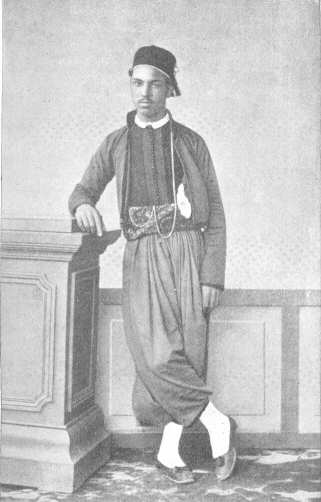
Tuesday.—We have a family quarrel going on.
Mohammed’s wife, a girl of eighteen or so, wanted to go
home on Bairam day for her mother to wash her head and unplait
her hair. Mohammed told her not to leave him on that day,
and to send for a woman to do it for her; whereupon she cut off
her hair, and Mohammed, in a passion, told her to ‘cover
her face’ (that is equivalent to a divorce) and take her
baby and go home to her father’s house. Ever since he
has been mooning about the yard and in and out of the kitchen
very glum and silent. This morning I went into the kitchen
and found Omar cooking with a little baby in his arms, and giving
it sugar. ‘Why what is that?’ say I.
‘Oh don’t say anything. I sent Achmet to fetch
Mohammed’s baby, and when he comes here he will see it, and
then in talking I can say so and so, and how the man must be good
to the Hareem, and what this poor, small girl do when she
big enough to ask for her father.’ In short, Omar
wants to exercise his diplomacy in making up the quarrel.
After writing this I heard Mohammed’s low, quiet voice, and
Omar’s boyish laugh, and then silence, and went to see the
baby and its father. My kitchen was a pretty scene.
Mohammed, in his ample brown robes and white turban, lay asleep
on the floor with the baby’s tiny pale face and little
eyelids stained with kohl against his coffee-brown cheek, both
fast asleep, baby in her father’s arms. Omar leant
against the fournaise in his house-dress, a white shirt
open at the throat and white drawers reaching to the knees, with
the red tarboosh and red and yellow kufyeh (silk
handkerchief) round it turban-wise, contemplating them with his
great, soft eyes. The two young men made an excellent
contrast between Upper and Lower Egypt. Mohammed is the
true Arab type—coffee-brown, thin, spare, sharp-featured,
elegant hands and feet, bright glittering small eyes and angular
jaw—not a handsome Arab, but bien
charactérisé. Omar, the colour of new
boxwood or old ivory, pale, with eyes like a cow, full lips, full
chin and short nose, not the least negro, but perfectly Egyptian,
the eyes wide apart—unlike the Arab—moustache like a
woman’s eyebrow, curly brown hair, bad hands and feet and
not well made, but graceful in movement and still more in
countenance, very inferior in beauty to the pure Arab blood which
prevails here, but most sweet in expression. He is a true
Akh-ul-Benât (brother of girls), and truly
chivalrous to Hareem. How astonished Europeans would
be to hear Omar’s real opinion of their conduct to
women. He mentioned some Englishman who had divorced his
wife and made her frailty public. You should have seen him
spit on the floor in abhorrence. Here it is quite
blackguard not to forfeit the money and take all the blame in a
divorce.
Friday.—We have had better weather again,
easterly wind and pretty cool, and I am losing the cough and
languor which the damp of the Simoom brought me. Sheykh
Yussuf has just come back from Keneh, whither he and the Kadee
went on their donkeys for some law business. He took our
saddle bags at Omar’s request, and brought us back a few
pounds of sugar and some rice and tobacco (isn’t it like
Fielding’s novels?). It is two days’ journey,
so they slept in the mosque at Koos half way. I told Yussuf
how Suleyman’s child has the smallpox and how Mohammed only
said it was Min Allah (from God) when I suggested that his
baby should be vaccinated at once. Yussuf called him in and
said: ‘Oh man, when thou wouldst build a house dost thou
throw the bricks in a heap on the ground and say the building
thereof is from God, or dost thou use the brains and hands which
God has given thee, and then pray to Him to bless thy work?
In all things do the best of thy understanding and means, and
then say Min Allah, for the end is with Him!’
There is not a pin to choose in fatalism here between Muslim and
Christian, the lazy, like Mohammed and Suleyman (one Arab the
other Copt), say Min Allah or any form of dawdle you
please; but the true Muslim doctrine is just what Yussuf laid
down—‘do all you can and be resigned to whatever be
the result.’ Fais ce que dois advienne qui
pourra is good doctrine. In fact, I am very much
puzzled to discover the slightest difference between Christian
and Muslim morality or belief—if you exclude certain
dogmas—and in fact, very little is felt here. No one
attempts to apply different standards of morals or of piety to a
Muslim and a Copt. East and West is the difference, not
Muslim and Christian. As to that difference I could tell
volumes. Are they worse? Are they better? Both
and neither. I am, perhaps, not quite impartial, because I
am sympathique to the Arabs and they to me, and I am
inclined to be ‘kind’ to their virtues if not
‘blind’ to their faults, which are visible to the
most inexperienced traveller. You see all our own familiar
‘bunkum’ (excuse the vulgarity) falls so flat on
their ears, bravado about ‘honour,’
‘veracity,’ etc., etc., they look blank and bored
at. The schoolboy morality as set forth by Maurice is
current here among grown men. Of course we tell lies to
Pashas and Beys, why shouldn’t we? But shall I call
in that ragged sailor and give him an order to bring me up
£500 in cash from Cairo when he happens to come? It
would not be an unusual proceeding. I sleep every night in
a makaab (sort of verandah) open to all Luxor, and
haven’t a door that has a lock. They bother me for
backsheesh; but oh how poor they are, and how rich must be a
woman whose very servants drink sugar to their coffee! and who
lives in the Kasr (palace) and is respectfully visited by
Ali Bey—and, come to that, Ali Bey would like a present
even better than the poorest fellah, who also loves to give
one. When I know, as I now do thoroughly, all Omar’s
complete integrity—without any sort of mention of
it—his self-denial in going ragged and shabby to save his
money for his wife and child (a very great trial to a
good-looking young Arab), and the equally unostentatious love he
has shown to me, and the delicacy and real nobleness of feeling
which come out so oddly in the midst of sayings which, to our
ideas, seem very shabby and time-serving, very often I wonder if
there be anything as good in the civilized West. And as
Sally most justly says, ‘All their goodness is quite their
own. God knows there is no one to teach anything but
harm!’
Tuesday.—Two poor fellows have just come home
from the Suez Canal work with gastric fever, I think. I
hope it won’t spread. The wife of one said to me
yesterday, ‘Are there more Sittat (ladies) like you
in your village?’ ‘Wallah,’ said I,
‘there are many better, and good doctors,
Alhamdullillah!’ ‘Alhamdullillah,’ said
she, ‘then the poor people don’t want you so much,
and by God you must stay here for we can’t do
without you, so write to your family to say so, and don’t
go away and leave us.’
Thursday, June 2,—A steamer has just
arrived which will take this letter, so I can only say good-bye,
my dearest Mutter, and God bless you. I continue very
fairly well. The epidemic here is all but over; but my
medical fame has spread so, that the poor souls come twenty miles
(from Koos) for physic. The constant phrase of ‘Oh
our sister, God hath sent thee to look to us!’ is so
sad. Such a little help is a wonder to my poor
fellaheen. It is not so hot as it was I think, except at
night, and I now sleep half the night outside the house.
The cattle are all dead; perhaps five are left in all
Luxor. Allah kereem! (God is merciful) said fellah
Omar, ‘I have one left from fifty-four.’ The
grain is unthreshed, and butter three shillings a pound! We
get nothing here but by post; no papers, no nothing. I
suppose the high Nile will bring up boats. Now the river is
down at its lowest, and now I really know how Egyptians live.
To Sir Alexander Duff
Gordon.
Luxor,
Sunday, June 12, 1864.
Dearest Alick,
Three letters have I received from you within a few days, for
the post of the Saeed is not that of the Medes and
Persians. I have had an abominable toothache, which quite
floored me, and was aggravated by the Oriental custom, namely,
that all the beau monde of Thebes would come and
sit with me, and suggest remedies, and look into my mouth, and
make quite a business of my tooth. Sheykh Yussuf laid two
fingers on my cheek and recited verses from the Koran, I regret
to say with no effect, except that while his fingers touched me
the pain ceased. I find he is celebrated for
soothing headaches and other nervous pains, and I daresay is an
unconscious mesmeriser. The other day our poor Maōhn
was terrified by a communication from Ali Bey (Moudir of Keneh)
to the effect that he had heard from Alexandria that someone had
reported that the dead cattle had lain about the streets of Luxor
and that the place was pestilential. The British mind at
once suggested a counter-statement, to be signed by the most
respectable inhabitants. So the Cadi drew it up, and came
and read it to me, and took my deposition and witnessed my
signature, and the Maōhn went his way rejoicing, in that
‘the words of the Englishwoman’ would utterly defeat
Ali Bey. The truth was that the worthy Maōhn worked
really hard, and superintended the horrible dead cattle business
in person, which is some risk and very unpleasant. To
dispose of three or four hundred dead oxen every day with a
limited number of labourers is no trifle, and if a travelling
Englishman smells one a mile off he calls us ‘lazy
Arabs.’ The beasts could not be buried deep enough,
but all were carried a mile off from the village. I wish
some of the dilettanti who stop their noses at us in our trouble
had to see or to do what I have seen and done.
June 17.—We have had four or five days of such
fearful heat with a Simoom that I have been quite knocked up, and
literally could not write. Besides, I sit in the dark all
day, and am now writing so—and at night go out and sit in
the verandah, and can’t have candles because of the
insects. I sleep outside till about six a.m., and then go
indoors till dark again. This fortnight is the hottest
time. To-day the drop falls into the Nile at its source,
and it will now rise fast and cool the country. It has
risen one cubit, and the water is green; next month it will be
blood colour. My cough has been a little troublesome again,
I suppose from the Simoom. The tooth does not ache
now. Alhamdulillah! for I rather dreaded the
muzeyinn (barber) with his tongs, who is the sole
dentist here. I was amused the other day by the entrance of
my friend the Maōhn, attended by Osman Effendi and his
cawass and pipe-bearer, and bearing a saucer in his hand, wearing
the look, half sheepish, half cocky, with which elderly gentlemen
in all countries announce what he did, i.e., that his
black slave-girl was three months with child and longed for
olives, so the respectable magistrate had trotted all over the
bazaar and to the Greek corn-dealers to buy some, but for no
money were they to be had, so he hoped I might have some and
forgive the request, as I, of course, knew that a man must beg or
even steal for a woman under these circumstances. I called
Omar and said, ‘I trust there are olives for the honourable
Hareem of Seleem Effendi—they are needed
there.’ Omar instantly understood the case, and
‘Praise be to God a few are left; I was about to stuff the
pigeons for dinner with them; how lucky I had not done
it.’ And then we belaboured Seleem with
compliments. ‘Please God the child will be fortunate
to thee,’ say I. Omar says, ‘Sweeten my mouth,
oh Effendim, for did I not tell thee God would give thee good out
of this affair when thou boughtest her?’ While we
were thus rejoicing over the possible little mulatto, I thought
how shocked a white Christian gentleman of our Colonies would be
at our conduct to make all this fuss about a black
girl—‘he give her sixpence’ (under the
same circumstances I mean) ‘he’d see her d---d
first,’ and my heart warmed to the kind old Muslim sinner
(?) as he took his saucer of olives and walked with them openly
in his hand along the street. Now the black girl is free,
and can only leave Seleem’s house by her own good will and
probably after a time she will marry and he will pay the
expenses. A man can’t sell his slave after he has
made known that she is with child by him, and it would be
considered unmanly to detain her if she should wish to go.
The child will be added to the other eight who fill the
Maōhn’s quiver in Cairo and will be exactly as well
looked on and have equal rights if he is as black as a coal.
A most quaint little half-black boy a year and a half old has
taken a fancy to me and comes and sits for hours gazing at me and
then dances to amuse me. He is Mahommed our guard’s
son by a jet-black slave of his and is brown-black and very
pretty. He wears a bit of iron wire in one ear and iron
rings round his ankles, and that is all—and when he comes
up little Achmet, who is his uncle, ‘makes him fit to be
seen’ by emptying a pitcher of water over his head to rinse
off the dust in which of course he has been rolling—that is
equivalent to a clean pinafore. You would want to buy
little Said I know, he is so pretty and so jolly. He dances
and sings and jabbers baby Arabic and then sits like a quaint
little idol cross-legged quite still for hours.
I am now writing in the kitchen, which is the coolest place
where there is any light at all. Omar is diligently
spelling words of six letters, with the wooden spoon in his hand
and a cigarette in his mouth, and Sally is lying on her back on
the floor. I won’t describe our costume. It is
now two months since I have worn stockings, and I think you would
wonder at the fellaha who ‘owns you,’ so deep a brown
are my face, hands and feet. One of the sailors in
Arthur’s boat said: ‘See how the sun of the Arabs
loves her; he has kissed her so hotly that she can’t go
home among English people.’
June 18.—I went last night to look at Karnac by
moonlight. The giant columns were overpowering. I
never saw anything so solemn. On our way back we met the
Sheykh-el-Beled, who ordered me an escort of ten men home.
Fancy me on my humble donkey, guarded most superfluously by ten
tall fellows, with oh! such spears and venerable
matchlocks. At Mustapha’s house we found a party
seated before the door, and joined it. There was a
tremendous Sheykh-el-Islam from Tunis, a Maghribee, seated on a
carpet in state receiving homage. I don’t think he
liked the heretical woman at all. Even the Maōhn did
not dare to be as ‘politeful’ as usual to me, but
took the seat above me, which I had respectfully left vacant next
to the holy man. Mustapha was in a stew, afraid not to do
the respectful to me, and fussing after the Sheykh. Then
Yussuf came fresh from the river, where he had bathed and prayed,
and then you saw the real gentleman. He salaamed the great
Sheykh, who motioned to him to sit before him, but Yussuf quietly
came round and sat below me on the mat, leaned his elbow
on my cushion, and made more demonstration of regard for me than
ever, and when I went came and helped me on my donkey. The
holy Sheykh went away to pray, and Mustapha hinted to Yussuf to
go with him, but he only smiled, and did not stir; he had prayed
an hour before down at the Nile. It was as if a poor curate
had devoted himself to a rank papist under the eye of a scowling
Shaftesbury Bishop. Then came Osman Effendi, a young Turk,
with a poor devil accused in a distant village of stealing a
letter with money in it addressed to a Greek money-lender.
The discussion was quite general, the man, of course, denying
all. But the Nazir had sent word to beat him. Then
Omar burst out, ‘What a shame to beat a poor man on the
mere word of a Greek money-lender who eats the people; the Nazir
shouldn’t help him.’ There was a Greek present
who scowled at Omar, and the Turk gaped at him in horror.
Yussuf said, with his quiet smile, ‘My brother, thou art
talking English,’ with a glance at me; and we all laughed,
and I said, ‘Many thanks for the compliment.’
All the village is in good spirits; the Nile is rising fast, and
a star of most fortunate character has made its appearance, so
Yussuf tells me, and portends a good year and an end to our
afflictions. I am much better to-day, and I think I too
feel the rising Nile; it puts new life into all things. The
last fortnight or three weeks have been very trying with the
Simoom and intense heat. I suppose I look better for the
people here are for ever praising God about my amended
looks. I am too hot, and it is too dark to write more.
To Sir Alexander Duff
Gordon.
Luxor,
June 26, 1864.
Dearest Alick,
I have just paid a singular visit to a political detenu
or exile rather. Last night Mustapha came in with a man in
great grief who said his boy was very ill on board a cangia just
come from Cairo and going to Assouan. The watchman on the
river-bank had told him that there was an English Sitt ‘who
would not turn her face from anyone in trouble’ and advised
him to come to me for medicine, so he went to Mustapha and begged
him to bring him to me, and to beg the cawass (policeman) in
charge of El-Bedrawee (who was being sent to Fazoghlou in
banishment) to wait a few hours. The cawass (may he not
suffer for his humanity) consented. He described his
boy’s symptoms and I gave him a dose of castor oil and said
I would go to the boat in the morning. The poor fellow was
a Cairo merchant but living at Khartoum, he poured out his sorrow
in true Eastern style. ‘Oh my boy, and I have none
but he, and how shall I come before his mother, a Habbesheeyeh,
oh Lady, and tell her “thy son is dead”?’
So I said, ‘Allah kereem ya Seedee, and Inshallah
tayib,’ etc., etc., and went this morning early to the
boat. It was a regular old Arab cangia lumbered up with
corn, sacks of matting, a live sheep, etc., and there I found a
sweet graceful boy of fifteen or so in a high fever. His
father said he had visited a certain Pasha on the way and
evidently meant that he had been poisoned or had the evil
eye. I assured him it was only the epidemic and asked why
he had not sent for the doctor at Keneh. The old
story! He was afraid, ‘God knows what a government
doctor might do to the boy.’ Then Omar came in and
stood before El-Bedrawee and said, ‘Oh my master, why do we
see thee thus? Mashallah, I once ate of thy bread when I
was of the soldiers of Said Pasha, and I saw thy riches and thy
greatness, and what has God decreed against thee?’ So
El-Bedrawee who is (or was) one of the wealthiest men of Lower
Egypt and lived at Tantah, related how Effendina (Ismail Pasha)
sent for him to go to Cairo to the Citadel to transact some
business, and how he rode his horse up to the Citadel and went
in, and there the Pasha at once ordered a cawass to take him down
to the Nile and on board a common cargo boat and to go with him
and take him to Fazoghlou. Letters were given to the cawass
to deliver to every Moudir on the way, and another despatched by
hand to the Governor of Fazoghlou with orders concerning
El-Bedrawee. He begged leave to see his son once more
before starting, or any of his family. ‘No, he must
go at once and see no one.’ But luckily a fellah, one
of his relations had come after him to Cairo and had £700
in his girdle; he followed El-Bedrawee to the Citadel and saw him
being walked off by the cawass and followed him to the river and
on board the boat and gave him the £700 which he had in his
girdle. The various Moudirs had been civil to him, and
friends in various places had given him clothes and food.
He had not got a chain round his neck or fetters, and was allowed
to go ashore with the cawass, for he had just been to the tomb of
Abou-l-Hajjaj and had told that dead Sheykh all his affliction
and promised, if he came back safe, to come every year to his
moolid (festival) and pay the whole expenses (i.e.
feed all comers). Mustapha wanted him to dine with him and
me, but the cawass could not allow it, so Mustapha sent him a
fine sheep and some bread, fruit, etc. I made him a present
of some quinine, rhubarb pills, and sulphate of zinc for eye
lotion. Here you know we all go upon a more than English
presumption and believe every prisoner to be innocent and a
victim—as he gets no trial he never can be proved
guilty—besides poor old El-Bedrawee declared he had not the
faintest idea what he was accused of or how he had offended
Effendina.
I listened to all this in extreme amazement, and he said,
‘Ah! I know you English manage things very
differently; I have heard all about your excellent
justice.’
He was a stout, dignified-looking fair man, like a Turk, but
talking broad Lower Egypt fellah talk, so that I could not
understand him, and had to get Mustapha and Omar to repeat his
words. His father was an Arab, and his mother a Circassian
slave, which gave the fair skin and reddish beard. He must
be over fifty, fat and not healthy; of course he is meant
to die up in Fazoghlou, especially going at this season. He
owns (or owned, for God knows who has it now) 12,000 feddans of
fine land between Tantah and Samanhoud, and was enormously
rich. He consulted me a great deal about his health, and I
gave him certainly very good advice. I cannot write in a
letter which I know you will show what drugs a Turkish doctor had
furnished him with to ‘strengthen’ him in the trying
climate of Fazoghlou. I wonder was it intended to kill him
or only given in ignorance of the laws of health equal to his
own?
After a while the pretty boy became better and recovered
consciousness, and his poor father, who had been helping me with
trembling hands and swimming eyes, cried for joy, and said,
‘By God the most high, if ever I find any of the English,
poor or sick or afflicted up in Fazoghlou, I will make them know
that I Abu Mahommed never saw a face like the pale face of the
English lady bent over my sick boy.’ And then
El-Bedrawee and his fellah kinsman, and all the crew blessed me
and the Captain, and the cawass said it was time to sail.
So I gave directions and medicine to Abu Mahommed, and kissed the
pretty boy and went out. El-Bedrawee followed me up the
bank, and said he had a request to make—would I pray for
him in his distress. I said, ‘I am not of the
Muslimeen,’ but both he and Mustapha said, Maleysh
(never mind), for that it was quite certain I was not of the
Mushkireen, as they hate the Muslimeen and their deeds are
evil—but blessed be God, many of the English begin to
repent of their evil, and to love the Muslims and abound in kind
actions. So we parted in much kindness. It was a
strange feeling to me to stand on the bank and see the queer
savage-looking boat glide away up the stream, bound to such far
more savage lands, and to be exchanging kind farewells quite in a
homely manner with such utter ‘aliens in blood and
faith.’ ‘God keep thee Lady, God keep thee
Mustapha.’ Mustapha and I walked home very sad about
poor El-Bedrawee.
Friday, July 7.—It has been so
‘awfully’ hot that I have not had pluck to go on with
my letter, or indeed to do anything but lie on a mat in the
passage with a minimum of clothes quite indescribable in
English. Alhamdulilah! laughs Omar, ‘that I
see the clever English people do just like the lazy
Arabs.’ The worst is not the positive heat, which has
not been above 104° and as low as 96° at night, but the
horrible storms of hot wind and dust which are apt to come on at
night and prevent one’s even lying down till twelve or one
o’clock. Thebes is bad in the height of summer on
account of its expanse of desert, and sand and dust. The
Nile is pouring down now gloriously, and really red as
blood—more crimson than a Herefordshire lane—and in
the distance the reflection of the pure blue sky makes it deep
violet. It had risen five cubits a week ago; we shall soon
have it all over the land here. It is a beautiful and
inspiriting sight to see the noble old stream as young and
vigorous as ever. No wonder the Egyptians worshipped the
Nile: there is nothing like it. We have had all the plagues
of Egypt this year, only the lice are commuted for bugs, and the
frogs for mice; the former have eaten me and the latter have
eaten my clothes. We are so ragged! Omar has one
shirt left, and has to sleep without and wash it every
night. The dust, the drenching perspiration, and the
hard-fisted washing of Mahommed’s slave-women destroys
everything.
Mustapha intends to give you a grand fantasia if you
come, and to have the best dancing girls down from Esneh for you;
but I am consternated to hear that you can’t come till
December. I hoped you would have arrived in Cairo early in
November, and spent a month there with me, and come up the river
in the middle of December when Cairo gets very cold.
I remain very well in general health, but my cough has been
troublesome again. I do not feel at all like breathing cold
damp air again. This depresses me very much as you may
suppose. You will have to divorce me, and I must marry some
respectable Kadee. I have been too ‘lazy Arab,’
as Omar calls it, to go on with my Arabic lessons, and Yussuf has
been very busy with law business connected with the land and the
crops. Every harvest brings a fresh settling of the
land. Wheat is selling at £1 the ardeb [188] here on the threshing-floor,
and barley at one hundred and sixteen piastres; I saw some
Nubians pay Mustapha that. He is in comic perplexity about
saying Alhamdulillah about such enormous gains—you
see it is rather awkward for a Muslim to thank God for dear
bread—so he compounds by very lavish almsgiving. He
gave all his fellaheen clothes the other day—forty calico
shirts and drawers. Do you remember my describing an Arab
emancipirtes Fraülein at Siout? Well, the other
day I saw as I thought a nice-looking lad of sixteen selling corn
to my opposite neighbour, a Copt. It was a girl. Her
father had no son and is infirm, so she works in the field for
him, and dresses and does like a man. She looked very
modest and was quieter in her manner than the veiled women often
are.
I am so glad to hear such good accounts of my Rainie and
Maurice. I can hardly bear to think of another year without
seeing them. However it is fortunate for me that ‘my
lines have fallen in pleasant places,’ so long a time at
the Cape or any Colony would have become intolerable. Best
love to Janet, I really can’t write, it’s too hot and
dusty. Omar desires his salaam to his great master and to
that gazelle Sittee Ross.
To Sir Alexander Duff
Gordon.
Luxor,
August 13, 1864.
Dearest Alick,
For the last month we have had a purgatory of hot wind and
dust, such as I never saw—impossible to stir out of the
house. So in despair I have just engaged a return
boat—a Gelegenheit—and am off to Cairo in a
day or two, where I shall stop till Inshallah! you come to
me. Can’t you get leave to come at the beginning of
November? Do try, that is the pleasant time in Cairo.
I am a ‘stupid, lazy Arab’ now, as Omar says,
having lain on a mat in a dark stone passage for six weeks or so,
but my chest is no worse—better I think, and my health has
not suffered at all—only I am stupid and lazy. I had
a pleasant visit lately from a great doctor from Mecca—a
man so learned that he can read the Koran in seven different
ways, he is also a physician of European Hekmeh
(learning). Fancy my wonder when a great Alim in gorgeous
Hegazee dress walked in and said: ‘Madame, tout ce
qu’on m’a dit de vous fait tellement
l’éloge de votre cœur et de votre esprit que
je me suis arreté pour tacher de me procurer le plaisir de
votre connaissance!’ A lot of Luxor people came
in to pay their respects to the great man, and he said to me that
he hoped I had not been molested on account of religion, and if I
had I must forgive it, as the people here were so very ignorant,
and barbarians were bigots everywhere. I said,
‘Wallahy, the people of Luxor are my
brothers!’ and the Maōhn said, ‘True, the
fellaheen are like oxen, but not such swine as to insult the
religion of a lady who has served God among them like this
one. She risked her life every day.’ ‘And
if she had died,’ said the great theologian,
‘her place was made ready among the martyrs of God, because
she showed more love to her brothers than to herself!’
Now if this was humbug it was said in Arabic before eight or
ten people, by a man of great religious authority.
Omar was aux anges to hear his Sitt spoken of ‘in
such a grand way for the religion.’ I believe that a
great change is taking place among the Ulema, that Islam is
ceasing to be a mere party flag, just as occurred with
Christianity, and that all the moral part is being more and more
dwelt on. My great Alim also said I had practised the
precepts of the Koran, and then laughed and added, ‘I
suppose I ought to say the Gospel, but what matters it, el
Hakh (the truth) is one, whether spoken by Our Lord Jesus or
by Our Lord Mahommed!’ He asked me to go with him to
Mecca next winter for my health, as it was so hot and dry
there. I found he had fallen in with El-Bedrawee and the
Khartoum merchant at Assouan. The little boy was well
again, and I had been outrageously extolled by them. We are
now sending off all the corn. I sat the other evening on
Mustapha’s doorstep and saw the Greeks piously and
zealously attending to the divine command to spoil the
Egyptians. Eight months ago a Greek bought up corn at 60
piastres the ardeb (he follows the Coptic tax-gatherer like a
vulture after a crow), now wheat is at 170 piastres the ardeb
here, and the fellah has paid 3½ per cent. a month
besides. Reckon the profit! Two men I know are quite
ruined, and have sold all they had. The cattle disease
forced them to borrow at these ruinous rates, and now alas, the
Nile is sadly lingering in its rise, and people are very
anxious. Poor Egypt! or rather, poor Egyptians! Of
course, I need not say that there is great improvidence in those
who can be fleeced as they are fleeced. Mustapha’s
household is a pattern of muddling hospitality, and Mustapha is
generous and mean by turns; but what chance have people like
these, so utterly uncivilized and so isolated, against Europeans
of unscrupulous characters.
I can’t write more in the wind and dust. You shall
hear again from Cairo.
To Sir Alexander Duff
Gordon.
Cairo,
October 9, 1864.
Dearest Alick,
I have not written for a long time because I have had a
fever. Now I am all right again, only weak. If you
can come please bring the books in enclosed list for an American
Egyptologist at Luxor—a friend of mine. My best love
to Janet and my other chicks. I wish I could see my
Maurice. Tell Janet that Hassan donkey boy, has married a
girl of eleven, and Phillips that Hassan remembers him quite
tenderly and is very proud of having had his ‘face’
drawn by him, ‘certainly he was of the friends if not a
brother of the Sitt, he so loved the things of the
Arabs.’ I went to the Hareem soirée at
Hassan’s before the wedding—at that event I was
ill. My good doctor was up the river, and Hekekian Bey is
in Italy, so I am very lonely here. The weather is bad, so
very damp; I stream with perspiration more than in June at Luxor,
and I don’t like civilization so very much. It keeps
me awake at night in the grog shops and rings horrid bells and
fights and quarrels in the street, and disturbs my Muslim nerves
till I utter such epithets as kelb (dog) and
khanseer (pig) against the Frangi, and wish I were in a
‘beastly Arab’ quarter.
To Mrs. Austin.
Cairo,
October 21, 1864.
Dearest Mutter,
I got your letter yesterday. I hope Alick got mine of
two weeks ago before leaving, and told you I was better. I
am still rather weak, however I ride my donkey and the weather
has suddenly become gloriously dry and cool. I rather
shiver with the thermometer at 79°—absurd is it not,
but I got so used to real heat.
I never wrote about my leaving Luxor or my journey, for our
voyage was quite tempestuous after the three first days and I
fell ill as soon as I was in my house here. I hired the
boat for six purses (£18) which had taken Greeks up to
Assouan selling groceries and strong drinks, but the reis would
not bring back their cargo of black slaves to dirty the boat and
picked us up at Luxor. We sailed at daybreak having waited
all one day because it was an unlucky day.
As I sat in the boat people kept coming to ask whether I was
coming back very anxiously and bringing fresh bread, eggs and
things as presents, and all the quality came to take leave and
hope, Inshallah, I should soon ‘come home to my
village safe and bring the Master, please God, to see
them,’ and then to say the Fattah for a safe journey
and my health. In the morning the balconies of my house
were filled with such a group to see us sail—a party of
wild Abab’deh with their long Arab guns and flowing hair, a
Turk elegantly dressed, Mohammed in his decorous brown robes and
snow-white turban, and several fellaheen. As the boat moved
off the Abab’deh blazed away with their guns and Osman
Effendi with a sort of blunderbuss, and as we dropped down the
river there was a general firing; even Todoros (Theodore), the
Coptic Mallim, popped off his American revolver. Omar
keeping up a return with Alick’s old horse pistols which
are much admired here on account of the excessive noise they
make.
Poor old Ismain, who always thought I was Mme. Belzoni and
wanted to take me up to Abou Simbel to meet my husband, was in
dire distress that he could not go with me to Cairo. He
declared he was still shedeed (strong enough to take care
of me and to fight). He is ninety-seven and only remembers
fifty or sixty years ago and old wild times—a splendid old
man, handsome and erect. I used to give him coffee and
listen to his old stories which had won his heart. His
grandson, the quiet, rather stately, Mohammed who is guard of the
house I lived in, forgot all his Muslim dignity, broke down in
the middle of his set speech and flung himself down and kissed
and hugged my knees and cried. He had got some notion of
impending ill-luck, I found, and was unhappy at our
departure—and the backsheesh failed to console him.
Sheykh Yussuf was to come with me, but a brother of his just
wrote word that he was coming back from the Hejaz where he had
been with the troops in which he is serving his time; I was very
sorry to lose his company. Fancy how dreadfully irregular
for one of the Ulema and a heretical woman to travel
together. What would our bishops say to a parson who did
such a thing? We had a lovely time on the river for three
days, such moonlight nights, so soft and lovely; and we had a
sailor who was as good as a professional singer, and who sang
religious songs, which I observe excite people here far more than
love songs. One which began ‘Remove my sins from
before thy sight Oh God’ was really beautiful and touching,
and I did not wonder at the tears which ran down Omar’s
face. A very pretty profane song was ‘Keep the wind
from me Oh Lord, I fear it will hurt me’ (wind means
love, which is like the Simoom) ‘Alas! it has struck
me and I am sick. Why do ye bring the physician? Oh
physician put back thy medicine in the canister, for only he who
has hurt can cure me.’ The masculine pronoun is
always used instead of she in poetry out of
decorum—sometimes even in conversation.
October 23.—Yesterday I met a Saedee—a
friend of the brother of the Sheykh of the wild Abab’deh,
and as we stood handshaking and kissing our fingers in the road,
some of the Anglo-Indian travellers passed and gazed with fierce
disgust; the handsome Hassan, being black, was such a flagrant
case of a ‘native.’ Mutter dear, it is
heart-breaking to see what we are sending to India now. The
mail days are dreaded, we never know when some outrage may not
excite ‘Mussulman fanaticism.’ The English
tradesmen here complain as much as anyone, and I, who as the
Kadee of Luxor said am ‘not outside the family’ (of
Ishmael, I presume), hear what the Arabs really think.
There are also crowds ‘like lice’ as one Mohammed
said, of low Italians, French, etc., and I find my stalwart
Hassan’s broad shoulders no superfluous
porte-respect in the Frangee quarter. Three times I
have been followed and insolently stared at (à mon
age)!! and once Hassan had to speak. Fancy how dreadful
to Muslims! I hate the sight of a hat here now.
I can’t write more now my eyes are weak still.
Omar begs me to give you his best salaam and say,
Inshallah, he will take great care of your daughter, which
he most zealously and tenderly does.
To Mrs. Austin.
On the
Nile,
Friday, December 23, 1864.
Dearest Mutter,
Here I am again between Benisouef and Minieh, and already
better for the clear air of the river and the tranquil boat life;
I will send you my Christmas Salaam from Siout. While Alick
was with me I had as much to do as I was able and could not write
for there was much to see and talk about. I think he was
amused but I fear he felt the Eastern life to be very poor and
comfortless. I have got so used to having nothing that I
had quite forgotten how it would seem to a stranger.
I am quite sorry to find how many of my letters must have been
lost from Luxor; in future I shall trust the Arab post which
certainly is safer than English travellers. I send you my
long plaits by Alick, for I had my hair cut short as it took to
falling out by handfuls after my fever, and moreover it is more
convenient Turkish hareem fashion.
Please tell Dean Stanley how his old dragoman Mahommed Gazawee
cried with pleasure when he told me he had seen Sheykh
Stanley’s sister on her way to India, and the ‘little
ladies’ knew his name and shook hands with him,
which evidently was worth far more than the backsheesh. I
wondered who ‘Sheykh’ Stanley could be, and Mahommed
(who is a darweesh and very pious) told me he was the
Gassis (priest) who was Imám (spiritual
guide) to the son of our Queen, ‘and in truth,’ said
he, ‘he is really a Sheykh and one who teaches the
excellent things of religion, why he was kind even to his horse!
and it is of the mercies of God to the English that such a one is
the Imám of your Queen and Prince.’ I said
laughing, ‘How dost thou, a darweesh among Muslims, talk
thus of a Nazarene priest?’ ‘Truly oh
Lady,’ he answered, ‘one who loveth all the creatures
of God, him God loveth also, there is no doubt of
that.’ Is any one bigot enough to deny that Stanley
has done more for real religion in the mind of that Muslim
darweesh than if he had baptised a hundred savages out of one
fanatical faith into another?
There is no hope of a good understanding with Orientals until
Western Christians can bring themselves to recognise the common
faith contained in the two religions, the real difference
consists in all the class of notions and feelings (very important
ones, no doubt) which we derive—not from the Gospels at
all—but from Greece and Rome, and which of course are
altogether wanting here.
Alick will tell you how curiously Omar illustrated the
patriarchal feelings of the East by entirely dethroning me in
favour of the ‘Master.’ ‘That our
Master, we all eat bread from his hand, and he work for
us.’ Omar and I were equal before our
Seedee. He can sit at his ease at my feet, but when the
Master comes in he must stand reverently, and gave me to
understand that I too must be respectful.
I have got the boat of the American Mission at an outrageous
price, £60, but I could get nothing under; the consolation
is that the sailors profit, poor fellows, and get treble
wages. My crew are all Nubians. Such a handsome reis
and steersman—brothers—and there is a black boy, of
fourteen or so, with legs and feet so sweetly beautiful as to be
quite touching—at least I always feel those lovely round
young innocent forms to be somehow affecting. Our old boat
of last summer (Arthur Taylor’s) is sailing in company with
us, and stately old reis Mubharak hails me every morning with the
Blessing of God and the Peace of the Prophet. Alee Kuptan,
my steamboat captain will announce our advent at Thebes; he
passed us to-day. This boat is a fine sailer, but iron
built and therefore noisy, and not convenient. The crew
encourage her with ‘Get along, father of three,’
because she has three sails, whereas two is the usual
number. They are active good-humoured fellows—my
men—but lack the Arab courtesy and simpatico ways,
and then I don’t understand their language which is pretty
and sounds a little like Caffre, rather bird-like and sing-song,
instead of the clattering guttural Arabic. I now speak
pretty tolerably for a stranger, i.e. I can keep up a
conversation, and understand all that is said to me much better
than I can speak, and follow about half what people say to each
other. When I see you, Inshallah, next summer I
shall be a good scholar, I hope.
To Mrs. Austin.
Luxor,
January 2, 1865.
Dearest Mutter,
I posted a letter for you at Girgeh, as we passed Siout with a
good wind, I hope you will get it. My crew worked as I
never saw men work, they were paid to get to Luxor, and for
eighteen days they never rested or slept day or night, and all
the time were merry and pleasant. It shows what power of
endurance these ‘lazy Arabs’ have when there is good
money at the end of a job, instead of the favourite panacea of
‘stick.’
We arrived at midnight and next morning my boat had the air of
being pillaged. A crowd of laughing, chattering fellows ran
off to the house laden with loose articles snatched up at random,
loaves of sugar, pots and pans, books, cushions, all
helter-skelter. I feared breakages, but all was housed safe
and sound. The small boys of an age licensed to penetrate
into the cabin, went off with the oddest cargoes of dressing
things and the like—of backsheesh not one word.
Alhamdulillah salaameh! ‘Thank God thou art in
peace,’ and Ya Sitt, Ya Emeereh, till my head went
round. Old Ismaeen fairly hugged me and little Achmet hung
close to my side. I went up to Mustapha’s house while
the unpacking took place and breakfasted there, and found letters
from all of you, from you to darling Rainie, Sheykh Yussuf was
charmed with her big writing and said he thought the news in that
was the best of all.
The weather was intensely hot the first two days. Now it
is heavenly, a fresh breeze and gorgeous sunshine. I
brought two common Arab lanterns for the tomb of Abu-l-Hajjaj and
his moolid is now going on. Omar took them and
lighted them up and told me he found several people who called on
the rest to say the Fathah for me. I was sitting out
yesterday with the people on the sand looking at the men doing
fantasia on horseback for the Sheykh, and a clever
dragoman of the party was relating about the death of a young
English girl whom he had served, and so de fil en aiguille
we talked about the strangers buried here and how the bishop had
extorted £100. I said, ‘Maleysh (never
mind) the people have been hospitable to me alive and they will
not cease if I die, but give me a tomb among the
Arabs.’ One old man said, ‘May I not see thy
day, oh Lady, and indeed thou shouldest be buried as a daughter
of the Arabs, but we should fear the anger of thy Consul and thy
family, but thou knowest that wherever thou art buried thou wilt
assuredly lie in a Muslim grave.’ ‘How
so?’ said I. ‘Why, when a bad Muslim dies the
angels take him out of his tomb and put in one of the good from
among the Christians in his place.’ This is the
popular expression of the doctrine that the good are sure of
salvation. Omar chimed in at once, ‘Certainly there
is no doubt of it, and I know a story that happened in the days
of Mahommed Ali Pasha which proves it.’ We demanded
the story and Omar began. ‘There was once a very rich
man of the Muslims so stingy that he grudged everybody even so
much as a “bit of the paper inside the date”
(Koran). When he was dying he said to his wife, “Go
out and buy me a lump of pressed dates,” and when she had
brought it he bade her leave him alone. Thereupon he took
all his gold out of his sash and spread it before him, and rolled
it up two or three pieces at a time in the dates, and swallowed
it piece after piece until only three were left, when his wife
came in and saw what he was doing and snatched them from his
hand. Presently after he fell back and died and was carried
out to the burial place and laid in his tomb. When the
Kadee’s men came to put the seal on his property and found
no money they said, “Oh woman, how is this? we know thy
husband was a rich man and behold we find no money for his
children and slaves or for thee.” So the woman told
what had happened, and the Kadee sent for three other of the
Ulema, and they decided that after three days she should go
herself to her husband’s tomb and open it, and take the
money from his stomach; meanwhile a guard was put over the tomb
to keep away robbers. After three days therefore the woman
went, and the men opened the tomb and said, “Go in O woman
and take thy money.” So the woman went down into the
tomb alone. When there, instead of her husband’s body
she saw a box (coffin) of the boxes of the Christians, and when
she opened it she saw the body of a young girl, adorned with many
ornaments of gold necklaces, and bracelets, and a diamond
Kurs on her head, and over all a veil of black muslin
embroidered with gold. So the woman said within herself,
“Behold I came for money and here it is, I will take it and
conceal this business for fear of the Kadee.” So she
wrapped the whole in her melayeh (a blue checked cotton
sheet worn as a cloak) and came out, and the men said “Hast
thou done thy business?”’ and she answered
“Yes” and returned home.
‘In a few days she gave the veil she had taken from the
dead girl to a broker to sell for her in the bazaar, and the
broker went and showed it to the people and was offered one
hundred piastres. Now there sat in one of the shops of the
merchants a great Ma-allim (Coptic clerk) belonging to the Pasha,
and he saw the veil and said, “How much asketh thou?”
and the broker said “Oh thine honour the clerk whatever
thou wilt.” “Take from me then five hundred
piastres and bring the person that gave thee the veil to receive
the money.” So the broker fetched the woman and the
Copt, who was a great man, called the police and said,
“Take this woman and fetch my ass and we will go before the
Pasha,” and he rode in haste to the palace weeping and
beating his breast, and went before the Pasha and said,
“Behold this veil was buried a few days ago with my
daughter who died unmarried, and I had none but her and I loved
her like my eyes and would not take from her her ornaments, and
this veil she worked herself and was very fond of it, and she was
young and beautiful and just of the age to be married; and behold
the Muslims go and rob the tombs of the Christians and if thou
wilt suffer this we Christians will leave Egypt and go and live
in some other country, O Effendina, for we cannot endure this
abomination.”
‘Then the Pasha turned to the woman and said, “Woe
to thee O woman, art thou a Muslimeh and doest such
wickedness?” And the woman spoke and told all that
had happened and how she sought money and finding gold had kept
it. So the Pasha said, “Wait oh Ma-allim, and we will
discover the truth of this matter,” and he sent for the
three Ulema who had desired that the tomb should be opened at the
end of three days and told them the case; and they said,
“Open now the tomb of the Christian damsel.”
And the Pasha sent his men to do so, and when they opened it
behold it was full of fire, and within it lay the body of the
wicked and avaricious Mussulman.’ Thus it was
manifest to all that on the night of terror the angels of God had
done this thing, and had laid the innocent girl of the Christians
among those who have received direction, and the evil Muslim
among the rejected. Admire how rapidly legends arise
here. This story which everybody declared was quite true is
placed no longer ago than in Mahommed Ali Pasha’s time.
There are hardly any travellers this year, instead of a
hundred and fifty or more boats, perhaps twenty. A son of
one of the Rothschilds, a boy of fourteen, has just gone up like
a royal prince in one of the Pasha’s steamers—all his
expenses paid and crowds of attendants. ‘All that
honour to the money of the Jew,’ said an old fellah to me
with a tone of scorn which I could not but echo in my
heart. He has turned out his dragoman—a respectable
elderly man, very sick, and paid him his bare wages and the
munificent sum of £5 to take him back to Cairo. On
board there was a doctor and plenty of servants, and yet he
abandons the man here on Mustapha’s hands. I have
brought Er-Rasheedee here (the sick man) as poor Mustapha is
already overloaded with strangers. I am sorry the name of
Yahoodee (Jew) should be made to stink yet more in the
nostrils of the Arabs. I am very well, indeed my cough is
almost gone and I can walk quite briskly and enjoy it. I
think, dear Mutter, I am really better. I never felt the
cold so little as this winter since my illness, the chilly
mornings and nights don’t seem to signify at all now, and
the climate feels more delicious than ever.
Mr. Herbert, the painter, went back to Cairo from Farshoot
below Keneh; so I have no ‘Frangee’ society at
all. But Sheykh Yussuf and the Kadee drop in to tea very
often and as they are agreeable men I am quite content with my
company.
Bye the bye I will tell you about the tenure of land in Egypt
which people are always disputing about, as the Kadee laid it
down for me. The whole land belongs to the Sultan of
Turkey, the Pasha being his vakeel (representative), nominally of
course as we know. Thus there are no owners, only tenants
paying from one hundred piastres tariff (£1) down to thirty
piastres yearly per feddan (about an acre) according to the
quality of the land, or the favour of the Pasha when granting
it. This tenancy is hereditary to children only—not
to collaterals or ascendants—and it may be sold, but in
that case application must be made to the Government. If
the owner or tenant dies childless the land reverts to the
Sultan, i.e. to the Pasha, and if the Pasha chooses to
have any man’s land he can take it from him on
payment—or without. Don’t let any one tell
you that I exaggerate; I have known it happen: I mean the
without, and the man received feddan for feddan of desert,
in return for his good land which he had tilled and watered.
To-morrow night is the great night of Sheykh
Abu-l-Hajjaj’s moolid and I am desired to go to the
mosque for the benefit of my health, and that my friends may say
a prayer for my children. The kind hearty welcome I found
here has been a real pleasure, and every one was pleased because
I was glad to come home to my beled (town), and they all
thought it so nice of ‘my master’ to have come so far
to see me because I was sick—all but one Turk, who clearly
looked with pitying contempt on so much trouble taken about a
sick old woman.
I have left my letter for a long while. You will not
wonder—for after some ten days’ fever, my poor guest
Mohammed Er-Rasheedee died to-day. Two Prussian doctors
gave me help for the last four days, but left last night.
He sank to sleep quietly at noon with his hand in mine, a good
old Muslim sat at his head on one side and I on the other.
Omar stood at his head and his black boy Khayr at his feet.
We had laid his face to the Kibleh and I spoke to him to see if
he knew anything and when he nodded the three Muslims chanted the
Islamee La Illáhá, etc., etc., while I
closed his eyes. The ‘respectable men’ came in
by degrees, took an inventory of his property which they
delivered to me, and washed the body, and within an hour and a
half we all went out to the burial place; I following among a
troop of women who joined us to wail for ‘the brother who
had died far from his place.’ The scene as we turned
in between the broken colossi and the pylons of the temple to go
to the mosque was over-powering. After the prayer in the
mosque we went out to the graveyard, Muslims and Copts helping to
carry the dead, and my Frankish hat in the midst of the veiled
and wailing women; all so familiar and yet so strange.
After the burial the Imám, Sheykh Abd-el-Waris, came and
kissed me on the shoulders and the Shereef, a man of eighty, laid
his hands on my shoulders and said, ‘Fear not my daughter,
neither all the days of thy life nor at the hour of thy death,
for God is with thee.’ I kissed the old man’s
hand and turned to go, but numberless men came and said ‘A
thousand thanks, O our sister, for what thou hast done for one
among us,’ and a great deal more. Now the solemn
chanting of the Fikees, and the clear voice of the boy
reciting the Koran in the room where the man died are ringing
through the house. They will pass the night in prayer, and
to-morrow there will be the prayer of deliverance in the
mosque. Poor Khayr has just crept in to have a quiet
cry—poor boy. He is in the inventory and to-morrow I
must deliver him up to les autorités to be
forwarded to Cairo with the rest of the property. He is
very ugly with his black face wet and swollen, but he kisses my
hand and calls me his mother quite ‘natural
like’—you see colour is no barrier here.
The weather is glorious this year, and in spite of some
fatigue I am extremely well and strong, and have hardly any cough
at all. I am so sorry that the young Rothschild was so hard
to Er-Rasheedee and that his French doctor refused to come and
see him. It makes bad blood naturally. However, the
German doctors were most kind and helpful.
The festival of Abu-l-Hajjaj was quite a fine sight, not
splendid at all—au contraire—but
spirit-stirring; the flags of the Sheykh borne by his family
chanting, and the men tearing about in mimic fight on horseback
with their spears. My acquaintance of last year,
Abd-el-Moutovil, the fanatical Sheykh from Tunis was there.
At first he scowled at me. Then someone told him how
Rothschild had left Er-Rasheedee, and he held forth about the
hatred of all the unbelievers to the Muslims, and ended by asking
where the sick man was. A quaint little smile twinkled in
Sheykh Yussuf’s soft eyes and he curled his silky moustache
as he said demurely, ‘Your Honour must go and visit him at
the house of the English Lady.’ I am bound to say
that the Pharisee ‘executed himself handsomely, for in a
few minutes he came up to me and took my hand and even hoped I
would visit the tomb of Abu-l-Hajjaj with him!!
Since I wrote last I have been rather poorly—more cough,
and most wearing sleeplessness. A poor young Englishman
died here at the house of the Austrian Consular agent. I
was too ill to go to him, but a kind, dear young Englishwoman, a
Mrs. Walker, who was here with her family in a boat, sat up with
him three nights and nursed him like a sister. A young
American lay sick at the same time in the house, he is now gone
down to Cairo, but I doubt whether he will reach it alive.
The Englishman was buried on the first day of Ramadan where they
bury strangers, on the site of a former Coptic church.
Archdeacon Moore read the service; Omar and I spread my old flag
over the bier, and Copts and Muslims helped to carry the poor
stranger. It was a most impressive sight. The party
of Europeans, all strangers to the dead but all deeply moved; the
group of black-robed and turbaned Copts; the sailors from the
boats; the gaily dressed dragomans; several brown-shirted
fellaheen and the thick crowd of children—all the little
Abab’deh stark naked and all behaving so well, the
expression on their little faces touched me most of all. As
Muslims, Omar and the boatmen laid him down in the grave, and
while the English prayer was read the sun went down in a glorious
flood of light over the distant bend of the Nile.
‘Had he a mother, he was young?’ said an
Abab’deh woman to me with tears in her eyes and pressing my
hand in sympathy for that far-off mother of such a different
race.
Passenger steamboats come now every fortnight, but I have had
no letter for a month. I have no almanack and have lost
count of European time—to-day is the 3 of Ramadan, that is
all I know. The poor black slave was sent back from Keneh,
God knows why—because he had no money and the Moudir could
not ‘eat off him’ as he could off the money and
property—he believes. He is a capital fellow, and in
order to compensate me for what he eats he proposed to wash for
me, and you would be amused to see Khayr with his coal-black face
and filed teeth doing laundry-maid out in the yard. He
fears the family will sell him and hopes he may fetch a good
price for ‘his boy’—only on the other hand he
would so like me to buy him—and so his mind is
disturbed. Meanwhile the having all my clothes washed clean
is a great luxury.
The steamer is come and I must finish in haste. I have
corrected the proofs. There is not much to alter, and
though I regret several lost letters I can’t replace
them. I tried, but it felt like a forgery. Do you cut
out and correct, dearest Mutter, you will do it much better than
I.
To the Dowager Lady Duff
Gordon.
Luxor,
January 8, 1865.
Dear old Lady,
I received your kind letter in the midst of the drumming and
piping and chanting and firing of guns and pistols and scampering
of horses which constitute a religious festival in Egypt.
The last day of the moolid of Abu-l-Hajjaj fell on the 1st
January so you came to wish me ‘May all the year be good to
thee’ as the people here were civil enough to do when I
told them it was the first day of the Frankish year.
(The Christian year here begins in September.)
I was very sorry to hear of poor Lady Theresa’s (Lady
Theresa Lewis) death. I feel as if I had no right to
survive people whom I left well and strong when I came away so
ill. As usual the air of Upper Egypt has revived me again,
but I am still weak and thin, and hear many lamentations at my
altered looks. However, ‘Inshallah, thou wilt
soon be better.’
Why don’t you make Alexander edit your letters from
Spain? I am sure they would be far more amusing than mine
can possibly be—for you can write letters and I
never could. I wish I had Miss Berry’s though I never
did think her such a genius as most people, but her letters must
be amusing from the time when they were written. Alexander
will tell you how heavy the hand of Pharaoh is upon this poor
people. ‘My father scourged you with whips but I will
scourge you with scorpions,’ did not Rehoboam say so? or I
forget which King of Judah. The distress here is frightful
in all classes, and no man’s life is safe.
Ali Bey Rheda told me the other day that Prince Arthur is
coming here and that he was coming up with him after taking a
Prince of Hohenzollern back to Cairo. There will be all the
fantasia possible for him here. Every man that has a
horse will gallop him to pieces in honour of the son of the Queen
of the English, and not a charge of powder will be spared.
If you see Layard tell him that Mustapha A’gha had the
whole Koran read for his benefit at the tomb of Abu-l-Hajjaj
besides innumerable fathahs which he said for him
himself. He consulted me as to the propriety of sending
Layard a backsheesh, but I declared that Layard was an Emeer of
the Arabs and a giver, not a taker of backsheesh.
To Mrs. Austin.
Luxor,
January 9, 1865.
I gave Sheykh Yussuf your knife to cut his kalem (reed
pen) with, and to his little girl the coral waistband clasp you
gave me as from you. He was much pleased. I
also brought the Shereef the psalms in Arabic to his great
delight. The old man called on all ‘our family’
to say a fathah for their sister, after making us all
laugh by shouting out ‘Alhamdulillah! here is our
darling safe back again.’
I wish you could have seen me in the crowd at Keneh holding on
to the Kadee’s farageeyeh (a loose robe worn by the
Ulema). He is the real original Kadee of the Thousand and
One Nights. Did ever Kadee tow an Englishwoman round a
Sheykh’s tomb before? but I thought his determination to
show the people that he considered a Christian not out of place
in a Muslim holy place very edifying.
I find an exceedingly pleasant man here, an Abab’deh, a
very great Sheykh from beyond Khartoum, a man of fifty I suppose,
with manners like an English nobleman, simple and polite and very
intelligent. He wants to take me to Khartoum for two months
up and back, having a tent and a takhterawan
(camel-litter) and to show me the Bishareen in the desert.
We traced the route on my map which to my surprise he understood,
and I found he had travelled into Zanzibar and knew of the
existence of the Cape of Good Hope and the English colony
there. He had also travelled in the Dinka and Shurook
country where the men are seven feet and over high (Alexander saw
a Dinka girl at Cairo three inches taller than himself!).
He knows Madlle. Tiné and says she is ‘on
everyone’s head and in their eyes’ where she has
been. You may fancy that I find Sheykh Alee very good
company.
To-day the sand in front of the house is thronged with all the
poor people with their camels, of which the Government has made a
new levy of eight camels to every thousand feddans. The
poor beasts are sent off to transport troops in the Soudan, and
not being used to the desert, they all die—at all events
their owners never see one of them again. The discontent is
growing stronger every day. Last week the people were
cursing the Pasha in the streets of Assouan, and every one talks
aloud of what they think.
January 11.—The whole place is in desolation, the
men are being beaten, one because his camel is not good enough,
another because its saddle is old and shabby, and the rest
because they have not money enough to pay two months’ food
and the wages of one man, to every four camels, to be paid for
the use of the Government beforehand. The courbash
has been going on my neighbours’ backs and feet all the
morning. It is a new sensation too when a friend turns up
his sleeve and shows the marks of the wooden handcuffs and the
gall of the chain on his throat. The system of wholesale
extortion and spoliation has reached a point beyond which it
would be difficult to go. The story of Naboth’s
vineyard is repeated daily on the largest scale. I grieve
for Abdallah-el-Habbashee and men of high position like him, sent
to die by disease (or murder), in Fazoghou, but I grieve still
more over the daily anguish of the poor fellaheen, who are forced
to take the bread from the mouths of their starving families and
to eat it while toiling for the private profit of one man.
Egypt is one vast ‘plantation’ where the master works
his slaves without even feeding them. From my window now I
see the men limping about among the poor camels that are waiting
for the Pasha’s boats to take them, and the great heaps of
maize which they are forced to bring for their food. I can
tell you the tears such a sight brings to one’s eyes are
hot and bitter. These are no sentimental grievances;
hunger, and pain, and labour without hope and without reward, and
the constant bitterness of impotent resentment. To you all
this must sound remote and almost fabulous. But try to
imagine Farmer Smith’s team driven off by the police and
himself beaten till he delivered his hay, his oats and his
farm-servant for the use of the Lord Lieutenant, and his two sons
dragged in chains to work at railway embankments—and you
will have some idea of my state of mind to-day. I fancy
from the number of troops going up to Assouan that there is
another rising among the blacks. Some of the black
regiments revolted up in the Soudan last summer, and now I hear
Shaheen Pasha is to be here in a day or two on his way up, and
the camels are being sent off by hundreds from all the villages
every day. But I am weary of telling, and you will sicken
of hearing my constant lamentations.
Sheykh Hassan dropped in and dined with me yesterday and
described his mother and her high-handed rule over him. It
seems he had a ‘jeunesse orageuse’ and she defended
him against his father’s displeasure, but when the old
Sheykh died she informed her son that if he ever again behaved in
a manner unworthy of a Sheykh-el-Arab she would not live to see
it. ‘Now if my mother told me to jump into the river
and drown I should say hader (ready), for I fear her
exceedingly and love her above all people in the world, and have
left everything in her hand.’ He was good enough to
tell me that I was the only woman he knew like his mother and
that was why he loved me so much. I am to visit this Arab
Deborah at the Abab’deh village two days ride from the
first Cataract. She will come and meet me at the
boat. Hassan was splendid when he said how he feared his
mother exceedingly.
To my amazement to-day in walked the tremendous Alim from
Tunis, Sheykh Abd-el-Moutovil, who used to look so black at
me. He was very civil and pleasant and asked no end of
questions about steam engines, and telegraphs and chemistry;
especially whether it was true that the Europeans still fancied
they could make gold. I said that no one had believed that
for nearly two hundred years, and he said that the Arabs also
knew it was ‘a lie,’ and he wondered to hear that
Europeans, who were so clever, believed it. He had just
been across the Nile to see the tombs of the Kings and of course
‘improved the occasion’ and uttered a number of the
usual fine sayings about the vanity of human things. He
told me I was the only Frank he had ever spoken to. I
observed he did not say a word about religion, or use the usual
pious phrases. By the bye, Sheykh Yussuf filled up my
inkstand for me the other evening and in pouring the ink said
‘Bismillah el-Rachman el-Racheem’ (In the name of
God, the merciful, the compassionate). I said ‘I like
that custom, it is good to remind us that ink may be a cruel
poison or a good medicine.’
I am better, and have hardly any cough. The people here
think it is owing to the intercession of Abu-l-Hajjaj who
specially protects me. I was obliged to be wrapped in the
green silk cover of his tomb when it was taken off to be carried
in procession, partly for my health and general welfare, and as a
sort of adoption into the family. I made a feeble
resistance on the score of being a Nazraneeyeh but was told
‘Never fear, does not God know thee and the Sheykh also? no
evil will come to thee on that account but good.’ And
I rather think that general goodwill and kindness is
wholesome.
To Miss Austin.
Luxor,
February 7, 1865.
My Dearest Charley,
I am tolerably well, but I am growing very homesick—or
rather children-sick. As the time slips on I get more and
more the feeling of all I am losing of my children. We have
delicious weather here and have had all the time; there has been
no cold at all this winter here.
M. Prévost Paradol is here for a few days—a very
pleasant man indeed, and a little good European talk is a very
agreeable interlude to the Arab prosiness, or rather
enfantillage, on the part of the women. I have
sought about for shells and a few have been brought me from the
Cataract, but of snails I can learn no tidings nor have I ever
seen one, neither can I discover that there are any shells in the
Nile mud. At the first Cataract they are found sticking to
the rocks. The people here are very stupid about natural
objects that are of no use to them. Like with the French
small birds are all sparrows, and wild flowers there are none,
and only about five varieties of trees in all Egypt.
This is a sad year—all the cattle are dead, the Nile is
now as low as it was last July, and the song of the men watering
with the shadoofs sounds sadly true as they chant Ana
ga-ahn, etc. ‘I am hungry, I am hungry for a
piece of dourrah bread,’ sings one, and the other chimes
in, Meskeen, meskeen ‘Poor man, poor
man,’ or else they sing a song about Seyyidna Iyoob
‘Our master Job’ and his patience. It is sadly
appropriate now and rings on all sides as the shadoofs are
greatly multiplied for lack of oxen to turn the sakiahs
(waterwheels). All is terribly dear, and many are sick from
sheer weakness owing to poor food; and then I hear fifty thousand
are to be taken to work at the canal from Geezeh to Siout through
the Fayoum. The only comfort is the enormous rise of wages,
which however falls heavy on the rich. The sailors who got
forty to fifty piastres five years ago now get three to five
hundred piastres a month. So I fear I must give up my
project of a dahabieh. If the new French Consul-General
‘knows not Joseph’ and turns me out, I am to live in
a new house which Sheykh Yussuf is now building and of which he
would give me the terrace and build three rooms on it for
me. I wish I got better or worse, and could go home.
I do get better, but so slowly, I cough a good deal at
times, and I am very thin, but not so weak as I was or so
breathless.
To Sir Alexander Duff
Gordon.
Luxor,
February 7, 1867.
Dearest Alick,
I am enjoying a ‘great indulgence of talk’ with M.
Prévost Paradol as heartily as any nigger. He is a
delightful person. This evening he is coming with Arakel
Bey, his Armenian companion, and I will invite a few Arabs to
show him. I sent off the proofs yesterday per passenger
steamer. I trust they will arrive safe. It is too
disheartening about letters, so many are lost. I am
dreadfully disappointed in my letters, I really
don’t think them good—you know I don’t
blaguer about my own performances. I am very glad
people like my Cape letters which I forget—but honestly I
don’t think the Egyptian good. You know I don’t
‘pretend’ if I think I have done something well and I
was generally content with my translations, but I feel these all
to be poor and what Maurice calls ‘dry’ when I know
how curious and interesting and poetical the country really
is.
I paid Fadil Pasha a visit on his boat, and it was just like
the middle ages. In order to amuse me he called up a horrid
little black boy of about four to do tricks like a dancing dog,
which ended in a performance of the Mussulman prayer. The
little beast was dressed in a Stamboulee dress of scarlet
cloth.
All the Arab doctors come to see me now as they go up and down
the river to give me help if I want it. Some are very
pleasant men. Mourad Effendi speaks German exactly like a
German. The old Sheykh-el-Beled of Erment who visits me
whenever he comes here, and has the sweetest voice I ever heard,
complained of the climate of Cairo. ‘There is no sun
there at all, it is no brighter or warmer than the
moon.’ What do you think our sun must be now you know
Cairo. We have had a glorious winter, like the finest
summer weather at home only so much finer.
Janet wishes to go with me if I go to Soden, I must make
enquiries about the climate. Ross fears it is too cold for
an Egyptian like me. I should enjoy to have all the family
au grand complet. I will leave Luxor in May and get
to you towards the latter part of June, if that pleases you,
Inshallah!
To Mrs. Ross.
Luxor,
February 7, 1865.
Dearest Janet,
It is quite heartrending about my letters. I have
‘got the eye’ evidently. The black slave of the
poor dragoman who died in my house is here still, and like a dog
that has lost his master has devoted himself to me. It
seems nobody’s business to take him away—as the Kadee
did the money and the goods—and so it looks as if I should
quietly inherit poor ugly Khayr. He is of a degree of
ugliness quite transcendent, with teeth filed sharp ‘in
order to eat people’ as he says, but the most good-humoured
creature and a very fair laundry-maid. It is evidently no
concern of mine to send him to be sold in Cairo, so I wait the
event. If nobody ever claims him I shall keep him at
whatever wages may seem fit, and he will subside into
liberty. Du reste, the Maōhn here says he is
legally entitled to his freedom. If the new French
Consul-General will let me stay on here I will leave my furniture
and come down straight to your hospitable roof in Alexandria
en route for Europe. I fear my plan of a dahabieh of
my own would be too expensive, the wages of common boatmen now
are three napoleons a month. M. Prévost Paradol,
whose company has been a real bonne fortune to me, will
speak to the Consul-General. I know all Thebes would sign a
round-robin in my favour if they only knew how, for I am very
popular here, and the only Hakeen. I have effected
some brilliant cures, and get lots of presents. Eggs,
turkeys, etc., etc., it is quite a pleasure to see how the poor
people instead of trying to sponge on one are anxious to make a
return for kindness. I give nothing whatever but my
physick. These country people are very good. A nice
young Circassian Cawass sat up with a stranger, a dying
Englishman, all night because I had doctored his wife. I
have also a pupil, Mustapha’s youngest boy, a sweet
intelligent lad who is pining for an education. I wish he
could go to England. He speaks English very well and reads
and writes indifferently, but I never saw a boy so wild to
learn. Is it difficult to get a boy into the Abbassieh
college? as it is gratuitous I suppose it is. I quite
grieve over little Ach met forced to dawdle away his time and his
faculties here.
To Mrs. Austin.
Luxor,
March 13, 1865.
Dearest Mutter,
I hope your mind has not been disturbed by any rumours of
‘battle, murder and sudden death’ up in our part of
the world. A week ago we heard that a Prussian boat had
been attacked, all on board murdered, and the boat burned; then
that ten villages were in open revolt, and that Effendina (the
Viceroy) himself had come up and ‘taken a broom and swept
them clean’ i.e.—exterminated the
inhabitants. The truth now appears to be that a crazy
darweesh has made a disturbance—but I will tell it as I
heard it. He did as his father likewise did thirty years
ago, made himself Ism (name) by repeating one of the
appellations of God, like Ya Latif three thousand times
every night for three years which rendered him
invulnerable. He then made friends with a Jinn who taught
him many more tricks—among others, that practised in
England by the Davenports of slipping out of any bonds. He
then deluded the people of the desert by giving himself out as
El-Mahdi (he who is to come with the Lord Jesus and to
slay Antichrist at the end of the world), and proclaimed a revolt
against the Turks. Three villages below Keneh—Gau,
Rayanaeh and Bedeh took part in the disturbance, and Fodl Pasha
came up with steamboats, burnt the villages, shot about one
hundred men and devastated the fields. At first we heard
one thousand were shot, now it is one hundred. The women
and children will be distributed among other villages. The
darweesh some say is killed, others that he is gone off into the
desert with a body of bedaween and a few of the fellaheen from
the three ravaged villages. Gau is a large place—as
large, I think as Luxor. The darweesh is a native of
Salamieh, a village close by here, and yesterday his brother, a
very quiet man, and his father’s father-in-law old Hajjee
Sultan were carried off prisoners to Cairo, or Keneh, we
don’t know which. It seems that the boat robbed
belonged to Greek traders, but no one was hurt, I believe, and no
European boat has been molested.
Baron Kevenbrinck was here yesterday with his wife, and they
saw all the sacking of the villages and said no resistance was
offered by the people whom the soldiers shot down as they ran,
and they saw the sheep etc. being driven off by the
soldiers. You need be in no alarm about me. The
darweesh and his followers could not pounce on us as we are eight
good miles from the desert, i.e. the mountain, so we must
have timely notice, and we have arranged that if they appear in
the neighbourhood the women and children of the outlying huts
should come into my house which is a regular fortress, and also
any travellers in boats, and we muster little short of seven
hundred men able to fight including Karnac, moreover Fodl Pasha
and the troops are at Keneh only forty miles off.
Three English boats went down river to-day and one came
up. The Kevenbrincks went up last night. I dined with
them, she is very lively and pleasant. I nearly died of
laughing to-day when little Achmet came for his lesson. He
pronounced that he was sick of love for her. He played at
cards with her yesterday afternoon and it seems lost his heart
(he is twelve and quite a boyish boy, though a very clever one)
and he said he was wishing to play a game for a kiss as the
stake. He had put on a turban to-day, on the strength of
his passion, to look like a man, and had neglected his dress
otherwise because ‘when young men are sick of love they
always do so.’ The fact is the Baroness was kind and
amiable and tried to amuse him as she would have done to a white
boy, hence Achmet’s susceptible heart was ‘on fire
for her.’ He also asked me if I had any medicine to
make him white, I suppose to look lovely in her eyes. He
little knows how very pretty he is with his brown face—as
he sits cross-legged on the carpet at my feet in his white turban
and blue shirt reading aloud—he was quite a picture.
I have grown very fond of the little fellow, he is so eager to
learn and to improve and so remarkably clever.
My little Achmet, who is donkey-boy and general little slave,
the smallest slenderest quietest little creature, has implored me
to take him with me to England. I wish Rainie could see
him, she would be so ‘arprized’ at his dark brown
little face, so fein, and with eyes like a dormouse.
He is a true little Arab—can run all day in the heat,
sleeps on the stones and eats anything—quick, gentle and
noiseless and fiercely jealous. If I speak to any other boy
he rushes at him and drives him away, and while black Khayr was
in the house, he suffered martyrdom and the kitchen was a scene
of incessant wrangle about the coffee. Khayr would bring me
my coffee and Achmet resented the usurpation of his
functions—of course quite hopelessly, as Khayr was a great
stout black of eighteen and poor little Achmet not bigger than
Rainie. I am really tempted to adopt the vigilant active
little creature.
March 15.—Sheykh Yussuf returned from a visit to
Salamieh last night. He tells me the darweesh Achmet
et-Tayib is not dead, he believes that he is a mad fanatic and a
communist. He wants to divide all property equally and to
kill all the Ulema and destroy all theological teaching by
learned men and to preach a sort of revelation or interpretation
of the Koran of his own. ‘He would break up your
pretty clock,’ said Yussuf, ‘and give every man a
broken wheel out of it, and so with all things.’
One of the dragomans here had been urging me to go down but
Yussuf laughed at any idea of danger, he says the people here
have fought the bedaween before and will not be attacked by such
a handful as are out in the mountain now; du reste the
Abu-l-Hajjajieh (family of Abu-l-Hajjaj) will ‘put their
seal’ to it that I am their sister and answer for me with a
man’s life. It would be foolish to go down into
whatever disturbance there may be alone in a small country boat
and where I am not known. The Pasha himself we hear is at
Girgeh with steamboats and soldiers, and if the slightest fear
should arise steamers will be sent up to fetch all the
Europeans. What I grieve over is the poor villagers whose
little property is all confiscated, guilty and innocent alike,
and many shot as they ran away. Hajjee Ali tells me
privately that he believes the discontent against the Government
is very deep and universal and that there will be an
outbreak—but not yet. The Pasha’s attempt to
regulate the price of food by edicts has been very disastrous,
and of course the present famine prices are laid to his
charge—if a man will be omnipotent he must take the
consequences when he fails. I don’t believe in an
outbreak—I think the people are too thoroughly accustomed
to suffer and to obey, besides they have no means of
communication, and the steamboats can run up and down and destroy
them en détail in a country which is eight hundred
miles long by from one to eight wide, and thinly peopled.
Only Cairo could do anything, and everything is done to please
the Cairenes at the expense of the fellaheen.
The great heat has begun these last three days. My cough
is better and I am grown fatter again. The Nile is so low
that I fancy that six weeks or two months hence I shall have to
go down in two little boats—even now the dahabiehs keep
sticking fast continually. I have promised some neighbours
to bring back a little seed corn for them, some of the best
English wheat without beard. All the wheat here is bearded
and they have an ambition for some of ours. I long to bring
them wheelbarrows and spades and pickaxes. The great folks
get steamploughs, but the labourers work with their bare hands
and a rush basket pour tout potage, and it takes six to do
the work of one who has got good tools.
To Mrs. Ross.
Luxor,
March 25, 1865.
Dearest Janet,
I hope you have not had visions of me plundered and massacred
by the crazy darweesh who has caused the destruction of Gau and
three other villages. I assure you we are quite quiet here
and moreover have arranged matters for our defence if Achmet et
Tayib should honour us with a visit. The heat has just set
in, thermometer 89° to-day, of course I am much better,
fatter and cough less.
Many thanks to Henry about Achmet Ibn-Mustapha, but his father
is going to send him to England into Mr. Fowler’s workshop,
which will be a much better training I think. Mr. Fowler
takes him without a premium most kindly. Lord Dudley will
tell you what a splendid entertainment I gave him; I think he was
quite frightened at the sight of the tray and the black fingers
in the dishes.
The Abab’deh Sheykh and his handsome brother propose to
take me to the moolid of Sheykh-el-Shadhilee (the coffee saint)
in the desert to see all the wild Abab’deh and
Bishareeyeh. It is very tempting, if I feel pretty well I
must go I think and perhaps the change might do me good.
They believe no European ever went to that festival. There
are camel-races and a great show of pretty girls says the
handsome Hassan. A fine young Circassian cawass here has
volunteered to be my servant anywhere and to fight anybody for me
because I have cured his pretty wife. You would love
Kursheed with his clear blue eyes, fair face and brisk neat
soldierly air. He has a Crimean medal and such a lot of
daggers and pistols and is such a tremendous Muslim, but
never-the-less he loves me and tells me all his affairs and how
tiresome his wife’s mother is. I tell him all
wives’ mothers always are, but he swears Wallahi,
Howagah (Mr.) Ross don’t say so, Wallahi,
Inshallah!
To Sir Alexander Duff
Gordon.
Luxor,
March 30, 1865.
Dearest Alick,
I have just received your letter of March 3 with one from
Janet, which shows of how little moment the extermination of four
villages is in this country, for she does not allude to our
revolt and evidently has not heard of it.
In my last letter to Mutter I told how one Achmet et Tayib, a
mad darweesh had raised a riot at Gau below Keneh and how a boat
had been robbed and how we were all rather looking out for a
razzia and determined to fight Achmet et Tayib and his
followers. Then we called them harámee
(wicked ones) and were rather blood-thirstily disposed towards
them and resolved to keep order and protect our property.
But now we say nas messakeen (poor people) and whisper to
each other that God will not forget what the Pasha has
done. The truth of course we shall never know. But I
do know that one Pasha said he had hanged five hundred, and
another that he had sent three hundred to Fazoghlou (comme qui
dirait Cayenne) and all for the robbery of one Greek boat in
which only the steersman was killed. I cannot make out that
anything was done by the ‘insurgents’ beyond going
out into the desert to listen to the darweesh’s nonsense,
and ‘see a reed shaken by the wind;’ the party that
robbed the boat was, I am told, about forty strong. But the
most horrid stories are current among the people of the
atrocities committed on the wretched villagers by the
soldiers. Not many were shot, they say, and they attempted
no resistance, but the women and girls were outraged and murdered
and the men hanged and the steamers loaded with plunder.
The worst is that every one believes that the Europeans aid and
abet, and all declare that the Copts were spared to please the
Frangees. Mind I am not telling you facts
only what the people are saying—in order to show you their
feelings. One most respectable young man sat before me on
the floor the other day and told me what he had heard from those
who had come up the river. Horrible tales of the stench of
the bodies which are left unburied by the Pasha’s
order—of women big with child ripped open, etc., etc.
‘Thou knowest oh! our Lady, that we are people of peace in
this place, and behold now if one madman should come and a few
idle fellows go out to the mountain (desert) with him, Effendina
will send his soldiers to destroy the place and spoil our poor
little girls and hang us—is that right, oh Lady and Achmet
el-Berberi saw Europeans with hats in the steamer with Effendina
and the soldiers. Truly in all the world none are miserable
like us Arabs. The Turks beat us, and the Europeans hate us
and say quite right. By God, we had better lay down
our heads in the dust (die) and let the strangers take our land
and grow cotton for themselves. As for me I am tired of
this miserable life and of fearing for my poor little
girls.’
Mahommed was really eloquent, and when he threw his
melayeh over his face and sobbed, I am not ashamed to say
that I cried too. I know very well that Mahommed was not
quite wrong in what he says of the Europeans. I know the
cruel old platitudes about governing Orientals by fear which the
English pick up like mocking birds from the Turks. I know
all about ‘the stick’ and ‘vigour’ and
all that—but—‘I sit among the people’ and
I know too that Mohammed feels just as John Smith or Tom Brown
would feel in his place, and that men who were very savage
against the rioters in the beginning, are now almost in a humour
to rise against the Turks themselves just exactly as free-born
Britons might be. There are even men of the class who have
something to lose who express their disgust very freely.
I saw the steamer pass up to Fazoghlou but the prisoners were
all below. The Sheykh of the Abab’deh here has had to
send a party of his men to guard them through the desert.
Altogether this year is miserable in Egypt. I have not once
heard the zaghareet. Every one is anxious and
depressed, and I fear hungry, the land is parched from the low
Nile, the heat has set in six weeks earlier than usual, the
animals are scarecrows for want of food, and now these horrid
stories of bloodshed and cruelty and robbery (for the Pasha takes
the lands of these villages for his own) have saddened every
face. I think Hajjee Ali is right and that there will be
more disturbances. If there are they will be caused by the
cruelty and oppression at Gau and the three neighbouring
villages. From Salamieh, two miles above Luxor, every man
woman and child in any degree kin to Achmet et-Tayib has been
taken in chains to Keneh and no one here expects to see one of
them return alive. Some are remarkably good men, I hear,
and I have heard men say ‘if Hajjee Sultan is killed and
all his family we will never do a good action any more, for we
see it is of no use.’
There was a talk among the three or four Europeans here at the
beginning of the rumours of a revolt of organizing a defence
among Christians only. Conceive what a silly and gratuitous
provocation! There was no religion in the business at all
and of course the proper person to organize defence was the
Maōhn, and he and Mustapha and others had planned using my
house as a castle and defending that in case of a visit from the
rioters. I have no doubt the true cause of the row is the
usual one—hunger—the high price of food. It was
like our Swing, or bread riots, nothing more and a very feeble
affair too. It is curious to see the travellers’ gay
dahabiehs just as usual and the Europeans as far removed from all
care or knowledge of the distresses as if they were at
home. When I go and sit with the English I feel almost as
if they were foreigners to me too, so completely am I now Dint
el-Beled (daughter of the country) here.
I dined three days running with the Kevenbrincks and one day
after dinner we sent for a lot of Arab Sheykhs to come for
coffee—the two Abab’deh and a relation of theirs from
Khartoum, the Sheykh of Karnac, one Mohammed a rich fellah, and
we were joined by the A’gha of Halim Pasha’s Hareem,
and an ugly beast he is. The little Baroness won all
hearts. She is a regular vif argent or as we say
Efreeteh and to see the dark faces glittering with merry
smiles as they watched her was very droll. I never saw a
human being so thoroughly amused as the black Sheykh from the
Soudan. Next day we dined at the Austrian agent’s and
the Baroness at last made the Maōhn dance a polka with her
while the agent played the guitar. There were a lot of
Copts about who nearly died of laughing and indeed so did
I. Next day we had a capital dinner at Mustapha’s,
and the two Abab’deh Sheykhs, the Sheykh of Karnac, the
Maōhn and Sheykh Yussuf dined with us. The Sheykh of
Karnac gave a grand performance of eating like a Bedawee. I
have heard you talk of tripas elasticas in Spain but
Wallahi! anything like the performance of Sheykh Abdallah
none but an eyewitness could believe. How he plucked off
the lamb’s head and handed it to me in token of the highest
respect, and how the bones cracked beneath his fingers—how
huge handfuls of everything were chucked right down his throat
all scorching hot. I encouraged him of course, quoting the
popular song about ‘doing deeds that Antar did not’
and we all grew quite uproarious. When Sheykh Abdallah
asked for drink, I cried ‘bring the ballaree (the
big jar the women fetch water in) for the Sheykh,’ and
Sheykh Yussuf compared him to Samson and to Og, while I more
profanely told how Antar broke the bones and threw them
about. The little Baroness was delighted and only expressed
herself hurt that no one had crammed anything into her
mouth. I told the Maōhn her disappointment which
caused more laughter as such a custom is unknown here, but he of
course made no end of sweet speeches to her. After dinner
she showed the Arabs how ladies curtsey to the Queen in England,
and the Abab’deh acted the ceremonial of presentation at
the court of Darfour, where you have to rub your nose in the dust
at the King’s feet. Then we went out with lanterns
and torches and the Abab’deh did the sword dance for
us. Two men with round shields and great straight swords do
it. One dances a pas seul of challenge and defiance
with prodigious leaps and pirouettes and Hah! Hahs! Then
the other comes and a grand fight ensues. When the handsome
Sheykh Hassan (whom you saw in Cairo) bounded out it really was
heroic. All his attitudes were alike grand and
graceful. They all wanted Sheykh Yussuf to play
el-Neboot (single stick) and said he was the best man here
at it, but his sister was not long dead and he could not.
Hassan looks forward to Maurice’s coming here to teach him
‘the fighting of the English.’ How Maurice
would pound him!
On the fourth night I went to tea in Lord Hopetoun’s
boat and their sailors gave a grand fantasia excessively
like a Christmas pantomime. One danced like a woman, and
there was a regular pantaloon only ‘more so,’ and a
sort of clown in sheepskin and a pink mask who was duly tumbled
about, and who distributed claques freely with a huge
wooden spoon. It was very good fun indeed, though it was
quite as well that the ladies did not understand the dialogue, or
that part of the dance which made the Maōhn roar with
laughter. The Hopetouns had two handsome boats and were
living like in May Fair. I am so used now to our poor
shabby life that it makes quite a strange impression on me to see
all that splendour—splendour which a year or two ago I
should not even have remarked—and thus out of ‘my
inward consciousness’ (as Germans say), many of the
peculiarities and faults of the people of Egypt are explained to
me and accounted for.
April 2.—It is so dreadfully hot and dusty that I
shall rather hasten my departure if I can. The winds seem
to have begun, and as all the land which last year was green is
now desert and dry the dust is four times as bad. If I hear
that Ross has bought and sent up a dahabieh I will wait for that,
if not I will go in three weeks if I can.
To Mrs. Austin.
Luxor,
April 3, 1865.
Dearest Mutter,
I have just finished a letter to Alick to go by a steamer
to-day. You will see it, so I will go on with the stories
about the riots. Here is a thing happening within a few
weeks and within sixty miles, and already the events assume a
legendary character. Achmet et-Tayib is not dead and where
the bullets hit him he shows little marks like burns. The
affair began thus: A certain Copt had a Muslim slave-girl who
could read the Koran and who served him. He wanted her to
be his Hareem and she refused and went to Achmet et-Tayib who
offered money for her to her master. He refused it and
insisted on his rights, backed by the Government, and thereupon
Achmet proclaimed a revolt and the people, tired of taxes and
oppressions, said ‘we will go with thee.’ This
is the only bit of religious legend connected with the
business. But Achmet et-Tayib still sits in the Island,
invisible to the Turkish soldiers who are still there.
Now for a little fact. The man who told me fourteen
hundred had been beheaded was Hassan Sheykh of the Abab’deh
who went to Gau to bring up the prisoners. The boat stopped
a mile above Luxor, and my Mohammed, a most quiet respectable man
and not at all a romancer went up in her to El-Moutaneh. I
rode with him along the Island. When we came near the boat
she went on as far as the point of the Island, and I turned back
after only looking at her from the bank and smelling the smell of
a slave-ship. It never occurred to me, I own, that the Bey
on board had fled before a solitary woman on a donkey, but so it
was. He told the Abab’deh Sheykh on board not to
speak to me or to let me on board, and told the Captain to go a
mile or two further. Mohammed heard all this. He
found on board ‘one hundred prisoners less two’
(ninety-eight). Among them the Moudir of Souhaj, a Turk, in
chains and wooden handcuffs like the rest. Mohammed took
him some coffee and was civil to him. He says the poor
creatures are dreadfully ill-used by the Abab’deh and the
Nubians (Berberi) who guard them.
It is more curious than you can conceive to hear all the
people say. It is just like going back four or five
centuries at least, but with the heterogeneous element of
steamers, electric telegraphs and the Bey’s dread of the
English lady’s pen—at least Mohammed attributed his
flight to fear of that weapon. It was quite clear that
European eyes were dreaded, as the boat stopped three miles above
Luxor and its dahabiehs, and had all its things carried that
distance.
Yussuf and his uncle want to take me next year to Mecca, the
good folks in Mecca would hardly look for a heretical face under
the green veil of a Shereefateh of Abu-l-Hajjaj. The
Hajjees (pilgrims) have just started from here to Cosseir with
camels and donkeys, but most are on foot. They are in great
numbers this year. The women chanted and drummed all night
on the river bank, and it was fine to see fifty or sixty men in a
line praying after their Imám with the red glow of the
sunset behind them. The prayer in common is quite a drill
and very stately to see. There are always quite as many
women as men; one wonders how they stand the march and the
hardships.
My little Achmet grows more pressing with me to take
him. I will take him to Alexandria, I think, and leave him
in Janet’s house to learn more house service. He is a
dear little boy and very useful. I don’t suppose his
brother will object and he has no parents. Achmet
ibn-Mustapha also coaxes me to take him with me to Alexandria,
and to try again to persuade his father to send him to England to
Mr. Fowler. I wish most heartily I could. He is an
uncommon child in every way, full of ardour to learn and do
something, and yet childish and winning and full of fun.
His pretty brown face is quite a pleasure to me. His
remarks on the New Testament teach me as many things as I can
teach him. The boy is pious and not at all ill taught, he
is much pleased to find so little difference between the teaching
of the Koran and the Aangeel. He wanted me, in case
Omar did not go with me, to take him to serve me. Here
there is no idea of its being derogatory for a gentleman’s
son to wait on one who teaches him, it is positively
incumbent. He does all ‘menial offices’ for his
mother, hands coffee, waits at table or helps Omar in anything if
I have company, nor will he eat or smoke before me, or sit till I
tell him—it is like service in the middle ages.
To Mrs. Ross.
Luxor,
April 3, 1865.
Dearest Janet,
The weather has set in so horrid, as to dust, that I shall be
glad to get away as soon as I can. If you have bought a
dahabieh for me of course I will await its arrival. If not
I will have two small boats from Keneh, whereby I shall avoid
sticking in this very low water. Sheykh Hassan goes down in
his boat in twenty days and urges me to travel under his escort,
as of course the poor devils who are ‘out on their
keeping’ after the Gau business have no means of living
left but robbery, and Sheykh Hassan’s party is good for
seven or eight guns. You will laugh at my listening to such
a cowardly proposition (on my part) but my friends here are
rather bent upon it, and Hassan is a capital fellow. If
therefore the dahabieh is in rerum naturæ and can
start at once, well and good.
April 14.—The dahabieh sounds an excellent
bargain to me and good for you also to get your people to Assouan
first. Many thanks for the arrangement.
Your version of our massacre is quite curious to us
here. I know very intimately the Sheykh-el-Arab who helped
to catch the poor people and also a young Turk who stood by while
Fadil Pasha had the men laid down by ten at a time and chopped
with pioneers’ axes. My Turkish friend (a very
good-humoured young fellow) quite admired the affair and
expressed a desire to do likewise to all the fellaheen in
Egypt. I have seen with my own eyes a second boatload of
prisoners. I wish to God the Pasha knew the deep
exasperation which his subordinates are causing. I do not
like to say all I hear. As to the Ulema, Kadees, Muftis,
etc., I know many from towns and villages, and all say ‘We
are Muslims, but we should thank God to send Europeans to govern
us,’ the feeling is against the Government and the Turks up
here—not against Christians. A Coptic friend of mine
has lost all his uncle’s family at Gau, all were shot
down—Copt and Christian alike. As to Hajjee Sultan,
who lies in chains at Keneh and his family up at Esneh, a better
man never lived, nor one more liberal to Christians. Copts
ate of his bread as freely as Muslims. He lies there
because he is distantly related by marriage to Achmet et-Tayib,
the real reason is because he is wealthy and some enemy covets
his goods.
Ask M. Mounier what he knows. Perhaps I know even more
of the feeling as I am almost adopted by the Abu-l-Hajjajeeah,
and sit every evening with some party or another of decent
men. I assure you I am in despair at all I see—and if
the soldiers do come it will be worse than the cattle
disease. Are not the cawasses bad enough? Do they not
buy in the market at their own prices and beat the sakkas in sole
payment for the skins of water? Who denies it here?
Cairo is like Paris, things are kept sweet there, but up
here—! Of course Effendina hears the ‘smooth
prophecies’ of the tyrants whom he sends up river.
When I wrote before I knew nothing certain but now I have
eye-witnesses’ testimony, and I say that the Pasha deceives
or is deceived—I hope the latter. An order from him
did stop the slaughter of women and children which Fadil Pasha
was about to effect.
To turn to less wretched matters. I will come right down
Alexandria with the boat, I shall rejoice to see you again.
Possibly the Abab’deh may come with me and I hope Sheykh
Yussuf, ‘my chaplain’ as Arthur Taylor called
him. We shall be quite a little fleet.
To Sir Alexander Duff
Gordon.
April, 1865.
Dearest Alexander,
Yesterday was the Bairam I rejoice to say and I have lots of
physic to make up, for all the stomachs damaged by Ramadan.
I have persuaded Mr. Fowler the engineer who was with Lord
Dudley to take my dear little pupil Achmet son of Ibn Mustapha to
learn the business at Leeds instead of idling in his
father’s house here. I will give the child a letter
to you in case he should go to London. He has been reading
the gospels with me at his own desire. I refused till I had
asked his father’s consent, and Sheykh Yussuf who heard me
begged me by all means to make him read it carefully so as to
guard him against the heretical inventions he might be beset with
among the English ‘of the vulgar sort.’ What a
poser for a missionary!
I sent down the poor black lad with Arakel Bey. He took
leave of me with his ugly face all blubbered like a sentimental
hippopotamus. He said ‘for himself, he wished to stay
with me, but then what would his boy, his little master
do—there was only a stepmother who would take all the
money, and who else would work for the boy?’ Little
Achmet was charmed to see Khayr go, of whom he chose to be
horribly jealous, and to be wroth at all he did for me. Now
the Sheykh-el-Beled of Baidyeh has carried off my watchman, and
the Christian Sheykh-el-Hara of our quarter of Luxor has taken
the boy Yussuf for the Canal. The former I successfully
resisted and got back Mansoor, not indeed incolumes for
he had been handcuffed and bastinadoed to make me
pay 200 piastres, but he bore it like a man rather than ask me
for the money and was thereupon surrendered. But the Copt
will be a tougher business—he will want more money and be
more resolved to get it. Veremus. I must I
suppose go to the Nazir at the Canal—a Turk—and beg
off my donkey boy.
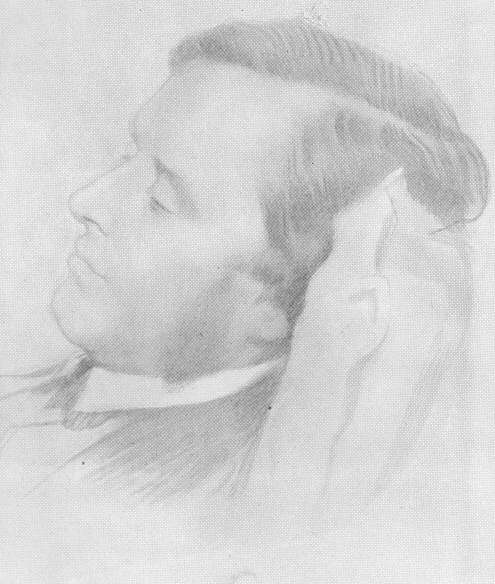
I saw Hassan Sheykh-el-Abab’deh yesterday, who was loud
in praise of your good looks and gracious manners.
‘Mashallah, thy master is a sweet man, O Lady!’
Yesterday was Bairam, and lots of Hareem came in their best
clothes to wish me a happy year and enjoyed themselves much with
sweet cakes, coffee, and pipes. Kursheed’s wife (whom
I cured completely) looked very handsome. Kursheed is a
Circassian, a fine young fellow much shot and hacked about and
with a Crimean medal. He is cawass here and a great friend
of mine. He says if I ever want a servant he will go with
me anywhere and fight anybody—which I don’t doubt in
the least. He was a Turkish memlook and his condescension
in wishing to serve a Christian woman is astounding. His
fair face and clear blue eyes, and brisk, neat, soldier-like air
contrast curiously with the brown fellaheen. He is like an
Englishman only fairer and like them too fond of the
courbash. What would you say if I appeared in Germany
attended by a memlook with pistols, sword, dagger, carbine and
courbash, and with a decided and imperious manner the very
reverse of the Arab softness—and such a Muslim
too—prays five times a day and extra fasts besides
Ramadan. ‘I beat my wife’ said Kursheed,
‘oh! I beat her well! she talked so, and I am like
the English, I don’t like too many words.’ He
was quite surprised that I said I was glad my master
didn’t dislike talking so much.
I was talking the other day with Yussuf about people trying to
make converts and I said that eternal bêtise, ‘Oh
they mean well.’ ‘True, oh Lady! perhaps they
do mean well, but God says in the Noble Koran that he who injures
or torments those Christians whose conduct is not evil, merely on
account of religion, shall never smell the fragrance of the
Garden (paradise). Now when men begin to want to make
others change their faith it is extremely hard for them
not to injure or torment them and therefore I think it
better to abstain altogether and to wish rather to see a
Christian a good Christian and a Muslim a good Muslim.’
No wonder a most pious old Scotchman told me that the truth
which undeniably existed in the Mussulman faith was the work of
Satan and the Ulema his meenesters. My dear saint of
a Yussuf a meenester of Satan! I really think I
have learnt some ‘Muslim humility’ in that I
endured the harangue, and accepted a two-penny tract quite mildly
and politely and didn’t argue at all. As his friend
‘Satan’ would have it, the Fikees were reading the
Koran in the hall at Omar’s expense who gave a Khatmeh that
day, and Omar came in and politely offered him some sweet
prepared for the occasion. I have been really amazed at
several instances of English fanaticism this year. Why do
people come to a Mussulman country with such bitter hatred
‘in their stomachs’ as I have seen three or four
times. I feel quite hurt often at the way the people here
thank me for what the poor at home would turn up their noses
at. I think hardly a dragoman has been up the river since
Rashedee died but has come to thank me as warmly as if I had done
himself some great service—and many to give some little
present. While the man was ill numbers of the fellaheen
brought eggs, pigeons, etc. etc. even a turkey, and food is worth
money now, not as it used to be. I am quite weary too of
hearing ‘Of all the Frangee I never saw one like
thee.’ Was no one ever at all humane before?
For remember I give no money—only a little physic and
civility. How the British cottagers would ‘thank ye
for nothing’—and how I wish my neighbours here could
afford to do the same.
After much wrangling Mustapha has got back my boy Yussuf but
the Christian Sheykh-el-Hara has made his brother pay £2
whereat Mohammed looks very rueful. Two hundred men are
gone out of our village to the works and of course the poor
Hareem have not bread to eat as the men had to take all they had
with them. I send you a very pretty story like
Tannhäuser.
There was once a man who loved a woman that lived in the same
quarter. But she was true to her husband, and his love was
hopeless, and he suffered greatly. One day as he lay on his
carpet sick with love, one came to him and said, O, such-a-one,
thy beloved has died even now, and they are carrying her out to
the tomb. So the lover arose and followed the funeral, and
hid himself near the tomb, and when all were gone he broke it
open, and uncovered the face of his beloved, and looked upon her,
and passion overcame him, and he took from the dead that which
when living she had ever denied him.
But he went back to the city and to his house in great grief
and anguish of mind, and his sin troubled him. So he went
to a Kadee, very pious and learned in the noble Koran, and told
him his case, and said, ‘Oh my master the Kadee, can such a
one as I obtain salvation and the forgiveness of God? I
fear not.’ And the Kadee gave him a staff of polished
wood which he held in his hand, and said ‘Who knoweth the
mercy of God and his justice, but God alone—take then this
staff and stick it in the sand beside the tomb where thou didst
sin and leave it the night, and go next morning and come and tell
me what thou shalt find, and may the Lord pardon thee, for thy
sin is great.’
And the man went and did as the Kadee had desired, and went
again at sunrise, and behold the staff had sprouted and was
covered with leaves and fruit. And he returned and told the
Kadee what had happened, and the Kadee replied, ‘Praise be
to God, the merciful, the compassionate.’
To Mrs. Austin.
Luxor,
April 29, 1865.
Dearest Mutter,
Since I wrote last I have received the box with the cheese
quite fresh (and very good it tastes), and the various
things. Nothing called forth such a shout of joy from me as
your photo of the village pothouse. How green and fresh and
tidy! Many Mashallah’s have been uttered over the
beyt-el-fellaheen (peasant’s house) of
England. The railings, especially, are a great
marvel. I have also heard from Janet that Ross has bought
me a boat for £200 which is to take four of his agents to
Assouan and then come back for me. So all my business is
settled, and, Inshallah! I shall depart in another three
or four weeks.
The weather is quite cool and fresh again but the winds very
violent and the dust pours over us like water from the dried up
land, as well as from the Goomeh mountain. It is miserably
uncomfortable, but my health is much better again—spite of
all.
The Hakeem business goes on at a great rate. I think on
an average I have four sick a day. Sometimes a dozen.
A whole gipsy camp are great customers—the poor souls will
bring all manner of gifts it goes to my heart to eat, but they
can’t bear to be refused. They are astounded to hear
that people of their blood live in England and that I knew many
of their customs—which are the same here.
Kursheed Agha came to take final leave being appointed to
Keneh. He had been at Gau and had seen Fadil Pasha sit and
make the soldiers lay sixty men down on their backs by ten at a
time and chop them to death with the pioneers’
axes. He estimated the people killed—men, women, and
children at 1,600—but Mounier tells me it was over
2,000. Sheykh Hassan agreed exactly with Kursheed, only the
Arab was full of horror and the Circassian full of
exultation. His talk was exactly what we all once heard
about ‘Pandies,’ and he looked and talked and laughed
so like a fine young English soldier, that I was ashamed to call
him the kelb (dog) which rose to my tongue, and I bestowed it on
Fadil Pasha instead. I must also say in behalf of my own
countrymen that they had provocation while here there was
none. Poor Haggee Sultan lies in chains at Keneh. One
of the best and kindest of men! I am to go and take secret
messages to him, and money from certain men of religion to bribe
the Moudir with. The Shurafa who have asked me to do this
are from another place, as well as a few of the
Abu-l-Hajjajieh. A very great Shereef indeed from lower
Egypt, said to me the other day, ‘Thou knowest if I am a
Muslim or no. Well, I pray to the most Merciful to send us
Europeans to govern us, and to deliver us from these wicked
men.’ We were all sitting after the funeral of one of
the Shurafa and I was sitting between the Shereef of Luxor and
the Imám—and this was said before thirty or forty
men, all Shurafa. No one said ‘No,’ and many
assented aloud.
The Shereef asked me to lend him the New Testament, it was a
pretty copy and when he admired it I said, ‘From me to
thee, oh my master the Shereef, write in it as we do in
remembrance of a friend—the gift of a Nazraneeyeh who loves
the Muslimeen.’ The old man kissed the book and said
‘I will write moreover—to a Muslim who loves all such
Christians’—and after this the old Sheykh of Abou Ali
took me aside and asked me to go as messenger to Haggee Sultan
for if one of them took the money it would be taken from them and
the man get no good by it.
Soldiers are now to be quartered in the Saeed—a new
plague worse than all the rest. Do not the cawasses already
rob the poor enough? They fix their own price in the market
and beat the sakkas as sole payment. What will the soldiers
do? The taxes are being illegally levied on lands which are
sheragi, i.e. totally unwatered by the last Nile
and therefore exempt by law—and the people are
driven to desperation. I feel sure there will be more
troubles as soon as there arises any other demagogue like Achmet
et-Tayib to incite the people and now every Arab sympathises with
him. Janet has written me the Cairo version of the affair
cooked for the European taste—and monstrous it is.
The Pasha accuses some Sheykh of the Arabs of having gone from
Upper Egypt to India to stir up the Mutiny against us!
Pourquoi pas to conspire in Paris or London? It is
too childish to talk of a poor Saeedee Arab going to a country of
whose language and whereabouts he is totally ignorant, in order
to conspire against people who never hurt him. You may
suppose how Yussuf and I talk by ourselves of all these
things. He urged me to try hard to get my husband here as
Consul-General—assuming that he would feel as I do. I
said, my master is not young, and to a just man the wrong of such
a place would be a martyrdom. ‘Truly thou hast said
it, but it is a martyr we Arabs want; shall not the reward of him
who suffers daily vexation for his brethren’s sake be equal
to that of him who dies in battle for the faith? If thou
wert a man, I would say to thee, take the labour and sorrow upon
thee, and thine own heart will repay thee.’ He too
said like the old Sheykh, ‘I only pray for Europeans to
rule us—now the fellaheen are really worse off than any
slaves.’ I am sick of telling of the daily
oppressions and robberies. If a man has a sheep, the Moodir
comes and eats it, if a tree, it goes to the Nazir’s
kitchen. My poor sakka is beaten by the cawasses in sole
payment of his skins of water—and then people wonder my
poor friends tell lies and bury their money.
I now know everybody in my village and the ‘cunning
women’ have set up the theory that my eye is lucky; so I am
asked to go and look at young brides, visit houses that are
building, inspect cattle, etc. as a bringer of good
luck—which gives me many a curious sight.
I went a few days ago to the wedding of handsome Sheykh Hassan
the Abab’deh, who married the butcher’s pretty little
daughter. The group of women and girls lighted by the
lantern which little Achmet carried up for me was the most
striking thing I have seen. The bride—a lovely girl
of ten or eleven all in scarlet, a tall dark slave of
Hassan’s blazing with gold and silver necklaces and
bracelets, with long twisted locks of coal black hair and such
glittering eyes and teeth, the wonderful wrinkled old women, and
the pretty, wondering, yet fearless children were beyond
description. The mother brought the bride up to me and
unveiled her and asked me to let her kiss my hand, and to look at
her, I said all the usual Bismillah Mashallah’s, and
after a time went to the men who were eating, all but Hassan who
sat apart and who begged me to sit by him, and whispered anxious
enquiries about his aroosah’s looks. After a
time he went to visit her and returned in half an hour very shy
and covering his face and hand and kissed the hands of the chief
guests. Then we all departed and the girl was taken to look
at the Nile, and then to her husband’s house. Last
night he gave me a dinner—a very good dinner indeed, in his
house which is equal to a very poor cattle shed at home. We
were only five. Sheykh Yussuf, Omar, an elderly merchant
and I. Hassan wanted to serve us but I made him sit.
The merchant, a well-bred man of the world who has enjoyed
life and married wives everywhere—had arrived that day and
found a daughter of his dead here. He said he felt very
miserable—and everyone told him not to mind and consoled
him oddly enough to English ideas. Then people told
stories. Omar’s was a good version of the man and
wife who would not shut the door and agreed that the first to
speak should do it—very funny indeed. Yussuf told a
pretty tale of a Sultan who married a Bint el-Arab (daughter of
the Bedawee) and how she would not live in his palace, and said
she was no fellaha to dwell in houses, and scorned his silk
clothes and sheep killed for her daily, and made him live in the
desert with her. A black slave told a prosy tale about
thieves—and the rest were more long than pointed.
Hassan’s Arab feelings were hurt at the small quantity
of meat set before me. (They can’t kill a sheep now
for an honoured guest.) But I told him no greater honour
could be paid to us English than to let us eat lentils and onions
like one of the family, so that we might not feel as strangers
among them—which delighted all the party. After a
time the merchant told us his heart was somewhat dilated—as
a man might say his toothache had abated—and we said
‘Praise be to God’ all round.
A short time ago my poor friend the Maōhn had a terrible
‘tile’ fall on his head. His wife, two married
daughters and nine miscellaneous children arrived on a sudden,
and the poor man is now tasting the pleasures which Abraham once
endured between Sarah and Hagar. I visited the ladies and
found a very ancient Sarah and a daughter of wonderful
beauty. A young man here—a Shereef—has asked me
to open negotiations for a marriage for him with the
Maōhn’s grand daughter a little girl of eight—so
you see how completely I am ‘one of the family.’
My boat has not yet made its appearance. I am very well
indeed now, in spite, or perhaps because of, the great
heat. But there is a great deal of sickness—chiefly
dysentery. I never get less than four new patients a day
and my ‘practice’ has become quite a serious
business. I spent all day on Friday in the Abab’deh
quarters where Sheykh Hassan and his slave Rahmeh were both
uncommonly ill. Both are ‘all right’ now.
Rahmeh is the nicest negro I ever knew, and a very great friend
of mine. He is a most excellent, honest, sincere man, and
an Effendi (i.e. writes and reads) which is more than his
master can do. He has seen all the queer people in the
interior of Africa.
The Sheykh of the Bishareen—eight days’ journey
from Assouan has invited me and promises me all the meat and milk
I can eat, they have nothing else. They live on a high
mountain and are very fine handsome people. If only I were
strong I could go to very odd places where Frangees are
not. Read a very stupid novel (as a story) called
‘le Secret du Bonheur’—it gives the
truest impression of the manners of Arabs that I have
read—by Ernest Feydeau. According to his book
achouat (we are brothers). The
‘caressant’ ways of Arabs are so well described.
It is the same here. The people come and pat and stroke
me with their hands, and one corner of my brown abbaieh is faded
with much kissing. I am hailed as Sitt Betaana
‘Our own Lady,’ and now the people are really
enthusiastic because I refused the offer of some cawasses as a
guard which a Bimbashee made me. As if I would have such
fellows to help to bully my friends. The said Bimbashee
(next in rank to a Bey) a coarse man like an Arnoout, stopped
here a day and night and played his little Turkish game, telling
me to beware—for the Ulema hated all Franks and set the
people against us—and telling the Arabs that Christian
Hakeems were all given to poison Muslims. So at night I
dropped in at the Maōhn’s with Sheykh Yussuf carrying
my lantern—and was loudly hailed with a Salaam
Aleykee from the old Shereef himself—who began praising
the Gospel I had given him, and me at the same time. Yussuf
had a little reed in his hand—the kalem for writing,
about two feet long and of the size of a quill. I took it
and showed it to the Bimbashee and said—‘Behold the
neboot wherewith we are all to be murdered by this Sheykh
of the Religion.’ The Bimbashee’s bristly
moustache bristled savagely, for he felt that the ‘Arab
dogs’ and the Christian khanzeereh (feminine pig)
were laughing at it together.
Another steam boat load of prisoners from Gau has just gone
up. A little comfort is derived here from the news that,
‘Praise be to God, Moussa Pasha (Governor of the Soudan) is
dead and gone to Hell.’ It must take no trifle to
send him there judging by the quiet way in which Fadil Pasha is
mentioned.
You will think me a complete rebel—but I may say to you
what most people would think ‘like my
nonsense’—that one’s pity becomes a perfect
passion, when one sits among the people—as I do, and
sees it all; least of all can I forgive those among Europeans and
Christians who can help to ‘break these bruised
reeds.’ However, in Cairo and more still in
Alexandria, all is quite different. There, the same system
which has been so successfully copied in France prevails.
The capital is petted at the expense of the fellaheen.
Prices are regulated in Cairo for meat and bread as they are or
were in Paris, and the ‘dangerous classes’ enjoy all
sorts of exemptions. Just like France! The Cairenes
eat the bread and the fellaheen eat the stick.
The people here used to dislike Mounier who arrived poor and
grew rich and powerful, but they all bless him now and say at
El-Moutaneh a man eats his own meat and not the courbash of the
Moudir—and Mounier has refused soldiers (as I refused them
on my small account) and ‘Please God,’ he will never
repent it. Yussuf says ‘What the Turkish Government
fears is not for your safety, but lest we should learn to
love you too well,’ and it is true. Here there is but
one voice. ‘Let the Franks come, let us have the laws
of the Christians.’
In Cairo the Franks have dispelled this douce illusion
and done the Turk’s work as if they were paid for it.
But here come only travellers who pay with money and not with
stick—a degree of generosity not enough to be adored.
I perceive that I am a bore—but you will forgive my
indignant sympathy with the kind people who treat me so
well. Yussuf asked me to let the English papers know about
the Gau business. An Alim ed Deen ul-Islam would fain call
for help to the Times! Strange changes and signs of the
times—these—are they not so?
I went to Church on Good Friday with the Copts. The
scene was very striking—the priest dressed like a beautiful
Crusader in white robes with crimson crosses. One thing has
my hearty admiration. The few children who are taken to
Church are allowed to play! Oh my poor little Protestant
fellow Christians, can you conceive a religion so delightful as
that which permits Peep-bo behind the curtain of the
sanctuary! I saw little Butrus and Scendariah at it all
church time—and the priest only patted their little heads
as he carried the sacrament out to the Hareem. Fancy the
parson kindly patting a noisy boy’s head, instead of the
beadle whacking him! I am entirely reconciled to the Coptic
rules.
To Sir Alexander Duff
Gordon.
Nile Boat,
Urania,
May, 1865.
Happy as I was in the prospect of seeing you all and miserable
as poor Upper Egypt has become, I could not leave without a
pang. Our Bairam was not gay. There was horse riding
for Sheykh Gibreel (the cousin of Abu’l Haggag) and the
scene was prettier than ever I saw. My old friend Yunis the
Shereef insisted on showing me that at eighty-five he could still
handle a horse and throw a Gereed ‘for Sheykh Gibreel and
the Lady’ as he said. Then arrived the Mufettish of
Zenia with his gay attendants and filled the little square in
front of the Cadi’s castellated house where we were
sitting. The young Sheykh of Salamieh rode beautifully and
there was some excellent Neboot play (sort of very severe
quarterstaff peculiar to the Fellaheen).
Next day was the great dinner given by Mohammed and Mustapha
outside Mohammed’s house opposite Sheykh Gibreel’s
tomb—200 men ate at his gate. I went to see it and
was of course asked to eat. ‘Can one like thee eat
the Melocheea of the Fellaheen?’ So I joined a party
of five round a little wooden tray, tucked up my sleeve and
ate—dipping the bread into the Melocheea which is like very
sloppy spinach but much nicer. Then came the master and his
servants to deal the pieces of meat out of a great
basket—sodden meat—and like Benjamin my piece was the
largest, so I tore off a bit and handed it to each of my
companions, who said ‘God take thee safe and happy to thy
place and thy children and bring thee back to us in safety to eat
the meat of the festival together once more.’
The moon rose clear and bright behind the one tall palm tree
that overhangs the tomb of Sheykh Gibreel. He is a saint of
homely tastes and will not have a dome over him or a cover for
his tomb, which is only surrounded by a wall breast-high,
enclosing a small square bit of ground with the rough tomb on one
side. At each corner was set up a flag, and a few dim
lanterns hung overhead. The 200 men eating were quite
noiseless—and as they rose, one by one washed their hands
and went, the crowd melted away like a vision. But before
all were gone, came the Bulook, or sub-magistrate—a Turkish
Jack in office with the manners of a Zouave turned parish
beadle. He began to sneer at the melocheea of the
fellaheen and swore he could not eat it if he sat before it 1,000
years. Hereupon, Omar began to ‘chaff’
him. ‘Eat, oh Bulook Pasha and if it swells thy belly
the Lady will give thee of the physick of the English to clean
thy stomach upwards and downwards of all thou hast eaten of the
food of the fellaheen.’ The Bulook is notorious for
his exactions—his ‘eating the people’—so
there was a great laugh. Poor Omar was very ill next
day—and every one thought the Bulook had given him the
eye.
Then came the Mufettish in state to pay his devoirs to
the Sheykh in the tomb. He came and talked to Mustapha and
Yussuf and enumerated the people taken for the works, 200 from
Luxor, 400 from Carnac, 310 from Zenia, 320 from Byadyeh, and 380
from Salamieh—a good deal more than half the adult men to
go for sixty days leaving their fields uncultivated and their
Hareem and children hungry—for they have to take all the
food for themselves.
I rose sick at heart from the Mufettish’s harsh voice,
and went down to listen to the Moonsheeds chanting at the tomb
and the Zikheers’ strange sobbing, Allah, Allah.
I leaned on the mud wall watching the slender figures swaying
in the moonlight, when a tall, handsome fellah came up in his
brown shirt, felt libdeh (scull cap), with his blue cotton
melaya tied up and full of dried bread on his back.
The type of the Egyptian. He stood close beside me and
prayed for his wife and children. ‘Ask our God to
pity them, O Sheykh, and to feed them while I am away. Thou
knowest how my wife worked all night to bake all the wheat for me
and that there is none left for her and the
children.’ He then turned to me and took my hand and
went on, ‘Thou knowest this lady, oh Sheykh Gibreel, take
her happy and well to her place and bring her back to
us—el Fathah, yah Beshoosheh!’ and we said it
together. I could have laid my head on Sheykh
Gibreel’s wall and howled. I thanked him as well as I
could for caring about one like me while his own troubles were so
heavy. I shall never forget that tall athletic figure and
the gentle brown face, with the eleven days’ moon of
Zulheggeh, and the shadow of the palm tree. That was my
farewell. ‘The voice of the miserable is with thee,
shall God not hear it?’
Next day Omar had a sharp attack of fever and was
delirious—it lasted only two days but left him very weak
and the anxiety and trouble was great—for my helping hands
were as awkward as they were willing.
In a few days arrived the boat Urania. She is very nice
indeed. A small saloon, two good berths—bath and
cabinet, and very large kasneh (stern cabin). She is
dirty, but will be extremely comfortable when cleaned and
painted. On the 15th we sailed. Sheykh Yussuf went
with me to Keneh, Mustapha and Seyd going by land—and one
of Hajjee Sultan’s disciples and several Luxor men were
deck passengers. The Shereef gave me the bread and jars of
butter for his grandsons in Gama’l Azhar, and came to see
me off. We sat on the deck outside as there was a crowd to
say good-bye and had a lot of Hareem in the cabin. The old
Shereef made me sit down on the carpet close to him and then said
‘we sit here like two lovers’—at eighty-five
even an Arab and a Shereef may be
“gaillard”—so I cried, ‘Oh
Shereef, what if Omar tells my master the secret thou hast let
out—it is not well of thee.’ There was a great
laugh which ended in the Shereef saying ‘no doubt thy
master is of the best of the people, let us say the Fathah
for him,’ and he called on all the people ‘El
Fathah for the master of the lady!’ I hope it has
benefited you to be prayed for at Luxor.
I had written so far and passed Minieh when I fell ill with
pleurisy—I’ve lots more to tell of my journey but am
too weak after two weeks in bed (and unable to lie down from
suffocation)—but I am much better now. A man
from the Azhar is reading the Koran for me outside—while
another is gone with candles to Seyeedele Zeynet ‘the
fanatics!’
To Sir Alexander Duff
Gordon.
Cairo,
June 16, 1865.
Dearest Alick,
I will go down to Alexandria in the boat and Omar will work at
her. She wants a great deal of repairing I find, and his
superintendence will save much money—besides he will do one
man’s work as he is a much better carpenter than most here
having learnt of the English workmen on the railroad—but
the Reis says the boat must come out of the water as her bottom
is unsound. She is a splendid sailer I hear and remarkably
comfortable. The beds in the kasneh would do for
Jacob Omnium. So when you ‘honour our house’
you will be happy. The saloon is small, and the berths as
usual. Also she is a very handsome shape—but she
wants no end of repairs. So Omar is consoled at being left
because he will ‘save our money’ a great deal by
piecing sails, and cutting and contriving, and scraping and
painting himself. Only he is afraid for me. However,
Allah Kereem.
I have a very good Reis I think. The usual tight little
black fellow from near Assouan—very neat and active and
good tempered—the same cross steersman that we had up to
Bedreshayn—but he knows his work well. We had
contrary gales the whole way. My men worked all they
possibly could, and pulled the rope all day and rowed all night,
day after day—but we were twenty-eight days getting
down.
I can’t write any more.
To Mrs. Austin.
Alexandria,
October 28, 1865.
I am truly grieved to hear of your wrist and to see your
writing look cramped. I arrived here on Thursday after a
splendid passage and was very comfortable on board. I found
M. Olagnier waiting for me, and Omar, of course, and am
installé at Ross’s till my boat gets done
which I am told will be in six days. She will be remarkably
comfortable. Omar had caused a sort of divan with a roof
and back to be constructed just outside the cabin-door where I
always sat every evening, which will be the most delightful
little nest one can conceive. I shall sit like a Pasha
there.
My cough is still very harassing, but my chest less tight and
painful, and I feel less utterly knocked down. The weather
is beautiful here just now—warm and not nearly so damp as
usual.
Lord Edward St. Maur was on board, he has much of his
aunt’s pleasantness. Also a very young Bombay
Merchant—a Muslim who uttered not one syllable to any one
but to me. His talk was just like that of a well-bred and
intelligent young Englishman. I am glad to say that his
views of the state of India were very encouraging—he seemed
convinced that the natives were gradually working their way up to
more influence, and said ‘We shall have to thank you for a
better form of government by far than any native one ever would
have been’—he added, ‘We Muslims have this
advantage over the Hindus—that our religion is no barrier
at all, socially or politically—between us and you—as
theirs is. I mean it ought not to be when both faiths are
cleared of superstition and fanaticism.’ He spoke
very highly of Sir Bartle Frere but said ‘I wish it were
possible for more English gentlemen to come out to
India.’ He had been two years in England on
mercantile business and was going back to his brother Ala-ed-deen
much pleased with the English in England. It is one of the
most comforting Erscheinungen I have seen coming from
India—if that sort of good sense is pretty common among the
very young men they certainly will work their way up.
I should like to see Bayley’s article though I am quite
sick of my book—it is very ungracious of me, but I
can’t help it.
To Mrs. Austin.
Alexandria,
November 2, 1865.
Dearest Mutter,
The boat like all other things goes but slowly—however
the weather here is unusually dry and fine.
I have just been to see my poor friend Sittee Zubeydeh, widow
of Hassaneyn Effendi who died in England—and I am filled
with admiration at her good sense and courage. She has
determined to carry on her husband’s business of letting
boats herself, and to educate her children to the best of her
power in habits of independence. I hope she will be
successful, and receive the respect such rare conduct in a
Turkish woman deserves from the English. I was much
gratified to hear from her how kindly she had been treated in
Glasgow. She said that nothing that could be done for her
was left undone. She arrived this morning and I went to see
her directly and was really astonished at all she said about her
plans for herself and her children. Poor thing! it is a sad
blow—for she and Hassaneyn were as thoroughly united as any
Europeans could be.
I went afterwards to my boat, which I hope will be done in
five or six days. I am extremely impatient to be off.
She will be a most charming boat—both comfortable and
pretty. The boom for the big sail is new—and I
exclaimed, ‘why you have broken the new boom and mended it
with leather!’ Omar had put on a sham splice
to avert the evil eye from such a fine new piece of wood!
Of course I dare not have the blemish renewed or gare the
first puff of wind—besides it is too characteristic.
There is some cholera about again, I hear—ten deaths
yesterday—so Olagnier tells me. I fancy the rush of
Europeans back again, each bringing ‘seven other devils
worse than himself’ is the cause of it.
I think I am beginning to improve a little; my cough has been
terribly harassing especially at night—but the weather is
very good, cool, and not damp.
To Mrs. Austin.
Cairo,
Monday, November 27, 1865.
Dearest Mutter,
I arrived here last night and found a whole heap of
letters—and yours I will answer first. I had no heart
to write any more from Alexandria where I was worried out of all
courage and strength. At last after endless delays and
vexations the dahabieh was tant bien que mal ready.
Talk of Arab dawdle! after what I went through—and now I
have to wait here for fresh repairs, as we came up baling all the
way and I fear cursing the Christian workmen who had bungled so
shamefully.
However that is over, and I am much better as to my
cough—indeed it is all but gone. Omar was very ill
having had dysentery for two months, but he too is well
again. He is very grateful for your kind mention of him and
says, ‘Send the Great Mother my best Salaam, and tell her
her daughter’s people are my people, and where she goes I
will go too, and please God I will serve her rich or poor till
“He who separates us” shall take me from
her.’ The words of Ruth came after all these
centuries quite fresh from the soft Egyptian lips.
The ‘He who separated us’ I must explain to
you. It is one of the attributes of God, The Separator
of Religions implies toleration and friendship by attributing
the two religions alike to God—and is never used towards
one whose religion is not to be respected.
I have got a levee of former reis’s, sailors, etc. some
sick—but most come to talk.
The climate changes quite suddenly as one leaves the Delta,
and here I sit at eight in the evening with open doors and
windows.
I am so glad to hear of the great success of my dear
Father’s book, and to think of your courage in working at
it still.
I suppose I shall be here a week longer as I have several jobs
to do to my boat, and I shall try to get towed up so as to send
back the boat as soon as possible in order to let her. Ali
will give £80 a month for her if he gets a party of four to
take up. I pay my Reis five napoleons a month while
travelling and three while lying still. He is a good,
active little fellow.
We were nearly smashed under the railway bridge by an iron
barge—and Wallah! how the Reis of the bridge did
whack the Reis of the barge. I thought it a sad loss of
time, but Reis Ali and my Reis Mohammed seemed to look on the
stick as the most effective way of extricating my anchor from the
Pasha’s rudder. My crew can’t say
‘Urania’ so they sing ‘go along, oh darling
bride’ Arooset er-ralee, as the little Sitt’s
best description, and ‘Arooset er-ralee’ will be the
dahabieh’s exoteric name—as ‘El
Beshoosheeh, is my popular name.
To Mrs. Austin.
Cairo,
December 5, 1865.
Dearest Mutter,
Alhamdulillah—now I am at rest. I have got
all the boat in order. My captain, Reis Mohammed, is very
satisfactory, and to-day we sail as soon as Omar comes back with
the meat, etc. from market.
I received Meadow’s review; I wish he had not said so
much about me in it.
Mohammed Gazowee begs to give his best Salaam to Sheykh
Stanley whom he longs to see again. He says that all the
people said he was not a Christian, for he was not proud ever
towards them as Christians are, but a real Sheykh, and that the
Bedaween still talk of Sheykh Stanley and of his piety. The
old half-witted jester of Luxor has found me out—he has
wandered down here to see his eldest son who is serving in the
army. He had brought a little boy with him, but is
‘afraid for him’ here, I don’t know why, and
has begged me to take the child up to his mother. These
licensed possenreisser are like our fools in old
times—but less witty than we fancy them to have
been—thanks to Shakespeare, I suppose. Each district
has one who attends all moolids and other gatherings of
the people, and picks up a living. He tells me that the
Turkish Názir of Zeneea has begun some business against
our Kadee, Sheykh Ibraheem, and Sheykh Yussuf, accused them of
something—he does not know what—perhaps of being
friends of Hajjee Sultan, or of stealing wood!! If all
the friends of Hajjee Sultan are to be prosecuted that will
include the whole Saeed.
Of course I am anxious about my friends. All Haleem
Pasha Oghdee’s villages have been confiscated (those
tributary to him for work) sous prétexte that he
ill-used the people, n.b. he alone paid them—a bad
example. Pharoah is indeed laying intolerable
burthens—not on the Israelites—but on the
fellaheen.
Omar said of the great dinner to-day, ‘I think all the
food will taste of blood, it is the blood of the poor, and more
haram than any pork or wine or blood of
beasts.’ Of course such sentiments are not to be
repeated—but they are general. The meneggets
who picked and made ten mattrasses and fourteen cushions for me
in half a day, were laughing and saying, ‘for the
Pasha’s boat we work also, at so much a day and we should
have done it in four days.’ ‘And for me if I
paid by the day instead of by the piece, how long?’
‘One day instead of half, O Lady, for fear thou shouldest
say to us, you have finished in half a day and half the wages is
enough for you.’ That is the way in which all the
work is done for Effendeena—no wonder his steamers
don’t pay.
I saw Ross yesterday—he tells me the Shereef of Mecca
has sent him a horse.
To Sir Alexander Duff
Gordon.
Thebes,
From December 25, 1865, to January 3, 1866.
Dearest Alick,
I wish you all, ‘may the year be good to thee’ as
we say here—and now for my history. We left Cairo on
the 5th Decr. I was not well. No wind as usual, and
we were a week getting to Benisonef where the Stamboolee Greek
lady who was so kind to me last summer in my illness came on
board with a very well-bred Arab lady. I was in bed, and
only stayed a few hours. On to Minieh another five or six
days—walked about and saw the preparations for the
Pasha’s arrival. Nothing so flat as these affairs
here. Not a creature went near the landing-place but his
own servants, soldiers, and officials. I thought of the
arrival of the smallest of German princes, which makes ten times
the noise. Next on to Siout. Ill again, and did not
land or see anyone. On to Girgeh, where we only stayed long
enough to deliver money and presents which I had been begged to
take for some old sailors of mine to their mothers and wives
there.
Between Siout and Girgeh an Abyssinian slave lad came and
wanted me to steal him; he said his master was a Copt and
ill-used him, and the lady beat him. But Omar sagely
observed to the sailors, who were very anxious to take him, that
a bad master did not give his slave such good clothes and even a
pair of shoes—quel luxe!—and that he made too
much of his master being a Copt; no doubt he was a lazy fellow,
and perhaps had run away with other property besides
himself. Soon after I was sitting on the pointed prow of
the boat with the Reis, who was sounding with his painted pole
(vide antique sculptures and paintings), and the men
towing, when suddenly something rose to the surface close to us:
the men cried out Beni Adam! and the Reis prayed for the
dead. It was a woman: the silver bracelets glittered on the
arms raised and stiffened in the agony of death, the knees up and
the beautiful Egyptian breasts floated above the water. I
shall never forget the horrid sight. ‘God have mercy
on her,’ prayed my men, and the Reis added to me,
‘let us also pray for her father, poor man: you see, no
robber has done this (on account of the bracelets). We are
in the Saeed now, and most likely she has blackened her
father’s face, and he has been forced to strangle her, poor
man.’ I said ‘Alas!’ and the Reis
continued, ‘ah, yes, it is a heavy thing, but a man must
whiten his face, poor man, poor man. God have mercy on
him.’ Such is Saeedee point
d’honneur. However, it turned out she was drowned
bathing.
Above Girgeh we stopped awhile at Dishné, a large
village. I strolled up alone, les mains dans les
poches, ‘sicut meus est mos:’ and was soon
accosted with an invitation to coffee and pipes in the
strangers’ place, a sort of room open on one side with a
column in the middle, like two arches of a cloister, and which in
all the villages is close to the mosque: two or three cloaks were
pulled off and spread on the ground for me to sit on, and the
milk which I asked for, instead of the village coffee,
brought. In a minute a dozen men came and sat round, and
asked as usual, ‘Whence comest thou, and whither goest
thou?’ and my gloves, watch, rings, etc. were handed round
and examined; the gloves always call forth many
Mashallah’s. I said, ‘I come from the
Frank country, and am going to my place near Abu’l
Hajjaj.’ Hereupon everyone touched my hand and said,
‘Praise be to God that we have seen thee. Don’t
go on: stay here and take 100 feddans of land and remain
here.’ I laughed and asked, ‘Should I wear the
zaboot (brown shirt) and the libdeh, and work in
the field, seeing there is no man with me?’ There was
much laughing, and then several stories of women who had farmed
large properties well and successfully. Such undertakings
on the part of women seem quite as common here as in Europe, and
more common than in England.
I took leave of my new friends who had given me the first
welcome home to the Saeed, and we went on to Keneh, which we
reached early in the morning, and I found my well-known
donkey-boys putting my saddle on. The father of one, and
the two brothers of the other, were gone to work on the railway
for sixty days’ forced labour, taking their own bread, and
the poor little fellows were left alone to take care of the
Hareem. As soon as we reached the town, a couple of tall
young soldiers in the Nizam uniform rushed after me, and greeted
me in English; they were Luxor lads serving their time. Of
course they attached themselves to us for the rest of the
day. We then bought water jars (the
specialité of Keneh); gullehs and
zees—and I went on to the Kadee’s house to
leave a little string of beads, just to show that I had not
forgotten the worthy Kadee’s courtesy in bringing his
little daughter to sit beside me at dinner when I went down the
river last summer. I saw the Kadee giving audience to
several people, so I sent in the beads and my salaam; but the
jolly Kadee sallied forth into the street and ‘fell upon my
neck’ with such ardour that my Frankish hat was sent
rolling by contact with the turban of Islam. The Kadee of
Keneh is the real original Kadee of our early days; sleek,
rubicund, polite—a puisne judge and a dean rolled into one,
combining the amenities of the law and the church—with an
orthodox stomach and an orthodox turban, both round and
stately. I was taken into the hareem, welcomed and regaled,
and invited to the festival of Seyd Abd er-Racheem, the great
saint of Keneh. I hesitated, and said there were great
crowds, and some might be offended at my presence; but the Kadee
declared ‘by Him who separated us’ that if any such
ignorant persons were present it was high time they learnt
better, and said that it was by no means unlawful for virtuous
Christians, and such as neither hated nor scorned the Muslimeen,
to profit by, or share in their prayers, and that I should sit
before the Sheykh’s tomb with him and the Mufti; and that
du reste, they wished to give thanks for my safe
arrival. Such a demonstration of tolerance was not to be
resisted. So after going back to rest, and dine in the
boat, I returned at nightfall into the town and went to the
burial-place. The whole way was lighted up and thronged
with the most motley crowd, and the usual mixture of holy and
profane, which we know at the Catholic fêtes also;
but more prononcé here. Dancing girls,
glittering with gold brocade and coins, swaggered about among the
brown-shirted fellaheen, and the profane singing of the
Alateeyeh mingled with the songs in honour of the Arab
prophet chanted by the Moonsheeds and the deep tones of the
‘Allah, Allah’ of the Zikeers. Rockets whizzed
about and made the women screech, and a merry-go-round was in
full swing. And now fancy me clinging to the skirts of the
Cadi ul Islam (who did not wear a spencer, as the Methodist
parson threatened his congregation he would do at the Day of
Judgement) and pushing into the tomb of the Seyd Abd er-Racheem,
through such a throng. No one seemed offended or even
surprised. I suppose my face is so well known at
Keneh. When my party had said a Fattah for me and
another for my family, we retired to another kubbeh, where
there was no tomb, and where we found the Mufti, and sat there
all the evening over coffee and pipes and talk. I was
questioned about English administration of justice, and made to
describe the process of trial by jury. The Mufti is a very
dignified gentlemanly man, and extremely kind and civil.
The Kadee pressed me to stay next day and dine with him and the
Mufti, but I said I had a lantern for Luxor, and I wanted to
arrive before the moolid was over, and only three days
remained. So the Kadee accompanied me back to the boat,
looked at my maps, which pleased him very much, traced out the
line of the railway as he had heard it, and had tea.
Next morning we had the first good wind, and bowled up to
Luxor in one day, arriving just after sunset. Instantly the
boat was filled. Of course Omar and the Reis at once
organized a procession to take me and my lantern to the tomb of
Abu-l-Hajjaj—it was the last night but one of his
moolid. The lantern was borne on a pole between two of my
sailors, and the rest, reinforced by men from a steamer which was
there with a Prussian prince, sung and thumped the tarabookeh,
and we all marched up after I had undergone every variety of
salutation, from Sheykh Yussuf’s embrace to the little
boys’ kissing of hands. The first thing I heard was
the hearty voice of the old Shereef, who praised God that
‘our darling’ was safe back again, and then we all
sat down for a talk; then more Fattahs were said for me,
and for you, and for the children; and I went back to bed in my
own boat. I found the guard of the French house had been
taken off to Keneh to the works, after lying eight days in chains
and wooden handcuffs for resisting, and claiming his rights as a
French protégé. So we waited for his
return, and for the keys which he had taken with him, in hopes
that the Keneh authorities would not care to keep me out of the
house. I wrote to the French Consular agent at Keneh, and
to the Consul at Alexandria, and got him back the third
day. What would you think in Europe to see me welcome with
enthusiasm a servant just out of chains and handcuffs? At
the very moment, too, that Mohammed and I were talking, a boat
passed up the river with musick and singing on board. It
was a Sheykh-el-Beled, of a place above Esneb, who had lain in
prison three years in Cairo, and whose friends were making all
the fantasia they could to celebrate the end of his misfortune,
of disgrace, il n’en est pas question; and why
should it? So many honest men go to prison that it is no
presumption at all against a man.
The day after my arrival was the great and last day. The
crowd was but little and not lively—times are too
hard. But the riding was beautiful. Two young men
from Hegaz performed wonderful feats.
I dined with the Maōhn, whose wife cooked me the best
dinner I ever ate in this country, or almost anywhere.
Marie, who was invited, rejoiced the kind old lady’s heart
by her Belgian appreciation of the excellent cookery.
‘Eat, my daughter, eat,’ and even I managed to give
satisfaction. Such Bakloweh I never tasted. We
removed to the house yesterday, and I have had company ever
since.
One Sheykh Alee—a very agreeable man from beyond
Khartoom, offers to take me up to Khartoom and back with a
Takhterawan (camel litter) in company with Mustapha A’gha,
Sheykh Yussuf and a troop of his own Abab’deh. It is
a terrible temptation—but it would cost £50—so
I refused. Sheykh Alee is so clever and well-bred that I
should enjoy it much, and the climate at this season is
delightful. He has been in the Denka country where the men
are a cubit taller than Sheykh Hassan whom you know, and who
enquires tenderly after you.
Now let me describe the state of things. From the
Moudeeriat of Keneh only, 25,000 men are taken to work for sixty
days without food or pay; each man must take his own basket, and
each third man a hoe, not a basket. If you want to pay a
substitute for a beloved or delicate son, it costs 1,000
piastres—600 at the lowest; and about 300 to 400 for his
food. From Luxor only, 220 men are gone; of whom a third
will very likely die of exposure to the cold and misery (the
weather is unusually cold). That is to say that this little
village, of at most 2,000 souls male and female (we don’t
usually count women, from decorum), will pay in labour at least
£1,320 in sixty days. We have also already had eleven
camels seized to go up to the Soudan; a camel is worth from
£18 to £40.
Last year Mariette Bey made excavations at Gourneh forcing the
people to work but promising payment at the rate of—Well,
when he was gone the four Sheykhs of the village at Gourneh came
to Mustapha and begged him to advance the money due from
Government, for the people were starving. Mustapha agrees
and gives above 300 purses—about £1,000 in
current piastres on the understanding that he is to get
the money from Government in tariff—and to keep the
difference as his profit. If he cannot get it at all the
fellaheen are to pay him back without interest. Of course
at the rate at which money is here, his profit would be but small
interest on the money unless he could get the money directly, and
he has now waited six months in vain.
Abdallah the son of el-Habbeshee of Damankoor went up the
river in chains to Fazoghlou a fortnight ago and Osman Bey ditto
last week—El-Bedrawee is dead there, of course.
Shall I tell you what became of the hundred prisoners who were
sent away after the Gau business? As they marched through
the desert the Greek memlook looked at his list each morning, and
said, ‘Hoseyn, Achmet, Foolan (like the Spanish Don Fulano,
Mr. so and so), you are free; take off his chains.’
Well, the three or four men drop behind, where some arnouts
strangle them out of sight. This is banishment to
Fazoghlou. Do you remember le citoyen est
élargi of the September massacres of Paris?
Curious coincidence, is it not? Everyone is
exasperated—the very Hareem talk of the government.
It is in the air. I had not been five minutes in Keneh
before I knew all this and much more. Of the end of Hajjee
Sultan I will not speak till I have absolute certainty, but, I
believe the proceeding was as I have described—set free in
the desert and murdered by the way. I wish you to publish
these facts, it is no secret to any but to those Europeans whose
interests keep their eyes tightly shut, and they will soon have
them opened. The blind rapacity of the present ruler will
make him astonish the Franks some day, I think.
Wheat is now 400 piastres the ardeb up here; the little loaf,
not quite so big as our penny roll, costs a piastre—about
three-half-pence—and all in proportion. I need not
say what the misery is. Remember that this is the second
levy of 220 men within six months, each for sixty days, as well
as the second seizure of camels; besides the conscription, which
serves the same purpose, as the soldiers work on the
Pasha’s works. But in Cairo they are paid—and
well paid.
It is curious how news travels here. The Luxor people
knew the day I left Alexandria, and the day I left Cairo, long
before I came. They say here that Abu-l-Hajjaj gave me his
hand from Keneh, because he would not finish his moolid without
me. I am supposed to be specially protected by him, as is
proved by my health being so far better here than anywhere
else.
By the bye, Sheykh Alee Abab’deh told me that all the
villages close on the Nile escaped the cholera almost
completely, whilst those who were half or a quarter of a mile
inland were ravaged. At Keneh 250 a day died; at Luxor one
child was supposed to have died of it, but I know he had diseased
liver for a year or more. In the desert the Bishareen and
Abab’deh suffered more than the people at Cairo, and you
know the desert is usually the place of perfect health; but fresh
Nile water seems to be the antidote. Sheykh Yussuf
laid the mortality at Keneh to the canal water, which the poor
people drink there. I believe the fact is as Sheykh Alee
told me.
Now I will say good-bye, for I am tired, and will write anon
to the rest. Let Mutter have this. I was very poorly
till I got above Siout, and then gradually mended—constant
blood spitting and great weakness and I am very thin, but, by the
protection of Abu-l-Hajjaj I suppose I am already much better,
and begin to eat again. I have not been out yet since the
first day, having much to do in the house to get to rights.
I felt very dreary on Christmas-day away from you all, and
Omar’s plum-pudding did not cheer me at all, as he hoped it
would. He begs me to kiss your hand for him, and every one
sends you salaam, and all lament that you are not the new Consul
at Cairo.
Kiss my chicks, and love to you all. Janet, I hope is in
Egypt ere this.
To Maurice Duff Gordon.
Luxor,
January 3, 1866.
My Darling Maurice,
I was delighted to get your note, which arrived on New
Year’s day in the midst of the hubbub of the great festival
in honour of the Saint of Luxor. I wish you could have seen
two young Arabs (real Arabs from the Hedjaz, in Arabia) ride and
play with spears and lances. I never saw anything like
it—a man who played the tom-fool stood in the middle, and
they galloped round and round him, with their spears crossed and
the points resting on the ground, in so small a circle that his
clothes whisked round with the wind of the horses’
legs. Then they threw jereeds and caught them as they
galloped: the beautiful thing was the perfect mastery of the
horses: they were ‘like water in their hands,’ as
Sheykh Hassan remarked. I perceived that I had never seen
real horsemanship in my life before.
I am now in the ‘palace’ at Luxor with my
dahabieh, ‘Arooset er-Ralee’ (the Darling Bride),
under my windows; quite like a Pasha.
In coming up we had an alarm of robbers. Under the
mountain called Gebel Foodah, we were entangled in shoals, owing
to a change in the bed of the river, and forced to stay all
night; and at three in the morning, the Reis sent in the boy to
say he had seen a man creeping on all fours—would I fire my
pistol? As my revolver had been stolen in Janet’s
house, I was obliged to beg him to receive any possible troop of
armed robbers very civilly, and to let them take what they
pleased. However, Omar blazed away with your father’s
old cavalry pistols (which had no bullets) and whether the
robbers were frightened, or the man was only a wolf, we heard no
more of the affair. My crew were horribly frightened, and
kept awake till daybreak.
The last night before reaching Keneh, the town forty miles
north of Luxor, my men held a grand fantasia on the bank.
There was no wind, and we found a lot of old maize stalks; so
there was a bonfire, and no end of drumming, singing and
dancing. Even Omar relaxed his dignity so far as to dance
the dance of the Alexandria young men; and very funny it all
was. I laughed consumedly; especially at the modest airs
and graces of a great lubberly fellow—one Hezayin, who
acted the bride—in a representation of a Nubian wedding
festivity. The new song of this year is very pretty—a
declaration of love to a young Mohammed, sung to a very pretty
tune. There is another, rather like the air of ‘Di
Provenza al mar’ in the ‘Traviata,’ with
extremely pretty words. As in England, every year has its
new song, which all the boys sing about the streets.
I hope, darling, you are sapping this year, and intend to make
up a bit for lost time. I hear you have lost no time in
growing tall at all events—‘ill weeds,
etc.’—you know Omar desires all sorts of messages to
you.
To Sir Alexander Duff
Gordon.
Monday, January 15,
1866.
Dearest Alick,
I hear that Mr. and Miss North are to be here in a day or
two. I hope you may have sent my saddle by them, for I want
it sadly—mine is just possible for a donkey, but quite too
broken for a horse.
Two great Sheykhs of Bishareen and Abab’deh came here
and picked me up out walking alone. We went and sat in a
field, and they begged me to communicate to the Queen of England
that they would join her troops if she would invade Egypt.
One laid my hand on his hand and said ‘Thou hast 3,000 men
in thy hand.’ The other rules 10,000. They say
there are 30,000 Arabs (bedaween) ready to join the English, for
they fear that the Viceroy will try to work and rob them like the
fellaheen, and if so they will fight to the last, or else go off
into Syria. I was rather frightened—for them, I mean,
and told them that our Queen could do nothing till 600 Sheykhs
and 400 Ameers had talked in public—all whose talk was
printed and read at Stambool and Cairo, and that they must not
think of such a thing from our Queen, but if things became bad,
it would be better for them to go off into Syria. I urged
great caution upon them, and I need not repeat that to you, as
the lives of thousands may be endangered. It might be
interesting to be known in high places and in profound secret, as
one of the indications of what is coming here.
If the saddle comes, as I hope, I may very likely go up to
Assouan, and leave the boat and servants, and go into the desert
for a few days to see the place of the Bishareen. They
won’t take anyone else: but you may be quite easy about me
‘in the face’ of a Sheykh-el-Arab. Handsome
Sheykh Hassan, whom you saw at Cairo, will go with me. But
if my saddle does not appear, I fear I should be too tired with
riding a camel.
The little district of Koos, including Luxor, has been mulcted
of camels, food for them and drivers, to the amount of 6,000
purses—last week—£18,000, fact. I
cast up the account, and it tallied with what I got from a sub
employé, nor is the discontent any longer
whispered. Everyone talks aloud—and well they
may.
To Mrs. Austin.
Tuesday, 7
Ramadan.
Dearest Mutter,
I have just received your letter of Christmas-day, and am glad
to answer it with a really amended report of myself. I had
a very slight return a week ago, but for the last five or six
days the daily flushing and fever has also ceased. I sent
for one of the Arab doctors of the Azizeeyeh steamer to see Omar,
and myself also, and he was very attentive, and took a note of
medicines to send me from Cairo by a confrère: and
when I offered a fee he said, ‘God forbid—it is only
our duty to do anything in the world for you.’
Likewise a very nice Dr. Ingram saw some of my worst cases for
me, and gave me good advice and help; but I want better
books—Kesteven is very useful, as far as it goes, but I
want something more ausführlich and scientific.
Ramadan is a great trouble to me, though Sheykh Yussuf tells the
people not to fast, if I forbid it: but many are ill from having
begun it, and one fine old man of about fifty-five died of
apoplexy on the fourth night. My Christian patient is
obstinate, and fasts, in spite of me, and will, I think, seal his
fate; he was so much better after the blistering and Dr.
Ingram’s mixture. I wish you could have seen a lad of
eighteen or so, who came here to-day for medicine. I think
I never saw such sweet frank, engaging manners, or ever heard any
one express himself better: quite une nature
distinguée, not the least handsome, but the most
charming countenance and way of speaking.
My good friend the Maōhn spent the evening with me, and
told me all the story of his marriage, though quite ‘unfit
to meet the virtuous eyes of British propriety—’ as I
read the other day in some paper apropos of I forget
what—it will give you an idea of the feelings of a Muslim
honnête homme, which Seleem is through and
through. He knew his wife before he married her, she being
twenty-five or twenty-six, and he a boy; she fell in love with
him, and at seventeen he married her, and they have had ten
children, all alive but two, and a splendid race they are.
He told me how she courted him with glasses of sherbet and trays
of sweatmeats, and how her mother proposed the marriage, and how
she hesitated on account of the difference of age, but, of
course, at last consented: all with the naïvest vanity in
his own youthful attractions, and great extolling of her personal
charms, and of her many virtues. When he was sent up here
she would not, or could not, leave her children. On the
Sitt’s arrival his slave girl was arrogant, and refused to
kiss her hand, and spoke saucily of her age, whereupon Seleem
gave her in marriage to a black man and pays for her support, as
long as she likes to suckle the child he (Seleem) had by her,
which child will in due time return to his house.
Kurz, the fundamental idea in it all, in the mind of an
upright man, is, that if a man ‘takes up’ with a
woman at all, he must make himself responsible for her before the
world; and above all for the fate of any child he may have by her
(you see the Prophet of the Arabs did not contemplate ladies
qui savent nager so well in the troubled waters of life as
we are now blessed with. I don’t mean to say that
many men are as scrupulous as my excellent friend Seleem, either
here or even in our own moral society). All this was told
with expressions quite incompatible with our manners, though not
at all leste—and he expatiated on his wife’s
personal charms in a very quaint way; the good lady is now hard
upon sixty and looks it fully; but he evidently is as fond of her
as ever. As a curious trait of primitive manners, he told
me of her piety and boundless hospitality; how when some friends
came late one evening, unexpectedly, and there was only a bit of
meat, she killed a sheep and cooked it for them with her own
hands. And this is a Cairene lady, and quite a lady too, in
manners and appearance. The day I dined there she was
dressed in very ragged, old cotton clothes, but spotlessly clean;
and she waited on me with a kind, motherly pleasure, that quite
took away the awkwardness I felt at sitting down while she
stood. In a few days she and her husband are to dine with
me, a thing which no Arab couple ever did before (I mean dine out
together), and the old lady was immensely amused at the
idea. Omar will cook and all male visitors will be sent to
the kitchen. Now that I understand all that is said to me,
and a great deal of the general conversation, it is much more
amusing. Seleem Effendi jokes me a great deal about my
blunders, especially my lack of politikeh, the Greek word
for what we should call flummery; and my saying lazim (you
must, or rather il faut), instead of humble
entreaties. I told him to teach me better, but he laughed
heartily, and said, ‘No, no, when you say lazim, it
is lazim, and nobody wants the stick to force him to say
Hadr (ready) O Sheykh-el-Arab, O Emeereh.’
Fancy my surprise the other day just when I was dictating
letters to Sheykh Yussuf (letters of introduction for
Ross’s inspecting agent) with three or four other people
here, in walked Miss North (Pop) whom I have not seen since she
was a child. She and her father were going up the second
cataract. She has done some sketches which, though rather
unskilful, were absolutely true in colour and effect, and are the
very first that I have seen that are so. I shall see
something of them on their return. She seemed very
pleasant. Mr. North looked rather horrified at the turbaned
society in which he found himself. I suppose it did look
odd to English eyes.
We have had three days of the south wind, which the
‘Saturday Review’ says I am not to call Samoom; and I
was poorly, and kept in bed two days with a cold. Apropos,
I will give you the Luxor contribution towards the further
confusion of the Samoom (or Simoom) controversy. I told
Sheykh Yussuf that an English newspaper, written by particularly
clever people, said that I was wrong to call the bad wind here
‘Samoom,’ (it was in an article on Palgrave’s
book, I think). Sheykh Yussuf said, ‘True, oh lady,
no doubt those learned gentlemen’ (politely saluting them
with his hand) ‘thought one such as thou shouldest have
written classical Arabic (Arabi fossieh), and have called
it “al Daboor;” nevertheless, it is proper to
write it “Samoom,” not, as some do
“Simoom,” which is the plural of sim
(poison).’ I shook my head, and said, I did not
recollect al Daboor. Then my Reis, sitting at the
door, offered his suggestion. ‘Probably the English,
who it is well known are a nation of sailors, use the name given
to the land wind by el-baharieh (the boatmen), and call it
el-mereeseh.’ ‘But,’ said I,
‘the clever gentlemen say that I am wrong altogether, and
never can have seen a real Samoom, for that would have
killed me in ten minutes.’ Hereupon Sheykh Mohammed
el-Abab’deh, who is not nearly so polished as his brother
Hassan, burst into a regular bedawee roar of laughter, and said,
‘Yah! do the Ganassil (Europeans) take thee for a
rat, oh lady? Whoever heard of el Beni Adam (the
children of Adam) dying of the wind? Men die of thirst
quicker when the Samoom blows and they have no water. But
no one ever died of the wind alone, except the rats—they
do.’ I give you the opinion of three
‘representative men—’ scholar, sailor, and
bedawee; if that helps you to a solution of the controversy.
We have just had a scene, rather startling to notions about
fatalism, etc. Owing to the importation of a good deal of
cattle from the Soudan, there is an expectation of the prevalence
of small-pox, and the village barbers are busy vaccinating in all
directions to prevent the infection brought, either by the cattle
or, more likely, by their drivers. Now, my maid had told me
she had never been vaccinated, and I sent for Hajjee Mahmood to
cut my hair and vaccinate her. To my utter amazement the
girl, who had never shown any religious bigotry, and does not
fast, or make any demonstrations, refused peremptorily. It
appears that the priests and sisters appointed by the enlightened
administration of Prussia instil into their pupils and penitents
that vaccination is a ‘tempting of God.’ Oh
oui, she said, je sais bien que chez nous mes parents
pouvaient recevoir un procès verbal, mais il vaut mieux
cela que d’aller contre la volonté de Dieu. Si
Dieu le veut, j’aurai la petite-vérole, et
s’il ne veut pas, je ne l’aurai pas. I
scolded her pretty sharply, and said it was not only stupid, but
selfish. ‘But what can one do?’ as Hajjee
Mahmood said, with a pitying shake of his head; ‘these
Christians are so ignorant!’ He blushed, and
apologized to me, and said, ‘It is not their fault; all
this want of sense is from the priests who talk folly to them for
money, and to keep them afraid before themselves. Poor
things, they don’t know the Word of
God.—“Help thyself, oh my servant, and I will help
thee.”’ This is the second contest I have had
on this subject. Last year it was with a Copt, who was all
Allah kereem and so on about his baby, with his child of
four dying of small-pox. ‘Oh, man,’ said Sheykh
Yussuf, ‘if the wall against which I am now sitting were to
shake above my head, should I fold my feet under me and say
Allah kereem, or should I use the legs God has given me to
escape from it?’
I had a visit the other day from a lady who, as I was
informed, had been a harlot in Siout. She has repented, and
married a converted Copt. They are a droll pair of
penitents, so very smart in their dress and manner. But no
one se scandalise at their antecedents—neither is it
proper to repent in sackcloth and ashes, or to confess sins,
except to God alone. You are not to indulge in
telling them to others; it is an offence. Repent inwardly,
and be ashamed to show it before the people—ask pardon of
God only. A little of this would do no harm in Europe,
methinks.
Here is a pretty story for you from the Hadeth
en-Nebbee (sayings of the Prophet). ‘Two prophets
were sitting together, and discoursing of prayer and the
difficulty of fixing the attention entirely on the act. One
said to the other, “Not even for the duration of two
rekahs (prayers ending with the prostration and Allah
akbar) can a man fix his mind on God alone.” The
other said, “Nay, but I can do it!” “Say
then two rekahs,” replied the elder of the two;
“I will give thee my cloak.” Now he wore two
cloaks—a new handsome red one and an old shabby blue
one. The younger prophet rose, raised his hands to his
head, said Allah akbar, and bent to the ground for his
first rekah; as he rose again he thought “Will he
give me the red cloak or the blue, I wonder?”’
It is very stupid of me not to write down all the pretty stories
I hear, but this one is a capital specimen of Arab wit.
Some day I must bring over Omar with me, Inshallah, to England,
and he will tell you stories like Scheherazade herself. A
jolly Nubian Alim told me the other night how in his village no
man ever eats meat, except on Bairam day: but one night a woman
had a piece of meat given her by a traveller; she put it in the
oven and went out. During her absence her husband came in
and smelt it, and as it was just the time of the
eshé (first prayers one hour after sunset), he ran
up to the hill outside the village, and began to chaunt forth the
tekbeer with all his might—Allah akbar,
Allah akbar, etc. etc., till the people ran to see what
was the matter. ‘Why, to-day is Bairam,’ says
he. ‘Where is thy witness, O man?’
‘The meat in the oven—the meat in the
oven.’
To Mrs. Austin.
Luxor,
February 15, 1866.
Dearest Mutter,
I have only time for a short letter to say that the cold
weather is over and that I continue to improve, not very fast,
but still very sensibly.
My young Frenchman turns out to be a M. Brune grand prix de
Rome, an architect, and is a very nice fellow indeed, and a
thorough gentleman. His odd awkward manner proved to be
mere vexation at finding himself quartered nolens volens
on a stranger, and a woman; but we have made great friends, and I
have made him quite happy by telling him that he shall pay his
share of the food. He was going to hurry off from shyness
though he had begun a work here by which I fancy he hopes to get
Kudos. I see he is poor and very properly
proud. He goes out to the temple at sunrise, and returns to
dinner at dark, and works well, and his drawings are very
clever. In short, I am as much obliged to the French Consul
for sending me such an intelligent man as I was vexed at
first. An homme sérieux with an absorbing
pursuit is always good company in the long run. Moreover M.
Brune behaves like a perfect gentleman in every way. So
tout est pour le mieux.
I am sorry to say that Marie has become so excessively bored,
dissatisfied, and, she says, ill, that I am going to send her
back rather than be worried so—and damit hats eine
ende of European maids. Of course an ignorant girl
must be bored to death here—a land of no amusements
and no flirtation is unbearable. I shall borrow a
slave of a friend here, an old black woman who is quite able and
more than willing to serve me, and when I go down to Cairo I will
get either a ci-devant slave or an elderly Arab woman. Dr.
Patterson strongly advised me to do so last year. He had
one who has been thirteen years his housekeeper, an old
bedaweeyeh, I believe, and as I now am no longer looked upon as a
foreigner, I shall be able to get a respectable Arab woman, a
widow or a divorced woman of a certain age who will be too happy
to have ‘a good home,’ as our maids say. I
think I know one, a certain Fatoomeh, a widow with no children
who does washing and needlework in Cairo. You need not be
at all uneasy. I shall be taken good care of if I fall ill,
much better than I should get from a European in a sulky frame of
mind. Hajjee Ali has very kindly offered to take Marie down
to Cairo and start her off to Alexandria, whence Ross’s
people can send her home. If she wants to stay in
Alexandria and get placed by the nuns who piously exhorted her to
extort ninety francs a month from me, so much the better for
me. Ali refuses to take a penny from me for her
journey—besides bringing me potatoes and all sorts of
things: and if I remonstrate he says he and all his family and
all they have is mine, in consequence of my treatment of his
brother.
You will be amused and pleased to hear how Sheykh Yussuf was
utterly puzzled and bewildered by the civilities he received from
the travellers this year, till an American told Mustapha I had
written a book which had made him (the American) wish well to the
poor people of this country, and desire to behave more kindly to
them than would have been the case before.
To-morrow is the smaller Bairam, and I shall have all the
Hareem here to visit me.
Two such nice Englishmen called the other day and told me they
lived in Hertford Street opposite Lady D. G.’s and saw
Alexander go in and out, and met Maurice in the gardens. It
gave me a terrible twinge of Heimweh, but I thought it so
kind and pretty and herzlich of them to come and tell me
how Alexander and Maurice looked as they went along the
street.
To Mrs. Ross.
February 22, 1866.
Dearest Janet,
I received your letter of the 4th inst. yesterday. I am
much distressed not to hear a better account of you. Why
don’t you go to Cairo for a time? Your experience of
your German confirms me (if I needed it) in my resolution to have
no more Europeans unless I should find one
‘seasoned.’ The nuisance is too great. I
shall borrow a neighbour’s slave for my stay here and take
some one in Cairo. My dress will do very well in native
hands.
I am at last getting really better again, I hope. We
have had a cold winter, but not trying. There has not been
much wind, and the weather has been very steady and clear.
I wish I had Palgrave’s book. Hajjee Ali was to bring
up my box, but it had not arrived when he sailed. I will
send down the old saddle whenever I can find a safe opportunity
and have received the other.
Many thanks for all the various detachments of newspapers,
which were a great solace. I wish you would give me your
photo—large size—to hang up with Rainie and Maurice
here and in the boat. Like the small one you gave me at
Soden, you said you had some copies big.
My doctoring business has become quite formidable. I
should like to sell my practice to any ‘rising young
surgeon.’ It brings in a very fair income of
vegetables, eggs, turkeys pigeons, etc.
How is the Shereef of Mecca’s horse? I ambition to
ride that holy animal.
To Sir Alexander Duff
Gordon.
Luxor,
February 22, 1866.
Dearest Alick,
The weather here is just beginning to get warm, and I of
course to get better. There has been a good deal of nervous
headache here this Ramadan. I had to attend the Kadee, and
several more. My Turkish neighbour at Karnac has got a
shaitan (devil), i.e. epileptic fits, and I was
sent for to exorcise him, which I am endeavouring to do with
nitrate of silver, etc.; but I fear imagination will kill him, so
I advise him to go to Cairo, and leave the devil-haunted
house. I have this minute killed the first snake of this
year—a sign of summer.
I was so pleased to see two Mr. Watsons—your opposite
neighbours—who said they saw you every morning go down the
street—ojala! that I did so too! I liked Mr.
and Mrs. Webb of Newstead Abbey very much; nice, hearty,
pleasant, truly English people.
There have not been above twenty or thirty boats up this
year—mostly Americans. There are some here now, very
nice people, with four little children, who create quite an
excitement in the place, and are ‘mashallahed’ no
end. Their little fair faces do look very pretty here, and
excite immense admiration.
Seyd has just come in to take my letter to the steamer which
is now going down. So addio, dearest Alick. I
am much better but still weakish, and very triste at my
long separation.
To Sir Alexander Duff
Gordon.
Tuesday, March 6,
1866.
Dearest Alick,
I write to be ready for the last down steamer which
will be here in a few days. Mr. and Miss North are here
working hard at sketching, and M. Brune will take a place in
their Dahabieh (my old Zint el Bahreyn), and leave me in six or
seven days. I shall quite grieve to lose his company.
If ever you or yours fall in with him, pray cultivate his
acquaintance, he is very clever, very hard working, and a
‘thorough-bred gentleman’ as Omar declares. We
are quite low-spirited at parting after a month spent together at
Thebes.
I hear that Olagnier has a big house in Old Cairo and will
lodge me. The Norths go to-day (Thursday) and M. Brune does
not go with them as he intended, but will stay on and finish a
good stroke of work and take his chance of a conveyance.
I spent yesterday out in Mustapha’s tent among the bean
gatherers, and will go again. I think it does me good and
is not too long a ride. The weather has set in suddenly
very hot, which rather tries everybody, but gloriously fine clear
air. I hope you will get this, as old fat Hassan will take
it to the office in Cairo himself—for the post is very
insecure indeed. I have written very often, if you
don’t get my letters I suppose they interest the court of
Pharaoh.
To Sir Alexander Duff
Gordon.
Thebes,
March 17, 1866.
Dearest Alick,
The high winds have begun with a vengeance and a great bore
they are.
I went a few days ago out to Medarnoot, and lunched in
Mustapha’s tent, among his bean harvest. I was
immensely amused by the man who went with me on to Medarnoot, one
Sheriff, formerly an illustrious robber, now a watchman and very
honest man. He rode a donkey, about the size of
Stirling’s wee pony, and I laughed, and said, ‘The
man should carry the ass.’ No sooner said than done,
Sheriff dismounted, or rather let his beast down from between his
legs, shouldered the donkey, and ran on. His way of keeping
awake is original; the nights are still cold, so he takes off all
his clothes, rolls them up and lays them under his head, and the
cold keeps him quite lively. I never saw so powerful,
active and healthy an animal. He was full of stories how he
had had 1,000 stripes of the courbash on his feet and 500 on his
loins at one go. ‘Why?’ I asked.
‘Why, I stuck a knife into a cawass who ordered me to carry
water-melons; I said I was not his donkey; he called me worse: my
blood got up, and so!—and the Pasha to whom the cawass
belonged beat me. Oh, it was all right, and I did not say
“ach” once, did I?’ (addressing another).
He clearly bore no malice, as he felt no shame. He has a
grand romance about a city two days’ journey from here, in
the desert, which no one finds but by chance, after losing his
way; and where the ground is strewed with valuable
anteekehs (antiquities). I laughed, and said,
‘Your father would have seen gold and jewels.’
‘True,’ said he, ‘when I was young, men spit on
a statue or the like, when they turned it up in digging, and now
it is a fortune to find one.’
To Sir Alexander Duff
Gordon.
March 31, 1866.
Dearest Alick,
As for me I am much better again; the cough has subsided, I
really think the Arab specific, camel’s milk, has done me
great good. I have mended ever since I took it. It
has the merit of being quite delicious. Yesterday I was
much amused when I went for my afternoon’s drink, to find
Sheriff in a great taking at having been robbed by a woman, under
his very nose. He saw her gathering hummuz from a field
under his charge, and went to order her off, whereupon she coolly
dropped the end of her boordeh which covered the head and
shoulders, effectually preventing him from going near her; made
up her bundle and walked off. His respect for the Hareem
did not, however, induce him to refrain from strong language.
M. Brune has made very pretty drawings of the mosque here,
both outside and in; it is a very good specimen of modern Arab
architecture; and he won’t believe it could be built
without ground plan, elevations, etc., which amuses the people
here, who build without any such inventions.
The harvest here is splendid this year, such beans and wheat,
and prices have fallen considerably in both: but meat, butter,
etc., remain very dear. My fame as a Hakeemeh has become
far too great, and on market-days I have to shut up shop.
Yesterday a very handsome woman came for medicine to make her
beautiful, as her husband had married another who teazed her, and
he rather neglected her. And a man offered me a camel load
of wheat if I would read something over him and his wife to make
them have children. I don’t try to explain to them
how very irrational they are but use the more intelligible
argument that all such practices savour of the Ebu er
Rukkeh (equivalent to black art), and are haram to the
greatest extent; besides, I add, being ‘all lies’
into the bargain. The applicants for child-making and
charm-reading are Copts or Muslims, quite in equal numbers, and
appear alike indifferent as to what ‘Book’: but all
but one have been women; the men are generally perfectly rational
about medicine and diet.
I find there is a good deal of discontent among the Copts with
regard to their priests and many of their old customs.
Several young men have let out to me at a great rate about the
folly of their fasts, and the badness and ignorance of their
priests. I believe many turn Muslim from a real conviction
that it is a better religion than their own, and not as I at
first thought merely from interest; indeed, they seldom gain much
by it, and often suffer tremendous persecution from their
families; even they do not escape the rationalizing tendencies
now abroad in Christendom. Then their early and
indissoluble marriages are felt to be a hardship: a boy is
married at eight years old, perhaps to his cousin aged seventeen
(I know one here in that case), and when he grows up he wishes it
had been let alone. A clever lad of seventeen propounded to
me his dissatisfaction, and seemed to lean to Islam. I gave
him an Arabic New Testament, and told him to read that first, and
judge for himself whether he could not still conform to the
Church of his own people, and inwardly believe and try to follow
the Gospels. I told him it was what most Christians had to
do, as every man could not make a sect for himself, while few
could believe everything in any Church. I suppose I ought
to have offered him the Thirty-nine Articles, and thus have made
a Muslim of him out of hand. He pushed me a little hard
about several matters, which he says he does not find in
‘the Book’: but on the whole he is well satisfied
with my advice.
Coptic Palm Sunday,
April 1.
We hear that Fadil Pasha received orders at Assouan to go up
to Khartoum in Giaffar Pasha’s place: it is a civil way of
killing a fat old Turk, if it is true. He was here a week
or two ago. My informant is one of my old crew who was in
Fadil Pasha’s boat.
I shall wait to get a woman-servant till I go to Cairo, the
women here cannot iron or sew; so, meanwhile, the wife of Abd
el-Kader, does my washing, and Omar irons; and we get on
capitally. Little Achmet waits, etc., and I think I am more
comfortable so than if I had a maid,—it would be no use to
buy a slave, as the trouble of teaching her would be greater than
the work she would do for me.
My medical reputation has become far too great, and all my
common drugs—Epsom salts, senna, aloes, rhubarb,
quassia—run short. Especially do all the poor,
tiresome, ugly old women adore me, and bore me with their aches
and pains. They are always the doctor’s greatest
plague. The mark of confidence is that they now bring the
sick children, which was never known before, I believe, in these
parts. I am sure it would pay a European doctor to set up
here; the people would pay him a little, and there would be good
profit from the boats in the winter. I got turkeys when
they were worth six or eight shillings apiece in the market, and
they were forced upon me by the fellaheen. I must seal up
this for fear the boat should come; it will only pick up M. Brune
and go on.
To Mrs. Ross.
Eed el
Kebeer,
Wednesday, April, 1866.
Dearest Janet,
I had not heard a word of Henry’s illness till Mr.
Palgrave arrived and told me, and also that he was better.
Alhamdulillah! I only hope that you are not knocked up, my
darling. I am not ill, but still feel unaccountably weak
and listless. I don’t cough much, and have got fatter
on my régime of camel’s milk,—so I hope
I may get over the languor. The box has not made its
appearance. What a clever fellow Mr. Palgrave is! I
never knew such a hand at languages. The folks here are in
admiration at his Arabic. I hope you will see M.
Brune. I am sure you would like him. He is a very
accomplished and gentlemanly man.
You have never told me your plans for this year or whether I
shall find you when I go down. The last three days the
great heat has begun and I am accordingly feeling better. I
have just come home from the Bairam early prayer out in the
burial-place, at which Palgrave also assisted. He is
unwell, and tells me he leaves Luxor to-morrow morning. I
shall stay on till I am too hot here, as evidently the summer
suits me.
Many thanks for Miss Berry and for the wine, which makes a
very pleasant change from the rather bad claret I have got.
Palgrave’s book I have read through hard, as he wished to
take it back for you. It is very amusing.
If you come here next winter Mustapha hopes you will bring a
saddle, and ride ‘all his horses.’ I think I
could get you a very good horse from a certain Sheykh Abdallah
here.
Well, I must say good-bye. Kulloo sana intee
tayib, love to Henry.
To Mrs. Austin.
Bairam,
April, 1866.
Dearest Mutter,
I write this to go down by Mr. Palgrave who leaves
to-morrow. He has been with Mustapha Bey conducting an
enquiry into Mustapha A’gha’s business.
Mariette Bey struck Mustapha, and I and some Americans took it
ill and wrote a very strong complaint to our respective
Consuls. Mariette denied the blow and the words
‘liar, and son of a dog’—so the American and
English Consuls sent up Palgrave as commissioner to enquire into
the affair, and the Pasha sent Mustapha Bey with him.
Palgrave is very amusing of course, and his knowledge of
languages is wonderful, Sheykh Yussuf says few Ulema know
as much of the literature and niceties of grammar and
composition. Mustapha Bey is a darling; he knew several
friends of mine, Hassan Effendi, Mustapha Bey Soubky, and others,
so we were friends directly.
I have not yet got a woman-servant, but I don’t miss it
at all; little Achmet is very handy, Mahommed’s slave girl
washes, and Omar irons and cleans the house and does housemaid,
and I have kept on the meek cook, Abd el-Kader, whom I took while
the Frenchman was here. I had not the heart to send him
away; he is such a meskeen. He was a smart
travelling waiter, but his brother died, leaving a termagant
widow with four children, and poor Abd el-Kader felt it his duty
to bend his neck to the yoke, married her, and has two more
children. He is a most worthy, sickly, terrified
creature.
I have heard that a decent Copt here wants to sell a black
woman owing to reverses of fortune, and that she might suit
me. Sheykh Yussuf is to negotiate the affair and to see if
the woman herself likes me for a mistress, and I am to have her
on trial for a time, and if I like her and she me, Sheykh Yussuf
will buy her with my money in his name. I own I have very
little scruple about the matter, as I should consider her price
as an advance of two or three years’ wages and tear the
paper of sale as soon as she had worked her price out, which I
think would be a fair bargain. But I must see first whether
Feltass (the Copt) really wants to sell her or only to get a
larger price than is fair, in which case I will wait till I go to
Cairo. Anything is better than importing a European who at
once thinks one is at her mercy on account of the expense of the
journey back.
I went out this morning to the early prayer of Bairam day,
held in the burial-place. Mahmoud ibn-Mustapha preached,
but the boys and the Hareem made such a noise behind us that I
could not hear the sermon. The weather has set in hot these
last days, and I am much the better. It seems strange that
what makes others languid seems to strengthen me. I have
been very weak and languid all the time, but the camel’s
milk has fattened me prodigiously, to Sherayeff’s great
delight; and the last hot days have begun to take away the
miserable feeling of fatigue and languor.
Palgrave is not well at all, and his little black boy he fears
will die, and several people in the steamer are ill, but in Luxor
there is no sickness to speak of, only chronic old women, so old
and ugly and achy, that I don’t know what to do with
them, except listen to their complaints, which begin,
‘Ya ragleh.’ Ragel is man, so
ragleh is the old German Männin, and is the
civil way of addressing a Saeedee woman. To one old body I
gave a powder wrapped up in a fragment of a Saturday
Review. She came again and declared Mashallah! the
hegab (charm) was a powerful one, for though she had not
been able to wash off all the fine writing from the paper, even
that little had done her a deal of good. I regret that I am
unable to inform you what the subject of the article in the
Saturday which had so drastic an effect.
Good-bye, dearest Mutter, I must go and take a sleep before
the time of receiving the visits of to-day (the great
festival). I was up before sunrise to see the prayer, so
must have a siesta in a cool place. To-morrow morning early
this will go. I hope you got a letter I sent ten days or so
ago.
To Sir Alexander Duff
Gordon.
Luxor,
May 10, 1866.
Dearest Alick,
The real summer heat—the Skems el-Kebeer (big
sun) has fairly set in, and of course I am all the better.
You would give my camel a good backsheesh if you saw how
prodigiously fat I have grown on her milk; it beats codliver-oil
hollow. You can drink a gallon without feeling it, it is so
easy of digestion.
I have lent the dahabieh to Mustapha and to one or two more,
to go to Keneh on business, and when she returns (which will be
to-day) I shall make ready to depart too, and drop down
stream. Omar wants me to go down to Damietta, to
‘amuse my mind and dilate my stomach’ a little; and I
think of doing so.
Palgrave was here about a fortnight ago, on Mustapha’s
and Mariette’s business. ‘By God! this English
way is wonderful,’ said a witness, ‘that English Bey
questioned me till my stomach came out.’ I loved
Mustapha Bey, who was with him; such a nice, kind, gentle
creature, and very intelligent and full of good sense. I
rejoice to hear that he returns my liking, and has declared
himself ‘one of my darweeshes.’ Talking of
darweeshes reminds me of the Festival of Sheykh Gibrieel this
year. I had forgotten the day, but in the evening some
people came for me to go and eat some of the meat of the Sheykh,
who is also a good patron of mine, they say; being a poor
man’s saint, and of a humble spirit, it is said he favours
me. There was plenty of meat and melocheea and
bread; and then zikrs of different kinds, and a Gama el
Fokara (assembly of the poor). Gama is the true
word for Mosque—i.e., Meeting, which consists in a
great circle of men seated thick on the ground, with two poets
facing each other, who improvise religious verses. On this
occasion the rule of the game was to end each stanza with a word
having the sound of wahed (one), or el Had (the
first). Thus one sung: ‘Let a man take heed how he
walks,’ etc., etc.; and ‘pray to God not to let him
fall,’ which sound like Had. And so they went
on, each chanting a verse alternately. One gesticulated
almost as much as an Italian and pronounced beautifully; the
other was quiet, but had a nice voice, and altogether it was very
pretty. At the end of each verse the people made a sort of
chorus, which was sadly like the braying of asses. The
zikr of the Edfoo men was very curious. Our people
did it quietly, and the moonsheed sang very
sweetly—indeed ‘the song of the moonsheed is the
sugar in the sherbet to the Zikkeer,’ said a man who came
up when it was over, streaming with perspiration and radiant with
smiles. Some day I will write to you the whole
‘grund Idee’ of a zikr, which is, in
fact, an attempt to make present ‘the communion of
saints,’ dead or living. As I write arrives the
Arooset er-rallee, and my crew furl her big sail quite
‘Bristol fashion.’ My men have come together
again, some from Nubia and some from the Delta; and I shall go
down with my old lot.
Omar and Achmet have implored me not to take another maid at
all; they say they live like Pashas now they have only the lady
to please; that it will be a pleasure to ‘lick my shoes
clean,’ whereas the boots of the Cameriera were
intolerable. The feeling of the Arab servants towards
European colleagues is a little like that of
‘niggers’ about ‘mean whites’—mixed
hatred, fear, and scorn. The two have done so well to make
me comfortable that I have no possible reason for insisting on
encumbering myself with ‘an old man of the sea,’ in
the shape of a maid; and the difference in cost is immense.
The one dish of my dinner is ample relish to their bread and
beans, while the cooking for a maid, and her beer and wine, cost
a great deal. Omar irons my clothes very tidily, and little
Achmet cleans the house as nicely as possible. I own I am
quite as much relieved by the absence of the ‘civilized
element’ as my retainers are.
Did I describe the Coptic Good Friday? Imagine 450
Rekahs in church! I have seen many queer things, but
nothing half so queer as the bobbing of the Copts.
I went the other day to the old church six or eight miles off,
where they buried the poor old Bishop who died a week ago.
Abu Khom, a Christian shaheed (martyr), is buried
there. He appeared to Mustapha’s father when lost in
the desert, and took him safe home. On that occasion he was
well mounted, and robed all in white, with a litham in
over his face. No one dares to steal anything near his
tomb, not one ear of corn. He revealed himself long ago to
one of the descendants of Abu-l-Hajjaj, and to this day every
Copt who marries in Luxor gives a pair of fowls to the family of
that Muslim in remembrance of Abu Khom.
I shall leave Luxor in five or six days—and write now to
stop all letters in Cairo.
I don’t know what to do with my sick; they come from
forty miles off, and sometimes twenty or thirty people sleep
outside the house. I dined with the Maōhn last
night—‘pot luck’—and was much
pleased. The dear old lady was so vexed not to have a
better dinner for me that she sent me a splendid tray of
baklaweh this morning to make up for it.
To Maurice Duff Gordon.
Cairo,
June 22, 1866.
Maurice my Darling,
I send you a Roman coin which a man gave me as a fee for
medical attendance. I hope you will like it for your
watch-chain. I made our Coptic goldsmith bore a hole in
it. Why don’t you write to me, you young
rascal? I am now living in my boat, and I often wish for
you here to donkey ride about with me. I can’t write
you a proper letter now as Omar is waiting to take this up to Mr.
Palgrave with the drawings for your father. Omar desires
his best salaam to you and to Rainie, and is very much
disappointed that you are not coming out in the winter to go up
to Luxor. We had a hurricane coming down the Nile, and a
boat behind us sank. We only lost an anchor, and had to
wait and have it fished up by the fishermen of a neighbouring
village. In places the water was so shallow that the men
had to push the boat over by main force, and all went into the
river. The captain and I shouted out, Islam el
Islam, equivalent to, ‘Heave away, boys.’
There are splendid illuminations about to take place here,
because the Pasha has got leave to make his youngest boy his
successor, and people are ordered to rejoice, which they do with
much grumbling—it will cost something enormous.
To Mrs. Austin.
Off Boulak,
Cairo,
July 10, 1866.
Dearest Mutter,
I am much better again. My cold went off without a
violent illness and I was only weak and nervous. I am very
comfortable here, anchored off Boulak, with my Reis and one
sailor who cleans and washes my clothes which Omar irons, as at
Luxor, as he found the washerwomen here charged five francs a
dozen for all small things and more for dresses. A bad
hashash boy turned Achmet’s head, who ran away for
two days and spent a dollar in riotous living; he returned
penitent, and got no fatted calf, but dry bread and a
confiscation of his new clothes.
The heat, when I left Luxor, was prodigious. I was
detained three days by the death of Sheykh Yussuf’s poor
little wife and baby (in childbirth) so I was forced to stay and
eat the funeral feast, and be present at the Khatmeh
(reading of the Koran on the third night), or it would not have
seemed kind. The Kadee gave me a very curious prayer-book,
the Guide of the Faithful, written in Darfour! in beautiful
characters, and with very singular decorations, and in splendid
binding. It contains the names of all the prophets and of
the hundred appellations of Mohammed, and is therefore a powerful
hegab or talisman. He requested me never to give it
away and always to keep it with me. Such books cannot be
bought with money at all. I also bought a most beautiful
hegab of cornelian set in enamel, the verse of the throne
splendidly engraved, and dated 250 years ago. I sent over
by Palgrave to Alick M. Brune’s lovely drawings of Luxor
and Karnac, and to Maurice a gold coin which I received as a fee
from an old Bedawee.
It was so hot that I could not face the ride up to Keneh, when
all my friends there came to fetch me, nor could I go to
Siout. I never felt such heat. At Benisouef I went to
see our Maōhn’s daughter married to another Maōhn
there; it was a pleasant visit. The master of the house was
out, and his mother and wife received me like one of the family;
such a pretty woman and such darling children!—a pale,
little slight girl of five, a sturdy boy of four, and a baby of
one year old. The eager hospitality of the little creatures
was quite touching. The little girl asked to have on her
best frock, and then she stood before me and fanned me seriously
and diligently, and asked every now and then, ‘Shall I make
thee a sherbet?’ ‘Shall I bring thee a
coffee?’ and then questions about grandpapa and grand
mamma, and Abd el-Hameed and Abd el-Fattah; while the boy sat on
his heels before me and asked questions about my family in his
baby talk, and assured me it was a good day to him, and wanted me
to stay three days, and to sleep with them. Their father
came in and gave each an ashara (10 foddahs, ½ piastre)
which, after consulting together, they tied in the corner of my
handkerchief; ‘to spend on my journey.’ The
little girl took such care of my hat and gloves and shoes, all
very strange garments to her, but politeness was stronger than
curiosity with the little things. I breakfasted with them
all next day, and found much cookery going on for me. I
took a doll for my little friend Ayoosheh, and some sugar-plums
for Mohammed, but they laid them aside in order to devote
themselves to the stranger, and all quietly, and with no sort of
show-off or obtrusiveness. Even the baby seemed to have the
instinct of hospitality, and was full of smiles. It was all
of a piece with the good old lady, their grandmother at Luxor,
who wanted to wash my clothes for me herself, because I said the
black slave of Mohammed washed badly. Remember that to do
‘menial offices’ for a guest is an honour and
pleasure, and not derogatory at all here. The ladies cook
for you, and say, ‘I will cook my best for
thee.’ The worst is that they stuff one so.
Little Ayoosheh asked after my children, and said, ‘May God
preserve them for thee! Tell thy little girl that Mohammed
and I love her from afar off.’ Whereupon Mohammed
declared that in a few years, please God, when he should be
balal (marriageable) he would marry her and live with
me. When I went back to the boat the Effendi was ill with
asthma, and I would not let him go with me in the heat (a polite
man accompanies an honoured guest back to his house or boat, or
tent). So the little boy volunteered, and we rode off on
the Effendi’s donkey, which I had to bestride, with
Mohammed on the hump of the saddle before me. He was
delighted with the boat, of course, and romped and played about
till we sailed, when his slave took him home. Those
children gave me a happy day with their earnest, gracious
hospitality.
July 14th.—Since I wrote this, I have had
the boat topsy-turvy, with a carpenter and a menegget
(cushion-stuffer), and had not a corner even to write in. I
am better, but still cough every morning. I am, however,
much better, and have quite got over the nervous depression which
made me feel unable and ashamed to write. My young
carpenter—a Christian—half Syrian, half Copt, of the
Greek rite, and altogether a Cairene—would have pleased
you. He would not work on Sunday, but instead, came mounted
on a splendid tall black donkey, and handsomely dressed, to pay
me a visit, and go out with me for a ride. So he, I, and
Omar went up to the Sittee (Lady) Zeyneb’s mosque, to
inquire for Mustapha Bey Soubky, the Hakeem Pasha, whom I had
known at Luxor. I was told by the porter of the mosque to
seek him at the shop of a certain grocer, his particular friend,
where he sits every evening. On going there we found the
shop with its lid shut down (a shop is like a box laid on its
side with the lid pulled up when open and dropped when shut; as
big as a cobbler’s stall in Europe). The young grocer
was being married, and Mustapha Bey was ill. So I went to
his house in the quarter—such narrow streets!—and was
shown up by a young eunuch into the hareem, and found my old
friend very poorly, but spent a pleasant evening with him, his
young wife—a Georgian slave whom he had married,—his
daughter by a former wife—whom he had married when he was
fourteen, and the female dwarf buffoon of the Valideh Pasha
(Ismail’s mother) whose heart I won by rising to her,
because she was so old and deformed. The other women
laughed, but the little old dwarf liked it. She was a
Circassian, and seemed clever. You see how the
‘Thousand and One Nights’ are quite true and real;
how great Beys sit with grocers, and carpenters have no
hesitation in offering civility to naas omra (noble
people). This is what makes Arab society quite
unintelligible and impossible to most Europeans.
My carpenter’s boy was the son of a moonsheed
(singer in the Mosque), and at night he used to sit and warble to
us, with his little baby-voice, and little round, innocent face,
the most violent love-songs. He was about eight years old,
and sang with wonderful finish and precision, but no expression,
until I asked him for a sacred song, which begins, ‘I
cannot sleep for longing for thee, O Full Moon’ (the
Prophet), and then the little chap warmed to his work, and the
feeling came out.
Palgrave has left in my charge a little black boy of his, now
at Luxor, where he left him very ill, with Mustapha
A’gha. The child told me he was a nyan-nyan
(cannibal), but he did not look ogreish. I have written to
Mustapha to send him me by the first opportunity. Achmet
has quite recovered his temper, and I do so much better without a
maid that I shall remain so. The difference in expense is
enormous, and the peace and quiet a still greater gain; no more
grumbling and ‘exigencies’ and worry; Omar irons very
fairly, and the sailor washes well enough, and I don’t want
toilette—anyhow, I would rather wear a sack than try the
experiment again. An uneducated, coarse-minded European is
too disturbing an element in the family life of Easterns; the
sort of filial relation, at once familiar and reverential of
servants to a master they like, is odious to English and still
more to French servants. If I fall in with an Arab or
Abyssinian woman to suit me I will take her; but of course it is
rare; a raw slave can do nothing, nor can a fellaha, and a Cairo
woman is bored to death up in the Saeed. As to care and
attention, I want for nothing. Omar does everything well
and with pride and pleasure, and is delighted at the saving of
expense in wine, beer, meat, etc. etc. One feeds six or
eight Arabs well with the money for one European.
While the carpenter, his boy, and two meneggets were
here, a very moderate dish of vegetables, stewed with a pound of
meat, was put before me, followed by a chicken or a pigeon for me
alone. The stew was then set on the ground to all the men,
and two loaves of a piastre each, to every one, a jar of water,
and, Alhamdulillah, four men and two boys had dined
handsomely. At breakfast a water-melon and another
loaf-a-piece, and a cup of coffee all round; and I pass for a
true Arab in hospitality. Of course no European can live
so, and they despise the Arabs for doing it, while the Arab
servant is not flattered at seeing the European get all sorts of
costly luxuries which he thinks unnecessary; besides he has to
stand on the defensive, in order not to be made a drudge by his
European fellow-servant, and despised for being one; and so he
leaves undone all sorts of things which he does with alacrity
when it is for ‘the master’ only. What Omar
does now seems wonderful, but he says he feels like the Sultan
now he has only me to please.
July 15th.—Last night came the two
meneggets to pay a friendly visit, and sat and told
stories; so I ordered coffee, and one took his sugar out of his
pocket to put in his cup, which made me laugh inwardly. He
told a fisherman, who stopped his boat alongside for a little
conversation, the story of two fishermen, the one a Jew, the
other a Muslim, who were partners in the time of the Arab Prophet
(upon whom be blessing and peace!). The Jew, when he flung
his nets called on the Prophet of the Jews, and hauled it up full
of fish every time; then the Muslim called on our Master Mohammed
etc., etc., and hauled up each time only stones, until the Jew
said, ‘Depart, O man, thou bringest us misfortune; shall I
continue to take half thy stones, and give thee half my
fish? Not so.’ So the Muslim went to our Master
Mohammed and said, ‘Behold, I mention thy name when I cast
my net, and I catch only stones and calamity. How is
this?’ But the blessed Prophet said to him,
‘Because thy stomach is black inwardly, and thou thoughtest
to sell thy fish at an unfair price, and to defraud thy partner
and the people, while the Jew’s heart was clean towards
thee and the people, and therefore God listened to him rather
than to thee.’ I hope our fisherman was edified by
this fine moral. I also had good stories from the chief
diver of Cairo, who came to examine the bottom of my boat, and
told me, in a whisper, a long tale of his grandfather’s
descent below the waters of the Nile, into the land of the people
who lived there, and keep tame crocodiles to hunt fish for
them. They gave him a sleeve-full of fishes’ scales,
and told him never to return, and not to tell about them: and
when he got home the scales had turned to money. But most
wonderful of all was Haggi Hannah’s story of her own life,
and the journey of Omar’s mother carrying her old mother in
a basket on her head from Damietta to Alexandria, and dragging
Omar then a very little boy, by the hand. The energy of
many women here is amazing.
The Nile is rising fast, and the Bisheer is come (the
messenger who precedes the Hajj, and brings letters).
Bisheer is ‘good tidings,’ to coin a
word. Many hearts are lightened and many half-broken
to-day. I shall go up to the Abassia to meet the Mahmal and
see the Hajjees arrive.
Next Friday I must take my boat out of the water, or at least
heel her over, to repair the bad places made at Alexandria.
It seems I once cured a Reis of the Pasha’s of dysentery at
Minieh, and he has not forgotten it, though I had; so Reis Awad
will give me a good place on the Pasha’s bank, and lend
ropes and levers which will save a deal of expense and
trouble. I shall move out all the things and myself into a
boat of Zubeydeh’s for four or five days, and stay
alongside to superintend my caulkers.
Miss Berry is dull no doubt, but few books seem dull to
me now, I can tell you, and I was much delighted with such a
pièce de résistance. Miss Eden I
don’t wish for—that sort of theatre burlesque view of
the customs of a strange country is inexpressibly tedious to one
who is familiar with one akin to it. There is plenty of
real fun to be had here, but that sort is only funny to
cockneys. I want to read Baker’s book very
much. I am much pleased with Abd el-Kader’s book
which Dozon sent me, and want the original dreadfully for Sheykh
Yussuf, to show him that he and I are supported by such an
authority as the great Ameer in our notions about the real unity
of the Faith. The book is a curious mixture of good sense
and credulity—quite ‘Arab of the Arabs.’
I will write a paper on the popular beliefs of Egypt; it will be
curious, I think. By the way, I see in the papers and
reviews speculations as to some imaginary Mohammedan conspiracy,
because of the very great number of pilgrims last year from all
parts to Mecca. C’est chercher midi à
quatorze heures. Last year the day of Abraham’s
sacrifice,—and therefore the day of the
pilgrimage—(the sermon on Mount Arafat) fell on a Friday,
and when that happens there is always a rush, owing to the
popular notion that the Hajj el-Gumma (pilgrimage of the
Friday) is seven times blessed, or even equivalent to making it
seven times in ordinary years. As any beggar in the street
could tell a man this, it may give you some notion of how
absurdly people make theories out of nothing for want of a little
commonsense.
The Moolid en-Nebbee (Festival of the Prophet) has just
begun. I am to have a place in the great Derweesh’s
tent to see the Doseh.
The Nile is rising fast; we shall kill the poor little Luxor
black lamb on the day of the opening of the canal, and have a
fantasia at night; only I grieve for my little white
pussy, who sleeps every night on Ablook’s (the
lamb’s) woolly neck, and loves him dearly. Pussy
(‘Bish’ is Arabic for puss) was the gift of a Coptic
boy at Luxor, and is wondrous funny, and as much more active and
lissom than a European cat as an Arab is than an
Englishman. She and Achmet and Ablook have fine games of
romps. Omar has set his heart on an English signet ring
with an oval stone to engrave his name on, here you know they
sign papers with a signet, not with a pen. It must be
solid to stand hard work.
Well, I must finish this endless letter. Here comes
such a bouquet from the Pasha’s garden
(somebody’s sister’s son is servant to the chief
eunuch and brings it to me), a great round of scarlet, surrounded
with white and green and with tall reeds, on which are threaded
single tube-rose flowers, rising out of it so as to figure a huge
flower with white pistils. Arab gardeners beat French
flower-girls in bouquets.
Cairo,
July 17, 1866.
Dearest Alick,
I am perfectly comfortable now with my aquatic
ménage. The Reis is very well behaved and
steady and careful, and the sort of Caliban of a sailor is a very
worthy savage. Omar of course is hardworked—what with
going to market, cooking, cleaning, ironing, and generally
keeping everything in nice order but he won’t hear of a
maid of any sort. No wonder!
A clever old Reis has just come and over-hauled the bottom of
the boat, and says he can mend her without taking her out of the
water. We shall see; it will be great luck if he can.
As I am the river doctor, all the sailoring men are glad to do me
a civility.
We have had the hottest of summers; it is now 98 in the
cabin. I have felt very unwell, but my blue devils are
quite gone, and I am altogether better. What a miserable
war it is in Europe! I am most anxious for the next
papers. Here it is money misery; the Pasha is something
like bankrupt, and no one has had a day’s pay these three
months, even pensions of sixty piastres a month (seven shillings)
to poor old female slaves of Mahommed Ali’s are
stopped.
August 4.—The heat is and has been something
fearful: we are all panting and puffing. I can’t
think what Palgrave meant about my being tired of poor old Egypt;
I am very happy and comfortable, only I felt rather weak and
poorly this year, and sometimes, I suppose, rather wacham,
as the Arabs say, after you and the children. The heat,
too, has made me lazy—it is 110 in the cabin, and 96 at
night.
I saw the Moolid en-Nebbee (Festival of the Prophet),
and the wonderful Dóseh (treading); it is an awful
sight; so many men drunk with religious ardour. [293] I also went to a Turkish Hareem,
where my darweesh friends sent me; it is just like a tea-party at
Hampton Court, only handsomer, not as to the ladies, but the
clothes, furniture and jewels, and not a bit like the description
in Mrs. Lott’s most extraordinary book. Nothing is so
clean as a Turkish hareem, the furniture is Dutch as to
cleanliness, and their persons only like themselves—but oh!
how dull and triste it all seemed. One nice lady
said to me, ‘If I had a husband and children like thee, I
would die a hundred times rather than leave them for an
hour,’ another envied me the power of going into the street
and seeing the Dóseh. She had never seen it,
and never would.
To-morrow Olagnier will dine and spend the night here, to see
the cutting of the canal, and the ‘Bride of the Nile’
on Monday morning. We shall sail up to old Cairo in the
evening with the Bride’s boat; also Hajjee Hannah is coming
for the fantasia; after the high Nile we shall take the boat out
and caulk her and then, if the excessive heat continues, I rather
think of a month’s jaunt to Beyrout just to freshen me
up. Hajjee Ali is there, with all his travelling materials
and tents, so I need only take Omar and a bath and
carpet-bag. If the weather gets cool I shall stay in my
boat. The heat is far more oppressive here than it was at
Luxor two years ago; it is not so dry. The Viceroy is
afraid of cholera, and worried the poor Hajjees this year with
most useless quarantine. The Mahmal was smuggled
into Cairo before sunrise, without the usual honours, and all
sightseers and holiday makers disappointed, and all good Muslims
deeply offended. The idea that the Pasha has turned
Christian or even Jew is spreading fast; I hear it on all
sides. The new firman illegitimatising so many of his
children is of course just as agreeable to a sincere Moslem as a
law sanctioning polygamy for our royal family would be with
us.
To Sir Alexander Duff
Gordon.
Off
Boulak,
August 20, 1866.
Dearest Alick,
Since I wrote I have had a bad bilious attack, which has of
course aggravated my cough. Everyone has had the same, and
most far worse than I, but I was very wretched and most
shamefully cross. Omar said, ‘That is not you but the
sickness,’ when I found fault with everything, and it was
very true. I am still seedy. Also I am beyond measure
exasperated about my boat. I went up to the Ata
el-Khalig (cutting of the canal) to see the great sight of
the ‘Bride of the Nile,’ a lovely spectacle; and on
returning we all but sank. I got out into a boat of
Zubeydeh’s with all my goods, and we hauled up my boat, and
found her bottom rotten from stem to stern. So here I am in
the midst of wood merchants, sawyers, etc., etc., rebuilding her
bottom. My Reis said he had ‘carried her on his head
all this time’ but ‘what could such a one as he say
against the word of a Howagah, like Ross’s
storekeeper?’ When the English cheat each other there
remains nothing but to seek refuge with God. Omar buys the
wood and superintends, together with the Reis, and the builders
seem good workmen and fair-dealing. I pay day by day, and
have a scribe to keep the accounts. If I get out of it for
£150 I shall think Omar has done wonders, for every atom
has to be new. I never saw anything so rotten afloat.
If I had gone up the Cataract I should never have come down
alive. It is a marvel we did not sink long ago.
Mahbrook, Palgrave’s boy, has arrived, and turns out
well. He is a stout lubberly boy, with infinite good
humour, and not at all stupid, and laughs a good real nigger
yahyah, which brings the fresh breezes and lilac mountains of the
Cape before me when I hear it. When I tell him to do
anything he does it with strenuous care, and then asks,
tayib? (is it well) and if I say ‘Yes’ he goes
off, as Omar says, ‘like a cannon in Ladyship’s
face,’ in a guffaw of satisfaction. Achmet, who is
half his size, orders him about and teaches him, with an air of
extreme dignity and says pityingly to me, ‘You see, oh
Lady, he is quite new, quite green.’ Achmet, who had
never seen a garment or any article of European life two years
ago, is now a smart valet, with very distinct ideas of waiting at
table, arranging my things etc. and cooks quite cleverly.
Arab boys are amazing. I have promoted him to
wages—one napoleon a month—so now he will keep his
family. He is about a head taller than Rainie.
I intend to write a paper on the various festivals and customs
of Copts and Muslims; but I must wait to see Abu Seyfeyn, near
Luxor, the great Christian Saint, where all go to be cured of
possession—all mad people. The Viceroy wages steady
war against all festivals and customs. The Mahmal
was burked this year, and the fair at Tantah forbidden.
Then the Europeans spoil all; the Arabs no longer go to the
Ata el-Khalig, and at the Dóseh, the Frangee
carriages were like the Derby day. It is only up country
that the real thing remains.
To-morrow my poor black sheep will be killed over the new prow
of the boat; his blood ‘straked’ upon her, and his
flesh sodden and eaten by all the workmen, to keep off the evil
eye; and on the day she goes into the water, some Fikees
will read the Koran in the cabin, and again there will be boiled
mutton and bread. The Christian Ma-allimeen (skilled
workmen) hold to the ceremony of the sheep quite as much as the
others, and always do it over a new house, boat, mill, waterwheel
etc.
Did I tell you Omar has another girl—about two months
ago? His wife and babies are to come up from Alexandria to
see him, for he will not leave me for a day, on account of my
constantly being so ailing and weak. I hope if I die away
from you all, you will do something for Omar for my sake, I
cannot conceive what I should do without his faithful and loving
care. I don’t know why he is so devotedly fond of me,
but he certainly does love me as he says ‘like his
mother,’ and moreover as a very affectionate son loves his
other. How pleasant it would be if you could come—but
please don’t run any risks of fatigue or exposure to cold
on your return. If you cannot come I shall go to Luxor
early in October and send back the boat to let. I hear from
Luxor that the people are all running away from the land, unable
to pay triple taxes and eat bread: the ruin is universal.
The poor Sheykhs el-Beled, who had the honour of dining with the
Viceroy at Minieh have each had a squeeze politely
administered. One poor devil I know had to ‘make a
present’ of 50 purses.
How is my darling Rainie? I do so long for her earnest
eyes at times, and wonder if I shall ever be able to get back to
you all again. I fear that break down at Soden sent me down
a great terrace. I have never lost the pain and the cough
for a day since. I have not been out for an age, or seen
anyone. Would you know the wife of your bosom in a pair of
pink trousers and a Turkish tob? Such is my costume
as I write. The woman who came to sew could not make a
gown, so she made me a pair of trousers instead. Farewell,
dearest, I dare hardly say how your hint of possibly coming has
made me wish it, and yet I dread to persuade you. The great
heat is quite over with the high Nile, and the air on the river
fresh and cool—cold at night even.
To Sir Alexander Duff
Gordon.
Off
Boulak
August 27, 1866.
Dearest Alick,
Your letter of the 18th has this moment arrived. I am
very glad to hear you are so much better. I am still
seedy-ish, but no worse. Everybody is liver-sick this year,
I give calomel and jalep all round—except to myself.
The last two or three days we have been in great tribulation
about the boat. On Saturday all her ribs were finished, and
the planking and caulking ready to be put on, when in the night
up came the old Nile with a rush, and threatened to carry her
off; but by the favour of Abu-l-Hajjaj and Sheykh el-Bostawee she
was saved in this wise. You remember the tall old steersman
who went with us to Bedreeshayn, and whom we thought so
ill-conditioned; well, he was in charge of a dahabieh close by,
and he called up all the Reises and steermen to help.
‘Oh men of el-Bostawee, this is our boat
(i.e. we are the servants of her owner) and she is in our
faces;’ and then he set the example, stripped and carried
dust and hammered in piles all night, and by the morning she was
surrounded by a dyke breast-high. The
‘long-shore’ men of Boulak were not a little
surprised to see dignified Reises working for nothing like
fellaheen. Meanwhile my three Ma-allimeen, the chief
builder, caulker and foreman, had also stayed all night with Omar
and my Reis, who worked like the rest, and the Sheykh of all the
boat-builders went to visit one of my Ma-allimeen, who is
his nephew, and hearing the case came down too at one in the
morning and stayed till dawn. Then as the workmen passed,
going to their respective jobs, he called them, and said,
‘Come and finish this boat; it must be done by to-morrow
night.’ Some men who objected and said they were
going to the Pasha’s dockyard, got a beating pro
forma and the end of it was that I found forty-six men under
my boat working ‘like Afreets and Shaitans,’ when I
went to see how all was going in the morning. The old
Sheykh marked out a piece to each four men, and then said,
‘If that is not done to-night, Oh dogs! to-morrow
I’ll put on the hat’—i.e. ‘To-day
I have beaten moderately, like an Arab, but to-morrow, please
God, I’ll beat like a Frank, and be mad with the
stick.’ Kurz und gut, the boat which yesterday
morning was a skeleton, is now, at four p.m. to-day, finished,
caulked, pitched and all capitally done; if the Nile carries off
the dyke, she will float safe. The shore is covered with
débris of other people’s half-finished boats I
believe. I owe the ardour of the Ma-allims and of
the Sheykh of the builders to one of my absurd pieces of Arab
civility. On the day when Omar killed poor Ablook, my black
sheep, over the bows and ‘straked’ his blood upon
them, the three Ma-allimeen came on board this boat to eat
their dish, and I followed the old Arab fashion and ate out of
the wooden dish with them and the Reis ‘for luck,’ or
rather ‘for a blessing’ as we say here; and it seems
that this gave immense satisfaction.
My Reis wept at the death of the black sheep, which used to
follow him to the coffee-shop and the market, and ‘was to
him as a son,’ he said, but he ate of him
nevertheless. Omar surreptitiously picked out the best
pieces for my dinner for three days, with his usual eye to
economy; then lighted a fire of old wood, borrowed a cauldron of
some darweeshes, cut up the sheep, added water and salt, onions
and herbs, and boiled the sheep. Then the big washing
copper (a large round flat tray, like a sponging bath) was filled
with bread broken in pieces, over which the broth was slowly
poured till the bread was soaked. Next came a layer of
boiled rice, on the top of that the pieces of boiled meat, and
over all was poured butter, vinegar and garlic boiled
together. This is called a Fettah, and is the
orthodox dish of darweeshes and given at all Khatmehs and
other semi-religious, semi-festive, semi-charitable
festivities. It is excellent and not expensive. I
asked how many had eaten and was told one hundred and thirty men
had ‘blessed my hand.’ I expended 160 piastres
on bread, butter and vinegar, etc. and the sheep was worth two
napoleons; three napoleons in all, or less—for I ate for
two days of the mutton.
The three Ma-allims came on board this boat, as I said
and ate; and it was fine to hear us—how polite we
were. ‘A bit more, oh Ma-allim?’
‘Praise be to God, we have eaten well—we will return
to our work’; ‘By the Prophet, coffee and a
pipe.’ ‘Truly thou art of the most noble
people.’ ‘Oh Ma-allim, ye have honoured
us and rejoiced us,’ ‘Verily this is a day white
among days,’ etc. A very clever Egyptian engineer, a
pupil of Whitworth’s, who is living in a boat alongside
mine, was much amused, and said, ‘Ah you know how to manage
’em.’
I have learnt the story of the two dead bodies that hitched in
my anchor-chain some time ago. They were not Europeans as I
thought, but Circassians—a young man and his mother.
The mother used to take him to visit an officer’s wife who
had been brought up in the hareem of the Pasha’s
mother. The husband caught them, killed them, tied them
together and flung them into the Nile near Rhoda, and gave
himself into the hands of the police. All was of course
hushed up. He goes to Fazoghlou; and I don’t know
what becomes of the slave-girl, his wife. These sort of
things happen every day (as the bodies testify) among the Turks,
but the Europeans never hear it. I heard it by a curious
chance.
September 4.—My boat will soon be finished, and
now will be as good as new. Omar has worked like a good one
from daybreak till night, overlooking, buying all the materials,
selling all the old wood and iron, etc., and has done
capitally. I shall take a paper from my Ma-allims
who are all first class men, to certify what they have done and
that the boat is as good as new. Goodah Effendi has kindly
looked at her several times for me and highly approves the work
done. I never saw men do a better day’s work than
those at the boat. It is pretty to see the carpenter
holding the wood with one hand and one foot while he saws it,
sitting on the ground—just like the old frescoes. Do
you remember the picture of boat-building in the tomb at
Sakkara? Well, it is just the same; all done with the adze;
but it is stout work they put into it, I can tell you.
If you do not come (and I do not like to press you, I fear the
fatigue for you and the return to the cold winter) I shall go to
Luxor in a month or so and send back the boat to let. I
have a neighbour now, Goodah Effendi, an engineer, who studied
and married in England. His wife is gone there with the
children, and he is living in a boat close by; so he comes over
of an evening very often, and I am glad of his company: he is a
right good fellow and very intelligent.
My best love to all at home. I’ve got a log from
the cedars of Lebanon, my Moslem carpenter who smoothed the
broken end, swallowed the sawdust, because he believed ‘Our
Lady Mary’ had sat under the tree with ‘Our Lord
Jesus.’
To Sir Alexander Duff
Gordon.
Off
Boulak,
September 21, 1886.
I am better again now and go on very comfortably with my two
little boys. Omar is from dawn till night at work at my
boat, so I have only Mahbrook and Achmet, and you would wonder to
see how well I am served. Achmet cooks a very good dinner,
serves it and orders Mahbrook about. Sometimes I whistle
and hear hader (ready) from the water and in tumbles
Achmet, with the water running ‘down his innocent
nose’ and looking just like a little bronze triton of a
Renaissance fountain, with a blue shirt and white skull-cap
added. Mahbrook is a big lubberly lad of the
laugh-and-grow-fat breed, clumsy, but not stupid, and very good
and docile. You would delight in his guffaws, and the merry
games and hearty laughter of my ménage is very
pleasant to me. Another boy swims over from Goodah’s
boat (his Achmet), and then there are games at piracy, and much
stealing of red pots from the potter’s boats. The
joke is to snatch one under the owner’s very nose, and swim
off brandishing it, whereupon the boatman uses eloquent language,
and the boys out-hector him, and everybody is much amused.
I only hope Palgrave won’t come back from Sookum Kaleh to
fetch Mahbrook just as he has got clever—not at stealing
jars, but in his work. He already washes my clothes very
nicely indeed; his stout black arms are made for a
washer-boy. Achmet looked forward with great eagerness to
your coming. He is mad to go to England, and in his heart
planned to ingratiate himself with you, and go as a
‘general servant.’ He is very little, if at
all, bigger than a child of seven, but an Arab boy ‘ne
doute de rien’ and does serve admirably. What
would an English respectable cook say to seeing ‘two dishes
and a sweet’ cooked over a little old wood on a few bricks,
by a baby in a blue shirt? and very well cooked too, and followed
by incomparable coffee.
You will be pleased to hear that your capital story of the
London cabman has its exact counterpart here. ‘Oh
gracious God, what aileth thee, oh Achmet my brother, and why is
thy bosom contracted that thou hast not once said to me d------n
thy father, or son of a dog or pig, as thou art used to
do.’
Can’t you save up your holidays and come for four months
next winter with my Maurice? However perhaps you would be
bored on the Nile. I don’t know. People either
enjoy it rapturously or are bored, I believe. I am glad to
hear from Janet that you are well. I am much better.
The carpenter will finish in the boat to-day, then the painter
begins and in a week, Inshallah, I shall get back into her.
To Mrs. Austin.
Off
Boulak,
September 21, 1886.
Dearest Mutter,
I am a good deal better again; the weather is delightful, and
the Nile in full flood, which makes the river scenery from the
boat very beautiful. Alick made my mouth water with his
descriptions of his rides with Janet about the dear old Surrey
country, having her with him seems to have quite set him
up. I have seen nothing and nobody but my ‘next
boat’ neighbour, Goodah Effendi, as Omar has been at work
all day in the boat, and I felt lazy and disinclined to go out
alone. Big Hassan of the donkeys has grown too lazy to go
about and I don’t care to go alone with a small boy
here. However I am out in the best of air all day and am
very well off. My two little boys are very diverting and
serve me very well. The news from Europe is to my ignorant
ideas désolant, a dégringolade back
into military despotism, which would have excited indignation
with us in our fathers’ days, I think. I get lots of
newspapers from Ross, which afterwards go to an Arab grocer, who
reads the Times and the Saturday Review in his shop
in the bazaar! what next? The cargo of books which Alick
and you sent will be most acceptable for winter
consumption. If I were a painter I would take up the Moslem
traditions of Joseph and Mary. He was not a white-bearded
old gentleman at all you must know, but young, lovely and pure as
Our Lady herself. They were cousins, brought up together;
and she avoided the light conversation of other girls, and used
to go to the well with her jar, hand in hand with Joseph carrying
his. After the angel Gabriel had announced to her the will
of God, and blown into her sleeve, whereby she conceived
‘the Spirit of God,’ Joseph saw her state with
dismay, and resolved to kill her, as was his duty as her nearest
male relation. He followed her, knife in hand, meaning
always to kill her at the next tree, and each time his heart
failed him, until they reached the well and the tree under which
the Divine messenger stood once more and said, ‘Fear not oh
Joseph, the daughter of thy uncle bears within her Eesa, the
Messiah, the Spirit of God.’ Joseph married his
cousin without fear. Is it not pretty? the two types of
youthful purity and piety, standing hand in hand before the
angel. I think a painter might make something out of the
soft-eyed Syrian boy with his jar on his shoulder (hers on the
head), and the grave, modest maiden who shrank from all profane
company.
I now know all about Sheykh Seleem, and why he sits naked on
the river bank; from very high authority—a great Sheykh to
whom it has been revealed. He was entrusted with the care
of some of the holy she camels, like that on which the Prophet
rode to Jerusalem in one night, and which are invisible to all
but the elect, and he lost one, and now he is God’s
prisoner till she is found.
A letter from aunt Charley all about her own and
Rainie’s country life, school feasts etc., made me quite
cry, and brought before me—oh, how vividly—the
difference between East and West, not quite all to the
advantage of home however, though mostly. What is pleasant
here is the primitive ways. Three times since I have been
here lads of most respectable families of Luxor have come to ask
hospitality, which consists in a place on the deck of the boat,
and liberty to dip their bread in the common dish with my slave
boy and Achmet. The bread they brought with them,
‘bread and shelter’ were not asked, as they slept
sub dio. In England I must have refused the
hospitality, on account of gêne and expense.
The chief object to the lads was the respectability of being
under my eye while away from their fathers, as a satisfaction to
their families; and while they ate and slept like beggars, as we
should say, they read their books and chatted with me, when I was
out on the deck, on perfectly equal terms, only paying the
respect proper to my age. I thought of the
‘orphanages and institutions’ and all the countless
difficulties of that sort, and wondered whether something was not
to be said for this absence of civilization in knives, forks,
beds, beer, and first and second tables above all. Of
course climate has a good deal to do with the facility with which
widows and orphans are absorbed here.
Goodbye dearest Mutter: to-day is post day, and Reis Mohammed
is about to trudge into town in such a dazzling white turban and
such a grand black robe. His first wife, whom he was going
to divorce for want of children, has brought him a son, and we
jeer him a little about what he may find in Luxor from the
second, and wish him a couple of dozen.
To Sir Alexander Duff
Gordon.
Cairo,
October 15, 1866.
Dearest Alick,
I have been back in my own boat four days, and most
comfortable she is. I enlarged the saloon, and made a good
writing table, and low easy divans instead of benches, and added
a sort of pantry and sleeping cabin in front; so that Omar has
not to come through the saloon to sleep; and I have all the
hareem part to myself. Inside there is a good large stern
cabin, and wash-closet and two small cabins with beds long enough
even for you. Inshallah, you and Maurice will come next
winter and go up the Nile and enjoy it with me. I intend to
sail in ten days and to send back the ‘Urania’ to
seek work for the winter. We had a very narrow escape of
being flooded this year. I fear a deal of damage has been
done to the dourrah and cotton crops. It was sad to see the
villagers close by here trying to pull up a little green dourrah
as the Nile slowly swallowed up the fields.
I was forced to flog Mabrook yesterday for smoking on the sly,
a grave offence here on the part of a boy; it is considered
disrespectful; so he was ordered, with much parade, to lie down,
and Omar gave him two cuts with a rope’s end, an apology
for a flogging which would have made an Eton boy stare. The
stick here is quite nominal, except in official hands. I
can’t say Mabrook seemed at all impressed, for he was
laughing heartily with Omar in less than ten minutes; but the
affair was conducted with as much solemnity as an execution.
‘Sheykh’ Stanley’s friend, Gezawee, has
married his negro slave to his own sister, on the plea that he
was the best young man he knew. What would a Christian
family say to such an arrangement?
My boat is beautifully buoyant now, and has come up by the
bows in fine style. I have not sailed her yet, but have
doubt she will ‘walk well’ as the Arabs say.
Omar got £10 by the sale of old wood and nails, and also
gave me 2000 piastres, nearly £12, which the workmen had
given him as a sort of backsheesh. They all pay one, two or
three piastres daily to any wakeel (agent) who
superintends; that is his profit, and it is enormous at that
rate. I said, ‘Why did you not refuse
it?’ But Omar replied they had pay enough after that
reduction, which is always made from them, and that in his
opinion therefore, it came out of the master’s pocket, and
was ‘cheatery.’ How people have been talking
nonsense about Jamaica chez vous. I have little
doubt Eyre did quite right, and still less doubt that the niggers
have had enough of the sort of provocation which I well know, to
account for the outbreak. Baker’s effusion is a very
poor business. There may be blacks like tigers (and whites
too in London for that matter). I myself have seen at least
five sorts of blacks (negroes, not Arabs), more unlike each other
than Swedes are unlike Spaniards; and many are just like
ourselves. Of course they want governing with a strong
hand, like all ignorant, childish creatures. But I am fully
convinced that custom and education are the only real differences
between one set of men and another, their inner nature is the
same all the world over.
My Reis spoke such a pretty parable the other day that I must
needs write it. A Coptic Reis stole some of my wood, which
we got back by force and there was some reviling of the Nazarenes
in consequence from Hoseyn and Ali; but Reis Mohammed said:
‘Not so; Girgis is a thief, it is true, but many Christians
are honest; and behold, all the people in the world are like
soldiers, some wear red and some blue; some serve on foot, others
on horseback, and some in ships; but all serve one Sultan, and
each fights in the regiment in which the Sultan has placed him,
and he who does his duty best is the best man, be his coat red or
blue or black.’ I said, ‘Excellent words, oh
Reis, and fit to be spoken from the best of pulpits.’
It is surprising what happy sayings the people here hit upon;
they cultivate talk for want of reading, and the consequence is
great facility of narration and illustration. Everybody
enforces his ideas like Christ, in parables. Hajjee Hannah
told me two excellent fairy tales, which I will write for Rainie
with some Bowdlerizing, and several laughable stories, which I
will leave unrecorded, as savouring too much of Boccaccio’s
manner, or that of the Queen of Navarre. I told Achmet to
sweep the floor after dinner just now. He hesitated, and I
called again: ‘What manner is this, not to sweep when I bid
thee?’ ‘By the most high God,’ said the
boy, ‘my hand shall not sweep in thy boat after sunset, oh
Lady; I would rather have it cut off than sweep thee out of thy
property.’ I found that you must not sweep at night,
nor for three days after the departure of a guest whose return
you desire, or of the master of the house. ‘Thinkest
thou that my brother would sweep away the dust of thy feet from
the floors at Luxor,’ continued Achmet, ‘he would
fear never to see thy fortunate face again.’ If you
don’t want to see your visitor again you break a
gulleh (water-jar) behind him as he leaves the house, and
sweep away his footsteps.
What a canard your papers have in Europe about a constitution
here. I won’t write any politics, it is all too
dreary; and Cairo gossip is odious, as you may judge by the
productions of Mesdames Odouard and Lott. Only remember
this, there is no law nor justice but the will, or rather the
caprice, of one man. It is nearly impossible for any
European to conceive such a state of things as really
exists. Nothing but perfect familiarity with the governed,
i.e. oppressed, class will teach it; however intimate a
man may be with the rulers he will never fully take it in.
I am à l’index here, and none of the people I
know dare come to see me; Arab I mean. It was whispered in
my ear in the street by a friend I met. Ismael
Pasha’s chief pleasure is gossip, and a certain number of
persons, chiefly Europeans, furnish him with it daily, true or
false. If the farce of the constitution ever should be
acted here it will be superb. Something like the Consul
going in state to ask the fellaheen what wages they got. I
could tell you a little of the value of consular information; but
what is the use? Europe is enchanted with the enlightened
Pasha who has ruined this fine country.
I long so to see you and Rainie! I don’t like to
hope too much, but Inshallah, next year I shall see you all.
To Sir Alexander Duff
Gordon.
Off
Boulak,
October 19, 1866.
I shall soon sail up the river. Yesterday Seyd Mustapha
arrived, who says that the Greeks are all gone, and the poor
Austrian at Thebes is dead, so I shall represent Europe in my
single person from Siout to, I suppose, Khartoum.
You would delight in Mabrook; a man asked him the other day
after his flogging, if he would not run away, to see what he
would say as he alleged, I suspect he meant to steal and sell
him. ‘I run away, to eat lentils like you? when
my Effendi gives me meat and bread every day, and I eat
such a lot.’ Is not that a delicious practical
view of liberty? The creature’s enjoyment of life is
quite a pleasure to witness, and he really works very well and
with great alacrity. If Palgrave claims him I think I must
buy him.
I hear sad accounts from the Saeed: the new taxes and the new
levies of soldiers are driving the people to despair and many are
running away from the land, which will no longer feed them after
paying all exactions, to join the Bedaween in the desert, which
is just as if our peasantry turned gipsies. A man from
Dishné visited me: the people there want me to settle in
their village and offer me a voluntary corvée if I
will buy land, so many men to work for me two days a month each,
I haven’t a conception why. It is a place about fifty
miles below Luxor, a large agricultural village.
Omar’s wife Mabrookah came here yesterday, a nice young
woman, and the babies are fine children and very
sweet-tempered. She told me that the lion’s head,
which I sent down to Alexandria to go to you, was in her room
when a neighbour of hers, who had never had a child, saw it, and
at once conceived. The old image worship survives in the
belief, which is all over Egypt, that the ‘Anteeks’
(antiques) can cure barrenness. Mabrookah was of course
very smartly dressed, and the reckless way in which Eastern women
treat their fine clothes gives them a grand air, which no
Parisian Duchess could hope to imitate—not that I think it
a virtue mind you, but some vices are genteel.
Last night was a great Sheykh’s fête, such
drumming and singing, and ferrying across the river. The
Nile is running down unusually fast, and I think I had better go
soon, as the mud of Cairo is not so sweet as the mud of the upper
land.
To Mrs. Austin.
Off
Boulak,
October 25, 1866.
Dearest Mutter,
I have got all ready, and shall sail on Saturday. My men
have baked the bread, and received their wages to go to Luxor and
bring the boat back to let. It is turning cold, but I feel
none the worse for it, though I shall be glad to go.
I’ve had a dreary, worrying time here, and am tired of
hearing of all the meannesses and wickedness which constitute the
on dits here. Not that I hear much, but there is
nothing else. I shall be best at Luxor now the winter has
set in so early. You would laugh at such winter when one
sits out all day under an awning in English summer clothes, and
wants only two blankets at night; but all is comparative ici
bas, and I call it cold, and Mabrook ceases to consider his
clothes such a grievance as they were to him at first, and takes
kindly to a rough capote for the night. I have just
been interrupted by my Reis and one of my men, who came in to
display the gorgeous printed calico they have bought; one for his
Luxor wife and the other for his betrothed up near Assouan.
(The latter is about eight years old, and Hosein has dressed her
and paid her expenses these five years, as is the custom up in
that district.) The Reis has bought a silk head-kerchief
for nine shillings, but that was in the marriage contract.
So I must see, admire and wish good luck to the finery, and to
the girls who are to wear it. Then we had a little talk
about the prospects of letting the boat, and, Inshallah, making
some money for el gamma, i.e., ‘all our
company,’ or ‘all of us together.’ The
Reis hopes that the Howagat will not be too outrageous in
their ways or given to use the stick, as the solution of every
difficulty.
The young Shurafa of Abu-l-Hajjaj came from Gama’l Azhar
to-day to bid me goodbye and bring their letters for Luxor.
I asked them about the rumours that the Ulema are preaching
against the Franks (which is always being said), but they had
heard nothing of the sort, and said they had not heard of
anything the Franks had done lately which would signify to the
Muslims at all. It is not the Franks who press so many
soldiers, or levy such heavy taxes three months in advance!
I will soon write again. I feel rather like the wandering
Jew and long for home and rest, without being dissatisfied with
what I have and enjoy, God knows. If I could get
better and come home next summer.
To Sir Alexander Duff
Gordon.
Luxor,
November 21, 1866
Dearest Alick,
I arrived here on the morning of the 11th. I am a beast
not to have written, but I caught cold after four days and have
really not been well, so forgive me, and I will narrate and not
apologize. We came up best pace, as the boat is a flyer
now, only fourteen days to Thebes, and to Keneh only
eleven. Then we had bad winds, and my men pulled away at
the rope, and sang about the Reis el-Arousa (bridegroom)
going to his bride, and even Omar went and pulled the rope.
We were all very merry, and played practical jokes on a rascal
who wanted a pound to guide me to the tombs: we made him run
miles, fetch innumerable donkeys, and then laughed at his
beard. Such is boatmen fun. On arriving at Luxor I
heard a charivari of voices, and knew I was ‘at
home,’ by the shrill pipe of the little children, el
Sitt, el Sitt. Visitors all day of course, at
night comes up another dahabieh, great commotion, as it had been
telegraphed from Cairo (which I knew before I left, and was to be
stopped). So I coolly said, ‘Oh Mustapha, the Indian
saint (Walee) is in thine eye, seeing that an Indian is all as
one with an Englishman.’ ‘How did I know there
was an Indian and a Walee?’ etc. Meanwhile the Walee
had a bad thumb, and some one told his slave that there was a
wonderful English doctress, so in the morning he sent for me, and
I went inside the hareem. He was very friendly, and made me
sit close beside him, told me he was fourth in descent from Abd
el-Kader Gylamee of Bagdad, but his father settled at Hyderabad,
where he has great estates. He said he was a Walee or
saint, and would have it that I was in the path of the
darweeshes; gave me medicine for my cough; asked me many
questions, and finally gave me five dollars and asked if I wanted
more? I thanked him heartily, kissed the money politely,
and told him I was not poor enough to want it and would give it
in his name to the poor of Luxor, but that I would never forget
that the Indian Sheykh had behaved like a brother to an English
woman in a strange land. He then spoke in great praise of
the ‘laws of the English,’ and said many more kind
things to me, adding again, ‘I tell thee thou art a
Darweesh, and do not thou forget me.’ Another Indian
from Lahore, I believe the Sheykh’s tailor, came to see
me—an intelligent man, and a Syrian doctor; a manifest
scamp. The people here said he was a bahlawar
(rope-dancer). Well, the authorities detained the boat with
fair words till orders came from Keneh to let them go up
further. Meanwhile the Sheykh came out and performed some
miracles, which I was not there to see, perfuming people’s
hands by touching them with his, and taking English sovereigns
out of a pocketless jacket, and the doctor told wonders of
him. Anyhow he spent £10 in one day here, and he is a
regular darweesh. He and all the Hareem were poorly dressed
and wore no ornaments whatever. I hope Seyd Abdurachman
will come down safe again, but no one knows what the Government
wants of him or why he is so watched. It is the first time
I ever saw an Oriental travelling for pleasure. He had
about ten or twelve in the hareem, among them his three little
girls, and perhaps twenty men outside, Indians, and Arabs from
Syria, I fancy.
Next day I moved into the old house, and found one end in
ruins, owing to the high Nile and want of repair. However
there is plenty more safe and comfortable. I settled all
accounts with my men, and made an inventory in Arabic, which
Sheykh Yussuf wrote for me, which we laughed over hugely.
How to express a sauce-boat, a pie-dish, etc. in Arabic, was a
poser. A genteel Effendi, who sat by, at last burst out in
uncontrollable amazement; ‘There is no God but God: is it
possible that four or five Franks can use all these things to
eat, drink and sleep on a journey?’ (N.B. I fear the
Franks will think the stock very scanty.) Whereupon master
Achmet, with the swagger of one who has seen cities and men, held
forth. ‘Oh Effendim, that is nothing; Our Lady is
almost like the children of the Arabs. One dish or two, a
piece of bread, a few dates, and Peace, (as we say, there is an
end of it). But thou shouldst see the merchants of
Escandarieh, (Alexandria), three tablecloths, forty dishes, to
each soul seven plates of all sorts, seven knives and seven forks
and seven spoons, large and small, and seven different glasses
for wine and beer and water.’ ‘It is the will
of God,’ replied the Effendi, rather put down:
‘but,’ he added, ‘it must be a dreadful fatigue
to them to eat their dinner.’ Then came an impudent
merchant who wanted to go down with his bales and five souls in
my boat for nothing. But I said, ‘Oh man, she is my
property, and I will eat from her of thy money as of the money of
the Franks.’ Whereupon he offered £1, but was
bundled out amid general reproaches for his avarice and want of
shame. So all the company said a Fattah for the
success of the voyage, and Reis Mohammed was exhorted to
‘open his eyes,’ and he should have a tarboosh if he
did well.
Then I went to visit my kind friend the Maōhn’s
wife, and tell her all about her charming daughter and
grandchildren. I was, of course, an hour in the streets
salaaming, etc. ‘Sheerafteenee Beledna, thou
hast honoured our country on all sides.’
‘Blessings come with thee,’ etc.
Everything is cheaper than last year, but there is no money to
buy with, and the taxes have grown beyond bearing, as a fellah
said, ‘a man can’t (we will express it “blow
his nose,” if you please; the real phrase was less
parliamentary, and expressive of something at once ventose
and valueless) without a cawass behind him to levy a tax on
it.’ The ha’porth of onions we buy in the
market is taxed on the spot, and the fish which the man catches
under my window. I paid a tax on buying charcoal, and
another on having it weighed. People are terribly beaten to
get next year’s taxes out of them, which they have not the
money to pay.
The Nubian M.P.’s passed the other day in three boats,
towed by a steamer, very frightened and sullen. I fell in
with some Egyptians on my way, and tried the European style of
talk. ‘Now you will help to govern the country, what
a fine thing for you,’ etc. I got such a look of
rueful reproach. ‘Laugh not thou at our beards O
Effendim! God’s mercy, what words are these? and who
is there on the banks of the Nile who can say anything but
hader (ready), with both hands on the head, and a salaam
to the ground even to a Moudir; and thou talkest of speaking
before Effendina! Art thou mad, Effendim?’ Of
all the vexations none are more trying than the distinctions
which have been inflicted on the unlucky Sheykhs el-Beled.
In fear and trembling they ate their Effendina’s banquet
and sadly paid the bill: and those who have had the Nishan
(the order of the Mejeedee) have had to disburse fees whereat the
Lord Chamberlain’s staff’s mouths might water, and
now the wretched delegates to the Egyptian Chambers (God save the
mark) are going down with their hearts in their shoes. The
Nubians say that the Divan is to be held in the Citadel and that
the road by which the Memlook Beys left it is not stopped up,
though perhaps it goes underground nowadays. [315]
November 27.—The first steamer full of travellers
has just arrived, and with it the bother of the ladies all
wanting my saddle. I forbade Mustapha to send for it, but
they intimidate the poor old fellow, and he comes and kisses my
hand not to get him into trouble with one old woman who says she
is the relation of a Consul and a great lady in her own
country. I am what Mrs. Grote called ‘cake’
enough to concede to Mustapha’s fears what I had sworn to
refuse henceforth. Last year five women on one steamer all
sent for my saddle, besides other things—campstools,
umbrellas, beer, etc., etc. This year I’ll bolt the
doors when I see a steamer coming. I hear the big people
are so angry with the Indian saint because he treated them like
dirt everywhere. One great man went with a Moudir to see
him, and asked him to sell him a memlook (a young slave
boy). The Indian, who had not spoken or saluted, burst
forth, ‘Be silent, thou wicked one! dost thou dare to ask
me to sell thee a soul to take it with thee to hell?’
Fancy the surprise of the ‘distinguished’ Turk.
Never had he heard such language. The story has travelled
all up the river and is of course much enjoyed.
Last night Sheykh Yussuf gave an entertainment, killed a
sheep, and had a reading of the Sirat er-Russoul (Chapter
on the Prophet). It was the night of the Prophet’s
great vision, and is a great night in Islam. I was sorry
not to be well enough to go. Now that there is no Kadee
here, Sheykh Yussuf has lots of business to settle; and he came
to me and said, ‘Expound to me the laws of marriage and
inheritance of the Christians, that I may do no wrong in the
affairs of the Copts, for they won’t go and be settled by
the priest out of the Gospels, and I can’t find any laws,
except about marriage in the Gospels.’ I set him up
with the text of the tribute money, and told him to judge
according to his own laws, for that Christians had no laws other
than those of the country they lived in. Poor Yussuf was
sore perplexed about a divorce case. I refused to
‘expound,’ and told him all the learned in the law in
England had not yet settled which text to follow.
Do you remember the German story of the lad who travelled
um das Grüseln zu lernen? Well, I, who never
grüselte before, had a touch of it a few evenings
ago. I was sitting here quietly drinking tea, and four or
five men were present, when a cat came to the door. I
called ‘biss, biss,’ and offered milk, but pussy,
after looking at us, ran away. ‘Well dost thou, oh
Lady,’ said a quiet, sensible man, a merchant here,
‘to be kind to the cat, for I dare say he gets little
enough at home; his father, poor man, cannot cook for his
children every day.’ And then in an explanatory tone
to the company, ‘That is Alee Nasseeree’s boy
Yussuf—it must be Yussuf, because his fellow twin Ismaeen
is with his mule at Negadeh.’ Mir
grüselte, I confess, not but what I have heard things
almost as absurd from gentlemen and ladies in Europe; but an
‘extravagance’ in a kuftan has quite a
different effect from one in a tail coat. ‘What my
butcher’s boy who brings the meat—a cat?’ I
gasped. ‘To be sure, and he knows well where to look
for a bit of good cookery, you see. All twins go out as
cats at night if they go to sleep hungry; and their own bodies
lie at home like dead meanwhile, but no one must touch them, or
they would die. When they grow up to ten or twelve they
leave it off. Why your boy Achmet does it. Oh Achmet!
do you go out as a cat at night?’ ‘No,’
said Achmet tranquilly, ‘I am not a twin—my
sister’s sons do.’ I inquired if people were
not afraid of such cats. ‘No, there is no fear, they
only eat a little of the cookery, but if you beat them they will
tell their parents next day, “So-and-so beat me in his
house last night,” and show their bruises. No, they
are not Afreets, they are beni Adam (sons of Adam), only
twins do it, and if you give them a sort of onion broth and
camel’s milk the first thing when they are born, they
don’t do it at all.’ Omar professed never to
have heard of it, but I am sure he had, only he dreads being
laughed at. One of the American missionaries told me
something like it as belonging to the Copts, but it is entirely
Egyptian, and common to both religions. I asked several
Copts who assured me it was true, and told it just the
same. Is it a remnant of the doctrine of
transmigration? However the notion fully accounts for the
horror the people feel at the idea of killing a cat.
A poor pilgrim from the black country was taken ill yesterday
at a village six miles from here, he could speak only a few words
of Arabic and begged to be carried to the Abab’deh.
So the Sheykh el-Beled put him on a donkey and sent him and his
little boy, and laid him in Sheykh Hassan’s house. He
called for Hassan and begged him to take care of the child, and
to send him to an uncle somewhere in Cairo. Hassan said,
‘Oh you will get well Inshallah, etc., and take the boy
with you.’ ‘I cannot take him into the grave
with me,’ said the black pilgrim. Well in the night
he died and the boy went to Hassan’s mat and said,
‘Oh Hassan, my father is dead.’ So the two
Sheykhs and several men got up and went and sat with the boy till
dawn, because he refused to lie down or to leave his
father’s corpse. At daybreak he said, ‘Take me
now and sell me, and buy new cloth to dress my father for the
tomb.’ All the Abab’deh cried when they heard
it, and Hassan went and bought the cloth, and some sweet stuff
for the boy who remains with him. Such is death on the road
in Egypt. I tell it as Hassan’s slave told it to me,
and somehow we all cried again at the poor little boy rising from
his dead father’s side to say, ‘Come now sell me to
dress my father for the tomb.’ These strange black
pilgrims always interest me. Many take four years to Mecca
and home, and have children born to them on the road, and learn a
few words of Arabic.
To Mrs. Ross.
Luxor,
December 5, 1866.
Dearest Janet,
I write in answer to yours by the steamer, to go down by the
same. I fancy I should be quite of your mind about
Italy. I hate the return of Europe to
‘The good old rule and ancient plan,
That he should take who has the power,
And he should keep who can.’
Nor can I be bullied into looking on ‘might’ as
‘right.’ Many thanks for the papers, I am
anxious to hear about the Candia business. All my
neighbours are sick at heart. The black boy Palgrave left
with me is a very good lad, only he can’t keep his clothes
clean, never having been subject to that annoyance before.
He has begun to be affectionate ever since I did not beat him for
breaking my only looking-glass. I wish an absurd respect
for public opinion did not compel him to wear a blue shirt and a
tarboosh (his suit), I see it is misery to him. He is a
very gentle cannibal.
I have been very unwell indeed and still am extremely weak,
but I hope I am on the mend. A eunuch here who is a holy
man tells me he saw my boat coming up heavily laden in his sleep,
which indicates a ‘good let.’ I hope my
reverend friend is right. If you sell any of your things
when you leave Egypt let me have some blankets for the boat; if
she is let to a friendly dragoman he will supply all deficiencies
out of his own canteen, but if to one ‘who knows not
Joseph’ I fear many things will be demanded by rightminded
British travellers, which must be left to the Reis’s
discretion to buy for them. I hope all the fattahs
said for the success of the ‘Urania’s’ voyage
will produce a due effect. Here we rely a good deal on the
favour of Abu-l-Hajjaj in such matters. The
naïveté with which people pray here for money
is very amusing—though really I don’t know why one
shouldn’t ask for one’s daily sixpence as well as
one’s daily bread.
An idiot of a woman has written to me to get her a place as
governess in an ‘European or Arabian family in the
neighbourhood of Thebes!’ Considering she has been
six years in Egypt as she says, she must be well fitted to
teach. She had better learn to make gilleh and spin
wool. The young Americans whom Mr. Hale sent were very
nice. The Yankees are always the best bred and best
educated travellers that I see here.
To Sir Alexander Duff
Gordon.
Luxor,
December 31, 1886.
Dearest Alick,
I meant to have sent you a long yarn by a steamer which went
the other day, but I have been in my bed. The weather set
in colder than I ever felt it here, and I have been very unwell
for some time. Dr. Osman Ibraheem (a friend of mine, an
elderly man who studied in Paris in Mohammed Ali’s time)
wants me to spend the summer up here and take sand baths,
i.e. bury myself up to the chin in the hot sand, and to
get a Dongola slave to rub me. A most fascinating derweesh
from Esneh gave me the same advice; he wanted me to go and live
near him at Esneh, and let him treat me. I wish you could
see Sheykh Seleem, he is a sort of remnant of the Memlook
Beys—a Circassian—who has inherited his
master’s property up at Esneh, and married his
master’s daughter. The master was one of the Beys,
also a slave inheriting from his master. Well after being a
terrible Shaitan (devil) after drink, women, etc.
Seleem has repented and become a man of pilgrimage and prayer and
perpetual fasting; but he has retained the exquisite grace and
charm of manner which must have made him irresistible in his
shaitan days, and also the beautifully delicate style of
dress—a dove-coloured cloth sibbeh over a pale blue
silk kuftan, a turban like a snow-drift, under which
flowed the silky fair hair and beard, and the dainty white hands
under the long muslin shirt sleeve made a picture; and such a
smile, and such ready graceful talk. Sheykh Yussuf brought
him to me as a sort of doctor, and also to try and convert me on
one point. Some Christians had made Yussuf quite miserable,
by telling him of the doctrine that all unbaptized infants went
to eternal fire; and as he knew that I had lost a child very
young, it weighed on his mind that perhaps I fretted about this,
and so he said he could not refrain from trying to convince me
that God was not so cruel and unjust as the Nazarene priests
represented Him, and that all infants whatsoever, as well as all
ignorant persons, were to be saved. ‘Would that I
could take the cruel error out of the minds of all the hundreds
and thousands of poor Christian mothers who must be tortured by
it,’ said he, ‘and let them understand that their
dead babies are with Him who sent and who took them.’
I own I did not resent this interference with my orthodoxy,
especially as it is the only one I ever knew Yussuf attempt.
Dr. Osman is a lecturer in the Cairo school of medicine, a
Shereef, and eminently a gentleman. He came up in the
passenger steamer and called on me and spent all his spare time
with me. I liked him better than the bewitching derweesh
Seleem; he is so like my old love Don Quixote. He was
amazed and delighted at what he heard here about me.
‘Ah Madame, on vous aime comme une sœur, et on
vous respecte comme une reine; cela rejouit le cœur des
honnêtes gens de voir tous les préjugés
oubliés et détruits à ce
point.’ We had no end of talk. Osman is the
only Arab I know who has read a good deal of European literature
and history and is able to draw comparisons. He said,
‘Vous seule dans toute l’Egypte connaissez le
peuple et comprenez ce qui se passe, tous les autres
Européens ne savent absolument rien que les dehors; il
n’y a que vous qui ayez inspiré la confiance
qu’il faut pour connaître la
vénté.’ Of course this is between
ourselves, I tell you, but I don’t want to boast of the
kind thoughts people have of me, simply because I am decently
civil to them.
In Egypt we are eaten up with taxes; there is not a penny left
to anyone. The taxes for the whole year eight months in
advance have been levied, as far as they can be beaten out of
the miserable people. I saw one of the poor dancing girls
the other day, (there are three in Luxor) and she told me how
cruel the new tax on them is. It is left to the discretion
of the official who farms it to make each woman pay according to
her presumed gains, i.e. her good looks, and thus the poor
women are exposed to all the caprices and extortions of the
police. This last new tax has excited more disgust than
any. ‘We now know the name of our ruler,’ said
a fellah who had just heard of it, ‘he is Mawas
Pasha.’ I won’t translate—but it is a
terrible epithet when uttered in a tone which gives it the true
meaning, though in a general way the commonest word of abuse to a
donkey, or a boy, or any other cattle. The wages of
prostitution are unclean, and this tax renders all Government
salaries unlawful according to strict law. The capitation
tax too, which was remitted for three years on the pasha’s
accession to the people of Cairo, Alexandria, Damietta and
Rascheed, is now called for. Omar will have to pay about
£8 back tax, which he had fondly imagined himself excused
from. You may conceive the distress this must cause among
artisans, etc., who have spent their money and forgotten it, and
feel cheated out of the blessings they then bestowed on the
Pasha—as to that they will take out the change in
curses.
There was a meeting here the other day of the Kadee, Sheykh
el-Beled, and other notables to fix the amount of tax each man
was to pay towards the increased police tax; and the old Shereef
at the end spoke up, and said he had heard that one man had asked
me to lend him money, and that he hoped such a thing would not
happen again. Everyone knew I had had heavy expenses this
year, and most likely had not much money; that my heart was soft,
and that as everyone was in distress it would be ‘breaking
my head,’ and in short that he should think it unmanly if
anyone tried to trouble a lone woman with his troubles. I
did offer one man £2 that he might not be forced to run
away to the desert, but he refused it and said, ‘I had
better go at once and rob out there, and not turn rogue towards
thee—never could I repay it.’ The people are
running away in all directions.
When the Moolid of the Sheykh came the whole family
Abu-l-Hajjaj could only raise six hundred and twenty piastres
among them to buy the buffalo cow, which by custom—strong
as the laws of the Medes and Persians—must be killed for
the strangers who come; and a buffalo cow is worth one thousand
piastres. So the stout old Shereef (aged 87) took his staff
and the six hundred and twenty piastres, and sallied forth to
walk to Erment and see what God would send them; and a charitable
woman in Erment did give a buffalo cow for the six hundred and
twenty piastres, and he drove her home the twenty miles
rejoicing.
There has been a burglary over at Gourneh, an unheard-of
event. Some men broke into the house of the Coptic
gabit (tax-gatherer) and stole the money-box containing
about sixty purses—over £150. The gabit
came to me sick with the fright which gave him jaundice, and
about eight men are gone in chains to Keneh on suspicion.
Hajjee Baba too, a Turkish cawass, is awfully bilious; he says he
is ‘sick from beating men, and it’s no use, you
can’t coin money on their backs and feet when they
haven’t a para in the world.’ Altogether
everyone is gloomy, and many desperate. I never saw the
aspect of a population so changed.
January 1, 1867. God bless you, dearest Alick, and grant
you many good years more. I must finish this to go
to-morrow by the steamer. I would give a great deal to see
you again, but when will that be?
To Sir Alexander Duff
Gordon.
Luxor,
January 12, 1867.
Dearest Alick,
Only two days ago I received letters from you of the 17
September and the 19 November. I wonder how many get lost
and where? Janet gives me hopes of a visit of a few days in
March and promises me a little terrier dog, whereat Omar is in
raptures. I have made no plans at all, never having felt
well enough to hope to be able to travel. The weather has
changed for the better, and it is not at all old now; we shall
see what the warmth does for me. You make my bowels yearn
with your account of Rainie. If only we had Prince
Achmet’s carpet, and you could all come here for a few
months.
We were greatly excited here last week; a boy was shot out in
the sugar-cane field: he was with four Copts, and at first it
looked ugly for the Copts. But the Maōhn tells me he
is convinced they are innocent, and that they only prevaricated
from fear—it was robbers shot the poor child. What
struck and surprised me in the affair was the excessive horror
and consternation it produced; the Maōhn had not had a
murder in his district at all in eight years. The
market-place was thronged with wailing women, Omar was sick all
day, and the Maōhn pale and wretched. The horror of
killing seems greater here than ever I saw it. Palgrave
says the same of the Arabian Arabs in his book: it is not
one’s notion of Oriental feeling, but a murder in England
is taken quite as a joke compared with the scene here. I
fear there will be robberies, owing to the distress, and the
numbers who are running away from the land unable to pay their
taxes. Don’t fear for me, for I have two watchmen in
the house every night—the regular guard and an amateur, a
man whose boy I took down to Cairo to study in Gama’l
Azhar.
Palgrave has written to Ross wanting Mabrook back. I am
very sorry, the more so as Mabrook is recalcitrant.
‘I want to stay with thee, I don’t want to go back to
the Nazarene.’ A boy who heard him said, ‘but
the Lady is a Nazarene too;’ whereupon Mabrook slapped his
face with great vigour. He will be troublesome if he does
turn restive, and he is one who can only be managed by
kindness. He is as good and quiet as possible with us, but
the stubborn will is there and he is too ignorant to be reasoned
with.
January 14.—To-day the four Copts have again
changed their story, and after swearing that the robbers were
strangers, have accused a man who has shot birds for me all this
winter: and the poor devil is gone to Keneh in chains. The
weather seems to have set in steadily for fine. I hope soon
to get out, but my donkey has grown old and shaky and I am too
weak to walk, so I sit in the balcony.
To Mrs. Austin.
Luxor,
January 14, 1867.
Dearest Mutter,
We have had a very cold winter and I have been constantly
ailing, luckily the cough has transferred itself from the night
to the day, and I get some good sleep. The last two days
have been much warmer and I hope matters will mend. I am
beginning to take cod-liver oil, as we can’t find a milch
camel anywhere.
My boat has been well let in Cairo and is expected here every
day. The gentlemen shoot, and tell the crew not to row, and
in short take it easy, and give them £2 in every
place. Imagine what luxury for my crew. I shall have
to dismiss the lot, they will be so spoilt. The English
Consul-General came up in a steamer with Dr. Patterson and Mr.
Francis. I dined with them one day; I wish you could have
seen me carried in my armchair high up on the shoulders of four
men, like a successful candidate, or more like one of the
Pharaohs in an ancient bas-relief, preceded by torch bearers and
other attendants and followers, my procession was quite
regal. I wish I could show you a new friend of mine, Osman
Ibraheem, who studied medicine five years in Paris. My
heart warmed to him directly, because like most high-bred Arabs,
he is so like Don Quixote—only Don Quixote quite in his
senses. The sort of innocent sententiousness, and perfectly
natural love of fine language and fine sentiments is unattainable
to any European, except, I suppose, a Spaniard. It is quite
unlike Italian fustian or French sentiment. I
suppose to most Europeans it is ridiculous, but I used to cry
when the carriers beat the most noble of all knights, when I was
a little girl and read Don Quixote; and now I felt as it were
like Sancho, when I listened to Osman reciting bits of heroic
poetry, or uttering ‘wise saws’ and ‘modern
instances,’ with the peculiar mixture of strong sense of
‘exultation’ which stamps the great Don. I may
not repeat all I heard from him of the state of things here, and
the insults he had to endure—a Shereef and an educated
man—from coarse Turkish Pashas; it was the carriers over
again. He told me he had often cried like a woman, at night
in his own room, at the miseries he was forced to witness and
could do nothing to relieve; all the men I have particularly
liked I find are more or less pupils of the Sheykh el-Bagooree
now dead, who seems to have had a gift of inspiring honourable
feeling. Our good Maōhn is one; he is no conjuror, but
the honesty and goodness are heroic which lead a man to starve on
£15 a month, when he is expected to grow rich on
plunder.
The war in Crete saddens many a household here. Sheykh
Yussuf’s brother, Sheykh Yooris, is serving there, and many
more. People are actually beginning to say ‘We hope
the English and French won’t fight for the Sultan if the
Moscovites want to eat him—there will be no good for us
till the Turks are driven out.’ All the old religious
devotion to the Sultan seems quite gone.
Poor Mustapha has been very unwell and I stopped his Ramadan,
gave him some physic and ordered him not to fast, for which I
think he is rather grateful. The Imaam and Mufti always
endorse my prohibitions of fasting to my patients. Old
Ismaeen is dead, aged over a hundred; he served Belzoni, and when
he grew doting was always wanting me to go with him to join
Belzoni at Abu Simbel. He was not at all ill—he only
went out like a candle. His grandson brought me a bit of
the meat cooked at his funeral, and begged me to eat it, that I
might live to be very old, according to the superstition
here. When they killed the buffalo for the Sheykh
Abu-l-Hajjaj, the man who had a right to the feet kindly gave
them to Omar, who wanted to make calves’ foot jelly for
me. I had a sort of profane feeling, as if I were eating a
descendant of the bull Apis.
I am reading Mme. du Deffand’s letters. What a
repulsive picture of a woman. I don’t know which I
dislike most, Horace Walpole or herself: the conflict of
selfishness, vanity and ennui disguised as sentiment is
quite hateful: to her Turgot was un sot animal,—so
much for her great gifts.
Remember me kindly to William and tell him how much I wish I
could see his ‘improvements,’ Omar also desires his
salaam to him, having a sort of fellow feeling for your faithful
henchman. I need not say he kisses your hand most
dutifully.
To Sir Alexander Duff
Gordon.
Luxor,
January 22, 1867.
Dearest Alick,
The weather has been lovely, for the last week, and I am
therefore somewhat better. My boat arrived to-day, with all
the men in high good-humour, and Omar tells me all is in good
order, only the people in Cairo gave her the evil eye, and broke
the iron part of the rudder which had to be repaired at
Benisouef. Mr. Lear has been here the last few days, and is
just going up to the second cataract; he has done a little
drawing of my house for you—a new view of it. He is a
pleasant man and I was glad to see him.
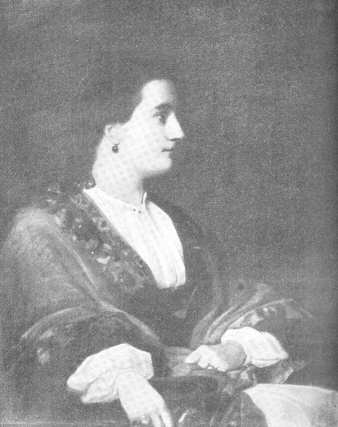
Such a queer fellow came here the other day—a tall
stalwart Holsteiner, I should think a man of fifty, who has been
four years up in the Soudan and Sennaar, and being penniless, had
walked all through Nubia begging his way. He was not the
least ‘down upon his luck’ and spoke with enthusiasm
of the hospitality and kindness of Sir Samuel Baker’s
‘tigers.’ Ja, das sind die rechten Kerls,
dass ist das glückliche Leben. His account is that
if you go with an armed party, the blacks naturally show fight,
as men with guns, in their eyes, are always slave hunters; but if
you go alone and poor, they kill an ox for you, unless you prefer
a sheep, give you a hut, and generally anything they have to
offer, merissey (beer) to make you as drunk as a lord, and
young ladies to pour it out for you—and—you need not
wear any clothes. If you had heard him you would have
started for the interior at once. I gave him a dinner and a
bottle of common wine, which he emptied, and a few shillings, and
away he trudged merrily towards Cairo. I wonder what the
Nubians thought of a howagah begging. He said they
were all kind, and that he was sure he often ate what they
pinched themselves to give—dourrah bread and dates.
In the evening we were talking about this man’s stories,
and of ‘anthropophagi and men whose heads do grow’ to
a prodigious height, by means of an edifice woven of their own
hair, and other queer things, when Hassan told me a story which
pleased me particularly. ‘My father,’ said he,
‘Sheykh Mohammed (who was a taller and handsomer man than I
am), was once travelling very far up in the black country, and he
and the men he was with had very little to eat, and had killed
nothing for many days; presently they heard a sort of wailing
from a hole in the rock, and some of the men went in and dragged
out a creature—I know not, and my father knew not, whether
a child of Adam or a beast. But it was like a very foul and
ill-shaped woman, and had six toes on its feet. The men
wished to slay it, according to the law declaring it to be a
beast and lawful food, but when it saw the knife, it cried sadly
and covered its face with its hands in terror, and my father
said, ‘By the Most High God, ye shall not slay the poor
woman-beast which thus begs its life; I tell you it is unlawful
to eat one so like the children of Adam.’ And the
beast or woman clung to him and hid under his cloak; and my
father carried her for some time behind him on his horse, until
they saw some creatures like her, and then he sent her to them,
but he had to drive her from him by force, for she clung to
him. Thinkest thou oh Lady, it was really a beast, or some
sort of the children of Adam?’
‘God knows, and He only,’ said I piously,
‘but by His indulgent name, thy father, oh Sheykh, was a
true nobleman.’ Sheykh Yussuf chimed in and gave a
decided opinion that a creature able to understand the sight of
the knife and to act so, was not lawful to kill for food.
You see what a real Arab Don Quixote was. It is a picture
worthy of him,—the tall, noble-looking Abab’deh
sheltering the poor ‘woman-beast,’ most likely a
gorilla or chimpanzee, and carrying her en croupe.
To Mrs. Austin.
Luxor,
January 26, 1867.
Dearest Mutter,
I must betray dear Sheykh Yussuf’s confidence, and tell
you his love story.
A young fellow ran away with a girl he loved a short time ago,
she having told him that her parents wanted to marry her to
another, and that she would go to such a spot for water, and he
must come on a horse, beat her and carry her off (the beating
saves the maiden’s blushes). Well, the lad did it,
and carried her to Salamieh where they were married, and then
they went to Sheykh Yussuf to get him to conciliate the family,
which he did. He told me the affair, and I saw he
sympathized much with the runaways. ‘Ah,’ he
said ‘Lady, it is love, and that is terrible, I can tell
thee love is dreadful indeed to bear.’ Then he
hesitated and blushed, and went on, ‘I felt it once, Lady,
it was the will of God that I should love her who is now my
wife. Thirteen years ago I loved her and wished to marry
her, but my father, and her grandfather my uncle the Shereef, had
quarrelled, and they took her and married her to another
man. I never told anyone of it, but my liver was burning
and my heart ready to burst for three years; but when I met her I
fixed my eyes on the ground for fear she should see my love, and
I said to myself, Oh Yussuf, God has afflicted thee, praise be
unto Him, do thou remember thy blood (Shereef) and let thy
conduct be that of the Beni Azra who when they are thus afflicted
die rather than sin, for they have the strongest passion of love
and the greatest honour. And I did not die but went to
Cairo to the Gama el-Azhar and studied, and afterwards I married
twice, as thou knowest, but I never loved any but that one, and
when my last wife died the husband of this one had just divorced
her to take a younger and prettier one and my father desired me
then to take her, but I was half afraid not knowing whether she
would love me; but, Praise be to God I consented, and behold,
poor thing, she also had loved me in like manner.’ I
thought when I went to see her that she was unusually radiant
with new-married happiness, and she talked of
‘el-Sheykh’ with singular pride and delight, and
embraced me and called me ‘mother’ most
affectionately. Is it not a pretty piece of regular Arab
romance like Ghamem?
My boat has gone up to-day with two very nice Englishmen in
her. Their young Maltese dragoman, aged twenty-four, told
me his father often talked of ‘the Commissioners’ and
all they had done, and how things were changed in the island for
the better. (1) Everything spiritual and temporal has been
done for the boat’s safety in the Cataract—urgent
letters to the Maōhn el Baudar, and him of Assouan to see to
the men, and plenty of prayers and vows to Abu-l-Hajjaj on behalf
of the ‘property of the Lady,’ or kurzweg
‘our boat’ as she is commonly called in Luxor.
Here we have the other side of the misery of the Candian
business; in Europe, of course, the obvious thing is the
sufferings of the Cretans, but really I am more sorry for the
poor fellah lads who are dragged away to fight in a quarrel they
had no hand in raising, and with which they have no
sympathy. The Times suggests that the Sultan should
relinquish the island, and that has been said in many an Egyptian
hut long before. The Sultan is worn out, and the Muslims
here know it, and say it would be the best day for the Arabs if
he were driven out; that after all a Turk never was the true
Ameer el-Moomeneen (Commander of the Faithful). Only
in Europe people talk and write as if it were all Muslim
versus Christian, and the Christians were all oppressed,
and the Muslims all oppressors. I wish they could see the
domineering of the Greeks and Maltese as Christians. The
Englishman domineers as a free man and a Briton, which is
different, and that is the reason why the Arabs wish for English
rule, and would dread that of Eastern Christians. Well they
may; for if ever the Greeks do reign in Stamboul the sufferings
of the Muslims will satisfy the most eager fanatic that ever
cursed Mahound. I know nothing of Turkey, but I have seen
and heard enough to know that there are plenty of other divisions
besides that of Christian and Muslim. Here in Egypt it is
clear enough: it is Arab versus Turk and the Copt siding
with the stronger for his interest, while he rather sympathizes
with his brother fellah. At all events the Copt don’t
want other Christians to get power; he would far rather have a
Muslim than a heretic ruler, above all the hated Greek. The
Englishman he looks on as a variety of Muslim—a man who
washes, has no pictures in his church, who has married bishops,
and above all, who does not fast from all that has life for half
the year, and this heresy is so extreme as not to give offence,
unless he tries to convert.
The Pasha’s sons have just been up the river: they
ordered a reading of the Koran at the tomb of Abu-l-Hajjaj and
gave every Alim sixpence. We have not left off chaffing (as
Maurice would say) Sheykh Allah-ud-deen, the Muezzin, and sundry
others on this superb backsheesh, and one old Fikee never knows
whether to laugh, to cry, or to scold, when I ask to see the
shawl and tarboosh he has bought with the presents of
Pashas. Yussuf and the Kadee too had been called on to
contribute baskets of bread to the steamer so that their
sixpences were particularly absurd.
The little boy whose father died is still with the
Abab’deh, who will not let him travel to Cairo till the
weather is warmer and they find a safe person to be kind to
him. Rachmeh says ‘Please God, he will go with the
Sitt, perhaps.’ Hassan has consoled him with
sugar-cane and indulgence, and if I lose Mabrook, and the little
boy takes to me, he may fall into my hands as Achmet has
done. I hear he is a good boy but a perfect savage; that
however, I find makes no difference—in fact, I think they
learn faster than those who have ways of their own. So I
see Terence was a nigger! I would tell Rachmeh so if I
could make him understand who Terence was, and that he, Rachmeh,
stood in need of any encouragement, but the worthy fellow never
imagines that his skin is in any way inferior to mine.
To Sir Alexander Duff
Gordon.
Luxor,
February 3, 1867.
Dearest Alick,
The boat goes down to-morrow and I have little to add to
Mutter’s letter, only that I am better.
There is a man here from Girgeh, who says he is married to a
Ginneeyeh (fairy) princess. I have asked to be presented to
her, but I suspect there will be some hitch about it. It
will be like Alexis’s Allez, Madame, vous êtes
trop incrédule. [334] The
unintelligible thing is the motive which prompts wonders and
miracles here, seeing that the wonder workers do not get any
money by it; and indeed, very often give, like the Indian saint I
told you of who gave me four dollars. His miracles were all
gratis, which was the most miraculous thing of all in a
saint. I am promised that the Ginneeyeh shall come through
the wall. If she should do so I shall be compelled to
believe in her, as there are no mechanical contrivances in
Luxor. All the Hareem here believe it, and the man’s
human wife swears she waits on her like a slave, and backs her
husband’s lie or delusion fully. I have not seen the
man, but I should not wonder if it were a delusion—real
bona fide visions and revelations are so common, and I
think there is but little downright imposture. Meanwhile
familiarity breeds contempt. Jinns, Afreets and Shaitans
inspire far less respect than the stupidest ghost at home, and
the devil (Iblees) is reduced to deplorable insignificance.
He is never mentioned in the pulpit, or in religious
conversation, with the respect he enjoys in Christian
countries. I suppose we may console ourselves with the hope
that he will pay off the Muslims for their neglect of him
hereafter.
I cannot describe to you the misery here now, indeed it is
wearisome even to think of: every day some new tax. Now
every beast; camel, cow, sheep, donkey, horse, is made to
pay. The fellaheen can no longer eat bread, they are living
on barley meal, mixed with water and new green stuff, vetches
etc., which to people used to good food is terrible, and I see
all my acquaintances growing seedy and ragged and anxious.
Yussuf is clear of debt, his religion having kept him from
borrowing, but he wants to sell his little slave girl, and has
sold his donkey, and he is the best off. The taxation makes
life almost impossible—100 piastres per feddan, a tax on
every crop, on every annual fruit, and again when it is sold in
the market; on every man, on charcoal, on butter, on salt, on the
dancing girls. I wonder I am not tormented for
money—not above three people have tried to beg or
borrow.
Thanks for the Westminster epilogue; it always amuses me
much. So Terence was a nigger. There is no trace of
the negro ‘boy’ in his Davus. My nigger has
grown huge, and has developed a voice of thunder. He is of
the elephantine rather than the tiger species, a very mild young
savage. I shall be sorry when Palgrave takes him. I
am tempted to buy Yussuf’s nice little Dinka girl to
replace him, only a girl is such an impossibility where there is
no regular hareem. In the boat Achmet is enough under Omar;
but in this large dusty house, and with errands to run, and
comers and goers to look after, pipes and coffee and the like, it
takes two boys to be comfortable. Mabrook too washes very
well. It is surprising how fast the boys learn, and how
well they do their work. Achmet, who is quite little, would
be a perfectly sufficient servant for a man alone; he can cook,
wash, clean the rooms, make the beds, do all the table service,
knife and plate cleaning, all fairly well, and I believe now he
would get along even without Omar’s orders. Mabrook
is slower, but he has the same merit our poor Hassan had, [336] he never forgets what he has been once
told to do, and he is clean in his work, though hopelessly dirty
as to his clothes. He cannot get used to them, and takes a
roll in the dust, or leans against a dirty wall, oblivious of his
clean-washed blue shirt. Achmet is quicker and more
careless, but they both are good boys and very fond of
Omar. ‘Uncle Omar’ is the form of address,
though he scolds them pretty severely if they misbehave; and I
observe that the high jinks take place chiefly when only I am in
the way, and Omar gone to market or to the mosque. The
little rogues have found out that their laughing does not
‘affect my nerves,’ and I am often treated to a share
in the joke. How I wish Rainie could see the children: they
would amuse her. Yussuf’s girl, ‘Meer en
Nezzil,’ is a charming child, and very clever; her emphatic
way of explaining everything to me, and her gestures, would
delight you. Her cousin and future husband, age five (she
is six), broke the doll which I had given her, and her
description of it was most dramatic, ending with a wheedling
glance at the cupboard and ‘of course there are no more
dolls there; oh no, no more.’ She is a fine little
creature, far more Arab than fellaha; quite a Shaitan, her
father says. She came in full of making cakes for Bairam,
and offered her services; ‘Oh my aunt, if thou wantest
anything I can work,’ said she, tucking up her sleeves.
To Mrs. Austin.
Luxor,
March 6, 1867.
Dearest Mutter,
The warm weather has set in, and I am already as much the
better for it as usual. I had a slight attack, not nearly
so bad as that at Soden, but it lingered and I kept my bed as a
measure of precaution. Dear Yussuf was with me the evening
I was attacked, and sat up all night to give me my medicine every
hour. At the prayer of dawn, an hour and a half before
sunrise, I heard his supplications for my life and health, and
for you and all my family; and I thought of what I had lately
read, how the Greeks massacred their own patriots because the
Turks had shown them mercy—a display of temper which I hope
will enlighten Western Christendom as to what the Muslims have to
expect, if they (the Western Christians) help the Eastern
Christians to get the upper hand. Yussuf was asking about a
lady the other day who has turned Catholic. ‘Poor
thing,’ said he, ‘the priests have drawn out her
brains through her ears, no doubt: but never fear, her heart is
good and her charity is great, and God will not deal hardly with
those who serve Him with their hearts, though it is sad she
should bow down before images. But look at thy slave
Mabrook, can he understand one hundredth part of the thoughts of
thy mind? Never-the-less he loves thee, and obeys thee with
pleasure and alacrity; and wilt thou punish him because he knows
not all thy ways? And shall God, who is so much higher
above us as thou art above thy slave, be less just than
thou?’ I pinned him at once, and insisted on knowing
the orthodox belief; but he quoted the Koran and the decisions of
the Ulema to show that he stretched no point as far as Jews and
Christians are concerned, and even that idolaters are not to be
condemned by man. Yussuf wants me to write a short account
of the faith from his dictation. Would anyone publish
it? It annoys him terribly to hear the Muslims constantly
accused of intolerance, and he is right—it is not
true. They show their conviction that their faith is the
best in the world with the same sort of naïveté that
I have seen in very innocent and ignorant English women; in fact,
display a sort of religious conceit; but it is not often bitter
or haineux, however much they are in earnest.
I am going to write to Palgrave and ask him to let me send
another boy or the money for Mabrook, who can’t endure the
notion of leaving me. Achmet, who was always hankering
after the fleshpots of Alexandria, got some people belonging to
the boats to promise to take him, and came home and picked a
quarrel and departed. Poor little chap; the Sheykh el-Beled
‘put a spoke in his wheel’ by informing him he would
be wanted for the Pasha’s works and must stay in his own
place. Since he went Mabrook has come out wonderfully and
does his own work and Achmet’s with the greatest
satisfaction. He tells me he likes it best so; he likes to
be quiet. He just suits me and I him, it is humiliating to
find how much more I am to the taste of savages than of the
‘polite circles.’
The old lady of the Maōhn proposed to come to me, but I
would not let her leave her home, which would be quite an
adventure to her. I knew she would be exclamatory, and
lament over me, and say every minute, ‘Oh my liver.
Oh my eyes! The name of God be upon thee, and never mind!
to-morrow please God, thou wilt be quite well,’ and so
forth. People send me such odd dishes, some very
good. Yussuf’s wife packed two calves’ feet
tight in a little black earthern pan, with a seasoning of herbs,
and baked it in the bread oven, and the result was
excellent. Also she made me a sort of small macaroni,
extremely good. Now too we can get milk again, and Omar
makes kishta, alias clotted cream.
Do send me a good edition of the ‘Arabian Nights’
in Arabic, and I should much like to give Yussuf Lane’s
Arabic dictionary. He is very anxious to have it. I
can’t read the ‘Arabian Nights,’ but it is a
favourite amusement to make one of the party read aloud; a stray
copy of ‘Kamar ez-Zeman and Sitt Boodoora’ went all
round Luxor, and was much coveted for the village
soirées. But its owner departed, and left us
to mourn over the loss of his MSS.
I must tell you a black standard of respectability (it is
quite equal to the English one of the gig, or the ham for
breakfast). I was taking counsel with my friend Rachmeh, a
negro, about Mabrook, and he urged me to buy him of Palgrave,
because he saw that the lad really loved me.
‘Moreover,’ he said, ‘the boy is of a
respectable family, for he told me his mother wore a cow’s
tail down to her heels (that and a girdle to which the tail is
fastened, and a tiny leathern apron in front, constituted her
whole wardrobe), and that she beat him well when he told lies or
stole his neighbours eggs.’ Poor woman; I wish this
abominable slave trade had spared her and her boy. What
folly it is to stop the Circassian slave trade, if it is stopped,
and to leave this. The Circassians take their own children
to market, as a way of providing for them handsomely, and both
boys and girls like being sold to the rich Turks; but the blacks
and Abyssinians fight hard for their own liberty and that of
their cubs. Mabrook swears that there were two Europeans in
the party which attacked his village and killed he knew not how
many, and carried him and others off. He was not stolen by
Arabs, or by Barrabias, like Hassan, but taken in war from his
home by the seaside, a place called Bookee, and carried in a ship
to Jedda, and thence back to Koseir and Keneh, where Palgrave
bought him. I must say that once here the slaves are happy
and well off, but the waste of life and the misery caused by the
trade must be immense. The slaves are coming down the river
by hundreds every week, and are very cheap—twelve to twenty
pounds for a fine boy, and nine pounds and upwards for a
girl. I heard that the last gellab offered a woman
and baby for anything anyone would give for them, on account of
the trouble of the baby. By-the-bye, Mabrook displays the
negro talent for babies. Now that Achmet is gone, who
scolded them and drove them out, Mohammed’s children, quite
babies, are for ever trotting after ‘Maboo,’ as they
pronounce his name, and he talks incessantly to them. It
reminds me so of Janet and poor Hassan, but Mabrook is not like
Hassan, he is one of the sons of Anak, and already as big and
strong as a man, with the most prodigious chest and limbs.
Don’t be at all uneasy about me as to care. Omar
knows exactly what to do as he showed the other day when I was
taken ill. I had shown him the medicines and given him
instructions so I had not even to speak, and if I were to be ill
enough to want more help, Yussuf would always sit up alternate
nights; but it is not necessary. Arabs make no grievance
about broken rest; they don’t ‘go to bed
properly,’ but lie down half dressed, and have a happy
faculty of sleeping at odd times and anyhow, which enables them
to wait on one day and night, without distressing themselves as
it distresses us.
Thursday.—A telegram has just come announcing
that Janet will leave Cairo to-morrow in a steamer, and therefore
be here, Inshallah, this day week. I enclose a note from a
Copt boy, which will amuse you. He is ‘sapping’
at English, and I teach him whenever I am able. I am a
special favourite with all the young lads; they must not talk
much before grown men, so they come and sit on the floor round my
feet, and ask questions and advice, and enjoy themselves
amazingly. Hobble-de-hoy-hood is very different here from
what it is with us; they care earlier for the affairs of the
grown-up world, and are more curious and more polished, but lack
the fine animal gaiety of our boys. The girls are much more
gamin than the boys, and more romping and joyous.
It is very warm now. I fear Janet will sigh terribly
over the heat. They have left their voyage too late for
such as do not love the Shems el-Kebeer (the big sun), which has
just begun. I who worship Ammun Ra, love to feel him in his
glory. It is long since I had any letters, I want so to
hear how you all are.
To Sir Alexander Duff
Gordon.
March 7, 1867.
Dearest Alick,
I have written a long yarn to Mutter and am rather tired, so I
only write to say I am much better. The heat has set in,
and, of course with it my health has mended, but I am a little
shaky and afraid to tire myself. Moreover I want to nurse
up and be stronger by next Thursday when Janet and Ross are
expected.
What a queer old fish your Dublin antiquary is, who wants to
whitewash Miss Rhampsinitus, and to identify her with the beloved
of Solomon (or Saleem); my brain spun round as I read it.
Must I answer him, or will you? A dragoman gave me an old
broken travelling arm-chair, and Yussuf sat in an arm-chair for
the first time in his life. ‘May the soul of the man
who made it find a seat in Paradise,’ was his exclamation,
which strikes me as singularly appropriate on sitting in a very
comfortable armchair. Yussuf was thankful for small mercies
in this case.
I am afraid Janet may be bored by all the people’s
civility; they will insist on making great dinners and fantasias
for her I am sure. I hope they will go on to Assouan and
take me with them; the change will do me good, and I should like
to see as much of her as I can before she leaves Egypt for
good.
The state of business here is curious. The last
regulations have stopped all money lending, and the prisons are
full of Sheykh el-Beled whose villages can’t pay the
taxes. Most respectable men have offered me to go partners
with them now in their wheat, which will be cut in six weeks, if
only I would pay their present taxes, I to take half the crop and
half the taxes, with interest out of their half—some such
trifle as 30 per cent, per month. Our prison is full of
men, and we send them their dinner à tour de
rôle. The other day a woman went with a big
wooden bowl on her head, full of what she had cooked for them,
accompanied by her husband. One Khaleel Effendi, a new
vakeel here, was there, and said, ‘What dost thou ask here
thou harlot?’ Her husband answered, ‘That is no
harlot, oh Effendim, but my wife.’ Whereupon he was
beaten till he fainted, and then there was a lamentation; they
carried him down past my house, with a crowd of women all
shrieking like mad creatures, especially his wife, who yelled and
beat her head and threw dust over it, more majorum, as you
see in the tombs. The humours of tax-gathering in this
country are quite impayable you perceive—and ought
to be set forth on the escutcheon of the new Knight of the Bath
whom the Queen hath delighted to honour. Cawass battant,
Fellah rampant, and Fellaha pleurant would be the proper
blazon. Distress in England is terrible, but, at least, it
is not the result of extortion, as it is here, where everything
from nature is so abundant and glorious, and yet mankind so
miserable. It is not a little hunger, it is the cruel
oppression which maddens the people now. They never
complained before, but now whole villages are deserted. The
boat goes to-morrow morning so I must say goodbye.
To Mrs. Austin.
Luxor,
April 12, 1867.
Dearest Mutter,
I have just received your letters, including the one for Omar
which I read to him, and which he kissed and said he should keep
as a hegab (talisman). I have given him an order on
Coutts’ correspondents for the money, in case I die.
Omar proposes to wait till we get to Cairo and then to buy a
little house, or a floor in one. I am to keep all the money
till the house is found, so he will in no way be tempted to do
anything foolish with it. I hope you approve?
Janet’s visit was quite an Eed (festival), as the
people said. When I got up on the morning she was expected,
I found the house decked with palm branches and lemon blossoms,
and the holy flags of Abu-l-Hajjaj waving over my balcony.
The mosque people had brought them, saying all the people were
happy to-day, because it was a fortunate day for me. I
suppose if I had had a mind to testify, I ought to have
indignantly torn down the banners which bore the declaration,
‘There is no God but God, and Mohammed is His
Prophet.’ But it appeared to me that if Imaams and
Muezzins could send their banners to decorate a Christian house,
the Christian might manage to endure the kindness. Then
there was fantasia on horseback, and all the notables to meet the
boat, and general welcome and jubilation. Next day I went
on with Henry and Janet in the steamer, and had a very pleasant
time to Assouan and back, and they stayed another day here, and I
hired a little dahabieh which they towed down to Keneh where they
stayed a day; after which Sheykh Yussuf and I sailed back again
to Luxor. As bad luck would have it we had hot weather just
the week they were up here: since then it has been quite
cool.
Janet has left me her little black and tan terrier, a very
nice little dog, but I can’t hope to rival Omar in his
affections. He sleeps in Omar’s bosom, and Omar
spoils and pets him all day, and boasts to the people how the dog
drinks tea and coffee and eats dainty food, and the people say
Mashallah! whereas I should have expected them to curse the
dog’s father. The other day a scrupulous person drew
back with an air of alarm from Bob’s approach, whereupon
the dog stared at him, and forthwith plunged into Sheykh
Yussuf’s lap, from which stronghold he ‘yapped’
defiance at whoever should object to him. I never laughed
more heartily, and Yussuf went into fou rire. The
mouth of the dog only is unclean, and Yussuf declares he is a
very well-educated dog, and does not attempt to lick; he pets him
accordingly, and gives him tea in his own saucer, only not
in the cup.
I am to inherit another little blackie from Ross’s
agency at Keneh: the funniest little chap. I cannot think
why I go on expecting so-called savages to be different from
other people. Mabrook’s simple talk about his
village, and the animals and the victuals; and how the men of a
neighbouring village stole him in order to sell him for a gun
(the price of a gun is a boy), but were prevented by a razzia of
Turks, etc. who killed the first aggressors and took all the
children—all this he tells just as an English boy might
tell of bird-nesting—delights me. He has the same
general notion of right and wrong; and yet his tribe know neither
bread nor any sort of clothes, nor cheese nor butter, nor even
drink milk, nor the African beer; and it always rains there, and
is always deadly cold at night, so that without a fire they would
die. They have two products of civilization—guns and
tobacco, for which they pay in boys and girls, whom they
steal. I wonder where the country is, it is called
Sowaghli, and the next people are Mueseh, on the sea-coast, and
it is not so hot as Egypt. It must be in the southern
hemisphere. The new négrillon is from
Darfoor. Won’t Maurice be amused by his attendants,
the Darfoor boy will trot after him, as he can shoot and clean
guns, tiny as he is Maurice seems to wish to come and I hope
Alexander will let him spend the winter here, and I will take him
up to the second Cataract; I really think he would enjoy it.
My boat will not return I think for another six weeks.
Mr. Eaton and Mr. Baird were such nice people! their dragoman, a
Maltese, appeared to hate the Italians with ferocity. He
said all decent people in Malta would ten times rather belong to
the Mahommedans than to the Italians—after all blood
tells. He was a very respectable young man, and being a
dragoman and the son of a dragoman, he has seen the world, and
particularly the Muslims. I suppose it is the Pope that
makes the Italians so hateful to them.
The post here is dreadful, I would not mind their reading
one’s letters if they would only send them on. Omar
begs we to say that he and his children will pray for you all his
life, please God, not for the money only but still more for the
good words and the trusting him. But he says, ‘I
can’t say much politikeh, Please God she shall see,
only I kiss her hand now.’ You will hear from Janet
about her excursion. What I liked best was shooting the
Cataract in a small boat; it was fine fantasia.
To Sir Alexander Duff
Gordon.
Luxor,
April 19, 1867.
Dearest Alick,
I have been much amused lately by a new acquaintance, who, in
romances of the last century, would be called an ‘Arabian
sage.’ Sheykh Abdurrachman lives in a village half a
day’s journey off, and came over to visit me and to doctor
me according to the science of Galen and Avicenna. Fancy a
tall, thin, graceful man, with a grey beard and liquid eyes,
absorbed in studies of the obsolete kind, a doctor of theology,
law, medicine and astronomy. We spent three days in arguing
and questioning; I consented to swallow a potion or two which he
made up before me, of very innocent materials. My friend is
neither a quack nor superstitious, and two hundred years ago
would have been a better physician than most in Europe.
Indeed I would rather swallow his physic now than that of many a
M.D. I found him like all the learned theologians I have
known, extremely liberal and tolerant. You can conceive
nothing more interesting and curious than the conversation of a
man learned and intelligent, and utterly ignorant of all our
modern Western science. If I was pleased with him, he was
enchanted with me, and swore by God that I was a Mufti indeed,
and that a man could nowhere spend time so delightfully as in
conversation with me. He said he had been acquainted with
two or three Englishmen who had pleased him much, but that if all
Englishwomen were like me the power must necessarily be in our
hands, for that my akl (brain, intellect) was far above
that of the men he had known. He objected to our medicine
that it seemed to consist in palliatives, which he rather
scorned, and aimed always at a radical cure. I told him
that if he had studied anatomy he would know that radical cures
were difficult of performance, and he ended by lamenting his
ignorance of English or some European language, and that he had
not learned our Ilm (science) also. Then we plunged
into sympathies, mystic numbers, and the occult virtues of
stones, etc., and I swallowed my mixture (consisting of
liquorice, cummin and soda) just as the sun entered a particular
house, and the moon was in some favourable aspect. He
praised to me his friend, a learned Jew of Cairo. I could
have fancied myself listening to Abu Suleyman of Cordova, in the
days when we were the barbarians and the Arabs were the learned
race. There is something very winning in the gentle,
dignified manners of all the men of learning I have seen here,
and their homely dress and habits make it still more
striking. I longed to photograph my Sheykh as he sat on the
divan pulling MSS. out of his bosom to read me the words of
El-Hakeem Lokman, or to overwhelm me with the authority of
some physician whose very name I had never heard.
The hand of the Government is awfully heavy upon us. All
this week the people have been working night and day cutting
their unripe corn, because three hundred and ten men are to go
to-morrow to work on the railroad below Siout. This green
corn is, of course, valueless to sell and unwholesome to eat; so
the magnificent harvest of this year is turned to bitterness at
the last moment. From a neighbouring village all the men
are gone, and seven more are wanted to make up the
corvée. The population of Luxor is 1,000
males of all ages, so you can guess how many strong men are left
after three hundred and ten are taken.
I don’t like to think too much about seeing you and
Maurice next winter for fear I should be disappointed. If I
am too sick and wretched I can hardly wish you to come because I
know what a nuisance it is to be with one always coughing and
panting, and unable to do like other people. But if I pick
up tolerably this summer I shall indeed be glad to see you and
him once more.
This house is falling sadly to decay, which produces snakes
and scorpions. I sent for the hawee (snake-catcher)
who caught a snake, but who can’t conjure the scorpions out
of their holes. One of my fat turkeys has just fallen a
victim, and I am in constant fear for little Bob, only he is
always in Omar’s arms. I think I described to you the
festival of Sheykh Gibrieel: the dinner, and the poets who
improvised; this year I had a fine piece of declamation in my
honour. A real calamity is the loss of our good Maōhn,
Seleem Effendi. The Mudir hailed him from his steamer to go
to Keneh directly, with no further notice. We hoped some
good luck for him, and so it would have been to a Turk. He
is made overseer over the poor people at the railway work, and
only gets two pounds five shillings per month additional, he has
to keep a horse and a donkey, and to buy them and to hire a sais,
and he does not know how to squeeze the fellaheen.
It is true ‘however close you skin an onion, a clever man
can always peel it again,’ which means that even the
poorest devils at the works can be beaten into giving a little
more; but our dear Seleem, God bless him, will be ruined and made
miserable by his promotion. I had a very woeful letter from
him yesterday.
To Sir Alexander Duff
Gordon.
Luxor,
May 15, 1867.
Dearest Alick,
All the Christendom of Upper Egypt is in a state of
excitement, owing to the arrival of the Patriarch of Cairo, who
is now in Luxor. My neighbour, Mikaeel, entertains him, and
Omar has been busily decorating his house and arranging the
illumination of his garden, and to-day is gone to cook the
confectionery, he being looked upon as the person best acquainted
with the customs of the great. Last night the Patriarch
sent for me, and I went to kiss his hand, but I won’t go
again. It was a very droll caricature of the thunders of
the Vatican. Poor Mikaeel had planned that I was to dine
with the Patriarch, and had borrowed my silver spoons, etc.,
etc., in that belief. But the representative of St. Mark is
furious against the American missionaries who have converted some
twenty Copts at Koos, and he could not bring himself to be
decently civil to a Protestant. I found a coarse-looking
man seated on a raised divan smoking his chibouk, on his right
were some priests on a low divan; I went up and kissed his hand
and was about to sit by the priests, but he roughly ordered a
cawass to put a wooden chair off the carpet to his left,
at a distance from him, and told me to sit there. I looked
round to see whether any of my neighbours were present, and I saw
the consternation in their faces so, not wishing to annoy them, I
did as if I did not perceive the affront, and sat down and talked
for half an hour to the priests, and then took leave. I was
informed that the Catholics were naas mesakeen (poor
inoffensive people), and that the Muslims at least were of an old
religion, but that the Protestants ate meat all the year round,
‘like dogs’—‘or Muslims,’ put in
Omar, who stood behind my chair and did not relish the mention of
dogs and the ‘English religion’ in one
sentence. As I went the Patriarch called for dinner, it
seems he had told Mikaeel he would not eat with me. It is
evidently ‘a judgment’ of a most signal nature that I
should be snubbed for the offences of missionaries, but it has
caused some ill blood; the Kadee and Sheykh Yussuf and the rest,
who all intended to do the civil to the Patriarch, now
won’t go near him on account of his rudeness to me.
He has come up in a steamer, at the Pasha’s expense, with a
guard of cawasses, and, of course, is loud in praise of the
Government, though he failed in getting the Moudir to send all
the Protestants of Koos to the public works, or the army.
From what he said before me about the Abyssinians, and still
more, from what he said to others about the English prisoners up
there, I am convinced that the place to put the screw on is the
Batrarchane (Patriarch’s palace) at Cairo, and that
the priests are at the bottom of that affair. [350] He boasted immensely of the
obedience and piety of El Habbesh (the Abyssinians).
Saturday.—Yesterday I heard a little whispered
grumbling about the money demanded by the
‘Father.’ One of my Copt neighbours was forced
to sell me his whole provision of cooking butter to pay his
quota. This a little damps the exultation caused by seeing
him so honoured by the Effendina. One man who had heard
that he had called the American missionaries
‘beggars,’ grumbled to me, ‘Ah yes, beggars,
beggars, they didn’t beg of me for money.’ I
really do think that there must be something in this dread of the
Protestant movement. Evidently the Pasha is backing up the
Patriarch who keeps his church well apart from all other
Christians, and well under the thumb of the Turks. It was
pretty to hear the priests talk so politely of Islam, and curse
the Protestants so bitterly. We were very nearly having a
row about a woman, who formerly turned Moslimeh to get rid of an
old blind Copt husband who had been forced upon her, and was
permitted to recant, I suppose in order to get rid of the Muslim
husband in his turn. However he said, ‘I don’t
care, she is the mother of my two children, and whether she is
Muslim or Christian she is my wife, and I won’t divorce
her, but I’ll send her to church as much as she
likes.’ Thereupon the priests of course dropped the
wrangle, much to the relief of Sheykh Yussuf, in whose house she
had taken up her quarters after leaving the church, and who was
afraid of being drawn into a dispute.
My new little Darfour boy is very funny and very
intelligent. I hope he will turn out well, he seems well
disposed, though rather lazy. Mabrook quarrelled with a boy
belonging to the quarter close to us about a bird, and both boys
ran away. The Arab boy is missing still I suppose, but
Mabrook was brought back by force, swelling with passion, and
with his clothes most scripturally ‘rent.’ He
had regularly ‘run amuck.’ Sheykh Yussuf
lectured him on his insolence to the people of the quarter, and I
wound up by saying, ‘Oh my son! whither dost thou wish to
go? I cannot let thee wander about like a beggar, with torn
clothes and no money, that the police may take thee and put thee
in the army; but say where thou desirest to go, and we will talk
about it with discretion.’ It was at once borne in
upon him that he did not want to go anywhere, and he said,
‘I repent; I am but an ox, bring the courbash, beat me, and
let me go to finish cooking the Sitt’s dinner.’
I remitted the beating, with a threat that if he bullied the
neighbours again he would get it at the police, and not from
Omar’s very inefficient arm. In half an hour he was
as merry as ever. It was a curious display of negro temper,
and all about nothing at all. As he stood before me, he
looked quite grandly tragic; and swore he only wanted to run
outside and die; that was all.
I wish you could have heard (and understood) my
soirées, au clair de la lune, with Sheykh Yussuf
and Sheykh Abdurrachman. How Abdurrachman and I wrangled,
and how Yussuf laughed, and egged us on. Abdurrachman was
wroth at my want of faith in physic generally, as well as in
particular, and said I talked like an infidel, for had not God
said, ‘I have made a medicine for every
disease?’ I said, ‘Yes, but He does not say
that He has told the doctors which it is; and meanwhile I say,
hekmet Allah, (God will cure) which can’t be called
an infidel sentiment.’ Then we got into alchemy,
astrology, magic and the rest; and Yussuf vexed his friend by
telling gravely stories palpably absurd. Abdurrachman
intimated that he was laughing at El-Ilm el-Muslimeen (the
science of the Muslims), but Yussuf said, ‘What is the
Ilm el-Muslimeen? God has revealed religion through
His prophets, and we can learn nothing new on that point; but all
other learning He has left to the intelligence of men, and the
Prophet Mohammed said, “All learning is from God, even the
learning of idolaters.” Why then should we Muslims
shut out the light, and want to remain ever like children?
The learning of the Franks is as lawful as any
other.’ Abdurrachman was too sensible a man to be
able to dispute this, but it vexed him.
I am tired of telling all the plackereien of our poor
people, how three hundred and ten men were dragged off on Easter
Monday with their bread and tools, how in four days they were all
sent back from Keneh, because there were no orders about them,
and made to pay their boat hire. Then in five days
they were sent for again. Meanwhile the harvest was cut
green, and the wheat is lying out unthreshed to be devoured by
birds and rats, and the men’s bread was wasted and spoiled
with the hauling in and out of boats. I am obliged to send
camels twenty miles for charcoal, because the Abab’deh
won’t bring it to market any more, the tax is too
heavy. Butter too we have to buy secretly, none comes into
the market. When I remember the lovely smiling landscape
which I first beheld from my windows, swarming with beasts and
men, and look at the dreary waste now, I feel the ‘foot of
the Turk’ heavy indeed. Where there were fifty
donkeys there is but one; camels, horses, all are gone; not only
the horned cattle, even the dogs are more than decimated, and the
hawks and vultures seem to me fewer; mankind has no food to spare
for hangers-on. The donkeys are sold, the camels
confiscated, and the dogs dead (the one sole advantage).
Meat is cheap, as everyone must sell to pay taxes and no one has
money to buy. I am implored to take sheep and poultry for
what I will give.
To Mrs. Austin.
Luxor,
May 23, 1867.
Dearest Mutter,
I have only time for a few words by Giafar Pasha, who goes
early to-morrow morning. My boat arrived all right and
brought your tin box. The books and toys are very
welcome. The latter threw little Darfour into ecstasies,
and he got into disgrace for ‘playing with the Sitt’
instead of minding some business on hand. I fear I shall
spoil him, he is so extremely engaging and such a baby. He
is still changing his teeth, so cannot be more than eight; at
first I did not like him, and feared he was sullen, but it was
the usual khoss (fear), the word that is always in
one’s ears, and now that is gone, he is always coming
hopping in to play with me. He is extremely intelligent and
has a pretty baby nigger face. The Darfour people are, as
you know, an independent and brave people, and by no means
‘savages.’ I can’t help thinking how
pleased Rainie would be with the child. He asked me to give
him the picture of the English Sultaneh out of the Illustrated
London News, and has pasted it inside the lid of his box.
I am better as usual, since the hot weather has begun, the
last six days. I shall leave this in a week, I think, and
Mustapha and Yussuf will go with me to Cairo. Yussuf was
quite enchanted with your note to him; his eyes glistened, and he
took an envelope to keep it carefully. Omar said such a
letter is like a hegab (amulet) and Yussuf said,
‘Truly it is, and I could never have one with more
baraka (blessing) or more like the virtue which went out
of Jesus, if ever I wore one at all; I will never part with
it.’
We had a very pretty festival for the Sheykh, whose tomb you
have a photograph of, and I spent a very pleasant evening with
Sheykh Abd el-Mootooal, who used to scowl at me, but now we are
‘like brothers.’ I found him very clever, and
better informed than any Arab I have met, who is quite apart from
all Franks. I was astonished to find that he abondait
dans man sens in my dispute with Sheykh Abdurrachman, and
said that it was the duty of Muslims to learn what they could
from us, and not to stick to the old routine.
On Sunday the Patriarch snubbed me, and would not eat with me,
and on Monday a Walee (saint) picked out tit-bits for me
with his own fingers, and went with me inside the tomb. The
Patriarch has made a blunder with his progress. He has come
ostentatiously as the protegé and pronem of
the Pasha, and he has ‘eaten’ and beaten the
fellaheen. The Copts of Luxor have had to pay fifty pounds
for the honour of his presence, besides no end of sheep, poultry,
butter, etc. If I were of a proselytising mind I could make
converts of several whose pockets and backs are smarting, and the
American missionaries will do it. Of course the Muslims
sympathize with the converts to a religion which has no
‘idols,’ and no monks, and whose priests marry like
other folk, so they are the less afraid. I hear there are
now fifty Protestants at Koos, and the Patriarch was furious
because he could not beat them. Omar cooked a grand dinner
for him last night for our neighbour Mikaeel, and the eating was
not over till two in the morning. Our Government should
manage to put the screw on him about our Abyssinian
prisoners. I dare not say who told me all he said, but he
was a truthful man and a Christian. The Patriarch answered
me sharply when I asked about the state of religion in Abyssinia
that, ‘they were lovers of the faith, and his obedient
children.’ Whenever there is mischief among the
Copts, the priests are at the bottom of it. If the
Patriarch chose those people would be let go; and so it would be
but he hates all Europeans bitterly.
I should like to have the Revue des Deux Mondes of all
things, but I don’t know how it is to come here, or what
the postage would cost. They send nothing but letters above
Cairo by post, as all goes on men’s backs.
‘Inshallah! I am the bearer of good news,’
cries the postman, as he flings the letter over the wall. I
am so glad of the chance of getting news to you quick by Giafar
Pasha, who came here like a gentleman, alone, without a retinue;
he is on his way from two years in the Soudan, where he was
absolute Pasha. He is very much liked and respected, and
seems a very sensible and agreeable man, quite unlike any Turkish
big-wig I have seen. Great potentate as he is, he made
Yussuf Mustapha and Abdallah sit down, and was extremely civil
and simple in his manners.
To Sir Alexander Duff
Gordon.
Benisouef,
June 30, 1867.
Dearest Alick,
I write on the chance that this may go safe by post so that
you may not think me lost. I left Luxor on May 31, got to
Siout (half-way) in a week, and have ever since been battling
with an unceasing furious north and north-east wind. I feel
like the much travelled Odysseus, and have seen ‘villages
and men,’ unlike him, however ‘my companions’
have neither grumbled nor deserted, though it is a bad business
for them, having received their money at the rate of about twenty
days’ pay, for which they must take me to Cairo. They
have eaten all, and are now obliged to stop and make bread here,
but they are as good-humoured as if all were well. My fleet
consisted of my dahabieh, flag ship; tender, a kyasseh
(cargo boat) for my horse and sais, wherein were packed two
extremely poor shrivelled old widows, going to Cairo to see their
sons, now in garrison there; lots of hard bread, wheat, flour,
jars of butter, onions and lentils for all the lads of ‘my
family’ studying at Gama’l Azhar, besides in my box
queer little stores of long hoarded money for those
megowareen (students of Gama’l Azhar).
Don’t you wish you could provide for Maurice with a sack of
bread, a basket of onions and one pound sixteen shillings?
The handsome brown Sheykh el-Arab, Hassan, wanted me to take
him, but I knew him to be a ‘fast’ man, and asked
Yussuf how I could avoid it without breaking the laws of
hospitality, so my ‘father,’ the old Shereef, told
Hassan that he did not choose his daughter to travel with a
wine-bibber and a frequenter of loose company. Under my
convoy sailed two or three little boats with family
parties. One of these was very pretty, whose steersman was
a charming little fat girl of five years old. All these
hoped to escape being caught and worried by the way, by belonging
to me, and they dropped off at their several villages. I am
tolerably well, better than when I started, in spite of the
wind.
Poor Reis Mohammed had a very bad attack of ophthalmia, and
sat all of a heap, groaning all day and night, and protesting
‘I am a Muslim,’ equivalent to ‘God’s
will be done.’ At one place I was known, and had a
lot of sick to see, and a civil man killed a sheep and regaled us
all with meat and fateereh. The part of the river in
which we were kept by the high wind is made cheerful by the
custom of the Hareem being just as free to mix with men as
Europeans, and I quite enjoyed the pretty girls’ faces, and
the gossip with the women who came to fill their water-jars and
peep in at the cabin windows, which, by the way, they always ask
leave to do. The Sheykh el-Hawara gave me two sheep which
are in the cargo-boat with four others—all
presents—which Omar intends you to eat at Cairo. The
Sheykh is very anxious to give you an entertainment at his
palace, if you come up the river, with horse-riding, feasting and
dancing girls. In fact I am charged with many messages to
el-Kebir (the great master).
To Sir Alexander Duff
Gordon.
Cairo,
July 8, 1867.
Dearest Alick,
I arrived to-day, after thirty-eight days’ voyage, one
month of ceaseless furious wind. My poor men had a hard
pull down against it. However I am feeling better than when
I left Luxor.
Omar has just brought a whole cargo of your letters, the last
of the 26 June. Let me know your plans. If you can go
up the river I might send the boat beforehand to Minieh, so far
there is a railway now, which would break the neck of the tedious
part of the voyage for you if you are pressed for time. I
must send this off at once to catch early post to-morrow.
Excuse haste, I write in all the bustle of arrival.
To Mrs. Austin.
Boulak,
July 28, 1867.
Dearest Mutter,
I know I can write nothing more sure to please you than that I
am a good deal better. It has been intensely hot, and the
wind very worrying, but my cough has greatly abated and I do not
feel so weak as I did. I am anchored here in the river at
my old quarters, and have not yet been ashore owing to the hot
wind and the dust, which of course are far less troublesome here
on the river. I have seen but very few people and have but
one neighbour, in a boat anchored near mine, a very bewitching
Circassian, the former slave of a rich Pasha, now married to a
respectable dragoman, and staying in his boat for a week or
two. She is young and pretty, and very amiable, and we
visit each other often and get on very well indeed. She is
a very religious little lady, and was much relieved when I
assured her it was not part of my daily devotions to curse the
Prophet, and revile the noble Koran.
I am extremely glad that the English have given a hearty
welcome to the Ameer el-Moornemeen (Commander of the Faithful);
it will have an excellent effect in all Mussulman
countries. A queer little Indian from Delhi who had been
converted to Islam, and spent four years at Mecca acting as
dragoman to his own countrymen, is now settled at Karnac. I
sent for him, and he carne shaking in his shoes. I asked
why he was afraid? ‘Oh, perhaps I was angry about
something, and he was my rayah, and I might have him
beaten.’ I cried out at him, ‘Ask pardon of
God, O man. How could I beat thee any more than thou
couldst beat me? Have we not laws? and art thou not my
brother, and the rayah of our Queen, as I am and no
more?’ ‘Mashallah!’ exclaimed the six or
eight fellaheen who were waiting for physic, in prodigious
admiration and wonder; ‘and did we not tell thee that the
face of the Sitt brings good fortune and not calamity and
stick?’ I found the little Indian had been a hospital
servant in Calcutta, and was practising a little physic on his
own account. So I gave him a few drugs especially for bad
eyes, which he knew a good deal about, and we became very good
friends; he was miserable when I left and would have liked me to
have taken him as a volunteer servant.
I have come to a curious honour. Ich bin beim
lebendigem Leibe besungen. Several parties of real
Arabs came with their sick on camels from the desert above
Edfou. I asked at last what brought them, and they told me
that a Shaer (bard or poet) had gone about singing my
praises, as how the daughter of the English was a flower on the
heads of the Arabs, and those who were sick should go and smell
the perfume of the flower and rejoice in the brightness of the
light (nooreen)—my name. Rather a highflown
way of mentioning the ‘exhibition’ of a black
dose. But we don’t feel that a man makes a fool of
himself here when he is romantic in his talk even about an old
woman.
It is no use to talk of the state of things here; all classes
are suffering terribly under the fearful taxation, the total ruin
of the fellaheen, and the destruction of trade brought about by
this much extolled Pasha. My grocer is half ruined by the
‘improvements’ made a l’instar de
Paris—long military straight roads cut through the
heart of Cairo. The owners are expropriated, and there is
an end of it. Only those who have half a house left are to
be pitied, because they are forced to build a new front to the
street on a Frankish model which renders it uninhabitable to them
and unsaleable.
The river men are excited about the crews gone to Paris, for
fear they should be forcibly detained by the Sultaneh
Franzaweeh, I assured them that they will all come home safe
and happy, with a good backsheesh. Many of them think it a
sort of degradation to be taken for the Parisians to stare at
like an anteeka, a word which here means what our people call a
‘curiosity.’
I go on very well with my two boys. Mabrook washes very
well and acts as marmiton. Darfour is housemaid and
waiter in his very tiny way. He is only troublesome as
being given to dirty his clothes in an incredibly short
time. His account of the school system of Darfour is
curious. How when the little boy has achieved excellence he
is carried home in triumph to his father’s house, who makes
a festival for the master and boys. I suppose you will be
surprised to hear that the Darfour ‘niggers’ can
nearly all read and write. Poor little Darfour apologised
to me for his ignorance, he was stolen he said, when he had only
just begun to go to school. I wish an English or French
servant could hear the instructions given by an Alim here to
serving men. How he would resent them! ‘When
thou hast tired out thy back do not put thy hand behind it (do
not shirk the burden). Remember that thou art not only to
obey, but to please thy master, whose bread thou eatest;’
and much more of the like. In short, a standard of
religious obedience and fidelity fit for the highest Catholic
idea of the ‘religious life.’ Upon the few who
seek instruction it does have an effect (I am sure that Omar
looks on his service as a religious duty), but of course they are
few; and those who don’t seek it themselves get none.
It is curious how all children here are left utterly without any
religious instruction. I don’t know whether it is in
consequence of this that they grow up so very devout.
To Sir Alexander Duff
Gordon.
Boulak,
July 29, 1867.
Dearest Alick,
Your letter has arrived to my great relief—only I fear
you are not at all well. About Maurice. If he wishes
to see the Nile let him come, but if he is only to be sent
because of me, let it alone. I know I am oppressive company
now, and am apt, like Mr. Wodehouse in ‘Emma,’ to
say, ‘Let us all have some gruel.’
We know nothing here of a prohibition of gunpowder, at this
moment some Europeans are popping away incessantly at Embabeh
just opposite. Evidently the Pasha wants to establish a
right of search on the Nile. That absurd speech about
slaves he made in Paris shows that. With 3,000 in his
hareem, several slave regiments, and lots of gangs on all his
sugar plantations, his impudence is wonderful. He is
himself the greatest living slave trader as well as owner.
My lads are afraid to go out alone for fear of being snapped up
by cawasses and taken to the army or the sugar works. You
will be sorry to hear that your stalwart friend Hassan has had
fifty blows on each foot-sole, and had to pay six pounds.
He was taking two donkeys to Shepheard’s hotel before
sunrise for a French lady and gentleman to go to the Pyramids,
when a cawass met him, seized the donkeys, and on Hassan’s
refusal to give them up, spat on the side-saddle and reviled
Hassan’s own Hareem and began to beat him with his
courbash. Hassan got impatient, took the cawass up in his
arms and threw him on the ground, and went on. Presently
four cawasses came after him, seized him and took him to the
Zaptieh (police office), where they all swore he had beaten them,
torn their clothes, and robbed one of an imaginary gold
watch—all valued at twenty-four pounds. After the
beating he was carried to prison in chains, and there sentenced
to be a soldier. A friend however interfered and settled
the matter for six pounds. Hassan sends you his best
salaam.
Last night was very pretty—all the boats starting for
the moolid of Seyd el-Bedawee at Tanta. Every boat
had a sort of pyramid of lanterns, and the derweeshes chanted,
and the worldly folks had profane music and singing, and I sat
and looked and listened, and thought how many thousand years ago
just the same thing was going on in honour of Bubastis.
To Sir Alexander Duff
Gordon.
Boulak,
August 7, 1867.
My dearest Alick,
Two sailors of mine of last year went to Paris in the dahabieh
for the Empress, and are just come back. When I see them I
expect I shall have some fun out of their account of their
journey. Poor Adam’s father died of grief at his
son’s going, nothing would persuade him that Adam would
come back safe, and having a heart complaint, he died. And
now the lad is back, well and with fine clothes, but is much cut
up, I hear, by his father’s death. Please send me a
tremendous whistle; mine is not loud enough to wake Omar at the
other end of the cabin; a boatswain’s whistle or something
in the line of the ‘last trump’ is needed to wake
sleeping Arabs.
My pretty neighbour has gone back into the town. She was
a nice little woman, and amused me a good deal. I see that
a good respectable Turkish hareem is an excellent school of
useful accomplishments—needlework, cookery, etc. But
I observed that she did not care a bit for the Pasha, by whom she
had a child, but was extremely fond of ‘her lady,’ as
she politely called her, also that like every Circassian I ever
knew, she regarded being sold as quite a desirable fate, and did
not seem sorry for her parents, as the negroes always are.
The heat has been prodigious, but I am a good deal
better. Yesterday the Nile had risen above ten cubits, and
the cutting of the Kalig took place. The river is pretty
full now, but they say it will go down fast this year. I
don’t know why. It looks very beautiful, blood-red
and tossed into waves by the north wind fighting the rapid
stream.
Good-bye dear Alick, I hope to hear a better account of your
health soon.
To Mrs. Austin.
Boulak,
August 8, 1867.
Dearest Mutter,
Two of my sailors were in Paris and have just come home.
I hear they are dreadfully shocked by the dancing, and by the
French women of the lower class generally. They sit in the
coffee-shops like shaers (poets), and tell of the wonders
of Paris to admiring crowds. They are enthusiastic about
the courtesy of the French police, who actually did not beat them
when they got into a quarrel, but scolded the Frankish man
instead, and accompanied them back to the boat quite
politely. The novelty and triumph of not being beaten was
quite intoxicating. There is such a curious sight of a
crowd of men carrying huge blocks of stone up out of a
boat. One sees exactly how the stones were carried in
ancient times; they sway their bodies all together like one great
lithe animal with many legs, and hum a low chant to keep
time. It is quite unlike any carrying heavy weights in
Europe.
It is getting dusk and too windy for candles, so I must say
goodnight and eat the dinner which Darfour has pressed upon me
two or three times, he is a pleasant little creature, so lively
and so gentle. It is washing day. I wish you could
see Mabrook squatting out there, lathering away at the clothes
with his superb black arms. He is a capital washer and a
fair cook, but an utter savage.
[The foregoing letter reached England the day after the death
of my grandmother, Mrs. Austin, which was a great shock to my
mother and made her ill and unhappy; so it was settled that my
brother Maurice should go out and spend the winter with her on
the Nile.]
To Sir Alexander Duff
Gordon.
Boulak,
September 7, 1867.
Dearest Alick,
Many thanks for your letter and for all the trouble you have
taken. I wish you were better.
There is such a group all stitching away at the big new sail;
Omar, the Reis, two or three volunteers, some old sailors of
mine, and little Darfour. If I die I think you must have
that tiny nigger over; he is such a merry little soul, I am sure
you would love him, he is quite a civilized being and has a
charming temper, and he seems very small to be left alone in the
world.
I hope Maurice is not of the faction of the
ennuyés of this generation. I am more and
more of Omar’s opinion, who said, with a pleased sigh, as
we sat on the deck under some lovely palm-trees in the bright
moon-light, moored far from all human dwellings, ‘how sweet
are the quiet places of the world.’
I wonder when Europe will drop the absurd delusion about
Christians being persecuted by Muslims. It is absolutely
the other way,—here at all events. The Christians
know that they will always get backed by some Consul or other,
and it is the Muslims who go to the wall invariably. The
brute of a Patriarch is resolved to continue his persecution of
the converts, and I was urged the other day by a Sheykh to go to
the Sheykh ul-Islam himself and ask him to demand equal rights
for all religions, which is the law, on behalf of these Coptic
Protestants. Everywhere the Ulema have done what they could
to protect them, even at Siout, where the American missionaries
had caused them (the Ulemas) a good deal of annoyance on a former
occasion. No one in Europe can conceive how much the Copts
have the upper hand in the villages. They are backed by the
Government, and they know that the Europeans will always side
with them.
September 13.—Omar is crazy with delight at the
idea of Maurice’s arrival, and Reis Mohammed is planning
what men to take who can make fantasia, and not ask too much
wages. Let me know what boat Maurice comes by that I may
send Omar to Alexandria to meet him. Omar begs me to give
you and Sitti Rainie his best salaam, and his assurance that he
will take great care of the young master and ‘keep him very
tight.’ I think Maurice will be diverted with small
Darfour. Mabrook now really cooks very fairly under
Omar’s orders, but he is beyond belief uncouth, and utters
the wildest howls now that his voice is grown big and strong like
himself. Moreover he ‘won’t be spoken
to,’ as our servants say; but he is honest, clean, and
careful. I should not have thought any human creature could
remain so completely a savage in a civilized community. I
rather respect his savage hauteur, especially as it is
combined with truth and honesty.
To Sir Alexander Duff
Gordon.
Boulak,
Boat Marie
Louise,
October 17, 1867.
Dearest Alick,
You must not be wroth with me because I have not written for a
long time—I have been ill, but am much better. Omar
will go down to Alexandria to meet Maurice on Monday.
My boat is being painted, but is nearly finished; as soon as
it is done I shall move back into her. I got out into a
little cangia but it swarmed with bugs and wasps, and was too
dirty, so I moved yesterday into a good boat belonging to a
dragoman, and hope to be back in my own by Sunday. But oh
Lord! I got hold of the Barber himself turned painter; and
as the little cangia was moored alongside the Urania in
order to hold all the mattresses, carpets, etc. I was his
victim. First, it was a request for ‘three pounds to
buy paint.’ ‘None but the best of paint is
fitting for a noble person like thee, and that thou knowest is
costly, and I am thy servant and would do thee
honour.’ ‘Very well,’ say I, ‘take
the money, and see, oh man, that the paint is of the best, or thy
backsheesh will be bad also.’ Well, he begins and
then rushes in to say: ‘Come oh Bey, oh Pasha! and behold
the brilliancy of the white paint, like milk, like glass, like
the full moon.’ I go and say, ‘Mashallah! but
now be so good as to work fast, for my son will be here in a few
days, and nothing is ready.’ Fatal remark.
‘Mashallah! Bismillah! may the Lord spare him, may
God prolong thy days, let me advise thee how to keep the eye from
him, for doubtless thy son is beautiful as a memlook of 1,000
purses. Remember to spit in his face when he comes on
board, and revile him aloud that all the people may hear thee,
and compel him to wear torn and dirty clothes when he goes
out:—and how many children hast thou, and our master, thy
master, and is he well?’ etc. etc. ‘Shukr
Allah! all is well with us,’ say I; ‘but, by the
Prophet, paint, oh Ma-alim (exactly the German
Meister) and do not break my head any more.’
But I was forced to take refuge at a distance from Hajj’
Alee’s tongue. Read the story of the Barber, and you
will know exactly what Ma-alim Hajj’ Alee is. Also
just as I got out of my boat and he had begun, the painter whom I
had last year and with whom I was dissatisfied, went to the
Sheykh of the painters and persuaded him to put my man in prison
for working too cheap—that was at daybreak. So I sent
up my Reis to the Sheykh to inform him that if my man did not
return by next day at daybreak, I would send for an European
painter and force the Sheykh to pay the bill. Of course my
man came.
My steersman Hassan, and a good man, Hoseyn, who can wash and
is generally nice and pleasant, arrived from el-Bastowee a few
days ago, and are waiting here till I want them. Poor
little ugly black Hassan has had his house burnt down in his
village, and lost all the clothes which he had bought with his
wages; they were very good clothes, some of them, and a heavy
loss. He is my Reis’s brother, and a good man, clean
and careful and quiet, better than my Reis even—they are a
respectable family. Big stout Hazazin owes me 200 piastres
which he is to work out, so I have still five men and a boy to
get. I hope a nice boy, called Hederbee (the lizard), will
come. They don’t take pay till the day before we
sail, except the Reis and Abdul Sadig, who are permanent.
But Hassan and Hoseyn are working away as merrily as if they were
paid. People growl at the backsheesh, but they should also
remember what a quantity of service one gets for nothing here,
and for which, oddly enough, no one dreams of asking
backsheesh. Once a week we shift the anchors, for fear of
their silting over, and six or eight men work for an hour; then
the mast is lowered—twelve or fourteen men work at
this—and nobody gets a farthing.
The other day Omar met in the market an ‘agreeable
merchant,’ an Abyssinian fresh from his own country, which
he had left because of the tyranny of Kassa, alias Todoros, the
Sultan. The merchant had brought his wife and concubines to
live here. His account is that the mass of the people are
delighted to hear that the English are coming to conquer them, as
they hope, and that everyone hates the King except two or three
hundred scamps who form his bodyguard. He had seen the
English prisoners, who, he says, are not ill-treated, but
certainly in danger, as the King is with difficulty restrained
from killing them by the said scamps, who fear the revenge of the
English; also that there is one woman imprisoned with the native
female prisoners. Hassan the donkeyboy, when he was a
marmiton in Cairo, knew the Sultan Todoros, he was the
only man who could be found to interpret between the then King of
Abyssinia and Mohammed Ali Pasha, whom Todoros had come to
visit. The merchant also expressed a great contempt for the
Patriarch, and for their Matraam or Metropolitan, whom the
English papers call the Abuna. Abuna is
Arabic for ‘our father.’ The man is a Cairene
Copt and was a hanger-on of two English missionaries (they were
really Germans) here, and he is more than commonly a rascal and a
hypocrite. I know a respectable Jew whom he had robbed of
all his merchandise, only Ras Alee forced the Matraam to
disgorge. Pray what was all that nonsense about the
Armenian Patriarch of Jerusalem writing to Todoros? what could he
have to do with it? The Coptic Patriarch, whose place is
Cairo, could do it if he were forced.
At last my boat is finished, so to-morrow Omar will clean the
windows, and on Saturday move in the cushions, etc. and me, and
on Sunday go to Alexandria. I hear the dreadful voice of
Hajj’ Alee, the painter, outside, and will retire before he
gets to the cabin door, for fear he should want to bore me
again. I do hope Maurice will enjoy his journey; everyone
is anxious to please him. The Sheykh of the Hawara sent his
brother to remind me to stop at his ‘palace’ near
Girgeh, that he might make a fantasia for my son. So
Maurice will see real Arab riding, and jereed, and sheep roasted
whole and all the rest of it. The Sheykh is the last of the
great Arab chieftains of Egypt, and has thousands of fellaheen
and a large income. He did it for Lord Spencer and for the
Duke of Rutland and I shall get as good a fantasia, I have no
doubt. Perhaps at Keneh Maurice had better not see the
dancing, for Zeyneb and Latefeeh are terribly fascinating, they
are such pleasant jolly girls as well as pretty and graceful, but
old Oum ez-Zeyn (mother of beauty), so-called on account of his
hideousness, will want us to eat his good dinner.
To Sir Alexander Duff
Gordon.
Urania,
Boulak,
October 21, 1867.
Dearest Alick,
So many thanks for the boxes and their contents. My
slaves are enchanted with all that the ‘great master’
has sent. Darfour hugged the horsecloth in ecstasy that he
should never again be cold at night. The waistcoats of
printed stuff, and the red flannel shirts are gone to be made up,
so my boys will be like Pashas this winter, as they told the
Reis. He is awfully perturbed about the evil eye.
‘Thy boat, Mashallah, is such as to cause envy from
all beholders; and now when they see a son with thee,
Bismillah! Mashallah! like a flower,
verily. I fear, I fear greatly from the eye of the
people.’ We have bought a tambourine and a tarabouka,
and are on the look-out for a man who can sing well, so as to
have fantasia on board.
October 22.—I hear to-day that the Pasha sent a
telegram hochst eigenhändig to Koos, in consequence
whereof one Stefanos, an old Copt of high character, many years
in Government employ, was put in chains and hurried off within
twenty minutes to Fazoghlou with two of his friends, for no other
crime than having turned Presbyterian. This is quite a new
idea in Egypt, and we all wonder why the Pasha is so anxious to
‘brush the coat’ of the Copt Patriarch. We also
hear that the people up in the Saaed are running away by
wholesale, utterly unable to pay the new taxes and to do the work
exacted. Even here the beating is fearful. My Reis
has had to send all his month’s wages to save his aunt and
his sister-in-law, both widows, from the courbash. He did
not think so much of the blows, but of the ‘shame’;
‘those are women, lone women, from whence can they get the
money?’
To Mrs. Ross.
Boulak,
November 3, 1867.
Dearest Janet,
Maurice arrived on Friday week, and is as happy as can be, he
says he never felt so well and never had such good snipe
shooting. Little Darfour’s amusement at Maurice is
boundless; he grins at him all the time he waits at table, he
marvels at his dirty boots, at his bathing, at his much walking
out shooting, at his knowing no Arabic. The dyke burst the
other day up at Bahr Yussuf, and we were nearly all swept away by
the furious rush of water. My little boat was upset while
three men in her were securing the anchor, and two of them were
nearly drowned, though they swim like fish; all the dahabiehs
were rattled and pounded awfully; and in the middle of the
fracas, at noonday, a steamer ran into us quite
deliberately. I was rather frightened when the steamer
bumped us, and carried away the iron supports of the awning; and
they cursed our fathers into the bargain, which I thought
needless. The English have fallen into such contempt here
that one no longer gets decent civility from anything in the
Miri (Government).
Olagnier has lent us a lovely little skiff, and I have had her
repaired and painted, so Maurice is set up for shooting and
boating. Darfour calls him the ‘son of a
crocodile’ because he loves the water, and generally
delights in him hugely, and all my men are enchanted with
him.
To Sir Alexander Duff
Gordon.
Luxor,
December 20, 1867.
Dearest Alick,
We arrived here all safe three days ago. I think of
starting for Nubia directly after Christmas Day, which we must
keep here. We have lovely weather. Maurice is going
with a friend of my friends, a Bedawee, to shoot, I hope among
the Abab’deh he will get some gazelle shooting. I
shall stop at Syaleh to visit the Sheykh’s mother, and with
them Maurice could go for some days into the desert. As to
crocodiles, Inshallah, we will eat their hearts, and not they
ours. You may rely on it that Maurice is ‘on the head
and in the eye’ of all my crew, and will not be allowed to
bathe in ‘unclean places.’ Reis Mohammed
stopped him at Gebel Abu’l Foda. You would be
delighted to see how different he looks; all his clothes are too
tight now. He says he is thoroughly happy, and that he was
never more amused than when with me, which I think very
flattering.
Half of the old house at Luxor fell down into the temple
beneath six days before I arrived; so there is an end of the
Maison de France, I suppose. It might be made very
nice again at a small expense, but I suppose the Consul will not
do it, and certainly I shall not unless I want it again.
Nothing now remains solid but the three small front rooms and the
big hall with two rooms off it. All the part I lived in is
gone, and the steps, so one cannot get in. Luckily Yussuf
had told Mohammed to move my little furniture to the part which
is solid, having a misgiving of the rest. He has the most
exquisite baby, an exact minature of himself. He is in a
manner my godson, being named Noor ed-Deen Hishan Abu-l-Hajjaj,
to be called Noor like me.
To Sir Alexander Duff
Gordon.
On Board the
Urania,
January, 1868.
Dearest Alick,
Your letter of the 10 December most luckily came on to Edfoo
by the American Consul-General, who overtook us there in his
steamer and gave me a lunch. Maurice was as usual up to his
knees in a distant swamp trying to shoot wild geese. Now we
are up close to Assouan, and there are no more marshes; but en
revanche there are quails and kata, the beautiful
little sand grouse. I eat all that Maurice shoots, which I
find very good for me; and as for Maurice he has got back his old
round boyish face; he eats like an ogre, walks all day, sleeps
like a top, bathes in the morning and has laid on flesh so that
his clothes won’t button. At Esneh we fell in with
handsome Hassan, who is now Sheykh of the Abab’deh, as his
elder brother died. He gave us a letter to his brother at
Syaleh, up in Nubia; ordering him to get up a gazelle hunt for
Maurice, and I am to visit his wife. I think it will be
pleasant, as the Bedaween women don’t veil or shut up, and
to judge by the men ought to be very handsome. Both Hassan
and Abu Goord, who was with him, preached the same sermon as my
learned friend Abdurrachman had done at Luxor. ‘Why,
in God’s name, I left my son without a wife?’
They are sincerely shocked at such indifference to a son’s
happiness.
Assouan,
10 Ramadan.
I have no almanach, but you will be able to know the date by
your own red pocketbook, which determined the beginning of
Ramadan at Luxor this year. They received a telegram fixing
it for Thursday, but Sheykh Yussuf said that he was sure the
astronomers in London knew best, and made it Friday.
To-morrow we shall make our bargain, and next day go up the
Cataract—Inshallah, in safety. The water is very
good, as Jesus the black pilot tells me. He goes to the
second Cataract and back, as I intend to stay nearly two months
in Nubia. The weather here is perfect now, we have been
lucky in having a lovely mild winter hitherto. We are very
comfortable with a capital crew, who are all devoted to
Maurice. The Sheykh of the Abab’deh has promised to
join us if he can, when he has convoyed some 400 Bashibazouks up
to Wady Halfa, who are being sent up because the English are in
Abyssinia.
To Sir Alexander Duff
Gordon.
Luxor,
April, 1868.
Dearest Alick,
I have been too weak to write, but the heat set in three days
ago and took away my cough, and I feel much better. Maurice
also flourishes in the broil, and protests against moving
yet. He speaks a good deal of Arabic and is friends with
everyone. It is Salaam aleykoum ya maris on all
sides. A Belgian has died here, and his two slaves, a very
nice black boy and an Abyssinian girl, got my little varlet,
Darfour, to coax me to take them under my protection, which I
have done, as there appeared a strong probability that they would
be ‘annexed’ by a rascally Copt who is a Consular
agent at Keneh. I believe the Belgian has left money for
them, which of course they would never get without someone to
look after it, and so I have Ramadan, the boy, with me, and shall
take the girl when I go, and carry them both to Cairo, settle
their little business, and let them present a sealed-up book
which they have to their Consul there, according to their
master’s desire, and then marry the girl to some decent
man. I have left her in Mustapha’s hareem till I
go.
I enjoyed Nubia immensely, and long to go and live with the
descendants of a great Ras (head, chief,) who entertained
me at Ibreem, and who said, like Ravenswood, ‘Thou art come
to a fallen house, and there is none to serve thee left save
me.’ It was a paradise of a place, and the Nubian had
the grand manners of a very old, proud nobleman. I had a
letter to him from Sheykh Yussuf.
Since I wrote the above it has turned quite chilly again, so
we agreed to stay till the heat really begins. Maurice is
so charmed with Luxor that he does not want to go, and we mean to
let the boat and live here next winter. I think another
week will see us start down stream. Janet talks of coming
up the Nile with me next year, which would be pleasant. I
am a little better than I have been the last two months. I
was best in Nubia but I got a cold at Esneh, second hand from
Maurice, which made me very seedy. I cannot go about at all
for want of breath. Could you send me a chair such as
people are carried in by two men? A common chair is awkward
for the men when the banks are steep, and I am nervous, so I
never go out. I wish you could see your son bare-legged and
footed, in a shirt and a pair of white Arab drawers, rushing
about with the fellaheen. He is everybody’s
‘brother’ or ‘son.’
To Sir Alexander Duff
Gordon.
Minieh,
May, 1868.
Dearest Alick,
We are just arriving at Minieh whence the railway will take
letters quickly. We dined at Keneh and at Siout with some
friends, and had fantasia at Keneh. Omar desires his
dutiful salaams to you and hopes you will be satisfied with the
care he has taken of ‘the child.’ How you would
have been amused to hear the girl who came to dance for us at
Esneh lecture Maurice about evil ways, but she was an old friend
of mine, and gave good and sound advice.
Everyone is delighted about Abyssinia. ‘Thank God
our Pasha will fear the English more than before, and the Sultan
also,’ and when I lamented the expense, they all exclaimed,
‘Never mind the expense, it is worth more than ten millions
to you; your faces are whitened and your power enlarged before
all the world; but why don’t you take us on your way
back.’
I saw a very interesting man at Keneh, one Faam, a Copt, who
has turned Presbyterian, and has induced a hundred others at Koos
to do likewise: an American missionary is their minister.
Faam was sent off to the Soudan by the Patriarch, but brought
back. He is a splendid old fellow, and I felt I looked on
the face of a Christian martyr, a curious sight in the nineteenth
century: the calm, fearless, rapt expression was like what you
see in noble old Italian pictures, and he had the perfect absence
of ‘doing pious’ which shows the undoubting
faith. He and the Mufti, also a noble fellow, sparred about
religion in a jocose and friendly tone which would be quite
unintelligible in Exeter Hall. When he was gone the Mufti
said, ‘Ah! we thank them, for though they know not the
truth of Islam, they are good men, and walk straight, and would
die for their religion: their example is excellent; praise be to
God for them.’
To Sir Alexander Duff
Gordon.
Boulak,
June 14, 1868.
Dearest Alick,
The climate has been odious for Egypt—to shiver in cold
winds of June on the Nile seems hard. Maurice inherits my
faculty for getting on with ‘d------d niggers’; all
the crew kissed him on both cheeks and swore to come back again
in the winter; and up the country he was hand and glove with all
the fellaheen, eating a good deal of what he called
‘muck’ with great enjoyment, walking arm in arm with
a crazy derweesh, fetching home a bride at night and swearing
lustily by the Prophet. The good manners of the Arab
canaille, have rubbed off the very disagreeable varnish
which he got at Brussels.
Dr. Patterson wants me to go to Beyrout or one of the Greek
isles for a change. I am very feeble and short of
breath—but I will try the experiment. Would you be
shocked if a nigger taught Maurice? One Hajjee Daboos I
know to be a capital Arabic scholar and he speaks French like a
Parisian, and Italian also, only he is a real nigger and so is
the best music-master in Cairo. Que faire?
it’s not catching, as Lady Morley said, and I won’t
present you with a young mulatto any more than with a young
brave Belge. I may however find someone at
Beyrout. Cairo is in such a state of beggary that all
educated young men have fled. Maurice has no sort of idea
why a nigger should not be as good as anyone else, but thinks
perhaps you might not approve.
You would have stared to see old Achmet Agha Abd el-Sadig, a
very good friend of ours at Assouan, coaxing and patting the
weled (boy) when he dined here the other day, and laughing
immoderately at Maurice’s nonsense. He is one of the
M.P.’s for Assouan, and a wealthy and much respected man in
the Saeed. The Abyssinian affair is an awful disappointment
to the Pasha; he had laid his calculations for something
altogether different, and is furious. The Coptic clergy are
ready to murder us. The Arabs are all in raptures.
‘God bless the English general, he has frightened our
Pasha.’
Giafar Pasha backsheeshed me an abbayeh of crimson silk
and gold, also a basket of coffee. I was obliged to accept
them as he sent his son with them, and to refuse would have been
an insult, and as he is the one Turk I do think highly of I did
not wish to affront him. It was at Luxor on his way to
Khartoum. He also invited Maurice to Khartoum, and proposed
to send a party to fetch him from Korosko, on the Nile.
Giafar is Viceroy of the Soudan, and a very quiet man, who does
not ‘eat the people.’
My best love to Janet, I’ll write soon to her, but I am
lazy and Maurice is worse. Omar nearly cried when
Maurice went to Alexandria for a week. ‘I seem to
feel how dull we shall be without him when he goes away for
good,’ said he, and Darfour expresses his intention of
going with Maurice. ‘Thou must give me to the young
man backsheesh,’ as he puts it, ‘because I have
plenty of sense and shall tell him what to do.’ That
is the little rascal’s sauce. Terence’s slaves
are true to the life here.
To Sir Alexander Duff
Gordon.
Boulak,
October 22, 1868.
Dearest Alick,
The unlucky journey to Syria almost cost me my life. The
climate is absolute poison to consumptive people. In ten
days after I arrived the doctor told me to settle my affairs, for
I had probably only a few days to live, and certainly should
never recover. However I got better, and was carried on
board the steamer, but am too weak for anything. We were
nearly shipwrecked coming back owing to the Russian captain
having his bride on board and not minding his ship. We
bumped and scraped and rolled very unpleasantly. At Beyrout
the Sisters of Charity wouldn’t nurse a Protestant, nor the
Prussians a non-Lutheran. But Omar and Darfour nursed me
better than Europeans ever do. Little Blackie was as sharp
about the physic as a born doctor’s boy when Omar was
taking his turn of sleep. I did not like the few Syrians I
saw at all.
Boulak,
November 6, 1868.
Dearest Alick,
I am sure you will rejoice to hear that I am really
better. I now feel so much like living on a bit longer that
I will ask you to send me a cargo of medicines. I
didn’t think it worth while before to ask for anything to
be sent to me that could not be forwarded to Hades, but my old
body seems very tough and I fancy I have still one or two of my
nine lives left.
I hope to sail in a very few days, Maurice is going up to
Cairo so I send this by him. Yesterday was little
Rainie’s birthday, and I thought very longingly of
her. The photo, of Leighton’s sketch of Janet I like
very much.
To Sir Alexander Duff
Gordon.
Assouan,
January 25, 1869.
Dearest Alick,
We have been here ten days, and I find the air quite the best
for me. I cough much less, only I am weak and short of
breath. I have got a most excellent young Reis for my boat,
and a sailor who sings like a nightingale, indeed he is not a
sailor at all, but a professional Cairo singer who came up with
me for fun. He draws crowds to hear him, and at Esneh the
congregation prayed for me in the mosque that God might reward me
for the pleasure I had provided for them. Fancy desiring
the prayers of this congregation for the welfare of the lady who
gave me her opera-box last Saturday. If prayers could avail
to cure I ought to get well rapidly. At Luxor Omar killed
the sheep he had vowed, and Mustapha and Mohammed each killed
two, as thank-offerings for my life, and all the derweeshes held
two great Zikrs in a tent pitched behind the boat, and
drummed and chanted and called on the Lord for two whole nights;
and every man in my boat fasted Ramadan severely, from Omar and
the crew to the little boys. I think Darfour was the most
meritorious of all, because he has such a Gargantuan appetite,
but he fasted his thirty days bravely and rubbed his little nose
in the dust energetically in prayer.
On Christmas day I was at Esneh, it was warm and fine, and I
made fantasia and had the girls to dance. Zeyneb and
Hillaleah claim to be my own special Ghazawee, so to speak
my Ballerine da camera, and they did their best. How
I did long to transport the whole scene before your
eyes—Ramadan warbling intense lovesongs, and beating on a
tiny tambourine, while Zeyneb danced before him and gave the
pantomime to his song; and the sailors, and girls, and
respectable merchants sat pêle-mêle all round
on the deck, and the player on the rabab drew from it a wail like
that of Isis for dead Osiris. I never quite know whether it
is now or four thousand years ago, or even ten thousand, when I
am in the dreamy intoxication of a real Egyptian fantasia;
nothing is so antique as the Ghazawee—the real
dancing girls. They are still subject to religious
ecstasies of a very curious kind, no doubt inherited from the
remotest antiquity. Ask any learned pundit to explain to
you the Zar—it is really curious.
Now that I am too ill to write I feel sorry that I did not
persist and write on the beliefs of Egypt in spite of your fear
that the learned would cut me up, for I honestly believe that
knowledge will die with me which few others possess. You
must recollect that the learned know books, and I know men, and
what is still more difficult, women.
The Cataract is very bad this year, owing to want of water in
the Nile, and to the shameful conduct of the Maohn here.
The cataract men came to me, and prayed me to ‘give them my
voice’ before the Mudir, which I will do. Allah
ed-deen Bey seems a decent man and will perhaps remove the
rascal, whose robberies on travellers are notorious, and his
oppression of the poor savages who pull the boats up
odious. Two boats have been severely damaged, and my friend
the Reis of the Cataract (the one I threatened to shoot last
year, and who has believed in me ever since) does not advise me
to go up, though he would take me for nothing, he swears, if I
wished. So as the air is good here and Maurice is happy
with his companions, I will stay here.
I meant to have discharged my men, but I have grown so fond of
them (having so good a set), that I can’t bring myself to
save £20 by turning them adrift when we are all so happy
and comfortable, and the poor fellows are just marrying new wives
with their wages. Good-bye dearest Alick, forgive a scrawl,
for I am very weak all over, fingers and all. Best love to
my darling Rainie. Three boats have little girls of five to
eight on board, and I do envy them so. I think Maurice had
better go home to you, when we get to Cairo. He ought to be
doing something.
To Sir Alexander Duff
Gordon.
Boulak,
June 15, 1869.
Dearest Alick,
Do not think of coming here. Indeed it would be almost
too painful to me to part from you again; and as it is, I can
patiently wait for the end among people who are kind and loving
enough to be comfortable, without too much feeling of the pain of
parting. The leaving Luxor was rather a distressing scene,
as they did not think to see me again.
The kindness of all the people was really touching, from the
Kadee who made ready my tomb among his own family, to the poorest
fellaheen. Omar sends you his most heartfelt thanks, and
begs that the boat may remain registered at the Consulate in your
name for his use and benefit. The Prince has appointed him
his own dragoman. But he is sad enough, poor fellow, all
his prosperity does not console him for the loss of ‘the
mother he found in the world.’ Mohammed at Luxor wept
bitterly and said, ‘poor I, my poor children, poor all the
people,’ and kissed my hand passionately, and the people at
Esneh, asked leave to touch me ‘for a blessing,’ and
everyone sent delicate bread, and their best butter, and
vegetables and lambs. They are kinder than ever now that I
can no longer be of any use to them.
If I live till September I will go up to Esneh, where the air
is softest and I cough less. I would rather die among my
own people in the Saeed than here.
You must forgive this scrawl, dearest. Don’t think
please of sending Maurice out again, he must begin to work now or
he will never be good for anything.
Can you thank the Prince of Wales for Omar, or shall I
write? He was most pleasant and kind, and the Princess
too. She is the most perfectly simple-mannered girl I ever
saw. She does not even try to be civil like other great
people, but asks blunt questions, and looks at one so heartily
with her clear, honest eyes, that she must win all hearts.
They were more considerate than any people I have seen, and the
Prince, instead of being gracious, was, if I may say so, quite
respectful in his manner: he is very well bred and pleasant, and
has the honest eyes that makes one sure he has a kind heart.
My sailors were so proud at having the honour of rowing him
in our own boat, and of singing to him. I had a very
good singer in the boat. Please send some little present
for my Reis: he is such a good man; he will be pleased at some
little thing from you. He is half Turk, and seems like
whole one. Maurice will have told you all about us.
Good-bye for the present, dearest Alick.
To Sir Alexander Duff
Gordon.
Helwan,
Opposite Bedreshayn,
July 9, 1869.
Dearest Alick,
Don’t make yourself unhappy, and don’t send out a
nurse. And above all don’t think of coming. I
am nursed as well as possible. My two Reises, Ramadan and
Yussuf, are strong and tender and Omar is admirable as
ever. The worst is I am so strong.
I repeat I could not be better cared for anywhere than by my
good and loving crew. Tell Maurice how they all cried and
how Abd el-Haleem forswore drink and hasheesh. He is very
good too. But my Reises are incomparable. God bless
you. I wish I had seen your dear face once more—but
not now. I would not have you here now on any account.


