A boomerang wager, a story of Illinois justice, and
a futile attempt at small economy, furnish
the inspiration for Pierrepont's
correspondence.
Chicago, Oct. 21, 189—
Dear Father:
The enclosed clippings will doubtless prove even more explanatory to you
than to me. I regret to learn from them and others—for all the
newspapers had it—that you are being squeezed by being short on
November lard. Couldn't you substitute some of the September variety
that we have been unable to sell? It is naturally surprising to learn
that you have become so involved, when I recall the wealth of good
advice you have given me to avoid this sort of thing. I realize that you
have the justification of a long line of precedent in not practicing
what you preach, but do you think it wise to jeopardize the future of
the "House" by being mixed up in deals of this sort, especially when
you are not at home to look after them? Of course, had you placed the
matter in my charge, the conditions to-day would be quite different.
The gambling mania—and what is dealing in futures of grain or pork but
gambling?—is certainly a terrible disease to encourage. No one who
begins knows where he will leave off. Of course I do not presume to
comment on your conduct; these remarks are purely impersonal; but I must
admit that I am glad you did not include Monte Carlo in your European
itinerary. The late John T. Raymond, the actor, used to say that he'd
gambled away several acres of business blocks. Not that he ever owned
any, but he might have done so had he not gambled. For he lost, as every
man who gambles does in the long run, I am told. He would bet on
anything, from the time of day to the complexion of the next person to
turn a corner.
His infirmity was well known in the theatrical profession and sometimes
advantage was taken of it to lay pre-arranged wagers in which Raymond
must get the worst of it. A veteran actor whom I met the other evening
tells of an incident of this sort. It occurred here in Chicago years
ago, when Raymond was playing "Mulberry Sellers" at McVickers. One
afternoon he came into the hotel office and sat down to chat with some
friends. As he crossed one leg over the other, a particularly striking
pattern of fancy sock was exposed to view. Some one commented on the
brilliant colors and Raymond held up his foot and looked at it
admiringly.
"Isn't it great?" he said. "I found that in Wanamaker's in Philadelphia.
I guess they had the only line, for I've never seen a duplicate of the
pattern."
"Come now, Mr. Raymond," spoke up a young actor. "They don't have all
the good things in Philadelphia. Chicago has anything that any city
has."
"Most things, young man," laughed Raymond, "but not a stocking like
this," and he surveyed it again critically. "No sir-ee, there's not
another stocking like it in Chicago, I'll bet."
"What will you bet?" asked the young man quickly, with a laugh.
"Oh, anything," answered Raymond.
"Cigars for the crowd?"
"Certainly, and the best in the house," agreed the actor.
"You bet, Mr. Raymond, that there's not another stocking in Chicago
like that one?"
"Yes."
"Well, what's the matter with the one on your other foot?" cried the
young man, triumphantly, while a roar of laughter went up from the
bystanders.
"Well," drawled Raymond, "strangely enough, young man, you have
propounded a conundrum for which I've been unable to find an answer.
What is the matter with the stocking on my other foot? This is the way
it came back from the laundry." He pulled up his trouser leg and
exhibited a faded stocking that looked as if it had been exposed to some
powerful bleach. "This certainly isn't like the other one. Now if there
is one in Chicago I'd like to have it, for I never did care for a
fancy-matched span."
The young man had no zest for further search. His own joke, the
inspiration of the moment, had turned upon him and the arrival of the
cigars he knew to be the best antidote for the general laughter and
jests of which he was the victim.
This instance of circumstances and a laundry conspiring to defeat a
practical joker may not have a dyed-in-the-wool moral, but it has a
philosophical ring and I have often noted that your wise saws and modern
instances often sound better than they look when dissected. Par
example, I fail to see the application to me of your sententious
observation that some men do a day's work and then spend six days
admiring it. From your knowledge of me, as expressed in your letters,
you cannot believe me guilty of the day's work. As for self-admiration,
the glass which you are constantly holding before me is no flatterer,
and conceit has been thumped out of me with the unremitting persistency
of a pile-driver. After the perusal of one of your letters, I always
feel so small that if I looked as I felt I'd be valuable as a midget.
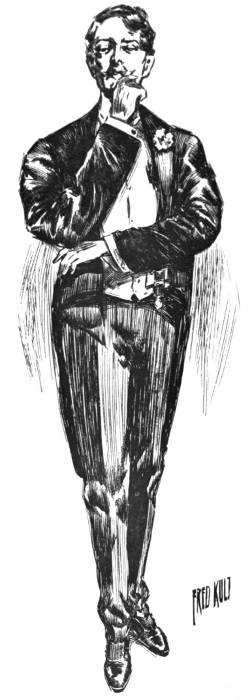
The Son as Manager of his Father's
Pork-packing
Establishment.
As you say, there is room at the top, but not much elsewhere. That's
just exactly how I feel about the pork-packing business. In order to
expedite my progress I, day before yesterday, informed the manager of
the lard department that either he or I would have to quit the employ of
Graham & Co. In case he decided that I had better go, I warned him that
it was my intention to take the first European steamer to lay certain
facts before you. I knew that it would be no use for me to appeal to
Milligan, for it is a bed-rock principle of that dignitary's life that I
am always wrong. The next day the manager of the lard department was not
on hand. Milligan asked for him and I said, "I am the manager."
"Umph!" he grunted. (Did you ever notice how exceedingly porcine is
Milligan's grunt?) "Where's Welch?"
"I discharged him yesterday," I replied.
"You—you discharge him? It's impossible. You have no right,"
blustered your Hibernian auxiliary.
"Haven't I the right?" I answered. "Well, perhaps not." Then I told him
one of my stock stories, a true tale of Illinois in the early days. A
newly appointed Justice of the Peace had as his first case a charge of
horse stealing. The accused man's guilt was palpable enough and there
were grounds for belief that a recent epidemic of this sort of thieving
was to be attributed to him. At all events the J. P. decided that it was
no case for half way measures and that he would try it himself without
wasting time getting together a jury. In about fifteen minutes he found
the prisoner guilty and ordered the constable to get the nearest
available rope and hang the condemned directly. The horse thief had a
friend within hearing, who, when he saw how things were going, went in
hot haste after the only lawyer the settlement boasted. The lawyer,
inspired by a liberal retainer, galloped up in hot haste and sought the
Justice of the Peace.
"Your honor," he exclaimed at the close of a fervent plea, "you have no
jurisdiction or power to condemn the prisoner to death. You can only
hold him for a higher court. You cannot hang him."
"Wa-al," said the justice, aiming a quid of tobacco at the window, "you
seem to know a lot about the law an' I'm obleeged to you. But as to
hanging this man, if you'll look out that thar window p'raps you'll
change your mind as to whether I kin do it or not." And he pointed
calmly to a most potent argument, a body swinging from the end of a limb
of a neighboring tree.
"I may not have the right," I added to Milligan, "to fire Welch, but, by
George, I had the power, for he's gone."
The fact is—I didn't tell Milligan, for I wouldn't give him the
satisfaction—I happened to learn that Welch was giving the "House" the
double cross. For half a dozen years he's been running a sort of illicit
still for lard and been selling it on the quiet to our customers. As our
business has grown rapidly and as his sales were but a flea bite, it was
not noticed until I probed his secret.
If it hadn't been for my affection for exercise about a green table I
shouldn't have spoilt Welch's sport.
Old Si Higginbotham came to town last week and I met him one evening
when he was pretty well steam-heated. He insisted on trying to tear up
the cloth with a cue and, for the trade's sake, I gave him his head. The
more games we played—with lubricants—the mellower he became, and
before I could get him to bed he had wept the color completely out of
the shoulder of my coat. Incidentally he blurted out about Mr. Welch's
neat side line, and after I had verified the facts I taxed him with it.
As I do not want to interfere too much in the business during your
absence, I have appointed no successor to my former place as assistant
manager of the lard department, but am holding down both salaries.
There is really no need of an assistant. The only duty of the manager is
to boss the assistant and you ought to hear me order myself around.
I'm not particularly enraptured with the job, and if you think I deserve
further promotion please cable (at my expense).
You will be pleased, I know, to learn that a week ago Thursday I quit
smoking. It may sound strange to you when I say that I did it simply and
solely because I was argued into it. I met Fred Pennypacker—paying
teller in the Michigan National, you know—and offered him a cigar,
which he declined, with the information that he had not smoked for five
years.
"Heart trouble?" I asked.
"No," he replied, "marriage."
"Oh, wife objected?"
"Not at all," he answered. "Mrs. Pennypacker likes the odor of a good
cigar. The fact is, Graham, after little Ernest came"—his boy—"I made
up my mind to begin a special bank account for him by denying myself
something. So I determined that it should be smoking, which did me no
real good and cost a lot, for I cared only for the best cigars. I found
it was costing me on an average over a dollar a day for tobacco. So ever
since I have placed $30 a month to the young man's credit in the savings
bank. In five years, with compound interest and a little extra change,
it has amounted to nearly $2,000. When he is twenty-one it will be the
nucleus of a fortune. Try it, Graham, it's much better than smoking."
I suggested that I had no son to make it an object. "Well, you may
have," was the reply, "and even if you don't you may be glad some day
you've got the money."
I fancy that perhaps he was thinking of the rumors that have placed you
in a particularly splintery corner on November lard. But I thought of
what he said several times and the next day, after trying in vain to
smoke a cigar that I found in your desk, I decided to relegate smoking
to the list of my banished small vices. That was a week ago last
Thursday. Last Friday, day before yesterday, I met Pennypacker in the
Palmer House café.
"Hello, Fred," I said, "I want to tell you something. I've followed your
advice."
"Advice? What advice?" he asked.
"Why, to quit smoking and save the money."
"Did I tell you that?" he asked nervously, as he fumbled in his
breast-pocket.
"Certainly. You told me about little Ernest and—why, what are you
doing?" He had pulled a case from his pocket and was biting off a cigar.
"I thought you—"
"Didn't smoke, eh? Well, I didn't till yesterday, when that blasted
savings bank suspended."
I resumed smoking Friday. In fact, Pennypacker and I had a regular
smoke-talk. I've decided that if ever I save money it will not be by
small personal economies. I've made up my mind that, as a general rule,
economy is only a species of self-deception. The man who walks two or
three miles to save car-fare gets the exercise as a bonus, but what
sense is there in using postal cards to save postage and then sending
telegrams to hurry up the answer? There was a fellow in college whose
mania was to save shoestrings. He thought they ought to wear as long as
the shoes and sooner than indulge in the lavish expenditure of a nickel
for a new pair, he'd cover his feet all over with knots and blacken up
twine with ink. Yet when this chap wanted a cuspidor, nothing but an $18
majolica affair would satisfy him.
The man who makes his money by slow savings seldom knows when he's got
enough, and even if he finds out he never knows how to let down the bars
so that he can enjoy it. Habit is a stern taskmaster and I have no wish
to degenerate into a miser. There is, of course, a mean between a
spendthrift and a miser, but the difficulty is in determining where it
is located.
If I seem prolix on this subject it is because I find that my $50 salary
and that of the late Manager Welch combined, seem to go no farther than
did the eight per with which I started my tumultuous business career. If
a man has one dollar a week clear he is seldom likely to have very
expensive tastes, but give him a few hundred a year more than demanded
for the absolute necessities of life and he forthwith becomes a
plutocrat in his longings. This may be back-handed philosophy, but it's
pretty straight goods so far as the majority of the rising generation
are concerned. But I am infringing, dear father, on your chosen
prerogative. Let me change the subject.
Why is it that life on the road as a drummer seems to mark a man for
life? Every time I meet a commercial traveller in a hotel he invariably
fires at me, "What line are you in?" I have changed my tailor three
times and have repeatedly altered my style of dress, but still they seem
to recognize me as one of them. Can I never shake off the ear-marks of
the road? I am thinking seriously of taking a course with a professor of
deportment, for perhaps it is my manner. I am more inclined to think it
due to daily association with Milligan.
The drummer's stock query, "What line are you in?" is natural enough,
but it gets to be a bore after a time. Job Withers tells a story that
illustrates how it may annoy some people. It also illustrates how smart
Job Withers is, which Job's stories usually do. One day, in the train,
he says, he sat beside a rather striking-looking man who, he afterward
learned, is a professor in Chicago University. Job tried to start up
conversation, but with little encouragement.
"Fine day," he ventured.
"Well, yes," said the stranger.
"Pretty good crops."
"Fair."
"Think we'll have a shower?"
"Don't know."
Job didn't give up, but all his questions begot monosyllables. Somewhat
nettled, he said at last, "What line are you in?"
"Brains," said the professor, laconically.
"Umph!" said Job, "lucky, isn't it, that you don't have to carry any
samples?"
I'm glad your gout is better, father, it will not pain you so much when
I try to—but I know you hate slang.
Your rising son,
P.
P.S. Milligan talks a good deal about me around the office. He said this
afternoon he expected that some day I'd discharge him. Thus do coming
events cast their shadows before.
LETTER NO. XVIII.