In the issue of the Pennsylvania
Chronicle and Universal Advertiser
of November 30th-December 3d,
1767, appeared the first of twelve successive
weekly "Letters from a Farmer in Pennsylvania
to the Inhabitants of the British
Colonies," in which the attitude assumed
by the British Parliament towards the
American Colonies was exhaustively discussed.
So extensive was their popularity
that they were immediately reprinted in
almost all our Colonial newspapers.
The outbursts of joy throughout America
occasioned by the repeal of the Stamp Act
had scarcely subsided when, the protracted
illness of Lord Chatham having left the
Ministry without a head, the indomitable
Charles Townsend, to the amazement of his
colleagues and unfeigned delight of his
King, introduced measure after measure
under the pretence that they were demanded
by the necessities of the Exchequer;
but in reality for the purpose of
demonstrating the supremacy of the power
of the Parliament of Great Britain over her
colonies in America. Among these Acts
were those which provided for the billeting
of troops in the various colonies; others
called for duties upon glass, lead, paint, oil,
tea, etc. Of dire portent was the provision
therein, that the revenues thus obtained be
used for the maintenance of a Civil List
in America, and for the payment of the
salaries of the Royal Governors and Justices,
salaries which had hitherto been voted by
the various Assemblies. The Assembly of
New York, having failed to comply strictly
with the letter of the law in regard to the
billeting of the King's troops, was punished
by having its legislative powers suspended.
This action boded ill for the future of any
law-making body in America which should
fail to carry out strictly any measure upon
which the British Parliament might agree.
The Colonies needed a common ground on
which to meet in their opposition to these
arbitrary Acts of Parliament. The deeds of
violence and the tumultuous and passionate
harangues in the northern colonies met
with little sympathy among a large class in
the middle and southern colonies, who,
while chafing under the attacks upon their
liberties, hesitated to favor resistance to the
home government because of their unswerving
loyalty to their King and their love for
the country to whom and to which they
owed allegiance. To these "The Farmer"
appealed when he wrote, "The cause of
liberty is a cause of too much dignity to be
slighted by turbulence and tumult. It
ought to be maintained in a manner suitable
to her nature, those who engage in it should
breathe a sedate yet fervent spirit animating
them to actions of prudence, justice,
modesty, bravery, humanity and magnanimity."
The convincing logic of these letters
clearly proved that the constitutional
rights belonging to Englishmen were being
trampled upon in the colonies, and furnished
a platform upon which all those who
feared their liberties were endangered could
unite.
Under the date of the fifth of November,
1767, the seventy-ninth anniversary of the
day on which the landing of William the
Third at Torbay gave constitutional liberty
to all Englishmen, John Dickinson, of
Pennsylvania (for before long it became
known that he was the illustrious author),
in a letter addressed to his "beloved countrymen,"
called attention to the lack of interest
shown by the Colonies in the act suspending
the legislative powers of New York, and
logically pointed out that the precedent
thereby established was a blow at the liberty
of all the other Colonies, laying particular
emphasis upon the danger of mutual
inattention by the Colonies to the interests
of one another.
The education and training of the author
well qualified him to handle his subject.
Born in 1732 on his ancestral plantation on
the eastern shore of Maryland, from early
youth John Dickinson had had the advantages
of a classical education.[1] His nineteenth
year found him reading law in a lawyer's
office in Philadelphia. Three years later,
he sailed for England, where he devoted
four important years to study at the Middle
Temple, and then and there obtained that
knowledge of English common law and
constitutional history, and imbibed the traditions
of liberty belonging to Englishmen
on which he later founded his plea for the
resistance of the Colonies to the ministerial
attacks upon their liberty. On his return
home he took up the practice of his profession
at Philadelphia, and immediately won
for himself a high place at the Bar. Elected
in 1760 a member of the Assembly of Delaware,
his reputation for ability and political
discernment gained him its speakership.
In 1762 he became a member of the Assembly
of Pennsylvania, where he acquired
great prominence and unpopularity, which
later cost him his seat in that body, on account
of his opposition to the Assembly's
sending a petition to the King praying that
the latter "would resume the government of
the province, making such compensation to
the proprietaries as would be equitable, and
permitting the inhabitants to enjoy under
the new government the privileges that have
been granted to them by and under your
Royal ministries."
Possibly Dickinson's knowledge of the
personality of the Ministry and the dominant
spirits in English political circles
gained while abroad, led him bitterly to
attack this measure, fathered and supported
by Franklin, for subsequent events soon
showed the far-sightedness which led him
to distrust the wisdom of a demand for the
revoking of the Proprietary Charter, even
though it were a bad one. His part in the
controversy forced even his bitterest opponents
to admire his ability. The enormous
debt incurred by Great Britain during the
then recent war with France led the Ministry
to look for some way of lightening taxation
at home. It was decided that America
must pay a share toward lifting the
burden resting heavily on those in England,
caused by the financing of the expenses of
a war which drove France from North
America. The fact that the colonies had
furnished, equipped and maintained in the
field twenty-five thousand troops and had
incurred debts far heavier in proportion
than those at home was forgotten. In 1764
was passed the "Sugar Act," which extended
and enlarged the Navigation Acts
and made England the channel through
which not only all European, but also all
Asiatic trade to and from the colonies must
flow. At the same time an announcement
was made that "Stamp Duties" would be
added later on. The next year from Dickinson's
pen appeared a pamphlet entitled
"The LATE REGULATIONS Respecting
the BRITISH COLONIES on the
Continent of AMERICA Considered,
in a Letter from a Gentleman in Philadelphia
to his Friend in London," in which
these late regulations and proposed measures
were discussed entirely from an economic
standpoint. In it was clearly shown how dependent
were the manufacturers and traders
in England for their prosperity upon the
trade of the colonies and that any restraint
of American trade would naturally curtail
the ability of those in the colonies to purchase
from the home market. The Stamp
Act was opposed on the ground that the
already impoverished colonies would be
drained of all their gold and silver which
necessarily would have to go abroad in the
payment for the stamps. This letter was
conciliatory and persuasive, yet in the closing
pages Dickinson asked:
"What then can we do? Which way
shall we turn ourselves? How may we
mitigate the miseries of our country? Great
Britain gives us an example to guide us?
She Teaches us to Make a Distinction
Between Her Interests and Our Own.
"Teaches! She requires—commands—insists
upon it—threatens—compels—and
even distresses us into it.
"We have our choice of these two
things—to continue our present limited and
disadvantageous commerce—or to promote
manufactures among ourselves, with a habit
of economy, and thereby remove the necessity
we are now under of being supplied by
Great Britain.
"It is not difficult to determine which
of these things is most eligible. Could the
last of them be only so far executed as to
bring our demand for British manufactures
below the profits of our foreign trade, and
the amount of our commodities immediately
remitted home, these colonies might
revive and flourish. States and families are
enriched by the same means; that is, by
being so industrious and frugal as to spend
less than what they raise can pay for."
The various Non-Importation Agreements
signed during the next ten years, bear
testimony to the popularity of the proposed
plan.
This pamphlet circulated freely and increased
Dickinson's reputation as that of a
man capable of thoroughly discussing public
measures; it also brought his name to the
attention of the British public for whom the
"Letter" was especially written.
At the call of Massachusetts, representatives
of nine of the colonies met in New
York in October, 1764, and after a long
discussion (in which Dickinson's knowledge
of constitutional law and English colonial
policy enabled him to assume the leadership)
issued a "Declaration of Rights," in
which it was asserted that the inhabitants of
the Colonies, standing on their rights as
Englishmen, could not be taxed by the
House of Commons while unrepresented in
that body. Memorials were sent abroad
protesting against the proposed acts, expressing,
however, their willingness to meet
loyally as in the past any properly accredited
requisitions for funds sent to the various
Assemblies. Notwithstanding this opposition,
and the protests of all friends of America
in England, the Stamp Act was passed.
A year later it was repealed.
JUST PUBLISHED.
Printed on a large Type, and fine Paper,
And to be sold at the LONDON BOOK STORE
North Side of King-street
LETTERS
FROM
A FARMER in PENNSYLVANIA
To the INHABITANTS of the
BRITISH COLONIES.
(Price two Pistareens)
Among all the WRITERS in favor of the COLONIES,
the FARMER shines unrivalled, for strength of Argument,
Elegance of Diction, Knowledge in the Laws of Great Britain,
and the true interest of the COLONIES: A pathetic
and persuasive eloquence runs thro the whole of these
Letters: They have been printed in every Colony from Florida
to Nova Scotia; and the universal applause so justly
bestowed on the AUTHOR, hath fully testified the GRATITUDE
of the PEOPLE OF AMERICA, for such an
able Adviser and affectionate Friend.
Written in a plain, pure style, with illustrations
and arguments drawn from ecclesiastical,
classical and English history, each
point proven with telling accuracy and convincing
logic, conciliatory to the English
people, and filled with expressions of loyalty
to the King, these essays, popularly known
as the "Farmer's Letters," furnished the
basis on which all those who resented the
attacks on their liberty were able to unite.
Town meetings[2] and Assemblies vied with
each other in their resolutions of thanks.
The "Letters" were published immediately
in book form in Philadelphia (three different
editions), New York, Boston (two different
editions), Williamsburgh, London (with a
preface written by Franklin), and Dublin.
Franklin was influential, also, in having
them translated into French, and published
on the Continent. Owing to the beauty of
its typography and the excellence of its
book-making, the Boston edition, published
by Messrs. Mein & Fleeming, has been selected
for republication, and has been reprinted
line for line and page for page, in
a type varying but slightly from that used
by Mein & Fleeming. A few typographical
errors have been corrected, but the irregularities
in spelling, wherever they exist
throughout the various editions, have been
retained. The binding also is a reproduction
of that of the original. Its publication[3]
was announced in the "Boston Chronicle,"
March 14-21, 1768, by the advertisement
reprinted on the preceding page.
Valuable as these "Letters" were at
home in uniting all factions in their measures
of resistance, yet their influence abroad
was of even more far-reaching effect. Reprinted
in London in June, 1768, this two-shilling
pamphlet quickly circulated through
coffee-house and drawing-room. In ministerial
circles the "Farmer" caused great
indignation. In a letter from Franklin,
addressed to his son, dated London, 13th of
March, 1768, appears the following: "My
Lord Hillsborough mentioned the 'Farmer's
Letters' to me, said that he had read
them, that they were well written, and he
believed he could guess who was the author,
looking in my face at the same time, as if
he thought it was me. He censured the
doctrines as extremely wild. I have read
them as far as Number 8. I know not if
any more have been published. I should,
however, think they had been written by
Mr. Delancey, not having heard any mention
of the others you point out as joint
authors."
Groaning under their own heavy taxation,
the troubles of America had hitherto
appealed but slightly to the average Englishman
and the sympathies of the English
people had become involved in the long-drawn-out
struggles of Wilkes to obtain his
constitutional rights. The press published
little American news. America was little
discussed; conditions there were practically
unknown to all but the trading class, whose
members had prospered through the monopoly
of the constantly increasing commerce
with the growing colonies. This class,
naturally fearing the loss of the magnificent
trade which had been built up, had long
bemoaned the constantly increasing friction
between the two factions on each side of
the water. Englishmen in general had
hitherto paid little attention to the debates
over the various acts raising revenue from
the colonies. From the time the "Farmer's
Letters" were published in England
the differences between Parliament and
colonies were better understood there.
Untouched and yet alarmed by the political
corruption so prevalent at the time, thinking
men saw in these "Letters" a warning that
if their Sovereign was successful in his
attempt to take away constitutional liberty
from their fellow Englishmen across the
sea, their own prized liberty at home was
in danger. "American" news became
more frequent in the newspapers, "Letters
to the Printer," the form of editorials of
the day, discussed and criticised the measures
of Parliament with great freedom.
To the masses, John Dickinson's name soon
became very familiar through the agency
of the press, which under date of June 26-28,
1768, freely noted Isaac Barré's characterization
in the House of Commons of
Dickinson as "a man who was not only an
ornament to his country but an honor to
human nature." Almost immediately after
the publication of the London edition, the
Monthly Review of July, 1768, forcibly
called the attention of the literary world to
the "Farmer's Letters" in an exhaustive
review which is reprinted in the Notes, page
liii, for the purpose of showing the view held
by the English Whigs regarding the doctrines
laid down and arguments used by
Dickinson in defence of his position.
The "London Chronicle," under date of
September 1st, 1768, printed the popular
Liberty song, written by Mr. Dickinson,
and which, set to the inspiring air of
"Hearts of Oak," was being sung throughout
the colonies. In order to give the
accompanying letter of request for the republication
of the song, a request which,
from its wording demonstrates the enthusiasm
which the song aroused, the latter is
here reprinted from the issue of the Boston
"Evening Post" of August 22, 1768.
MESSIRS FLEETS
The following Song being now much in Vogue
and of late is heard resounding in almost all
Companies in Town, and by way of eminence
called "The Liberty Song," you are desired to republish
in your 'circulating' Paper for the Benefit
of the whole Continent of America.
[To the Tune of Hearts of Oak.]
Come, join Hand in Hand, brave Americans all,
And rouse your bold Hearts at fair Liberty's Call,
No tyrannous Acts shall suppress your just Claim,
Or stain with dishonor America's Name.
In Freedom we're born, & in Freedom we'll live,
Our Purses are ready,
Steady, Friends, Steady,
Not as Slaves but as Freemen our money we'll give.
Our worthy Forefathers—let's give them a Cheer—
To Climates unknown did courageously steer;
Thro' Oceans to Deserts for Freedom they came,
And dying bequeath'd us their Freedom & Fame.
In Freedom we're born, &c.
Their generous Bosoms all Dangers despis'd,
So highly, so wisely, their Birthrights they priz'd;
We'll keep what they gave—we will piously keep,
Nor frustrate their Toils on the Land or the Deep.
In Freedom we're born, &c.
The Tree their own Hands had to Liberty rear'd,
They liv'd to behold growing strong and rever'd;
With Transport then cry'd, 'now our Wishes we gain,
For our Children shall gather the Fruits of our Pain.'
In Freedom we're born, &c.
Swarms of Placemen and Pensioners soon will appear,
Like Locusts deforming the Charms of the Year;
Suns vainly will rise, Showers vainly descend,
If we are to drudge for what others shall spend.
In Freedom we're born, &c.
Then join Hand in Hand brave Americans all,
By uniting we stand, by dividing we fall;
In so righteous a Cause let us hope to succeed,
For Heaven approves of each generous Deed.
In Freedom we're born, &c.
All Ages shall speak with amaze and applause,
Of the courage we'll shew in support of our laws;
To die we can bear—but to serve we disdain—
For Shame is to Freemen more dreadful than Pain.
In freedom we're born, &c.
This Bumper I crown for our Sovereign's Health,
And this for Britannia's Glory and Wealth;
That Wealth and that Glory immortal may be,
If She is but just—and if we are but free.
In Freedom we're born, & in Freedom we'll live,
Our Purses are ready,
Steady, Friends, Steady,
Not as Slaves, but as Freemen our Money we'll give.
The following extract from the London
"Chronicle" of October 4, 1768, demonstrates
how completely the arguments and
logic of the "Farmer's Letters" gained popular
approval; how constantly Dickinson's
name was kept before the public, both at
home and abroad; how his fame was toasted;
how he was recognized as the leader of
political thought in the colonies. It shows
also the constantly increasing interest in
American matters taken by the press of
England since the advent of the "Farmer's
Letters," for the "American News," published
in this and other London papers,
was extensively reprinted in the local journals
throughout the kingdom.
Taken from the Boston, in New England, Evening
Post of August 22, 1768
On Monday the fifteenth instant, the anniversary
of the ever memorable Fourteenth of August,
was celebrated by the Sons of Liberty in this
Town, with extraordinary festivity. At this Dawn,
the British Flag was displayed on the Tree of Liberty,
and a Discharge of Fourteen Cannon, ranged
under the venerable Elm, saluted the joyous Day.
At eleven o'clock, a very large Company of the
principal Gentlemen and respectable Inhabitants
of the Town, met at the Hall under the Tree,
while the Streets were crowded with a Concourse
of People of all Ranks, public Notice having been
given of the intended Celebration. The Musick
began at high Noon, performed on various Instruments,
joined with Voices; and concluding with
the universally admired American Song of Liberty,[4]
the Grandeur of its Sentiment, and the easy
Flow of its Numbers, together with an exquisite
Harmony of Sound, afforded sublime Entertainment
to a numerous Audience, fraught with a
noble Ardour in the cause of Freedom: The Song
was clos'd with the Discharge of Cannon and a
Shout of Joy; at the same time the Windows of
the Neighbouring Houses, were adorned with a
brilliant appearance of the fair Daughters of Liberty,
who testified their Approbation by Smiles of
Satisfaction. The following Toasts succeeded,
viz.
The following toasts may need brief explanation.—R. T. H. H.:
1. Our rightful Sovereign George the Third.
2. The Queen, Prince of Wales, and the rest of
the Royal Family.
3. The Sons of Liberty throughout the World.
4. The glorious Administration of 1766.
4. The Rockingham Ministry which repealed the Stamp Act.
5. A perpetual Union of Great Britain and her
Colonies, upon the immutable Principles of
Justice and Equity.
6. May the sinister Designs of Oppressors, both
in Great Britain and America, be for ever
defeated.
7. May the common Rights of Mankind be established
on the Ruin of all their Enemies.
8. Paschal Paoli and his brave Corsicans. May
they never want the Support of the Friends of
Liberty.
8. The struggles of Paoli and the Corsicans excited great interest
both in Great Britain and America. Constant references are made
to these in the "Letters."
9. The memorable 14th of August, 1765.
9. The day of the demonstration in Boston against the Stamp
Officers. Daybreak disclosed hanging on a tree an effigy of the
Stamp Officer Oliver. After hanging all day, at nightfall it was
taken down by the Sons of Liberty, who placed it on a bier and escorted
it through the principal streets in Boston to the home of Oliver,
where, in the presence of a large number of people, it was burned.
10. Magna Charta, and the Bill of Rights.
11. A speedy Repeal of unconstitutional Acts of
Parliament, and a final Removal of illegal and
oppressive Officers.
12. The Farmer.
12. John Dickinson.
13. John Wilkes, Esq.; and all independent Members
of the British Parliament.
14. The glorious Ninety-Two who defended the
Rights of America, uninfluenced by the Mandates
of a Minister, and undaunted by the
threats of a Governor.
14. On the 11th day of February, 1768, the Assembly of Massachusetts
adopted and sent to the various Colonial Assemblies a
circular letter drawn up by Samuel Adams, informing them of the
contents of a petition which the Massachusetts Assembly had sent
to the King. This letter also urged united action against the oppressive
measures of the Ministry, and gave great offense to the
King and Ministry. The Secretary for the Colonies, Lord Hillsborough,
instructed Governor Bernard of Massachusetts to order
the Assembly to rescind this letter, and in case of refusal to dissolve
this body. After a thorough discussion this request was refused
by a vote of "ninety-two" to "seventeen."
Which being finished, the French horns
sounded; and after another discharge of the cannon,
compleating the number Ninety-Two, the
gentlemen in their carriages repaired to the Greyhound
Tavern in Roxbury, where a frugal and
elegant entertainment was provided. The music
played during the repast: After which the following
toasts were given out, and the repeated discharge
of cannon spoke the general assent.
1. The King.
2. Queen and Royal Family.
3. Lord Cambden.
3. A strenuous upholder of the Constitutional rights of the Colonies
and a strong defender in the House of Lords of the doctrine,
"No taxation without representation." Contemporary writers frequently
spelt Camden's name as above.
4. Lord Chatham.
5. Duke of Richmond.
5. Another friend of America in the same body.
6. Marquis of Rockingham.
6. Under whose ministry the Stamp Act was repealed.
7. General Conway.
7. The leader in the House of Commons during the Rockingham
Ministry.
8. Lord Dartmouth.
8. President of the Board of Trade in the Rockingham Ministry,
much loved in the Colonies. Dartmouth College bears his name.
9. Earl of Chesterfield.
9. A warm adherent of America.
10. Colonel Barre.
10. The companion of Wolfe at Quebec; in replying to Townsend
during one of the debates over the passage of the Stamp Acts
he characterized the Americans as "Sons of Liberty," a term
which immediately was applied throughout the Colonies to those
who were resenting the interference of Parliament with their home
government.
11. General Howard.
11. A member of Parliament from Stamford who was active in
obtaining the repeal of the Stamp Act.
12. Sir George Saville.
12. Represented Yorkshire in the House of Commons; a strong
supporter of the Rockingham Ministry.
13. Sir William Meredith.
13. Member of Parliament from Liverpool. Lord of the Admiralty
14. Sir William Baker.
14. Also energetic in securing the repeal of the Stamp Act.
15. John Wilkes, Esq., and a Speedy Reversal of
his outlawry.
15. The struggles of Wilkes excited keen interest in America.
16. The Farmer of Pennsylvania.
16. It is noted that this was the second time Dickinson's health
was drunk that day. No other American residing in this country
was toasted.
17. The Massachusetts Ninety-Two.
18. Prosperity and Perpetuity to the British Empire,
on Constitutional Principles.
19. North America: And her fair Daughters of
Liberty.
20. The illustrious Patriots of the Kingdom of Ireland.
20. In Letter X Dickinson warns against the fate of Ireland.
21. The truly heroic Paschal Paoli, and all the
brave Corsicans.
22. The downfall of arbitrary and despotic Power
in all Parts of the Earth; and Liberty without
Licentiousness to all mankind.
23. A perpetual Union and Harmony between Great
Britain and the Colonies, on the Principles
of the Original Compact.
24. To the immortal Memory of that Hero of
Heroes William the Third.
25. The speedy Establishment of a wise and permanent
administration.
26. The right noble Lords, and very worthy Commoners,
who voted for the Repeal of the stamp
Act from Principle.
27. Dennis De Berdt, Esq; and all the true
Friends of America in Great Britain, and
those of Great Britain in America.
27. The agent of Massachusetts in London.
28. The respectable Towns of Salem, Ipswich and
Marblehead, with all the Absentees from the
late Assembly, and their constituents, who
have publickly approved of the Vote against
Rescinding.
28. Representatives of these towns voted in favor of rescinding.
Town meetings, however, were held, and the citizens of these
places recorded themselves as endorsing the action of the majority
in refusing the "Ministerial Mandates" and condemned the
position assumed by their own representatives. In letters which appeared
in the press a number of absentees from the Assembly boldly
endorsed the action of the majority.
29. May all Patriots be as wise as Serpents, and
as harmless as Doves.
30. The Manufactories of North America, and
the Banishment of Luxury, Dissipation and
other Vices, Foreign and Domestic.
30. Referring to the proposal of Dickinson quoted on page xxiii
of the Introduction.
31. The removal of all Task-Masters, and an effectual
Redress of all other Grievances.
32. The Militia of Great Britain and of the Colonies.
33. As Iron sharpeneth Iron, so may the Countenance
of every good and virtuous Son and
Daughter of Liberty, that of his or her
Friend.
34. The Assemblies on this vast and rapidly populating
Continent, who have treated a late
haughty and "merely ministerial" Mandate
"with all that Contempt it so justly deserves."
34. Referring to the replies of the various Assemblies to the circular
letter and endorsements of the action of the Massachusetts
Assembly.
35. Strong Halters and sharp axes to all such as
respectively deserve them.
36. Scalping Savages let loose in Tribes, rather
than Legions of Placemen, Pensioners, and
Walkerizing Dragoons.
37. The Amputation of any Limb, if it be necessary
to preserve the Body Politic from Perdition.
38. The oppressed and distressed foreign Protestants.
39. The free and independent Cantons of Switzerland.
40. Their High Mightinesses the States General
of Seven United Provinces.
41. The King of Prussia.
42. The Republic of Letters.
43. The Liberty of the Press.
44. Spartan, Roman, British Virtue, and Christian
Graces joined.
45. Every man under his own Vine! under his
own Fig-Tree! None to make us afraid!
And let all the People say, Amen!
45. See page 51.
Upon this happy occasion, the whole company
with the approbation of their brethren in Roxbury,
consecrated a tree in the vicinity; under the shade
of which, on some future anniversary, they say they
shall commemorate the day, which shall liberate
America from her present oppression! Then
making an agreeable excursion round Jamaica
Pond, in which excursion they received the kind
salutation of a Friend to the cause by the discharge
of cannon at six o'clock they returned to Town;
and passing in slow and orderly procession
through the principal streets, and the State-House,
they retired to their respective dwellings. It is
allowed that this cavalcade surpassed all that has
ever been seen in America. The joy of the day
was manly, and an uninterrupted regularity presided
through the whole.
The two illustrations in this volume were
selected for the purpose of recording prevalent
contemporary opinions of Dickinson.
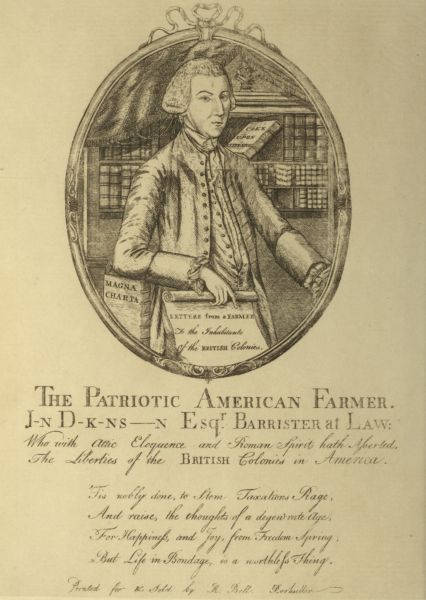
The frontispiece is a reproduction (slightly
reduced in size)[5] of the very scarce
print in which John Dickinson is crudely
portrayed as the author of the "Farmer's
Letters." It was first advertised for sale in
the Pennsylvania "Chronicle" under date
of October 12-17, 1768, as follows:
Lately published and sold by R. Bell
at James Emerson's, in Market-street,
near the river, and at John
Hart's vendue store, in Southward
(Price One Shilling)
an elegant engraved COPPER PLATE PRINT
of the Patriotic American Farmer;
The same glazed and framed, price Five Shillings.
This specimen of early American engraving,
the work of some unknown artist and
engraver, was undoubtedly inspired by the
following article which appeared in the
Pennsylvania "Chronicle" for May, 9-16,
1768, as well as the many other newspapers
in the colonies, so eager was the press to
publish any information concerning the
author of the "Farmer's Letters." The
inscription is thus explained as well as the
elimination of the vowels from Dickinson's
name.
PHILADELPHIA
On Tuesday last, by order of the Governor
and Society of Fort St. David's, fourteen Gentlemen,
members of that Company, waited upon J-n
D-ck-nson Esq; and presented the following address,
in a Box of Heart of Oak.
Respected Sir,
When a Man of Abilities, prompted by Love of
his Country, exerts them in her Cause, and renders
her the most eminent Services, not to be sensible,
of the Benefits received, is Stupidity; not to be grateful
for them, is Baseness.
Influenced by this Sentiment, we, the Governor
and Company of Fort St. David's, who among other
Inhabitants of British America, are indebted to you
for your most excellent and generous Vindication of
Liberties dearer to us than our Lives, beg Leave to
return you our heartiest Thanks, and offer to you
the greatest Mark of Esteem, that, as a Body, it is
in our Power to bestow, by admitting you, as we
hereby do, a Member of our Society.
When that destructive Project of Taxation, which
your Integrity and Knowledge so signally contributed
to baffle about two years ago, was lately renewed
under a Disguise so artfully contrived as to
delude Millions, You, sir, watchful for the Interests
of Your Country, perfectly acquainted with them,
and undaunted in asserting them, Alone detected the
Monster concealed from others by an altered Appearance,
exposed it, stripped of its insidious covering,
in its own horrid Shape, and, we firmly trust
by the Blessing of God on Your Wisdom and Virtue,
will again extricate the British Colonies on this
Continent from the cruel Snares of Oppression; for
we already perceive these Colonies ROUSED by your
strong and seasonable Call, pursuing the salutary
Measures advised by You for obtaining Redress.
Nor is this all that you have performed for Your
native Land. Animated by a sacred Zeal, guided
by Truth and supported by Justice, You have penetrated
to the Foundations of the Constitution, have
poured the clearest Light on the important Points,
hitherto involved in a Darkness bewildering even
the Learned, and have established with an amazing
Force and Plainness of Argument, the TRUE DISTINCTIONS
and GRAND PRINCIPLES, that will fully instruct
Ages YET UNBORN, what Rights belong to
them, and the best Methods of defending them.
To Merit far less distinguished, ancient Greece or
Rome would have decreed Statues and Honours without
Number: But it is Your Fortune and your
Glory, Sir, that You live in such Times, and possess
such exalted Worth, that the Envy of those, whose
Duty it is to applaud You, can conceive no other
Consolation, than by withholding those Praises in
Public, which all honest Men acknowledge in Private
that you have deserved.
We present to you, sir, a small gift of a Society
not dignified by any legal authority; But
when you consider this gift as expressive of the
sincere Affection of many of your Fellow Citizens
for Your Person, and of their unlimited Approbation
of the noble Principles maintained in your unequalled
Labours, we hope this Testimony of our
Sentiments will be acceptable to you.
May that all-gracious Being, which in kindness
to these colonies gave your valuable Life Existence
at the critical Period when it will be most wanted,
grant it a long Continuance, filled with every Felicity;
and when your Country sustains its dreadful
loss, may you enjoy the Happiness of Heaven, and
on Earth may your Memory be cherished, as we
doubt not it will be, to the latest Posterity.
Signed by the Order of the Society,
John Bayard, Secretary.
The box was finely decorated, and the Inscription
neatly done in Letters of Gold. On the Top
was represented the Cap of Liberty on a Spear,
resting on a Cypher of the Letters I. D. Underneath
the Cypher in a semicircular Label——Pro
Patria——Around the whole the following words:
The Gift of the Governor and Society
of Fort St. David's to the Author of the
Farmer's Letters, in grateful Testimony of
the very eminent Services thereby rendered
to this Country, 1768.
On the Inside of the Top—
The Liberties of
The British Colonies in America
Asserted
With Attic Eloquence,
And Roman Spirit,
by
J-n D-k-ns-n[6] Esqr.;
Barrister at Law.
On the Inside of the Bottom—
Ita Cuique Eveniat
ut de Republica Meruit.
On the Outside of the Bottom—A sketch of Fort St. David's.
To which the following Answer was returned.
Gentlemen,
I very gratefully receive the Favour you have
been pleased to bestow upon me, in admitting me a
Member of your Company; and I return you my
heartiest Thanks for your Kindness.
The "Esteem" of worthy Fellow Citizens is a
Treasure of greatest Price; and as no man can more
highly value it than I do, Your Society in "expressing
the Affection" of so many respectable
Persons for me, affords Me the sincerest Pleasure.
Nor will this Pleasure be lessened by reflecting,
that you may have regarded with a generous Partiality
my Attempts to promote the Welfare of our
Country; for the Warmth of your Praises in commending
a Conduct you suppose to deserve them,
gives Worth to these Praises, by proving your Merit,
while you attribute Merit to another.
Your Characters, gentlemen, did not need this
Evidence to convince Me, how much I ought to
prize Your "Esteem" or how much You deserved
Mine.
I think myself extremely fortunate, in having obtained
your favorable Opinion, which I shall constantly
and carefully endeavor to preserve.
I most heartily wish you every Kind of Happiness,
and particularly that you may enjoy the comfortable
Prospect of transmitting to your Posterity
those "Liberties" dearer to You than your Lives,
"which God gave to you, and which no inferior
Power has a Right to take away."
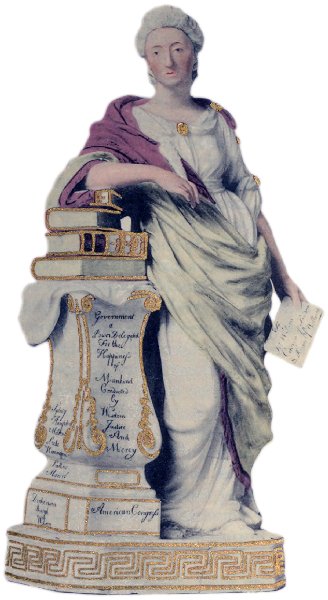
CHELSEA DERBY PORCELAIN STATUETTE OF CATHERINE MACAULAY
The potter's art, which from time immemorial
has been the means of transmitting
history, furnishes the other illustration and
also perpetuates the estimate of Dickinson's
character held by William Duesbury, England's
greatest manufacturer of porcelain. It
pictures a porcelain statuette of Mrs. Catherine
Macaulay, a well-known historian, whose
"History of England from the Accession of
James the First to that of the Brunswick
Line" and other historical writings met with
great approval among the Whig party in
England and whose decided approval of the
stand taken by the colonies, gave her great
popularity in America. This statuette, measuring
131⁄2 inches in height, is modeled to a
certain extent after the statue of this lady
which was erected in 1777 in the Church of
St. Stephen, Walbrook, London. Mrs.
Macaulay appears leaning upon her "Histories
of England," which rest on the top of
a pedestal, on the front of which is the inscription,
"Government a Power Delegated
for the Happiness of Mankind conducted by
Wisdom, Justice and Mercy." Beneath are
the words, "American Congress." On the side
of the pedestal the name of Dickinson appears,
preceded by the names of those noble
writers, England's great advocates and expounders
of Constitutional liberty, Sydney,
Hampden, Milton, Locke, Harrington,
Ludlow and Marvel. This beautiful porcelain
statuette was moulded at the Chelsea
factory in 1777, the same year in which
Boswell chronicles Dr. Johnson's visit there,
noting, "The china was beautiful, but Dr.
Johnson justly observed it was too dear, for
he could have vessels of silver as cheap as
were here made of porcelain."
The space at my disposal prevents my
quoting many a "Letter to the Printer"
appealing for justice for the Colonials as
well as numerous contributed articles which
appeared during the next few years in the
English press, the contents of which clearly
show how strongly Dickinson's arguments
had influenced their respective authors.
While it is true that these sentiments were
attacked both at home and abroad, the
attacks soon lost their vehemence. Strange
as it may seem, more protests against the
course of the ministry than denunciations
of the doings of the colonial Assemblies are
found in the columns of the English press
of the period. The demand for the arguments
contained in the "Farmer's Letters"
was not lessened by subsequent events as
their popularity demanded the publishing
of another London edition in 1774.
Certainly to John Dickinson for his
masterly defence of the rights of the Colonies
America owes an everlasting debt of
gratitude. The logic of his claims and his
warnings as to what must be the ultimate
result of the ministerial encroachments upon
the liberties of Englishmen did much to
win over to the American cause in England
that strong ally, the support of a large body
of thoughtful Englishmen. These men
actively condemned the ministerial actions
and during the war which followed caused
the course of the government to be bitterly
opposed by an influential and constantly
growing minority in Parliament. Through
their efforts was fostered a public sentiment
which caused the war to be prosecuted
in a half-hearted manner and obliged
a power-loving King to fill the depleted
ranks of his army with German mercenaries,
so impossible was it to force a sufficient number
of his own liberty-loving subjects to fight
against their kindred living in the land so
happily alluded to by a contributor to the
London "Chronicle" (June 3-6, 1769),
in the following poem:
The Genius of America to her Sons
Who'd know the sweets of Liberty?
'Tis to climbe the mountain's brow,
Thence to discern rough industry,
At the harrow or the plough;
'Tis where my sons their crops have sown,
Calling the harvest all their own;
'Tis where the heart to truth allied,
Never felt unmanly fear;
'Tis where the eye with milder pride,
Nobly sheds sweet pity's tear;
Such as America yet shall see,
These are the sweets of Liberty.