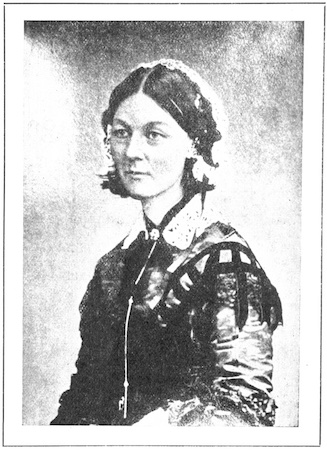
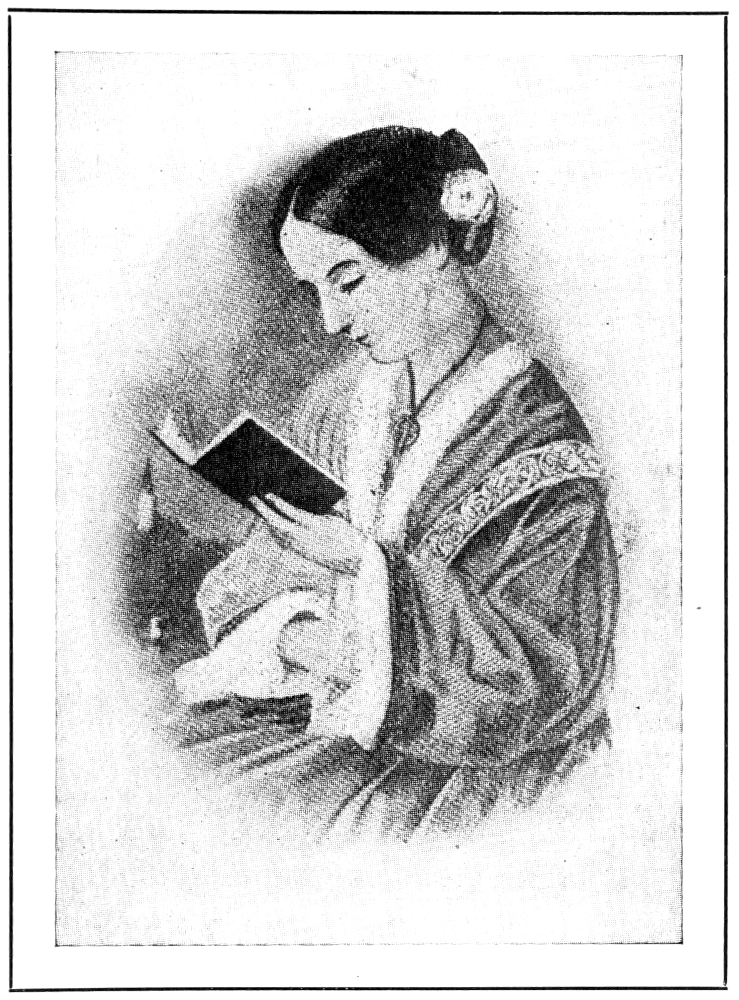
Lessons from the Life of Florence Nightingale — Chapter I.
The presence of thousands of daughters of Florence
Nightingale in the regions devastated by the great
world war, and the great service to humanity which
they have rendered, have turned the thoughts of many
to that other battlefield where the great need of the
world for trained nurses was first impressed on the
hearts of the people—an impression never to be
effaced while there are suffering human beings requiring
skilled care and service.
Sixty odd years ago, at the outbreak of the Crimean
war there were no women nurses to minister to those
who had been wounded in the service of their country.
Woman’s ministry was sorely needed but not wanted
by those in active command of military affairs at the
seat of war. It remained for Florence Nightingale to
teach the world one of its greatest lessons—a lesson
from which future generations will reap increasing
benefits. When the Crimean war closed, the foundation
was begun on which the structure of modern
nursing was to be reared.
In every age, the world has had its heroes, and
Florence Nightingale would have been the last to wish
to give the impression that there were not many
splendid women devoting themselves to the care of the
sick long before she was born. They were not trained
women according to modern ideals of training, but
there were women of gentle birth and breeding, refined
and accomplished who served the sick with singleness
of heart and rare devotion. The world will always owe
its debt of gratitude to the Roman Catholic Sisters
and the Deaconesses of other churches, whose tender
ministries to the sick in hospitals and home, did much
to lessen the sum of human suffering in the years
before Miss Nightingale’s great work was begun.
No one who reads the story of the beautiful life of
Florence Nightingale can fail to be impressed with the
fact that the dominant motive of that life was—SERVICE.
It has been aptly said that one of the first and
most important lessons that a nurse needs to learn, is
to spell SELF with a little s. In this she has a worthy
example for forgetfulness of self seems to have been
characteristic of Florence Nightingale all through her
life. Service to humanity—especially service to the
sick and distressed part of humanity—seems to have
made its strong appeal to her almost from childhood.
Organization for service, education and training for
service, plans for service in a hundred different ways—filled
her life, and the story of her many-sided activities,
as revealed by her official biographer—has been
a surprise to those who have thought of her only in
connection with nursing. While she will always be
best remembered as the founder of modern nursing,
her great efforts in improving sanitary conditions in
India, in which she labored unceasingly for many
years with officials in the War Department, and her
work in behalf of reform in the management of workhouses
in England, were closely interwoven with her
work in behalf of better nursing for the sick. Her
voluminous correspondence and her literary work
seem in themselves to have been sufficient to occupy
her full time, after her return from the Crimea.
The popular idea of Florence Nightingale has been
drawn largely from the pen picture of Longfellow in
Santa Filomena, but it is far from being a true picture
of her life. To fully appreciate her character and influence
one must study to some extent, not alone the
social and sanitary conditions that prevailed in her
earlier life, but the habits of thought and even the
etiquette of the times, during which her chief work
was being accomplished. Of these conditions her
biographer says:
“Now that the fruits of Florence Nightingale’s
pioneer work have been gathered, and that nursing is
one of the recognized occupations for gentlewomen,
it is not altogether easy to realize the difficulties which
stood in her way. The objections were moral and
social, in large measure rooted to conventional ideas.
Gentlewomen, it was felt, would be exposed, if not to
danger and temptations, at least to undesirable and
unfitting conditions. ‘It was as if I had wanted to be
a kitchen maid,’ Miss Nightingale herself said in later
years. Nothing is more tenacious than social prejudice.
But the prejudice was in part founded on very
intelligible reasons and in part was justified by the
level of nursing as an occupation at that time. It will
suffice to say that though there were better-managed
and worse-managed hospitals, yet there was strong
evidence to show that hospital nurses had opportunities
which they freely used, for ‘putting the bottle to
their lips’ when so disposed, also that other evils were
more or less prevalent.
“The more she heard of the worst, the more was
Florence Nightingale resolved to make things better;
but the more her parents heard, the greater and more
natural was their repugnance. Somebody must do the
rough pioneer work of the world; but one can understand
how the parents of an attractive daughter, to
whom their own life at home seemed to them to open
many possibilities of comfortable happiness, came to
desire that in this case the somebody should be somebody
else.”
It is difficult to study her life without feeling that
she was sent into the world especially to accomplish
the great tasks to which in early middle life, her powers
were chiefly devoted. It should, however, be always
remembered that during this period others besides
Miss Nightingale were making their contribution
to better nursing and better sanitary conditions in hospitals,
and in the world outside. Lord Lister, who ushered
in the new era of antiseptic surgery, was seven
years younger than Florence Nightingale. “He and
she, each in the manner in which Nature or Providence
fitted them, were simultaneously inaugurating the new
era, he the foster father, she the foster mother of
myriads of this generation and unthinkable millions
of those who are to be. His methods demanded the
trained nurse both for surgery and midwifery, both for
the battlefield where life is destroyed, and for the lying-in
room where it is ushered into separate existence.
Her work was to provide the training and the principles,
the ideals, the enthusiasm, and the tiniest, humblest
details, whereby the modern nurse is made.”
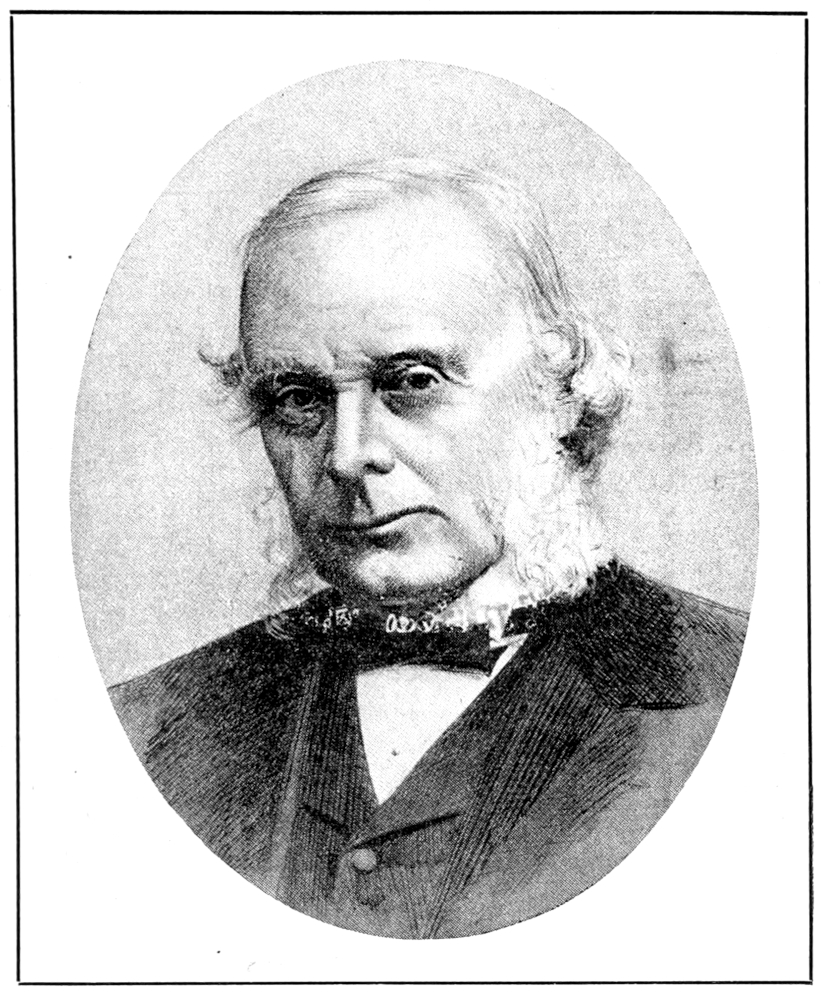
LORD LISTER
Apart entirely from the generally undesirable type
of women (there were many exceptions) found in
charge of the care of the sick when Florence Nightingale
began her work, were the generally undesirable
conditions which existed before Lord Lister’s antiseptic
methods were inaugurated in 1868. Erysipelas, gangrene,
pyemia, and septicemia were common complications
of surgery and the death rate of maternity
patients in hospitals was appalling. A nurse who was
one of the pioneers in improving the care of the sick,
thus describes her experience when she entered for
training in an English hospital:
“New methods of nursing as well as of surgery had
to contend with tremendous difficulties in the way of
bad buildings, bad ventilation, old-fashioned furniture,
and lack of apparatus.
“The utensils, which in the hospitals of today are
of white earthenware or enamel, were of exceedingly
battered tin, almost entirely denuded of their original
covering of black japan, and it was absolutely impossible
to keep some of them clean and sweet. Smells
abounded. I have seen a visiting surgeon run through
a ward to escape them, and during my first week I
was much puzzled by the existence of a horrible smell
in one corner of the children’s ward. I privately investigated
the floor and under the beds, but could find
nothing to account for it, but discovered at last that
it came from a patient—a child with a diseased bone
of the face, a case which nowadays would be antiseptically
treated and probably isolated.
“Under the old regime the nurses had, as a rule, no
uniform dress, and cooked their own meals, which
they bought for themselves, in the ward kitchens or
scullery, and these conditions did not at once pass
away.
“The antiseptic treatment of wounds was coming
into general use, and the particular method of the
moment, which had been advocated by Dr. Lister, was
a sort of model steam-engine, which could be carried
about and placed on a table or stand by the side of a
patient’s bed. When a wound was to be attended to,
before the dressings were removed a lamp in this apparatus
was lighted. A strong spray of diluted carbolic
acid then played over the wound the whole time
it was being dressed, much to the discomfort of the
doctors and nurses, whose hands would be stiff with
the carbolic and their ears dulled with the constant
hissing and fizzing of the machine. Everything was
saturated with carbolic at that time, wool, bandages,
lint, gauze, etc., but in the course of a few years this
treatment was entirely superseded.
“Operations were comparatively free and easy performances.
We nurses wore our ordinary dresses, and
were kept busy washing sponges, which were used
again and again, though they were boiled between the
operation days. In the medical wards enteric cases
were indiscriminately mixed with others, and tuberculosis
patients stalked about and expectorated freely.”
Nurses of today, in common with the rest of the
world, owe a greater debt of gratitude than most of
them realize to Lord Lister who, by his surgical experiments,
and his demand for trained nurses, helped so
much in laying the foundations for the trained nursing
of today. Other workers in the realm of bacteriology
were aiding greatly in the remarkable developments
which medicine and surgery were making in that
period.
THE SPIRIT OF VOCATION.
An English writer, Miss Margaret Fox, in an address
to nurses has called attention to the great need
of the spirit of vocation in the nurses of today. “Look
at it what way you will,” she states, “the fact remains
that nursing is work demanding something more than
mere business qualities, more than an active intelligence,
more than even sympathy and kindness of
heart. The latter, precious though it is, may be worn
very threadbare in the constant daily contact with all
sorts of unlovely natures suffering from every variety
of trying ailment. Patients are not all grateful, or appreciative,
and you will find some of them by no means
ready to kiss your shadow as you pass on your rounds.
Sometimes they are inclined to grumble because they
do not immediately get all they want. Their disease
may make them irritable, captious even, sometimes,
repulsive. These people need more than ordinary
everyday good qualities in a nurse. They need one
who, over and above her professional ability, looks upon
her work as a vocation, ‘a calling by the will of
God.’ It was that spirit which made the best of the
pioneers of other days what they were. Nursing was
undertaken by them as a definite life-work. It cost
them so much to enter upon it, that they were unlikely
to throw it up without some very cogent reason.
Work was not then considered so much a means to
an end. It was the ultimate achievement. Nursing
is a mission; and wherever it is done, it needs the same
spirit of true vocation to do it well, and to persevere
in spite of difficulties.
“There would be fewer restless, discontented
nurses, if each possessed the spirit of vocation. It is
a spirit that gives one the calm, quiet feeling of being
in the only possible place and doing the only possible
work. It stirs in one a large-hearted charity towards
all such as be sorrowful, sick or poor. It makes one
feel, ‘Well, whoever fails, I must not.’ It helps wonderfully
when things are crooked and the work is
hard, or uninteresting. One simply can’t help making
things look nice, or doing the little extra bit which
just makes all the difference.”
The motives which influence an individual to undertake
a task are tremendously important factors in
real and full success, and it is well, in such work as
nursing, that all who enter on it analyze carefully
their own motives in so doing.
There can be no mistaking the motives which led
Florence Nightingale to enter on her career under the
distressing conditions which then prevailed. Born
and reared in refined surroundings, in an intellectual
atmosphere, with all the educational advantages the
times afforded, if she had fulfilled parental and popular
expectations, she would have been satisfied to have
spent her girlhood life chiefly in a round of gay social
functions, with ample leisure for study and travel,
and to have married at an early age a man belonging
to her own social circle. That she was not satisfied
with this sort of existence is seen in this typical extract
from one of her letters, written when she was
twenty-six years of age: “The thoughts and feelings
that I have now,” she wrote, “I can remember since I
was six years old. It was not I that made them. A
profession, a trade, a necessary occupation, something
to fill and employ all my faculties, I have always
felt essential to me, I have always longed for, consciously
or not. * * * The first thought and the last
thought I can remember was nursing work, but for
this I have had no education myself. * * *” Later
she wrote: “In my thirty-first year I see nothing desirable
but death. Why do I wish to leave this world?
God knows I do not expect a greater heaven beyond,
but that He would now set me down in St. Gile’s, or at
a Kaiserwerth, there to find my work, and my salvation
in my work.”
To her, life was earnest—it was a serious thing,
and her struggle for many long, weary years to free
herself, to overcome the obstacles that closed in
around her, so that she might accomplish the kind of
work she felt God wanted her to do—her long-continued
effort to gain her relatives’ consent for her to even
attempt nursing—forms one of the most interesting
chapters in her life story. Nursing to her was always
“God’s business.”
How much this sense of vocation, this strong feeling
that she was called to do the will of God in this
form of service, had to do with her success, no one can
fully determine, but that it helped tremendously in
carrying her over difficult places cannot be doubted.
As one looks back over her wonderful life and tries to
discern the secret of her remarkable influence, one
cannot but feel that the spirit in which she did her
work, her absolute devotion to the cause to which she
was giving her best powers, accounts in large measure
for her name being honored, and her memory kept
green all over the civilized world. “The sweetest character
in all British history,” was a noted man’s comment
on her, yet the sweetness was always combined
with strength, and courage, and a quiet determination
not to give up because things were harder or more difficult
than she had expected. Her work was not lightly
undertaken, and as lightly abandoned, as nursing is
by many young women today.
One of the outstanding qualities of this great
woman was her individuality, a quality which some
one has aptly said is close kin to honesty. She did her
own thinking, and the results of that independent
thinking were evident all through her career. In commenting
on this quality of individuality, a recent writer,
Byron H. Stauffer, has said:
“It burst out in a letter written when she was eight,
which she closes with: ‘My love to all except Miss
W—.’ It developed in her despising, early in life, the
silly conventionalities of the high society of the day.
It sparkled in explaining why she tittered during a
ritualistic service: ‘The rector was praying “That it
may please Thee to have mercy on all men,” and the
ridiculousness of that prayer broke upon me. Think
of it! If I asked you to have mercy on your own boy,
you’d knock me down.’ Another instance of her nonconformity
to the religious conventions lies in her
declaration: ‘I never prayed for George IV; I always
thought that people were very, very good who could
pray for him. It was a wonder to me how he could
possibly be any worse if nobody prayed for him. I
prayed a little for William IV. For the young Victoria
I prayed with rapture.’”
THE PRICE OF SKILL.
One of the tendencies of this age in nurses is to
expect and apply for positions of responsibility for
which they have not taken any special or definite
pains to fit themselves. Their estimate of their own
ability is often much greater than conditions justify;
they often want the best positions without paying the
price of special skill. The determination of Florence
Nightingale to secure for herself the best instruction
the world afforded at that time, and her conviction
that if she was ever to accomplish anything worth
while she must first learn all that was possible under
the circumstances for her to learn about the business
of caring for the sick, is a fine example for those who
really desire to do worth while things in this world.
It has been well said that ability depends greatly
on preparation, and that opportunity is largely dependent
on ability. It was by no accident that Florence
Nightingale became “the angel of the Crimea.”
Nothing that she could do to fit herself for such a task
had been omitted, though she could not know how
great were the opportunities that were to be afforded
her to use the knowledge and experience she was so
determined to secure. She fully realized that to do
good required more than good desires or intentions.
To do good in the way that she wished required some
skill. To be the best possible nurse, to fit herself in the
best way, however long it might take, or how hard the
way might be, meant much greater difficulties then
than it could possibly mean now.
When in later years she expressed herself as follows,
she was simply expressing the convictions
which had been with her all through life:
“Nursing is an art, and if it is to be made an art,
it requires as hard preparation as is required for any
painter’s or sculptor’s work; for what is having to do
with dead canvas or cold marble compared with caring
for the living body?”
How to obtain the needed skill was a problem which
she had studied for many years. The difficulties and
moral dangers that stood in the way of a refined
woman securing experience in nursing in a hospital
seemed for years insuperable, and can hardly be appreciated
by the nurses of today.
AT KAISERWERTH.
Through a friend, Miss Nightingale learned of an
institution for deaconesses at Kaiserwerth, Germany,
where there was a school, a hospital and a prison, under
the management of deaconesses. It had a decidedly
higher tone and reputation than prevailed in hospitals
in general, she was told; and Pastor Fliedner’s
annual reports of the work of the institution were
eagerly studied, and used to silence parental objections.
The opportunity to spend a few months at
Kaiserwerth was delayed, but finally came when her
mother and sister, in search of health, went to Carlsbad,
and to travel. In commenting afterward on the
new departure of giving some months of training in
the care of the sick, inaugurated at Kaiserwerth, Miss
Nightingale called special attention to the fact that
the Kaiserwerth institutions had begun, not with programs
or fullfledged schemes set forth in a prospectus,
but with individual cases and personal devotion—and
later years showed that her own great work began,
also, not with a prospectus or prearranged program,
but with actual doing of the thing she felt needed to
be done when the opportunity came. The real training
in nursing given at Kaiserwerth was far from satisfactory
to her, but the atmosphere, the spirit of consecrated
service, impressed her deeply.
Later she returned to Kaiserwerth for further apprenticeship
in nursing and followed this experience
by spending some time in the hospitals of Paris presided
over by the Roman Catholic sisters. It is very
evident that she did not expect to have everything she
wished to know, prepared and presented to her to
study. Her powers of observation were wonderful,
and she proved an indefatigable collector of pamphlets,
reports, statistics, methods of work and plans of hospital
organization and management.
One criticism which is often heard of present day
nurses in training is that they so quickly get into ruts
in the matter of observation—that they see so much in
a hospital ward which they fail to perceive—that they
fail to gather practical knowledge pertaining to their
work which is all around them waiting to be picked
up. If Florence Nightingale had been the type of
woman who had to have all the nursing knowledge
which she obtained duly imparted to her by somebody
else appointed for that purpose, her influence on the
conditions which then prevailed would have been small
indeed. Instead, she was constantly getting hold of
facts, reading medical books, continually studying into
the “why” of things, and how they might be improved,
so that better general results might be obtained
in the care of the sick. Her private notebooks
were filled with facts, ideas, and suggestions gathered
here, there and elsewhere, which she was later to use
in laying broad foundations for the improvement of
nursing, and of hospital management in general. Her
attention to small details, as found in her notebooks
preserved to the present day, was characteristic of all
her work, and accounts in no small degree for its success.
TACT AND SENSE OF HUMOR.
Among the indispensable qualities for successful
nursing, we place “TACT” very close to the top of the
list. To get along with people without friction, to get
needful things done without arousing antagonism, to
have that keenness of perception, that ready power of
appreciating and of doing or saying what is most fitting
under the circumstances; to maintain, withal,
that quality of mind which enables one to see the
humorous side to otherwise difficult situations, are
qualities to be coveted by every nurse.
How Florence Nightingale succeeded in managing
committees with whom she had to work, as well as
the sense of humor which helped to carry her over
difficult situations, are admirably shown in extracts
from her private letters, written soon after she returned
from Kaiserwerth. She had been importuned
to undertake the management of an institution known
as an “Establishment for Gentlewomen During Illness,”
which had been started, but had been so grossly
mismanaged that it had been threatened with closure.
A change of location had finally been decided on
when Miss Nightingale agreed to undertake its management.
One of the first difficulties which confronted
her is described in the extract from a private letter
to a friend which follows:
“My committee refused me to take in Catholic
patients—whereupon I wished them good morning,
unless I might also take in Jews and their Rabbis to
attend them. So now it is settled, and in print, that
we are to take in all denominations, whatever, and allow
them to be visited by their respective priests and
Muftis, provided I will receive (in any case whatsoever
that is not of the Church of England) the obnoxious
animal at the door, take him upstairs myself, remain
while he is conferring with his patient, make myself
responsible that he does not speak to, or look at, any
one else, and bring him downstairs in a noose, and
out into the street. And to this I have agreed! And
this is in print!
“Amen. From committees, charity and schism—from
the Church of England and other deadly sins—from
philanthropy and all the deceits of the Devil—Good
Lord deliver us!”
To her father in 1853, she wrote another characteristic
letter which affords a glimpse of the experience
in “managing” people she was getting at this
time, and which was later to be most helpful in her
great task of helping to reorganize the affairs of the
army hospitals. In this letter, she says:
“You ask for my observations upon my line of
statesmanship. I have been so very busy that I have
scarcely made any resume in my own mind.
“When I entered into service here, I determined
that, happen what would, I never would intrigue
among the committees. Now I perceive that I do all
my business by intrigue. I propose in private to A, B
or C, the resolution I think A, B or C most capable of
carrying in committee, and then leave it to them, and
I always win. * * * I have observed that the opinions
of others concerning you depend not at all, or very
little, upon what you are, but upon what they are.
“Last General Committee I executed a series of
Resolutions on five subjects and presented them as
coming from medical men:
“1. That the successor to our house surgeon (resigned)
should be a dispenser, thus saving our bill at
the druggists of 150 pounds per annum.
“2. A series of House Rules, of which I send you
the rough copy.
“3. A series of resolutions about not keeping
patients.
“4. A complete revolution as to diet, which is
shamefully abused at present.
“5. An advertisement for the Institution.
“All these I proposed and carried in committee
without telling them that they came from me, and not
from the medical men; and then, and not till then, I
showed them to the medical men, without telling them
that they were already passed in committee.
“It was a bold stroke, but success is said to make
an insurrection into a revolution. The medical men
have had two meetings upon them and approved them
all, and thought they were their own. And I came off
with flying colors, no one suspecting my intrigue.
“I have also carried my point of having good, harmless
Mr. —— as chaplain, and no young curate to
have spiritual flirtations with my young ladies. So
much for the earthquakes in this little mole-hill of
ours.”
Happy though Miss Nightingale was in this new
work, it did not offer her the wide opportunity for
training nurses, which she greatly longed to do—somewhat
along the lines pursued at Kaiserwerth.
“Notes on Hospitals” — Chapter III.
“It may seem a strange principle to enunciate,”
wrote Miss Nightingale in 1863, “as the very first requirement
in a hospital that it should do the sick no
harm. It is quite necessary, nevertheless, to lay down
such a principle, because the actual mortality in hospitals,
especially in those of large crowded cities is
very much higher than any calculation founded on the
mortality of the same class of diseases among patients
out of hospitals would lead us to expect.”
At the time Miss Nightingale returned from the
Crimea, the death rate in hospitals was lamentably
high, and it was but natural that she should turn her
attention to remedying such conditions, or at least to
call attention to them. In 1858 her book, “Notes on
Hospitals,” was issued. A noted man in acknowledging
receipt of a copy stated that it appeared to him to
be the most valuable contribution to sanitary science
in application to medical institutions, that he had ever
seen. In this book we find her calling attention to
overcrowding, lack of drainage under hospitals, to
ventilation, to the necessity of having non-absorbent
floors and walls, to the desirability of iron beds, hair
mattresses, and glass or earthen ware cups, instead of
tin—also to needed improvements in hospital kitchens
and laundries, to the curative effects of light—all of
which ideas are today regarded as essentials in hospitals,
but which were then years in advance of general
practice. It is easy to point out defects—not always
so easy to produce practical plans for correcting them,
but Miss Nightingale not only called attention to the
defects but at the same time showed how to remedy
them. In the second edition of the book she enumerated
“Sixteen Sanitary Defects in the Construction of
Hospital Wards”—accompanying each statement with
definite plans for correcting the defect. The publication
of this little book on hospitals brought to her numerous
requests for consultation regarding the construction
of new hospitals which were being planned
and more than a dozen hospitals constructed, soon
after that time, had the benefit of her advice and detailed
consideration of the architect’s plans. The
questions as to the desirability of pavilion construction
and whether a hospital should be built in the midst
of a well-populated section, and among the class of
people it is expected to serve—or in a more distant
location, where better light and air are to be had—which
are still debated among hospital people, were
then as hotly debated as now. It was not unusual to
find her making out the main specifications for an
entire hospital building regarding which her advice
had been sought, and architects and sanitary engineers
were very glad to be able to quote her approval
of their plans. Sir Edward Cook, her biographer,
states that “in its day, Miss Nightingale’s Notes on
Hospitals revolutionized many ideas, and gave a new
direction to hospital construction.”
“NOTES ON NURSING.”
Between the return of Miss Nightingale from the
Crimea, and the starting of the first real training
school for nurses some three or four years elapsed,
which were largely devoted to the securing of better
sanitary conditions for the army—and in tedious and
exhaustive work with military officials and legislators,
in addition to her work in improving hospital buildings
and methods.
During this time, her book, Notes on Nursing, was
issued, in order to deepen the impression she was trying
to make, that nursing skill was not something
simply to be “picked up” by any woman, but that it
required special gifts, special training—training by
precept, as well as by example. The book furnished
the precept teaching for that time, and was immensely
popular. It is safe to say that no book on nursing
which has appeared since, or which probably ever will
appear, was received with the enthusiasm, that this
book of hers aroused among all sorts of people, from
the queen down to the laborer’s wife. It many ways,
it was a remarkable book—remarkable in the underlying
principles set forth, now, well understood and accepted,
yet then a new story—and remarkable for its
keen appreciation of the needs of the sick. Nurses of
today, even graduates, might very profitably try to
really learn and practice some of the lessons contained
in that little book, written more than half a century
ago. Her gospel of fresh air, and its application to
health, was a new gospel at that time—yet after all
these years it is still unheeded in many homes.
QUOTATIONS FROM HER “NOTES ON NURSING.”
“Do you ever go into the bedrooms of any persons
of any class, whether they contain one, two or twenty
people, whether they hold sick or well at night, or before
the windows are opened in the morning and ever
find the air anything but unwholesomely close and
foul? And why should it be so? During sleep the
human body even when in health, is far more injured
by the influence of foul air than when awake. Why
can’t you keep the air all night, then, as pure as the air
without in the rooms you sleep in? But for this you
must have sufficient outlet for the impure air you
make yourselves, to go out; and sufficient inlet for the
pure air from without to come in. You must have
open chimneys, open windows or ventilators; no close
curtains round your beds; no shutters or curtains to
your windows; none of the contrivances by which you
undermine your own health or destroy the chances of
recovery of the sick.”
“Let no one ever depend upon fumigations, ‘disinfectants,’
and the like for purifying the air. The offensive
thing, not its smell, must be removed. A celebrated
medical lecturer began one day, ‘Fumigations,
gentlemen, are of essential importance. They make
such an abominable smell that they compel you to
open the windows.’”
“True nursing ignores infection except to prevent
it. Cleanliness and fresh air from open windows with
unremitting attention to the patient, are the only defence
a true nurse either needs or asks.”
“The very first canon of nursing, the first and the
last thing upon which a nurse’s attention must be fixed,
the first essential to a patient, without which all the
rest you can do for him is as nothing, with which
I had almost said you may leave all the rest alone, is
this: To keep the air he breathes as pure as the
external air, without chilling him.”
“The time when people take cold (and there are
many ways of taking cold, besides a cold in the nose),
is when they first get up after the two-fold exhaustion
of dressing and of having had the skin relaxed by
many hours, perhaps days, in bed, and thereby rendered
more incapable of reaction. Then the same
temperature which refreshes the patient in bed may
destroy the patient just risen. And common sense will
point out, that, while purity of air is essential, a temperature
must be secured which shall not chill the
patient.”
“Of all methods of keeping patients warm the very
worst certainly is to depend for heat on the breath and
bodies of the sick.”
“To be ‘in charge’ is certainly not only to carry
out the proper measures yourself, but to see that every
one else does so too; to see that no one either wilfully
or ignorantly thwarts or prevents such measures. It
is neither to do everything yourself nor to appoint a
number of people to each duty, but to ensure that each
does that duty to which he is appointed.”
“Conciseness and decision are, above all things,
necessary with the sick. Let your thought expressed
to them be concisely and decidedly expressed. What
doubt and hesitation there may be in your own mind
must never be communicated to theirs.”
“‘What can’t be cured must be endured,’ is the very
worst and most dangerous maxim for a nurse which
ever was made. Patience and resignation in her are
but other words for carelessness or indifference—contemptible,
if in regard to herself; culpable, if in regard
to her sick.”
“I would appeal most seriously to all friends, visitors,
and attendants of the sick to leave off this practice
of attempting to ‘cheer’ the sick by making light
of their danger and by exaggerating their probabilities
of recovery.”
“A sick person intensely enjoys hearing of any material
good, any positive or practical success of the
right. He has so much of books and fiction, of principles,
and precepts, and theories; do, instead of advising
him with advice he has heard at least fifty times
before, tell him of one benevolent act which has really
succeeded practically,—it is like a day’s health to him.
You have no idea what the craving of sick with undiminished
power of thinking, but little power of doing,
is to hear of good practical action, when they can no
longer partake in it.”
“The most important practical lesson that can be
given to nurses is to teach them what to observe—how
to observe—what symptoms indicate improvement—what
the reverse—which are of importance—which
are of none—which are the evidence of neglect—and
of what kind of neglect. All this is what ought to
make part, and an essential part, of the training of
every nurse.”
“Courts of justice seem to think that anybody can
speak ‘the whole truth, and nothing but the truth,’ if
he does but intend it. It requires many faculties combined
of observation and memory to speak ‘the whole
truth,’ and to say ‘nothing but the truth.’
“‘I knows I fibs dreadful, but believe me, Miss, I
never finds out I has fibbed until they tells me so,’ was
a remark actually made. It is also one of much more
extended application than most people have the least
idea of.”
“There may be four different causes, any of which
will produce the same result, viz., the patient slowly
starving to death from want of nutrition:
- 1. Defect in cooking;
- 2. Defect in choice of diet;
- 3. Defect in choice of hours for taking diet;
- 4. Defect of appetite in patient.
Yet all these are generally comprehended in the one
sweeping assertion that the patient has ‘no appetite.’”
“If you cannot get the habit of observation one
way or other, you had better give up the being a nurse,
for it is not your calling, however kind and anxious
you may be.”
“It appears that scarcely any improvement in the
faculty of observing is being made. Vast has been the
increase of knowledge in pathology—that science
which teaches us the final change produced by disease
on the human frame—scarce any in the art of observing
the signs of the change while in progress. Or,
rather, is it not to be feared that observation, as an
essential part of medicine, has been declining?”
“In dwelling upon the vital importance of sound
observation, it must never be lost sight of what observation
is for. It is not for the sake of piling up miscellaneous
information or curious facts, but for the
sake of saving life and increasing health and comfort.
The caution may seem useless, but it is quite surprising
how many men (some women do it too), practically
behave as if the scientific end were the only
one in view, or as if the sick body were but a reservoir
for stowing medicines into, and the surgical disease
only a curious case the sufferer has made for the
attendant’s special information.”
“Pathology teaches the harm that disease has
done. But it teaches nothing more. We know nothing
of the principle of health, the positive of which
pathology is the negative, except from observation and
experience. And nothing but observation and experience
will teach us the ways to maintain or to bring
back the state of health.”
“Unnecessary noise, then, is the most cruel absence
of care which can be inflicted on the sick or well.
Unnecessary (although slight) noise injures a sick
person much more than necessary noise, of a much
greater amount. A good nurse will always make sure
that no door or window in her patient’s room shall
rattle or creak; that no blind or curtain shall, by any
change of wind through the open window, be made to
flap. If you wait till your patients tell you of these
things, where is the use of their having a nurse.”
“Always sit within the patient’s view, so that when
you speak to him he has not painfully to turn his head
round in order to look at you. Everybody involuntarily
looks at the person speaking. If you make this act a
wearisome one on the part of the patient, you are
doing him harm.”
“Volumes are now written and spoken upon the
effect of the mind upon the body. Much of it is true.
But I wish a little more was thought of the effect of
the body on the mind. * * * A patient can just as
much move his leg when it is fractured, as change his
thoughts when no external help from variety is given
him. * * * It is an ever-recurring wonder to see
educated people who call themselves nurses, acting
thus. They vary their own objects, their own employments,
many times a day; and while nursing (?) some
bedridden sufferer they let him lie there staring at a
dead wall, without any change of object to enable him
to vary his thoughts; and it never occurs to them, at
least to move his bed so that he can look out of the
window.”
“It is often thought that medicine is the curative
process. It is no such thing; medicine is the surgery
of functions, as surgery proper is that of limbs and
organs. Neither can do anything but remove obstructions;
neither can cure. Nature alone cures.”
“A celebrated man has told us that one of the main
objects in the education of his son, was to give him a
ready habit of accurate observation, a certainty of perception
and that for this purpose one of his means was
a month’s course as follows: He took the boy rapidly
past a toy-shop; the father and son then described to
each other as many of the objects as they could, which
they had seen in passing the windows, noting them
down with pencil and paper and returning afterward
to verify their own accuracy. I have often thought
how wise a piece of education this would be for higher
objects; and in our calling of nurses the thing itself is
essential. For it may safely be said not that the habit
of ready and correct observation will by itself make
us useful nurses, but that without it we shall be useless
with all our devotion.”
“It seems a commonly received idea among men
and even among women themselves that it requires
nothing but a disappointment in love, the want of an
object, a general disgust, or incapacity for other things,
to turn a woman into a good nurse. This reminds
one of the parish where a stupid old man was sent to
be schoolmaster because he ‘was past keeping the
pigs’.”
“And remember every nurse should be one who is
to be depended upon, in other words, capable of being
a ‘confidential’ nurse. She does not know how soon
she may find herself placed in such a situation; she
must be no gossip, no vain talker; she should never
answer questions about her sick except to those who
have a right to ask them; she must, I need not say, be
strictly sober, and honest; but more than this, she
must be a religious and devoted woman; she must
have a respect for her own calling because God’s
precious gift of life is often literally placed in her
hands; she must be a sound and close and quick
observer; and she must be a woman of delicate and
decent feeling.”
“The everyday management of a large ward let
alone of a hospital—the knowing what are the laws of
life and death for men and what the laws of health for
wards—are not these matters of sufficient importance
and difficulty to require learning by experience and
careful inquiry, just as much as any other art? They
do not come by inspiration to the lady disappointed in
love, nor to the poor workhouse drudge hard up for a
livelihood.”
“To revert to children. They are much more susceptible
than grown people to all noxious influences.
They are affected by the same things, but much more
quickly and seriously, viz., by want of fresh air, or
proper warmth, want of cleanliness, in house clothes,
bedding or body, by startling noises, improper food, or
want of punctuality; by dulness and by want of light;
by too much or too little covering in bed; or when up,
by want of the spirit of management generally in those
in charge of them. One can therefore, only press the
importance, as being yet greater in the case of children,
greatest in the case of sick children, of attending
to these things.”
The Nightingale Training School For Nurses — Chapter IV.
Deep as was the desire of Miss Nightingale to institute
plans for the training of hospital nurses, her
health, after her return from the army service, was so
impaired, that to undertake the task herself was impossible.
The fund of $250,000 had been placed in
charge of a board of trustees and invested for the
purpose of establishing a school of which she expected
to be the superintendent. Her health, however, grew
worse rather than better, and after two years had
passed, she wrote to the Chairman of the Council of
the Nightingale Fund, of her inability to carry out the
plans. It became necessary to find other persons
through whom she might work, without having to
carry the everyday details. Her choice fell on St.
Thomas’ Hospital—largely because “the matron of
the hospital, Mrs. Wardroper, was a woman after Miss
Nightingale’s own heart, strong, devoted to her work,
devoid of all self-seeking, full of decision and administrative
ability.” Of this remarkable woman, Mrs.
Wardroper, who for twenty-seven years was superintendent
of the Nightingale School, Miss Nightingale
has left a character sketch:
[A]“I saw her,” she says, “first, in October, 1854,
when the expedition of nurses was sent to the Crimean
war. She had been then nine months matron of the
great hospital in London, of which for 33 years, she
remained head, and reformer of nursing. Training was
then unknown; the only nurse worthy of the name
that could be given to the expedition was a ‘Sister’ who
had been pensioned some time before and who proved
invaluable. I saw her next after the conclusion of the
war. She had already made her mark; she had weeded
out the inefficient, morally and technically; she had
obtained better women as nurses; she had put her
finger on some of the most flagrant blots, such as the
night nursing, and where she laid her finger, the blot
was diminished as far as possible, but no training had
yet been thought of.
“Her power of organization, her courage and discrimination
in character, were alike remarkable. She
was straightforward, true, upright. She was decided.
Her judgment of character came by intuition, at a
flash, not by much weighing and consideration. Yet
she rarely made a mistake, and she would take the
greatest pains in her written delineations of character
required for record, writing them again and again in
order to be perfectly just. She was free from self-consciousness;
nothing artificial about her. She did
nothing, and abstained from nothing because she was
being looked at. Her whole heart and mind were in
the work she had undertaken.
“She was left a widow at 42 with a young family.
She had never had any training in hospital life for
there was none to be had. Her force of character was
extraordinary. Her word was law. * * * She
knew what she wanted and did it. She was a strict
disciplinarian; very kind, often affectionate rather
than loving. * * * She was a thorough gentle-woman,
nothing mean or low about her; magnanimous
and generous rather than courteous. All this was
done quietly. She had a hard life but never proclaimed
it. What she did was done silently.”
Such was Miss Nightingale’s estimate of the first
superintendent of a training school for nurses organized
according to her own ideas. Mrs. Wardroper retired
in 1887 and died in 1892. The plans for the training
school were of Miss Nightingale’s making—the
carrying of them out devolved almost wholly on Mrs.
Wardroper, and on the Resident Medical Officer of the
hospital, R. G. Whitfield.
There were two essential principles to the plan:
The nurses were to have their technical training in
hospitals specially organized for the purpose. They
should live in a home fit to form their moral life and
discipline. Plans for lectures were carefully made and
carried out, and a “Monthly Sheet of Personal Character
and Acquirements” of each nurse was arranged
by Miss Nightingale herself, for the Matron to fill in.
The character record was to be noted under five heads:
punctuality, quietness, trustworthiness, personal neatness
and cleanliness, and ward management.
The records in regard to nursing technique were
made out on forms carefully prepared by Miss Nightingale
under numerous headings, with copious subheadings.
At her request, the Resident Medical Officer
prepared a form of General Directions which were to
aid the nurses in taking notes of the medical and surgical
cases in the hospitals.
The school opened June 24th, 1860. The course of
training was to extend over one year. The writer has
in her possession a copy of the first set of “Rules and
Regulations for Probationers Under the Nightingale
Fund”—and they bear a close resemblance to regulations
in force today. She laid foundations which have
stood the test of time.
In the first report of the Committee in charge of
the training school, one finds the details of the qualifications
expected, set forth as follows, with the added
statement that all important details for the working of
the plan have been suggested by Miss Nightingale, or
submitted to her for approval:
“DUTIES OF PROBATIONERS UNDER THE
NIGHTINGALE FUND.”
You are required to be
Sober
Honest
Truthful
Punctual
Quiet and Orderly
Cleanly and Neat.
You are expected to become skilful in—
1. In the dressing of blisters, burns, sores,
wounds, and in applying fomentations, poultices, and
minor dressings.
2. In the application of leeches, externally and
internally.
3. In the administration of enemas for men and
women.
4. In the management of trusses and appliances
in uterine complaints.
5. In the best method of friction to the body and
extremities.
6. In the management of helpless patients, i.e.,
moving, changing, personal cleanliness, of feeding,
keeping warm (or cool), preventing and dressing bedsores,
managing position of.
7. In bandaging, making bandages and rollers,
lining of splints, etc.
8. In making the beds of patients, and removal of
sheets whilst patient is in bed.
9. You are required to attend at operations.
10. To be competent to cook gruel, arrowroot,
eggflip, puddings, drinks for the sick.
11. To understand ventilation, or keeping the
ward fresh by night as well as by day; you are to be
careful that great cleanliness is observed in all the
utensils; those used for the secretions as well as those
required for cooking.
12. To make strict observation of the sick in the
following particulars:
The state of secretions, expectorations, pulse, skin,
appetite; intelligence, as delirium or stupor; breathing,
sleep, state of wounds, eruptions, formation of matter;
effect of diet or of stimulants, and of medicine.
13. And to learn the management of convalescents.
IDEALS OF TRAINING.
Her ideals of training, what she hoped training
might accomplish, are embodied, in part at least, in
the following quotations from her writings at a later
period.
What is training? Training is to teach the nurse
to help the patient to live. Nursing the sick is an
art and an art requiring an organized practical and
scientific training; for nursing is the skilled servant of
medicine, surgery and hygiene. A good nurse of
twenty years ago had not to do the twentieth part of
what she is required by her physician or surgeon to do
now; and so after the year’s training she must be still
training under instruction in her first and even second
year’s hospital service. The physician prescribes for
supplying the vital force, but the nurse supplies it.
Training is to teach the nurse how God makes
health and how He makes disease.
Training is to teach a nurse to know her business,
that is to observe exactly in such stupendous issues as
life and death, health and disease.
Training has to make her not servile, but loyal to
medical orders and without the independent sense or
energy of responsibility which alone secures real
trustworthiness.
Training is to teach the nurse how to handle the
agencies within our control which restore health and
life, in strict intelligent obedience to the physician’s
or surgeon’s power and knowledge, how to keep the
health mechanism prescribed to her in gear.
Training must show her how the effects on life of
nursing may be calculated with nice precision, such
care or carelessness, such a sick rate, such a duration
of case, such a death rate.
In 1871, St. Thomas’ Hospital removed to the
large new buildings in its present location near the
Houses of Parliament, London, and with the occupation
of the new building, the number of nurses and
probationers in the Nightingale School greatly increased.
New problems in management were created
and Miss Nightingale feared that her high ideals for
the nurses were not being realized as fully as she desired.
Her health having improved, she determined on
a closer supervision of the school, by herself. One
result of this supervision, as she herself afterward
stated, was that “the training school became a Home—a
place of moral, religious and practical training—a
place of training character, habits, and intelligence,
as well as of acquiring knowledge.” She knew as
much, probably, as any hospital superintendent knows
today, of the problem of securing the right kind of
young women to be trained, and she was fully convinced
that a good nurse must be first of all a good
woman. When applications came to her from smaller
cities and towns for trained nurses to take charge of
the nursing, she was accustomed to reply, “Have you
sent me any probationers? I can’t stamp material out
of the ground.”
Her character sketches, as preserved among her
papers, of some of the probationers she had to deal
with in those days, show her keen insight into human
nature. “Miss A. Tittupy, flippant, pretension-y, veil
down, ambitious, clever, not much feeling, talk-y,
underbred, no religion, may be persevering from ambition
to excel but takes the thing up as an adventure.”
“Nurse B. A good little thing, spirited, too much
friends with G., shares in her flirtations.” “Miss X.
More cleverness than judgment, more activity than
order, more hard sense than feeling, never any high
view of her calling, always thinking more of appearances
than of the truth, more flippant than witty, more
petulance than vigor.” These are typical of her notes
written after personal conversation with different probationers.
The great necessity of some such notes is
shown in the enormous demand that had been created
for trained nurses for other hospitals—to fill responsible
positions where they would have the choosing and
training of other nurses. These demands came to her
unceasingly in the earlier years of trained nursing.
Through her influence an assistant superintendent
of the Nightingale training school had been appointed
to whom was given the title of Home Sister. The
duties of the Home Sister were varied, but among
other things she was expected to supplement the lectures
and bedside teaching and demonstration by regular
classes. She was also to “encourage general
reading, to arrange Bible classes, to give wider interests
to the nurses,” in order, as Miss Nightingale said,
to keep them above the mere scramble for a remunerative
place. She regarded the influence of the Home
Sister on the moral and spiritual side of the school as
more important than her technical instruction.
It is stated that the besetting sin of the Nightingale
Nurses in those earlier days was self-sufficiency.
“They knew,” says a writer, “that their training school
was the first of its kind, and they were apt to give
themselves airs.” This tendency in them was vigorously
combated by Miss Nightingale. The picking and
choosing of places or cases in order to select the one
which afforded the prospects of an easy time, she
especially condemned.
“Our brains are pretty nearly useless,” she said, in
one of her annual addresses to the nurses, “if we only
think of what we want and should like ourselves; and
not of what posts are wanting us, or what our posts
are wanting in us. What would you think of a soldier
who, if he were put on duty in the honorable post of
difficulty, as sentry, may be, in the face of the enemy
(and we nurses are always in the face of the enemy,
always in the life and death of our patients)—were to
answer his commanding officer, ‘No, he had rather
mount guard at the barracks or study musketry;’ or
if he had to go as pioneer, or on a forlorn hope, were
to say, ‘no that don’t suit my turn’.”
It was her custom for some years to issue an annual
address to the nurses of the Nightingale School,
and for many years the authorities of the school insisted
on every probationer studying the first of these
addresses, issued in 1872, the year in which she began
her closer supervision of the details of training. In
these addresses she dwelt strongly on the ideals of
nursing she had from the beginning—that it requires
a strong sense of vocation or a special call; that it
needs a religious basis; that it is an art; that there
must be constant progress or stagnation; that the
nurse should be extremely careful of her moral influence.
She had no use for the woman who thought
she was making a sacrifice in taking up nursing; nor
for the woman who thought any kind of service which
had to do with nursing was beneath her—neither had
she any patience with the sentimental “ministering
angel” type of nurse. “If we have not true religious
feeling and purpose,” she said in one of her addresses,
“hospital life, the highest of all things with these
becomes without them, a mere routine and bustle and
a very hardening routine and bustle.”
No one who studies Miss Nightingale’s life and
ideals can be left in doubt, that, in her mind, in the
choice of nurses, the first and greatest thing to be considered
was the character of the applicant. She did
not undervalue education but she believed that the
spirit of the woman was of supreme importance.
It is absolutely certain that it was not her medical
or surgical knowledge, (though this was in advance of
the times) that accounted for the remarkable and enduring
influence which she exerted, and is still exerting—even
though we may seem to have shifted the
emphasis from some things which to her were of tremendous
importance, and placed it on other things
which, to her mind, were of secondary consideration.
It is an interesting exercise to analyze the varying
qualities in her great and beautiful life which still
exerts its influence on countless other lives. But after
all, the secret of her success must be summed up in
that combination of qualities, that subtle something
which we call Personality. Her studious avoidance of
honors of all kinds, her purity of motive, the absolute
lack of self-seeking, of honor, prestige or profit for
herself, her courage, tact and quiet perseverance are
qualities on which nurses of the twentieth century
may wisely meditate. Nothing is more needed among
nurses today, than that her spirit, her ideals of life and
character, may be perpetuated. Few of us can render
any greater service to our generation than to exert
ourselves to keep her spirit alive in the nursing profession.
Author’s note.—For many of the facts, which form
the foundation of this sketch, the author is indebted
to the authorized biography entitled “The Life of
Florence Nightingale,” by Sir Edward Cook, published
in two volumes by the McMillan Co., 1913. Quotations
have been made from clippings, in several instances, in
which the name of the journal in which they first appeared
has been lost. Grateful acknowledgment is
hereby made for all such unknown sources of aid used
in preparing these biographical notes.