“Name?”
“Leonardo da Vinci.”
“Where from and where are you staying?”
“We are coming from Milan by way of Florence. I
have quarters being prepared for me at the Belvedere in
the Vatican—by order of the Pope. Now, young man,
let us pass.”
The guard at the Porta del Popolo changed his manner.
He dropped his halberd and motioned to the other
guards to let the riders through. He touched his helmet
roughly and with a grin he said,
“I’m sorry, Sire—but you know how it is. All these
130
people—there’s bound to be them that we don’t want
here. Go ahead, your Excellency. Make way there!”
With these words he laid his spear against a jostling
group of broad-hatted pilgrims blocking the entrance
to the city of Rome.
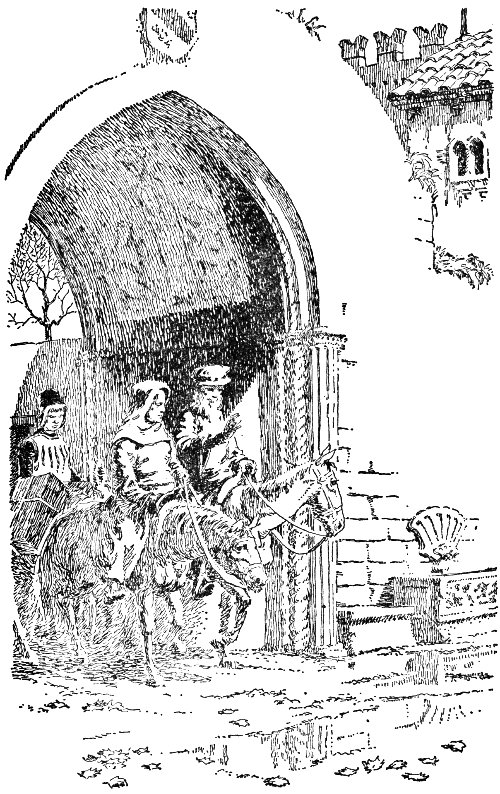
Leonardo heeled his horse and with Francesco de’
Melzi at his side, followed by his servant and students,
pushed past the crowd at the gate. To the left rose the
Pincio hill with its stately pines where, in the days of
Imperial Rome, Lucullus had walked in his gardens.
But Leonardo had no time to look about. It was a damp
December day, and rain threatened from the gray skies.
He was tired, and as Francesco glanced at him he could
see Leonardo pull his cape around him with a little
shiver as the chill wind stirred the long, graying hair
on his shoulders. They made their way through the
crowded, noisy city. They crossed the Tiber and rode
past Castel’ Sant’ Angelo, the papal fortress built on the
tomb of Emperor Hadrian. After another inspection
by the Swiss guards in beribboned uniforms of white,
green and gold under their shining breastplates, they
entered the walls of the Vatican. That evening after
he had settled himself in the Belvedere apartments and
dinner had been eaten, Leonardo, gazing into the embers
of the fire, looked back over his new stroke of fortune.
The Medicis had returned to power. Pope Julius II
131
had died, and Giovanni de’ Medici, son of Lorenzo, had
become Pope Leo X at the age of thirty-seven. With
his election to the head of the Christian world, the Republic
of Florence became a city of the Medicis once
more and Leonardo had received an appointment in
Rome. Giuliano de’ Medici, Pope Leo’s favorite younger
brother, in his new rise to power and wealth, became
Leonardo’s patron. The two must have met sometime
during the Medici’s exile. Leonardo was given the apartments
in the Vatican and a salary of thirty-three ducats
(approximately eighty-five dollars) a month and a
workshop was fitted for him and his pupils. He was also
assigned an exclusive German assistant named Georg.
The Pope’s court in the Vatican was like the Medici
court in the Florence of Leonardo’s youth—multiplied
by hundreds. Leo X saw himself as the center of the
artistic world, and being a man of luxurious tastes with
the wealth of the church behind him, the Vatican was
soon filled with a mixture of the wise and foolish. Pompous
classic-quoters, third-rate poets and clowns mixed
with the world’s scholars and statesmen. The two greatest
artists were Bramante, the architect and friend of
Leonardo’s first years in Milan, and Bramante’s pupil
Raphael, the painter.
Bramante was busy building the new church of St.
Peter’s and, as the architect of this favorite project of
the Popes, he was sole master of the Roman art world.
Raphael, as his protege, was the recipient of the better
painting commissions in Rome. The elderly Bramante
and the thirty-year-old assistant were a famous pair in
the Rome of 1513. Equally as famous, however, was
Michelangelo; he was still living in Rome, but was without
patronage after Julius II’s death. Leonardo’s old
rival had scored his triumph with his extraordinary paintings
in the Sistine Chapel.
Although the young Raphael, who owed so much to
132
the example of Leonardo, now rode through the streets
as a wealthy nobleman, Leonardo himself received no
great commissions. While Pope Leo was indulgent of
his brother’s whims he himself had no use for this tall,
serious old man who roamed the shaded walks of the
Vatican poking at the strange plants in the botanical
garden or making drawings of the foreign animals in the
private zoo. In reality, Leonardo’s patron, Giuliano de’
Medici was a weak man. He played at being a patron
but, like his brother the Pope, he lacked the force and
decision of his famous father Lorenzo. Nevertheless,
he did give Leonardo one small commission for a picture.
Immediately Leonardo, excited by the exotic plants in
the Vatican gardens, commenced to experiment with
them to find a resin to make a varnish with which to
cover the future painting. Pope Leo made fun of him
exclaiming, to the delight of his court, “This man will
never get anything done, he thinks of the end before
the beginning.”
This ridicule by the Pope made Leonardo a joke to
many in the circles of the Vatican who were a little
afraid of this strange man with the searching eyes. Leonardo
also suffered the humiliations of a man who did
not conform to the fashions of his day. His knowledge
of Latin, for example, was weak and although he could
read it with the help of a dictionary he could not speak
it. And, among the people who surrounded the Pope,
Latin was the only language allowed. Prizes of great
sums of money and important positions were often
granted on the strength of an improvised speech in
Latin (with many quotations from the classical authors)
or a flattering Latin verse. Faced with such setbacks and
ridicule, Leonardo—not surprisingly—began to withdraw
into himself.
133
And yet, Leonardo refused to remain idle—he had
to work. The need for mirrors in the vast halls and rooms
of the papal palace was great. Leonardo turned his
mechanical skill to redesigning and improving methods
of making them, and even inventing his own machines
for the grinding of the glass. Also, for Giuliano, who
dabbled in alchemy and magic, he made distorting mirrors
and burning lenses. In addition, Leonardo invented
a machine which could be run hydraulically for producing
long strips of copper of equal width for use in soldering
the mirrors.
But, with the making of these mirrors, Leonardo began
to run into trouble with his German assistant, Georg.
The boy was a loafer; he spoke little Italian and took
every opportunity to spend his days with his countrymen
in the Swiss guard. Leonardo tried to alter the situation
by suggesting that the boy have his meals with him
at his worktable, thus giving Georg a better chance to
learn the language. This however did not appeal to him.
Then, because Leonardo’s inventions were so extraordinary,
he began to give away the secrets of their mechanisms
to Johannes the mirror-maker, another German,
who had been replaced by Leonardo in the favors of
Giuliano. This naturally made Johannes jealous of Leonardo.
Georg gossiped, too, and told stories about the
old, eccentric man who lived like a miser in the midst of
all the luxury and who drew crazy circles on pages of
paper.
These “crazy circles” were geometric exercises that
134
had fascinated Leonardo from the time he had wandered
across Italy with Fra Luca Pacioli. Pacioli’s book De
Divina Proportione, containing sixty illustrations from
designs of Leonardo, had been published in Venice in
1509. Leonardo intended to entitle these geometric exercises
De Ludo Geometrico. In geometry a lune is a
crescent-shaped figure bounded by two intersecting
arcs of circles on a plane or a sphere. Leonardo drew
pages of these lunes and then proceeded to transform
their curvilinear figures into squares of equal area. He
also reviewed Archimedes’ method of squaring a circle
and developed it into a variety of ways for cubing
spheres and cylinders.
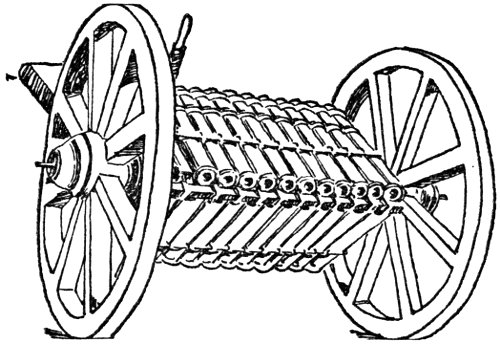
He returned as well to formulating theories of friction.
He wrote in his notes, “the tallest wheel is the easiest
to pull”—for example, a big wheel turning at the same
speed as a smaller one has less friction to overcome because
it makes less revolutions. His experiments in friction
predated men like Amontons and Coulomb by two
and three centuries. He established a formula for the
building arch which he described as “a strength caused
by two weaknesses”—if one half of an arch is removed,
the other half collapses. They support and give strength
to each other. In addition, Leonardo determined, before
Galileo, the center of gravity of any pyramid and of a
tetrahedral, or four-sided body.
As the days went by and he waited for commissions
to come, Leonardo took to wandering about the streets
of Rome. He stood in the half-buried Forum of the
Caesars surrounded by grazing sheep and grunting pigs.
Wooden shacks where crude cartwheels were made and
where the marble from the ancient temples was cut and
sold, were built against the sides of crumbling ruins.
The old triumphal arches, now overgrown with creepers,
were boarded into towers and cattle were penned
135
between the shafts of columns that once supported the
grandeur of temple roofs. Here and there a classical
scholar would be sketching or writing from the worn,
Latin inscriptions on a marble slab tilted crazily from the
ground where it had fallen hundreds of years ago.
Goats wandered on the Palatine hill, once the home of
Emperors, and the great baths of the Emperor Diocletian
were now a deer park and a hunting ground for royalty.
During the course of these wanderings, Leonardo became
interested in the primitive methods of carpentry.
Such things as screws, for example, were rare. Those
that were used were either made of wood or, if of metal,
by goldsmiths laboriously making each one by hand,
soldering wire around a pin and another wire into the
hole to hold the screw. Sometimes they were made by
filing pieces of metal individually. All these methods
were time-consuming and costly.
Leonardo had thought of this problem before, and
now he concentrated on perfecting his ideas about it.
Previously, he had thought of casting the metal in
wooden molds and then turning the metal on thread-cutters.
The designs he finally drew in careful detail,
however, are essentially the methods used today. The
new machines did with a few turns of a handle and
adjustments of a few cogged wheels what it took one
man many hours to perform. He also drew designs for
a mechanical plane and a machine for drawing wire that
worked by water power.
Leonardo now lived and worked in the Belvedere of
the Vatican—more a man on exhibition than an active
participant in the great artistic activities taking place
around him. True, he received his thirty-three ducats
a month, but Michelangelo had been paid three thousand
for his work in the Sistine Chapel, while Raphael had
earned twelve thousand for each room he painted in the
Vatican.
136
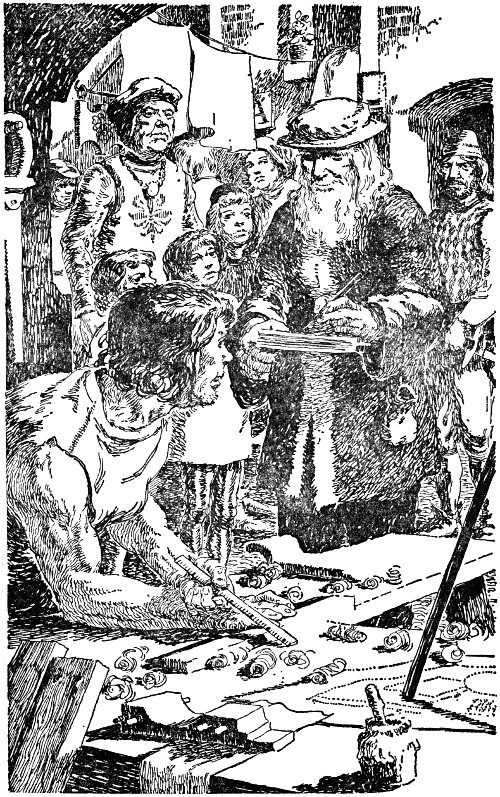
Leonardo became interested in various methods of carpentry.
137
Thus Leonardo drifted farther and farther away from
his painting. This, in itself, caused people to talk in the
papal city. For he had earned fame as a painter, but his
passion for science was regarded as strange and whimsical.
Occasionally, he did receive a small commission
from the workshop of Raphael, yet these were like the
crumbs from a rich man’s table.
Even the toys Leonardo made at this period for the
amusement of his patrons were looked upon as somewhat
weird. For example, he would take small pieces
of wax and mold them into strange little animals and
then inflate them so that they floated in the air in front of
a startled guest. Once he caught a curious lizard in the
garden and spent hours putting scales all over the tiny
body, attached to it a little beard and horns, then let
it out from a box at a banquet. The guests jumped back
with fear and the women became hysterical.
One of Leonardo’s jokes that has been passed down
in accounts of his life at this period must have created
quite a sensation. He showed the company the cleaned
entrails of a sheep resting on the palm of his hand. After
telling them to wait and watch he took the entrails in
another room and with a bellows inflated them with
warm air. As the entrails filled with air they expanded
and extended. They crept into the room where the company
waited. Slowly they grew and grew until they began
to fill the room. The guests overturned their chairs
in their hurry to get out of the way of this shapeless,
translucent creature. Then Leonardo appeared, the air-filled
138
entrails giving way before him, and said:
“Sires, this is but an example and symbol of virtue.
As you can see, the smallest virtue is capable of the
greatest growth.”
The guests laughed, but it was an uncomfortable
laugh. Thus another story was added to the legend of
Leonardo as an odd old man.
Leonardo, whose work—particularly his anatomical
studies—had constantly been interrupted by the fortunes
of war, had found another hospital in Rome where he
could continue these studies. This time it was his intention
to write a treatise on speech. He dissected and
drew the anatomy of the larynx (the voice box), the
vocal cords and the trachea (the air passage to the lungs),
and all the muscles that control the movements of the
tongue and the lips. If you pronounce each letter of the
alphabet you will feel these muscles of the lips, especially
with the letters “o,” “p,” and “f.” Carefully he noted
how the air vibrations from the trachea form themselves
into vowels and consonants, and he drew the membrane
which, when air is pressed against it, makes the sound
“aah.”
At this same time he was also busy finishing a treatise
on painting which he had begun when he was working
on the “Last Supper” for Ludovico Sforza. But it was
for his knowledge of military engineering that he was
sent to the city of Parma by the Pope on September 25,
1514. Here he stayed at the Bell Inn while examining the
fortifications and other defenses of the city.
Leonardo’s patron, Giuliano de’ Medici, had been
139
appointed governor of this particular area and, since
Pope Leo X was fearful of two powerful countries,
France and Spain, he was preparing the papal territory
against possible invasion. Another fear of the Pope—and
indeed of everybody in Rome—was malaria, the
disease carried by the mosquitoes that bred in the Pontine
marshes west and southwest of the city. At that
time, however, no one knew the cause was mosquitoes;
rather, they thought it was the bad air from the
marshes.
As Leonardo had already been effective in draining
the pestilential marshes of Piombino for Cesare Borgia
and, later, those around Milan for Charles d’Amboise,
he was assigned the same task for the Pontine marshes.
He surveyed the entire area to the sea and made another
extraordinary aerial type map. His recommendations
included draining the entire area, enlarging and regulating
the Martino river and cutting an extra outlet from
the river Livoli to the sea. These plans were adopted
some years later and parts of the marshes were drained
successfully, yielding new land for the cultivation of
crops.
By December of 1514 Leonardo had finished his
treatise on speech and, possibly in an effort to attract the
attention of the Pope, he submitted it to the Privy-Chamberlain,
Battista dell’Aquila. As Pope Leo was surrounded
by an army of secretaries and assistants who
passed on everything submitted, this manuscript with its
beautiful drawings was mislaid and lost and only a few
notes and sketches remain.
The continual discouragement of his life in Rome was
140
offset by a visit from his half-brother, Giuliano, around
Christmas. Leonardo was held in esteem by his family
despite the quarrel over his father’s and his uncle Francesco’s
will, and his half-brothers were pleased to tell
of their famous relative who lived in the Belvedere as
guest of the Medicis. Yet they knew little of Leonardo’s
scientific dreams and his lack of recognition in the papal
city.
Often, Leonardo’s greatest comfort was to return to
his notes. The challenge of geometry and the mysteries
of the movement of air and water kept him from brooding
about his lonely life. Francesco de’ Melzi, Leonardo’s
young friend, had more and more taken over
the practical responsibilities of his everyday life. Except
for his workshop, where the troublesome Georg
worked at the making of mirrors, and an occasional
small commission for a painting, Leonardo was free to
study.
In addition to his geometrical investigations, Leonardo
now experimented with the science of statics (objects
that are stationary), and dynamics (objects in motion).
One of his most important discoveries in the
science of mechanics came about during this period.
Concerning the division of weight, he wrote, “There
are three conditions of gravity of which the one is its
simple natural gravity, the second is its accidental gravity,
the third the friction produced by it. But the natural
weight is in itself unchangeable, the accidental which
is joined to it is of infinite force, and the friction varies
according to the places wherein it occurs, namely rough
or smooth places.” Thus he realized and formulated
what composes the movement of an object. He found
that movement is the result of separate forces acting
upon the object from different directions, as for example,
the initial push, the pull of gravity and the
resistance of friction. And, before Galileo, Leonardo
further experimented with objects dropped from a
height. As the result of repeated experiments, he noted
that the fall was being affected by the earth’s rotation.
That is, the object dropped always fell in a slight eastward
direction rather than vertically downward—a
fact later proved conclusively by Isaac Newton and
141
Robert Hooke in the next century.
He also became fascinated with spiral motion, such
as is found in a spinning top or in a whirlpool of water.
Because of his interest in hydrodynamics, or the movement
of water, he began to sketch imaginary “Deluge
compositions.” These were drawings showing the
world—probably inspired by the Bible—in a chaos of
wind and floods. They were based on his years of scientific
research. Indeed, his drawings of actual whirlpools
are still among the greatest of his scientific art. Today,
with all the latest technical aids, such as dusting a whirlpool
with powdered rosin and then photographing it, an
accurate three-dimensional picture is impossible. Yet
Leonardo, by sheer observation and analysis coupled
with his genius for drawing, could reproduce the complicated
shape of whirling water.
In the relatedness of his explorations of water, air and
movement, and weight, he worked out the similarity
between the laws of equilibrium controlling solids and
liquids. The equation between the motive force and
resistance that makes for equilibrium or balance in solids
can be compared to the equation between the upward
pressure of liquids and the downward pressure exerted
on them.
142
Far into the night Leonardo worked on his papers.
He tired more easily now, and his eyes had grown
weaker. To provide the increase in light that his failing
eyesight demanded, he had improved on his original oil
lamp by making the wick rise as the oil was burned
away, and he had extra lamps fitted to the ceiling.
On January 9, 1515 Leonardo wrote in his notes, “Il
Magnifico Giuliano de’ Medici set out on the ninth day
of January 1515 at daybreak from Rome, to go and
marry a wife in Savoy. And on that day came the news
of the death of the King of France (Louis XII).” This
meant that his new patron had left and his old patron
had died. Leonardo’s note was a sad one and perhaps
he felt, in the departure of his patron, more alone than
ever in the crowded life of the Vatican. Giuliano, on the
urging of his brother, was marrying Philiberta of Savoy,
in an effort to strengthen the prestige of the Medici.
Louis XII, before he died, had formed a league against
Spain, and with the marriage of the Pope’s brother to a
noble house of France, the league would be strengthened
by keeping the Pope on the side of France. Actually
Pope Leo was playing both sides, for at the time
he was also friendly with Spain.
Shortly after Giuliano’s departure from Rome, Leonardo
fell ill, presumably from a mild heart attack complicated
by a touch of malarial fever. The doctor had
been called. It was a warning, the doctor told Francesco
de’ Melzi, and Leonardo must remain quiet for quite
awhile.
By the end of the winter Leonardo was back on his
feet and apparently feeling completely well again.
143
Giuliano himself had fallen ill about the same time and
the news that he had recovered and was finally returning
to Rome cheered Leonardo. He sat down and wrote
a long letter to his patron expressing his joy. This letter
also included a long list of complaints against Georg
and Johannes. Georg was now using his room in Leonardo’s
apartment to do work for others. He lied to
Leonardo and flew into such a rage when he was questioned
that no one could go near him. Moreover,
Johannes, the mirror-maker, was now moving back
into the Vatican and turning out mirrors for everyone,
even using Georg’s room as his own workroom.
Johannes boasted of his skill and told everybody that
Leonardo did not know what he was doing. Thus, it
was not surprising that Leonardo, in his long complaint,
was taking out the anger and frustration he felt against
all the injustices of his life in Rome.
But by summer Leonardo was again employed as a
military engineer. Francis I had succeeded to the throne
of France. The new French King was anxious to secure
his lost title to the Dukedom of Milan and was preparing
another invasion of Italy. Pope Leo X, still trying to
play both sides at once, was making secret agreements
with Francis while at the same time joining the King of
Spain, Milan, Genoa, and the Swiss in an alliance against
France. Consequently, he sent Leonardo out to inspect
the fortifications of Civitavecchia, a city on the Tyrrhenian
coast not too far from Rome. When, in August,
Francis I crossed into Italy with an army of thirty-five
thousand men including Marshal Trivulzio, the Pope
ordered his brother, Giuliano, to take command of the
papal forces. On the way to assume this command,
Giuliano fell ill and collapsed. His sickness this time was
144
soon to be fatal.
Leonardo returned to Rome with his survey of
Civitavecchia, where he immediately learned of his
patron’s latest illness. Perhaps realizing that Giuliano
was fatally ill, Leonardo made a desperate effort to gain
the recognition he felt should be his. He entered the
competition for a new façade of San Lorenzo in Florence.
Among the other competitors was Michelangelo,
his younger and yet oldest rival.
In October of 1515, Francis I had recaptured Milan
and by Christmas was in Rome. Leonardo may have met
the new King of France in Bologna where Pope Leo X
had personally traveled in order to settle a peace treaty
with France. Certainly it is known that he attended
Francis’ court in Rome. Leonardo’s name was well respected
in French circles and, as Francis had already
admired the pictures by Leonardo, the meeting was a
happy occasion for them both. Indeed, the recognition
that Leonardo had sought in his native land was never
as great as that accorded to him by the French.
As Francis I prepared to leave for France in January
he must have offered Leonardo a position at his court.
While he still hoped that Giuliano de’ Medici would
recover from his illness and return to Rome, Francis’
offer gave him support in the knowledge that he had a
powerful, new friend.
March of 1516 brought the first of three events that
145
were to change the course of Leonardo’s last years.
Giuliano de’ Medici died, leaving Leonardo not only
without a patron, but without a friend in the Vatican.
Now sixty-four years old, he was reluctant to leave his
comfortable quarters in the Belvedere with its workshop
and pleasant gardens. Besides, deep within himself, he
felt that Rome could still offer him the fame that had
always escaped him.
Spring ripened into summer and the second event
occurred. The competition for the new façade of San
Lorenzo in Florence was won by Michelangelo. To
Leonardo the news was a blow. The success of his old
rival weakened his position in the Vatican even further
and added to the growing hostility he had felt in the
people surrounding the Pope.
The third event was the sum of many small events.
Georg and his friend Johannes, in their jealousy, had
spread much gossip about Leonardo in court circles.
They now took advantage of Giuliano’s death to circulate
stories about Leonardo’s dissections of bodies in
the hospital. These were added to vicious gossip that
Leonardo was pro-French. This news eventually
reached Pope Leo X. The Pope himself was perfectly
aware of the practice of dissection and, personally, he
had turned his eyes the other way. However, as dissection
was contrary to Church doctrine, an official
complaint to the head of the Church could not be
ignored. The Pope used it as an excuse to be rid of this
tiresome old man whom he had tolerated only for his
brother’s sake. Leonardo was abandoned.
The year 1516 was drawing to a close. Leonardo had
146
decided to seek the patronage offered him by Francis
I. So he and Francesco de’ Melzi, his loyal young friend,
left Rome for the long journey into France. As he left
his native land for the last time, Leonardo looked back
over his years—from the silver lute that had sent him
to Milan, to the death of Giuliano, to the final rejection
of Pope Leo X. Remembering how Lorenzo de’ Medici
had sent him to Ludovico so many years before, Leonardo
thought to himself with great sadness, “The
Medici created and destroyed me.”
147
13 The Last Years
Leonardo looked around from where he was leaning
on the parapet of the Chateau d’Amboise to watch a
group of young lords and ladies playing croquet on the
emerald-green lawn. The click of the mallets and balls
was mingled with the shouts and laughter of the young
people. It was late afternoon in May and although the
sun was warm the breeze from the west was chilly.
Leonardo looked down again from the sheer height of
the castle wall across the wide sweep of the Loire river
and the valley extending as far as the eye could see.
Swallows were swooping low over the banks below and
the wind carried their shrilling cries up to him. The
forested islands and sandbars interrupted the steady
flow of the river and Leonardo could see the reflections
sway in the current. He had been studying the river
but he realized that his aging eyes were not up to the
task of concentrating for long. The wind made them
148
water, so he turned away and started back to his home.
There was much that was familiar in the castle at
Amboise. The thick, high walls and round towers and
especially the graceful, lacy spires of the king’s residence
brought back much that he had known in his native
land. The gardens had been planted by Italians—there
were orange trees and even a mulberry tree from his
beloved plains of Lombardy. The king’s residence and
chapel had been constructed and the decorations carved
in stone by Italian artisans. Leonardo could stop and
talk in his native tongue with many of the men employed
by the king. Since the time of Charles VIII, the
French had brought in the latest Renaissance styles
from Italy. Leonardo’s steps took him back from the
castle grounds and down a path with a hand-railing. The
steep roofs of the town of Amboise with their chimneys
could be seen below him. The path led to a small
manor house, like a miniature castle with sharp spires
and lacy, carved-stone gables that was set in green lawns
and gravel paths.
The Manoir de Cloux, as Leonardo’s house was
called, had been a hunting lodge for Francis I, but when
Leonardo had arrived he gave the house to Leonardo
for his home. Francis, in his admiration for this great
man, also gave him seven hundred crowns a year, together
with a pension of four hundred for Francesco
de’ Melzi.
149
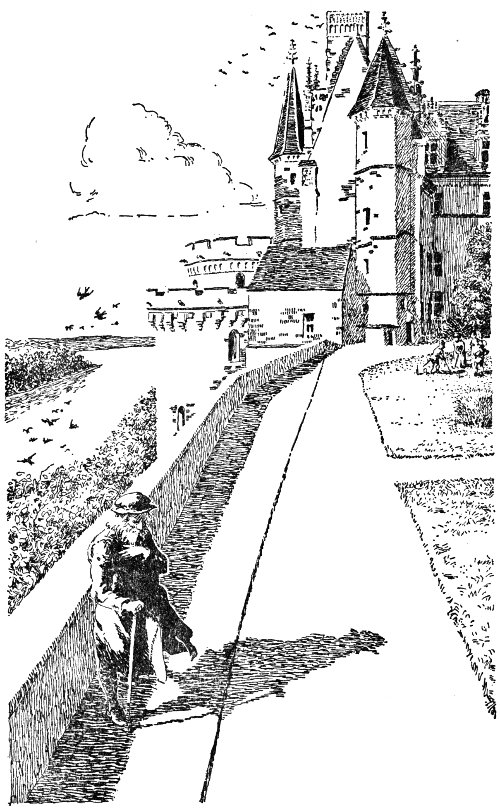
Leonardo at Chateau d’Amboise on the Loire.
150
The long journey from Rome had left Leonardo tired
and weak and he had fallen ill again shortly after his
arrival. This time the attack was more serious and had
left him with his right hand permanently crippled. He
looked at it now as he opened the door to his room.
“Another warning,” he thought, “and there’s still so
much to do.”
The young, robust King Francis was everywhere at
once. He gloried in knightly tournaments, hunts, and
sports of all kinds. Always restless, he might appear at
any place unannounced. Frequently there would be a
clamor at the gates of Leonardo’s home and the king
would ride in with one or two of his nobles. With a
great jingling of spurs he would bound up the stairs of
the manor house calling for Leonardo. He delighted in
long talks with the old man, and would listen respectfully
as Leonardo, his deep-set eyes brooding over his
notes, would demonstrate some scientific point on a
blank sheet of paper.
At this time, Leonardo was engaged on three projects
which demanded his immediate attention. One
was the entertainment for a banquet that Francis was
giving for his sister, Marguerite de Valois, and her husband.
Another was a new design for the king’s castle
at Amboise, and the third was a design for making a
navigable waterway from Amboise to Romorantin. Although
these three projects were the main ones that
occupied Leonardo’s time, there was always the supervising
of his pupils’ painting on the walls in the little
chapel of the manor house, his own work on a painting
of St. John the Baptist, and the continual ordering and
151
revising of his notes.
The banquet took place in October of 1517, and the
mechanical lion Leonardo had made was an immediate
success. It “walked” by means of a spring motor, into
the hall, opening and closing its fierce mouth while
swaying its head from side to side. With a wand that
he had been given, Francis I stepped down from his
seat and tapped the lion three times. The toy fell apart
and from it a cascade of white lilies poured out at the
king’s feet.
Also at this time there was a distinguished guest at
the castle of Amboise. He was a fellow-countryman of
Leonardo and his name was Cardinal Luigi d’Aragona.
With him was his secretary Antonio de’ Beatis. As
Leonardo was now a famous member of King Francis’
court, the cardinal paid him a visit accompanied by
Antonio. The extraordinary anatomy drawings and all
his notes were shown to the cardinal; he and his secretary
were deeply impressed. They were also surprised
to learn that Leonardo had never been accorded the
same recognition by his own countrymen. Antonio
de’ Beatis wrote home that “This gentleman has written
a treatise on anatomy, showing by illustrations the members,
muscles, nerves, veins, joints, intestines and whatever
else is to discuss in the bodies of men and women,
in a way that has never yet been done by anyone else.
All this we have seen with our own eyes; and he said
that he had dissected more than thirty bodies, both of
men and women of all ages. He has also written of the
nature of water, and of divers machines, and of other
matters which he has set down in an endless number of
volumes, all in the vulgar tongue [meaning Italian not
Latin], which, if they be published, will be profitable
152
and delightful.”
By now Leonardo had accumulated thousands of
pages of notes, and they lay stacked in all manner of
chests and boxes. Often now, as Leonardo surveyed the
work of his lifetime, he realized that he would never
see the day of their publication. Time was slipping
through his fingers. Already summer had come and
gone and now the sharp winds of fall were lifting the
leaves from the ground in dancing whirls. Fortunately
these were years of peace and for the first time in a
long while the people were free of wars. The scheme
to canalize the waterway to Romorantin had grown to
a vast idea for making a thoroughfare of water from the
Loire river all the way down France to Lyons and then
into Italy! Leonardo, old and ailing as he was, had surveyed
parts of the rivers Loire and Cher, braving the
rough roads and crude accommodations.
In addition, Leonardo had designed a castle for Francis
I’s widowed mother in Romorantin. This castle was
never built, but many of the ideas that Leonardo had
incorporated in its design were used in the gigantic and
magnificent castle of Chambord. Also, at Francis’ request,
he had reviewed the work being done at the castle
in Blois and there is reason to think that the beautiful
outside stairwell that spirals from left to right might
have been designed by Leonardo.
In February of 1517, a son had been born to Queen
153
Claude and Francis I. The king decided to postpone the
baptism of the dauphin (the title given to the eldest son
of a French King) until May of the following year. At
that time there would be a double celebration at Amboise,
for a nephew of Pope Leo X, the young Lorenzo
de’ Medici, was being married to Madelaine d’Auvergne.
As usual, Leonardo was given the assignment
of preparing the festivities. Although he was fond
of preparing these entertainments, Leonardo now felt
the pressure of time; for indeed, the interruptions of this
eager young king were sometimes a hardship. He felt
that his years were drawing to an end. His notes were
unfinished and his dreams of extending man’s knowledge
of his world and of himself were hindered not only by
such petty chores but also by the limits of his own physical
endurance.
As Leonardo was sketching one day from the window
of his room where he could see the castle walls and
the chapel of Saint-Hubert, he set aside the drawing
for a moment to write a memorandum to himself.
“Write of the quality of time as distinct from its
mathematical divisions.” Was this extraordinary man
sensing the road down which Einstein—in his studies of
relativity—was to travel hundreds of years later?
Spring arrived again and with it came the first wild
154
flowers and roses, the songs of the birds in the woods
and the blossoming of the chestnut trees. The time for
the double celebration came, too, and Leonardo was
seen busily preparing the decorations and mechanical
delights for the large crowds already assembling. In
addition to the tournaments-at-arms that so delighted
the king, there was to be a mock battle with a besieged
city, and for this Leonardo had had constructed imposing
castle walls of wood with a backdrop of a city’s
spires and towers. The party lasted for weeks, and the
climax was performed on the lawns of Leonardo’s house
where a great ballroom had been set up. Here he repeated
an earlier success, the one that had so enchanted
Ludovico’s guests so many years ago in the Sforza castle
at Milan. There was again a dome over the ballroom
across which the stars moved mechanically and artificial
figures representing various gods and goddesses spoke
and sang by means of a hidden choir, while the sun and
moon shone in their own lights.
This display ended the festivities. It was already late
June and Leonardo was anxious to return to his plans
for the water route to Italy. There was the area near
Sologne which, when flooded, would make the surrounding
countryside a marshland. This would have to
be drained by the same method as he had planned for
the Piombino and the Pontine marshes. Francis I was
interested, too, in the improvements Leonardo had suggested
for his own castle, and he would have to talk
with the castle superintendent about them. As always,
there seemed to be so many things to do, to plan, to
work on. Then Leonardo wrote in his notes: “On the
24th of June, the day of St. John, 1518, at Amboise, in
the palace of Cloux....” and underneath, “I will continue—”
“I will continue—” It was almost a note of defiance
against the obstacles of advancing age and sickness and
the interruptions of the practical world.
155
The sound of jingling spurs and bridle chains and the
snorting of many horses announced another surprise
visit from the young king. Leonardo could hear him
below shouting something to Battista, the servant who
had come to Amboise with Leonardo. Now, as usual,
Francis was running up the stairs with all the energy of
youth shouting for “le maître” (the master). Resignedly
and with patient humor, Leonardo stepped out to greet
the king. The gold chains around Francis’ thick neck
and over his broad chest glinted in the semi-light of the
hall, and he was holding his plumed hat at his side and
mopping his forehead with a dainty embroidered handkerchief.
“Master Leonardo! We are going on a tour of the
river and I want you to look at the place that I told you
about. Where I want to put that bridge. You remember?”
“Sire, give me but a moment to gather some material
together.”
A chest was made ready and soon Leonardo was at
the door, calling to Francesco and Battista to help him
into the saddle of his horse, while the king’s servants
hoisted the chest onto one of the carts already piled
high with tents and provisions.
When Francis was restless—which was often—a
“tour” could mean many hours or many days of travel.
Wagons were always kept ready with all the equipment
for a long journey and Leonardo, himself, had learned
to accept these sudden whims and kept chests of his
own ready for any such trip. Now, as always, the king
kept his horse reined back out of regard for this tall,
stooped man with the long beard and simple clothes.
Yet when Leonardo returned from this “tour” he
156
realized that he could no longer make such trips. The
hardships of sleeping in tents, riding over the hot roads,
and the necessary work involved in surveying the possible
sites for a bridge had left him almost exhausted. He
had made one suggestion, however, and that was to
build houses that could be carried and then assembled
with a few wooden locking devices, then just as quickly
taken down and moved to the next place. They could
also be left standing where the country people could
use them while the court was away. Indeed, such
structures would seem to be the ancestors of our own
prefabricated houses.
The winter of 1519 was a bitter one. When the cold
fog spread over the valley shrouding the bare trees it
chilled the big, white-washed rooms of Cloux. The
wind blew down from the north sending blasts down
the chimneys and scattering ashes and sparks. Leonardo,
huddled against the huge fireplace with its roof projecting
into the room, pulled his black cloak lined in soft
leather around him and reminded himself to include
it in his will for Mathurine, the faithful domestic who
cooked for him and took care of his house.
The aged Leonardo, who had observed and analyzed
so much of man and nature, knew now that his own
days were numbered. When the first, pale sunlight of
March shone through the small leaded-glass windows of
his house, he applied to the king for permission to make
out his own will. French law demanded that the property
of any foreigner dying in France went to the
Crown. The permission was granted, and on April 23,
1519, Guillaume Boureau, the Royal Notary of Amboise
was summoned with witnesses.
To his half-brothers in Florence Leonardo left his
157
property at Fiesole and four hundred ducats. To his
faithful friend and companion, Francesco de’ Melzi,
nobleman of Milan, Leonardo willed his notes, drawings,
and paintings. Battista was given the income that
Louis XII had granted Leonardo from the tolls of the
canal at San Cristoforo near Milan. Mathurine was
granted the “good black cloth, trimmed with leather”
and two ducats. Moreover, Leonardo outlined in detail
the plans for his own funeral, right down to the use of
ten pounds of candles.
Too weak now to stand any more, Leonardo was
confined to his big four-poster bed with the canopy.
From it he could see the tracery of the Chapel of Saint-Hubert
against the pale, foreign sky through the little
window in the corner. The vicar of the church of
Saint-Denis was called, with two priests and two Franciscan
friars, and Leonardo received the last sacraments
at his bedside.
An entry in his notes reads, “While I thought I was
learning to live, I have been learning how to die.” But
death was not easy for him. With tears rolling down his
sunken cheeks for “his wasted life,” he died on May 2,
1519—fighting even this final interruption to all his
work.
King Francis I, who was at St. Germain-en-Laye
158
with his court, wept when the news was brought to
him. Francesco de’ Melzi was so overcome with grief
that he waited until June before writing to the half-brothers
of Leonardo of the Master’s death. He wrote,
in part, “He was to me the best of fathers, and it is
impossible for me to express the grief that his death has
caused me. Until the day when my body is laid under
the ground, I shall experience perpetual sorrow, and not
without reason, for he daily showed me the most devoted
and warmest affection.”
And in a closing paragraph Francesco added these
words: “His loss is a grief to everyone, for it is not in
the power of nature to reproduce another such man.”
159