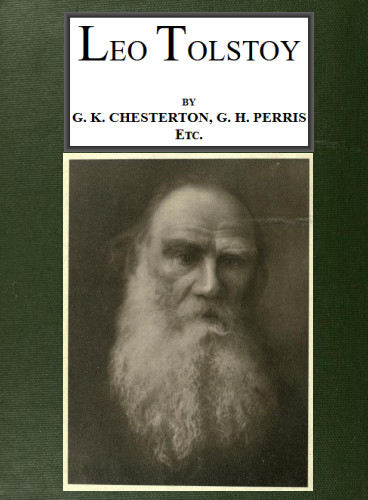
Lyeff Nikolaevitch Tolstoy was born at Yasnaya Polyana on August 28th
(September 9th new style), 1828. His father, Count Nicholas Tolstoy, was
a member of the old Russian nobility. In 1813, after the siege of
Erfurt, he was taken prisoner by the French and afterwards retired from
the army holding the rank of Lieutenant-Colonel. Having assumed the
burden of many family debts, he succeeded in paying his creditors in
full, thus gaining a reputation for unfailing perseverance. Tolstoy has
described his character in “Childhood and Youth.” “He was a man of the
last century,” he wrote, “and, like all his contemporaries, he had in
him something chivalrous, enterprising, self-possessed, amiable, a
passion for pleasure.... His life was so full of all kinds of impulse
that he had no time to think about convictions; and besides, he had been
so happy all his life that he did not feel it necessary to do so.” His
father died before Tolstoy reached the age of ten years, seven years
after the death of his mother, of whom he wrote: “When I try to recall
to mind my mother as she was then, only her brown eyes arise before me,
always the same look of love and kindness in them. If during the most
trying moments of my life I could have caught a glimpse of her smile, I
should not have known what grief is.”
Tolstoy’s early years were passed in the country on the old-fashioned
Russian estate, which resembled somewhat in patriarchal habits,
aristocratic manners, democratic familiarity, shiftlessness, and
superstition, a Southern Plantation in the days of slavery. After the
death of his father in 1837 the family was taken charge of by an aunt,
the Countess Alexandra Osten-Saken, and three years later by relatives
of his mother who lived at Kazan. In 1843 Tolstoy entered the University
of Kazan, where “Impervious to the ambitions of scholarship and
research, unimpressed by the provincial aristocracy, too nice to enjoy
the rough revels of the students, and repelled alike from aristocrats,
professors, and students by an unsocial and what, with our English
emphasis on government, we should call an unregulated disposition, he
seems to have had during these two or three years a thoroughly unhappy
and unprofitable experience.”[1] Having left the University in 1846
without graduating he returned to the old country home. Yasnaya Polyana
descended to Tolstoy from his mother. The estate, which covers an area
of some 2,500 acres, partly arable and partly wooded, lies a hundred
miles due south of Moscow. It was at one time Tolstoy’s intention to
dispossess himself entirely of his property and live as a peasant.
Instead of this, however, he has made over the whole of the land to his
wife and children, and lives in the house nominally as a guest.
At the entrance to the park are two towers, medieval in style, which
were erected by Tolstoy’s maternal grandfather. From them the road runs
through the park, rising as it approaches the house, and becomes merged
in a level avenue of birch trees. Glimpses of a pond are caught through
the dense foliage and of a square smoothly rolled space used as a
tennis-ground, the game being one in which Count Tolstoy participates
with great enjoyment. It will be noticed that in the photograph on page
31 he is holding a tennis racket in his hand.
The house itself is a plain white rectangular two-storied building of
stuccoed brick, and it would be hard to imagine a simpler and less
pretentious place than the home in which Tolstoy has spent the greater
part of his life. It boasts neither piazzas nor towers; indeed, no
architectural ornaments of any kind, nor are vines or other creepers
trained upon the flat walls to relieve their striking whiteness or
soften their rectangular outlines. The house was not completed all at
once, but was enlarged in proportion to the needs of the family. On one
side, devoid of windows, there is a low porch, near which stands an old
elm tree, called “The Tree of the Poor.” Close to its trunk is a bench
on which the peasants sit to await the coming of Count Tolstoy. Here he
listens with unwearying patience to many stories of distress and
difficulty, and gives in return, not only sympathy and advice, but such
material assistance as may lie at his command.
It was during the period following upon his University career that
Tolstoy threw all his energies into the task of raising both the
economical and moral standard of peasant life, and suffered much
disappointment at the hands of the peasants, who refused to allow him to
pull down their dilapidated hovels even that he might erect new and
convenient ones at his own cost. The result was that Tolstoy left
Yasnaya Polyana for St. Petersburg in the autumn of 1847, resolved to
prosecute his studies with the intention of taking a degree in law. With
this choice of a career, however, he was dissatisfied, and returned
again to his estate in 1848.
For a few years he lived the ordinary life of the Russian nobleman,
enlisting at the age of 23 as cadet in a regiment of artillery in which
his elder brother Nicholas was captain. Discontented with the idle life
he was leading and out of harmony with his gay surroundings, he decided
to jot down his recollections of the homeland he loved so well, and it
was at this time that he commenced writing “Childhood and Youth” (which,
however, was not published in its complete form until six years later)
and “The Cossacks.”
Subsequently Tolstoy was appointed to a post on Prince Gortchakoff’s
staff in Turkey, and was present at Sevastopol in 1855, having attained
the rank of divisional commander. His experiences during the war are
pictured in his three sketches, “Sevastopol in December 1854,” “In May
1855,” and “In August 1855.” These were published the following year and
at once made his literary reputation. At the end of the campaign he left
the army and visited Western Europe, in order to study various school
systems, and upon his return to Yasnaya Polyana he established several
schools of his own.
In September 1862 Tolstoy married Sophia Andreevna Behrs, the daughter
of a military doctor. He was at this time thirty-four years of age, his
bride being sixteen years younger. Miss Behrs was not only beautiful,
she was an exceedingly cultured girl, having passed various examinations
at the Moscow University. According to her brother, the manner of their
courtship was practically identical with that of Levin and Kitty in
“Anna Karènina.” Countess Tolstoy at the age of forty-eight is described
by Sergyeenko in “How Count Tolstoy Lives and Works,” as having “An
open, expressive countenance, with vivacious, fearless eyes, which she
constantly brings near to the objects at which she is looking. At her
very first words one feels her straightforward nature. In her manner
there is not even a shadow of truckling to suit the tone of any one
whomsoever; her own individual note is always audible.”
About the time of his marriage, Tolstoy was described as “a tall,
wide-shouldered thin-waisted man, with a moustache, but without a beard,
with a serious, even a gloomy expression of face, which, however, was
softened by a gleam of kindliness whenever he smiled.”
Living at Yasnaya Polyana winter and summer, with but rare intervening
visits to Moscow, Tolstoy interested himself in all the practical
details of farming. Probably his own experiences of the physical labour
of mowing are depicted as those of Levin in “Anna Karènina.” “The work
went on and on. Levin absolutely lost all idea of time, and did not know
whether it was early or late. Though the sweat stood on his face, and
dropped from his nose, and all his back was wet as though he had been
plunged in water, still he felt very well. His work now seemed to him
full of pleasure. It was a state of unconsciousness: he did not know
what he was doing, or how much he was doing, or how the hours and
moments were flying, but only felt that at this time his work was
good.”
Tolstoy was also an enthusiastic sportsman—a diversion which occasioned
him two serious accidents—and, in addition to fulfilling the duties of
a Justice of the Peace, he set himself to grapple with the novel
conditions of land-owning, a complicated and arduous task to which he
applied himself with characteristic energy and shrewdness. Indeed, his
interests were manifold and exacting. Yet during this busy period he by
no means neglected his literary work. The composition of his novel “War
and Peace” began immediately after his marriage, and extended over a
period of eight years. His wife copied out the manuscript of this work
no less than seven times as he altered and improved it. “War and Peace”
was followed by “Anna Karènina,” which was not completed until 1876.
In his method of working, Tolstoy may be likened to the old painters.
Having settled upon a plan of work, and collected a large number of
studies, he first makes a charcoal sketch, as it were, and writes
rapidly without thinking of particulars. He then has a clean copy of the
work made by his wife or one of his daughters, and this is again
subjected to careful remodelling. It is still in the nature of a
charcoal sketch. The MS. is speedily covered with erasures and
interpolations. Whole sentences replace others. The work is then copied
again, and some chapters Tolstoy writes more than ten times. He usually
writes on quarto sheets of cheap plain paper in a large involved hand,
and sometimes covers as many as twenty pages in one day. He regards the
interval between nine o’clock and three as the best time for work.
Tolstoy at work in his study at Yasnaya Polyana
see page 13
His study at Yasnaya Polyana is a small room with an uncarpeted floor, a
vaulted ceiling, and thick stone walls. Formerly it was a store-room,
and on the ceiling are heavy black iron rings, on which hams used to
hang and which were used later for gymnastic exercises. The study is
very cool and quiet, and contains various implements of labour, such as
a scythe, a saw, pincers, tiles, etc.
After his morning labours, Tolstoy generally goes out, often riding on
horseback or on his bicycle, according to the state of the weather. He
is strict vegetarian, eating only the simplest food and avoiding all
stimulants. He long ago ceased to smoke. Attaching great importance to
manual labour, he takes a share in the housework, lighting his own fire
and carrying water. At one time he learned bootmaking, and it is
wonderful what an amount of physical exertion he was able to undergo at
the age of seventy in the way of heavy labour in the field, of riding
scores of versts on his bicycle, or of playing for hours at lawn tennis.
Tolstoy has always dressed extremely simply, and when at home his
costume consisted of a grey flannel blouse, which in summer he exchanged
for a canvas one of a very original cut, as may be judged from the fact
that there was in the whole district only one old woman who could make
it according to his orders. In this blouse Tolstoy sat for his portrait
to Kramsky and Répin, the painters. His over-dress was composed of a
caftan and half-shouba, made of the simplest materials, and, like the
blouse, eccentric in their cut, being made evidently not for show but to
stand bad weather. The Hon. Ernest Howard Crosby has given an
interesting description of Count Tolstoy’s appearance. “He is dressed
like a peasant in a grey-white blouse of thin, coarse, canvas-like
material, with a leather belt; but his toilet differs from a peasant’s
in being scrupulously clean. His features are irregular and plain, and
yet his figure is so strong and massive that the tout ensemble is
striking and fine-looking. His little blue eyes peer out from under his
bushy eyebrows with the kindliest of expressions.”
Count and Countess Tolstoy have had fifteen children of whom only seven
survived. The system of their upbringing has been fully dealt with by M.
C. A. Behrs in his “Recollections of Count Leo Tolstoy.” Toys and
playthings were rigorously banished from the nursery. With the first
child the trial was made to dispense altogether with a nurse. But later
it was thought well to yield to the requirements of their social
position and to the habits of contemporary life, and the children were
put under the care of nurses, bonnes, and governesses. The parents,
however, exercised a strict and unremittent surveillance over both the
children and those who had the care of them.
The greatest possible liberty was allowed to the children, and all put
in authority over them were strictly forbidden to have resort under any
pretext to violent or severe punishments.
Tolstoy believed that these principles were nowhere so generally
accepted as in England, and, accordingly, from their third to their
ninth year, the children were placed under the charge of young English
governesses engaged directly from London.
Countess Tolstoy is an excellent housewife, attentive and hospitable.
All the complicated and troublesome management of the housekeeping and
direction of household affairs is under her charge. She is
indefatigable, and brings her brisk energy, thriftiness, and activity to
bear in every direction, and this she does without help. Her three
eldest sons live apart, each occupied with his own business matters. Her
daughters have their own interests and duties, which take up the greater
part of their time.
Tolstoy’s eldest daughter, Tatyana Lvovna, a girl of exceptional talent,
in particular works very hard. In addition to copying much of her
father’s manuscript, she conducts his vast correspondence, consisting of
an almost incredible number of letters received in all languages from
every part of the globe.
Leo Tolstoy, from a portrait painted in 1884
see page 33
Illustrations by H. R. Millar to “What Men Live By”—
see page 25
This is probably the most striking of all the portraits of Count
Tolstoy, representing him when at the height of his popularity and
power. In 1884 he was at work on the Popular Tales and Sketches which
sold by millions throughout Russia, and from which we reproduce two or
three illustrations—viz., one by H. R. Millar from the English edition
of “What Men Live By,” written in 1881; another by the same artist from
the English edition of “Where Love is there God is also,” and a third
showing the cover of this tract, which was written in 1885, and issued
in rough pamphlet form at the price of a few farthings.
Pasternak’s illustrations to “Resurrection”
see pages
19,
29 and
34
During the last twenty years Tolstoy has written the following
books:—“My Confession,” “A Criticism of Dogmatic Theology,” which has
never been translated, “The Four Gospels, Harmonized and Translated,”
“What I Believe,” “The Gospel in Brief,” “What to Do,” “On Life” (also
called “Life”), “The Kreutzer Sonata,” “The Kingdom of God is Within
You,” “The Christian Teaching,” “What is Art?” which in Tolstoy’s own
opinion is the best constructed of his books, “Resurrection,” his last
novel, begun about 1894, and then laid aside in favour of what seemed
more important work to be completely rewritten and published in 1899 for
the benefit of the Doukhabors, and latterly “What is Religion and what
is Its Essence,” published in February 1902. The illustrations
reproduced from “Resurrection” on pages 19, 29, and 34 are from the
remarkable drawings by Pasternak. Concerning these pictures there is an
interesting note in the preface of the French edition of the novel from
which it may be gathered that the drawings tallied very closely with
Tolstoy’s own conception of the appearance of his characters. It was the
artist’s usual custom to submit each design on its completion to the
eminent novelist for his opinion. Invariably Tolstoy showed his approval
of the clever realisation of his ideas. But when it came to the sketch
of Prince Nekhludov, Tolstoy went so far as to enquire of M. Pasternak
whether he was acquainted with the person who had served him as a model.
At this the artist showed extreme surprise—he had not even been aware
that the character was copied from an original.