I come now to deal with what lies south of Dublin—the
Wicklow Hills with all their apanages. And
here one is conscious of two divisions. First of all,
the obvious cleavage between the sunny seaward-facing
slopes, thickly inhabited, and the mountains
themselves or those glens that lie behind the first
ridges. Secondly, the division, not less notable, between
what is Wicklow pure and simple and what
really belongs to Dublin, just as Brighton and Richmond
belong to London.
This is not a mere question of distance. Dublin
hardly makes itself felt beyond the immediate suburbs
on the north and west: it stops with the tram lines.
And towards the mountains, if you leave your tram at
Rathfarnham, an hour’s good walking will take you
into a strangely wild ravine. Follow the military road—driven
through these hills after 1798 had shown how
strong they were, to be the first effectual instrument
of subjugation—up towards Glencree, through Rockbrook,
and so by a long steep ascent you will reach
a wood where the road divides, on the shoulder of
Tibradden, or the Kings’ Burying Ground. To your
right will be Killikee, with Lord Massey’s beautiful
demesne, and woods covering it almost to the top,
but the bare summit crowned by a shattered ruin—the
“Hell Fire Club”, built by young bloods in the wild
duelling and card-playing days of Dublin’s gaiety.
Turn your back on this and follow to the left into
Glen Cullen (the Holly Glen), which, dividing Tibradden
from Featherbed, sweeps round behind Two Rock and
Three Rock, and so, if you keep steadily by the left,
brings you back into the suburbs and villadom after
a round of some sixteen miles. But you will have
traversed a glen as bare and lonely, as devoid of
any suggestion of a great city’s nearness, as even
Connemara could show.
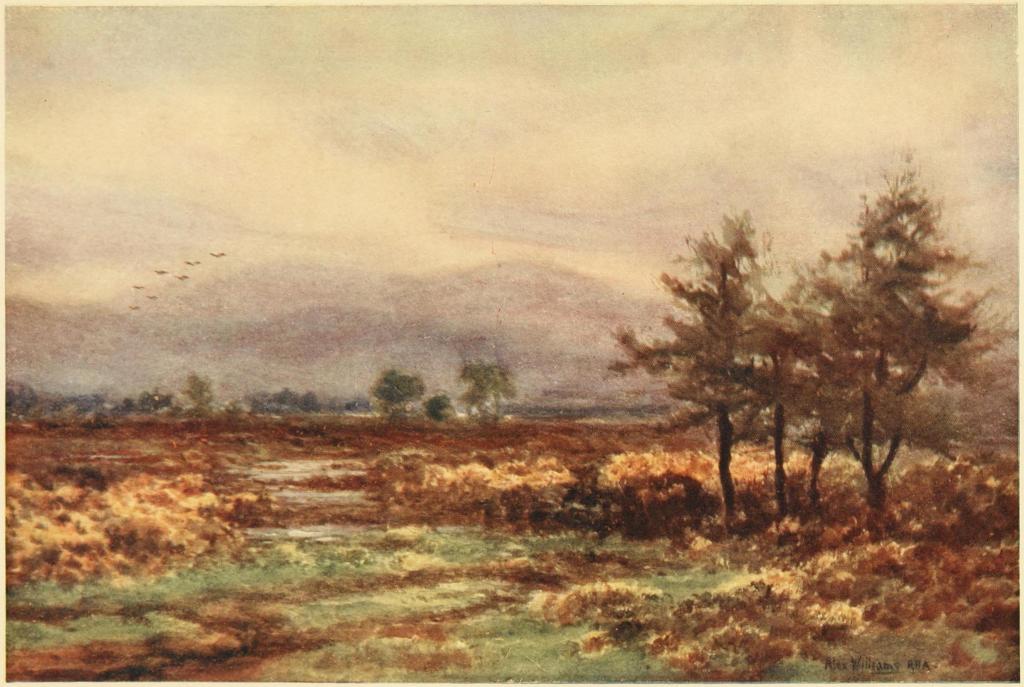
Very beautiful it is, too, up there, on a fine day;
and bilberries grow to perfection among the deep
heather on the slopes of Featherbed. When I was
last in it, instead of keeping to the left, we cut across
southward to the right by the first road out of the
valley, and from that height saw what is not often
seen—the coast of Wales clearly visible. Then, dropping
swiftly, we reached a road which, leading from
the city through Dundrum, traverses the Scalp—a fine
gorge of tumbled stone with fine woods effectively
planted; and so down a famous coaching road to the
pretty village of Enniskerry on the Dargle River, and
down along that river to Bray—and the train.
So quick and so emphatic is the transition from
one region to the other—from the region of lonely
car drives to the snug neighbourhood of gas and
steam. But let me define or describe the limits.
If instead of going out by road you take either the
train from Harcourt Street, which skirts the base of
the hills, or the Westland Row line, which follows
the sea all the way through Kingstown and Killiney
till both lines meet in Bray, you will, of course, have
suburbs about you, merging into villadom: and the
suburbs continue on the sealine almost unbroken to
Killiney. Then comes a gap, and at Bray you have
a considerable town, from which villadom—a very
pleasant and cultivated villadom—extends towards the
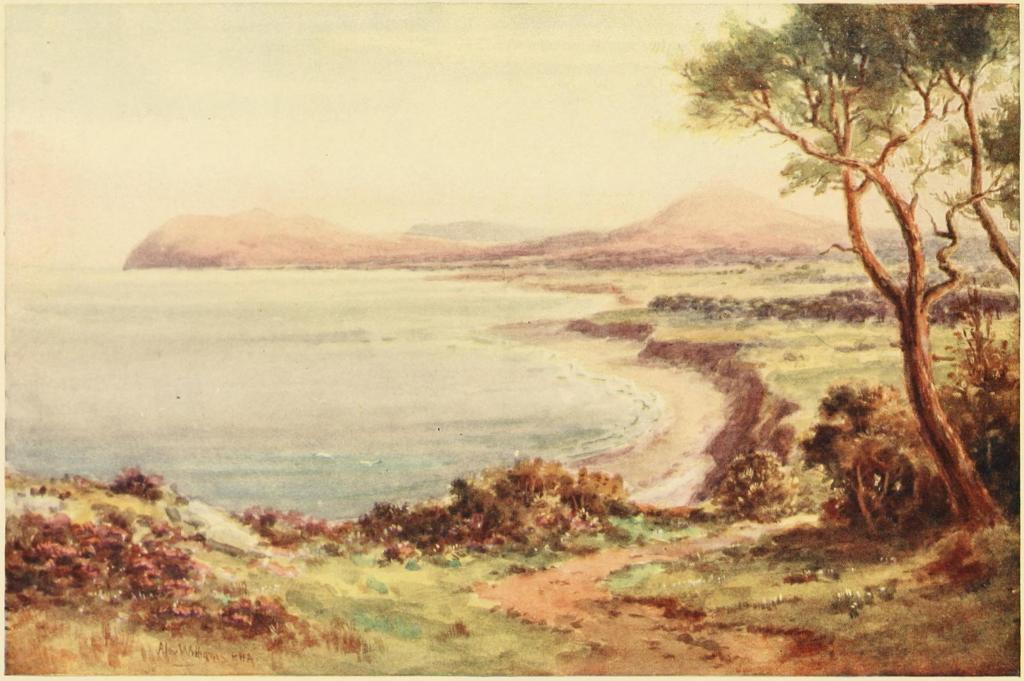
hills. Beyond Bray, the line rounds the face of Bray
Head in a series of little tunnels, with intervening
glimpses of sea dashing below, in the best Riviera
manner; and then you come to Greystones, another
even more suburban settlement. I set Greystones—some
fifteen miles south of Dublin—as the suburban
limit: beyond that you have honest country—Wicklow
proper. Only, let it be clearly understood that this
is no disparagement. The most beautiful things in
Wicklow are outside what I call Wicklow proper, and
inside Dublin’s “sphere of influence”. These I now
proceed to describe.
First of all, there runs up from Bray the famous
Dargle, a steep wooded glen with the river dividing
two demesnes—Lord Monk’s and Lord Powerscourt’s.
For miles you can drive or walk through a scene
of constantly varying beauty, with glimpses of mountain
behind the wooded slopes, until at last you
come to the Powerscourt Waterfall with its plunge
of a hundred feet out of an upper ravine. Climb
round, get above the waterfall, and at last, on the
slopes of Douse Mountain, you reach wild nature—and
you forget Dublin. Till then the spirit of Dublin
is with you—the spirit of a prosperous Dublin, inhabited
by rich men who liked to adorn the countryside
with some of the graces of the town, to set
elaborate plantations of foreign shrubs against a
backing of rock and heather. Very pretty it is, and
nowhere done more prettily.
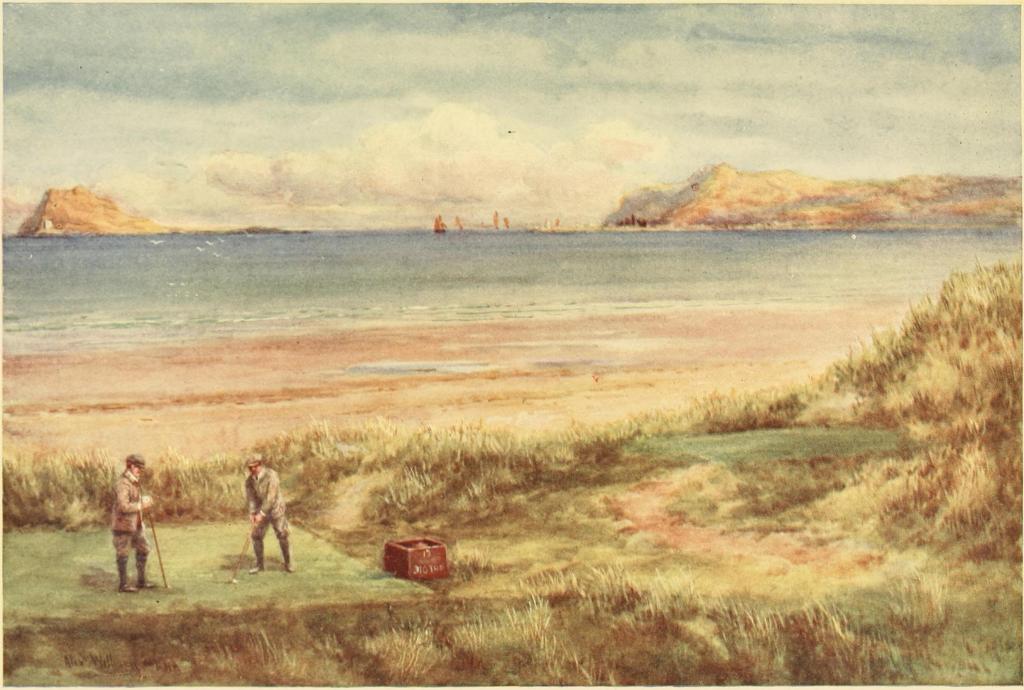
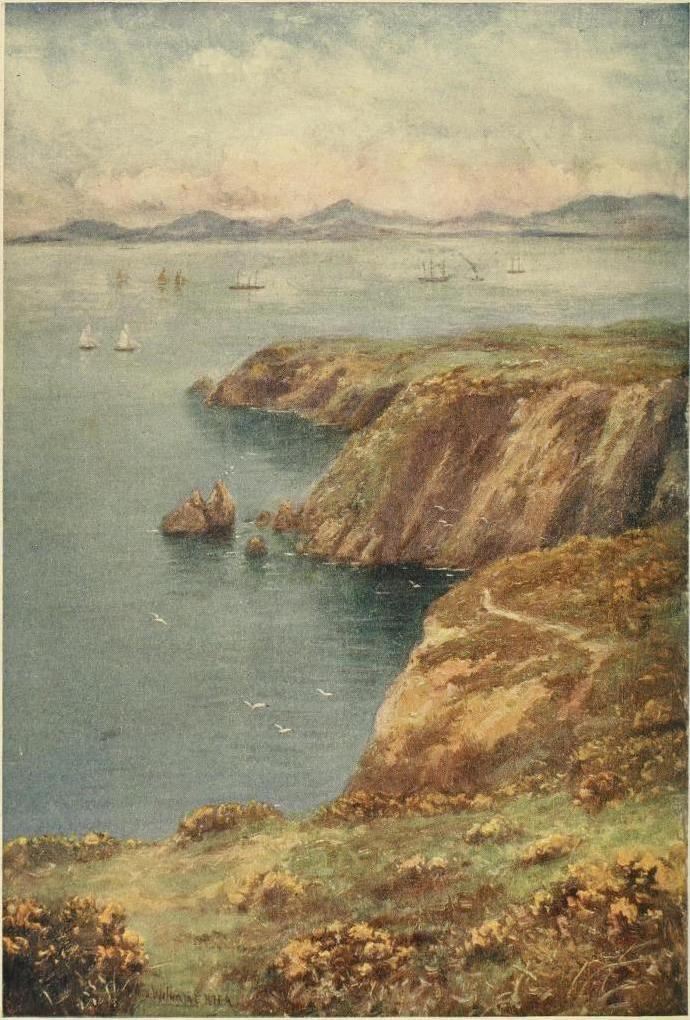
Or again, if you go from Bray to Greystones by
road, you may take the short road through Windgates
and traverse the dip in the ridge between the Head
and the Lesser Sugarloaf—a charming drive—with
the Head and the sea on your left, the peaked shape
of Sugarloaf on your right, bracken and heather clad,
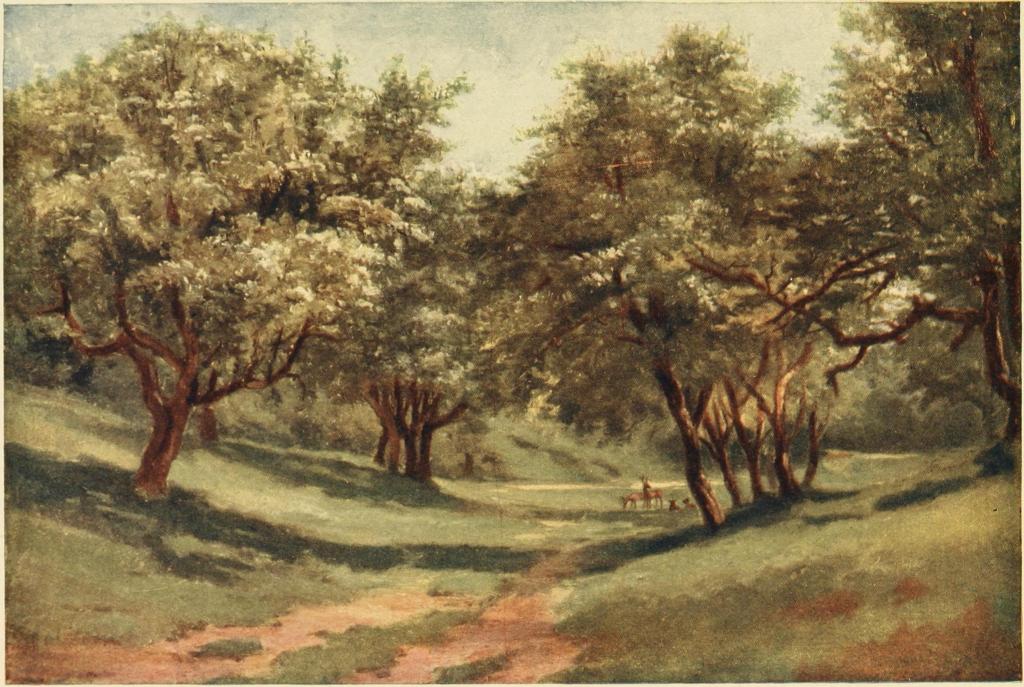
and over part of its height enclosed in a deerpark full
of sturdy Japanese deer. You may do better still: you
may take the long road and go inland, leaving Little
Sugarloaf on your left, towering up purple and splendid
above you, pineclad on this side to half its height;
then, curving round, come into the defile by Kilmacanoge,
which divides it from the Greater Sugarloaf.
Here now is the parting of the regions. From Kilmacanoge
a road runs up the Rocky Valley, sweeping
round Great Sugarloaf, and it instantly brings you
into wildness: in half an hour’s going you will be
round the mountain and out on the bleak levels of
Calary Bog, with the soft gradual side of Douse
tempting you to run up to the top—an easy victory.
Yield to that temptation, and, unless your way is
picked knowingly, you will be floundering in heather
shoulder high, ashamed to turn back and almost too
tired to go on. Still, to go on is worth it. Once on
the top of Douse you are in the heart of real Wicklow—and
you see, far below you, the road winding which
leads out through Sallygap, west of Kippure Mountain
to Kildare and the plains.
But supposing that at Kilmacanoge you do what
forty thousand other people will have done that year
before you, and hold straight on between the Sugar-loaves,
the road, curving gradually eastward and seaward,
brings you into the Glen of the Downs, another
noble defile, wooded to the very crest with scrubby
timber, so close as to be almost impassable—lovely
as the loveliest in its way. Yet somehow the little
gazebo of an octagonal summerhouse set high up on
the north side in Bellevue grounds stamps the scene.
It is nature, but nature decked and laid out and
caressed and petted by man. A little farther and
the road brings you into Delgany, at the foot of
the sloping Bellevue grounds, a village prettier even
than Enniskerry. And in truth Bellevue was a
splendid type of what I have in mind: place and
grounds created in the eighteenth century by a cultivated
Dublin merchant of Huguenot stock; a house
where Grattan was a frequent guest; which till the
other day showed in gathered perfection all the
domestic art of that great period, with its Sheraton
and Chippendale sideboards, its marvellous plaster
cornices and ceilings, its inlaid marble mantelpieces,
and, for a final glory, its bedstead painted by Angelica
Kaufmann. The grounds were planned to match—in
the same delicate graceful taste, a little mannered,
but always admirable. It had a lovely nature to
work upon, and that same taste has made the seaward
fringe of these nearest Wicklow Hills into the
very garden of Ireland. That is the beauty nearest to
the capital. And if the feeling of trimness wearies
you, all you have to do is leave the road and strike
out where you will across the heather. To their
great honour, the liberality of all landowners in this
playground of Dublin leaves the casual passer-by free
to wander almost as unrestrained as he might be in
Achill or on Slieve League.
For the country which lies beyond Dublin’s immediate
playground there is this to be said. Even the
railway going to it is delightful. I know of no prettier
line than the Dublin, Wicklow, and Wexford, and
if its trains are something sluggish, why, you have
the more time to admire the view. Beyond Greystones
you pass through a long marsh, full of wild
fowl, and then come to Wicklow, a pleasant little
town sheltered by its low head. There is an old
Norman keep here, Black Castle, but much more remarkable
is the work of modern builders. Wicklow
Head is adorned with three lighthouses—one carrying
a light. The first tower was built by a wise and
thoughtful Government, and the lamp duly fixed with
ceremony. But when it came to be lit, seamen reported
that while from certain quarters it was admirably
visible, the Head itself blocked it from half the horizon.
Nothing daunted, Government ordered another tower
to be built on a spot indicated in their offices, and
built it was. This illumined the previously excluded
section of sea, but was shut out from the area lighted
by the first tower. Finally, as a counsel of despair,
they sent down someone to look at the ground, and the
third tower, which now carries the light, was duly
erected. The other two remain as monuments of the
persistence with which the English Government has
sought to do things right in Ireland.
From Wicklow you strike into a new type of
country. Rathnew brings you close to the Devil’s
Glen, another Dargle, but one with less urbanity and
more rusticity. At Rathdrum you strike the valley
of the Avonmore, which is the centre of all this beauty
that makes southern Wicklow famous. The line
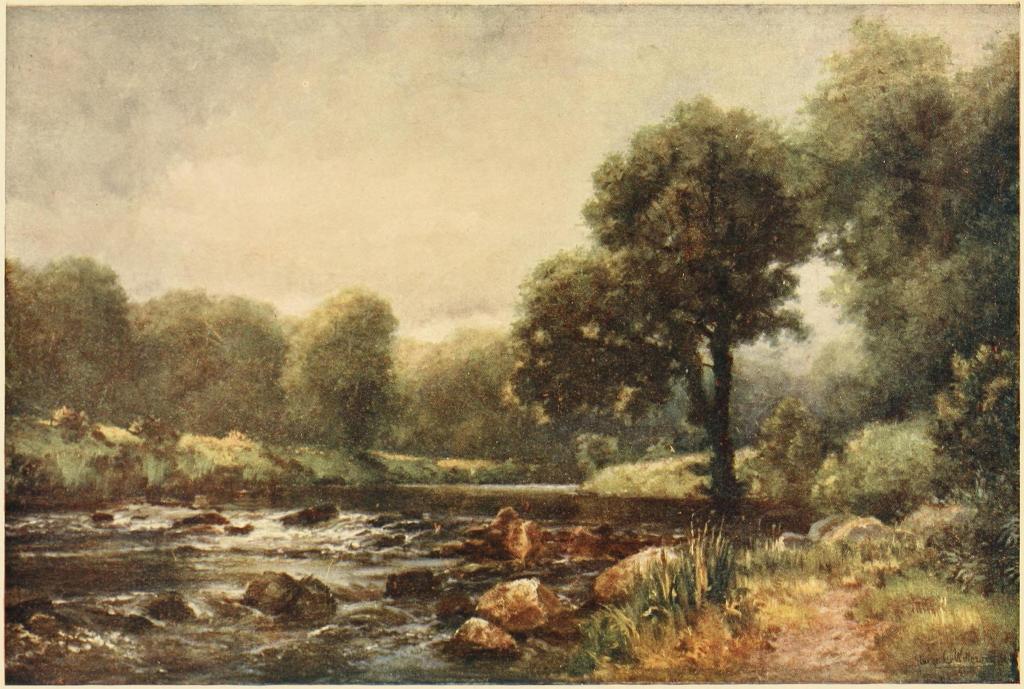
runs through a wooded ravine with the river below
it, plunging and swirling, and beyond the river you
catch a glimpse of Avondale House, now a school
of forestry, but once known to every Irishman as the
home of Charles Stuart Parnell. The water comes
down here discoloured with mineral washings that
remind one of the chemical investigations which
made up the pleasure of Parnell’s strange life. He
dreamed of gold mines in Wicklow—it was only in
politics that the stern practical bent of his mind
made itself apparent and effectual.
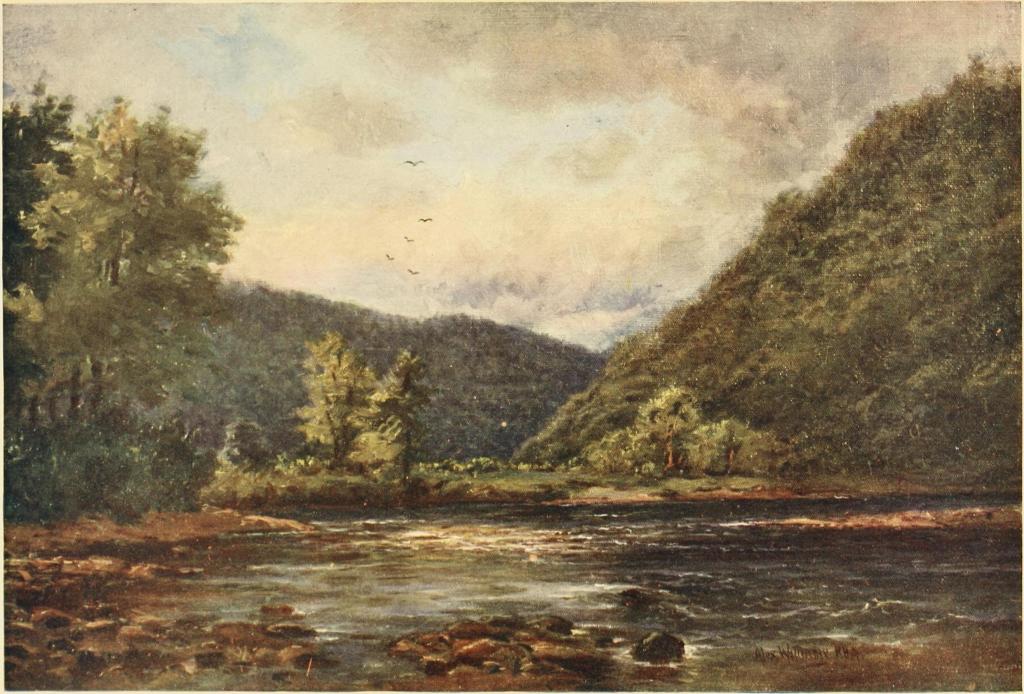
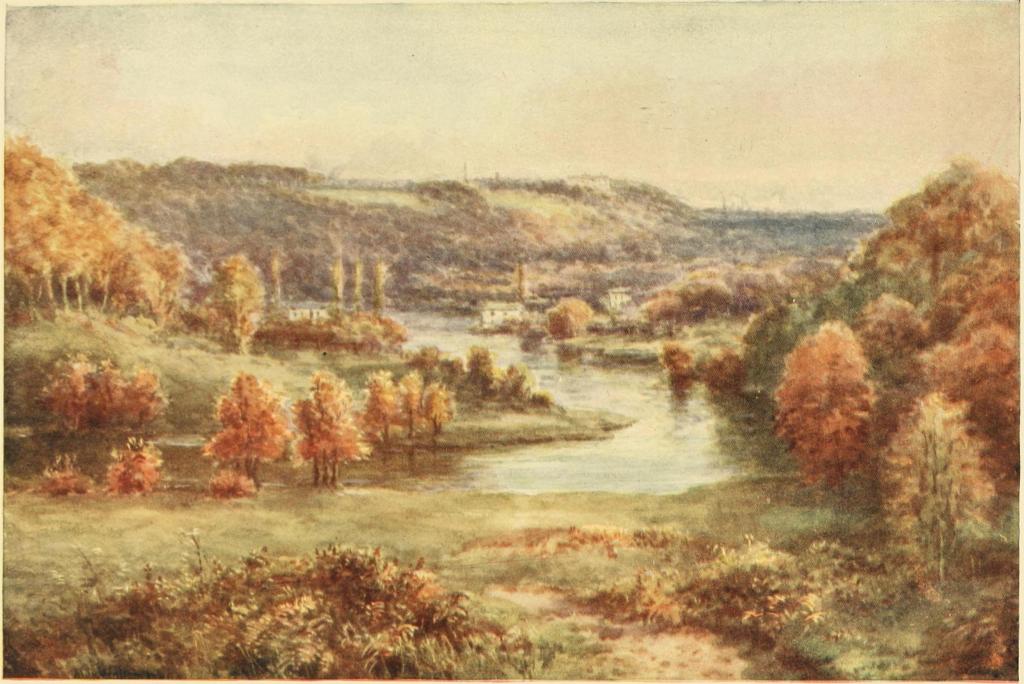
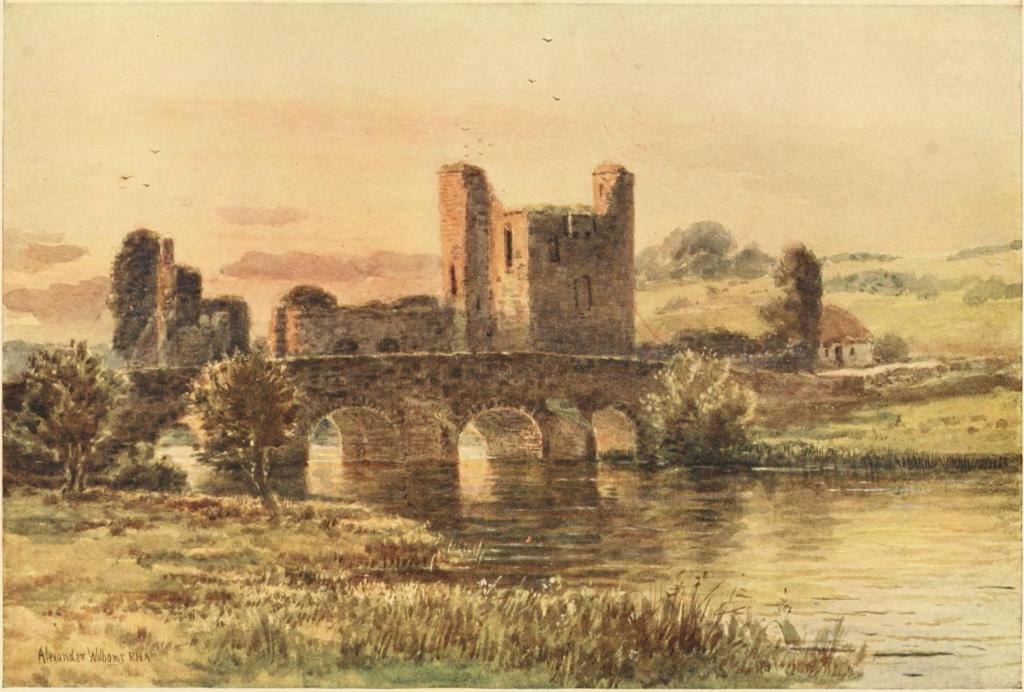
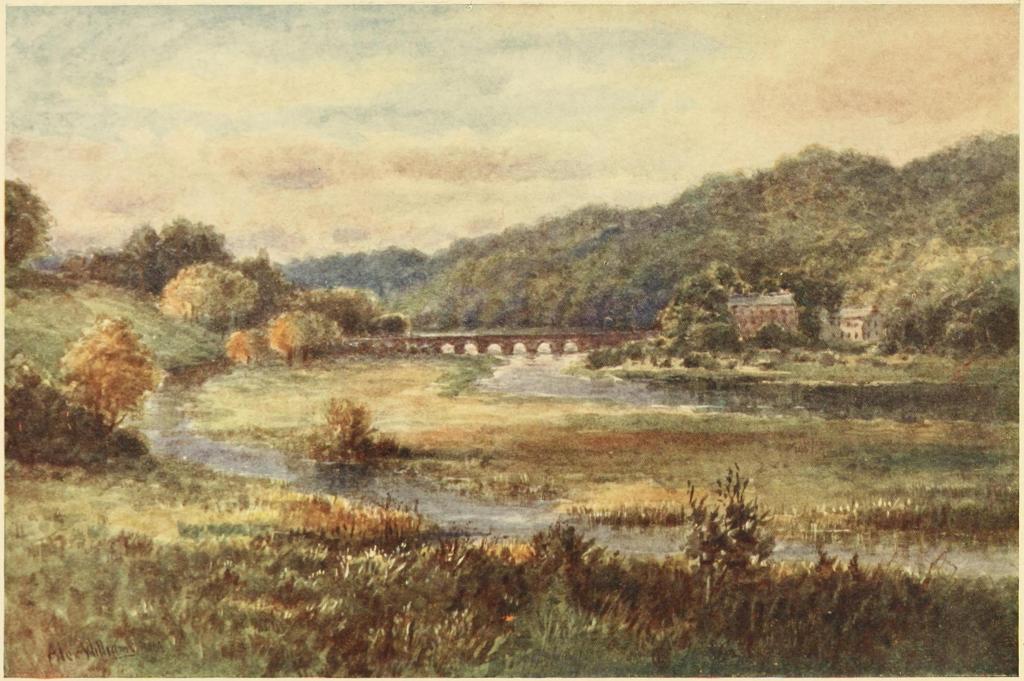
THE MEETING OF THE WATERS, WOODENBRIDGE
A little farther on the Avonbeg meets the Avonmore;
farther yet, beyond Woodenbridge and its hotel,
this main stream is joined by the Aughrim River,
and controversy still rages as to which of the two
confluences was honoured in Moore’s melody:
“There is not, in the wide world, a valley so sweet
As that vale in whose bosom the wild waters meet!”
Moore himself very diplomatically said he was not
sure; but at any rate the valley through which the
train runs till it reaches Arklow at the river’s outfall is
Moore’s “Sweet Vale of Avoca”; there is no mistake
about that, and no question of its gentle loveliness. Arklow
itself is an ancient town, whose name keeps,
like Wicklow, a memory of Danish beacon fires—“low”
or “lue” is the word for flame (still preserved
in lowland Scotch). Its population keep the hardy
seagoing tradition—Ireland has no better fishermen;
but they are incommoded by an odd circumstance.
At this point of the coast there is practically no
rise and fall of tide, and many a useful harbour is
useful only because it can be reached with the flood,
which never comes to Arklow.
Here first one meets a landmark of the great
“ninety-eight” rising. The Wexford insurgents received
at Arklow the decisive check which curbed
their very wonderful successes. The rebellion spread
no farther north, though, after the rout of Vinegar
Hill, stray parties of fugitives maintained themselves
for long enough in the mountains where the meeting
waters have their rise.
To reach this wider and more open region—far
less beautiful, yet having for some eyes an even greater
charm—you should follow up the valley of the Aughrim
River. A train will take you to Aughrim town, then
comes a road, passing at first between slopes of cultivated
and well-planted land. But as you go on, the
valley widens and spreads, the woods recede, and before
you are the great brown flanks of Lugnaquilla, highest
of all the Wicklow Mountains—higher indeed than
many a hill in Donegal or Kerry whose bolder shape
gives a far more imposing appearance.
Here at last, far up on the moors, you strike the
military road near its southernmost point; and planted
on it, facing down the glen, is a queer, gaunt, half-ruined
building, evidently a barrack. A barrack it was;
but in more recent times it fell to Parnell, who rented
these moors, and he used it as a shooting-lodge—furnished
in the roughest way, with a few bedsteads
and chairs. There is a kind of legend about the
haughty, unbending chief, who treated all his followers
with the scantest courtesy. Very different is the
impression I have got from those who were privileged
to walk the hills after birds with him and to
camp in that bare but friendly shelter. To-day, indeed,
its grimness is somewhat mitigated; but, as
you may readily discover, the old barrack has not
lost its associations with the nationalism of to-day.
From Aughavanagh the military road will carry
you north across the hill, till beyond it you reach the
valley of the Avonbeg and Drumgoff Bridge. Here
is the foot of Glen Malure—boldest and wildest of
all these glens—which divides Lugnaquilla from Lugduff.
This valley, commanding the pass westward
into the plains at Dunlavin, was always the central
stronghold of the O’Byrnes, the great Irish clan who
held out stubbornly among the hills. Lord Grey de
Wilton, Elizabeth’s deputy, tried to drive them out
in 1580, but his force was cut to pieces by the
mountaineers, and a few years later they had a sure
asylum to offer to Red Hugh O’Donnell, when he
escaped from Dublin Castle and the captivity into
which he had been foully kidnapped.
But the spot in all this region which offers most
attraction to travellers is Glendalough, site of the Seven
Churches, a place of most venerable memories. Kevin,
to whom it owes its fame, was born A.D. 498, sixty-six
years after Patrick first preached in Ireland. His
name, Caomh-ghen, means the Gentle-born, and he
was son of the King of Leinster. The whole of
this princely family became passionately religious,
for two brothers and two sisters of Kevin were
canonized, and their names are in the Calendar.
Kevin was sent for nurture to a Cornish holy
man, St. Petroc, who had come to spread the light
in Wicklow, but the young Prince finished his
studies under the guidance of his own uncle, Eoghan
or Eugenius, who had a monastic school somewhere
in the beautiful parish of Glenealy on the sunny
south-eastern slope of these hills.
He was a handsome lad, and his looks so distracted
a beautiful girl that she tried to seduce him
from his vocation. Modern tradition tells that she
followed him into his cave in the cliff above the
upper lake, and that he flung her out into the water.
The Life of him relates a different version, according
to which he threw her into a bed of nettles and
whipped her with them over her face and arms till,
as the pious author says, the fire without subdued
the fire within, and his discipline determined her to
follow his example and enter the monastic life.
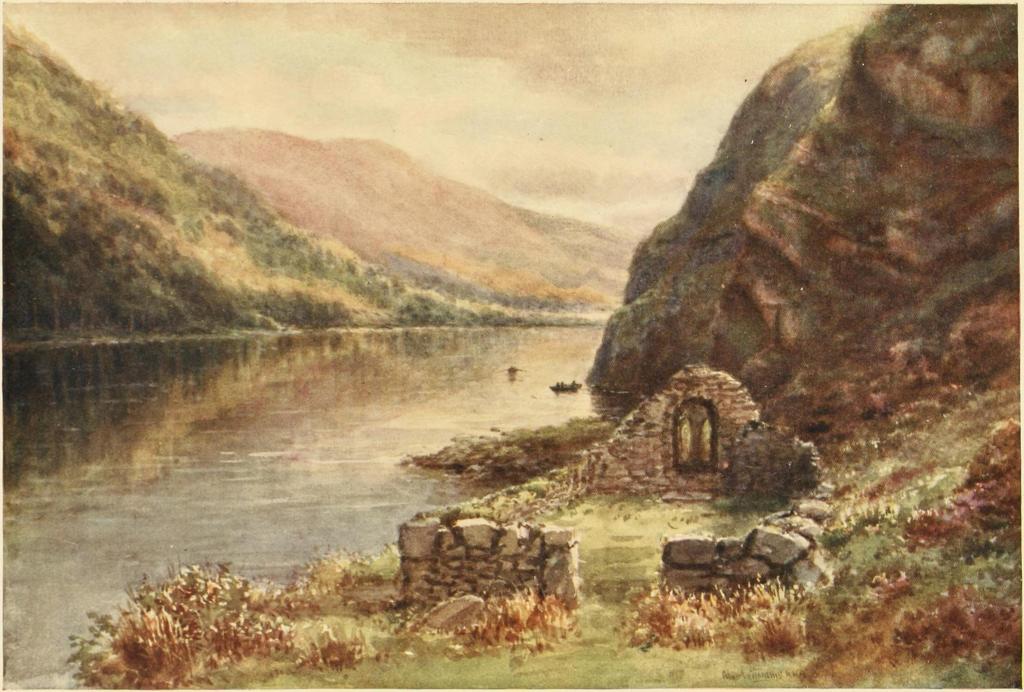
ST. KEVIN’S BED AND THE CHURCH OF THE ROCK, UPPER LAKE GLENDALOUGH
However that be, Kevin fled from the society of
men—and women—to take up his abode in the lovely
but peaceful spot for ever associated with his name:
“a valley closed in by lofty and precipitous mountains
beside a lake”. “On the northern shore”, says
the Life, “his dwelling was in a hollow tree: but
on the southern shore of the lake, he dwelt in a
very narrow cave, to which there was no access
except by a boat, for a perpendicular rock of immense
height overhangs it from above.”
This is an overstatement: any active man can get
into the Bed from above; but even from below (where
Mr. Williams shows the boat lying in his picture)
it needs some climbing. Within is only room for
a man to sit or lie—not to stand. But Kevin’s dwelling
on the north shore was leafy and bird-haunted,
and the wild creatures, it is said, used to come and
light on his shoulder, and sing their sweetest songs
to God’s solitary.
At last his fame went aboard, and folk flocked
to his sanctuary and begged him to found a monastery.
He submitted unwillingly, and let them build him
(still on the slope of the same mountain, Lugduff) a
beehive cell of stones, or “skellig”: and near it they
built an oratory, Tempul-na-Skellig, on a rock projecting
into the lake—now wrecked, for, as Archbishop
Healy writes in his Ancient Schools and
Scholars, “fifty years of tourists in the mountain valley
have caused more ruin to these venerable monuments
than centuries of civil war”.
But there was no room on this cliffy shore, and
Kevin was admonished in a vision to build in the
open space by the outfall of the lower lake. “If it
were God’s will,” said Kevin, “I would rather remain
until my death here where I have laboured.” “But,”
said the angel, “if you dwell where I bid you, many
blessed souls will have their resurrection there and
go with you to the heavenly kingdom.” So Kevin
consented to move; and he built the monastery on
which all those churches and towers sprang up that
can be seen or traced to-day. Yet in this city he
did not depart from his austerities, but slept on the
bare ground and lived on herbs and water.
The foundation of the monastery may date from
about 540. Kevin lived on, they say, till 620, and
died surrounded by his disciples, a man of God and a
peacemaker, among the best beloved of Ireland’s saints.
All that great congeries of ruins dating from pre-Norman
times speaks of a very large community. They
are typical. There is the round tower, cloigtheach, a
belfry, place of retreat into which the pious monks
used to retire, drawing up the ladder after them; there
is the big church with high-pitched roof of stone, and
its galaxy of lesser chapels, just as in Ciaran’s city
at Clonmacnoise. About these doubtless were numberless
huts of wattle and clay, dwellings of the clergy
and the students. For here was the real metropolitan
see of Irish Leinster. Dublin was a Danish foundation,
and for centuries the primacy was disputed between
them, till the dispute was ended by calling the provincial
see the Archbishopric of Dublin and Glendalough—joint
dioceses with separate organization to
this day.
For archæological and historic interest no place in
Wicklow can approach this “glen of the two lakes”,
Gleann Dá Loch. But for romance, I at least should
put Glen Malure far before it; and, for beauty, would
infinitely prefer the lovely cup of Lough Tay or Luggilaw,
where it nestles under the western slopes of Douse.
This, and Lough Dan as well, you can see by a slight
detour on your way to Dublin; and if you have come
by Bray, it is best to take the military road back to
Dublin, which brings you through Sallygap by the
headwaters of the Liffey, and past the other beautiful
little lake of Lough Bray at the sources of the Glencree
River. So, keeping high among the hills till you
have passed Killakee and begin the descent into
Rathfarnham, you will complete almost the whole
of your journey amid the haunts of shepherd folk
such as those among whom Synge lived, and from
whom first he got his vivid vision of Irish peasant
life—a vision coloured no doubt by long residence in
far-off Aran, and told in words that keep an echo
of the Gaelic tongue, yet always, as most of our
visions must be, in its essence the vision of that
particular countryside where he was born and bred.