The capital of Kansas now occupies a portion
of the former hunting-grounds of the
Kaw and Shawnee Indians. The Shawnees
were the first emigrant tribe to arrive in
the Territory. The ancient home of the
nation was near the Cumberland River. Early
in the Seventeenth century, the Iroquois
invaded that region and vanquished
its owners, who fled south and became scattered,
settling in Carolina and Florida. At a
later period, the divisions of the tribe reunited
and returned to the vicinity of their
old home, taking possession of a more extended
country and founding towns in the
Ohio Valley. When they were driven west,
the Baron De Carondelet granted them land
near Cape Girardeau.
As the white people entered Louisiana,
the Shawnees sought new homes, again and
again. Finally, they relinquished all claims
in Missouri, in consideration of a large purchase
in Kansas. In 1854 a treaty was signed,
disposing of all their land except two hundred
thousand acres, which were divided among
individuals; and in 1869 the remnant of the
tribe removed to the Cherokee country, in
the Indian Territory.
A migration tradition says that once,
when the Shawnees lived in the far East, on
the shores of the Great Salt Lake, they were
surprised to see, riding along on the back of
a large fish, a creature that looked like a
man, although it had long green hair like
weeds, a face like a porpoise and a beard the
color of ooze. Around its neck were strings
of sea-shells, and in its hand was a staff made
from the rib of a whale; and, most astonishing
of all, the strange being had the bodies
of two fishes for legs. He stopped near shore
and sang of the beautiful things in the depths
of the sea. The people heard, in amazement,
for he spoke their language.
Day after day and week after week, the
Man-Fish might be seen, seated on the water,
with his legs curled up under him; and all
the time he sang of new countries; and the
people, charmed, left their work and listened.
Men forgot to go hunting and the women no
longer busied themselves around the wigwams,
but stood on the beach and watched.
Repeatedly, the creature sang: "Come, follow
me"; but they refused to go. At last
the supply of food in the village was exhausted.
Hunters entered a boat and tried
to catch fish, but without success. The Man-Fish
flirted water over them with his legs,
and laughed at their trouble, chanting a
melody about the wonderful Spirit Island,
in the midst of the Great Salt Sea. The
Shawnees said:
"Can you show us anything better than
we have—good wives, good children, good
dogs and plenty of deer?"
But the stranger reminded them of storms
in the Moon of Falling Leaves, of snow and
ice, of hunger and constant danger from wild
animals and painted warriors, saying:
"Come with me and I will show you a
land where the air is always warm and soft,
and the flowers are always in bloom; where
you will find as many deer as are among your
icy hills, and great herds of animals called
bison; where the men grow tall and the
women beautiful as the stars of night."
The Shawnees were afraid, and attempted
to go toward shore, but were held back by
an unknown hand. They consulted among
themselves. The Man-Fish bobbed up his
head and sang: "Follow me." They decided
to obey.
Out on the water, a mighty storm arose.
The Great Spirit could be heard hissing in
the depths of the ocean. The boat rocked
and swayed on the billows; but the protector
was near and told them not to fear. He
brought food and a shell of fresh water from
the bottom of the sea. Two moons passed
before land appeared. It was the glittering
Spirit Island, with big trees and high mountains.
From some of them lightning seemed
to shoot. Along the shores were seals and
ducks. The inhabitants fled into the woods,
when they saw the Man-Fish, who went to
find the Spirit of the Island. He entered a
cave and soon returned, accompanied by a
being as strange as himself. It had a head
like a goat, with horns and beard, and moss-colored
hair. Its legs and feet were covered
with handsomely decorated leggings and moccasins.
Speaking with the voice of a man,
it said:
"I will take you, men of the Land of
Snows, to a beautiful place, where you will
find all that could be desired."
The Man-Fish departed, and under the
guidance of their new friend, the strangers
reached the interior of the Spirit Island.
They married the maidens of the country and
grew into a bold, strong and valiant nation,
overcoming all tribes east of the River of
Rivers.
The Shawnees were of Algonquin stock
and were the roving clans, the gypsies of the
wilderness, described by William Penn, belligerent
under ill-treatment but peaceable
when dealt with justly. Referring to the creation,
they said:
"The Master of Life made the Shawnees
first, from his brain, and gave them all his
knowledge. Other red people descended from
them. He made the French and English from
his breast, the Dutch from his feet and the
Long-knives (Americans) out of his hands."
One of the most interesting legends is
that which has reference to the origin of the
Piqua Shawnees. The word "Piqua" signifies
"Man Made from Ashes."
It seems that long ago, in the dim past,
the nation made a talk against the Walkullas,
who lived not far away, on the shore of the
Great Salt Lake. The older men opposed a
war; but Mad Buffalo and the young warriors
refused to listen to their counsel.
"We are strong," said they, "and the Walkullas
are weak."
A party, eager for a fight, went out from
the village. Two moons passed and there
were no tidings of the young men. The Walkullas
were distant only six suns journey.
The third moon went by; and Chenos, the
oldest and wisest man of the tribe, called the
people together in council; he told them that
the young warriors had been slain. There
was a shriek of horror and the women began
to lament for their husbands and sons.
"Yet," said Chenos, "there is one left,
who has had vengeance on the enemy and
has drunk their blood; he will soon be here."
Even as he spoke, the Mad Buffalo entered
the Council Wigwam. One arm was
tied up with a piece of deer skin; and there
was dried blood upon his body. Attached to
a pole, over his shoulder, were seven scalps.
Six of them had long black hair, but the
seventh was the color of sunshine, and curling.
He told them how the braves had crept
up to the enemy and watched them prepare
a feast to the Great Spirit; then, when all
was in readiness, the war-cry had been
sounded. The Shawnees had killed many,
but the foe had been visited by people with
skins as white as the clouds, who had taught
them to use thunder and lightning in battle.
Mad Buffalo's men had done well, but were
slain, at last.
Chenos told the leader that he should not
have gone at a time when the Walkullas were
making sacrifices. The relatives of the dead
warriors called out for vengeance. The wise
men counseled as to what would most surely
appease the Master of Breath. Chenos said:
"The Mad Buffalo must give up that which
is most dear."
The leader, casting a fierce glance toward
him, said he would offer none of his own
blood, but would kill a deer. Then Chenos
said:
"The Mad Buffalo has not told all. There
is another, a prisoner, with trembling heart."
The warrior replied:
"Mad Buffalo never lies; he has a prisoner";
and with that, he went out of the
Council Wigwam and brought in a woman.
He motioned her to lift the veil that covered
her face. The wild men of the forest gazed
entranced. She had a skin white as snow,
and cheeks, red, but not with paint, like the
Indian's. More beautiful than the flowers,
than the sun, moon or clouds, was the maiden.
The Mad Buffalo claimed her as his
own, telling how he had saved her and carried
her in his arms.
The relatives of the dead men cried out
for blood. Chenos forbade the sacrifice, saying
that perhaps she had come from the Great
Spirit. Then the wicked ones left the place
and sought the aid of a bad man named
Sketupah. Sketupah said the beautiful woman
must be sacrificed; he directed that
certain religious rites be performed, with a
wolf, a tortoise and a rattlesnake.
A large ball rolled up the hill and unwound
itself. A queer little old man with
green eyes, stepped out. The ball was made
from his own hair, which was the color of
moss, and so long that when blown around
by the wind, it seemed like the tail of a
star. The little old man, who was the Evil
Spirit, commanded them to bring forth the
beautiful woman and tie her to a stake. They
did so, and piled sticks around her feet. As
the flames arose, the Mad Buffalo, giving his
war-cry, ran forward against the Evil Spirit.
A breath from the powerful one, and he lay
stricken with death. Chenos called on the
Master of Life for help. The Ruler of All
came, his eyes visible from afar, shining
like two great stars. The evil one grew
small, and his power failed when the Great
Spirit advanced. The beautiful woman was
spared and the Master of Life said:
"Men of the Shawnee nation, the pale-faced
people from over the Great Salt Lake
are your brothers."
He told them that he had made all races;
that the Indian was red because fear never
entered his breast; that the heart of the
white man was so chilled that the blood was
scared from his cheeks; that the Shawnee
had been brought from the land of the pale-face,
long ago, but had lost his paleness.
Then he said:
"Rake the ashes of the sacrificial fire; and
when the Star of the Evening rises, put in
the body of Mad Buffalo and cover it over
with wood; keep the fire burning for two
whole moons; bring out the beautiful woman
and place her near the ashes. This is the
will of the Great Spirit."
The people obeyed these commands, and
when the time had been fulfilled, there was
a disturbance in the ashes, and a man, tall,
strong and perfect, came forth. He walked
up to the maiden and looked into her eyes.
Chenos gave her to him as a wife; and from
them were the Piquas descended.
A Shawnee religious belief, the doctrine
of a pre-natal existence, bears some resemblance
to that of the Buddhists, and reminds
one of the fact that all nations have a common
ancestor in the Aryan race. The following
incident, related by an Indian agent,
proves the implicit faith reposed in this particular
belief.
When the United States Government removed
the tribe to Kansas, the Pawnees
waged incessant war against the new arrivals.
Many times, ere the country became
their home, had war parties of the Shawnees
traversed the rolling prairie, passed out
upon the plains, battled with the wild Indians
of the West, and returned, sometimes
laden with booty, to their reservation east
of the Mississippi.
The red man never forgets what he considers
an indignity. The spirit of revenge is
always an incentive to action; hence, the
recent comers were under the necessity of
keeping themselves in readiness for an encounter
at any moment. Rumors of an attack
by the enemy floated into the settlements,
and the head chief marshaled out his
men to check the advancing warriors. After
a ride of one hundred miles to the northwest,
the scouts, far to the front, espied in the
distance, what appeared to be a great number
of small black objects, outlined against
the sky. A nearer view disclosed the fact
that the Pawnees were approaching. Information
was carried to the main body.
Both parties called a halt. Then, the war-chief
of the Shawnees, accompanied by an
aide, rode forward, signifying that he desired
a conference. He was met in the open space
between the lines, by an opponent, a fierce-looking
Indian, and by his side a brave of
unusual size and strength. Contrary to custom,
it was agreed, after a parley, that two
of the most skillful warriors should meet
upon the prairie, in the presence of both
sides, and decide the battle by a hand-to-hand
conflict.
Returning to their men, the chiefs called
for volunteers. A quick response, and the
chosen ones rode to the central ground, dismounted,
and consigned their ponies to the
waiting assistants, to be led back to the
lines. There was a moment of hesitation—of
suspense to the spectators. The warriors
regarded one another with looks of astonishment
and recognition. Then La-ma-to-the,
the Shawnee, spoke:
"Know you not, Pawnee, that we have
met, far back in the past, the past that appears
to us now as the distant mountains
when wrapped in smoke from heaven's pipe
of peace?"
"Yes," replied the other, "I remember the
blue sky and the broad prairie, covered with
sweet grasses, where the rest of our kind
fed quietly, or, scenting danger, galloped
wildly from place to place."
"Pawnee, we were bison, then (Puk-wah-chee-m'-tho-tho),
belonging to the same herd
and following the same leader. Let us go
back to our people and tell them we were
brothers in the other world."
They separated, and the war chiefs, understanding
well, looked upward, in reverence to
the Great Being who had transformed them
all in the time long ago, then returned in silence
to their villages.
Many Shawnees and Pottawatomies claim
that they are of the lost tribes of Israel.
Certain customs that have descended to them
from time immemorial, seem to bear out this
theory. Their Holy of Holies corresponds to
the Ark of the Covenant, of the Israelites.
Its contents were known only to its possessor,
and, under penalty of death, all others,
except the medicine men, were forbidden to
touch the sacred relic, which was wrapped
and re-wrapped with bark until it became a
good-sized bundle.
The Shawnee language is a dialect of the
Algonquin, which possesses all the vowel
sounds. The letters f, r, and v are wanting.
X is also wanting in all Algonquin languages
except the Delaware and Mohican. There is
a strong affinity between the Shawnee and
the Mohican dialects. Verbs are full and
varied in their inflections. The meanings of
whole words are concentrated upon a few
syllables or upon a single letter. The prefix
tah, indicates futurity. Everything is considered
as divided into two classes—animate
and inanimate. Terminations change accordingly.
Divested of their appendages, words
become monosyllables. The syllable e-bun is
added to the name of one deceased. This is
equivalent to the words "has been" and is
a delicate way of indicating a person's demise.
For instance, Tecumseh, after death, becomes
Tecumseh-e-bun or "Has Been Tecumseh."
A wealthy trader who married the descendant
of a French officer stationed in
Canada during Colonial days and the daughter
of a chief of the Chippewas, passed
through many strange experiences while sojourning
among the Shawnees.
One moonlight night, riding from Westport,
now a part of Kansas City, to Uniontown,
on the present site of Valencia, he left
the beaten road and took a short cut for
home over a seldom used Indian trail. A
ghostly stillness prevailed, which was broken,
ere he had proceeded far, by a series of blood-curdling
groans, sometimes clear and distinct,
sometimes like the rushing of the wind, but
always seeming to follow in his wake. Drawing
a revolver and wheeling to confront the
enemy, he found only empty air—while the
pale moon still shone serenely down upon the
unbroken prairie. Again the terrible sounds
became audible; and the horse was urged to its
highest rate of speed without avail. A sensation
of horror creeping over him, the pioneer
turned into a path leading to an Indian hut—the
noise sweeping by like the breath of a
cyclone—and inquired the cause. His host,
well versed in explanations of the medicine
men, replied:
"Had you remained upon that trail, the
route of a rambling night spirit, you would
have surely died before the break of day."
Doubtless these interpretations often served
to cover murderous designs.
On another occasion he was urged by a
friendly Indian, a member of a secret society,
not to undertake his usual journey, as,
at a gulley south of Martin's Hill, danger lay
in wait. True enough, at that place a large
gray wolf sprang out and made a fierce lunge,
inflicting deep wounds upon the horse. The
traveler fired but missed the animal. Again
and again the ferocious creature jumped at
him, each time failing to reach the man and
burying its teeth in the horse. After a furious
conflict, in which the rider succeeded in
beating back the wolf with the butt of his
pistol, he urged forward the wounded steed
and was enabled to outrun his wild adversary.
A Shawnee, descended from the principal
characters described, is authority for the following
story, of
MAUNE´, THE CHIPPEWA GIRL.
Near the city of Quebec, so long ago as
the time of the French and Indian War,
lived a dark-eyed girl of the Chippewa tribe,
in whose sweet face bloomed a dusky beauty
that distinguished her from other maidens of
the nation and caused her to become an object
of admiration to the gallant young officers
who were struggling to maintain the
supremacy of France. Had it not been for
the brilliant victory of General Wolfe, and
the noble sacrifices of the British and Colonial
troops, there were no sad story to record,
for with the advent of England came
an exodus of the French soldiery from the
Dominion, and crushing sorrow to Maune´,
whose heart had been captured by the handsomest
officer in the vicinity of their village.
She was the daughter of a great chief, renowned
among his people for deeds of bravery
in war, therefore, it had occasioned small
surprise when the noble Colonel Beauchamie
selected la petite Maune´ as his Indian bride.
In time, two fine boys brought new sunshine
into the rude quarters which, in
those primitive days, served as home, though
to the young mother, the rich furs and blankets
and pretty trinkets with which she was
endowed, seemed the very acme of luxury.
Life was full of sweet contentment, until,
one clear, cold morning, the French looked
out in astonishment upon the army of General
Wolfe, drawn up in battle array. How
it had ascended the steep cliffs was a mystery
to those within the walls.
General Montcalm, resting his faith in superior
numbers, risked a battle outside the
fortifications. The heroism and patriotism of
the opposing generals, their glorious death,
the celebrated victory of the English with its
important results, and the final expulsion of
the French from that portion of the New
World, are all matters of history.
Colonel Beauchamie was ordered back
to France with his regiment. The question
now obtruded itself, "What should be
done with Maune´?" He could not present an
Indian wife to friends at home, neither was
he willing to leave his sons in Canada. After
prolonged consultation with a few brother
officers, it was quietly arranged that the children
should be spirited away and placed on
board a ship destined to transport the soldiers
back to their native land; and the devoted
woman was to be deserted.
Maune´, suspecting these designs, crept
quietly behind the partition that screened
the officers from view, and listened to the
development of the plan. Her affectionate
heart sank as she became aware of her husband's
perfidy. Love, grief and determination
followed in rapid succession. Sadly she
stole away and prepared for flight. A canoe
was stored with provisions and the sleeping
children placed inside; then, with mingled
feelings of affection and the hatred and resolution
peculiar to her race, she bade farewell
to home, happiness, country, all that made
life dear, except the slumbering babes. For
their sakes she would struggle through the
wilderness to a more favored land. Where,
she knew not. The Great Spirit would guide
and protect her; and the blood of fierce warriors,
which flowed in the veins of this child
of Nature, gave strength and courage in the
hour of need.
Up the river she proceeded, keeping close
to shore; when at a safe distance from pursuit,
landing for rest and for the purpose of
adding to their scant amount of provisions.
From the river into the lakes, slowly, cautiously,
Maune´ made her way, passing through
untold hardships, always caring tenderly for
the dependent little ones. Cold, hunger, wild
beasts and the fierce storms of the Northern
lakes were alike disregarded; and at last,
long after English rule had been firmly
established in Canada, and Quebec and
Montreal converted into British headquarters;
after the cruel conquerors had banished
the simple Acadians from their land—Maune´,
weak, emaciated and fainting with starvation,
was found by a wandering party of
Shawnees, upon the Illinois shore.
By almost superhuman efforts, the heroic
woman had preserved her children; and the
hardships of the journey had produced no
serious effects upon their sturdy constitutions.
Adopted into the tribe, she found a
habitation with the friendly Shawnees.
Though the image of her pale-faced husband
was never erased entirely from the
heart of the faithful Chippewa, and a lingering
sadness and silence kept her in partial
isolation, she lived many years in quiet and
saw her sons, as they grew to manhood, regarded
as the boldest and most successful of
the tribe, in times of peace and war.
Advancing age brought with it the suspicion
of witchcraft. Maune´ was of a strange
nation; and her adherence to unknown customs
aroused fear in the breasts of the ignorant
Shawnees. Finally, the leading medicine
man decreed that she must die. Her
sons were powerless to resist the tide of
superstition.
A bundle of sticks was produced, and the
unfortunate creature tied to a stake. Then
the horrible torture commenced. Frantic Indians,
chanting their weird melodies, danced
round the fire, as it slowly consumed the ill-fated
Chippewa. Not a sound of terror or of
anguish escaped the woman in this moment
of exquisite suffering. At last, a merciful
breath of flame severed the thread of life,
and all that remained of the bright little
maiden, who had been the idol of her brave
Canadian people, was a disfigured mass of
charred flesh and bones.
Surely the Great Spirit whom she worshipped,
and the tender Mother of Christ,
whom the Jesuits had taught her to implore,
looked down in pitying love, and recompensed,
in the Spirit Land, this child of misfortune—Maune´
la misérable.
Tragedies were every-day occurrences
among the natives, in those days, and there
were times when fanaticism swept all before
it; but that the great men of the Indians
were not unworthy of the admiration and respect
of their enemies, is shown in
A FRAGMENT OF HISTORY FROM THE WAR
OF THE RACES.
On a picturesque cliff overlooking the Mad
River, in what is now the State of Ohio, was
located, more than a century ago, the Indian
village of the Piqua Shawnees.
The settlement was prosperous and fully
two hundred acres of land were in cultivation.
A log fort, surrounded with pickets, had
been built, and the Shawnees were prepared
for defense in the event of an attempt to
capture the town.
This beautiful spot was the birth-place
of the famous Tecumseh—Shooting Star—the
most illustrious Indian that ever battled
for the rights of his people. Eloquent, powerful
in mind and body, and possessing
the soul of a hero, the patriotic chief was,
at the opening of the nineteenth century,
deep in plans for the advancement of his
race. Is it a matter of surprise that he
should oppose, with ceaseless energy, the encroachment
of the white man? That his talents
should be unsparingly used in the hopeless
endeavor to stay the westward progress
of civilization? He had seen the red man
repeatedly deprived of land, under almost
compulsory treaties with the Government.
His independent spirit rebelled against the
authority of the pale-face; and the circumstances
of his father's death, during the troublous
times when the celebrated Cornstalk
waged war, had made a lasting impression.
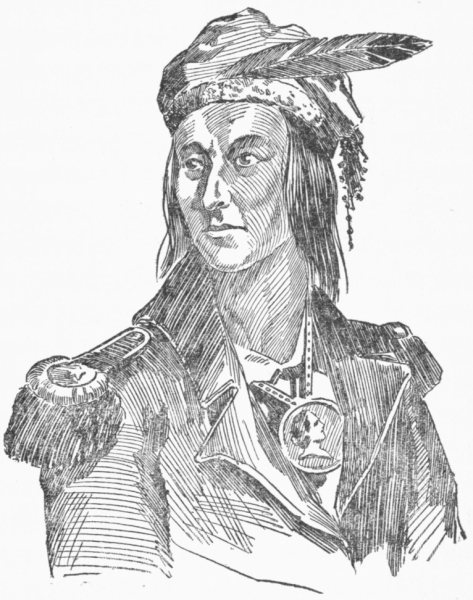 TECUMSEH.
The far-seeing leader realized that without
a combined effort on the part of the natives,
extinction was certain. Fired with determination
to break the growing power of
the Long-knives (as the Americans were
called), he formed a federation of nations
for the purpose of putting a stop to emigration,
claiming that their possessions were
common property and could not be transferred
without the consent of all.
He incited the Indians to hostilities, going
from one part of the country to another,
accompanied by two warriors of exceptional
bravery. Sa-wa-co-ta (Yellow Cloud) and Wa-se-go-bo-ah
(Stand Firm) were the sons of a
Chippewa mother. Their father, a French
officer, had gone back to his own land at the
close of the French and Indian War. Prior
to his departure, the unfortunate wife, learning
of the proposed desertion, and discovering
that her children were to be placed on
board the ship which would soon sail across
the seas, fled with the babes and found
a refuge among the Shawnees, where the
boys grew to manhood. Tall, straight and
commanding, with all the intensity of the
Latin races, and the wildness and stoicism
of the aborigines, they were well fitted for
positions of trust under Tecumseh.
Indian traits predominated in Sa-wa-co-ta,
the older of the brothers. His dark complexion,
high cheek bones and flashing eyes
bespoke, to a marked degree, a savage lineage;
while the open countenance of Wa-se-go-bo-ah
showed a stronger tendency toward
the father's kindred. From early childhood,
there had been in his manner, a refinement
and superiority that denoted a long line of
cultured ancestors from the nobility of
France. Here, even in the wilds of America,
was that distinction observed and respected
by a barbarous people.
Young and old alike listened with quiet
approval when the lips of Wa-se-go-bo-ah
opened to give advice, and the sister of Tecumseh,
Tecumapease, heard with trembling
joy the words his eyes had long since spoken,
and betrothal followed. But there was one
of dark and evil face and strange demeanor,
the older brother of Tecumapease, who gazed
with hatred on her future lord, and would, if
possible, prevent the nuptials. The prophet,
Elkswatawa (Loud Voice), fearing the influence
of the warrior Stand Firm might exceed
his own, opposed the union.
Tecumseh, having returned from a pilgrimage
to a distant tribe, was seated in his
cabin, awaiting the coming of the prophet.
He regarded with contempt the luxuries of
life, and when at home in the new Piqua village,
resided in a log hut chinked with mud.
The ancient town had been destroyed by
white soldiers, and its namesake founded
near the Great Miami River. A nose ring
with three silver crosses, and a few stripes
of brilliant paint gave a look of ferocity to
the bright intelligent face of the chief; and
a medallion of George the Third, on a wampum
string, hung around his neck. Buckskin
leggings, moccasins decorated with porcupine
quills, a deerskin jacket and a blue breech-cloth
completed the odd uniform.
Elkswatawa entered, clad in garments
made from the skins of wild animals. In
addition to these, a kind of turban surmounted
with bunches of feathers, a nose
ring, large earrings, hideously painted cheeks,
and a sightless eye, the other gleaming with
malignant fire, were well calculated to inspire
terror. The man was an object of superstitious
awe to the Northwestern Indians.
In vain he sought to change the mind
of him who had decided to bestow Tecumapease
upon the most beloved of all the
braves. The wily Prophet appealed without
effect to that innate love of power, strong
in persons that are born to rule. The Shooting
Star looked deep beneath the surface,
and discerned, within the heart of Loud Voice,
envy and unfounded dread of the growing
popularity of Wa-se-go-bo-ah.
The Prophet left in anger; and collecting
a few followers, betook himself to a new locality,
the present site of Greenville, where
he established a town.
Attracted by stories of wonderful deeds,
savages from different directions flocked to
the place. It was rumored that the seer
could make pumpkins as large as wigwams
come up out of the ground, and that one
ear of his corn would feed six men; that he
was invulnerable, and had all knowledge of
the present, past and future. Many of the
Shawnees considered Elkswatawa an impostor
and refused to enter into any plans against
the Government. Tecumseh frowned upon
them, and spent much time, when not upon
his travels, at the Prophet's town.
General Harrison, Governor of the Territory
of Indiana, became alarmed and sent a
letter to the brothers, inviting them to Vincennes,
for the purpose of making known
their grievances. To the intense fright of
the inhabitants, they responded with an escort
of four hundred fully armed warriors.
At the appointed hour, on the morning of
the Twelfth of August, 1808, Tecumseh advanced,
with thirty chosen men, to the place
of meeting in front of the Governor's residence.
By his side were Stand Firm, now
the husband of Tecumapease, and Yellow
Cloud. An aid-de-camp pointed to a seat
by General Harrison, and addressing the
chief, said:
"Your father requests you to take a seat."
Drawing his blanket more closely around
him, Tecumseh replied:
"The Sun is my father and the Earth is my
mother; on her bosom will I repose"; and
flung himself upon the ground.
His speech at the council has gone down
in history as one of the most remarkable on
record, for native oratory. A spirited answer,
with a refusal to return the lands in
question, aroused the braves, who, at a signal,
seized their war clubs. Tomahawks were
brandished in a threatening way. Bloodshed
was averted only by the coolness and tact of
the Governor.
In the confusion which resulted, Wa-se-go-bo-ah
fell heavily forward, stricken down,
supposedly, by a white foe. The unconscious
man was borne to the Indian camp. As no
wound could be discovered on first examination,
the Americans were accused of employing
supernatural power. Then a small bruise
was found at the base of the brain, similar
to one produced by a missile. Gradually the
favorite of the people recovered; and as he
lay upon the grass, enveloped in a thick blanket,
he turned, and suddenly beheld a terrible
figure, with horns and one fierce gleaming eye,
burning like a coal of fire, creep stealthily
toward him. Its hand was raised to strike,
and in the claw-like fingers was clutched a
glittering knife. Frozen with horror, he remained
for a moment immovable, then, quick
as thought, rolled under the arm of the
crouching demon—evading the blade almost
by miracle—and struck against its breast. A
desperate struggle ensued, in which Stand
Firm secured possession of the weapon. Holding
it aloft, he caught at the throat of the
hairy-faced monster and the mask came off,
disclosing the features of the Prophet.
"Elkswatawa, N-tha-thah (my brother),
why do you seek my life? Go, for the sake
of her whose eyes are as the stars of heaven,
unharmed. Their light shall guide me into
paths of peace. Her love shall teach me to
forgive your murderous wrath."
The creature slunk away; and the noble
conqueror dreamed that night of the little
Piqua village, where Tecumapease, with trustful
heart, besought the great Master of Life
to preserve him, who, even while she prayed,
escaped the grasp of death. But the Mighty
Being who controls the destiny of humanity,
from the highest even to the lowest, punished
the treacherous seer, when, on the sixth of
November, 1811, the Indians, in direct violation
of a truce, advanced upon the United
States troops under General Harrison, encamped
within a mile of the Prophet's Town.
The Magic Bowl, the Sacred Torch and
the Holy String of Beans were touched, and
the savages, believing themselves invulnerable,
rushed upon the tents of the Americans
at four o'clock in the morning. Tecumseh
was absent upon a visit to the Creeks, Choctaws
and Chickasaws. The cowardly Prophet
stood, at a safe distance from the battle-ground,
going through religious mummeries
and singing a war song.
Complete victory established the fame of
General Harrison; and the Battle of Tippecanoe
was one of the most important in results,
of that period. The destruction of their
village scattered the tribes over a large area.
Elkswatawa took refuge with a few Wyandots
on Wild Cat Creek. Eventually, he removed
to Kansas and died in Shawnee Township,
Wyandotte County. His grave has no
headstone, and those interested in the early
history of the State have sought in vain for
some distinguishing mark.
The really great Tecumseh, returning to
find all his schemes defeated, became an ally
of the British. Much of the trouble with the
white settlers had been occasioned through
their agency. The two friends of the rebellious
chief faithfully followed his fortunes.
If Fate dealt hardly with him, they shared
the danger and disappointment. If kindly,
the triumph was theirs, also.
Sa-wa-co-ta was killed at Frenchtown, by
a ball intended for his superior. The Americans,
closely pursued, had sought shelter behind
houses and fences on the south side of
the River Raisin. The Indians, by a detour,
had gained the woods in the rear and were
protected. Disdaining to skulk from tree to
tree, the fiery warrior, with Tecumseh and a
small number of brave men, pressed boldly
upon the fugitives. Observing that their
leader was singled out by the enemy, his companions
closed in around the chief to shield
him, at the moment that Yellow Cloud stepped
in front, for the same purpose. The
latter fell, heart and brain penetrated by bullets.
Thus nobly ended the life of Sa-wa-co-ta,
of whose achievements, even the noted
chiefs, Roundhead, Panther and Blue Jacket,
might well be proud.
History has recorded the outcome of the
struggle, and traced the wanderings of those
who, deprived of their inheritance and driven
to desperation, united with the foes of
America.
General Proctor, discouraged by Perry's
victory on Lake Erie, that occurred some
time later, fled from Malden, where he was
stationed at the time, with eight hundred
soldiers and two thousand Indians. General
Harrison overtook the combined forces near
the River Thames. During the battle, Colonel
Johnson and the Kentucky cavalry were
ordered to charge. Galloping forward, they
broke through the lines and formed again,
when the English surrendered. Tecumseh began
the conflict with fury, fighting more
fiercely than ever before. His voice could
be heard above the din, inspiring the men
to make every exertion; but the day was
lost. Colonel Johnson, engaged in a hand-to-hand
contest with a fine, well-built Indian,
was wounded by another, as soon as he had
despatched the first. The second assailant
then sprang toward him with a tomahawk,
when the officer drew a pistol and killed his
antagonist. The rest of the savages, losing
hope, gave way.
Night came on, but the heavens were dark.
The Shooting Star would never more be seen.
The ringing voice was silent; and Tecumapease,
his sister, waited in vain for the return
of her lord. Stand Firm, "faithful unto
death," had fallen beside the chief. Next
morning, the bodies of two warriors, with
dignity of face and form, were found, not far
apart, upon the bloody field.
Tecumseh was the greatest, most magnanimous,
and bravest man the red race had
ever known. Now that his brilliant oratory
no longer swayed the multitudes, organized
resistance to settlement north of the Ohio
River ceased. Tecumapease, to whom had
been entrusted the care of her brother's child,
died a few years later, and the boy, together
with her son, drifted, with the Shawnees,
from reservation to reservation. For many
years they lived in Eastern Kansas, where
the descendants of Tecumapease still reside,
and relate, with pardonable pride, the exploits
of their forefathers.
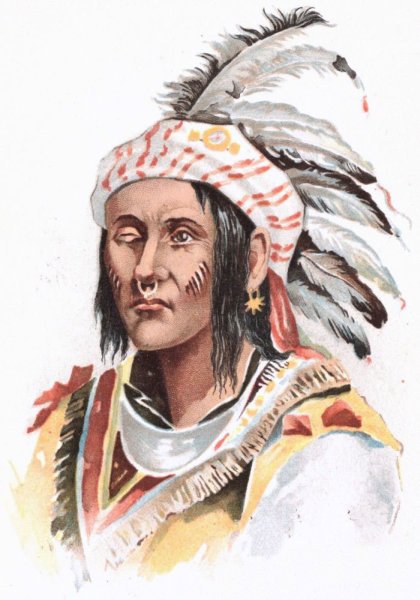 THE SHAWNEE PROPHET.
The tardiness of the red race in accepting
civilization, has long been a subject of
comment. Yet the barbarian should not be
censured, in view of the fact that paler-faced
youth, with all the benefits accruing from
past generations of culture, have, in many instances,
taken readily to aboriginal customs.
It was a part of the religion of all Indian
nations to increase their number by adoption.
Frequently white children were spirited
away from home and carried from place
to place, in order to evade pursuit. Almost
invariably, after a lapse of time, they not
only became reconciled to savage modes of
living, but preferred them. A notable case
was that of
CHINWA, THE WHITE WARRIOR.
In the early part of the nineteenth century,
before the Shawnees had emigrated to the
Valley of the Kaw, there was a famous old
chief named Black Fish, who was untiring in
activity against the white settlers. During
one of the numerous periods of hostility,
Chinwa, the only son of this warrior, was
killed; and the grief-stricken father said to
his braves,
"Go, go and find me a boy to replace
my son."
Putting on their black paint, the Indians
went over the Alleghanies into Virginia.
In a prosperous settlement in Western
Virginia lived a wealthy planter named
Rogers. His family consisted of himself, his
wife and two young sons. One quiet evening
in early fall, the boys were allowed to
go for the cows unaccompanied by the servant
who ordinarily acted as body guard. The
beautiful autumn woods were aglow with
color, and the children's exuberance of spirits
burst forth in shouts and other noisy
demonstrations.
As little Henry lingered to seize a brilliant
spray of rich-tinted foliage, two hideous
black-painted savages sprang from the bushes
and caught him before he had time to call
for assistance. The frightened child was
borne hastily away, through the forest, over
the mountains, to an Indian village where
Black Fish received him with open arms,
saying:
"Don't be afraid; you are now my son—my
Chinwa. Here, take his bow and arrows;
here are his gun and knapsack. Some day
you will be a great chief."
Henry was adopted into the tribe, and forgetting
his former home, learned to be content
with the wild life of the Shawnees. A
fine horse and saddle were a constant source
of pleasure, and persistent practice made the
boy expert in the use of bow and arrows.
As he grew older, Chinwa became a successful
hunter, and was looked upon with
pride and admiration by his sisters. The
youngest of these, pretty little Chelatha,
was sought in marriage by many braves;
but old Black Fish, waiting for the day
when Chinwa should declare his love, repulsed
their advances with disdain. At
length the young chief could no longer conceal
his regard from the object of his affection,
and implored her to become his bride.
She replied with indignation:
"You are my brother. I could not be my
brother's wife."
After a long conference with Watmeme,
the mother, in which the entire circumstances
were explained, Chelatha said:
"If father says so, I will marry Chinwa."
Amid great rejoicing, the pale-face took
her to his habitation, and the tribe celebrated
the event with feasting and strange
ceremonies.
Excitement prevailed in the Rogers household
when Henry was captured, and a search
had been prosecuted wherever a clue could
be obtained. Long years after the disappearance
of her younger son, sorrow still
reigned in the heart of the bereaved mother;
and it was with fear and trembling at last,
that the older brother, receiving tidings of
the lost one, traced him over the mountain
ranges, into the beautiful blue-grass country,
to the land of Daniel Boone.
The meeting was a happy one, though
marked by some constraint—the result of
years of separation and widely different surroundings.
Henry was persuaded to leave his
western home and repair to the aged mother,
now prostrated by severe illness. Once
more within the confines of civilization, he
abandoned the insignia of savage life, and
adopted the garb of his own people. Unusual
festivities followed; the mother, recovering
strength, employed every art to retain
him, but without success. In vain the pretty
maidens of the village exerted all their power
to please. Memories of a happy life in the
wilderness were always present, and he said:
"Mother, I have learned to love the Indians;
there I am free. I love my two children
and my dark-haired wife."
The next morning the colored servant was
commanded to bring his horse, and Chinwa,
the warrior, in all the splendor of beads and
buckskin, bade farewell to the home of his
infancy. How fresh and sweet was the breath
of the woods, as he dashed into her depths!
The delicate blossoms of spring lifted their
dainty heads and scattered perfume along the
narrow trail. The cloudless sky and the distant
mountains seemed to beckon him on to
the loved ones who at that moment were
waiting, longing for the wanderer's return.
Time sped by on rapid wings, and soon
Chelatha—sitting lonely in her doorway,
said to her little ones:
"Listen, I hear the voice of your father."
Again the faint call was borne through the
distance and reverberated in her anxious
heart. Then its beatings responded to the
sound of horse's hoofs, and the next moment,
Chinwa, the brave, sprang to the ground and
caught her in his arms, saying:
"I have come home—home to my Chelatha,
never to leave her more."
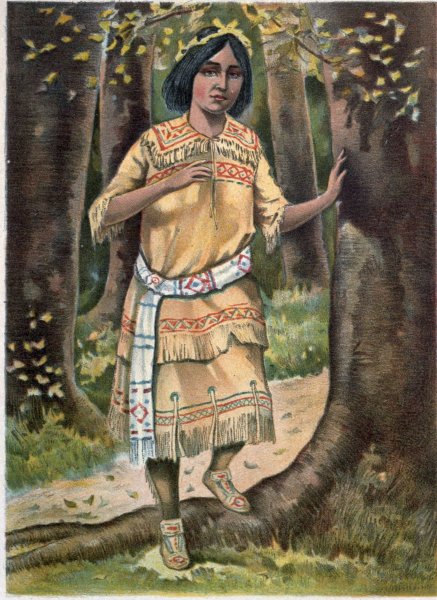 CHE-LA-THA.
All the pleasures, all the riches which the
world can give are as nothing when weighed
in the balance against the sincere love of one
devoted heart.
The Shawnees, like other Indian tribes,
were firm believers in evil spirits; and when
it was thought that one had become possessed
of a demon, did not hesitate to employ heroic
measures to drive it out. To such superstitions
may be ascribed
THE TRAGIC DEATH OF THE SON OF CHIEF
LAY-LAW-SHE-KAW.
When the present site of the city of Topeka
was the hunting-ground of the Shawnee
Indians there was a fierce war with the
Pawnees.
Chief Lay-law-she-kaw (He Who Goes Up
the River) had been successful in many battles
and pursued the enemy far into their
own territory. At length, in desperation, the
Pawnees gathered strength, and making a
final effort for the preservation of their
homes, surprised the victorious Shawnees
while encamped among the hills along the
river.
In the thick of the fight, Pa-che-ta, the
son of Lay-law-she-kaw, sprang to the side
of the old chief, just as a powerful warrior
raised his tomahawk to cleave his skull. In
another moment the leader would have fallen,
had not the young brave, with the utmost
coolness, lifted his rifle, taken quick aim and
fired. With a horrible yell, the Pawnee sank
to the ground. Attracted by his cry, three
others appeared. Again the rifle did sudden
duty, while Lay-law-she-kaw engaged the
nearest enemy. Two more were despatched,
and now Pa-che-ta turned to face the remaining
Pawnee, who had approached too near
for rifles, and endeavored to use the tomahawk.
This was dashed from his hand. The
two grappled fiercely, each striving to get
the knife out of his belt. At last Pa-che-ta
succeeded in holding down his adversary, and
plunged the knife deep into his heart.
Blinded by the blood, which spurted up into
his face, the Shawnee staggered to his
feet and ran forward a short distance, only
to find himself in the midst of the attacking
Indians. Desperately he fought his way
out, striking right and left, wounded and
faint. Then, seeing a gulley surrounded with
bushes, he rolled into it, and creeping painfully
to the edge of a pond, waded into the
water.
The Pawnees lost the trail. They looked
here and there while the main body pursued
old Lay-law-she-kaw and his braves to the
country of the Kaws. Night fell; and still
Pa-che-ta lay concealed in the lake among
the tall grass. At the end of the second day
the search was abandoned.
Then the prisoner, half starved and half
demented, dragged himself slowly homeward.
A few berries and roots had been his sole
food, and the burning rays of the sun had
beaten down upon his head, until reason
tottered.
The people went wild with enthusiasm
when their hero, emaciated but triumphant,
appeared in the village. He was taken to
Lay-law-she-kaw's habitation and provided
with nourishment, but sank into a stupor
from which the medicine men, with all their
skill, could not arouse him.
After many days he awakened; great
was the rejoicing. His father appointed a
day of feasting; and the tribe gathered to
do honor to him who had fought so bravely
in the face of defeat. Cattle were slaughtered,
fires were kindled, and strange dances
were in progress when Pa-che-ta approached.
Demonstrations of joy greeted his appearance.
Among the children on the outer edge of
the circle, stood little N-tha-thah, gazing
proudly at the big brother who would one
day be his chief. As the excitement increased,
his heart swelled with pride, and
the next moment found him, bow and arrows
in hand, the center of the charmed circle.
Pa-che-ta gazed at the child with a strange
look in his piercing black eyes. Then, with
a stealthy movement, he turned and slowly
reached for the rifle which rested against the
stump of a tree.
Lay-law-she-kaw, keen witted and alert,
noticed the sudden change that came over
the face of his eldest son. What was the
cause of that cruel, crafty expression? Had
bad spirits entered the brain of Pa-che-ta,
whose noble deeds would ever after be celebrated
by the nation? Now the brave was
creeping cautiously toward the little one,
who stood motionless, in round-eyed wonder.
Deliberately he placed the weapon to his
shoulder and took aim—but the crack of another
rifle broke the awful hush which had
fallen upon the people, and when the smoke
cleared away, Pa-che-ta lay in a pool of blood.
The father had fired in time to preserve his
young child.
For many years the old women of the
tribe told, in accents of awe, how evil spirits
had gone into the brain of their noblest warrior
and looked out of his eyes with terrible
glances of murderous hatred, in the moment
of his greatest triumph. How they had been
driven out with a rifle ball, and Lay-law-she-kaw,
O-kee-nah (the chief), sorrowing for his
first born, had that day been called by the
Great Spirit to enter the Happy Hunting
Grounds.
The North American Indian was of a
strange, somewhat contradictory character:
in war, daring, cunning, boastful, ruthless;
in peace, cheerful, dignified, superstitious,
revengeful; clinging as far as possible, to the
customs of his forefathers. Civilization came
almost as a destroyer. Future generations
will know him only as a dim, historic figure,
around which clusters the mythology of ancient
America.
Whence came these legends and traditions?
The children of Nature read them in
the leafy woodlands, on the broad prairie, in
the blue vault of heaven, the crimson sunset,
the dark storm-threatening clouds, in
every gentle breeze or sweeping hurricane.
Each story lived in the hearts of the people,
and here and there a mighty forest tree
bore a quaint inscription
"Full of hope and yet of heart-break,
Full of all the tender pathos
Of the Here and the Hereafter."
"The stars, and hills and storms are with
us now, as they were with others of old;
and it only needs that we look at them with
the earnestness of those childish eyes, to
understand the first words spoken of them
by the children of men, and then, in all the
most beautiful and enduring myths, we shall
find, not only a literal story of a real person,
not only a parallel imagery of moral principle,
but an underlying worship of natural
phenomena, out of which both have sprung,
and in which both forever remain rooted."
Ruskin.
Transcribers Note:
Several words in this book were inconsistently hyphenated, I have left all the hyphenation as it was written. In particular the contents tables often use different hyphenation and accents to the main text.
Some names were also spelt differently in the contents tables and in the main text. I have left these differences as they were written.