Cover created by Transcriber, using the
Frontispiece of the original book,
and placed in the Public Domain.
Larger versions of most illustrations may be seen by right-clicking them
and selecting an option to view them separately, or by double-tapping and/or
stretching them.
By the Same Author
Legends of the Virgin and Christ Legends of the Rhine Legends of the Middle Ages Stories of the Wagner Operas Stories of Famous Operas Myths of Greece and Rome Myths of Northern Lands
$1.50 per volume
COATS OF ARMS OF THE SWISS CANTONS.
LEGENDS OF SWITZERLAND
BY H. A. GUERBER
WITH ILLUSTRATIONS
NEW YORK DODD, MEAD AND COMPANY 1899
Copyright, 1899, By Dodd, Mead and Company.
All rights reserved.
University Press: John Wilson and Son, Cambridge, U.S.A.
DEDICATED
TO
SWITZERLAND
IN GRATEFUL MEMORY OF HAPPY SUMMERS SPENT
WITHIN ITS BORDERS
PREFACE
Aside from the picturesque, historical, and
geological interest connected with a
journey in Switzerland, that country also boasts
of a rich fund of legends, delightfully characteristic
of the people at whose firesides they have
been told for centuries.
The grand scenery, terrific storms, sudden
earthquakes, landslides and avalanches, together
with the barbaric invasions and fierce wars
which have swept over it for thousands of years,
have all left their indelible stamp, not only upon
the face of nature, but also in the imagination
and folklore of the people.
In varying keys, and touching upon many
chords and themes, these legends refer to saints
and to sinners, to heathen gods, giants, ghosts,
dwarfs, Devil, and fairies, as well as to kings
and queens, knights and ladies, monks and nuns,
besides dwelling particularly upon shepherds,
pastures, cattle, and game.
The rustic crudity of some of these tales, the
mediæval halo of romance around others, added
to the poetic subtle charms of a few, have been
rendered as faithfully as possible, to enable the
reader to gain a nearer insight into the life and
thoughts of the sturdy race which has established
the most lasting republic in modern Europe.
Life-long familiarity with the official languages,
some knowledge of the peculiar dialects, together
with prolonged sojourns in the country,
and diligent study of its principal works on
national folklore, have enabled the writer to
collect these legends, some of which are now
laid before the English-speaking public for the
first time.
Trusting they may enhance the pleasure of a
trip to Switzerland for all those who have the
good fortune to enjoy one, remind former
travellers of matchless scenes, and amuse and
interest even stay-at-homes, this book is sent
out into the world with the sincere hope that
it may meet with a kindly welcome.
The crescent-shaped Leman, or Lake of
Geneva, the largest and bluest of all the
Swiss lakes, has been sung by all the poets and
praised by every writer who has had the good
fortune to behold it in its native splendour.
The fertile slopes on the northern bank, the
charming resorts and drives to the east and
south, and the glorious view of Mont Blanc,
in Savoy, as seen from Geneva itself, bewitch
all those who are privileged to enjoy them.
Countless steamboats and sailboats are constantly
plying to and fro over the lake, and stopping
at picturesque points along the shore,
whence delightful excursions can be made either
among rich pastures, orchards, and vineyards,
or up into the mountains from which, rippling
and roaring, torrents and streams pour down to
fill the basin of this beautiful lake. The most
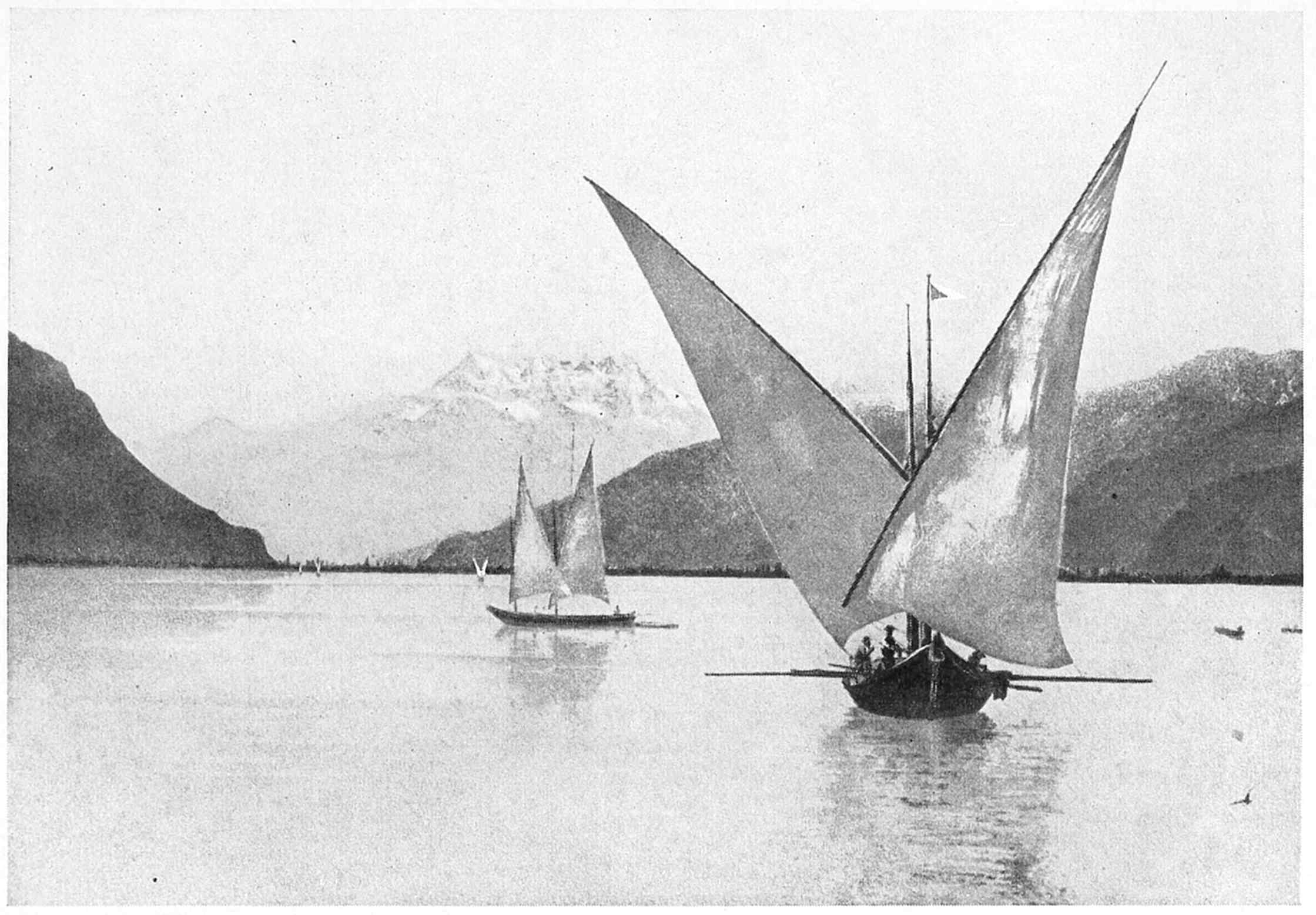
picturesque craft on the Lake of Geneva are
the lateen-sailed market-boats, hovering like
birds over waters whose colour reminds one of
the Mediterranean, the only other body of
water in Europe where such vessels are frequently
seen.
A legend claims that in olden times a fairy
boat of this peculiar shape was often seen flitting
from point to point along the shores of
Lake Leman. Its sails catching every gleam
of golden light, it shone like the face of the
new moon in a summer sky. Drawn by eight
large snow-white swans, it glided gently over
the waters, to the song both weird and sweet
of these graceful birds, accompanied by the
thrilling chords of a harp touched by the invisible
fingers of the Spirit of the Winds.
Standing by the mast of this ship, was a tall
woman of dazzling beauty, whose golden locks
streamed out in the breeze, while the sunset
flush on the snow-mountains seemed no more
delicate than the bloom on her dainty cheeks.
Clad in flowing robes of purest white, she stood
there, smiling gently at countless winged and
chubby sprites, hovering around her like butterflies
about a rose, and scattering handfuls of
flowers and fruit at her feet.
LAKE OF GENEVA, WITH DENT DU MIDI.
It is said that wherever the fairy ship touched
the shore, the soil bore flowers and fruit in
abundance, and any one who was so fortunate
as to catch a glimpse of the lucky vessel was
sure of the fulfilment of any desire, expressed
or unexpressed. Even when buried so deep in
the hidden recesses of the heart that the owner
was scarcely conscious of its existence, the
fairy’s melting blue eyes were sure to discover
this wish, and her heart was so tender that, once
discovered, she could not but grant it.
The fairy skiff of Lake Geneva haunted its
shores for many years, and might still be seen
there, had not the giant swans been frightened
away by the puffing and snorting steamboats
which furrow the blue waves. None but the
oldest inhabitants ever mention this ship, of
which they caught fleeting glimpses in their
early youth, when they sat by the lakeside during
the long moonlight nights, in hopes of securing
the realization of their dearest hopes.
But the luck-ship figures not only in the tales
told by the peasants around the fireside during
the long winter evenings; it is also often seen
in effigy upon Genevan holiday and birthday
cards. Then “Good Luck,” or “Happy New
Year,” is inscribed across the wing-like lateen
sails, and such a card is supposed to bring the
happy recipient as much good fortune as an actual
glimpse of the swan-drawn vessel of mythic fame.
An interesting old legend is connected with
the church of Ste. Marie Madeleine in Geneva,
and with a local yearly festival celebrated there
on the twenty-second of July.
In the days when the Madeleine church was
founded, Geneva, after having been the main
stronghold of the Allobroges before Christ, and
a Roman camp from the days of Cæsar until the
fifth century, was the capital of a Burgundian
kingdom. The Christians in that part of the
country, desirous of building a church where
they could worship God, selected a site just
outside of the city fortifications, and then
began to solicit contributions on all sides.
In those days there dwelt in Geneva a very
good and pious girl, noted far and wide for her
deftness in spinning, and for the unusual beauty
and fineness of her thread. As soon as this
virtuous maiden heard that funds were needed
for a church to be dedicated to her patron saint,
she made a solemn vow to consecrate to that
good purpose all the thread she could spin, and
immediately set to work.
From early morn until far into the night,
Madeleine now spun on unweariedly, selling
skein after skein of thread to purchase stones
and mortar for the new building. As is always
the case, the zeal and gifts of many of the
Christians soon ebbed, but Madeleine twirled
her distaff faster and faster, working without
respite day after day, to make up for all deficiencies.
The workmen, who contributed their labour,
soon depended upon her alone for materials,
and fearing lest her strength or courage should
fail before the church was finished, they called
out to her every time they passed her house
to keep up a good heart and work on. This
cry,—
“Tiens bon, Marie Madeleine,
Tiens bon, Marie Madelon!”
was taken up by all the Christians in town,
and now forms the refrain of a song sung at
Geneva’s yearly festival.
Thus encouraged, Marie Madeleine went on
spinning until the building was completed, and
as most of the stones were purchased with the
proceeds of her industry, the workmen carved
spindles and spinning-wheels all over the church.
On the festival of Ste. Marie Madeleine, illuminations
and processions are the order of the day
in Geneva, and the statue of a spinner is carried
along all the principal streets of the town, to
the rhythmic chant of the old distich, which
commemorates alike the maiden’s piety and
her extreme diligence.
LEGENDS OF VAUD AND VALAIS
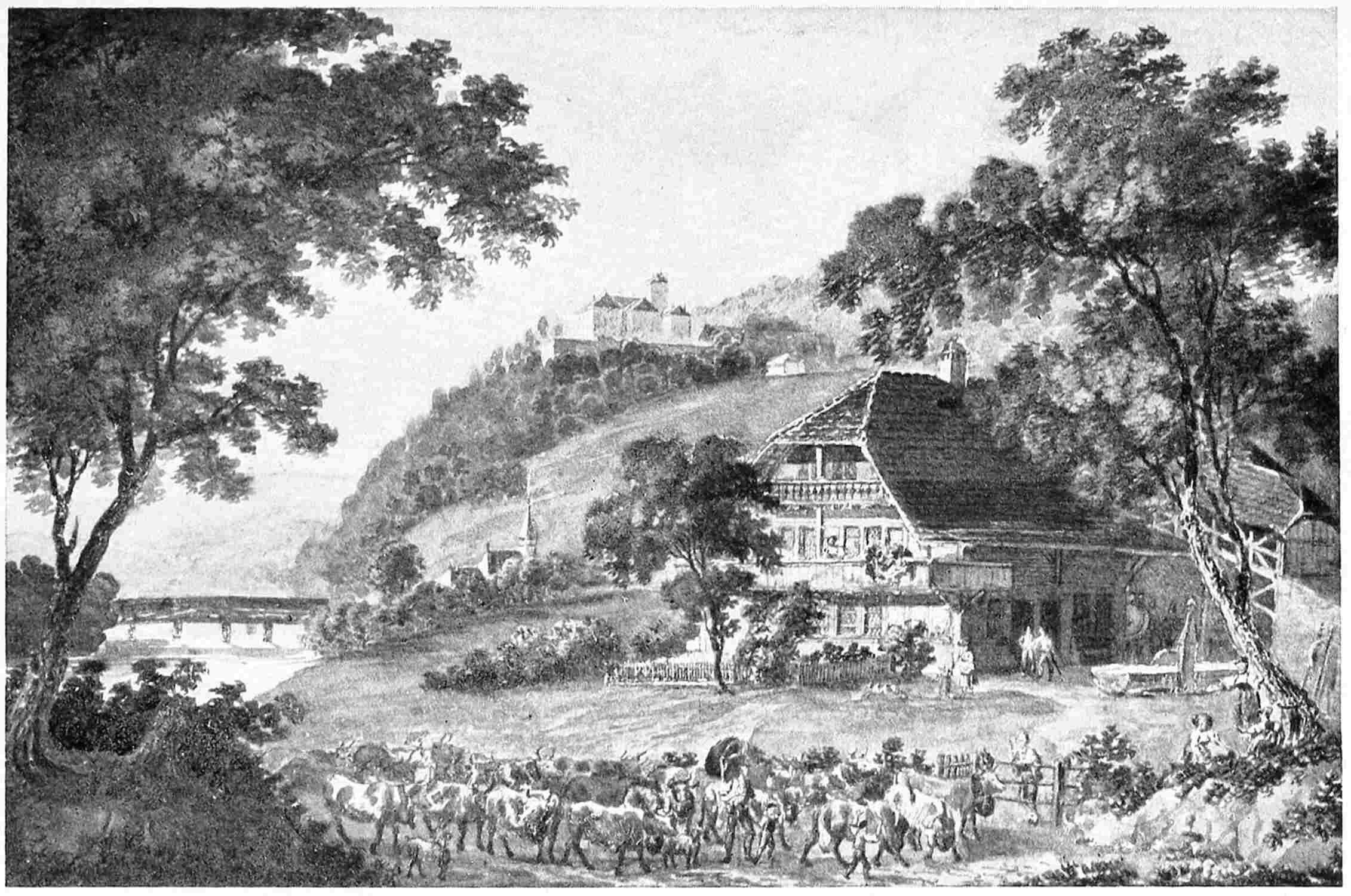
Late in the spring, when the grazing down
in the valley is pretty well exhausted,
farmers in Switzerland are wont to drive their
cows up to the mountain pastures, which by
this time are all covered with luxuriant grass
and gemmed with dainty wild-flowers. The
day set for the departure of the cattle is always
a gala day. The people, dressed in their Sunday
best, assemble in the villages through which
the herds must pass, to exchange merry jests
with the herdsmen, bid them God speed, and
admire the fat sleek cows, wearing around their
necks bells of different sizes and varying tones.
The head herdsman proudly walks in front
of his cattle, wearing a bunch of gay ribbons or
of fresh flowers in his hat or cap. His blue
cloth coat, with its short sleeves, sets off a
dazzlingly white shirt of coarse linen, and his
costume is completed by knee-breeches, thick
woolen stockings, and shoes whose soles are
elaborately studded with bright nails. This
man carries a bag full of salt, and an umbrella
slung across his back; and from time to time, as
he strides joyfully ahead of the herd, he offers
a handful of salt to the foremost cows. Leaning
on his stout staff, he sturdily climbs the
mountain, giving vent to those long-drawn
musical cries known as “huchées” or “jodels,”
according to the section of the country in
which they are heard.
Close behind the herdsman comes the bull,
with a ring in his nose, or a fine cow, the queen
and leader of the cattle. Conscious of the honour
of wearing the largest and deepest-toned
bell, this animal steps proudly along, tossing a
shapely head decked with bunches of bright
flowers on either horn, and between them rests
the milking-stool, a sign of particular distinction.
Cow after cow slowly files past, greeted by
calls and loving pats from proud owners, and
amid the tinkling of bells, the trample of hoofs,
the lowing of kine, and the cheers of the people
sound the resonant cracks of the herdsmen’s
whips, which they snap incessantly to show their
proficiency in that greatly admired branch of
their calling.
The sight of such a herd going up the mountain
invariably reminds the old people of happy
summers long gone by, and while sitting on the
benches in front of their stone or wooden houses
at twilight, they entertain the younger generation
with reminiscences of the joyful past, and
a regretful sigh always heaves their aged breasts
when they finally mention the Golden Age of
Switzerland.
According to tradition, this was the time
when none of the mountains—not even the
highest—were ever veiled in cold mists, or
covered with ice and snow. Neither were
there any barren and rocky heights such as we
see now. Luxuriant grass grew all the way up
the steepest slopes, carpeting even the topmost
ridges, and the climate was so genial that
cattle dotted the hillside pastures during nine
or ten months of the year. The cows were
then far larger and fatter than any we see now,
and their milk was so abundant that they were
milked thrice a day into huge ponds, or tanks,
where the herdsmen went about in skiffs to do
the skimming.
One of these men is said to have once lost
his balance and fallen head first into a lacteal
lake, but although his mourning companions
diligently sought for his corpse, and even
dredged that huge natural milkpan, they could
find no trace of him. When churning-day came
round, however, and the big vats of thick cream
were poured into a churn as large and tall as a
castle tower, the dead man was suddenly discovered
imbedded like a fly in the thick cream.
The dairymen and milkmaids then mournfully
laid his corpse to rest in a huge cave, lined
with honeycombs so tall and massive that none
was smaller than the city gates.
THE MIGRATION OF THE HERDS.
Such was the prosperity of all the farmers in
the Cantons of Vaud and Valais, that their men
used goat cheeses (tommes) instead of quoits
for their daily games, and on Sundays played
bowls with huge balls of the sweetest, hardest,
yellowest butter that has ever been made. The
fruit trees were as productive as the pastures;
the grapes, for instance, being so large and
juicy that faucets had to be inserted in each
grape to draw off the juice, while the pears
were so fine and heavy that their stems had to
be severed by means of a double hand-saw
when came time to pick them.
The Golden Age of the Alps did not last
long, however, for the unparalleled prosperity
the people enjoyed filled their hearts with
such inordinate pride that they became very
insolent, and thereby called down the wrath of
heaven upon their guilty heads. The brutality
and avarice which they displayed was punished
by earthquakes, storms, and landslides, which
ruined their finest pastures, and by sudden and
unwelcome changes in the temperature. Dense
fogs swept over the mountains, and there were
long and heavy snow-falls which swathed the
mountains in a permanent casing of ice and
snow. The summer season became far briefer
than in the past, and fields and pastures much
less productive. Cattle and fruit therefore
soon dwindled down to their present comparatively
small proportions, and unlimited plenty
no longer reigned in the land.
In the Golden Age the country boasted of a
few very large but quite benevolent giants.
They roamed about at will, striding over mountains
and forests, which seemed to them no
larger than mole hills and tiny shrubs. The
best known of these giants was Gargantua,
renowned alike for his athletic proportions and
for his childlike spirit. He was so huge that
when he sat down to rest upon Mont Blanc,
Monte Rosa, or some other large mountain, his
legs hung down on either side until his feet
rested comfortably in the valleys. Sometimes,
when indulging in a brief noonday nap, he
used one of these peaks as pillow for his huge
and sleepy head. His thick white beard and
hair, falling around him on all sides, then gave
these heights somewhat the same aspect they
have now, with their fields of snow and rivers
of ice. The sunken orbits of the giant’s eyes
and his wide-open mouth looked like valleys
and crevasses, while his nostrils could be mistaken
for deep and dark caves, and his ruddy
cheeks for great patches of red rock peeping
out among the snows.
When the weather was warm, Gargantua’s
breath seemed like the mist hovering on the
mountain tops; but when the temperature fell,
it rapidly congealed, spreading like a dense fog
all over the country. His gentlest snores are
said to have sounded like the distant rumble of
thunder, or the crash of avalanches; and when
he stretched himself after a siesta, the whole
country was shaken as by a violent earthquake.
Once, while the giant lay asleep, his head
resting against a mountain, a large flock of
sheep scrambled up over his prostrate form,
and began to thread their way through his
tangled hair and beard in quest of pasture.
Awakened by a slight tickling sensation, the
giant half opened his sleepy eyes. The sight
of a host of little white creatures crawling around
in his beard so angered him, that he took them
up one by one between his thumb and index,
and crushed and threw them away, thinking
they were vermin.
During another nap a large herd of cows
strayed into the giant’s wide-open mouth,
which they mistook for a cave. Their presence
there, however, occasioned a prodigious
coughing-fit, in the course of which the cows
were ejected with such force that they flew
through miles of space and landed in another
country!
As simple and innocent as he was large,
Gargantua delighted in playing in the dirt. To
amuse himself, he hollowed out the Rhône
valley, and scooped out a basin for the Lake
of Geneva. There the marks of his fingers
can still be seen, for having no other tools he
freely used those nature provides, flinging handfuls
of earth and stones on either side of him,
or into a rude basket made of wattled pine-trees
which he carried on his back.
At one time Gargantua elected to build a fine
sand-heap, and carried load after load of dirt
and stones to a point southeast of the present city
of Geneva. There he dumped them one after
another, and as the heap increased in size after
each basketful, he gleefully cried: “Ça lève,
ça lève!” (It is rising, it is rising!) This cry
was overheard by the people in the neighbourhood,
who ever after used it as a name for that
mountain, changing the orthography to Salève.
Gargantua sometimes threw huge rocks
around him in sport, or in petulant fits of anger,
punched holes in and through the mountains, and
dug out fistfuls of earth here and there to fashion
his mud pies. He also liked to make gullies
for the streams which trickled down the mountains.
Once, while scratching out the Illiez
valley he forgot the burden on his back and
stooped to drink from the Rhône, which seemed
to him like a mere rill. By some mischance,
however, he stubbed his big toe against the
rocks of St. Triphon, and fell sprawling along
the valley, spilling part of the dirt out of his
basket. The simple fellow, amazed at this accident,
picked himself up gravely and uttered
the local substitute for “My goodness!” (Eh
Monteh!). This exclamation was thereafter
used by the natives to designate a mound of
earth now covered with oak forests and known
as Monthey.
In his wrath at having tripped and broken
the straps fastening his basket to his back,
Gargantua gave his burden an ill-tempered
kick, which sent it flying some distance further
on, where it dumped the rest of its contents.
This heap of dirt formed the picturesque eminence
on whose wooded heights the ruined
tower of Duin now stands.
A similar accident occurring when the giant
once tried to quench his thirst in the Sarine, is
the alleged origin of the hill upon which rises
the church of Château d’Oex. On another
occasion, resting one foot upon the top of the
Berra and the other upon the Gibloux, Gargantua
bent down and took a draught from the
Sarine, which drained it so dry that not a drop
of water flowed along its bed for three whole
days. During that time one legend claims that
the giant laid the foundation for the bridge at
Pont-la-Ville, near Fribourg, but another ascribes
that construction to his Satanic Majesty
in person.
Gargantua’s feet were so large that one of
his sandals could serve as bridge over the
Rhône or Sarine, and his hands so strong that
he tore great gaps in the Jura mountains to
enable those two streams to make their way
to the sea.
A mountain giant who roamed about in the
mist, but never came down into the valleys,
was known as Pathô. He delighted in terrifying
the people in the lowlands by sudden wild
cries, or by playfully rolling stones down upon
them, their cattle, houses, or pastures.
Many of the Swiss giants were supposed to
dwell in caves, or castles, on the tallest mountains,
hidden from the eyes of men by ever-shifting
clouds. To commemorate this superstition,
Schiller wrote a charming ballad, telling
how the daughter of one of these giants once
strayed down into the valley, where, for the first
time in her life, she beheld a farmer ploughing
his field. In her delight and wonder, she bundled
man, horses, and plough into her apron, and
quickly carried them home, where she proudly
exhibited her new playthings to her father.
The giant, who wished the puny human race no
ill, immediately bade his little daughter carry the
frightened peasant and kicking team back to the
place where she had found them, gravely warning
her never to meddle again with the people
in the valley, whose diligent toil supplied giants
as well as mortals with their daily bread.
* * * * *
The monks who lived in the old abbey at
Romainmotier, in the northern part of the
canton of Vaud, once built a bridge over the
rushing waters of the Orbe, to enable the
throngs of pilgrims to reach a wonder-working
image of the Virgin near Vallorbes. But as
these monks were very eager to enrich their
monastery, they also placed a toll-gate across
the bridge, and would allow none to pass without
paying a certain sum.
One night, the bridge-keeper was startled
out of his peaceful slumbers by the rhythmic
sound of rapid hoof-beats on the hard road,
and he sprang to his window just in time to
find himself face to face with a panting, foam-flecked
steed, upon which sat a girl clad in
garments apparently no whiter than her anguished
face. In breathless tones the maiden
bade the keeper open wide the gate and let her
pass, for her beloved mother was dangerously
ill, and she wanted to plead for her recovery at
the foot of the miraculous image.
The gate-keeper listened unmoved to this
passionate entreaty, and instead of opening
the gate, held it shut tight while sternly demanding
his toll. In vain the girl repeated she
had forgotten to bring any money, and implored
him to let her pass, promising to bring him the
required amount on the morrow; he would not
listen to anything she said.
Seeing it was useless to parley any longer
with such an unfeeling man, yet determined to
save her mother at any price, the brave girl
urged her steed to the very edge of the bridge,
and suddenly leaped over the low parapet into
the rushing tide. For a few moments the horrified
gate-keeper saw horse and rider struggling
bravely to reach the opposite shore, but
all at once their strength gave way, and they
were swept into a whirlpool in the middle of
the stream. A moment later he saw them dashed
against sharp rocks, and vanish beneath the
foaming waters which were soon tinged red
with blood.
The gate-keeper stole back to his couch,
trembling in every limb, but told no one of the
girl’s visit or of her frightful death. At midnight
on the anniversary of the tragedy, the conscience-stricken
man was however again roused
by a loud clatter of hoofs. Torn from his bed
by invisible hands, he found himself on the
bridge, face to face with the same unhappy
maid, whose snowy garments were now all
stained with blood. Still impelled by a force
he could not resist, the gate-keeper suddenly
dropped down on his hands and knees before
her, and felt her spring lightly upon his back.
A second later he was galloping wildly toward
the shrine of the miraculous Virgin.
There the maiden dismounted and fervently
prayed for her sick mother; then rising hastily
from her knees, she again sprang upon her
human steed, whom she urged on over the
stony road by lashing him with a long wet reed.
At the bridge, the spectre maiden vanished over
the parapet, and the terrified gate-keeper
straightened up once more, only in time to hear
the gurgling cry of a drowning person rising
above the roaring and splashing of the swollen
stream.
This spectral apparition visited this man every
year, and so shattered his nerves that he fell ill
and died of fright. But before he breathed his
last, he humbly confessed to one of the monks
his cruel treatment of the girl, her pitiful end,
and his awful punishment.
In memory of this event, an image of a man
on all fours, and ridden by a beautiful maiden,
was placed in the convent church, where it was
long exhibited to pilgrims and tourists, to whom
the above story is invariably told.
* * * * *
South of Romainmotier, on the road from
Vallorbes to Lausanne, stands the small and
very ancient town of La Sarraz, with its quaint
castle. We are told that a statue was excavated
there lately, which once stood in the chapel,
and represented a knight, on whose cheeks and
shoulder-blades clung loathsome toads. The
recovery of that peculiar statue recalled the
olden tale of a young knight of La Sarraz,
who, having won great distinction in warfare,
aspired to the hand of a Count’s daughter.
Although the maiden was far above him in
station, her father consented to their union,
provided the bridegroom gave her a castle and
three hundred cows as wedding gift, or morgengabe.
This condition filled the knight’s
heart with hopeless sorrow, for he could boast
no property except his trusty sword, his stout
suit of mail, and his fiery battle-horse.
His parents, perceiving his dejection, questioned
him tenderly, and when they learned the
cause of his sorrow, they joyfully exclaimed
that he need not despair, for they would give
him castle and cattle, which was all they had in
the world. They confidently added that they
knew their son would never let them want in
their old age, even if they did bestow everything
upon him, reserving naught for themselves.
The selfish son gladly accepted this proffered
sacrifice, but when the marriage ceremony had
been completed, and he and his wife were comfortably
settled in their new home, he begrudged
his old parents the little they required,
and instigated by his wife, turned them out of
the house one cold and stormy night.
After closing the door upon them, to shut off
the sound of their pitiful sobs and heartbreaking
reproaches, the knight of La Sarraz strode back
into the hall of his castle, where a huge beaker
of strong beer and a fine game-pie were awaiting
him near a good fire. Settling himself down
comfortably in a big armchair, the knight removed
the crusty cover of the pie. But no
sooner had he done so than he started back in
horror, for two live toads sprang straight out
of it to his cheeks, where they buried their
claws so deep that no one could remove them.
Every effort was made to kill these animals or
drive them away, but all in vain. The knight,
in despair, finally sent for the neighbouring
priest, thinking that his prayers might accomplish
what force and skill had failed to effect.
No sooner did the priest behold the live
toads imbedded in the knight’s cheeks, however,
than he exclaimed this must be a visitation
from heaven, and bade him confess what
grievous sin he had committed. But when the
knight acknowledged that he had unmercifully
driven his aged parents out of the house they
had given him, the priest made a frightened
sign of the cross, and bade him apply to the
bishop, as he could not give absolution for so
heinous a sin.
The bishop, equally shocked and horrified at
the knight’s confession, referred him to the
Pope, who, seeing the man’s plight, bade him
return to his native land, find his aged parents,
atone for his past cruelty by treating them
kindly as long as they lived, and assured him
that when he had obtained their forgiveness,
the toads would certainly depart from his
face.
The knight of La Sarraz therefore journeyed
home again, and after a long and conscientious
search discovered the dead bodies of his old
father and mother lying side by side in an
abandoned hermitage. At the pitiful sight of
their wasted corpses, he fell on his knees, while
tears of bitter repentance flowed in torrents
down his cheeks. These tears effected what
no other agent had been able to accomplish,
for the toads suddenly loosened their hold,
and sprang from the knight’s cheeks, down to
his shoulders, where they again burrowed and
clung fast.
As long as the knight of La Sarraz lived, he
bore these awful living reminders of his sin, but
as he kept them carefully hidden from sight, no
one suspected the tortures he endured for more
than twenty years. It is this sin and its awful
punishment which was commemorated by the
odd statue in the chapel of La Sarraz.
* * * * *
In the tenth century, when all the western
part of Switzerland formed part of the kingdom
of Burgundy, good Queen Bertha rode through
the land, visiting every castle, farm, and hamlet,
and taking a kindly interest in the affairs of rich
and poor.
Wherever she went, she encouraged high and
low to be good and virtuous, setting them a
shining example of industry by spinning diligently
from morning until night. Such was her
skill in handling the distaff, that she twirled it
even while riding her snow-white palfrey from
place to place. Those days were so peaceful
and happy, that the time “when Queen Bertha
span,” is still regarded in Switzerland as a
synonym for the Golden Age. Of course, the
memory of so virtuous a ruler has been kept
green in the minds of the people, who have also
carefully preserved her saddle with its hole for
her distaff. This relic can still be seen in
Payerne, where the virtuous Queen lies buried
beside her husband and son.
Statues, pictures, and poems perpetuate Queen
Bertha’s fame, and people still relate anecdotes
about her. One of these affirms that the queen,
seeing a shepherd girl spin while tending her
flock, was so delighted with her industry that
she bestowed upon her a rich reward. The
court ladies, wishing to secure similar benefits,
presented themselves on the morrow, distaff in
hand, before their royal mistress. Observing
them for a moment in silence, the queen then
archly remarked: “Ah, ladies! the peasant
girl, like Jacob, received the blessing because
she came first, but you, like Esau, have come
too late!”
Queen Bertha was so good and charitable,
that she was particularly loved by the poor,
who claim that her spirit still haunts that region.
Every year, towards Christmas time, she is said
to wander through the villages after nightfall,
peering in at every window to ascertain whether
the women and girls have spun all their flax.
Those who have been careful and diligent, and
can show empty distaffs and skeins of fine,
smooth thread, are rewarded by magic gifts.
These consist of skeins which never end, or
handfuls of leaves, twigs, shavings, or coal,
which, if carefully put away, turn into gold
before morning. But the maidens who have
been careless or lazy are sure to be punished
by sleepless nights, troubled dreams, tangled
skeins, and numerous other petty mishaps.
We are told that Queen Bertha built the
castle of Vufflens for a faithful servant who had
become insane. As it was not safe to let him
go abroad, the good Queen carefully selected
this lovely spot so that the poor man could
constantly feast his eyes upon the magnificent view
of the lake, with Mont Blanc in the distance.
It is said that a thunderbolt put a sudden and
merciful end to this madman’s life. Then, as
Queen Bertha was about to leave the country
to join her married daughter in Lombardy, she
bestowed the castle upon Grimoald, a brother
of the deceased, believing him to be good and
honourable too, although he was really a base-hearted
wretch whom every one feared.
Grimoald had not deemed it necessary to
marry until then, but, wishing to have an heir
for his new castle, he soon brought home a
reluctant bride, forced by a stern father to accept
his hand. He treated his wife, Ermance,
moderately well until the birth of her first child.
But when he heard that this babe was a girl,
instead of the boy he desired, he flew into a
towering rage, and vowed it should be confined
in one of the corner turrets of the castle, to
remain there with its nurse until he had an
heir. Poor Ermance pleaded in vain for an occasional
glimpse, or even for news, of her child.
Then, she began a series of pilgrimages, and
fasted and prayed without ceasing, hoping that
Providence would give her a son. To her
intense sorrow, however, she gave birth to
daughters only, who as soon as they came
into the world were consigned to separate
towers, their cruel father reiterating ever more
emphatically the remarks he had made at the
advent of his first child.
When the fourth daughter came, the poor
mother, clasping her passionately in her arms,
begged permission to share her imprisonment
and be her nurse. Grimoald, whose wrath by
this time knew no bounds, then angrily said:
“Since you can give me nothing but daughters,
you may go! But remember, I shall keep you in
prison for ever. Every one shall believe you are
dead, and I will take another wife, who, I hope,
will not be such a fool as you!”
Striding out of his wife’s room, Grimoald
then made all his arrangements. By his orders,
the babe was carried to the turret, and Ermance
covered with a sheet as if she were dead.
Then a coffin was brought into the room by
servants, who fancied their mistress had died
of grief at losing her fourth child too. But
during the night, Raymond, Grimoald’s trusted
henchman, put some stones into this coffin,
nailed down the lid, and secretly conveyed his
mistress to the fourth tower, which, like all
the rest, then communicated with his own
dwelling by secret passageways.
Years now passed by, during which Ermance
devoted all her thoughts to her last child, for
her husband had made Raymond tell her that
the other little girls were all dead. From a
narrow window high up in the wall, she caught
a glimpse of her funeral procession; but although
she often saw her husband ride in and out of
the castle yard, she never beheld a woman
beside him, for now that his cruelty was known,
no one would consent to marry him.
Although confined within the narrow limits
of a little tower room, Ermance’s youngest
daughter throve like a flower, and became so
pretty and attractive that she won the heart
of her grim jailer. Before she was thirteen,
Raymond could refuse her nothing, and when
he fell ill, he sent his adopted son and daughter
to wait upon her and her mother. In the company
of these charming young people,—to
whom mother and daughter felt equally attracted,—the
prisoners spent many happy hours, and
heard many tidings of the outside world.
In the meantime Grimoald was failing fast,
and Raymond rushed into the tower one night
to summon his mistress and her daughter to his
master’s death-bed. On entering her husband’s
chamber, Ermance was somewhat surprised to
behold there Raymond’s adopted children with
two other beautiful girls. But she almost died
of joy, when Grimoald faintly informed her
that these three maidens were the children for
whom she had mourned so long. Then, after
begging and obtaining her forgiveness for all
he had made her endure, Grimoald told her
that Raymond’s adopted son, the child of an
elder brother, was to inherit the castle of Vufflens,
where, however, she and her daughters might
dwell as long as they pleased.
Neither Ermance nor her daughters could
mourn greatly for a husband and father who had
treated them so cruelly, and after he was laid
to rest, they openly rejoiced to find themselves
free to go wherever they pleased. The four
girls, especially, were in a state of rapturous
delight over everything they heard and saw;
for, until then, their world had consisted of
narrow turret chambers, with as much of the
country as they could perceive from loop-hole
windows.
In time, three of these maidens, who were
noted for their great beauty, married the lords
of Blonay, Châtelard, and La Sarraz, whose
castles still exist to-day, while the fourth became
the wife of Artus, the new and gallant young
lord of Vufflens. Unlike his uncle, this knight
treated his wife and children with the utmost
consideration, and the corner turrets were
never again used as prisons for innocent
babes.
* * * * *
In journeying on eastward along the northern
shore of the Lake of Geneva, one soon comes
to a dense forest of pine and hickory, very near
Clarens, where stands the famous overhanging
“Scex que Plliau,” or Raining Rock, of which
the following romantic legend is told:
The son of a rich lord, whose castle was at
Montreux, once fell desperately in love with
Joliette, the daughter of a neighbouring mountaineer.
All went well until the young man’s
father heard of this love affair, and peremptorily
bade his son part for ever from the maiden who
was too far beneath him in station ever to
become his wife.
The young lover, unwilling to give up his
beloved, yet not daring to see her openly, now
began to roam about the country, ostensibly in
quest of game, but in reality in hope of encountering
by chance the fair Joliette. One day,
the good fairies who watch over all true lovers
of that region, brought both young people to
a charming and secluded spot in the forest, and
while they sat there under an overhanging rock,
exchanging vows and confidences, the hours
sped by unmarked.
They were still lingering there, hand in hand,
listening to the soughing of the wind in the pines,
and the ripple of the waters over the stony bed of
Clarens Bay, when they were suddenly startled
out of their love dream by the angry voice of
the young man’s father. Terrified beyond
measure by this unwelcome interruption, Joliette
fled for protection to the arms of her lover,
who, clasping her close to his heart, gazed defiantly
at his sire.
The baron of Chaulin, however, like all
mediæval fathers, expected his son to obey him
implicitly; so when he beheld this attitude, he
angrily bade his followers hurl the disobedient
lovers over the rocks into the ravine at their
feet! But, before this fierce order could be
carried out, Albert sprang in front of Joliette
with drawn sword, swearing he would have the
life blood of any one who dared to lay a finger
upon his betrothed.
His resolute bearing checked for a moment
the advance of the baron’s followers, who had
tried to execute their master’s order. While they
stood there motionless, silently awaiting further
directions, a fairy voice was suddenly heard,
bidding the young people marry without fear,
promising them her protection, and upbraiding
the hard-hearted father for opposing their union.
This speech, which somewhat encouraged the
lovers, further exasperated the baron. He furiously
bade his men seek for the witch and
hang her on the nearest tree, adding that his
son should marry Joliette when water dripped
through the rock above them, but not before!
To emphasise this statement, the baron savagely
kicked the stone with his mailed heel, and
he was about to pour forth more abuse, when
he suddenly beheld the rock turn damp and saw
the first drop of water form and fall. All now
gazed in open-mouthed wonder at the overhanging
rock, to which clung countless big drops
which fell one after another, with a gentle
splash, while new ones formed above in their
stead.
“The rock is raining, the rock is raining!”
the baron’s followers gasped; and then, seized
with superstitious terror, they turned and fled,
leaving their master alone with the lovers.
“Yes,” cried the fairy’s voice, “the rock
is raining, and unless the baron of Chaulin
breaks his word for the first time in his life,
you young people can now marry without
further delay.”
Awed by this phenomenon, or too honourable
to disregard his oath, the baron not only
consented to the young people’s union, but
gave them such a grand wedding that all Montreux
feasted and danced for a whole week.
Since then, water has constantly trickled from
the overhanging Raining Rock, down on the
moss and the shiny-leaved water plants beneath
it; and the delicate fronds of the ferns, growing
in every cranny, perpetually rise and fall with
dainty grace as the huge drops fall down upon
them, and glancing off, slowly roll from stone
to stone until they find their way into the Lake
of Geneva.
* * * * *
North of Clarens, on the boundary of the
cantons of Vaud and Fribourg, is the mighty
Dent de Jaman, which can best be crossed by
means of the “col,” or pass, of the same name.
A peasant who had never left his native valley
in the southern part of the canton of Fribourg,
once decided that it might be well to see a little
of the world, and after talking a long while of
his plans, he bade his friends and relatives an
impressive farewell and set out. Armed with
his mountain staff, he slowly climbed the rough
path leading to the Col de Jaman. Tramping
sturdily on, he soon came to the boundary line
between his own canton and that of Vaud.
Never yet had he ventured so far from home,
and everything seemed so strange that he kept
looking around and behind him, marvelling at
the view, which grew more and more extended
with every step.
As it was one of those bright days when
every object is perceptible for miles around,
there was plenty to see, and as he had never
travelled, he was quite unprepared for the sight
which greeted his eyes when he reached the top
of the pass. He therefore stood still there, in
open-mouthed wonder, his gaze fixed upon the
wonderful Lake of Geneva, whose waters were
of the exact tint of the sky overhead.
After staring thus for some time, the sturdy
peasant heaved a great sigh, turned slowly on
his hobnailed heel, and wended his way home
again, along the very path which he had just
trod.
When he reached his native village once
more, the people all crowded around him, asking
why he had come back so soon, and what
had induced him to give up his long-cherished
plan to see the world on the other side of the
mountain?
The peasant, whose intellect was none of the
keenest, listened stolidly to all their questions,
then, scratching his curly head, slowly explained
that on reaching the top of the pass he
had discovered it would be useless and rather
unsafe to venture any farther, as a big piece of
the sky had just dropped down into the valley
on the other side of the mountain!
* * * * *
A simple mountaineer, whose greatest ambition
was to own a horse, worked and saved
with the utmost diligence until he had amassed
a sum sufficient to purchase a colt. Thinking
it would be very delightful to watch the gradual
development of this animal into the coveted
steed, the good man tied up his savings in a
corner of his handkerchief, and taking his
sharpest-pointed staff set out long before day-break
for Aigle, where he knew a large horse
and cattle fair was held.
After a long, fatiguing tramp down the steep
Ormond mountains, the sturdy mountaineer
reached the valley, and entering the town of
Aigle, proceeded to examine every horse and
foal on the market, with the laudable aim of
securing the best animal he could for his
money. Pricing them one after another, he
found, to his intense dismay, that his savings
were not sufficient to pay for the smallest colt
offered for sale there, and that he would have
to return home without having made the desired
purchase.
A charlatan, who had slyly watched him for
some time, now stepped up to him, and before
long drew from the unsophisticated mountaineer
a detailed account of his long cherished
hopes and of his present bitter disappointment.
After listening with feigned sympathy to the
whole story, the charlatan suggested that if the
peasant’s means would not permit his buying a
foal, he ought to purchase a mare’s egg; adding
that a cow could hatch it, and suckle the foal
until it was old enough to eat grass.
The peasant, delighted with this suggestion,
promptly expressed a fervent desire to buy a
mare’s egg if such a treasure could only be
secured. Assuring him there would be no difficulty
about that, the charlatan led the peasant
to another part of the town, and after threading
his way amid countless bags and baskets of
fruit and vegetables exposed for sale, he finally
stopped before a cart in which lay a huge yellow
squash.
“There is a fine mare’s egg!” cried the
charlatan to the peasant, making a sign to his
accomplice, the proprietor of both squash and
cart. The mountaineer, who had never seen
a squash in his life, stared at it in awe and
wonder, and after asking countless questions
and doing considerable chaffering, he decided to
purchase it. To carry it home safely, he then
tied it up in his huge handkerchief, which he
hung on the end of his stick over his shoulder.
He was so elated by his purchase, and by
the potations he had indulged in with his friend,
the charlatan, while closing the bargain, that
he set out for home trolling a merry song.
Climbing higher and higher, he revelled in joyful
anticipations of his wife’s surprise, and of
the time when the huge egg he carried would
be safely hatched and a pretty foal would come
at his call.
While walking near the edge of a precipice,
glancing from time to time down its steep sides
covered with jagged rocks and stunted bushes,
the knots in the handkerchief, loosened by the
weight of the squash, suddenly came undone,
and the startled peasant beheld his precious
purchase bounding from rock to rock down the
precipitous slope! As he stood there, motionless
in utter despair, the squash dashed with
such force against a sharp stone that it flew into
pieces which scattered far and wide.
At the same moment, a brown hare, hiding in
a bush near by, sprang in terror from its cover
and darted down the mountain. The peasant,
thinking this was the desired colt, accidentally
released from the shattered egg, loudly called:
“Coltie, Coltie, come here!” and wrung his
hands in helpless grief when he saw the fleet
brown creature disappear.
After vainly watching for hours for its return,
the peasant sorrowfully went home, and spent
the evening relating his various adventures to his
wife. And, as long as he lived, he talked of the
remarkable horse which he would have had, had
not the fleet-footed colt run away as soon as
hatched from the mare’s egg bought on the
market-place at Aigle.
* * * * *
The mountains around Ormont were once
remarkably rich in game of all kinds, and the
favourite haunts of large herds of chamois.
Tradition claims that these animals were herded
on the high pastures by countless dwarfs, the
servants of the august Spirit of the Alps.
Chamois-hunters who slew too many of these
deer, or who ventured high up the mountains
and along the dizzy precipices where they were
supposed to be safe from human reach, were
sure to be punished for their temerity. Either
the Spirit of the Alps appeared to them in
person (as in Schiller’s poem of the Chamois
Hunter), bidding them begone in awe-inspiring
tones, or dwarfs uttered similar warnings.
When some rash mortal ventured to disobey
these orders, the gnomes slyly laid bits of
treacherous ice under his feet, or deftly
loosed the rocks on which he trod, thus making
him lose his precarious foothold and fall into
some abyss, where he was dashed to pieces.
The chamois-hunters of the region not only
delighted in this venturesome sport, but prided
themselves upon constantly adding new victims
to their hunting record, which was always kept
with scrupulous care. Some of these men,
wandering up to almost inaccessible heights,
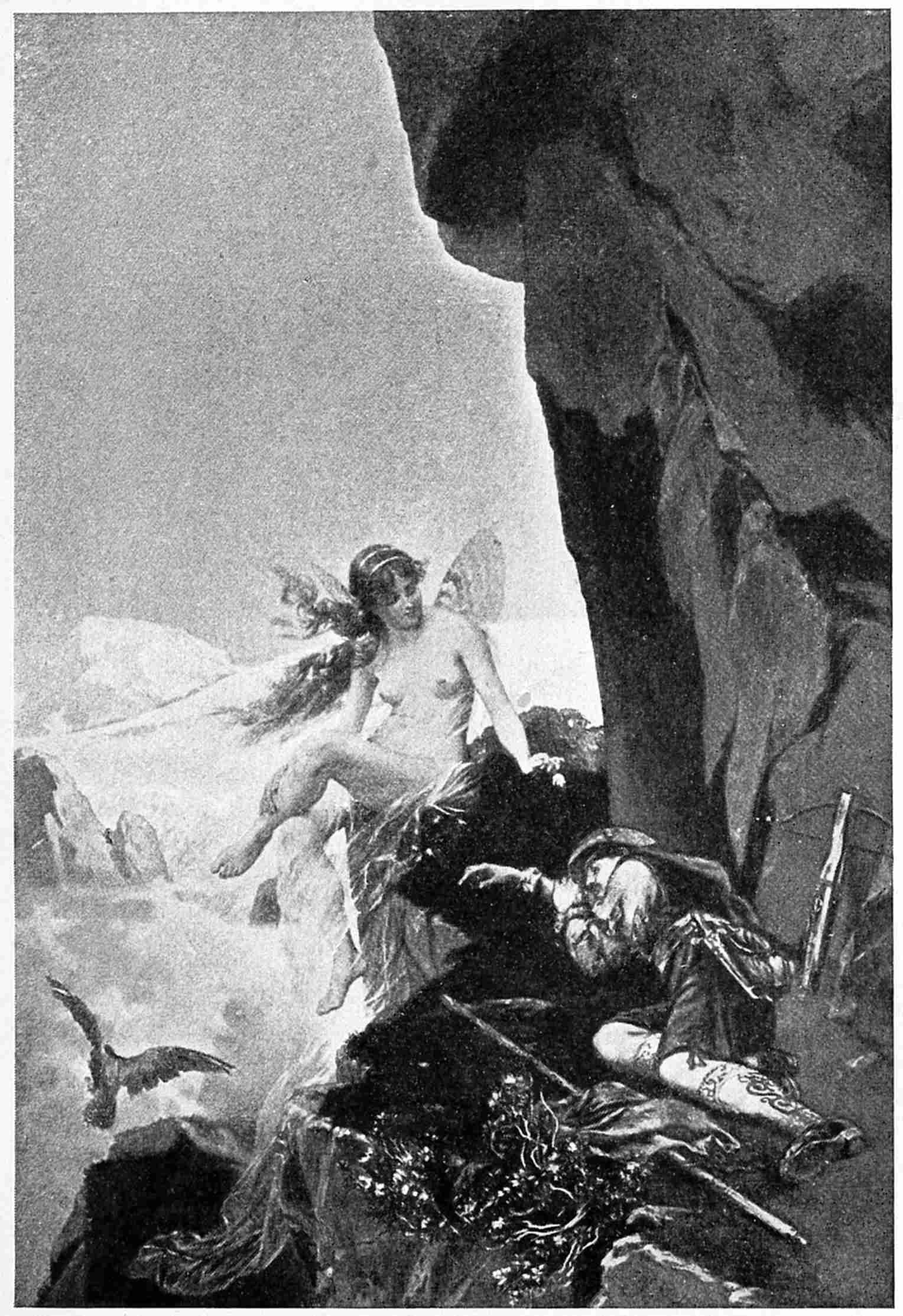
are said to have encountered there dainty, mist-like
Alpine fairies, who guided them safely over
dangerous places, watched over their slumbers
when they rested exhausted at the edge of
frightful precipices, and often whispered wonderful
dream tales into their drowsy ears.
Both dwarfs and fairies are also reported to
have revealed to their favourites the places
where the finest rock crystals could be found,
to have delivered into their keeping long-concealed
treasures, or to have bestowed upon
them magic bullets which never missed their
aim, or cheeses made of chamois milk, which
became whole again after every meal, provided
a small piece was left “for manners.”
As the chamois are the shyest of game, and
their brown coats are not easily distinguishable
at a distance from the rocks, hunters often
carry spy-glasses to locate their quarry. We
are told that one of these men, discovering that
the chamois were sure to see him and scamper
away before he could lay down his glass and
take good aim, once decided that it would be
of great assistance to him if he could only see
and shoot around the corner of any rock behind
which he chose to hide. After much cogitation,
therefore, this particular hunter bent his gun
and spy-glass so they formed sharp angles.
Thanks to this clever device, he easily discovered
and killed his prey!
ALPINE FAY.
Another sportsman once set out with his pack
of dogs to hunt hares. He had not gone very
far before seven fine specimens, starting from
covert, darted away. The hounds eagerly pursued
six of them, but the hunter concentrated
all his attention upon the seventh and last,
which was also the finest. This hare, however,
was as sly as it was large and fleet-footed,
and knowing the man’s unerring aim,
began to run around and around a haycock.
Such was the speed with which the hare ran,
that the hunter’s eyes could not follow it, and
even the animal’s shadow failed to keep up
with it. The sportsman, seeing he would
never bag this fine hare unless he too resorted
to stratagem, quickly bent the barrel of his gun
until it almost formed a hoop. Then, taking
quick aim, he sent after the speeding hare a
bullet which laid it low in its circular track
around the haycock.
* * * * *
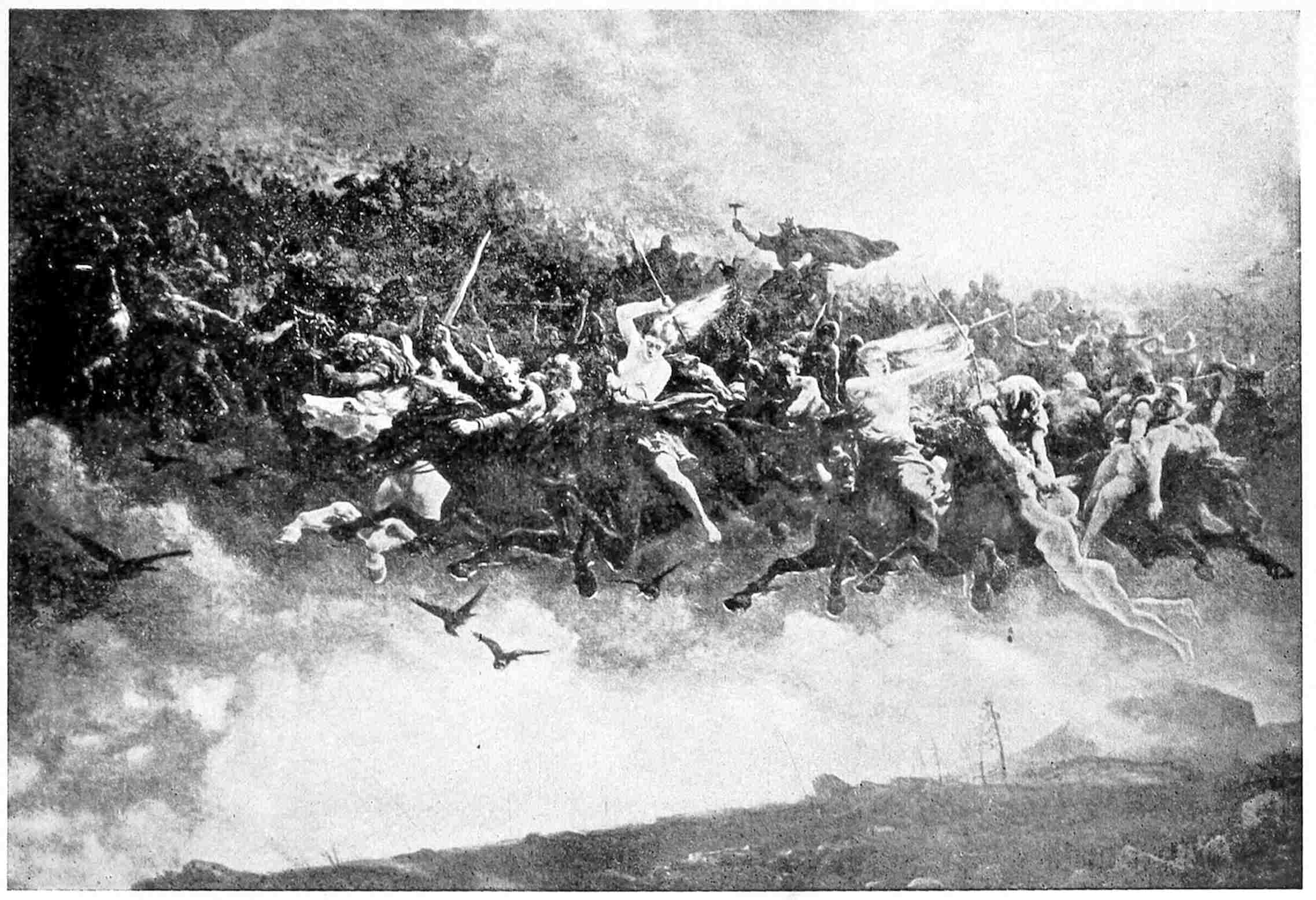
In olden times Wotan reigned alone in the
canton of Vaud, to which he is said to have
given his local name Vaudai. As long as he
was sole master of the country, Wotan proved
on the whole an amiable and benevolent ruler;
but the gradual introduction of Christianity so
soured his temper and made him behave so
badly, that the Christians finally identified him
with the Evil One himself.
The new religion was so very distasteful to
Wotan, that he hated both sight and sound of
it, and hoping to avoid coming in contact with
it, retreated far up into the mountains and took
up his abode on the summit of the Diablerets.
There, he vented his rage by sending dense fogs
and violent storms down into the valleys, and
by producing great snow-storms so that the melting
drifts should cause all the rivers to overflow.
Brooding over his wrongs one day, Wotan
determined to make a last and mighty effort to
exterminate Christianity in the Rhône valley by
drowning all the inhabitants. He therefore
called up a fearful storm, and at his command
the river began to boil and rise and overflow.
Riding on the crest of a huge wave, Wotan
himself swept down the valley, while the waters
rose higher and higher, threatening to wash
away everything along their path. But all
Wotan’s magic proved powerless when he came
in sight of St. Maurice, where the Christians
had set up a huge cross. Before this holy
emblem the waters suddenly cowed, crept back
into their wonted place, and flowed peacefully
on within their long-appointed limits.
Baffled and discouraged, Wotan again retreated
to the Diablerets, where he is said to
beguile the monotony of his sojourn by holding
monster witch-dances on certain nights of the
year. All the spirits, witches, and sorcerers of
the neighbourhood then betake themselves on
their broomstick-steeds to the Diablerets, to
indulge in mad revelry. They circle around so
wildly in their sabbatical dances that the motion
raises a wind which sweeps down the mountain
on all sides, while the sounds of their cries,
hisses, and flying footsteps can often be heard
far down the valley.
* * * * *
The souls of all those who have done wrong
while on earth are also supposed to haunt the topmost
ridges of the Diablerets, where they play
endless games of ninepins with the demons and
their master. This belief is so general that
in speaking of a dead sinner the natives generally
say, “Oh, he has gone to join the
demons on the Diablerets!” instead of stating
that he has gone to Hades to receive due
punishment for his crimes. Besides, one of
the peaks of that mountain is called the Devil’s
Ninepin; and when a great clatter is heard on
the glacier, the people whisper in awestruck tones
that the spirits are evidently engaged in their
infernal game. When stones come clattering
down on the pastures, the shepherds think they
are some of the spirits’ missiles which have
strayed out of bounds, and they seek to ward
off the nearer approach of evil by repeated and
fervent signs of the cross.
* * * * *
On the way to Chamounix, far above the
road, you can perceive the entrance of the
famous stalactite Grotte de Balme, the supposed
abode of all the fairies of that region. These
creatures resembled human maidens, except that
they were dark of skin and had no heels to their
feet. Clad in long rippling hair, which fell
all around them like a garment, the fairies of
Balme often sought to lure young shepherds
and hunters into their retreat. Sometimes, too,
they met these men on lonely mountain paths,
where they tried to win their affections by gifts
of rare Alpine flowers, of fine rock crystals, of
lumps of gold and silver, or by teaching them
the use of the healing herbs and showing them
how to discover hidden treasures. The youths
who refused the fairies’ advances encountered
such resentment that they were sure to meet
shortly afterwards with some fatal accident.
Those who ventured on the Diablerets, or the
Oldenhorn, for instance, were suddenly pushed
over the rocks into abysses and crevasses, from
whence they never escaped alive.
But the young men who received the fairies’
overtures graciously were very well treated,
and a few of them were even taken up to the
grotto, where they feasted on choice game, and
quaffed fiery wine as long as they obeyed their
fairy wives. If, however, they proved untrustworthy,
or tried to pry into the fairies’ secrets,
they were ignominiously dismissed; and while
some of them managed to return home, the
majority never prospered again, and as a rule
came to an untimely end.
* * * * *
Before the Rhône enters the Lake of Geneva,
and not very far from Noville, there are low
banks and a few picturesque little islands, all
covered with lush grass, and bordered with
rustling reeds and shiny-leaved water-plants of
all kinds.
These marshy places, with their dense luxuriant
vegetation, are said to be the favourite
haunts of fairies and nixies of all kinds, and
especially of a local water-nymph known as
Fenetta. All the river sprites timidly avoid the
glance of man; so it is only now and then that
some sharp-eyed native catches the gleam of
a white hand gently parting the tall reeds, or
discerns a slender figure, garbed in trailing
white robes all dripping with water, and wearing
a wreath of water-lilies upon her rippling golden
hair.
The water-nymphs betray their presence only
by a slight rustle among the reeds, by an almost
inaudible whisper, or by a long-drawn trembling
sigh. But at dawn and twilight their breath
is so cold and clammy, that whenever it happens
to strike a mortal, cold shivers begin to creep
up and down his spine, his finger-nails turn
blue, and before long his teeth chatter noisily.
Then, if the victim looks behind him, he is
pretty sure to descry somewhere among the
reeds on the bank a mist-like trail, which is the
flutter of the water-nymph’s white veil.
Although the river-sprites are lovely in appearance,
none of the people care to see them,
for those whose eyes have rested upon them
have invariably died within a year. For that
reason, the banks of the stream are generally
deserted after sunset, the hour when the fairies
are wont to sally forth to disport themselves
in the cool waters of the limpid river, to tread
the measures of their noiseless but fantastic
dances along the shore, or to flit from one
water-lily to another, gently opening their waxen
petals with cool and dainty fingers.
Even in broad daylight it is well to shun
these marshy places, and those who do venture
there should always warn the nymphs of their
approach by whistling, singing, or making some
other marked sound. Such signals enable the
fairies to scurry out of sight before the visitor
draws near; and when he reaches the bank,
waving reeds and grasses are the only sign of
an unseen presence.
It is said that a coquettish maiden from
Noville once bade her lover go and get
her some water-lilies, although she knew the
hour had struck when the water-sprites had
left their retreat. The young man, who had
frequently declared he did not believe there
were any water-nymphs, cheerfully departed to
do her bidding. Running down to the river’s
edge, he hastily unfastened his skiff, and with
long and vigorous strokes rowed out to the
place where the water-lilies softly rose and
fell on the rippling waters in the midst of their
broad green leaves.
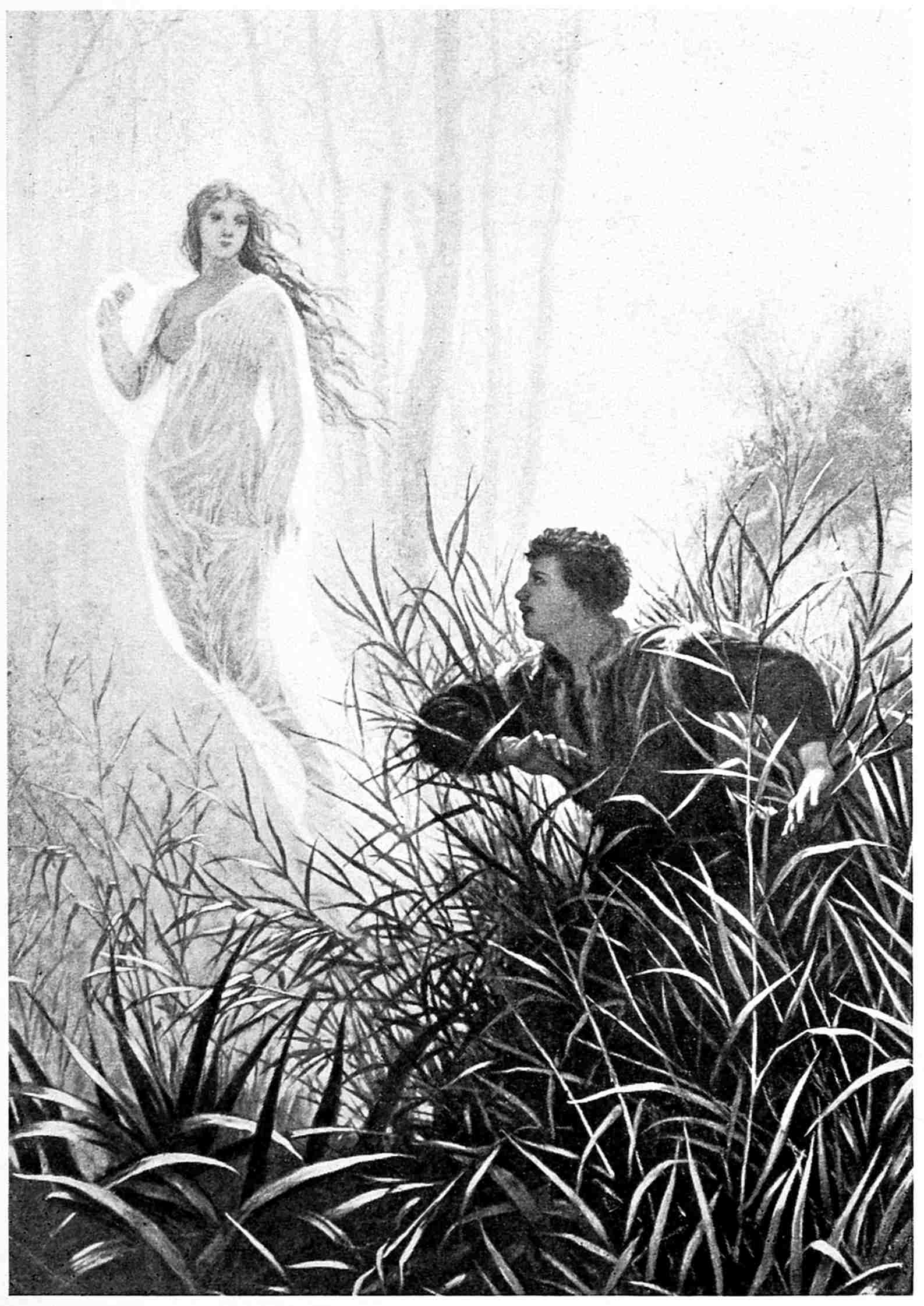
THE MIST NYMPH.
The last golden gleams had just died out in
the west, gray shadows had replaced the flush on
the snow mountains, and a cool evening breeze
was sweeping gently over the river. The
young man, who had laboured under the burning
sun all day, revelled in the freshness all around
him, and although he caught glimpses of vapoury
white here and there along the shore, he thought
they were trails of mist, and smiled to himself
because superstitious mortals mistook them for
the flutter of the nymphs’ gossamer veils.
He was just bending over the edge of the
boat to reach the largest and finest lily, when
he felt an icy breath on his neck, and turning
around with a start, dimly perceived Fenetta’s
lovely form, and noticed that she was sadly and
gently motioning to him to depart. As she
vanished, he suddenly felt cold chills running
all over him, and looking downward perceived
that his sunburned hands seemed strangely wan
and pale. With chattering teeth and failing
strength he now rowed back to the shore; but
although he grew colder and colder every
minute, and felt as if the chill had gone to his
very heart, he picked up the lilies to carry them
to his beloved.
Reaching her door with faltering steps, he
swooned on the threshold, scattering the lilies
at the feet of the maiden, who came out to welcome
him with merry words and arch smiles.
At first she fancied he had merely tripped, but
seeing he did not immediately rise, she stooped
over him barely in time to catch his last sigh
and a faint whisper of “Fenetta! Fenetta!”
The sudden death of this stalwart young
lover proved such a shock to the maiden of
Noville, that she lost her reason and began to
wander along the river-bank among the reeds,
constantly murmuring “Fenetta! Fenetta!”
The nymph, in pity for her sorrow, must have
appeared to her too; for one evening she came
home with dripping garments and shivering from
head to foot. After a few days’ illness, the girl
gently passed away, still whispering the water-nymph’s
name; and since then youths and
maidens have carefully avoided this fatal spot
after sundown.
* * * * *
In the valley of Conthey, noted for its picturesque
situation as well as for its wines, there
once dwelt a tailor who made fun of his wife
because she firmly believed in witches, ghosts,
and spirits of all kinds, and even maintained
that a helpful sprite assisted her when she had
more work on hand than she could easily
accomplish.
The tailor, who had been freely tasting the
vintage of some of his neighbours, once mockingly
remarked, while sitting cross-legged upon
his bench, that he wished her familiar spirit
would appear and take him on a nightly journey
through the Valais, for he would like to see the
famous witches and demons about which he had
heard so many tales.
The words were scarcely out of his mouth,
when a grinning, mischievous dwarf, clad in
all the colours of the rainbow, suddenly darted
out of a corner, saying, “Your wish shall be
granted!” At the same moment the tailor
felt a clawlike hand close over his coat-collar,
and was whisked through the air to Monthey.
There, he and the dwarf alighted on the banks
of the Viege, while the clocks were solemnly
tolling the midnight hour, and quickly mounted
a coal-black ram which came rushing out of
the churchyard to meet them. The dwarf,
who had jerked the tailor on the ram’s back,
roughly bade him hold fast, whispering that
their fleet-footed steed was the spectral ram of
Monthey, which ranged noisily through the
land on certain days in the year.
They now sped on so fast that the tailor felt
the wind whistle through his hair, and he almost
fainted with terror when his guide pointed
out the huge Ivy Snake, which was mounting
guard over all the gold of heathendom, spread
out on a barren heath. The snake no sooner
perceived them than it rushed towards them,
hissing loudly and breathing fire and brimstone
from its gaping mouth. A timely kick, administered
by the dwarf, fortunately urged the
black ram on to such speed, that the Ivy
Snake could not overtake them however fast
it pursued.
At St. Maurice the ram paused for a moment
near the monastery fish-pond, where a dead
trout suddenly rose to the surface of the
water.
“There,” cried the dwarf, “one of the
choristers has just died, for whenever one of
them breathes his last, a dead trout appears in
this pond.”
In confirmation of his words, a funeral knell
began to toll, and this sound accompanied them
for some time as they sped on towards the
Plan Nevé. Here, among the gray rocks and
along the huge glacial stream, they beheld
countless barefooted ghosts painfully threading
their way. The dwarf then explained to the
tailor that these spirits were condemned to
carry fine sand up the mountain in sieves, but
that as every grain ran out long before they
reached their goal, they were obliged to begin
again and again their hopeless task.
At the bottom of a neighbouring well, the
dwarf next pointed out the ghost of Nero, who,
in punishment for his manifold sins, was condemned
to blow huge bubbles up to the surface
without ever stopping to rest. In the
Aucenda, near Gex, the dwarf also showed him
the spirits of dishonest lawyers, who, having
fished in figuratively troubled waters all their
lives, were now condemned to do the same in
the ice-cold stream, where they were further
employed in brewing the storms and freshets
which desolate that region.
Before the bewildered tailor had time to
comment upon these awful sights, he was
whisked away to La Soye, where a red-headed
maiden told him she would give him a golden
calf, provided he would kiss her thrice. Reasoning
that it was far from Conthey, and that
his wife could not possibly see him, the tailor
pursed up his lips, and was about to bestow
the first kiss, when the red-headed girl was
suddenly transformed into a hideous, writhing
dragon. This metamorphosis so terrified the
poor tailor that he buried his heels in the
flanks of the black ram, which darted away at
such a rattling pace that they soon reached Sion.
There the dwarf transferred the tailor to the
back of the three-legged white horse which
haunts this city, and as they galloped away,
the tailor saw that they were followed by a fire-breathing
boar, the ram, the dragon, the red-headed
girl, the ghosts of Plan Nevé with their
sieves, and the dripping lawyers. In the dim
distance he could also descry Nero, still blowing
huge bubbles, and the deceased chorister
holding a dead trout between his teeth.
This strange procession now swept along the
Rhône valley to the Baths of Leuk, where they
were joined by a mischievous sprite who rapped
loudly at every door as he darted past. At
Zauchet, their ranks were further increased by
the wraith of a giant ox, whose horns glowed
like live coals and whose tail consisted of a
flaming torch.
Next they sped down the Visp valley, where
a woman once refused food to Our Lord when
he journeyed through the land. In punishment
for this sin, the hamlet where she dwelt sank
beneath the ground, and a stream now runs
over the broad, flat stone which formed the
altar of the village church.
Arriving at Zermatt, the dwarf and tailor exchanged
their mount for a blue-haired donkey,
whose loud bray, added to the snorts, groans,
hisses, and cries of their ghostly train, created
an awful din in the peaceful valleys through
which they swept like the wind. Arriving finally
at Lake Champey, the Blue Ass swam to an
island, where the Devil of Corbassière and a
number of witches were madly treading the
swift measures of an infernal dance.
The tailor, seeing this, sprang from his steed
to join them; but when he offered to kiss the
youngest and prettiest of the witches, the Devil
of Corbassière angrily flung him head first into
the lake. As the witches belaboured him with
their broomsticks whenever he tried to creep
ashore on the island, the tailor finally struck
out for the other bank, where he sank down,
panting and exhausted, and closed his eyes.
Suddenly he felt a small hand laid upon him,
and thinking it must be one of his recent tormentors,
he cried aloud in terror, “Leave me
alone, you witch!”
A vigorous box on his ear made him open
his eyes with a start, just in time to see his
wife standing over him with upraised hand, saying,
“I’ll teach you to call me a witch!”
The tailor now protested that he had done
nothing of the kind; but although his wife declared
that he had merely fallen asleep over his
work, he knew that his spirit had journeyed all
through the Valais, in company with the dwarf
and the demons which haunt the land.
He was so thoroughly imbued with this belief
that he never made fun of his wife’s superstitions
again, and when sceptics denied the existence
of ghosts, demons, or witches, he merely
shook his head, for he had seen for himself that
“there are more things in heaven and earth
than are dreamt of in our philosophy.”
* * * * *
The ascension of the Fletschhorn, near the
Simplon, was probably first accomplished in
1856, but tradition claims that this feat was
performed long before this date by a dauntless
Swiss.
He resolved to be the first to reach the top
of the mountain, and with that object in view
started to scale it early one fine morning. As
he did not know which road to follow, he
scrambled up and down the rocks, through
snow and over ice, and thus was quite exhausted
long before he came near the top,
where jagged rocks and steep walls of ice
offer only a most precarious foothold.
The mountaineer, who was an expert climber,
knew it would be folly to venture any farther
that day, so he sat down to rest a moment before
he began the descent. While sitting there
on the mountain side, trying to recover his
breath, he suddenly heard a ghostly voice far
above him, bidding him bring a cat, dog, and
cock, as propitiatory sacrifices to the Spirit
of the Mountain next time he attempted the
ascent.
Refreshed by a few days’ rest and by
strengthening food, the mountaineer soon set
out again, taking with him the three animals
the Mountain Spirit had asked for. At the
first dangerous spot the dog lost his foothold
and fell down a precipice; farther on even the
cat’s sharp claws failed to preserve it from slipping
down into the blue-green depths of a crevasse,
and after some more rough climbing the
cold grew so intense that the poor cock was
frozen stiff!
The brave mountaineer now pressed on alone,
although it was snowing hard and the wind blew
sharp ice splinters into his face which almost
blinded him. Presently the storm began to
rage with such fury that the man had to relinquish
his purpose, although he had now reached
a much higher point than the first time.
On arriving home, friends and neighbours
crowded around him, to hear a minute account
of his adventures; but they all deemed him more
than foolhardy when he declared that, in spite of
all the perils encountered, he meant to try again
on the next favourable day.
True to his resolve, however, the man started
out again with cat, dog, and cock, which poor
animals met with the same fate as their predecessors.
As for the Swiss himself, he climbed
higher and higher, until he came so near the
summit that a last determined effort would have
enabled him to reach it. But the great exertions
he had made, and the rarefied atmosphere,
brought on a severe headache which made him
feel very weak and dizzy. Nevertheless he
bravely went on until the pain in his head grew
so intolerable that it seemed as if his skull
would burst. He therefore relinquished his
attempt, and crept slowly home, feeling his headache
decrease with every downward step.
But even this last experience could not daunt
our climber, who set out again a few days later,
with the same strange trio of animals. This
time, however, he prudently provided himself
with an iron hoop, which fitting closely around
his head, would prevent its bursting should he
again reach a great altitude!
Thus equipped, he wended his way up the
Fletschhorn, where cat, dog, and rooster soon
perished, leaving the man to continue his perilous
climb alone. Although the pain in his
head again grew worse with every upward step,
our mountaineer pressed bravely on, knowing
the iron band would hold fast, and finally
reached the topmost pinnacle of the mountain.
His fellow-citizens, proud of this feat, bestowed
upon him the Fletschalp, and honoured him as
long as he lived as the most skilful Alpine
climber of that part of the country.
* * * * *
Patches of so-called red snow are sometimes
found high up on the Alps; but while scientists
ascribe that peculiar colour to a microscopic
fungus growth, the legend accounts for the
vivid hue in a very different way.
In bygone times, before the Alps had been
pierced by tunnels and even before convenient
roadways had been built, rough paths leading
over the various passes served as means of
communication between Switzerland and Italy.
These were much frequented by pack-drivers
with their sure-footed mules, and among other
things thus imported were fiery Italian wines.
Some of the muleteers who had a tendency to
drink, or who were none too scrupulous to cheat
their employers, used to tap the barrels and
kegs on their way over the mountains, replacing
the wine they had consumed by water from
some mountain stream, so that the vessels were
always full when they reached their destination.
The pack-drivers on the Furka Pass were,
it seems, especially addicted to this species of
peculation, and generally paused at the top of
the pass to refresh themselves after their long
and arduous climb. In their eagerness to partake
of the strength-giving fluid, some of them
often tapped their barrels so hastily that red
wine spurted forth, and falling upon the immaculate
snow gave it a blood-like tinge.
In punishment for this crime, or for so carelessly
guarding their merchandise that they did
not even notice when barrels leaked, many
pack-drivers are now said to haunt this pass,
continually treading the path they once went
over. They are tormented by a thirst such as
is known by the damned only, and which all
the ice, snow, and running streams around
there cannot quench. Their only refreshment
now comes from the scattered drops remaining
here and there upon the snow, or from small
libations which compassionate travellers still
pour out along the pass, to moisten the parched
lips and throats of these unhappy spirits.
* * * * *
The old and picturesque city of Grandson, on
the west shore of Lake Neuchâtel, and in the
northern part of the canton of Vaud, is noted
in history as the place where, in 1476, fifty
thousand Burgundians, under their Duke
Charles the Bold, were routed with great
slaughter by less than half that number of
Swiss patriots. Rich and quaint specimens of
the booty secured on that memorable occasion
by the victors, still adorn various Swiss museums
and arsenals; Soleure exhibiting the costume
of Charles’s jester, while Lucerne boasts of the
golden Seal of Burgundy.
Many romantic legends are told of the town
and castle of Grandson, which were defended
by a Bernese patriot, Brandolf of Stein, at the
beginning of the Burgundian war. Such was
the courage and skill of this commander, that,
perceiving he could not secure the town by
force, the Count of Romont, Charles’s ally,
resorted to stratagem. It succeeded only too
well, and the Burgundians were already masters
of the town when the first alarm was given,
and Stein rushed bravely into the fray at the
head of his five hundred men. The Swiss,
however, soon saw that the town was lost, and
wishing to preserve the castle until his countrymen
could send reinforcements to eject the
Burgundians, Stein quickly ordered a retreat.
To make sure that the enemy would be held
at bay until all his men were safe, and the castle
gates duly closed, Stein himself covered their
retreat; but at the last moment he was surrounded
and overpowered by Romont, who,
forcing him to surrender, led him away to his
own quarters to await the arrival and decree of
the Duke.
As soon as Charles came, he bade Romont
lead Stein under the walls of the castle, and
have a herald proclaim that unless the garrison
surrendered immediately, Stein would be put to
death. This order was executed; but the last
words of the proclamation had scarcely been
uttered when the prisoner sternly cried,—
“Comrades, pay no heed to these summons.
You were Swiss before you became my friends;
therefore be true to your country, and die
rather than relinquish your trust. But if you
love me, guard well my treasure and cast it into
the lake rather than let it fall into the hands of
our enemy.”
Before the Burgundians could recover sufficient
presence of mind to silence him, this brief
speech was ended, and it was clear that not a
word of it had been lost, for the garrison
shouted a unanimous refusal to yield when
summoned to do so for the third and last time.
Still, when the Swiss saw their beloved chief
led away to the scaffold, hot tears poured freely
down their bronzed and bearded cheeks.
Such was their respect for their master’s
memory that they resisted every attack, holding
out until forged papers convinced them that
Bern was in the power of the Burgundians,
and that they could expect no help from their
distressed countrymen. These false tidings
determined them to surrender the castle, provided
their safety was guaranteed by Charles
the Bold.
But the gates were no sooner opened than
Charles, in spite of his promises, ordered most
of these brave men cast into the lake or hanged,
sparing only a few of those who pledged themselves
to serve him faithfully. Having thus rid
himself of the garrison, the Duke next proceeded
to search for Stein’s treasure, but all in
vain. He questioned the few survivors, but
they truthfully declared they had never heard
of any store of gold, silver, or precious stones.
Convinced nevertheless that Stein must have
owned at least one priceless jewel, Charles bitterly
regretted having slain him before ascertaining
the nature and place of concealment of
that treasure.
Thinking that Laurent, keeper of the alarm
tower, an old retainer of Stein’s, might know
something about it, Charles went in quest of
him, harshly threatening to pitch him into the
lake, unless he immediately revealed all he
knew concerning his master’s possessions. Thus
constrained, Laurent reluctantly admitted that
Stein, having spared the life of a Mussulman,
had received from this grateful man a pyramidal
diamond of fabulous value, from which hung
by a slender golden chain a huge pear-shaped
pearl.
The Duke, who had a passion for diamonds,
immediately ordered a new and more minute
search; but as the treasure was not forthcoming,
he renewed his visit and threats, telling
Laurent he must produce the missing jewel or
die on the spot. In vain the poor man swore
he had never seen the diamond since his mistress
wore it on her wedding-day; the Duke
refused to believe him, and angrily ordered him
flung out of the window! Just then, however,
a panel in the wall directly opposite Charles
slipped noiselessly aside, revealing a deep niche
in which stood a beautiful, stern-faced woman,
gowned all in black, but wearing a dazzling
diamond pendant. This woman stepped slowly
forward, the panel closed behind her, and the
Duke started back in terror when she threw
the magnificent jewel at his feet, crying,—
“There, traitor, behold the diamond you
covet; but Stein’s real treasures, his sorrowing
wife and innocent daughter, will die by their
own hand rather than fall into the power of
such a miscreant as you!”
Then, before the Duke could recover sufficient
presence of mind to speak or move, the
Lady of Stein vanished behind the secret panel,
and Charles could have believed himself victim
of a delusion had not the jewel still sparkled
at his feet.
The Lady of Stein had vanished; but the Burgundian
now learned from Laurent that the two
ladies were waiting, in the secret chambers of
the castle, for an opportunity to escape to a
convent, where both intended to take the veil,
since he had broken their hearts by killing
Stein.
Charles, who had an eye for beauty, promptly
reasoned that the daughter of such a handsome
mother must be very lovely, and he began to
devise an excuse to see her. He therefore
artfully informed Laurent that Romont alone
was to blame for Stein’s death; adding that his
dearest wish was to provide a suitable husband
for Elizabeth Stein, and that, in token of regard,
he would give her her father’s jewel as wedding
present. Then he persuaded Laurent to carry
a message to his stern mistress and induce her
to come down into the great hall of the castle,
where he would await her.
The Duke having departed, Laurent touched
a cunningly hidden spring, and threaded his
way along secret passages which led from tower
to tower, down long, narrow stairs, and into a
passageway opening out on the lake. In one
of these recesses he found his mistress, who
finally consented to appear before Charles with
her seventeen-year-old daughter Elizabeth.
The moment Charles’s eyes rested upon this
lovely maiden, he was seized with a mad passion,
which he determined to gratify at any
cost. His first move was to try and gain the
good graces of both women, but in spite of all
his protestations and courteous speeches, the
Lady of Stein declared he must prove his innocence
by punishing her husband’s murderer,
adding that her daughter would either marry
her father’s avenger or become a nun.
On hearing these words, Charles gave immediate
orders to seize Romont and have him
beheaded in the presence of both ladies. A
few moments later, therefore, the Count stood
in the castle yard; but when the executioner
read aloud his death sentence, he boldly declared
he was neither a murderer nor a traitor,
and that he could prove his innocence, were
the guest in his tent only allowed to appear
with him before Charles. Anxious to seem
just and generous in the eyes of the ladies, the
Duke granted this request, and the brave young
James of Romont soon came in, followed by a
man in full armour.
“My lord Duke,” cried Romont, “I am not
a traitor! I have merely been guilty of disobeying
an order which I knew you would
regret in time. You accuse me of being Stein’s
murderer; that is impossible, for, behold! there
he stands!”
At that moment the stranger to whom
Romont pointed threw up his vizor, and both
ladies rapturously flew into his arms, thus
proving his unmistakable identity. The first
outburst of emotion over, Stein told his wife
and daughter how generously Romont had
treated him, and Charles winced when he
heard them express their undying gratitude,
and saw the glances exchanged by the young
people, who had fallen in love with each other
at first sight.
To rid himself of the youthful saviour who
found such evident favour in Elizabeth’s eyes,
Charles now sternly ordered Romont back to
prison, saying he must prove himself innocent
of the charge of treachery which had also been
brought against him.
Sure of speedy acquittal,—for he was the soul
of honour,—Romont quietly allowed himself
to be led away to a dungeon, where he beguiled
the weary hours by long day-dreams, and by
composing and singing tender love-songs in
praise of the fair Elizabeth.
In the meantime, Charles led the Stein family
to his own camp, where he assigned them
sumptuous tents, and surrounded them with
all manner of graceful attentions. But in spite
of all his efforts to win their confidence, Stein
and his wife could not help suspecting he was
not so good and true as he would fain appear.
For this reason they both watched carefully
over their daughter, and the Duke could not
secure a moment’s private intercourse with her,
although he frequently tried to do so.
This watchfulness vexed Charles greatly; for
while he loved the girl, he had no intention of
marrying her, but he knew her parents would
detect his evil intentions should he approach her
through them.
One day, he accidentally learned that Romont
managed to send love-songs to the fair Elizabeth,
and that her parents unconsciously encouraged
her secret passion for the young
prisoner by speaking of him in terms of the
highest praise. Thinking he might perchance
win Elizabeth by working upon her fears for
Romont’s safety, the Duke now informed Stein
that he would forgive and release the prisoner,
provided Elizabeth interceded in his behalf, and
if he were allowed to make sure of her real
sentiments in a private interview.
Although loath to lose sight of his daughter
even for a minute, Stein felt too deeply in
Romont’s debt to refuse this apparently simple
request, and himself conducted Elizabeth to the
Duke’s tent, where he bade her enter while he
mounted guard at the door.
The timid Elizabeth therefore presented herself
alone before Charles, who gently reassured
her, and then explained that if she would only
consent to be his, Romont should be released,
but that if she refused, the young man should
be put to death.
At first the virtuous Elizabeth could not credit
her ears, but when the Duke drew near as if to
clasp her in his arms, she fled to her father
crying—
“Take me away, father! The poor prisoner
we love will have to die, but I know he would
rather lose his life than see me dishonoured!”
Stein gnashed his teeth on hearing these
words, which more than confirmed his darkest
suspicions; and while he gently led his weeping
daughter back to her mother, he tried to plan
how best to avenge this deadly insult.
In the meantime, the Duke feverishly paced
his tent, and calling for his confidant asked him
what course he could pursue to recover the
maiden’s confidence and still attain his evil ends.
This man, whose task it was to gratify the
Duke’s passions, now artfully suggested that
Charles should declare he had merely wished
to test Elizabeth’s virtue, and should propose
to her parents that she marry Romont without
delay. Then, under pretext of sparing the
latter the hard duty of fighting against his
wife’s people, Charles was to dismiss Romont
from the army.
But while he thus openly posed as the young
people’s friend and benefactor, one of his emissaries
was to persuade a few of the camp followers
that Romont was a traitor, and instigate
them to create a disturbance when the bridal
party left the church. In the midst of the
confusion a hired assassin could easily kill
Romont; and the Duke, in pretending to avenge
his death and protect Elizabeth, would gain
possession of his vast estates and of his young
widow, who would then be at his mercy.
This artful plan so pleased Charles that he
immediately hastened to the Steins’ tent, where
he played his part with such consummate skill
that they believed all he said, and joyfully consented
to their daughter’s immediate marriage.
The preparations were speedily made, and
the nuptials solemnised; but as the little procession
left the church, Stein and the Duke
were detained for a moment by a man with a
petition.
Romont, proudly leading his peerless young
bride, on whose bosom sparkled the famous
diamond, suddenly found himself surrounded
by a brawling troop of soldiers, who angrily
shook their fists at him and denounced him as
a traitor. Before he could speak one word in
his own defence, the hired assassin sprang forward
with raised dagger, crying, “Die, thou
traitor!”
Just then Elizabeth sprang forward, and the
sharp blade had to pass through her slender body
before it could touch Romont. A scene of
indescribable confusion ensued; but although
Romont swiftly carried his dying bride into her
mother’s tent, where every care was lavished
upon her, she lived only long enough to
whisper, “I die happy since I could save you,
beloved!” and gently breathed her last.
When the fatal truth dawned upon the frantic
bridegroom, he fell fainting across his dead
bride; and it was only then that they discovered
that he too had been wounded, for his doublet
was drenched with blood. Nobly forgetting
her own sorrow to minister to her husband’s
saviour, the Lady of Stein nursed Romont so
carefully that in spite of his longing to follow
Elizabeth’s pure spirit into the better land,
he was soon restored to health. But he never
forgot his bride, and when her parents ultimately
died, he left his own country to take
up his abode in a foreign land.
As for the Duke, he was sorely punished for
all his crimes. Not only did he lose Elizabeth,
whom he passionately loved; but a few days
after her death he was defeated by her countrymen
at the battle of Grandson. Such was
the fury of that Swiss onslaught, that Charles
would have fallen into their hands had not his
fleet steed swiftly carried him out of their reach.
A few months later he suffered a second crushing
defeat at their hands at Morat; and he was
slain near Nancy, in the following year, while
trying to escape from his Swiss foes for the
third and last time.
FRIBOURG
The city of Fribourg, capital of the canton
of the same name, is picturesquely situated
on a rocky height almost surrounded by
the Sarine, one of the tributaries of the Aare.
A mediæval town, it boasts of many interesting
relics, while in its cathedral stands the great
modern organ known the world over.
When Charles the Bold experienced his
second appalling defeat at Morat, in 1476, one
of the Swiss soldiers volunteered to carry the
joyful tidings to Fribourg, his native city. Although
he had fought bravely and was very
weary after his almost superhuman efforts, he
snatched a green twig from a neighbouring lime-tree,
stuck it in his hat so that his people could
see from afar this sign of victory, and quickly
started for home. Tradition claims that he ran
every step of the way; the fact is, he reached
the city so exhausted that he sank down lifeless
as soon as the one word “Victory” had escaped
from his parched lips.
His fellow-citizens were so proud of this
victory, and of the messenger who brought the
news so quickly to them, that they planted
the lime twig on the very spot where he
had fallen. There it throve and grew, until
it is now a mighty tree, with a boll fourteen
feet in circumference; and it still serves as a
green monument of this famous triumph of the
Swiss army.
The whole valley of the Sarine and its tributaries
is most picturesque, and the soil so fertile
that it supports countless heads of the finest cattle
in the world. After passing the quaint little
mediæval town of Romont, with its old castle
and fortifications, you come to a hill in the
middle of the Sarine valley on which rises the
famous castle of Gruyère, recently restored, and
now one of the most beautiful show places in
Switzerland.
The view from Gruyère is most charming,
and includes not only the winding course of
the Sarine, and the green hills dotted with the
herds,—which furnish the renowned Swiss or
Gruyère cheese,—but beyond rise rocky pine-clad
mountains, the most important of which is
the Moléson.
The founding of the castle of Gruyère is attributed
to Gruerius, a captain in the Thebaid
legion, who, escaping martyrdom in the days
of Diocletian, fled into the mountains. After
threading his way through the dense forests
which then clothed these grassy hills, he finally
reached the point where the castle now stands.
There, helped by other fugitive Christians, he
began to clear away the primeval forest, and
founded the castle and town which bear his
name.
Gruyère thus became the cradle of a new
race, which, constantly increasing in wealth and
power, soon ruled over a vast extent of land
peopled by many vassals. The Counts of
Gruyère were in general good masters; and
the land, carefully tilled by their dependants,
grew more and more productive, until many
villages dotted the country, while the tinkle
of cow-bells was heard for miles around.
In the days of the Crusades, many knights
passed this castle on their way to the Holy
Land; and the Counts of Gruyère, assuming the
cross too, joined them with the fatalistic cry,
“Go we must, return who may!” (“S’agit
d’aller, reviendra qui pourra!”)
In spite of their wealth and extensive possessions,
the Counts of Gruyère were none too
well informed, for we are told they naïvely
asked their companions whether the sea they
had to cross on their way to Palestine could
possibly be as large as the stretch of water
they had seen in making a pilgrimage to the
shrine of Our Lady of Lucerne.
Toward the end of the fourteenth century,
Margaret, Countess of Gruyère, was very sad,
because, although she had already been married
several years, Providence had not yet vouchsafed
her a child. In her anxiety to obtain
offspring, this fair Countess consulted the astrologers
and other fortune-tellers who visited
the castle; but as their promises afforded her
very little satisfaction, she soon resorted to
pilgrimages, fasting, and long seasons of fervent
prayer.
All the pilgrims who stopped at the castle, on
their way to and from the shrines at Einsiedlen
and Lucerne, were entertained with the utmost
hospitality at Gruyère, and when they departed
the Countess invariably loaded them with gifts,
gently begging them to intercede for her when
they reached the goal of their pilgrimage.
Garbed like a nun, in the plainest of homespun
dresses, the Countess diligently visited the
poor and sick, helped the needy, and was so
good and charitable to all that she was revered
throughout the country like a saint. Besides,
every night and morning, she spent hours on her
knees in the castle chapel, imploring the Virgin
and all the saints to grant her her heart’s desire.
One evening, when twilight was fast merging
into darkness, she still lingered there on her
knees, weeping bitterly because hitherto all her
prayers had remained unanswered. Absorbed in
sorrowful thoughts, and uttering broken words
of supplication between her sobs, the Countess
failed to notice the entrance of a lame beggar
who had often been the recipient of her bounty.
The sound of suppressed weeping and convulsive
prayer soon attracted the beggar’s attention,
and peering through the gloom,—which the
taper burning on the altar only seemed to intensify,—he
soon descried a woman clad in
rough homespun. Lame Hans, whose sorest
trial was an occasional lack of food, immediately
concluded that this poor woman must be needy,
and catching the word “children,” he hastily
drew some coarse bread and cheese out of his
wallet, and laid it beside her, saying,—
“This is all I have, my poor woman, but the
Holy Virgin’s blessing resting upon it will enable
it to dry your tears.”
Then, before the astonished Countess could
say a word, the lame man hobbled off; and
although he went to bed hungry, he felt a
warm glow in the region of his heart whenever
he pictured the zest with which the hungry
children would devour his bread and cheese.
The Countess came out of the chapel a few
moments after Hans, and as she returned to her
apartments her servants marvelled at the radiant
expression of her face, although it bore marks
of recent tears. They were still more surprised
when they saw her come forth in her richest
apparel to welcome her husband and his friends
on their return from the chase. Their amazement
was shared by the hunters, who gazed
with unconcealed wonder at the hostess whom
they had left in the morning pale, silent, and
dejected, but who now seemed radiant with
life and hope.
Her unwonted vivacity charmed both husband
and guests; and when toward the end of
the evening meal she begged leave to lay before
them a new dish, they all received the proposal
with joyful acclamations. At a sign from the
fair châtelaine, her aged nurse and favourite
page then brought in two covered silver dishes,
which they gravely set before their master.
All eyes were riveted on these vessels when
the Count of Gruyère simultaneously raised both
covers; and his expression of disappointment
was mirrored on every face, when instead of
choice dainties nothing was seen but the
coarse bread and cheese of the peasant population.
Interrogative glances were therefore soon
directed to the Countess, who with charming
grace and simplicity related her adventure in the
chapel and repeated the lame beggar’s words.
She concluded by saying that she now believed
her prayers would be answered, and begged all
present to partake with her of the food which
had come to her in such a strange way.
Touched by the tale she told, one and all
solemnly ate the bread and cheese she gave
them; but her old nurse laid her share carefully
aside, saying she would partake of it only
when her mistress’s dearest wish had been
fulfilled.
Then the castle chaplain arose, filled all the
beakers with wine, blessed them as solemnly as
if he were about to celebrate a communion service,
and all drank to the health of the gracious
Countess and the speedy coming of a son and
heir to the castle of Gruyère.
Within a year from that day the Stork brought
a beautiful boy to the Countess, and at his
christening feast many noble guests merrily
drank his health. The Countess, radiant with
happiness, bestowed bountiful alms upon all
the poor, giving lame Hans a new suit of
clothes, and a pension to prevent his ever feeling
the pangs of hunger again.
In the midst of this feast the old nurse came
in and solemnly ate her carefully treasured share
of Hans’s bread and cheese. Then she made a
deep curtsey to her mistress, saying,—
“Gracious Lady, you see it is just as I always
told you. To the one who gives freely,
much will be given. May God preserve you
and your husband and grant your son a long,
happy, and useful life at Gruyère!”
* * * * *
From the castle and town of Gruyère one
can enjoy a fine view of the Moléson, the highest
peak in that region, from whose summit can
be seen the Lake of Geneva with Mont Blanc,
the Dent du Midi, and the Diablerets to the
south. West and east are the Jura and Titlis
mountains, while to the north extends the fertile
valley of the Sarine.
Here on the Moléson, as well as on most
mountain pastures in Switzerland, you can often
hear the famous Ranz des Vaches, Kuhreihen,
or musical call, which the cattle no sooner hear
than they crowd around their herdsmen.
This melody, repeated by the echoes, and
accompanied by the ripple and splash of running
waters, the tintinnabulations of cow-bells, and
the lowing of the kine, has a peculiar charm for
all who hear it, and in words runs about as
follows:—
The Moléson was long the favourite field of
the chamois-hunters in Fribourg. One of these
men having been overtaken by darkness high up
on the mountain, once sought refuge in a deserted
herdsmen’s hut. Drawing near it, he was surprised
to hear the tinkle of bells, the lowing
and stamping of cattle, and the voices of herdsmen,
for he knew the cows had already left
the high pastures. Entering the hut, he was
further amazed to see four queer, wizened-looking
men, whose thumb and first and second
fingers were missing. Besides, one of these
men was lame, the second hunchbacked, the
third had but one eye, and the fourth was
apparently a leper.
These men signed to him to take a seat near
the fire, where they were busy making green
cheese, of which, however, they had already a
large store in the hut.
The hunchback herdsman offered the guest
bread and meat which looked so unpalatable
that the hunter took but one mouthful and set
the food aside, muttering that they must have
forgotten the salt when preparing it. This remark
so incensed his hosts that they began to
gnash their teeth, and came toward him making
such threatening gestures that in sudden terror
the hunter made a sign of the cross. At that
moment herdsmen, cheese, cows, and fire vanished,
and the chamois-hunter found himself
alone in the deserted hut.
But when he told his night adventure at
home, he learned that a small piece of meat had
been cut out of the left hind quarter of his
best cow. One of the oldest inhabitants of the
village, moreover, informed him that the men
whom he had seen were wicked herdsmen, who
had neglected their duties while in the flesh,
and had besides been guilty of perjury. In
punishment for their wickedness, they had not
only lost the three fingers upheld in taking
an oath, but were condemned to atone for
past laziness by working hard every night.
LEGENDS OF NEUCHÂTEL
A younger son of one the Counts of
Neuchâtel, wishing to found a family of
his own, went to settle in 1155 in the picturesque
Val de Ruz in the Jura mountains. Here he
selected a tall and jagged rock, washed by the
Seyon, as the site of his new stronghold, the
Castle of Vallangin. Owing to its position, it
was almost impregnable; but it was a very dismal
abode, for the heights of Chaumont at the
south overshadowed it, cutting off much sunlight,
while the dense pine forests around it did
not tend to lessen the gloom.
The Val de Ruz was so fertile, however, that
the lords of Vallangin soon grew rich and powerful,
ruling wisely over the many peasants who
came to settle there under their protection.
At the end of the thirteenth century their
vassals already numbered many thousands, and
included all classes of society.
Rollin, lord of Vallangin, was but sixteen years
of age, when two of his most powerful vassals
renounced their allegiance to him and prepared
to despoil him of his property. With that end
in view, they armed their retainers and sallied
forth to attack their young master. The friends
of the latter, however, getting wind of this plot,
hastily assembled the noblemen, clergy, and
peasants who were still faithful to their lord,
and consulting with them took active measures
to meet and conquer the foe. Young Rollin
himself, supported by the lords of Neuchâtel,
of Colombiers, and of Vauxtravers, set out at
the head of his army, and meeting the two faithless
lords on the plain of Coffrane, defeated their
forces in pitched battle, and secured the persons
of the recreant vassals.
Many men perished on both sides in this
encounter; and hundreds of years later, a staff
of command lost in this battle was ploughed up
by a farmer and placed in the Museum of Neuchâtel,
where it is carefully preserved as a relic
of the fight.
Rollin, having seized the faithless vassals,
had them brought before him, and sternly informed
them that in his anger at hearing of their
treachery, he had vowed nothing short of two
heads would ever satisfy him. At these words
the guilty lords trembled and grew pale, for
they felt their last hour was near. Their despair
was such that when Rollin bade them reveal
the place where they had concealed their treasures,
they offered no resistance, but meekly
obeyed. Before long, therefore, two huge
heaps of silver lay at Rollin’s feet. He gazed
at them a few moments in silence, then addressed
the culprits, saying:
“I swore I would have two heads, and this
solemn vow cannot be recalled. But, as I have
never yet sentenced a guilty man to death, I am
loath to shed your blood. I will therefore spare
you, on condition that two silver heads be cast
from this metal, to take the place of those which
you have forfeited, but which I allow you to retain.
You shall also recover your freedom and
go home in peace, but I hereby warn you that
should you ever prove faithless again it will be
bloody and not bloodless heads which I will
claim!”
The delinquent lords, happy to escape their
death sentence, solemnly presented two heavy
silver heads to the young lord of Vallangin.
These were placed by his order on the high
altar of the collegiate church at Neuchâtel,
where they remained until the days of the
Reformation, when an ignorant iconoclast,
deeming them idols, removed them from the
altar. Since then no trace of the silver busts
has been seen.
* * * * *
Early in the fourteenth century, some of the
vassals of the lord of Vallangin went to settle
in the lovely valleys of the Jura Mountains,
where, joined by a few families from Burgundy,
they founded Le Locle and La Chaux-de-Fonds.
These two colonies speedily increased in numbers
and wealth, and the towns thus founded are
now important centres for the manufacture of
watches and jewelry.
Many of the people of the Canton of Neuchâtel
having turned Protestant, Wilhelmine
of Bergy, grandmother of one of the lords of
Vallangin, a stanch Catholic, sadly forsook the
castle which she had entered as a happy young
bride, to go and live like a hermit in the village
of Gezard, which was her dowry.
This lady, already eighty years of age, was
lamed by gout and quite feeble, but she nevertheless
took great interest in the peasants around
her, whom she often visited and frequently
helped by her good advice.
One day, sitting among the women of the
village who were diligently spinning, she heard
them comment bitterly upon their sad lot, saying
it was very hard that among all the fields they
tilled, there was not a single acre which they
could call their very own and which was entirely
free from taxation.
Emboldened by the kindly interest the old
lady showed in their remarks, they finally ventured
to beg her to give them part of her land, to
have and to hold without being asked for tithes
or rent in exchange. Wilhelmine, who could
not dispose of the land otherwise, then said:
“My good women, your request shall be
granted. You shall have one half of the land
which I can walk around in one day.” Saying
these words, the old lady painfully rose from her
seat, and tottered slowly back to her humble
dwelling.
The peasant women, whose hearts had swelled
with joy at her first words, but whose hopes
had been shattered by the conclusion of her
speech, sadly watched her limp out of sight,
and then murmured regretfully,—
“The poor mistress is so old and weak, that
with the best intentions in the world, she will
hardly be able to creep around a single acre!”
Early the next morning, while darkness yet
veiled the landscape, and the nightingale’s song
still pulsated in the quiet air, Wilhelmine of
Bergy painfully rose from her couch, and set
out on her self-appointed journey, supported on
one side by a trusty staff and on the other by
a strong young servant maid.
The two women slowly crept out into the darkness,
and wandering along the dewy meadows
saw the night gradually make way before the
first gleams of silvery light. Then they beheld
the mountain tops change from blue to silver
gray, then turn dazzling white, and suddenly blush
and glow beneath the first rays of the rising sun.
The larks rose straight up into the blue,
singing their triumphant morning hymn; the
bees and butterflies hovered around them, but
all the lovely sights and sounds of early morn
could not beguile the old lady to take even
a moment’s rest, and she hobbled bravely
on. The peasants, rising from their hard beds
to partake of frugal fare before beginning a
long day’s work, stared in speechless amazement
at their aged mistress, already well on her
way, and gazed anxiously at the feeble form,
wondering how long her strength and energy
would last.
All through the bright morning hours, Wilhelmine
plodded on without a pause; and it
was only when the sun stood directly overhead,
that she stopped for a moment under a
tree to partake of food and of strengthening
drink. Then, while the peasants stretched out
in the cool shade to enjoy their midday rest,
the old lady again stepped out into the quivering
sunshine to continue her task. All through
the glowing heat of afternoon, and long after
the sun had set and the shades of evening had
fallen, Wilhelmine crept on with faltering steps
and ebbing strength, but with undiminished
energy and determination. Darkness had long
set in when she finally reached the village once
more, and entering a hut where burned a small
rushlight, and where the people had assembled
by her order, she cried in weak but joyful
accents,—
“My children, I have walked around a thousand
acres! Five hundred of these belong to
you, free from all taxes from this time forth.
Do not blame me if your share is somewhat
small, for I have done all I could to help you,
but alas! although my spirit is willing, my aged
feet could carry me no farther.”
Having said these words, old Wilhelmine
tottered back to her own house, where she lay
down so exhausted that she never found the
strength to rise from her bed again. But the
people whom she had benefited never ceased
to be grateful to her; and when she died, in
1543, six years after this wonderful walk, they
mournfully followed her to her last resting-place,
shedding abundant tears while softly
reminding each other of the many steps taken
in their behalf by her weary old feet.
* * * * *
Until the end of the eighteenth century, the
city of Neuchâtel boasted a ghost whose apparition
was the invariable precursor of a conflagration
in town. Shortly before any signs of
fire were perceptible, this spectral old woman
passed swiftly along the streets, frantically
wringing a cloth all dripping with blood until
she vanished in a lurid mist in the direction of
the lake.
No one now living remembers ever having
seen this ghost, but old people in Neuchâtel
solemnly aver that the woman was frequently
seen by their ancestors, and that a fire always
broke out shortly after her visit. They add
that the ghost was the unfortunate widow of
Walter, Count of Rochefort, publicly accused
of forgery, and beheaded, in 1412, on the shores
of the lake, on the very spot where the wraith
always melted away in a crimson cloud. It is
said that the Count’s widow, having secured
his blood-stained shirt, constantly exhibited it
to her sons, urging them to avenge their father,
who, according to her assertions, had been
wrongfully accused, and condemned without
sufficient proof of guilt.
The implacable widow finally prevailed upon
these young men to take a fearful revenge by
secretly setting fire to the city; and it is a
fact that Neuchâtel was almost destroyed by
what is known as the great conflagration of
1450. Since then, either through remorse or
to parade her spite, the old woman’s spectre
heralded every conflagration, until, weary of
destruction, or frightened away by effective
modern methods of fighting fires, she ceased
to haunt the city and frighten the inhabitants.
* * * * *
D. J. Richard started the manufacture of
watches in Le Locle and La Chaux-de-Fonds,
but the principal legend relating to that industry
refers to Jacques Droz, the clever inventor
of mechanical clocks, of music boxes, and of a
writing automaton.
We are told that in the eighteenth century,
the King of Spain once came to La Chaux-de-Fonds,
and having heard of Jacques Droz’s
clever contrivances, went with his suite to visit
the inventor’s workshop. There the King examined
everything, and was particularly charmed
by a clock upon which stood figures of a negro,
a shepherd, and a dog. Whenever the clock
struck, the shepherd played a soft air upon his
pipe, while his dog frisked joyfully around him.
This artistic contrivance so delighted both
King and courtiers, that one and all loudly expressed
their wonder and admiration. Jacques
Droz listened quietly to their exclamations, then
turning to the King, he smilingly informed him
that the tiny dog was the faithful guardian of
his master’s property, as could readily be seen
if any one attempted to lay hands upon the
apples in a basket at the shepherd’s feet.
The King, wishing to test the dog’s watchfulness,
now attempted to abstract an apple, but
no sooner had he touched it than the mechanical
dog began to bark with such fury that the
royal pet hound, springing forward, answered
him. The monarch, startled by this unexpected
development, stepped back in amazement, while
his suite fled, making repeated signs of the
cross. None of the Spanish grandees, with
the exception of the minister of the navy, remained
in the shop, so when the King had
recovered from his momentary fright, he laughingly
bade that official ask the negro what time
it was, adding that after the wonders they had
seen, it would not surprise him in the least to
hear the darky talk. The minister, therefore,
politely inquired the time of day, but as the
question was put in Spanish, he received no
reply until Jacques Droz suggested that he
should repeat it in French, for the negro understood
no other tongue.
The minister therefore translated his question
with a somewhat sceptical smile, but when the
negro courteously answered: “Messieurs, il
est trois heures moins un quart!” (“Gentlemen,
it is a quarter of three”), he too bolted
from the room in terror, crying that the clock
must be the work of the Evil One himself!
The legend claims that the King of Spain
purchased this wonderful piece of mechanism,
but we are told that Jacques Droz merely constructed
musical clocks for him. The Spaniards,
however, were not the only ones who
fancied the watchmaker had made a pact with
Satan, for his own countrymen used to look
askance at him, and frequently averred that he
was a sorcerer.
* * * * *
The watchmaking industry has long been the
great source of gain in western Switzerland,
and clocks and watches are shipped from there
to all parts of the world. The valleys of Le
Locle and La Chaux-de-Fonds being very near
the frontier, watches and jewelry are constantly
smuggled into France over the mountain paths
to avoid paying duty upon them.
In the days of post chaises, this smuggling
assumed such proportions that the chief of the
French police determined to make a special
effort to check it. He therefore journeyed in
person to Switzerland, and visiting one of the
largest manufactories, selected a case full of
fine watches. He then bargained with the
manufacturer to pay for the goods only on condition
that they were delivered free from duty
at a certain address in Paris, and solicitously
inquired whether the dealer thought he could
pass them across the boundary safely? The
merchant smilingly answered that the job presented
no insurmountable difficulties, and took
leave of his customer, promising that the watches
should reach Paris as quickly as he did.
The chief of police, delighted with this answer,
went back to the inn, where he gave
orders to prepare for immediate departure.
Seated in his carriage and rolling rapidly homeward,
he congratulated himself upon the clever
way in which he had managed; for all the custom-house
officers had been duly warned to
guard the frontier with special care, as a large
number of watches were to be smuggled over
within the next twenty-four hours. Their zeal
had further been stimulated by the promise of
a large reward should they secure watches and
lawbreaker, while speedy punishment was to be
the lot of any man who allowed them to escape.
At the frontier, the chief of police made a
short halt, and thrusting his head out of the
carriage window, again admonished the officer
there to be very vigilant. The latter, promptly
recognising his superior, confidently answered
that not a squirrel should cross the frontier unseen,
for all along the line were posted men
eager to secure the promised reward.
Satisfied by this assurance, the chief of police
now gave orders to drive on, and journeyed
straight to Paris, stopping on his way only
long enough to change horses or partake of
hasty meals.
When he entered his own house, although
worn out by the long and fatiguing journey,
his first question was whether a parcel had
arrived for him from Switzerland. His servants
promptly denied having seen anything of
the sort, so the chief of police threw himself
down in an armchair, gleefully exclaiming:
“Then my men have managed to intercept it
at the frontier, and we will make such an
example of the smugglers that none will venture
to continue this business!”
His satisfaction did not last long, however,
for, upon entering his bedroom, he saw resting
upon the top of the rest of his luggage a case,
which, upon investigation, was found to contain
the very watches he had purchased in
Switzerland.
In his anger, the chief of police hotly inquired
of his servants how the parcel had come
there; but none could give him any information,
further than that it had probably been brought
in without their notice by one of the men called
to attend to his luggage.
The chief of police, angrier than ever, wrote
scathing letters to all the custom-house officers,
who one and all declared they were ready to
stake their lives and reputations that no one,
except himself, had crossed the frontier without
being subjected to a thorough search.
Still hoping to secure the man who had delivered
the parcel in Paris, and of reaching the
smugglers through him, the chief of police now
sent for his coachman, to ask him whether he
had seen any one carry the case of watches
into his house. To his amazement the coachman
immediately replied,—
“Indeed I did. I gave it to the man myself,
and was very glad to see the last of it, I can tell
you!”
This answer astounded his master, who,
upon asking for an explanation, learned that
while the coachman was preparing the carriage
for departure in the inn yard at La Chaux-de-Fonds,
one of the waiters had suddenly appeared
with a box, saying his master wished
him to stow it away under his seat and keep
it safely out of sight of every one until they
reached Paris. He added that the case contained
articles of great value which the chief
feared might else fall into the hands of highwaymen,
who of course would not dream of
looking under the coachman’s seat for anything
but oats. Thus cautioned, the coachman had
carefully hidden the box away; but throughout
the journey he had refused to lose sight of the
carriage for an instant, lest his master’s secret
should be discovered, and his property stolen.
On receiving this explanation, the chief of
police made a wry face, for he now perceived
how cleverly he had been outwitted by the
watchmaker. The latter, having discovered his
customer’s identity in some mysterious way,
had defeated his purpose by bribing one of the
inn waiters to give the box to the coachman,
thus making the chief of police unconsciously
smuggle his own goods across the frontier!
* * * * *
Another story runs that a Swiss naturalist
often crossed the frontier at Pontarlier, where
he was greatly annoyed by a cross and over-zealous
French custom-house officer. The
latter, for some inscrutable reason, had conceived
an intense dislike to the Swiss savant,
whose luggage he always examined with exaggerated
care, although the naturalist was well
known as a man of unimpeachable integrity.
Exasperated by this rude treatment, the naturalist
finally determined to give this disagreeable
official a lesson which he would not be likely to
forget in a hurry. The next time he stopped at
Pontarlier, therefore, besides his usual baggage,
he had a tightly closed box, which he handled
with special care.
In answer to the customary question, he truthfully
swore he had no dutiable goods with him,
but the custom-house officer, who had singled
him out as his victim, gruffly demanded his
keys and proceeded to turn his trunk topsy
turvy as usual. To his evident chagrin, not
the tiniest object upon which he could exact
payment was forthcoming, but leaving the
owner to rearrange his tumbled garments as
best he might, the officer took up the box,
shook it hard, and asked what it contained.
“Natural history specimens,” quietly answered
the naturalist.
This reply elicited a contemptuous snort from
the officer, who declared such a statement must
be verified. The naturalist then protested
vehemently, swore it contained nothing contraband,
and finally seeing that he could not
prevent the opening of the box, angrily
cried,—
“Very well! Open the box if you choose,
but don’t blame me for the consequences!”
and marched out of the office where the discussion
had taken place, slamming the door behind
him with marked emphasis.
Left alone, the officer, armed with chisel and
hammer, proceeded to tear off the cover of the
box, out of which squirmed and tumbled a
number of small snakes.
With a wild cry of terror, the custom-house
officer rushed out of the office, crying, “Snakes,
snakes!” but as he was often tipsy, or “lost
his way in his master’s vineyard,”—as the
local saying goes,—his companions would not
believe him, and fancied he was the victim of a
delusion natural to a man of his intemperate
habits.
But one of his comrades venturing boldly
into the office to convince him of his mistake,
came out again precipitately, crying that snakes
were really crawling all over the floor! The
naturalist now stepped forward, calmly offered
to replace the reptiles—which were perfectly
harmless—in their box, and added that he had
warned the officer not to tamper with natural
history specimens.
After that, the custom-house officers at Pontarlier
were particularly careful how they handled
this savant’s luggage, and never again did they
venture to raise the cover of any box when
he told them that it contained materials for his
collections.
BERN
The little city of Erlach, or Cerlier, on the
Lake of Bienne, is romantically situated
at the foot of the Jolimont, on which stand
great rocks known as the Devil’s Burden. We
are told that his Infernal Highness brought
these stones hither to crush the Christians at
the foot of the mountain. But, turned aside
by the hand of God, the blocks fell where they
could do no damage, and now serve as picturesque
features in the landscape.
The castle of Erlach, founded in 1100 by a
bishop of Basel, was entrusted to the care of
a governor, or bailiff, who made ruthless demands
upon the time and strength of his master’s
vassals. No servant was ever strong and diligent
enough to suit him; and when a tall
foreigner came to offer his services, the bailiff,
noting his well-developed muscles, immediately
said he would engage him provided he could
lift the huge rock which stood at the castle gate.
Picking up the stone with the utmost ease,
the newcomer tossed it up as if it were a mere
pebble, although its weight was such that it
sank deep into the ground on the spot where
it fell. This proof of strength fully satisfied the
bailiff, who at first treated his new servant
quite fairly. But as time went on, he exacted
more and more, and once bade him take four
horses and bring back to the castle a load of
wood which twelve horses could not have drawn
without great effort.
The muscular servant nevertheless set out
undaunted to fulfil this task, and finding one
pair of horses inclined to balk, unharnessed
them, tied them to the tail of the cart, and
taking their place, pulled so vigorously that the
load safely reached the foot of the hill leading
to the castle. There, however, the second
pair of horses stopped short, and refused to
advance another step. The servant quickly
unharnessed these, too, bound them on top of
the wood, and single-handed drew wood, wagon,
and horses up the hill, although the load was
so heavy that the deep ruts it made in the rock
road can still be seen to this day.
When the bailiff beheld this new and startling
proof of great strength, he was duly awed, and
fearing the servant might prove troublesome
some day, determined to get rid of him. With
that purpose in view, he ordered a well dug,
and when it was quite deep, made his men throw
a huge stone down upon the strong servant’s
head. To the general surprise, this man tossed
the stone up out of the well again, muttering,
“Don’t throw any more sand down into my
eyes, or I’ll get mad.”
But looking up just then, he caught such an
evil expression in the bailiff’s eyes that he was
seized with a sudden fit of blind rage. Scrambling
out of the hole, he pursued the conscience-stricken
bailiff into the castle; and as neither
man nor master were ever seen again, people
suppose that the strong servant must have been
an emissary of Satan, sent to carry their cruel
master off to Hades, to receive due punishment
for all his crimes.
* * * * *
On the way from Basel to Bern, the train
passes through a long tunnel piercing a hill
upon which stand the ruins of Castle Grimmenstein.
This was once the home of so enthusiastic
a hunter, that he even broke the Sabbath
to indulge in his favourite sport. His wife, a
gentle and pious soul, once vainly besought him
not to desecrate a particularly holy day of rest,
but he nevertheless sallied forth, and after a long
search came across a doe with its young.
Although this gentle animal bravely tried to
defend her offspring, the cruel hunter slew them
all one after another. But, just as the doe
breathed her last, a giant sprang out of the
ground, shook his fist vehemently at the Sabbath-breaker,
and exclaiming that the harmless
animals were already avenged, vanished with
them underground!
The lord of Grimmenstein, awed in spite of
himself by these mysterious words and by the
sudden disappearance of the quarry he had slain,
gave up all thought of further hunting for that
day and rode slowly home. But when he entered
his wife’s apartment, he found her and his
children dying from the very wounds he had
inflicted upon the gentle doe and her young.
Ever since then, when war or pestilence
threaten the land, the lord of Grimmenstein
rises from his grave, blows a resonant blast upon
his hunting-horn, and again sets out to range
through woods and valleys in quest of game.
THE WILD HUNT.
Besides this hunter and Sabbath-breaker,
almost every valley and hillside in Switzerland
is said to be visited at times by some similar
wraith, sweeping by on the wings of the wind.
But the apparition which makes the most noise
and causes most damage is undoubtedly that of
Odin, the Wild Huntsman himself, who often
rushes through the land with all his ghostly
train of heathen deities.2
After passing through the Wynigen tunnel, the
train soon comes to Burgdorf, an ancient and
picturesque little city, with an old castle in which
Pestalozzi established a school toward the end
of the eighteenth century.
Tradition relates that dense forests once covered
all this region, which was infested by wild
beasts of all kinds, not omitting an immense,
fire-breathing dragon, which had its abode in a
cave in the hill on which Burgdorf castle now
stands.
Sintram and Baltram, the two sons of the
Duke of Lenzburg, once penetrated into this
wilderness in pursuit of game, and discovering
the trail of this dragon, resolved to track him
into his lair and rid the country of such a pest.
But when they drew near the mouth of the
cave, the dragon suddenly darted forth, and
seizing Baltram, swallowed him at one gulp!
At this sight Sintram boldly dismounted, drew
his sword, and attacked the monster with such
fury that he finally laid him low. Then, slitting
him open, he had the good fortune to find his
brother still alive and quite unharmed, thanks
to the strong armour he wore.
The brothers were so proud of their victory
over the monster, and so grateful for their
miraculous escape from its teeth and claws, that
they built a chapel on this spot, dedicating it to
St. Margaret, because she too once met and
defeated a dragon. In this chapel they placed
a picture representing their fight with the Burgdorf
monster, and as they soon founded the
town and castle, their name and fame still endures
in that section of the country.
* * * * *
In the twelfth century, Burgdorf was the
home of Berthold V. of Zähringen, who conquered
and brought into subjection the various
nobles in the Bernese Oberland. He built
Fribourg on his own land, and founded a new
city on a rocky height almost entirely surrounded
by the Aare. History claims that he
called this town Bern, in honour of his favourite
hero and ancestor, Dietrich of Bern (Verona).3
But legend states that, not knowing
what name to bestow upon the new city, he
decided to call it after the first animal he slew
in the chase.
Sallying forth one day, he met and slew
some bears (Bären), and therefore called the
city Bern. It is because the city is popularly
supposed to have thus obtained its name, that
there is a bear in its shield, and that these animals
are conspicuous there in every form. The
most famous and imposing bears in Bern are
the stone effigies which long stood on either
side of the city gates, and which now guard the
entrance to the Historical Museum; but the
most amusing are undoubtedly the live bears
kept in a special pit.
According to some authorities these animals
are the descendants of a cub which the Duke
of Zähringen brought back from his memorable
hunting expedition; according to others of a
pair given to the town by René, Duke of Lorraine.
Besides, you may also hear it stated
that a Swiss soldier brought home a couple of
cubs as trophy after the battle of Novarre, in
1513, which were preserved in the city. In
1798, General Brune carried off the Bern
bears to the Jardin des Plantes in Paris, and
the present bruins are also said to have descended
from those or from a pair imported
from Russia.
The city of Bern was laid out for the Duke
by his henchman von Bubenberg, who, foreseeing
its importance, made it twice as large as he
was told. The Duke in wrath then demanded
what he meant by this disobedience, but von
Bubenberg soon proved that he was right, for
so many settlers poured into the new place that
only a narrow space could be allotted for each
house. All the buildings were made from the
wood growing within the new city limits, which
gave rise to the distich,—
“Holz, lass’ dich hauen gern,
Die Stadt muss heissen Bern.”
(Wood, let yourself be felled readily,
The city must be called Bern.)
Bern became independent soon after its
foundation, bravely withstood two sieges made
by the redoubtable Rudolf von Hapsburg, and
some time after defeating the Burgundian forces
at Laupen, in 1339, joined the Swiss Confederation,
of which it is now the head.
In the middle of the fifteenth century, the
citizens began the construction of the beautiful
cathedral, which, owing to lack of funds, remained
incomplete for centuries and has only
recently been crowned by its wonderful spire.
In front of this building now stands the equestrian
statue of Rudolph von Erlach, the hero
of Laupen; but here, too, once stood a large
wooden statue of St. Christopher. It was
placed there after a silver communion service
had been stolen from the cathedral, for the people
believed that the giant saint would mount
faithful guard over ecclesiastical property. But
when in spite of his presence there, the communion
service again fell a prey to thieves,
great indignation was felt in town.
To punish St. Christopher for his lack of
vigilance, he was banished to a niche in a tower
bearing his name, where, as a further mark of
disgrace, and because he stood directly opposite
the fountain of David, he was dubbed
Goliath. At that time a tradition was current
in Bern that when St. Christopher heard the
town clock strike the noon hour, he invariably
rained weckli (local rolls) down upon the people.
To fix this saying in the minds of a
younger generation, a lady of the town ordered
a large number of weckli cast down upon the
waiting school children at the stroke of twelve,
one day before the tower was razed and the
statue removed. The benevolent woman who
played this innocent trick upon the delighted
little ones, celebrated her one-hundredth birthday
at Bern, in 1897, when the cathedral chimes
pealed forth at noon a gay carillon in her honour.
When the quaint Christopher tower was torn
down, in the middle of the nineteenth century,
the head of the gaudily coloured statue of the
saint was removed to the city Museum, where
it now forms part of a collection of local
antiquities.
South of the Cathedral, and extending all
along one side of the building, is a beautiful
broad terrace, commanding a marvellous view
of the whole range of the Bernese Alps. On
this shady place stands a fine statue of the
founder of the city, with Bruin as his shield-bearer.
At the edge of the terrace, set deep
in the wall, is a tablet commemorating the miraculous
escape of a student, whose frightened
horse vaulted over the parapet in 1654. Theobald
Weinzäpfli, for such was the student’s
name, not only survived the fall which killed his
steed, but became pastor of Kerzerz, where he
died forty years later.
From the terrace, besides the matchless background
of glaciers, there is a fine view of the
pyramidal Niesen, darkly outlined against them,
and of the winding Aare, which passes through
the Lake of Brienz and that of Thun at the foot
of this mountain. At one end of the Lake of
Thun, where the Aare has its outlet, and less
than an hour’s railway journey from Bern,
stands the picturesque little city of Thun, with
its ancient castle. At the other extremity, on
a narrow strip of land between the two lakes,
rises Interlaken, the goal of all Swiss tourists.
* * * * *
Legend claims that in the days when St.
Peter was preaching in Rome, he converted
there an English traveller, who received in
baptism the name of Beatus. Longing to publish
the good tidings he had received, this pious
man set out from Rome, and preaching as he
went, finally came to the shores of the Lake of
Thun. There he found a large population of
thrifty people still devoted to the Scandinavian
religion practised by their ancestors.
THE OLD ST. CHRISTOPHER TOWER.
The spot was so lovely, and the task awaiting
him so urgent, that Beatus resolved to make a
prolonged sojourn; but he was so busy caring
for souls that he had no time to build himself a
hut. He therefore determined to take up his
abode in some cave, and searching for one
which might answer his purpose, climbed the
mountain on the north side of the lake. Far
up the slope, he descried a large cavern, which
he was about to enter. But he suddenly found
himself face to face with a huge dragon, whose
eyes were as big and round as cart-wheels,
whose claws were as long and as hard as
grappling-hooks, and whose long, tapering body
and tail were covered with scales so thick that
no weapon could pierce them! This monster
lashed its tail, opened wide its capacious jaws,
and spat forth such a torrent of fire and smoke
that Beatus thought his last hour had surely
come. Alone and unarmed, resistance was impossible,
and as flight would have been equally
vain, Beatus commended his soul to God and
made a hasty sign of the cross.
At the same moment the monster crept back
into its den with a cry of rage and terror; and
Beatus, perceiving that it had quailed at the
sign of the cross, immediately determined to
use so potent a weapon to rid the country of
this emissary of Satan. He therefore took up
his post at the mouth of the Beatushöhle, where
he mounted guard night and day, fasting and
praying persistently. The presence of this holy
man, the constant sound of fervent supplication,
and the sight of the awe-inspiring sign of the
cross every time it moved, so worked upon
the dragon’s nerves, that it exploded on the
eighth day, and vanished in a cloud of stinking
smoke.
The Evil One having thus departed, Beatus
took possession of the cave, which he fitted
out to serve as a hermitage. From one of the
trees on the bank of the lake, he fashioned a
rude skiff, in which he rowed from point to
point along the shore, often preaching from his
boat as his Master had done on the Sea of
Galilee.
By the blessing of God, Beatus’ words bore
rich fruit, and conversions became so numerous
that Satan was alarmed, and determined to
make another attempt to kill or drive away the
zealous missionary. He therefore stirred up
fearful storms every time Beatus left his cave,
caused brooks to swell and overflow whenever
he tried to cross them, rolled rocks down the
mountain to obstruct his pathway, and after
many vain trials, succeeded in breaking his oars
and making his poor skiff almost useless.
One day, when Beatus came down to the
lakeside, he perceived that the waves rose to
such a height that it would be impossible for
him to cross the lake to officiate at Einigen
as he had promised. Loath to disappoint the
faithful anxiously awaiting him, Beatus spread
out his cloak upon the bank and sat down upon
it, hoping that the storm stirred up by the Evil
One would soon abate sufficiently to enable him
to cross without imminent danger.
While sitting there, inwardly praying, a gust
of wind suddenly stole under his outspread
cloak; and a moment later Beatus found himself
soaring through the air, high over the tossing
lake, and was soon gently deposited on the
greensward near the little church. The people
welcomed him gladly, listened to his teachings,
and practised the Christian virtues so diligently
that the place where they assembled for worship
was soon known far and wide as Paradise.
The concourse of people there became daily
greater, and as Beatus was often busy elsewhere,
he bade his disciple Justus take charge
of the services whenever he failed to appear at
the appointed time. Now, it seems that while
Beatus himself was very eloquent, his disciple
was extremely prosy and long-winded; and
Satan, perceiving this, determined to claim, on
the judgment day, the souls of all those who
slept through the sermon and thus missed the
final benediction. He therefore entered the
little church at Einigen one Easter morning,
seated himself directly under the pulpit, and
spreading out a ram-skin on his lap, prepared
to take down the names of all who dozed during
the service. Although Beatus was expected
to preach on that day, and an unusually
large congregation was present, he had not yet
appeared when the little bell ceased ringing;
so Justus mounted the pulpit and began to
expound the Scriptures in his stead.
The place was overcrowded, the weather
quite warm; and as the worthy man’s teachings
were even more uninteresting than usual, one
auditor after another nodded and slept. Beatus,
who had been detained by a work of mercy,
slipped unperceived into the church shortly after
the sermon had begun, and seating himself modestly
in a corner, lent a reverent and attentive
ear to his colleague’s halting discourse.
Looking up, however, he suddenly became
aware of the fact that the whole congregation
was fast asleep, and that the Evil One was
jotting down their names with fiendish glee.
While Beatus was hesitating whether to be
guilty of the sin of disturbing divine service
by making a noise which would wake the imprudent
sleepers, or whether he should leave
their souls in such a dangerous predicament
without making an effort to save them, he
perceived that the Devil had almost reached
the bottom of his ram-skin, and had not space
enough left to inscribe all the remaining names.
At that very moment the Devil became aware
of the selfsame fact, but, notoriously quick at
devising expedients, he immediately seized the
skin between his teeth, and began tugging at it
with all his might so as to stretch it sufficiently
to serve his purpose. In his haste he gave a
jerk which, tearing the skin, threw his head
backward, hitting the pulpit such a resonant
bang that every man, woman, and child in the
congregation awoke with a start.
Beatus, the only one who had seen the accident,
disgraced himself by laughing aloud; and
the Devil, perceiving he had defeated his own
ends, flounced angrily out of the church, and
vanished with a yell, while the people sank on
their knees and frantically prayed to be forgiven
for yielding to fatigue.
Beatus, we are told, was duly punished for
laughing in church, for when he again spread
out his mantle, expecting to be wafted across
the lake, as usual, it remained stationary, and
although he ultimately died in the odour of
sanctity and was duly canonised, he ever after
had to resort to ordinary means of transportation.
The cave in which Beatus dwelt on the
Beatenberg, and which still bears his name,
has been uninhabitable since his day. From
its mouth now pours forth a noisy stream during
the spring months, and after heavy falls of rain.
* * * * *
Many steamboats daily furrow the lake over
which St. Beatus was wont to fly on his mantle;
and after passing the romantic town of Oberhofen,
directly opposite Einigen, where Justus
preached, they come to Spiez, where stands a
tower of the old castle of Strättlingen. A lord
of that name is said to have been suddenly converted,
while out hunting, by the sight of a stag
bearing a luminous crucifix between its wide
antlers. During the Christian persecutions
under Hadrian, this Strättlingen took refuge in
Burgundy, where he greatly distinguished himself
during a quarrel with France.
It seems that the two kings had decided that
their difference should be settled by a duel between
champions of their selection. The king
of France, however, produced a giant so strong
that no Burgundian dared meet him; and when
Strättlingen volunteered to fight, the king of
Burgundy was duly grateful.
Reaching the lists before his antagonist,
Strättlingen sat down to await his coming,
which he dreaded so little that he quietly fell
asleep. When the giant came, he gazed in
angry astonishment at a rival snoring as peacefully
five minutes before the redoubtable encounter
as if he were merely taking a nap
before dinner. Convinced that some miracle
lay behind this marvellous composure, the giant
gazed at his foe more closely still, and declared
himself ready to acknowledge his defeat without
striking a blow, because the Archangel
Michael stood beside the sleeping champion,
ready to battle for him.
In reward for the great victory thus won in
his sleep, the Burgundian king gave Strättlingen
his daughter’s hand in marriage, a large estate
on the Lake of Thun, and great treasures.
Part of this wealth was employed by Strättlingen
in erecting the castle which still bears
his name, and which long remained in the possession
of his family. One of his descendants,
Wernhardt von Strättlingen, was known far and
wide for his great charity, and when a shivering
pilgrim knocked at his gate one cold winter
morning, he unhesitatingly bestowed upon him a
brand-new cloak and bade him enter and spend
the night in the castle.
When morning came, pilgrim and cloak had
vanished, and the lady of Strättlingen, who was
very economical and far less charitable than her
spouse, reproached him bitterly for wasting
such a good cloak upon an ungrateful scamp.
Although her scolding was vehement and oft
renewed, the husband bore it patiently, and when
about to set out on a pilgrimage, parted amicably
with her, giving her half his ring and telling her
she might marry again at the end of five years,
if in the meantime he did not return to claim her
by producing the other half of the circlet.
This arrangement made, Strättlingen set out
for Garganum, where he had heard that St.
Michael, his patron saint, had recently alighted.
Arriving there, he had a vision of St. Michael
himself, who gave him his blessing. But on the
way home, Strättlingen was cast into a prison
in Lombardy, where he languished four whole
years. Throughout this long captivity Strättlingen’s
faith never wavered; and when came
the time set for his wife’s remarriage should he
not return, he fervently prayed that she might
be preserved from bigamy.
At that moment the pilgrim appeared in his
cell, wrapped in the mantle he had given him,
and humbly confessed that he was a demon sent
to Strättlingen to entrap him into a reckless act
of charity, in hopes that the scolding his wife
was sure to administer would cause him to sin.
The demon next went on to explain that he
was now sent by St. Michael to convey him
home. Then he proceeded to carry out the
orders he had received from the archangel, and
did it so skilfully that a few minutes later the
lord of Strättlingen stood at his castle gate,
wrapped in the cloak he had given the pilgrim
five years before.
Returning thus unexpectedly and unrecognised,
Strättlingen perceived that wedding preparations
were even then being made. Amid
the throng of guests, he stepped up to the table
unseen and dropped his half of the ring into his
wife’s cup. When she raised it to her lips to
drink, she found this pledge, and looking eagerly
around her, recognised her husband in his pilgrim’s
garb and fell upon his neck. Instead of
a wedding feast, a banquet of reunion was now
held in the great hall at Strättlingen, and as
thank-offering for his miraculous return, the
count built the church of St. Michael at
Einigen.
This church was secretly dedicated by the
archangel himself, who graciously made that
fact known to the noble builder. The latter is
said to have founded a dozen other churches in
the neighbourhood, besides one large monastery.
After a time, however, he began to pride himself
upon his piety and great gifts to the church, and
in punishment for this sin, fell desperately ill.
During this illness he saw the archangels
Michael, Raphael, and Gabriel wrestling with
the Devil for the possession of his soul. But
they finally agreed to decide the matter in a
strictly impartial way by weighing Strättlingen’s
good and bad deeds in opposite scales. Held
by one saint and filled by another and by the
Devil, the scales wavered for a moment. Then
the one containing the virtues seemed inclined
to kick the beam, until St. Michael rested his
hand heavily upon it. Seeing this, the Devil
slyly clung to the bottom of the scale in which
he was specially interested. But his black and
claw-like fingers appearing over the edge of
the scale, betrayed his stratagem to St. Michael,
who, drawing his sword, drove him away.
This curious legend is illustrated by a painting
which long graced the church in Lauterbrunnen,
and the various legends told above are
carefully preserved in the curious chronicle of
the church at Einigen.
* * * * *
Opposite Spiez, at the foot of the Ralligenstock,
and near the present town of Ralligen,
there was once a village named Roll, whose
inhabitants were noted all along the lake shore
for their selfishness and pride.
One night when the wind was blowing very
hard and after it had rained persistently for
several days, a little dwarf came into the village,
and knocking at every door humbly begged for
shelter. All rudely refused to receive him,
except an aged couple living at the end of the
village. They bade him enter, gave him the
best food that they had in the house, and would
gladly have let him sleep in their own bed, had
he only been willing to tarry with them over
night. But the dwarf told them he still had
much to do, and bidding them farewell, ran
through the place again, crying that it would
soon disappear.
Before morning a terrible storm broke, the
lightning struck the top of the Ralligenstock,
and all at once the awestruck people heard the
rumbling sound of a great landslide. Peering
hastily out of their window, the charitable couple
saw their little guest gliding rapidly down the
mountain side on a huge rock, which he seemed
to steer like a sled. Guiding this rock close to
their hut, he brought it to a sudden standstill
there, making it serve as a bulwark for the tiny
house where he had been so hospitably entertained.
The rest of the earth and stones swept
all the other houses and inhabitants of Roll into
the lake, in punishment for their pride and lack
of hospitality. But we are told that the little
cabin so miraculously spared, stood on the very
site of the present castle of Ralligen.
* * * * *
On the same side of the Lake of Thun, and
not very far from Ralligen, is the charmingly
situated town of Merligen. According to somewhat
malicious legends, the people there were
none too intelligent. They once built a beautiful
City Hall, but discovered only too late that they
had forgotten to provide any windows, and that
it was pitch dark inside. As it was impossible
to transact business in utter obscurity, the city
council immediately declared light must be
brought in without delay, and bade each of
the councillors procure a bagful. All therefore
betook themselves in a body to a sunny meadow,
opened wide their sacks, and when they saw
them full of sunlight, closed them tight and bore
them off to the City Hall. But although one
bagful after another of golden sunshine was
carried in there, and all were opened at once, the
hall, to their great surprise and disappointment,
remained as dark as ever.
There once stood a nut tree close by the lake
at Merligen. It bent so far over the water that
the people fancied the topmost branches wanted
a drink, so they determined to help it reach the
water. The chief magistrate climbed the tree,
and seizing the highest bough, bade another
citizen catch hold of his legs. This done,
a third clung to the second, and continuing
thus the people formed a living chain which
reached down into the lake. The last man now
cried,—
“Are you all ready? Shall we pull?”
“No!” cried the chief magistrate, “wait a
minute; I want to spit in my hands!”
Saying this, he suddenly let go, and the whole
chain of men splashed into the lake, where they
were drowned!
At the end of the eighteenth century, after the
French had carried off the treasure of Bern to
meet the expenses of the Egyptian war, the
other cities decided it might be well to hide or
bury their valuables, lest they too should fall into
their enemies’ hands. The people of Merligen
therefore put all their treasures on board a
boat, rowed out to the middle of the lake, and
sank them in the deepest spot. To make sure,
however, that they would be able to find again
the exact spot where the valuables were lying,
they carefully drew a heavy mark on their boat
directly above the sunken treasure. Unfortunately,
this streak did not remain on the spot
where the treasure was hidden, but to the dismay
of the people accompanied them back to
Merligen; and it is said no one has ever yet
been able to locate these valuables, whose loss
is still mourned.
* * * * *
The strip of land between the lakes of Thun
and Brienz is watered by the Aare, which, flowing
through both these bodies of water, also
serves as a connecting link between them.
Interlaken, as its name indicates, is situated
between the two lakes.
From the steamboats on the Lake of Brienz,
one can see the wooded slopes and charming
village of Iseltwald. Here, we are told, you
often hear sounds such as might be produced
by a huge Æolian harp. Sometimes loud, sometimes
low, the melancholy, ghost-like melody
quivers softly through the summer air.
Tradition assures us that a huntsman of this
region had his right arm disabled by a stroke
of lightning; so, taking up his hunting horn, he
wandered from place to place, playing wonderful
tunes for a living. His admiring auditors
rewarded him for his music by small gifts,
and all delighted in his constant tunes. Early
in the morning, when the first lark rose to
the sky, the stirring notes of “Awake, my
heart, and sing!” roused the sleeping inhabitants;
and far into the night gentle reveries
lulled them to sleep. All day long the music
played strong, brisk, helpful accompaniments to
their labours, and when a thief prowled about
their huts at night, ready to seize their property,
a sharp danger signal from the ever-ready horn
pealed through the quiet air.
Every one loved the wandering huntsman,—no
feast or funeral was complete without him,
and wherever he went he invariably met with
an enthusiastic welcome. The time came, however,
when the poor man felt his last hour was
near; and seating himself near the edge of the
lake he played a melodious farewell to life, and
to the land he loved. Then, addressing a lame
beggar who had stolen up to listen to his music,
he gave him all the money he had, on condition
that he would promise to bury him in the Iseltwald.
“But,” he added, “be sure to place my beloved
hunting horn in my hand. It has been
my friend and comforter for many a year; and
if the dead can still feel and move, I shall be
glad to beguile the dark and lonely hours spent
in my grave. There I shall play soft tunes,
until released by the peal of Gabriel’s trump
on the day of judgment, when I, too, shall
arise to take part in the grand concert played
before the throne of God.”
The old huntsman had scarcely finished these
words when he died; and true to his promise
the beggar laid him to rest at the foot of a
mighty oak, with his beloved horn clasped tight
in his dead hand. Since then, belated boatmen
have often heard a musical call guiding
them safely homeward; and the still summer air
often pulsates with the sweet, weird melody
the huntsman softly plays to himself while waiting
to join in the grand Hallelujah Chorus on
the judgment day.
* * * * *
After leaving Iseltwald the steamers on the
Lake of Brienz stop at the Giessbach, part of
which famous falls can be seen from its deck,
and thence run on to Brienz, where one can
take the train to Meiringen and see the beautiful
Reichenbach.
THE GIESSBACH.
Near the last-named town, on the way to the
Hohenstollen, whence a magnificent view is
obtainable, one passes the Balisalp, of which
the following picturesque legend is told. A
shepherd named Res used to tend his cattle
here; and after they were duly cared for every
evening, he was wont to take the huge funnel
through which he poured his milk into his pans,
and reversing it, step out on a projecting ledge
of rock to call out a loving good-night to his
sweetheart, who spent the summer on the Seealp.
Then, when it was too dark to see the
place where she stood, he would quietly enter
his hut, climb up into the loft, and lying down
on his pallet, would sleep soundly until the next
day, when his first morning greeting was also
shouted to the girl he loved.
One night the herdsman suddenly awoke,
and hearing a crackling sound, peered down
into the châlet to see what it might be. To
his surprise he saw three strange-looking men
sitting around a bright fire they had kindled on
his hearth, busy making cheese in a giant kettle.
The largest of the three kept stirring the milk,
the next one brought more to add to it, while
the third kept up a bright blaze by adding fuel
to the fire from time to time.
Watching these men, the owner of the hut
saw the cheesemaker pour a reddish fluid
into the kettle. Then the second stepped to
the door, and taking a huge horn, began to
play a weird melody. Low at first, it gradually
roused all the echoes, and had a magical effect,
for all the cows came running up to him and
soon stood around in a circle as if to listen.
This musical performance ended, the third man
poured the contents of the huge kettle into
three vessels, and the watching herdsman noted
with surprise that the liquid in each receptacle
was of a different hue.
Just then, the tallest man looked up, and
bade the herdsman come down and drink from
any vessel he pleased,—explaining that if he
partook of the red liquid he would be as strong
as a giant and receive one hundred cows; if
he tasted of the green, he would have a large
fortune; while if he chose the white, he would
receive the magic horn and be able to play the
weird tune, which, as he had seen, would charm
cows as well as men.
The young dairyman had been so enraptured
by the music he had heard, that he unhesitatingly
snatched the bowl containing the white
liquid and took a deep draught. When he set
it down again, his strange visitors warmly congratulated
him upon his selection, for had he
drunk out of either of the other vessels he
would surely have died, and centuries would
have elapsed before the Alphorn would again
have been offered to mankind. This explanation
given, the three strangers suddenly vanished,
leaving no trace of their presence save
the Alphorn, which the young man put to his
lips just as the first gleams of light appeared in
the east. Then, to his delight, he found he
could play as well as the mysterious stranger.
He soon made a second horn just like the
one he had received from his night visitors,
and taught his beloved to use it. They kept
up a lively musical intercourse all summer,
although too far apart to hear each other’s
words. In the autumn they were married, and
their descendants inherited their wonderful
musical instruments, and still play the peculiar
air, which has, as yet, lost none of its primitive
charm.
A similar story is told of the Wengernalp,
where, however, on the eve of the wedding, the
young herdsman’s musical call was answered
by a ghostly voice announcing the death of his
betrothed. The expectant bridegroom was so
shocked by these tidings that he dropped his
wonderful horn, which was shattered on the
rocks below him. Then, maddened by grief,
he ranged the mountain, until, in a fit of despair,
he committed suicide.
Since then, many imitations have been made
of the magic horn, but none has ever reproduced
any of its best high notes, and all the present
instruments are remarkable for their deep, sad
tones, which produce an indescribably mournful
impression upon all those who hear them
for the first time.
* * * * *
On the way from Meiringen to the famous
Rhône glacier, one sees some of the most beautiful
and varied scenery in the world. After
passing charming points too numerous to mention,
the road, which rises rapidly, leads over
the barren Grimsel Pass, where stands a famous
refuge for poor travellers, the well-known
Grimsel Hospice.
A legend claims that in olden times this
region blossomed like the rose, and that the
highest mountains were as fertile as any valley
nestling in a sheltered location at their foot.
When Our Lord bade the Wandering Jew4
begin the never-ending journey for which he is
so noted, he immediately set out, and tramping
incessantly, started to cross the Alps at the
Grimsel. Although constantly urged along by
a power he could not resist, Ahasuerus, the
Jew, marked the happy people dwelling on the
banks of the Aare and the Rhône, and marvelled
at the extreme fertility of the pass, where
grapes and figs grew in abundance, where no
barren spot could be seen, and where mighty
oaks covered the tops of mountains now crowned
by eternal snows.
4 See the author’s “Legends of the Virgin and Christ.”
The air was mild and balmy, even at the
greatest altitude; and hosts of birds in bright
plumage flitted about, twittering and singing in
the merriest way. Ahasuerus also noticed that
the people were gentle and hospitable, for
wherever he asked for food or drink it was
quickly granted, and he was warmly invited
to tarry with them and rest his weary limbs.
This invitation, however, he could not accept;
but hurried on, unconscious of the fact that a
blight fell over every place through which he
passed; for the curse laid upon him not only
condemned him to move on for ever, but enhanced
his punishment by making cold, want,
and pestilence follow in his train.
Many years passed by before the Wandering
Jew again found himself near the Alps; but
weary as he was, he somewhat quickened his
footsteps, hoping to feast his eyes upon the
landscape which had so charmed him the first
time, and to meet again the warm-hearted
people who had been so kind to him once before.
As he drew near the mountains, however, sad
forebodings wrung his heart, for they were enveloped
in a dense fog, which seemed to him
particularly cold and clammy. Hurrying on up
the pass, he eagerly looked from side to side,
yet saw nothing but dark pines wildly tossing
their sombre branches against a gray sky, while
ravens and owls flew past him, croaking and
hooting. Vines, figs, and oaks had vanished,
and the happy people, driven away by the constant
windstorms which swept the mountains,
had taken refuge in the sheltered valleys. But
although all else was changed, the spirit of hospitality
still lingered on the heights, for the
charcoal-burners gladly shared their meagre supply
of coarse food with the Wandering Jew, and
warmly invited him to be seated at their campfire.
The Jew, however, had to hasten on; and
many long years elapsed before he again trod
the Grimsel Pass. For a while he still perceived
dark firs and smouldering fires, but it
seemed to him that they were much nearer the
foot of the mountain than they had been at
his second visit. As he climbed upward he also
noticed that the path was much more rugged
than before, for rocks and stones had fallen
down upon it from above, making it almost
impassable in certain places. As no obstacle
could stop this involuntary traveller, he went on
over rolling stones and jagged rocks, and nearing
the top of the pass discovered that every
trace of vegetation had vanished, and that the
place formerly so fertile was now covered with
barren rocks and vast fields of snow. Raising
his eyes to the peaks all around him he perceived
that oaks, beeches, and pines had all
vanished, and that the steep mountain sides
were heavily coated with ice, which ran far
down into the valleys in great frozen streams.
The sight of all this desolation, which had
taken the place of such luxuriant vegetation,
proved too much for poor Ahasuerus, who sank
down on a rock by the wayside and burst into
tears. There he sat and sobbed, as he realised
for the first time the blighting effect of his passage.
His tears flowed so freely that they
trickled down into a rocky basin, and when he
rose to pursue his way down into the Hasli
valley, he left a little lake behind him.
In spite of the masses of snow and ice all
around, and of the cold winds which constantly
sweep over that region, the waters of the lake
still remain as warm as the tears which fell from
Ahasuerus’s eyes; and no fish are ever found in
this pool.
Still, notwithstanding the desolate landscape,
Ahasuerus found the spirit of hospitality not
quite dead, for far up on the pass rose a shelter
for weary travellers, where they were carefully
tended by pious monks. But even here he
could not rest, and as he passed along down
the mountain, he heard the thunder of falling
avalanches behind him. It is during this last
journey that he is supposed to have lost the
queer old shoe which was long treasured in one
of the vaults of the Bern Library.
It is also said that when pausing at one of the
huts in the Hasli valley, he sorrowfully foretold
that when fate brought him there for the fourth
and last time, the whole fruitful valley, from
the top of the mountains down to the Lake of
Brienz, would be transformed into a huge unbroken
field of ice, where he would wander
alone in quest of the final resting-place which
until now has been denied him, although
Eugene Field claims he found it in the New
World.5
This account of the passage of the Wandering
Jew is told with slight variations of all the
passes between Switzerland and Italy. Every
particularly barren spot in the former country
is supposed to have been blighted because he
passed through there, or because mortals sinned
so grievously that they brought a curse down
upon it.
* * * * *
Although travellers coming over the Grimsel
often make their way from there to Grindelwald,
in the heart of the Oberland, this point is most
easily reached from Interlaken, by means of
the railroad following the course of an Alpine
stream, the Lütchine, which flows in a rocky
bed between tall cliffs and steep pine-clad hills.
After passing Burglauenen, of which the same
story is told as of Roll on the Lake of Thun,
you come to Grindelwald, where you have the
best view of the Wetterhorn.
A picturesque legend claims that in the
Golden Age, when no snow or ice had ever
been seen in Switzerland, rich pastures lay between
the Faulhorn and the Siedelhorn. A fine
brook flowing through there supplied the cattle
with all the water they needed, and enabled the
herdsmen to keep all their pails and pans in
a state of dazzling whiteness and immaculate
purity. The pasture was so rich, and the cows
gave such quantities of milk, that the men were
always tired of milking long before they were
through. Spoiled by too great plenty, and over-inclined
to take their ease, these men cursed
cows and pasture, so a great change soon took
place, which at first struck them as very welcome,
because as the kine’s milk decreased their
work diminished.
But one day a maiden came to Gidi, the
principal herdsman, and breathlessly announced
that a very strange thing had happened, for
the brook was all covered with a very thin
sheet of glass! When Gidi heard this, he
cried,—
“Then it is high time we should change our
pasture!”
He therefore immediately drove his herd
down into the valley, where, clearing away the
dense forest, he built the little village Gidisdorf,
which still bears his name. Since then, that
place—more generally known as Grindelwald—has
become a great resort for tourists, who
are attracted thither by the healthful situation,
and by the marvellous views obtainable on all
sides. From this place many interesting excursions
are possible, among others that to the
Scheidegg.
GRINDELWALD.
* * * * *
It seems that the possession of the Great or
Hasli Scheidegg was once the cause of a serious
dispute between the people of Hasli and Grindelwald.
As the matter could not be settled
otherwise, it was to be decided by oath. The
people of Grindelwald, who could not swear
truthfully that it belonged to them, nevertheless
won it by stratagem, for their champion, filling
his shoes with earth from his garden at
Grindelwald, boldly presented himself before
the judge on the disputed land. There he
swore in a tone of such intense conviction
that he stood upon Grindelwald soil, that the
judge, persuaded of the rectitude of his claim,
awarded the disputed land to his community.
The perjurer was, however, duly punished for
this crime, for even now his soul can find no
rest. Mounted the wrong way round upon a
ghostly steed, he rides every night from the spot
where he committed perjury down to Meiringen;
and if one listens attentively one can often hear
his sighs and groans as he takes this nightly jaunt.
* * * * *
On either side of the Upper Grindelwald
Glacier tower the Wetterhorn and the two
Schreckhorn peaks. The latter mountains are
said to be haunted by an unhappy chamois-hunter,
who insisted on going in pursuit of
game, although a terrible storm was raging and
his wife frantically implored him to stay at
home.
After climbing far up among the rocks, he
detected a fine chamois, and crouching near the
edge of a fearful abyss, took careful aim and
fired. But just then his gun recoiled, and
losing his insecure footing, he slipped over the
edge. Instead of falling all the way down,
however, the hunter landed on a narrow ledge
of rock, whence he could not stir, for the cliff
rose straight above and fell sheer below him
hundreds of feet.
The poor man, unable to move, remained
almost in the same position for three days and
two nights, when, seeing no hope of escape,
and unable to endure his sufferings any longer,
he resolved to commit suicide. Writing the
story of the accident which had befallen him
and of his fatal resolve, he threw the scrap of
paper down into the abyss at his feet. Then,
reloading his gun, which he had held fast in his
fall, he sent an unerring bullet straight through
his brain.
Months later the paper was found close by
his shattered corpse; and since then, whenever
a storm rages, one can hear the sudden report
of a gun, a crashing fall, prolonged heart-rending
groans, and the people declare it is the
suicide repeating the awful tragedy which ended
his life.
* * * * *
It seems that there was once a convent at
Interlaken where the nuns, unmindful of their
vows, led anything but pure lives. Banished
after death to the Schreckhorn, these nuns lie
buried deep in the snow; but the spots where
they rest glitter in a peculiar way, and are
known as Snow Eyes. People say that they
are placed there to serve as a constant warning
to the valley maidens not to follow the example
of those dissolute nuns.
A legend claims that St. Martin once came to
Grindelwald, and finding a valley too narrow to
admit as much sunshine as he deemed necessary
for the good of the people, determined to
widen it. He therefore resolutely braced his
back against the Mettenberg, and jamming his
stick hard against the Eiger, pushed with such
force that he partly accomplished his purpose.
Such was the effort he made, that the imprint of
his back can still be seen in the Mettenberg
and a final thrust of his staff punched a hole
through the Eiger! This perforation, far up
the mountain, is known as the Heiterloch or
Martinsloch, and the sun always shines through
it on St. Martin’s Day, to keep bright the
memory of the saint who made it.
* * * * *
Far up on the southwestern side of the Jungfrau,
or Virgin Mountain, is a desolate, icy place,
known as the Rothenthal, or Red Valley. In
olden times this was one of the most fertile
pastures that had ever been seen. And as it
was all gemmed over with delicate Alpine
flowers, it was generally known as the Alp of
the Little Flowers, or the Blümelis Alp.
A beautiful winding road leading right through
this valley formed a convenient pass between
the cantons of Bern and Valais, and the people
there would have been perfectly happy had
they not been subject to tyrannical lords.
These noblemen were grasping and unprincipled,
as well as cruel, and built a castle near the
highway so that they could conveniently despoil
all travellers and levy supplies from the peasants
in the neighbourhood. Not content with these
depredations, they cultivated every vice they
could think of, and often kidnapped the maidens
who happened to please their taste or
catch their lustful eyes.
THE JUNGFRAU.
A beautiful and innocent maiden was once
tending her cows upon the fragrant Blümelis
Alp when the lord of Rothenthal suddenly perceived
her, and inflamed by passion suddenly
tried to seize her. The poor girl uttered a wild
shriek of terror, and looked around her for
help. No one was in sight, however, and she
already deemed herself lost, when a big black
goat suddenly appeared, and rushing against her
assailant with lowered horns, bucked him repeatedly,
and finally hurled him over the edge
of the precipice. The maiden, who had fled
when the nobleman let go of her to defend
himself against his horned antagonist, turned
around just in time to see her persecutor fall.
At the same moment the mountains shook
violently, and huge masses of ice and rock
came crashing down upon the blooming pasture,
which, in the twinkling of an eye, was converted
into the icy waste you can see there
to-day.
Although now seldom trodden by human feet,
the Rothenthal is still said to be haunted by the
spirits of all those who have oppressed their
fellow-men. Here they wander, up and down,
bewailing their fate with sighs and groans which
can be heard far and wide. Whenever the
demons bring a new spirit thither to share their
punishment, there is a grand commotion in the
Rothenthal,—stones roll, avalanches fall, and the
cries and groans become so loud and sustained
that the people in the neighbouring valleys,
awakening with a start, hide their heads under
their blankets and murmur,—
“They are bringing another lord to the
Valley!”
A moment later a sudden and stronger gust of
wind sweeps past their dwellings; and when it
is over, they timidly emerge from their coverings,
making the sign of the cross to ward off evil, or
softly breathing a prayer to be preserved from
harm.
* * * * *
Interlaken is also the usual point of departure
for those who wish to visit the valley of Lauterbrunnen,
the famous Falls of the Staubbach, and
the pastures of Mürren, whence such a beautiful
view of the Alps can be obtained, and
whence the sunset effects on the glaciers are
particularly grand. As Mr. Samuel Longfellow
says,—
We are informed that in olden times, before
the stream here had hollowed out its deep
ravine, a herdsman used to exchange long conversations
with his beloved, who tended her
cattle on the opposite side of the Sausbach.
One day when there was a great freshet, and
the noise of the roaring waters drowned their
voices, the young people, in a playful mood,
began to fling handfuls of grass and sod
at each other, laughing merrily and making
mocking signs whenever one of the harmless
missiles reached its goal. In the excitement of
the game, however, the young man finally tore
up a great lump of loose earth, and unconscious
of the fact that a sharp stone lay imbedded deep
in it, hurled it with accurate aim straight at the
head of his sweetheart. Instead of the half-laughing,
half-indignant outcry he fully expected,
he suddenly saw the maiden sink lifeless to the
ground, for the sharp stone had run straight
into her temple!
The broken-hearted youth gave up his herd,
withdrew from the company of his former
associates, and building a hut on the very spot
where the girl he loved had perished, spent the
rest of his life in penance and prayer. It is
also said that he finally died there, without having
known another happy moment, and without
ever smiling again.
LEGENDS OF SOLEURE
Soleure, on the Aare, in the canton of
the same name, is said to be, after Trèves,
the oldest city north of the Alps. Most of the
old landmarks and fortifications of this city have
had to make way for modern improvements; so
the most interesting legends of the region are
connected with the pretty drives just outside the
city.
In olden times, the picturesque Verenathal,
or Verena valley, is said to have been the retreat
of a woman so very good and pious that
she was known as St. Verena long before her
death. This worthy creature, wishing to devote
all her time to the worship of God, had betaken
herself to this lonely spot, where she built a
small hermitage and erected a cross, at the foot
of which she spent many hours in fervent prayer.
Such was her charity, that she constantly interceded
for the wicked, pleading particularly
for those who were most likely to succumb
to temptation and thus fall into the devil’s
clutches.
These prayers and intercessions were not
without avail; and the Evil One, perceiving that
he could not bag as many souls as usual in that
vicinity, finally set out to discover what was the
matter. Walking past the hermitage, the sound
of passionate and persistent prayer fell upon his
ear; so he noiselessly drew near to ascertain the
exact nature of the petition.
Listening attentively, he soon distinguished
the words, and gnashed his teeth with rage
when he overheard her interceding with special
fervour in behalf of the very souls he hoped
soon to have in his power. This, then, was the
reason for the alarming and otherwise unaccountable
decrease in the number of his victims!
He therefore resolved that the prayers of the
holy woman should immediately be stopped,
and with that end in view tore a huge mass of
stone from a neighbouring cliff. Then stealing
near the saint, he held it for a moment suspended
directly above her head, carefully measuring
the distance, so that he could kill her with
one blow.
But just as he was about to let the mass fall
upon Verena and crush her to death, she suddenly
looked up, and met his baleful glance
with such a look of mingled purity, compassion,
and reproach, that Satan, starting back involuntarily,
let the rock slip from his nerveless hand.
The boulder, falling on his foot, crushed it so
badly that he immediately vanished with a
wrathful howl of pain and disappointment.
The rock thus dropped by the Evil One can
now be seen on the very spot where it fell, and
it still bears the distinct imprint of the Devil’s
claws, which seem burnt in the stone.
Since then, his Infernal Majesty is said to
have systematically avoided passing through the
narrow gorge where he met with this unpleasant
accident. But he is constantly reminded of St.
Verena and of his luckless attempt, for his
crushed foot never recovered from this accident,
and he has walked lame from that day to this.
Near the hermitage hallowed by the holy life
and death of St. Verena, there is a tiny chapel;
and a little farther on one can see a representation
of the Holy Sepulchre, hewn out of the rock,
and adorned with life-size statues. This place
is frequently visited by pilgrims, who also stand
in awe and wonder before the fountains of the
Soleure Cathedral, which represent Moses
striking the rock, and Gideon wringing the dew
out of the fleece, which, by a miracle, was dripping
wet when all the ground around it was dry.
* * * * *
Noted as a railway junction, as well as a
pleasantly located town on the Aare, Olten is
only five miles distant from the pretty health resort
of Frohburg, on the Hauenstein. From
this eminence one can enjoy a wonderful panorama
of the Alps, extending from the Sentis
at the extreme northwest, to Mont Blanc at
the southeastern end of the mighty range of
snow-capped mountains.
Within a few minutes’ walk from the hotel of
Frohburg, are the ruins of a castle of the same
name, once famous for its beauty as well as its
great strength. The owner of this castle, the
last Count of Frohburg, was known far and
wide as a wealthy and powerful nobleman, who
ruled his people with a heavy hand. His lands,
extending for miles around the castle, were
carefully parcelled out among the peasants, who,
beside the feudal service required of them by
their exacting master, were further compelled to
give him one tenth of all the produce of their
little farms.
On the day appointed for the payment of the
grain tithes, the lord of Frohburg, standing on
the battlements of his castle, yearly beheld
the approach of a train of wheat-laden wagons,
which formed an unbroken line several miles
long. Indeed, it is said that when the first cart
vanished under the tunnel-like gateway of the
castle, the last could just be seen crossing the
bridge at Olten, more than five miles away.
All this wealth and power, however, only
tended to spoil the Count of Frohburg, who
daily grew more haughty and overbearing, and
finally persuaded himself that his vassals had
been created for his good pleasure only, and
were not human beings like himself. This belief
made him extremely cruel and tyrannical,
but his overweening pride was soon to be
severely punished.
One day, shortly after the grain tithes had
been paid, while the lord of Frohburg was away
from home, a terrible earthquake suddenly shook
the whole range of the Jura Mountains. The
castle of Frohburg, unable to withstand the awful
shock, although its owner proudly averred
it would stand forever, was soon reduced to a
heap of unsightly ruins, from which rose dense
clouds of choking dust. Towers and battlements,
halls and dungeons, were all laid low,
and a messenger set off in great haste to apprise
the Count of the utter destruction of his
abode.
This emissary met his master on the bridge,
where he breathlessly and tremblingly imparted
his bad tidings. No sooner had the Count
heard his report, than he flew into an awful
passion, cursing and swearing so vehemently
that all the people shrank away from him in
horror. In his anger at his loss, and further
enraged by his retainers’ evident reluctance to
remain in the company of a blasphemer, the lord
of Frohburg raised his right hand to heaven and
threateningly cried,—
“As true as I am lord of the land, not one
of you shall again till his fields, until my
castle has been rebuilt by the work of your
hands!”
At these words the distressed people groaned
aloud, for the castle was a huge edifice, and
many months of arduous labour would be necessary
before it again rose in all its strength and
magnificence. Forced to work without pay for
their cruel lord, they would be doomed to starve
to death with their wives and children, while
the fields which had been so productive hitherto
would lie fallow and bare.
While they still stood there in speechless dismay,
a thunderbolt suddenly fell from a cloudless
sky upon the cruel lord of Frohburg, who
soon lay before them a blackened and lightning-scarred
corpse. Thus, in the midst of his
vassals, Providence punished the wicked man
for his cruelty and blasphemy.
As this nobleman was the last of his race, the
Castle of Frohburg was never rebuilt. It can
still be seen, a mass of ruins, as it was left by
the memorable earthquake of 1356, which made
such a havoc among the buildings in the Jura
mountains.
BASEL
Basel, the capital of the canton of the same
name, was founded by the Romans before
Christ. After serving as one of their military
posts, it became a free town under the empire,
and at the very beginning of the sixteenth century
joined the Swiss Confederation.
The centre of a bishopric founded by Charlemagne,
this city was already famous in his day
for its churches, monasteries, and schools, although
the present cathedral was built only two
hundred years later. It suffered sorely from the
great earthquake of 1356, when tradition asserts
that the building rocked so portentously that
a huge bell of pure silver was hurled from its
spire straight into the Rhine. There it still
lies, and on clear days can be seen shining deep
down under the water. Sometimes, too, its
sound can be heard there, for the Rhine spirits—who
are all good Christians—ring it regularly
at the appointed hours for prayer.
The old fortifications of the town have nearly
all vanished, but the fourteenth-century Spalenthor
still stands. Between that gate and the
Spalenberg, the Spalen, a ghostly creature, is
said to rush every stormy night. None of the
inhabitants can describe it exactly, for they have
only caught fleeting glimpses of it, although they
have frequently heard it pass.
This ghost is variously designated as a sea-horse,
a pig, a dragon, or a griffin, but if any one
attempts to ascertain its exact nature, by looking
out of the window when the sound of its
flying footsteps is heard, he is duly punished
by waking up on the morrow with a very swollen
face. A bold spirit, who once recklessly
thrust his head far out of the window to satisfy
his curiosity, is said to have been stricken with
such sudden and exaggerated inflammation that
the window frame had to be removed before
he could again draw in his head!
THE SPALENTHOR (OR THE SPALEN GATE) BASEL.
The two divisions of the town, on either side
of the river, were long at feud, and this division
was commemorated by a statue on the old
bridge, which by means of a curious mechanism
continually stuck out a derisive tongue at the
people on the other side. This image, locally
known as the “Lällenkönig” is now in the city
museum. In reply to this insult the people of
the opposite side are said to have set up a rival
statue, which turned its back in the most
contemptuous way to the famous Lällenkönig.8
8 For this and other legends of Basel, see the author’s
“Legends of the Rhine.”
* * * * *
Not far from the Summer Casino stands the
St. Jacob monument, commemorating a battle
of the same name fought in 1444. Tradition
declares that thirty days before this fight, the
people of Basel were warned of its approach by
sudden noises high up in the air above them.
First came a rush, as of mailed steeds; then a
clash like that of contending armies, followed by
a din of cries and groans. Although nothing was
visible, the people knew full well that Satan’s
ghostly train was already fighting in the air above
them in anticipation of the coming carnage.
When the fight at St. Jacob really took place,
Burkard of Landskron—whose ruined castle
stands near Basel—sided with the French. He
fought all day with such fury that when evening
came and the battle was ended, he and his milk-white
battle steed were all covered with blood.
Gazing around him, Burkard saw the ground
strewn with corpses, the grass and bushes
drenched with blood, while the very brook ran
red with gore.
The warrior, who delighted in warfare, gazed
enraptured at this awful scene; then, patting his
horse, he joyfully cried,—
“Ah, old fellow! you and I are bathing in
roses to-day, are we not?”
These unfeeling words, which were answered
by a gentle neigh from the weary steed, fell upon
the dying ears of a brave Swiss, who had gone
into battle echoing his companions’ dauntless
cry, “Our souls to God, our bodies to the
enemy!”
Raising himself feebly, he fixed dim, resentful
eyes upon the cruel victor; then, recognising
in him a bitter foe of his country, his heart
swelled once more in violent anger. Too weak
to rise and strike another blow with the sword
which had done such good service that day, the
Swiss fumbled around for a moment, then, seizing
a stone dyed red with patriot blood, hurled
it straight at Landskron, saying,—
“There, eat one of your roses, you fiend!”
The stone, flung with unerring aim, struck
the warrior in the middle of his forehead, and
he fell with a crash to the ground, bathed in
his own life-blood. This last effort, however,
entirely exhausted the patriot, who, after seeing
his enemy fall, sank back on the blood-stained
sward, where he breathed his last sigh.
The bravery of the small Swiss force which
held out here, hour after hour, against an army
twenty or thirty times greater, so surprised
Louis XI. that he gladly made peace with
the Swiss, who still consider this battle their
Thermopylæ.
* * * * *
Not far from the ruined castle of Landskron,
and near the village of Ettingen on one of the
spurs of the Jura mountains, are the remains of
the old castle of Fürstenstein, the home of a
lord of Rothberg in the fourteenth century.
A thoroughly virtuous knight, this nobleman
married a good wife, and both were equally
devoted to their only child, a charming little
girl of about four years of age. One day the
mother took the little maiden out into the forest,
where she let her run about to fill her basket
with wood-flowers, and with the tiny wild
strawberries whose perfume and flavour are so
delicious. The mother sat down in the shade of
a big tree, where the little one came every few
moments to exhibit some new treasure; but the
Lady of Rothberg sprang to her feet in terror
when a sharp cry rang suddenly through the
air.
Rushing to the place where her child had
stood a moment before, she now beheld a
frightfully steep precipice, but when she leaned
far over the edge, frantically calling the child,
nothing but a loud echo replied.
Beside herself with grief, the unhappy mother
rushed down the mountain path, wildly imploring
the Virgin to protect her babe. On reaching
the foot of the mountain, and the entrance
to the ravine, she almost fainted with joy, for her
little girl came running joyfully forward to meet
her. The mother clasped the child rapturously
to her breast, and when the first emotion was
over, and she had assured herself that her darling
was uninjured, she gently began to question
her. The little maiden artlessly related that she
had gone very near the edge of the precipice to
pick a beautiful flower, and had suddenly fallen.
But before she could touch the ground, she was
caught in the arms of a beautiful woman, who
gently set her down upon the soft grass, pointing
out the red strawberries which grew there
in profusion and which she had begun to pick
for her father.
This miraculous rescue of their only child filled
the parents’ hearts with such gratitude that they
built a rock chapel on the spot where the little
one fell. An image of the Virgin was placed in
this building, which soon became a resort for
pilgrims coming from far and from near to pray
at the shrine of Maria im Stein. Later on, a
Benedictine abbey, Mariastein, was erected
near here; and a fine church now rises on the
crag just above the rock-hewn commemorative
chapel.
* * * * *
The ruined castle of Waldenburg, near the
village of the same name, was once the home
of an exacting nobleman, who required such
hard and continual labour from his numerous
vassals, that they had no time to till the fields
destined to supply their families with food.
One poor man had been kept so persistently
at work for his lord, that his wife and children
were in sore need. When a messenger came
to require further service, he desperately seized
a dish, and holding it out to him, declared he
would work no more, unless that vessel were
filled thrice a day with wholesome food for his
starving family.
When the messenger gave this answer to the
cruel lord, the latter immediately clapped the
recalcitrant vassal into a damp prison, vowing
he should remain there until he died miserably
among the toads and other vermin which
infested it.
The poor wife, driven almost frantic by the
cries of her hungry children, painfully wended
her way up to the castle one cold winter
day, and meeting her master as he rode out of
the gate on his way to the chase, fell on her
knees in front of him, begging for her husband’s
release.
The lord of Waldenburg, who did not even
know the meaning of the word compassion,
roughly bade her rise, threatening to trample
her under foot like the rest of the dirt if she did
not immediately get out of his way. But the
woman still knelt on, pleading for her husband
and for the hungry children who had no bread.
Motioning to his huntsman to give her one
of the stones by the wayside, the lord now
mockingly cried,—
“There is bread for your children. It will
last all the longer because it is so hard; but
when they have eaten it, you may come again,
and I will give you some more of the same
kind.”
This unfeeling remark proved too much for
the outraged mother and wife. She sprang indignantly
to her feet and cursed her master with
trembling lips, saying that she wished his whole
body might be turned into stone as hard and
cold as his heart.
At that instant, the lord of Waldenburg felt a
strange chill run through his veins, his muscles
suddenly stiffened, and before he could move
or even utter a sound, he and his steed were
petrified. His vassals, seeing Heaven had
avenged them, now rushed into the castle, freed
the prisoners, took possession of all the money
and food, and in passing out again taunted the
stone image of the man who had wronged them
so persistently.
This stone knight still mounts solemn guard
near the entrance of his former castle, although
wind and weather have so disintegrated the
once hard rock that its primitive shape is now
almost unrecognisable.
* * * * *
In many parts of Switzerland, the noisy June
bugs are known as thunder bugs. Near Basel,
as well as at Ormond, the following amusing
story is told of some simple peasants who dwelt
in a deep valley. A long drought had made
the soil so hard and dry that the people feared
their harvests would be ruined unless they soon
had rain. As their prayers and processions
proved alike unavailing, they longed to try
some more efficacious means of rain-making.
A joker, hearing their quandary, now gravely
bade them go to Basel and buy a little thunder
at the drug-store there, assuring them that if
they only let it loose in their valley, the rain
would soon follow. The peasants, hearing this,
immediately sent a deputation to the city, and
entering the largest and most fashionable apothecary
shop, the rustic spokesman confidentially
informed the clerk that he had come to buy
some thunder.
The clerk, who was not devoid of humour,
gravely asked a few leading questions, then
went into the rear of the store, saying he would
get what they wanted. Stepping out into the
garden unseen, he caught a few June bugs,
and packed them carefully in a large pill-box.
This he wrapped up and solemnly delivered to
the waiting peasants, making such a very small
charge that they openly regretted not having
known sooner that thunder could be purchased
so cheap in Basel.
The men now set out on their return journey
to the Frickthal, and as the apothecary had
gravely charged them not to open the box
until they reached their village, they passed
the little parcel from hand to hand, weighed
and shook it, and grinned at each other with
delight when they heard a faint rumbling noise
within it.
Their impatience to see what this thunder
might look like so engaged their attention
that they did not notice dark clouds looming
up behind them, and when they reached the
top of the mountain at the foot of which lay
their village, they determined to wait no longer
and opened the box. With a loud buzz and a
bang, the June bugs, resenting their imprisonment
and violent shaking, now flew, as luck
would have it, directly over the village, while
the deputation raced wildly down the mountain
side with empty pill-box!
The people were all on the market-place
ready to receive them, and as soon as they
appeared, clamoured to see the thunder they
had purchased. The men sheepishly confessed
what they had done, but declared all would yet
be right, because the thunder bugs had flown
straight over the village, and the rain would
doubtless soon follow. Fortunately for them,
the first black cloud just then appeared over
the top of the mountain, and the people, perceiving
it, gave a loud shout of joy. In an
almost incredibly short space of time, all the
Frickthalers were obliged to take refuge in
their dwellings, for the rain came down in torrents,
drenching the soil which had been so
parched, and thus saving all the people from
the threatened famine.
AARGAU
In early days when men were simple-minded
and pious, two lovely children were often
seen hovering over the Aargau grain fields when
the ears were just beginning to form. A boy
and a girl, with golden curls waving over plump
white shoulders, and gleaming white garments
flowing down to the tiny feet which barely
touched the swaying grain, this little pair flitted
on from field to field, with dimpled hands outstretched
as if in blessing.
Wherever they passed a golden gleam rested
like a halo upon the land, where they were generally
known as the Grain Angels, and people
knew that a fine harvest was assured. These
radiant little cherubs were the spirits of two
little children, who, straying into a harvest
field, lost their way and died there like the
fabled Babes in the Woods.
* * * * *
The people of Brugg once agreed to assemble
on the next rainy day, and sallying forth in a
body, plant an extensive oak forest near their
quaint little city. As soon as the sky darkened,
therefore, and the rain began to fall, they all
went out, thrust sharp sticks into the damp
ground, dropped acorns into the holes thus
made, and pushing the dirt down with their
feet, pressed it down hard. As men, women,
and children took part in this sowing-bee,
twelve acres were soon planted, and when the
wet workers came back to town, the magistrates
rewarded them by giving each a small
wheaten roll.
The acorns thus consigned to the soil failed
to grow because planted too deep, so the expedition
was repeated on the following year,
the seed being now laid in furrows instead
of separate holes. This system of planting
proving equally unsuccessful, the Brugg magistrates,
on the third year, bade the inhabitants
go forth into a neighbouring forest, dig up
promising young trees, and plant them carefully
on the spot where the future forest was
to stand.
This third attempt, made in 1532, was turned
into a sort of picnic by the merry children, who,
singing in chorus, carried the young oaks to the
appointed place, where each carefully planted
the chosen tree. When they came home, the
magistrates again gave each child a roll, and
invited the older people to a grand public banquet
where all drank to the success of the
young oaks.
This time the trees throve apace, and on every
anniversary of this famous oak-planting, the
little ones march in gay procession all around
the woods and come home brandishing green
branches, to prove to their parents that the
forest is doing well. This quaint procession
of wands, or Ruthenzug, has been kept up for
centuries, and we are told the Brugg school-children
enjoy it to-day as much as any of their
ancestors.
* * * * *
The mineral springs at Baden were once
under the protection of three wise women,
who, although no one knew who they were
or whence they came, were generally supposed
to have inhabited the old castle of Stein.
Although usually on duty near the springs,
these wise dames avoided being seen by the
bathers, but if the water were defiled in any way,
or if any of the rules were disregarded, they
suddenly and mysteriously checked the flow of
the healing waters, and did not allow another
drop to run until the impurities were removed,
or the wrong-doing ceased.
The wise women of Baden were particularly
careful of the Verena spring, so called because
the saint of that name once bathed in its waters.
Into that basin they directed a stream of mineral
waters of special potency when used by women
and children. Sick babies plunged into this
healing flood emerged rosy and well, and the
women who came here to recover lost health
or to secure the blessing of offspring, were
sure soon to see the fulfilment of their dearest
hopes.
The three guardian spirits of the Baden
springs were so beautiful and benevolent that
the people likened them to the Virgin, and at a
loss for another appellation designated them the
three Marys. Their memory is not only treasured
at Baden, but it is also enshrined in a
nursery rhyme, to which all German-speaking
children are trotted in Switzerland.
“Rite, rite Rössli,
Ze Bade stoht e Schlössli,
Ze Bade stoht e güldi Hus,
Es lueged drei Mareie drus.
Die eine spinnt Side,
Die andere schnützelt Chride,
Die dritt schnit Haberstrau,
B’hüet mir Gott das Chindle au!”
* * * * *
At Wettingen, the building now occupied by
the Normal School was once an old abbey
founded in 1227 by Henry, Count of Rapperswyl.
This nobleman was so good and pious
that he spent most of his time in pilgrimages,
thereby winning the nickname of The Wanderer.
Returning from the Holy Land, he once found
himself in imminent danger of perishing in the
waves, and fixing his eyes upon a bright star
which suddenly shone through a break in the
stormy sky, he made a solemn vow to build
a monastery at Wettingen should his life be
spared.
This prayer was evidently heard, for the
storm soon abated and the ship came safely to
land. When the Count of Rapperswyl therefore
reached home, he founded the abbey,
which, in memory of his vow, and of the star he
saw at sea, was called Maria Stella, or Meer
Stern, the Star of the Sea.
* * * * *
The handsome old castle of Hallwyl, the ancestral
home of a noble Swiss family of the same
name, stands on the road between Lucerne and
Lenzburg, near the Lake of Hallwyl.
A lord of Hallwyl had three sons, and as the
two elder ones died early, the third had to drop
his clerical studies and prepare to fulfil his
duties as future head of his house. Although
this young man duly married and had a fine son,
it seems that he never ceased to regret his interrupted
priestly career, but, surrounded by monks
of all kinds, spent his time in religious practices
and in poring over homilies and church
records.
None too strong to begin with, these long
vigils and fasts so undermined his health, that
he finally became dangerously ill. One day,
fearing that he was about to die, he vowed he
would send his son on a pilgrimage to the Holy
Land should he recover. True to this promise,
the lord of Hallwyl no sooner left his bed than he
recalled his son, who was fighting under Rudolf
of Hapsburg, and bade him set out immediately
for the Holy Sepulchre. The young man, who
thought his services more needed at home,
nevertheless prepared to obey, for a vow was a
sacred matter and children in those days rarely
ventured to question parental orders.
At parting the old lord of Hallwyl broke his
ring in two, telling the young man that when
death overtook him he would leave his half to
his father confessor. The latter would administer
the estates carefully, giving them up to none
but the man who established his right to them
by producing the other half of the broken ring.
It took twenty years for John of Hallwyl to
fulfil his father’s vow. During that time the old
man died, and the monks took possession of
castle and estates. They were so determined
not to give them up again, however, that they
not only announced the death of young Hallwyl,
but turned out of his castle an orphaned relative
to whom he had been betrothed in her infancy
according to his mother’s wish. Alone and
friendless,—for she refused to yield to the
monks’ suggestions and enter a convent,—this
young girl would have died of want, had not the
lord of Müllinen, a friend of her betrothed,
offered her a home with his mother and sister
in his own castle.
Clémence gratefully accepted this kind proposal,
and as she had been a mere babe when
John of Hallwyl started out on his perilous
journey, she did not prove faithless to him when
she unconsciously fell in love with his noble
friend.
Now it happened that John of Hallwyl was
not dead, as many supposed. On the contrary,
he was even then on his way home to claim
his estates. The monks, hearing this by accident,
and determined to keep his property,
hired highwaymen to lie in wait for him and
murder him before he could reach Hallwyl and
make himself known. This bold plan might
have succeeded, had not the lord of Müllinen
chanced to hunt near the place where the highwaymen
were ambushed. Hearing the noise of
a fight, he spurred rapidly forward, and perceiving
a knight on the point of succumbing to
a large force, made such a gallant charge that
the robbers fled.
When Müllinen bent over the prostrate form
of the man he had rescued, he found him grievously
wounded, and had him carefully carried
home. There, when the traces of blood had
been gently removed, he recognised in the
stranger his long-absent friend. Of course, he
and the ladies now vied with each other in caring
for Hallwyl, who, becoming aware during
his convalescence of the affection existing between
his friend and betrothed, generously
released her and bade them be happy together.
As soon as he was sufficiently recovered he
presented himself before the monks to claim
his inheritance. They, however, pretended not
to recognise him, but politely declared that if
he could produce a fragment of ring exactly fitting
the one entrusted to their keeping by the
last lord of Hallwyl, they would gladly surrender
the castle to him.
Hearing this, John of Hallwyl immediately
presented the broken ring, and the monks sent
for the casket in which they preserved the
token left by the deceased. To John’s surprise
and indignation, however, it failed to fit his half
of the circlet, and the monks called him an
impostor and dismissed him empty-handed.
Hallwyl and his friend now rode back to
Müllinen, determined to appeal to the feudal
court of Aargau for justice. There, both parties
were called upon to expose their case and take
their oath, but as the judge was entirely at a
loss to decide which was right, he decreed the
matter should be settled by a judiciary duel between
John of Hallwyl and a champion selected
by the monks.
On the appointed day, and in the presence of
all the lords and ladies of the country, Hallwyl
met his opponent in the lists, and after a fearful
struggle and the display of almost fabulous
strength and courage succeeded in defeating
him. Then, while the monks’ champion lay
where he had fallen, slowly dying from his
many wounds, he suddenly confessed aloud that
he and a band of assassins had been hired to
waylay and kill Hallwyl on his return home.
Before he could add another word he expired,
but the monks one and all solemnly declared
that the poor man was raving, for they had
always been willing to relinquish possession of
the Hallwyl estates to any one who produced
the right token. The mendacity of this statement
was soon proved, however, for a dying
jeweller confessed that he had been hired to
make an exact copy of the broken ring, but
altering its shape in such a way that the fragment
in the young man’s possession would fail
to fit it.
John of Hallwyl, having thus recovered his
estates, soon went off to war again, and only
when weary of fighting came home, married,
and brought up several sons whose descendants
still live in different parts of the country to-day.
The ring of Hallwyl is noted in Swiss art and
literature, and the above story forms the theme
of poems, paintings, and historical romances,
which, bearing an unmistakable mediæval imprint,
have a peculiar and enduring charm of
their own.
* * * * *
At the foot of the Wülpelsberg, on the right
of the beautiful Aare valley, are the Schinznach
sulphur baths, so frequently visited by French
and Swiss sufferers from skin diseases.
One of the favourite walks from this point
leads up the mountain to the ruins of Hapsburg
Castle, the most famous of all Swiss strongholds.
Founded in 1020, it is the cradle of the
imperial family of Austria, in whose hands it
remained for more than two centuries. Then,
by papal decree, it passed out of their keeping,
and was Swiss property until the Canton of
Aargau presented it as a wedding gift to Rudolf,
the prince imperial, on his marriage with a
Belgian princess. Only one crumbling tower
of the famous castle now stands, but the ruins
are surrounded by such a halo of history, legend,
and romance, that they are particularly attractive
to all visitors.
The founders of this castle, the Counts of
Altenburg, trace their genealogy back to the
seventh century, when their ancestors ruled in
Alsacia and Alemannia. Rich and influential
even at this early date, these noblemen sought
to extend their possessions by every means in
their power. Their repeated encroachments
upon their neighbours’ dominions were not
accepted without protest, however, and when
the emperor, in answer to frantic appeals for
justice, bade them relinquish the territory to
which they could lay no rightful claim, they
assumed so defiant an attitude that an armed
struggle soon ensued. The upshot of this conflict
was that the grasping noblemen were
despoiled of the main part of their estates,
forced to leave Alsacia, and they took refuge in
Helvetia, where they had already acquired some
property. There they built new homes at
Wohlen, Altenburg, and Muri, where, by fair
means and by foul, they continued their policy
of self-aggrandisement until their shattered
fortunes were fully restored.
The sun of prosperity shining brightly over
their heads once more, these noblemen again
openly defied the imperial authority. But,
taught by experience, they wisely resolved to
prepare for future emergencies by erecting an
impregnable fortress, in which they and their
dependents could successfully resist even the
emperor’s forces.
Gazing about them for the most favourable
site for their projected stronghold, the Altenburgs
finally decided upon the Wülpelsberg.
Tradition relates, however, that while they were
still hesitating where to build their future castle,
Count Radbod of Altenburg went out hawking
one day. While he was flying his birds in the
Aare valley, one of them got away, and refusing
to obey his call, flew off to a neighbouring
height. Loath to lose his favourite bird, Count
Radbod set out in pursuit of it, scrambled up
the wooded slopes of the Wülpelsberg, nor
paused until he caught the truant hawk, which
was perched on the topmost ridge of the
mountain.
The bird duly secured and hooded, Count
Radbod—who had been too intent upon its
capture to pay any attention to his surroundings—looked
about him to find his bearings, and
remained spell-bound before the magnificent
view he now beheld.
At his feet lay the Birrfeld,—a plain where
Constantius Chlorus fought a bloody battle
against the Alemans in 303. Many thriving
villages now dot this part of the country, and
their gables and church spires rise here and
there among flourishing fruit trees. But the
modern traveller’s glance rests by preference
upon the peaceful hamlet where Pestalozzi,
founder of the kindergarten and prince of educators,
spent the last few years of a useful life.
Count Radbod gazed enraptured at the extensive
forests, and the picturesque valleys of the
Aare, the Limmat, and the Reuss, tracing the
course of these mountain streams to the point
where they meet and merge into one, near the
site of the old Roman station, Vindonissa.
Then his eyes rested upon the green hills rising
in ever widening circles around him, while
above and behind them towered the Alps, like
a host of snow-clad angels mounting silent guard
over the matchless landscape.
Charmed with the prospect before him, and
quickly perceiving the strategic value of the
location, Count Radbod immediately determined
to build his fortress on the spot where he had
caught his hawk, calling it the Hawk’s Castle, or
Habichtsburg, in memory of the circumstances
under which this decision had been reached.
The castle was therefore duly begun, the
walls being built strong and thick so as to resist
every attack. Still, only a small part of the
funds furnished by the family for the erection of
the stronghold was devoted to that purpose,
for Radbod wisely used the main portion to
acquire numerous friends, vassals, and servants,
who promised to stand by him and his in time
of danger.
The castle was not entirely finished when
Radbod’s brother, Bishop Werner, announced
his visit to inspect the work. Upon receipt of
this news, Count Radbod summoned his dependents,
bade them hide in the neighbourhood,
and noiselessly surround the fortress at a given
signal. Then he went to meet the Bishop and
escort him up to the new castle. Werner
sincerely admired the location and strength of
the building, but found fault because it was not
flanked by outer walls and towers, and because
the interior was so bare of all ornamentation.
He finally asked Radbod somewhat testily what
had become of all the money sent him, for it was
self-evident it had not all been expended on the
fortress. Radbod good-naturedly bade the
bishop cease his grumbling and go to bed,
promising to prove on the morrow that every
penny had been wisely invested in making the
castle impregnable and in strengthening their
position in the land.
At sunrise, on the following day, Werner
rose from his couch, and going to the window
gazed in speechless admiration at the view. But
while he stood there, feasting his eyes upon the
flame-tipped glaciers, his attention was suddenly
attracted by shadowy forms, which, starting up
from behind every rock, shrub, and tree at his
feet, stealthily surrounded the castle. In terror
lest the imperial forces—whose coming he
always dreaded—should have stolen a march
upon him, and lest he and his brother should fall
into the enemy’s hands, the bishop rushed to the
door to give the alarm. But on the threshold
he met Count Radbod, who, smiling at his
fright, quietly said,—
“Rest without fear, my brother. The men
you see yonder are your vassals and mine, fully
armed for our defence. I acquired their services
with the funds entrusted to my care, for I
knew strong walls would prove of little avail,
unless defended by stout hearts and willing
hands.”
This answer, and the sight of the brave men
now drawn up in military array for his inspection,
more than satisfied the bishop, who, accepting
Radbod’s invitation, betook himself to
the great hall of the castle, where he received
the oath of fealty and the respectful homage of
the new retainers of his race. Since then, all
the members of the old Altenburg family have
been known as the counts of Habsburg, or
Hapsburg, a modification of the old Habichtsburg.9
The Hapsburgs throve apace in their new
home, their power increasing until even the
freemen of the land humbly besought their
protection in exchange for the payment of
certain taxes. But the ascendency thus gained
by these noblemen made them more arrogant
and tyrannical than ever, so that they finally
considered themselves owners of the land, and
lords of the free people they were gradually
exasperating by their arbitrary treatment.
In those days, the greatest of all the Hapsburg
race, Rudolf III., was born in the castle,
the emperor being his sponsor. At twenty-one,
owing to the early death of his father, Rudolf
became head of the family, and began that
career of warfare and conquest for which he is
noted in history. Afraid of nothing, and ready
to grasp at everything, his neighbours soon
learned to dread him, and the Bishop of Basel—with
whom he had a feud—expressed the
general opinion of his congeners by crying out
once in comical dismay,—
“Sit firm upon Thy throne, O Lord God, or
the Count of Hapsburg will crowd Thee, too,
out of it!”
Still, Rudolf was so frank and genial, that he
won many friends and adherents, and his sturdy
warriors were particularly devoted to him, because
he shared all their fatigues, cheerfully
partook of their frugal fare, and was even seen
by their camp fire diligently mending his worn
garments.
When Rudolf could not compass his ends by
force, he frequently resorted to ruse. For instance,
wishing to take a castle on the Uetliberg
near Zürich, which was owned by a Robber-Knight
who despoiled all the citizens passing
along that way, he devised the following stratagem.
Thirty tall and strong horsemen, mounted
upon sturdy steeds, were directed each to take
a companion behind him, and ride up the mountain.
A force of thirty men had no terrors for
the Robber-Knight, who boldly sallied forth
with his garrison to attack them. But when
he found himself face to face with double that
number, he fled in terror followed by all his
retainers. Rudolf’s small force now entered
the wide-open gates of the castle, and after disposing
of its occupants and riches, razed it to
the ground.
While administering his affairs in person,
Rudolf proved a kind and just master, and often
sat under the linden-tree at Altorf, to award
justice to the freemen of Uri, who had chosen
him as their umpire. But while he was away,
upholding the tottering fortunes of the Hohenstauffens,
or extending his domains, his bailiffs
and stewards ruled with a rod of iron over the
estates he had won. Such were their exactions,
that the people of Uri, Schwyz, and Unterwald,
who had long prided themselves upon their independence,
finally determined to recover their
freedom. In 1245 they openly rebelled, but
while Uri recovered its lost liberty, and was
again allowed to depend directly from the
crown, Schwyz and Unterwald were compelled
to remain under the overlordship of the Hapsburg
race.
THE FOREST CANTONS
Rudolf von Hapsburg’s many possessions
included an old castle on the
Ramflue, which, although it is said to have been
founded by the Romans, was known as Neu
Hapsburg. Charmingly located on the banks of
the Lake of Lucerne, this castle was a favourite
resort of Rudolf, who went thither, in the intervals
of fighting, to hunt the chamois and the
deer.
Tradition claims that Rudolf once set out for
the chase from Neu Hapsburg, mounted upon
his favourite steed, and followed by one squire,
who rode an inferior horse, and therefore had
some trouble in keeping up with his rapid pace.
While crossing a beautiful green meadow, Rudolf’s
attention was suddenly attracted by a
tinkling sound. His curiosity aroused, he
spurred ahead in the direction of the noise,
and soon beheld a priest carrying the Sacrament,
and preceded by a sacristan dutifully ringing a
little bell.
At this sight, Rudolf immediately dismounted.
Then, kneeling, he did respectful homage to the
Blessed Body of our Lord, and in that humble
posture watched the little procession pass along
its way. A few moments later, he sprang up
surprised, for the priest had come to a sudden
standstill. After a brief period of evident hesitation,
Rudolf saw him set the Host down upon
a neighbouring stone, and begin to remove his
sandals and gird up his cassock. Hastening
toward him, Rudolf perceived that recent heavy
rains had so swollen the mountain torrent which
flowed through the meadow, that the rude
bridge had been entirely swept away. No
other means of crossing being available for
many miles, the priest had determined to wade
through the ice-cold waters, for that was his
only chance of reaching the dying man who had
begged for the last sacrament.
After vainly trying to dissuade the priest from
a struggle with the cold and rushing stream,
Rudolf, impressed by the good man’s devotion
to duty, suddenly offered him his steed. The
priest demurred at first, but realising he might
not reach his parishioner in time if he had to
wade through every torrent, he gratefully accepted
the offer. Rudolf then helped him
mount the fiery steed, and, once safely across
the torrent, saw him speed away to the dying
man, whom he reached just in time to bestow
the last consolations of religion and thus smooth
his path to the grave.
In the meantime, Rudolf patiently awaited
the coming of his squire, then mounting the
latter’s palfrey went on his way. But, early
next morning, the priest appeared at Neu
Hapsburg, leading the borrowed steed by the
bridle, and he warmly expressed his gratitude for
the timely loan of a mount whose strength and
speed had enabled him to reach and comfort a
dying man. When he added, however, that he
had come to restore the animal to its owner,
Rudolf impetuously cried: “God forbid that I,
or any of my men, should ever use again for
war or the chase the steed which bore the
sacred Body and Blood of our Blessed Lord!”
Then he formally presented the horse to the
priest, to have and to hold for ever, bidding
him use it for the fulfilment of his holy duties.
Later, on that selfsame day, Rudolf visited
a convent, where a nun suddenly addressed him
saying: “My lord, you honoured the Almighty
by the timely gift of your horse. This good
deed will not remain unrewarded, for it has
been revealed to me that you and yours will
attain the highest temporal honors.”
The castle of Neu Hapsburg was destroyed
by the inhabitants of Lucerne in 1352, but since
then the peasants have declared that the ruins
are haunted by the spirits of departed knights
and ladies. A peasant girl, rowing past there
early in the morning and late at night, said she
often saw a gayly dressed company. Sometimes
the knights and ladies made friendly signs to
her, but at others the men were all in armour
and terrified her by their threatening gestures.
Encouraged by their signs, she once stepped
ashore to watch them play on the grassy slope
with disks of bright gold, which she vainly
tried to catch in her apron and carry home.
The nun’s prediction to Rudolf was duly fulfilled,
for the priest who had received his steed,
having become chaplain to the Bishop of Mayence,
used his influence to such good purpose
that he secured Rudolf’s election to the imperial
crown of Germany, in 1273. Schiller, in his
poem “The Count of Habsburg,” claims that
at the coronation feast at Aix-la-Chapelle an
aged minstrel brought tears to the eyes of all
the guests by singing a touching ballad, describing
the good deed performed by the new
emperor, when he was only a count.
Rudolf proved as successful as ambitious
while seated on the German throne, but as
the imperial crown was elective and not hereditary,
he secured for his descendants Austria,
Styria, and Carinthia. These lands were won
during a war with the king of Bohemia, and have
ever since formed the patrimony of the Hapsburg
race, which has provided many rulers for
Europe, America, and India.
When Rudolf died in 1291, the imperial
crown was disputed by two candidates, until,
by the death of one of them, it finally fell into
the hands of Albert of Hapsburg, Rudolf’s son.
As grasping and tyrannical as any of his race,
Albert refused to let his nephew John—the
son of an older brother—have the Castle of
Hapsburg, which was his by right of inheritance.
Embittered by this act of injustice, and
despairing of redress since the wrong was committed
by the emperor himself, John began to
plot with several malcontents, biding his time
until he could take his revenge by slaying his
uncle.
John was not the only one who complained
of injustice. The freemen of Helvetia also had
good cause for resentment. On mounting the
imperial throne, Rudolf had refused to confirm
Uri’s charter, and his bailiffs and stewards
ruthlessly exerted the power entrusted to them.
Thus, they gradually alienated the peaceful
peasants, and drove them to the verge of despair.
Mindful of their former independence,
and weary of tyranny and extortion, the principal
citizens of the cantons of Uri, Schwyz,
and Unterwald met, seventeen days after
Rudolf’s death, and on the 1st of August,
1291, took a solemn oath to stand by each
other and resist all foreign intervention, until
they had recovered their former freedom. This
oath—the corner-stone of the Swiss Confederation—was
duly sworn by all the principal
inhabitants, among which figure men whose
names are noted in legend as well as in
history.
Tradition has richly supplemented the meagre
historical data of this epoch, thus giving us
one of the most romantic, if not authentic,
chapters of Swiss history. The legend, which
gradually arose, has been the theme of Schiller’s
tragedy of “William Tell,” of Rossini’s opera
of the same name, and a source of inspiration
for countless poems, pictures, and statues. Such
is the popular belief in the tale, that all the
most famous places mentioned in it are always
pointed out to strangers, and kept alive in the
memory of the public by more or less picturesque
monuments.
* * * * *
The famous Tell legend runs as follows: The
stewards and bailiffs of the House of Austria,
encouraged by immunity, daily grew more and
more cruel, until, under the slightest pretext,
they thrust Swiss freemen into damp and dark
prisons, keeping them there for life. Fearful
stories of the heartlessness of these bailiffs were
noised abroad, and no one could speak strongly
enough of their greed, cruelty, and total lack of
principle.
The Swiss bore this oppression as patiently as
they could, and until their position became so unbearable
that they perceived they must assert and
maintain their rights to freedom, or they would
soon be reduced to a state of such abject slavery
as to be deprived of all power of resistance.
Walter Fürst, Arnold von Melchthal, and Werner
Stauffacher, the wealthiest and most respected
citizens of the cantons of Uri, Schwyz,
and Unterwald, therefore met to discuss the
advisability of an uprisal, and, in support of
their views, quoted recent acts of wanton cruelty
perpetrated by Austrian bailiffs. For instance,
one of these men had grievously insulted the wife
of a peaceful citizen, who, to defend her, slew
the oppressor and was now a hunted fugitive.
A young man of Uri was told he must surrender
the fine team of oxen with which he was
ploughing, because the bailiff wanted them. As
the messenger coolly proceeded to taunt him
and unyoke his oxen, the young peasant, in a
frantic effort to save the cattle, dealt a blow
which raised a terrible outcry among the bailiff’s
servants. Knowing that such an offence
would be punished by life-long imprisonment
in some foul dungeon, if not by prolonged torture
and cruel death, the young man hastily fled.
But the blow so thoughtlessly given was visited
upon his aged father, whose eyes were put out
by order of the vindictive bailiff.
Countless other examples of fiendish cruelty
and wanton oppression were not lacking, and
when the three men parted, it was with the understanding
that they were to ascertain how
many of their countrymen were willing to help
them. They furthermore arranged to meet
again, October 17, 1307, on the Grütli or Rütli,
a plateau at the foot of the Seelisberg, close by
the Mythenstein, on the Lake of Lucerne.
One moonlight night, therefore, three bands
of ten picked men, led by Fürst, Stauffacher,
and Melchthal wended their way to the Grütli,
and there beneath the open sky, and in sight of
the snow-crowned mountains tipped by the first
glow of dawn, the leaders, clasping hands, raised
three fingers to heaven. In that position they
solemnly swore to shake off the yoke of the
oppressor, their motto being, “One for all and
all for one.” This oath was fervently echoed
by the thirty companions they had brought
thither, and ere they parted all agreed to be
ready to rise at a given signal on New Year’s
Day, to drive the tyrants out of the land
for ever.
On the traditional spot where the Swiss patriots
stood while registering this solemn oath,
three springs of crystal clear water are said to
have sprung. The legend further claims that
in one of the clefts of the Seelisberg the patriots
sit, wrapped in slumbers which will remain undisturbed
until their country again has need
of their services.
Swiss peasants say that the Three Tells—for
such is their popular designation—have been
seen several times. A young shepherd, for
instance, seeking a stray goat, once came to
the entrance of this mysterious cave, and beheld
three men fast asleep. While staring in
speechless amazement at their old-fashioned
garb and venerable faces, one of the sleepers
suddenly awoke and asked, “What time is it
up in the world?”
“High noon,” stammered the shepherd, remembering
that the sun stood directly overhead
when he entered the cave.
“Then it is not yet time for us to appear,”
drowsily remarked the aged man, dropping off
to sleep again.
THE OATH ON THE RÜTLI.
The shepherd gazed in silent awe upon the
three Tells, then, stealing noiselessly out of the
cave, carefully marked the spot, so he could
find it again when he wished to return. These
precautions were vain, however, for he and his
companions searched every nook and cranny in
the mountain, without ever being able to find
the entrance to the cave of the Swiss Sleepers.
But the natives declare that some simple herdsman
may again stumble upon it by accident,
and many believe that the guardians of their
country’s liberties will come forth to defend
them in case of need.
Among the patriots who took the oath upon
the Rütli, was a man named Tell, son-in-law of
Walter Fürst, and noted far and wide for his
skill as a marksman. Strong and sure-footed,
Tell delighted in pursuing the chamois over
almost inaccessible heights, and along the jagged
edges of dangerous precipices, where a moment’s
dizziness or a single misstep would have
hurled him down on the rocks hundreds of feet
below. Tell lived, with his wife and two little
sons, in a hut at Bürglen, in Uri, on the very
spot where a chapel was built in his honour in
1522.
It came to pass, shortly after the patriots had
met on the Grütli, and before the time set for
their uprisal, that Gessler, an Austrian bailiff, one
of whose castles rose in sight of Hapsburg, determined
to ascertain by a clever device how many
men in Uri were loyal to his master. He therefore
set up a pole in the market-place at Altorf,
upon which he hung a hat,—the emblem of
Austrian power,—bidding a herald proclaim
aloud that all must do homage to it under penalty
of death or life-long imprisonment.
The freemen of Uri were justly incensed
when they heard this decree, and by common
consent avoided passing through the square.
When compelled to do so, they resorted to
various stratagems to avoid obeying Gessler’s
orders without forfeiting life or liberty. One
of their devices was to send the priest to take
up his position with the Host directly under the
obnoxious Austrian emblem. Of course, all
who now passed by reverently bent the knee;
but it was quite evident, even to the guards, that
the homage was paid to the Sacrament alone,
and not to the imperial hat.
Living only a short distance from Altorf, but
ignorant of all that had recently happened there,
Tell came down to the village one day, leading
his little son by the hand. Unconscious alike
of pole, hat, and guards, he strolled across the
square, and was greatly surprised to find himself
suddenly arrested for defying Gessler’s orders.
While protesting his innocence, and striving to
make the guards release him, Tell saw Gessler
ride by; so, turning toward him, he loudly called
for justice. The bailiff immediately drew near,
and standing in the midst of the crowd composed
of his attendants and of the startled inhabitants
of Altorf, he sneeringly listened to
Tell’s account of his unjust arrest.
Now, it happened that Gessler had often
heard Tell’s skill as a marksman loudly praised,
and that he had long wished to see an exhibition
of it. He therefore seized this opportunity for
gratifying both his curiosity and his cruelty, and
promised to set the prisoner free, if he shot an
apple from the head of his child at a distance of
one hundred and fifty paces.
At these words a murmur of indignation arose
in the crowd, but such was the fear inspired by
the cruel Gessler that none ventured to interfere
in behalf of Tell, whose prayers and protestations
proved alike vain. Seeing no other
means of escape, and urged by his child, who of
his own accord ran to place himself against a
linden-tree on the spot where the fountain now
stands, Tell tremblingly selected two arrows
from his quiver. One he hastily thrust in his
bosom, the other he carefully adjusted in his
crossbow; but when he would fain have taken
aim, the weapon fell from his nerveless hand.
Still, a sneer from the bailiff, and an encouraging
call from his boy, steeled Tell’s heart for
this awful test of skill. A moment later the
child came bounding forward, proudly exhibiting
the apple transfixed by his father’s dart.
Just as Tell, still dazed by emotion, was
about to turn away, Gessler called him back to
inquire why he had drawn two arrows from his
quiver, when only one shot was required to
prove his proficiency. Tell hesitated; but when
Gessler assured him that he could speak without
any fear for his life, he hoarsely answered,—
“Had I injured my child, this arrow would
have found its goal in your heart, for my hand
would not have trembled a second time!”
Beside himself with rage at these bold words,
Gessler now bade his guards bind Tell fast, and
convey him immediately down to his waiting boat
at Flühlen, adding that while he would keep his
promise not to kill Tell, he would nevertheless
thrust him into a dungeon where neither sun
nor moon would ever shine upon him, and where
snakes would prey upon his living body.
TELL ANSWERS GESSLER.
Placed in the boat, with fast-bound hands and
feet, his useless weapons close beside him, Tell
despairingly watched the bailiff embark and the
shore near Altorf slowly recede. But when the
rowers tried to round the Axenstein, a sudden
tempest swept down on the lake, whipping its
waters to foam, and bringing skiff and passengers
in such imminent danger that there seemed
no hope of escape. The boatmen, remembering
that Tell was the most clever steersman on
the lakeside, now implored Gessler to let him
help, and the prisoner, freed from his bonds,
quickly seized the rudder.
With strong arm and fearless gaze he stood
there, and boldly directed the boat toward a
broad ledge of rock forming a natural landing-place
at the foot of the Axenberg, at a point
where the lake is nearly seven hundred feet
deep.
As the boat drew near this place, Tell suddenly
let go the rudder, and seizing his bow and
arrows, sprang ashore! This spot, since known
as Tellsplatte, is one of the most interesting sites
on the Lake of Lucerne, and in the chapel commemorating
this feat there are several paintings
representing various phases of the legend.
Gessler’s boat, hurled back among the seething
waves, tossed about in great danger, although
his boatmen now made frantic efforts to save
their own lives. Dreading the bailiff’s vengeance
should he manage to escape, Tell hastened
over the mountains to the Hohle Gasse,
or Hollow Way, a narrow road between Küssnacht
and Immensee, along which Gessler would
have to pass to reach home.
There, crouching in the bushes on the steep
bank, Tell patiently waited to see whether his
enemy would escape from the perils of the storm.
Before long the bailiff appeared, riding at the
head of his troop, and evidently meditating in
what way he could best effect his revenge upon
Tell. His wicked plans were all cut short, however,
for an arrow from Tell’s bow put a sudden
end to his tyrannical career. The spot where
Tell stood and where Gessler fell has long been
marked by a small chapel, decorated with a painting
representing this scene. After ascertaining
that Gessler was really dead, Tell fled, making
his way back to Bürglen, where he cheered
friends and family by the assurance that the
tyrant could never trouble them again.
The story of Swiss independence and of Tell’s
brave deeds has been so ably dramatised by
Schiller, that a grateful people have carved his
name on the Mythenstein, where it may be
seen by passengers on the boats constantly
plying to and fro on the Lake of Lucerne.
Besides the three picturesque chapels known
by the name of Tell, where anniversary services
are held every year, and the huge statue erected
at Altorf, on the very spot where he shot the
apple from the head of his son, Tell’s name has
been honoured in poetry, painting, sculpture,
and song. His death was on a par with the rest
of his life, for when far advanced in age, he fearlessly
sprang into the Schächen to save a drowning
child. The sudden plunge into the ice-cold
waters of this mountain stream, and the great
exertion required to stem its current, so enfeebled
the old man that he soon died.
Tradition claims that Gessler’s cruel treatment
of Tell precipitated historical events, for when
the men of Uri, Schwyz, and Unterwald heard
that Gessler was dead, they gave the agreed
signal for a general uprising. Then they simultaneously
attacked all the Austrian bailiffs, slew or
drove them away, and razed their castles to the
ground, after freeing their captive countrymen.
This rebellion roused the wrath of the Emperor
Albert, who immediately set out from
Hapsburg Castle to put it down with a heavy
hand. But while crossing the Reuss, in full
view of his castle and retainers, Albert was
murdered by his nephew John and by four
Swiss noblemen, the only persons who were
with him. Then the murderers fled, leaving
the emperor to breathe his last in the arms of
a peasant woman who happened to be near.
It is said that, wandering among the mountains,
John finally reached Tell’s cottage at
Bürglen, where he stopped to beg food. Here
he confessed what he had done, and was sternly
reproved by Tell, who proved to him that murdering
a relative in revenge for personal injuries
and for the sake of selfish gain, was very different
from killing a tyrant in self-defence and for
the good of one’s country.
All but one of Albert’s murderers escaped justice;
but not content with slaying that victim in
the most barbarous way, his wife and daughter
persecuted all the friends and relatives of those
who had taken part in the crime. More than a
thousand of these unfortunates are said to have
perished, and it is claimed that Agnes, the emperor’s
daughter, personally superintended some
of the executions, and rapturously exclaimed,
“Now I am bathing in May dew!” when she
saw their blood flow in torrents.
On the spot where Albert died—the site of
the old Roman Vindonissa—his widow and
daughter erected the famous Abbey of Königsfelden,
which was richly decorated with historical
paintings and stained-glass windows. About
two centuries later the abbey was secularised,
and it is now used as an insane asylum; but the
principal objects of interest there are still shown
to admiring tourists.
* * * * *
Albert was succeeded by two emperors who,
not belonging to the Hapsburg race, were inclined
to help the Swiss. But their brief reigns
having come to an end, another Hapsburg was
raised to the imperial throne, and on the 15th
of November, 1315, made a determined attempt
to conquer the Swiss. The latter, however,
were lying in wait for his army, which they suddenly
attacked while it was hemmed in between
Lake Ægeri and the mountain at Morgarten.
Far from expecting such an impetuous onslaught,
the imperial forces, notwithstanding all their
boasted panoply of war, were completely routed
by an inferior number of poorly armed patriots.
The latter, impelled by long-pent fury for all
the wrongs they had endured at the hands of
the Austrians, fairly swept them into the lake,
where many of the knights were drowned.
Ever since then, at midnight on the anniversary
of the battle, it is said the lake suddenly
begins to boil, and that its seething waters assume
a bloody hue. Then, from the depths of
the lake, the spirits of all these drowned warriors
arise, still clad in full armour and bestriding
their huge battle steeds. Led by Death on
his pale horse, brandishing his scythe and hour-glass,
the dead knights march in solemn procession
around the lake, plunging back into its
waters when the clocks in the neighbouring
villages strike one.
A memorial chapel, containing a painting
representing the famous encounter at Morgarten,
marks the spot where the battle was fought,
and solemn anniversary services are held there
every year. This memorable victory won so
many adherents for the Swiss in their own land,
that before long the Confederation numbered
eight instead of three cantons.
* * * * *
Seventy years after Morgarten, the Austrians
made a second attempt to conquer the Swiss,
but they were again defeated at Sempach, on the
lake of the same name, near Lucerne. At first
it seemed as if this battle would prove fatal to
the Swiss, for the Austrians were armed with
long pikes, which enabled them to make havoc
in the ranks of their opponents, whose weapons
were too short to reach them.
Perceiving his companions fall around him,
without being able to strike a single blow,
Arnold von Winkelried suddenly determined to
break the enemy’s ranks. Calling loudly to his
friends to look after his wife and children, this
hero seized an armful of the long Austrian
spears, and driving them into his own breast,
fell, crying, “Make way for liberty!” His
countrymen, pouring into the breach he had
thus made at the expense of his life, attacked
the enemy with such fury that they soon won a
brilliant victory.
The battle of Sempach is commemorated by a
monument, upon which stands the simple inscription:
“Hier hat Winkelried den seinen
eine Gasse gemacht.” 1386. (Winkelried here
made a way for his friends).
At Stanz, in Unterwald, the birthplace of
Winkelried, a fine statue represents his heroic
death. The Austrian spears clasped in a last
embrace, he turns his dying glance upon his
countrymen, urging them to rush over his prostrate
body against their country’s foe. On the
anniversary of the battle a ghostly voice is heard
in the castle at Richensee, dolefully calling,
“Conrad! Conrad!” In answer to this cry,
a knight in black armour, with ghastly wounds
in head and breast, suddenly appears on the
ruined tower, and as though responding to a roll-call,
gruffly answers, “Here, Austria!”
This apparition is said to be a lord of the
castle, who fell at Sempach, fighting for Austria
as bravely as one of his ancestors who lost his
life in that cause at Morgarten.
* * * * *
An outpost of the mighty Alps, Mount Pilatus,
on the boundary of the cantons of
Lucerne and Unterwald, is one of the most
picturesque features of that region.
LUCERNE, WITH MT. PILATUS.
(Old View.)
In the days of Roman occupation a light-house
(lucerna) is said to have shone on the
spot where the Wasserthurm now stands, and
to have given its name to canton, lake, and
town. At that epoch Mount Pilatus was known
as Mons Fractus, Fracmont, or the Broken
Mountain, owing to the jagged crag-like appearance
of its summit. This descriptive name,
however, was gradually supplanted by another,
equally appropriate, that height—seldom free
from clouds—being called Mons Pileatus, or
the Capped Mountain. Every storm coming
from the north or west gathers around this majestic
peak, which serves as a natural barometer
for all the people dwelling within sight of it.
According to a very old and equally popular
rhyme, the weather probabilities are that the
day will be fair if the clouds merely rest upon
the mountain top; when they extend part way
down, it is well to be prepared for sudden
changes; but should trails of mist reach far
down Pilatus’ rugged sides, it is considered an
infallible sign of a coming storm. In its oldest
form this rhyme runs:—
“Das Wetter fein und gut
Wann Pilatus hat ’nen Hut;
Trägt er einen Degen
So gibt es Regen.”
In the course of time this jingle has undergone
sundry modifications, until the English version
now reads:—
“If Pilatus wears his cap, serene will be the day;
If his collar he puts on, you may venture on the way;
But if his sword he wields, at home you’d better stay.”
With the introduction of Christianity, and
the substitution of the vernacular for the Latin
language, the original meaning of pileatus was
entirely forgotten. The natives therefore soon
began to claim that the mountain was named
after Pontius Pilate, the unscrupulous governor
of Judea who sentenced our Saviour to death.
Little by little this belief gave rise to the picturesque
legend connected with this locality,
which, owing to numerous accretions, is singularly
complete and interesting.
In the second century after Christ, there
already existed an apocryphal Epistle of Pilate,
containing his account of the trial and condemnation
of Jesus Christ.11 Warned by his wife,
Procla, who had “suffered many things in a
dream because of him,” and by sundry miracles
enumerated in his epistle, Pilate, convinced of
the divine origin as well as of the innocence of
the Prisoner brought before him, nevertheless
weakly yielded to the threats of a few among the
Jews, and condemned our Lord to an ignominious
death. A moral coward, Pilate next sought
to escape the natural consequences of his pusillanimous
compliance by publicly washing his
hands, and solemnly crying, “I am innocent of
the blood of this just person; see ye to it.”
11 For the Pilate legend see the author’s “Legends of
the Virgin and Christ.”
Pilate’s report and various other rumours
concerning the death and resurrection of Christ,
together with frequent bitter complaints of extortion
and misgovernment, finally reached the
ears of Tiberius. Moved by anger and curiosity,
this emperor immediately summoned the accused
official to Rome to render a minute account
of his stewardship. But before Pilate could
reach the Eternal City, Tiberius died and was
succeeded by Caligula, who, equally incensed
against the faithless governor, loudly boasted
that he would make very short work of his trial.
The Roman courtiers were therefore seized with
unbounded astonishment when they beheld their
savage master treat Pontius Pilate with every
mark of extreme courtesy, and heard the mild
and gentle tones in which he addressed him.
But no sooner had Pilate left the tribunal than
all Caligula’s wrath flamed up anew, and he
peremptorily ordered the delinquent governor to
be brought in again.
When Pilate stood before his irate judge, the
latter, suddenly and mysteriously soothed, once
more overwhelmed him with tokens of the highest
favour instead of punishing him as he wished.
The courtiers’ wonder grew apace, nor did it
diminish when, after Pilate’s second exit, the
emperor breathed forth curses and threats even
more violent than before. Summoned a third
time with the same baffling result, Caligula, convinced
that Pilate must be protected by some
amulet of great power, bade his courtiers carefully
search the Judean governor ere they brought
him into his presence for a fourth and last time.
In executing these orders, the courtiers discovered
that Pilate wore under his usual garments
the “seamless robe” of Our Lord, which
he had purchased from the soldier to whom it
had fallen by lot. Stripped of this talisman,
Pilate stood before Caligula, who, no longer
restrained from anger and vituperation by the
presence of the holy relic, poured out all the
vials of his wrath upon the prisoner’s head, and
sentenced him to an ignominious death.
To avoid the jeers of the Roman mob, and
the disgrace of a public execution, Pilate is
said to have committed suicide in his prison
by stabbing himself with his table-knife. His
corpse—as was then customary in cases of
self-murder—was cast into the Tiber. But the
waters, refusing to suffer such pollution, rose
with unprecedented fury and overflowed their
banks, while the thunder rolled, the lightning
flashed, and the earth shook with such violence
that all hearts were filled with awe. The terrified
Romans therefore hastened to consult their
oracles, and learning that the dreadful tumult
was occasioned by Pilate’s corpse, they quickly
withdrew it from the Tiber, whose fury immediately
subsided as if by magic. To dispose of
the body,—which could not be buried in the
usual way,—it was now cast into the Mediterranean
Sea. But there, too, its presence caused
such dire commotion that to ward off further
misfortunes it was again removed.
Finding earth and water equally loath to harbour
such an abhorred tenant, the Romans,
remembering they owed a grudge to the inhabitants
of Vienne, in Gaul, carefully placed Pilate’s
corpse upon a barge, and sent it up the Rhône.
Arrived at Vienne, the Roman envoys obediently
cast the body into the deepest spot in the river.
But its presence there caused such damages that
the frightened inhabitants hastened to forward it
on to Lausanne. The same unpleasant phenomena
recurring there also, Pilate’s remains were
finally sent out into the wilderness, far from the
haunts of men. After carrying them for many
days up hill and down dale, the bearers finally
reached an almost inaccessible mountain. Convinced
that this point was sufficiently remote from
civilisation to satisfy all reasonable requirements,
they cast their uncanny burden into a small lake
at the foot of a barren peak, and hastened away
as quickly as they could. Still, it was only with
the utmost difficulty that they managed to reach
home, for no sooner had Pilate’s body touched
the waters of the lonely tarn, than it stirred up
such a tempest as had never before been seen in
that region.
Night and day, year in and year out, the storm
went on raging around the lonely mountain-top,
filling with awe the hearts of the simple
peasant-folk who dwelt in the neighbouring
valleys. They too soon longed to be rid of the
unquiet spirit, but could find no people willing
to harbour a ghost which raged round the mountain,
waded about the lake until it overflowed,
stormed up and down the jagged rocks howling
with fear and remorse, and which occasionally
indulged in fearful wrestling-bouts with the spirit
of King Herod, or those of other famous malefactors.
Even in his comparatively quiet moments,
Pilate was dreaded, for then he sat aloft
on the Güppe,—one of the peaks of the mountain,—grimly
conjuring new storms, washing
his hands in the dripping clouds, and shaking
huge rain-drops from his trembling fingers down
upon the fertile pastures below him. None of the
shepherds dared venture near him, because he
stampeded their flocks by his violent gestures,
and often hurled cows and goats over the precipices
and down on the sharp rocks, where they
were dashed to pieces.
Years, therefore, passed by without Pilate’s
being molested in any way; but at last there
came a travelling scholar, who, having mastered
the Black Art at Salamanca, was fully competent
to deal with spirits of all kinds. The
people no sooner heard of his unusual accomplishments
than they crowded around him,
eagerly imploring him to cast a quieting spell
upon Pilate’s restless ghost, and proffering rich
rewards if he would only put an end to their
woes.
Thus urged, the magician consented to try
his skill. Journeying up the mountain, he came,
after several hours of hard climbing, to the foot
of the peak upon which Pontius Pilate sat
watching his approach with lowering brows.
Placing himself upon a large stone, the conjurer
drew a magic circle around him, and then began
his incantations. But even his most powerful
formulas left Pilate unmoved, although they
made the rocks around him quiver and shake as
if about to fall. When the magician perceived
this, he changed his position to a peak directly
opposite the one Pilate had chosen for his favourite
seat, and undismayed by his first failure,
again began reciting all the most potent exorcisms
he knew. This time they were not without
effect, for Pilate suddenly rose in anger
from his rocky throne and rushed toward the intruder
as if to sweep him off the face of the
earth. But balked of this amiable intention
by the magic circle, instead of whisking the magician
off into space, Pilate could only rage
around and around him, trampling the ground
with such fury that no grass can even now grow
on that spot. Indeed, his mere footprints laid
such a curse upon the soil that no dew has
fallen upon it, nor any animal ventured to cross
it since that day!
After careering thus wildly around the scholar
for some time, Pilate’s ghost, weakening perceptibly,
finally agreed to retire to the tarn high
up the mountain side. There he promised to
remain in peace, provided no one wantonly disturbed
his rest, and he was allowed to range the
mountain at will one day in the year.
The exorcist having consented to this stipulation,
Pilate further proved he had not sojourned
among the Jews in vain, by carefully bargaining
that a steed should be provided to bear him off
in state to his last resting-place. The Salamancan
scholar therefore called up from the depths
a flame-breathing steed of the blackest hue,
which bore Pontius Pilate off at a truly infernal
pace. As they dashed over the rocks, the
steed’s clattering hoofs struck out so many
sparks that the mountain was illumined from
base to summit, and it stamped so hard that the
marks of its flying feet can still be seen in the
rocks near the tarn.
Arriving there, Pontius Pilate vanished in the
depths of the lake, or morass, where he quietly
stayed, thus honestly keeping his part of the
agreement. Since then, unless disturbed by
sceptics coming to mock at him, or cast sticks
and stones into his retreat, Pilate has quietly reposed
in the depths of his lake. But although
sure to resent any mark of disrespect, by rising
to stir up a fearful storm, his spirit has always
been sufficiently discriminating to make no
demonstration when his rest is broken by accident
or through ignorance.
Such was the dread of rousing Pilate’s wrath,
that the magistrates of Lucerne solemnly issued
a decree forbidding all strangers to visit the tarn.
They also made all the herdsmen take a yearly
oath not to guide any foreigner thither, or to
point out the road which led there. Any infringement
of this edict was punished with the
utmost severity, as can still be seen in the annals
of Lucerne; and the law remained in force
until 1585, the time of the Reformation.
Then a doughty pastor prevailed upon the
magistrates to repeal their edict, and climbed up
to the tarn. There he convinced all the people
that there was no further cause for their superstitious
fears, by flinging stones into the water,
calling out every imaginable insult, and boldly
challenging Pilate’s ghost to rise and do its
worst.
Pilate’s spirit, banned by the Salamancan
student, has ever since been said to rise only on
Good Friday. Clad in purple, he then sits
upon a judgment seat, which comes up out of
the lake, and repeats in pantomime the actions
he performed on the fatal and memorable day
when he sentenced Christ to the cross. Then,
too, Pilate always washes his shaking hands, in
the futile effort to cleanse himself from all share
in that deadly sin; and any wanderer who, by
choice or accident, gazes at his distorted features
at that time is sure to die within the year. On
Good Friday, too, Pilate often rages around
the mountain in despairing remorse, but at midnight
he invariably sinks down again into his
morass.
There are numerous variations of this legend,
one of which claims that Pilate ruled in Vienne,
where he committed suicide by casting himself
into the Rhône. Another version says that, full
of remorse for his crime, he wandered from
place to place, until in despair he finally
drowned himself in the lake on the mountain
bearing his name.
Such was the terror inspired by this mountain,
and the difficulty of reaching its summit, that
the first ascension is said to have taken place
only in 1518. As one can seldom obtain a clear
view even after bearing the fatigue of such an
arduous climb, it was rarely visited by strangers
until the wonderful railway was built which now
enables travellers to reach its top with the utmost
ease. Since then Mount Pilatus has become a
favourite goal for excursions, and those who
have once beheld the extensive panorama visible
from its crest can never forget the marvellous
view, which, extending as far as the eye can
reach, includes glaciers, mountains, valleys,
streams, and lakes, not to mention picturesque
towns, villages, churches, and castles, which
abound in that section of the country.
* * * * *
Besides the legend from which Mount Pilatus
is popularly supposed to have derived its name,
many others are told relating to various points
on the mountain. For instance, it is said that
a cooper from Lucerne once climbed up its
rocky sides in quest of wood for barrel hoops
and staves, and fell into a deep gully whose
sides were so high and steep that he could not
get out of it again. The soil at the bottom was
so soft and slimy that the cooper, uninjured by
his fall, next tried to make his way out by
following the bottom of this cleft. He could
find no issue, however, but finally came to a
sort of tunnel in the rocks. Entering boldly,
he suddenly found himself face to face with a
couple of huge, fire-breathing dragons. A hasty
sign of the cross, and a fervent, if trembling
prayer for the Virgin’s protection, effectively
closed the mouths of the dragons already gaping
wide to devour him, and transformed them into
gentle creatures which fawned upon him, humbly
licking his hands and feet. Their manners
were so ingratiating that the cooper soon
ceased to fear them, and sitting down beside
them, spent six months in their company, feeding
as they did upon a salty substance which
exuded from a crack in the rocks.
Winter over, the dragons, who had lain supine
in the cave all that time, wriggled slowly out
into the gorge, where they began stretching
and shaking themselves, spreading and furling
their wings, as if to make sure their pliancy had
not suffered from a long period of inaction.
Then the amazed cooper suddenly beheld one of
the monsters rise straight up into the air, and
once out of the deep cleft, fly in wide circles
far above his head and finally pass out of
sight.
The second dragon soon after showing signs
of a desire to follow its mate, the cooper
promptly grasped it by the tail, and was
whisked up out of the abyss, but gently set
down again on a soft grass plot near the city of
Lucerne. On entering that town, he was rapturously
welcomed by his friends, who, after
vainly seeking him on the mountain, had given
him up as dead.
In token of gratitude for his marvellous preservation,
and safe return to his native city,
the cooper gave a communion service to the
church of St. Leodegarius in 1420. On this
service is a quaint representation of his adventure
with the dragons on Mount Pilatus. The
legend declares, however, that, unable to digest
common viands after living so long upon the
dragons’ mysterious food, the cooper died
of starvation two months after his return to
Lucerne.
* * * * *
Another legend claims that a peasant from
Lucerne once beheld a dragon rise slowly from
the Rigi and fly heavily towards Mount Pilatus.
Gazing in open-mouthed astonishment at this
wonderful sight, the peasant next saw the monster
drop something, and when sufficiently recovered
from his terror to investigate what it might
be, he discovered it was a huge clot of blood
in which lay imbedded a precious stone.
This jewel was found in time to possess wonderful
curative powers, for a mere touch of it
healed victims of the pest and of other equally
fatal diseases. The Dragonstone was, therefore,
carefully preserved in the city, where
it can still be seen, although for some time
past its medicinal powers are said to have
deserted it.
* * * * *
While the summit of Mount Pilatus is quite
barren, the lower slopes provide pasture for
large herds of cows and goats which graze there
under the care of their herdsmen. One of the
highest and finest pastures is the Bründlisalp,
near which is a cave known as the Dominikhöhle
or Dominican’s Grotto. A huge rock
bearing the rough semblance of a human form
stands at the entrance to this cave.
According to tradition, a mountain giant was
once posted in this grotto to keep watch over
the region round about, and give the people due
notice of the approach of any foe. When an
enemy drew near, he gave the alarm; then,
placing himself at the head of the natives,
attacked the foe with such strength and fury
that he always secured the victory for his
country.
But a day finally came when the Swiss,
who had never borne arms except to defend
themselves against the incursions of strangers,
suddenly found themselves unable to agree,
and resorting to force, began a civil war. Feeling
strife in the air, the giant rushed out of his
cave to ascertain what was the matter. But
when he beheld brother armed against brother,
saw the Swiss attack each other with rage, and
viewed their blood flow in torrents, he was so
horror-struck that his cry died on his lips, his
blood froze in his veins, and he stood there immovable,
turned into stone! Ever since then,
the petrified giant at the entrance of the Dominican
Cave is pointed out as an emblem of
patriotism and as a solemn warning against civil
strife.
* * * * *
Mount Pilatus is said to have long been the
home of countless little gnomes who hid in
every nook and crevice and under every stone.
These dwarfs were about eighteen inches high,
and wore long green mantles to conceal the
fact that they had goose-shaped feet. Bright
red caps were jauntily perched on top of their
snow-white hair, while long beards of the same
colour flowed down over their breasts. The
gnomes not only watched over the chamois,
bounding from rock to rock, but tended the fish
sporting in the depths of the mountain streams,
and protected all game from the greed of wanton
sportsmen.
These gnomes were so obliging that they
cheerfully helped the herdsmen watch and tend
their cattle, milk the cows, make butter or
cheese, and in exchange for their manifold services
merely required a small bowlful of milk or
cream. Gentle and helpful as long as they were
treated kindly, the gnomes were sure to revenge
themselves upon any mortals who ill-treated
them or their protégés, or hurt their feelings
by trying to get a sight of their misshapen
feet.
A rich peasant once pastured his cattle high
up on the beautiful Kastelnalp, on Mount Pilatus,
where the grass was so rich that the cows
had to be milked three times a day. Magdalen,
the only daughter of a widowed cousin, once
painfully made her way up to this alp to beg
for a little help for her sick mother, who had
neither food nor medicine in the house. The
rich man, who had provisions in plenty, and who
stored away cheese after cheese in his cellars,
nevertheless refused to help his poor relatives,
and sent Magdalen home empty-handed and in
tears.
Overtaken on her way down the mountain by
a sudden thunder-storm, the girl sought shelter
in the hut of her lover, a herdsman to whom she
confided all her sorrows. A generous, noble-hearted
fellow, Alois no sooner heard of his
sweetheart’s destitution and disappointment than
he ran to get a small cheese, the only food he
had in the house, and forced her to accept it for
her starving mother. The storm over, Magdalen
set out again with lightened heart, but her
foot suddenly slipping on the wet grass, she let
go the precious cheese, which, bounding from
rock to rock, rolled over the edge of a precipice,
into whose depths it disappeared.
Magdalen’s tears now flowed afresh; but while
she sat there wringing her hands in despair, she
suddenly felt a twitch at her dress. Looking
down, she there beheld one of the tiny mountain
spirits, carrying a small cheese upon his shoulder,
and holding a bundle of medicinal herbs in
his hand.
“Weep no longer,” the little man gently said.
“The hard-hearted owner of the Kastelnalp shall
be duly punished for his refusal to help you.
In the meantime take these herbs, which will
restore your mother’s health, and I am sure both
you and she will enjoy this cheese.”
The little man then vanished, leaving his gifts
behind him, and Magdalen hastened joyfully
home. Her first care was to prepare herb tea
for the patient, whose health was miraculously
restored as soon as she had tasted it. But when
Magdalen tried to cut the cheese the kind-hearted
gnome had given her, she was amazed
to find it was a solid lump of pure gold! She
and her mother were so rich with this treasure
that they soon purchased the Bründlisalp, where
Magdalen and Alois, a happy husband and wife,
tended their flocks together.
As for the hard-hearted owner of the Kastelnalp,
he was justly punished for his lack of charity.
The sudden rain-storm, loosening the rocks
above his pasture, started a landslide which covered
his alp with such a mass of loose stones
that not a blade of grass has ever been seen on it
since. Besides this, a fragment of rock struck
the owner as he fled, and breaking both his legs,
left him so badly crippled that he never walked
without crutches again.
* * * * *
As picturesque as Mount Pilatus, although
in a different way, and far more accessible for
pedestrians, the Rigi has long been a centre of
attraction for travellers from all parts of the
world. Before the two railways were built,
which now carry passengers up to the mountain-top
in less than an hour and a half, ascensions
were frequently made on foot or on horseback.
This climb was cheerfully undertaken in hopes
of enjoying the marvellous views obtainable from
many points on the mountain, and the vast panorama,
with changing hues at sunset and sunrise,
which can best be seen from the mountain’s crest.
THE RIGI
The slopes of the Rigi are now all covered
with orchards and rich pastures, for although
snow frequently falls on its summit even in mid-summer,
it never lingers there long, owing to the
warm rays of the sun striking directly upon it.
There are countless points of interest to be seen
on this mountain, but the most characteristic of
all its legends is connected with the gushing
spring of ice-cold water at Rigi-Kaltbad.
We are told that in the days when Austrian
bailiffs still exercised their tyranny over the land,
three lovely sisters dwelt in the Arth valley at
the foot of the Rigi. Not content with despoiling
these defenceless maidens of all their worldly
goods, the bailiff of Schwanau, although aware
that they loathed him, persecuted them with his
unwelcome attentions, and even attempted to
rob them of their honour.
In their terror lest they should become victims
of this evil man’s lust, the sisters fled from Arth
one night, and boldly rushed into the dense forest
which then covered all the slopes of the mountain.
The wild beasts abounding in that region
seemed to these helpless maidens far less to be
dreaded than the human beast whose pursuit they
were trying to escape. They therefore bravely
threaded their way up the Rigi by the dim light
of the stars, nor paused in their flight until they
reached a sheltered plateau high up on the
mountain.
Exposed to the southern sun, and provided
with a spring of crystalline water flowing plentifully
from the rocks near by, this place seemed so
remote from mankind, and so fitted by nature to
serve as a safe retreat, that the three sisters determined
to spend the rest of their lives there. They
therefore built a little hut of bark stripped from
the trunks of fallen trees and of wattled branches,
and gathering moss for their beds, spent summer
and winter there in utter seclusion. The berries
and edible roots collected on the mountain
side were their only food, while the sparkling
water from the fountain served as their sole beverage.
In their gratitude for escaping from their
cruel persecutor, the sisters, who had always
been remarkable for their piety, spent most of
their days and part of their nights in praising God
for their deliverance, fervently praying that they
might live and die in the service of their Maker.
Although entirely cut off from mankind,—for
no one ever ventured so far up the mountain
then,—and notwithstanding the cold and the
other privations they had to endure, the sisters
dwelt here year after year, without a murmur
over their hard fate. Such was their piety, that
the angels kept constant watch over them, and
finally bore their sinless souls to heaven, leaving
three lambent flames to hover over their tenantless
bodies.
In the meantime no one knew what had become
of the three girls who had vanished so
mysteriously from the Arth valley, and their
former friends, gazing up at Mount Rigi, little
suspected that those tender maidens were even
then living like hermits far above their heads.
When the sisters died, however, the miraculous
lights hovering over their bodies were distinctly
perceived from various parts of the lake and
valley, greatly rousing the curiosity of all who
saw them. Night after night the lights twinkled
up there in undiminished brightness, until the
stars paled and the sun rose, flooding mountain,
lake, and valley with its golden beams.
Thinking some holy hermit must have built
his cell up there, and wishing to satisfy their
curiosity as well as secure his blessing, some
herdsmen determined to make their way up the
mountain in spite of pathless forests and dense
undergrowth. After a long and arduous climb,
they finally reached the plateau, where they
were amazed to find a hut showing signs of prolonged
occupation, but now fast falling into
ruins. In searching for further traces of the
supposed hermit, they suddenly discovered the
bodies lying side by side near the ever-flowing
spring, and beheld the three flames float slowly
upward and vanish into the blue sky.
Awed by this miracle, the herdsmen reverently
buried the three corpses, and over the spot
where they rested, built a rustic chapel which
was first dedicated to the Virgin Mary and then
to the archangel St. Michael. A church now
stands on this hallowed spot, which is frequently
visited by pilgrims, as well as by those who
come to Rigi-Kaltbad for health or for pleasure.
The spring, which still gushes from the rock, was
long known as the Schwesternborn, in memory
of the pious sisters, whose sinless lives and death
cast a glamour of romance over that spot.
* * * * *
The ruins of the Castle of Schwanau, on the
island of the same name, in the Lake of Lowertz,
at the foot of the Rigi, are connected with the
above legend, because here lived the cruel persecutor
from whom the pious sisters fled. Not
content with driving these girls away from home,
the Lord of Schwanau once kidnapped a maiden
from Arth, whom he carried by force into this
castle, where she vainly tried to escape from his
clutches. This lady, however, was not entirely
destitute of male protectors, and when her
brothers heard how she had been treated, they
sallied forth in anger and slew her ravisher.
Then calling the freemen of Schwyz to their aid,
they captured and destroyed the castle, leaving
it a mass of smoking ruins, with only one tower
standing to serve as a monument of the Lord of
Schwanau’s crimes and of their revenge.
It is said that although the cruel kidnapper
was slain nearly six hundred years ago, his spirit
can still find no rest. Every year, at midnight,
on the anniversary of the day when the frantic
girl rushed wildly through the castle to escape
his pursuit, a flash of lightning and a deep roll
of thunder herald his return to the scene of his
crime. Suddenly he appears in the midst of the
ruins, where he stands, quaking with fear, until
a maiden, clad in white and bearing a flaming
torch, rushes out of the tower. Then the bailiff
utters a blood-curdling cry of terror, and turning,
races madly from one part of the castle to
the other, closely pursued by his innocent victim.
Over crumbling stones, up and down the
ruined tower, through former passages and
along ruined battlements, pursuer and pursued
hasten with flying steps, until, seeing no other
hope of escape, the Lord of Schwanau, with a
last mad shriek, plunges from the parapet into the
lake, whose dark waters close with a dull splash
over his head. Then the avenging maiden
vanishes, not to be seen again until the hour
strikes when she must once more sally forth to
torture the bailiff for his heinous crime.
* * * * *
Another legend, also connected with the Lake
of Lowertz, claims that a church once stood
very near the edge of the water. There, while
the women and children of the neighbourhood
knelt within its holy precincts, Sunday after
Sunday, dutifully reciting their prayers, the men
sat on the church steps, smoking, drinking, and
gambling. Such was their lack of respect for
religion and the divine service, that they even
swore out loud, and flung their dice down upon
the stones with such violence that the noise
often drowned all sounds of prayer and praise.
These wicked men, who mocked at the priest
whenever he tried to make them change their
evil ways, were, however, to be sorely punished
for their sacrilegious behaviour. One Sunday,
while gambling on the church steps as usual, a
sudden storm swept over the little lake, and before
they could gather up their dice or scramble
to their feet, a huge wave swept right over their
heads. At the same moment the church sank
down into the depths of the lake, where it still
lies many fathoms under water. Some of the
local boatmen claim that the top of the church
spire can still be seen when the water is clear,
and that at the wonted hour for worship the
bells can always be heard ringing a soft and
musical peal. Then the sound of prayer and
praise becomes faintly audible, and very keen
ears can distinguish a rattle of dice and muttered
oaths. The women and children are said
to be perfectly happy in their endless adoration,
but the men are compelled to continue for ever
the sacrilegious game which has become prolonged
and unbearable torture.
* * * * *
Leaving the city of Stanz and going up the
Aa valley, toward the Titlis, which forms the
boundary between the cantons of Uri and
Bern, you pass Engelberg, and the Sürenenalp,
of which the following characteristic
legends are told.
Count Conrad von Seldenbüren, in a moment
of great danger, made a solemn vow that he
would build a monastery should he escape unharmed.
Saved from his imminent peril, he
immediately prepared to keep his promise, and
with that purpose in view, set out with a number
of his friends and retainers to select a site for
the projected building.
Riding along the valley, he drew rein from
time to time to admire the lovely landscape, and
to inhale the perfumed breezes wafted down
from the surrounding mountains. There were
so many charming spots that Conrad, quite
bewildered by the choice, finally breathed a
fervent inward prayer for divine guidance.
Looking up a moment later, he suddenly beheld
an angel host sweep down through the
blue sky. They alighted on a neighbouring eminence,
where the celestial choir intoned a hymn
of praise, their voices faintly reaching Conrad’s
ear and filling his heart with ineffable bliss.
The hymn ended, the angels again rose up
into heaven; but Conrad, overjoyed by the
miracle vouchsafed him, loudly declared that
not only should the monastery be built on the
hill upon which the angels had rested, but that
it should ever after be known as the Engelberg,
or Angels’ Mountain.
Founded in 1119, the Engelberg Abbey soon
became rich and prosperous, for the monks
owned all the pastures around there, and had so
many head of cattle that they stored away countless
cheeses in their great cellars. The choicest
of all their grazing grounds were, however, on
the Sürenenalp, where they sent their herdsmen
with their finest cattle.
One of these men is said to have developed
a special affection for a silvery-white sheep entrusted
to his care, which followed him wherever
he went, and so became a great pet. His
fondness for the creature became such that he
finally baptized it with holy water stolen from
the monastery chapel. He did this, hoping to
preserve it from all harm; but no sooner was
the sacrilegious ceremony accomplished than
the silvery-fleeced sheep, transformed into a
raging monster, fiercely attacked shepherds and
flocks, and drove them away from the rich pastures.
Such was the fear inspired by this creature—which
no weapon could wound—that
the peasants, one and all, refused to venture
up the mountain, and even the much frequented
Sürenen Pass was entirely deserted.
The monks of Engelberg, unable to use their
pastures themselves, or to derive any income
by renting them out to others, finally sold them
for a mere song to the people of Uri. The
latter, thrifty in the extreme, could not bear the
thought that the fine grass on the Sürenenalp
was going to waste, so they tried various devices
to kill or capture the demoniacal sheep. Weapons,
prayers, and exorcisms proving equally unavailing,
they finally bespoke the good offices
of a travelling scholar, who had studied the
Black Art under no less capable an instructor
than Satan himself.
After sundry liberal potations of the warm
southern wine brought by the Urners from Italy
over the famous St. Gothard and Furka passes,
and after duly securing a pocketful of gold, the
magician gave the people minute directions,
assuring them that if carefully carried out they
would settle the obnoxious sheep for ever.
By his directions, the Urners selected a snow-white
bull, which was fed with the milk of one
cow during the first year, and with that of two
during the second. Increasing the rations of
this animal at the rate of a cow per year, the
bull in the ninth year was consuming the entire
produce of nine cows, and had grown to a
prodigious size.
The ninth year ended, a virgin from Attinghausen,
carefully arrayed in bridal white, was
told to lead the chosen bull to the Sürenenalp.
Her little hand passed through the ring set in
the bull’s nose, this maiden slowly wended her
way up the mountain, followed by the bull,
which obeyed her slightest touch. When they
reached the choicest pasture, the maiden suddenly
let go her charge, for the monster sheep
stood very near and about to attack her. At
the same moment the bull thundered past her
with lowered horns, and rushing toward the
christened sheep began a terrible fight. The
mountain shook and groaned beneath the trampling
feet of the animals, which wrestled together
with locked horns, while black clouds loomed
up over the pasture, blotting out the bright
sunshine, and making the air oppressively hot
and close.
The darkness soon grew so intense that the
people in the valley could no longer distinguish
either trembling maiden or struggling monsters.
All at once a dazzling flash of lightning rent the
black clouds asunder, and it was instantly followed
by a peal of thunder so loud and prolonged
that the peasants, ducking their heads
between their knees in terror, tightly closed
their eyes.
When they again ventured to look up, they
fairly gasped with amazement, for the blue sky
again arched above the alp, the storm clouds
were rapidly drifting away, and golden sunbeams
flooded the spot where bull and sheep had met.
No trace of cattle or maiden being visible,
the peasants, after some hesitation, timidly ventured
up the mountain to see what had become
of both. On the grass they found a bloody
and trampled mound of flesh, which upon investigation
proved to be the remains of the
accursed sheep, but the maiden had vanished
for ever, leaving no trace. On the banks of
the Aawasser, quite near its source, they further
discovered the body of the snow-white bull,
which, having drank too greedily of the ice-cold
waters while overheated from his exertions, had
met with a sudden but natural death.
Since then, the place where the bull expired
has been known as the Bull’s Stream, or the
Steersbrook, and cows, sheep, and goats have
feasted unmolested upon the luscious pastures
on the Sürenenalp. Besides, in grateful recognition
for the white bull’s services, the people
of Uri placed his head upon a shield, decreeing
that ever after the head of a bull should grace
the official seal of the canton of Uri and form
its sole coat of arms.
* * * * *
At the northern extremity of the canton of
Uri, and at the point where the Lake of Lucerne
makes a sudden southward bend, rises the
Seelisberg, renowned alike for its beautiful
scenery and rich pastures. Here once dwelt a
peasant who, having won the good-will of the
mountain dwarfs, often received their help.
The herdsman, in return for their favours, lavished
upon them the best of all he had, and
when called away by urgent business, often left
them in charge of châlet and herd.
The mountain dwarfs could always be trusted
to see to everything, provided the Föhn, or
south wind, did not blow. But whenever the
breath of that strong wind swept over the glaciers,
they one and all crept far down into the
bowels of the earth; whence they did not
emerge until it ceased to rage.
Once, while the herdsman was on the opposite
side of the lake, the Föhn suddenly broke
loose with such fury that although he made
frantic efforts to cross the water, it was four
whole days before the waves subsided enough
to enable him to return home. During all that
time the dwarfs had cowered down in the depths
of the earth; so nearly all the cattle had perished
from hunger and thirst. When the peasant
entered his stables and saw this sad state of affairs,
he tore his hair, and in his despair even
cursed his little friends. The latter, who in
ordinary times would have resented the slightest
approach to bad language, patiently bore all his
reviling, and when he was somewhat cooler,
offered to teach him the art of making cheese
from sweet milk. This would enable him to
use much produce generally lost because it did
not thicken in time for use.
The herdsmen, on hearing this offer, reluctantly
admitted that if it were possible to make
cheese from sweet milk, he might yet retrieve
his fortunes. So the dwarfs bade him kill his
old goat, showed him how to curdle milk by
using its stomach, as rennet, and taught him to
make the excellent cheese for which the Seelisberg
is still noted. Thanks to the secret
revealed by the repentant dwarfs, the peasant
soon became rich again, and when he died at a
good old age, he left behind him fine pastures,
countless heads of cattle, and the invaluable receipt
which he had learned from his little friends,
and which his descendants still use.
* * * * *
In going over the Klausen Pass, and in crossing
the boundary of the cantons of Glarus and
Uri, one is reminded of the famous old quarrel
concerning this frontier. Both cantons once
claimed the best pastures along it, and as the
herdsmen often came to blows over this matter,
it was finally arranged to settle the dispute once
for all.
The jury before whom the matter was laid,
composed of the most honest and influential
citizens in both cantons, decreed that as the
matter could not be settled satisfactorily otherwise,
it should be decided by a race. According
to their minute directions, each canton was
to select a cock and a champion. On an appointed
day, at their respective cocks’ first crow,
these champions were to start from Altorf and
the Linth valley, and running with all their
might, fix the boundary line for ever on the spot
where they finally met. This wise decree
pleased both cantons; cocks and champions
were duly chosen, and the day for the race was
eagerly expected.
The people of Glarus, thinking their rooster
would be most likely to wake early if well fed
and tended, lavished every care upon him, while
those of Uri kept theirs half starved, declaring
he would sleep little if hungry and thirsty.
When fall came and the time appointed for
the race, the Urner’s conjectures proved correct,
for their skinny rooster awoke at the very first
gleam of dawn. His hoarse crow had scarcely
been uttered, when their champion set out from
Altorf for his race to the frontier.
Over in Glarus, however, matters were less
promising, for while all the people of the Linth
valley stood in expectant silence around their
cock, he slept on and on, until all the changing
tints of dawn had coloured the sky in turn, and
the sun rose triumphant above the horizon.
Then he gave a lusty crow; but although the
Glarus champion ran his best, he had set out so
long after his rival that he soon saw him coming
rapidly down the Grat.
When they met, the Urner triumphantly
cried: “Here is the boundary!”
But the Glarner, pleading for his community,
said: “Neighbour, I pray thee, be so just as
to grant me a bit of the fine pasture land thou
hast acquired by good luck.”
At first the Urner would not consent, but as
his antagonist continued to plead with gentle
importunity, he finally exclaimed: “Well, friend,
thou shalt have as much ground as thou canst
carry me over!”
The overjoyed man from Glarus now picked
up his opponent, and although the latter was
heavy, and the road led up a steep hill, toiled
valiantly onward until he sank down lifeless far
up the slope. By his heroic efforts this man
thus won a considerable piece of pasture land
for his fellow-citizens, who, in grateful memory
of his efforts in their behalf, buried him on the
spot where he fell, and still speak of his feat of
strength with wonder and admiration.
* * * * *
The marvellous St. Gothard Railway, which
cost ten years of persistent labour, crosses almost
countless tunnels and bridges, and gives
the traveller an opportunity to see some of the
finest and wildest scenery in the world. At
Altorf it passes the Capuchin Monastery, in
connection with which the following story is
told.
The monks, in olden times, lived on a very
friendly footing with the people all around there,
until one of them, meeting a pretty girl on a
lonely path, declared he must have the bunch
of Alpine flowers she wore on her breast, and a
kiss besides. The peasant maiden, who had
picked the flowers for her lover, and who was
far from expecting such behaviour on the part of
one of the monks, gave a loud shriek when he
attempted to secure the bouquet and salute her
by force.
At the same instant the ground shook, a wide
crevice appeared, whence rose a cloud of smoke.
Then a slip knot suddenly closed around the neck
of the monk, who was dragged down into the
abyss, which closed over him with an ominous
crash! Since then, if we are to believe the
chronicles, no monk from the Capuchin convent
has ever dared raise his eyes to any of the girls
of the town, or to exchange even a conventional
greeting with them.
* * * * *
One of the tunnels crossed by the railroad,
is near a ravine which is known as the Pfaffensprung
or the Monk’s Leap, and owes its name
to the following legend. A wicked monk once
kidnapped a young girl, and was fleeing with her
through the mountains, when he suddenly discovered
that he was pursued. To escape from
his would-be captors, and retain possession of
the girl he had carried off, this monk ran to the
edge of the Reuss. There, seizing her in his
arms, he took a desperate leap, and—helped by
the Devil—landed safely on the other side!
According to some versions of the story, the
monk was none other than the Evil One himself,
for it is claimed no one else could have leaped
across a chasm which measures no less than
twenty-two feet at this place.
* * * * *
The old-fashioned stage road which winds its
way over the St. Gothard, passes through Schoellenen,
Goeschenen (the entrance to the St.
Gothard tunnel), and over the new Devil’s
Bridge. This is built across the Reuss at a
point where steep rocks tower above and below
it on all sides, and where the scenery is extremely
wild and impressive.
From the new bridge one can see the remains
of a more ancient structure, of which the following
legend is told, as well as of all old bridges
built in dangerous or difficult places, such as
that of Pont-la-Ville over the Sarine in Fribourg,
and the one in the ravine of the Morge
in the Valais.
Already in very olden times the people of Uri
had discovered that if they could only establish
a safe road over the St. Gothard mountain they
would be able to earn many a penny by trading
with Italy. They therefore spared neither pains
nor expense, and built one foot after another of
the road, even piercing the hard rock in one spot
to make what is still known as the Urner Loch,
or Hole of Uri. Countless apparently insurmountable
obstacles were gradually overcome,
and the road, which had been begun on both
sides of the mountain, was rapidly drawing close
together near the banks of Reuss. There, however,
the builders paused appalled on either
bank, for it seemed quite impossible to bridge
the awful chasm near the falls.
A meeting was therefore called at Goeschenen,
where, although there was no lack of talking,
smoking, and drinking, no satisfactory decision
could be reached. A stranger, clad in black,
with broad-brimmed hat and bold heron feather,
sat at a neighbouring table and listened attentively
to this discussion. Finally, seeing the
meeting about to break up, he drew near the
talkers, and taking a seat beside the principal
magistrate in front of the fire, announced that
he was a famous builder, and could span the
stream before morning. He even offered to
show them a fine bridge there at dawn, on the
next day, provided they were willing to pay his
price.
One and all now exclaimed that nothing he
could ask would seem too much, so the stranger
in black quickly responded,—
“Very well, then, it is a bargain! To-morrow
you shall have your bridge, but in payment
I shall claim the first living creature which passes
over it. Here is my hand upon it!”
Saying these words, he seized the hand of the
astonished magistrate beside him, and before any
one could add another word, disappeared. The
people gazed at one another in silence for a
moment, then made furtive signs of the cross.
As soon as the chief magistrate could speak,
he loudly declared the stranger must be his
Satanic Majesty in person! In support of this
assertion, he declared that the stranger, while sitting
in front of the fire, had boldly thrust his feet
right into the red-hot coals, where he kept them
while talking, as if the heat were agreeable to
him; and added that he had distinctly felt
sharp claws when the man in black shook hands
with him to close the bargain.
All now shuddered with fear, and a general
wail of terror arose. But a tailor who was
present at the meeting, promptly bade his fellow-citizens
fear naught, for he would settle the bill
with their architect on the morrow. This offer
was gladly accepted, the meeting was speedily
dissolved, and all hastened home, because
none of them cared to be out after dark while
still under the spell of their recent encounter
with the Spirit of Evil. That night no one
slept in the neighbourhood, for although the
sky had been clear when they went to bed, a
sudden storm arose and raged with fury until
morning.
Amid the roll of thunder, incessant flashes of
vivid lightning, and violent gusts of wind, they
heard the splitting and falling of rocks, which
seemed to roll all the way down the steep mountain
side and crash into the valley. But when
morning came, no signs of storm were left, and as
soon as the sun had risen and they again dared
venture out, all rushed forth in a body to see
what had happened. When they drew near the
Reuss, they could not sufficiently express their
wonder and admiration, for a fine stone bridge
arched boldly over the swift stream.
On the opposite side stood the black-garbed
stranger, grinning fiendishly and encouraging
the people by word and gesture to test his
bridge by walking across it. Just then the
tailor appeared, carrying a large bag. He advanced
as if to cross first, but instead of setting
foot upon the structure, deftly opened his bag,
from which escaped rats and mice, closely followed
by a few cats.
The Devil, for it was he, gave a yell of rage
when he saw himself thus outwitted, and, forgetting
the part he had played until then, cast off his
disguise and ran down Goeschenen for a huge
rock, which he intended to hurl at the bridge so
as to wreck it entirely before any other living
creature could cross.
On his way back, however, Satan met a little
old woman, who, frightened by his black looks,
made a sign of the cross which caused him to
drop his burden and beat a hasty retreat into
his own realm. To this day, however, the
people still point out the huge boulder in which
the marks of Satan’s claws are still visible, and
which is known as the Devil’s Stone.
THE DEVIL’S BRIDGE.
According to another version, the Devil no
sooner saw himself outwitted than he seized
handfuls of rock which he hurled at the bridge.
But these missiles were all deflected by a cross
which the tailor planted in the middle of the
structure as soon as the animals reached the other
side. These big stones now lie scattered in the
bed of the Reuss, and around the pillars of the
bridge, where, to the Devil’s constant chagrin,
they only serve to strengthen his construction.
To avenge himself in a slight measure, however,
the Evil One posted one of his own imps
in this valley. When travellers pass, this demon
pounces down upon them unseen, snatches
their hats off their heads, and with a slight
mocking whistle tosses them into the middle of
the stream. This imp, known as the Hat Fiend,
or Hut Schelm, still haunts the valley, although
centuries have passed since the Devil played
the part of engineer for the people of Uri.
TESSIN
A judge of Bellinzona, known far and wide
for his unswerving honesty, was wont to
ride daily to Magadino to attend court there and
mete out strict justice to all who appeared before
him.
Although this was long years ago, when most
judges openly accepted bribes, this particular
magistrate could never be bought, and while the
innocent loudly praised him, all wrong-doers
hated him cordially.
Confirmed thieves and habitual criminals were
particularly angry at his mode of procedure; so
they finally decided it would be well to waylay
the upright judge one dark night on his homeward
journey, and end his blameless career by a
foul murder.
Three young men therefore registered a solemn
oath to kill the magistrate, and posting
themselves in ambush behind the rocks by the
roadside, they impatiently awaited the appearance
of their victim. Toward midnight a clatter
of hoofs was heard on the stony pathway, and
the lurking assassins, peering cautiously forth,
beheld the judge galloping toward them, preceded
and followed by three armed horsemen.
The three highwaymen, who had expected to
see the judge alone or in company of one servant
only, feeling loath to attack a force so
superior to their own, allowed the judge to pass
by unmolested, and postponed their attempt until
the morrow. Then, reinforced by six of their
evil companions, they again lay in wait for the
incorruptible magistrate.
But instead of rushing out to attack him as
soon as he drew near, they cowered low in
fear, for their expected victim was escorted by
a troop of twelve armed men, riding six before
and six behind him. The crime was deferred
by unanimous if tacit consent until the next day,
when six more ruffians joined the murderers, to
accomplish their wicked purpose without further
delay.
Again they waited and listened, and again
their hearts beat fast at the sound of approaching
horsemen; but their hands dropped powerless
to their sides on perceiving the judge ride
rapidly past them with an escort of twenty-four
men!
Convinced that their plans had been revealed
to the man they hated, the murderers now resolved
to follow him home, to discover which
men formed his body-guard, and if possible to
find the informer or at least secure the connivance
of the horsemen by means of large bribes.
They therefore noiselessly pursued the little
cavalcade, and saw it come to a sudden halt in
front of the judge’s house. There the magistrate
slowly dismounted, gave the bridle of his
weary steed to a waiting servant, and entered
his house without saying a word or making a
sign to the horsemen standing all around him.
As the door slammed shut, the servant led
the horse away to the stable, and the mounted
escort suddenly vanished into thin air. Then
only, the amazed highwaymen became aware that
the judge had been guarded by angelic spirits,
detailed to watch over his safety, but of whose
presence he was evidently not aware. This
discovery filled their hearts with such awe that
they never again attempted to lay violent hands
upon him; but one of their number, overcome
by remorse, finally went to seek him, and confessing
their evil intentions, humbly begged his
pardon for the projected crime.
The judge, who was as merciful as he was
just, freely forgave this man; but, relying upon
divine protection in case of need, he continued
to mete out justice as before, and rode home
alone when his day’s work was over. No harm
ever befell him, and it is said that when his upright
career on earth was ended, the invisible
body-guard escorted him to the great tribunal,
where the verdict awarded to him was: “Well
done, thou good and faithful servant, enter thou
into the joy of thy Lord.”
SCHAFFHAUSEN
In olden times, when the Alemans first invaded
Switzerland, they practised the bloody
rites of their religion at the Falls of the Rhine,
near Schaffhausen, and sacrificed many white
horses to the god of the Rhine. These steeds
were driven into the water some distance above
the cataract, and in spite of their frantic efforts
were swept over the brink by the rapid current.
Not long ago, horse-shoes could still be seen
in the cracks of the rocks near the waterfall, and
even now, on moonlight nights or on misty days,
the ghosts of these sacrificed steeds can still be
seen, rearing and plunging in the waters, and
wildly tossing their snow-white manes. These
wraiths are most clearly discerned during the
night from Friday to Saturday, because it was
then that they were offered up in sacrifice to the
old heathen gods.
THE FALLS OF THE RHINE.
A ghostly chariot, drawn by white oxen, was
also seen formerly driving down the stream to
Schaffhausen, where it went thrice around the
town. When this circuit took place from right
to left, it was considered an infallible sign of
good fortune; but when it made the journey in an
opposite direction, bad luck was sure to ensue.
* * * * *
In olden times, when nothing but a convent
and boat-landing stood on the present site of the
city of Schaffhausen, a nobleman once came down
to the river to fish. Weary of his exertions, he
finally fastened his skiff, and lying down in the
bottom of it, fell asleep.
But while thus oblivious of all that was taking
place, his vessel slipped its moorings, and drifting
out into mid-current, was swept over the
falls. The passenger was so sound asleep, however,
that he did not even rouse when hurled
down into the thundering abyss, and was greatly
amazed on awakening to find his boat had drifted
ashore far below the dreaded cataract.
In token of gratitude for this narrow escape,
this nobleman is said to have founded the Benedictine
abbey at Rheinau, on the very spot where
his skiff drifted ashore after its perilous journey
down the Rhine.12
12 For other legends of Schaffhausen, etc., see the
author’s “Legends of the Rhine.”
* * * * *
A young fisherman, who had a similar experience,
fatuously imagined that if his vessel went
safely over the falls without being steered, it
could not fail to do the same when guided by
an experienced hand. He therefore loudly
boasted that he was about to go over the cataract
again, and in spite of all remonstrances on
the part of friends and relatives, actually made
the attempt.
The skiff, however, was soon caught in the
whirling waters, and in spite of all the fisherman’s
efforts, dashed against the rocks. For
one minute the horrified spectators saw the
broken boat and clinging youth pause on the
brink of the abyss, then they were swept over
into the whirlpool, whence they never emerged!
Since then, on the anniversary of this foolhardy
attempt, the ghost of the reckless youth can be
seen drifting down the stream, and with a blood-curdling
cry of despair it invariably plunges over
into the vortex at the foot of the Rhine Falls.
* * * * *
When noble knights still dwelt on the Randenberg,
a pious maiden set out from there before
dawn every morning to walk to the convent of
All Saints at Schaffhausen, where it was her custom
to attend early mass.
Her sole escort on this daily walk was a faithful
stag, which patiently awaited her coming at
the castle gates every morning. When it was
very dark, this faithful animal walked lightly
ahead of her, proudly carrying a flaming torch
between its branching antlers, and it always
waited at the city gates to accompany her
home.
One day when the pious maiden and her attendant
stag were nearing the city, they were
suddenly attacked by wayside thieves. With a
cry of terror, the maiden sped on as fast as her
trembling limbs would carry her; but when she
came to the city gates she saw with terror that
they were still shut. Knowing no human help
could reach her in time to save her from the
hands of the miscreants, she now had recourse
to a short but fervent prayer, and the last
words were scarcely uttered when an angel
darted down from heaven, keys in hand, and
led the maiden into the city, closing and locking
the gates in the very face of the cruel
highwaymen.
Ever since the pious maiden was thus miraculously
saved by angelic intervention, that gate
of Schaffhausen has been known as the Engelbrechtsthor,
or the gate broken open by an
angel.
* * * * *
Where the recently restored castle of Munot
now stands, there was once an older building
occupied by a noble lord, who set out for a pilgrimage
to the Holy Land, leaving wife and
children safe at home.
Those were the days of slow travel and no
mail; so months became years without the Lady
of Munot’s receiving any tidings of her absent
spouse. She therefore began to fear that he was
dead, or that he had entirely forgotten wife and
children at home. But such was not the case,
for the knight, having surmounted many perils,
was now very near home, and spurring on with
all haste, in spite of the darkness, to see his family
sooner.
Only a short stretch of wood, and the torrent of
the Mühlenthal lay between him and his castle;
but although the knight fancied he knew every
inch of the ground, he soon lost his way. Instead
of crossing the swollen stream at the usual
place, he plunged into its waters at the most
dangerous point, only to find a watery grave
within sight and sound of home. One of his
faithful retainers, however, managed to escape
from the torrent, and sadly bore the sorrowful
tidings to the poor widow.
When the Lady of Munot learned how her
spouse had perished, she put on mourning which
she never laid aside, and to prevent other belated
travellers from meeting a similar fate, hung a silver
bell in the castle tower and had it rung for
an hour every night.
The mournful toll of this little bell at nightfall
not only served to guide travellers safely through
the forest, and keep the knight’s memory green,
but also reminded his former vassals to say a
prayer for the rest of their dead master’s soul.
LEGENDS OF ZÜRICH.
Zürich, the old Roman Turicum, on either
side of the Limmat at the point where it
flows out of the green-hued lake, is the capital
of the canton of the same name, and noted alike
for the beauty of its situation and for its famous
University.
In the days of the early Christian persecution,
Felix and Regula, the patron saints of Zürich,
were beheaded near this town. Strange to relate,
though, immediately after the execution, both
martyrs picked up their severed heads, tucked
them under their arms, and stalked off to the spot
where the minster now stands, where they wound
up their marvellous performances by burying
themselves comfortably! On the spot where
they suffered martyrdom Charlemagne erected a
memorial pillar, above which he hung a bell, saying
that it could be rung by any one who had
been wronged, and that they should receive immediate
justice.
During one of his visits to Zürich, Charlemagne
took up his abode in the Choristers’
House, and while he sat there at table one day
he suddenly heard a loud peal from the bell of
justice. He immediately despatched a servant
to see what wrong had been done, and was
greatly annoyed when the man reported that
careful search had failed to reveal the presence
of any living creature. A few moments later the
bell rang again, but when the servant once more
announced that no one was there, the emperor
bade his guards hide near the pillar, and seize
the miscreant who dared to pull the bell of justice
in mere fun.
Before long the bell sounded a third time, and
a few moments later the guards rushed into the
emperor’s presence with faces blanched with
fear, to report that a snake had coiled itself
around the pillar, and seizing the rope in its
teeth, tugged until the bell rang forth loud and
clear. The emperor immediately rose from table,
saying he must see this phenomenon with his
own eyes, and followed by all his court went
down to the pillar. As he drew near, the snake
came forward to meet him, and rising upon its
coiled tail, bowed low before the monarch in evident
recognition of his exalted station. Then,
dropping down to the earth once more, it crept
away, turning from time to time, and making
signs as if to invite the emperor to follow. The
serpent’s actions were so eloquent that Charlemagne,
understanding them, obediently followed
it down to the edge of the water, where, parting
the reeds, the snake showed him its nest, in
which sat an enormous toad.
Charlemagne now bade his guards seize and
kill the intruder, and when the snake had bowed
its thanks and contentedly coiled itself around
its eggs, he went back to his interrupted meal,
loudly praising the bell by means of which even
dumb animals could appeal for justice.
The next day, while the emperor again sat at
dinner, the guards rushed in breathlessly to announce
the coming of the strange snake. Charlemagne
quickly bade them stand aside and not
try to hinder the reptile, which now crawled into
the room where he sat, climbed up on the table,
did obeisance to the emperor, and delicately lifting
the cover of his drinking-cup, dropped into it
a jewel of fabulous price. Then, replacing the
cover of the vessel, the snake bowed low again,
and creeping down, left the cloister to return to
its nest by the lake.
CHARLEMAGNE AND THE SERPENT.
According to one version of this legend,
Charlemagne set this precious stone in a ring
which he gave to his wife, Frastrada.13 Unknown
to him, however, the stone had the magic
power of fixing his affections upon its wearer.
When the queen, therefore, thought she was
about to die, she slipped the ring into her mouth
to prevent its falling into the hands of some rival.
For eighteen years Charlemagne refused to part
with his wife’s body, and carried it with him
wherever he went. But at the end of that time
his minister Turpin discovered the secret of his
infatuation, and obtaining possession of the magic
stone, soon saw all Charlemagne’s affections
fixed upon him.
13 For other version, see the author’s “Legends of the
Rhine.”
As the emperor’s devotion proved somewhat
of a bore to the old minister, he tried to get rid
of the spell by casting the ring into the mineral
springs at Aix-la-Chapelle. While out hunting
the next day, Charlemagne urged his steed to
drink of that water, and when the animal hastily
withdrew its foot and refused to approach the
pool again, the emperor dismounted to investigate
the cause.
Touching the imprint of the horse’s hoof,
Charlemagne discovered that the mud was very
warm, for he was near the hottest of these thermal
springs. While resting near that pool, he was
seized with such an affection for the spot that he
soon founded there his capital of Aix-la-Chapelle.
In memory of the horse which guided him
hither, the Cathedral was built in the shape of
a horseshoe, and as Charlemagne could not endure
the thought of ever leaving this enchanted
neighbourhood, he left orders to bury him in
the minster of Aix-la-Chapelle.
On the spot where Charlemagne’s famous bell
once hung, at Zürich, stands the Wasserkirche,
which now contains a large library with valuable
and interesting manuscripts. Charlemagne’s
great-grandson Louis II. often visited Zürich,
where his two pious daughters induced him to
build a convent and the Frauenmünster.
It is said that the place for these buildings was
staked out by angel hands, and that the stakes
were connected by a silken string of the finest
make. This rope was hung above the altar of the
new church, where it remained until the Reformation.
It was then removed with many other
relics, and served for years as ordinary bell-rope
in a private house.
The king’s daughters, who both became abbesses,
long dwelt at Baldern Castle, whence,
however, they went down to the Frauenmünster
whenever the bell rang for prayers. They
even attended the midnight services there, and
when it was very dark a stately stag invariably
walked before them carrying a flaming torch
between its antlers.
At the foot of the southern slope of the Albis—a
green mountain near Zürich—lies the little
lake of Türl or the Türlersee. Tradition claims
that this valley once belonged to the lords of
Schnabelberg, whose castle stood on the height
still bearing that name. They intrusted the
care of their lands to an unprincipled steward
who once induced a miser to sell his daughter
for a piece of rich land down in the valley.
This iniquitous bargain had no sooner been
concluded than the inhuman father hastened
down to view his new farm; but while he was
inspecting it, a fearful storm arose. Thunder-bolts,
repeatedly striking the mountain, detached
great masses of stone, which, in falling, made a
dam across the valley.
In a few moments the rain, pouring down the
mountain side in swift torrents, filled all the
hollow made by this dam, covering every inch
of land the miser had received in exchange for
his child. Terrified by this visitation from
Heaven, the unjust steward not only let the
maiden go unharmed, but paid a rich dower to
the convent she entered, and mended his evil
ways as much as he could.
* * * * *
Near the Lake of Türl once lived a lady
named Kriemhild, who was jealous because her
neighbours’ lands were more productive than her
own. In hopes of ruining their crops, she bade
a Salamancan student flood their fields. The
latter, scorning magic arts for so simple a task,
dug a deep ditch, which, allowing the waters of
the lake to escape, would accomplish his evil
purpose just as well.
St. Verena, passing by there accidentally, discovered
his purpose, and before he could complete
his task whisked him and Kriemhild off to
the Glarnisch in Glarus, where both are condemned
to dig in the ice and snow until they
have made plants bloom in the desolate spot
still known as St. Verena’s or Vreneli’s garden.
As for the ditch it is still to be seen, and in
memory of Kriemhild’s evil intentions it still
bears her name.
* * * * *
Only a short railway journey from Zürich is
the ancient castle of Kyburg, which rises between
Winterthur and Frauenfeld. It once belonged
to a family of the same name, a side branch of
the famous house of Welfs or Guelfs. To
account for this name, tradition relates that a
Kyburg having married Irmentrude, Charlemagne’s
sister-in-law, went to live with her in a
castle near Altorf.
One day, a poor woman came to this castle
begging for food, and sadly yet proudly exhibited
triplets, whose recent arrival into the world
prevented her working as usual for her living.
The Countess of Kyburg, seeing these children,
sternly refused all help to the woman, declaring
no faithful wife had ever been known to bear so
many children at once, and that she would not
encourage vice in her lands by giving alms to
women of bad lives.
The virtuous peasant woman, justly offended at
this harsh speech, turned angrily away. But she
paused a moment at the gate, to call Heaven to
prove that she had always been true to her marriage
vows by giving the Countess twelve children
at a birth. The Countess paid little heed to
this curse, but many months later she was terrified
by the simultaneous arrival of twelve sons,
all exactly alike, and all unmistakable Kyburgs.
Now it happened that her husband was away
when these babes came into the world, and the
Countess, fearing he might take the same view
of the affair as she had taken of the poor
woman’s triplets, bade her faithful old nurse
drown eleven of the babes in a neighbouring
pond. The nurse, for whom the Countess of
Kyburg’s words were law, immediately bundled
eleven of the boys into her apron, and stealing
out of the castle by a postern gate, made her
way towards the pool. She had nearly reached
it when she was suddenly confronted by her
master just returning home, and he immediately
inquired what she had in her apron, and what
she was going to do.
The poor woman, hoping to shield her mistress,
stammered that she was on her way to drown a
litter of wolf cubs; then she tried to slip past him,
but he insisted on seeing the cubs, and when
she resisted, laid violent hands upon the apron
she held so tightly together. A mere glimpse
of its contents made him hotly demand a full explanation,
and when posted about every detail
of the affair, he bound the nurse over to secrecy,
took charge of the boys, and had them carefully
brought up, unknown to his wife, who fancied
they were all dead.
For six years the Count of Kyburg kept this
secret, but at the end of that time he gave a
great banquet, to which he invited all his relatives
and friends. In the middle of this meal, the
eleven boys, richly dressed, were shown into
the hall by his order. The guests all stared in
amazement at these children, who were so exactly
like one another, and like the supposedly
only son of their host, that no one could doubt
their parentage.
While they were still speechless, the Count
of Kyburg suddenly inquired, in terrible tones,
what punishment should be awarded to the
person who had tried to murder eleven such
promising young Welfs (Wolves)? At these
words the guilty Countess suddenly fainted,
and the guests were informed of the part she had
played. When she recovered her senses, her
husband generously forgave her, but the children
he had rescued were known ever after by the
name their father gave them when he first introduced
them to his friends.
* * * * *
King Louis II. of France is said to have
promised one of the Welfs as much land as he
could ride around in a golden wagon in one day.
This Welf immediately decided to secure the
boon by a subterfuge, since he could not get it
otherwise.
By his orders, a tiny golden wagon was made,
and sitting upon this toy, placed in a wagon to
which were harnessed his quickest pacing oxen,
he rode around a tract of land on either side of
the Rhine, which included the site of Kyburg
Castle. Thus he won the Kyburg estate where
his three sons were born. In due time two of
these became bishops, equally renowned for their
learning and great piety.
One of them, in serving Mass at Easter, saw
a huge poisonous spider fall into the chalice.
Loath to disturb the communion service, he
swallowed the spider with the wine, and after
Mass sat down to table, where, however, he
refused to partake of any food. Exhausted by
a long spell of fasting, he soon fell asleep, and
his drowsy head rested on the table, while his
breath passed softly between his parted lips.
His friends, watching him, suddenly saw the
spider—an emissary of Satan—creep out of
his mouth and slink away, having been unable
to injure so good a man.
The two bishops once sat in the castle, before
a well-spread board, on the eve of a solemn fast-day.
Although food and wine lay in plenty
before them, they partook of them but sparingly,
and were so absorbed in pious conversation
that they remained there hour after hour, quite
unmindful of the flight of time. The castle
clock had just pealed forth the midnight hour,
and the solemn fast had begun, when their secretary
stepped into the hall to inquire whether
they still had need of his services. This man,
envious of their reputation, had long been
jealous of them, and anxious to catch them
tripping so he could publish the fact abroad.
When he therefore beheld them seated before a
huge roast of boar’s flesh, with several bottles full
of wine still before them, his eyes flashed with
malicious pleasure. A moment later, however,
he stood with lowered eyes and in subservient
attitude before his superiors, who bade him go
to rest, and, in the kindness of their hearts,
gave him a big portion of meat and a bottle of
wine to carry away with him.
The secretary meekly thanked the bishops,
and took leave of them with apparent humility;
but no sooner had he closed the door behind
him, than he rushed off to a neighbouring convent,
his heart dancing with fiendish glee.
Rousing the brethren, he told them, with every
mark of sanctimonious regret, that their shepherds
were faithless, for they were even now,
on a solemn fast-day, partaking of forbidden
meat and drink!
He added that when they found themselves
detected in this wrong-doing, they tried to
silence him by giving him a portion of their
viands, thus making him a partaker in their
sin. In proof of this assertion, he produced
the food they had given him, and the monks all
crowded around, with long-drawn faces, to see
and smell these evidences of their superiors’
guilt.
To the secretary’s surprise, however, they
soon turned indignantly upon him, declaring
that the so-called boar’s flesh was the fish served
on the monastery table every fast-day; and the
rich wine nothing but the small beer which invariably
accompanied it. The secretary protested
wrathfully, but when he, too, examined
those articles carefully, he was forced to acknowledge
the monks right, and to confess that Providence
had worked a miracle to prevent two
absent-minded saints from inadvertently committing
a grievous sin.
LEGENDS OF ZUG
The Lake of Zug, the home of prehistoric
lake-builders, is beautifully situated at the
foot of the Rigi, and separated from the Lake
of Lucerne by a narrow strip of land. At one
end of this small sheet of water is the city of
Zug, the capital of the canton of the same
name, and at the other extremity, the pretty
city of Arth, at the foot of the Rossberg.
This mountain is famous for its landslides,
which have cost many lives and buried whole
villages at its foot. The legend ascribes these
cataclysms to the hard-heartedness of the people,
who incurred the anger of the dwarfs by
refusing them hospitality, as was the case at
Roll on the Lake of Thun. The city of Zug
has twice been undermined by the lake. The
first time, in 1435, two whole streets sank
down into the water; but while science attributes
such accidents to perfectly natural causes,
legend tries to account for them in a more
poetic way.
In the centre of the lake, far down below the
surface of the water, nixies and water-nymphs
are supposed to dwell in a marvellous palace all
hung with gleaming crystal stalactites, paved
with silver and gold, and brightly lighted by
the sparkle of precious stones encrusting its
walls. The dainty inhabitants of this sub-aqueous
palace seldom rise to the surface of
the lake, except at night, when they are seen
in the moonlight, dancing here and there over
the waves, floating gently ashore, or hovering
along grassy banks, where they love to spread
out their mist like veils.
These nymphs occasionally appear at village
dances, where they can be distinguished from
mortal maidens by their superior beauty, and
by the ever wet hem of their long white gowns.
One of these nymphs fell violently in love with
the handsome young son of a magistrate of Zug,
and besides meeting him at dances on the green,
held nightly trysts with him on the edge of the
lake.
The youth was deeply enamoured with the
dainty nymph, and when she rose out of the
waves one evening with reddened eyelids, he
insisted upon knowing the cause of her grief.
The sprite now told him that her father, having
discovered her infatuation for a mere mortal,
had forbidden her to have any further intercourse
with him, unless he were willing to
follow her down into her father’s abode and live
with her there in happy wedlock. The young
man, on hearing this, vowed he would be only
too happy were such a course possible to him,
but gently explained that the element in which
she lived was not adapted to human lungs. The
nymph, however, declared such an obstacle could
easily be removed, and immediately proffered
a magic draught, which would enable him to
breathe in the water as easily as in the air. The
enamoured youth quickly seized the cup she
tendered, and after quaffing the crystal clear,
tasteless fluid it contained, sank with her down
into the depths of the lake.
Delighted with his new powers, and with the
wonders he saw on all sides, the youth was
very happy for a while, but homesickness finally
seized him in the crystal palace. When the
nymph tenderly inquired what was the matter,
he sadly confessed that he longed to see his
parents and friends once more, and that he
would never be entirely happy unless he could
attend divine service regularly in his parish
church.
At these words the nymph’s sweet face darkened,
but it was soon illumined again by a
brilliant idea which she vowed she would put
into immediate execution. That evening, for
the first time, she left her beloved, and stealing
into the sleeping city, replaced all the drinking
water in the houses of two streets by the same
magic fluid she had given to the youth. Then,
plunging into the lake again, she called all her
father’s minions to her aid, and gently and
noiselessly undermined those houses. When
the people were sound asleep the next night, she
drew them softly down to the bottom of the lake.
On awakening in this new element, on the
morrow, they found all their surroundings unchanged,
and took up their life where they had
left it off when they went to sleep the night
before. The youth could now hold constant
intercourse with his former neighbours and
friends, attend service whenever he pleased,
and he and all the others are still as happy as
the day is long, for the magic draught has
endowed them with the immortality which all
water spirits enjoy.
When the waters are very clear, you can still
see the spire of the sunken church and the
gables of the old houses, and people gifted with
particularly keen eyes and lively imaginations
can detect the stir of busy life in the streets,
catch the sound of ringing bells, and the deep
solemn tones of an organ, gently accompanying
the chants of the sunken congregation.
* * * * *
On the spot where the boundaries of Zürich,
Zug, and Schwyz converge, stands the Hohe
Rhonen, the goal of charming excursions; for
from the top of this mountain one can enjoy a
fine view of the lake, the Sentis, and the Toggenburg
and Glarus mountains.
Part of the Hohe Rhonen consists of fine
pastures, and a legend claims that a miser once
tried to cheat a widow and several orphans out
of their portion of this soil. To establish his
claim to the pastures, the wicked man not only
resorted to forgery, but as the judge still seemed
doubtful of the justice of his claims, boldly
volunteered to swear on the spot itself that it
was rightfully his. The judge accepted this
offer, and accompanied by plaintiff, defendant,
and several witnesses, wended his way up the
mountain to the disputed alp. Standing on a
huge granite boulder which lay there, the miser
took his oath, holding up three fingers as usual,
and when the judge cried, “Woe upon thee, if
thou swearest falsely!” boldly added, “If I
have committed perjury, may these fingers sink
into this hard stone as easily as into water!”
Saying these words, he thrust his fingers
downward, and to his horror and dismay felt
them sink into the stone up to the second joint!
But although they entered so easily, he could
not draw them out again, and standing there,
a convicted perjurer, had to confess his sin.
He had scarcely ceased speaking, when he was
hidden from sight by a dark cloud, a terrible
cry was heard, and when the rock again became
visible to the amazed spectators, the man had
disappeared, carried off to Hades by the Devil.
But the stone, with the imprint of his perjured
digits, is still known as the Three Finger Stone,
and remains there as a constant warning against
falsehood and treachery.
* * * * *
Not very far from the Hohe Rhonen, but in
the canton of Schwyz, stands the church of Einsiedlen,
a famous place of pilgrimage ever since
the ninth century. The legend claims that the
spot is particularly holy because Our Lord once
drank from the fountain with fourteen mouths,
while journeying through the country to preach
the gospel.
Besides, Meinrad, Count of Sulgen, having
vowed to spend the rest of his life in prayer,
came to this lovely valley long years ago. Here
he built a little chapel to contain a wonder-working
image of the Virgin, which he had received
from one of the princess-abbesses of
Zürich. Meinrad also built a small hut close
by this chapel, and as this was generally called
his hermitage (Einsiedelei), its name was given
to the town which has since arisen on that spot.
Meinrad was known far and wide for his
piety as well as for his charity, and all the gifts
he received from strangers were immediately
lavished upon the poor. Years were spent by
the hermit in penance, prayer, and works of
mercy, and when very old, the death angel suddenly
appeared to him one day in the chapel, to
announce that his end was near.
Meinrad, who had longed for Heaven for
many a year, received this warning with solemn
joy, and after returning thanks went out of the
chapel, to feast his eyes once more upon the
lovely landscape. While he sat near his hermitage,
two tame ravens which he had brought up
came to nestle in his lap, and he gently stroked
them with his aged and trembling hands. While
he sat there quietly, two robbers suddenly
sprang out of the thicket, and exclaiming that they
had come for the treasures accumulated during
all these years, drove their daggers deep into
his heart.
The old man fell to the ground lifeless, the
ravens flew croaking away, and the thieves, picking
up the corpse, threw it into the chapel, so
as not to have it continually under their eyes
while they made their search. With feverish
haste they next turned over every article in the
little hermitage, ripped open the straw pallet,
peered into the depths of the one crock, and
dug up the floor; but to their chagrin no treasure
was forthcoming. Thinking the holy man
might have concealed his wealth in the chapel,
they now betook themselves thither; but no
sooner had they crossed the threshold than they
paused aghast, feeling their hair slowly rise up
on end.
The chapel, which had been so dark a while
ago, was now illumined by lights burning on the
altar; the corpse was carefully laid out at its
base, with tapers burning all around it, and close
by stood the two crows, mounting solemn guard
over their dead master. But when the murderers,
recovering a little from their first surprise
and terror, ventured to take a step forward,
these faithful birds forsook their post, and so
furiously attacked the intruders with beak and
claws that they soon drove them out of the
chapel.
Terrified by this attack, the robbers fled over
the mountains to Zürich, and did not feel quite
safe until seated in a little inn where they were
wont to linger for hours. They were drinking
hard, hoping to forget their recent uncanny experiences,
when in through the open window suddenly
flew two ravens which circled wildly around
their heads, croaking loudly and threatening
to pick out their eyes. The criminals, with a
common impulse, ducked their heads, and groaning
aloud, exclaimed: “Meinrad’s watchers!
Meinrad’s watchers!”
These words, and the mysterious behaviour
of the birds, which could not be driven away for
some time, so aroused the suspicions of the city
magistrates, that they sent both men to prison
until they could ascertain whether Meinrad
were still safe. That same evening, however,
a traveller reported the murder of the hermit,
whom he had found dead in the chapel, and
when the judges summoned the prisoners they
had to confess their crime. In punishment for
slaying a hermit whom all revered like a saint,
the murderers were first broken on the wheel
and then burned at the stake.
A monastery was soon erected on the site of
Meinrad’s hermitage; and since then a beautiful
church, a fine abbey, and many inns and hotels
have been built for the accommodation and edification
of tourists and pilgrims who visit Einsiedlen
in great numbers.
THURGAU
The canton of Thurgau, bordering on the
Lake of Constance, is less frequently
visited by tourists than almost any other, because
it consists principally of arable land and
thriving manufacturing towns. It is not, however,
without romantic interest; but most of its
legends are only slight variations of those already
mentioned in connection with other places.
In the days of Charlemagne a Thurgau giant
named Kisher joined the imperial forces, and
went with them to fight against the Huns and
Avars. Such was the size and strength of this
warrior that he waded across every river, however
deep, and when his horse hesitated to follow
him, dragged it after him by its tail, crying,
“Comrade, you must come along too!”
In presence of the enemy this mighty giant
remained unmoved, and placing himself at the
head of the army, mowed down the foe as
calmly and steadily as if he were cutting hay in
his native country. The battle over, Kisher
strung seven or eight of his victims on his lance,
and flinging it across his shoulder, tramped home
as coolly as if returning from a day’s hunt with
his game. Such were his prowesses that Charlemagne
declared that, as he was a host in himself,
his name should be changed from Kisher to
Einheer, which means an army.
* * * * *
In going from Romanshorn to Constance, one
passes the village of Güttingen with its old
castle. The lords of this place, equally noted
for their wealth and avarice, had several other
castles, one of which stood so near the lake
that the waves constantly dashed against its
walls.
Once, when there was a great famine in the
land, the starving people, knowing their lords
had great quantities of food stored away in their
granaries, surrounded the castle and began to
clamour loudly for grain. The lords of Güttingen,
who were living on the fat of the land
themselves, would not give anything to the poor,
and, weary of their importunate cries, determined
to get rid of them once for all.
They therefore bade their hungry vassals assemble
in an empty old barn, where they assured
them their pangs would soon be stilled. The
people, thinking their masters were about to
distribute food, thronged into this place; but
when it was full, almost to overflowing, the
cruel lords of Güttingen bade their servants
close the doors and set fire to the building.
When the bright flames rose all around them,
the poor victims loudly begged for mercy; yet
although their pitiful cries would have touched
any one else, the lords of Güttingen quietly sat
there on their steeds, and laughed aloud when
one of them sarcastically cried, “Just hear those
mice squeak!”
Before long the roof fell in and the clamours
ceased; but from the smoking ruins suddenly
came hosts of mice, which, running straight to
the Güttingen castles, devoured everything
they could find. The lords themselves, terrified
at the sight of these pests, fled to their
Wasserburg, or Castle in the Water. But the
mice pursued them there too, and having disposed
of everything else, pounced upon them.
In a few moments heaps of clean picked bones
were all that was left of these heartless lords,
whose castle shortly afterwards sank into the
lake. There its ruins can be seen when the
water is very low, and some people claim you
can still hear mice gnawing the bones of those
cruel men if you listen very attentively.14
14 For similar legends of Bingen and others of this
section, see the author’s “Legends of the Rhine.”
* * * * *
A Count of Seeheim eloped with a maiden of
Kyburg because her father objected to their
union. The lovers, dreading the Count of Kyburg’s
wrath, placed themselves immediately
under the protection of the Abbot of Reichenau,
who promised to aid and watch over them, and
pronounced their nuptial benediction.
The bride, having a fortune of her own,
soon built a castle near the boundary of her
father’s land, carefully providing it with strong
walls so that he could not molest her or her beloved
spouse. For some time after the two
families lived on a war footing, but in course of
time a complete reconciliation took place.
In memory of this feud and of its happy termination,
the town which rose around the new
castle received the name of Frauenfeld, and the
coat of arms of that city still bears the effigy of
the faithful woman. She is represented controlling
a lion, which fierce animal is intended
to represent the race from which she sprang,
and whose wrath she successfully defied and
subdued.
ST. GALL AND APPENZELL
St. Gall, capital of the canton of the same
name, which entirely surrounds that of
Appenzell, is noted for the famous abbey founded
in 614 by St. Gallus, an Irish monk. He had
come into this unsettled region to preach the
gospel, and when his disciple Hiltiboldus urged
that they would be exposed to the attacks of the
bears, wolves, and boars, quietly answered,
“If God is with us, who can be against us?”
The snakes which had infested that region
departed for good and all at the saint’s command,
and his disciple soon discovered that even the
wild beasts of the forest stood in awe of so holy
a man. One evening, while Gallus was praying
at the foot of a rustic cross, a bear came down
the mountain to devour his provisions. St. Gallus,
perceiving the theft, quietly bade the bear
earn the food he had eaten, by bringing wood
to keep up his fire. The crestfallen Bruin
humbly fulfilled this penance, and when the saint
told him henceforth to remain on the heights,
never ventured down into the valley again.
One day Gallus’s disciple discovered an apple-tree
far up the mountain, and climbing up shook
down some fruit to carry home to his master.
But when he slid to the ground again, he was
dismayed to find a huge bear on the other side
of the tree greedily munching the fallen apples.
The disciple’s first impulse was to flee, but remembering
that his master was fond of fruit, he
determined to secure some for him. Taking his
staff, therefore, he scratched deep marks at right
angles with the tree, and then gravely informed
the bear that while he was welcome to the apples
on his side of the line, those which fell on the
other were reserved for St. Gallus. Strange to
relate, the bear understood this speech, and as
long as the apples lasted never ventured to touch
one on the saint’s side of the line, although he
devoured all those on his own!
The cell and cross of St. Gallus were the
nucleus of a monastery and school, which for
several centuries had no rival in Europe. Kings
and emperors were wont to visit it, and the
abbey, enriched by their gifts and concessions,
daily increased in importance and wealth.
Within the walls of this edifice dwelt men
noted for their learning, and countless scribes
spent their lives there, patiently copying and
illuminating manuscripts which, but for their
efforts, might have been lost to mankind. Some
of these manuscripts still remain in the abbey
library; among others, a thirteenth century
copy of the Niebelungenlied, Germany’s famous
epic. Innumerable scholars visited the school
and abbey at St. Gall, which is said to have
been the scene of a comical encounter between
the abbot and Charlemagne, almost an exact
counterpart of the story of King John and the
Archbishop of Canterbury.15
The old monastery life so ably depicted in
“Ekkehard,” by Von Scheffel, with its descriptions
of the herdsmen and hermit on the Sentis,
have surrounded that region with a halo of romance
for all who have enjoyed the perusal of
the book.
* * * * *
The Sentis, with its cap of snow, is the highest
mountain in Appenzell, and the goal for
travellers who wish to make a whey cure or to
enjoy an excursion to its summit. From the
top of this mountain the view embraces the Lake
of Constance, southern Germany, the Tyrolean
Mountains, and the Alps in Glarus and Bern.
All the way up are various pastures with their
low châlets, where butter and cheese are constantly
made and carried down the steep paths
for consumption in the valleys. The Sentis,
like all other mountains where cattle go to pasture,
is supposed to be haunted by mountain-folk,
who, when well treated, always helpful
to mortals.
The Devil, too, plays his part in the Sentis
legends, for one of them claims that a lazy herdsman
once called upon him to take his cattle, so
that he need no longer run after them when they
strayed into dangerous places. The words were
no sooner uttered than a hurricane swept down
the mountain, and the terrified peasant saw
Satan, riding on the wind, drive his cows over
the edge of the abyss. In sudden repentance
he made a sign of the cross, fell on his knees,
and cried that he had sinned grievously. At
those words the wind ceased, the Devil vanished;
but ever since then the pasture, which had
been known as the Glücksalp, or Lucky Alp,
has been called Im Fehlen, or In Sin.
* * * * *
Another legend claims that the Devil once
came striding across northern Switzerland with a
huge bag slung over his shoulder. In this sack
he had packed away a large number of houses,
together with their inhabitants, and was carrying
them away with the intention of removing them
for ever from Swiss soil. While taking a leap
over the Sentis, however, he burst a hole in his
bag, and the houses all tumbled down in Appenzell,
where they still stand in irregular groups,
just as they fell.
* * * * *
The same story which is told of the Alphorn
at Meiringen is also told of the heights near the
much frequented baths of Ragatz, in the southern
part of the canton of St. Gall. Not very
far from this resort, and on the same wild stream,
the Tamina, are the no less noted baths of
Pfäfers, and farther up the gorge an ancient
abbey of the same name, to which legend ascribes
the following origin:—
In the beginning of the eighth century St.
Pirminius and his disciple Adalbert preached
the gospel in the eastern part of Switzerland.
Their efforts were rewarded with such success
that they determined to build a chapel and
monastery in this part of the country. Wishing
to secure the Pope’s consent and blessing for
this undertaking, Pirminius set out for Rome,
bidding Adalbert in the meantime select a suitable
site and begin clearing ground.
After much search Adalbert decided upon a
lovely sheltered valley, where the sun shone
brightly, where grass and fruit-trees were abundant,
and where limpid waters flowed gently
through meadows and forests. He and his converts
now began felling trees, but while doing
so Adalbert’s axe suddenly slipped, inflicting a
deep wound in his sandalled foot. The blood
gushed forth, staining the chips around, and
while all were trying to check its flow, a
white dove suddenly alighted near them, and
catching up a gory chip, flew off to a neighbouring
tree. At the same moment Adalbert’s
blood stopped running, the wound closed, and
in a moment he felt no more pain.
This miraculous cure seemed to all connected
in some way with the dove; so when the bird
flew slowly away with the chip, Adalbert determined
to follow it. Flitting from tree to tree
and from rock to rock, the dove entered the cold
and dark Tamina gorge, and penetrating ever
farther, finally perched on a sombre pine, and
dropped the bloody chip at its foot. Returning
to his companions, Adalbert now told them he
must await Pirminius’ return, and relate these
marvels to him so that he might interpret them
if he could.
When the saint came back from Rome and
learned what had happened, he immediately cried
that Providence had sent them a sign, wishing
them to build a church and abbey on the spot
where the dove had dropped the bloody chip.
He added that such a wild, desolate region was
more fitted to encourage a life of constant penance,
labour, and prayer than the valley flowing
with milk and honey first chosen by Adalbert.
By his orders the Abbey of Pfäfers was begun,
and to this day its seal bears a white dove carrying
a bloody chip in its beak, in memory of the
miracle to which it owes its location.
GLARUS AND GRISONS.
Near the city of Chur or Coire, and at the
foot of the majestic Calanda, are the ruins
of several castles, among others that of Haldenstein.
Not very far from its crumbling walls is
a fine spring of clear water, where people claim a
charming vision was often seen. Dressed in a
long white gown which fell in classic folds to her
feet, this lovely maiden was wont to linger on
the sunniest spot by the edge of the spring, dabbling
her hands in its cool waters. A hunter once
came to this place, saw the beautiful maiden,
and heard her weeping softly. He immediately
drew near and looked at her so compassionately
that she told him if he would only hold her hand
and not let it go until she bade him, he would
release her from the baleful spell which caused
her tears.
The young man unhesitatingly took her slender
white hand between his own sunburned
palms, but started at finding it as cold as ice.
While he held it tight, trying to communicate a
little of his own warmth to the chilled fingers,
a tiny old man came out of the castle and silently
offered him a diamond basket full of gold.
Although he could easily have secured this
treasure by stretching out one hand, the young
huntsman continued the task he had voluntarily
undertaken, and was soon rewarded by feeling
a little warmth steal into the slender hand he held
so firmly. At the same time the girl’s sad eyes
beamed with pleasure, a slight flush stole into
her pallid cheeks, and looking up at him, she
joyfully exclaimed,—
“I see I was not mistaken. You have proved
trustworthy; so you may now let go my hand,
and take that basket as a token of my gratitude.”
The maiden softly drew her hand from his,
gave him the treasure, and vanished with a
seraphic smile.
Since then the White Lady of Haldenstein has
never been seen by mortals, but the spring over
which she mounted guard became known far and
wide for its curative properties. These lasted
for many a year; but although the spring still
flows as clear as ever, it is said to have now lost
all its healing powers.
* * * * *
On the way from Coire to Castiel one passes
the awful Tobel, where a huge dragon once took
up its abode. Such were the ravages it made in
that region that the people of Castiel, Calfriesen,
and Lüen solemnly pledged themselves to provide
it with a human victim every year on condition
that the monster left them unmolested the
rest of the time.
The dragon in the Castieltobel agreed to this
arrangement, and the yearly victim was chosen
by lot from each of the villages in turn. Now
it came to pass that a tall, muscular stranger soon
came to settle there with his only daughter, and
when the lot fell upon her, he boldly declared he
would accompany her to the monster’s den, and
slay it or perish with her.
Leading the maiden by one hand, and holding
his trusty sword tight in the other, the brave man
advanced cautiously, followed at a safe distance
by all the people, who wished to witness his
encounter with the dragon. They did not have
to wait long, for, ravenous after a whole year’s
fast, the monster rushed eagerly forward to swallow
its prey. It had already opened wide its
capacious jaws, when the desperate father rushed
toward it, thrust his sharp blade right into its
throat, and inflicted such a severe wound that
the dragon expired a moment later.
Overcome with joy at having saved his beloved
daughter, the father now fell on his knees,
and raising his hands to Heaven, gave solemn
thanks for her preservation. While he was in
that attitude, a drop of dragon-blood fell from
his sword upon his head, and such was the deadly
nature of the venom that it instantly killed him.
The village people were so grateful to him for
delivering them from this dragon, however, that
they generously provided for his daughter, and
erected a church on the very spot where he had
breathed his last.
* * * * *
About half-way between Castiel and Davos
is the village of Arosa, where grows a fine tree
from beneath whose roots gushes a living spring.
According to popular superstition, lucky people
can find a golden key in the hollow whence this
water flows from the ground. As soon as secured,
one suddenly perceives a passage-way
barred by an iron door, which can only be opened
by means of this golden key.
A herdsman, who once came to refresh himself
at this spring, discovered this key by great good
fortune, and boldly opening the locked door,
found himself in a vast cave. There a dwarf
bade him choose between a heap of gold and
diamonds, which would make him the wealthiest
man in the country; a golden cow-bell which
would assure him the possession of the finest
cattle for miles around; or a lovely girl, whose
eyes were fixed imploringly upon him, and who
softly whispered that he would find true happiness
only with her.
The young man hesitated, but as he had a
passion for fine cows, he finally left the cave
with the golden bell. He felt so weary upon
leaving this place, however, that he lay down
to rest a moment near the spring, and soon fell
asleep. When he awoke, the magic key had
vanished, and he might have believed the whole
adventure a mere dream, had not the golden
bell still lain beside him.
On returning to his post, he found his herd
miraculously increased, and all his cows were
so handsome that his neighbours soon became
jealous of him, and refused to have anything
more to do with him. The young herdsman,
therefore, left alone with his cattle, often regretted
he had not chosen an intelligent companion
to share his solitude; but although he
frequently tried to find the golden key again,
and thus secure the fair maid he had once seen,
it was all in vain. Within a year from that
time, he lost all his fine cattle, because he
brooded continually over his loneliness instead
of taking care of them, and before long he
committed suicide by flinging himself down from
the top of one of the sharp peaks near there.
* * * * *
East of Coire and south of the lovely Prätigau,
is Davos Platz, so charmingly located near
the top of a pass, where it is well sheltered
from the northeast winds. Besides its interest
as a health resort visited by many noted people,
and the beautiful scenery and healthful climate,
this place derives additional charms from its
legends. On the western slope of the Davos
Schwartzhorn, for instance, there is a place generally
known as the Dead Alp. Not a shrub or
blade of grass is seen there now; so it offers a
striking contrast to the many other fine pastures
in that vicinity.
In olden days this desolate spot was the finest
grazing-ground for miles around, for it was then
thickly covered with heavy grass, and watered
by springs of the freshest water. At one time the
land belonged to a rich young dairy maid, who
came down into the valley one fine Sunday afternoon
to dance on the village green. She had
so many partners, and so thoroughly enjoyed
herself with them, that she did not want to
go home, although she knew that it was
time to milk the cows. Duty warned her to
return; but the delights of dancing proved so
tempting that she determined to linger, and
tried to silence the voice of conscience by
recklessly cursing both pasture and kine.
This malediction had scarcely left her lips,
when her fruitful alp was turned into a desert,
her cows all vanished, and she suddenly found
herself deprived of all the worldly goods she
had so little known how to appreciate!
* * * * *
Other Davos herdsmen, as pleasure-loving
as she, once cursed the Icelandic moss or Cyprian
herb which was then so rich in milk-producing
qualities that they had to milk their
cows several times a day. No sooner was the
curse uttered than the luscious herb dried up,
and ever since then it has been the poorest sort
of fodder, which no animal will eat as long as
something else can be found to satisfy its
hunger.
* * * * *
Not very far from the Dead Alp, you can
see, summer and winter, a broad field of snow,
far below the usual snow-line. This, too, was
once a luxuriant pasture, where herdsmen were
kept very busy tending their cows, and making
butter and cheese from the milk they gave in
such profusion.
The owner of this alp was so good and generous
that the poor were in the habit of going
up there for food whenever they were hungry,
and there was much wailing among them when
he grew ill and died, and they heard the pasture
now belonged to an avaricious man. They soon
found the new proprietor was even worse than
they expected, for he was very cruel too, and
drove all beggars away with curses and hard
blows.
A poor but numerous family, travelling
through the country, climbed up these heights
one cold and foggy day, to beg for the food and
shelter no one else could have denied them.
But when they drew near the châlet, cross dogs
rushed out to meet them, barking, snarling, and
showing their teeth in the fiercest way. The
poor people nevertheless made their way to the
door, where they stood, humble suppliants, while
the oldest among them described their pitiful
plight and asked for aid.
The hard-hearted herdsman would not listen
to him, however, roughly bade him begone with
all his family, and seeing he did not immediately
obey, called out to his men to drive the beggars
away. This order was only too promptly
obeyed. The rough servants rushed out, and
falling upon the poor family, lashed them with
their long whips, threw stones at them, and
laughed with uproarious glee when their fierce
dogs began to chase the beggars down the
mountain.
Besides several old people, there were weak
women and puny little children among these
poor fugitives; still these cruel men felt no
respect for age or sex, and merely urged on
their dogs worse than ever. Their inhumanity
proved too much for an old man, who, as he
tottered last down the path, with torn garments
and bleeding limbs, suddenly turned around and
cursed their alp, wishing it might soon be hidden
beneath a covering of snow that might rest upon
it for ever.
That wish was fulfilled the self-same night,
for huge masses of snow and ice fell down upon
the pasture, transforming it into a wintry waste,
which well deserves its name, the Cursed Alp.
Since then, whenever a storm rages, or whenever
fog envelops the mountain, the buried
herdsmen rise from their shroud of snow, and
one can again hear them snapping their whips,
exciting their dogs, and hotly pursuing ghosts
of beggars whom they are condemned to chase
for ever in punishment for their sins.
* * * * *
In the centre of the Grisons arises a reddish
peak known as the Rothhorn, which towers
above all the other heights around it, and from
whence a fine view can be enjoyed.
It is said that the people of Plurs once exploited
the gold mines in this mountain, and
thus became very rich. All this prosperity was
not owing to their exertions alone, but due
mainly to the fact that they had won the good
graces of the gnomes, who, at noon every day,
poured a canful of liquid gold down into a vein
which they could easily reach.
Unfortunately, the people of Plurs did not
make a wise use of this wealth, but drank,
gambled, and led vicious lives. This fact so
incensed their former friends, the mountain
spirits, that they slyly loosened great masses of
stones and dirt, and hurled them down upon the
city one dark night in 1618.
Only one of the inhabitants, a pack-driver,
escaped from general destruction. He had
arrived in the village late, intending to tarry
there overnight, but his leading mule refused to
stop at the inn, and passing on was dutifully
followed by all the rest, although the driver
tried to stop them. Three times this man drove
his train back to the inn, but three times they
passed by, and the pack-driver had to follow.
When they had gone some distance from the
city for the third and last time, the man suddenly
heard a terrible noise, and, looking behind him,
witnessed the landslide and the total destruction
of the once prosperous little city.
* * * * *
The Engadine Valley, noted for its bracing
climate, is rather bleak, for, according to a popular
saying, it boasts nine months of winter and
three of cold.
In the seventh century St. Florinus with one
disciple came to Rémus, in the northern part of
this valley, to preach the gospel. Feeling very
weak and ill one day, the saint bade his faithful
companion beg some wine at a neighbouring
castle to restore his failing strength.
The disciple obeyed, and having secured a
crockful, slowly wended his way home. He
soon met a poor woman weeping bitterly, and
inquiring the cause of her sorrow, learned that
her husband had been very ill, and that she
had no money to buy the wine he needed to
restore his strength. Touched by her tears,
the disciple poured all he had received into
the vessel she held, and then went back to the
castle to beg for more. But the people up
there, having seen him give the wine to the
poor woman, now reproved him harshly, and
sent him empty-handed away. The disciple
departed sadly, regretting his generous deed;
and, fearing to present himself before his master
with an empty crock, he filled it with water at a
wayside spring. As soon as St. Florinus saw
him standing at his bedside, he reached up
eagerly, seized the crock, and took a long deep
draught. The disciple, who fully expected an
exclamation of bitter disappointment, was dumfounded
to hear the saint declare he had never
tasted such good and strengthening wine; and,
when invited to try it also, he discovered that
the miracle of Cana had been repeated, for the
Lord had again turned water into wine. This
transformation took place, as long as the saint
needed a tonic; but when he was quite well, the
crock was found to contain nothing but water
as before.
* * * * *
The people of the Engadine valley are very
simple indeed; so simple that a legend claims
they were often cheated, and never could decide
what it was best to do. A traveller, hearing the
people of Sils complain, mischievously suggested
that they ought to buy a little wisdom, and when
they seriously inquired what it was and where
it could be procured, he gravely informed them
that it was a precious herb, purchasable only in
Venice.
The people, believing him implicitly, took up
a collection and sent an emissary to Italy to buy
the rare plant. After a long painful journey,
this man came home, having purchased from a
charlatan the only sprout of the herb of wisdom
still to be had in that city. The people all
crowded eagerly around their emissary to see
and admire the wonderful herb, compared it exhaustively
with those which grew around them,
and although they could perceive but little difference,
planted it carefully on their village green.
But, while they were indulging in a great jollification
to celebrate the advent of wisdom among
them, an old donkey came straying along, and
before they could prevent it, ate up the precious
plant!
Since then, the people of Sils have never been
able to secure another specimen, and it is said
they still grievously mourn their great loss.
* * * * *
The scene of the above legend is located in
the Upper Engadine or Inn Valley, south of
the much frequented towns of St. Moritz and
Pontresina.
From there, you can see the dazzling snow
top of the Bernina, a high mountain between
Switzerland and Italy, with a much travelled
pass leading from the Engadine to the Valteline
Valley. Journeying from Poschiavo over the
Bernina, one passes a desolate spot formerly
occupied by the small town of Zarera. The
inhabitants of that place are said to have
taken advantage of their position on the highway
between Italy and Switzerland, to extort
money from all the pack-drivers and travellers
who passed through there. In fact, they
enriched themselves by such unlawful and questionable
means that they finally incurred the
wrath of Heaven. One night, when the moon
was partly veiled by shifting clouds, a maiden
dressed in white rode slowly around their town
on a snowy palfrey, calling to them to repent
while it was still time. But this admonition fell
upon ears that would not hear, and the predicted
retribution soon came. Dark clouds gathered
around the top of the mountain, vivid flashes of
lightning zigzagged through the ever-increasing
gloom, and soon the rain came down in such
torrents that rocks and trees were swept down
the mountain like pebbles and chips. In a few
minutes the once prosperous town of Zarera
was completely annihilated, and only the fragments
of ruined houses could still be detected
here and there. All the people perished in this
flood, with the exception of a mother and
daughter, noted for their piety, who dwelt at
some distance from the wicked town.
These two women had been very busy that
day, doing their semi-annual baking; for, like
most of the people around there, they made
bread only twice a year. In spite of the serious
work on hand, they prayed as long and read
their Bible as diligently as usual, and even while
setting the bread to rise, commented reverently
upon the teachings contained in Our Lord’s
mentions of leaven and flour.
From time to time one or the other gazed out
into the garden, where chestnut-trees three
hundred years old overshadowed their little
house. The southern exposure and the protection
afforded by the mountain against the cold
winds from the north and east, made their peach
and apricot trees bloom already in February,
allowed fresh figs to grow close at hand, and
made their vines as productive as those in the
Valteline. The two women were very grateful
for all these blessings, and would have been
perfectly happy with their lot, had they not
sorely missed their husband and father, who had
died three years before.
While taking the huge loaves of sweet-smelling
fresh bread out of the oven, they
thrice heard the melancholy, wailing note of the
storm bird, but they were so absorbed in their
occupations that they paid no heed to it, until
the tempest fairly broke over their heads and
the rain began to fall with violence.
All through that awful storm, which wrecked
the town of Zarera, they knelt in prayer, and
when morning came and the downpour ceased,
they found their garden transformed into a
stony waste, and all their trees uprooted and
swept down into the valley.
In spite of the losses which suddenly deprived
them of their means of existence, these two
women returned fervent thanks for their preservation,
and seeing that their house was now
unsafe, and that it would be useless to remain
on the mountain, they picked up their few remaining
possessions, and wended their way down
into the valley. There they soon found shelter,
and by dint of hard work finally managed to
retrieve their shattered fortunes; but, as long as
they lived, they both remembered the awful
storm in which they would surely have perished
had it not been for the hand of God stretched
out in protection over them.
* * * * *
Following the Rhine’s devious course toward
its source in the St. Gothard mountain, we
come to the junction of two branches of this
stream at Disentis.16 Here stands an abbey,
dating from the seventh century, when its monks
served as missionaries to the people around them.
16 For other data, see the author’s “Legends of the
Rhine.”
The heathen from the banks of Lake Constance
once made a raid down this valley, and
visiting every castle, church, convent, and hut,
destroyed almost everything they could not carry
away. Laden with booty, they were slowly
making their way north again, when they were
surprised at Disentis by the exasperated Swiss.
The latter there attacked the heathen with such
fury that all those who were not killed were only
too glad to seek safety in precipitate flight.
The brave Swiss were so weary, when the
battle was over, and so parched with thirst, that
they longed for a drink. As there was no
spring near by, and as their extreme exhaustion
would not permit their going in search of one,
their venerable old leader made a short but
fervent prayer, and then thrust his sword into
the ground up to the very hilt. When he slowly
drew it out again a moment later, a strong jet
of water shot straight up into the air, and falling
down again on the rocky soil, soon formed a
pool and brook where all could drink. This
spring still flows as freely as ever, and its limpid
waters possess medicinal properties which have
since attracted many visitors to this picturesque
spot.
* * * * *
The line between Glarus and Grisons was
long undetermined, so the shepherds from either
canton often indulged in raids and cattle-stealing,
which not infrequently resulted in violence
and bloodshed.
Once the men of Glarus suddenly came over
the border, and noiselessly surrounding a large
pasture, drove away all the cows, after tumbling
the herdsmen head first into the great kettles
of boiling milk where they were busy making
cheese. Only one of these men managed to
escape death by hiding in the hay. As soon
as the raiders vanished, he determined to sound
the alarm. Taking his horn, he therefore
climbed up into a pine-tree, just above the
great Flimser Rock, and calling through this
instrument with all his might, told his beloved
Trubina, who dwelt on another alp, of the misfortune
which had occurred. The strain was
such, however, that the unhappy youth burst
a blood-vessel, and sank dying from the top of
the tree. His life blood ran in a thin stream
over the great rock, where it made an indelible
red streak, which can still be seen, and
which serves to remind people of his heroic
deed.
The timely warning he had given enabled
Trubina to start a party of Grisons herdsmen
after the cattle, which they followed down the
mountain to the village of Flims. By careful
reconnoitring, they soon ascertained that the
cows had been turned into an enclosed orchard,
just beside the inn where the raiders were celebrating
their capture in the most convivial way.
Stealing unseen into this orchard, the Grisons
men slyly fastened all the cow-bells to one steer,
which they left in the enclosure, while they noiselessly
drove all the rest of the herd home. The
revellers, hearing the constant tinkle of cow-bells,
deemed their prizes quite safe, and were
therefore greatly surprised and chagrined, when
after their carousal they found only one bull calf
in the enclosure, and saw how cleverly they had
been duped.
* * * * *
On the frontier between Glarus and Uri, and
not far from the Klausen Pass, where the great
Boundary Race took place, rises a majestic
glacier known as the Claridenalp. The people
around there claim that this mountain was once
fine pasture-land up to the very top, where a
small ice-cap served to feed the many streams
trickling down through the rich alps into the
valley.
Most of the grazing on the Claridenalp
once belonged to a young herdsman, who, although
he revelled in plenty, cruelly let his old
parents starve in the valley below him. This
young man was, however, lavish enough when
it suited him to be so, for he daily sent rich
presents to his sweetheart, who, on the whole,
was as selfish and heartless as he.
Finding separation from her unendurable, the
young herdsman finally begged her to come up
and spend the summer with him in his fine
châlet, and receiving a favourable answer, immediately
began elaborate preparations for her
reception. His cows were groomed until they
shone, and decked with bright ribbons and garlands
of flowers; his larder stocked with every
dainty he could secure, and lest his beloved
should bruise her tender feet against a stone,
or soil her dainty apparel in walking near the
châlet, he paved the space all around it with
fine rich cheeses, thus making a soft and smooth,
if rather costly floor.
Meeting his sweetheart part way down the
mountain, the herdsman joyfully escorted her to
the châlet, where she duly admired all his arrangements,
and encouraged his extravagance
by throwing butter into the fire to keep up a
bright flame. The revelry up in the châlet grew
more fast and furious hour after hour, and the
lovers feasted and sang, while the poor parents,
faint from lack of food, lay shivering on their
hard pallets down in the valley.
A burst of loud music floating down from the
mountain finally roused the old father from his
torpor. Sitting up in bed, he then shook his
emaciated fist in the direction of the châlet, and
solemnly cursed his unnatural son.
That night, an awful storm swept down the
mountain, and when morning broke, the people
in the valley saw that the Claridenalp had been
transformed overnight into the glacier which
you now see. Pasture and cattle, herdsman
and sweetheart had all vanished, but the spirits
of the lovers are said to haunt the site of their
mad revelry.
Similar stories, with trifling variations, are
told of many other snow mountains in Switzerland.
The Plan Nevé, for instance, is said to
have become a waste because a herdsman ill-treated
his old mother. But the Blümelisalp,
once the possession of a rich dairymaid, who
built a staircase of cheeses from valley to châlet
so she could more easily trip down to the weekly
dances, was transformed into the present glacier,
because she cruelly gave an aged beggar a drink
of milk in which she maliciously stirred some
rennet. The milk, turning suddenly into a hard
lump of cheese in the poor woman’s stomach,
caused her such intolerable suffering that she
cursed the cruel giver.
Since then, the alp, once thickly strewn with
the many delicate Alpine flowers which gave it
its name, has been almost inaccessible. But
countless mortals constantly admire it from a
distance, and breathlessly watch it flush at sunset,
or glitter in all its icy splendour beneath the
silvery rays of the full moon.
* * * * *
Helvetia boasts of many other legends connected
with nearly every part of her soil; but as
they are mostly repetitions of those already
quoted they are purposely omitted here. The
samples of Swiss folklore already supplied will
enable travellers to gain some idea of the old-time
village tales which have cast their glamour
over “the playground of Europe.” These crude
yet often poetical imaginings lend additional
charms to scenery which rises before our
mental vision whenever we hear or see the
magic word “Switzerland.”
Punctuation, hyphenation, and spelling were made
consistent when a predominant preference was found
in the original book; otherwise they were not changed.
Simple typographical errors were corrected; unbalanced
quotation marks were remedied when the change was
obvious, and otherwise left unbalanced.
Illustrations in this eBook have been positioned
between paragraphs and outside quotations. In versions
of this eBook that support hyperlinks, the page
references in the List of Illustrations lead to the
corresponding illustrations.
The Index was not checked for proper alphabetization
or correct page references. Spelling discrepancies
between the Index and the referenced text were
resolved in favor of the referenced text.