PREFACE.
This story of Teig (in the ballad "Tomaus" O'Cahan or
O'Kane) and the corpse, was told to me nearly thirty
years ago by an old man from near Fenagh in the
County Leitrim, whom I met paying his rent to
a relative of mine in the town of Mohill. He must
have been one of the last Irish speakers in that district.
There does not appear to be a trace of Irish left there now.
I did not write down the story from his lips, but wrote it
out afterwards from memory. I took down the ballad,
however, from his recitation so far as he had it; and I
afterwards came across a written version of it in the handwriting
of Nicholas O'Kearney, of the County Louth.
The ballad as written by him coincides pretty closely with
my version, but breaks off apparently in the middle, as
though O'Kearney had not time to finish the rest of it.
The first twenty-three verses are from O'Kearney's version,
the rest are from mine. O'Kearney remarks in English
at the top of the page: "The following fragment is one
of our wild fairy adventures versified ... the
fragment is preserved on account of the singular wildness
of the air."
The only other Irish poem nearly in the same metre
which I know of is a poem by Cormac Dall, or Cormac
Common, which my friend Dr. Maguire, of Claremorris,
took down the other day from the recitation of an old
man.
It is on Halloweve night that one is especially liable to
adventures like those of Tomaus O'Cahan, but it is well
known that all gamblers coming home at night are exposed
to such perils.
THE STORY.
There was once a grown-up lad in the County Leitrim,
and he was strong and lively, and the son of a rich farmer.
His father had plenty of money, and he did not spare it
on the son. Accordingly, when the boy grew up he liked
sport better than work, and, as his father had no other
children, he loved this one so much that he allowed him
to do in everything just as it pleased himself. He was
very extravagant, and he used to scatter the gold money
as another person would scatter the white. He was
seldom to be found at home, but if there was a fair, or a
race, or a gathering within ten miles of him, you were
dead certain to find him there. And he seldom spent
a night in his father's house, but he used to be always
out rambling, and, like Shawn Bwee long ago, there was
"grádh gach cailín i mbrollach a léine,"
"the love of every girl in the breast of his shirt," and it's
many's the kiss he got and he gave, for he was very handsome,
and there wasn't a girl in the country but would fall
in love with him, only for him to fasten his two eyes on her,
and it was for that someone made this rann on him—
"Feuch an rógaire 'g iarraidh póige,
Ni h-iongantas mór é a bheith mar atá
Ag leanamhaint a gcómhnuidhe d'arnán na graineoige
Anuas 's aníos 's nna chodladh 'sa lá."
i.e.—"Look at the rogue, it's for kisses he's rambling,
It isn't much wonder, for that was his way;
He's like an old hedgehog, at night he'll be scrambling
From this place to that, but he'll sleep in the day."
At last he became very wild and unruly. He wasn't
to be seen day nor night in his father's house, but always
rambling or going on his kailee (night-visit) from place
to place and from house to house, so that the old people
used to shake their heads and say to one another, "it's
easy seen what will happen to the land when the old man
dies; his son will run through it in a year, and it won't
stand him that long itself."
He used to be always gambling and card-playing and
drinking, but his father never minded his bad habits, and
never punished him. But it happened one day that the
old man was told that the son had ruined the character
of a girl in the neighbourhood, and he was greatly angry,
and he called the son to him, and said to him, quietly
and sensibly—"Avic," says he, "you know I loved you
greatly up to this, and I never stopped you from doing
your choice thing whatever it was, and I kept plenty of
money with you, and I always hoped to leave you the house
and land and all I had, after myself would be gone; but
I heard a story of you to-day that has disgusted me with
you. I cannot tell you the grief that I felt when I heard
such a thing of you, and I tell you now plainly that unless
you marry that girl I'll leave house and land and everything
to my brother's son. I never could leave it to anyone
who would make so bad a use of it as you do yourself,
deceiving women and coaxing girls. Settle with yourself
now whether you'll marry that girl and get my land as a
fortune with her, or refuse to marry her and give up all
that was coming to you; and tell me in the morning which
of the two things you have chosen."
"Och! murdher sheery! father, you wouldn't say
that to me, and I such a good son as I am. Who told you
I wouldn't marry the girl?" says he.
But the father was gone, and the lad knew well enough
that he would keep his word too; and he was greatly
troubled in his mind, for as quiet and as kind as the father
was, he never went back of a word that he had once said,
and there wasn't another man in the country who was
harder to bend that he was.
The boy did not know rightly what to do. He was in
love with the girl indeed, and he hoped to marry her some
time or other, but he would much sooner have remained
another while as he was, and follow on at his old tricks—drinking,
sporting, and playing cards; and, along with
that, he was angry that his father should order him to
marry and should threaten him if he did not do it.
"Isn't my father a great fool," says he to himself.
"I was ready enough, and only too anxious, to marry
Mary; and now since he threatened me, faith I've a great
mind to let it go another while."
His mind was so much excited that he remained between
two notions as to what he should do. He walked out into
the night at last to cool his heated blood, and went on to
the road. He lit a pipe, and as the night was fine he
walked and walked on, until the quick pace made him
begin to forget his trouble. The night was bright and the
moon half full. There was not a breath of wind blowing,
and the air was calm and mild. He walked on for nearly
three hours, when he suddenly remembered that it was
late in the night, and time for him to turn. "Musha!
I think I forgot myself," says he; "it must be near
twelve o'clock now."
The word was hardly out of his mouth when he heard
the sound of many voices and the trampling of feet on the
road before him. "I don't know who can be out so late
at night as this, and on such a lonely road," said he to
himself.
He stood listening and he heard the voices of many
people talking through other, but he could not understand
what they were saying. "Oh, wirra!" says he, "I'm
afraid. It's not Irish or English they have; it can't
be they're Frenchmen!" He went on a couple of yards
further, and he saw well enough by the light of the moon
a band of little people coming towards him, and they were
carrying something big and heavy with them. "Oh,
murdher!" says he to himself, "sure it can't be that they're
the good people that's in it!" Every rib of hair that
was on his head stood up, and there fell a shaking on his
bones, for he saw that they were coming to him fast.
He looked at them again, and perceived that there were
about twenty little men in it, and there was not a man at all
of them higher than about three feet or three feet and a
half, and some of them were grey, and seemed very old.
He looked again, but he could not make out what was
the heavy thing they were carrying until they came up
to him, and then they all stood round about him. They
threw the heavy thing down on the road, and he saw
on the spot that it was a dead body.
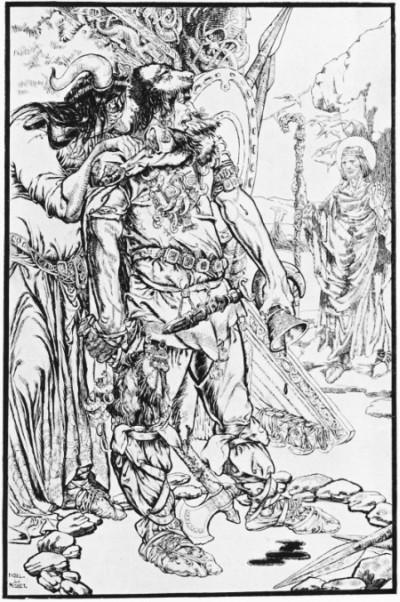
He became as cold as the Death, and there was not a
drop of blood running in his veins when an old little
grey maneen came up to him and said, "Isn't it lucky
we met you, Teig O'Kane?"
Poor Teig could not bring out a word at all, nor open
his lips, if he were to get the world for it, and so he gave
no answer.
"Teig O'Kane," said the little grey man again, "isn't
it timely you met us?"
Teig could not answer him.
"Teig O'Kane," says he, "the third time, isn't it
lucky and timely that we met you?"
But Teig remained silent, for he was afraid to return
an answer, and his tongue was as if it was tied to the roof
of his mouth.
The little grey man turned to his companions, and there
was joy in his bright little eye. "And now," says he,
"Teig O'Kane hasn't a word, we can do with him what
we please. Teig, Teig," says he, "you're living a bad
life, and we can make a slave of you now, and you cannot
withstand us, for there's no use in trying to go against us.
Lift that corpse."
Teig was so frightened that he was only able to utter the
two words, "I won't;" for as frightened as he was,
he was obstinate and stiff, the same as ever.
"Teig O'Kane won't lift the corpse," said the little
maneen, with a wicked little laugh, for all the world like the
breaking of a lock of dry kippeens, and with a little harsh
voice like the striking of a cracked bell. "Teig O'Kane
won't lift the corpse—make him lift it;" and before the
word was out of his mouth they had all gathered round
poor Teig, and they all talking and laughing through
other.
Teig tried to run from them, but they followed him, and
a man of them stretched out his foot before him as he ran,
so that Teig was thrown in a heap on the road. Then
before he could rise up, the fairies caught him, some by
the hands and some by the feet, and they held him tight, in
a way that he could not stir, with his face against the ground.
Six or seven of them raised the body then, and pulled it
over to him, and left it down on his back. The breast of
the corpse was squeezed against Teig's back and shoulders,
and the arms of the corpse were thrown around Teig's
neck. Then they stood back from him a couple of yards,
and let him get up. He rose, foaming at the mouth and
cursing, and he shook himself, thinking to throw the
corpse off his back. But his fear and his wonder were
great when he found that the two arms had a tight hold
round his own neck, and that the two legs were squeezing
his hips firmly, and that, however strongly he tried, he
could not throw it off, any more than a horse can throw
off its saddle. He was terribly frightened then, and he
thought he was lost. "Ochone! for ever," said he to
himself, "it's the bad life I'm leading that has given the
good people this power over me. I promise to God and
Mary, Peter and Paul, Patrick and Bridget, that I'll mend
my ways for as long as I have to live, if I come clear out
of this danger—and I'll marry the girl."
The little grey man came up to him again, and said he to
him, "Now, Teigeen," says he, "you didn't lift the body
when I told you to lift it, and see how you were made to
lift it; perhaps when I tell you to bury it you won't bury
it until you're made to bury it!"
"Anything at all that I can do for your honour," said
Teig, "I'll do it," for he was getting sense already, and if it
had not been for the great fear that was on him, he never
would have let that civil word slip out of his mouth.
The little man laughed a sort of laugh again. "You're
getting quiet now, Teig," says he. "I'll go bail but you'll
be quiet enough before I'm done with you. Listen to
me now, Teig O'Kane, and if you don't obey me in all
I'm telling you to do, you'll repent it. You must carry
with you this corpse that is on your back to Teampoll-Démuis,
and you must bring it into the church with you,
and make a grave for it in the very middle of the church,
and you must raise up the flags and put them down again
the very same way, and you must carry the clay out of the
church and leave the place as it was when you came, so
that no one could know that there had been anything
changed. But that's not all. Maybe that the body won't
be allowed to be buried in that church; perhaps some
other man has the bed, and, if so, it's likely he won't
share it with this one. If you don't get leave to bury it
in Teampoll-Démuis, you must carry it to Carrick-fhad-vic-Oruis,
and bury it in the churchyard there; and if
you don't get it into that place, take it with you to Teampoll-Ronáin;
and if that churchyard is closed on you,
take it to Imlogue-Fhada; and if you're not able to
bury it there, you've no more to do than to take it to Kill-Breedya,
and you can bury it there without hindrance.
I cannot tell you what one of those churches is the one
where you will have leave to bury that corpse under the
clay, but I know that it will be allowed you to bury him at
some church or other of them. If you do this work rightly,
we will be thankful to you, and you will have no cause to
grieve; but if you are slow or lazy, believe me we shall
take satisfaction of you."
When the grey little man had done speaking, his comrades
laughed and clapped their hands together. "Glic!
Glic! Hwee! Hwee!" they all cried; "go on, go on,
you have eight hours before you till daybreak, and if you
haven't this man buried before the sun rises, you're lost."
They struck a fist and a foot behind on him, and drove him
on in the road. He was obliged to walk, and to walk fast,
for they gave him no rest.
He thought himself that there was not a wet path, or a
dirty boreen, or a crooked contrary road in the whole
county that he had not walked that night. The night was
at times very dark, and whenever there would come a cloud
across the moon he could see nothing, and then he used
often to fall. Sometimes he was hurt, and sometimes he
escaped, but he was obliged always to rise on the moment
and to hurry on. Sometimes the moon would break out
clearly, and then he would look behind him and see the
little people following at his back. And he heard them
speaking amongst themselves, talking and crying out, and
screaming like a flock of sea-gulls; and if he was to save
his soul he never understood as much as one word of what
they were saying.
He did not know how far he had walked, when at last
one of them cried out to him, "Stop here!" He stood,
and they all gathered round him.
"Do you see those withered trees over there?" says the
old boy to him again. "Teampoll-Démuis is among
those trees, and you must go in there by yourself, for we
cannot follow you or go with you. We must remain here.
Go on boldly."
Teig looked from him, and he saw a high wall that was in
places half broken down, and an old grey church on the
inside of the wall, and about a dozen withered old trees
scattered here and there round it. There was neither leaf
nor twig on any of them, but their bare crooked branches
were stretched out like the arms of an angry man when he
threatens. He had no help for it, but was obliged to go
forward. He was a couple of hundred yards from the
church, but he walked on, and never looked behind him
until he came to the gate of the churchyard. The old
gate was thrown down, and he had no difficulty in entering.
He turned then to see if any of the little people were
following him, but there came a cloud over the moon, and
the night became so dark that he could see nothing. He
went into the churchyard, and he walked up the old
grassy pathway leading to the church. When he reached
the door, he found it locked. The door was large and
strong, and he did not know what to do. At last he drew
out his knife with difficulty, and stuck it in the wood to
try if it were not rotten, but it was not.
"Now," said he to himself, "I have no more to do;
the door is shut, and I can't open it."
Before the words were rightly shaped in his own mind, a
voice in his ear said to him, "Search for the key on the
top of the door, or on the wall."
He started. "Who is that speaking to me?" he cried,
turning round; but he saw no one. The voice said in his
ear again, "Search for the key on the top of the door, or on
the wall."
"What's that?" said he, and the sweat running from
his forehead; "who spoke to me?"
"It's I, the corpse, that spoke to you!" said the voice.
"Can you talk?" said Teig.
"Now and again," said the corpse.
Teig searched for the key, and he found it on the top of
the wall. He was too much frightened to say any more,
but he opened the door wide, and as quickly as he could,
and he went in, with the corpse on his back. It was as
dark as pitch inside, and poor Teig began to shake and
tremble.
"Light the candle," said the corpse.
Teig put his hand in his pocket, as well as he was able,
and drew out a flint and steel. He struck a spark out of it,
and lit a burnt rag he had in his pocket. He blew it until
it made a flame, and he looked round him. The church
was very ancient, and part of the wall was broken down.
The windows were blown in or cracked, and the timber of
the seats was rotten. There were six or seven old iron
candlesticks left there still, and in one of these candlesticks
Teig found the stump of an old candle, and he lit it. He
was still looking round him on the strange and horrid place
in which he found himself, when the cold corpse whispered
in his ear, "Bury me now, bury me now; there is a
spade and turn the ground." Teig looked from him,
and he saw a spade lying beside the altar. He took it
up, and he placed the blade under a flag that was in the
middle of the aisle, and leaning all his weight on the
handle of the spade, he raised it. When the first flag was
raised it was not hard to raise the others near it, and he
moved three or four of them out of their places. The
clay that was under them was soft and easy to dig, but he
had not thrown up more than three or four shovelfuls,
when he felt the iron touch something soft like flesh.
He threw up three or four more shovelfuls from around
it, and then he saw that it was another body that was
buried in the same place.
"I am afraid I'll never be allowed to bury the two
bodies in the same hole," said Teig, in his own mind.
"You corpse, there on my back," says he, "will you be
satisfied if I bury you down here?" But the corpse
never answered him a word.
"That's a good sign," said Teig to himself. "Maybe
he's getting quiet," and he thrust the spade down in the
earth again. Perhaps he hurt the flesh of the other body,
for the dead man that was buried there stood up in the
grave, and shouted an awful shout. "Hoo! hoo!!
hoo!!! Go! go!! go!!! or you're a dead, dead,
dead man!" And then he fell back in the grave again.
Teig said afterwards, that of all the wonderful things
he saw that night, that was the most awful to him. His
hair stood upright on his head like the bristles of a pig,
the cold sweat ran off his face, and then came a tremor
over all his bones, until he thought that he must fall.
But after a while he became bolder, when he saw that
the second corpse remained lying quietly there, and he
threw in the clay on it again, and he smoothed it overhead,
and he laid down the flags carefully as they had been
before. "It can't be that he'll rise up any more," said
he.
He went down the aisle a little further, and drew near
to the door, and began raising the flags again, looking for
another bed for the corpse on his back. He took up three
or four flags and put them aside, and then he dug the clay.
He was not long digging until he laid bare an old woman
without a thread upon her but her shirt. She was more
lively than the first corpse, for he had scarcely taken any
of the clay away from about her, when she sat up and began
to cry, "Ho, you bodach (clown)! Ha, you bodach!
Where has he been that he got no bed?"
Poor Teig drew back, and when she found that she was
getting no answer, she closed her eyes gently, lost her
vigour, and fell back quietly and slowly under the clay.
Teig did to her as he had done to the man—he threw the
clay back on her, and left the flags down overhead.
He began digging again near the door, but before he had
thrown up more than a couple of shovelfuls, he noticed a
man's hand laid bare by the spade. "By my soul, I'll
go no further, then," said he to himself; "what use is
it for me?" And he threw the clay in again on it, and
settled the flags as they had been before.
He left the church then, and his heart was heavy enough,
but he shut the door and locked it, and left the key where
he found it. He sat down on a tombstone that was near
the door, and began thinking. He was in great doubt
what he should do. He laid his face between his two
hands, and cried for grief and fatigue, since he was dead
certain at this time that he never would come home alive.
He made another attempt to loosen the hands of the corpse
that were squeezed round his neck, but they were as tight
as if they were clamped; and the more he tried to loosen
them, the tighter they squeezed him. He was going to
sit down once more, when the cold, horrid lips of the dead
man said to him, "Carrick-fhad-vic-Oruis," and he
remembered the command of the good people to bring
the corpse with him to that place if he should be unable
to bury it where he had been.
He rose up and looked about him. "I don't know the
way," he said.
As soon as he had uttered the words, the corpse stretched
out suddenly its left hand that had been tightened round
his neck, and kept it pointing out, showing him the road he
ought to follow. Teig went in the direction that the fingers
were stretched, and passed out of the churchyard. He
found himself on an old rutty, stony road, and he stood
still again, not knowing where to turn. The corpse
stretched out its bony hand a second time, and pointed out
to him another road—not the road by which he had come
when approaching the old church. Teig followed that
road, and whenever he came to a path or road meeting it,
the corpse always stretched out its hand and pointed with
its fingers, showing him the way he was to take.
Many was the cross-road he turned down, and many
was the crooked boreen he walked, until he saw from him
an old burying-ground at last, beside the road, but there
was neither church nor chapel nor any other building
in it. The corpse squeezed him tightly, and he stood.
"Bury me, bury me in the burying-ground," said the
voice.
Teig drew over towards the old burying-place, and he
was not more than about twenty yards from it, when,
raising his eyes, he saw hundreds and hundreds of ghosts—men,
women, and children—sitting on the top of the wall
round about, or standing on the inside of it, or running
backwards and forwards, and pointing at him, while he
could see their mouths opening and shutting as if they
were speaking, though he heard no word, nor any sound
amongst them at all.
He was afraid to go forward, so he stood where he was,
and the moment he stood, all the ghosts became quiet, and
ceased moving. Then Teig understood that it was trying
to keep him from going in that they were. He walked a
couple of yards forwards, and immediately the whole
crowd rushed together towards the spot to which he was
moving, and they stood so thickly together that it seemed
to him that he never could break through them, even
though he had a mind to try. But he had no mind to
try it. He went back broken and disspirited, and when
he had gone a couple of hundred yards from the burying-ground,
he stood again, for he did not know what way
he was to go. He heard the voice of the corpse in his
ear, saying "Teampoll-Ronáin," and the skinny hand
was stretched out again, pointing him out the road.
As tired as he was, he had to walk, and the road was
neither short nor even. The night was darker than ever,
and it was difficult to make his way. Many was the toss he
got, and many a bruise they left on his body. At last he
saw Teampoll-Ronáin from him in the distance, standing in
the middle of the burying-ground. He moved over
towards it, and thought he was all right and safe, when he
saw no ghosts nor anything else on the wall, and he
thought he would never be hindered now from leaving
his load off him at last. He moved over to the gate,
but as he was passing in, he tripped on the threshold.
Before he could recover himself, something that he could
not see seized him by the neck, by the hands, and by the
feet, and bruised him, and shook him up, and choked him,
until he was nearly dead; and at last he was lifted up, and
carried more than a hundred yards from that place, and
then thrown down in an old dyke, with the corpse still
clinging to him.
He rose up, bruised and sore, but feared to go near the
place again, for he had seen nothing the time he was thrown
down and carried away.
"You, corpse up on my back," said he, "shall I go over
again to the churchyard?"—but the corpse never answered
him. "That's a sign you don't wish me to try it again,"
said Teig.
He was now in great doubt as to what he ought to do,
when the corpse spoke in his ear, and said "Imlogue-Fhada."
"Oh, murder!" said Teig, "must I bring you there?
If you keep me long walking like this, I tell you I'll fall
under you."
He went on, however, in the direction the corpse pointed
out to him. He could not have told, himself, how long he
had been going, when the dead man behind suddenly
squeezed him, and said, "There!"
Teig looked from him, and he saw a little low wall, that
was so broken down in places that it was no wall at all. It
was in a great wide field, in from the road; and only for
three or four great stones at the corners, that were more
like rocks than stones, there was nothing to show that there
was either graveyard or burying-ground there.
"Is this Imlogue-Fhada? Shall I bury you here?"
said Teig.
"Yes," said the voice.
"But I see no grave or gravestone, only this pile of
stones," said Teig.
The corpse did not answer, but stretched out its long
fleshless hand, to show Teig the direction in which he was
to go. Teig went on accordingly, but he was greatly terrified,
for he remembered what had happened to him at the
last place. He went on, "with his heart in his mouth,"
as he said himself afterwards; but when he came to within
fifteen or twenty yards of the little low square wall, there
broke out a flash of lightning, bright yellow and red, with
blue streaks in it, and went round about the wall in one
course, and it swept by as fast as the swallow in the clouds,
and the longer Teig remained looking at it the faster it
went, till at last it became like a bright ring of flame round
the old graveyard, which no one could pass without being
burnt by it. Teig never saw, from the time he was born,
and never saw afterwards, so wonderful or so splendid a
sight as that was. Round went the flame, white and
yellow and blue sparks leaping out from it as it went, and
although at first it had been no more than a thin, narrow
line, it increased slowly until it was at last a great broad
band, and it was continually getting broader and higher,
and throwing out more brilliant sparks, till there was
never a colour on the ridge of the earth that was not to be
seen in that fire; and lightning never shone and flame
never flamed that was so shining and so bright as
that.
Teig was amazed; he was half dead with fatigue, and he
had no courage left to approach the wall. There fell a
mist over his eyes, and there came a soorawn in his head,
and he was obliged to sit down upon a great stone to
recover himself. He could see nothing but the light, and
he could hear nothing but the whirr of it as it shot round
the paddock faster than a flash of lightning.
As he sat there on the stone, the voice whispered once
more in his ear, "Kill-Breedya"; and the dead man
squeezed him so tightly that he cried out. He rose again,
sick, tired, and trembling, and went forwards as he was
directed. The wind was cold, and the road was bad, and
the load upon his back was heavy, and the night was dark,
and he himself was nearly worn out, and if he had had
very much farther to go he must have fallen dead under
his burden.
At last the corpse stretched out its hand, and said to
him, "Bury me there."
"This is the last burying-place," said Teig in his own
mind; "and the little grey man said I'd be allowed to
bury him in some of them, so it must be this; it can't
be but they'll let him in here."
The first faint streak of the ring of day was appearing in
the east, and the clouds were beginning to catch fire, but it
was darker than ever, for the moon was set, and there were
no stars.
"Make haste, make haste!" said the corpse; and Teig
hurried forward as well as he could to the graveyard, which
was a little place on a bare hill, with only a few graves in it.
He walked boldly in through the open gate, and nothing
touched him, nor did he either hear or see anything. He
came to the middle of the ground, and then stood up and
looked round him for a spade or shovel to make a grave.
As he was turning round and searching, he suddenly perceived
what startled him greatly—a newly-dug grave right
before him. He moved over to it, and looked down, and
there at the bottom he saw a black coffin. He clambered
down into the hole and lifted the lid, and found that (as he
thought it would be) the coffin was empty. He had hardly
mounted up out of the hole, and was standing on the
brink, when the corpse, which had clung to him for more
than eight hours, suddenly relaxed its hold of his neck, and
loosened its shins from round his hips, and sank down with
a plop into the open coffin.
Teig fell down on his two knees at the brink of the
grave, and gave thanks to God. He made no delay then,
but pressed down the coffin lid in its place, and threw in
the clay over it with his two hands; and when the grave
was filled up, he stamped and leaped on it with his
feet, until it was firm and hard, and then he left the
place.
The sun was fast rising as he finished his work, and the
first thing he did was to return to the road, and look out
for a house to rest himself in. He found an inn at last,
and lay down upon a bed there, and slept till night. Then
he rose up and ate a little, and fell asleep again till morning.
When he awoke in the morning he hired a horse and
rode home. He was more than twenty-six miles from
home where he was, and he had come all that way with
the dead body on his back in one night.
All the people at his own home thought that he must
have left the country, and they rejoiced greatly when they
saw him come back. Everyone began asking him where
he had been, but he would not tell anyone except his
father.
He was a changed man from that day. He never drank
too much; he never lost his money over cards; and especially
he would not take the world and be out late by
himself of a dark night.
He was not a fortnight at home until he married Mary,
the girl he had been in love with; and it's at their wedding
the sport was, and it's he was the happy man from that day
forward, and it's all I wish that we may be as happy as
he was.

![[uncial: bionn an fírinne féin searbh]](https://openoldbooks.sgp1.digitaloceanspaces.com/books/legends-of-saints-sinners/images/x_052.jpg) , "even truth itself is bitter."
, "even truth itself is bitter."![[uncial: buachaill]](https://openoldbooks.sgp1.digitaloceanspaces.com/books/legends-of-saints-sinners/images/x_063.jpg) )
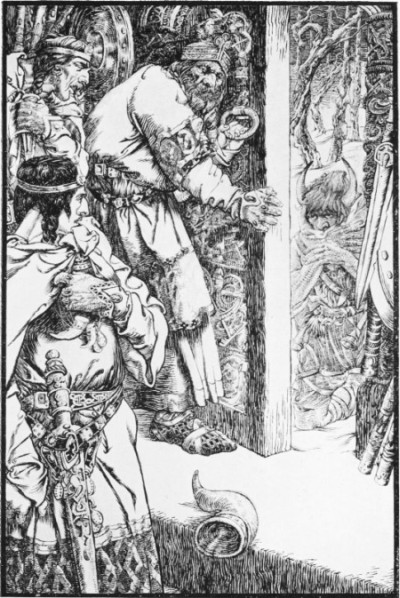
noz," i.e., the boy or herdsman of the night, is well known.
It is generally described as a little child with its head too
large for its body, which only seldom appears, but which
is heard to cry and lament in fields or on deserted roads.
Its apparition is a presage of death. Lebraz in his Légende
de la Mort has more than one story of its appearance.
The salient points in the following story which seem to
connect it with the Breton legend are: (1) The gradual
growth in size of the being which was at first small; (2) the
lamentations and cries which it utters, and (3)—most remarkable
of all—that it described itself as a herdsman,
and was a presage of death.
)
noz," i.e., the boy or herdsman of the night, is well known.
It is generally described as a little child with its head too
large for its body, which only seldom appears, but which
is heard to cry and lament in fields or on deserted roads.
Its apparition is a presage of death. Lebraz in his Légende
de la Mort has more than one story of its appearance.
The salient points in the following story which seem to
connect it with the Breton legend are: (1) The gradual
growth in size of the being which was at first small; (2) the
lamentations and cries which it utters, and (3)—most remarkable
of all—that it described itself as a herdsman,
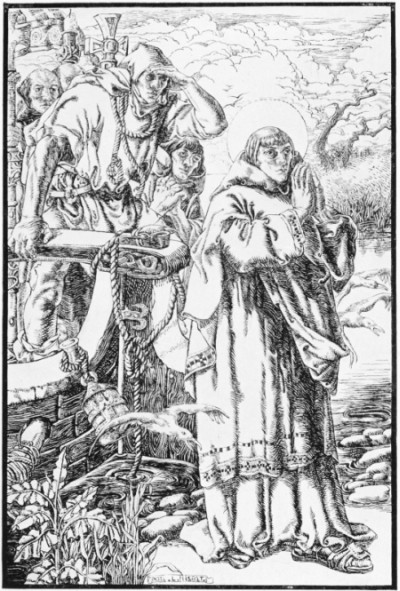
and was a presage of death.![[uncial: Cluain-sosta]](https://openoldbooks.sgp1.digitaloceanspaces.com/books/legends-of-saints-sinners/images/x0631.jpg) in
in ![[Uncial: Ui Failghe]](https://openoldbooks.sgp1.digitaloceanspaces.com/books/legends-of-saints-sinners/images/x0632.jpg) (King's County) about the year
690. He was of the race of the
(King's County) about the year
690. He was of the race of the ![[Uncial: Dalriada]](https://openoldbooks.sgp1.digitaloceanspaces.com/books/legends-of-saints-sinners/images/x0633.jpg) or Scoto-Irish,
and was 21st in descent from
or Scoto-Irish,
and was 21st in descent from ![[Uncial: Cairbre Riada]](https://openoldbooks.sgp1.digitaloceanspaces.com/books/legends-of-saints-sinners/images/x0634.jpg) who fought
in the battle of
who fought
in the battle of ![[Uncial: Ceann Feadrat]](https://openoldbooks.sgp1.digitaloceanspaces.com/books/legends-of-saints-sinners/images/x0635.jpg) in 186
in 186 

![[uncial: mhúch coinneal na carraige le na rmérdeadh,]](https://openoldbooks.sgp1.digitaloceanspaces.com/books/legends-of-saints-sinners/images/x_283a.jpg) "
"who quenched the candle of the Rock by his nod."
"
"who quenched the candle of the Rock by his nod."
![[Uncial: críoch.]](https://openoldbooks.sgp1.digitaloceanspaces.com/books/legends-of-saints-sinners/images/x_295n.jpg)
![[Uncial: ainm-bréige]](https://openoldbooks.sgp1.digitaloceanspaces.com/books/legends-of-saints-sinners/images/x_321a.jpg) of
of ![[Uncial: Seághan Crón]](https://openoldbooks.sgp1.digitaloceanspaces.com/books/legends-of-saints-sinners/images/x_321b.jpg) . In this
version Bearachan is not a saint but a druid, and the
three kings are Finn Mac Cumhaill king of the Fian, one
of the provincial kings, and the hound Bran, the king of
all hounds. The thing that wailed so piteously outside
the door is called an "iarmhar," pronounced Eervar or
Eerwar—there is no such creature known to me. The
word is used by Keating as meaning a "remnant." He
talks of the Iarmhar or Remnant of the Fir Bolg. I
have never met the word in any other sense. There is
nothing said in this version about its growing large
when it got the heat, and the relationship to the Breton
Buguel Noz is not so apparent as in the other story.
. In this
version Bearachan is not a saint but a druid, and the
three kings are Finn Mac Cumhaill king of the Fian, one
of the provincial kings, and the hound Bran, the king of
all hounds. The thing that wailed so piteously outside
the door is called an "iarmhar," pronounced Eervar or
Eerwar—there is no such creature known to me. The
word is used by Keating as meaning a "remnant." He
talks of the Iarmhar or Remnant of the Fir Bolg. I
have never met the word in any other sense. There is
nothing said in this version about its growing large
when it got the heat, and the relationship to the Breton
Buguel Noz is not so apparent as in the other story.