KE-AU-NINI
Ku-aha-ilo was a demon who had no
parents. His great effort was to find something
to eat—men or any other kind of food. He
was a kupua—one who was sometimes an animal
and sometimes a man. He was said to be the
father of Pele, the goddess of volcanic fires.
Nakula-uka and Nakula-kai were the parents
of Hiilei, who was the mother of Ke-au-nini.
Nakula-kai told her husband that she was with
child. He told her that he was glad, and if it
were a boy he would name him, but if a girl she
should name the child.
The husband went out fishing, and Nakula-kai
went to see her parents, Kahuli and Kakela.
The hot sun was rising, so she put leaves over
her head and came to the house. Her father
was asleep. She told her mother about her
condition. Kahuli awoke and turning over
shook the land by his motion, i.e., the far-away
divine land of Nuu-mea-lani. He asked his
daughter why she had come, and when she told
him he studied the signs and foretold the birth
of a girl who should be named Hina.
Kahuli's wife questioned his knowledge. He
said: "I will prepare awa in a cup, cover it with
white kapa, and chant a prayer. I will lift the
cover, and if the awa is still there I am at fault.
If the awa has disappeared I am correct. It will
be proved by the awa disappearing that a girl
will be born.
"I was up above Niihau.
O Ku! O Kane! O Lono!
I have dug a hole,
Planted the bamboo;
The bamboo has grown;
Find that bamboo!
It has grown old.
The green-barked bamboo has a green bark;
The white-barked bamboo has a white bark.
Fragments of rain are stinging the skin—
Rain fell that day in storms,
Water pouring in streams.
Mohoalii is by the island,
Island cut off at birth from the mainland;
Many islands as children were born."
A girl was born, and the grandparents kept the
child, calling her Hina. She cried, and the grandmother
took her in her arms and sang:
"Fishing, fishing, your father is fishing,
Catching the opoa-pea."
Nakula-kai went down to her home. Her husband
returned from fishing. He said he thought
another child was born. He had heard the
thunder, but no storm. She told him that a
boy was born. Nakula-uka named that boy
Ke-au-miki (stormy or choppy current). Ten
days afterward another boy was born. He was
named Ke-au-kai (current toward the beach).
These children had no food but awa. Their
hair was not cut. They were taken inside a
tabu temple and brought up. Nakula-uka and
his wife after a long time had another girl named
Hiilei (lifted like a lei on the head). The grandparents
took the child. She was very beautiful
and was kept tabu. Her husband should be
either a king or a male kupua of very high birth.
When she had grown up she heard noises below
her woodland home several times, and she was
very curious. She was told, "That comes from
the surf-riding."
Hiilei wanted to go down and see. The
grandmother said, "Do not go, for it would mean
your death." Once more came the noise, and
she was told it was "spear-throwing." The girl
wanted to know how that was done. The grandparents
warned her that there was great danger,
saying: "The path is full of trouble. Dragons
lie beside the way. Ku-aha-ilo, the mo-o
[dragon], is travelling through the sky, the
clouds, the earth, and the forest. His tongue is
thrusting every way to find food. He is almost
starved, and now plans to assume his human
form and come to Nuu-mea-lani, seeking to find
some one for food. You should not go down to
the beach of Honua-lewa [the field of sports]."
But Hiilei was very persistent, so the grandmother
at last gave permission, saying: "I will
let you go, but here are my commands. You are
quite determined to go down, but listen to me.
Ku-aha-ilo is very hungry, and is seeking food
these days. When you go down to the grove of
kukui-trees, there Ku-aha-ilo will await you and
you will be afraid that he will catch you. Do not
be afraid. Pass that place bravely. Go on the
lower side—the valley-side—and you cannot be
touched. When that one sees you he will change
into his god-body and stand as a mo-o. Do
not show that you are afraid. He cannot touch
you unless you are afraid and flee. Keep your
fear inside and give 'Aloha' and say, 'You are a
strangely beautiful one.' The dragon will think
you are not afraid. Then that mo-o will take
another body. He will become a great caterpillar.
Caterpillars will surround you. You
must give 'Aloha' and praise. Thus you must
do with all the mysterious bodies of Ku-aha-ilo
without showing any fear. Then Ku-aha-ilo
will become a man and will be your husband."
So the girl went down, dressed gorgeously by
the grandmother in a skirt of rainbow colors,
flowers of abundant perfumes—nothing about
her at fault.
She came to the kukui grove and looked all
around, seeing nothing, but passing further along
she saw a mist rising. A strong wind was coming.
The sun was hot in the sky, making her
cheeks red like lehua flowers. She went up
some high places looking down on the sea. Then
she heard footsteps behind her. She looked
back and saw a strange body following. She
became afraid and trembled, but she remembered
the words of her grandmother, and turned and
said, "Aloha," and the strange thing went away.
She went on and again heard a noise and looked
back. A whirlwind was coming swiftly after
her. Then there was thunder and lightning.
Hiilei said: "Aloha. Why do you try to make
me afraid? Come in your right body, for I know
that you are a real man."
Everything passed away. She went on again,
but after a few steps she felt an earthquake.
Afraid, she sat down. She saw a great thing
rising like a cloud twisting and shutting out the
sun, moving and writhing—a great white piece
of earth in front of a whirlwind.
She was terribly frightened and fell flat on the
ground as if dead. Then she heard the spirit
of her grandmother calling to her to send away
her fear, saying: "This is the one of whom I told
you. Don't be afraid." She looked at the cloud,
and the white thing became omaomao (green).
Resolutely she stood up, shook her rainbow
skirt and flowers. The perfumes were scattered
in the air and she started on. Then the dragons,
a multitude, surrounded her, climbing upon her
to throw her down. Her skin was creeping, but
she remembered her grandmother and said:
"Alas, O most beautiful ones, this is the first
time I have ever seen you. If my grandmother
were here we would take you back to our home
and entertain you, and you should be my playmates.
But I cannot return, so I must say
'Farewell.'"
Then the dragons disappeared and the caterpillars
came into view after she had gone on a
little way. The caterpillars' eyes were protruding
as they rose up and came against her, but
she said, "Aloha."
Then she saw another form of Ku-aha-ilo—a
stream of blood flowing like running water. She
was more frightened than at any other time, and
cried to her grandfather: "E Kahuli, I am
afraid! Save my life, O my grandfather!" He
did not know she had gone down. He told his
wife that he saw Ku-aha-ilo surrounding someone
on the path. He went into his temple and
prayed:
"Born is the night,
Born is the morning,
Born is the thunder,
Born is the lightning,
Born is the heavy rain,
Born is the rain which calls us;
The clouds of the sky gather."
Then Kahuli twisted his kapa clothes full of
lightning and threw them into the sky. A fierce
and heavy rain began to fall. Streams of water
rushed toward the place where Hiilei stood fighting
with that stream of blood in which the dragon
was floating. The blood was all washed away
and the dragon became powerless.
Ku-aha-ilo saw that he had failed in all these
attempts to terrify Hiilei. His eyes flashed and
he opened his mouth. His tongue was thrusting
viciously from side to side. His red mouth was
like the pit of Pele. His teeth were gnashing,
his tail lashing.
Hiilei stood almost paralyzed by fear, but remembered
her grandmother. She felt that death
was near when she faced this awful body of
Ku-aha-ilo. But she hid her fear and called a
welcome to this dragon. Then the dragon fell
into pieces, which all became nothing. The
fragments flew in all directions.
While Hiilei was watching this, all the evil
disappeared and a handsome man stood before
her. Hiilei asked him gently, "Who are you,
and from what place do you come?" He said,
"I am a man of this place." "No," said Hiilei,
"you are not of this land. My grandparents
and I are the only ones. This is our land. From
what place do you come?" He replied: "I am
truly from the land above the earth, and I have
come to find a wife for myself. Perhaps you will
be my wife." She said that she did not want a
husband at that time. She wanted to go down
to the sea.
He persuaded her to marry him and then go
down and tell her brothers that she had married
Ku-aha-ilo. If a boy was born he must be called
Ke-au-nini-ula-o-ka-lani (the red, restful current
of the heavens). This would be their only child.
He gave her signs for the boy, saying, "When
the boy says to you, 'Where is my father?' you
can tell him, 'Here is the stick or club Kaaona
and this malo or girdle Ku-ke-anuenue.' He
must take these things and start out to find me."
He slowly disappeared, leaving Hiilei alone. She
went down to the sea. The people saw her
coming, a very beautiful woman, and they
shouted a glad welcome.
She went out surf-riding, sported awhile, and
then her grandfather came and took her home.
After a time came the signs of the birth of a chief.
Her son was born and named Ke-au-nini. This
was in the land Kuai-he-lani. Kahuli almost
turned over. The land was shaken and tossed.
This was one of the divine lands from which the
ancestors of the Hawaiians came. Pii-moi, a
god of the sun, asked Akoa-koa, the coral, "What
is the matter with the land?" Akoa-koa replied,
"There is a kupua—a being with divine powers—being
born, with the gifts of Ku-aha-ilo." Pii-moi
was said to be below Papaku-lolo, taking care
of the foundation of the earth. The brothers
were in their temple. Ke-au-kai heard the signs
in the leaves and knew that his sister had a child,
and proposed to his brother to go over and get
the child. The mother had left it on a pile of
sugar-cane leaves. They met their sister and
asked for the child. Then they took it, wrapped
it in a soft kapa and went back to the temple.
The temple drum sounded as they came in,
beaten by invisible hands.
The boy grew up. The mother after a time
wanted to see the child, and went to the temple.
She had to wait a little, then the boy came out
and said he would soon come to her. She rejoiced
to see such a beautiful boy as her Ke-au-nini-ula-o-ka-lani.
They talked and rejoiced in
their mutual affection. An uncle came and sent
her away for a time. The boy returned to the
temple, and his uncle told him he could soon go
to be with his mother. Then came an evil night
and the beating of the spirit drum. A mist
covered the land. There was wailing among the
menehunes (fairy folk). Ke-au-nini went away
covered by the mist, and no one saw him go.
He came to his grandfather's house, saw an
old man sleeping and a war-club by the door. He
took this club and lifted it to strike the old man,
but the old man caught the club. The boy
dropped it and tried to catch the old man. The
old man held him and asked who he was and to
what family he belonged. The boy said: "I
belong to Kahuli and Kakela, to Nakula-uka and
Nakula-kai. I am the son of Ku-aha-ilo and
Hiilei. I have been brought up by Ke-au-miki
and Ke-au-kai. I seek my mother."
The old man arose, took his drum and beat it.
Hiilei and her mother came out to meet the boy.
They put sacrifices in their temple for him and
chanted to their ancestor-gods:
"O Keke-hoa-lani, dwell here;
Here are wind and rain."
By and by Ke-au-nini asked his mother, "Where
is my father?" She told him: "You have no
father in the lands of the earth. He belongs to
the atmosphere above. You cannot go to find
him. He never told me the pathway to his
home. You had better stay with me." He
replied: "No I cannot stay here. I must go to
find my father." He was very earnest in his
purpose.
His mother said: "If you make a mistake, your
father will kill you and then eat you and take
all your lands. He will destroy the forests and
the food plants, and all will be devoured by your
father. His kingdom is tabu. If you go, take
great care of the gifts, for with these things you
succeed, but without them you die." She showed
him the war-club and the rainbow-girdle, and
gave them into his care. The boy took the
gifts, kissed his mother, went outside and
looked up into the sky.
He saw wonderful things. A long object
passed before him, part of which was on the earth,
but the top was lost in the clouds. This was
Niu-loa-hiki, one of the ancestor-gods of the
night. This was a very tall cocoanut-tree, from
which the bark of cocoanuts fell in the shape
of boats. He took one of these boats in his
hands, saying, "How can I ride in this small
canoe?"
He went down to the sea, put the bark boat in
the water, got in and sailed away until the land
of Nuu-mea-lani was lost. His uncle, Ke-au-kai,
saw him going away, and prayed to the aumakuas
(ancestral ghost-gods) to guard the boy. The
boy heard the soft voice of the far-off surf, and
as he listened he saw a girl floating in the surf.
He turned his boat and joined her. She told him
to go back, or he would be killed. She was
Moho-nana, the first-born child of Ku-aha-ilo.
When she learned that this was her half-brother,
she told him that her father was sleeping.
If he awoke, the boy would be killed.
The boy went to the shore of this strange land.
Ku-aha-ilo saw him coming, and breathed out
the wind of his home against the boy. It was
like a black whirlwind rushing to the sea.
The boy went on toward his father's tabu place,
up to Kalewa, in the face of the storm. He saw
the tail of Ku-aha-ilo sweep around against him
to kill him. He began his chants and incantations
and struck his war-club on the ground.
Lava came out and fire was burning all around
him. He could not strike the tail, nor could the
tail strike him. Ku-aha-ilo sent many other
enemies, but the war-club turned them aside.
The earth was shaking, almost turning upside
down as it was struck by the war-club. Great
openings let lava fires out. Ku-aha-ilo came out
of his cave to fight. His mouth was open, his
tongue outstretching, his eyes glaring, but the
boy was not afraid. He took his club, whirled
it in his hand, thinking his father would see it,
but his father did not see it. The boy leaped
almost inside the mouth and struck with the club
up and down, every stroke making an opening
for fire.
The father tried to shut his mouth, but the
boy leaped to one side and struck the father's
head. The blow glanced aside and made a great
hole in the earth, which let out fire. The dragon
body disappeared and came back in another form,
as a torrent of blood. Ke-au-nini thrust it aside.
Then a handsome man stood before him with
wild eyes, demanding who he was. Ku-aha-ilo
had forgotten his son, and the miraculous war-club
which he had given to Hiilei, so he began to
fight with his hands. Ke-au-nini laid his club
down. The father was near the end of his
strength, and said, "Let our anger cease, that we
may know each other." The boy was very angry
and said: "You have treated me cruelly, when I
only came to see you and to love you. You
would have taken my young life for sacrifice.
Now you tell me you belong to the temple of my
ancestors in Nuu-mea-lani." Then he caught
his father and lifted him up. He tossed him,
dizzy and worn out, into the air, and catching the
body broke it over his knee. Ku-aha-ilo had
killed and eaten all his people, so that no one was
left in his land. The boy's sister saw the battle
and went away to Ka-lewa-lani (the divine far-away
cloud-land).
Ke-au-nini returned on his ocean journey to
Nuu-mea-lani. The uncle saw a mist covering
the sea and saw the sign of a chief in it, and knew
that the boy was not dead, but had killed Ku-aha-ilo.
The boy came and greeted them and
told the story. He remained some time in the
temple and dreamed of a beautiful woman.
The brothers talked about the power of Ke-au-nini
who had killed his father, a man without
parents, part god and part man. They thought
he would now kill them. Ke-au-nini became pale
and thin and sick, desiring the woman of his
dream. Finally he told the brothers to find that
woman or he would kill them.
Ke-au-kai told him that he would consult the
gods. Then he made a red boat with a red mast
and a red sail and told Ke-au-miki to go after
Hiilei, their sister.
Hiilei came down to stay with her son while
the brothers went away to find the girl. Ke-au-kai
(broad sea-current) said to Ke-au-miki
(chopped-up current): "You sit in front, I behind.
Let this be our law. You must not turn
back to look at me. You must not speak to me.
I must not speak to you, or watch you."
Ke-au-miki went to his place in the boat. The
other stood with one foot in the boat and one on
the land. He told the boy they would go. If
they found a proper girl they would return; if
not, they would not come back. They pushed
the boat far out to sea by one paddle-stroke.
Another stroke and land was out of sight.
Swiftly leaped the boat over the ocean.
They saw birds on the island Kaula. One
bird flew up. Heavy winds almost upset the
boat and filled it with water up to their chins.
They caught the paddles, bailing-cups, and loose
boards for seats, and held them safe.
The wind increased like a cyclone over them.
Thus in the storm they floated on the sea. Ke-au-nini
by his sorcery saw the swamped canoe.
He ran and told his mother. She sent him to the
temple to utter incantations:
"O wind, wini-wini [sharp-pointed];
O wind full of stinging points;
O wind rising at Vavau,
At Hii-ka-lani;
Stamped upon, trodden upon by the wind.
Niihau is the island;
Ka-pali-kala-hale is the chief."
This chant of Ke-au-nini reached Ke-au-kai, and
the wind laid aside its anger. Its strength was
made captive and the sea became calm.
The boat came to the surface, and they bailed
it out and took their places. Ke-au-kai said to
his brother: "What a wonderful one is that boy
of ours! We must go to Niihau." They saw
birds, met a boat and fisherman, and found
Niihau. When the Niihau people saw them
coming on a wonderful surf wave, they shouted
about the arrival of the strangers. The chief
Ka-pali-kala-hale came down as the surf swept
the boat inland. He took the visitors to his
house and gave gifts of food, kapas, and many
other things. Then they went on their way.
When they were between Niihau and Kauai, the
wind drove the boat back. A whirlwind threw
water into the boat, swamping it. It was sinking
and all the goods were floating away.
Ke-au-nini again saw the signs of trouble
and chanted:
"The wind of Kauai comes; it touches; it strikes;
Rising, whirling; boat filled with water;
The boat slipping down in the sea;
The outrigger sticks in the sand.
Kauai is the island;
Ka-pali-o-ka-la-lau is chief."
The sea became calm. The boat was righted
and the floating goods were put in. They met
canoes and went on a mighty surf wave up the
sands of the beach.
The people shouted, "Aloha!" The chiefess of
that part of Kauai was surf-riding and heard the
people shouting welcome, so she came to land and
found the visitors sitting on the sand, resting.
She took them to the royal home. All the people
of Kauai came together to meet the strangers,
making many presents.
The brothers found no maids sufficiently perfect,
so they crossed over to Oahu, meeting other
trials. At last they went to Hawaii to the place
where Haina-kolo lived, a chiefess and a kua
(goddess).
This was above Kawaihae. They went to
Kohala, seeking the dream-land of Ke-au-nini,
and then around to Waipio Valley. There they
saw a rainbow resting over the home of a tabu
chief, Ka-lua-hine. They landed near the door
of the Under-world. This entrance is through a
cave under water. There they saw the shadow
of Milu, the ruler of the dead. Milu's people
called out, "Here are men breaking the tabu of
the chief." Olopana, a very high chief, heard
the shouts while he was in the temple in the
valley. He saw the visitors chased by the people,
running here and there. Haina-kolo, his sister,
was tabu. Watchmen were on the outside of
her house. They also saw the two men and the
people pursuing, and told Haina-kolo, and she
ordered one of the watchmen to go out and say
to the strangers, "Oh, run swiftly; run, run, and
come inside this temple!" They heard and ran
in. The people stopped on the outside of the
wall around the house. This was a tabu drum
place, and not a temple of safety.
Olopana was in the heiau (temple) Pakaalana.
Haina-kolo asked who they were. They
said they were from Hawaii. She said, "No,
you have come from the sea." Hoo-lei-palaoa,
one of her watchmen, called, and men came and
caught the two strangers, taking them to Olopana,
who was very angry because they had
come into the temple of his sister. So he ordered
his men to take them at once and carry them to
a prison house to die on the morrow. He said if
the prisoners escaped, the watchmen should die
and their bodies be burned in the fire. Toward
morning the two prisoners talked together and
uttered incantations. Ke-au-nini saw by the
signs that they were in some trouble and chanted
in the ears of the watchmen: "They shall not
die. They shall not die."
The watchmen reported to Olopana what they
had heard, then returned to watch. The moon
was rising and the two prisoners were talking.
Ke-au-kai told his brother to look at the moon,
saying: "This means life. The cloud passes,
morning comes." Ke-au-kai prayed and
chanted. The watchmen again reported to Olopana,
giving the words of the chant. In this
chant the family names were given. Olopana
said: "These are the names of my mother's people.
My mother is Hina. Her sister is Hiilei. Her
brothers are Ke-au-kai and Ke-au-miki. They
were all living at Kuai-he-lani. Hina and her
husband Ku went away to Waipio. There she
had her child, Haina-kolo."
Olopana sent messengers for Hina, who was
like the rising moon, giving life, and for her
husband Ku, who was at Napoopoo, asking them
to come and look at these prisoners. They ran
swiftly and arrived by daylight. Hina had been
troubled all night. Messengers called: "Awake!
Listen to the chant of the prisoners, captured
yesterday." And they reported the prayers of
Ke-au-kai. Hina arose and went to the heiau
(temple) and heard the story of her brothers,
who came also with the warriors. Olopana
heard Hina wailing with her brothers, and was
afraid that his mother would kill him because
he had treated his visitors so badly. The
strangers told her they had come to find a wife
for Ke-au-nini. They had looked at the beautiful
women of all the islands and had found none
except the woman at Waipio. Then they told
about the anger of the people, the pursuit, and
their entrance into the tabu temple.
Hina commanded Olopana to come before
them. He took warriors and chiefs and came
over to the temple and stood before his parents.
Hina pronounced judgment, saying: "This chief
shall live because he sent for me. The chiefs and
people who pursued shall die and be cooked in
the oven in which they thought to place the
strangers."
Ku's warriors captured Olopana's men and
took them away prisoners, but Olopana was
spared and made welcome by his uncle. And
they all feasted together for days. Then the
brothers prepared to go after Ke-au-nini.
One man who heard the wailing of the brothers
and knew of the coming of Hina went to his
house, took his wife and children and ran by way
of Hilo to Puna-luu. It was said this man took
his calabash to get water at the spring Kauwila,
and an owl picked a hole in it and let the water
out. For this the owl was injured by a stone
which was thrown at him, and he told the other
birds. They said he was rightly punished for
his fault.
The brothers found their red boat, launched it,
and bade farewell to the chief's people and lands.
They returned to Kuai-he-lani, like a flash of
lightning speeding along the coast from south
to west. The boy in the temple saw them in
their swift boat. He told Hiilei and prepared
for their coming. They landed, feasted, and told
their story. Then they prepared for their journey
to Waipio. Their boat was pulled by fish
in place of boatmen, and these disappeared upon
arrival at Hawaii. Ke-au-kai went first to meet
Olopana, who ran down to see Ke-au-nini and
asked how he came. Ke-au-nini said, "There
was no wandering, no murmuring, no hunger, no
pinched faces."
Then they feasted while over them thunder
and lightning played and mist covered the house.
Awa was thrown before the spirit of the thunder
and they established tabus.
Olopana had trouble with his priests and
became angry and wanted to punish them because
they did not know how to do their work
so well as Ke-au-nini. They could make thunder
and lightnings and earthquakes, but Ke-au-nini
blew toward the east and something like a
man appeared in a cloud of dust; he put his right
hand in the dust and began to make land. Olopana
saw this and thought it was done by the
kahunas (priests) and so he forgave them, thinking
they had more power than Ke-au-nini.
Later he ordered them to be killed and cooked.
Olopana asked Ke-au-nini, "Which of the tabu
houses do you wish to take as your residence?"
Ke-au-nini replied: "My house is the lightning,
the bloody sky, or the dark cloud hanging over
Kuai-he-lani, down the ridge or extending cape
Ke-au-oku, where Ku of Kauhika is, where multitudes
of eyes bend low before the gods. The
house of my parents—there is where I dwell.
You have heard of that place."
Olopana was greatly astonished, bowed his
head and thought for a long time, then said: "We
will set apart our tabu days for worship, and I
will see your tabu place—you in your place and
I outside. When you are through your days of
tabu you must return and we will live together."
Ke-au-nini raised his eyes and spoke softly to
the clouds above him: "O my parents, this my
brother-in-law wishes to see our dwelling-place,
therefore call Ke-au-kai to send down our tabu
dwelling-place."
Ke-au-kai was near him, and said: "We had
very many troubles on the ocean in coming after
the one whom you want for your wife. You
aided us to escape; perhaps the old man in the
skies will hear you if you call." Then Ke-au-nini
turned toward the east:
"Ke-au-nini has his home,
His home with his mother.
Hiilei, the wife,
She was the child of Nakula-uka,
The first-born Kakela.
The cheeks grow red;
And the eyes flash fire.
In the Lewa-lani (heavens),
The very heart of the lightning,
A double rainbow is high arched.
The voice of the Kana-mu are heard.
Calling and crying are the Kana-wa.
[The Kana-mu and the Kana-wa were companies of little people, i.e., fairies.]
I continually call to you, O little ones,
Come here with the white feathers,
Let feathers come here together;
Let all the colors of the tortoise-back
Gather and descend;
Let all the posts stand strong;
Braced shall be the house;
Fasten in also the smoke-colored feathers;
Work swiftly and complete our tabu house."
Then the darkness of evening came, and in the
shadows the little people labored in the moonless
night. Soon their work was done, the house
finished, and a sacred drum placed inside. When
the clear sky of the morning rested over, and the
sun made visible the fairy home in the early
dawn, the people cried out with wonder at the
beautiful thing before them. There stood a
house of glowing feathers of all colors. Posts
and rafters of polished bones shone like the ivory
teeth of the whale, tinted in the smoke of a fire.
Softly swayed the feathered thatch in a gentle
breeze, rustling through the surrounding cocoa-trees.
Most beautiful it was, as in the chant of
Lilinoe:
"Hulei Lilinoe me Kuka-hua-ula;
Hele Hoaheo i kai o Mokuleia."
"Lifted up, blown by the wind are
The falls down to the sea of Mokuleia."
Ke-au-nini told his brother-in-law, "Oh, my
brother, look upon my tabu dwelling-place as
you wished."
Olopana was very curious, and asked, "How
many people are needed to make a house like
this so quickly?" Ke-au-nini laughed and said,
"You have seen my people: there are three of
us who built this house—I, the chief, and my
two friends."
He did not give the names of the little people,
Kana-mu and Kana-wa, who were really great
multitudes, like the menehunes who made the
ditch at Waimea, Kauai. They were the one-night
people. All this work was finished while
they alone could see clearly to use their magic
powers.
Inside the house lay soft mats made from feathers
of many birds, and sleeping-couches better
than had ever been seen before. Ke-au-nini
said to his brother-in-law: "We are now ready
to have the tabu of our house. My parents will
enter with me."
Olopana asked his kahunas if it were right for
the parents to stay with the chief during a tabu,
under the law of their land. The priests consulted
and told Olopana that this was all right.
They had no power to forbid. The parents had
divine power, so also the boy, both alike, and
could dwell together without breaking tabu.
Then they said, "If you forbid, you will be landless."
Ke-au-kai and Ke-au-miki entered the house
with their young chief. Ke-au-miki beat the
sacred drum, announcing the tabu. They poured
and drank awa, ate sugar-cane and chanted softly
to the rhythm of the drum. Olopana was filled
with jealousy because all was hidden from him.
He did not know what a drum was. He had only
known a time of tabu, but not the secret drum,
and the soft chant.
During the ten days' tabu Ke-au-nini did not
see his wife, but remained shut in his place. Olopana
called for all the people to bring presents.
When the tabu was over and the temple door
opened, Ke-au-nini and Haina-kolo prepared for
the marriage.
All the people came bringing feather mats,
food, fish, and awa, which had been growing on
a tree. Hamakua sent food and fish; Hilo sent
olona and feathers; Puna sent mats and awa
from the trees; Kau sent kapa; Kona sent red
kapas; Kohala sent its wonderful noted sweet
potatoes. The young chiefess appeared before all
the people, coming from her tabu place, and she
saw all the fine presents, and a great cocoanut-leaf
lanai (porch) prepared by her brother. She
came there before her parents and brother. They
were waiting for Ke-au-nini, who delayed coming.
Olopana asked his priests: "Why does the
young chief fail to appear? We are all ready for
the marriage feast." The priest said to Olopana:
"Do you think that you can treat this man as
one of us? He is a god on his father's side and
also on his mother's. He is very high. It is
on his mother's side that you are related. You
should go to him with a sacrifice. Take a black
pig, a cup of awa, a black chicken, and a cocoanut.
If we do not do these things we shall not
know where he is staying, for he is under the
care of the gods. Now is the right time to go
with the offering. Go quickly. The sun is rising
high in the sky."
Olopana quickly gathered the offerings and
went away to sacrifice before Ke-au-nini. He
called him thus:
"Rise up! Let your strength look inland;
Let your might look toward the sea;
Let your face look upward;
Look up to the sun over your head;
The strange night has passed. Awake!
Here are the offerings,—
Food for the gods:
Let life come!"
He set the pig free and it ran to the feet of
Ke-au-nini. The chicken did the same, and the
other offerings were laid before the door. Olopana
went back. Ke-au-nini and his uncles
awoke. He said to them: "Now the tabu is
lifted. Now the hour of the marriage has come.
We must prepare to go down to the sea. We
shall see the sports of this land. Soon we shall
meet the priests and the people."
They arose and opened their bundles of kapa,
very fine and soft for red malos (girdles) for the
uncles. Ke-au-nini put on his malo, called
Ke-kea-awe-awe-ula (the red girdle with long
ends, shaded in the tints of the rainbow) and
his red feather cloak and his red feather helmet,
nodding like a bird. His skin, polished and
perfumed, shone resplendently. He was most
gorgeous in his appearance.
When he went out of his house, thatched with
bird feathers and built of polished bones, darkness
spread over the sky. The voices of the
little fairies, the Kana-mu and Kana-wa were
heard. The people in the great cocoanut lanai
were filled with wonder, for they had never seen
darkness come in this way. It was like the sun
eclipsed. When Ke-au-nini and his companions
entered the lanai, the darkness passed away and
all the people saw them in their splendor. The
chiefs opened a way for the three. Ke-au-miki
came in first and the people thought he was the
husband, but when Ke-au-kai came they said,
"This one is more beautiful," and when Ke-au-nini
passed before them they fell on their faces,
although he had a gauze kapa thrown over him.
He passed on between rows of chiefs to the
place of marriage. His uncles stepped aside, and
then he threw off his thin kapa and the people
shouted again and again until the echoes shook
the precipices around the valley.
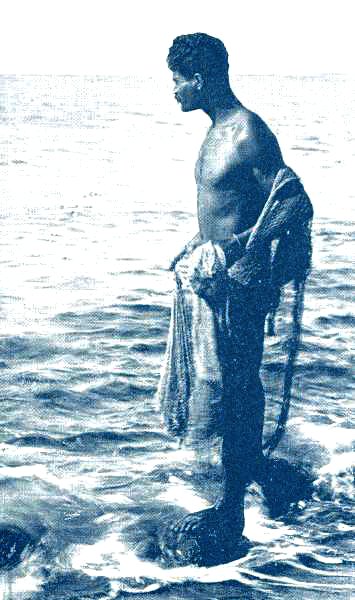
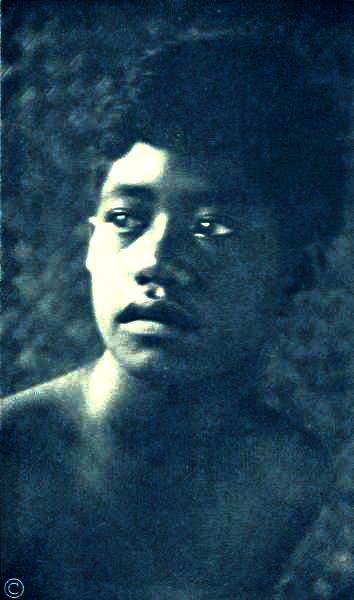 A YOUNG CHIEF OF HAWAII
Then Haina-kolo came out of her house near
by and was guided to the side of her husband.
As she saw him her heart melted and flowed to
him like the mingling of floating sea-mosses.
Olopana arose and said: "O chiefs and people,
I have been asked to come here to the marriage
of my sister with one whom she has met in dreams
and loved. I agree to this wedding. Our parents
approve, and the gods have given their signs.
Our chiefess shall belong to the stranger. You
shall obey him. I will do as he may direct.
They shall now become husband and wife."
The people shouted again and again, saying,
"This is the husband of our chiefess." Then
began the hookupu. Six districts brought six
piles of offerings. There were treasures and
treasures of all kinds. Then came the wonderful
feast of all the people.
The fish companions of Ke-au-nini, who had
drawn his boat from Kuai-he-lani, wanted Haina-kolo
for themselves. While they were at the
feast they found they could not get her, and they
grew cold and ashamed and angry. Soon they
broke away from the feast. Moi and Uhu ran
away to the sea and returned to their homes.
Niu-loa-hiki (a great eel) looked at Ke-au-nini
and said: "You are very strange. I thought
I should have my reward this day, but the winning
has come to you. I am angry, because you
are my servant. It is a shame for the chiefs of
Hawaii to let you become their ruler." His
angry eyes flashed fire, he opened his mouth and
started to cry out again, but the people saw him
and shouted: "Look, look, there is an eel that
comes to the land. He runs and dives into the
sea. This eel, Niu-loa-hiki, is more evil than
any other of all the family of eels."
Then all the fish ran off angry at this failure
and gathered in the sea for consultation. Uhu
said he would return at once to Makapuu. He
was the Uhu who had the great battle with
Kawelo when he was caught in a net. Moi went
to the rough water outside the harbor. Kumunuiaiake
went to Hilo. He was the huge fish
with which Limaloa had a great battle when he
came to visit Hawaii. He was killed by Limaloa.
Hou and Awela went wherever they could find
a ditch to swim in.
The people feasted on the mullet of Lolakea
and the baked dogs of Hilo and the humpbacked
mullet of Waiakea and all the sweet things of
Hawaii. Then the sports commenced and there
was surf-riding, dancing, wrestling, and boxing.
Kawelo-hea, the surf-rider of Kawa
in Oahu,
was the best surf-rider. Hina-kahua, the child
of the battling-places of Kohala, was the best
boxer. Pilau-hulu, the noted boy of Olaa, was
the best puhenehene-player. Lilinoe was the
best konane-player. Luu-kia was the best kilu-player.
She was a relative of Haina-kolo.
When the sports were over they returned to
the chief's house and slept. Haina-kolo was one
who did not closely adhere to the tabu. She ate
the tabu things, which were sacred, belonging to
the gods, such as bananas and luau. Ke-au-nini
had always carefully, from his birth to marriage-day,
observed the tabu, but, following the example
of his wife, soon laid aside his carefulness, and
lived in full disregard of all restraint for a time.
Then Ke-au-nini left Haina-kolo and returned
to Kuai-he-lani because dissensions arose between
them on account of their wrong-doing.
He did not tell his wife or friends, or even his
uncles, but he took his cocoanut-boat to go back
to his home secretly. When he was far out in
the ocean his sister saw him from her home in
Lewa-lani (the blue sky). She sent Kana-ula,
her watchman, to go out and guard him and bring
him to her. Kana-ula was a strong wind blowing
with the black clouds which rise before a storm.
In a little while the watchman saw Ke-au-nini
off Kohala, and by his great strength lifted Ke-au-nini
and placed him on Kuai-he-lani, where he
saw his mother and relatives. Then he went up
to Lewa-lani to his sister and dwelt with her to
forget his love for Haina-kolo.
Haina-kolo had a great love for her husband,
never making any trouble before they separated.
Her love for him was burning and full of passion,
while she grieved over his disappearance. She
soon had a child. The priests living in the heiau
(temple), Pakaalana, beat their drums, and all
Waipio knew that a chief was born.
Haina-kolo began to go about like one crazed,
longing to see the eyes of her husband. She took
her child and launched out in the ocean. The
boat in which she placed the child was the long
husk of a cocoanut. She held fast to this and
swam and floated by its side. When they had
gone far out in the sea a great wind swept over
them and upon them, driving them far out of
sight of all land. She looked only for death.
This wind was Kana-ula, and had been sent by
Moho, who was very angry at the girl for violating
the tabu of the gods and eating the things
set apart for the gods. This wind was to blow
her far away on the ocean until death came.
When Haina-kolo had been blown a little way
she prayed and moved her feet, turning toward
the place where she had rejoiced with her husband.
Then she offered another prayer and
began to swim, but was driven out of sight of
land. The wind ceased, its anger passed away,
and a new land appeared. She swam toward
this new land. Lei-makani, the child, saw this
land, which was the high place of Ke-ao-lewa,
and chanted:
"Destroy the first kou grove;
Destroy the second kou grove;
Open a wonderful door in the evening;
Offer your worship.
Return, return, O bird!"
The mother said: "No, my child, that is not a
bird. Oh, my child, that is Ke-ao-lewa, the
land where we shall find a shore."
But she went on patiently, swimming by the
capes of Kohala, and came near to the places of
noted surf and was almost on the land. Moho
saw her still swimming and sent another wind
servant, Makani-kona, the south wind, to drive
her again out in the ocean. This south wind
came like a whirlwind, sweeping and twisting
over the waves, sending Haina-kolo far out in
the tossing sea. He thought he had killed her,
so he went back to Moho.
Moho asked him about his journey over the
seas. He replied, "You sent me to kill, and that
I did." She was satisfied and ceased her vigilance.
Tired and suffering, Haina-kolo and her
child floated far out in the ocean, too weary to
swim. Then Lei-makani saw Ke-ao-lewa again
lifted up and spread out like the wings of a floating
bird. Help came to her in a great shark,
Kau-naha-ili-pakapaka (Kau-naha, with a rough
skin), belonging to the family of Pii-moi, one of
the relatives of Ku, who swam up to her and
carried her and the child until he was tired.
Haina-kolo was rested and warmed by the sun.
She saw that her shark friend was growing weak,
so she called to the sun, "O sun, go on your way
to the land of Ka-lewa-nuu, and tell Ke-au-nini
that we are here at the cape of Ka-ia."
The sun did not hear the cry from the sea.
She called again, using the same words. The sun
heard this call of Haina-kolo and went on to the
place where Ke-au-nini was staying and called
to him, "O Ke-au-nini, your wife is near the
cape of Ka-ia."
Moho heard the call. She was playing konane
with her brother. She made a noise to confuse
the words of the sun, and said to her brother,
"O ke ku kela, o ka holo keia. Niole ka luna,
kopala ka ele, na ke kea ka ai." "Take this one
up. Let that one move. Take that up slowly.
The black is blotted out, the white wins."
Then the sun called again, saying the same
words, and Ke-au-nini heard, leaped up and left
his sister, and went down to Kuai-he-lani and
entered the temple, where he was accustomed to
sleep, and fell as one dead. While he was reclining,
his spirit left his body and went down to
Milu and stayed there a long time.
Haina-kolo was very near the land in the
afternoon. Soon they came to the beach. There
she dug a little hole for her child and laid him in
his little boat in it and went up the path like a
crazy person to the top of the high precipices of
Ka-hula-anu (the cold dancing) and began to
eat fruit growing on the trees. She clothed herself
in leaves, then rushed into the forest.
Lei-makani was still floating where his mother
had left him, near a place where the servants of
Luu-kia went fishing every morning to get the
food loved by the chiefs. Two men, Ka-holo-holo-uka
and Ka-holo-holo-kai, had come down
for Luu-kia, carrying a net. They threw their
net over the water and the child floated into it.
They thought they had a great fish. They
carried the net up on the beach and found the
boy. It was a little dark, and hard to see what
they were catching. One called to the other,
"What have we caught this morning?" The
other said: "I thought we had a great fish, but
this is a child. I will take this child to my
home." The other said, "No—This is a fish."
So they had a quarrel until the sun rose. Then
they went up to the village.
Ka-holo-holo-uka told his wife, "We have a
child." Then he told her how they had caught
Lei-makani. They talked loudly. This chiefess
heard their noisy clamor and asked her servant,
"What's the trouble with these noisy ones?"
They told her and she wanted that child brought
to her, and commanded Maile-lau-lii (small leaf
maile) to go and get it. He took it to Luu-kia,
who marked its wonderful beauty. She sent
for the fishermen to tell her how they got the
child. They told her about the fishing.
She wanted to know who were the parents.
They said: "We do not know. This may be the
child of Haina-kolo, for we know she has disappeared
with her child. She may be dead and
this may be her boy."
Luu-kia said, "You two take the child, and I
will give the name, Lopa-iki-hele-wale [going
without anything]. Then you care for it until
it grows up."
They took the child to the land of Opaeloa, as
a good place to bring it up. The fishermen said
to Luu-kia, "Will you provide food, fish, and
clothing?" She said, "Yes." They thought the
child would not understand, but it knew all these
words. The fisherman and his wife took the
child away. Waipio Valley people were surrounded
by precipices, but the gods of Waipio
watched all the troubles by sending messengers
to go over to the upland and follow Haina-kolo.
Ku and Hina and Olopana were burdened by
the loss of Haina-kolo and Lei-makani, so they
went to the temple at Pakaalana, where the
uncles of Ke-au-nini were staying. There they
consulted the gods with signs and sorceries.
They sent Ke-au-miki to get some little
stones at Kea-au, a place near Haena. His
brother said: "Get thirteen stones—seven white
and six black. Make them fast in a bundle, so
they cannot be lost, then come back by Pana-ewa
and get awa (piper methysticum) which man
did not plant, but which was carried by the birds
to the trees and planted there. Then return
this evening and we will study the signs." Ke-au-miki
went up the pali (precipice) and hastened
along the top running and leaping and
flying over Hamakua to Hilo.
The Hilo palis were nothing to this man as
he sped swiftly over the gulches until he came
to the Wailuku River guarded by the kupua
Pili-a-mo-o, who concealed the path so that none
could find it until a price was paid. The dragon
covered the path with its rough skin.
Ke-au-miki stood looking for a path, but could
only see what seemed to be pahoehoe lava. The
tail of the dragon was like a kukui-tree-trunk
lying in the water. He saw the tail switching
and rising up to strike him. Then he knew that
this was a kupua. The tail almost struck him
on the head. He called to Kahuli in Kuai-he-lani,
who sent a mighty wind and hurled aside the
waters, caught up the body of the dragon and
let it fall, smashing it on the rocks, breaking the
beds of lava.
Then Ke-au-miki rushed over the river and up
the precipices, speeding along to Pa-ai-ie, where
the long ohia point of Pana-ewa is found, then
turned toward the sea and went to Haena, to
the place where the little stones aala-manu are
found. He picked up the stones and ran to
Pana-ewa and got the awa hanging on the tree,
tied up the awa and stones and hurried back.
He crossed the gulch at Konolii and met a man,
Lolo-ka-eha, who tried to take the awa away
from him. He was a robber. When they came
face to face, Ke-au-miki caught the man with
his hand, hurled him over the precipice and killed
him. When he saw that this man was dead, he
ran as swiftly as the wind until he met a very
beautiful woman, Wai-puna-lei. She saw him
and asked him to be her husband, but he would
not stop. He crossed Hilo boundaries to Hamakua,
to the place where the kapa-trees were growing,
as the sun was going down over the palis.
He came to the temple door and laid down his
burden.
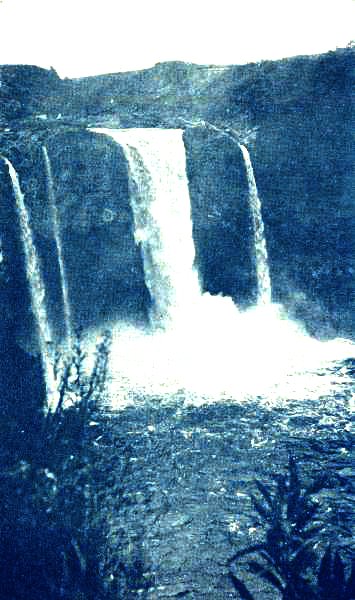 THE HOME OF THE DRAGONS NEAR HILO
Then Ke-au-kai said: "This is my word to all
the people: Prepare the awa while I take the
little stones, pour awa into a cup: I will cover it
up and we will watch the signs. If, while I
chant, the bubbles on the awa come to the left
side, we will find Haina-kolo. If they go to the
right, she is fully lost. Let all the people keep
silence; no noise, no running about, no sleeping.
Watch all the signs and the clouds in the
heavens."
Then he chanted:
"O Ku and Kane and Kanaloa,
Let the magic power come.
Amama ua noa.
Tabu is lifted from
My bird-catching place for food.
You are a stranger, I am a resident.
Let the friend be taken care of.
United is the earth of the tabu woman. Amama."
The bubbles stood on the right side, and the
priest said, "We shall never find Haina-kolo;
the gods have gone away." Olopana said: "I
am much troubled for my brother and sister, and
that child I wanted for the chief of this land. I
do not understand why these things have come
to us."
All the people were silent, weeping softly, but
Ke-au-kai and his brother were not troubled, for
they knew their chief and wife were in the care
of the aumakuas.
When Lei-makani had grown up, Luu-kia took
him as her husband. He went surf-riding daily.
She was very jealous of Maile, who would often
go surf-riding with him. Lei-makani did not
care for her, for he knew she was a sister of his
mother although she had a child by him. One
day, when he went with Maile, Luu-kia was
angry and caught that child and killed it by
dashing it against a stone.
The servants went down to the beach, waiting
for Lei-makani to come to land. Then they told
him about the death of his child and their fear
for him if he went up to the house with Maile.
Lei-makani left his surf-board and went to the
house weeping, and found the child's body by
the stone. He took a piece of kapa and wrapped
it up, carrying the broken body down to a fountain,
where he cleansed it and offered chants and
incantations until the child became alive. His
mother, Haina-kolo, heard the following chants
and came to her son, for the voice was carried to
her by kupuas who had magic powers. The
child's name was Lono-kai. He wrapped it again
in soft warm kapas and chanted while he washed
the child, naming the fountain Kama-ahala (a
child has passed away):
"Kama-ahala smells of the blood;
The sick smell of the blood rises.
Washed away in the earth is the blood;
Hard is the red blood
Warmed by the heat of the heavens,
Laid out under the shining sky.
Lono-kai-o-lohia is dead."
Then the voice of the child was heard in a low
moan from the bundle, saying, "Lono-kai-o-lohia
[Lono possessed of the Ala spirit] is alive."
The father heard the voice and softly uttered
another chant:
"In the silence
Has been heard the gods of the night;
What is this wailing over us?
Wailing for the death of
Lono, the spirit of the sea—dead!"
The voice came again from the kapas, "Lono,
the spirit of the sea, is alive." Lei-makani's
love for his child was overflowing, and again he
uttered an incantation to his own parents:
"O Ku, the father!
O Hina, the mother!
Olopana was the first-born;
Haina-kolo, the sister, was born:
Haina-kolo and Ke-au-nini were the parents:
Lei-makani was the child:
I am Lei-makani, the child of Haina-kolo,
The sacred woman of Waipio's precipices;
My mother is living among the ripe halas;
For us was the fruit of the ulii;
I was found by the fisherman;
I am the child of the pali hula-anu;
I was cared for by one of my family
Inland at Opaeloa;
They gave me the name Lopa-iki-hele-wale
[Little lazy fellow having nothing];
But I am Lei-makani—you shall hear it."
His heart was heavy with longing for his
mother, and the gods of the wind, the wind
brothers, took his plaintive love-chant to the
ears of Haina-kolo, who had wandered in her
insanity, but was now free from her craze and
had become herself. She followed that voice
over the precipices and valleys to the top of a
precipice. Standing there and looking down she
saw her child and grandchild below, and she
chanted:
"Thy voice I have heard
Softly echoed by the pali,
Wailing against the pali;
Thy voice, my child beloved;
My child, indeed;
My child, when the cloud hung over
And the rainbow light was above us,
That day when we floated together
When the sea was breaking my heart;
My child of the cape of Ka-ia,
When the sun was hanging above us.
Where have I been?
Tell Ke-au-nini-ula-o-ka-lani;
I was in the midst of the sea
With the child of our love;
My child, my little child,
Where are you? Oh, come back!"
Then she went down the precipice and met
her son holding his child in his arms, and wailed:
"My lord from the fogs of the inland,
From the precipices fighting the wind,
Striking down along the ridges;
My child, with the voice of a bird,
Echoed by the precipice of Pakohi,
Shaking and dancing on inaccessible places,
Laughing out on the broken waters
Where we were floating in danger;
There I loved dearly your voice
Fighting with waves
While the fierce storm was above us
Seen by your many gods
Who dwell in the shining sky—
Auwe for us both!"
They waited a little while, until the time when
Lono-kai became strong again. Then they went
up to the village.
Haina-kolo had run into the forest, her wet
pa-u torn off, no clothing left. Her long hair
was her cloak, clothing her from head to foot.
She wandered until cold, then dressed herself
with leaves. As her right senses returned she
made warm garments of leaves and ate fruits of
the forest. When they came to the village they
met the people who knew Haina-kolo. She
dwelt there until Lono-kai grew up. He and
his father looked like twins, having great resemblance,
people told them, to Ke-au-nini. The boy
asked, "Where is my grandfather, Ke-au-nini?"
Lei-makani said: "I never saw your grandfather.
He was very tabu and sacred. He killed his own
father, Ku-aha-ilo, god of the heavens. I know
by my mana [spirit power] that he is with the
daughters of Milu." The boy said: "I must go
and find him. I will go in my spirit body, leaving
this human body. You must not forbid the
journey." Ke-au-kai, the priest, said: "You cannot
find him unless you learn what to do before
you go. Those chiefs of Milu have many sports
and games. I tell you these things must be
learned before you go into that land. If you
are able to win against the spirits of that place
you can get your grandfather."
All the chiefs aided the boy to acquire skill in
all sports. They went to the fields of Paaohau.
Nuanua, the most skilful teacher of hula, taught
him to dance. The highest chiefs and chiefesses
went with him to help, taking their retinues with
them. Lei-makani said: "The knowledge of
sports is the means by which you will catch your
grandfather. Now be careful. Do not be stingy
with food. Give to others and take care of the
people."
They went up in a great company, and Haina-kolo
wondered at the beauty of the boy, and asked
why they were travelling. Lono-kai told them
the reason for his journey and desire to see the
field of sports.
Nuanua, the hula teacher, sent his assistants
to get all kinds of leaves and flowers used in the
hula, then sent for a black pig to be used as
an omen. If it ran to Lono-kai, he would become
a good dancer; if not, he would fail. The
pig went to him. The priest offered this prayer:
"Laka is living where the forest leaves are trembling,
The ghost-god of dancers above and below,
From the boundary of the North to the place most southern;
O Laka, your altar is covered with leaves,
The dancing leaves of the ieie vine;
This offering of leaves is the labor of the gods,
The gods of your family, Pele and Hiiaka;
The women living in warm winds come here for the toil,
And this labor of ours is learning your dance.
Tabu laid down; tabu lifted. Amama ua noa [We are through]!"
The priest lifted his eyes, and the pig was seen
lying at the foot of the boy. Then he commenced
teaching the boy the kilu and the first dance.
They were thirty days learning the dances, and
the boy learned all those his teachers knew.
Then they went around Hawaii, studying the
dances. He was told to go back and get all the
new ideas and seek the gods to learn their newest
dance, for theirs differed from those of his teachers.
He was to seek this knowledge in dreams.
Lei-makani said: "Your teachers have shown
you the slow way; if that is all you know, you
will win fame, but not victory. You must learn
from the gods." Lono-kai again went to Hamakua
with his companions and learned how to play
konane, the favorite game of Ke-au-nini. The
teacher said, "I have taught you all I know
inside and outside, as I would not teach the
other young chiefs." The boy said to him,
"There is one thing more,—give offerings to the
gods that they may teach us in our dreams
newer and better ways."
So they waited quietly, offering sacrifices. The
priests told him to set apart a pig while he made
a prayer. If the pig died during the prayer, he
would not forget anything learned. The boy
laid his right hand on the pig and began to pray:
"Here is a pig, an offering to the gods.
O Lono in the Under-world, Lono in the sky:
O Kane, who makes not-to-be-broken laws,
Kane in the darkness, Kane in the hot wind,
Kane of the generations, Kane of the thunder,
Kane in the whirlwind and the storm:
Here is labor—labor of the gods.
My body is alive for you!
Filled up is the Nuu-pule.
My prayer is for those you hold dear.
O Laka, come with knowledge and magic power!
Laka, dancing in the moving forest leaves
Of the mountain ridges and the valleys,
Return and bestow the knowledge
Of Pele and Hiiaka, the guardians of the wind,
Knowing the multitude of the gods of the night,
Knowing Aukele-nui-aku in the Under-world.
O people of the night,
Here is the pig, the offering!
Come with knowledge, magic power, and safety.
Amama ua noa."
Then the boy lifted his hand and the pig lay silent
in death. Then came thunder shaking the earth,
and lightning flashing in flames, and a storm
breaking in red rain. Mists came and the shadows
of the thousands of gods of Ke-au-nini fell
upon the boy. The teachers and friends sat in
perfect silence for a long time. The storm was
beating outside, and the boy was overcome with
weariness and wondered at the silence of his
friends.
Rainbow colors were about him, and the people
were awed by their fears and sat still until evening
came. Then the teacher asked the boy if
he saw what had been done in the darkness resting
over him, and if he could explain to them.
The boy said, "I do not understand you; perhaps
my teacher can explain."
Nuanua said: "I am growing old and have
never seen such things above any one learning
the dance. You have come to me modestly, like
one of the common people, when I should have
gone to you, and now the gods show your worth
and power and their favor."
Then he took a piece of wood from the hula
altar which was covered with leaves and flowers,
and, putting it in a cup of awa, shook it, and
looked, and said to the boy: "This is the best I
can do for you. Now the gods will take you in
their care." Then he poured awa into cups,
passing them to all the people as he chanted
incantations, all the company clapping their
hands. Then they drank. But the boy's cup
was drunk by the eepas of Po (gnomes of the
night). So the company feasted and the night
became calm. Lono-kai that night left his
friends with Nuanua and journeyed on. He
waited some days and then told Lei-makani he
thought he was ready. He said: "Yes, I have
heard about your success, but I will see what
you can do. We will wait another ten days
before you go." Then for two days all the people
of Waipio brought their offerings. They built
a great lanai, and feasted. Lei-makani told the
people that he had called them together to see
the wonderful power in the sports of the boy.
So the boy stood up and chanted:
"O Kuamu-amu [the little people of the clouds of the sky],
The alii thronging in crowds from Kuai-he-lani,
On the shoulders of Moana-liha, divided at the waters,
Divided at the waters of the heavy mist,
And the rain coming from the skies,
And the storm rushing inland.
Broken into mists are the falls of the mountains,—
Mists that bathe the buds of the flowers,
Opening the buds below the precipices.
Arise, O beloved one!"
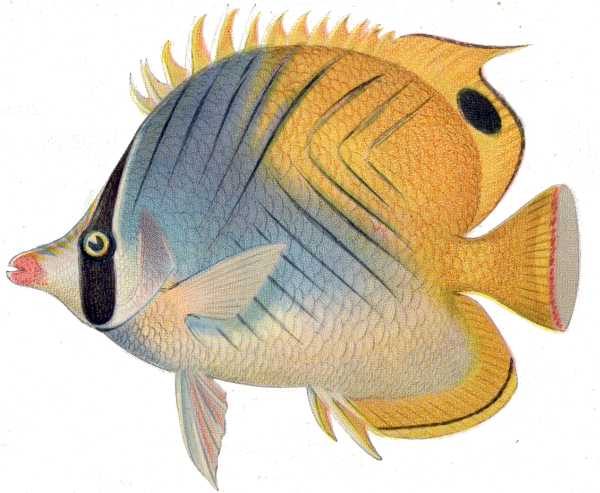
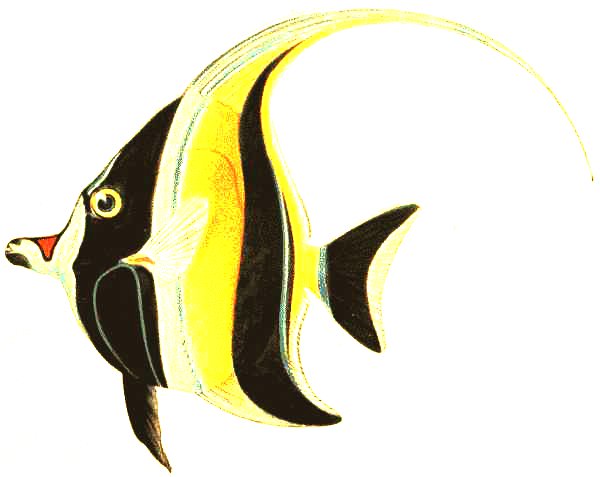 244. Kihikihi, (Zanclus Canescens)
Ke-au-nini heard this chant, even down in Po,
while he was sporting with the eepas of Milu,
while his spirit body was with his friend Popo-alaea.
He repeated the same chant, and the
ghosts all rejoiced and laughed, and Laka leaped
to his side and danced before him. They had
the same sports as the noted ones on Hawaii.
Lono-kai danced in magic power before all the
people until the time came for him to go along
the path of his visions of the night. All omens
and signs had been noted and were found to be
favorable. One of the old priests told the people
to make known their thought about the best
path for the young chief, but they were silent.
Then Moli-lele, an old priest who had the spirit
of the unihipilis resting upon him, said: "I know
that there will be many troubles. Cold and
fierce winds come over the sea. Low tides come
in the morning. The land of Kane-huna-moku
rises in the coral surf." He chanted:
"Dead is this chief of ours,
Caught as a bird strikes a fish;
The foam of surf waves rises up,
Smiting and driving below.
No sorcerer of the land is there,
Where the coral reef labors,
And the rock-eating Hina of the far-off sea."
The chiefs began to wail, but lightning was in
the eyes of the boy and his face was filled with
anger at this word of the old priest. Then
another priest arose and said: "O chiefs and
people, I have seen the path to the Under-world,
and it is not right for this young man to go. His
body is human and easily captured by the ghosts.
He might be safe if he could get the body of the
one he seeks. There are fierce guardians of the
path who will make war on whoever comes in
the flesh."
Then Kalei, another priest, said: "I know their
world. I saw the stars this morning, and they
told me that the path was stopped against this
chief by broken coral and the bones of the dead.
The tabu-children of Hina are swimming in the
sea. I will prove the danger by this awa cup.
If the bubbles of the awa poured in go to the
right, he can go. If to the left, he must stay."
This he did uttering incantations, but bubbles
covered all the surface.
Then the priests advised the young chief to
stay and eat the fat of the land. Then Hae-hae,
the great chief, said, "We have come to point out
a path, if we can, and to make quiet and peaceful
that way into Po." He instituted new omens,
and showed that the young chief would be successful,
but he would have many difficulties to
overcome.
Lono-kai arose and said: "The words of these
chiefs were twisted. I will go after the spirit-body
of my grandfather, as I have sworn to do.
My word is fast. I will go to the land where my
grandfather stays."
The priests who had tried to terrify Lono-kai
were his enemies, and would oppose his journey,
and he wanted them killed, but Lei-makani would
not permit it. Ku also quieted him with patient
words, and he ceased from anger and told them
he must prepare at once to go.
Lei-makani had a double canoe made ready,
and selected a number of strong men to accompany
the young chief. Lono-kai would not have
any of these men, but went out early in the morning,
took a cup of awa to the temple nearby and
chanted his genealogical mele.
Thunder and lightning and heavy wind and
rain attended his visit to the temple. He returned
to his parents and told them to wait for
him thirty days. If a mist was over all the land
they might wait and watch ten days more, and
if the mist continued, another ten, when he would
return with thunder and lightning to meet his
friends. But if the voices of the sea were strong
at Kumukahi, with mist resting on Opaelolo
and rain on Puu-o-ka-polei, then he would be
dead.
He took his feather cloak and war weapons
from his grandparents, and feather helmet, and
went out. He bade his parents farewell, took a
cocoanut-husk canoe and went down to the sea.
The waves rose high, pounding the face of the
coast precipices. Lei-makani ran down to bring
Lono-kai back, but according to the proverb he
caught the hand of the chiefess who lives in the
land of Nowhere. The boy had disappeared.
Out in the sea Lono-kai was tossing in the
high waves, passing all the islands, even to the
land Niihau. There he met the great watchman
of Kuai-he-lani called Honu (the turtle). He
came quietly near the head. Honu asked,
"Where are you going?" Lono-kai said: "You
speak as if you alone had the right to the sea.
You are a humpbacked turtle; you shall become
a great round stone." Then the turtle began
to slap its fins on the sea, raising waves high as
precipices. Five times forty he struck the sea
with mighty force, looking for the destruction of
the chief as the waves passed over him. But
Lono-kai waited until the turtle became tired,
thinking the chief dead. As the waters became
calm the chief raised his club and struck the
right flapper of the turtle, destroying its power.
Then the left fin beat the sea into foam, but
Lono-kai waited and broke that fin also; then he
broke the back of the turtle into little pieces and
went on his way. Soon the ocean grew fierce
again. Huge waves came, and whirlwinds. He
saw something red in the great sea—a kupua
of the ocean. The name of this enemy was Ea,
a great red turtle, who crawled out and asked
where he was going. Lono-kai said: "What
right have you to question me? Have I questioned
your right to go on the sea?"
Ea said: "This is not your place. I will kill
you. You shall be food for me to eat. When
you are dead I will go and kill the watchman who
let you come into this tabu-sea of my chief."
"Who is your chief?" asked Lono-kai. Ea replied:
"Hina-kekai [the calabash for boiling water],
the daughter of Pii-moi. Now I will kill you."
Then Ea began to strike the water with his
right fin, throwing the water up on all sides in
mighty waves, expecting to overthrow Lono-kai
and his boat. When he rested to see the result
of this battle his fin was on the surface, and the
chief struck it and broke it.
Then in another fight, when head and fin were
lifted to destroy the boat, Lono-kai struck the
neck and broke it, so killing his enemy.
Now he thought all his troubles were over and
he could go safely on his way.
But soon there lay before him a new enemy,
floating on the sea, a very long thing, like a long
stick. He approached and saw that it was like
the fin of a shark, but as he came nearer he observed
the smooth skin of a long eel. Lifting
its head and looking right at him, the eel said:
"O, proud man, you are here where you have
no business to be. I will mix you with my awa
and eat you now." Then he struck at Lono-kai
with his tail and hit his eyes and knocked
him down, then, thinking Lono-kai was dead,
he turned his head to the boat to catch the body,
but Lono-kai, leaping up on the head of the eel,
holding his boat with one hand and his club with
the other, struck the head with the magic club,
breaking the bones. Fire came out of the broken
head, the eel falling into pieces which became
islands of fire in the midst of which appeared a
very beautiful woman who asked him whence he
came, and why.
He told her he was from Hawaii and was going
to Kuai-he-lani and would kill her, for he thought
she was a mo-o, or dragon-woman. He said,
"You tried to kill me, O woman, and now
you must stay and become the fire oven of the
ocean." He asked her name. She said to him:
"This kupua was Waka, the dragon of the rough
head, and I have escaped from his body. I want
you now for my husband, and I will accompany
you on your journey."
Lono-kai told her, "This would not be right,
but when I return, if I come this way, you shall
be mine." She said, "My ruler will kill me, for
I have been sent to guard this place." Lono-kai
asked, "Who is your ruler?" "Hina-kekai, she
will kill me. You belong to the Ku-aha-ilo family,
which is a very strong family. Therefore we
have been watching for you for our chiefess."
Lono-kai told her to go to his land and wait
for him. He would be her husband. She must
wait there without fault until his return. Then
he went away. Waka did not know whence this
chief came, so she went to Oahu and landed at
Laiewai. There she awaited her husband.
Lono-kai went on to the land of Kuai-he-lani,
where he landed and hid his boat among the
vines on the beach. He went to the temple where
the body of his grandfather lay, clean and beautiful
in death. He could not see any door or
break in the body for the escape of the spirit.
Then he struck the earth with his magic war-club
until a great hole opened. He looked down
and saw a large house and many people moving
around below. He knew that the spirit of his
grandfather was there. He went down and
looked about, but the people had disappeared.
The remains of a great feast were there. He
stood at the door looking in, when two men appeared
and welcomed him with an "Aloha," and
told him he must have come from the land above,
for there was no man like him in that place.
They advised him to make his path back into
that land from whence he had come, for if the
king of the Under-world saw him he would be
killed. Lono-kai asked, "Who is your king?"
They told him, "Milu." "What does he do?"
"Our king dances for Popo-alaea and Ke-au-nini."
Lono-kai went with the men to see the
sports. They tried to persuade him not to go,
but he was very obstinate and asked them to
hide him. They said, "If we do this and you
are discovered we shall be destroyed."
He told them the reason of his coming and
asked their help, and said when he had his grandfather
they could follow him into the Upper-world.
They went to a house which was large
and beautiful. They entered and saw the chiefs
playing kilu. After a long time Lono-kai began
to make his presence known. Popo-alaea was
winning. Then Ke-au-nini chanted:
"The multitude of those below give greeting
To the friends of the inland forest of Puna;
We praise the restfulness of our home;
The leaves and divine flowers of that place."
Lono-kai chanted the same words as an echo
of Ke-au-nini. Silence fell on the group, and
Milu cried out: "Who is the disturber of our
sport? We must find him and kill him." They
began the search, but could not find any one
and at last resumed their games. Popo-alaea
chanted:
"I welcome back my friend,
The great shadow of Waimea,
Where stands the milo-tree in the gentle breeze,
And the ohia-tree. You know the place."
Ke-au-nini sang the same chant. Then Lono-kai
echoed it very softly and sweetly. All said
this last voice was the best. Milu again caused
a search to be made, but found nothing. The
two men hid Lono-kai by a post of the house.
The group returned to the sports. Soon Milu
changed the game to hula. Ke-au-nini stood up
to dance and began his chant:
"Aloha to our houses without friends.
The path goes inland to Papalakamo;
Come now and enter!
Outside is the trouble, the storm,
And there you meet the cold."
The people around were striking the spirit
drums. Then Lono-kai chanted:
"Established is the honor of Ke-au-nini
(Noteworthy is the name).
Lifted up to the high heaven;
I am the child of Lei-makani,
I am Lono from the sunrise place, Hae-o-hae:
I have come after thee, my father;
We must return. Where are you?"
Ke-au-nini could not stand up to dance when
he heard the voice of his grandchild, for his love
overpowered him. He looked up and saw the
form of the young chief leaping into the place
prepared for the hula and standing there before
the chief. The people rose up in great confusion.
Lono-kai caught the spirit of Ke-au-nini
and put it in a cocoanut-shell. He leaped past
the ghosts, and ran very swiftly out of the house.
Some of the people saw him lay hands on
Ke-au-nini, and cried out: "Oh, the husband of
our chiefess! Oh, the husband of our chiefess!
He has taken the husband of our chiefess!" But
they did not see Lono-kai go out. The two men
who had aided Lono-kai went out as soon as he
leaped into the hula place. They hurried along
the path toward freedom, but Lono-kai soon
overtook them. Milu called to his people to
hasten and capture and kill the one who had
stolen Ke-au-nini. They saw the two men with
Lono-kai, and pursued rapidly, but could not
overtake them. The fugitives were very near
the opening to the world above. When Lono-kai
saw that the pursuers were almost upon
him he whirled his magic war-club and struck
the ground, making a great hole into which the
spirits fell one over the other.
Lono-kai and the two watchmen went up the
cave opening by which he had gone down into
the land of Milu. Dawn was breaking as they
ran into the temple at Kuai-he-lani, where the
body of Ke-au-nini was lying. Lono-kai pushed
the spirit into the hollow of the foot and held the
foot fast, shaking it until the spirit had gone to
the very ends of the body and life had returned.
When Ke-au-nini was fully restored, Lono-kai
asked him if he could help restore to their bodies
the two spirits who had aided him in escaping.
Ke-au-nini evidently did not remember anything
of his life in the Under-world, for he did not know
these ghosts and thought he had been asleep
from the time he entered the temple and fell
down in weariness. Lono-kai thought they
could not find the bodies, but Ke-au-nini put
the ghosts in cocoanuts and carried them up
into the forest to one of his ancestors who knew
the bodies from which these ghosts had come.
Thus they were restored and had a long and
happy life in their former home.
Lono-kai told his grandfather they must return
to Hawaii to meet all the friends.
For thirty days mists covered Hawaii and there
was thunder and lightning and earthquakes.
Then Lono-kai said to Ke-au-nini: "To-morrow
we must go to Hawaii. We must have the appropriate
ceremonies for cleansing and taking
food." Ke-au-nini said: "Yes, I have been a
long time in the adopted land of Milu, and my
eyes are dimmed and my thought is dazed with
the dance of the restless spirits of the night. We
must wait until I have performed all the cleansing
ceremonies, made offerings and incantations.
Prayers must be said for my return to life. Then
we will go."
They attended to all the temple rites, and the
marks of death were washed away. The body
was cleansed, the eyes made clear, so strength
and joy returned into the body. Then Ke-au-nini
said: "I am ready. I see a multitude of
birds circling around Kaula. There is evil
toward Hawaii."
They again went into the temple and slept
until very early the next morning. Then they
took their cocoanut-husk canoes, each holding
his own in his hand, and went down to the edge
of the sea and stood there, each pointing the nose
of his boat toward Waipio.
None of the people awoke until they landed.
They pulled the boats upon the beach and went
to their temple. As they came to the door of the
temple, drums beat like rolling thunder. Then
the sun arose, the mists all vanished from Hawaii.
The people awoke and understood that their
chiefs had returned. They ran out of their
houses shouting and rejoicing. Olopana commanded
the chiefs and the people to prepare all
kinds of sweet food and gifts and things for a very
great luau. When this was done they feasted
sixty days and returned to their homes.
Lei-makani became the ruler of Hawaii.
Lono-kai-o-lohia was honored by his father. All
of the chiefs in that generation were noted
throughout the islands.
It was said that there was a beautiful chiefess
of Molokai who wanted to find a young chief of
Hawaii for her husband, so she sent her kahu, or
guardian, and servants to make the journey
while she went back to her sleeping-place and
dreamed of a very fine young chief shining like
the sun and surrounded by all the colors of the
rainbow. Then she awoke and found no one,
but she loved that spirit-body which she had
seen in her dreams, so she arose and went down
to the beach and told her guardian to make haste
and reach Hawaii that day.
When the kahu heard her call, he put forth all
his power and uttered the proper incantations.
He sped through the waters like a skimming bird,
passed the great precipices near Waipio, and soon
after dawn landed on the beautiful beach.
The people had not yet come from their homes
for the work of the day. He went up to the
village and came near the house of Lei-makani.
A watchman asked where he was from and the
purpose of his journey. He said: "I am a
stranger from Molokai, a messenger from my
chiefess, who seeks a husband of high rank equal
to her own. She has no one worthy to be her
husband."
The Waipio chief said: "We have a splendid
young chief, but there is no one his equal in rank
and beauty. You could not ask for him."
Then Lei-makani heard the noise and came
out and asked about this conversation. His
watchman told him that this man was from
Molokai.
Lei-makani asked the man to approach. The
Molokai chief thought that Lei-makani was the
handsomest man he had ever seen. Ke-au-kai
came out of the temple and looked upon the
stranger and asked why he had come.
When he learned that the man sought a husband
for his chiefess, he advised him to return
lest he should meet death at the hands of the
watchman, but the man would not go away.
After a time the chiefs of Waipio came before
Lei-makani. The Molokai chief explained his
errand, and praised his chiefess, and said that he
was willing to be killed and cooked in an oven if
she were not as beautiful and of as high rank
as he had told them. Lono-kai at that moment
entered the assembly, and the stranger cried out:
"This man is the husband for my chiefess. Her
tabu rank is the same as the tabu rank of this
fine young chief. No others in all the islands are
like these two. It would be glorious for them to
meet." Lono-kai said, "You return at once and
make preparation, and I will come in the evening."
The kahu returned to Molokai, but the chiefess
saw him coming back alone and became very
angry, her eyes flashing with wrath because he
had not brought the young chief with him. She
screamed out, "Where is the value of your journey,
if you return without my husband?"
"Wait a little," the guardian said gently,
"until you hear about what I have seen upon
Hawaii. I have found the one you wanted. We
must get ready to meet your husband, for the
young chief is coming here this evening. When
you meet, the love of each of you will be great
toward the other."
 COCOANUTS
She ordered all Molokai to prepare for a great
feast commencing that evening. Messengers ran
swiftly, people and chiefs hastened their labors,
and by evening vast quantities of food had been
prepared.
Lono-kai took his cocoanut-husk boat and came
over the sea like a bird skimming the water.
As the sun sank and the evening shadows fell,
the two young people met and delighted in each
other's beauty. Then they were married in the
midst of all the people of Molokai.
 KE-ALOHI-LANI