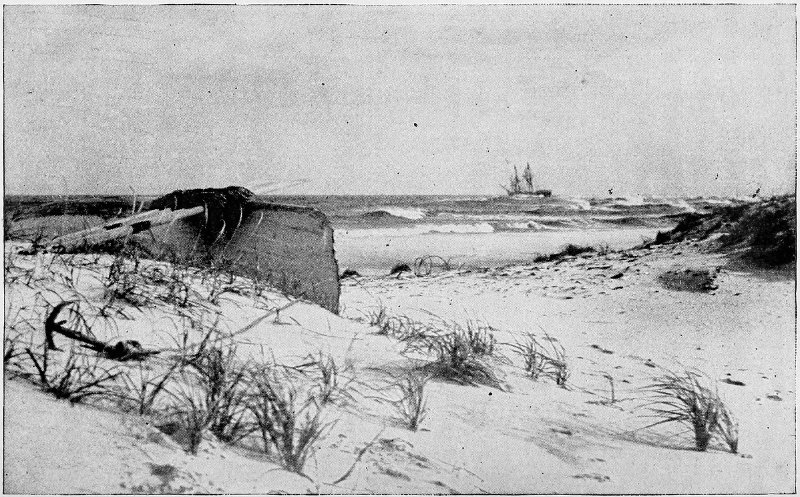
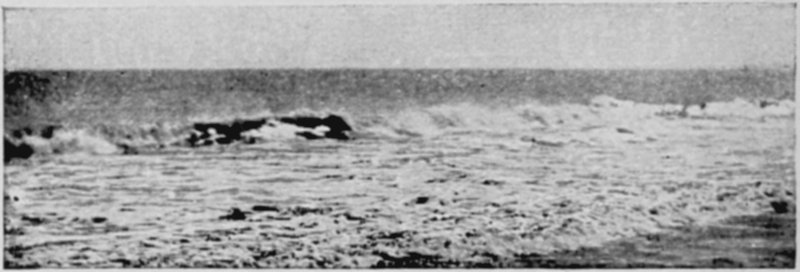
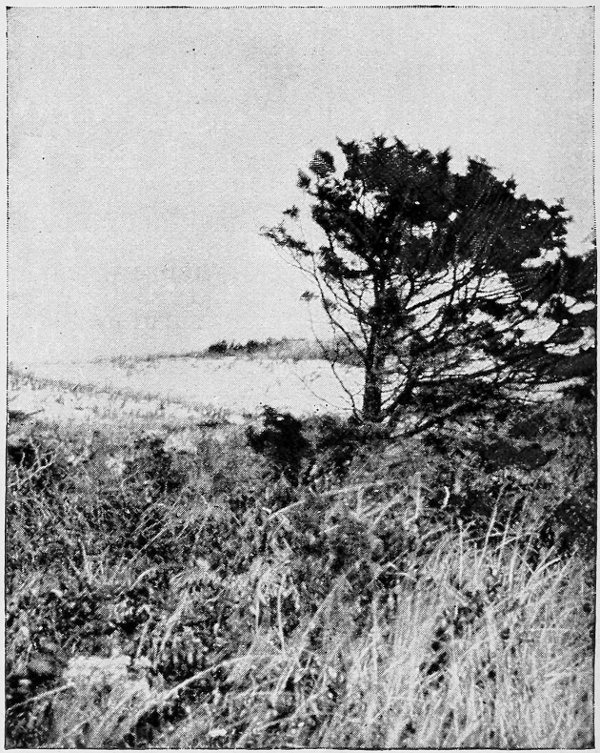
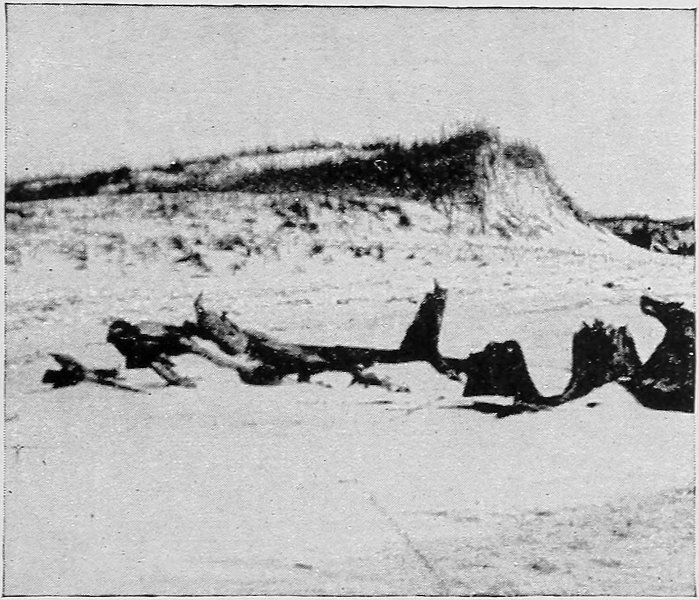
“A BARRIER OF SAND STRETCHING FOR TWENTY MILES ALONG THE SOUTH COAST OF LONG ISLAND”
BY EDWARD RICHARD SHAW
NEW YORK LOVELL, CORYELL & COMPANY
310-318 Sixth Avenue
Copyright, 1895,
by
United States Book Company
TO MY FRIEND WILLIAM S. PELLETREAU
OF SOUTHAMPTON, L. I.
PREFACE.
These stories embody only a small part
of the folk-lore and tradition that pertained
to the Great South Bay. They were told
by a class of men now gone. Fact, imagination,
and superstition—each contributed
its part. In the tavern, among groups
of men collected on shore from wind-bound
vessels, at gatherings around the
cabin fire, and in those small craft that
were constantly going from one part of
the bay to another, not only these tales,
but others, irrevocably lost, were elaborated
and made current in days homely and toilsome
yet invested with an atmosphere of
romance.
Many of the illustrations in this volume
are reproductions from photographs taken
by Mr. R. Eickemeyer, Jr., medallist of the
Royal Photographic Society, on his visits
to Long Island. The artistic excellence
of Mr. Eickemeyer’s pictures is widely
known, and the author, in appreciation of
his interest and kindness, desires to make
here grateful acknowledgment.
Fire Island Beach is a barrier of sand,
stretching for twenty miles along the south
coast of Long Island, and separating the
Great South Bay from the Atlantic ocean.
To reach it, you must make a sail of
from three to seven miles, and once upon
it, you find it a wild, desolate, solitary spot,
wind-searched and surf-pounded.
12
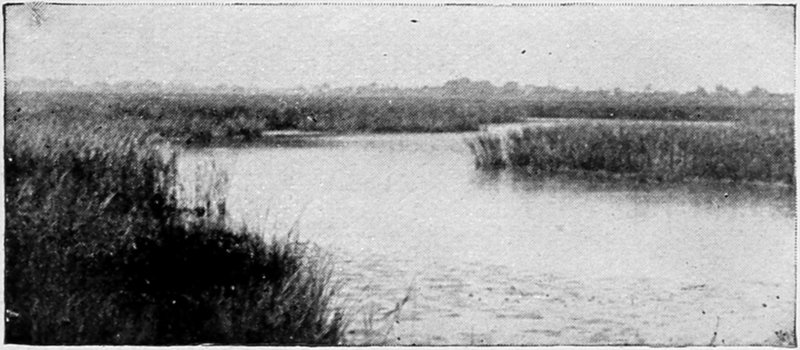
Its inner shore is covered with a growth
of tide-wet sedge, with here and there a
spot where dry meadow comes down to
make a landing-place.
The outline of this inner shore is most
irregular, curving and bending in and out
and back upon itself, making coves and
points and creeks and channels, and often
pushing out in flats with not water enough
on them at low tide to wet your ankles.
A third of the distance across the Beach,
the meadow ends and sand begins. This
slopes gradually up for another third of
the distance, to the foot of the sand hills,
which seem tumbled into their places by
some mighty power, sometimes three tiers
of them deep, sometimes two, and sometimes
only one.
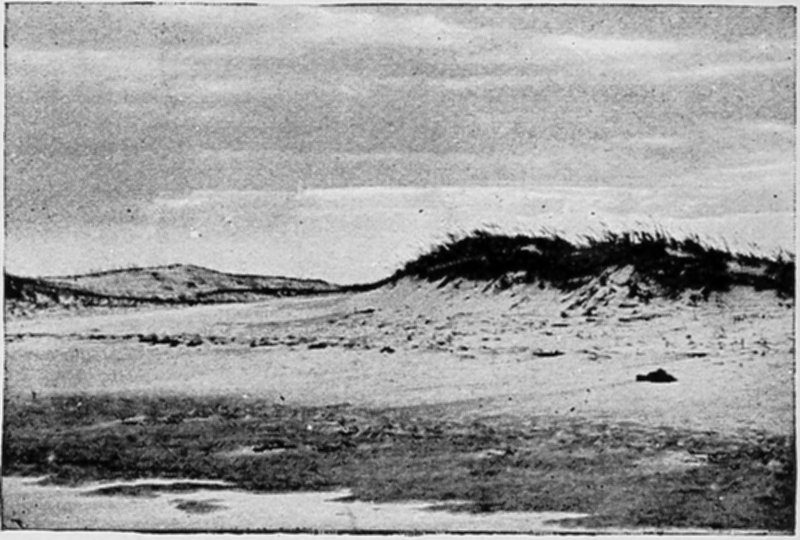
These sand hills are the most striking
features of the Beach. The biggest of
them are not more than sixty feet high,
yet so hard a feat is it to climb to the top,
and so extended is the view below you—on
one side the wide Bay, on the other, the
13
ocean stretching its restless surface to the
horizon—that you feel yourself upon an
elevation tenfold as high.
Through these hills the wind makes a
great galloping, whirling out deep bowl-shape
hollows among them, and piling the
shifting sand upon their summits. Now
and then you will notice a hill with its
shoulder knocked off by the wind, and a
ton of sand gone no one can tell where.
In every storm their contour changes, and
yet their general formation is so similar at
all times that the change is seldom thought
of. A coarse spear-like grass finds a sparse
growth upon them, and does what it can to
hold the sand in place; but it has a hard
time of it, as its blades buried to their tips
or its naked roots often testify.
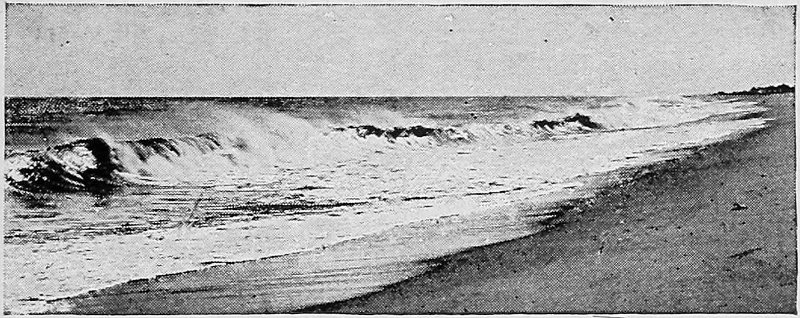
But there is one part of this Beach that
is ever much the same. It is a broad,
shelving strip of sand between the hills and
the sea, where the tide rises and falls,
pounding and grinding, year in and year
14
out—the play-ground and the battle-ground
of the surf.
On a summer’s day, I have seen this
surf so low and quiet that one could launch
a sharpie upon it, single-handed, and come
ashore again without shipping a quart of
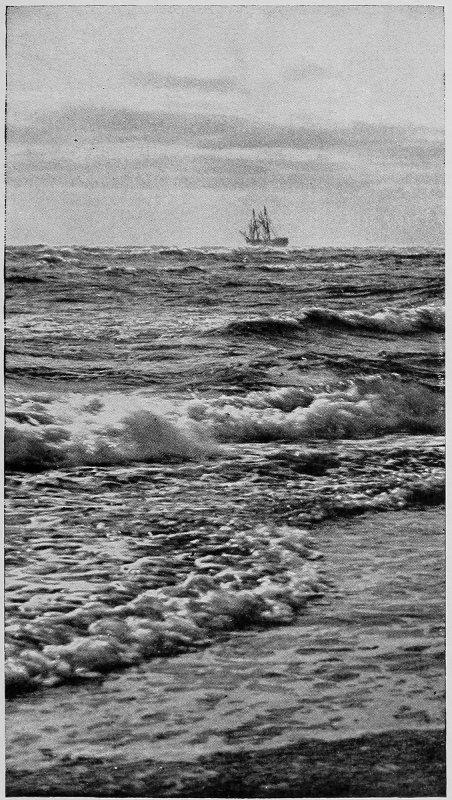
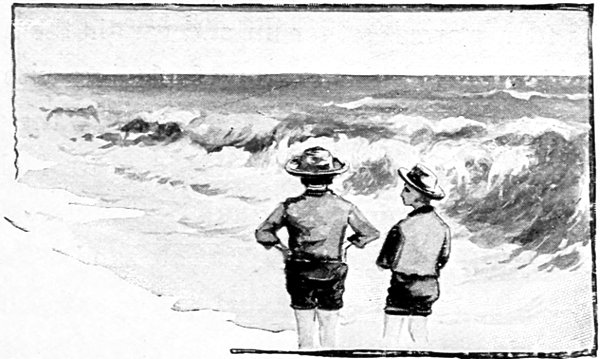
water. At other times it is a terror to look at—a
steady break of waves upon the outer
bar, with row after row coming in, rearing
and plunging as they strike the shore. In
such a sea there is no launching yawl or
surf-boat, and no coming ashore.
When the tide is on the right moon and
the wind has blown a gale from the southeast,
the strand is entirely submerged, and
people upon the main shore three miles
away can see the surf breaking over the
Beach hills.
Such a riot of sea and wind strews the
whole extent of beach with whatever has
been lost or thrown overboard, or torn out
of sunken ships. Many a man has made
a good week’s work in a single day by what
15
he has found while walking along the
Beach when the surf was down.
“The Captain” knew all this and had
patrolled that Beach scores of times.
Ten years had passed since the first
time which laid the habit of wandering
along the surf-shore apparently in search
of whatever the sea had cast up. Sometimes
a spar, sometimes sheets of copper
torn from a wreck and carried by a high
surf far along the strand, sometimes a vessel’s
gilded name, at other times only scattered
drift-wood were the rewards of these
lonely walks.
People about the neighborhood where
the Captain lived, knew that at one time or
another he brought these relics from the
Beach; yet no one supposed that the finding
of them was related to his life in any
other way than mere happen so. Anyone
who went upon the Bay at all was likely to
land at the Beach. Once there, it was a
natural impulse to go across and walk along
the ocean side; for, at that time, early in
16
the thirties, it was widely believed that the
sea had wealth, and often threw it up upon
the shore. Never, however, was it in the
least surmised by the Captain’s neighbors
that these solitary excursions had woven
themselves in as a part of the texture of
his life.
Had, though, these good neighbors been
quick to perceive they would have noticed
one characteristic of the Captain, sufficiently
manifest at times—that he was
always in the best of spirits when a storm
was raging. At such times he had been
heard to remark, “This is a wild day, my
friend, but just such days is needed.”
And it was not till years afterward that
neighbor Rob’son actually understood the
import of a strange remark made to him
by the Captain one stormy night, when the
wind blew fiercely from the south-east, and
drove aslant the thin rain which the low
scudding black clouds let down.
Mr. Rob’son had been belated and was
hurrying to get home. The Captain, meeting
17
him, called out in the most cheerful of
tones, “Hello, is that you, neighbor Rob’son?”
and giving him time for merely a
bare “Yes,” he continued, “This is a monstrous
night. Do you hear the ocean
pound over on the Beach? There’ll be tons
of sand shifted to-night—tons of it; more’n
all the men out on a gen’ral trainin’ day
could shovel in a year. You’re in a hurry,
I see, neighbor. I ain’t. I’m in no haste to
get in-doors. A great night like this fits
me. Somehow it puts new spirit into
me.”
Was it the storm that made the Captain’s
heart so buoyant and his mind so cheerful?
or was it because such days and nights
made more certain the realization of that
secret hope which had possessed him for
years?
So secret was this hope that even his
wife surmised nothing of it; for, happily,
she was not one of those unfortunate
women who are endowed with satanic intuition,
and whose lives thereby are made
18
miserable until they have followed up and
chased into clear daylight all the dusky
suspicions that flit, perchance, into their
minds.
But although a matter-of-fact wife, she
had, it must be confessed, noticed more
closely than her neighbors the effect a
storm had upon her husband; and she had
learned to put off until such a time those
various little requests about the house,
which appear in a man’s eyes so great a
matter to get about, and which he usually
puts off and shirks with an unaccountable
dread. Every little change, therefore, she
needed, of driving a nail here, putting a
shelf there, or the mending perhaps of a
churn-dasher, he cheerfully made at those
times; and she would often remark to him,
“It’s astonishin’ how much you’ll get done
on a stormy day, and the harder the storm
the more you’ll manage to get through
with.”
If, however, these odds and ends were
not finished during the storm, they were
19
suffered to go over, as the Captain was
certain to leave home early the next morning;
and to any neighbor who chanced to
inquire for him, the reply was made that
he had gone upon the Bay.
“Gone upon the Bay.” That expression
was in those days a most convenient one
for a bay-man. The persistent following of
the Bay for a livelihood at the present
time causes each man to hold closely to
one kind of work. But then, there was no
telling when a man set out from home how
his day would be spent—he might go oystering
or gunning, he might cast his nets
or waste his time sailing in search of what
he deemed better luck. Varying conditions
of wind and weather and tide offered,
one day, one thing, and the next day,
something else; and what use a bay man
would make of his day grew out of these
conditions and his own ambition.
The Captain, however, on the morning
after a storm, paid no attention to what
these conditions offered till he had visited
20
the Beach and sought again the realization
of his hope. He never failed to be on
there early on such mornings, to see what
the wind and the sea had done.
And so it turned out upon this very
day. There had been a sudden and violent
storm the previous night, and the Captain
had crossed the Bay and was making one
of his solitary patrols of the Beach.
21
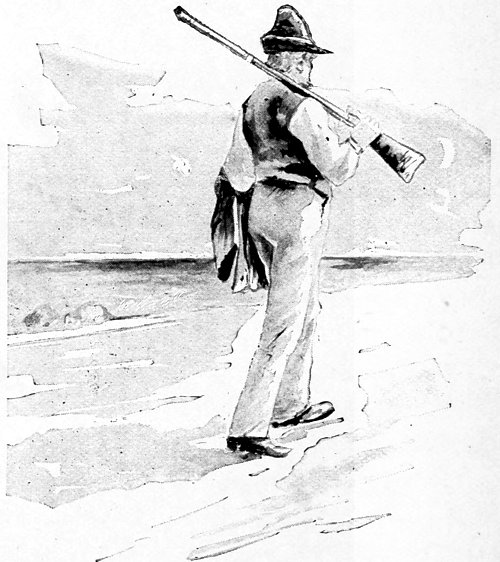
Across his shoulder was thrown his gun,
as this he always carried with him. And
although he took no silver with him, as
certain gunners were known to do, to substitute
for lead should there occur any
emergency bearing the suggestion of witchery
about it, yet he felt, in some way which
he did not care to examine, more comfortable
with his gun in his hand. He knew
well all those stories of witchcraft and
mystery about the Beach which superstition
and imagination had set afloat in various
localities along the “South Side.” How
the witches would come at night and rattle
the latch upon old Uncle Payne’s gunning
house, and how the owner fastened the
latch with a shilling piece, crept in the
window, and invariably loaded his gun with
a silver sixpence to blaze away at these
midnight revellers, should he hear the
slightest indications of their freaks. And
how gunners, taking the surest aim at the
wild duck that flew to their decoys, had
oftentimes been baffled in hitting them,
22
finding, in such instances, the shot roll out
of the barrel as the gun was lowered. And
how many a gunner carried a lucky-bone
in his pocket as an amulet against such
sinister misfortune.
He had heard, too, of that sheltered spot
on the north-west side of Watch Hill, inclosed
by a clump of old bayberry bushes
and low cedars, where searchers for money
had occasionally gone with a mineral rod;
and who, whenever they began to probe
for treasure, were always frightened away
by a huge black snake that wriggled itself
up the stem of a bush, and stretched out at
full length along the top of the foliage,
darting its tongue and hissing as if guardian
of the enchanted spot. And more
marvelous still, the tradition of a stone,
circular and flat, bearing upon its surface
the image of a man’s face, that had at
times been run upon, near the Point of
Woods, but which never could be found
when deliberate search was made for it.
While the Captain thought he put no
23
real credence in these stories, yet he felt
more or less apprehensive when upon the
Beach. A sense of mystic awe, which he
could not explain always possessed him
there, and notwithstanding his disbelief in
witchcraft, he would sooner have abandoned
his quests than forego the companionship
of his gun.
All the morning long, that idea which
had come to him with strange force ten
years ago, and which had engendered the
secretly cherished hope, was uppermost in
his mind. So strongly did it dominate his
thoughts when he was alone by the ocean
that it had forced itself into words. Over
and over again he stated it as he talked to
himself, adding this time one tradition, the
next time another. No one was near to
hear it. The very utterance cheered him
and fed his hope.
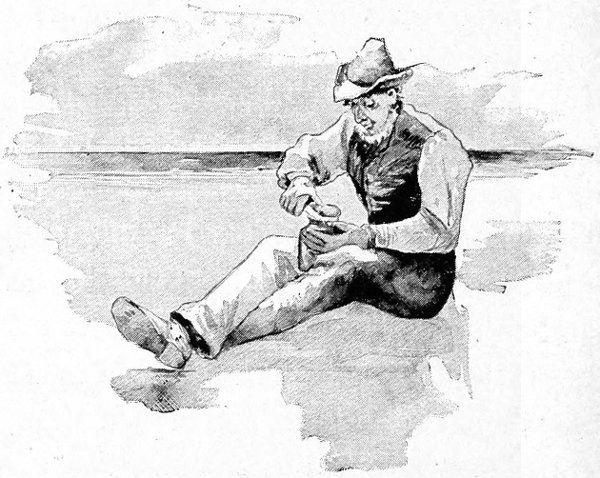
Becoming somewhat tired in his patrol,
for he had already walked fully seven
miles, he ascended one of the sand dunes
to reconnoitre the Bay, and assure himself
24
whether any boat was making towards this
part of the Beach. He saw only two or
three sails abreast of Patchogue, and these
were bound westward. Feeling, therefore,
that he could take the time, he threw himself
down to rest.
The day was clear and bright, with a
light breeze astir. The wide Bay was blue
in the sunlight. Near the hither shore he
saw a long file of wild ducks sweep a graceful
curve and flutter down upon their feeding
ground. On the farther shore stretched
the stately woodland, its whole extent
broken only by the meadows about the
creeks, and the few patches of green that
25
revealed the scattered farms. This was all
the prospect. No church spire stretched
itself upward as a landmark, no village
showed white along the shore, no fleet boats
with pleasure-seekers sped here and there.
His weariness soon passed, and as he
descended to resume his walk, the sand,
flowing down the steep hillside as fast as
he trod, set his thoughts back again upon
the old theme. “The sand on this Beach
is all the time a changin’. What are hollows
now ’ill be hills in a few years. Sea
and rain and wind are all the time at work.
The wind, though, puts in the most time.
How soon it ’ill sweep out a hole and carry
the sand up the side of a hill anybody
knows who has been on this Beach in a
blow. It handles sand in about the same
way it drifts snow.
“No, I’ll never dig for treasure, and I’ve
no belief in mineral rods. Too many fools
have used ’em. Watch Hill has all been
dug around ag’in and ag’in, and never anyone
found a shillin’ for all their potterin’.
26
If there’s anythin’ valu’ble buried on this
Beach, sometime or other it ’ill be laid
bare—that Money Ship wa’n’t off and on
here so many times fur nothin’—there’s
got to be treasure here, and who’s more
likely to find it than me? No man watches
this Beach closer, and nobody knows I’m
watchin’ it, either. It’ll come, too, one of
these days! If a man’s determined enough
and only holds on long enough, what he’s
desirin’ and hopin’ for is sure to come
round, else he wouldn’t feel so sure about
it all the time all through him. It’ll come,
it’s sure to come, and then I’ll build my
vessel.”
This had been the Captain’s theory. He
had held on. Never in the least had he
slackened hope.
During the storm the tide had run high,
surging up and washing away the foot
of the sand hills. As far as his eye
could reach, he saw the precipitous side of
hill after hill. This very condition led him
on a mile or more farther than he generally
27
walked. And then, as no footprints but
his own were to be seen anywhere on the
crisp sand, he determined to go on still
farther. He had walked perhaps half a
mile, having lapsed into that state of reverie
apt to come upon one who has urged
himself beyond the accustomed limit of
toil, when suddenly, through the drowsiness
of his mind, a perception, unheeded at the
time by the other senses, flitted back,
awakening and concentrating all the faculties
upon itself. In a moment he
turned about, saying, “I believe I’ll go
back and see what that actually was that
looked like a piece o’ black glass midway
up the bank.” Reaching the spot, he
stepped up the slope and began to dig
away the sand. He saw at once that it was
a small glass or earthenware pot of a blackish
color, which settled quickly as he dug.
“Ah,” exclaimed he, “the day’s here!
The day’s got here at last!”
Clasping it in his hands, he weighed it,
so to speak, lifting it up and down till his
28
surprised senses needed nothing more to
convince them. He examined it, but found
no mark upon it, not even upon the resin
with which it was sealed. Suddenly a
strange alarm rose up within him, and he
feared someone would come upon him. He
obeyed his first thought and looked quickly
eastward and then westward along the surf
shore, but saw no living form. Someone,
though, might be crossing the Beach and
might at any moment appear on the crest
of the hill just above him. Before the
thought which suggested this had really
passed, he began digging a place in
the sand, and in it he set the heavy pot.
The hole, however, was not deep enough,
and he lifted the pot out. But thinking it
would take too long to dig the hole deeper,
he put the pot back again, took off his
coat, threw it over the spot, and laid his gun
atop of these. With steps as agile as any
youth of twenty, he climbed up the slipping
sand to the crest of the hill and
looked keenly over the Bay. He found
29
himself as secure from interruption as
when an hour or more ago he lay down to
rest and enjoy the scene. In a second he
had returned to the hole and was lifting
out the pot, determined to open it at once.
Doubts, however, thrust themselves upon
him. “Why had he taken so much for
granted? What was really the need of all
his alarm? After all the jar might only be
filled with bullets or shot.”
But another thought crowded closely
along with these doubtful ones. “No, it
couldn’t be. He hadn’t at last espied this
jar—the only thing that met his hope for
the countless times that he had walked
along this shore—to find in it only lead.
It had treasure in it of some kind. He was
sure of it. His feelings told him so.”
30
Opening his jack-knife he began to cut
away the resin from the mouth of the jar,
making slow progress with the hard covering.
At length he reached the stopper,
and tried to pry out the thick cork, but
with such haste that his knife-blade broke,
and he was forced to cut down on one side
of the stopper. Deeming he had been a
long time opening the jar, his old alarm
returned, again suggesting that someone
might be approaching. A second time he
scanned the shore in both directions, covered
the jar with his coat, ran up the steep
and looked over the Beach and over the
Bay. No sign of approach or molestation
was anywhere discernible. Condemning
the alarm that had so wrought upon him
in stronger terms than is necessary to use
here, he returned to the spot, and this
31
time, instead of kneeling, sat down and
took the jar in his lap. Not a great while
elapsed before he had cut away enough of
the cork to thrust in the blunt edge of his
knife. A pry, a deeper thrust, another pry,
and out came the thick stopper. But now
he was startled, fearing that he had opened
some magical jar, and was, at last, to be entangled
in that witchery he so strongly discredited;
for, strange to relate, upon looking
in, he saw something that resembled
either lint or cotton, and which no sooner
had the air touched, than it slowly lost its
substance and vanished. His affright went,
however, as quickly as the mysterious exhalation,
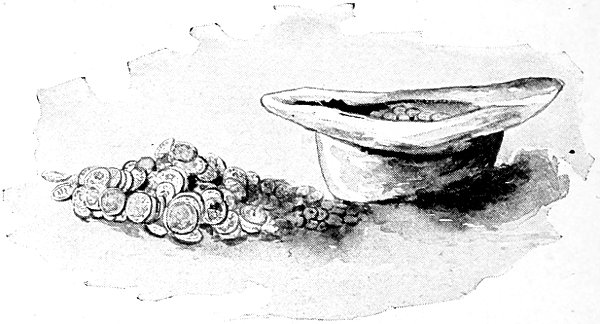
for there lay the coins of gold, as
bright as on the day when Tom Knight, the
buccaneer, afraid the town magistrate would
search the Beach and find them evidence
against him, had sealed the coins up in the
jar, and hid it among the hills.
He tipped the jar aside to disturb the
coins, observing as they slid over, other
traces of the lint or cotton, which had evidently
32
been used to pack the coins in layers,
either as security to the jar, or to
muffle any clink that would excite suspicion
in removal. But his purpose in tipping
the jar was not to witness the exhalation
of the fluffy substance—he had another
object in view. So, canting the jar
first towards him and then from him to secure
as varied a change of the contents as
possible, he peered to the very bottom.
Nothing there but gold, the yellowest of
gold.
Reaching in with two fingers, he brought
out a coin between them, and began to examine
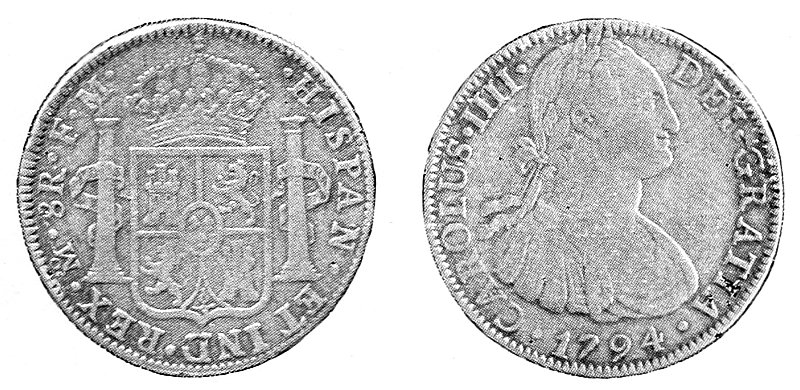
it. The date, 1783, was all that was
familiar to him. Looking at the other side,
he recognized the image of a crown, and
under it, upon a shield, figures of lions,
standing on their hind legs, with long tails
curved like the letter S. Was it English
money? The letters, HISPAN-ET-IND,
around the edge, were unintelligible to him.
He turned the coin back to the date side.
Here was the profile of some rotund personage,
33
and over his head, CAROLUS III.
DEI-GRATIA. It was the third of some
monarch, that was evident enough; but the
DEI-GRATIA was just as puzzling as the
letters on the other side. Reaching in for
another coin, he read the date, 1799. Above
was a slightly different profile, the same
name, but after it was IIII. instead of III.
He drew coin after coin from the jar until he
had several in his hand. Except the dates
they were in the main alike. He conjectured
that they were doubloons—Spanish doubloons;
and his conjecture was right. Satisfied
with the examination he had made,
he piled the doubloons in a column in one
hand, and with the other, lifted the pile and
let them drop, one by one, to hear the solid
chink. This, however, did not reach up
to the height of his feelings. So he spread
out his coat, and made, with a few blows
of his hand upon the yielding sand underneath,
a concave surface. Then lifting the
pot, he poured out the coins in a glittering
stream. Their fall was musical, and
34
when the last one fell, he scooped up
double handfuls, held them high, and let
the dazzling stream run again.
It was the first golden dream realized
since the days when Captain Kidd was
said to have buried his ill-gotten treasure
in countless spots upon that Beach. How
would that gold have dazzled the sight of
all those argonauts who had made so many
continuous but fruitless searches for the
money reputed to be hid among those sand
hills! What exultation would the sound of
those falling yellow disks from the old
mint of Mexico have wrought in those
who had dredged persistently but in vain
upon the bar where the long-boats of the
Money-ship upset, or those who by moonlight
and by starlight had walked to and
fro over the hills, grasping the mineral rod,
and digging where its delusive twitch indicated,
until weary with toil and disappointment.
While the Captain’s whole attention was
completely absorbed in this revel with his
35
gold, a coasting vessel had been approaching.
It is true that the schooner was a
mile or perhaps farther from the shore,
“but with their spy-glass,” thought the
Captain, as he discovered the vessel,
“those on board can plainly see just what
I’ve got here.” Hurriedly dipping up
handful after handful, he slid the coins
carefully into the jar, and after the stopper
was replaced, wrapped his coat about it,
reached his gun, and disappeared over the
hills.
When he came to his boat, he tied the
coat securely about the jar with odd
strands of rope, and placed the prize carefully
under forward. When night fell, it
was his intention to make towards home.
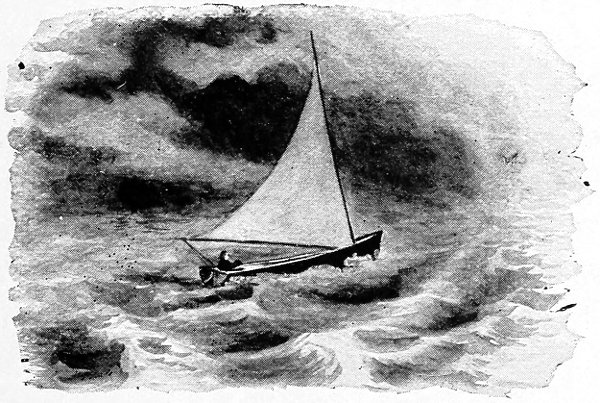
The south-west breeze had gathered with
the day, and blew freshly even from the
Beach shore. Out in the Bay, where it
had wide, unhindered scope, it had added
to itself, pushing the waves before it, and
urging them with such impetuosity that
their crests grew flurried and broke into
36
white, foamy caps. Every leaf on the
“South Shore” was astir, fluttering and
tugging in the moist wind; and the trees
bended and straightened to trim all their
spread of canvas to the sweeps of the
breeze.
“Ruther rougher than I care for tonight,”
thought the Captain, “but the
wind’ll fall after the sun sinks; I’ll give it
time.”
The color had gone from the few strips
of cloud that lay about the sundown spot,
and the gray twilight arch stretched across
the west, as the Captain cleared away for
home. Along the eastern sky, well up, a
glow of dull orange spread itself, and
creeping up to the glow and gradually
transmuting it, was a cold blue, the blue of
advancing night—a color so rare that it is
matched nowhere else than on polished
steel when the blacksmith tempers it.
37
The Captain steered with a strong and
steady hand, and watched his sail with a
vigilant eye. But give heed as closely as
he might to his craft, there played with his
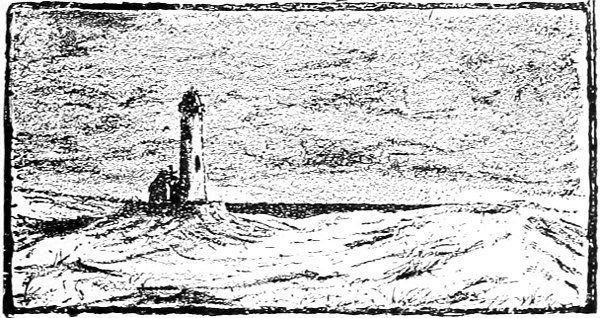
fancy the glowing rays of distant Fire
Island Light. It had just been built.
Again and again its gleams, falling on the
dark side of some tumbling wave, caused
the Captain to turn his head and look over
his shoulder to the source whence they came.
The light was, in truth, no guide to him
on this night, but thoughts of the time
when it would be, kept recurring. He
called to mind going in and out of Fire
Island Inlet years ago, before a light-house
38
was ever proposed, and of how difficult a
place the Inlet was to enter after nightfall.
But now, no matter how thick the night,
bring that light to bear north-east, and one
was inside and out of harm’s way. What
an advantage it was! He thought, too, of
how he should see it far ahead, when
making a run homeward from Coney
Island; of the times he should have to lie
anchored within the inlet waiting for fit
weather to go out, and how companionable
that light would be sending out its bright
rays on wild, stormy nights.
All that the Captain fancied came true
in the years that immediately followed.
Speedily the timbers of a vessel were got
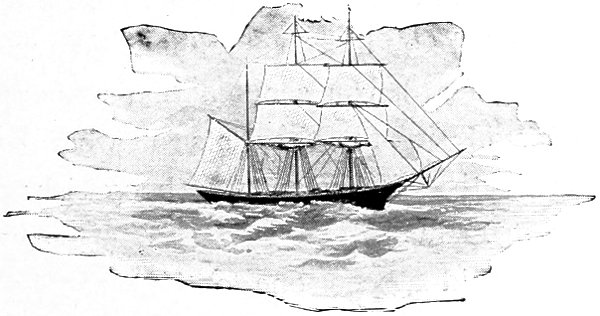
out and set up, and duly “The Turk” was
launched. What odd notion dictated the
name was never known. It was thought,
though, by many of his neighbors that some
name suggestive of that which made the
long-wished-for vessel a reality, should have
been given her. Indeed, there was no little
comment about it at the time, and much
39
protest whenever the vessel was discussed.
It was overlooked, however, in this instance
as it had been in several others, that
the Captain held views and ideas quite
opposite to those of most people who
knew him; for what one of these neighbors,
had he conceived the idea of finding buried
treasure, would have done as the Captain
did, and waited for the wind and the sea to
dig it for him?
41
THE BOGY OF THE BEACH
Strange things happen on that Beach
and have happened. My experience was
no new one, but it takes hold of a man,
nevertheless, and he can’t shake it off for
months. Ever since white men frequented
that Beach, some one at intervals has
undergone the same foreboding experience.
In the early part of the last century a
whaling crew, half Indians, had their hut
east of Quanch. They used to land and
come off at the point there, where the
water is deep, called Whale House Point
till this day. From the days of the earliest
settlement, whaling crews used to go
on the Beach. They would live there during
the season and watch the sea day by
day, ready to launch their boats and push
off whenever they saw a whale blow.
Their supplies were brought from the
42
north side of the Island, and fires were
built on Long Point as a signal for the
crew to come off. The Long Point of those
days is now Ireland’s Point, which pushes
out into the bay a mile, about, west of the
mouth of Carman’s river.
When a fire flashed up at night, part of
the crew would row across the bay, heading
directly for the fire. After they had put
the supplies in their boat and were ready
to return, they would throw sand on the
fire and put it out. Soon after it disappeared
a fire would blaze up on the Beach
to guide them back. In that way Fire
Place got its old name. That was a name
that had something behind it and never
ought to have been changed.
This crew had been expecting for three
days the signal fire. They were getting
short of supplies. People didn’t get
around lively in those times, you know.
The trouble was that they hadn’t much to
get around lively with.
For two nights until nearly midnight—all
43
this I heard from my great-grandfather—the
crew had set a watch on the top of
Quanch Hill to look out for the signal fire
upon Long Point. Now the curious thing
about this is that a man named Jonas was
the watch both nights. The first night was
his regular watch, but the second night he
volunteered to take the place of another
member of the crew. The men in the hut
spoke about this during the evening.
None of them, however, knew that Jonas’s
idea was to satisfy himself as to whether the
strange experience he had had the night
before would repeat itself. That Beach,
you know, is one of the most lonely places in
the world. There are times when it’s
awful on there. Take it on a dark night
with the wind wild and the sea mad.
That night Jonas made up his mind to
walk eastward a mile and a half. Frequently
he would go down in the hollows
and stop to listen. He heard the sound
of the wind in the grass, and the beat of
the surf—each of these distinctly. And yet
44
something more. His heart began to
thump and his own breathing interfered
with his judgment. He tried hard to listen.
Could he be deceived? he asked himself.
Suddenly he turned and walked to the
top of a hill where no grass grew. He got
his breath and then held it. He heard even
the delicate beat of the particles of sand
blown by the wind, and he was sure that besides
he recognized what he had heard in the
hollow. He could not be mistaken. Farther
away now, moving among the hills—almost
gone, then quite gone. The thought occurred
to him then that he had forgotten
he was on the lookout. Immediately he
scanned the horizon to the northeast of
him but discerned no spot of flickering
red. He looked up at the stars to see
how far they had moved westward. Some
drifting clouds obscured two or three stars
he knew best, so he waited till the clouds
had shifted, and then he knew it was near
midnight. There was no use to watch
longer, for those who brought supplies
45
never made a fire after midnight. He
turned to make his way toward the hut.
He had not taken three steps, when he
stopped and stood stock-still again. He
heard distinctly the rumble and beat of
the surf, the sifting of the sand, the sound
of the wind in the dried beach grass, yet
plainly apart from these something else.
It moved on the wind rapidly away and
away, and was gone. But as he stood
thinking of it, it came again, stronger than
before. This time not eastward of him,
but clearly westward. His head grew hot.
It moved farther and farther to the west,
rising and falling, then with sudden increasing
force stopped abruptly. He made
his way to the hut and crept into his bunk.
It was two hours before he got to sleep.
The next morning a whale was sighted
close in shore. The crew launched their
whale-boat and put off for him. They calculated
where he would next rise and
rowed to the spot. He came up lengthwise
of the boat, just far enough ahead to
46
smash it with his flukes. It was a right
whale, and they strike sideways, you know,
with their tail.
“Stern all,” was the order quickly uttered.
A short distance back, they whirled
the boat around, and then pulled at the
order. Whale-boats, I suppose you know,
are sharp at both ends.
Before they were in position, however,
to row straight on to the whale and keep
clear of his flukes, he started. Quebax,
the harpooneer, fastened his oar, grasped
the harpoon, rose up in the bow and threw
it. It was a long throw, fifteen feet, but
it was the only chance. The harpoon
entered the side of the whale and must
have held securely. But the whale turned
suddenly and struck the boat with his head.
The crew sprang overboard just in time, for
the next moment the whale stove the boat
into flinders. The wind, so it happened,
favored them, as it was blowing directly on
shore. All the crew reached the Beach except
Quebax. He was missing, nor was his
47
body ever found. The bow of the boat,
to which the line was fastened never came
ashore, so it was thought that Quebax got
entangled in the line. It was toward the
end of the season—this whale would have
made their sixth—and the disaster broke
up their whaling for that year.
No man of that crew felt the great sense
of relief at leaving the Beach that Jonas did,
and never after would he go on there to
remain overnight. He said nothing at the
time about his weird experience among
those Beach hills the night before Quebax
was lost, but in later years he told it all.
And then, again, I have heard it said
that for several nights before that awful
catastrophe at Old Inlet, at the time of
the War of 1812, the same strange calling
and shouting was heard among the hills.
Old Uncle Payne, whose gunning house
stood east of Molasses Island Point near
Quanch, declared that twice in his life he
heard at midnight the moaning in the hills,
48
and each time thereafter had found bodies
washed ashore.
But at Fiddleton, at Watch Hill, and
through all the hollows there, down around
Pickety Rough, even on Flat Beach, the
eerie holloing, the shouting and calling,
unlike any human voice, that was heard
on different nights, suddenly changing,
too, from one spot of the beach to another,
foreboded the drowning of those fifteen
buccaneers from the Money Ship and the
burying in the sea for all time of their
blood spent treasure. Yet having heard
all this, though years before, I joined the
first life-saving crew of Station No. —.
The season then was a short one. Regular
patrols of the Beach with exchange of
checks for tally was then a thing undreamt
of. Only in thick, foggy, or stormy weather
did we walk the Beach. I can’t see any
use of patrolling that Beach in good
weather and wearing the crew out. To
my thinking all that is necessary on bright
days or on clear starlight and moonlight
49
nights is to keep a man on the lookout
with a good glass beside him, and so save
the crew; for there come times when the
rescuing of life depends upon the reserve
strength of the men. Yes, there come
emergencies on that coast when power of
endurance is the important, the decisive
thing. The way to meet such unexpected
demands and emergencies is to give the
crew a chance to store up reserve force,
power to hold on, to make a great effort for
a night and a day, perhaps. This is what
counts when a vessel is ashore far more
than any regular patrolling, with the men
on the go bright weather as well as bad
weather.
We had pretty good weather that year
till after the holidays had passed. Then
there came a spell of thick weather. I
remember distinctly how it set in. The
day had been a very bright one, with a
tinge of warmth in it. But at nightfall
an ominous murky drift of cloud gathered
in the southwest, a lee set for a northeaster.
50
The order was given for patrol that
night, and the eastern beat fell to me.
When the tide began to rise the wind
hauled northeast by east and blew lightly
down the coast. It didn’t seem to portend
snow, but the weather began to thicken.
I faced the wind and walked briskly, but
it bit my face and searched under my
clothing as only a northeast wind will do.
When within a quarter of a mile of the end
of my beat, I struck a match and held it
between my two hands as a sort of a
shield, and let it burn. If you have never
tried this, you have no idea how far such a
light may be seen in the darkness or how
large a spot of light it appears to make.
Lanterns are of no account on that Beach.
No lantern will burn when a high wind is
blowing sand before it. They choke up
and go out. And as about the only time
when they would be of use is when they
won’t burn, they’re not carried. Then,
after all, it’s no place for them. They’ll
do round the barnyard, but the coast is
51
no place for a light, down almost on the
surf’s edge, bobbing and moving along in
the darkness.
I lit another match and still another,
but got no answer, so I concluded that the
patrol up from the next station was returning.
I reached the end of my beat,
and waited some time under the lee of a
hill, and near midnight began my patrol
back. Passing a deep opening between the
hills, my attention was attracted by a low
moaning. At first I gave little heed to
it. Then later I walked up to the top of
one of the hills that flank the strand all
along and listened. I faced the wind; then
I stood back to it. I turned my ear in every
direction, even bent my head down to render
my hearing more acute. I could not distinguish
any strange sound. No sooner, however,
had I descended to the strand and
resumed my walk than the moaning began
again, seeming as before to be just over
behind the hills. It was continuous but
uneven, like the wind. It moved down the
52
Beach as I walked, just abreast of me apparently,
but over behind the hills, considerably
farther, however, toward the bayside when
I passed any low spot of beach. When
within half a mile of the station, it was
gone. I noticed instantly when it ceased.
An experience of this kind disturbs a
man’s soul, and the more he fights it the
greater trouble it becomes and the more
uneasiness it gives him. But I said nothing
about it at the station.
The thick weather continued. A seething,
boiling surf was running, showing
that there had been a big storm off shore.
Such a surf always indicates that. We
couldn’t see much beyond the outer bar
for several days.
In the next patrol at night I felt sure I
should hear the moaning again, and I did.
It followed abreast of me on my patrol
out, and was gone as I approached the
meeting-place at the end of my beat. But
on my return it came again and followed
in the same way as before. I didn’t stop
53
once to bother with it, but kept walking
steadily back. It left me when about the
same distance from the house as on the
first night.
The next night my patrol began at midnight
on the short beat to the west. I
heard nothing out of the usual course of
nature till I got within three-quarters of a
mile of the half-way hut. Then I heard
not only the moaning, but other noises not
human, and a clapping or beating as with
two flat sticks. All this was confined to
one spot, and I could locate that spot exactly:
in a rather deep hollow, with three
hills butting up around. The wind from
some cause always drew down into that
hollow and kept its whole surface smooth,
not a spear or root of grass there, and as
round as the inside of a cup.
As I heard the voice, its hideous changes,
which at times seemed to run into a part
of some strange and weird tune, and the
clapping along with it, I knew that all this
foreboded some dreadful thing.
54
Hot flushes came over me and I sweat
at every pore. But I kept on walking
just as steadily as I could. I didn’t want
to quicken my pace a bit, and I had to hold
myself down in order not to do it. I left
the noises and clapping farther and farther
behind, till at last I could not hear them.
They didn’t move, however, but remained
right in that hollow. At length I came to
the place where the half-way hut was, and
turned up from the strand to go to it.
This hut stood well up in a sort of narrow
pass that opened in a northwesterly
direction through the surf hills. You
could see the hut, coming from the east,
but not from the west. It was built of old
timbers and covered with seaweed and
sand.
55
56
I entered, glad to get in there, and began
to blow up a fire from the embers left
by the patrolman from the west. I loaded
my pipe and lit it, and the fire gave me
some cheer. I stayed there an hour, I
should think, dreading awfully to go. But
the thing had to be done, so I buttoned up
my coat and started. As I came down to
the strand suddenly I caught sight of something
coming toward me dripping wet.
The strength went out of my legs as quick
as lightning, and my knees gave way. I
nerved myself up at once, and there was
need of it, too, for a voice—a human
voice—called to me for help. It was a
sailor who had just crawled up out of the
surf. Instinctively I looked off shore and
saw a vessel on the outer bar. She was not
there an hour back, when I passed by.
The sailor sank down exhausted after
he called to me. I helped him into the
hut and blew up the fire.
“Are there any others?” I asked.
“No,” he replied, “I am the only one.”
I laid on more fuel, left him, and walked
along shore, looking into the surf with the
keenest eye I had. I set off lights, but no
answer. Then I went back to the hut, and
the sailor had recovered sufficiently to give
me a full account of how the vessel came on.
57
“We had thick weather for several
days,” he said, “and had lost our reckoning.
We struck heavily on the bar off here,
sounded, and made up our minds that we
were on Nantucket Shoals, and that the only
thing for us to do was to land. We hauled
the boat up on the leeward side, the men
got in, and I stood on the rail to cast off.
Just as I had thrown down the painter, a
big sea, coming round the stern of the
vessel, struck the boat and turned her
bottom side up. It happened in less than
no time, for I had let go and had to jump.
I struck on the bottom of the yawl and
slid off into the sea. When I came up and
put out my arms to swim, I struck an oar
in front of me. This saved me. With it
I worked toward the shore, but there I
had a fearful struggle. Eleven times the
waves threw me up on shore, but the
undertow was so strong it carried me back
each time. My strength was about all
gone. The twelfth time a large wave
carried me farther up. I felt the moving
58
sand under my feet, and, with the last remnant
of strength, I dug both hands and
feet into the sand with all my will, and
just kept myself from being carried back
again. I crawled up on the shore and
rested. When I got up to look around, I
saw a crack of light from the fire in this
hut, and I staggered toward it.”
I summoned the rest of the crew, and
we had tough work the rest of that night
and for some days afterward.
But I was always apprehensive after this
experience and it weighed on my mind.
So in the spring I left the Beach, concluding
that what I had heard and seen was
enough for one lifetime.
59
THE MOWERS’ PHANTOM
In the eighties of the last century, on
the sparsely settled old country road
north of Yaphank, two mowers were
arranging, one August evening, to go to the
Beach next day, and cut the sedge upon a
neighbor’s meadow. “We must make an
’arly start,” said Raner. “By sunrise we
ought ’o be well through the Gore in the Hills.
Arter wants that piece o’ sedge all
laid to-morrer, ef we be men enough to do
it.”
“How be you goin’ ’cross?” asked
Layn.
“In the ol’ hay-boat. I got her ready at
Squasux week ago yisterday. Josh Alibee
is to meet us there, so there’ll be three on
us, you see. A big day’s work, but we’ll
60
take suthin’ along to brace us up while
we’re doin’ on it.”
The sun next morning was not more
than an hour high, when these mowers had
embarked in the hay-boat for the Beach.
The light breeze of that muggy August
morning, blowing a trifle on the fore-quarter,
carried them down the river so slowly
that in order to gain time they plied the
oar.
The scene which lay about them has
changed but little in almost the hundred
years which have passed since that morning.
The river’s course to the Bay was
just as zig-zag then as it is now. Eastward
lay the same broad meadows, skirted
by that dense barrier of foliage—the Noccomack
woods. Westward there stood
upon the river bank where the Squasux
road came down, a long, low one-story
house, and below this the meadows extended
to the distant woodland. As the
sunlight fell aslant upon these meadows,
they presented all those lustrous gradations
61
of yellow and brown that may be
seen in the early sunlight of an August
morning to-day.
“There, put away yer oar, Josh; the
breeze stiffens,” said Raner, as they neared
the mouth of the river.
“Thet ere’s warm work,” exclaimed
Josh, as he finished the stroke and laid
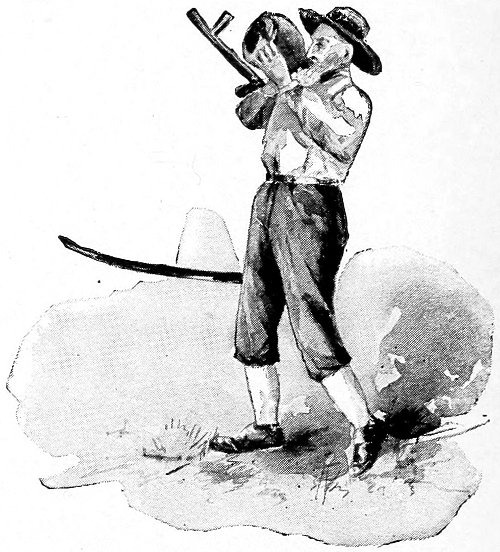
aside the oar. “I’ll tek a swaller, I believe.”
“No, no,” replied Layn; “put that jug
back. It’s too ’arly in the day to begin
swiggin’ at that. You’ll hev need o’ ev’ry
drop o’ your share on the Beach.”
“A couple o’ swallers ’ill mek no diff’rence
one way nur t’other. Not a sol’try
horn hev I hed yet to-day, an’ I’ve pulled
the hull way down the river, whilst you’ve
sot thar, yer elbows on yer knees,” replied
Josh, as he tipped the jug and drank.
“Pass it along,” said Raner. “Our ends
hev all got to be kep’ even to-day.”
Raner and Layn each drank, though
lightly, and passed the jug back to Josh,
62
who, remarking, “It took all t’other swaller
to wet my throat,” deliberately tipped the
jug and drank continuously as he walked
forward to put it in its place.
The hay-boat went slowly, and the time
passed tediously to men who were ambitious
to be at their day’s work. Of this
Raner himself furnished the best evidence,
as he stood by the tiller, treading from
side to side, and knocking one foot against
the other.
The present generation has little notion
of what the sailing of those days was, particularly
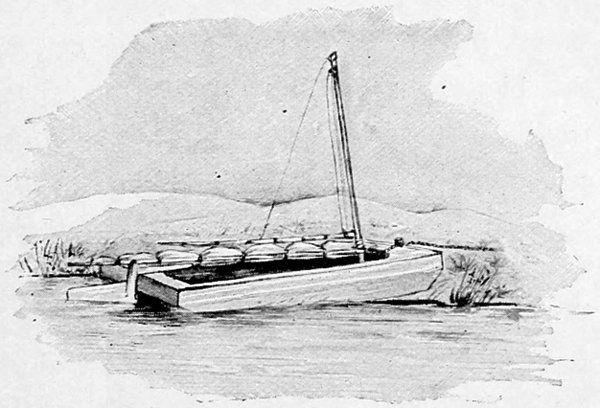
in the flat-bottomed, square-ended
hay-boats. With a free wind, the course
could be pretty well kept, but with the
wind abeam, leeway became almost equal
to headway, and wide calculations and
allowances had always to be made. Layn
had this in mind when he said, “Give the
Inlet a wide berth or I’m afeard the tide’ll
ketch us an’ draw us through.”
“She’ll clear it, an’ a plenty to spare,”
replied Raner.
63
“You better not be too sure ’bout that.
I, for one, don’t want ’o fare ez them
Swan Crick fellers did.”
“What Swan Crick fellers?” enquired
Raner.
“Why, Mott an’ a nother young feller—I
dun know what his name wuz. Hain’t
you heer’d ’bout ’em?”
“No.”
“Well, I hed ’em on my mind when I
said, ‘Give the Inlet plenty o’ room.’ You
ain’t heer’d on it, then? Well, this ere
young Mott and t’other feller started out
the Crick to sail their hay-boat somewheres
east o’ the Inlet. Ol’ man Mott hed built
the boat, an’ hed put cleats on the edges
under ’er sides, to keep ’er from slidin off
to leward. She sailed smart, an’ hung on
to the wind purty good, I b’lieve. The ol’
man, though, tol’ ’em to look out fur the
Inlet, an’ give it a rattlin’ good distunce.
But, by George, ’fore they knowed it, they
wuz goin’ toward the Inlet. They tried
might an’ main, puttin’ out poles an’ doin’
64
ev’ry thing they could, to steer’er to shore,
but no use. They couldn’t reach bottom,
fur she kep’ right squar’ inter the middle
o’ the channel, an’ out she went.
“The poor devils wuz wild. The wind,
what thar wuz on it, wuz blowin’ from
the nuthard. They lowered sail, but out
to sea they kep’ on goin’. Finely, arter
they got out sev’ral mile, the wind
changed to the suthard. They histed
sail, pinted ’er straight on, an’ beached ’er
on the surf-shore off abreas’ o’ Muriches,
an’ the ol’ man went down thar an’ wracked
the very boat he’d jist built.”
Josh, who had sat with his gun across his
knees during Layn’s account of this mishap,
now resumed the work of cleaning his gun,
upon which he had put all his time since
clearing the mouth of the river. Priming
the musket, he raised it to his shoulder,
took an imaginary aim, and remarked:
“She’s in royal trim now fur any bunch o’
snipe thet shows up on the medder.”
65
“Where did you come upon that buster
of a fire-arm?” inquired Layn, in jest.
“Thet ere fire-arm, le’ me tell you, hez
been proved. She’s seen sarvice, but thet
wuz afore I got ’er.”
“Hain’t she seen sarvice sence you’ve
had ’er, ur plaguey nigh it?” continued
Layn.
“Seen sa—ar—vice sence—I’ve—hed
’er?”
“Yes, by George, yes.”
“You’re talkin’ to me in riddles.”
“Why, Joshua,” broke in Raner, “hain’t
there been orchards girdled, a barn burnt,
an’ thirty horses made way with by some
on you Punksholers not a great while
back?”
“Exac’ly,” said Layn. “That ere hints
the matter, Josh. Wuz that ere gun one
on ’em that wuz drawn on Judge Smith, an’
would a’ done the mischief on ’im, hedn’t
his wife happened to keep atween him an’
the winder whilst he wuz ondressin’ a-goin’
to bed?”
66
“Thar wuzn’t but three on ’em at thet
ere bus’ness, an’ is it your idee to hint thet
I wuz one on em? Ef it be, thet’s hittin’
devlish nigh—devlish nigh; an’ I’m blasted
ef I don’t tek thet up,” replied Alibee,
spitting in his hands and stepping up to
Layn.
“Nay, Joshua, nay; couldn’t that flint-lock
a been there without you, or at any
rate, afore you owned it?” spoke Raner, to
pacify Alibee.
Layn discerned that he had gone too far
in his attempt at accusation, and so in a
bantering way, continued, “You said yer
musket had seen sarvice. You wan’t in
the Rev’lution’ry War, nur even in a
skirmish. The wicked thing some o’ you
Punksholers meant to do on Judge Smith
is known to the hull Town, an’ you wuz a
braggin’ ’bout the sarvice yer gun hed
seen. What harm wuz thar, by George, in
askin’ you, straight out an’ out, ef that wuz
the sarvice she hed seen?”
“A devlish lot o’ harm, when a man
67
wa’n’t thar, nur nowheres near thar, nur
never hed an idee o’ bein’ thar,” replied
Josh.
“Trim in the sail now, an’ quit your
sq’abblin’,” spoke out Raner. “There,
that’ll do. Now she p’ints up better, an’
ef she don’t slide off over much, we’ll
make our landin’ spot without a tack.
Ah! that’s a strong puff.”
Raner looked to windward thoughtfully
a few minutes, and then began to whistle.
The breeze, the onward motion of the boat,
and the movement of the waves stirred
his feelings, and he whistled on for a full
half-hour.
As the craft approached the Beach, there
came into view spots of meadow
“Where merry mowers, hale and strong,
Swept scythe on scythe their swaths along
The low green prairies of the sea.”
These scattered groups had been upon
the meadows all night, ready to begin at
sunrise the toil of the day. And toil it
was too—toil that required an iron muscle
68
and iron endurance. Yet, toil and moil
though it were, beach-haying was always a
welcomed season. It broke the monotony
of farm life. There was the sail to and fro,
the breeze from the sea in its first freshness,
the beat of the surf, the wide view
on every side, the visit to the ocean at
night, and often a race with the slow-creeping
tide to determine whether the mowers
should lay their stint, or the water usurp
their place.
The three mowers had made an early
start and were in good season, but the
sight of others at work roused their anticipations
of the day’s labor, and Layn suggested,
“Let’s give our scythes a thorer
goin’ over. We’ll save time by it.”
They did this, and then Josh said to
Raner, “Shell I put an edge on yer scythe?”
“No,” was the reply. “I’ll do that fur
myself. You come aft an’ take the tiller.”
Over the ocean, low down on the horizon,
lay a bank of fog. The mowers
noticed this, and Raner remarked, “It may
69
lay there all day, or it may clear away an’
be gone when the sun gits higher and the
day warmer.”
“Thar’s no tellin’ nuthin’ ’bout what
it’ll do, you’d better say,” replied Josh,
with a laugh.
All along they had feared the wind
would fail them when well over under the
Beach. But it continued to blow; and in
as good season as the mowers had hoped,
they reached the meadows. Josh stood
forward, anchor in hand, and jumping
ashore, walked the full length of the cable
and planted the anchor deep in the soft
meadow soil. The old sail was quickly
furled, and the three mowers, with scythes
and traps, set out for Arter’s lot. Raner
led the way, carrying, besides his scythe, a
rake and hammer and wedges to hang
anew the scythes, if need were. Layn was
almost abreast of him, managing with some
difficulty his scythe, a pitchfork, and a runlet
of water; while Josh followed a short
distance behind with the jug. Watching
70
his chance, he lifted the jug and stole a
draught.
“Le’ me see,” said Raner, approaching
the place of their day’s work. “Accordin’
to the last division, the stake o’ every lot
stands on the west side, an’ the numberin’s
on the east side o’ the stake.”
A little examination showed which Arter’s
lot was, and then Raner said, “We’ll strike
in here.”
This was not the order to begin cutting,
but for those immediate preparations which
can be made nowhere else than on the exact
71
spot. And so there followed driving of
heel-wedges, twisting and ranging of blade
with handle, stretching out of the foot to
determine whether the scythe-point was too
far out or too close in, and last, a stroke in
the grass for final approval.
“We’re all ready, then, be we?” asked
Raner. “Well, I’ll lead. Josh, you come
arter me; an’ Layn’ll be last;” and getting
into position, the lusty mowers struck their
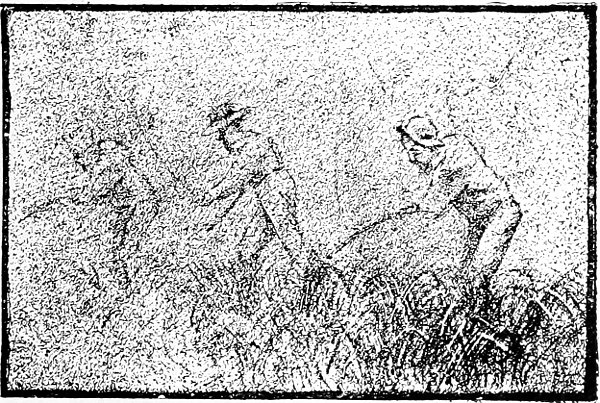
swaths. Regularly the graceful strokes
fell, succeeded by the hitching step forward.
“Ah! my scythe’s doin’ purty work, I
tell you,” remarked Raner. “How does
your’n cut, Layn?”
“Royally.”
“An’ your’n, Alibee?”
“Never better.”
“We’re all well under way, then, an’ the
grass’s in fair condition. Can we lay it by
night, think you, Layn?”
“I guess so; but by King George, we’ve
got ’o keep movin’, le’ me tell yer.”
72
“Alibee, can you stan’ it to keep ’er joggin’
all day long at this gait?”
“Thet’s what I come fur, I b’lieve, to do
a day’s work with the rest on yer.”
There had been some sort of an understanding
between Raner and Layn when
driving to the landing, that Alibee, who
was a loud boaster, should do such a day’s
work as he had seldom done. It is easy,
therefore, to see why Raner was so particular
about assigning him the middle place.
Raner and Layn were both excellent
scythes-men, and with one to lead and the
other to drive, Alibee must keep their
pace all day.
73
Alibee, be it said, was not an energetic
man. Some of his acquaintances called
him a “blower.” Had he been hired to go
to the Beach and take two men with him
to cut a plot of grass, there would have
been mowing done as a matter of course;
but the day, nevertheless, would have
passed easily enough. The bouts would
have been short ones, with a spell of whetting
at each end. There would have been
halts here and there, while he looked to
see how the grass lay ahead, and whether
it was down much or tangled. And when
such pretexts failed, Alibee would have
found it encouraging to count just how
many swaths had been cut, and calculate
how many more remained to be done. At
midday, too, a long nooning would have
been taken, with likely a stroll to kill a
mess of snipe. Let, however, a few months
pass, and beach-haying become the topic
of talk at a tavern gathering, and with
what noisy bragging would Alibee recount
74
what he and two others accomplished in
two days last summer.
“There’s the first bout round,” remarked
Raner, “an’ now whet up fur the next.”
“An’ wet up, too,” broke in Josh.
“Yes, yes,” seconded Layn; “a good
horn all round.”
All drank; but Josh was last at the jug,
and improved his opportunity.
Each man took up his scythe again,
wiped the blade with a wisp of grass, and
struck with drawing motion his rifle along
the blade. Every blow sent out those
ringing notes—the test of good steel.
The whetting over, zithe—zithe—zithe—went
the scythes once more, the graceful
strokes beating again their triple measure.
But before the mowers had finished their
second bout, the outposts of the fog, which
lay banked low over the ocean when they
were crossing the Bay, came and settled
about them. So intent, though, were the
mowers upon the work in hand, that the
fog’s insidious presence was not noted, till
75
making the last stroke out, they straightened
up and looked around. They could
not at first realize the change. When they
had struck in at the other end of the swath,
their view extended over miles—the wide
Bay and the blue shore beyond, lay to the
northward; west and east stretched the
meadows with their sinuous edges; to the
south were the Beach hills and the gap
through them, affording a glimpse of the
ocean. What wonder is it, then, that the
mowers, bending down and watching intently
to see where the next stroke should
fall, lost consciousness of their surroundings,
and were, the first instant on looking
up, bewildered to see the impenetrable gray
on all sides?
“Well, I sw’ar,” spoke Josh. “This
ere’s sudden—I’ll be darned ef I knowed
where I wuz for a second ur two.”
“Nuther did I,” replied Layn. “At
fust, I tried to git my bearin’s, an’ it bothered
me, fur thar wuzn’t no bearin’s to
be got. Then I come to my senses, an’
76
knowed I wuz right here on the medder
mowin’, with this ere bank o’ fog all round
us.”
A fog, as everybody knows, plays all
sorts of tricks with the judgment. A man
may drive over a road a hundred times and
think himself acquainted with every turn
and hollow, with every clump of trees,
with every bank, rock, or bunch of
shrubbery by the roadside; but let a dense
fog come down, and memory at once refuses
to match the new impressions with
the old. The hollows are deeper and the
bends of the road more abrupt, the clump
of trees has shifted its position or has entirely
disappeared, and every rock and
bunch of shrubbery becomes a strange object.
If he begins to doubt, his judgment
is completely upset, and he concludes he
has taken the wrong road.
A man may have sailed from shore to
shore of a body of water so often as to feel
almost confident of doing it with eyes shut;
let, however, a fog settle and blot out every
77
surrounding object, and ten to one he will
conclude, before he has sailed a mile, that
he has not kept his course, or that the
wind has shifted. Then it is all up with
him; confusion and uncertainty follow,
and there can be no telling where he will
make land.
“What’s it goin’ to do, Raner?—hang
here all day like this?” asked Layn.
“It acts to me, with this light wind a
blowin’, as ef there’d be lots o’ fog adriftin’
all day. But fog or no fog,” replied
Raner, “we mus’ keep a steppin’.”
At Raner’s suggestion the stroke was
78
resumed, and the mowers gave no further
heed to the fog whose mysterious depths
had shut them in, and severed, as it
seemed, all connection with the little world
they knew.
Round and round they mowed, bout
after bout, swinging their blades with the
same lively stroke. For three hours Alibee
stood the driving well, and then all of
a sudden he broke out with, “This ’ere
ain’t squar’—it’s urgin’ the thing a little
too much. My scythe’s losin’ her edge;
the ol’ rule is to whet at ev’ry corner, an’
drink at ev’ry round.”
“Well, ain’t we drunk at ev’ry round?”
answered Layn; “an’ I took notice thet
you swilled ez long ez any on us.”
“Thet I’ll ’low,” said Josh; “but we
ain’t whet at ev’ry corner. Thet’s my
p’int. Th’ ain’t nuthin’ much made, ez I
kin see, by drivin’ so like the devil. You’ll
wear me threadbare afore sundown, keepin’
me here in the middle. It’s the hardest
place to mow in, by a darn sight.”
79
“Joshua,” said Raner, “I thought you
Manor men wuz all such cracked mowyers.
Here’s Layn an’ me, we’re only common
mowyers, an’ you can’t keep your end up
with us, hey?”
“Yes, I kin,” replied Josh; “but what’s
the use o’ killin’ yerself. We can’t cut this
ere medder to-day nohow, an’ I don’t see
the use o’ workin’ hard ez you kin swing, an’
goin’ home middle to-morrer to do nuthin’
all the arternoon. By gosh,” he continued,
sighing, as if partly exhausted, “I’m
darned ef I don’t b’lieve some sort o’ contrivance
could be rigged up to do this ere
mowin’.”
“What sort o’ a contrivance, Josh?”
quickly inquired Layn.
“Why, thar could be three ur four
scythes hitched on to a post to swing round,
an’ cut twice ez fast ez we’re doin’ on it.
An’ one o’ these ere days some ere feller’ll
rig up jist sich a machine.”
“Not in our day, Joshua,” laughed
Raner.
80
“No, no; not in our day,” repeated Layn,
joining in the laugh.
“Your laughin’ don’t ’mek no dif’runce.
I tell ye, I b’lieve it’ll come yit.”
“Why don’t you try it yerself, ef yer so
confident?” asked Layn.
“I’m bedarned ef I don’t b’lieve I could,
ef I hed time, an’ tools, an’ all the traps
thet’s wanted fur sich things. Them
scythes, don’t ye see, could be rigged to go
roun’ jist like thet;” and here Alibee cut a
stroke to show what he meant. “Yes,” he
went on, growing earnest over his vague
idea, “you could rig jist about three strappin’
good scythes on to a post to swing
roun’ jist ez easy ez thet;” and here again
he cut a dashing stroke.
“What a cussed foolish idee that is,
Josh,” spoke up Raner, a little vexed at
the absurd notion. “How the devil, I’d
like to know, would you make the post
go?”
“Thet ere could be done somehow ur
nuther. Thar’d be a way hit on, if a man
81
taxed his noggin’ long enough,” replied
Josh, hesitatingly.
Raner and Layn again both heartily
laughed, and Josh said nothing more upon
the subject. Whether, though, it was his
remonstrance, or whether Raner thought
they would thereby be able to cut more
grass, he gave word at the next corner to
stop and whet. This change put Josh in
better spirits, for when the whetting was
finished, he remarked, “Thar’s only jist
one thing a lackin’, and thet’s the jug. Ef
thet ere jug could only foller us roun’, we
couldn’t ask no more.”
“Ef it did,” said Layn, “you’d be all the
time a guzzlin’.”
“I ain’t no bigger guzzler than you be,”
retorted Josh.
The morning wore on, and it seemed to
Alibee that noon would never come. Every
stroke went against his will. At one time
he was on the point of deserting, and leaving
Raner and Layn there to drive each
other; but seeing how dense the fog was,
82
and remembering he had no other way
of getting off the Beach than to walk three
or four miles east to the groups of mowers
they had passed in the morning, and fearing
that he might get lost should he attempt
this—a thought which made him
shudder—he held himself in control. The
fog at this time was so thick that one could
not distinguish an object four rods away,
and the impossibility of measuring with the
eye what had been cut, and what yet remained
of the plot apportioned for the
morning, was disheartening to Alibee. To
his mind it seemed an endless cutting in a
prison of fog. If, however, he had lost calculation
and had thereby become dispirited,
the plot was lessening just as rapidly as if
in full view from start to finish. And
shortly after midday, the mowers walked
up the last narrow strip, leaving the morning’s
stint all laid.
“Now fur a chance at what victuals we
fetched along. You go to the hay-boat,
Josh, arter our pails, while Layn an’ me
83
heap up some o’ this grass to set on whilst
we’re eatin’.”
“Gi’ me a swaller fust,” replied Alibee;
and after satisfying his thirst, he started
for the hay-boat.
Ten minutes passed, and out of the fog
came a voice, “Which way be yer? How
fur be I frum the boat?”
“This way o’ you, an’ to the nuthard,”
replied Raner. “Don’t you hear the surf
to suthard o’ you?”
Groping about a little longer, he found
the boat and soon came out of the fog with
the dinner pails.
The mowers, to state it as they would,
lost no time in falling to. Their fare was
plain—plainer, indeed, than was usual at
home. But though plain, the labor near
the sea had whet their appetites, and
they ate with keener relish than at their
own tables. Then, too, the jug came in
and played its part rather more freely than
it would have done at home. They talked
of the morning’s work, and discussed the
84
probabilities of cutting the rest of the
meadow that afternoon and getting away
for home before sundown.
“We ain’t laid but little more’n a third
on it,” remarked Layn. “It’s my opinion
we’ll hev to stay here on the Beach all
night, an’ cut the balance ’arly to-morrer
mornin’. Then, ef thar’s any wind, we
kin reach Squasux landin’ middle forenoon.”
“Thet’s the idee exac’ly,” replied Josh.
“Tek it easy this arternoon, quit work
arly, an’ I’ll hev a chance to git a bunch o’
snipe. We kin git home at noon to-morrer
at thet rate, jist ez easy ez you kin toss up
yer hat.”
“What ’o you say ’bout it, Raner?”
asked Layn.
“Well, I wanted to git off to-night, but
ef we’re goin’ to do it, we’ve got to cut
faster this arternoon then we hev this
mornin’,” replied Raner.
A half hour was all the time taken for
dinner. Layn carried the pails back to the
85
boat, and the mowers finished their rest by
whetting their scythes carefully, giving
them a keener edge than they would take
time for in the midst of work.
“Ef we’re all ready fur work ag’in,” said
Raner, “we’ll cut in this d’rection this
arternoon. Down here an’ up ag’in on the
west side o’ the lot, ef we kin see where
the west side o’ the lot is.”
Alibee fell into his old place without a
word of complaint. Raner began with the
stroke he had maintained all day, but it
was evident that Alibee intended to make
his stroke in slower time, while Layn was
not so anxious to drive him as he had been
throughout the morning.
An hour passed, and Raner, after pacing
over what yet remained uncut, remarked,
“We can’t poke along in this way, ef we’ve
got any idee o’ layin’ this piece afore night.
We come on here to cut, an’ fur my part, I
want to git done and hev it over with.”
“This ’ere’s good ’nough,” replied Josh.
“Let it go et this.”
86
The wind, they noticed, was blowing
stronger, and the fog began to sweep past
them in dense scuds, at times suddenly
growing thin as if about to clear away.
Occasionally a yellowish tinge overhead
gave indications that the sun had almost
broken through, but presently a thick scud
would come and shut the mowers in again.
Thus, with fantastic behavior, the fog
came and went. Two or three times, when
it came the thickest, and darkened rapidly
about them, they broke their stroke and
looked around.
“Fust it’s dark an’ close, then it’s lighter,
then it’ll come in agin thick, an’ then, the
nex’ thing, the sun all but breaks through
it. What a witchin’ sort o’ an arternoon
it is,” said Layn.
“I’d a darned sight ruther it ud gether
itself up an’ shower. Then thar’d be some
likelihood o’ the sun’s comin’ out an’ dryin’
on it up,” replied Josh. “This ere thick
an’ thin, dark an’ light, I don’t like.
Raner,” he continued, “you couldn’t a
picked a wuss day.”
87
“I never knowed sech a day afore in my
life,” spoke Layn. “Miles o’ this fog has
been runnin’ by us all day long, an’ this
arternoon it’s a loomin’ itself up an’
meltin’ away ag’in in all kinds o’ shapes.”
The long swaths they were now mowing
lay in direction to and from the ocean,
and the place where the bouts ended and
the indispensable jug stood in readiness,
chanced to be so situated with reference to
the gap between the hills that it afforded
a view directly out upon the sea. The nature
of the fog made this view more or
less indistinct, at times shutting it entirely
out of sight. Here the wind would bank
up the fog, twist it into fantastic shapes,
and blow them all away, only to summon
more of the pliant medium and heap it up
again into more grotesque masses. The
mowers, dull as their perception was, at
last saw this, and it wrought upon their
minds. The feeling kept coming up that
the appearances which the fog assumed
88
through the gap were due to some kind of
witchcraft. All the superstitious stories
they had ever heard about the Beach
vividly recurred to them, and these idle
tales now assumed the very force of truth;
and so they approached each time the spot
that opened up the view, with increasing
dread. They slighted their whetting at
this corner, and would not have stopped at
all had the jug been elsewhere. Alibee’s
apprehensions that what he had seen through
the gap boded evil to them, were the first
to get the upper hand of him, and suddenly
stepping ahead and cutting the first
stroke, he broke out, “By thunder, gi’ me
a chance to lead once. I’m darned ef I’m
going to stay on this ere Beach to-night,
nohow.”
Raner and Layn were startled by this
sudden freak of Alibee’s, but they fell
into line and followed with quicker stroke
than they had heretofore made. Alibee
proved himself equal to the place he had
assumed, and the next corner was quickly
89
reached. Here the whetting was done
with new energy, and the scythes flew
again.
“Keep ’er up, Josh,” urged Layn; “we’re
hard on ter you. I ain’t got a bit more
notion then you hev o’ stayin’ on here all
night.”
They came round again to the dreaded
corner. Alibee grated his teeth as he
thought of it, and his breathing was hard
enough to be heard by the others. Coming
out first and looking seaward, the very
thought he intended not to mention slipped
from his control, and he spoke out, “Thar
she is ag’in.” But recovering himself to
some extent, he turned quickly about and
continued, “Layn, you lead this time.
Then it’ll fall ekal on all on us. Ev’ry
man’s got a dif’runt stroke, an’ ef he leads
once, mows in the middle once, an’ follers
once, he gits a chance one time ev’ry
three, to swing his nat’rul stroke.”
Stepping to the jug he took it up and,
shaking it, resumed, “I swar, we ain’t got
90
but ’bout one good horn apiece, and thet
puts us in a hell-sight wuss fix then we’re
in now.”
They drained the jug to the last drop,
and bent again to their work. The pace
they were keeping was exhausting, but
they never slackened. Another bout was
finished within a dozen strokes, when
Layn burst out, “Here we come ag’in to
thet blasted gap. My blamed eyes won’t
keep away from it whenever we git roun’
here.”
“You’ve seen it, then, hev yer?” asked
Josh.
“Hang it, yes,” replied Layn; “an’ I’ve
tried not to, fur three times now.”
“So hev I, an’ I seem hell-bent to look
thet way whenever I git roun’.”
Raner said not a word. It was his turn
to lead, and he started in without suffering
the talk to go further. They were working
to the utmost of their strength. Layn
and Alibee cut wider swaths than at any
previous time. They reached the end, and
91
Layn said, “Raner, you go to t’other end,
an’ roun’ thet corner, so we kin mow by thar
without stoppin’. Josh an’ me’ll cut across
this ere end, so’s not to lose no time.”
Raner complied; but the others noticed
that instead of returning the instant he had
accomplished the purpose, he stood a moment
and looked out through the gap.
When he returned, Layn could not refrain
from asking, “Did you see it?”
“Yes,” replied Raner, “an’ I swar I
don’t like it.”
They plunged into work again with
greater determination. It was in this way
they kept their courage up; for every time
they stopped to whet, their feelings were
in a turmoil. The very pace they were
working put them in all the worse condition.
But the plot was lessening rapidly,
and so they drove themselves on. Strange
to say, some time passed without a word
further in allusion to what had been seen.
But while there was for this short period a
dogged spell upon them to say nothing
92
more about what each was sure the other
had seen, the very bugaboo in their minds
made all the more headway because of their
silence; and in spite of themselves, they
kept glancing through the gap, when they
cut across the end where the empty jug
lay. The expedient of curving that end
did not dispel their alarm, for when they
rounded the broad curve, some sinister influence
impelled them to look seaward.
“She’s fog color,” abruptly exclaimed
Josh, startling both Layn and Raner, and
causing them to look at the same instant.
“She’s got ev’ry stitch spread, too.”
“An’ still headin’ right squar’ on, I
sw’ar,” said Layn. And pointing, he continued,
“Raner, do you see? We ain’t got
no sich breeze a blowin’ here ez she’s got
thar.”
“What the hell’s dif’runce, tell me, does
that make with her? That wizard o’ a
ship ’ud have fair wind an’ plenty on it, ef
she wuz sailin’ dead to wind’ard.”
The mowers began a new bout, and
Raner remarked, “Such things, hell take
’em, have been seen afore, though a long
time back. I heerd tell on ’em when I wuz
a boy. It’s a spectre o’ some ship Kidd
has sunk with all her crew on board, a
ha’ntin’ this coast. Thar’s no tellin’ what
the mischief’ll come out on it all to us,
ne’ther. He wuz off the Inlet thar sev’ral
times with the ‘Royal Eduth.’ I’ve hearn,
time and ag’in, o’ how he come in the Inlet
with his long-boat, an’ got game o’ the
Injuns, an’ the devil may know how many
lives he put an end to when off here.”
The mowers came again to the bout
leading up to the broad curve. Alibee,
who a moment ago had said, “I’m all
o’ a cold sweat,” looked out upon the
ocean and exclaimed, “By the very devil
himself, see how much nigher she’s in!
Confound ef I want ’o stay here an’ cut
much longer.”
This exclamation produced but one
result—a wider swath. They had plunged
94
into deeper stroke that afternoon after
every expression of fear, for the mowers
tried, in the prodigious effort put forth, to
drown, for the moment, their apprehensions.
But the drafts they had made upon
their strength were now telling upon them
sorely. They could not sustain the effort,
and soon lapsed into a slower stroke; and
although the bout was considerably shorter,
they were a third longer in cutting it.
Though wrought to the highest point with
fear, they were powerless to resist the bewitching
influence to look seaward as they
mowed round the curve. This time that
strange shape, looming up again, struck
terror through them.
“By heavens,” gasped Alibee, “how
much closer in is she a comin’? An’ look!
look! thet’s a woman standin’ on the rail
thar, for’ard, white ez the ship. Not another
soul on board, ez I kin see.”
The mowers stood gazing a second with
scythes poised, and then finished their
strokes. Just around the curve Alibee
stole a glance behind him. With piercing
tone he cried, “Good God! thar’s thet
95
woman, on the hills yunder, comin straight
fur us; an’ the ship, look! she’s bow on.
Quick, quick, run fur the hay-boat.”
Hurriedly they gathered their traps and
ran to the boat, casting looks behind every
few steps. They had left the jug—the
empty jug—but not a second could be lost.
They threw their scythes into the boat,
Alibee ran for the anchor, and came running
back with it, dragging the cable after
him. Raner and Layn in their excitement
had already pushed off the boat, and Josh,
splashing through the water, tumbled on
board, anchor in hand. In an instant the
mowers had disappeared in the fog.
96
ENCHANTED TREASURE
Purty nigh a hull week that ship hed
been seen manoovrin’ outside the Beach.
Fust, she’d ’pear to be purty well in, an’
then she’d be way off a’most out o’ sight;
an’ so it went, off an’ on, off an’ on. The
neighbors—thar wa’n’t many on ’em, the
houses bein’ scatterin’—hed seen ’er; an
thar wuz a good deal o’ conjectur ’bout
what she could be doin’. Nobody
could tell. Thar wusn’t no war—ef that
hed ’a been, ’twouldn’t ’a been ’tall puzzlin’
what she wur a-manoovrin’ at on the
coast. On a Friday arternoon she dis’peared,
an’ nothin’ wuz seen o’ her on a
97
Saturday. Sunday mornin’ arly, I looked
over to the Beach, but didn’t see anythin’
o’ the ship. She’d gone fur good, we concluded.
Long middle forenoon, John an’ me
made up our minds to go to the Beach.
It wuz hossfootin time, an’ that night wuz
full moon. We put up suthin’ to eat, an’
told the folks to hum that we wuz goin’,
an’ didn’t calc’late to be back till long
towards nex’ mornin’.
Our plan wuz to sail over, saunter long
the Beach that arternoon, an’ ’bout nightfall
git a pen ready to put the hossfeet in,
an’ when the moon wuz up an’ the tide
flood, ketch all the hossfeet we could.
That’s the best time o’ the month to ketch
98
’em—full moon and flood tide. Hossfeet,
you know, crawl up in pairs on to the shore
at the height o’ the flood. You wade along
an’ find ’em in the edge o’ the water;
throw ’em up onto shore high and dry, an’
stick their tails into ground. They’re fast,
then. You got to work quick, ’cause the
nick o’ the tide don’t stay on long. It’s
git all you kin afore they go off. When
they’re gone, you kin take your own time
in loadin’ ’em into the boat, ur puttin’ ’em
into pen till you kin take ’em off.
John an’ me intended to put ’em in a
pen, let ’em be thar till we could bring on
the scow to load ’em into, and then tow
’em off. One year we got purty nigh three
thousan’ hossfeet in one night. It’s excitin’
work to wade along, lookin’ close to
see ’em, fur the water’s dark an’ they’re
dark; ur else hittin’ ’em with your feet, an’
then reachin’ to find ’em. You got to be
more’n car’ful, though, ’bout one thing, an’
that’s not to git their tails stuck into yer
feet ur hands. Ef you do, an’ it goes in
99
deep, ten chances to one you’re a “goner.”
Well, John an’ me expected to mek a
big haul that night. We went down to the
landin’, an’ fussed ’roun’ thar, gittin’ the
old skiff ready. We warn’t in any hurry,
fur we hed all day afore us. ’Twur one o’
them shiny, quiet June days, an’ it bein’
Sunday made it ’pear all the more so.
The Bay wuz ez blue ez could be—the
water wuz becomin warm—that’s what
made it blue. Thar wuz only a little mite
o’ wind, jist enough to fill the sail.
I remember that sailin’ ez plain ez if it
all happened yisterday. I steered part
o’ the way, then John took hold, an’ I
stretched myself out in the skiff. The sun
shun warm—that kind o’ pleasant warmth
that you wanted to let soak in an’ in.
The skiff slid for’ard easy—no tuggin’
an’ jumpin’; the waves—the water wuz
only roughened a little—rippled an’ slapped
up alongside, soundin’ holler to me in the
bottom of the skiff, an’ the water bubbled
100
aroun’ the rudder—that’s ’bout all thar
wuz to it, but somehow I could ’a sailed on
for a fortni’t.
The tide wuz low when we got across,
but we had no diffikilty to git close to the
medder, ez John steered up into a dreen.
We took out the mast, rolled the mutton-leg
sail round it, an’ drawed the skiff up
into the grass. Then we eats somethin’, put
the rest o’ our victuals away till night, an’
went over to the surf shore. Thar we set
101
down a short spell, jist ez ev’rybody does,
I guess, when they go over to the ocean an’
have a plenty o’ time to spar’, ez we hed.
Fin’ly we begun our walk ’long shore to see
what we could find.
This ere walk ’long shore wuz one reason
why we’d come over to the Beach in the
forenoon. I don’t remember how fur we
walked, but we sauntered along an hour or
so—the sun wuz quite a piece to the west—when
all on a sudden John p’inted off shore
an’ says, “Jess, look-a-thar. What do you
mek o’ that? Thar she is ag’in standin’
right onto shore.”
“That’s her,” says I; “that’s the same
ship, an’ she ain’t a-beatin’ nuther, with the
wind this way.” I somehow kind o’ felt
that that ship wuzn’t standin’ close in fur
no good puppose, and I didn’t care to be in
sight on-shore, ez thar hed been no end o’
strange things done on that Beach fust an’
last. I thought quick o’ what, accordin’ to
all accounts, hed happened in my granther’s
days, an’ even thirty year back, in
102
my father’s, so I says agin to John, “Come,
let’s git up in the hills out o’ sight.”
In less ’an no time, we slipped round the
hills, climbed up one on ’em to where we
could jist peek over, an’ laid down.
The ship kep’ a comin’. She didn’t seem
to change her course by a yard’s breadth.
Ev’ry sail wuz spread an’ pullin’, an’ I tell
you she wur a purty sight to look at.
’Fore long, John says, “Jess, that vessel’s
got some puppose, an’ we’d better go
east.”
So we scooted ’long behind the hills, an’
ev’ry low gap atween the hills we come to,
we’d stop car’ful an’ look out to see ef the
ship kep’ on the same course. Ev’ry time
we looked out, she wuz nigher an’ nigher.
When we’d got a stretchin’ good piece east
we didn’t run any further, but crawled up
a low hill to take a good look-out agin.
By this time, the ship wur pretty well in.
Afore long, she rounded up into the wind,
clewed up her squarsails, an’ anchored.
103
“What’re they doin’ now, John?” I asked;
“kin you mek out?”
“Lowerin’ a yawl, it looks like to me,”
he says.
An’ so they wuz. In a short time the
yawl pushed out from the ship, an’ then I
could see plain enough what it wuz, an’
that some on the ship’s crew wuz comin’
ashore in that ere yawl.
We hunted round fur a place to hide,
’cause we knowed they couldn’t be a-comin’
ashore fur water. There wuzn’t no water
to be got. Behind us wuz a clump o’ cedars
purty thick, so we run ’long a windin’
104
holler, an’ crep’ up into that bunch o’ low
cedars. When we looked out, the yawl
wuz behind the hills; but purty soon it
come into range near shore, an’ disappeared
ag’in, fur the way on it wuz, thar wur
a small gap ’tween the hills that give us
this sight o’ the yawl. Arter the yawl got
across that gap, we waited a long time—I
tell you it wuz long—afore we see anythin’
more on ’em. We got scared a-waitin’; fur
how could we tell but what they wuz
mekin’ towards us? While I’d got sort o’
tired a-strainin’ an’ lookin’ here an’ thar,
an’ fell to conject’rin’ what under the sun
wuz goin’ to turn out on it all, John says
all on a sudden, “Jess, look, thar’s one on
’em on yunder hill.”
I looked quick, and thar stood a sailor
with a spy-glass searchin’ in ev’ry d’rection.
We crouched flat, scratchin’ our
hands an’ face in gittin’ under the branches
near ground. We’d a been layin’ down all
the time, but a spy-glass is purty fur-sighted,
an’ we knowed it, so we crawled
105
under the branches to be all the more out
o’ sight.
In jist about three minutes the sailor
wuz gone. Then we hed another time o’
fearin’ what ’ud come next, but soon some
men ’peared on the top o’ the hill. Thar
wuz five on ’em. I breathed hard, an’ so
did John, till we see they wurn’t comin’
towards us. They wuz carryin’ somethin’
heavy, ez they’d stop, set it down, an’ take
turns. An’ when they changed what they
wuz carryin’, they changed shovels. They
hed shovels with ’em, for these we could
see plain enough.
These five men went onwards to a hill in
the middle of the Beach—the highest hill
within sev’ral miles—an’ stopped on the
side o’ it toward the ocean. They stopped
a long while an’ ’peared to be takin’ certain
ranges. Fin’ly they begun to dig. Ev’ry
single one o’ the five wur a-diggin’. The
bank o’ course kep’ a growin’, and got so
high, ur the hole got so deep, I dun know
which, that we couldn’t see ’em any longer
106
a-diggin’. Nex’ they all come out, took
what they hed fetched with ’em, and put it
into the hole. Then thar wuz a long halt—all
on ’em down in the hole. Not one
on ’em wuz seen fur a long time. That
time they wuz out o’ sight so long that
John proposed to skulk to our boat.
But I says, “No, we wun’t run no risks.”
He wuz afeard, an’ so wuz I. We hadn’t
even our old flint-locks with us. They
would a’boostered up our courage consid’rable.
I wuz right, though, ’bout stayin’
where we wuz. We shouldn’t a hed time
to get halfway to our boat, ’fore they come
up out o’ the hole, an’ begun to shovel the
sand in agin. I couldn’t mek out but four
shov’lin’, but I never thought much on it
at fust. When the hole, though, got purty
nigh full—you could sort o’ tell by the banks—I
couldn’t then mek out but four men.
I strained an’ looked till there wuz dark
spots a-swimmin’ ’fore my eyes, and then I
whispered to John—for we wuz to the
107
wind’ard on the men—sayin’, “John, how
many do you mek out a-shov’lin’?”
“Four,” says he, “only four, an’ I been
countin’ ’em agin an’ agin.”
“That’s all I kin mek out uther.
Didn’t five on ’em come ashore?”
“I know thar wuz five,” says John; “I
see them five jist ez plain ez I see them ere
four now. I counted five on ’em in two
dif’runt places.”
The hole wuz filled, they spatted on the
sand with their shovels—that ere made me
all the time think o’ buryin’ somebody—an’
then them four sailors went back to the
yawl.
John an’ me waited and watched another
long, tejus time—I suppose they wuz
108
a-waitin fur the best chance to git their
yawl through the surf. It’s easier to come
on, you know, than it is to git back agin.
Through that ere gap ’tween the hills,
though, we see the yawl ez they rowed off
to the ship, and we breathed consid’rable
easier. Anchor wuz huv up, the sails unclewed,
an’ the ship tacked off to suth’ard.
The days is long that time o’ year, an’ it
wuz well onto sundown afore the ship got
under way. When we see she wuz headin’
off, we made fur our skiff.
We gin up all idee o’ hossfootin’ that
night. It wuz too bad to leave the Beach,
but we hed no mind to stay thar. We wuz
mighty afeard, you see, an’ thar’s no use
o’ denyin’ it—the thoughts o’ what become
o’ that fifth man wuz boogerish; so
we put for hum.
It would ’a been one o’ the very best
nights for hossfootin’. The tide wuz high,
an’ the moon come up over the Beach big
an’ full; but the Beach lay all dusky an’
109
dark under the moon, an’ the night seemed
owly. We laid our course straight across.
It wurn’t pleasant sailin’, though, ez it hed
been in the mornin’; fur the waves kep’
mekin’ moanin’ noises an’ guggling’s all
’round the boat. I wuz chilly, an’ my
feelin’s crawled over me, and kep’ crawlin’
over me till we got to the landin’.
The folks wuz su’prised to see us. We
got hum ’bout bed-time, an’ told at once
what we’d seen; an’ instid o’ gittin’ off to
bed ’arly, ez we al’ays did Sunday nights to
git a good start Monday mornin’—instid o’
gittin’ off to bed, we all sot up an’ talked a
long spell about it.
When I went to bed I couldn’t go to
sleep, ’cause I kep’ thinkin’ over the hull
matter. That day an’ that ere bright
night hev al’ays seemed to me jist like two
days into one. Thar wurn’t any daybreak,
fur the moonlight wuz ez bright ez daylight,
an’ you couldn’t tell when one went
an’ another come. I s’pose though, arter
all, that wuz a nat’rul thing in June, when
110
the sun rises ’arliest in the year; but I never
noticed it afore ur sence.
Two ur three days arterward, some o’
the neighbors stopped to the house in the
edge o’the ev’nin’, an’ mongst other things
that wuz talked over wuz that ere ship;
fur, you see, she hed been noticed by all
the people o’ that section the week afore,
an’ now she wuz gone—nothin’ more’d
been seen o’ her. I told what John an’ me
hed seen, an’ so the story got afloat. All
summer long, way into fall, neighbors an’
people livin’ quite a distance away would
stop and ask me ’bout it—full a dozen men
from the middle o’ the Islan’ stopped, fust
an’ last, to ask me if it twan’t the same ship
some o’ their mowers see, one foggy day six
weeks later on, when they wuz on the Beach
cuttin’ salt hay. Winter nights, we now
an’ then would git to talkin’ it over ’round
the fireplace. Well, time went on, an’
young people ez they growed up would ask
me to tell it to them.
I’ve told it a good many times—a good
111
many times. You see, it wur over fifty
year ago sence it happened.
“Did anybody go to the spot an’ see
what wuz buried thar?”
Some dare-devils from away West somewheres
tried to dig thar. They took a
clear night with only a little wind a-blowin’
an’ a few clouds afloat, but when they got
fairly to work, it grew pitch dark, an’ foggy,
ez quick ez a candle goes out. The air
got so thick they couldn’t scarcely breathe,
an’ then a skel’ton ghost with a dagger in
its hand, that hed some kind o’ pale flame
creepin’ an’ burnin’ on the blade, ’peared
right above ’em. It stood a minute an’
shook the dagger, an’ then begun to move
’round ’em, comin’ nearer an’ nearer, till
the men run headlong fur their boat,
shakin’ cold, they wuz so scared.
I heerd one on ’em say, ten year arter,
that that wuz the only time in all his life
his hair ever stood on end.
But nobody round here never dug thar.
112
They never even probed thar. They never
tried the min’rul rod thar nuther, ez they
did sometimes in other spots. Ev’rybody
roun’ this ere part o’ the Islan’ knowed
better. The treasure buried thar wuz enchanted
treasure. Nobody meddles with
enchanted treasure that knows what enchanted
treasure is.
“What made it enchanted?”
That fifth man wuz a pris’ner they’d
taken frum some ship they’d run down,
robbed, an’ destroyed with the rest on the
crew. They’d got ready to come ashore
to bury treasure, an’ they ordered him to
go long with ’em to help do it. He went,
doin’ his part o’ the work jist ez ef he wur
one o’ the gang.
They go ashore, mek up their minds
’bout the spot, take their ranges so they
kin come back to the spot when they want
to, an’ then begin to dig. When the hole
is dug deep enough, they set the treasure
113
into the hole, an’ all stan’ in thar aroun’ it.
The leader o’ the gang tells the pris’ner
that he’s got to stay by that ere treasure
an’ guard it, so nobody kin ever git it but
them.
They mek him sw’ar with some kind o’
an oath that he will. Then they mek way
with him, an’ put his body over the
treasure.
That’s why we couldn’t mek out no more
’an four men goin’ back when five come
ashore. Them four men murdered the
fifth one, an’ in so doin’ enchanted the
treasure.
It wuz sealed in human blood, an’ the
devil himself wuz thar in full charge. An’
that’s why thunder an’ lightnin’ comes, an’
spectres is seen, an’ the treasure sinks
lower an’ lower, an’ the hole caves, when
people hev tried to dig up enchanted
treasure. An’ that’s why, too, so little
buried treasure hez ever been found, ’cause
114
pirates mos’ al’ays enchant it, an’ sometimes
enchant it double. They murder
their pris’ners, an’ bury ’em, knife in hand,
settin’ on the treasure to guard it.
115
THE MONEY SHIP
Seventy years ago two boys, one seven
years old and the other twelve, made a trip
with their father up the Great South Bay.
They had been promised that when it became
necessary to land and mend the nets,
they might run across the Beach to the
ocean.
So, one afternoon when the nets were
spread, away the boys scampered, dragging
their outstretched hands through the tall
grass. But coming upon a damp spot of
meadow when a third of the way over, they
were obliged to turn their course. In doing
so, they chanced to look behind them, and
seeing how far they were from the boat
and how small it appeared, they were
116
afraid, and had half a mind to turn back.
But the younger lad caught sight of the
large, leafy stalks of a great rose mallow,
a few steps ahead, spreading the broad
petals of its passionate flower out to the
sun and the breeze.
“See them big flowers,” he said, to his
brother.
Forgetting their fear, both ran to the
spot, plucked a handful, and continued their
way to the ocean.
“They ain’t got any smell,” said the
older, “but they’re a pretty color.”
“Let’s get a lot when we come back, and
take ’em home,” suggested the younger.
But the showy flowers, deprived of the
abundant moisture which their roots continually
send up, soon wilted and lost their
fresh, tropical beauty. Surprised and disappointed
at this, the lads threw them
down and quickened their steps. So anxious
were they to get across, that the Beach
seemed much wider than they had ever
imagined. At last they reached the ridge
117
of hills that lie on the inner side of the
surf strand, shutting out all view of the
ocean, and toiled to the top. The hills
seemed very steep and high to them, for in
all their lives they had never been away
from the low and level south side of the
Island.
Reaching the top, that far and mighty
prospect of the great deep burst upon
them. It was a sight they had expected
to see, but a sight of whose accompanying
grandeur they had not formed the least
conception. They stood silent, each for
the time unconscious of the other, while
the feeling which comes in the presence of
the sublime surged up within their minds.
Young hearts, though, do not give themselves
up long to such emotions, and wear
their freshness out with pondering, as older
people do. With these boys, the spell was
brief; but during it the great sea had
breathed its infinite benediction upon them,
arousing within them feelings unstirred
before. The usual traits of boyhood, however,
118
soon asserted themselves, and the
boys ran down the slope and began to
gather shells and skim them into the surf.
They did not, though, whirl away every
shell, but, now and then, thrust a pretty
one into their pockets. And with the
shells they often saved smooth white stones
that had been bathed and polished by the
sea.
Tiring of this play, they turned to making
marks and figures, and writing their
names in the wet sand. Then they threw
themselves down and dug holes in the wet
sand with “skimmauge” shells, and banked
the sand up over their feet and hands.
“I wonder where that ship’s going and
how far away she is?” said the younger
lad.
“Oh, fifty miles—for you can’t see anything
but her sails, and only a little of
them,” answered the other.
Then the younger asked if that wasn’t
the end of the world where the sky went
down into the ocean. And watching the
119
low clouds that floated along the distant
horizon, he fancied that they were going
off to the end of the world.
“May be,” he spoke, “they’re going
after rain—clouds have some place where
they keep their rain. How slow they’re
going! When they get the rain, they’ll
hurry back. Why, then they almost fly.
Ain’t you seen ’em fly on a stormy day
when they’re low down, and you could
almost see through ’em? I guess they
hurry to scatter the rain over more
ground.”
The elder brother paid no heed to these
fancies, but began to roll his trousers up
120
above his knees as high as he could pull
them. The younger quickly did the same,
for there were no shoes and stockings to
be removed, as bay-men’s boys, in those
days, went barefooted in summer time.
Then they played along the strand, running
down as the waves withdrew from the
shore, and as one broke again, and reached
up rapidly with its liquid hands, they would
run from it. At length, a wave stretched
its foamy arms farther up, and caught them
ankle deep. The charm of playing with
the watery being was broken, and now they
waded down, standing knee-deep to feel
themselves settle as the undertow scurried
past them with its freight of sand. At
last, a larger wave came unawares, and wet
the elder brother’s trousers, changing
quickly the current of his thoughts.
“Come,” said he, “father told us not to
stay over here long. We must hurry right
back.”
They ran westward to a low spot between
the hills, and turned through this
121
pass. As they were following the winding
around the edge of a hill, suddenly the
older brother grasped the younger’s arm,
and stopped short before a spot where no
grass grew—a slight hollow swept out by
the winds.
“See them bones!” he exclaimed.
“They’re men’s bones. There’s a hand—and
over there’s a skull. See it rock! See
it! I’m afraid. Let’s run.”
Away they ran in their fright, coming out
of breath to their father, and telling him
with much gasping what they had seen.
“Well,” he replied, “before we get underway
for home this afternoon, I’ll go with
you and see what it was. Let me think.
122
This is near the Old House. It’s easy
enough to account for the bones over
there; but the skull’s rocking—I guess
you imagined that.”
“No, sir, father, I saw it go just like
this—first one side and then the other,” replied
the elder son, as he suggested the
rocking by the motion of his hands.
“The skull don’t rock now,” said the
father, when they reached the spot in the
afternoon. He picked up the skull, and
looking in, saw that a meadow mouse had
built its nest there.
“Yes, boys, I guess you were right. I’ve
no doubt now it did rock.”
And looking again at the skull, he saw
that there were double teeth all around on
each jaw. A horror ran through him at
the thought. He cast the skull away, and
turned to leave the spot, taking his boys by
the hand. Half-way to the boat he spoke,
saying: “That was a pirate’s skull and
them was pirates’ bones. I heard when we
123
first moved up to this part of the Island
something about pirates being buried
over on the Beach. This must be the
place. I never inquired into the partic’lars.
I don’t like such things, and don’t
want to know ’bout ’em. If you do, wait
till you get older, and then inquire into it.
It’s bad for you to know such things now.”
The incident of coming upon the moving
skull made so profound an impression upon
the elder lad that his curiosity got the
better of him, and in less than two days
after reaching home, he had found someone
who knew about what actually had
taken place where the scattered bones lay,
and who, moreover, directed him for fuller
information to old Captain Terry. It was
several years, though, before the lad really
set about further inquiry, there being circumstances
which wrought seriously against
it. In the first place, Captain Terry lived
several miles distant, and had the lad
walked up to see him, there was the possibility
of his being away from home, or if
124
at home, too busy to answer the questions
of an inquisitive boy. A walk of ten miles
to Captain Terry’s and back would deter
most boys of their curiosity. Then, too,
the walk demanded no little courage of a
boy who must go alone, or at best, with
some companion of his own age; and
should they be detained, causing a return
after dark, there were to be passed one or
two places along the road of such repute
that a boy underwent an ordeal in his own
mind in passing them, even in broad daylight.
Clam-Hollow, deep, damp, and dismal, the
narrow, crooked road, wooded closely by
tall and sombre pines, all interwoven with
their thick underbrush, was the scene of
many a marvelous happening, which neighborhood
talk attributed to that locality;
while Brewster’s brook, near which the
slave murdered his oppressive master, exercised
a still stronger influence of fear and
horror over the mind of every boy who had
ever been past it.
125
But when the youth had grown towards
manhood, and had forgotten the foolish
fears and apprehensions of boyhood, when
he was doing what he could to make his
way in life—sometimes a laborer on farms,
sometimes a boatman on the Bay—he
heard, at casual times and places, so many
allusions and fragmentary accounts of the
buccaneers whose bodies lay buried westward
of the Old House, that he was led to
make full inquiry, and to get at the truth
as near as might be. Not only was old
Captain Terry’s recital heard, but all information
that threw any light upon the
tragedy was gleaned and treasured, and
when an old man he related the following:
Very early in the present century, a ship
hove to off Montauk, and set ashore a man.
She had, doubtless, made her landfall
near the Inlet, had skirted the coast eastward,
attracting no attention whatever—unlike
in this respect the ship that the two
brothers who went on the Beach “horse-footing”
that June Sunday saw anchor
126
close in, send her yawl ashore, and
bury treasure, spilling human blood upon
it in the act.
When the landing was made the ship
stood out to sea and made long tacks off
and on, gradually working westward along
the coast.
The sailor set ashore was a man of tall
and powerful frame. He brought apparently
nothing ashore with him, and no
sooner had he gained the dry strand than
he set out at a brisk pace, making his way
westward over the narrow and rocky peninsula.
When half the distance to
Napeague Beach, he stopped near a large
rock and made certain observations. This
done, he signalled to the ship, and was answered
by the clewing up of the foresail.
Then he recommenced his walk towards
the village of Amagansette. It was dusk
when he reached that village, and his first
move was to find where he could spend the
night. His applications for lodgings were
repeatedly refused by the inhabitants, and
127
that evening and for a week thereafter, the
most prominent topic of village talk and
conjecture was the stranger who had
sought lodgings at so many doors.
Where he passed the night is not known.
But the next day, at East Hampton and
at South Hampton, the question was frequently
asked, “Did you see the stranger
that went through the village this morning?”
Perhaps no ordinary event in those days
would have attracted more attention at
these villages than the appearance and disappearance
of an unknown man. Who he
was, what his errand might be, where he
came from, and whither he went, were matters
of speculation for days; and in this
instance there was an additional incentive
to curiosity, for the stranger’s dress showed
him to be a sailor, his manner was rough,
his face was cruel in expression, and he
held no further word of conversation than
was barely necessary to supply his wants.
It is said that after leaving these villages
128
the stranger was seen making observations
on the coast somewhere below Ketchabonack.
Of his journey westward, nothing
more is known, until he was passing over
that long, sandy, and solitary tract of road
which lies between Forge River and The Mills.
Here he stopped, and made some
inquiry of Mr. Payne, an old soldier of the
Revolution.
When the stranger departed, the family
at once asked, “Who was he?”
The reply made by old Mr. Payne was
significant. “That I can’t tell; but one
thing I can—whoever he is, he has been in
human slaughter.”
At one of those villages where the Great
South Bay broadens to a width of four or
five miles, this man was set across to the
Beach. To some of the residents thereabout
he was known, and so, moreover,
was the fact that, for a long period, he had
been away from home—piloting, it was reported.
His wife and also his daughter, a
young woman of defiant mien, saucy speech,
129
and, it is said, of unwholesome reputation,
dwelt alone upon the Beach, at what from
early colonial days had been called the Old
House, but which, since the tragedy of
that awful night, has more frequently borne
the name of the iniquitous family.
For two days the ship had been sailing
east and west, standing off and on shore,
awaiting intelligence from him. He saw
her the morning he landed on the Beach,
but could not signal, as the man who set
him across did not return at once. Then,
too, after he had gone, two vessels loaded
for New York passed within an hour and a
half of each other, on their way to Fire
Island. Late in the afternoon—the earliest
moment he deemed safe—he signalled
to the ship that he had reached the spot
where all had agreed to land, that circumstances
and surroundings were opportune
for their purpose, and to hold in position
as best possible till darkness settled.
All, however, was not favorable. There
were indications of an approaching storm—indications
130
that portended its sudden
approach. The swell on shore, too, was
rising and rolling in with stronger volume.
They were in a bad position, and well they
knew it. There was not sea-room enough,
with a south-easterly storm, in that angle of
the coast. But what cared that reckless
crew now about their ship, other than she
must not go ashore within sight or reach
of where they proposed to land.
Night came, and a fire flamed up on the
shore, built low down near the tide mark,
that the hills might hide all view of it from
people upon the main-land. It was the
signal when to leave ship and where to
come ashore. According to the understanding
on ship-board off Montauk, the
fire was to be set three rods westward of
the best spot of beach to land, within half
a mile of the Old House.
There was hurry on ship-board. Time
pressed, for the edges of the storm were
upon them. Two of the ship’s yawls were
lowered, made fast alongside, and into
131
these were passed canvas bags, containing
coin and, it is supposed, other valuables.
Each member of the crew had secured in
some manner upon his person his own
share of the results of their hazardous and
wicked doings. When the yawls were
ready, the crew made efforts to scuttle the
ship, so that she might sink during the
night. But, doubtless owing to the haste
imposed by the coming storm, these efforts
did not promise success; and fearing that
the vessel, when abandoned, would be
driven directly ashore, orders were given
to take in part of the sail, leaving in trim
just spread of canvas enough to keep the
ship in the wind. Then, heading her seaward
and lashing the helm to windward,
the buccaneers embarked in the yawls and
pulled towards shore—seventeen men in
all, abandoning a life of robbery and murder,
but bringing with them the booty such
a life had secured.
Nearing the shore, they saw by the fire-light
the form of their accomplice. No
132
other man was with him, and yet the forms
of two other persons were seen in the circle
of light which the fire radiated out into
the dark. There was shouting to and fro
of how to come on, and oaths and harsh
accusations besides—why he had been so
long, and why had he signalled them on
when a storm was already in the rigging.
The surf was threatening, but it was too
late now to make any other decision.
With strength of oar they held themselves
in position, watching the right moment to
take the best wave and ride in. But
whether directions were misunderstood, or
whether in the darkness there was miscalculation,
the yawls swamped upon the bar,
throwing the seventeen buccaneers into
the rushing surf. It was a despairing, mad
struggle for life, with piercing cries and
blasphemy heard above the booming of the
waves. Two buccaneers, Tom Knight and
Jack Sloane, gained the shore. Others
sank soon, while yet others, quite exhausted,
might have been rescued. But
133
treachery, calculating its chance, stepped
in and did foul work. Then what horrible
exertion went on all that night! What hot
search was kept up for lifeless forms as the
sea tossed them up! How, when discovered,
were they pulled out of the edge of
the surf, and clothing rifled! And then, to
cover it all, their bodies were dragged to a
hollow among the hills, and there buried.
The storm set in before the night was half
gone, and a wild day followed, keeping
from the Beach any boatman that chance
might have led that way.
Tom Knight and Jack Sloane, not a fortnight
thereafter, made their appearance
upon the main shore, and spent money
freely. They came and went, again and
again, always spending with the same lavish
hand, throwing down, it is said, a
Spanish dollar for the most trivial purchase,
and invariably refusing any change.
Rumors that some horrid deed had been
committed were soon in circulation, and
134
conjectures of what had happened upon the
Beach were many and various.
A town magistrate, hearing these, began
an inquiry. He sent constables to the
Beach with warrants to arrest the family
and everyone else in the house. Only the
mother and the daughter were found.
These were brought to the main-land, and
half a day was spent in examination; but the
magistrate could find no positive evidence
that warranted further action on his part.
On the day the mother and daughter
were arrested, those three buccaneers—the
pilot, Tom Knight, and Jack Sloane—watched
from hiding-places apart in the
hills, the coming and going of the constables.
When all possibility of detection had
passed, they returned to the Old House.
Each sought out his treasure whence he
had temporarily hid it, in the bushes or in
the sand. After hot discussion, each packed
his gold according to his own notion, and
the three buccaneers struggled through
135
the hills in separate directions to bury
their treasure.
Tom Knight’s gold was found forty
years after, just as he had sealed it up in
the black pot which the Captain found,
in that last fortunate patrol of the Beach;
the gold of the other buccaneers lies somewhere
among those sand-hills until this
day.
Immediately after the arrest, Tom
Knight and Jack Sloane left for other
parts, and very shortly the family broke
up its residence on the Beach and moved
to the Western frontier, where, it is said,
ill-fate and disaster followed them.
That portion of the Beach, however,
attracted many thither. But little money
was then in circulation. The government,
136
it was well known, had coined money but a
few years, while Spain was imagined to have
stamped untold millions; and the hope of
finding Spanish coin quickly sprang up
in many a man’s mind. In consequence,
bay-men often strolled along that part of
the coast, though most of them took good
heed not to be there after dark. Spanish
dollars were frequently found—one person
picking up first and last thirty-eight of
these. Search was even made upon the
bar where the yawls upset. But periods
when the sea was smooth enough to work
were rare, and what is more, the exact spot
was unknown. Fragments of the canvas
bags were found, and a few coins; but
nothing commensurate to expectation and
the time spent in search.
The ship remained off the coast, and as
if guided by an insane pilot, alternately
sailed and drifted, veering her course
through every point of the compass from
northeast to southeast, but working, singularly
enough, all the time eastward.
137
Her strange behavior attracted one day
the attention of a party of fishermen
on the Beach opposite Smith’s Point.
Some of them proposed most ardently that
the surf-boat be launched and the ship
boarded. But others of them were afraid,
and stoutly opposed any such adventure.
And so a prize of more value than the
catch of many seasons passed them, because,
let us say it plainly, superstition was
stronger than reason.
138
Near South Hampton the Money Ship
went ashore. There were neither papers
nor cargo on board which would indicate
where she came from. A sea-merchant
thought some of the casks that were found
in the hold had contained Italian silks.
Seven Spanish doubloons were found on a
locker in the cabin, and several cutlasses
and pistols were scattered about. The
whole vessel was searched, but nothing
more could be found. Two of those men,
though, who had aided in the search went
on board at nightfall. Suddenly, while
peering about, their light went out, and
one man, frightened and deaf to persuasion,
fled ashore. The other, undaunted,
made anew his light and continued the
search. While hunting about the cabin, he
bethought to pry away a part of the ceiling.
Upon doing so, he found a quantity
of money concealed there, and as it
dropped down from its place of lodgment,
139
some of the coins rolled out of the cabin-window
into the sea. This time it was an
honest man’s treasure, and he carried
ashore that night many a hatful. Just how
much was thus secured could never be
learned. Some put the amount at two
hundred dollars, others, and by far the
greater number, thought it many times this
sum. One thing is certain—there were
marked changes noticeable in the circumstances
of that family from that time, and
the signs of prosperity were not only sudden
but lasting.
Whence came the Money-Ship? There
was not even a name or commission to
give any clew. Could she have been an
English merchantman, which had chanced
to be in the West Indies during the insurrection
in Hayti, and on board of which
some of the French inhabitants of the
island had sought refuge, bringing with
them their wealth,—that when at sea,
mutiny had arisen, the officers and passengers
140
had been made way with, and their
wealth appropriated by the sailors?
Was she a Spanish pirate from the Gulf,
with half her crew English sailors?
Or was she a galleon sailing from the
Spanish main to old Spain?
It has always remained a mystery.
141
“WESTWARD OF GREEN’S BROOK”
142
WIDOW MOLLY
Westward of Greene’s brook on the
road to Oakdale there stands a substantial
country residence. You will recognize it
in driving by, for just south, across the
road is a lot with small spindle cedars
growing all irregular, everywhere in fact,
some perhaps the height of a man’s waist,
but the most not higher than his knee.
“Poor land,” you will say. Well, I believe
it is. Else why are those little wizened
cedars there? They have grown
there who knows how long? They never
get bigger, and have each the appearance,
when you come close, of being a hundred
years old. But the lot with them on, bends
its mile of curve gradually down to the
Great South Bay, and leaves you a broad
143
view of that body of water, very blue and
very beautiful at times.
A century and nine years ago, there
stood across the road opposite this lot a
small inn. At what time it was demolished,
I could never learn; but I have no doubt
some of its wrecked timbers are doing upright
duty to this very day, in bracing the
partitions of the present residence.
Sometimes the New York stage stopped
at this inn, but its usual halting-place
was a few miles to the west at
Champlin’s. Whenever it did stop, the
passengers had good cheer, for the little
inn was kept by Widow Molly—a woman
of sunny face and hopeful disposition.
144
Her eyes were large, and, you would say, a
little too deeply placed; but their look was
honest and as unsuspecting as the stars. She
had broad hips of which she was a trifle
proud, a round arm and a very pretty
hand, a deep chest, arching high, and her
weight must have been not more than a
pound or two either side of one hundred
and sixty.
There was no end of trooping in those
days, and many a company of horsemen
stopped at Widow Molly’s. Her slave,
Ebo, would give the best care to the
horses, while she entertained their riders.
And if the troopers had time and it came
to a game of seven-up, she could play as
strong a hand as any one of them. The
hours on such halts went too fast, and often
afterwards there was hard riding to regain
time lost lingering. But of all the riders
who dismounted at her door, there was
one who came alone and went alone, and
whose visits were beginning to hint of regularity.
He came from the section about
145
Ronkonkoma Pond, seven miles, perhaps,
to the northward. Whoever knew him,
knew him as the young squire. Seven-and-thirty
years old, prosperous, of sound judgment,
he well deserved the note the office
gave him.
In the spring that came a century and
nine years ago, the young squire, who had
always a passion for cracking away at stray
ducks that settled in the Pond, resolved to
go gunning to the “South Side.” And
many a morning or afternoon he lay behind
the cedars that grew along the shore
of the Great South Bay, and tolled in
ducks, by flapping over his head a piece of
bright red flannel tied to his ramrod. On
these gunning expeditions he always
stopped at the inn, and finally, instead of
carrying his firelock home, he left it in
the keeping of Widow Molly. The hostess
stood the gun in the corner of the front
room.
Whenever the young squire came, he
found the brass upon it bright and the
146
stock and barrel rubbed off with a mite of
oil. Widow Molly did this with her own
hands, and never made mention of it. But
one day, when he took his gun to start for
the shore, he gave one deep look into her
eyes and kissed her as he passed out of the
doorway. She watched him go across the
lot till the curve put him out of sight, and
then turning, closed the door. It was well
that during the rest of that day no one
halted at the inn desiring refreshment, for
the genial hostess would have seemed to
such, preoccupied. From the moment she
turned from that wrapt watching in the
doorway, she wandered off with the feelings
of her heart whither neither guest
nor friend could follow and intrude.
That afternoon, when the day’s gunning
was over, the squire was met by a neighbor
and summoned home to write the will
of a dying man. He had not time so
much as to enter the house, but gave his
gun and four brace of ducks to Ebo, and
147
rode rapidly home with the neighbor who
had come for him.
After tea, when Judy was washing the
dishes, Widow Molly came into the kitchen
with the gun, laid it down upon the table,
and began cleaning it. This time she even
drew the ramrod, wound a rag around it,
and wiped out the barrel. When she had
put it in perfect order, she carried it into
the front room and stood it in its usual
corner.
“Law,” said Judy to Ebo, as they sat in
the kitchen by the scant light of one tallow
dip, “what am got into missus? Di’ jou
see how she clean dat ere gun so’ ticlar
to-night? She am done it sivral time
afore, but nebber so drefful ’ticlar ez to-night.
An’ the squar am no stop to-night!
Wha’ for he din’t stay to tea an’ spen’
ebnin’ wi’ missus? Missus am dispinted;
drefful so.
“We’se goin’ to lose Missus, dat am sure,
cause I’se kin feel it. Missus been kinde
way off, thinkin’ an’ thinkin’ to herself all
148
long back. Yes, we’se goin’ to lose
Missus, an’ whar’s poor ol’ Judy goin’ in
dese ere war times?—Ebo, you fas’ asleep
dar? Git off to yer own quarters.”
In that spring, a century and nine years
ago, a schooner, manned by outlaws principally
from the Connecticut shore, but
some, be it said, from the south side of the
Island, made her appearance in the Bay.
She would come in Fire Island Inlet,
149
course eastward up the Bay, robbing
every vessel within reach; and in
the spirit of pure devilment, the crew
would destroy or cut adrift every boat they
robbed, set their owners ashore on the
Beach at whatever point most convenient,
and then slip out of the inlet near the Manor of St. George,
and be gone.
One or two visits of this sort put bay-men
upon their guard, and when the
stranger hove in sight, it was crack on all
sail, and make for shallow water or disappear
up some creek or river.
Finding their opportunities of robbing
upon the Bay at an end, the outlaws determined
to take to land. The scattered
residents, expecting it would come to this,
had organized a sort of company who
should be ready at the briefest notice to
repel any such attempts.
Again the schooner appeared in the Bay,
sailed eastward, and anchored off the
mouth of Great River. The news of her
approach spread rapidly, and a part of the
150
company quickly gathered and took a concealed
place behind a bunch of cedars on
the shore to watch any movements that
might be made from the schooner. After
sunset they saw a boat lowered and
manned.
At the foot of the lot on which the
cedars now grow there was a landing-place.
The men on shore saw the yawl push out
from the schooner and head towards the
landing.
They watched ten minutes, and the yawl
did not change its course.
“Some man in that yawl knows well
enough where this landing-place is, an’
they’re coming to it, you can bet your last
guinea,” remarked Jim Avery. “My advice
is to git away from here quick, an’
take to the lime-kiln.”
“Wait a few minutes first, to make sure
they’re comin’,” suggested someone.
They watched five minutes longer, and
then, keeping a thick bunch of cedars
directly in range of the boat, they ran half-bent
151
to the lime-kiln and shell-heap at the
landing, and there concealing themselves,
set one of their number to watch the
movements of the boat.
In the lime-kiln they began to discuss a
plan of action.
“Load the big musket with buckshot and
give that to ’em first, if they undertake to
land,” was the first proposition.
“Put in a rippin’ good charge. Four
fingers of powder, and ram it hard—”added
Jim Avery.
The steel ramrod sent out its cling as
the wad was pounded down.
“Oh, the devil! Put in more buckshot
than that if you want ’em to know we
mean it. There!” continued Jim, as he
clapped his hand over the bore and let a
handful of buckshot guzzle down upon
the first charge, “that’ll plug ’em.”
After the big gun was loaded the men
began to load their own guns, their excitement
increasing and the discussion growing
loud enough to be heard outside the
152
kiln. At length, the natural leader of
the party checked it, and fixed a plan of
action.
“The thing to do,” he said, “is this: hail
’em when they get near the shore, an’ if
they don’t hold up, rip into ’em a volley
from the big gun, an’ hold our other firelocks
in resarve.”
But a question at once arose who should
fire the big musket. It required a stout
man to hold the huge firearm out, and the
smallest man of the group, in the haste of
gathering, had caught it up in a neighbor’s
house.
“I swar I won’t fire it with such a load
as that in,” he said; “and I can’t fire it
anyway without a rest.”
“You take her, then,” said the leader to
one who stood beside him.
“Not a bit of it. I ain’t agoin’ to fire
nobody else’s gun but my own.”
“They’re not more’n three gun-shots
off,” spoke the sentinel, husking the tones
of his voice; “settle upon suthin’ darn
153
quick, ur we’ll hev a han’-to-han’ fight here
on the shore.”
“You’re the boy, Jim; you fire it,” said
the leader, clapping a negro who stood near
him, on the shoulder.
Jim took the gun.
It was now dusk. The party slipped out
from behind the shell-heap, and the leader
shouted, “Back water there an’ stop, or
I’ll fire.”
No reply was made, but he caught
the words, “Pull, pull;” and the quicker
dip of the oars told that the rowers
heeded.
154
“Another yard and I’ll fire.”
No word of reply—but, spoken loud and
with vengeance, “Pull, damn you, pull.”
“Fire, Jim;” and the huge musket thundered
out her volley.
A shriek from one poor devil, the noise
of others falling over in the boat, and the
striking of oars followed. With oaths and
confusion, the outlaws turned their boat
and pulled back.
Black Jim stood stiff in the tracks where
he had fired, but the big musket lay upon
the ground—the recoil had broken his
collar-bone.
In the morning the schooner was gone.
Week after week went by, and the scattered
inhabitants continually expected
some descent of the outlaws to take vengeance
for their repulse. Jim’s collar-bone
was well knit together, and yet there had
been no further molestation.
“I guess we fixed ’em. They don’t
seem to want to come anymore,” remarked
one of the party to a neighbor.
155
More than six weeks had passed since
that one charge of buckshot repulsed the
outlaws, and June was half gone. The
Bay’s rest spell was come—the time when,
day after day, its surface is calm, and the
air above it quivers—the time when
the Beach goes off to its farthest limit and
melts into islands with air inlets between
them.
On one of those quiet, dreamy days in
June, when all thought of alarm is farthest
from one, the identical long-boat which
barely two months before had turned back
with its wounded, was crossing the Bay,
and making, too, directly for the landing
by the lime-kiln and shell-heap. The
schooner this time lay outside the Beach,
and the outlaws had made a portage over
with their long-boat. Again someone in
that boat knew there was a landing near
the shell-heap.
They rowed up till the boat touched the
sand, but before all landed, two sailors
jumped ashore and went around the shell-heap
156
and into the kiln to discover whether
any body of men was lying in wait there.
Upon their return, the boat was secured,
and the oars were put in position for quick
launching. Then, adjusting slashed black
bands across their faces, the outlaws took
their way up across the lot, making straight
for the inn on the north side of the old country
road. A dozen rods, perhaps, from the
shore, there sprang up what always springs
up when any group of sailors take to land—what
in general may be called rough
fooling. It was started by Nate Crosby,
the most irrepressible devil of the whole
crew, throwing his leg between those of
the sailor who walked beside him, and
sending him sprawling to the ground, his
face tearing into one of the stunted cedars.
As he rose, he plucked the cedar up, and
began lashing Nate about the neck and
face, and not only did he deal blows at
Nate, but also upon those who laughed
at the way Nate had thrown him. Whereupon
some five or six others uprooted
157
cedars and fell to cracking back, and then
at each other.
“What in thunder are you thinking of,
you devil’s birds?” said the leader, stepping
back among them. “Quit this fooling.
We’re darn near in sight of the inn,
and instead of keeping your eyes skinned
for just what some of us got the last time
we tried this thing, you’ve taken to rollicking.
Spread out, spread out; don’t bunch
up, if you’ve got any wit whatever. Nate,
cast away that cedar; cast it away, and
come with me to the head of the gang.”
They reached the inn and filed into the
front room. There was no one at home
but Widow Molly and Judy, and both were
at work in the kitchen. The noise and
boisterous talk brought Widow Molly to
the room in an instant, and Judy, taking
one peep, scrambled down cellar and hid
herself in a bin.
“Ah! Dame Molly,” said the leader
very affably, as she entered, “a surprise to
you! What of cheer can ye make us?”
158
“Mek it damn quick, too,” broke in a
rough voice.
“Hold your jaw, you ill-trained cur,”
spoke the leader, smiting the upstart flat-handed
on the mouth.
Such words, the black bands with fierce
eyes looking through, the knives and
pistols thrust in their belts, told Widow
Molly that the gang of outlaws had landed
and were in her house. The thought that
she was alone came swift, and she stood a
moment stricken and dazed. But quite as
suddenly she regained her self-possession,
stepped past them into an adjoining room,
reached a decanter and glasses, and setting
these before them, bade them drink their
pleasure.
“More, more,” thundered one outlaw,
hammering on the table with the butt of
his pistol.
She brought another decanter and
glasses. The two decanters were emptied,
refilled, and emptied again before the outlaws
gave heed to anything else.
159
“And now, Dame Molly, thou hast well
slaked our thirst, can’st thou not bring
something to stay our stomachs,” said the
leader.
“An’ bring thy silver spoons, too,” said
another of the company, who, turning
towards her, chucked her under the chin.
Her eyes flashed with resentment at the
indignity, and swiftly she whirled a stinging
slap in the intruder’s face.
A roar of laughter filled the room, and
derisively they cried, “Try it ag’in, now,
will ye? Try it ag’in.”
Widow Molly’s heart beat hard. Her
breath was catchy, and with her capacious
lungs that was a new experience. A way
of escape was her first thought. Should
she slip out of the kitchen door, run a mile
to the nearest neighbor, and give the
alarm?
She found no chance to do it, for three
of the outlaws followed her into the pantry
and then into the kitchen. Nothing was
left but to put on the bravest appearance,
160
and she had already done that. Had they
been soldiers with muskets, their presence
would not have affected her as it did. She
was used to muskets. But the dirks,
sheath-knives, and horse-pistols that filled
their belts gave her a tremor.
Everything eatable the inn afforded she
set before them, and although there was
considerable of it, it was not sufficient to
fill them all. During the whole while,
Widow Molly waited on the ravenous
crowd, and when the eating came to an
end, the leader said, “And now, Dame
Molly, produce thy purse and what of gold
thou hast besides.” She drew forth her
purse and emptied it upon the table. A
sailor started towards the table and made a
grab, but he was caught by the leader, and
shoved back against the wall with a thud.
“Four pound ten,” said the leader, counting
it; “and that’s all ye have about, Dame
Molly? Search the house from garret to
cellar. Hold—two stay in the room with
our landlady.”
161
Forth they burst into all parts of the
house, striding up stairs, kicking open
doors instead of unlatching them. Clatter
and din came from every room. Beds
were upturned, drawers ransacked and the
contents turned upon the floor, looked
over, and then kicked into corners to make
room for other examinations. Closets were
rummaged, feather-beds and pillows thrown
upon the floor, felt over carefully, and then
as carefully trodden over, to make sure
nothing was concealed therein.
“Look for loose bricks in the fireplaces.
See if the hearth-stones are tight down,”
shouted the leader, from the head of the
stairs.
And with these words, Widow Molly
heard Judy’s cries from the cellar imploring
mercy from the outlaw who was hustling
her about and demanding where the
silver was.
“Oh, please, sah, lem me go. Don’t.
Oh! oh! don’t.”
162
“No, sah; no, sah; true es I lib, missus
ain’t got no silber.”
“Oh, dear, hab marcy, please, sah; do
hab marcy. Oh, oh!— — —you break my
poor ol’ arm.”
“Fall on yer knees. Stop your beggin’
for mercy.”
“Yes, sah; yes, sah. Hab a little marcy.
Oh!— — —.”
“Clasp yer hands above yer head. Keep
’em up there.”
“Oh, sah, oh!— — —”
“Stop yer beggin’. Another whimper
and I’ll pull. Now, you tell quick, where
the silver is, or I’ll blow your old black
head into mince-meat.”
Judy, shaking with fear, told him.
The outlaw came up out of the cellar,
and rummaged where Judy had said.
Securing several small pieces of silverware,
he came back into the front room.
Then for the first time he noticed the gun,
with its bright mountings, which stood in
163
the corner, and walking towards it, he remarked,
“That gun’s mine.”
“No,” replied Widow Molly, her affection
rising as she thought of him to whom
the gun belonged. “You can have anything
else. That’s a friend’s gun.”
He took it, and Widow Molly, who had
already stepped across the room, seized the
gun, and with one strong, quick twist,
wrested it from him. Setting it back in
the corner, she replied, “That you can’t
have as long as I can defend it.”
One of the outlaws who had been keeping
her prisoner now tried the same game.
164
All the woman’s soul again stirred within
her. She wrested the gun from him, but
the struggle was hard and long.
“I tell you,” she said, as she fell back
with the gun in her possession—“I tell
you,” she repeated between breaths,
“that’s a friend’s gun, and I’ll defend it.
You can’t have it.”
Then with the gun in her hand she
walked directly across the room into an
adjoining one, and set the gun behind the
door.
In the meantime the leader passed
from room to room to see what valuables
had been found. The outlaws put
into their pockets a few nondescript articles
that struck their fancy, but nothing
of any great value, and they had searched
through everything. For some time there
had been cursing at their want of luck, but
now that it had become disappointment,
their blasphemy was frightful. The whole
gang came tramping down the stairs,
swearing and threatening in ugly mood,
165
and filed into the front room. Widow
Molly, who stood at the farthest side, grew
deathly white.
They will now, thought she, resort to
some desperate scheme. She took a
long, deep breath, and then caught it to
stop the flutter of her bosom. “And no
one comes!” she almost said aloud in her
emotion.
All through the time of their ransacking,
she had felt that they would be surprised
in their robbery by a company of the
townsmen, or that, perchance, some body
of horsemen would ride up. Now that
hope was wholly gone.
But shouts came from two outlaws in the
garret who had been reaching down behind
the rafters.
“Gold—gold!” they shouted. “We’ve
found it. We ain’t clean dished.”
The outlaws in the front room surged
into the hall, and yelled as the finders came
jumping down-stairs. The group at the
foot of the stairs stood back to give passage,
166
and the finders rushed through into
the front room, followed eagerly by the
crowd.
Nate Crosby threw upon the table a
stout, heavily-filled stocking, drew his
sheath-knife, severed the stocking just
below where it was tied, and poured the
contents out upon the table.
“Stand back,” said the leader, “whilst I
count and divide.”
The group very willingly stood back,
formed a circle about the table, and
grinned and chuckled as the coins were
counted.
“One hundred and eighty pounds, all
told.”
The leader counted out a pile to each
man, setting up the coins as he did so.
And when this was done, he handed each
man his pile. “The other booty,” he said,
“goes into the common lot.”
“And now, my rovers,” continued the
leader, “no more marauding for this day.
Back to our boat, forthwith.”
167
“Good-day, Dame Molly. Your hospitality
has been right well enjoyed;” and
hurrying out of the house, the outlaws
struck into a run for the landing.
Widow Molly sank into a chair, and let
her arms fall beside her in an exhausted
way. After a brief space she summoned
energy sufficient to go to the window and
assure herself that they were not returning.
She was just in time to see them disappear
below the curve of the cedar lot. One outlaw
at the rear, she noticed, carried a gun.
She turned swiftly and went into the adjoining
room to see whether the gun had
been taken from behind the door. It was
gone. Then Widow Molly buried her face
in her hands and cried bitterly.
“Devil Dan’l showed that gang the way,
you may be sartin’. Who else ’ud know
the place and Widow Molly’s name?” was
the common remark from Swan River to
Penataquit.
The feeling against the outlaws was intense,
168
and a company of men from five
leagues along the South Road was organized
to be ready at courier’s summons.
For a few days the schooner’s masts
were seen outside the Beach, coursing one
day westward, and the next eastward—lingering
for some purpose off the coast.
Another descent was expected, and the
inhabitants conjectured it would be made
during the night. Squads of five or six
men patrolled their neighborhoods, with
horses ready to summon other squads in
any emergency.
On the fourth night, the scattered guard-groups
noticed, early in the evening, the
low beat of the surf upon the Beach. In
the course of the night it grew stronger,
and the pounding of each huge breaker
could be distinctly told.
In those days every man was a weather-prophet,
and every man awake that night
said, “There’s a big storm off at sea, and
we’ll likely get it here.”
The next day broke with a dull sky and a
169
raw east wind that betokened the coming
of the storm. The wind rose as the day
progressed, and mid-afternoon a few drops
of rain—the harbingers of the storm—showed
themselves upon the window-panes.
At that very hour, the schooner, low-reefed,
was seen close in under the Beach, scudding
westward. It was evident to those
who saw her that she was making for some
near harbor.
The night came wild and wet. The
wind blew great rushing sweeps from the
south-east, crowding the water up into the
western part of the Bay, forcing it up
creeks and over meadows. Between midnight
and morning, the wind suddenly
shifted into the west, like the banging of a
door, and blew with just as great fury.
The whole black area of clouds and rain
bore back from the west. The gulls alone
found life in it.
In three hours the wind wore itself out,
but there followed a thick morning, with the
Bay and the sky all one wet blend of gray.
170
At noon the dampness lifted, and the
Beach showed itself.
Keen eyes were not long in discerning,
as they scanned it, two masts and a hull,
heeled over. The schooner was ashore—inside
the Beach at the Point of Woods.
Scudding west the afternoon before, and
now ashore at the Point of Woods and
heeled over! What was the inference
from the two things? Plainly to every inhabitant,
that the outlaws had run the
schooner into Fire Island for a harbor, and
when the wind made that sudden shift, the
vessel had fouled anchor or parted chain
and had gone ashore.
That afternoon there was brisk riding to
summon the squads of men.
“Now’s our chance, if ever. They’ll
hang on there till high tide ’bout midnight,
an’ try to get ’er off. But they won’t find
as much water piled up there agin at high
tide as they went ashore in. An’ to-morrow,
after workin’ an’ tuggin’ half the
night to no purpose, they’ll conclude to
171
abandon her,” were the rousing words of a
man who gathered a small squad at Islip
within half an hour after the word of summons
came.
By understanding, the place of rendezvous
was the old tavern still standing at
Blue Point, where the road running south
makes a sharp angle and bends to the
west.
Two squads came from the west—twelve
men. They halted at Widow Molly’s, and
rested a short time in that front room.
They talked of the ransacking and robbery
of the house, and nothing else; boasted of
the vengeance they would take out of those
“hell-birds;” drank two or three times
around, and then set out for Blue Point,
assuring the hostess that they would recover
her gold.
Widow Molly made no reply to this, but
to Captain Ben of the Penataquit squad,
with whom she walked to the door, she
said quietly, “Bring back, if nothing else,
a gun with brass mountings, which they
172
took the last thing without my knowing it.
It must be on board somewhere.”
A squad came up from Patchogue, and
when those from the west arrived at the
tavern, there were twenty-six men ready
for the enterprise.
Three hours passed in discussing plans
and selecting a leader. It could not have
been done in less time. Every man had
his ideas, and every man had to be heard.
And so the company gradually broke up
into groups. One knot of men stood outside
the tavern door, a group of five or six
were out by the barn, a number walked
towards the shore to see just the position
the schooner lay in, thinking that a sight of
her from Blue Point would suggest the best
move to make. When those who walked
towards the shore came back, they suggested
that all go into the tavern and
either all agree upon some plan or give the
affair up and go home. In all the discussion
two or three self-contained men had
kept quiet, knowing evidently that there
173
must be just so much futile talk, and that
when this had become tiresome, the company
would adopt any good plan.
Among those who had said very little
was Captain Ben of Penataquit. A little
vexed, he suddenly stepped into a chair
and spoke: “This talk can go on till
Doomsday, but it won’t accomplish anything.
Now, I know, there has been three
or four plans stated; but I propose this as
the surest one, though it’ll take longer an’
be harder on us. After dark, muffle our
oars, an’ row across the Bay to Long Cove.
Land there, draw our boats up an’ cover
’em with sea-weed. At midnight start west
along the surf-shore, an’ when we get opposite
to where the schooner is ashore,
cross the Beach, an’ surprise the crew at
daybreak. That’s the main plan. All the
rest’ll have to be decided accordin’ to what
turns up.”
This plan met a hearty reception; and
someone forthwith proposed that Captain
174
Ben be made leader, which was just as
heartily agreed to.
It was four miles across to Long Cove,
and nearly seven miles down the Beach to
where the schooner lay. They took with
them such provisions as could be secured,
and as soon as twilight had wholly faded,
pulled across the Bay. It was past nine
o’clock when they made the start, for the
days were then at their longest.
They struck the Beach a little east of
Long Cove, but followed it up, entered the
Cove, and drew their boats up.
“We’ve got plenty o’ time,” said Captain
Ben, “an’ we’d better take a bite o’ what
we’ve got afore we start. There’s no
knowin’ when we’ll get the next chance.”
Standing around the boats or sitting on
the gunwales, the men ate and drank and
talked. Shortly after midnight they shouldered
their arms, crossed the Beach, and
began the march westward along the surf
shore.
175
The inner side of the Beach is covered
with marshes and meadows, indented most
irregularly by the Bay. But along the
ocean side there is a smooth piece of
strand, six or eight rods wide, and flanked
all along by steep sand-hills, which sometimes
rise thirty feet high. Along this
piece of strand lay their line of march. It
was hard travelling, for the sand, unless
wet, is not firm, but yields under the foot,
and gives forth at every step a creaking
note, doubtless caused by the particles of
salt that are commingled with the sand.
176
The sounds coming from so many footsteps
made one continuous creaking, very
much like the sound of a loaded wagon
drawn over a snow-packed road.
The surf boomed and pounded, rushed
and seethed and swirled, so that thirty rods
from the group the noise of their footsteps
was swallowed up. The men, though,
heard the creaking continually, and it apparently
grew louder and more distinct.
It seemed to them to be giving the alarm
of their coming to the whole Beach.
“I’m goin’ to take to the wet sand,” said
a man in the middle of the group. “I’ve
had enough of this everlastin’ creak, creak,
creak.”
The tide was half-way down, and as he
struck for the wet sand, he was followed by
the rest of the company. They found the
sand firmer, and the walking easier. Now
and then a wave would lap up and wet
their feet. They were used to wet feet, all
of them; but creaking sand at every footstep
177
on a midnight march they could not
endure.
When the first streaks of daylight showed
themselves in the east, Captain Ben put
his followers in file close up under the surf
hills. So soon as daylight grew strong
enough to define faintly the reaches of the
coast, he crept to the top of the row of
hills, and reconnoitred the Beach. He
could just make out dimly, a mile westward,
the masts and hull of the stranded
schooner. He backed down from the sand-hill
and reported what he had seen.
“About a mile to west’ard, an’ nobody
stirrin’ as I can make out. See that your
guns are all well primed an’ dry. Keep in
close to the hills till we get abreast the
spot. And now, forward!”
There were two or three places in the
hills in that mile, where the ocean had
broken through and poured its waters over
low spots of beach into the Bay. Cautiously
the men skulked by these openings.
178
“I b’lieve in bein’ wary,” said a Blue
Point bay-man. “There’s no calc’latin’
what we may run upon any minute—mebbe
the hull poss on ’em in some o’ these ere
hill hollers.”
The daylight was now fast flooding ocean
and Beach and Bay. What they were to
do must be done quickly.
Captain Ben gathered his followers close
in under the bank, while he climbed to the
top of the sand ridge and peered over.
He saw distinctly the masts of the
schooner, but not the hull, as the second
ridge of hills cut off his view.
He slipped back a few yards, and directed
the men to range themselves abreast and
crawl over the hill into the next valley or,
rather, depression between the surf hills
and the middle beach range.
When all were over and down, he gave
word to crawl on hands and knees up the
ridge before them, and to halt within
twenty yards of the top, while he again
peered over.
179
The day was now fully open. The creeping
line of men came towards the top of
the ridge, and Captain Ben waved his hand
backwards for them to stop. The line
halted, and every man drew himself up on
his knees to watch the Captain.
He had crept not three lengths after
waving his hand for the line to halt, when,
as suddenly and unexpectedly as if some
dead sailor had risen from his grave
among those Beach hills, a man stepped
over the crest of the hill.
In an instant and with one impulse, the
Captain, and those in the line behind him,
levelled their muskets at the outlaw.
He was startled, but his senses came
quick as Captain Ben growled, “Not a
breath from you, you devil, or out goes
your brains. Drop, an’ crawl to rear.”
The outlaw dropped upon all fours and
crawled to the rear, the men all the while
covering him with their muskets.
The moment he reached the line, he was
180
seized by seven or eight strong hands.
Captain Ben was there as quick.
“Gag him.—Not a whimper from you,
either!”
The outlaw yielded as he felt a bayonet
prick his side and saw a musket lifted
above his head ready to stave his skull.
“Bind his hands behind him,” continued
the Captain. “Tie his feet—tie his legs
above his knees, and muffle him.”
Then they tore the outlaw’s hat into
shreds, and with rough hands stuffed these
shreds into his mouth around the gag-stick.
Meanwhile, Captain Ben crept to the top
of the hill and peered over. No one else
was stirring on board the schooner.
The outlaw that was now lying at the
bottom of the hollow, bound so that he
could not move, gagged and so nearly
choked that he could give no alarm, was
doubtless the last watch, who at daylight,
seeing that all was well, had taken it into
181
his head to stroll over to the ocean side,
and see what was doing there.
“This devil out of the way and no one
else stirring, there is every chance of surprising
the outlaws before they turn out,”
thought Captain Ben.
He, therefore, ordered the men to creep
over the hill and down the slope as far as
possible, separating all they could in doing
so. Then, when he rose, the rest were to
follow his example, rush toward the
schooner, and board her if possible.
Over they crept and down through the
grass, sticking the coarse sedge-stumps
into their hands and knees. The time that
passed in getting over to the ridge and
down to the meadow seemed to them tenfold
as long as it really was. They watched
the schooner constantly, yet no one was
seen stirring on board.
When at last off the slope of the hill and
down upon the level meadow, the Captain
rose to his feet, and, crouching very low,
ran toward the vessel. The others quickly
182
followed his example, all keeping the
sharpest eye on the schooner, and ready
to fall flat upon the meadow at the least
sign of anyone coming on deck.
They were within ten rods of the
schooner, when an outlaw, half dressed,
stepped out of the cabin gangway. He
had just stepped out of his berth, and sailor-like,
had come on deck the first thing
to look at the weather.
The instant his head popped above the
cabin entrance, every man upon the
meadow fell flat and watched him.
It was an exciting moment. Though
they were lying as close to the ground as
possible, there was no rank growth of new
grass to conceal them, and had the outlaw
cast his eyes upon the meadow where they
lay, he would surely have detected their
presence.
But although a man is out of his berth,
his senses are not at their brightest. He
must yawn a little, and stretch himself and
clear his throat. All this the outlaw did
183
his face turned from the Beach and looking
out over the Bay.
Captain Ben, seeing this, rose stealthily,
and with one vigorous sweep of his arm,
signalled the men to rush toward the
schooner. There was not a second lost in
obeying. The splash of a dozen men in
the water, who made for the schooner’s
bow in order to board her forward, attracted
suddenly the outlaw’s attention, and
whirling around, he took in at a glance the
whole surprise.
The schooner was harder aground aft,
and lay obliquely, with her stern almost
touching the meadow bank. To this point
Captain Ben and the others of his company
ran, and drew their guns on the outlaw.
“Surrender or I’ll pull,” shouted Captain
Ben.
“Five minutes to consider,” asked the
outlaw, who afterwards proved to be the
leader of the gang.
“Not a second,” replied the Captain.
“Speak the word, or you’re a dead man.”
184
The men who plunged for the bow of
the schooner had now gained the deck, and
were rushing for the outlaw, while those on
shore kept their guns levelled on him. Two
of the stoutest men seized and pinioned
him with the main sheet.
The outlaws below, aroused by the noise,
rushed up the cabin gangway just as they
had sprung from their berths, bareheaded,
barefooted, with breeches and shirt on, but
suspenders flapping.
When they sprang from their berths, they
caught up whatever weapons came first to
hand—pistols, dirks, sheath-knives. In their
excitement two attempted to come through
the gangway at the same time, and one of
Captain Ben’s men, seeing his advantage,
instantly clubbed his musket and struck.
The blow hurled both the outlaws back
upon those rushing up behind, and thus
cleared for a second the gangway stairs.
Down rushed the man with a bayonet on
his gun, followed by others. A pistol-bullet
gouged a piece out of his left arm, but he
185
kept his man at bay. By this time all the
rest of the townsmen were on board, and
crowded, as many as possible, into the
cabin. The fight grew fierce. The cabin
became filled with smoke from the shots
fired. But there was no chance to reload,
and the butt of the musket was used with
horrible execution. Blood flowed and
bones were broken. The struggle, however,
lasted but ten minutes. In that short
time most of the outlaws lay stunned upon
the cabin floor; the others had been pressed
into berths and corners, and pinioned.
And so soon as those upon the floor showed
any signs of reviving, they were bound
strongly. A few irons were found on
board, and these were used as far as they
would go. The outlaws were put under
guard, and given over to some colonial
officials, but into just what custody is not
now known.
The schooner was searched from stem to
stern that very morning, and booty of some
value secured. Not a pound, though,
186
of Widow Molly’s gold was brought to
light. In the cabin, however, in a conspicuous
place, hung the gun with brass mountings.
And that night the part of the company
that went westward stopped at Widow
Molly’s, and Captain Ben handed her the
gun. The men lingered an hour in the
front room, and drank the hostess’ health
again and again.
When they had gone and the house had
become quiet, Widow Molly took her candle
and the gun and went into the kitchen.
She cleaned and polished it, working till
her candle was low in the stick. Sometimes
a tear fell, but they were the tears
that overflow from a bounding heart.
A few evenings after, the young squire
came. They sat and talked into the quiet
stretches of the evening. Then Widow
Molly brought him the gun. As he took
it he kissed her, but not one time only as
at first. And when the squire carried the
187
gun home, she who had guarded it to her
utmost went with it, but no longer Widow
Molly.
188
THE MINERAL-ROD
John was a hand in the paper-mill at
Islip in the twenties. The old mill is still
standing in the western part of the village,
near the road. One might almost touch
it with the whip when driving by. It
represents something of the Islip of the
twenties which was far different from the
Islip of to-day—a quiet, steady-going village,
with no incoming of summer residents,
and no flutter of gay summer life.
A few sportsmen made their way thither
in the season, but it was a hard day’s
stage ride from South Ferry and too far
away to attract even one or two of the
many who were accustomed to leave New
York during the summer. It was a quiet,
steady-going place, and John was a quiet,
steady-going hand, working in the mill
189
every day. He had worked there several
years with apparently no thought of doing
anything else. He liked the place. The
merry rumble, the cool moist air always
prevalent, the stream always rushing underneath
turning the wheels, and ever slipping
on down the creek and spreading out into
the broad bay. And the tons and tons of
paper that were made and kept going off
somewhere John took great pride in.
But one morning John went to his work
in the mill with his mind no little disturbed.
Nothing had happened out of the ordinary.
His folks were all well and had gone
about their work that morning in the usual
way, with no apprehension of the idea
absorbing his thought. He alone was disturbed.
It was plain to see at the mill
that his mind was preoccupied. He talked
little. He did not so much as whistle once
in going up and down stairs about his
work that day. In the night he had had
a singular dream, and he thought it over
and over all day. When he left the mill at
190
sundown, he had determined that if he
should dream the same thing again he
would prove the dream.
Several days passed and the impression
on his mind had somehow lost its force.
But just a week later to the night, he
dreamed again very vividly that at the
Point of Woods there was treasure buried
between the west end of the woods and the
hills which flank the ocean.
The next day he narrated all the particulars
of his dream to an intimate friend,
Peter by name; and telling him further
that as this was the second time he had
dreamed the same thing he purposed to
get a mineral-rod, go on the Beach, and
search over that spot of ground.
Pete’s imagination became inflamed also,
and he agreed to go with him.
But where was a mineral-rod to be got,
or who knew how the magical thing was
to be made? If one had a mineral-rod, it
was an easy matter to hold it with both
hands and walk over ground in which gold
191
or silver was buried. When one came
with it near a place where precious metal
was hidden, tradition had always asserted
that the rod would bend and twist in one’s
hands and point toward the place of concealment;
and such was the mystic attraction
between any mass of gold or silver
coin and the rod, that no matter how firmly
held it would bend down straight when
directly over any spot where money was
buried.
John knew further from common tradition
that this rod was always a crotch cut
from a witchhazel bush. But just what
additions or modifications were connected
with it he had never heard.
He sought out, therefore, the oldest
men and talked with them about buried
treasure and mineral-rods, and in this way
came upon more minute information. He
followed up every clew, and at last heard
of an old crone living in the middle of the
Island who knew how mineral-rods were
made, and who in her younger days had
192
used one—proving its power, by holding
one in her hands and traversing the garden
to find some silver coins which had been
concealed there as a test, detecting them
at last hid in a cabbage-head.
John went to see her, reaching her cot
at dusk and coming home in the evening.
To do this he walked sixteen miles.
At first she was reticent.
“It ain’t no use to talk of mineral-rods
with no gold nor silver to look at nor to
feel of.”
There was no other way. So John put all
the coins he had into her hand, and then she
revealed her secret to him. Not only this,
but she encouraged him when he told her
of his plans. She related what she had
done in her younger days when she lived
in other parts. And more, she exacted a
promise from him of some share of what
he would surely find on the Beach.
“It had always been said,” she remarked
as he was leaving, “and I’ve heerd it time
an’ time agin, thet Kidd buried money on
193
thet Beach as well as on Gard’ner’s Islan’.
Nobody hed found any as yet, because nobody
hed s’arched in the right spot. It
hed come down from gineration to gineration
thet he was along the South Beach
many times, an’ thet he come in the inlets
an’ got supplies of the Injins; an’ where
could he bury treasure thet would be safer
than on thet Beach? an’ if I was a younger
woman, or even now at my age if I hed less
rheumatiz, I’d go on to thet Beach an’ live
there, an’ I’d s’arch it fur miles with a
min’ral rod.”
In his lonely walk home he repeated the
directions she had given him to fix them
in his mind, for the old crone had been
garrulous and had wandered from the
particular subject again and again.
“Find a large witchhazel growing in moist,
springy ground—near a stream was best.
Cut a branch shaped like the letter Y, with
prongs rather larger round than a man’s
thumb, and leave the bark on. In the
prong running down from the fork and
194
near the end remove the bark and gouge
out a hole large enough to hold a good-sized
goosequill, which must be got from
a pure white goose. Fill this quill with
quicksilver and cover it tightly with kid.
Then put this into the hole in the end of
the witchhazel crotch, pack a little cotton
around it, and replace the bark.
“He must carry a lucky bone in his
pocket the while, and carry it with him for
days before using the mineral-rod, as well as
while using it. All must be done secretly,
and no other person should see any part of
the process. The rod must be concealed, and
it was best to wrap it in an old coat till
the spot of search was reached. When
going to dig for treasure he must take
nothing that had been used—always a new
spade or shovel.”
John repeated these directions over and
over in his walk through the great woods
which are gone now almost completely.
The bay and the ocean to the south, the
heavy forests north of the line of hamlets
195
along the shores of the bay—such were the
conditions at that time. To-day one can
picture and realize those conditions to
some degree,
“Among the groves at Mastic.”
The heavy forest engendered one sense of
mystery, the sea engendered another.
It is, then, no matter of surprise that in
those days superstition and imagination
had their rude votaries, and that there
were more of this class than we are willing
in these years to admit.
It was a month before the mineral-rod
was completed, and then a fortnight more
went by before all other arrangements and
provisions for the expedition were made
ready.
At last John and his friend Pete, who
believed as confidently as he in buried
treasure and the magical power of the
mineral-rod to reveal the spot, sailed out
of Doxsee’s creek and headed their craft
for the Point of Woods.
It was a long sail, as they had to beat
196
all the way across. When they reached
the beach, they drew their boat up close
to shore and made everything as secure as
could be. They had plenty of time, for
the daylight still lingered. And as they
could not begin their search till after it
was fully dark, they concluded to go to the
tract of beach, look it thoroughly over, and
determine where they would begin the
search, and what should be the plan of
walking over it with the mineral-rod.
This plan they discussed at great length.
“It’s my opinion,” said Pete, “that the
only good way to do is to select some place
as a centre, and then walk around this
making your circle bigger all the time.”
But John opposed this strongly saying,
“I don’t believe the mineral rod’ll work
as well that way; and what is more, you’re
likely to miss going over a good deal of
ground, for it’s a pretty hard thing to keep
the right curve when you’re several rods
out from the centre.”
“But can’t you make the circles smaller
197
and close together,” replied Pete, “and then
some of the ground’ll be searched over
twice?”
“No,” answered John; “there’s too much
hit-and-miss about that. The best way, and
the only right way is to begin on the top of
the ridge of them surf hills and walk lengthwise
of the Beach, just as near a bee-line
as possible; and when you’ve gone over
one length of the ground, then turn
and walk back within two feet of the
first line, and so on till you’ve gone
over the hull ground to the edge of the
woods.”
Each one held firmly to his own opinion,
but John had the advantage in that he had
proposed this quest and had made the
greater part of the preparations for it.
Darkness had now fully settled. The
wind blew out of the east, clear, dry, and
cool. The stars shone with the lustre of a
cold sky. Large and small, each glistened
distinctly in the great dome. The night
was beautiful, yet neither of these men
198
appreciated the beauty or the mystery
that surrounded them.
Unable to agree, they had returned to
their boat. John took out the mineral-rod
wrapped in an old coat, and Pete took
the two new shovels and threw them over
his shoulder. John led the way, and they
walked over to the top of the hills.
“Accordin’ to my dream,” spoke John,
“this is far enough west to begin. Stick
one shovel down here, and the other we’ll
use at the east end in the same way so
as to keep track of what we’ve been over.
We’ll have to change the shovel at each
end every time till we get over to the edge
of the woods.”
Pete pushed the shovel into the sand,
and John undid the coat and took out
the mineral-rod. He was excited as he
grasped each branch, pushed out his arms,
and held the rod in proper position. His
hands trembled as he started, and the
tighter he grasped the rod—one of the
conditions necessary for him to observe—the
199
more his hands shook. He walked
carefully over the uneven surface of the
ridge till he reached the eastern limit
according to his dream. Pete drove the
shovel into the sand at this end, and they
began the search back. Slowly back and
forth they walked these long bouts, working
laboriously down the slope of the hills.
It was tiring work. John’s attention was
strained again and again. Time after time
he would stop, retrace his steps and walk a
second time over some spot, going very
slowly indeed and clutching the mineral-rod
so tightly that the tremor of his hands
deceived and balked him. Often he would
become so perplexed that he would put the
rod into Pete’s hands, send him back to
the starting-point, and then walk behind
him till the uncertain spot had been passed
and Pete had said he could feel no bending
down or pointing of the rod. The
more, however, Pete was called upon to use
the rod, the more uncertain he himself
grew. Sometimes they both fell to doubting,
200
and then it took them more than an
hour to traverse one length of beach and
back. To add to their excitement, they
were approaching the middle part of the
Beach, the very place where they believed
they would surely find an indication of
buried gold.
The night, however, had gone faster than
they were aware. The day was breaking
faintly in the east, and when searching up to
the top of a small hillock, they suddenly
noticed the dawn.
The search they both knew must be
conducted at night.
What was it best to do?
“We’ve got to stop, make marks of some
kind to show us where we left off, and
come back again at dark to-night and go
over the rest of the ground.”
So they wrapped the mineral-rod up in
the coat, heaped up a little mound of sand
where both shovels stood, took these, and
made their way to the boat.
They were hungry, but they did not
201
delay to eat. It was best for them, they
felt, to get away from that part of the
Beach.
Accordingly they got their boat under
way, and as they sailed eastward along the
Beach, tired and chilly, they ate their
breakfast. After they had sailed four or
five miles they headed out into the bay.
When the sun was well up, they put
about and steered directly for the Beach.
On the flats they anchored, lay down in
their boat, and went to sleep.
Just before dusk that night they were
back at the Point of Woods. As soon as
the day had completely gone they stood
up the shovels in the mounds they had
made at daybreak that morning, undid
again the mineral-rod and began anew the
search. They worked carefully for three
hours, becoming at times confused, as on
the previous night, and frequently retracing
their steps and going over many places
a second time. They had worked their
way, however, nearly over to the outskirts
202
of the wood. John had come to a small
hillock, perhaps four feet high, and was
walking up over it when suddenly he felt
the end of the rod drawn strongly down.
He could not mistake this. Some decided
force had pulled the end of the mineral-rod
down, and it pointed obliquely to the
hillock.
“There’s no doubt this time,” he said
as he stepped back a few paces, feeling as
he did so some decrease in the force exerted
upon the end of the mineral-rod.
“You get the shovel to the west and bring
the old coat here. I’ll get the shovel behind
us. This, I tell you, is the very spot.”
Each of them was highly excited as he
came back to the hillock.
“Hold on,” said John as he restrained
Pete from striking his shovel into the sand.
“Let’s begin together, and remember that
come whatever will, not one word must be
spoken while we’re digging—not a sound
till we’ve got what there is here completely
out of the hole.”
203
“Now I’m ready,” said John after a
second, and they began to dig vigorously.
It proved warm work, and shortly each
in silence took off his coat and laid it with
the mineral-rod. Half an hour passed and
there was a decided slackening in the rate
of digging. Whether they were beginning
to doubt or not, nothing could be said.
At length Pete’s shovel struck something.
He drove it into the same spot for another
shovelful. As it struck he heard a hollow
thud. Then John struck it with his shovel
and again came the same hollow sound.
There was something here surely, each
thought, yet neither of them spoke. They
were unable to make out exactly what it
was, other than wood of some sort, for
their shovels cut into it as they struck it.
But every time there came the hollow
sound.
John began to widen the hole they were
digging, and Pete soon noticed this, and
followed John’s example.
The wind now blew a strong breeze, for
204
it had gradually risen as the night had
progressed.
Threatening clouds were bunching up
and drifting across the sky. All the signs
indicated a coming southeasterly storm,
and it would likely be severe while it
lasted.
Both men thought of this, for they were
weatherwise. Still they might dig on two
hours longer if necessary.
After widening the hole, they dug
toward the centre, where they had struck
the wood, and then down by the mysterious
dark object. The sky was becoming more
obscured and they could not see so well,
even though the pupils of their eyes were
dilated to the utmost. They dug farther
down beside it. John reached a place
where he got his shovel underside and
began to pry. Something gave way
slightly. He dug again, and got his
shovel farther under and pried harder.
The dark object began to crack. Pete
seized hold of it with both hands and
205
exerted all his strength. It gave way and
they rolled it out of the hole. Then they
examined it with their hands, feeling it all
over. It was the hollow stump of a tree.
John ran his arm to the bottom of the hole
several times, but took out nothing but
sand.
He stood a moment contemplating and
then with his foot he pushed it angrily
back into the hole. Quickly he turned,
gathered up the coats and his shovel, and
set off for the boat. Pete followed, and
not a word was uttered.
They got their boat under way, each
maintaining silence. The wind was free.
John let the sheet run, and they swept
out into the broad bay. The waves ran
high. Their boat, as if a thing of life and
spirit, would poise on the top of a wave
while its crest broke with a rushing sound,
and then drop gradually behind into its
trough. Then the next wave would come
up astern and bear them up in the same
manner. And so their little boat rode each
206
wave and swept onward. The rhythmic
movement of the boat and waves had a
quieting and solacing effect upon these
disappointed argonauts. Half-way across,
Pete spoke and said, “John, that hillock
was covered with brier-bushes, you remember.
That must have been a brier that
pulled down the end of the rod.”
John made no reply to this, but ten minutes
later he broke his silence:
“Pete,” he said suddenly, “hand me that
stone forward with the rope tied to it. Now
give me that old coat. No, hold on! You
come here and steer.”
He moved forward, then tied the stone
tightly to the old coat. Standing up, he
threw the bundle from him with all his
might, saying as he did so, “There goes
that cussed thing overboard. I wish to
thunder I had the money I put into that
darned old granny’s hands six weeks ago.”
Having proved his dream, John returned
to his work in the mill. He worked
207
there contentedly several years longer. He
liked the place. The merry rumble, the
stream always rushing underneath, turning
the wheels and slipping on down the
creek and spreading out into the broad
bay. And the tons and tons of paper that
were made and kept going off somewhere
John took greater pride in than ever.
Watch Hill is a prominent hill on the Beach opposite
Patchogue.
Quanch is a landing-place on the Beach opposite
Otis’s Point.
Between the years 1710 and 1720 as many as
twenty whales were taken in a single season by the
crews on the Beach.
Fiddleton is a mile and a half west of Quanch.
Pickety Rough is a strip of beach east of Point o’
Woods, so called because of the prickly growth of
bushes there.
“The Gore in the Hills” was a name given to a
tract of land near Yaphank, over which a dispute
arose in the last century. This dispute was settled
by arbitration in 1753.
210
“Squasux”—the Indian name for the landing on
Carman’s River, at the end of the Brookhaven Neck
road.
The last owner of the house here alluded to was
the late Joseph Carman.
“The Inlet” referred to began to close up in the
early part of this century. Small coasting vessels
sailed out of this inlet as late as 1816. The inlet
kept filling in, however, and the small channel was
at last blocked by a brig which went ashore at the
mouth of it. Soon after the channel filled up completely.
This brig was loaded with grindstones,
and on this account was popularly called the “Grindstone
Brig.” This spot of beach has been known
ever since as “Old Inlet.” It is opposite the extreme
eastern end of Bellport.
This incident actually occurred as here related.
Between the years 1780 and 1785 the persecution of
Judge William Smith by certain townspeople was so
great that he was compelled, in order to save his
life, to give up a part of his estate to them.
His barns were burned to the ground, with a loss
of thirty horses, and all his orchards were girdled.
The burning of his dwelling was intended, but for
some cause this intention was not carried out.
He had, moreover, a narrow escape from being
211
shot through his bedroom window as he was going
to bed. It so happened that his wife was all the
time between him and the window, and the three
men outside could not cover him with their muskets
without covering her at the same time.
Judge William Smith lived at the Manor of St.
George (Smith’s Point) where the late Egbert Tangier
Smith resided nearly the whole of his life.
The landing, now a thing of the past, was on the
shore now embraced in Wood Acres—the estate of
Mr. George T. Lyman at Bellport.
Clam Hollow is situated midway between Bellport
and Brookhaven. Within the past forty years
the heavy woods have been cut down, the road
made somewhat straighter, the hollow raised several
feet, and the western hill cut down.
Brewster’s Brook, previously called Dayton’s
Brook, but known for the past sixty years as Osborn’s
Brook, is in the eastern part of Bellport at
the foot of the hill.
The Mills was the old name for South Haven
because of the grist and saw mills situated there at
the foot of the pond.
“Near Southampton,” etc., about a mile west of
“St. Andrews by the Sea.”
212
After the breaking up of the ship, it was the custom
of certain farmers in the fall, when the neap
tides would permit, to plow along the shore, and
the waves cutting over the upturned furrows would
wash out these Spanish coins.
The present residence alluded to was known for
a long time as the Corse Place.
Champlin’s stood where the South Side Club
House now stands.