Part I. THE SUNDAY-CHILD
Part II. THE COLD HEART
In the days before railroads were known or tourists ran
to and fro over the face of the earth, the Black Forest
was given up, one may say, to two races of men—the
woodmen and the glass-blowers, who even yet hold their
own among the remoter hills and valleys. They have always
been fine fellows, tall and broad-shouldered, as though the
strengthening breath of the mountain pines had given them,
from their youth up, a healthier body, a clearer eye, and a
braver spirit than the inhabitants of the valleys and plains
below. The glass-blowers live on the Baden side of the
hills, and theirs was of old the most picturesque dress—you
may see it still in the more out-of-the-way parts of the forest.
Their black jerkins, wide, closely pleated breeches, red stockings,
and pointed hats give them a quaint, somewhat serious
appearance, in keeping with the work which they carry on
in the depths of the woods. There are watchmakers among
them as well, who peddle their goods for sale, far and wide;
but the glass-makers, as a rule, are stay-at-home folk. They
are very different from their brethren the woodmen, who live
on the other side of the forest, and spend their lives felling
and hewing their great pine-trees, which they then float down
the Nagold into the Neckar, and from the Neckar into
the Rhine. Then down that mighty river they go, far away
into Holland, where the men of the Black Forest and their
long rafts are a familiar sight. They stop in every city along
the banks of the Rhine, to see if any one will purchase their
stout beams and planks; but the longest and stoutest they
keep for the Mynheers, who buy them at a high price to
build their ships with. Now these raftsmen are used to a
rough and wandering life; it is joy to them to spin down
the stream upon their tree-trunks, and sorrow to climb the
bank homewards again. And their holiday dress, too, is
quite different from that of the glass-makers. Their jerkins
are of dark linen, with wide, green braces crossed over their
broad chests; their breeches are of black leather, and from
one pocket, as a sign of their calling, an inch-rule is always
to be seen peeping forth. But their chief pride and joy are
their boots, the highest, most likely, that are worn in any part
of the world, for they can be drawn up two spans and more
above the knee, and the raftsmen can wade through three or
four feet of water without getting wet.
Not so very long ago, the people of the forest still believed
in spirits that haunted the woods, and the superstition died
hard. Strangely enough, the legends clothe these supernatural
inhabitants of the woods in just the same garments,
varying with the district, that the men of flesh and blood
wear. So they tell that the little Glass-man, a kindly spirit,
only about four feet high, was never to be seen save in a
broad-brimmed, pointed hat, with little black jerkin, wide
breeches, and red stockings. But Dutch Michael, who haunted
the other side of the forest, seems to have been a huge, broad-shouldered
fellow, in the dress of the raftsmen; and many
who are supposed to have seen him, swear that they would
have been sorry to pay out of their own pockets, the price of
the calf-skins that made his boots,—“for they were so big
that an ordinary man could have stood up to his neck in
them,” they say, “and this is the sober truth.”
There is a wonderful story of the dealings of these wood-spirits
with a young fellow of the Black Forest, which I will
tell just as I heard it.
There lived then, in the forest, a widow, Dame Barbara
Munk, whose husband had been a charcoal-burner, and
supplied the glass-makers with the fuel they needed for their
work. After his death, she kept her son, a boy of sixteen,
to the same calling as his father; and young Peter Munk,
though a well-grown lad, at first made no objection, for he had
always seen his father looking black and ugly, as he crouched,
the whole week long, over his smoky kiln, or went abroad to
sell his coals, an object of disgust to every one; so that it never
came into his head to mind such a thing. But a charcoal-burner
has a great deal of time for thought, about himself and
others; and as Peter Munk sat by his kiln, the dark trees, and
the deep silence of the forest round about him, often inclined
his heart to tears and nameless yearnings. There was something—he
knew not what—that both saddened and angered
him. After thinking it over for a long time, he at last came
to the conclusion that it was his calling.
“A lonely, black-faced charcoal-burner!” he said to himself;
“it is but a poor life. The glass-blowers, the watchmakers,
even the musicians who play in the tavern on Sunday
evenings, are all thought of some consequence. And yet if
Peter Munk, washed and dressed in his best, with his father’s
holiday jerkin and silver buttons, and a pair of new red
stockings, were to make his appearance, and some one behind,
seeing the new stockings and the upright gait, were to say:
‘Who is yon fine lad?’ I am sure that directly he passed
me by and caught sight of my face, he would add: ‘Oh,
it is but “Coal-Munk Peter”!’”
The raftsmen, too, from the other side of the forest,
excited his envy. When these giants of the woods went by in
their grand clothes, with half-a-hundredweight of silver buttons,
clasps, and chains upon them; when they stood watching the
dance, with widespread legs and important faces, and swore in
Dutch, and smoked yard-long Cologne pipes, like the richest
of the Mynheers, then he would think that the lot of such men
must be the happiest on earth. But when these fortunate
beings felt in their pockets and brought out handfuls of
thaler-pieces, tossing up for sixpenny-bits, and staking five
guldens here, and ten there, Peter would turn quite bewildered,
and slink sadly away to his hut; for he saw many of these
master wood-cutters play away more in one evening than poor
father Munk had been wont to earn in a year. There were, in
particular, three of these men whom he thought so wonderful;
he did not know which of them to admire most. One was
a big, stout, red-faced fellow, known as “fat Ezekiel,” and
supposed to be the richest man in all the country round. He
went twice a year to Amsterdam to sell wood for building,
and was always lucky enough to sell it for a higher price than
any one else, so that, whereas the others had to come home
on foot, he always drove back in great style.
The other was the tallest, thinnest man in the whole forest,
nick-named “long Shuffler,” and Peter envied him because
of his extraordinary impudence. He contradicted the most
important people, and always took up more room in the
tavern, however crowded it was, than four of the stoutest
among the other guests; for he must needs sit with both
elbows on the table, or draw up one of his long legs before
him on the bench; yet no one ever dared gainsay him, for
he had endless sums of money.
But the third was a young, handsome fellow, and the best
dancer for miles round, so that he was called the “king of the
dancing-floor.” He had been quite poor, and had worked for
one of the master wood-cutters, but all at once he became as
rich as any of them. Some said he had found a pot of gold
under an ancient pine-tree; others that he had been spearing
fish, as the raftsmen often do, and that, not far from Bingen on
the Rhine, he had fished up on his spear a great roll of gold
pieces, and that the roll belonged to the famous Nibelung-treasure,
which, as every one knows, lies buried there. Be this
as it may, he certainly grew rich all of a sudden, and was
looked up to by young and old, as though he were a prince.
Coal-Munk Peter often thought of these three men, as he
sat alone in the pine-woods. All three, indeed, had one and
the same ugly fault, which won them every man’s hatred—and
this was their inhuman avarice and hard-heartedness
towards their debtors and the poor about them; yet the
people of the Black Forest are kind-hearted as a rule. But
so it goes in this world—if they were hated for their meanness,
they were thought much of for their wealth, for who
else could throw money about as though they shook it down
from the fir-trees?
“I can’t go on like this,” said Peter sadly to himself one
morning—the day before had been a holiday, and the ale-house
full of people—“if the luck doesn’t turn soon, I shall
do myself a harm! If only I were rich and respected, like fat
Ezekiel, or bold and powerful, like the long Shuffler, or
famous, like the king of the dancing-floor, and could throw
the musicians thalers instead of pence, as he does! Where
can the fellow get all his money from?”
He thought over all the means he had heard of, whereby
men make money, but could not seem to hit on any good ones.
At last he remembered the tales about the folk who had been
enriched, in old days, by Dutch Michael and the little Glass-man.
In his father’s lifetime their hut had often been visited
by poor people like themselves; then the talk had always been
of rich men, and of how they had come by their riches, and
in these tales the little Glass-man often played a part. When
he thought hard, he could almost remember the verse which
had to be spoken in the “Pine-thicket” in the midst of the
forest, to make him appear. It began thus:—
“O Treasure-keeper in the forest green,
Thine age is many hundred years—this land
Is all thine own, wherever pine-trees stand——”
But however he cudgelled his memory, he could not remember
another line. He was often on the point of asking
some old man among the neighbours how the verse ended;
but a certain timidity withheld him from betraying his thoughts
to any one; and besides, he came to the conclusion that the
legend of the little Glass-man could not be widely known, or
the verse either, for there were not many rich people in the
district, and why should not his own father, or any of the
other poor men, have tried their luck? At last he led his
mother to speak about the little man. She began by telling
him nothing but what he already knew; nor could she remember
any but the first line of the charm; but she wound
up by saying that the spirit only appeared to persons who
were born on a Sunday between eleven and two o’clock. He
himself, she added, was one of the right people, as he had
been born exactly at noon on a Sunday.
When Coal-Munk Peter heard this, he was beside himself
with joy and eagerness to attempt the adventure. He
thought it might, perhaps, be enough to have been born on
a Sunday, and to know part of the charm; so one day, when
he had sold his charcoal, he did not light the kiln again, but
put on his father’s holiday jerkin, his new red stockings and
Sunday hat, took his five-foot staff of blackthorn in his hand,
and bade his mother farewell.
“I must go to the town,” he said, “for they will soon be
drawing the conscription, to see who is to serve his time in
the army, and I want to remind the gentlemen in office that
thou art a widow, and I thine only son.”
His mother let him go, saying it was a wise step to take.
But it was not to the town, but to the “Pine-thicket,” that
he took his way. The part of the woods so called lies on
the highest slopes of the Black Forest hills, and there is not
a single house, or even a hut, for the space of a two hours’
journey all around; for the superstitious people believe that
it is not a safe place, and though the pine-trees there stand
high and splendid, they are very seldom cut down, for mishaps
have often befallen the wood-cutters when they have
been working there. Now it has been an axe that has flown
from its handle and cut deep into a man’s foot; or again,
a tree they were felling has fallen over suddenly, and carried
the workmen down with it, wounding, or even killing them.
And one could only have used these fine trees for fire-wood, in
any case; for the raftsmen would never put a trunk from the
“thicket” into their rafts, because of the saying that men
and wood came to grief together, if a “thicket-stem” were
with them upon the water. So it came about that the trees
in the “thicket” stood so high and so close together that
even at noontide it was almost as dark as night there; and
Peter Munk felt quite eerie as he entered that deep shadow,
where he heard no voice, no sound of an axe, and no foot-fall
save his own. Even the birds seemed to avoid that
thick darkness among the fir-trees.
Peter had now reached the highest point among the
forest hills, and stood under a tree of mighty girth, for which
a Dutch shipbuilder would have given many hundred guldens.
“Surely it will be here the Treasure-keeper dwells,” he
thought, and taking off his broad Sunday hat, he made his
best bow to the tree, cleared his throat, and said with a
trembling voice: “I wish you a right good evening, Mr.
Glass-man.” But there was no answer, and everything around
remained as silent as before. “Perhaps I must say the
charm first,” he thought, and stammered forth the words:
“O Treasure-keeper in the forest green,
Thine age is many hundred years—this land
Is all thine own, wherever pine-trees stand——”
As he spoke these lines, he beheld, with much alarm,
a strange, tiny figure peeping out from behind the tree;
it looked just like the description he had heard of the
Glass-man—the little black jerkin, red stockings, and pointed
hat; he even thought he saw the pale, but wise and shrewd
little face he had heard tell of. But, alas! no sooner had
it shown itself than it disappeared again.
“Mr. Glass-man,” called Peter, after some hesitation,
“pray do not take me for a fool! If you think I didn’t see
you, you are much mistaken; I saw you peep from behind
the tree, plain enough.”
Still there was no answer; only he fancied he caught
the sound of a faint, hoarse chuckle from behind the
tree. At last impatience got the better of fear. “Wait a
bit, thou little man,” he cried, “I’ll have thee yet!” And
he sprang with one bound to the other side of the tree,
but no “Treasure-keeper in the forest green” was there—only
a little squirrel that dashed up the tree as he
approached.
Peter Munk shook his head; he saw well enough that he
had partly succeeded with the spell, and that very likely he
only lacked the last line of the verse, to be able to make the
little Glass-man appear; but think as he might, he could not
think of that.
The little squirrel ran down to the lower boughs of the
tree, and seemed to look at him encouragingly—or mockingly?
It cleaned its paws, whisked its bushy tail, and peered
at him with shrewd eyes, till he felt quite afraid of being alone
with the creature, for one minute it seemed to have a man’s
head, with a pointed hat on it, and the next it looked just like
an ordinary squirrel, except that it wore red stockings and black
shoes on its hind feet. In short, though it seemed a merry
creature, it made Peter’s flesh creep, for he felt there was something
uncanny about it. He hurried away faster than he had
come, for the darkness seemed to be growing deeper and
deeper, and the trees to be standing thicker and thicker about
him, so that at last he grew positively terrified, and broke into
a run; nor did he feel easy until he heard a dog bark, and
saw the smoke rising from a hut among the trees. But as he
approached the hut and noticed the dress of its inmates, he
found that, in his fright, he had run in the wrong direction,
and come among the raftsmen instead of the glass-makers.
The people in the hut were wood-cutters—an old man, his
son—the master of the house—and some grandchildren of
various ages. When Peter begged for shelter over night, they
welcomed him kindly, without asking his name or that of his
native place, and presently gave him a drink of cider, and
served up for supper a fine grouse, which is the greatest of
dainties among the Black Forest folk.
After supper the family gathered round the great pine-torches,
the women spinning, the men smoking, or carving
spoons and forks out of spare bits of wood. Out in the forest
a violent storm was howling and raging among the pines; and
now and then heavy blows were heard, as though whole trees
were being snapped off and hurled to the ground. The foolhardy
youths of the party would have run out into the forest
to witness this splendid and terrible sight, but the grandfather
held them back with stern word and glance.
“I would not advise any one to go out at yon door
to-night,” said he. “By Heaven! he would never return,
for Dutch Michael is busy hewing himself a new raft in
the forest.”
The children stared at him; though they had doubtless
heard something of Dutch Michael before, yet they knew
too little to satisfy them, and now begged their grandfather to
tell them the whole tale about him for once. And Peter
Munk, too, who had only heard of him vaguely on the other
side of the hills, joined in, and asked the old man what the
truth about him was.
“He is the master of these woods,” returned the grandfather;
“and if you, at your age, do not know this, it proves
you must belong to the other side of the ‘Pine-thicket,’ or to
some yet more distant place. But I will tell you the tale, as
it goes in this district, of Dutch Michael.
“A hundred years ago—so my grandfather used to say—there
were no worthier people on earth than those of the Black
Forest. But now, since so much money has come into the
land, men have grown bad and dishonest. The lads dance
and sing on Sundays, and swear so, that ’tis dreadful to hear!
In other days it was not thus; and though Dutch Michael
should look in at the window this very minute, I say, as I often
have already, that all this evil is his fault. A hundred years
ago, then, and more, there was a rich master woodman, who
employed many work-people, and sold his stuff far down the
Rhine, and his trade was blessed with prosperity, for he was a
pious man. One evening there came to his door a man whose
like he had never seen before; he wore the dress of the Black
Forest lads, but he was a good head taller than any of them;
no one would have believed that such a giant could be.
He asked the master for work, and the latter, seeing how
strong he was, and fitted for heavy tasks, agreed with him
for a price, and engaged him. Such a workman that master
had never had before. For felling trees, Michael was as
good as three men, and when it took six together to lift one
end of a trunk, Michael could raise the other all by himself.
But when he had cut down trees for half a year, he went
one day to the master and said: ‘I have had enough of
hewing wood now, and should like to see whither my tree-trunks
go. How would it be if thou shouldst let me travel
with one of the rafts?’
“‘I will not stand in thy way, Michael, if thou art fain to
see the world a bit,’ the woodman answered. ‘To be sure,
I need strong fellows like thee for the tree-felling, and on
the rafts it is rather skill that is needed; but let it be
so for once.’
“And so it was. The raft which he was to take down the
river had eight divisions, and the last was made up of the
stoutest roof-beams. But see what happened. The evening
before they started, big Michael brought down eight more
beams to the river, the thickest and longest that had ever
been seen, and he bore each on his shoulder as lightly as
though it had been a raftsman’s pole, so that all who saw it
were taken aback. Where he had hewn these beams no
one knows to this day. The master woodman laughed in
his heart when he saw them, for he knew what such beams
were worth. But Michael only said: ‘There, these are for me
to stand upon, I could never manage upon yonder little chips.’
His master would have given him a pair of raftsman’s boots
as a reward, but he threw them aside, and brought out a pair,
such as none had ever seen before; my grandfather swore
they were five feet long and weighed over a hundred pounds.
“The raft started off, and if Michael had astonished the
wood-cutters before, it was the raftsmen’s turn to be amazed
now. For the raft, instead of going more slowly, as they
expected, because of the huge beams, flew along like an
arrow as soon as they got into the Neckar; and when there
was a bend in the river, where the men usually had trouble
in keeping their rafts in mid-stream, and away from shoals
and sand-banks, Michael would leap into the river and push
them clear of every hindrance; then, when they reached an
open stretch of water, he would spring on to the foremost
raft, and bidding the others put their poles aside, would give
one mighty shove into the gravel with his huge beam, and
away sped the raft, so that trees, banks, and houses seemed
to fly past on either hand. By this means, they came in half
their usual time to Cologne upon the Rhine, where they had
always been used to sell their cargo of wood; but now
Michael spoke thus:
“‘A nice set of traders ye are, and well ye understand
your own interests! Do ye think the men of Cologne need
all the wood for themselves that comes out of the Black
Forest? Nay, but they buy it of us half-price, and then
sell it for far more to Holland. Let us sell the small beams
here, and go on to Holland with the big ones; and whatever
we get over the usual price, we will pocket for ourselves.’
“So spoke the crafty Michael, and the rest heard him
gladly, some because they wished to see Holland, others
because they were greedy for the money. Only one was
honest, and warned his comrades against risking their master’s
goods, or deceiving him about their price; but they paid no
heed to his words, only Dutch Michael did not forget them.
So they went on down the Rhine with their wood, and Michael
steered the raft, and brought it quickly to Rotterdam. There
they were soon offered four times the usual price for the
cargo, and Michael’s huge beams, in particular, were sold for
much money.
“When the Black Forest lads saw all that gold, they
were beside themselves with joy. Michael divided it into
four parts; one he kept for the master, and the other three
were for the men. And now they went into the taverns, with
sailors and other bad company, and guzzled or played away
their money. But the honest man who had given them
good counsel, Michael sold to a kidnapping shipowner, and
nothing more was ever heard of him.
“From that time forth Holland was the paradise of all the
Black Forest lads, and Dutch Michael their king. It was
long before the master woodman found out the trick; and
meanwhile money, swearing, bad customs, drunkenness and
gambling came up into this land from Holland. When the
story leaked out, Dutch Michael was nowhere to be found.
Yet he is not dead. For more than a hundred years he has
haunted this forest, and people say he has helped many men
to get rich, but only at the cost of their own poor souls,—I will
say no more. Yet this much is certain, that on these stormy
nights he still picks out the finest trees from the ‘Pine-thicket,’
where no man may hew wood, and my father once saw him
break off a stem four feet thick as if it had been a reed.
These he gives to the misguided folk who turn away from
righteous dealing, and go to him for help; then they take their
raft down to the water at midnight, and float away with Dutch
Michael to Holland. But if I were king there, I would have
him shot to pieces, for all ships that have a single one of Dutch
Michael’s beams in them will go down some day. That is
why we hear of all these shipwrecks; for how else should a
fine, strong ship, as big as a church, come to harm upon the
water? But every time that Dutch Michael hews a fresh
tree during a stormy night in the ‘Pine-thicket,’ one of his
old beams cracks, and the ship springs a leak, and goes to
the bottom with all hands. That is the story of Dutch
Michael, and true it is that all the evil in the Black Forest
may be traced to him.”
“Oh, he can make one rich, sure enough,” the old man
added in a mysterious whisper, “but I would not take anything
from him for the world. I would not be in the shoes
of fat Ezekiel, or the long Shuffler—and they say the king
of the dancing-floor, too, has sold himself to him.”
The storm had died away while the old man told his
tale, and now the maidens lit their lamps and went to bed.
The men laid a sack full of leaves upon the bench near the
stove, as a pillow for Peter Munk, and wished him good-night.
But Peter had never had such restless dreams as
upon this night. One moment he thought he saw the black-browed
giant, Dutch Michael, tearing open the window and
thrusting in his long arm to offer him a purse full of gold
pieces, which he chinked with a pleasant sound; and the
next, it was the kindly-faced little Glass-man who was riding
about the room on a huge green bottle, and then Peter seemed
to hear the same hoarse chuckle again, that he had heard in
the forest. Presently some one muttered in his left ear:
“In Holland there is gold;
Ye can have it, an’ ye will;
For a trifle it is sold—
Gold, gold!”
And again, in his right ear sounded the little song about
the Treasure-keeper in the green woods; and a gentle voice
added: “Foolish Coal-Peter, foolish Peter Munk, canst find
no rhyme to ‘green?’ and yet art born at noon on a Sunday!
Rhyme, silly Peter, rhyme!”
He moaned and groaned, and tried to think of a rhyme,
but as he had never in his life made one waking, it was not
likely he should find one in his sleep. But when he awoke
at dawn, he could not help thinking his dream a very strange
one, and sitting down at the table, with his head in his
hands, he began to ponder over the whispers he had heard,
and which still rang in his ears.
“Rhyme, foolish Peter, rhyme!” he kept saying to himself,
and tapped his forehead with his finger, yet no rhyme came
forth. But as he sat there, puzzling over a rhyme to “green,”
three lads went by the house, and one was singing:
“I stood upon the hill-top green,
And gazed into the vale below,
For there it was I last had seen
Her——”
Peter Munk waited to hear no more, but springing from
his chair and out at the door like an arrow, he caught the
singer roughly by the arm.
“Stay, friend,” he cried; “only tell me! what didst thou
rhyme to ‘green’?”
But the other was startled and angered, and shaking himself
free, rejoined: “A plague on thee for a rude fellow!
What business is it of thine? Take that!” And he gave
him a stinging box on the ear, which his comrades followed
up with more blows.
Poor Peter sank to his knees, quite stunned. “I pray
you to forgive me,” he moaned; “I meant no harm, and
was but over anxious about a certain matter. But since I
have got the blows now, will ye not also plainly tell me the
words of your song?”
At this they began to laugh and mock at him; but at last
the singer consented to repeat the words, after which they
went on, laughing and singing, upon their way.
“‘Seen,’ then,” said poor Peter, as he got up, feeling quite
sore, “‘seen’ with ‘green.’ Now, Mr. Glass-man, we will have
another word together.”
He went back to the hut, fetched his hat and long staff,
and bidding his hosts farewell, took his way homeward
towards the “Pine-thicket.” He went along slowly and
thoughtfully, for he still had to compose his verse; but as
he began to enter the “thicket,” and the trees grew higher
and thicker about him, he thought he had found it, and leapt
into the air for joy. At that very moment a gigantic man
in a raftsman’s dress, and with a staff as long as a mast in
his hand, stepped from behind the trees. Peter Munk’s
knees shook beneath him as he saw this apparition walking
slowly by his side, for he thought to himself: “This is no
other than Dutch Michael.” The dreadful being never said
a word, and from time to time Peter shot a terrified glance
up at him. He was a good head taller than any one he
had ever seen; his face was no longer young, neither was it
old, yet it was deeply seamed and wrinkled; he wore a linen
jerkin, and Peter easily recognised the huge boots he had
heard of in the story, which were drawn up over his leather
breeches.
“Peter Munk,” said the King of the Forest at last, in a
deep, hollow voice, “what art thou doing here in the ‘Pine-thicket’?”
“Good morrow, countryman,” answered Peter, who wished
to appear undismayed, though he was trembling all over;
“I am going homewards through the ‘Pine-thicket.’”
“Peter Munk,” rejoined the other, with a dreadful, piercing
glance at him, “thy way home does not lie through this
wood.”
“Well, perhaps not exactly,” stammered the youth, “but
it is a hot day, and I thought it would be cooler here.”
“No lies, thou Coal-Peter!” thundered Dutch Michael,
“or I will fell thee to the earth with my staff. Dost think I
did not see thee creep begging to yon little man?” he added
more quietly. “Go to! that was a silly trick, and it is a
good thing thou didst not know the charm. The little fellow
is a niggard, and gives but scantily, and he to whom he
gives is never merry all his life long. Peter, thou art a
poor wight, and from my soul I pity thee; such a fine, jolly
lad as thou, that mightest make something of thy life—and
thou art to spend it in charcoal-burning! Where others
can shake heavy thalers and ducats out of their sleeves, thou
canst scarce spare a beggarly sixpence. ’Tis a wretched
life!”
—“Thou art right, it is indeed—a wretched life!”
—“Well, I will not be hard on thee,” the terrible
Michael went on; “I have helped many a good fellow in
his need—thou wouldst not be the first. Tell me, then,
how many hundred thalers mightest thou want to begin
with?”
As he spoke, he rattled the money in his huge pockets,
so that it chinked as Peter had heard it in his dream. But
the lad’s heart fluttered painfully as he listened to the
tempter’s words, and he grew hot and cold all at once, for
Dutch Michael did not look the sort of person who would
give away money out of sheer kindness of heart and ask for
nothing in return. The mysterious words of the old grandfather,
about the men who had grown suddenly rich, returned
to his mind, and urged by a strange uneasiness and fear,
he cried out:
“My best thanks to you, sir; but I would rather have
nothing to do with you, and I know well enough who you
are;” and ran off as fast as his legs could carry him.
But the wood-spirit still kept alongside of him with
mighty strides, muttering in hollow, threatening tones: “Thou
wilt yet repent it, Peter. I see it written on thy brow—I
read it in thine eyes—that thou art not to escape me.
Do not run so fast; give heed to one more sensible word
of advice, for yonder is my boundary-line.”
But when Peter heard this, and caught sight of a small
ditch not far off, he hurried faster than ever towards
it, so that Michael was obliged to go faster too, and pursued
him with threats and curses. With a desperate leap
Peter cleared the ditch, just as he saw his enemy raising
the great staff to crush him. It fell with a crash, but
Peter was already safe, and the staff broke into splinters,
as upon an invisible wall, so that a long piece of it fell
over close to the lad. He picked it up in triumph, to
throw it back to its churlish owner, but as he did so, he
felt it writhe in his hand, and saw, to his horror, that it had
changed into a great snake, which was already shooting out
its forked tongue, and with glittering eyes, prepared to dart
up into his face. He let the creature go, but it had twisted
about his arm, and he could scarcely have escaped being
attacked by it, but that a large hawk suddenly swooped
down from above, seized the serpent by the head, and rose
with it into the air.
Dutch Michael, who was looking on from the other side
of the ditch, raged and swore worse than ever, as he beheld
his snake carried off by a more powerful enemy. Exhausted
and trembling, Peter went on his way. The path
grew steeper, the landscape wilder, and after a bit he found
himself once more on the mountain-top, under the huge
fir-tree. He again made his bow to the invisible Glass-man,
and then began immediately:
“O Treasure-keeper in the forest green,
Thine age is many hundred years—this land
Is all thine own, wherever pine-trees stand;
By none save Sunday children art thou seen.”
“Thou hast not got it quite right; but since it is thou,
Coal-Munk Peter, I will let it pass,” said a gentle, low voice
beside him.
He stared about him in amaze, and there, beneath a tall
pine, sat a little old man, in black jerkin and red stockings,
with the broad, pointed hat on his head. He had a
kind, delicately cut face, and a little beard, as soft as a
spider’s web; he was smoking, strange to say, a blue glass
pipe, and as Peter went nearer, he saw that all his clothes
too, and his hat, and his shoes, were made of coloured glass,
but it was pliable, as though it were still warm, and fitted like
cloth to every turn and movement of the little man’s body.
“Thou hast met that scoundrel, Dutch Michael, then?”
said the little man, making an odd, hoarse sound in his
throat between almost every word. “He tried to frighten
thee badly, but I got his magic whip away from him, and he
shall never have it back again!”
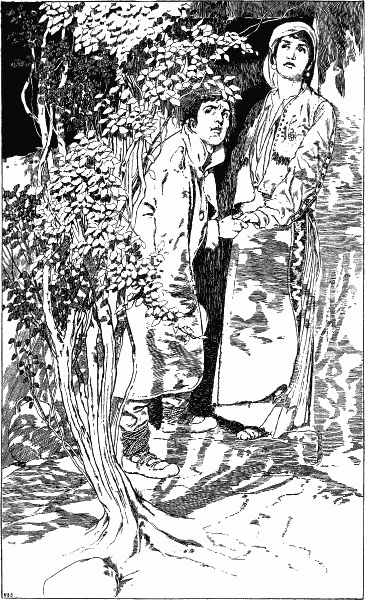
“Yea, Master Treasure-keeper,” answered Peter, with a
deep bow, “I was dreadfully frightened. But doubtless you
were his lordship the hawk, who killed the snake for me. I
am very much obliged to you. But I was coming to get
some advice from you, for things are going very poorly with
me. A charcoal-burner does not get on very well in life,
and as I am still young, I thought I might manage to better
myself. Specially when I look at others, who seem to have
got on so easily. Take fat Ezekiel, or the ‘dancers’ king,’
for instance; with them money is as plentiful as hay.”
“Peter,” said the little man very gravely, and as he spoke
he blew the smoke from his pipe far out before him—“Peter,
never speak to me of them. What does it advantage them
to seem happy here for a few years, and then to be all the
more miserable afterwards? Thou must not despise thy calling.
Thy father and grandfather were honest folk, and yet
they followed the same. Peter Munk, I hope it is not love
of idleness that has brought thee to me.”
Peter was alarmed at the little man’s serious tone, and
reddened as he answered: “Nay, Master Treasure-keeper,
idleness, I know full well, is the beginning of all evil; but
you cannot blame me if another calling pleases me better
than my own. A charcoal-burner is so very low, you see,
and glass-blowers, and raftsmen, and watchmakers are all of
more consequence.”
“Pride often goes before a fall,” answered the little master
of the forest, rather more kindly. “Ye are a strange race, ye
sons of men. You are scarcely ever quite content with the
state of life to which you are born and brought up! And what
is the use of wishing? Wert thou a glass-maker, thou wouldst
wish to be a master woodman; and if that were granted thee,
thou wouldst covet the forester’s place, or the Mayor’s house!
But let be; if thou wilt promise to work diligently, I will
help thee to something better, Peter. I am wont to give
every Sunday child that finds its way to me three wishes.
The first two are granted without question; the third I
can deny if it is a foolish one. So now thou mayst wish
for something—but let it be something good and useful,
Peter.”
“Hurrah! you are a capital little Glass-man!” shouted
Peter, “rightly called the Treasure-keeper, for you have
treasures indeed in your hand. And so I may wish for
whatever my heart desires? Then I will begin by wishing to
dance better than the ‘king of the dancing-floor,’ and always
to have as much money in my pocket as fat Ezekiel.”
“Thou fool!” exclaimed the little man angrily. “What
a miserable wish is this! To dance well, and to have money
for gambling! Art thou not ashamed, foolish Peter, of
being so blind to thine own welfare? What use is it to
thyself, or thy poor mother, that thou shouldst be able to
dance? What use is money, when by thine own wish, it is
but to be spent in the tavern, and will stay there, like that
of the miserable ‘dancers’ king’? So all the week long thou
wilt still have nought, and starve as before. I will give thee
one more free wish, but be careful to choose something more
sensible.”
Peter scratched his head, and resumed after some hesitation:
“Well, then, I will wish for the finest and richest
glass-hut in all the Black Forest, with its belongings, and all
the money that is needed to carry on the work.”
“Nothing else?” said the little man anxiously. “Oh,
Peter, nothing else?”
“Well, you might add a horse and a little cart.”
“Oh thou foolish Coal-Munk Peter!” cried the little fellow,
and threw his glass pipe in a rage against a neighbouring tree,
so that it broke into a hundred pieces.
“Horses, carts!” he continued. “Wisdom, I tell thee,
wisdom and plain common sense, and insight—these thou
shouldst have wished for, not horses and carts! Well, do not
look so downcast; we will try and see that thou dost not
come to harm, even so, for the second wish was not altogether
foolish. A good glass-hut keeps master and man alive; only
thou shouldst have wished for knowledge and sense to
carry it on, then horses and carts would have followed of
themselves.”
“But, Master Treasure-keeper,” said Peter, “I have still
a wish left. I can wish for wisdom with that, if it is really
as indispensable as you think.”
—“Nay, stop there! Thou wilt find thyself in many a
scrape yet, that will make thee glad thou hast a wish still
left. Now go home; and here,” continued the little spirit of
the pine-wood, drawing a purse out of his pocket, “here are
two thousand gulden, and let that suffice; do not come
asking me for money again, or I should be obliged to hang
thee from the highest fir-tree. That has been my rule since
I have dwelt in this forest. Three days ago old Winkfritz
died, who owned the large glass-hut in the lower forest. Go
there to-morrow morning, and make a proper bid for the
business. Look to thyself, be diligent, and I will pay thee
a visit now and again, and give thee a helping hand, and wise
counsel, since thou didst not ask for wisdom thyself. But I
tell thee again, and I am in earnest, thy first wish was bad.
Beware of the ale-house, Peter; it has never yet done any one
good for long!”
As he spoke, the little man had drawn a new pipe of fine
glass from his pocket, and stuffed it with dry pine-needles.
He now put it between his little toothless gums, and producing
a large burning-glass, he stepped into the sun and lit his
pipe. Having done this, he shook Peter kindly by the hand,
and after giving him a few more good counsels, as they
went along, he began to puff and blow so rapidly at his pipe,
that he ended by completely disappearing in a cloud of
smoke, which smelt of real Dutch tobacco, and faded slowly
away among the tops of the fir-trees.
When Peter got home, he found his mother very anxious
about him, for the good woman had quite made up her mind
that her son had been drawn for a soldier, and already carried
off. But he was in high spirits, and told her that he had
met a kind friend in the forest, who had procured him money
to start a new business, instead of the charcoal-burning. And
though his mother had lived for thirty years in a charcoal-burner’s
hut, and had been as used to blackened faces as
a miller’s wife is to floury ones, still she was foolish and
proud enough to despise her former condition as soon as
Peter promised her a more prosperous one, and said “that
now, as the mother of a man who owned a glass-hut, she
was something above the neighbours, Betty and Grete, and
should take a front seat in church, among the respectable
people.”
Peter soon struck a bargain with the inheritors of the
glass-hut the little man had told him of; he kept on the
workmen he found there, and let the glass-making go on
night and day. At first the work pleased him. He went
down to the workshop at his convenience, and walked about
it with an important air, his hands in his pockets, looking
to right and left, and making this and that remark, over
which his work-people often laughed not a little. His greatest
pleasure was to see the glass blown, and he would often set
to work himself, and form the strangest figures out of the
soft, warm mass. But after a while he tired of it, and went
to the hut, first only an hour each day, then only every
two days, and at last only once a week, while his workmen
did as they pleased. Now his fondness for the tavern
was to blame for all this. The Sunday after his return
from the “Pine-thicket,” he went there as usual, and there
was the “king” already bounding about upon the dancing-floor;
and there sat fat Ezekiel, too, his tankard before him,
rattling the dice and casting for crown thalers. Peter’s hands
jumped to his pockets, that he might see if the little Glass-man
had kept his word; and lo! they were bulging with silver
and gold coins. His legs, too, twitched and itched, as though
they were fain to jump and dance; and when the first dance
was over, he stood up with his partner opposite the “dancing-king,”
and when the latter sprang three feet into the air,
Peter leaped four, and when his opponent cut all sorts of
nimble and dainty steps, Peter twisted and turned his feet
about so much more rapidly, that the beholders could hardly
contain themselves for wonder and admiration. But when
people heard that Peter had bought a glass-hut, and saw how
he scattered sixpences among the musicians whenever he
went by, there was no end to the general astonishment.
Some said he had found a treasure in the forest, others that
he had come into an inheritance, but one and all honoured
him, and looked up to him, only because he had money.
He played away as much as twenty guldens that evening,
and yet the coins rattled in his pocket, as though there
were at least a hundred thalers left there. When Peter
saw how much he was respected, he was beside himself with
pride and joy. He threw his money about with both hands,
and gave generously of it to the poor. Did he not know
by experience how bitter is the sting of poverty? The
“dancing king” was cast quite into the shade by Peter’s
superhuman talents, and Peter was now called “the dancers’
emperor.”
The most reckless of the Sunday gamblers did not make
such wagers as he did, but neither did they lose so much.
But, then, the more he lost, the more he won, and this
happened just as he had begged the little Glass-man that
it might. He had wished “always to have as much
money in his pocket as fat Ezekiel,” and it was to this very
man that he always lost his money; so when he lost twenty
or thirty gulden at a stroke, there they were in his pocket
again, the very moment Ezekiel swept them into his own.
Presently he went further in betting and gambling than the
most daring ne’er-do-weels in all the forest, and he was
oftener called “gambling Peter” than “the dancers’ emperor,”
for he played on most work-days as well as Sundays now.
Hence his business began to go badly, and this was the fault
of Peter’s lack of wisdom. He had as much glass made as
there possibly could be, but with the business, he had not
bought the secret of disposing of his wares to the best
advantage. At last he did not know what to do with all
his unsold glass, and got rid of it half-price, to pedlars,
only that he might have enough to pay his workmen their
wage.
One evening, as he was coming home from the ale-house,
and thinking with shame and distress—despite all the wine
he had drunk to cheer himself up—of the failure of his
fortunes, he perceived that some one was walking beside
him, and when he looked round, behold, it was the little
Glass-man!
Then Peter broke out in anger against him, and with
boastful, daring words, swore that the little man was to
blame for all his troubles.
“What use are my horse and cart to me now?” he cried.
“What use are my hut and all my glass? Even when I was
only a poor charcoal-burner’s lad, I had a happier life and
fewer cares. Now I do not even know at what hour the
sheriff will come and value my goods, and sell me up
because of my debts!”
“So,” answered the little man, “so! I am to blame if
thou art unhappy? Are these the thanks I get for all my
benefits? Was it I who told thee to make such foolish
wishes? Thou wouldst be a glass-maker, and didst not even
know whither to sell thy wares! Did I not warn thee to
frame thy wishes carefully? Common sense, Peter, common
sense and knowledge were lacking to thee.”
“Sense and knowledge, indeed!” shouted Peter. “I am
as sensible a lad as any, and I will prove it to thee, little
Glass-man!” And with these words he seized the little man
by the collar, and yelled: “I have thee now, have I not, thou
Treasure-keeper! And now I will wish my third wish, and
thou shalt grant it. I wish, then, this moment, for two
hundred thousand hard thalers, and a house, and—ah!” he
screamed, for the little man of the woods had changed into
burning glass, and was scorching Peter’s hand like a flaming
fire. But of the little man himself no trace was to be seen.
For several days Peter’s swollen hand reminded him unpleasantly
of his ingratitude and folly. But after a time he
stifled the voice of conscience, and said to himself: “What
matter though they should sell my glass-hut, and all I have?
I still have fat Ezekiel, and as long as he has money on
Sundays, I cannot want for it.”
Yea, Peter, but if he should have none?
And so it happened one day, as a strange and wonderful
judgment upon them both. For one Sunday he drove up
to the inn, and the people stretched their heads out of
window, and said: “There goes gambling Peter—there goes
the ‘dancers’ emperor,’ the rich glass-man!” And others
rejoined: “Who knows about the riches? They do say his
debts are many, and that it will not be long before the sheriff
appears to seize his goods!”
But meanwhile Peter dismounted, and greeted them all
pompously, and called out to the host: “Good-evening, mine
host of the Sun Inn! Is fat Ezekiel here?” And a voice
from within replied: “Here we are, Peter, at the cards
already, and thy place is kept for thee.”
So Peter Munk went in, feeling his pockets, and saw
directly that Ezekiel must be well off that night, for they were
brimming over with gold and silver. He sat down to the
table, and played with one and another, and won and lost, and
won again, till it grew late, and the steadier heads among
them said it was enough, and they must go home to wife and
child. So one and another went, till gambling Peter and
Ezekiel were left alone. Peter begged the latter to stop on
a while, but he was loth, and resisted for a long time. At last
he cried: “Well, I will count what I have left, and then we
will play one last bout, five gulden a throw, for it is childish
to keep on for less.”
He counted his money, and found he had just a hundred
guldens; and now Peter did not need to count his, for he
knew how much he had, too.
But if Ezekiel had won before, he lost now, one throw
after another, swearing fearfully the while. At last he put his
only remaining five gulden on the table, and said: “Now, even
if I lose this time, I will yet not leave off, for thou wilt lend me
some of thy winnings, Peter; one good fellow helps another.”
“To be sure I will, and were it a hundred guldens!” cried
the other, proud of his winnings; and fat Ezekiel threw the
dice—fifteen. “Now let us see!” he cried.
Peter rattled the box, and threw—eighteen; and as he
did so, a hoarse, well-known voice behind him said: “So,
that was the last!”
He turned round, and saw the giant form of Dutch
Michael. He let the money he had won fall in terror. But
fat Ezekiel saw no one, and only begged Peter to lend him
ten guldens, that he might go on playing. Half dreaming,
Peter thrust his hand into one pocket—it was empty. He
tried the other—it was the same. He turned his coat inside
out, but not a penny-piece was to be found; and now
he thought of his own wish—that he might always have as
much money as fat Ezekiel. It had all disappeared like
smoke.
The host and Ezekiel gazed at him in surprise as he went
on hunting, and still found none of his money. They would
not believe he had no more; but when they themselves felt
in his pockets, and were obliged to confess it was the truth
they became very wroth, and swore gambling Peter was a
wicked conjurer and had “wished” all Ezekiel’s money, and
his own, away into his coffers at home. He defended himself
as best he could, but appearances were against him. Ezekiel
swore he would spread the shameful tale through all the
Black Forest, and the host declared he would go to the town
at dawn and denounce Peter as a sorcerer, adding that he
believed he would come to be burnt as one yet. Then they
set upon him in a rage, tore his jerkin from his back, and
thrust him out of doors.
No star lit up the dark sky as Peter slunk dejectedly
homewards, yet he could make out a dusky form that strode
along beside him, and at last spoke as follows:
“Thou art done for now, Peter Munk; all thy grandeur
is at an end. And I could have told thee as much before, but
thou wouldst have naught to do with me, and wert set upon
running to that foolish little glass-dwarf. Now thou seest
what happens to those who scorn my counsels. But try me
again, for I have pity upon thy miserable plight. No one
ever repented it yet who turned to me, and if thou dost not
fear the way, I am to be found all day to-morrow in the ‘Pine-thicket,’
and will come forth to speak with thee, if thou dost
but call.”
Peter was well aware who it was that spoke thus to him,
but a sense of dread crept over him. He made no answer,
but hurried on upon his homeward way.
When Peter went down to his glass-hut on Monday
morning, he found not only his workmen there, but
other and more unwelcome occupants, namely, the sheriff
and three of his officers. The former wished him good-day,
asked how he had slept, and then drew out a long list of
Peter’s creditors.
“Canst thou pay—yes or no?” asked the sheriff, with a
stern look. “Answer me quickly, for I have not much time to
lose, and it will take me three hours to get back to the town.”
Peter’s heart sank; he was obliged to own that his last
penny was gone, and to suffer the sheriff to begin valuing
his goods.
As he and his officers went about, examining and valuing
the house, the workshop, the stable, the horse, cart, and all,
Peter said to himself that it was not far to the “Pine-thicket,”
and that, as the little man had not helped him, he
would now try what the big one could do.
He hurried to the “Pine-thicket” as fast as if the sheriff’s
officers had been at his heels; and though, as he ran by the
spot where he had first spoken to the little Glass-man, he
fancied that an invisible hand was laid upon him, trying
to hold him back, still he broke away, and hastened on, till
he came to the boundary-line, of which he had taken good
care to note the position before.
He had scarcely had time to call out in a breathless voice:
“Dutch Michael! Master Dutch Michael!” ere the giant
raftsman, with his long pole, stood before him.
“So thou art come!” said he, with a laugh. “Would
they fain have skinned thee and sold thee to thy creditors?
Well, make thy mind easy. All thy troubles, as I said before,
come from the little Glass-man, that canting bit of piety,
who is too good to mix with other folk. If one gives at all,
one should give freely, and not like yon miser. But come,”
he continued, turning toward the forest, “follow me to my
house, and we will see whether we can strike a bargain.”
“A bargain!” thought Peter. “What can he ask of me,
or what have I to barter? Am I to be his servant, or what?”
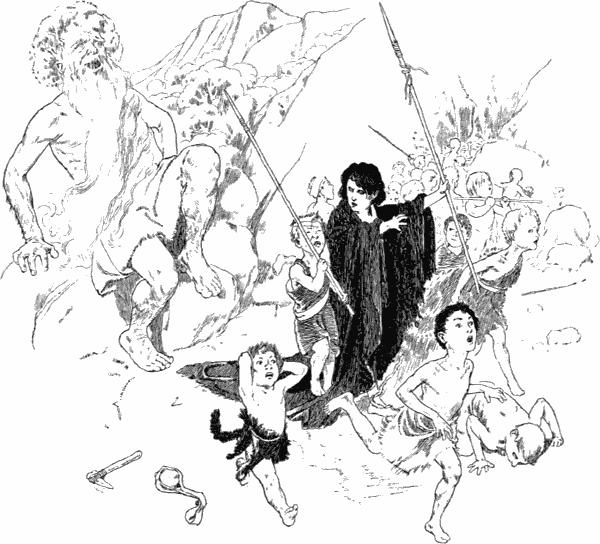
They went for a bit down a steep woodland path, that
led suddenly to the brink of a dark, deep, and precipitous
ravine. Dutch Michael swung himself down the cliff as
though it had been a flight of smooth marble steps; but
Peter nearly lost his senses for terror when the giant, having
reached the bottom, suddenly grew up as tall as a steeple,
and reaching out an arm as long as a weaver’s beam, with a
hand at the end of it as big as the table at the tavern, called
up in tones as deep and muffled as a funeral bell: “Sit thee
down on my hand, and hold on by one of the fingers, that
thou mayst not fall.”
Peter tremblingly did as he was told, and taking his seat
upon the giant’s hand, held firmly on by one of his thumbs.
They went down a long way, deeper and deeper; yet to Peter’s
surprise it grew no darker, but rather the daylight brightened
as they descended into the chasm, only his eyes could not
endure that light for long together.
Dutch Michael’s size decreased the farther Peter got down,
until he had shrunk to his usual height, and they stood at
the door of a house, that was neither better nor worse than
that of any rich peasant in the forest. The sitting-room
which Peter now entered was no different from other people’s,
except that it seemed very lonely; the tall wooden clock,
the great earthenware stove, the broad benches, and the
household utensils on the shelves, were just the same here
as elsewhere. Michael motioned him to a seat by the centre
table, and then went out, returning with a pitcher of wine
and some glasses. He filled them up, and began chatting
with his guest, telling him so much about the pleasures of the
world, and the beauties of foreign countries, towns, and rivers,
that Peter at last confessed to a great desire to see all these
fine things.
“But,” said Dutch Michael, “though thy body might be
full of strength and courage, enough to venture upon any
undertaking, yet one or two throbs of thy foolish heart
would be enough to make thee tremble and grow weak! And
then again, what you call sorrow, or wounded honour, what are
these, that a sensible lad should trouble about them? Was
it in thy head thou didst feel it, when a while ago some one
called thee an impostor and a scoundrel? When the sheriff
came to turn thee out of house and home, was it thy belly
that pained thee? Nay, but where, tell me, where didst thou
feel the pain?”
“In my heart,” said Peter, as he pressed his hand to his
throbbing side, for he felt, indeed, as though his heart were
leaping to and fro in alarm.
“Well, in past days—do not take it amiss—but in past
days, I say, thou hast thrown away many hundred guldens to
good-for-nothing beggars, and other ragamuffins, and what use
has it been to thee? They wished thee health and every
blessing—art thou any the healthier for it? For half that
wasted money thou couldst have paid for a doctor all to thyself.
Blessings! A fine blessing it is to be sold up and turned
adrift, eh? And what was it that made thee thrust thy hand
in thy pocket as often as a dirty beggar stretched out his
ragged cap? Thy heart, always thy heart; not thine eye, thy
tongue, or thy leg, but thy heart—thou didst always take it, as
they rightly say, too much to heart!”
“But how can a man get to feel differently? I am taking
a deal of trouble, this very moment, to keep my heart quiet,
and yet it is throbbing and aching.”
“Thou!” laughed the other. “Thou, poor wretch, canst
do nothing to prevent it, I know. Yet only give me the
feebly beating thing, and thou shalt see what ease will be
thine.”
“You?—my heart?” cried Peter in terror. “But then
I should die on the spot? Never!”
“Yes, if one of these gentlemen, the surgeons, were to try
and cut the heart out of thy body, thou wouldst die, sure enough;
but it is not so when I do it. Come hither and be convinced.”
With these words, he opened a door and led Peter into an
adjoining room.
The lad’s heart sank, with a painful quiver, as he
stepped over the threshold; but he did not notice it, so
startling and amazing was the sight that met his eyes. On
sundry wooden shelves stood glass jars, filled with a transparent
fluid, and in every one of these jars lay a heart. Moreover,
each jar was labelled and bore a name, which Peter
read with eager curiosity. Here was the heart of the sheriff
of F., and there the heart of fat Ezekiel, and the heart of the
“dancers’ king,” and of the head-forester; there were six
hearts belonging to corn-brokers, eight to recruiting officers,
three to usurers—in fact, it was a collection of the most
respectable hearts for twenty miles round.
“See!” said Dutch Michael, “all these have cast away
the cares and sorrows of life; not one of these hearts beats
anxiously or heavily any more, and their former owners feel
all the better for having got this restless guest out of their
house.”
“But what do they carry in their breasts instead?” asked
Peter, who felt quite confused and giddy from all he had seen
and heard.
“This,” answered the other, and reached out to him, from
a drawer which he had opened, a stone heart.
“This!” echoed Peter, and could not prevent a cold
shiver from going over him. “A heart of marble. But
surely, Master Dutch Michael, such a one must feel very
cold in a man’s breast?”
“Certainly; but the coolness is really quite pleasant. Why
should a heart be warm, after all? In winter, a good dram
will warm thee better; and in summer, when all is sultry and
hot, it’s past belief how comfortably such a heart as this cools
a fellow down. And, as I said before, neither fear nor care,
neither foolish pity nor other men’s sorrow, can knock at the
door of such a heart.”
“And is that all you can give me?” asked Peter angrily. “I
hoped for money, and you offer me a stone.”
“Well, I should think a hundred thousand guldens would
be enough to begin with, would it not? If thou dost only
manage it well, thou canst soon be a rich man.”
“A hundred thousand!” cried the poor charcoal-burner joyfully.
“Well, do not leap so wildly in my breast, unruly heart!
we shall soon have done with one another! So be it, Michael,
give me the money and the stone, and thou hast leave to take
away the unrest from this dwelling-place.”
“I was sure thou wert a sensible lad,” replied the Dutchman,
smiling pleasantly; “come, let us have one more drink
together, and then I will count out the money.”
They sat down to their wine again, and drank and drank,
until Peter fell into a deep slumber.
Coal-Munk Peter was awakened by the cheery ring of a post-boy’s
horn, and found himself sitting in a fine carriage, rolling
along a broad road; and as he leaned from the door and looked
back, he could see the Black Forest lying far behind him in
the distance. At first he could not believe that it was really
himself sitting in this post-chaise, for even his clothes were not
the same as he had worn yesterday, but he remembered everything
that had happened so clearly, that at last he gave up
puzzling, and cried: “Well, I am Coal-Munk Peter at any
rate, and no other; that much is certain.”
He was surprised that he felt no melancholy, no home-sickness,
on thus leaving his quiet village, and the silent woods where
he had lived so long, for the first time. Even when he thought
of his mother, whom he must have left behind in penury and
distress, he could not squeeze a tear out of his eye, or even heave
a sigh at the thought of her, for he felt indifferent to everything.
“But of course,” he thought to himself, “tears and sighs,
melancholy and home-sickness, all come from the heart, and,
thanks to Dutch Michael, mine is cold and of stone.” He laid
his hand on his breast, and all was quiet and motionless
within. “If he has kept his word as well about the hundred
thousand, I may think myself lucky indeed,” he said, and
began to search the carriage.
At first he only found clothes, of every description that he
could want, yet no money; but finally he hit on a bag filled
with golden thalers, and bills upon various merchants in all
the great cities. “Now everything is as I wish,” he thought,
and settling himself comfortably in a corner of the carriage, he
journeyed forth into the world.
He travelled about for two years, gazing right and left out
of his carriage at the houses and lands as he went by; and
the first thing he looked for, when he stopped anywhere, was
the sign of the tavern. Then he would wander about in the
cities, and let all their rarest treasures and most beautiful
sights be displayed to him. But nothing gave him pleasure—no
picture, no house, no music, no merrymaking; his stone
heart could take no interest in anything, and his eyes and ears
were deadened to all that was lovely. He had nothing left but
the pleasures of eating and drinking, and of sleep; and so he
lived, wandering about the world without object, eating for
his amusement, and sleeping because he was dull. Now and
then he remembered, indeed, that he had been happier and
merrier when he was still poor, and had to work for his livelihood.
Then every beautiful outlook into the valley, all music
and song, still delighted him, and he had even looked forward
for hours to the simple meal that his mother was to bring up
to the charcoal-kiln for him. It seemed quite strange, as he
looked back over the past, and called to mind how he had
been wont to laugh at the slightest jest, to think that he could
no longer laugh now. When others did so, he drew his mouth,
out of politeness, into a wry smile, but his heart had no
smile within. Then he knew that, though he was very calm,
he was not happy. It was not melancholy or home-sickness,
but merely want of interest, and the weariness of his empty,
joyless life, that at last sent him home again.
When he drove from Strasbourg and caught sight of the
dark woods of his home—when he saw again, for the first
time, the powerful forms and the kind, honest faces of the
Black Forest folk—when the tones of that familiar speech,
deep and loud, yet pleasant withal, fell upon his ear, he hastily
put his hand to his heart, for he felt a stir in his blood, and
thought that now he must surely both rejoice and weep—but
how could he have been so foolish? Had he not a heart of
stone? Stones are dead, and neither laugh nor weep.
His first visit was to Dutch Michael, who welcomed him
with his old kindness.
“Michael,” Peter said to him, “I have travelled and seen
everything now, but it is all foolish stuff, and I only bored
myself. This stone thing of yours, to be sure, saves me a
great deal. I never get angry and am never sad, but then
I am never merry either, and I seem to myself to be only
half alive. Could you not make the stone heart a bit livelier?
Or—why not give me back my old heart? I would rather
have it back; I had got used to it in five-and-twenty years,
and if it did sometimes play me a foolish trick, yet it was
merry, and a blithe sort of heart.”
The wood-spirit laughed a bitter, grim laugh.
“When once thou art dead, Peter Munk,” he replied,
“thou shalt have it fast enough. Yes, then thou shalt have
thy soft, easily moved heart again, and be able to feel all
that comes, whether joy or pain. But above ground it can
never be thine again. Yet, Peter, if thou hast travelled,
and reaped no pleasure from it, this was only because of
thy foolish way of life. Now settle somewhere in the
forest, build a house, marry, use thy money so as to increase
thy wealth. Lack of work is all that is amiss with thee; thou
wert only dull because thou wert idle, and now thou wouldst
put all the blame on this innocent heart?”
Peter admitted that, as far as the idleness was concerned,
Michael was right; and he made up his mind to set to work
at getting richer and richer. Michael again made him a
present of a hundred thousand guldens, and bade him farewell
as the best of friends.
The story soon got spread about that Coal-Munk Peter,
or “gambling Peter,” had returned, and far richer than before.
And thereupon things went as they always do—at the time he
had been reduced to beggary, they had turned him out of the
Sun Inn, but now when he made his first appearance there on
a Sunday afternoon, every one shook him by the hand, praised
his horse, and asked about his travels; and when he began
to play again for hard coin with fat Ezekiel, he stood as
high as ever in the public esteem.
He no longer made glass now, but took up the wood-business,
and even that only as a pretence. His real business
was that of a corn-broker and money-lender. By-and-by half
the Black Forest was in debt to him, but he only lent out
money at ten per cent., or sold corn at treble the usual price,
to poor people who could not pay at once. He was now
fast friends with the sheriff; and if any one failed to pay what
he owed Master Peter Munk, punctually and to the very day,
out would come the sheriff with his men, and having hastily
valued the poor debtor’s goods, they would sell all he had,
and turn him out, with wife and child, into the forest.
At first this caused the rich Peter some inconvenience,
for the poor sold-up wretches would besiege his house in
swarms, the men begging for a little respite, the women
trying to soften the heart of stone, and the little children
crying for a crust of bread. But he soon provided himself
with a couple of fierce bloodhounds, and then the “cats’
music,” as he called it, stopped at once.
The person who gave him the most trouble was “the
old wife,” as he called her, and who was she but Mistress
Munk, his own mother. She had fallen into misery and want,
at the time their house and goods had been sold up, and
since her son had come home a rich man, he had never
troubled himself about her. Now she would sometimes
hobble up to the house, leaning on her stick, old, broken-down,
and feeble. She did not dare go in, for he had once
driven her away; but it cut her to the heart to be obliged
to live on the charity of others, when her own son could
have made her old age comfortable and free from care. But
the cold heart was never moved by the sight of the well-known
form and features, now so pale and wasted, or of the outstretched
hand and imploring gaze. When she knocked at
the door on Saturday evenings, he grudgingly drew forth a
sixpenny-piece, wrapped it in paper, and sent it out to
her by a serving-man. He could hear her trembling voice
uttering thanks, and wishes for his prosperity—he could
hear her cough as she crept from the door, but he thought
no more of it, except that he had been obliged to spend
another sixpence uselessly.
At last he bethought himself of marrying. He knew that
any father in the district would gladly give him his daughter,
but he was particular in his choice, for he desired men to
praise his luck and his wisdom in this matter too. So he
rode about through all the forest, looking here and there, yet
none of the handsome Black Forest girls seemed handsome
enough for him. At last, after having sought in vain among
all the pretty girls at the various dances and meeting-places,
he heard that the fairest and best girl in the whole country
was the daughter of a poor wood-cutter. She was said to live
very quietly, in the strictest seclusion, managing her father’s
house diligently and well, and never showing herself at a
dance, not even on the greatest holidays. When Peter heard
of this wonder of the forest, he determined to woo her, and
rode off to the hut that had been pointed out to him.
The father of beautiful Lisbeth received this fine gentleman
with much surprise, and was even more surprised
to learn that he was the rich Master Peter Munk, and was
anxious to become his son-in-law. The old man was not
long in making up his mind, for he fancied all his care and
poverty would now be at an end; he even gave his consent
without consulting Lisbeth, and the good child was so
obedient that she made no objection to becoming Mistress
Peter Munk.
But the poor girl was far from having as pleasant a life
as she had expected. She had thought she understood housekeeping,
but she could never please Master Peter; she had
compassion on the poor and suffering, and as her husband
was so rich, she thought it no sin to give a penny to a poor
beggar-woman, or a dram to an old man; but when Master
Peter one day discovered this, he growled out with rough
voice and angry looks:
“What is this thou art after, wasting my substance on
vagabonds and ragamuffins? Didst thou bring anything into
the house, that thou shouldst have the right to give anything
away? Thy father’s beggar’s staff will warm no soup, and
yet thou canst throw money about like a queen. Let me
catch thee at it again, and thou shalt feel my hand!”
Beautiful Lisbeth wept alone in her room over her
husband’s hard heart, and often wished herself home again
in her father’s poor hut, rather than in the house of rich,
but niggardly, stony-hearted Peter. Ah! if she had only
known that he had a heart of marble, that could neither love
her nor any one else, she would no longer have wondered
at him.
Now, when she sat at her door, and a beggar came up, and
took off his hat and began his little speech, she would close
her eyes, so as not to see his misery, and clench her hand
tightly, lest it should slip into her pocket and fetch out a coin.
Therefore it came to pass that beautiful Lisbeth fell into
bad repute through all the forest, and people said she was
even more of a miser than her husband.
But one day she was sitting at her door, spinning and
singing a little song, for she was light of heart, because the
weather was fine, and Master Peter had ridden far afield; and
presently a little man came down the road, carrying a large,
heavy sack; she could hear him a long way off, panting for
breath. Mistress Lisbeth looked at him pityingly, and thought
to herself that such an old man should not be so heavily laden.
Now the little man staggered up, gasping, and when he
got opposite Mistress Lisbeth’s door, he broke down altogether
beneath his load.
“Oh, have pity on me, and give me a drink of water,
mistress!” he panted. “I can go no farther, and am fainting
for misery.”
“But you should not carry such heavy loads at your age,”
said Mistress Lisbeth.
“Ay, ’tis all very well, but what if I must do errands,
because I am poor and have to earn my bread?” he answered.
“Ah! a rich woman like you does not know how bitter poverty
is, or how welcome a cool drink in such hot weather.”
When Lisbeth heard this, she hurried into the house and
filled a glass with water, but as she was coming back, and saw
how wretched and careworn he looked, crouching upon his
sack, a deeper compassion welled up within her; she remembered
her husband was not at home, and turning again, she
put the water aside, and brought out a beaker full of wine,
with a good loaf of rye-bread, to the old man.
“There, a draught of wine will do thee more good than
water, as thou art so old,” she said; “but do not drink so
hastily, and eat some bread with it.”
The old man gazed at her in astonishment, till great tears
gathered in his eyes. He drank again, and then said:
“I am old, but I have met with few people so compassionate
as thou, or who gave their gifts with so sweet and heartfelt a
grace, Mistress Lisbeth. But thou wilt surely have a happy
life in return, for such a heart does not go unrewarded.”
“Nay, and she shall reap the reward this very moment!”
shouted a furious voice—and looking round, they saw Master
Peter, crimson with anger, standing behind them. “And I
see thou dost give my choicest wine, too, to beggars, and my
own tankard to the lips of vagabonds! There is thy reward!”
Mistress Lisbeth fell at his feet and begged for forgiveness,
but the stone heart knew no pity; he turned the whip
he held in his hand, and brought down its ebony handle with
such force upon her fair forehead, that she sank lifeless into
the old man’s arms.
When he saw this, Peter at once seemed to feel remorseful,
for he bent down to see if there were any life left in her;
but the little old man said, in well-known tones:
“Trouble thyself no further, Coal-Peter; here was the
fairest and sweetest blossom in all the forest, but thou hast
trodden it under foot, and it will never bloom again.”
Every drop of blood left Peter’s cheeks, and he stammered:
“It is you, then, Master Treasure-keeper? Well, what is
done is done, and doubtless it had to be. But I trust you
will not denounce me to justice as a murderer?”
“Miserable wretch!” said the little Glass-man sternly.
“What good would it do me to bring thy perishable body to
the gallows? Not earthly judgments hast thou to fear, but
other and more terrible ones; for thou hast sold thy soul to
the Evil One.”
“And if I have sold my heart,” screamed Peter, “it is
thou who art to blame, thou and thy deceitful treasures!
Thou, malicious spirit, hast been my undoing—’tis thou hast
driven me to ask help from another—thou hast to answer
for it all!”
But hardly had he spoken these words, when the little
Glass-man began to grow larger and taller, till he towered
above him, and his eyes, they declare, were as large as soup-plates,
and his mouth was like a heated oven, and breathed
forth fiery flames. Peter fell on his knees, and his stone heart
did not prevent him from trembling like an aspen leaf. The
wood-spirit seized him by the neck with its hawk-like talons,
whirled him round as the storm-wind does a dry leaf, and
then cast him to the ground again, so that all his bones rattled.
“Earth-worm!” he cried with a voice of thunder, “I could
shatter thee to atoms if I would, for thou hast blasphemed
against the Lord of the Forest. But, for this dead woman’s
sake, who gave me food and drink, I will grant thee eight
days’ respite. If thou dost not turn and repent thee in that
time, I will come and grind thy bones to powder, and thou
shalt go hence in thy sins!”
It was already evening, when some men who were going
by saw rich Peter Munk lying on the ground. They turned
him this way and that, and sought if there was still any
breath in him, but for a time they sought in vain. Presently
one fetched water from the house and sprinkled some
over him, and at that Peter gave a deep sigh, moaned, and
opened his eyes. He looked about him, and asked where
Mistress Lisbeth was, but no one had seen her. Then he
thanked the men for their help, and crawled into his house,
where he began seeking in every corner from roof to cellar, but
Mistress Lisbeth was nowhere to be found. So he knew that
what he had taken for a hideous dream was the awful reality.
Now that he was quite alone, strange thoughts visited
him; not that he was afraid of anything, for was not his heart
of stone? But when he thought of his wife’s death, pictures
of his own end came unbidden into his mind, and he saw
himself going hence, so heavily laden with the tears of the
poor and their curses—which had alike been unavailing to
soften his heart—with the misery of all the wretched folk on
whom he had set his dogs, with the silent despair of his
mother, and with the blood of good and beautiful Lisbeth.
What account should he give to the old man, her father,
when he came and asked, “Where is my daughter, whom
I gave thee to wife?” How could he answer the questions
of that Being, to whom belong all the forests, the seas, the
mountains, and the lives of men?
These thoughts even tormented him at night in his
dreams, and he kept on being awakened by a sweet voice
that called to him, “Peter, get thee a warmer heart.” But
when he was awake, he made haste to shut his eyes again,
for the voice that spoke this warning sounded like that of
Mistress Lisbeth.
One day he went to the ale-house to distract his thoughts,
and there he fell in with fat Ezekiel. They sat down together
and talked of this and that, the weather, the taxes, the war,
and lastly of death, and of how many people here and there
had died suddenly. Then Peter asked the fat man what he
thought about death, and what was to come after it. Ezekiel
replied that the body was buried, but that the soul would go
to its appointed place.
“And the heart?” asked Peter anxiously, “do they bury
that too?”
“To be sure,” answered Ezekiel.
“But if one has no heart?” Peter went on.
Ezekiel looked at him with a dreadful expression. “What
dost thou mean by that?” he asked. “Art thou mocking
me? Dost mean to say I have no heart?”
“Yes, a heart sure enough, as hard as a stone,” replied
Peter.
Ezekiel stared at him in amazement, looked cautiously
round to see if he could be overheard, and then said: “How
comest thou to know that? Or does thine own heart beat no
longer, perhaps?”
“It beats no longer,” rejoined Peter, “at least not here
in my breast. But tell me, since now thou hast taken my
meaning, what will happen to our hearts?”
“Why trouble about that, comrade?” asked Ezekiel,
laughing. “Hast thou not all thou canst need for a jolly life
on earth, and is not that enough? That is just the comfort of
having these cold hearts, that such thoughts cannot terrify us.”
“True; yet we think such thoughts, and though I may
no longer feel any dread now, yet I remember how I felt
when I was still an innocent boy.”
“Well, I don’t suppose our lot will be of the best,” said
Ezekiel. “I asked a schoolmaster once, and he told me that
after death all hearts were weighed, to see how heavily they
were laden with sins. The lightest rise up, but the heavy
ones sink down, and methinks our stones will be of tolerable
weight.”
“Yes, truly,” replied Peter; “and even now it often makes
me uneasy to feel my heart so careless and indifferent when
I think of such matters.”
So they talked; but on the following night Peter heard
the well-known voice whisper in his ear, five or six times:
“Peter, get thee a warmer heart.”
Still he felt no remorse at the thought of having killed
Lisbeth; but when he replied, in answer to the servants’
inquiries, that his wife was away on a journey, he thought
within himself: “What may that journey be?”
He went on thus for six days, always hearing the voice by
night, and by day always thinking of the wood-spirit and his
terrible threat; but on the seventh morning he sprang from
his bed, crying, “So be it, then; I will try whether I can get
me a warmer heart, for this unfeeling stone in my breast
makes life weary and desolate to me.” He hastily put on
his Sunday clothes, mounted his horse, and rode to the
“Pine-thicket.”
On reaching the spot where the trees begin to stand closer
together, he dismounted, made fast his horse, and began, with
a rapid step, to ascend the hill. When he reached the top,
and stood beneath the great pine, he raised his voice and
repeated:—
“O Treasure-Keeper in the forest green,
Thine age is many hundred years—this land
Is all thine own, wherever pine-trees stand;
By Sunday-children only art thou seen.”
Then the little Glass-man came forth, looking, not genial
and friendly as before, but sad and gloomy; he wore a coat
all of black glass, and a long mourning-band fluttered from his
hat. Peter knew full well for whom he was mourning.
“What wilt thou of me, Peter Munk?” he asked in a
hollow voice.
“I have yet one wish left, Master Treasure-keeper,” said
Peter, with downcast eyes.
“Can hearts of stone still wish?” asked the other.
“Thou hast all that thy wicked mind can require, and it can
hardly be that I may fulfil any wish of thine.”
“Yet you promised me three wishes, and I still have
one left.”
“But I can deny it, if it is a foolish one,” said the wood-spirit.
“However, let be; I will hear what it is.”
“Then take away this dead stone, and give me back my
living heart,” said Peter.
“Did I make the bargain with thee?” asked the little
Glass-man. “Am I Dutch Michael, who gives riches and cold
hearts? Yonder, with him, must thou go seek for thy heart.”
“Alas! he will never give it me back,” replied Peter
sorrowfully.
“I pity thee, wicked though thou art,” said the little
man after some thought. “And since thy wish was not a
foolish one, I cannot, at least, deny thee my help. Listen,
then. Thou canst never get back thy heart by force, yet by
cunning thou mayst, and without much difficulty either, perhaps;
for Michael is still only foolish Michael, after all, though
he thinks himself very clever. Therefore go straight to him,
and do as I bid thee.” And now he gave Peter full instructions,
and handed him a little cross of pure glass. “He
cannot endanger thy life,” he concluded, “and he will let
thee go free directly thou shalt hold this before him, if thou
dost only pray the while. Then, if thou hast got thy desire,
come back to me here.”
Peter Munk took the cross, made sure that all the little
man’s words were thoroughly fixed in his mind, and went his
way to Dutch Michael’s dwelling-place. He called his name
three times, and the giant stood before him directly.
“Thou hast killed thy wife,” said he, with a dreadful
laugh. “Well, I should have done as much; she was giving
all thy wealth away to beggars. But thou wilt have to leave
the country for a while, for there will be a stir made when
she is not to be found; and thou wilt need money for the
journey, and art come to fetch it?”
“Thou hast guessed rightly,” answered Peter; “only it must
be a large sum this time, for it is a long way to America.”
Michael went first, and brought him down to his house;
there he opened a chest full of gold, and took out roll after
roll of it. While he was counting it out on the table, Peter
began:—
“Thou art a cunning trickster, Michael, to have taken me
in with that tale of my having a stone in my breast, and of
thy having got my heart!”
“And is it not the truth?” asked Michael in surprise;
“dost thou feel thy heart, then? Is it not like ice? Dost
thou know fear, or sorrow, or remorse?”
—“Thou hast stopped the beating of my heart, perhaps,
but I have it just as usual in my breast. And Ezekiel too; he
told me that thou hadst taken us both in. Thou art not the
fellow to be able to tear a man’s heart out of his breast like
that, unnoticed and without danger. It would take a sorcerer
to do that.”
“I swear to thee,” cried Michael angrily, “that thou, and
Ezekiel, and all the rich folk who have made a bargain with
me, have just such cold hearts as I showed thee, and your
real hearts are here in my closet.”
“Dear, dear! how the lies do slip from thy tongue, to
be sure!” laughed Peter. “Go and tell that tale elsewhere.
Dost think I have not seen dozens of such conjuring tricks
on my travels? Those hearts in thy chamber there are
sham ones, made of wax. Thou art a rich fellow, I allow;
but thou art no sorcerer.”
Then the giant grew enraged, and threw open the chamber
door.
“Come in and read all these labels—that one yonder,
see, is Peter Munk’s heart. Dost thou mark how it quivers?
Can that, too, be done with wax?”
“And yet it is of wax,” answered Peter. “A real heart
does not throb like that, and besides, I have mine still in my
breast. Nay, thou art no sorcerer!”
“But I will prove it to thee,” cried the other, more angrily
still; “thou shalt feel for thyself that it is thine own heart.”
He lifted it from the jar, tore open Peter’s jerkin, pulled
the stone from his breast, and held it before him. Then
taking the real heart, he breathed upon it, and put it carefully
into its place—and immediately Peter felt how it beat, and
could rejoice that he had it once more.
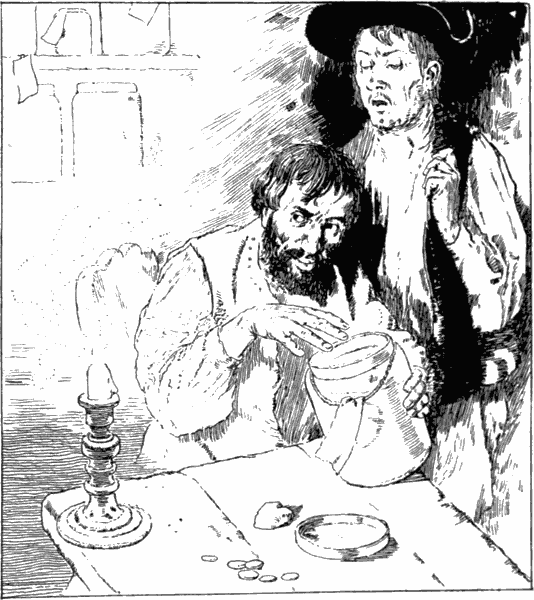
He lifted it from the jar, tore open Peter’s jerkin, pulled the stone
from his breast, and held it before him.
“How dost thou feel now?” asked Michael, smiling.
“In truth, thou wert right,” answered Peter, beginning
carefully to draw the cross from his pocket. “I would never
have believed that any one could do such a thing.”
—“No, indeed! And so thou seest that I am a sorcerer
after all. But come now, I will put the stone back again.”
“Gently, Master Michael,” cried Peter, stepping back and
holding out the cross towards him. “Mice are caught with
lard, and this time ’tis thou art the dupe.” And he straightway
took to repeating all the prayers he could think of.
Then Michael began to grow smaller and smaller, and
dropped to the ground, where he writhed to and fro like a
worm, moaning and groaning. And all the hearts round
about began to quiver and to throb, so that it sounded like
a watchmaker’s workshop. But Peter was filled with dread,
and an awe-struck feeling crept over him; he ran as fast as
he could from the room and from the house, and, urged by
fear, climbed rapidly up the face of the cliff, for he could hear
that Michael had risen again, and was stamping and raging
after him, sending out terrible curses the while. As soon as
he reached the top of the cliff, he hurried towards the “Pine-thicket.”
As he went, a fearful storm arose, and the bolts of
lightning fell to right and left of him, shattering the trees;
but he held on his way, and came in safety to the domain
of the little Glass-man.
His heart was beating joyfully, and that merely because
it beat. But now he looked back with horror upon his past
life—it seemed to him as terrible as the thunderstorm, that
had laid bare the noble woods behind him. He thought of
Mistress Lisbeth, his good and lovely wife, whom he had
murdered out of avarice, and he appeared to himself as the
very scum and offscouring of mankind. He was weeping
bitterly when he reached the little Glass-man’s mountain-top.
The Treasure-keeper was sitting under the fir-tree smoking
a little pipe, yet he looked more cheerful than before.
“Why art thou weeping, Coal-Peter?” he asked. “Hast
thou not got thy heart back again? Is the cold one still
in thy breast?”
“Alas, sir!” sighed Peter, “while I yet carried the cold
heart within me, I never wept—mine eyes were as dry as the
fields in August; but now my own, old heart is like to break,
because of what I have done. I have driven out my debtors
into want and misery—I have set my dogs upon the sick and
the poor—and you know yourself how my whip fell upon her
fair forehead!”
“Thou hast been a great sinner, Peter,” said the little
man. “Riches and idleness corrupted thee, till thy heart
turned to stone, and could no longer be touched by joy or
sorrow, pity or remorse. But repentance makes amends,
and if I could only be sure that thou dost truly grieve over
thy past life, I might very likely still be able to do something
for thee.”
“I want nothing more,” answered Peter, and his head
sank sorrowfully upon his breast. “It is all over with me;
I can never be happy again as long as I live. What shall I
do all alone in the world? My mother will never forgive me
the great wrong I have done her, and perhaps, indeed, I have
already brought her to her grave, monster that I am! And
Lisbeth, my wife! Do thou rather strike me dead, too, Master
Treasure-keeper, and let my wretched life end at once.”
“So be it,” answered the little man; “if thou wilt not
have it otherwise, it shall be done. I have my axe here
at hand.” He took his pipe quietly from his mouth, knocked
the ashes from it, and put it by. Then he stood slowly up,
and went behind the pine-trees. But Peter flung himself
down weeping upon the grass, and awaited the death-stroke
patiently, for his life was worth nothing more to him.
After a while he heard light footsteps behind him, and
thought: “Now he is coming.”
“Look up once more, Peter Munk,” called the little man.
He wiped the tears from his face, and turned round, and
see! there were his mother and Lisbeth, his wife, looking
at him with kind and loving eyes. Peter sprang to his feet,
bewildered with joy.
“Art thou not dead, then, Lisbeth?” he gasped. “And
thou art here too, mother, and hast forgiven me?”
“They will both forgive thee,” said the little Glass-man,
“because thou dost truly repent—and all shall be forgotten.
Go home now to thy father’s hut, and be a charcoal-burner
as before; if thou art kind and honest, thou wilt honour
thy calling, and thy neighbours will love and respect thee
more than if thou hadst ten coffers full of gold.”
So spoke the little Glass-man, and bade them farewell;
and with thanks and praise upon their lips, the three went
home together.
The rich Peter’s fine house was no longer standing;
the lightning had struck it and burnt it to the ground, with
all its treasures; but the hut that had been his father’s was
not far off. Thither they turned their steps, and even this
heavy loss did not trouble them much. But what was their
amazement when they reached the hut, and found in its stead
a comfortable peasant’s house! Everything in it was simple,
but good and clean.
“Our kind little Glass-man has done this!” cried Peter.
“How beautiful!” said Mistress Lisbeth; “and I feel much
more at home here than in that large house with all those
servants.”
From this time forth Peter Munk became a worthy and
industrious man. He was content with what he had, and
followed his calling cheerfully, and so it came about that he
gathered some wealth together by his own efforts, and was
respected and beloved throughout the forest. He no longer
found fault with his wife, he honoured his mother, and gave
to the needy who came to his door. When, after a year and
a day, Mistress Lisbeth became the mother of a fine little boy,
Peter went once more to the “Pine-thicket,” and repeated his
charm. But no little Glass-man appeared.
“Master Treasure-keeper,” cried Peter, “do but hear me!
I have only come to beg you to be my little son’s godfather.
I want nothing else.”
There was no answer, only a puff of wind stirred the pine-trees
above, and cast one or two fir-cones down upon the
grass.
“Well,” cried Peter again, “I will take these with me as
a remembrance, since thou wilt not show thyself.” And he
put the fir-cones in his pocket and went home; but when he
took off his Sunday jerkin, and his mother turned the pockets
out before putting it away in the chest, there fell from them
four great rolls of money, which proved to be good, new
thalers of the realm, and there was not a single false one
among them. And this was baby Peter’s christening-gift from
the little man in the pine-forest.
So they lived on, quiet and contented; and many a time,
when Peter Munk’s hair was already turning white, he would
be heard to say: “It is better, after all, to be happy with
little, than to have money and goods, and a cold heart.”
THE END
Printed by Ballantyne, Hanson & Co.
Edinburgh and London
Every effort has been made to replicate this text as faithfully as
possible. Some minor corrections of spelling and punctuation have
been made.