These stories are offered in the hope that they
may help promote the love of reading in our
boys and girls. After all, our duty in teaching reading
is not in the subject matter but in the desire.
If we show to the child that the art of reading is
the golden key which will unlock the storehouse of
life enjoyment, and give him the love for the secrets
of the printed page, we may consider that our educational
effort has been well spent. So the primary
object in writing these stories has not been to chronicle
history but to give the child something interesting
and entertaining.
The early Celts have little literature other than
these stories, which have been handed down from
generation to generation by word of mouth. Most
of the tales in this book have been taken from the
Ossianic Saga. Whether Finn belongs to history or
mythology detracts no jot from the absorbing interest
of his exploits.
I have tried to make the story of Finn something
of a connected narrative. To do this I have taken
incidents from various versions; I have left out much
unsuitable to children, and I have changed some incidents
to conform to the modern standards of morals.
The chronology of arrangement is my own, but I
have tried to preserve the spirit of the originals.
No collection of Irish folk stories could be brought
out were it not for the work of those many scholars
who have spent years in collecting and translating
the tales of the Celtic race. To our American linguist,
Jeremiah Curtin, and to the Irish scholars:
Sir Douglas Hyde, Dr. Joyce, Eleanor Hull, Lady
Gregory, T. W. Rolleston and others, my thanks are
due. Their splendid research work has made possible
such a volume as this.
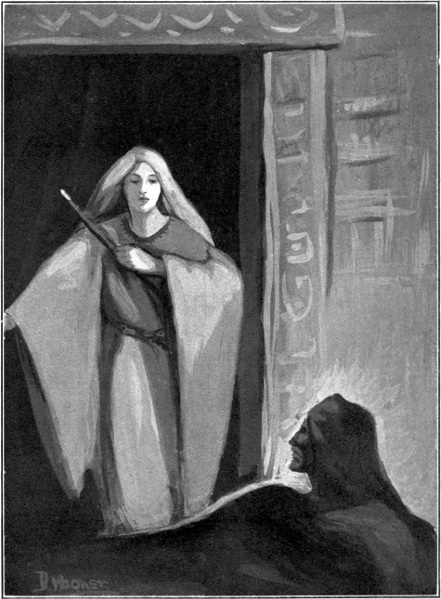
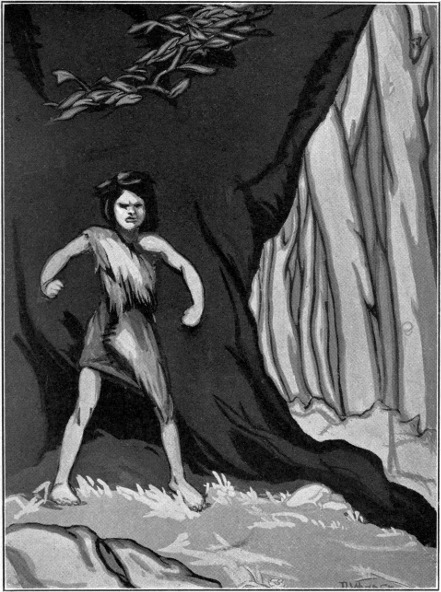
That evening Cool climbed to the window From Birth of Finn
MYTHOLOGY OF IRELAND — II .
Every race of people has its myths and hero tales.
With those of the Greeks most of us are familiar.
We have heard of Hercules, Perseus, Atlas and others,
ever since we started to school. The early stories
of a race are always entertaining as well as instructive.
For that reason our school libraries contain
the folk stories of the Japanese, the Norsemen,
the Russians, the English, the American Indian, the
negro and many others. The one people, of whose
stories Americans know little, is the Celtic race, the
forefathers of the Scotch and Irish of today, and the
ancestors of many of us. This book is intended to
make you acquainted with the ancient heroes of
the Celts.
Just as King Arthur is the early hero of the Anglo-Saxon
people, so is Finn MacCool the renowned
hero of the Celts. Like King Arthur he had gathered
together a body of heroes, all of whom performed
deeds of valor. In Scotland we find stories
of this same hero, only the Scotch people call him
Fingal.
Most of the stories which follow are tales of the
adventures of Finn and his friend, Dermot. These
tales are about events which are supposed to have
taken place nearly two thousand years ago.
No doubt you wonder how we know anything about
people who lived so long ago. The very name, folk
stories, explains it. Folk stories are told by the folk,
or people, of the country. Sometimes we find the
tales written in an ancient book, but most of them
come down through the centuries by one person telling
the story to another.
You know that when you hear a good story, you
like to tell it to little brother or sister or some playmate.
That is just the way the folk stories come
to us. In some countries there were bards or poets
who went around and sang of the old heroes. We
often read of these men in Scotch history. The most
common way of preserving the stories, however, was
by the father and mother telling their children of
the ancient heroes. These children grew up and repeated
the tales to their own families, and so the
story was preserved through the ages.
There is an old Irish legend that explains this
method very nicely.
Finn had a son named Ossian, of whom you will
read a great deal as we go on. This son was a poet
and sang the deeds of his father in verse. The story
runs that before the great battle of Gowra, Ossian
had fallen in love with a fairy and had gone to Fairyland
to live. He lived in this land of youth for four
hundred years, growing no older. At the end of
that time he wanted to go back to earth and see if
he could see any of his old friends. Time went so
quickly in Fairyland that he did not realize how long
he had been away.
His fairy wife gave him a horse to ride and warned
him that he must not touch a foot to the ground.
Then Ossian rode away.
He came to Erin and rode through the scenes of
his adventures. He was surprised not to find any of
his old friends. Not only that, he found that the men
were very much smaller than those of his time. He
saw six of them trying to roll a stone which his
father could have moved with one hand. He grew
so sorry for them that he forgot all about his wife’s
orders. He got off his horse to move the stone. The
instant he touched the ground he became a wrinkled
and bent old man.
Then, the story tells us, the people took him to St.
Patrick, and he told this Irish saint the stories of
Finn and his companions.
It is a very pretty story to explain how these legends
became known. Of course, it is not true, but
it shows the imagination of the Irish people. They
believe in fairies and witches and the powers of enchantment.
You will find that this belief enters into
all the stories. That is another thing about folk tales.
Each person who tells them adds something to them.
No doubt you have been to parties where a game
something like this was played: The players form
a long row. Then the one on the end whispers something
to his neighbor, this person whispers what he
heard to the next player, and so on. The last player
tells what has been told him. It is nearly always
something entirely different from the story which
started.
Folk stories grow in just that manner. The different
provinces of Ireland have different versions of
the stories. In some parts of the country Finn is
the hero, and Dermot proves untrue to him. In another
province, Dermot is the splendid man and Finn
is a cruel tyrant. The stories which follow in this
book are combined from those of all the provinces.
This book is not a history. It is a collection of interesting
stories about heroes who, possibly, never
existed.
You should know something of how stories of this
kind are gathered together. Many were taken down
by the priests of early times, but none were ever written
until nearly a thousand years ago. Undoubtedly
large numbers of them have been lost by the death
of the only person who knew them.
It is only in the last few years that the Irish scholars
have tried to gather these tales together. There
are many of these collectors of Irish hero stories.
Most of them, of course, are Irish, but America has
furnished one man who long will be remembered because
of his work along this line.
Jeremiah Curtin was born in Milwaukee, Wisconsin,
in 1840. He died in 1906. Into those sixty-six
years he crowded the work of several ordinary men.
He had a great love for the languages and history.
When he graduated from Harvard, he was so well
acquainted with Russian that he went to St. Petersburg,
now Petrograd, as Secretary of the American
Legation. While there he became interested in Russian
literature and the folk stories of the people. He
translated many Russian books into English and also
collected a volume of their folk tales.
Many men would have been satisfied with this.
Mr. Curtin was not. He became connected with the
Smithsonian Institute and while there studied the folk
tales of the various Indian tribes. He wrote two
books of these stories.
He next took up the study of Irish folk lore. He
spent a great deal of time in Ireland collecting the
stories which appear in three books. Whenever he
heard of some old man or woman who knew an old
story, he went to that place and got the person to
tell it to him, writing it down as it was told. Many
times it was one he had already heard, but that could
not discourage Mr. Curtin. As a result of this care
his books are very valuable to the older students
of folk lore.
What an interesting life this man must have led!
Think of the work he must have done to learn the
many languages well enough to get the stories. We
think we are well educated if we can read two or
three languages beside our own. Mr. Curtin, when
he died, was familiar with sixty languages!
And now that we know something about how folk
lore is collected, we are ready to make the acquaintance
of Finn and his Fenian warriors.
THE FENIANS
The stories of the great heroes of Ireland, or Erin
as it used to be called, are gathered in groups around
certain men. The Fenians whom Finn MacCool commanded
from the age of ten until his death, was a
body of military men about whom the best known
stories are told.
These Fenians might be said to correspond to our
standing army. There were three groups of a thousand
men each in peace times. In time of war the
number could be expanded enough to take in all who
wished to fight. Some people claim that Finn and
his Fenians never existed. Others say that this body
of men did exist from 400 years before the birth of
Christ until they were destroyed in a great battle in
the year 284 A. D. Whether they formed a real
army or not does not spoil our enjoyment of their
deeds of bravery.
In reading the exploits of the Fenians it is necessary
to remember that to the Irish mind these men
were either gods or giants, many times the size of
people of the present day. If you forget this you will
not be able to understand how one hero can hold back
a whole army of ordinary soldiers, and how strokes
of their swords cut off whole hilltops and formed
new valleys.
To become a Fenian was a great honor. It was
only open to men of the best families and of the highest
character, and many of these were not able to
pass the tests required.
In the first place a Fenian must be well educated
in poetry and must be able to write it himself. In
other words, he must have all the education which
those days gave. Again, he must pledge himself to
be kind and gentle to the weak and oppressed, to be
willing to fight when challenged and to keep up the
battle until he won or was killed. He must promise
never to injure the common people, not to allow gold
to make him false to his friends, not to accept a
dowry with a wife. He must agree not to run away
from nine or less champions, and his parents must
pledge themselves not to seek revenge if he was killed
in battle.
The physical tests were even harder to pass. The
candidate must have his hair braided, take his spear
in his hand and through the forest. After he was
given sufficient start he was pursued by other Fenians.
If he was overtaken, he was wounded and rejected.
If his spear trembled, or if he broke a dry
branch in his flight, that also barred him out. Then,
when the trial was over, his braids were examined.
If he had shaken them out of position, proving that
he had had to work hard to get away, he had to give
up all hopes of joining.
Another test consisted of placing him in a hole up
to his waist and giving him a shield in one hand
and a hazelwood stick in the other. Nine warriors
with nine spears formed in a circle and threw at him.
If he was wounded he was not accepted. No wonder
that a man who passed such tests was ready to face
great numbers of ordinary soldiers.
A Fenian had also to be very nimble and supple.
One of the tests was to put up a lath on the level of
his eyebrows and another farther on, just the height
of his knees. The man had to go at full speed, leaping
over the first one and going under the second
without slackening his pace. The boys who read this
have only to try this test to realize that a Fenian
would be a winner on a track team of today.
It was men who could pass such tests who made
up the kind of heroes commanded by Cool, Gaul of
Morna and Finn. These are the three great leaders
mentioned in the stories. Cool made them a mighty
band; Gaul held them together after the death of
Cool; Finn was the last and greatest leader.
THE BIRTH OF FINN
The first great chief of the Fenians was Cool. He
was a mighty warrior and splendid hero. He it was
who organized these men into an army of strength,
which he governed wisely but sternly.
Over Cool was Conn, the High King, known as
Conn the Hundred Fighter, because he had been victorious
in a hundred battles. It was Conn whom
Cool and his men had to swear to honor and defend.
Conn’s principal city, the one in which he held his
court, was known as Tara. These facts it is necessary
to know before we can understand the story
which follows.
In one part of the kingdom, in the castle of Alma,
dwelt an old chief and his beautiful daughter, Murna.
The girl was kept within the castle under heavy guard
and no man was allowed to see or speak to her. There
was a reason for this harsh treatment. When she
was born a prophet told her father that her son would
take his land and title from him. As the old chief
was very fond of his castle he thought he would
make a grandson impossible by never allowing his
daughter to marry.
One day Cool rode by the castle and saw Murna
at the upper window. He was greatly struck by
her beauty.
“Who is the maiden?” he asked one of his advisers.
“It will do you little good to know,” replied the man.
“Her father has forbidden any man to wed her.”
“The men of this district must have little spirit to
allow such a prize to go unwon,” remarked Cool.
“You would not think so if you saw the number
of guards always in place to make such a thing impossible,”
was the reply.
Cool said no more. That evening he went back
to the castle, overpowered the guards and climbed
to the window at which he had seen the girl. When
she saw this mighty hero at her window, she let him
in and they talked together. Cool was already in
love with her from having seen her beautiful face,
but after he had talked with her and found her as
gentle and sweet as she was beautiful, he vowed that
he would have no one but her for a wife. Any girl
of Ireland would have been proud to be wooed by
such a splendid hero. The maiden was sure that she
could never love any one else, so Cool took her away.
They were married that very night.
You can imagine how the old chief felt about this
theft of his daughter and her marriage. He saw
now that the prophecy might come true. He hastened
to the High King and told his story.
This put Conn in a puzzling position. As a man
he sympathized with Cool, but as a King he saw that
the chief was justified in complaining. He ordered
Cool to appear before him.
“Do you deny that you stole the chief’s daughter
for your wife?” he asked.
“I do not,” said Cool stoutly.
“Do you think that the proper conduct for a Fenian?”
asked the King.
“Is it not the rule of the Fenians to help the weak
who are oppressed?” asked Cool in answer.
“This maiden was not oppressed,” said the old
chief. “She was my daughter and under my protection.”
“Any maiden is oppressed who is not allowed to
love and be loved by the man of her choice,” said
Cool. “If you had permitted anyone to seek her in
marriage she would not have been taken from you
by force.”
King Conn hated to decide. He did not wish to
offend the leader of his army, nor could he afford
to make an enemy of the old chief and lose his fealty.
He finally decided that he could replace his leader
more easily, so he ruled that Cool must give back
the maiden.
Now Cool had been greatly in love with Murna
when he took her from the castle, but having her
for his wife had made her more dear to him. He
decided that life would not be worth living without
her. He defied Conn to take her from him.
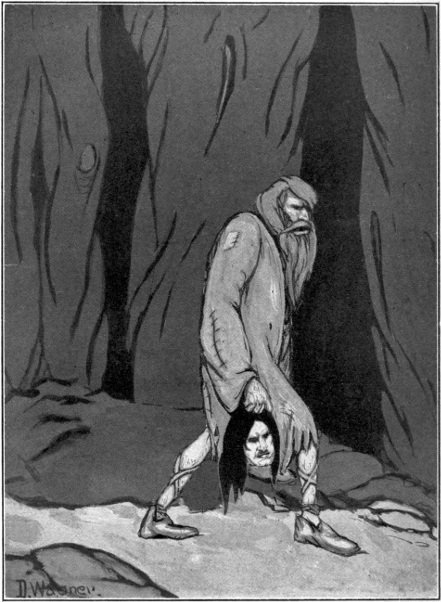
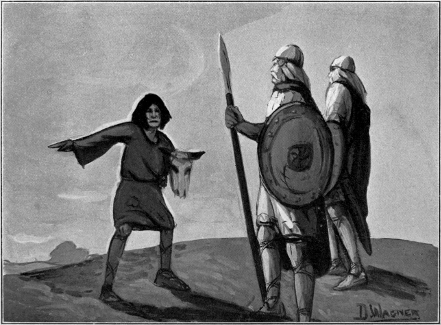
The hermit killed Cool and took his head to Gaul From Birth of Finn
With his beautiful bride and those Fenians who
were more loyal to him than to the High King, Cool
fled to the forest. There he defended himself and
for some time kept at bay the forces of Conn.
After Cool fled the leadership of the Fenians was
given to Gaul of Morna, another brave warrior. In
the course of the battle Cool and the new leader met
in single combat. All day long they fought fiercely
and bravely; Gaul to show himself brave enough to
lead the army and Cool for his wife and his happiness.
In the evening Cool weakened and he received
a wound which made it impossible to fight on. Gaul
thought too much of his old leader to kill him while
he lay wounded, so he withdrew.
It so happened that another witnessed this battle.
It was an old hermit who lived by himself in the
forest. This man was reputed to have great knowledge.
It proved that he had also a great desire to
make himself popular with the High King. He did
what Gaul would not do—he killed the wounded Cool
and took his head to Gaul.
In place of receiving the praise he wanted, he found
Gaul greatly displeased. The hermit was driven out
of the camp as a coward, with sticks and stones
hurled after him as a reward.
With the defeat of their leader the rebel Fenians
surrendered, and the young widow was left without
protection. She must either go back to her father
or hide in the forest. The latter course was the one
she chose.
Poor girl, she was not used to such treatment.
She became very weak and ill. At last she gave up
and approached an old hut in the forest. Here she
was taken in by an old woman, who fed her and
nursed her.
It was in this hut that the baby, who was to become
such a great hero, was born. Murna stayed in
the hut until the baby could be left, fearful that each
day would bring the searchers sent out by her father,
who would kill her child. She finally decided that
the baby would be safer if she went back to the castle
of Alma. She pledged the old woman to raise the
child but to tell no one who he was. The woman
promised and Murna went back to her father.
FINN’S BOYHOOD
Many stories are told of the boyhood of this hero.
He grew tall and straight with long fair hair and
bright blue eyes. Because of his complexion he was
called Finn, which means “The Fair”.
Living among the wild things of the forest he grew
like them. No deer could run away from him, he
could run at full speed without cracking a dry branch,
he could track any animal by the prints on the forest
floor, while his eyes were as keen as those of an eagle.
An early adventure of the boy reminds one of the
story told of Putnam, our hero of Revolutionary days.
I refer to the story of the killing of the wolf. In the
case of Finn it was a wildcat. While he was still a
very young child his friends of the forest were greatly
annoyed by the visits of a vicious wildcat. This animal
made steady attacks on the flocks and herds of
the people of the forest.
The men hunted for the animal without result. No
one thought of Finn as a hunter and he told no one
of his intention. With his knowledge of tracking he
found the trail of the wildcat and followed it to its
lair in a deep cave. Without hesitation he went right
in until he found the animal.
There was no space in the cave for the use of a
sword, so Finn did not draw it. Instead he attacked
the animal with his bare hands. He caught it by the
throat and held it until it ceased its struggles. Then
he carried the dead beast back and showed it to the
surprised residents of the forest. Its skin afterwards
became part of his costume.
When he was old enough for books, the old woman
gave him into the charge of the hermit of the forest.
This man taught him the “Twelve Books of Poetry”,
which seems to be about all the people of those days
learned from books. Finn was a bright pupil and
very early became skilful enough to write poetry
himself.
I am afraid that the hermit took little interest in
the teaching of his pupil. You see, the man was
deeply interested in gaining wisdom for himself. He
had placed his hut on the bank of a little stream,
not, as you suppose, so that he would have water
for cooking, but because this was the stream mentioned
in the prophecy as the one up which the Salmon
of Knowledge would come.
In the folk stories of many races we find the salmon
considered as the wisest of fishes. In Ireland,
however, there was the story of this particular
salmon which would some day swim up the stream.
The man who ate the flesh of this fish would be ever
afterwards the wisest man in the country.
The prophecy said that the fish would come when
the man who was to eat him arrived. As no one
knew who this was to be, the hermit had hopes that
the fish would come to him.
Finn helped to watch for this wonderful fish. This
was a task he loved, and it was one to which he was
well suited on account of his keen eyes. One afternoon,
while he lay on the bank, a big, beautiful salmon
swam slowly toward him. The sunlight glistened
on his scales that shone like silver.
The big fish swam right in front of him, turning
back and forth in the sunlight and showing very
plainly that it did not intend swimming away. At
last Finn remembered that it was a fish he was waiting
for, so he reached into the water for it. The
salmon offered no fight, but allowed the boy to lift
him out upon the bank.
Of course the hermit was delighted to see the fish.
He knew at once that it was the Salmon of Knowledge.
He felt that he was already the wisest man
in the country. But even with knowledge so close
to him he still had a desire to have some one else
do the work. He set his pupil at the task of cooking
the fish, cautioning him against eating a bite
of it. Then he went off to take a nap.
Finn sat before the fire turning the fish slowly.
He, too, had heard of the Salmon of Knowledge,
but he never guessed that this was the one. Neither
did he have any idea that he was the person of the
prophecy. He did not even know who he was, nor
anything about his father or mother. As he turned
the smoking fish he got his thumb against the meat
and burnt it severely. To ease the pain he put it
in his mouth and sucked the sore thumb.
That was all that was necessary to give him knowledge.
He sprang to his feet, his eyes blazing with
anger. Buckling on his sword he went in and roused
the hermit from his sleep. What the man saw in
his pupil’s eyes frightened him.
“Did you eat that salmon?” demanded the hermit.
“I but burnt my finger on it and sucked the place,”
said Finn. “That was enough. I know now that
I am the son of Cool and that you killed him while
he lay wounded. Get up and defend yourself, for I
am about to avenge my father!”
Finn was but a boy, but already the strength
of a champion was coming to him. The hermit
fought for his life, but he was no match for the
son of the man he had treacherously killed. He
quickly paid for his foul deed, and Finn ate the Salmon
of Knowledge, as it was intended he should.
From that time on he had more wisdom than the
wisest man in Ireland. Not only that, but when in
times of stress he desired to know the outcome of
a battle or an adventure, by biting the thumb which
had been burned he could tell the result. In other
stories you will see how this knowledge aided him.
Of course, you will wonder why he ever made mistakes
with such a gift. I am unable to tell you that.
Many of the adventures we read of a wise man would
never have attempted. Probably he only used this
thumb in times of great importance for fear that if
he used it for everything the great gift would leave
him.
FINN CLAIMS HIS INHERITANCE
A tremendous gathering of the men of Erin had
come together at the city of Tara, the central city
of the realm. The Fenians were camped in a circle
around the outskirts. At night the lights of their
campfires made a circle of fire as though to protect
it from danger.
Conn, the High King, was holding court in the
great banquet hall where a thousand of the chiefs
and champions were gathered with him. This hall
was seven hundred sixty feet long, ninety feet wide
and built of hewn logs. Down each side ran a double
row of benches with hewn tables in front of them.
In each row were two hundred fifty of the finest
manhood of Erin. Their weapons and shields rested
against the walls behind them while they ate. Down
the center was a row of fires over which, on spits,
great roasts of meat were cooking. An army of
cooks were constantly busy, tending the fires, turning
the spits and carrying food to the tables.
At the end of the hall on a raised platform sat
Conn, his son Arthur, and Gaul of Morna, leader
of the Fenians. They were in earnest consultation.
One would have thought that such a gathering of
heroes at a feast would have been a jolly one. It
was not so. A deep silence hung over all. Men ate
in silence with gloomy faces and downcast eyes, sad
because they felt that it would be their last gathering
in that splendid hall.
Suddenly a voice rang out through the silence.
Clear and firm it was, so that every word was heard
the length of the hall.
“Conn, High King of Erin, a lonely and disinherited
youth, without money and without friends,
claims thy hospitality!”
The men of Erin looked at the newcomer in surprise.
They saw a youth about ten years of age,
clad in the skins of the forest animals. Hanging
at his belt in front was a great sword, while his skin
covered shield hung over his shoulders at the back.
His fair hair fell to his shoulders, while his blue eyes
caught the glint of light from the spears along the
wall and shot it back like flashes of sunlight. It
was Finn, son of Cool, appearing for the first time
before the Fenians.
The High King had matters of too much weight
on his mind to take much heed of the boy who
claimed what no king at that time would refuse—a
place at the table and a bed. He motioned to Finn
to take his place with the others and went on with
his discussion.
Finn ate with the other men of Erin. He said
no word until he had finished his meal. Then he
arose and once more addressed the High King.
“I know it is not customary for a stranger to note
that there is anything wrong in the house of his
host, but I am impressed by your look of sadness
and the silence of the men of Erin. Is aught amiss
that may be told to a stranger?”
“Our troubles are not secret, though it shames
me to tell them,” answered the High King. “Tonight
is the time set for the destruction of Tara,
and I am powerless to save it. Each year for nine
years, at the midnight hour of this night, the giant
Midna appears and throws balls of fire at the city
until it is destroyed. Each year I have rebuilt it,
only to know that my work is to last but for a year.
The women and children have been sent away. Only
the Fenians remain to witness my shame. Do you
wonder, O Youth, that we are sick at heart?”
“And is there no brave champion or youth anxious
to prove his bravery who can go out and meet
this giant?” asked Finn.
“Alas, no,” sighed the High King. “It is not that
the men of Erin are lacking in bravery. Many have
tried without result. When Midna is ready to destroy,
he plays fairy music upon his pipes, and not
a man can stay awake. When sleep leaves our eyes
he is gone, and the city is a heap of ashes. We watch
again tonight, but we have no hopes of success.”
Of course Finn, having eaten the Salmon of Knowledge,
knew this as well as anybody. His purpose
in asking for information was to obtain a promise
from Conn.
“What shall be the reward of him who slays the
giant and saves the city?” asked Finn.
“If such a feat be possible, no reward that he shall
ask will be refused,” answered the High King.
“Even to the return of my inheritance?” asked
Finn.
“Yes, fair youth,” answered Conn. “Even if your
inheritance be my crown, and my son and I must
become your vassals, it shall be returned to you.”
“Is that your promise, O King, made before all
these men of Erin?” insisted Finn.
“It is,” declared the king, stepping down and putting
his hand in that of the boy. “My hand is my
pledge that I will do as I promise.”
“Then I shall attempt the trial,” said Finn.
He waved back all offers of spears and shields
from the men of Erin and went out by himself into
the darkness. He sought out a place in a dark grove
and waited quietly. Soon a man appeared, bearing
a large cloak and a heavy spear. The spear handle
was studded with nails of gold, but the point was
incased in a leather covering. The man gave Finn
directions for the use of the articles and disappeared.
Soon the lights in the banquet hall went out, as
the champions went to their posts in the circle defending
the city. No man spoke to his neighbor.
That would have been useless since every man had
his ears filled with wax in the hopes that he might
shut out the sound of the strange, sweet music that
put all to sleep.
Finn climbed a hill overlooking the city. His
knowledge told him that here it was the giant would
come. Soon he heard in the distance the sound of
pipes. The music lulled his senses, his eyelids drooped,
his head began to nod. Not till then did he take
the leather covering from the spear head. It glowed
like fire and little tongues of light shot out in all
directions. From the spear came the sound of many
voices crying out together. Finn pressed the point to
his forehead. The pain of the burning was stronger
than the spell of the music.
Soon the lights of the circle began to reel and go
out as one after another of the Fenians came under
the spell of the music. At last only the lights of the
stronger chiefs were burning.
The music then changed to the sweetness of strings.
Once again Finn had to press the spear head to his
forehead. The lights went out one by one until there
was but one left, that of Conn, and it was reeling
like that of a drunken man. Then it, too, went out.
Tara was unprotected by her army.
And now Finn heard the sound of heavy feet.
There was a splashing of water as of one crossing
a river. Finn looked in the direction of the sound
and beheld a mighty mountain of man ascending the
hill on which he stood. It was the giant Midna.
Midna looked over the city lying at his mercy and
laughed aloud. He blew from his mouth a red fire
ball which was to begin the destruction of the city.
Finn reached out his cloak and caught the ball in its
folds, where it died out harmlessly. The amazed
giant shot another and another at the city, but not
one passed the folds of Finn’s cloak.
At first, I suppose, the giant thought that he was
shooting a poor grade of fire balls that evening.
When, however, he looked to the place where they
disappeared and saw Finn catching them in his cloak,
he let out a roar of fear and ran back toward his
home as quickly as he could. Probably he had heard
some prophecy that told him of the coming of this
boy, dressed in skins; maybe he saw that Finn’s powers
were greater than his; anyway he did not pause
for battle, but ran with all the speed he possessed.
Finn gave chase. He was, you remember, very
fleet of foot, but the giant’s legs were many times
longer and the distance grew between them. The
spear flamed brightly and seemed struggling to
get free.
“Go then, if you will,” cried Finn, as he hurled
it after the fast disappearing giant.
Like a meteor in the night sky the spear sped
through the darkness and disappeared. Finn ran
on after it. He found the giant dead at the door
of his cave in the hillside. The spear had passed
through his body and disappeared.
With his sword Finn took the enchanter’s head as
proof that he had won the battle. When he passed
the place where he had dropped the cloak he found
nothing. Like the spear, it disappeared when its
work was done. Finn placed the head of the giant
on a pole in front of the banquet hall so that all
might see it in the morning.
And then, after it was all over, he became very
faint and sick. The use of the weapons of magic
had taken all the strength out of his body. He reeled
like a drunken man toward the spring which furnished
water for the banquet hall. Finn had another
power of which I must tell you. By bringing
water in his cupped hands to one sick or wounded
he could restore him to health. He used this power
now and drank from his own hands. At once his
sickness passed. Then he lay down and slept.
In the morning he woke early and gave a mighty
shout.
Even though their ears were filled with wax the
Fenians could not fail to hear his voice. They struggled
from their sleep and rubbed their eyes in astonishment
to see, not a heap of smoking ruins, but
Tara, resplendent in the morning sun.
They came with all speed, Conn and Gaul in the
lead, to the spot where Finn stood pointing at the
head of their late enemy.
“Who are you, brave youth?” asked Conn. “You
are no common man since you have done what no
one else could do.”
Then Finn drew himself up and in a loud voice
cried:
“I claim my inheritance—the castle of Alma and
the leadership of the Fenians. I am Finn, son of
Cool, and these things belong to me in my right.”
“What I have promised I will fulfill,” declared
Conn. “I give you your inheritance the more willingly
because your father was my friend and loyal
subject until I decided unfairly against him.”
Then Gaul of Morna gave up the leadership of
the Fenians and put his hand in that of Finn to
show that he was willing to be his friend and follower.
The other leaders followed his example. It
must have gone hard with some of these mighty chiefs
to swear fealty to a ten year old boy. The only thing
that made such a thing possible was that Finn had
done something no other of them could do and had
entered the class of a champion by killing the giant.
Thus Finn MacCool became the leader of the Fenians.
FINN AND THE SCOTTISH GIANT
This story is one told by the Irish peasants in explaining
a bridge of rock off the northern coast of
their country. It is a typical Finn story, showing
that leader’s strength and his wisdom. The giant
who had a secret of strength is found in the folk
lore of many nations. No doubt you remember the
Bible hero, Samson, who lost his strength with the
cutting of his long hair. You may compare him with
the Scottish giant.
When Finn was not training his men or traveling
in search of adventure, he used to visit the old
woman who had raised him. The stories do not
mention his ever having seen his real mother. The
foster-mother takes her place. Finn built a cottage
for her in the northern part of the country and saw
to it that she never needed anything.
One day, while visiting the woman, he stood on
the rocky coast looking out over the ocean. Over
on the coast of Scotland he saw a giant of tremendous
proportions. This fellow seemed to be driving
pillars into the ocean and was working very hard.
He saw Finn in the distance and called out:
“You might as well settle up your business, because
when I get through with you there will not
be much of you left to talk about!”
The giant’s voice was a mighty roar which carried
nicely over the miles separating them. Now
Finn had heard of this giant and the threat did not
frighten him in the least. He called back in a voice
nearly as strong as the giant’s own:
“Come over any time you like. You’ll need more
than a bridge to take you back after I get through
with you.”
The giant said no more, so Finn went back to the
cottage. He knew that his men had boasted to the
Scottish people about the great strength of their
leader. He also knew that the Scotch giant was
anxious to settle the question as to which was the
better man. Now, Finn was afraid of no man. Having
bested every champion in Ireland he was always
anxious to try his strength against any new hero
who appeared.
Each morning he went out and watched the giant
building the bridge across the channel. When the
man began to get nearer, Finn got an idea of his
size. He was at least four times the size of the Irish
hero and the way he handled the great stone pillars
showed that his strength was tremendous. Finn saw
that if the giant got hold of him as he did a rock
pillar, he would have little chance of escaping alive.
As I have told you, Finn was no coward. You
also know that he was no fool. He was noted for
wisdom as well as strength. He saw that a combat
at close quarters with such a mountain of muscle
would be foolish. He began to devise plans for getting
the better of the giant when the bridge should
be finished.
When he saw that the work would last but a few
days more he no longer went to the shore but kept
at home out of sight. He enlisted the aid of his
foster-mother in the preparations for the giant’s arrival.
He brought in a large stone as big as a water
bucket and placed it on a shelf in the cottage. Then
he had the woman make, from the whey of sour milk,
a ball large enough to fill his two hands. This he
placed near the rock.
Next he had the woman bake several cakes of
meal. A few were just the ordinary ones such as
they ate regularly, but in the middle of the others
he had her put plates of solid iron. These cakes
were placed in the cupboard close at hand. When
you see how these different things were used you
will see that Finn had a perfect plan worked out.
Then Finn told his foster-mother all the things
she must do and in what order each was to come.
“I fear that he will be too much for you,” said
the woman.
“He would be as he is,” declared Finn. “By biting
my thumb I learn that the secret of his strength
is in one of his fingers—which one I cannot tell. It
shall be your task to find out the finger.”
At last the day came on which the bridge was
completed. A messenger was sent out to give the
giant directions for reaching the cottage, while Finn
himself, dressed as a baby, got into the big cradle
he had built for the purpose.
Soon the doorway darkened. The great giant
stood there looking in. He was an ugly and terrible
looking fellow with two great teeth sticking out
of his jaw like those of a walrus. The doorway was
a large one, but the giant filled it, shutting out the
light behind him.
“I am looking for the fellow who calls himself
Finn MacCool,” roared the giant in a voice that
shook the walls of the house.
Finn’s foster-mother sat calmly rocking the cradle
and working on some clothes she was mending. To
look at her one would have thought that the visit
of a giant was an everyday occurrence.
“And who might you be?” she asked.
“That’s no matter,” growled the giant. “I’ve come
from Scotland to see him and I’m in a hurry.”
“Oh, you must be that foolish fellow who thinks
he wants to have a trial with Finn,” suggested the
woman.
“Foolish!” roared the giant. “Show me where he
is and you will soon find out which one is the foolish
one!”
“Come right in,” said the woman. “I am very
sorry, but Finn is away and will not be back until
tomorrow. He waited for you as long as he could.
You see, you were so long in coming he decided that
you had become frightened and had turned back, so
he went off to attend to some business. Just as he
left he said to me, ‘If that fellow from Scotland gets
here while I am gone, treat him well and get him to
stay. I would not miss knocking a trial out of him
at any cost.’”
“Well, he won’t miss me,” answered the giant.
“I’ll wait.”
“Come right in then,” said the woman. “I will
give you a bite to eat.”
The giant thrust himself through the doorway into
the room. Inside, where he could straighten himself
up, he looked more terrible than before. As there
was no seat in the cottage big enough for him he
leaned against the wall, which bulged out with his
weight. The woman busied herself before the fire.
“Who is that?” asked the giant, pointing to Finn
in the cradle.
“That’s Finn’s little baby,” answered the woman.
“I wish you would be more quiet while you are in
here. The baby is just beginning to cut his teeth,
and he is very cross if he awakens suddenly.”
The giant really tried to soften his voice, but the
result was very funny. When he was speaking very
softly, his voice was like that of a fog horn in a
coast light house.
“Dear me,” sighed the woman after a while. “This
fire draws so poorly! The wind is in the wrong
direction. If Finn were here he would turn the house
around so that the fire would do better.”
“What Finn can do will be only a small task for
me,” said the giant.
He went outside, took the house by one corner and
turned it so that it faced in a different direction.
You can believe that the woman was thoroughly
frightened to see this exhibition of strength. She
wondered what chance Finn would have against such
a man. Still she believed in his wisdom, so she continued
to carry out her instructions. When the giant
came back she seemed very calm.
“Well, how is that?” asked the giant when he
came in again.
“The fire draws better,” she admitted, “but you
did it very clumsily. I thought you were going to
shake the house to pieces. Finn lifts it around so
easily that he jars not a thing on the shelves. But
of course you are not nearly so strong as Finn.”
The giant was so crestfallen that he had nothing
to say for some time.
“Oh, dear,” cried the woman a little later. “I am
all out of water. Finn promised to split open the
rock of the spring before he left, but he forgot all
about it. I wonder if you could do it.”
“Of course I can,” said the giant. “Show me
the rocks.”
The woman took up a bucket and led him to a
place where two rocky hills sent up their peaks very
close together.
“That is the place,” she said. “Finn intended
pulling them apart when he had time so that we
could have water nearby.”
The giant put a foot against one peak and took
the other in his hands. With a mighty heave he
separated the two hills and let the water stream out
between them. The woman filled her bucket and
went back to the house, the giant following her.
“How did that suit you?” he asked.
“You did that very well,” said the woman. “But
of course that is hardly a man’s job.”
The giant seemed to feel keenly the fact that his
strength made no impression on the woman. He
looked around the room to see if he could find something
else to talk about. He saw the big rock on
the shelf.
“Perhaps you will tell me why you keep that rock
on the shelf?” he asked.
“Oh, that,” said the woman as if it could be of no
importance, “that is just a little trick of Finn’s. He
uses it to practice on in the mornings.”
“Ho! Ho!” laughed the giant. “Why should he
practice with such a rock as that?” He picked it
up and tossed it from hand to hand as though it
were an orange.
“He keeps up the strength of his fingers with it,”
answered the woman. “Each morning he squeezes
the water out of a rock. If you are the man Finn
is you can do the same.”
The giant took the stone in his two hands and
squeezed with all his might and main. Of course
no water could come out of a solid rock. The first
finger of his right hand sank into the stone with
his efforts.
“Your one finger has a little strength,” said the
woman. “If the rest of you had the force of that
finger, you might get a few drops.”
“It is that finger which gives me my strength,”
the foolish giant told her. Once more he took up
the rock and squeezed the rock harder than ever
with no result. The baby in the cradle set up a
lusty cry.
“Poor baby,” said the woman. “He is sorry for
you. His father lets him practice on a small rock.
See what he can do.”
She gave Finn the ball of whey. Finn took it in
his two hands and squeezed it, letting the water
stream on the floor. The giant was amazed.
“It’s a pretty strong baby,” he admitted.
“It would have to be to belong to Finn MacCool,”
said the woman.
The giant seemed to be thinking deeply. Perhaps
he doubted his wisdom in coming to try conclusions
with the father of such a baby.
Soon Finn’s foster-mother took one of the cakes
from the cupboard and handed it to the giant.
“Take this,” she said. “It will help stay your appetite
until I get you something better.”
The giant thanked her and bit down into the cake.
As it was one of those with the iron core, all he succeeded
in doing was to break off two of his teeth.
He took the cake out of his mouth and felt his jaw.
“What’s the matter?” asked the woman. “Maybe
those cakes are too hard for you. Finn wouldn’t
eat them because they were too soft. I’ll get you
another one.”
She passed the giant one more of the iron-filled
cakes. Once more he bit into it and again he lost
some teeth. He went to the door to spit them out.
He did not seem to care for these cakes.
“You say Finn doesn’t like cakes as soft as that?”
he asked.
“He won’t touch them,” she answered. “He leaves
them for the baby.”
She took one of the ordinary cakes and gave it
to Finn in the cradle. The giant looked on to see
what happened. Finn ate the cake ravenously.
The giant was more puzzled than ever. He called
for another cake and bit into it with all the strength
of his jaws. It would be hard to tell just how many
teeth he lost this time, but he could not get a bite
off the cake. The woman gave Finn another and
again it went down in a hurry.
“And you say he is just getting his teeth?” asked
the giant.
“Just a few have come,” she answered.
“I’d like to have a feel of such teeth,” said the
giant.
He put his strong finger in Finn’s mouth and felt
for the teeth. This was just what Finn had been
waiting for. As soon as the finger was in his mouth
he clamped down his teeth and bit it off.
With the loss of his finger the giant’s extraordinary
strength left him. Finn tore off the bed clothes
and set upon him like a whirlwind. The walls bulged
out. Most of the house was ruined. Finn’s foster-mother
watched from the outside of the house. Soon
she had the satisfaction of seeing the giant come
dashing out of the house with Finn hammering him
as he ran.
Only the fact that the giant’s legs were very long
saved him from a worse beating. He got out on
his bridge as fast as he could. Nor did he slow
down until he got a good distance from the Irish
shore. Then he threw down the pillars as fast as
he could so that Finn would be unable to follow him.
The giant never tried to come back. He cleared
out all the pillars on the Scottish side, but, you can
well believe, he never went near the Irish shore again.
To this day you can still see them standing out into
the water, just as he left them in his hurry. People
call the remaining pillars “The Giant’s Causeway”
and this is the story they tell as to how it happens
to be there.
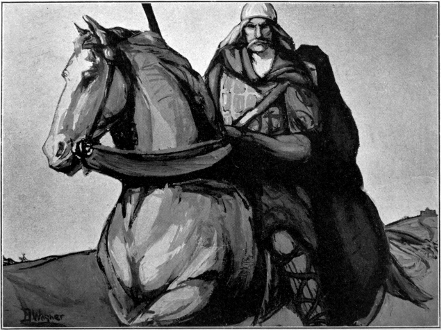
The Black Druid appeared in the form of Finn From the Story of Saba
THE STORY OF SABA
Finn always enjoyed a hunting excursion. In those
days, when all the fighting was done with sword and
spear, hunting was a different sport from what it is
today. All the champions had fleet hounds, and they,
themselves, from their training in speed, lagged little
behind the dogs in the chase.
Finn had two beautiful hounds, Bran and Skolawn,
which went with him at all times. He was very fond
of them both. The stories tell that there were only
two times in his life that he shed tears, and one of
these was at the death of Bran.
One day Finn was out on the chase when the
hounds gave tongue and set off at a rapid pace.
You may be sure that Finn was not far behind them.
When he came to a little glade among the trees, he
saw a peculiar sight. There, on the turf beside a
little stream, stood a beautiful doe. Finn raised his
spear, but the strange behavior of the dogs stayed
his hand. Instead of rushing at the deer, they approached
her gently and licked the hair of her neck
and shoulders.
The other Fenians came up and would have killed
the animal had not Finn stopped them.
“No”, he cried. “She shall not be killed! If the
dogs do not wish to harm her no one else shall.”
When Finn went back to his camp, the deer followed
him with his dogs. When he went into his
house, she lay down on the outside.
That night he awoke suddenly to find standing
at his bedside the most beautiful woman he had
ever seen.
“Who are you?” he stammered, struggling from
his sleep and rubbing his eyes.
“I am Saba, O Finn,” answered the maiden. “I
am the deer you spared today.”
“The deer!” exclaimed Finn.
“That shape was put upon me by the Black Druid
because I would not become his wife. I have wandered
in the forest, pursued by man and beast, and
many times I have nearly lost my life. I should have
given up all hope had not a kindly slave of the Druid
told me that if I could come safely into your camp
I would be freed from the enchantment. I feared
both dogs and men, but I trusted myself to your two
hounds, which seemed to realize my helplessness.”
“Have no fear, fair Saba,” said Finn. “The Fenians
fear no enchantment, and you will be safe while
under our protection.”
Then Finn called his servants and had them prepare
a room for the maiden. The remainder of the
night he spent in dreams of the beautiful girl, who
had come to him for protection.
Next morning Finn did not go out on the chase.
He stayed in camp and talked to Saba. He found
her even more beautiful in the daylight. The thought
that she had to come to him for aid, added to her
many charms, caused him to neglect everything for
her. It ended by them both falling deeply in love
with one another.
The feast for the wedding of Finn and Saba was
an event in the life of the Fenians. Never had such
a celebration been held in Ireland. Conn, the High
King, and his son, Cormack, came. It could safely
have been said that no king nor prince ever had a
finer wedding or a more beautiful bride.
For months Finn would not leave his young wife.
Adventures had no call to him; hunting had no
charms. The love of this couple is one of the most
beautiful ones in history.
But later there came a call to duty. Word came
to Finn that the Danes had landed on the north
coast of Erin, and that the Fenians were battling
without their leader. This Finn could not allow.
He got out his weapons and shield, mounted his
horse and left for the scene of the battle.
His farewell to Saba was very touching. That
she might have perfect protection while he was absent,
he left behind a guard of some of his bravest
men, with cautions that they must give their lives
rather than lot her come under the power of the
Black Druid.
For eight days and nights he fought the Danes.
At the end of that time, with the foe driven back
into the sea, he hastened to his young bride. His
heart was filled with joyousness at the thought of
being with her again.
But when he approached his home, he saw his
men standing around in open-mouthed astonishment.
Noting their look of fear, he called the chief of
them to him.
“What has happened?” he asked. “Why is it my
men look at me in such surprise. Did they not expect
me to return?”
The chief seemed puzzled, too. “Were you not
here three days ago?” he asked.
“Certainly not,” answered Finn. “Where is Saba?
Did the Black Druid—”
“I am fearful, O Finn, that it was indeed he,”
replied the chief. “Three days ago we saw you
approaching with your two dogs at your side. Your
wife went joyously forth to meet you. The man we
thought was you took her up behind him, and then
all disappeared in a mist. If it was not you, it must
have been the Druid appearing in your shape.”
Finn, with his heart sad within him, searched every
place from one end of Erin to the other, but without
success. It was too true. His wife had disappeared
as into a mist. It was undoubtedly the work of the
Black Druid.
The boy stood with his back to the tree waiting for the hounds to attack From the Story of Saba
Finn throughout all his life never ceased to mourn
for Saba, nor to search for her. Six years after her
disappearance, while hunting in the forest, he came
upon a wild boy with straggly hair and fierce eyes.
His only clothing was the skins of beasts. The
hounds had found him, and when Finn came up, the
boy was standing with his back to a tree, waiting
to strangle the hounds if they came at him.
The sight reminded Finn of his own boyhood days.
He called off the dogs and took the boy home with
him. At first the little fellow was too timid and unused
to language to speak. Gradually, however, his
fear left him and he became able to tell of his life
in the forest.
He could remember a woman who had dwelt with
him in a cave. A dark man had come and pleaded
with her for several days, but always she had refused
to do what the man asked. At last he had become
angry, had left the cave and had never returned.
The little boy remembered that he had never seen
the woman again. After that he had been tended
by a beautiful deer.
Then Finn knew that the woman was Saba and
that the wild boy was his own son. He understood
what the boy could not. The Black Druid had enticed
his wife away and tried once more to get her
to marry him. When she persistently refused him,
he had turned her back into a deer.
Once more Finn searched the forest, hoping that
he might again find the gentle deer, which had come
to him before. His quest was without result. Possibly
the Druid saw to it that she should never get
near him, but it was more likely that some hunter
had killed her. Finn mourned her as dead and gave
his attention to the raising of his boy.
He named the child Ossian, which means Little
Faun. He taught him the poetry of the day and
trained him in feats of arms. Ossian grew up to
be a worthy son of his father. In all the later battles
we read of what a splendid fighter he was. He
and his son, Oscar, were always in the front in time
of danger.
But Ossian was not only a great warrior. He inherited
his father’s love for poetry and the ability
to write it. We have great numbers of stories about
the deeds of Finn and the Fenians, and the greater
number are written by the poet, Ossian.
CONAN, THE BALD
Not all the warriors of the Fenians were noted
for their bravery. It is now necessary that we become
acquainted with Conan, the unheroic member
of the band. The stories do not tell how he ever
passed his entrance trials, or why he was allowed
to remain a member. He did many things the Fenians
considered as unworthy of them.
Conan was a man with an evil tongue. He never
had a good word for any one. No matter what his
companions did, Conan would never have a word of
praise for them. He would make sneering remarks
about the feat. This did not mean that he would
have done better himself. Far from it! He was a
great coward and shirked any task which had any
danger attached to it.
The fact that he had lost all his hair gave him
his name. But there was something else about him
that gave the Fenians a great deal of amusement.
Whenever his armor was cut at the back, it showed
everyone that he had the back of a sheep. When
you hear how he got such a back, you will not wonder
why the Fenians enjoyed the joke so much.
One day Finn, Conan and several other heroes
were out hunting. All day long they had followed
the chase, and in the afternoon they arrived in a
new country, before a beautiful castle. Seeing no
one around they went in. They found themselves
in a large room, down the center of which ran a
big table loaded with food. Along the sides of the
table were rows of high-backed chairs.
As there was no one around, and as the feast
seemed to have been just prepared, the men decided
that it had been placed there for them. They sat
down and began to eat. It was a delicious meal.
Suddenly something about the room made Finn
look up from his food. When they had come in, the
ceiling had been high and richly decorated. Now
it was changing into the smoke-stained roof of a
hut. Finn knew then that they had walked into an
enchanted house, put there just to trap them. He
called out a warning to his companions and ordered
them all outside immediately.
When they were free from the house, and saw the
great change that had taken place in it, they were,
thankful for Finn’s wisdom in getting them out before
it had been too late.
But they were not all out. Conan was still in the
room eating like a pig. They called to him, urging
him to hurry. He refused to leave such a fine array
of food. At last two of the Fenians rushed in and
took him by the arms. When they pulled at him
they found that the enchantment was already beginning
to work. He was growing fast to the back
of the chair.
Conan was now thoroughly alarmed. He begged
the men to pull him loose. The two Fenians pulled
with all their might. With a mighty wrench they
freed him, but his shirt and the skin of his back
had grown fast to the chair.
He was in a very painful condition. Something
had to be done to relieve him. He just lay on the
ground and moaned and groaned.
“Kill a sheep and cover the wound with the skin
of the animal,” ordered Finn.
The men did his bidding. The skin of the freshly
killed sheep was cut to fit and bound to his sore back.
Then Finn gave him a drink of water from his cupped
hands and restored his strength to him. The
sheepskin grew fast and could never be removed,
so Conan always had to wear it.
With all Conan’s cowardice, he really did come
out victorious in one battle. But when you hear of
this particular combat, you will understand why the
Fenians, instead of honoring him for it, had less
respect for him than ever.
During the progress of one battle, when a hostile
army had landed on the shores of Erin, one champion
stood out in front each morning and demanded
single combat.
“If you are not afraid of me,” he would call, “why
don’t you send a man to meet me?”
He was not a great hero and the Fenians refused
to be bothered with him alone. Finally, when they
grew tired of hearing the challenge, as a joke they
sent Conan out to fight with him. A roar of laughter
came from the Fenians as Conan went cautiously
out to meet this man. The enemy gave a cry of rage
at the insult, and the champion called out angrily:
“What do you mean by sending a clown to meet
me? Is there not a man among you who dares to
face me?”
Conan came forward slowly, afraid for his life.
When he got close to the champion, the latter said
sarcastically:
“The Fenians seem anxious that I be left unharmed,
since they send me such a dangerous foe.”
“You are in more danger from the man behind
you, than from the one in front of you,” said the
cowardly Conan.
The champion looked around to see what he meant.
At that moment Conan swung his sword and cut off
the man’s head.
This treacherous way of winning a combat angered
Finn and the Fenians beyond all measure.
They considered that Conan had disgraced them. It
is a wonder they did not put him to death. His only
punishment was banishment from the band for a
short time. We find him in the later stories, just
as full of trickery, just as cowardly and just as uncomplimentary
to his companions, but still the butt
of all their jokes.
DERMOT OF THE LOVE SPOT
One of the most splendid heroes of the Fenians
was Dermot. His name is second only to that of
Finn in the stories of valiant deeds. He was younger
than his chief by many years, even younger than
Ossian, Finn’s son. Dermot was the fleetest man of
them all, and also the one with the keenest eyes. In
many of the stories he is chosen for deeds of valor
rather than Finn himself. This happens, however,
when Finn is an old man, and his wisdom and leadership
are of more value than his strength.
This young hero was the son of a god. In those
days, however, gods could be wounded and could
die. They lived on earth and needed food to live
on, just the same as other men. The distinction between
the Irish gods and heroes like Finn is very
slight in the old stories. Dermot did have one gift
no other Fenian possessed. His foster-father, the
god Angus, had granted him a body that no weapon
could wound. There was but one thing that could
harm him. That was the tusks of a wild boar. His
foster-father warned him never to hunt the boar unless
it was absolutely necessary, and then to exercise
every care so as not to be wounded by the tusks.
Dermot was a handsome man, with curling fair
hair and blue eyes like those of his leader. He was
Finn’s closest companion and greatly loved by him.
His was the soul of honor. If he got into trouble
it was from doing some task his honor demanded.
His courage and strength were unquestioned. The
Fenians always fought with more bravery if they
knew Dermot was with them.
Such a handsome man could not help being very
popular with the maidens of Erin. They liked him
because of his strength and his handsome face. But
it was the Love Spot on his forehead which made it
impossible for any girl to look at him and not fall
in love with him. You shall have to hear how he
received this gift.
One day he was out hunting with Conan, Oscar
and Gaul of Morna. As often happened in those
days, the chase led them far from their camp. With
the coming of darkness they began to look for a
shelter for the night. They wandered around until
they came upon a little house in the forest. When
they knocked, a gray-haired man came to the door
and inquired their errand.
“We ask for thy hospitality,” said Dermot.
“That you shall have,” declared the old man,
throwing wide the door. “Come right in, and thousand
welcomes to you.”
Inside they found a queer household waiting for
them. At the table sat a beautiful young girl; before
the fire was a large gray cat; while lying at
one side of the fireplace was a big sheep with a
fleece of long, shaggy wool.
The old man went into the kitchen of the house
and prepared a splendid meal, which he placed before
the heroes. All ate heartily, but, as usual, Conan
was still eating after all the others had finished.
He was interrupted by the sheep, which climbed
to the table and commenced eating of the food that
was left. Conan pushed the animal’s nose out of
the food time and time again and tried to go on
with his eating. It was of no use. Before he could
get a bite, the old sheep would thrust its nose into
the plate.
“I call it a strange house where a sheep is allowed
to eat from the table,” declared Conan.
“I did not put him there,” answered the old man.
“If you do not like his company, put him off.”
Conan grasped the sheep in his two arms, intending
to lift it from the table. To his surprise he could
not move it. He tugged and strained without avail.
At last the sheep, with a quick toss of his head,
threw Conan into the center of the room.
How the other men roared with laughter! It was
always amusing to see Conan get the worst of anything.
As for Conan, he picked himself up sulkily.
“You laugh loudly,” he growled. “I’ll wager there
is not one of you who can move it.”
The idea was ridiculous. To think of anyone
claiming to be a hero and unable to lift an ordinary
sheep! Oscar, with a laugh, started to brush the
animal away with one hand. Soon he had the sheep
in both arms and was tugging and straining in an
attempt to move it. Then he, too, found himself
thrown lightly away from the table.
Now it ceased to be a joke. Dermot tried to remove
the animal with no better success. Gaul, it is
true, got the sheep off the table for a moment, but
the animal soon turned this hero on his back and
stood upon him. Then it jumped back to the table.
During all this time the old man had been looking
on in amusement. Now he spoke to the cat,
which was lazily basking itself before the fire.
“Take him away,” ordered the old man.
The cat got up slowly and climbed to the table.
Then, taking the sheep by the long hair of its throat,
the cat led it down and out of the room.
The four heroes looked at one another in surprise
and astonishment. Dermot picked up his shield and
his weapons. “Come,” he said to his companions.
“We shall not stay under a roof where a host makes
game of his guests.”
“Sit down,” said the old man. “You have been
testing your strength in an impossible feat. You
will not feel badly over your failure when I tell you
that the sheep you tried to move was the World,
itself. To lift it is a task no man can accomplish.
The cat could master the animal easily, because the
cat was Old Age, and even the world cannot withstand
its force. Come, let me show you to your beds.”
The heroes were somewhat soothed by the explanations
and followed the host into another room,
where they found their beds prepared for them.
Later, the young girl came to the door and looked
from one to the other of the men.
“I have a gift,” she said. “It goes to but one
of you.”
“Let me have it,” said Conan. “If ever a man
needed a gift, it is I.”
“Give it to me,” said Oscar. “I am the strongest.”
Gaul and Dermot said nothing. These men were
wise. They knew that they were in an enchanted
house, and that the girl would give the gift to whom
she chose.
“Not to you, or you, or you,” she said pointing in
turn to Conan, Oscar and Gaul. “My gift cannot
go to any of you. I am Youth and youth has left
you all.”
She approached the couch of Dermot. “You can
never grow old,” she said, “so I shall always be with
you. To you I shall give the gift that Youth can
bestow.”
She raised her wand and touched him lightly on
the forehead.
“I give to you the Love Spot, Dermot,” she said.
“Who wears it will win the love of all women. No
maiden will be able to look upon you without loving
you. Treat my gift with honor and with wisdom.”
Then the maiden left the room, and the heroes
went to sleep.
That is the way in which Dermot received the
Love Spot. It made him beloved by all women, but
in the end, this gift caused him great sorrow. You
shall see in the story of “Dermot and Grainne” that
the gifts of the fairies do not always bring happiness.
DERMOT RESCUES FINN — II. — III. — IV. — V. — VI. — VII. — IX .
Finn’s dearest friend and constant companion, during
his later years, was Dermot. This young man
was most loyal to his chief, and because he was such
a true friend, so strong in the fight, so swift of foot
and so keen of sight, Finn depended greatly upon
him. Where Finn went you were sure to find Dermot,
and if Dermot was off on an adventure, Finn
was pretty sure to be with him.
On the day of our story the two were out hunting
with some friends. We find these Fenians on
the hunt a great deal of the time. The reason is
a simple one. From November to May the men of
the army lived at the expense of the High King and
the people; from May to November they had to get
their food and clothing by hunting. Naturally, many
of the adventures start on a hunting trip.
As this particular morning advanced, the party
decided to stop in a little sheltered spot near the
shore for their meal. It was while the men were
getting the game cooked that Finn and Dermot strolled
along the beach and sat down on a ledge of rock.
While they were there a ship sailed into the little
harbor.
It was a small vessel, handsome in every line, with
sails full as if in a strong breeze. This was remarkable
because no air was stirring at that time. The
ship neared the shore and stopped. The sails dropped
loosely. Finn and Dermot looked in vain for
the crew, but there was no one visible except a lone
woman, who sat on the deck.
“It is a wonder to me that one woman should be
able to sail a ship alone and come into a harbor at
full speed with no wind blowing,” said Finn.
Dermot was looking with interest toward the ship.
“You shall not wonder long,” said Dermot. “I
will go down and bring you word.”
Finn detained him with a laugh. “No, Dermot,”
he said. “This time we will take into consideration
the heart of the lady. I shall see for myself.”
Finn went down to the shore, placed the point of
his sword upon a rock and sprang lightly to the
deck of the vessel.
He was amazed at the beauty of it all. The deck
was as clean as a deck could be with trimmings of
silver and gold. At the end, on a seat of the finest
tapestry, sat a beautiful woman. She smiled engagingly
and held out her hand toward Finn.
“Come here,” she said. “I wish you would tell
me where I have landed.”
“You are in the harbor of Erin,” said Finn.
“And could you tell me where I am to find the
home of a man named Finn MacCool?” she asked.
“You will not need to find his home, for I am Finn
himself,” he answered.
“Then I am indeed lucky,” said the woman. “I
have come to play a game with Finn. I have heard
that he never refuses to play for a sentence, and
that he honorably lives up to his agreements.”
It flattered Finn to be praised by a beautiful woman.
Like most of the heroes of history his wisdom
deserted him when dealing with a woman. It
was true that he and the other Fenians took great
delight in playing a game for a wager. These wagers
were usually in the form of sentences. That is,
they would play a game and at the end the winner
would set a task for the loser to perform. Sometimes
these tasks required years of labor and much
suffering, but no Fenian ever refused to carry out
a sentence imposed upon him.
“I would willingly play if I had my board and
chessmen,” said Finn.
“I have them as good as your own,” answered the
woman. To prove it she pulled out a beautiful board
and a set of silver and gold chessmen. She had
Finn sit on the seat near her to play. At the end
of the first game Finn was the winner.
“You have beaten me,” she said with a dazzling
smile. “What is the sentence you are to pronounce?”
Now Finn had not quite made up his mind as to
what manner of woman it was who was playing with
him. She looked and dressed like a king’s daughter,
but an enchantress could assume that appearance.
To prove it he made a sentence that would prove
very difficult for anyone not able to use the arts
of magic.
“I put you under bonds,” he said, “not to eat twice
in the same place or sleep twice in the same bed
until you have brought me a white horse with a saddle
and bridle of red leather for myself and each
of the Fenians with me today.”
The woman smiled again. “Look behind you,”
she said.
Finn looked toward the shore. There were the
beautiful steeds he had ordered, handsome in their
saddles and bridles of red leather. In the lead was
one much finer than the others.
Finn knew then that he was playing with an enchantress.
He wished he was well out of his bargain,
but he could not refuse to play the second
game without violating the honor of a Fenian. He
felt sure that the woman would win the next game.
The second game was short. As Finn imagined,
the woman, by the aid of her powers, proved an easy
winner. He was anxious to know what was in store
for him.
“Let me know my sentence at once,” he demanded.
“Perhaps you will be sorry for your impatience
when you hear it,” said the lady.
“No trouble was ever made lighter by putting it
off,” declared Finn. “Pronounce your sentence immediately.”
“Very well,” she answered. “I put you under
bonds to go with me and obey me in what I ask until
some one throws upon you the amount of seven shovelfuls
of earth. You will be under my enchantment
until that happens.”
Finn did not show his dismay when he heard this
hard sentence.
“It is your right to demand it,” he said. “Wait
here until I give the steeds to my men and leave
orders for them to follow during my absence.”
When he turned to look for the horses they had
vanished. She saw his look of astonishment.
“You put me under bonds to bring the steeds, but
I was not obliged to leave them there,” said the enchantress.
“It is true,” said Finn. “Now, since you have
taken advantage of the wording of my sentence, I
shall try to evade yours. You have put me under
bonds to go with you, but you did not mention that
I was not to try to escape from them.”
She nodded. “Of course, as a man of honor you
cannot tell anyone what will release you,” she said.
“If you free yourself otherwise, I shall be to blame.”
Finn went ashore to tell his men of his wager and
sentence. He gave orders as to the conduct of the
Fenians during his absence, then took Dermot to the
top of a hill near the shore.
“Your eyes and ears are best in all Erin,” said
Finn. “You will remain here to watch and listen.
If you hear my horn, it will mean that I am not able
to release myself by my own efforts.”
“I will not leave until you are back or my body
turns to dust and the wind carries it away,” declared
Dermot.
Then Finn went down to the ship and sprang
aboard. The watchers saw the sails fill and the boat
move swiftly out of sight over the waves.
It was not long before the vessel arrived in a
small harbor, which Finn recognized as the port of
the White Nation. This was not very encouraging
to him, because in a battle not long before he had
defeated the king of that nation. He began to suspect
that he was under enchantment for some purpose.
Still he must go with the woman because he
had pledged his word.
When the ship stopped the woman got out and
bade him follow her. On the shore she paused, and
pointing to a broad road bordered with tall trees,
said,
“As you are a great champion in your country it
is not fitting for you to follow me into the city as a
servant. You will walk up the road to the palace
while I take a shorter one and prepare a welcome for
you.”
Finn did as he was told. He was puzzled and anxious.
He could not but feel that there was something
wrong with this plan. The woman had put him under
bonds to come as a servant, and now she made it appear
that this was not what she wished. Finn wished
that he had been able to keep his sword, but that the
woman would not allow. Only one thought cheered
him. Dermot was watching and listening, ready to
come to his assistance at any time.
Soon he came to the gates of the palace. A great
crowd of people rushed out as though to welcome
him. The welcome was a deceit. The men pushed
against him on all sides and shoved him from one to
another until he was bruised and bleeding. Finn was
the match for many ordinary men in strength. Still,
without his swords, he could not stand off a multitude.
Thus pushing and jostling him the crowd bore him
into the courtyard into the presence of the ruler of
the nation. The king sat upon a raised platform and
by his side, in the robes of a princess, was the woman
who had brought Finn to the country under sentence.
When the king saw Finn he laughed long and
loudly.
“What ho, Finn MacCool!” roared he. “Methinks
this is a fine manner for the arrival of a champion of
Erin.”
Finn hung his head in shame.
“My daughter asked me to name the thing I most
desired in all the world,” went on the king. “I told
her the one thing necessary to my happiness was the
head of Finn MacCool. She promised to bring you
here that I might take it myself.”
Finn’s heart sank. He felt that the hour of his
death was very near. The king stepped down from
his platform, sword in hand, and swung the weapon
back and forth.
“You would not dare do that if you would let me
have a sword,” said Finn, looking him squarely in
the eye.
The king drew back and bowed his head in
thought. Probably he had hoped to have Finn beg
for his life.
“No,” he said at length, “I will let you think over
the fact that you are in my power. It will be pleasant
for you to lie and wonder how long I will let you
live.”
He gave orders that Finn’s legs and arms be firmly
tied with seven knots on each rope so that escape
would be impossible. Then he had his captive placed
in a dark dungeon. Each day he was to receive an
ounce of bread and a pint of water, no more under
any consideration. For a big strong man like Finn
this was very little food. But being tied and lying in
a black hole was even more likely to take the spirit
out of him.
Each day an old woman came with his food and
water, but his arms and legs were never loosened. On
the eighth day Finn said to the woman,
“Tell the king that I beg leave to walk in the garden
for an hour. I do not ask for my head, but if he
does not give me a little freedom I shall not be able to
live. For the king to take the head of a dead man
would be small glory.”
The king yielded to this request and ordered Finn
an hour of freedom. He took no chances, however.
The walk was to occur in a walled garden and thirty
armed men were to be with him every moment.
Finn was happy over the privilege. It was not the
fear of death that had made him ask for the walk.
No, he had a far better reason, as you shall see. After
he had walked a few minutes he said,
“I am very fond of music. Have you any musical
instruments with you?”
Now the chief was very sorry to see such a mighty
man a prisoner without a chance for his life. He
would gladly have had the music played, but was
obliged to confess that none of his men had instruments
with them at the time.
Then Finn took from under his clothes a queerly
shaped horn. He turned it over and over in his
hands and looked at it as though it was very dear to
him. Finally he spoke.
“When I was at home and in charge of my men I
used to play for them quite often. I really enjoy
music very much. I wonder—perhaps you and your
men might like to hear a tune?” he finished, as
though the idea had just come to him.
“I should be very glad to hear you play,” answered
the chief.
So Finn placed the horn to his lips and played a
tune of the Fenians. At the end of the air he blew a
blast that echoed from hill to hill and made the listeners
involuntarily put their hands to their ears.
Then Finn put the horn away and was willing to be
tied up again. The chief thought he had heard some
wild Irish music. He little dreamed that the call had
gone out for help.
Dermot was asleep when Finn sounded the horn
but the last note of it waked him. He sprang to his
feet with a mighty bound that sent showers of rocks
and dirt in every direction.
“Great is the trouble of my chief!” he exclaimed.
“I have never heard such a blast from his horn.”
He rushed to the shore, found a small boat lying
there, hoisted the sail and set off in the direction
from whence the sound had come. He was lucky
enough to arrive at the same harbor in which was
anchored the ship on which Finn had been taken
away. Dermot anchored his boat and started up the
broad road.
As he went along he found men, women and children
hastening in the same direction with all the
speed at their command. He asked several of them
the reason for their hurry, but all seemed too excited
to answer him. Finally Dermot grew angry, so singling
out one man who seemed to be in greater haste
than the rest, he picked him up and held him off the
ground while he repeated his question.
The man was greatly frightened, you may believe,
for Dermot was taller and broader than any man of
the White Nation and must have seemed quite like a
giant to his captive. The man suddenly became very
anxious to explain.
“You must not belong to this country, if you do not
know where we are going,” he said.
“I am not from this country,” answered Dermot.
“I am from Erin.”
“If that is so, you must know Finn MacCool,” said
the man.
“I know him well. He is my chief,” replied Dermot.
“Then you had better tell no one that you are from
Erin,” said the man. “If you do, you are likely to
share the same fate. Finn is to be hanged in the palace
courtyard today. The gallows is ready. When he
is dead, his body is to be pulled to pieces by wild
horses. You had better not acknowledge that you
know him.”
Dermot set the fellow on his feet again. The fierce
look in his eyes caused the man to step back.
“If you were not so small,” thundered Dermot,
“you would never give such advice to another man.
Men from Erin never fail to acknowledge their
friends. Show me the way to the palace.”
“If you will go up the hill on your right, you can
see it in the valley below,” directed the man. He lost
no time in getting a safe distance from this mighty
stranger. He was so frightened that instead of going
on to the hanging, he turned around and made for
his home as fast as he could. In the whole White
Nation he was the only man traveling away from the
palace.
Dermot bounded up the hill with mighty strides.
When on top he looked in the direction of the hurrying
people. Sure enough, there was the castle with
crowds spread out all around it. Dermot dashed
down the hill at full speed.
People were crowded so closely together that no
ordinary man could possibly have squeezed through
them. Each man was elbowing his neighbor so that
he might get close enough to see the death of this
great Fenian chief. Dermot could have cut his way
through with his sword, but it was one of the rules
of the Fenians not to harm the common people of a
nation. He cleared his way by taking several in his
right hand and several in his left and putting them
behind him. Then he stepped into the opening and
repeated the process until he reached the courtyard.
He walked past the gallows and up to the pole of
combat before the palace. This he struck a mighty
blow with his sword.
The king came to his window and looked out in
alarm.
“Who struck that blow?” he asked. “It must have
been an enemy.”
If the trouble had not been so serious, Dermot
might have laughed at this silly remark. But he was
in no humor for laughter.
“If that sounded like the blow of a friend,” he
said, “listen to this.”
Once more he swung his sword against the pole.
This time his blow was so strong that the pole broke
into splinters, which showered over the heads of the
people.
“What do you want?” whined the king, who was,
and always had been, a fearful coward.
“I want to see my chief, Finn MacCool, or to fight
for him,” announced Dermot.
“See him you shall not,” declared the king, keeping
well in the protection of his castle. “You are at
liberty to fight for him.”
“Very well,” answered Dermot. “Send out seven
hundred of your best men on my right hand, seven
hundred on my left, seven hundred at my back and
as many as you wish in front of me.”
“How many?” demanded the startled king, drawing
still further back into his palace.
Dermot repeated his demand. You must remember
that Dermot was the son of a god and could not be
wounded. It is no wonder the king thought he had
misunderstood. It was too good a chance to let go
by. The king sent out the men requested, feeling sure
that he would soon be rid of this fellow, who had
made splinters of the combat pole.
But the king’s men were no match for Dermot even
when they pressed against him in such numbers.
By nightfall not a man had touched him while hundreds
of the warriors of the White Nation were
wounded or dead. With the setting of the sun, Dermot
put up his sword and called out to the king,
“Do I get shelter for the night?”
It was customary in those days to stop fighting
when the sun went down. It was also the custom to
furnish food and a bed to a hero who was making a
trial at arms. The king pointed to a long, low house
a short distance from the courtyard.
“Go in there,” he called. “You are welcome to
what shelter you find.”
Dermot was tired from his combat. He went to
the house, opened the door and walked in. To his
surprise he found himself surrounded by hundreds of
little men, reaching no higher than his knee. They
were wild, shaggy little fellows, kept by the king to
kill people he did not like. Though not strong singly,
they were there in such numbers that they could cover
a man like ants and crush the life out of him.
When Dermot had entered, the little men shut the
door and barred it. Then they began covering the
windows and filling up the chinks between the logs.
“Why are you going to such trouble?” asked Dermot.
The antics of the little fellows amused him. He
never thought of treachery on the part of the king.
“We fear you may escape,” answered one of the
men. “It is our duty to eat you.”
Poor foolish little fellows! They imagined a mighty
hero like Dermot could creep through a hole large
enough to let one of them through.
Dermot’s amusement turned to anger. By all the
laws of hospitality he was entitled to a place to rest
quietly until time for the next day’s combat. The
king would have lasted only a few minutes if Dermot
could have laid a hand on him when he discovered
the foul scheme. The little men rushed at him by the
hundreds. There was little use of using a sword
against such small enemies. Dermot caught up the
nearest by the ankles and used him as a club to beat
down the others.
Soon there were no little savages left except one
very small fellow in the corner.
“Spare me, great champion,” he called in a shrill,
high voice. “If you give me my life there is not a
place to which you will go but I will be with you. I
will be a good servant to you.”
“No man ever asked for his life but I granted it,”
said Dermot.
He sat down on a bench and looked about him.
“Have you any food?” he asked.
“Nothing,” said the small chief, for he was the
leader of the small men. “We never have food except
the people the king sends us to eat. If you will
go out and walk forty paces to your right, you will
come to the king’s bakery. There you should be able
to get some loaves.”
Dermot followed directions and found the king’s
baker just closing up for the night.
“Give me two loaves of bread,” demanded Dermot.
The baker let out a scream of rage. “Ruffian,” he
yelled. “Do you dare ask me for bread after the way
you treated our soldiers today? Get out of here this
minute.”
The little man was dancing with rage. Dermot let
out a roar of laughter. He picked up the baker and
held him at arms’ length. “You are a nimble dancer,”
he said. “I shall give you a place to dance.”
Opening the oven, now cool enough so that it
would not injure him, Dermot put the baker inside
and shut the door. He helped himself to what bread
he wanted while the baker kept up an excited dancing,
accompanied by a steady pounding on the oven
door.
But Dermot was not content to live on bread
alone. He asked the small chief where he might get
some meat.
“Instead of turning to the right, as you did when
you went to the bakery, turn to the left and go the
same distance in that direction. That will bring you
to the king’s butcher, where you should be able to get
plenty of meat.”
Dermot did as he was advised and found the man
in his shop. He was a big, red-faced fellow, smeared
from head to foot with the blood of the last animal he
had killed.
“I want some meat for my supper,” said Dermot.
The butcher flew into a fine rage and brandished
his knife. “Get out of here, you ruffian from Erin!”
he shouted. “It was you who wounded so many of
our people today. Get away before I cut out your
heart.”
The butcher made a dash at Dermot. The latter
was merely amused by the rage of the man. He
laughed loudly, took away the knife with one hand,
while with the other he caught the butcher by the
belt and lifted him off the floor. A meat hook on the
wall was very handy. Dermot hooked the belt of the
butcher over that and left him hanging there, a funny
sight as he kicked and yelled. With the meat Dermot
got from the shop, and the bread, he and the small
chief had a hearty supper.
The next day he again presented himself before
the king.
“What do you want today?” asked the ruler of the
White Nation.
“I want to see my chief, Finn MacCool, or to fight
for him,” said Dermot.
“Fight you shall,” declared the king. “You shall
not see him.”
Then the king ordered sent out double the number
of men that had faced the champion the day before.
He still had hopes that he could overpower Dermot
by numbers. But this battle was but a second like the
one of the day before. Dermot could not be wounded,
while the slaughter of the king’s soldiers was something
terrible. With the setting of the sun the combat
was over, and Dermot went back to the long
house to eat the supper the small chief had prepared
for him, and to rest after his hard day.
Next morning Dermot went again to the palace
and made the same demand as on the two previous
days. This time the king did not send out his forces
to battle. Even he could see that he was wasting his
soldiers without hope of defeating this new champion.
Still he did not wish to give up Finn MacCool. His
soldiers were not strong enough, the small men could
not eat this man, but the king had other schemes to
try before he gave up. Everyone knew the fondness
of the Fenians for attempting feats of strength or adventure.
The king decided to try that on Dermot,
so that he could gain time, even if he did not get rid
of this nuisance.
In the land of the White Nation there lived an
enormous fellow known as the Red Giant. His choicest
possession was a beautiful hound, which he kept
near him at all times. When he went out walking, he
had the dog with him on the end of a chain of solid
gold. When he was at home he fastened the chain to
the wall and kept the dog beside him.
There was a strange thing about this Red Giant.
He had only one eye and that was in one side of his
head, just above his ear. Because of this, he could
see only what happened on one side of him. He kept
the hound to warn him if anyone approached on the
other side.
Though this man was the strongest person in the
White Nation, he had no use for the king and would
not serve him. The monarch resolved to get his aid
by trickery.
“I will not let you see Finn MacCool,” he told Dermot,
“until you have brought to this courtyard the
hound and the golden chain.”
“Where can I find it?” asked Dermot.
“The world is wide,” answered the king. “Finding
it is part of the task.”
“No man can give me a task I will not try to accomplish,”
said Dermot. “There is but one thing I
demand. If I go after this hound, you must pledge
yourself that Finn is to be taken out of the dungeon
and given a better room, with plenty of food to eat.”
This request did not please the king. He did not
wish to grant Finn any favors, but he was afraid
Dermot would not go to the Red Giant if he did not
agree. He gave a grudging consent.
Poor Dermot! He went to the long house in despair.
How was he to bring back something when he
did not know where to look for it, and when there
was no one in the country to give him directions?
Yet, if he did not complete the task, he would lose his
head and Finn would have to die. He sat down in
the long house and buried his face in his hands.
“What is troubling you, master?” asked the small
chief.
Dermot sighed. “Nothing that you can help me
with,” he said.
“I’ll wager that you have been sent to bring the
hound and the golden chain,” said the chief.
Dermot sat up in surprise. “How did you know
that?” he demanded.
“Because the hound is kept by the Red Giant, and
the king has rid himself of many a good man by sending
him after that hound,” said the little fellow.
“Do you know where I can find him?” asked
Dermot.
“I can lead you to the place and show you how to
get the hound,” declared the chief.
The two set out immediately and traveled all day
through a heavy forest. In the evening they came to
the gate of an immense stone castle. There the chief
stopped Dermot.
“In there lives the Red Giant,” he said. “At this
hour he has had his meal and is sleeping beside the
table in the center of the castle.”
Then the chief went on to explain that the giant
had but one eye, which faced the main door to see if
anyone entered. He took from his pocket a little cake
and passed it to Dermot.
“Take this cake,” he said. “Do not go in at the
main door but follow the corridor around and come
to the small opening at the other side of the room.
Throw this cake to the dog, and when he has eaten
it pick him up and bring him with you. If you are
quiet the giant will never know you have been in
there.”
Dermot thanked his helper and went into the castle.
Everything happened just as the small chief had
promised. The task was so easy that he was back in
five minutes with the hound under his arm. The two
set off for the palace with their prize.
But Dermot was not happy. He kept going slowly
and more slowly, until finally he stopped all together.
“What is the matter?” asked the chief.
“I can’t help thinking of the dirty trick I played on
the Red Giant,” answered Dermot.
“How is that?”
“Like a thief I took away his hound without giving
him a chance to fight for it,” said Dermot.
“It was the hound you went for, not a contest, and
bringing him back will give you sight of Finn MacCool,”
argued the chief. “Let us hurry.”
But Dermot would not go. “I’d think a man a fine
champion if he sneaked in and took something of
mine,” he said. “Not even for Finn will I do such a
thing. I am going back and take the hound away
from the giant as a champion should.”
No argument of the small chief did any good. Back
they went to the castle and again the small chief
stayed outside.
“Since you are bent on being foolish, I will give
you some more advice,” said the little fellow. “The
giant is strongest on his stone floor. Much of his
strength leaves him when he is on soft earth.”
“I thank you for your help,” said Dermot.
He slipped in quietly and fastened the hound to
the wall. Then he went around to the main door and
stepped into the room. Instantly the giant saw him
and sprang to his feet.
“What do you want?” he roared.
“Your hound and your golden chain,” answered
Dermot.
“Well, you’ll not get him from me,” roared the
giant. He made a rush at Dermot and grappled with
him.
Now the Red Giant was a big man in the White
Nation, but you must remember that Dermot was a
big man, too. It turned out that they were about
equal in strength. At the first rush of the giant, both
men went down on the floor where they struggled
desperately. Back and forth they rolled, with Dermot
putting every bit of his strength into the effort
to get them out on the ground. Finally, with a
mighty heave, he succeeded in causing them both to
roll out of the castle door.
As soon as they struck the soft earth Dermot was
the stronger. He picked up the Red Giant and drove
him into the earth like a post, until only his head was
above ground.
“Spare me, man of Erin,” pleaded the Red Giant.
“I concede that you are the better man, and that you
are entitled to the hound.”
Dermot never took advantage of a man who asked
for mercy. He pulled the giant out of the earth and
set him upon his feet. From that moment the Red
Giant was his friend. He invited Dermot and the
small chief into the castle and set out food and drink
for them. In the morning he willingly gave up the
hound and bade them a hearty farewell.
Dermot went before the king the next morning.
You can guess that the monarch was far from overjoyed
at seeing him. He had felt sure that the troublesome
champion would never bother him again.
“Well, have you the hound with the golden chain?”
he asked, trying to hide his disappointment.
“You see them before you,” answered Dermot.
“Hand them over to me,” demanded the king.
That was just what Dermot had no intention of
doing. He felt sorry for the Red Giant, because the
man had put up a good fight and had been his friend
after the struggle was over. Moreover, he felt that
the king had no right to the hound.
“That I will not do,” declared Dermot.
The king’s wicked little eyes lit up with pleasure.
“Then, by the terms of the trial, you forfeit your
head,” he said.
“You are wrong,” said Dermot. “The words of
the trial were, ‘until you have brought to the courtyard
the hound with the golden chain.’ I have carried
out the command of the trial; now I am going to
take the hound back to the Red Giant, who has more
right and more need of him than any of us.”
The king knew he was caught by the terms of his
own sentence. He pounded the arms of his throne in
anger, but he did not dare deny the terms he had pronounced.
“Well,” demanded Dermot, “do I get to see my
chief, Finn MacCool?”
“You do not,” answered the king. “I did not say
that bringing the hound was the only trial you would
have to accomplish. You shall not see your chief
until you bring me the true story of the Sorrowful
Knight.”
Dermot was willing to try another test. He believed
that the king was honest in saying he meant to
have two trials before releasing Finn.
“Where can I find this man?” he asked.
“That is for you to find out,” said the king.
Dermot left the palace and went to the long house.
Once more he felt discouraged, but once more the
small chief came to his aid.
“I’ll wager you have been sent to get the story of
the Sorrowful Knight,” he said.
“How did you guess it?” asked Dermot.
“Because that is the most dangerous task the king
could possibly think of. The quest will lead you into
the land of enchantment. No one has ever heard the
story, and few have ever reached the castle.”
“Nevertheless I must go,” said Dermot. “All I
need is some one to show me the way.”
“I can do that easily,” answered the little fellow.
Dermot looked at him in admiration. “I shall never
cease to be thankful that I spared your life,” he said.
“We shall start immediately, and on the way we
shall leave with the Red Giant his hound and golden
chain.”
The Red Giant greeted them warmly. Never before
had he met a man who was stronger than he,
so that made him respect Dermot; but he respected
him still more for his honesty, when he found that the
hound was to be returned to him.
“Are you on another quest, or have you rescued
your chief?” asked the giant.
“I am on a most difficult errand,” explained Dermot.
“I must get the story of the Sorrowful Knight
before I may see Finn MacCool.”
The Red Giant slapped his knee a resounding
whack.
“You are right,” he said. “It is difficult! It would
be impossible but for the fact that you have been fair
with me. I once did a service for the Sorrowful
Knight. He swore that nothing I should ever ask him
would be refused. Tomorrow I shall go with you,
and my request shall be in your interest.”
You may be sure that Dermot was glad he had not
taken a thief’s advantage of the giant when he had
had the opportunity. That night, with the small
chief, he and the Red Giant spent the time eating,
drinking and telling stories.
The journey to the land of the Sorrowful Knight,
under the guidance of the Red Giant, was a short
one. They found the castle set deep in a thick wood.
No sound came from it. The branches of the trees
drooped in sadness. Even the cattle grazing in the
field seemed to crop the grass mournfully.
The guard at the gate wiped the tears from his
eyes before he asked them the nature of their errand.
When he learned that they wished to see the Sorrowful
Knight, he led them through a quiet courtyard
into a dark and dismal chamber in the heart of the
castle.
At first Dermot could see nothing. When his eyes
became accustomed to the darkness, he saw that the
room was draped in black, and that the furniture was
the color of night. At the table in the center of the
room sat a man, his head leaning on his hand, his
elbow on the table. He appeared to be asleep, nor did
he awaken when the three entered the room. He
must have been at the table a long time. Where his
elbow rested upon it, a deep groove had been worn,
and into it, even in his sleep, the tears dropped
steadily.
The Red Giant took him by the shoulder and spoke
to him. The man straightened up slowly.
“Why do you come here to interrupt my grieving?”
he asked.
“You promised many years ago that you would
grant any request I would make,” said the Red Giant.
“I have come to test your promise.”
The Sorrowful Knight sighed heavily. “What is
your request?” he asked.
“You are to tell to Dermot of the Fenians the reason
for your sorrow,” said the giant.
Once more the knight sighed, and the tears flowed
more freely down his cheeks.
“I feared your request would be that,” he said.
“Since I promised you on my honor, I must tell the
story, but no other living man has heard it.”
The Sorrowful Knight had dinner served for his
guests with a flickering candle for light. Most people
would have had a small appetite in such gloomy
surroundings, but Dermot and his friends were hungry
enough to forget about it. They did full justice
to the meal. When each had satisfied his hunger
the knight began:
“It was twenty-one years ago that the sorrow
came to me. I lived in this castle as happily as any
man of the kingdom. Anyone would have been
proud of the twelve handsome young men I called
my sons. Every place I went my boys were with me.
“On the morning of the first of May it was our
custom to hunt the deer together. Of course, we
hunted on many days of the spring, but the May
day was always our first deer hunt. On the morning
of which I speak we started up a deer without
horns and gave chase.
“It was a fleeter animal than any we had ever
followed before. All day long we kept after her
until toward evening we saw her disappear into a
cave. We thought we had her trapped and followed
swiftly. Imagine our surprise when we found ourselves
not in a cave at all, but in a new country, at
the gate of a large castle.
“The deer was nowhere in sight. We were too
far from home to return that night, so we decided
to ask for shelter from the lord of the castle. This
was readily granted.
“We were taken into a big banquet hall. Along
one side of the room, over huge fires, were twelve
kettles of scalding water. In front of each kettle
was the carcass of a wild boar. The master of the
castle apologized for not having supper cooked and
asked if any of us could prepare the boars for roasting.
We said we could and set to work.
“But, though we dipped the animals in the scalding
water, we could not remove a single bristle. The
scalding seemed to make them stick more tightly.
We could do nothing toward preparing the meat
for supper.
“Then the master called in a small servant and
told him to get the animals ready. This man lined
up the twelve boars, blew upon them through a small
tube, and instantly every bristle disappeared. I knew
then that we were in the land of enchantment.
“We had all that we could eat, and after the meal
the lord of the castle asked me if my sons would be
willing to show their strength for our amusement.
I told him they would. He ordered in twelve small
men with a long chain and bade my sons pull it
away from them. This seemed like an easy task.
But when my sons took hold of the chain they could
not move the small men an inch. Soon the small
men pulled my sons toward them with a quick jerk
and threw the slackened part about the necks of my
boys. The instant the chain touched my sons they
became twelve stones.”
At this point the tears of the Sorrowful Knight
stopped his words. His listeners had to wait until
he had mastered his grief before he could go on.
“When I saw my twelve noble sons thus changed
before my eyes, I was filled with the great grief which
has never left me. The lord of the castle had me
thrown out into the night, and it was with difficulty
that I found my way back to my home. Since then
I never have left my castle.
“Each year, on May day, the deer comes to the
gate and calls, ‘Here is the deer, but where are the
hunters to follow it?’ Tomorrow she will come again,
but no one here has heart for the chase.
“That, then, is my story. I ask you if any man
could be happy with such a sorrow in his life?”
Dermot had listened with rising pity that soon
turned into anger. He rose abruptly to his feet.
“I have but been sent to get your story, but no
true Fenian is willing to let wickedness go unpunished.
If you will go with me, there will be men
to follow the deer tomorrow, and the sun shall not
set before I have tried my strength against the enchantment
of the lord of that castle.”
For the first time in twenty-one years the Sorrowful
Knight no longer wept. He announced that
he would go the next morning. The small chief and
the Red Giant also promised to take part in the
chase of the deer.
In the morning the deer came to the gate and
called as was her custom, “Here is the deer, but
where are the hunters to follow it?”
The four men had been waiting and now they set
after her at full speed. All day long they followed
her, and in the evening she approached a cave in
the hillside.
“That is where she will disappear!” shouted the
knight.
Dermot sped after her. Now, as you know, there
was no one in Erin who could equal him in a race.
He rapidly caught up with the deer and seized her
by the hind leg, just as she reached the mouth of the
cave. Instantly the deer disappeared, and in her
place was a hideous old witch, with straggly gray
hair and long crooked teeth. Dermot was so startled
that he let go his hold. The witch ran screaming
into the cave.
The men followed and came out at the gate of
the castle just as the knight had done years before.
When they knocked for admission, they were met
by the master, who seemed greatly surprised to see
the Sorrowful Knight.
“I thought you had enough of this place when you
were here before,” he said.
Dermot did the answering. “He comes with me,”
he said. “I could not have enough of your castle,
because this is the first time I have ever been here.”
The master invited them into the room where waited
the twelve kettles of water and the twelve boars.
“Have you a man among you who can prepare the
supper?” asked the master.
“We have,” said Dermot. “And it is a long time
since you had one as good. We have also a man
who will get the meat.”
Dermot went out into the forest and brought in
enough meat for the meal. He knew better than to
try to prepare the enchanted boars. The ones he
had killed, he dressed with his sword and soon had
them cooked. The master made no comments, but
ate with the others.
When the meal was over the lord of the castle
addressed the knight.
“Have you a man among you who can show us
a little action for our amusement?”
Once more Dermot did the answering. “He has.
Send in the same twelve small men you used against
his sons and we will show you enough action to
satisfy you.”
The small men brought in the chain and passed
one end to Dermot, who braced his feet against the
rocks on the floor. The small men pulled as hard
as they could, but not a link of slack chain could
they get. All at once Dermot jerked them toward
him, looped the chain over their necks and snapped
off the twelve heads.
He then held out the end of the chain to the master
and said, “Perhaps you would like to show us a
little action yourself?”
The lord of the castle was seized with a fit of
trembling at the thought of pulling against this terrible
Fenian. He dropped to his knees and began
to beg for his life.
“Spare me, and I will bring back the knight’s
twelve sons,” he cried.
“That is all I could ask of you,” said Dermot.
The frightened enchanter took his rod and touched
each of the twelve blocks of stone along the wall.
Instantly the twelve sons of the knight were with
them, as strong and hearty as ever.
You can imagine how the father felt over this
change. He was no longer the Sorrowful Knight.
They wasted no time in leaving the enchanter’s
palace and in returning to the castle of the man who
was now the Glad Knight. From there Dermot and
his friends went on to the home of the Red Giant,
and then on to the king of the White Nation. Dermot
was happy in being able to rescue the twelve
young men, but he was far happier in the thought
that he was now to see Finn MacCool.
On his return Dermot presented himself at the
palace. Though the wicked old king was surprised
to see him again, he endeavored not to show it.
“Well, have you the story of the Sorrowful
Knight?” he asked.
“I have,” said Dermot. “Are you ready to
hear it?”
Then he told the king the story, just as it had
been told to him. I don’t believe that he mentioned
the rescue of the twelve sons, because that was not
in his sentence, and he was anxious to be through
with the task and rescue Finn. At the end of the
story he said:
“Now I have done what you asked. Do I get to
see my chief?”
“You do not,” answered the king. “You shall not
see him until you get me the story of the Lad of
True Tales.”
Dermot’s anger flamed up. For the first time he
saw that the king was not honest in his sentences,
and that he was merely setting tasks to put him off,
until he could find something that would do away
with him forever.
“Oh, is that so?” he asked. “You should have
spoken about it sooner. I have worn out all the
leather I am going to use, tramping over the rocks
of your country. I am going to let you find out how
sharp some of those stones are.”
He picked up the treacherous king and tossed him
out of the upper window of the palace to the rocks
below. The king of the White Nation would never
set another task for any man.
Then Dermot searched high and low for Finn.
Everyone got out of his way, but still he could not
find his chief. When he was almost in despair, he
met an old woman.
“I will lead you to Finn,” she said. “It is I who
have been caring for him.”
She did as she promised. Dermot was so happy
on seeing Finn that he wanted to embrace him. Finn
pushed him away.
Dermot’s feelings were hurt. “If any man had
gone through what I have to rescue me, I would not
seem ungrateful,” he said.
“It is not ingratitude,” said Finn. “My thumb
tells me that we have little time to lose. The king’s
daughter has gone off to enchant another victim.
We must get away while she is gone.”
The two friends hastened to the shore, taking what
food they could on the way. Then they raised the
sails and pointed the boat toward Erin. Finn placed
Dermot in the stern to watch, while he managed the
boat. Every few minutes he would say, “Do you
see anything?” Dermot would answer, “I see nothing
but waves and sky.”
They were nearing the shores of Erin when Finn
asked the question again.
“I see a bird that looks like an eagle,” said Dermot.
“Then we are lost,” cried Finn. “She is following.”
“Is there no way to release you?” asked Dermot.
“There is,” answered Finn, “but I am in honor
bound not to tell you of it.”
The boat sped swiftly on, with the bird ever gaining.
When near the land, the two champions sprang
ashore, just as the bird turned the boat over and
perched upon the hull. She saw them on the land
and flew after them. The instant she struck the
earth she became a woman. Rushing up to Finn
she threw her arms around his neck.
“Come back with me and be my husband,” she
begged. “You shall be the king of the White Nation.”
It made Dermot angry to see the actions of the
woman who had caused them both so much trouble.
He swung his sword against the hillside in anger.
So great was the blow that a valley appeared where
the sword struck. A great shower of dirt, far more
than the seven shovelfuls, fell over Finn and the
woman.
Finn put the enchantress from him. “I thank you,
Dermot,” he said. “You have released me from
her bonds.”
The woman gave a cry of rage, became an eagle
once more and flew out over the ocean. Finn and
Dermot hastened to join the Fenians.
THE WORTHLESS SERVANT — II . — III . — IV . — V .
One day Finn and his companions, while out hunting,
had stopped to cook some of the game. Dermot,
Conan and several other Fenians were in the party.
The horses had been put into an inclosure so that
they might feed while the men rested. It was during
the meal that the guard, who had been put upon
a nearby hill to watch for the approach of an enemy,
came rushing up with the news that a great giant
was coming toward them from the south. The man
had hardly time to tell the news when the giant, himself,
appeared.
He was tall and ungainly, with joints that bent
outward at each step, as though they had been fastened
together with strings. He was dressed in the
skins of animals, with the hairy side out. Covering
his face was a growth of the same colored hair, so
it was difficult to tell where the garments left off
and the skin began.
His face seemed formed no more firmly than his
body. His jaw hung loosely, showing a ragged set
of huge teeth. One eye was higher than the other.
His nose was as rough as a ridge of hills. In one
hand he held a huge club, the end of which cut deep
furrows in the earth as he dragged it along. From
the other hand was a leading thong attached to the
halter of a horse.
This animal was no better favored than the master.
Its joints seemed just as loosely hung together.
Its coat was the color of the soot from a chimney.
Its backbone was like a knotted clothesline with a
black rug hung over it. When the animal walked,
its legs bent outward at the center, while its scraggly
tail and many cornered head swayed from side
to side in opposite directions.
When the giant saw the Fenians he dropped the
thong and approached by himself. The animal let
its head drop dejectedly, and its legs bowed outward
like the hoops of a barrel. It seemed about to fall
to pieces.
“I am looking for Finn MacCool,” growled the
giant.
Finn rose and came toward him. “I am he whom
you seek,” he said.
“I have come to take service with you,” said the
giant.
“If you need work, go prop up your horse,” shouted
Conan. The Fenians laughed loudly.
“I do not like the behavior of your men,” said the
giant, “yet do I still seek service. I have heard that
you are a good master, and that you will pay a man
whatever he asks.”
“I have never refused service to any man who
asked it, nor have I ever refused to give a servant
any reasonable wage requested,” said Finn.
“Then I would serve you,” declared the giant. “I
am known as the Worthless Servant because I never
give my master what he pays for. I always fail to
do any task he sets me, and what I do is never done
well. Moreover, I eat more than any two men and
grumble unceasingly about the way I am treated.”
“You give yourself a bad name,” said Finn with
a laugh. “Nevertheless, you have asked for service,
so I shall give it to you.”
“Then may I turn my horse into the pasture with
the others?” asked the giant.
Finn gave his permission and went back to his
meal. The giant opened the gate of the inclosure,
took off the halter and let the animal loose. That
done, he came over to the table and proceeded to
eat everything within reach.
The decrepit old horse changed entirely when its
master left it. No longer was it mild and sleepy.
It kicked its heels high in the air, let out a snort
and proceeded to bite and kick every animal it could
reach. These other horses could make no stand
against the newcomer, nor could they seem to get
away from it. At last the giant’s horse had injured
all the animals except the one belonging to Conan.
It was viciously pursuing this one.
“Look here,” roared Conan. “Go tie up that ugly
brute before it injures my horse.”
The giant kept on eating. “There’s the halter,”
he said between bites. “If you do not like the way
he acts, go tie him yourself.”
Conan needed no second invitation. He ran into
the pasture and put the halter on the great beast.
As soon as it was caught, the animal resumed its
dejected pose. Conan pulled and pulled with all his
might, but he exerted himself without result. The
horse would not move. The other Fenians gathered
around and offered much advice and many taunts.
“Shame on you, Conan,” cried one. “A Fenian
and unable to lead one little horse!”
“Take him by the tail,” shouted another. “Perhaps
it travels the other way.”
“Better practice on a sheep until you grow up,”
came from a third.
Conan lost his temper. He began abusing the men
who were joking him, saying all the cutting things
he could think of. His anger extended to the horse.
He began beating it with a heavy club. Still the
animal stood looking dejectedly at the ground and
giving no sign that it felt the blows.
Fergus True Lips, the poet of the Fenians, now
gave some advice.
“Many a horse will not go when pulled by the halter,”
he said. “Try riding him.”
Conan sprang to the back of the horse and again
tried to get it to move. This method proved no better
than the other. Again Fergus made a suggestion.
“He is used to the weight of a heavier man than
you. Let more Fenians get upon his back until the
combined weight shall equal that of the giant.”
This advice the Fenians were glad to follow. One
after another climbed up until fourteen were astride
that sharp backbone. Still the animal would not move.
The Fenians were enjoying the sport. Those on
the back of the animal called out jibes to those on
the ground, while these made jokes at the expense
of the mounted ones.
In the meantime the giant had finished eating all
the food on the table. He now approached Finn in
great anger.
“It seems to me that the stories I have heard of
your justice were all false,” he growled.
“What makes you think so?” asked Finn.
“You stand by and see your men abusing my horse,
yet you do nothing to stop them,” he complained.
“I am sure they but keep your horse from injuring
their own animals,” said Finn.
“I am through with your service,” declared the
giant. “If I had never come at all, still would I
have been here too long. Give me my wages and
let me go.”
“What wages can you expect when you have just
come?” asked Finn. “All you have done is to eat
a meal at my expense.”
“Again I see that the stories told of you are not
true,” said the giant. “You promised to give me
what wages I asked and now you refuse.”
“You have asked no wages,” cried Finn, becoming
angry at the unreasonable request. “You but
trifle with me when you ask pay for eating my food.”
“Since I can get no pay, I shall leave without it.
Perhaps your men will give me my wages more
willingly.”
He strode off toward the sea, taking long but
shuffling steps. The horse moved after him, slowly
at first, but with ever increasing speed. The Fenians
were still on his back.
“Get off!” cried Fergus. The men tried desperately,
but they were fastened as tight as if they
had grown there.
“Is there no man among you who will stop this
beast?” shouted Conan, when he found that they
were moving away from the Fenian camp.
A new member of the band ran after the animal
and seized it by the tail. Instead of stopping it,
he, too, came under the enchantment and could not
let go.
The giant suddenly lost all his awkwardness. He
began to run with the speed of the wind. The horse
also became full of life and fleet of foot.
“I charge you, Finn,” called Conan, “not to take
any rest until you have rescued us.”
Before the startled Fenians could realize what had
happened, the giant and the horse were at the edge
of the sea. They entered the water at full speed.
As they advanced, the waves parted for them and
closed again after they had passed.
Thus disappeared the Worthless Servant and the
fifteen Fenians he had taken for his wages.
As soon as they had gone, Finn began preparations
to go to their rescue. He asked Fergus for
advice as to where they might find a suitable ship.
Fergus replied that there was one about five miles
distant. Finn called Dermot and a small body of
the bravest of his men together and told them that
they were to accompany him. All were delighted
to go upon such an adventure.
The party had gone but a short distance when
they met two handsome young men, dressed in green
garments and without any weapons of war. One
carried a light wand in his hand.
“We crave to enter thy service, O Finn,” said the
elder of the two.
“Very well,” answered Finn. “We are on a difficult
errand and need only men of experience, but
you may join the Fenians in our rear.”
“It is to go with you that we seek service,” said
the stranger.
“Have you any special talents that would be of
value to us on a difficult adventure?” asked Finn.
“I can be of great service, if your adventure takes
you upon the sea,” replied the elder. “I am called
Quick-Builder. If you cover your heads for the
space of a minute I can cause the harbor to be filled
with ships of every description. After you have selected
the one you wish, all the others will disappear.”
“That would be a great help to us now,” said Finn.
“And what can you do?” he asked the younger.
“I am called Keen-Sight,” the boy replied. “I
can follow any track on land, air or water. I can
trace the eagle to her nest or the fish upon his
journey.”
“Such a talent will be of great assistance,” said
Finn. “I take you both into my service. Quick-Builder,
produce your ships.”
The Fenians obeyed the command to cover their
heads. They heard the sound of the young man’s
wand strike on wood. Then they looked when he
bade them. They were greatly astonished to find
that he had done what he claimed. Finn chose the
boat which suited his needs. He ordered his men
to get on board and take the oars. No sooner were
they on this ship than every other one disappeared.
Then the lad, Keen-Sight, took his place in the
prow of the boat and called directions to the steersman.
They sped on over the ocean until they were
stopped by a high precipice of rock, seemingly the
edge of a great island.
“Here ends the track,” announced Keen-Sight.
“No horse could have climbed that cliff,” declared
Fergus.
“No,” answered Finn. “But a horse could pass
under it. Noted you not the way the waves parted
for the giant and his horse? I greatly believe that
we are dealing with the subjects of King Under
the Waves.”
“If that is so, it would seem to be our duty to
get on shore and see where we may go,” said Fergus.
“If any man can climb that cliff it is Dermot,”
declared Finn.
Dermot looked at the face of the precipice and
noted a rocky shelf about half way up. From that
on there seemed to be footholds.
“I think I can scale it,” he said.
He had the Fenians clear off the length of the
deck. Then taking his sword and holding it in front
of him like a pole, he ran from stern to prow. He
used the sword as a lever and sprang lightly to the
rocky shelf. The Fenians set up a cheer at the splendid
feat. Dermot waved to them and soon disappeared
from view.
Once over the rocks he found himself in a pleasant
country of trees and little brooks. He could see
neither houses nor people. He walked on and on
without seeing a living thing. At last, tired and
thirsty, he stopped to drink from a well of clear
water beside the road. As he touched his lips to
the water a man appeared beside him.
“How dare you drink from my well?” he demanded.
“I could see no harm in taking a drink from an
open well,” said Dermot.
“Then you are little better than a thief,” declared
the newcomer.
“You are very uncivil to say so,” answered Dermot.
“I shall not leave this place until I have had
satisfaction for that insult.”
He grappled with the man and wrestled with him
for a decision. When it seemed that he must win
the victory, the man rolled into the well and disappeared.
The next day the same thing happened. The same
man appeared, the same struggle was gone through
with, and once more he disappeared in the waters
of the well. Dermot had no intention of leaving until
he had beaten this fellow. On the third day,
when the time for disappearance came, Dermot clung
to him and went into the water with him.
Judge to his surprise to find himself not in a well
at all, but in a beautiful country with wealth and
plenty on every side. Dermot did not have to guess
where he was. Every Fenian had heard of this land,
but no mortal had ever entered it before. He was
in the Land Under the Waves. The well had been
the entrance.
When Dermot released his hold on the man with
whom he had been struggling, the fellow lost no
time in getting away. With the start he got by his
quickness he soon disappeared among the trees. Dermot
had to go on alone. Before long he found himself
before a beautiful castle. At the gate was a
guard of seven warriors on either side. The Fenian
had only time to draw his sword before they all
set upon him.
But these under-sea champions were no match for
him either in strength or quickness. He quickly defeated
the fourteen guards and many others who
came out of the castle to their aid. In the evening,
tired from his struggle with the man at the well,
and his fighting at the castle gate, he went into the
woods and was soon sound asleep.
He was awakened by the touch of a hand on his
shoulder. He quickly sprang to his feet, his hand
on his sword, to face this newcomer. It was a knight
in armor, fully equipped with weapons, but the smile
on his face showed that he had not come for fighting.
“Do not draw your sword, for I am a friend,” he
said. “Come with me so that you may have food
and a better and more comfortable bed.”
“I would be foolish did I refuse such an offer,”
replied Dermot. “Lead the way and I will follow.”
The knight led him into a small castle some distance
away and took him into the banquet hall, where
plenty of food and drink was still on the table.
Thirty other knights rested on their beds in the room,
and some rose on the entrance of the Fenian. One
was the man who had wrestled with Dermot.
“You may be a friend, but you have brought me
to an enemy,” he said to his guide.
“He is not your enemy,” replied the knight. “This
man was the messenger I sent to bring you here.”
Dermot thought back over the three days of wrestling
and of the way the man had left him to face
the guards of the castle.
“I should say that your messenger had some rather
rough and unsatisfactory methods,” said Dermot.
“If he was to lead me here, why did he not tell
me so?”
The knight smiled. “I understand your surprise.
It was necessary for him to do just as he did, for
it is only possible to enter the Land Under the Sea
in the manner in which you came. But sit down
and eat. I shall explain as you satisfy your hunger.”
Dermot needed no second invitation. The knight
sat down at the table with him while the others went
back to their couches.
“I am known as the Knight of Valor,” his host
began. “And I am the rightful ruler of this land.
By a trick my brother has seized the kingdom and
is reigning in my stead. All he has left me is this
small castle and the thirty knights whom you see
about you. When I heard that Dermot of the Fenians
had landed on the island, I determined to enlist
your help. I sent one of my men to the well to wait
for you. The result you know.”
“If I was to be brought here to help you, why
was I left alone to face that castle guard?” asked
Dermot.
“That is a fair question,” answered the knight.
“You see, I had heard great tales of your strength,
but I did not know if it was greater than that of
the men of our land. That castle is the stronghold
of my brother, and those were his men. Your
combat with them showed me that if you will help
us, we can wrest the kingdom from his wicked hands.
My people are suffering from my brother’s rule; will
you help me to free them?”
“You have been fair with me,” answered Dermot.
“I will help you. I will not hold it against you that
your guide deserted me before the castle, since that
combat leaves us fewer men to meet tomorrow.”
“Your willingness affords me great pleasure,” said
the knight. “I am sure that tomorrow night will see
me once more upon my rightful throne.”
Dermot finished his meal and then was shown a
bed where he spent the night.
With the first streaks of morning light, the little
castle became a scene of busy preparations. Each
of the thirty knights buckled on his armor, took up
his shield and announced himself willing to follow
Dermot’s orders. The Knight of Valor, fully armed,
took his place at Dermot’s side, and the little army
went forth to battle. When they approached the
castle of the false king, Dermot called out:
“Come forth, false king, and fight me for your
kingdom!”
This the usurper was afraid to do. He knew better
than to risk his life against such a hero. For
answer he sent out all his forces and only appeared
when his warriors formed a protecting wall between
him and his enemies. There he remained in safety.
Dermot placed his men in the form of a wedge with
himself in the lead and went into battle.
Now, the army of the false king was only loyal
to him because he had paid them to place him upon
the throne. Then, too, they feared this terrible Fenian,
who had faced them the night before. On the
other hand, the Knight of Valor and his men, cheered
by having such a fighter on their side, fought as they
had never fought before. In a short time the wedge
went through the opposing forces, leaving the wicked
brother unprotected.
This man did not wait any longer. He turned
and ran into the palace for safety, closing the gate
behind him. His forces would not keep up the struggle
after their leader left them. They threw down
their weapons in token that they were through.
Dermot determined to get hold of this brother.
He did not stop for the gate, but used his sword
as a lever and jumped over the wall just as he had
gone up the cliff. He caught the pretender before
he could get across the courtyard, and brought him
out where his men could see him. There Dermot
released him and once more asked him if he was
ready to fight for the right to retain the kingdom.
The wicked fellow’s knees shook to the rapid beating
of his heart. They trembled so he had to get
down on them to make them support him at all.
“Spare me! Spare me!” he cried.
“Are you willing to give up the throne to your
brother, the rightful king?” asked Dermot.
“I am if my men are satisfied,” answered the man,
still on his knees.
For an answer his men gave a cheer for the Knight
of Valor. Then Dermot picked out thirty men for
the false king.
“You shall have what you gave your brother,” he
said. “Now, get up and lead your men to the castle
you set apart for him. That shall be your kingdom.”
Then the Knight of Valor led his new friend into
the castle. They were served by the happy people,
happy in the return of their own kind ruler. A
joyous celebration was held in Dermot’s honor, but
that hero cut it short by saying:
“Now that I have helped you, you can show your
gratitude by giving me some assistance. I would
find the giant with the bony horse who took away
fifteen of the Fenians. Also, I would get back to
Finn with what information you can give me.”
“I suppose you mean the man who calls himself
the Worthless Servant?” asked the Knight of Valor.
Dermot nodded his head.
“Then I can help you. That man was no giant,
but a friend of mine, who took that shape to get
some of the Fenians to come over and help him.
He is about to be attacked by Donn, High King of
the World, and needs all the help he can command.
Tomorrow you and I shall go at the head of my
army to give him assistance. You will find Finn
and your companions already there. You see, we
worked together. Keen-Sight and Quick-Builder
are our men, whom we sent to bring you here. Tomorrow
you shall see them all.”
Finn and his companions had waited but a short
time after Dermot had disappeared over the cliff.
The lad, Keen-Sight, had kept quiet until Dermot
was out of sight. Then he turned to the Fenians
and said:
“Though the horse and men went in here, I think
I can find you a harbor which will lead us to the
same place.”
“That you should have told us before Dermot
left,” said Finn.
Keen-Sight made no reply.
“Well, it does not matter,” said Finn. “Guide
us to the harbor. Dermot will be safe and will find
us later.”
Again the men bent to their oars and rowed in
the direction given by Keen-Sight. Some days later
they came to a broad harbor in which a thousand
ships like theirs could have anchored. The Fenians
made fast the boat and sprang ashore. Still guided
by Keen-Sight, they journeyed a short distance toward
the interior of the country.
Suddenly a large army appeared, coming toward
them. The Fenians drew up in battle array, but
Finn told them to have no fear.
“For,” he explained, “do you not see Dermot in
the lead? It is easy to see that he is not a prisoner.”
When Dermot saw his friends, he let out a loud
shout of joy and hastened to meet them. The Knight
of Valor came up and extended a welcome to the
Fenians.
“We are in pursuit of the man who calls himself
the Worthless Servant,” said Finn. “Can you give
us directions for finding him?”
“I can do that,” said the Knight of Valor. “We
are now but a short distance from his palace.”
Then they all fell in together and walked on until
they saw before them a handsome castle.
“It is here the man lives,” said the Knight of
Valor. “He is really the king of a large country,
but took the shape you saw him in to enlist your aid.”
The Knight of Valor raised his voice and gave a
loud cry. Soon the gates of the castle opened. Out
came the ugly old giant followed by his horse. On
its back still rode the fourteen Fenians, while the
fifteenth still clung to its tail.
“Have you been like that ever since you left us?”
asked Finn, when the horse approached near enough
for the men to hear his voice.
“We have not,” answered Conan. He and the others
slipped off the horse’s back and came to greet
their comrades. “We have been treated like kings.
We merely came out in state so that you might not
forget how we arrived.”
“Your pardon, O Finn,” said a voice.
Finn looked at the spot where the giant had been
standing, but saw a strong young champion in his
stead. “I am Avarta, ruler of this land. If I played
the part of the Worthless Servant, it was to bring
here enough Fenians to give us help in the hour of
need. My messengers have informed me that the
High King of the World is about to attack us. Without
your help I would be defeated; with it I shall
conquer.”
“Why did you not request my help, if you needed
it, instead of taking away my men and forcing me
to come after them?” asked Finn.
“Had I asked you to come to a far country to
fight, you would have refused. You would have told
me that it was your duty to remain in Erin to defend
it,” said Avarta. “But I did know that you
would not refuse to come to rescue your own men,
and that you would help if you were here.”
“It is true,” said Finn. “I hold no hard feelings
against you. My men and myself will do our part
against the High King of the World.”
Then the leaders went into the banquet hall of the
castle. The other warriors were quartered in the
spacious courtyard. Avarta caused everything in
his power to be done for their comfort. For a day
and two nights they feasted, rested and waited for
the arrival of the enemy.
On the morning of the second day after their arrival,
a great fleet anchored in the harbor. The men
immediately began landing in great numbers. At
their head was the son of the High King, and with
him was his sister, Teasa, who wanted to see her
brother capture the castle.
Finn placed his men in battle array; giving to
the Knight of Valor and his warriors the defense
of the right wing, and to Avarta and his army the
duty of holding the left wing. With his Fenians,
Finn took the center, where the fighting would be
the heaviest.
The two armies met in deadly combat. The two
wings held their own with difficulty, being about
evenly matched with the enemy. But the Fenians,
with desperate valor, overwhelmed the enemy center
with great slaughter. It was a great surprise
to the High King’s son. He rallied his men bravely
and gave them an example of valor, but it was useless.
Finn was everywhere, now engaging and defeating
a score of warriors, now helping with one
division of his men and now another. Dermot, the
pride of the Fenians, was always in the thick of the
struggle. His flashing sword made a circle of steel
about him. No man could stand against him.
Teasa, who had come to see the prowess of her
brother, forgot all about him in watching the deeds
of Finn. She admired his fair hair and manly bearing,
and his bravery appealed to her even more
strongly. It was while watching him drive back
her father’s army that she fell deeply in love with
him. When her brother gave orders for his men
to fall back from the unequal struggle, Teasa left
her own side and went over to the Fenians. She
found Finn and said to him:
“I have watched you in the fight today, O Finn,
and my heart called out to you, even against my
own brother. I pray you take me to Erin and make
me your wife.”
“That I cannot do, fair maiden,” said Finn. “I
have no need of a wife.”
“You cannot refuse me,” she cried. “No true
champion should refuse a maiden when she offers
herself to him.”
Finn was honest in his refusal. He still mourned
for Saba. Anyhow, he knew that to take the daughter
of the High King would cause a great deal of
trouble.
“You had better go back to your father while
there is still time,” he told her kindly.
“That I will not do,” declared Teasa. “Already
my father knows that I have come over to his enemies.
If I go back he will kill me. If I cannot have
your love, I can claim your protection from those
who would kill me. I put you under bonds to take
me with you to Erin.”
“I beg you to release me from such bonds,” said
Finn. “Nothing but trouble can come of it.”
But the maiden insisted that she claimed his protection
as a Fenian, and he could not refuse her.
When Donn saw the retreat of his son and his
army, he called a council of his wise men to see what
it was best to do.
“This is no time to attack Avarta,” said one of
them. “The Fenians are with him, and we have not
men enough to stand against them. The best thing
for us to do is to retire and wait a more favorable
time, when the men of Erin have gone home.”
This advice was repeated by the others of the
council. Just then the son came on board and approached
his father.
“We are defeated,” he said. “I have ordered my
men to retire, lest they all be killed and we gain
nothing by it.”
“It is well,” said Donn. “But tell me, why is not
your sister with you? She went with you to battle
and I do not see her returning.”
The son hung his head, afraid to tell his father
the truth.
“Speak, my son!” cried Donn. “She cannot be
killed! Surely the Fenians do not make war on
women!”
“Far better had she died,” said the young man.
“She has left us and gone to the Fenians.”
Then the High King lifted up his voice in a long
cry of grief and anger. Teasa was very dear to
him. He could not bear to think that she had gone
over to the enemy.
“I am sure she is held against her will,” said
Donn. “Send heralds to this Fenian and order him
to surrender our daughter to us.”
But the heralds came back with the word that
Finn refused. Then Donn stood out upon the highest
deck and raised his arms above his head in a
vow of vengeance.
“Hear me, O Finn!” he called. “You have taken
my daughter from me, and I vow that I will be
revenged upon you. Though it take me all the
rest of my life to prepare, and though I must get
every king in the world to help me, I vow I shall
not rest until I have come to Erin and have punished
you for this deed.”
Then the High King raised the sails of his fleet,
his men bent to their oars, and the battle fleet sailed
out of the harbor.
Dermot turned to his chief. “I fear that trouble
is about to come upon Erin and the Fenians,” he
said. “Chew your thumb and see if it is not so.”
Finn shook his head sadly. “I have no need of
my thumb to tell me that what you say is true.
Yet, the maiden claimed my protection, and I could
not, under our rules, refuse her.”
“That is so,” agreed Dermot.
There was great rejoicing in the land when the
fleet sailed away. Avarta thanked the Fenians for
their aid and gave them many rich gifts. Finn was
satisfied. Avarta, however, was willing to make
still further amends.
“Since I took away your men by an enchantment,
it is only fair that you should make an award for
me to fulfill,” he insisted.
“There is no award I would require of you,” said
Finn, who never asked favors of any man to whom
he had given help.
“Stay, O Finn,” cried Conan. “You did not have
to ride all day on that bony back, which was sharper
than a sword. If there is an award to be made, I
am the one entitled to it.”
Finn would have said no, fearing that Conan
would ask for gold and thus put shame upon the
Fenians. But Avarta turned to Conan politely and
told him to name his award.
“It is this,” said Conan. “You are to bring out
your bony horse and place upon its back fourteen
of your own nobles. You are to bring them to Erin,
so some one else shall feel the pain of that journey.”
The Fenians roared with laughter. They were
glad that Conan had not yielded to his desire for
gain, but had made a good award.
“And I wish to add the sentence, that Avarta
himself shall cling to the animal’s tail,” said the
young Fenian who had made the trip in that manner.
“Only in that way can he appreciate the pain
I bore in coming.”
“The award is just,” declared Avarta. “Get on
your ship. When you arrive in Erin we shall be
with you.”
So the Fenians got on their ship and went back
as rapidly as sails and oars could take them. When
they landed in Erin the ship disappeared, but where
it had been, the waves parted and the great horse,
with fourteen nobles on its back and the Worthless
Servant clinging to its tail, came out on the shore.
“I have carried out the award,” said Avarta.
“You have,” said Finn. “Now, I pray you, let
your men dismount that all of you may partake of
our hospitality.”
There was no answer. Where the horse and men
had stood there was nothing. They had disappeared
as a mist taken up by the sun.
DERMOT AND GRAINNE — II .
It was some time after the pursuit of the Worthless
Servant that the events of this story took place.
Finn, knowing that sooner or later his forces would
have to meet those of the High King of the World,
spent most of his time building up the numbers of
his Fenians, so that he would have a force sufficient
when the time came for the great struggle.
This angered Cormack, High King of Tara, to
whom Finn owed allegiance. Cormack had been
very jealous of the power of the Fenians and of
the hold Finn had upon them. Sometimes these
Fenians did make demands on the people of the
country, and some of these demands were unreasonable.
You see, Finn was getting to be quite an old
man. While his courage and his wisdom were as
great as of old, he was not with his men as constantly
as he had been in his earlier years. Probably
they took advantage of this fact and did things
he would not have allowed had he known of them.
Cormack made up his mind that the overbearing
conduct of some of the Fenians was caused by the
fact that Finn had no respect for the authority of
the High King. Then, when Finn began to bend
every effort to increase the fighting strength of the
Fenians, Cormack got the idea that his leader was
about to take the kingdom away from him.
The quarrel began to grow serious. Some of the
friends of both men, however, urged that a stronger
alliance be formed between the two to make a serious
break impossible. This was to be accomplished
by having Finn marry Grainne, the daughter of
Cormack.
The two men finally agreed that this wedding
should take place, in spite of the fact that Finn had
a grandson older than the girl who was to be his
wife. Cormack was willing because he really feared
Finn’s power if used against him. Finn was willing
because he knew of the struggle which was coming,
and he wanted no quarrels at home to interfere
with his preparations.
Now, Grainne had never seen this mighty leader.
She knew him only from the stories of his many
deeds of valor. To have such a noted hero for a
husband seemed quite the proper thing, especially
when she was told that the marriage was arranged
for the good of Erin. She told her father that she
was willing to have Finn for a husband.
So, the Fenian chief, attended by his son, Ossian,
his grandson, Oscar, his friend, Dermot, and a guard
of honor, went to the hall at Tara for the wedding
celebration. A great feast for the men of both parties
was held in the banquet hall. During the meal
Cormack and Finn discussed their differences and
plans for a better understanding.
Naturally the young girl was anxious to have a
look at the man who was to be her husband. While
the feast was in progress she came to the door of
the hall with her maid, who was to point out Finn
to her mistress. The maid did so. Grainne was
amazed.
“Surely not that old man!” she exclaimed.
The maid told her that there could be no mistake.
Then she named over all the rest of the party in
turn. Grainne made up her mind that she would not
go on with the ceremony.
“My father did not tell me that he was mating
me with a man old enough to be my grandfather,”
she said. “If he had, I should never have consented.
What can that old man want with a wife?”
“The marriage is to bind the Fenians more closely
to the throne,” said the maid.
“That could be done in other ways,” replied
Grainne. “If Finn sought me for a wife for his son,
I would be willing to go on with the match.”
The maid explained that Ossian already had a
wife and could not take another.
“Well, the grandson would be still better,” insisted
Grainne. “But I will never marry that old
man; never, never, never!”
“Then it would be best for you to so inform your
father immediately,” advised the maid. “Even now
your refusal will cause more bitter feeling.”
“No,” said Grainne. “My father would insist upon
the match. If I get out of this marriage it will have
to be by my own efforts.”
Then the girl went to her rooms in the palace and
prepared a jug of wine, putting in a drug which
would bring a heavy sleep to all who tasted of it.
This she gave to the maid, telling her to go to the
hall and give a sip from the bride’s cup to everyone
except Oscar and Dermot. To these she was to
refuse it.
The maid followed her instructions. All to whom
it was offered took a sip of the drugged liquor.
When they were asleep Grainne, dressed in her most
beautiful robes, entered the hall and went straight
to Oscar and Dermot. She asked Oscar to marry
her and take her away. Oscar indignantly refused
to be false to the man who was both his chief and
his grandfather.
But now Grainne had looked upon the Love Spot.
She forgot all about Oscar in her new love for this
young Fenian hero. She now pled with Dermot to
marry her and take her away.
Dermot threw off her arms from around his neck.
“Think you that I would cast aside my honor and
lose my place with the Fenians?” he cried. “Never
shall it be said that Dermot was false to a friend!
Death would be better than that!”
But Grainne was not to be denied. She forgot
everything but her love for this man. She used a
trick to compel Dermot to take her, the same ruse
that Teasa had used to force Finn to take her to Erin.
“If you will not have me for your wife, I put you
under bonds to save me from this marriage, which
is distasteful to me. I bind you, by your Fenian oath,
to take me away and guard me from all pursuers
until I release you.”
Poor Dermot was sorely puzzled. Whichever
course he took he must lose his honor. He must
either break his vow to give protection to a woman
whenever it was asked, or he must be disloyal to Finn.
“What can I do?” he asked Oscar.
“To give you advice is the thing I would gladly
refuse,” answered Oscar. “Since you ask it, I must
tell you that your honor binds you to do as she asks.”
So Dermot and Grainne went out through the little
gate in the palace wall and fled into the forest,
accompanied only by Dermot’s faithful hound.
When the men awoke from their drugged sleep,
and Oscar told Finn and Cormack what had happened,
both men were exceedingly angry. They immediately
ordered a pursuit of the fugitives. For
days Finn and his men followed the trail of the two.
While they often came upon campfires that still
smouldered, showing where the pursued pair had
stopped, they never were able to catch up with them.
Dermot was caring for Grainne with what food he
could procure in the forest. He was kind to her,
but steadily resisted all her efforts to get him to
marry her. At each camping place he left a sign
that Finn would recognize as a pledge that he was
not fleeing of his own free will, but because the
maiden had put him under bonds.
This treatment, however, did not please Grainne.
All her pleading for his love met with no response.
At last she appealed to a Druid for help. These
Druids had great magical power, if they could be
prevailed upon to use them. Grainne did not tell
him who she was. She played a part calculated to
excite the pity of the magician.
“I am in deep trouble,” she told him. “I fear
that only you can be of assistance to me. I can tell
by the kindness of your face that you are always
willing to help a maiden in distress.”
The Druid was flattered by this artful speech.
“What can I do for you, O maiden?” he asked.
“I have just been married, and my husband is falling
in love with another maiden,” lied Grainne. “I
would have you do something to make me more
beautiful, so that my husband will love me again.”
“I could not make you more beautiful than you
are already,” said the Druid. He was something
of a flatterer himself.
“Then give me something to kill me,” wailed
Grainne. “I cannot live without my husband’s love.”
At this point she burst into a violent sobbing.
The heart of the Druid was touched by her pretended
grief.
“But if I cannot make you more beautiful, there
is something else I can do for you,” he said.
“What is that?” asked Grainne, drying her eyes.
“I can give you a liquid to pour into the drink
of your husband. As long as the effect lasts, he
will love you better than anything else in the world.”
“Give it to me at once,” said Grainne. “If I can
but win back his love, I will keep his heart forever.”
So the Druid gave her the love charm, and
Grainne administered it to Dermot in his food. Immediately
he became wildly in love with her and
yielded to her pleadings to marry her at once.
Finn’s pursuit had daily become less insistent.
He had never been strongly in favor of marrying
Grainne, and his anger against Dermot became less
keen. When he heard that the two were married
he abandoned the pursuit entirely. He sent word
to Dermot that if he kept out of his way he would
no longer seek to punish him, but that he had been
expelled from the Fenians for disloyalty to his leader.
And so it happened that Finn lost his best friend
and his companion in his adventures. The Fenians,
also, lost their best fighter. This is the reason why,
in the next story, which tells of the greatest battle
the army ever engaged in, Dermot was not there
to help.
THE BATTLE OF VENTRY STRAND — II . — III .
The years sped by with no sign of the attack by
the High King of the World. One less wise than
Finn would have decided that Donn had given up
his revenge. But Finn was not fooled. He knew
that the attack would come, and that each year of
delay meant a greater force against him. He used
the time to build up a stronger defense.
He placed a guard on a hill overlooking every
harbor of Erin. These men were supposed never
to leave their posts without placing some one to
watch in their stead. At the important harbors, the
watch was strictly kept, year after year. But the
guards of the small and unimportant ports grew
careless and spent much of their time asleep or in
the nearby villages.
So it happened that when the great fleet finally
came, there was no one to give warning. The harbor
of Ventry Strand was the one picked out by
Donn for his landing. He chose this harbor because
it was small and unimportant. He was guided by
a traitor who had been expelled from the ranks of
the Fenians, a man who knew the placing of the
forces and who knew that the guards of the small
harbors like Ventry Strand had become very careless.
When the guard on the hill awoke he was horrified
to see the water black with ships, and hundreds
of men landing on the shore. He could see
what a tremendous force the High King had gathered.
There were the banners of the Kings of
France, of Spain, of Norway, of Denmark, and many
others he did not recognize.
The guard was terrified at the results of his neglect
of duty. He was afraid to face Finn and admit
that he had not been faithful to his charge. He
did the next best thing. He sent a messenger to
his chief telling him of the arrival of the enemy.
Then he went down to meet the hosts alone, and
died fighting bravely as was the duty of a Fenian.
But this guard was not the only one to show his
bravery that day. All through history we find records
of small bodies of devoted men who held back
great armies while their comrades prepared for the
fight. The battle of Ventry Strand was no exception.
This time, however, it was not men, but boys
who sacrificed themselves to hold back the enemy
until the Fenians could arrive.
In many of our stories you have read of the requirements
of strength necessary to become a Fenian.
No doubt you have wondered if there was not
some training school for boys who would be eligible,
if they could pass the test. There was such a training.
It was called the Boys’ Corps. All boys could
join this group when old enough to begin their training.
They remained in it until they were able to
join the Fenians or had failed to pass the entrance
test. Here they began their training about the age
of twelve, though some of the great heroes enrolled
and became leaders at a much younger age. Finn,
you remember, defeated the giant Midna at the age
of ten, but he had proved himself a leader of the
Boys’ Corps long before that.
These groups had teachers who instructed their
pupils in the Twelve Books of Poetry, and gave them
training in the use of the weapons of the chase and
of warfare. The boys did not live at home, but
camped with the others of the group and lived on
what they could kill, just as did the Fenians. Their
training was much the same as that described in
stories of the Spartan boys in Greece.
One of these training groups was in the hills of
Ventry when the forces of Donn were landing.
Their leader, a boy of sixteen, who had proven himself
the most expert in his training, saw the situation
and thus addressed his companions:
“Behold, an enemy has landed upon the shores of
Erin, and there is no one to stay them. It will take
Finn and his men all day to reach here. In the
meantime, there are two courses open to us. We
can seek safety in the hills and let the foreigner pillage
our country, or we can go down and die fighting
in its defense. It is for you to choose. If we
hide we may grow up to become Fenians. But can
we look Finn in the face and tell him that we proved
our worth by hiding?“
The messenger told Finn that the enemy had landed at Ventry Strand From Battle of Ventry Strand
He drew a line on the ground and stepped over it.
“I, for one, prefer to show these men what sort
of boys grow up to be the men of Erin. Those who
will follow me to the strand to die bravely fighting
for our country, will step across the line.”
With a shout every boy jumped over the line to
the side of their leader. Then, with shields in front
and weapons ready, the Boys’ Corps marched down
to meet the invaders.
“Ho! Ho!” laughed one of the soldiers. “Have
the men of Erin hidden in their holes and sent the
children to greet us?”
“Better gain what glory you can before the men
of Erin arrive to cut short your boasting,” cried the
boy leader, dashing at the man who had mocked them.
Soon the whole boy force was engaged in the unequal
struggle against an overwhelming number of
men hardened to battle. But though they were boys
and knew that they must die in the end, there was
no one but showed the fighting blood of his fathers.
One after another they went down, but all that day
they held the forces of the High King on the shore.
When the Fenians arrived that evening the enemy
was still on his ships and at the water’s edge. But
where were the heroic boys? Not one was left.
Only the peasants, who had watched the fight from
the hillsides, could tell the story of that noble stand.
When Finn came up and saw the forces against
him, he realized that the battle would be long and
hard. His only hope was to use small bodies of
his fighters against the foe, and trust to the bravery
of his men to wear down the forces of the enemy.
“Shall we attack in force and drive them into the
sea?” asked Gaul. “Every Fenian should be able
to account for ten of the enemy.”
“They will have to do more than that,” declared
Finn. “We must send out two hundred of our men
each day and let them make what headway they can.
Only in that way can we reduce their number enough
to make possible their defeat. The Fenians need
room to fight and must have strong odds against
them to make them do their best. Who will lead
the first two hundred?”
“I will lead them,” cried Gaul.
“I, too, will go,” declared Ossian.
“I will be in the first two hundred,” said Oscar.
“So be it,” said Finn. “May you spread terror
into the hearts of the enemy.”
Next morning the two hundred charged into the
foe. By nightfall the forces of the High King were
cut to pieces. But of the Fenians there was left but
Gaul, Ossian and Oscar. Gaul was so badly wounded
that he had to be carried back to the camp.
More men landed from the ships and rallied
around three men, swordsmiths of the High King,
who had led the forces that day, and who had stood
against the Fenian heroes until night closed the battle.
The next day Ossian and Oscar led out two hundred
fresh men from the Fenian army. They were
met by the three smiths and a great force from the
army of the High King. All day the battle continued.
Each Fenian did great deeds of valor and
proved worthy of his name. Toward the close of
the day but three smiths and Ossian and Oscar were
left to carry on the battle. Oscar, the best swordsman
of the Fenians, was holding two of the opposing
champions. The third was pressing hard against
his father and forcing him backward.
Finn was greatly alarmed for the safety of his
son. Of course, under their rules of warfare, no
more men could come into the battle after it had
started. Finn did the only thing left for him to do.
He sent his poet, Fergus, to stand behind Ossian
and to sing to him of the great deeds he had done
in the past. This encouragement was what Ossian
needed. A great strength rose up within him. He
forced back his opponent and took his head. Oscar,
at the same time, conquered the two, who stood
against him.
The victory that day rested with the Fenians.
But it was dearly bought. At the end of his combat
Oscar sank to the ground, fainting from his
many wounds. His father had to carry him back
to the camp of the Fenians. It was many months
before he was strong enough to again take part
in the fighting.
Not all the brave fighters in the battle of Ventry
Strand were on the Fenian side. Other men could
face great odds, too. The three smiths, who had
fallen that day, had a brother still on the ship of
the High King. When this man saw the result of
the fight, he let out a mighty shout of grief and
rage. He went straight to the High King.
“Tomorrow I am going to meet the two hundred
Fenians,” he said. “What is more, I am going alone.
If any of our men try to interfere with me, I shall
kill them.”
The High King knew that this man was the greatest
champion on his side. He was willing to have
him go out and strike terror into the hearts of the
Fenians. He gave orders that he should be the only
one to land next day.
For the next day’s battle Finn had no great leader
for his men. One young Fenian, anxious to gain
glory for himself, offered to lead the two hundred.
Finn let him go. All day long the two hundred
Fenians faced this one champion. By night the foreigner
was alone on the field. A shout of victory
went up from the ships of the High King. The
Fenians were far from joyous to see such valor
on the side of the enemy.
The next day this champion again defeated the
two hundred Fenians, and for the four days following,
the combats ended the same. Finn was getting
desperate. He could not go out and meet the man
himself, because if he were killed or badly wounded,
his men would be leaderless and the forces of the
High King would gain the victory.
How he wished for Dermot in this hour of need!
The splendid example of this great hero would have
done the Fenians more good than a thousand soldiers.
Ossian and Oscar, too badly wounded to
fight, pled with Finn to relent and send for his one-time
champion and dearest friend. But Finn’s pride
would not permit him to do this. The thought that
Dermot had yielded to a woman’s plea to be false
to his chief, cut him to the heart.
All great men have their moments of weakness.
The one dark spot on the record of Finn is his treatment
of Dermot. One point we find in his favor.
It is the fact that he did not send for Dermot during
the battle. If he could not forgive him because
he felt the justice of his friend’s position, he would
not say so because he needed his sword.
In this hour of need another hero arrived on the
Fenian side. The son of the King of Ulster heard
of this battle and longed to take part in it. Though
little more than a boy he went to his father and
asked his permission. His father met this request
with an angry reply.
“What nonsense!” he exclaimed. “You are only
a boy and not fit to go into battle.”
The king not only forbade his going, but he set
over him a guard of his twelve foster-brothers to
see that he did not go without permission. But the
boy was not to be denied. He talked so earnestly
with his brothers that he fired them with a desire
to take part in the great battle. In the end all thirteen
slipped away to the camp of Finn.
The boy went before the chief of the Fenians.
“I am the son of the King of Ulster,” he said. “It
is my wish to meet this champion, who is bringing
fear into the hearts of the Fenians.”
“Go home, boy,” said Conan. “This man has slain
heroes who could account for a thousand like you.”
The boy looked at him in indignation. “I do not
know the Fenians,” he said. “But I do know that
you must be Conan, who speaks good of no man.
If you think a boy should not face this champion,
why are you here in camp? If I cannot kill this
man, I can at least show the foreigners that the boys
of Erin have not the cowardice of a Conan!”
Conan had no more to say after that. He hated
to hear the truth from the lips of a boy. Finn, because
he remembered the fire of his own youth, looked
with favor upon the brave lad and consented to
his meeting the champion. While they talked a
mighty shout came from the shore.
“What is that?” asked the boy.
“That is the champion calling for men to meet
him,” answered Conan. “He has just finished the
last of your bodyguard.”
“He shall not have to wait long,” said the boy.
A great shout of laughter from the enemy greeted
the approach of the new fighter. The champion
joined in the jeers.
“Let Finn acknowledge his defeat if he has no
more men to send out,” he cried. “I do not fight
with boys.”
“If you do not fight, it will be your last battle,”
declared the son of the king.
He closed in battle. Before the smith realized
that it was a real contest, he had received several
small wounds. He began to fight in earnest. But
he had met his match at last. They fought until
their shields were torn to shreds, and their swords
were broken off at the hilts. Then they threw away
the weapons and struggled with their bare hands.
Over the shore they fought, and finally out into the
sea, where they sank from sight.
The men of both sides waited anxiously to see
which one would come up. But neither appeared
that night. Next morning the two bodies, still locked
in a tight embrace, were washed upon the sands.
The body of the king’s son was on top, his hands
still clasping the throat of his opponent, proving
that he had won the fight.
The great battle went on for a year and a day.
Sometimes there were single combats, sometimes
many men were engaged, but neither side could gain
a complete victory. When the year was up the High
King resolved to challenge Finn to single combat.
He saw that he was losing more men then the Fenians,
and that Finn’s plan of campaign would win
for him in the end.
If he could kill Finn, all the advantage would be
on his side. Also, the death of the Fenian chief
would make complete his revenge for the loss of
his daughter. Donn was not showing such wonderful
bravery in offering to meet the Fenian chief.
Finn was an old man, without the great strength
of his youth. Donn reasoned that he could fight
him day after day until Finn was vanquished through
weakness. He did not fear for himself. He was
protected by enchantment and could not be killed
except with one sword. That weapon was locked
up in his castle at home, guarded by his father.
Finn knew that he could not kill the High King
without this sword. Yet he accepted the challenge.
He had lost so many of his men that he was sick
at heart. He welcomed the idea of getting into the
fight himself. Even if he were killed, he could still
set an example of his unflinching courage. Gaul,
Ossian and Oscar were now almost recovered. Even
were he killed, he was sure Gaul would carry on
the fight.
On the night before the battle between the two
leaders, an enchanter from the side of the High King
entered the Fenian camp and went straight to Finn.
“I have left the camp of the High King because
he has been unjust to me,” said the enchanter. “I
am here to help you in your fight against him.”
Finn thanked him and asked him what he could do.
“Perhaps you do not know that you can only kill
him with one sword,” said the man.
“I do know it,” answered Finn.
“Stand against him tomorrow, and by night you
shall have the sword. I shall go to Donn’s father
and tell him that his son has sent me for his sword
to use in the fight against you. His father will give
it to me without question.”
“Bring me the weapon and I shall reward you,”
said Finn.
The two leaders met the next day in combat. The
High King had no fear and fought recklessly. Finn
knew that he must continue the battle until the next
day, so he fought with great care and was content
with defending himself from the attacks of Donn.
This pleased the High King very much. He thought
that Finn had lost his strength. He went to his
ship that night sure that the next day would bring
with it the defeat of the Fenian chief.
But he had a surprise in store for him. The next
morning when he came out to the combat he found
Finn coming toward him. He turned pale when he
recognized the weapon in the hands of his opponent.
Fear gripped his heart and destroyed his sense of
honor. He tried to win by surprise. Before the
signal for combat was given, he struck a mighty
blow at Finn.
But for the heroism of one of the Fenians he
would have succeeded. This young man rushed in
and received the blow intended for his chief.
When Finn saw the death of his man as a result
of treachery, a surge of rage gave him all the
strength of his youth. He raised the weapon the
enchanter had brought, and with one blow finished
his combat with Donn. Then, rallying his entire
force with his old battle cry, he set upon the leaderless
hosts.
That day’s battle was the fiercest of all. When
night came there was not a man of the invading
force left alive. But there were no Fenians left to
give battle had there been any more to meet. Everyone
of the brave defenders, Finn included, were dead
or suffering from severe wounds.
So ended the battle of Ventry Strand. Erin was
saved from the invaders, but at a fearful cost. The
story reminds one of the Trojan War, of which most
of us have read. In that great contest we read of
the same desperate heroism. Both were started because
of a woman, and both continued until all the
fighters on one side were completely destroyed.
THE DEATH OF DERMOT
For sixteen years after the flight of Grainne and
Dermot, the couple lived in their home in the forest.
Dermot was not unhappy, now that his remorse for
proving disloyal to Finn had grown less keen. He
divided his time between hunting in the forest and
the training of his children. He never mentioned
his former chief or his comrades.
Grainne was not so easily satisfied. She proved
to be the kind of woman who is always wishing for
something she cannot have. When she was about
to be married to Finn, she wanted Dermot. Then,
when she had succeeded in getting Dermot to marry
her, she decided that she had been foolish to run
away from Finn. While he was pursuing them,
Grainne had been perfectly happy. She had not
wished to be caught, but it pleased her vanity to
be running away with one great hero and having
another trying to capture her.
When Finn gave up the chase and she was allowed
to have the man she had chosen, she was no longer
satisfied. She decided that Finn must come and visit
them. The reason she gave Dermot for this wish
was, that their daughter could never pick a husband
if she was never to see any of the heroes of the
country. What she really desired was to have Finn
come and tell her that he envied Dermot his good
fortune in getting such a fine wife, or to have him
show, in some way, that he was sorry he could not
marry her.
Dermot finally yielded to her arguments and sent
the invitation to Finn. At first the Fenian leader
refused to consider such a visit. The invitation reminded
him of what he called the treachery of the
man who had been his friend. But Ossian and
Oscar reasoned with him and urged him to make the
visit as a sign of forgiveness. They told him that
it did not look well for a mighty leader to hold a
grudge for so long. They insisted that it was just
his pride which kept him away, and that he really
wanted to see Dermot.
Finn finally consented. He took Oscar and Ossian
with him and went to the home in the forest.
Their reception was a cordial one. Dermot was
like a boy in his pleasure at meeting his former chief
and his old friends. As for Finn, he seemed to forget
his injured pride in the joy of being once more
on good terms with Dermot. For several days it
was a happy party. Through the day they hunted
together; in the evenings they feasted and told stories
of the hard combats of the past. Finn even went
so far as to admit that the need of Dermot’s sword
very nearly caused the defeat of the Fenians in the
Battle of Ventry Strand. It seemed as if the past
was all forgotten, and that Dermot would once more
become a member of the Fenian band.
But Grainne never was content. Once more she
caused trouble between the two men. She soon
proved that it was for neither her husband nor her
daughter that she desired the visit of Finn. When
he had come, he had greeted her cordially, and then
had seemed to forget all about her. This hurt her
pride. She began to make herself very agreeable
to him and to seek him out at every opportunity.
She tried to do little things for him which would
bring her to his notice.
Now, Grainne could be very charming when she
tried, and she was still a very beautiful woman.
Finn began to take an interest in her. Then, Grainne,
hoping to get some statement of regret from him,
called up the circumstances of that flight, sixteen
years before.
Finn’s anger, which had died almost to ashes,
burst into a flame again. He no longer took pleasure
in the company of Dermot. Even when he tried
to look pleasantly at his host, the fire in his eyes
could not be hidden. Ossian saw the change and
urged that the visit be brought to a close. Finn put
him off angrily and refused to leave.
Grainne was pleased with the results of her scheme.
It was not that she did not still love her husband.
You see, she knew that Dermot could not be wounded
by Finn. She thought there was no danger, and it
was pleasing to her vanity to know that once again
two fine men were interested in her.
One night the men were awakened by the continued
baying of the hounds. This could only mean
that some large animals were prowling around. So,
early next morning, they went out upon a hunt.
Oscar and Ossian took one path and Finn and Dermot
the other. The latter had not gone far when
they met an excited peasant, who informed them
that a terrible wild boar was roaming about, spreading
death and destruction in its path.
Dermot paused. He knew that hunting the wild
boar was forbidden to him. The proper thing for
him to do was to go back, and he knew it. Finn
watched him anxiously.
“You had better go back, Dermot,” he said. “This
is hardly a safe pastime for you.”
Dermot flushed with anger. “It is plain that you
desire my death, Finn MacCool,” he said, “or you
would not say such a thing to me. You know full
well that I cannot turn back when you question my
bravery.”
Finn said no more. He felt sure that Dermot
would continue the hunt in spite of the warnings
of his foster-father. They had gone but a few yards
when a great boar burst out of the forest and made
toward them. Dermot hurled his spear. It glanced
off the thick skull. He drew his sword, but before
he could use it, the boar knocked him down and
tore him cruelly with his tusks. Even as he fell,
Dermot crushed the skull of the beast with the hilt
of his sword.
Finn had made no move to assist in the killing
of the boar. Now he came over and looked at Dermot.
The wounded man implored him to do something
for him.
“I am sorry to see you this way, Dermot,” he said.
“But I can never forget that you proved untrue to
me sixteen years ago. There is nothing I can do
for you.”
“There is,” answered Dermot. “You can restore
me to health by giving me a drink from your two
hands.”
“There is no well,” said Finn, making excuses.
“There is one just a few paces behind you,” said
Dermot.
Finn made no move to go. His anger held him
back.
“Can’t you remember how you were bound and
suffering in the dungeon of the White Nation? I
did not hesitate to go through every trial to rescue
you. Will you refuse me now? For the sake of
what I have done for you, give me a drink that
will heal me.”
Finn was filled with remorse. He went to the well
and started back with his cupped hands full of water.
But as he walked he saw before him a picture of
that hall in Tara. Again he felt the disgrace of
having his trusted friend prove disloyal to him. The
water trickled through his fingers, and he came
back with nothing.
By that time Oscar and Ossian had come up and
had knelt beside the wounded man. Dermot looked
up at Finn with a pleading look in his eyes.
“I could not bring it,” said Finn. “It is too far
to carry it. The water all runs away.”
“You can bring it if you wish,” insisted Dermot.
“I know you are angry because I took Grainne away
that night. But Oscar will tell you that it was much
against my will. She put me under bonds, and I
had to go, just as you had to bring Teasa from the
land of Avarta. Your men did not turn against you
because you brought trouble to Erin by that act.
For the sake of our old friendship, get me the drink
before it is too late!”
Once more a flood of pity and remorse came over
Finn. He recognized the justice of Dermot’s plea.
Again he hurried to the well and filled his hands.
But when he started back to the dying man he
seemed to see Grainne in front of him. She seemed
to be smiling at him and beckoning to him. Once
more the water ran out through his fingers, and he
came back with his hands empty.
When he approached this time, Dermot was too
weak to speak. Only his eyes pled for the water.
Oscar could not stand it any longer. He sprang
to his feet and drew his sword.
“Though you are my chief, I will not stand by
and see you do this great wrong!” he cried. “You
must get the water or one of us will never leave
this forest alive!”
Oscar’s just anger brought Finn to his senses.
He put all thoughts of pride and the woman from
his mind. He hurriedly filled his hands and hastened
back to Dermot’s side. He was too late. The
mighty hero was dead.
They made preparations to take away the body
for burial. But their help was not needed. The god,
Angus, appeared and with him four shining heroes,
bearing a golden bier. On this they placed the body
of Dermot and walked majestically away.
“I cannot give him back his life,” said Angus.
“But I can take his body with me, and I can have
his soul to keep me company.”
Then all vanished in a blaze of light. Finn, Oscar
and Ossian were left alone in the forest.
THE BATTLE OF GOWRA — II .
A few years after the death of Dermot the old
trouble between the High King of Tara and the Fenians
arose again. Cormack was dead, but his son
was even more bitter against the army. He made
up his mind that he would destroy the forces entirely.
The new ruler realized that he could never raise
a sufficient force to meet the Fenians in battle. He
determined upon a less dangerous, though less honorable,
method. He endeavored to promote a quarrel
between two factions, so that the groups would
destroy themselves. The High King, you see, was
a man of wisdom.
This plan was an easy one to accomplish. You
have not forgotten that Gaul of Morna had held the
leadership of the Fenians for the ten years between
the death of Cool and the arrival of Finn. He had
been loyal to Finn all through the later years, but
beneath his loyalty ran a thin current of envy. He
was the older man of the two. It was easy to tell
him that, because of his age, he should be chief.
Envy is a poison that works silently, but it works
harder when it is thought about. The High King
gradually convinced Gaul that it would be to his interest
to quarrel with Finn and take part of the
army with him.
Finn’s treatment of Dermot shows us that he became
more revengeful in his later years. He did not
take part in so many adventures requiring him to
use his strength, so he had more time to think over
what people had done to him. He never forgot that
it was Gaul who had given his father his mortal
wound. As long as Gaul was his faithful follower,
he did not hold this fact against him. But when
Gaul began to grow bitter in his dealings with his
chief, Finn made the quarreling easy by recalling
this fight. Both men were willing to come to blows.
The High King went with Gaul through the ranks
of the Fenians and, by promises and bribes, won
over a large number. The fact that the High King
was on the side of Gaul made it appear to these men
that those who were disloyal to Finn would probably
be on the winning side. In the end, the two
forces were about equal. Then the High King and
Gaul moved to attack the forces of Finn.
Finn was sick at heart at the thought that his
splendid army was to be cut to pieces by the treacherous
plot of the High King. He would gladly have
given up his command if that act would have saved
the men from fighting among themselves. His knowledge,
however, told him that it was the plan of the
High King to get the two groups to so weaken themselves
that he could gather a force large enough to
defeat those left. Finn knew what Gaul did not understand,
that he was to be used and later put out
of the way.
The forces of Gaul met those of Finn at Gowra,
just at evening. In those days no one thought of
fighting at night. The two forces built their camps
and waited for morning light to give the signal for
the combat.
All through the early hours of the night Finn
paced his camp and tried to make a plan which would
stop the struggle of the next day. If the High King
had not been on the side of Gaul, he felt that the
trouble would never have occurred. At midnight
he left his own camp and went, alone, to the quarters
of Gaul and the High King.
These two men were greatly alarmed to wake and
find Finn beside them. Both sprang to their feet
and seized their weapons. They thought that Finn
meant to do away with them by treachery.
“Have no fear,” said Finn. “I have come by myself,
and my purpose is to talk, not fight. I have
come to see if there is not some way in which we
can stop the slaughter of the men of Erin.”
Both men were silent. Finally Gaul spoke, “There
is one way,” he said. “You may give up the leadership
and tell your men to obey me.”
Finn turned to the High King. “If that will stop
the struggle, then I will accept the terms.”
The crafty High King was not pleased. A peace
which would leave the Fenians as strong as ever
was the last thing he wanted. He pretended to doubt
Finn’s word.
“It is but a trick,” he said to Gaul. “Finn would
have us believe that he wants peace, so that he may
attack us unawares. Tomorrow’s contest shall decide
all things which are at stake.”
“Then I make one other proposition to you,” said
Finn, addressing the High King. “I will meet you
in single combat tomorrow morning. If you best
me, you will have a clear field to take my men as
your followers. If I prove the better fighter, Gaul
and I will be left to decide the leadership.”
The High King had been whispering to some of
his men near him. These went out into the darkness
before he replied to the challenge.
“I refuse your challenge,” he said, with an attempt
to cover his fear with haughtiness. “It would not
be fitting that an army leader should meet his king
in a single combat.”
“Then I can do no more,” declared Finn. “I must
go back and leave the decision to the morrow.”
The High King laughed excitedly. “That you
shall not do,” he said. “Our men have been awakened
and are between you and your camp. Tonight
they will settle your claims for leadership; tomorrow
your men will fight without you.”
Finn looked at the forces, now awake and surrounding
him. It was the basest kind of treachery.
He turned to Gaul of Morna.
“Gaul, you took the vow to be honorable in your
dealings. Are you willing that I shall face your
army, when I came in peace as a messenger? Are
you a party to this treachery?”
“I am not!” cried Gaul. “Never shall it be said
that Gaul of Morna knew not how to treat a messenger
of the foe. I shall conduct you through our
forces, and woe to any man who raises a spear
against you!”
“I thank you, Gaul,” said Finn.
Without even glancing at the High King, Finn
followed Gaul out into the night. His guide escorted
him to the edge of his own camp before turning
to go back. Finn made a last appeal to him.
“It grieves me, Gaul, to see this battle take place.
I know that the High King but uses you to cause
the destruction of the Fenians. I pray you, give up
the struggle and come back to us.”
Gaul was deeply moved. “I fear you are right,”
he said. “But, right or wrong, I must go on. I
have driven my game out into the open. I must
capture it or lose the respect of my men.”
Then Gaul went back to his camp.
With the first streaks of morning light, the great
battle of Gowra began. The men fought as only
Fenians could fight against one another. Finn threw
himself into the struggle with reckless bravery, but
the late afternoon found him still unwounded. Many
a splendid hero went down, Gaul of Morna among
them. The High King, however, did not allow the
fight to lag when his leader was killed. He took
charge of the forces himself.
Finn tried all day to get his monarch into a combat
with him, but the High King was too shrewd.
He kept clear of any of the stronger fighters of
Finn’s forces. It was Oscar, wounded and tired,
who finally cornered him and forced him to fight
or show his cowardice.
Like a rat in a trap, the High King put up a desperate
battle. He was fresh and strong, and so was
almost a match for the wounded Oscar. The end
came when both men sank to the ground at the same
time. Before Finn could reach the side of his grandson,
both men were dead.
Then Finn’s mighty heart broke. He looked about
the field, where small groups of men still struggled
desperately. He determined that the contest should
stop. He blew a loud blast on his horn. The men
stopped in surprise. Finn’s voice rang out over
the field.
“Men of Erin,” he called. “Sad am I that I have
lived to see the day when brother fights against
brother, friend against friend. Let the fighting
cease. Gaul and the High King are dead, and Finn
will soon be with you no longer. I care not to live
to think over this useless conflict. From now on the
Fenians will live only in song and story. Go back
to the chase and the pursuits of peace. I command
you never to draw sword again unless it be to protect
Erin from a foreign foe.”
Then Finn called his servant and bade him bring
to him the drinking horn from his camp. This horn
he had carried with him all through his later years.
It held the magic water which would bring sleep
and forgetfulness to any who drank from it. When
the horn was brought he drained it to the last drop.
Then he bade farewell to his men, took his weapons
with him and went into a cave on the hillside to await
the sleep that was already stealing over his limbs.
A thousand years rolled by. A new race of people
took possession of Erin. Only from the lips of
the poets and the bards could one hear of the mighty
heroes. Some laugh and say the tales are not true.
But the legend is still told among the Irish peasants
that Finn still sleeps in his cave on the hill, and that
if Ireland ever is invaded again, he will come out
and gather his Fenians for battle.