A criminal, in order to conceal his identity, may change
the color of the hair and beard by artificial means; either to
a darker shade, in case they were naturally of a light color,
or, to a lighter hue, if they were originally dark, and the
chemical expert may be called upon to detect this artificial
coloration, and restore the original color of the hair.
It may also happen, that portions of hair still adhere to
the clots of blood sometimes found on an instrument which
has been employed in the commission of a crime, and consequently
the question may arise as to the nature of the hair,
whether it be human or animal.
The mode of examination necessary when the hair has
been blackened is different from that used when it has been
decolorized.
The hair has been blackened.
As various methods of dyeing hair black are in use, the
means of restoring the original color differ. The following
are the methods most usually employed in dyeing:
1º. The hair is well rubbed with a pomade, in which finely
pulverized charcoal is incorporated. This preparation, which
is sold under the name of "mélaïnocome," possesses the disadvantage
of soiling the fingers and clothing, even for several
days after its application.
2º. The hair is moistened with a dilute solution of ammonia,
and a perfectly neutral solution of a bismuth salt (chloride
or nitrate) is then applied. It is subsequently washed, and allowed
to remain in contact with a solution of sulphuretted
hydrogen.
3º. The same operation is performed, a lead compound
being substituted for the bismuth salt.
4º. A mixture of litharge, chalk, and slacked lime is applied,
and the head covered with a warm cloth. The hair is
afterwards washed, first with dilute vinegar, then with the
yolk of an egg.
5º. The hair is first cleansed with the yolk of an egg, and
then moistened with a solution of plumbate of lime; or,
6º. It is moistened with a solution of nitrate of silver, to
which a quantity of ammonia sufficient to dissolve the precipitate
first formed has been added.
The first method merely causes a mechanical admixture of
a coloring matter with the hair. In the four succeeding processes,
a black metallic sulphide is produced; either by the
subsequent application of a solution of sulphuretted hydrogen,
or by the action of the sulphur normally present in the
hair.
In the last method, the formation of sulphide of silver
doubtless occurs; but the principal change that takes place
is probably due to the action of light, which, as is well known,
decomposes the salts of silver.
In order to restore the original color to hair which has
been treated with "mélaïnocome," it is only necessary to
dissolve in ether the fatty matters present, and then remove
the charcoal by washing with water.
In case the hair has been dyed by means of a bismuth or
lead salt (as in methods 2, 3, 4 and 5), it is immersed for
several hours in dilute hydrochloric acid: the metal present
dissolves, as chloride, and the original color of the hair is
rendered apparent. It then remains to detect the metal
dissolved in the acid solution, in order to establish, beyond
doubt, the fact that a dye has been employed. This is accomplished
by means of the methods used for the detection of
metals in cases of supposed poisoning.
If, finally, an ammoniacal solution of nitrate of silver has
been employed to cause the coloration, the hair is immersed,
for some time, in a dilute solution of cyanide of potassium, and
the fluid subsequently examined for silver. In case a portion
of the salt has been converted into the sulphide, it will be
difficult to restore the original color, as the removal of this
compound is not easily effected.
The hair has been decolorized.
Black hair can be bleached by means of chlorine-water,
the various shades of the blonde being produced by the more
or less prolonged action of the reagent. In this case, the
odor of chlorine is completely removed only with great
difficulty, and the hair is rarely uniformly decolorized.
The expert may therefore be able to observe indication
that will greatly assist him in arriving at a definite conclusion.
The hair should be carefully examined up to the
roots: if several days have elapsed since the decolorization
has been performed, the lower portion of the hair will have
grown and will exhibit its natural color. No method has yet
been proposed that restores the original color to bleached
hair. It is very possible, however, that this end would be
attained by allowing nascent hydrogen to act upon the decolorized
hair. For this purpose, it would be necessary to
immerse it in water containing some sodium amalgam, and
slightly acidulated with acetic acid.
In examinations of this character use is made of the
microscope. The hair to be examined is suspended in syrup,
oil, or glycerine and placed between two thin glass plates.
Human hair is sometimes cylindrical; sometimes flattened.
It consists either of a central canal, or of a longitudinal
series of oblong cavities which contain oily coloring matter,
and possesses the same diameter throughout its entire length.
The brown hair of the beard and whiskers, medium-sized
chestnut hair, the hair of a young blonde girl, and the
downy hair of a young man possess respectively a diameter
of 0.03 to 0.15; 0.08 to 0.09; 0.06; and 0.015 to 0.022
millimetres. These exhibit on the surface slightly projecting
scales, which are irregularly sinuous at the border, separated
from each other by a space of about 0.01 m.m., and are
transparent, whatever may be their color.
The hair of ruminants is short and stiff, and is characterized
by containing cavities filled with air. Wool, however,
forms an exception, as it consists of entire hairs, homogeneous
in appearance and possessing imbricated scales, which bestow
upon it the property of being felted.
The hair of the horse, ox and cow never exceeds 12 m.m.
in length, and is tapering, its diameter gradually diminishing
from the base. It is perfectly opaque, and does not appear
to possess a central canal; has a reddish color, and frequently
exhibits lateral swellings, from which small filaments occasionally
become detached, in the same manner as a twig
separates itself from the parent branch.
The examination of fire-arms is sometimes useful in determining
the date at which a weapon has been discharged or
reloaded. The methods used in examinations of this nature
vary, as the weapon under inspection is one provided with a
flint or an ordinary percussion lock. The value of the tests
employed is also affected by the kind of powder used; i. e.,
whether common gunpowder, gun-cotton or white gunpowder
(prepared by mixing yellow prussiate of potassa, chlorate of
potassa and sugar) has been taken.
In case the weapon has been wiped or exposed to moisture
subsequent to its seizure, it is impossible to form any
conclusion as to the date of its discharge, etc. It is therefore
advisable, upon receiving the weapon, to carefully wrap the
lock in a woollen cloth, and to close the barrel. The exterior
of the gun is at first submitted to a careful examination, and
notice taken of the approximate thickness of any existing rust
spots. The fire-pan and adjacent portion of the barrel are
also examined by aid of a magnifying glass, especial attention
being given to the detection of traces of a moist and pulverulent
incrustation of a greyish or blackish color, formed by the
combustion of the gunpowder, and of crystals of sulphate of
iron. If the weapon is loaded, the wad is withdrawn and the
color of its cylindrical portion and of the powder, as well as
the size of the ball or shot, noted.
This preliminary examination ended, the barrel and fire-pan
are separately washed with distilled water, and the washings
passed through filter paper which has previously been
well washed, first with pure hydrochloric acid, then with distilled
water. The filtrate is next divided into three portions,
and these separately examined for: (1) sulphuric acid, by
addition of chloride of barium; (2) for iron, by oxidizing the
salts contained in the fluid with a few drops of nitric acid and
adding a solution of ferrocyanide of potassium, the presence
of iron being indicated by the formation of a blue coloration,
or a blue precipitate; and (3) for sulphides, by means of a
solution of subacetate of lead.
If a bluish-black incrustation is discovered on the fire-pan
or on the neighboring portions of the barrel, and both rust and
crystals of sulphate of iron are absent, and the washings, which
were originally of a light-yellow color, assume a chocolate-brown
coloration upon the addition of solution of subacetate
of lead, the gun has been discharged within two hours at
the longest.
If the incrustation possesses a lighter color and traces of
iron have been detected in the washings, but neither rust nor
crystals have been discovered on the barrel or fire-pan, the weapon
has been discharged more than two, but less than twenty-four
hours.
In case minute crystals of sulphate of iron and spots of
rust are found, and the washings contain iron in a considerable
quantity, the weapon has been discharged at least twenty-four
hours, at the longest ten days.
If the quantity of rust found is considerable, but iron is no
longer to be detected, the discharge of the gun occurred ten days,
at the longest fifty days, previously.
If the weapon has been reloaded immediately after its discharge
without having been previously washed, the portions of the wadding
which have come in contact with the barrel will possess a
greyish-black color during the first four days, the color gradually
becoming lighter, until, at the fifteenth day, it turns grey
and remains so permanently. In this case, the washings will
contain sulphuric acid. The objection has been advanced to
the last test that sulphuric acid might be discovered, even
if the gun had not been discharged, if the paper of which
the wadding was made contained plaster. M. Boutigny states,
however, that this objection is untenable, if the wadding
has not been moistened by the water introduced into the
barrel.
In case the gun has been washed and dried before being reloaded,
the cylindrical portion of the wadding possesses an ochre-yellow
color up to the first or second day, assumes a decided
red hue on the days following, and acquires a clear rusty
color on the sixth day. During the fifth day the powder also
possesses a reddish appearance, owing to an admixture of rust.
Sulphuric acid is not present in the washings.
If the weapon has been reloaded immediately after being washed,
the wadding possesses a greenish-yellow appearance for the first
few hours, and subsequently acquires a reddish color, as in the
preceding case.
If, finally, the barrel has been washed with turbid lime-water,
rust is still to be found and the wadding possesses the color
mentioned above. The following colorations are also to be
observed in case the gun has not been washed, or has been
dried near a fire:
|
BARREL DRIED NEAR A FIRE. |
UNWASHED BARREL. |
| After 1 day |
slight reddish yellow color |
greenish yellow color. |
| — 2 or 3 days |
a little darker " |
reddish-brown " |
| — 4 days |
a redder " |
reddish-brown " |
| — 5 or more days |
a
rusty-red " |
rusty-red " |
At present weapons having flint-locks have almost entirely gone
out of use and have been superseded by the ordinary percussion
gun; these latter, in turn, are being gradually replaced by
breech-loaders, charged with or without a metallic cartridge. The
indications obtained in the preceding examinations by means of
the fire-pan, will therefore disappear; the results given by the
inspection of the barrel may possibly hold good. In regard
to breech-loaders, all the useful indications furnished by the
coloration of the wadding and powder fail to occur; the latter
being enclosed either in a paper cylinder or in a copper socket.
The fact that gun cotton and white gunpowder are occasionally
made use of, adds to the difficulty of obtaining reliable
results by the mere inspection of a weapon. White gunpowder
does not oxidize the gun, fails to give rise to any salt of iron,
and possesses a white color; gun-cotton produces distinctive
indications varying with its purity. Owing to these facts, it is
evident that the method proposed by M. Boutigny is of no real
value, save in the rare instances where a gun provided with a
fire-pan, and charged with ordinary powder, is under examination,
and the question of the lapse of time since the discharge
of a weapon must remain undetermined so far as scientific
tests are concerned.
This class of examinations is particularly necessary when
the crime of infanticide is suspected. As the complete incineration
of a cadaver is a long and difficult operation, it frequently
occurs that bones—partially or completely carbonized,
but retaining their original form—are discovered by the careful
examination of the ashes of the fire-place in which the combustion
was accomplished.
When this is not the case and complete incineration and
disaggregation have occurred, recourse must be had to the indications
furnished by a chemical analysis. These indications
are reliable, however, only when the certainty exists that bones
of animals have not been consumed in the same fire-place;
otherwise, the results obtained are entirely worthless, the reactions
given by ashes of animal bones being identical with those
produced by the ashes of a human body. Two tests are employed
to detect the presence of bones in the residue left by
the combustion of animal matter.
1. A portion of the ashes is placed in a silver crucible,
heated with potassa, and the mass afterwards treated with cold
water. If animal matter is contained in the consumed materials,
cyanide of potassium will be present in the aqueous
solution. In order to detect this salt, the fluid is acidulated
with hydrochloric acid, and a solution of persulphate
of iron added: the formation of a blue precipitate indicates
the presence of the cyanide.
2. The ashes are next examined for phosphate of lime. As
wood, coal, and the other substances usually employed for
heating purposes contain none or little of this salt, its detection
in a notable quantity would lead to the inference that bones
have been consumed. The ashes are allowed to digest for
twenty-four hours with one-quarter of their weight of sulphuric
acid. Water is next added to the pasty mixture, and the fluid
filtered. If phosphate of lime be present, it is converted by
this treatment into a soluble acid phosphate, which passes into
the filtrate. Upon adding ammonia to the filtrate, a precipitate
of neutral phosphate of lime is formed, neutral phosphate
of ammonia remaining in solution. The fluid is again filtered,
the filtrate acidulated with nitric acid, and then boiled with a
solution of molybdate of ammonia likewise acidulated with nitric
acid: in presence of a phosphate, a yellow precipitate, or at least
a yellow coloration of the fluid, will be produced. It has been
stated that the disengagement of sulphuretted hydrogen, upon
treating the ashes with sulphuric acid, is an indication that
the combustion of a human body has occurred; this reaction
is, however, valueless, inasmuch as coal and certain vegetable
ashes likewise evolve the gas when subjected to the same
treatment.
Contracts, checks, etc., are frequently altered with criminal
intent, either by erasing the portion of the writing over the
signature and substituting other matter, or by changing certain
words, in order to modify the signification of a sentence.
Writings are altered either by erasure or by washing.
Erasure, although more easily executed, is seldom employed,
as it renders the paper thin in places, and in this way leaves
effects apparent even to the naked eye, and, although the
original thickness can be restored by application of sandarac
or alum, these substances possess properties differing from
those exhibited by paper, and may, moreover, be completely
removed, thus exposing the thinning of the paper.
In case washing by means of chlorine has been resorted
to, the sizing—which renders the paper non-bibulous, and which
is only with difficulty replaced—may have been removed.
Formerly paper was sized by immersion in a solution of gelatine;
at present, however, a soap of resin, or wax, and
alumina (a little starch being added) is more commonly used.
In the latter case, the sizing is less easily removed by the
action of water than when the gelatine preparation is employed;
the detection of its attempted restoration is also a matter
of less difficulty, as gelatine would be employed for this purpose,
and this body possesses properties different from those
exhibited by the substances normally contained in paper:
iodine, for instance, which imparts a yellow color to gelatine,
turns starch violet-blue. In order to detect the alteration of
a writing, the following examinations are made:
1º. The paper is carefully examined in all of its parts, and
in various positions, by aid of a lens. In this way, either
thinned points, caused by erasure, or remaining traces of
words, may possibly be discovered.
2º. The paper is next placed upon a perfectly clean piece
of glass, and completely and uniformly moistened with water.
The glass is then removed, and the transparency of the paper
examined by aid of a lens. When uniform transparency is
exhibited, and certain portions are neither more transparent
nor more opaque than the rest of the paper, it is probable that
erasure has not been attempted. If, on the other hand,
opaque points are observed, it is almost certain that letters
have been erased, and sandarac, which is not affected by
water, subsequently applied. In case transparent points are
detected, there is reason to suspect that words have been
removed, and the spots either left intact or afterwards coated
with a substance soluble in water, such as alum.
3º. The paper is dried and the above operation repeated
with alcohol of 87 per cent. Indications may now be observed
which failed to occur in the treatment with water; as well as
these latter confirmed. As alcohol dissolves sandarac, the
points that formerly appeared opaque may now become transparent.
4º. The paper is again dried, then placed under a sheet of
very thin silk-paper, and a warm iron passed over it. This
operation frequently causes the reappearance of words that
have been partially obliterated. It is also advisable—as suggested
by M. Lassaigne—to expose the paper to the action of
iodine vapors. If alteration has not been attempted, the paper
will acquire an uniform color; yellow, if sized with gelatine;
violet blue, if sized with the mixture of soap, resin and starch.
When, on the contrary, a subsequent sizing of gelatine has been
applied in order to mask the alteration—the paper having been
originally sized with the above mixture—it will assume in some
portions a yellow, in others a violet-blue color.
5º. It is ascertained whether the paper possesses an acid reaction.
If so, its acidity may result from the presence of hydrochloric
acid, in case the paper was washed with chlorine, or of
other acids. Alum, used to disguise erasure, would also cause
an acid reaction. The mere detection of acidity is, in itself, of
little importance, as, in the manufacture of paper, the pulp is
bleached by means of chlorine, and this reagent may not have
been entirely removed by washing. If, however, the paper is
acid only in certain spots, and these points produce a red
coloration upon blue litmus paper, having the form of letters,
the indication is of value. In order to ascertain if this be the
case, it is advisable, before wetting the paper, to slightly press
it upon a sheet of moist litmus paper: the acid spots will then
leave a reddish trace upon the latter.
6º. The manuscript under examination is again spread
upon a glass-plate, and a solution of tannin (or preferably, a
solution of ferrocyanide of potassium containing one per
cent. of the salt, and acidulated with acetic acid) applied by
means of a brush. If the original writing was executed with
ordinary ink (which has as its base tannate of iron), and the
washing has been but imperfectly performed, it is quite possible
that a blue coloration will be produced by the action of the
ferrocyanide. It is, however, often necessary to apply the
above reagents several times before the original writing
becomes apparent; indeed, in some cases months have elapsed
before the reaction has occurred.
In case the alteration or destruction of the document is
feared in the above test, it is well to previously provide the
court with a certified copy, and then proceed with the examination.
7º. If the paper possesses a friable appearance, it has possibly
been washed with sulphuric acid. This property may
however originate from other causes, and the presence of the
acid should be confirmed by washing the document with distilled
water, and adding a solution of chloride of barium to
the washings. The precipitate should form in a considerable
quantity, as a slight cloudiness could be due to sulphates
contained in the water used in the preparation of the pulp.
If much sulphuric acid be present, it may be so concentrated
by heating as to cause the carbonization of the paper.
8º. It is also well, should washing with sulphuric acid be
suspected, to ascertain, by aid of a lens, if the filaments on
the surface of the manuscript possess an inflated appearance.
This would be caused by the escape of carbonic acid,
originating from the action of sulphuric acid upon the carbonates
contained in the water used in the manufacture of
the paper.
9º. Old ink is more difficult to remove than new, and it is
therefore sometimes possible to cause the reappearance of
old writings, over which words have been subsequently written.
For this purpose, a solution containing 50 per cent. of
oxalic acid is applied with a fine brush over the suspected
points. As soon as the ink disappears, the acid is immediately
removed by washing with water, and the paper dried.
Upon now repeating the operation, the presence of a former
writing may be detected after the complete disappearance of
the words last written.
10º. According to M. Lassaigne, when the same ink has
not been used throughout a document, washing with dilute
hydrochloric acid will demonstrate the fact. This acid, while
causing the gradual obliteration of characters written with
ordinary ink—the shade of the paper not being altered—produces
a red color, if ink containing log-wood has been
employed, and a green coloration, in case the ink used
contained Prussian blue.
The expert may possibly be called upon to give evidence
as to the existence of a "trompe-l'oeil;" as was the case in
the trial of M. de Preigne, which took place at Montpelier in
1852. A "trompe-l'oeil" consists of two sheets of paper,
glued together at the edges, but having the upper sheet shorter
than the other which therefore extends below it. This species
of fraud is executed by writing unimportant matter on the
uppermost sheet, and then obtaining the desired signature,
care being taken that it is written on the portion of the paper
projecting below. The signature having been procured, it is
only necessary to detach the two sheets in order to obtain a
blank paper containing the signature, over which whatever is
desired can be inserted. The trial referred to above, was in
reference to a receipt for 3,000 francs. The expert,
upon placing pieces of moistened paper upon the suspected
document, noticed that they adhered to certain
points, and that these formed a border around the paper but
passing above the signature. The fraudulency of the act was
thus established, and so recognized by the court, although the
accused was acquitted by the jury.
Numerous means have been proposed, in order to render
the falsification of documents a matter of difficulty. The
most reliable of these is the use of "Grimpe's safety-paper,"
containing microscopic figures, the reproduction of which is
impossible. Unfortunately, up to the present, the government
has adopted methods less sure.
Sympathetic inks are those which, although invisible at the
time of writing, become apparent by the application of certain
agents. They are of two classes: those which are rendered
visible by the mere application of heat, such as chloride of
cobalt, or the juice of onions; and those which are brought
out only by the action of a reagent. The inks of the second
class most frequently used are solutions of acetates of lead,
and other metals which give a colored sulphide when treated
with sulphuretted hydrogen. Characters written with a solution
of ferrocyanide of potassium acquire a blue color, if
washed with a solution of perchloride of iron. It is scarcely
necessary to add that the latter solution can be used as the
ink, and the ferrocyanide as the developer.
When the presence of characters written with a sympathetic
ink is suspected, the document is examined as follows:
1. The paper is at first warmed: if the ink used is of the
first class, the characters will now become legible; otherwise
the examination is continued as below.
2. The paper is exposed to the action of steam, in order to
moisten the ink present (care being taken to avoid dissolving
the characters), and a current of sulphuretted hydrogen allowed
to act upon it. If the ink used consists of a lead, bismuth,
or gold salt, a black coloration will ensue; if salts of cadmium
or arsenic were employed, the characters will acquire a yellow
color; if, finally, a salt of antimony was used, a red coloration
will be produced.
3. If no coloration was caused by the action of sulphuretted
hydrogen, it is probably that either a solution of ferrocyanide
of potassium or a persalt of iron has been resorted to.
Each of these solutions is separately applied on a small portion
of paper by means of a brush, and notice taken if the
characters become visible. The solution that produced the
change is then applied over the entire sheet.
4. In case only negative results were obtained in the preceding
operations, it must not yet be concluded that a sympathetic
ink has not been used, although we are left without
further recourse to chemical tests. Numerous organic compounds
may have been resorted to, the detection of which is
almost impossible; moreover, if a mistake was made in regard
to the preparation supposed to have been used, the reagents
employed for its detection may render the discovery of another
ink absolutely impossible. It is therefore often necessary
to apply mechanical tests. For this purpose, the paper
is spread upon a glass plate, uniformly moistened with water,
and a second plate placed over it: if the characters were written
with a pulverulent substance suspended in water or mucilage,
they may often be observed upon examining the transparency
of the paper. In case the substance used is both colorless
and soluble, the detection of the written characters will be
more difficult; still, indelible traces may possibly have been
left by the pen. If, however, the ink employed is a colorless
and transparent organic compound of rare occurrence, and was
applied with a fine pencil-brush which failed to affect the
paper, it must be acknowledged that little or nothing can be
definitely determined as to its presence or absence.
In all civilized countries a fixed standard for coins and
precious alloys is established by law, in order to prevent the
perpetration of frauds which would be of serious injury to the
public welfare. The substitution of coins consisting of an
alloy inferior in value to the standard fixed by law, is too
advantageous a fraud not to be often attempted.
Coins are most frequently altered by clipping; by stuffing,
that is, by boring the coin and inserting an alloy of small value;
by doubling, which operation consists in covering its face with
two thin laminæ taken from a genuine coin; and by applying
a coating of gold or silver by means of electro-plating.
In order to ascertain if a coin has been counterfeited, its
weight should at first be determined. If it has been clipped,
or consists of an alloy possessing a density less than that of
silver or gold, the fact is immediately demonstrated by its
decreased gravity.
The coin is further tested by throwing it down upon a hard
substance: gold and silver give a ringing sound, whereas the
majority of other metals produce a dull sound.
The result obtained by this latter test often fails to be
reliable. A skilful counterfeiter may prepare an alloy equally
sonorous and heavy as silver or gold; in fact, M. Duloz exhibited
to the author an alloy, prepared by him, possessing
the density, sonorousness and lustre of silver; the composition
of which, for obvious reasons, has not been published.
In instances of this nature the fusibility of the coin should
be determined, and the result obtained compared with the
melting point of the legal alloy, or, this failing, a chemical
analysis executed. In order to perform the latter test, the
coin under examination is boiled with nitric acid: all metals
are dissolved, with exception of gold and platinum, which
remain unaltered, and tin and antimony, which are converted
respectively into metastannic and antimonic acids. The fluid
is filtered, the insoluble residue well washed, and then boiled
with hydrochloric acid, which dissolves the metastannic and
antimonic acids. The solution is again filtered, and the second
residue dissolved in aqua regia. The metals dissolved in the
several filtrates are then detected, either by the processes
previously given for the detection of metallic poisons, or by
the more complete methods contained in works on chemical
analysis. This qualitative test is, however, insufficient, in case
the falsification consisted in merely diminishing the proportions
of the valuable metals contained in the alloy, without changing
its qualitative composition: it is then necessary to execute a
quantitative estimation of the metals present. As this operation
requires considerable practice and the methods employed
are to be found in all treatises on quantitative analysis, we will
not reproduce them here.
We will next enumerate the methods employed in the
detection of the principal adulterations to which flour, bread,
oils of seeds, milk, wines, vinegar and the sulphate of quinine
are subjected. These researches, united with those preceding,
fail to embrace all the diverse examinations which the
chemical expert may be expected to execute; but we do not
claim to foresee all the contingencies that may arise, and
will describe the steps to be pursued in instances which are
anticipated, at the same time indicating general methods
applicable to cases not here included.
The adulterations to which flour and bread are exposed
usually consist in adding damaged or an inferior grade of
flour to wheaten flour, or in disguising the presence of a
poor quality of flour by the addition of mineral substances,
such as: plaster, chalk, lime, alum, and sulphate of copper.
Good flour has a white color, possessing a slightly yellow
tinge, but is entirely free from red, grey or black specks. It
is soft to the touch and adheres to the fingers, acquiring, when
compressed in the hand, a soft cushion-like form. If mixed
with water, it forms an elastic, homogeneous, but slightly coherent
dough, which can be extended out in thin layers.
Flour of an inferior quality possess a dull white color, and
does not assume the cushion-like condition mentioned above,
when pressed in the hand, but escapes between the fingers:
the dough formed is of a poorer quality.
Flour which has been damaged by moisture has a dull or
reddish-white hue, and possesses a mouldy, or even a noxious,
odor, as well as a bitter and nauseous taste which produces
a marked acid sensation in the throat. Occasionally the
presence of moisture causes the growth of fungi, the introduction
of which in the digestive organs would cause serious
results.
The constituents of pure flour are:
- Gluten.
- Starch, in the proportion of 50 to 75 per cent.
- Dextrine, in the proportion of several per cent.
- Glucose, in the proportion of several per cent.
- Salts, remaining in the ash obtained by the calcination of
the flour, in a proportion not exceeding 2 per cent.
- Water, of which it loses 12 to 15 per cent., at the heat
of a water-bath, and 15 to 20 per cent., at a temperature of
160°.
- Bran, (ligneous and fatty matter,) in a very small
proportion,
when the flour has been properly bolted.
In the process of bread-making, the gluten undergoes
fermentation by the action of the leaven and liberates carbonic
acid, which causes the dough to become porous and swell up,
or, as it is termed, to rise. Bread contains the same substances
as flour, but gluten and starch are present in a state that
does not admit of their separation by mechanical means, and
glucose, if present at all, exists in a smaller quantity: the
proportion of dextrine and water is, on the other hand, considerably
increased. The bread of the Paris city bakeries
contains 40 per cent. of water—the crumb, which forms 5/6 of
the weight of the bread, containing 45 per cent.; the crust,
which constitutes the remaining 1/6, containing 15 per cent.
In army bread 43 per cent. of water are contained—the
crumb, which constitutes 4/5 of the weight of the bread, holding
50 per cent.; the crust which forms the remaining 1/5, containing
15 per cent.
The addition of common salt naturally increases the proportion
of ash left upon calcining bread.
Water is contained in stale bread in the same quantity as
in fresh bread; but exists in a modified molecular condition:
upon heating stale bread, it acquires the properties of fresh
bread.
The following substances are used in the adulteration of
wheaten flour:[P]
- Potato-starch.
- Meals of various grains (rice, barley, corn, oats and rye).
- Vegetable meals, (beans, horse-beans, kidney-beans, peas, vetch, lentils, etc.).
- Darnel meal.
- Buckwheat flour.
- Linseed-meal.
- Mineral substances (plaster, chalk, lime, alum, and sulphate of copper).
In order to detect these substances, the gluten, the starch,
and the ash are separately examined.
a. EXAMINATION OF THE GLUTEN.
In order to separate the gluten, two parts of the flour to
be examined and one part of water are mixed into a paste,
and this is placed in a fine linen sack, in which it is kneaded under
a stream of water so long as the washings have a turbid appearance:
these are preserved. The gluten obtained from good
wheaten flour possesses a light-yellow color; emits a stale
odor; and spreads out, when placed in a saucer. In case the
flour has been too strongly heated in the grinding, or otherwise
badly prepared, the gluten is granulous, difficult to collect
in the hand, and somewhat resembles flint-stone in appearance.
Gluten prepared from a mixture of equal parts of wheat
and rye is adhesive, blackish, without homogeneousness,
spreads out more readily than pure wheaten gluten, separates
easily and adheres somewhat to the fingers.
Gluten obtained from a mixture of wheat and barley is
non-adhesive, of a dirty reddish-brown color, and appears to
be formed of intertwined vermicular filaments.
Gluten formed from a mixture of equal parts of wheat and
oats has a blackish-yellow color and exhibits, at the surface,
numerous small white specks.
The gluten from a mixture of wheat and corn has a yellowish
color, is non-adhesive, but firm, and does not readily
spread.
Gluten prepared from a mixture of wheat and leguminous
flour is neither cohesive nor elastic, and, if the proportion of
the latter present be considerable, can be separated and
passed through a sieve, like starch.
The gluten obtained from a mixture of equal parts of
wheat and buckwheat flour is very homogeneous, and is as
easily prepared as the gluten from pure wheaten flour. It
possesses when moist a dark-grey color; which changes to a
deep black upon drying. The proportion of gluten in flour is
exceedingly variable: good flour contains from 10 to 11 per
cent. of dry gluten; poor flour from 8 to 9 per cent. of moist
gluten, equal to about one-third of its weight of the dry compound.
b. EXAMINATION OF THE STARCH.
The washings of the flour are allowed to stand for some
time in a conical-shaped vessel. As soon as the amylaceous
matter has entirely settled to the bottom of the vessel, the
greater portion of the water is decanted, and the residual mass
brought upon a small filter and allowed to dry. The residue
is then examined for potato and rice starch.
Potato starch. The grains of potato starch are much
larger than those of wheaten starch. If a portion of the
residue mentioned above is crushed in an agate mortar, the
granules of potato starch present are ruptured, and their
contents liberated; the wheaten starch remaining unaltered.
The mass is then taken up with water, and the fluid filtered.
If potato starch be present, the filtrate will acquire a blue
color upon addition of an aqueous solution of iodine; otherwise,
a yellow or violet-rose coloration is produced. It is
necessary to avoid crushing the residue for too long a time, as
the granules of wheaten starch would also become ruptured by
prolonged comminution.
Besides the difference presented by potato starch in the
size of the granules in comparison to those of wheaten starch,
the former swell to ten or fifteen times the volume of the
latter, when treated with a solution of potassa: wheaten
starch granules are not affected by the treatment, if the solution
used does not contain more than 2 per cent. of the salt.
The results obtained by the above operation should be confirmed
by a microscopic examination.
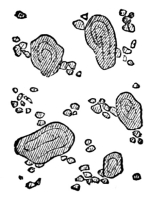
Fig. 13.
A portion of the residue is moistened with solution of
iodine, then carefully dried, and placed on the slide of a
microscope. The mass is next moistened with a solution
containing 2 per cent. of potassa, and examined. The addition
of iodine causes the potato starch granules to acquire a
blue color, and renders their shape and volume more easily
perceptible; thus allowing the two varieties of starch to be
readily distinguished. Fig. 13 represents the relative size of
the granules as observed under the microscope.[Q]
The presence of potato starch in bread is also detected by
crushing a small portion of the sample under examination on
the glass, and then adding a few drops of the alkaline solution.
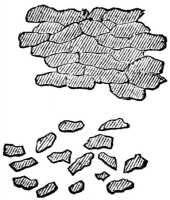
Fig. 14.
Rice and Corn.—If rice or corn meal have been mixed with
the flour, angular and translucent fragments (Fig. 14) are observed
in the microscopic examination. Corn meal acquires a
yellow color, if treated with dilute potassa solution.
MISCELLANEOUS TESTS.
Linseed and rye meals.—If linseed meal is moistened with
an aqueous solution containing 14 per cent. of potassa and examined
under the microscope, numerous minute characteristic
granules, smaller than the grains of potato-starch, are observed.
These possess a vitreous appearance, sometimes a reddish
color, and usually form in squares or very regular rectangles.
The test is equally applicable to bread. The detection of linseed
and rye meals is simultaneously effected by exhausting the
suspected flour with ether, then filtering the solution and allowing
it to evaporate. If the flour contains rye, the oil left by
the evaporation, when heated with a solution of mercury
in concentrated nitric acid, is converted into a solid substance
having a fine red color; but it remains unaltered,
if entirely due to linseed. In case the oil becomes solidified,
the mercury salt present should be removed by washing
with water, the residue taken up with boiling alcohol of
36° B. and the solution filtered: upon evaporating the alcoholic
filtrate, a residue is obtained consisting of the linseed
oil present.
Buckwheat.—Flour adulterated with buckwheat is less soft
to the touch, does not pack as easily, and passes more readily
through a sieve than pure wheaten flour. It presents, here
and there, blackish particles, due to the perisperm of the grain,
and has a dirty-white color. As previously remarked, the gluten
obtained from a mixture of buckwheat and wheaten flour
possesses a grey or even a black color. The starch furnished
by buckwheat flour exhibits polyhedral agglomerations, analogous
to those presented by corn.
Darnel.—The use of darnel in the adulteration of wheaten
flour may give rise to serious sanitary results. To effect its
detection, the flour to be examined is digested with alcohol of
35° B.: if the flour be pure, the alcohol remains limpid: it acquires
a straw-yellow tint, due to traces of bran present, but—although
a peculiar resin may be dissolved—the solution does
not possess a disagreeable taste. When, on the contrary, darnel
is present, the alcohol assumes a green tint, which gradually
deepens, and possesses a bitter and nauseous taste; the residue,
left by the evaporation of the tincture to dryness, has a
greenish-yellow color, and a still more disagreeable flavor than
the alcoholic solution.
Legumens.—Leguminous meals cannot be added otherwise
than in small proportions to wheaten flour, owing to the rapidity
with which they change the properties of the latter, and
communicate to it their characteristic odor—noticeable upon
treating the flour with a little boiling water. Their presence
is also easily detected by the distinctive properties of the vegetable
itself, and by the appearance of the amylaceous residue
in the microscopic examination. In order to decide as to the
presence of legumens, the washings containing the starchy matter
of the flour, after the particles of gluten present have been
separated by passing the fluid through a silk sieve, are divided
into two portions. One portion is allowed to undergo fermentation,
at a temperature of 18° to 20°: in case leguminous substances
are not present, lactic fermentation occurs and the
odor of sour milk is alone perceptible; if, on the other hand,
legumens are contained in the fluid, rancid fermentation takes
place, and an odor is emitted resembling that of decayed
cheese. The remaining portion of the washings, after being
decanted from the residue of amylaceous matter, is filtered
and evaporated until a yellowish translucent pellicle appears
upon its surface. The fluid is then again filtered from the
coagulated albumen common to all flours, and the leguminous
substances present coagulated by the addition, drop by
drop, of acetic acid.
The leguminous deposit produced appears white and flaky;
when examined under the microscope, it presents lamilla emarginated
at the border; it is odorless and tasteless; when dried,
it assumes a horny appearance; it is insoluble, both in water
and alcohol, and does not become gelatinous when treated
with boiling water; it is readily soluble in potassa and other
alkaline solutions, from which it is precipitated upon addition
of nitric, hydrochloric, acetic, oxalic, and citric acids;
upon protracted boiling in water, it loses its property of being
soluble in ammonia. The above tests having been applied,
the residue containing the starch is next examined. For this
purpose, a small portion is moistened with a little water, a few
drops of iodine solution added, and the mixture placed on the
side of the microscope: the bluish grains contained in the
polyhedral and cellular envelope (Fig. 15)
are easily recognized. The mixture
on the glass may also be treated with an
aqueous solution of potassa (containing
10 per cent. of the salt), or with dilute hydrochloric
acid: these reagents dissolve
the starch present, leaving the reticulated
tissue intact. Should this examination
fail to give a definite result, the remaining portion of the
amylaceous residue is subjected to a sort of levigation, and
the part most slowly deposited separated. In this portion
the reticulated tissues of the leguminous substances present
are contained, and, as they are comparatively free from foreign
matters, their identification is a matter of comparative ease.
In case the presence of reticulated tissue is indicated, it is
still necessary to apply confirmatory chemical tests.
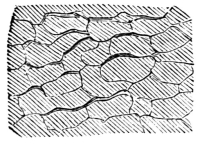
Fig. 15.
Meals prepared from beans, horse-beans, and lentils, contain
a tannin which imparts a green or black color to salts of
iron. The coloration is rendered very sensitive if a rather considerable
quantity of the flour to be examined is passed through
a silk sieve, and the remaining bran treated with a solution of
sulphate of iron (ferrico-ferrous sulphate): the reaction immediately
occurs, even if the sample contains but 10 per cent. of
bean meal. The meals of horse-beans and of vetches acquire
a red color, when exposed to the successive action of nitric acid
and of ammonia vapors. In order to apply this test, the suspected
flour is placed upon the edge of a capsule containing
nitric acid, the latter heated, and, as a yellow coloration appears,
the acid removed and replaced by ammonia. The capsule
is then set aside: if the flour is adulterated with either of
the above vegetables, reddish spots, which are easily perceptible
by aid of a magnifying glass, are soon produced.
In case bread is to be examined, it is exhausted with water,
the fluid passed through a sieve, the upper layer decanted,
then evaporated, and the residue taken up with alcohol. The
tincture so obtained is evaporated, and the second residuum
treated with nitric acid and ammonia, as directed above.
When meals prepared from beans, vetches, or lentils are heated
on a water-bath with hydrochloric acid, diluted with three to
four times its volume of water, a cellular tissue, possessing the
color of wine-dregs, remains behind; flours of wheat, peas, and
kidney-beans leave a colorless residue, when subjected to the
same treatment.
Finally; the grains of the starch (fecula) of legumens possess
a volume about equal to that of potato granules, and
exhibit either a longitudinal furrow in the direction of their
longer axis, or a double furrow arranged in a star-like form.
c. EXAMINATION OF THE ASH.
Leguminous substances, and more particularly mineral
salts, are detected by the examination of the ash left upon
the incineration of the flour.
Detection of Legumens.—Pure wheaten flour furnishes an
ash consisting of about 2 per cent. of its weight; whereas meals
of legumens leave from 3 to 4 per cent. of their weight in ash.
This difference is, however, too slight to furnish conclusive
results; the analysis of the ash is also necessary. The ash
of wheaten flour is non-deliquescent, dry, semi-fused, and chiefly
consists of phosphates of potassa, soda, magnesia and lime,
of sulphates, and of silica. The solution obtained by treating the
ash with water has an alkaline reaction. The phosphates of
the alkalies, present in the ash of wheat, exist in the state
of pyrophosphates, and, as chlorides are absent, the addition of
nitrate of silver to the aqueous solution of the ash produces
a white precipitate, consisting entirely of pyrophosphate of
silver, which is not affected by exposure to the light.
The ash of leguminous meals is deliquescent and soluble
in water, forming a strongly alkaline solution, which contains
both chlorides and neutral phosphates. The latter
give a clear yellow precipitate with nitrate of silver. Upon
adding a solution of this salt to the aqueous solution of the
ash, a pale yellow precipitate, which turns violet if exposed
to the light, is therefore produced.
Detection of mineral substances.—The principal mineral substances,
that are fraudulently added to flour, are ground calcined
bones, sand, lime, plaster, alum, and sulphate of copper.
The two last named salts are almost invariably added in small
quantities; alum renders the flour white, even when used in
the proportion of one per cent.; sulphate of copper is added
to impart a good appearance to bread made from a damaged
flour.
a. Ground bones (carbonate and phosphate of lime).—The
washings of the gluten are placed in a conical vessel, and, after
some time has elapsed, the clear supernatant fluid is removed
by means of a syphon, a conical shaped deposit remaining on
the bottom of the vessel: two hours later, the fresh layer of
fluid that has formed is removed with a pipette. As soon as
the residue becomes nearly solid, it is detached from the vessel,
placed upon a fragment of plaster, and allowed to dry.
The bones, being heavier than the amylaceous substances, are
to be found in the apex of the cone formed by the residue.
This is detached, and incinerated: in case the ash obtained
contains phosphate and carbonate of lime, the addition of
hydrochloric acid will cause effervescence, and, upon adding
ammonia to the acid solution, a white precipitate will be formed.
If the solution is then filtered and oxalate of ammonia
added to the filtrate, a precipitate will be produced which,
when heated to redness, leaves a residue of caustic lime possessing
an alkaline reaction.
b. Sand.—As this substance possesses a much greater specific
gravity than the usual constituents of flour, it is only necessary,
in order to accomplish its separation, to repeatedly stir the
flour with water, and remove the deposit at first formed, which,
if consisting of sand, will be insoluble in acids, and will grate,
when placed between the teeth.
c. Carbonates of lime and magnesia; vegetable ashes.—Carbonic
acid is always evolved, upon treating flour with hydrochloric
acid. If the base present be calcium, upon adding oxalate
of ammonia to the filtered solution—which has previously
been neutralized with ammonia—a white precipitate, possessing
the properties mentioned above, will be formed; in case
the base is magnesia, the addition of oxalate of ammonia will
fail to cause a precipitate, but upon adding solution of
phosphate of ammonia to the fluid a granular precipitate of
phosphate of ammonia and magnesia is produced; if, finally,
the flour contains vegetable ashes—i. e. carbonates of the alkalies—bichloride
of platinum will produce in the acid solution
a yellow precipitate: the addition of vegetable ashes, moreover,
would render the ash of the flour deliquescent and very strongly
alkaline.
d. Lime.—In presence of lime, carbonic acid produces a
white precipitate, when conducted into the filtered aqueous
extract of the flour.
e. Plaster.—The flour is boiled with water acidulated with
hydrochloric acid, the fluid filtered, and lime detected in the filtrate
by means of ammonia and oxalate of ammonia. The
presence of sulphuric acid is indicated by the formation of a
precipitate insoluble in acids, upon addition of solution of
chloride of barium. Upon calcining the flour without access
of air, sulphate of lime is converted into the corresponding
sulphide: the residue of the calcination, when treated with
hydrochloric acid, evolves sulphuretted hydrogen, and the lime
present in the filtered acid solution is likewise precipitated by
the addition of ammonia and oxalate of ammonia.
f. Alum.—A portion of the flour to be examined is treated
with water, the fluid filtered, and the filtrate divided in two
portions: in one, sulphuric acid is detected by means of chloride
of barium; in the other, alumina by adding a solution of
potassa, which gives with its salts a white gelatinous precipitate,
soluble in an excess of the reagent.[R]
g. Sulphate of copper.—About 200 grammes of the bread under
examination are incinerated; the ash treated with nitric acid;
the mixture evaporated until it acquires a sticky consistence,
and the mass then taken up with water. The aqueous solution
is next filtered; an excess of ammonia and several drops
of solution of carbonate of ammonia added; the fluid again
filtered, the filtrate slightly acidulated with nitric acid, and
divided into two parts. It is then ascertained if sulphuretted
hydrogen produces in one portion of the solution a brown
precipitate of sulphide of copper, and if solution of ferrocyanide
of potassium produces in the other a reddish-brown precipitate
of ferrocyanide of copper.[S]
Olive oil designed for table use is frequently adulterated
with the oils of poppy, sesamé, cotton-seed, pea-nuts, and
other nuts; olive oil, intended for manufacturing purposes,
is often mixed with colza and nut oils.
The tests used are of a rather unsatisfactory character.
In all instances, when the chemist is called upon to pronounce
as to the adulteration of an oil, it is necessary to
execute comparative experiments with the pure oil, and with
admixtures arbitrarily prepared: it is only when this is
done that the indications obtained are of value.
EXAMINATION OF OLIVE OIL INTENDED FOR TABLE USE.
a. The density of the oil is determined by means of a
hydrometer (oleometer) provided with a scale giving the densities
from 0.8 to 0.94, for the temperature of 15.° Pure olive
oil possesses a specific gravity of 0.917; poppy oil one of
0.925; a mixture of the two, an intermediate density. Since
the fixed oils are not definite chemical compounds, this test is
seldom conclusive.
b. Two or three cubic centimetres of concentrated nitric
acid, containing nitric peroxide in solution (or a solution of
mercury in strong nitric acid), are added to the oil to be examined,
as well as to a sample of pure olive oil. The two
samples are then allowed to stand in a room where the temperature
does not exceed 10.° The oleine of the olive oil is
converted into solid elaidine, and the mixture after some time
becomes sufficiently thick to remain in the vessel upon inversion.
If the sample under examination is free from adulteration,
it will solidify at the same time as the pure oil; whereas,
the presence of one per cent. of poppy oil, or of other drying
oils, suffices to retard the solidification for forty minutes.
c. Fifteen grammes of the oil are mixed in a glass vessel
with the same amount of strong sulphuric acid, the temperature
of the two liquids being previously observed. The mixture
is stirred with a thermometer, and the maximum temperature
noted: pure olive oil produces an elevation of temperature
of 37.°7; pure poppy oil, an elevation of 70.°5; and a
mixture of the two an elevation of temperature intermediate
between 37.°7 and 70.°5.
d. One volume of nitric acid of sp. gr. 1.33 is agitated
with 5 grammes of the oil, and notice taken of the coloration
produced after the lapse of five minutes. If the olive oil is
pure, it acquires a pale green color; in case it is mixed with
sesamé or nut oil, a deep-red color appears: poppy oil also
communicates a reddish coloration, but one less deep than the
preceding.
If an acid of sp. gr. 1.22 is taken, it is still less difficult
to distinguish between sesamé, nut and poppy oils; the latter
assumes, in this case, a pale yellowish-red color.
Pea-nut oil fails to exhibit a coloration; but can be
recognized by its conversion into a white solid, when mixed
with 1/5 of its volume of a solution of caustic soda of sp. gr.
1.34.
EXAMINATION OF OLIVE OIL INTENDED FOR MANUFACTURING
PURPOSES.
The chief adulterations are colza and nut oils. The latter
is detected by means of the reaction with nitric acid, as described
above. Colza oil is recognized by mixing 5 volumes of
the sample to be examined, with 1 volume of sulphuric acid
of sp. gr. 1.655: if colza or nut oils are present, a brown
coloration ensues; under the same circumstances, pure olive
oil assumes a pale greenish hue. In case the sample acquires
a brown color when treated with sulphuric acid, and
a red coloration is produced by the addition of nitric acid, it
contains nut oil; if sulphuric acid produces a brown coloration,
and nitric acid fails to change it, the presence of oil of
colza is indicated.
EXAMINATION OF HEMPSEED OIL.
This oil is frequently adulterated with linseed oil. The
reactions exhibited by these oils are nearly identical, and the
detection of the admixture is extremely difficult. It is advisable
to mix the suspected oil with sulphuric acid, notice being
taken of the elevation of temperature produced, and to treat
it with nitric acid and with dilute potassa solution, subjecting,
at the same time, an artificial mixture of the two pure oils
to the same treatment, and comparing the results obtained.
Among alimentary substances probably no article is
subjected to more adulteration than tea. The sophistications
practised may be conveniently divided into three
classes:
1. Additions made for the purpose of giving increased
bulk and weight, which include foreign leaves and exhausted
tea-leaves, and also certain mineral substances,
such as metallic iron, sand, brick-dust, etc.
2. Substances added in order to produce an artificial
appearance of strength in the tea decoction, catechu, or
other bodies rich in tannin, and iron salts being chiefly
resorted to for this purpose.
3. The imparting of a bright and shining appearance to
the tea by means of various coloring mixtures or "facings,"
which adulteration, while sometimes practised upon black
tea, is much more common with the green variety. This
sophistication involves the use of steatite (soap-stone),
sulphate of lime, China clay, Prussian blue, indigo, turmeric,
and graphite; chromate of lead and copper salts
being but very rarely employed. The compound most
frequently used consists of a mixture of soap-stone (or
gypsum) with Prussian blue, to which a little turmeric is
sometimes added.
Genuine tea is the prepared leaf of Thea
sinensis. It contains: moisture, 6% to 10%;
theine, 0.4% to 4.0%; tannin, (green) 20%,
(black) 10%; ash, 5% to 6%; soluble extractive
matters, 32% to 50%; and insoluble leaf,
47% to 54%.
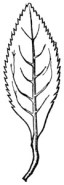
Fig. 16.
TEA
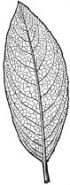
Fig. 17.
WILLOW
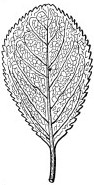
Fig. 18.
SLOE
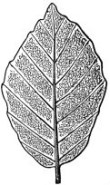
Fig. 19.
BEECH
The presence of foreign leaves, and, in some
instances, of mineral adulterants, in tea is
best detected by means of a microscopic examination
of the suspected sample. The genuine
tea-leaf is characterized by its peculiar
serrations and venations. Its border exhibits
serrations which stop a little short of the
stalk, while the venations extend from the
central rib, nearly parallel to one another,
but turn just before reaching the border of the leaf (see
Fig. 16). The Chinese are said to employ ash, plum, camellia,
velonia, and dog-rose leaves for admixture with tea,
and the product is stated to be often subjected in England
to the addition of the leaves of willow, sloe, beech, hawthorn,
elm, box-poplar, horse-chestnut, and fancy oak (see
Figs. 17, 18, and 19). For scenting purposes chulan flowers,
rose, jasmine, and orange leaves are frequently employed.
In the microscopic examination the sample should
be moistened with hot water, spread out upon a glass plate,
and then submitted to a careful inspection, especial attention
being given to the general outline of the leaf and its
serrations and venations. Most foreign leaves will, in this
way, be identified by their botanical character. The presence
of exhausted tea-leaves may also often be detected by
their soft and disintegrated appearance. If a considerable
quantity of the tea be placed in a long glass cylinder and
agitated with water, the coloring and other abnormal bodies
present frequently become detached, and either rise to the
surface of the liquid as a sort of scum or fall to the bottom
as a deposit. In this way Prussian blue, indigo, soap-stone,
gypsum, sand, and turmeric can sometimes be separated
and subsequently recognized by their characteristic microscopic
appearance. The separated substances should also
be chemically tested. Prussian blue is detected by heating
with a solution of caustic soda, filtering, and acidulating
the filtrate with acid, and then adding chloride of
iron, when, in its presence, a blue color will be produced.
Indigo is best discovered by its appearance under the
microscope; it is not decolorized by caustic alkali, but it
dissolves in sulphuric acid to a blue liquid. Soap-stone,
gypsum, sand, metallic iron, etc., are identified by means of
the usual chemical tests. A compound, very aptly termed
"Lie-tea," is often met with. It forms little pellets consisting
of tea-dust mixed with foreign leaves, sand, etc.,
and held together by means of gum or starch. This, when
treated with boiling water, falls to powder. In the presence
of catechu the tea infusion usually becomes muddy upon
cooling; in case iron salts have been employed to deepen
the color of the liquor, they can be detected by treating
the ground tea-leaves with acetic acid and testing the solution
with ferrocyanide of potassium. Tea should not turn
black upon immersion in hydrosulphuric acid water, nor
should it impart a blue color to ammonia solution. The
infusion should be amber-colored, and not become reddened
by the addition of an acid.
TEA ASSAY.
In the following tea assay proper the estimation of theine
is not included. The processes suggested for this determination
are rather unsatisfactory; and there appears, moreover,
to exist no direct relation between the quality of tea
and the proportion of theine contained. The tests here
mentioned, in connection with those already given, will,
it is believed, usually suffice to indicate to the analyst the
presence of spent leaves, inorganic coloring matters, and
other mineral adulterations.
Tannin.—A good process for the estimation of tannin in
tea has been published by Allen (Chem. News, vol. xxix.
p. 169 et seq.) A standard solution of lead acetate is prepared
by dissolving 5 grammes of the salt in distilled water
and diluting the liquid to 1,000 c.c. As an indicator, 5
milligrammes of potassic ferricyanide are dissolved in 5 c.c.
of water, and an equal volume of strong ammonia-water
added. The exact strength of the lead solution is to be
determined by means of a solution of pure tannin of known
strength. Two grammes of the tea to be tested are powdered,
boiled with water, and, after filtering and thorough
washing, the decoction is made up to a volume of 250 c.c.;
10 c.c. of the lead solution are now diluted with 90 c.c.
of boiling water, and the tea infusion is gradually added
from a burette until a few drops of the liquid, when filtered
and added to a little of the indicator placed upon a porcelain
slab, causes a pink coloration to appear; 125, divided
by the number of c.c. of tea infusion found to be necessary
to produce the pink color, will give directly the percentage
of tannin in the sample examined. As previously stated,
green tea contains 20% of tannin, and black tea 10%. In
spent tea, however, only about 2% of tannin is present;
and, although any tea deficient in this constituent could
be fortified by the addition of catechu, its determination
often affords indications of value.
The Ash—a. Total Ash.—5 grammes of the sample are
placed in a platinum vessel and heated over a Bunsen
burner until complete incineration has been accomplished.
The vessel is allowed to cool in a desiccator, and is then
weighed as quickly as possible. In genuine tea the total
ash should not be much below 5% or much above 6%, and
it should not be magnetic; in "faced" teas the proportion
of total ash is often 10% or 15%; in "lie-tea" it may
reach 30%, and in spent leaves it may fall as low as 3%, the
ash in this case being abnormally rich in lime salts and
poor in potash salts. Tea-dust sometimes contains 10% of
total ash without necessarily being considered bad in quality.
In the proposed United States tea-adulteration law (1884)
a maximum of 8% of total ash is allowed for tea-leaf.
b. Ash insoluble in water.—The total ash obtained in a
is washed into a beaker and boiled with water for a considerable
time. It is then brought upon a filter and the
insoluble residue washed, dried, ignited, and weighed. In
unadulterated tea it will not exceed 3% of the sample
taken.
c. Ash soluble in water.—This proportion is obtained by
deducting ash insoluble in water from the total ash.
Genuine tea contains from 3% to 3.5% of soluble ash, or at
least 50% of the total ash, whereas in spent or exhausted
tea the amount is often but 0.5%.
d. Ash insoluble in acid.—The ash insoluble in water is
boiled with dilute hydrochloric acid and the residue separated
by filtration, washed, ignited, and weighed. In pure
tea the remaining ash ranges between 0.3% and 0.8%; in
"faced" teas, or in teas adulterated by the addition of
sand, etc., it may reach the proportion of 2% to 5%. Fragments
of silica and brick-dust are occasionally to be found
in the ash insoluble in acid.
The Extract.—Two grammes of the carefully-sampled
tea are boiled with water until all soluble matter is dissolved,
water being added from time to time to prevent the solution
becoming too concentrated. The solution is poured upon
a tared filter, and the remaining insoluble leaf repeatedly
washed with hot water until the filtered liquid becomes
colorless. The filtrate is now diluted to a volume of 200
c.c., and of this 50 c.c. are taken and evaporated in a
weighed dish over the steam-bath until the weight of the
extract remains constant; its weight is then determined.
Genuine tea affords from 32% to 50% of extract, according
to its age and quality; in spent tea the proportion of
extract will be greatly reduced.
Insoluble Leaf.—The insoluble leaf obtained in the
preceding operation, together with the weighed filter, is
placed in an air-bath and dried for at least eight hours at a
temperature of 110° C.; its weight is then determined. In
unadulterated tea the amount of insoluble leaf ranges between
47% and 54%; in exhausted tea it may reach a proportion
of 75%.
It should be noted that in the foregoing estimations the
tea is taken in its ordinary air-dried condition. If it be
desired to reduce the results obtained to a dry basis, an
allowance for the moisture present in the sample (an
average of 8%), or a direct determination of the same, must
be made.
The following tabulation gives the constituents of genuine
tea so far as the ash, extract, and insoluble leaf are
involved:
- Total ash—ranges between 4.7% and 6.2%.
- Ash soluble in water—ranges between 3% and 3.5%; should equal 50% of total ash.
- Ash insoluble in water—not over 2.75%.
- Ash insoluble in acid—ranges between 0.3% and 0.8%.
- Extract—ranges between 32% and 48%.
- Insoluble leaf—ranges between 43% and 58%.
The table below may prove useful as indicating the requirements
to be exacted when the chemist is asked to give
an opinion concerning the presence of facing admixtures
or of exhausted or foreign leaves in a sample of tea:
- Total ash—should not be under 4.5% or over 7%.
- Ash soluble in water—should not be under 40% of total ash.
- Ash insoluble in water—should not be over 3%.
- Ash insoluble in acid—should not be over 1%.
- Extract—should not be under 30%.
- Insoluble leaf—should not be over 60%.
Note.—The British Society of Public Analysts adopt:
- Total Ash (dry basis)—not over 8% (at least 3% should be soluble in water).
- Extract (tea as sold)—not under 30%.
The chief constituents of milk are water, butter, caseine,
lactose (milk-sugar), traces of albumen and mineral salts.
Butter is present in the form of minute globules, held in suspension;
the caseine, for the greater part, is in solution, only
a small portion being present in an insoluble suspended condition.
In milk only a few days old, the colostrum (the milk
secreted during the first few days after parturition) consists
largely of rather voluminous cellular conglomerations, containing
a sufficient quantity of albumen to coagulate upon
heating.
The normal density of milk is 1.030, water being 1.000;
the density rising to 1.036, if the fluid has been skimmed.
Good milk contains, on an average, 3.7 per cent. of
butter; 5.7 per cent. of lactose, and leaves upon evaporation
12 to 14 per cent. of solid matters.[T] The most common
adulteration of milk consists in the addition of water. This
fraud is detected by means of an areometer (lactodensimeter)
which gives directly the specific gravity of the fluid under
examination. Should the density be much below 1.030, it is
certain that water has been added. It does not, however,
necessarily follow if it is about 1.030 that the milk is pure,
since the gravity of the fluid, which would be increased upon
skimming, could be subsequently reduced to 1.030 by the
addition of water. The lactodensimeter, therefore, although
useful in the detection of a simple admixture, fails to give
reliable results if the fraud perpetrated is a double one; and
a determination of the proportion of butter present is also
usually necessary. Numerous methods have been proposed
to accomplish this estimation. The most preferable of these,
owing to the rapidity with which the operation is executed, is
the use of the lactoscope (galactoscope). This instrument consists
of a tube provided with a glass plate fitted at one end,
and with a movable glass plate at the other extremity. A few
drops of the milk to be tested are placed between the two
plates, and the tube lengthened, by screwing out the movable
plate, until the fluid no longer transmits the light of a candle
placed at a distance of one metre. As the opacity of milk is
due to the butter present, it is evident that the proportion of
this substance contained in the sample can be estimated by
the relative distance which the plates have been separated.
The lactoscope possesses, however, but a limited degree of
precision. M. Marchand substitutes to its use the following
tests: A test-tube is graduated in three equal divisions, the
upper one being subdivided into hundredths extending above,
in order to determine accurately the correct volume of the
fluid, expanded, as it is, by the temperature of 40°, at which
the examination is executed. The first division of the tube is
filled with milk, a drop, or two of strong potassa lye added,
and the mixture well shaken: the second portion is then filled
with ether, and the third with alcohol. The mixture is next
again thoroughly agitated, and then exposed to a temperature
of 40° in a water-bath. After standing for several hours, a
layer of fatty matter becomes sufficiently separated to allow of
measurement: but, as it contains some ether and as a small
amount of butter may still be retained in the lower aqueous
fluid, a correction of the results obtained is necessary. M.
Marchand has compiled a table, which facilitates this correction
(vide: Journ. de Pharm., Novembre 1854, and Bulletin de
l'Académie de Médecine, Paris, 1854, xix., p. 1101).
Previously to the introduction of Marchand's apparatus,
use was made of the lactometer, which consists simply of a graduated
glass tube, in which the suspected milk is allowed to remain
for 24 hours, at a temperature of 15°. After the lapse of
this time, the cream present completely separates as a supernatant
layer, the thickness of which indicates the quality of the
sample taken.
M. Lacomte recommends the addition of glacial acetic acid,
in order to cause the more rapid separation of the cream.
The estimation of the butter being accomplished, it is frequently
needful to determine the amount of lactose present.
For this purpose, recourse is had to Barreswil's method,
based upon the reduction of cupro-potassic tartrate by milk-sugar
in the presence of alkalies. A solution is prepared containing
40 grammes of pure crystallized sulphate of copper, 600
or 700 grammes of caustic soda lye of sp. gr. 1.12, and 160 grammes
of neutral tartrate of potassa. The sulphate of copper and
tartrate of potassa are previously dissolved separately in a little
water, the three solutions united, and water added until the
fluid acquires a volume of 1154.4 cubic centimetres. In order
to standardize this test solution, a known weight of pure lactose
is dissolved in water and the fluid added, drop by drop, from a
graduated burette, to a small flask containing 10 cubic centimetres
of the copper solution, diluted with 40 cubic centimetres
of distilled water, and heated to boiling. At first a yellow
precipitate forms, which gradually turns red, and is deposited
on the bottom of the flask, leaving the solution colorless. As
soon as the test solution is completely decolorized, the addition
of the lactose solution is discontinued, and the weight of
lactose corresponding to 10 cubic centimetres of the test fluid
calculated from the quantity used. The standard of the test
solution having been determined, the above operation is repeated,
the milk under examination being substituted for the solution
of pure lactose. The quantity of milk necessary to decolorize
10 cubic centimetres of the copper solution will
evidently contain the same amount of lactose as the quantity
of solution used in the preliminary test, and the actual amount
of lactose present is very easily calculated. When an estimation
of the solid matter contained in the milk is required, a
known weight is evaporated to dryness over a water-bath, and
the residue weighed. In performing this evaporation, the addition
of a known amount of sand, or ground glass, is advisable.
The amount of ash present is determined by incinerating the
residue left by the evaporation.
Foreign substances are sometimes added to milk, for the
purpose of disguising the presence of an abnormal quantity of
water, the principal of which are: chalk, bicarbonate of soda,
emulsion of almonds, gum tragacanth, gum arabic, starch, flour,
decoction of barley or rice, sugar, and cerebral substances.
These bodies are detected as follows:
Chalk.—If chalk is contained in the milk, it readily subsides
upon allowing the sample to remain at rest for some
time in a flask, forming a deposit which effervesces when
heated with hydrochloric acid, and dissolves to a solution, in
which the characteristic properties of a lime salt can be recognized.
Bicarbonate of soda.—In presence of this compound the
milk possesses a strongly alkaline reaction, furnishes a serum
having a sharp and bitter taste, and leaves a residue of the
salt upon evaporation.
Emulsion of almonds.—The milk has a specific gravity of
at least, 1.033. If it is passed through a gauze, small opaque
lumps are separated. When examined under the microscope,
numerous minute globules, having a diameter of 1/400 of a millimetre,
are observed, and, upon adding a few centigrammes of
amygdaline to one or two grammes of the milk, the characteristic
odor of bitter almonds is produced.
Gum tragacanth.—When shaken in a glass flask and allowed
to rest, the milk deposits on the sides small transparent
lumps, which usually present a slightly elongated or angular
form.
Gum arabic.—The addition of alcohol produces an abundant
white opaque precipitate.
Starch, flour, decoction of barley, rice, etc.—Upon boiling the
suspected milk, and adding tincture of iodine, the amylaceous
substances present produce a blue coloration in the fluid.
Sugar.—If yeast is added, and the mixture allowed to
stand for some time at a temperature of 30°, alcoholic fermentation
ensues; under these circumstances, lactose does not
undergo fermentation.
Cerebral substances.—Adulteration by these substances is
probably of much less frequent occurrence than was formerly
supposed. The admixture is detected by evaporating the milk
to dryness, dissolving the residue in ether, evaporating the
etherial solution, and fusing the second residue, which consists
of fatty matters, with nitrate of potassa in a platinum
crucible. The mass is then taken up with water, and chloride
of barium added to the solution. If cerebral substances were
contained in the milk, ether will dissolve the fatty matters
present, the phosphorus of which is converted into a soluble
phosphate by the calcination with nitrate of potassa and is
thrown down as a white precipitate, upon the addition of a solution
of chloride of barium. This test may be confirmed by a
microscopic examination of the milk, when the peculiar appearance
of cerebral matter will be detected.[U]
The most common adulteration to which wines are subjected
is the addition of water: wines having a rich color are
frequently mixed by the dealer with lighter wines, and the
fraud consummated by adding water. The detection of this
adulteration is somewhat difficult, as water is a normal constituent
of wine. In Paris the following method is usually
employed: As soon as the wine is confiscated, it is ascertained
what kinds of wine are manufactured by the inculpated
dealer, and a statement obtained from him, giving the proportions
of alcohol, etc., contained in the various brands. A wine
is then prepared, according to the information received, an estimation
of the alcohol contained in the prepared sample made,
and the results compared with those furnished by a similar examination
of the suspected wine. In case the proportion of
alcohol is less in the suspected wine than in the prepared
sample, it is evident that a fraudulent adulteration has been
committed. If, however, the quantity of alcohol is the same
in both wines, it does not necessarily follow that the wine has
escaped admixture, since this body may have been added after
the adulteration with water. In addition to the estimation
of alcohol, it is also necessary to determine the amount of
cream of tartar (bitartrate of potassa) present, as the proportion
of this salt would be sensibly decreased by the addition
of alcohol and water to the wine. This fraud could,
however, be disguised by subsequently adding the proper
amount of cream of tartar.
It is also well to ascertain if two equal quantities of the
prepared sample and the wine under examination require the
same amount of solution of hypochlorite of lime for decolorization.
In case the suspected wine has been adulterated,
the quantity of hypochlorite solution used will be less than
the amount necessary to decolorize the prepared wine. Foreign
coloring matter may be added by the adulterator, but
this fraud is easily detected by adding potassa to the sample:
if its coloration is natural, a green tint is produced; whereas,
if foreign matter has been introduced, the wine assumes various
other colors upon the addition of the alkali.[V]
The indications furnished by the above test are rendered
valueless, if the wine has been artificially colored by the addition
of the coloring matter of grape-skins; but the execution
of this fraud would require some knowledge of chemistry,
and fortunately adulterators, as a class, are deficient in this
branch of science.
Another method for detecting the addition of water is
based upon the fact that fermented liquors do not contain air
in solution, but only carbonic acid; whereas, water dissolves
oxygen and nitrogen. It is executed as follows:
The wine to be tested is placed in a flask, the delivery-tube
of which is also filled, and heated; the evolved gas being
collected in a tube filled with mercury. In case the
wine is pure, the disengaged gas will be completely absorbed
by potassa; if, on the other hand, water has been added, an
unabsorbed residue, consisting of oxygen and nitrogen, will
remain.
This test is useless in case water, through which a current
of carbonic acid gas has been passed for a considerable time,
has been employed. Under these circumstances, however, the
presence of the gas would probably be detected by the taste
of the wine, as well as by the estimation just mentioned, since
the sample would invariably contain a larger proportion of the
gas than the standard with which it is compared; indeed, it
would be almost impossible to prepare a solution which contained
exactly the proportion of carbonic acid ordinarily
present in wine.
It remains to mention the methods employed in determining
the amount of alcohol and cream of tartar contained in
wine.
The alcometrical method usually employed is based upon
the difference in density possessed by pure alcohol and by
mixtures of alcohol and water. Gay-Lussac has proposed an
areometer (alcoholmeter), provided with a scale which directly
indicates the proportion of alcohol contained in a mixture.
As the indications furnished by this instrument vary with the
temperature, and the scale is constructed on the basis of
a temperature of 15°, a correction of the results obtained
is necessary if the determination is made at other temperatures.
Gay-Lussac has compiled a table which indicates
at once the required correction; the following formula can
also be used: x = c ± 0.4 t, where x is the quantity
of alcohol present in the sample; c the degree indicated
by the alcoholmeter, and t the number of degrees differing
from the temperature of 15°: the second member of the
formula is subtracted from, or added to the first, as the temperature
at which the estimation is made is greater or less
than 15°.[W]
In case the wine to be examined contains substances other
than water and alcohol, which would affect its density, it is
necessary, before making use of the alcoholmeter, to distil the
sample and subsequently examine the distillate, which will consist
of a simple mixture of water and alcohol. Usually the
distillation is discontinued as soon as one-third of the sample
has passed over, and a quantity of distilled water, sufficient
to render the volume of the mixture equal to the original
volume of the wine, added to the distillate: the fluid remaining
in the flask will be entirely free from alcohol. The
addition of water to the distillate is not indispensable, but
otherwise it is necessary to divide the degrees indicated by
the alcoholmeter by 3, in order to reduce the result to the
original volume of the wine taken.
M. Salleron offers for
sale a small apparatus
(Fig. 20) used in examinations
of this character,
consisting of a flask,
closed with a gutta-percha
cork, containing a
tube which connects with
a worm passing through
a cooler. The flask is
supported by an iron
stand, and heated with a
gas or spirit lamp.
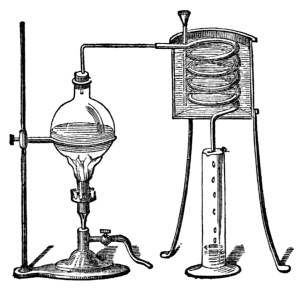
Fig. 20.
In order to estimate the cream of tartar, the wine is evaporated
to the consistency of an extract, alcohol of 82° B. added,
and the residue obtained calcined in a crucible. The amount
of salt present in the fused mass is then determined by the
alkalimetric method, as directed in all works on quantitative
analysis. The carbonate obtained from 1 gr. of cream of
tartar exactly saturates 9.75 cubic centimetres of a solution
containing 100 grammes of sulphuric acid of 66° B., and 1800
grammes of distilled water.
The detection of toxical substances, often contained in
wine, is accomplished by the methods described under the
head of detection of poisons.
Vinegar is frequently adulterated with water, and occasionally
sulphuric acid is added to artificially increase its
acidity.
The ordinary reagents—such as chloride of barium, or
nitrate of silver—are not adapted to the direct detection of
sulphuric acid, or of other mineral acids, as sulphates and
chlorides, which are as readily precipitated as the free acids,
may also be present.
The following method, proposed by M. Payen, is usually
employed:
Five centigrammes of starch (fecula) are added to a decilitre
of table vinegar, the mixture boiled for 12 or 15 minutes, and,
after the fluid has become completely cooled, a few drops of
iodine solution added: dilute acetic acid does not affect
starch, and, in case the vinegar is pure, a blue coloration is
produced; if, on the other hand, even a minute quantity of a
mineral acid be present, the starch is converted into dextrine,
and the addition of iodine fails to cause a blue coloration.
The water present is indirectly estimated by determining
the amount of acetic acid contained in the vinegar. This can
be accomplished in different ways: either the quantity of a
standard solution of an alkali, necessary to exactly neutralize
a measured quantity of the vinegar, is ascertained, or
the vinegar is supersaturated with solution of baryta, the excess
of the salt eliminated by conducting carbonic acid
through the fluid, the precipitate removed by filtration, and
the baryta salt in the filtrate precipitated by the addition of
sulphuric acid. The second precipitate is then collected on a
filter, washed, weighed, and the amount of acetic acid present
calculated: this is done by multiplying its weight by 0.515.
Owing to the high price of this salt, it is frequently adulterated.
The substances used for this purpose are: crystalline
sulphate of lime, boric acid, mannite, sugar, starch, salicine,
stearic acid, and the sulphates of cinchonine and quinidine.
These bodies are detected as follows:
a. Upon slightly warming 2 grammes of sulphate of quinine
with 120 grammes of alcohol of 21° B., the pure salt completely
dissolves; if, however, starch, magnesia, mineral salts, or various
other foreign substances are present, they are left as
insoluble residues.
b. Those mineral substances that are soluble in alcohol
are detected by calcining the suspected sample: pure sulphate
of quinine is completely consumed; whereas, the mineral
substances present remain behind as a residue.
c. In presence of salicine, the salt acquires a deep red color,
when treated with concentrated sulphuric acid.
d. Stearic acid remains undissolved upon treating sulphate
of quinine with acidulated water.
e. To detect sugar and mannite, the sample is dissolved in
acidulated water, and an excess of hydrate of baryta added:
a precipitate, consisting of quinine and sulphate of baryta, is
produced. Carbonic acid is then passed through the fluid, in
order to precipitate the excess of baryta as insoluble carbonate,
the fluid saturated with ammonia, to throw down the
quinine which may have been re-dissolved by the carbonic
acid, and the mixture filtered. If the salt be pure, no residue
will be obtained upon evaporating the filtrate; a residue of
sugar or mannite is formed, if these substances are present.
f. Sulphate of quinine invariably contains 2 or 3 per cent.
of cinchonine, originating, not from a fraudulent admixture,
but from an incomplete purification of the salt. One of the
best methods for detecting the respective quantities of quinine
and cinchonine, present in a sample of the sulphate, is the following:
Several grammes of ammonia and ether (which has previously
been washed with water) are added to one or two grammes
of the salt under examination, the mixture thoroughly agitated,
and then allowed to remain at rest. The supernatant etherial
solution contains all of the quinine; the cinchonine, which is
almost completely insoluble, both in water and ether, remaining
suspended between the layers of the two fluids. The
ether is next removed by means of a stop-cock funnel, evaporated
to dryness, and the weight of the residue obtained determined.
The operation is then repeated, the ether being
replaced by chloroform in which both quinine and cinchonine
are soluble. The residue, formed by the evaporation of the
second solution, will be heavier than the first residue: the
difference between the two weighings gives the weight of the
cinchonine present.
g. The detection of the presence of sulphate of quinidine
is based upon the difference in the solubilities of the oxalates
of quinine and quinidine. Oxalate of quinidine is sufficiently
soluble in cold water not to be precipitated by double decomposition
when solutions of oxalate of ammonia and sulphate
of quinidine are mixed. Under the same circumstances,
quinine is almost completely thrown down. The
test is applied as follows:
The suspected salt is dissolved in water, a slight excess of
oxalate of ammonia added, and the precipitate formed separated
by filtration. If the salt be pure, the filtrate is scarcely
rendered turbid by the addition of ammonia; when, however,
sulphate of quinidine is present, it will be entirely contained
in the filtrate, in which ammonia will produce an abundant
precipitate.
This branch of legal chemistry formerly gave but very unreliable
results. It is scarcely ten years since the reactions
that are now regarded as only secondary and confirmative in
their character, and far from conclusive, were the only ones in
use: these are the tests based upon the presence of iron and
albumen in the blood. Since then, great progress has been
made in the methods employed. It must not be understood,
however, that the question under consideration always admits
of an easy and decisive solution: the stains are sometimes
too greatly altered to be identified; but in cases where the distinctive
reactions of blood can be produced, the real nature of
the stains under examination can, at present, be determined
with certainty.
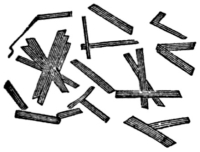
Fig. 21.
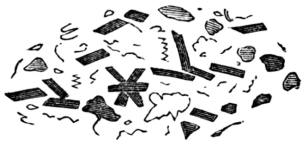
Fig. 22.
The tests more recently introduced consist in the production
of small characteristic crystals, termed haemin crystals,
and in the use of the spectroscope. Crystals of haemin (first
discovered by Teichman) are formed when dry blood is dissolved
in concentrated acetic acid, and the solution evaporated
to dryness: they are of a brownish-red color. Brücke first
suggested an analytical method, based upon this property of
blood, which is equally characteristic and sensitive: It is only
necessary to dissolve a minute portion of the matter to be examined
(dried blood, or the residue left by the evaporation of the
fluid obtained by treating the stain, or the dried blood, with
cold water) in glacial acetic acid and evaporate the solution to
dryness in order to obtain crystals of haemin, which can be
readily recognized by means of a microscope having a magnifying
power of 300 diameters. If the crystals originate from
fresh blood, they appear as represented in Fig. 21; crystals
from old blood are represented in Fig. 22.
The former possess a reddish-brown, the latter a lighter
color.
The various methods now employed to produce haemin
crystals were proposed by Hoppe-Seyler, by Brücke and by Erdman.
Whichever process is used, the suspected stains are at
first carefully separated from the material upon which they are
deposited. If they are present on linen, or other fabrics, the
stained portions, which always remain somewhat stiff, are cut
off: they will present a reddish-brown color, in case the cloth
is not dyed: if the stains are on wood, they are removed by
means of a sharp knife; if on stone or iron, they are detached
by scraping.
In case Hoppe-Seyler's method is used, the stains, separated
as directed above, are macerated with a little cold water (warm
water would coagulate the albumen present, and consequently
prevent solution taking place): the stains become soft, striae
and brown or reddish clouds are observed, especially when
the dried blood is fresh, and, at the same time, the objects upon
which the stains were deposited are decolorized. Upon allowing
the fluid obtained in this way to spontaneously evaporate
on a watch-glass, a reddish brown or brownish residue is left,
from which the crystals of haemin are prepared in the following
manner: An almost imperceptible amount of common salt is
added to the residue, then, six to eight drops of concentrated
acetic acid, and the mass thoroughly mixed by stirring with a
small glass rod. The mixture is at first heated over a small
gas flame, then evaporated to dryness by the heat of a water-bath.
If the stains were produced by blood, a microscopic
examination of the residue will reveal the presence of haemin
crystals. This method presents an objection: if the stained
objects have been washed with warm water previously to the
examination, the albumen will be coagulated, and the blood
rendered insoluble; in this case, cold water will fail to dissolve
anything, and the residue will not produce crystals when
treated with acetic acid.
In order to remedy this difficulty Brücke operates directly
upon the stained woven or ligneous fibre, or the matter removed
from the stone or iron: The materials are boiled in a test-tube
with glacial acetic acid, the fluid decanted or filtered, a
trace of common salt added, and the liquid then evaporated
on a watch-glass at a temperature between 40 and 80°.
If the stains really originated from blood, haemin crystals will
now be easily perceptible upon examining the residue obtained
under the microscope.
The stained fabric, the matter removed from the stone or
iron, or the residue left by the solution with which the stains
have been treated, is placed on the glass, a trace of chloride
of sodium added, and the whole covered with a thin glass plate.
A drop of acetic acid is then placed at the edge of the plates—between
which it is soon introduced by capillary attraction—and
the mixture allowed to rest in the cold for a few moments.
The mass is next brought into solution by slightly heating, and
is then evaporated by holding the plate at a considerable distance
above a gas burner. The fluid is examined from time
to time under the microscope: when it is sufficiently concentrated,
crystals, presenting the appearance represented in
Figs. 21 or 22, will be observed. These are especially well-defined,
if an insoluble substance is also present between the
plates—which prevents their adhering. The fluid collects by
capillary attraction at the points of contact of the plates as a
more or less colored layer, in which the crystals are deposited.
Should the above test fail to present distinctive indications
at first, one or two fresh drops of acetic acid are introduced
between the plates, and the examination is repeated. The result
is not to be regarded as negative, until several trials have
proved fruitless, as the stained portions are but slowly soluble,
and crystallization may have been prevented by the too rapid
evaporation of the acetic solution.
Haemin crystals, once seen, can hardly be confounded
with other substances; still, it is well to identify them by confirming
their insolubility in water, alcohol, and cold acetic acid,
as well as their instantaneous solubility in soda lye.
The addition of common salt is ordinarily superfluous, as
it is normally contained in the blood; but it is possible, if the
stains were washed with warm water, that, in addition to the
coagulation of the albumen, the solution of the salt may have
taken place, in which case crystals will fail to form. The
addition of salt is to remedy this possible contingency; albeit,
the delicacy of the test is not affected, even if crystals of chloride
of sodium are produced, as these are easily soluble in
water, and are readily distinguished from those of haemin by
aid of the microscope.
The indications furnished by means of the spectroscope are
less reliable than those given by the production of haemin
crystals; moreover, the spectroscopic examination requires favorable
weather for its execution. Still, the test should be
employed in all possible instances. The course pursued is
the following:
The aqueous fluid, with which the stains have been treated,
is placed in a watch glass, and evaporated in vacuo over
sulphuric acid; the last remaining portion of the fluid being
united in the bottom of the glass by causing it to collect in a
single drop. When the evaporation of fluid is completed, the
watch-glass is placed before the narrowed slit of a spectroscope,
and a ray of diffused light (or better, light reflected from
a heliostat) made to pass through the part of the glass containing
the residue. If the stains originate from blood, the absorption
lines of haemoglobin, consisting of two large dark
bands, to the right of the sodium line (Frauenhofer's line D),
will be observed in the spectrum. In case both of the above
tests fail to give positive results, it is almost certain that the
stains examined were not caused by blood. If, on the contrary,
the reactions were produced, scarcely any doubt exists as to the
presence of blood. Under these circumstances it is advisable to
confirm the results by means of the tests that have been previously
spoken of as being formerly exclusively employed;
these are the following:
a. 1/2 to 1 c. c. of ozonized oil of turpentine, i. e. turpentine
which has been exposed to the air sufficiently long to acquire
the property of decolorizing water that is slightly tinted with
indigo—is introduced in a test-tube, and an equal volume of
tincture of guaiacum added (the latter tincture is prepared by
treating an inner portion of the resin with alcohol, until its
brownish color is changed to a brownish-yellow).
If upon adding some of the substance under examination
to the above mixture a clear blue coloration ensues, and the
insoluble matter thrown down possesses a deep blue color, the
presence of coloring matter of the blood is indicated. The
mixture also imparts a blue color to moistened spots from
which the blood stains have been as completely extracted as possible.
Unfortunately sulphate of iron gives the same reaction.[X]
b. Upon heating the fluid obtained by treating the stains
with cold water in a test-tube, its brown or reddish color disappears,
and greyish-white flakes of coagulated albumen are
thrown down. The precipitate acquires a brick-red color,
when treated with an acid solution of nitrate of mercury containing
nitrous acid. The albumen is also coagulated by the
addition of nitric acid: it assumes a more or less yellow color,
if heated with a slight excess of the acid. Chlorine-water,
especially upon heating, likewise precipitates albumen in the
form of white flakes.
c. If the fluid is acidulated with a few drops of acetic acid,
and a drop of ferrocyanide of potassium added, a white precipitate,
or, at least, turbidity is produced.
d. The flakes of albumen, separated by heating, dissolve
in caustic alkalies to a solution, from which they are re-precipitated
by nitric acid, or chlorine water.
e. Upon treating blood stains with chlorine-water, a solution
which contains chloride of iron, and acquires a red coloration
by the addition of sulphocyanide of potassium, is formed.
f. Should the stains have failed to be affected by cold water
(which, as has already been remarked, is the case when they
have been previously washed with hot water), they are treated
with weak soda lye. Nitric acid, hydrochloric acid, and chlorine
water will produce in the solution so obtained a white
precipitate, which exhibits the general properties of albumen
previously described. In case the stains are deposited upon
linen, it is necessary to replace the soda by ammonia, in
order to avoid dissolving the fabric.
g. Solutions of the alkalies, which dissolve the albumen,
leave the coloring matters intact, and consequently do not
decolorize the fabric. If the latter is afterwards subjected to
the action of hydrochloric acid, the coloring matter is dissolved,
forming a solution that leaves upon evaporation to dryness
a residue containing iron, which gives a blue coloration with
ferrocyanide of potassium, and a red coloration with sulphocyanide
of potassium.
h. The coloring matter of blood dissolves in boiling alcohol,
to which sulphuric acid has been added, to a brown dichroic
fluid (appearing green by transmitted light, and red
by reflected light). A mixture of rust and blood exhibits the
same phenomenon.
i. If substances containing blood are heated in a dry tube,
an odor resembling that of burnt horn is emitted. In case the
stained fabric is a substance that would produce this odor,
(such as wool, silk, or hair), the test naturally loses all value.
j. If the fluid obtained by treating the stains either with
water or alkali is evaporated with a little carbonate of potassa,
and the residue heated, at first at 100°, then to redness, in a
glass tube to which a fresh quantity of carbonate of potassa
has been added, cyanide of potassium is formed. When cold,
the tube is cut above the part containing the fused mixture,
the mass heated with iron-filings and water, the fluid filtered,
and the filtrate then acidulated with hydrochloric acid: ferrocyanide
of potassium will be present in the fluid, and
upon adding a drop of solution of perchloride of iron a
green, or blue, color will be produced, and a precipitate of
Prussian blue gradually thrown down.
If the stained cloth is non-nitrogenous (per ex.: hemp,
linen, or cotton), instead of treating it with water, it may be
heated until pulverulent, mixed with carbonate of potassa,
the mixture calcined, and the operation then completed as
just described. This test having given affirmative results, the
operations should be repeated with an unstained portion
of the cloth, to remove all doubt that the indications obtained
do not really originate from the fabric.
In the present state of science, it is impossible to discriminate
chemically between human and animal blood. M. Barruel,
it is true, is able, not only to accomplish this, but also to distinguish
the blood of the various species of animals by its
odor! But this test has a somewhat hypothetical value for
scientific purposes. In regard to the crystals of haemin, they
do not present sufficient difference to allow the blood of different
animals to be distinguished. We have not yet treated
of the globules. It often occurs that these minute organs are
so altered as to be no longer recognized in the microscopic examination;
when, however, the stains are tolerably recent, they
may be detected by examining the moistened stained cloth,
directly under the microscope: a discrimination between animal
and human blood is then possible: corpuscules of human
blood possess the greater size: those of the sheep, for instance,
have only one-half the diameter of the former. It is,
however, but seldom that this distinction can be made use of.[Y]
In cases where attempt at violence, rape or pederasty
is suspected, the expert may be required to determine the
nature of stains found on clothing, sheets, etc. The fact that
the stains were produced by semen, may often be regarded,
per se, as criminating evidence. This class of investigation
possesses, therefore, considerable importance.
External appearance of the stains.—Dry spermatic stains
are thin, and exhibit a greyish or, occasionally, a citron-yellow
color, if present on white cloth. In case the fabric is colored,
they appear whitish and, if on linen, present a glossy aspect.
They are translucid, when observed by transmitted light. If
the fabric, upon which the stains are deposited, is of a heavy
texture, they are visible only on one side: under all circumstances,
their circumference is irregular and undulated. These
indications, however, are not conclusive, but vary according to
whether the stains were produced by the thick semen of a
vigorous man, or the aqueous seminal fluid of an aged and
diseased person, or by semen more or less mixed with the
prostatic fluid. Upon moistening spermatic stains, the distinctive
stale odor of fresh semen is sometimes emitted, but
this characteristic is usually obscured by the presence of foreign
substances.
Semen stains are soluble in water, forming a gummy fluid,
in which chlorine, alcohol, bichloride of mercury, acetate and
subacetate of lead produce a white precipitate, but which fails
to be coagulated by heating. Plumbate of potassa does not
impart a fawn-color to these stains, at a temperature above
20°, as is the case with those produced by albuminous substances.
Persulphate of iron imparts to spermatic stains a pale
yellow color,
Sulphate of copper, a bluish grey color,
Cupro-potassic tartrate, a bluish grey color,
Nitrate of silver, a pale grey color,
Nitric acid, a pale yellow color.
The above reactions, separate or united, are insufficient;
they are not very delicate, and are likewise produced by stains
originating from the other varieties of mucus: the indications
furnished by a microscopic examination of the stains are alone
conclusive.
Microscopic examination.—Semen contains as its principal
and fecundating constituent, peculiar vibratory filaments,
(spermatozoa), held suspended in a viscous fluid. These filaments,
when preserved in a warm and moist place, retain their
activity for a considerable time: it is even possible that they
may exhibit vitality in the organs, into which they have been
voluntarily or forcibly ejaculated, for ten, or even twenty-four
hours. When exposed to cold air, the spermatozoa quickly
expire; still, they preserve their form for some time, and, as
this is very characteristic, it is then easy to identify them;
moreover, since they originate exclusively in the testicles, their
detection may be considered as certain evidence of the presence
of semen. In stains produced by aged persons, and by
persons enfeebled by excesses, the spermatozoa fail to be
presented; in case they are discovered, this fact evidently does
not affect the certainty of the spermatic origin of the stains.
The contrary conclusion is never absolutely certain: still, if
the use of the microscope fails to establish the presence of
spermatozoa, it is almost certain that the stains were not produced
by semen.
Of the various methods for obtaining from the stains a
preparation adapted to the microscopic examination, the one
proposed by M. Charles Robin is the most simple and reliable.
A strip, 1 c. c. in size (comprising the entire stain, if this
be small, containing its inner portion, if it be large), is cut from
the fabric under examination, care being taken that the two
extremities of the sample extend beyond the stained portion.
One end of the cloth is then immersed in a capsule, or
watch-glass, containing pure water: the stains become moistened
by capillary attraction, and, in a space of time varying
from twenty minutes to two hours, acquire the appearance of
fresh semen. As soon as the stained portion becomes swollen
and softened, the surface of the cloth is gently scraped with
a spatula, and the substance removed placed on the slide of
the microscope. The particles are next slightly detached, a
drop of water added, if necessary, and the whole covered
with a small plate of very thin glass. The preparation is then
examined by a microscope, having a magnifying power of from
500 to 600 diameters. In this way, the presence of either
entire or broken spermatozoa is readily detected. Their existence
is rendered still more apparent, if the mucus present
is dissolved by adding a drop of acetic acid to the preparation.
Entire spermatozoa consist of long slender filaments, having
a length of 0.04041 to 0.04512 millimetre; the anterior extremity
presents an oval enlargement, either round or pyriform, exhibiting
a double outline, when magnified to 500 diameters. This
enlarged end is termed the "head;" the entire remaining
portion being regarded as the "tail." In case the spermatozoa
are broken, they are severed either near the head or in the
middle of the tail, and a mass of detached fragments will be
observed in the microscopic examination. The spermatozoa
are not the only corpuscules revealed by the microscope; other
substances, entirely different in character, are often observed.
Although the detection of these bodies is, in itself, of no value,
it will be well to enumerate and characterize them; they are:
a. Oily globules.
b. Leucocytes, or spherical and finely granulous globules
of mucus.
c. Corpuscules, originating from the seminal vesicles,
termed sympexions. These are rounded or ovoid, possess
an irregular outline, and are usually mixed with the spermatozoa
and globules of mucus.
d. Crystals of phosphate of magnesia, varying greatly in
size; the largest are from 0.mm. 001 to 0.mm. 002 in length.
The crystals formed upon cooling the semen, present the form
of an oblique prism, with a rhomboidal base. Occasionally
they are elongated and flattened; they then assume the form
of a rhomboid.
e. Epithelial cells; originating from the mucous follicles of
the urethra.
f. Irregular grains of dust; soluble in acetic and hydrochloric
acids, with gaseous evolution.
g. Brownish-red grains of rust; only slightly soluble in
acetic acid, but easily soluble in hydrochloric acid.
h. Filaments of the strained fabric; detected by their
texture, and general appearance.
i. Grains of starch, in case the cloth has been stiffened.
These are almost invariably swollen, and are frequently broken
and deformed.
If the examination is to be secretly executed, and the cloth
cannot well be cut, it is rolled in a cone, in such a way that
the external side contains the stained portion. The lower
extremity of the cone (which should be free from stains) is
dipped in a watch-glass containing water, so as to avoid
directly wetting the stains. The cone soon becomes moistened
by absorption, and the operation is then completed in the
same manner as when the fabric has been cut; which is
always preferable, when possible.
The examination of spermatic stains consists, then, in
moistening the stains with water, separating them as completely
as possible from the stained cloth, and determining
the presence of the spermatozoa by means of the microscope.
All other tests are valueless; even their execution for
confirmatory purposes is not advisable; inasmuch as they fail
to possess a distinctive character, and the reagents employed
in their production may destroy the fabric, and thus prevent
the formation of the only conclusive reaction—the detection
of the spermatozoa.
In case the stains are deposited upon a woman's chemise,
they are usually present on both the front and back portions,
and are sometimes to be found on the sleeves. When a man's
shirt is under examination, especial attention should be given
to the anterior portions. The pantaloons are also often stained;
usually in the interior, but sometimes also on the exterior,
just above the thighs. In reporting the decision to the
court, as to the nature of the stains, their precise position
should invariably be stated, as, by this means, the circumstances
attending the commission of the crime may be, at
least partially, elucidated.
THE END.