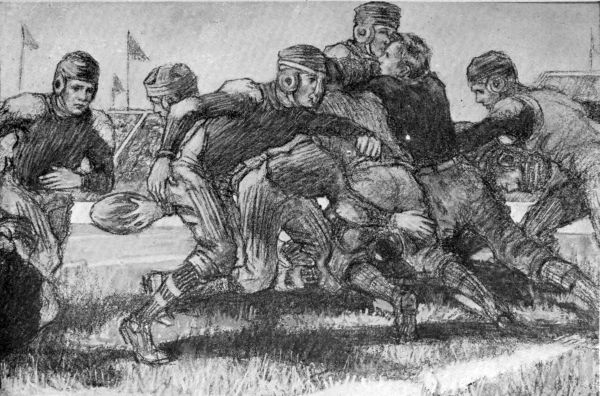
Martin’s statement that he had been assigned to
left tackle position was not believed very implicitly
that night, although, in the press of other
matters demanding discussion, none expressed
doubt. But the next day proved that Martin had
spoken no more than the truth, for when the
scrimmage commenced he was in Leroy’s place,
and there he stayed not only for the rest of the
day but for the rest of the season. At left half,
Willard and Mawson each served, the latter
yielding to Willard near the end of the practice.
The second team managed a field-goal that afternoon,
but the first scored three touchdowns and
for once showed plenty of punch.
With Lake at left end and Martin Proctor at
left tackle, that side of the line improved remarkably.
For a few days Martin fitted none too
perfectly into the new position, but he had had
much experience, wanted badly to be something
better than a second-choice player and worked
hard, with the result that long before the Kenly
game he was looked on as a remarkably good
tackle. The weak spot in the team continued,
however, for no satisfactory alternative to Steve
Browne had been found. Browne tried pitifully
hard to fill the difficult requirements of the full-back
position, but he failed utterly and palpably.
Linthicum was tried, and so was Austen, a half-back
from the second, but none suited. Kenly
was developing a stiff line this year, as proved
by the last two games she had played, and more
weight and aggressiveness in the backfield was
sorely needed at Alton. Discounting his possible
ultimate failure to find a satisfactory full-back,
Coach Cade experimented with plays built on the
substituting of Bob Newhall or Stacey Ross for
a half or the full-back. The difficulty, however,
lay in the fact that the backfield man who played
up in the line found it hard to perform his temporary
duties satisfactorily. Placing Bob at full-back
for straight plunges between tackles worked
fairly well and was accountable for some good
gains against the second team, but Browne in
Bob’s place was as ill-fitting as a square peg in a
round hole and would doubtless prove in Captain
Joe Myers’ words, “easy meat” for Kenly.
Coach Cade had a strongly-imbedded dislike for
unbalanced formations, anyhow, and, although he
used shifts sparingly and was responsible for the
play that put Captain Myers behind the line so
that he might receive a forward-pass, he wanted
no more “freaks” and frowned on these new inventions
even while he used them. And so matters
stood on that Wednesday morning preceding
the Hillsport game when Willard, having a
whole fifty minutes between recitations, took a
Latin book over to the first base bleachers and
draped himself over three seats in the sunlight.
It was a genuine Indian summer day, with no
breeze, or only just enough to disturb the straight
column of smoke that came from the big chimney
behind Lawrence Hall, a very blue sky that melted
to a hazy, purplish gray toward the horizon and
a flood of mellow sunlight over all. By occasionally
changing his position when the edges of the
planks pressed too fervently against him, Willard
managed a whole page of his book, making many
marginal notes in his very small and extremely
neat writing. He was, though, getting somewhat
drowsy when the sound of footsteps came to him
and he looked up to find Felix McNatt approaching.
McNatt had soiled hands and wore a triumphant
expression, and both were explained
when, having climbed to Willard’s side and seated
himself there, he lifted the wooden lid of the
grape basket he carried.
“Agaricus pratensis,” he announced impressively.
“The same to you,” answered Willard, “and
many, many of them.”
McNatt smiled humoringly. “I found them
over near the farm. They are rather scarce about
here.”
Willard eyed the contents of the basket unenthusiastically.
The five mushrooms made very
little appeal to him and he hoped McNatt wasn’t
going to ask him to help eat them. “Are they
edible?” he asked anxiously.
“Oh, yes, although my book says they’re not
so tasty as many other sorts.”
“They don’t look awfully appetizing,” murmured
Willard. “Do you cook them or
what?”
“They’re excellent fried,” replied McNatt,
gazing almost affectionately into the basket. “Or
you can stew them in milk.”
“No, thanks.” Willard shook his head. “I
don’t like the smell of them. They—they smell
as if they were dead!”
“Of course they’re dead,” said McNatt a trifle
impatiently. “Or I suppose they are. Possibly
they continue to live for a certain time after they
are picked: I must find out about that: it would
be interesting to know.”
“Very,” agreed Willard politely. “Are you
going to eat them?”
To his great relief, McNatt shook his head.
“No, there aren’t enough to make a mess.”
“Aren’t there? I should think those would
make a mess all right, a beastly mess!”
McNatt smiled, even chuckled. “I fancy you
aren’t a mushroom lover,” he said. “You wait,
though. Some time I’ll get a fine lot of puff-balls
and we’ll have a feast. You’ll change your mind
then.”
“Maybe I’ll change more than that,” said Willard
sadly. “Maybe I’ll change my habitation.
Lots of folks have gone to heaven after eating
mushrooms, haven’t they?”
“No, not mushrooms,” said McNatt, “toadstools.
There’s a difference.” He covered the
basket again, set it carefully between his feet and
gazed in silence for a moment across the field.
Presently: “You are on the football team, aren’t
you?”
“Yes,” said Willard, “sort of. I’m a substitute
half.”
“What sort of a team have we got this year?”
“Pretty fair, I think. Haven’t you seen them
play?”
“I saw part of the first game, but you can’t
tell much about a team so early. I haven’t followed
it very closely since then.”
“Well, we’re sort of getting together, I guess,”
said Willard. “There have been a good many
changes made and so the team isn’t playing together
awfully smoothly yet. Mr. Cade’s having
a lot of trouble finding a full-back.”
“A full-back? Is that so?” McNatt seemed
rather more interested than previously. “What’s
wrong there, Harmon?”
Willard explained as best he could and McNatt
nodded assent. “He’s right,” he declared. “To
my way of thinking the full-back is the most important
man on the team. He’s got to be strong
and clever and have enough weight to carry him
through the first defense. I don’t bank much on
the very heavy sort, though. They generally lack
the proper mental attributes. Do you know, Harmon,
it’s strange to me that scientists have never
made a thorough study of the relation of mind
quality to body formation. Now take a type of
fellow who is big of torso and neck; large above
the waist, you understand; probably he will have
a large head, too; most of them do. That fellow
will be a persistent, hard fighter when he’s started
and he will have good sound judgment. But he
won’t be resourceful and he won’t be capable of
quick decision. See what I mean? I believe
that a thorough study of the subject would enable
anyone to tell a man’s mental character off-hand
by observing his physical construction.”
“You’d better come out this afternoon and look
over the substitutes,” laughed Willard. “Maybe
you could pick out a full-back for Mr. Cade.”
“Full-backs,” answered McNatt solemnly, “are
very scarce. Good ones, I mean. I remember that
when I played here two or three years ago it was
difficult to find a satisfactory substitute.”
“It isn’t a substitute that’s bothering this
year,” said Willard ruefully, “it’s the real thing.
Where did you play, McNatt? I mean what position.”
“Full-back,” answered the other gravely.
“Full-back!”
“Yes, I played there my first year off and on,
although I was only fifteen. I was large for my
age, though. The next year I played the position
until I was taken sick. After that I sort of fell
out of the game. Well, I must get back.” He
picked up his basket, nodded and went striding
off toward Upton.
Willard watched him go thoughtfully. After
a minute, though, he tucked his pencil into a
pocket, seized his book and hurried across to
Lykes. Luck was with him when he knocked at
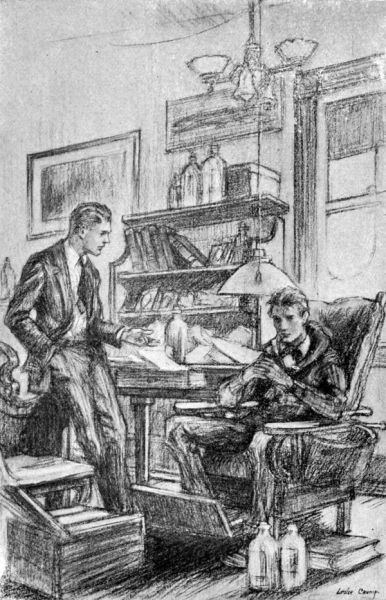
Number 2 and entered. Joe was propped up on
the window-seat, half hidden by a newspaper.
“Hello, Brand,” he said. “What’s on your
mind?”
“More than is on yours, I guess,” answered
Willard meaningly.
Joe laughed. “Think so? Well, that’s the first
paper I’ve seen in a week. I was looking over
the Saturday games. Yale’s coming back all
right, isn’t she? That fellow Loughlin who played
left tackle for awhile is an Alton fellow. Wasn’t
considered much good here, though, as I remember.”
“Say, Joe, suppose a fellow played football this
year and then didn’t play for two years more.
Would he be any good?”
“Good for what?”
“Football. I mean, could he—could he come
back?”
“Oh! I don’t know, Brand. I guess it would
depend on the fellow. Aren’t thinking of giving
up the game, are you?”
“No. Look here, Joe, suppose a fellow was a
corking good full-back three years ago and then
didn’t play any more. Suppose he was to go back
to the game tomorrow. How long would it take
him to—to remember what he’d forgotten and—and
find himself again?”
“Brand, it’s too early in the day for hypothetical
questions,” replied Joe, stretching and
yawning. “It would depend on so many things,
boy: on how well the chap had kept himself in condition,
principally. Got any fellow in mind, or
are you just doing this for exercise?”
“I’ve got someone in mind,” answered Willard
earnestly. “There’s a chap here who used
to play football three years ago, and from what
he says he must have been pretty good. Anyway,
he was regular full-back on the team. Then
he was taken sick and had to quit, and he never
went back.”
“Who’s that?” demanded Joe, sitting up.
“McNatt,” answered Willard.
“McNatt! Oh, I thought you’d discovered
someone, Brand. I guess McNatt’s a joke.”
“He did play, though, didn’t he?” Willard
persisted.
Joe nodded. “Yes, he did, and that’s a fact.”
He paused and kicked thoughtfully at the paper
on the floor. “He played all one year, I think,
either on the second or on the first as substitute.
The first year I was here he played for awhile.
That was his second year. Seems to me he
stopped about the middle of the season. I don’t
remember much about him, though. But, great
gosh, the fellow’s no football man! Just—just
look at him!”
“He’s out of training, of course,” agreed Willard,
“but seems to me if he was good enough to
be regular full-back three years ago he might be
worth trying now.”
“That’s so, Brand! Look here, you tell him to
come on out and we’ll give him a fair show, as
late as it is. It would be worth a dollar of any
fellow’s money to see McNutt playing football!”
Willard shook his head. “I’m not sure he’d
do it, Joe.”
“Why not? What’s the idea?”
“Well, I don’t believe he cares for it any more.
He’s a funny duck, McNatt. I guess it would
take a lot of persuasion to get him back.”
“But I thought from what you said that he
wanted to try it,” said Joe, puzzled. “What does
he want?”
“To be let alone, I think,” answered Willard,
smiling. “No, the idea was mine, Joe. McNatt
hasn’t any more ambition to play football than
I have to—to collect mushrooms! But when he
told me about having played full-back I remembered
that we are hard up for a fellow for that
position, and so I came over here to speak to you
about it.”
“Well, dog my cats,” exploded Joe, “if the
fellow can play football it’s his duty to do it!
Doesn’t he know that? Where is he? I’ll have
a talk with him. I don’t suppose he’s worth bothering
with, but there’s always a chance! And
we can’t afford to miss it!”
“What are you going to say to him?” asked
Willard.
“Say to him? Why, that we need his services,
of course. I’ll tell him that if he shows up decently
he will stand a good chance of playing
against Kenly. I guess that ought to fetch him.”
“That might fetch some fellows, Joe, but I’m
afraid it wouldn’t fetch McNatt.” Willard shook
his head gently. “I may be wrong, but I guess
he’s about as stubborn as they make them. You
know you can tell a lot about a fellow’s—er—character
by his physical formation, Joe, and McNatt’s
got long legs and—and everything.”
“I don’t know what you’re talking about,” answered
the other impatiently, “but, stubborn or
not, he will play football if I get after him!”
“All right.” Willard shrugged his shoulders.
“If I were you, though, I’d go at him sort of
easy.”
“Oh, I’ll be easy enough,” said Joe untroubledly.
“He’s in Upton, isn’t he? What’s the
number? Forty-nine?” Joe looked at his watch
and got to his feet. “I’ve got twenty minutes before
French. I’ll run over and see him. Of
course nothing will come of it, though. A fellow
who’s been out of training as long as he has can’t
come back in three or four weeks. Besides, I
dare say he’s forgotten all the football he ever
knew.”
Willard parted with Joe at the entrance. “Good
luck,” he called as Joe went off. “Try diplomacy
first, Joe!”
Joe smiled back confidently and waved a careless
hand.
It was not until he reached the gymnasium in
the afternoon that Willard learned the result of
Joe’s visit to Number 49 Upton. Joe was still
angry. “The fellow’s a perfect fool,” he snapped
in reply to Willard’s polite inquiry. “And he’s
as stubborn as a mule! Sat there and talked for
ten minutes about how the full-back position
ought to be played and then calmly told me he
wouldn’t try for the team for a thousand
dollars!”
“And then you bullied him,” laughed Willard.
“I told him what I thought of him,” answered
Joe grimly. “He made me so blamed mad I
could have punched his head. Just sat there and
blinked and shook his silly bean! And when I’d
flayed him alive he wanted to know if I wouldn’t
like to see his mineral collection. Oh, the chap’s
plain nutty!”
“He is sort of peculiar,” agreed Willard
soberly.
“Peculiar!” Joe laughed mirthlessly. “He’s
crazy in the head. Know what I think? Well, he
showed me a lot of mushrooms he had there;
nasty, smelly things they were, too; and I’ll bet
he eats ’em and they’ve affected his mind. I
don’t know what to do with him!”
“Guess you’ll have to forget it and just let him
alone,” said Willard soothingly.
“I can’t afford to let him alone,” protested Joe
impatiently. “Why, gosh, if that fellow can play
full-back the way he can talk it he’d be a wonder!
Look here, Brand, you see what you can do. I
talked my head off and it didn’t have any effect
on the poor fish. You—you have a go at him,
will you? And do it today. Honest, that fellow
ought to show whether he’s any good or not. It’s
his duty! Of course we can’t make him play, but
you’d think he’d want to!”
“All right,” agreed Willard, “I’ll see what I
can do, Joe, but I haven’t much hope. If your
diplomacy failed, why, I’m not likely to succeed.”
Joe looked at Willard suspiciously. “Hang it,
I was diplomatic,” he protested. “I was as sweet
as sugar to him until he shut his mouth tight and
said he wouldn’t do it.”
“If he had his mouth shut,” said Willard, “I
don’t see how he could say anything, Joe. Maybe
he hummed it, though?”
“Oh, go to the dickens!” growled the other.
There was an unusually hard and protracted
practice game that afternoon, and Willard played
at left half through fifteen strenuous minutes
during which the second, given the ball over and
over to test the first team’s defense, hammered
and banged until she finally got across the line
for a score. Willard, like most of the others, got
some hard knocks and when he was released he
felt very little ambition for the task that Joe had
set him. But supper helped a lot, and at half-past
seven he set out for McNatt’s room. Even
when he knocked at the door of Number 49 he
hadn’t decided what he was to say.
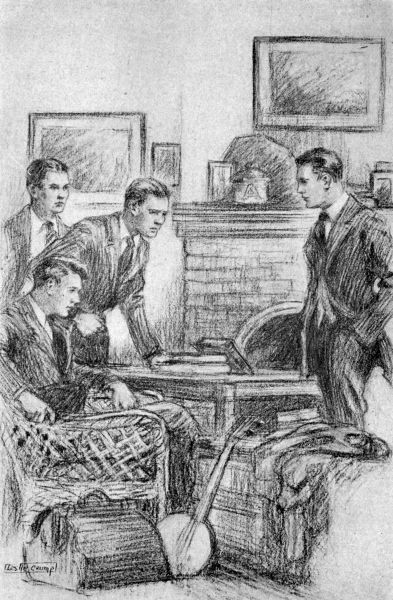
Not only McNatt was in this evening, but his
roommate, Winfred Fuller. Fuller was a sophomore,
a smallish, anemic-appearing youth who, or
so Willard fancied, wore a harried, apprehensive
look, as though life with McNatt’s toads and
beetles and strange messes was gradually affecting
his mind. Fuller sat, straightly uncompromising,
on the edge of a chair and gazed at Willard
with owlish fixity during the first ten minutes
of the latter’s visit, and Willard was heartily
glad when, muttering some excuse, the boy took
himself off. McNatt was most hospitable and
offered to cook a few choice mushrooms that he
had picked that afternoon under someone’s stable
if Willard fancied them. But Willard explained
that, being on a diet, mushrooms were a forbidden
luxury, and McNatt was not offended. After
that the talk turned to the subject of football
“situations” and McNatt was reminded that he
had found the memorandum of which he had
spoken on the occasion of Willard’s last visit, and
stretched a hand toward the littered table. But
unfortunately the paper had again disappeared,
and although McNatt searched long and determinedly,
making the confusion more confused, it
refused to be discovered. Finally, giving up the
quest, McNatt sat down again, stretching his long
legs across the floor and thrusting a pair of large,
very chapped hands into his pockets.
“Myers came to see me this morning,” he remarked
placidly. “He’s captain of the football
team this year. But you know him, of course. I
forgot you were on the team, Harmon. Queer fellow,
Myers: awfully obstinate and opinionated,
don’t you think?”
“Well, he’s likely to have rather pronounced
views on any subject that he’s very much interested
in,” replied Willard cautiously. “Football
for instance.”
McNatt chuckled. “It was football he came to
see me about. He wanted me to play full-back.
It seems the fellow they’ve got isn’t
very satisfactory. You told me that, too, I
think.”
“Yes, I did,” said Willard, “and I’m mighty
glad you’re going to help us out, McNatt!”
McNatt frowned and shook his head. “Oh, but
I’m not. I told Myers I couldn’t, you know. He—I
don’t think he liked it.”
“You’re not!” exclaimed Willard incredulously.
“But—but why?”
McNatt stared a moment as though a trifle surprised.
“Why, I’m out of football, Harmon! I
thought I told you that. I haven’t played since
my second year here. I’ve given it up completely.
You see, I hadn’t any patience with the fuddling
way they taught it. Everything’s so hit-or-miss.
No science at all. You acknowledged that yourself,
Harmon.”
Willard nodded. “Yes, that’s true. But, look
here, McNatt, it seems to me the game of football
needs fellows like you; fellows, I mean, who—er—who
realize what’s wrong with it and have the—the
courage and brains to remedy it.”
McNatt tilted back and shook his head slowly.
“They won’t listen, Harmon,” he said. “I tried
Myers today. He couldn’t see what I meant at
all. Just got very impatient and told me I was a
slacker. I’m afraid Myers has a one-track mind,
Harmon.”
“Joe is awfully anxious to beat Kenly,” replied
Willard, “and he takes it for granted that every
other fellow is just like he is. He loses sight of
the fact that there are fellows here in school like
you, McNatt, who don’t give a whoop whether
Alton wins or doesn’t.”
McNatt shook his head almost violently. “You
mustn’t say that,” he protested. “Although not
actively participating in football any longer, Harmon,
I am still vastly interested in it and follow
it very carefully. And, naturally, I want Alton to
defeat Kenly. Yes, indeed, decidedly! You
mustn’t—ah—consider me unpatriotic.”
“Oh,” murmured Willard. “I didn’t understand.
I thought—”
“Yes?” encouraged McNatt.
“Why, only that, not being willing to help the
School out by going back to the team, you didn’t—didn’t
care very much!”
McNatt smiled gently. “I’m afraid you’re
rather like Myers,” he chided. “You can only
see what’s directly in front of your eyes. Myers
couldn’t understand that I might find other things
more important than football. I explained that
my scientific pursuits meant more to me than
playing full-back on the eleven.”
“Then I’m not like Joe,” responded Willard,
smiling, “for I can understand it. I suppose
what does puzzle me, McNatt, is your not being
willing to apply your science to the bettering of
the game and the defeat of the enemy. Seems to
me you’ve got a big chance to demonstrate your
theories and to help the School at the same time.”
McNatt looked surprised. “But I’ve explained
that they won’t listen!” he said.
“Don’t ask them to listen,” replied Willard
smilingly, yet very earnestly. “Show them!”
“Show them? You mean—”
“Exactly! Go out and play full-back as it
should be played. Scientifically. According to
your ideas. Prove there’s something in it, McNatt.
Afterwards you can talk and they’ll
listen.”
McNatt drew his hands from his trousers pockets
and rubbed them thoughtfully together. “I
wonder if it could be done,” he muttered. “You
see, Harmon, it isn’t the playing of one position
that counts, but the conduct of the whole game,
the—the modus operandi. And yet—” He relapsed
into silence again.
“Being there, though, right on hand, would
help, wouldn’t it?” Willard asked. “I mean,
you’d be in a better position to offer your advice
and aid. And maybe you might play full-back so
well that they’d realize that—that science has its
place in football.”
“Do you know,” exclaimed McNatt quite excitedly,
“you almost persuade me to try it, Harmon!
By golly, you do! This man that is coaching
this year—I forget his name—; is he the sort
you can talk to? You know some of these coaches
are so—so set! You can’t get them to listen to
anything at all!”
“I don’t think Mr. Cade is that sort,” replied
Willard reassuringly. “I’d say he was quite open
to conviction, McNatt. In fact—” and here Willard
smiled to himself—“in fact, I think I can
promise that he will listen to anything that promises
success for the team. There’s one thing,
though, that might bother you, old chap. You’ve
been out of training a good while and of course
condition’s got a heap to do with playing football
well.”
McNatt shook his head impatiently. “My condition’s
all right,” he answered. “I’ll have to
read up on the new rules, though. They’ve made
several changes since I played before. I suppose
I ought to see Myers and tell him I’ve changed
my mind.”
“I’ve got a rules book,” said Willard, “and
I’ll bring it over to you the first thing in the
morning. As for telling Myers, I wouldn’t trouble.
I’m quite likely to run across him myself
this evening and I’ll pass the good word to him
if you like.”
“I’d be very much obliged,” answered McNatt
gratefully, “but don’t go out of your way, please.
Funny you should turn up here tonight, Harmon.
I’m glad you did, though, I really am. I wouldn’t
have realized what an opportunity this thing affords
me if you hadn’t!”