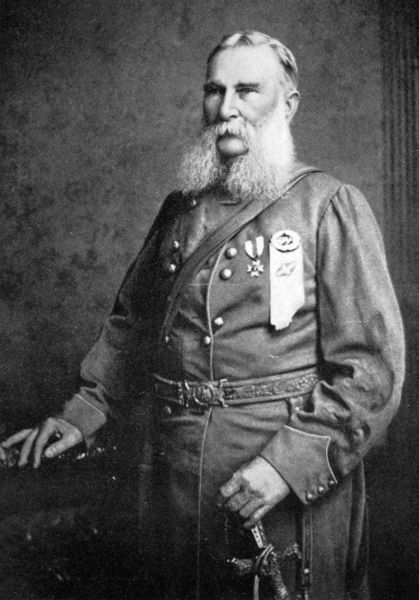
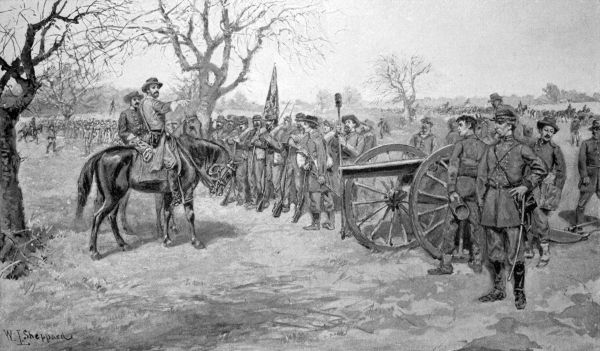
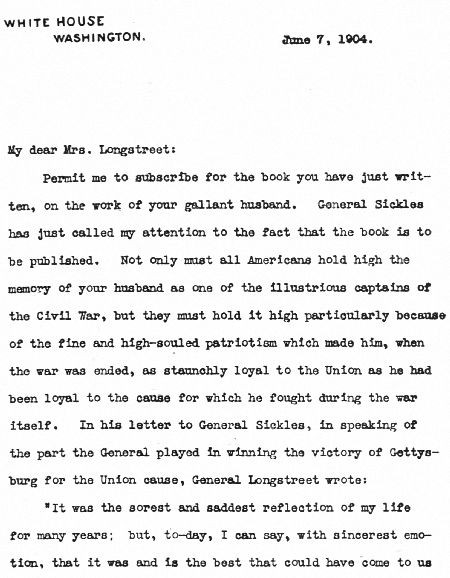
“His chivalry is as lasting as the hills of the Old Dominion.”
Tribute to the memory of General James Longstreet, adopted
by Sterling Price Camp, No. 31, Dallas, Texas.
Comrade A. W. Nowlin, in submitting the report of the committee,
said in part:
“Comrades, we have assembled here as a camp to pay tribute to the
memory of the late Lieutenant-General Longstreet. One of the great
soldiers of the age has fallen. He has answered the last roll-call. Taps
has been sounded ‘Lights out.’ The ‘War-Horse of the Confederacy’ is
dead. This great, brave, and fearless officer is gone. The hard fighter
of the Army of Northern Virginia has surrendered to the arch-enemy death.
General Longstreet possessed the esteem and confidence of his troops in
a marked degree. They were devoted to him, and when and where he led
they were invincible.
“His name and his deeds of daring and chivalry are coupled and interwoven
with that of the Army of Northern Virginia, and are as lasting as
the hills of the ‘Old Dominion.’ The heroic battle-fields of Virginia will
ever attest and pay tribute to the military genius of this great leader.
History will hand down to posterity the name of James Longstreet as
one of the great generals of the nineteenth century.”
The following was adopted as Camp Sterling Price’s tribute
to Lieutenant-General James Longstreet:
Whereas, Lieutenant-General James Longstreet recently
passed away at his home in Gainesville, Georgia, and was buried,
amid the tears and regrets of thousands of those who loved him
and had assembled from every part of this country to pay this
last honor to him; be it
Resolved, That the comrades of Camp Sterling Price have
heard with profound sorrow of the death of this great Southern
soldier and comrade.
Resolved, That, educated in the profession of arms, he gave
many years of his young manhood to the service of his country
in the war with Mexico and in conflicts and campaigns with the
savages of the West, and everywhere distinguished himself for
courage and ability so as to win promotion and the gratitude and
applause of his countrymen.
Resolved, That when wrongs and passion disrupted the nation,
and his native State withdrew from the Union and united with
the Confederate States of America, he felt that his allegiance no
longer belonged to the other States of the Union, but to the one
of which he was a citizen, and he resigned his office in the United
States army and offered his services to the government of the
Confederacy. He received the rank of brigadier-general, and,
being always in the front when campaigns were most important
and the enemy the most powerful and battles were furious, he
was promoted for distinguished bravery, conduct, and generalship
to be major-general, lieutenant-general, and second in command
of the great Army of Northern Virginia, under the great
commander Lee.
As brigadier-general at Manassas he held the left wing of the
enemy, by his boldness, so that it could not give assistance to the
defeated right wing. As major-general he covered General
Johnston’s retreat in the Peninsula before the advance of McClellan,
and fought the victorious battle of Williamsburg. As
major-general he commanded the right wing in the bloody battle
of Seven Pines, and with D. H. Hill drove the enemy from the
field. In the Seven Days’ battle around Richmond no general
gained greater renown, and soon thereafter, when Congress
directed the President to appoint seven corps commanders with
the rank of lieutenant-general, Major-General Longstreet was
made the ranking lieutenant-general and second in command
of the army under Lee, which position he held through the
great battles and campaigns of that army for three years, until
with Lee and the remnant of his heroes he surrendered at Appomattox.
At the second battle of Manassas he commanded the right
wing of the army, and with Jackson on the left drove Pope
into the fortification of Washington. At South Mountain he
held McClellan with a death grip until Jackson could storm
Harper’s Ferry, and commanded the right wing at Sharpsburg
and fought more than double his number under McClellan from
early dawn until darkness spread her sombre shadows over the
bloodiest scene in American history. It was here that Lee
knighted him as his “War-Horse” as the last guns were sending
their hoarse echoes among the mountains. Next, at Fredericksburg
he commanded the left wing, and at nightfall on the 13th
of December, 1862, eight thousand of the enemy were stretched
out dead or bleeding in front of his corps.
At Gettysburg, riding by the side of Lee, without expecting
nor desiring at that time to join battle with the enemy, they
heard the thunder of Hill’s and Ewell’s guns, and hastened to
their assistance. The first day’s battle was fought and won
before Lee or Longstreet could take an active part. On the
second day Longstreet commanded the right wing and fought
one of the bloodiest battles of the war, driving almost the entire
army of Meade before him, and leaving more than ten thousand
of the enemy slain or wounded on the field. The third day of
this great battle he exhibited the loftiest courage.
Next, he and his corps were sent from Virginia to Georgia and
joined Bragg in the terrible battle of Chickamauga, where he
commanded the left wing and routed the right wing of Rosecrans’s
army. When Grant and Meade, with their forty thousand
veteran soldiers, were advancing upon Lee in the Wilderness
of Virginia, the great commander of the Army of Northern
Virginia called Longstreet with his men back from Tennessee,
and with panting breath and quick step and double ranks he
headed the Texas brigade and rushed upon the cheering and
triumphant enemy on the second day in the Wilderness, and
drove them over their works amid the blazing woods, and a great
victory was in the grasp of Lee, when a bullet from our own
men, by mistake, crashed through his body and he was carried
from the field desperately wounded. The guiding hand of the
great general and fighter was gone, and victory fled as the fatal
opportunity was lost.
In the long siege and through the many battles around Richmond
and Petersburg, lasting nearly twelve months, Longstreet
commanded the left wing on the north side of the James, and
stood like an immovable mountain between the enemy and the
Confederate capital.
When the sad day of Five Forks came, and Lee’s lines were
broken about Petersburg, Longstreet was called from Richmond
with his men to the assistance of his great commander, and
covered the retreat and gave blow for blow to the charging
enemy, and when the sun rose on the day of the 9th of April,
and Grant was about to offer terms for the surrender of the
Southern army, Longstreet told General Lee that if the terms
were not honorable they would fight again and die fighting.
Thus he fought and stood by his chief to the bitter end, retaining
the confidence of his commander and his President to the last;
and if they who knew him best and trusted him most, and were
with him day and night and knew his thoughts and opinions, and
witnessed his deeds and actions throughout all the vicissitudes
and trials of those days that measured the souls of men,—if they
believed in him, trusted him, leaned on him, and kept him second
to Lee, who shall have the temerity to criticise, to condemn, and
to throw stones at this imperial soldier?
Those of us who have heard the thunder of his guns; those
of us who have seen him leading his warriors in battle; those of
us who have seen him stand like a Gibraltar against the charging
thousands of a fierce foe, will honor him as a great soldier who
has added to the fame of Southern manhood, and who is worthy
to stand through the ages with Lee and Johnston and Jackson
and Stewart, and all the brave men who laid their bare breasts
to the storm of war in the name of freedom and independence.
We honor ourselves by honoring such a man.
Resolved, That these resolutions be spread upon the minutes
of this Camp and a copy be sent to Mrs. James Longstreet by the
adjutant.
A. W. Nowlin.
J. R. Cole.
J. W. Taylor.
T. C. Bailey.
Milton Park.
*****
“A Solomon in council, a Samson on the field.”
The following resolution in memory of Lieutenant-General
James Longstreet, introduced by Captain Wm. Dunbar, was
adopted by Camp 435, U. C. V., Augusta, Georgia, by a unanimous
and rising vote:
Resolved, That we deplore the death of Lieutenant-General
James Longstreet. We recall how, in the opening of the campaign
of 1862, his stubborn gallantry saved the Army of
Northern Virginia for its long career of glory; how, later in the
same campaign, his superb strategy rescued Stonewall Jackson
from the swarming thousands about to overwhelm him; how, in
1863, he flew to the aid of the heroic Army of Tennessee, and
with it won the resplendent victory of Chickamauga. In short,
we know him by the proud title of the War-Horse of the Confederacy,
a title worthily bestowed by General Robert E. Lee
himself. He was a grand soldier, a Solomon in council, and a
Samson in the field.
Resolved, That these resolutions be inscribed on a special page
of our minutes, and that a copy thereof be transmitted by our
adjutant to the family of the valiant dead.
*****
“His fame is imperishable.”
Verily, though dead, yet in history he will continue to live;
be it therefore
Resolved, That while we, the Daughters of the Confederacy,
deplore the loss of our beloved Confederate General James Longstreet,
who was the first ranking general of the Confederate
army, passes one of the most gallant spirits of the nineteenth
century. In the war drama of his life he played a most important
part. At the beginning of the scene of the Civil War he
took up the Southland’s cause and began as brigadier-general a
career of courageous fighting which won for him the admiration
of the world. He was a comrade of Jackson and a companion of
Lee. In personal appearance General Longstreet was well
adapted to play this important part. So distinguished in appearance,
he was indeed a veritable “war-horse.” His career in the
Confederate army was a magnificent display of this loyal adherence
to his views of truth and right. His fame as a soldier
is imperishably inscribed on the scroll of history.
Worn by recurring paroxysms of exquisite pain, the great
warrior was weary as the evening shadows fell, and patiently
asked his devoted wife to rearrange his couch. “I shall rest
better on the other side,” he said, gently. Then the spirit took
its flight.
Let us cherish in our hearts the golden story,
How the chieftain bravely lived and calmly died—
Living for his Southland’s never fading glory—
“Resting better now upon the other side.”
Perish the hand and strike down the pen that would rob
him of a people’s gratitude to a brave and loyal son.
Resolved, His death caused universal sorrow among those who
honor the chivalry, gallantry, and bravery which lent to the
Confederate cause the lustre that can never dim, and left a
laurelled history that will never die.
“For he who best knows how to endure shall possess the
greater peace.”
Resolved, That we extend our heartfelt sympathy to his bereaved
family in this hour of unspeakable sorrow, and pray that
the hand of our Heavenly Father may be laid in gracious healing
upon their broken hearts. That the Holy One may abide with
them in comforting influence, and that the sunshine of His
wonderful presence may brighten the present sad separation by
the sure promise of reunion with their beloved in the land where
suffering and death are unknown.
Resolved, That a copy of these resolutions be sent to the city
papers, and to the bereaved family, and that they be inscribed in
our minutes.
Mrs. R. H. Smith.
Mrs. Ernest Ham.
Mrs. J. C. Dorsey.
Mrs. C. C. Sanders.
*****
“The battle-fields of Virginia will ever pay tribute to Longstreet’s
genius.”
Head-Quarters Colonel John A. Green Camp,
No. 1461, U. C. V., Dickens, Texas.
We have assembled here to pay tribute to the memory of the
“War-Horse” of the Army of Northern Virginia, General
James Longstreet, who died recently at his home in or near
Gainesville, Georgia, at the ripe old age of eighty-three years.
General Longstreet earned his first laurels at the first battle of
Manassas, and fought his way up to lieutenant-general. Being
the ranking lieutenant-general in Lee’s grand army, he served
with conspicuous gallantry in nearly all the battles in which that
army was engaged,—Manassas, Williamsburg, Seven Pines,
under Johnston, the Seven Days’ battles around Richmond, Cedar
Mountain, Second Manassas, Sharpsburg (it was here that
General Lee knighted him as his “War-Horse”), Fredericksburg,
Gettysburg, Chickamauga, the Wilderness, around Richmond
and Petersburg, and in almost all the great battles in which
Lee’s army was engaged. However we may have differed with
him in the political path which he chose, when the army which he
led with such conspicuous ability laid down their arms and returned
to peaceful pursuits, we recognize in him a great general,
and the battle-fields of Virginia will ever attest and pay tribute to
his military genius. History will hand down his name to posterity
as one of the great generals of the South, one who was true
and faithful to the Star-Spangled Banner under which he
fought, and in whom our great commander, General R. E. Lee,
placed his confidence and trust. General Longstreet possessed
the esteem and confidence of his troops in a marked degree in
camp and field, and in advance or retreat his deeds of daring
are coupled with that of the army of General Lee, and are as
lasting as the hills of Virginia. We extend our sympathy to
the family of this grand old general who has passed over the
River.
Jno. A. Green, U. C. V.,
Thos. L. Woods, U. C. V.,
B. D. Glasgow, S. U. C. V.,
R. L. Collier, S. U. C. V.,
Committee.
W. C. Ballard,
Commander.
*****
“A patriot who commanded the admiration of the age in which he lived.
One of the world’s great generals.”
To the memory of General Longstreet, passed by Camp James
Longstreet, U. C. V., at their regular meeting in Ennis, Texas,
January 17, 1904:
Whereas, The Commander-in-Chief has been pleased to call
the late Lieutenant-General James Longstreet across the river,
to rest in the shade on the other shore with his former commanding
general, R. E. Lee, and his associates, Hood, Jackson,
and others, who had preceded him; and
Whereas, In the removal of this great soldier from the walks
of life to his future reward the military world has lost one of the
most distinguished military characters known to the history of
civil warfare; America has lost a loyal patriot, whose inflexible
devotion to duty, as he saw it from a view-point of patriotic
loyalty to his country, commanded the admiration of the age in
which he lived; the South has lost a son, whose distinguished
services as a gallant soldier and whose superior ability as a
general in the Army of Northern Virginia easily classed him
with the greatest of the world’s great generals, one whose brilliant
record sheds an honorable lustre on the Southern soldier of which
the American people feel justly proud; therefore be it
Resolved, That while we deplore with sadness the death of
General Longstreet, who enjoyed the full confidence of his commanding
general and of the officers and men of his command
as a gallant and prudent officer, we cherish his record as a general
in the Army of Virginia as a spotless sheen of soldierly merit and
worth, faultless in every respect.
Resolved, That a page in the record-book of Camp James
Longstreet be set apart, and that these resolutions in memory of
our departed general be recorded thereon.
Fraternally,
L. A. Daffan.
T. G. May.
J. C. Loggins.
*****
“He was the chosen leader and central figure in every great conflict
from the first battle of Manassas to the fateful day at Appomattox.”
Longstreet was the chosen leader and central figure in every
great conflict from the first battle of Manassas to the fateful
day at Appomattox.
Sparta never had a worthier son than the South had in General
Longstreet. From the firing of the first gun his ardor never
ceased, his courage never failed. Often in the midst of the
greatest battle did he stand with his men when they fell around
him like forests in a storm. His presence was inspiring, and his
word talismanic. No soldier was ever more loved or confided in
than he. Who shall say that his name shall not emblazon the
brightest page of our history? Who will deny him that great
praise, so justly his own by reason of his great services and terrible
suffering? History will be incomplete without according
him her brightest page; and as long as we live to recount deeds
of valor and heroism on the battle-field, will live the names of
Lee, Longstreet, and “Stonewall” Jackson. Who that was at
Gettysburg, Spottsylvania, and the Wilderness, when the earth
rocked with the tramp of armed men and the roar of battle
resounded almost to heaven, would deny him this mead of praise?
In all these was General Longstreet a prime warrior, a conspicuous
actor. He rarely, if ever, was defeated. He planned
his marches, battles, and retreats with a strategy little less than
transcendent; and when he made a stand he placed his back to
the rock and bid defiance to his enemies.
He was to Lee what Ney was to Napoleon, a guide, a friend,
and a confidant.
I cannot pass this occasion without recalling an incident at the
Wilderness. On the 5th day of May, 1864, General Grant had
devastated the entire country from the Rapidan River to Fredericksburg.
His soldiers were as numerous as the Assyrian hosts.
Hancock’s corps had advanced to the west side of the plank
road that ran through that dismal swamp, and had driven both
Pendor and Heath out of their breastworks, thus breaking
through the centre of our line of battle. It was an awful hour—fear
and despair could be seen in every face. In vain did Heath
and Pendor try to repossess their works.
Just at that moment Longstreet arrived on the ground.
Hood’s Texans were in front. Lee came in a gallop to meet
them. With tears in his eyes and his long hair flying in the
wind, he asked, “What troops are these?” “Hood’s Texans,”
was the reply. “Follow me!” he said. When he started to lead
them, a Texan belonging to the First Texas Regiment, commanded
by Colonel J. R. Harding, now of Jackson, Mississippi,
caught the bridle of General Lee’s horse and turned him back.
Away went the Texans followed by the Mississippi, Arkansas,
Alabama, and Louisiana brigades, and drove the enemy back
and saved the day. This was but one of the glorious acts of
General Longstreet.
Cold Harbor, Seven Pines, Gaines Mill, Sharpsburg, Fredericksburg
are not less glorious than others named, and all made
so by the energy and courage of Longstreet and his faithful
soldiers. At the battle of Sharpsburg for a long time our army
was threatened with defeat; our lines began to waver before the
terrible fire of the superior numbers with which we were contending,
when General Longstreet, just from a hot contest on
our left, was brought around to the centre, and for six long
hours he repelled the assailants of this numerous host and “kept
the executives at bay and drove back the Mamalukes of power.”
Forget him? No! The names of Lee and Longstreet will live
as those of Cæsar and Napoleon, and when this physical world
shall have perished, and the heavens rolled together as a scroll,
the names of these men will be remembered.
Resolved, That in the death of General Longstreet the South
has lost one of her most brilliant soldiers.
Resolved, That in battles his name was a synonym of success,
and his presence an inspiration to his men, a terror to his enemies.
Resolved, That the Camp wear the usual badge for thirty days
and a copy of this paper be sent to his family at Gainesville,
Georgia.
T. B. Johnson,
For Committee.
Adopted by Hattiesburg, Mississippi, Camp, No. 21, U. C. V.,
February 6, 1904.
*****
“Where his flag waved his lines stood as immovable as Gibraltar.”
Comrades,—At his home at Gainesville, Georgia, at 5 P.M.,
Saturday, January 2, 1904, in his eighty-third year, Lieutenant-General
Longstreet answered his last roll-call. If Alabama
had done nothing save to give us Longstreet and Pelham,
she would have done much for herself, the Southland, and for
fame. If with Alexander, Hannibal, and Napoleon, Robert E.
Lee takes first rank among the world’s great generals, surely
General Longstreet may stand with those who occupy second
rank among the world’s great military men.
If Jackson was Lee’s right hand, Longstreet was his left from
Manassas to Appomattox.
Longstreet was a very thunder-bolt of war. When Jackson at
the second battle of Manassas was hard pressed by Pope’s whole
army, Longstreet rushed to his aid and, striking Pope’s flank,
crushed it as an egg-shell in the hand of a strong man. Thus
always and everywhere that Longstreet led, his men hurried to
death as joyously as the bridegroom to greet the bride; where
his flag waved his lines stood as immovable as Gibraltar to the
storms of the ocean, and when he moved forward, there the
enemy were beaten or death and carnage reigned supreme. If
after Appomattox, Longstreet made mistakes, or we imagined
he did, the mantle of death covers them all. Remembering there
has only One lived without fault, they are forgotten, and standing
by his grave we remember only his virtues and the heroism
and skill which made him great in times and places where great
men were thick as fallen leaves in Vallombrosa; therefore be it
Resolved, That we mourn the death of our great leader, and
tender to his bereaved family our sincere sympathy.
Resolved, That these resolutions be spread upon the minutes
of this Camp, and that copies be furnished our town papers for
publication and a copy be sent to General Longstreet’s widow.
Silas C. Buck,
McD. Reil,
Committee.
*****
“His officers and men have never doubted his courage and loyalty.”
Commander John Purifoy spoke of the death of General Longstreet
and introduced the subjoined resolutions which were unanimously
adopted.
“In the death of Lieutenant-General James Longstreet a
great soldier has ‘passed over the river’ to his final rest. No
more will he wake to behold the splendor and fame of his men.
He has fought his last battle. In the school of war he had
learned courage, promptness, and determination. Its stern lessons
had taught him fortitude in suffering, coolness in danger,
and cheerfulness under reverses. Every Southerner should feel
proud of his record as a soldier.
“While some of those who were associated with him in the
many great battles in which he was a conspicuous figure, have
permitted themselves to engage in some adverse criticism of his
conduct on one occasion only, the officers and men under his immediate
command never for a moment doubted his courage, his
skill, his integrity, his sincerity, or his loyalty to the cause for
which he unsheathed his sword. Nor did the great Lee, whose
confidence he retained to his death, ever intimate that Longstreet
was not faithful, brave, and prompt in the discharge of every
duty as a soldier.
“As surviving comrades we will cherish his memory; as Alabamans,
we are proud of his record. His integrity, his honesty,
and his heroic conduct are worthy of emulation.
“Resolved, That our sincere condolence is hereby tendered his
bereaved widow and other members of his family.
“Resolved, That this memorial and resolutions be spread upon
our minutes, and that they be given to the press for publication.
“Resolved, That a copy of the same be mailed to his widow
at Gainesville, Georgia.”
*****
“His fame will endure as long as the story of the great struggle shall be
told.”
Whereas, We, the members of the George B. Eastin Camp
of United Confederate Veterans, Louisville, Kentucky, have heard
with profound regret of the death of our distinguished comrade,
Lieutenant-General James Longstreet, and feel that we should
pay tribute to the memory of one who was so conspicuously associated
with the cause for which we fought; therefore be it
Resolved, That we recognize and testify to the valor and devotion
which he exhibited on so many fields made memorable by
Confederate effort, and caused him to be worthily ranked among
the best and bravest soldiers of the Army of Northern Virginia.
With the history and the glory of that army his name will
ever be signally and inseparably connected. His fame as a
skilful, resolute, and sagacious commander, the honor due him
as a dauntless defender of his native soil, his record for faithful
performance of duty and unflinching courage from “Manassas
to Appomattox,” will endure so long as the story of the great
struggle shall be told.
Forgetting in the presence of his death and grave all later
differences, we remember and acknowledge his services and his
heroism in the hour of need and trial.
Resolved, That these resolutions be spread on the minutes of
this Camp, and the daily papers of this city be requested to
publish same; also, that a copy be sent to the bereaved widow of
our distinguished comrade.
Respectfully submitted,
D. Thornton.
Jas. S. Carpenter.
J. S. S. Casler.
*****
“He was as true as the needle to the pole in every position in which
he was placed, whether in civic or military life.”
January 17, 1904.
Two weeks ago to-day the wires flashed the news over the
country that General James Longstreet, the soldier, statesman,
and diplomat, died Saturday night at his home in Gainesville,
Georgia. He was born in Edgefield District, South Carolina,
January 8, 1821, hence lacked only a few days of being eighty-three
years of age. He graduated from West Point in 1842, was
in the war with Mexico and brevetted for meritorious service at
Churubusco and Molino del Rey. He was wounded September 8,
1847, at the storming of Chapultepec. He was commissioned
brigadier-general in the Confederate army at the first battle of
Bull Run, in 1861, where he commanded a brigade on the right
of the Confederate army and held in check a strong force of the
enemy in a vain effort to turn General Johnston’s flank; and
from then until the dark day at Appomattox, when the sun of the
Confederacy went down in gloom to rise no more, the flag of
“Old Pete,” as he was familiarly called by his old comrades, was
everywhere in the thick of the fight; and he was one of Lee’s most
trusted lieutenants, and every true Confederate soldier will drop
a tear to his memory. He has crossed the dark river and is now
resting with Lee, Jackson, and thousands of others who have
answered the last roll-call, heard the last tattoo, and will hear the
roll of the drum and the call to arms no more forever. Peace
to his ashes and sympathy to his living comrades is our sincere
wish; therefore be it
Resolved, That the death of General Longstreet takes from
our earthly ranks another of the brave and true, one who was
ever ready to obey the call of duty, as the writers of this resolution
can testify, having followed him through many bloody engagements
where he was indeed a leader whom any might feel
honored to follow. He was as true as the needle to the pole in
every position in which he was placed, whether in civic or military
life.
Resolved, That a copy of these resolutions be spread upon
our minutes, a copy forwarded to the widow of our deceased comrade,
and that we tender her our sincere sympathy in this the
darkest hour of her life.
J. M. Mallett,
Captain Commanding.
M. S. Kahle,
Adjutant.
*****
“His sword was one of the most trenchant ever drawn in the South’s
defence.”
At a regular meeting of Joseph E. Johnston Camp, U. C. V.,
No. 119, held at Gainesville, Texas, on the 9th day of January,
1904, the Committee on Resolutions as to the death of General
Longstreet presented, and the Camp unanimously adopted, the
following resolutions:
Resolved, That we have heard, with deep sorrow, of the death
of Lieutenant-General James Longstreet, late of the Confederate
army.
Resolved, That in the death of General Longstreet the world
has lost one of her greatest military chieftains, the United States
one of her most illustrious citizens, and the South one who in the
darkest hours of peril boasted him among her noblest and best;
his sword was one of the most trenchant ever drawn in her defence,
and to her is left the proud heritage of his brilliant career.
Resolved, That as this sad news is flashed around the world, it
is fitting that every ex-Confederate soldier should bow his head
in deep sadness as his bier passes us to the silent city of the dead.
Resolved, That as our great comrade has obeyed his last tattoo,
and after a long and useful life has gone to peaceful rest, where
war’s dread alarm is heard no longer, that we pray the reveille
of resurrection morning will wake him to receive a crown of
glory brighter far than heroes ever won in the battle-field.
Resolved, That we, his comrades in arms, tender his noble wife
and family our genuine sympathy in their sad bereavement,
assuring them that a grateful people will lovingly cherish the
proud military record of this wonderful soldier.
Resolved, That a copy of these resolutions be mailed to Mrs.
James Longstreet, and copies be delivered to the press.
E. F. Comegys,
F. A. Tyler,
H. Ingle,
Committee.
Robt. Bean,
Commander pro tem.
W. W. Howeth,
Adjutant pro tem.
*****
“Years will only add lustre to his crown.”
The Merrill E. Pratt Chapter of the United Daughters of the
Confederacy, of Prattville, Alabama, paid a tribute of respect
to the memory of General James Longstreet, by adopting the
following resolutions:
Whereas, Fully cognizant of the fact that there will be many
tributes of condolence offered, tributes that thrill with eloquence
and lofty sentiment, yet there will be none more sincere or more
truly heartfelt than that offered by the Merrill E. Pratt Chapter
of the United Daughters of the Confederacy; therefore,
Resolved, That in the death of General Longstreet the whole
nation lost one of its truest statesmen, while the South lost one of
its greatest chieftains and one of its stanchest friends.
Resolved, That while we deplore his death, we bless and praise
the Glorious Giver for the gift to the Southland of such a patriot
as General Longstreet, a patriot whose fame time cannot wear
away, and years will only add lustre to his crown.
Mrs. James D. Rise,
President.
Mrs. J. A. Pratt,
Corresponding Secretary.
*****
“He was the last survivor of the South’s great warriors.”
Mr. Commander and Comrades,—Your committee appointed
at the last meeting of this Camp to draft resolutions expressing
our sorrow and grief at the death of Lieutenant-General James
Longstreet, respectfully report as follows:
Lieutenant-General Longstreet was the commander of the
First Corps of the Army of Northern Virginia, and the last survivor
of the great warriors upon whom that rank was first conferred
when the Confederate armies were organized into corps.
He was known as the “Fighting General,” and, with the exception
of the battle of Chancellorsville, was with General Lee in all
his campaigns from the Seven Days’ fight around Richmond
until the war ended at Appomattox, save only when incapacitated
a few months by wounds received in the battle of the Wilderness
in 1864. He was loved and respected by his soldiers, and the
surviving veterans of his corps have always honored their leader
and are mourners at his grave.
Resolved, That we who knew him and followed him through
the dangers and trials of protracted war claim the privilege of
paying our tribute of heartfelt sorrow to the memory of our
dead commander.
Resolved, That we extend to his widow and surviving children
our sympathy in their affliction.
Resolved, That this memorial be spread upon the records of
this Camp, and that a copy be sent to his bereaved family.
Thos. M. Smith,
J. C. Causey,
Committee.
*****
“General Lee leaned on him as a strong arm of defence.”
In the death of General James Longstreet passes away one of
the most prominent generals of the Southern Confederacy. He
was born in Edgefield District, South Carolina, January 8, 1821.
When ten years old, in 1831, he moved with his mother to Alabama,
and from this State he was appointed to the United States
Military Academy, from whence he graduated in 1842. He was
assigned to duty at Jefferson Barracks, Missouri, in 1842–44;
on frontier duty at Natchitoches, Louisiana, 1844–45; in the
occupation of Texas, 1845–46; and in the war with Mexico.
Here he was wounded, was promoted several times for gallantry,
his courage being observable on all occasions. He faithfully
discharged his duties as an officer of the United States until
June 1, 1861, when he resigned and entered the service of the
Southern Confederacy. His career is well known to his comrades,
and is a part of the glorious history of our Southern cause.
He was a brave soldier, a superior officer, brave and true, and
one of the hardest fighters of the Army of Northern Virginia.
General Lee had implicit confidence in him, and leaned on him as
a strong arm of defence in the most desperate fighting and
splendid generalship. Longstreet was a man of the front, where
he stood to execute orders the most difficult and hazardous, and
did not lay aside his sword until his leader surrendered his shattered
forces, until there was no more fighting to do. He was
cool, deliberate, and yet generous. It became an acknowledged
fact that where Longstreet and his brave men were, was sure
and desperate fighting. He stood in line of battle ready for
engagement when the surrender came, loosening his grip on
his faithful sword only when the war had ended.
We honor him for his works’ sake, and bow our heads in
memory of his wonderful achievements, his devotedness to duty,
and love for our great Southland.
Resolved, That this memorial be spread upon the minutes of
this Camp, a copy furnished the family of our deceased comrade,
and a copy furnished such papers as may wish to publish the
same.
Done by order of J. E. B. Stuart Camp, No. 45, U. C. V.,
Terrell, Texas, January 16, A.D. 1904.
Vic. Reinhardt,
Adjutant.
*****
“He was one of the most persistent and determined fighters that any
country ever produced.”
Your committee appointed by Horace King Camp, No. 476,
U. C. V., Decatur, Alabama, to prepare resolutions expressive of
their profound sorrow at the death of Lieutenant-General James
Longstreet, of Confederate army fame, beg leave to report,—
First, That in General Longstreet’s death we have lost one of
the bravest generals who fought on either side of the Civil War—one
whom the great Lee called the right arm of the Army of
Northern Virginia. He was one of the most persistent and determined
fighters that any country ever produced.
Second, He was independent, self-reliant, watchful, devoted
to the cause he espoused. He never flinched from unexpected
difficulties, and showed his readiness to die at his post if need be.
He was a man of superb courage. “He not only acted without
fear, but he had that fortitude of soul that bears the consequence
of the course pursued without complaint.” In the presence of
death, the good man judges as he would be judged. In the grave
should be buried every prejudice and passion born in conflict of
opinion. Fortunate are we, indeed, when we become great
enough to know and appreciate the great. Longstreet was brave
enough to follow the path of duty as he saw it, no matter where
it led. In speaking words of love and praise over his grave, we
honor ourselves. May we with gratitude remember the good
that he has done. May he rest in peace.
Resolved, That a copy of these resolutions be sent the family
of the deceased, and that they be spread upon the record of the
Camp.
W. W. Littlejohn,
Samuel Blackwell,
Committee.
The foregoing resolutions were adopted by a rising vote of the
Camp, January 14, 1904.
W. H. Long,
Commander.
W. R. Francis,
Adjutant.
*****
“We had reason to respect him as a foe.”
Head-quarters Seventy-ninth Regiment,
New York Volunteer Highlanders,
Veteran Association.
Whereas, It has come to our knowledge that our esteemed
Honorary Member, Lieutenant-General James Longstreet, late
of the Confederate army, has passed to that bourne from which
no traveller has ever returned; and
Whereas, We had reason to respect him as a foe with whom
we were often in conflict, and to whom we sometimes had to yield
the palm of victory, and especially do we remember the gallant
fight he and his tried veterans made at Fort Saunders, Knoxville,
East Tennessee, on November 29, 1863, when we were victorious
only after he had thrice been repulsed; and
Whereas, We also remember with pleasure the reunion of the
Blue and the Gray held at Knoxville in 1890, where we again
renewed our acquaintance with the General and his gallant band,
but under far different and pleasanter circumstances—they were
our foes in 1863, our friends in 1890; and we also recall the
many hours we passed in his company when we fought our
battles over and over again, and where we had the pleasure of
placing upon our roll the name of General Longstreet as an
honorary member; therefore, be it
Resolved, That in his death we feel that there has passed away
a gallant soldier and gentleman, who in the conflict and struggle
of the Civil War, where so many gave their lives to defend the
cause which each espoused, we learned to respect, and in peace
we learned to love; and we therefore extend to his widow and
family in their bereavement our heartfelt sympathy, committing
them to the loving care of the Divine Master, who alone can
comfort them in their affliction.
Francis W. Judge,
President.
Charles Crawford,
Secretary.
*****
“He won for our armies a world-wide reputation.”
Camp General Frank Gardner, No. 580, U. C. V.,
Lafayette, Louisiana, January 14th, 1904.
Whereas, This is the first meeting of this Camp held since
death has claimed as one of its victims the distinguished Confederate
soldier, General James Longstreet, who departed this
life on the 2d day of January, 1904, at Gainesville, Georgia;
and
Whereas, This Camp recognizes the great services rendered
to the cause by the brilliant soldier, and desires to render its
meed of just tribute to the memory of the gallant officer and
commander; therefore be it
Resolved, That in the death of General James Longstreet we
mourn the loss of one of the most illustrious of the great generals
who led our armies to victory on many a hard-fought field
against almost overwhelming odds, gaining for our devoted
armies a world-wide reputation that ranks them among the best
soldiers of the age.
Resolved, That these resolutions be entered in the records of
our Camp as a memento of our admiration and appreciation
of this distinguished general and citizen, and that a copy be sent
to the family of the deceased.
C. Debaillon,
Captain Commanding.
P. L. DeClouet,
Adjutant.
*****
“The Gettysburg charges are not supported by authentic history or satisfactory
evidence.”
Whereas, It has pleased Almighty God to call to him the
immortal soul of General James Longstreet, lieutenant-general
in the Army of the Confederate States of America, whose record
as a broad-minded citizen and conscientious, upright, and honorable
officer in the various civil positions he has held, is only excelled
by the great service he rendered his country, as the soldier
and general, whose bravery, fortitude, ability, and devotion to
duty was excelled by none whose fortunes were cast with his,
beneath the “Stars and Bars;” and
Whereas, There is among certain ones in the South a disposition
to reflect upon his fidelity to the trust imposed upon him at
the battle of Gettysburg, and place upon his shoulders the blame
for General Lee’s loss of that engagement; be it
Resolved, That we deprecate the spirit that would induce one
Confederate soldier to stoop from the pedestal upon which history
has placed him, to deprive another of the honor to which
he is justly entitled.
Resolved, That we heartily approve of the course taken during
his life by the late General Longstreet,—in ignoring the attacks
and calumnies heaped upon him by those who were his comrades
in arms,—as showing the true greatness of the man.
Resolved, That we further believe, when the true facts are
known, an admiring and grateful people will place him second
only to the immortal Lee, who, though all the facts were known
to him, exhonerated Longstreet from all blame, saying, “The
fault is mine.”
Resolved, That this Camp do hereby attest its belief in his
fidelity, ability, and high moral character, and that the so-called
Gettysburg charges are not supported by authentic history or
satisfactory evidence.
Resolved, That we here extend to the family of General Longstreet
our heartfelt sympathy in this, their, and their nation’s
loss, and that one copy of these resolutions be mailed to Mrs.
James Longstreet, one be printed in our local papers, and
another be spread on the minutes of this Camp.
Respectfully submitted,
James R. Keith.
The above resolutions were adopted by Pat Cleburne Camp,
No. 436, U. S. C. V., of Cleburne, Texas, at a regular meeting
of that Camp, held on Sunday, January 24, 1904.
Jas. R. Keith,
Commandant.
W. F. Black,
Adjutant.
*****
“He was a true and tried leader of men.”
To Pat Cleburne Camp, No. 222, Waco, Texas:
Your committee respectfully recommend the following resolutions
as to General Longstreet:
Whereas, We have heard with deep regret of the recent death
of General James Longstreet, commander forty years ago of the
First Corps, Army of Northern Virginia, Confederate States
army; therefore be it
Resolved, That in the death of General James Longstreet the
country at large has lost a true and tried leader of men, and
the Confederate Veterans have parted with a comrade and commander
in whom they reposed implicit confidence and one ever
ready to defend his cause against any foe, foreign or domestic.
Resolved, That the war that has been and is being waged on
the military record of General Longstreet for failure to do his
duty at the battle of Gettysburg is not in keeping, in our opinion,
with the record as it is made up from the reports of General Lee,
commander-in-chief of the Confederate army in that conflict.
If General Longstreet had failed to execute the orders of General
Lee, and been the cause of the defeat of the Confederate
army, as is charged, we believe he would have been court-martialed
and dismissed from the service instead of being retained
and trusted on down to Appomattox, as he was.
Resolved, That we deplore and deeply regret the action of the
Savannah Chapter of the Daughters of the Confederacy in refusing
a floral offering to be placed on the bier of General Longstreet.
His heroic conduct as a soldier of the Confederacy, his
wounds and sacrifices in our glorious but disastrous struggle for
freedom, would have certainly entitled him to the slight token
of gratitude as he was passing out from among us forever.
Geo. Clark.
John C. West.
M. B. Davis.
*****
“At the end of the unequal contest he sheathed a stainless sword.”
Whereas, It has pleased an all wise Providence to remove
from this life Lieutenant-General James Longstreet, commander
of the First Corps of the Army of Northern Virginia, and second
ranking officer in that army; and
Whereas, In all the eventful campaigns of that army, from
Manassas to Appomattox, General Longstreet was a conspicuous
figure, enjoying the full confidence and affection of our peerless
chieftain, General Robert E. Lee, whose own right arm leaned
on him for support; and
Whereas, In our second struggle for independence he displayed
sincere devotion, great military skill, serene courage, and
an indomitable will and resolution, which has shed honor upon
Southern arms and added lustre to the imperishable fame of
Southern soldiers; and
Whereas, He shed his blood freely in our behalf, and at the
end of the unequal contest sheathed a stainless sword which for
four years had flashed in the front of battle and victory.
Resolved, That we mourn with deep sorrow the death of this
illustrious leader, and will ever cherish with gratitude and admiration
the memory of his example, his sacrifices, and his heroic
achievements.
Resolved, That we tender to his family our sincere sympathy
in this great bereavement.
Resolved, That a page be set apart in our minutes upon which
these resolutions shall be recorded, and that a copy be sent to the
family of General Longstreet.
Copy from the minutes of Cobb-Deloney Camp, United Confederate
Veterans, Athens, Georgia, January 14, 1904.
Wm. G. Carithers,
Adjutant.
*****
“He was ever loyal to duty and the Southern cause.”
Whereas, Lieutenant-General James Longstreet died at his
home in Gainesville, Georgia, on the 2d day of January, 1904;
and
Whereas, As a Southern soldier General Longstreet won imperishable
fame and glory as a corps commander in the armies
of the Confederacy during the fateful days of the ’60’s, and
was held in the highest esteem and confidence by the knightly and
matchless Lee, and was ever loyal to duty and the cause of the
Southern Confederacy; be it therefore
Resolved, That we have heard with sincere regret of the death
of this gallant gentleman who in his lifetime exemplified in the
highest degree the courage, chivalry and patriotism of the South,
upon a hundred of his country’s battle-fields.
Resolved, That in common with all citizens of the Southland
we lament his demise and honor and revere his memory for his
great service to his country and his people as a soldier of the
Southern Confederacy. No braver heart beat beneath the Confederate
gray, no more heroic soul paid allegiance to the Stars
and Bars. Honor to his memory! Peace to his ashes!
Resolved, That this resolution be entered upon the minutes of
the General Council and a copy thereof, certified to under the
hand and seal of the clerk, be forwarded by him to the family
of the distinguished dead, and that the City Hall flag be lowered
to half-mast on to-morrow the 6th instant.
Adopted by a unanimous rising vote.
Georgia, Fulton County,
City of Atlanta.
I, W. J. Campbell, clerk of Council of the city of Atlanta,
do certify that the attached is a true copy of a resolution
adopted by the General Council of said city on January 5, 1904,
the original of which is of record and on file in the office of said
clerk of Council.
In witness whereof I have hereunto affixed my hand and seal
of office, this January 11, 1904.
W. J. Campbell,
Clerk of Council.
*****
“We deplore and deeply regret the action of the Savannah Daughters.”
The committee appointed to express the views of Camp
Walker, U. C. V., No. 925, on the military record of General
James Longstreet, beg leave to report as follows:
Whereas, We have heard with deep regret of the recent
death of General James Longstreet, commander forty years
ago of the First Army Corps, A. N. Va., Confederate States
army; therefore
Resolved, That in the death of General James Longstreet the
country at large has lost a true and tried leader of men, and the
Confederate Veterans have parted with a commander in whom
they reposed implicit confidence, and one ever ready to defend
his cause against any foe, foreign or domestic.
Resolved, That the war that has been, and is being waged on
the military record of General James Longstreet for failure to
do his duty at the battle of Gettysburg, Pennsylvania, is not
in keeping, in our opinion, with the record as it is made up
from the orders of General Robert E. Lee, commander-in-chief
of the Confederate army in that great conflict. If General
Longstreet had failed to execute the orders of General Lee,
and had been the cause of the defeat of the Confederate army,
as is charged, we believe he would have been court-martialed and
dismissed from the service, instead of being retained and trusted,
on down to Appomattox, as he was.
Resolved, That we deplore and deeply regret the action of the
Savannah Chapter, Daughters of the Confederacy, in refusing
to supply a floral offering to be placed on the bier of General
James Longstreet. His heroic conduct as a soldier of the Confederacy,
his wounds and sacrifices in our glorious but disastrous
struggle for freedom, would have certainly entitled him
to this slight token of gratitude as he was passing out from
among us forever.
M. V. Estes,
J. B. McFadden,
J. G. Ramsey,
Committee.
Resolutions unanimously adopted by order of the Camp.
J. S. Holland,
Commander.
James G. Ramsey,
Adjutant.
Atlanta, Georgia, January 11, 1904.
*****
“A noble, heroic, and spotless soldier.”
“I was a member of Longstreet’s corps for three years,”
said General McGlashan, in the preface to his resolutions, “I
followed the fortunes of that corps, served with it, saw its work,
saw its sufferings, its victories, and its grandeur of behavior on
every battle-field from Seven Pines to Appomattox, for I was
fortunate enough to be wounded at only one fight, and if any one
in so humble a position as I was could say anything about
his leader, I think I can.
“You all know the reputation of Longstreet’s corps; you
know the glory of its service and what it accomplished on many
battle-fields, and you cannot dissociate General Longstreet from
the glory and reputation of his corps.” General McGlashan was
here interrupted by cheers. Continuing, he said, “We are concerned
with nothing that may have been said of General Longstreet
after the war; we are here to remember him as a great
Confederate general and leader.
“When General Longstreet, in his old gray coat, came to
Atlanta in 1886, Jefferson Davis received him with open arms;
there was no lack of confidence or acceptance there, and it is
not for any others to say what Lee and Davis left unsaid.”
General McGlashan then introduced the following resolutions:
Whereas, It hath pleased our Almighty Father to call to
himself, in the fulness of years, our beloved comrade and leader,
General James Longstreet; be it
Resolved, That in the death of General Longstreet, we have
lost a true and gallant comrade, an able and victorious leader
of the Confederate hosts in the past, whose deeds are among the
proudest memories of the South; the South a noble, heroic, and
spotless son; the nation a true citizen who reflected honor on
whatever cause he undertook; and the world a great soldier
whose fame will survive with the annals of the Lost Cause.
Resolved, That we extend our deepest sympathy to the
family of our deceased comrade in their great bereavement, and
that a copy of these resolutions be sent them.
*****
“The patriot who gave his all.”
Rome, Georgia, January 12, 1904.
Mrs. James Longstreet,
Gainesville, Georgia:
Madam,—At a meeting held to-day of Floyd County Camp,
United Confederate Veterans, the following resolutions were
unanimously adopted:
Whereas, Our honored and beloved fellow-comrade of the
United Confederate Veterans, Lieutenant-General James Longstreet,
quietly and peacefully died at his home in Gainesville,
Georgia, on Saturday, January 2, 1904, and recognizing in
him the true man, the good citizen, the soldier without fear,
the patriot who willingly offered his all and shed his own blood
on his country’s altar, and the man who feared nothing but
God; therefore be it
Resolved, That the Floyd County Camp, No. 368, United
Confederate Veterans, while bowing to the ever-wise, always
loving decrees of God, are deeply grieved and sincerely sorry
at this the death of another great captain of the Southern
Cause; at the same time rejoicing in the confident assurance
and abiding trust that he has, only a little in advance of us,
passed “over the river and is now sweetly resting under the
shade of the trees” with Lee, Jackson, Beauregard, Johnston,
Polk, Gordon, and the thousands of others who grandly and
gloriously followed the same dear flag.
Resolved, That these resolutions be spread upon the minutes
of this Camp, that a copy be forwarded to the family of our
deceased comrade, accompanied by our sincerest and deepest
sympathy.
Thompson Stiles,
G. W. Fleetwood,
M. W. Bratt,
A. B. S. Moseley,
J. H. Camp,
Committee.
*****
“His life full to the brim of manly principle.”
This Camp has heard with profound sorrow of the death of
Lieutenant-General Longstreet.
His life had reached the full measure of human probation;
but it was full to the brim of manly principle, heroic service, and
dauntless courage. Loyal to his Southland and to all the interest
committed to him by his country, he maintained his integrity
of character and the unbounded confidence of all right-minded
men to the end.
Tried in the school of civic life and in the crucible of battle,
he filled a creditable page in the fateful and tragic incidents of
the sixties, and then shared all the privations common to his
fellow-comrades in helping to rehabilitate the homes of a people
wrecked by the scourge of civil war.
As a Camp we desire to re-express our unbounded confidence
in his military career and in his unswerving devotion to the
best interests of mankind.
Having passed through the gate which is ajar for all humanity,
we mournfully bid the old commander and veteran of
the “Lost Cause” a final adieu.
J. A. Speight,
J. S. Whitworth,
J. L. R. Harris,
Committee.
E. L. Cox,
Commander.
*****
“His fame and glory belong to the South.”
Whereas, It has pleased Almighty God to remove from this
earth our distinguished comrade, General James Longstreet;
therefore be it
Resolved, That we deeply lament the death of our comrade,
and shall ever cherish and revere his memory.
Resolved, The ever memorable relief of that arch hero
“Stonewall” Jackson, when hard pressed by overwhelming
forces of the enemy at the second battle of Manassas, by which
prompt action pending defeat was turned into glorious victory,
entitles General Longstreet to a lofty pedestal in the Temple of
Fame.
Resolved, We honor and revere our deceased comrade not only
for his great military achievements, but for the personal solicitude
and care that he always had for the welfare and comfort
of the private soldier, causing all who served under him to
regard him with unbounded confidence and affection.
Resolved, The fame and glory of General Longstreet, one of
the last of the great lieutenants of the incomparable Lee, belongs
to the South, especially to those who, like him, fought for
its independence, and by them it will be kept and cherished as
one of its precious treasures.
“Sleep, soldier, sleep, thy warfare’s o’er.”
J. B. Wolf.
Ed. F. English.
W. M. McGregor.
I certify that the above is a copy of the resolutions spread
upon the minutes of our Camp January 13, 1904.
James B. Moore,
Adjutant.
Camp Ben McCulloch, U. C. V., Cameron, Texas.
*****
“Courage and honor his characteristics as soldier and citizen.”
Resolved, That the John B. Gordon Camp, Sons of Confederate
Veterans, Atlanta, Georgia, has heard with great sorrow
of the death of General James Longstreet, which occurred
at his home at Gainesville, Georgia, on the 2d day of January,
1904.
His life was one of fealty and devotion to the cause for which
he fought, while courage and honor were his characteristics both
as soldier and citizen.
It can truthfully be said of him: He was great among our
many illustrious leaders of the Confederate States army,—than
which there can be no higher tribute paid to man,—and after
having bravely served his country during its darkest hours,
accepting the arbitrament of the sword in a spirit that history
now adjudges to have been commendable, he became a good
citizen of our reunited country.
Resolved, That as an expression of the high regard in which
we, the sons of the men who followed the lead of this great
captain, hold his services to our Southland as a soldier, and as
a testimonial of our regard for his character as a man, direct
that these resolutions be spread upon the minutes of our Camp,
and further that the secretary be directed to forward a copy of
the same to the family of the deceased, with whom we sympathize
in the hour of sad bereavement to which Providence in His
wisdom subjects them.
H. F. West, Chairman,
Hugh W. Dorsey,
C. H. Essig,
W. B. Ladvall,
A. J. McBride, Jr.,
Committee.
*****
“The beau-ideal of soldier and patriot.”
Attention, Comrades:
When men conspicuous for sublime action, such as heroic conduct,
goodness or greatness, or other lofty attainment are called
to pass over the “river of death,” it is a patriotic duty for surviving
comrades to give expression to their grief. It needs not
the building of a pantheon or vote of a senate to give them a
place among the immortals, to keep alive their illustrious acts
and virtues. Most certainly it is not necessary in the case of
Longstreet,—“Old Pete,” as he was lovingly called by comrades
who followed him unflinchingly through four years of
warfare. “Old Pete” is dead, yet he lives in the hearts of his
old corps and will continue to live in history, poetry, and song,
the beau-ideal of a soldier, patriot, and a lover of liberty. Yet
like all men who attain to eminent merit and conspicuous sublimity,
he lived to realize the truthfulness of the poet, that
“He who ascends to mountain-tops shall find
The loftiest peaks most wrapt in clouds and snow.
He who surpasses or subdues mankind
Must look down on the hate of those below,
Though high above the sun of glory glow,
And far beneath the earth and ocean spread;
Round him are icy rocks and loudly blow
Contending tempests on his naked head,
And thus reward the toil which to those summits led.”
Such was the fateful experience of our beloved Longstreet, a
corps commander and lieutenant-general in the Army of Northern
Virginia. To him obedience to constituted authority
moulded and shaped the ideal soldier and citizen for his distinguished
life service; and became the reasons for his acts in
rigidly observing his Appomattox parole. We know that he
was one of the bravest of the brave and truest of the true.
Unanimously adopted by the Alexander H. Stephens Camp,
U. C. V., Crawfordville, Georgia.
*****
“One of the hardest fighters in Lee’s army.”
Whereas, The Great Commander-in-Chief has called “over
the river” the gallant Longstreet; therefore be it
Resolved, That Marengo Rifles Chapter, U. D. C., mourns
with the entire Southland the death of that daring, brave, and
fearless soldier, General James Longstreet, who was one of the
strongest supports, and one of the hardest fighters the peerless
Lee had in his army; that his fame will ever be cherished by this
Chapter as well as by all who “wore the gray.”
Resolved, That we sympathize with the widow of the great
leader, to whom a copy of these resolutions will be sent by the
secretary.
Mrs. Geo. W. Laylor.
Mrs. Benjamin F. Elmore.
Miss Mary R. Clarke.
*****
“The war-horse of the Confederacy.”
Head-quarters Jeff Lee Camp, No. 68,
United Confederate Veterans,
Adjutant’s Office, McAlester, I. T., January 23, 1904.
Whereas, The Supreme Commander of all the hosts has
ordered our beloved comrade and friend, General James Longstreet,
the old war-horse of the Confederacy, to report at head-quarters
a little in advance of us, his fellow-soldiers; therefore
be it
Resolved, That while we shall miss from our councils and
general convention our brother and comrade, the sunlight of
whose presence upon the hard-fought battle-fields enabled us
to bear more easily our long marches and severe engagements of
the four years’ campaign, we know that the order came from
One who doeth all things well, and are certain that in the dispensation
of eternity we shall concur in its wisdom.
Resolved, That so long as our little remnant of life shall hold
out, we shall feel a pride in the military record of our brother
and comrade.
Resolved, That Jeff Lee Camp, No. 68, extend its loving
sympathy to the family of our departed comrade in the darkest
hour of their lives.
Resolved, That these resolutions be entered in the record book
of the Camp, a copy of them be presented to the daily and
weekly papers for publication, and a copy sent to the surviving
widow of our comrade.
W. A. Treadwell,
J. J. McAlester,
R. B. Coleman,
Committee.
*****
“Full of years and honors.”
At a meeting of John H. Morgan Camp, No. 95, and Bourbon
Camp, No. 1368, U. C. V. A., in joint assembly, held in
the city of Paris, Kentucky, on the 1st day of February, 1904,
the following resolutions were adopted:
The distinguished officers of the Confederacy are rapidly
falling before the grim reaper. We are called upon to mourn
the departure of one of the greatest soldiers developed in the war
between the States, Lieutenant-General James Longstreet, dying
full of years and of honors. As a soldier we have the estimate
of his chieftain,—“My war-horse.” With this epitaph engraven
on his tomb, the niche his name will occupy on “Fame’s
eternal camping-ground” is assured; therefore be it
Resolved, That our sincerest sympathies be extended to his
bereaved wife.
James R. Rogers,
W. M. Layson,
Russell Mann,
Committee.
*****
“A rare combination of fidelity, patriotic principle, and unsullied
integrity.”
Selma, Alabama, January 14, 1904.
The committee appointed January 12, at a meeting of the
Selma, Alabama, Chapter, to prepare resolutions in memory of
General James Longstreet offer the following:
Resolved, That in the shadow of this great sorrow the Selma
Chapter joins with the Confederate Veterans, Divisions and
Brigades, in submission to Him who “doeth according to
His will in the army of heaven and among the inhabitants of
earth.”
That we recognize in the life and character of General
Longstreet a rare combination of fidelity to patriotic principles,
an attractive personality, and an unsullied integrity,
calling forth from the North high estimation, from the South,
warmest love.
That we extend to the family and wife of the patriot soldier
cordial sympathy in this dark hour, commending them to the
tender mercies of our Heavenly Father.
Miss Julia Clarke,
Miss Mary Lewis,
Corresponding Secretary,
Miss E. F. Ferguson,
Committee.
*****
“One of the great commanders of modern times.”
Whereas, It has pleased the Almighty God to remove from
our midst one who while in life was a brilliant soldier, courteous
gentleman, and whose military career in the armies of the South
marked him as one of the truly great commanders of modern
times; therefore be it
Resolved, That in the death of General Longstreet the South
has lost a great soldier and a brilliant commander, to whose
fame as such nothing can be added, save that he was “the war-horse”
of the great Lee.
Resolved, That this Camp tenders to the bereaved wife and
family its heartfelt sympathy and condolence in the death of the
distinguished soldier and citizen, and that the adjutant of this
Camp forward to the wife of General Longstreet a copy of
these resolutions, and furnish the city press with a true copy
of the same for publication.
*****
“A tribute of glory on his grave.”
Head-quarters Company “B,”
Confederate Veterans,
Nashville, Tennessee, January 12, 1904.
At a meeting of Company “B,” Confederate Veterans, the
following resolutions were adopted:
Whereas, We have heard with great sorrow of the death of
General James Longstreet, under whose leadership many of us
fought during the great war; be it
Resolved, That in General Longstreet the Confederacy had
one of her greatest leaders. His ability as such, his bravery,
and unwearied zeal won for him a place in our hearts, and we
desire as an organization to add our testimony to his worth as a
soldier, citizen, and man.
We mingle our tears with those of his family and friends,
and place a tribute of glory on his grave.
Resolved, That we send a copy of these resolutions to his bereaved
wife and family.
Spencer Eakin,
Captain Commanding.
Geo. H. Hows,
O. S.
*****
“His name is associated with almost every Confederate victory won on
the soil of Virginia.”
At a meeting of Camp Hampton, Columbia, South Carolina,
Colonel R. W. Shand spoke feelingly of the life and services
of General Longstreet, and offered the following resolutions:
The sad intelligence of the death on the 2d of January last
of James Longstreet, the senior lieutenant-general of the Confederate
States army, has reached us since our last regular meeting.
In the language of an impartial historian, his name is
“associated with almost every Confederate victory won upon
the soil of Virginia,” and he “was trusted by his great leader
and idolized by his men.” His fame is gloriously connected
with the heroic deeds of the First Corps of the Army of Northern
Virginia, the splendid victory at Chickamauga, and the East
Tennessee campaign; and those who fought under this great
fighter have always entertained for him feelings of affection and
regard; therefore be it
Resolved, That this camp has heard with most profound sorrow
of the death of Lieutenant-General James Longstreet, of
the Army of Northern Virginia, who bore so large a part in
making glorious that immortal band.
Resolved, That we tender to his surviving family our most
sincere sympathy, and that a copy of this memorial be sent to
his widow.
Resolved, That a blank page on our minute-book be dedicated
to his memory.
These resolutions were heartily seconded by Comrades Jennings,
Bruns, Brooks, and Mixon, and adopted by a rising
unanimous vote.
*****
“No wrong to mar his memory.”
Whereas, By the death of Lieutenant-General James Longstreet,
on the 2d day of January, 1904, in Gainesville, Georgia,
there is removed from our midst another of the few remaining
of our great captains, over whose parting we sadly lament; and
Whereas, In common with other surviving veterans who
served in the Confederate armies where this distinguished dead
soldier commanded, believing in the broad principles of truth,
and cherishing a feeling of fraternal regard for each other,
and being at the same time reminded that by his death we, too,
are gradually, but surely, drifting nearer to the brink of eternity;
be it therefore
Resolved, That we who espoused the cause of the late Confederacy
and followed its destinies to the end, and being endowed
with a high sense of right and justice towards a departed
brother, feel it a duty that is owing to posterity, as well as to
ourselves, to look well to future history that no wrong be done to
mar the memory of a comrade, be he ever so high or so humble,
who served his chosen cause so devotedly and ably as Longstreet
did during the four eventful and trying years from 1861 to
1865.
Resolved, That we deeply deplore the death of General Longstreet,
and do hereby extend to the bereaved family of the deceased
the most sincere and heartfelt sympathies of this Association.
Resolved, That a copy of these resolutions be furnished the
family of the deceased.
Thos. W. Hungerford,
Secretary, C. V. A.
Washington, D. C.
*****
“His heroic and valiant services will be remembered.”
Atlanta, Georgia, January 5, 1904.
The following resolutions were read and adopted at a meeting
of Camp Tige Anderson, January 5, 1904.
Whereas, This Camp has heard with sincerest regret of the
death of our lamented comrade General James Longstreet; and
Whereas, We recognize and remember General Longstreet’s
heroic and valiant services to our beloved cause.
Resolved, That we will revere his memory as one of the best
of the friends of the South, one of her best warriors bold—one
of her truest sons.
Resolved, That we bow with uncovered heads at the Reaper’s
call.
Resolved, That in the death of our comrade we have lost a
true and tried friend, and while the majority of us were of an
averse political opinion to that of the General, yet we are generous
enough to accord him the right and the fidelity of party
affiliation, particularly so when we believe that environments
when times tried men’s souls were a terrific pressure brought to
bear upon him.
As a Camp and as individuals our prayer is that our late
commander may “requiescat in pace.”
Resolved, That our commander appoint a delegation to attend
the funeral of General Longstreet, at Gainesville, Georgia,
to-morrow, as an official escort from this Camp.
Resolved, That a copy of these resolutions be sent by our
adjutant to the family of our deceased comrade.
H. P. Foster,
Commander.
Sam’l Fulton,
Adjutant.
*****
“We will teach the children of the South the story of his sublime courage.”
Macon, Georgia, January 7, 1904.
Mrs. James Longstreet:
Dear Madam,—The Sidney Lanier Chapter, No. 25, U.
D. C., mourn with you and yours over the loss of your illustrious
husband. We tender to you and his children our heartfelt
sympathy, and promise that we will do all in our power
to teach the children of our dear Southland the story of his
sublime courage, his devotion to duty, of the willingness of his
men to follow wherever he led.
“The strife is o’er, the battle done,
The victory of Life is won.”
Faithfully yours,
Anna Holmes Wilcox,
President.
*****
“Reverence and esteem for the soldier and gentleman.”
Troy, Alabama, January 10, 1904.
Mrs. Longstreet,
Gainesville, Georgia:
My dear Madam,—The members of Troy Chapter, Alabama
Division, U. D. C., desire that you should learn through us of
our deep sympathy in your late bereavement. We feel that we
have sustained a personal loss in the death of your noble husband,
and would convey to you some sense of our reverence and
esteem for the gallant Confederate general and honorable
Southern gentleman.
To us the memory of the Confederacy is a sacred trust, and
for the men who made its history we entertain an unalterable
veneration. For General Longstreet, one of its distinguished
heroes, we feel an abiding affection.
That God will bless and sustain you in this trying ordeal is
the prayer of the united Chapter.
Sincerely yours,
Mrs. L. H. Bowhs.
Mrs. Jno. P. Hubbard.
*****
“The defender of our homes.”
The Williamsburg, Virginia, Chapter of the Daughters of
the Confederacy, wishing to do honor to the eminent soldier
Lieutenant-General James Longstreet, do unanimously resolve:
1. That we can never forget that on the 5th of May, 1862,
General Longstreet held back the advance of the Federal army
and protected our homes and firesides from the overwhelming
forces of the enemy, as he marched towards the Confederate
capital.
2. That at his grave we forget all political differences and
remember him as the defender of our homes and as the “Old
War-Horse” of the great commander.
3. That a copy of these resolutions be sent to the press and
another to Mrs. Longstreet.
Mrs. Margaret Custis Haverford,
Chairman,
Mrs. I. Lesslier Hall,
Mrs. W. L. Jones,
Committee.
*****
“His great name and fame precious to Southern hearts.”
Mobile, January 19, 1904.
My dear Mrs. Longstreet:
At a recent meeting of the Mobile Chapter, Alabama Division,
U. D. C., I was instructed by a rising vote to express
to you the affectionate sympathy of the members of the Chapter,
in the recent great bereavement which has befallen you in the
death of your distinguished husband, General James Longstreet.
In this bereavement you have the sympathy of every Daughter
of the Confederacy, who in unison with you weep the great
and honored dead.
The conspicuous courage and heroic gallantry of General
Longstreet on many a hard-fought battle-field, his never-failing
devotion to the Southland, and his eminent services in her cause
during the four long years of cruel war will ever render dear
and precious to our hearts his great name and fame. Among
the many condolences that have come to you from all over the
South, none are more loving and heartfelt than those of the
Mobile Chapter, whose words of love and sympathy I have been
directed to express to you.
In giving expression to their grief and sorrow at the great
loss which touches you so vitally, may I venture to add my own
personal expression of admiration for your great husband, and
of sympathetic love for yourself.
I am, with great respect, yours truly,
Electra Semmes Colston,
President.
*****
“Always true to his convictions.”
Dublin, Georgia, January 18, 1904.
To Mrs. Longstreet and Family:
The Dublin Chapter of the Daughters of the Confederacy
wish to extend to you and yours their sincerest sympathy, which
we, as well as the entire South, feel in the loss of one of her
greatest chieftains, General James Longstreet. In his death the
South has lost a noble, heroic son, whose deeds will live in the
hearts of her people, a soldier, a general whose brave acts have
caused every child of the South to honor, love, and revere his
memory; a hero in whom the “elements were so mixed that
Nature might stand up and say to all the world, this is a man.”
True to his convictions, he acted always after careful consideration
as his judgment has shown him was best.
Miss Adeline Baum,
For the T. D. Smith Chapter of the Daughters of Confederacy.
*****
“His knightly valor won for him a diadem of glory.”
The committee appointed to give some appropriate expression
of its high appreciation, love, and honor for General James
Longstreet, the great leader of Longstreet’s corps, C.S.A., and
of our deep sorrow at his death, and to report and recommend
suitable action by this Camp, respectfully submit the following:
General James Longstreet was a native of South Carolina,
born of an illustrious family, distinguished alike for intellectual
strength and nobility of character. His love for his native State
and the South was inherent and strengthened by associations,
early education, and environments. In keeping with his natural
tastes and fitness for his chosen profession, his education was
completed at the military school of the United States at West
Point, where he developed that strong and wonderful intellectual
power of perception, combination, and comparison, coupled with
cool self-possession, knightly valor, and lofty ambition, which in
the field of terrific war and deadly battle won for him, the armies
he led, and the Southern Confederacy his diadem of glory, as
enduring as the history of the struggles of nations in freedom’s
cause.
General James Longstreet was the friend, comrade, and companion
of the matchless Lee, Generals Joseph E. and Albert
Sidney Johnston, of the incomparable Stonewall Jackson, Leonidas
Polk, John B. Gordon, and the other great leaders of the
Confederate army; and was inspired with the same love of
his native State and the South.
His love for his subalterns and privates of his army was as
true and sincere as that of father to son. Many of the members
of this camp knew him personally in the tent and on the
march, on the battle-field, and in the dreadful charge; heard his
commands, witnessed his noble deeds, and listened to his kind
words of encouragement and sympathy. He was our comrade,
our friend, and our great leader, and there is a sting, a sense of
bereavement, which finds some solace in the flowing tear and the
glorious hope that we shall meet again. He was a Christian
soldier.
Resolved, That we regard it a duty which we owe to posterity
that the State of Georgia, all surviving Confederate
veterans, and especially those of Longstreet’s corps, should provide
an equestrian statue of General Longstreet, to be erected on
the Capitol grounds at Atlanta.
Resolved, That a committee be appointed by the Commander
of this camp to inaugurate the movement and take all necessary
steps to secure such a statue.
Resolved, That Camp No. 763, U. C. V., tenders to the
widow and family of our beloved chieftain our heartfelt sympathy
in the hour of their bereavement and sorrow.
Resolved, That a copy of the foregoing be forwarded to the
family.
Resolved, That the action of the Camp be published in the
Cobb County papers.
J. A. L. Born,
W. J. Manning,
B. A. Osborne,
L. S. Cox,
Wm. Phillips,
Committee.
*****
“His name and fame are the heritage of the American people.”
Atlanta Camp, No. 159, United Confederate Veterans, in the
following report pays glowing tribute to the memory of the
late General James Longstreet, who died on January 2, at his
home in Gainesville, Georgia.
In the death of General James Longstreet, there passed away
a notable and commanding figure of the Army of Northern
Virginia in the late Civil War.
His history and service are indissolubly connected with all
of the great movements of that army.
It would not be within the purview of this memorial to attempt
to even epitomize the part he took in the many great battles.
Coming into that struggle with a prestige and honor which
shone with brilliant lustre on account of his intrepid bravery
and gallantry as an officer of the army of the United States on
many fields in Mexico, and being withal an educated and trained
soldier, a majestic man, of mild manners and speech and of
leonine courage, his very name throughout the army and the
whole country was a tower of strength. From first Manassas to
Appomattox, his command and leadership held the first place
among the great army corps of the greatest army that was ever
marshalled in this or in any other country. Made a lieutenant-general
in the early part of the war, the conspicuous bravery,
skill, and reliability shown by him in the very crisis of the
battles of Williamsburg and at Seven Pines, and other great
conflicts before Richmond in 1862, won for him from General
Lee the sobriquet of the “Old War-Horse.”
After General Lee had planned the advance on General Pope,
and after Jackson had passed through Thoroughfare Gap to
the rear of General Pope, and when he was heavily engaged
and sorely pressed, Lee and Longstreet were passing through
Thoroughfare Gap. After a spirited contest at that mountain-pass,
Longstreet’s corps moved like a majestic stream on
to the plains of Manassas, where his lines were quickly formed.
Striking the enemy with the “hand of Mars,” the thunder of
his guns greeted the ear of Jackson, giving hope and succor to
his forces as the sound of the Scottish bagpipes heralded the
approach of the relieving column to the beleaguered garrison
at Lucknow. The well-directed assault which he made in General
Pope’s front crowned the Southern arms with complete
victory.
The Southern cause had no more loyal supporter nor courageous
soldier than General Longstreet, as the honorable wounds
and scars which he carried to his death abundantly attest. He
had the unbounded confidence of his commander-in-chief. The
history of that great war gives but one record of Longstreet
being absent from his command, and that was on account of
serious wounds received on the field of the Wilderness in May,
1864, where, in preparing to lead in person his forces against
General Hancock’s corps, he momentarily halted to receive a
word of congratulation from General Micah Jenkins, of South
Carolina, when Longstreet’s own men, mistaking these two generals,
with the little group of horsemen composing their staff
surrounding them, for the enemy, fired, killing General Jenkins
and wounding General Longstreet in the throat and shoulder,
from which he was ever afterwards maimed.
We would not omit to mention that in 1863, when several of
his divisions were ordered from Virginia to Georgia to reinforce
the Army of Tennessee, on his arrival in Atlanta, and when
at the old Trout House, at the junction of Decatur and Pryor
Streets, where the old Austell building now stands, he was
called to the balcony of the hotel to speak to the large and
enthusiastic multitude of soldiers and citizens who thronged
every inch of the two streets, he said “I came not to speak; I
came to meet the enemy.” The inspiration of his presence and
this short and pithy declaration called forth from the assembled
multitude the exclamation, “What a magnificent looking
man and soldier.” How well he fulfilled his mission in the
battle of Chickamauga history makes no mistake in its record.
How his forces were hurled against those of General Thomas,
and how his army turned the tide of battle into victory, are too
well known to need repetition. In this battle, like others where
he led, his advance was stubborn and decisive.
He followed with unfaltering bravery and devotion the fortunes
of the Confederacy until the last drama was enacted at
Appomattox, and was a member of the last council of war held
in the woods on the night of April 8, 1865, and was the senior
commissioner, on the part of the Confederate forces appointed
by the commander-in-chief, to arrange the details and terms of
the surrender of that little shattered band which, through fire
and smoke, hunger and cold, had stood by the flag of the Confederacy
through all the trying ordeals of four years’ grim
and bloody strife.
The name and fame of General Longstreet are the common
heritage of the South and the whole American people. The
names of his immediate ancestors are historic and dear especially
to every Georgian. His qualities as a soldier have won for him
the highest encomiums not only of the Southern people, but
from the Northern people as well. All true history, including
that written from an English stand-point, places Longstreet
in the very first rank as to ability and generalship among any
of Lee’s subordinates.
No time nor mere political differences can affect or dim the
lustre of that name. The past is secure, the future is safe. We
can say with all the emphasis that the words import that he
was one of the bravest, truest, safest, and the most devoted of
the Confederate leaders. In the generations to come, when
passion and prejudice shall vanish like the mists of the morning
at the presence of the clear sunlight of truth, Longstreet’s name
shall receive at the hands of the entire civilized world the praise
and honor to which it is justly entitled.
We may be permitted to refer briefly to an incident that
occurred on the occasion of the unveiling of the Ben Hill monument
in Atlanta. Among the many distinguished ex-Confederate
chieftains seated on the platform was ex-President Jefferson
Davis. General Longstreet came down from his home in
Gainesville, clad in the full uniform of a lieutenant-general of
the Confederate army, wearing his sword. Providing himself
with a superb mount, he rode out Peachtree Street to the site
of the monument, and, dismounting, walked unannounced to the
platform into the outstretched arms of Jefferson Davis. As
they embraced each other, they presented a scene worthy of the
brush of a Raphael or a Rubens. Once heroes in common victory,
they were now heroes in common defeat. This was a beautiful
and shining example for all latter day critics.
This silent episode, as if too impressive to be broken, stilled
the vast multitude for a moment, and then spontaneously from
forty thousand Confederate veterans and citizens, the ladies
joining in the demonstration by waving their handkerchiefs,
there went up a loud and continuous shout of applause that
rent the air.
Let us never forget the four years of glorious service rendered
by General Longstreet to the Lost Cause, and let the
South erect a monument to his memory, to tell to future generations
that the South is never forgetful or indifferent to that
glorious service rendered in the cause for which it fought and
for which many bled and died.
General Longstreet died in Gainesville, Georgia, January 2,
1904, and was buried with military honors on the 6th day of
the same month. A detail from this Camp, as well as detachments
from various military organizations, joined in paying the
last honor to the old soldier.
Touching and beautiful was the kindly sympathy shown his
memory by his neighbors in Gainesville who were bound to
him by ties that no time can sever. Never was a funeral more
largely attended and more universal respect shown to the dead
by the entire community in which he lived. All places of business
were closed. The Confederate Veterans, the public school
children, the college girls, the citizens, all joined in the procession
which followed his remains to beautiful Alta Vista, where
on the crown of the hill overlooking the far-away Blue Ridge
was laid to rest all that is mortal of the old battle-scarred hero.
Benjamin F. Abbott,
George Hillyer,
J. F. Edwards,
Committee.
*****
“His war structure cannot be pulled down.”
At a meeting of the old soldiers of Houston County, Georgia,
to commemorate the birth of the immortal Lee, and also, by
previous arrangement, to take cognizance and condolence of the
death of General Longstreet, under whom many of these old
soldiers served throughout the war, the following resolutions
were submitted and unanimously adopted:
Resolved, That in the death of General James Longstreet
we sustain the loss of one of the most valiant and capable soldier
commanders of the “Lost Cause.”
Resolved, That while during the gigantic war and struggle
between the States, General Lee regarded him as almost a part
of himself, “My old war-horse,” in the carrying out and accomplishments
of apparently, at times, the impossible against and
over the enemy.
We view him as from behind the guns, and under those conflicts
whose fierceness and terrible results were sufficient to
stagger, and even turn back, the stoutest manhood, yet we
never saw him evince the least fear, turn his back in dishonor,
nor disobey his noble chieftain.
His war structure shows the hand of no ordinary builder, and
cannot be pulled down.
He carved his way through the ranks of the enemy in such
a fashion that they themselves, and their descendants, admire
the man for his great military ability; nor can they be less
thrilled by that chivalry and Americanism he and so many
others, equally valorous and capable, displayed and forged for
conscience’ sake, thus awakening and holding the world as never
before in any age.
This was General James Longstreet as we saw him then, and,
without superficiality, as we see him to-day, through our vanishing
memories and waning manhoods, one of the greatest soldiers
who crossed swords with the many gallant spirits of the other
side—brother Americans—over a principle which did not, and,
thank God, could not die—a gift of God to humanity to stand
for the right, fight for the right, and die for the right, even
though in failure, that others may profit by it.
Resolved, That we regret to have to antagonize and reprove
even one Chapter of that great, good, and soulful organization,
known as the Daughters of the Confederacy, but we can neither
endorse the spirit and sentiment, nor the statement made by that
Savannah Chapter that “General Longstreet disobeyed General
Lee’s order at the battle of Gettysburg.”
Resolved, That we believe, and would advise, that the life
and future good of that great organization lies in the thorough
education of its Chapters to correct history, and a proper appreciation
of the spirit and tenets of the order—a proper
observance of its constitution.
Resolved, That a copy of these resolutions be sent to Mrs.
Longstreet, carrying with it, as it does, a sympathy, love, and
sorrow such as only can be given by old soldiers bronzed by
the same smoke, buffeted by the same battles, and scarred by the
same fury through which he passed for the love of home and
country, for the love of truth, and for the love of a “cause”
then dearer than even life itself, and for which so many gallant
spirits went down.
Resolved, That the Home Journal be requested to publish
these proceedings.
Respectfully submitted,
W. H. Norwood.
C. C. Duncan,
Commander Post 880, presiding.
J. D. Martin,
Adjutant.
*****
“History will give him that which is due.”
Another set of resolutions, showing the esteem in which
Longstreet’s men held the dead general, and the love that they
bear for him, were drawn up yesterday by Mr. A. K. Wilson,
who was a member of Longstreet’s corps, and were signed by
the veterans in the city, who, like Mr. Wilson, had been followers
of the dead leader. The resolutions were as follows:
Comrades,—Our comrade and our leader has left us. He
has gone to join the hosts on the other side of the great river,
and we that followed him at the Manassases, Thoroughfare Gap,
Yorktown, Fairfax, Falls Church, Munson’s and Upton’s Hills,
the Wilderness, where he received that wound said to be from
his own men; Williamsburg, Sharpsburg, to Tennessee;
Chickamauga, Knoxville, Lookout Mountain, Missionary Ridge,
back to Virginia, and on all the great fields on her soil, testify
to his worth. With his corps back to Virginia, see him as
he appeared at Petersburg, and countless other places of trust.
Lastly, with his ragged, half-starved, barefooted remnant,
bearing scars as he bore them, see him as he approaches Appomattox,
his men drawing but one ear of corn for a day’s rations.
My comrades, he needs no emblems. History in time will give
to him that which is due, and those that were with him, his
survivors, will ever hold his memory green. Like ourselves, his
services at Appomattox show to the world that he was ever faithful
to his enlistment and true to the cause that he espoused, and
his parting with Lee establishes that fact. Now, be it
Resolved, That we, the survivors of Longstreet’s corps, tender
to his bereaved family our heartfelt sympathy, showing
the love and esteem that we had for our dear old leader.
Survivors of Longstreet’s Corps.
Savannah, Georgia.
*****
“Longstreet more often than any other subordinate was trusted with
independent commands.”
To Camp Hardee, Confederate Veterans, Birmingham, Alabama:
Your committee, appointed to report resolutions commemorative
of the life and service of the late Lieutenant-General
James Longstreet, recommends the following:
Resolved, That in the testimony of the estimate of old soldiers
of his life and services to the South in the great war
between the States Camp Hardee adopt the following statement:
General Longstreet, a South Carolinian by birth, a graduate
of the West Point Military Academy as a cadet from Alabama,
while assured of position in the Federal army, resigned the
commission he held in an established service to enter the unorganized,
poorly equipped army of the Confederacy, and undertook
all the arduous duties and dangers of that war, and
fought it out to the disastrous end.
From the time of his appointment as brigadier-general under
Beauregard along the line of Bull Run Creek, in July, 1861,
to the surrender at Appomattox in April, 1865, he was distinguished
as a stalwart, skilful commander and a gallant soldier.
He was remarkable for staying qualities rather than for dash.
In all that brave service there was nothing spectacular, but
he was always steadfast, true, and reliable.
Whatever may have been said of General Longstreet, it is
remarkable that at no time for inefficiency or the absence of
results or disobedience of order was he relieved of his command.
No other subordinate was so often intrusted with independent
and difficult enterprises. Now that death has silenced all complaints
and the great commander has gone to his reward, we
who survive him desire to crown his memory with the degree
of praise which his great deeds wrought in behalf of his people
so richly deserve. As a soldier he was wholly faithful to the
South, and for that fidelity merits the grateful appreciation of
our people. Such a great soul needs no defence. Time will
cover with its mantle whatever has been charged as his faults.
It may be that in the great conservatism of his nature he saw
more clearly what was best for his country. In this hour of
bereavement let us only remember that a great and gallant spirit
has gone to his reward; and therefore,
Resolved, That this memorial be spread on the minutes of
the camp, and a copy be sent to the widow of the dead general
with the assurance, in this hour of her great bereavement, she
has the sympathy of Camp W. J. Hardee.
J. W. Bush.
W. C. Ward.
W. H. Denson.
*****
“Hardest fighter in the army.”
Comrades, we assemble to pay tribute to the memory of
Lieutenant-General Longstreet, one of our great chieftains.
For him “taps have sounded,” “lights are out,” and “all is
still.” This fearless leader is gone. He was the “hard fighter”
of Northern Virginia, and his opponents always knew when he
was in their front or directing the assault. He had the confidence
of his men, and they loved him. He led them but to
victory. The South admired and trusted him. His name is
enshrined with that of the Army of Northern Virginia, and
when her history shall be gathered and cast into final form,
honorable will be the place assigned to our great general.
We would therefore recommend the adoption of the following
tribute of esteem and respect:
Whereas, Lieutenant-General Longstreet recently passed
away at his home in Gainesville, Georgia, and was buried amid
the regrets and tears of many who had gathered from different
parts of our Southland to pay the respect due his illustrious
name; therefore be it
Resolved, That we bow our heads unto Him who is the author
and finisher of our career, and acknowledge that, while we can
not always understand, yet we know that He doeth all things
well.
Resolved, That the comrades of Camp No. 135, Confederate
Veterans, have heard with sorrow and regret of the death of
this brave general and fearless commander.
Resolved, Educated in the profession of arms, he gave the
best years of his life to the service of his country. For twenty-five
years prior to the action which necessitated his State severing
her connection with the Union, he most valiantly drew his sword
in her defence. Through the Mexican War and during the
continuous troubles with the Indians on our Western plains his
services were so conspicuous for gallantry that he attained the
rank of major.
Resolved, When his State could no longer remain in the
Union, but withdrew, he resigned his commission, and cast his
lot with that of his State. As he had been gallant and successful
in the army of the Union, he now became more so in
the army of the Confederacy. The enlarged opportunities furnished
what his great ability needed. From the rank of major
he rose rapidly to that of lieutenant-general and second in command
to our peerless Lee. As brigadier-general at Manassas he
engaged the left wing of the enemy with the result that is
familiar to all of us. As major-general he was selected to
cover Johnston’s retreat in the Peninsula. He won Williamsburg
and was at Seven Pines. For his service in the Seven Days’
fight around Richmond Congress rewarded him with the rank
of senior lieutenant-general and second in command of all the
Confederate forces. He was at the second Manassas with Jackson,
and at South Mountain. At Sharpsburg he was knighted
“War-Horse” by his chieftain. Fredericksburg, Gettysburg,
Chickamauga, and the Wilderness felt his presence; while Petersburg,
Five Forks, and Appomattox beheld his gallantry. Comrades,
we knew him, we loved him, we trusted him. To-day we
would pay him his tribute; believing him to be worthy to be
placed beside Lee, Albert Sidney and Joseph E. Johnston,
and Jackson.
Resolved, That these resolutions be spread upon the minutes
of our Camp, copies be furnished each of our county papers
for publication, and that a copy be sent to Mrs. Longstreet,
together with expressions of our sympathy by the adjutant.
J. W. Sherrill.
W. H. Morgan.
R. L. Suggs.
*****
“Oblivion will shut out those who assail his great name.”
To the Officers and Members of John B. Hood Camp, No.
103, U. C. V.:
Comrades,—We, your committee, appointed at a meeting
held this day to draft resolutions upon the death of Lieutenant-General
James Longstreet, late commander of the First Corps,
Army of Northern Virginia, beg leave to submit the following:
Whereas, It having pleased the Deity to call our great commander
to cross over the river and take permanent position with
the majority of his old comrades who have preceded him; therefore,
be it
Resolved, That in the death of General Longstreet we realize
the loss of the senior and last surviving lieutenant-general of the
Army of Northern Virginia, and while freighted with the events
of eighty-three years, and suffering from the effects of many
wounds received in battle, still he bore up with a fortitude becoming
his great spirit.
Resolved, That in his character we recognize the true patriot
and soldier, devotion to duty, and a genius which added glory
to our arms and inspired faith in our cause.
Resolved, That in the remotest history his achievements will
be appreciated with all the glory that came to us during that
bloody drama, while oblivion will shut out those who would
assail his fair name.
Resolved, That to his family we tender sincere condolence,
with the assurance that his kind consideration for his men,
courtly bearing, and bravery will ever have a place in the memory
of the survivors of his command, who followed him from
the first Manassas to Appomattox.
Resolved, That these resolutions be spread upon the minutes
of this camp; the adjutant to forward a copy to the family,
and that the State press be requested to publish same.
J. D. Roberdeau.
Val C. Giles.
W. R. Hamby.
C. F. Dohine.
*****
“As gallant a soldier as wore the gray.”
Wetumpka, Alabama, January 12, 1904.
Whereas, The Ruler of the Universe has seen fit to call from
his earthly home the spirit of General Longstreet, and take
him to his home on high, as a bright reward for his faithfulness
and fidelity here in life. General Longstreet was as brave and
gallant a soldier as wore the gray during the fierce struggle of
the South. He was known and loved throughout this fair sunny
Southland, not only as a soldier and general who so gallantly
and fearlessly led his men in the Southern cause, but as a true
and noble man, and when his final summons came and he laid
down his earthly armor for a heavenly crown, it cast a shadow
over all the South, that another of her brave generals who had
so nobly defended her cause was no more.
But since he has left us and is no more among his family,
comrades, and friends, be it
Resolved, That this Chapter of the Daughters of the Confederacy
regrets with deepest sorrow the death of General Longstreet,
and through this little tribute to his memory expresses
its deepest and sincerest sympathy.
Resolved, That his State and nation has lost a grand and noble
man, the Southern cause a gallant and fearless soldier.
Resolved, That a copy of these resolutions be placed on the
minute-book of the Chapter and a copy be sent to General Longstreet’s
family.
Mrs. S. J. McMorris.
Mrs. W. H. Gregory.
Miss Fanny Gokon.
*****
“True and faithful to every duty.”
At a meeting of the George W. Johnson Camp, Confederate
Veterans’ Association of Kentucky, to take in consideration the
death of Lieutenant-General James Longstreet, the following
resolutions were reported and adopted:
Resolved, That in the death of General Longstreet has passed
from the stage of action one of the central and most prominent
figures of our late war.
Resolved, In him we recognized one of the ablest and most gallant
soldiers of the lost cause.
Resolved, As commander of one of the corps of the Army of
Northern Virginia his name is inseparably connected with the
glory that rightly gathers about the achievements of that immortal
organization.
Resolved, True and faithful to his every conviction of duty,
and unswerving in his devotion to his country and people in
the hour of their supremest trial and need, his name deserves
to be enrolled among the immortals of our Southland.
Resolved, That we extend to the bereaved family our deepest
sympathy, and that a copy of these resolutions be sent to the
family and to the Confederate Veteran.
A. H. Sinclair,
Commander.
Elley Blackburn,
Adjutant.
*****
“Mankind will find no brighter page of history than that written by
Longstreet’s corps.”
Resolutions of the Tennessee Division of the Daughters of
the Confederacy:
Entered into rest January 2, 1904, at his home in Gainesville,
Georgia, surrounded by his family, consisting of his wife and
five children, at the ripe old age of eighty-three years, Lieutenant-General
James Longstreet.
A graduate of West Point, one of the heroes of the Mexican
War, where he was desperately wounded, in storming Cherubusco,
and where he was twice brevetted for gallantry on the
field of battle,—once as captain, for Churubusco, and again as
major, for Molino del Rey,—a professional soldier in the army
of the United States, the highest in rank from the State of
Alabama at the time of the secession of that State, he resigned
from the United States army, tendered his sword to Alabama,
and from thenceforward was identified with the South in her
immortal struggle for the right of local self-government, guaranteed
to her in the Constitution of the United States, and as
laid down in the Declaration of Independence, from Bull Run
to Appomattox, and, at its close, was recognized as “the left
arm of Lee.”
Since his death, his record as a soldier has been criticised, at
a time when he cannot defend himself, but we congratulate
the people of the South and the future historian that the
Congress of the Confederate States, February 17, 1864, passed
unanimously resolutions thanking Lieutenant-General Longstreet
and his command for their patriotic services and brilliant
achievements in Virginia, Maryland, Pennsylvania, Georgia,
and Tennessee, and participating in nearly every great battle
fought in those States, the commanding general ever displaying
great ability, skill, and prudence in command, and the officers
and men the most heroic bravery, fortitude, and energy in
every duty that they have been called upon to perform.
This resolution was approved by Jefferson Davis, and was
adopted on the recommendation of the commanding general of
the army of the Confederate States of America, the immortal
Robert E. Lee. After the adoption of these resolutions, nothing
which we can say could add to his soldier’s record. He needs
no defence. We consign his name to history; so long as mankind
reads it, they will find no brighter page than that written
by Longstreet’s corps.
He illustrated the South in a long life, the best years of it
devoted to her and her cause, he sacrificed to serve her as much
as any other one man, he fought a score of battles for her, and
never one against her, and this State, over his grave, mingle their
tears with those of the people whom he served and the devoted
family who survive him; therefore
Resolved, That the Army of the Confederate States of
America is rapidly passing to the Great Beyond, leaving a record,
a part of the history of the American people, to which we point
with pride, and to which in a few generations civilized man will
look, and admit that it illustrated the highest type of American
citizenship.
Resolved, That we extend our sympathies to the surviving
family of General Longstreet and to the South, at his death, and
that a copy of the foregoing preamble and resolutions be furnished
to his family and to the press.
Miss Kate Fort, Chairman.
Mrs. James P. Smartt.
Mrs. M. H. Clift.
Mrs. Wm. G. Oehmig, President.
*****
“Longstreet’s magnificent service at Gettysburg gives that field the great
place it holds in history to-day.”
As one of his defenders, in the interest of truth, justice, and
fairness, having participated in the battle of Gettysburg, Pennsylvania,
in Pegram’s battery, A. P. Hill’s corps, and knowing,
from frequent visits to that sanguinary field since the engagement,
something about what occurred on that eventful occasion,
I can confidently say that General Longstreet and those under
him performed such grand and magnificent service on that
battle-field as to give it the great and important place it holds
in history to-day. We never knew that it was otherwise questioned
until after the war. Future history will vindicate his
character in his course on that field and everywhere else where
duty called him during the eventful period from ’61 to ’65.—John
T. Callaghan, Vice-President Confederate Association.
Washington, D. C.
*****
“A brave, generous, and great man.”
Resolved, That the death of Lieutenant-General James Longstreet
has caused the loss to the nation of a brave, generous, and
great man. None knew his bravery or his greatness as a commander
better than we of the Union Veteran Legion who often
met him on fields that tested to the limit the fighting qualities
of the American.
We extend to his wife and family our sympathy in their
bereavement, and the assurance of our great respect for their
lost one.
Samuel F. Ellison,
Colonel Commanding.
George W. Gageby,
Adjutant.
*****
“In nearly all the leading battles of the South there was Longstreet to
lead his men to fame and glory.”
January 25, 1904.
To the Officers and Members of George E. Pickett Camp, C. V.:
Your committee appointed on resolutions relative to the death
of Lieutenant-General Longstreet desire to have it placed on
record, that we, the survivors of Confederate Veterans, lost in
the recent death of General Longstreet one of our best and
bravest officers, under whose command the Army of Northern
Virginia gained its reputation as the grandest fighting army the
world ever produced. At Bull Run, Williamsburg, Seven Pines,
Second Manassas, Boonboro, Sharpsburg, Fredericksburg, and
in nearly all of the principal battles and victories of the South,
there was Longstreet to lead his men to fame and glory.
We therefore express our sentiment that in the death of General
Longstreet we have lost a true and good Confederate, loyal
to the cause for which he bled and fought.
Resolved, That we extend our heartfelt sympathy to his widow
and family, and that a copy of these resolutions be spread on
our minutes.
Chas. T. Loehr,
Wm. E. Talley,
W. U. Bass,
Committee.
Adopted by vote of camp and copy ordered sent to Mrs.
General James Longstreet.
R. N. Northen,
Adjutant No. 204, N. C. V. S.
*****
“Those who followed Longstreet in the fitful fever of war ever had
confidence in his ability, courage, and fidelity.”
The John Bowie Strange Camp of Confederate Veterans of
Charlottesville, Virginia, assembled in special meeting for the
purpose, desire to spread on their record a tribute to the memory
of James Longstreet, lieutenant-general in the armies of the
Confederate States, whose death has been recently announced.
The Virginians who served under him in the great Civil War
recognize his splendid ability as a corps commander, his dauntless
courage, and the absolute confidence reposed in him by that
immortal band of Southerners who will go down in history
wreathed in immortal fame as Longstreet’s corps in the Army of
Northern Virginia. This camp, a large proportion of whose
members belonged to regiments and organizations led by him in
the Virginia campaigns, wish to record the fact that whatever
criticisms may have been passed upon his conduct on crucial
occasions, yet those who followed him in the fitful fever of war
ever had confidence in his fidelity, his loyalty, and his devotion
to the Southern cause; and along with other comrades from the
South who followed him on the line of danger, they had absolute
faith in his splendid courage and ability as their commander.
It is an historical fact that he so possessed the confidence of our
immortal leader, R. E. Lee, the commander-in-chief of the Confederate
forces, that he continued him in command as lieutenant-general
until the fateful day of Appomattox, when in the expiring
crisis of the Confederacy Longstreet and his corps of
Southerners were in line of battle, ready and willing to risk and
lay down their lives in defence of the South, until ordered by
their great chieftain to sheath their swords, stack their guns,
and furl their flags.
Resolved, That a copy of these resolutions be published in the
local papers and also be sent to the bereaved widow of this distinguished
Southerner.
Micajah Woods,
George L. Petrie,
J. M. Murphy,
Committee.
The foregoing resolutions, presented by the committee appointed
for the purpose, were unanimously passed by the John
Bowie Strange Camp of Confederate Veterans at Charlottesville,
Virginia. Witness the signature of H. Clay Michie, commander
of said Camp, and attested by W. N. Wood, Adjutant
and Secretary of said Camp.
H. Clay Michie,
Commander.
This 12th day of January, 1904.
W. N. Wood,
Adjutant and Secretary.
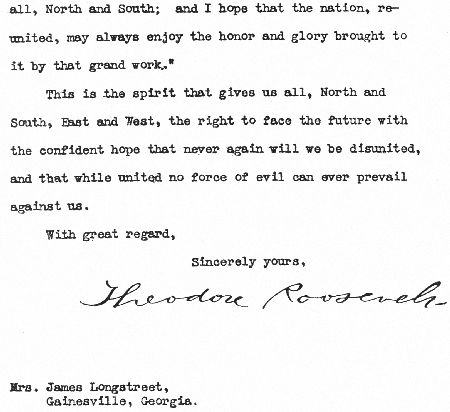
Fac-simile of Letter from President Theodore Roosevelt
WHITE HOUSE
WASHINGTON.
June 7, 1904.
My dear Mrs. Longstreet:
Permit me to subscribe for the book you have just written,
on the work of your gallant husband. General Sickles
has just called my attention to the fact that the book is to
be published. Not only must all Americans hold high the
memory of your husband as one of the illustrious captains of
the Civil War, but they must hold it high particularly because
of the fine and high-souled patriotism which made him, when
the war was ended, as staunchly loyal to the Union as he had
been loyal to the cause for which he fought during the war
itself. In his letter to General Sickles, in speaking of
the part the General played in winning the victory of Gettysburg
for the Union cause, General Longstreet wrote:
“It was the sorest and saddest reflection of my life
for many years; but, to-day, I can say, with sincerest emotion,
that it was and is the best that could have come to us
all, North and South; and I hope that the nation, reunited,
may always enjoy the honor and glory brought to
it by that grand work.”
This is the spirit that gives us all, North and
South, East and West, the right to face the future with
the confident hope that never again will we be disunited,
and that while united no force of evil can ever prevail
against us.
With great regard,
Sincerely yours,
Theodore Roosevelt
Mrs. James Longstreet,
Gainesville, Georgia.
PERSONAL LETTERS
New York, January 12, 1904.
Mrs. James Longstreet,
Gainesville, Georgia:
My Dear Mrs. Longstreet,—Permit me to offer my sympathies
in your great bereavement, and to add my tears to
yours. I have always loved and admired General Longstreet,
and considered him one of the greatest general officers in the
Confederacy. He was indeed every inch a man.
With kindest regards I remain,
Sincerely yours,
Edward Owen.
*****
“His great heart had nothing but kindness for all that was American.”
Nicholasville, Kentucky, January 22, 1904.
Mrs. James Longstreet,
Washington, D. C.:
Dear Madam,—Personally, I am an entire stranger to you,
but I have long been interested in the story of your brave husband,
and especially in that part bearing on the battle of
Gettysburg. I am a Canadian by birth, though a naturalized
American citizen, and pastor of the Christian Church in this
place. I had no interest in the matter at issue save to know the
truth and give honor where honor is justly due. I had read
General Gordon’s strictures, and was anxious to see what could
be said in reply. After reading your article in the Courier
Journal with great care, I want to say that General Gordon is
completely and fully answered and his statements of fact absolutely
refuted.
The man who would find the Rev. Mr. Pendleton after the
facts you have covered him with, would need a divining rod
or a diving-bell. He is disposed of forever.
Your illustrious husband belonged to the class of Southern
men which I have always honored and venerated. With him the
war was over and the great heart which never knew fear had in
it nothing but kindness for all that was American. I feel that
I have suffered a great loss in not knowing him personally. I
drop a tear of sympathy with you in his memory. I think the
following lines on “Gettysburg” most fitting now:
“The brave went down without disgrace,
They leaped to ruin’s red embrace;
They never heard Fame’s thunders wake
Nor saw the dazzling sunburst break
In smiles on Glory’s bloody face.”
“Fold up the banners, melt the guns,
Love rules, a gentler purpose runs;
A grateful mother turns in tears,
The pages of the battle years;
Lamenting all her fallen sons.”
Please accept my thanks for the white light which your
splendid, your unanswerable, letter casts on the whole question,
and try to realize that I am only one of thousands who are
equally indebted and correspondingly grateful.
With greatest respect,
Yours most sincerely,
James Vernon.
*****
“Has taken his place with the great soldiers of all times.”
Raleigh, N. C., January 17, 1904.
My Dear Mrs. Longstreet,—I send you a copy of the Post
by this mail, containing article on your late husband and great
soldier.
The conduct of some of our people is a brutality. But I
beg to assure you that it is the result of ignorance. General
Longstreet has taken his place beside the great soldiers of
all times, and malice cannot reach him. I hope some soldier of
his old corps will take up the question of these attacks. They
can be answered and reputed. You will pardon this intrusion
upon you, a sense of duty to the truth of history and love
for the memory of your great husband is my excuse.
Truly,
W. H. Day.
*****
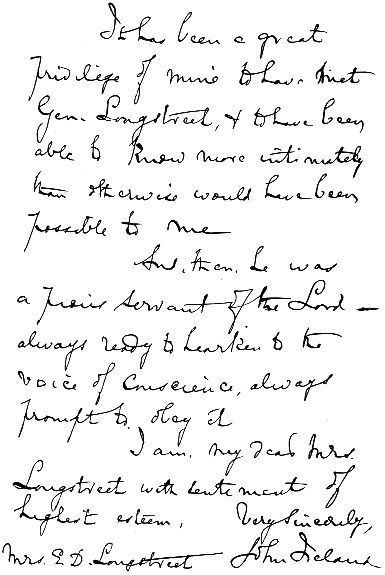
Fac-simile of Letter from Archbishop John Ireland
St. Paul, Jan. 8, 1903
My Dear Mrs. Longstreet
Permit me to
offer you the tribute of my deep
and sincere sympathy in the great
sorrow which has come to you
in the death of your beloved
husband, Gen. Longstreet.
To none is the
sad occurrence the bearer of so
pain & grief, as it is to you.
I pray God to console you,
& to lead you more & more to see
in the departure of your husband
from earth the will of Heaven, &
the passage of a christian Soul
from the land of trials to the final
home of rest and peace.
Truly a great man
has passed away. The whole
country mourns. He was a
noble American. In war he
obeyed what he believed to be
his duty, in peace he followed
loyally and courageously what
he again thought his duty
dictated. The South found
in him a defender on the
field of battle, & its truest
friend & counsellor when the
field of battle had spoken its
verdict. The North, forced
at one time to admire his
skill and bravery, willingly at
later date, admired his
magnanimity & his high
minded patriotism.
It has been a great
privilege of mine to have met
Gen. Longstreet, & to have been
able to know more intimately
than otherwise would have been
possible to me.
Since then he was
a proud Servant of the Lord—always
ready to hearken to the
voice of Conscience, always
prompt to obey it.
I am, my dear Mrs.
Longstreet with sentiments of
highest esteem,
Very Sincerely,
John Ireland
Mrs. E. D. Longstreet
*****
“General Lee’s bull-dog fighter.”
Comanche, Texas, February 1, 1904.
Mrs. General James Longstreet,
Gainesville, Georgia:
Dear Madam,—Enclosed please find resolutions of respect
passed by John Pelham Camp, U. C. V., No. 565, Comanche,
Texas, to your husband.
As a Confederate soldier who followed the banner of the lost
cause for four years I desire to extend to you personally my
heartfelt sympathy in this great loss to you. I was in the
Army of Tennessee, but a great admirer of General Longstreet.
I had a brother in his command under General Hood.
The Southern people never treated General Longstreet with
that respect that was due him. He was General Lee’s bull-dog
fighter during the war, and remained true to the cause until
all was lost. I read with great interest your defence of your
husband in the Gettysburg affair, and you show to any fair-minded
people that he was not in any way responsible for the
loss of the battle. I greatly admire your courage and fidelity
in this matter. General Longstreet has many strong friends
in Texas. Please pardon me for the liberty I have taken in
writing you. I have two letters from General Longstreet which
I value highly.
With kindest regards and best wishes, I am truly your friend,
T. O. Moore,
Late Company F, Seventh Texas Volunteer Infantry Regiment,
1861 to 1865; Colonel First Regiment, Third Brigade,
Texas Division, U. C. V.
*****
“When war compelled surrender, I accepted the situation in good faith.”
San Francisco Law Library,
San Francisco, January 6, 1904.
Dear Madam,—Learning of the recent death of General
Longstreet, I felt compelled to address to you an expression of
sympathy.
It so happened that soon after the close of the Civil War, he
and I were for a time guests at the same hotel in Washington.
I then formed his acquaintance and had a series of conversations
with him, which constitute pleasing recollections to me.
Although of Northern lineage and sentiment, I learned to
admire a personality that seemed so charming in civil life, and
which I had learned to dread in war.
I am aware that later he fell under the severe displeasure of
many Southern people.
I know nothing of that for which he was blamed, but it
would make too heavy draft on my credulity to believe that he
ever departed from what he believed to be just and honorable.
I well remember an expression he made to me. He said, “I
conscientiously did what I deemed my duty while the controversy
lasted, and when the fate of war compelled surrender, I accepted
the situation in good faith.”
His widow must greatly feel the loss of one who was great
as a soldier and so lovable as a man.
Allow me, a Northern man and a stranger, to condole with
you, and again express the high appreciation I entertained for
your illustrious husband.
Very respectfully,
Geo. W. Chamberlain.
Mrs. James Longstreet,
Gainesville, Georgia.
*****
“He taught peace and conservatism.”
United States Circuit Court of Appeals,
New Orleans, Louisiana, January 5, 1904.
Mrs. James Longstreet,
Gainesville, Georgia:
My dear Madam,—I beg to offer you my sincere sympathy.
I greatly honored General Longstreet for his distinguished
career as a soldier, and for his wise and patriotic course, teaching
peace and conservatism, when war was ended. When
history is written after time has modified all passions and
prejudices, his career will stand in honorable and distinguished
contrast with those of his critics who were “invisible in war and
invincible in peace.”
I shall always honor his memory as soldier and citizen.
Yours sincerely and respectfully,
David D. Shelby.
*****
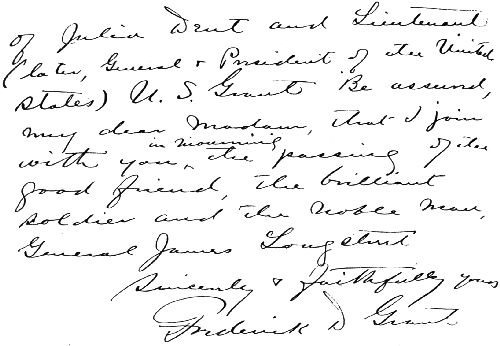
Fac-simile of Letter from General Frederick D. Grant
HEADQUARTERS
DEPARTMENT OF TEXAS
SAN ANTONIO.
Jan’y 7th 1903
My Dear Mrs Longstreet,
I was greatly shocked to
see the enclosed article in
this mornings paper. Tho’ I
had learned sometime ago
through friends, that General
Longstreet was not in good
health, I had no idea that
the end was so near. The
dear old General was one
of the earliest and most
cherished friends of my father
and mother, and has always
held a warm place in
the hearts of the children
of Julia Dent and Lieutenant
(later, General & President of the United
States) U. S. Grant. Be assured,
my dear Madam, that I join
with you in mourning the passing of the
good friend, the brilliant
soldier and the noble man,
General James Longstreet
Sincerely & Faithfully Yours
Frederick D Grant
*****
Tecumseh, Michigan, January 16, 1904.
Mrs. James Longstreet:
Gainesville, Georgia:
Dear Madam,—Trusting you will pardon the intrusion, I
desire to thank you kindly for the pleasure derived from your
article so conclusively refuting the charges against General
James Longstreet, unhappily revived in General Gordon’s book.
Although a Federal soldier during the last two years of the Civil
War, its ending, with me, was the close of the unhappy strife.
The admiration I held for James Longstreet was sincere and
well founded, and one of the mementoes I much treasure is an
autograph letter from him, generously written to me December
18, 1893.
The news of your husband’s death was to me a personal
grief. He was the one remaining conspicuous figure in the
great conflict which those who participated in will remember
while life remains.
Very respectfully,
John D. Shull.
*****
“He performed every duty faithfully and conscientiously.”
Ivanhoe, Virginia, January 23, 1904.
My Dear Mrs. Longstreet,—As commander of the Ivanhoe
Camp, United Confederate Veterans, and as perhaps the
youngest Confederate veteran, “who enlisted as a private,” I
desire to express to you the sympathy of myself and of the
Camp which I have the honor to command. While we mourn
with you in this your sad hour of bereavement, it is gratifying
to know that General Longstreet performed his every duty
faithfully and conscientiously, and that his many virtues will
entitle him to a high seat in that better world above, where we
hope, when our mission on earth is finished, we shall be permitted
to meet him in all the glory which his many virtues here below
so justly entitles him. Hoping that the Good Lord, the Grand
Commander and Ruler of the Universe, will comfort you in your
sad trials, and with best wishes, I am most sincerely yours,
M. W. Jewett,
Commander Ivanhoe Camp, U. C. V.
*****
“Lamented by the nation.”
Minneapolis, January 3, 1904.
Dear Mrs. Longstreet,—With thousands of my countrymen
I sincerely lament the death of your illustrious husband,
the great soldier and citizen, and extend to you, most bereaved
of all, my sincere sympathy.
Mrs. Torrance shares these sentiments with me, and wishes to
be remembered to you in love and sympathy.
Sincerely yours,
Ell Torrance.
To Mrs. James Longstreet,
Washington, D. C.
*****
“His name and fame among the priceless treasures of all Americans.”
Monroe, Georgia, January 4, 1904.
Mrs. James Longstreet,
Gainesville, Georgia:
My Dear Mrs. Longstreet,—I have noticed with great
regret and with great sympathy for you, the news of the death
of General Longstreet.
All who are familiar with his great career will be sorrowed at
his passing. His place in history is secure. And his name and
fame are among the priceless treasures of all Americans.
I understand the depth of the sorrow in which you stand now,
and sorrow with you.
In deepest sympathy, I remain,
Sincerely yours,
Geo. M. Napier.
*****
“His greatness of character won the respect of his own and other lands.”
Washington, D. C., January 3, 1904.
Dear Mrs. Longstreet,—The morning paper brings the
sad announcement of the passing away of the last survivor of
the brave sons of the South who made her name glorious in the
annals of the world. The nation mourns the loss of a noble
man whose greatness of character won the respect not only of
his own country but of other lands. The South weeps for a
son who has conferred distinction upon her by a life of stainless
integrity.
Still greater is the sorrow of a host of personal friends whose
love he won by the most lofty characteristics and a friendship
which failed not through the years.
Greatest of all is the grief of his family in the loss of his
loving companionship and tender care. Especially heavy is
that loss to you, the companion of his later years whose devotion
has smoothed the road for his weary feet to the end of life’s
way. I send you my heartfelt sympathy in your sorrow.
My love and sympathy go out to the dear children whose
mother was my beloved friend, whom I have held in my arms in
childhood, and whose little brothers and sisters faded away before
my loving eyes when their flower of life had not yet unfolded
from the bud of their sweet infancy and the mortal casket was
intrusted to General Pickett and myself to be laid away among
the church-yard lilies when the jewel of the pure soul had been
taken beyond.
To the many to whom the new year brings mourning for
the great one gone I would send sincere sympathy, trusting that
the Father of all will comfort them in their deep sorrow.
Sincerely yours
Mrs. Geo. E. Pickett.
*****
“His great fame is fixed.”
Cincinnati, Ohio, January 9, 1904.
Mrs. James Longstreet,
Gainesville, Georgia:
Dear Madam,—You need fear no slurs on the reputation of
General Longstreet. His great fame is fixed.
All over this country wherever you find the old boys who wore
the blue in the sixties, and who had to fight Longstreet’s corps,
you will get the same opinion.
He was a hard fighter, a tireless general who was always ready
for a battle, and who believed that hitting hard, never giving
up, and following up every advantage was the right way to
obey orders.
Our regiment, the Sixth Ohio, met General Longstreet many
times. And whenever he was reported as coming we got ready
for hard, stubborn fighting, and we were never disappointed in
that direction.
He was a brave enemy, and we respected his great qualities.
We are going to have a “Longstreet night” at our G. A. R.
Post here this month (open meeting), and have invited all the
Confederates near here to meet with us and talk over old days
and hard fights.
Sympathizing with you in your loss, I remain,
Yours obediently,
Geo. C. James.
*****
“If Longstreet was disobedient, Lee was a traitor.”
Waco, Texas, January 12, 1904.
Mrs. Longstreet,
Gainesville, Georgia:
Dear Madam,—Enclosed I send you a brief tribute that I
paid to General Longstreet.
General Longstreet’s fame is safe with all fair-minded men,
but it is the duty of us, who knew him and served under him,
to raise our voices in his defence, now that he cannot do so, as
he formerly so ably and conclusively did, and I here make my
defence of the charge that he failed to do his duty at Gettysburg.
If it is true that General Longstreet betrayed General Lee
at Gettysburg, and that General Lee knew it, the legitimate and
logical conclusions are that General Lee was a traitor, not only
to the Confederacy, but to every man who served under him.
All know that at Gettysburg Lee staked an empire on Longstreet’s
corps, and all know that when it rolled back from those
bloody heights, leaving its bravest and its best cold in death
upon its grassy slopes, that the sun of the Confederacy, with
battle target red, slowly sank into the bosom of eternal night.
And to say that General Lee knew that General Longstreet was
responsible for the loss of the battle, responsible for the death
of so many brave men who had there died in vain, responsible
for the ruin of a cause dear to so many hearts, and then permit
the man who had brought all this about, to remain as the commander
of the First Corps of his army, to lovingly speak of him
as he did as his right arm, to send him in two months after the
battle of Gettysburg in command of his corps to save the Army
of Tennessee from the ruin brought upon it by the inefficiency
of Bragg, to permit him to remain throughout that long and
dreary winter that he spent in East Tennessee, to bring him
back to Virginia and be his chosen lieutenant from the Wilderness
to the banks of the James, and from the James to Appomattox,
is to convict General Lee of a treason to both himself
and his country, more damnable than that which so-called admirers
of General Lee charge upon Longstreet.
I remain, very truly yours,
G. B. Gerald.
*****
“Denounced with bitterness the statement of Pendleton.”
Corsicana, Texas, January 8, 1904.
Mrs. James Longstreet,
Gainesville, Georgia:
Madam,—Your noble defence of your great husband places
beyond cavil or controversy the fame of an illustrious career.
Yesterday, as I finished reading it, the bent form of one who
had followed him everywhere, “amid the fiery pang of shells,”
passed, and I called him and read him the charge. “Liars!
Liars!” and the light of battle passed once more into his eyes
as he defended General Longstreet. Then I read him your
letter, and then he cried.
You will pardon me for this intrusion on your sorrow. My
father was a cavalry officer in the volunteers in Scott’s campaign
in Mexico. He there formed the acquaintance of General
Longstreet, and none denounced with more bitterness the statement
of Pendleton.
With a sincere wish for your future happiness,
I am most respectfully,
J. C. Gaither.
*****
“He was too big a man for his day.”
New Orleans, Louisiana, January 4, 1904.
Mrs. General James Longstreet,
Gainesville, Georgia:
Dear Madam,—Enclosed I send you the Picayune comment
on the death of your distinguished husband and my honored
commander.
General Longstreet is blamed for the mistake of General Lee
in charging the heights of Gettysburg. The same mistake was
made by General Burnside at Fredericksburg; which clearly
proves that American soldiers can not successfully charge
heights guarded by Americans. That is settled.
Why should General Lee send General Longstreet to Chickamauga
immediately after Gettysburg, if Longstreet had been
guilty of anything that his enemies so persistently accuse.
The only thing that General Longstreet was guilty of was
the acceptance of office under the United States government
after the war. Now suppose all the Confederate generals had
accepted office as he did, would it not have effectively kept the
office-holders placed here by the carpet-bag government out of
power? And also, how many ex-Confederates refuse office
under the United States government to-day, is a question I
would like to have answered. Longstreet was too big a man
for his day, that was all.
The scribbling of unscrupulous parties can not dim his fame.
He was the hardest fighter of the Civil War, participant in
all the battles of the Army of Northern Virginia, and victor on
the only great field won by the Confederates in the West,
Chickamauga.
I deeply sympathize with you, as I know all of Longstreet’s
corps do.
Yours truly,
Geo. W. Weir,
Company A, Hampton Legion, Hood’s Brigade, Longstreet’s
Corps, Army of Northern Virginia.
*****
“He stood the brunt of the battle at Gettysburg.”
Krumdale, Texas, January 3, 1904.
Mrs. General James Longstreet,
Gainesville, Georgia:
My Dear Madam,—As an old Confederate soldier of the
Eighteenth Virginia Regiment, Pickett’s division, General James
Longstreet’s corps, I wish to extend to you my heartfelt sympathy
and condolence in your sad affliction in the death of your
gallant and illustrious husband. His old comrades will never for
a moment believe the calumny that has been thrust against him.
A pure, true soldier, a good, noble, and loyal citizen. He
rests now over the river under the shades of the beautiful
heavenly trees, the peer of Hon. Jeff. Davis, General R. E. Lee,
Stonewall Jackson, and others. May his ashes rest in peace.
When I read the announcement of his death in the papers and
your letter it made my heart bleed, and the only comfort I
could find was to weep like a child. I congratulate you on your
well-written defence and complete vindication of my old comrade
and general. I loved him so much, and so long as life shall
last I will cherish a lively recollection of his many noble and
gallant deeds. I was with him on that memorable day, and can
testify that he stood the brunt of the battle on the 3d of July
at Gettysburg. I cannot understand how any pure or noble or
brave man could circulate such false statements against one of
the best and bravest men in our army. But envy is a malicious
foe, always ready to destroy that which it cannot imitate or surpass.
May God comfort and his blessings abide with you and
yours is the prayer of one that entertains the highest respect
for you and the memory of your husband.
R. P. Goodman.
*****
“One of the greatest military men of the age.”
Mrs. Longstreet:
Dear Madam,—I had not the honor of a personal acquaintance
with your illustrious husband, nor was I with him in the
war on his side of the question, in any sense. But I believe
him to have been one of the greatest military men of the age,
and with no superior on the Southern side. His course since the
war has inspired the highest respect and esteem of every patriotic
and intelligent lover of the Union.
At Gettysburg, in my opinion, he was the one sure-footed
counsellor of Lee’s many advisers.
One of our papers, recently commenting on his life, took
occasion to refer to the old charges of delay at Gettysburg. I
expect to answer these charges in a lengthy article.
Yours sincerely,
H. W. Harmon.
Effingham, N. H.
*****
“Always present at the critical and dangerous point.”
Athens, January 4, 1904.
My dear Mrs. Longstreet,—I write to assure you of my
heartfelt sympathy with you in your great bereavement.
I mourn with deep sorrow the death of General Longstreet.
I have witnessed many times his valor and devotion. He seemed
to me to be absolutely ubiquitous on the battle-field—always
present at the critical and dangerous point.
The proudest recollections of my life are associated with the
glorious First Corps of the Army of Northern Virginia and
its heroic commander.
With renewed assurance of my sympathy, I am,
Yours very sincerely,
Alex. T. Erwin.
*****
“He died as he had lived, a model to mankind.”
Metropolitan Club,
New York City, January 3, 1904.
Dear Mrs. Longstreet,—I can not express to you the
regret I felt when I read to-day of the death of my noble chief,
your dear husband. A flood of vivid recollections overwhelmed
me. It was no surprise to me, as I knew the nature of the ill
he suffered under; still he was dead, and a blank left in my life
which no time can heal. He was so much to me. For four
years I had ridden at his side, and shared his confidence, and
had learned to love him well. No unkind word or look stands
between us, and my sorrow is that of one of his sons.
To you he has owed many happy years, and his old comrades
will always bear you in tender thought.
In your last letter to me you wrote that the doctors had said
he had “a fighting chance.” But alas! his time had come, and
it found him ready I am sure. His life was blameless as it was
brave, and he died as he had lived, a model to mankind.
To you and his children I offer my heartfelt sympathy. I
can say no more, as my heart is very full. As I see that he is
to be buried to-morrow I can not be present, but my heart will
be with you at his grave.
Always most warmly yours,
Osman Latrobe.
*****
“The country had no more devoted patriot.”
My dear Mrs. Longstreet,—Please accept my profound
sympathy in your great bereavement.
While as a member of his corps from the time of its organization
to the end, I knew General Longstreet only as a subordinate
knows his superior officer, after the struggle was over
I met him frequently and conversed with him on many subjects,
and to my admiration and devotion to the soldier and general
was superadded esteem for him as a citizen and a high regard
and fondness for him as a friend.
If some critics had known his methods as a commander, and
witnessed his powers in battle, as we of his corps did on many
hard-fought fields, and understood his course and motives as a
civilian as his friends did, they would bestow upon him nothing
but words of praise and gratitude. The ranking lieutenant-general
of Lee’s great army, he always had the confidence of
the commander-in-chief and the respect and admiration of all,
and the “lost cause” had no braver or truer defender and the
country no more devoted patriot.
But I only intended to write a line of sympathy, hoping to
meet you again some time when we can talk of him and his
career.
With kind regards, I am,
Very sincerely,
N. L. Hutchens.
Lawrenceville, Georgia.
*****
“The brilliant leader of gallant armies, but greater in peace as the patriotic
citizen.”
Washington, D. C., January 5, 1904.
My dear Mrs. Longstreet,—My heart was very deeply
touched by the news of General Longstreet’s death, and I write
to assure you of my profound sorrow over the event and of
my warm sympathy for you in the unspeakable loss which you
sustain.
General Longstreet will always live in the great and ennobling
example which he set before his fellow-men. He was truly great
in war as the brilliant leader of gallant armies, but he was
greater in peace as the patriotic citizen loyally dedicating his
splendid fame to the cause of his country’s restoration to an
harmonious brotherhood.
His conduct since the termination of the mighty struggle in
which he bore a distinguished part was prompted by the highest
wisdom and by the purest love of country. And his fame can
never be dimmed by the failure of the narrow-minded few to
appreciate his great qualities of heart and of brain. I rejoice
in the fact that he lived to a ripe old age, and was thereby
blessed with the privilege of witnessing the good fruits of his
noble career.
With profound respect,
I am truly yours,
George Baber.
*****
“His surpassing ability won him admiration as an American soldier.”
Philadelphia, January 3, 1904.
Dear Mrs. Longstreet,—Permit me to express my heartfelt
sympathy in your sad loss and unexpected bereavement.
It had never been my good fortune to meet the general, but
his surpassing ability and great and earnest devotion to the
South won him, as an American soldier, our admiration, and
entitled him to the love and thanks of those whose cause was,
for so long, the object of his sacrifices.
We in the North, or many of us, rate General Longstreet
as among the ablest of those who fought against us, and it was
fortunate for us that he did not have command at some critical
moments, when his superior judgment would have directed
other movements than those which were made.
I am, madam,
Very respectfully yours,
H. S. Huidekoper.
*****
“Soldiers who served on the firing line knew the leaders.”
My dear Mrs. Longstreet,—We soldiers who served four
years on the firing line know who were the leaders; and Longstreet
is held in high esteem as a broad-guage man in the North.
Yours truly,
J. L. Smith.
Philadelphia, January 5, 1904.