We here encounter the innate ideas of Descartes. The
philosophy of Spinoza, in the second place, is related to
the philosophy of Descartes as its necessary development
only; the method is an important part of it. A method
which stands alongside of Spinozism and which is also a
perfected development of Cartesianism, is, in the third
place, that by which Malebranche has represented this
philosophy.
René Descartes is a bold spirit who re-commenced the
whole subject from the very beginning and constituted
afresh the ground-work on which Philosophy is based,
and to which, after a thousand years had passed, it
once more returned. The extent of the influence which
this man exercised upon his times and the culture of
Philosophy generally, cannot be sufficiently expressed; it
rests mainly in his setting aside all former presuppositions
and beginning in a free, simple, and likewise popular way,
with popular modes of thought and quite simple propositions,
in his leading the content to thought and extension
or Being, and so to speak setting up this before thought as
its opposite. This simple thought appeared in the form of
the determinate, clear understanding, and it cannot thus be
called speculative thought or speculative reason. There
are fixed determinations from which Descartes proceeds,
but only of thought; this is the method of his time. What
the French called exact science, science of the determinate
understanding, made its appearance at this time. Philosophy
and exact science were not yet separated, and it was
only later on that this separation first took place.
To come to the life of Descartes—he was born in 1596,
at La Haye in Touraine, of an ancient and noble race.
He received an education of the usual kind in a Jesuit
school, and made great progress; his disposition was lively
and restless; he extended his insatiable zeal in all directions,
pursued his researches into all systems and forms;
his studies, in addition to ancient literature, embraced such
subjects as philosophy, mathematics, chemistry, physics, and
astronomy. But the studies of his youth in the Jesuit
school, and those studies which he afterwards prosecuted
with the same diligence and strenuous zeal, resulted in
giving him a strong disinclination for learning derived
from books; he quitted the school where he had been
educated, and yet his eagerness for learning was only
made the keener through this perplexity and unsatisfied
yearning. He went as a young man of eighteen to Paris,
and there lived in the great world. But as he here found
no satisfaction, he soon left society and returned to his
studies. He retired to a suburb of Paris and there
occupied himself principally with mathematics, remaining
quite concealed from all his former friends. At
last, after the lapse of two years, he was discovered by
them, drawn forth from his retirement, and again introduced
to the great world. He now once more renounced
the study of books and threw himself into the affairs of
actual life. Thereafter he went to Holland and entered
the military service; soon afterwards, in 1619, and in the
first year of the Thirty Years’ War, he went as a volunteer
with the Bavarian troops, and took part in several
campaigns under Tilly. Many have found learning unsatisfying;
Descartes became a soldier—not because he
found in the sciences too little, but because they were too
much, too high for him. Here in his winter quarters he
studied diligently, and in Ulm, for instance, he made
acquaintance with a citizen who was deeply versed in
mathematics. He was able to carry out his studies even
better in winter quarters at Neuberg on the Danube, where
once more, and now most profoundly, the desire awoke in
him to strike out a new departure in Philosophy and
entirely reconstruct it; he solemnly promised the Mother
of God to make a pilgrimage to Loretto if she would
prosper him in this design, and if he should now at last
come to himself and attain to peace. He was also in the
battle at Prague in which Frederick the Elector-Palatine
lost the Bohemian crown. Yet since the sight of these
wild scenes could not satisfy him, he gave up military
service in 1621. He made several other journeys through
the rest of Germany, and then proceeded to Poland,
Prussia, Switzerland, Italy and France. On account of its
greater freedom he withdrew to Holland, in order there to
pursue his projects; here he lived in peace from 1629 to
1644—a period in which he composed and issued most of
his works, and also defended them against the manifold
attacks from which they suffered, and which more especially
proceeded from the clergy. Queen Christina of
Sweden finally called him to her court at Stockholm, which
was the rendezvous for all the most celebrated men of
learning of the time, and there he died in 1650.[154]
As regards his philosophic works, those which contain
his first principles have in particular something very
popular about their method of presentation, which makes
them highly to be recommended to those commencing the
study of philosophy. Descartes sets to work in a quite
simple and childlike manner, with a narration of his reflections
as they came to him. Professor Cousin of Paris
has brought out a new edition of Descartes in eleven octavo
volumes; the greater part consists of letters on natural
phenomena. Descartes gave a new impetus to mathematics
as well as to philosophy. Several important methods
were discovered by him, upon which the most brilliant
results in higher mathematics were afterwards built. His
method is even now an essential in mathematics, for
Descartes is the inventor of analytic geometry, and consequently
the first to point out the way in this field of
science to modern mathematics. He likewise cultivated
physics, optics, and astronomy, and made the most important
discoveries in these; we have not, however, to
deal with such matters. The application of metaphysics
to ecclesiastical affairs, investigations, etc., has likewise no
special interest for us.
1. In Philosophy Descartes struck out quite original
lines; with him the new epoch in Philosophy begins,
whereby it was permitted to culture to grasp in the form
of universality the principle of its higher spirit in
thought, just as Boehme grasped it in sensuous perceptions
and forms. Descartes started by saying that
thought must necessarily commence from itself; all the
philosophy which came before this, and specially what
proceeded from the authority of the Church, was for
ever after set aside. But since here thought has properly
speaking grasped itself as abstract understanding only, in
relation to which the more concrete content still stands
over on the other side, the determinate conceptions were
not yet deduced from the understanding, but taken up only
empirically. In Descartes’ philosophy we have thus to
distinguish what has, and what has not universal interest
for us: the former is the process of his thoughts themselves,
and the latter the mode in which these thoughts
are presented and deduced. Yet we must not consider the
process as a method of consistent proof; it is indeed a
deep and inward progress, but it comes to us in an ingenuous
and naïve form. In order to do justice to Descartes’
thoughts it is necessary for us to be assured of the necessity
for his appearance; the spirit of his philosophy is simply
knowledge as the unity of Thought and Being. And yet
on the whole there is little to say about his philosophy.
a. Descartes expresses the fact that we must begin from
thought as such alone, by saying that we must doubt
everything (De omnibus dubitandum est); and that is an
absolute beginning. He thus makes the abolition of all
determinations the first condition of Philosophy. This first
proposition has not, however, the same signification as
Scepticism, which sets before it no other aim than doubt
itself, and requires that we should remain in this indecision
of mind, an indecision wherein mind finds its
freedom. It rather signifies that we should renounce all
prepossessions—that is, all hypotheses which are accepted
as true in their immediacy—and commence from thought,
so that from it we should in the first place attain to
some fixed and settled basis, and make a true beginning.
In Scepticism this is not the case, for with the sceptics
doubt is the end at which they rest.[155] But the doubting
of Descartes, his making no hypotheses, because nothing
is fixed or secure, does not occur in the interests of freedom
as such, in order that nothing should have value except
freedom itself, and nothing exist in the quality of an
external objective. To him everything is unstable indeed,
in so far as the Ego can abstract from it or can think, for
pure thought is abstraction from everything. But in
consciousness the end is predominant, and it is to arrive at
something fixed and objective—and not the moment of subjectivity,
or the fact of being set forth, known and proved
by me. Yet this last comes along with the other, for it is
from the starting point of my thought that I would attain
my object; the impulse of freedom is thus likewise
fundamental.
In the propositions in which Descartes gives in his own
way the ground of this great and most important principle,
there is found a naïve and empirical system of reasoning.
This is an example: “Because we were born as children,
and formed all manner of judgments respecting sensuous
things before we had the perfect use of our reason, we are
through many preconceived ideas hindered from the knowledge
of the truth. From these we appear not to be able
to free ourselves in any other way but by once in our
lives striving to doubt that respecting which we have the
very slightest suspicion of an uncertainty. Indeed it is
really desirable to hold as false everything in respect to
which we have any doubt, so that we may find more clearly
what is most certain and most knowable. Yet this doubt
has to be limited to the contemplation of the truth, for in
the conduct of our life we are compelled to choose the
probable, since there the opportunity for action would often
pass away before we could solve our doubts. But here,
where we have only to deal with the search for truth, we
may very reasonably doubt whether any thing sensuous and
perceptible exists—in the first place because we find that the
senses often deceive us and it is prudent not to trust in
what has even once deceived us, and then because every day
in dreaming we think we feel or see before ourselves innumerable
things which never were, and to the doubter no
signs are given by which he can safely distinguish sleeping
from waking. We shall hereby likewise doubt everything
else, even mathematical propositions, partly because we
have seen that some err even in what we hold most certain,
and ascribe value to what to us seems false, and partly
because we have heard that a God exists who has created
us, and who can do everything, so that He may have created
us liable to err. But if we conceive ourselves not to derive
our existence from God, but from some other source, perhaps
from ourselves, we are all the more liable, in that we
are thus imperfect, to err. But we have so far the experience
of freedom within us that we can always refrain
from what is not perfectly certain and well founded.”[156]
The demand which rests at the basis of Descartes’ reasonings
thus is that what is recognized as true should be able
to maintain the position of having the thought therein at
home with itself. The so-called immediate intuition and
inward revelation, which in modern times is so highly
regarded, has its place here. But because in the Cartesian
form the principle of freedom as such is not brought into
view, the grounds which are here advanced are for the
most part popular.
b. Descartes sought something in itself certain and true,
which should neither be only true like the object of faith
without knowledge, nor the sensuous and also sceptical
certainty which is without truth. The whole of Philosophy
as it had been carried on up to this time was vitiated by
the constant presupposition of something as true, and in
some measure, as in the Neo-Platonic philosophy, by not
giving the form of scientific knowledge to its matter, or by
not separating its moments. But to Descartes nothing is
true which does not possess an inward evidence in consciousness,
or which reason does not recognize so clearly
and conclusively that any doubt regarding it is absolutely
impossible. “Because we thus reject or declare to be false
everything regarding which we can have any doubt at all,
it is easy for us to suppose that there is no God, no heaven,
no body—but we cannot therefore say that we do not exist,
who think this. For it is contradictory to say that what
thinks does not exist. Hence the knowledge that ‘I think,
therefore I am,’ is what we arrive at first of all, and it is
the most certain fact that offers itself to everyone who
follows after philosophy in an orderly fashion. This is the
best way of becoming acquainted with the nature of spirit
and its diversity from body. For if we inquire who we are
who can set forth as untrue everything which is different
from ourselves, we clearly see that no extension, figure,
change of position, nor any such thing which can be
ascribed to body, constitutes our nature, but only thought
alone; which is thus known earlier and more certainly than
any corporeal thing.”[157] ‘I’ has thus significance here as
thought, and not as individuality of self-consciousness.
The second proposition of the Cartesian philosophy is hence
the immediate certainty of thought. Certainty is only
knowledge as such in its pure form as self-relating, and
this is thought; thus then the unwieldy understanding
makes its way on to the necessity of thought.
Descartes begins, just as Fichte did later on, with the
‘I’ as indubitably certain; I know that something is presented
in me. By this Philosophy is at one stroke transplanted
to quite another field and to quite another standpoint,
namely to the sphere of subjectivity. Presuppositions
in religion are given up; proof alone is sought for, and
not the absolute content which disappears before abstract
infinite subjectivity. There is in Descartes likewise a
seething desire to speak from strong feeling, from the
ordinary sensuous point of view, just as Bruno and so many
others, each in his own fashion, express as individualities
their particular conceptions of the world. To consider the
content in itself is not the first matter; for I can abstract
from all my conceptions, but not from the ‘I.’ We think
this and that, and hence it is—is to give the common would-be-wise
argument of those incapable of grasping the matter
in point; that a determinate content exists is exactly what
we are forced to doubt—there is nothing absolutely fixed.
Thought is the entirely universal, but not merely because
I can abstract, but because ‘I’ is thus simple, self-identical.
Thought consequently comes first; the next determination
arrived at, in direct connection with it, is the determination
of Being. The ‘I think’ directly involves my
Being; this, says Descartes, is the absolute basis of all
Philosophy.[158] The determination of Being is in my ‘I’;
this connection is itself the first matter. Thought as
Being and Being as thought—that is my certainty, ‘I’;
in the celebrated Cogito, ergo sum we thus have Thought
and Being inseparably bound together.
On the one hand this proposition is regarded as a syllogism:
from thought Being is deduced. Kant more
especially has objected to this that Being is not contained
in thinking, that it is different from thinking. This is
true, but they are still inseparable, or constitute an identity;
their difference is not to the prejudice of their unity. Yet
this maxim of pure abstract certainty, the universal totality
in which everything implicitly exists, is not proved;[159] we
must therefore not try to convert this proposition into a
syllogism. Descartes himself says: “There is no syllogism
present at all. For in order that there should be
such, the major premise must have been ‘all that thinks
exists’”—from which the subsumption would have followed
in the minor premise, ‘now I am.’ By this the immediacy
which rests in the proposition, would be removed. “But
that major premise” is not set forth at all, being “really
in the first instance derived from the original ‘I think,
therefore, I am.’”[160] For arriving at a conclusion three links
are required—in this case we ought to have a third through
which thought and Being should have been mediated,
and it is not to be found here. The ‘Therefore’ which
binds the two sides together is not the ‘Therefore’ of a
syllogism; the connection between Being and Thought is
only immediately posited. This certainty is thus the
prius; all other propositions come later. The thinking
subject as the simple immediacy of being-at-home-with-me
is the very same thing as what is called Being; and it is
quite easy to perceive this identity. As universal, thought
is contained in all that is particular, and thus is pure relation
to itself, pure oneness with itself. We must not make
the mistake of representing Being to ourselves as a concrete
content, and hence it is the same immediate identity which
thought likewise is. Immediacy is, however, a one-sided
determination; thought does not contain it alone, but also
the determination to mediate itself with itself, and thereby—by
the mediation being at the same time the abrogation
of the mediation—it is immediacy. In thought we thus
have Being; Being is, however, a poor determination, it
is the abstraction from the concrete of thought. This
identity of Being and Thought, which constitutes the most
interesting idea of modern times, has not been further
worked out by Descartes; he has relied on consciousness
alone, and for the time being placed it in the fore-front.
For with Descartes the necessity to develop the differences
from the ‘I think’ is not yet present; Fichte first
applied himself to the deduction of all determinations from
this culminating point of absolute certainty.
Other propositions have been set against that of
Descartes. Gassendi,[161] for example, asks if we might not
just as well say Ludificor, ergo sum: I am made a fool of
by my consciousness, therefore I exist—or properly speaking,
therefore I am made a fool of. Descartes himself
recognized that this objection merited consideration, but
he here repels it, inasmuch as it is the ‘I’ alone and
not the other content which has to be maintained. Being
alone is identical with pure thought, and not its content,
be it what it may. Descartes further says: “By thought
I, however, understand all that takes place in us within
our consciousness, in as far as we are conscious of it;
thus will, conception, and even feeling are identical with
thought. For if I say ‘I see,’ or ‘I walk out,’ and ‘therefore
I am,’ and understand by this the seeing and walking
which is accomplished by the body, the conclusion is not
absolutely certain, because, as often happens in a dream,
I may imagine that I can see or walk even if I do not
open my eyes nor move from my place, and I might also
possibly do so supposing I had no body. But if I understand
it of the subjective feeling or the consciousness of
seeing or walking itself, because it is then related to the
mind that alone feels or thinks that it sees or walks, this
conclusion is perfectly certain.”[162] “In a dream” is an
empirical mode of reasoning, but there is no other objection
to it. In willing, seeing, hearing, &c., thought is likewise
contained, it is absurd to suppose that the soul has thinking
in one special pocket, and seeing, willing, &c., in others.
But if I say ‘I see,’ ‘I walk out,’ there is present on the one
hand my consciousness ‘I,’ and consequently thought, on
the other hand, however, there is present willing, seeing,
hearing, walking, and thus a still further modification of
the content. Now because of this modification I cannot
say ‘I walk, and therefore I am,’ for I can undoubtedly
abstract from the modification, since it is no longer
universal Thought. Thus we must merely look at the pure
consciousness contained in the concrete ‘I.’ Only when
I accentuate the fact that I am present there as thinking,
is pure Being implied, for only with the universal is
Being united.
“In this it is implied,” says Descartes, “that thought is
more certain to me than body. If from the fact that I
touch or see the earth I judge that it exists, I must more
certainly judge from this that my thought exists. For it may
very well happen that I judge the earth to exist, even if it
does not exist, but it cannot be that I judge this, and that my
mind which judges this does not exist.”[163] That is to say,
everything which is for me I may assert to be non-existent,
but when I assert myself to be non-existent, I myself
assert, or it is my judgment. For I cannot set aside the
fact that I judge, even if I can abstract from that respecting
which I judge. In this Philosophy has regained its own
ground that thought starts from thought as what is certain
in itself, and not from something external, not from something
given, not from an authority, but directly from the
freedom that is contained in the ‘I think.’ Of all
else I may doubt, of the existence of bodily things,
of my body itself; or this certainty does not possess
immediacy in itself. For ‘I’ is just certainty itself,
but in all else this certainty is only predicate; my
body is certain to me, it is not this certainty itself.[164]
As against the certainty we feel of having a body,
Descartes adduces the empirical phenomenon that we often
hear of persons imagining they feel pain in a limb which
they have lost long ago.[165] What is actual, he says is a
substance, the soul is a thinking substance; it is thus for
itself, separate from all external material things and
independent. That it is thinking is evident from its
nature: it would think and exist even if no material things
were present; the soul can hence know itself more easily
than its body.[166]
All else that we can hold as true rests on this certainty;
for in order that anything should be held as true, evidence
is requisite, but nothing is true which has not this inward
evidence in consciousness. “Now the evidence of everything
rests upon our perceiving it as clearly and vividly as
that certainty itself, and on its so entirely depending from,
and harmonizing with this principle, that if we wished to
doubt it we should also have to doubt this principle likewise”
(our ego).[167] This knowledge is indeed on its own account
perfect evidence, but it is not yet the truth, or if we take
that Being as truth, it is an empty content, and it is with
the content that we have to do.
c. What comes third is thus the transition of this
certainty into truth, into the determinate; Descartes again
makes this transition in a naïve way, and with it we for the
first time begin to consider his metaphysics. What here
takes place is that an interest arises in further representations
and conceptions of the abstract unity of Being
and Thought; there Descartes sets to work in an externally
reflective manner. “The consciousness which merely
knows itself to be certain now however seeks to extend its
knowledge, and finds that it has conceptions of many
things—in which conceptions it does not deceive itself, so
long as it does not assert or deny that something similar
outside corresponds to them.” Deception in the conceptions
has meaning only in relation to external existence.
“Consciousness also discovers universal conceptions, and
obtains from them proofs which are evident, e.g. the geometric
proposition that the three angles of a triangle are
together equal to two right angles is a conception which
follows incontrovertibly from others. But in reflecting
whether such things really exist doubts arise.”[168] That
there is such a thing as a triangle is indeed in this case by
no means certain, since extension is not contained in the
immediate certainty of myself. The soul may exist without
the bodily element, and this last without it, they are
in reality different; one is conceivable without the other.
The soul thus does not think and know the other as clearly
as the certainty of itself.[169]
Now the truth of all knowledge rests on the proof of
the existence of God. The soul is an imperfect substance,
but it has the Idea of an absolute perfect existence
within itself; this perfection is not begotten in itself,
just because it is an imperfect substance; this Idea
is thus innate. In Descartes the consciousness of this
fact is expressed by his saying that as long as the existence
of God is not proved and perceived the possibility of
our deceiving ourselves remains, because we cannot know
whether we do not possess a nature ordered and disposed
to err (supra, p. 226).[170] The form is rather a mistaken one,
and it only generally expresses the opposition in which
self-consciousness stands to the consciousness of what is
different, of the objective; and we have to deal with the
unity of both—the question being whether what is in
thought likewise possesses objectivity. This unity rests in
God, or is God Himself. I shall put these assertions in
the manner of Descartes: “Amongst these various conceptions
possessed by us there likewise is the conception
of a supremely intelligent, powerful, and absolutely perfect
Being; and this is the most excellent of all conceptions.”
This all-embracing universal conception has therefore this
distinguishing feature, that in its case the uncertainty
respecting Being which appears in the other conceptions,
finds no place. It has the characteristic that “In it we do
not recognize existence as something merely possible and
accidental, as we do the conceptions of other things which
we perceive clearly, but as a really essential and eternal determination.
For instance, as mind perceives that in the
conception of a triangle it is implied that the three angles are
equal to two right angles, the triangle has them; and in
the same way from the fact that mind perceives existence
to be necessarily and eternally implied in the Notion of the
most perfect reality, it is forced to conclude that the most
perfect reality exists.”[171] For to perfection there likewise
pertains the determination of existence, since the conception
of a non-existent is less perfect. Thus we there
have the unity of thought and Being, and the ontological
proof of the existence of God; this we met with earlier
(p. 63, seq.) in dealing with Anselm.
The proof of the existence of God from the Idea of Him
is in this wise: In this Notion existence is implied; and
therefore it is true. Descartes proceeds further in the same
direction, in so far as after the manner of empirical axioms
he sets forth: (α) “There are different degrees of reality or
entity, for the substance has more reality than the accident
or the mode, and infinite substance has more than finite.”
(β) “In the Notion of a thing existence is implied, either
the merely potential or the necessary,” i.e. in the ‘I’ there
is Being as the immediate certainty of an other-being, of
the not-I opposed to the I. (γ) “No thing or no perfection
of a thing which really exists actu can have the Nothing as
original cause of its existence. For if anything could be
predicated of nothing, thought could equally well be predicated
of it, and I would thus say that I am nothing because
I think.” Descartes here arrives at a dividing line, at an
unknown relationship; the Notion of cause is reached, and
this is a thought indeed, but a determinate thought.
Spinoza says in his explanation, “That the conceptions
contain more or less reality, and those moments have just
as much evidence as thought itself, because they not only
say that we think, but how we think.” These determinate
modes as differences in the simplicity of thought, had, however,
to be demonstrated. Spinoza adds to this step in
advance that “The degrees of reality which we perceive in
ideas are not in the ideas in as far as they are considered
merely as kinds of thought, but in so far as the one represents
a substance and the other a mere mode of substance,
or, in a word, in so far as they are considered as conceptions
of things.” (δ) “The objective reality of Notions” (i.e.,
the entity of what is represented in so far as it is in the
Notion), “demands a first cause in which the same reality
is contained not merely objectively” (that is to say in the
Notion), “but likewise formally or even eminenter—formally,
that is perfectly likewise: eminenter, more perfectly.
For there must at least be as much in the cause as in the
effect.” (ε) “The existence of God is known immediately”—a
priori—“from the contemplation of His nature. To
say that anything is contained in the nature or in the
Notion of a thing is tantamount to saying that it is true:
existence is directly contained in the Notion of God. Hence
it is quite true to say of Him that existence pertains of
necessity to Him. There is implied in the Notion of every
particular thing either a possible or a necessary existence—a
necessary existence in the Notion of God, i.e. of the
absolutely perfect Being, for else He would be conceived
as imperfect.”[172]
Descartes likewise argues after this manner: “Problem:
to prove a posteriori from the mere Notion within us the
existence of God. The objective reality of a Notion demands
a cause in which the same reality is not merely contained
objectively” (as in the finite), “but formally” (freely,
purely for itself, outside of us) “or eminenter” (as original).
(Axiom δ.) “We now have a Notion of God, but His objective
reality is neither formally nor eminenter contained
within us, and it can thus be only in God Himself.”[173] Consequently
we see that with Descartes this Idea is an
hypothesis. Now we should say we find this highest Idea
in us. If we then ask whether this Idea exists, why, this is
the Idea, that existence is asserted with it. To say that it
is only a conception is to contradict the meaning of this
conception. But here it is unsatisfactory to find that the
conception is introduced thus: ‘We have this conception,’
and to find that it consequently appears like an hypothesis.
In such a case it is not proved of this content in itself that
it determines itself into this unity of thought and Being.
In the form of God no other conception is thus here given
than that contained in Cogito, ergo sum, wherein Being and
thought are inseparably bound up—though now in the form
of a conception which I possess within me. The whole
content of this conception, the Almighty, All-wise, &c., are
predicates which do not make their appearance until later;
the content is simply the content of the Idea bound up with
existence. Hence we see these determinations following
one another in an empirical manner, and not philosophically
proved—thus giving us an example of how in a priori
metaphysics generally hypotheses of conceptions are brought
in, and these become objects of thought, just as happens in empiricism
with investigations, observations, and experiences.
Descartes then proceeds: “Mind is the more convinced
of this when it notices that it discovers within itself the
conception of no other thing wherein existence is necessarily
implied. From this it will perceive that that idea of
highest reality is not imagined by it, it is not chimerical, but
a true and unalterable fact which cannot do otherwise than
exist, seeing that existence is necessarily involved in it.
Our prejudices hinder us from apprehending this with ease,
for we are accustomed to distinguish in all other things the
essence” (the Notion) “from the existence.” Respecting
the assertion that thought is not inseparable from existence,
the common way of talking is as follows: ‘If what men
think really existed, things would be different.’ But in
saying this men do not take into account that what is
spoken of in this way is always a particular content, and
that in it the essential nature of the finality of things
simply signifies the fact that Notion and Being are separable.
But how can one argue from finite things to the
infinite? “This Notion,” Descartes continues, “is furthermore
not made by us.” It is now declared to be an eternal
truth which is revealed in us. “We do not find in ourselves
the perfections which are contained in this conception.
Thus we are certain that a first cause in which is all perfection,
i.e. God as really existent, has given them to us; for
it is certain to us that from nothing, nothing arises”
(according to Boehme God derived the material of the
world from Himself), “and what is perfect cannot be the
effect of anything imperfect. From Him we must thus in
true science deduce all created things.”[174] With the proof
of the existence of God the validity of and evidence for all
truth in its origin is immediately established. God as First
Cause is Being-for-self, the reality which is not merely
entity or existence in thought. An existence such as this
first cause (which is not what we know as a thing) rests in
the Notion of the not-I, not of each determinate thing—since
these as determinate are negations—but only in the
Notion of pure existence or the perfect cause. It is the
cause of the truth of ideas, for the aspect that it represents
is that of their Being.
d. Fourthly, Descartes goes on to assert: “We must
believe what is revealed to us by God, though we cannot
understand it. It is not to be wondered at, since we are
finite, that there is in God’s nature as inconceivably infinite,
what passes our comprehension.” This represents the
entrance of a very ordinary conception. Boehme on the
other hand says (supra, p. 212): ‘The mystery of the Trinity
is ever born within us.’ Descartes, however, concludes:
“Hence we must not trouble ourselves with investigations
respecting the infinite; for seeing that we are finite, it is
absurd for us to say anything about it.”[175] This matter we
shall not, however, enter upon at present.
“Now the first attribute of God is that He is true
and the Giver of all light; it is hence quite contrary to
His nature to deceive us. Hence the light of nature
or the power of acquiring knowledge given us by God can
affect no object which is not really true in as far as
it is affected by it” (the power of acquiring knowledge)
“i.e. as it is perceived clearly and distinctly.” We ascribe
truth to God. From this Descartes goes on to infer the
universal bond which exists between absolute knowledge
and the objectivity of what we thus know. Knowledge has
objects, has a content which is known; we call this connection
truth. The truth of God is just this unity of what
is thought by the subject or clearly perceived, and external
reality or existence. “Thereby an end is put to doubt, as
if it could be the case that what appears quite evident to
us should not be really true. We can thus no longer have
any suspicion of mathematical truths. Likewise if we give
heed to what we distinguish by our senses in waking or in
sleeping, clearly and distinctly, it is easy to recognize in
each thing what in it is true.” By saying that what is
rightly and clearly thought likewise is, Descartes maintains
that man comes to know by means of thought what in fact
is in things; the sources of errors lie on the other hand in
the finitude of our nature. “It is certain, because of God’s
truth, that the faculty of perceiving and that of assenting
through the will, if it extends no further than to that
which is clearly perceived, cannot lead to error. Even if this
cannot be in any way proved, it is by nature so established
in all things, that as often as we clearly perceive anything,
we assent to it from ourselves and can in no wise doubt
that it is true.”[176]
All this is set forth very plausibly, but it is still indeterminate,
formal, and shallow; we only have the assertion
made to us that this is so. Descartes’ method is the
method of the clear understanding merely. Certainty with
him takes the first place; from it no content is deduced of
necessity, no content generally, and still less its objectivity
as distinguished from the inward subjectivity of the ‘I.’
At one time we have the opposition of subjective knowledge
and actuality, and at another their inseparable union.
In the first case the necessity of mediating them enters in,
and the truth of God is asserted to be this mediating power.
It consists in this, that His Notion contains reality immediately
in itself. The proof of this unity then rests solely
upon the fact of its being said that we find within us the
idea of complete perfection; thus this conception here
appears simply as one found ready to hand. With this
is compared the mere conception of God which contains
no existence within it, and it is found that without existence
it would be imperfect. This unity of God Himself,
of His Idea, with His existence, is undoubtedly the Truth;
in this we find the ground for holding as true what is for
us just as certain as the truth of ourselves. As Descartes
proceeds further we thus find that in reality everything
has truth for him only in so far as it is really an object of
thought, a universal. This truth of God has been, as we
shall see, expressed even more clearly and in a more concise
way by a disciple of Descartes, if one may venture
to call him so—I mean Malebranche (who might really be
dealt with here),[177] in his Recherche de la vérité.
The first of the fundamental determinations of the
Cartesian metaphysics is from the certainty of oneself to
arrive at the truth, to recognize Being in the Notion of
thought. But because in the thought “I think,” I am an
individual, thought comes before my mind as subjective;
Being is hence not demonstrated in the Notion of thought
itself, for what advance has been made is merely in the
direction of separation generally. In the second place the
negative of Being likewise comes before self-consciousness,
and this negative, united with the positive I, is so to speak
implicitly united in a third, in God. God, who before this
was a non-contradictory potentiality, now takes objective
form to self-consciousness, He is all reality in so far as it
is positive, i.e. as it is Being, unity of thought and Being,
the highest perfection of existence; it is just in the negative,
in the Notion of this, in its being an object of thought, that
Being is contained. An objection to this identity is now
old—Kant urged it likewise—that from the Notion of the
most perfect existence more does not follow than that in
thought existence here and now and the most perfect
essence are conjoined, but not outside of thought. But the
very Notion of present existence is this negative of self-consciousness,
not out of thought,—but the thought of
the ‘out of thought.’
2. Descartes accepts Being in the entirely positive sense,
and has not the conception of its being the negative of self-consciousness:
but simple Being, set forth as the negative of
self-consciousness, is extension. Descartes thus separates
extension from God, remains constant to this separation,
unites the universe, matter, with God in such a way as to
make Him its creator and first cause: and he has the true
perception that conservation is a continuous creation, in so far
as creation as activity is asserted to be separated. Descartes
does not, however, trace extension in a true method back to
thought; matter, extended substances, stand over against
the thinking substances which are simple; in as far as the
universe is created by God, it could not be as perfect as its
cause. As a matter of fact the effect is less perfect than
the cause, since it is that which is posited, if we are to remain
at the conception of cause pertaining to the understanding.
Hence according to Descartes extension is the
less perfect. But as imperfect the extended substances
cannot exist and subsist through themselves or their Notion;
they thus require every moment the assistance of God for
their maintenance, and without this they would in a moment
sink back into nothing. Preservation is, however,
unceasing reproduction.[178]
Descartes now proceeds to further particulars, and
expresses himself as follows: “We consider what comes
under consciousness either as things or their qualities, or
as eternal truths which have no existence outside our
thought”—which do not belong to this or that time, to
this or that place. He calls those last something inborn
within us, something not made by us or merely felt,[179] but the
eternal Notion of mind itself and the eternal determinations
of its freedom, of itself as itself. From this point the conception
that ideas are inborn (innatæ ideæ) hence proceeds;
this is the question over which Locke and Leibnitz dispute.
The expression “eternal truths” is current even in these
modern times, and it signifies the universal determinations
and relations which exist entirely on their own account.
The word ‘inborn’ is however a clumsy and stupid expression,
because the conception of physical birth thereby indicated,
does not apply to mind. To Descartes inborn ideas are
not universal, as they are to Plato and his successors, but
that which has evidence, immediate certainty, an immediate
multiplicity founded in thought itself—manifold conceptions
in the form of a Being, resembling what Cicero
calls natural feelings implanted in the heart. We would
rather say that such is implied in the nature and essence
of our mind and spirit. Mind is active and conducts itself
in its activity in a determinate manner; but this
activity has no other ground than its freedom. Yet if this
is the case more is required than merely to say so; it
must be deduced as a necessary product of our mind.
We have such ideas, for instance, in the logical laws:
“From nothing comes nothing,” “A thing cannot both
be and not be,”[180] as also in moral principles. These are
facts of consciousness which Descartes however soon passes
from again; they are only present in thought as subjective,
and he has thus not yet inquired respecting their
content.
As regards things, on which Descartes now directs his
attention, the other side to these eternal verities, the universal
determinations of things are substance, permanence,
order, &c.[181] He then gives definitions of these thoughts,
just as Aristotle draws up a list of the categories. But
although Descartes laid it down formerly as essential that
no hypotheses must be made, yet now he takes the conceptions,
and passes on to them as something found within
our consciousness. He defines substance thus: “By substance
I understand none other than a thing (rem) which
requires no other something for existence; and there is only
one thing, namely God, which can be regarded as such a
substance requiring no other thing.” This is what Spinoza
says; we may say that it is likewise the true definition, the
unity of Notion and reality: “All other” (things) “can
only exist by means of a concurrence (concursus) of God”;
what we still call substance outside of God thus does not
exist for itself, does not have its existence in the Notion
itself. That is then called the system of assistance (systema
assistentiæ) which is, however, transcendental. God is the
absolute uniter of Notion and actuality; other things,
finite things which have a limit and stand in dependence,
require something else. “Hence if we likewise call other
things substances, this expression is not applicable both to
them and to God univoce, as is said in the schools; that is
to say no definite significance can be given to this word
which would equally apply both to God and to the
creatures.”[182]
“But I do not recognize more than two sorts of things;
the one is that of thinking things, and the other that of
things which relate to what is extended.” Thought, the
Notion, the spiritual, the self-conscious, is what is at home
with itself, and its opposite is contained in what is extended,
spatial, separated, not at home with itself nor free. This
is the real distinction (distinctio realis) of substances: “The
one substance can be clearly and definitely comprehended
without the other. But the corporeal and the thinking
and creating substance can be comprehended under this
common notion, for the reason that they are things which
require God’s support alone in order to exist.” They are
universal; other finite things require other things as conditions
essential to their existence. But extended substance,
the kingdom of nature, and spiritual substance, do
not require one another.[183] They may be called substances,
because each of them constitutes an entire range or sphere,
an independent totality. But because, Spinoza concluded,
each side, the kingdom of thought as well as nature, is one
complete system within itself, they are likewise in themselves,
that is absolutely, identical as God, the absolute
substance; for thinking spirit this implicit is thus God, or
their differences are ideal.
Descartes proceeds from the Notion of God to what is
created, to thought and extension, and from this to the
particular. “Now substances have several attributes without
which they cannot be thought”—that signifies their
determinateness—“but each has something peculiar to itself
which constitutes its nature and essence”—a simple universal
determinateness—“and to which the others all relate. Thus
thought constitutes the absolute attribute of mind,”
thought is its quality; “extension is” the essential determination
of corporeality, and this alone is “the true nature
of body. What remains are merely secondary qualities,
modes, like figure and movement in what is extended, imagination,
feeling and will in thinking; they may be taken
away or thought away. God is the uncreated, thinking
substance.”[184]
Descartes here passes to what is individual, and because
he follows up extension he arrives at matter, rest, movement.
One of Descartes’ main points is that matter,
extension, corporeality, are quite the same thing for
thought; according to him the nature of body is fulfilled
in its extension, and this should be accepted as the only
essential fact respecting the corporeal world. We say that
body offers resistance, has smell, taste, colour, transparency,
hardness, &c., since without these we can have no
body. All these further determinations respecting what is
extended, such as size, rest, movement, and inertia, are,
however, merely sensuous, and this Descartes showed, as it
had long before this been shown by the Sceptics. Undoubtedly
that is the abstract Notion or pure essence, but
to body or to pure existence, there likewise of necessity
pertains negativity or diversity. By means of the following
illustration Descartes showed that with the exception of
extension, all corporeal determinations may be annihilated,
and that none can be absolutely predicated. We draw
conclusions respecting the solidity and hardness of matter
from the resistance which a body offers to our disturbance,
and by means of which it seeks to hold its place. Now if
we admit that matter as we touch it always gives way to us
like space, we should have no reason for ascribing to it
solidity. Smell, colour, taste, are in the same way sensuous
qualities merely; but what we clearly perceive is alone
true. If a body is ground into small parts, it gives way,
and yet it does not lose its nature; resistance is thus not
essential.[185] This not-being-for-itself is however a quantitatively
slighter resistance only; the resistance always
remains. But Descartes desires only to think; now he
does not think resistance, colour, &c., but apprehends them
by the senses only. Hence he says that all this must be led
back to extension as being special modifications of the same.
It is undoubtedly to the credit of Descartes that he only
accepts as true what is thought; but the abrogation of these
sensuous qualities simply represents the negative movement
of thought: the essence of body is conditioned through this
thought, that is, it is not true essence.
Descartes now makes his way from the Notion of extension
to the laws of motion, as the universal knowledge of
the corporeal in its implicitude; he shows (α) that there
is no vacuum, for that would be an extension without
bodily substance, i.e. a body without body; (β) that there
are no atoms (no indivisible independent existence), for the
same reason, viz., because the essence of body is extension.
(γ) He further shows that a body is set in motion by something
outside of it, but of itself it continues in a condition
of rest, and likewise it must, when in a condition of movement,
be brought to rest by another outside of it—this is
the property of inertia.[186] These are unmeaning propositions,
for an abstraction is involved for instance in asserting
simple rest and movement in their opposition.
Extension and motion are the fundamental conceptions
in mechanical physics; they represent the truth of the
corporeal world. It is thus that ideality comes before the
mind of Descartes, and he is far elevated above the reality
of the sensuous qualities, although he does not reach so far
as to the separation of this ideality. He thus remains
at the point of view of mechanism pure and simple. Give
me matter (extension) and motion and I will build worlds
for you, is what Descartes virtually says.[187] Space and time
were hence to him the only determinations of the material
universe. In this, then, lies the mechanical fashion of
viewing nature, or the natural philosophy of Descartes is
seen to be purely mechanical.[188] Hence changes in matter
are due merely to motion, so that Descartes traces every
relationship to the rest and movement of particles, and all
material diversity such as colour, and taste—in short, all
bodily qualities and animal phenomena—to mechanism. In
living beings processes such as that of digestion are
mechanical effects which have as principles, rest and
movement. We here see the ground and origin of the
mechanical philosophy; but further on we find that this
is unsatisfactory, for matter and motion do not suffice to
explain life. Yet the great matter in all this is that
thought goes forward in its determinations, and that it
constitutes from these thought-determinations the truth
of nature.
In his consideration of the system of the world and the
movement of the heavenly bodies, Descartes has worked
out the mechanical view more fully. He thus comes to
speak of the earth, the sun, &c., and of his conception of
the circling motion of the heavenly bodies in the form of
vortices: of metaphysical hypotheses as to how small
particles pass into, out of, and through pores and act on
one another; and finally to saltpetre and gunpowder.[189]
Universal reflections should have the first claim on our
attention; but on the other hand the transition to the determinate
is accomplished in a system of Physics which is the
result of observations and experiences, and this is done
entirely by means of the understanding. Descartes thus
mingles many observations with a metaphysic of this nature,
and to us the result is hence obscure. In this philosophy
the thinking treatment of empiricism is thus predominant,
and a similar method has been adopted by philosophers from
this time on. To Descartes and others, Philosophy had still
the more indefinite significance of arriving at knowledge
through thought, reflection, and reasoning. Speculative
cognition, the derivation from the Notion, the free independent
development of the matter itself, was first introduced
by Fichte, and consequently what is now called philosophic
knowledge is not yet separated in Descartes from the rest of
scientific knowledge. In those times all the knowledge of
mankind was called philosophy; in Descartes’ metaphysics
we thus saw quite empirical reflection and reasoning from
particular grounds, from experiences, facts, phenomena,
being brought into play in the naivest manner, and one
has no sense of speculation in the matter. The strictly
scientific element here really consisted mainly in the
method of proof as it has long been made use of in
geometry, and in the ordinary method of the formal logical
syllogism. Hence it likewise happens that Philosophy,
which ought to form a totality of the sciences, begins with
logic and metaphysics; the second part is composed of
ordinary physics and mathematics, mingled no doubt with
metaphysical speculations, and the third part, ethics, deals
with the nature of man, his duties, the state, the citizen.
And this is the case with Descartes. The first part of
the Principia philosophiæ treats De principiis cognitionis
humanæ, the second De principiis rerum materialium. This
natural philosophy, as a philosophy of extension, is, however,
none other than what a quite ordinary physics or
mechanics might at that time be, and it is still quite hypothetical;
we, on the other hand, accurately distinguish
empirical physics and natural philosophy, even though the
first likewise pertains to thought.
3. Descartes never reached the third part, the philosophy
of Mind, for, while he made a special study of physics, in
the region of ethics he published one tract only, De passionibus.
In this reference Descartes treats of thought
and human freedom. He proves freedom from the fact of
the soul thinking that the will is unrestrained, and of that
constituting the perfection of mankind. And this is quite
true. In respect to the freedom of the will he comes
across the difficulty of how to reconcile it with the divine
prescience. As free, man might do what is not ordained
of God beforehand—this would conflict with the omnipotence
and omniscience of God; and if everything is
ordained of God, human freedom would thereby be done
away with. Yet he does not solve the contradiction contained
in these two different aspects without falling into
difficulty. But conformably to the method which he adopts,
and which we pointed out above (pp. 238, 239), he says: “The
human mind is finite, God’s power and predetermination are
infinite; we are thus not capable of judging of the relationship
in which the freedom of the human soul stands to the
omnipotence and omniscience of God—but in self-consciousness
we have the certainty of it given us as a fact. And
we must hold only to what is certain.”[190] When he proceeds
further much appears to him still incapable of explanation;
but we see obstinacy and caprice likewise exhibited in
his stopping short at the assertion as to the best of his
knowledge. The method of knowledge as set forth by
Descartes, takes the form of a reasoning of the understanding,
and is thus without special interest.
These, then, are the principal points in the Cartesian
system. Some particular assertions made by Descartes,
which have been specially instrumental in giving him
fame, have still to be mentioned—particular forms which
have been formerly considered in metaphysics, and likewise
by Wolff. For example, in the first place we gather that
Descartes regarded animals and other organisms as
machines moved by another, and not possessing the principle
of the spontaneity of thought within them[191]—a
mechanical physiology, a cut and dry thought pertaining
to the understanding, which is of no further importance.
In the sharp opposition between thought and extension,
the former is not considered as sensation, so that the
latter can isolate itself. The organic must as body
reduce itself to extension; any further development of
this last thus only proves its dependence on the first
determinations.
In the second place, the relation between soul and body
now becomes an important question, that is, the return
of the object within itself in such a way that thought
posits itself in another, in matter. As to this, many
systems are offered to us in metaphysics. One of these
is the influxus physicus, that the relation of spirit is
of a corporeal nature, that the object is related to mind
as bodies are to one another—a conception like this is very
crude. How does Descartes understand the unity of soul
and body? The former belongs to thought, the latter to
extension; and thus because both are substance, neither
requires the Notion of the other, and hence soul and body
are independent of one another and can exercise no direct
influence upon one another. Soul could only influence
body in so far as it required the same, and conversely—that
is, in so far as they have actual relation to one
another. But since each is a totality, neither can bear a
real relation to the other. Descartes consistently denied
the physical influence of one on the other; that would have
signified a mechanical relation between the two. Descartes
thus established the intellectual sphere in contradistinction
to matter, and on it based the independent subsistence of
mind; for in his cogito ‘I’ is at first only certain of itself,
since I can abstract from all. Now we find the necessity
of a mediator to bring about a union of the abstract and
the external and individual. Descartes settles this by
placing between the two what constitutes the metaphysical
ground of their mutual changes, God. He is the intermediate
bond of union, in as far as He affords assistance
to the soul in what it cannot through its own freedom
accomplish, so that the changes in body and soul may
correspond with one another.[192] If I have desires, an intention,
these receive corporeal realization; this association
of soul and body is, according to Descartes, effected through
God. For above (p. 239) we saw that Descartes says of
God that He is the Truth of the conception: as long as
I think rightly and consistently, something real corresponds
to my thought, and the connecting link is God.
God is hereby the perfect identity of the two opposites,
since He is, as Idea, the unity of Notion and reality. In
the Idea of Spinoza this is worked out and developed in its
further moments. Descartes’ conclusion is quite correct;
in finite things this identity is imperfect. Only the form
employed by Descartes is inadequate; for it implies that in
the beginning there are two things, thought or soul and
body, and that then God appears as a third thing, outside
both—that He is not the Notion of unity, nor are the
two elements themselves Notion. We must not however
forget that Descartes says that both those original elements
are created substances. But this expression ‘created’
pertains to the ordinary conception only and is not a
determinate thought; it was Spinoza, therefore, who first
accomplished this return to thought.
The philosophy of Descartes underwent a great variety
of unspeculative developments, but in Benedict Spinoza a
direct successor to this philosopher may be found, and one
who carried on the Cartesian principle to its furthest logical
conclusions. For him soul and body, thought and Being,
cease to have separate independent existence. The dualism
of the Cartesian system Spinoza, as a Jew, altogether set
aside. For the profound unity of his philosophy as it found
expression in Europe, his manifestation of Spirit as the
identity of the finite and the infinite in God, instead of God’s
appearing related to these as a Third—all this is an echo
from Eastern lands. The Oriental theory of absolute identity
was brought by Spinoza much more directly into line,
firstly with the current of European thought, and then with
the European and Cartesian philosophy, in which it soon
found a place.
First of all we must, however, glance at the circumstances
of Spinoza’s life. He was by descent a Portuguese
Jew, and was born at Amsterdam in the year 1632; the
name he received was Baruch, but he altered it to Benedict.
In his youth he was instructed by the Rabbis of the synagogue
to which he belonged, but he soon fell out with them,
their wrath having been kindled by the criticisms which he
passed on the fantastic doctrines of the Talmud. He was
not, therefore, long in absenting himself from the synagogue,
and as the Rabbis were in dread lest his example
should have evil consequences, they offered him a yearly
allowance of a thousand gulden if he would keep away from
the place and hold his tongue. This offer he declined; and
the Rabbis thereafter carried their persecution of him to
such a pitch that they were even minded to rid themselves
of him by assassination. After having made a narrow
escape from the dagger, he formally withdrew from the
Jewish communion, without, however, going over to the
Christian Church. He now applied himself particularly to
the Latin language, and made a special study of the Cartesian
philosophy. Later on he went to Rhynsburg, near
Leyden, and from the year 1664 he lived in retirement,
first at Voorburg, a village near the Hague, and then at the
Hague itself, highly respected by numerous friends: he
gained a livelihood for himself by grinding optical glasses.
It was no arbitrary choice that led him to occupy himself
with light, for it represents in the material sphere the absolute
identity which forms the foundation of the Oriental
view of things. Although he had rich friends and mighty
protectors, among whom even generals were numbered, he
lived in humble poverty, declining the handsome gifts
offered to him time after time. Nor would he permit Simon
von Vries to make him his heir; he only accepted from
him an annual pension of three hundred florins; in the
same way he gave up to his sisters his share of their father’s
estate. From the Elector Palatine, Carl Ludwig, a man of
most noble character and raised above the prejudices of his
time, he received the offer of a professor’s chair at Heidelberg,
with the assurance that he would have liberty to teach
and to write, because “the Prince believed he would
not put that liberty to a bad use by interfering with the
religion publicly established.” Spinoza (in his published
letters) very wisely declined this offer, however, because
“he did not know within what limits that philosophic
liberty would have to be confined, in order that he might
not appear to be interfering with the publicly established
religion.” He remained in Holland, a country highly interesting
in the history of general culture, as it was the
first in Europe to show the example of universal toleration,
and afforded to many a place of refuge where they might
enjoy liberty of thought; for fierce as was the rage of the
theologians there against Bekker, for example (Bruck. Hist.
crit. phil. T. IV. P. 2, pp. 719, 720), and furious as were
the attacks of Voetius on the Cartesian philosophy, these
had not the consequences which they would have had in
another land. Spinoza died on the 21st of February, 1677,
in the forty-fourth year of his age. The cause of his death
was consumption, from which he had long been a sufferer;
this was in harmony with his system of philosophy, according
to which all particularity and individuality pass away in the
one substance. A Protestant divine, Colerus by name, who
published a biography of Spinoza, inveighs strongly against
him, it is true, but gives nevertheless a most minute and
kindly description of his circumstances and surroundings—telling
how he left only about two hundred thalers, what
debts he had, and so on. A bill included in the inventory,
in which the barber requests payment due him by M.
Spinoza of blessed memory, scandalizes the parson very
much, and regarding it he makes the observation: “Had
the barber but known what sort of a creature Spinoza was,
he certainly would not have spoken of his blessed memory.”
The German translator of this biography writes under the
portrait of Spinoza: characterem, reprobationis in vultu
gerens, applying this description to a countenance which
doubtless expresses the melancholy of a profound thinker,
but is otherwise mild and benevolent. The reprobatio is
certainly correct; but it is not a reprobation in the passive
sense; it is an active disapprobation on Spinoza’s part of
the opinions, errors and thoughtless passions of mankind.[193]
Spinoza used the terminology of Descartes, and also
published an account of his system. For we find the first
of Spinoza’s works entitled “An Exposition according to
the geometrical method of the principles of the Cartesian
philosophy.” Some time after this he wrote his Tractatus
theologico-politicus, and by it gained considerable reputation.
Great as was the hatred which Spinoza roused amongst
his Rabbis, it was more than equalled by the odium which
he brought upon himself amongst Christian, and especially
amongst Protestant theologians—chiefly through the
medium of this essay. It contains his views on inspiration,
a critical treatment of the books of Moses and the like,
chiefly from the point of view that the laws therein
contained are limited in their application to the Jews.
Later Christian theologians have written critically on this
subject, usually making it their object to show that these
books were compiled at a later time, and that they date in
part from a period subsequent to the Babylonian captivity;
this has become a crucial point with Protestant theologians,
and one by which the modern school distinguishes
itself from the older, greatly pluming itself thereon. All
this, however, is already to be found in the above-mentioned
work of Spinoza. But Spinoza drew the greatest odium
upon himself by his philosophy proper, which we must now
consider as it is given to us in his Ethics. While Descartes
published no writings on this subject, the Ethics of Spinoza
is undoubtedly his greatest work; it was published after
his death by Ludwig Mayer, a physician, who had been
Spinoza’s most intimate friend. It consists of five parts;
the first deals with God (De Deo). General metaphysical
ideas are contained in it, which include the knowledge of
God and nature. The second part deals with the nature
and origin of mind (De natura et origine mentis). We see
thus that Spinoza does not treat of the subject of natural
philosophy, extension and motion at all, for he passes
immediately from God to the philosophy of mind, to the
ethical point of view; and what refers to knowledge, intelligent
mind, is brought forward in the first part, under
the head of the principles of human knowledge. The third
book of the Ethics deals with the origin and nature of the
passions (De origine et natura affectuum); the fourth with
the powers of the same, or human slavery (De servitute
humana seu de affectuum viribus); the fifth, lastly, with the
power of the understanding, with thought, or with human
liberty (De potentia intellectus seu de libertate humana).[194]
Kirchenrath Professor Paulus published Spinoza’s works in
Jena; I had a share in the bringing out of this edition,
having been entrusted with the collation of French translations.
As regards the philosophy of Spinoza, it is very simple,
and on the whole easy to comprehend; the difficulty which
it presents is due partly to the limitations of the method
in which Spinoza presents his thoughts, and partly to his
narrow range of ideas, which causes him in an unsatisfactory
way to pass over important points of view and cardinal
questions. Spinoza’s system is that of Descartes made
objective in the form of absolute truth. The simple thought
of Spinoza’s idealism is this: The true is simply and solely
the one substance, whose attributes are thought and extension
or nature: and only this absolute unity is reality, it
alone is God. It is, as with Descartes, the unity of
thought and Being, or that which contains the Notion of
its existence in itself. The Cartesian substance, as Idea,
has certainly Being included in its Notion; but it is only
Being as abstract, not as real Being or as extension (supra,
p. 241). With Descartes corporeality and the thinking ‘I’
are altogether independent Beings; this independence of
the two extremes is done away with in Spinozism by
their becoming moments of the one absolute Being. This
expression signifies that Being must be grasped as the unity
of opposites; the chief consideration is not to let slip the
opposition and set it aside, but to reconcile and resolve it.
Since then it is thought and Being, and no longer the abstractions
of the finite and infinite, or of limit and the unlimited,
that form the opposition (supra, p. 161), Being is
here more definitely regarded as extension; for in its
abstraction it would be really only that return into itself,
that simple equality with itself, which constitutes thought
(supra, p. 229). The pure thought of Spinoza is therefore
not the simple universal of Plato, for it has likewise come
to know the absolute opposition of Notion and Being.
Taken as a whole, this constitutes the Idea of
Spinoza, and it is just what τὸ ὄν was to the Eleatics
(Vol. I. pp. 244, 252). This Idea of Spinoza’s we must
allow to be in the main true and well-grounded; absolute
substance is the truth, but it is not the whole truth; in
order to be this it must also be thought of as in itself active
and living, and by that very means it must determine itself
as mind. But substance with Spinoza is only the universal
and consequently the abstract determination of mind; it
may undoubtedly be said that this thought is the foundation
of all true views—not, however, as their absolutely
fixed and permanent basis, but as the abstract unity which
mind is in itself. It is therefore worthy of note that
thought must begin by placing itself at the standpoint of
Spinozism; to be a follower of Spinoza is the essential
commencement of all Philosophy. For as we saw above
(Vol I. p. 144), when man begins to philosophize, the soul
must commence by bathing in this ether of the One Substance,
in which all that man has held as true has disappeared;
this negation of all that is particular, to which
every philosopher must have come, is the liberation of the
mind and its absolute foundation. The difference between
our standpoint and that of the Eleatic philosophy is only this,
that through the agency of Christianity concrete individuality
is in the modern world present throughout in spirit.
But in spite of the infinite demands on the part of the
concrete, substance with Spinoza is not yet determined as in
itself concrete. As the concrete is thus not present in the
content of substance, it is therefore to be found within
reflecting thought alone, and it is only from the endless
oppositions of this last that the required unity emerges.
Of substance as such there is nothing more to be said; all
that we can do is to speak of the different ways in which
Philosophy has dealt with it, and the opposites which in it
are abrogated. The difference depends on the nature of
the opposites which are held to be abrogated in substance.
Spinoza is far from having proved this unity as convincingly
as was done by the ancients; but what constitutes the
grandeur of Spinoza’s manner of thought is that he is able
to renounce all that is determinate and particular, and
restrict himself to the One, giving heed to this alone.
1. Spinoza begins (Eth. P. I pp. 35, 36) with a series
of definitions, from which we take the following.
a. Spinoza’s first definition is of the Cause of itself.
He says: “By that which is causa sui, its own cause, I
understand that whose essence” (or Notion) “involves
existence, or which cannot be conceived except as
existent.” The unity of existence and universal thought
is asserted from the very first, and this unity will ever be
the question at issue. “The cause of itself” is a noteworthy
expression, for while we picture to ourselves that
the effect stands in opposition to the cause, the cause of
itself is the cause which, while it operates and separates an
“other,” at the same time produces only itself, and in the
production therefore does away with this distinction. The
establishing of itself as an other is loss or degeneration,
and at the same time the negation of this loss; this is a
purely speculative Notion, indeed a fundamental Notion in
all speculation. The cause in which the cause is identical
with the effect, is the infinite cause (infra, p. 263); if
Spinoza had further developed what lies in the causa sui,
substance with him would not have been rigid and
unworkable.
b. The second definition is that of the finite. “That
thing is said to be finite in its kind which can be limited
by another of the same nature,” For it comes then to an
end, it is not there; what is there is something else. This
something else must, however, be of a like nature; for
those things which are to limit each other must, in order to
be able to limit each other, touch each other, and consequently
have a relation to each other, that is to say they
must be of one nature, stand on a like basis, and have a
common sphere. That is the affirmative side of the limit.
“Thus a thought is” only “limited by another thought, a
body by another body, but thoughts are not limited by
bodies nor” conversely “bodies by thoughts.” We saw
this (p. 244) with Descartes: thought is an independent
totality and so is extension, they have nothing to do with
one another; they do not limit each other, each is included
in itself.
c. The third definition is that of substance. “By
substance I understand that which exists in itself and is
conceived by itself, i.e. the conception of which does
not require the aid of the conception of any other thing for
its formation (a quo formari debeat);” otherwise it would
be finite, accidental. What cannot have a conception
formed of it without the aid of something else, is not independent,
but is dependent upon that something else.
d. In the fourth place Spinoza defines attributes, which,
as the moment coming second to substance, belong to it.
“By attribute I understand that which the mind perceives
as constituting the essence of substance;” and to Spinoza
this alone is true. This is an important determination; the
attribute is undoubtedly a determinateness, but at the
same time it remains a totality. Spinoza, like Descartes,
accepts only two attributes, thought and extension. The
understanding grasps them as the reality of substance, but
the reality is not higher than the substance, for it is only
reality in the view of the understanding, which falls
outside substance. Each of the two ways of regarding
substance—extension and thought—contains no doubt the
whole content of substance, but only in one form, which
the understanding brings with it; and for this very
reason both sides are in themselves identical and infinite.
This is the true completion; but where substance passes
over into attribute is not stated.
e. The fifth definition has to do with what comes third
in relation to substance, the mode. “By mode I understand
the affections of substance, or that which is in something
else, through the aid of which also it is conceived.”
Thus substance is conceived through itself; attribute is not
conceived through itself, but has a relation to the conceiving
understanding, in so far as this last conceives
reality; mode, finally, is what is not conceived as reality,
but through and in something else.
These last three moments Spinoza ought not merely to
have established in this way as conceptions, he ought to
have deduced them; they are especially important, and
correspond with what we more definitely distinguish as
universal, particular and individual. They must not, however,
be taken as formal, but in their true concrete sense;
the concrete universal is substance, the concrete particular
is the concrete species; the Father and Son in the
Christian dogma are similarly particular, but each of them
contains the whole nature of God, only under a different
form. The mode is the individual, the finite as such,
which enters into external connection with what is “other.”
In this Spinoza only descends to a lower stage, the mode
is only the foregoing warped and stunted. Spinoza’s defect
is therefore this, that he takes the third moment as mode
alone, as a false individuality. True individuality and
subjectivity is not a mere retreat from the universal, not
merely something clearly determinate; for, as clearly
determinate, it is at the same time Being-for-itself,
determined by itself alone. The individual, the subjective,
is even in being so the return to the universal; and in
that it is at home with itself, it is itself the universal.
The return consists simply and solely in the fact of the
particular being in itself the universal; to this return
Spinoza did not attain. Rigid substantiality is the last
point he reached, not infinite form; this he knew not,
and thus determinateness continually vanishes from his
thought.
f. In the sixth place, the definition of the infinite is also
of importance, for in the infinite Spinoza defines more
strictly than anywhere else the Notion of the Notion. The
infinite has a double significance, according as it is taken
as the infinitely many or as the absolutely infinite (infra,
p. 263). “The infinite in its kind is not such in respect
of all possible attributes; but the absolutely infinite is
that to whose essence all belongs that expresses an essence
and contains no negation.” In the same sense Spinoza
distinguishes in the nine-and-twentieth Letter (Oper. T. I.
pp. 526-532) the infinite of imagination from the infinite
of thought (intellectus), the actual (actu) infinite. Most
men, when they wish to strive after the sublime, get no
farther than the first of these; this is the false infinite,
just as when one says “and so on into infinity,” meaning
perhaps the infinity of space from star to star, or else the
infinity of time. An infinite numerical series in mathematics
is exactly the same thing. If a certain fraction is
represented as a decimal fraction, it is incomplete; ⅐\u2150 is, on
the contrary, the true infinite, and therefore not an incomplete
expression, although the content here is of course
limited. It is infinity in the incorrect sense that one
usually has in view when infinity is spoken of; and even if
it is looked on as sublime, it yet is nothing present, and
only goes ever out into the negative, without being actual
(actu). But for Spinoza the infinite is not the fixing of a
limit and then passing beyond the limit fixed—the sensuous
infinity—but absolute infinity, the positive, which has complete
and present in itself an absolute multiplicity which
has no Beyond. Philosophic infinity, that which is
infinite actu, Spinoza therefore calls the absolute affirmation
of itself. This is quite correct, only it might have been
better expressed as: “It is the negation of negation.”
Spinoza here also employs geometrical figures as illustrations
of the Notion of infinity. In his Opera postuma,
preceding his Ethics, and also in the letter quoted above,
he has two circles, one of which lies
within the other, which have not, however,
a common centre.
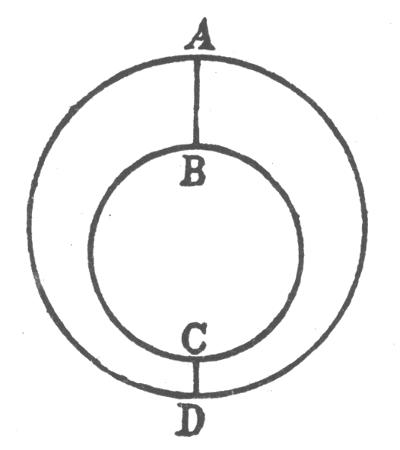
“The inequalities of the space between
A B and C D exceed every
number; and yet the space which lies
between is not so very great.” That
is to say, if I wish to determine them
all, I must enter upon an infinite series.
This “beyond” always, however, remains defective, is
always affected with negation; and yet this false infinite
is there to hand, circumscribed, affirmative, actual and
present in that plane as a complete space between the two
circles. Or a finite line consists of an infinite number of
points; and yet the line is present here and determined;
the “beyond” of the infinite number of points, which are
not complete, is in it complete and called back into unity.
The infinite should be represented as actually present, and
this comes to pass in the Notion of the cause of itself,
which is therefore the true infinity. As soon as the cause
has something else opposed to it—the effect—finitude is
present; but here this something else is at the same time
abrogated and it becomes once more the cause itself. The
affirmative is thus negation of negation, since, according to
the well-known grammatical rule, duplex negatio affirmat. In
the same way Spinoza’s earlier definitions have also the
infinite already implied in them, for instance in the case of the
just mentioned cause of itself, inasmuch as he defines it as
that whose essence involves existence (supra, p. 258). Notion
and existence are each the Beyond of the other; but cause
of itself, as thus including them, is really the carrying back
of this “beyond” into unity. Or (supra, p. 259) “Substance
is that which is in itself and is conceived from
itself;” that is the same unity of Notion and existence.
The infinite is in the same way in itself and has also
its Notion in itself; its Notion is its Being, and its
Being its Notion; true infinity is therefore to be found
in Spinoza. But he has no consciousness of this; he
has not recognized this Notion as absolute Notion,
and therefore has not expressed it as a moment of true
existence; for with him the Notion falls outside of
existence, into the thought of existence.
g. Finally Spinoza says in the seventh place: “God is a
Being absolutely infinite, i.e. a substance consisting of
infinite attributes, each of which expresses an eternal and
infinite essence.” Does substance, one might here ask,
possess an infinite number of attributes? But as with
Spinoza there are only two attributes, thought and extension,
with which he invests God, “infinite” is not to
be taken here in the sense of the indeterminate many,
but positively, as a circle is perfect infinity in itself.
The whole of Spinoza’s philosophy is contained in these
definitions, which, however, taken as a whole are formal;
it is really a weak point in Spinoza that he begins thus with
definitions. In mathematics this method is permitted,
because at the outset we there make assumptions, such as
that of the point and line; but in Philosophy the content
should be known as the absolutely true. It is all very well
to grant the correctness of the name-definition, and acknowledge
that the word “substance” corresponds with the
conception which the definition indicates, but it is quite
another question to determine whether this content is
absolutely true. Such a question is not asked in the case
of geometrical propositions, but in philosophic investigation
it is the very thing to be first considered, and this
Spinoza has not done. Instead of only explaining these
simple thoughts and representing them as concrete in the
definitions which he makes, what he ought to have done
was to examine whether this content is true. To all appearance
it is only the explanation of the words that is given;
but the content of the words is held to be established. All
further content is merely derived from that, and proved
thereby; for on the first content all the rest depends,
and if it is established as a basis, the other necessarily
follows. “The attribute is that which the understanding
thinks of God.” But here the question is: How does it
come that besides the Deity there now appears the understanding,
which applies to absolute substance the two forms
of thought and extension? and whence come these two
forms themselves? Thus everything proceeds inwards, and
not outwards; the determinations are not developed from
substance, it does not resolve itself into these attributes.
2. These definitions are followed by axioms and propositions
in which Spinoza proves a great variety of points.
He descends from the universal of substance through the
particular, thought and extension, to the individual. He
has thus all three moments of the Notion, or they are
essential to him. But the mode, under which head falls
individuality, he does not recognize as essential, or as constituting
a moment of true existence in that existence; for
it disappears in existence, or it is not raised into the
Notion.
a. The main point then is that Spinoza proves from these
Notions that there is only One Substance, God. It is a
simple chain of reasoning, a very formal proof. “Fifth
Proposition: There cannot be two or more substances of
the same nature or of the same attribute.” This is implied
already in the definitions; the proof is therefore a useless
and wearisome toil, which only serves to render Spinoza
more difficult to understand. “If there were several”
(substances of the same attribute) “they must be distinguished
from one another either by the diversity of their
attributes or by the diversity of their affections” (modes).
“If they are distinguished by their attributes, it would be
directly conceded that there is only one substance having
the same attribute.” For the attributes are simply what the
understanding grasps as the essence of the one substance,
which is determined in itself, and not through anything else.
“But if these substances were distinguished by their
affections, since substance is by nature prior to its affections
it would follow that if from substance its affections were
abstracted and it were regarded in itself, i.e. in its truth, it
could henceforth not be regarded as distinct from other
substances.” “Eighth Proposition: All substance is necessarily
infinite. Proof: For otherwise it must be limited by
another substance of the same nature, in which case there
would be two substances of the same attribute, which is
contrary to the fifth proposition.” “Every attribute must
be conceived for itself,” as determination reflected on itself.
“For attribute is what the mind conceives of substance as
constituting its essence, from which it follows that it must
be conceived through itself,” i.e. substance is what is
conceived through itself (see the fourth and third definitions).
“Therefore we may not argue from the plurality of
attributes to a plurality of substances, for each is conceived
by itself, and they have all been, always and at the same
time, in substance, without the possibility of the one being
produced by the other.” “Substance is indivisible. For if
the parts retained the nature of the substance, there would
be several substances of the same nature, which is contrary
to the fifth proposition. If not, infinite substance would
cease to exist, which is absurd.”[195]
“Fourteenth Proposition: No other substance than God
can either exist or be conceived. Proof: God is the absolutely
infinite substance, to whom can be denied no attribute
which expresses the essence of substance, and He
exists necessarily; therefore if there were a substance
other than God, it must be explained by means of an attribute
of God.” Consequently the substance would not
have its own being, but that of God, and therefore would
not be a substance. Or if it were still to be substance,
“then there would necessarily follow the possibility of
there being two substances with the same attribute, which
according to the fifth proposition is absurd. From this it
then follows that the thing extended and the thing that
thinks” are not substances, but “are either attributes of
God, or affections of His attributes.” By these proofs and
others like them not much is to be gained. “Fifteenth,
proposition: What is, is in God, and cannot exist or be
conceived without God.” “Sixteenth proposition: By the
necessity of the divine nature infinite things must follow
in infinite modes, i.e., all that can fall under the infinite
understanding. God is therefore the absolute First Cause.”[196]
Spinoza then ascribes freedom and necessity to God:
“God is the absolute free cause, who is determined by
nothing outside of Himself, for He exists solely by the
necessity of His nature. There is no cause which inwardly
or outwardly moves Him to act, except the perfection
of His nature. His activity is by the laws of His
Being necessary and eternal; what therefore follows from
His absolute nature, from His attributes, is eternal, as it follows
from the nature of the triangle from eternity and to
eternity that its three angles are equal to two right angles.”
That is to say, His Being is His absolute power; actus and
potentia, Thought and Being, are in Him one. God has not
therefore any other thoughts which He could not have
actualized. “God is the immanent cause of all things, not the
transient (transiens),” i.e., external cause. “His essence and
His existence are the same, namely, the truth. A thing
which is determined to perform some action, is, since God is
cause, necessarily determined thereto by God; and a thing
which is thus determined cannot render itself undetermined.
In nature nothing is contingent. Will is not a free cause,
but only a necessary cause, only a mode; it is therefore
determined by another. God acts in accordance with no
final causes (sub ratione boni). Those who assert that He
does so, appear to establish something apart from God,
which does not depend on God, and which God in His
working keeps in view, as though it were an end. If this
view is taken, God is not a free cause, but is subject to fate.
It is equally inadmissible to subject all things to the
arbitrary pleasure of God, i.e., to His indifferent will.”[197] He
is determined solely by His own nature; the activity of
God is thus His power, and that is necessity. He is then
absolute power in contrast to wisdom, which sets up definite
aims, and consequently limitations; particular aims,
thoughts of what is about to come to pass, and the
like are therefore put out of the question. But beyond
this universal, no advance is made; for it must be noticed
as specially singular, that Spinoza in the fiftieth Letter
(Oper. T. I. p. 634) says that every determination is a negation.
Moreover, if God is the cause of the world, it is implied
that He is finite; for the world is here put beside
God as something different from Him.
b. The greatest difficulty in Spinoza is, in the distinctions
to which he comes, to grasp the relation of this
determinate to God, at the same time preserving the
determination. “God is a thinking Being, because all
individual thoughts are modes which express God’s nature
in a certain and determinate manner; there pertains
therefore to God an attribute the conception of which all
individual thoughts involve, and by means of this they
also are conceived. God is an extended Being for the same
reason.” This means that the same substance, under the
attribute of thought, is the intelligible world, and under
the attribute of extension, is nature; nature and thought
thus both express the same Essence of God. Or, as
Spinoza says, “The order and system of natural things
is the same as the order of the thoughts. Thus, for instance,
the circle which exists in nature, and the idea of the
existing circle, which is also in God, are one and the same
thing” (they are one and the same content), “which is”
merely “expressed by means of different attributes. If
we therefore regard nature either under the attribute of
extension or of thought, or under any other attribute
whatever, we shall find one and the same connection of
causes, i.e., the same sequence of things. The formal
Being of the idea of the circle can be conceived only by
means of the mode of thought, as its proximate cause, and
this mode again by means of another, and so on infinitely;
so that we must explain the order of the whole of nature, or
the connection of causes, by the attribute of thought alone,
and if things are considered by the attribute of extension,
they must be considered only by the attribute of extension,—and
the same holds good of other causes.”[198] It is one and
the same system, which at one time appears as nature, and
at another time in the form of thought.
But Spinoza does not demonstrate how these two are
evolved from the one substance, nor does he prove why there
can only be two of them. Neither are extension and
thought anything to him in themselves, or in truth, but
only externally; for their difference is a mere matter of
the understanding, which is ranked by Spinoza only
among affections (Eth. P. I. Prop. XXXI. Demonst. p. 62),
and as such has no truth. This has in recent times been
served up again by Schelling in the following form: In
themselves, the intelligent world and the corporeal world are
the same, only under different forms; so that the intelligent
universe is in itself the whole absolute divine totality,
and the corporeal universe is equally this same totality.
The differences are not in themselves, but the different
aspects from which the Absolute is regarded are matters
external to it. We take a higher tone in saying that
nature and mind are rational; but reason is for us no
empty word, for it means the totality which develops itself
within itself. Again, it is the standpoint of reflection to
regard aspects only, and nothing in itself. This defect
appears in Spinoza and Schelling in the fact that they see
no necessity why the Notion, as the implicit negative of its
unity, should make a separation of itself into different
parts; so that out of the simple universal the real, the
opposed, itself becomes known. Absolute substance,
attribute and mode, Spinoza allows to follow one another
as definitions, he adopts them ready-made, without the
attributes being developed from the substance, or the
modes from the attributes. And more especially in regard
to the attributes, there is no necessity evident, why these
are thought and extension in particular.
c. When Spinoza passes on to individual things,
especially to self-consciousness, to the freedom of the ‘I,’
he expresses himself in such a way as rather to lead back
all limitations to substance than to maintain a firm grasp
of the individual. Thus we already found the attributes
not to be independent, but only the forms in which the
understanding grasps substance in its differences; what
comes third, the modes, is that under which for Spinoza
all difference of things alone falls. Of the modes he says
(Ethic. P. I. Prop. XXXII. Demonst. et Coroll. II. p. 63):
In every attribute there are two modes; in extension, these
are rest and motion, in thought they are understanding
and will (intellectus et voluntas). They are mere modifications
which only exist for us apart from God; therefore
whatever refers to this difference and is specially
brought about by it, is not absolute, but finite. These
affections Spinoza sums up (Ethices, P. I. Prop. XXIX.
Schol. pp. 61, 62) under the head of natura naturata:
“Natura naturans is God regarded as free cause, in so far
as He is in Himself and is conceived by Himself: or such
attributes of substance as express the eternal and infinite
essence. By natura naturata, I understand all that follows
from the necessity of the divine nature, or from any of the
attributes of God, all modes of the divine attributes, in so
far as they are regarded as things which are in God, and
which without God can neither exist nor be conceived.”
From God proceeds nothing, for all things merely return
to the point whence they came, if from themselves the
commencement is made.
These then are Spinoza’s general forms, this is his
principal idea. Some further determinations have still to
be mentioned. He gives definitions of the terms modes,
understanding, will, and of the affections, such as joy and
sadness.[199] We further find consciousness taken into consideration.
Its development is extremely simple, or rather
it is not developed at all; Spinoza begins directly with
mind. “The essence of man consists of certain modifications
of the attributes of God”; these modifications are
only something related to our understanding. “If we,
therefore, say that the human mind perceives this or that,
it means nothing else than that God has this or that idea,
not in so far as He is infinite, but in so far as He is expressed
by the idea of the human mind. And if we say that God
has this or that idea, not in so far as He constitutes the idea
of the human mind, but in so far as He has, along with
the human mind, the idea of another thing, then we say
that the human mind perceives the thing partially or
inadequately.” Truth is for Spinoza, on the other hand,
the adequate.[200] The idea that all particular content is only
a modification of God is ridiculed by Bayle,[201] who argues
from it that God modified as Turks and Austrians, is
waging war with Himself; but Bayle has not a trace of
the speculative element in him, although he is acute enough
as a dialectician, and has contributed to the intelligent
discussion of definite subjects.
The relation of thought and extension in the human
consciousness is dealt with by Spinoza as follows: “What
has a place in the object” (or rather in the objective) “of
the idea which constitutes the human mind must be perceived
by the human mind; or there must necessarily be
in the mind an idea of this object. The object of the idea
which constitutes the human mind is body, or a certain
mode of extension. If, then, the object of the idea which
constitutes the human mind, is the body, there can happen
nothing in the body which is not perceived by the mind.
Otherwise the ideas of the affections of the body would not
be in God, in so far as He constitutes our mind, but the
idea of another thing: that is to say, the ideas of the
affections of our body would not be likewise in our
mind.” What is perplexing to understand in Spinoza’s
system is, on the one hand, the absolute identity of
thought and Being, and, on the other hand, their absolute
indifference to one another, because each of them is a
manifestation of the whole essence of God. The unity of
the body and consciousness is, according to Spinoza, this,
that the individual is a mode of the absolute substance,
which, as consciousness, is the representation of the manner
in which the body is affected by external things; all
that is in consciousness is also in extension, and conversely.
“Mind knows itself only in so far as it perceives the ideas
of the affections of body,” it has only the idea of the
affections of its body; this idea is synthetic combination,
as we shall immediately see. “The ideas, whether of the
attributes of God or of individual things, do not recognize
as their efficient cause their objects themselves, or the
things perceived, but God Himself, in so far as He is that
which thinks.”[202] Buhle (Geschichte der neuern Philos.
Vol. III. Section II. p. 524) sums up these propositions of
Spinoza thus: “Thought is inseparably bound up with
extension; therefore all that takes place in extension must
also take place in consciousness.” Spinoza, however,
also accepts both in their separation from one another.
The idea of body, he writes (Epistol. LXVI. p. 673),
includes only these two in itself, and does not express any
other attributes. The body which it represents is regarded
under the attribute of extension; but the idea itself is a
mode of thought. Here we see a dividing asunder; mere
identity, the undistinguishable nature of all things in the
Absolute, is insufficient even for Spinoza.
The individuum, individuality itself, is thus defined by
Spinoza (Ethic. P. II. Prop. XIII. Defin. p. 92): “When
several bodies of the same or of different magnitudes are so
pressed together that they rest on one another, or when,
moving with like or different degrees of rapidity, they
communicate their movement to one another in a certain
measure, we say that such bodies are united to one another,
and that all together they form one body or individuum,
which by this union distinguishes itself from all the other
bodies.” Here we are at the extreme limit of Spinoza’s
system, and it is here that his weak point appears. Individuation,
the one, is a mere synthesis; it is quite a
different thing from the Ichts or self-hood of Boehme (supra,
pp. 205-207), since Spinoza has only universality, thought,
and not self-consciousness. If, before considering this in
reference to the whole, we take it from the other side,
namely from the understanding, the distinction really falls
under that head; it is not deduced, it is found. Thus, as
we have already seen (p. 270) “the understanding in act
(intellectus actu), as also will, desire, love, must be
referred to natura naturata, not to natura naturans. For
by the understanding, as recognized for itself, we do
not mean absolute thought, but only a certain mode of
thought—a mode which is distinct from other modes like
desire, love, etc., and on that account must be conceived by
means of absolute thought, i.e. by means of an attribute of
God which expresses an eternal and infinite essentiality of
thought; without which the understanding, as also the rest
of the modes of thought, could neither be nor be conceived
to be.” (Spinoza, Ethices, P. I. Propos. XXXI. pp. 62,
63). Spinoza is unacquainted with an infinity of form,
which would be something quite different from that of rigid,
unyielding substance. What is requisite is to recognize
God as the essence of essences, as universal substance,
identity, and yet to preserve distinctions.
Spinoza goes on to say: “What constitutes the real
(actuale) existence of the human mind is nothing else than
the idea of a particular” (individual) “thing, that actually
exists,” not of an infinite thing. “The essence of man
involves no necessary existence, i.e. according to the order
of nature a man may just as well be as not be.” For the
human consciousness, as it does not belong to essence as
an attribute, is a mode—a mode of the attribute of thought.
But neither is the body, according to Spinoza, the cause of
consciousness, nor is consciousness the cause of the body,
but the finite cause is here only the relation of like to like;
body is determined by body, conception by conception.
“The body can neither determine the mind to thought, nor
can the mind determine the body to motion, or rest, or anything
else. For all modes of thought have God as Cause,
in so far as He is a thinking thing, and not in so far as He
is revealed by means of another attribute. What therefore
determines the mind to thought, is a mode of thought and
not of extension; similarly motion and rest of the body
must be derived from another body.”[203] I might quote many
other such particular propositions from Spinoza, but they
are very formal, and a continual repetition of one and the
same thing.
Buhle (Gesch. d. neuern Phil. Vol. III. Section 2, pp.
525-528), attributes limited conceptions to Spinoza: “The
soul experiences in the body all the ‘other’ of which it
becomes aware as outside of the body, and it becomes aware
of this ‘other’ only by means of the conceptions of the
qualities which the body perceives therein. If, therefore,
the body can perceive no qualities of a thing, the soul also
can come to no knowledge of it. On the other hand, the
soul is equally unable to arrive at the perception of the
body which belongs to it; the soul knows not that the body
is there, and knows itself even in no other way than by
means of the qualities which the body perceives in things
which are outside of it, and by means of the conceptions of
the same. For the body is an individual thing, determined
in a certain manner, which can only gradually, in association
with and amidst other individual things, attain to
existence, and can preserve itself in existence only as thus
connected, combined and associated with others,” i.e. in
infinite progress; the body can by no means be conceived
from itself. “The soul’s consciousness expresses a certain
determinate form of a Notion, as the Notion itself expresses
a determinate form of an individual thing. But the individual
thing, its Notion, and the Notion of this Notion are
altogether and entirely one and the same thing, only regarded
under different attributes. As the soul is nothing
else than the immediate Notion of the body, and is one
and the same thing with this, the excellence of the soul can
never be anything else than the excellence of the body.
The capacities of the understanding are nothing but the
capacities of the body, if they are looked at from the
corporeal point of view, and the decisions of the will are
likewise determinations of the body. Individual things are
derived from God in an eternal and infinite manner” (i.e.
once and for all), “and not in a transitory, finite and
evanescent manner: they are derived from one another
merely inasmuch as they mutually produce and destroy
each other, but in their eternal existence they endure unchangeable.
All individual things mutually presuppose
each other; one cannot be thought without the other; that
is to say they constitute together an inseparable whole;
they exist side by side in one utterly indivisible, infinite
Thing, and in no other way whatever.”
3. We have now to speak of Spinoza’s system of morals,
and that is a subject of importance. Its great principle is
no other than this, that the finite spirit is moral in so far
as it has the true Idea, i.e. in so far as it directs its knowledge
and will on God, for truth is merely the knowledge
of God. It may be said that there is no morality loftier
than this, since its only requisite is to have a clear idea of
God. The first thing Spinoza speaks of in this regard is
the affections: “Everything strives after self-preservation.
This striving is the actual essence of the thing, and involves
only indefinite time; when referred exclusively to mind, it
is termed will; when referred to both mind and body together,
it is called desire. Determination of the will
(volitio) and Idea are one and the same thing. The sense
of liberty rests on this, that men do not know the determining
causes of their actions. The affection is a confused
idea; the more clearly and distinctly, therefore, we know
the affection, the more it is under our control.”[204] The influence
of the affections, as confused and limited (inadequate)
ideas, upon human action, constitutes therefore,
according to Spinoza, human slavery; of the passionate
affections the principal are joy and sorrow; we are in
suffering and slavery in so far as we relate ourselves as a
part.[205]
“Our happiness and liberty consist in an enduring and
eternal love to God; this intellectual love follows from the
nature of mind, in so far as it is regarded as eternal truth
through the nature of God. The more a man recognizes
God’s existence and loves Him, the less does he suffer from
evil affections and the less is his fear of death.”[206] Spinoza
requires in addition the true kind of knowledge. There
are, according to him, three kinds of knowledge; in the
first, which he calls opinion and imagination, he includes
the knowledge which we obtain from an individual object
through the senses—a knowledge fragmentary and ill-arranged—also
knowledge drawn from signs, pictorial conceptions
and memory. The second kind of knowledge is
for Spinoza that which we derive from general conceptions
and adequate ideas of the properties of things. The third
is intuitive knowledge (scientia intuitiva) which rises from
the adequate idea of the formal essence of certain attributes
of God to the adequate knowledge of the essence of things.[207]
Regarding this last he then says: “The nature of reason
is not to contemplate things as contingent, but as necessary
... to think of all things under a certain form of
eternity (sub quadam specie œternitatis);” i.e. in absolutely
adequate Notions, i.e. in God. “For the necessity of things
is the necessity of the eternal nature of God Himself.
Every idea of an individual thing necessarily includes the
eternal and infinite essence of God in itself. For individual
things are modes of an attribute of God; therefore
they must include in themselves His eternal essence. Our
mind, in so far as it knows itself and the body under the
form of eternity, has to that extent necessarily the knowledge
of God, and knows that it is itself in God and is
conceived through God. All Ideas, in so far as they are
referable to God, are true.”[208] Man must trace back all
things to God, for God is the One in All; the eternal
essence of God is the one thing that is, the eternal truth is
the only thing for man to aim at in his actions. With
Spinoza this is not a knowledge arrived at through philosophy,
but only knowledge of a truth. “The mind can
succeed in tracing back all affections of the body or images
of things to God. In proportion as the mind regards all
things as necessary, it has a greater power over its affections,”
which are arbitrary and contingent. This is the
return of the mind to God, and this is human freedom; as
mode, on the other hand, the spirit has no freedom, but is
determined from without. “From the third kind of knowledge
there arises the repose of the mind; the supreme
good of the mind is to know God, and this is its highest
virtue. This knowledge necessarily produces the intellectual
love of God; for it produces a joyfulness accompanied
by the Idea of God as cause—i.e. the intellectual
love of God. God Himself loves Himself with an infinite
intellectual love.”[209] For God can have only Himself as aim
and cause; and the end of the subjective mind is to be
directed on Him. This is therefore the purest, but also a
universal morality.
In the thirty-sixth Letter (pp. 581-582) Spinoza speaks
of Evil. The allegation is made that God, as the originator
of all things and everything, is also the originator of evil,
is consequently Himself evil; in this identity all things are
one, good and evil are in themselves the same thing, in
God’s substance this difference has disappeared. Spinoza
says in answer to this: “I assert the fact that God absolutely
and truly” (as cause of Himself) “is the cause of
everything that has an essential content” (i.e. affirmative
reality) “be it what it may. Now if you can prove to me
that evil, error, crime, etc., are something that expresses
an essence, I will freely admit to you that God is the originator
of crime and evil and error. But I have elsewhere
abundantly demonstrated that the form of evil cannot subsist
in anything that expresses an essence, and therefore it
cannot be said that God is the cause of evil.” Evil is
merely negation, privation, limitation, finality, mode—nothing
in itself truly real. “Nero’s murder of his mother,
in so far as it had positive content, was no crime. For
Orestes did the same external deed, and had in doing it
the same end in view—to kill his mother; and yet he is
not blamed,” and so on. The affirmative is the will, the
intention, the act of Nero. “Wherein then consists Nero’s
criminality? In nothing else but that he proved himself
ungrateful, merciless, and disobedient. But it is certain
that all this expresses no essence, and therefore God was
not the cause of it, though He was the cause of Nero’s
action and intention.” These last are something positive,
but yet they do not constitute the crime as such; it is only
the negative element, such as mercilessness, etc. that makes
the action a crime. “We know that whatever exists, regarded
in itself and without taking anything else into
consideration, contains a perfection which extends as
widely as the essence of the thing itself extends, for the
essence is in no way different therefrom.”—“Because then,”
we find in the thirty-second letter (pp. 541, 543), “God
does not regard things abstractly, or form general definitions,”
(of what the thing ought to be) “and no more reality
is required of things than the Divine understanding and
power has given and actually meted out to them; therefore
it clearly follows that such privation exists only and solely in
respect to our understanding, but not in respect to God;”
for God is absolutely real. It is all very well to say this,
but it does not meet the case. For in this way God and
the respect to our understanding are different. Where is
their unity? How is this to be conceived? Spinoza continues
in the thirty-sixth letter: “Although the works of
the righteous (i.e. of those who have a clear idea of God,
to which they direct all their actions and even their
thoughts), and” also the works “of the wicked (i.e. of
those who have no idea of God, but only ideas of earthly
things,”—individual, personal interests and opinions,—“by
which their actions and thoughts are directed), and all
whatsoever exists, necessarily proceed from God’s eternal
laws and counsels, and perpetually depend on God, they
are yet not distinguished from one another in degree, but
in essence; for although a mouse as well as an angel
depends on God, and sorrow as well as joy, yet a mouse
cannot be a kind of angel, and sorrow cannot be a kind of
joy,”—they are different in essence.
There is therefore no ground for the objection that
Spinoza’s philosophy gives the death-blow to morality; we
even gain from it the great result that all that is sensuous is
mere limitation, and that there is only one true substance,
and that human liberty consists in keeping in view this one
substance, and in regulating all our conduct in accordance
with the mind and will of the Eternal One. But in this
philosophy it may with justice be objected that God is conceived
only as Substance, and not as Spirit, as concrete.
The independence of the human soul is therein also denied,
while in the Christian religion every individual appears as
determined to salvation. Here, on the contrary, the individual
spirit is only a mode, an accident, but not anything
substantial. This brings us to a general criticism of the
philosophy of Spinoza, in the course of which we shall consider
it from three different points of view.
In the first place Spinozism is asserted to be Atheism—by
Jacobi, for instance (Werke, Vol. IV. Section I. p. 216)—because
in it no distinction is drawn between God and the
world; it makes nature the real God, or lowers God to the
level of nature, so that God disappears and only nature is
established. But it is not so much God and nature that
Spinoza sets up in mutual opposition, as thought and extension;
and God is unity, not One made up of two, but absolute
Substance, in which has really disappeared the limitation
of the subjectivity of thought and nature. Those who speak
against Spinoza do so as if it were on God’s account that
they were interested; but what these opponents are really
concerned about is not God, but the finite—themselves.
The relationship between God and the finite, to which we
belong, may be represented in three different ways: firstly,
only the finite exists, and in this way we alone exist, but
God does not exist—this is atheism; the finite is here
taken absolutely, and is accordingly the substantial. Or, in
the second place, God alone exists; the finite has no reality,
it is only phenomena, appearance. To say, in the third place,
that God exists and we also exist is a false synthetic union, an
amicable compromise. It is the popular view of the matter
that the one side has as much substantiality as the other;
God is honoured and supreme, but finite things also have
Being to exactly the same extent. Reason cannot remain
satisfied with this “also,” with indifference like this. The
philosophic requisite is therefore to apprehend the unity of
these differences in such a way that difference is not let slip,
but proceeds eternally from substance, without being petrified
into dualism. Spinoza is raised above this dualism;
religion is so also, if we turn its popular conceptions into
thoughts. The atheism of the first attitude—when men
set up as ultimate the arbitrariness of the will, their own
vanity, the finite things of nature, and the world dwells for
ever in the mind—is not the standpoint of Spinoza, for
whom God is the one and only substance, the world on the
contrary being merely an affection or mode of this substance.
In the respect that Spinoza does not distinguish God from
the world, the finite, it is therefore correct to term his
theory atheism, for his words are these: Nature, the human
mind, the individual, are God revealed under particular forms.
It has been already remarked (pp. 257, 258, 280) that undoubtedly
Substance with Spinoza does not perfectly fulfil
the conception of God, since it is as Spirit that He is to be
conceived. But if Spinoza is called an atheist for the sole
reason that he does not distinguish God from the world, it
is a misuse of the term. Spinozism might really just as well
or even better have been termed Acosmism, since according
to its teaching it is not to the world, finite existence, the
universe, that reality and permanency are to be ascribed,
but rather to God alone as the substantial. Spinoza maintains
that there is no such thing as what is known as the
world; it is merely a form of God, and in and for itself it is
nothing. The world has no true reality, and all this that we
know as the world has been cast into the abyss of the one
identity. There is therefore no such thing as finite reality, it
has no truth whatever; according to Spinoza what is, is God,
and God alone. Therefore the allegations of those who accuse
Spinoza of atheism are the direct opposite of the truth;
with him there is too much God. They say: If God is the
identity of mind and nature, then nature or the individual
man is God. This is quite correct, but they forget that
nature and the individual disappear in this same identity:
and they cannot forgive Spinoza for thus annihilating them.
Those who defame him in such a way as this are therefore
not aiming at maintaining God, but at maintaining the
finite and the worldly; they do not fancy their own
extinction and that of the world. Spinoza’s system is
absolute pantheism and monotheism elevated into thought.
Spinozism is therefore very far removed from being atheism
in the ordinary sense; but in the sense that God is not conceived
as spirit, it is atheism. However, in the same way
many theologians are also atheists who speak of God only
as the Almighty Supreme Being, etc., who refuse to acknowledge
God, and who admit the validity and truth of the
finite. They are many degrees worse than Spinoza.
The second point to be considered is the method
adopted by Spinoza for setting forth his philosophy; it
is the demonstrative method of geometry as employed by
Euclid, in which we find definitions, explanations, axioms,
and theorems. Even Descartes made it his starting-point
that philosophic propositions must be mathematically
handled and proved, that they must have the very same
evidence as mathematics. The mathematical method is
considered superior to all others, on account of the nature
of its evidence; and it is natural that independent knowledge
in its re-awakening lighted first upon this form, of
which it saw so brilliant an example. The mathematical
method is, however, ill-adapted for speculative content,
and finds its proper place only in the finite sciences of the
understanding. In modern times Jacobi has asserted
(Werke, Vol. IV. Section I. pp. 217-223) that all demonstration,
all scientific knowledge leads back to Spinozism,
which alone is a logical method of thought; and because
it must lead thither, it is really of no service whatever, but
immediate knowledge is what we must depend on. It may
be conceded to Jacobi that the method of demonstration
leads to Spinozism, if we understand thereby merely the
method of knowledge belonging to the understanding.
But the fact is that Spinoza is made a testing-point
in modern philosophy, so that it may really be said:
You are either a Spinozist or not a philosopher at all.
This being so, the mathematical and demonstrative
method of Spinoza would seem to be only a defect in the
external form; but it is the fundamental defect of the
whole position. In this method the nature of philosophic
knowledge and the object thereof, are entirely misconceived,
for mathematical knowledge and method are merely
formal in character and consequently altogether unsuited
for philosophy. Mathematical knowledge exhibits its proof
on the existent object as such, not on the object as conceived;
the Notion is lacking throughout; the content of
Philosophy, however, is simply the Notion and that which
is comprehended by the Notion. Therefore this Notion as
the knowledge of the essence is simply one assumed, which
falls within the philosophic subject; and this is what
represents itself to be the method peculiar to Spinoza’s
philosophy. Of this demonstrative manner we have
already seen these examples: (α) The definitions from
which Spinoza takes his start—as in geometry a commencement
is made with the line, triangle, &c.—concern
universal determinations, such as cause of itself, the finite,
substance, attribute, mode, and so on, which are solely and
simply accepted and assumed, not deduced, nor proved to
be necessary: for Spinoza is not aware of how he arrives at
these individual determinations. (β) He further speaks of
axioms, for instance (Ethic. P. I. Ax. I. p. 36): “What
is, is either in itself or in another.” The determinations
“in itself” and “in another” are not shown forth in
their necessity: neither is this disjunction proved, it is
merely assumed. (γ) The propositions have, as such, a
subject and predicate which are not similar. When the
predicate is proved of the subject and necessarily combined
with it, the discrepancy remains that the one as universal is
related to the other as particular: therefore even although
the relation is proved, there is present at the same time a
secondary relation. Mathematical science, in its true
propositions respecting a whole, escapes from the difficulty
by proving also the converse of the propositions, in this
way obtaining for them a special definiteness by proving
each proposition in both ways. True propositions may,
therefore, be looked on as definitions, and the conversion
is the proof of the proposition in the form in which it is
expressed. But this means of escaping the difficulty
Philosophy cannot well employ, since the subject of which
something is proved is itself only the Notion or the
universal, and the proposition form is therefore quite
superfluous and out of place. What has the form of the
subject is in the form of an existent thing, as contrasted
with the universal, the content of the proposition. The existent
thing is taken as signifying existent in the ordinary
sense; it is the word which we use in every-day life,
and of which we have a conception that has nothing of the
Notion in it. The converse of a proposition would simply
read like this: The Notion is that which is thus popularly
conceived. This proof from the usage of language—that
we also understand this to be the meaning in every-day
life, or in other words that the name is correct—has no
philosophic significance. But if the proposition is not one
like this, but an ordinary proposition, and if the predicate
is not the Notion, but some general term or other, a
predicate of the subject, such propositions are really not
philosophic: we might instance the statement that substance
is one and not several, but only that in which
substance and unity are the same. Or, in other words,
this unity of the two moments is the very thing which the
proof has to demonstrate, it is the Notion or the essence.
In this case it looks as if the proposition were the matter
of chief importance, the truth. But if in these really
only so-called propositions, subject and predicate are in
truth not alike, because one is individual and the other
universal, their relation is essential, i.e. the reason for
which they are one. The proof has here a false position
indeed, as if that subject were implicit or in itself,
whereas subject and predicate are, fundamentally even,
moments in separation; in the judgment “God is
One,” the subject itself is universal, since it resolves
itself into unity. On the other side it is implied
in this false position that the proof is brought
in from outside merely, as in mathematics from a preceding
proposition, and that the proposition is not therefore
conceived through itself; thus we see the ordinary
method of proof take its middle term, the principle,
from anywhere it can, in the same way as in classification
it takes its principle of classification. The proposition
is then, as it were, a secondary affair; but we
must ask if this proposition is true. The result as proposition
ought to be truth, but is only knowledge. The
movement of knowledge, as proof, falls therefore, in the
third place, outside of the proposition, which ought to be
the truth. The essential moments of the system are
really already completely contained in the presuppositions
of the definitions, from which all further proofs have merely
to be deduced. But whence have we these categories which
here appear as definitions? We find them doubtless in
ourselves, in scientific culture. The existence of the understanding,
the will, extension, is therefore not developed
from infinite substance, but it is directly expressed in these
determinations, and that quite naturally; for of a truth
there exists the One into which everything enters, in order
to be absorbed therein, but out of which nothing comes.
For as Spinoza has set up the great proposition, all
determination implies negation (supra, p. 267), and as of
everything, even of thought in contrast to extension, it may
be shown that it is determined and finite, what is essential
in it rests upon negation. Therefore God alone is the
positive, the affirmative, and consequently the one substance;
all other things, on the contrary, are only
modifications of this substance, and are nothing in and for
themselves. Simple determination or negation belongs
only to form, but is quite another thing from absolute
determinateness or negativity, which is absolute form; in
this way of looking at it negation is the negation of
negation, and therefore true affirmation. This negative
self-conscious moment, the movement of knowledge, which
pursues its way in the thought which is present before us,
is however certainly lacking to the content of Spinoza’s
philosophy, or at least it is only externally associated with
it, since it falls within self-consciousness. That is to say,
thoughts form the content, but they are not self-conscious
thoughts or Notions: the content signifies thought, as pure
abstract self-consciousness, but an unreasoning knowledge,
into which the individual does not enter: the content has
not the signification of ‘I.’ Therefore the case is as in
mathematics; a proof is certainly given, conviction must
follow, but yet the matter fails to be understood. There is
a rigid necessity in the proof, to which the moment of self-consciousness
is lacking; the ‘I’ disappears, gives itself
altogether up, merely withers away. Spinoza’s procedure
is therefore quite correct; yet the individual proposition
is false, seeing that it expresses only one side of the
negation. The understanding has determinations which
do not contradict one another; contradiction the understanding
cannot suffer. The negation of negation is,
however, contradiction, for in that it negates negation as
simple determination, it is on the one hand affirmation, but
on the other hand also really negation; and this contradiction,
which is a matter pertaining to reason, is
lacking in the case of Spinoza. There is lacking the
infinite form, spirituality and liberty. I have already
mentioned before this (pp. 93, 94; 129-137) that Lullus
and Bruno attempted to draw up a system of form, which
should embrace and comprehend the one substance which
organizes itself into the universe; this attempt Spinoza did
not make.
Because negation was thus conceived by Spinoza in one-sided
fashion merely, there is, in the third place, in his
system, an utter blotting out of the principle of subjectivity,
individuality, personality, the moment of self-consciousness
in Being. Thought has only the signification of the
universal, not of self-consciousness. It is this lack which
has, on the one side, brought the conception of the liberty
of the subject into such vehement antagonism to the
system of Spinoza, because it set aside the independence
of the human consciousness, the so-called liberty which is
merely the empty abstraction of independence, and in
so doing set aside God, as distinguished from nature
and the human consciousness—that is as implicit
or in Himself, in the Absolute; for man has the
consciousness of freedom, of the spiritual, which is the
negative of the corporeal, and man has also the consciousness
that his true Being lies in what is opposed to the
corporeal. This has been firmly maintained by religion,
theology, and the sound common sense of the common
consciousness, and this form of opposition to Spinoza
appears first of all in the assertion that freedom is real, and
that evil exists. But because for Spinoza, on the other
hand, there exists only absolute universal substance as the
non-particularized, the truly real—all that is particular and
individual, my subjectivity and spirituality, has, on the
other hand, as a limited modification whose Notion
depends on another, no absolute existence. Thus the soul,
the Spirit, in so far as it is an individual Being, is for
Spinoza a mere negation, like everything in general that is
determined. As all differences and determinations of
things and of consciousness simply go back into the One
substance, one may say that in the system of Spinoza all
things are merely cast down into this abyss of annihilation.
But from this abyss nothing comes out; and the particular
of which Spinoza speaks is only assumed and presupposed
from the ordinary conception, without being justified.
Were it to be justified, Spinoza would have to deduce it
from his Substance; but that does not open itself out, and
therefore comes to no vitality, spirituality or activity. His
philosophy has only a rigid and unyielding substance, and
not yet spirit; in it we are not at home with ourselves.
But the reason that God is not spirit is that He is not the
Three in One. Substance remains rigid and petrified,
without Boehme’s sources or springs; for the individual
determinations in the form of determinations of the understanding
are not Boehme’s originating spirits, which
energize and expand in one another (supra, pp. 202, 203).
What we find regarding this particular then is that it is
only a modification of absolute substance, which, however,
is not declared to be such; for the moment of negativity is
what is lacking to this rigid motionlessness, whose single
form of activity is this, to divest all things of their determination
and particularity and cast them back into the one
absolute substance, wherein they are simply swallowed up,
and all life in itself is utterly destroyed. This is what we
find philosophically inadequate with Spinoza; distinctions
are externally present, it is true, but they remain external,
since even the negative is not known in itself. Thought is
the absolutely abstract, and for that very reason the absolutely
negative; it is so in truth, but with Spinoza it is not
asserted to be the absolutely negative. But if in opposition
to Spinozism we hold fast to the assertion that Spirit,
as distinguishing itself from the corporeal, is substantial,
actual, true, and in the same way that freedom is not something
merely privative, then this actuality in formal thought
is doubtless correct, yet it rests only upon feeling; but the
further step is that the Idea essentially includes within itself
motion and vitality, and that it consequently has in itself
the principle of spiritual freedom. On the one hand, therefore,
the defect of Spinozism is conceived as consisting in
its want of correspondence with actuality; but on the other
side it is to be apprehended in a higher sense, I mean in
the sense that substance with Spinoza is only the Idea taken
altogether abstractly, not in its vitality.
If, in conclusion, we sum up this criticism that we have
offered, we would say that on the one hand with Spinoza
negation or privation is distinct from substance; for he
merely assumes individual determinations, and does not
deduce them from substance. On the other hand the
negation is present only as Nothing, for in the absolute
there is no mode; the negative is not there, but only its
dissolution, its return: we do not find its movement, its
Becoming and Being. The negative is conceived altogether
as a vanishing moment—not in itself, but only as individual
self-consciousness; it is not like the Separator
we met with in Boehme’s system (supra, p. 206). Self-consciousness
is born from this ocean, dripping with the
water thereof, i.e. never coming to absolute self-hood; the
heart, the independence is transfixed—the vital fire is
wanting. This lack has to be supplied, the moment of
self-consciousness has to be added. It has the following
two special aspects, which we now perceive emerging and
gaining acceptance; in the first place the objective aspect,
that absolute essence obtains in self-consciousness the
mode of an object of consciousness for which the “other”
exists, or the existent as such, and that what Spinoza
understood by the “modes” is elevated to objective reality
as an absolute moment of the absolute; in the second place
we have the aspect of self-consciousness, individuality,
independence. As was formerly the case with respect to
Bacon and Boehme, the former aspect is here taken up by
the Englishman, John Locke, the latter by the German
Leibnitz; in the first case it did not appear as a moment,
nor did it in the second appear as absolute Notion. Now
while Spinoza only takes notice of these ordinary conceptions,
and the highest point of view he reaches in regard
to them is that they sink and disappear in the one Substance,
Locke on the contrary examines the genesis of these
conceptions, while Leibnitz opposes to Spinoza the infinite
multiplicity of individuals, although all these monads have
one monad as the basis of their Being. Both Locke and
Leibnitz therefore came forward as opponents of the above-mentioned
one-sidedness of Spinoza.
The philosophy of Malebranche is in point of matter
entirely identical with that of Spinoza, but it has another, a
more religious and more theological form; on account of
this form it never encountered the opposition met with by
Spinoza, and for the same reason Malebranche has never
been reproached with Atheism.
Nicholas Malebranche was born at Paris in 1638. He
was sickly and deformed in body, and was hence brought
up with great care. He was diffident and loved solitude;
in his twenty-second year he entered the congrégation de
l’oratoire, a sort of spiritual order, and devoted himself to
the sciences. In passing a bookseller’s shop he happened
accidentally to see Descartes’ work De homine; he read it,
and it interested him greatly—so much so that the reading
of it brought on severe palpitation and he was forced
to cease. This decided his future life; there awoke in him
an irrepressible inclination for Philosophy. He was a man
of most noble and gentle character, and of the most genuine
and unswerving piety. He died at Paris in 1715, and in
the seventy-seventh year of his age.[210]
His principal work bears the title: De la recherche de la
vérité. One part of it is entirely metaphysical, but the
greater part is altogether empirical. For instance, Malebranche
in the first three books treats logically and
psychologically of the errors in sight and hearing, in the
imagination and understanding.
a. What is most important in this book is his idea of the
origin of our knowledge. He says: “The essence of the soul
is in thought, just as that of matter is in extension. All
else, such as sensation, imagination and will, are modifications
of thought”. He thus begins with two sides, between
which he sets an absolute chasm, and then he follows out
in detail the Cartesian idea of the assistance of God in
knowledge. His main point is that “the soul cannot
attain to its conceptions and notions from external things.”
For when I and the thing are clearly independent of one
another and have nothing in common, the two can certainly
not enter into relation with one another nor be for one
another. “Bodies are impenetrable; their images would
destroy one another on the way to the organs.” But
further: “The soul cannot beget ideas from itself, nor can
they be inborn,” for as “Augustine has said, ‘Say not that
ye yourselves are your own light.’” But how then comes
extension, the manifold, into the simple, into the spirit, since
it is the reverse of the simple, namely the diverse? This
question regarding the association of thought and extension
is always an important one in Philosophy. According to
Malebranche the answer is, “That we see all things in
God.” God Himself is the connection between us and
them, and thus the unity between the thing and thought.
“God has in Him the ideas of all things because He has
created all; God is through His omnipresence united in
the most intimate way with spirits. God thus is the place
of spirits,” the Universal of spirit, “just as space” is the
universal, “the place of bodies. Consequently the soul
knows in God what is in Him,” bodies, “inasmuch as
He sets forth” (inwardly conceives) “created existence,
because all this is spiritual, intellectual, and present to the
soul.”[211] Because things and God are intellectual and
we too are intellectual, we perceive them in God as they
are, so to speak, intellectual in Him. If this be further
analyzed it in no way differs from Spinozism. Malebranche
indeed in a popular way allows soul and things to subsist
as independent, but this independence vanishes away like
smoke when the principle is firmly grasped. The
catechism says: “God is omnipresent,” and if this omnipresence
be developed Spinozism is arrived at; and yet
theologians then proceed to speak against the system of
identity, and cry out about Pantheism.
b. We must further remark that Malebranche also makes
the universal, thought, the essential, by placing it before
the particular. “The soul has the Notion of the infinite
and universal: it knows nothing excepting through the
Idea which it has of the infinite; this Idea must hence come
first. The universal is not a mere confusion of individual
ideas, it is not a union of individual things.” According
to Locke the individual from which the universal is formed
precedes (infra, p. 299); according to Malebranche the
universal Idea is what comes first in man. “If we wish to
think of anything particular we think first of the universal;”
it is the principle of the particular, as space is of things.
All essentiality precedes our particular conceptions, and
this essentiality comes first. “All essential existences
(essences) come before our ordinary conception; they cannot
be such excepting by God’s presence in the mind and
spirit. He it is who contains all things in the simplicity of
His nature. It seems evident that mind would not be
capable of representing to itself the universal Notions of
species, kind, and suchlike, if it did not see all things comprehended
in one.” The universal is thus in and for itself,
and it does not take its rise through the particular.
“Since each existent thing is an individual, we cannot say
that we see something actually created when, for example,
we see a triangle in general,” for we see it through God.
“No account can be given of how spirit knows abstract
and common truths, excepting through the presence of Him
who can enlighten spirit in an infinite way,” because He is
in and for Himself the universal. “We have a clear idea
of God,” of the universal: “We can have such only through
union with Him, for this idea is not a created one,” but is
in and for itself. As with Spinoza, the one universal is
God, and in so far as it is determined, it is the particular;
we see this particular only in the universal, as we see bodies
in space. “We already have a conception of infinite
Being, inasmuch as we have a conception of Being without
regard to whether it is finite or infinite. To know a finite
we must limit the infinite; and this last must thus precede.
Thus spirit perceives all in the infinite; this is so far from
being a confused conception of many particular things that
all particular conceptions are merely participations in the
universal Idea of infinitude—in the same way that God
does not receive this Being from” finite “creatures,
but,” on the contrary, “all creatures only subsist through
Him.”[212]
c. As regards the turning of the soul to God, Malebranche
says what Spinoza said from his ethical point of view:
“It is impossible that God should have an end other than
Himself (the Holy Scriptures place this beyond doubt);”
the will of God can only have the good, what is without
doubt universal as its end. “Hence not only is it essential
that our natural love, i.e. the emotion which He brings
forth in our spirit, should strive after Him”—“the will is
really love towards God”—“but it is likewise impossible
that the knowledge and the light which He gives to our
spirit should make anything else known than what is in
Him,” for thought only exists in unity with God. “If
God were to make a spirit and give it the sun as
an idea or as the immediate object of its knowledge, God
would have made this spirit and the idea of this spirit for
the sun and not for Himself.” All natural love, and still
more knowledge, and the desire after truth, have God
as their end. “All motions of the will as regards the
creatures are only determinations of motion as regards
the creator.” Malebranche quotes from Augustine “that
we see God even from the time we first enter upon this
life (dès cette vie), through the knowledge that we have of
eternal truths. The truth is uncreated, unchangeable, immeasurable,
eternal above all things; it is true through
itself, and has its perfection from no thing. It makes the
creator more perfect, and all spirits naturally seek to
know it: now there is nothing that has these perfections
but God, and thus the truth is God. We perceive these
unchangeable and eternal truths, hence we see God.”
“God indeed sees but He does not feel sensuous things.
If we see something sensuous, sensation and pure thought
are to be found in our consciousness. Sensation is a modification
of our spirit; God occasions this because He knows
that our soul is capable of it. The Idea which is bound
up with the sensation is in God; we see it, etc. This
relation, this union of our mind and spirit with the Word
(Verbe) of God, and of our will with His love, is that we
are formed after the image of God and in His likeness.”[213]
Thus the love of God consists in relating one’s affections to
the Idea of God; whoever knows himself and thinks his
affections clearly, loves God. We further find sundry empty
litanies concerning God, a catechism for children of eight
years of age respecting goodness, justice, omnipresence, the
moral order of the world; in all their lifetime theologians
do not get any further.
We have given the principal of Malebranche’s ideas;
the remainder of his philosophy is composed partly of
formal logic, and partly of empirical psychology. He
passes to the treatment of errors, how they arise, how the
senses, the imagination, the understanding, deceive us,
and how we must conduct ourselves in order to effect a
remedy. Then Malebranche goes on (T. III. L. VI. P.
I. chap. i. pp. 1-3) to the rules and laws for recognizing the
truth. Thus here the term Philosophy was even applied to
the manner in which reflections on particular objects are
drawn from formal logic and external facts.