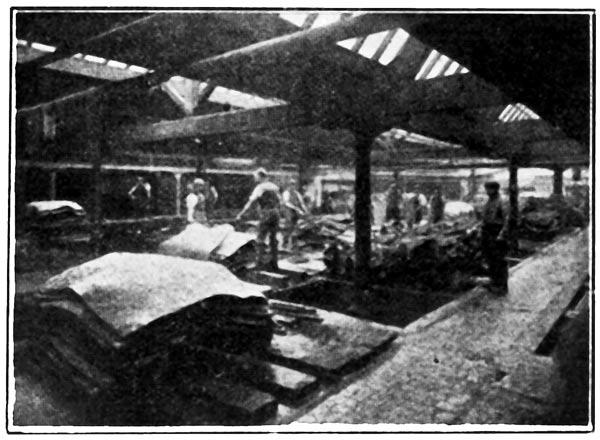
The dressing and finishing of leathers of all kinds seems
to be of growing importance every year, despite the fact
that the durability of leather is often impaired by the
chemicals and heavy machinery used in order to get a
clear and bright colour or a highly-glazed finish. One
exception to this rule, however, is japanned and
enamelled leathers made by the new collodion-amyl
acetate process, which not only produces the so-called
"patent" finish, but also adds to the strength of the
leather.
Dressing and finishing may be conveniently classified
in four sections—
1. Finishing of boot sole leather.
2. Dyeing and finishing of machine belting, strap,
harness, and other heavy greasy leathers.
3. Dyeing and finishing of boot, portmanteau, case,
bookbinding, hat, and upholstery leathers, and of the
numerous fancy leathers.
4. Dressing, dyeing, and finishing of glove and
chamois leathers.
There are also a few special kinds of leather which
do not come within the scope of this list. The limited
size of this book makes it impossible to outline the
finishing of all kinds of leather, and only a few of the
important varieties can be referred to in the following
pages.
Formerly, the finishing of sole leather was a fairly
easy matter, as the slow process of tanning with oak
bark which was in general use gave the latter a nice
fawn colour. The modern tendency, however, is to
demand even lighter-coloured leather than that produced
by an oak bark tannage, and, as most of the mixed
tannages impart a darker colour, the practice of bleaching
has been universally adopted. This process is to be
greatly deprecated, since it reduces the strength of the
leather. Further, it has the serious drawback of removing
matters which would add to the waterproof quality
of the leather, and yet the boot manufacturers demand
light-coloured sole leather. As in many other articles
of modern manufacture, quality is sacrificed for appearance.
The colour of sole leather is of no importance
whatever to the wearer of the boot, and the public
should make a strong protest against bleached sole
leather, and also against leather weighted with adulterants,
if they wish to get boots of good wearing
quality. It is difficult to know where the finishing of
some of the modern sole leather begins. Formerly, the
line of demarcation between tanning and finishing was
distinct, for the finishing processes were begun as soon
as the hides were sufficiently tanned. This is by no
means the case to-day, as, in many cases, the finishing
may be said to begin with a supplementary but unnecessary
tannage in very strong tanning extracts, with the
object of making the leather firm and plump, and,
incidentally, imparting additional weight. This practice
would be discontinued if sole leather were sold by
superficial measurement. On the other hand, those
who favour the continuance of the present system of
selling by weight assert that the adoption of the
measurement system would indubitably result in the
production of a lot of under-tanned leather, that
mechanical means would be devised to stretch the
leather and thus give it an artificial area, and that a
fair quantity of the leather produced does not lie flat,
and would, therefore, be difficult to measure correctly.
A great point in favour of selling by measurement is
that there would be no necessity to weight the leather,
and a mere visual examination would suffice to determine
the quality, whereas it is often difficult to state
whether leather has been treated with injurious artificial
matters or not, and certainly impossible to determine
the extent of this fraud, without a careful and somewhat
elaborate analysis. Of course, there are some rough
practical tests for ascertaining the quality of sole leather,
especially in regard to the extent of its resistance to
water. A weighed quantity of the leather is soaked
in water for twenty-four hours, taken out, squeezed,
dried, and reweighed. If the loss of weight does not
exceed 5 per cent., the leather is a good sample and well
tanned; on the other hand, it does not follow that a
loss, say, of 40 per cent., would indicate adulteration
with injurious materials, as the leather may have been
tanned with an excess of strong extracts which have
not properly combined with the fibres, with the result
that the excess is easily removed in contact with water.
However, methods of fixing tanning extracts on the
fibres of the leather have been devised (see p. 117).
A careful note should be made of the time required to
soak the leather through; if water is absorbed rapidly,
the leather is, naturally, unfit for soles.
After the tanner has taken great pains to produce
the paleness of tint required, the shoemaker buffs away
the grain, thereby reducing the resistance of the leather
to wear, and then generally covers it with a black, tan,
or white dressing. In its turn, this finish is likewise
spoiled the first time the leather is worn. There could
be nothing more futile than the elaborate finishing of
sole leather to make it pale in colour, as it means that
fully 80 per cent. of the leather produced has to be
bleached in some way or other; and the manner in
which this process is effected has a direct influence on
reducing the wearing quality of the leather. If, for
example, the colour of the leather is brightened with
myrobalans, or sumach, or with extracts of these
materials, the wearing quality is not affected; unfortunately,
this method is not largely used, as it does not
increase the weight of the leather and would tend to
make it soft. A large proportion of sole leather is
treated with strong sulphited extracts, which both
bleach and increase the weight of the leather. In
some cases, the leather is placed in vats containing hot
tanning extracts to increase the bleaching effect and
add to the weight. The gain of weight by this surplus
tannage may be, and often is, from 8 per cent. to 10
per cent., and, whereas the tanner a century ago used
to get only slightly above 50 per cent. of leather on
the weight of the raw hide, it is no uncommon thing
nowadays to get a yield of nearly 70 per cent.
The tanners are hardly to be blamed for this practice,
which really ought to be stopped; it is almost entirely
due to the demand of buyers for leather at a low price
per lb., irrespective of its superficial area compared
with a higher-priced and often cheaper article. It is
only fair to state that those boot manufacturers who
have taken careful costings of their leather have not
suffered great loss in this way, but most repairers buy
common leather in order to be able to do their work at
fixed prices usual in this trade. A large proportion of
this leather is under-tanned or weighted, and, in either
case, absorbs water like a sponge. This kind of leather
is quite unfit for soles, and ought to be condemned, as
it not only absorbs moisture but also retains it for a
long time, so that it is frequently a cause of colds and
other complaints arising from chills.
If the repairer does not cost his leather as accurately
as the wholesale boot manufacturer, the latter often
neglects to take into account the quality of the leather,
so long as cheap soles can be cut from it.
The continual demand for leather which will yield
low-priced soles has brought about another practice
which is much worse than the use of hot extracts. In
this case, the hides are not tanned thoroughly, but,
instead of completing the process with tanning extracts,
the leather is treated with cheap chemicals, such as
epsom salts (magnesium sulphate), glucose, and barium
salts. These add considerable weight and save the cost
of expensive tanning materials; further, it is claimed
that they give increased firmness and substance to the
thinner parts of the leather, which otherwise could not
be used for soles. It is conceivable, therefore, that
leather of this kind could be cut to greater advantage
than that properly tanned, but, since this artificial
filling is washed out on the first contact with water and
the leather rapidly deteriorates through attracting and
retaining moisture, the fraud of the system is at once
apparent.
Although the use of leather artificially weighted with
hygroscopic chemicals is extremely detrimental to
health, it was only during last year that laws were
passed forbidding the adulteration of leather, and even
these are inadequate. Strange to relate, the two countries
where these legal measures have been taken, Australia
and South Africa, enjoy for the most part a hot and
dry climate, while it is in wet weather that adulterated
leather is most harmful. However, to Australia belongs
the honour of initiating legal measures against frauds
in leather manufacture, and their praiseworthy action
must soon be copied by other civilised countries.
On the other hand, it would be inadvisable to prohibit
the addition of every other material except those with
tanning properties. There are undoubtedly a few
substances which, used in combination with the tanning
materials, add to the strength and value of the leather,
and it is the opinion of some tanners that great developments
will take place in this direction. Certain oils,
sulphonated in order to render them easily miscible
with water, and known commercially as "soluble"
oils, exercise a beneficial effect when mixed with the
tan liquors, for they lubricate the fibres of the leather,
assist penetration of and fix the tannin. The time
required for the process is, therefore, much reduced,
as strong liquors may be used without harmful effect.
The oil also serves as a lubricant for the fibres, obviates
the harshness and brittleness usually associated with
rapidly-tanned leather, and fixed to the extent of
about 3 per cent., must increase its durability. Best
of all, from the tanner's point of view, there is a moderate
increase of weight. There are two or three special
tanning oils on the market.
A vegetable gummy product has lately been introduced
to the trade which has been found to give remarkable
results when used in conjunction with tanning
materials. This gummy matter is extracted from
vegetable seeds and is placed on the market under the
name of Tragasol. Its composition is somewhat similar to
that of tannins, the Tragasol Co.'s analysis showing it to
contain 43.51 per cent, of carbon, 6.23 per cent. of
hydrogen, 48.38 per cent. of oxygen, 0.39 per cent. of
nitrogen, and 1.49 per cent. of ash. It is very largely
used for strengthening and sizing textile fabrics, and
seems destined to play an important part in the leather
trade, for it has tanning properties, increases the
strength of the leather, and considerably hastens the
process. Its most important advantage is that it
permits successful tannage in the drum, thus effecting
a great saving of time and labour.
Hitherto, rapid tannages have not been very successful,
as they generally made the leather harsh and
brittle, and lessened its durability. Leather tanned by
previous rapid methods was also less waterproof than
that tanned in pits by slow methods. All these defects
are avoided by using Tragasol, which, when combined
with tanning extracts, forms a curdy precipitate, described
by the makers of Tragasol as cutiloid (contraction
of cutis and colloid, cutis meaning "skin," and the
Tragasol being, chemically, a colloid). The cutiloid
tannage increases the water-resistant properties of
leather, and prevents the oxidation and consequent
darkening of the colour of the tanning material used
with it. Tests have been made which show that
cutiloid-tanned leather will withstand a fall of water
12 in. high for six weeks before complete penetration
takes place; ordinary tannages do not often resist
water for more than a few hours.
For the tannage of sole leather in the drum by the
cutiloid process, about 120 per cent. of Tragasol and
40 per cent. of chestnut or oakwood extract are required;
this quantity is divided into four equal portions, which
are added to the drum successively at intervals of one
hour. The hides should then be nearly tanned through,
and the process is completed with strong extract (chestnut
and quebracho, or myrobalans, according to the
kind of leather required). After drumming the hides
for ten hours, they should remain at rest for two hours,
then drummed another hour, and so on, alternately,
until the completion of the process, which may require
from twenty-four to thirty-six hours, according to the
substance of the hides. By this process, the yield of
leather may exceed 60 per cent. of the weight of the
raw pelts. This percentage of yield may be raised to
70 per cent. or more in the case of sole leather by
steeping the hides in hot extract.
The action of acids in swelling gelatine is sometimes
abused, particularly on the Continent and in America.
As pointed out before, tan liquors must be mildly acid
in character before the process can proceed, and, if the
organic acids of the tanning materials are insufficient,
the addition of a small quantity of formic, or lactic, or
acetic acid is necessary; but, in many of the American
acid tannages, an excessive quantity of mineral acid is
used, with the object of swelling the hides. When in
this condition, they rapidly absorb an abnormal quantity
of tannin, and the finished leather is unnaturally thick.
To make matters worse, the tannage is sometimes not
completed, but, instead, the hides are treated ("doped")
with hygroscopic chemicals, which not only increase
the weight of the leather but also endanger the health
of those who have to wear it. Most of the American
tanneries make no secret of their use of these unnecessary
chemicals, but assert that they are obliged to use them
in order to meet competition, and because a large number
of bootmakers insist on buying sole leather at a low
price per lb. The Leather and Paper Department of
the U.S.A. Bureau of Industry analysed several American
leathers in 1913 and found that a large majority were
artificially weighted with glucose and Epsom salts
(magnesium sulphate). Barium compounds are also
used for the same purpose, but the American tannages
are apparently free of this adulterant. The results
were published in a pamphlet by the United States
Government, together with a list of the firms whose
leathers were tested.
While the European tanners do not weight their
leather so freely as the Americans with these chemicals,
the practice of swelling the hides unduly is not unknown,
with the difference that, especially on the Continent,
the swollen fibres are fixed by treating the hides with a
weak solution of formaldehyde, which also acts as a
preliminary tanning agent. The tannage can then be
rapidly completed with fairly strong extracts, as the
formaldehyde prevents the contraction of the grain
which would ensue if untreated raw pelts were placed
in strong tan liquor. The acid-formaldehyde process
is risky, and cannot be recommended. The use of the
artificial tannin, neradol, has replaced it in many
Continental sole-leather tanneries. A preliminary tannage
with neradol forms a good mordant for the use of
the strong extracts.
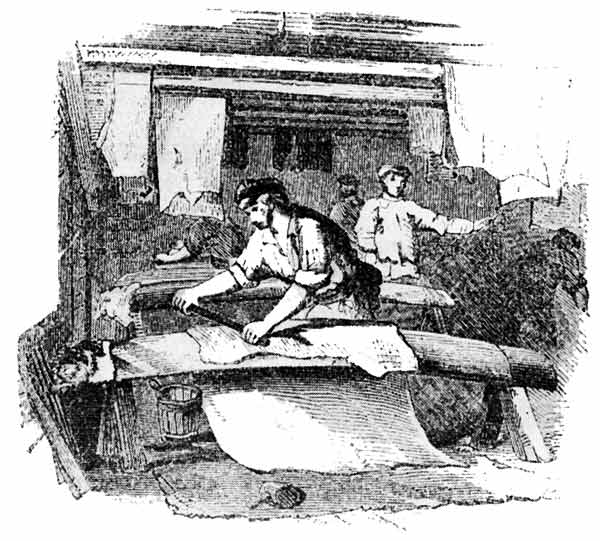
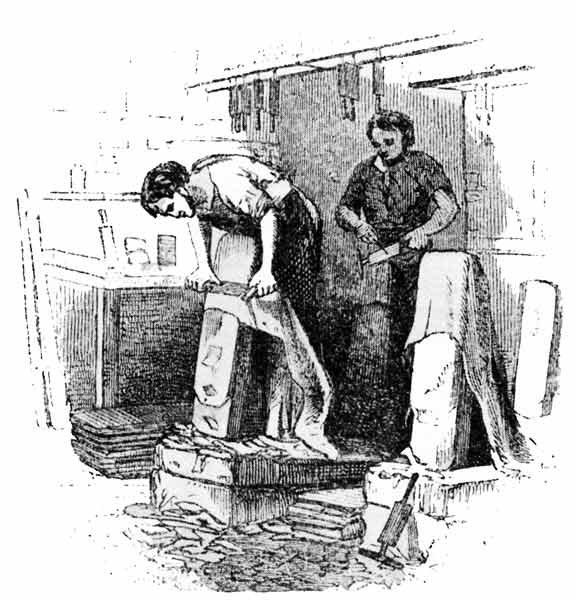
Fig. 26
PINNING SOLE BUTTS
Whatever the method used to improve or depreciate
the natural tannage, the surplus material left on the
surface is raised or brushed off, and, after the leather
has been left to drain for a few hours, it is sent to the
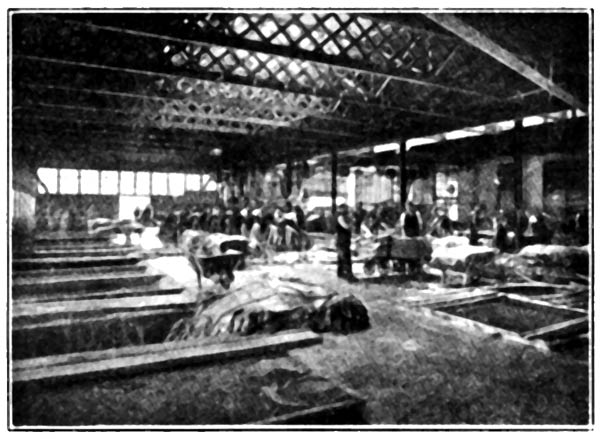
finishing department, which is usually the drying shed.
There, it is left piled up for a day or two, until it is in
the right condition for oiling. The leather must be
oiled, otherwise the grain would be harsh and brittle
when dry, and would darken in colour, especially at
the edges. Cod oil is generally used, and sometimes a
little mineral oil is added to it to prevent possible
impurities in the fish oil rising to the surface of the
leather or causing damage in other ways. A cod oil
purified by distillation would, however, be quite safe
to use, and there seems to be no reason why tanners
should use crude oils so frequently as they do, now that
a large number of oils specially prepared for the leather
trade are available. Linseed oil is also used in admixture
with cod oil, its oxidising properties hastening the
process of drying. The leather is liberally oiled with
a brush or swab on the grain side and immediately
hung up in the drying shed, where it is left until it
reaches what is technically known as a "sammed"
condition (i.e., just damp enough to exude no water
when the leather is doubled over). It is then struck out
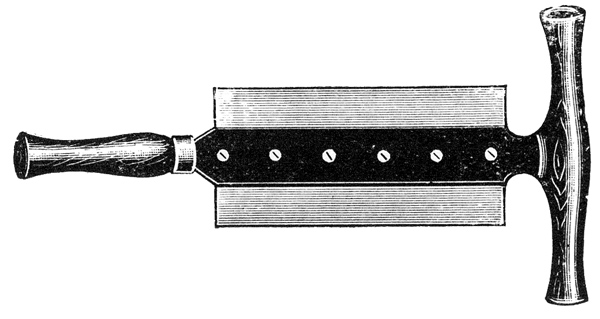
("pinned") on the grain side, either with a hand
tool (Fig. 26) or by machine. In the former case,
the leather is placed on a long wooden beam and the
pinner works from the left side, keeping two of the three
edges of his knife flat on the leather while making heavy
forward strokes. As the scum is worked out, the
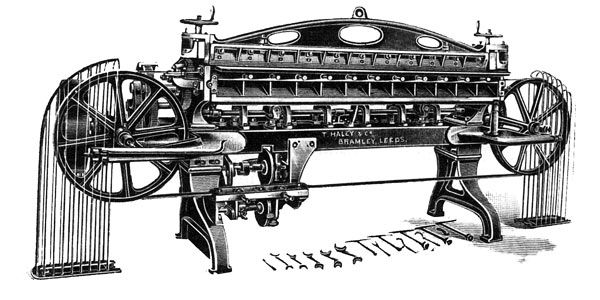
operator mops it up with a wet cloth. Machinery has
replaced hand labour in this operation in all modern
tanneries. The pressure of the tool removes scud and
dirt, varying in quantity according to the amount of
"bloom" contained in the particular tanning materials
used. The leather is then laid in pile for a few hours,
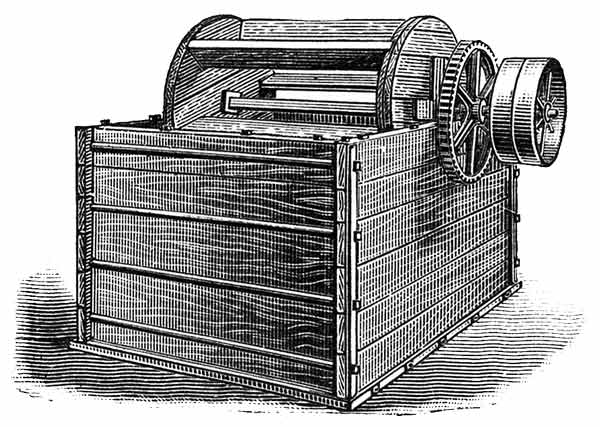
when it is in a fit condition for the first rolling, which
is known in the trade as "rolling on." This operation
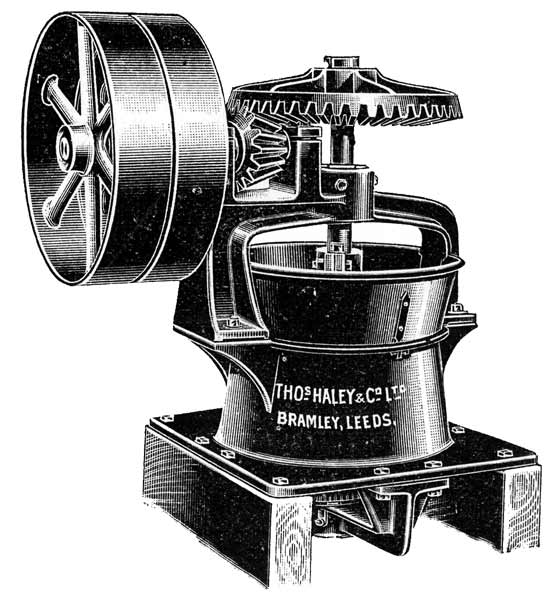
is generally done by machine (Fig. 27) nowadays, but
the old method of using a hand roller heavily weighted
with an iron box (Fig. 28) is still practised in a few yards.
After rolling, the leather is hung up again until nearly
dry, when it is taken down and sized with a weak
colouring matter, made up of annatto or tumeric, with
chalk or whitening dissolved in white vinegar (acetic
acid) and diluted. It is then rolled again ("rolling off")
and polished with a piece of flannel. Finally, it is hung
up to air off, and is then ready for the warehouse.
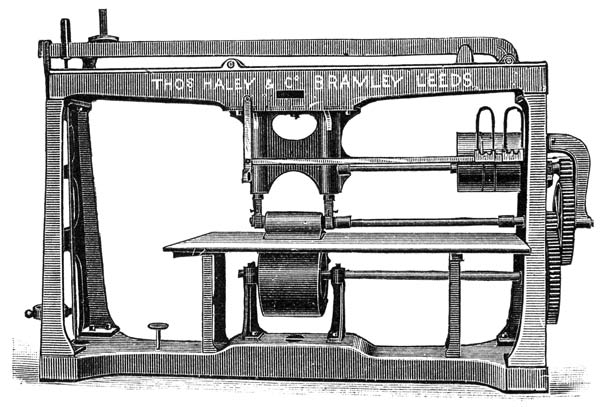
In many yards the finishing consists merely in striking
out the leather, rolling it when properly tempered,
hanging up until nearly dry, and re-rolling. An
American machine for giving the final polish to sole
leather has lately been introduced.
Instead of the rolling machine, some French tanners
use the hammering machine, which gives good results,
but is necessarily slow and frightfully noisy in action.
The steel hammer moves up and down with remarkable
rapidity, but only a small area is covered by each blow.
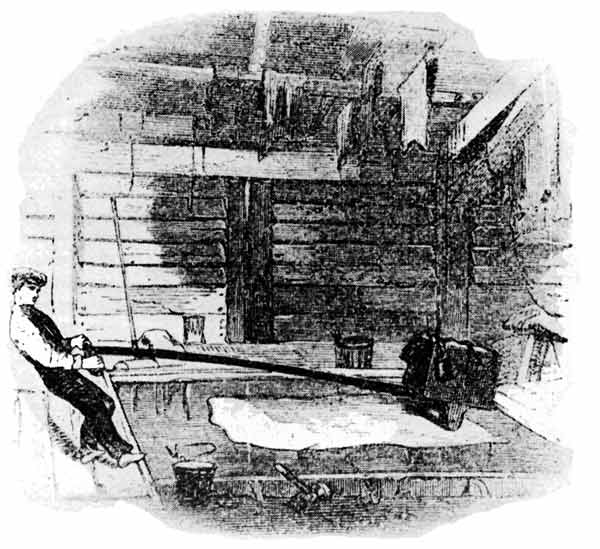
Fig. 28
OLD METHOD OF ROLLING SOLE LEATHER
The artificial drying of sole leather, or of any other
kind, is a matter that needs careful attention, for it is
obvious that great delay would occur, and a large
amount of business would be lost, if tanners relied
solely on the climatic conditions of the British Isles; in
fact, the weather is so rarely fit for drying leather that
every up-to-date tannery contains some artificial aids,
the need for which has been more pressing since a large
proportion of leather contains a surplus of tanning
matter which is liable to oxidise in contact with strong
light and air, thereby darkening the leather and making
it brittle.
Among the satisfactory drying plants are those of
Howard-Smith & Co., and the Sutcliffe Ventilating and
Drying Co., Ltd. Both work on the theory of fanning
a continuous current of hot air through the drying-room,
so that the moisture evaporating from the leather
is constantly drawn off while the apparatus is at work.
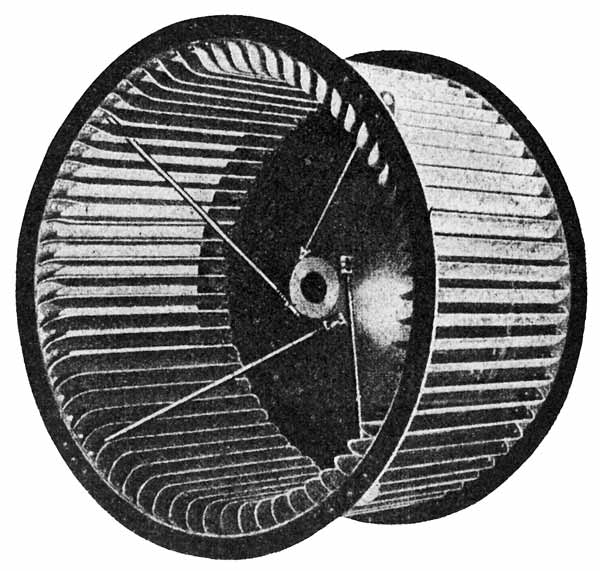
Fig. 29
FAN
(Howard-Smith system)
The Howard-Smith plant consists of a series of steel
tubes into which hot water or steam is pumped. These
pipes are enclosed in a chamber in which the air naturally
acquires great heat. A fan (Fig. 29) is fixed in one
side of this chamber (Fig. 30) and, when in motion,
drives the hot air through a wide tube which leads to
the drying chamber.
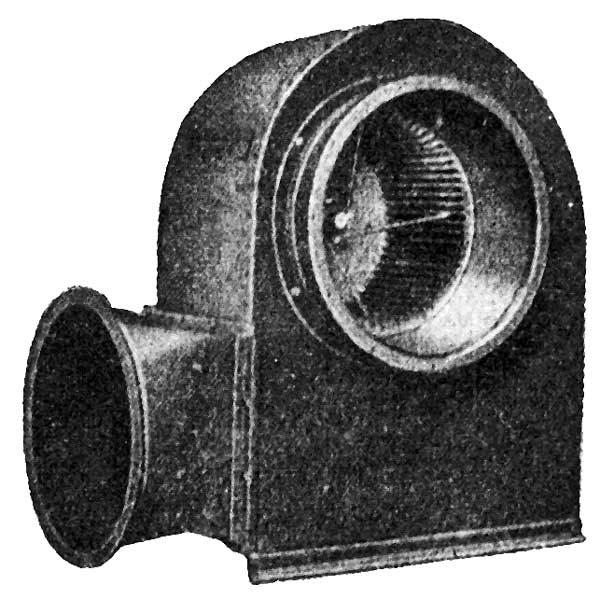
Fig. 30
FAN FIXED IN CHAMBER
(Howard-Smith system)
Figure 31 shows the Sutcliffe Fan and Heater installed
in a tannery. At least two hygrometers should be hung
up in a drying-room to
determine the amount of
moisture in the air.
The manufacture of
chrome sole leather suitable
for ordinary walking boots
is of comparatively recent
origin, although natural
chrome hides were dressed
more than twenty years ago
for tennis boot soles and
other athletic shoes. There
can be no doubt of the
superior wearing and waterproof qualities of well-dressed
chrome sole, but its high price, compared with that of
vegetable-tanned sole leather, is against its general
use.
Either the one bath or two bath tannage (described
on p. 108) may be used, but, on the whole, the one bath
method is preferred for the following reasons: (1) Its
application is easier; (2) it produces a firmer and less
elastic leather; and (3) there is practically no danger
of weakening the hide fibres. On the other hand, the
two-bath process produces a plumper leather which
can, naturally, carry more dressing and command a
correspondingly better price. In skilled hands, it is
also under better control than the one-bath process,
while it is absolutely necessary for the popular pale
bluish-grey tint of chrome leather tennis soles.
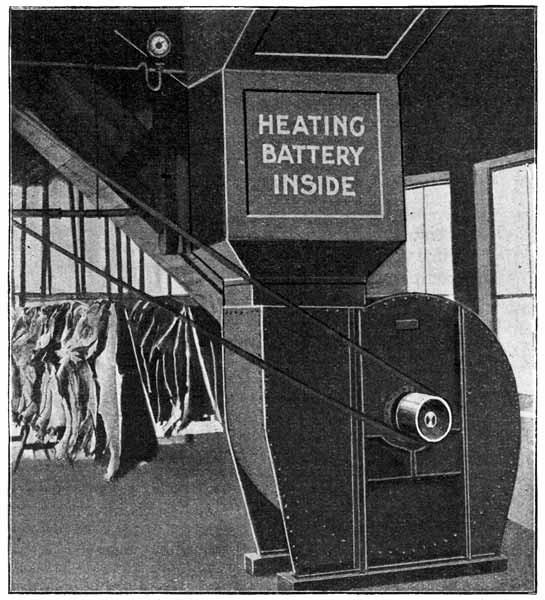
Fig. 31
SUTCLIFFE SYSTEM OF DRYING
The natural chrome sole requires very little dressing.
The chromed hides (usually rounded into butts or
bends, shoulders and bellies) are allowed to remain on
a horse two or three days after the completion of the
tannage, so that the oxide of chromium may combine
more firmly with the fibres. They are then placed in
the drum tumbler again and washed in cold water for
several hours. A constant stream is conveyed to the
drum through a rubber pipe fixed to the tap, and
escapes through small holes in the drum. The acid
salts are not thoroughly removed by this washing and
must, therefore, be neutralised with an alkali. Borax
is the best for the purpose, owing to its mild action on
leather and antiseptic properties. From 1 to 2 per cent.
borax on the weight of the leather is generally sufficient,
while, if soda be used for economical reasons, only half
the quantity is required. The drum is revolved for
about an hour; the liquor is then run off, and the
leather receives a further washing in cold water for
half an hour, when it is in a condition to receive the
dressing, which is chiefly composed of materials which
help to fill and lubricate the interstices of the fibres so
that the substance is maintained and the natural
strength of the fibres preserved. Gelatine, pure glue,
Tragasol, paraffin wax, carnauba wax, spermaceti,
Marseilles soap, are among the various ingredients
used; while the delicacy of the tint may be improved
with china clay or French chalk. Recipes vary considerably,
each manufacturer claiming to have secret
methods. Solutions are made of the ingredients, or,
where one or more of the materials are insoluble, they
are atomised in a mixing pan before use. To induce
thorough penetration, the dressing liquid may be
applied to the leather at a fairly high temperature, as
chrome leather is unaffected by heat which would destroy
the fibres of ordinary vegetable-tanned leather. Even
so, it is inadvisable to use a higher temperature than
170° F. The leather is thoroughly impregnated with
the dressing in about an hour's time, and is then piled
on a wooden horse for several hours, or overnight, to
drain and permit thorough incorporation of the dressing
with the leather. When well-drained, the grain of the
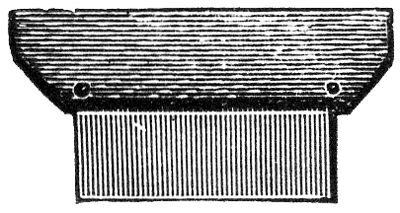
hides is smoothed by pressure with
a special tool (Fig. 32) or by machine,
the operation being known technically
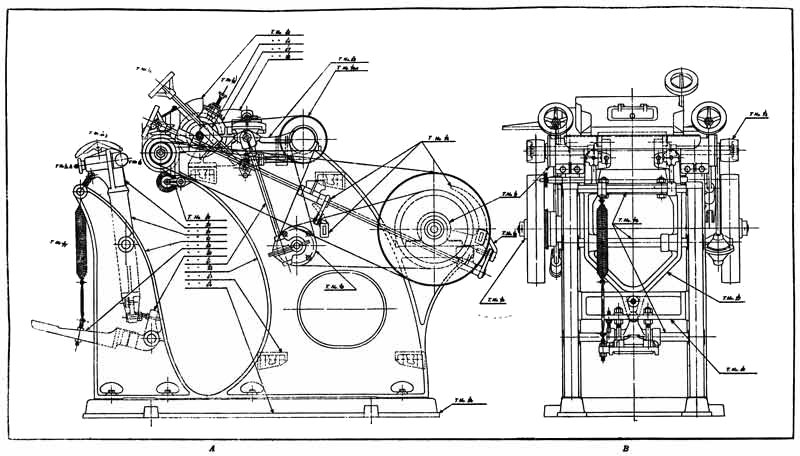
as "striking out." The machine
(Fig. 34) gives quite satisfactory
results and has replaced hand labour
in all modern works. The hides are
then "strained" (i.e., extended and nailed to wooden
frames), or they are simply hung up to dry. In the
latter case, there is a small shrinkage of the size of the
hide, but the substance is maintained. With good
straining, a satisfactory increase of surface measurement
can be obtained.
When the leather is completely dried, it may be sold
at once, but if, as is generally the case, a special "nap"
finish is required on the flesh side, the hides are placed
in damped deal sawdust until they are in the right
condition of flexibility for the next process, known as
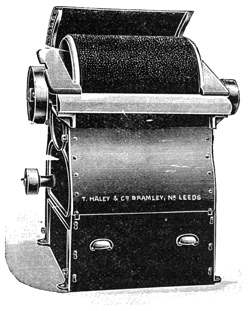
"fluffing." This is done on a rapidly revolving wheel
(Fig. 33) covered with emery powder varying in the
size of grain according to the effect desired on the
finished leather. The abrasion of the leather on the
flesh (i.e., the under side) raises a soft nap. Carborundum,
a special abrasive made in America, by the fusion
of sand, coke, and salt at a very high temperature, has
to some extent supplanted the use of emery. As a
final finish, the flesh side may be rubbed over with
chalk or china clay to give it a clear saleable appearance.
The chrome sole leather used for ordinary boots is
quite a different product, and it is only in the last two
or three years that it has been used to any extent.
The "Dri-ped" is the best known make of this leather.
The tannage is effected by the one or two-bath methods
already described. The processes preparatory to
chroming are very
important, as it is
essential to get the
maximum yield of
pelt. The hides are,
therefore, often
treated with sulphide
of sodium, which
loosens the hair in
twenty-four hours or
less. They are then
placed in fairly strong
limes for two or three
days to swell the
fibres and saponify the
grease. After being
washed in cold water,
the hides are treated
with a weak solution
of lactic, boracic, or butyric acid, or butyrate of
ammonia, to remove all trace of lime, when they are
ready to be chrome-tanned. After chroming them,
neutralisation of the acid chrome salts is effected with
borax, and the leather is ready for dressing. The
principal objects of this process are to make the leather
firm and waterproof, and to remedy its tendency to
slip easily on wet pavements. The last-named is the
greatest difficulty, and there are only about two or
three firms who have really surmounted it. Each
manufacturer keeps his recipe secret, but the ingredients
that go to make the various dressings are drawn from
the following: Stearines, mineral oil, Tragasol, resin,
carnauba wax, beeswax, paraffin wax, glue. Resin, or
asphalt, or both, may be used to prevent the leather
slipping in contact with a wet pavement. One patent
describes a method of dressing chrome sole leather with
a mixture of asphalt, resin, and paraffin wax.
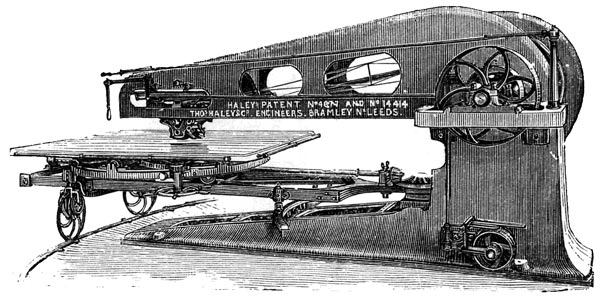
Fig. 34
STRIKING-OUT AND SCOURING MACHINE
The waterproofing ingredients are preferably applied
to the leather in the tumbler at a high temperature,
say, 160-170° F. After running the drum for about
three-quarters of an hour, the leather is impregnated
with the mixture, and is then horsed up for at least
twenty-four hours to allow complete incorporation of
the fatty ingredients with the fibres of the leather.
A suitable waterproof dressing and filling increases the
strength of the leather.
The finishing of the leather is simple. The butts or
bends are smoothed and stretched out by machine
(Fig. 34), oiled on the grain, nailed or extended with
special metal grips on square wooden frames, and dried.
In some cases, they are hung up until nearly dry, rolled
by machine instead of being put on boards and aired
off in a drying stove.
A patented method of making waterproof chrome sole
leather to prevent it slipping and losing its shape in
wear consists in first treating the leather in a solution of
glue, gelatine, agar-agar, or other colloidal substance,
with the addition of formaldehyde, and then submitting
it to strong pressure under the influence of a high
temperature, in order to fix the colloidal matters. The
pressure is made between heated plates. The leather
is afterwards impregnated with a mixture of wool-grease,
pitch, asphalt, resin, wax, gutta-percha, etc. A
recipe given in the specification consists of wool grease
(60 parts), asphalt (10 parts), soft pitch (25 parts)
and gutta-percha (5 parts). The mass is fused and
kept at 90° C. The hides are placed flat in this mixture,
which they quickly absorb.
If the British Government should ever introduce a
Bill to stop the adulteration of leather, it may be found
somewhat difficult to deal with chrome sole, which
must have some filling material to make its use practicable.
No exception can be taken to the dressing of
leather with materials that make it waterproof and
increase its strength; in fact, much more will be done
in this direction than has ever been attempted in the
past, as waterproof sole leather is a necessity in Great
Britain. Any measure to check the adulteration of
leather must, therefore, clearly define the chemicals
which are known to be harmful in leather and which
may not be used. This has not been overlooked by
the Australian Government, which has forbidden the
use of barium salts in leather, and likewise the importation
of leather boots or any goods made of leather
containing this chemical. Such goods sent to Australia
are liable to confiscation, and it is reported that a few
consignments of boots have already been condemned.
Leather, either exported or imported, must not
contain more than 3 per cent. of glucose unless the
percentage is marked on each consignment, in which
case, it is presumed, a tanner may use as much of the
adulterant as he likes, although the fact that he has to
disclose this practice acts as a deterrent in most cases.
Unfortunately, the Australian Act leaves an important
loophole, since the use of Epsom salts, which can be
made to increase the weight of leather more than any
other chemical, is not prohibited. In any case, none of
these hygroscopic materials is of any use to chrome
sole, for they would attract moisture which it is desirable
to resist.
As its name implies, vache sole leather is a Continental
product, being made chiefly in France, Belgium, and
Germany. The raw material consists of light and
medium cow hides. The details of working are somewhat
similar to those used in tanning English sole
leather, the main difference being that the hides are
suspended in the lime liquors instead of throwing them
in flat. The system of tannage is not so varied as the
English, since the materials used generally consist of
oak and pine barks, myrobalans, quebracho and oak
extracts; and the finishing materials are of quite
another character. The Continental tanners generally
use the Réaumur thermometer, while the Beaumé
hydrometer is used to determine the density of the tan
liquors in place of the English barkometer (Fig. 24).
One degree Beaumé is equal to 6.9° barkometer.
Vache leather is more pliable than English sole
leather, but the addition of valonia extract towards the
end of the tanning process would greatly increase its
firmness.
The finish is applied to the flesh side of the leather,
and a typical recipe consists of a size such as Irish moss
or Tragasol (1 part), flour (20 parts), china clay (20 parts),
and pure gambier (2 parts) in 200 parts of water. The
size is dissolved and cooled, and the other ingredients
are then added.
These leathers are rarely made by one firm; usually,
strap butts and most kinds of belting leathers are
dressed by curriers, whose trade is quite distinct from
that of currying shoe leather. The tanning and currying
of harness and saddlery leathers is another special
branch. Besides these three important trades, there is
the dressing of hydraulic, mechanical, and other industrial
leathers, which likewise form special sections of
the heavy leather industry.
Belting leather is an important item in the trade, and,
as a good proportion is made from the finest hides, this
class of leather is among the most expensive made.
At present, there is much controversy in the trade as
to whether the vegetable-tanned or the chrome-tanned
article is the more economical in use. Briefly, chrome
belting is superior in works where there is much steam
or mineral acids, as it is not affected by these conditions
to the same extent as bark-tanned belting. Its tensile
strength is also greater, but against these advantages
must be set its higher cost and tendency to stretch
unduly in comparison with the vegetable-tanned
product. It can be safely said, however, that the use
of chrome belting is on the increase, although its production
is not nearly on such a big scale as that of the old
type of belting.
The tannage of belting leather is similar to that of
sole leather, except that there is no necessity to continue
the process, after the tannin has struck through, with
the object of increasing its firmness and weight. Attention
must also be paid to the class of tanning materials
used, especially for belting of the best quality, as it
must have great tensile strength and stand a severe
strain in the dynamometric test. Tannins that rapidly
oxidise in contact with light and air have, therefore,
to be avoided. The oak bark tannage, with a little
chestnut and oakwood extracts to finish the process,
is a good method of imparting to the hide the right
degree of firmness and flexibility.
As in the case of sole leather, belting may be artificially
weighted during the tannage, although it is usually
done in the currying process, if at all. There can be
no doubt that a quantity of adulterated belting leather
is made, and will continue to be made while the practice
of selling by weight is in vogue. As a rule, sophisticated
belting leather has a much weaker tensile strength than
the pure product and is of relatively poor value, since
the reduction of price is usually a matter of only a few
pence. If users of belting bought on the principle of
value instead of price, they would never buy adulterated
leather.
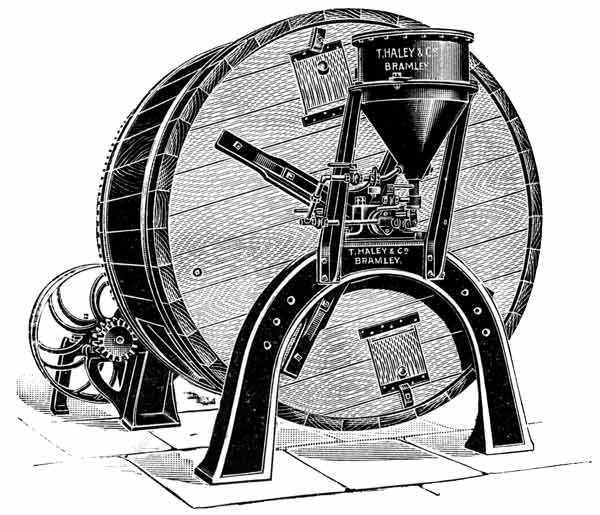
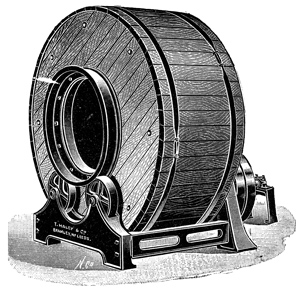
Fig. 35
LEATHER-STUFFING DRUM
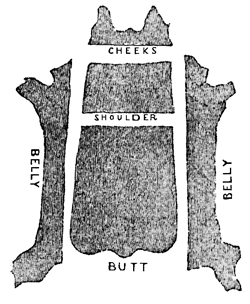
In tanning hides for belting, the shoulders and
bellies are cut off and usually dressed for sole or harness
leather, leaving the butt, the prime part of the hide,
4-1/2 ft. in length (Fig. 23). The tanned butt is first
shaved to level the substance, then washed in a solution
of borax, and sumached in the drum. After smoothing
the leather in the striking-out machine, it is partially
dried ("sammed") and then rubbed on both sides
with a dubbin of cod oil and tallow. In this condition
the butts are left piled up for a few days, so that the
dubbin penetrates the leather, which is then extended
with the sleeker (Fig. 32) to make it smooth and to
remove surplus grease, which is sold to soap-makers
under the currier's name of "moisings." The leather
is finally dried, rolled (optional), stretched by machine,
and cut up in the width of belting required. Instead
of "hand-stuffing" the leather with cod oil and tallow,
which is still the best method, a large quantity of butts
are now "drum-stuffed," the object being to make use
of stearines, which are harder and heavier greases than
tallow. The type of drum shown in Figure 35, in which
the grease is incorporated with the leather by means
of live steam, gives satisfactory results, although hot
air apparatus is now replacing the steam injector.
A patent has lately been granted to an American
inventor for the production of a strong and cheap
belting. Flesh splits of hides are simply stuck together
with a collodion or nitrocellulose solution. Any number
of layers may be used, according to the substance
required, the only essential quality being that the
leather should be free from grease. The adhesive
property of nitrocellulose solutions is probably stronger
than that of any other material, but, unfortunately, the
tough film they form on drying does not grip a greasy
surface. Before the solution used to join the pieces of
leather together is dry, the leather is rolled under heavy
pressure, and, when thoroughly dried, can be cut up
for belting.
The dressing of harness leather is similar to the manual
process of making belting, with the exception that the
butts or bends (half butts) are stained either black or
a pale straw colour, the latter being known to the
trade as the "London colour." Annatto is often used to
get this colour. The bright, greasy finish on harness
leather is obtained by rubbing buck tallow over the
grain and polishing with a glass sleeker or a piece of
flannel. The operation is sometimes done by machine,
in which the working cylinder is covered with pieces of
cotton rag.
Saddlery leathers are dressed on similar lines, but the
finish is not so greasy as harness. Pig skins make the
best and toughest leather for this purpose. They are
dressed in a similar manner to harness hides, but special
attention has to be given to pig skins to get rid of the
large quantity of natural grease they contain.
Whereas the number of different kinds of boot upper
leathers in use less than three decades ago was limited
to five or six (waxed calf, calf kid, French kid, mock kid,
levant, coloured calf) it is now almost legion. Although
the variety is almost bewildering, however, the popular
demand is confined to about half-a-dozen sorts, which
include real and imitation box calf, box hide, glacé or
glazed kid, patent leather, willow calf, dull-finished
chrome leather, and waxed kip butts and waxed splits
for workmen's boots.
Box leathers and glazed kid are the most popular of
all. Generally speaking, glazed kid is more suitable for
wear in the summer and autumn; while box leather,
being thicker and stronger, is preferable for the winter.
Imitation willow calf (i.e., calf skin tanned in vegetable
and chrome liquors, either separately or combined) is
very suitable for easy-wearing boots, but is not so durable
and resistant to water as the pure chrome-tanned
article.
The tannage of box and willow leathers may be
effected by the one or two-bath process already described
(p. 108). Before the tannage, it is advisable to pickle
the hides or skins in a solution of alum and salt, with
the object of preventing contraction of the tissues of
the hide, and providing a mordant for the more rapid
absorption and fixation of the chrome salts. The
tannage completed, the acid salts in the leathers are
neutralised with borax, and after the leather has been
washed in warm water it is ready for dyeing. The
dyeing of box calf is generally done in the drum tumbler,
but there are several other methods. One system used
on the Continent is to dip the skins, a pair at a time
and placed flesh to flesh, in a very strong dye liquor.
This method is slow, and not in accordance with modern
ideas; used for producing browns and fancy shades,
it is very difficult to avoid irregularity of colour where
large parcels are manipulated. Another method is vat
dyeing, the process being carried out in a wooden vat
(Fig. 25) and the dye liquor circulated by means of a
paddle. The one advantage of this system is that the
leather can be easily examined during the process. A
useful method of dyeing is carried out by brushing the
colouring materials on the grain side of the leather.
This process is economical, and it has the further
advantage that the finished leather can be used for
unlined boots and other purposes where an undyed
flesh is necessary.
The original "box" leather was dyed a dark-blue
shade in the drum before it was shaved, and, as the dye
does not penetrate very far into chrome leather, unless
a strong mordant of tannin be previously used, the
subsequent shaving left the flesh side of the leather
a very pale-bluish tint.
The process of dyeing is least troublesome and most
effective when done in the drum tumbler. The leather
is run in warm water until the temperature reaches
140°-150° F (60°-66° C.) and the dyeing materials are
added gradually in a box at the side of the drum whence
it passes through the axle or journal into the tumbler.
Although chrome leather is not materially affected by
boiling water in contradistinction to vegetable-tanned
leather, which cannot be treated with water above 60° C.
without injury, it is inadvisable to dye it in boiling
solutions, the above-mentioned temperature being the
most satisfactory. There are two methods of dyeing
blacks in the leather trade: (1) the logwood-ammonia,
and (2) the aniline black. The former is the cheaper
of the two and quite satisfactory, although many dyers
seem to prefer the aniline process. The latter certainly
gives a deeper black, but it is not at all necessary to
make the flesh side of box calf black, and many buyers
prefer the back blue, although, of course, the grain side
of the leather must be finished a jet black. The crude
logwood is generally subjected to a process of fermentation
or "ageing." The new wood has to be placed
on stone or cemented flooring in a warm room and
frequently turned over until fermentation has ceased,
which usually takes about a week. It is then cut into
small chips by machinery and packed in bags. This is
the form in which it always used to enter the tannery,
but it is now generally prepared in paste or crystal
extract by makers of tanning and dye-wood extracts, a
business which grows in importance every year. The
colouring matter of logwood is haematoxylin, which is
converted into haematin by oxidation; hence, the
extract is often referred to as haematin crystals. The
paste may be used where it is desirable to increase the
substance of the leather, but most dyers prefer the
crystals, which are easily dissolved in hot water. One
lb. of crystals, to which is added just enough ammonia to
change the brown colour to violet blue, suffices for each
100 lb. of leather dyed. The colouring matter is
absorbed by the time the drum has been running half
an hour, leaving clear water behind. The next process
is known technically as "fat-liquoring," which, as its
name implies, consists in lubricating the fibres of the
leather with fatty or oily matters. This is a very
important process, for, when suitable ingredients are
used, the pliability, strength, and waterproof quality of
the leather are greatly increased. The making of
special fat-liquors for different kinds of leather has
become quite an important business, and most makes
can be depended upon for the specified purposes. It is
a debatable point as to whether fat-liquoring should
precede or follow dyeing. Generally speaking, it is
better to adopt the latter course, as the fatty ingredients
help to fix the colouring matter on the fibres of the
leather. The dye is also less liable to fade when fat
liquoring follows the colouring.
The number of materials that may be used for the
process of fat-liquoring is almost legion, but the principal
are soaps, oils, egg-yolk, tallow, flour, Tragasol, Irish
moss, china clay, and starch. Unless the special
preparations made by leather trade chemical firms be
used, much care has to be exercised in selecting the
most suitable ingredients for each class of leather. For
example, the mixture that would give good results on
vegetable-tanned leather might be quite unsuitable for
chrome leather. Then, again, the selection of material
is based on the style of finish required, a dull finish
necessitating heavy fats and greases which would be
quite unsuitable for bright leathers, and particularly
for those of the chrome-tannage. Among the hundreds
of recipes that have been published from time to time,
tallow has only found a place in one or two mixtures,
yet it is one of the finest materials for strengthening
and lubricating the fibres of leather. If its splendid
properties were fully known, it would be very largely
used for fat-liquoring purposes. Of course, it is well
known to the currying trade, having for several centuries
formed the basis, together with cod oil, of the dubbin
used in stuffing waxed leather and belting butts.
The following is a useful recipe for a fat-liquor for
box calf: 2 lb. Marseilles soap and 3 lb. neatsfoot oil
for every 100 lb. of leather. The soap is cut into small
pieces and dissolved in hot water, and the oil is added
slowly and thoroughly mixed by stirring vigorously.
Where possible, emulsification should be done in a
machine, in order to atomise the ingredients. The
finer they can be brought into a state of division, the
better they will be absorbed by the leather. Other
suitable fat-liquors for box leathers are the following:
(1) Turkey red oil, 2 per cent. of weight of leather and
neutral soap 1 per cent.: (2) neatsfoot oil, 2 lb.; tallow,
1 lb.; and Tragasol, 1 lb.: (3) cod oil, 2 lbs.; Marseilles
soap, 1 lb.: (4) neatsfoot oil, 2 lbs.; egg-yolk,
1/2 lb., or six fresh yolks. The process is completed in
20-30 minutes.
In the case of fancy colours or browns, the leather
should generally be well-drained and warmed up again
in the drum in hot water (170° F.) before fat-liquoring,
but the precaution is unnecessary for black leathers.
After the fat-liquoring process, the leather is removed
from the drum, and piled up on the horse to drain, and
left for several hours or overnight, to allow it to assimilate
the fatty ingredients. It is then submitted to an
operation known as sleeking or striking out, with the
object of removing surplus water and so facilitating
drying, and making the grain side smooth. Machinery
is now almost universally employed, especially for
chrome leather. A good type of striking out machine
is shown in Figure 34.
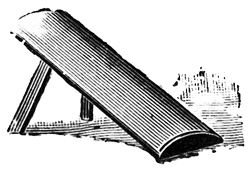
If done by hand, the skins are placed on a sloping
glass or slate table, with the flesh side uppermost, which
is then stretched out by strong pressure with a tool
known as a sleeker, the strokes being made downward
in the direction of the hair growth. The flesh side done,
the whole skin is turned over and the grain side is
similarly treated. Sometimes only the flesh side is
struck out, especially if the grain is soft and tender.
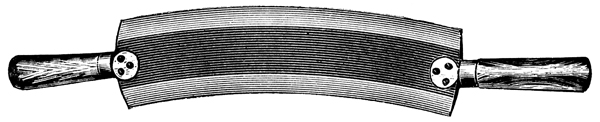
The sleeker consists of an iron, steel, or copper blade,
about 6 in. square, fitted in a wood handle (Fig. 32).
The skins are hung up in the drying-room immediately
they are extended and smoothed by sleeking, and are
then either allowed to dry completely, or, as is generally
the case with best leather, they are hung up until a
great deal of the moisture is evaporated and the skins
are left in a slightly moist, or, as it is generally termed,
"sammed" condition. The skins are then taken down,
damped in dry parts, folded over, laid in piles to equalise
the moisture, and finally smoothed out and stretched
again by hand or machine. This second operation after
the dyeing is known as "setting."
Chrome-tanned skins are usually stretched and nailed
on square boards after setting, as, owing to their elasticity,
they are liable to shrink considerably in drying.
The superficial area can be increased by fully extending
the skins. This operation is technically described as
"straining." It may be stated here that vegetable-tanned
leathers are not generally "strained" on boards,
as such leather is better in quality and substance when
hung up and dried. Leather of combined tannage
(i.e., tanned with vegetable and chrome products) is,
however, frequently "strained," as the astringent
property of chrome would otherwise cause contraction
of the fibres.
When dried on the boards the leather is somewhat
stiff, and has, therefore, to be softened before any
finishing ingredients are applied. Chrome leather is
softened by placing it for a few days in damp sawdust,
which, for brown or fancy coloured leather, must be of
deal or white pine, and, therefore, free from objectionable
colouring matter; but, for black leather, the sawdust
of any wood is suitable. The skins must be systematically
piled one above the other, and a little damped
sawdust scattered over each skin.
When properly "seasoned," the skins are brushed
free of the sawdust and "staked," either by hand or
machine, usually by the latter means. The staking
knife may be fixed in a wood crutch (arm stake), or
fixed upright in a vertical wooden stand (knee stake).
In the former case, the skins to be staked must be
secured in a horizontal wooden groove fixed to two
uprights, the workman then pressing heavily in a
downward direction with the staking knife, of which
the crutch is held under the armpit. In using the
upright stake, the leather is moved to and fro over the
edge of the fixed knife. Both of these manual operations
are arduous and somewhat dangerous, and should
be displaced by machinery wherever possible (Fig. 36).
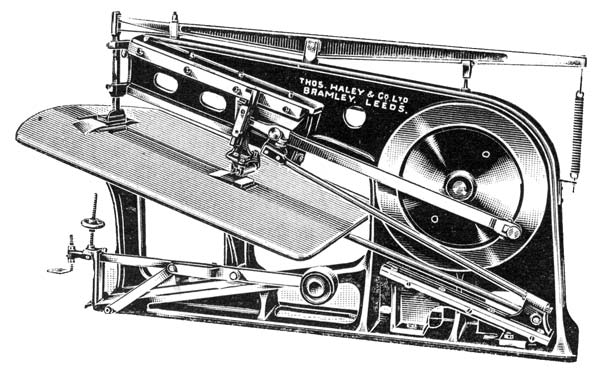
Fig. 36
STAKING AND GLAZING MACHINE
The thoroughly softened leather is then dried, mordanted
with a solution of logwood, or haematin crystals,
blacked with levant ink, a specially prepared black
dye, or with a suitable aniline dye, and dried again.
It is finally seasoned with a glutinous or albuminous
mixture (blood albumen, milk, and a little aniline black
dye make a good mixture), dried, glazed, seasoned a
second time, and reglazed. A light coating of mineral
oil turns the finish into a jet black, and the leather is
ready for the warehouse. There are several types of
glazing machines, but the "grasshopper" (so called
owing to its action) is the most popular for box calf.
This machine is the same as shown in Figure 36, except
that the working tool is replaced with a smooth glass
or agate roller.
The term "box" applied to this leather was invented
by a prominent American tanner, and had he registered
the name and patented his process he would have reaped
a very rich harvest, for the leather is used in enormous
quantities throughout the world. As it was, the
American firm tried to obtain an injunction against
English firms manufacturing the leather, but had to
withdraw their claim, as they were not the inventors
of chrome leather, which was made in Scotland before
it was introduced to the States. Moreover, the word
"box," as applied to leather, was not registered in the
United Kingdom.
Willow calf is exactly the same kind of leather as
box calf, except that it is dyed brown instead of black.
The seasoning mixture naturally differs and may consist
of a mixture of egg albumen, milk, and a little of
the same, or similar, dye solution as that used in the
dyeing process. In order to get clear colouring, the
dyes should be well dissolved and strained through fine
muslin.
This kind of leather is well known to the general public
under the name of wash-leather, but it is, perhaps, not
so widely known that there is practically no real chamois
leather available, since the species of animal bearing
this name is almost extinct. Nowadays, "chamois,"
or "shamoy" is made from the flesh split of sheep
skin, and the method whereby the leather is produced
is described as the oil tannage. The chamois leather
dresser may also do the preliminary work of fellmongering,
but more often he receives the pelts, or
"fells," from the fellmonger. Although the pelts have
been in a lime liquor known as the fellmonger's "gathering
limes," the process of liming has to be continued and
carefully regulated. Too much liming makes the pelts
loose, owing to the development of bacteria. This
effect would cause the finished leather to be soft and
spongy. On the other hand, under-liming fails to
remove sufficient of the cement substance which binds
the fibres of the pelts; consequently, the leather
produced from these pelts is thin and somewhat gristly.
After being limed, the skins are "cobbed" (i.e., the
bits of wool or hair left on by the fellmonger are removed)
and the pelts are then fleshed by machinery. The
next operation, splitting, is very important and requires
skilful attention to get good results. The Reeder
machine is largely in use, but the band-knife machine is
also suitable. The top half of the sheep skin (i.e., the
grain side) is utilised for the manufacture of skivers,
while the under portion, or flesh side, technically
called "lining," serves as the raw material for chamois
leather. The best linings are generally sorted out for
making into parchment, which, of course, commands
a much higher price than chamois. Linings for chamois
are then submitted to the operation of either re-splitting
or frizing, the object being to remove the loose tissue
lying between the grain and flesh. The pelts are
re-split in the case of cheap chamois, but frized if
intended for choice finish. Frizing is an operation
peculiar to the making of chamois and glove leather.
It is done with a very sharp knife, similar to the fleshing
knife, and on a more upright beam than that used by
tanners. The work requires great skill, frizers being
among the best paid workers in the trade. Frizing
done, the linings are freed from lime by washing them
in the drum tumbler, or paddle-vat, through which
cold water is allowed to flow continuously for two or
three hours. When lamb skins, which are too thin to
split, are made into chamois leather, the grain is removed
by frizing.
A quick and effective method of deliming is to treat
the skins in a weak solution of lactic acid. Some
dressers use a drench of pea-flour or bran. The mild
acids produced by the fermentation of these materials
not only neutralise the lime but also reduce the gristly
nature of the skins to a soft, supple condition. The bran
infusion is slightly warmed to hasten the process of
fermentation, but the temperature must not exceed
100° F. (32° C.). The linings are then rinsed in cold
water and sent to the stocking machines, in which
they are kneaded until they become quite soft. Either
the faller-stocks or the mechanical pushers (Fig. 14)
may be used, the latter being the more modern machine.
The operation may require from four to ten hours, the
completion being determined by the condition of the
skins. "Samming" follows stocking, and for this
purpose the linings are hung up in the drying shed until
thoroughly dripped, but not dried. In this slightly
damp condition they are then prepared for the next
process of oiling, which is the most important part of
chamois-dressing, as it converts the perishable raw
linings into leather. In the United Kingdom, cod oil
(generally Newfoundland) is used exclusively, and
gives best results. Whale and shark liver, or menhaden
oils are often used abroad.
The linings are placed in a tub or vat, a few at a time,
and oil is poured over each layer until a sufficient
number has been treated to fill the stocking machine.
The stocks are run for half-an-hour, or until the oil has
penetrated the linings, when they are put back into the
vat, where they remain for about an hour. They are
then re-stocked, taken into the shed to samm, re-oiled
in the vat, and stocked again. These processes are
repeated until the skins are thoroughly impregnated
with the oil, when they are dried in a warm stove.
The skins are not yet converted into leather, which only
occurs in oil-dressing, after the oxidation of the oil.
This is effected by spontaneous heat, the dry oiled skins
being heaped in boxes and covered. Strict attention
has to be paid to avoid over-heating the skins, which
are turned over and changed at intervals. When the
leather ceases to heat, the process is completed. It is
then dipped into hot water and mechanically pressed,
to remove surplus or uncombined oil, which is collected
and sold under the name of "sod oil." The leather is
afterwards drummed in warm water and finely cleansed
in an alkaline solution, potash, soda, or borax, chiefly
the first named, being used for this purpose. They are
then rinsed in water, dried, damped, and softened by
staking. At this stage, the best skins are sorted out
for the glove makers. The others are finished for
wash-leather by re-staking, paring with the moon-knife,
and smoothing both sides of the skin with a scurfer,
or fine pumice-stone. In the warehouse, they are
damped, stretched out, piled up, and kept fully extended
by placing heavy weights near the edges of each pile
of skins.
Progress in the art of making leather for gloves has
been rapid during the last few years; but further
important developments are expected, particularly in
the process of tanning. Practically the only method
that has been used for many decades for converting
kid, lamb, and sheep skins into gloving leather is that
known technically as "tawing," which consists of
treating skins with alum, salt, egg-yolk, flour, and a
vegetable oil. These substances change skins into
extremely supple and "stretchy" leather, but when
this is made into gloves it is far from ideal in wear,
because it fails to keep the hands warm in cold, wet
weather, it is easily soiled and cannot be cleaned
without great expense, and it is not very strong in
texture. Combination tannages have lately been produced,
however, which remove the defects of alumed
leather. By means of a light chrome tannage after
tawing, the leather is strengthened and made more
resistant to water, and can be cleaned with a damp rag
or sponge. By tanning skins with the formaldehyde
process, or with Neradol, the artificial tannin, for making
into suède leather, the finished article is not only washable
but also resists the action of alkalies and soap.
The adaptation of combined tannages in the manufacture
of gloving leathers has only lately been developed,
and further improvements will doubtless be effected
before long.
Lamb, kid, goat, and sheep skins constitute the raw
material for gloving leathers, although deer and antelope
skins are also used to a small extent. Real kid skins
are the best wearing dress gloves, but the great majority
of so-called "kid" gloves are made of lamb skins. The
raw kid and lamb skins are chiefly of European, Arabian,
and Indian origin. Sheep skins from the Cape provide
the raw material for a large number of men's gloves,
and leather of very good quality can be produced from
the best grades. Most of the skins are preserved by
drying, or by salting and drying, although some kid
skins are wet-salted and packed in barrels for export.
It would save leather-dressers a great deal of trouble
if they could always get wet-salted skins; but the
object of drying them is to reduce the weight and
lower the cost of freight. Soaking is done by methods
already described (p. 65). Loose flesh and pieces of
fat are cut off in order to facilitate the action of the
depilitant, of which the best for glove leather is undoubtedly
a paste of lime and red arsenic. Seven or eight
parts of lime to one of arsenic is a satisfactory proportion,
the quantities to be mixed depending on the number of
skins to be treated, as a fresh mixture should be made
for each lot, or "pack" as the tanner terms it. The
lime should be well broken up, or, better still, pure
powdered lime should be used and the red arsenic well
mixed with it; a little water is then added to slake the
lime gradually, and the mixture is stirred to promote
chemical reaction. The compound is further diluted
with water until it has the right consistency and the
colour has changed. The reaction generates great heat,
and the "paint" should, therefore, not be used at once.
The flesh side is mopped with the paint and the skins
are folded flesh to flesh. After a few hours, or as soon
as the hair or wool is loosened, the skins are dehaired or
dewoolled. The hair or wool is not allowed to come
into contact with the depilitant, otherwise it would be
damaged. In large yards, the white hair is separated
from the coloured, as it is worth nearly twice as much.
Wool is sorted into different qualities, of which the
number may vary from four to eight, or even nine,
according to the class of skins treated. The pelts are
then thoroughly washed and placed in lime liquors,
where they remain for one or two weeks, being hauled
and set in the usual manner. Fleshing and piecing or
trimming are the next operations, and then follows the
very important process of puering, which, in the case of
glove leather, must be thoroughly done so as to reduce
the pelts to a very soft and flaccid condition. Success
in the making of glove leather depends largely on the
"puering" process.
In most of the English tanneries a decoction of dog
manure is used, at a temperature not exceeding 90° F.,
but on the Continent the artificial puer, oropon, is
preferred. It is much safer to use and more uniform in
its action than excrement, which develops bacteria
rapidly in contact with gelatinous pelts, and could
ultimately destroy them entirely. After puering them,
the pelts are well washed and submitted to the process
of drenching, which consists in putting the skins into a
warm infusion of bran or pea-flour and leaving them
covered until the following morning. The slightly
acid fermentation causes the pelts to rise to the top of
the vat. They are pushed into the liquor again with a
pole and stirred round. This is repeated three or four
times to prevent damage to the grain. The process is
often done in the paddle-vat (Fig. 25), in which the
bran liquor is circulated for several hours before the
pelts are allowed to remain quiescent. Drenching
thoroughly purges the pelts of the last traces of lime,
and puts them in suitable condition for being made
into leather. The pelts are then rinsed in tepid water
and "scudded" on the grain with a slate or vulcanite
tool, shaped somewhat like a dehairing knife. The
scud removed consists of dirt, dissolved lime
salts, short hairs, and pigment. Machines are rapidly
replacing manual labour for this operation.
The alum tannage, known technically as "tawing,"
is largely used for kid and lamb gloves. The tawing
mixture is composed of alum, salt, egg-yolk, and wheaten
flour. The proportions used vary considerably in
different tanneries, but the following is a typical recipe:
4 lb. alum, 2 lb. salt, 1 lb. salted egg-yolk, or the yolks
of twenty fresh eggs, and 5 lb. flour for 100 lb. of pelts.
The flour is made into a paste, the egg yolk is diluted in
warm water and mixed with the flour, the salt and alum
are dissolved and added, and the mixture thoroughly
stirred. A suitable quantity of water (about 2 gals.
per 100 lb. pelts) is then placed in the drum tumbler,
the tawing mixture is added, and the drum revolved
for a few minutes before putting the pelts in. The
process is completed in two or three hours in the case
of thin skins. It is a good plan, however, to leave them
at rest in the drum for a day, after which they are piled
up overnight to allow further combination of the tawing
materials with the fibres of the pelts. The leather is
then dried out completely, damped in clean sawdust,
or by sprinkling with water, levelled by shaving if
necessary, staked over an upright knife fixed in a wooden
stand or by machine, and dried in a hot stove. In this
condition, or in the "crust," as dressers term it, the
leather is allowed to remain several weeks to "age,"
a most essential process for the production of soft, and
supple glove leather.
Dressing and dyeing are begun as soon as the leather
is satisfactorily aged. The skins are uniformly soaked
in warm water, dyed, and re-dressed with egg yolk
("re-egged"), to which a small quantity of olive oil,
or a sulphonated oil, is added. Some dressers prefer
to give the second tawing mixture before dyeing, but
the advantage of dressing the leather after dyeing is
that the colour is securely fixed. In "re-egging,"
many dressers use a similar mixture to the first dressing.
The dyeing process is of great importance, since the
colour must be fast. The leather is dyed either in the
drum or on a convex table. In the former case, the
leather is naturally coloured both sides, while, in the
latter, it is stained with a brush on the grain side only.
Staining is the more difficult method. Kid glove
leather may be dyed with aniline colours, or, as more
generally practised, with natural dye-woods as a base
and aniline dye for top-colouring. The great advantages
of the latter method are economy in dye-stuffs
and increased depth of colour. The skins are first
prepared for dyeing by brushing with, or drumming
them in, an alkaline solution. Stale urine was largely
used for this process, but ammonical salts are now
generally preferred, if only for sanitary reasons. The
skins are then drummed or paddled in, or brushed with,
dye-wood liquids which have been carefully strained.
A large selection is available, including fustic, cuba
wood, saffron, peachwood, logwood, sappan wood,
cutch, Persian berries, gambier or terra japonica, and
golden tan bark.
Light and medium brown can be obtained from
these dye-woods without the aid of aniline colours;
but for dark shades, and to increase the brilliancy
of other colours, a top dye or coal-tar dye is often
given.
The natural dyes are further developed with "strikers,"
which mainly consist of metallic salts. Iron, copper,
and zinc sulphates, nitrate and acetate of iron, bichromate
of potash, and titanium salts (titanium lactate,
titanium potassium oxalate, and tanno-titanium oxalate)
are the most important. The lactate, sold commercially
under the name of "corichrome," is especially suitable,
as, unlike the mineral acid salts, especially the sulphates,
it has no destructive effect on the fibres of the leather.
Dye-woods are now concentrated in the form of a
paste, or dry extract, the latter being the more reliable.
They are also very convenient to use and dissolve, while
mixtures are, of course, easily prepared. A good tan
shade on Cape sheep can be obtained by mordanting
the leather with a solution of 1 lb. of bichromate of
potash for every 100 lb. of leather, drumming it in
8-9 lb. of pure gambier, and then with a mixture of
cuba wood extract, 1 lb.; fustic extract, 3/4 lb.; Brazil
wood extract, 1/2 lb.; and logwood extract, 1/2 oz. After
drumming the leather in this dye liquor for about an
hour, the colour is developed with corichrome. If a
darker shade be required, the leather can be treated
with a suitable basic dye. After dyeing the leather,
some dressers only fat-liquor it with egg-yolk and a
small quantity of olive oil, while others prefer to re-dress
it with a similar mixture to that used for tawing,
namely, alum, salt, egg-yolk, and flour; but, where
titanium salts are used, the latter method is not essential,
because titanium has tanning properties. When dry,
the leather is ready for finishing, but it is advisable to
keep it in store for a few days before packing it in damp
sawdust or sprinkling it with water to prepare it for
the operation of staking. Anything more unlike leather
would be difficult to imagine at this stage, but, after
stretching the skin in the staking machine, or by drawing
it over the upright stake, the dry, stiff, and shrivelled
leather is reduced to a very supple condition. The flesh
side of the leather is then pared with the moon-knife,
or in the shaving machine, to equalise the thickness.
In some works, a special tool which pares the leather on
a flat table is preferred; this particular operation is
called "doling." The flesh side is finished by fluffing
it on the emery or carborundum wheel (Fig. 33).
Finally, the grain is brushed and polished with the glass
sleeker, or ironed.
Chamois leather has been largely used for gloves of
late years, but this leather has the defect, in common
with suède leathers, of getting soiled much more quickly
than grain leathers, such as kid, lamb, or Cape sheep.
Nevertheless, suède and chamois gloves are likely to
remain fashionable to a more or less extent. The
manufacture of chamois leather is described on page 144.
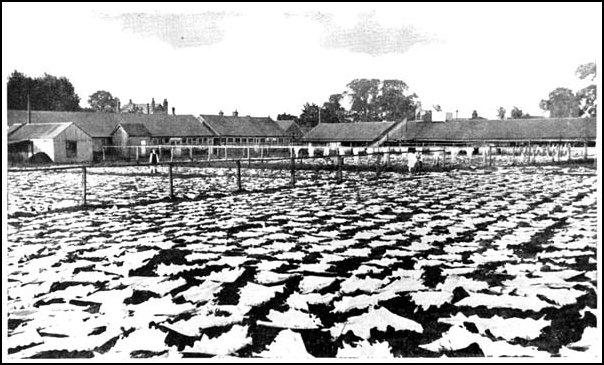
Sun-bleached skins are the best for dyeing, especially
if delicate shades are wanted. The frontispiece shows
a field covered with skins bleaching in the sun. Chemically
bleached leather is likely to become discoloured
after dyeing. Defective skins are often dyed with
pigments (dust colours), and this system is also applied
to skins which have to be dyed such delicate shades as
cannot be produced by wood or aniline colours. Although
it gives attractive results to the eye, and certainly
covers up any defects of the grain, this method of dyeing
is not altogether satisfactory, as the leather remains
unpleasantly dusty in wear for quite a long time.
The dyeing of chamois with wood-dyes or coal-tar
colours is by no means easy, but this method gives the
best results when successful. The grease must first be
removed from the leather with a solution of 5 lb. of
borax or 3-1/2 lb. of soda for every 100 lb. of leather.
If the leather is still greasy on the surface, a further
quantity of soda or borax is given, after which the
leather is well washed in warm water, sumached,
rinsed to remove the particles of sumach, and mordanted
with titanium salts. The dyeing is then done with
anilines or wood-dyes, or a combination of both, and
this is followed by fat-liquoring with egg-yolk and a
sulphonated oil. The finishing operations are staking
and fluffing.
To get a good, fast black on chamois and suède leathers
is one of the difficult processes in the leather trade,
although it is easier to get a good black on alumed or
chromed leather than on vegetable-tanned. Alumed
leather is washed in a solution of borax or carbonate of
ammonia to remove uncombined dressing in order to
prepare it for dyeing. Chrome-tanned suède leather
does not need this preparation. The leather is first
mordanted with dye-wood extract, of which a suitable
mixture is logwood and fustic, or logwood and quercitron,
in the proportion of 4 lb. and 2 lb. to every 100 lb. of
leather. After drumming the leather in this solution
for about an hour, a weak solution of copperas (ferrous
sulphate) and bluestone (copper sulphate) is added,
and the milling is continued for twenty minutes, when
the leather is well prepared to receive the black dye.
Instead of the iron and copper salts, corichrome is often
preferred, as it is quite safe to use, whereas iron salts
have a destructive action on the fibres of the leather,
unless the precaution be taken to mordant the skins
with a good quantity of dye-wood extract. Following the
application of the iron or corichrome striker, the leather
is dyed with suitable aniline black (leather black, or
corvoline) and finally fat-liquored to nourish the leather,
and to fix and intensify the black. This recipe also
gives good results where the skins are dyed only on the
flesh side, the solutions being applied with a brush.
Among the new kinds of leather for gloves, none is
more remarkable or more useful than the washable
sheep or goat skins. The great advantage of this
leather is that it can be washed in warm water and
soap any number of times without injury, whereas gloves
of ordinary tawed kid and lamb skins have to be dry
cleaned and cannot be renovated many times. An
additional advantage of washable leather is its warmth.
After being dehaired, puered and drenched, the skins
are drummed in a solution of formaldehyde and soda.
In two or three hours, the skins are tanned, and are
then treated with a solution of sulphate of ammonia.
The quantities required are about 3 lb. of formaldehyde
(40 per cent.) and 8 lb. of sodium carbonate (80 per
cent.), and 1 lb. of sulphate for 100 lb. of pelts, using
sufficient water to cover the skins well in the drum.
This tannage produces a white but somewhat thin and
empty leather, and the fat-liquoring must, therefore,
be filling and softening. An emulsion of white curd
soap and olive oil, or of egg-yolk and neatsfoot oil, is
suitable. "Crestanol," a special preparation, also
gives satisfactory results, since it is adapted for giving
nourishment and resiliency to thin, empty leather.
The best known of the fancy leathers is "morocco."
This variety has been made for ages, and the name
probably originated from the fact that very fine leathers
of this kind were manufactured in Morocco a few
centuries ago. History records that a similar leather,
dyed red, was made in the ninth century before the
Christian era.
The best morocco leather is made from Continental
goat skins, which are mostly obtained from Central
Europe and Spain. The Norwegian goat skins are also
said to be of good quality for the morocco finish. An
inferior morocco leather, which is produced in large
quantities, is manufactured from East India goat skins,
while a cheaper grade still can be produced from certain
classes of East India sheep skins. The real moroccos
are tanned in sumach, but the cheaper sorts are tanned
in India with babool or turwar bark and re-tanned in
sumach in the countries to which they are exported,
chiefly Great Britain, Germany, France, and America.
One of the best methods of sumach-tanning goat and
calf skins is that known as the "bottle" tannage.
Each skin is doubled over and sewn by machine round
the edge, leaving part of the neck unsewn. The skins
are then turned inside out and filled with a strong
infusion of sumach, and floated in a tub containing
sumach liquor. After being a few hours in the tub,
the skins are heaped one above the other in a large pile,
where the pressure forces the tannin through the skins.
The process can be completed in twenty to twenty-four
hours, after which the skins are cut open, rinsed, and
finished in the usual manner. This method of tanning
is now largely replaced by the use of paddle-vats
(Fig. 25).
The dyeing and finishing are somewhat similar to
that of coloured boot upper leather, except that the
leather is slightly oiled on the grain instead of being
fat-liquored. There are several different methods of
graining morocco leather; some of the grains are made
naturally by pressing the leather, when folded over,
with a cork-covered board, while others are first
embossed in various ways and then boarded. The
well-known "crushed morocco" is produced by glazing
the grained leather under heavy pressure.
Skivers, the grain splits of sheep skins (see p. 145)
are extensively used for fancy articles. The majority
are finished with a smooth grain for hat-bands, bookbinding,
and linings. The grain of a sheep skin is,
naturally, soft, and not very strong. To stiffen and
strengthen the grain, an artificial layer, consisting of
paste finishes, is often applied. Skins finished in this
manner are termed "paste grain skivers." These are
largely used for bookbinding and cheap purses. Sheep
grains are sometimes given a finish somewhat similar
to that of leather bags. This is produced in a printing
machine by means of a copper roller which is run
over the damp (but not too wet) leather. The skins
are then described as "long-grain" skivers. The grain
surface of sheep skins is particularly suitable for embossing,
and wonderful imitations of all kinds of skins
can be reproduced on skivers.
The fancy leather trade is not confined to these
imitations, however, as real lizard, seal, ichneumon,
alligators, crocodile, shark, porpoise, snake, and even
frog skins (Japanese) are utilised.