The making of lead statues was frequent up
to the end of the 18th century, and then
more frequent than at any other time, to
cease at once on the introduction of the Italian
plaster model shops, which in the eyes of the connoisseurs
of the time brought with them a time of
purer taste, the taste whose god was the Apollo
of the Belvidere.
These statues of lead were known to the
ancients. There was one of Mamurius at
Rome.[24]
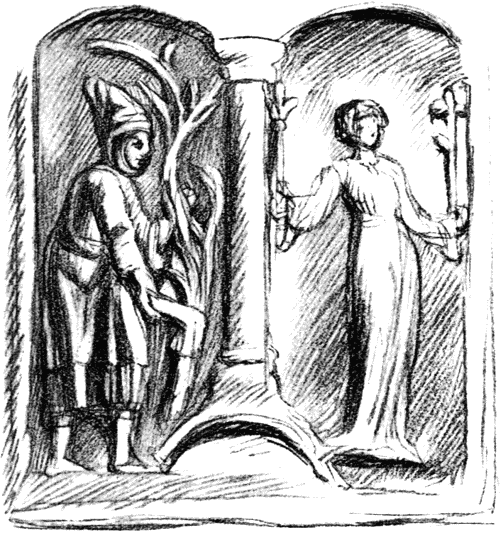
In the middle ages there were not only small
cast lead figures like those around the font at
Ashover and a figure from a crucifix now in the
library of Wells Cathedral which is about 12
inches high, of 15th century work, but figures
full size and more were also made; this was
especially the case in France; these, however, were
generally repoussé.
In the garden of the Cluny Museum in Paris
is a fine figure of St. John Evangelist, fully
eight feet high; it is of early 14th century work,
and looks as if it had stood at the central pier of
a doorway.
At Moissac, in the south of France, is a most
remarkable work of lead, a tomb, above which
is a lead sarcophagus and several figures representing
the entombment of Christ, who is being
laid in the open coffin. It is 15th century
work; the figures, six in all, are full of character
and vigour like the wooden statuary of the time.
It appears from a photograph to be cast in
separate portions.
The figures formed by repoussé usually serve
as finials on the roof, or stand in niches of the
flèche. In the great flèche at Amiens there
are six figures as large as life, with other smaller
figures of angels which hold emblems of the
Passion. M. Viollet-le-Duc says these figures
were nearly always embouties that is to say
hammered out on a wooden model in portions,
and soldered together. The artist had to be
careful that the model should be thin and “dry”
so the thickness of the lead should not make it
too coarse in the forms. Burges cites an account
of 1514 of a payment to John Pothyn, sculptor,
for having carved a prophet in walnut wood to
serve as a mould and pattern to the lead-workers.
Sometimes the lead casing was put on with lapping
joints, the skeleton frame being iron.
There are not now in England lead statues of
any size executed during the middle ages;
but magnificent figures of bronze cast by the
cire perdu method remain to us. The effigy of
Queen Eleanor at Westminster cannot be
matched in Europe.
The founder’s art was carried to much perfection
in Germany in the 15th and 16th centuries.
Mr. Seymour Haden has in Hampshire a statue
of a city herald of lead which formerly belonged
to the great clock at Nuremburg.
Many statues of lead were set up in English
towns after the earlier Renaissance, they are our
national version of the bronze of Italy, a
material which we used but little; such bronze
statues as were cast here since the middle ages
seem to have been the work of foreigners. Le
Sieur, for instance, did the statue of Charles II.
at Charing Cross, and many others. The statue
of Queen Anne that was to surmount Gibbs’
proposed column in the Strand was ordered in
Rome.
At Bristol there is a large Neptune of lead
roughly modelled; the limbs are contorted with
too much life and yet it is a decorative feature in
the centre of a wide street. On the pedestal has
been engraved a little history of the statue, an
example that might be followed—“Neptune,
cast and given A.D. 1588 by a citizen of Temple
parish to commemorate the defeat of the Spanish
Armada. Re-erected on its fourth site in 1872.”
This seems to be a tradition unsubstantiated by
record, but the time is not so remote that it may
not as well be true, especially as the style of the
figure would seem to agree with the date named.
The story says that it was the gift of a plumber in
the town, the metal being that of the captured
ships’ pumps.
At Bungay in Suffolk there used to be a large
statue at the Market Cross known as “Astræa.”
One of the most interesting portrait statues in
London, the Queen Anne at Queen Anne’s Gate,
Westminster, is of lead. The surface ornament on
the robes is especially appropriate to the material.
There is also in Golden Square a statue of
George II. which seems to be nearly a repeat of
the stone statue on Bloomsbury steeple; it
suggested the statue in Fred Walker’s picture,
“The Harbour of Refuge.”
There were also many full size equestrian
statues founded in this metal, that of George I.,
until 1874 in Leicester Square, was one of these,
and like the last it was brought from Canons, the
celebrated house of the Duke of Chandos at
Edgware, dismantled about 1747. The George I.
resembled Le Sieur’s statue at Charing Cross
and was known as the Golden Horse, for the
whole was gilt, as many of the statues seem to
have been at Canons, in that garden where, according
to Pope, “The trees were clipped like
statues—the statues thick as trees.”
The statue of William of Orange at Dublin is
another of these, and it is celebrated alike in
political demonstrations and Catholic polemics.
Cardinal Newman wrote of it, “The very flower
and cream of Protestantism used to glory in the
statue of King William on College Green, Dublin,
and though I cannot make any reference in print
I recollect well what a shriek they raised some
years ago when the figure was unhorsed. Some
profane person one night applied gunpowder and
blew the king right out of his saddle, and he was
found by those who took interest in him, like
Dagon, on the ground.”
Yet another equestrian statue is that of Charles
the Second at Edinburgh, set up by the magistrates
of the city in Parliament Square, in honour
of the restoration of the king. A writer in the
Athenæum for April 13th, 1850, speaks of it as
the “finest piece of statuary in Edinburgh,” and
urges the suitability of lead for the purpose.
“In Black’s Guide through Edinburgh it is spoken
of as the best specimen of bronze statuary which
Edinburgh possesses; it is, however, composed of
lead. Now this leaden equestrian statue has already
without sensible deterioration stood the test of
165 years’ (in 1850) exposure to the weather, and
it still seems as fresh as if erected but yesterday.”
Some years before this, one of the interior irons
having given way, a part of the shoulder sank a
little and it was taken down and repaired and
sufficiently proved to be lead. Taking the
figures above, it appears that the date of this
work is 1685.
Mr. James Nasmyth also wrote to the Athenæum,
June, 1850, “to confirm as a practical man
the perfect fitness of lead” as a substitute for
bronze, and to recommend the cire perdu method
of casting, at that time discontinued in England;
the process being to model the statue in wax on
a solid core, to cast in plaster the finished wax
model, and then to melt out the wax from this
plaster mould, the space which it occupied being
refilled with lead. Of course only one cast can
be obtained in this way, whereas the old decorative
statues spoken of later were cast in a piece mould
and reproduced again and again.
“The addition (still quoting) of about five
per cent. of antimony will give it not only greater
hardness but enhance its capability to run into
the most delicate details ... it is in every sense
as durable as bronze when subject simply to
atmospheric action.”
We shall see that an addition of block tin was
made to the lead by the old figure founders. Type
metal, which is so much harder than lead, is an
alloy of lead and 1⁄4 to 1⁄3 of antimony, or of two
parts of lead to one of tin and one of antimony.
In the courtyard of Houghton Tower, Lancashire,
there is a statue of William III.
brought from the dismantled Walton-le-Dale
in 1834.
The statues decorating the parapets of the large
“classic” country houses are at times of lead;
there are five of these at Lyme in Cheshire.
Over the portico of the Clarendon at Oxford
there are four of these statues representing the
sciences. Until recently there was a figure of
King James high up in a niche at the Bodleian.
The figures of the good little boy and girl
common at charity schools are also often of lead.
The great Percy lion that surmounted old
Northumberland House at Charing Cross (destroyed
twenty years ago) is now on the river
front of Syon House; it weighs about three tons,
and it was placed in its original position in 1749.
The lion on the bridge at Alnwick is also of
lead, as the little boy found to his cost who
climbed out on its tail.
There are a series of lead busts in oval panels
on the front of Ham House, Petersham, Surrey,
1610 being the date of its erection.
Before passing into the garden a word on the
practical details of casting as traditionally followed
may be added. The casting of lead statues is
much the same process as founding in bronze,
but it is simpler from the much lower temperature
at which lead flows, and the ease with which
limbs can be cast separately and joined to the body.
The technical details may be found in a text-book
of modelling and casting—Mouler en Plâtre,
Plomb, &c. (Lebrun, Paris, 1860). The course
followed is to cut up the model in such parts as
is determined, to mould these in loam, the cores
are then cast in plaster after the thickness that
will be occupied by the lead has been first applied
to the moulds in sand (terre). The cores are
then removed and dried and baked, for in this as
in all founding everything depends on the absolute
dryness of the mould. After the first mould had
been added to, for the casting of the core, a
second mould would be prepared from the original
figure and the core supported in that by irons.
The castings are then made, and the portions
reunited and finished on the surface. Large works
have to be sufficiently supported with internal
irons. All the mysteries of vents, and false
coring when necessary, can only be understood
by practical familiarity with founding.
Modern figures for Dundee were cast from
plaster; cast iron also makes good moulds.
If the roof is the place for those earlier
figures formed by repoussé, the garden is rightly
inhabited by cast lead statues. It is a material
in which the designer might well permit himself
slightness, caprice, or even triteness. A statue
that would be tame in stone, or contemptible
in marble, may well be a charming decoration
if only in lead, set in the vista of a green walk
against a dark yew hedge or broad-leaved fig,
or where the lilac waves its plumes above them
and the syringa thrusts its flowers under their
arms and shakes its petals on the pedestal.
“How charming it must be to walk in one’s
own garden, and sit on a bench in the open air
with a fountain and a leaden statue and a rolling-stone
and an arbour. Have a care though of
sore throat and the agoe.[25]”
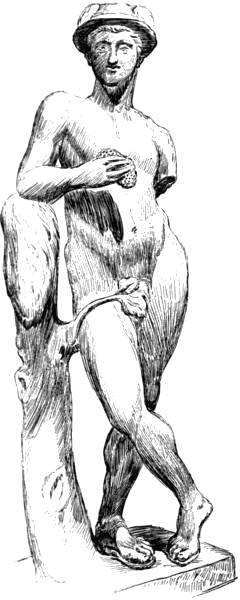
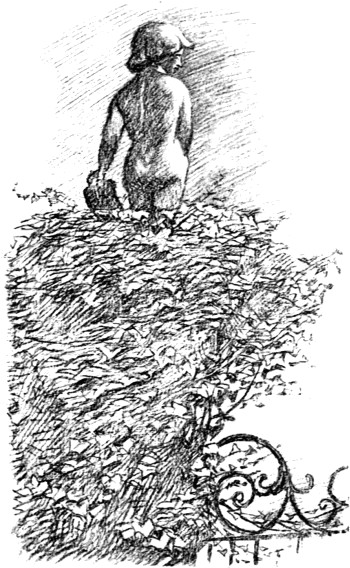
Fig. 42.—Mercury.
When sculptors learn again that their art
is to shape many materials in various ways for
diverse uses, and that a statue is not necessarily
of whitest marble or to be exhibited on the 1st
of May, then we may get back the delight
of sculpture in the garden.
Sculptured marble, unless the art is of a high
order, does not please us out of doors by a pond
or on a terrace, if it is not weathered down to
a ruin, but lead is homely and ordinary and
not too good to receive the graffiti of lovers’
knots, red letter dates and initials. Here is a
sketch of a Mercury not at all too fine for further
decoration of this sort; it came from a London
sale room, the surface was quite white and exfoliated
like old stone. The jaunty messenger
has a garden thought too, for it is honeycomb
in his hand.
One of the best known of these garden
statues was a group of Cain and Abel that so
recently gave an interest to the great grass quad
of Brasenose College, Oxford. It was given
by Dr. Clarke, of All Souls, “who bought it of
some London statuary.” Hearne speaks of it
as “some silly statue”—superiority has always
been the greatest enemy to beauty. Forty or
fifty years ago there was a Mercury in Tom
Quad which has also been improved away.
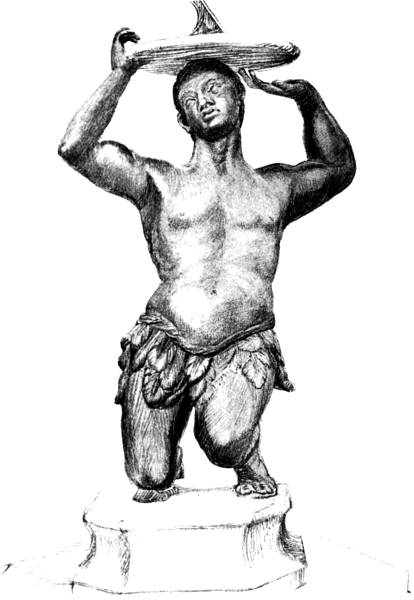
Fig. 43.—Sun-dial, Temple Gardens.
Our next example fulfils a purpose. It is
the sun-dial formerly in Clement’s Inn, which was
known locally as the “Blackamoor.” It is
strongly, if simply modelled, a piece of art full
of character, and we may be glad that it has
been restored to us although now placed in the
gardens of the Inner Temple, instead of before
the “Garden House” in Clement’s Inn.
The negro is the full size of life and bears
the stone disc of the dial on his head with one
hand, the other being free. The dial is beautifully
engraved and is signed on the edge of the
gnomon Ben Scott in the Strand Londini Fecit.
The sides have the initials of the donor, P. I. P.,
and the date, 1731. Mr. Hare in his Walks
in London states that it was brought from
Italy late in the seventeenth century by Holles
Lord Clare, whose name is preserved in the
neighbouring Clare market. This statement is
also found in Thornbury’s Old and New London,
and the statue is said to be bronze, which it is
not, nor do the initials and date above agree
with Mr. Hare’s statement, who goes on to
remark that “there are similar figures at Knowsley,
and at Arley in Cheshire,” but he does not
say if these also were brought from Italy by Lord
Clare.
No authority is given by Mr. Hare, but his
statement is in the main a transcript from John
Thomas Smith, who also gives the verses quoted
by Mr. Hare, said to have been attached to the
statue on one occasion with a pitying reference
to the legal atmosphere the African had to
breathe. That it was brought from Italy is
seemingly local gossip added to the account of
Mr. Smith who knew well enough the English
workshop, as we shall see, where these figures
were made.
Similar figures are mentioned by this writer in
his gossiping Antiquarian Rambles in London in
which he wrote the memories of his own travels
in the streets in the beginning of the present
century, and gives quite a history of this
“despicable manufactory.” The founding of
these lead garden statues seems specially to have
been an industry of the eighteenth century; with
the dreary opening of the nineteenth “a purer
taste,” so we are assured, banished these and
most other charms of an old-fashioned garden.
“In Piccadilly, on the site of the houses east of
the Poulteney Hotel including that, now No.
102, stood the original leaden figure yard, founded
by John Van Nost, a Dutch sculptor, who came to
England with King William III. His effects
were sold March, 1711.” As late as 1763 a
John Van Nost (supposed descendant of the
former) was following the profession of a statuary
in St. Martin’s Lane, on the left, a little
farther up than where the old brick houses
now stand in 1893. The original business
was taken in 1739 by Mr. John Cheere, who
served his time with his brother, Sir H. Cheere,
the statuary who did several of the Abbey
monuments.
“This despicable manufactory must still be
within memory, as the attention of nine persons
in ten were arrested by these garden ornaments.
The figures were cast in lead as large as life and
frequently painted with an intention to resemble
nature. They consisted of Punch, Harlequin,
Columbine and other pantomimical characters;
mowers whetting their scythes; haymakers
resting on their rakes; gamekeepers shooting;
and Roman soldiers with firelocks; but above
all an African kneeling with a sundial upon his
head found the most extensive sale.
“For these imaginations in lead there were
other workshops in Piccadilly, viz., Dickenson’s,
which stood on the site of the Duke of
Gloucester’s house, Manning’s at the corner
of White Horse Street, and Carpenter’s, that
stood where Egmont house afterwards stood.
“All the above four figure yards were in high
vogue about the year 1740. They certainly had
casts from some of the finest works of art, the
Apollo Belvidere, the Venus de Medici, &c., but
these leaden productions, although they found
numerous admirers and purchasers, were never
countenanced by men of taste; for it is well
known that when application was made to the
Earl of Burlington for his sanction he always
spoke of them with sovereign contempt, observing
that the uplifted arms of leaden figures, in
consequence of the pliability and weight of the
material, would in course of time appear little
better than crooked billets.... There has not been
a leaden figure manufactory in London since the
year 1787, when Mr. Cheere died.”
Walpole knew little of these lead-working
sculptors, his only notice occurring under
“Carpentier or Charpentiere”—our Carpenter
above—“a statuary much employed by the
Duke of Chandos at Canons, was for some years
principal assistant to Van Ost (our Van Nost)
an artist of whom I have found no memorials,
and afterwards set up for himself. Towards the
end of his life he kept a manufactory of leaden
statues in Piccadilly and died in 1737, aged
above sixty.” The original Van Nost came
from Mechlin, and married in England the
widow of another Dutch sculptor.
In the account books of the building of
Somerset House the following entry, which
occurs under 1778, is interesting as showing
John Cheere working on particular works, and
for giving us the composition of the metal
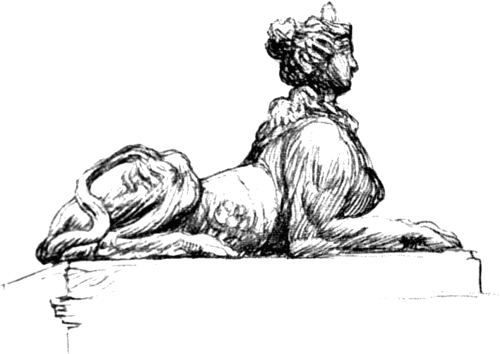
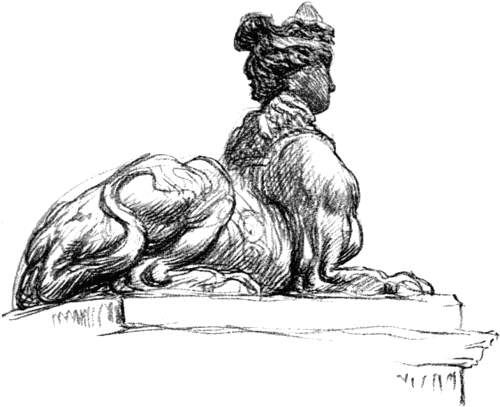
and the price. “John Cheere, figure maker;
to moulding, casting, and finishing four large
sphinxes in a strong substantial manner, lead
and block tin, at each £31.”
It is curious if Lord Burlington gave the
critical dictum attributed to him, that there were
so many lead garden statues at his villa at
Chiswick, in 1892 dismantled by the Duke of
Devonshire. Doubtless they belonged to that
garden described by Walpole as in the Italian
taste, where “the lavish quantity of urns and
sculpture behind the garden front should be
retrenched,” a wish that time accomplishes.
There was a Bacchus, a Venus, an Achilles, a
Samson, and Cain and Abel.
In the first quadrangle at Knole there are two
good reproductions of the antique, one being a
crouching Venus. In the courtyard of Burton
Agnes in Yorkshire stands a Fighting Gladiator.
Studley Royal, near Ripon, is a fine example
of the best effort of park-gardening, if the
phrase be allowed, for the term “landscape
gardening” is degraded to mean productions in
the cemetery style, an affair of wriggling paths,
little humps, and nursery specimens, which might
best be described as cemetery gardening, and
between which and the manner of Kent there
is no parallel. Here lakes in ordered circles
and crescents occupy the grassy flat between
hanging woods, and several groups of lead
statuary stand above the water.
In the beautiful old gardens at Melbourne in
Derbyshire are a large number of lead figures,
two of which are drawn in The Formal
Garden.[26] There are two heroic sized figures
of Perseus and Andromeda beside the great
water; a Flying Mercury after Giovanni
Bologna; two slaves, which are painted black,
with white drapery, carrying vases on salvers;
and several Cupids in pairs or single. Of these
“the single figures” Mr. Blomfield says “are
about two feet high. One has fallen off his tree,
another is flying upward, another shooting,
another shaping his
bow with a spoke
shave. All of these
are painted and some
covered with stone
dust to imitate stone,
a gratuitous insult to
lead which will turn
to a delicate silver
grey if left to its own
devices.”
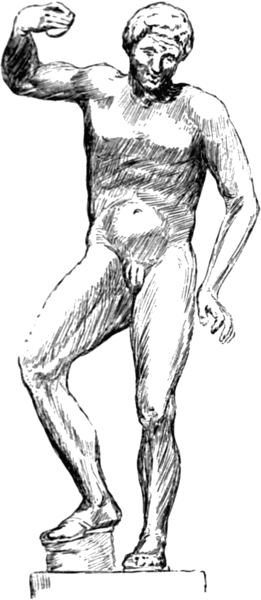
Fig. 44.—Cymbal Player.
In the old gardens
at Rousham described
by Pope are
still some Cupids
riding on swans; at
Holmerook Hall are
statues and other
objects in lead, and
at Newton Ferrars
in Cornwall are two
statues of Mars and
Perseus. At the
Mote House, Hersham,
are some garden
figures.
There are also
some figures of lead in the gardens of Castle Hill,
Lord Fortescue’s house in Devonshire. In the
two niches of a garden
temple there is a Cymbal
Player from the
antique and a Venus in
the manner of William
and Mary. Amongst the
foliage of a wood-path
is a terminal figure of
Pan, the pillar being
stone and the head and
shoulders only of lead.
In the gardens here are
also two large couchant
lions, four sphinxes, and
some greyhounds. At
Nun Moncton in Yorkshire,
on a terrace by the
river Ouse are several
lead figures on each side
of the walk, these have
gilded trappings. At
Glemham in Suffolk are
figures of the Duke of
Marlborough and Prince
Eugène at the entrance.
In the garden are two
black slaves with sun-dials,
and
the Seasons:
also hounds
at the gateway.
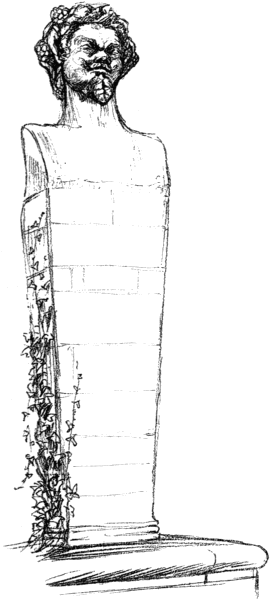
Fig. 45.—Terminal at Castle Hill.
In the garden at Canons Ashby is a figure of
a shepherd playing a flute. In a garden at
Exeter are four
or five figures,
amongst which
is a Skater and a
Flower Girl, and
at Whitchurch is
a Quoit Thrower.
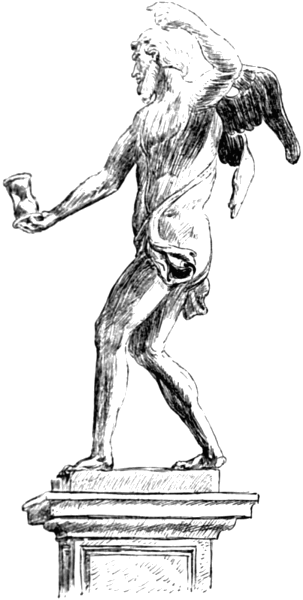
Fig. 46.—Time.
In the niches
of a large circular
yew hedge at
Hardwick are
four figures,
three are playing
on musical instruments;
pipe,
trumpet, and
violin, and the
fourth represents
Painting. There
are also two other
figures in the gardens.
At Temple
Dinsley near Hitchin
is a figure of
Time, hour-glass
in hand, of which
a sketch is given.
The left hand formerly held a scythe, now
lost. At Shrewsbury is a Hercules.
The statues in the grounds at Blarney
celebrated in the “Groves of Blarney” were of
lead:—
“There’s statues gracing this noble place in
All heathen Goddesses so fair,
Bold Neptune, Plutarch and Nicodemus
All standing naked in the open air.”
These statues were sold by auction to Sir
Thomas Dene who bought the castle, and
pictures:—
“And took off in a cart
(’Twas enough to break my heart)
All the statues made of lead and pictures O!”
[27]
The eighteenth century must have been busy
in the “manufacture” of these garden figures
and ornaments, some of the gardens mentioned
have as many as twenty to thirty pieces still. A
great number was doubtless absorbed in the
London public gardens and the villas up the
Thames. In old Vauxhall was a statue of Milton
by Roubilliac, but it is difficult to attribute many
specimens to individuals. The negro we saw was
sold by Mr. John Cheere in St. Martin’s Lane,
but likely enough the model was a part of the
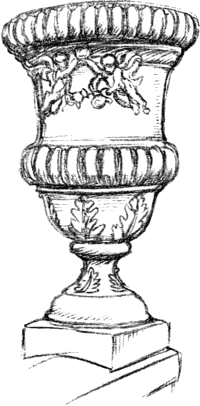
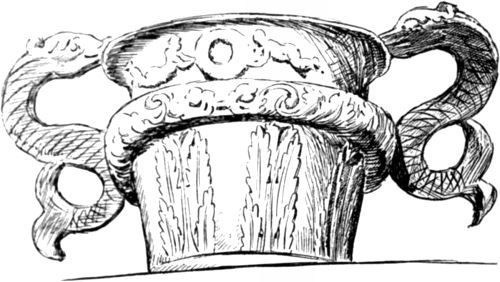
stock of Van Nost, as also the fine vases at Hampton
Court. Many of these statues were destroyed to
suit the “purer taste” of this century, and a
great number were exported during the American
War to become bullets, because at that time as
“works of art” the lead escaped the Customs.
A large number have been accidentally crushed
by the fall of a tree or otherwise destroyed, and
many not adequately supported have flattened
down out of shape.
There was a large display à la Louis Quatorze,
of lead casting in the gorgeous gardens of
Versailles; where in the fountains, groups of
statues, and vases, the greatest sculptors of the
time worked indifferently in marble, bronze, or
plomb doré. François Girardon was one of
these. Born in 1628, at Troyes, he lived to the
year 1715, achieving a reputation that placed him
amongst the foremost of French artists of that
time.
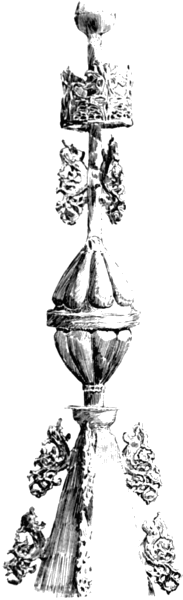
The immense structure entirely of lead known
as the Fountain of the Pyramid is his work.
From a basin in which sport three man-sized
tritons rises a pedestal, with a circular basin much
enriched by gadroons, set on three classic
zoomorphous legs; and above it three other
like basins of diminishing size, each supported
from the one below around the rim; by baby
tritons for the lowest, the next with dolphins,
and the last with lobsters. In the last basin is a
vase. The whole is a composition showing great
refinement of scholarship, recalling in general
form the great pine cone of bronze in the
Vatican gardens, once the fountain in the atrium
of old St. Peter’s. It is exquisitely drawn and
engraved by Rouyer et Darcel[28] together with
two vases also of lead from the Basin of
Neptune.
Other groups, some of colossal proportions—“France
Victorious,” “The Four Seasons,” and so
on—were the work of Thomas Renaudin of
Moulins, J. B. Tubi from Rome, Pierre
Mazaline and Gaspard de Marcu; their individual
works, with illustrations, may be distinguished
in the volume of engraved statues of
the Versailles gardens by S. Thomassin published
in Paris 1694.
Versailles certainly set the fashion, which we
followed and which influenced the gardens of the
most of Europe. In Russia a Swiss gardener
arranged a labyrinth at the summer palace of
Peter the Great with animal groups from Æsop
in gilt lead forming fountains. Beckford,
writing from Lisbon in 1789, describes a garden
at Bemfica “which eclipses our Clapham and
Islington villas in all the attractions of leaden
statues, Chinese temples, serpentine rivers, and
dusty hermitages.”