Authorities: Benedict of Peterborough; Garnier;
William FitzStephen; John of Salisbury; Herbert of
Bosham; Alan of Tewkesbury; Edward Grim; Roger
of Pontigny; William of Canterbury; Robert of Cricklade—Materials
for the History of Thomas Becket,
7 vols.; Thomas Saga (Icelandic), translated by Magnusson;
Giraldus Cambrensis; Gervase of Canterbury;
William of Newburgh; Roger of Hoveden, III.; Ralph
Diceto (Rolls Series); Froude, R. H.—Remains,
Vol. 3; Life of Becket, by Canon J. C. Robertson;
Life of St. Thomas Becket, by John Morris, S.J.;
Stubbs—Constitutional History, Vol. I; Freeman—Historical
Essays, 1st Series; W. H. Hutton—English
History by Contemporary Writers—St. Thomas
of Canterbury.
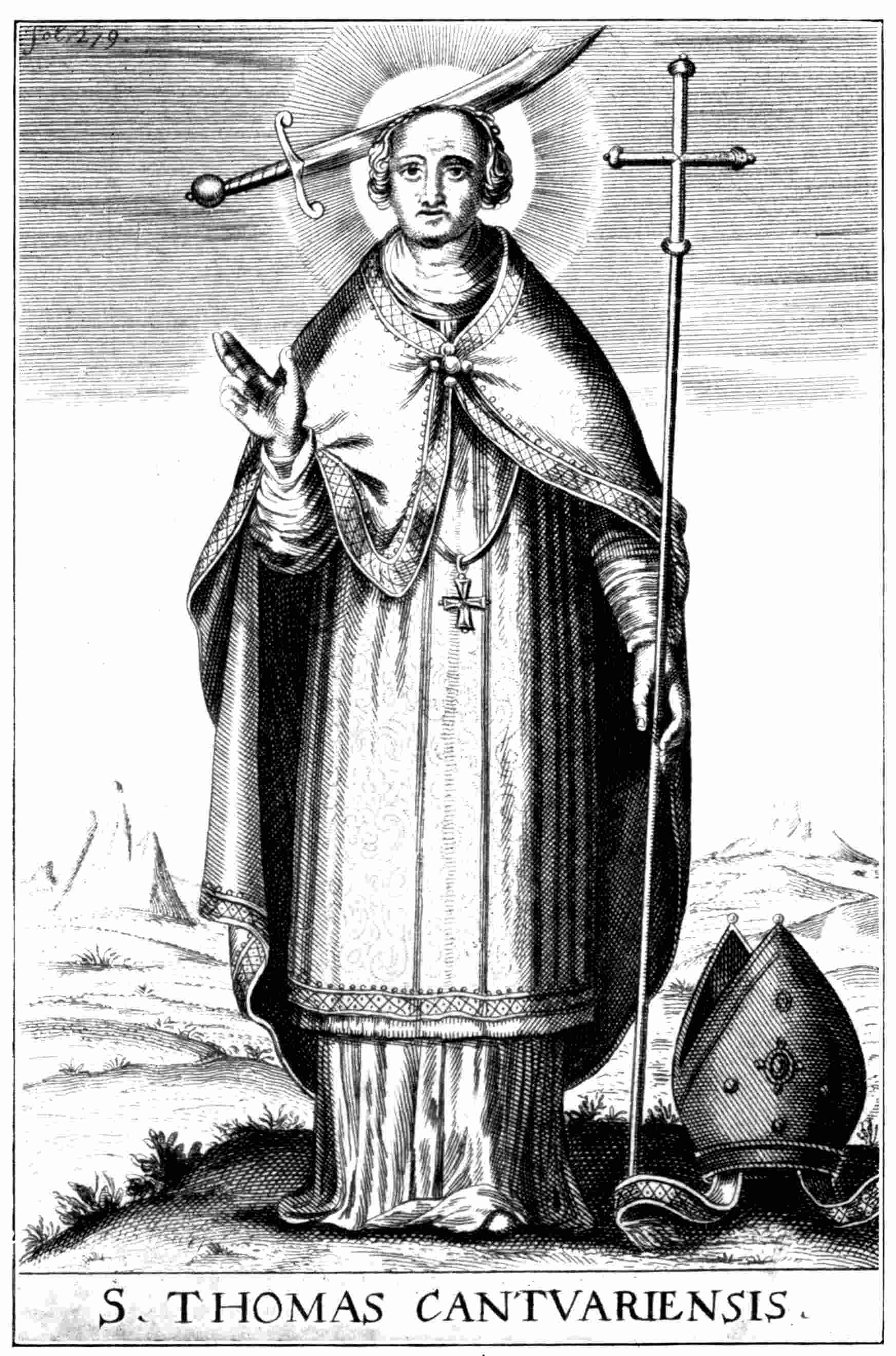
THOMAS A BECKET
(From an old Engraving after Van Eyck.)
Fifty years after the death of Anselm the
struggle with absolute monarchy had to
be renewed in England, and again the
Archbishop of Canterbury was the antagonist
of the crown, standing alone for the most part, as
Anselm stood, in his resistance to autocracy.
The contrast is great between the upbringing and
character of Anselm and of Thomas; but both men
gave valiant service in the cause of liberty in
England, and both are placed in the calendar of
the saints. For Thomas and Anselm alike the
choice was between the favour of the King of
England, the safe broad road of passive obedience,
and the following of the call of conscience on the
craggy way of royal displeasure; and to the everlasting
honour of these two men, and of the religion
they professed, they chose the steep and narrow
path with no faltering step, and followed the gleam,
heedless of this world’s glory, heedless of life itself.
Thomas was no monk as Anselm was, when the
king nominated him for the archbishopric of Canterbury.
His early life was not spent in the cloister
but in the employment of a wealthy London sheriff,
in the office of Archbishop Theobald, at Lambeth,
and as Chancellor of England.
The son of gentle parents—his father Gilbert
sometime sheriff—“London citizens of the middle
class, not usurers nor engaged in business, but living
well on their own income,” according to FitzStephen,
Thomas was the first Englishman to be made archbishop.
His gifts marked him out for high office.
Theobald had sent him abroad to study law at the
great school at Bologna, and at the age of 36 made
him archdeacon of Canterbury, at that time “the
dignity in the Church of England next after the
bishops and abbots, and which brought him an
hundred pounds of silver.” A year later, 1155, the
young newly crowned king, Henry II., on the advice
of old Archbishop Theobald, made Thomas the
Chancellor. Theobald, anxious about the present,
and apprehensive for the future—for the king was
very young, and those about him were known to
be hostile to the freedom of the Church and willing
to treat England as a conquered land—sought to
prevent the evils which seemed to be at hand by
making Thomas a partner of the King’s counsels.
He could say, after ten years’ experience, that
Thomas was high-principled and prudent, wisely
zealous for justice, and whole-hearted for the freedom
of the Church, and he held forth to the king on
the wisdom, the courage and the faithfulness of his
archdeacon, “and the admirable sweetness of his
manners.”
The appointment was made, nor could anyone
say that it was ill done, or that Theobald in his
recommendation, or Henry II. in his acceptance, of
Thomas for the chancellorship could have done
better for England.
The chancellor was magnificent, and his dignity
was accounted second from the king. Nobles sent
their children to Thomas to be trained in his service.
The king commended to him his son, the heir to
the throne. Barons and knights did homage to
him. On his embassy to the French king never
had been seen such a retinue of followers, and such
a lavish display of the wealth and grandeur of
England. The proud and mighty he treated with
harshness and violence. Yet it was said, by those
who knew him intimately, that he was lowly in his
own eyes, and gentle and meek to those who were
humble in heart. And in the courts of kings, where
chastity is never commonly extolled, or purity of
life the fashion, Thomas, the chancellor, was known
for his cleanness of living and his unblemished
honour. Many enemies he had, many who hated
him for his power; but never was breath of scandal
uttered against the chancellor’s private life, or
suggestion made that the carnal lusts and appetites
which, unbridled, play havoc with men great and
small, could claim Thomas for their subject.
He might be reproached by a monk for that he,
being an archdeacon, lived so secular a life, wearing
the dress of a courtier, and charging on the field
with knights in France, but it could not be alleged
that church or realm suffered neglect from the
chancellor. “By divine inspiration and the
counsel of Thomas, the lord king did not long
retain vacant bishoprics and abbacies, so that the
patrimony of the Crucified might be brought into
the treasury, as was afterwards done, but bestowed
them with little delay on honourable persons, and
according to God’s law.” (W. FitzStephen.)
The close friendship and warm affection of the
king for his chancellor were known to all. When
the day’s business was done “they would play together
like boys of the same age.” They sat together
in church and hall and rode out together. “Never
in Christian times were there two men more of one
mind or better friends.” It was natural on the
death of Archbishop Theobald, in 1161, that people
should point to Thomas as his successor, though the
chancellor shrank, as Anselm had done, from the
post.
“I know three poor priests in England any one
of whom I would rather see advanced to the archbishopric
than myself,” he declared earnestly, when
his friend the prior of Leicester (who also remonstrated
with him for his unclerical dress) told him
the rumours of the court. “For as for me, if I was
appointed, I know the king so through and through
that I should be forced either to lose his favour or,
which God forbid, to lay aside the service of God.”
Thomas uttered the same warning to Henry
when the king proposed the primacy to him. “I
know certainly,” he said, “that if God should so dispose
that this happen, you would soon turn away
your love, and the favour which is now between us
would be changed into bitterest hate. I know that
you would demand many things in Church matters,
for already you have demanded them, which I could
never bear quietly, and the envious would take occasion
to provoke an endless strife between us.”
But Henry’s mind was made up. Residing
largely in France, he would have Thomas, Archbishop
of Canterbury and Chancellor, to rule England
as his vice-regent. Six years had Thomas been
the king’s friend and chancellor, but the king did
not know at all the real character of his man, or
rather it was inconceivable to the royal mind that
Thomas, whom the king had raised from a mere
nobody, from Archdeacon of Canterbury, an important
ecclesiastic at best, to the chief man in the
realm, should ever dare set himself at variance with
the king’s will. Henry, with his untiring energy,
was earnest enough for good government in Church
and State under an absolute monarchy, and he
counted on greater co-operation with Thomas in
carrying out his plans, were the latter archbishop.
Hitherto, more than once the chancellor had succeeded
in moderating the king’s outbursts of wrath
against some hapless offender, but he had never
shown himself a partisan of the clergy at the expense
of the commonwealth,11 and his lack of pride in his
order had even incurred rebuke, so little of the
ecclesiastic did this statesman appear.
Thomas understood the king better than the king
understood his chancellor. But his protests were in
vain. He was as surely marked for the archbishopric
as Anselm had been. Bishops of the
province approved and the monks of Canterbury
duly voted for the king’s chancellor in common consent,
Gilbert Foliot, the Bishop of Hereford, and
afterwards of London, and the archbishop’s enemy
to the end, alone opposing the election.
“Then the archbishop-elect was by the king’s authority
declared free of all debts to the crown and given
free to the Church of England, and in that freedom
he was received by the Church with the customary
hymns and words of praise.” (Herbert of Bosham.)
On June 2nd, 1162, the Saturday after Whit
Sunday, Thomas was ordained priest and on the
following day consecrated bishop. (The new archbishop
instituted the festival of Trinity Sunday to
commemorate his consecration, and some 200 years
later the festival was made of general observance in
the Catholic Church.) The king realised the mistake
he had made within a year of the consecration.
The brilliant chancellor was no sooner archbishop
than he turned from all the gaieties of the world,
and while no less a statesman, adopted the life of his
monks—though never himself a monk—at Canterbury.
Henceforth Archbishop Thomas was the
unflinching champion of the poor and them that had
no helper, the resolute defender of the liberties of
the Church against all who would make religion
subject to the autocracy of the king of England.
Thomas was forty-four years old, in the full
strength of his manhood, when he was made archbishop,
and for eight years he did battle with the
crown, only laying down his charge at the call of
martyrdom.
The first disappointment to Henry was the resignation
of the chancellor’s seal.12 It was clear to
Thomas that he could no longer serve the crown and
do the work of a Christian bishop at the same time,
and he had accepted with full sense of responsibility
the see of Canterbury. There was no room for the
egotism that loves power, the vaulting ambition
that o’erleaps itself, or even the self-deception that
persuades a man holding to high position at sacrifice
of principle that his motive is disinterested, in St.
Thomas of Canterbury. More than once England
was to see in later years men who strove vainly to
serve with equal respect the Christian religion and
the royal will—the service always ended in the
triumph of the latter. Thomas was far too clearly-sighted
to imagine such joint service possible, and
for him, elected and consecrated to the primacy of
the English Church, there was no longer any choice.
As chancellor, keeping his conscience clear, he had
done the best he could for law and order as the
king’s right hand man. As Archbishop of Canterbury
his duty, first and foremost, was to maintain
the Christian religion and defend the cause of the
poor and needy.
But to Henry the resignation of the chancellorship
was an act of desertion, a declared challenge to
the royal supremacy. Henry II. was no more the
man than his grandfather Henry I. had been to brook
anything that threatened resistance to the king’s
rule.
Courtiers who hated Thomas were always at hand
to poison the ears of the king by defaming the archbishop,
and this, says William FitzStephen, was the
first cause of the trouble. Another cause was the
hatred of the king for the clergy of England, hatred
provoked by the notoriously disreputable lives of
more than one clerk in holy orders. The battle
between Henry and Thomas began on this matter of
criminous clerks.
William the Conqueror and Lanfranc recognizing
that the Church, strong and well ordered, made for
national well-being, had set up ecclesiastical courts
wherein all matters affecting church law and discipline
were to be dealt with by the clergy, to the
end that the clergy should not be mixed up in lawsuits
and should be excluded from the lay courts.
Henry II. was not satisfied that criminous clerks
were adequately dealt with in these ecclesiastical
courts, where no penalty involving bloodshed might
be inflicted, and where the savage punishments of
mutilation had no place. Thomas was as anxious as
the king for the Church to be purged of abuses, but
he was resolved not to hand over offenders to the
secular arm. The archbishop was an ardent
reformer. “He plucked up, pulled down, scattered
and rooted out whatever he found amiss in the vineyard
of the Lord,” wrote a contemporary; but he
would shelter his flock as far as he could by the
canon law from the hideous cruelties of the King’s
Courts.13 It was not for the protection of the clergy
alone the archbishop was fighting in the councils
summoned by the king at Westminster in 1163, and
at Clarendon in 1164.
“Ecclesiastical privileges were not so exclusively
priestly privileges as we sometimes fancy. They
sheltered not only ordained ministers, but all ecclesiastical
officers of every kind; the Church Courts
also claimed jurisdiction in the causes of widows and
orphans. In short, the privileges for which Thomas
contended transferred a large part of the people,
and that the most helpless part, from the bloody
grasp of the King’s Courts to the milder jurisdiction
of the bishop.” (Freeman, Historical Essay, First
Series.)
Before the climax of the dispute between Henry
and Thomas was reached at Clarendon, the archbishop
had resisted the king in a matter of arbitrary
taxation—“the earliest recorded instance of resistance
to the royal will in a matter of taxation”14—and
had fallen still further in the king’s disfavour.
Henry was at Woodstock, on July 1st, 1163, with
the archbishop and the great men of the land, and
among other matters a question was raised concerning
the payment of a two shillings land tax on
every hide of land. This was an old tax dating
from Saxon times, which William the Conqueror
had increased. It was paid to the sheriffs, who in
return undertook the defence of the county, and
may be compared with the county rates of our own
day. The king declared this tax should in future be
collected for the crown, and added to the royal
revenue; and no one dared to question this decision
until Archbishop Thomas arose and told the king to
his face that the tax was not to be exacted as
revenue, but was a voluntary offering to be paid to
the sheriffs only “so long as they shall serve us
fitly and maintain and defend our dependants.” It
was not a tax that could be enforced by law.
Henry, bursting with anger, swore, “By God’s
Eyes” it should be given as revenue, and enscrolled
as a king’s tax.
The archbishop replied with quiet determination,
“aware lest by his sufferance a custom should come
in to the hurt of his successors,” that, “by the
reverence of those Eyes,” by which the king had
sworn, not one penny should be paid from his lands,
or from the rights of the Church. The king was
silenced, no answer was forthcoming to the objector,
and the tax was paid as before to the sheriffs. But
“the indignation of the king was not set at rest,”
and in October came the Council of Westminster.
The king at once demanded that criminous clerks
should not only be punished in the Church Courts
by the sentence of deprivation, but should further
be handed over to the King’s Courts for greater
penalties, alleging that those who were not restrained
from crime by the remembrance of their
holy orders would care little for the loss of such
orders.
The archbishop replied quietly that this proposed
new discipline was contrary to the religious liberty of
the land, and that he would never agree to it. The
Church was the one sanctuary against the barbarities
of the law, and Thomas to the end would maintain
the security it offered. More important it seemed to
him that clerical offenders should escape the king’s
justice, than that all petty felons who could claim
the protection of the Church should be given over
to mutilation by the king’s officers. The bishops
silently supported the primate in this matter, though
they told him plainly, “Better the liberties of the
Church perish than that we perish ourselves. Much
must be yielded to the malice of the times.”
Thomas answered this pitiful plea by admitting
the times were bad. “But,” he added, “are we to
heap sin upon sin? It is when the Church is in
trouble, and not merely when the times are peaceful,
that a bishop must cleave to the right. No greater
merit was there to the bishops of old who gave their
blood for the Church than there is now to those who
die in defence of her liberties.”
But the bishops were wavering, fearful of defying
the king’s will. And when Henry, defeated for the
moment by the archbishop’s stand, angrily called
upon them to take an oath to observe in future
“the royal customs” of the realm as settled by his
grandfather, Henry I., they all agreed to do so,
adding the clause “saving the rights of their order.”
The king objected, calling for the promise to be
made “absolutely and without qualifications,” until
Thomas reminded him that the fealty the bishops
swore to give the crown “in life and limb and
earthly honour” was sworn “salvo ordine suo,” and
that the “earthly honour” promise, which included
all the royal “customs” of Henry I., was not to be
given by bishops in any other way.
It was now late at night, and the king broke up
the council in anger, leaving the bishops to retire as
they would.
Henry was resolved to abolish the Church Courts
and destroy the protection they afforded. He would
have all brought under the severity of his law, in
spite of the archbishop. He knew the bishops were
wavering and were fearful of the royal displeasure.
Thomas Becket, and Thomas Becket alone, was the
obstruction to the king’s schemes, and firm as Becket
might stand, the king would break down his opposition.
The very day after Westminster the king demanded
the resignation of all the fortresses and
honours Thomas had held under the crown since
he had been made chancellor, and these were
surrendered at once.
Then Henry tried a personal appeal, and once
more the two met together in a field near Northampton.
Henry began by reminding Thomas of
all he had done for him.
“Have I not raised you from a mean and lowly
state to height of honour and dignity? How is it
after so many benefits and so many proofs of my
affection, which all have seen, you have forgotten
these things, and are now not only ungrateful, but
my opponent in everything?”
The archbishop answered: “Far be it from me,
my lord. I am not forgetful of the favours which
God has conferred upon me at your hands. Far be
it from me to be so ungrateful as to resist your will
in anything so long as it is in accord with God’s
will.” St. Thomas, enlarging on the necessity of
obedience to God rather than to men, should the
will of man clash with the will of God, the king at
last interrupted him impatiently with the intimation
that he did not want a sermon just then.
“Are you not my man, the son of one of my
servants?”
“In truth,” the archbishop answered, “I am not
sprung from a race of kings. Neither was blessed
Peter, the prince of the apostles, to whom was committed
the leadership of the Church.”
“And in truth Peter died for his Lord,” said the
king.
“I too will die for my Lord when the time comes,”
replied the archbishop.
“You trust too much to the ladder you have
mounted by,” said the king.
But the archbishop answered: “I trust in God,
for cursed is the man that putteth his trust in man.”
Then the archbishop went on to remind Henry of
the proofs he had given of his fidelity in the years
when he was chancellor, and warned him that he
would have done well to have taken counsel with his
archbishop concerning spiritual things than with
those who had kindled the flame of envy and vengeance
against one who had done them no wrong.
The only reply the king gave was to urge that
the Archbishop should drop the words “saving
their order” in promising to obey the royal customs.
The archbishop refused to yield, and so they
parted.15
At the close of the year the archbishop’s difficulties
had been increased by appeals on all sides to
yield to the king. The bishops were for peace at
any price, and the Pope, Alexander III., threatened
by an anti-pope, and anxious for the good will of the
king of England, sent an abbot to Thomas urging
him to give way, on the ground that Henry only
wanted a formal assent to the “customs” for the
sake of his dignity, and had no intention of doing
anything harmful to the Church.
Under these circumstances Thomas decided to
yield. He went to the king at Woodstock and
declared that the obnoxious phrase, “saving our
order,” should be omitted from the promise to observe
the “customs.”
Without delay the king ordered his justiciar,
Richard of Lucy, and his clerk, Jocelin of Balliol, to
draw up a list of the old “customs” and liberties of
his grandfather Henry I., and on the 29th of January,
1164, a great council was held at Clarendon to ratify
the agreement between the bishops and the king.
Sixteen constitutions or articles were drawn up,
and Thomas, over-persuaded by the prayers of the
bishops and the desire for peace, gave his promise
unconditionally to observe them. But no sooner
had he done so, and the articles were placed before
him in black and white, than he repented.
The very first article declared that all disputes
about Church patronage were to be tried in the
King’s Court, and was intolerable, because while the
State held it was a question of the rights of property,
the Church view was that the main point was the
care of souls, a spiritual matter for churchmen, not
lawyers, to decide.
The other articles which Thomas objected to, and
which the pope subsequently refused to ratify, decreed:
(1) That clerks were to be tried in the King’s
Courts for offences of common law. (2) That neither
archbishops, bishops, nor beneficed clerks were to
leave the kingdom without the king’s license. (This,
said St. Thomas, would stop all pilgrimages and
attendance at councils at Rome, and turn England
into a vast prison. “It was right enough to apply
for the king’s leave before the departure, but to bind
one’s-self by an oath not to go without it was against
religion and was evil.”) (3) That no member of the
king’s household was to be excommunicated without
the king’s permission. (4) That no appeals should
be taken beyond the archbishop’s court, except to be
brought before the king. (This was a definite
attempt to prohibit appeals to Rome, and Thomas
pointed out that the archbishop on receiving the
pallium swore expressly not to hinder such appeals.
The acceptance of this article left the king absolute
master.)
The last article, declaring that serfs or sons of
villeins were not to be ordained without the consent
of the lord on whose land they were born, was not
opposed by the pope, and the only contemporary
objection seems to have been raised by Garnier, a
French monk and a biographer of Thomas Becket.16
Thomas had promised obedience to these constitutions,
but he would not put his seal to them. It
seemed to him that it was not only the old “customs”
that had been drawn up, but rather a new
interpretation of these customs. The great Council
of Clarendon was over. Thomas received a copy of
the constitutions and rode off, and the king had to
be content for the time with the promises delivered.
In abject remorse Thomas wrote to the pope
confessing his assent to the Constitutions of Clarendon,
and for forty days he abstained from celebrating
the mass. The pope, still anxious to prevent any
open rupture between the king and the archbishop,
wrote in reply that “Almighty God watches not the
deed, but considers rather the intention and judges
the will,” and that Thomas was absolved by apostolic
authority. All the same, Pope Alexander III., without
in any way censuring Thomas, throughout the
long struggle with Henry never stands up roundly
for the archbishop.
Neither Henry nor Thomas could rest satisfied
with Clarendon. The archbishop had compromised
for the sake of peace, but his quick revulsion had
provoked a keener hostility in the king. To Henry
it seemed the time had come to drive Thomas out
of public life by compelling him to resign the see
of Canterbury. With Thomas out of the way
Henry could carry out his plans for a strong
central government, for bringing all under the
pitiless arm of the law. Thomas was the one
man in the kingdom who dared offer resistance,
and if Thomas was no longer archbishop and some
supple creature of the king was in his place, the
royal power would be absolute, for there seemed
no fear of any interference from Pope Alexander III.
There were plenty of the archbishop’s enemies
among the nobles at the court ready to fan the
king’s anger against Thomas, and by October, 1164,
Henry was ready to crush the primate.
Another council was summoned to meet at
Northampton, and now Archbishop Thomas was
to learn the full significance of the Constitutions
of Clarendon.
The first charge against Thomas was that he had
refused justice to John, the Treasurer-Marshal, who
had taken up some land under the see of Canterbury.
John had taken his suit to the King’s Court,
and Thomas was further charged with contempt of
the majesty of the crown for not putting in a
personal appearance at this court. The king now
pressed for judgment against the archbishop for
this contempt, and the council ordered that he
should be condemned to the loss of all his moveable
property, and 500 pounds of silver was accepted as
an equivalent fine.
“It seemed to all that, considering the reverence
due to the king and by the obligation of the oath of
homage, which the archbishop had taken, and by
the fealty to the king’s earthly honour which he had
sworn, he was in no way to be excused, because
when summoned by the king he had neither come
himself, nor pleaded infirmity, or the necessary
work of his ecclesiastical office.” (W. FitzStephen).
It was not easy to get the sentence pronounced
against Thomas. Barons and bishops were willing
enough to stand well with the king, and they agreed
without contradiction to the fine. But the barons
declined to act as judge on a spiritual peer, and
insisted that one of the bishops must do this
business. Henry, Bishop of Winchester, at last,
on the king’s order, pronounced the sentence.
Thomas protested. “If I were silent at such a
sentence posterity would not be. This is a new
form of sentence, no doubt in accordance with the
new laws of Clarendon. Never has it been heard
before in England that an Archbishop of Canterbury
has been tried in the King’s Court for such a cause.
The dignity of the Church, the authority of his
person, the fact that he is the spiritual father of
the king and of all his subjects, require that he
should be reverenced by all.” For an archbishop
to be judged by his suffragans was, he declared,
for a father to be judged by his sons.
The bishops implored him to bow to the decree
of the council, and Thomas yielded, “not being
willing that a mere matter of money should cause
strife between the king and himself.”
The next day, Friday, October 9th, the king
pressed Thomas more fiercely, calling upon him
to give account for large sums spent during his
chancellorship, and for various revenues of vacant
churches during that period. The total amount
was 30,000 marks.
In vain the archbishop urged that this demand
was totally unexpected; that he had not been
summoned to Northampton to render such an
account; and that the justiciar, Richard, had
declared that he was free of all claims when he
laid down the chancellorship. The king demanded
sureties, “and from that day barons and knights
kept away from the archbishop’s house—for they
understood the mind of the king.”
All Saturday Thomas was in consultation with
the bishops, most of whom expressed themselves
strongly on the king’s side. Henry of Winchester
suggested the present of 2,000 marks to the king as
a peace-offering, and this was done. But the king
would not have it. Hilary, of Chichester, said,
addressing the archbishop, “You ought to know
the king better than we do, for you lived with him
in close companionship and friendship when you
were chancellor. Who is there who could be your
surety for all this money? The king has declared,
so it is said, that he and you cannot both remain
in England as king and archbishop. It would be
much safer to resign everything and submit to his
mercy. God forbid lest he arrest you over these
moneys of the chancellorship, or lay hands on you.”
One or two less craven urged the archbishop to
stand firm, as his predecessors had done, in the
face of persecution.
“Oh, that you were no longer archbishop and
were only Thomas,” said Hilary, putting the matter
briefly.
All Sunday was spent in consultations. On
Monday the archbishop was too ill to attend the
council, but on Tuesday his mind was made up,
and when he entered the council it was with the
full dignity of an archbishop, carrying the cross of
the archbishop in his hand.
The bishops were in despair. There were all
sorts of rumours in the air. It was known the king
was full of anger, and it was said that the archbishop’s
life was in danger. The bishops implored
him to resign, or else to promise complete submission
to the councils of Clarendon. They said he would
certainly be tried and condemned for high treason
for disobedience to the king, and asked him what
was the use of being archbishop when he had the
king’s hatred.
Gilbert Foliot, Bishop of London, declared contemptuously
of Thomas, when someone asked him
why he did not carry the archbishop’s cross for him,
“He always was a fool, and always will be.”
Thomas had now only one answer to the bishops.
He forbad them to take any part in the proceedings
against him, announced that he had appealed to
“our Mother, the Church of Rome, refuge of all
the oppressed,” to prevent any of them taking part,
and ordered them to excommunicate any who should
dare lay secular hands upon the primate.
Then, holding his cross, the archbishop took his
usual place in the council-chamber, while the king
sat in an inner room.
In the face of personal danger all the strength
and courage of Thomas Becket were aroused. He
had yielded at Clarendon for the sake of peace, and
no good had come of it. He had submitted to be
fined rather than be involved in a miserable dispute
about money, and now he was threatened with
demands for money which were beyond his resources.
There was nothing to prevent the king piling up
greater and greater sums against him, till hopeless
ruin had been reached. He was powerless to withstand
such an onslaught. To Rome, “the refuge of
all the oppressed,” would Thomas appeal, and then,
if it seemed well to the pope, he would retire from
Canterbury. But he would not surrender his post,
however great the wrath of the king, unless it were
for the welfare of the Christian Church.
In the council-chamber Thomas sat alone, with
one or two clergy attending him, including Herbert
of Bosham and William FitzStephen, while the
bishops went in to the king’s chamber. Among
the nobles the cry was going up that the archbishop
was a perjurer and a traitor, because, after signing
at Clarendon, he now, in violation of those constitutions,
forbad bishops to give judgment in a case
that did not involve bloodshed, and had further
made appeal to Rome.
Then the king sent to know whether the archbishop
refused to be bound by the Constitutions of
Clarendon, and whether he would find sureties to
abide by the sentence of the court regarding the
accounts of his chancellorship.
Thomas again pointed out that he had not been
called there to give an account of his chancellorship,
that on his appointment to the archbishopric he had
been declared by the king free of all secular claims,
and that he had forbidden the bishops to take part
in any judgment against him, and had appealed to
Rome, “placing his person and the church of
Canterbury under the protection of God and the
pope.”
At the end of this speech the barons returned in
silence to the king, pondering the archbishop’s
words.
But hostile murmuring soon broke the silence,
and Thomas could overhear the barons grumbling
that, “King William, who conquered England,
knew how to tame his clerks. He had put his own
brother Odo in prison, and thrown Stigand, Archbishop
of Canterbury, into a dungeon.”
The bishops renewed their pitiful chorus. Thomas
had placed them between the hammer and the anvil
by his prohibition: of disobedience to Canterbury
on the one hand, and of the king’s anger on the
other. They had given their word at Clarendon,
and now they were being forced to go against the
promises they had made. They, too, would appeal
to Rome against his prohibition, “lest you injure us
still more.”
All that Thomas could say was that the Constitutions
of Clarendon had been sent to the pope for
confirmation, and had been returned, rather condemned
than approved. “This example has been
given for our learning, that we should do likewise,
and be ready to receive what he receives at Rome,
and reject what he rejects. If we fell at Clarendon,
through weakness of the flesh, the more ought we
to take courage now, and in the might of the Holy
Ghost contend against the old enemy of man.”17
So bishops and nobles came and went between
the king and the archbishop, and the day drew on.
Henry allowed the bishops to stand apart from the
judgment, and demanded sentence from the barons,
and Earl Robert of Leicester advanced as the
spokesman of the council to where the archbishop
was sitting. The earl began to speak of the judgment
of the court, when Thomas rose and refused to
hear him.
“What is this you would do?” he cried. “Would
you pass sentence on me? Neither law nor reason
permit children to pass sentence on their father.
You are nobles of the palace, and I am your spiritual
father. I will not hear this sentence of the king, or
any judgment of yours. For, under God, I will be
judged by the pope alone, to whom before you all
here I appeal, placing the church of Canterbury
with all thereto belonging under God’s protection
and the protection of the pope.” Then he turned
to the bishops. “And you, my brethren, who have
served man rather than God, I summon to the
presence of the pope; and now, guarded by the
authority of the Catholic Church and the Holy See,
I go hence.”
So he passed out of the hall, no one gainsaying
his passage, though some plucked rushes from the
floor and threw at him. There were shouts of
anger, and again the cries of “traitor” and “perjurer”
were raised. The archbishop turned on Earl
Hamelin, the king’s brother, and Randulf of Brok,
who were calling “traitor,” and said sternly: “If I
were not a priest, my own arms should quickly
prove your lie. And you, Randulf, look at home
(his cousin had lately been hanged for felony) before
you accuse the guiltless!”
His horses were at the gate, and a great crowd
that were afraid lest the archbishop had been killed.
St. Thomas mounted, and accompanied by Herbert
of Bosham, rode back to the monastery of St.
Andrew, where he had been lodging. The crowd
thronged him and prayed for his blessing all the
way until the monastery was reached, and then he
would have the multitude come in to the refectory
and dine with him. Of his own retinue of forty
who had come with him to Northampton, scarce six
remained; and so the places of those who had
thought it safer to desert their lord were filled by
the hungry multitude. It was the archbishop’s farewell
banquet, and he, the constant champion of the
poor, had those whom he loved for his guests that
day.
At nightfall, after compline had been sung and the
monks dispersed to their cells, the archbishop, with
three other men in the dress of lay brothers, rode
out from Northampton by the north gate, and at
dawn were at Grantham. Three weeks later
Thomas had reached Flanders, and the exile had
begun which was only to end six years later when
death was at hand.
It was useless to remain in England, hopeless as
Thomas was of any support from the bishops. He
could but appeal, as Anselm had appealed, to the
one court that alone was recognised as owning a
higher authority than that of the kings of this world,
the court of Rome.
But Pope Alexander, still harassed by an anti-pope
set up by the Emperor Frederick, could do as little
for Thomas as his predecessor had done for Anselm,
though he refused to allow him to resign the
archbishopric. Unlike Anselm, Thomas vigorously
carried on his contest with the king from the
friendly shelter of King Louis of France, and
Henry retaliated without hesitation, driving out of
England all the friends and kinsmen of Thomas, to
the number of four hundred, and threatening a like
banishment to the Cistercian monks, because
Thomas had taken refuge in their monastery at
Pontigny.
The fear that the pope would allow the archbishop
to pronounce an interdict against England, and a
sentence of personal excommunication against its
king, drove Henry in 1166 to appeal himself to the
pope. “Thus by a strange fate it happened that
the king, while striving for those ‘ancient customs,’
by which he endeavoured to prevent any right of
appeal (to the pope), was doomed to confirm the
right of appeal for his own safety.” (John of
Salisbury.)
Months and years passed in correspondence.
More than once Henry and Thomas met at the
court of Louis, but neither would yield. The
pope, without blaming the archbishop, and without
sanctioning any extreme step against Henry, did
what he could to make peace between them.
At last, in the summer of 1170, the king really
was disturbed by the fear of an interdict, for his last
act against Archbishop Thomas had been to have his
son crowned by the Archbishop of York, in defiance
of all the rights and privileges of the see of Canterbury.
Besides this, Louis was threatening war
because his daughter, who was married to the young
King Henry, had not been crowned with her
husband. Henry hastened over to France and
made friends with Thomas, and the reconciliation
took place at Freteral. The king solemnly promised
that the archbishop should enjoy all the possessions
and rights of which he had been deprived in his
exile, and that his friends and kinsmen should all be
allowed to return home. He even apologised for
the coronation of his son. It seemed as if the old
friendship had been revived. “We conversed
together until the evening as familiarly as in the
days of our ancient friendship. And it was agreed
I should arrange my affairs and then make some
stay with the king before embarking for England;
that the world might know how thoroughly we are
restored to his favour and intimacy. We are not
afraid that the king will not fulfil his promises,
unless he is misled by evil counsellors.” So Thomas
wrote to the pope in July, 1170. Yet there were
many—including King Louis—who doubted the
sincerity of the reconciliation, for Henry was not
willing to give the kiss of peace to his archbishop.
On December 1st Thomas landed at Sandwich,
and went at once to Canterbury. The townspeople
and the poor of the land welcomed him with enthusiastic
devotion. “Small and great, old and young,
ran together, some throwing themselves in his way,
others crying and exclaiming, ‘Blessed is he that
cometh in the name of the Lord.’ In the same
manner the clergy and their parishioners met him in
procession, saluting their father and begging his
blessing.... And when all things in the
cathedral was solemnly ended, the archbishop went
to his palace, and so ended that joyful and solemn
day.” (Herbert of Bosham.)
But against the affection and goodwill of his own
people at Canterbury, and a similar demonstration of
rejoicing by multitudes of clergy and people in
London, Thomas had to face the fact that the
bishops generally hated his return, that the young
Prince Henry, recently crowned, who had been his
pupil, refused to see him and ordered his return to
Canterbury, and that the nobles openly spoke of
him as a traitor to the king. “This is a peace for
us which is no peace, but rather war,” said the
archbishop bitterly.
The end was not far off. Thomas, as zealous for
good discipline in the Church as Henry was for
strong authority in the State, was no sooner returned
than he was asked to withdraw the sentence of
excommunication against the Archbishop of York
and the Bishops of London and Salisbury. He
promised to do this if the bishops on their part
would promise to submit to the decision of the pope
on the matter. London and Salisbury were moved
to receive absolution on these terms, but Roger, of
York, who had always been against Becket, dissuaded
them, urging them to throw themselves on
the protection of the king, and threatening Thomas
“with marvellous and terrible things at the hands of
the king” unless he relented. Naturally, these
threats left the archbishop undisturbed, and Roger
of York, with Gilbert Foliot of London and Jocelin
of Salisbury, at once hastened over to France to lay
their case before the king.
These bishops were not the only men who
troubled Thomas in these last days. Randulf de
Broc, with others of his family, and certain
knights, all known as strong “king’s men,” “sought
every means to entangle him in a quarrel,” and did
not stop from robbing a ship belonging to the archbishop
and from seizing a number of horses, and
mutilating one of them. Thomas replied by excommunicating
Randulf and Robert de Broc, the
boldest of these offenders.
At Christmas more than one of the archbishop’s
followers warned him that his life was in danger,
and Thomas seems to have realised that his position
was hazardous. But he would not fly.
Already his murderers were at hand.
The excommunicated bishops had reached the
king at Bur, near Bayeux, had told their story, and
had coloured it with a fanciful description of Thomas
making a circuit of England at the head of a large
body of men.18 Someone had said, “My lord, as
long as Thomas lives, you will have neither peace
nor quiet in your kingdom, nor will you ever see
good days;” and at this Henry had burst out into a
terrible rage of bitterness and passion, for such fits
at times took possession of him, “Here is a man,”
he cried out, “who came to my court a sorry clerk,
who owes all he has to me, and insults my kingdom
and lifts his heel against me. And not one of the
cowardly sluggish knaves, whom I feed and pay so
well, but suffers this, nor has the heart to avenge
me!”
The words were spoken, and four of the king’s
knights—Reginald FitzUrse, William of Tracy,
Hugh of Morville, and Richard the Breton—hearing
what was said, and that Roger of York had declared
“as soon as Thomas is dead all this trouble will be
ended, and not before,” at once departed. They
sailed from different ports and met together at
Saltwood, the castle of the Brocs, on December 28th.
The following day they rode on to Canterbury,
taking with them twelve of Randulf’s men and
Hugh of Horsea, who was called the Evil Deacon.
The king, on finding the four knights had left the
court, gave orders to have them stopped, but it was
too late. They were then at Canterbury, and entering
the hospitable doors of the palace had made
direct for the archbishop’s private chamber.
It was four o’clock. Dinner had been at three,
and Thomas was sitting on his bed talking to John
of Salisbury, Edward Grim, and a few other friends.
When the knights entered, Thomas recognized
Reginald, William, and Hugh, for they had served
under him years before, and waited for them to
speak.
Reginald FitzUrse was the spokesman. He
declared they had come from the king, that Thomas
must take an oath of fealty to the newly-crowned
prince, and must absolve the excommunicated
bishops. Thomas answered that the bishops might
have been absolved on their willingness to obey the
judgments of the Church, and that the king had
sanctioned what had been done at their reconciliation.
Reginald denied there had been any reconciliation,
and swore that Thomas was imputing treachery to
the king in saying such a thing.
The archbishop pointed out that the reconciliation
had taken place in public, and that Reginald himself
had been present.
Reginald swore he had never been there, and had
not heard of it. And at this the other knights
broke in, swearing again and again, by God’s
wounds, that they had borne with him far too long
already.
Then Thomas reminded them of the insults and
losses he had endured, especially at the hands of the
De Brocs, since his return.
Hugh of Morville answered him that he had his
remedy in the King’s Courts, and ought not to excommunicate
men on his own authority.
“I shall wait for no man’s leave to do justice on
any that wrong the Church and will not give satisfaction,”
Thomas replied.
“What do you threaten us! Threats are too
much!” cried Reginald FitzUrse.
Then the knights bit their gloves and angrily
defied the archbishop.
Thomas told them that they could not intimidate
him. “Once I went away like a timid priest; now
I have returned, and I will never leave again. If I
may do my office in peace, it is well: if I may not,
God’s will be done.” Then he turned to remind
them they had once sworn fealty to him when he
was chancellor.
“We are the king’s men,” they shouted out, “and
owe fealty to no one against the king!”
Bidding his servants keep the archbishop within
the precincts on peril of their lives, the knights
withdrew.
“It is easy to keep me,” said Thomas, “for I
shall not go away. I will not fly for the king or
for any living man.”
“Why did you not take counsel with us and give
milder answer to your enemies?” said John of
Salisbury. “You are ready to die, but we are not.
Think of our peril!”
“We must all die,” the archbishop answered,
“and the fear of death must not turn us from doing
justice.”
Word was quickly brought in that the knights
were putting on their armour in the courtyard, and
the monks, frightened at the sight of these men with
drawn swords entering the orchard to the west of
the cathedral, rushed to the archbishop and implored
him to fly to the cathedral. Thomas smiled at their
terror, saying, “All you monks are too cowardly, it
seems to me.” And not till vespers had begun
would he leave for the minster. The knights broke
into the cloisters after him, and reaching St. Benet’s
chapel began to hammer at the door, which for safety
the monks had barred behind them.
Thomas at once ordered the door to be unbolted,
saying, “God’s house shall not be made a fortress on
my account.” He slipped back the iron bar himself,
and the angry knights rushed in with cries of
“Where is the traitor? Where is the archbishop?”
It was five o’clock and a dark winter’s night. Had
Thomas chosen, he could easily have escaped death
by concealing himself in the crypt or in one of the
many hiding places in the cathedral. But he felt his
hour had come and met it without faltering. John
of Salisbury and the rest of the monks and clerks
vanished away and hid themselves, leaving only
Edward Grim, Robert of Merton and William FitzStephen
with the archbishop. Soon only Grim was
left, when the archbishop came out boldly, and
standing by a great pillar near the altar of St. Benedict,
answered his accusers. “Here I am: no
traitor, Reginald, but your archbishop.”
They tried to drag him from the church, but he
clung to the great pillar, with Edward Grim by his
side. For the last time Reginald called on him to
come out of the church. “I am ready to die, but
let my people go, and do not hurt them,” was the
archbishop’s answer. William Tracy seized hold of
him, but Thomas hurled him back. Upon that
FitzUrse shouted, “Strike! strike!” And Tracy
cut savagely at the head of the archbishop. Grim
sprang forward and the blow fell on his arm, and he
fell back badly wounded.
Then Thomas commended his cause and that of
the Church to St. Denis and the patron saints of the
cathedral, and his soul to God, and without flinching
bowed his head to his murderers. FitzUrse, Tracy
and Richard the Breton struck the archbishop down,
and Hugh the Evil Deacon mangled in brutal
fashion the head of St. Thomas before calling out to
the others: “Let us go now; he will never rise
again!”
Then they all rushed from the church, and shouting,
“King’s knights! King’s knights!” proceeded
to plunder the palace. They fled north that
night to the castle of Hugh of Morville at Knaresborough,
where for a time they lived in close
retirement. Tracy subsequently went on a pilgrimage
to Rome and Palestine, but all four “within
two years of the murder were living at court on
familiar terms with the king.”19
Henry and all his court were horrified when the
news was brought of the archbishop’s martyrdom,
for all the people proclaimed the murdered prelate a
saint and a martyr, and “a martyr he clearly was,
not merely to the privileges of the Church or to the
rights of the see of Canterbury, but to the general
cause of law and order as opposed to violence.”20
Had St. Thomas yielded in the matter of the excommunicated
bishops, and sought favour with the
king at the expense of the liberties and discipline of
the Church, and had he given way to the savage,
lawless turbulence of the king’s knights, he would
not only have escaped a violent death, but might
have lived long in the sunshine of the royal pleasure.
He chose the rougher, steeper road, daring all to
save the Church and the mass of the English people
from being brought under the iron heel of a king’s
absolute rule, and he paid the penalty, pouring out
his blood on the stones of the minster at Canterbury
to seal the vows he had taken when he first entered
the city as archbishop.
In his dying St. Thomas was even stronger than
in his life. Henry hastened to beg the forgiveness
of Rome for his rash words that had provoked the
murder, and in the presence of the pope’s legates
in Normandy promised to give up the Constitutions
of Clarendon and to stand by the papacy against the
emperor. Nor did he make any further attempt in
his reign to bring the Church under the subjection
of the crown, but built up a great system of legal
administration, which in substance exists to-day.
St. Thomas was canonised four years after his
death. “There was no shadow of doubt in men’s
minds that here was one who was a martyr as fully
as any martyr of the catacombs and the Roman
persecutions.” (R. H. Benson, St. Thomas of Canterbury.)
Countless miracles were alleged to prove
the sanctity of the dead hero, and pilgrims from all
parts made their way to the shrine of the “blessful
martyr” at Canterbury. Not only in England, but
in France and Flanders, and particularly in Ireland
was there an outburst of devotion to St. Thomas.
The shrine at Canterbury was destroyed by
Henry VIII., who after a mock trial of the archbishop
slain more than 300 years earlier, declared
that “Thomas, sometime Archbishop of Canterbury,
had been guilty of contumacy, treason and rebellion,”
and “was no saint, but rather a rebel and traitor to
his prince.”
But though Thomas, canonised by the pope on
the prayers of the people of England, could be struck
out of the calendar of the Church of England by the
arbitrary will of King Henry VIII., as an enemy of
princes, and his shrine destroyed, it is beyond the
power of a king to reverse the sentence of history or
to blast for ever the fame of a great and courageous
champion of the poor of this land. Time makes
little of the insults of Henry VIII. Thomas of
Canterbury died for the religion that in his day protected
the people against the despotism of the crown.
“He was always a hater of liars and slanderers and
a kind friend to dumb beasts (hence his rage with
De Broc for mutilating a horse) and all poor and
helpless folk.” (F. York Powell.)
That Henry II. strove to make law predominant
in the spirit of a great statesman is as true as that
Thomas strove to mitigate the harshness of the
law. As a writer of the twelfth century put it:
“Nothing is more certain than that both strove
earnestly to do the will of God, one for the sake of
his realm, the other on behalf of his Church. But
whether of the two was zealous in wisdom is not
plain to man, who is so easily mistaken, but to the
Lord, who will judge between them at the last day.”