New original cover art included with this eBook is granted to the public domain.
INTERNATIONAL MEDICAL MONOGRAPHS
General Editors{
Leonard Hill, M.B., F.R.S. William Bulloch, M.D.
THE VOLUMES ALREADY PUBLISHED OR IN
PREPARATION ARE:
THE MECHANICAL FACTORS OF DIGESTION. By
Walter B. Cannon, A.M., M.D., George Higginson Professor
of Physiology, Harvard University.
[Ready.
SYPHILIS: FROM THE MODERN STANDPOINT. By
James Macintosh, M.D., Grocers’ Research Scholar; and Paul
Fildes, M.D., B.C., Assistant Bacteriologist to the London Hospital.
[Ready.
BLOOD-VESSEL SURGERY AND ITS APPLICATIONS.
By Charles Claude Guthrie, M.D., Ph.D., Professor of
Physiology and Pharmacology, University of Pittsburgh, etc.
[Ready.
CAISSON SICKNESS AND THE PHYSIOLOGY OF WORK
in Compressed Air. By Leonard Hill, M.B., F.R.S., Lecturer
on Physiology, London Hospital.
[Ready.
LEAD POISONING AND LEAD ABSORPTION. By
Thomas Legge, M.D., D.P.H., H.M. Medical Inspector of Factories,
etc.; and Kenneth W. Goadby, D.P.H., Pathologist and
Lecturer on Bacteriology, National Dental Hospital.
THE PROTEIN ELEMENT IN NUTRITION. By Major
D. McCay, M.B., B.Ch., B.A.O., M.R.C.P., I.M.S., Professor of
Physiology, Medical College, Calcutta, etc.
SHOCK: The Pathological Physiology of Some Modes of
Dying. By Yandell Henderson, Ph.D., Professor of Physiology,
Yale University.
THE CARRIER PROBLEM IN INFECTIOUS DISEASE.
By J. C. Ledingham, D.Sc., M.B., M.A., Chief Bacteriologist,
Lister Institute of Preventive Medicine, London; and J. A. Arkwright,
M.A., M.D., M.R.C.P., Lister Institute of Preventive
Medicine, London.
DIABETES. By J. J. MacLeod, Professor of Physiology,
Western Reserve Medical College, Cleveland, U.S.A.
A Descriptive Circular of the Series will be sent free on
application to the Publishers:
LONDON: EDWARD ARNOLD
New York: Longmans, Green & Co.
INTERNATIONAL MEDICAL MONOGRAPHS
General Editors{
Leonard Hill, M.B., F.R.S. William Bulloch, M.D.
LEAD POISONING AND
LEAD ABSORPTION
THE
SYMPTOMS, PATHOLOGY AND PREVENTION, WITH SPECIAL REFERENCE TO THEIR
INDUSTRIAL ORIGIN AND AN ACCOUNT OF THE
PRINCIPAL PROCESSES INVOLVING RISK
BY THOMAS M. LEGGE, M.D. Oxon., D.P.H. Cantab. H.M. MEDICAL INSPECTOR OF FACTORIES; LECTURER ON FACTORY HYGIENE
UNIVERSITY OF MANCHESTER
AND KENNETH W. GOADBY, M.R.C.S., D.P.H. Cantab. PATHOLOGIST AND LECTURER ON BACTERIOLOGY, NATIONAL DENTAL HOSPITAL
APPOINTED SURGEON TO CERTAIN SMELTING AND WHITE
LEAD FACTORIES IN EAST LONDON
LONDON EDWARD ARNOLD NEW YORK: LONGMANS, GREEN & CO.
1912 [All rights reserved]
GENERAL EDITORS’ PREFACE
The Editors hope to issue in this series of International Medical
Monographs contributions to the domain of the Medical Sciences
on subjects of immediate interest, made by first-hand authorities
who have been engaged in extending the confines of knowledge.
Readers who seek to follow the rapid progress made in some
new phase of investigation will find therein accurate information
acquired from the consultation of the leading authorities of
Europe and America, and illuminated by the researches and
considered opinions of the authors.
Amidst the press and rush of modern research, and the multitude
of papers published in many tongues, it is necessary to
find men of proved merit and ripe experience, who will winnow
the wheat from the chaff, and give us the present knowledge
of their own subjects in a duly balanced, concise, and accurate
form.
This volume deals with a subject of wide interest, for lead is
dealt with in so many important processes of manufacture—in
the making of white lead; pottery glazing; glass polishing;
handling of printing type; litho-making; house, coach, and
motor painting; manufacture of paints and colour; file-making;
tinning of metals; harness-making; manufacture of accumulators,
etc.
The authors bring forward convincing evidence, experimental
and statistical, in favour of the causation of lead poisoning by
the inhalation of dust. This makes prevention a comparatively
simple matter, and the methods of prevention are effective, and
will contribute greatly to the health of the workers and the
prevention of phthisis, which is so prevalent among lead-workers.
Exhaust fans and hoods, or vacuum cleaners, for carrying away
the dust formed in the various processes—these are the simple
means by which the dust can be removed and the workers’
health assured.
LEONARD HILL.
WILLIAM BULLOCH.
September, 1912.
AUTHORS’ PREFACE
Progress in the knowledge of the use of lead, the pathology
of lead poisoning, and the means of preventing or mitigating
the risk from it, has been rapid of late years, and has led to
much legislative action in all civilized countries. The present is
a fitting time, therefore, to take stock of the general position.
We have both, in different ways, been occupied with the subject
for several years past, the one administratively, and the other
experimentally, in addition to the practical knowledge gained
by examining weekly over two hundred lead-workers.
The present treatise takes account mainly of our own persona
experience, and of work done in this country, especially by
members of the Factory Department of the Home Office, and
certifying and appointed surgeons carrying out periodical
medical examinations in lead factories. The book, however,
has no official sanction.
We are familiar with the immense field of Continental literature
bearing on legislation against lead poisoning, but have
considered any detailed reference to this outside the scope of
our book, except in regard to the medical aspects of the disease.
Most of the preventive measures mentioned are enforced
under regulations or special rules applying to the various industries
or under powers conferred by the Factory and Workshops
Act, 1901. Occasionally, however, where, in the present
state of knowledge, particular processes are not amenable to the
measures ordinarily applied, we have suggested other possible
lines on which the dangers may be met. We have not reprinted
these regulations and special rules, as anyone consulting this book
is sure to have access to them in the various works published on
the Factory Acts.
The practical value of the experimental inquiry described in
Chapter VI., and the light it seems to throw on much that has
been difficult to understand in the causation of lead poisoning,
has led us to give the results in detail.
One of us (K. W. G.) is responsible for Chapters I., III., and
V. to XI., and the other (T. M. L.) for Chapters II. and XII. to
XVII.; but the subject-matter in all (except Chapter VI., which
is the work entirely of K. W. G.) has been worked upon by both.
Our thanks are due to the Sturtevant Engineering Co., Ltd.,
London; Messrs. Davidson and Co., Ltd., Belfast; the Zephyr
Ventilating Co., Bristol; and Messrs. Enthoven and Sons, Ltd.,
Limehouse, for kindly supplying us with drawings and photographs.
CHAPTER I HISTORICAL—CHEMISTRY OF LEAD — The Chemistry of Lead. — Physical Properties. — The Action of Water upon Lead. — Chemical Characters of Lead Salts. — Electrolytic Reactions. — REFERENCES.
LEAD POISONING AND LEAD
ABSORPTION
The use of lead for various industrial processes and for painting
was well known to the ancients. Pliny[1] speaks of white lead,
and a method of corroding lead in earthen pots with vinegar,
sunk into a heap of dung, as the means by which white lead was
made for paint. Agricola mentions three forms of lead—white
lead, a compound which was probably bismuth, and metallic
lead itself. The alchemists were acquainted with the metal under
the name of “saturn,” the term signifying the ease with which
the nobler metals, silver and gold, disappear when added to
molten lead.
Colic caused by lead was also known in ancient times, and is
described by Pliny; many other writers refer to it, and Hippocrates
was apparently acquainted with lead colic. Not until
Stockhusen[2], however, in 1656, ascribed the colic of lead-miners
and smelters to the fumes given off from the molten liquid was the
definite co-relation between lead and so-called “metallic colic”
properly understood, and the symptoms directly traced to
poisoning from the metal and its compounds. Æthius, in the
early part of the sixteenth century, gave a description of a
type of colic called “bellon,” frequently associated with the
drinking of certain wines. Tronchin[3], in 1757, discovered that
many of these wines were able to dissolve the glaze of the earthenware
vessels in which they were stored, the glaze being compounded
with litharge.
In our own country, John Hunter[4] describes the frequent
incidence of “dry bellyache” in the garrison of Jamaica, caused
by the consumption of rum which had become contaminated
with lead. Many other writers in ancient and historical books
on medicine have written on the causation of colic, palsy, and
other symptoms, following the ingestion of salts of lead; and as
the compounds of lead, mainly the acetate or sugar of lead, were
freely used medicinally, often in large doses, opportunities constantly
occurred for observing the symptoms produced in susceptible
persons. It is not to the present purpose to examine
the historical side of the question of lead poisoning, but those
interested will find several valuable references in Meillère’s work
“Le Saturnisme”[5].
Lead was used in the seventeenth and eighteenth centuries
particularly, and in the earlier part of the nineteenth, for its
action upon the blood. In view of experimental evidence of the
action of lead on the tissues, particularly the blood, this empirical
use has interest. Salts of lead were found to be hæmostatic, and
were therefore used for the treatment of ulcers because of the
power, notably of lead acetate, of coagulating albuminous tissue.
It was also used in the treatment of fevers, where again it is
quite possible that the administration of a lead salt, such as an
acetate, produced increase in the coagulability of the blood. At
the same time spasms of colic and other accidents followed its
use. There is practically no disease to which the human body
is subject which was not treated by lead in some form or another.
Lead, with the addition of arsenic, was given for malaria, while
its use in phthisis was also common. The present use of diachylon
plaster is an instance of the continuous use of a salt of lead
medicinally, as also is the lotion of the British Pharmacopœia
containing opium and lead.
—Lead belongs to the group of heavy
metals, and occupies a position between bismuth and thorium in
the list of the atomic weights, the atomic weight being 206·4,
and density 11·85. It is blue-grey in colour, and its softness and
facility to form a mark upon paper are well known. Lead melts
at a temperature of 325° C., and at this temperature a certain
(if negligible) amount of volatilization takes place, which vapour
becomes reprecipitated in the form of an oxide. Use is made of
the volatility of the metal at the higher temperatures, 550° C.
and upwards, in the oxidation of lead from a mixture of lead,
silver, and gold; the oxide of lead, or litharge, is partially collected
and absorbed by the crucible, but the greater part is mainly
removed from the surface of the liquid metal as it is formed,
while the richer metal is left in the crucible.
Chemically speaking lead is a tetrad, and forms a number of
organic derivatives, especially through the intervention of a
particular oxide, minium. Lead forms metallic alkalies and
alkaline earths, resembling silver in this direction, and also
metallic compounds with zinc and copper; in this point it is
very similar to silver. Small quantities of lead present in other
metals—as, for instance, a small trace in gold—alter its physical
qualities to a great extent; whilst the addition of minute traces
of other metals to lead—as, for instance, antimony—cause it to
become hard, a fact made use of in the manufacture of shot.
A number of oxides of the metal are known: two varieties of
protoxides (massicot and litharge), protoxide hydrate, and
bioxide. Sulphide, or galena, represents the chief form in which
lead is found in Nature, and from which the actual metal is
produced by metallurgical processes.
The salts of lead may be divided as follows:
1. The carbonates or hydrated carbonates employed in a
large number of industrial and other processes, which are the
cause of much lead poisoning.
2. The acetates, both normal and basic, which are particularly
concerned in the production of white lead—at any rate in the
process of converting metallic lead into the hydrated carbonate
through the medium of acetic acid and steam.
3. Chromate of lead, which is used as a pigment, and also in
dyeing yarns, etc.
4. The nitrates and chlorides; the chloride particularly is used
as an oxidizing agent (plumbing, soldering, tinning of metals).
5. The silicates, silico-borates, silico-fluoborates, which constitute
the many varieties of glass and crystals used in optical
instruments, and the various glazes and enamel colours used in
the potteries.
There are a large number of other derivatives, but these are
not of special interest to the subject in hand.
—The action of water on lead
was known even to the ancients, Pliny and Galen having
written on the subject. At times, and under certain conditions,
as much as 20 milligrammes per litre have been found, as in the
Bacup epidemic, and 14 milligrammes per litre in the epidemic
at Claremont. Bisserie[6] in 1900 made an exhaustive inquiry
into the action of water upon lead; he gives the following conclusions:
1. Water and saline solutions attack lead more or less readily
when it is in combination with another metal, such as solder,
copper, bronze, iron, or nickel, the result being a hydrated
oxide.
2. The maximum effect is produced with water slightly acid
and with solutions of chlorides or nitrates. With these it is not
necessary to have other metals present, and if the water is
thoroughly aerated the pure metal is attacked.
3. Bicarbonates and carbonic acid exercise by themselves an
action on wet lead, but the carbonate of lead formed in the process
adheres firmly to the surface of the metal, and prevents any
further action.
4. Sulphates act in the same way, but in less degree.
5. This protective action is much diminished when the water
is even slightly charged with nitrates or organic material.
Pouchet has pointed out that lead branch-pipes fixed to iron
water-pipes, thus producing an “iron-lead couple,” set up
definite electro-chemical changes, and tend to increase the rate
at which solution of lead in the pipe water takes place.
Houston[7], in an extensive and very full report on the effect
of water upon lead, especially undertaken for the purpose of
inquiry into the contamination of supplies of drinking water by
means of lead, distinguishes two species of action—namely,
plumbo-solvency, which is brought about by the acidity of the
water in contact with lead; and a second kind of action, erosion,
determined to some extent by the dissolved air in the water.
He came to the conclusion that the plumbo-solvency and erosive
action of water on metallic lead differed considerably, and that
the protective layer or plumbo-protective substance did not
always protect lead pipes from the solvent action of water.
—A short summary of the
chemistry of lead salts may not be out of place.
A soluble salt of lead, such as the acetate or nitrate, is precipitated
by (1) hydrogen sulphide or alkaline sulphide as a brown
or black precipitate, which is insoluble in ammonium sulphide.
In dilute solutions this sulphide is, however, appreciably soluble
in mineral acids, and may introduce errors in analysis, especially
as the solubility is distinctly increased by the presence of certain
earthy salts. The sulphide produced through the action of
alkaline sulphide on a soluble salt of lead is less soluble than is
the corresponding acid sulphide. Soluble salts of lead are at
once precipitated by albumin or peptone; the resulting precipitate
has no stable composition.
Under certain conditions definite colloidal precipitates are
formed, particularly in the presence of sulphide of copper or
mercury. (2) Sulphuric acid or soluble sulphates produce a
precipitate of lead sulphate insoluble in excess of the precipitating
salt or sulphuric acid, and only slightly soluble in alkaline
solutions. This method is the one generally adopted for gravimetric
determination of a lead salt. (3) Potassium chromate
produces a precipitate of chromate of lead very little soluble in
acid, but soluble in caustic alkali. (4) Potassium iodide produces
a yellow lead iodide, soluble on heating, and reprecipitating and
crystallizing on cooling. (5) Alkaline chlorides and hydrochloric
acid produce needle-like crystals of lead chloride soluble
on heating, and reprecipitating on cooling. (6) Potassium nitrate
in conjunction with a copper salt (copper acetate) produces a
precipitate of a triple copper, lead, and potassium nitrate,
crystallizing in characteristic violet-black cubes. This reaction
is one made use of in the qualitative determination of small
quantities of lead in organic fluids (see p. 167).
All the precipitates of lead salts, with the exception of the
sulphide, are soluble in fixed alkalies, in ammonium acetate,
ammonium tartrate, and ammonium citrate. It is possible to
determine the presence of lead in a large volume without
evaporating down the whole bulk of fluid. By this means liquid
containing lead is treated with sulphide of copper, sulphide of
mercury, or baryta-water. Meillère states that he has detected
the presence of as small a quantity as 1 milligramme of lead in
1,000 c.c. of water in this manner without evaporating the liquid.
Where lead is in organic combination, as is the case in the urine
of persons suffering from lead poisoning, it is not decomposed by
hydrogen sulphide, and the method is therefore not applicable
in such cases, but is useful in water examination.
—Solutions of lead are easily electrolyzed,
and give a precipitate of lead at the cathode; simultaneously the
peroxide is produced at the anode, and the reaction is acid. In
nitric acid solutions Riche pointed out that the whole of the lead
is carried to the anode, and this is the reaction made use of in the
determination of lead present in the urine (see p. 172).
The presence of copper in an electrolyte regulates the precipitation
of lead oxide, copper alone being deposited at the cathode,
and at the same time the presence of a small quantity of copper
promotes the destruction of organic materials.
[7]Houston: Local Government Board Annual
Report, 1901-02, supplement,
vol. ii.
CHAPTER II ÆTIOLOGY — Respiratory Tract. — Gastro-Intestinal. — The Mechanism of Lead Absorption. — Cutaneous Absorption of Lead. — REFERENCES.
Lead poisoning of industrial origin rarely occurs in the acute
form. Practically all cases coming under the notice of either
appointed surgeons, certifying surgeons, or even in the wards
of general hospitals, are of the subacute or chronic type.
There is no reason to suppose that lead compounds are used
more frequently by the workers in lead industries as abortifacients
than by other persons.
The compounds of lead which are responsible for poisoning in
industrial processes are for the most part the hydrated carbonate,
or white lead, and the oxides of lead, whilst a comparatively
small number of cases owe their origin to compounds, such as
chromates and chlorides.
The poisonous nature of any lead compound from an industrial
point of view is proportional to (1) the size of the ultimate
particles of the substance manufactured, and therefore the ease
with which such particles are capable of dissemination in the air;
and (2) the solubility of the particles in the normal fluids of the
body, such as the saliva, pharyngeal and tracheal and bronchial
mucus, etc., and the fluids of the stomach and intestine. An
instance of the variation in size of the particles of lead compounds
used industrially is the difference between ground lead silicate
(fritted lead) used in the potteries, and the size of the particles
of ordinary white or “raw” lead. By micrometric measurements
one of us [K. W. G.[1]] found the average size of the particles of
fritt to be ten times that of the white lead particles. Further,
direct experiment made with equal masses of the two compounds
in such a manner that the rate of settling of the dust arising
could be directly compared in a beam of parallel light showed
presence of dust in the white lead chamber fifteen minutes after
the fritt chamber was entirely clear. It is found as a matter of
practice that where dust is especially created, and where it is
difficult to remove such dust by exhaust fans, the greatest
incidence of lead poisoning occurs. The association of dusty processes
and incidence of lead poisoning is discussed in relation to
the various trades in Chapters XV. to XVII. Fume and vapour
given off from the molten metal or compounds, such as chlorides
(tinning), are only a special case of dust.
The channels through which lead or its compounds may gain
entrance to the animal body are theoretically three in number:
For many years most authorities have held that industrial
poisoning by means of compounds of lead takes place directly
through the alimentary canal, and that the poison is conveyed
to the mouth mainly by unwashed hands, by food
contaminated with lead dust, and by lead dust suspended in
the air becoming deposited upon the mucous membrane of the
mouth and pharynx, and then swallowed. As evidence that
lead dust is swallowed, the classical symptom of colic in lead
poisoning has been adduced, on the supposition, in the absence
of any experimental proof, that the lead swallowed acted as
an irritant on the gastro-intestinal canal, thus causing colic,
and, on absorption from the canal, setting up other general
symptoms. Much of the early treatment of lead poisoning is
based upon this assumption, and the administration of sulphuric
acid lemonade and the exhibition of sulphate of magnesia and
other similar compounds as treatment is further evidence of
the view that the poisoning was considered primarily intestinal.
One of the chief objections to this view, apart from the
experimental evidence, is that in those trades where metallic lead
is handled, particularly lead rolling, very few hygienic precautions
have ever been taken in regard to washing before meals, smoking,
etc. Although in these trades the hands become coated
with a lead compound (oleate), and the workers frequently eat
their food with unwashed hands, thus affording every opportunity
for the ingestion of lead, the incidence of poisoning is by no
means as high or so pronounced in these occupations as in those
giving rise to lead dust, such as the white lead industry, where
special precautions are taken, and where the incidence of poisoning
is always related to the dust breathed.
—In a report on the incidence of lead poisoning
in the manufacture of paints and colours, one of us [T. M. L.[2]]
in 1902 laid stress on the marked incidence of poisoning in
the specially dusty lead processes. Following on that report
special attention was given to the removal of dust by means of
exhaust ventilation. With the introduction of precautionary
measures, the incidence of poisoning underwent a marked
decrease, this decrease being most definite in those industries
where efficient exhaust ventilation could be maintained (see p. 47).
Experience shows that cases of poisoning in any given trade or
manufacturing process are always referable to the operations
which cause the greatest amount of dust, and where, therefore,
the opportunity of inhaling lead dust is greatest.
The investigations of Duckering[3],
referred to on p. 203,
show the amount of dust present in the air in certain dangerous
processes. His results clinch the deductions made from general
observation, that dusty processes are those especially related to
incidence of industrial poisoning. Ætiologically, therefore, the
relationship of dust-contaminated air and poisoning is undeniable,
and in not a few instances on record persons residing
at a distance from a lead factory have developed poisoning,
although not employed in any occupation involving contact with
lead, aerial infection through dust remaining the only explanation.
The actual channel through which the lead dust suspended in the
air gains entrance to the body is, therefore, of especial importance;
one of two channels is open—gastro-intestinal and respiratory.
The investigations of one of us (K. W. G.) on the experimental
production of lead poisoning in animals has shown conclusively
that the dust inhaled was far more dangerous, and produced
symptoms far earlier than did the direct ingestion of a very much
larger quantity of the same compound by way of the mouth
and gastro-intestinal canal. There is no doubt whatever that
the chief agent in causing lead poisoning is dust or fume suspended
in the air. That a certain amount finds its way into the stomach
direct is not denied, but from experimental evidence we consider
the lung rather than the stomach to be the chief channel through
which absorption takes place (see p. 81).
The following table gives a specific instance of the incidence of
lead poisoning in a white lead factory, and demonstrates clearly
the ætiological importance of dust. The increase in reported
cases, as well as in symptoms of lead absorption not sufficiently
severe to prevent the individual from following his usual occupation,
was associated with the rebuilding of a portion of the factory
in which the packing of dry white lead had been carried on for
a large number of years. The alterations necessitated the
removal of several floors, all of which were thoroughly impregnated
with lead dust. Before the alterations were undertaken
it was recognized that considerable danger would arise; stringent
precautions were therefore taken, and the hands engaged in the
alterations kept under special observation. Notwithstanding
this there was an increase in the number of reported cases, which
were all mild cases of colic; all recovered, and were able to return
to their work in a short time.
Table I.—Lead Poisoning in a White Lead Factory.
The figures refer to the weekly examination of the whole of the men. For
example, if a man was returned as suffering from anæmia on three occasions,
he appears as three cases in Column 7.
[A]
Structural alterations in progress, including cutting up “lead floor,”
saturated with white lead dust.
[B]
These numbers for the half-year only, the inspection being taken over in
June, 1905.
Meillère[4] goes to considerable trouble to show that absorption
of lead dust by the lung is hypothetical; that it may take place,
but that it is not a channel of absorption of practical importance.
He cites a number of opinions and experiments by various
observers on the absorption of lead through the mucous membrane
of the mouth, alimentary canal, conjunctiva, etc., and he
regards the absorption of lead as one peculiarly confined, in the
majority of instances, to the intestinal canal.
The usual view is that, in the passage of the respired dust-laden
air through the nose, the larger particles of dust are deposited
first of all upon the mucous membrane in the interior chambers
of the nose; further, a second deposit takes place on the posterior
wall of the pharynx and in the throat, where the eddies produced
by the current of air inhaled through the nostrils allow the finer
particles to become more easily deposited. Finally, should a
small trace gain access to the larynx, it is said to be deposited
there upon the mucous membrane, to be subsequently ejected,
and only a very small proportion of the total may ever find its
way into the lung.
In all arduous labour, directly the respiration rate rises through
extra calls made upon the muscles of the body, an increase in
the depth of respiration takes place; yet even under these circumstances
Meillère and others incline to the view that the dust is
deposited on the mucous surfaces of the mouth and swallowed.
Experimental evidence is entirely opposed to these suppositions.
In the first place, unless particles of dust readily find their way
into the lung, it is difficult to understand how the lung itself
becomes the site of so much deposit of carbon, and of flinty
material in stonegrinder’s pneumokoniosis. The staining of the
lung by means of carbon particles, particularly in dwellers in
cities, is too well known to warrant more than a passing reference.
Moreover, experimental work has shown that fine powders suspended
in the air easily reach the lung. Armit[5] has shown that
the nickel in nickel carbonyl poisoning gains direct access to the
lung, and becomes deposited there, the metallic particles being
readily demonstrated in the lung tissue itself. Further, the experiments
(see p. 84) demonstrate that white lead dust and
other forms of lead dust definitely gain access to the lung, and
thus inhaled produce all the symptoms of lead poisoning in animals
subjected to the inhalation. White lead, litharge, or red lead, are
not easily suspended in water, and long-continued mixing is necessary
to make a suspension. Great difficulty is found in “laying”
lead dust by water, as the following experiment demonstrates:
Five wash-bottles are arranged in series; in the first ground dry
white lead is placed, and the other three bottles are filled with
water, and a tube laid under the surface of the water in such a
way that the air from the first bottle must pass the whole of
the water seals in each subsequent bottle. In the last bottle is
dilute nitric acid saturated with sulphuretted hydrogen. If the
series is now attached to an aspirating jar, and air drawn slowly
over at the rate of ordinary respiration, the white lead powder
in the first bottle being at the same time shaken so that the air
is fully charged with finely powdered dust, lead is quickly detected
in the air passing through the last bottle of the series, by
the darkening of the solution. In this way the presence of lead
dust has been demonstrated after passing through four 2-inch
water seals and 8 feet of ¹⁄₄-inch wet rubber tubing. Such an experiment
negatives the theory that all, or even a large quantity,
of a finely divided powder becomes deposited on the upper portion
of the respiratory tract.
Particles of lead present in the air in industrial processes are
exceedingly minute, and even in ground white lead the average
size of the particle is under 1 μ. Finally, Tanquerel[6] and
Stanski[7] succeeded in producing lead poisoning experimentally
by blowing lead dust through a tube inserted in a tracheotomy
opening. There remains, therefore, no room for doubt that the
lung is the pre-eminent portal for lead absorption, particularly in
industrial processes; from which it follows, as has been extensively
shown in actual practice, that the diminution of dust in workshops
and factories by means of exhaust ventilation is invariably
followed by a diminution in the number of cases of plumbism.
—We have dealt with absorption by way of
the lung, and have insisted that such inhalation of dust is of
greater importance in giving rise to industrial lead poisoning than
gastro-intestinal absorption. Gastro-intestinal absorption can
take place, and is by no means negligible, in ordinary industrial
conditions. One of the most interesting and important confirmatory
evidences of the absorption of lead by the gastro-intestinal
canal is to be found in the large outbreaks of poisoning
in which water-supplies have been contaminated, either at their
source or locally. We have already seen that electrolysis may
play an important part in the solution of lead in water, and also
learnt from Gautier[8] that the carbon dioxide content of water is
not necessarily the sole predisposing element in the solution of
lead. In this connection an important case is described by
Thresh[9], where water by no means soft, but holding some
30 degrees of hardness, produced lead poisoning in an isolated
family. The water in question was distinctly acid to litmus-paper,
and contained a very high percentage of nitrates; the
compound or salt of lead present was therefore one easily absorbed
from the alimentary canal (see p. 86).
In all instances of water-borne lead poisoning the amount of
lead present in the water was small; but as such lead would not
be removed by boiling, the amount of water consumed per person
from the contaminated source was probably large. As the signs
of poisoning did not appear until a considerable time had elapsed,
a much larger quantity of lead was probably absorbed than
would appear from the simple statement that the water contained
¹⁄₁₀ grain per gallon.
A number of cases have been reported from use of diachylon
as an abortifacient, and the symptoms in these cases are invariably
those which occur in other severe forms of poisoning such as are
met with in industrial processes. In nearly every case colic was
the first symptom, followed later by paresis of various types—amaurosis,
albuminuria, albuminuric retinitis, melancholia, encephalopathy—and
not a few of the persons succumbed. In
most of the reported cases abortion was produced, but in some,
particularly in one[10], three dozen pills containing diachylon
were taken in a month, producing acute lead poisoning, colic, and
paresis, but not abortion.
In fifteen recorded cases of the use of diachylon, fourteen
showed a lead line, in many cases distinct and broad. This
point has considerable interest, as such a line cannot have been
produced by oral contact. The drug in the form of pills would
be rapidly swallowed, and little opportunity afforded for particles
to remain in the mouth. Its presence, therefore, suggests excretion
from circulating blood of lead which has been absorbed in the
intestine. The blue line will be referred to again later (see p. 122).
Practically all cases of water poisoning and of swallowing of
lead compounds have developed colic. Further, colic is cited in
all the early recorded cases, even in the very earliest cases referred
to in the historical note, of lead poisoning; and as poisoning in
those cases had invariably taken place by swallowing the drug,
it may be presumed from this association has arisen the belief
that lead must be swallowed to produce gastro-intestinal
symptoms. No attention has been paid to the fact that a few
cases of definite cutaneous absorption of lead from the use of
hair lotions have been followed by colic. Gastro-intestinal
symptoms, therefore, can be produced without the direct ingestion
of the drug, and colic is a symptom of generalized blood-infection
rather than a localized irritative action on the intestinal
mucosa. This question, again, is more related to pathology than
ætiology, and is dealt with in that section. But mention may
be made here of the fact that a number of observers, more lately
Meillère, have laid it down as an axiom that experimental
production of lead poisoning in animals gives no criterion
or evidence of lead poisoning produced in man industrially.
Very grave exception must be taken at once to such a statement.
In the majority of experiments quoted by Meillère the quantity
of lead given for experimental purposes has been large—much
larger, indeed, than is necessary to produce small and characteristic
effects—and instead of chronic poisoning an acute lead
poisoning has generally been set up; and even where chronic
poisoning has supervened, the condition has as a rule been masked
by the severer initial symptoms. On the other hand, the evidence
to be derived from comparison of the various observations from
animal experiments brings out with remarkable unanimity the
similarity of the symptoms to those produced in man, and, as will
be seen later in the section devoted to Pathology, experiments
by one of us (K. W. G.) have so far confirmed this surmise; in
fact, a description of a case of encephalopathy coming on after
lead poisoning of a chronic nature, described by Mott, agrees in
practically every particular with the train of symptoms as observed
in these experimental animals. Certain slight differences
as to the muscles first affected are observed, but it is practically
always the homologous muscle (the physiological action of
which more nearly resembles the human muscle) which is
the one to be affected in the animal, not the anatomical
homologue. Thus, for instance, in the cat the spinal muscles,
and particularly the quadriceps extensor, is the muscle which is
first affected through the medium of the anterior crural nerve.
This extensor muscle is one which only performs a slight amount
of work in extending the knee-joint, the amount of work being,
however, disproportionate to the size of the muscle. The
extensors of the fore-feet ultimately do become weakened, but
it is the hind-limb upon which the stress first falls.
Attention has been given to the solubility of lead salts in gastric
juices, the majority of such experiments having been performed
with artificial gastric juice. The method at present in use, prescribed
by the amended rules of August, 1900, for earthenware
and china factories, is based on some, if slight, consideration of
the physiology of digestion. The method described by Rule II.
states that the estimation of the quantity of lead present in the
lead fritt shall be performed as follows:
A weighed quantity of dry material is to be continuously shaken
for one hour at room temperature with one thousand times its
weight of an aqueous solution of hydrochloric acid, containing
0·25 per cent. of HCl. This solution is thereafter to be allowed
to stand for one hour, and to be passed through a filter. The lead
salt contained in a portion of the clear filter is then to be precipitated
as lead sulphide, and weighed as lead sulphate.
This method has been adopted on the supposition that the
solubility of a lead salt in the gastric juices is the chief source of
the lead poisoning in the Potteries, and that the hydrochloric acid
content of the solution determines, for practical purposes, the
quantity of lead dissolved out of a given sample. The temperature,
however, at which this estimation is made—namely, room
temperature—is one considerably lower than that of the body,
and the quantity of lead taken up into solution at this temperature
is less than that which occurs at the ordinary temperature of the
body—37° C. Practically twice as much lead is dissolved out of
fritt at 37° C. for an hour as is rendered soluble at the ordinary
temperature of the room—about 15° C. Thomason[11], who
made some experiments in this direction, gives a figure of 2·35
lead oxide dissolved at 15° C. and 4·54 at 37° C. In another
estimation—a matter, too, of some considerable importance—it
was found that acetic acid dissolved 1·97 per cent, at 15° C., and
3·27 at 37° C. In lactic acid the figure was 2·28 at 15° C., and
3·53 at 37° C. It is therefore a low estimation of the solubility
of any substance by the gastric juices if the substance is operated
on at a temperature below that of the body.
The question of the solubility of a lead salt in the gastric
contents is important in view of the small quantities of dust
swallowed; and in addition to hydrochloric acid, other substances
are also present in the gastric juice, which is by no means a
simple aqueous solution of the mineral acid. Further, the gastric
juice, except in cases of pathological type, is not acid in periods
of gastric rest, unless such acidity may be represented by the
presence of fermentative acids—acetic, lactic, and butyric.
The activity of the gastric juice on lead is directly caused by
the quantity of organic acids present in addition to the hydrochloric
acid, and by the presence of foodstuffs—(1) in the undigested
and (2) in the semidigested condition. In considering
the absorption of lead products from the gastro-intestinal canal,
the normal digestive processes should not be lost sight of—that
is, the sequence of events which occur during digestion of food.
On swallowing food, no definite acidity is present in the stomach
for fifteen to twenty minutes, and even after that time the
hydrochloric acid is only commencing to be secreted. As
digestion proceeds, and the whole mass becomes partially dissolved,
such portions as are in a soluble condition are passed
through the pyloric opening at intervals, and the whole contents
of the stomach do not pass straight through the pyloric opening
as through an ordinary straight drain-pipe. As each mass of
food passes onwards through the pylorus, it comes into contact
in the duodenum with pancreatic juice, and with the bile, these
alkaline fluids rapidly change the reaction, and allow the other
ferments, trypsin, etc., to become active. As the mass proceeds
onwards through the intestine, the succus entericus also exerts
its function. Finally the fluid contents of the intestine are
passed onwards through the ileo-cæcal valve. During the
passage from the pylorus to the ileo-cæcal valve, the reaction of
the intestinal contents undergoes variations, from an alkaline in
the duodenum or upper parts of the jejunum, to acid at the
ileo-cæcal valve. Practically no absorption takes place from
the stomach itself; a small quantity of water and such highly
volatile fluids as alcohol may be absorbed, but the main absorption
is not commenced until the food has left the stomach; in
fact, the stomach contains no mechanism for food absorption.
The work of absorption of the products of digestion is carried
on actively through the small intestine until finally the materials
have reached the large intestine through the ileo-cæcal valve;
water is then mainly absorbed, and albuminous fluids and substances
in solution to some extent, but the amount of absorption
which takes place is infinitesimal as compared with that of the
small intestine.
These points in the physiology of digestion require to be taken
into account when discussing the absorption of lead salts in the
gastro-intestinal canal.
When human gastric juice is obtained direct from the stomach
in man, and lead is submitted to its action, definite quantities of
lead pass into solution; and, curiously enough, in the normal
gastric juice lead sulphate is as soluble as both white lead and
litharge. The following two tables give the results of the estimation
of the direct action of human gastric juice upon lead. The
particular point is that the juice was obtained by the stomach tube
from persons who had been given a simple test meal preceded by
a twelve hours’ fast; the juice was therefore in a normal condition.
The tests gave the following results in the normal stomach:
Lead sulphate
0·080
per cent.
White lead
0·048
„
Litharge
0·040
„
In the second digestion, in which the analysis of the contents
showed the patient to be suffering from the condition known as
“hyperhydrochloridia,” the results were—
Lead sulphate
0·046
per cent.
White lead
0·042
„
Litharge
0·340
„
A very large number of experiments have also been performed
for the purpose of determining the solubility of raw lead glaze,
and white lead, in artificial digestions, the digestions having been
made up in such a way that they resembled as far as possible in
every particular the ordinary stomach contents. The type of
digestion used was as follows:
Dry breadcrumbs
140 grammes.
Hydrochloric acid
5 c.c.
Lactic acid
0·1 c.c.
Acetic acid
0·1 c.c.
Pepsin
1·2 grammes.
Milk
1,200 c.c.
Digestions were performed with this mixture, and in every case
the digest was divided into two portions; each portion was
retained at body temperature, with agitation for a couple of hours,
and at the end of that time one portion was submitted to analysis.
The second portion was neutralized, sodium carbonate and
pancreatic ferment added, and digestion carried on for another
two and a half hours at body temperature. At the end of this
time the pancreatic digest was examined.
Thirty-five digestions were performed. When 1 gramme of white
lead was used—that is, 0·01 per cent., containing 0·75 per cent. of
lead oxide—the quantity of lead found as lead oxide in the acid
digest varied from 2 to 3 per cent., whilst the amount found in the
pancreatic digest varied from 4 to 6·5 per cent. of the added salt.
On increasing the amount to 12 grammes—that is, 1 per cent.—the
quantity returned in the digest only increased from 1·5 to 2 per
cent. In other words, in the addition of larger quantities of
material the ratio of solubility did not rise in proportion to the
quantity added. Where a direct pancreatic digestion was performed
without the preliminary digest of the gastric contents,
the amount of lead present in the digest was only about 0·2 per
cent. of the quantity added; indeed, it was very much smaller
than the amount dissolved out after preliminary acid digestion—that
is, if the normal sequence of digestion is followed, the solubility
progresses after the gastric digest has been neutralized and
pancreatic ferment has been added, whereas very slow action
indeed occurs as the result of action of the pancreatic digest
alone. Some experiments described by Thomason[12], although
carried out without special regard to the physiological question of
the progressive nature of digestion, distinctly confirm the point
raised. Thus, in a digest of gastric juice, milk, and bread, 5·0 per
cent. of lead was dissolved, whereas when pancreatic juice alone
was used only 0·4 per cent. was found to be dissolved, a
remarkable confirmation of the point under discussion.
The difficulty of estimating lead present in these gastric
digestions is a very real one, as, owing to the precipitation of lead
by various fluids of an albuminoid nature, it is difficult to determine
the amount of lead present in a given quantity of digest;
moreover, in making such a digest, much of the material may
become entangled among the clot of the milk in a purely
mechanical fashion, and, in attempting to separate the fluid from
the other portion of the digest, filtration no doubt removes any
lead which has been rendered soluble first of all, and reprecipitated
as an albuminate. An albuminate of lead may be formed with
great ease in the following way: A 5 per cent. solution of albumin
in normal saline is taken, 0·02 per cent. of hydrochloric acid is
added, and 10 per cent. solution of lead chloride added as long as
a precipitate is formed. The precipitate is then filtered off, and
washed in a dialyser with acidulated water until no further trace
of lead is found in the washings. A portion of this substance
taken up in distilled water forms a solution of an opalescent
nature, which readily passes through the filter and gives the
reaction of protein with Millon’s reagent, and the lead reaction
by means of caustic potash and sulphuretted hydrogen, but very
large quantities of mineral acid are required to produce any
colour with hydrogen sulphide. Lead which gains access to the
stomach, either dissolved in water or swallowed as fine dust,
becomes in all probability converted first into a soluble substance,
chloride, acetate, or lactate, which compound is then precipitated
either by the mucin present in the stomach, or by the protein
constituents of the food, or by the partially digested food
(peptonate of lead may be formed in the same way as the
albuminate described above). In this form, or as an albuminate
or other organic compound, it passes the pylorus, and becomes
reprecipitated and redigested through the action of the pancreatic
juice. A consideration of the action of artificial gastric
juices and the properly combined experiments of gastric and
pancreatic digestions suggest that the form in which lead
becomes absorbed is not a chloride, but an organic compound
first formed and gradually decomposed during the normal
process of digestion, and absorbed in this manner from the
intestine along with the ordinary constituents of food. Dixon
Mann[13] has shown that about two-thirds of the lead administered
by the mouth is discharged in the fæces, and that the
remaining one-third is also slowly but only partially eliminated.
This point is of very considerable importance in relation to
industrial poisoning of presumably gastro-intestinal origin, and
consideration of the experiments quoted suggests that the
digestion of albuminate or peptonate may to some extent be the
basis which determines the excretion of so much of the lead via
the fæces. This alteration of solubility has no doubt a bearing
on the immunity exhibited by many animals when fed with
lead, and probably explains the fact that many of the experimental
animals fed with lead over long periods exhibited no
symptoms of poisoning (see p. 85), whereas control animals,
given a far smaller quantity of lead by other means and through
the lung, rapidly developed symptoms of poisoning. A diversity
of opinion exists as to the effect of pepsin upon the solubility of
lead. Oliver[14] considers that the pepsin has a retarding
influence on the solubility of lead in the gastric juice, and
Thomason’s experiments also support this view, although it is
difficult to see why the action of pepsin alone should be of such
extreme importance. There is also the complicating fact that
other added substances in the food may mask any direct pepsin
factor that may be present. Albumose and peptone rather than
pepsin are to be regarded as the more important substance physiologically
in their reaction with lead, and it is interesting to note
that Schicksal[15] found that by exposing lead in the form of
white lead in a 1 per mille solution of hydrochloric acid in the
presence of peptone produced a greater solvent effect on white lead
than did the diluted acid alone, and the same effect was also seen
on metallic lead.
Table II.—Schicksal’s Table.
Solution.
Substance.
Time.
Amount dissolved returned as Metallic Lead.
(a)
1·0 per cent. peptone
-
100 c.c.
White lead, 10 grms.
3 days at 37° C.
0·1471
grm.
0·1 per cent. HCl
(b)
1·0 per cent. peptone
-
100 c.c.
Metallic lead, 4 grms.
„
0·0330
„
0·1 per cent. HCl
(c)
0·1 per cent. HCl, 100 c.c.
White lead, 10 grms.
0·0983
„
(d)
0·1 per cent. HCl, 100 c.c.
Metallic lead, 4 grms.
0·0194
„
(e)
0·3 per cent. Na2CO3
Metallic lead, 4 grms.
None
(f)
0·3 per cent. Na2CO3
White lead
„
(g)
0·3 per cent. Na2CO3
-
White lead
„
0·5 per cent. NaCl
(h)
0·3 per cent. Na2CO3
-
Metallic lead
„
0·5 per cent. NaCl
The experiments referred to on p. 18 undoubtedly agree with
those of Schicksal. In addition to the presence of peptones, the
effect of carbonic acid must be also considered, as increase in
solubility in gastric and pancreatic digestions was produced
when carbonic acid gas was bubbled through the digest during
the period of action. The whole question of solubility of many
materials in the fluids of the stomach and intestinal canal requires
entire revision, not only as regards lead, but as regards a number
of other metals, including arsenic.
—The final method of
absorption of lead particles or lead solution into the animal body
remains to be considered. Experimental phagocytosis of lead
particles—as, indeed, of any minute particles of substance—suspended
in an isotonic solution, may be observed directly under
the microscope. Lead particles show no exception to the rule,
and white blood-corpuscles in a hanging-drop preparation, made
by suspending them in an isotonic salt solution and serum, may
be watched englobing particles of lead, and by appropriate means
the ingested lead may be afterwards demonstrated. In such an
experiment, much of the lead absorbed by the individual corpuscles
rapidly loses its property of giving a black precipitate with sulphuretted
hydrogen, and has apparently become converted into
an organic compound, peptonate or albuminate.
In the section devoted to the Chemistry of Lead, it has been
noted that the colloidal solutions of lead are not precipitated by
sulphuretted hydrogen, and that albuminates and peptonates of
lead are presumably of colloidal form. There seems evidence,
therefore, that the direct absorption of lead takes place by means
of the phagocytes of the body, and that in them it becomes
converted into a colloidal form, in which it is probably eliminated
through the kidney and intestine, mainly the latter.
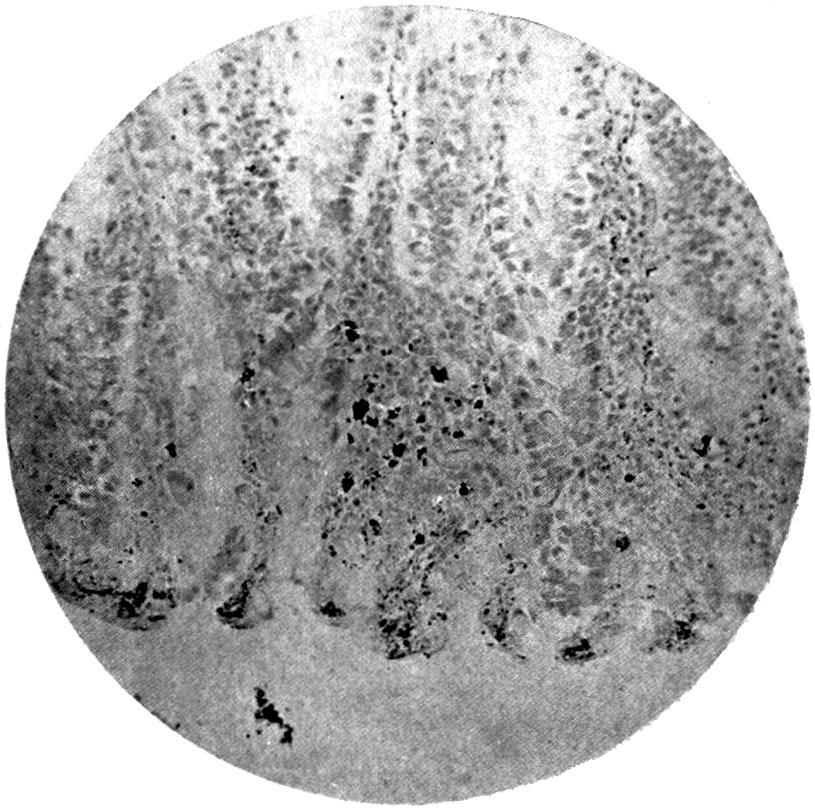
Further evidence of the englobement of lead particles by
amœbic cells may be gained if sections of the intestines of experimental
animals are examined; in the lymphoid glands particles
of lead may be seen situated in the interior of the walls, and even
in the cells. It does not by any means follow that these particles
of lead sulphide present in the cells have been formed in situ;
more probably the lead has been converted into a sulphide in
the intestinal lumen itself, and subsequently taken up by the
amœbic cells situated in its periphery.
Another solution is possible—namely, that the particles seen
in the intestinal wall are particles of lead in process of excretion
into the intestine itself, and that the pigmentation of the vessel
walls and cells is caused by the staining of the particles of lead
passing from the blood into the lumen of the tube, which have
been converted into a sulphide during their passage.
The localization of the staining in the large intestine, especially
in the region of the appendix in animals (cats), tends to support
this theory. The large bowel near the ileo-cæcal valve, the
appendix, and even the glands in the immediate neighbourhood,
are found to be discoloured, and to contain lead in larger quantities
than any other portion of the intestine. In extreme cases
the whole of the large intestine may be stained a greyish-blue.
The bloodvessels in the mesentery in this region are also engorged.
When, however, a salt of lead, such as lead carbonate or lead
oxide, gains access to the stomach, it may be easily converted
into chloride by the free hydrochloric acid present in the stomach;
and, in addition, should there be any chronic acid-dyspepsia
(hyperchlorhydria), particularly of the fermentative type, in
which free lactic acid and other organic acids are to be found
within the viscus, small quantities of lead swallowed as dust
undergo solution and conversion into chloride or lactate. The
pouring out of acid gastric juice from the stomach glands does
not take place immediately after the first bolus of food is swallowed,
and it may be twenty minutes or half an hour before
the gastric contents have an acid reaction. During this time any
lead salts previously swallowed may become incorporated with
the bolus of food and escape absorption.
Lead in solution or suspension in the stomach which becomes
mixed up with the food, and at the same time subjected to the
action of various albuminous constituents of the food in addition
to acids, causes an albuminate or peptonate of lead to be easily
formed, and as such can never be absorbed from the stomach direct;
practically no absorption takes place in the stomach, and the
presence of food containing albuminate precipitates any lead
in solution as an organic insoluble salt. The bolus of food
impregnated with small quantities of lead passes onwards to the
intestine, where further digestion takes place. As the mass
passes through the intestine the action gradually results in the
reappearance of acidity, but at the same time a certain quantity
of sulphuretted hydrogen is produced, some of it from the
degradation of the sulphur-containing moiety of the protein
molecule by ordinary hydrolytic process and intestinal ferments,
quite apart from any bacterial action. A portion of the lead
present in the chyme may be set free again for absorption. The
bile is said to assist in the solution of lead in vitro.
In experiments made by one of us, which are quoted later, it
has been shown that an isolated loop of intestine allows the
absorption of a soluble lead salt (chloride) when there is no food
present in the loop. As the food mass proceeds through the
length of the intestine more and more sulphur is set free, and
an opportunity arises for the fixation of the lead as a sulphide,
but even as a sulphide it is slightly soluble. Probably, however,
most of the lead becomes absorbed long before it reaches the
stage at which free sulphur or sulphuretted hydrogen exists for
the formation of sulphide. It is highly probable that lead, in
common with a number of other heavy metals, including arsenic,
is absorbed gradually in the upper part of the intestine, and re-excreted
in the lower. Such an hypothesis is undoubtedly
strongly supported by the remarkable staining of the large
intestine and the ileo-cæcal valve.
The exact mechanism of the absorption of lead from its compound
with albumin or peptone as a lead peptonate or albuminate
is very difficult to state at present; lead albuminate is undoubtedly
insoluble in water or normal saline and in albumin. The
process of absorption, then, of the metal lead from the gastro-intestinal
canal is very closely related to the absorption of other
heavy metals, and the fact that animals after very large doses of
lead salts administered via the mouth show hæmorrhages in the
intestinal wall, in addition to hæmorrhages in other parts of the
body, with occasional distinct ulceration, suggests a localized
coagulative action on the vessels in the wall of the intestine as the
probable origin of the ulceration. A consideration of this
problem of lead absorption from the intestine—probably only the
minutest quantity of lead, if any, is absorbed from the stomach
direct—is one of considerable importance in the prevention of
such lead poisoning as is attributable to swallowing lead. No
work in a lead factory should be commenced in the morning
without partaking of food, because if food be present the opportunities
for absorption of lead are greatly diminished, and of all
foods the one to be recommended as the most efficient is milk,
or cocoa made with milk.
The absorption of dust through the lung is probably an exceedingly
complicated reaction, and Armit’s experiments with
nickel carbonyl probably give the clue. He found that in nickel
carbonyl poisoning the volatile product was split up on the surface
of the lung cells, the metallic portion passing onwards into the
lung itself, to be eventually absorbed by the serum.
From the pathological and histological investigations described
on p. 81, and from the fact that particles of lead are very
readily taken up by white blood-corpuscles, we can conclude
that absorption of the finer lead particles gaining access to the
lung takes place through the medium of these phagocyte cells,
as such cells are well known to exist within the alveoli of the lung.
The stored-up carbon particles found in the lungs in dwellers in
cities show that such transference of particles from the alveoli
to the inner portions of the lung trabeculæ is a constant phenomenon,
and it is therefore easily understood how rapidly any
fine particles not of themselves irritant may be easily taken up
by the tissues. Once having gained access to the interior of the
cells, the particles subjected to the action of the serum of the
blood in the ordinary process of bathing the tissues by the exuding
lymph—nay, more, actual particles of lead—may thus be actually
transferred bodily into the finer blood-spaces, and so be carried
forward to the general circulation. Such particles as remain
fixed in the lung will undergo gradual absorption, and the constant
presence of carbonic acid in the circulating blood brought to the
lung undoubtedly largely contributes to their solution, and there
is no need to presuppose the necessity of some recondite interaction
of organic acid for the solution of the inhaled lead in the
lungs.
In the absorption of the substance from the intestine, it may
go direct into the blood-stream in a similar fashion through the
lacteals along the lymph channels, and so into the thoracic duct,
and finally into the general circulation. On the other hand, a
certain amount, probably not an inconsiderable portion, is taken
up by the portal circulation and transferred direct to the liver
itself. Chemical analysis of the liver supports this view, as does
also the considerable amount of stress thrown upon the liver
when poisoning has taken place from the intestinal canal on
administration of massive doses of a highly soluble lead compound.
According to Steinberg[16], excretion of lead takes
place partly from the liver by the bile. This is probable, but
there is no experimental evidence at the present time to support
the view. If such an excretion does take place, the form in which
the lead is excreted is probably one in which it is no longer
soluble by digestive action. On the other hand, it may be in so
soluble a form as to become reabsorbed from the intestine, thus
setting up a constant cycle. But such a theory is one that would
require a considerable amount of experimental evidence to
support it before it could be relied on.
There is no doubt that, however absorbed, lead remains stored
up in the body in minute quantities in many places, and the close
analogy to arsenic is met with in the curious elimination of the
metal by the fæces. Cloetta[17], quoted by Dixon Mann, discovered
that, although dogs were unable to take a larger dose of
arsenic than 0·0035 gramme per day without exhibiting toxic
results, they could nevertheless take arsenic in much larger
doses if it were given in the solid form, and he was able to
increase the dose to as much as 2 grammes per diem without
showing any toxic symptoms. Examination of the urine and
fæces showed that as the amount of urinary excretion of
arsenic diminished, so that in the fæces increased, and in lead
poisoning, even in massive doses swallowed in error, the amount
of lead excreted by the urine rapidly diminishes in quantity,
although the patient may be still suffering from the effects of
lead poisoning. The experiments, also, quoted on p. 100 constantly
pointed to the elimination of lead by way of the intestine,
and in practically all the animals that had suffered from chronic
poisoning well-marked dark staining of the upper part of the
cæcum due to lead was invariably present. This staining and
excretion of lead of the large intestine undoubtedly takes place
in man. In a case described by Little[18], where diachylon had
been administered, the administration of a large enema containing
sulphate of magnesium came away black. A more
detailed result of the experiments and a consideration of the
elimination of lead are reserved for another chapter, but it is
impossible to consider the ætiology of the disease without some
reference to the general histological channels of absorption and
excretion.
—A considerable amount of
controversy has centred on the question of the absorption of lead
through the unbroken skin. It has been shown that such drugs
as belladonna applied to the skin alone may produce dilatation
of the pupil; an ointment containing salicylic acid spread upon
the skin and thoroughly rubbed in is followed by the appearance
of derivatives of salicylic acid in the urine; mercury may be
applied to the skin, and rubbed in, in sufficient quantities to
produce salivation; and a very large number of other drugs may
be cited, all of which when applied to the unbroken epidermis
with friction produce the physiological action of the drug.
There is no reason to exclude lead from the category of drugs
which may be absorbed through the medium of the skin, and, as
several observers have shown, animals may be poisoned by lead
on applying a plaster of lead acetate to the skin. Amongst
these experiments may be quoted those of Canuet[19] and
Drouet[20] on rabbits. Some observers, among whom may be
mentioned Manouvrier[21], have attempted to prove that
paralysis of the hands occurs more often in the right hand in
right-handed people, in the left hand with left-handed people,
and from the various experiments showing absorption of lead
through the unbroken skin they seek to connect the lesion of the
nerve with absorption direct through the skin of the hands.
Many objections can be urged against acceptance of this theory.
Lead workers who are constantly manipulating lead in a state
of solution with bare hands do not appear as a class to be more
subject to wrist-drop than do persons who are exposed to
inhalation of fumes or dust of lead; in fact, incidence of paralysis
and of nerve lesions generally is more severe among persons
exposed to prolonged inhalation of minute quantities of lead
through the respiratory tract. The greater the exposure to dust,
the greater the number of cases of anæmia and colic, whilst in
other industries, as has already been stated, where lead exists as
an oleate on the hands of the workers day in and day out for
many years, paralysis and even colic are of rare occurrence; in
other words, persons especially exposed to the absorption of
lead through their hands show a much smaller incidence of lead
poisoning of all types than do those exposed to lead dust.
Further, the pathology of wrist-drop and similar forms of paresis
tends to show that the nerve supplying the affected muscles is
not affected primarily, but that the initial cause is hæmorrhage
into the sheath of the nerve, producing ultimate degenerative
change. The hæmorrhage, however, is the primary lesion.
[1]Goadby, K. W.: A Note on
Experimental Lead Poisoning. Journal of
Hygiene, vol. ix., No. 1, April, 1909.
[2]Legge, T. M.: Report on the
Manufacture of Paints and Colours containing
Lead (Cd. 2466). 1905.
[3]Duckering, G. E.: Journal of
Hygiene, vol. viii., No. 4, September.
[4]Meillère, G.: Le Saturnisme, chap.
iv. Paris, 1903.
[5]Armit, H. W.: Journal of Hygiene,
vol. viii., No. 5, November, 1908.
[6]Tanquerel des Planches: Traité des
Maladies de Plomb, ou Saturnines.
Paris, 1839.
CHAPTER III SUSCEPTIBILITY AND IMMUNITY — Age. — Sex. — Predisposing Causes of Lead Poisoning. — Malnutrition. — Anæmia. — REFERENCES.
A large number of poisonous substances, among which lead may
be included, are not equally poisonous in the same dose for all
persons. It is customary to speak of those persons who show a
diminished resistance, or whose tissues show little power of
resisting the poisonous effects of such substances, as susceptible.
On the other hand, it is possible, but not scientifically correct,
to speak of immunity to such poisonous substances. Persons,
particularly, who resist lead poisoning to a greater degree than
their fellows are better spoken of as tolerant of the poisonous
effects than as being partially immune.
The degree of resistance exhibited by any given population
towards the poisonous influence of lead shows considerable
variation. Thus, in a community using a water-supply contaminated
with lead, only a small proportion of the persons
drinking the water becomes poisoned. There are, of course,
other factors than that of individual idiosyncrasy which may
determine the effect of the poison, as, for example, the drawing
of the water first thing in the morning which has been standing
in a particular pipe. But even if all disturbing factors are
eliminated in water-borne lead poisoning, differing degrees of
susceptibility are always to be observed among the persons using
the water.
Lead does not differ, therefore, from any other drugs to which
persons show marked idiosyncrasies. Thus, very small doses of
arsenic may produce symptoms of colic in susceptible persons;
a limited number of individuals are highly susceptible to some
drugs, such as cannabis indica, while others are able to ingest
large doses without exhibiting any sign of poisoning; and it is
well known that even in susceptible persons the quantity of a
particular drug which first produces symptoms of poisoning may
be gradually increased, if the dosage be continued over long
periods in quantities insufficient to produce marked symptoms of
poisoning. In this direction a number of experiments have been
performed with arsenic, particularly those of Cloetta[1], who
found that the dose of arsenic for dogs could be gradually raised,
if given by the mouth, to many times the ordinary fatal dose, but
that if at this point a subminimal fatal dose was injected beneath
the skin acute symptoms of arsenic poisoning followed.
We show in a later chapter that the excretion of lead in persons
tolerant of the metal takes place through the medium of the
bowel, and that probably those individuals who are engaged in
what are recognized as dangerous processes in lead industries,
and yet show no signs of illness, have established a kind of balance
between the intake of the poison and its excretion by the bowel.
It is rarely possible in such persons to find any lead excreted
through the kidney. Occasionally, however, such persons, after
working a considerable time in a dangerous lead process, become
suddenly poisoned, and inquiry frequently discloses the fact that
some disturbing factor, either intercurrent illness, alcoholic excess,
etc., has occurred, or that the breathing of a big dose of dust has
precipitated the symptoms of general lead poisoning. On the
other hand, the experience of all persons engaged in the routine
examination of lead workers is that, although a worker may
show signs of lead absorption as distinguished from definite lead
poisoning during the earlier period of his employment, he later
shows less and less signs of the influence of the poisonous substance;
even a mild degree of definite poisoning in the early
stages of work in a lead process does not seriously militate against
this gradually acquired tolerance, whilst careful treatment during
such a time as the man is acquiring tolerance to the poison
frequently tides him over the period, and enables him to withstand
the ordinary dangers attached to his work.
The earliest symptom of lead absorption is anæmia. The
anæmia is not very profound, and the diminution in the red
blood-cells rarely reaches as low as 2,000,000 per c.c., the hæmoglobin
remaining somewhere between 75 and 80 per cent. Some
loss of orbital fat, as well as fat in the other parts of the body,
occurs, but beyond this no obvious clinical signs of poisoning
exist. Should such persons possess unhealthy gums, a blue line
rapidly makes its appearance, but where the gums are healthy
it is unusual to see any sign of deposit in this prodromal stage.
Persons who gradually acquire tolerance go through the stage
of anæmia without exhibiting any symptoms of colic or paresis,
and without any treatment the hæmoglobin and the number of
red cells gradually pass back to a more or less normal condition.
During this period—that is, whilst the blood shows signs of a
diminution in its corpuscular and colour content—basophile
granules may always be found if sought for, but disappear as a
rule when the blood-count has returned to about 4,000,000 per
c.c. and an 80 per cent. hæmoglobin. Such a man has now
developed tolerance to the poisonous influence of lead, a tolerance
which may be described as a partial immunity produced by
recurrent subminimal toxic doses. On the other hand, in a
number of persons who show definite susceptibility, the blood-changes
are progressive, and do not show signs of automatic
regeneration. In such persons, even after so short time as four
to six weeks’ exposure to lead absorption, definite symptoms of
colic may make their appearance. The removal of such an
individual from the poisonous influence of lead generally clears
up the symptoms in a short time, but the symptoms may occasionally
continue for several months after removal from the influence
of the poison. An individual of this type is to be looked upon as
showing peculiar susceptibility, and should not be employed in
any lead process where there is risk.
Such statistics as are available on this point show that an
increased tolerance to the poisonous influence of lead is gradually
acquired during periods of work, in that the number of attacks of
poisoning diminish in frequency very considerably in relation to
the number of years worked. As will be seen on reference to the
chapter dealing with the statistics of lead poisoning (p. 46),
the greatest number of cases occur in persons who have only
worked a short time in lead. On the other hand, the sequelæ of
lead poisoning only make their appearance, as a rule, after long-continued
exposure. It is important to bear in mind that the
various forms of paresis rarely make their appearance unless the
subject has been exposed to long-continued absorption of lead,
and, further, that the blood of such persons will as a rule show,
on careful examination, evidences of the long-continued intoxication.
If measures, therefore, were taken to determine the presence
of such continued intoxication, and to diminish the amount
of poison absorbed (subjecting the individual at the same time
to a proper course of treatment), a large number of the cases of
paralysis, encephalopathy, and death, incidental to the handling
and manufacture of lead, could be eliminated.
Susceptibility may at times be shown by several members of
one family. Oliver[2] says that he has known many members
of one family suffer from and die of lead poisoning. In our
experience several instances of this susceptibility have been
noticed. In one case two brothers, working in one shift of men,
developed poisoning, although no other persons in that shift
showed any signs of it. A third brother, who came into the
works after the other two had left, and who was placed under
special supervision on account of the susceptibility exhibited
by his two brothers, although given work which exposed him to
the minimal degree of lead absorption, developed signs of
poisoning six weeks after his entrance into the factory. In
another factory, three sons, two daughters, and the father, all
suffered from lead poisoning within a period of four years: the
father had three attacks of colic, ultimately wrist-drop in both
hands; one daughter had one attack of colic, and the other three
attacks; whilst the three brothers all suffered from colic and
anæmia, and one had early signs of weakness of the wrist. There
was no evidence at all to show that these persons were more careless,
or had been more exposed to lead dust, than any other of the
persons with whom they worked, or that the work they were
engaged upon was more likely to have caused illness to them than
to other workers. Persons with a fresh complexion and red hair
have been noted to be more susceptible to lead poisoning than
dark-haired persons.
In one factory with which we are familiar, a number of Italian
workmen are employed; these show considerably less susceptibility
to lead poisoning than do their English comrades as long
as they adhere to their own national diet. When, however, they
give this up, and particularly if they become addicted to alcohol,
they rapidly show diminished resistance; in fact, all the cases of
plumbism occurring among the Italians in this factory during the
last ten years have been complicated with alcohol. It is possible
that the relatively large quantity of vegetables in the diet of
these Italians influences the elimination of absorbed lead. There
is some reason to suppose, however, that there may be racial
immunity to lead poisoning.
The following case in the same factory illustrates a point already
mentioned—namely, the gradually acquired tolerance to poisoning,
and the unstable equilibrium existing. The individual was
a man of twenty years of age. He commenced work on August 2,
1905. Six weeks later he was under treatment for seven weeks,
for lead absorption, and had a peculiarly deep blue line round
his gums, and a diminished hæmoglobin of 75 per cent. The
symptoms disappeared with ordinary routine treatment, and his
work was shifted to a position in the factory where he was
exposed to the minimum amount of lead absorption, at which
work he continued during the rest of the time he remained in the
factory. He continued quite well until June, 1906, when he was
again under treatment for two weeks, with the same blue line
and anæmia, and his blood showed the presence of basophile
granules. He was under treatment again in January and
February, 1909, for five weeks, had again a deep blue line and
basophile staining of his blood. On November 7, 1911, having
had no anæmia and no blue line, he had a slight attack of colic.
During this period of work his blood had been examined on eight
occasions, and on each occasion it had shown basophile granules.
The attack of colic was an exceedingly mild one. There is no
reason to suppose that he had indulged in alcoholic excess,
but there was some reason to think that for about a month he
had been subjected to increased lung absorption. No other
persons working in the same shift at the same work developed
poisoning during the whole of this period. This case illustrates
initial susceptibility, partial tolerance, and ultimate breaking
down of such partially established tolerance.
During the experimental inquiry on lead poisoning by one of
us [K. W. G.[3]], the question of the subminimal toxic dose and
the minimal toxic dose was under consideration. Animals subjected
to inhalation of lead dust invariably succumbed to the
effects of the poison when the dose given represented from 0·0001
to 0·0003 gramme per litre of air inhaled, the period of inhalation
being half an hour three times a week. On the other hand, when
the lead content of the air was as low as 0·00001 gramme per
litre, the symptoms of poisoning were long delayed, and in
more than one instance, after an early diminution in weight,
recovery of the lost weight took place, and the animals, whilst
showing apparent symptoms of absorption, had no definite
symptoms of paresis. These observations tend to confirm
such clinically observed facts as are given in the case cited
above, but they, of course, do not form a criterion as to the
amount of lead dust which may be regarded as innocuous to
man.
Lead is peculiarly a cumulative poison, and post-mortem
analyses of viscera show that it may be stored up in certain
parts of the body, more especially in the bone and red bone
marrow and brain, and to some extent in the liver, spleen, and
kidneys. Any circumstance, therefore, that temporarily interferes
with the ordinary channels through which lead is excreted
may determine the presence of a much larger quantity than usual
of the metal in circulation in the body; and if in addition an
increased quantity of the poison be inhaled, more or less acute
symptoms follow. The localization of the deposit of lead is
therefore of some importance.
Meillère and Richer[4] give an analysis of various organs of
the body, but their results are not in accord with the majority of
other observers. They found that the hair particularly contains
a large quantity of lead. They do not seem to have examined
the bones. Next to the hair, the liver seems to have contained
the largest amount. Wynter Blyth[5] found 117·1 milligrammes
of lead in the brain of a person who died of encephalopathy. In
another case he found 0·6 gramme in the liver, 0·003 in the
kidney, and 0·072 in the brain. Hougounencq[6] examined the
organs of a person who died from lead poisoning, and found the
largest amount of lead in the large intestine.
Large intestine
0·2150
gramme.
Small intestine
0·0430
„
Liver
0·0050
„
Brain
0·0008
„
In the lung, stomach, kidney, and heart, only traces were found.
Dixon Mann[7] describes some experiments in which potassium
iodide was given in cases of chronic poisoning, and during the
whole of the experiments the fæces and urine were analyzed three
times a week. He found by this means that a considerable
amount of lead was being eliminated by the intestine. He therefore
administered 2 grammes of lead acetate three times a day for
five days to a patient, and he found that the fæces contained
0·1762 gramme the first day, 0·17411 gramme the second day;
the fourth day it had fallen to 0·0053 gramme, and on the sixth
day to 0·0006 gramme. The largest amount at any one time in
a day obtained from the urine was only just over 0·001 gramme;
the average amount found in the case of chronic poisoning was
about 3 milligrammes, whereas the greatest amount at any one
time in the urine was only 0·9 milligramme.
The quantity of lead present in the brain necessary to determine
acute poisoning is not known, and it is probable that an extremely
minute quantity will produce very serious effects; and in support
of this may be quoted a number of observations in which search
has been made for the metal in persons who have died of
diseases affecting the brain associated with other symptoms of
poisoning, and yet post-mortem examination of the brain by
chemical methods has not revealed the presence of any lead
whatever. In the case reported by Mott (see p. 71), no lead at
all was recognized in the brain.
There are no reasons, therefore, for supposing that the immunity
to lead poisoning depends on the fixation and storing
up of the poisonous metal in a non-poisonous form in some
special situation in the body, and, further, the particular
situation in the body richest in lead in any given case of poisoning
will depend rather on (1) the type of compound causing
the poisoning, and (2) the portal through which such poisoning
occurs.
The question of the detection of lead in the body is referred to
in the chapter dealing with Chemical Examination. It is as well
to point out in this connection that chemical investigation of
the amount of lead present in the organs of persons dying from
lead poisoning should, if possible, always be made where there is
any doubt as to the diagnosis.
Certain observers—amongst them Gautier[8]—are of opinion
that traces of lead may be found in normal persons. Thus, in a
rat (Mus decumanus) Gautier found 2 milligrammes of lead in
60 grammes of liver. He considers that in many persons at
least 0·5 milligramme of lead may be swallowed daily incorporated
with the food, as a number of foods are liable to contamination
by lead. Tinned foods, particularly those which are soldered up
after the materials have been placed in the tin, certain tinned
fruits with acid juices, often contain small masses of solder loose
in the tins; in the case particularly of fruits the natural acid
may slowly dissolve the lead from the solder. The amount of
so-called “normal” lead, if it is to be found at all, must be very
small, and would certainly be much smaller in the case of a
normal person than in one who had been subject to definite lead
poisoning. Such experimental evidence as is forthcoming supports
the clinical observations that persons exposed to small
doses of lead eventually develop tolerance of the metal, so that
they may ultimately withstand many times the dose sufficient in
the first instance to produce poisoning.
Such circumstances are the natural factors in the prevention
of poisoning, and if due care be given to their significance, the
surgeon in charge of any lead works may by judicious treatment
and alternation of employment so assist and strengthen the natural
defensive forces that susceptibility may be diminished, and the
degree of tolerance increased to a very considerable extent. We
do not imply that efficiency in the exhaust ventilation can
be in any way relaxed; all we desire to emphasize is that certain
natural defensive forces of the body do undoubtedly exist by
which susceptible persons ultimately become less susceptible,
and that by appropriate means these defensive forces may be
augmented.
Susceptibility and immunity to poisoning by lead may be considered,
according to the type of lead compound absorbed, further
in its relation to age and sex. All compounds of lead are not
poisonous in the same degree; the more easily soluble compounds
are more poisonous than the less soluble. On the other hand,
compounds which appear at first sight unlikely to produce
poisoning may do so; for instance, fritted lead or lead silicate, a
substance largely used in the potteries as a glaze, and manufactured
by fusing together litharge and a silicate, would appear
at first sight to be quite an innocuous substance. Owing to its
method of preparation, however, it is not a pure compound of
lead and silica, but contains lead oxide, metallic lead, etc., entangled
in its meshes, and experimentally one of us (K. W. G.)
has demonstrated that such a compound may be acted on by the
tissues of the body, both when injected subcutaneously and even
when inhaled, and so gradually produce definite symptoms of
lead poisoning, but at a much slower rate than the more poisonous
lead compounds. The fineness of division in which the compound
of lead exists is another factor affecting its poisonous nature; the
more finely divided particles find their way into the lung more
easily than the coarser particles. Various subsidiary matters
may also determine the susceptibility in a given individual, and
of these a certain number require mention, as they probably act
as definite predisposing factors. Age and sex may be regarded
as predisposing factors to lead poisoning, and certain diseases also.
—Young persons are regarded as more liable to lead
poisoning than adults, although it is difficult to obtain definite
figures on the point, the duration of employment acting as a
disturbing factor in estimating the susceptibility of young
persons. They may have worked in a lead works for a year or
more without showing any signs of poisoning, but develop them
later in adult life, although it is very likely that absorption had
taken place during the earlier period. In the Report of the
Departmental Committee on the Use of Lead in the Potteries
(Appendix XII.), the attack rate for the period 1899 to 1909 for
young persons is 19·3 per 1,000, and for adults 18·8 for the
same period, but the figures upon which these attack rates
are based are too small to build any conclusion. The general
clinical conclusions of appointed surgeons and certifying surgeons
in the various lead factories would be, we believe, that the susceptibility
of young persons is at least twice that of adults, and
there is some ground for supposing that the tissues of an adult
when growth has ceased more readily adapt themselves to deal
with the absorption and elimination of poisonous doses of lead
than do the tissues of a young person.
—Women are more susceptible to poisoning by lead than
men, and in lead poisoning from drinking water the proportion
of women (especially pregnant women) and children attacked is
stated to be higher than in men, and one such epidemic is quoted
by Oliver where the rise in the number of miscarriages and
premature births led to the discovery of the fact that the water-supply
was contaminated with lead. The close relationship of
lead poisoning to miscarriage has been repeatedly made out,
especially by Oliver, in the white lead industry as carried on
twenty years ago. Oliver also quotes the effect upon rabbits[9],
Glibert upon guinea-pigs[10], and in the experiments of one of us
(K. W. G.), referred to on p. 99, all the animals to which lead
was given during pregnancy aborted; and, further, with one exception
out of eight animals, all died of lead poisoning, not as the
result of the abortion, but some time later, although no further
administration of lead was made. This confirms the well-known
abortifacient effect of diachylon, and there is no doubt that the
lead circulating in the maternal blood determines the abortion.
Further, observers who have examined the fœtus in such cases
have demonstrated the presence of lead in the fœtus itself.
Oliver[11]
found that eggs painted with lead nitrate did not
hatch out, and on opening the eggs the embryos were found to
have reached only a limited stage of development, and to have
then died, whereas control eggs painted with lime produced
live chicks. From what is stated later with regard to the
curious action of lead upon the blood, the mechanism of abortion
is easily understood; it is probable that placental hæmorrhages
are produced, as in other organs of the body. But the effect of
lead on the female is not only apparent during pregnancy. A
considerable number of women working in lead processes suffer
from amenorrhœa, and often from periods of menorrhagia and
dysmenorrhœa, which as a rule is the more striking symptom.
The effect of lead on the uterine functions, however, only exists
so long as the constant intake of the poison is taking place, and
many cases are recorded where women, after having had successive
abortions while working in lead factories, have ultimately
gone through a normal pregnancy and given birth to a living
child. This circumstance bears a strong analogy to the similar
train of events in syphilis.
In the Report of the Committee on the Use of Lead in the Potteries,
some inquiry was made with regard to the possible association
of lead absorption on the male side as a predisposing cause of
infant mortality and premature birth. The tables given are not
very conclusive, and from our own observations there seems to
be very little evidence for supposing that a male lead worker is
less likely to beget children, or that his children are more likely
to be unhealthy than those of men working in any other industrial
process. We are here speaking of the effect of lead under the
conditions of its general use in this country now. In the absence
of any precautions whatever as to daily absorption of dangerous
dust, the effect on the offspring, even in the case of male lead
workers, may well be evident, as has been shown by Chyzer[12]
in the manufacture of pottery as a home industry in Hungary.
One greatly disturbing factor in estimating the greater susceptibility
of the female than the male in many lead industries is
that the more dangerous work is performed by the women, such,
for instance, in the Potteries, as the process of colour-blowing and
ware-cleaning.
—In lead poisoning, as
in many other diseases, a number of predisposing and contributory
causes may be cited which tend to lower the susceptibility
of the individual to the poisonous effect of the metal and
its compounds, or to so modify the functions of the body that a
smaller dose of poison may produce more profound changes than
would otherwise be the case.
Certain diseases may be regarded as predisposing causes by
lowering the general resistance of the body tissues to the influence
of lead, and a consideration of the chapter on Pathology will at
once demonstrate how seriously certain diseases may contribute
in this way.
The peculiar effect of lead is upon the blood and the walls of
the bloodvessels, and it will therefore follow that any disease
which may affect the intima of the bloodvessels may predispose
to lead poisoning; and, further, as the elimination of lead takes
place to a certain extent through the kidney, any disease which
affects either the renal epithelium or the general maintenance of
the excretory function of the kidney may predispose that organ
to the irritative effects of the lead circulating in the blood. In
the same way, the condition of lead absorption in which the
balance of absorption and elimination of lead remains in such a
ratio that no definite symptoms of lead poisoning appear may have
that delicate balance easily upset by the introduction of some
secondary cause, which, when operating in association with lead
absorption, may precipitate symptoms attributable to poisoning
by that metal. Chronic alcoholism especially, producing as it does
definite changes in the kidney of itself—changes which it is
impossible to distinguish by the naked eye from the effects
of lead poisoning—must clearly act as a predisposing, if not
even an exciting, cause of lead kidney infection. In experiments
upon animals, it was found that the addition of alcohol to
the diet of an animal which was the subject of chronic lead
absorption precipitated the attack of definite poisoning; in
other words, the latent period of lead poisoning—that is to
say, the resistance exhibited by the tissues to the toxic influence
of lead—was considerably diminished by this addition of
a second irritant, alcohol. In several experiments, also, where
the form of lead experimented with was one of the least toxic of
the lead compounds, the animals subjected to such a compound
alone did not become poisoned, but succumbed if alcohol were
added to their diet. This experimental work is amply borne out
by the clinical evidence of all persons who have had experience of
industrial lead poisoning, as cases of colic and wrist-drop are
frequently observed in lead workers shortly after alcoholic
excesses. Individuals, therefore, who are suspected of the alcoholic
habit should not be employed in any process where they
are likely to run risk of absorption of lead dust.
Such diseases as syphilis and gout, by causing a heightened
arterial tension or definite disease of the intima of the bloodvessels
themselves, tend to weaken the arteries in much the
same manner as does lead circulating in the blood, and must on
that account act as predisposing causes.
In persons employed in lead trades some species of tolerance
is generally developed, and if the functions of the body progress
in the normal way the balance of elimination and absorption are
equal, and, as will be seen later, the chief channel for the elimination
of lead from the body is through the bowel. It follows,
therefore, that any disease which tends to produce constipation
or chronic inactivity of the normal intestinal functions will
also tend to lower the resistance of the individual to lead
poisoning.
Of the various types of intestinal disease of a chronic nature—such,
for instance, as chronic dysentery, colitis, and the like—little
need be said; but the predisposing effect of diseased
conditions of the upper portion of the alimentary canal
must not be overlooked, more particularly affections of the
oral cavity itself. This special type of infection, often included
under the term of “oral sepsis,” besides producing
anæmia, is also a constant cause of intestinal disturbance,
and as such operates as a particular predisposing cause of lead
poisoning.
With regard to gout the evidence is not so clear. It was
pointed out by Garrod[13] that gout was common among house-painters,
and it has been generally stated that lead poisoning
predisposes to this complaint. In the opinion of a considerable
number of observers, however, gout is by no means common
among persons working in white lead factories or lead-smelting
works, but there seems to be some reason to suppose that it is
somewhat common among those persons employed in the painting
trades, but not among those employed in the manufacture of
paints and colours. From the experiments carried out by one
of us [K. W. G.[13]]. it seems probable that the occurrence of
gout among painters may be associated with the use of turpentine,
largely employed in the ordinary processes of painting, as
this substance in particular is not one that is used by workers in
other lead trades, and, from experiments performed on animals,
the inhalation of turpentine vapour was found to produce very
definite changes both in the kidney and the general metabolism
of the body.
—Malnutrition is recognized as a predisposing
cause of practically all forms of disease, and with a chronic
intoxication, such as lead poisoning, malnutrition and starvation,
with its attendant depression of all the vital forces of the body, is
essentially a predisposing cause of poisoning, so much so that
even the fact of commencing work without previously partaking
of food may operate directly as a cause of poisoning. It has been
found, moreover, experimentally by one of us [K. W. G.[14]]
that an animal fed with milk containing lead nitrate did not
develop poisoning, though the control animal developed well-marked
symptoms of poisoning with a much smaller dose given
in water.
—Anæmia has already been referred to as occurring
with great frequency in persons who are absorbing lead, and it
usually forms one of the chief factors in the symptom-complex
of lead cachexia. As the action of lead is particularly upon the
blood and the hæmopoietic organs, diminishing the number of red
cells and the amount of hæmoglobin, and impairing the organs
from which fresh blood-cells are produced, a disease or state
associated with anæmia other than of lead origin acts as a definite
predisposing cause in the development of toxic symptoms in
a worker in an industrial lead process.
Among the anæmias, two particular types may be referred to
as of chief importance. In the first place, chlorosis, the anæmia
occurring particularly in young women, is often associated with
intestinal stasis. Lead anæmia occurring in a chlorotic person is
always more severe than simple lead anæmia. Young persons
suffering from chlorosis, therefore, should not be employed in a
dangerous lead process until the anæmia has been treated. The
second type of anæmia, which, from its frequency, may be also
regarded as a predisposing cause of lead poisoning, is chronic
secondary septic anæmia. Anæmias of this type, as was pointed
out by William Hunter[15], resemble in many points the original
idiopathic or Addisonian anæmia, often termed “pernicious
anæmia,” and one of us has had occasion to inquire into the
curious type of secondary anæmia associated with septic affections
of the upper respiratory tract, particularly those related
to chronic suppurative affections of the accessory sinuses of
the nose, of the gums, of the mucous membrane of the mouth
and the throat. The commonest forms of this secondary anæmia
are those due to chronic post-nasal discharge, and to chronic
infections of the gums and alveolus of the jaws, the latter often
classed together under the term “pyorrhœa alveolaris.” This
term is an exceedingly clumsy one, indicating a discharge of pus
from the gum edges and sockets of the teeth, which are often
loose. The disease commences as an infective gingivitis along
the edges of the gum, and progresses to rarefying osteitis of the
alveolar process, and often of the body of the bone. The affection
rarely gives rise to pain, and as a rule the individual is
entirely unaware that any chronic suppuration is present, and
little or no notice is therefore taken of the disease. Progressive
anæmia may thus be set up without any knowledge of its cause,
partly by absorption of the actual bacteria and their products
through the alveolar bloodvessels, and partly by the fact of the
constant swallowing of pus and bacterial products, which set
up various forms of chronic gastro-intestinal incompetence.
From the discharges of the mouth, and issuing from the gum
edges, numerous bacteria have been isolated, and in more recent
work one of us [K. W. G.[16]] has succeeded in isolating and identifying
certain bacteria as a direct cause of arthritis deformans,
a malady occasionally, but without sufficient grounds, ascribed
to lead poisoning. Arthritis of various types may occur in persons
engaged in lead trades, but in all such cases we have had the
opportunity of examining there has been some obvious source
of septic infection, and no evidence that the arthritis was due
to the action of lead. It is most important to draw the attention
of those engaged in the protection of lead workers from the
dangers of their occupation to these chronic septic conditions
of the mouth, and it may be taken as a general rule that, wherever
the blue line makes its appearance along the gums, such gums
are in a state of chronic infection, and the appearance of the blue
line is merely a secondary effect. It is exceedingly rare to find
the blue line in persons with intact gums and clean teeth; and
although attention is frequently drawn to the fact that a lead
line exists in a person whose teeth are normal, little or no notice
is taken of the presence or absence of a suppurative condition
of the gum margins. Moreover, such a suppurative condition
does not always result in obvious inflammation of the gum edges,
and very considerable destruction of the alveolus and the interdental
bone may exist without any obvious signs of its presence,
unless the case be examined carefully with a fine probe. This
particular point has been the subject of experiment by one of
us. Animals exposed to the influence of air laden with lead
dust never develop a blue line, although all the usual symptoms
of lead poisoning make their appearance. When, however, some
slight suppurative lesion of the gums was produced by an inoculation
into the gum tissue of organisms isolated from a case
of infective gingivitis in a human being, the site of inoculation
and any suppurative lesion that resulted locally at once allowed
the development of a blue line, and it was only in animals
so treated that it was possible to produce experimentally the
Burtonian line.
There is no doubt that any chronic septic infection may
predispose to lead poisoning through the production of a secondary
anæmia, and it is therefore inadvisable to pass for work
in a lead process of a dangerous nature any persons suffering
from an infected condition of the mouth. It follows also that the
care of the mouth and gums should be rigorously enforced
upon all persons employed in lead trades, as the mere mechanical
facilities for the accumulation of débris around the individual
teeth tends to increase the quantity of lead dust that may be
retained in the mouth. This is gradually rendered soluble and
absorbed, through the action of the bacterial acids which are
always produced along the gum margins when any entangled
food is retained in the interdental spaces.
One further point of importance attaches to the infections of
the upper respiratory tract—namely, the constant ingestion
of bacteria of a fermentative type. By this means the contents
of the stomach may be maintained in a state of hyperacidity,
and any small quantities of lead which become
swallowed are thereby at once rendered soluble in the intermeal
periods.
Of the other types of anæmia which may act as predisposing
causes of lead poisoning, little need be said, as they are either
associated with other grave symptoms or are rare in this country.
But as all forms of anæmia, particularly septic anæmia, malarial
fever, etc., are associated with destruction of the blood-cells,
the presence of basophile staining granules in the red corpuscles
of such persons is a constant feature, and must not be confounded
with the basophile staining owing its origin to the effect of
lead.
In addition to the diseases mentioned which may be said to
predispose to lead poisoning, certain other diseases have been
stated to be predisposed to by the action of lead. It is no doubt
a fact that where chronic anæmia, wasting, loss of subcutaneous
fat, decreased muscular power, and general lowering of the
metabolic activity of the body, are produced, an individual so
affected may be supposed to be more susceptible to certain infectious
diseases, and among these stress has been laid on the
alleged association of phthisis with lead absorption. This point
is discussed in the next chapter.
In summing up the difficult question of predisposition to lead
poisoning, together with the correlated questions of susceptibility
and immunity, certain facts may at any rate be clearly
stated:
1. Undoubted individual susceptibility and immunity exist
with regard to lead poisoning in exactly the same way as
individual susceptibility and immunity may be shown to exist
towards poisoning by many other metals and drugs. Therefore,
given the same opportunities for infection, a person
showing early signs of lead absorption may be regarded as
susceptible.
2. Females are at least twice, and probably three times, as
susceptible to lead poisoning as are males. Much of this susceptibility
is determined by the extra stress thrown upon the
female generative organs.
3. Certain diseases predispose to lead poisoning mainly by
nature of the alterations in metabolism produced—chiefly
anæmia.
4. Many persons engaged in lead industries become gradually
tolerant of the absorption of lead, and in time resist much
larger doses than would have been possible at the commencement
of exposure, but in such persons the balance between
absorption and excretion upon which that tolerance depends
may become easily disturbed by intercurrent disease or sudden
increase in absorption.
[1]Cloetta:
Dixon Mann’s Forensic Medicine and Toxicology, p. 463.
[2]Oliver, Sir T.: Diseases of
Occupation, p. 142.
[3]Goadby, K. W.: Departmental
Committee on Lead Poisoning, etc., in
China and Earthenware Manufacture, Appendix No. XXV.
[4]Meillère and Richer: Meillère’s
Le Saturnisme. Paris, 1903.
CHAPTER IV STATISTICS OF PLUMBISM [A] — REFERENCES.
[A] Based mainly on reports received from certifying factory
surgeons during
the ten years 1900-1909.
Classification of notified cases of lead poisoning was carried
out on practically the same lines between the years 1900 and 1909,
and comparison of the data so collected has interest, in view of
their large number—nearly 7,000—in respect of (1) increase
or decrease in recorded amount in each one of eighteen classes
of industries; (2) severity and number of attack—i.e., whether
first, second, third, or chronic; and (3) main symptoms.
Notification was first enjoined by Section 29 of the Factory and
Workshop Act, 1895, which subsequently, on consolidation of
the Factory Acts, became Section 73 of the Act of 1901. This
enactment requires every medical practitioner, attending on, or
called in to visit, a patient whom he believes to be suffering from
lead poisoning contracted in a factory or workshop, to notify
the case forthwith to the Chief Inspector of Factories at the
Home Office; and a similar obligation is imposed on the occupier
of a factory or workshop to send written notice of every such
case to the certifying surgeon and inspector of factories for the
district. In form there is close similarity between this section
and that requiring notification under the Infectious Diseases
(Notification) Act; but whereas the symptoms of these diseases
are, within well-recognized limits, precise, in lead poisoning the
differential diagnosis has not infrequently to be made from a
variety of common ailments—headache, anæmia, rheumatism,
abdominal pain; and there is no precise standard of what constitutes
lead poisoning.
The notification of the practitioner as a rule gives no information
beyond the belief that the case is one of lead poisoning.
As a matter of routine the notification is followed up by an inquiry
by the certifying surgeon and inspector to see whether regulations
already in force have been infringed in the particular work-place
or not, and as to how far there may have been contributory
negligence on the part of the sufferer. The data supplied on the
surgeon’s report form the basis of the tabulation[1]. Brief explanation
is wanted of the method adopted in classification. Cases
represent all attacks reported within a year, and not previously
reported within the preceding twelve months, so as to make the
number of persons and cases in a year the same. Where the
interval between two reports on the same person was more than
twelve months, the fresh attack was again included. The
number of such second reports on persons already included in
a return numbered 284 (4·2 per cent.), and a portion of these
certainly, probably not more than 100, have been included twice
or thrice in the total 6,638 cases. Cases in which there was
obvious error in diagnosis, or in which the opinion of the certifying
surgeon was very strongly against the diagnosis (especially when
the report had been made in the first instance by the occupier
alone, and not by a medical practitioner), were excluded from the
return. These numbered 458 (6·8 per cent.). Others, again,
where there was a strong element of doubt, but not to be regarded
as more than a difference of opinion between two medical
men, were marked doubtful and included. Of these there were
424 (6·3 per cent.).
The classification of industries was designed to represent
the way in which the poisoning may be supposed to originate
from (a) lead fumes (1 to 4), (b) handling metallic lead (5 and 6),
(c) dust from lead compounds (7 to 14), and (d) lead paint
(15 to 17). We attach now only slight importance to this
attempt to define causation, as it will appear from our survey
that we regard almost all cases as the result of inhalation either
of fumes or dust.
The reports describe not only the particular attack, but also
the general condition of the patient at the time of the attack.
Very frequently a combination of symptoms—colic, anæmia,
and varying degree of paralysis—are described as present, and
when this is the case each one of them has been entered under
the appropriate heading. The total number of symptoms,
therefore, greatly exceeds the number of cases, but this does not
affect the correctness of the estimate of each one as a proportion
on the total number reported. The reports do not give detailed
information such as can be gained from hospital records. Especially
is this the case with the symptoms of paralysis and
encephalopathy.
Table III. shows the number of reported cases included
in returns for each of the years 1900 to 1909. On the
total figures there has been a reduction of 47·7 per cent. In
the several industries the salient feature is that the considerable
diminution achieved is limited to industries—notably white
lead, earthenware and china, litho-transfers, and paints and
colours—in which, under regulations or special rules, locally
applied exhaust ventilation for the removal of dust, and periodical
medical examination of the workers, have been required. Where,
owing to the nature of the processes carried on, it has been found
impracticable, in the present state of knowledge, to apply local
exhaust ventilation, and where periodical examination of the
workers is lacking, as in smelting of metals[A] and industries using
paint, there has been tendency to increase in the number of
cases. In coach-building the increase is in part due to activity
in the motor-car industry.
[A] This is now required by the regulations dated August 12, 1911.
TABLE III.—NOTIFICATION OF POISONING BY LEAD (under S. 73, 1901),
1900-1909.
Industry.
Reported Cases.
Total 1900-09.
1909.
1908.
1907.
1906.
1905.
1904.
1903.
1902.
1901.
1900.
(1)
(2)
(3)
(4)
(5)
(6)
(7)
(8)
(9)
(10)
(11)
(12)
Lead poisoning
6,762
275
553
30
646
32
578
26
632
33
592
23
597
26
614
19
629
14
863
34
1,058
38
1
.
Smelting of metals
412
18
66
5
70
2
28
2
38
1
24
1
33
1
37
2
28
54
3
34
1
2
.
Brass works
75
4
5
6
9
1
11
5
1
10
1
15
5
6
1
3
3
.
Sheet lead and lead piping
109
3
9
2
14
6
7
9
7
11
12
17
17
1
4
.
Plumbing and soldering
217
12
28
27
20
2
16
4
24
2
21
3
26
23
1
23
9
5
.
Printing
200
17
21
1
30
2
26
3
16
2
19
4
15
13
2
19
23
1
18
2
6
.
File-cutting
211
19
8
9
2
10
15
12
20
4
24
2
27
1
46
7
40
3
7
.
Tinning and enamelling
138
2
21
10
25
18
1
14
1
10
14
11
10
5
8
.
White lead
1,295
31
32
2
79
3
71
108
7
90
1
116
2
109
2
143
1
189
7
358
6
9
.
Red lead
108
10
12
7
6
10
11
6
13
14
19
10
.
China and earthenware
1,065
57
58
5
117
12
103
8
107
4
84
3
106
4
97
3
87
4
106
5
200
8
10
a.
Litho-transfers
48
1
2
10
5
5
3
3
2
7
10
11
.
Glass cutting and polishing
48
9
4
2
3
1
4
4
1
3
—
4
8
2
11
3
7
12
.
Enamelling iron plates
52
1
3
7
6
4
2
3
4
3
1
9
11
13
.
Electric accumulators
285
6
27
2
25
1
21
26
27
1
33
28
16
1
49
1
33
14
.
Paints and colours
422
7
39
2
25
35
1
37
57
1
32
1
39
1
46
56
56
1
15
.
Coach-building
697
41
95
6
70
3
70
3
85
7
56
3
49
4
74
5
63
1
65
4
70
5
16
.
Ship-building
269
10
27
1
15
22
1
26
1
32
2
48
24
1
15
1
28
1
32
2
17
.
Paint used in other industries
452
18
42
47
1
49
2
37
3
49
2
27
3
46
1
44
1
61
50
5
18
.
Other industries
659
20
57
2
78
5
56
2
66
2
70
1
53
3
40
64
89
1
86
4
The principal figures are those of the cases, fatal and non-fatal; the small figures relate to
fatal cases only.
For the sake of completeness the figures for the years 1910 and 1911 are given below. The grand totals
are comparable with
those for each of the years 1900 to 1909, but not the total for all of the several groups of industries. Thus, the name of
heading No. 7
is altered to “Tinning of metals,” and No. 12 to “Vitreous enamelling,” because of regulations widening their scope, and now
including
cases which previously figured in No. 18, “Other industries.”
Industry.
1911.
1910.
Lead poisoning
669
37
505
38
Smelting of metals
48
3
34
5
Brass works
9
1
7
Sheet lead and lead piping
12
4
Plumbing and soldering
37
2
25
1
Printing
32
2
33
4
File-cutting
18
2
9
1
Tinning of metals
13
17
Vitreous enamelling
19
1
17
White lead
41
2
34
1
Red lead
13
1
10
China and earthenware
92
6
77
11
Litho-transfers
1
1
Glass cutting and polishing
5
—
Electric accumulators
24
1
31
Paints and colours
21
17
1
Coach and car painting
104
5
70
6
Ship-building
36
6
21
2
Use of paint in other industries
56
1
51
3
Other industries
88
4
47
3
TABLE IV.—ANALYSIS OF REPORTS ON LEAD POISONING BY
CERTIFYING SURGEONS FROM JANUARY 1, 1900, TO DECEMBER 31, 1909.
No.
Occupation.
Total.
Severity of Symptoms.
Number of Attack.
Main Symptoms.
Severe.
Moderate.
Slight.
First.
Second.
Third, or Chronic.
Gastric.
Anæmia.
Headache.
Paretic.
Encephalo- pathic.
Rheumatic.
Other.
(1)
(2)
(3)
(4)
(5)
(6)
(7)
(8)
(9)
(10)
(11)
(12)
(13)
(14)
(15)
(16)
M.
F.
M.
F.
M.
F.
M.
F.
M.
F.
M.
F.
M.
F.
M.
F.
M.
F.
M.
F.
M.
F.
M.
F.
M.
F.
M.
F.
1
Smelting of metals:
Cases
411
—
104
—
105
—
197
—
276
—
65
—
64
—
325
—
99
—
18
—
99
—
9
—
66
—
11
—
Per cent.
100
—
25·3
—
25·6
—
47·9
—
67·2
—
16·8
—
15·6
—
79·1
—
24·1
—
4·4
—
24·1
—
2·2
—
16·1
—
2·7
—
2
Brass works:
Cases
70
4
26
2
20
1
22
1
40
3
11
1
17
—
57
4
28
3
16
3
28
2
—
—
9
1
3
—
Per cent.
100
—
37·1
—
28·6
—
31·5
—
57·1
—
15·7
—
24·3
—
81·4
—
40·0
—
22·9
—
40·0
—
—
—
12·9
—
4·3
—
3
Sheet lead and lead piping:
Cases
102
4
25
1
29
1
47
2
72
3
17
—
11
1
82
2
28
1
9
1
26
2
2
—
11
1
1
1
Per cent.
100
—
24·5
—
28·4
—
46·1
—
70·6
—
16·7
—
10·8
—
80·4
—
27·5
—
8·8
—
25·5
—
2·0
—
10·8
—
1·0
—
4
Plumbing and soldering:
Cases
186
30
65
6
49
6
65
16
114
22
30
1
32
3
146
25
58
14
23
10
46
7
10
—
21
4
8
—
Per cent.
100
100
34·9
20·0
26·3
20·0
34·9
53·3
61·3
73·3
16·1
3·3
17·2
10·0
78·5
83·3
31·2
46·7
12·4
33·3
24·7
23·3
5·4
—
11·3
13·3
4·3
—
5
Printing:
Cases
190
6
55
—
43
1
82
5
118
6
29
—
33
—
144
6
41
3
22
1
36
—
8
—
18
—
8
—
Per cent.
100
—
28·9
—
22·6
—
43·2
—
62·1
—
15·3
—
17·4
—
75·8
—
21·6
—
11·6
—
18·9
—
4·2
—
9·5
—
4·2
—
6
File-cutting:
Cases
174
34
85
8
34
5
48
21
49
24
39
4
78
6
104
23
50
17
15
2
80
3
7
—
16
—
20
3
Per cent.
100
100
48·9
23·5
19·5
14·7
27·6
61·8
28·2
70·6
22·4
11·8
44·8
17·6
59·8
67·7
28·7
50·0
8·6
5·9
46·0
8·8
4·0
—
9·2
—
11·5
8·8
7
Tinning and enamelling of hollow-ware:
Cases
84
53
26
13
27
16
31
24
50
31
18
16
15
6
65
49
33
12
9
3
19
13
4
2
8
4
1
—
Per cent.
100
100
31·0
24·5
32·1
30·2
36·9
45·3
59·5
58·5
21·4
30·2
17·9
11·3
77·4
92·5
39·3
22·6
10·7
5·7
22·6
24·5
4·8
3·8
9·5
7·5
1·2
—
8
White lead:
Cases
1,167
76
317
27
235
11
593
33
961
56
108
9
49
3
1,003
59
286
8
51
5
120
7
59
6
98
7
14
2
Per cent.
100
100
27·2
35·5
20·1
14·5
50·8
43·4
82·4
73·7
9·3
11·8
4·2
3·9
85·9
77·6
2·5
10·5
4·4
6·6
10·3
9·2
5·1
7·9
8·4
9·2
1·2
2·6
9
Red lead:
Cases
108
—
30
—
31
—
45
—
90
—
8
—
8
—
87
—
28
—
8
—
14
—
9
—
13
—
3
—
Per cent.
100
—
27·8
—
28·7
—
41·7
—
83·3
—
7·4
—
7·4
—
80·6
—
25·9
—
7·4
—
13·0
—
8·3
—
12·0
—
2·8
—
10
China and earthenware:
Cases
490
572
102
86
158
181
216
286
297
469
91
65
87
17
318
430
93
183
78
181
147
79
26
43
52
67
39
8
Per cent.
100
100
20·8
15·0
32·2
31·6
44·1
50·0
60·6
82·0
18·6
11·4
17·7
3·0
64·9
75·2
19·0
32·0
15·9
31·6
30·0
13·8
5·3
7·5
10·6
11·7
8·0
1·4
10
a
Litho-transferers:
Cases
20
28
2
5
2
8
15
15
17
27
2
—
—
1
16
25
2
8
6
14
1
8
—
2
5
2
—
1
Per cent.
100
100
10·0
17·9
10·0
28·6
75·0
53·6
85·0
96·4
10·0
—
—
3·6
80·0
89·3
10·0
28·6
30·0
50·0
5·0
28·6
—
7·1
25·0
7·1
—
3·6
11
Glass cutting and polishing:
Cases
47
—
20
—
11
—
16
—
21
—
9
—
17
—
28
—
9
—
2
—
14
—
2
—
4
—
9
—
Per cent.
100
—
42·5
—
23·4
—
34·0
—
44·7
—
19·1
—
36·2
—
59·6
—
19·1
—
4·2
—
29·8
—
4·2
—
8·5
—
19·1
—
12
Enamelling of iron plates:
Cases
38
14
6
6
19
4
13
3
31
11
7
2
—
—
37
8
3
5
2
2
3
3
—
1
6
1
—
—
Per cent.
100
100
15·8
42·9
50·0
28·6
34·2
21·4
81·6
78·6
18·4
14·3
—
—
97·4
57·1
7·9
35·7
5·3
14·3
7·9
21·4
—
7·1
15·8
7·1
—
—
13
Electric accumulators:
Cases
281
—
58
—
70
—
151
—
222
—
40
—
13
—
255
—
70
—
10
—
34
—
5
—
12
—
2
—
Per cent.
100
—
20·6
—
24·9
—
53·7
—
79·0
—
14·2
—
4·6
—
90·8
—
24·9
—
3·6
—
12·1
—
1·8
—
4·3
—
0·7
—
14
Paint and colour works:
Cases
397
21
111
2
104
4
176
15
290
16
61
3
39
2
344
19
121
8
36
2
81
1
8
1
43
2
7
—
Per cent.
100
100
27·9
9·5
26·2
19·0
44·4
71·5
73·1
76·2
15·4
14·3
9·8
9·5
86·7
90·5
30·5
38·1
9·1
9·5
20·4
4·8
2·0
4·8
10·8
9·5
1·8
—
15
Coach-making:
Cases
678
3
176
—
187
2
293
1
405
2
127
—
114
1
537
2
178
—
109
—
157
1
16
—
79
—
23
—
Per cent.
100
—
26·0
—
27·6
—
43·2
—
59·8
—
18·7
—
16·8
—
79·2
—
26·3
—
16·1
—
23·2
—
2·4
—
11·7
—
3·4
—
16
Ship-building:
Cases
261
—
93
—
51
—
108
—
181
—
41
—
24
—
207
—
77
—
27
—
54
—
8
—
23
—
4
—
Per cent.
100
—
35·6
—
19·5
—
41·4
—
69·0
—
15·7
—
9·2
—
79·3
—
29·5
—
10·3
—
20·7
—
3·1
—
8·8
—
1·5
—
17
Paints used in other industries:
Cases
405
42
127
11
97
7
174
22
238
36
83
4
71
1
329
36
108
21
40
13
110
12
10
1
41
3
8
1
Per cent.
100
100
31·4
26·2
23·9
16·7
43·0
52·4
58·8
85·7
20·5
9·5
17·5
2·4
81·2
85·7
26·7
50·0
9·9
31·0
27·2
28·6
2·5
2·4
10·1
7·1
2·0
2·4
18
Other industries:
Cases
528
114
160
37
117
22
230
52
329
93
85
14
86
5
428
91
161
42
58
18
121
15
17
6
43
15
15
—
Per cent.
100
100
30·3
32·5
22·2
19·3
43·6
45·6
62·3
81·6
16·1
12·3
16·3
4·4
81·1
79·8
30·5
36·8
11·0
15·8
22·9
13·2
3·2
5·3
8·1
13·2
2·8
—
Total cases
5,637
1,001
1,588
204
1,389
269
2,522
496
3,800
799
871
119
758
46
4,512
779
1,473
325
539
255
1,190
153
200
62
568
107
176
16
„ per cent.
100
100
28·2
20·4
24·7
26·9
44·7
49·5
67·4
79·8
15·5
11·9
13·4
4·6
80·0
77·8
26·1
32·5
9·6
25·5
21·1
15·3
3·5
6·2
10·3
10·7
3·1
1·6
To reduce the size of the table, columns showing the number in each occupation in which (a) the severity
of attack, and (b) the number of attack were not stated, have been omitted. Of the former there were 170,
and of the latter 245. The total figures,
however, in Column 3 include them.
Table IV. shows the severity of the attacks as stated by the
surgeon, the number of attack, and the main symptoms. The
personal element enters into the character of the reports, and
symptoms which one surgeon might describe as slight another
might regard as moderate, or even severe. In general, however,
“slight” includes cases of (1) colic without complication, and
of comparatively short duration; (2) anæmia in adolescence
aggravated by employment; and (3) either of the above with
tendency to weakness of the extensors. “Moderate” includes
(1) a combination of colic with anæmia; (2) profound anæmia;
(3) partial paralysis; and (4) cases in which there is constitutional
debility. “Severe” includes (1) marked paralysis; (2) encephalopathic
conditions—convulsions, optic neuritis, and mental
affections; (3) grave undermining of the constitution associated
with paralysis, renal disease, and arterio-sclerosis. The reports
are made during the attack, and information is not received of
the sequelæ which may supervene, except in the event of a later
report as the result of fresh exposure to lead. Number of attack
has reference to definite occurrence of disability. Transient
attacks which have preceded the disabling condition have been
usually disregarded. It was necessary to limit the number of
attacks which might be regarded as indicating chronic plumbism,
and all those included in Column 10 are either third attacks
or cases of chronic lead poisoning. Among the main symptoms,
the headings “Gastric,” “Paretic,” “Encephalopathic,” and
“Rheumatic or Arthralgic,” represent fairly accurately the relative
incidence of these in cases of lead poisoning in this country;
those under the headings “Anæmia” and “Headache” are
useful in comparing relative incidence on the two sexes, but they
occur, probably, much more frequently than the figures would
indicate; those under “Tremor” and “Other” are less valuable.
Under “Other” are included “Gout,” “Nephritis,” or “Cerebral
Hæmorrhage,” so that entry under this head indicates chronic,
rather than mild, lead poisoning. The conclusions from the
table are easy to draw, as, in general, the feature which causes
severity of symptoms to be prominent leaves its mark also on
“Number of Attack” and “Main Symptoms.” Thus, in the
industries in which severe cases exceed the average (brass,
plumbing, printing, file-cutting, tinning, glass-cutting, ship-building,
paints used in other industries, and other industries),
the chronic nature of the plumbism is markedly above the
average, and some severe symptom, usually paralysis, is also
above the average. An exception to this rule is china and
earthenware, where severity is considerably below the average,
but where, among men, the figures for chronic lead poisoning
and paralysis are distinctly high. It will be seen, however, that
the proportion of slight cases even in this industry is below the
average. On the other hand, severity is below the average in
smelting, white lead, red lead, litho-transfers, enamelling, electric
accumulators, paints and colours, and coach-painting, and the
symptoms in these industries are, in general, colic rather than high
degree of paralysis; but in them a severe symptom which is
above the average, in general, is encephalopathy. The explanation
of these differences depends, we believe, on two factors:
(1) Duration of employment, with which, naturally, the age of
the worker is associated; (2) opportunity of inhaling lead
dust. The longer the employment, the more likely, naturally,
if absorption goes on, is the plumbism to become chronic, and
to be associated with paralysis, its prominent sign. Duration
of employment among males in file-cutting and china and
earthenware, as contrasted, for instance, with that in white lead,
is very much longer, and the same could be shown of comparatively
new industries, such as electric accumulators and litho-transfers.
Thus, in one year the age distribution and duration
of employment of those attacked in three of these industries was
as follows:
Industry.
Age Distribution.
Duration of Employment.
Under 30.
Over 30.
Under 5 Years.
Over 5 Years.
Per Cent.
Per Cent.
Per Cent.
Per Cent.
China and earthenware
59·4
40·6
52·2
47·8
White lead
45·7
54·3
86·8
13·2
File-cutting
22·9
77·1
—
100·0
Persons employed in the manufacture of white and red lead,
electric accumulators, paints and colours, and the others named,
are exposed essentially to dust from salts of lead, which are
readily absorbed. Poisoning, therefore, if precautions are
inadequate, will quickly show itself, causing certain workers to
seek other employment after one attack. Poisoning thus produced
is more likely to induce colic, or, if the dose has been large
or the individual markedly susceptible, encephalopathic symptoms,
than paralysis. On the other hand, the slowness of the
onset of symptoms in the case of brass workers, plumbers, printers,
file-cutters, and tinners, is more the result of inhalation of fumes
or of dust of metallic lead than of salts of lead; or if the inhalation
be of salts of lead, then of these in less amount and over a long
period, with, as a result, gradual undermining of the constitution,
showing itself in paralysis, arterio-sclerosis, and renal disease.
The two factors indicated obviously account for the differences
in severity and number of attack between males and females.
If second and third attacks are comparatively fewer in females
than in males, it follows that, in general, the attack will be less
severe also, and this is brought out in the figures. Cerebral
symptoms—encephalopathy, to which headache may be added—are
more than twice as frequent in females as males. This
may be due to idiosyncrasy, but it may very possibly be simply
the result of short duration of employment of young workers
in processes where dust of salts of lead is incidental.
Attacks generally are most frequent in the first or second year
of employment. Thus, of 2,195 attacks reported in the four
years 1904 to 1907, as to which sufficient data are given, 898
occurred in the first two years of employment, and of these 672
occurred in the first year—that is, three-sevenths of all the
cases were reported during the first two years, and four-sevenths
in the whole of the remaining years of employment. It is,
unfortunately, impossible to say what is the proportion of attacks
among those employed for any given age period. In some
factories—as, for example, lead smelting works—the average
duration of employment is about thirteen years. The length of
employment preceding an attack was made out from reports
on cases which occurred in the white lead industry in 1898—a
time when a number of new workers were taken on to replace
the female labour abolished in June of that year, and conditions
as regards removal of dust were entirely different from what
they are now. The figures, therefore, can only be considered
to have bearing upon incidence under almost the worst possible
circumstances. Of 155 attacks, duration of employment was
stated to have been less than 1 week in 3, from 1 week to 1 month
in 8, from 1 to 3 months in 62, from 3 to 6 months in 44, from
6 to 12 months in 12, and 1 year and over in 26.
Attempt has been made to discredit the value of Section 73
of the Factory Act, 1901, on the ground that the proportion of
cases in which some degree of paralysis is present is very high
as compared with the extent found by other observers. The
points we have laid stress on—(1) duration of employment,
(2) varying kinds and amounts of lead dust and fumes—are, we
believe, quite sufficient to account for, and give value to, the
figures dealt with. To them should be added another factor,
though one of less account—namely, the extent to which particular
muscles are used. In the case of file-cutters, for instance,
there is no doubt that the cramped position of the left hand holding
the chisel, and the work thrown on the right in holding the
heavy mallet, determine the direction of the paralysis, especially
on to the muscles of the thenar and hyperthenar eminences
and of the fingers.
There is, however, difficulty in deciding whether such entries
on reports as “weakness of arms and legs,” “weakness of
arms,” “muscular weakness,” etc., should be interpreted as
incipient paralysis.[A]
With a disease like lead poisoning showing
marked tendency to affect the muscles supplied by the musculo-spiral
and other nerves, the only safe course was to include all
these terms as equivalent to partial paralysis. Table V. on
p. 54 shows close parallelism for the six years.
[A]
During the years 1910 and 1911 cases were classified so as to distinguish
definite paralysis, as far as possible, from the more indefinite terms referred to,
with the result tabulated opposite. We have little doubt that in most of the
cases included in columns (3) and (6) some slight degree of paresis was present.
Form of Paralysis.
1910.
1911.
Paralysis.
Weakness of Arms or Loss of Power.
Total.
Paralysis.
Weakness of Arms or Loss of Power.
Total.
(1)
(2)
(3)
(4)
(5)
(6)
(7)
Arms and legs
-
complete
—
—
—
2
—
2
partial
4
6
10
1
4
5
Legs
-
complete
—
—
—
—
—
—
partial
4
4
8
—
6
6
Both forearms
-
complete
15
—
15
27
—
27
partial
19
30
49
20
44
64
Right forearm
-
complete
8
—
8
5
—
5
partial
6
4
10
4
7
11
Left forearm
-
complete
3
—
3
2
—
2
partial
2
1
3
1
7
8
Fingers
3
—
3
7
—
7
Neuritis (including numbness of hands or arms)
5
—
5
5
—
5
Other (including paralysis of deltoid, muscles of speech,
locomotor ataxy, and general paralysis)
1
—
1
4
2
6
70
45
115
78
70
148
If it is difficult to distinguish rightly all the cases classed as
“paralysis,” it is even more difficult to determine what should
be included under the term “encephalopathy.” We have
limited it to epileptiform seizures, optic neuritis (uncomplicated
by epilepsy), and various forms of insanity. Table VI. on
p. 54 is interesting as showing how fairly constant the numbers
are from one year to another.
Except in the one industry of earthenware and china, in which
a return of the number of persons employed according to process
and kind of ware has been made on three separate occasions, and
in which the reports of the certifying surgeons enable the cases
of poisoning to be classified in the same way, it is difficult to
determine accurately the attack rate of lead poisoning. Even
in the earthenware and china trade many things have to be
borne in mind. The poisoning which occurs is not distributed
evenly over all the factories. Thus, among the 550 potteries,
in the years 1904 to 1908, five potteries were responsible for
75 cases, and 173 for the total number of cases (517), leaving
377 factories from which no cases were reported.
Table V.—Forms of Paralysis: 1904-1909.
Form of Paralysis.
Total.
1909.
1908.
1907.
1906.
1905.
1904.
(1)
(2)
(3)
(4)
(5)
(6)
(7)
(8)
Arms and legs
-
complete
12
2
2
1
2
1
4
partial
62
13
7
9
13
9
11
Legs
-
complete
3
—
—
1
—
1
1
partial
25
5
7
1
3
5
4
Both forearms
-
complete
162
29
33
29
28
24
19
partial
334
59
70
56
56
43
50
Right forearm
-
complete
39
11
6
7
4
8
3
partial
62
9
17
14
11
5
6
Left forearm
-
complete
14
2
2
4
1
3
2
partial
22
4
1
4
6
4
3
Fingers
36
3
3
7
10
6
7
Neuritis (including numbness of hands or arms)
32
7
8
3
3
5
6
Other (including paralysis of deltoid, muscles of speech, locomotor ataxy)
10
3
1
3
1
—
2
798
147
157
139
138
114
118
Table VI.—Encephalopathy.
Symptom.
1911.
1910.
1909.
1908.
1907.
1906.
1905.
1904.
Epilepsy
6
16
12
15
14
11
12
15
Optic neuritis
2
3
3
2
3
7
5
4
Mental defect
5
2
2
1
6
3
1
2
Total
13
21
17
18
23
21
18
21
The same state of things is found in all the other industries.
Particular factories, owing to special method of manufacture
or special manner of working, may have an incidence out of all
proportion to that prevailing in the trade generally. And it is,
of course, control of these more obvious sources of danger by
the efforts of manufacturers and the factory inspectors that
has led to the notable reduction recorded—e.g., in white lead
works and the pottery industry.
Returns of occupiers do not lend themselves readily to exact
estimate of the number of persons exposed to risk of lead poisoning,
as they do not differentiate the processes, and in nearly all
factories in which lead is used some of those returned will not
come into contact with it.
In industries, however, in which there is periodic medical
examination of persons employed in lead processes an attack
rate can be made out. It must be regarded as approximate only,
as in the manufacture of electric accumulators, for instance,
medical examination is limited to persons employed in pasting,
casting, lead-burning, or any work involving contact with dry
compounds of lead, whereas the reported attacks include a few
persons engaged in processes other than those named.
Table VII.—Attack Rate from Lead Poisoning in the Year 1910 in
Certain Industries.
Industry.
Number of Exami- nations.
Probable Number of Persons employed.
Number of Reported Cases.
Attack Rate per Thousand.
White lead
77,752
1,495
34
22
Red lead
8,096
675
10
15
Vitreous enamelling
3,064
766
17
22
Tinning of metals
1,475
492
17
34
Electric accumulators
13,065
1,089
31
28
Paints and colours
19,081
1,590
17
11
Earthenware and china
78,560
6,547
77
12
As has been mentioned above, the accurate information we
have of the numbers employed in the several processes in the
earthenware and china industry enable us to use the figures for
that industry to illustrate, what is certainly true of all other
lead industries also, the fact of the relative greater degree of risk
in one process than another.
The fall in the number of fatal cases attributed to lead poisoning,
as is perhaps to be expected, seeing that the great majority
are deaths from chronic lead poisoning, does not run parallel with
the diminution in the number of cases. Thus, in the five years
1905 to 1909 the deaths numbered 144, as compared with 131 in
the previous five years, although the cases fell from 3,761 to
3,001. We believe this is due to an increasing inclination to
attribute chronic nephritis, and even (without sufficient justification
in our opinion) phthisis and pneumonia, to lead poisoning
on the death certificates of lead workers. Copies of all death
certificates on which lead poisoning is entered as directly or
indirectly a cause are received by the Chief Inspector of
Factories. All of industrial origin are included in the return.
Of a total of 264 which could be followed up, encephalopathic
symptoms appeared on the death certificate in 38 (10·6 per cent.);
Bright’s disease, cerebral hæmorrhage, paralysis, or chronic
lead poisoning either alone or as a combination of symptoms
closely connected, in 188 (71·2 per cent.); phthisis in 13 (5·0 per
cent.); and other diseases, such as pneumonia, etc., in 25 (9·4
per cent.). Table IX. brings out the relative frequency in the
several groups of industries, and, as is to be anticipated, the
different average age at death when due to acute and chronic
lead poisoning.
TABLE VIII.—LEAD POISONING IN EARTHENWARE AND CHINA
WORKS
(China, Earthenware, Tiles, Majolica, Jet and Rockingham, China
Furniture and Electrical Fittings, Sanitary Ware).
Processes.
Persons employed in 1907.
Cases Reported: Average per Year.
Attack-Rate per Thousand employed: Average per Year.
The statistical evidence from death certificates published in
the decennial supplements of the Superintendent of Statistics[2]
is of significance, not only in enabling comparison to be made between
one industry and another, in regard to mortality from lead
poisoning, but also in determining the other causes of death most
frequently entered on death certificates of lead workers, and therefore,
if they are in high excess, as compared with male workers
generally, they are to be ascribed with some degree of certainty to
deleterious effects of lead on some of the principal organs. Thus,
in Table X. a list of occupations is given in which the mortality
from plumbism in the years 1900 to 1902 was double or more
than double the standard. It represents the mortality which
would occur if the male population in the particular industry
had exactly the same age population as that of “all males.”
Further, the annual mortality among “all males” is taken
as 1,000, and that of males engaged in the several industries
is stated as a proportion of this. This “mortality figure”
of 1,000 is made up of the mortality from various causes (of
which only those considered to bear upon lead poisoning are
given in the table) in the proportion stated.
The contention that, because lead workers die from certain
diseases more frequently than “all males,” such diseases must
be the sequelæ of lead poisoning is untenable unless other
recognized causes of the diseases in question have been excluded.
For excess of deaths from phthisis and respiratory diseases the
conditions of work and exposure to inhalation of mineral and
metallic dust or vitiation of atmosphere, in pottery, spelter,
printing works, and file-cutting workshops, sufficiently account.
The figures, indeed, take no account of this, and their value, in
some at any rate, is still further diminished by the very large
number of occupations (several involving no contact at all with
lead) included in the headings. With exception of the strikingly
greater proportion of deaths among lead-workers from Bright’s
disease, the figures are too contradictory to draw deductions from
as to what are “sequelæ” of lead poisoning. But this figure—160,
as compared with 35 for all males—is confirmatory evidence,
if any were needed, that chronic Bright’s disease is a sequela.
And, from the pathology of lead poisoning, we believe that the
granular condition of the kidney is due to the sclerotic change
brought about in its substance by microscopic hæmorrhages.
We have very little evidence indeed in man that this interstitial
change is set up or preceded by an acute tubal nephritis. While
we do not deny that there may be some parenchymatous change
associated with lead poisoning, we do not believe that it is of the
kind which gives rise to the large white kidney, and we should
therefore exclude such disease as a sequela. But if chronic
Bright’s disease is admitted, the train of symptoms associated
with it—notably arterio-sclerotic changes resulting in cerebral
hæmorrhage and albuminuric retinitis—must be admitted also.
Unless it were established that granular nephritis were present
in a lead-worker before commencement of lead employment, we
think it would be useless to endeavour to prove that the condition
was independent of lead, despite its comparative frequency
as a cause of death apart from employment.
TABLE IX.—MAIN SYMPTOMS APPEARING AS THE CAUSE IN 264 DEATH CERTIFICATES OF LEAD POISONING.
Industry.
Encepha- lopathy.
Bright’s Disease.
Cerebral Hæmor- rhage.
Paralysis.
Lead Poisoning.
Phthisis.
Pneumonia, Bronchitis, Heart Failure, Colic, Hernia, and Aneurism.
Total.
(1)
(2)
(3)
(4)
(5)
(6)
(7)
(8)
(9)
Smelting of metals
1
6
—
3
5
1
1
17
Brass works
—
3
—
1
1
—
1
6
Sheet lead and lead piping
—
1
—
—
1
—
1
3
Plumbing and soldering
2
3
—
1
2
1
2
11
Printing
3
3
—
2
5
1
3
17
File-cutting
1
11
2
2
2
1
—
19
Tinning and enamelling
—
1
—
—
1
—
—
2
White lead
13
2
2
4
2
1
3
27
China and earthenware
8
24
14
3
6
2
—
57
Glass-cutting
1
6
—
—
1
—
1
9
Electric accumulators
2
1
—
1
—
—
2
6
Paints and colours
4
1
—
—
2
1
3
11
Coach-making
1
8
5
6
10
3
4
37
Ship-building
1
4
1
—
1
1
—
8
Paints used in other industries
—
3
1
4
6
1
2
17
Other industries
1
2
1
—
11
—
2
17
Total
38
79
26
27
56
13
25
264
Average at death
32
43
47
43
44
38
40
—
TABLE X.—COMPARATIVE MORTALITY FROM SPECIFIED CAUSES AMONG MALES ENGAGED IN
CERTAIN OCCUPATIONS: 1900-1902.
Occupation.
Causes of Death.
All Causes.
Alco- holism.
Gout.
Phthi- sis.
Diseases of the Nervous System.
Diseases of the Circu- latory System.
Diseases of the Respi- ratory System.
Diseases of the Diges- tive System.
Bright’s Disease.
Other Diseases of the Urinary System.
Plumbism.
Acci- dent.
(1)
(2)
(3)
(4)
(5)
(6)
(7)
(8)
(9)
(10)
(11)
(12)
(13)
All males
1,000
16
2
186
105
145
174
57
35
17
1
59
Printer
994
8
3
300
111
125
131
55
42
15
2
21
File-maker
1,700
14
—
387
225
198
325
78
134
26
56
46
Copper-worker
1,090
7
3
162
104
139
357
45
24
21
3
51
Lead-worker
1,408
38
—
165
134
222
309
14
160
—
102
52
Coach-maker
824
4
4
129
113
129
150
46
39
14
8
29
Earthenware
1,493
8
—
285
131
219
473
57
33
20
10
33
Glass
1,260
7
4
283
131
177
268
54
58
16
8
31
Painter and plumber
1,114
13
8
213
133
105
168
31
74
20
23
50
Other conditions which might readily be admitted as sequelæ
are optic neuritis, following on an attack of encephalopathy.
No general statement can be made in regard to mental and
nervous diseases, gout, pernicious anæmia, as sequelæ, as each
must be considered in relation to the evidence adduced in the
particular case, and after exclusion, in the first two, of syphilis
as a cause.
The distinction between causation and association has to be
borne in mind before admitting as sequelæ of lead poisoning
diseases of bacterial origin, such as phthisis or pneumonia, or
any disease to which the affected person may be thought to have
been rendered more prone by reason of lead employment. The
contention that a person may have been debilitated by lead
poisoning is no proof that the enfeeblement of the constitution
was the cause either of the bacillus gaining entrance into the lung
or of the ultimate fatal issue from the engrafted disease. Such
assertion in every case must rest on supposition. Evidence that
lead employment predisposes to phthisis is not necessarily made
stronger, in our opinion, by existence during life of clinical
symptoms, or, in their absence, of detection of lead in the
tissues post mortem.
In classifying causes of death, the general rule should be to
select, from the several diseases mentioned in the certificate,
the disease of the longest duration. Exceptions to this rule are
that definite diseases ordinarily known as constitutional diseases
should have preference over the other diseases mentioned.
After thirty-five years of age, certificates of death from lead
poisoning are almost always filled in in association with other
diseases which are the usual causes which lead to mortality
generally. But neither phthisis, nor pneumonia, nor any acute
disease of the heart or lungs, nor valvular disease of the heart,
nor, indeed, any acute febrile condition, can have direct relation
with—i.e., be a sequela of—lead poisoning.
[1] Annual Reports of the Chief
Inspector of Factories since 1898, especially
for 1909, p. 19.
[2] Supplement to the Sixty-fifth Annual
Report of the Registrar-General
on the Mortality in Certain Occupations in the Three Years 1900,
1901, 1902, by Dr. John Tatham, pp. cxix-cxxii, Cd. 2619.
The pathology of lead poisoning has formed the subject of
scientific inquiry from the time that the association of certain
pathological symptoms was definitely correlated with poisoning
by means of the metal or its salts.
Acute poisoning, due to accidental swallowing of large doses
of lead salts or to use of lead salts criminally, generally produces
a train of symptoms different from those met with in chronic
industrial poisoning. But it is difficult to understand why so
many writers upon the subject of lead poisoning should have
attempted to draw a hard-and-fast line between the pathological
symptoms in acute and chronic poisoning. This is especially
the case when the after-history of cases of acute poisoning is
traced, for in a large number of instances a case of acute poisoning
drifts on into a subacute, and finally a chronic, stage. All
the symptoms of paralysis, encephalopathy, and even kidney
degeneration, have been described in persons who were first
of all the subjects of acute poisoning.
The direct effect of a lead salt, such as the acetate, upon the
mucous membrane of the stomach, is a caustic one, and the
attention of observers seems to have been focussed on what is
really a secondary effect of the lead salt, and not one intrinsically
associated with actual poisoning by the metal itself.
A good deal of experimental work has also been performed
in one way or another—mainly by feeding with, or inoculation of,
considerable quantities of soluble lead salts—but, with one or
two notable exceptions, such experiments have not carried the
knowledge of the true pathology of lead poisoning very much
farther. The statement is not uncommonly made that no
definite correlation exists between the symptoms observed in
animals and those observed in man, the reason being that the
massive doses given to animals cannot be similar to, nor can they
produce results comparable with, the slow intoxication taking
place in man; although the after-history of the majority of cases
of acute poisoning shows that the symptoms suffered are generally
identical with the severer symptoms seen in cases of chronic
poisoning of industrial origin. One of the chief reasons explaining
this remarkable point of view arises from the fact that
the tissues which come into the hands of the pathologist for post-mortem
and histological examination are as a rule derived from
cases of chronic poisoning, cases in which the acute symptoms
have drifted into the subacute or chronic stage, when any minute
changes existing in the initial stages of the poisoning have long
since disappeared, or their significance has been so far obscured
by secondary changes that the primary lesions are lost sight of.
A critical examination of the very large amount of literature
published on lead poisoning negatives the idea that acute
and chronic poisoning differ fundamentally in their pathology,
and observers are found describing identical pathological
lesions resulting from acute or chronic industrial poisoning. It
is impossible to review the whole of the existing literature.
Kobert[1], in summing up the general effect of lead upon the
animal body, makes the following general statement: “Lead
affects especially the striped and unstriped muscles, the epithelium
of the excretory glands, the neuroglia of the central
nervous system, and is essentially a protoplasmic poison.”
We base our knowledge on definite experiments, so arranged
that the method of exposure was in every way similar to that
in lead industries. The only point of difference that can be
urged against them is one of degree; but as the train of symptoms
produced was in every way comparable with those suffered
by man, this objection cannot be sustained. The fact that the
symptoms develop in a shorter time than they do in industrial
processes is merely a function of the intensity of the poisoning.
An attempt will be made first to summarize the literature on
the pathology of lead poisoning, and, as such literature covers
an immense amount of ground, to group the pathological findings
of various observers, as far as possible, under four main headings—namely:
—As the chief early symptom of all types
of chronic poisoning is abdominal colic, early investigators
turned their attention to the pathology in this region, and
ascribed the colic to various causes.
Oliver[2] noted that, in animals poisoned with lead, the intestine
was found to be irregularly contracted, and ascribed the pain
in abdominal colic to the irregular contraction of the intestines
themselves, supposing that the effect of lead was on the muscular
tissues. He also noted the presence in the intestine, both large
and small, of staining due to lead, and the considerable amount
of lead to be found in the large intestine. We have only met with
staining by lead in the large intestine.
Dixon Mann[3] pointed out that the fæces contain two-thirds
of the amount of lead taken by the mouth in experimental cases,
and considered that the lead was re-excreted into the intestine;
and a number of other observers hold this view. Recent work
confirms the supposition, and there is no doubt that lead is
eliminated in this way.
Stockvis[4] has occasionally seen small ulcers or abrasions in the
small intestine; these he thinks may be due to small hæmorrhages.
Ménétrier[5], quoted by Meillère, describes a form of glandular
atrophy of the stomach which is met with in chronic lead poisoning.
He states that the alcoholic gastritis generally present in
persons the subject of saturnine gastritis renders the differentiation
exceedingly difficult. This observer is also in complete
agreement with many others who associate much of the chronic
lead poisoning to association with alcoholic intemperance.
The particular type of gastric degeneration Ménétrier regards
as due to the effect of lead is “une sclérose regulière, inter-tubulaire,
se recontrant d’une manière diffuse et générale dans
le muqueuse gastrique.”
He further considers that this gastric sclerosis occurs earlier
than the disease of the kidneys.
Kussmaul and Meyer[6] describe a chronic intestinal catarrh
with chronic degenerative changes in the intestinal mucosa
very similar to the changes described by Ménétrier.
Tanquerel[7] inclined to the view that the colic was not associated
with spasm of the intestines, and states that no clinical
evidence could be found of intestinal spasm by rectal examination
during a spasm of colic. But, as Bernard[8] points out, intestinal
spasm may occur with “ballonment” of the rectum.
Another cause of colic is suggested by Bokai[9]—namely,
hypersensibility of the intestinal nerves—and he cites as evidence
the diminution in pain produced by the administration of morphine;
and it is not improbable that some hypersensibility of the
nervous system of the intestine goes hand in hand with the vaso-constriction
that has been shown to exist, while, in addition,
many observers have found degenerative and even subacute
inflammatory changes in the sympathetic nervous system of
the abdomen, mainly in the splanchnic area and the solar ganglion.
The action of vaso-dilator drugs on the pain of colic demonstrates
the close association of vaso-motor changes with the acute
paroxysmal pain.
Riegels[10] investigated the cause of colic in 200 cases. He
found that in every instance there was reason to suppose that
toxic vaso-constriction of the vessels in the splanchnic area, due
to irritation in the vaso-constrictor nerves, was brought about
by the action of lead.
Definite gastritis has also been described in some way simulating
that caused by arsenic, with thickening in the submucosa
of the stomach and intestine. Associated with this enteritis is
endarteritis, atrophy of the glands, and Lieberkühn’s follicles.
In the colon as well as the ileum was a well-marked enteritis
involving the muscular lesions of the gut.
Various other authors describe degenerative processes with
cirrhotic changes in the gastro-intestinal tract. Amongst these,
Galvini[11] describes, in a case of death from very chronic lead
poisoning, extreme cachexia, perihepatitis, perisplenitis, atrophy
of the stomach, liver, and spleen, and chronic sclerosing peritonitis
(saturnine peritonitis). Associated with general changes in the
abdominal cavity, marked inflammation and sclerosis was found
in the solar plexus. There is said to be a very considerable
correspondence between the condition of the peritoneal cavity
and its contents in lead poisoning and barium poisoning. In
some of the animals referred to in the description of the experiments,
marked inflammatory conditions of the small intestines
and colon were found, and in not a few instances definite ulceration
and signs of recent hæmorrhages were found scattered along
the intestinal tract. No sclerosis was found, however, in the
peritoneal cavity, though a common symptom of all the animals,
whether poisoned by inhalation, inoculation, or feeding, was
the absence of practically all fat from the peritoneal cavity, the
omentum being represented by an exceedingly thin membrane
without any traces of fat whatever.
—Perhaps the oldest classical symptom of lead
poisoning is the potter’s palsy or wrist-drop due to interference
with the nerve-supply of the extensor muscles of the hand, leading
to inability to extend the wrist or the fingers on the arm, wasting
of the affected extensor muscles, and finally a claw-shaped
hand due to contractions produced by the pull of the unopposed
flexor groups.
The origin of this extensor paralysis has been the subject of
much controversy. One party regards the lesion as of central
origin, affecting the upper motor neurons or their connections
in the spinal cord; the other takes the view that paralysis is
mainly of a peripheral type. Tanquerel[12], whose classical work
on lead poisoning still contains one of the best descriptions of
the disease from the clinical standpoint, describes an associated
affection of the peripheral sensory nerves resulting in definite
anæsthesia and hyperæsthesia, and there is no doubt that
sensory nerve affection, although not very common in lead
poisoning, does occur occasionally, and is due to peripheral
affection of the nerves. Occasionally generalized peripheral
neuritis is to be met with, but even this is much less common
than in alcoholism or other toxic forms of peripheral
neuritis.
In the opinion of most of the observers who regard the neuritis
as of peripheral origin, the ultimate interference with the motor
nerves is due to an ascending neuritis of the peripheral nerves
affecting the spinal ganglia, and Pal and Mannaberg[13] have
described polyneuritis; whilst Westphal[14],
Dejerine[15],
Eichhorst[16],
Ramond[17], and others, support particularly the
primary lesion of the peripheral nerves as the cause of the disease.
Marie and Babinski[18] in 1894 evolved the central theory, and
supported it by reference to the apparent bilateral occurrence of
the paresis and the analogy with many examples of polymyelitis.
Vulpian and Steiglitz[19], examining cords of animals poisoned
by lead, described vacuolation of the cells in the anterior cornua
of the cord.
The original suggestion of the spinal origin of the disease was
enunciated by Erb[20], who, without particular reference to either
the electrical or histological changes to be found in lead poisoning,
based his theory on the similarity of the lesions to polymyelitis.
A few cords of persons who have died of lead poisoning do show
slight changes in the anterior cornua.
One other theory of the nerve affections in plumbism is that
advanced first of all by Hitzig[21],
and later by Boerwinkel[22]
and Eichhorst[23], who regard the initial disease as one related to
the circulation, and not necessarily to the nerve lesions themselves.
Potain[24], basing his observations on the anatomical distribution
of the blood vessels, points out that the flexor muscles,
excluding the supinator longus, are drained by the median cephalic
vein, whilst the extensors are drained by the interosseous—a
peculiarity of considerable importance, as the supinator longus
escapes paralysis in the majority of cases of wrist-drop.
The presence of paralysis in the muscles and the association
of nerve lesions to muscular paralysis led investigators to
examine the nervous system, and probably more attention has
been paid to the pathology of poisoning in this direction than
in any other. Many records of isolated cases are to be found
in the literature of the subject, and the examination of the
spinal cord has been carried out in many instances; several
have been cases of generalized paralysis or dementia, with involvement
of the trunk muscles as well as those of the extremities
in the paresis.
Many observers who have made histological examinations in
such cases have found nuclear changes in the anterior columns
of the cord suggesting polymyelitis. A small number only of
the total cases of paresis, however, come under this heading.
Vulpian[25],
Oppenheimer[26],
Oeller[27], and others, described
degenerative and proliferative changes in the grey matter of the
cord. Steiglitz[28] by animal experiments produced inflammatory
processes in the anterior grey substance, vacuolations in the
ganglion cells, and degeneration in the anterior root ganglia.
In the paralyzed muscles the changes of degeneration are found:
the muscle nuclei become spindle-shaped, the interstitial tissue
undergoes degeneration, the muscle becomes atrophied, takes the
stain badly, shows irregular striation, and the muscle bundles
become ill-defined and fused.
Scarcely any two observers are agreed as to the exact nerve
lesions which are to be found, and so at variance are the various
theories based upon the pathological findings that it is by no
means uncommon to find two sets of observers quoting the same
electrical reactions and histological appearances as proving in
the one case peripheral, and in the other the central, origin of the
paralysis. On the other hand, in the quite early observations
of Hitzig[29] particular attention was called to the bloodvessels
and their possible association with the disease. Moreover, as
has been already cited, ancient physicians were in the habit of
making use of lead as a styptic and hæmostatic because of its
peculiar action on the blood.
Probably as a result of improved histological methods of
examining the nervous tissue, renewed attention was given to the
nerve fibres and nerve cells, with the result that, in the very
large number of observations recorded, many different nerve
lesions are described as the sequelæ of lead intoxication.
On the other hand, Hitzig’s observations on the associated
inflammation of the bloodvessels has received confirmation by
several independent workers. Westphal[30] cites a case of
chronic lead poisoning resulting in death from encephalopathy,
and describes degeneration and œdema of the brain following a
process of chronic inflammation in the smallest and minute bloodvessels,
and also associated with degeneration of the ganglion
cells in the vicinity. Chvostek[31] also publishes a similar case
where cerebral degeneration and some œdema had occurred.
Kolisko[32], in examining the brain of a girl who had died of
encephalopathy, found chronic œdema of the brain and spinal
cord, the condition closely resembling that described by Hitzig
as chronic cerebral hypertrophy.
Quensel[33], in a man who had died of encephalopathy, found
leptomeningitis, atrophy of the cortex with degeneration of the
parenchymatous elements of the cells and nerve fibres, degenerative
changes in the vessels, nuclear destruction and pigmentation
of the cells, and œdema. Nissl[34] described granules,
which bear his name, present in the ganglion cells in the
cortex, with parenchymatous degeneration. These cases were
not associated with paralysis, nor is encephalopathy by any
means always complicated with paralysis of muscles.
Berchthold[35] describes a case of typical spastic paraplegia
due to lead, and states that the cortical neurons were but little
damaged, the weight of the poison having fallen upon the
peripheral segments.
Sorgo[36] describes a case of progressive spinal muscular
atrophy traced to lead, in which degeneration of the spinal cord
was a marked feature.
Steiglitz[37], in describing the inflammatory processes produced
in animals poisoned by lead, makes special mention of
a distinct minute inflammatory change in the grey matter of
the brain, with vacuolation occurring in the ganglion cells in
the anterior horns of the spinal cord. Prévost and Binet[38], on
the other hand, describe an inflammation of the peripheral nerves
occurring after administration of lead to rabbits for one month.
They produced what they describe as “a lead polyneuritis,”
with primary affection of the motor nerves. With the brain,
as with other parts of the body, various writers describe widely
differing changes. Experimentally, when the doses have been
massive and the animals rapidly poisoned, very little has been
found, and some regard this as evidence against the central origin
of lead paresis. On the other hand, in cases of chronic poisoning
(mainly chronic industrial poisoning), where an opportunity of
post-mortem examination has been afforded, marked atrophic
changes have been discovered both in the brain and spinal cord,
in the motor nerves supplying the affected muscles, and throughout
the nervous system generally, so much so that anterior
polymyelitis of old origin is described, vacuolation and degeneration
of the ganglion cells, and various other pathological changes
associated with nerve degeneration.
On reviewing the literature, it becomes practically certain that
in the old and advanced cases of poisoning lesions are invariably
found in the central nervous system, while in the less advanced
cases the most marked change has been found in the peripheral
nerves. In only a very few instances have any observers noted
the fact of hæmorrhages occurring in the nervous tissues, and
one of the most important observations on this point is the
careful description by Mott[39], of a fatal case of lead poisoning
in an asylum, in which distinct yielding of the vessel walls
with minute hæmorrhages was present in the cerebral cortex.
This case is quoted in full on p. 71.
In the record of the experiments by one of us (K. W. G.) on
p. 95 are described the hæmorrhages occurring in the anterior
crural nerves of cats poisoned by lead. These animals showed
most distinct loss of power in their hind-limbs, as was evidenced
by their inability to jump, and other symptoms homologous to
wrist-drop in man. In these animals no nerve degeneration
or alteration in the spinal cord was found sufficiently gross to
account for the paralysis, whereas the amount of pressure produced
by the yielding of the vessel walls on the nerve bundles
and the associated exudation was evidently sufficient to cause
compression, and thereby loss of function in the nerve in question.
Now, the pathological changes described by numerous observers,
such as parenchymatous and interstitial changes in the brain,
destruction of the anterior grey matter, and, finally, the degenerative
changes in the muscle groups, the macroscopical and microscopical
atrophy of the muscle bundles with the fibrillation and
other changes, are none of them opposed to the view that
hæmorrhage and exudation are the earliest and initial change;
in fact, in experimental animals minute hæmorrhages could always
be traced in the earliest stages of poisoning, frequently before
definite symptoms appeared.
Confirmation of this theory is seen in the work of Glibert[40],
and the drawings he gives showing fibrous changes in the lungs,
hyperplasia, congestion, and emphysema, cirrhotic conditions
of the liver, and, as he describes it, blood-stasis caused by
elongation and dilatation of the capillaries, are all of them
highly confirmatory of the hæmorrhage theory. Further confirmation
is also afforded by the observations on the action of lead
salts upon the blood itself. From the earliest days lead has been
used as a styptic, and its empirical use has been shown by later
observation to be due to its power of readily coagulating albumin
and peptone. Further, in chronic lead poisoning there is a
marked increase in the coagulation time of the blood. Glibert,
in the work already referred to, points out the increased ductility
of the red blood-cells in lead poisoning. Quite apart from this,
there is no doubt that definite alterations in the red blood-cells
occur; a species of icterus is common in lead poisoning, the
anæmia of lead poisoning is of a destructive type, increased
urobilin may occur in the urine, and in some instances hæmatoporphyrin
is present in considerable quantities. The bone-marrow
in cases of lead poisoning undergoes distinct inflammatory
change, and may possibly be the cause of some
of the curious aching arthralgias often noted as a clinical
symptom. All the pathological evidence that can be adduced
points unmistakably to the blood as suffering the initial stress
in lead poisoning, and it is therefore by no means surprising
that the blood vessels should be the next in order to undergo degenerative
changes. It is probably this degenerative change,
particularly associated with the increased coagulability, alteration
in viscosity, the destruction of the blood-cells themselves,
and the permeation of the vessel walls by definite, if exceedingly
minute, quantities of lead salts, that determines the yielding of
the smaller and generally the weaker bloodvessels. In the
histological examination of the experimental animals there was
considerable evidence that the venules, rather than the arterioles,
are the first to yield.
The following case of chronic lead encephalitis, with the examination
of the nervous system described by Mott[41], is a
case that has a large bearing on the general pathology of lead
poisoning, and has the merit of being so carefully described that
we cite it at length, as bringing out some of the special features
connected with the pathology of lead poisoning.
The patient was a coach-painter, aged forty-four. Family history of no particular
interest. Had been a painter since a boy. No specific history. Treated
for enlargement of liver at one time. Married. No children. His wife a
widow; four children before married to him.
Before the attack of encephalitis, which ultimately resulted in his death,
he suffered from colic and obstinate constipation. The commencement of the
final attack of lead infection was associated with an epileptiform fit, from
which he recovered and resumed his work, but from this time onwards he
suffered from progressive weakness and progressive inability to perform his
ordinary work. Constant indulgence in alcohol did not pull him together
as before; and although previously he had been able to indulge in large quantities
of alcohol, a very little now affected him adversely.
The first epileptiform attack was in July, and in November he commenced
to have delusions, was restless, suspicious.
On admission to the asylum he showed marked cachexia. Weight, 8 stone
7 pounds; height, 5 feet 9 inches. There was present well-marked oral sepsis
and blue line.
Mental Condition.—Restlessness; disorientation; remitting delirious state;
periods of shouting coincident with colic, worse at night; auditory hallucinations.
Physical Condition.—Bilateral wrist-drop; extensor paralysis of the fingers;
hand-grip and gait impaired; reaction of degeneration of paralyzed muscles;
coarse tremors; fibrillary twitching; staccato articulation.
Sensory.—No definite change.
Reflexes.—Pupils normal. Sluggish reaction to light and accommodation.
Organic.—Deglutition difficult. Micturition and defæcation not under
control.
Vaso-motor.—Tâche cérébrale marked.
Eye neuro-retinitis. Unequal amaurosis.
Heart.—Increased action, variable; alteration during exacerbations of colic.
Second sound in aortic area accentuated. High pressure, variable. Majority
of arteries thickened.
He suffered gradual mental change; the whole of the mental symptoms
increased in severity until the patient looked like the final stages of a case
of general paralysis. He died on December 1. Colic was present at intervals
during the whole time.
Post-mortem made the next day. Septic bronchitis. Hæmorrhage at the
base of epiglottis and left vocal cord.
Lungs.—Septic broncho-pneumonia.
Pericardium.—Small amount of fluid.
Heart.—Striated, bluish. Weight 11¹⁄₄ ounces.
Ventricles.—Slight hypertrophy of left ventricle.
Valves.—Competent.
Aorta.—Atheroma near its bifurcation.
Arteries.—All more or less thickened.
Peritoneum.—Retroperitoneal hæmorrhage in region outside pancreas.
Mesenteric glands enlarged, indurated, bluish on section.
Stomach.—Normal.
Intestines.—Vessels congested. Large bowel constricted at irregular intervals.
Cæcum.—Mucosa slate-coloured.
Colon.—Dark-greenish mass.
Liver.—Blue on section; pale yellow areas; soft in consistency. Weight,
47³⁄₄ ounces.
A very complete histological examination was made of the brain and spinal
cord, and throughout the particular changes noticed were proliferation of the
glia, hyaline thickening of the walls of the vessels, both arteries and veins, and
presence of congestion; and here and there rupture of the smallest vessels,
causing miliary microscopic hæmorrhages into the perivascular sheaths and
the substance of the brain. There was no infiltration with lymphocytes and
plasma cells, as is found in general paralysis. The neuroglia showed a formative
hyperplasia resulting from chronic irritation.
In the cortex there was neuroglia proliferation in the polymorpho layer and
the molecular layer. Changes were seen in the Betz cells, particularly in the
Nissl substance, with perinuclear chromatolysis, such as is generally found in
chronic peripheral neuritis, whether due to lead, alcohol, or other toxic causes.
There was no coarse atrophy or degeneration of the fibres of the cortex.
Neither the cerebellum nor the spinal cord at any of the levels examined showed
fibre atrophy or degeneration, except possibly a slight diffuse sclerosis in the
crossed pyramidal tracts of the lumbar region.
Microscopical examination was made of the heart, spleen, kidney, liver, lung,
and suprarenal gland. There was a general condition of angiosclerosis;
in the liver a fibrotic overgrowth around the vessels; in the kidneys well-marked
interstitial fibrosis.
A chemical examination of the brain was also conducted by the copper
potassium nitrite method, but no lead was found.
—A large number of observers have shown
that great stress is thrown on the kidney in the excretion of lead.
Discussion has taken place as to whether the effect is a primary
interstitial or a parenchymatous nephritis. Most observers are
agreed that the histological changes found in the kidneys of
lead workers have very little by which they may be differentiated
from the effects of alcohol.
Although the kidney suffers directly from the effect of
circulating lead, the amount of lead excreted by the kidney
in chronic cases is usually small, variable in quantity, and
very rarely exceeds more than 5 milligrammes in the twenty-four
hours.
The chemical estimations of the quantity of lead found in the
kidney of persons who have died of lead poisoning given by
different observers, vary exceedingly. Even in cases of definite
lead poisoning, where there can be no reasonable doubt as to
the diagnosis, many cases are on record where no lead at all has
been discovered in the kidney.
It is not acute nephritis which is seen in lead poisoning, but
the chronic cirrhotic variety. This probably takes a very long
time to develop; indeed, animals kept under the influence of
lead for two years show very little kidney destruction. It is
quite possible that in the kidney disease met with in lead-workers
the combined effect of alcohol with lead is really the causative
factor. There is not sufficient statistical evidence to make a
definite statement on this point, and it would only be possible
by comparing the records of the autopsies of a number of persons
working in lead who do not die from lead poisoning, and who
were non-alcoholic, with a similar number of persons who, in
addition to their lead absorption, were alcoholic subjects.
It is unusual to find blood in the urine, and the condition of
the kidney does not suggest that it would be present.
Gull and Sutton[42] have described arterio-capillary fibrosis
in which the intima of the larger vessels became greatly hypertrophied,
and many of the smaller vessels are practically destroyed
by obliterative arteritis. The production of arterio-sclerosis,
with attendant thickening of the vessel walls and with the various
symptoms commonly associated with arterio-sclerosis, were
regarded as secondary symptoms of lead poisoning. The action
of lead on the vessel walls themselves thus independently proved
by a large number of observers working at different aspects of
the problem suggests the pathological change in the vessels as
the common element in the cause of these diverse symptoms of
lead poisoning—colic, paralysis, mania. Generally speaking,
however, the attention of most has been rather focussed on the
kidney and the degenerative changes occurring in that organ
due to the irritative action of lead in the process of excretion
than on the vessels themselves.
Lead in the urine is by no means so common nor so definite a
symptom of lead poisoning as might be supposed, considering
the extreme manner in which the kidneys suffer in old-standing
cases. Of particular importance in this respect is the case referred
to by Zinn[43], where a woman aged thirty-three received
20 grammes of lead acetate in error. After the first acute
symptoms had passed off, the case drifted on to one of chronic
poisoning, with the usual symptoms of colic, anæmia, and cachexia.
During the whole period of the disease, both acute and chronic
stages, examinations of the urine for lead were made, using the
method of Fresenius Babo[44]; yet lead was only detected in the
urine during the early stages, and directly the acute symptoms
had passed off no further lead could be detected. This point
is of some importance, particularly when taken together with
the experiments quoted by Blum[45], who, injecting animals with
lead iodide, was unable to recover lead from the urine. The
iodide only passed through the kidney, the lead being retained
in the body.
Jaksch[46] states very definitely that lead is not found in the
urine in chronic cases, but only in the acute cases, and then
quite early.
With regard to the kidney two views are held—the one regarding
the disease of the kidney as primarily affecting the bloodvessels,
and the other as an initial parenchymatous change
causing secondary obstruction and alteration in the vessels
themselves. There is therefore much evidence to show that,
whether the bloodvessels be primarily or secondarily affected,
almost all observers are in accord in the opinion that at one
time or another, either sooner or later, the bloodvessels become
affected through the action of lead.
Kobert[47] points out that in no case was distinct cirrhosis of
the kidney produced in experimental lead poisoning in animals;
inflammation certainly was to be seen, either interstitial or
parenchymatous, but apparently the poisoning had not progressed
a sufficient length of time for definite cirrhosis to be
produced. On the other hand, kidney changes have been found
of various types, all of which may be the precursors of the
ultimate cirrhotic and fibroid change occurring in the kidneys
seen in chronic poisoning by lead as well as in chronic alcoholism.
Particular stress must be laid on the fact that cirrhotic kidneys
are so frequently the direct result of long-continued alcoholic
excess, and, from what has been demonstrated in the experimental
researches on predisposition to lead caused by alcohol,
the condition of cirrhosis of the kidney in a lead-worker is by no
means indicative of lead poisoning, as it may be an old alcoholic
effect long antedating that due to lead.
Oliver[48],
Charcot[49],
Gombault[50],
Hoffer[51], and others,
found a certain amount of parenchymatous degeneration. Von
Leyden[52], however, was able to produce a granular condition
of the kidney with glomeruli shrunken and an arterio-capillary
fibrosis. Gayler[53], on the other hand, thinks that the arteritis
of the smallest arteries is the preliminary effect upon the kidney,
whereas more recently Glibert[54] published plates of the kidney
showing definite sclerosis as well as interstitial nephritis.
Cornil[55] and
Brault[56] think the vessels are affected only
secondarily, and that parenchymatous changes are the primary
lesion. Hoffer[57], by feeding guinea-pigs with lead, produced
very definite obliterative arteritis. Klemperer[58] claims to have
produced inflammation and definite necrosis of portions of the
kidney substance.
The whole of the kidney is not necessarily affected. Only
portions of it may show changes, while Kleinenberger[59] notes
that in chronic lead poisoning, at the time of acute exacerbation
of the disease, granular casts as well as red blood-cells are found;
and, further, that in cutting through them crystallized masses
are occasionally found, consisting of urates, and sometimes containing
lead.
Gayler[60] considers that the effect on the kidney commences
in the muscular coats of the smaller vessels, in which endarteritis
followed by obliterative arteritis is set up.
Practically all observers, therefore, are in agreement that the
kidney suffers to a very considerable extent in chronic poisoning,
and the majority of observers are also in agreement that the bloodvessels
themselves are the primary seat of the change. Further,
the presence of blood in the urine is exceedingly rare in chronic
lead poisoning, despite Kleinenberger’s[61] statement to the contrary.
It certainly may occur during a very acute attack, but
we have never seen this symptom.
—Arterio-sclerosis occurring in lead-workers
has been known for some time, and the anæmia of saturnism
has been known for an even longer period. For some time no
definite type of anæmia was associated with lead cachexia, and
the anæmia was generally regarded as one arising from general
malnutrition. Here and there through the literature of the
pathology of lead poisoning are to be found remarks which
suggest that the action upon the bloodvessels may be a primary
instead of a secondary effect. Obliterative arteritis is described
by Uhthoff[62],
Pflueger[63],
Oeller[64], and
Pal[65], and in
other cases obliterative retinitis has been considered to be
associated with the action of the lead upon the vessel walls.
Heubel[66], and
later Rosenstein[67],
found that, in dogs
poisoned with lead, definite cerebral anæmia was produced, due to
vaso-constriction, and consider it to be due to the direct action
of lead upon the intima of the vessel walls. Associated with such
poisoning were symptoms of eclampsia and uræmia, and the
latter author considers that the uræmia is due to vaso-constriction
of the kidney vessels.
Oliver[68] and others have also pointed out the alteration
in the pulse-rate associated with exacerbations of colic, and a
number of observers have noted that certain drugs, such as
atropin and amyl nitrite, which are known vaso-dilators, have
a distinctly calming effect upon the paroxysms of pain.
One or two other observers have actually noted the presence of
hæmorrhages in the lesions; thus, in the case quoted by Mott[69]
definite yielding of the vessel walls and signs of old hæmorrhage
are described amongst other lesions in the brain. Seifert[70]
also describes the presence of hæmorrhages amongst the ganglion
cells in the anterior columns of the cord, both in the case of
persons who have died of lead poisoning and animals to which
lead had been given experimentally. In addition, Sajous[71]
describes a case of paralysis of the superior laryngeal nerve,
associated with hæmorrhages, in the region of the abductor
muscles of the larynx. Mott’s case also showed this laryngeal
hæmorrhage.
More recently Elschnig[72], in his observations upon the eye,
has determined a close association between vaso-motor affections,
constrictions, and dilatations, and various eye lesions, such as
amaurosis and amblyopia, occurring in lead poisoning. Rambousek[73],
in summing up Elschnig’s work, points out how much
his observations tend to bridge over the gap between the action
of lead upon the blood, the bloodvessels, and the nerves. He
points out that the eye is a peculiarly favourable organ for watching
the effect of a poison so insidious as lead. The bloodvessels,
the nerves, and the muscles, are all open to inspection
and actual observation to a degree not to be found in any other
part of the body. Elschnig[74], in a typical case of sudden lead
amaurosis associated with acute lead colic, found that very
definite motor spasm of the vessels of the eye, conjunctiva, and
the retina, were associated with the amaurosis. He argues
from this that the action of lead is probably directly upon the
unstriped muscular fibre of the vessel walls; that such an action
may, and does, extend to the vessels of the eye muscles, producing
paralysis of the muscles of accommodation, and a dilatation of
the pupil, which may be observed in a large number of persons
employed in conditions subjecting them to lead absorption.
Elschnig further considers that the transitory amaurosis which
is often associated with lead poisoning may be due to vaso-motor
disturbances in the brain itself, as well as in the eye.
Still more recently, and due, no doubt, to a great extent to
the work of Elschnig, further attention has been drawn to the
vascular system in lead poisoning. Elschnig’s work has carried
the question another stage forward by showing the association
of vaso-motor disturbances with eye disease, whilst in this
country Oliver[75] pointed out the effect upon the pulse of
abdominal colic.
At the beginning of the researches on this point described
in the next chapter, this clue running through the whole of the
pathology of lead poisoning was not appreciated. At the commencement
of the investigations there seemed to be no main
general line of symptoms or histological findings that could
be adduced as characteristic of lead poisoning; in fact, the
initial experiments were performed, with the object of examining
the association of lung-absorbed lead compounds as a
possible cause of lead poisoning, as against the entrance of lead
by the alimentary canal; but as the experiments proceeded
it became clear that the stress of the initial intoxication was
undoubtedly falling upon the bloodvessels, and more particularly
upon the minuter bloodvessels, and less on the arterial
side of the capillaries (although the capillaries were to a large extent
associated with the process) than upon the venous radicles.
A general consideration of the pathology shows that lead
causes changes in the nervous system affecting both upper and
lower segments, degeneration of the ganglion cells in the cord
and in the brain, interstitial inflammation of the neuroglia,
cortical degeneration, distinct neuritis, both axial and peri-axial,
of the peripheral nerves, and also signs of change in the sympathetic
nervous system in chronic lead poisoning. Later work
has, however, all tended to point out that the chief and first
effect of lead is upon the blood.
Moritz[76] first pointed out the presence of basophile granules
in the red blood-cells. The work was followed up by Emden[77],
Gravitz[78],
Zinn[79],
Otto[80],
Silbert[81],
and by Escherich[82].
All these authors found basophilic erythrocytes in the
blood associated with blood-destruction, and Escherich in addition
describes early changes taking place in the intima of the
bloodvessels associated with vaso-constriction. The Italian
author Mattirolo[83],
as well as Marchet[84]
and Jores[85], came
to a similar conclusion. Glibert of Brussels[86], carrying the
observations somewhat farther, and although working with
guinea-pigs, which normally show basophilic staining in their
blood-cells, was able to demonstrate one further point of considerable
value—namely, the increase in the viscosity of the blood,
with blood-corpuscles of greater toughness, elasticity, and power
to resist destruction when making films, than in normal blood.
There is thus very striking continuity in the observations of
all the various observers, despite the fact that at first sight their
descriptions may appear discordant. There seems no doubt
that practically all authors who have given attention to the
subject are agreed that the circulatory system, and primarily
the blood circulating in the vessels, is affected by lead, and, further,
that the vessels themselves undergo degeneration of various
types, many of the cases examined showing complete obliterative
arteritis as the result of long-standing irritation. Others
describe no obliterative changes of this type in the vessels,
because attention was given mainly to the nervous system, where
the cells were found degenerated and showing chromatolysis.
But, on the other hand, careful observers, such as Mott, have
noted the presence, in passing, of these apparent yieldings of the
vessels here and there in the region of the degenerated nervous
tissue. Again, even the histological action of a drug such as
amyl nitrite points to involvement of the vaso-motor system.
Perhaps this curious association through all the described
pathology and bloodvessel infection would not appear so clear
but for the more recent investigations described in the
following chapter.
[1]Kobert: Lehrbuch der
Intoxikationen, 2te Aufl., 1906, p. 361.
CHAPTER VI PATHOLOGY— Continued [A] — 1. Breathing Experiments — 2. Feeding Experiments. — 3. Inoculation Experiments. — Feeding Experiments. — Inoculation Experiments. — Histology. — Symptoms exhibited by Experimental Animals. — Further Experiments relating to Lead Poisoning amongst Painters. — REFERENCES.
[A] This chapter is the work entirely of one of us (K. W. G.)
It was thought that some light might be thrown on chronic
intoxication produced by lead salts if direct experiment were
made upon animals, resembling in the arrangement of such
experiments, as far as possible, the industrial conditions under
which human beings contract lead poisoning.
The animals chosen for the experiments were cats, as it is a
fact of common knowledge that it is impossible to keep cats in
lead works, particularly white-lead, because they rapidly become
poisoned if allowed to stray about the works. The same holds
good in the case of dogs.
From the statistics already given in Chapter IV., and from
the remarks in the chapter on Ætiology, there was no doubt
whatever that dust played a most important rôle in the production
of industrial lead poisoning. In attempting, therefore,
to copy the industrial conditions, it is essential to submit the
animals experimented upon to infection by means of air in which
lead dust is suspended. A large number of experiments have
been carried out in the first place, by myself[1], and later in conjunction
with Dr. Goodbody[2], and another series of experiments
were also undertaken by myself[3]. Further experiments are
still in progress in this and other directions.
—First Series.—A. The animals experimented
upon were placed in a large closed chamber at one
end of which an electric fan was fitted in such a way that the
air was kept in constant motion. The lead dust was introduced
by means of a funnel through the roof in a definite quantity
during timed intervals. By means of an aspirating jar and
a tube inserted into the side, samples of air were withdrawn
from time to time during the experiments, and submitted to
chemical analysis to determine the quantity of lead circulating
in the air. These samples were drawn off at the level of the
animals’ heads. Great care was taken to eliminate any swallowing
of dust by the animals during the experiments, by protecting
their coats from the dust and carefully brushing them
at the conclusion of each exposure.
Second Series.—B. In other experiments a chamber containing
two separate compartments was constructed, and lead dust
suspended in air was blown into the two compartments by means
of an electric fan situated outside. The apparatus was so
arranged that the draught of air from the fan passed through
two separate boxes, in which the lead compound under experiment
was kept agitated by means of small fans situated in the
boxes and driven by a second electric motor. In this way two
different samples of lead were experimented on at one and the
same time, the air current driving in the dust through the two
boxes being equal on the two sides; the quantity of dust was
therefore directly proportional to the compound used. Samples
of the dusty air were aspirated off and subjected to analysis,
as in the first series. In this series of experiments the animals
were so arranged that only their heads projected into the dust
chamber during exposure.
—Feeding experiments were carried
out by mixing a weighed dose of the lead compound experimented
with, and adding this to a small portion of the animal’s first feed
in the morning. It was found that unless the lead was well
incorporated with the animal’s food it would not take the lead
in the dry form; and in dealing with white lead and other dust,
it was necessary to give the compound in a similar form to that
in which a man would obtain it under industrial conditions,
which of course precluded the use of a solution.
The amount of lead given by the mouth as a control to the
inhalation experiments was from seven to ten times the dose
which could be taken by the animal during its exposure in the
cage, and the dose was given daily, and not every third day as
in the inhalation experiments. All the compounds used in the
inhalation experiments were given to animals by the mouth,
the animals’ weights being carefully noted.
In a further series of feeding experiments a soluble salt of
lead was added to the animals’ food (water or milk), the salt in
this case being the nitrate. The quantity added was much
smaller than in the dust experiments. 0·1 gramme was given
daily.
—As a further control to both the
breathing and feeding experiments, the various lead compounds
similar to those used in the other experiments were inoculated
into animals. The insoluble salts gave some difficulty in
the technique of injection, but by using a large needle, and
making the suspension of the material in the syringe, the difficulty
was overcome. The quantity of material inoculated varied;
it was calculated in fractions of a gramme per kilogramme body
weight, the quantity of fluid used being the same in all cases—namely,
10 c.c.—and inoculations were made subcutaneously and
intramuscularly in the muscles of the back after previous shaving.
In only one case was localized inflammation produced, and this
was when the acetate was the salt employed.
None of the animals exhibited any signs of discomfort during
the experiments from the presence of lead dust in the air; once
or twice sneezing was noticed, but this was an uncommon
occurrence. This point is of practical importance, as the lead
dust contained in the air in white-lead and other factories is
not of itself irritating to the mucous membrane of the lung.
The animals subjected to this form of experiment were no doubt
absorbing much larger doses of lead than are persons engaged
in the manufacture of lead compounds.
The only ascertainable difference in the ultimate pathological
lesions produced in animals, whether inhaling large quantities or
minimal quantities of dust, was the rate at which the poisoning
took place. In certain experiments it was found that the animals
maintained a kind of equilibrium, much as do workmen engaged in
dusty lead processes. It was found, moreover, that some animals
showed a certain amount of tolerance to the effect of lead dust,
in that their weights remained almost constant, but an increase
in the quantity of lead present in the air immediately produced
progressive diminution in the body weight; and as this diminution
in the body weight approached to one-third of the animal’s
initial weight, so symptoms of chronic poisoning supervened.
In addition to the animals inhaling lead dust over prolonged
periods, certain other inhalation experiments were
made for the determination of lead dust in the lung as opposed
to the stomach. In the inhalation experiments proper, where
the animals were exposed to inhalation every other day or every
third day, for only an hour at a time, the quantity of lead present
in the air was not very large, and it was thought essential
to determine if, in exceedingly dusty atmospheres, any appreciable
amount of lead could be found in the stomach. Ten
animals were submitted to the inhalation of air heavily charged
with various types of lead dust. The animal was exposed to
the dust for an hour and a half to two hours; at the end of this
time it was anæsthetized, and when the respirations had ceased,
and the animal was dead, sulphuretted hydrogen was blown into
the lung and into the stomach. The animal was then rapidly
dissected and staining looked for. The tissues were further
treated with acid and re-exposed to sulphuretted hydrogen gas.
In one animal only out of the ten was any staining noticed in the
stomach. In none of the others was any such staining found,
but very definite blackening was found in the larynx, trachea,
and macroscopically even in some of the bronchioles. Sections
of the lung were further submitted to histological examination,
and by means of micro-chemical tests with chromic acid and
with iodine, and also by comparing sections of the experimental
animals and animals which had not been subjected to lead dust
inhalations, a very much larger quantity of material was found
present in the lungs of the inhalation animals than in the normal
animal. The dust was situated in the alveoli and the alveolar
cells, and often in the lymphatics. On examining microscopically
sections of the lungs of those animals exposed to graduated
inhalation over extensive periods, a far larger number of blackened
granules, dust, pigment, and other substances, was found than
in similar sections of animals which were under normal conditions
and had not been exposed to lead dust, although it is true such
animals show a very fair proportion of carbon particles taken
up by the lung tissue.
A further important fact was noticeable in animals Nos. 21
and 22 (see p. 101), which had been exposed to a low solubility
glaze such as is used in the Potteries. Low solubility glaze is
compounded with lead frit—that is to say, a lead glaze (or lead
silicate) which has been finely ground. The particles of this
substance are much larger than those of ordinary white lead,
and in addition they are much more angular. Of three animals
exposed to this glaze, one actually died of pneumonia (acute),
and the other two suffered from some bronchial trouble, both of
them showing distinct signs of pneumonic patches and old and
chronic inflammation when examined histologically; whereas in
none of the other animals exposed to white lead dust or to the
high solubility glaze, which contained white lead as opposed to
lead frit, no such pneumonic or fibroid changes were found.
This point is of some pathological importance.
The inhalation experiments also throw some light on the
quantity of lead necessary to produce poisoning. The animals
in the inhalation experiments were exposed for varying periods,
and constant estimations made of the lead present in the air.
In a number of instances samples were taken from the cage air
during the whole of the experiment, as rapidly as possible.
The quantity of lead floating in the air was found to increase
as the experiment progressed, although a large amount of the
lead introduced was caught on the side of the cage and deposited
on the floor.
In the later experiments the method of taking the samples
continuously during the experiment was abandoned, and four
samples only were taken, and the average recorded. A simple
calculation will give the quantity of lead dust it would be possible
for an animal to inhale during the whole of this period of exposure.
The utmost tidal air in the case of a cat would be taken at
50 c.c. Taking the average, about 0·27 gramme of lead was
inhaled during the half-hour of exposure.
—Twelve feeding experiments of various
types are recorded. The method of experiment was as follows:
The compound under investigation was carefully weighed
out each day (0·5 to 1·0 gramme), the substance being some of
the same compound that was being made use of for inhalation
experiments. In the case of the white lead it was found essential
to mix it with the animals’ food; they were given white lead
in a small amount of their food, and no further food was given
for some little time after the dose of lead had been swallowed.
Low and high solubility glazes were also made use of for feeding,
and as a further experiment alcohol was given to the
animals in addition to the previous course of lead inhalation or
feeding, and the exposure to lead continued after the alcohol
was given. In addition to high solubility glazes, white lead,
and flue dust, a soluble salt of lead was also used, in one series
the salt being the nitrate. 0·1 gramme was given daily; and it is
these two nitrate animals (46 and 47) which showed distinct
differences from the white lead and other feeding experiments.
In one case the lead was given mixed with water, in the other
mixed with milk. The animal which was fed with the nitrate
dissolved in water developed encephalopathy, whereas the one
in which the substance was mixed in milk exhibited no signs,
though fed for a similar period. Both the animals increased in
weight, which is an unusual effect in experimental lead poisoning.
The question of the addition of milk, which apparently prevented
the absorption of lead, is of very considerable importance, as it
is highly probable, as has been pointed out with regard to the
precipitation of lead by means of organic substances, that the
albuminoid substances in the milk precipitate the nitrate already
in a state of solution; and it may be argued from these experiments
that mixing the white lead with the food would tend to prevent
the lead having a toxic or deleterious effect, but even when the
lead was given in the form of pills between meals no poisonous
effect was noticed. Further, the quantity of white lead
given was considerable, and it is highly questionable whether
the quantity of lead so taken would be dissolved by the gastric
juice excreted under normal circumstances in its entirety,
as a very considerable quantity would pass onwards through
the pylorus undissolved. Until the lead compound has become
soluble it cannot react with the albuminoid constituent of the
food. Ordinary dry white lead or litharge does not combine
directly with albumin.
The majority of the experimental animals showed alteration
in weight. The most important point which is brought out by
these experiments, considering them from the point of view of
inhalation, is the enormous quantity of white lead the “feeding”
animals swallowed without producing any apparent symptoms.
The quantities cited are the amounts given per diem, whereas
in the inhalation experiments the animals were rarely exposed
more than three days a week for an hour at a time (see table,
p. 101). The quantity of lead, therefore, given by the gastro-intestinal
canal was at least ten times as much, in many cases
fifteen or twenty times as much, as could be taken by the other
animals via the lung during inhalation, and yet these animals
showed little or no susceptibility to poisoning when fed with
white lead or other lead compounds, unless alcohol was given
in addition.
An examination of the stomach after death showed, in the
case of the alcoholic animals, distinct evidence of gastritis, and
there is some reason to suppose that in such animals a degree
of hyperacidity may have existed, thereby promoting the rate
of solution of the lead.
The increased susceptibility to lead poisoning through the
agency of alcohol is interesting. No. 6 received, in addition to
its inhalations or period of exposure in the dusty air, 50 c.c.
of port wine per diem. Symptoms of lead poisoning appeared
a day sooner than in any other animal, and if we eliminate this
experiment, as the dust (flue dust from blast-furnace) contained
also arsenic and antimony, three days sooner than the litharge
animal, and twenty-five days sooner than the other animals
exposed to white lead dust. In addition, this animal was the
only one which actually died during the period of experiment;
all the other animals were killed at the end of two months and
submitted to histological examination; but the animal which
had received alcohol died with symptoms closely simulating
lead encephalopathy in man. The predisposing action of alcohol
is still further emphasized by the subsequent experiments with
three animals exposed to white lead dust; one was exposed
thirty-seven and the other thirty days before symptoms
appeared, whereas when alcohol was given poisoning was
apparent within twelve days, and after only four inhalations.
In the case of animals fed with white lead, one after eight
months, and the other a year and a half, showed no signs of
lead poisoning at all, while the weights remained constant.
At the end of this time alcohol (50 c.c. of port wine) was added
to the animals’ diet, and one month after the addition of alcohol
to the diet, the dose of white lead being continued constant,
encephalopathy ensued. In a second case the animal was
started on alcohol in addition to the white lead. In a month
it was showing signs of slight paresis. Again, an animal fed
on a low-solubility frit consisting of ground-up lead silicate,
showed no ill-effects after receiving a daily dose of this compound.
At the end of this time alcohol was added to its diet,
and six months later the animal developed symptoms of cerebral
involvement, which continued at intervals until a fatal attack
of encephalopathy at the end of a year. There is thus definite
evidence to show that the addition of alcohol to the animal’s
diet undoubtedly hastened and determined the appearance of
lead poisoning, and this, taken in conjunction with the inhalation
experiments previously cited, is very strong evidence of the
increased susceptibility to lead poisoning produced by alcohol.
This supersensitiveness to lead through the medium of alcohol
is a matter of clinical experience to most persons who have had
experience of industrial lead poisoning, particularly those who
have been engaged in the routine examination of persons working
in factories.
—In order to control both the feeding
and the inhalation experiments, and more particularly to obtain
direct information of the effect of lead upon the body tissues,
resource was had to the inoculation of the various lead compounds
tested—namely: (1) White lead, (2) litharge, (3) lead frit.
These three compounds are the three types of lead salt which are
used in the Potteries, whilst white lead and litharge are the
compounds causing industrial poisoning in the largest proportion
of cases in other industries. As a further control, the more
soluble lead salts were also made use of—namely, acetate,
nitrate, and chloride—mainly for the purpose of establishing
some standard of poisoning both in rate and dose.
Several rather unexpected results were derived from the
inoculation experiments, which will be referred to.
The method of inoculation was to suspend the lead compound
to be tested in normal saline solution or distilled water. The
animal was then shaved, and the lead compound inoculated into
the muscles of the back. The corrosive action of these lead
salts was avoided by using a considerable quantity of diluent.
Lead frit is a constituent of low-solubility glaze—that is to
say, a glaze which has not more than 5 per cent. soluble lead
when subjected to the standard test of exposing 1 gramme of
the glaze to a litre of 0·04 per cent. hydrochloric acid for an
hour at room temperature. The frit which was the constituent
of this glaze is produced by heating together litharge or lead
and silica, the production being a yellow, hard, glaze-like material
looking very much like sugar-candy. It is not by any means
a compound of lead and silica of simple composition, as different
samples show a wide variation in their lead content; whilst, in
addition, the mode of its formation closely resembles that of an
alloy or amalgam, and allows of the formation of a eutectic entangling
in its meshes both of the constituents of which it is
formed, so that a certain amount of free lead, in addition to the
silicates of various descriptions, are present. At the same time
the compound is highly resistant to the action of mineral acids,
and, of course, much more insoluble and refractory than white
lead, litharge, or other lead oxides. The body fluids, however,
particularly the fluids in the subcutaneous and muscular tissue,
definitely exert some action upon this fritted lead, and it was
found experimentally that symptoms of poisoning could be
produced in the experimental animals when even small doses
were administered. A gramme of frit was inoculated, and in all
but one case the animals showed definite signs of lead poisoning,
and in two instances actually died with symptoms of
encephalitis.
By washing the frit with distilled water, a slight diminution
in the poisonousness was found, but by washing the frit with
two or three changes of dilute acetic acid (3 per cent.), and then
with distilled water, no pathological results followed inoculation.
Water-washing frit alone definitely reduces the poisonous effect,
but not to the same extent as the preliminary washing with
acetic acid. On the other hand, washing with hot water had a
much greater effect than cold-water washing.
Further evidence given by the inoculation experiments shows
the relationship between the more soluble and the insoluble
lead salts. The dose of acetate required to kill an animal was
about 0·1 gramme of acetate per kilogramme body weight.
On the other hand, 0·1 gramme of white lead produced no ill-effects,
0·5 gramme per kilogramme body weight produced death
in about two months. In addition, those animals suffering from
the more acute forms of poisoning developed definite eye changes
and retinal hæmorrhages. Tortuosity and increased size of the
retinal vessels were observed in several instances.
Besides controlling the experiments of feeding and inhalation,
the inoculation experiments play a still more important part,
as they furnish the correlation, necessarily, of the histological
changes found as the result of poisoning by means of lead. In
all the animals which have died of poisoning, certain definite
trains of symptoms made their appearance. These symptoms
were in practically all particulars similar to those observed in
industrial lead poisoning in man, the onset of the affection and
its clinical course corresponding to the symptom-complex in
man, including those of cortical involvement, and often similar
to the classical Jacksonian variety.
Throughout these experiments the animals exhibited no signs
of irritation, and during the initial period, even, when loss of
weight was a noticeable feature, their appetites remained exceedingly
good; they were quite friendly, and purred loudly
when stroked; but when symptoms of poisoning became manifest,
particularly the onset of paralysis, a definite change in mental
phenomena took place: the animals became quarrelsome, highly
apprehensive of danger without cause, morose and lethargic
by turns. At this stage, in more than one instance, acute
encephalopathy supervened. The mental change was peculiarly
striking in reference to Mott’s case, quoted on p. 71,
as in all respects it was exactly analogous with the train of
symptoms recorded in that case. To sum up, the symptoms
produced in the experimental animals by the lead compounds
inoculated and respired, no matter what the particular compound
of lead experimented was, were as follows:
1. Slight preliminary rise in weight at the commencement of
the experiment, lasting from one to two weeks.
2. Progressive loss of weight, mainly due to the disappearance
of all fat, subcutaneous, kidney, mesenteric, etc., with associated
anæmia, and the curious sunken and pinched faces commonly
associated with saturnine cachexia.
3. Paresis of various types.
In the cat the muscles first affected are those of the back and
the quadriceps extensor of the hind-limbs. The onset of the
paralysis is slow and insidious, but may be acute; as a rule
weakness in the muscles of the lumbar region and the spine
are the first symptoms; secondly, inability to jump, owing to the
weakness of the quadriceps extensor, while the animal tends to
fall over when turning round quickly. Encephalitis occurs,
and is frequently fatal. As a rule the affection is unilateral;
complete loss of consciousness may occur, followed by slow but
complete recovery. The animals gave no evidence of suffering
pain, and, when recovered from an attack of encephalopathy,
would at once take milk, but seemed dazed and uncertain in
their movements. When the animals reached the stage of
paralysis, they were destroyed under anæsthetics, and subjected
to post-mortem examination. The post-mortem findings of a
typical case were as follows:
The animal was emaciated, the fur easily pulled out, and the
muscles were exceedingly flaccid.
Rigor mortis was slow in making its appearance; the blood
remained fluid for a considerable time.
Practically no fat was to be found in the whole of the mesentery,
and the omentum was devoid of fat and shrivelled. The
fat around the kidneys had entirely disappeared. There was
little orbital fat.
The peritoneum was thin and glistening, and very frail.
The whole of the mesenteric vessels, particularly in the region
of the large intestine and the ileo-cæcal valve, were engorged with
blood; whilst in the lower part of the small intestine, and often
in the duodenum, occasionally in the whole of the jejunum
and ileum, traces of minute hæmorrhages were found along the
intestinal wall.
The liver was engorged with blood, as was the spleen.
The kidney capsule stripped easily, but was occasionally
adherent here and there. The whole of the cortical vessels were
injected with blood, the branching showing most distinctly.
A good deal of serous fluid was at times found underneath
the kidney capsule.
On section the cortex appeared engorged with blood, and
showed here and there, even to the naked eye, small hæmorrhages.
In the region of the appendix a few large mesenteric glands
were invariably found, whilst a few glands might also be found
in the wasted mesentery of the small intestine. In the region
of the appendix the glands were frequently dark in colour.
On opening the gut, minute hæmorrhages and ulcerated patches
were to be found in the lower part of the ileum; the ileo-cæcal
valve, and the whole of the large intestine, extending right up
to the end of the appendix, was covered with a dark slate-blue
slime, in which lead could be easily recognized by chemical
processes.
Ulceration of the gastric mucous is uncommon, and only on
one occasion were any hæmorrhages found. In the thoracic
cavity the lungs were generally found to be emphysematous,
and particularly in those animals subjected to inhalation of lead
frit containing angular particles of lead glaze broncho-pneumonia
was found.
The heart was flabby, and occasionally distinct roughening
and thickening of the valves was seen.
Nervous System.—On opening the skull, hæmorrhages were
frequently found at the base of the brain, occasionally situated
over the surface of the cerebrum. Minute hæmorrhages were
found often underneath the arachnoid membrane, but the
largest hæmorrhages were always found at the base of the
brain, and spreading down into the spinal canal along the
medulla.
On removing the cord, minute hæmorrhages were found along
the surface, irregular in distribution, and never very large. On
section the brain and cord appeared normal.
—A large number of sections were prepared from
the animals developing symptoms of poisoning; the various
tissues are described seriatim:
Muscles.—These appear to have undergone general fatty
degeneration. The individual muscle fibres are indistinct in
outline, and show irregular areas stained by hæmatoxylin. Some
infiltration may be seen here and there between the muscle
fibres, and minute hæmorrhages are occasionally detected, the
chief appearance being that of general atrophy. The heart
muscle shows similar degeneration, and the tendency of the
sarcolemma to break down and stain irregularly is apparent.
In many areas the muscle fibres stain poorly, if at all. Occasionally
minute hæmorrhages are found, passing between the
muscle fibres.
Liver.—The hepatic cells show varied degeneration; the
vessels passing between the cells are engorged with blood, the
cells being frequently much distorted from their general arrangement,
and here and there completely obliterated by small areas
of exudation as well as actual hæmorrhages.
Spleen.—The parenchyma shows masses of irregular spaces
filled with recently-shed blood; the individual cells show a granular
degeneration, with occasional basophile staining, the general
appearance being one of chronic congestion. Here and there
cloudy swelling may be seen.
Intestine.—Sections across the small intestine show atrophy
of the intestinal wall, slight degeneration of the muscular coats,
with infiltration and minute hæmorrhages.
Large Intestine.—Here similar minute hæmorrhages are found,
in no case large enough to be seen by the naked eye. Areas of
necrotic tissue are also seen in which considerable quantities
of lead sulphide particles are found.
PLATE I
Fig. 1.—Section of Large Intestine of
Animal poisoned by Inhalation of
White Lead, showing Excretion of
Lead by Tissues. (Stained Eosin and
Hæmatoxylin.) × 250.
The whole of the large intestine was stained
black, the staining commencing at the
ileo-cæcal valve. No staining is observable
in the small intestine; the line of
demarcation is sharp.
Fig. 2.—Intestinal Ulceration in Turpentine
Poisoning. (Stained Eosin
and Hæmatoxylin.) × 250.
Fig. 3.—Section of Anterior Crural
Nerve from Animal poisoned by Inhalation
of White Lead Dust, showing
Hæmorrhage in Nerve. (Stained
Hæmatoxylin and Eosin.) × 250.
There was paralysis of the quadriceps extensor
on the right side; the left leg was unaffected
and the left anterior crural nerve
was unaffected.
PLATE II
Fig. 1.—Section of Lung of Animal exposed
to Inhalation of White Lead
Dust, showing Mass of Lead in the
Lung Substance. (Stained Hæmatoxylin
and Eosin, and treated with
H2S.) × 250.
Fig. 2.—Lung of Animal exposed to
Turpentine Vapour. (Stained Hæmatoxylin
and Eosin.) × 250.
Fig. 3.—Lung of Animal exposed to Inhalation
of White Lead Dust, showing
Chronic Inflammation with
Exudation and Capillary Leakage
and Hæmorrhage. (Stained Hæmatoxylin
and Eosin.) × 250.
Lung.—Red or grey hepatization may be found, or a general
appearance of broncho-pneumonia, where the dust used contained
angular or insoluble substances. In animals subjected
to prolonged inhalation, particles of lead could be demonstrated
in the alveolar cells, and in the tissue beyond, either by staining
with chromic acid or by means of iodine. Staining by sulphuretted
hydrogen is not very satisfactory, as most animals
resident in a large city show masses of carbon situated in various
parts of the alveolar cells. If, however, a section be treated
by means of iodine or chromic acid, and watched under the
microscope during the process, the particles of carbon are easily
differentiated from those of lead compounds.
Nervous System.—Sections of the brain and spinal cord, and
of the nerve supplying the paralyzed muscles, all exhibited the
same phenomena of minute hæmorrhages. In later cases some
change in the cells is found, but as a rule, beyond a slight increase
of the intracellular substance, little or no change is found in the
cellular elements of the brain; but in the region of the surface
minute hæmorrhages may be constantly traced, spreading over
the surface of the cortex. In the cord, sections made in various
situations failed to show any very definite degeneration, and
little or no hæmorrhage was observed amongst the cells of the
cord. Hæmorrhages could occasionally be seen on the surface.
In a number of animals the anterior crural nerves supplying
the paralyzed quadriceps extensor muscles were examined carefully
both for degeneration and for hæmorrhages. Very few
degenerated nerve fibres were found, not more than would be
accounted for by the minute hæmorrhages, which were found
passing in between the nerve bundles, and here and there producing
pressure on the nerve bundles themselves.
Kidney.—In the kidneys minute microscopical hæmorrhages,
some of them quite large, were found in the cortex. The hæmorrhages
are diffuse and irregular, and apparently due here, as in
other situations in the body, to the breaking down of minute
venioles rather than arterioles. In many cases the change is
capillary. Parenchymatous nephritis may be seen, probably
resulting from the transudation taking place from the vessel
walls.
The chief view brought out in the histological examination
of the various organs is one of capillary hæmorrhage. This
phenomenon is not peculiar to lead poisoning, but, from
the work of Moore of Liverpool[4],
it would seem that all
heavy metals, such as bismuth, mercury, not excepting iron,
tend to produce a curious generalized yielding of the minuter
vessel walls. Armit[5] has demonstrated a similar effect with
nickel. The phenomena is, however, typically associated with lead
poisoning, and may, we think, be regarded as the definite factor
of chronic lead poisoning.
For the purposes of controlling the experiments of inhalation,
two other series of experiments were undertaken. In one
instance an animal was fed for two years on white lead;
the animal was given 0·1 gramme per day, and this was
increased up to 0·5 gramme, and ultimately 1 gramme. This
animal exhibited no symptoms whatever of lead poisoning,
and when it was killed, at the end of the time of experiment,
showed no apparent lesion, with the exception of very marked
staining of the colon and vermiform appendix. This staining
of the large intestine and the appendix, the engorgement of
the vessels, particularly of the omentum and mesentery, the
enlargement of the lymphatic glands in the neighbourhood of
the colon, ileo-cæcal valve, and appendix, suggest the absorption
of lead in the upper part of the intestine, and its discharge or
elimination into the large intestine. That lead is absorbed
into the upper part of the intestine was demonstrated in the
following manner:
An animal was anæsthetized, an incision made, and a loop of
intestine pulled up and clamped off, a solution of lead chloride
being run into the loop by means of a hypodermic syringe. The
mesenteric vein passing from this loop of intestine was then
carefully secured, a small opening made in it, and the blood
collected drop by drop until some 40 c.c. had been collected, the
time occupied being about three-quarters of an hour. The blood
thus collected was submitted to chemical examination, and
lead was demonstrated to be present. Lead therefore passes
direct from the intestine into the portal circulation.
In only one of the feeding experiments with solid compounds
of lead was any definite symptom of lead poisoning produced,
and in this instance the compound used was dust collected from
the flues of a blast-furnace. This dust was afterwards found to
contain a considerable quantity of arsenic. The experiment
cannot therefore be regarded as conclusive. With the more
soluble salts of lead, however, such as the acetate, lead poisoning
may be set up by means of lead administered via the intestinal
canal: 1 gramme of lead acetate administered by means of a
hypodermic syringe through a catheter passed into the stomach
of a cat produced abortion in ten days, and death in three weeks.
Four grammes of acetate produced a similar effect in a dog in
four weeks.
PLATE III
Fig. 1.—Kidney of Animal poisoned
with White Lead (Inhalation), showing
Microscopical Hæmorrhages.
(Stained Hæmatoxylin and Eosin.)
× 250.
Fig. 2.—Kidney of Man dying of Chronic
Lead Poisoning. (Stained Hæmatoxylin
and Eosin.) × 250.
Fig. 3.—Brain of Young Woman dying
of Acute Lead Encephalopathy,
showing Small Cerebral Hæmorrhages.
(Stained Hæmatoxylin and
Eosin.) × 250.
The two following cases, in which both chemical and histological
examination has been carried out on the tissues of persons
who had been employed in occupations which rendered them
exposed to absorption of lead, and who died with symptoms
directly suggestive of lead poisoning, may be added, as they
confirm the experimental results given above in all particulars:
Case 1.—A woman aged twenty-one, employed in a litho-transfer
works, who died after a short illness during which
the chief symptoms were headache and mental clouding.
At the post-mortem examination no pathological lesions were
discoverable with the exception of a small gland which had
become calcareous, situated near the right bronchus. The brain
was injected over the left cerebral hemisphere, but no hæmorrhages
were to be seen with the naked eye. There were no other pathological
signs. A portion of the brain showing the injection and
congestion were submitted to histological and chemical analysis.
Histologically the brain tissue was found to be normal, with the
exception of slight chromatolysis of some of the larger cells;
but interspersed about the whole section in the slides examined,
but more particularly in the area of the cortex, minute microscopical
hæmorrhages were found (see Fig. 3). Here and there
these hæmorrhages were seen related to the expanded capillaries,
all of which showed considerable engorgement with blood. The
arteries and veins themselves were, in addition, considerably
distended. There was no interstitial degeneration of the
neuroglia noticed. A few patches were found which apparently
represented old hæmorrhages undergoing gradual fibroid degeneration.
In no case were the hæmorrhages of a size that could be
detected by the naked eye.
Two hundred and fifty grammes of the injected area of the
brain were submitted to chemical examination by the moist
process described in the chapter on Chemical Analysis. The
nitric acid filtrate from the electrolytic deposition gave a
well-marked precipitate with sulphuretted hydrogen, which was
filtered off and recognized as lead. There was only the merest
trace of iron present. By colorimetric estimation the quantity
of lead found present in the brain estimated as Pb was 0·0143
gramme. The quantity found in 250 grammes of brain substance
examined from the injected area was 0·0041 gramme.
Case 2.—A man who had been employed in an electrical
accumulator works for a considerable time, and who had had
a history of several attacks of lead colic and one of lead paresis
affecting both hands.
The man’s work in connection with lead ceased from the time
of the paresis, but some three years subsequently he died with
cerebral hæmorrhage.
Portions of the organs, brain, kidney, liver, and spleen, were
examined histologically, stained in the ordinary way with
hæmatoxylin and eosin. In the brain the same marked microscopical
hæmorrhages were observed as described in the previous
case, and in addition many more areas of old fibroid scars,
very minute, but apparently corresponding to earlier minute
hæmorrhages. The kidney showed definite interstitial hæmorrhage
(see Plate III., Fig. 2), as did the liver and spleen.
A portion of the brain was further submitted to chemical
examination, and 0·0014 gramme of lead was determined as
present.
The importance of this confirmatory evidence is undoubted, as
the presence of the capillary hæmorrhage existing in the tissues
of a person dying under suspicious circumstances when employed
in a lead process is confirmed by the chemical determination
of lead in the tissues.
The following tables, arranged under three headings, give some
of the experimental results obtained by submitting animals to
the effect of compounds of lead.
The materials used in these experiments were those used in
the inhalation and feeding experiments. The experiments are
also arranged in such a manner that each series is a control one
of the other.
The amount of substance used for the inoculation gives some
rough idea of the dose required to produce poisoning in an
animal; but even this question of dose in absolute quantities,
administered hypodermically, shows considerable variation in
the degree of poisonous effect. The first animal in Table XI. was
inoculated with acetate, this being one of the more soluble lead
compounds, and was given it in three small doses. The animal
received 0·3 gramme per kilogramme of body weight, whereas in
No. 35 2 grammes of washed frit—that is to say, lead glaze
formed by fusing together litharge and silica—actually did produce
symptoms, but of a mild nature. Animal No. 33 only had
0·16 gramme, being 0·05 gramme per kilogramme of body weight;
and this caused acute symptoms. 0·35 gramme of white lead
in a 3·500 kilogramme animal (No. 31) produced no symptoms at
all. In the list of the inoculation experiments, three animals
only exhibited no symptoms—one of these (No. 31) which was
given white lead hypodermically, and Nos. 41 and 42, which
were inoculated with lead silicate or lead frit, which had been
previously treated with acetic acid or water.
Several practical points arise from these experiments, notably
with regard to the frits, as it is seen that a considerable amount
of the toxic properties contained in frit are removed by washing—most
by washing with acetic acid and water, but also to some
extent by washing with hot water alone, showing that in the
ordinary production of lead frit for pottery purposes a certain
amount of lead in a soluble condition as regards the body tissues
was still present. This is no doubt entangled in the true silicates
in the forms of oxides, or even as carbonate. Further, the
toxicity of the lead compounds used may certainly be arranged
in the order of their solubility with regard to the animal tissues,
the acetate being the most poisonous, and the frit, when washed,
the least; but unwashed frit, even in relatively small doses,
may produce poisoning. This point is still further emphasized
in Table XIII. Animal No. 42, four months after previous
inoculation, showed no signs of poisoning. Lead nitrate in
water was therefore given in quantities of 0·01 gramme per
diem; one month later this animal developed poisoning.
In these experiments acetate was given in one case only, and
then in the form of pills coated with keratin. It is impossible
to say, however, whether the animal ever received any soluble
lead, as on one or two occasions the keratin pills passed right
through the animal without dissolving. On the other hand,
feeding with nitrate of lead in water produced symptoms, but
when the nitrate was given in milk no symptoms appeared.
It will be noticed it took a cat four months to show any
signs of poisoning taking 0·1 gramme per day; whereas the
animal receiving subcutaneous doses of 0·16 gramme of acetate
showed paralysis in fifteen days, and in twenty-two days was so
ill that it had to be destroyed under an anæsthetic. The same
relationship in time also obtains in the case of the animals fed
on dry white lead. In practically no instance did definite or
severe poisoning follow the feeding on dry white lead alone,
even when quite large quantities were taken. On reference
to the inoculation experiments of Table XI., it will be seen that
the inoculation of 2 grammes of dry white lead produced definite
symptoms, although the feeding cats had an amount very
largely in excess of this. The only animals fed on white lead
or frit exhibiting signs of lead poisoning were those which
were given alcohol in addition to the lead compound.
A comparison of the results given in Tables XI. and XII.
shows that animals which received lead compounds subcutaneously
suffered much more than the animals which received the
lead via the gastro-intestinal canal, even when the doses given
via the mouth were exceedingly large. It will follow, then, that
the actual contact with the more intimate fluids of the body,
rather than the digestive juices, determines the solubility and
general distribution of the lead compound in the body. This
is confirmed by a recent paper by Straub[6].
The animals experimented upon by feeding were kept in the
laboratory under the same conditions as the inhalation animals,
but were so placed that under no circumstance could they obtain
any lead dust by inhalation. These animals were used as control
to the breathing experiments, the substance fed to the animals
being in all cases the same substance as was used for the various
inhalation experiments; but in addition a certain number of the
animals were given alcohol, which are referred to in Table XII.
Alcohol was also given to animal No. 6 in the inhalation series.
The animals fed with lead were fed with the same compound
which was used for the inhalation experiments, 0·4 to 1 gramme
being given daily; so that during the period these animals were
exposed to lead dust the other animals were taking the same
compound via the intestinal canal, but in much larger quantities,
and yet they exhibited no signs of lead poisoning.
TABLE XI.—INOCULATION.
No. of Animal.
Weight.
Total Compound used and Quantity.
Number of Inoculations.
Date of First Symptoms.
Duration.
Result.
Final Weight.
Kgs.
Kgs.
16
3·200
0·91 grm. lead acetate: (1) 0·16; (2) 0·5; (3) 0·25
3
Forty-fifth day encephalopathy
47 days
Died
1·750
25
3·350
Fritted lead: (1) 0·6; (2) 2·0 = 2·6 grms.
2
Twenty-sixth day slight paralysis of left hind-limb
26 days
Killed
3·200
28
3·050
2 grms. white lead
1
Fourth day aborted
23 days
Died
Weight not affected
31
3·450
0·35 grm. white lead
—
No symptoms
1 year
Recovered
3·300
32
2·900
0·3 grm. frit
1
Eleventh day stiff joint; stepping not normal
28 days
Paralysis; died
2·400
33
3·150
0·16 grm. PbO as acetate
1
Fifteenth day paralysis
22 days
Paralysis; killed
2·150
35
3·750
2·0 grms. water-washed frit
1
Ninth day aborted
1 year
Recovered, but thin
2·900
40
3·050
1·0 grm. unwashed frit
1
Forty-seventh day some muscular weakness
58 days
Died
2·250
41
3·000
1·0 grm. acetic acid and water-washed frit
1
No symptoms
5 months
Recovered
2·900
42
2·800
1·0 grm. water-washed frit
1
No symptoms
4 months
Recovered
2·950
43
2·900
Lead nitrate in water: 0·01 grm. per diem
—
Thirtieth day encephalopathy
5 months
Died
2·100
TABLE XII.—FEEDING EXPERIMENTS.
No. of Animal.
Weight.
Compound of Pb used.
Other Substance.
First Appearance of Poisoning Symptoms.
Total Duration of Experiment.
Result.
Final Weight.
Kgs.
Kgs.
2
2·750
0·5 to 0·1 grm. flue dust (55 per cent. PbO) from blast-furnace flue
Compound of Lead in Dust and Average Quantity in Air during Experiment.
Method.
Number of Inhalations.
Day of First Symptoms.
Duration of Series.
Result.
Final Weight.
Kgs.
Kgs.
1
3·000
0·007 to 0·01 grm. flue dust from blast-furnace flue
A
11 of 1 hour
13 days (4 inhalations)
2 months
Lead poisoning (stopped experiment)
2·200
2
3·580
0·007 to 0·01 grm. litharge dust
A
12
15 days (5 inhalations)
2 months
Lead poisoning (stopped experiment)
3·000
4
4·100
0·001 to 0·007 grm. white lead dust
A
12
37 days (12 inhalations)
2 months
Lead poisoning (stopped experiment)
3·030
6
5·200
0·001 to 0·007 grm. white lead (alcohol: 50 c.c. port wine daily in milk)
A
12
12 days (4 inhalations)
2 months
Paralysis; died
3·650
7
3·000
0·001 to 0·007 grm. white lead; no alcohol
A
11
30 days (9 inhalations)
2 months
Paralyzed; killed
1·700
10
4·500
0·0001 to 0·001 grm. white lead
B
40 of 20 minutes
120 days (30 inhalations)
144 days
Paralyzed; killed
3·200
11
3·750
0·0001 to 0·001 grm. white lead
B
40 of 20 minutes
120 days (30 inhalations)
144 days
Paralyzed; killed
2·750
21
3·900
0·001 to 0·09 grm. low-solubility glaze
B
14 of 1 hour
42 days (14 inhalations)
42 days
Acute pneumonia
2·700
22
3·900
0·001 to 0·09 grm. low-solubility glaze
B
26
60
80 days
Killed; old pneumonia
2·500
30
3·500
0·001 to 0·09 grm. low-solubility glaze
B
14
45
45 days
Killed
2·450
The experiments definitely bring out one all-important fact—namely,
that lead dust circulating in the air is many times more
dangerous than lead actually swallowed; for even if the animals
which were exposed to the inhalation of dust swallowed the whole
of the quantity contained in the respired air, they would only
obtain one-tenth of the amount the other fed animals were
getting. It is, of course, impossible to suppose that the whole
of the lead contained in the inhaled air reached the lung. It
can only have been the smaller particles which did so. Therefore
the ratio is many more than ten times between the fed and
the inhaling animal; in all probability only one-tenth of the
contained lead in the respired air reaches the lung. Under these
circumstances the ratio of poisoning via the lung to poisoning
via the intestinal canal is as 100 : 1.
Table XIII. deals with the question of inhalation.
Every care was taken during these experiments to avoid any
vitiation of such experiments by the actual swallowing of lead
dust by the animals exposed to breathing. Moreover, all the
animals were carefully controlled, in that an animal of somewhat
similar weight at the same time was subjected to the ingestion
of the same lead compound, but in much bigger quantities, via
the mouth.
It will be seen immediately, on comparing Tables XI. and XII.
with Table XIII., that the rate of poisoning by means of dust is
greatly in excess of the rate of poisoning by feeding, even where
poisoning by feeding actually occurred. Also that the amount
of dust present in the air inhaled shows a marked correlation
with the date of appearance of the first symptoms of poisoning,
and that where the quantity of dust is very much reduced the
poisoning was delayed longer than might have been expected,
and that when poisoning did appear the symptoms were much
less pronounced than with the more dusty atmospheres; and
this although the quantity of lead obtained would be relatively
the same over the range of time the animals were exposed.
The knowledge gained in dealing with industrial poisoning
clinically receives very strong corroboration from these inhalation
experiments, for it is a well-known fact that many persons
engaged in dusty trades exhibit a species of immunity to lead
poisoning. It is true that some susceptible persons, as has
already been pointed out, very rapidly show signs of poisoning,
even with a dosage producing no effect in other persons working
under similar conditions; and it is highly probable that these
persons have arrived at a species of equilibrium by which they
are able to excrete the lead ingested, and so prevent any accumulation
and general damage to their tissues. Directly, however,
the dosage is increased, signs of poisoning come on, as in the
case of animals Nos. 10 and 11. For some seventy to eighty
days little or no sign of poisoning was seen with the small
dosage commenced with. At the end of this time, as no symptoms
appeared, the quantity of lead in the air was increased,
with the result that poisoning rapidly became manifest.
We have also in these inhalation experiments, in Cases 21
and 22, definite evidence that a low-solubility glaze—that is
to say, glaze containing fritted lead—is capable of setting up
lead poisoning when taken via the lung, as when such glaze is
inoculated, although it produces no such symptoms when
given via the mouth, except, perhaps, when it is complicated
by excessive alcohol.
—The cat is
peculiarly susceptible to lead poisoning. In lead works it is
impossible to keep a cat any length of time, as it rapidly dies
of poisoning.
All the animals subjected to lead absorption, and definitely
suffering from symptoms of lead poisoning, exhibited the following
symptoms:
1. Slight increase of weight over the first period of poisoning,
lasting from one to three weeks.
2. A progressive diminution in weight, progressing until the
animal exhibited definite signs of poisoning.
3. Wasting, especially of the spinal muscles (the erector spinæ
and in the lumbar region), out of proportion to the determined
loss of weight; pinched facies, with frequent exhibition of
running from the eyes and nose, even when not exposed to the
action of lead dust, merely by inoculation.
4. Various types of paralysis, particularly in the cat; the
muscles of the back and of the quadriceps extensor of the hind-legs
show signs of paralysis. In the cat the quadriceps extensor
is paralyzed sooner than the extensor communis digitorum in
man. The cats show loss of power in the hind-limbs by
inability to jump. The reflexes, particularly the knee-jerks and
elbow-jerks, are first of all increased, and latterly become lost.
The chief and main sign which was noted in the histological
examination of the animals inoculated was one of minute microscopical
hæmorrhages (this has already been referred to); these
hæmorrhages were not confined to any particular position in the
body nor to any one organ. In the animals which showed
symptoms of epilepsy, occasionally thickening of the pia mater
was found, but invariably in such cases small hæmorrhages
were found immediately under the arachnoid, not covering any
great area, but apparently causing pressure upon small areas
of the cortex. In others, again, the hæmorrhages were found
lower down in the brain, and a few in the spinal cord. At times
a large amount of hæmorrhage was to be found present at the
base of the brain, spreading downwards from the medulla into the
spinal canal, but this only occurred in such animals as died with
encephalopathic symptoms. In animals which had signs of more
chronic poisoning—that is to say, gradual loss of body weight,
emaciation, constipation, contraction of the abdomen, and
paresis, particularly of the hind-limbs and the muscles of the
back—hæmorrhages were found in the muscles, liver, spleen,
lung, heart, various positions in the abdomen, in the spinal cord,
in the nerve-supply of the affected muscle, and even in the brain,
none of them large enough to produce absolute destruction of
more than a very minute portion of the organ in which they were
situated.
Now, all these symptoms, and, more important still, the
phenomena of hæmorrhage, were found in all the animals which
exhibited similar symptoms, whether they were poisoned by
inhalation of dusty lead compounds or fed upon lead compounds
associated with alcohol; but even in some of the animals
which were fed upon lead compounds—particularly white lead—and
which had exhibited no definite symptoms of paralysis, or,
for that matter, any symptom referable to poisoning, here and
there slight histological changes which were referable to minute
hæmorrhages.
The experimental work therefore carries us very considerably
forward in correlating the symptomatology and pathology of lead
poisoning. The symptoms produced in susceptible animals by
the actual inoculation of a lead compound differ only in degree
and rapidity of onset from those produced in animals submitted
to inhalation with similar compounds. Feeding, on the other
hand—that is, ingestion by way of the gastro-intestinal canal—even
in large quantities, did not produce poisoning to any great
extent, except when some material such as alcohol was added,
thereby breaking down the animal’s resistance. Another interesting
fact is given—that if lead is taken by the mouth in
addition to milk a great deal of the poisonous effect is got
rid of; thus of two animals—Nos. 46 and 47—which received
lead nitrate in their food, the one in water and the other
in milk, the one which received it in milk showed no effects
even after four months’ experiment, whereas at the end of
four months the animal which was receiving the compound in
its water died. This brings out a point already insisted upon—namely,
that in all lead factories it is highly important that no
work should be undertaken first thing in the morning, before the
workers have had a proper meal, and that in the absence of a
proper meal milk is the best substitute. It is highly probable
that the soluble lead salt becomes united in some form of albuminate
which is dealt with later, and perhaps turned into a sulphide
and excreted without absorption. There is no possible
doubt, from the large series of experiments which I have performed,
that lead inhaled is far more poisonous than when
absorbed in any other way; further, that the amount of poisoning
produced differs somewhat according to the type of compound
inhaled, and the experiments, moreover, give some suggestion as
to the dose which is likely to produce poisoning. It is seen, where
the animal is inoculated with white lead, the dose required to
produce symptoms is below 1 gramme per kilogramme of body
weight, but above 0·2 gramme per kilogramme of body weight.
In feeding, 0·8 gramme, and even 1 gramme, per diem for eighteen
months produces no effect, although the same quantity plus an
excess of alcohol rapidly produces the disease. On the other
hand, as small a dose as 0·1 gramme of nitrate of lead given in
water for four months produced death.
Turning to the inhalation experiments, the quantity of dust
breathed when as high as 0·0007 gramme per litre produced
symptoms after only twelve inhalations for a period of about
thirty-seven days; whereas when the dose was reduced to 0·0001
gramme per diem the time required to produce symptoms of
poisoning was 120 days; in fact, this last dose (0·0001) for the
animal under experiment was almost the lower limit, as this
animal showed an almost steady line of weight for a considerable
time, the weight remaining up for the first hundred
days, a slight variation taking place from week to week until a
progressive diminution set in.
Practically all the animals poisoned manifested a very distinct
diminution in body weight; in four only other symptoms of
poisoning appeared first. This is a fact that is often to be noted
amongst lead-workers, and if a progressive diminution in weight
takes place, there is strong reason for supposing that a considerable
alteration in the metabolism of the body has taken place;
but it does not follow that microscopical hæmorrhages or other
definite effects of poisoning are present, although such is probable.
Finally, in summing up the conclusions to be drawn from the
above experiments, it has been suggested that such experiments
as inoculation, experimental inhalation, or even feeding, are no
criterion of the circumstances under which industrial workers
become infected with lead. It is perhaps hardly necessary to
refer to this point, but for the fact that it is possible this book
may be made use of by those who are not in the habit of dealing
with experimental pathology. One of the first and most important
matters in dealing with any form of poisoning is
to obtain knowledge of the actual symptoms both clinically
and physiologically, as well as pathologically, of the effects of
any drug, and to determine if the symptoms so produced in an
experimental animal conform to the symptoms as seen in man.
For the purpose, therefore, an animal is required which is susceptible
to the poison, and therefore cats were used in the foregoing
experiments, as it is absolutely impossible to keep a domesticated
cat in any white lead works, for the animals invariably
become poisoned by lead.
The second point in prosecuting an inquiry into the pathology
of any disease is to determine the train of poisoning when definite
dosage, both in quantity and compound, is made use of. By
feeding an animal with a compound only, the absorption through
the gastro-intestinal canal could be studied; whereas by inoculating
some of the compound—in suspension if it be insoluble,
or in solution if it be soluble—into the subcutaneous or muscular
tissue, the direct action of the body fluids on the compound may
be studied; and, furthermore, its absorption by the membranes—that
is, the cell membranes and the animal tissues—are determined.
It is necessary to give at first a dose big enough to
produce definite symptoms, and then to gradually decrease the
dose to find the minimum amount producing symptoms within
a reasonable amount of time. Inoculation experiments therefore
give an answer to a number of these questions, and are the
basis upon which further inquiry is conducted; they form a
criterion from which it is possible to judge the effect of inhalation,
and the same remarks which have been made with regard to
inoculation refer to inhalation experiments. It is essential first
of all, in the experimental animals, to subject them to rigorous
enough conditions to obtain definite symptoms, and then, by
varying the experiments, to study the amount, entrance, and
general behaviour, of the poison, correlating the evidence so
obtained from the definite knowledge already gained with the
previous experiments.
It is hoped that this brief note on experimental evidence will
assist in the elucidation of the foregoing experiments to those who
are not conversant with the application of experimental evidence.
—A series of further experiments were made, with particular
reference to lead poisoning exhibited by painters; and as
these experiments and their results could not have been undertaken
without the previous knowledge gained of the pathology
of lead poisoning due to the inhalation of particles of dust floating
in the air, their discussion has been reserved until the previous
section had been dealt with.
It has been supposed by some that surfaces painted with lead
paint give off certain emanations containing the metal lead as
an organic compound. As the incidence of lead poisoning
amongst painters is exceedingly high, as far as any statistical
evidence can be obtained (see p. 48), it would seem that the
painter is peculiarly exposed to infection by lead dust; and if, in
addition, organic compounds of lead were given off, he would be
still more liable to lead poisoning.
Two methods of experiment were used:
1. The exposure of animals to the fumes given off from freshly
painted surfaces, the paints used being compounded with white
lead, lead sulphate, zinc sulphide, and zinc oxide.
Animals were exposed in a cage similar to that used in the
inhalation experiments previously described, but, instead of
blowing in the contaminated air, the cages were so arranged
that boards freshly painted with the special paint under
experiment were introduced into the cage daily, the animals
remaining the whole time in the chamber. Special precautions
were taken with regard to ventilation.
2. An animal was placed in a chamber, and the compound to be
tested was heated electrically by means of a coil surrounding the
glass tube in which the compound was placed. The current was
regulated by means of resistances, so that the thermo-couple and
galvanometer gave a constant reading of 59° C. Air was constantly
passed through the tube over the heated substance and
into the animal’s cage, which was efficiently ventilated. In this
way any emanations which were given off from the normal room
temperature or up to 59° C. were carried over into the animal’s
cage, and there breathed. The apparatus was so arranged that the
heating coil extended close to the point of delivery into the cage.
The result of these experiments showed that the animals confined
in cages and exposed to freshly painted surfaces, where the
paint used was white lead, zinc oxide, or lead sulphate, very
soon showed signs of poisoning, and they became emaciated and
suffered from recurrent attacks of salivation. The animals
exposed in the cages in which air was passed over either white
lead paste, zinc paste, or lead sulphate paste, showed no signs of
illness, although kept in the cage and subjected to the inhalation
of any fumes which might be given off for three months, spending
the whole of the day in the cage, but being removed during the
night to separate cages.
It therefore seemed clear that, whatever illness was produced
in the animals exposed to fresh paint, they were not suffering
from absorption of lead, but of some other compound of which
the paint was made. Various constituents of the paint were
therefore tried—namely, the metallic bases, lead or zinc, and
linseed-oil, with turpentine and lead acetate mixed with
turpentine. The animal exposed to the turpentine alone
very rapidly showed signs of disease—salivation, a tendency to
diarrhœa, strabismus, but the latter only after a two-hour
exposure, whilst the quantity of turpentine present in the cage
air did not exceed 10 milligrammes per litre.
The animal exposed to turpentine and lead acetate exhibited
few symptoms, but the same in kind as the animal exposed to turpentine
alone. The linseed-oil animal showed no signs of disease
whatever. The animals exposed to the metallic bases of the paint—namely,
zinc oxide or white lead—showed no signs of poisoning
as long as the compound itself was not thrown into the air in the
form of dust; but when lead dust was present in the air the
animal rapidly showed the ordinary signs of lead poisoning. The
animal exposed to zinc oxide dust showed very little sign of
discomfort, but by prolonged exposure early kidney disease
was produced, and signs of chronic inflammation were detectable
in the lung.
It is interesting to note in this connection that Lehmann[7]
describes symptoms produced in cats when exposed to the vapour
of turpentine. The animals which I exposed to turpentine
vapour exhibited the same symptoms as those described by
Lehmann. He gave no result of the histological inquiry of the
animals so exposed, but in no case, apparently, was the animal
killed after exposure. In my animals exposed to the vapour
of turpentine very definite disease of the kidney was produced,
the inflammation tending rather to the tubular than the interstitial
variety of nephritis. The tubules were found blocked with
débris, their contour irregular and destroyed, and their substance
pale and almost hyaline; whilst areas of cloudy swelling, together
with small hæmorrhages, were to be found scattered about the
kidney. The heart muscle was flabby, and the heart tending to
dilatation; whilst microscopically hæmorrhages could be found
throughout the organ of a minute capillary nature, and passing
between and disturbing the muscle bundles.
No changes of any sort were found in the tissues of the animals
exposed to the emanations given off from white lead paste. By
analyses these emanations were found to contain no lead, but
traces of aldehyde, formic acid, and CO2. It follows, therefore,
that the effect of turpentine when inhaled by the painter must
be to act as a contributory cause of lead poisoning, and it is
interesting in this connection to recall the fact noted on p. 38,
that Garrod has described gout as occurring constantly among
painters. The statement already quoted, that gout is not common
among workers in white lead factories, where the exposure
to lead is very much greater than among painters, points to turpentine
as the cause of the increased incidence of gout among
house-painters rather than lead absorption. The importance of
dust containing lead as a source of illness and lead poisoning in
painters must not be minimized, as in sand-papering, etc. (see
p. 137). The importance of lead dust inhaled in this way is
perfectly understood. It is, however, highly probable that the
combined action of the turpentine with the lead accounts for the
fact that headache is a common symptom of early disease in
painters, which is not the case among white-lead workers.
[1]Goadby, K. W.: Journal of Hygiene,
vol. ix., No. 1, 1909.
[2]Goadby, K. W., and Goodbody: The
Lancet, vol. ii., p. 988, 1909.
[3]Goadby, K. W.: Report of the
Committee on Lead, etc., in Potteries,
vol. iii., p. 478, 1910.
[7]Lehmann: Archiv für Hygiene, vol.
xxxiv., p. 321, 1899.
CHAPTER VII SYMPTOMATOLOGY AND DIAGNOSIS — Acute Poisoning. — Constipation. — The Pulse. — Lead Colic. — Chronic Colic. — Headache. — The Burtonian Line. — REFERENCES.
—Acute poisoning by lead is not common.
Industrially it hardly ever occurs. Zinn[1] states that, out of
200 cases of industrial lead poisoning in his clinic in Berlin, only
one was to be regarded as an acute case. In most instances the
poisoning is due to swallowing some compound of lead, either as
an abortifacient or to commit suicide.
The pathology and symptoms of such acute lead poisoning
depend in the first place upon the nature of the salt of lead
swallowed, as, for instance, after swallowing sugar of lead a
burning taste is complained of, with acute gastric pain, generally
coming on within an hour of taking the poison, salivation, metallic
taste in the mouth, acute hiccough, and griping pain in the
abdomen. The mouth is stained a whitish-grey. Later there is
a great fall in blood-pressure, the skin becomes moist, or a cold
sweat may appear. The respiration and pulse drop; finally comes
vertigo, acute headache, coldness of the extremities, anæsthesia,
and death in one or two days, or the case passes on to one of
chronic poisoning. If the patient survives for the first two or
three days, retinal changes frequently make their appearance,
and occasionally acute fever may supervene. Various paralyses
also appear, and the case then becomes one of subacute or chronic
poisoning.
The lethal dose for healthy adults is probably as large as
50 grammes for lead acetate, for lead carbonate 25 grammes;
these doses are, of course, only approximate.
Post mortem in a case of acute lead poisoning by ingestion,
the mouth and stomach show the presence of a lead salt in the
mucous exudation, together with corrosive gastritis and considerable
swelling and œdema of the mucous membrane. The
large intestine is generally stained darkly, from a light brown
to a deepish black; this staining may not appear until quite
low down in the intestine. There is hyperæmia of the
liver, much engorgement of the vessels in the mesentery, the
kidney, and the brain. The rest of the intestinal viscera show
signs of engorgement. Fluid may be present in the peritoneal
cavity, and occasionally in the other serous cavities.
The histological examination of the various organs exhibits the
same microscopical hæmorrhages as are found in the cases of
chronic poisoning to be described later.
Although acute lead poisoning is rare in industrial experience,
it may occur from time to time. Several cases are on record
where a workman developed an acute attack of poisoning as a
result of immersion in a white lead beck; another case is
described which followed immersion in a tank of solution of lead
acetate.
An accident of this description may conceivably occur; the
treatment of such a case should be energetic, as the poisoning
is chiefly due to lead swallowed. An emetic should be given,
followed by sublimed sulphur, or, better still, the stomach
washed out with dilute hydrogen sulphide water slightly acidulated
with sulphuric acid, so as to change any lead present in the
stomach into the least soluble form. A brisk purge should be
given, and the patient encouraged to drink considerable quantities
of lemonade containing sodium or potassium citrate. Alcohol,
even during collapse, should be avoided; a hypodermic injection
of strychnine is preferable. It must be borne in mind that
lead is absorbed in the upper part of the intestine, and only in
a minute degree, if at all, from the stomach; it is re-excreted
mainly by the large bowel and by the urine; to some extent also
by the sweat and saliva. Treatment is therefore directed towards
(a) forming an insoluble compound as far as possible; (b) promoting
the elimination of the poison; (c) placing as little work
as possible upon the tissues most affected. Only milk should be
given as food for two to three days.
The diagnosis of lead poisoning is not in itself of any great
difficulty where any one of the classical symptoms of lead poisoning
is present, such as lead colic, paresis, or the characteristic
lead anæmia or cachexia. On the other hand, the premonitory
symptoms of poisoning, as seen by a club doctor, particularly in
persons engaged in industrial processes, are more difficult to
determine; but for the appointed surgeon, who has an opportunity
of watching them from week to week, the gradual development
of anæmia, extensor weakness, and other early symptoms,
should give no difficulty. The clinical diagnosis requires to be
made earlier by the appointed surgeon than by the general practitioner;
for the appointed surgeon’s duty in a white lead works
is not only to treat lead poisoning when it is once established,
but, by carefully noting premonitory signs, to avoid the development
of actual symptoms in susceptible persons. It is convenient,
therefore, to divide the diagnosis of lead poisoning, from
the clinical standpoint, into two divisions—incipient and pronounced.
Such incipient changes are for the most part noticed
amongst lead-workers, and in many cases are more strictly signs
of lead absorption than signs of lead poisoning.
The earliest symptoms of poisoning are found in the vascular
system, and the curious pallor of the face in persons who have
worked in lead for a considerable period is often pronounced,
although the conjunctiva may not show such a diminution in
colour as might be expected from the facial change, while the
actual determination of hæmoglobin may be almost normal.
In addition to this, a person of fresh colour working in lead,
if susceptible, very quickly loses his florid appearance, often
heightened by the colour of the face only remaining on the cheek-bones
as a hectic flush. Such a person will also show diminution
in the colour of the conjunctival vessels, and invariably a distinct
yellowish appearance of his sclerotics, due to the pigmentation
of that tissue by broken-down blood-pigment. The yellow
colour of the eyes is definite evidence that blood-destruction is in
progress.
Following on the anæmia, or, more strictly speaking, the pallor
of the face, a well-marked wasting of the subcutaneous fat takes
place. In animals poisoned with lead in small or large doses—particularly
in small doses given over a considerable period—this
wasting of all subcutaneous and other fat is a very marked feature,
so much so that practically no kidney, mesenteric or abdominal
fat is to be found. The fat is lost in a greater proportion than
other body tissues. In man the infra-orbital fat, together with
the fat about the buccinator muscle, suffers early, and a curious
facial contour is produced, two well-marked folds being seen—one
the ordinary naso-labial fold, and the other situated at the
anterior margin of the masseter. This, together with the loss
of the orbital fat, gives the face a curious pinched appearance.
Such a pinched appearance is also to be found in animals (cats)
poisoned by lead. The wasting frequently precedes any other
symptoms, and it is no uncommon thing to find that a man who
has been working in a lead process exposing him to inhalation of
dust for a year is losing weight. In one case a man of 10 stone
7 pounds was reduced in weight to 9 stone 2 pounds in fourteen
months, during the whole of which time he showed no signs
at all of lead poisoning, and only towards the latter end of the
time did he exhibit any blue line on his gums; there were no
symptoms referable to lead poisoning. Such a case is typically
one of lead absorption, which, if continued, would ultimately
result in pronounced anæmia with either colic or paralysis,
probably the former. The man in question was not engaged
in any lead process, but was an electrician attending to the
electric light and motors in a smelting works. His occupation
necessitated work above the general ground-level, and therefore
he inhaled the fumes and finer dust particles detached
especially from the arc lamps which required adjustment.
In many persons who have worked in lead for long periods,
wasting does not progress beyond a certain point, and these
persons may be regarded as having established a certain degree
of immunity. Men are met with who have worked in white lead
factories and in smelting works for periods of from twenty to, in one
case, forty-three years, a considerable portion of such period being
antecedent to the time at which the regulations in force for dust
removal and general protection of the workers were established,
and they must have been exposed to much lead dust. Nevertheless
they were less emaciated than many who have only worked a
year or two years in a factory under modern hygienic conditions
and special regulations. Such persons are either immune
from the commencement, or they have established a certain degree
of tolerance towards the metal; the latter supposition is the more
probable, as there is reason to think several of them suffered
from a mild degree of poisoning during the earlier years of their
employment.
The rate of development of pallor and wasting are the important
facts in incipient poisoning. Anæmia, together with the
presence of basophile granules in the red cells, in a previously
healthy person, and diminution in the hæmoglobin to 75 per cent.,
is definite evidence that absorption is leading on to poisoning—that
is, blood-destruction—and coincidently insidious damage to
the finer bloodvessels and their nerve-supply (see Chapter V.).
Such a person may at any moment develop a sudden attack of
colic or paresis.
Associated with the wasting and pallor comes wasting of the
muscles themselves, quite apart from any nerve lesions, and with
it a certain degree of mental lethargy, slowness in comprehension,
and loss of power over individual muscles or groups of muscles,
more usually the latter. The mental lethargy shows itself in many
ways—amongst others, heaviness and drowsiness—and careful
examination should be made of any man who, previously a
good time-keeper, commences somewhat suddenly to be late
in the morning. The muscles of the hands and the arms,
may show no definite wasting as compared one with another;
but early loss of power, particularly of the extensors of the wrist
or fingers, may be present for six months to a year before definite
wrist-drop makes its appearance. In two cases under our own
observation, loss of power of the extensor muscles of the wrist
was present—in the one case for eight, and in the other case
eleven, months before definite paresis occurred. In the one case
the first symptom of paralysis was inability to extend the little
fingers of both hands; the case was at once suspended from work,
and was given treatment. Within forty-eight hours both wrists
were so far affected that they could not be extended. In the
second case the first symptom of paresis other than the loss of
extensor power was the inability to oppose the thumb to the
first index-finger of the left hand; within seven days complete
wrist-drop of the left hand, partial drop of the right hand,
including the middle and ring fingers, occurred. Both cases
made a complete recovery.
By no means all wrists which show weakness of the extensor
muscles ultimately develop paralysis; for, on looking through
the records of the examination of three factories, only 4 per cent.
of persons whose wrists were noted as showing loss of extensor
power ultimately developed definite paralysis. In the extended
position of the hands, when the surgeon is examining for extensor
weakness, note should be made of any tremor, as fine tremor is
frequently an early symptom of ensuing paralysis. The tremor
is generally fine, increased on attempting to perform concerted
acts (intention tremor); some loss of co-ordination may be found.
Where the nerve supplying the muscle has suffered alteration
in its conductivity, as by the occurrence of a small hæmorrhage in
its sheath, gradual diminution in the nutrition of the muscle
takes place; but whether or not this is sufficient explanation for
the chronic wasting which is seen in the hands is not yet definitely
proved.
In examining the hands outstretched for tremor and loss of
muscular power, wasting of the interossei may be seen before any
definite evidence of paralysis supervenes. On the palm of the
hand both the thenar and the hypothenar eminences may show
flattening, and attention should always be paid to this portion
of the hand, as an early flattening of the hypothenar eminence
particularly is one of the earlier symptoms of wrist paralysis.
—Constipation is a well-known precursor of colic
in lead poisoning cases, but is by no means an invariable rule.
About 15 per cent. of cases of lead colic suffer from intermittent
diarrhœa.
A number of cases (see the table on p. 49) show that “rheumatic”
symptoms are amongst those associated with lead poisoning.
Some of these rheumatic symptoms, as has been explained,
may be due to minute hæmorrhages, in the muscle or elsewhere,
setting up the pains of a rheumatic nature in the part affected.
One other symptom occurs with considerable frequency both as a
precursor of colic and as an associated symptom in constipation,
and even in diarrhœa associated with lead poisoning, and often
regarded as of rheumatic origin—namely, lumbago. Complaints
of lumbago in lead-workers should always be regarded seriously,
as they may be a guide in discovering an early intoxication.
From what has been said of the excretion of lead into the large
intestine in poisoned animals, the symptom of lumbago often
complained of by lead-workers may, in some instances at any
rate, owe its origin to overloading of the large intestine, due to
the inhibitory action of lead on the intestinal muscles. It has
been seen that excretion of lead into the large intestine is the
normal method of excretion of the metal, and that concomitant
congestion of the vessels in the corresponding mesenteric area is
an associated symptom in poisoned animals. Local vasomotor
spasm may also contribute.
—The pulse in lead poisoning in the incipient stage
is perhaps not so important as when poisoning has become
pronounced. Considerable variation exists amongst different
observers with regard to the blood-pressure of lead-workers.
Our experience is, on the whole, that it tends to be high,
and pressures of 150 to 170 mm. Hg are common. In an
average of 100 cases we found the highest pressure to be 178,
and the lowest 115, the mean 150.
Collis[2],
in a special report on smelting of materials containing
lead, gives the average blood-pressure of 141 smelters as 148·2,
and of 38 white lead-workers as 156·5.
Increase of tension undoubtedly takes place as lead absorption
becomes more established, and the well-known high arterial
tension of arterio-sclerosis is to be found in most workers employed
in lead for any considerable period. Even in the cases quoted
above showing no signs of lead poisoning, notwithstanding
long duration of employment in lead factories, there was a
distinct increase of arterial tension, not necessarily attributable
to lead alone, but possibly also to such incidental causes as
gout, alcoholism, syphilis, etc. When colic is present, marked
diminution in the pulse-rate may be noticed during the spasms,
and even without the presence of colic a diminution in the pulse-rate,
with a definite increase of tension, as estimated by the
finger, is a matter of practical importance in the diagnosis of
absorption.
In quite early stages the pulse may be increased, and a small,
rapid pulse should be regarded as a suspicious sign. Only in the
later stages of the disease do alterations in the heart-sounds
take place.
Sphygmograph tracings of the pulse of lead-poisoned persons
shows the well-marked high tension type.
—Probably the commonest symptom, and the one
for which first and foremost relief is sought, is abdominal colic.
The colic of lead poisoning, when once seen, is rarely mistaken
a second time. The pain is generally referred to the lower
portion of the abdomen, low down, and often the sufferer points
to a position immediately above the pubes; pain may often be
referred also to the right iliac fossa, and on this account the
possibility of appendicitis, or even perityphlitis or chronic
colitis, must not be forgotten.
Colic, as shown in the statistics on p. 49, is the chief symptom
complained of. No doubt, as has been previously suggested, the
fact that colic is so common a symptom induced earlier pathologists
to regard the entrance of lead through the gastro-intestinal
canal as being the portal of lead infection. We have, however,
demonstrated in the chapter on Pathology that the absorption
of lead, particularly in industrial processes, is mainly by way
of the lung, and in the résumé of the literature it has already
been pointed out that strong evidence exists for regarding colic
and other abdominal symptoms associated with pain as due to
vaso-motor disturbances in the splanchnic and mesenteric areas.
Lead colic is usually irregular, with marked exacerbations
and remissions, and in the acute form the legs are drawn upwards
towards the abdomen, the body is flexed at the hips, the face
anxious and drawn, whilst the body is covered with a cold sweat,
the eyes are staring, and convulsive movements of the limbs
occur. The sufferer often finds relief from firm pressure upon
the abdomen, a point of considerable importance in diagnosis;
the pain is not increased, but distinctly relieved, by firm pressure.
If the abdomen be digitally examined during a paroxysm of
pain, the intestines will be found contracted under the fingers,
often in an irregular fashion. In an animal acutely poisoned
with lead the intestines are found irregularly contracted during
a very large portion of their length, and when removed from the
body have the appearance of a string of sausages. There is
evidence that spasmodic contraction of the circular fibres of the
muscles of the mucosa has taken place, and the wave of peristalsis,
moving forward, meets with a block at these points of constriction,
thereby causing pain.
The colic affecting the lower part of the abdomen may possibly
be related to the excretion of lead into the large intestine, and
the affection of the bloodvessels in the mesentery, and in animals
poisoned by means of lead the vessels in the mesentery, particularly
in the region of the ileo-cæcal valve and the large
intestine, are engorged with blood.
During a paroxysm the patient frequently screams in agony
and rolls about upon the bed or the floor. Temporary relief
may be obtained by leaning upon a pillow placed upon the back
of a chair. The relief afforded by such procedure is also strongly
in favour of the vaso-motor origin of the pain. During the
spasm the abdomen is retracted, and fibrillary twitching of the
abdominal parietes may often be seen; a constant desire to
go to stool is generally present, but only results in straining and,
perhaps, the passage of a little mucus and blood.
Vomiting is often associated with this stage, and the patient
frequently vomits a considerable amount of thick, tenacious
mucus. The vomit is not uncommonly regarded by the patient
as composed of white lead, if he has been working in that industry.
Tanquerel in 1,217 cases noted vomiting 400 times, and marked
retraction of the abdomen 649 times. Occasionally the patient
complains of a sense of great weight in the abdomen, particularly
in the intervals between the spasms of pain.
During the exacerbations of colic very marked diminution in
the pulse-rate takes place, a fact that has already been referred
to in the section dealing with vaso-motor disturbances. The
pulse may be as low as 20 beats per minute, but it varies generally
between 40 and 50 per minute.
Very occasionally the first stage of colic is associated with a
slight rise of temperature. This must be regarded as an intercurrent
affection rather than as one definitely associated with
lead poisoning. Probably in such circumstances a gastritis other
than the lead vaso-motor colic is the reason for the elevation of
temperature, but it may confuse the diagnosis, suggesting rather
an acute gastritis than lead colic. Under normal conditions
the temperature falls during the colic, the extremities are cold,
and the body is covered with a moist perspiration, the temperature
dropping to 96°, and even lower.
On palpating the abdomen during these acute exacerbations,
it is found that not only the gastric region, but the whole of the
abdomen, is affected. Occasionally the acute pain is referred to
the navel, but generally to the lower region of the abdomen; and
very frequently the pain is described as running down into the
scrotum, whilst there may also be pain complained of as far as
the knee-joint, but this last is unusual. There may or may not
be well-marked peristalsis taking place, but quite commonly
large hardened tumours can be felt in various situations in the
abdomen, corresponding to the contracted intestinal walls.
Shifting tumours, then, may be regarded rather as a diagnostic
sign of the acute forms of lead colic.
The colic rarely commences without some slight prodromal
symptoms of dyspepsia or gastric discomfort; generally for two
or three days preceding the attack there is loss of appetite, with
a distaste for food, and obstinate constipation, particularly a
general feeling of languor associated with an unpleasant
taste in the mouth. Tanquerel, and later Grissolle[3], among
others, described a form of stomatitis which they thought was a
prodromal symptom of an attack of lead colic. Our own experience,
however, does not at all coincide with these statements.
Very occasionally the sufferer from acute colic may die during
a paroxysm due to heart failure, but we have had no experience
of such a fatality, although such an occurrence has been recorded
on more than one occasion.
After the first acute attack of colic, which generally commences
suddenly, often without previous warning, but is as a rule ushered
in by irregular and finally complete constipation, or with
diarrhœa alternating with constipation, the colic still occurs at
irregular intervals; and although the constipation be relieved by
enemata or the use of strong purgatives, paroxysmal pain will
recur for days, and even weeks. In one particular case colic
recurred at intervals for eight weeks, although the bowels were
open each day and the patient had been under regular treatment,
whilst the anæmia and other general symptoms of poisoning had
disappeared.
According to the researches of Meillère[4] and others, lead is
stored up in the body in various situations, and is gradually
eliminated, such elimination taking place mainly through the
fæces, and only to a limited extent through the urine. Probably
the elimination of lead through the lower part of the intestine
accounts for the recurrent attacks of colic.
Amino[5],
Chatin[6],
and Harnack[7], regard this colic as
due to vaso-constriction taking place in the splanchnic area, and
the rapid action of such drugs as atropin, chloroform, and nitroglycerine,
support this view. In fact, Mayer[8] in 1881 demonstrated
that in lead colic the splanchnic vessels undergo well-marked
minute inflammatory changes. Others, from investigations
carried on in persons who had died of lead poisoning,
regard the acute pain as set up by irritation of the sympathetic
nervous system, particularly of the solar plexus, irritation of the
nerves in this region presumably setting up reflex colic.
The inhalation of amyl nitrite during an attack of colic will
often entirely relieve it, and the pulse will immediately rise to
the normal rate. It is difficult, however, in observing a case of
colic, to determine whether the colic is preceded by slowing of
the pulse and the rise of blood-pressure, or whether the colic is
the immediate exciting cause of the constriction of the vessels
and the alteration of the pulse-rate.
—The acute form of lead colic frequently passes
on to a chronic condition; the attacks become much less intense,
and may at times only amount to general discomfort in the abdomen,
but the symptoms may last for several weeks, and even
months, with no abdominal discomfort for a period of a week
or ten days, then recurrence of pain, gradually increasing until it
has attained a considerable degree of intensity, and then passing
away, only to reappear in two or three days’ time. In such cases
of prolonged colic after an interval of two or three weeks, small
doses of strychnine or tincture of nux vomica will determine the
onset of an attack of colic, showing that the intestinal muscular
tissue remains in a state of hypersensibility long after the
attack appears to have passed away.
A particular form of colic of long duration with exacerbations
and remissions has been known for many years in the French
navy, called “seamen’s colic.” Before this time outbreaks
had occurred in various parts of the world, and John Hunter[9]
described a form of dry bellyache occasioned by drinking certain
West Indian wines, the wines in question having been stored in
contact with lead—in fact, the vigorous Saxon of John Hunter
peculiarly describes this chronic form of lead colic.
Although the prodromal stages of malaise, lassitude, loss of
appetite, nausea, etc., generally precede both the acute and the
chronic forms, colic often commences suddenly. Men may
be examined in the factory in the morning, when the ordinary
routine examination has elicited no symptoms, and yet cases of
acute colic have occurred later in the same day in the very men
examined.
The chief points associated with lead colic are—
1. The intermittent character.
2. The relation of the colic mainly to the lower part of the
abdomen.
3. The slowing of the pulse.
4. The relief afforded by firm pressure on the abdomen.
To which may be added the action of amyl nitrite and other
drugs of a similar physiological action.
—Persistent headache is another of the symptoms
associated with lead poisoning, but it is not common as an early
symptom. The headache complained of by painters is probably
not due to lead poisoning, but, as has been suggested, to turpentine.
The headache of lead poisoning is invariably a later
symptom, and frequently follows an attack of colic a week or
more after the abdominal pain has ceased. The position of the
headache varies; it may be of the vertex type, almost entirely
confined to the vertex and occipital regions. On the other hand,
it is frequently irregular, and neuralgic in type; but in this type,
frontal and temporal, more particularly temporal, the patient
describes the pain as if a blunt instrument were being pushed
through his head from both temporal regions at the same time.
Earache, or pain in the region of the petrous portion of the temporal
bone, may at times suggest ear disease, but this situation
is not so common as suboccipital or temporal pain.
The headache in these situations is no doubt associated with
the meningeal artery in the temporal region, and with the sinuses
in the occipital region. The headache, not unlike the colic,
undergoes remissions and exacerbations. With the exacerbations
vertigo is common, and on more than one occasion in our
experience a person suffering from persistent lead headache and
vertigo has been arrested as suspect of alcoholism. Headache
and vertigo without either colic or paresis is by no means uncommon,
and may be associated with pains in the arms and legs.
These pains are generally referred to by the patient as rheumatic,
and it is a little interesting to call to mind the number of instances
in which rheumatic symptoms are returned as associated with
lead poisoning in the statistics given on p. 48. It is probable
that these pains are neither muscular nor purely nervous in origin,
but are primarily due to small lesions of the bloodvessels, as
described in the chapter on Pathology, occurring in various parts
of the body, and thereby setting up localized irritation, too
minute to form an area which can be discovered by palpation,
but sufficiently pronounced to produce irritation and reflex
pain, in some respects similar to “bends” in compressed air
disease. This special type of rheumatic pain differs, of course,
from the lumbago associated with constipation.
Persistent headache is an exceedingly grave feature, and
although it may at times disappear quickly on treatment, mental
clouding and alteration of the higher functions is always to be
feared; not infrequently persistent headache ushers in a final
and fatal encephalopathy. In such a case the headache
persists, becomes more and more excruciating, the patient
rapidly shows loss of mental power, and may gradually sink into
a condition of delirium. On the other hand, an attack of acute
delirium may suddenly supervene, commencing with sudden
loss of consciousness, followed by irregular movements of all the
limbs, frothing at the mouth and nose, and finally mania. Recovery
is by no means uncommon, and after a sudden attack of
this description the patients are entirely ignorant of the whole
circumstance; they may occasionally recover powers of locomotion,
and wander to long distances, unable to give an
account of themselves or to remember their names, and only
after a considerable time recover consciousness of their identity;
but this type of case is comparatively rare.
The case quoted by Mott[10] gives a typical history of mental
affection due, no doubt, to lead, but partially complicated by
alcohol.
—Much controversy has raged around the
significance of the blue line on the gums to be seen in certain
persons working in lead, as to whether this particularly well-marked
sign is to be regarded as a diagnostic symptom of
lead poisoning or not.
For a long time it was regarded, and by many is still regarded,
as sufficient evidence in itself to determine that a person is
suffering from lead poisoning. On the other hand, those who
have had considerable experience of industrial lead poisoning,
particularly in the routine examination of workmen occupied
in various lead industries, do not regard the occurrence of the
Burtonian line as of more value than that the person showing
such pigmented gums has been exposed to lead absorption.
There are two kinds of Burtonian line:
1. A fine bluish line is seen around the gingival margins,
more pronounced on the interdental papillæ of the gum, and
always more marked around such teeth as are coated with a
deposit of tartar than around teeth which are clean. This line
is undoubtedly due to the decomposition of the lead salts which
have gained access to the mouth, by the sulphuretted hydrogen
produced by the decomposition and putrefaction of food, epithelial
débris, and other materials, which have accumulated
around the edges of the teeth and in the interdental spaces.
Peculiar evidence of this may often be seen in the mouths
of certain persons whose parotid glands are discharging
saliva which promotes deposits of calculus. Thus, one may
often find merely the two first upper molar teeth on both sides
of the upper jaw coated with tartar, no other teeth in the upper
jaw being similarly affected. This deposit of calcium phosphate
and carbonate is exceedingly porous, and becomes saturated
with the products of decomposition, evolving sulphuretted
hydrogen in fairly large quantities. In the mouths of such
persons working in lead factories a dark bluish staining of
the cheek in apposition to the filthy tooth may be frequently
seen, and where the rest of the teeth are free from deposit no
such staining is observable. Viewed with a hand-lens, the blue
line is seen to be made up of a large number of minute granules
of dark colour which are deposited, often deeply, in the tissue.
It is a matter of importance to note that a blue line is rarely
seen in the mouths of those persons who pay attention to dental
hygiene; where the teeth are clean, the gums closely adherent
to the teeth, and entire absence of pus and freedom from deposit
we have never seen a Burtonian line produced. Many of the
so-called healthy mouths with perfect teeth have yet infected gums.
On examining sections of such a line, it is interesting to note
that at first sight the particles appear to be situated deeply in
the tissue, and mainly in relation to the bloodvessels supplying
the gum. A little closer attention shows that the particles
are really aggregated, particularly in the deficiencies between
the epithelial cells which are constantly thrown off from
the surface of the gum, a process which has its origin in an
inflammatory condition, the whole gum becoming hypertrophied,
with numerous small areas of ulceration. In these positions a
certain amount of direct absorption of dust and fine particles
takes place from the ulcerated surface, and becomes converted
into lead sulphide by the sulphuretted hydrogen produced
locally from the decomposing tissue. A certain amount of
pigmentation is also referable to the mucous glands. It is
well known that, in infections of the mouth of the type of
pyorrhœa alveolaris or of rarefaction of the alveolar process,
a good deal of infection coexists in the mucous glands of the
buccal membrane, especially along the gum margins themselves,
and the lead dust also becomes deposited in these glands,
and later forms a sulphide. It is possible that some blue
lines are due to excretion of lead from the blood.
Some little care is required to differentiate between the early
lead Burtonian line and the curious bluish-grey appearance of
the gum edges in cases of pyorrhœa alveolaris; when once the
two conditions have been studied, little difficulty exists, but the
use of a hand-lens will at once settle the matter. The bluish
appearance of the gum in many cases of gum disease is due to
local cyanosis. A few other forms of pigmentation of the gum
edges exist, such as an occasional blue line seen in workers
with mercury, a black line in coal-miners, and so on, but
these hardly call for discussion in the present instance. Any
pigmentation of the nature discussed above is to be regarded
as a sign that the worker has been subjected to the inhalation
of lead dust, and is therefore suspect of lead absorption, in whom
definite symptoms of lead poisoning may be expected to occur if
the exposure to the harmful influence be long-continued.
2. In the second variety of blue line the pigmentation is not confined
to the gum edge or to a band rarely exceeding a millimetre
in width, as is the ordinary common blue line. In this case the
whole of the gingival mucous membrane from the edges of the
teeth, and extending some way into the buccal sulcus, five or six
millimetres or even a centimetre wide, may be seen.
When this phenomenon is present, it is always associated with
a marked degree of pyorrhœa alveolaris, the gums are soft,
œdematous, and pus oozes from their edges, the teeth are
frequently loose, and the other symptoms of disease of the os
marginum are present.
Sections made from such a case suggest still more that
some excretion of lead has taken place from the bloodvessels,
as the lead particles may be seen closely related to the capillaries;
but here again there is little doubt that it is due to
absorption from the externally inflamed surfaces of the gum
rather than excretion of the vessels themselves. It is interesting
to note that, in all the experimental animals, in no
instance has any Burtonian line been observed, although the
animals (cats and dogs) have been fed upon cat’s meat, which
readily undergoes putrefaction, and organisms capable of producing
sulphuretted hydrogen are invariably present in the
mouths of such animals. Notwithstanding this, the blue line has
not been observed, because the animals’ gums were entirely free
from infection or pathological changes. By causing an artificial
inflammation around the canine teeth of an animal exposed to
lead infection, a definite blue line was produced in two weeks.
This line had all the characteristics of the common Burtonian line.
This form of blue line with a deep pigmentation of the whole
of the gums, although in itself not to be regarded as diagnostic
of lead poisoning alone, rarely occurs unless the person has been
subjected to such long-continued poisoning that other symptoms
have already made their appearance.
The blue line, then, whichever type is observed, cannot in
our opinion be regarded as a diagnostic sign of lead poisoning,
but is merely an indication that the person who exhibits the
phenomenon has been at some time or other subjected to lead
absorption.
There is no evidence to show that lead is excreted by the
salivary glands. A number of cases of poisoning certainly
complain of a metallic taste in the mouth, and, judging from the
analogy of mercury, it is possible that excretion of small quantities
of lead may take place through the saliva; but such a point is
merely of scientific interest, and has no practical bearing on the
question of lead poisoning. Pigmentation in the salivary glands
suggesting excretion of lead has not been observed, notwithstanding
the constant presence of potassium sulphocyanide in
the parotid saliva. The blue line of Burton may occasionally
be observed, in other regions of the body. From time to
time the intestine is found stained with a bluish-black deposit
of lead sulphide, and in a case of acute poisoning following
the ingestion of a large quantity of lead acetate, and in
the cases described by Oliver of the ingestion of lead oxide
(litharge), black staining of the intestines was peculiarly
well marked. In all the animals referred to it forms a
constant feature in the large intestine, and in the chapter on
Pathology this blue staining of the large intestine is more
minutely described. We have met with it once in the post-mortem
examination of a man who died of lead poisoning, and
when found it may, we think, be regarded as a diagnostic sign.
Macroscopical evidence is not sufficient; it is necessary to make
a histological examination of the tissues, when the stained
areas are seen to be associated with the lymphoid tissue in the
intestinal wall, and not only interstitial portions, but actually
the interior of the cells themselves, are found to be packed with
small bluish granules. Such a histological finding would be highly
characteristic of an extreme case of lead poisoning.
Where considerable quantities of lead have been taken into
the gastro-intestinal canal, a blue ring has occasionally been
described surrounding the anus.
About 85 per cent. of cases of lead poisoning with colic show
obstinate constipation as a leading symptom. The constipation
generally exists for several days preceding the onset of the
colic, and may persist for as long as twelve to fourteen days,
while six to seven days is a common period. There is very little
that is characteristic about the constipation other than its
intractability; indeed, it is frequently of the greatest difficulty
to relieve this symptom. No doubt the direct origin is due to
the excretion of lead into the large intestine (see p. 94).
Palpation of the colon often shows distension, with a good
deal of pain on pressure at both the hepatic and splanchnic
flexures, more particularly the latter. Distinctly painful spots
may be found in the length of the intestine, due to small ulcers,
or more probably to the minute hæmorrhages which we have
elsewhere described as associated with lead poisoning. The
remaining 15 per cent. of cases have as a prodromal symptom
diarrhœa. Further, diarrhœa is not uncommon amongst persons
who are working in a lead factory, and who do not show other
signs of poisoning; and as lead taken into the body in various
ways is excreted through the fæces in common with other heavy
metals, such as iron, bismuth, nickel, as well as arsenic, the
occurrence of diarrhœa should suggest to the surgeon the possibility
of considerable lead absorption having taken place.
[9]Hunter, John: Observations
of the Diseases of the Army in Jamaica.
London, 1788.
[10]Mott, F.: Archives of
Neurology and Psychiatry, vol. iv., p. 117.
CHAPTER VIII EXCRETION OF LEAD — Symptomatology and Diagnosis ( Continued )— Excretion of Lead. — The Kidneys. — The Anæmia of Lead Poisoning and Saturnine Anæmia. — Circulatory System. — REFERENCES.
—The two chief channels for excretion of lead are the
urine and the fæces, while some include the saliva and the
sweat.
In the case of the sweat there is not much evidence, but
a few observers, mainly French, claim to have discovered
traces of lead in the skin of lead-workers. In such a case, however,
it is exceedingly difficult to eliminate the question of
surface contamination; and although brisk peripheral circulation
and transudation may possibly carry off a certain amount
of lead, the chance of this is highly improbable.
There seems rather more evidence that the salivary glands
may eliminate lead, as a number of other substances are undoubtedly
passed in this way. Mercury certainly undergoes
excretion through the salivary glands and the mucous glands
of the mouth, and it is therefore not improbable that a metal so
closely related in its chemical, and perhaps physiological, relations
may be excreted in a similar fashion. Meillère[1] cites three
instances of parotitis which were considered to be of lead origin,
and further quotes an instance where, in chemical examination
of the salivary glands after death, lead was found in small
quantities.
Chronic parotitis is not infrequently cited as a symptom in
cases of reported industrial lead poisoning, and may owe its
origin to impairment of the salivary gland by the passage of the
metal. Chronic parotitis, or even tenderness of the parotid
glands, does not occur frequently among lead-workers with symptoms
of lead absorption. Excretion, however, of lead through
the salivary glands is not of great importance, except from the
occasional complaint of a metallic taste in the mouth in chronic
lead poisoning, and in such instances possibly definite excretion
of lead is taking place through the parotid glands. A case may
be cited which rather supports the view that lead may be excreted
through the salivary glands. A certain worker engaged in a
dangerous lead process from time to time, but never as a constant
symptom, showed distinct pigmentation in the internal surfaces
of both cheeks in the region of the buccal papillæ of the parotid
duct. The pigmentation was intermittent; at times a large
patch of deep blue-black pigmentation was found in the situation
on both sides, with no staining of the cheeks around or of the gum
margins, although his teeth in these regions were coated with
foul tartar. If the lead in this instance gained access through
the mouth, why should it have been deposited merely upon
the cheek in this one situation, despite the fact that several
other situations in the mouth exhibited the same conditions of
bacterial decomposition for the production of sulphuretted
hydrogen? We have not observed this pigmentation in the
neighbourhood of the ducts of the submaxillary and sublingual
glands, but only in the parotid.
By far the most important organ in the excretion of lead,
from the point of view of symptomatology and diagnosis, is the
kidney. Lead is not uncommonly found in the urine of lead-workers
and in the urine of those suffering from lead poisoning.
The quantity present is usually small and in a form in which it
is exceedingly difficult to detect. Yet very pronounced changes
in the kidneys may take place, with little evidence in the urine
itself that pathological changes are taking place.
The urine of workers in lead factories is frequently high-coloured;
in fact, as a general rule the degree of pigmentation
is greater than is normal, and in those persons who show some
degree of icterus, with the curious yellowish-brown colour of the
conjunctivæ, hæmatoporphyrin may be detected on applying
suitable tests.
In well-established cases of chronic poisoning, albuminuria
as a rule is found, together with certain alterations in the other
constituents of the urine, such alteration frequently making its
appearance before the definite onset of albuminuria. Further,
the changes in the eye, referred to under a special heading, have
been frequently described as albuminuric retinitis of lead origin,
it being true that eye changes are often associated with chronic
changes in the kidney.
In acute poisoning lead is generally found in the urine, but
in chronic poisoning it is by no means a common occurrence.
From time to time small quantities are excreted, and in the
chemical analysis made of the kidneys in cases of fatal lead
poisoning a certain amount of lead has frequently been noted.
Wynter Blyth[2] found in the kidneys of two white lead workers
a total of 0·003 gramme. Peyrusson and Pillault[3], quoted by
Meillère, found a similar quantity, 0·003 gramme, while in
experimental animals Meillère himself found considerably less,
only 0·0001 gramme; Stevenson, in a case reported by Newton
Pitt[4],
0·0086 per cent. of lead in the cæcum and colon. Notwithstanding
a small quantity of lead which may be determined by
chemical methods as present in the urine or the kidney, very
definite nephritis is set up in these organs, obviously due to the
irritative effect of the metallic poison.
—Kidney disease of several types has been
described as associated with poisoning by lead, particularly
with chronic lead poisoning, where large quantities of a soluble
lead salt have been ingested. Very considerable strain is thrown
upon the kidney, with the result that the lead salts themselves
are passed through; but, as has been pointed out when dealing
with acute poisoning, the passage of lead through the kidneys
does not continue for any considerable time, and in lead poisoning
of an industrial and chronic nature no lead at all has been found
in the urine in undoubted cases. Even when present, it may be
difficult to detect unless the electrolytic method is used (see
p. 174). At the same time kidney disease undoubtedly does
occur in a very large number of workers.
All heavy metals, of which silver, mercury, iron, zinc, and
finally lead, may be quoted as examples, appear to be eliminated
by the kidney when they are present in the body in toxic doses,
and often when in small non-toxic doses, but in the latter case
to a greater extent through the bowel than through the
kidney. The lead circulating in the blood, in common with
other heavy metals, may be found chemically in the kidney,
but the quantity recovered is not as large as one would expect
from the considerable amount of inflammation often present.
In the experiments on animals, subjected to poisoning over
considerable periods, the condition of the kidney in every
instance showed distinct histological changes; and the longer
such animals had been subjected to the poisonous effects of the
metal, the more advanced were the signs of degeneration in its
structure. In the earliest cases the disease partook much more
of the nature of an interstitial nephritis, and it was in the later
and more chronic stages only that changes in the glomeruli
and fibroid degeneration were to be found, but in even these
earliest cases of poisoning definite minute interstitial hæmorrhages
were to be found scattered about the kidney. These
minute hæmorrhages did not cause symptoms of hæmaturia,
as in none of the experimental animals was bloody urine
observed. On the other hand, besides definite small areas of
hæmorrhage, patches were discoverable, indicative of hæmorrhage
which had undergone fibroid change. Even in the
illustrations given by Glibert[5], there appears to be evidence
that hæmorrhage had taken place and had undergone fibroid
degeneration, and there is very little doubt that in cases of
kidney disease, the preliminary action of the poison determines
small local yieldings of the vessel walls, with leakage, often
hardly amounting to true hæmorrhage, at such spots. There
is nothing opposed to the theory in the findings of other
observers; in fact, if the preliminary gross effect be leakage of
the description given, all the other lesions described by various
observers follow as a corollary.
In the kidney, as in the other regions of the body, the venioles
rather than the arterioles appear to be the preliminary site of
destruction, and microscopical observation of the sections leads
to the view that the intima of the vessels and not the media or
the muscular coat is the one affected in the first place.
Capillary hæmorrhages under these conditions are easier to
understand than if the arterioles themselves or their muscular
or middle coats were primarily affected. As degenerative
changes progress, the whole of the vessel—external and
middle coats and intima—undergoes change, ultimately resulting
in the extreme narrowing and consequent blocking of the vessels
themselves. Further shrinkage taking place in this area produces
the shrunken sclerosed kidney.
Zinc in the form of oxide behaves in very much the same way
upon the kidney as does lead. An experimental animal, which
was given 0·2 gramme of zinc oxide per kilogramme body weight
by hypodermic injection in the muscles of the back, died in
fifteen days, and the kidneys showed extensive hæmorrhages—not
merely the minute and capillary hæmorrhages found in lead
poisoning, but hæmorrhages extending right through from the
cortex.
Clinically, kidney disease, unless albumin be detected in the
urine, is not a prominent symptom during the progress of an
attack of chronic lead poisoning, and is to be regarded as a late
symptom, developing as the result of long-continued irritation.
The difficulty of eliminating alcoholic complication has been discussed,
and there are no specific symptoms or post-mortem signs
which enable one to distinguish alcoholic nephritis from the
nephritis of lead poisoning.
In the chapter on Pathology, the effect of alcohol on the kidney
was cited as a common predisposing cause of kidney disease in
lead-workers, and the effect of alcoholic excess in the case of a
person who is already the subject of chronic lead absorption may
determine the change from absorption to definite poisoning,
because of alteration in the excreting-power of the kidney. So
long as the ratio between ingestion and excretion is maintained
the balance is kept up, and, although the tissues of the body
may show signs of a certain amount of degeneration, no definite
disease is produced; but the gastric irritation and the work
thrown upon the kidney in removing from the blood large
quantities of alcohol may be sufficient to alter this absorption-excretory
balance and determine the attack of poisoning.
Acute nephritis is rare, and cannot be regarded as a sequela
of chronic lead poisoning. Acute nephritis occurring in a lead-worker,
with the associated symptoms of general œdema of the
face, eyes, hands, feet, is of the gravest possible moment, and such
a sudden appearance of nephritis is almost invariably fatal. In
chronic nephritis, to which most of the lead cases belong, the
usual signs are to be found in the urine. Pain is rarely a symptom;
and although pain in the back is often complained of by
lead-workers, examination rarely suggests that the backache is
of kidney origin, but rather the lumbago type associated with
chronic constipation. Care, however, must be taken, when backache
is complained of, in eliminating kidney disease as a possible
origin of the pain. A quantitative examination of the urine,
with reference to the total acidity and phosphate excretion, may
assist; and although this is not possible in a routine examination
of cases of lead absorption, it may be useful in cases
of suspected poisoning, especially where there are evidences of a
good deal of blood-destruction.
For convenience of description, it is better to consider the
action of lead upon the blood under two headings:
1. That of the corpuscular and other changes.
2. The action on the vessel walls, and pathological changes
secondary to disease of the vessels.
—From
the early days of medicine it has been known that lead
produces poverty of the blood, and the white or yellowish-white
appearance of persons who have been subjected to long-continued
inhalation of lead dust or fumes constitutes striking evidence
of blood-alteration. At the same time it is a common fact that
the facial pallor does not always go hand in hand with diminution
in the hæmoglobin. The conjunctiva may be observed as a
test for colour, and here may be seen the curious vaso-motor disturbances
which are partially responsible for the facial pallor.
Facial pallor in some forms of lead cachexia owes its origin
to interference with the nerve-supply to the vessel walls,
and it is a noticeable fact that a lead-worker whose face
shows unmistakable signs of pallor rapidly flushes when spoken
to suddenly or if mentally disturbed. The anæmia of lead
poisoning is, however, a very definite fact. All observers are
agreed that a marked diminution in the hæmoglobin of the
blood takes place, to as low, often, as 35 per cent., without necessitating
abstention from work, and without any serious interference
with respiration, even when performing heavy manual
labour.
In persons in whom the hæmoglobin is diminished there is
frequently a yellowish or icterous hue of the skin, particularly
the conjunctiva, due to staining of the tissues with altered blood-pigment.
The hæmoglobin derivative—hæmatoporphyrin—can
also be found in the urine of persons suffering from a marked
degree of reduction in the blood-pigment, and may be taken as
confirmatory evidence of destructive or hæmolytic anæmia. The
symptom is, however, a later one than is frequently stated by
the French observers, and can only be regarded as a later and
confirmatory symptom, and not as an early one of diagnostic
importance.
As would be expected from the destruction of blood-pigment,
the morbid process leaves its imprint upon the individual
red cells, and basophile staining of a number of the red
corpuscles is to be found in a very large proportion of persons
poisoned by lead. Moritz[6] first pointed out that these alterations
in the red cells were present in lead poisoning. The basophile
granules are by no means confined to lead anæmia, but are
to be found in any severe secondary anæmia where hæmolysis
has taken place, as in nitrobenzene and aniline poisoning, carbon
bisulphide, etc. In addition to the basophile-staining granules in
the blood-cells, the whole corpuscle may take on a bluish-grey
tint when stained. The best stain to demonstrate these bodies
is Leishman’s modification of Romanowski’s, and there is no
occasion to stain the blood in the fresh condition, as the presence
of the granules may be demonstrated easily, even after two or
three months. Schmidt[7] thinks that if the basophile corpuscles
reach 100 per million red cells the cause is undoubtedly lead
poisoning.
Alterations are also to be observed in the structure of the red
blood-cells in addition to the basophile staining. Distinct vacuoles
appear, but as a general observation—first noted by Glibert[8]—the
blood appears to be more resistant to damage when making
the films, and the red corpuscles themselves seem to be more
elastic than normal (increased viscosity). Alteration in the
shapes of the corpuscles also takes place, and not only small
varieties—microcytes—but also the large macrocytes are to be
found. Nucleated red cells are rare.
The diminution in the number of the red cells is not so pronounced
as would be supposed from the diminution in the quantity
of hæmoglobin; but in the later stages, as in other secondary
anæmias of toxic origin, the total quantity of red cells sinks to a
count of a million or less per cubic millimetre.
According to Garrod, etc., the alkalinity of the blood is decreased
in lead absorption.
The white blood-corpuscles do not show any change in their
structure by the ordinary methods of staining, but they apparently
show, as do the red cells, more resistance to injury in
spreading blood-films—that is to say, the viscosity of the blood,
which is apparently increased in lead poisoning, is also exhibited
by the white cells. In the early stages of lead poisoning, more
especially in acute lead poisoning, distinct leucocytosis may be
observed, such a leucocytosis showing itself rather in relation to
the lymphocytes than to the polymorphonuclear cells. In addition,
the large mononuclear cells are also greatly increased, and
a differential blood-count from a case of lead poisoning which
also shows the presence of basophile granules in the cells invariably
brings to light a definite increase in the percentage
number of lymphocytes, and a decrease in the number of polymorphonuclears,
and this even when the total leucocyte count
is not outside the ordinary limit of normal variation. On the
whole, the number of leucocytes present in the blood of persons
suffering from lead absorption will always be found to tend
rather towards the higher than the lower limit of normal variation.
At times a considerable increase in the number of eosinophile
cells is found in films made from persons suffering from lead
poisoning, particularly when there has been prolonged obstinate
constipation. The count is never high, and is rarely more than
5 or 6 per cent. It is not usual to find any of the other forms
of white cells in the blood, and in this way the anæmia of lead
poisoning may be easily differentiated from the other forms,
such as pernicious anæmia, lymphatic leucæmia, spleno-medullary
lymphocythæmia. By examining a number of blood-films
derived from persons subjected to lead absorption, and
shuffled with a number of films from normal persons, one of us
(K. W. G.) has been able to separate out, by the above method,
the blood-films taken from the suspected persons. The criteria
in the determination were—
1. The presence of basophile granules.
2. Total basophile staining and size of corpuscles—poikilocytosis.
3. Differential count, showing increase in a number of lymphocytes
and large mononuclear cells.
Determination of the presence of lead poisoning from the
examination of the blood, therefore, receives considerable
support; but at the same time it is open to some objection
from the fact that it is not in lead poisoning alone that basophile
granules make their appearance in the blood. Any cause producing
destruction of the red blood-cells, and even their depletion
by prolonged hæmorrhage, is followed by an increase in the
output of the red cells from the bone-marrow[9]. During this
output of extra blood-cells from the bone-marrow, numerous cells
gain entrance to the blood, in which the nuclei are not entirely
degenerated; and it is these particular cells which give the
phenomena of basophile staining, and their presence is rather
indicative of the increased blood-formation that is progressing,
following blood-destruction, rather than direct evidence of blood-destruction
itself.
In a number of forms of anæmia—in fact, in almost all forms
of severe secondary anæmia, and certainly all forms of anæmia
associated with hæmolysis—the presence of basophile granules
may be demonstrated. They are commonly found in pernicious
anæmia, secondary septic anæmia, and the anæmia of malaria.
Practically, the use of basophile granules in the presence of the
blood of lead-workers is being utilized in Leipzig for the early
detection of lead poisoning. By means of the Zeiss eyepiece
enumeration disc the relative number of basophile granule cells
to normal red cells is determined; and when the number of red
cells containing basophile granules exceeds 100 per million red
cells, the individual from whom the blood is derived is regarded
as in a presaturnine condition, and given proper treatment. By
this means it has been found possible to diminish the number of
persons actually suffering from lead poisoning.
The adoption of such a method has some drawbacks, especially
in view of the fact that substances other than lead may cause
the basophilia. At the same time there is no doubt that, if all
persons employed in lead trades who showed basophilia were
suspended from their employment at the present time, a very
large number of persons would be dealt with. Yet the practical
application of this method is by no means impossible under
industrial conditions, and would at any rate give a definite test
upon which diagnosis could be made, though it would be quite
impossible to expect the general practitioner or the certifying
surgeon to estimate the basophilic content. All such estimations
would necessarily have to be performed at some properly
equipped pathological laboratory, such as at the present time
many municipal authorities possess.
These facts are of importance, as a differential count of the
white cells, together with a careful inspection of a blood-film for
basophile staining and alteration in the red cells, as well as other
phenomena noted, together with an estimation of the hæmoglobin
contained in the blood, are to our mind of considerably more
value in the diagnosis of lead poisoning than is the quantitative
estimation of the red or white cells. The following tables give
a certain number of enumerations, etc., made from the blood of
lead-poisoned persons:
BLOOD-EXAMINATION OF LEAD ANÆMIA—DIFFERENTIAL COUNT PER CENT.
No.
Hb.
R.B.C.
W.B.C.
Index.
A.
B.
C.
D.
E.
F.
G.
H.
I.
J.
K.
Work.
Notes.
Per Cent.
1
60
3,460,000
7,000
0·7
63
20
6
3
8
0
+
-
+
-
+
Paint mill
5 years.
2
45
1,707,000
9,000
1·4
46
38
8
1
7
0
+
+
+
+
+
Paint mill
10 years.
3
55
2,620,000
20,000
1·0
58
32
4
2
4
0
+
-
+
-
+
Paint mill
7 years.
4
60
1,334,000
10,000
3·0
55
35
8
0
5
0
+
-
+
+
+
Packer white lead
5 years.
5
54
3,210,000
8,000
0·9
52
41
4
2
1
0
+
+
+
-
+
Grinder
6 years.
6
60
1,347,000
10,000
3·0
59
32
3
2
3
1
+
+
+
+
+
White lead
8 years.
7
65
3,760,000
9,000
0·9
Press and stoves
8 years.
8
65
2,200,000
10,000
0·7
+
+
Zinc distillation still
20 years; double wrist-drop 2 years.
9
50
3,860,000
8,000
0·6
-
+
+
White lead beds
10 years.
10
60
3,420,000
9,000
1·0
76
16
13
3
0
0
+
+
Packer
A = Polymorphonuclears.
B = Lymphocytes.
C = Large hyaline.
D = Eosinophile.
E = Transitional.
F = Basophile.
G = Microcytes.
H = Megalocytes.
I = Poikilocytes.
J = Nucleated red.
K = Plehn’s bodies.
Corpuscles, Thoma-Zeiss.
Hæmaglobin, Haldane’s instrument.
Films, stained Leishman.
The form of lead inhaled is immaterial, and definite poisoning
with alteration in the blood may be occasioned, not only with
white lead and lead fume, but also even with lead sulphate and
lead silicate.
The following table gives the result of blood-counts performed
upon the blood of persons employed in the manufacture of a
paint erroneously supposed to be innocuous, as the base consisted
of lead sulphate and oxysulphate:
Differential Counts per Cent. of Blood-Films from Lead Sulphate
Workers.
Sand-papering surfaces of painted objects, walls, coaches, etc.,
also throws a definite amount of lead dust into the air whenever
the sand-papered paint contains lead. The following table gives
the differential counts of the blood of persons employed in the
furniture-painting trades:
Differential Counts per Cent. of Blood-Films from Furniture-Makers
(Sand-Paperers).
—A very large number of the symptoms
referable to chronic and well-defined lead poisoning are referable
to circulatory lesions, and, as has been elsewhere pointed out,
the ultimate nerve degeneration occurring in various parts of
the body is probably but a final symptom of the earlier hæmorrhage
which has taken place. Certain symptoms are, however,
more closely related to the circulation than others, and may
therefore be more conveniently grouped together under the
present heading. The smaller changes, many of them connected
with special organs (such, for instance, as the eye) or particular
regions (as the mesenteric vessels), have been already referred to
in dealing with colic and eye changes. Vaso-motor changes
precede the actual change in the vessel walls themselves. On
the other hand, the alterations in the structure of the liver, lung,
spleen, and more especially the kidney, are secondary to change
in the structure of the walls of the vessels themselves.
Vaso-motor disturbances may or may not be of nervous origin,
although the former view is probably correct, and it is also
equally possible that the direct affection of the vessels is associated
with the nerve irritation. On the other hand, direct
inflammation of the vessel walls, resulting in obliterative arteritis,
in arterio-sclerosis, and degeneration and exudation in the
kidney, lung, and liver, are practically due to degenerative
changes either in the intima or the middle coats of the finer
vessels. The common symptoms of arterio-sclerosis, vertigo,
headache, and pulsation in the vessels, and of the persistent
headache already referred to, all suggest changes taking place
in the vessels complicated by œdema. In the early stages of
kidney degeneration, however, it is common to find an interstitial
nephritis due apparently to exudation from the vessel
walls. Such an hypothesis is to some extent supported by the
somewhat allied condition of engorgement and fibroid change in
the liver and lung, and to a lesser extent in the spleen. In the
lung, even in persons not exposed to inhalation of lead, and in
animals, as pointed out by Glibert, secondary changes in the
lung follow lead intoxication, such changes taking the form of
emphysema and generalized fibrosis; whilst the liver is engorged
with blood, and later undergoes similar degenerative changes.
The bloodvessels in these organs are found to have lost a considerable
amount of their elasticity, to have yielded here and
there, and in other places to be completely closed by obliterative
arteritis. Microscopical hæmorrhages are to be found mainly in
the veins leading from the capillaries. In the kidney such vessel
changes as are outlined are the precursors of disease, and albumin
is found in the urine, but the quantity is rarely very large. Casts
are not common, and the amount of lead present in the urine
may be exceedingly small, difficult to trace, and in many cases
entirely absent.
In the later stages of chronic saturnism the heart may show
degenerative changes. Microscopical examination of the heart
muscle shows that alteration of the fibres of the muscles takes
place in a manner similar to that of the voluntary muscles.
Disease of the heart valves is uncommon; alterations in the
heart sounds are infrequent; the clinical picture of the cardiac
condition is that of a “flabby” heart.
CHAPTER IX THE NERVOUS SYSTEM — Symptomatology and Diagnosis ( Continued )— The Nervous System. — The Forms of Lead Paresis. — 1. Antibrachial Type ( Déjerine-Klumpke — Remak ). — 2. The Superior or Brachial Type ( Remak ). — 3. Aran-Duchenne Type. — 4. Peroneal Type. — 5. Paralysis of Special Sense Organs. — 6. Eye. — 7. Generalized Paralysis. — Electrical Reactions. — Tremor. — Eye Changes. — Muscular System. — Post-Mortem Signs of Plumbism. — Material for Chemical Examination. — REFERENCES.
—The most definite objective symptoms of chronic
poisoning by means of lead are those of the nervous system.
From the time of Tanquerel[1] affections of the hands and
fingers and the muscles of the back have all been well known.
Associated with the paralysis are local vaso-motor effects, such
as cyanosed condition of the skin over the paralyzed muscles,
cold hands, etc.; whilst later, if the paralysis be severe and
persists, atrophic changes take place in the skin, muscles, bone,
whilst definite contracture occurs from unopposed contraction
of the unaffected muscles. Paralysis will therefore be associated
with two of the great systems into which the body is divided
for the purposes of medical and physiological description—namely,
the muscular and the nervous—and, on account of the
similarity of the clinical symptoms of lead paralysis, attention
has been drawn rather to the nerve changes preceding muscular
paralysis and degeneration than to other influences affecting
the nerve inflammation.
Lancereaux[2] considered that lead poisoning resulting in
paralysis takes the form of a gradual impregnation of the
nervous tissue with lead salts, until such a time as degenerative
effects are set up, and with it muscular paralysis.
Meillère[3], who has given much attention to the ætiology
of lead poisoning, as well as to the clinical study of the
disease, considers that plumbism may be divided into three
periods:
(a) Impregnation of the tissues of the body, the nervous
tissue being the chief one affected by lead salts.
(b) Retardation of the general oxidation changes of the body,
resulting in malnutrition and general loss of tone.
(c) Establishment of intoxication, with the generalized affections,
paresis, etc.
If three such periods can be recognized, as no doubt they can,
as divisions of the time during which lead gradually affects the
tissues, the symptoms in the more severe cases would be expected
to be those associated with the more prolonged exposure. This,
no doubt, is true to a limited extent, more particularly in
industrial poisoning, depending for its development on a long-continued
dosage of lead in minute quantities, and for the most
part of metallic lead. On the other hand, with some of the
salts of lead, notably the hydrated carbonate, acute disease
may take place during the first stage—namely, impregnation of
lead—the determining factor then being either the retardation
of the elimination of lead, or a suddenly increased quantity in
lead dosage, or some intercurrent disease, or even alcoholic
excess, whereby a sudden large excess of the poison is thrown
into the general circulation.
The commonest type of paralysis occurring is the one affecting
the muscles of the hands, which may for a considerable
time show some diminution in their extensor power before the
actual onset of the disease takes place. The onset of paralysis is
practically always unaccompanied by pyrexia; the only occasions
in which pyrexia may be associated with the onset of the attack
are those cases in which some secondary cause determines the
paralysis, and the pyrexia in these instances is due to the intercurrent
disease, and not to the lead infection.
Although weakness of the extensor muscles of the hands may
be present in persons subjected to lead absorption for a considerable
time, the actual onset of the disease itself is frequently
sudden; but in the majority of cases it is distinctly chronic, and
is rarely, in the case of paresis, associated with any definite
prodromal symptoms. Prodromal symptoms have been noted,
such, for instance, as lassitude, general debility, and more
especially loss of weight. Cramps of the muscles the nerve-supply
of which is becoming affected, alteration of the skin
over areas corresponding to definite cutaneous nerves, hyperæsthesia,
anæsthesia, or analgesia, may occasionally be present.
Neuralgic pains have also been described, but these are inconstant,
and generally of the arthralgic type related to the
periarticular tissues of joints rather than to pain in the course
of the nerves. The pain is rather of the visceral referred type
than a definite neuralgia. Tremor is, however, frequently
associated with the preliminary condition of paresis, and in
several cases variations in the amount of weakness of the extensor
muscles of the wrist have been noticed, as far as can be estimated
clinically without the use of a dynamometer. Associated with
this weakness is tremor of a fine type, often increased by
movement (intention tremor), and in every case more marked
during the periods of increased weakness. Instances have
occurred where definite wrist-drop followed after a prolonged
period of weakness; in others the weakness has temporarily
cleared up for six months, and no difference could be determined
in the extensor power of the two wrists; while in others, again,
the weakness is progressive, but slight, and insufficient to
warrant the removal of the workman from his occupation.
Again, progressive weakness may remain a symptom of the
wrists of workmen for years.
—The paralysis may be partial
or generalized, but the chief muscles affected are the extensors
of the wrists and the forearm, and the interossei of
the hand. As a rule, the first muscles to be affected are the
extensor communis digitorum and the extensor indicis. The
muscles of the shoulder—mainly the deltoid—come next in
order, followed by the muscles of the leg, particularly the peroneus
longus and brevis, with occasionally the interossei of
the foot; the muscles of the back, neck, and abdominal walls,
are occasionally affected, as are those of the larynx and diaphragm,
and it is of interest to note that Trousseau pointed
out that among horses employed in lead works paralysis of the
superior laryngeal nerve often occurred.
Considerable difficulty is experienced in estimating the reason
of the predilection of lead for the musculo-spiral nerve, this
being the nerve mainly affected in wrist-drop. Owing to the
fact that the supinator longus receives an additional nerve-supply
to the musculo-spiral, this muscle frequently escapes
paralysis when the whole of the other extensors of the hand
are involved. Moreover, the predilection for given nerves
differs in different animals, and one of us (K. W. G.) has found
experimentally that in cats the first nerve to be affected is the
anterior crural supplying the quadriceps extensor, whilst the
second group of muscles affected are the spinal muscles, particularly
in the lumbar region.
Among the speculations which have been made with regard
to this predilection for definite groups of muscles supplied
by one nerve, Teleky[4] examined forty cases of paralysis
with special reference to Edinger’s theory—namely, that the
function of muscles (and of other organs) breaks down under
certain circumstances before the strain set upon them. In this
way Edinger explains paralysis following lead poisoning as being
due to excessive strain on the particular group of muscles
affected, based on a consideration of the relative volumes and
weights of the muscles of the hand and forearm, and the demands
made on the several groups, flexors, extensors, supinators, etc.,
by the coarse or fine work respectively demanded of them in
industrial employment. He concludes that—
1. Of the forearm, the flexors (triceps, anconeus, extensors,
biceps, brachialis anticus, and supinator longus) possess a
high degree of capacity for work, but are not called into
play mainly in the execution of fine work; while the supinators
are characterized by great mass, and are brought into
play mainly in work of coarse and heavy nature, and not during
fine manipulations.
2. The muscles concerned in pronation are of small capacity
for work, and are not called on for sustained work.
As for the muscles acting on the wrist and hand, he concludes
that the extensors (carpi radialis longior and brevior, carpi
ulnaris, and the extensors of the fingers) are powerful, and much
exceed in capacity for work the flexors (flexor carpi radialis,
flexor carpi ulnaris, the flexors of the fingers, etc.), but in all fine
manual work, and specially where close grasping movements
enter into association with the flexors, external strain is put
upon them, whilst the flexors merely support their action.
The extensor communis digitorum is the weakest of all the
long finger muscles; its volume is hardly one-fourth that of the
corresponding flexors, and while it acts only on the first of the
phalanges, the flexors act on all three. In all fine work they are
called on for heavy strain, especially the interossei and the lumbricals,
but in harmony with the long flexors when grasping movements
are performed. The small muscles of the fingers have
nearly the same mass as the extensor communis, and in all fine
movements the grasping efforts are taxed severely; but their
play is under considerably more favourable physical relations
than that of the extensors, whilst in addition they are aided in
their work at times by the long flexors. The chief adductor
muscle of the thumb (extensor metacarpi pollicis) is particularly
powerful; the other extensors of the thumb are very weak, and
work under unfavourable physical conditions, but are supported
in their action by the strong abductor muscle. The muscles of
the abductor, opponens and flexor brevis, in the complicated
work thrown on the thumb in manipulation, are much exerted,
so that the effects of overexertion show themselves first in this
region.
Thus, Edinger maintains that the muscle-supply of the arm
is designed for coarse heavy work, the muscles of the fingers
and the hand having to carry out more work than can be expected
of them from a consideration of their volume and their
physical action.
The commonest form of lead palsy, the antibrachial type of
Déjerine-Klumpke[5], is explicable from consideration of overexertion
of the particular group of muscles named. The
supinator muscle, supplied also by the musculo-spiral nerve
which serves the paralyzed muscles, escapes because of its size,
and the fact that functionally it belongs to the flexor group,
and the first-named reason also, explain the frequent escape of
the long abductor of the thumb.
Teleky[6] investigated thirteen slight cases of the antibrachial
type. In one both hands were affected, in one the left only,
and in all the others the right only—facts which he thinks
bring out the rule of causation by employment. Of fourteen
painters, three had the right forearm affected only, the other
eleven both right and left, but always more marked in the right.
Amongst them he cites cases where the shoulder muscles were
paralyzed, which he considered was due to the extra strain of
unusual employment, involving a raising of the arms above the
head, or lying on the back painting the under parts of carriages.
In several of the painters the index-finger was the least affected,
by reason of the less exertion thrown on it by the position assumed
in holding the brush between the second and third fingers.
The long abductor, probably because of its size and power, is
in no case completely paralyzed.
In file-cutters he insists that the predominant share, falling
on a single or on several small muscles of the hands, makes the
early appearance of paralysis of the small muscles the characteristic
sign. In this connection we have frequently observed
decrease in the size of the thenar and hypothenar eminences
amongst lead rollers; in fact, in the majority of lead rollers
who have followed their occupation for a large number of
years the flattening of both thenar and hypothenar eminences
is well marked, but it is only fair to point out that in these
cases very considerable stress is thrown on the muscle of
this part of the hand by the pressure of the lead plate in pushing
it inwards into the roller and grasping it on its appearance
back again through the roller, and that, further, the use of large
and clumsy gloves with all the fingers inserted into one part,
and the thumb only into the other, tends to produce inaction of
portions of the lumbricals and of the opponens pollicis, and may,
therefore, from purely mechanical reasons cause damage to this
part of the hand.
Teleky[7] cites cases of right-sided paralysis of the adductor
brevis pollicis supplied by the median nerve, and partial paralysis
of the long extensors and of the extensor ossis metacarpi pollicis
supplied by the radial nerve, and in one or two cases complete
paralysis of the thenar muscles and adductor, whilst the extensors
of the fingers and wrists were only partially paralyzed.
The cases all occurred in lead capsule polishers. This particular
selection of muscles is clearly the result of the peculiar movement
necessary in polishing the capsules of bottles on a revolving
spindle, involving specially the use of the opponens muscle.
This observation of Teleky’s is in direct accord with the
observation quoted above of the hands of persons engaged in
lead rolling.
In the lower extremity, paralysis of the muscles associated
also with paralysis of the adductor and extensors of the thumb
was found by Teleky in a shoemaker who had contracted
plumbism by the use of white lead. He explains this lower
extremity paralysis by the exertion thrown on the adductor
muscles of the thigh whilst holding the shoes.
In children affected with lead palsy the lower extremities are
more frequently paralyzed than the upper, due to the relatively
greater strain in childhood on the legs than on the arms.
Edinger’s theory, supported as it is undoubtedly by
Teleky’s observations, is a matter of the greatest importance
in the production of paralysis; for if we accept the view that
lead is a poison that has a selective power on certain nerves, we
have still to consider which is the greatest force, the selection
of certain groups of muscles or the effect of functional action.
The theory of muscular overexertion certainly falls in with the
type of paralysis, and Teleky has undoubtedly shown that under
certain circumstances, by special exertion of other muscle groups
not usually affected, these muscles alone, or to a greater extent
than those usually affected, are involved in the paresis. If,
therefore, lead has a selective action, which is exceedingly
doubtful, it must be very slight.
Such selective action is, of course, exceeded by a functional
activity which brings about the affection of those nerves which
supply the muscles most used. If, therefore, we judge of
paralysis as being due to the selective action of lead on certain
nerves, we are met at once with the objection that the muscles
affected do not always correspond to such a nerve distribution,
and that muscles supplied by other than the musculo-spiral
nerve are affected by paralysis.
Careful consideration of the chapter on Pathology, and more
particularly of the histological findings described, in which
the preliminary action of lead is found to be typically and
invariably on the blood, setting up degenerative changes
microscopical in size and limited in area, affecting the vessel
walls and producing a yielding of the vessel, determining minute
microscopical hæmorrhages distributed, not necessarily in one
position of the body, but all over the body, and peculiarly in
the case of the cat affecting those muscles called upon to
perform sudden and violent movement—namely, jumping—enables
us to regard such microscopical hæmorrhages as an
adequate explanation of the association of paralysis in muscle
groups, functionally related to various trades and industrial
processes.
It may be argued, and we think with considerable reason,
both from pathological and clinical findings, that, as muscular
exertion is apparently associated with the onset of paralysis,
particularly in those muscles which may be regarded as physically
somewhat inadequate to the work they have to perform, and
that, as the paralysis is associated with definite functional groups
of muscles, and to a curious extent varies according to the trade
in which the sufferer is engaged, therefore greater stress thrown
upon the muscular tissue at some period or another during
occupation determines the microscopical hæmorrhage in the
nerve supplying the muscles, or in the muscle itself, so that
the paralysis affects just such muscles as have an increased
strain thrown upon them. It does not necessarily follow
that the preliminary initial hæmorrhage occurring should be
a large one—in fact, from the whole of the histological history,
hæmorrhages are exceedingly minute; neither does it follow that
it is essential for such hæmorrhages to take place in the whole
length of the nerve itself; but it is only necessary that the finer
branches of the nerve should have their venioles or arterioles
affected, and it is of course in the finer branches particularly,
as has been pointed out in relation to the venioles, that degeneration
of the intima of the vessels takes place.
Finally, the effect of early treatment on lead palsy tends to
bear out this theory. If a case of lead palsy be treated in the
early stages, the clinical course of the case is good; increased
paralysis generally takes place in the first week, and, where,
perhaps, only two or three fingers are involved when the case is
first seen, spreads generally to other regions within a week, and
the whole hand is affected; but from this moment onwards
improvement takes place on the application of suitable treatment,
and, if continued, almost invariably results in the entire
recovery from the paresis.
There is little doubt that this is the true explanation of the
ordinary paresis of lead poisoning, and a very great deal more
evidence is required to combat it and to prove the selective
action of lead upon individual nerves, since the theory of
hæmorrhage does not owe its origin to conjecture, but is based
on clinical and histological examination of early cases of
poisoning.
In attempting to find a cause for the paralysis of the hands
so commonly present in painters, it has been suggested that lead is
absorbed through the skin, and affects the nerves at their junction
with the muscles, setting up a peripheral neuritis [Gombault[8]].
The theory breaks down at once when such commonly-occurring
affections as paralysis of the ocular muscles, paralysis of the
peroneal type, paralysis of the muscles of the shoulder, etc., are
considered.
For the convenience of description lead paralyses are generally
divided into a series of groups, the grouping varying according
to the function of the various muscles rather than to their
anatomical grouping. The various types of paralysis have to
be considered in detail:
—The first
muscle affected is the extensor communis digitorum, with
dropping of middle and ring fingers, while extension of the first
and fourth is possible because of their separate muscles of
extension (extensor minimi digiti and extensor indicis). Paralysis
may be limited to these, and not advance farther, but it is
common to see these two muscles primarily affected, and for
other muscles to become involved after the patient is put on
treatment, although exposure to lead has ceased. Usually,
however, the paralysis advances, involving the extensors of the
index and little fingers, so that the basal phalanges of the four
fingers cannot be extended. The long extensor of the thumb is
next involved, but this may be delayed. The two terminal
phalanges are still able to be extended by the interossei (as
shown by Duchenne) when the basal phalanx is passively extended
on the metacarpal. Abduction and adduction of the
fingers also remain unaffected. The wrist muscles are affected
next. The hand remains in semi-pronation, and when hanging
down forms a right angle with the forearm, the fingers slightly
flexed with the thumb towards the palm, and the hand deflected
to the ulnar side. In grasping an object the flexors remain
unaffected, the wrist is much flexed owing to the shortening of
the flexors in consequence of the extensor paralysis. The
hand cannot pass the median line. The long abductor of
the thumb—that is, the extensor ossis metacarpi pollicis, also
known as the “extensor primi internodii pollicis”—is only
very rarely involved, but has been described as being the
muscle alone involved in the paralysis affecting persons engaged
in polishing lead capsules.
—The muscles
affected are those of the Duchenne-Erb group—namely, the
deltoid, biceps, brachialis anticus, and supinator longus. The
supra- and infrascapular muscles are also as a rule involved,
but the pectoralis major rarely. This type of paralysis is
usually found in old cases associated with other forms of
paralysis, but may be found as a primary affection (as already
noted amongst painters); sometimes the deltoid is the only
muscle affected, with diminution in electrical contractility of
the other muscles of the group.
The arm hangs loosely by the trunk, with the forearm semi-pronated.
The arm cannot be raised, nor can the forearm be
bent on the upper arm. Extension is unaffected, as the triceps
is never involved. Supination is impossible because of paralysis
of the supinator brevis. Movement effecting rotation of the
shoulders is involved, due to the paralysis of the supra- and infra-spinatus.
Electrical reactions are said to be less marked in
the brachial than the antibrachial type, and complete loss of
faradic contractility is rare; but in one of the three cases described
below, in which electrical reactions were carefully
tested, the right deltoid showed entire loss of contractility to
faradism.
—The muscles of the thenar and
hypothenar eminences and interossei are affected. This type
of lead paralysis may be distinguished from progressive muscular
atrophy by the electrical reactions, and the fact that the atrophy
is accompanied by more or less pronounced muscular paralysis.
The atrophy is almost always most marked, and advances pari
passu with the paralysis. This form may occur alone, or be
complicated with the antibrachial type, which is the most
common. It is seen in file-cutters as the result of overstrain
of the muscles in question. Moebius[9], in his observations on
file-cutters, noted in one case paralysis of the left thumb, with
integrity of the other muscles of the left upper extremity.
Opposition of the thumb was very defective; there was paralysis
of the short flexor and of the adductor and atrophy of the
internal half of the hypothenar eminence. Reaction of degeneration
was noted in the muscles named, but not in the extensors
of the fingers and wrist. In another case, in addition to feebleness
of the deltoid, flexors of forearm on the upper arm, and
small muscles of hand, there was paralysis and atrophy of the
adductor of the thumb and first interosseous and paralysis of
the opponens.
—This is a rare type, and nearly always
associated with the antibrachial or with generalized paralysis.
In the former the paralysis is slight, especially when it affects
the psoas; but there is predilection for certain groups of muscles,
especially the peroneal and extensor of the toes, while the
tibialis anticus escapes. Hyperæsthesia, or more rarely anæsthesia,
precedes the onset.
The patient walks on the outside of the feet, has difficulty
in climbing stairs, and cannot stand on the toes. The toes drag
on the ground in walking, so that the foot has to be swung round
at each step, and the inner side is lifted in excess by the action
of the tibialis anticus, with uncertainty in gait. If walking is
continued, the toes drag more, and “stepping” gait is assumed
by bringing into action the muscles of the thigh. The foot
cannot be flexed on the leg; abduction of the foot and extension
of the basal phalanx of the toes is impossible. Later the peroneal
muscles, extensor communis of toes, and extensor of great toe,
are paralyzed, from which fact arises the difficulty of walking
and of descending stairs, as the whole weight of the body is
supported then by the tibialis anticus. This type corresponds
with the antibrachial type of the upper extremity. If the tibialis
anticus is paralyzed, it is in association with the gastrocnemius.
—Tanquerel[10] called
attention to the aphonia of horses in lead works, necessitating
tracheotomy, and Sajous[11] described adductor paralysis of
the glottis in a house-painter. Morell Mackenzie[12] also
described unilateral paralysis of the adductors in persons suffering
from lead poisoning, whilst Seifert[13] particularly describes
a curious case in which paralysis of the transverse and oblique
arytenoid muscles prevented contraction of the cord in its
posterior quarter, and in a second case of paralysis, affecting the
posterior crico-arytenoid muscles on both sides, the adductors
remained unaffected. What is still more interesting in Seifert’s
case is the fact that at the post-mortem old hæmorrhages were
found in the mucosa of the arytenoids and aryepiglottidean
folds. Occasionally sensory paralysis may be found in the
special sense organs—such, for instance, as loss of taste, loss of
smell, and, in addition, diminished power of hearing—but these
defects rarely if ever occur unless accompanied by distinct
mental changes and generalized paralysis.
—Poisoning affects the eye in two ways:
(a) Defects of the visual mechanism.
(b) Defects of the muscular mechanism of the eye.
Lockhart Gibson[14] describes a large number of cases of
paralysis of the muscles of the eye met with amongst children
in Queensland. The cause was traced to the painted railings
near which the children had been playing. The white lead paint
had somewhat disintegrated under the action of the sun’s rays,
forming an efflorescence; the children admitted to have rubbed
the paint and then sucked their fingers.
Between July, 1905, and 1908, sixty-two cases of plumbism
in children were admitted to the children’s hospital, and of these
sixty-two cases thirteen had well-marked ocular symptoms.
The paralysis of the muscles of the eye was almost invariably
one of the external rectus, but other muscles were at the same
time affected; occasionally paralysis of the whole of the oculo-motor
muscles was seen with the exception of the superior
oblique. It is worthy of note that amongst these children a very
large number suffered, in addition to their eye paralysis, with
foot-drop and wrist-drop, and, on the whole, suffered from foot-drop
to a much larger extent than from paralysis of the hands.
Galezowski[15] describes paralysis of accommodation of the
eye, and in cases described by Folker[16] some amount of orbital
paralysis was also present.
—These types do not differ in form
from the previously described types, except, perhaps, as regards
their rapidity of onset. Where the onset is slow (chronic) the
subject is usually one who has been previously affected with
paralysis of the extensors of the hand, followed by development
of the paralysis in the shoulders, hand, leg, thorax. In the acute
form, paralysis may affect all the muscles in a given limb or
group, and reduce them in a few days to a complete condition
of paralysis. In extreme cases the patient lies on the back and
is incapable of rising, and sometimes even unable to eat. The
intercostals, diaphragm, and larynx, are also affected, while there
is generally dyspnœa and aphonia. The muscles of the head and
neck appear to escape. In these acute cases, pyrexia may be a
common symptom.
—The diagnosis of the affected muscle is
greatly assisted by careful examination of all the muscles in the
affected physiological group by means of the galvanic and faradic
currents. The battery for the purpose of testing the electrical
reactions must have an available electromotive force of over
40 volts. A battery of thirty-two Leclanché dry cells is ample.
For the faradic current, a small induction coil operated by two
Leclanché cells is sufficient. One large, flat electrode should be
used, and several smaller ones.
The faradic current should be used first, as it stimulates
the nerves directly, and the muscles only indirectly, through
their nerve-supply. Each nerve trunk should be examined
systematically. The motor points correspond for the most part
with the points of entry of the motor nerves into the muscles
which they supply. A small electrode, either a button or a
small disc about the size of a sixpence, should be used for the
examining electrode, while the larger electrode should be placed
either on the abdomen or between the shoulders. The electrodes
should be well soaked in normal saline.
The intensity of the minimum current required to produce a
contraction for each point should be noted, and compared with
the effect of a similar current on the opposite side of the body.
The reaction of degeneration of the faradic current consists
in no contraction at all being elicited, even when a very strong
current is employed. If there be unilateral wrist-drop in the
left hand, consisting of loss of power of the extensor communis
digitorum on that side, no movement of the muscle is produced
at all when the electrode is placed across the motor points of the
muscle. These are situated to the outer side of the arm when
the dorsum of the hand is uppermost, about 1¹⁄₂ to 2 inches
below the olecranon. The same quantity of current, when
applied to the unaffected muscle on the opposite side, produces
a brisk reaction.
Having observed the effect with the faradic current, and the
results having been recorded, the continuous current is used,
and the electrodes made use of in an exactly similar fashion.
When a small electrode is used, the superficial nerves and
muscles are more stimulated than those lying deeply. It is
necessary, therefore, to begin with a small current and gradually
increase it until the individual muscle responds.
The strength of the current employed is registered by means
of a milliampèremeter.
With the continuous current quantitative as well as qualitative
alterations may be determined, and with the quantitative
change of the galvanic current the muscular excitability is
increased, contraction following the application of a weaker
current than is necessary to produce it in health or in the sound
muscle on the other side of the body.
With the qualitative change, the contraction is no longer
sharp, but sluggish. The anodal closing contraction is elicited
with a weaker current than kathodal closing contraction, so
that ACC>KCC.
The quantitative change depends partly on the nutrition of
the muscle; the qualitative change depends on the fact that
the nerve no longer regulates the character of the contraction, and
also to a small extent is the result of changes in the muscle itself.
In a complete reaction of degeneration in an affected muscle,
reaction to the faradic current is absent, contraction to the
galvanic current is sluggish, and is produced with a smaller
current in the anode than the kathode.[A]
[A]
The kathode, or negative electrode, is attached to the zinc rod; the anode,
or positive electrode, to the copper or carbon.
As the nerve lesion passes away, the voluntary contraction
generally begins to return before the nerves show any reaction
to electrical stimulus.
The following three cases in which the electrical reactions of
the muscles were determined, give examples of typical cases
of lead paresis. In No. 3, owing to the fact that the case was
treated immediately the paralysis occurred, complete recovery
had taken place, and, as will be seen, the electrical reactions
have again become normal.
Case 1.—Litharge and blast-furnace worker. Employed
in lead works, where a large number of different metallurgical
processes associated with the recovery of lead from the ore were
carried on. Double wrist-drop, existing for eight years, untreated
until some four years after paralysis took place, when
slight improvement occurred. The electrical reactions show that
the extensor communis digitorum on the right side is completely
degenerated, whilst the first interosseous of the right side show
reactions of degeneration. On the left side the extensor communis
digitorum showed normal but very feeble reaction. This
latter point is one of considerable importance if early hæmorrhage
accounts for lead paralysis, for if the nerve itself was completely
destroyed, or if, as was the case, the muscle appeared completely
paralyzed on inspection, obviously the nerve-supply must be
completely cut off if the lesion was due to destruction of the
nerve of the spinal cord or to the destruction of the lower motor
neuron. On the other hand, the presence of small localized
fibrillar contraction, found by the galvanic current, together with
the presence of a slight reaction to faradism, suggests that some
small portion of the nerve has remained unaffected, and that for
this reason certain portions of the muscle have not undergone
degeneration—a circumstance which can hardly be expected if
the cause of the paralysis is in the destruction of the whole of
the nerve-supply.
ELECTRICAL REACTIONS IN LEAD PARALYSIS. (CASE 1.)
Muscle.
Galvanism.
Faradism.
Remarks.
M.A.
M.A.
R. Deltoid (anterior portion)
K.C.C.
8
A.C.C.
8
Good
Evidently extensor communis digitorum on right side is completely degenerated.
First interosseous on right side show reactions of degeneration. On left side extensor communis digitorum shows
normal but feeble contractions
Ante brachial and brachial groups give normal reaction
ELECTRICAL REACTIONS IN CASE OF RECOVERED WRIST-DROP. (CASE 3.)
Muscle.
M.A.
Galvanism.
Faradism.
Remarks.
R. Extensor communis digitorum
9
Good reaction K.C.C. > A.C.C.
Good reaction
All muscles react well to both currents; no sign of any reaction of degeneration
L. Ditto
9
Good reaction K.C.C. > A.C.C.
Good reaction
R. Extensor ossis metacarpi pollicis
9
Good reaction K.C.C. > A.C.C.
Good reaction
L. Ditto
Good reaction K.C.C. > A.C.C.
Good reaction
R. Deltoid
Good reaction K.C.C. > A.C.C.
Good reaction
L. Deltoid
Good reaction K.C.C. > A.C.C.
Good reaction
R. Extensor carpi ulnaris
Good reaction K.C.C. > A.C.C.
Good reaction
L. Extensor carpi ulnaris
Good reaction K.C.C. > A.C.C.
Good reaction
R. Interossei
Good reaction K.C.C. > A.C.C.
Good reaction
L. Interossei
Good reaction K.C.C. > A.C.C.
Good reaction
This case is a typical one of the anterior brachial type, showing
partial recovery of function. The man is able to grasp, although
the wrist becomes strongly flexed in so doing.
Case 2.—We are indebted to Dr. Gossage for this case,
which was presented at the Out-patients of the Westminster
Hospital; and to Dr. Worrell, who made the electrical investigations.
We are further indebted to Dr. Worrell for the reports
which are given in tabular form of the electrical reactions of these
three cases.
This is a case of brachial type, with weakness of both deltoids,
and the patient was unable to raise his right arm at the shoulder.
It will be seen that there is here also evidence that the electrical
contractility diminishes before the entire loss. It will be also
noticed that the supinators are unaffected.
Case 3.—These are the electrical reactions of a case which
had recovered. This man showed the ordinary anterior brachial
type, which came on suddenly, although he had shown distinct
weakness of wrists when forcible flexion was performed for nine
months previously, but there had been no obvious increase in
the weakness. He was immediately removed from his work,
and within seven days paralysis, which at first only affected the
extensor communis digitorum, had spread to the minimi digiti
and the extensor indicis, the opponens pollicis being also involved
on the right side. He was treated from the start with faradic
current, and was instructed to use the battery himself, which he
did twice a day for a year. At the end of two months he was
sufficiently recovered to be given light work, and at the time of
taking the reactions his wrists have so far recovered their power
that we were unable to flex them forcibly.
The progressive weakness noted in the three cases has already
been referred to, and may be a prodrome of paralysis, but there
may be recovery without paralysis supervening.
—Tremor may be observed in a large number of cases
of lead poisoning, and is invariably associated with paralysis,
although the symptom of tremor by no means always progresses
to definite palsy. Two types of tremor are described—fine and
coarse—and Gübler further describes a type of tremor which is
both rhythmic and intermittent. The tremor is usually distinctly
increased on attempting to grasp or point the hand
(intention tremor), but it is difficult to separate tremor from
alcoholic tremor, and, further, it must not be forgotten that
persons engaged in arduous work may show a certain amount
of tremor due to muscular fatigue. Persistent tremor, however,
is a symptom that is always to be noted and carefully watched.
Of the types of paralysis, the antibrachial is the most common,
and, secondly, probably the brachial. The least common is the
peroneal. The table on p. 54 shows the distribution of cases of
paralysis, so far as they can be made out from reports received
since 1904.
Closely associated with paralysis are affections involving the
brain. Tanquerel, in his classical description of affections of the
brain associated with lead poisoning, gives the following classification:
1. Delirium.
2. Lead mania.
3. Psychic depression.
4. Coma.
5. Convulsions, saturnine eclampsia, or epilepsy.
There is probably a very considerable relationship between
insanity and lead poisoning, as pointed out by Robert Jones[17],
the resident physician and Superintendent of Claybury Asylum.
Rayner[18] remarked that the compulsorily careful habits of
life of painters and lead-workers ought to protect them against
vicious habits, and should protect them against a too free indulgence
in the use of alcohol! Our own experience is that paralysis,
and particularly affections of the brain, occur in the majority of
cases in persons who are addicted to alcohol, and the experiments
quoted in the chapter on Pathology on the influence of alcohol
in the production of encephalitis in animals is strong presumptive
evidence that alcohol is one of the chief predisposing causes
in the determination of saturnine encephalopathy.
Encephalitis is given as a cause of death in the report already
referred to in 14·3 per cent. of 264 fatal cases. Amongst this
number encephalopathy accounted for 14·3 per cent., cerebral
hæmorrhage 9·8 per cent., and paralysis 9·2 per cent. Now, all
these are cases in which cerebral lesions may be confidently
stated to have existed, which brings the total to 34·4 per cent.
of deaths at least due to brain involvement. We have already
referred to the high incidence of paralysis amongst file-cutters—40
per cent. as against 21·1 per cent. for all industrial forms of
poisoning.
When encephalitis occurs, it is usually an acute symptom,
and often develops before paralysis is set up, but as a rule is
preceded by a period of persistent headache, such headache
being invariably temporal or occipital.
Robert Jones, in his paper, states that of the 133 cases who,
from the nature of their work (painters, plumbers, etc.), were
liable to lead impregnation, 19 had signs of poisoning upon
admission, whilst 22 had a distinct history of lead poisoning at
some time or other. He gives the following analysis of the
mental condition:
Mania
37
Melancholia
33
Dementia
19
Dementia with epilepsy
10
Dementia with general paralysis
24
? General paralysis
7
Alcoholic mania
3
133
Savage[19] is of opinion that lead will produce any of the
symptoms of general paralysis of the insane, and may even be a
contributory cause of the disease, but no statistics are available
of the Wassermann reaction in these cases. Goodall[20] refers
to the fact that nerve poisons, such as syphilis, alcohol, and
fevers, injury or sunstroke, which are intermediate in fixity
between alcohol and lead, seem to have an intermediate influence
in the production of general paralysis.
Jones states that the mental symptoms found in the cases
are to be grouped amongst one or other of the following
varieties:
1. Of a toxæmic nature, with sensory disturbances, which tend
to get well rapidly.
2. Hallucinations of sight and hearing, more chronic in nature,
which may be permanent. The delusions in this class are almost
invariably those of being poisoned or followed about, and are in
the main persecutory.
3. Those resembling general paralysis with tremors, increased
knee-jerk, inco-ordination, accompanied with listlessness amounting
to profound dementia, but which tend to get well.
—Two main forms of eye change are to be found
amongst lead-workers. In the first place, temporary and sudden
amaurosis makes its appearance, due no doubt to vascular change,
either vaso-motor or hæmorrhagic. The trouble may occur in
one or both eyes, may come on gradually, the patient merely
being unable to distinguish letters or faces at a distance, or he
may become suddenly totally blind. In the majority of cases
the affection disappears under treatment, but in a small
number of cases total blindness persists.
Occasionally nystagmus may be seen, but is not a common
symptom; but dilatation of the pupils, quite apart from retinal
changes, is not unusual. Inequality of the pupils may be
observed, but partial dilatation of both pupils is more common,
and is often associated with early anæmia. Conjunctival
hæmorrhages are to be noted from time to time, without obvious
cause, such as injury, etc., but in the majority of cases these
have been associated with other symptoms.
The first feature noticed in the eye is loss of brightness, and a
curious lack-lustre of the eyes of persons intoxicated by lead is
one of the general features making up the saturnine cachexia.
Loss of brightness of the eye is associated in many other diseases
with anæmia, but is particularly prominent in lead poisoning,
much more so than is to be accounted for alone by the degree
of blood-destruction, and is a point of which the examining
surgeon should always take notice.
One other form of eye change requires attention—namely,
retinal changes due to circulatory disturbances. In an advanced
case the whole picture is one of severe albuminuric retinitis,
but in the earlier stages some engorgement of the vessels
without alteration of the surrounding tissue is seen. Elschnig[21]
associated this alteration in the vessels of the eye with
vaso-motor changes caused by direct action of the poison,
producing a vascular constriction or dilatation, and is inclined
to regard the kidney disease frequently associated with this
condition of the eye as something quite apart. He would
regard the two affections as independent, and merely correlated
through their common origin—lead intoxication. It has even
been suggested by some observers that the change in the eye is
secondary to cerebral œdema. Thus Mannaberg[22] regards the
encephalitis of saturnine origin as associated with chronic œdema
of the brain and spinal cord, which thus produces reflex
irritation of the nervous system of the eye. Bikler[23] and
Weber[24] consider the symptoms as circulatory. From whatever
cause the disease is set up, sooner or later changes in the
form of obliterative arteritis take place, with gradual but ultimately
complete loss of vision.
There are said to be no characteristic eye symptoms in acute
cases of lead poisoning, whereas with chronic lead poisoning in
many cases there is central and peripheral affection. The affections
may be further divided into subjective and objective.
Many of the subjective symptoms, such as loss of sight and
blindness, are associated with definite eye lesions, which may be
seen with the ophthalmoscope, but other definitely objective
lesions may be present without any influence on sight to commence
with. Folker[25] describes five cases of lead amblyopia
in lead-workers from a pottery district, in all of which there was
a peculiar symptom—the gradual failing of sight associated with
colour flashes. When examined, the discs were described as
white, and the vessels small.
Lockhart Gibson[26], in describing the cases of eye disease
amongst the children in Queensland, found one symptom apparently
in all the eyes examined—namely, great swelling of the
discs. This swelling of the discs might be accompanied with no
loss of sight whatever, and at other times had been accompanied
with defective sight for many months previously. Some of the
discs were excessively swollen. There were also to be seen
patches of pigment and irregular swelling of the vessels, but no
definite hæmorrhages. In the more acute cases, and particularly
those associated with complete paralysis of the ocular
muscles, total blindness usually followed.
As a rule, when complete amaurosis occurs in lead poisoning,
blindness follows through double optic neuritis or neuro-retinitis,
but amblyopia may be present without fundus changes. Occasionally
the loss of sight may be regarded as of central origin.
The renal disease so often associated with lead poisoning may
cause the retinal changes accompanying it. An albuminuric
neuro-retinitis may occur without albumin in the urine. As
a rule, the eye of a lead-worker reacts to light and accommodation.
Ophthalmoscopic examination may show very pink
discs, patches of pigment scattered about irregularly outside the
discs, with occasional definite hæmorrhage. The edge of the
discs may show blurring, with further sclerosis and peri-arteritis
of the vessels, a white sheath around the arteries being often
visible. The neuritis on one or both sides may be associated
with disturbances of sight, and diffusely red and cloudy papilla,
with swelling or hæmorrhages. In choroidal atrophy pigmentation
may also be seen.
—One further point may be referred to in
relation to the muscular system—namely, the occurrence of pain
of a rheumatic type. Quite a number of cases of mild degrees
of lead poisoning complain of arthralgic symptoms—that is to
say, “rheumatism.” Careful examination of such cases shows
no evidence that the pain is a true arthralgia, neither does it
seem to have a true relation to gout. The pain as a rule is
referable to the muscles themselves, and in such instances
digital examination of the muscle in the region of the pain
generally exhibits deep-seated tenderness. There does not
appear to be any special marked tenderness along the trunks
of the nerves supplying the muscle, nor is there evidence of
hyperæsthesia of the skin. Such hyperæsthesia does occur in
lead poisoning, but is generally associated with cerebral lesions.
The pain, therefore, must be regarded rather as myalgic, and
intercostal distribution of the pain is not infrequent; but
although the symptom is one that is often complained of, it is
an exceedingly difficult one to differentiate from other myalgias
as a definite symptom of lead poisoning. The chief point in
favour of the inclusion of this so-called lead rheumatism as a
symptom of lead poisoning is the frequency with which it is
noted in the reports by certifying surgeons. While, therefore,
having no evidence to regard it as necessarily a definite symptom
of poisoning, it is one which has been recorded in a considerable
number of cases. As has been already suggested, there is some
reason to think these myalgic pains may be due to minute
hæmorrhages taking place in the muscles, thereby producing
localized irritation to some extent comparable with the “bends”
of divers.
—Very real difficulty exists
in determining from naked-eye appearances at a post-mortem
examination whether the cause of death be due to chronic
plumbism or not. The changes produced by several other forms
of intoxication, notably chronic alcoholism, produce many of the
same changes in the tissues as lead. Inspection of the organs
in the case of plumbism can only give rise to a surmise that the
cause of death is due to lead poisoning.
There are, however, certain macroscopical appearances at an
autopsy in the case of saturnism which should be carefully noted,
and although alone they do not constitute sufficient evidence
upon which to pass a definite opinion, they are still important
as diagnostic signs in the light of histological and chemical
examination.
Particular note should be paid at an autopsy of a case of
suspected lead poisoning to the following points:
1. Mouth, for the presence or absence of blue line, which, if
present, must be examined with a lens.
2. General condition of the abdominal viscera, and particularly
of the mesenteric and perinephritic fat. In plumbism this
is invariably reduced in quantity.
3. The condition of the mesenteric vessels, as to whether or
not they are engorged with blood, or whether or not leakage
appears to have taken place.
4. General condition of the arteries, for the presence of
atheroma, etc.
5. The heart muscle, which in plumbism is generally pale,
flabby, and with a tendency to general dilatation of the cavities.
6. Intestines.
(a) The presence of injection of the muscular coat, particularly
the lower portion of the intestine, and about the ileo-cæcal
valve.
(b) The presence or absence of minute ulcerations, or even
hæmorrhages along the intestine, even in the mucosa of the
stomach.
(c) The presence of dark staining in the coats of the lower
intestine, not altogether disappearing when washed under a
gentle stream of water. Should there be any evidence of
this staining, it is highly important to remove some of the
fæces, as well as a portion of the intestine, for chemical
examination.
7. The condition of the liver, which in poisoning by lead, as
by alcohol, frequently shows a considerable amount of enlargement,
and may even show patches of perihepatitis due to
secondary causes. But the cirrhosis occurring in lead poisoning
is not so great as in alcohol. In lead poisoning the liver as a
rule is large and soft, and engorged with blood.
8. The kidney, for signs of interstitial rather than tubular
nephritis, adherent capsule, and blood-stained exudate.
9. If paresis of any sort has been present during the illness,
examination of the cord and brain should be made with especial
care, and in addition the nerves on the affected side supplying
the affected muscles should also be examined. In the brain
definite small but coarse hæmorrhages may be occasionally
observed, but as a rule the only signs to be found are injection
of the cortical vessels, frequently over certain definite areas, and
not involving the whole of the vascular system of the brain.
Minute hæmorrhages may be also found in the spinal cord.
For the purposes of histological examination, a portion of the
following organs should be removed and placed in a 5 per cent.
formalin solution at once: Liver, spleen, kidney, intestine, the
last-named specimen being selected from any area which shows
injection, or ulceration, or dark staining.
Smears may also be made from the bone-marrow, as in prolonged
anæmia of saturnine origin definite changes may at times
be found in the bone-marrow cells.
Where paresis has existed, a portion of the particular nerve
supplying the muscles should be obtained, and histological
examination made, as well as a portion of the cord above the
lesion, and where cerebral symptoms have been present, a portion
of the brain, the portions taken being part of that showing
engorgement of the vessels. For the nervous tissue generally,
it is better to place some of the specimens in Müller’s solution,
and others in spirit. Equal parts of Müller’s solution and
formalin may be used if desired.
—For the purposes of
chemical examination, any of the organs which appear to be
mainly affected by chronic inflammation may serve, but it is
usually important to examine the brain, kidney, and liver. If
any dark staining exist in the intestine, a portion of this, together
with the contained fæces, should be removed. It is better to
tie ligatures round the intestine, and divide the coat between
the ligatures, and place the whole of the specimen in dilute
formalin. Specimens thus obtained should be sent off for
examination at once. The whole of the organ need not necessarily
be despatched for examination in every case, but if only
a portion is sent, it is essential that the weight of the whole
organ be accurately taken before any portion is removed, and
the total weight noted with the specimen when sent.
[1]Tanquerel: Traité des Maladies
de Plomb ou Saturnines. Paris, 1839.
CHAPTER X CHEMICAL INVESTIGATIONS — Methods of Chemical Diagnosis. — 1. Qualitative Tests. — 2. Quantitative Methods of Estimation. — Detection of Lead in Organic Mixtures. — Histological Examination. — Hæmatology. — Blood-Pressure. — Urine Examination. — Examination of the Fæces for Lead. — REFERENCES.
Very great assistance is afforded by chemical and histological
diagnosis in the determination of cases of lead poisoning, especially
when the case is likely to involve proceedings under the
Workmen’s Compensation Act. In addition, a large amount of
information is afforded to the certifying or appointed surgeon
and the medical practitioner by adoption of certain easily carried
out methods of diagnosis. It will be our purpose in the present
chapter to describe as far as possible methods by which chemical
or other investigation of a case of lead poisoning can be pursued,
and the clinical methods of diagnosis which are applied in ordinary
routine.
The majority of the methods described, especially the chemical
investigation of material obtained from alleged fatal lead poisoning
for the purpose of determining the presence or absence of
lead, the histological examination of such tissues, and the examination
quantitatively of excretions for lead, are processes
which can only be carried out in a fully equipped laboratory,
and certainly do not belong to the ordinary routine of medical
work. The medical practitioner cannot be expected in the
ordinary course of his routine work to examine blood-films for
basophile staining or to make differential blood-counts. Especially
is this the case in the routine examination of large numbers
of factory hands. Further, many of the processes involved in
either the chemical or histological examination of the tissues
require so much special apparatus, without which such work
cannot be undertaken, that the mere cost of the necessary instruments
precludes the investigation being carried on except in
special laboratories. At the same time, our purpose is to point
out how additional methods of research may be made use of in
obscure cases, and how recourse should be had to a well-equipped
laboratory in doubtful cases. Further, the coroner, when
ordering a post-mortem examination, may ask for a histological
and chemical examination.
—The presence of lead may
require to be determined qualitatively and quantitatively, and
the procedure may differ slightly as to which process it is
necessary to adopt. The quantitative determination of the
amount of lead present in organs or excretions of the body
is of far more importance than the estimation or determination
of the fact of its presence. We have already referred to
the work of Gautier[1], who has found lead present in the
tissue of normal persons with such constancy that French
observers, at any rate, now speak of “normal lead,” to distinguish
it from lead which may be found in pathological conditions.
There is, however, little doubt that the quantity of lead existing
in the human body is exceedingly small. It is possible, with
certain refined methods of chemical examination, that qualitative
traces of this substance might be found. On the other
hand, the methods of determination of lead are some of the most
difficult in toxicological analyses, on account of the presence of
other metals, particularly iron, which are exceedingly difficult to
get rid of, and may easily lead to errors.
—The group reagent for lead is sulphuretted
hydrogen in acid or alkaline solution. Lead is
precipitated by this reagent as a black precipitate. Where
no other metals are present, and where no organic matter is
present at the same time, there is very little difficulty, and the
usual method of the determination of lead in water by means
of sulphuretted hydrogen is exceedingly easy.
Potassium iodide gives a yellow precipitate soluble on warming,
and forms large crystals on the tube. Hydrochloric acid
and chlorides give needle-shaped crystals, soluble in heat, and
crystallizing out when cold. But the double chloride of potassium
and lead is more soluble in heat, and still more soluble in cold,
than is the pure chloride. This fact is made use of in the process
to be described presently in separating lead from organic mixtures.
The direct examination is rarely possible or satisfactory, but
the potassium cupric acetate method is one that may be applied
to the qualitative estimation of lead in the tissues.
Method for detecting Small Quantities of Lead qualitatively.
—Dry
and incinerate the material to be tested. Extract with hot
dilute nitric acid, after repeated incinerations, finally extracting
with ammonium acetate. Filter, incinerate, and take up the
residue in dilute nitric acid. Evaporate to dryness and add a
few drops of dilute acetic acid, and transfer drop to microscope
slide.
To the drop on the microscope slide add one drop of dilute
copper acetate solution, and two to three drops of saturated solution
of potassium nitrate. Stir up the drops and well mix with
a platinum wire, allow to stand for a few minutes, and then
examine with a two-thirds objective. If lead is present, violet-black
cubes of potassium copper lead nitrate appear
(K2CuPb[NO3]).
This test is said to give a reaction in the presence of 0·00003
gramme.
Determination of Lead in the Urine.
—The quantity of lead
passed by the kidneys into the urine is always small, even in
acute lead poisoning. Further, the lead is excreted in organic
combination, and is therefore difficult to detect. For absolute
quantitative examination it is essential to evaporate the whole
bulk, using at least ¹⁄₂ gallon of the fluid, and proceeding with
the concentrate in the manner indicated in the estimation
of lead.
For the qualitative examination many methods have been
suggested, but all of them are more or less fallacious.
In certain instances in acute lead poisoning, or where a
relatively large quantity of lead is excreted by the kidney,
acidulation of the fluid with strong sulphuric acid direct will at
times produce a precipitate of lead sulphate, which may be
filtered off and the filtrate examined by the usual tests—namely:
A white precipitate with dilute sulphuric acid.
A yellow precipitate with potassium chromate, hardly soluble
in nitric acid, but soluble in alkalies.
A blue flame on heating on a platinum wire, and finally, if sufficient
substance is present, the reduction to metallic form with
the blowpipe flame.
A method has been recommended of suspending a small bag
of calcium sulphide in the sample to be examined, the supposition
being that, if the calcium sulphide in the bag showed blackening,
it would be due necessarily to lead. This is highly questionable,
and in the hands of one of us (K. W. G.) has not given satisfactory
results.
A further method, which is quite simple in application, and
occasionally gives confirmatory results, may be applied in the
following manner: The urine to be examined is inoculated with
the Bacillus coli communis. For this purpose a small quantity
of fæces may be used. The B. coli in its growth makes use of
the organic substances in the urine, and at the same time sets
free sulphuretted hydrogen. The urine left is filtered, the
filtrate dissolved in 10 per cent. nitric acid (minimal quantity),
and the filtrate examined by the usual tests. This method has
occasionally given quite good results in the hands of one of us
(K. W. G.), and is, moreover, an exceedingly easy one to carry
out.
Passing sulphuretted hydrogen direct through the fluid is of
no value, as it is necessary first of all to split up the organic
compound before it will react to sulphuretted hydrogen.
Electro-Chemical Methods.
—Of all the methods at present in
use for the estimation of the presence of lead in the urine, the
electro-chemical gives by far the most satisfactory results.
Several methods are described:
The first method consists in using magnesium, which is left
for some hours in the urine, which has been previously strongly
acidulated. In this manner Marsden and Abram[2] say that
they have been able to detect 1 part in 50,000 in the urine
without difficulty. The method adopted is as follows:
“A strip of pure magnesium is placed in the fluid to be examined.
Ammonium oxalate in the proportion of about 1 gramme
to 150 c.c. is added. If lead is present, it is deposited on the
magnesium. A deposit is seen within half an hour, but we have
usually left it twenty-four hours. The slip is then washed with
distilled water and dried. Confirmatory tests: (1) Warm the
slip with a crystal of iodine (yellow iodide proves lead, cadmium
may be ignored); (2) dissolve deposit in HNO3, and apply usual
tests. The magnesium can be used again after careful washing
with acid and distilled water. The surface of the magnesium,
when used, must be bright and free from oxide. The delicacy of the
method has been tested with aqueous solutions containing known
quantities of lead, also with normal urine to which known
quantities of lead have been added. In all cases a control experiment
was performed to insure the freedom of the materials
from lead. Lead has been detected when present in the proportion
of 1 part to 50,000, whether in simple aqueous solution
or in urine.”
Shufflebotham and Mellor[3] describe the following method
as one by which lead may be detected in organic tissue, and in
each case this necessitated a large amount of evaporation. The
method has value, but the difficulty of dealing with large quantities
of fuming nitric acid, and the addition of this acid from
time to time during the operations, render it difficult unless a
good fume chamber is at hand. Shufflebotham and Mellor state
that they obtained no reaction with the potassium chloride-hydrochloric
acid method suggested by Dixon Mann.
“On the Detection of Lead in Urine and Post-Mortem Specimens.—A piece
of kidney of 20 c.c. capacity was cut up into about a dozen pieces. These were
placed in an evaporating basin, and about 50 c.c. of fuming nitric acid were
poured into the dish. Dense brown fumes of nitrogen oxides were evolved.
When the action had subsided (in from two to three minutes), the dish was
placed upon a sheet of asbestos, and allowed to simmer over the Bunsen flame
for about an hour. If the frothing appears in danger of running over the sides
of the dish, stirring with a glass rod or removal of the flame for a short time
may be necessary. Twenty-five c.c. of the fuming acid were added at intervals
of a quarter of an hour, and this process was repeated three times. The destruction
of the organic matter was so complete that the whole of the piece of
kidney passed into complete solution. The solution was then evaporated down
to a few c.c., neutralized with caustic soda, filtered, and treated with hydrogen
sulphide. A dark-brown precipitate of lead sulphide was obtained. With potassium
chromate a yellow precipitate of lead chromate was obtained with the
same specimen of kidney which gave a negative result with the KClO3-HCl
method of destroying the organic matter. Our reagents, dishes, etc., were
then examined with a blank test, but we found no lead.
“Urine.—We then sought the presence of lead in the urine of Cases 2, 3,
and 4. Half a gallon of urine was evaporated down to dryness in each of
two basins. In one basin the residue was heated until it was charred. Both
residues were then treated separately with fuming nitric acid, as just described.
The uncharred residue passed into solution, and on cooling deposited a white
sediment. The mother-liquor was neutralized and tested in the usual way.
A brown precipitate of lead sulphide was obtained in Case 2, while in Case 3
a well-marked black precipitate was obtained. The urine of Case 4 gave a
negative result. The charred residue did not pass completely into solution,
and the tests for lead were not so well defined as when the residue was uncharred.
This shows that care must be taken to prevent charring of the residue
during evaporation.”
A method has recently been described by Hebert[4]—a
modification of Trillet’s. This method is based upon the fact
that peroxide of lead, when mixed with tetramethyl of diphenyl-methylen,
gives in acetic acid solution a fine blue coloration.
Unfortunately, a number of other peroxides give the same blue
coloration, amongst them manganese, potash, copper, magnesium.
In addition, the sodium peroxide used to convert the lead
present into the peroxide also gives a bright blue coloration
with the reagent, even if present in minute quantities.
The test is made in the following manner: The substance is
incinerated, sulphuric acid added in the usual way, and the
substance evaporated to dryness. It is treated with a cold solution
of sodium hypochlorite. The hypochlorite is then removed
partly by washing and partly by heating, and the reagent
is then added directly to the substance in the capsule, and if
a peroxide is present the blue colour results.
Unfortunately, this dissociation-point of the hypochlorite and
the temperature at which peroxide of lead is changed back
again to the oxide are very close together, being only about
25° C. In addition, it is very difficult to remove the last traces
of the substances which give a blue coloration in addition to
lead. One of us (K. W. G.) has made extensive trials with this
method, as, if it had been a reliable process, it would have been
one which would have considerably facilitated the estimation of
lead in small quantities. The method has been adopted by certain
French observers, who by drawing 2 c.c. of blood from
the median basilic vein, and estimating the lead present in this
small amount by means of the blue coloration, have sought to
show that at least 25 milligrammes of lead were circulating in the
blood of the body. In addition to other grave considerations,
the fact that the reagent itself is colourable by certain other
peroxides which exist in the blood-ash renders these figures
entirely untrustworthy.
—Two methods may
be used in the detection of lead in organic substances, either in
organic fluids or in solids, and are generally termed the “wet”
and “dry” methods, from the original treatment of the substance.
In the dry method the substance is incinerated with or without
the addition of sulphuric and nitric acid; in the wet the material
is treated with hydrochloric acid and potassium chlorate. Subsequent
treatment in both cases is on the same lines.
—Moist Method.—The
substance which is suspected to contain the poison,
if solid, is reduced to a pulp, and is mixed with sufficient
water until of the consistency of thin gruel. The urine
should be evaporated to one-fourth or one-sixth of its volume.
Fæces should be well stirred up with distilled water. The substance
is then placed in a large flask together with crystals of
potassium chlorate; each 100 grammes of the substance require
3 to 4 grammes of potassium chlorate. Pure HCl of the same
weight as the original substance is then added, the flask is placed
on a water-bath and gently heated. Care must be taken that
the heating is not too brisk, as otherwise the evolution of the
chlorine peroxide takes place too rapidly. If necessary, additional
crystals of potassium chlorate are added from time to
time until the fluid becomes limpid and of a slight yellow colour,
or, if there is much organic matter, until it assumes the appearance
and colour of thin oatmeal gruel. On account of more
gradual evolution of chlorine, the chlorate that is present before
the flask is heated acts much more energetically, weight for
weight, than fragments added after the liquid is heated, as a
great deal of the gas then escapes without rendering any service.
If the substance contains sugar, starch, or alcohol, extra care
must be taken to avoid frothing over. When the fluid contents
are clear or reduced to a thin consistency, the liquid is transferred
to an evaporating basin, and allowed to remain on a water-bath
until the smell of chlorine has disappeared; it is then filtered
while hot. The whole of the organic matter is not destroyed
by this process, fatty substances especially being resistant; but
if the organic matter is reduced to small fragments, any mineral
poison present will be liberated.
The objections raised against this process are that some
important poisons—such, for instance, as arsenic and antimony,
specially the former—are liable to escape partially in the form
of vapour, and that others, such as lead and silver, may remain
as insoluble precipitates on the filter. As regards the first
objection, it is to be observed that, when the hydrochloric acid
is diluted with water (as in a moist method of destroying organic
matter), any arsenic which may be present in the hot solution
is not given off with its acid aqueous vapour, arsenious chloride
dissolved in hydrochloric acid being volatile only when the solvent
is concentrated. Any possibility of loss may be avoided,
however, by furnishing the flask, in which the organic matter
is being destroyed, with a condenser and receiver. The second
objection, as far as lead is concerned, is met by taking care to
filter the solution whilst hot; if only a limited amount of lead
is present, it then remains in solution as chloride so long as the
liquid is hot, and will consequently pass through the filter. A
considerable quantity is kept in solution in the cold, as it forms
a combination with potassium chloride, which is more soluble
than lead chloride alone. If a large amount is present, it will
not all be found in the filtrate; the substance left on the filter,
therefore, must always be tested for lead. In toxicological work,
however, the amount of lead present is not as a rule more than
will remain dissolved in the cold. Silver chloride, being insoluble
either in hot or cold water, will not pass through the
filter; consequently the salts of silver require dealing with in a
special manner.
Dry Method.—This is effected by heating the finely divided
substance to redness, so that it is either carbonized or completely
incinerated. When cold, the residue is drenched with nitric
acid, and sufficient heat is afterwards applied to drive off the
free acid. The nitrate of the metal is then dissolved in water,
filtered, and dealt with according to the kind of metal present.
The dry method is unsuitable in the case of the more volatile
metals, as arsenic, antimony, and, in a lesser degree, lead, tin,
and zinc. Further, it is extremely difficult and troublesome
to carry out with large masses of organic matter. It is convenient
with small amounts, and in the absence of the more
volatile metals yields good results.
The following two methods are given by Glaister[6] on the
one hand, and Dixon Mann[7] on the other. Both methods are
good. It will be seen that Glaister recommends the estimation
of the lead as sulphide.
When minute quantities of lead are present in combination
with large amounts of organic matter, the dry process is tedious,
difficult to carry out, and uncertain in its results. The plan
adopted in the elimination of lead by Dixon Mann is as follows:
The urine is evaporated down to the consistency of gruel, and
the fæces mixed in distilled water to a like consistency. They
are then treated by the wet method, as given above. The
filtrate after cooling is placed in a glass cell, the bottom of
which consists of a sheet of vegetable parchment; the cell is
immersed to such a depth in a deeper cell, containing distilled
water acidulated with a few drops of sulphuric acid, that the
liquids in the inner and outer cells stand at the same level. A
piece of platinum-foil enclosing a surface of about 50 square
centimetres, constituting the kathode, was submerged in the
liquid contained in the inner cell, a similar piece of platinum-foil,
constituting the anode, being immersed in the outer cell.
The pieces of foil are so placed as to be opposite each other,
separated by the parchment diaphragm. A current, 3 or 4 volts,
is then passed through for from six to eight hours, after which
the foil is removed from the inner cell and gently washed and
dried. The metallic lead is dissolved off the foil with dilute
nitric acid aided by heat, and after driving off most of the free
acid the solution is decomposed with dilute sulphuric acid with
an equal volume of alcohol added. It is then set aside for twenty-four
hours. The precipitate of lead sulphate is washed with
water containing 12 per cent. of alcohol, until all the free acid
is removed; it is then separated by decantation, ignited, and
weighed. The amount of lead is calculated from the weight of
the sulphate; 100 parts of sulphate are equal to 68·319 parts of
metallic lead.
Whether the moist or the dry process is used, the residue after
the primary filtration should be tested for lead, which may be
present as sulphate and remain undissolved. If the original
substance contains lead as sulphate, the salt should be dissolved
with heat in an aqueous solution of ammonium tartrate to which
a little free ammonia has been added, then precipitated with
sulphuretted hydrogen (100 parts of lead sulphide equal 86·61
parts of metallic lead). It is better, however, to convert the
sulphide into sulphate by treating it with nitric and subsequently
sulphuric acid, after which it is ignited, weighed, and
the amount of the metal calculated by the lead sulphate factor.
Having obtained the substance by decomposing the organic
matter, two methods of estimation may be made use of:
(1) Colorimetric; (2) gravimetric.
Where the estimation is to be made gravimetrically, the
substance is always obtained as a sulphate, and the lead estimated
by weighing as a sulphate. This process is an exceedingly
tedious one when a large number of small samples have to be
estimated, as in the determination of the amount of lead
dust present in the air. On the other hand, it is probable
that the use of the balance in the estimation of lead as sulphate
is more accurate where larger quantities up to 10 milligrammes
are present; but where only 2 or 3 milligrammes are present in
the amount of substance examined, the experimental error in
washing is too large to warrant the expenditure of time required
in this form of estimation, and the colorimetric method is used.
—Acidulate the organic
substances, reduced to fine proportions, with nitric acid, heat
for some time, then permit to cool; filter, wash residue, and mix
washings with filtrate; concentrate filtrate; pass H2S; place
mixture in warm place to allow precipitate to settle; after
which decant supernatant fluid, collect precipitate on tared
filter, thoroughly wash, dry on water-bath, and weigh. One
part of sulphide is equivalent to 0·9331 part of lead oxide and
1·5837 parts of acetate of lead.
The electrolytic method is better adapted for the detection
of minute quantities of lead, as, for example, in the urine or
fæces or in vomited matter. The urine may be evaporated to
a viscous state; the others, finely broken up, are treated in the
same way, after HCl is added, as recommended above, the
mixture heated, and pinches of powdered chlorate of potash
added, as necessary, to break down organic matter. The
heating is continued until the odour of chlorine disappears,
after which it is filtered and the filtrate allowed to cool.
The filtrate is then placed in the outer cell of a two-celled
arrangement, not unlike a dialyser, the bottom of which is
formed of vegetable parchment, the outer cell containing
distilled water acidulated with H2SO4. Into the inner cell is
placed a piece of platinum-foil measuring about 50 square centimetres
of exposed surface, which is connected with the kathode
or negative pole of four Grove cells, and into the outer cell is
placed a like-sized piece of platinum-foil connected with the
anode or positive pole. These pieces of foil are so placed in
relation to one another that they are only separated by the
parchment. The galvanic circuit being now closed for some
hours, any lead in the filtrate will be deposited on the platinum-foil
connected with the kathode in the inner cell. The foil is
then removed, carefully washed, and the metallic lead dissolved
by dilute nitric acid aided by heat, after which the solution is
concentrated until most of the free acid is driven off; dilute
sulphuric acid is added to throw down the sulphate, alcohol
being also added to expedite precipitation. The precipitate is
allowed to settle for twenty-four to thirty-six hours, filtered on
a tared filter, washed with water containing 12 per cent. of
alcohol, dried, ignited, and weighed. One part of sulphate is
equivalent to 0·68319 part of metallic lead and to 1·25 parts of
acetate of lead.
The estimation of the lead, especially if the amount be small,
may be more accurately made by the volumetric colorimetric
method. The metallic lead deposited on the platinum-foil is
dissolved in nitric acid, and distilled water added, and an aliquot
portion placed in a Nessler glass. A few drops of freshly-prepared
H2S water, or H2S gas itself, may be added to or
bubbled through the contents of the glass so as to form lead
sulphide. The colour formed is now matched in a similar glass,
using a standard solution of lead nitrate, and forming the lead
sulphide as before.
Some have advocated the magnesium wire deposition test,
originally devised by von Jaksch, and modified by Hill Abram,
for the detection of lead in the urine of persons who are suspected
to be suffering from chronic lead poisoning (see ante).
The colorimetric method of estimating lead has been made use of with
very great success by Duckering in the estimation of lead in the air of potteries.
The method is that devised by Mr. Vernon Harcourt[8], with a few modifications.
The whole of the method is given, as observation on the quantity of lead
present in the air of lead factories helps greatly in suggesting rational methods
of precaution.
“After drying and weighing the filters, the following is the method. Solutions
required:
“Nitric Acid.—One part of pure concentrated nitric acid to three parts of
water.
“Caustic Soda.—One hundred grammes of pure caustic soda dissolved in
250 c.c. of water.
“Sugar.—A saturated solution of sugar in water.
“Sulphuretted Hydrogen.—A saturated solution of sulphuretted hydrogen
in water.
“Coloured Solution.—Cotton-wool dissolved in concentrated nitric acid
and evaporated to dryness, and the residue dissolved in a little water and
filtered; the solution is deep yellow in colour.
“Standard Lead.—A solution of lead acetate or lead nitrate made up
to contain exactly 0·0001 gramme of lead per c.c. of solution.
“The bulk of the dust in the filter was removed to a beaker (No. 1), by gently
tapping the inverted funnel. The cotton-wool was then removed from the
funnel, and the upper one-third, containing the remainder of the dust, was cut
off and added to the dust in beaker No. 1. The remainder of the cotton-wool
was placed in a second beaker (No. 2); 2¹⁄₂ c.c. of hot nitric acid was dropped on
the dust in beaker No. 1 from a pipette, a little water added, and the whole heated.
The solution was filtered into a 50 c.c. Nessler glass, and the liquid remaining
in the cotton-wool also removed by squeezing the wool with a glass rod against
the side of the beaker. The cotton-wool in beaker No. 2 was similarly extracted
with 2 c.c. of nitric acid, and the solution added to that remaining in
beaker No. 1. The liquid was heated, the cotton-wool macerated in it and
filtered as before. The wool was then washed with hot water about three or
four times, and the liquid filtered into the Nessler glass. A number of
standards were then made up by running into Nessler glasses, from a burette,
varying amounts of standard lead solution covering a fair range. Usually five
standards were made up, containing 0·5, 0·8, 1·0, 1·2, and 1·4 c.c. lead solution,
depending on the volume of the air aspirated and the quantity of lead expected
in the known weight of dust found. To each standard 4¹⁄₂ c.c. nitric acid was
added, and 5 c.c. of the caustic soda solution and 4 c.c. of the sugar solution
were run into all the six solutions—i.e., one test and five standards—from
pipettes. It was invariably found that the test was coloured faintly yellow,
and if this is not allowed for in the standards high results are obtained. Hence
a drop or two of the coloured solution (see solutions required) was added to
the standards placed on white paper till they matched the test. Lastly, to
the contents of each of the six glasses was added 4 c.c. of sulphuretted hydrogen
solution, and the liquid in each made up to the 50 c.c. mark, and the whole well
stirred. Usually it was found that the colour of the test came somewhat deeper
than that of one standard, and a drop or two of lead solution was added to the
standard till its colour matched that of the test. The elaborate method of
making up a number of standards was adopted because it was found that any
other way gave high results. In the way described many trial experiments
were made, and they were invariably correct within half a drop of the standard
solution.”
The estimation of the quantity of lead present in organic
fluids, with the disturbing influence of the presence of other
metals, is a factor which always complicates the use of the
sulphuretted hydrogen colorimetric estimation. It is almost
impossible, when dealing with fæces, with blood, or, on the other
hand, with artificial digests containing bread and milk, to
eliminate the disturbing influence of iron. Further, if steps are
taken to remove the iron and other metals, so much loss takes
place in the manipulations necessary that the results arrived at
are not satisfactory. Whenever dealing with organic matter,
such as urine and fæces, it is best to make a blank test with a
similar quantity of the substance under examination obtained
from other sources, and to subtract the error found due to iron,
when a rather closer approximation may be arrived at.
So far as can be estimated, the minimal quantity of lead
required to produce poisoning is 0·005 gramme per kilogramme
of body weight; but, on the other hand, persons who have
swallowed much larger doses than this have exhibited no
symptoms of poisoning. There is every reason to suppose that
lead absorbed through the lung produces a maximum toxic
effect, and, from the estimation of the quantity of lead found
in the body after death, it is highly probable that exceedingly
minute quantities of lead have, when absorbed over long periods,
produced changes not only by their actual presence in the tissues,
but also have set up degenerative changes which progress even
after the elimination of the metal from its local position.
—In addition to the chemical examination
of tissues from a person who has died of suspected
lead poisoning, it is of the highest importance to make histological
examinations, as the naked-eye appearance of post-mortem
examination is frequently insufficient to give any clue
to the cause of the poisoning. Moreover, in a large number of
instances the necropsy may exhibit a number of signs of disease,
such, for instance, as granular kidney, cirrhosis of the liver, and
so forth, which are associated with diseases other than
lead poisoning, and, in the absence of any present or past
evidence of definite hæmorrhages found associated with the
other lesions already mentioned, an ordinary autopsy must be
inconclusive. It is true that such pathological conditions are
consistent with poisoning by lead; and if the individual has been
a lead-worker, it is easy, but frequently erroneous, to conclude
that the symptoms owe their origin to the worker’s occupation.
We are entirely in sympathy with the remarks of King Alcock[9],
who says:
“I plead none the less for an impartial investigation of the
symptoms presented by a lead-worker, before assigning full or
even partial responsibility of the disease to the occupation. If
any and every departure from the normal in a lead-worker is at
once assigned—the occupation being known—to plumbism,
early diagnosis naturally presents very few difficulties to the
exponents of such methods. And however severely we may
condemn in the abstract such a careless, unscientific attitude,
the tendency has, in practice, to be reckoned with and combated.
The balance of probabilities would possibly suggest
that the occupation is, after all, responsible, in one sense or
another, for the more usual illnesses classically associated with
the poison; nevertheless, the attending practitioner is in duty
bound to take into consideration, and to estimate the relation
of, all the concurrent causes of such symptoms.”
On the extremely unsatisfactory position the certifying surgeon
may find himself in at a coroner’s inquest King Alcock
says:
“The problem, from a strictly scientific point of view, is complicated—one
might almost say that the truth is stifled—by the
fact that the ætiological relations of the symptoms of any suspended
worker are swamped by the insistent legal relations under
which he claims and receives compensation.
“When once a formal certificate of suspension has been issued,
which has embodied a recognition of lead as a cause of certain
existing symptoms, then it becomes almost hopeless ever to
reopen the question of causation of these or other supervening
troubles, be their origin independent of lead or not. The doctor,
in a legal cross-examination, is, in scientific honesty, bound to
admit at last the bare possibility of any fantastic chain of remote
sequelæ; and his protests against the probabilities of such
sequelæ are of no avail, as opposed to his own admission. The
post, ergo propter, appeal carries the day easily.”
For the purpose of histological examination it is essential that
portions of the brain, spinal cord, liver, kidney, and intestine,
should be examined microscopically. The nervous tissue should
be placed in formalin and Müller’s fluid, and a portion in
alcohol for the examination of the fibres. The liver, kidney,
etc., should be placed in 5 per cent. formaldehyde. The
tissues are then treated by the ordinary histological methods,
and sections prepared. With nervous tissue it is essential that
those prepared for the examination of the cells should be made
by the celloidin method; the others may be treated by imbedding
in paraffin. The points to be sought for in the tissues
are sufficiently indicated in the chapter on Pathology and Symptomatology,
but may be briefly recapitulated:
In the brain, as well as in all the tissues, careful search should
be made for minute microscopical hæmorrhages, and for evidences
of old hæmorrhages in the form of small masses of fibrous tissue,
etc. Parenchymatous degeneration, chromatolysis of nuclei,
etc., nerve degeneration.
The arteries and veins should also receive close scrutiny, as the
presence or absence of arteritis should be noted.
In the kidney particularly, search should be made for both
interstitial and parenchymatous nephritis.
The liver frequently shows signs of microscopic hæmorrhage,
and it is as well, in taking a portion of tissue for examination,
to choose those portions which appear to be specially congested.
In the brain and spinal cord and nervous tissue, search is to be
made for the same hæmorrhages as already noted. In addition,
the condition of the nerve fibres should be noted, the presence
or absence of periaxial neuritis, as well as degeneration of the
axis cells, and the various ganglion cells both in the brain and
spinal cord should be closely examined for chromatolysis and
nuclear atrophy.
No evidence is afforded by micro-chemical tests of any of the
sections thus obtained, except those of the lung. It may be
possible in the case of the lung to determine the presence of lead
granules in the alveolar cells, and attention should be paid to
this. It is possible also that some evidence may be afforded
by examination microscopically of the red bone-marrow.
The intestinal walls should be examined for evidence of lead
particles.
If any dark staining, deep or superficial, be found in the intestine,
it should be removed for chemical analysis. Necrotic areas
of the intestinal wall should be sought for.
—For all practical purposes, the best stain for
detection of basophile granules in the erythrocytes is Wright’s
modification of Romanowski’s stain. This stain may be obtained
in appropriate tablets, and may be prepared immediately
before use, although a stain which has been standing for ten
days or a fortnight gives much better results than a quite new
stain. The stain consists of a solution of polychrome methylene
blue, together with eosin in methyl alcohol, and the method of
procedure is as follows:
Blood is obtained by a small puncture, and slides smeared and
allowed to dry. Immediately on drying the slip is flooded with
the stain, and allowed to remain for two minutes. This causes
fixation. At the end of the two minutes the stain is diluted
with an equal volume of distilled water, and allowed to
remain on for a further three minutes. At the end of this time
the stain is poured off, and the slip washed in distilled water for
another three minutes, or until the characteristic purple-violet
appearance is produced. It is better to examine such films with
an oil-immersion lens, the oil being placed directly upon the
films, and not covered with a cover-slip, as the action of Canada
balsam tends to decolorize the blue. If such specimens are
required to be kept, the oil may be washed off with xylol. It is
possible to observe basophile staining with a good sixth, but an
oil-immersion lens gives much the best result. The typical
staining produced by this means gives darkish bodies scattered
about the red corpuscles, staining sometimes deeply as the nuclei
of the white corpuscles. In other cases the appearance is like
that of fine dust scattered throughout the cell. In addition to
these two forms, the whole red cell may take on a slight generalized
lilac tint, the normal cells remaining free from granules, and
stained red by the eosin. Search of 100 fields of the microscope
should be made, and if no basophile granules are found in
such fields it is unlikely that they will be found.
Basophile staining is not more pathognomonic of lead poisoning
than of any other form of anæmia, but may be regarded as a
highly important confirmatory diagnostic sign.
A differential count of the leucocytes present may be also
made on the same film in which basophile staining is observed;
300 should be counted at least. In a typical case of lead poisoning
it is found that diminution in the polymorphonuclear leucocytes
has taken place with a corresponding increase of the
lymphocytes, and possibly also the large mononuclears, and
probably a slight increase in the number of eosinophiles.
This hæmatological method of diagnosis is of the utmost importance
in lead poisoning. A differential count such as is
given on p. 137, showing a large diminution in the polymorphonuclears,
an increase in the lymphocytes, evidence of changes in
the red cells, consisting of basophile staining, alteration in the
shape of individual cells, poikilocytosis, with vacuolation, is
strong presumptive evidence of lead absorption.
To complete the hæmatological examination, the hæmoglobin
should be estimated. This is best performed with Haldane’s
instrument—an exceedingly simple one to use. The estimation
of the number of red cells and white cells present is useful, but
does not by any means give such valuable information as does
the differential count and search for basophile granules.
—Several methods are available for the estimation
of the blood-pressure. The pressure may be roughly estimated
as too high or too low by means of the finger. The
presence of thickening of the arteries may be also estimated in
this way, but for determining the absolute blood-pressure it is
necessary to use one or other of the instruments on the market.
The estimation of blood-pressure is an important point in relation
to the suspected presence of arterio-sclerosis, and should be
performed wherever possible. Sphygmographic tracings may also
be taken. Such a tracing in a case of typical poisoning gives a
peculiar form of curve, which, however, may be present in
alcoholism and heavy work, and arterio-sclerosis of many types.
—In suspected cases of lead poisoning the
examination of the urine may reveal the presence of lead. In
addition, albumin is frequently present, especially in the early
stages of kidney inflammation. The ordinary tests for albumin
should be carried out, and it is also advisable to examine the
urine spectroscopically, as at times hæmoglobin, methæmoglobin,
hæmatoporphyrin, may be present in small quantities,
each of which can be detected by means of spectroscopic examination.
Blood is not common in the urine of lead-poisoned persons,
although microscopically hæmorrhages undoubtedly take place
in the kidney. These hæmorrhages are interstitial, and as a rule
do not cause any blood-pigment to be passed in a quantity that
can be determined. It is as well, however, to centrifugalize the
urine, and examine the deposit for red blood-cells.
The presence of hæmatoporphyrin, as suggested by Steinberg[10],
is probably due to hæmorrhages in the intestine, and
its presence in the urine should be regarded with suspicion in
a lead-worker.
Where a lead-worker is suffering from continued absorption
of lead, even without the manifestation of other symptoms,
a change has been noted in the acidity of the blood—namely,
a loss of normal alkalinity. The estimation of the alkalinity
or acidity of the blood direct is an exceedingly difficult
process, but much information may be obtained by careful
estimation of the acidity of the urine, and of the acidity of the
urine in relation particularly to the phosphates.
Joulie[11] has pointed out the extreme value which may be
obtained from a knowledge of the urinary constituents by the
means of estimation of the acidity with suchrate of chalk. The
reagent is made by slaking lime in such a way that the resulting
compound is practically dry. A quantity of this—about 25
grammes—is then thoroughly shaken up with 10 per cent.
solution of cane-sugar, allowed to stand, and the solution titrated
against decinormal acid until it is of one-twentieth normal. The
urine is then estimated directly, the suchrate is run into the
25 c.c. of urine until a faint white flocculent precipitate
appears. The number of c.c. of the solution of suchrate is
then noted, and multiplied by the factor of the solution. This
gives the acidity related to the phosphate and other organic acid
contents, and is similar to the method used to determine the
acidity of wines.
The second estimation consists of estimating the phosphates
present by means of a standard solution of uranium nitrate,
using either potassium ferrocyanide or cochineal as an indicator.
The specific gravity of the urine is also determined. The result
is then expressed in terms of this specific gravity, or, rather, in
the terms of the density of the urine in relation to distilled water,
and the whole answer returned per litre. By this method it is
not necessary to obtain a twenty-four hours sample of the urine,
the urine passed first thing in the morning being taken for
examination.
By using this density figure the quantity of acid and phosphate
is expressed in relation to the density, the equation being—
The observed acidityThe density per litre
= Acidity per litre.
The phosphate content is expressed in the same manner, while
the ratio of phosphate to acidity gives the ratio of excretion of
phosphate to acidity.
There is in lead-workers a considerable diminution in the
amount of phosphate excreted, and, as has been pointed out by
Garrod and others, lead apparently produces alteration in the
solubility of the uric acid content of the blood, and may therefore
allow of its decomposition. Probably lead as a urate is stored
up in the tissues. For further particulars of this method of the
estimation of the urine, the reader is referred to “Urologie
Pratique et Thérapeutique Nouvelle,” by H. Joulie.
An examination of the fæces of persons suspected of lead
poisoning may often give definite results both of the presence of
lead and hæmatoporphyrin. If small hæmorrhages have occurred
high up in the intestine, the presence of hæmatoporphyrin in
the fæces may result. The substance may be easily determined
by means of the characteristic absorption bands. A
quantity of fæces is taken and extracted with acid alcohol, and
the filtrate examined spectroscopically. Urobilin bands are
commonly present, and, particularly, where much constipation
exists these bands are very well marked. There is no difficulty
whatever, however, in distinguishing them from the characteristic
bands of acid hæmatoporphyrin.
—The moist method or
chemical examination given above is the best one to apply for
the determination of lead in the fæces. As has already been
pointed out, lead is commonly excreted in the fæces, and, if
only about 2 milligrammes per diem are being excreted by the
fæces in a lead-worker, the quantity cannot be regarded as indicative
of poisoning. One of us (K. W. G.) has at times found
as much as 8 to 10 milligrammes of lead excreted in the fæces of
persons engaged in a lead factory, and exhibiting no signs or
symptoms whatever of lead poisoning. If, however, the quantity
of lead in the fæces rises to anything above 6 milligrammes per
diem, there is definite evidence of an increased absorption of
lead, and if at the same time clinical symptoms be present, suggesting
lead poisoning, such a chemical determination is of the
first importance.
In estimating the presence of lead in fæces, it may be necessary
to deal with the separation of iron, which may be precipitated
as phosphate and filtered off, the quantitative estimation being
proceeded with in the filtrate.
Lead is much more commonly present in the fæces of lead-workers
than in the urine, and it is better to examine the fæces
rather than the urine in suspected cases.
[2]Marsden and Abram: The Lancet,
vol. i., p. 164, 1897.
[3]Shufflebotham and Mellor:
Ibid., vol. ii., p. 746, 1903.
[4]Hebert: Comptes Rendus, tome
cxxxvi., p. 1205, 1903.
[5]Fresenius and von Babo:
Liebig’s Annalen, vol. xlix., p. 287, 1884.
[6]Glaister: Medical Jurisprudence
and Toxicology. 1910.
[7]Dixon Mann: Forensic Medicine
and Toxicology, p. 496.
[8]Vernon Harcourt, A.: A Method for
the Approximate Estimation of
Small Quantities of Lead—Transactions of the Chemical Society, vol.
cxvii., 1910.
[9]King Alcock, S.: Brit. Med.
Journ., vol. i., p. 1371, June 24, 1905.
[10]Steinberg: International Congress
Industrial Hygiene. Brussels, 1910.
[11]Joulie, H.: Urologie Pratique et
Thérapeutique Nouvelle.
CHAPTER XI TREATMENT — The Treatment of Lead Poisoning. — Colic. — The Anæmia of Lead Poisoning. — Rheumatic Pains. — Lumbago. — Nephritis. — Heart. — Treatment of Nervous Manifestations in Lead Poisoning. — Affections of the Central Nervous System. — Prognosis. — REFERENCES.
In laying down the general lines of treatment for both lead
poisoning and lead absorption, it is essential in the first place to
distinguish carefully between the two states; for although lead
absorption may gradually drift into definite lead intoxication
and lead poisoning, with all the classical symptoms associated
with the saturnine cachexia, a large number of cases, particularly
those in industrial processes, do not and should not progress
beyond the early symptoms of lead absorption. The treatment,
therefore, will depend in the first place on whether the
case be one so constantly met with in industrial processes,
where generalized symptoms of lead absorption are manifest
without any definite and disabling symptoms traceable and
sufficiently pronounced to enable a diagnosis of lead poisoning
to be made.
The facts given in the chapter on Pathology, on the methods
of entrance of lead, on the toxic manifestations, and the blood-changes,
and, above all, the facts relating to microscopical hæmorrhages
and other profound changes in the bloodvessels, point
clearly to the lines along which the general treatment for
amelioration, prevention, or cure of poisoning should be undertaken.
The treatment of the so-called “presaturnine state,” or what
is preferably termed the “state of lead absorption,” is one that
the appointed surgeon or certifying surgeon in lead factories or
other processes in which lead is manufactured or used, is constantly
called upon to treat. Lead poisoning is a definite entity
as a disabling disease, whereas lead absorption, although the
prodromal stage of such disease, cannot be defined as actual
lead poisoning, as in many instances persons may show signs of
continued lead absorption, but their powers of elimination can
be maintained at such a level that the ratio of absorption to
elimination remains in equilibrium.
With the preventive treatment of lead poisoning we have
dealt in another place (see p. 199). What is particularly required
here is the medicinal treatment, which may be helpful in
preventing lead absorption passing on to definite lead poisoning.
For many years it has been customary in the treatment of
men employed in lead works to give occasional purgatives, and
it is, moreover, a common and proper precaution to keep a
stock of some simple aperient medicine, preferably saline composed
of sodium sulphate and magnesium sulphate, at the
works in charge of the foreman, so that any man who so desires
may obtain a dose of an ordinary aperient mixture. We have
seen from the pathological evidence that the largest proportion
of lead is excreted by the bowel, and that, therefore, the sweeping
away of the bowel contents—particularly where constipation
is set up—will naturally tend to remove from the body a
good deal of the lead which has been already excreted into the
intestine and which may presumably become reabsorbed unless
it be swept away. In a large electric accumulator factory
Epsom salts in the form of the granular effervescing preparation
is much appreciated. In winter 50 per cent., and in summer
90 per cent. of the men are said to take a daily dose. In an
important white-lead works chocolate tablets containing hypo-(thio-)sulphite
of sodium are supplied to the workers.
Another medicine made use of in lead works is the sulphuric
acid lemonade, this being acidulated with sulphuric acid and
flavoured with lemon. It is very questionable whether this
substance has any definite effect in the special direction in which
it is supposed to work—namely, that of forming an insoluble
sulphate of lead in the stomach and so preventing its absorption.
The use of this drug was suggested on the presumption that
lead poisoning as a rule took its origin from the dust swallowed
and converted into a soluble form in the stomach. As we have
seen, there is very little evidence that this entrance of lead is of
much importance, although it does occasionally take place.
Furthermore, from the experiments of one of us [K. W. G.[1]], it
has been found that the sulphate of lead is at any rate as soluble
as other lead salts, such as white lead or litharge, when acted
upon by normal gastric juice.
With regard to the drinks supplied to workers in lead factories,
it is highly important that some form of fluid should be supplied
which the men may drink without harm, particularly in the
more laborious forms of employment, and, above all, in the
factories where smelting, desilverizing, etc., of lead is carried on.
In these factories the use of some type of lemonade containing
sodium citrate is to be recommended, as it has been shown that
one of the pathological effects of lead absorption is to produce
an increased viscosity of the blood, and the use of such drugs tends
to some extent to diminish this. A drink containing a few grains
of sodium citrate to the ounce and flavoured with lemon is
freely drunk by workmen engaged in the laborious processes.
Finally, as a general routine treatment, it is advisable to
keep at the factory some form of mixture containing iron, which
may be given to those persons who are showing signs of slight
anæmia, generally associated with some degree of constipation,
and it is therefore better to use a form of iron cathartic. This
medicine should also be kept in the care of the foreman, who
will see that it is administered to the men properly. In this
way any persons who at the weekly examination exhibit signs
of anæmia may be promptly treated, and what is more, the
surgeon is assured that the workmen in question actually obtain
the medicine prescribed regularly.
During the routine weekly or monthly examination, or at
whatever intervals the medical examination takes place, particular
attention should be paid to the records kept of the
state of health of the various persons, and whenever possible
alteration of employment should always be enjoined when early
signs of anæmia make their appearance.
The surgeon should spare no pains to determine if any of the
workmen are confirmed alcoholics, and such persons should be
removed from work in dangerous processes, while at the same
time care should also be taken to eliminate any persons suffering
from those diseases which are known to be predisposing causes
of lead poisoning. The card system of registration of any
symptoms noted or treatment given facilitates supervision of
the health of the men.
In times of stress where some particularly dangerous process
is in operation, as, for instance, where portions of a building
which has become thoroughly impregnated with lead dust is
being pulled down, or where machines are being altered, removed,
or rebuilt, especial care should be exercised with the workmen
so employed, and it is advisable in such cases to adopt preventive
measures on the supposition—generally correct—that such
persons are absorbing a larger quantity of lead owing to their
peculiarly dusty employment than they were under normal
circumstances. At such times, also, it may be advisable to
administer some form of mild iron cathartic to all persons employed
in the factory for, say, a week at a time. It must not
be supposed, however, that these methods of treatment in any
way supersede the precautions for the prevention of lead poisoning
by mechanical and hygienic means; they are merely
additional precautions which may be put in force under special
circumstances.
—The treatment of definite
lead poisoning, as the treatment of lead absorption, is directed
towards the elimination of the poison, the promotion of repair
to the damaged tissues, and special treatment directed towards
those special organs which suffer mostly in lead poisoning. At
the same time, special treatment of urgent symptoms may be
called for; but in the treatment of the urgent symptoms the fact
of the general elimination of the poison must not be lost sight of.
We have already seen that the channel through which the
poison leaves the body is mainly the fæces. Treatment must
therefore be directed, as in the former instance (lead absorption),
towards eliminating the poison by this means as much as possible,
both by the use of enemata, and later the use of sulphate of
magnesia, which may be added to the ordinary fluid enema;
and it is far better in obstinate cases of constipation and colic
to give enemata than to continue with the huge doses of salines
or other aperients, such as croton-oil, elaterinum, or castor-oil.
—Lead colic may be simple, acute, recurrent, or chronic
and continued. In whatever form colic appears pain is invariably
referred to the lower part of the abdomen, frequently
into the groins, and occasionally to the umbilicus. The pain
has to be distinguished particularly from acute gastritis, and
occasionally from appendicitis, and sometimes from that of
typhoid fever. Acute colitis—not common in this country—and
dysentery, may, to some extent, simulate the pain of lead colic,
but John Hunter’s[2] original definition of “dry bellyache”
conveys very vividly the type of pain. Occasionally diarrhœa
may be met with, but as a rule obstinate constipation is present.
In continued colic, or chronic colic, sometimes lasting for several
months, obstinate constipation is the rule. In the simple acute
colic the pain passes off in the course of five or six days, generally
disappearing about four days after the lower intestine has been
thoroughly cleared.
The pain of lead colic is relieved by pressure upon the abdomen,
whereas that of gastritis and most other forms of abdominal
pain may be generally elicited along the descending colon and
splenic flexure; mucus is commonly found in the stools, especially
the first evacuation, after obstinate constipation occasionally
of several days’ duration associated with an ordinary attack of
lead colic. Blood may be passed, but this symptom is not
common. The pain in the acute form is paroxysmal; it is
rarely persistent, being typically intermittent. During the
paroxysm distinct slowing of the pulse-rate with an increased
blood-pressure takes place, and the administration of vaso-dilators—such,
for instance, as amyl nitrite—during a paroxysm
rapidly relieves the pain and lowers the blood-pressure, and in
this way distinguishes acute colic of lead poisoning from, say,
subacute appendicitis.
Vomiting may or may not be present, though the patient
usually complains of feeling sick, but there may be at times
vomiting of a frothy mucus.
It is unusual for a patient to die from acute colic, but acute
paroxysms have been recorded in which yielding of the blood-vessels
of the brain has occurred.
Recurrent colic is as a rule less severe than the simple acute
form, but may last for several weeks, clearing up for three or
four days at a time and then recurring with little diminution
in violence from the first attack. Such cases are probably due
to the gradual excretion of lead by the intestine, and should be
treated on this supposition.
In the continued or chronic colic the pain may persist for as
long as two months, during the whole of which time the patient
complains of uneasiness and even constant pain in the lower
part of the abdomen, which becomes considerably worse after
each evacuation, and almost invariably is associated with
exceedingly obstinate constipation. It is this type of case that
olive-oil or liquid paraffin relieves, while in the acuter forms
drastic purgatives such as castor-oil, croton-oil, or pulv. jalapæ
comp. may be administered.
For the treatment of pain in colic one of the various vaso-dilators
should be used, as, in addition to the spasm of the
intestine, a very considerable vaso-constriction of the whole of
the vessels in the mesenteric area occurs. Amyl nitrite gives
immediate relief, but the effect passes off somewhat rapidly,
whilst scopolamine, although taking somewhat longer to act,
is better for continuous use, as its action is longer maintained.
Sodium nitrite, liquor trinitrini, and antipyrin are also of use.
Atropin may be used, but it is perhaps better given in conjunction
with magnesium sulphate.
Whatever form of purgative is given, some form of anodyne
should be combined. Drissole and Tanquerel[3] are said to
have obtained excellent results with croton-oil; one drop is
given, followed seven or eight hours later by another, and then
by an enema of 2 pints of normal saline. After two or three
days the croton-oil may be again given, one drop at a time each
day. In addition, Tanquerel made use of belladonna and opium
together, finding that their combined action was better than
that of opium alone, as the physiological effect of belladonna
probably assists in preventing the intestinal cramp.
Hoffmann[4] recommends the use of olive-oil and opium,
giving 3 to 4 ounces of olive-oil. He says that this relieves
the spasm of the pylorus, and is of particular use where severe
vomiting is associated with the colic. This use of olive-oil, first
suggested by Hoffmann in 1760, and revived by Weill and
Duplant[5] in 1902, is somewhat interesting, in view of the
modern tendency to administer paraffinum liquidum in the
treatment of chronic constipation.
Briquet[6] recommends 4 grammes of alum and 4 grammes of
dilute sulphuric acid three times daily, with the addition of
0·05 gramme of pulv. opii at night. Briquet says that although
the purgative method rapidly diminishes the colic, the elimination
of the poison does not take place as rapidly as by means
of the treatment he recommends, though it is open to doubt
whether the use of either of these two drugs is likely to produce
any further neutralization or excretion of absorbed lead than
sulphate of magnesia. It is quite certain that the magnesium
sulphate does not act as a neutralizer of the poison, as in a
factory where sulphate of lead is manufactured some cases of
definite lead poisoning occurred, in which at least half must
have been due to the inhalation of lead sulphate dust. Under
these circumstances it seems hardly worth while to attempt to
form a sulphate of lead in the body. The action of magnesium
sulphate and other salines, however, in promoting the flow of
fluid towards the intestines, and rapidly diluting and washing
out the contents, tend to eliminate such lead as has already
been excreted into the bowel.
A number of other drugs have been given from time to time
for the purpose of forming an insoluble compound with the metal
in the intestine, such, for instance, as sulphur in many forms,
which is still much used in French hospitals. Peyrow[7]
advises sulphide of soda, whilst Meillère prefers potassium
sulphide as being less irritating. He considers sulphuretted
hydrogen a proper prophylactic against reabsorption. Both experimental
work and clinical observation show that a change to
sulphide does take place in the lower bowel, and that staining of
this part of the intestine is due to lead sulphide; but as the
figure on Plate II. shows, the lead may exist in the form of
granules of a dark nature, deeply embedded in the intestinal
wall, besides being situated in the exterior.
Stevens[8] suggests the use of ¹⁄₂-grain doses of calcium permanganate
thrice daily to relieve pain.
A certain number of other drugs may be also made use of
from the point of view of diminishing the pain, and one French
observer advocates the hypodermic injection of cocaine, but it
is doubtful whether any good would follow from such a procedure.
Hypodermic injections of morphia should be given
whenever the pain is great, and diaphoretics as well as diuretics
should also be given, such, for instance, as ammonium acetate,
citrate of potash, or soda. Chloroform water and chloral and
bromine water may be also used, and when no other drug is at
hand, the inhalation of chloroform will rapidly relieve the acute
vaso-motor spasms associated with colic.
During the attack of colic, and for at least a day subsequent
to its disappearance, the patient should be kept on a fluid diet;
milk is best, and 10 grains of sodium citrate should be added
to each glass of milk. After the colic has subsided, a light
farinaceous diet should be given, and it is better not to give
meat until at least a week has elapsed. Alcohol is to be avoided.
—As has been pointed out in
Chapter VIII (p. 135), the anæmia of lead poisoning is one due
to the destruction of the red blood-cells. This is evidenced not
only by the curious sallow complexion, by the occasional presence
of hæmatoporphyrin in the fæces and urine, and often by
the curious yellow of the sclerotics, but also by an increase in
the viscosity of the blood itself. Moreover, the urine of persons
suffering from lead poisoning is invariably highly coloured, and
may even show the presence of methæmoglobin. As the anæmia
is generally a symptom of continued lead absorption for a long
period, and does not necessarily occur with every case of colic—in
fact, acute colic may often supervene without any symptoms
of continued anæmia—the persons suffering from lead anæmia
should be removed from their direct contact with the dangerous
processes, and should be given, if possible, work in the open air.
Iron and arsenic may be used, preferably in combination, whilst
the iodide of iron often gives good results. Whatever preparation
of iron is given, care should always be exercised in avoiding
any constipating effect, and the free action of the bowel should
be maintained, together with a liberal supply of milk. Potassium
iodide may be also given.
With regard to the action of potassium iodide, there is division
of opinion amongst various physicians as to the efficacy of the
drug in the elimination of lead from the body. At the same
time a very large number of persons hold that the administration
of fairly large doses of potassium iodide in the case of
a person suffering from chronic lead absorption may at times
be associated with sudden exacerbation of the disease, and
that the drug apparently may determine the production of
acute symptoms, such as encephalopathy or paralysis, when these
have not been previous features of the case. Our experience
supports this statement, and on more than one occasion one
of us (K. W. G.) has seen a distinct increase of symptoms
follow the administration of large doses of potassium iodide.
From a comparison with other cases it seems that these
symptoms would have been unlikely to make their appearance
without some secondary cause. Against this point of view
must be quoted further experiments already referred to by
Zinn[9], who found that when lead iodide was administered
to experimental animals iodine alone was found in the urine;
but it must be pointed out that no estimations were made of
the fæces, and it is possible that a certain amount of lead was
eliminated in this way. What exactly is the action of iodide
on the solubility of lead in the body it is difficult to say; yet
the use of iodine compounds has been followed with considerable
success in a number of chronic inflammatory diseases, and it
is possible that it may have the action of splitting off the particular
lead compound from its organic association with the
tissues, especially as it is well known that iodine plays a very
important rôle in the process of cell metabolism. Another point
which tends to support the use of iodine is the fact that the other
two halogens, bromide and chloride, both of which enter largely
into cell metabolism, also have a slightly beneficial effect on
the excretion of lead. The dose of the iodine given should not
be large to commence with, 3 grains three times a day is sufficient,
the dose being run up to some 30 or 40 grains per diem, the
symptoms meanwhile being carefully watched.
Other symptoms often associated with the anæmia of lead
poisoning are—
—These pains are suggestive of muscular
affection, and are possibly due to minute hæmorrhages occurring
in the muscle tissue, which have been discovered in the muscles
of experimentally poisoned animals. For the rheumatic pains
diaphoretics and citrates of soda and potassium may be given.
—The lumbago constantly complained of in chronic
lead poisoning and even in the early stage of lead absorption, is
very generally related to chronic constipation rather than to a
definite affection of the lumbo-sacral joints.
—Affections of the kidney associated with lead
poisoning are almost entirely confined to sclerosis. The presence
of albumin in the urine is not a very common symptom. As has
been pointed out already, the presence of lead in the urine is
by no means a regular feature of lead poisoning, though it may
at times be present, and the urine should always be examined
for changes in the kidneys; but as a number of cases of chronic
lead poisoning are associated with alcohol poisoning, the changes
in the kidney cell are almost certain to be present. On p. 95
the illustration showing the disease in the kidney produced by
experimental dosage with lead, and the kidney of a fatal case
of lead poisoning in a man who at the same time had a strong
alcoholic history, shows fairly definitely the difference between
these two points.
Acute nephritis occurs so rarely in the course of industrial
lead poisoning that it cannot be considered to be a disease due
to lead.
In chronic nephritis treatment should be along the ordinary
lines and the same remark applies to enlargement of the liver.
—Symptoms due directly to disease of the heart are
rarely caused by lead alone. The heart muscle may suffer in
the same way as the other muscles of the body, and in lead
poisoning in animals distinct hæmorrhages are found between the
muscular fibres in the heart muscle, and it is therefore probable
that a form of myocarditis may exist in lead poisoning.
This, together with the increased arterial tension, may cause
dilatation, but the symptoms are those related more to the
general condition of arterio-sclerosis than to any direct heart
lesion, and as a rule these symptoms do not call for any
special treatment.
—With
one or two exceptions, the diseases of the nervous system
associated with lead intoxication only appear when actual lead
poisoning is established. Certain evidences of affection of the
nervous system are occasionally seen in the prodromal stage, or
stage of lead absorption. These may be merely temporary
and disappear often under treatment, by change of employment
and reduction in the quantity of lead absorbed. Thus,
dilatation of the pupils—the reaction to light being extremely
sluggish or absent—is often a feature of the later stages of the
condition of lead absorption. Tremor may also be a symptom,
the outstretched hands exhibiting a fine undulatory movement,
often increased on attempting to perform some act such as
touching the nose, or touching the two fingers together, and
when these symptoms occur they must always be regarded as
of somewhat grave import. But it must be remembered that
tremor may occur as a common complication of alcoholic cases,
and further, follows excessively hard manual work, though there
is usually little difficulty in distinguishing between the various
forms.
The symptomology of nervous diseases associated with lead
poisoning has already been carefully set out in Chapter IX.,
and the pathological changes underlying these symptoms in
Chapter V.
Of the general treatment, little needs to be added to what has
already been stated for the treatment of lead anæmia and
general lead intoxication. Iron and arsenic (not strychnine,
especially in presence of colic), and other similar drugs, should
be employed together with iodides either as potassium iodide
or as an injection in the form of an organic compound, of which
there are several varieties on the market.
The injection of normal serum has been advised, as well as
saline injections, and in some instances venesection has been
practised, but it is doubtful whether anything is to be gained
by this form of treatment.
Further, it has been stated that some lead is excreted through
the skin, and for this reason sulphur baths, bathing in
sulphuretted hydrogen water, etc., have been recommended to
neutralize any lead that has gained access to the skin. Serafini[10]
has claimed that by means of electrolytic baths a
certain amount of lead can be found present in the water
after continuous passing of a current, and it has been supposed
by these observers that the lead has been actually driven out
of the body under the action of the electric current. It is, of
course, possible that such lead as is discoverable in the water
was merely that which had already become incorporated with
the patient’s skin through mechanical contact.
Whatever form of treatment be adopted of a general type,
the patient must certainly be removed from the chance of any
further lead absorption; a person who is suffering from wrist-drop
or other form of paresis should not be employed in any
portion of a lead works where he may come into contact with
any form of lead or its compounds for at least a year after the
paresis has disappeared, and even then it is inadvisable for such
a person to return to any form of dangerous lead work.
The electrical treatment of the injured nerves and muscles
should be undertaken energetically; both the galvanic or faradic
currents may be used. Probably the best form is the galvanic.
A small medicinal battery may be utilized, the method of application
being as follows: One pole of the battery should be placed
over the affected muscle, and the other pole placed in a basin of
water into which the patient’s hand is dipped. The current
should then be passed. It is better not to use a current of too
great intensity, particularly at the start, although it is found in
practice that a much greater current can be borne in the early
stages of the treatment than when the muscles and nerves
commence to recover. As a rule the patient experiences no inconvenience
whatever from a considerable current during the
first week of his affection, but at the end of a fortnight or three
weeks less than one-third of the initial current can be borne.
The current should not be passed continuously, but should be
used for a short time and then shut off, being again switched
on for five or six minutes, and then again shut off. The applications
may also be modified by placing one hand in the vessel
of water and stroking the affected muscle and nerve with the
free electrode. The application of the current should be for not
more than half an hour at a time, and may be applied twice
in the twenty-four hours. It is quite easy to instruct the
patient to perform the electrical treatment for himself in this
manner when the paresis is affecting either the upper or lower
extremity.
With the faradic current the circuit should be closed while
the current is at a minimum, and then the quantity of current
raised to some 15 to 20 milliampères.
For affections of the lower extremity the application may be
made by means of one of the usual baths in which the foot is
immersed, the other electrode being placed on the back or other
suitable position. If both the lower extremities are involved,
then both feet should be placed in a bath into each of which the
source of electricity is connected.
Ionization by means of the faradic current may also be made
use of. For this purpose one of the halogens, preferably iodine
or chlorine, should be used, it being remembered that chlorine
and iodine ions enter from the negative pole, so that in such
a case the bath in which the affected limb is placed must be
connected with the negative pole of the battery.
Subsequently, with either form of electrical treatment, the part
should be well rubbed, and passive movements as well as massage
are an advantage in promoting the return of normal function.
As the muscles gradually return towards their normal state,
graduated muscular exercises should be used.
When treated in the first week or two of the onset, lead
paresis frequently recovers, and in a person suffering from lead
palsy for the first time, confined only to the hands or to a
group of muscles in the shoulder, prognosis is good. The
prognosis of palsy of the lower limbs is not so good.
Paralysis of the facial nerve is occasionally seen in lead poisoning,
and where this occurs it should be treated as previously
recommended, by means of iodides in association with localized
electrical treatment. One pole of the battery should be placed
below the external auditory meatus, and the other one passed
over the face on the affected side.
In long-standing cases where no attempt has been made at
treatment in the early stages of the disease, and where considerable
muscle degeneration has already taken place, the prognosis
as a rule is very bad. Efforts should always be made in an
early case by passive movements and massage of the affected
muscles to improve their nutrition as far as possible. The diet
should be light, and alcohol should not be given at any time.
—The typical form
of affection of the central cerebral nervous system caused by
lead, is lead encephalopathy. The disease may be insidious in
its onset, and may be preceded by a long stage of chronic
headache with slight or total remissions. Headaches may last
for several months before the actual acute stage of the disease
is reached. In the examination of several brains of persons
who have died from lead encephalitis, microscopic sections of
the brain have shown signs of hæmorrhages which must have
taken place some considerable time prior to death, and were
no doubt associated with the headache that had been complained
of for some time previously, before the onset of the
fatal illness. (See Plate III.) Persistent headache occurring in
a lead-worker should always be regarded with grave suspicion,
and such a case should be treated on the assumption that it is
an early case of lead encephalitis. Bromides and iodides should
be given, and the patient placed in quiet surroundings, and fed
on light, nutritious diet, and every attempt made to produce
elimination of the poison.
In the acute attacks vaso-motor spasm is no doubt partially
accountable for the symptoms, and various dilators, previously
noted in discussing colic, may be made use of, such, for instance,
as amyl nitrite, scopolamine, etc., whilst pyramidon, antipyrin,
phenacetin, and other similar drugs may be given between the
attacks. Under no circumstances should any person who has
suffered from encephalitis or other cerebral symptom of lead
poisoning be allowed to resume work in a lead industry.
The treatment of eye affections in lead poisoning requires
little comment, as the essential treatment must be the same
as in other cases, mainly devoted towards the elimination of
the poison. Attempts may be made to treat paresis of the
ocular muscles by means of mild electric currents, but of this
we have had no experience. About 50 per cent. of cases of lead
amaurosis and amblyopia recover, but a number progress to
total and permanent blindness, and prognosis in such cases must
always be guarded.
—The prognosis of the first attacks of lead poisoning
of simple colic or even slight unilateral paresis is good; practically
all cases recover under proper treatment. It is unusual for a
person to succumb to a first attack of simple colic, or paresis.
In most cases the serious forms of poisoning only make their
appearance after three or four previous attacks of colic, but a
single attack of paresis is much more frequently followed by a
severe form of poisoning, such as encephalitis.
A limited number of persons are highly susceptible to lead
poisoning, and these persons rapidly show their susceptibility
when working in a dangerous lead process. Lead poisoning
occurring in an alcoholic subject is more likely to result in paretic
and mental symptoms than in a person who is not addicted to
alcohol, and the prognosis of lead poisoning in an alcoholic is
much less favourable than in the case of a normal person.
Mental symptoms very rarely follow from a single attack of
lead colic, and as a rule do not become established under three
or four attacks at least.
A small number of persons exposed to excessive doses of lead
absorption through the lungs develop mental symptoms, such
as acute encephalitis, without any prodromal stage. The prognosis
in such cases is always exceedingly grave.
Sudden generalized forms of paralysis are not common in
the early stages, but are invariably of grave import. A few
cases of paresis, particularly those of the peroneal type, and
affecting the lower limbs, become progressive, and eventually
develop into a condition resembling progressive muscular atrophy
with spinal cord degeneration.
The prognosis of simple colic in women is about as good as
for males, but if an attack of abortion is associated with lead
poisoning, eclampsia often supervenes and permanent mental
derangement may follow. In the dementia associated with lead
poisoning the prognosis is not so grave as in other forms of
dementia, especially alcoholic, but depression is an unfavourable
symptom. The mania of lead poisoning is not so noisy as that
of alcoholic mania, but where there is suspicion of alcoholic as
well as lead poisoning the prognosis is exceedingly grave.
As a rule the prognosis of cases of lead poisoning occurring
in industrial conditions is more favourable when colic is a marked
feature than when it is absent, and there is no doubt that the
prognosis in cases of industrial lead poisoning at the present
time is more favourable than it was before the introduction of
exhaust ventilation and general medical supervision—a fact no
doubt to be explained by the relative decrease in the amount
of lead absorbed.
[1]Goadby, K. W.: Journ. of Hygiene,
vol. ix., 1909.
[2]Hunter, John: Observations of
Diseases of the Army in Jamaica.
London, 1788.
[3]Drissole and Tanquerel: Meillère’s
Le Saturnisme, p. 164.
CHAPTER XII PREVENTIVE MEASURES AGAINST LEAD POISONING — Amount of Lead Fume and Dust in the Atmosphere Breathed. — Dust. — Local Exhaust Ventilation. — Exhaust by Heat. — Exhaust by Fans. — Centrifugal Fans. — Ducts. — Hoods and Air-Guides. — Collection of Dust. — REFERENCES.
—Lead
fuses at 325° C. and boils at between 1450° and 1,600° C.
It is volatile when heated to a cherry-red colour—about 550° C.
Experiments[A] carried out in the laboratory of a lead smelting
works in London to determine the temperature at which leady
fumes rise from the surface of open baths of molten lead, showed
that unless pure lead is heated to about 500° C., and at the
same time stirred, no appreciable fume comes off, and that
from lead, at the same temperature, under ordinary working
conditions, little or no lead in the form of oxide passes into the
air. From lead that has been unrefined or which contains zinc—that
is, lead in the earlier stages of its manufacture (in the
reverberatory furnace)—leady fume was not given off at temperatures
less than 760° C. even when stirred, because at a temperature
of 600° C. the surface of the molten metal became covered
with fluid slag, which will not allow any oxide to be given off.
Impurities such as tin or antimony prevent the oxidation of
molten lead at lower temperatures, and give it a bright, shiny
colour. When heated to about 600° C., these impurities form a
slag on the surface of the lead containing antimoniates and
stannates of lead, which do not evolve lead fumes unless heated
to temperatures never likely to be reached in open lead pots.
The reason why molten refined lead can give off lead fume more
readily than those named is because the oxide formed on the
surface is a dry powder and not in the form of slag. Hence,
when the bath is stirred, some of the dry oxide is broken up
and may rise into the air. When a bath of molten lead is not
stirred at all, it can be heated to over 740° C. without finding
oxide in the air aspirated—a temperature not obtained under
ordinary working conditions.
[A]
In these experiments air was aspirated through an iron funnel having an
area of 113 square inches (12 inches diameter), placed at a height of 1¹⁄₂ inches
above the molten metal, and connected to an iron tube 3 feet in length and
¹⁄₂ inch in diameter. Inside the iron tube was a glass tube, one end reaching
own to the top of the funnel and the other connected with a tube containing
pure loose asbestos wool, and continued down to a tightly stoppered bottle
holding dilute sulphuric acid. Another glass tube connected this bottle with
an aspirator. The asbestos tube was weighed before and after each test, and
the asbestos then treated with nitric acid, and the lead determined volumetrically.
In none of the tests made was lead found in the bottle containing
sulphuric acid.
Were there nothing else to consider but escape of lead fume
from a pot or bath of molten metal, obviously hooding over of
the bath and removal of the fume from the atmosphere of the
workroom would be unnecessary until this temperature was
reached. Usually, however, the bath is kept standing exposed
to the air, and the oxide which forms on the surface has to be
skimmed off periodically, and whenever the ladle is emptied a
small cloud of dust arises. Or at times, in certain processes,
chemical interaction takes place in the bath, as in the dipping of
hollow-ware articles previously cleaned in hydrochloric acid, with
evolution of fume of volatile chloride of lead. Any vessel,
therefore, of molten metallic lead in which skimming is necessary,
or in which chemical action gives rise to fume, requires a hood
and exhaust shaft, even although the temperature is little, if
at all, above the melting-point—unless, indeed, a separate exhaust
can be arranged for the removal of the dust immediately above
the point where the skimmings are deposited.
Of many samples of dust collected in workrooms where there are
baths of molten lead, it is impossible to say definitely how much
of the lead present is due to fume, and how much to dust. Thus,
a person tempering the tangs of files was attacked by plumbism,
and a sample of dust collected from an electric pendent directly
over the pot, at a height of 4 feet from the ground, was found
to contain 15·6 per cent. of metallic lead. Similarly, a sample
taken above a bath for tempering railway springs contained 48·1
per cent. metallic lead[1]. And, again, a sample collected from
the top of the magazine of a linotype machine contained 8·18 per
cent. Such analyses point to the necessity of enclosing, as far as
possible, the sources of danger—either the fume or the dust, or
both. Determination of the melting-point of the molten mass
will often help in deciding whether there is risk of fume from the
pot, and, if there is not (as in the sample of dust from the linotype
machine referred to), will direct attention to the sources of dust
in the room. Proceeding on these lines, S. R. Bennett[2], using
a thermo-electric pyrometer which had been previously standardized
and its rate of error ascertained, and checking the results
in some cases by a mercury-in-glass thermometer (the bulb of
which was protected by metal tubing), determined the temperature
of the various pots and baths of molten lead used in the
Sheffield district. As was anticipated, temporary cessation of
work, stirring up of metal, recoking of furnaces, and other causes,
produced fluctuations of temperatures from minute to minute in
the same pot, and in its different parts. The compensated
pyrometer used gave for file-hardening pots a maximum of
850° C., and a minimum of 760° C., the average mean working
temperature being about 800° C. The variations of temperature
of lead used for tempering tangs of files and rasps was found to be
high, and largely unrestricted from a practical standpoint. The
maximum was 735° C., and the minimum 520° C., the average
mean working temperature being 650° to 700° C., varying more
than this within a few hours in the same pot. Spring tempering
is carried out at some comparatively constant temperature
between a maximum of nearly 600° C. and a minimum of 410° C.,
depending on the kind of steel and the purpose for which the
steel is to be employed. Generally, the temperature required
rises as the percentage of carbon in the steel is diminished. As
these baths are larger than file-hardening pots, the temperature
range is higher at the bottom than at the top unless well
stirred up. Some lead pots are set in one side of a flue, and
the temperature in the mass is then greater on the furnace side.
From further observation of these pots during experiments, he
was inclined to believe that the lead did not volatilize directly
into the atmosphere, as heated water does, but that the particles
of coke, fused oil, etc., which rise from the surface, act as carriers
of the rapidly oxidized lead particles which cling to them.
Similar experiments were carried out in letterpress printing
works. The average temperature was 370° C. in the stereo
pots, and in the linotype pots at work 303° C. Scrap lead melting-pots
when hottest registered 424° C., but registered as low
as 310° C., according to the amount of scrap added, the state of
the fire underneath, etc. The best practical working temperature
depends largely on the composition of the metal used.
That at some factories is the same for stereo drums as for lino
pots—viz., 81·6 per cent. lead, 16·3 per cent. antimony, and
2·0 per cent. tin, added to harden the lead. On the other hand,
some printers use a higher percentage of antimony in the lino
than in the stereo metal. Lead melts at 325° C., and antimony
at 630° C., but by adding antimony to lead up to 14 per cent.
the melting-point is reduced at an almost uniform rate to 247° C.,
after which further addition of antimony raises the melting-point.
This explains why temperatures as low as 290° C. are
practicable for linotype pots. The molten eutectic has a specific
gravity of about 10·5, whereas the cubic crystals average
6·5 only; therefore in these pots the latter float on the top, and
excess of antimony is to be expected in the skimmings or on the
surface.
Administration of certain sections of the Factory and Workshop
Act, 1901, would be simplified were there a ready means
available for determining the extent of contamination of the
air—especially of Section 1, requiring the factory to be ventilated
so as to render harmless, as far as practicable, all gases, vapours,
dust, or other impurities, generated in the course of the manufacturing
process, that may be injurious to health; of Section 74,
empowering an inspector to require a fan or other means if this
will minimize inhalation of injurious fumes or dust; of many
regulations having as their principal object removal of dust
and fumes; and of Section 75, prohibiting meals in rooms where
lead or other poisonous substance is used, so as to give rise to
dust or fumes. Unfortunately, owing to the difficulty hitherto
of accurate collection, only a very few determinations of the
actual amount of lead dust and fume present in the atmosphere
breathed have been made. This lends peculiar value to a
series of investigations by G. Elmhirst Duckering, which have
thrown much light on the amount of lead fume present in
the air of a tinning workshop, and the amount of lead dust in
the air during certain pottery processes, and the process
of sand-papering after painting. Incidentally, also, they help
to determine the minimal daily dose of lead which will set
up chronic lead poisoning[3]. Aspirating the air at about the
level of the worker’s mouth for varying periods of time, he
determined the amount of lead in the fume, or in the dust,
per 10 cubic metres of air, and from knowledge of the time during
which inhalation took place he calculated the approximate
quantity inhaled per worker daily. We have summarized some
of his conclusions in the table on pp. 204, 205:
Duckering’s experiments as to the presence of fumes containing
compounds of lead in the atmosphere breathed were carried
out in a workshop for the tinning of iron hollow-ware with a
mixture consisting of half lead and half tin. The process of
manufacture and the main sources of lead contamination in the
air (knowledge arrived at from these experiments) are explained
on p. 59. As the result of laboratory experiments designed to
show the effect of the violent escape of vapour produced below
the surface of molten metal in causing contamination of the air,
and the nature of the contaminating substances, he was able to
conclude that the chemical action of the materials (acid and
flux) used, and subsequent vaporization of the products of this
action, was a much more important factor than the mechanical
action of escaping vapour. Subsequently, experiments carried
out on factory premises gave the results which are expressed in
the table as to the relative danger, from lead, to (a) a tinner
using an open bath; (b) a tinner working at a bath provided with
a hood and exhaust by means of a furnace flue; and (c) the nature
and extent of air contamination caused by the operation of
wiping excess of metal (while still in a molten state) from the
tinned article. In all three experiments aspiration of air was
made slowly: it was maintained at the rate of 3 to 4 cubic feet
an hour in the first experiment for between seven and eight
hours; in the second for twenty-eight to twenty-nine hours;
and in the third for twenty-four to twenty-five hours. The
person engaged in tinning at the open bath was shown to be exposed
to much more danger than one working at a hooded bath,
while the wiper was exposed to even more danger than the tinner
using an open bath, since not only was he inhaling fume from the
hot article, but also fibre to which considerable quantities of
metallic lead and tin adhered.
Analysis of samples of dust collected in different parts of the
workroom bore out the conclusions derived from analysis of
the fumes. Thus, samples collected from ledges at varying
heights above the tinning bath containing the mixture of tin
and lead contained percentages of soluble lead (lead chloride) in
striking amount as compared with samples collected at points in
the same room remote from any source of lead fume, while the
insoluble lead present, as was to be expected from the fact that
it consisted of lead attached to particles of tow floating in the
air, was less variable.
TABLE XII., SHOWING QUANTITIES OF LEAD (Pb) IN THE ATMOSPHERE AT BREATHING LEVEL.
(G. E. Duckering’s Experiments.)
Occupation.
Present in 10 Cubic Metres of Air (Milligrammes).
Estimated Time (in Hours) during which Inhalation took place.
Approximate Quantities of Lead (Pb) expressed in Milligrammes inhaled by Worker per
Day.
Percentage of Lead in Dust.
Remarks.
Total Dust.
Lead (Pb).
(1)
(2)
(3)
(4)
(5)
(6)
(7)
Tinner using open bath
—
37·79
5
¹⁄₂
10·70
—
The whole inhaled in the form of vapour of lead or similar compound.
Tinner using bath covered by hood, and having fumes exhausted by draught of furnace
—
6·36
5
¹⁄₂
1·80
—
The whole inhaled in the form of vapour of lead or similar compound.
Wiping off (tinning)
—
124·31
5
¹⁄₂
35·20
—
14·1 milligrammes of metallic lead inhaled as lead chloride, and 21·1 milligrammes as metallic lead adhering
to floating fibres of tow.
Earthenware dipping (pottery)
38
1·80
7
¹⁄₂
0·69 (average of 4 expts.)
8·30
Dipping boards not used.
Earthenware dipping (pottery)
84
6·27
7
¹⁄₂
2·40 (single expt.)
7·42
Very dirty dipping boards used. Work very rapid, and much shaking of ware after dipping.
China dipping (pottery)
36
2·12
7
³⁄₄
0·83 (average of 4 expts.)
5·43
China glaze usually contains about two-thirds as much lead as that of earthenware.
Rockingham ware dipping (pottery)
44
2·26
7
¹⁄₂
0·86 (single expt.)
14·37
Dirty dipping boards in use. Glaze contains three times as much lead as ordinary earthenware glaze, but the
ware is not shaken after dipping.
Earthenware cleaning (pottery)
47
2·29
7
¹⁄₂
0·88 (average of 7 expts.)
5·90
Cleaning done in or at front of exhaust hood.
China ware cleaning (pottery)
123
13·34
6
4·08 (single expt.)
10·85
Very defective exhaust; hood so arranged that cleaning had to be done outside. Glaze contains about two-thirds
as much lead as that for earthenware.
Earthenware drying (pottery)
25
2·19
8
0·92 (average of 3 expts.)
8·58
Filter placed at breathing level in centre of drying stillage.
Earthenware glost placing (pottery)
34
2·08
8
³⁄₄
0·93 (average of 3 expts.)
6·58
China glost placing (pottery)
30
1·08
9
0·50 (single expt.)
3·64
Boards used were fairly dirty.
China glost placing (pottery)
21
0·32
9
¹⁄₂
0·16 (single expt.)
1·50
One man only working.
Majolica-painting of tiles (pottery)
61
9·11
7
¹⁄₂
3·48 (single expt.)
15·00
Tiles cleaned, while still damp, with knife. Much dry waste glaze on wooden floor, and much traffic. Several
cases of lead poisoning in this room.
Sand-papering and dusting railway coaches
-
206
53·70
—
—
26·10
Passenger fish truck after one coat of lead colour.
241
116·10
—
—
48·10
Railway coach after one coat of lead colour on filled and faced surface.
Sand-papering coach wheels
-
453
83·10
—
—
18·30
After two coats of quick-drying white lead paint.
1343
1025·60
—
—
76·40
Old cream-painted wheel before repainting.
Sand-papering motor-car body
600
278·30
—
—
46·40
Door of motor body after one coat of lead colour and quick-drying sand-paper stopping. Urgent work.
Sand-papering motor-car wheels
-
88
38·70
—
—
44·00
Wooden motor wheels after two coats of lead colour and sand-papering between. Exhaust not running.
35
4·70
—
—
13·30
Same point, but with exhaust running.
Sand-papering van wheel
494
143·80
—
—
29·10
After one coat of quick-drying permanent red on two coats of flesh colour (sand-papering after each coat).
Burning off old paint
52
3·40
—
—
6·50
White paint of London and North-Western coach. Gas-burner used.
—Reference to the table shows that the conditions in the
pottery workrooms, as stated in Column 7, are reflected in
Columns 3 and 5. Further details from his experiments may be
useful. Thus, in a dipping room where low-solubility glaze was
in use, the amount of lead in the dust collected per 10 cubic
metres of air was 0·70 milligramme. The average of four experiments
where there were no dipping boards was 1·80 milligrammes,
and where dipping boards were used, 3·75; i.e., 1·95 milligrammes
of lead in the dust per 10 cubic metres of air is added by the use
of dirty dipping boards. As the result of his experiments,
Duckering believes that approximately 1·95 milligrammes of
lead per 10 cubic metres of air was due to the fine spray given off
in the shaking of the ware. In bright sunlight, he says, the spray
can be seen dancing high above the dipping tub. In a dipping
house where work was done slowly by two occupants only, the
proportion of lead in the measured quantity of air was also low—0·58
milligramme per 10 cubic metres. Where, in the absence
of special provision made for admission of fresh air to a fan, the
air was drawn from a neighbouring room in which lead processes
were carried on, the amount of lead rose to 5·76 milligrammes at
the level breathed by the gatherer at a mangle. In ware-cleaning
the average of all his observations where lead was used (eleven)
was 3·44 milligrammes; and he concluded that “wet cleaning
of ware causes less direct contamination of the atmosphere, even
where no local exhaust is applied. A still more important result
of wet cleaning, however, is that the overalls keep much freer of
dust.” The highest results were obtained when the process of
ware-cleaning was done outside the influence of the exhaust
draught. In one instance, where the ware was cleaned at a
distance of 6 feet from the exhaust opening, 13·34 milligrammes
per 10 cubic metres of air were found. Subsequently at the
same point, after the exhaust system of ventilation had been
remodelled, 0·95 milligramme only was present. Even in a
stillage room in which no work was done other than the placing
on and removal of the boards from the racks, the lead content per
10 cubic metres of the air was 1·08 milligrammes. In glost-placing,
the average of four experiments was 1·83 milligrammes—no
doubt the result of glaze on the boards. As much as 9·11 milligrammes
of lead was found per 10 cubic metres of air in the centre
of a large majolica-painting room, with wooden floors and much
traffic in it. Wooden floors generally appeared to influence the
results, as determinations of the lead present were higher in rooms
with them than with tiled floors.
In coach-painting the proportion of lead found by Duckering
in the air breathed during the actual time of sand-papering
explains the severe incidence of poisoning in this class of work.
The table shows the amount of lead in the air to be enormous,
and in many cases much in excess of the amount found in the
air when wiping off in the tinning of hollow-ware. The work of
sand-papering is, however, very rarely continuous, the time
occupied in it being, for the painter, about one to two hours
daily; for the brush hand, two to three and a half hours; and
for the painter’s labourer, four to five hours.
Knowing intimately the processes at which the estimations
recorded in the table were made, the relative frequency of cases
of plumbism reported among those employed at them, and the
duration of employment prior to attack, we believe that, if the
amount of lead present in the air breathed contains less than
5 milligrammes per 10 cubic metres of air, cases of encephalopathy
and paralysis would never, and cases of colic very rarely,
occur. And this figure is a quite practical one in any process
amenable to locally-applied exhaust ventilation. Somewhere
about 2 milligrammes, or 0·002 gramme, of lead we regard as
the lowest daily dose which, inhaled as fume or dust in the air,
may, in the course of years, set up chronic plumbism.
—In considering preventive measures
against lead poisoning, precedence must be given to removal of
fumes and dust by locally-applied exhaust ventilation, as, unfortunately,
the wearing of a respirator is neither in itself a sufficient
protection, nor, if it were, could the constant wearing of
one be enforced. A respirator is of no use against lead fume.
In the case of dust, the conditions which it must fulfil to be
effective are, first, that the air breathed is freed from dust,
and, secondly, that it should not incommode the wearer.
Further, it should be simple in construction, easily applied, and
allow of frequent renewal of the filtering medium. No existing
respirator of moderate price conforms quite satisfactorily with
these requirements. The more closely to the face it is made to
fit, and the more effectually the air is filtered, the greater is the
inconvenience experienced when it is worn. This inconvenience
is due to the exertion (showing itself in increase of the respiratory
movements and pulse-rate) caused in aspirating the air through
the filtering medium, and rebreathing some portion of the expired
breath, containing a much greater proportion of carbonic acid
gas and of moisture at a higher temperature than are present in
fresh air. Respirators, therefore, except for work lasting a short
time—half an hour to an hour—cannot be considered an effective
or sufficient means of protecting the worker against dust. If a
respirator must be worn, the simplest form is a pad of ordinary
non-absorbent cotton-wool (absorbent wool quickly becomes
sodden and impervious), about 3 inches by 4 inches, placed over
the mouth and nostrils, and kept in position by elastic bands
passed round the ears. The pad should be burnt after use.
With a smooth, impervious floor, however, and ventilation
designed to remove the fumes and dust at, or as near as possible
to, the point of origin, lead poisoning would become very rare
in most of the industries to be described. The essential points
of such a system are—(1) The draught or current of air set in
motion either by heat or by a fan; (2) the ducts along which
the current travels; (3) the hoods or air-guides designed to intercept
and catch the fumes and dust at the point of generation;
(4) inlets from the outside air into the room to replace continuously
the air extracted, and, in many cases, (5) a suitable
dust filter or collector.
—Processes giving rise to fumes or to dust
liberated on stirring or skimming, which can be dealt with by
the draught created in the furnace flue or over a bath of molten
metal provided with adequate hood and duct up which the
heated air travels, are—Smelting, refining, spelter manufacture,
and the numerous operations necessitating the melting of lead,
such as tinning with a mixture of tin and lead, sheet lead and
lead piping, stereo pots in letterpress printing, pattern-making,
tempering springs, file-hardening, etc. The dusting of red-hot
metallic surfaces, as in vitreous enamelling, might possibly also
be dealt with in the same way. The disadvantage of the exhaust
by heat is the uncertainty and inequality of the draught, and
the size of the duct necessary to cope with the volume of rarefied
air from above the molten vessel.
The closer the hood is brought down over the point where
the fumes escape, the less risk is there of cross-currents deflecting
them into the workroom. Hence all baths of molten metal
should have the sides and back closed in, leaving as small a space
open in front as is practicable in view of necessary skimming or
other operations.
In the case of tinning baths, Duckering[4] describes completely
successful results when from the top of the hood a shaft at least
24 inches in diameter was carried vertically upwards into the open
air to a height of 18 feet, and the top of the shaft fitted with a
wind screen in the form of a very large cone, having its lower
edge below the upper edge of the shaft, and its nearest point at
least 8 inches from the top of the shaft. Smoke produced in
large quantity at any point 6 inches outside the front of the hood
was entirely drawn into it. As, however, the inrush of air caused
an eddy of the fumes at the upper edge of the opening, the edges
of the hood were turned inwards, so that the operation of wiping
was done in a sort of short tunnel. In general, it may be said
that the diameter of pipes leading from hoods to the outer air
(on the efficacy of the draught in which success depends) is
much too small. Frequently mere increase in size will convert
an indifferent draught into a good one. The height of the hood
also—i.e., the distance between its lower border and the point
where it joints the duct—is of importance. The shorter this
distance is, the less serviceable does it become for the removal
of fume. Indeed, it may even retain the fume which, were the
hood not present, would rise to the roof. Sometimes safety is
increased by making the hood double, leaving a space between
the two sheets, and so concentrating the draught at the
centre and at the margin. With a fan, ducts of less diameter
can be used than when dependence is placed on heat alone.
A duct carried into a chimney-stack has the advantage of dispersing
the fume at a safe distance from the workroom.
The variableness of the draught produced by heat makes it
unsuitable for removal of dust, except such as arises from
skimming. The receptacle for the skimmings should always be
kept inside the canopy of the hood. We have, however, seen the
dust given off in the heading of yarn dyed with chromate of lead
successfully carried away under hoods connected up by branch
ducts with the main chimney-stack.
Fig. 1.—Davidson’s Sirocco Propeller Fan.
—The draught for removal of dust, and frequently
also of fumes, is produced by a fan, of which there are
two types: (1) low-pressure volume fans and (2) high-pressure
centrifugal fans. In the first the draught is created by the
rotation of a wheel with inclined vanes, causing the air to be
driven transversely through the wheel parallel to the axis of
rotation (Fig. 1). During a revolution a portion of the air is
cut off from one side of the wheel, and transferred through the
wheel to the other. Such fans are light, run easily, and are
cheap. They are of many forms, both with regard to the number
of blades—from two to eight—and general manner in which
they are arranged. Some closely resemble the screw-propeller
of a ship, while others have blades turned over and fastened on
an outer rim. Their main defect is inability to overcome any
but slight resistance in the course of suction behind, as from
constriction in, or friction along the sides of, the ducts and right-angled
bends, or of outflow in front, as from wind-pressure.
Under favourable conditions, however, and when carefully fitted,
a volume fan will exhaust dust and fumes through a system of
ducts several feet in length, as, for example, from mono and linotype
machines and electro melting-pots in letterpress printing
works. But, in order to avoid resistance from friction, the ducts
have to be somewhat larger in diameter than when a centrifugal
fan is used. With nine[A] linotype machines connected up to a
14-inch propeller fan, the branch ducts should be about 4 inches
in diameter, and the main duct 12 inches, increasing from 12 to
15 inches within 2 feet of the fan-box. The shorter and straighter
the course of the duct to the propeller fan, the more efficiently it
works. Wind-guards are necessary to overcome resistance from
this source in front, but their position requires to be carefully
considered, so as to prevent the screen itself crippling the outflow.
[A]
If gratings are also inserted in the same duct for general ventilation the
number of machines must be decreased pro ratâ.
All fans require frequent cleaning, and in this respect propeller
fans have the advantage over centrifugal, in that they are usually
more accessible.
Fig. 2.—Davidson’s Dust Centrifugal Fan.
—Generally, in the removal of dust, a strong
suction has to be set up in a system of narrow ducts by means
of a centrifugal fan—i.e., a fan-wheel formed by a number of
vanes attached to an axle mounted in a spiral-shaped casing—so
that when the wheel rotates air is carried along by the vanes,
and flies off tangentially into the space between the blades and
the casing, and thence to the outlet (Fig. 2). The air inlet
or junction of the fan with the exhaust duct is at the centre of
the fan, an arrangement by which the kinetic energy created by
the rapid motion of the air leads to increase of draught instead
of being wasted in production of eddies in the surrounding spaces.
They are made in many different patterns, according to the
nature of the work to be done. Their advantage over the propeller
type in the removal of dust lies in the fact that they overcome
greater internal resistance, and a uniform high velocity in
a complicated system of pipes can thus more easily be maintained.
Fig. 3 shows adjustable hoods and ducts fitting closely over rollers for mixing
coloured inks, and serving not only to prevent inhalation of lead dust by
the workers, but also the colour from one machine affecting that on another.
In the particular room where the installation is fitted there are thirteen
separate sets of rollers; the diameter of the branch duct of each machine
is about 5 inches, and that of the main duct close to the fan about 20 inches.
The special points we have considered as to entrance of all branch ducts into
the main duct tangentially, gradual tapering of the main trunk, and collection
of the dust in filter-bags, are noticeable. Further, when one set of
rollers is not in use the raising of the hood automatically cuts off the
draught through it. (Drawing supplied by the Sturtevant Engineering
Company, Limited, London.)
—The main duct should be of metal (steel, sheet-iron,
or zinc); it should be circular in shape, have as straight and short
a course as possible, and be tapered in such manner that the area
of cross-section at any point shall equal the combined areas
of all the branch pipes which have entered it at that point
(Fig. 3). Proper dimensions must be studied in relation to
the size of the fan and the work to be done. Wooden ducts,
unless chosen for specific reasons, such as the presence of acid
in the fumes to be removed, are very unsatisfactory, as it is
difficult to maintain them in an air-tight condition or to make
branch pipes enter with rounded junctions. Where several
branch ducts enter a main duct, situation of the fan midway
between them has advantage, not only in saving metal in piping,
but also in causing the distance of the fan from the farthest branch
duct to be only half what it would be were the fan placed at the
end of the system (see Fig. 7, p. 217). Further, the sectional area
of the two collecting ducts will be less than that of one main duct,
and greater uniformity of flow thereby secured. Where the two
ducts join up into the single duct of the fan, the bends must be
easy; otherwise the draughts would collide and neutralize one
another. Branch ducts, if they cannot be made tangential to a
rounded curve, should enter the main duct at an angle of
30 degrees, as by so doing equalization of the draught at different
openings is made fairly uniform. The very common defect of
a right-angle joint diminishes the draught by nearly one-half.
Branch ducts should never be made to enter a main duct on the
outer side of a bend, because at this point the pressure of the
current of air inside the duct is increased. They should join up
on the inside of a bend, where the pressure is reduced.
—As the object of hoods is to concentrate
the draught on the fumes or dust to be removed from the
worker, position in regard to origin of the fumes or dust requires
first consideration. The more restricted the opening consistent
with unimpeded work, the more effective is the draught, and
the less disturbed will it be by cross-currents in the workroom.
Pendock lays it down as a useful principle that the area of the
front opening into the hood should not be more than four times
that of the exhaust throat—i.e., the point of junction of the
hood and duct (Fig. 4). Not less important is it that the
draught should operate below the breathing level. Preference
as to the direction to be given to the exhaust current should be
in the order named: (1) Downwards; (2) downwards and backwards
combined; (3) backwards and upwards combined; and
(4) upwards only. Use should be made, for the removal of the
fumes or dust, of any initial current of hot air set up from a bath
of molten metal or from a heated metallic surface, as in vitreous
enamelling. Hence under such circumstances only (3) and (4)
need be considered. Generally hoods applied err in having too
wide an opening, or they are placed too far away from the source
of danger. They require sometimes to be adjustable to suit
different-sized articles. Care is necessary to see that, when a hood
has been adjusted for large articles, it is readjusted for smaller-sized
articles. The principle of ventilation downwards and backwards
is recognized as right for grinding and polishing on a wheel,
since the tangential current set up by the wheel in its rotation
is utilized. Pug-mills in paint-works are perhaps best ventilated
by applying the exhaust to a dome-shaped hood covering the
posterior half of the mill. Edge-runners must be encased, with
an exhaust pipe attached to the casing and sliding doors or
shutters for introduction or removal of material (Fig. 5).
A small negative pressure inside the casing is all that is necessary,
so as to insure passage of air inwards and not outwards. Branch
ducts must protect the casks out of which material is scooped,
and the receptacle into which it is discharged. In scooping out
dry colour from a barrel, it is unwise to attempt to remove the
dust created at every displacement of air on removal of a scoopful
by means of a hood suspended over the barrel. Instead, the
last joint of the duct should be a telescopic one, so that it can be
lowered into the barrel, and be kept at a distance of about 6 inches
above the material. The air is thus drawn downwards into the
barrel (Fig. 6).
Fig. 4 shows a well-designed
arrangement of hoods, duct, and fan, in the packing
of white lead, and the filter-bags for collecting the dust so removed. An
additional safeguard is introduced, as the casks stand upon grids through
which a down-draught is maintained by connecting the space underneath
with the exhaust system. (Drawing supplied by the Sturtevant Engineering
Company, Limited, London.)
Processes such as colour-dusting, aerographing, ware-cleaning,
enamel-brushing, and the like, are best carried out at benches
under hoods with glass tops. Air will enter from in front, and
carry the dust or spray away into the exhaust duct placed at the
back of the bench.
Fig. 5 shows a pan mill with
edge runners fitted with casing (partially open). The casing is connected to
a powerful fan, and branch ducts with telescopic terminal sections control the dust in scooping out from
the barrel, in feeding into the mill, and at the point where the ground material is discharged.
—Frequently no heed is paid to the collection
of the dust. Sometimes a dust chamber is arranged to
intercept it on the far side of the fan, or attempt is made to
blow the dust into a tank of water. The fine dust of which we are
speaking cannot be satisfactorily collected by either of these
methods, nor even by a cyclone separator, so useful for the collection
of many kinds of dust. In lead works generally, the dust
removed by the fan is best collected in filter-bags made of some
porous fabric. Various efficient filters constructed on these
lines by Messrs. Henry Simon, Ltd.; Messrs. Beth and Co., Ltd.;
and the Sturtevant Engineering Company, Ltd., are on the
market.
Fig. 6 shows an arrangement
of piping with balanced telescopic joints fitted to
a Sirocco dust fan for removal of dust, in an electric accumulator works,
when scooping out litharge from a cask into the receptacle prior to emptying
the weighed quantity into the mixing machine, also under a hood connected
with the exhaust system. (Illustration supplied by Davidson and
Company, Limited, Belfast.)
In collecting the dust, care must be taken to provide an
adequate outlet for the spent air, so as to prevent creation of a
source of friction in front which might destroy the effectiveness
of the installation.
Fig. 7.—Exhaust Ventilation on the Patent “Pentarcomb” Principle
applied to Linotype and Monotype Machines in Printing Works,
as installed by the Zephyr Ventilating Company, Bristol.
P, Patent “pentarcomb” for equalizing exhaust; V, patent “pentarcomb”
for general ventilation; D, main and branch ducts; F, fan; U, upcast
from fan; M, hoods over metal-pots of monotype machines, constructed
to raise and lower, and swing out and in with metal-pot; L, hoods over
metal-pots of linotype machines, constructed to raise and lower.
In the illustration “pentarcomb” grids connect the branch ducts over
the metal-pots of mono and linotype machines with the main duct.
The “pentarcomb” grids are arranged also elsewhere in the main
duct itself to assist in the general ventilation of the workroom. The
hoods over the metal-pots are constructed to be raised and lowered,
and to swing out and in radially with the melting-pot arm. (Drawings
supplied by the Zephyr Ventilating Company, Bristol.)
In order to secure equality of flow from a number of branched
ducts, the Zephyr Ventilating Company apply a special grating of
curved and slanting inlets—the “pentarcomb”—to each branch
duct. The air passing through the comb is split up into numerous
small columns, and the inclination of the curve which each is
made to take is such as to reduce friction to a minimum. By
means of this device we have found, in a trunk with twenty
branches, the draught at the one farthest from the fan as serviceable
as that next to it. The method is illustrated applied locally
to remove the fumes from linotype machines, and generally in
the main duct for removal of foul air near the ceiling.
Where electricity is available as a motive power for driving
the fan, some modification in the views expressed as to the curvature
of the pipes and system of installation can be allowed. In
a red lead plant, for instance, it may be desirable to have the
pipes leading to the sifter or packing machine with sharp angles,
so as to prevent tendency of such heavy dust to collect in
them. The electric current allows a fan to be installed at any
point desired; and if applied with knowledge that the increased
friction due to an acute angle has to be overcome, the result
may be quite satisfactory.
The various forms of vacuum cleaning apparatus with mouthpieces
designed to aspirate the dust from different surfaces are
sure to be increasingly used. In our opinion, wherever electric
power is available, they will obviate barbarous methods involving
use of hand-brushes to collect dust from machines, such as
those for litho-dusting or for sweeping lead dust from benches
and floors, or use of bellows to blow out the dust from compositors’
cases.
Finally, the carrying out of lead processes by automatic
methods and with the interior of the casing under a negative
pressure, so that the material is transported from one process to
another by means of worms or conveyors, is everywhere to be
aimed at. Or, again, it has been found possible on a commercial
scale, by means of compressed air in a closed system of receivers
and pipes, to force material in very fine state of division from one
place to another, as, for instance, of litharge from the cask into
the mixing machine for preparation of the paste for manufacture
of accumulator plates, without risk of contact.
Indication of the efficiency of the draught may be gained by
holding smoke-paper at the orifice of the hood. The definition of
efficient exhaust in some regulations for the removal of fumes,
as in the Tinning Regulations, is that it shall not be deemed to
be efficient unless it removes smoke generated at the point where
the fume originates. Accurate gauging, however, of the draught
can only be done with an anemometer, so as to determine the
number of linear and cubic feet passing through the throat per
minute. Only rarely does one find an occupier alive to the value
of the use of such an instrument. The importance of this point
has been recognized in the Regulations for Heading of Yarn, by
the requirement that the speed of each exhaust opening shall be
determined once in every three months at least, and recorded in
the general register. We prefer to use Davis’s[A] self-timing
anemometer, which gives readings in feet per second without the
need of a watch. Other useful anemometers—Casella’s or
Negretti and Zambra’s—require to be timed.
[A]
It is not available for velocities exceeding 1,200 linear feet per minute.
The details of all routine observations on localized exhaust
ventilation might well be entered on a card hung up in the
workroom. Such a card drawn up by our colleagues, Miss Lovibond
and Mr. C. R. Pendock, has the following headings:
FIRM ..........
PROCESS ..........
Fans: No. ..........
Kind ..........
Size ..........
Maker ..........
Motive power ..........
H.P. ..........
Method of driving ..........
Other load ..........
Condition of driving ..........
Screen ..........
Dust collection ..........
Direction ..........
Periodic cleaning ..........
Hoods: No. ..........
Kind ..........
Size ..........
Structure ..........
Distance between each ..........
Ducts: No. ..........
Kind ..........
Size ..........
Length ..........
Section ..........
Structure ..........
Periodic cleaning ..........
Fresh-Air Inlets: No. ..........
Kind ..........
Position ..........
Size ..........
Fixed or temporary ..........
Hood:
Position of Anemo- meter.
Date .....
Date .....
Remarks.
Reference Number.
External Conditions .....
External Conditions .....
Area of Throat.
Speed F. p.m.
Volume C.F. p.m.
Area of Throat.
Speed F. p.m.
Volume C.F. p.m.
Frequent cleaning and inspection of exhaust installations are
very important, as accumulation of dust greatly impedes the
flow of air at all points of the system. The person employed
in cleaning the fan should wear a respirator. Hoods and ducts
should always be cleaned with the exhaust in full action.
[1] Annual Report of the Chief Inspector of Factories for 1910,
p. 172.
[3]G. Elmhirst Duckering: A Report on
an Experimental Investigation
into the Conditions of Work in Tinning Workshops, and Appendices.
Included in Special Report on Dangerous or Injurious Processes in the
Coating of Metal with Lead or a Mixture of Lead and Tin. Cd. 3793.
Wyman and Sons, Ltd. Price 1s.
G. Elmhirst Duckering: The Cause of Lead Poisoning in the Tinning of
Metals. Journal of Hygiene, vol. viii., pp. 474-503, 1908.
G. Elmhirst Duckering: Report on an Investigation of the Air of Workplaces
in Potteries. Included as Appendix XLIX. in Report of the Departmental
Committee appointed to inquire into the Dangers attendant on
the Use of Lead, and the Danger or Injury to Health arising from Dust
and Other Causes in the Manufacture of Earthenware and China, vol. ii.,
pp. 93-113, 1910. Cd. 5278. Price 1s. 9d.
[4]G. Elmhirst Duckering: Annual Report
of the Chief Inspector of Factories
for 1910, p. 47.
[5]C. R. Pendock (one of H.M. Inspectors
of Factories): Report on Systems
of Ventilation in Use in Potteries. Included as Appendix XLVIII. in
vol. ii. of Potteries Committee’s Report referred to under[3].
C. R. Pendock: Second Report of the Departmental Committee appointed
to inquire into the Ventilation of Factories and Workshops, part i., and
especially part ii., 1907. Cd. 3552 and 3553. Price together, 4s. 8d.
Other works referred to include—Construction des Usines au Point de Vue
de l’Hygiène, by Ingénieur-Architecte Maniguet. Ch. Béranger, Paris,
1906; Hygiène Industrielle, by MM. Leclerc de Pulligny, Boulin, and
others. J. B. Baillière et Fils, Paris, 1908; and many excellently illustrated
trade catalogues issued by ventilating engineering firms, such
as the Sturtevant Engineering Company, Ltd., London; Henry Simon,
Ltd., Manchester; Davidson and Company, Ltd., Belfast; John Gibbs
and Son, Liverpool.
CHAPTER XIII PREVENTIVE MEASURES AGAINST LEAD POISONING— Continued — Periodical Examination. — REFERENCES.
—In various codes of regulations a
surgeon is required to make periodical medical examination of
the workers. The term “surgeon” is defined as the “Certifying
Factory Surgeon of the district, or a duly qualified medical practitioner,
appointed by written certificate of the Chief Inspector
of Factories, which appointment shall be subject to such conditions
as may be specified in that certificate.” The wording of the
regulation varies somewhat in different codes, but the intention
in all is the same, and the following example from the Tinning
Regulations will indicate the purpose and scope:
“Every person employed in tinning shall be examined by the surgeon once in
every three months (or at such shorter or longer intervals as may be prescribed
in writing by the Chief Inspector of Factories), on a day of which due notice
shall be given to all concerned. The surgeon shall have the power of suspension
as regards all persons employed in tinning, and no such person after suspension
shall be employed in tinning without written sanction from the surgeon entered
in the health register.
“Every person employed in tinning shall present himself at the appointed
time for examination by the surgeon. No person employed in tinning shall,
after suspension, work at tinning without written sanction from the surgeon
entered in the health register.”
Under the Special Rules for white-lead works, examination is
required at weekly intervals; under the Special Rules for Earthenware
and China, Manufacture of Litho-Transfers and Red Lead,
and under the Regulations for Electric Accumulators, and Paints
and Colours, monthly; under the Regulations for Tinning, Yarn
dyed with Chromate of Lead, and Enamelling, at quarterly
intervals, subject to the limitation or extension specified in the
regulation quoted.
The limitation as to quarterly examination is useful to meet
conditions, on the one hand, where special incidence calls for
increased safeguards; and, on the other, relaxation, by reason of
adoption of special processes or measures lessening risk. Thus,
in a yarn-dyeing factory, in consequence of occurrence of six cases
within five months, a weekly instead of a quarterly examination
was prescribed. After eight months, as no further cases
were reported, a monthly examination was substituted for the
weekly, and eventually, with continued absence of illness, the
normal quarterly examination was resumed.
An appointed time for the surgeon’s attendance at the factory
has been found necessary, because, in conformity with the literal
wording of the regulation, the occupier should not continue to
employ a worker who, for one reason or another, has not been
examined by the surgeon during the prescribed interval. With
knowledge of the date and hour posted in a conspicuous place
in the factory, excuse for absence becomes difficult. Alteration
by the surgeon of his appointed time should, whenever possible,
be given beforehand. Surgeons in the past frequently made
examination of the persons employed with the view of taking
them unawares, and so of precluding special preparation beforehand—a
practice which had its advantages; but they are outweighed
by the hardship inflicted on workers who were unavoidably
absent, as, for example, night-workers. A health register
is supplied to all occupiers where periodical medical examination
is enjoined, the headings of which and manner of entry are indicated
later on in this chapter.
The objects which the surgeon should have in mind in making
his examination are:
1. To prevent lead poisoning and minimize lead absorption.
2. To obtain information for the occupier and Inspector of
Factories of the relative danger of one process and another with
a view to adoption of remedial measures.
In safeguarding the health of the workers, he should make
effort to gain their confidence, in order to be able to attach
proper value to statement as to subjective symptoms. Suspicion
in their minds that the examination is made solely in the
interests of the employer militates against success, and increases
inclination to conceal symptoms and to give untruthful answers
as to the state of health since the last examination. In our
opinion, the surgeon will best carry out the first object by attention
to the second. The study of thousands of reports on cases
of lead poisoning convinces us that 90 per cent. at least are due
to inhalation of dust and fumes. The surgeon, therefore, should
utilize the earliest sign of lead absorption to warn the occupier
and inspector of conditions favourable to the development of
plumbism, and due probably either to some unguarded spot in
the manufacturing process whereby dust or fumes are not being
removed completely, or to ignorance or carelessness (often excusable
in the absence of proper instruction) on the part of the
worker. He should direct, therefore, especial attention to new
workers, not only because of their need for guidance as to precautions
to be observed and greater liability to attack during the
first year of employment, but also because development of signs
in them constitutes the surest guide to defects in the process of
manufacture. Occasionally symptoms in a worker may be so
menacing as to demand immediate suspension, but generally
before the power is exercised attempt to rectify the condition
which gives rise to them should be made. The surgeon can do
much by influencing the foremen and forewomen, who will necessarily
come before him for examination, in insisting on the supervision
by them of care and cleanliness by the workpeople under
their charge. Should suspension, despite attention in the manner
suggested, be necessary, he will recognize that transference to
a non-lead process, if feasible, is preferable to entire cessation
from work in very many cases. The surgeon, therefore, should
know what departments are possible alternatives to lead work.
The fact that an examination is made on factory premises, is
directed to detection and prevention, treatment taking a subordinate
place, and is often made on persons who, unlike hospital
patients, seek to conceal their symptoms, causes it to be an examination
sui generis. Hence the surgeon must trust his sight
more than his hearing. A surgeon with experience of such work
has said: “The worker in lead must be surveyed as an individual,
and idiosyncrasies must be carefully studied and allowed for;
the ‘personal equation’ is of vital importance”[1].
For the examination a well-lighted room affording privacy is
essential. While it is desirable for the surgeon periodically to
see the processes and conditions under which work is carried on,
systematic examinations of workers should not be made elsewhere
than in a private room. The custom of marshalling workers in a
queue, although perhaps unavoidable in many cases, is liable to
detract from the seriousness of the proceedings, a sense of which
it should be one of the aims of the examination to arouse. In
discussing the method of interrogation and usual examination,
Dr. King Alcock[2],
Certifying Factory Surgeon of Burslem,
says: “Note the general manner assumed in answering questions
and any indications of carelessness in dress and toilet. Inquire
into the state of digestion, existence of colicky pains, regularity of
bowels, menses, history of pregnancies and miscarriages, whether
before, in the intervals of, or during lead employment; existence
of headache, diplopia, or amaurosis. Note the type, facies, state
of teeth and nails, complexion, speech, tongue, strength of grasp
(if possible, with dynamometer), any tremor in outstretched
hand, resistance to forcible flexion of wrist.... If strabismus
is present, note whether of old standing or recent; and if ocular
troubles seem imminent, examine for optic neuritis, either at
once or at home (this is very important, as cases of acute and
serious optic neuritis still baffle examination by their intermensual
development).” He recommends the surgeon, apart
from entry in the health register, which must necessarily be very
brief, to keep a private notebook, and to enter in it as a matter
of routine such details as name, process, age, duration of employment,
condition (married or single), pregnancies, state of bowels
and menses, dental toilet, and any special point worthy of note
in individual workers. A card index, if in use, might conveniently
serve for such entries.
In the actual routine examination it may be useful to describe
the procedure where a large number of workers pass before the
surgeon in a white-lead works every week. The points noted are:
1. The general appearance of the man as he walks forward,
especially the face with regard to anæmia, which in the majority
of cases of early lead absorption is not a true anæmia, but is
due to vaso-motor spasm of the arterioles of the face and eyes.
Frequently, on speaking to a lead-worker, the face, apparently
anæmic, flushes directly.
2. The brightness of the eyes, state of the pupils, and condition
of the conjunctiva and of the ocular muscles.
3. The mouth should next be examined, and search made for
any evidence of blue line around the gum.
4. The gait should be watched both on advancing to, and
retiring from, the surgeon. If necessary, the man should be
made to walk a few steps. Although the peroneal type of palsy
is extremely rare, the possibility of its occurrence should never be
absent from the mind of the surgeon.
5. The man should then be directed to stretch his hands out
in front of him, with wrists extended and fingers widely spread.
Presence or absence of tremor should be looked for, and the condition
of the finger-nails, as to the practice of biting, etc. The
extensor power should then be tested, firstly of the fingers.
While the hands of the workman remain outstretched, the
surgeon places the forefinger of his hand in the outstretched palm
of the workman, and the ball of the thumb upon the extreme tip
of each finger, and by gently pulling it down, noting the spring
present in the muscles. This test is probably the most delicate
there is for detection of early extensor paralysis. The condition
of the lumbricals and interossei are noted on movement of
the fingers. The extensors of the wrist are then further examined,
the workman being directed to flex his arm at the elbow
and strongly pronate the wrist, so that the palm of the hand is
directed forwards. He is then told to close the fist when the
surgeon endeavours to flex the wrist, the workman at the same
time resisting by forcible extension of his wrist. Ordinarily the
extensor communis digitorum and minimi digiti are sufficiently
powerful to resist a very powerful pull upon the wrist; and if the
wrist is found to yield, it is a sign that the muscles are affected.
Sometimes the strength of the wrists and fingers is judged by
the surgeon placing his palms on the dorsum of the patient’s outstretched
hands, and seeing whether the patient can be prevented
from lifting them without flexing the wrists or finger-joints.
The test detects (1) paralysis which has been recovered
from to a large extent; (2) commencing partial paralysis; and
(3) weakness of muscular power, especially in those who have
worked in lead for a number of years. This weakness appears to
be an effect of lead upon the muscular tissue or dependent on
debility, the result of lead absorption, and independent of nerve
implication. We have known the condition to remain unaltered
for years, and also to undergo alteration, being at times absent for
months together. Occasionally reports of definite paralysis refer
to pre-existing weakness.
6. The pulse is next noted. The pulse-rate need not ordinarily
be counted, but if it is either very slow or fast careful examination
at the conclusion of the general inspection should be made.
It is well to make all these points before asking any questions.
After they are completed inquiry as to regularity of the bowels,
existence of pain or discomfort, would follow. The speech should
be noted, as slurring or hesitating speech is occasionally associated
with early lead poisoning.
All these points can be gone through quite rapidly, and at
the conclusion of the general examination, if judgment is in suspension,
careful examination in the routine medical manner
should be made.
In some factories all new workers are examined by the surgeon
before they commence work in dangerous processes. At any
rate, a list of such persons should be given to the surgeon at his
visit, as naturally the question of personal fitness for employment
should be decided at his first examination. Conditions
which should lead to rejection are tubercular disease of every kind,
idiopathic epilepsy, all forms of mental disease or weakness
(hysteria, feeble-mindedness, and neurasthenia), obvious alcoholism,
women who are pregnant or who give a history of repeated
miscarriages prior to work in lead, persons with marked errors of
refraction unless corrected by glasses, kidney disease of all kinds,
evidence of previous chronic saturnism, and bad oral sepsis.
Special attention will have to be paid to casual labourers, and
it should be the aim of the surgeon to discourage this class of
labour in lead industries. Work under special rules or regulations
requires to be carried out under strict discipline, and this
it is extremely difficult to maintain on other than regular
workers, who recognize the need for cleanliness and observance
of regulations.
Other aids to diagnosis cannot be carried out as a matter of
routine, but will necessarily be used in particular cases, such as
ophthalmoscopic examination of the fundus, electrical reactions
of muscles, analysis of the urine, and examination of the blood-pressure.
A few words may be added on the significance of the two commonest
signs—the blue line and anæmia. It cannot be too
strongly insisted on that presence of the Burtonian line on the
gums is, as a rule, indicative of lead absorption, and not of lead
poisoning. As a danger signal its value is immense, and hardly
less so its value in clinching diagnosis in doubtful cases. Whenever
the line is seen risk is imminent, and poisoning (not necessarily
of the individual in whom it is pronounced) among the
workers is inevitable in the absence of adoption of precautions.
Unfortunately, careful dental toilet, which the surgeon will
necessarily lay stress on, may prevent development, or the
practice, when adopted, cause disappearance of the line after the
lapse of a few months. Under these circumstances, the merest
trace will have all the significance of the fully-developed line in
a worker neglectful of care of the teeth. Among new workers
a commencing blue line should be strong evidence of the need
for dust removal at some point in the process of manufacture.
The line, in our experience, is dense in occupations giving rise to
fumes or to dust of compounds of lead, but comparatively rare
in those handling metallic lead or its alloys, as compositors, tea-lead
rollers, solderers, and the like.
Some degree of pallor is so commonly met with in adolescence
that it is the progressive development of the anæmia which the
surgeon must especially watch for. As a danger signal, therefore,
it has the same significance nearly as the blue line; but when
lead absorption has affected the elements in the blood, progressive
anæmia in new workers, attributable to the employment,
and showing no tendency to improve after watching for a few
months, is an indication for suspension or transference to other
work. In older workers, with a duration of employment of five
years or more, there may be a quasi-pathognomonic pallor which
does not vary from year to year. In them it must be supposed
that an equilibrium has been established, and development of
other symptoms, such as tremor, wrist weakness, or albuminuria,
becomes significant. Attention has already been directed to the
distinct saturnine facies associated with anæmia, and characterized
by loss of fat, particularly noticeable in the orbit and buccinator
region of the face. “So far as the question of any worker’s
suspension is concerned,” says Dr. King Alcock, “I prefer to
make my instinctive primâ facie distrust of a saturnine pallor the
basis for action. The pallor of plumbism cannot be summed up
in hæmoglobin and corpuscular content; it is the expression of
a complex toxæmia resulting from defective assimilation and
excretion”[3].
The knowledge the surgeon should gain of the idiosyncrasies
of the workers by his periodical examination will enable him to
appraise at their proper value the nature and degree of the
symptoms in notified cases.
Sometimes a rule is made that no lead-worker who has suffered
from an attack of plumbism should be allowed to resume work.
This we consider too harsh a measure. It may be true for
painters, but when remedial measures, such as locally applied
exhaust ventilation, can be applied, with consequent removal
of the danger in the process at which the poisoning has arisen,
prohibition of employment seems an unnecessarily drastic
measure.
The health register in general use where periodic medical
examination is required in pursuance of special rules and regulations
is divided into two parts, in each of which entries by the
surgeon are required at each visit.
Part I.
List of Persons Employed in Processes.
Particulars of Examination.
No.
Worker’s Name, in full.
Process.
First Employed in such Process.
Date Result.
Date Result.
Date Result.
Date Result.
Age.
Date.
(1)
(2)
(3)
(4)
(5)
(6)
(7)
(8)
(9)
Part II.
Reference to Part 1.
Date of Examina- tion.
Number of Persons Examined.
Particulars of any Directions given by the Surgeon. Any Certificate of
Suspension or Certificate permitting Resumption of Work must be entered here in full.
Signature of Surgeon.
Page.
Col.
(1)
(2)
(3)
(4)
(5)
(6)
In Part I. of the register the surgeon should, at the times of
examination, enter the date at the head of one of the columns
numbered 6 to 9; and in the space below, opposite the name of
each person examined on that date, a brief note (see next page)
of the condition found.
In Part II. he should again enter, in Column 3, the date of
examination, with a statement of the total numbers examined on
that occasion (Column 4); and in Column 5 any certificate of
suspension from work, or certificate permitting resumption of
work, and particulars of any other direction given by him,
appending his signature in Column 6.
It is the duty of the occupier to enter in Part I. the following
particulars with regard to each person examined: (1) Name in
full (Column 2); (2) the process in which he or she is employed
(Column 3); (3) age when first employed (Column 4); and (4) date
of first employment in that process (Column 5); and these particulars,
in respect of each person so employed, must be entered
immediately on commencement of work in the process named.
Various methods of noting the state of health of the workers
have been adopted. Use of the words “Good,” “Very fair,”
and “Fair,” is common as indicating the state of general health,
with special note in addition, often in the form of a symbol, of
the presence and character of definite ill-effects. The object of
the register, however, is to keep a record intelligible not only to
the Certifying Surgeon, Factory Inspector, and occupier, but also
to the workers. Entries, therefore, on a uniform system are desirable,
taking account of the two aspects of the health of every
lead-worker, which must be considered (a) that indicative of
specific effects from the occupation, and (b) that of general health
uninfluenced by the employment. With this in mind, the following
system of entry in the health register has been adopted:
The entries should be made upon a uniform system, as below, indicating
degrees of deviation from normal health, and distinguishing (by use of numerals)
those attributable (or possibly attributable, in whole or part) to work in lead,
from those not so attributable, for which latter letters should be used. The
conclusion is perhaps best expressed as a fraction 1A, 2C, and so on.
The numerals should be taken to mean:
1. Passed without comment (no observed effect of lead).
2. Blue line (or indication thereof).
3. Marked (quasi-pathognomonic) anæmia, or other signs of impairment
of health. (Albuminuria, or slight deficiency in tone of the extensor
muscles of the forearm, would, and miscarriage, or other suspicious
history of illness between examinations, might, come under this
head.)
4. Suspension or transfer, by reason of impairment of health from effects
of work in lead. (In such cases the surgeon would be prepared to
entertain an application for a certificate under the Workmen’s Compensation
Act.)
Except in the case of a worker whose exposure to lead is only recent, renal
disease should always be indicated by a numeral.
Letters should bear the following meaning:
A. No comment (i.e., fair general health).
B., C.
Increasing degrees of impairment of general health. (Pregnancy,
if without suspension, should be entered as C.)
D. Suspension or transfer, for reasons other than impairment of health
from effects of work in lead.
X. Carelessness, or neglect of precautions, or unsuitability for work in lead.
(Suspensions for such reasons should be marked DX.)
Such entries of numerals and letters will in general suffice for the intended
purpose; but the surgeon may, of course, find it desirable to make other notes
for his own information, and it is within his discretion to supply further details
to occupiers or workers concerned.
[1], [2]S. King Alcock, B. M. Bond,
A. Scott, and others, in discussion on
the Value of Systematic Examination of Workers in Dangerous Trades.
Brit. Med. Journ., vol. ii., pp. 741-749, 1902.
[3]King
Alcock: The Early Diagnosis of Industrial Lead Poisoning. Paper
contributed to the Second International Congress for the Study of
Industrial Diseases held at Brussels, 1910.
CHAPTER XIV PREVENTIVE MEASURES AGAINST LEAD POISONING— Continued — Overalls and Head Coverings. — Meal-Room Accommodation. — Lavatories. — Baths. — Separation of Processes. — Age of Employment. — Wall Surface. — Floors. — Instruction of the Worker. — Lead Poisoning: how Caused and how best Prevented. — REFERENCES.
—Stress has been laid on the
wearing of overalls and head coverings in processes giving rise
to dust or to splashes of glaze or paint in special rules and regulations
in the past. With the improvement that has taken place
in exhaust ventilation, they have become less important. Indeed,
the aim of all manufacturers and ventilating engineers
should be to render processes so free of dust as to make
them altogether unnecessary. Increasing knowledge of the
insidious manner in which lead dust can arise has shown that
from this point of view overalls of the cotton or linen material
ordinarily worn constitute a real source of danger. Splashes of
glaze dry on them, and at every movement involving rubbing of
the surface dust is generated. Some operations almost oblige the
worker to press the article worked upon against the chest, so that
chance of inhalation of dust from this source alone is considerable.
Taking them off creates dust, and after this is done a reprehensible
practice exists of either shaking or beating them against
a post. In large factories they are usually washed on the premises,
and the water in which this is done will become a solution containing
some lead in suspension. Hence, even when washed and
dried ready for wear, overalls may not be quite free of lead.
Apart from the general obligation recognized that an employer
should provide and maintain everything necessary to guard
against danger contracted in his factory, we think that the risk
run by a worker in taking the overall home and washing it
there is negligible, and offers advantages in the ultimate cleanliness
of the overall over washing on factory premises. Laundresses
shaking overalls prior to washing them have been known
to contract plumbism.
Where work with the arms is incessant, as in the heading of
yarn, overalls are burdensome, and for this reason and the fact
that with efficient exhaust ventilation there should be practically
no dangerous dust, the regulations for the heading of yarn enjoin
provision of them only on written certificate of the Chief Inspector
of Factories.
Protection for the clothing, however, where splashing is incidental
to the operations, cannot be dispensed with. Hence either
the overalls themselves or the front of them should be made of
some light ventilated waterproof material, or a waterproof
apron worn over overalls of the kind at present in use. Daily
sponging would then take the place of washing.
If lead dust be visible on the hair of workers, there must be a
defect in the conditions of work to be rectified by other means
than cumbering the head. In our opinion, head coverings ought
never to be necessary. We cannot think that an attack of
plumbism can ever be precipitated by the amount of lead dust
inhaled on brushing the hair.
A common provision in regulations for overalls is:
“Overalls shall be provided for all persons employed in lead processes, and
shall be washed or renewed every week.
“The occupier shall provide and maintain for the use of all persons employed
in lead processes—(a) A cloakroom or other suitable place in which
such persons can deposit clothing put off during working hours, and separate
and suitable arrangements for the storage of overalls required by regulation;
(b) a dining-room, unless all workers leave the factory during meal-hours.
“All persons employed in lead processes shall wear the overalls provided
... and shall deposit such overalls and any clothing put off during working
hours in the places provided under the regulations. The overalls shall not
be removed by persons employed from the factory or workshop.”
General sense of propriety—and it is on this ground, and not
from danger attaching to non-observance, that we press it—suggests
that overalls should be kept apart from working clothes,
and preferably outside any room in which a lead process is carried
on. So long as actual contact between the two sets of garments
is prohibited, we do not see objection to the same cloakroom
sufficing for both. The best arrangement that we have seen is
a room in which each worker has two lockers—one for the storage
of overalls, and the other for clothing put off during working
hours. This presupposes supervision and effective discipline.
We think that all reasonable need in the provision to be made
is met by numbered pegs on one side of the room or wide
passage for clothing, and on the other pegs correspondingly
numbered for the overalls. Means for heating and drying the
clothes should not be overlooked (see Fig. 8).
Fig. 8 shows a good arrangement in a
white-lead factory, by which, as is best, cloakroom, meal-room, and washing and bath
accommodation, are all under one roof. The men on entering hang up their clothes in the private clothes lobby, and pass
through the swinging doors to the lobby where the overalls are hung. On leaving the factory and at midday they enter
by the door leading into the lobby for storing overalls, and from that pass to the lavatory and bathroom. Having washed
and put on their ordinary clothes, they enter the meal-room. The building throughout is lined with white glazed bricks.
Fig. 8a.—Well Lighted Mess-Room in a Smelting Works.
—Wherever lead processes are
carried on the provision of a mess-room is called for in a part of
the factory remote from possible contamination from lead dust.
This we hold on general grounds of cleanliness and self-respect,
and not because we think the eating of meals in rooms where
lead is used would noticeably increase the number of cases.
The more conveniently situated in relation to the workrooms the
mess-room is, the more will it be used. Set out briefly, the requirements
of a mess-room are that it should be—
1. Well ventilated, warmed, and lighted.
2. Not less than 10 feet high, and with floor-space ample for
each person likely to occupy it at any one time.
3. Have walls the surface of which is smooth and impervious
to a height of at least 4 feet from the ground.
4. Have pigeon-holes or other arrangement in which each
person can deposit his food separate from that of others.
5. Have means of warming and cooking food.
6. Be kept properly clean and dry.
No part of a factory becomes so unsightly in the absence of
daily cleaning as a mess-room, especially where provision has
only to be made for five or six workers.
Reid[1] has suggested the following scale of floor-space per
person in mess-rooms:
6 persons and under
10
¹⁄₂
square
feet per
person.
Over
6
and up to
12
7
¹⁄₂
„
„
„
„
12
„
20
6
„
„
„
„
20
„
28
5
¹⁄₂
„
„
„
„
28
and any number
5
„
„
„
In a factory well known to us for manufacture of white lead
there is a restaurant originally started in connection with the
sick club of the factory. For fivepence the workman obtains
a hot meal of meat, bread, and vegetables. Any profits go to the
sick fund. Since this has been started improvement in the
physical condition of the men has been marked; several cases of
anæmia and malnutrition have entirely cleared up. No workman,
as has already been emphasized, should commence work in
a lead factory unless he has had a good meal—that is, unless there
is some food at least in the stomach—particularly albuminous
food, such as milk, cocoa made with milk, or café au lait. The
most suitable foods generally for lead-workers are those containing
proteids—meat, eggs, milk, cheese, and fatty foods. Acids—vinegar,
pickles, and the like—are especially to be avoided.
Section 75 (2) of the Factory and Workshop Act, 1901, requires
that, where lead or other poisonous substance is used so as to
give rise to dust or fumes, meal-room accommodation shall be
provided. The question, as a rule, is easily decided, but there
are border-line cases where doubt may arise, as, for example,
in letterpress printing factories in regard to dust, and in soldering
operations in regard to fume. Operations in the composing-room
undoubtedly give rise to dust, and in stereotyping and
casting the débris trodden underfoot causes dust to rise. In
linotype rooms, however, in the present state of knowledge, a
difficult burden of proof would rest on the person who sought
to show that dust or fumes were present to such an extent as
to justify action under the section. And the same view holds,
in our opinion, in regard to soldering.
—The usual requirement for this in nearly all
regulations is:
The occupier should provide and maintain in good repair for all persons
employed in lead processes—
(1) Suitable lavatory accommodation, including at least one lavatory
basin for every five such persons, fitted with a waste pipe, or placed in a trough
having a waste pipe, and having a constant supply of hot and cold water laid
on; or alternatively troughs of enamel or similar smooth impervious material,
fitted with waste pipes without plugs, and having a constant supply of warm
water laid on, and affording a length of at least two feet of trough for every five
such persons.
(2) Soap, nail-brushes, and a sufficient supply of clean towels, renewed
daily.
Discipline, and responsibility placed on some one person to
see to the cleanliness of the lavatory appliances and adequate
supply of the necessary means for washing, can alone insure
proper use of them by the persons employed. The workman
has so narrow a margin of time in which to get his
breakfast and dinner that he cannot be expected to wash if
facilities for doing so fail. The alternative of an enamelled iron
trough with jets of warmed water is in our experience much the
most satisfactory installation where the number employed is
more than five or six. Provision of soft soap or of soap in the
form of powder, and nail-brushes nailed to the table, hinder
peculation. Wooden stands for holding wash-basins present
almost invariably a most uninviting appearance unless covered
with sheet lead.
Well-equipped wash-hand basins with hot and cold water laid
on close to the work-place are sometimes provided in addition
to the lavatory proper. If looked after they are valued and
used, but if not they become converted into receptacles for
oddments.
Fig. 9.—Good Washing and Bath Accommodation in a Lead Smelting Works.
Fig. 10.—Washing Trough, Douche Baths, and Clothes Cupboards.
Type common on the Continent.
Roller towels should be at least 15 square feet in area for
every three persons employed, and renewed daily.
The merits of soluble sulphides in “akremnin” soap have
been advanced on the ground that the lead is converted into the
insoluble black sulphide, which is thereby made visible to the
eye, and the sight of which will, it is hoped, still further stimulate
the desire to wash. Probably such lead as remains on the hands
after well washing with soap is so closely adherent to the skin
as to render risk of contamination of the food in this way
negligible. Dr. Robertson, Chemist of the Royal Gunpowder
Factory at Waltham Abbey, has found that results as good as
those to be obtained from use of akremnin soap (and without
any discoloration of the skin) are obtained from use of a
solution made up as follows: Sal ammoniac added to saturation
to a solution containing 8·5 c.c. of commercial hydrochloric
acid (specific gravity, 1·15) per 100 c.c. of water. The procedure
adopted at Waltham Abbey is—(1) Usual washing with soap,
water, and a nail-brush; (2) scrubbing with the special solution
by means of a nail-brush dipped in it; (3) rinsing in water; and
(4) washing with soap and water.
Sommerfeld[2], from his wide experience, considers that
pumice-soap, with the addition of turpentine, is the best cleansing
material lead-workers can use.
—Provision of bath accommodation is required under
the special rules for white-lead factories and the regulations for
electric accumulators. In several factories, however, baths are
provided for the use of the workers. They naturally make for
improvement in general health, but we cannot regard provision
of them, any more than cloakrooms and mess-rooms, as likely to
influence materially incidence of lead poisoning in a factory. The
three requisites of (1) convenience and quickness, (2) comfort,
and (3) regular use, can best be secured by the use of shower
baths in place of slipper baths. The advantage they have are—(1)
Initial cost of installation is less; (2) economy in space;
(3) economy in water; (4) economy in time required for bathing;
(5) no worker comes into contact with water used by another;
(6) cleansing must be from the head downwards. Danger of
scalding can be absolutely excluded by use of valve levers, so
placed in relation to one another that steam cannot be turned on
until the cold-water valve has been opened, and the heater can be so
arranged that the water is not raised above a definite temperature.
—Lead processes should, as far as
possible, be carried on in such a way that there is aerial disconnection
of one process from another. Separate workrooms,
although desirable unless very small, may not always be
possible, but by exhaust ventilation processes may be arranged
so that dust is not a source of danger to persons working
elsewhere. Instances could be given where, in paint and
colour works, persons employed in the grinding of earth
colours, in which no lead entered, succumbed to attacks of
plumbism from contiguity of the plant with that for grinding
lead colours. Threading up of castor runners on a wire previous
to dipping used to be done, prior to 1901, in the dipping-house
itself, with the result that some severe cases of poisoning occurred.
By the rules of 1901 the process was required to be done in a place
separate from any place where dipping (or other scheduled process)
was carried on, and very few cases have occurred since. And if
exhaust ventilation is relied on, Duckering’s experiments (p. 206)
show the attention to detail necessary to prevent air charged with
lead dust being drawn to the spot by the fan. The need for separation
of processes becomes less in proportion as the cubic space
of the room increases, and dust and fumes are locally removed.
—The same considerations as have been
stated above govern this point also. Wherever lead dust or
fumes arise, whether exhaust ventilation is applied or not,
persons of either sex under eighteen years of age are probably
rather more susceptible to attack by reason of natural failure
to appreciate the risk run. When periodical medical examination
in addition to exhaust ventilation has been adopted, the age limit
can safely be reduced to sixteen. Where handling only of metallic
lead and ordinary soldering with an iron are done, risk of contracting
plumbism is so remote that an age limit may be unnecessary.
—Wherever walls are likely to be splashed, as
in dipping rooms and enamelling workshops, the inner surface
of the walls should be of glazed bricks or tiles or enamelled plates,
any of which help also in increasing the light necessary in such
rooms. If, on account of the cost, such perfectly smooth material
is impracticable, the walls should be painted with oil colour,
which will enable them periodically to be wet-cleansed. Dusting
the walls is to be deprecated. Hence accumulations of dust and
débris on ledges, rafters, beams, roofs, etc., should, in our opinion,
only very occasionally be cleaned down. We consider that the
risk from one big cleaning down is less than that from repeated
small ones. (See p. 218).
—These should be smooth and impervious. Wood flooring
can hardly be regarded as coming within this category; it
is unsuitable where lead processes are carried on. Preference
must be given to floors of concrete and the like material, which
can be washed down easily rather than swept. Frequently the
dust raised in sweeping the floor has determined an attack of
lead poisoning. No objection can be raised to wooden grids
and iron roll matting placed on the concrete floor for the workers
to stand on. Cold feet and transference of lead dust by the
boots are lessened by their use. Where traffic is heavy, as is
often the case in lead works, vibration is set up with wooden
floors, and dust disseminated. In smelting works cast-iron
plates are serviceable as flooring.
—Too much stress cannot be laid
on this point. To insist upon it, however, is useless unless the
occupier has installed the necessary exhaust ventilation, and
equipped his factory with the other essentials for enabling the
workman to guard against dust and free his hands of adhering
lead, in whatever form. When this has been done, then the
worker himself can do something.
Often he creates dust unnecessarily. In shovelling out of a
cask with spade or trowel, in order to get out the last trace of
the material to be transferred, he generally gives it a knock,
which causes dust to fly so sharply as to escape the exhaust;
or he removes the implement quickly from the exhaust, before it
has been completely emptied and while dust is still being given
off. He will use a brush to clean his bench in preference to
cleaning it by a wet method. The printer may hold type between
his teeth. Many workers bite their nails. Moustache and
beard may be fingered, and because of this workers may even be
advised to be clean-shaven. They may chew or smoke constantly
while at work, and will frequently eat with unwashed hands.
Notices enjoining care and cleanliness may be, and often are,
hung up in the workrooms, or a leaflet, such as the one here
printed, is handed to the worker on his first examination by the
surgeon. Nothing, however, can take the place of actual
verbal instruction from occupier, foreman, and fellow-worker
impressed with the importance of the matter.
Unless great care is taken, work in lead and lead compounds is injurious to
health, because the lead enters the system and causes lead poisoning.
Danger is greatest from breathing leady dust or fume, but eating with
unwashed hands, and biting nails or putting such things as sweets or pipes
into the mouth while the fingers are soiled with lead, all help to cause poisoning.
Many workers in lead have a blue line round the edge of the gums, but the
first actual symptoms of the injurious action of lead on the system are costiveness,
colicky pains in the stomach, headache, and marked paleness. Occasionally
headache is associated with epileptic fits, a very serious condition,
which may be followed by loss of sight. “Wrist-drop,” loss of power in the
muscles moving the fingers and wrist, results sometimes from lead poisoning,
and may cause permanent disablement from work. It does not usually come
on until after a person has worked in lead for some years.
Lead, even if absorbed in small quantities, has a tendency to remain in the
system, and if care be not taken it will go on accumulating, so that in time the
health may become permanently damaged, even without any definite attack
recognized as lead poisoning.
Girls and boys, because they are not so likely to observe the necessary precautions
as grown-up people, should be closely watched. Women should be
especially careful, as the injurious effect of lead in them may seriously interfere
with the healthiness of their children.
As lead does not enter the system through the pores of the skin, it can in
great measure be avoided by—
1. Taking special care to avoid raising dust. It is to the interest of everyone
to see that ventilating arrangements are in order for carrying
dust away at the point where it is produced.
Any little cloud constantly made at work is sure, if breathed, to
set up lead poisoning. Where lead colours are used wet, danger
arises from the splashing of the material and its subsequent drying
into dust.
2. Paying scrupulous attention to cleanliness of the hands, face, teeth,
and clothing. The hands and nails should always be cleaned with
soap and nail-brush before food is eaten, and it is a wise practice also
to wash out the mouth. The teeth should be brushed at least once
a day, preferably before the evening meal.
3. Never commencing work on an empty stomach. Food containing fat,
such as bacon and milk, is suitable.
Overall suits, if worn, should never be shaken to rid them of dust. They
require washing at least once a week.
Aperient medicine, such as Epsom salts (one or two teaspoonfuls in water),
can be taken once or twice a week with advantage by lead-workers.
Experience shows that the habits and home life of the workers influence
their liability to lead poisoning. Intemperate persons are the first to fall
victims. Those who begin work on an empty stomach incur additional risk
by so doing.
Carefulness while at work, and cleanliness, offer the best means of escaping
attacks of lead poisoning.
Those who work in lead should keep in mind every hour of every working day
the importance of not breathing lead dust and not carrying lead to the mouth
in any way.
Medical advice should at once be obtained if signs of lead poisoning present
themselves.
[1]George Reid: Memorandum on Mess-room Accommodation: Appendix
XXV. of the Potteries Committee’s Report, vol. ii., 1910. Cd. 5278.
[2]Th. Sommerfeld: Die Bekämpfung der Bleigefahr, edited by Leymann,
p. 76.
CHAPTER XV DESCRIPTION OF PROCESSES — Lead Smelting and Silver Refining. — Dangers and Prevention. — Spelter (Zinc) Manufacture. — Dangers and Prevention. — Manufacture of Red and Orange Lead and Litharge. — Dangers and Prevention. — Manufacture of Litharge. — Dangers and Prevention. — Sheet Lead and Lead Piping. — Dangers and Prevention. — Letterpress Printing. — Type-Casting. — Compositors’ Work. — File-Cutting. — Dangers. — File-Hardening. — Dangers and Prevention. — Tinning of Metals. — Danger and Prevention. — Harness Furniture. — Iron Drums and Kegs. — Manufacture of Terne Plates. — Plumbing and Soldering. — Dangers and Prevention. — Brass.
Lead smelting—Red and orange lead and
litharge—Letterpress printing—File-cutting—File-hardening—Tinning
of metals—Plumbing and soldering—Brass.
—Lead poisoning very rarely
occurs in lead mining in Europe, as galena (sulphide of lead),
the principal ore in which the metal is found, is insoluble.
Galena always, and other lead ores very often, contain a small
proportion of silver, ranging from 0·001 to 1 per cent., and at
times traces of gold. Owing to the great affinity of lead for
silver, lead smelting is necessarily a process preliminary to the
extraction of silver and gold from it[1].
Lead ores, drosses, etc., on arrival at the factory, are, after
sampling, deposited in bins or heaps (often in the open air), and
watered to prevent dust. All ores may, and refractory ores
(containing over 4 per cent. silica) and dross must, be smelted
in a blast furnace by aid of coke. The bulk of the charge in a
blast furnace may consist of more or less complex ores of the
precious metals, especially silver.
When galena is treated in a blast furnace, preliminary roasting
is indispensable, and in many smelting works its treatment takes
place in a reverberatory or open-hearth furnace, and not in a
blast furnace.
The three principal methods applicable to extraction of lead
from ores are—(1) The roast and reaction method; (2) the roast
and reduction method; and (3) the precipitation process.
By the roast and reaction method a part of the galena is first
converted into oxide and sulphate of lead with access of air.
Subsequently, on shutting off the air-supply and increasing the
temperature, a reaction takes place. The sulphur in the unchanged
sulphide combines with the oxygen of the oxide and
sulphate to form sulphur dioxide, which is carried away by the
draught into the bricked flue, leaving metallic lead behind. The
process is carried on in a reverberatory or open-hearth furnace.
In the roast and reduction method the first portion of the process
is carried out in a reverberatory furnace, the galena being roasted
pretty completely to lead oxide and sulphate, which are then—usually
in a blast furnace—reduced to the metallic state with
coke and other reducing agents, such as iron.
By the precipitation process galena was decomposed at a high
temperature by means of metallic iron, forming a mixture of
iron and lead sulphide. This method was only applicable to
rich lead ores, and is now given up.
The three methods are hardly ever independent of one another,
as the rich slag or residues, for instance, which are obtained by
the first method are retreated by the second, and the second is,
as has been stated, almost always combined with the first.
On tapping the blast or reverberatory furnace, the lead is
drawn off into a lead well or sump, from which, when cool, it is
ladled into moulds, while the slag is run into movable metal
pots or along specially-prepared channels. The slag run off
from the reverberatory furnace contains much lead locked up as
silicate, which requires to be retreated, usually in the blast
furnace. During the roasting process much raking of the material
is necessary. The slag from the blast furnace should contain
less than 1 per cent. of lead.
On the Continent and in America, the Huntingdon-Heberlein
process has been extensively adopted, with lessened incidence of
poisoning, the result of mechanical methods of working, obviating
hand labour, and the low temperature (diminishing risk from
lead fume) at which the roasting is carried on. In this process
the crushed ore is desulphurized by first mixing with lime and
heating in presence of air in a revolving furnace, provided with
automatic rabble, at moderate temperature (about 700° C.).
Subsequently the roasted material is conveyed from closed bins,
into which it falls automatically, by dust-proof elevators to a converter,
in which atmospheric air at slight pressure is forced
through it. The agglomerated mass so formed, when tipped out
of the converter (in doing which there is risk from dust), is well
damped, broken by hand, and charged with coke in the usual
way into the blast furnace.
In some lead-smelting works the material arrives on the
premises in the form of ingots of base bullion—i.e., impure lead
rich in silver—the product of previous smelting of the ore where
it is mined in Australia or Spain. And one of the main objects
of the blast-furnace smelting of galena in the factory is to produce
a base bullion rich in precious metals. The lead so obtained
requires further softening or refining to get rid of copper, antimony,
arsenic, and tin. This is effected in a reverberatory
furnace, first at a low temperature to allow of formation of
furnace dross, which is removed through the working doors, and
secondly with increase of heat and access of air to oxidize, in
the order named, the tin, arsenic, and antimony. Finally the
lead is tapped into kettles or pots. If free from silver, such
lead, when poured into moulds, is ready for the market; but if
rich in silver, it is treated for the recovery of that metal either by
(a) Pattinson’s process, depending on the higher temperature of
crystallization of lead than of an alloy of lead and silver, which
enables a separation of one from the other to be made by a
process of ladling the crystalline from the liquid portion; or,
much more commonly, by (b) Parkes’s process, depending on the
formation, on addition of zinc to a pot of molten lead, of crusts
consisting of an alloy of silver, lead, and zinc. The crusts
obtained in the latter process, after cooling, are broken up,
placed in a crucible, and the zinc driven off at a temperature of
1,000° C. in a dezincing Faber du Faur retort. The rich bullion,
retained either in the last kettle by the Pattinson process, or
remaining in the crucible after dezincing, next undergoes cupellation—i.e.,
exposure to a blast of air in a furnace. The lead is
oxidized into litharge, which drops into a receptacle below the
furnace, leaving the silver behind. In all lead-smelting works
the draught from the furnace carries much dust of ore and fuel,
and fume, consisting of sulphide, sulphate, and oxides of lead,
into the flues. The dust is easily collected in dust chambers,
but the fume requires ducts of great length—sometimes a mile
or more—in which to deposit.
—The risk from dust in general
labouring work, in depositing the ores in bins, in removing them
to, and charging them into, the furnace, can only be controlled
by watering, preferably by a spray. From the blast furnace
lead fume and carbon monoxide may escape at the point where
charging is done, if there is back pressure from blockage in
the flues, or if the furnace blast is not working perfectly.
In tapping the lead and in manipulations such as charging,
drossing, and skimming, conducted through the doors of furnaces
of all descriptions, hoods, extending at the sides down to the
floor level, require to be arranged over the working doors, and
connected either with ducts passing vertically through the roof
or directly with the exhaust created in the furnace or flue
itself. Dross and skimmings removed through the working
doors should be received into iron trolleys capable of being
covered, and not be allowed to fall on to the floors, to be
shovelled up later on to barrows. Before such dross or slag
from reverberatory furnaces is broken up for further treatment
it should be well watered.
Lead absorption among the men actually employed in the
Pattinson and Parkes’s processes is comparatively rare, as the
temperature of the molten metal does not exceed 450° to 500° C.
When, however, the zinc-silver-lead and gold alloy is removed
for treatment in special furnaces for distillation off of the zinc,
prior to cupellation, the lead from the Parkes’s pot, now free
from silver, but containing traces of zinc, antimony, and other
impurities, is run in some works into what are termed “market
pots” for a final refining. Air and steam are blown through to
oxidize the impurities. The pot is skimmed twice, the first
dross containing antimony, etc., and the second a fine dust
consisting of lead (60 per cent.) and zinc. The risk of poisoning
at this point is considerable, although an exhaust fan connects
up the cover of the pot with a cyclone separator, to carry
away the fume when the steam is blown through. In other
works this dezincing is done in a refining furnace, the material
being then in a slaggy state, thus hindering development of
fumes. After the condensation of the zinc in the distillation of
the silver-lead and zinc crust the cover of the pot is raised,
and the remaining metal, containing 80 per cent. of lead at
a temperature of about 2,000° F., is ladled out into moulds for
treatment in the cupelling furnace. The temperature at which
this ladling operation has to be done makes the work impossible
for those unaccustomed to it. Exhaust ventilation in the
operation of emptying the pot, and cutting off the heat by a
water-cooled jacket, suggest themselves as means to combat the
undoubted risk.
In cupellation the temperature is high (about 2,000° C.), and
fume will escape from the working door and from the opening
where the rich lead is fed into the furnace. The danger here is
sufficiently recognized by hoods and ducts placed in front of
the furnace, but the draught, unless the ducts are connected
up with a high-pressure fan, may prove inadequate to carry
away all the fume.
Flue-cleaning, carried out usually at quarterly or half-yearly
periods, is dusty work, as much of the dust is in so fine a state of
division as to repel contact with water.
Smelting of other metals when the ores contain appreciable
amounts of lead is equally productive of plumbism. Thus, in
the year 1901 fourteen cases were reported from an iron works
for the manufacture of spiegeleisen, the ore (now no longer used)
coming from Greece[2]. In previous years it would appear to
have been even greater. A remarkable feature of all the reported
cases from this factory was that the form assumed was
colic, and never paralysis. The poisoning was due to vaporization
of the molten lead by the very high temperature to which it
was raised as the molten iron flowed out of the furnace on tapping.
The danger from fume was limited to the first few feet of
the channel, as the heavier molten lead gravitated down between
loose brickwork into a pit. Dust collected above the point
where the furnace was tapped contained 39·77 per cent. of lead
monoxide, and the flue dust 4·22 per cent.[3]. A flannel respirator
worn once only by one of the furnace men contained lead
equal to 16 milligrammes of lead monoxide. In 1906 three cases
were reported in the extraction of copper. The persons affected
were employed in charging ore into the cupola[4].
Heavy incidence of poisoning (twelve cases in two months)
in a smelting works (now closed) led to examination of sixteen
men. The gums of only one man were free of a blue line—in
most it was particularly dense—eight were anæmic, one had
paralysis of the wrists, and five others weakness. Analysis of
the air was made at different points in the factory by the chemist
of the works, G. D. Cowan, with the following results:
The samples from the cupola were taken from inside the hood (about 5 feet
above the men’s heads). The gas was filtered through cotton-wool, so that all
solid particles were retained, and the remaining gas was treated separately.
The solid particles will be called “dust,” and the gas, after filtration, “fume.”
The cupola samples on being examined gave—
Dust,
first sample
0·08152
grain of
lead per
cubic foot.
„
second sample
0·07297
„
„
„
Fume,
first sample
-
0·00526
„
„
„
„
second sample
The samples from the lead well were taken 12 inches above the molten metal
at the end of the lead siphon, and gave the following results:
Dust
0·05653
grain per cubic foot.
Fume
Nil.
The briquetting machine samples were taken from the platform where all
the ore and fluxes are mixed before briquetting.
The results obtained here were as follows:
Dust
0·95715
grain of
lead per
cubic foot.
Fume, or fine dust that passed through filter
0·01314
„
„
„
The reason for these high results was owing to dust raised when waggons of
ore were tipped prior to mixing.
Assuming that 20 cubic inches of air pass in and out of the
lungs at each respiration, a man in eight hours would inhale
and exhale 94·4 cubic feet. This amount of air, inhaled at the
position in the cupola where the sample was taken, would contain
7·3818 grains of lead; at the lead well, 5·3064 grains; and
at the briquetting machines, 91·5953 grains. Although the condition
of the air where the men actually worked must have contained
much less than these amounts, the analyses quite serve
to explain the heavy incidence.
Collis[5] quotes the following analysis of dust and fumes from
Hofman’s “Metallurgy of Lead.”
Lead Smelting: Analyses of Dust and Fumes (from Hofman’s
“Metallurgy of Lead”).
Material Analysed.
Percentage of—
Arsenic.
Arsenious Oxide.
Lead.
Lead Monoxide.
Lead Sulphate.
(1)
(2)
(3)
(4)
(5)
(6)
All dust collected in ten years, average
—
—
25·6
—
—
Dust from—
Downcomers of eleven blast furnaces
—
—
47·5
—
—
Roof of blast-furnace building
—
—
27·1
—
—
Fumes from—
Slag pot while boiling
—
4·8
—
41·0
26·2
Reverberatory settling furnace
2·3
—
—
31·0
—
Flue dust—
Friedrichshütte, Silesia
—
—
—
62·8
—
Freiberg, Saxony
-
A
7·5
—
26·2
—
—
B
37·5
—
21·3
—
—
C
46·4
—
16·2
—
—
Pribram, Bohemia
—
1·0
—
45·5
—
Collis[6] estimated the attack rate in lead-smelting works at
30, and in spelter works at 10, per 1,000 per annum. In one
factory he found it 80 per 1,000, and in a spelter works five
cases occurred in a few months among seven workers.
The distribution of the reported cases from year to year was
as follows:
Process.
1900.
1901.
1902.
1903.
1904.
1905.
1906.
1907.
1908.
1909.
1910.
1911.
Total.
Lead smelting
21
26
13
13
7
10
16
21
31
28
21
33
240
Desilverizing
1
3
9
10
16
6
9
4
3
6
—
3
70
Spelter
5
11
3
4
4
5
9
2
31
25
12
11
122
Other (copper, iron, etc.)
7
14
3
10
6
3
4
1
5
7
1
1
62
34
54
28
37
33
24
38
28
70
66
34
48
494
—Lead is present in zinc ores in a
proportion of from 1 to 10 per cent. (usually 3 per cent.). Despite
this small proportion, incidence of chronic plumbism among
those engaged in the manufacture is high, as in the present state
of knowledge the lead fume given off in distillation of the zinc
cannot be efficiently removed. Blende (zinc sulphide) is first
calcined, and the residue, after mixture with calamine (zinc
ashes) and anthracite, forms the charge for the furnace. The
retorts are arranged in long rows one above the other, and
frequently back to back in the furnace, so that there may be
250 or more to each furnace, and of the furnaces there may be
several in a shed. Attached to the retort is a fireclay receptacle
(condenser) into which the zinc distils, and an iron nozzle (prolong)
to prevent oxidation in the condenser. While distillation
goes on the carbonic oxide gas evolved burns brightly, tinged with
the greenish-white colour imparted by the zinc. The products
of combustion, with traces of lead fume from the hundreds
of prolongs, are discharged into the atmosphere of the sheds,
where temperature is high. The latest design of prolongs, however,
has an exit at which the products of combustion escape
near the furnace, so that the greater portion pass up into the
ventilating hoods. Periodically—three times to each charge—the
workman removes the prolong, ladles out such zinc as has
condensed, and pours it into moulds. Finally, when distillation
is completed, the contents of the retorts are raked out, and it
is in the fuming hot residues so deposited on the floors that
much of the danger arises. In distilling furnaces of modern
design the hot residues fall through openings in the window of
the furnaces into “pockets,” in which they cool off considerably
before they are drawn out into iron skips. In another form
of furnace used in the manufacture of spelter (Silesian), the
workman after charging can leave the furnace until the time
for tapping arrives. The two operations involve work for six
hours a day only.
—During distillation the detrimental
effect of a current of air (formation of zinc oxide) on the zinc
is an obstacle to the removal of the fume by exhaust ventilation
locally applied over the prolongs of the condensers. Exhaust
ventilation of a kind can, however, be arranged, except under
unfavourable weather conditions, by erecting hoods of material
such as galvanized iron right across the roof of the shed over,
and parallel with, the furnaces, up which the heated current of
air from the furnaces travels. Lofty, roomy sheds assist
materially in the escape of the fumes. Various forms of modification
in the condensers, designed to lessen escape of fume,
and so recover more zinc, are being tried.
Samples of fume condensed as a grey powder, and collected
by Collis from different kinds of prolongs, showed 1·3 to 2·7 per
cent.[7] of metallic lead respectively, and a sample of dust
deposited from material containing 10 per cent. of lead,
3·25 per cent.[8].
—These
processes are frequently carried on as part of lead-smelting works.
Red lead is produced by oxidation, first, of metallic pig-lead, in a
reverberatory furnace at dull red heat, into massicot (yellow
monoxide). During the process the material is constantly
raked. The massicot is withdrawn from the furnace, and subsequently,
after drying and sieving, is again subjected to similar
treatment at slightly lower temperature. Orange lead is made
by treating white lead in the manner described.
During the ten years 1900-1909 the number of reported cases
from the manufacture of red lead was 108, of which 47 were
attributed to work at the furnaces, 43 to packing and sieving,
and 16 occurred among general labourers, part of whose duty it
was to sweep up the floors. Collis estimates the attack rate in
the five years 1905-1909, in a certain number of factories employing
171 persons, at 50 per 1,000. Reference to the table on
p. 48 shows that the proportion of those suffering
from encephalopathy
is higher than in any other industry—an observation
previously noted by Layet[9].
—Danger is practically limited to
escape of dust in (1) raking the charge out from the hearth on
to iron trolleys, (2) sieving, and (3) packing. In all these operations
exhaust ventilation is essential, and for sieving and packing
the installation requires to be designed with especial care,
so as to be able to keep within the sphere of the exhaust the
spading and shovelling of the material, in very fine state of
division, into the cask. Sometimes the material is elevated
from pits, and eventually packed by mechanical means into
barrels resting on a jolter. Unless the elevators are quite dust-proof,
and the collar hermetically seals the connection of the
shoot with the barrel, the vibration of the heavy machinery and
pressure of air inside the casing will cause dust to escape.
Red lead can be, and is, now made on an extensive scale in such
a way that all operations, from commencement with pig-lead to
the final packing, are carried out by mechanical means so entirely
closed in that the worker does not come into contact with the
material. The person who then may be affected is the fitter
attending to repairs of the machinery. The pig-lead is melted,
stirred, and mixed in a covered-in melting-pot. The massicot
which is formed is drawn off by an exhaust into a hopper,
from the bottom of which it is fed mechanically on to the
floor of the furnace. Mechanical rabbles stir it from the centre
to the outside of the furnace floor, from where it is conveyed,
under negative pressure, to the hopper of a grinding mill. From
here it is again similarly fed into another furnace. The exhaust
pipe from this furnace collects the finished product, carrying it
mechanically to a hopper which automatically feeds the red lead
into casks. Negative pressure throughout prevents escape of dust.
—Pig-lead is placed in a cupellation
furnace, and constantly stirred and raked over to cause entire
oxidation, and then is either raked out or run out from the
furnace hearth into moulds, and allowed to cool in the form of
large balls. These balls, of a roughly crystalline nature, are
deposited on the floor, where they are exposed to the air. Disintegration
is accelerated by breaking up the large fragments
by hand. Subsequently the material is placed in a disintegrator
for fine division and packed.
—Manufacture of litharge may cause
a greater amount of dust than any other process with which we
are familiar. The nature of the operations is such that it is
impossible at all stages to control this dust. Danger is greatest
in the early operations of shovelling up the disintegrated powdery
material from the floors into receptacles, and in discharging the
contents into the disintegrating machine. The work is heavy,
and a respirator is with difficulty worn. A movable hood attached
to a flexible duct in connection with an exhaust which could be
moved from place to place on the floor suggests itself, but when
tried it has not effectively controlled the dust, owing to both
the trouble involved and the difficulty of bringing the exhaust
near enough to the work. When once the material reaches the
disintegrator, exhaust over the hopper, and in connection with
the enclosed sifter and grinder and packing machine, can readily
be secured. Bins should be provided for the litharge lumps,
so as to avoid trampling the powder underfoot, and covered
barrows for removing the semi-powdered material. Alternation
of employment lessens risk, and should be always arranged. In
any new plant the possibility of automatic methods of carrying
out the process as far as possible should be considered.
—This industry also is not infrequently
carried out on smelting premises. To make lead
piping, molten refined lead is run into a cylinder containing
an adjustable mandrel in its centre. The cylinder is forced by
hydraulic pressure against a hollow ram having an adjustable
orifice to form the desired thickness of pipe. In the case of
sheet lead the thick plates are gradually reduced to the desired
thickness by pressure of heavy steel rollers.
—Little risk attaches to handling the
clean sheet lead or drawn lead. Danger is in the early stages.
Old oxidized lead piping, lead cisterns, tea lead, old accumulator
plates, etc., lie in heaps on the premises. These cannot be
handled without generation of dust. When melted and stirred,
copious fumes arise, carrying up dust, from which, and from that
raised in drossing the surface of the metal, absorption of lead is
inevitable unless the melting-pot is fully protected from side-draughts
and provided with a hood and duct leading into the
main chimney-stack. Doors in front of the hood serve still
further to confine the fumes. The skimmings from the pot
require to be placed in a receptacle under the hood. Of 109
cases reported in the ten years 1900-1909, operations at the
melting-pot accounted for at least 47. We are in agreement
with Dixon Mann, who remarks: “Workers in metallic lead do
not suffer unless they are frequently in the presence of large
quantities of the molten metal, or inhale fine particles of solid
lead or its oxide whilst manipulating old metal. Lead, though
not usually classed amongst the volatile metals, is capable of
volatilization at a high temperature, and in the form of vapour
may be taken into the system through the respiratory tract, and
also into the stomach. One of the worst cases of chronic lead
poisoning I ever saw was that of a man who bought the sheets
of lead linings of old tea-chests, and melted them down into pig-lead.
He did the work in a small room, without any contrivance
for ventilation, and attended to the whole process himself”[10].
—In this industry account has to be
taken of contact with—
1. Molten lead in (a) casting the type in different kinds of
machines, including the monotype and linotype; (b) in stereotyping;
and (c) in recasting into moulds the line or single type
after it has been once used, together with débris from the stereo
machine and sweepings from the floor.
2. Metallic lead in handling and dressing the type, and subsequent
use of it by the compositor. The type metal itself usually
consists of—Lead, 75 per cent.; antimony, 23 per cent.; and
tin, 2 per cent.
During the ten years 1900-1909, 200 cases were reported—92
compositors, 71 stereotype and linotype operators, and 37
in subsidiary processes, mainly in the casting-room. Thus,
apparently, operations involving contact with molten metal are
more likely to cause lead poisoning than actual handling.
—In letter founding and in the monotype letter-casting
machine the molten metal, heated by a coal fire in the
former and Bunsen burner in the latter, at regular intervals fills
the matrices at a point where it is cooled by a jet of compressed
air, and the formed letter is then mechanically ejected into a
receptacle. The temperature of the molten metal has to be
carefully regulated, and does not usually rise above 400° to
450° C.—a temperature at which it is extremely doubtful if lead
fume can be produced. Sommerfeld[11] states that in 60 cubic
metres of air aspirated close to a type-casting machine no
trace of lead was found, because vaporization does not take place
below 550° C. Such skimming as must occasionally be made of
the small surface of molten metal is in a slaggy state, and does
not appear to contain much oxide. This is deposited usually in
a small box and removed to be remelted once a day. What
fume, often of unpleasant odour, is noted is probably due to
acroleic acid vapour from the grease and dirt.
The letters having been cast, the type may be rubbed on
sandstone or on a file, by which small quantities of metallic dust
are given off; set up on setting-boards so that all letters face the
same way (work on which female young persons are usually
engaged); certain portions of letters undercut so as to make
them lie perfectly parallel; dressed, planed, and examined, so
as to be of precisely the same height; and finally assorted into
founts and packed in the warehouse. In all these operations
the fingers necessarily get blackened by contact, and there
must be slight dislodgment of metal particles to account for the
cases reported.
In the linotype machine, matrices are brought down from the
magazine by touching the corresponding letters on the type
indicator until they are arranged so as to form the line; a lever
then carries them sideways into position, so as to allow the
molten metal to flow into the mould and cast the line. Another
lever then raises the matrices, which are carried into the magazine
again, the slab of metal with the cast line upon it falling into a
receptacle. Here, again, danger of lead fume is hardly in question.
As the matrices drop down from the magazine, particles of
lead which they have gathered when in contact with the metal
are detached, and are visible on every linotype machine at this
point. The brass cover of the magazine, if not frequently
cleaned, soon becomes coated with fine dust. Although lead
fume may not be given off, it is none the less necessary to remove
the products of combustion from the heating apparatus, in
order to prevent constant vitiation of air and to reduce the
temperature in the neighbourhood of the machines. Monotype
machines give off much heat. Exhaust ventilation by hoods
reaching well over the pots, and branch ducts entering the main
duct in connection with a fan tangentially, can alone accomplish
this satisfactorily. Hoods and ducts leading merely into a shaft
running up the side of the building fail to prevent condensation
of the water vapour, which in consequence trickles back.
Wherever a well-thought-out system of exhaust ventilation has
been installed, reduction in temperature and comfort to the
operatives has been secured. Temperatures above 65° F. must
incommode a linotype operator.
Fig. 11.—Exhaust Ventilation on the Patent “Pentarcomb” Principle
applied to Metal Melting-Pots, etc., in Printing Foundry, as
installed by the Zephyr Ventilating Company, Bristol.
P, Patent “pentarcomb” for equalizing exhaust; D, main and branch ducts;
U, upcast from fan; F, fan; H, hoods over melting-pots and dross drums;
S, stereo metal melting-pots; B, boxes or drums for dross.
The illustration shows exhaust ventilation applied to the melting and
stereo pots and dross drums in a letterpress printing foundry. The
draught over each pot is equalized at the point where the branch ducts
join the main duct by insertion of a patent “pentarcomb” grid, which
breaks up the columns of air into numerous smaller channels by specially
curved metal plates so as to minimize friction. The ducts are graduated,
and the exhaust is provided by a volume fan.
In the foundry the recasting of old used type, etc., is effected,
and periodically scraps and sweepings are melted down. These
melting-pots should have telescopic hoods so balanced that they
can readily be lowered, so as to enclose the bath of molten metal
and allow the fume to be drawn by the fan into a duct of such
width as to offer no obstacle to escape. A duct too narrow to
deal with the great expansion the heated air undergoes is a defect
very frequently found. A principal source of danger is the
skimming of the melting-pot for sweepings, etc., and deposit
of the large amount of dross by the side of the pot. Receptacles
for the dross in connection with the exhaust system are imperatively
needed.
Exhaust, where practicable, over the often large melting-pot
for stereotype casting is desirable, in order to secure a reasonable
temperature. Here there is the danger of splashing of molten
metal, which is subsequently trodden underfoot.
—The letters are distributed in the small
compartments of the type cases. From attrition dust may lie
thick in the compartments, and when at work there is always
tendency for small quantities of this dust to be dispersed.
While this is the principal source of poisoning, inasmuch as dust
containing lead must adhere to the fingers, lead may thus enter
the system with food or when smoking. It is quite as easy, also,
to believe that lead poisoning may result from solvent action
of the blood and tissue fluids on small spicules of lead type which
penetrate the skin as to credit the well-substantiated cases of
plumbism ensuing on retention of bullets or shot in the body.
Compositors sometimes contract the habit of holding type
between their teeth.
The old dangerous method of blowing out the dust on the staircase
by means of a bellows should before long be entirely supplanted
by use of suction bellows or use of printers’ case dust-extractors.
In the Clements apparatus the cases are placed on
a shelf, which is made to oscillate; air is forced into the compartments
from numerous jets, so as to raise the dust, which is
removed by suction and collected. The cases are thus cleaned
with great saving of time in the composing-room itself, and without
contamination of the general atmosphere by dust.
The dust removed from a composing box by a vacuum cleaner
was found in the Government laboratory to contain 9·8 per
cent. of metallic lead, and that collected from the top of the
magazine of a linotype machine 8·18 per cent.
Regulations issued in 1911 in Austria require, among other
things—(1) Melting-pots, and, so far as is practicable, linotype
pots also, to be provided with hoods and ducts to carry the fumes
to the outside air or into a chimney; (2) the type cases to fit
either close on to the floor or with a sufficient space below the
lowest drawer to enable the floor underneath to be easily
cleaned; (3) the interior of all compositors’ boxes to be cleaned
at least once every three months—if possible, by means of a
vacuum suction apparatus; and (4) quarterly periodical medical
examination to be made of persons employed in casting, stereotyping,
linotyping, assorting type, and composing.
Sommerfeld[12] believes that in Berlin 1·07 per cent. of the
compositors suffer from lead poisoning every year, and that
2·5 per cent. of all the diseases they suffer from are due to lead.
Among 3,641 printers applying for sick relief, Silberstein[13]
found 65 suffering from lead poisoning (1·7 per cent.). Where,
however, diagnosis of lead poisoning is based upon examination
of the blood, as in Leipzig, the amount of compensation paid by
the Sickness Insurance Society has diminished considerably.
Thus, of 207 compositors who were either sent by medical men
as cases of, or went themselves suspecting that they were suffering
from, lead poisoning, only 17 (8·2 per cent.) showed basophilia
to such degree as to warrant the diagnosis. The proportion, on
the other hand, among letter founders and electrotypers was
28·6 per cent.
Printers suffer extensively from phthisis, their comparative
mortality from this cause as compared with the figure for all
occupied males being 290 : 175[14]. This high mortality is
probably due mainly to the vitiation of the atmosphere, and
reluctance, on account of extreme sensitiveness to draughts, to
admit fresh air. This closing of windows by persons employed
should be an additional reason for checking the vitiation from
Bunsen burners in connection with linotype and monotype
machines by the only practicable means of preventing perceptible
draught—namely, exhaust ventilation.
[15]—The
steel file to be cut is placed on a stone
block in the centre of which is inserted a smaller steel block,
called a “stiddy.” The worker holds in his right hand a hammer,
weighing sometimes 7 or 8 pounds, and in his left, closely gripped,
a chisel. Each tooth in the file—and there may be as many as
3,800 teeth to be cut—is the result of a blow on the chisel, and we
have counted as many as 120 blows with a 7-pound and 200 with
a 4-pound hammer per minute. To offer resistance to the blow
and yet prevent a recoil, the file (in the case of the finer kinds)
is placed on a lead bed—that is, a thin strip of metallic lead.
With attrition from repeated impact the lead bed becomes worn
away in the course of a few days, and part of what is so worn
away necessarily takes the form of lead in fine particulate state.
—Absorption of lead follows from the dust generated
by each blow, from brushing the dust off the cut file, and from
licking the finger and thumb holding the chisel. Other conditions
predisposing to plumbism before the present regulations
came into force, and not altogether without effect still, were—too
close proximity of one stock to another, defective ventilation
of the (frequently) small shed in which the work was done,
overcrowding, accumulation of dust on the benches, uneven
floors, inadequate washing facilities, and, apparently, lack of
appreciation of the danger.
The remarkable feature of plumbism in this industry is the
long duration of employment before pronounced symptoms
manifest themselves (see p. 51). The insidious onset is, however,
accompanied by an undermining of the constitution,
showing itself eventually in atrophy of the muscles, especially of
the thenar and hypothenar eminences of the hand, and of the
lumbricals and interosseous muscles of the fingers, the result of
continual gripping of the hammer and chisel, chronic interstitial
nephritis, with its associated arterio-sclerotic changes, and heavy
incidence of phthisis.
Provision of locally applied exhaust ventilation has never
been suggested for this industry, owing to absence of power to
drive a fan in the small workshops, and because no lead dust is
seen to be given off. Diminution in the number of cases is
due to the fact that machine file-cutting (with zinc as the bed)
has been substituted for hand file-cutting for coarse files. In
hand cutting, in some instances, beds of pewter, or of alloys
with comparatively small proportion of lead, have replaced the
use of lead beds. The remedial measures prescribed in the
regulations have also played a part.
At the time the regulations came into force, in 1903, there
were about 708 file-cutting shops in the United Kingdom, of
which 517 were in Sheffield. Immediately after they came into
force 126 certificates of exemption were granted for use of beds
containing less than 5 per cent. of lead, and every year fresh
applications are received[16]. There does appear, however, to
be difficulty in securing beds which conform to the standards
laid down. Thus, in the four years 1907-1910, of 23 samples
submitted as containing less than 5 per cent., 16 were in excess.
The number of reported cases of poisoning in the five years
1900-1904 was 151, and 51 in the five later years 1905-1909.
The attack rate is about 10 per 1,000, but, although this may be
low compared with other trades, the much greater severity of
the attacks has to be borne in mind.
—The process consists in keeping the files in
a bath of molten lead at high temperature, covered with charcoal.
The file is removed when red-hot, straightened if necessary, and
plunged into a solution of brine.
—Poisoning is attributable to fume
given off by the molten lead (a temperature of 850° C. was
recorded by S. R. Bennett—see p. 201), risk of which can only
be met by efficient hooding and exhaust unless an alternative
method of hardening is adopted, dispensing with the lead bath—e.g.,
by exposure to heat on a hearth, in a gas furnace, or by other
means. In this small industry in and around Sheffield three
cases were reported within a year, each involving partial or
complete paralysis of the extensors of the forearm. Of ten men
employed at the work, three showed presence of a blue line,
three were cachectic, and one had weakness of the arms and
wrists. In two of the three factories attempts had been made
unsuccessfully to carry the fumes away by a hood and duct[17].
Hardening of forks and similar articles in the same manner
has also given rise to poisoning.
We are informed that methods of hardening and tempering
drills, tools, etc., by the use of fused metallic salts, are being
adopted in some works. By mixing together two or more salts
in definite proportions, suitable fusing-points can in all cases be
produced. These baths can be raised to any desired melting-point
to suit the requirement of different steels. For example,
sodium nitrate and potassium nitrate in certain proportions
give melting-points from 220° to 340° C., and can be used for
tempering baths up to 600° C. For tempering above 600° C.
mixtures of sodium chloride and potassium chloride can be used,
whilst for hardening, sodium chloride or barium chloride give
adequate ranges of temperature. Similarly, mixtures of sodium
sulphate (melting-point, 890° C.) and lithium sulphate (860° C.)
can be made to give any melting-point from 605° to 860° C.
[18]—Cheap hollow-ware vessels such as
kettles and frying-pans are often coated with a mixture of
(usually) half lead and half tin by dipping them into a bath
of the molten metal, after cleaning in hydrochloric acid.
—Duckering has shown (see p. 203)
that fumes of chloride of lead are given off which are especially
noticeable when the dipped article is removed to a stand to
have the superfluous metal wiped from it with tow while still
in a molten state. Detailed reference is made on p. 204 to the
nature of the fume given off and the amount of lead present
in the atmosphere breathed and inhaled daily by the worker.
The danger from fumes can be in great measure removed, both
from the bath and from the wiping stand, by locally applied
exhaust ventilation, which may be secured by utilization of the
draught from the fire under each melting-pot, or by a hood and
duct carried vertically through the roof if arranged as described
on p. 209. Danger from dust arises also from the skimmings,
if not deposited in a receptacle within the hood, from dust and
débris on the floor, and possibly from traces of metallic lead and
lead chloride attached to particles of tow floating in the air.
Risk of lead absorption is less in later processes, such as affixing
the spout and handle (mounting), and hammering or denting.
Occasionally roughnesses are removed by rubbing the coating
with emery paper.
—Hames, buckles, bits, etc., are usually
coated with nickel or copper, more rarely with silver. The process
is in the nature of soldering, and the steel, prepared in the
same way as has been described for hollow-ware, has a mixture
of two parts tin and one part lead poured over it on a hearth.
The strip of thin nickel sheeting is passed through a similar
mixture, and is wiped with tow—the operation to which such
poisoning as occurs in this industry is mainly due, in consequence
of the difficulty of efficiently removing the vapour of lead
chloride from the molten metal upon the long strip of nickel.
Subsequently the prepared steel article and the strip of nickel
or copper are made to unite under pressure of a soldering-iron.
In silver plating danger from fume is slightly less, as the steel
portion (for example, the hame) only is tinned. In the final
operation of polishing on a mop danger arises from dust, unless
locally applied exhaust is provided.
—Use of a tinning mixture of lead and
tin in this industry is obviously in the nature of soldering. The
body of the drum is made either of black sheet-iron or of terne
(lead-coated) sheet. In order to unite the seam and to fix
the bottom sheet, the drum is made to stand in a shallow bath
and laid on its side. The danger from lead chloride vapour is
considerable, and the method of prevention is precisely of the
kind described above.
Similar coating of articles first cleaned in hydrochloric acid is
met with, as, for example, of the component parts of radiators
of motor-cars, of steel bars, and of wire. Incidence of poisoning
has not occurred to an extent to make necessary more than
the application of locally-applied exhaust to remove the fumes.
—The manufacture of lead-coated
sheets for roofing purposes is carried on in a few works in South
Wales along with the manufacture of tin plates. Lead poisoning
in the industry is practically unknown. We can only recollect
occurrence of one case, despite the fact that the mixture contains
from 65 to 95 per cent. of lead. For cleaning the plates prior
to passing them through the concentrated zinc chloride flux
into the molten mixture, dilute sulphuric acid is used, and not
hydrochloric acid. As to the remarkably different results on
health of the two processes, Duckering concludes:
“The absence of lead poisoning among terne-plate workers
and tinners would appear to be explained by—(1) The use of
cleaning agents and a flux of such a nature, and in such a way, as
to involve a minimum contact with the tinning metals, and
under such conditions as to inhibit extensive interaction between
them, and also under such conditions as to inhibit production
of fume or vapours, even if any interaction occurs;
(2) use of a scientifically prepared flux containing no uncombined
acid or excess of water in such a way as to prevent introduction
of these substances, or of ferrous compounds coming
into intimate contact with the tinning metal; (3) so conducting
the operation of tinning that any chlorides possibly adhering to
the plates are removed before the plate reappears in the open air,
under conditions preventing them from appearing in the air as
vapour, but it is very doubtful whether any chlorides could
adhere to the plates; and (4) absence of any manual work on the
plates before the metallic coating is set and hard. On the other
hand, the existence of widespread lead poisoning in tinning of
hollow-ware is explained by—(1) Use of cleaning agents and flux
in such a way as to bring these materials into intimate contact
with the tinning metals under conditions eminently favourable
to chemical interaction and vaporization of resultant compounds;
(2) use of an unscientifically prepared flux containing
a large excess of water and much free acid; (3) so conducting
the operations as to favour the escape into the atmosphere of
vapours of soluble lead compounds, such as lead chloride, and
of metallic lead and soluble lead compounds, carried mechanically
by fibres of tow during processes subsequent to tinning, as in
wiping; and (4)—a minor point not to be lost sight of—possibility
of contamination of the hands by soluble lead compounds,
due to manipulating the material with which the articles are
wiped.
“It should be added that while use of a scientifically prepared
flux [(2) above] in hollow-ware tinning would no doubt lessen
the possibility of the production of fumes, it is not to be anticipated
(unless a flux containing no chlorides were used) that this
would do away with lead poisoning. In other words, the method
of use is, as indicated above, a far more important factor.”
In the ten years 1900-1909 the number of reported cases in
tinning hollow-ware was 93 among about 200 persons employed,
in harness furniture 23 among about 150 persons employed, and
in iron drums and kegs 47 among about 250 persons employed.
—The figures included in the table on
p. 47 have reference only to these processes as carried on in
factory premises. House plumbers, when reported, are included
with house painters. The figures are made up of two
classes—(1) Those handling white and red lead paste, and
(2) those engaged in soldering and lead burning. The number
of cases reported in the ten years 1900-1909 was, in the first
class 122, and in the second 95.
Any worker using red lead as a jointing paste who is not a
house plumber or a coach or ship builder is included under the
first heading, as, for example, electricians, persons engaged in
mechanics’ workshops, lead-light making where red lead cement
is brushed between the lead lines and the glass to render them
water-tight, and such occupations as placing strips of canvas
coated with red lead between sheets of iron work before riveting,
so as to afford protection against rust. In several reports there
is reference to the dust created in the breaking up of old joints
with aid of hammer and chisel before proceeding to recaulk them.
Dust in making up the paste is the principal source of danger.
This is crudely done, and unless large quantities of paste are made
exhaust ventilation is never provided, in view of the intermittency
of the work. The wearing of a respirator should be possible, but
it would be unsafe to recommend that as a sufficient means of
prevention. Installation, whenever possible, of localized exhaust
ventilation at the mixing bench is most desirable. Personal
cleanliness is important, as the hands become ingrained
with the paste.
The heading “Soldering” includes in the main (a) the soldering
of tins of all descriptions, bicycle lamps, etc., with a stick of
solder, either held in the hand or lying on the bench, which is
touched by the hot soldering-iron, the surface to be soldered
having previously been cleaned with “killed spirit”—i.e., zinc
chloride flux; and (b) lead burning, by means of a hydrogen or
oxy-hydrogen blowpipe flame, of lead-lined boxes, vats in
sulphuric acid and other chemical works. Some cases are included
which occurred in the manufacture of solder itself.
Green wood is held at the bottom of the pot of molten metal,
and the gases distilled from the wood pass upwards through the
metal and escape at the surface, carrying small quantities of
lead into the atmosphere of the workroom.
—It can be confidently said of
soldering that, bearing in mind the very large number of persons
employed, the number of cases reported is remarkably small,
and it is difficult to assert generally, as can easily be asserted of
tinning, that inhalation of soldering fumes must necessarily set
up lead poisoning. Moreover, examination of persons employed
in soldering for signs of lead absorption is almost always negative,
a blue line on the gums even being rarely visible.
On the other hand, the process of soldering is so analogous to
that of tinning that such poisoning as occurs is probably due to
inhalation by susceptible persons of lead chloride fumes. And
this is borne out by the results of analysis in the Government
laboratory of a sample of deposit collected from a duct where
exhaust ventilation had been applied to take away the fumes.
The material was a black mass, obviously containing a large proportion of
carbon.
On completely extracting with water, the solution was found to show an
acidity equal to 0·20 per cent. of hydrochloric acid calculated on the original
sample, and in this solution the following metallic substances were present—viz.:
Percentage on
Original Substance.
Zinc, calculated as zinc chloride
19·53
Copper, calculated as copper chloride
1·77
Lead, calculated as lead chloride
0·19
Tin and arsenic were both absent, and the chlorine present closely corresponded
with the proportion of chloride shown above.
The portion of the substance which was insoluble in water was found to
contain the following metallic substances:
Percentage on
Original Substance.
Tin, calculated as tin oxide
6·09
Lead, calculated as lead oxide
1·33
Copper, calculated as copper oxide
0·57
Zinc, calculated as zinc oxide
0·20
This portion of the sample was also free from arsenic.
We believe that where soldering is done by several persons
in a workroom, inhalation of the fumes is prejudicial to health,
and that the usual methods of localized ventilation are desirable.
Where this has been done the result has been in every way
satisfactory.
In lead burning the heat from the blowpipe flame is sufficient,
if kept long enough in contact with the lead sheet, to cause
volatilization of the metal, and, as the worker’s face must
necessarily be close to the flame, inhalation of fume is inevitable.
Such work, however, has often, unfortunately, to be carried on
in confined spaces where exhaust ventilation cannot be applied.
[19]—The
malady the brass caster has suffered from in
the past is par excellence brassfounders’ ague. Lead, however,
is introduced (rarely exceeding 10 per cent.) for the purpose of
softening the alloy of copper and zinc. Of 77 cases of lead poisoning
in the ten years 1900-1909 included under the heading
“Brass,” 38 were polishers, 28 casters and others, and 11 chandelier
fitters. Cases occur among the casters probably from
inhalation of the fumes in pouring, and among the polishers from
inhalation of the small proportion of lead in the dust given off
in the absence of adequate exhaust. In a factory where there
were two emery wheels, one with a hood and fan to carry the
dust away, while the other remained unprotected, the worker
at the unguarded wheel suffered from lead poisoning. In filing
and dressing the article is held in a clamp with leaden claws,
which gradually become worn away, just as does the lead bed
used by the file-cutter. This may account for the poisoning
reported among filers and dressers.
A sample of dust taken from under a calico mop for brass
polishing was found in the Government laboratory to contain
2·1 per cent. of lead.
The joints of chandelier fittings are sealed with a white lead
paste. Instead of always testing the completeness of the seal
by means of an air pump and pressure gauge, the fitter frequently
tests it by applying his lips to the unsealed end and blowing
through the pipe. All the cases among chandelier fitters are
caused in this way—perhaps the clearest instance of poisoning
by absorption through the alimentary canal, as distinguished
from absorption through the lungs, that can be cited. While
use of an air pump and immersion of the joint in water or pressure
gauge only is an entire protection, and should be provided
wherever this work is done, constant supervision as to its use
is called for. The sealing of the joint can be done with a
material known as “caulkite,” containing neither white nor red
lead.
CHAPTER XVI DESCRIPTION OF PROCESSES— Continued — Manufacture of White Lead. — Dutch Process. — Dangers and Prevention. — Chamber Process. — Precipitation Processes. — Earthenware and China. — Dangers. — Prevention. — Litho-Transfer Making. — Vitreous Enamelling. — Dangers and Prevention. — Porcelain Enamelling. — Dangers and Prevention. — Manufacture of Electric Accumulators. — Dangers and Prevention. — Glass-Cutting. — Paints and Colours. — Dangers and Prevention.
[20]—The usual method in this
country is that known as the “Dutch process,” although the
German chamber process, precipitation processes, and others,
are all practised.
—A layer of spent tan is placed on the floor
of the stack (a chamber with walls of brick some 25 feet high,
and a vertical opening from top to base through which the men
enter), upon which are arranged earthenware pots partially filled
with dilute acetic acid. Strips of lead are then placed on small
square “cockney” pots, or more rarely in the form of folded
grids, inside deep, long “castle” pots, and the whole covered
with boards, resting on special “bearer pots” containing dilute
acetic acid. Ten to fifteen of such layers (blue beds) one on the
top of the other are built into the stacks to a height of some
20 feet. When completed, the stacks remain for 80 to 100 days
before being emptied. During this period the temperature rises
to 75° to 80° C., considerable evolution of carbonic acid gas takes
place, and the lead is converted first into acetate and subsequently
the white basic carbonate. The layers (white beds) are
uncovered and the corroded strips (corrosions) collected by hand.
They are placed in trays and carried to heavy steel rollers by
means of which and subsequent raking in wash becks the carbonate
is detached from the uncorroded central core of blue
lead. In many factories corrosions are now conveyed from the
stacks to the wash becks or rollers by travelling cranes. The
recovered blue lead is removed in a wet state to be remelted and
recast. The corrosions, after passing through the rollers and
wash becks, are shovelled on to a picking-board and transferred
gradually to the grindstones. From the stones the ground pulp
passes to the settling becks through several gratings of fine
copper mesh. In the form of pulp the material is ladled by
hand into bowls for conveyance to the drying stoves. When
dry, the contents of the bowl are emptied into barrels and
headed, or into hoppers, from whence the material is conveyed
to be packed either by hand or automatically by mechanical
packers, or to be converted into paint.
—In casting the strips, risk does not
arise from lead fume, as the temperature at which this is effected
(350° C.) is too low for appreciable fume to be given off. Danger
here is from skimmings and deposit of them on the floor or into a
receptacle unprovided with exhaust draught. Pots in which
remelting of the uncorroded cores (returns) is done should be
provided with hoods and exhaust, because of the dust given off
in stirring and skimming and the spurting which occurs as they
are thrown in wet. In making the blue beds, dust arises from
particles of white lead adhering to the pots and in the tan bark.
Pots, on removal from the white beds, should have all white lead
inside them removed by washing in a tank. Screening of the
bark should be dispensed with. Emptying the white beds
accounts, perhaps, for the largest number of cases, owing to the
impossibility, in the present state of knowledge, of dealing with
the dust by means of exhaust ventilation, or quite adequately
by watering or wearing of respirators. Watering by means of
a hosepipe with rose attached is, however, the main safeguard.
Substitution of the square cockney pots for the long castle pot
is also of moment, as the flat plates of lead form a denser and
more porcellanous corrosion than that of the grids in the castle
pots. Moreover, in stripping the beds the flat corrosions can be
lifted into trays without creating dust, whereas to dislodge the
contents of the castle pots may require a sharp tap, and the unglazed
portion of the interior surface of the latter retains some
carbonate when moistened. Watering requires to be thorough
and done with care, or else the softer material of the corrosion
may be washed into the tan. No less important is it to water
the layers of tan, and at a time while they are yet warm and
slightly damp, otherwise the tan becomes so dry that the water
runs through, and does not adequately prevent dust formation
on its removal. A requirement of the special rules is that the
trays for collecting the corrosions shall not stand directly upon
the beds. When corrosions contain an undue proportion of lead
acetate, they are termed technically “floury,” and much dust
may arise from them on watering unless this be done with a very
fine rose.
Dust at the rollers and wash becks is usually checked by
preliminary immersion of the tray of corrosions in a trough of
water, but the extra weight of the water causes this sometimes,
in the absence of mechanical arrangements for immersion, to be
done perfunctorily. Where there are rollers, the tray is inserted
in a small opening above them, the contents saturated by a
spray, and then tipped over. This method also may fail to
control the dust, as, unless the men engaged in washing the
corrosions in the wash beck keep the mass tipped in from piling
up in a heap, the contents of the trays are discharged on to the
heap, and not into water. In some factories exhaust ventilation
at the rollers or wash becks has been necessary.
During subsequent wet processes of grinding danger is mainly
from splashing. From the settling tanks the white lead is
pumped into filter presses, and the resulting cake is dried. Here
the considerable risk from splashing is again almost unavoidable.
Concrete floors are necessary. Emptying the stoves involves
much handling, with inevitable creation of dust, especially when
the bowls are withdrawn from the racks. Risk has been greatly
lessened by reducing the height of the shelves to 10 feet and
prohibiting the piling of one bowl upon another. Mechanical
drying stoves into which men need not enter either for filling
or drawing are now commonly met with. Of these there are
various types—(1) Horses similar to those common in laundries,
which can be withdrawn on rails; (2) small chambers built up
one upon another somewhat in the form of gas retorts in a gasworks,
heated by steam jackets and coils, each chamber containing
only two or three cakes of white lead pulp, the cakes
themselves being removed by a mechanical process from the
press into the drying chambers; (3) bogies carrying the white
lead in bowls on racks made to pass through the tunnel-like
stove; (4) drying machines—i.e., closed cylinders fitted with a
series of platforms so arranged that they may be charged with
white lead on one side, and so fixed as to be turned round by
means of mechanical appliances. When dry, the material is
discharged into a chute by a series of scrapers into a small
enclosed compartment, holding the barrel to be filled. With the
drying machine, however, there is considerable risk of dust
leakage, especially when the doors are opened. In packing by
hand, safety depends on efficient exhaust ventilation when the
contents are tipped into the barrel, but a danger constantly
present is that, to get through the work quickly, the bowls may
be withdrawn from the influence of the exhaust before the last
traces of dust have been removed from the bowl. Mechanical
packing, by means of a large bladed screw forcing the white lead
into the barrel, which as it becomes filled is lowered automatically,
is everywhere desirable. An essential condition of this method
is that a dust-proof collar should connect the automatic packer
with the barrel. Some dust almost inevitably escapes, and a
hood and exhaust should be provided, however perfectly the
machine is said to act.
Much of the white lead is converted into paint on the premises,
being ground in oil either in pug mills, Torrance mills, or under
edge-runners. A negative pressure must be maintained inside
the casing, which must enclose the stones. Here the conditions
are precisely those described under the manufacture of paints
and colours. In some white lead works conversion into paint
is done without the dangerous process of stove drying, either by
drying under a vacuum or by mixing the white lead directly
with oil. In the process of grinding the oil incorporates itself
with the white lead, and the water is forced out, running away
in a clear stream.
—In this method, almost universally used
in Germany, and adopted in at least one large white lead works
in this country, a chamber arranged with numerous sets of
parallel bars on which the thin strips of lead are set saddle-wise
takes the place of the stack in the Dutch process. Carbonic
acid gas and acetic acid vapour act on and corrode the strips.
In a period of from eight to ten weeks the corrosions mostly fall
to the ground. Such of the strips as do not fall have to be
lifted off the bars, having been previously well saturated with
water from a hosepipe, and are dropped on to the floor of the
chamber. We are not satisfied that working in the dark, confined
chamber by artificial light is less dangerous than working
on the stacks. Chamber-made lead undergoes practically the
same subsequent processes as have been described.
—These also dispense with stacks and
the consequent risks attending work on the blue and white beds,
but they substitute another—namely, use of oxide of lead
(litharge or the suboxide) as the initial product to be carbonated,
with the inevitable danger, in the absence of mechanical contrivances
entirely closed in, of shovelling dusty material. In
many of these methods, however, mechanical arrangements
obviate hand labour or contact with dust in all but the first
process.
The Brimsdown process[21], for instance, is automatic and
free from dust, except in the initial stage of preparation of
litharge in cupellation furnaces. The great risk from the disintegration
of this material (see p. 250) by turning it out on the
floors is obviated by allowing disintegration to take place in the
pots (which must not, therefore, be completely filled), and
tipping these when cooled directly into a breaker under powerful
exhaust draught. From the bin into which it falls the material
is conveyed by dust-proof elevators to (a) screens and packing
arrangements when the object is flaked litharge, or (b), in the
case of the bulk of the material for manufacture of white lead,
by enclosed conveyors to reducers and mixing mills, where
reduction and hydration take place. It is then charged automatically
into weak solution of acetic acid, and by agitation
with carbonic acid gas converted into basic carbonate of lead.
From the carbonators pumps force it into filter presses, where the
acetate is drained off and washed out by pure water. The cakes
of white lead are fed into mixing machines and pugged with
linseed-oil until the water has been entirely removed, and finally
passed through the roller mills to be packed in casks.
Dry white lead is made by feeding a metal travelling lattice
with pulp white lead inside a drying chamber entirely closed in.
When dry, the white lead is automatically brushed off, elevated,
and automatically packed in a chamber under efficient exhaust
draught. In this part of the process, therefore, risk to the
workers is very small.
The stringent Special Rules for the White Lead Industry show
what other precautions, in addition to exhaust ventilation, are
necessary—especially personal cleanliness. The effect of one
other factor—casual labour—however, must be referred to. The
condition at the present time is very different from that which
existed twelve years ago. From one factory in 1899, depending
much on casual labour, 111 cases were reported, and from
another 72. In an inquiry made by one of us in 1898, information
was obtained of the actual number employed on any one date,
and of the total number passing through the factories in a year.
Among the firms with regular employment at that time, the
incidence of lead poisoning was 60 per 1,000 on the average
number employed, and in those with casual employment 390
per 1,000. Work in lead had secured a bad name, and no one
who could get employment elsewhere would take to it. Consequently,
the class of men applying for work was a low one—men
discharged from other employment and those unfitted for
skilled labour. Not a few were addicted to alcohol. The work
was unskilled, and had the additional advantage to men of that
class that much of it was piece work, paid at a good rate, which
could be finished as a rule by three o’clock in the afternoon.
Diminution in the number of cases from 399 in 1899 to 34 in
1910 has been brought about mainly by—(1) Improved structural
conditions; (2) adoption of mechanical means (cranes, rails,
hoists, etc.) for conveyance of material in substitution for hand
carrying; (3) exhaust ventilation, where dust arises as in packing
and paint-mixing; (4) periodical medical examination; (5) diminution
in height of the stoves or adoption of mechanical drying
stoves; (6) conversion of white lead into paint by means of
direct mixture with oil while in the pulp stage; and (7) substitution
of small, square, glazed pots—cockney pots—requiring the
lead strips to be placed on them, for the deep castle pots into
which the lead grids are folded in the white beds. Prohibition
of female employment in the dangerous processes was made
prior to the Special Rules of 1899. Their greater susceptibility
as compared with men, the special effect of lead on the uterine
functions, and the unsuitability of much of the work for women,
fully justified the step recommended by the White Lead Committee
in 1898.
[22]—The industry includes the
manufacture of earthenware, china, tiles, majolica ware, Rockingham
ware (teapots), sanitary ware, china furniture, and electrical
fittings, and any other articles made from clay; but of the total
6,865 persons employed in lead processes in the whole of the
United Kingdom in 1907, 5,834 are included in the manufacture
of the first three. And even in the manufacture of earthenware,
china, and tiles, the poisoning which occurs is not distributed
evenly over the whole of the factories. These number 550, and,
taking the period 1904-1908, 5 potteries were responsible for
75 cases, 17 for 119, and 151 for 323, leaving 377 factories out
of the 550 from which no case was reported. Incidence seems
to depend more on the scale and rapidity of the output of cups,
saucers, plates, and tiles, in everyday use, than on anything else.
The number of reported cases year by year from 1900 to 1909
has been as follows:
ALL LEAD-WORKERS IN PLACES UNDER EARTHENWARE AND CHINA SPECIAL RULES. WHOLE OF UNITED
KINGDOM (INCLUDING NORTH STAFFORD).
The processes in so far as lead enters can best be divided into—(1)
Glaze; (2) decorative.
1. Glaze Processes.—The charge of glaze is made by weighing
out and mixing carbonate of lead with the necessary silicates
and silico-borates in the lead house or mixing-room, where wet
grinding prepares the mixture for the dipping-tub. “Putters-up”
hand the ware to the dipper, from whom “takers-off”
place it on boards for removal to the drying still, or place it
(in large works) directly on to the shelf of an appliance known
as a “mangle,” in which an endless chain carries the ware through
a heated chamber. Subsequently superfluous glaze has to be
removed from the base, rims, and not infrequently also other
parts of the articles. This ware cleaning is performed with
a wet sponge or flannel, either while the ware is still moist or by
scraping, the particles removed dropping into a vessel of water;
or, if the glaze is dry, over a grating provided with exhaust
draught. The ware is next removed by the glost-placer on boards,
and each piece is separately placed by him in the sagger (fireclay
receptacle) and carried into an oven to be fired.
2. Decorative Processes.—Majolica painting is the application of
a coloured glaze rich in lead by means of a brush. Ground-laying
consists in dusting powdered enamel colour on to a
pattern first printed on glazed ware with an oily medium.
Colour dusting differs from the same only in detail.
Aerographing (colour blowing) is the blowing on to the ware,
by means of a jet of compressed air, coloured glaze, or enamel
colour held in suspension in oil or other liquid in a glaze kettle
or aerograph instrument.
—Apart from risk inseparable from, and increased
by, defective lighting, uneven floors of wood or brick,
collection of dust on benches and floors, and the risk entailed
in the sweeping of these even when watering is practised, and
lack of care and attention to detail on the part of the worker,
the following special dangers are incidental to the various processes:
In dipping the glaze (except in tiles, where the surface
only is allowed to touch the liquid), splashes on to the face and
overalls of the dipper, “hander-up,” and “taker-off” (dipper’s
assistants), and “threader-up” (in the case of china furniture),
especially when, as with plates, there is much shaking of the
ware. These splashes dry, and the overalls may become so
coated with glaze that every movement, such as carrying boards
or leaning against the mangle, crumbles it off as dust into the air.
As the dipper shakes the ware, some of the drops are disseminated
into the atmosphere as a fine spray. In ware cleaning the work
may have to be done so rapidly that it is difficult always to
observe proper care, and the worker is tempted to withdraw the
article from the range of the exhaust. Sometimes a ware
cleaner is seen blowing away with her mouth dust lying on
the ware.
Dipping-boards, unless freed from adherent glaze by washing
after use, create dust whenever ware is placed on, or removed
from, them, when they are handled and placed on or taken off
the stillage bars, and when they are stacked. Persons gathering
at the mangle are exposed to dust if there is any outward current
of air from it. The glost-placer raises a slight amount of dust
as he takes the ware from the board and places it in the sagger.
The dangerous practice formerly almost universal of rubbing the
bottoms and rims of cups, etc., either together (without use of an
exhaust) or rubbing them on a piece of leather fixed round the
chest, is generally replaced by removal of the glaze on a moist
piece of flannel, but it is still possible to find men doing it in
outlying potteries. In majolica dipping and painting (apart from
the obvious risk of splashing and contamination of the hands),
danger arises mostly from scraping the edges and under surfaces
of the tiles on to which glaze, when applying the background,
has overflowed. The amount of glaze so removed is considerable,
and if it is not all caught in the trough of water, the floor
becomes an added source of danger.
In all the decorative processes—ground-laying, aerographing,
colour-dusting, and grinding of colours for aerographing, etc.,
the danger is one solely arising from dust.
—Meticulous attention to detail, not only in the
provision, but also in the maintenance, of the locally-applied
exhaust ventilation, alone can allay the danger in the processes
to which dust is incidental, such as ware cleaning, gathering at
the mangle, glost-placing, and the decorative processes. The
Lead Committee considered that, as there was no rapid method
of testing the actual degree of moisture, exhaust ventilation
might be required in the case of ware that was not cleaned within
fifteen minutes of the application of the glaze. Such a requirement
would prevent the practice now prevalent of painting as
many as three dozen tiles, piling them one on top of another,
and then proceeding to the operation of scraping. No danger
attaches to removal of glaze with a damp sponge or flannel, but
means must always be at hand for washing and damping them.
In the dipping-house, (a) impervious floors should be provided,
which could be washed down so as to prevent the risks from
sweeping, and from glaze drying, and being raised as dust;
(b) partial covering of the dipping-tub to prevent splashing and
spray; and (c) substitution for the overalls at present worn by
persons in the dipping-house, glost-placers, millers and mixers
of glaze, majolica paintresses, and others, of overalls of some
light waterproof material which could be sponged, or of aprons
of waterproof material worn in front of the overalls. Dipping-tubs
and walls and floors in close proximity to them can with
advantage be painted red. Dipping-boards should be washed
with clean water after every time of use. Automatic machines
for washing and scrubbing boards are in use in some factories.
To reduce risk or remove the danger of lead poisoning in this
industry, use of low solubility glazes or of leadless glazes are
advocated. On this point the Lead Committee say: “The effect
of melting the lead with silicious matter amounts to imprisoning
it in such a manner as to render it less liable to the action of the
acids which it meets in passing through the human body, and in
consequence largely reduces the likelihood of its absorption into
the blood. If the frit is properly compounded, all but a small
fraction of the lead is rendered insoluble, and glazes so made are
spoken of as ‘low solubility glazes.’ The finished glaze generally
contains from 12 to 22 per cent., or more, of lead oxide, but after
the process of fritting with sufficient silicious material only from
2 to 5 per cent. remains soluble.”[A]
[A]
Raw lead comprises red lead, white lead, and litharge. If introduced in
this form as a constituent of glaze it is soluble in dilute acids. If, however,
the raw lead is fluxed by heating with a part or the whole of the silica, it is
converted into “fritted lead.” The solubility of the frit depends upon the
relative proportions of material taken. Thorpe[23],
as a result of numerous
analyses of lead silicates (after determining their solubility as regards lead),
both simple and complex, in use in the potteries and on the Continent, found
that the quantity of lead dissolved had no necessary relation to the quantity
of lead in the silicate. “Primarily and in the main the insolubility of the lead
depends not upon any one oxide or group of oxides, but upon the maintenance
of a certain proportion between the whole of the basic oxides on the one hand
and the whole of the acidic oxides on the other. If the value of ratio bases/acids
is higher than, or approximately equal to, two, the amount of the lead extracted
is small, but if it fall much below two, the quantity of lead dissolved
begins rapidly to increase.”
On the subject of the use of leadless glazes, the Committee
conclude that in all classes of pottery ware a great many articles
can be manufactured in a very high state of perfection, with
reduction in the cost of production of certain classes of common
ware, such as jampots and Persian painted ware; but that in
certain other classes, owing to the excessive number of “seconds,”
their use would entail increased cost or sacrifice of quality, so
much so as to involve loss of important markets; and, finally,
that certain kinds of ware, in consequence of difficulties relative
to accuracy in reproducing old patterns, colours, or methods of
decoration, cannot at present be made at all without use of
lead.
In the case of manufacturers who are able to conform to the
Thorpe test of low solubility—i.e., glaze which yields to a dilute
solution of hydrochloric acid not more than 5 per cent. of its
dry weight of a soluble lead compound, calculated as lead monoxide
(PbO)—important relaxation of certain special rules are
allowed, such as limitation placed on the employment of females
and young persons, and periodical medical examination of the
workers.
H. R. Rogers[24],
one of H.M. Inspectors of Factories, Stoke-on-Trent,
has worked out a simple test to show approximately
how much lead has been used in the glaze of a piece of pottery.
Thus, by treating glazes with hydrofluoric acid for forty seconds,
absorbing the liquid with filter paper, precipitating the lead on
the paper as the sulphate, dissolving out the sulphate soluble
in water, and then precipitating the lead on the paper as
sulphide, stains are produced varying, in depth of colour,
according to the proportion of lead in the glazes concerned
(see Plate IV.).
Briefly summarized, the recommendations of the Potteries
Committee in regard to the processes are—
Manufacture of Glazes.—No handling of white or red lead
without at least 5 per cent. of added moisture, and no weighing
out, etc., nor employment in the room, to be allowed within
thirty minutes of such weighing out, etc., without the wearing
of a respirator.
Lawning—i.e., straining glaze so as to remove insufficiently
ground material through a fine lawn sieve—to be done by an
adult male only, except where less than a quart of glaze is
lawned.
Dipping.—Impervious floors sloped towards a drain to be
cleaned by an adult male, after work has ceased, with a jet of
water and a mop. Walls adjacent to dipping-tubs to be tiled
or painted with washable paint, and cleaned daily. Dipping not
to be done where artificial light is necessary during hours of
daylight.
Threading-up and Thimble-picking to be done in a room sufficiently
separated from any place where scheduled processes are
carried on.
Drying Ware after Dipping.—The same requirement as to
floors as in dipping-house.
Boards.—To be cleaned with clean water by an adult male
after each time that dipped ware has been placed on them
and before subsequent use. Boards for use in lead processes
to be painted red at the ends.
Mangles.—Ventilation to be so arranged as to maintain a
flow of air into the hot chamber from the workroom. Mangle
shelves to be thoroughly wet cleansed once a week.
Ware Cleaning.—Local exhaust ventilation to be applied
except when the process is carried on entirely with use of wet
materials (damp sponges, etc.), or when done within fifteen
minutes of application of glaze. Troughs to be provided to
collect glaze, and to be cleaned out and supplied with fresh
water at least once a week. The floors and standard of lighting
to be the same as for the dipping-house.
Glost-placing.—Boards to be treated as already described.
Floors to be impervious. Women, young persons, and children
to be excluded, except that women to be allowed to place china
furniture and electrical fittings.
Majolica Painting and Mottling.—A sponge and clean water
to be placed beside each paintress; special washing accommodation
in the painting-room or adjoining it; splashes to be removed
immediately by wet sponging. Work-benches and floors to be
subject to the same conditions as potters’ shops.
Flow Material—i.e., the substance usually containing much
lead in the form of powder and placed in the sagger to cause
certain colours applied to biscuit ware to run slightly—to be
weighed out in front of an exhaust draught and delivered to the
glost-placer by an adult male.
PLATE IV
Fig. 1.—No Lead used.
Fig. 2.—Fritted Lead used.
0·9 per cent. solubility.
Fig. 3.—Fritted Lead used.
1·5 per cent. solubility.
13·9 per cent. total lead.
Fig. 4.—Fritted Lead used.
5·0 per cent. solubility.
5·0 per cent. total lead.
Fig. 5.—Raw Lead used.
19·4 per cent. solubility.
19·4 per cent. total lead.
Fig. 6.—Raw Lead used.
44·1 per cent. solubility.
45·2 per cent. total lead.
Fig. 7.—Rockingham (Raw Lead) used.
50·9 per cent. solubility.
50·9 per cent. total lead.
Ground-laying, colour-dusting, and aerographing to be done
under locally applied exhaust ventilation. Proper receptacles
to be provided for cotton-wool used and waste cotton-wool to be
burnt. No short-sighted person to be employed to do either
glaze or colour blowing, unless wearing suitable glasses, and
certificate to this effect to be entered in the Health Register.
[25]—Transfers
for the decoration of
earthenware and china are made in special factories, of which
there are seven, employing 257 persons. The patterns are impressed
in the ordinary chromo-lithographic fashion, but as the
enamel colours, containing high percentages of lead, are dusted
either mechanically in the machine, or by hand by means of a
pad of cotton-wool, danger from dust is great in the absence of
maintenance of a negative pressure inside the dusting machine
and an efficient exhaust draught behind the bench where the final
dusting with flour, to remove the superfluous colour, is done. In
one factory, before a fresh colour was applied to the adhesive
pattern on the sheets, the machines had to be cleaned as far as
possible of the previous colour used. To do this it was necessary
for the attendant to enter a closed chamber at the back of each
machine, so as to supply the powder to the hoppers which feed
the rollers, or to clean them by means of a brush, sometimes as
often as every half-hour. The upward exhaust ventilation applied
to the interior of the machine tended to draw the dust created in
brushing past the worker’s face, and led to severe incidence of
poisoning. The remedy suggested by Pendock[26] was to
dispense altogether with the need for entering the chamber, to
maintain a slight negative pressure inside the machine by downward
exhaust, and to remove the dust by means of a small
vacuum cleaning plant.
At the same factory the flouring bench was in the same room
as the machines, and the locally applied exhaust drew its air-supply
from the general atmosphere of the room. Apart from
faulty arrangement of the exhaust ducts leading to effects of too
local a character, dust was drawn from other parts of the room,
including the machines, so much so as to necessitate frequent
cleaning of the glass hoods. Poisoning among those employed
in flouring occurred. To remedy this, an air-grid with curved
inlets at intervals of 2 inches apart, leading into a trunk in connection
with a fan, was placed along the back of the bench and
under the top of the glass hood. In order, however, that its
action should not interfere unduly with the general ventilation
of the room, but be, in large measure, independent of this, a
somewhat similar grid, introducing air from the street outside,
was fitted along the front of the bench. The whole arrangement
was operated by one suction fan. Ten cases occurred in this
factory in the year before this arrangement was carried out.
In the three years since, three cases only have been reported.
In the ten years 1900-1909, 48 cases were reported among 257
persons employed.
[27]—Surfaces,
such as sheet iron for
advertisement signs, cast iron for baths and gas stoves, copper
for copper letters and tablets, brass for jewellery, and glass for
lettering and decoration, are treated with glaze or enamel colours,
which, either in the mode of application or subsequent treatment
before final vitrefaction, give rise to dust.
In the manufacture of advertisement signs, glaze is swilled
on to the sheet of iron. After drying, it is fired or vitrified, and
upon this surface as many other coats of glaze are applied as may
be wanted. As soon as the colour is dry, lettering is effected by
brushing away the dried (but not fired) glaze exposed through
stencils.
—Exhaust ventilation for the removal
of the dust is essential, but it is, unfortunately, unable to draw
the dust away when brushing is done at a distance of more than
about 18 inches from the exhaust opening. And some of the
plates required are very large. No exhaust-pipe has yet been
invented which will follow the hand of the worker without impeding
movement. In consequence of severe incidence of
poisoning, mainly on young women who do the work of brushing,
when the process was first introduced with enamel glazes containing
from 15 to 75 per cent. of lead, manufacturers quickly
turned their attention to use of enamels free from lead. For
this class of work they appear to have been entirely successful,
and now lead poisoning is almost a thing of the past. Thus, of
122 samples examined in 1910 from factories claiming exemption
from the regulations by reason of the use of enamels containing
less than 1 per cent. of lead, excess was found in three
only[28].
—The cast-iron bath or stove is heated
to redness in a muffle furnace. On withdrawal from the furnace
it is placed by the helpers on a table capable of being turned in
every direction. Enamel powder is then dusted on to the heated
metallic surface through a sieve attached to a long wooden
handle, held by the duster, who protects himself from the intense
heat by a mask and an asbestos cloth covering.
Fig. 12.—The first glaze is sprayed on with an aerograph. The portion of
the stove to be glazed is shown on supports on the sliding table, which
is half out of the cabinet. When the casting is fully in the cabinet, the
end piece and the centre piece close the cabinet sides, and, fitting on a
felt beading, make an air-tight joint. The spray, shown in front of the
cabinet, is worked through the holes in the glass front. Exhaust is
provided at the top.
—The heated column of air carries up
much of the powdered glaze as it is unevenly distributed by
jolting the handle of the receptacle, and in the absence of very
efficient exhaust ventilation this dust will, as the current of air
strikes the roof and cools, fall down again. The hood placed
over the bath must have steep sides and be brought down as low
as is possible without interfering with work, and the duct leading
to the fan must be unusually wide, so as to be able to cope with
the up-rush of heated air. If the sides of the hood be shallow,
not only will the dust fail to be removed, but the hood itself
may become so hot as noticeably to increase the discomfort from
heat to which the men are exposed during the three or four
minutes, five or six times an hour, that the dusting operation
lasts. A method has been patented by M. Dormoy of Sougland[29],
Aisne, France, for carrying out automatically in a closed
chamber the process of dusting on to small red-hot castings,
such as are required in the manufacture of stoves. It is not
applicable for baths.
Occasionally, in the case of small castings, again, the enamel
is sprayed on by means of an aerograph. For this excessively
dangerous process we have seen simple and ingenious devices for
carrying it on quite safely in a space under negative pressure,
and covered in except for the necessary openings through which
to work the spray (see Figs. 12, 13,
14).[A]
[A]
The cabinets have been patented by Messrs. Wilsons and Mathiesons, Ltd.,
Leeds, by whom they are made and supplied. Since using them there has
been no trace of illness among the persons employed.
Fig. 13.—After firing the casting is lifted out for treatment with dry glaze,
which is sprinkled on with a sifter shown on the table. The turntable
enables the operator to manipulate the red-hot casting more easily.
White enamel powders free from lead are used entirely by
some firms, but the black and coloured enamels on stove grates
contain lead. A frit analyzed in the Government Laboratory
was found to contain 26·66 per cent. of lead oxide. The fact that
all the lead used is in the form of a silicate, even although the
silicate is readily soluble in dilute acid, tends, we believe, to cause
incidence of poisoning to be less than might have been expected
from the amount of dust often present in the air, and attacks,
when they occur, to be less severe, as a rule, than they would
be were raw carbonate of lead alone used. For the arduous
work entailed the men are specially selected. Despite their
exposure to lead dust, the majority continue to work for many
years without marked signs of lead absorption. The management
should provide a suitable room for the men to cool
themselves in the intervals of dusting.
Fig. 14.—The cabinet is shown when dry dusting is being done. The casting
is worked by tongs through a slot in the side of the cabinet (not seen),
while the worker dusts the casting with his arms through the two front
holes. He can see his work through the square pane of glass. (Photographs
kindly made by Mr. F. W. Hunt, Leeds.)
[30]—Electric
accumulators
are secondary batteries which serve for the storage of
electricity, in order to allow of a current when desired. A
primary battery is one in which the materials become exhausted
by chemical action, and, unless a portion or the whole of the
materials is renewed, fails to supply electricity. The secondary
battery becomes exhausted in the same way, but the chemical
contents are of such a nature that it is merely necessary to pass
a current of electricity through the battery (charging) in order
to recharge them. In the accumulator battery the positive
element is peroxide of lead, and the negative element spongy
lead. The elements—several positive connected together and
several negative—are placed in dilute sulphuric acid contained
in vessels of glass.
The form of accumulator in almost universal use now is the
pasted plate, but it varies greatly in size, according to the use
for which it is required. It may be either large, to act as an
equalizer or reservoir of current in electric-lighting installations,
or quite small for ignition purposes in motor-cars. The litharge
smeared on to one plate becomes converted into the positive
element, peroxide of lead, during what is called the “forming
process” (passage of the electric current through the dilute
sulphuric acid solution in which it is placed), and red lead
smeared on to the other becomes spongy lead to form the negative.
The industry gives employment to about 1,200 persons. Plates
are first cast in moulds from a bath containing molten lead or
of lead with admixture of antimony. Irregularities in the plates
so cast are removed by a saw or knife (trimming), and sometimes
filed or brushed with a wire brush. The interstices in the plates
are next filled in by means of a spatula with paste of litharge
or red lead, as the case may be, which has been previously mixed
either by hand at the bench or in a special mechanical mixing
machine. After drying, the plates are removed to the formation
room to be charged. To allow of the passage of the current,
positive elements are connected together, and negative also, by
means of a soldering iron or, more frequently, of an oxy-hydrogen
blowpipe flame. After formation is complete the plates have
to be built into batteries, or “assembled.” Tailpieces, technically
known as “lugs,” have to be connected with each plate,
effected usually by the oxy-hydrogen blowpipe flame. Finally,
a connecting bar of lead is cast on or burnt on to the lugs.
—In casting, danger is mainly from
dust in depositing the skimmings, and from fume also when old
accumulator plates are melted down. For these reasons exhaust
ventilation over the melting pots should be provided, embracing
also (by branch ducts if necessary) the receptacles into which
the lead ashes are thrown. In mixing and pasting, the danger
is from dust of oxides of lead to be controlled (see Fig. 6) by—(1)
Exhaust ventilation by branch ducts protecting (a) the
barrel from which the material is scooped, (b) the mechanical
mixer into which the weighed quantity of oxide is discharged,
(c) the bench at which the mixing by hand is done; (2) dampness
of benches and floor to prevent raising of dust either by manipulation
of the (often) heavy plates or trampling into powder the
paste which may fall on the ground.
In assembling or putting together of the formed plates, and
in earlier stages of the manufacture also, filing or use of a wire
brush causes production of metallic lead dust and of the oxides
when the brush touches them—a danger only to be met by
exhaust ventilation. How far the poisoning to which the lead
burners engaged in assembling plates is attributable to lead
fume, produced by the high temperature of the blowpipe flame,
and how far to handling (with inevitable dislodgment of dust) has
not been satisfactorily settled. Incidence of poisoning on this
class of worker in the past has been marked.
Generally there is need for impervious floors, solidly built, so
as to prevent vibration and the raising of dust from passage of
trolleys conveying the heavy plates. Gloves are frequently provided,
more to protect the hands from contact with the sulphuric
acid used in making the paste and jagged edges of the plates
than as a preventive of lead absorption.
In the 10 years 1900-1909 incidence, according to precise
occupation, has been—Casting, 33; pasting, 114; lead burning,
69; and assembling the plates, etc., 69.
[31]—Red
lead enters largely into the mixture
of raw materials for the manufacture of glass. Flint glass, for
instance, contains 43 per cent. of lead. The raw materials (white
sand, red lead, and generally saltpetre) require to be very carefully
mixed, and a few cases of poisoning have been reported
from the dust raised in sieving. One man works the sieve,
resting on two runners across the bin, while another shovels the
mixture into the sieve. The operation is not a continuous one,
and respirators have principally been relied on to protect the
workers. It should be possible to carry out the mixing operations
in a dust-tight closed apparatus.
Poisoning from lead fumes generated in a glass furnace is unknown.
Lead poisoning used to be common in the process of
polishing cut glass on a brush by means of “putty powder”
(oxide of tin, 29 per cent.; and oxide of lead, 71 per cent.),
mixed with water to the consistency of a paste. The brush was
made to revolve at high speed, with dissemination of the putty
powder as a fine spray into the atmosphere of the workroom.
Although rouge and oxide of iron have replaced putty powder
to some extent—especially for the polishing of the bevelled edges
of plate glass—no substitute can at present be found to give the
final lustre and brilliancy required in the case of cut glass and
in certain kinds of high-class work, such as polishing lenses.
Locally applied exhaust ventilation has robbed the process
of its dangers. Pyramidal-shaped hoods enclose the spindle
and putty box and brush before which the workman sits. The
draught of the fan prevents escape of spray. The lad who feeds
the brush with putty powder stands at the side, and in our
experience his cap and clothes are now free from signs of splashing.
Formerly the polishing was done by each man at his own
berth, thus endangering the health of all working in the vicinity,
as the custom of the trade is that the same man carries through
the work both of cutting and polishing. Polishing occupies only
about a fifth of a man’s time, and it has now, owing to the position
of the fan, to be carried out in one particular part of the room.
Dr. D’Arcy Ellis[32],
Certifying Surgeon for the Stourbridge district, has
described the processes as formerly carried out:
“The mixture of lead and tin is heated over a bright fire in a shallow iron
pan. As it melts, the top scum which forms is skimmed off, dried, pounded to
a powder in an iron mortar, and afterwards sieved. The person who does this
work always suffers more or less. He usually protects himself by wearing a
respirator—there is a good draught at the flue, and the sieve is enclosed in a
box—but there is always a certain amount of dust. This putty-powder is
used on the wooden wheel, and is dabbed on the wheel as it revolves. All good
bold work can be polished in this way, and there is not much risk to the workman,
as the speed at which the wheel revolves causes the mixture to cling and
not fly about. This process does not answer for any fine work, so it is contended;
and to enable this kind of work to be properly polished brushes made of
bristles are used. They are mounted on an iron spindle, and are usually about
6 inches to 7 inches in diameter, with a face of 1 inch to 1¹⁄₂ inches broad. They
are driven at a speed of about 2,000 revolutions a minute. The putty powder
is applied to these brushes (which are of various sizes) in the same way as to
the wooden wheel—that is, by dabbing it on. For smaller work, such as
tumblers and wine-glasses, the workman applies the putty mixture himself,
holding the glass against the brush with his right hand, and using his left underneath
to apply the mixture. Where, however, larger work has to be done in
which the workman cannot manage with one hand, the service of a boy is called
in, who does what is called the ‘feeding up.’ This boy stands partly in front
and partly at the side of the brush, and applies the mixture with one hand
with the wisp of straw. In this position the boy gets splashed with the putty
mixture which flies off the brush, and it is generally believed by the workmen
to be the most dangerous occupation. At one time—not very long ago—all
the various processes of the work were done indiscriminately in the workshop,
and consequently the men were frequently found working in a perfect haze of
fine dust, which had been thrown off from the brushes. There was no attempt
made to separate and detach the less injurious part of the work, such as the
roughing and cutting, from the general workshop, the lead polishing only
occupying about one-fifth of the workmen’s time. After the glass has been
polished by the putty it is taken away to another department, where girls are
employed as ‛wipers out.’ They take the glass with the dried putty upon it,
dip it into a basin of water, and then wipe it dry. Some of these girls have
been known to suffer from lead poisoning.... Drop-wrist was frequently to
be seen—in fact, there was hardly a workshop in the district in which cases of
wrist-drop could not be found. They were all anæmic, and the albuminuric
and prematurely aged were frequently met with.”
In this small industry in the past the poisoning must have been
considerable. In 1898 nineteen cases were reported. Reference
to the table on p. 47 shows that the number now is greatly
reduced. Those reported are generally cases which have ended
fatally from the sequelæ of lead poisoning contracted many
years previously.
Stained-glass painting—a form of vitreous enamelling—very
rarely gives rise to poisoning, as no dust is generated (see vitreous
enamelling for use of aerograph in glass-painting).
[33]—Most of the cases have occurred in
the manufacture of white-lead paint, although manufacture of
chromate of lead and of Brunswick greens (barytes with which
Prussian blue and chrome yellows are mixed) account for several.
The following table shows the precise occupation of persons
affected, the number of cases distributed according to precise
occupation, and the proportion of these to the total in 225 cases
which were closely examined:
Precise Occupation of Person affected.
Number of Cases in each Subdivision.
Proportion of Cases to Total (per Cent.).
Mixing and grinding (mainly of white lead)
144
64·0
Packing (mainly of red lead)
19
8·4
Sieving
2
0·9
Manufacture of chrome yellow
22
9·8
Colour house and filters
16
7·2
Painting and stencilling
6
2·7
Other processes
16
7·0
Knowing the conditions of work, we can confidently assert
that the poison must have entered the system in the form of
dust in at least 90·0 per cent. of the cases, and in the remainder
the possibility of dust having been the cause is not excluded.
In a small factory the cask of white lead is broken and the
material scooped out into a pail. Scales are at hand, and when
the amount of lead removed weighs half a hundredweight the
contents of the pail are discharged either into a cylindrical pug-mill
or into the pan of an edge-runner to be mixed with oil.
In large factories the dry white lead is generally shovelled directly
from the cask down openings or shoots in the floor to the grinding
mills below.
—Dust arises in unheading the casks
from the displacement of air following the scooping or shovelling
out of the lead, in filling the pails, and in discharging the lead
into the mill. All points should, and can, be adequately protected
by locally applied exhaust ventilation at each one of the
points enumerated. A telescopic arrangement of the branch
duct in connection with the barrel enables dust generated in
scooping out to be removed as the contents of the barrel get
lower and lower (see Fig. 15).
[A]Fig. 15 shows the arrangement for preventing dust at every point where it is
produced in a factory where dry colours are ground, sifted, and packed
on a large scale. On the upper floor, the chamber is shown in which the
contents of a cask are tipped down a shoot leading in the one case to the
burr stone mill on the left, and in the other into the Blackstone sifters.
Exhaust is arranged at two levels to catch the dust arising from the
displacement of air. After grinding in the closed-in burr stone mill, a
hood and duct is arranged over the point where the material is discharged
into the barrel. Similarly, the casing of the two Blackstone sifters is
connected with the exhaust fan, and also the cover of the barrel into which
the ground material falls. Inside the edge-runner (the door of which is
shown open) a negative pressure is maintained, and one branch duct
controls the dust in the scooping out of the material from the barrel,
while another is connected to the cover of the receptacle into which the
ground material is discharged.
Tapering of the ducts, tangential entry of branches, fan-box, and collecting
filters, are all shown. In the factory in question there are four edge-runners,
three burr stone mills, and two Blackstone sifters. Altogether
exhaust ventilation is applied at twenty-five points. (Drawing kindly
supplied by the Sturtevant Engineering Company, Limited, London.)
The lighter shades of yellow chrome are made by a cold precipitation
process, or (as is usual for the deeper shades of chrome,
orange, and red) by boiling the ingredients—lead acetate, pulp
white lead, bichromate of potash and soda, and sulphate of
soda—while barytes is added as the colour is being made. Danger
in the first method does not arise (or only in minor degree when
steam is injected to bring about more speedy solution) until
drying and grinding (in edge-runners), sieving, and packing, are
effected. The dust, when inhaled, is quickly absorbed, and in
all these dry processes danger, in the absence of very carefully
thought out exhaust ventilation, is great. In processes involving
ebullition, danger is present in the steam which carries
up with it chromate of lead in fine particulate state. Vats and
vessels, therefore, in which the boiling is effected require partial
hooding over and connection of the hood with an efficient exhaust.
In subsequent wet processes of pressing the cakes of chromate
of lead, the hands, arms, and overalls become thickly coated
with pigment. Danger from chrome greens is practically limited
to the dust created in dry grinding, usually effected in large
edge-runners.
CHAPTER XVII DESCRIPTION OF PROCESSES— Continued — Coach-Painting. — Dangers and Prevention. — House-Painting. — Use of Leadless Paints. — Shipbuilding. — Other Industries. — Metallic Capsules. — Shot-making. — Heading of Yarn dyed with Chromate of Lead. — Manufacture of India-rubber. — REFERENCES.
[34]—Lead poisoning is peculiarly prevalent
in this industry, and no corresponding reduction in the number
reported can be observed from year to year (see the table on
p. 47), or in the many industries grouped under the heading,
“Paint used in Other Industries,” such as is noted for lead
industries taken as a whole.
Of the 697 cases included in returns during the ten years
1900-1909, 352 were reported from railway carriage and waggon
works, 299 from ordinary carriage works and wheelwrights’
shops, and 46 (separate tabulation was only commenced in 1905)
in motor-car works. In the year 1903 inquiry was made in
603 factories and workshops, including all classes of coach and
carriage building, railway carriage and engine works, and
agricultural implement works. Information was asked (among
other things) as to—(1) The number of persons employed in
painting with lead paints; (2) description of the method adopted
for smoothing the coats of paint; and (3) the substitutes tried
for white-lead paint. Persons employed numbered 9,608. In
52 factories and workshops smoothing of the coats of paint was
not practised, while in the remaining 551 it was affirmed that
a wet method alone (pumicestone and water) was used in 178,
a dry method alone (sandpaper) in 39, and both wet and dry
methods at some stage or other of the work in 334. Substitutes
were mentioned as having been tried in 94 instances, but this
was almost exclusively for filling and jointing, and not for the
first or priming coat.
The figure 178 (wet method alone) is probably much too high,
because, while it is true that pumicestone and water alone are
used for the flat surfaces of the body—the bulk of the work—dry
sandpapering of the first two priming coats and of the final
finishing coats (when of white, cream, or yellow colour), of the
under parts of carriages, iron chassis of motor-cars, and of curved
surfaces, such as the spokes of wheels, is almost universal. The
reason for thus treating the priming coat dry is that a wet process
would raise the grain of the wood. The 52 factories in
which it was stated that no smoothing was done were nearly all
premises for the repair or manufacture of railway trucks, requiring
no special finish, and the 39 factories in which only
sandpaper was said to be used in smoothing were premises in
which rough, cheap, or common vehicles, such as carts, were
made. Use of sandpaper is quicker and less expensive than use
of pumicestone, and water and wet methods cannot be used
very well on iron surfaces.
In ordinary coach and carriage painting, after the sandpapering
of the first two priming coats, six or seven coats of
“filling” (usually ground slate mixed with gold size and turpentine)
are applied, and each coat is rubbed down wet. Joints
and interstices of woodwork and irregularities in iron surfaces
are generally filled in with a stopping or paste of white lead,
in the smoothing of which sandpaper is used.
In the manufacture of motor-cars, the terne (lead) coated
sheets which form the body, after preliminary preparation,
receive two coats of a lead paint. These are either lightly sandpapered
or “flatted” with pumice and water. Three coats of
non-poisonous filling follow, and are flatted with pumice or
German brick and water. The body then passes to a skilled
workman, who applies the final coats of colour. For facing
mouldings and for corners throughout all stages of the processes,
dry sandpaper takes the place of pumice and water. All stopping
on the chassis, the first lead coat on the bonnet, and all
coats of paint on the wheels, are sandpapered dry. Sometimes a
third of a man’s time may be taken up in sandpapering alone.
—Grave risk of inhaling lead dust is
present (see the table on p. 47) when sandpaper is used, often
at a point just above the mouth and nostrils. Rubbing down the
wheels is perhaps the most dangerous work, and for this exhaust
ventilation can be applied locally. Inventive genius has yet to be
directed to some modification of the vacuum-cleaning apparatus,
so that an exhaust can be attached to the back of the worker’s
hand or in connection with a frame in which the sandpaper is
held. In the process of wet rubbing, the abraded coats drip on
to the floor, and when dry may rise as dust into the atmosphere.
Precisely similar operations, or only modified in detail, have
accounted for heavy incidence of lead poisoning in the painting
of perambulators, of safes, of bicycles, of bedsteads, of gas-meters,
the “metallic” enamelling of baths (in which also
chipping off of the old paint not infrequently occasions an attack),
in engineering and machine-making works, in cabinet and
furniture making, in French polishing, in the making of artists’
canvases, etc. Several cases are reported among railway employees
engaged in the painting of bridges, girders, and signal-posts.
A method for the removal of the dust given off in these
processes has not yet been arranged. Chipping off of old paint
can be effectually replaced by solvent solutions, in the use of
which, as they are very inflammable, precautions against naked
lights are necessary.
In the making of better-class measuring tapes, the tape,
after passage through the white-lead mixture and drying, is
made to travel through a machine to remove roughnesses, and
subsequently through the fingers of the worker, protected by
leather. Dust arises in both the last operations, and requires
to be removed by exhaust ventilation. Similar means of prevention
are necessary wherever paint is applied, as in photo-engraving,
and colouring artificial flowers by means of an
aerograph instrument.
Owing to the limited extent to which exhaust ventilation is
possible, reliance must be placed on substitution of wet processes
for dry wherever possible. Cleanliness of floors requires special
attention. Although in all painting operations dust is the most
potent cause of poisoning, we would assign to contamination of
the hands and the eating of food with unwashed hands a more
prominent place as a cause than in any of the other processes
involving use of lead or lead colours. In a post-mortem on a sign-painter
employed only a few days, made three weeks after his
cessation of employment on account of an attack of encephalopathy,
paint was found thickly adherent under the nails.
Substitution of colours containing no lead suggests itself as
a simple remedy, but the progress in this direction made so far
in the industries mentioned is limited. Several important firms
manufacturing motor-cars use no lead colours at all; more than
one important railway company (the outside of the carriages of
which has no white colour) and a few makers of perambulators
do the same. It is difficult to obtain knowledge how far leadless
are replacing lead colours. In the manufacture of cornice
poles (in which small industry several severe attacks were
reported) the suggestion of a factory inspector to employ lithopone
was adopted, with entire success. A patent graphite has
been substituted for orange lead, with which wooden patterns to
form the moulds of articles to be subsequently cast in metal are
frequently painted.
[35]—The
work of house-painting and plumbing
outside a workshop does not come under the Factory and Workshop
Act, 1901, except to a limited extent under Section 105 in
buildings in course of erection; and even in that case the requirement
of notification of lead poisoning imposed by Section 73 does
not apply. If, however, a house-painter is employed for part of
his time in mixing paints in a workshop belonging to a builder,
then the question may legitimately be raised as to whether
plumbism may not have been due in some measure to such workshop
conditions. Despite the limited extent to which the Act
applies to lead poisoning of house-painters and plumbers, seeing
that it is industrial in origin many practitioners notify cases,
with the result that the number every year exceeds considerably
that from any other lead industry in the country. Thus, the
number notified in the ten years 1900-1909 was 1,973, including
383 deaths. The proportion of deaths to persons notified is
much higher than for lead industries generally (19·4 per cent., as
compared with 4·0 per cent.). If the proportion of cases to deaths
were the same in house-painting as in other industries (and it is
a fair assumption to make), the number of cases would be 9,418.
When investigation is made into the reported cases, the pre-dominance
of the severer symptoms—paralysis, brain symptoms,
and chronic plumbism—is brought out. Causation of poisoning, in
order of importance, appears to be: (1) Dust from sandpapering
one surface of paint before applying another; (2) dust from
mixing dry white lead with oil; (3) dust arising from paint that
has dried on overalls; (4) contamination of food with unwashed
hands; and (5) fumes from burning off old paint.
—Opinion still differs as to the feasibility
of substituting zinc sulphide or zinc oxide (or a combination
of the two) for white lead in paints, in spite of elaborate
investigation of the point by commissions of inquiry appointed
notably by the French, Austrian, and Dutch Governments.
There is, however, general consensus of opinion that for the
painting of internal surfaces of houses and of all surfaces which
are not exposed to the weather zinc paints have the advantage
(apart from their non-poisonous quality) over white-lead paint
of not changing colour. The technique for applying zinc oxide
paint differs much from that for applying white lead. Being
much less dense, it requires to be ground with a greater proportion
of oil, and the vehicles and driers necessary for the
thinning of the stiff paste are different from those ordinarily
used for thinning and mixing white lead. Coats of zinc oxide
should be applied as thin as possible, and hence there is the drawback
that where three coats of white lead will suffice, four coats
of zinc oxide may be necessary unless the paint is skilfully
applied. The best method of applying zinc oxide paint with
the brush has to be learnt in order to get the best effect. The
ordinary house-painter, therefore, accustomed to the use of lead
paint, cannot expect to obtain the same result from zinc paint
treated in the same way. And zinc oxides differ in value as
pigments according to the methods of production. That obtained
by direct roasting of the ore (franklinite and zincite) is superior
to that prepared by the indirect method of oxidation of spelter.
Zinc sulphide enters into the composition of many white
paints mixed with zinc oxide, barytes, and often lead sulphate.
Its defect in colour is thus concealed, and it adds to the mixture
the important property known to the painter as “body.” Under
a variety of names, such as “Orr’s enamel white,” “patent zinc
white,” and “lithopone,” such mixtures have a large sale, and
for many purposes can act as a substitute for white-lead
paint.
Extensive inquiries have been made in recent years in Continental
countries into the effect of use of white-lead paint in
producing plumbism, the processes employed, and the possibility
of substitutes—in Austria, from 1904 to 1907; in Germany, in
1905; in Holland, from 1903 to 1909; in France, from 1901 to
1909; in Switzerland, in 1904; and in Belgium, from 1904 to 1909.
In 1902 the French Government, by a decree applying to house-painting,
prohibited (1) use of white lead except when ready
mixed with oil; (2) direct handling of white lead; (3) dry-rubbing
or sand-papering of painted surfaces; and required (4) provision
of the usual means for cleanliness, including overalls. This
decree in 1904 was extended to all kinds of painting with use of
white lead. Finally, in 1909, a law, to take effect from 1914,
was passed prohibiting the use of white lead in paint altogether.
In Belgium, following on regulations issued under royal decree
in 1905, in which, among other things, quarterly periodical
medical examination of house-painters was required, the law
dated August 20, 1909, came into force, prohibiting the sale,
transport, and use, of white lead in the form of powder, lumps,
or small pieces, and requiring, if intended for the purpose of
painting, the white lead to be mixed ready ground in oil. Dry-rubbing
and sandpapering are also prohibited.
In the German Empire the work of house-painting is controlled
by regulations dated June 27, 1905, of which the following are
the main provisions: (1) Prohibition of actual contact with white
lead in grinding and mixing, and adequate protection from the dust
so created; (2) mechanical incorporation of the white lead with
the oil or varnish, and prevention of the escape of dust into the
workroom; (3) preliminary moistening prior to scraping, chipping
off, or rubbing down, dry oil colours; (4) and (5) provision of overalls
and washing accommodation, including soap, nailbrushes,
and towels (in erection of new buildings the workmen must be
able to wash in a place free from frost); (7) instruction of the
workman by the employer as to the risk attaching to the work
by supplying him with a copy of the regulations and cautionary
notice. Further, where painting operations are carried on in
factories or workshops as subsidiary to other processes, there
must be (8) provision of washing accommodation in a special
room capable of being heated, and of a place in which to keep
clothing; (9) periodical medical examination at half-yearly
periods; and (10) prohibition of smoking and consumption of
alcohol in the workrooms.
The Austrian Regulations, dated April 15, 1909, follow the
German Code closely, but differ in that they (1) prohibit the use
of white lead paint for the interior surfaces of houses or of any
surfaces not exposed to the weather; (2) affixing of a notice on
the can or cask that it contains lead; and (3) periodical medical
examination at quarterly instead of half-yearly periods.
At the present time committees appointed by the Home Office
are inquiring into the coach-painting and house-painting industries
in this country.
The results of careful and detailed experiments made by the
White Lead Commission appointed by the Dutch Government,
which inquired into the subject, are summarized as follows:
I. Zinc-white paints are much better able to withstand the
action of sulphuretted hydrogen gas than white-lead paints.
II. Zinc-white paints do not withstand the action of sulphurous
acid in the atmosphere as well as white-lead paints.
As this gas is present in coal-smoke of locomotives, steamers,
tall chimneys, etc., zinc-white paint much exposed to such
smoke—for instance, in railway-stations, etc.—will soon become
corroded, and cannot then replace white lead.
III. Zinc-white paints applied on zinc, Portland cement, or
iron (the latter having previously been provided with first coats
of red oxide of lead or iron), are able to withstand the action of
the open air for a space of five years quite as well as white-lead
paints, and can entirely replace the latter, provided they are not
exposed to the action of vapours containing sulphurous acid.
IV. In the interior of buildings zinc-white paints, applied on
wood, iron, zinc, Portland cement, and plaster, are as good as
white-lead paints; and can entirely replace the latter, provided
they are not exposed much to vapours containing sulphurous
acid or to much damp.
V. Zinc-white paints applied on wood, if not exposed much to
the action of sulphurous acid gas, will in many cases last during
five years in the open air as well as white-lead paints, and can
replace the latter with good results. But in all places where
water accumulates, as on window-sills, the lower side of cornice-work,
etc., they will, even after three or four years, deteriorate
to such a degree that repainting will become necessary for the
preservation of the wood; in this respect, therefore, they are
inferior to white-lead paints.
VI. Zinc-white paints, such as the White Lead Commission
have used successfully, cover at least equally as well as the white-lead
paints customary in this country.
The zinc-white putty used by the White Lead Commission is
quite as serviceable as ordinary white-lead putty.
VII. Painting with zinc-white paint, such as the Commission
used on new woodwork in the open air, does not cost more than
painting with the white-lead paints customary for that purpose.
VIII. Painting on existing paintwork, so-called “repainting,”
in the open air, with zinc-white paints such as the White Lead
Commission used, costs more than the white-lead paints hitherto
in use, inasmuch as the preparation of the wood painted with
zinc-white paints involves greater expense in rendering it fit for
the repainting than in the case of wood painted with white lead
in rendering it fit for further painting with white lead.
In the case of painted wood which is exposed to the open air,
the possibility is, moreover, not excluded that, where such wood is
in an unfavourable condition of humidity (see under § V.), it may
have to be repainted sooner than if it had been painted with
white-lead paints.
In these circumstances the cost of maintenance of wood painted
with zinc-white paint, and exposed to the open air, is further
increased as compared with wood painted with white-lead paint.
IX. Lithopone paints cannot replace white-lead paints in the
open air; they have proved to be quite unfit in this respect.
X. For paintwork above water, first coats of oxide of iron
have, during five years, proved to be quite as good and serviceable
as first coats of red oxide of lead.
For coats of paint under water, oxide of iron cannot be used.
Coats of oxide of iron paint are cheaper than coats of red oxide
of lead paint.
When oxide of iron is used for the first coat, much more technical
skill is required for the painting of the covering coats
than is the case when red oxide of lead is used for the first coat.
[36]—Cases
arising in shipbuilding are due not
so much to mixing the paints or red-lead paste as to the dust produced
in sandpapering the coats of white paint applied in cabins,
etc., in chipping and scraping off old red-lead paint, often in
confined spaces such as double bottoms, tanks, bilges, etc.
Splashing from injecting red lead between plates, fumes from
burning off old paint, and fumes from paint while using it in
confined spaces, are mentioned in reports. Several attacks have
occurred to persons engaged in inserting red-hot rivets into holes
containing yarn soaked in red lead and oil. Lead fumes, it is
suggested, are given off. The number of cases included under
this heading each year has been—
1900
32
1901
28
1902
15
1903
24
1904
48
1905
32
1906
26
1907
22
1908
15
1909
27
1910
21
The figures illustrate the difficulty of obtaining a reduction in
the attacks when the cause is to be found in conditions not
amenable to control by exhaust ventilation. The possibility of
effecting some reduction by such precautions as can be adopted
is suggested by the diminution (from 110 to 60) in the number
of cases in the Government dockyards in the six years 1905-1910
and 1899-1904 respectively, as compared with the increase (from
67 to 87) in all other shipbuilding yards.
In the Government dockyards, among other precautions, men
employed on red-leading appear before the medical officer
periodically, and no man is allowed to do the work for more than
two days a week. Further, oxide of iron paint is to be used in
the double bottoms, wing passages, and other confined spaces on
board ships. All men employed as painters are allowed five
minutes out of their working time for washing.
—The industries and processes which are
gathered together under this head will be seen from the following
distribution:
Industries.
Cases (Ten Years: 1900-1909).
(1) Iron drums and kegs
47
(2) Harness furniture
23
(3) Tempering springs
13
(4) Other contact with molten lead
103
(5) Metal sorting
13
(6) Handling lead and dust from metallic lead
122
(7) Shot-making
14
(8) Glass-making
13
(9) India-rubber
23
(10) Yarn-dyeing
28
(11) Copper letters and opal signs
28
(12) Other lead compounds
196
(13) Miscellaneous
36
Total
659
(1) and (2) have been described under tinning of metals, as the
processes are similar, and in the year 1909 they were included
along with tinning of hollow-ware under the same code of regulations.
Tempering of steel buffer springs (3)[37],
carried on in Sheffield,
gives rise to poisoning from fumes of molten metal into
which the springs are immersed, and from dust of skimmings,
unless there is efficient hooding and exhaust. A sample of dust
collected from a lampshade over a melting-pot was found in
the Government laboratory to contain 48·1 of metallic lead, or
51·8 per cent. of lead monoxide. In testing the springs under a
hydraulic press, and subsequent straightening by hammering on
an anvil, the thin coating of lead on the surface scales off, and
may be inhaled.
Other contact with molten metal (4) includes operations which
do not differ from several already described, in which danger is
incurred from either fumes and dust in skimming the dross or
subsequent handling, such as manufacture of solder, coating
cables, filling copper cylinders with molten lead for the purpose
of bending them, and subsequently re-immersing them in the
bath to melt out the lead, tinning of nails, making lead patterns
for fenders (in which there may be danger, also, from use of a
wire brush to get rid of adhering sand), etc.
Handling lead and dust from metallic lead (5) includes operations
such as die-stamping, stamping tickets and other articles on
a leaden slab (where the danger is akin to, though probably less
in degree than in file-cutting), examining bullets, manufacture of
metallic capsules, lining boxes with sheet lead, lead glazing (where
the danger is essentially that of plumbing work), etc.
It includes also a number of cases which were reported previous
to 1905 in the markers of testing ranges at a small-arms factory.
Duckering[38], who investigated these cases, found that the
bullets were stopped by dry sand in boxes 8 feet long. On
entering the sand the bullets became disintegrated, so that,
after being in use for some time, the sand contained a large
amount of lead, and had to be removed. In doing this the
box was turned over, and the sand deposited on the floor immediately
behind the targets. The lead was then separated by
sifting by hand, and the sand used over again. In these operations
much floating dust was produced, which was inhaled by
the markers, who stood in an open trench immediately in front
of and below the targets.
—Some cases have occurred from the manufacture
of capsules for bottles. The capsule consists of a lead
leaf rolled between two leaves of tin. Cases arising in the early
processes of casting and rolling do not differ from those described
as due to contact with molten metal and handling of lead. The
most difficult to deal with are those which occur in the final
process of cleaning and colouring. Before colouring with varnish
paint, the capsule is placed on a rapidly revolving lathe, and the
hand of the worker, carrying a cloth containing whitening, is
placed lightly on the capsule. A slight amount of dust is inevitably
raised, and this dust, collected from the bench, was found
to contain from 11·5 to 25·6 per cent. of lead; while dust which
had settled on a beam 9 feet from the floor contained 9·3 per cent.
Of thirty-one workers employed in cleaning and colouring, fifteen
showed evidence of lead absorption in a blue line on the gums,
and in one there was considerable weakness of the left wrist.
Similar experience of lead poisoning in this industry has been
noted in German and Austrian factories.
Periodical medical examination at quarterly intervals has been
instituted in the principal factory, with good results, as it enables
those who show early signs of lead absorption to be transferred
to other processes. Exhaust ventilation has been tried, but,
except at the few lathes where cleaning alone is done, without
complete success, in view of the nature of the work.
—Cases in shot-making arise from the dust given
off when sifting the shot into different sizes—an operation which
should be carried on in sieves entirely closed in and under negative
pressure. Dust collected from the glass casing over a
sifting machine contained 60·3 per cent. of metallic lead. The
sample was free from arsenic.
—Cotton yarn
is dyed (10) on a considerable scale with chromate of lead,
chiefly for Oriental markets; and it is the orange chrome—that
most heavily weighted with lead—which is most in demand
there. The orange chrome colour is obtained by dipping hanks
of yarn into solution of lime, and then into acetate of lead. The
process is repeated a second time, after which the chromate is
formed by dipping in bichromate of soda, and finally boiling in
lime-water[39].
In production of yellow chrome colour, the yarn is treated only
once in a bath of lead acetate. Other colours made are lemon
chrome and (by addition of an indigo bath) chrome green.
The early processes of dyeing rarely give rise to poisoning, but
the strong solution of bichromate of soda readily causes characteristic
ulceration of the skin—“chrome holes.” Danger arises
from dust in the process of heading or “noddling,” as it is sometimes
called, of the dried yarn over posts. The hanks of yarn are
tugged and shaken by women as a rule, and in the case of orange
chrome very considerable quantities of dust are liberated. We
have been told that a hank of this kind of yarn does not commend
itself to an Oriental buyer unless, when shaken, dust is
visible.
The industry was certified as dangerous in 1895, in view of
serious illness and death in Glasgow and Manchester, and special
rules were made to apply, not only to the heading operations,
but also to the winding, reeling, and weaving, of the dyed yarn—processes
in which cases of poisoning are very rare.
Detailed inquiry was made in 1906 in eleven factories where
yarn was dyed on a considerable scale by means of chromate of
lead—in eight mainly for export to India, and in three for the
home market. Yarn dyed for the home market gives off less
dust when headed, as the material undergoes additional washing
in water and in dilute acid; and it is also sometimes passed
through a sizing of starch, which fixes the chromate of lead to
the yarn more securely.
Proof of the greater danger from orange chrome is found in
the fact that Dupré was able to wash 1 pound of dust (0·29 per
cent.) from 345 pounds of heavy orange yarn, and only 1 pound
(0·03 per cent.) could be washed from 3,300 pounds of light yellow
or green yarn.
In none of the factories were the workers engaged solely on
the dangerous yellow and orange chrome-dyed yarn. In some the
work may last an hour or two every day, in others for an hour
or two every day in alternate weeks, or for one week in every
three or four weeks, and perhaps in a dozen factories the work
may not be done more frequently than half a day a month, or
even one in three months.
Particular attention was paid to the nature of the exhaust
ventilation at the “heading” posts, as this is the most important
point in the protection of the workers. It was provided
in eight out of the nine principal yarn-dyeing factories. The
exception was one where the work was said to be solely for the
home market. In one a 2 foot 6 inch Blackman fan was placed
in the wall without connection of the “heading” posts with it
by means of ducts and hoods. In four, hoods and ducts of wood,
square in section, with right-angle bends, had been locally applied
to the posts. In other four, hoods and ducts were of metal,
circular in section. The velocities in feet per minute (obtained
with a Davis self-timing anemometer) were taken at the opening
into the branch duct behind or under the post. The value of
anemometric tests in detecting blockages or interference in the
ducts is evident from the table on p. 300.
(1)
(2)
(3)
(5)
(6)
(7)
(8)
(10)
Fan.
Fan.
Fan.
Fan.
Fan.
Fan.
Fan.
Fan.
Fan.
Fan.
Fan.
Fan.
240
820
330
Nil
1,200
420
450
210
780
570
700
850
450
450
20
420
510
210
570
700
480
270
450
270
780
360
420
390
660
540
490
850
480
(750)
420
270
360
420
430
540
570
570
480
330
Nil
250
270
120
420
510
540
530
450
(440)
Nil
300
300
120
490
540
540
324
320
300
180
350
480
450
300
300
450
280
(420)
250
150
290
480
420
300
450
25
130
350
430
390
510
420
25
220
180
420
360
460
400
360
300
240
420
240
280
450
480
Nil
210
390
Nil
210
390
Nil
Nil
(1) The draught here was obtained from the main chimney-shaft.
The small velocities at the end post, it was subsequently
found, arose from the fact that the double heading post was
connected by means of a very small duct to the end of the large
duct which served the other posts.
(2) Wooden duct connected up with fan. The area of the
openings into the duct could be enlarged or diminished by means
of a shutter. The figures in brackets were those obtained when
the shutter was fully opened.
(3) In this factory originally a 2 foot 6 inch fan was simply
placed in the wall. Subsequently they were boxed in and ducts
of wood brought within a foot of the noddling bar. Four of the
branch ducts were found to be blocked.
(5) Wooden ducts and hoods behind bar both close to the fan.
(6) Circular metal ducts with curved angles, and placed about
8 to 10 inches behind post; all connected up with a 4 foot 6 inch
fan. The small velocities (120 feet) at two posts was due to loose
connection of the branch ducts allowing air to be drawn in at
the foot.
(7) Metal duct distant about 2¹⁄₂ feet from the post, and situated
immediately below and not behind the bar. Dust was
prevented from rising above the post by a glass screen, the projection
of which also prevented the worker from coming too near
to, or getting his head over, the post.
(8) Metal ducts, 9¹⁄₂ inches in diameter. Evidence of ill-health
was greatest here, notwithstanding good draught, because the
branch ducts were not brought close enough to the point where
“heading” was done, but were distant 15 inches from the centre
of the post, and “noddling” was done at a distance of 2 feet from
the duct, one man standing between the draught and the bar.
(10) Draught arranged as in (7), below the bar, without protection
of the worker by a glass screen.
Regulations now apply to the industry. So clear is it that
locally-applied exhaust ventilation is of paramount importance
in prevention of poisoning, that, however intermittent the operation
of “heading,” exemption from this requirement cannot be
permitted. Determination periodically by the occupier of the
speed of the draught at each exhaust opening should prevent
blockage of ducts.
The regulations do not apply to the winding of, and weaving
with, yarn dyed with chromate of lead. Rarely in the spinning
and weaving factories of Blackburn does the amount of the particular
yarn in question constitute as much as 5 per cent. of the
total quantity of coloured yarn used. Section 74, 1901, is sufficient
to meet the isolated cases where injury to health arises.
The habit of biting chrome-dyed thread has given rise to lead
poisoning. Nor do the regulations apply to treatment of calico
or cloth into which lead may enter. Such poisoning as may
occur must be practically confined to persons employed in the
paint-mixing house.
[9]—Litharge, massicot, red lead,
and sulphide of lead, are generally mixed with rubber. Litharge
is regarded not only as a valuable filler for rubber, but has the
faculty of hastening vulcanization. All dry-heat goods depend
upon it where a dark or black effect is wanted.
Every year a few cases are reported in the process of mixing
the batches in the weighing room of the rubber factory, or more
frequently at the hot calender rolls, where the batch of dry
powder containing the lead compound is gradually distributed
by hand on to the rubber so as to effect an intimate mixture.
The heated air over the rollers causes dust to rise. According
to the purpose for which the rubber is wanted, the quantity of
litharge in the batch varies. In one factory of fourteen men
employed at the calender rolls, ten showed a blue line, five were
markedly anæmic, one had weakness of the wrists, and two weakness
of grasp[40]. Only one case has been reported since exhaust
ventilation was applied locally over each calender roll. In a
rubber tyre factory five cases followed one another in quick succession,
all in persons employed on the rolls. There should be
no hesitation in requiring exhaust ventilation wherever employment
in mixing the batches or at the rolls is constant. In general,
however, the work in weighing out is intermittent, and reliance is
placed on the wearing of a respirator.
No attempt has been made to enumerate all the industries and
processes in which lead poisoning may arise. The task would
become wearisome, as they are so numerous. Nor is it necessary
to give details of all that are known, as it is doubtful whether
there can be any different in nature or requiring different treatment
from the many which have been described.
[1]
Special Report on Dangerous or Injurious Processes in the Smelting of
Materials containing Lead, and in the Manufacture of Red and Orange
Litharge and Flaked Litharge, by E. L. Collis, M.B. Cd. 5152. 1910.
Wyman and Sons, Ltd. Price 6d.
[2]
Annual Report of the Chief Inspector of Factories for 1901, p. 213.
[18] Special Report on Dangerous or Injurious Processes in the
Coating of
Metal with Lead or a Mixture of Lead and Tin, by Miss A. M. Anderson,
H.M. Principal Lady Inspector of Factories, and T. M. Legge, M.D.,
H.M. Medical Inspector of Factories; together with a Report on an
Experimental Investigation into the Conditions of Work in Tinning
Workshops, and Appendices, by G. Elmhirst Duckering, one of H.M.
Inspectors of Factories. Cd. 3793. London: Wyman and Sons, 1907.
Annual Report of the Chief Inspector of Factories for 1902, pp. 296-318.
Report on Draft Regulations on the Tinning of Metal Articles, by E. T. H.
Lawes.
The Cause of Lead Poisoning in the Tinning of Metals, by G. E. Duckering.
[19] The Health of Brass Workers, by T. M. Legge. Annual
Report of the Chief
Inspector of Factories for 1905, pp. 388-397.
[20]Ibid. for 1898, pp. 119-123; and many references
in later Annual Reports.
[21] The Bischof Process for the Manufacture of White Lead,
by Professor
Sir William Ramsay, K.C.B., D.Sc. 1906.
[22] Report of the Departmental Committee on the Use of Lead,
and the Danger
or Injury to Health arising from Dust and Other Causes in the Manufacture
of Earthenware and China: vol. i., Report; vol. ii., Appendices.
Cd. 5277-8. 1910.
Lead Compounds in Pottery: Report to H.M. Principal Secretary of
State for the Home Department on the Employment of Compounds of
Lead in the Manufacture of Pottery; their Influence upon the Health
of the Workpeople; with Suggestions as to the Means which might be
adopted to Counteract their Evil Effects, by Professor T. E. Thorpe,
LL.D., F.R.S., Principal of the Government Laboratory; and Professor
Thomas Oliver, M.D., F.R.C.P., Physician to the Royal Infirmary,
Newcastle-on-Tyne. London: Eyre and Spottiswoode, February, 1899.
Price 5¹⁄₂d.
[23] Work of the Government Laboratory on the Question of the
Employment
of Lead Compounds in Pottery, by Professor T. E. Thorpe. Cd. 679.
1901.
[24] H. R. Rogers: Report of a Series of Experiments for
Determining the
Amount of Lead in the Glaze of Finished Ware, based on the Method
described by Sir Henry Cunynghame, K.C.B., in his evidence before the
Departmental Committee on the Use of Lead (see 22, above).
[27] Special Report on Dangerous and Injurious Processes in
the Enamelling
and Tinning of Metals, by Miss A. M. Anderson and T. M. Legge, in
Annual Report of the Chief Inspector of Factories for 1902, pp. 296-318.
[28] Annual Report of the Chief Inspector of Factories for
1910, p. 154.
[29] Zeitschrift für Gewerbehygiene, Unfall Verhütung und
Arbeiter-Wohlfahrtseinrichtungen, January, 1902.
[30] Annual Report of the Chief Inspector of Factories for
1901, pp. 221-229.
Die in electrischen Akkumulatoren Fabriken beobachteten Gesundheitsschädigungen.
Arbeiten aus dem Kaiserlichen Gesundheitsamte, by
Dr. Wutzdorff. 1898.
[31] Third Interim Report of the Departmental Committee
appointed to inquire
into and report upon Certain Miscellaneous Dangerous Trades,
pp. 16-19. C. 9073. 1898.
[32]D’Arcy Ellis: Brit. Med.
Journ., vol. ii., pp. 406-408, 1901.
[33] Report on the Manufacture of Paints and Colours
containing Lead, as
affecting the Health of the Operatives employed, by T. M. Legge, M.D.
Cd. 2466. 1905.
Painters’ Colours, Oils, and Varnishes, by G. H. Hunt, Griffin, p. 357.
1901.
[34] Annual Report of the Chief Inspector of Factories for
1905, pp. 366-368,
and references in other Annual Reports.
[35] Report of the Departmental Committee appointed to
inquire into the
Dangers attendant on Building Operations, Appendix IX., pp. 184-187.
Cd. 3848. 1907.
Painters’ Colours, Oils, and Varnishes, by G. H. Hunt, Griffin. 1901.
[36] Annual Report of the Chief Inspector of Factories for
1910, pp. 175-176.
Dust, lead: amount of, in air breathed, 199, 207;
chief cause of plumbism, 10;
“laying,” difficulties of, 11;
rate of settling, 7;
respirators for, 207
Paralysis: in animals, 14;
electrical reactions in, 181;
forms of, 64, 66, 142;
general, 151;
in file-cutters, 152;
insidious onset of, 114;
of special sense organs, 150;
prognosis of, 197;
statistics of, 53
Ventilation (exhaust), 207-220;
by fans, 210;
by heat, 208;
composing boxes, 255;
essential points, 208;
in earthenware, 273;
in electric accumulators, 216, 282;
in enamelling, 278;
in glass-cutting, 284;
in india-rubber, 302;
in lead smelting, 245;
in litharge, 251;
in paints, 215, 286;
in printing foundry, 254;
in red lead, 250;
in spelter, 249;
in tinning, 259;
in vacuum cleaning, 218;
in white lead, 214, 268;
in yarn-heading, 300;
smoke-test, 218
White lead: Brimsdown process, 269;
casual labour in, 269;
cause of dangers in, 266;
chamber process, 268;
diminution in reported cases, 270;
Dutch process, 265;
precipitation process, 269;
ventilation in, 214
The text used in this document is the one used in the source document, except as mentioned below. In particular, non-English words and phrases and
titles and author names of references, and summations and other calculations in tables have not been corrected, unless mentioned below.
Table numbering (or the lack thereof) has not been standardised.
Depending on the hard- and software used to read this text and their settings, not all elements may display as intended.
Page 1, 6: Stockhusen is probably an error for Stockhausen.
Page 38, the reference to Goadby[13] points to a publication by Garrod.
Page 52: hyperthenar eminence may be an error for hypothenar eminence.
Page 64, ... se recontrant d’une manière diffuse ...: possibly an error for ... se rencontrant d’une manière diffuse ....
Page 70, bottom row of Table IX: possibly the first column should read Average age at death.
Page 220, Literature reference [5]: there is no footnote marker in the text, and therefore no back-link to the text.
Changes made
Tables and illustrations have been moved out of text paragraphs. Some of the tables have been re-arranged or split for legibility;
ditto marks and the word Ditto have in several places been replaced with the dittoed text.
Some obvious minor typographical and punctuation errors have been corrected silently.
Page 3: ... mascicot and litharge ... changed to ... massicot and litharge ....
Page 47, Table III bottom part: value for 1911 in the row Other industries changed from 8 to 88⁴ (based on the totals given).
Page 61, Footnote [2]: Dr. John Tathan changed to Dr. John Tatham.
Page 75: Pfleuger changed to Pflueger.
Page 76: Seiffert changed to Seifert.
Page 79, references [16] and [27]: Bleilähnung changed to Bleilähmung; reference [49]: les Maladies du Pois et
Reins changed to les Maladies du Foie et des Reins.
Page 88: eutetic entangling changed to eutectic entangling.
Page 151: Electrical Reactions. changed to Electrical Reactions.
Page 169: magnese changed to manganese.
Page 220: Leclere de Pulligny changed to Leclerc de Pulligny.