Blackness surrounded the post-carriage in which I woke, and it
seemed to stand in a tunnel that was afire at one end. Two huge
trees, branches and all, were burning on a big hearth, stones
glowing under them; and figures with long beards, in black robes,
passed betwixt me and the fire, stirring a cauldron. If ever
witches' brewing was seen, it looked like that.
The last eclipse of mind had come upon me without any rending
and tearing in the head, and facts returned clearly and directly. I
saw the black robed figures were Jews cooking supper at a large
fireplace, and we had driven upon the brick floor of a post-house
which had a door nearly the size of a gable. At that end spread a
ghostly film of open land, forest and sky. I lay stretched upon
cushions as well as the vehicle would permit, and was aware by a
shadow which came between me and the Jews that Skenedonk stood at
the step.
"What are you about?" I spoke with a rush of chagrin, sitting
up. "Are we on the road to Paris?"
"Yes," he answered.
"You have made a mistake, Skenedonk!"
"No mistake," he maintained. "Wait until I bring you some
supper. After supper we can talk."
"Bring the supper at once then, for I am going to talk now."
"Are you quite awake?"
"Quite awake. How long did it last this time?"
"Two days."
"We are not two days' journey out of Mittau?"
"Yes."
"Well, when you have horses put in to-morrow morning, turn them
back to Mittau."
Skenedonk went to the gigantic hearth, and one of the Jews
ladled him out a bowlful of the cauldron stew, which he brought to
me.
The stuff was not offensive and I was hungry. He brought another
bowlful for himself, and we ate as we had often done in the woods.
The fire shone on his bald pate and gave out the liquid lights of
his fawn eyes.
"I have made a fool of myself in Mittau, Skenedonk."
"Why do you want to go back?"
"Because I am not going to be thrown out of the palace without a
hearing."
"What is the use?" said Skenedonk. "The old fat chief will not
let you stay. He doesn't want to hear you talk. He wants to be king
himself."
"Did you see me sprawling on the floor like the idiot?"
"Not like the idiot. Your face was down."
"Did you see the duchess?"
"Yes."
"What did she do?"
"Nothing. She leaned on the women and they took her away."
"Tell me all you saw."
"When you went in to hold council, I watched, and saw a priest
and Bellenger and the boy that God had touched, all go in after
you. So I knew the council would be bad for you, Lazarre, and I
stood by the door with my knife in my hand. When the talk had gone
on awhile I heard something like the dropping of a buck on the
ground, and sprang in, and the men drew their swords and the women
screamed. The priest pointed at you and said, 'God has smitten the
pretender!' Then they all went out of the room except the priest,
and we opened your collar. I told him you had fallen like that
before, and the stroke passed off in sleep. He said your carriage
waited, and if I valued your safety I would put you in it and take
you out of Russia. He called servants to help me carry you. I
thought about your jewels; but some drums began to beat, and I
thought about your life!"
"But, Skenedonk, didn't my sister—the lady I led by the
hand, you remember—speak to me again, or look at me, or try
to revive me?"
"No. She went away with the women carrying her."
"She believed in me—at first! Before I said a word she
knew me! She wouldn't leave me merely because her uncle and a
priest thought me an impostor! She is the tenderest creature on
earth, Skenedonk—she is more like a saint than a woman!"
"Some saints on the altar are blind and deaf," observed the
Oneida. "I think she was sick."
"I have nearly killed her! And I have been tumbled out of Mittau
as a pretender!"
"You are here. Get some men to fight, and we will go back."
"What a stroke—to lose my senses at the moment I needed
them most!"
"You kept your scalp."
"And not much else. No! If you refuse to follow me, and wait
here at this post-house, I am going back to Mittau!"
"I go where you go," said Skenedonk. "But best go to sleep
now."
This I was not able to do until long tossing on the thorns of
chagrin wore me out. I was ashamed like a prodigal, baffled, and
hurt to the bruising of my soul. A young man's chastened confidence
in himself is hard to bear, but the loss of what was given as a
heritage at birth is an injustice not to be endured.
The throne of France was never my goal, to be reached through
blood and revolution. Perhaps the democratic notions in my father's
breast have found wider scope in mine. I wanted to influence men,
and felt even at that time that I could do it; but being king was
less to my mind than being acknowledged dauphin, and brother, and
named with my real name.
I took my fists in my hands and swore to force recognition, if I
battered a lifetime on Mittau.
At daylight our post-horses were put to the chaise and I gave
the postilion orders myself. The little fellow bowed himself nearly
double, and said that troops were moving behind us to join the
allied forces against Napoleon.
At once the prospect of being snared among armies and cut off
from all return to Paris, appalled me as a greater present calamity
than being cast out of Mittau. Mittau could wait for another
expedition.
"Very well," I said. "Take the road to France."
We met August rains. We were bogged. A bridge broke under us. We
dodged Austrian troops. It seemed even then a fated thing that a
Frenchman should retreat ignominiously from Russia.
There is a devilish antagonism of inanimate and senseless
things, begun by discord in ourselves, which works unreasonable
torture. Our return was an abominable journal which I will not
recount, and going with it was a mortifying facility for drawing
opposing forces.
However, I knew my friend the marquis expected me to return
defeated. He gave me my opportunity as a child is indulged with a
dangerous plaything, to teach it caution.
He would be in his chateau of Plessy, cutting off two days'
posting to Paris. And after the first sharp pangs of chagrin and
shame at losing the fortune he had placed in my hands, I looked
forward with impatience to our meeting.
"We have nothing, Skenedonk!" I exclaimed the first time there
was occasion for money on the road. "How have you been able to
post? The money and the jewel-case are gone."
"We have two bags of money and the snuffbox," said the Oneida.
"I hid them in the post-carriage."
"But I had the key of the jewel-case."
"You are a good sleeper," responded Skenedonk.
I blessed him heartily for his forethought, and he said if he
had known I was a fool he would not have told me we carried the
jewel-case into Russia.
I dared not let myself think of Madame de Ferrier. The plan of
buying back her estates, which I had nurtured in the bottom of my
heart, was now more remote than America.
One bag of coin was spent in Paris, but three remained there
with Doctor Chantry. We had money, though the more valuable
treasure stayed in Mittau.
In the sloping hills and green vines of Champagne we were no
longer harassed dodging troops, and slept the last night of our
posting at Epernay. Taking the road early next morning, I began to
watch for Plessy too soon, without forecasting that I was not to
set foot within its walls.
We came within the marquis' boundaries upon a little goose girl,
knitting beside her flock. Her bright hair was bound with a woolen
cap. Delicious grass, and the shadow of an oak, under which she
stood, were not to be resisted, so I sent the carriage on. She
looked open-mouthed after Skenedonk, and bobbed her dutiful,
frightened courtesy at me.
The marquis' peasants were by no means under the influence of
the Empire, as I knew from observing the lad whom he had sought
among the drowned in the mortuary chapel of the Hôtel Dieu,
and who was afterwards found in a remote wine shop seeing sights.
The goose girl dared not speak to me unless I required it of her,
and the unusual notice was an honor she would have avoided.
"What do you do here?" I inquired.
Her little heart palpitated in the answer—"Oh, guard the
geese."
"Do they give you trouble?"
"Not much, except that wicked gander." She pointed out with her
knitting-needle a sleek white fellow, who flirted his tail and
turned an eye, quavering as if he said—"La, la, la!"
"What does he do?"
"He would be at the vines and the corn, monsieur."
"Bad gander!"
"I switch him," she informed me, like a magistrate.
"But that would only make him run."
"Also I have a string in my pocket, and I tie him by the leg to
a tree."
"Serves him right. Is the Marquis du Plessy at the chateau?"
Her face grew shaded, as a cloud chases sunlight before it
across a meadow. "Do you mean the new marquis, the old marquis'
cousin, monsieur? He went away directly after the burial."
"What burial?"'
"The old marquis' burial. That was before St. John's day."
"Be careful what you say, my child!"
"Didn't you know he was dead, monsieur?"
"I have been on a journey. Was his death sudden?"
"He was killed in a duel in Paris."
I sat down on the grass with my head in my hands. Bellenger had
told the truth.
One scant month the Marquis du Plessy fostered me like a son. To
this hour my slow heart aches for the companionship of the
lightest, most delicate spirit I ever encountered in man.
Once I lifted my head and insisted,
"It can't be true!"
"Monsieur," the goose girl asserted solemnly, "it is true. The
blessed St. Alpin, my patron, forget me if I tell you a lie."
Around the shadowed spot where I sat I heard trees whispering on
the hills, and a cart rumbling along the hardened dust of the
road.
"Monsieur," spoke the goose girl out of her good heart, "if you
want to go to his chapel I will show you the path."
She tied a string around the leg of the wicked gander and
attached him to the tree, shaking a wand at him in warning. He
nipped her sleeve, and hissed, and hopped, his wives remonstrating
softly; but his guardian left him bound and carried her knitting
down a valley to a stream, across the bridge, and near an opening
in the bushes at the foot of a hill.
"Go all to the right, monsieur," she said, "and you will come to
the chapel where the Du Plessys are buried."
I gave her the largest coin in my pocket, and she flew back as
well as the spirit of childhood could fly in wooden shoes. All the
geese, formed in a line, waddled to meet her, perhaps bearing a
memorial of wrongs from their husband.
The climb was steep, rounding a darkened ferny shoulder of lush
forest, yet promising more and more a top of sunlight. At the
summit was a carriage road which ascended by some easier plane.
Keeping all to the right as the goose girl directed, I found a
chapel like a shrine.
It was locked. Through the latticed door I could see an altar,
whereunder the last Du Plessy who had come to rest there, doubtless
lay with his kin.
I sat down on one of the benches under the trees. The ache
within me went deep. But all that sunny hillcrest seemed brightened
by the marquis. It was cheerful as his smile. "Let us have a glass
of wine and enjoy the sun," he said in the breeze flowing around
his chapel. "And do you hear that little citizen of the tree
trunks, Lazarre?"
The perfume of the woods rose invisibly to a cloudless sky. My
last tryst with my friend was an hour in paradise's
antechamber.
The light quick stepping of horses and their rattling harness
brought Madame de Ferrier's carriage quickly around the curve
fronting the chapel. Her presence was the one touch which the place
lacked, and I forgot grief, shame, impatience at being found out in
my trouble, and stood at her step with my hat in my hand.
She said—"O Lazarre!"—and Paul beat on Ernestine's
knee, echoing—"O Zar!" and my comfort was absolute as release
from pain, because she had come to visit her old friend the
marquis.
I helped her down and stood with her at the latticed door.
"How bright it is here!" said Eagle.
"It is very bright. I came up the hill from a dark place."
"Did the news of his death meet you on the post-road?"
"It met me at the foot of this hill. The goose girl told
me."
"Oh, you have been hurt!" she said, looking at me. "Your face is
all seamed. Don't tell me about Mittau to-day. Paul and I are
taking possession of the estates!"
"Napoleon has given them back to you!"
"Yes, he has! I begged the De Chaumonts to let me come alone! By
hard posting we reached Mont-Louis last night. You are the only
person in France to whom I would give that vacant seat in the
carriage to-day."
I cared no longer for my own loss, as I am afraid has been too
much my way all through life; or whether I was a prince or not.
Like paradise after death, as so many of our best days come, this
perfect day was given me by the marquis himself. Eagle's summer
dress touched me. Paul and Ernestine sat facing us, and Paul ate
cherries from a little basket, and had his fingers wiped, beating
the cushion with his heels in excess of impatience to begin
again.
We paused at a turn of the height before descending, where
fields could be seen stretching to the horizon, woods fair and
clean as parks, without the wildness of the American forest, and
vineyards of bushy vines that bore the small black grapes. Eagle
showed me the far boundaries of Paul's estates. Then we drove where
holly spread its prickly foliage near the ground, where springs
from cliffs trickled across delicious lanes.
Hoary stone farmhouses, built four-square like a fortress, each
having a stately archway, saluted us as we passed by. The patron
and his wife came out, and laborers, pulling their caps, dropped
down from high-yoked horses.
But when the long single street of stone cottages which formed
the village opened its arms, I could see her breast swelling and
her gray eyes sweeping all with comprehensive rush.
An elderly man, shaking some salad in a wire basket, dropped it
at his feet, and bowed and bowed, sweeping his cap to the ground.
Some women who were washing around a roofed pool left their
paddles, and ran, wiping suds from their arms; and houses
discharged their inmates, babies in children's arms, wives, old
men, the simplicity of their lives and the openness of their labor
manifest. They surrounded the carriage. Eagle stood Paul upon his
feet that they might worship him, and his mouth corners curled
upward, his blue-eyed fearless look traveled from face to face,
while her gloved hand was kissed, and God was praised that she had
come back.
"O Jean!" she cried, "is your mother alive?" and "Marguerite!
have you a son so tall?"
An old creature bent double, walked out on four feet, two of
them being sticks, lifted her voice, and blessed Eagle and the
child a quarter of an hour. Paul's mother listened reverently, and
sent him in Ernestine's arms for the warped human being to look
upon at close range with her failing sight. He stared at her
unafraid, and experimentally put his finger on her knotted cheek;
at which all the women broke into chorus as I have heard blackbirds
rejoice.
"I have not seen them for so long!" Madame de Ferrier said,
wiping her eyes. "We have all forgotten our behavior!"
An inverted pine tree hung over the inn door, and dinner was
laid for us in its best room, where host and hostess served the
marquise and the young marquis almost on their knees.
When we passed out at the other end of the village, Eagle showed
me a square-towered church.
"The De Ferriers are buried there—excepting my father. I
shall put a tablet in the wall for Cousin Philippe. Few Protestants
in France had their rights and privileges protected as ours were by
the throne. I mention this fact, sire, that you may lay it up in
your mind! We have been good subjects, well worth our salt in time
of war."
Best of all was coming to the chateau when the sun was about an
hour high. The stone pillars of the gateway let us upon a terraced
lawn, where a fountain played, keeping bent plumes of water in the
air. The lofty chateau of white stone had a broad front, with
wings. Eagle bade me note the two dove-cotes or pigeon towers,
distinctly separate structures, one flanking each wing, and
demonstrating the antiquity of the house. For only nobles in
medieval days were accorded the privilege of keeping doves.
Should there be such another evening for me when I come to
paradise, if God in His mercy brings me there, I shall be grateful,
but hardly with such fresh-hearted joy. Night descends with special
benediction on remote ancient homes like Mont-Louis. We walked
until sunset in the park, by lake, and bridged stream, and hollied
path; Ernestine carrying Paul or letting him pat behind, driving
her by her long cap ribbons while he explored his mother's
playground. But when the birds began to nest, and dewfall could be
felt, he was taken to his supper and his bed, giving his mother a
generous kiss, and me a smile of his upcurled mouth corners. His
forehead was white and broad, and his blue eyes were set well
apart.
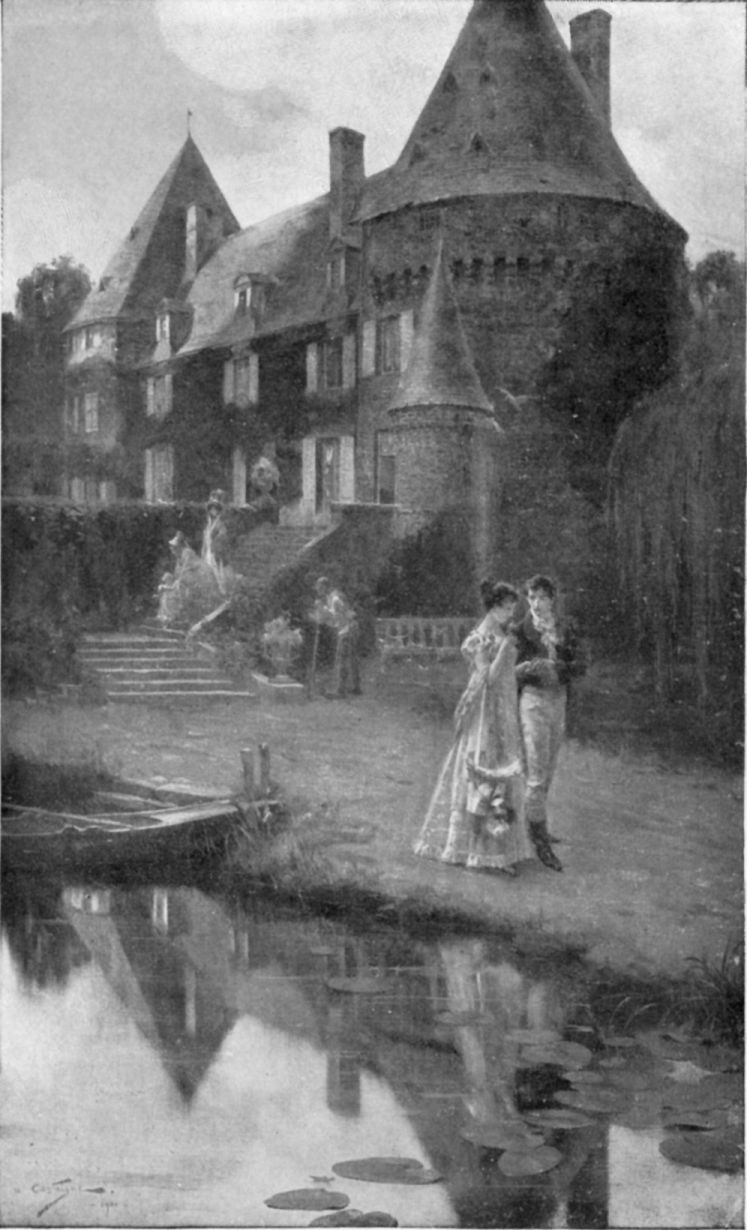 We walked until sunset in the park, by lake, and bridged stream,
and hollied path.
We walked until sunset in the park, by lake, and bridged stream,
and hollied path.
I can yet see the child looking over Ernestine's shoulder. She
carried him up stairs of oak worn hollow like stone, a mighty
hand-wrought balustrade rising with them from hall to roof.
We had our supper in a paneled room where the lights were
reflected as on mirrors of polished oak, and the man who served us
had served Madame de Ferrier's father and grandfather. The gentle
old provincial went about his duty as a religious rite.
There was a pleached walk like that in the marquis' Paris
garden, of branches flattened and plaited to form an arbor
supported by tree columns; which led to a summer-house of stone
smothered in ivy. We walked back and forth under this thick roof of
verdure. Eagle's cap of brown hair was roughened over her radiant
face, and the open throat of her gown showed pulses beating in her
neck. Her lifted chin almost touched my arm as I told her all the
Mittau story, at her request.
"Poor Madame d'Angoulême! The cautious priest and the king
should not have taken you from me like that! She knew you as I knew
you; and a woman's knowing is better than a man's proofs. She will
have times of doubting their policy. She will remember the
expression of your mouth, your shrugs, and gestures—the
little traits of the child Louis, that reappear in the man."
"I wish I had never gone to Mittau to give her a moment's
distress."
"Is she very beautiful?"
"She is like a lily made flesh. She has her strong dislikes, and
one of them is Louis Philippe—"
"Naturally," said Eagle.
"But she seemed sacred to me. Perhaps a woman brings that
hallowedness out of martyrdom."
"God be with the royal lady! And you, sire!"
"And you!—may you be always with me, Eagle!"
"This journey to Mittau changes nothing. You were wilful. You
would go to the island in Lake George: you would go to Mittau."
"Both times you sent me."
"Both times I brought you home! Let us not be sorrowful
to-night."
"Sorrowful! I am so happy it seems impossible that I come from
Mittau, and this day the Marquis du Plessy died to me! I wish the
sun had been tied to the trees, as the goose girl tied her
gander."
"But I want another day," said Eagle. "I want all the days that
are my due at home."
We ascended the steps of the stone pavilion, and sat down in an
arch like a balcony over the sunken garden. Pears and apricots,
their branches flattened against the wall, showed ruddy garnered
sunlight through the dusk. The tangled enclosure sloped down to the
stream, from which a fairy wisp of mist wavered over flower bed and
tree. Dew and herbs and the fragrance of late roses sent up a
divine breath, invisibly submerging us, like a tide rising out of
the night.
Madame de Ferrier's individual traits were surprised in this
nearness, as they never had been when I saw her at a distance in
alien surroundings. A swift ripple, involuntary and glad, coursed
down her body; she shuddered for joy half a minute or so.
Two feet away, I worshiped her smiling eyes and their curved
ivory lids, her rounded head with its abundant cap of hair, her
chin, her shoulders, her bust, the hands in her lap, the very sweep
of her scant gown about her feet.
The flash of extreme happiness passing, she said gravely,
"But that was a strange thing—that you should fall
unconscious!"
"Not so strange," I said; and told her how many times before the
eclipse—under the edge of which my boyhood was
passed—had completely shadowed me. At the account of Ste.
Pélagie she leaned toward me, her hands clenched on her
breast. When we came to the Hôtel Dieu she leaned back pallid
against the stone.
"Dear Marquis du Plessy!" she whispered, as his name entered the
story.
When it was ended she drew some deep breaths in the silence.
"Sire, you must be very careful. That Bellenger is an evil
man."
"But a weak one."
"There may be a strength of court policy behind him."
"The policy of the court at Mittau is evidently a policy of
denial."
"Your sister believed in you."
"Yes, she believed in me."
"I don't understand," said Madame de Ferrier, leaning forward on
her arms, "why Bellenger had you in London, and another boy on the
mountain."
"Perhaps we shall never understand it."
"I don't understand why he makes it his business to follow
you."
"Let us not trouble ourselves about Bellenger."
"But are you safe in France since the Marquis du Plessy's
death?"
"I am safe to-night, at least."
"Yes, far safer than you would be in Paris."
"And Skenedonk is my guard."
"I have sent a messenger to Plessy for him," Madame de Ferrier
said. "He will be here in the morning."
I thanked her for remembering him in the excitement of her home
coming. We heard a far sweet call through a cleft of the hills, and
Eagle turned her head.
"That must be the shepherd of Les Rochers. He has missed a lamb.
Les Rochers is the most distant of our farms, but its night noises
can be heard through an opening in the forest. Paul will soon be
listening for all these sounds! We must drive to Les Rochers
to-morrow. It was there that Cousin Philippe died."
I could not say how opportunely Cousin Philippe had died. The
violation of her childhood by such a marriage rose up that instant
a wordless tragedy.
"Sire, we are not observing etiquette in Mont-Louis as they
observe it at Mittau. I have been talking very familiarly to my
king. I will keep silent. You speak."
"Madame, you have forbidden me to speak!"
She gave me a startled look, and said,
"Did you know Jerome Bonaparte has come back? He left his wife
in America. She cannot be received in France, because she has
committed the crime of marrying a prince. She is to be divorced for
political reasons."
"Jerome Bonaparte is a hound!" I spoke hotly.
"And his wife a venturesome woman—to marry even a
temporary prince."
"I like her sort, madame!"
"Do you, sire?"
"Yes, I like a woman who can love!"
"And ruin?"
"How could you ruin me?"
"The Saint-Michels brought me up," said Eagle. "They taught me
what is lawful and unlawful. I will never do an unlawful thing, to
the disgrace and shame of my house. A woman should build her house,
not tear it down."
"What is unlawful?"
"It is unlawful for me to encourage the suit of my
sovereign."
"Am I ever likely to be anything but what they call in Mittau a
pretender, Eagle?"
"That we do not know. You shall keep yourself free from
entanglements."
"I am free from them—God knows I am free enough!—the
lonesomest, most unfriended savage that ever set out to conquer his
own."
"You were born to greatness. Great things will come to you."
"If you loved me I could make them come!"
"Sire, it isn't healthy to sit in the night air. We must go out
of the dew."
"Oh, who would be healthy! Come to that, who would be such a
royal beggar as I am?"
"Remember," she said gravely, "that your claim was in a manner
recognized by one of the most cautious, one of the least ardent
royalists, in France."
The recognition she knew nothing about came to my lips, and I
told her the whole story of the jewels. The snuffbox was in my
pocket. Sophie Saint-Michel had often described it to her.
She sat and looked at me, contemplating the stupendous loss.
"The marquis advised me not to take them into Russia," I
acknowledged.
"There is no robbery so terrible as the robbery committed by
those who think they are doing right."
"I am one of the losing Bourbons."
"Can anything be hidden in that closet in the queen's
dressing-room wall?" mused Eagle. "I believe I could find it in the
dark, Sophie told me so often where the secret spring may be
touched. When the De Chaumonts took me to the Tuileries I wanted to
search for it. But all the state apartments are now on the second
floor, and Madame Bonaparte has her own rooms below. Evidently she
knows nothing of the secrets of the place. The queen kept her most
beautiful robes in that closet. It has no visible door. The wall
opens. And we have heard that a door was made through the back of
it to let upon a spiral staircase of stone, and through this the
royal family made their escape to Varennes, when they were arrested
and brought back."
We fell into silence at mention of the unsuccessful flight which
could have changed history; and she rose and
said—"Good-night, sire."
Next morning there was such a delicious world to live in that
breathing was a pleasure. Dew gauze spread far and wide over the
radiant domain. Sounds from cattle, and stables, and the voices of
servants drifted on the air. Doves wheeled around their towers, and
around the chateau standing like a white cliff.
I walked under the green canopy watching the sun mount and
waiting for Madame de Ferrier. When she did appear the old man who
had served her father followed with a tray. I could only
say—"Good-morning, madame," not daring to add—"I have
scarcely slept for thinking of you."
"We will have our coffee out here," she told me.
It was placed on the broad stone seat under the arch of the
pavilion where we sat the night before; bread, unsalted butter from
the farms, the coffee, the cream, the loaf sugar. Madame de Ferrier
herself opened a door in the end of the wall and plunged into the
dew of the garden. Her old servant exclaimed. She caught her hair
in briers and laughed, tucking it up from falling, and brought off
two great roses, each the head and the strength of a stem, to lay
beside our plates. The breath of roses to this hour sends through
my veins the joy of that.
Then the old servant gathered wall fruit for us, and she sent
some in his hand to Paul. Through a festooned arch of the pavilion
giving upon the terraces, we saw a bird dart down to the fountain,
tilt and drink, tilt and drink again, and flash away. Immediately
the multitudinous rejoicing of a skylark dropped from upper air.
When men would send thanks to the very gate of heaven their envoy
should be a skylark.
Eagle was like a little girl as she listened.
"This is the first day of September, sire."
"Is it? I thought it was the first day of creation."
"I mention the date that you may not forget it. Because I am
going to give you something to-day."
My heart leaped like a conqueror's.
Her skin was as fresh as the roses, looking marvelous to touch.
The shock of imminent discovery went through me. For how can a man
consider a woman forever as a picture? A picture she was, in the
short-waisted gown of the Empire, of that white stuff Napoleon
praised because it was manufactured in France. It showed the line
of her throat, being parted half way down the bosom by a ruff which
encircled her neck and stood high behind it. The transparent
sleeves clung to her arms, and the slight outline of her figure
looked long in its close casing.
The gown tail curled around her slippered foot damp from the
plunge in the garden. She gave it a little kick, and rippled again
suddenly throughout her length.
Then her face went grave, like a child's when it is surprised in
wickedness.
"But our fathers and mothers would have us forget their
suffering in the festival of coming home, wouldn't they,
Lazarre?"
"Surely, Eagle."
"Then why are you looking at me with reproach?"
"I'm not."
"Perhaps you don't like my dress?"
I told her it was the first time I had ever noticed anything she
wore, and I liked it.
"I used to wear my mother's clothes. Ernestine and I made them
over. But this is new; for the new day, and the new life here."
"And the day," I reminded her, "is the first of September."
She laughed, and opened her left hand, showing me two squat keys
so small that both had lain concealed under two of her finger
tips.
"I am going to give you a key, sire."
"Will it unlock a woman's mind?"
"It will open a padlocked book. Last night I found a little
blank-leaved book, with wooden covers. It was fastened by a
padlock, and these keys were tied to it. You may have one key: I
will keep the other."
"The key to a padlocked book with nothing in it."
Her eyes tantalized me.
"I am going to put something in it. Sophie Saint-Michel said I
had a gift for putting down my thoughts. If the gift appeared to
Sophie when I was a child, it must grow in me by use. Every day I
shall put some of my life into the book. And when I die I will
bequeath it to you!"
"Take back the key, madame. I have no desire to look into your
coffin."
She extended her hand.
"Then our good and kind friend Count de Chaumont shall have
it."
"He shall not!"
I held to her hand and kept my key.
She slipped away from me. The laughter of the child yet rose
through the dignity of the woman.
"When may I read this book, Eagle?"
"Never, of my free will, sire. How could I set down all I
thought about you, for instance, if the certainty was hanging over
me that you would read my candid opinions and punish me for
them!"
"Then of what use is the key?"
"You would rather have it than give it to another, wouldn't
you?"
"Decidedly."
"Well, you will have the key to my thoughts!"
"And if the book ever falls into my hands—"
"I will see that it doesn't!"
"I will say, years from now—"
"Twenty?"
"Twenty? O Eagle!"
"Ten."
"Months? That's too long!"
"No, ten years, sire."
"Not ten years, Eagle. Say eight."
"No, nine."
"Seven. If the book falls into my hands at the end of seven
years, may I open it?"
"I may safely promise you that," she laughed. "The book will
never fall into your hands."
I took from my pocket the gold snuffbox with the portraits on
the lid, and placed my key carefully therein. Eagle leaned forward
to look at them. She took the box in her hand, and gazed with long
reverence, drooping her head.
Young as I was, and unskilled in the ways of women, that key
worked magic comfort. She had given me a link to hold us together.
The inconsistent, contradictory being, old one instant with the
wisdom of the Saint-Michels, rippling full of unrestrained life the
next, denying me all hope, yet indefinitely tantalizing, was
adorable beyond words. I closed my eyes: the blinding sunshine
struck them through the ivied arch.
Turning my head as I opened them, I saw an old man come out on
the terrace.
He tried to search in every direction, his gray head and faded
eyes moving anxiously. Madame de Ferrier was still. I heard her lay
the snuffbox on the stone seat. I knew, though I could not let
myself watch her, that she stood up against the wall, a woman of
stone, her lips chiseled apart.
"Eagle—Eagle!" the old man cried from the terrace.
She whispered—"Yes, Cousin Philippe!"


