On an evening of July, in the year 18--, at East D---, a
beautiful little town in a certain district of East Anglia, I
first saw the light. [1a]
My father was a Cornish man, the youngest, as I have heard him
say, of seven brothers. He sprang from a family of
gentlemen, or, as some people would call them,
gentillâtres, for they were not very wealthy; they
had a coat of arms, however, and lived on their own property at a
place called Tredinnock, which being interpreted means the
house on the hill, which house and the neighbouring acres had
been from time immemorial in their possession. I mention
these particulars that the reader may see at once that I am not
altogether of low and plebeian origin; the present age is highly
aristocratic, and I am convinced that the public will read my
pages with more zest from being told that I am a
gentillâtre by birth with Cornish blood [1b] in my veins, of a family who lived on
their own property at a place bearing a Celtic name, signifying
the house on the hill, or more strictly the house on the
hillock.
My father was what is generally termed a posthumous
child—in other words, the gentillâtre who
begot him never had the satisfaction of invoking the blessing of
the Father of All upon his head, having departed this life some
months before the birth of his youngest son. The boy,
therefore, never knew a father’s care; he was, however,
well tended by his mother, whose favourite he was; so much so,
indeed, that his brethren, the youngest of whom was considerably
older than himself, were rather jealous of him. I
never heard, however, that they treated him with any marked
unkindness; and it will be as well to observe here that I am by
no means well acquainted with his early history, of which,
indeed, as I am not writing his life, it is not necessary to say
much. Shortly after his mother’s death, which
occurred when he was eighteen, he adopted the profession of arms,
which he followed during the remainder of his life, and in which,
had circumstances permitted, he would probably have shone amongst
the best. By nature he was cool and collected, slow to
anger, though perfectly fearless, patient of control, of great
strength, and, to crown all, a proper man with his hands.
With far inferior qualifications many a man has become a
field-marshal or general; similar ones made Tamerlane, who was
not a gentillâtre, but the son of a blacksmith,
emperor of one-third of the world; but the race is not always for
the swift, nor the battle for the strong, indeed I ought rather
to say very seldom; certain it is, that my father, with all his
high military qualifications, never became emperor,
field-marshal, or even general; indeed, he had never an
opportunity of distinguishing himself save in one battle, and
that took place neither in Flanders, Egypt, nor on the banks of
the Indus or Oxus, but in Hyde Park.
Smile not, gentle reader, many a battle has been fought in
Hyde Park, in which as much skill, science and bravery have been
displayed as ever achieved a victory in Flanders or by the
Indus. In such a combat as that to which I allude, I opine
that even Wellington or Napoleon would have been heartily glad to
cry for quarter ere the lapse of five minutes, and even the
Blacksmith Tartar would, perhaps, have shrunk from the opponent
with whom, after having had a dispute with him, [2a] my father engaged in single combat for
one hour, at the end of which time the champions shook hands and
retired, each having experienced quite enough of the
other’s prowess. The name of my father’s
antagonist was Brain.
What! still a smile? did you never hear that name
before? I cannot help it! Honour to Brain, who four
months after the event which I have now narrated was champion of
England, having conquered the heroic Johnson. Honour to
Brain, who at the end of other four months, worn out by the
dreadful blows which he had received in his many [2b] combats, expired in the arms of my
father, who read the Bible to him in his latter moments—Big
Ben Brain.
You no longer smile, even you have heard of Big
Ben.
I have already hinted that my father never rose to any very
exalted rank in his profession, notwithstanding his prowess and
other qualifications. After serving for many years in the
line, he at last entered as captain in the militia regiment of
the Earl of ---, [3] at that period just raised, and to which
he was sent by the Duke of York to instruct the young levies in
military manœuvres and discipline; and in this mission I
believe he perfectly succeeded, competent judges having assured
me that the regiment in question soon came by his means to be
considered as one of the most brilliant in the service, and
inferior to no regiment of the line in appearance or
discipline.
As the head-quarters of this corps were at D---, the duties of
my father not unfrequently carried him to that place, and it was
on one of these occasions that he became acquainted with a young
person of the neighbourhood, for whom he formed an attachment,
which was returned; and this young person was my mother.
She was descended from a family of French Protestants, natives
of Caen, who were obliged to leave their native country when old
Louis, at the instigation of the Pope, thought fit to revoke the
Edict of Nantes. Their name was Petrement, and I have
reason for believing that they were people of some consideration;
that they were noble hearts and good Christians they gave
sufficient proof in scorning to bow the knee to the tyranny of
Rome. So they left beautiful Normandy for their
faith’s sake, and with a few louis d’ors in their
purse, a Bible in the vulgar tongue, and a couple of old swords,
which, if report be true, had done service in the Huguenot wars,
they crossed the sea to the isle of civil peace and religious
liberty, and established themselves in East Anglia.
And many other Huguenot families bent their steps thither, and
devoted themselves to agriculture or the mechanical arts; and in
the venerable old city, the capital of the province, in the
northern shadow of the Castle of De Burgh, the exiles built for
themselves a church where they praised God in the French tongue,
and to which, at particular seasons of the year, they were in the
habit of flocking from country and from town to sing—
“Thou hast provided for us a goodly earth; Thou waterest
her furrows, Thou sendest rain into the little valleys thereof,
Thou makest it soft with the drops of rain, and blesset the
increase of it”.
I have been told that in her younger days my mother was
strikingly handsome; this I can easily believe. I never
knew her in her youth, for though she was very young when she
married my father (who was her senior by many years) she had
attained the middle age before I was born, no children having
been vouchsafed to my parents in the early stages of their
union. Yet even at the present day, now that years
threescore and ten have passed over her head, attended with
sorrow and troubles manifold, poorly chequered with scanty joys,
can I look on that countenance and doubt that at one time beauty
decked it as with a glorious garment? Hail to thee, my
parent! as thou sittest there, in thy widow’s weeds, in the
dusky parlour in the house overgrown with the lustrous ivy of the
sister isle, the solitary house at the end of the retired court
shaded by lofty poplars. Hail to thee, dame of the oval
face, olive complexion, and Grecian forehead; by thy table seated
with the mighty volume of the good Bishop Hopkins spread out
before thee; there is peace in thy countenance, my mother; it is
not worldly peace, however, not the deceitful peace which lulls
to bewitching slumbers, and from which, let us pray, humbly pray,
that every sinner may be roused in time to implore mercy not in
vain! Thine is the peace of the righteous, my mother, of
those to whom no sin can be imputed, the score of whose misdeeds
has been long since washed away by the blood of atonement, which
imputeth righteousness to those who trust in it. It was not
always thus, my mother; a time was, when the cares, pomps and
vanities of this world agitated thee too much; but that time is
gone by, another and a better has succeeded, there is peace now
on thy countenance, the true peace; peace around thee, too, in
thy solitary dwelling, sounds of peace, the cheerful hum of the
kettle and the purring of the immense Angola, which stares up at
thee from its settle with its almost human eyes.
No more earthly cares and affections now, my mother?
Yes, one. Why dost thou suddenly raise thy dark and still
brilliant eye from the volume with a somewhat startled
glance? What noise is that in the distant street?
Merely the noise of a hoof—a sound common enough; it draws
nearer, nearer, and now it stops before thy gate.
Singular! And now there is a pause, a long pause. Ha!
thou hearest something—a footstep, a swift but heavy
footstep! thou risest, thou tremblest; there is a hand on the pin
of the outer door; there is some one in the vestibule; and now
the door of thy apartment opens; there is a reflection on the
mirror behind thee—a travelling hat, a grey head and
sunburnt face. “My dearest Son!”
“My darling Mother!”
Yes, mother, thou didst recognise in the distant street the
hoof-tramp of the wanderer’s horse.
I was not the only child of my parents; I had a brother some
three years older than myself. He was a beautiful child;
one of those occasionally seen in England, and in England alone;
a rosy, angelic face, blue eyes, and light chestnut hair.
It was not exactly an Anglo-Saxon countenance, in which,
by-the-bye, there is generally a cast of loutishness and
stupidity; it partook, to a certain extent, of the Celtic
character, particularly in the fire and vivacity which illumined
it; his face was the mirror of his mind; perhaps no disposition
more amiable was ever found amongst the children of Adam, united,
however, with no inconsiderable portion of high and dauntless
spirit. So great was his beauty in infancy, that people,
especially those of the poorer classes, would follow the nurse
who carried him about in order to look at and bless his lovely
face. At the age of three months an attempt was made to
snatch him from his mother’s arms in the streets of London,
at the moment she was about to enter a coach; indeed, his
appearance seemed to operate so powerfully upon every person who
beheld him, that my parents were under continual apprehension of
losing him; his beauty, however, was perhaps surpassed by the
quickness of his parts. He mastered his letters in a few
hours, and in a day or two could decipher the names of people on
the doors of houses and over the shop windows.
As he grew up, his personal appearance became less
prepossessing, his quickness and cleverness, however, rather
increased; and I may say of him, that with respect to everything
which he took in hand he did it better and more speedily than any
other person. Perhaps it will be asked here, what became of
him? Alas! alas! his was an early and a foreign
grave. As I have said before, the race is not always for
the swift, nor the battle for the strong.
And now, doubtless, after the above portrait of my brother,
painted in the very best style of Rubens, the reader will
conceive himself justified in expecting a full-length one of
myself, as a child, for as to my present appearance, I suppose he
will be tolerably content with that flitting glimpse in the
mirror. But he must excuse me; I have no intention of
drawing a portrait of myself in childhood; indeed it would be
difficult, for at that time I never looked into mirrors. No
attempts, however, were ever made to steal me in my infancy,
and I never heard that my parents entertained the slightest
apprehension of losing me by the hands of kidnappers, though I
remember perfectly well that people were in the habit of standing
still to look at me, ay, more than at my brother; from which
premises the reader may form any conclusion with respect to my
appearance which seemeth good unto him and reasonable.
Should he, being a good-natured person and always inclined to
adopt the charitable side in any doubtful point, be willing to
suppose that I, too, was eminently endowed by nature with
personal graces, I tell him frankly that I have no objection
whatever to his entertaining that idea; moreover, that I heartily
thank him, and shall at all times be disposed, under similar
circumstances, to exercise the same species of charity towards
himself.
With respect to my mind and its qualities I shall be more
explicit; for, were I to maintain much reserve on this point,
many things which appear in these memoirs would be highly
mysterious to the reader, indeed incomprehensible. Perhaps
no two individuals were ever more unlike in mind and disposition
than my brother and myself. As light is opposed to
darkness, so was that happy, brilliant, cheerful child to the sad
and melancholy being who sprang from the same stock as himself,
and was nurtured by the same milk.
Once, when travelling in an Alpine country, I arrived at a
considerable elevation; I saw in the distance, far below, a
beautiful stream hastening to the ocean, its rapid waters here
sparkling in the sunshine, and there tumbling merrily in
cascades. On its banks were vineyards and cheerful
villages; close to where I stood, in a granite basin with steep
and precipitous sides, slumbered a deep, dark lagoon, shaded by
black pines, cypresses and yews. It was a wild, savage
spot, strange and singular; ravens hovered above the pines,
filling the air with their uncouth notes, pies chattered, and I
heard the cry of an eagle from a neighbouring peak; there lay the
lake, the dark, solitary and almost inaccessible lake; gloomy
shadows were upon it, which, strangely modified as gusts of wind
agitated the surface, occasionally assumed the shape of
monsters. So I stood on the Alpine elevation, and looked
now on the gay distant river, and now at the dark
granite-encircled lake close beside me in the lone solitude, and
I thought of my brother and myself. I am no moraliser; but
the gay and rapid river and the dark and silent lake, were, of a
verity, no bad emblems of us two.
So far from being quick and clever like my brother, and able
to rival the literary feat which I have recorded of him,
many years elapsed before I was able to understand the nature of
letters, or to connect them. A lover of nooks and retired
corners, I was as a child in the habit of fleeing from society,
and of sitting for hours together with my head on my
breast. What I was thinking about, it would be difficult to
say at this distance of time; I remember perfectly well, however,
being ever conscious of a peculiar heaviness within me, and at
times of a strange sensation of fear, which occasionally amounted
to horror, and for which I could assign no real cause
whatever.
By nature slow of speech, I took no pleasure in conversation,
nor in hearing the voices of my fellow-creatures. When
people addressed me I not unfrequently, especially if they were
strangers, turned away my head from them, and if they persisted
in their notice burst into tears, which singularity of behaviour
by no means tended to dispose people in my favour. I was as
much disliked as my brother was deservedly beloved and
admired. My parents, it is true, were always kind to me;
and my brother, who was good nature itself, was continually
lavishing upon me every mark of affection.
There was, however, one individual who, in the days of my
childhood, was disposed to form a favourable opinion of me.
One day, a Jew—I had quite forgotten the circumstance, but
I was long subsequently informed of it—one day a travelling
Jew knocked at the door of a farmhouse in which we had taken
apartments. I was near at hand, sitting in the bright
sunshine, drawing strange lines on the dust with my fingers, an
ape and dog were my companions. The Jew looked at me and
asked me some questions, to which, though I was quite able to
speak, I returned no answer. On the door being opened, the
Jew, after a few words, probably relating to pedlary, demanded
who the child was, sitting in the sun; the maid replied that I
was her mistress’s youngest son, a child weak here,
pointing to her forehead. The Jew looked at me again, and
then said: “’Pon my conscience, my dear, I believe
that you must be troubled there yourself to tell me any such
thing. It is not my habit to speak to children, inasmuch as
I hate them, because they often follow me and fling stones after
me; but I no sooner looked at that child than I was forced to
speak to it. His not answering me shows his sense, for it
has never been the custom of the wise to fling away their words
in indifferent talk and conversation. The child is a sweet
child, and has all the look of one of our people’s
children. Fool, indeed! did I not see his eyes sparkle just
now when the monkey seized the dog by the ear? they shone
like my own diamonds—does your good lady want any, real and
fine? Were it not for what you tell me, I should say it was
a prophet’s child. Fool, indeed! he can write
already, or I’ll forfeit the box which I carry on my back,
and for which I should be loth to take two hundred
pounds!” He then leaned forward to inspect the lines
which I had traced. All of a sudden he started back, and
grew white as a sheet; then, taking off his hat, he made some
strange gestures to me, cringing, chattering, and showing his
teeth, and shortly departed, muttering something about
“holy letters,” and talking to himself in a strange
tongue. The words of the Jew were in due course of time
reported to my mother, who treasured them in her heart, and from
that moment began to entertain brighter hopes of her
youngest-born than she had ever before ventured to foster.
I have been a wanderer the greater part of my life; indeed I
remember only two periods, and these by no means lengthy, when I
was, strictly speaking, stationary. I was a soldier’s
son, and as the means of my father were by no means sufficient to
support two establishments, his family invariably attended him
wherever he went, so that from my infancy I was accustomed to
travelling and wandering, and looked upon a monthly change of
scene and residence as a matter of course. Sometimes we
lived in barracks, sometimes in lodgings, but generally in the
former, always eschewing the latter from motives of economy, save
when the barracks were inconvenient and uncomfortable; and they
must have been highly so indeed to have discouraged us from
entering them; for though we were gentry (pray bear that in mind,
gentle reader), gentry by birth, and incontestably so by my
father’s bearing the commission of good old George the
Third, we were not fine gentry, but people who could put
up with as much as any genteel Scotch family who find it
convenient to live on a third floor in London, or on a sixth at
Edinburgh or Glasgow. It was not a little that could
discourage us. We once lived within the canvas walls of a
camp, at a place called Pett, in Sussex; and I believe it was at
this place that occurred the first circumstance, or adventure,
call it which you will, that I can remember in connection with
myself. It was a strange one, and I will relate it.
It happened that my brother and myself were playing one
evening in a sandy lane, in the neighbourhood of this Pett camp;
our mother was at a slight distance. All of a sudden, a
bright yellow, and, to my infantine eye, beautiful and glorious
object made its appearance at the top of the bank from between
the thick quickset, and, gliding down, began to move across the
lane to the other side, like a line of golden light.
Uttering a cry of pleasure, I sprang forward, and seized it
nearly by the middle. A strange sensation of numbing
coldness seemed to pervade my whole arm, which surprised me the
more as the object to the eye appeared so warm and sunlike.
I did not drop it, however, but, holding it up, looked at it
intently, as its head dangled about a foot from my
hand. It made no resistance; I felt not even the slightest
struggle; but now my brother began to scream and shriek like one
possessed. “O mother, mother!” said he,
“the viper! my brother has a viper in his
hand!” He then, like one frantic, made an effort to
snatch the creature away from me. The viper now hissed
amain, and raised its head, in which were eyes like hot coals,
menacing, not myself, but my brother. I dropped my captive,
for I saw my mother running towards me; and the reptile, after
standing for a moment nearly erect, and still hissing furiously,
made off, and disappeared. The whole scene is now before
me, as vividly as if it occurred yesterday—the gorgeous
viper, my poor dear frantic brother, my agitated parent, and a
frightened hen clucking under the bushes; and yet I was not three
years old.
It is my firm belief that certain individuals possess an
inherent power, or fascination, over certain creatures, otherwise
I should be unable to account for many feats which I have
witnessed, and, indeed, borne a share in, connected with the
taming of brutes and reptiles. I have known a savage and
vicious mare, whose stall it was dangerous to approach, even when
bearing provender, welcome, nevertheless, with every appearance
of pleasure, an uncouth, wiry-headed man, with a frightfully
seamed face, and an iron hook supplying the place of his right
hand, one whom the animal had never seen before, playfully bite
his hair and cover his face with gentle and endearing kisses; and
I have already stated how a viper would permit, without
resentment, one child to take it up in his hand, whilst it showed
its dislike to the approach of another by the fiercest
hissings. Philosophy can explain many strange things, but
there are some which are a far pitch above her, and this is
one.
I should scarcely relate another circumstance which occurred
about this time but for a singular effect which it produced upon
my constitution. Up to this period I had been rather a
delicate child; whereas, almost immediately after the occurrence
to which I allude, I became both hale and vigorous, to the great
astonishment of my parents, who naturally enough expected that it
would produce quite a contrary effect.
It happened that my brother and myself were disporting
ourselves in certain fields near the good town of
Canterbury. A female servant had attended us, in order to
take care that we came to no mischief. She, however, it
seems, had matters of her own to attend to, and, allowing us to
go where we listed, remained in one corner of a field, in earnest
conversation with a red-coated dragoon. Now it
chanced to be blackberry time, and the two children wandered
under the hedges, peering anxiously among them in quest of that
trash so grateful to urchins of their degree. We did not
find much of it, however, and were soon separated in the
pursuit. All at once I stood still, and could scarcely
believe my eyes. I had come to a spot where, almost
covering the hedge, hung clusters of what seemed fruit,
deliciously-tempting fruit—something resembling grapes of
various colours, green, red and purple. Dear me, thought I,
how fortunate! yet have I a right to gather it? is it mine? for
the observance of the law of meum and tuum had
early been impressed upon my mind, and I entertained, even at
that tender age, the utmost horror for theft; so I stood staring
at the variegated clusters, in doubt as to what I should
do. I know not how I argued the matter in my mind; the
temptation, however, was at last too strong for me, so I
stretched forth my hand and ate. I remember perfectly well,
that the taste of this strange fruit was by no means so pleasant
as the appearance; but the idea of eating fruit was sufficient
for a child, and, after all, the flavour was much superior to
that of sour apples, so I ate voraciously. How long I
continued eating I scarcely know. One thing is certain,
that I never left the field as I entered it, being carried home
in the arms of the dragoon in strong convulsions, in which I
continued for several hours. About midnight I awoke, as if
from a troubled sleep, and beheld my parents bending over my
couch, whilst the regimental surgeon, with a candle in his hand,
stood nigh, the light feebly reflected on the whitewashed walls
of the barrack-room.
Another circumstance connected with my infancy, and I have
done. I need offer no apology for relating it, as it
subsequently exercised considerable influence over my
pursuits. We were, if I remember right, in the vicinity of
a place called Hythe, in Kent. One sweet evening, in the
latter part of summer, our mother took her two little boys by the
hand, for a wander about the fields. In the course of our
stroll we came to the village church; an old grey-headed sexton
stood in the porch, who, perceiving that we were strangers,
invited us to enter. We were presently in the interior,
wandering about the aisles, looking on the walls, and inspecting
the monuments of the notable dead. I can scarcely state
what we saw; how should I? I was a child not yet four years
old, and yet I think I remember the evening sun streaming in
through a stained window upon the dingy mahogany pulpit, and
flinging a rich lustre upon the faded tints of an ancient banner. And now once more we were outside the
building, where, against the wall, stood a low-eaved pent-house,
into which we looked. It was half-filled with substances of
some kind, which at first looked like large grey stones.
The greater part were lying in layers; some, however, were seen
in confused and mouldering heaps, and two or three, which had
perhaps rolled down from the rest, lay separately on the
floor. “Skulls, madam,” said the sexton;
“skulls of the old Danes! Long ago they came pirating
into these parts; and then there chanced a mighty shipwreck, for
God was angry with them, and He sunk them; and their skulls, as
they came ashore, were placed here as a memorial. There
were many more when I was young, but now they are fast
disappearing. Some of them must have belonged to strange
fellows, madam. Only see that one; why, the two young
gentry can scarcely lift it!” And, indeed, my brother
and myself had entered the Golgotha, and commenced handling these
grim relics of mortality. One enormous skull, lying in a
corner, had fixed our attention, and we had drawn it forth.
Spirit of eld, what a skull was yon!
I still seem to see it, the huge grim thing; many of the
others were large, strikingly so, and appeared fully to justify
the old man’s conclusion that their owners must have been
strange fellows; but, compared with this mighty mass of bone,
they looked small and diminutive, like those of pigmies; it must
have belonged to a giant, one of those red-haired warriors of
whose strength and stature such wondrous tales are told in the
ancient chronicles of the north, and whose grave-hills, when
ransacked, occasionally reveal secrets which fill the minds of
puny moderns with astonishment and awe. Reader, have you
ever pored days and nights over the pages of Snorro? probably
not, for he wrote in a language which few of the present day
understand, and few would be tempted to read him tamed down by
Latin dragomans. A brave old book is that of Snorro,
containing the histories and adventures of old northern kings and
champions, who seemed to have been quite different men, if we may
judge from the feats which they performed, from those of these
days. One of the best of his histories is that which
describes the life of Harald Haardraade, who, after manifold
adventures by land and sea, now a pirate, now a mercenary of the
Greek emperor, became King of Norway, and eventually perished at
the battle of Stanford Bridge, whilst engaged in a gallant
onslaught upon England. Now, I have often thought that the
old Kemp, whose mouldering skull in the golgotha of Hythe my
brother and myself could scarcely
lift, must have resembled in one respect at least this Harald,
whom Snorro describes as a great and wise ruler and a determined
leader, dangerous in battle, of fair presence, and measuring in
height just five ells, [13] neither more nor
less.
I never forgot the Daneman’s skull; like the apparition
of the viper in the sandy lane, it dwelt in the mind of the boy,
affording copious food for the exercise of imagination.
From that moment with the name of Dane were associated strange
ideas of strength, daring, and superhuman stature; and an
undefinable curiosity for all that is connected with the Danish
race began to pervade me; and if, long after, when I became a
student, I devoted myself with peculiar zest to Danish lore and
the acquirement of the old Norse tongue and its dialects, I can
only explain the matter by the early impression received at Hythe
from the tale of the old sexton, beneath the pent-house, and the
sight of the Danish skull.
And thus we went on straying from place to place, at Hythe
to-day, and perhaps within a week looking out from our
hostel-window upon the streets of old Winchester, our motions
ever in accordance with the “route” of the regiment,
so habituated to change of scene that it had become almost
necessary to our existence. Pleasant were those days of my
early boyhood; and a melancholy pleasure steals over me as I
recall them. Those were stirring times of which I am
speaking, and there was much passing around me calculated to
captivate the imagination. The dreadful struggle which so
long convulsed Europe, and in which England bore so prominent a
part, was then at its hottest; we were at war, and determination
and enthusiasm shone in every face; man, woman and child were
eager to fight the Frank, the hereditary, but, thank God, never
dreaded enemy of the Anglo-Saxon race. “Love your
country and beat the French, and then never mind what
happens,” was the cry of entire England. Oh, those
were days of power, gallant days, bustling days, worth the
bravest days of chivalry, at least; tall battalions of native
warriors were marching through the land; there was the glitter of
the bayonet and the gleam of the sabre; the shrill squeak of the
fife and loud rattling of the drum were heard in the streets of
country towns, and the loyal shouts of the inhabitants greeted
the soldiery on their arrival, or cheered them at their
departure. And now let us leave the upland, and descend to
the sea-bord; there is a sight for you upon the billows! A
dozen men-of-war are gliding majestically out of port, their long
buntings streaming from the top-gallant masts, calling
on the skulking Frenchman to come forth from his bights and bays;
and what looms upon us yonder from the fog-bank in the east? a
gallant frigate towing behind her the long low hull of a crippled
privateer, which but three short days ago had left Dieppe to skim
the sea, and whose crew of ferocious hearts are now cursing their
imprudence in an English hold. Stirring times those, which
I love to recall, for they were days of gallantry and enthusiasm,
and were moreover the days of my boyhood.
And when I was between six and seven years of age we were once
more at D---, the place of my birth, whither my father had been
despatched on the recruiting service. I have already said
that it was a beautiful little town—at least it was at the
time of which I am speaking; what it is at present I know not,
for thirty years and more have elapsed since I last trod its
streets. It will scarcely have improved, for how could it
be better than it then was? I love to think on thee,
pretty, quiet D---, thou pattern of an English country town, with
thy clean but narrow streets branching out from thy modest
market-place, with thine old-fashioned houses, with here and
there a roof of venerable thatch, with thy one half-aristocratic
mansion, where resided thy Lady Bountiful—she, the generous
and kind, who loved to visit the sick, leaning on her
golden-headed cane, whilst the sleek old footman walked at a
respectful distance behind. Pretty, quiet D---, with thy
venerable church, in which moulder the mortal remains of
England’s sweetest and most pious bard.
Yes, pretty D---, I could always love thee, were it but for
the sake of him who sleeps beneath the marble slab in yonder
quiet chancel. It was within thee that the long-oppressed
bosom heaved its last sigh, and the crushed and gentle spirit
escaped from a world in which it had known nought but
sorrow. Sorrow! do I say? How faint a word to express
the misery of that bruised reed; misery so dark that a blind worm
like myself is occasionally tempted to exclaim, Better had the
world never been created than that one so kind, so harmless, and
so mild, should have undergone such intolerable woe! But it
is over now, for, as there is an end of joy, so has affliction
its termination. Doubtless the All-wise did not afflict him
without a cause. Who knows but within that unhappy frame
lurked vicious seeds which the sunbeams of joy and prosperity
might have called into life and vigour? Perhaps the
withering blasts of misery nipped that which otherwise might have
terminated in fruit noxious and lamentable. But peace to
the unhappy one, he is gone to his rest; the deathlike face is no
longer occasionally seen timidly and
mournfully looking for a moment through the window-pane upon thy
market-place, quiet and pretty D---; the hind in thy
neighbourhood no longer at evening-fall views, and starts as he
views, the dark lathy figure moving beneath the hazels and alders
of shadowy lanes, or by the side of murmuring trout streams; and
no longer at early dawn does the sexton of the old church
reverently doff his hat, as, supported by some kind friend, the
death-stricken creature totters along the church-path to that
mouldering edifice with the low roof, inclosing a spring of
sanatory waters, built and devoted to some saint—if the
legend over the door be true, by the daughter of an East Anglian
king.
But to return to my own history. I had now attained the
age of six. Shall I state what intellectual progress I had
been making up to this period? Alas! upon this point I have
little to say calculated to afford either pleasure or
edification. I had increased rapidly in size and in
strength; the growth of the mind, however, had by no means
corresponded with that of the body. It is true, I had
acquired my letters, and was by this time able to read
imperfectly, but this was all; and even this poor triumph over
absolute ignorance would never have been effected but for the
unremitting attention of my parents, who, sometimes by threats,
sometimes by entreaties, endeavoured to rouse the dormant
energies of my nature, and to bend my wishes to the acquisition
of the rudiments of knowledge; but in influencing the wish lay
the difficulty. Let but the will of a human being be turned
to any particular object, and it is ten to one that sooner or
later he achieves it. At this time I may safely say that I
harboured neither wishes nor hopes; I had as yet seen no object
calculated to call them forth, and yet I took pleasure in many
things which perhaps unfortunately were all within my sphere of
enjoyment. I loved to look upon the heavens, and to bask in
the rays of the sun, or to sit beneath hedgerows and listen to
the chirping of the birds, indulging the while in musing and
meditation as far as my very limited circle of ideas would
permit; but, unlike my brother, who was at this time at school,
and whose rapid progress in every branch of instruction
astonished and delighted his preceptors, I took no pleasure in
books, whose use, indeed, I could scarcely comprehend, and bade
fair to be as arrant a dunce as ever brought the blush of shame
into the cheeks of anxious and affectionate parents.
But the time was now at hand when the ice which had hitherto
bound the mind of the child with its benumbing power was to be thawed, and a world of sensations and ideas awakened
to which it had hitherto been an entire stranger. One day a
young lady, an intimate acquaintance of our family, and godmother
to my brother, drove up to the house in which we dwelt; she staid
some time conversing with my mother, and on rising to depart she
put down on the table a small packet, exclaiming: “I have
brought a little present for each of the boys: the one is a
History of England, which I intend for my godson when he returns
from school, the other is—” and here she said
something which escaped my ear, as I sat at some distance, moping
in a corner: “I intend it for the youngster yonder,”
pointing to myself; she then departed, and, my mother going out
shortly after, I was left alone.
I remember for some time sitting motionless in my corner, with
my eyes bent upon the ground; at last I lifted my head and looked
upon the packet as it lay on the table. All at once a
strange sensation came over me, such as I had never experienced
before—a singular blending of curiosity, awe and pleasure,
the remembrance of which, even at this distance of time, produces
a remarkable effect upon my nervous system. What strange
things are the nerves—I mean those more secret and
mysterious ones in which I have some notion that the mind or
soul, call it which you will, has its habitation; how they
occasionally tingle and vibrate before any coming event closely
connected with the future weal or woe of the human being.
Such a feeling was now within me, certainly independent of what
the eye had seen or the ear had heard. A book of some
description had been brought for me, a present by no means
calculated to interest me; what cared I for books? I had
already many into which I never looked but from compulsion;
friends, moreover, had presented me with similar things before,
which I had entirely disregarded, and what was there in this
particular book, whose very title I did not know, calculated to
attract me more than the rest? yet something within told me that
my fate was connected with the book which had been last brought;
so, after looking on the packet from my corner for a considerable
time, I got up and went to the table.
The packet was lying where it had been left—I took it
up; had the envelope, which consisted of whitish brown paper,
been secured by a string or a seal, I should not have opened it,
as I should have considered such an act almost in the light of a
crime; the books, however, had been merely folded up, and I
therefore considered that there could be no possible harm in
inspecting them, more especially as I had received no injunction
to the contrary. Perhaps there was
something unsound in this reasoning, something sophistical; but a
child is sometimes as ready as a grown-up person in finding
excuses for doing that which he is inclined to. But whether
the action was right or wrong, and I am afraid it was not
altogether right, I undid the packet. It contained three
books, two from their similarity seemed to be separate parts of
one and the same work; they were handsomely bound, and to them I
first turned my attention. I opened them successively and
endeavoured to make out their meaning; their contents, however,
as far as I was able to understand them, were by no means
interesting: whoever pleases may read these books for me, and
keep them too, into the bargain, said I to myself.
I now took up the third book. It did not resemble the
others, being longer and considerably thicker; the binding was of
dingy calf-skin. I opened it, and as I did so another
strange thrill of pleasure shot through my frame. The first
object on which my eyes rested was a picture; it was exceedingly
well executed, at least the scene which it represented made a
vivid impression upon me, which would hardly have been the case
had the artist not been faithful to nature. A wild scene it
was—a heavy sea and rocky shore, with mountains in the
background, above which the moon was peering. Not far from
the shore, upon the water, was a boat with two figures in it, one
of which stood at the bow, pointing with what I knew to be a gun
at a dreadful shape in the water; fire was flashing from the
muzzle of the gun, and the monster appeared to be
transfixed. I almost thought I heard its cry. I
remained motionless, gazing upon the picture, scarcely daring to
draw my breath, lest the new and wondrous world should vanish of
which I had now obtained a glimpse. “Who are those
people, and what could have brought them into that strange
situation?” I asked of myself; and now the seed of
curiosity, which had so long lain dormant, began to expand, and I
vowed to myself to become speedily acquainted with the whole
history of the people in the boat. After looking on the
picture till every mark and line in it were familiar to me, I
turned over various leaves till I came to another engraving; a
new source of wonder—a low sandy beach on which the furious
sea was breaking in mountain-like billows; cloud and rack
deformed the firmament, which wore a dull and leaden-like hue;
gulls and other aquatic fowls were toppling upon the blast, or
skimming over the tops of the maddening waves—“Mercy
upon him! he must be drowned!” I exclaimed, as my eyes fell
upon a poor wretch who appeared to be striving to reach the
shore; he was upon his legs but was
evidently half-smothered with the brine; high above his head
curled a horrible billow, as if to engulf him for ever.
“He must be drowned! he must be drowned!” I almost
shrieked, and dropped the book. I soon snatched it up
again, and now my eye lighted on a third picture: again a shore,
but what a sweet and lovely one, and how I wished to be treading
it; there were beautiful shells lying on the smooth white sand,
some were empty like those I had occasionally seen on marble
mantelpieces, but out of others peered the heads and bodies of
wondrous crayfish; a wood of thick green trees skirted the beach
and partly shaded it from the rays of the sun, which shone hot
above, while blue waves slightly crested with foam were gently
curling against it; there was a human figure upon the beach, wild
and uncouth, clad in the skins of animals, with a huge cap on his
head, a hatchet at his girdle, and in his hand a gun; his feet
and legs were bare; he stood in an attitude of horror and
surprise; his body was bent far back, and his eyes, which seemed
starting out of his head, were fixed upon a mark on the
sand—a large distinct mark—a human footprint!
Reader, is it necessary to name the book which now stood open
in my hand, and whose very prints, feeble expounders of its
wondrous lines, had produced within me emotions strange and
novel? Scarcely, for it was a book which has exerted over
the minds of Englishmen an influence certainly greater than any
other of modern times, which has been in most people’s
hands, and with the contents of which even those who cannot read
are to a certain extent acquainted; a book from which the most
luxuriant and fertile of our modern prose writers have drunk
inspiration; a book, moreover, to which, from the hardy deeds
which it narrates, and the spirit of strange and romantic
enterprise which it tends to awaken, England owes many of her
astonishing discoveries both by sea and land, and no
inconsiderable part of her naval glory.
Hail to thee, spirit of De Foe! What does not my own
poor self owe to thee? England has better bards than either
Greece or Rome, yet I could spare them easier far than De Foe,
“unabashed De Foe,” as the hunchbacked rhymer styled
him.
The true chord had now been touched. A raging curiosity
with respect to the contents of the volume, whose engravings had
fascinated my eye, burned within me, and I never rested until I
had fully satisfied it. Weeks succeeded weeks, months
followed months, and the wondrous volume was my only study and
principal source of amusement. For hours together I would
sit poring over a page till I had become acquainted with the
import of every line. My progress,
slow enough at first, became by degrees more rapid, till at last,
under “a shoulder of mutton sail,” I found myself
cantering before a steady breeze over an ocean of enchantment, so
well pleased with my voyage that I cared not how long it might be
ere it reached its termination.
And it was in this manner that I first took to the paths of
knowledge.
About this time I began to be somewhat impressed with
religious feelings. My parents were, to a certain extent,
religious people; but, though they had done their best to afford
me instruction on religious points, I had either paid no
attention to what they endeavoured to communicate, or had
listened with an ear far too obtuse to derive any benefit.
But my mind had now become awakened from the drowsy torpor in
which it had lain so long, and the reasoning powers which I
possessed were no longer inactive. Hitherto I had
entertained no conception whatever of the nature and properties
of God, and with the most perfect indifference had heard the
Divine name proceeding from the mouths of the
people—frequently, alas! on occasions when it ought not to
be employed; but I now never heard it without a tremor, for I now
knew that God was an awful and inscrutable being, the maker of
all things; that we were His children, and that we by our sins,
had justly offended Him; that we were in very great peril from
His anger, not so much in this life, as in another and far
stranger state of being yet to come; that we had a Saviour withal
to whom it was necessary to look for help: upon this point,
however, I was yet very much in the dark, as, indeed, were most
of those with whom I was connected. The power and terrors
of God were uppermost in my thoughts; they fascinated though they
astounded me. Twice every Sunday I was regularly taken to
the church, where from a corner of the large, spacious pew, lined
with black leather, I would fix my eyes on the dignified
high-church rector, and the dignified high-church clerk, and
watch the movement of their lips, from which, as they read their
respective portions of the venerable liturgy, would roll many a
portentous word descriptive of the wondrous works of the Most
High.
Rector. “Thou didst divide the sea, through
Thy power: Thou brakest the heads of the dragons in the
waters.”
Philoh. “Thou smotest the heads of
Leviathan in pieces: and gavest him to be meat for the people in
the wilderness.”
Rector. “Thou broughtest out fountains and
waters out of the hard rocks: Thou driedst up mighty
waters.”
Philoh. “The day is Thine, and the
night is Thine: Thou hast prepared the light and the
sun.”
Peace to your memories dignified rector and yet more dignified
clerk! by this time ye are probably gone to your long homes, and
your voices are no longer heard sounding down the aisles of the
venerable church; nay, doubtless, this has already long since
been the fate of him of the sonorous
“Amen!”—the one of the two who, with all due
respect to the rector, principally engrossed my boyish
admiration—he, at least, is scarcely now among the
living! Living! why, I have heard say that he blew a
fife—for he was a musical as well as a Christian
professor—a bold fife, to cheer the Guards and the brave
Marines as they marched with measured step, obeying an insane
command, up Bunker’s height, whilst the rifles of the
sturdy Yankees were sending the leaden hail sharp and thick
amidst the red-coated ranks; for Philoh had not always been a man
of peace, nor an exhorter to turn the other cheek to the smiter,
but had even arrived at the dignity of a halberd in his
country’s service before his six-foot form required rest,
and the grey-haired veteran retired, after a long peregrination,
to his native town, to enjoy ease and respectability on a pension
of “eighteen-pence a day”; and well did his
fellow-townsmen act when, to increase that ease and
respectability, and with a thoughtful regard for the dignity of
the good church service, they made him clerk and
precentor—the man of the tall form and of the audible
voice, which sounded loud and clear as his own Bunker fife.
Well, peace to thee, thou fine old chap, despiser of dissenters,
and hater of papists, as became a dignified and high-church
clerk; if thou art in thy grave the better for thee; thou wert
fitted to adore a bygone time, when loyalty was in vogue, and
smiling content lay like a sunbeam upon the land, but thou
wouldst be sadly out of place in these days of cold philosophic
latitudinarian doctrine, universal tolerism, and half-concealed
rebellion—rare times, no doubt, for papists and dissenters,
but which would assuredly have broken the heart of the loyal
soldier of George the Third, and the dignified high-church clerk
of pretty D---.
We passed many months at this place. Nothing, however,
occurred requiring any particular notice, relating to myself,
beyond what I have already stated, and I am not writing the
history of others. At length my father was recalled to his
regiment, which at that time was stationed at a place called
Norman Cross, in Lincolnshire, or rather Huntingdonshire, at some
distance from the old town of Peterborough. For this place
he departed, leaving my mother and myself to follow in a few
days. Our journey was a singular one. On the second
day we reached a marshy and fenny country, which owing to immense
quantities of rain which had lately fallen, was completely
submerged. At a large town we got on board a kind of
passage-boat, crowded with people; it had neither sails nor oars,
and those were not the days of steam-vessels; it was a
treck-schuyt, and was drawn by horses.
Young as I was, there was much connected with this journey
which highly surprised me, and which brought to my remembrance
particular scenes described in the book which I now generally
carried in my bosom. The country was, as I have already
said, submerged—entirely drowned—no land was visible;
the trees were growing bolt upright in the flood, whilst
farmhouses and cottages were standing insulated; the horses which
drew us were up to the knees in water, and, on coming to blind
pools and “greedy depths,” were not unfrequently
swimming, in which case the boys or urchins who mounted them
sometimes stood, sometimes knelt, upon the saddle and
pillions. No accident, however, occurred either to the
quadrupeds or bipeds, who appeared respectively to be quite au
fait in their business, and extricated themselves with the
greatest ease from places in which Pharaoh and all his host would
have gone to the bottom. Nightfall brought us to
Peterborough, and from thence we were not slow in reaching the
place of our destination.
And a strange place it was, this Norman Cross, and, at the
time of which I am speaking, a sad cross to many a Norman, being
what was then styled a French prison, that is, a receptacle for
captives made in the French war. It consisted, if I
remember right, of some five or six casernes, very long, and
immensely high; each standing isolated from the rest, upon a spot
of ground which might average ten acres, and which was fenced
round with lofty palisades, the whole being compassed about by a
towering wall, beneath which, at intervals, on both sides
sentinels were stationed, whilst, outside, upon the field, stood
commodious wooden barracks, capable of containing two regiments
of infantry, intended to serve as guards upon the captives.
Such was the station or prison at Norman Cross, where some six
thousand French and other foreigners, followers of the grand
Corsican, were now immured.
What a strange appearance had those mighty casernes, with
their blank blind walls, without windows or grating, and their
slanting roofs, out of which, through orifices where the tiles
had been removed, would be protruded dozens of grim heads,
feasting their prison-sick eyes on the wide expanse of country
unfolded from that airy height. Ah! there was much misery
in those casernes; and from those roofs, doubtless, many a
wistful look was turned in the direction of lovely France.
Much had the poor inmates to endure, and much to complain of, to
the disgrace of England be it said—of England, in general
so kind and bountiful. Rations of carrion meat, and bread
from which I have seen the very hounds occasionally turn away,
were unworthy entertainment even for the most ruffian enemy, when
helpless and a captive; and such, alas! was the fare in those
casernes. And then, those visits, or rather ruthless
inroads, called in the slang of the place [23] “straw-plait hunts,” when,
in pursuit of a contraband article, which the prisoners, in order
to procure themselves a few of the necessaries and comforts of
existence, were in the habit of making, red-coated
battalions were marched into the prisons, who, with the
bayonet’s point, carried havoc and ruin into every poor
convenience which ingenious wretchedness had been endeavouring to
raise around it; and then the triumphant exit with the miserable
booty; and, worst of all, the accursed bonfire, on the barrack
parade, of the plait contraband, beneath the view of the glaring
eyeballs from those lofty roofs, amidst the hurrahs of the
troops, frequently drowned in the curses poured down from above
like a tempest-shower, or in the terrific war-whoop of
“Vive l’Empereur!”
It was midsummer when we arrived at this place, and the
weather, which had for a long time been wet and gloomy, now
became bright and glorious. I was subjected to but little
control, and passed my time pleasantly enough, principally in
wandering about the neighbouring country. It was flat and
somewhat fenny, a district more of pasture than agriculture, and
not very thickly inhabited. I soon became well acquainted
with it. At the distance of two miles from the station was
a large lake, styled in the dialect of the country a
“mere,” about whose borders tall reeds were growing
in abundance. This was a frequent haunt of mine; but my
favourite place of resort was a wild sequestered spot at a
somewhat greater distance. Here, surrounded with woods, and
thick groves, was the seat of some ancient family, deserted by
the proprietor, and only inhabited by a rustic servant or
two. A place more solitary and wild could scarcely be
imagined; the garden and walks were overgrown with weeds and
briars, and the unpruned woods were so tankled as to be almost
impervious. About this domain I would wander till overtaken
by fatigue, and then I would sit down with my back against some
beech, elm or stately alder tree, and, taking out my book, would
pass hours in a state of unmixed enjoyment, my eyes now fixed on
the wondrous pages, now glancing at the sylvan scene around; and
sometimes I would drop the book and listen to the voice of the
rooks and wild pigeons, and not unfrequently to the croaking of
multitudes of frogs from the neighbouring swamps and fens.
In going to and from this place I frequently passed a tall,
elderly individual, dressed in rather a quaint fashion, with a
skin cap on his head and stout gaiters on his legs; on his
shoulders hung a moderate sized leathern sack; he seemed fond of
loitering near sunny banks, and of groping amidst furze and low
scrubby bramble bushes, of which there were plenty in the
neighbourhood of Norman Cross. Once I saw him standing in
the middle of a dusty road, looking intently at a large mark
which seemed to have been drawn across it, as if by a
walking-stick. “He must have been a large one,”
the old man muttered half to himself, “or he would not have
left such a trail, I wonder if he is near; he seems to have moved
this way.” He then went behind some bushes which grew
on the right side of the road, and appeared to be in quest of
something, moving behind the bushes with his head downwards, and
occasionally striking their roots with his foot. At length
he exclaimed, “Here he is!” and forthwith I saw him
dart amongst the bushes. There was a kind of scuffling
noise, the rustling of branches, and the crackling of dry
sticks. “I have him!” said the man at last;
“I have got him!” and presently he made his
appearance about twenty yards down the road, holding a large
viper in his hand. “What do you think of that, my
boy?” said he, as I went up to him; “what do you
think of catching such a thing as that with the naked
hand?” “What do I think?” said I.
“Why, that I could do as much myself.”
“You do,” said the man, “do you? Lord!
how the young people in these days are given to conceit; it did
not use to be so in my time; when I was a child, childer knew how
to behave themselves; but the childer of these days are full of
conceit, full of froth, like the mouth of this viper”; and
with his forefinger and thumb he squeezed a considerable quantity
of foam from the jaws of the viper down upon the road.
“The childer of these days are a generation of—God
forgive me, what was I about to say!” said the old man; and
opening his bag he thrust the reptile into it, which appeared far
from empty. I passed on. As I was returning, towards
the evening, I overtook the old man, who was wending in the same
direction. “Good-evening to you, sir,” said I,
taking off a cap which I wore on my head.
“Good-evening,” said the old man; and then, looking
at me, “How’s this?” said he, “you
ar’n’t, sure, the child I met in the
morning?” “Yes,” said I, “I am;
what makes you doubt it?” “Why, you were then
all froth and conceit,” said the old man, “and now
you take off your cap to me.” “I beg your
pardon,” said I, “if I was frothy and conceited; it
ill becomes a child like me to be so.”
“That’s true, dear,” said the old man;
“well, as you have begged my pardon, I truly forgive
you.” “Thank you,” said I; “have
you caught any more of those things?” “Only
four or five,” said the old man; “they are getting
scarce, though this used to be a great neighbourhood for
them.” “And what do you do with them?”
said I; “do you carry them home and play with
them!” “I sometimes play with one or two that I
tame,” said the old man; “but I hunt them mostly for the fat which they contain, out of which I
make unguents which are good for various sore troubles,
especially for the rheumatism.” “And do you get
your living by hunting these creatures?” I demanded.
“Not altogether,” said the old man; “besides
being a viper-hunter, I am what they call a herbalist, one who
knows the virtue of particular herbs; I gather them at the proper
season, to make medicines with for the sick.”
“And do you live in the neighbourhood?” I
demanded. “You seem very fond of asking questions,
child. No, I do not live in this neighbourhood in
particular, I travel about; I have not been in this neighbourhood
till lately for some years.”
From this time the old man and myself formed an acquaintance;
I often accompanied him in his wanderings about the
neighbourhood, and on two or three occasions assisted him in
catching the reptiles which he hunted. He generally carried
a viper with him which he had made quite tame, and from which he
had extracted the poisonous fangs; it would dance and perform
various kinds of tricks. He was fond of telling me
anecdotes connected with his adventures with the reptile
species. “But,” said he one day, sighing,
“I must shortly give up this business, I am no longer the
man I was, I am become timid, and when a person is timid in
viper-hunting he had better leave off, as it is quite clear his
virtue is leaving him. I got a fright some years ago, which
I am quite sure I shall never get the better of; my hand has been
shaky more or less ever since.” “What
frightened you?” said I. “I had better not tell
you,” said the old man, “or you may be frightened
too, lose your virtue, and be no longer good for the
business.” “I don’t care,” said I;
“I don’t intend to follow the business; I dare say I
shall be an officer, like my father.”
“Well,” said the old man, “I once saw the king
of the vipers, and since then—” “The king
of the vipers!” said I, interrupting him; “have the
vipers a king?” “As sure as we have,”
said the old man, “as sure as we have King George to rule
over us, have these reptiles a king to rule over
them.” “And where did you see him?” said
I. “I will tell you,” said the old man,
“though I don’t like talking about the matter.
It may be about seven years ago that I happened to be far down
yonder to the west, on the other side of England, nearly two
hundred miles from here, following my business. It was a
very sultry day, I remember, and I had been out several hours
catching creatures. It might be about three o’clock
in the afternoon, when I found myself on some heathy land near
the sea, on the ridge of a hill, the side of which, nearly as far
down as the sea, was heath; but on the top there was
arable ground, which had been planted, and from which the harvest
had been gathered—oats or barley, I know not
which—but I remember that the ground was covered with
stubble. Well, about three o’clock, as I told you
before, what with the heat of the day and from having walked
about for hours in a lazy way, I felt very tired; so I determined
to have a sleep, and I laid myself down, my head just on the
ridge of the hill, towards the field, and my body over the side
down amongst the heath; my bag, which was nearly filled with
creatures, lay at a little distance from my face; the creatures
were struggling in it, I remember, and I thought to myself, how
much more comfortably off I was than they; I was taking my ease
on the nice open hill, cooled with the breezes, whilst they were
in the nasty close bag, coiling about one another, and breaking
their very hearts, all to no purpose; and I felt quite
comfortable and happy in the thought, and little by little closed
my eyes, and fell into the sweetest snooze that ever I was in in
all my life; and there I lay over the hill’s side, with my
head half in the field, I don’t know how long, all dead
asleep. At last it seemed to me that I heard a noise in my
sleep, something like a thing moving, very faint, however, far
away; then it died, and then it came again upon my ear as I
slept, and now it appeared almost as if I heard crackle, crackle;
then it died again, or I became yet more dead asleep than before,
I know not which, but I certainly lay some time without hearing
it. All of a sudden I became awake, and there was I, on the
ridge of the hill, with my cheek on the ground towards the
stubble, with a noise in my ear like that of something moving
towards me, amongst the stubble of the field; well, I lay a
moment or two listening to the noise, and then I became
frightened, for I did not like the noise at all, it sounded so
odd; so I rolled myself on my belly, and looked towards the
stubble. Mercy upon us! there was a huge snake, or rather a
dreadful viper, for it was all yellow and gold, moving towards
me, bearing its head about a foot and a half above the ground,
the dry stubble crackling beneath its outrageous belly. It
might be about five yards off when I first saw it, making
straight towards me, child, as if it would devour me. I lay
quite still, for I was stupefied with horror, whilst the creature
came still nearer; and now it was nearly upon me, when it
suddenly drew back a little, and then—what do you
think?—it lifted its head and chest high in the air, and
high over my face as I looked up, flickering at me with its
tongue as if it would fly at my face. Child, what I felt at
that moment I can scarcely say, but it was a sufficient
punishment for all the sins I ever committed; and there we two
were, I looking up at the viper, and the viper
looking down upon me, flickering at me with its tongue. It
was only the kindness of God that saved me: all at once there was
a loud noise, the report of a gun, for a fowler was shooting at a
covey of birds, a little way off in the stubble. Whereupon
the viper sunk its head, and immediately made off over the ridge
of the hill, down in the direction of the sea. As it passed
by me, however—and it passed close by me—it hesitated
a moment, as if it was doubtful whether it should not seize me;
it did not, however, but made off down the hill. It has
often struck me that he was angry with me, and came upon me
unawares for presuming to meddle with his people, as I have
always been in the habit of doing.”
“But,” said I, “how do you know that it was
the king of the vipers?”
“How do I know?” said the old man, “who else
should it be? There was as much difference between it and
other reptiles as between King George and other
people.”
“Is King George, then, different from other
people?” I demanded.
“Of course,” said the old man; “I have never
seen him myself, but I have heard people say that he is a ten
times greater man than other folks; indeed, it stands to reason
that he must be different from the rest, else people would not be
so eager to see him. Do you think, child, that people would
be fools enough to run a matter of twenty or thirty miles to see
the king, provided King George—”
“Haven’t the French a king?” I demanded.
“Yes,” said the old man, “or something much
the same, and a queer one he is; not quite so big as King George,
they say, but quite as terrible a fellow. What of
him?”
“Suppose he should come to Norman Cross!”
“What should he do at Norman Cross, child?”
“Why, you were talking about the vipers in your bag
breaking their hearts, and so on, and their king coming to help
them. Now, suppose the French king should hear of his
people being in trouble at Norman Cross, and—”
“He can’t come, child,” said the old man,
rubbing his hands, “the water lies between. The
French don’t like the water; neither vipers nor Frenchmen
take kindly to the water, child.”
When the old man left the country, which he did a few days
after the conversation which I have just related, he left me the
reptile which he had tamed and rendered quite harmless by
removing the fangs. I was in the habit of feeding it with
milk, and frequently carried it abroad with me in my walks.
One day it happened that, being on my rambles, I entered a
green lane which I had never seen before; at first it was rather
narrow, but as I advanced it became considerably wider; in the
middle was a drift-way with deep ruts, but right and left was a
space carpeted with a sward of trefoil and clover; there was no
lack of trees, chiefly ancient oaks, which, flinging out their
arms from either side, nearly formed a canopy, and afforded a
pleasing shelter from the rays of the sun, which was burning
fiercely above. Suddenly a group of objects attracted my
attention. Beneath one of the largest of the trees, upon
the grass, was a kind of low tent or booth, from the top of which
a thin smoke was curling; beside it stood a couple of light
carts, whilst two or three lean horses or ponies were cropping
the herbage which was growing nigh. Wondering to whom this
odd tent could belong, I advanced till I was close before it,
when I found that it consisted of two tilts, like those of
waggons, placed upon the ground and fronting each other,
connected behind by a sail or large piece of canvas, which was
but partially drawn across the top; upon the ground, in the
intervening space, was a fire, over which, supported by a kind of
iron crowbar, hung a caldron. My advance had been so
noiseless as not to alarm the inmates, who consisted of a man and
woman, who sat apart, one on each side of the fire; they were
both busily employed—the man was carding plaited straw,
whilst the woman seemed to be rubbing something with a white
powder, some of which lay on a plate beside her. Suddenly
the man looked up, and, perceiving me, uttered a strange kind of
cry, and the next moment both the woman and himself were on their
feet and rushing upon me.
I retreated a few steps, yet without turning to flee. I
was not, however, without apprehension, which, indeed, the
appearance of these two people was well calculated to
inspire. The woman was a stout figure, seemingly between
thirty and forty; she wore no cap, and her long hair fell on
either side of her head, like horse-tails, half-way down her
waist; her skin was dark and swarthy, like that of a toad, and
the expression of her countenance was particularly evil; her arms
were bare, and her bosom was but half-concealed by a
slight bodice, below which she wore a coarse petticoat, her only
other article of dress. The man was somewhat younger, but
of a figure equally wild; his frame was long and lathy, but his
arms were remarkably short, his neck was rather bent, he squinted
slightly, and his mouth was much awry; his complexion was dark,
but, unlike that of the woman, was more ruddy than livid; there
was a deep scar on his cheek, something like the impression of a
halfpenny. The dress was quite in keeping with the figure:
in his hat, which was slightly peaked, was stuck a
peacock’s feather; over a waistcoat of hide, untanned and
with the hair upon it, he wore a rough jerkin of russet hue;
smallclothes of leather, which had probably once belonged to a
soldier, but with which pipeclay did not seem to have come in
contact for many a year, protected his lower man as far as the
knee; his legs were cased in long stockings of blue worsted, and
on his shoes he wore immense old-fashioned buckles.
Such were the two beings who now came rushing upon me; the man
was rather in advance, brandishing a ladle in his hand.
“So I have caught you at last,” said he;
“I’ll teach ye, you young highwayman, to come
skulking about my properties!”
Young as I was, I remarked that his manner of speaking was
different from that of any people with whom I had been in the
habit of associating. It was quite as strange as his
appearance, and yet it nothing resembled the foreign English
which I had been in the habit of hearing through the palisades of
the prison; he could scarcely be a foreigner.
“Your properties!” said I; “I am in the
King’s Lane. Why did you put them there, if you did
not wish them to be seen?”
“On the spy,” said the woman, “hey?
I’ll drown him in the sludge in the toad-pond over the
hedge.”
“So we will,” said the man, “drown him anon
in the mud!”
“Drown me, will you?” said I; “I should like
to see you! What’s all this about? Was it
because I saw you with your hands full of straw plait, and my
mother there—”
“Yes,” said the woman; “what was I
about?”
Myself. How should I know? Making bad
money, perhaps!
And it will be as well here to observe, that at this time
there was much bad money in circulation in the neighbourhood,
generally supposed to be fabricated by the prisoners, so that
this false coin and straw plait formed the standard subjects of
conversation at Norman Cross.
“I’ll strangle thee,” said the beldame,
dashing at me. “Bad money, is it?”
“Leave him to me, wifelkin,” said the man,
interposing; “you shall now see how I’ll baste him
down the lane.”
Myself. I tell you what, my chap, you had better
put down that thing of yours; my father lies concealed within my
tepid breast, and if to me you offer any harm or wrong,
I’ll call him forth to help me with his forked tongue.
Man. What do you mean, ye Bengui’s
bantling? I never heard such discourse in all my life;
playman’s speech or Frenchman’s talk—which, I
wonder? Your father! tell the mumping villain that if he
comes near my fire I’ll serve him out as I will you.
Take that—Tiny Jesus! what have we got here? Oh,
delicate Jesus! what is the matter with the child?
I had made a motion which the viper understood; and now,
partly disengaging itself from my bosom, where it had lain perdu,
it raised its head to a level with my face, and stared upon my
enemy with its glittering eyes.
The man stood like one transfixed, and the ladle with which he
had aimed a blow at me, now hung in the air like the hand which
held it; his mouth was extended, and his cheeks became of a pale
yellow, save alone that place which bore the mark which I have
already described, and this shone now portentously, like
fire. He stood in this manner for some time; at last the
ladle fell from his hand, and its falling appeared to rouse him
from his stupor.
“I say, wifelkin,” said he in a faltering tone,
“did you ever see the like of this here?”
But the woman had retreated to the tent, from the entrance of
which her loathly face was now thrust, with an expression partly
of terror and partly of curiosity. After gazing some time
longer at the viper and myself, the man stooped down and took up
the ladle; then, as if somewhat more assured, he moved to the
tent, where he entered into conversation with the beldame in a
low voice. Of their discourse, though I could hear the
greater part of it, I understood not a single word; and I
wondered what it could be, for I knew by the sound that it was
not French. At last the man, in a somewhat louder tone,
appeared to put a question to the woman, who nodded her head
affirmatively, and in a moment or two produced a small stool,
which she delivered to him. He placed it on the ground,
close by the door of the tent, first rubbing it with his sleeve,
as if for the purpose of polishing its surface.
Man. Now, my precious little gentleman, do sit
down here by the poor people’s tent; we wish to be civil in
our slight way. Don’t be angry, and say no; but look
kindly upon us, and satisfied, my precious little God
Almighty.
Woman. Yes, my gorgious angel, sit down by
the poor bodies’ fire, and eat a sweetmeat. We want
to ask you a question or two; only first put that serpent
away.
Myself. I can sit down, and bid the serpent go to
sleep, that’s easy enough; but as for eating a sweetmeat,
how can I do that? I have not got one, and where am I to
get it?
Woman. Never fear, my tiny tawny, we can give you
one, such as you never ate, I dare say, however far you may have
come from.
The serpent sunk into its usual resting-place, and I sat down
on the stool. The woman opened a box, and took out a
strange little basket or hamper, not much larger than a
man’s fist, and formed of a delicate kind of matting.
It was sewed at the top; but, ripping it open with a knife, she
held it to me, and I saw, to my surprise, that it contained
candied fruits of a dark green hue, tempting enough to one of my
age. “There, my tiny,” said she; “taste,
and tell me how you like them.”
“Very much,” said I; “where did you get
them?”
The beldame leered upon me for a moment, then, nodding her
head thrice, with a knowing look, said: “Who knows better
than yourself, my tawny?”
Now, I knew nothing about the matter; but I saw that these
strange people had conceived a very high opinion of the abilities
of their visitor, which I was nothing loath to encourage. I
therefore answered boldly, “Ah! who indeed!”
“Certainly,” said the man; “who should know
better than yourself, or who so well? And now my tiny one,
let me ask you one thing—you didn’t come to do us any
harm?”
“No,” said I, “I had no dislike to you;
though, if you were to meddle with me—”
Man. Of course, my gorgious, of course you would;
and quite right too. Meddle with you!—what right have
we? I should say it would not be quite safe. I see
how it is; you are one of them there;—and he bent his head
towards his left shoulder.
Myself. Yes, I am one of them—for I thought
he was alluding to the soldiers,—you had best mind what you
are about, I can tell you.
Man. Don’t doubt we will for our own sake;
Lord bless you, wifelkin, only think that we should see one of
them there when we least thought about it. Well, I have
heard of such things, though I never thought to see one; however,
seeing is believing. Well! now you are come, and are not
going to do us any mischief, I hope you will
stay; you can do us plenty of good if you will.
Myself. What good can I do you?
Man. What good? plenty! Would you not bring
us luck? I have heard say, that one of them there always
does, if it will but settle down. Stay with us, you shall
have a tilted cart all to yourself if you like. We’ll
make you our little God Almighty, and say our prayers to you
every morning!
Myself. That would be nice; and if you were to
give me plenty of these things, I should have no objection.
But what would my father say? I think he would hardly let
me.
Man. Why not? he would be with you; and kindly
would we treat him. Indeed, without your father you would
be nothing at all.
Myself. That’s true; but I do not think he
could be spared from his regiment. I have heard him say
that they could do nothing without him.
Man. His regiment! What are you talking
about?—what does the child mean?
Myself. What do I mean! why, that my father is an
officer man at the barracks yonder, keeping guard over the French
prisoners.
Man. Oh! then that sap is not your father!
Myself. What, the snake? Why, no! Did
you think he was?
Man. To be sure we did. Didn’t you
tell me so?
Myself. Why, yes; but who would have thought you
would have believed it? It is a tame one. I hunt
vipers and tame them.
Man. O—h!
“O—h!” grunted the woman,
“that’s it, is it?”
The man and woman, who during this conversation had resumed
their former positions within the tent, looked at each other with
a queer look of surprise, as if somewhat disconcerted at what
they now heard. They then entered into discourse with each
other in the same strange tongue which had already puzzled
me. At length the man looked me in the face, and said,
somewhat hesitatingly, “so you are not one of them there,
after all?”
Myself. One of them there? I don’t
know what you mean.
Man. Why, we have been thinking you were a
goblin—a devilkin! However, I see how it is: you are
a sap-engro, a chap who catches snakes, and plays tricks with
them! Well, it comes very nearly to the same thing; and if
you please to list with us, and bear us pleasant
company, we shall be glad of you. I’d take my oath
upon it that we might make a mort of money by you and that sap,
and the tricks it could do; and, as you seem fly to everything, I
shouldn’t wonder if you would make a prime hand at telling
fortunes.
“I shouldn’t wonder,” said I.
Man. Of course. And you might still be our
God Almighty, or at any rate our clergyman, so you should live in
a tilted cart by yourself and say prayers to us night and
morning—to wifelkin here, and all our family; there’s
plenty of us when we are all together; as I said before, you seem
fly, I shouldn’t wonder if you could read.
“Oh, yes!” said I, “I can read;” and,
eager to display my accomplishments, I took my book out of my
pocket, and opening it at random, proceeded to read how a certain
man whilst wandering about a certain solitary island, entered a
cave, the mouth of which was overgrown with brushwood, and how he
was nearly frightened to death in that cave by something which he
saw.
“That will do,” said the man; “that’s
the kind of prayers for me and my family, ar’n’t
they, wifelkin? I never heard more delicate prayers in all
my life! Why, they beat the rubricals hollow!—and
here comes my son Jasper. [34] I say, Jasper,
here’s a young sap-engro that can read, and is more fly
than yourself. Shake hands with him; I wish ye to be two
brothers.”
With a swift but stealthy pace Jasper came towards us from the
farther part of the lane; on reaching the tent he stood still,
and looked fixedly upon me as I sat upon the stool; I looked
fixedly upon him. A queer look had Jasper; he was a lad of
some twelve or thirteen years, with long arms, unlike the
singular being who called himself his father; his complexion was
ruddy, but his face was seamed, though it did not bear the
peculiar scar which disfigured the countenance of the other; nor,
though roguish enough, a certain evil expression which that of
the other bore, and which the face of the woman possessed in a
yet more remarkable degree. For the rest, he wore drab
breeches, with certain strings at the knee, a rather gay
waistcoat, and tolerably white shirt; under his arm he bore a
mighty whip of whalebone with a brass knob, and upon his head was
a hat without either top or brim.
“There, Jasper! shake hands, with the
sap-engro.”
“Can he box, father?” said Jasper, surveying
me rather contemptuously. “I should think not, he
looks so puny and small.”
“Hold your peace, fool!” said the man; “he
can do more than that—I tell you he’s fly; he carries
a sap about, which would sting a ninny like you to
dead.”
“What, a sap-engro!” said the boy, with a singular
whine, and, stooping down, he leered curiously in my face,
kindly, however, and then patted me on the head. “A
sap-engro,” he ejaculated; “lor!”
“Yes, and one of the right sort,” said the man;
“I am glad we have met with him; he is going to list with
us, and be our clergyman and God Almighty, a’n’t you,
my tawny?”
“I don’t know,” said I; “I must see
what my father will say.”
“Your father; bah!”—but here he stopped, for
a sound was heard like the rapid galloping of a horse, not loud
and distinct as on a road, but dull and heavy as if upon a grass
sward; nearer and nearer it came, and the man, starting up,
rushed out of the tent, and looked around anxiously. I
arose from the stool upon which I had been seated, and just at
that moment, amidst a crashing of boughs and sticks, a man on
horseback bounded over the hedge into the lane at a few
yards’ distance from where we were; from the impetus of the
leap the horse was nearly down on his knees; the rider, however,
by dint of vigorous handling of the reins, prevented him from
falling, and then rode up to the tent. “’Tis
Nat,” said the man; “what brings him
here?” The new comer was a stout, burly fellow, about
the middle age; he had a savage, determined look, and his face
was nearly covered over with carbuncles; he wore a broad
slouching hat, and was dressed in a grey coat, cut in a fashion
which I afterwards learnt to be the genuine Newmarket cut, the
skirts being exceedingly short; his waistcoat was of red plush,
and he wore broad corduroy breeches and white top-boots.
The steed which carried him was of iron grey, spirited and
powerful, but covered with sweat and foam. The fellow
glanced fiercely and suspiciously around, and said something to
the man of the tent in a harsh and rapid voice. A short and
hurried conversation ensued in the strange tongue. I could
not take my eyes off this new comer. Oh, that half-jockey
half-bruiser countenance, I never forgot it! More than
fifteen years afterwards I found myself amidst a crowd before
Newgate; a gallows was erected, and beneath it stood a criminal,
a notorious malefactor. I recognised him at once; the
horseman of the lane is now beneath the
fatal tree, but nothing altered; still the same man; jerking his
head to the right and left with the same fierce and under glance,
just as if the affairs of this world had the same kind of
interest to the last; grey coat of Newmarket cut, plush
waistcoat, corduroys, and boots, nothing altered; but the head,
alas! is bare and so is the neck. Oh, crime and virtue,
virtue and crime!—it was old John Newton, I think, who,
when he saw a man going to be hanged, said: “There goes
John Newton, but for the grace of God!”
But the lane, the lane, all was now in confusion in the lane;
the man and woman were employed in striking the tents and in
making hurried preparations for departure; the boy Jasper was
putting the harness upon the ponies and attaching them to the
carts; and, to increase the singularity of the scene, two or
three wild-looking women and girls, in red cloaks and immense
black beaver bonnets, came from I know not what direction, and,
after exchanging a few words with the others, commenced with
fierce and agitated gestures to assist them in their
occupation. The rider meanwhile sat upon his horse, but
evidently in a state of great impatience; he muttered curses
between his teeth, spurred the animal furiously, and then reigned
it in, causing it to rear itself up nearly perpendicular.
At last he said: “Curse ye, for Romans, how slow ye are!
well, it is no business of mine, stay here all day if you like; I
have given ye warning, I am off to the big north road.
However, before I go, you had better give me all you have of
that.”
“Truly spoken, Nat, my pal,” said the man;
“give it him, mother. There it is; now be off as soon
as you please, and rid us of evil company.”
The woman had handed him two bags formed of stocking, half
full of something heavy, which looked through them for all the
world like money of some kind. The fellow, on receiving
them, thrust them without ceremony into the pockets of his coat,
and then, without a word of farewell salutation, departed at a
tremendous rate, the hoofs of his horse thundering for a long
time on the hard soil of the neighbouring road, till the sound
finally died away in the distance. The strange people were
not slow in completing their preparations, and then, flogging
their animals terrifically, hurried away seemingly in the same
direction.
The boy Jasper was last of the band. As he was following
the rest, he stopped suddenly, and looked on the ground appearing
to muse; then, turning round, he came up to me where I was
standing, leered in my face, and then, thrusting out his hand, he
said, “Good-bye, Sap, I dare say we shall meet
again, remember we are brothers, two gentle brothers.”
Then whining forth, “What a sap-engro, lor!” he
gave me a parting leer, and hastened away.
I remained standing in the lane gazing after the retreating
company. “A strange set of people,” said I at
last, “I wonder who they can be.”
Years passed on, even three years; during this period I had
increased considerably in stature and in strength, and, let us
hope, improved in mind; for I had entered on the study of the
Latin language. The very first person to whose care I was
entrusted for the acquisition of Latin was an old friend of my
father’s, a clergyman who kept a seminary at a town the
very next we visited after our departure from “the
Cross”. Under his instruction, however, I continued
only a few weeks, as we speedily left the place.
“Captain,” said this divine, when my father came to
take leave of him on the eve of our departure, “I have a
friendship for you, and therefore wish to give you a piece of
advice concerning this son of yours. You are now removing
him from my care; you do wrong, but we will let that pass.
Listen to me: there is but one good school book in the
world—the one I use in my seminary—Lilly’s
Latin Grammar, in which your son has already made some
progress. If you are anxious for the success of your son in
life, for the correctness of his conduct and the soundness of his
principles, keep him to Lilly’s Grammar. If you can
by any means, either fair or foul, induce him to get by heart
Lilly’s Latin Grammar, you may set your heart at rest with
respect to him; I, myself, will be his warrant. I never yet
knew a boy that was induced, either by fair means or foul, to
learn Lilly’s Latin Grammar by heart, who did not turn out
a man, provided he lived long enough.”
My father, who did not understand the classical languages,
received with respect the advice of his old friend, and from that
moment conceived the highest opinion of Lilly’s Latin
Grammar. During three years I studied Lilly’s Latin
Grammar under the tuition of various schoolmasters, for I
travelled with the regiment, and in every town in which we were
stationary I was invariably (God bless my father!) sent to the
classical academy of the place. It chanced, by good
fortune, that in the generality of these schools the grammar of
Lilly was in use; when, however, that was not the case, it made
no difference in my educational course, my father always
stipulating with the masters that I should be daily examined in Lilly. At the end of the three years I had the
whole by heart; you had only to repeat the first two or three
words of any sentence in any part of the book, and forthwith I
would open cry, commencing without blundering and hesitation, and
continue till you were glad to beg me to leave off, with many
expressions of admiration at my proficiency in the Latin
language. Sometimes, however, to convince you how well I
merited these encomiums, I would follow you to the bottom of the
stair, and even into the street, repeating in a kind of sing-song
measure the sonorous lines of the golden schoolmaster. If I
am here asked whether I understood anything of what I had got by
heart, I reply—“Never mind, I understand it all now,
and believe that no one ever yet got Lilly’s Latin Grammar
by heart when young, who repented of the feat at a mature
age”.
And when my father saw that I had accomplished my task, he
opened his mouth, and said, “Truly this is more than I
expected. I did not think that there had been so much in
you, either of application or capacity; you have now learnt all
that is necessary, if my friend Dr. B---’s opinion was
sterling, as I have no doubt it was. You are still a child,
however, and must yet go to school, in order that you may be kept
out of evil company. Perhaps you may still contrive, now
you have exhausted the barn, to pick up a grain or two in the
barnyard. You are still ignorant of figures, I believe, not
that I would mention figures in the same day with Lilly’s
Grammar.”
These words were uttered in a place called ---, in the north,
or in the road to the north, to which, for some time past, our
corps had been slowly advancing. I was sent to the school
of the place, which chanced to be a day school. It was a
somewhat extraordinary one, and a somewhat extraordinary event
occurred to me within its walls.
It occupied part of the farther end of a small plain, or
square, at the outskirts of the town, close to some extensive
bleaching fields. It was a long low building of one room,
with no upper storey; on the top was a kind of wooden box, or
sconce, which I at first mistook for a pigeon-house, but which in
reality contained a bell, to which was attached a rope, which,
passing through the ceiling, hung dangling in the middle of the
school-room. I am the more particular in mentioning this
appurtenance, as I had soon occasion to scrape acquaintance with
it in a manner not very agreeable to my feelings. The
master was very proud of his bell, if I might judge from the fact
of his eyes being frequently turned to that part of the ceiling
from which the rope depended. Twice every
day, namely, after the morning and evening tasks had been gone
through, were the boys rung out of school by the monotonous
jingle of this bell. This ringing out was rather a lengthy
affair, for, as the master was a man of order and method, the
boys were only permitted to go out of the room one by one; and as
they were rather numerous, amounting, at least, to one hundred,
and were taught to move at a pace of suitable decorum, at least a
quarter of an hour elapsed from the commencement of the march
before the last boy could make his exit. The office of
bell-ringer was performed by every boy successively; and it so
happened that, the very first day of my attendance at the school,
the turn to ring the bell had, by order of succession, arrived at
the place which had been allotted to me; for the master, as I
have already observed, was a man of method and order, and every
boy had a particular seat, to which he became a fixture as long
as he continued at the school.
So, upon this day, when the tasks were done and completed, and
the boys sat with their hats and caps in their hands, anxiously
expecting the moment of dismissal, it was suddenly notified to
me, by the urchins who sat nearest to me, that I must get up and
ring the bell. Now, as this was the first time that I had
been at the school, I was totally unacquainted with the process,
which I had never seen, and, indeed, had never heard of till that
moment. I therefore sat still, not imagining it possible
that any such duty could be required of me. But now, with
not a little confusion, I perceived that the eyes of all the boys
in the school were fixed upon me. Presently there were nods
and winks in the direction of the bell-rope; and, as these
produced no effect, uncouth visages were made, like those of
monkeys when enraged; teeth were gnashed, tongues thrust out, and
even fists were bent at me. The master, who stood at the
end of the room, with a huge ferule under his arm, bent full upon
me a look of stern appeal; and the ushers, of whom there were
four, glared upon me, each from his own particular corner, as I
vainly turned, in one direction and another, in search of one
reassuring look.
But now, probably in obedience to a sign from the master, the
boys in my immediate neighbourhood began to maltreat me.
Some pinched me with their fingers, some buffeted me, whilst
others pricked me with pins or the points of compasses.
These arguments were not without effect. I sprang from my
seat, and endeavoured to escape along a double line of benches,
thronged with boys of all ages, from the urchin of six or seven,
to the nondescript of sixteen or seventeen. It was like
running the gauntlet; every one, great or small,
pinching, kicking, or otherwise maltreating me as I passed
by.
Goaded on in this manner, I at length reached the middle of
the room, where dangled the bell-rope, the cause of all my
sufferings. I should have passed it—for my confusion
was so great, that I was quite at a loss to comprehend what all
this could mean, and almost believed myself under the influence
of an ugly dream—but now the boys who were seated in
advance in the row, arose with one accord, and barred my farther
progress; and one, doubtless more sensible that the rest, seizing
the rope, thrust it into my hand. I now began to perceive
that the dismissal of the school, and my own release from
torment, depended upon this self same rope. I therefore in
a fit of desperation, pulled it once or twice, and then left off,
naturally supposing that I had done quite enough. The boys
who sat next the door, no sooner heard the bell, than, rising
from their seats, they moved out at the door. The bell,
however, had no sooner ceased to jingle, than they stopped short,
and, turning round, stared at the master, as much as to say,
“What are we to do now?” This was too much for
the patience of the man of method, which my previous stupidity
had already nearly exhausted. Dashing forward into the
middle of the room, he struck me violently on the shoulders with
his ferule, and snatching the rope out of my hand, exclaimed,
with a stentorian voice, and genuine Yorkshire accent,
“Prodigy of ignorance! dost not even know how to ring a
bell? Must I myself instruct thee?” He then
commenced pulling at the bell with such violence, that long
before half the school was dismissed the rope broke, and the rest
of the boys had to depart without their accustomed music.
But I must not linger here, though I could say much about the
school and the pedagogue highly amusing and diverting, which,
however, I suppress, in order to make way for matters of yet
greater interest. On we went, northwards, northwards! and,
as we advanced, I saw that the country was becoming widely
different from those parts of merry England in which we had
previously travelled. It was wilder and less cultivated,
and more broken with hills and hillocks. The people, too,
of these regions appeared to partake of something of the
character of their country. They were coarsely dressed;
tall and sturdy in frame; their voices were deep and guttural;
and the half of the dialect which they spoke was unintelligible
to my ears.
I often wondered where we could be going, for I was at this
time about as ignorant of geography as I was of most other
things. However, I held my peace, asked no
questions, and patiently awaited the issue.
Northward, northward, still! And it came to pass that,
one morning, I found myself extended on the bank of a
river. It was a beautiful morning of early spring; small
white clouds were floating in the heaven, occasionally veiling
the countenance of the sun, whose light, as they retired, would
again burst forth, coursing like a race-horse over the
scene—and a goodly scene it was! Before me, across
the water, on an eminence, stood a white old city, surrounded
with lofty walls, above which rose the tops of tall houses, with
here and there a church or steeple. To my right hand was a
long and massive bridge, with many arches and of antique
architecture, which traversed the river. The river was a
noble one, the broadest that I had hitherto seen. Its
waters, of a greenish tinge, poured with impetuosity beneath the
narrow arches to meet the sea, close at hand, as the boom of the
billows breaking distinctly upon a beach declared. There
were songs upon the river from the fisher-barks; and occasionally
a chorus, plaintive and wild, such as I had never heard before,
the words of which I did not understand, but which, at the
present time, down the long avenue of years, seem in
memory’s ear to sound like “Horam, coram,
dago”. Several robust fellows were near me, some
knee-deep in water, employed in hauling the seine upon the
strand. Huge fish were struggling amidst the
meshes—princely salmon,—their brilliant mail of blue
and silver flashing in the morning beam; so goodly and gay a
scene, in truth, had never greeted my boyish eye.
And, as I gazed upon the prospect, my bosom began to heave,
and my tears to trickle. Was it the beauty of the scene
which gave rise to these emotions? Possibly; for though a
poor ignorant child—a half-wild creature—I was not
insensible to the loveliness of nature, and took pleasure in the
happiness and handiworks of my fellow-creatures. Yet,
perhaps, in something more deep and mysterious the feelings which
then pervaded me might originate. Who can lie down on Elvir
Hill without experiencing something of the sorcery of the
place? Flee from Elvir Hill, young swain, or the maids of
Elle will have power over you, and you will go elf-wild!—so
say the Danes. I had unconsciously laid myself down upon
haunted ground; and I am willing to imagine that what I then
experienced was rather connected with the world of spirits and
dreams than with what I actually saw and heard around me.
Surely the elves and genii of the place were conversing, by some
inscrutable means, with the principle of
intelligence lurking within the poor uncultivated clod!
Perhaps to that ethereal principle, the wonders of the past, as
connected with that stream, the glories of the present, and even
the history of the future, were at that moment being
revealed. Of how many feats of chivalry had those old walls
been witness, when hostile kings contended for their
possession?—how many an army from the south and from the
north had trod that old bridge?—what red and noble blood
had crimsoned those rushing waters?—what strains had been
sung, ay, were yet being sung, on its banks?—some soft as
Doric reed; some fierce and sharp as those of Norwegian
Skaldaglam; some as replete with wild and wizard force as
Finland’s runes, singing of Kalevala’s moors, and the
deeds of Woinomoinen! Honour to thee, thou island
stream! Onward may thou ever roll, fresh and green,
rejoicing in thy bright past, thy glorious present, and in vivid
hope of a triumphant future! Flow on, beautiful
one!—which of the world’s streams canst thou envy,
with thy beauty and renown? Stately is the Danube, rolling
in its might through lands romantic with the wild exploits of
Turk, Polak, and Magyar! Lovely is the Rhine! on its shelvy
banks grows the racy grape; and strange old keeps of
robber-knights of yore are reflected in its waters, from
picturesque crags and airy headlands!—yet neither the
stately Danube, nor the beauteous Rhine, with all their fame,
though abundant, needst thou envy, thou pure island
stream!—and far less yon turbid river of old, not modern,
renown, gurgling beneath the walls of what was once proud Rome,
towering Rome, Jupiter’s town, but now vile Rome, crumbling
Rome, Batuscha’s town, far less needst thou envy the turbid
Tiber of bygone fame, creeping sadly to the sea, surcharged with
the abominations of modern Rome—how unlike to thee, thou
pure island stream!
And, as I lay on the bank and wept, there drew nigh to me a
man in the habiliments of a fisher. He was bare-legged, of
a weather-beaten countenance, and of stature approaching to the
gigantic. “What is the callant greeting for?”
said he, as he stopped and surveyed me. “Has ony body
wrought ye ony harm?”
“Not that I know of,” I replied, rather guessing
at than understanding his question; “I was crying because I
could not help it! I say, old one, what is the name of this
river?”
“Hout! I now see what you was greeting at—at
your ain ignorance, nae doubt—’tis very great!
Weel, I will na fash you with reproaches, but even enlighten ye,
since you seem a decent man’s bairn, and you speir a civil
question. Yon river is called the Tweed;
and yonder, over the brig, is Scotland. Did ye never hear
of the Tweed, my bonny man?”
“No,” said I, as I rose from the grass, and
proceeded to cross the bridge to the town at which we had arrived
the preceding night; “I never heard of it; but now I have
seen it, I shall not soon forget it!”
It was not long before we found ourselves at Edinburgh, or
rather in the Castle, into which the regiment marched with drums
beating, colours flying, and a long train of baggage-waggons
behind. The Castle was, as I suppose it is now, a garrison
for soldiers. Two other regiments were already there; the
one an Irish, if I remember right, the other a small Highland
corps.
It is hardly necessary to say much about this Castle, which
everybody has seen; on which account, doubtless, nobody has ever
yet thought fit to describe it—at least that I am
aware. Be this as it may, I have no intention of describing
it, and shall content myself with observing, that we took up our
abode in that immense building, or caserne, of modern erection,
which occupies the entire eastern side of the bold rock on which
the Castle stands. A gallant caserne it was—the best
and roomiest that I had hitherto seen—rather cold and
windy, it is true, especially in the winter, but commanding a
noble prospect of a range of distant hills, which I was told were
“the hieland hills,” and of a broad arm of the sea,
which I heard somebody say was the Firth of Forth.
My brother, who, for some years past, had been receiving his
education in a certain celebrated school in England, was now with
us; and it came to pass, that one day my father, as he sat at
table, looked steadfastly on my brother and myself, and then
addressed my mother: “During my journey down hither I have
lost no opportunity of making inquiries about these people, the
Scotch, amongst whom we now are, and since I have been here I
have observed them attentively. From what I have heard and
seen, I should say that upon the whole they are a very decent set
of people; they seem acute and intelligent, and I am told that
their system of education is so excellent, that every person is
learned—more or less acquainted with Greek and Latin.
There is one thing, however, connected with them, which is a
great drawback—the horrid jargon which they speak.
However learned they may be in Greek and Latin, their English is
execrable; and yet I’m told it is not so bad as it
was. I was in company the other day
with an Englishman who has resided here many years. We were
talking about the country and its people. ‘I should
like both very well,’ said I, ‘were it not for the
language. I wish sincerely our Parliament, which is passing
so many foolish acts every year, would pass one to force these
Scotch to speak English.’ ‘I wish so
too,’ said he. ‘The language is a disgrace to
the British Government; but, if you had heard it twenty years
ago, captain!—if you had heard it as it was spoken when I
first came to Edinburgh!’”
“Only custom,” said my mother. “I dare
say the language is now what it was then.”
“I don’t know,” said my father;
“though I dare say you are right; it could never have been
worse than it is at present. But now to the point.
Were it not for the language, which, if the boys were to pick it
up, might ruin their prospects in life,—were it not for
that, I should very much like to send them to a school there is
in this place, which everybody talks about—the High School,
I think they call it. ’Tis said to be the best school
in the whole island; but the idea of one’s children
speaking Scotch—broad Scotch! I must think the matter
over.”
And he did think the matter over; and the result of his
deliberation was a determination to send us to the school.
Let me call thee up before my mind’s eye, High School, to
which, every morning, the two English brothers took their way
from the proud old Castle through the lofty streets of the Old
Town. High School!—called so, I scarcely know why;
neither lofty in thyself, nor by position, being situated in a
flat bottom; oblong structure of tawny stone, with many windows
fenced with iron netting—with thy long hall below, and thy
five chambers above, for the reception of the five classes, into
which the eight hundred urchins, who styled thee instructress,
were divided. Thy learned rector and his four subordinate
dominies; thy strange old porter of the tall form and grizzled
hair, hight Boee, and doubtless of Norse ancestry, as his name
declares; perhaps of the blood of Bui hin Digri, the hero of
northern song—the Jomsborg Viking who clove Thorsteinn
Midlangr asunder in the dread sea battle of Horunga Vog, and who,
when the fight was lost and his own two hands smitten off, seized
two chests of gold with his bloody stumps, and, springing with
them into the sea, cried to the scanty relics of his crew,
“Overboard now, all Bui’s lads!” Yes, I
remember all about thee, and how at eight of every morn we were
all gathered together with one accord in the long hall, from
which, after the litanies had been read (for so I will call them,
being an Episcopalian), the five classes from
the five sets of benches trotted off in long files, one boy after
the other, up the five spiral staircases of stone, each class to
its destination; and well do I remember how we of the third sat
hushed and still, watched by the eye of the dux, until the door
opened, and in walked that model of a good Scotchman, the shrewd,
intelligent, but warmhearted and kind dominie, the respectable
Carson.
And in this school I began to construe the Latin language,
which I had never done before, notwithstanding my long and
diligent study of Lilly, which illustrious grammar was not used
at Edinburgh, nor indeed known. Greek was only taught in
the fifth or highest class, in which my brother was; as for
myself, I never got beyond the third during the two years that I
remained at this seminary. I certainly acquired here a
considerable insight in the Latin tongue; and, to the scandal of
my father and horror of my mother, a thorough proficiency in the
Scotch, which, in less than two months, usurped the place of the
English, and so obstinately maintained its ground, that I still
can occasionally detect its lingering remains. I did not
spend my time unpleasantly at this school, though, first of all,
I had to pass through an ordeal.
“Scotland is a better country than England,” said
an ugly, blear-eyed lad, about a head and shoulders taller than
myself, the leader of a gang of varlets who surrounded me in the
play-ground, on the first day, as soon as the morning lesson was
over. “Scotland is a far better country than England,
in every respect.”
“Is it?” said I. “Then you ought to be
very thankful for not having been born in England.”
“That’s just what I am, ye loon; and every morning
when I say my prayers, I thank God for not being an
Englishman. The Scotch are a much better and braver people
than the English.”
“It may be so,” said I, “for what I
know—indeed, till I came here, I never heard a word either
about the Scotch or their country.”
“Are ye making fun of us, ye English puppy?” said
the blear-eyed lad; “take that!” and I was presently
beaten black and blue. And thus did I first become aware of
the difference of races and their antipathy to each other.
“Bow to the storm, and it shall pass over
you.” I held my peace, and silently submitted to the
superiority of the Scotch—in numbers. This was
enough; from an object of persecution I soon became one of
patronage, especially amongst the champions of the class.
“The English,” said the blear-eyed lad, “though
a wee bit behind the Scotch in strength and fortitude, are nae to
be sneezed at, being far ahead of the Irish, to say
nothing of the French, a pack of cowardly scoundrels. And
with regard to the English country, it is na Scotland, it is
true, but it has its gude properties; and, though there is
ne’er a haggis in a’ the land, there’s an unco
deal o’ gowd and siller. I respect England, for I
have an auntie married there.”
The Scotch are certainly a most pugnacious people; their whole
history proves it. Witness their incessant wars with the
English in the olden time, and their internal feuds, highland and
lowland, clan with clan, family with family, Saxon with
Gael. In my time, the school-boys, for want, perhaps, of
English urchins to contend with, were continually fighting with
each other; every noon there was at least one pugilistic
encounter, and sometimes three. In one month I witnessed
more of these encounters than I had ever previously seen under
similar circumstances in England. After all, there was not
much harm done. Harm! what harm could result from short
chopping blows, a hug, and a tumble? I was witness to many
a sounding whack, some blood shed, “a blue ee” now
and then, but nothing more. In England, on the contrary,
where the lads were comparatively mild, gentle, and pacific, I
had been present at more than one death caused by blows in boyish
combats, in which the oldest of the victors had scarcely reached
thirteen years; but these blows were in the jugular, given with
the full force of the arm shot out horizontally from the
shoulder.
But, the Scotch—though by no means proficients in boxing
(and how should they box, seeing that they have never had a
teacher?)—are, I repeat, a most pugnacious people; at least
they were in my time. Anything served them, that is, the
urchins, as a pretence for a fray, or, Dorically speaking, a
bicker; every street and close was at feud with its
neighbour; the lads of the school were at feud with the young men
of the college, whom they pelted in winter with snow, and in
summer with stones; and then the feud between the Old and New
Town!
One day I was standing on the ramparts of the castle on the
south-western side which overhangs the green brae, where it
slopes down into what was in those days the green swamp or
morass, called by the natives of Auld Reekie the Nor Loch; it was
a dark gloomy day, and a thin veil of mist was beginning to
settle down upon the brae and the morass. I could perceive,
however, that there was a skirmish taking place in the latter
spot. I had an indistinct view of two
parties—apparently of urchins—and I heard whoops and
shrill cries. Eager to know the cause of this disturbance, I left the castle, and descending the brae
reached the borders of the morass, where was a runnel of water
and the remains of an old wall, on the other side of which a
narrow path led across the swamp; upon this path at a little
distance before me there was “a bicker”. I
pushed forward, but had scarcely crossed the ruined wall and
runnel, when the party nearest to me gave way, and in great
confusion came running in my direction. As they drew nigh,
one of them shouted to me, “Wha are ye, mon? are ye
o’ the Auld Toon?” I made no answer.
“Ha! ye are o’ the New Toon; De’il tak ye,
we’ll moorder ye;” and the next moment a huge stone
sung past my head. “Let me be, ye fule bodies,”
said I, “I’m no of either of ye, I live yonder aboon
in the castle.” “Ah! ye live in the castle;
then ye’re an auld tooner; come gie us your help, mon, and
dinna stand there staring like a dunnot, we want help sair
eneugh. Here are stanes.”
For my own part I wished for nothing better, and, rushing
forward, I placed myself at the head of my new associates, and
commenced flinging stones fast and desperately. The other
party now gave way in their turn, closely followed by ourselves;
I was in the van and about to stretch out my hand to seize the
hindermost boy of the enemy, when, not being acquainted with the
miry and difficult paths of the Nor Loch, and in my eagerness
taking no heed of my footing, I plunged into a quagmire, into
which I sank as far as my shoulders. Our adversaries no
sooner perceived this disaster, than, setting up a shout, they
wheeled round and attacked us most vehemently. Had my
comrades now deserted me, my life had not been worth a
straw’s purchase, I should either have been smothered in
the quag, or, what is more probable, had my brains beaten out
with stones; but they behaved like true Scots, and fought stoutly
around their comrade, until I was extricated, whereupon both
parties retired, the night being near at hand.
“Ye are na a bad hand at flinging stanes,” said
the lad who first addressed me, as we now returned up the brae;
“your aim is right dangerous, mon, I saw how ye skelpit
them, ye maun help us agin thae New Toon blackguards at our next
bicker.”
So to the next bicker I went, and to many more, which speedily
followed as the summer advanced; the party to which I had given
my help on the first occasion consisted merely of outlyers,
posted about half way up the hill, for the purpose of overlooking
the movements of the enemy.
Did the latter draw nigh in any considerable force,
messengers were forthwith despatched to the “auld
toon,” especially to the filthy alleys and closes of the
High Street, which forthwith would disgorge swarms of bare-headed
and bare-footed “callants,” who, with gestures wild
and “eldrich screech and hollo,” might frequently be
seen pouring down the sides of the hill. I have seen
upwards of a thousand engaged on either side in these frays,
which I have no doubt were full as desperate as the fights
described in the Iliad, and which were certainly much more bloody
than the combats of modern Greece in the war of
independence. The callants not only employed their hands in
hurling stones, but not unfrequently slings; at the use of which
they were very expert, and which occasionally dislodged teeth,
shattered jaws, or knocked out an eye. Our opponents
certainly laboured under considerable disadvantage, being
compelled not only to wade across a deceitful bog, but likewise
to clamber up part of a steep hill before they could attack us;
nevertheless, their determination was such, and such their
impetuosity, that we had sometimes difficulty enough to maintain
our own. I shall never forget one bicker, the last indeed
which occurred at that time, as the authorities of the town,
alarmed by the desperation of its character, stationed forthwith
a body of police on the hill side to prevent, in future, any such
breaches of the peace.
It was a beautiful Sunday evening, the rays of the descending
sun were reflected redly from the grey walls of the castle, and
from the black rocks on which it was founded. The bicker
had long since commenced, stones from sling and hand were flying;
but the callants of the New Town were now carrying everything
before them.
A full-grown baker’s apprentice was at their head; he
was foaming with rage, and had taken the field, as I was told, in
order to avenge his brother, whose eye had been knocked out in
one of the late bickers. He was no slinger, or flinger, but
brandished in his right hand the spoke of a cart-wheel, like my
countryman Tom Hickathrift of old in his encounter with the giant
of the Lincolnshire fen. Protected by a piece of
wicker-work attached to his left arm, he rushed on to the fray,
disregarding the stones which were showered against him, and was
ably seconded by his followers. Our own party was chased
half way up the hill, where I was struck to the ground by the
baker, after having been foiled in an attempt which I had made to
fling a handful of earth into his eyes. All now appeared
lost, the Auld Toon was in full retreat. I myself lay at
the baker’s feet, who had just raised his spoke,
probably to give me the coup de grâce,—it was
an awful moment. Just then I heard a shout and a rushing
sound. A wild-looking figure is descending the hill with
terrible bounds; it is a lad of some fifteen years; he is
bare-headed, and his red uncombed hair stands on end like
hedgehogs’ bristles; his frame is lithy, like that of an
antelope, but he has prodigious breadth of chest; he wears a
military undress, that of the regiment, even of a drummer, for it
is wild Davy, whom a month before I had seen enlisted on Leith
Links to serve King George with drum and drumstick as long as his
services might be required, and who, ere a week had elapsed, had
smitten with his fist Drum-Major Elzigood, who, incensed at his
own inaptitude, had threatened him with the cane; he has been in
confinement for weeks, this is the first day of his liberation,
and he is now descending the hill with horrid bounds and
shoutings; he is now about five yards distant, and the baker, who
apprehends that something dangerous is at hand prepares himself
for the encounter; but what avails the strength of a baker, even
full grown?—what avails the defence of a wicker shield?
what avails the wheel-spoke, should there be an opportunity of
using it, against the impetus of an avalanche or a cannon
ball?—for to either of these might that wild figure be
compared, which, at the distance of five yards, sprang at once
with head, hands, feet and body, all together, upon the champion
of the New Town, tumbling him to the earth amain. And now
it was the turn of the Old Town to triumph. Our late
discomfited host, returning on its steps, overwhelmed the fallen
champion with blows of every kind, and then, led on by his
vanquisher who had assumed his arms, namely, the wheelspoke and
wicker shield, fairly cleared the brae of their adversaries, whom
they drove down headlong into the morass.
Meanwhile I had become a daring cragsman, a character to which
an English lad has seldom opportunities of aspiring; for in
England there are neither crags nor mountains. Of these,
however, as is well known, there is no lack in Scotland, and the
habits of individuals are invariably in harmony with the country
in which they dwell. The Scotch are expert climbers, and I
was now a Scot in most things, particularly in language.
The castle in which I dwelt stood upon a rock, a bold and craggy
one, which, at first sight, would seem to bid defiance to any
feet save those of goats and chamois; but patience and
perseverance generally enable mankind to overcome things which,
at first sight, appear impossible. Indeed, what is there
above man’s exertions? Unwearied determination will
enable him to run with the horse, to swim with the fish, and
assuredly to compete with the chamois and the goat in agility and
sureness of foot. To scale the rock was merely
child’s play for the Edinbro’ callants. It was
my own favourite diversion. I soon found that the rock
contained all manner of strange crypts, crannies, and recesses,
where owls nestled, and the weasel brought forth her young; here
and there were small natural platforms, overgrown with long grass
and various kinds of plants, where the climber, if so disposed,
could stretch himself, and either give his eyes to sleep or his
mind to thought; for capital places were these same platforms
either for repose or meditation. The boldest features of
the rock are descried on the southern side, where, after shelving
down gently from the wall for some distance, it terminates
abruptly in a precipice, black and horrible, of some three
hundred feet at least, as if the axe of nature had been here
employed cutting sheer down, and leaving behind neither
excrescence nor spur—a dizzy precipice it is, assimilating
much to those so frequent in the flinty hills of Northern Africa,
and exhibiting some distant resemblance to that of Gibraltar,
towering in its horridness above the neutral ground.
It was now holiday time, and having nothing particular
wherewith to occupy myself, I not unfrequently passed the greater
part of the day upon the rocks. Once, after scaling the
western crags, and creeping round a sharp angle of the wall,
overhung by a kind of watch tower, I found myself on the southern
side. Still keeping close to the wall, I was proceeding
onward, for I was bent upon a long excursion which should embrace
half the circuit of the castle, when suddenly my eye was
attracted by the appearance of something red, far below me; I
stopped short, and, looking fixedly upon it, perceived that it
was a human being in a kind of red jacket, seated on the extreme
verge of the precipice, which I have already made a faint attempt
to describe. Wondering who it could be, I shouted; but it
took not the slightest notice, remaining as immovable as the rock
on which it sat. “I should never have thought of
going near that edge,” said I to myself; “however, as
you have done it, why should not I? And I should like to
know who you are.” So I commenced the descent of the
rock, but with great care, for I had as yet never been in a
situation so dangerous; a slight moisture exuded from the palms
of my hands, my nerves were tingling, and my brain was somewhat
dizzy—and now I had arrived within a few yards of the
figure, and had recognised it: it was the wild drummer who had
turned the tide of battle in the bicker on the Castle Brae.
A small stone which I dislodged now rolled down the rock, and
tumbled into the abyss close beside him. He turned his
head, and after looking at me for a moment somewhat vacantly, he
resumed his former attitude. I drew yet nearer to the
horrible edge; not close, however, for fear was on me.
“What are you thinking of, David?” said I, as I
sat behind him and trembled, for I repeat that I was afraid.
David Haggart. I was thinking of Willie
Wallace.
Myself. You had better be thinking of yourself,
man. A strange place this to come to and think of William
Wallace.
David Haggart. Why so? Is not his tower
just beneath our feet?
Myself. You mean the auld ruin by the side of the
Nor Loch—the ugly stane bulk, from the foot of which flows
the spring into the dyke, where the watercresses grow?
David Haggart. Just sae, Geordie.
Myself. And why were ye thinking of him?
The English hanged him long since, as I have heard say.
David Haggart. I was thinking that I should wish
to be like him.
Myself. Do ye mean that ye would wish to be
hanged?
David Haggart. I wad na flinch from that,
Geordie, if I might be a great man first.
Myself. And wha kens, Davie, how great you
may be, even without hanging? Are ye not in the high road
of preferment? Are ye not a bauld drummer already?
Wha kens how high ye may rise? perhaps to be general, or
drum-major.
David Haggart. I hae na wish to be drum-major; it
were na great things to be like the doited carle, Else-than-gude,
as they call him; and, troth, he has nae his name for
naething. But I should have nae objection to be a general,
and to fight the French and Americans, and win myself a name and
a fame like Willie Wallace, and do brave deeds, such as I have
been reading about in his story book.
Myself. Ye are a fule, Davie; the story book is
full of lies. Wallace, indeed! the wuddie rebel! I
have heard my father say that the Duke of Cumberland was worth
twenty of Willie Wallace.
David Haggart. Ye had better sae naething agin
Willie Wallace, Geordie, for, if ye do, De’il hae me, if I
dinna tumble ye doon the craig.
* * * * *
Fine materials in that lad for a hero, you will say.
Yes, indeed, for a hero, or for what he afterwards became.
In other times, and under other circumstances, he might have made
what is generally termed a great man, a patriot, or a
conqueror. As it was, the very qualities which might then
have pushed him on to fortune and renown were the cause of his
ruin. The war over, he fell into evil courses; for his wild
heart and ambitious spirit could not brook the sober and quiet
pursuits of honest industry.
“Can an Arabian steed submit to be a vile drudge?”
cries the fatalist. Nonsense! A man is not an
irrational creature, but a reasoning being, and has something
within him beyond mere brutal instinct. The greatest
victory which a man can achieve is over himself, by which is
meant those unruly passions which are not convenient to the time
and place. David did not do this; he gave the reins to his
wild heart, instead of curbing it, and became a robber, and,
alas! alas! he shed blood—under peculiar circumstances, it
is true, and without malice prepense—and for that
blood he eventually died, and justly; for it was that of the
warden of a prison from which he was escaping, and whom he slew
with one blow of his stalwart arm.
Tamerlane and Haggart! Haggart and Tamerlane! Both
these men were robbers, and of low birth, yet one perished on an
ignoble scaffold, and the other died emperor of the world.
Is this justice? The ends of the two men were
widely dissimilar—yet what is the intrinsic difference
between them? Very great indeed; the one acted according to
his lights and his country, not so the other. Tamerlane was
a heathen, and acted according to his lights; he was a robber
where all around were robbers, but he became the avenger of
God—God’s scourge on unjust kings, on the cruel
Bajazet, who had plucked out his own brothers’ eyes; he
became to a certain extent the purifier of the East, its
regenerator; his equal never was before, nor has it since been
seen. Here the wild heart was profitably employed, the wild
strength, the teeming brain. Onward, Lame one!
Onward, Tamur—lank! Haggart . . .
But peace to thee, poor David! why should a mortal worm be
sitting in judgment over thee? The Mighty and Just One has
already judged thee, and perhaps above thou hast received pardon
for thy crimes, which could not be pardoned here below; and now
that thy feverish existence has closed, and thy once active form
become inanimate dust, thy very memory all but forgotten, I will
say a few words about thee, a few words soon also to be
forgotten. Thou wast the most extraordinary robber that
ever lived within the belt of Britain; Scotland rang with thy
exploits, and England, too, north of the Humber; strange deeds
also didst thou achieve when, fleeing from justice, thou didst
find thyself in the Sister Isle; busy wast thou there in town and
on curragh, at fair and race-course, and also in the solitary
place. Ireland thought thee her child, for who spoke her
brogue better than thyself?—she felt proud of thee, and
said, “Sure, O’Hanlon is come again.”
What might not have been thy fate in the far west in America,
whither thou hadst turned thine eye, saying, “I will go
there, and become an honest man!” But thou wast not
to go there, David—the blood which thou hadst shed in
Scotland was to be required of thee; the avenger was at hand, the
avenger of blood. Seized, manacled, brought back to thy
native land, condemned to die, thou wast left in thy narrow cell
and told to make the most of thy time, for it was short: and
there, in thy narrow cell, and thy time so short, thou didst put
the crowning stone to thy strange deeds, by that strange history
of thyself, penned by thy own hand in the robber tongue.
Thou mightest have been better employed, David!—but the
ruling passion was strong with thee, even in the jaws of
death. Thou mightest have been better employed!—but
peace be with thee, I repeat, and the Almighty’s grace and
pardon.
Onward, onward! and after we had sojourned in Scotland nearly
two years, the long continental war had been brought to an end;
Napoleon was humbled for a time, and the Bourbons restored to a
land which could have well have dispensed with them. We
returned to England, where the corps was disbanded, and my
parents with their family retired to private life. I shall
pass over in silence the events of a year, which offer little of
interest as far as connected with me and mine. Suddenly,
however, the sound of war was heard again; Napoleon had broken
forth from Elba, and everything was in confusion. Vast
military preparations were again made, our own corps was levied
anew, and my brother became an officer in it; but the danger was
soon over, Napoleon was once more quelled and chained for ever,
like Prometheus, to his rock. As the corps, however, though
so recently levied, had already become a very fine one, thanks to
my father’s energetic drilling, the Government very
properly determined to turn it to some account, and, as
disturbances were apprehended in Ireland about this period, it
occurred to them that they could do no better than despatch it to
that country.
In the autumn of the year 1815 we set sail from a port in
Essex; we were some eight hundred strong, and were embarked in
two ships, very large, but old and crazy; a storm overtook us
when off Beachy Head, in which we had nearly foundered. I
was awakened early in the morning by the howling of the wind, and
the uproar on deck. I kept myself close, however, as is
still my constant practice on similar occasions, and waited the
result with that apathy and indifference which violent
sea-sickness is sure to produce. We shipped several seas,
and once the vessel missing stays—which, to do it justice,
it generally did at every third or fourth tack—we escaped
almost by a miracle from being dashed upon the foreland. On
the eighth day of our voyage we were in sight of Ireland.
The weather was now calm and serene, the sun shone brightly on
the sea and on certain green hills in the distance, on which I
descried what at first sight I believed to be two ladies
gathering flowers, which, however, on our nearer approach, proved
to be two tall white towers, doubtless built for some purpose or
other, though I did not learn for what.
We entered a kind of bay, or cove, by a narrow inlet; it was a
beautiful and romantic place this cove, very spacious, and being
nearly land-locked, was sheltered from every wind. A small
island, every inch of which was covered with fortifications,
appeared to swim upon the waters, whose dark blue denoted their
immense depth; tall green hills, which ascended gradually from
the shore, formed the background to the west; they were carpeted
to the top with turf of the most vivid green, and studded here
and there with woods, seemingly of oak; there was a strange old
castle half-way up the ascent, a village on a crag—but the
mists of morning were half veiling the scene when I surveyed it,
and the mists of time are now hanging densely between it and my
no longer youthful eye; I may not describe it;—nor will I
try.
Leaving the ship in the cove, we passed up a wide river in
boats till we came to a city where we disembarked. It was a
large city, as large as Edinburgh to my eyes; there were plenty
of fine houses, but little neatness; the streets were full of
impurities; handsome equipages rolled along, but the greater part
of the population were in rags; beggars abounded; there was no
lack of merriment, however; boisterous shouts of laughter were
heard on every side. It appeared a city of
contradictions. After a few days’ rest we marched
from this place in two divisions. My father commanded the
second; I walked by his side.
Our route lay up the country; the country at first offered no
very remarkable feature; it was pretty, but tame. On the
second day, however, its appearance had altered, it had become
more wild; a range of distant mountains bounded the
horizon. We passed through several villages, as I suppose I
may term them, of low huts, the walls formed of rough stones
without mortar, the roof of flags laid over wattles and
wicker-work; they seemed to be inhabited solely by women and
children; the latter were naked, the former, in general,
blear-eyed beldames, who sat beside the doors on low stools,
spinning. We saw, however, both men and women working at a
distance in the fields.
I was thirsty; and going up to an ancient crone, employed in
the manner which I have described, I asked her for water; she
looked me in the face, appeared to consider for a moment, then
tottering into her hut, presently reappeared with a small pipkin
of milk, which she offered to me with a trembling hand. I
drank the milk; it was sour, but I found it
highly refreshing. I then took out a penny and offered it
to her, whereupon she shook her head, smiled, and, patting my
face with her skinny hand, murmured some words in a tongue which
I had never heard before.
I walked on by my father’s side, holding the
stirrup-leather of his horse; presently several low uncouth cars
passed by, drawn by starved cattle; the drivers were tall
fellows, with dark features and athletic frames—they wore
long loose blue cloaks with sleeves, which last, however, dangled
unoccupied; these cloaks appeared in tolerably good condition,
not so their under garments. On their heads were broad
slouching hats; the generality of them were bare-footed. As
they passed, the soldiers jested with them in the patois of East
Anglia, whereupon the fellows laughed and appeared to jest with
the soldiers; but what they said who knows, it being in a rough
guttural language, strange and wild. The soldiers stared at
each other, and were silent.
“A strange language that!” said a young officer to
my father, “I don’t understand a word of it; what can
it be?”
“Irish,” said my father, with a loud voice,
“and a bad language it is; I have known it of old, that is,
I have often heard it spoken when I was a guardsman in
London. There’s one part of London where all the
Irish live—at least all the worst of them—and there
they hatch their villanies and speak this tongue; it is that
which keeps them together and makes them dangerous. I was
once sent there to seize a couple of
deserters—Irish—who had taken refuge among their
companions; we found them in what was in my time called a
ken, that is, a house where only thieves and desperadoes
are to be found. Knowing on what kind of business I was
bound, I had taken with me a sergeant’s party; it was well
I did so. We found the deserters in a large room, with at
least thirty ruffians, horrid-looking fellows, seated about a
long table, drinking, swearing, and talking Irish. Ah! we
had a tough battle, I remember; the two fellows did nothing, but
sat still, thinking it best to be quiet; but the rest, with an
ubbubboo, like the blowing up of a powder-magazine, sprang up,
brandishing their sticks; for these fellows always carry sticks
with them, even to bed, and not unfrequently spring up in their
sleep, striking left and right.”
“And did you take the deserters?” said the
officer.
“Yes,” said my father; “for we formed at the
end of the room, and charged with fixed bayonets, which compelled
the others to yield notwithstanding their numbers; but the worst
was when we got out into the street; the whole district had
become alarmed, and hundreds came pouring down upon
us—men, women, and children. Women, did I
say!—they looked fiends, half naked, with their hair
hanging down over their bosoms; they tore up the very pavement to
hurl at us, sticks rang about our ears, stones, and Irish—I
liked the Irish worst of all, it sounded so horrid, especially as
I did not understand it. It’s a bad
language.”
“A queer tongue,” said I, “I wonder if I
could learn it?”
“Learn it!” said my father; “what should you
learn it for?—however, I am not afraid of that. It is
not like Scotch; no person can learn it, save those who are born
to it, and even in Ireland the respectable people do not speak
it, only the wilder sort, like those we have passed.”
Within a day or two we had reached a tall range of mountains
running north and south, which I was told were those of
Tipperary; along the skirts of these we proceeded till we came to
a town, the principal one of these regions. It was on the
bank of a beautiful river, which separated it from the
mountains. It was rather an ancient place, and might
contain some ten thousand inhabitants; I found that it was our
destination; there were extensive barracks at the farther end, in
which the corps took up its quarters; with respect to ourselves,
we took lodgings in a house which stood in the principal
street.
“You never saw more elegant lodgings than these,
captain,” said the master of the house, a tall, handsome,
and athletic man who came up whilst our little family were seated
at dinner late in the afternoon of the day of our arrival;
“they beat anything in this town of Clonmel. I do not
let them for the sake of interest, and to none but gentlemen in
the army, in order that myself and my wife, who is from
Londonderry, may have the advantage of pleasant company, genteel
company; ay, and Protestant company, captain. It did my
heart good when I saw your honour ride in at the head of all
those fine fellows, real Protestants, I’ll engage, not a
Papist among them—they are too good-looking and
honest-looking for that. So I no sooner saw your honour at
the head of your army, with that handsome young gentleman holding
by your stirrup, than I said to my wife, Mistress Hyne, who is
from Londonderry, ‘God bless me,’ said I, ‘what
a truly Protestant countenance, what a noble bearing, and what a
sweet young gentleman. By the silver hairs of his
honour—and sure enough I never saw hairs more regally
silver than those of your honour—by his honour’s gray
silver hairs, and by my own soul, which is not worthy to be
mentioned in the same day with one of them—it would be no
more than decent and civil to run out and welcome such
a father and son coming in at the head of such a Protestant
military.’ And then my wife, who is from Londonderry,
Mistress Hyne, looking me in the face like a fairy as she is,
‘You may say that,’ says she. ‘It would
be but decent and civil, honey.’ And your honour
knows how I ran out of my own door and welcomed your honour
riding, in company with your son who was walking; how I welcomed
ye both at the head of your royal regiment, and how I shook your
honour by the hand, saying, I am glad to see your honour, and
your honour’s son, and your honour’s royal military
Protestant regiment. And now I have you in the house, and
right proud I am to have ye one and all: one, two, three, four,
true Protestants every one, no Papists here; and I have made bold
to bring up a bottle of claret which is now waiting behind the
door; and, when your honour and your family have dined, I will
make bold too to bring up Mistress Hyne, from Londonderry, to
introduce to your honour’s lady, and then we’ll drink
to the health of King George, God bless him; to the
‘glorious and immortal’—to Boyne water—to
your honour’s speedy promotion to be Lord Lieutenant, and
to the speedy downfall of the Pope and Saint Anthony of
Padua.”
Such was the speech of the Irish Protestant addressed to my
father in the long lofty dining-room with three windows, looking
upon the High street of the good town of Clonmel, as he sat at
meat with his family, after saying grace like a true-hearted
respectable soldier as he was.
“A bigot and an Orangeman!” Oh, yes!
It is easier to apply epithets of opprobrium to people than to
make yourself acquainted with their history and position.
He was a specimen, and a fair specimen, of a most remarkable body
of men, who during two centuries have fought a good fight in
Ireland in the cause of civilisation and religious truth; they
were sent as colonists, few in number, into a barbarous and
unhappy country, where ever since, though surrounded with
difficulties of every kind, they have maintained their ground;
theirs has been no easy life, nor have their lines fallen upon
very pleasant places; amidst darkness they have held up a lamp,
and it would be well for Ireland were all her children like these
her adopted ones. “But they are fierce and
sanguinary,” it is said. Ay, ay! they have not
unfrequently opposed the keen sword to the savage pike.
“But they are bigoted and narrow-minded.” Ay,
ay! they do not like idolatry, and will not bow the knee before a
stone! “But their language is frequently
indecorous.” Go to, my dainty one, did ye ever listen
to the voice of Papist cursing?
The Irish Protestants have faults, numerous ones; but
the greater number of these may be traced to the peculiar
circumstances of their position. But they have virtues,
numerous ones; and their virtues are their own, their industry,
their energy, and their undaunted resolution are their own.
They have been vilified and traduced—but what would Ireland
be without them? I repeat, that it would be well for her
were all her sons no worse than these much calumniated children
of her adoption.
We continued at this place for some months, during which time
the soldiers performed their duties, whatever they were; and I,
having no duties to perform, was sent to school. I had been
to English schools, and to the celebrated one of Edinburgh; but
my education, at the present day, would not be what it
is—perfect, had I never had the honour of being
alumnus in an Irish seminary.
“Captain,” said our kind host, “you would,
no doubt, wish that the young gentleman should enjoy every
advantage which the town may afford towards helping him on in the
path of genteel learning. It’s a great pity that he
should waste his time in idleness—doing nothing else than
what he says he has been doing for the last
fortnight—fishing in the river for trouts which he never
catches, and wandering up the glen in the mountain in search of
the hips that grow there. Now, we have a school here, where
he can learn the most elegant Latin, and get an insight into the
Greek letters, which is desirable; and where, moreover, he will
have an opportunity of making acquaintance with all the
Protestant young gentlemen of the place, the handsome
well-dressed young persons whom your honour sees in the church on
the Sundays, when your honour goes there in the morning, with the
rest of the Protestant military; for it is no Papist school,
though there may be a Papist or two there—a few poor
farmers’ sons from the country, with whom there is no
necessity for your honour’s child to form any acquaintance
at all, at all!”
And to the school I went, where I read the Latin tongue and
the Greek letters, with a nice old clergyman, who sat behind a
black oaken desk, with a huge Elzevir Flaccus before him, in a
long gloomy kind of hall, with a broken stone floor, the roof
festooned with cobwebs, the walls considerably dilapidated, and
covered over with strange figures and hieroglyphics, evidently
produced by the application of burnt stick; and there I made
acquaintance with the Protestant young gentlemen of the place,
who, with whatever éclat they might appear at
church on a Sunday, did assuredly not exhibit to much advantage
in the school-room on the week days, either
with respect to clothes or looks. And there I was in the
habit of sitting on a large stone, before the roaring fire in the
huge open chimney, and entertaining certain of the Protestant
young gentlemen of my own age, seated on similar stones, with
extraordinary accounts of my own adventures and those of the
corps, with an occasional anecdote extracted from the story-books
of Hickathrift and Wight Wallace, pretending to be conning the
lesson all the while.
And there I made acquaintance, notwithstanding the hint of the
landlord, with the Papist “gasoons,” as they were
called, the farmers’ sons from the country; and of these
gasoons, of which there were three, two might be reckoned as
nothing at all; in the third, however, I soon discovered that
there was something extraordinary.
He was about sixteen years old, and above six feet high,
dressed in a gray suit; the coat, from its size, appeared to have
been made for him some ten years before. He was remarkably
narrow-chested and round-shouldered, owing, perhaps, as much to
the tightness of his garment as to the hand of nature. His
face was long, and his complexion swarthy relieved, however, by
certain freckles, with which the skin was plentifully
studded. He had strange wandering eyes, gray, and somewhat
unequal in size; they seldom rested on the book, but were
generally wandering about the room from one object to
another. Sometimes he would fix them intently on the wall;
and then suddenly starting, as if from a reverie, he would
commence making certain mysterious movements with his thumbs and
forefingers, as if he were shuffling something from him.
One morning, as he sat by himself on a bench, engaged in this
manner, I went up to him and said, “Good day, Murtagh; you
do not seem to have much to do.”
“Faith, you may say that, Shorsha dear! it is seldom
much to do that I have.”
“And what are you doing with your hands?”
“Faith, then, if I must tell you, I was e’en
dealing with the cards.”
“Do you play much at cards?”
“Sorra a game, Shorsha, have I played with the cards
since my uncle Phelim, the thief, stole away the ould pack, when
he went to settle in the county Waterford!”
“But you have other things to do?”
“Sorra anything else has Murtagh to do that he cares
about; and that makes me dread so going home at
nights.”
“I should like to know all about you; where do you
live, joy?”
“Faith, then, ye shall know all about me, and where I
live. It is at a place called the Wilderness that I live,
and they call it so, because it is a fearful wild place, without
any house near it but my father’s own; and that’s
where I live when at home.”
“And your father is a farmer, I suppose?”
“You may say that; and it is a farmer I should have
been, like my brother Denis, had not my uncle Phelim, the thief!
tould my father to send me to school, to learn Greek letters,
that I might be made a saggart of and sent to Paris and
Salamanca.”
“And you would rather be a farmer than a
priest?”
“You may say that! for, were I a farmer, like the rest,
I should have something to do, like the rest, something that I
cared for, and I should come home tired at night and fall asleep,
as the rest do, before the fire; but when I comes home at night I
am not tired, for I have been doing nothing all day that I care
for; and then I sits down and stares about me, and at the fire,
till I become frighted; and then I shouts to my brother Denis, or
to the gasoons, ‘Get up, I say, and let’s be doing
something; tell us a tale of Finn-ma-Coul, and how he lay down in
the Shannon’s bed and let the river flow down his
jaws!’ Arrah, Shorsha, I wish you would come and stay
with us, and tell us some o’ your sweet stories of your
ownself and the snake ye carried about wid ye. Faith,
Shorsha dear! that snake bates anything about Finn-ma-Coul or
Brian Boroo, the thieves two, bad luck to them!”
“And do they get up and tell you stories?”
“Sometimes they does, but oftenmost they curses me and
bids me be quiet! But I can’t be quiet, either before
the fire or abed; so I runs out of the house, and stares at the
rocks, at the trees, and sometimes at the clouds, as they run a
race across the bright moon; and the more I stares, the more
frighted I grows, till I screeches and holloas. And last
night I went into the barn and hid my face in the straw; and
there, as I lay and shivered in the straw, I heard a voice above
my head singing out ‘To whit, to whoo!’ and then up I
starts and runs into the house, and falls over my brother Denis,
as he lies at the fire. ‘What’s that
for?’ says he. ‘Get up, you thief!’ says
I, ‘and be helping me. I have been out in the barn,
and an owl has crow’d at me!’”
“And what has this to do with playing cards?”
“Little enough, Shorsha dear!—If there were
card-playing, I should not be frighted.”
“And why do you not play at cards?”
“Did I not tell you that the thief, my uncle Phelim,
stole away the pack? If we had the pack, my brother Denis
and the gasoons would be ready enough to get up from their sleep
before the fire, and play cards with me for ha’pence, or
eggs, or nothing at all; but the pack is gone—bad luck to
the thief who took it!”
“And why don’t you buy another?”
“Is it of buying you are speaking? And where am I
to get the money?”
“Ah! that’s another thing!”
“Faith it is, honey!—And now the Christmas
holidays is coming, when I shall be at home by day as well as
night, and then what am I to do? Since I have been a
saggarting, I have been good for nothing at all—neither for
work nor Greek—only to play cards! Faith, it’s
going mad I will be!”
“I say, Murtagh!”
“Yes, Shorsha dear!”
“I have a pack of cards.”
“You don’t say so, Shorsha mavourneen! you
don’t say that you have cards fifty-two?”
“I do, though; and they are quite new—never been
once used.”
“And you’ll be lending them to me, I
warrant?”
“Don’t think it! But I’ll sell them to
you, joy, if you like.”
“Hanam mon Dioul! am I not after telling you that
I have no money at all?”
“But you have as good as money, to me, at least; and
I’ll take it in exchange.”
“What’s that, Shorsha dear?”
“Irish!”
“Irish?”
“Yes, you speak Irish; I heard you talking it the other
day to the cripple. You shall teach me Irish.”
“And is it a language-master you’d be making of
me?”
“To be sure!—what better can you do?—it
would help you to pass your time at school. You can’t
learn Greek, so you must teach Irish!”
Before Christmas, Murtagh was playing at cards with his
brother Denis, and I could speak a considerable quantity of
broken Irish.
When Christmas was over, and the new year commenced, we broke
up our quarters, and marched away to Templemore. This was a
large military station, situated in a wild and thinly inhabited
country. Extensive bogs were in the neighbourhood,
connected with the huge bog of Allan, the Palus Mæotis of
Ireland. Here and there was seen a ruined castle looming
through the mists of winter; whilst, at the distance of seven
miles, rose a singular mountain, exhibiting in its brow a chasm,
or vacuum, just, for all the world, as if a piece had been bitten
out; a feat which, according to the tradition of the country, had
actually been performed by his Satanic majesty, who, after flying
for some leagues with the morsel in his mouth, becoming weary,
dropped it in the vicinity of Cashel, where it may now be seen in
the shape of a bold bluff hill, crowned with the ruins of a
stately edifice, probably built by some ancient Irish king.
We had been here only a few days, when my brother, who, as I
have before observed, had become one of his Majesty’s
officers, was sent on detachment to a village at about ten
miles’ distance. He was not sixteen, and, though
three years older than myself, scarcely my equal in stature, for
I had become tall and large-limbed for my age; but there was a
spirit in him that would not have disgraced a general; and,
nothing daunted at the considerable responsibility which he was
about to incur, he marched sturdily out of the barrack-yard at
the head of his party, consisting of twenty light-infantry men,
and a tall grenadier sergeant, selected expressly by my father
for the soldier-like qualities which he possessed, to accompany
his son on this his first expedition. So out of the
barrack-yard, with something of an air, marched my dear brother,
his single drum and fife playing the inspiring old melody,
Marlbrouk is gone to the wars,
He’ll never return no more!
I soon missed my brother, for I was now alone, with no being
at all assimilating in age, with whom I could exchange a
word. Of late years, from being almost constantly at
school, I had cast aside, in a great degree, my unsocial habits
and natural reserve, but in the desolate region in which we now
were there was no school; and I felt doubly the loss of my
brother, whom, moreover, I tenderly loved for his own sake.
Books I had none, at least such “as I cared about;”
and with respect to the old volume, the wonders of which had
first beguiled me into common reading, I had so frequently pored
over its pages, that I had almost got its contents by
heart. I was therefore in danger of falling into the same
predicament as Murtagh, becoming “frighted” from
having nothing to do! Nay, I had not even his resources; I
cared not for cards, even if I possessed them, and could find
people disposed to play with them. However, I made the most
of circumstances, and roamed about the desolate fields and bogs
in the neighbourhood, sometimes entering the cabins of the
peasantry, with a “God’s blessing upon you, good
people!” where I would take my seat on the
“stranger’s stone” at the corner of the hearth,
and, looking them full in the face, would listen to the carles
and carlines talking Irish.
Ah, that Irish! How frequently do circumstances, at
first sight the most trivial and unimportant, exercise a mighty
and permanent influence on our habits and pursuits!—how
frequently is a stream turned aside from its natural course by
some little rock or knoll, causing it to make an abrupt
turn! On a wild road in Ireland I had heard Irish spoken
for the first time; and I was seized with a desire to learn
Irish, the acquisition of which, in my case, became the
stepping-stone to other languages. I had previously learnt
Latin, or rather Lilly; but neither Latin nor Lilly made me a
philologist. I had frequently heard French and other
languages, but had felt little desire to become acquainted with
them; and what it may be asked, was there connected with the
Irish calculated to recommend it to my attention?
First of all, and principally, I believe, the strangeness and
singularity of its tones; then there was something mysterious and
uncommon associated with its use. It was not a school
language, to acquire which was considered an imperative duty; no,
no; nor was it a drawing-room language, drawled out occasionally,
in shreds and patches, by the ladies of generals and other great
dignitaries, to the ineffable dismay of poor officers’
wives. Nothing of the kind; but a speech spoken in
out-of-the-way desolate places, and in cut-throat kens, where
thirty ruffians, at the sight of the king’s minions, would
spring up with brandished sticks and an
“ubbubboo, like the blowing up of a
powder-magazine”. Such were the points connected with
the Irish, which first awakened in my mind the desire of
acquiring it; and by acquiring it I became, as I have already
said, enamoured of languages. Having learnt one by choice,
I speedily, as the reader will perceive, learnt others, some of
which were widely different from Irish.
Ah, that Irish! I am much indebted to it in more ways
than one. But I am afraid I have followed the way of the
world, which is very much wont to neglect original friends and
benefactors. I frequently find myself, at present, turning
up my nose at Irish, when I hear it in the street; yet I have
still a kind of regard for it, the fine old language:
A labhair Padruic n’insefail nan
riogh.
One of the most peculiar features of this part of Ireland is
the ruined castles, which are so thick and numerous that the face
of the country appears studded with them, it being difficult to
choose any situation from which one, at least, may not be
descried. They are of various ages and styles of
architecture, some of great antiquity, like the stately remains
which crown the Crag of Cashel; others built by the early English
conquerors; others, and probably the greater part, erections of
the times of Elizabeth and Cromwell. The whole, speaking
monuments of the troubled and insecure state of the country, from
the most remote periods to a comparatively modern time.
From the windows of the room where I slept I had a view of one
of these old places—an indistinct one, it is true, the
distance being too great to permit me to distinguish more than
the general outline. I had an anxious desire to explore
it. It stood to the south-east; in which direction,
however, a black bog intervened, which had more than once baffled
all my attempts to cross it. One morning, however, when the
sun shone brightly upon the old building, it appeared so near,
that I felt ashamed at not being able to accomplish a feat
seemingly so easy; I determined, therefore, upon another
trial. I reached the bog, and was about to venture upon its
black surface, and to pick my way amongst its innumerable holes,
yawning horribly, and half filled with water black as soot, when
it suddenly occurred to me that there was a road to the south, by
following which I might find a more convenient route to the
object of my wishes. The event justified my expectations,
for, after following the road for some three miles, seemingly in the direction of the Devil’s
Mountain, I suddenly beheld the castle on my left.
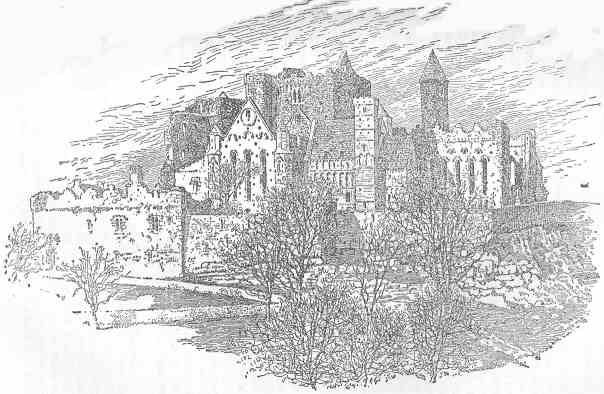
I diverged from the road, and, crossing two or three fields,
came to a small grassy plain, in the midst of which stood the
castle. About a gun-shot to the south was a small village,
which had, probably, in ancient days, sprung up beneath its
protection. A kind of awe came over me as I approached the
old building. The sun no longer shone upon it, and it
looked so grim, so desolate and solitary; and here was I in that
wild country, alone with that grim building before me. The
village was within sight, it is true; but it might be a village
of the dead for what I knew; no sound issued from it, no smoke
was rising from its roofs, neither man nor beast was visible, no
life, no motion—it looked as desolate as the castle
itself. Yet I was bent on the adventure, and moved on
towards the castle across the green plain, occasionally casting a
startled glance around me; and now I was close to it.
It was surrounded by a quadrangular wall, about ten feet in
height, with a square tower at each corner. At first I
could discover no entrance; walking round, however, to the
northern side, I found a wide and lofty gateway with a tower
above it, similar to those at the angles of the wall; on this
side the ground sloped gently down towards the bog, which was
here skirted by an abundant growth of copsewood, and a few
evergreen oaks. I passed through the gateway, and found
myself within a square enclosure of about two acres. On one
side rose a round and lofty keep, or donjon, with a conical roof,
part of which had fallen down, strewing the square with its
ruins. Close to the keep, on the other side, stood the
remains of an oblong house, built something in the modern style,
with various window-holes; nothing remained but the bare walls
and a few projecting stumps of beams, which seemed to have been
half burnt. The interior of the walls was blackened, as if
by fire; fire also appeared at one time to have raged out of the
window-holes, for the outside about them was black, portentously
so.
“I wonder what has been going on here!” I
exclaimed.
There were echoes along the walls as I walked about the
court. I entered the keep by a low and frowning doorway:
the lower floor consisted of a large dungeon-like room, with a
vaulted roof; on the left hand was a winding staircase in the
thickness of the wall; it looked anything but inviting; yet I
stole softly up, my heart beating. On the top of the first
flight of stairs was an arched doorway; to the left was a dark
passage; to the right, stairs leading still higher. I
stepped under the arch and found myself in an
apartment somewhat similar to the one below, but higher.
There was an object at the farther end.
An old woman, at least eighty, was seated on a stone, cowering
over a few sticks burning feebly on what had once been a right
noble and cheerful hearth; her side-glance was towards the
doorway as I entered, for she had heard my footsteps. I
stood suddenly still, and her haggard glance rested on my
face.
“Is this your house, mother?” I at length
demanded, in the language which I thought she would best
understand.
“Yes, my house, my own house; the house of the
broken-hearted.”
“Any other person’s house?” I demanded.
“My own house, the beggar’s house—the
accursed house of Cromwell!”
One morning I set out, designing to pay a visit to my brother
at the place where he was detached; the distance was rather
considerable, yet I hoped to be back by evening fall, for I was
now a shrewd walker, thanks to constant practice. I set out
early, and directing my course towards the north, I had in less
than two hours accomplished considerably more than half of the
journey. The weather had at first been propitious: a slight
frost had rendered the ground firm to the tread, and the skies
were clear; but now a change came over the scene: the skies
darkened and a heavy snow-storm came on; the road then lay
straight through a bog, and was bounded by a deep trench on both
sides; I was making the best of my way, keeping as nearly as I
could in the middle of the road, lest, blinded by the snow which
was frequently borne into my eyes by the wind, I might fall into
the dyke, when all at once I heard a shout to windward, and
turning my eyes I saw the figure of a man, and what appeared to
be an animal of some kind, coming across the bog with great
speed, in the direction of myself; the nature of the ground
seemed to offer but little impediment to these beings, both
clearing the holes and abysses which lay in their way with
surprising agility; the animal was, however, some slight way in
advance, and, bounding over the dyke, appeared on the road just
before me. It was a dog, of what species I cannot tell,
never having seen the like before or since; the head was large
and round, the ears so tiny as scarcely to be discernible, the
eyes of a fiery red; in size it was rather small than large, and
the coat, which was remarkably smooth, as white as the falling
flakes. It placed itself directly in my path, and showing
its teeth, and bristling its coat, appeared determined to prevent
my progress. I had an ashen stick in my hand, with which I
threatened it; this, however, only served to increase its fury;
it rushed upon me, and I had the utmost difficulty to preserve
myself from its fangs.
“What are you doing with the dog, the fairy dog?”
said a man who at this time likewise cleared the dyke at a
bound.
He was a very tall man, rather well-dressed as it should
seem; his garments, however, were like my own, so covered with
snow that I could scarcely discern their quality.
“What are ye doing with the dog of peace?”
“I wish he would show himself one,” said I;
“I said nothing to him, but he placed himself in my road,
and would not let me pass.”
“Of course he would not be letting you till he knew
where ye were going.”
“He’s not much of a fairy,” said I,
“or he would know that without asking; tell him that I am
going to see my brother.”
“And who is your brother, little Sas?”
“What my father is, a royal soldier.”
“Oh, ye are going then to the detachment at ---; by my
shoul, I have a good mind to be spoiling your journey.”
“You are doing that already,” said I,
“keeping me here talking about dogs and fairies; you had
better go home and get some salve to cure that place over your
eye; it’s catching cold you’ll be, in so much
snow.”
On one side of the man’s forehead there was a raw and
staring wound, as if from a recent and terrible blow.
“Faith, then I’ll be going, but it’s taking
you wid me I will be.’
“And where will you take me?”
“Why, then, to Ryan’s Castle, little
Sas.”
“You do not speak the language very correctly,”
said I; “it is not Sas you should call
me—’tis Sassannach,” and forthwith I
accompanied the word with a speech full of flowers of Irish
rhetoric.
The man looked upon me for a moment, fixedly, then, bending
his head towards his breast, he appeared to be undergoing a kind
of convulsion, which was accompanied by a sound something
resembling laughter; presently he looked at me, and there was a
broad grin on his features.
“By my shoul, it’s a thing of peace I’m
thinking ye.”
But now with a whisking sound came running down the road a
hare; it was nearly upon us before it perceived us; suddenly
stopping short, however, it sprang into the bog on the right-hand
side; after it amain bounded the dog of peace, followed by the
man, but not until he had nodded to me a farewell
salutation. In a few moments I lost sight of him amidst the
snow-flakes.
The weather was again clear and fine before I reached the
place of detachment. It was a little wooden barrack,
surrounded by a wall of the same material; a
sentinel stood at the gate, I passed by him, and, entering the
building, found myself in a rude kind of guard-room; several
soldiers were lying asleep on a wooden couch at one end, others
lounged on benches by the side of a turf fire. The tall
sergeant stood before the fire, holding a cooking utensil in his
left hand; on seeing me, he made the military salutation.
“Is my brother here?” said I, rather timidly,
dreading to hear that he was out, perhaps for the day.
“The ensign is in his room, sir,” said Bagg,
“I am now preparing his meal, which will presently be
ready; you will find the ensign above stairs,” and he
pointed to a broken ladder which led to some place above.
And there I found him—the boy soldier—in a kind of
upper loft, so low that I could touch with my hands the sooty
rafters; the floor was of rough boards, through the joints of
which you could see the gleam of the soldiers’ fire, and
occasionally discern their figures as they moved about; in one
corner was a camp bedstead, by the side of which hung the
child’s sword, gorget, and sash; a deal table stood in the
proximity of the rusty grate, where smoked and smouldered a pile
of black turf from the bog—a deal table without a piece of
baize to cover it, yet fraught with things not devoid of
interest: a Bible, given by a mother; the Odyssey, the Greek
Odyssey; a flute, with broad silver keys; crayons, moreover, and
water colours, and a sketch of a wild prospect near, which,
though but half finished, afforded ample proof of the excellence
and skill of the boyish hand now occupied upon it.
Ah! he was a sweet being, that boy soldier, a plant of early
promise, bidding fair to become in after time all that is great,
good, and admirable. I have read of a remarkable Welshman,
of whom it was said, when the grave closed over him, that he
could frame a harp, and play it; build a ship, and sail it;
compose an ode, and set it to music. A brave fellow that
son of Wales—but I had once a brother who could do more and
better than this, but the grave has closed over him, as over the
gallant Welshman of yore; there are now but two that remember
him—the one who bore him, and the being who was nurtured at
the same breast. He was taken, and I was left! Truly,
the ways of Providence are inscrutable.
“You seem to be very comfortable, John,” said I,
looking around the room and at the various objects which I have
described above: “you have a good roof over your head, and
have all your things about you.”
“Yes, I am very comfortable, George, in many
respects; I am, moreover, independent, and feel myself a man for
the first time in my life—independent did I
say?—that’s not the word, I am something much higher
than that; here am I, not sixteen yet, a person in authority,
like the centurion in the book there, with twenty Englishmen
under me, worth a whole legion of his men, and that fine fellow
Bagg to wait upon me, and take my orders. Oh! these last
six weeks have passed like hours of heaven.”
“But your time must frequently hang heavy on your hands;
this is a strange wild place, and you must be very
solitary?”
“I am never solitary; I have, as you see, all my things
about me, and there is plenty of company below stairs. Not
that I mix with the soldiers; if I did, good-bye to my authority;
but when I am alone I can hear all their discourse through the
planks, and I often laugh to myself at the funny things they
say.”
“And have you any acquaintance here?”
“The very best; much better than the Colonel and the
rest, at their grand Templemore; I had never so many in my whole
life before. One has just left me, a gentleman who lives at
a distance across the bog; he comes to talk with me about Greek,
and the Odyssey, for he is a very learned man, and understands
the old Irish and various other strange languages. He has
had a dispute with Bagg. On hearing his name, he called him
to him, and, after looking at him for some time with great
curiosity, said that he was sure he was a Dane. Bagg,
however, took the compliment in dudgeon, and said that he was no
more a Dane than himself, but a true-born Englishman, and a
sergeant of six years’ standing.”
“And what other acquaintance have you?”
“All kinds; the whole neighbourhood can’t make
enough of me. Amongst others there’s the clergyman of
the parish and his family; such a venerable old man, such fine
sons and daughters! I am treated by them like a son and a
brother—I might be always with them if I pleased;
there’s one drawback, however, in going to see them;
there’s a horrible creature in the house, a kind of tutor,
whom they keep more from charity than anything else; he is a
Papist and, they say, a priest; you should see him scowl
sometimes at my red coat, for he hates the king, and not
unfrequently, when the king’s health is drunk, curses him
between his teeth. I once got up to strike him, but the
youngest of the sisters, who is the handsomest, caught my arm and
pointed to her forehead.”
“And what does your duty consist of? Have
you nothing else to do than pay visits and receive
them?”
“We do what is required of us: we guard this edifice,
perform our evolutions, and help the excise; I am frequently
called up in the dead of night to go to some wild place or other
in quest of an illicit still; this last part of our duty is poor
mean work, I don’t like it, nor more does Bagg; though
without it, we should not see much active service, for the
neighbourhood is quiet; save the poor creatures with their
stills, not a soul is stirring. ’Tis true,
there’s Jerry Grant.”
“And who is Jerry Grant?”
“Did you never hear of him? that’s strange, the
whole country is talking about him; he is a kind of outlaw,
rebel, or robber, all three, I daresay; there’s a hundred
pounds offered for his head.”
“And where does he live?”
“His proper home, they say, is in the Queen’s
County, where he has a band; but he is a strange fellow, fond of
wandering about by himself amidst the bogs and mountains, and
living in the old castles; occasionally he quarters himself in
the peasants’ houses, who let him do just what he pleases;
he is free of his money, and often does them good turns, and can
be good-humoured enough, so they don’t dislike him.
Then he is what they call a fairy man, a person in league with
fairies and spirits, and able to work much harm by supernatural
means, on which account they hold him in great awe; he is,
moreover, a mighty strong and tall fellow. Bagg has seen
him.”
“Has he?”
“Yes! and felt him; he too is a strange one. A few
days ago he was told that Grant had been seen hovering about an
old castle some two miles off in the bog; so one afternoon what
does he do but, without saying a word to me—for which,
by-the-bye, I ought to put him under arrest, though what I should
do without Bagg I have no idea whatever—what does he do but
walk off to the castle, intending, as I suppose, to pay a visit
to Jerry. He had some difficulty in getting there on
account of the turf-holes in the bog, which he was not accustomed
to; however, thither at last he got and went in. It was a
strange lonesome place, he says, and he did not much like the
look of it; however, in he went, and searched about from the
bottom to the top and down again, but could find no one; he
shouted and hallooed, but nobody answered, save the rooks and
choughs, which started up in great numbers. ‘I have
lost my trouble,’ said Bagg, and left the
castle. It was now late in the afternoon, near sunset, when
about half-way over the bog he met a man—”
“And that man was—”
“Jerry Grant! there’s no doubt of it. Bagg
says it was the most sudden thing in the world. He was
moving along, making the best of his way, thinking of nothing at
all save a public-house at Swanton Morley, which he intends to
take when he gets home and the regiment is disbanded—though
I hope that will not be for some time yet: he had just leaped a
turf-hole, and was moving on, when, at the distance of about six
yards before him, he saw a fellow coming straight towards
him. Bagg says that he stopped short, as suddenly as if he
had heard the word halt, when marching at double-quick
time. It was quite a surprise, he says, and he can’t
imagine how the fellow was so close upon him before he was
aware. He was an immense tall fellow—Bagg thinks at
least two inches taller than himself—very well dressed in a
blue coat and buff breeches, for all the world like a squire when
going out hunting. Bagg, however, saw at once that he had a
roguish air, and he was on his guard in a moment.
‘Good evening to ye, sodger,’ says the fellow,
stepping close up to Bagg, and staring him in the face.
‘Good evening to you, sir! I hope you are
well,’ says Bagg. ‘You are looking after some
one?’ says the fellow. ‘Just so, sir,’
says Bagg, and forthwith seized him by the collar; the man
laughed, Bagg says it was such a strange awkward laugh.
‘Do you know whom you have got hold of, sodger?’ said
he. ‘I believe I do, sir,’ said Bagg,
‘and in that belief will hold you fast in the name of King
George, and the quarter sessions;’ the next moment he was
sprawling with his heels in the air. Bagg says there was
nothing remarkable in that; he was only flung by a kind of
wrestling trick, which he could easily have baffled, had he been
aware of it. ‘You will not do that again, sir,’
said he, as he got up and put himself on his guard. The
fellow laughed again more strangely and awkwardly than before;
then, bending his body and moving his head from one side to the
other as a cat does before she springs, and crying out,
‘Here’s for ye, sodger!’ he made a dart at
Bagg, rushing in with his head foremost. ‘That will
do, sir,’ says Bagg, and drawing himself back he put in a
left-handed blow with all the force of his body and arm, just
over the fellow’s right eye—Bagg is a left-handed
hitter, you must know—and it was a blow of that kind which
won him his famous battle at Edinburgh with the big Highland
sergeant. Bagg says that he was quite satisfied with the
blow, more especially when he saw the fellow reel, fling out his
arms, and fall to the ground. ‘And
now, sir,’ said he, ‘I’ll make bold to hand you
over to the quarter sessions, and, if there is a hundred pounds
for taking you, who has more right to it than
myself?’ So he went forward, but ere he could lay
hold of his man the other was again on his legs, and was prepared
to renew the combat. They grappled each other—Bagg
says he had not much fear of the result, as he now felt himself
the best man, the other seeming half stunned with the
blow—but just then there came on a blast, a horrible
roaring wind bearing night upon its wings, snow, and sleet, and
hail. Bagg says he had the fellow by the throat quite fast,
as he thought, but suddenly he became bewildered, and knew not
where he was; and the man seemed to melt away from his grasp, and
the wind howled more and more, and the night poured down darker
and darker, the snow and the sleet thicker and more
blinding. ‘Lord have mercy upon us!’ said
Bagg.”
Myself. A strange adventure that; it is well that
Bagg got home alive.
John. He says that the fight was a fair fight,
and that the fling he got was a fair fling, the result of a
common enough wrestling trick. But with respect to the
storm, which rose up just in time to save the fellow, he is of
opinion that it was not fair, but something Irish and
supernatural.
Myself. I dare say he’s right. I have
read of witchcraft in the Bible.
John. He wishes much to have one more encounter
with the fellow; he says that on fair ground, and in fine
weather, he has no doubt that he could master him, and hand him
over to the quarter sessions. He says that a hundred pounds
would be no bad thing to be disbanded upon; for he wishes to take
an inn at Swanton Morley, keep a cock-pit, and live
respectably.
Myself. He is quite right; and now kiss me, my
darling brother, for I must go back through the bog to
Templemore.
And it came to pass that, as I was standing by the door of the
barrack stable, one of the grooms came out to me, saying,
“I say, young gentleman, I wish you would give the cob a
breathing this fine morning.”
“Why do you wish me to mount him?” said I;
“you know he is dangerous. I saw him fling you off
his back only a few days ago.”
“Why, that’s the very thing, master.
I’d rather see anybody on his back than myself; he does not
like me; but, to them he does, he can be as gentle as a
lamb.”
“But suppose,” said I, “that he should not
like me?”
“We shall soon see that, master,” said the groom;
“and, if so be he shows temper, I will be the first to tell
you to get down. But there’s no fear of that; you
have never angered or insulted him, and to such as you, I say
again, he’ll be as gentle as a lamb.”
“And how came you to insult him,” said I,
“knowing his temper as you do?”
“Merely through forgetfulness, master. I was
riding him about a month ago, and having a stick in my hand, I
struck him, thinking I was on another horse, or rather thinking
of nothing at all. He has never forgiven me, though before
that time he was the only friend I had in the world; I should
like to see you on him, master.”
“I should soon be off him; I can’t
ride.”
“Then you are all right, master; there’s no
fear. Trust him for not hurting a young gentleman, an
officer’s son who can’t ride. If you were a
blackguard dragoon, indeed, with long spurs, ’twere another
thing; as it is, he’ll treat you as if he were the elder
brother that loves you. Ride! he’ll soon teach you to
ride, if you leave the matter with him. He’s the best
riding master in all Ireland, and the gentlest.”
The cob was led forth; what a tremendous creature! I had
frequently seen him before, and wondered at him; he was barely
fifteen hands, but he had the girth of a metropolitan dray-horse,
his head was small in comparison with his immense neck,
which curved down nobly to his wide back. His chest was
broad and fine, and his shoulders models of symmetry and
strength; he stood well and powerfully upon his legs, which were
somewhat short. In a word, he was a gallant specimen of the
genuine Irish cob, a species at one time not uncommon, but at the
present day nearly extinct.
“There!” said the groom, as he looked at him,
half-admiringly, half-sorrowfully, “with sixteen stone on
his back, he’ll trot fourteen miles in one hour; with your
nine stone, some two and half more, ay, and clear a six-foot wall
at the end of it.”
“I’m half afraid,” said I; “I had
rather you would ride him.”
“I’d rather so, too, if he would let me; but he
remembers the blow. Now, don’t be afraid, young
master, he’s longing to go out himself. He’s
been trampling with his feet these three days, and I know what
that means; he’ll let anybody ride him but myself, and
thank them; but to me he says, ‘No! you struck
me’”.
“But,” said I, “where’s the
saddle?”
“Never mind the saddle; if you are ever to be a frank
rider, you must begin without a saddle; besides, if he felt a
saddle, he would think you don’t trust him, and leave you
to yourself. Now, before you mount, make his
acquaintance—see there, how he kisses you and licks your
face, and see how he lifts his foot, that’s to shake
hands. You may trust him—now you are on his back at
last; mind how you hold the bridle—gently, gently!
It’s not four pair of hands like yours can hold him if he
wishes to be off. Mind what I tell you—leave it all
to him.”
Off went the cob at a slow and gentle trot, too fast and
rough, however, for so inexperienced a rider. I soon felt
myself sliding off, the animal perceived it too, and instantly
stood stone still till I had righted myself; and now the groom
came up: “When you feel yourself going,” said he,
“don’t lay hold of the mane, that’s no use;
mane never yet saved man from falling, no more than straw from
drowning; it’s his sides you must cling to with your calves
and feet, till you learn to balance yourself. That’s
it, now abroad with you; I’ll bet my comrade a pot of beer
that you’ll be a regular rough rider by the time you come
back.”
And so it proved; I followed the directions of the groom, and
the cob gave me every assistance. How easy is riding, after
the first timidity is got over, to supple and youthful limbs; and
there is no second fear. The creature soon found that the
nerves of his rider were in proper tone. Turning his head
half round he made a kind of whining noise, flung
out a little foam, and set off.
In less than two hours I had made the circuit of the
Devil’s Mountain, and was returning along the road, bathed
with perspiration, but screaming with delight; the cob laughing
in his equine way, scattering foam and pebbles to the left and
right, and trotting at the rate of sixteen miles an hour.
Oh, that ride! that first ride!—most truly it was an
epoch in my existence; and I still look back to it with feelings
of longing and regret. People may talk of first
love—it is a very agreeable event, I dare say—but
give me the flush, and triumph, and glorious sweat of a first
ride, like mine on the mighty cob! My whole frame was
shaken, it is true; and during one long week I could hardly move
foot or hand; but what of that? By that one trial I had
become free, as I may say, of the whole equine species. No
more fatigue, no more stiffness of joints, after that first ride
round the Devil’s Hill on the cob.
Oh, that cob! that Irish cob!—may the sod lie lightly
over the bones of the strongest, speediest, and most gallant of
its kind! Oh! the days when, issuing from the barrack-gate
of Templemore, we commenced our hurry-skurry just as inclination
led—now across the fields—direct over stone walls and
running brooks—mere pastime for the cob!—sometimes
along the road to Thurles and Holy Cross, even to distant
Cahir!—what was distance to the cob?
It was thus that the passion for the equine race was first
awakened within me—a passion which, up to the present time,
has been rather on the increase than diminishing. It is no
blind passion; the horse being a noble and generous creature,
intended by the All-Wise to be the helper and friend of man, to
whom he stands next in the order of creation. On many
occasions of my life I have been much indebted to the horse, and
have found in him a friend and coadjutor, when human help and
sympathy were not to be obtained. It is therefore natural
enough that I should love the horse; but the love which I
entertain for him has always been blended with respect; for I
soon perceived that, though disposed to be the friend and helper
of man, he is by no means inclined to be his slave; in which
respect he differs from the dog, who will crouch when beaten;
whereas the horse spurns, for he is aware of his own worth, and
that he carries death within the horn of his heel. If,
therefore, I found it easy to love the horse, I found it equally
natural to respect him.
I much question whether philology, or the passion for languages, requires so little of an apology as the love
for horses. It has been said, I believe, that the more
languages a man speaks, the more a man is he; which is very true,
provided he acquires languages as a medium for becoming
acquainted with the thoughts and feelings of the various sections
into which the human race is divided; but, in that case, he
should rather be termed a philosopher than a
philologist—between which two the difference is wide
indeed! An individual may speak and read a dozen languages,
and yet be an exceedingly poor creature, scarcely half a man; and
the pursuit of tongues for their own sake, and the mere
satisfaction of acquiring them, surely argues an intellect of a
very low order; a mind disposed to be satisfied with mean and
grovelling things; taking more pleasure in the trumpery casket
than in the precious treasure which it contains, in the pursuit
of words, than in the acquisition of ideas.
I cannot help thinking that it was fortunate for myself, who
am, to a certain extent, a philologist, that with me the pursuit
of languages has been always modified by the love of horses; for
scarcely had I turned my mind to the former, when I also mounted
the wild cob, and hurried forth in the direction of the
Devil’s Hill, scattering dust and flint-stones on every
side; that ride, amongst other things, taught me that a lad with
thews and sinews was intended by nature for something better than
mere word-culling; and if I have accomplished anything in after
life worthy of mentioning, I believe it may partly be attributed
to the ideas which that ride, by setting my blood in a glow,
infused into my brain. I might, otherwise, have become a
mere philologist; one of those beings who toil night and day in
culling useless words for some opus magnum which Murray
will never publish, and nobody ever read—beings without
enthusiasm, who, having never mounted a generous steed, cannot
detect a good point in Pegasus himself; like a certain
philologist, who, though acquainted with the exact value of every
word in the Greek and Latin languages, could observe no
particular beauty in one of the most glorious of Homer’s
rhapsodies. [81] What knew he of Pegasus? he had
never mounted a generous steed; the merest jockey, had the strain
been interpreted to him, would have called it a brave
song!—I return to the brave cob.
On a certain day I had been out on an excursion. In a
cross-road, at some distance from the Satanic hill, the
animal which I rode cast a shoe. By good luck a small
village was at hand, at the entrance of which was a large shed,
from which proceeded a most furious noise of hammering.
Leading the cob by the bridle, I entered boldly.
“Shoe this horse, and do it quickly, a gough,” said I
to a wild grimy figure of a man, whom I found alone, fashioning a
piece of iron.
“Arrigod yuit?” said the fellow, desisting
from his work and staring at me.
“O yes, I have money,” said I, “and of the
best;” and I pulled out an English shilling.
“Tabhair chugam,” said the smith,
stretching out his grimy hand.
“No, I sha’n’t,” said I; “some
people are glad to get their money when their work is
done.”
The fellow hammered a little longer and then proceeded to shoe
the cob, after having first surveyed it with attention. He
performed his job rather roughly, and more than once appeared to
give the animal unnecessary pain, frequently making use of loud
and boisterous words. By the time the work was done, the
creature was in a state of high excitement, and plunged and
tore. The smith stood at a short distance, seeming to enjoy
the irritation of the animal, and showing, in a remarkable
manner, a huge fang, which projected from the under jaw of a very
wry mouth.
“You deserve better handling,” said I, as I went
up to the cob and fondled it; whereupon it whinnied, and
attempted to touch my face with its nose.
“Are ye not afraid of that beast?” said the smith,
showing his fang. “Arrah, it’s vicious that he
looks!”
“It’s at you, then!—I don’t fear
him;” and thereupon I passed under the horse, between his
hind legs.
“And is that all you can do, agrah?” said the
smith.
“No,” said I, “I can ride him.”
“Ye can ride him, and what else, agrah?”
“I can leap him over a six-foot wall,” said I.
“Over a wall, and what more, agrah?”
“Nothing more,” said I; “what more would you
have?”
“Can you do this, agrah?” said the smith, and he
uttered a word which I had never heard before, in a sharp pungent
tone. The effect upon myself was somewhat extraordinary, a
strange thrill ran through me; but with regard to the cob it was
terrible; the animal forthwith became like one mad, and reared
and kicked with the utmost desperation.
“Can you do that, agrah?” said the
smith.
“What is it?” said I, retreating, “I never
saw the horse so before.”
“Go between his legs, agrah,” said the smith,
“his hinder legs;” and he again showed his fang.
“I dare not,” said I, “he would kill
me.”
“He would kill ye! and how do ye know that,
agrah?”
“I feel he would,” said I, “something tells
me so.”
“And it tells ye truth, agrah; but it’s a fine
beast, and it’s a pity to see him in such a state: Is
agam an’t leigeas”—and here he uttered
another word in a voice singularly modified, but sweet and almost
plaintive; the effect of it was as instantaneous as that of the
other, but how different!—the animal lost all its fury and
became at once calm and gentle. The smith went up to it,
coaxed and patted it, making use of various sounds of equal
endearment; then turning to me, and holding out once more the
grimy hand, he said: “And now ye will be giving me the
Sassanach tenpence, agrah?”
From the wild scenes which I have attempted to describe in the
latter pages I must now transport the reader to others of a
widely different character. He must suppose himself no
longer in Ireland, but in the eastern corner of merry
England. Bogs, ruins and mountains have disappeared amidst
the vapours of the west: I have nothing more to say of them; the
region in which we are now is not famous for objects of that
kind; perhaps it flatters itself that it can produce fairer and
better things, of some of which let me speak; there is a fine old
city before us, and first of that let me speak.
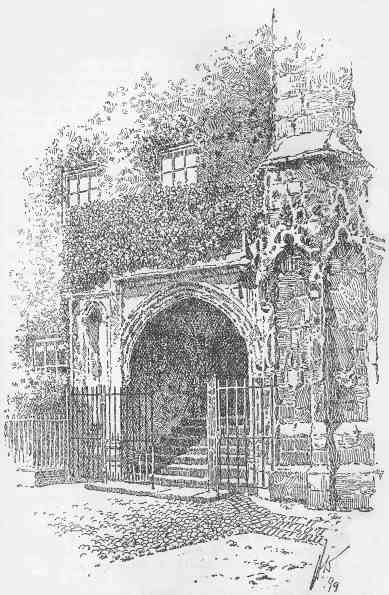
A fine old city, truly, is that, view it from whatever side
you will; but it shows best from the east, where the ground, bold
and elevated, overlooks the fair and fertile valley in which it
stands. Gazing from those heights, the eye beholds a scene
which cannot fail to awaken, even in the least sensitive bosom,
feelings of pleasure and admiration. At the foot of the
heights flows a narrow and deep river, with an antique bridge
communicating with a long and narrow suburb, flanked on either
side by rich meadows of the brightest green, beyond which spreads
the city, the fine old city, perhaps the most curious specimen at
present extant of the genuine old English town. Yes, there
it spreads from north to south, with its venerable houses, its
numerous gardens, its thrice twelve churches, its mighty mound,
which, if tradition speaks true, was raised by human hands to
serve as the grave heap of an old heathen king, who sits deep
within it, with his sword in his hand and his gold and silver
treasures about him. There is a grey old castle upon the
top of that mighty mound; and yonder, rising three hundred feet
above the soil, from among those noble forest trees, behold that
old Norman master-work, that cloud-encircled cathedral spire,
around which a garrulous army of rooks and choughs continually
wheel their flight. Now, who can wonder that the children
of that fine old city are proud of her, and offer up prayers for
her prosperity? I, myself, who was not born within her
walls, offer up prayers for her prosperity, that want may never
visit her cottages, vice her palaces, and that the abomination of
idolatry may never pollute her temples.
Ha, idolatry! the reign of idolatry has been over there for many
a long year, never more, let us hope, to return; brave hearts in
that old town have borne witness against it and sealed their
testimony with their hearts’ blood—most precious to
the Lord is the blood of His saints! we are not far from hallowed
ground. Observe ye not yon chalky precipice to the right of
the Norman bridge? On this side of the stream, upon its
brow, is a piece of ruined wall, the last relic of what was of
old a stately pile, whilst at its foot is a place called the
Lollards’ Hole; and with good reason, for many a saint of
God has breathed his last beneath that white precipice, bearing
witness against Popish idolatry, midst flame and pitch; many a
grisly procession has advanced along that suburb, across the old
bridge, towards the Lollards’ Hole: furious priests in
front, a calm pale martyr in the midst, a pitying multitude
behind. It has had its martyrs, the venerable old town!
Ah! there is good blood in that old city, and in the whole
circumjacent region of which it is the capital. The Angles
possessed the land at an early period, which, however, they were
eventually compelled to share with hordes of Danes and Northmen,
who flocked thither across the sea to found hearthsteads on its
fertile soil. The present race, a mixture of Angles and
Danes, still preserve much which speaks strongly of their
northern ancestry; amongst them ye will find the light-brown hair
of the north, the strong and burly forms of the north, many a
wild superstition, ay, and many a wild name connected with the
ancient history of the north and its sublime mythology; the warm
heart and the strong heart of the old Danes and Saxons still
beats in those regions, and there ye will find, if anywhere, old
northern hospitality and kindness of manner, united with energy,
perseverance and dauntless intrepidity; better soldiers or
mariners never bled in their country’s battles than those
nurtured in those regions and within those old walls. It
was yonder, to the west, that the great naval hero of Britain
first saw the light; he who annihilated the sea pride of Spain
and dragged the humbled banner of France in triumph at his
stern. He was born yonder towards the west, and of him
there is a glorious relic in that old town; in its dark flint
guildhouse, the roof of which you can just descry rising above
that maze of buildings, in the upper hall of justice, is a
species of glass shrine, in which the relic is to be seen: a
sword of curious workmanship, the blade is of keen Toledan steel,
the heft of ivory and mother-of-pearl. ’Tis the sword
of Cordova, won in bloodiest fray off St. Vincent’s
promontory, and presented by Nelson to the
old capital of the much-loved land of his birth. Yes, the
proud Spaniard’s sword is to be seen in yonder guildhouse,
in the glass case affixed to the wall; many other relics has the
good old town, but none prouder than the Spaniard’s
sword.
Such was the place to which, when the war was over, my father
retired: it was here that the old tired soldier set himself down
with his little family. He had passed the greater part of
his life in meritorious exertion in the service of his country,
and his chief wish now was to spend the remainder of his days in
quiet and respectability; his means, it is true, were not very
ample; fortunate it was that his desires corresponded with them:
with a small fortune of his own, and with his half-pay as a royal
soldier, he had no fears for himself or for his faithful partner
and helpmate; but then his children! how was he to provide for
them? how launch them upon the wide ocean of the world?
This was, perhaps, the only thought which gave him uneasiness,
and I believe that many an old retired officer at that time, and
under similar circumstances, experienced similar anxiety; had the
war continued, their children would have been, of course,
provided for in the army, but peace now reigned, and the military
career was closed to all save the scions of the aristocracy, or
those who were in some degree connected with that privileged
order, an advantage which few of these old officers could boast
of; they had slight influence with the great, who gave themselves
very little trouble either about them or their families.
“I have been writing to the Duke,” said my father
one day to my excellent mother, after we had been at home
somewhat better than a year, “I have been writing to the
Duke of York about a commission for that eldest boy of
ours. He, however, affords me no hopes; he says that his
list is crammed with names, and that the greater number of the
candidates have better claims than my son.”
“I do not see how that can be,” said my
mother.
“Nor do I,” replied my father. “I see
the sons of bankers and merchants gazetted every month, and I do
not see what claims they have to urge, unless they be golden
ones. However, I have not served my king fifty years to
turn grumbler at this time of life. I suppose that the
people at the head of affairs know what is most proper and
convenient; perhaps when the lad sees how difficult, nay, how
impossible it is that he should enter the army, he will turn his
mind to some other profession; I wish he may!”
“I think he has already,” said my mother;
“you see how fond he is of the arts, of drawing
and painting, and, as far as I can judge, what he has already
done is very respectable; his mind seems quite turned that way,
and I heard him say the other day that he would sooner be a
Michael Angelo than a general officer. But you are always
talking of him; what do you think of doing with the other
child?”
“What, indeed!” said my father; “that is a
consideration which gives me no little uneasiness. I am
afraid it will be much more difficult to settle him in life than
his brother. What is he fitted for, even were it in my
power to provide for him? God help the child! I bear
him no ill-will, on the contrary all love and affection; but I
cannot shut my eyes; there is something so strange about
him! How he behaved in Ireland! I sent him to school
to learn Greek, and he picked up Irish!”
“And Greek as well,” said my mother.
“I heard him say the other day that he could read St. John
in the original tongue.”
“You will find excuses for him, I know,” said my
father. “You tell me I am always talking of my
first-born; I might retort by saying you are always thinking of
the other; but it is the way of women always to side with the
second-born. There’s what’s-her-name in the
Bible, by whose wiles the old blind man was induced to give to
his second son the blessing which was the birthright of the
other. I wish I had been in his place! I should not
have been so easily deceived! no disguise would ever have caused
me to mistake an impostor for my first-born. Though I must
say for this boy that he is nothing like Jacob; he is neither
smooth nor sleek, and, though my second-born, is already taller
and larger than his brother.”
“Just so,” said my mother, “his brother
would make a far better Jacob than he.”
“I will hear nothing against my first-born,” said
my father, “even in the way of insinuation: he is my joy
and pride—the very image of myself in my youthful days,
long before I fought Big Ben, though perhaps not quite so tall or
strong built. As for the other, God bless the child!
I love him, I’m sure; but I must be blind not to see the
difference between him and his brother. Why, he has neither
my hair nor my eyes; and then his countenance! why, ’tis
absolutely swarthy, God forgive me! I had almost said like that
of a gypsy, but I have nothing to say against that; the boy is
not to be blamed for the colour of his face, nor for his hair and
eyes; but, then, his ways and manners! I confess I do not
like them, and that they give me no little uneasiness. I
know that he kept very strange company when he was in
Ireland; people of evil report, of whom terrible things were
said—horse-witches and the like. I questioned him
once or twice upon the matter, and even threatened him, but it
was of no use; he put on a look as if he did not understand me, a
regular Irish look, just such a one as those rascals assume when
they wish to appear all innocence and simplicity, and they full
of malice and deceit all the time. I don’t like them;
they are no friends to old England, or its old king, God bless
him! They are not good subjects, and never were; always in
league with foreign enemies. When I was in the Coldstream,
long before the Revolution, I used to hear enough about the Irish
brigades kept by the French kings, to be a thorn in the side of
the English whenever opportunity served. Old Sergeant
Meredith once told me, that in the time of the Pretender there
were always in London alone, a dozen of fellows connected with
these brigades, with the view of seducing the king’s
soldiers from their allegiance, and persuading them to desert to
France to join the honest Irish, as they were called. One
of these traitors once accosted him and proposed the matter to
him, offering handfuls of gold if he could induce any of his
comrades to go over. Meredith appeared to consent, but
secretly gave information to his colonel; the fellow was seized,
and certain traitorous papers found upon him; he was hanged
before Newgate, and died exulting in his treason. His name
was Michael Nowlan. That ever son of mine should have been
intimate with the Papist Irish, and have learnt their
language!”
“But he thinks of other things now,” said my
mother.
“Other languages, you mean,” said my father.
“It is strange that he has conceived such a zest for the
study of languages; no sooner did he come home than he persuaded
me to send him to that old priest to learn French and Italian,
and, if I remember right, you abetted him; but, as I said before,
it is in the nature of women invariably to take the part of the
second-born. Well, there is no harm in learning French and
Italian, perhaps much good in his case, as they may drive the
other tongue out of his head. Irish! why, he might go to
the university but for that; but how would he look when, on being
examined with respect to his attainments, it was discovered that
he understood Irish? How did you learn it? they would ask
him; how did you become acquainted with the language of Papists
and rebels? The boy would be sent away in
disgrace.”
“Be under no apprehension, I have no doubt that he has
long since forgotten it.”
“I am glad to hear it,” said my father;
“for, between ourselves, I love the
poor child; ay, quite as well as my first-born. I trust
they will do well, and that God will be their shield and guide; I
have no doubt He will, for I have read something in the Bible to
that effect. What is that text about the young ravens being
fed?”
“I know a better than that,” said my mother;
“one of David’s own words, ‘I have been young
and now am grown old, yet never have I seen the righteous man
forsaken, or his seed begging their bread’.”
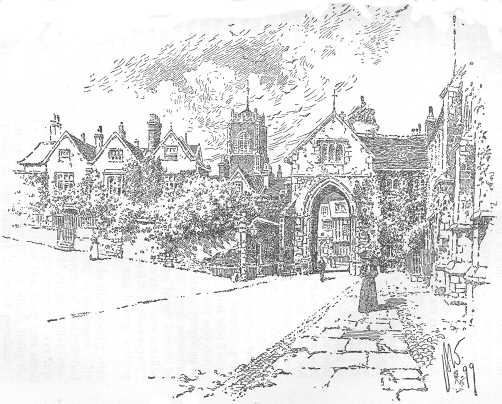
I have heard talk of the pleasures of idleness, yet it is my
own firm belief that no one ever yet took pleasure in it.
Mere idleness is the most disagreeable state of existence, and
both mind and body are continually making efforts to escape from
it. It has been said that idleness is the parent of
mischief, which is very true; but mischief itself is merely an
attempt to escape from the dreary vacuum of idleness. There
are many tasks and occupations which a man is unwilling to
perform, but let no one think that he is therefore in love with
idleness; he turns to something which is more agreeable to his
inclination, and doubtless more suited to his nature; but he is
not in love with idleness. A boy may play the truant from
school because he dislikes books and study; but, depend upon it,
he intends doing something the while—to go fishing, or
perhaps to take a walk; and who knows but that from such
excursions both his mind and body may derive more benefit than
from books and school? Many people go to sleep to escape
from idleness; the Spaniards do; and, according to the French
account, John Bull, the ’squire, hangs himself in the month
of November; but the French, who are a very sensible people,
attribute the action, “à une grande envie de se
désennuyer;” he wishes to be doing something,
say they, and having nothing better to do, he has recourse to the
cord.
It was for want of something better to do that, shortly after
my return home, I applied myself to the study of languages.
By the acquisition of Irish, with the first elements of which I
had become acquainted under the tuition of Murtagh, I had
contracted a certain zest and inclination for the pursuit.
Yet it is probable, that had I been launched about this time into
some agreeable career, that of arms, for example, for which,
being the son of a soldier, I had, as was natural, a sort of
penchant, I might have thought nothing more of the acquisition of
tongues of any kind; but, having nothing to do, I followed the
only course suited to my genius which appeared open to me.
So it came to pass that one day, whilst wandering listlessly
about the streets of the old town, I came to a small
book-stall, and stopping, commenced turning over the books; I
took up at least a dozen, and almost instantly flung them
down. What were they to me? At last, coming to a
thick volume, I opened it, and after inspecting its contents for
a few minutes, I paid for it what was demanded, and forthwith
carried it home.
It was a tessara-glot grammar—a strange old book,
printed somewhere in Holland, which pretended to be an easy guide
to the acquirement of the French, Italian, Low Dutch, and English
tongues, by means of which any one conversant in any one of these
languages could make himself master of the other three. I
turned my attention to the French and Italian. The old book
was not of much value; I derived some benefit from it, however,
and, conning it intensely, at the end of a few weeks obtained
some insight into the structure of these two languages. At
length I had learnt all that the book was capable of informing
me, yet was still far from the goal to which it had promised to
conduct me. “I wish I had a master!” I
exclaimed; and the master was at hand. In an old court of
the old town lived a certain elderly personage, perhaps sixty, or
thereabouts; he was rather tall, and something of a robust make,
with a countenance in which bluffness was singularly blended with
vivacity and grimace; and with a complexion which would have been
ruddy, but for a yellow hue which rather predominated. His
dress consisted of a snuff-coloured coat and drab pantaloons, the
former evidently seldom subjected to the annoyance of a brush,
and the latter exhibiting here and there spots of something
which, if not grease, bore a strong resemblance to it; add to
these articles an immense frill, seldom of the purest white, but
invariably of the finest French cambric, and you have some idea
of his dress. He had rather a remarkable stoop, but his
step was rapid and vigorous, and as he hurried along the streets,
he would glance to the right and left with a pair of big eyes
like plums, and on recognising any one would exalt a pair of
grizzled eyebrows, and slightly kiss a tawny and ungloved
hand. At certain hours of the day he might be seen entering
the doors of female boarding-schools, generally with a book in
his hand, and perhaps another just peering from the orifice of a
capacious back pocket; and at a certain season of the year he
might be seen, dressed in white, before the altar of a certain
small popish chapel, chanting from the breviary in very
intelligible Latin, or perhaps reading from the desk in utterly
unintelligible English. Such was my preceptor in the French
and Italian tongues. “Exul sacerdos; vone
banished esprit. I came into England twenty-five years ago,
‘my dear.’”
So I studied French and Italian under the tuition of the
banished priest, to whose house I went regularly every evening to
receive instruction. I made considerable progress in the
acquisition of the two languages. I found the French by far
the most difficult, chiefly on account of the accent, which my
master himself possessed in no great purity, being a Norman by
birth. The Italian was my favourite.
“Vous serez un jour un grand philologue, mon
cher,” said the old man, on our arriving at the
conclusion of Dante’s Hell.
“I hope I shall be something better,” said I,
“before I die, or I shall have lived to little
purpose.”
“That’s true, my dear! philologist—one small
poor dog. What would you wish to be?”
“Many things sooner than that; for example, I would
rather be like him who wrote this book.”
“Quoi, Monsieur Dante? He was a
vagabond, my dear, forced to fly from his country. No, my
dear, if you would be like one poet, be like Monsieur Boileau; he
is the poet.”
“I don’t think so.”
“How, not think so! He wrote very respectable
verses; lived and died much respected by everybody.
T’other, one bad dog, forced to fly from his
country—died with not enough to pay his
undertaker.”
“Were you not forced to flee from your
country?”
“That very true; but there is much difference between me
and this Dante. He fled from country because he had one bad
tongue which he shook at his betters. I fly because
benefice gone, and head going; not on account of the badness of
my tongue.”
“Well,” said I, “you can return now; the
Bourbons are restored.”
“I find myself very well here; not bad country.
Il est vrai que la France sera toujours la France; but all
are dead there who knew me. I find myself very well
here. Preach in popish chapel, teach
schismatic, that is Protestant, child tongues and
literature. I find myself very well; and why? Because
I know how to govern my tongue; never call people hard
names. Ma foi, il y a beaucoup de
différence entre moi et ce sacré de
Dante.”
Under this old man, who was well versed in the southern
languages, besides studying French and Italian, I acquired some
knowledge of Spanish. But I did not devote my time entirely
to philology; I had other pursuits. I had not forgotten the
roving life I had led in former days, nor its delights; neither
was I formed by Nature to be a pallid indoor student. No,
no! I was fond of other and, I say it boldly, better things
than study. I had an attachment to the angle, ay, and to
the gun likewise. In our house was a condemned musket,
bearing somewhere on its lock, in rather antique characters,
“Tower, 1746”; with this weapon I had already, in
Ireland, performed some execution among the rooks and choughs,
and it was now again destined to be a source of solace and
amusement to me, in the winter season, especially on occasions of
severe frost when birds abounded. Sallying forth with it at
these times, far into the country, I seldom returned at night
without a string of bullfinches, blackbirds, and linnets hanging
in triumph round my neck. When I reflect on the immense
quantity of powder and shot which I crammed down the muzzle of my
uncouth fowling-piece, I am less surprised at the number of birds
which I slaughtered, than that I never blew my hands, face, and
old honey-combed gun, at one and the same time, to pieces.
But the winter, alas! (I speak as a fowler) seldom lasts in
England more than three or four months; so, during the rest of
the year, when not occupied with my philological studies, I had
to seek for other diversions. I have already given a hint
that I was also addicted to the angle. Of course there is
no comparison between the two pursuits, the rod and line seeming
but very poor trumpery to one who has had the honour of carrying
a noble firelock. There is a time, however, for all things;
and we return to any favourite amusement with the greater zest,
from being compelled to relinquish it for a season. So, if
I shot birds in winter with my firelock, I caught fish in summer,
or attempted so to do, with my angle. I was not quite so
successful, it is true, with the latter as with the
former—possibly because it afforded me less pleasure.
It was, indeed, too much of a listless pastime to inspire me with
any great interest. I not unfrequently fell into a doze
whilst sitting on the bank, and more than once let my rod drop
from my hands into the water.
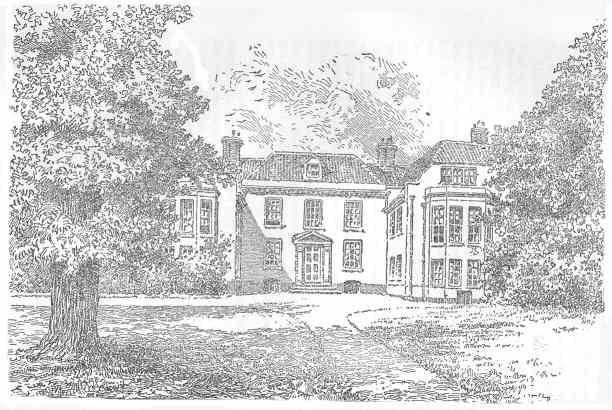
At some distance from the city, behind a range of hilly
ground which rises towards the south-west, is a small river, the
waters of which, after many meanderings, eventually enter the
principal river of the district, and assist to swell the tide
which it rolls down to the ocean. It is a sweet rivulet,
and pleasant it is to trace its course from its spring-head, high
up in the remote regions of Eastern Anglia, till it arrives in
the valley behind yon rising ground; and pleasant is that valley,
truly a goodly spot, but most lovely where yonder bridge crosses
the little stream. Beneath its arch the waters rush
garrulously into a blue pool, and are there stilled for a time,
for the pool is deep, and they appear to have sunk to
sleep. Farther on, however, you hear their voice again,
where they ripple gaily over yon gravelly shallow. On the
left, the hill slopes gently down to the margin of the
stream. On the right is a green level, a smiling meadow,
grass of the richest decks the side of the slope; mighty trees
also adorn it, giant elms, the nearest of which, when the sun is
nigh its meridian, fling a broad shadow upon the face of the
pool; through yon vista you catch a glimpse of the ancient brick
of an old English hall. It has a stately look, that old
building, indistinctly seen, as it is, among those umbrageous
trees; you might almost suppose it an earl’s home; and such
it was, or rather upon its site stood an earl’s home, in
days of old, for there some old Kemp, some Sigurd, or Thorkild,
roaming in quest of a hearthstead, settled down in the gray old
time, when Thor and Freya were yet gods, and Odin was a
portentous name. Yon old hall is still called the
Earl’s Home, though the hearth of Sigurd is now no more,
and the bones of the old Kemp, and of Sigrith his dame, have been
mouldering for a thousand years in some neighbouring
knoll—perhaps yonder, where those tall Norwegian pines
shoot up so boldly into the air. It is said that the old
earl’s galley was once moored where is now that blue pool,
for the waters of that valley were not always sweet; yon valley
was once an arm of the sea, a salt lagoon, to which the war-barks
of “Sigurd, in search of a home,” found their
way.
I was in the habit of spending many an hour on the banks of
that rivulet, with my rod in my hand, and, when tired with
angling, would stretch myself on the grass, and gaze upon the
waters as they glided past; and not unfrequently, divesting
myself of my dress, I would plunge into the deep pool which I
have already mentioned, for I had long since learned to
swim. And it came to pass, that on one hot summer’s
day, after bathing in the pool, I passed along the meadow till I
came to a shallow part, and, wading over to the opposite side, I
adjusted my dress, and commenced fishing in
another pool, beside which was a small clump of hazels.
And there I sat upon the bank, at the bottom of the hill which
slopes down from “the Earl’s Home”; my float
was on the waters, and my back was towards the old hall. I
drew up many fish, small and great, which I took from off the
hook mechanically and flung upon the bank, for I was almost
unconscious of what I was about, for my mind was not with my
fish. I was thinking of my earlier years—of the
Scottish crags and the heaths of Ireland—and sometimes my
mind would dwell on my studies—on the sonorous stanzas of
Dante, rising and falling like the waves of the sea—or
would strive to remember a couplet or two of poor Monsieur
Boileau.
“Canst thou answer to thy conscience for pulling all
those fish out of the water, and leaving them to gasp in the
sun?” said a voice, clear and sonorous as a bell.
I started, and looked round. Close behind me stood the
tall figure of a man, dressed in raiment of quaint and singular
fashion, but of goodly materials. He was in the prime and
vigour of manhood; his features handsome and noble, but full of
calmness and benevolence; at least I thought so, though they were
somewhat shaded by a hat of finest beaver, with broad drooping
eaves.
“Surely that is a very cruel diversion in which thou
indulgest, my young friend,” he continued.
“I am sorry for it, if it be, sir,” said I,
rising; “but I do not think it cruel to fish.”
“What are thy reasons for not thinking so?”
“Fishing is mentioned frequently in Scripture.
Simon Peter was a fisherman.”
“True; and Andrew and his brother. But thou
forgettest: they did not follow fishing as a diversion, as I fear
thou doest. Thou readest the Scriptures?”
“Sometimes.”
“Sometimes? not daily? that is to be regretted.
What profession dost thou make? I mean to what religious
denomination dost thou belong, my young friend?”
“Church.”
“It is a very good profession—there is much of
Scripture contained in its liturgy. Dost thou read aught
besides the Scriptures?”
“Sometimes.”
“What dost thou read besides?”
“Greek, and Dante.”
“Indeed! then thou hast the advantage over myself;
I can only read the former. Well, I am rejoiced to find
that thou hast other pursuits besides thy fishing. Dost
thou know Hebrew?”
“No.”
“Thou shouldst study it. Why dost thou not
undertake the study?”
“I have no books.”
“I will lend thee books, if thou wish to undertake the
study. I live yonder at the hall, as perhaps thou
knowest. I have a library there, in which are many curious
books, both in Greek and Hebrew, which I will show to thee,
whenever thou mayest find it convenient to come and see me.
Farewell! I am glad to find that thou hast pursuits more
satisfactory than thy cruel fishing.”
And the man of peace departed, and left me on the bank of the
stream. Whether from the effect of his words, or from want
of inclination to the sport, I know not, but from that day I
became less and less a practitioner of that “cruel
fishing”. I rarely flung line and angle into the
water, but I not unfrequently wandered by the banks of the
pleasant rivulet. It seems singular to me, on reflection,
that I never availed myself of his kind invitation. I say
singular, for the extraordinary, under whatever form, had long
had no slight interest for me; and I had discernment enough to
perceive that yon was no common man. Yet I went not near
him, certainly not from bashfulness, or timidity, feelings to
which I had long been an entire stranger. Am I to regret
this? perhaps, for I might have learned both wisdom and
righteousness from those calm, quiet lips, and my after-course
might have been widely different. As it was, I fell in with
other guess companions, from whom I received widely different
impressions than those I might have derived from him. When
many years had rolled on, long after I had attained manhood, and
had seen and suffered much, and when our first interview had long
since been effaced from the mind of the man of peace, I visited
him in his venerable hall, and partook of the hospitality of his
hearth. And there I saw his gentle partner and his fair
children, and on the morrow he showed me the books of which he
had spoken years before, by the side of the stream. In the
low quiet chamber, whose one window, shaded by a gigantic elm,
looks down the slope towards the pleasant stream, he took from
the shelf his learned books, Zohar and Mishna, Toldoth Jesu and
Abarbenel.
“I am fond of these studies,” said he,
“which, perhaps, is not to be wondered at, seeing that our
people have been compared to the
Jews. In one respect I confess we are similar to them: we
are fond of getting money. I do not like this last author,
this Abarbenel, the worse for having been a money-changer.
I am a banker myself, as thou knowest.”
And would there were many like him, amidst the money-changers
of princes! The hall of many an earl lacks the bounty, the
palace of many a prelate the piety and learning, which adorn the
quiet Quaker’s home!
I was standing on the castle hill in the midst of a fair of
horses.
I have already had occasion to mention this castle. It
is the remains of what was once a Norman stronghold, and is
perched upon a round mound or monticle, in the midst of the old
city. Steep is this mound and scarped, evidently by the
hand of man; a deep gorge, over which is flung a bridge,
separates it, on the south, from a broad swell of open ground
called “the hill;” of old the scene of many a
tournament and feat of Norman chivalry, but now much used as a
show-place for cattle, where those who buy and sell beeves and
other beasts resort at stated periods.
So it came to pass that I stood upon this hill, observing a
fair of horses.
The reader is already aware that I had long since conceived a
passion for the equine race, a passion in which circumstances had
of late not permitted me to indulge. I had no horses to
ride, but I took pleasure in looking at them; and I had already
attended more than one of these fairs: the present was lively
enough, indeed, horse fairs are seldom dull. There was
shouting and whooping, neighing and braying; there was galloping
and trotting; fellows with highlows and white stockings, and with
many a string dangling from the knees of their tight breeches,
were running desperately, holding horses by the halter, and in
some cases dragging them along; there were long-tailed steeds,
and dock-tailed steeds of every degree and breed; there were
droves of wild ponies, and long rows of sober cart horses; there
were donkeys, and even mules: the last rare things to be seen in
damp, misty England, for the mule pines in mud and rain, and
thrives best with a hot sun above and a burning sand below.
There were—oh, the gallant creatures! I hear their
neigh upon the wind; there were—goodliest sight of
all—certain enormous quadrupeds only seen to perfection in
our native isle, led about by dapper grooms, their manes ribanded
and their tails curiously clubbed and balled. Ha!
ha!—how distinctly do they say, ha! ha!
An old man draws nigh, he is mounted on a lean pony, and
he leads by the bridle one of these animals; nothing very
remarkable about that creature, unless in being smaller than the
rest and gentle, which they are not; he is not of the sightliest
look; he is almost dun, and over one eye a thick film has
gathered. But stay! there is something remarkable
about that horse, there is something in his action in which he
differs from all the rest. As he advances, the clamour is
hushed! all eyes are turned upon him—what looks of
interest—of respect—and, what is this? people are
taking off their hats—surely not to that steed! Yes,
verily! men, especially old men, are taking off their hats to
that one-eyed steed, and I hear more than one deep-drawn ah!
“What horse is that?” said I to a very old fellow,
the counterpart of the old man on the pony, save that the last
wore a faded suit of velveteen, and this one was dressed in a
white frock.
“The best in mother England,” said the very old
man, taking a knobbed stick from his mouth, and looking me in the
face, at first carelessly, but presently with something like
interest; “he is old like myself, but can still trot his
twenty miles an hour. You won’t live long, my swain;
tall and overgrown ones like thee never does; yet, if you should
chance to reach my years, you may boast to thy great grand boys,
thou hast seen Marshland Shales.”
Amain I did for the horse what I would neither do for earl or
baron, doffed my hat; yes! I doffed my hat to the wondrous horse,
the fast trotter, the best in mother England; and I, too, drew a
deep ah! and repeated the words of the old fellows around.
“Such a horse as this we shall never see again; a pity that
he is so old.”
Now during all this time I had a kind of consciousness that I
had been the object of some person’s observation; that eyes
were fastened upon me from somewhere in the crowd.
Sometimes I thought myself watched from before, sometimes from
behind; and occasionally methought that, if I just turned my head
to the right or left, I should meet a peering and inquiring
glance; and, indeed, once or twice I did turn, expecting to see
somebody whom I knew, yet always without success; though it
appeared to me that I was but a moment too late, and that some
one had just slipped away from the direction to which I turned,
like the figure in a magic lanthorn. Once I was quite sure
that there were a pair of eyes glaring over my right shoulder; my
attention, however, was so fully occupied with the objects which
I have attempted to describe, that I thought very little of this
coming and going, this flitting and dodging of I knew
not whom or what. It was, after all, a matter of sheer
indifference to me who was looking at me. I could only
wish, whomsoever it might be, to be more profitably employed; so
I continued enjoying what I saw; and now there was a change in
the scene, the wondrous old horse departed with his aged
guardian; other objects of interest are at hand; two or three men
on horseback are hurrying through the crowd, they are widely
different in their appearance from the other people of the fair;
not so much in dress, for they are clad something after the
fashion of rustic jockeys, but in their look—no light brown
hair have they, no ruddy cheeks, no blue quiet glances belong to
them; their features are dark, their locks long, black and
shining, and their eyes are wild; they are admirable horsemen,
but they do not sit the saddle in the manner of common jockeys,
they seem to float or hover upon it, like gulls upon the waves;
two of them are mere striplings, but the third is a very tall man
with a countenance heroically beautiful, but wild, wild,
wild. As they rush along, the crowd give way on all sides,
and now a kind of ring or circus is formed, within which the
strange men exhibit their horsemanship, rushing past each other,
in and out, after the manner of a reel, the tall man occasionally
balancing himself upon the saddle, and standing erect on one
foot. He had just regained his seat after the latter feat,
and was about to push his horse to a gallop, when a figure
started forward close from beside me, and laying his hand on his
neck, and pulling him gently downward, appeared to whisper
something into his ear; presently the tall man raised his head,
and, scanning the crowd for a moment in the direction in which I
was standing, fixed his eyes full upon me, and anon the
countenance of the whisperer was turned, but only in part, and
the side-glance of another pair of wild eyes was directed towards
my face, but the entire visage of the big black man half stooping
as he was, was turned full upon mine.
But now, with a nod to the figure who had stopped him, and
with another inquiring glance at myself, the big man once more
put his steed into motion, and after riding round the ring a few
more times darted through a lane in the crowd, and followed by
his two companions disappeared, whereupon the figure who had
whispered to him and had subsequently remained in the middle of
the space, came towards me, and cracking a whip which he held in
his hand so loudly that the report was nearly equal to that of a
pocket pistol, he cried in a strange tone:—
“What! the sap-engro? Lor! the sap-engro upon the
hill!”
“I remember that word,” said I, “and
I almost think I remember you. You can’t
be—”
“Jasper, your pal! Truth, and no lie,
brother.”
“It is strange that you should have known me,”
said I. “I am certain, but for the word you used, I
should never have recognised you.”
“Not so strange as you may think, brother; there is
something in your face which would prevent people from forgetting
you, even though they might wish it; and your face is not much
altered since the time you wot of, though you are so much
grown. I thought it was you, but to make sure I dodged
about, inspecting you. I believe you felt me, though I
never touched you; a sign, brother, that we are akin, that we are
dui palor—two relations. Your blood beat when mine
was near, as mine always does at the coming of a brother; and we
became brothers in that lane.”
“And where are you staying?” said I; “in
this town?”
“Not in the town; the like of us don’t find it
exactly wholesome to stay in towns; we keep abroad. But I
have little to do here—come with me and I’ll show you
where we stay.”
We descended the hill in the direction of the north, and
passing along the suburb reached the old Norman bridge, which we
crossed; the chalk precipice, with the ruin on its top, was now
before us; but turning to the left we walked swiftly along, and
presently came to some rising ground, which ascending, we found
ourselves upon a wild moor or heath.
“You are one of them,” said I, “whom people
call—”
“Just so,” said Jasper; “but never mind what
people call us.”
“And that tall handsome man on the hill, whom you
whispered? I suppose he’s one of ye. What is
his name?”
“Tawno Chikno,” said Jasper, “which means
the small one; we call him such because he is the biggest man of
all our nation. You say he is handsome, that is not the
word, brother; he’s the beauty of the world. Women
run wild at the sight of Tawno. An earl’s daughter,
near London—a fine young lady with diamonds round her
neck—fell in love with Tawno. I have seen that lass
on a heath, as this may be, kneel down to Tawno, clasp his feet,
begging to be his wife—or anything else—if she might
go with him. But Tawno would have nothing to do with
her. ‘I have a wife of my own,’ said he,
‘a lawful Rommany wife, whom I love better than the whole
world, jealous though she sometimes be’.”
“And is she very beautiful?” said I.
“Why, you know, brother, beauty is frequently a matter
of taste; however, as you ask my opinion, I should say not quite
so beautiful as himself.”
We had now arrived at a small valley between two hills or
downs, the sides of which were covered with furze. In the
midst of this valley were various carts and low tents forming a
rude kind of encampment; several dark children were playing
about, who took no manner of notice of us. As we passed one
of the tents, however, a canvas screen was lifted up, and a woman
supported upon a crutch hobbled out. She was about the
middle age, and, besides being lame, was bitterly ugly; she was
very slovenly dressed, and on her swarthy features ill nature was
most visibly stamped. She did not deign me a look, but
addressing Jasper in a tongue which I did not understand,
appeared to put some eager questions to him.
“He’s coming,” said Jasper, and passed
on. “Poor fellow,” said he to me, “he has
scarcely been gone an hour and she’s jealous already.
Well,” he continued, “what do you think of her? you
have seen her now and can judge for yourself—that
’ere woman is Tawno Chikno’s wife!”
We went to the farthest of the tents, which stood at a slight
distance from the rest, and which exactly resembled the one which
I have described on a former occasion; we went in and sat down,
one on each side of a small fire which was smouldering on the
ground, there was no one else in the tent but a tall tawny woman
of middle age, who was busily knitting.
“Brother,” said Jasper, “I wish to hold some
pleasant discourse with you.”
“As much as you please,” said I, “provided
you can find anything pleasant to talk about.”
“Never fear,” said Jasper; “and first of all
we will talk of yourself. Where have you been all this long
time?”
“Here and there,” said I, “and far and near,
going about with the soldiers; but there is no soldiering now, so
we have sat down, father and family, in the town
there.”
“And do you still hunt snakes?” said Jasper.
“No,” said I, “I have given up that long
ago; I do better now: read books and learn languages.”
“Well, I am sorry you have given up your snake-hunting;
many’s the strange talk I have had with our people about
your snake and yourself, and how you frightened my father and
mother in the lane.”
“And where are your father and mother?”
“Where I shall never see them, brother; at least, I hope
so.”
“Not dead?”
“No, not dead; they are bitchadey pawdel.”
“What’s that?”
“Sent across—banished.”
“Ah! I understand; I am sorry for them. And
so you are here alone?”
“Not quite alone, brother!”
“No, not alone; but with the rest—Tawno Chikno
takes care of you.”
“Takes care of me, brother!”
“Yes, stands to you in the place of a father—keeps
you out of harm’s way.”
“What do you take me for, brother?”
“For about three years older than myself.”
“Perhaps; but you are of the Gorgios, and I am a Rommany
Chal. Tawno Chikno take care of Jasper
Petulengro!”
“Is that your name?”
“Don’t you like it?”
“Very much, I never heard a sweeter; it is something
like what you call me.”
“The horse-shoe master and the snake-fellow, I am the
first.”
“Who gave you that name?”
“Ask Pharaoh.”
“I would, if he were here, but I do not see
him.”
“I am Pharaoh.”
“Then you are a king.”
“Chachipen, pal.”
“I do not understand you.”
“Where are your languages? You want two things,
brother: mother sense and gentle Rommany.”
“What makes you think that I want sense?”
“That, being so old, you can’t yet guide
yourself!”
“I can read Dante, Jasper.”
“Anan, brother.”
“I can charm snakes, Jasper.”
“I know you can, brother.”
“Yes, and horses too; bring me the most vicious in the
land, if I whisper he’ll be tame.”
“Then the more shame for you—a
snake-fellow—a horse-witch—and a lil-reader—yet
you can’t shift for yourself. I laugh at you,
brother!”
“Then you can shift for yourself?”
“For myself and for others, brother.”
“And what does Chikno?”
“Sells me horses, when I bid him. Those horses on
the chong were mine.”
“And has he none of his own?”
“Sometimes he has; but he is not so well off as
myself. When my father and mother were bitchadey pawdel,
which, to tell you the truth, they were, for chiving wafodo
dloovu, they left me all they had, which was not a little, and I
became the head of our family, which was not a small one. I
was not older than you when that happened; yet our people said
they had never a better krallis to contrive and plan for them and
to keep them in order. And this is so well known, that many
Rommany Chals, not of our family, come and join
themselves to us, living with us for a time, in order to better
themselves, more especially those of the poorer sort, who have
little of their own. Tawno is one of these.”
“Is that fine fellow poor?”
“One of the poorest, brother. Handsome as he is,
he has not a horse of his own to ride on. Perhaps we may
put it down to his wife, who cannot move about, being a cripple,
as you saw.”
“And you are what is called a Gypsy King?”
“Ay, ay; a Rommany Kral.”
“Are there other kings?”
“Those who call themselves so; but the true Pharaoh is
Petulengro.”
“Did Pharaoh make horse-shoes?”
“The first who ever did, brother.”
“Pharaoh lived in Egypt.”
“So did we once, brother.”
“And you left it?”
“My fathers did, brother.”
“And why did they come here?”
“They had their reasons, brother.”
“And you are not English?”
“We are not Gorgios.”
“And you have a language of your own?”
“Avali.”
“This is wonderful.”
“Ha, ha!” cried the woman, who had hitherto sat
knitting at the farther end of the tent, without saying a word,
though not inattentive to our conversation, as I could perceive
by certain glances which she occasionally cast upon us
both. “Ha, ha!” she screamed, fixing upon me
two eyes, which shone like burning coals, and which were filled
with an expression both of scorn and malignity, “It is
wonderful, is it, that we should have a language of our
own? What, you grudge the poor people the speech they talk
among themselves? That’s just like you Gorgios, you
would have everybody stupid, single-tongued idiots, like
yourselves. We are taken before the Poknees of the gav,
myself and sister, to give an account of ourselves. So I
says to my sister’s little boy, speaking Rommany, I says to
the little boy who is with us, ‘Run to my son Jasper, and
the rest, and tell them to be off, there are hawks
abroad’. So the Poknees questions us, and lets us go,
not being able to make anything of us; but, as we are going, he
calls us back. ‘Good woman,’ says the Poknees,
‘what was that I heard you say
just now to the little boy?’ ‘I was telling
him, your worship, to go and see the time of day, and, to save
trouble, I said it in our own language.’ ‘Where
did you get that language?’ says the Poknees.
‘’Tis our own language, sir,’ I tells him,
‘we did not steal it.’ ‘Shall I tell you
what it is, my good woman?’ says the Poknees.
‘I would thank you, sir,’ says I, ‘for
’tis often we are asked about it.’ ‘Well,
then,’ says the Poknees, ‘it is no language at all,
merely a made-up gibberish.’ ‘Oh, bless your
wisdom,’ says I, with a curtsey, ‘you can tell us
what our language is without understanding it!’
Another time we meet a parson. ‘Good woman,’
says he, ‘what’s that you are talking? Is it
broken language?’ ‘Of course, your
reverence,’ says I, ‘we are broken people; give a
shilling, your reverence, to the poor broken woman.’
Oh, these Gorgios! they grudge us our very language!”
“She called you her son, Jasper?”
“I am her son, brother.”
“I thought you said your parents were—”
“Bitchadey pawdel; you thought right, brother.
This is my wife’s mother.”
“Then you are married, Jasper?”
“Ay, truly; I am husband and father. You will see
wife and chabo anon.”
“Where are they now?”
“In the gav, penning dukkerin.”
“We were talking of language, Jasper?”
“True, brother.”
“Yours must be a rum one?”
“’Tis called Rommany.”
“I would gladly know it.”
“You need it sorely.”
“Would you teach it me?”
“None sooner.”
“Suppose we begin now.”
“Suppose we do, brother.”
“Not whilst I am here,” said the woman, flinging
her knitting down, and starting upon her feet; “not whilst
I am here shall this Gorgio learn Rommany. A pretty
manœuvre, truly; and what would be the end of it? I
goes to the farming ker with my sister to tell a fortune, and
earn a few sixpences for the chabes. I sees a jolly pig in
the yard, and I says to my sister, speaking Rommany, ‘Do so
and so,’ says I; which the farming man hearing, asks what
we are talking about. ‘Nothing at all, master,’
says I; ‘something about the weather’; when who
should start up from behind a pale, where he has been
listening, but this ugly gorgio, crying out, ‘They are
after poisoning your pigs, neighbour!’ so that we are glad
to run, I and my sister, with perhaps the farm-engro shouting
after us. Says my sister to me, when we have got fairly
off, ‘How came that ugly one to know what you said to
me?’ Whereupon I answers, ‘It all comes of my
son Jasper, who brings the gorgio to our fire, and must needs be
teaching him’. ‘Who was fool there?’ says
my sister. ‘Who, indeed, but my son Jasper,’ I
answers. And here should I be a greater fool to sit still
and suffer it; which I will not do. I do not like the look
of him; he looks over-gorgious. An ill day to the Romans
when he masters Rommany; and when I says that, I pens a true
dukkerin.”
“What do you call God, Jasper?”
“You had better be jawing,” said the woman,
raising her voice to a terrible scream; “you had better be
moving off, my Gorgio; hang you for a keen one, sitting there by
the fire, and stealing my language before my face. Do you
know whom you have to deal with? Do you know that I am
dangerous? My name is Herne, and I comes of the hairy
ones!”
And a hairy one she looked! She wore her hair clubbed
upon her head, fastened with many strings and ligatures; but now,
tearing these off, her locks, originally jet black, but now
partially grizzled with age, fell down on every side of her,
covering her face and back as far down as her knees. No
she-bear of Lapland ever looked more fierce and hairy than did
that woman, as, standing in the open part of the tent, with her
head bent down, and her shoulders drawn up, seemingly about to
precipitate herself upon me, she repeated, again and
again,—
“My name is Herne, and I comes of the hairy
ones!—”
“I call God Duvel, brother.”
“It sounds very like Devil.”
“It doth, brother, it doth.”
“And what do you call divine, I mean godly?”
“Oh! I call that duvelskoe.”
“I am thinking of something, Jasper.”
“What are you thinking of, brother?”
“Would it not be a rum thing if divine and devilish were
originally one and the same word?”
“It would, brother, it would—”
* * * * *
From this time I had frequent interviews with Jasper,
sometimes in his tent, sometimes on the heath, about which we
would roam for hours, discoursing on various matters.
Sometimes mounted on one of his horses, of
which he had several, I would accompany him to various fairs and
markets in the neighbourhood, to which he went on his own
affairs, or those of his tribe. I soon found that I had
become acquainted with a most singular people, whose habits and
pursuits awakened within me the highest interest. Of all
connected with them, however, their language was doubtless that
which exercised the greatest influence over my imagination.
I had at first some suspicion that it would prove a mere made-up
gibberish. But I was soon undeceived. Broken,
corrupted, and half in ruins as it was, it was not long before I
found that it was an original speech, far more so, indeed, than
one or two others of high name and celebrity, which, up to that
time, I had been in the habit of regarding with respect and
veneration. Indeed, many obscure points connected with the
vocabulary of these languages, and to which neither classic nor
modern lore afforded any clue, I thought I could now clear up by
means of this strange broken tongue, spoken by people who dwelt
among thickets and furze bushes, in tents as tawny as their
faces, and whom the generality of mankind designated, and with
much semblance of justice, as thieves and vagabonds. But
where did this speech come from, and who were they who spoke
it? These were questions which I could not solve, and which
Jasper himself, when pressed, confessed his inability to
answer. “But, whoever we be, brother,” said he,
“we are an old people, and not what folks in general
imagine, broken gorgios; and, if we are not Egyptians, we are at
any rate Rommany chals!”
“Rommany chals! I should not wonder after
all,” said I, “that these people had something to do
with the founding of Rome. Rome, it is said, was built by
vagabonds; who knows but that some tribe of the kind settled down
thereabouts, and called the town which they built after their
name; but whence did they come originally? ah! there is the
difficulty.”
But abandoning these questions, which at that time were far
too profound for me, I went on studying the language, and at the
same time the characters and manners of these strange
people. My rapid progress in the former astonished, while
it delighted, Jasper. “We’ll no longer call you
Sap-engro, brother,” said he; “but rather Lav-engro,
which in the language of the gorgios meaneth Word
Master.” “Nay, brother,” said Tawno
Chikno, with whom I had become very intimate, “you had
better call him Cooro-mengro, I have put on the gloves
with him, and find him a pure fist master; I like him for that,
for I am a Cooro-mengro myself, and was born at
Brummagem.”
“I likes him for his modesty,” said Mrs.
Chikno; “I never hears any ill words come from his mouth,
but, on the contrary, much sweet language. His talk is
golden, and he has taught my eldest to say his prayers in
Rommany, which my rover had never the grace to do.”
“He is the pal of my rom,” said Mrs. Petulengro, who
was a very handsome woman, “and therefore I likes him, and
not less for his being a rye; folks calls me high-minded, and
perhaps I have reason to be so; before I married Pharaoh I had an
offer from a lord—I likes the young rye, and, if he chooses
to follow us, he shall have my sister. What say you,
mother? should not the young rye have my sister
Ursula?”
“I am going to my people,” said Mrs. Herne,
placing a bundle upon a donkey, which was her own peculiar
property; “I am going to Yorkshire, for I can stand this no
longer. You say you like him; in that we differs: I hates
the gorgio, and would like, speaking Romanly, to mix a little
poison with his waters. And now go to Lundra, my children,
I goes to Yorkshire. Take my blessing with ye, and a little
bit of a gillie to cheer your hearts with when ye are
weary. In all kinds of weather have we lived together; but
now we are parted, I goes broken-hearted. I can’t
keep you company; ye are no longer Rommany. To gain a bad
brother, ye have lost a good mother.”
So the gypsies departed: Mrs. Herne to Yorkshire, and the rest
to London. As for myself, I continued in the house of my
parents, passing my time in much the same manner as I have
already described, principally in philological pursuits.
But I was now sixteen, and it was highly necessary that I should
adopt some profession, unless I intended to fritter away my
existence, and to be a useless burden to those who had given me
birth. But what profession was I to choose? there being
none in the wide world perhaps for which I was suited; nor was
there any one for which I felt any decided inclination, though
perhaps there existed within me a lurking penchant for the
profession of arms, which was natural enough, as, from my
earliest infancy, I had been accustomed to military sights and
sounds; but this profession was then closed, as I have already
hinted, and, as I believe, it has since continued, to those who,
like myself, had no better claims to urge than the services of a
father.
My father, who, for certain reasons of his own, had no very
high opinion of the advantages resulting from this career, would
have gladly seen me enter the Church. His desire was,
however, considerably abated by one or two passages of my life,
which occurred to his recollection. He particularly dwelt
on the unheard-of manner in which I had picked up the Irish
language, and drew from thence the conclusion that I was not
fitted by nature to cut a respectable figure at an English
university. “He will fly off in a tangent,”
said he, “and, when called upon to exhibit his skill in
Greek, will be found proficient in Irish; I have observed the
poor lad attentively, and really do not know what to make of him;
but I am afraid he will never make a churchman!” And
I have no doubt that my excellent father was right, both in his
premises and the conclusion at which he arrived. I had
undoubtedly, at one period of my life, forsaken Greek for Irish,
and the instructions of a learned Protestant divine for those of
a Papist gassoon, the card-fancying Murtagh; and of late, though
I kept it a strict secret, I had abandoned in a great measure the study of the beautiful Italian, and
the recitation of the sonorous terzets of the Divine Comedy, in
which at one time I took the greatest delight, in order to become
acquainted with the broken speech, and yet more broken songs, of
certain houseless wanderers whom I had met at a horse fair.
Such an erratic course was certainly by no means in consonance
with the sober and unvarying routine of college study. And
my father, who was a man of excellent common sense, displayed it,
in not pressing me to adopt a profession which required qualities
of mind which he saw I did not possess.
Other professions were talked of, amongst which the law; but
now an event occurred which had nearly stopped my career, and
merged all minor points of solicitude in anxiety for my
life. My strength and appetite suddenly deserted me, and I
began to pine and droop. Some said that I had overgrown
myself, and that these were the symptoms of a rapid decline; I
grew worse and worse, and was soon stretched upon my bed, from
which it seemed scarcely probable that I should ever more rise,
the physicians themselves giving but slight hopes of my recovery;
as for myself, I made up my mind to die, and felt quite
resigned. I was sadly ignorant at that time, and, when I
thought of death, it appeared to me little else than a pleasant
sleep, and I wished for sleep, of which I got but little.
It was well that I did not die that time, for I repeat that I was
sadly ignorant of many important things. I did not die, for
somebody coming, gave me a strange, bitter draught; a decoction,
I believe, of a bitter root which grows on commons and desolate
places; and the person who gave it me was an ancient female, a
kind of doctress, who had been my nurse in my infancy, and who,
hearing of my state, had come to see me; so I drank the draught,
and became a little better, and I continued taking draughts made
from the bitter root till I manifested symptoms of
convalescence.
But how much more quickly does strength desert the human frame
than return to it! I had become convalescent, it is true,
but my state of feebleness was truly pitiable. I believe it
is in that state that the most remarkable feature of human
physiology frequently exhibits itself. Oh, how dare I
mention the dark feeling of mysterious dread which comes over the
mind, and which the lamp of reason, though burning bright the
while, is unable to dispel! Art thou, as leeches say, the
concomitant of disease—the result of shattered
nerves? Nay, rather the principle of woe itself, the
fountain head of all sorrow co-existent with man, whose influence
he feels when yet unborn, and whose workings he
testifies with his earliest cries, when, “drowned in
tears,” he first beholds the light; for, as the sparks fly
upwards, so is man born to trouble, and woe doth he bring with
him into the world, even thyself, dark one, terrible one,
causeless, unbegotten, without a father. Oh, how
unfrequently dost thou break down the barriers which divide thee
from the poor soul of man, and overcast its sunshine with thy
gloomy shadow! In the brightest days of prosperity—in
the midst of health and wealth—how sentient is the poor
human creature of thy neighbourhood! how instinctively aware that
the flood-gates of horror may be cast open, and the dark stream
engulf him for ever and ever! Then is it not lawful for man
to exclaim, “Better that I had never been
born!” Fool, for thyself thou wast not born, but to
fulfil the inscrutable decrees of thy Creator; and how dost thou
know that this dark principle is not, after all, thy best friend;
that it is not that which tempers the whole mass of thy
corruption? It may be, for what thou knowest, the mother of
wisdom, and of great works; it is the dread of the horror of the
night that makes the pilgrim hasten on his way. When thou
feelest it nigh, let thy safety word be “Onward”; if
thou tarry, thou art overwhelmed. Courage! build great
works—’tis urging thee—it is ever nearest the
favourites of God—the fool knows little of it. Thou
wouldst be joyous, wouldst thou? then be a fool. What great
work was ever the result of joy, the puny one? Who have
been the wise ones, the mighty ones, the conquering ones of this
earth? the joyous? I believe not. The fool is happy,
or comparatively so—certainly the least sorrowful, but he
is still a fool; and whose notes are sweetest, those of the
nightingale, or of the silly lark?
* * * * *
“What ails you, my child?” said a mother to her
son, as he lay on a couch under the influence of the dreadful
one; “what ails you? you seem afraid!”
Boy. And so I am; a dreadful fear is upon me.
Mother. But of what; there is no one can harm
you; of what are you apprehensive?
Boy. Of nothing that I can express; I know not
what I am afraid of, but afraid I am.
Mother. Perhaps you see sights and visions; I
knew a lady once who was continually thinking that she saw an
armed man threaten her, but it was only an imagination, a phantom
of the brain.
Boy. No armed man threatens me; and ’tis
not a thing like that would cause me any fear. Did an armed
man threaten me, I would get up and fight him; weak
as I am, I would wish for nothing better, for then, perhaps, I
should lose this fear; mine is a dread of I know not what, and
there the horror lies.
Mother. Your forehead is cool, and your speech
collected. Do you know where you are?
Boy. I know where I am, and I see things just as
they are; you are beside me, and upon the table there is a book
which was written by a Florentine; all this I see, and that there
is no ground for being afraid. I am, moreover, quite cool,
and feel no pain—but, but—
And then there was a burst of “gemiti, sospiri
ed alti guai”. Alas, alas, poor child of
clay! as the sparks fly upward, so wast thou born to
sorrow—Onward! [112]
It has been said by this or that writer, I scarcely know by
whom, that, in proportion as we grow old, and our time becomes
short, the swifter does it pass, until at last, as we approach
the borders of the grave, it assumes all the speed and
impetuosity of a river about to precipitate itself into an abyss;
this is doubtless the case, provided we can carry to the grave
those pleasant thoughts and delusions which alone render life
agreeable, and to which even to the very last we would gladly
cling; but what becomes of the swiftness of time, when the mind
sees the vanity of human pursuits? which is sure to be the case
when its fondest, dearest hopes have been blighted at the very
moment when the harvest was deemed secure. What becomes
from that moment, I repeat, of the shortness of time? I put
not the question to those who have never known that trial; they
are satisfied with themselves and all around them, with what they
have done and yet hope to do; some carry their delusions with
them to the borders of the grave, ay, to the very moment when
they fall into it; a beautiful golden cloud surrounds them to the
last, and such talk of the shortness of time; through the medium
of that cloud the world has ever been a pleasant world to them;
their only regret is that they are so soon to quit it; but oh, ye
dear deluded hearts, it is not every one who is so fortunate!
To the generality of mankind there is no period like
youth. The generality are far from fortunate; but the
period of youth, even to the least so, offers moments of
considerable happiness, for they are not only disposed, but able
to enjoy most things within their reach. With what trifles
at that period are we content; the things from which in
after-life we should turn away in disdain please us then, for we
are in the midst of a golden cloud, and everything seems decked
with a golden hue. Never during any portion of my life did
time flow on more speedily than during the two or three years
immediately succeeding the period to which we arrived in the
preceding chapter. Since then it has flagged often enough;
sometimes it has seemed to stand entirely still; and the reader may easily judge how it fares at the present,
from the circumstance of my taking pen in hand, and endeavouring
to write down the passages of my life—a last resource with
most people. But at the period to which I allude I was
just, as I may say, entering upon life; I had adopted a
profession, and—to keep up my character, simultaneously
with that profession—the study of a new language; I
speedily became a proficient in the one, but ever remained a
novice in the other: a novice in the law, but a perfect master in
the Welsh tongue.
Yes! very pleasant times were those, when within the womb of a
lofty deal desk, behind which I sat for some eight hours every
day, transcribing (when I imagined eyes were upon me) documents
of every description in every possible hand, Blackstone kept
company with Ab Gwilym—the polished English lawyer of the
last century, who wrote long and prosy chapters on the rights of
things—with a certain wild Welshman, who some four hundred
years before that time indited immortal cowydds and odes to the
wives of Cambrian chieftains—more particularly to one
Morfydd, the wife of a certain hunchbacked dignitary called by
the poet facetiously Bwa Bach—generally terminating with
the modest request of a little private parlance beneath the green
wood bough, with no other witness than the eos, or nightingale, a
request which, if the poet himself may be believed—rather a
doubtful point—was seldom, very seldom, denied. And
by what strange chance had Ab Gwilym and Blackstone, two
personages so exceedingly different, been thus brought
together? From what the reader already knows of me, he may
be quite prepared to find me reading the former; but what could
have induced me to take up Blackstone, or rather the law?
I have ever loved to be as explicit as possible; on which
account, perhaps, I never attained to any proficiency in the law,
the essence of which is said to be ambiguity; most questions may
be answered in a few words, and this among the rest, though
connected with the law. My parents deemed it necessary that
I should adopt some profession, they named the law; the law was
as agreeable to me as any other profession within my reach, so I
adopted the law, and the consequence was, that Blackstone,
probably for the first time, found himself in company with Ab
Gwilym. By adopting the law I had not ceased to be
Lavengro.
So I sat behind a desk many hours in the day, ostensibly
engaged in transcribing documents of various kinds. The
scene of my labours was a strange old house, occupying one side
of a long and narrow court, into which, however, the greater
number of the windows looked not, but into an
extensive garden, filled with fruit trees, in the rear of a
large, handsome house, belonging to a highly respectable
gentleman, who, moyennant un douceur considérable,
had consented to instruct my father’s youngest son in the
mysteries of glorious English law. Ah! would that I could
describe the good gentleman in the manner which he deserves; he
has long since sunk to his place in a respectable vault, in the
aisle of a very respectable church, whilst an exceedingly
respectable marble slab against the neighbouring wall tells on a
Sunday some eye wandering from its prayer-book that his dust lies
below; to secure such respectabilities in death, he passed a most
respectable life. Let no one sneer, he accomplished much;
his life was peaceful, so was his death. Are these
trifles? I wish I could describe him, for I loved the man,
and with reason, for he was ever kind to me, to whom kindness has
not always been shown; and he was, moreover, a choice specimen of
a class which no longer exists—a gentleman lawyer of the
old school. I would fain describe him, but figures with
which he has nought to do press forward and keep him from my
mind’s eye; there they pass, Spaniard and Moor, Gypsy,
Turk, and livid Jew. But who is that? what that thick pursy
man in the loose, snuff-coloured greatcoat, with the white
stockings, drab breeches, and silver buckles on his shoes? that
man with the bull neck, and singular head, immense in the lower
part, especially about the jaws, but tapering upward like a pear;
the man with the bushy brows, small grey eyes, replete with
cat-like expression, whose grizzled hair is cut close, and whose
ear-lobes are pierced with small golden rings? Oh! that is
not my dear old master, but a widely different personage.
Bon jour, Monsieur Vidocq! expressions de ma
part à Monsieur le Baron Taylor. [115] But here comes at last my
veritable old master!
A more respectable-looking individual was never seen; he
really looked what he was, a gentleman of the law—there was
nothing of the pettifogger about him. Somewhat under the
middle size, and somewhat rotund in person, he was always dressed
in a full suit of black, never worn long enough to become
threadbare. His face was rubicund, and not without
keenness; but the most remarkable thing about him was the crown
of his head, which was bald, and shone like polished ivory,
nothing more white, smooth, and lustrous. Some people have
said that he wore false calves, probably because his black silk
stockings never exhibited a wrinkle; they might just as well have
said that he waddled, because his shoes creaked; for these
last, which were always without a speck, and polished as his
crown, though of a different hue, did creak, as he walked rather
slowly. I cannot say that I ever saw him walk fast.
He had a handsome practice, and might have died a very rich
man, much richer than he did, had he not been in the habit of
giving rather expensive dinners to certain great people, who gave
him nothing in return, except their company; I could never
discover his reasons for doing so, as he always appeared to me a
remarkably quiet man, by nature averse to noise and bustle; but
in all dispositions there are anomalies. I have already
said that he lived in a handsome house, and I may as well here
add that he had a very handsome wife, who both dressed and talked
exceedingly well.
So I sat behind the deal desk, engaged in copying documents of
various kinds; and in the apartment in which I sat, and in the
adjoining ones, there were others, some of whom likewise copied
documents, while some were engaged in the yet more difficult task
of drawing them up; and some of these, sons of nobody, were paid
for the work they did, whilst others, like myself, sons of
somebody, paid for being permitted to work, which as our
principal observed, was but reasonable, forasmuch as we not
unfrequently utterly spoiled the greater part of the work
intrusted to our hands.
There was one part of the day when I generally found myself
quite alone, I mean at the hour when the rest went home to their
principal meal; I, being the youngest, was left to take care of
the premises, to answer the bell, and so forth, till relieved,
which was seldom before the expiration of an hour and a half,
when I myself went home; this period, however, was anything but
disagreeable to me, for it was then that I did what best pleased
me, and, leaving off copying the documents, I sometimes indulged
in a fit of musing, my chin resting on both my hands, and my
elbows planted on the desk; or, opening the desk aforesaid, I
would take out one of the books contained within it, and the book
which I took out was almost invariably, not Blackstone, but Ab
Gwilym.
Ah, that Ab Gwilym! I am much indebted to him, and it
were ungrateful on my part not to devote a few lines to him and
his songs in this my history. Start not, reader, I am not
going to trouble you with a poetical dissertation; no, no!
I know my duty too well to introduce anything of the kind; but I,
who imagine I know several things, and amongst others the
workings of your mind at this moment, have an idea that you are
anxious to learn a little, a very little, more about
Ab Gwilym than I have hitherto told you, the two or three words
that I have dropped having awakened within you a languid kind of
curiosity. I have no hesitation in saying that he makes one
of the some half-dozen really great poets whose verses, in
whatever language they wrote, exist at the present day, and are
more or less known. It matters little how I first became
acquainted with the writings of this man, and how the short thick
volume, stuffed full with his immortal imaginings, first came
into my hands. I was studying Welsh, and I fell in with Ab
Gwilym by no very strange chance. But before I say more
about Ab Gwilym, I must be permitted—I really must—to
say a word or two about the language in which he wrote, that same
“Sweet Welsh”. If I remember right, I found the
language a difficult one; in mastering it, however, I derived
unexpected assistance from what of Irish remained in my head, and
I soon found that they were cognate dialects, springing from some
old tongue which itself, perhaps, had sprung from one much
older. And here I cannot help observing cursorily that I
every now and then, whilst studying this Welsh, generally
supposed to be the original tongue of Britain, encountered words
which, according to the lexicographers, were venerable words,
highly expressive, showing the wonderful power and originality of
the Welsh, in which, however, they were no longer used in common
discourse, but were relics, precious relics, of the first speech
of Britain, perhaps of the world; with which words, however, I
was already well acquainted, and which I had picked up, not in
learned books, classic books, and in tongues of old renown, but
whilst listening to Mr. Petulengro and Tawno Chikno talking over
their every-day affairs in the language of the tents; which
circumstance did not fail to give rise to deep reflection in
those moments when, planting my elbows on the deal desk, I rested
my chin upon my hands. But it is probable that I should
have abandoned the pursuit of the Welsh language, after obtaining
a very superficial acquaintance with it, had it not been for Ab
Gwilym.
A strange songster was that who, pretending to be captivated
by every woman he saw, was, in reality, in love with nature
alone—wild, beautiful, solitary nature—her mountains
and cascades, her forests and streams, her birds, fishes, and
wild animals. Go to, Ab Gwilym, with thy pseudo-amatory
odes, to Morfydd, or this or that other lady, fair or ugly;
little didst thou care for any of them, Dame Nature was thy love,
however thou mayest seek to disguise the truth. Yes, yes,
send thy love-message to Morfydd,
the fair wanton. By whom dost thou send it, I would know?
by the salmon, forsooth, which haunts the rushing stream! the
glorious salmon which bounds and gambols in the flashing water,
and whose ways and circumstances thou so well
describest—see, there he hurries upwards through the
flashing water. Halloo! what a glimpse of glory—but
where is Morfydd the while? What, another message to the
wife of Bwa Bach? Ay, truly; and by whom?—the wind!
the swift wind, the rider of the world, whose course is not to be
stayed; who gallops o’er the mountain, and, when he comes
to broadest river, asks neither for boat nor ferry; who has
described the wind so well—his speed and power? But
where is Morfydd? And now thou art awaiting Morfydd, the
wanton, the wife of the Bwa Bach; thou art awaiting her beneath
the tall trees, amidst the underwood; but she comes not; no
Morfydd is there. Quite right, Ab Gwilym; what wantest thou
with Morfydd? But another form is nigh at hand, that of red
Reynard, who, seated upon his chine at the mouth of his cave,
looks very composedly at thee; thou startest, bendest thy bow,
thy cross-bow, intending to hit Reynard with the bolt just about
the jaw; but the bow breaks, Reynard barks and disappears into
his cave, which by thine own account reaches hell—and then
thou ravest at the misfortune of thy bow, and the non-appearance
of Morfydd, and abusest Reynard. Go to, thou carest neither
for thy bow nor for Morfydd, thou merely seekest an opportunity
to speak of Reynard; and who has described him like thee? the
brute with the sharp shrill cry, the black reverse of melody,
whose face sometimes wears a smile like the devil’s in the
Evangile. But now thou art actually with Morfydd; yes, she
has stolen from the dwelling of the Bwa Bach and has met thee
beneath those rocks—she is actually with thee, Ab Gwilym;
but she is not long with thee, for a storm comes on, and thunder
shatters the rocks—Morfydd flees! Quite right, Ab
Gwilym; thou hadst no need of her, a better theme for song is the
voice of the Lord—the rock shatterer—than the frail
wife of the Bwa Bach. Go to, Ab Gwilym, thou wast a wiser
and a better man than thou wouldst fain have had people
believe.
But enough of thee and thy songs! Those times passed
rapidly away; with Ab Gwilym in my hand, I was in the midst of
enchanted ground, in which I experienced sensations akin to those
I had felt of yore whilst spelling my way through the wonderful
book—the delight of my childhood. I say akin, for
perhaps only once in our lives do we experience unmixed wonder
and delight; and these I had already known.
[It was my own fault if I did not acquire considerable
knowledge of life and character, in the place to which my kind
parents had sent me. I performed the tasks that were
allotted to me in the profession I had embraced, if not very
scrupulously, yet, perhaps as well as could be expected in one
who was occupied by many and busy thoughts of his own. I
copied what was set before me, and admitted those who knocked at
the door of the sanctuary of law and conveyancing, performing the
latter office indeed from choice, long after it had ceased to be
part of my duty by the arrival of another, and of course a
junior, pupil.
I scarcely know what induced me to take pleasure in this task,
yet there can be no doubt that I did take pleasure in it,
otherwise I should scarcely have performed it so readily.
It has been said, I believe, that whatever we do con
amore, we are sure to do well, and I dare say that, as a
general rule, this may hold good. One thing is certain,
that with whatever satisfaction to myself I performed the task, I
was not equally fortunate in pleasing my employer, who complained
of my want of discrimination and yet, strange as it may seem,
this last is a quality upon which I not only particularly valued
myself at the time, but still do in a high degree. I made a
point never to admit any persons without subjecting them to the
rigorous investigation of the pair of eyes that providence had
been pleased to place in my head. To those who pleased me
not, I was little better than a Cerberus whom it was very
difficult to pass; whilst to others, I was all easiness and
condescension, ushering them straight to the sanctum sanctorum,
in which, behind a desk covered with letters and papers,
stood—for he never sat down to his desk—the
respectable individual whose lawful commands to obey and whose
secrets to keep I had pledged myself by certain articles duly
stamped and signed.
“This will never do,” said he to me one day;
“you will make me a bankrupt, unless you alter your
conduct. There is scarcely one of my respectable clients
but complains of your incivility. I speak to you, my poor
boy, as much on your own account as on mine. I quite
tremble for you. Are you aware of the solecisms you
commit? Only yesterday you turned Sir Edward from the door,
and immediately after you admitted Parkinson the poet! What
an insult to a gentleman to be turned from the door, and a
strolling vagabond to be admitted before his eyes!”
“I can’t help it,” said I; “I used my
best powers of discrimination; I looked both full in the face,
and the one struck me as being an
honest man, whilst the other had the very look of a slave
driver.”
“In the face? Bless me! But you looked at
their dress, I suppose? You looked at Sir Edward’s
dress?”
“No,” said I, “I merely looked at his
countenance.”
“Which you thought looked like that of a slave
driver. Well, he’s been in the Indies, where he made
his fortune; so, perhaps, you may not be so far out.
However, be more cautious in future; look less at people’s
countenances and more at their—I dare say you understand
me: admit every decent person, and if you turn away anybody, pray
let it be the poet Parkinson . . .”
Keeping the admonition of my principal in view, I admitted
without word or comment, provided the possessors had a decent
coat to their backs, all kinds of countenances—honest
countenances, dishonest countenances, and those which were
neither. Amongst all these, some of which belonged to naval
and military officers, notaries public, magistrates, bailiffs,
and young ecclesiastics—the latter with spotless
neck-cloths and close-shaven chins—there were three
countenances which particularly pleased me: the first being that
of an ancient earl, who wore a pig-tail, and the back of whose
coat was white with powder; the second, that of a yeoman ninety
years old and worth £90,000, who, dressed in an entire suit
of whitish corduroy, sometimes slowly trotted up the court on a
tall heavy steed, which seemed by no means unused to the
plough. The third was that of the poet Parkinson.
I am not quite sure that I remember the business which brought
this last individual so frequently to our office, for he paid us
a great many visits.
I am inclined to believe, however, that he generally carried
in his pocket a bundle of printed poems of his own composition,
on the sale of which he principally depended for his
subsistence. He was a man of a singular, though to me by no
means unpleasant countenance; he wore an old hat and a
snuff-coloured greatcoat, and invariably carried in his hand a
stout cudgel like a man much in the habit of walking, which he
probably was, from the circumstance of his being generally
covered with dust in summer, and in winter splashed with mud from
head to foot.
“You cannot see the principal to-day, Mr.
Parkinson,” said I to him once, as unannounced he entered
the room where I sat alone; “he is gone out and will not
return for some time.”
“Well, that’s unfortunate, for I want to consult
him on some particular business.”
“What business is it? Perhaps I can be of
service to you. Does it relate to the common
law?”
“I suppose so, for I am told it is a common assault; but
I had better wait till the gentleman comes home. You are
rather too young; and besides I have other matters to consult him
about; I have two or three papers in my pocket . . .”
“You cannot see him to-day,” said I; “but
you were talking of an assault. Has any one been beating
you?”
“Not exactly; I got into a bit of a ruffle, and am
threatened with an action.”
“Oh! so you have been beating somebody.”
“And if I did, how could I help it? I’ll
tell you how it happened. I have a gift of making verses,
as perhaps you know—in fact, everybody knows. When I
had sowed my little trifle of corn in the bit of ground that my
father left me, having nothing better to do, I sat down and wrote
a set of lines to my lord, in which I told him what a fine old
gentleman he was. Then I took my stick and walked off to
---, where, after a little difficulty, I saw my lord, and read
the verses to him which I had made, offering to print them if he
thought proper. Well, he was mightily pleased with them,
and said they were too good to be printed, and begged that I
would do no such thing, which I promised him I would not, and
left him, not before, however, he had given me a King
James’ guinea, which they say is worth two of King
George’s. Well, I made my bow and went to the
village, and in going past the ale-house I thought I would just
step in, which I did. The house was full of people, chiefly
farmers, and when they saw me they asked me to sit down and take
a glass with them, which I did, and being called upon for a song
I sang one, and then began talking about myself and how much my
lord thought of me, and I repeated the lines which I had written
to him, and showed them the James’ guinea he had given
me. You should have seen the faces they cast upon me at the
sight of the gold; they couldn’t stand it, for it was a
confirmation to their envious hearts of all I had told
them. Presently one called me a boasting fool, and getting
up said that my lord was a yet greater fool for listening to me,
and then added that the lines I had been reading were not of my
own making. ‘No, you dog,’ said he, ‘they
are not of your own making; you got somebody to make them for
you.’ Now, I do not mind being called a boaster, nor
a dog either, but when he told me that my verses were not my own,
I couldn’t contain myself, so I told him he lied, whereupon
he flung a glass of liquor in my face, and I knocked him
down.”
“Mr. Parkinson,” said I, “are you
much in the habit of writing verses to great people?”
“Great and small. I consider nothing too high or
too low. I have written verses upon the king, and upon a
prize ox; for the first I got nothing, but the owner of the ox at
Christmas sent me the better part of the chine.”
“In fact, you write on all kinds of subjects.”
“And I carry them to the people whom I think
they’ll please.”
“And what subjects please best?”
“Animals; my work chiefly lies in the country, and
people in the country prefer their animals to anything
else.”
“Have you ever written on amatory subjects?”
“When young people are about to be married, I sometimes
write in that style; but it doesn’t take. People
think, perhaps, that I am jesting at them, but no one thinks I am
jesting at his horse or his ox when I speak well of them.
There was an old lady who had a peacock; I sent her some lines
upon the bird; she never forgot it, and when she died she left me
the bird stuffed and ten pounds.”
“Mr. Parkinson, you put me very much in mind of the
Welsh bards.”
“The Welsh what?”
“Bards. Did you never hear of them?”
“Can’t say that I ever did.”
“You do not understand Welsh?”
“I do not.”
“Well, provided you did, I should be strongly disposed
to imagine that you imitated the Welsh bards.”
“I imitate no one,” said Mr. Parkinson;
“though if you mean by the Welsh bards the singing bards of
the country, it is possible we may resemble one another; only I
would scorn to imitate anybody, even a bard.”
“I was not speaking of birds, but bards—Welsh
poets—and it is surprising how much the turn of your genius
coincides with theirs. Why, the subjects of hundreds of
their compositions are the very subjects which you appear to
delight in, and are the most profitable to you—beeves,
horses, hawks—which they described to their owners in
colours the most glowing and natural, and then begged them as
presents. I have even seen in Welsh an ode to a
peacock.”
“I can’t help it,” said Parkinson,
“and I tell you again that I imitate nobody.”
“Do you travel much about?”
“Aye, aye. As soon as I have got my seed
into the ground, or my crop into my barn, I lock up my home and
set out from house to house and village to village, and many is
the time I sit down beneath the hedges and take out my pen and
inkhorn. It is owing to that, I suppose, that I have been
called the flying poet.” . . . [Wanting.]
“It appears to me, young man,” said Parkinson,
“that you are making game of me.”
“I should as much scorn to make game of any one, as you
would scorn to imitate any one, Mr. Parkinson.”
“Well, so much the better for us both. But
we’ll now talk of my affair. Are you man enough to
give me an opinion upon it?”
“Quite so,” said I, “Mr. Parkinson. I
understand the case clearly, and I unhesitatingly assert that any
action for battery brought against you would be flung out of
court, and the bringer of said action be obliged to pay the
costs, the original assault having been perpetrated by himself
when he flung the liquor in your face; and to set your mind
perfectly at ease I will read to you what Lord Chief Justice
Blackstone says upon the subject.”
“Thank you,” said Parkinson, after I had read him
an entire chapter on the rights of persons, expounding as I went
along. “I see you understand the subject, and are a
respectable young man—which I rather doubted at first from
your countenance, which shows the folly of taking against a
person for the cast of his face or the glance of his eye.
Now, I’ll maintain that you are a respectable young man,
whoever says to the contrary; and that some day or other you will
be an honour to your profession and a credit to your
friends. I like chapter and verse when I ask a question,
and you have given me both; you shall never want my good word;
meanwhile, if there is anything that I can oblige you
in—”
“There is, Mr. Parkinson, there is.”
“Well, what is it?”
“It has just occurred to me that you could give me a
hint or two at versification. I have just commenced, but I
find it no easy matter, the rhymes are particularly
perplexing.”
“Are you quite serious?”
“Quite so; and to convince you, here is an ode of Ab
Gwilym which I am translating, but I can get no farther than the
first verse.”
“Why, that was just my case when I first began,”
said Parkinson.
“I think I have been tolerably successful in the
first verse, and that I have not only gotten the sense of the
author, but that alliteration, which, as you may perhaps be
aware, is one of the most peculiar features of Welsh
poetry. In the ode to which I allude the poet complains of
the barbarity of his mistress, Morfydd, and what an unthankful
task it is to be the poet of a beauty so proud and disdainful,
which sentiment I have partly rendered thus:—
Mine is a task by no means merry,
in which you observe that the first word of the line and the
last two commence with the same letter, according to the
principle of Welsh prosody. But now cometh the
difficulty. What is the rhyme for merry?”
“Londonderry,” said the poet without
hesitation, “as you will see by the poem which I addressed
to Mr. C., the celebrated Whig agriculturist, on its being
reported that the king was about to pay him a visit:—
But if in our town he would wish to be
merry
Pray don’t let him bring with him Lord
Londonderry,
which two lines procured me the best friend I ever had in my
life.”
“They are certainly fine lines,” I observed,
“and I am not at all surprised that the agriculturist was
pleased with them; but I am afraid that I cannot turn to much
account the hint which they convey. How can I possibly
introduce Londonderry into my second line?”
“I see no difficulty,” said Parkinson; “just
add:—
I sing proud Mary of Londonderry
to your first line, and I do not see what objection could be
made to the couplet, as they call it.”
“No farther,” said I, “than that she was not
of Londonderry, which was not even built at the time she
lived.”
“Well, have your own way,” said Parkinson;
“I see that you have not had the benefit of a classical
education.”
“What makes you think so?”
“Why, you never seem to have heard of poetical
license.”
“I see,” said I, “that I must give up
alliteration. Alliteration and rhyme together will, I am
afraid, be too much for me. Perhaps the couplet had best
stand thus:—
I long have had a duty hard,
I long have been fair Morfydd’s bard.
“That won’t do,” said Parkinson.
“Why not?”
“Because ’tis not English. Bard,
indeed! I tell you what, young man, you have no talent for
poetry; if you had, you would not want my help. No, no;
cleave to your own profession and you will be an honour to it,
but leave poetry to me. I counsel you as a friend.
Good-morning to you.”]
“I am afraid that I have not acted very wisely in
putting this boy of ours to the law,” said my father to my
mother, as they sat together one summer evening in their little
garden, beneath the shade of some tall poplars.
Yes, there sat my father in the garden chair which leaned
against the wall of his quiet home, the haven in which he had
sought rest, and, praise be to God, found it, after many a year
of poorly requited toil; there he sat, with locks of silver gray
which set off so nobly his fine bold but benevolent face, his
faithful consort at his side, and his trusty dog at his
feet—an eccentric animal of the genuine regimental breed,
who, born amongst red-coats, had not yet become reconciled to
those of any other hue, barking and tearing at them when they
drew near the door, but testifying his fond reminiscence of the
former by hospitable waggings of the tail whenever a uniform made
its appearance—at present a very unfrequent occurrence.
“I am afraid I have not done right in putting him to the
law,” said my father, resting his chin upon his gold-headed
bamboo cane.
“Why, what makes you think so?” said my
mother.
“I have been taking my usual evening walk up the road,
with the animal here,” said my father; “and, as I
walked along, I overtook the boy’s master, Mr. S--- [126]. We shook hands, and after
walking a little way farther, we turned back together, talking
about this and that; the state of the country, the weather, and
the dog, which he greatly admired; for he is a good-natured man,
and has a good word for everybody, though the dog all but bit him
when he attempted to coax his head; after the dog, we began
talking about the boy; it was myself who introduced that subject:
I thought it was a good opportunity to learn how he was getting
on, so I asked what he thought of my son; he hesitated at first,
seeming scarcely to know what to say; at length he came out with ‘Oh, a very extraordinary youth, a most
remarkable youth, indeed, captain!’
‘Indeed,’ said I, ‘I am glad to hear it, but I
hope you find him steady?’ ‘Steady,
steady,’ said he, ‘why, yes, he’s steady, I
cannot say that he is not steady.’ ‘Come,
come,’ said I, beginning to be rather uneasy, ‘I see
plainly that you are not altogether satisfied with him; I was
afraid you would not be, for, though he is my own son, I am
anything but blind to his imperfections: but do tell me what
particular fault you have to find with him; and I will do my best
to make him alter his conduct.’ ‘No fault to
find with him, captain, I assure you, no fault whatever; the
youth is a remarkable youth, an extraordinary youth,
only’—As I told you before, Mr. S--- is the
best-natured man in the world, and it was only with the greatest
difficulty that I could get him to say a single word to the
disadvantage of the boy, for whom he seems to entertain a very
great regard. At last I forced the truth from him, and
grieved I was to hear it; though I must confess I was somewhat
prepared for it. It appears that the lad has a total want
of discrimination.”
“I don’t understand you,” said my
mother.
“You can understand nothing that would seem for a moment
to impugn the conduct of that child. I am not, however, so
blind; want of discrimination was the word, and it both sounds
well, and is expressive. It appears that, since he has been
placed where he is, he has been guilty of the grossest blunders;
only the other day, Mr. S--- told me, as he was engaged in close
conversation with one of his principal clients, the boy came to
tell him that a person wanted particularly to speak with him;
and, on going out, he found a lamentable figure with one eye, who
came to ask for charity; whom, nevertheless, the lad had ushered
into a private room, and installed in an arm-chair, like a
justice of the peace, instead of telling him to go about his
business—now what did that show, but a total want of
discrimination?”
“I wish we may never have anything worse to reproach him
with,” said my mother.
“I don’t know what worse we could reproach him
with,” said my father: “I mean of course as far as
his profession is concerned: discrimination is the very
key-stone; if he treated all people alike, he would soon become a
beggar himself; there are grades in society as well as in the
army; and according to those grades we should fashion our
behaviour, else there would instantly be an end of all order and
discipline. I am afraid that the child is too condescending
to his inferiors, whilst to his superiors he is apt to be
unbending enough; I don’t believe that would do in the world; I am sure it would not in the army. He
told me another anecdote with respect to his behaviour, which
shocked me more than the other had done. It appears that
his wife, who, by-the-bye, is a very fine woman, and highly
fashionable, gave him permission to ask the boy to tea one
evening, for she is herself rather partial to the lad; there had
been a great dinner party there that day, and there were a great
many fashionable people, so the boy went and behaved very well
and modestly for some time, and was rather noticed, till,
unluckily, a very great gentleman, an archdeacon I think, put
some questions to him, and, finding that he understood the
languages, began talking to him about the classics. What do
you think? the boy had the impertinence to say that the classics
were much overvalued, and amongst other things that some horrid
fellow or other, some Welshman I think (thank God it was not an
Irishman), was a better poet than Ovid; the company were of
course horrified; the archdeacon, who is seventy years of age,
and has £7000 a year, took snuff and turned away.
Mrs. S--- turned up her eyes, Mr. S---, however, told me with his
usual good-nature (I suppose to spare my feelings) that he rather
enjoyed the thing, and thought it a capital joke.”
“I think so too,” said my mother.
“I do not,” said my father; “that a boy of
his years should entertain an opinion of his own—I mean one
which militates against all established authority—is
astounding; as well might a raw recruit pretend to offer an
unfavourable opinion on the manual and platoon exercise; the idea
is preposterous; the lad is too independent by half. I
never yet knew one of an independent spirit get on in the army;
the secret of success in the army is the spirit of
subordination.”
“Which is a poor spirit after all,” said my
mother; “but the child is not in the army.”
“And it is well for him that he is not,” said my
father; “but you do not talk wisely, the world is a field
of battle, and he who leaves the ranks, what can he expect but to
be cut down? I call his present behaviour leaving the
ranks, and going vapouring about without orders; his only chance
lies in falling in again as quick as possible; does he think he
can carry the day by himself? an opinion of his own at these
years! I confess I am exceedingly uneasy about the
lad.”
[“I am not,” said my mother; “I have no
doubt that Providence will take care of him.”
“I repeat that I am exceedingly uneasy,” said my
father; “I can’t help being so, and would
give my largest piece of coin to know what kind of part he will
play in life.”
“Such curiosity is blamable,” said my mother,
“highly so. Let us leave these things to Providence,
and hope for the best; but to wish to pry into the future, which
is hidden from us, and wisely too, is mighty wicked.
Tempt not Providence. I early contracted a dread of
that sin. When I was only a child, something occurred
connected with diving into the future, which had, I hope, a
salutary effect on my subsequent conduct. The fright which
I got then, I shall never forget. But it is getting dark,
and we had better go into the house.”
“We are well enough here,” said my father;
“go on with your discourse. You were speaking of
tempting Providence, and of having been frightened.”
“It was a long time ago,” said my mother,
“when I was quite a child, and I was only a humble
assistant in the affair. Your wish to dive into the future
brought it to my recollection. It was, perhaps, only a
foolish affair after all, and I would rather not talk about it,
especially as it is growing dark. We had better go
in.”
“A tale with any terror in it is all the better for
being told in the dark hour,” said my father; “you
are not afraid, I hope.”
“Afraid, indeed! Of what should I be afraid?
And yet I know not how it is, I feel a chill, as if something was
casting a cold shadow upon me. By-the-bye, I have often
heard that child talk of an indescribable fear which sometimes
attacks him and which he calls the shadow. I wonder if it
at all resembles what I am feeling now!”
“Never mind the child or his shadow,” said my
father, “but let us hear the story.”
“I have no objection to tell it; but perhaps after all
it is mere nonsense and will only make you laugh.”
“Why, then, so much the better; it will perhaps drive
from my head what Mr. Simpson told me, which I certainly
considered to be no laughing matter, though you and he did.
I would hear the story by all means.”
“Well, so you shall. ’Tis said, however,
that a superstition lies at the bottom of it, as old as the
Danes. So, at least, says the child, who by some means or
other has of late become acquainted with their language. He
says that of old they worshipped a god whose name was Frey, and
that this Frey had a wife.”
“Indeed!” said my father, “and who told you
this?”
“Why, the child,” said my mother
hesitatingly; “it was he that told me.”
“I am afraid that it will indeed prove a foolish
story,” said my father; “the child is mixed up with
it already.”
“He is not mixed up with it,” said my
mother. “What I am about to relate occurred many a
long year before he was born. But he is fond of hearing odd
tales; and some time ago when he was poorly, I told him this one
amongst others, and it was then he made the observation that it
is a relic of the worship of the Danes. Truly the child
talked both sensibly and learnedly. The Danes, he said,
were once a mighty people, and were masters of the land where we
at present are; that they had gods of their own, strange and wild
like themselves, and that it was their god Frey who gave his name
to what we call Friday.”
“All this may be true,” said my father, “but
I should never think of quoting the child as an
authority.”
“You must not be too hard on him,” said my
mother. “So this Frey had a wife whose name was
Freya, and the child says that the old pagans considered them as
the gods of love and marriage, and worshipped them as such; and
that all young damsels were in the habit of addressing themselves
to Freya in their love adventures, and of requesting her
assistance. He told me, and he quite frightened me when he
said it, that a certain night ceremony, in which I took part in
my early youth, and which is the affair to which I have alluded,
was in every point heathenish, being neither more nor less than
an invocation to this Freya, the wife of the old pagan
god.”
“And what ceremony might it be?” demanded my
father. “It is getting something dark,” he
added, glancing around.
“It is so,” said my mother; “but these
tales, you know, are best suited to the dark hour. The
ceremony was rather a singular one; the child, however, explains
it rationally enough. He says that this Freya was not only
a very comely woman, but also particularly neat in her person,
and that she invariably went dressed in snow-white
linen.”
“And how came the child to know all this?”
demanded my father.
“Oh, that’s his affair. I am merely
repeating what he tells me. He reads strange books and
converses with strange people. What he says, however, upon
this matter, seems sensible enough. This Freya was fond of
snow-white linen.”
“And what has that to do with the story?”
“Everything. I have told you that the young
maidens were in the habit of praying to her and
requesting her favour and assistance in their love adventures,
which it seems she readily granted to those whom she took any
interest in. Now the readiest way to secure this interest
and to procure her assistance in any matter of the heart, was to
flatter her on the point where she was the most sensible.
Whence the offering.”
“And what was the offering?”
“It was once a common belief that the young maiden who
should wash her linen white in pure running water and should
‘watch’ it whilst drying before a fire from eleven to
twelve at night, would, at the stroke of midnight, see the face
of the man appear before her who was destined to be her husband,
and the child says that this was the ‘Wake of
Freya’.”
“I have heard of it before,” said my father,
“but under another name. So you were engaged in one
of these watchings.”
“It was no fault of mine,” said my mother;
“for, as I told you, I was very young, scarcely ten years
of age; but I had a sister considerably older than myself, a nice
girl, but somewhat giddy and rather unsettled. Perhaps,
poor thing, she had some cause; for a young man to whom she had
been betrothed, had died suddenly, which was of course a terrible
disappointment to her. Well, it is at such times that
strange ideas, temptations perhaps, come into our head. To
be brief, she had a mighty desire to know whether she was doomed
to be married or not. I remember that at that time there
were many odd beliefs and superstitions which have since then
died away; for those times were not like these; there were
highwaymen in the land, and people during the winter evenings
used to sit round the fire and tell wonderful tales of those wild
men and their horses; and these tales they would blend with ghost
stories and the like. My sister was acquainted with all the
tales and superstitions afloat and believed in them. So she
determined upon the wake, the night-watch of Freya, as the child
calls it. But with all her curiosity she was a timid
creature, and was afraid to perform the ceremony alone. So
she told me of her plan, and begged me to stand by her.
Now, though I was a child, I had a spirit of my own and likewise
a curiosity; and though I had other sisters, I loved her best of
all of them, so I promised her that I would stand by her.
Then we made our preparations. The first thing we did was
to walk over to the town, which was about three miles
distant—the pretty little rural town which you and the
child admire so much, and in the neighbourhood of which I was
born—to purchase the article we were in need of.
After a considerable search we found such an one as
we thought would suit. It was of the best Holland, and I
remember that it cost us all the little pocket money we could
muster. This we brought home; and that same night my sister
put it on and wore it for that once only. We had washed it
in a brook on the other side of the moor. I remember the
spot well; it was in a little pool beneath an old hollow
oak. The next night we entered on the ceremony itself.
“It happened to be Saturday, which was lucky for us, as
my father that night would be at the town, whither he went every
Saturday to sell grain; for he farmed his own little estate, as
you know.”
“I remember him well,” said my father; “he
preferred ale to wine.”
“My father was of the old race,” said my mother,
“and lived in the days of the highwaymen and their horses,
when ‘ale was ale,’ as he used to say, and ‘was
good for man and beast’. We knew that on the night in
question he would not be home till very late; so we offered to
sit up for him in lieu of the servant, who was glad enough in
such weather, and after a hard day’s work, to escape to her
bed. My mother was indisposed and had retired to rest
early. Well do I remember that night; it was the beginning
of December, and the weather for some time past had been
piercingly cold. The wind howled through the leafless
boughs, and there was every appearance of an early and severe
winter, as indeed befel. Long before eleven o’clock
all was hushed and quiet within the house, and indeed without
(nothing was heard), except the cold wind which howled mournfully
in gusts. The house was an old farm-house, and we sat in
the large kitchen with its stone floor, awaiting the first stroke
of the eleventh hour. It struck at last, and then all pale
and trembling we hung the garment to dry before the fire which we
had piled up with wood, and set the door ajar, for that was an
essential point. The door was lofty and opened upon the
farmyard, through which there was a kind of thoroughfare, very
seldom used, it is true, and at each end of it there was a gate
by which wayfarers occasionally passed to shorten the way.
There we sat without speaking a word, shivering with cold and
fear, listening to the clock which went slowly, tick, tick, and
occasionally starting as the door creaked on its hinges, or a
half-burnt billet fell upon the hearth. My sister was
ghastly white, as white as the garment which was drying before
the fire. And now half an hour had elapsed and it was time
to turn. . . . This we did, I and my sister, without saying a
word, and then we again sank on our chairs on either side of the
fire. I was tired, and as the
clock went tick-a-tick, I began to feel myself dozing. I
did doze, I believe. All of a sudden I sprang up. The
clock was striking one, two, but ere it could give the third
chime, mercy upon us! we heard the gate slam to with a tremendous
noise. . .”
“Well, and what happened then?”
“Happened! before I could recover myself, my sister had
sprung to the door and both locked and bolted it. The next
moment she was in convulsions. I scarcely knew what
happened; and yet it appeared to me for a moment that something
pressed against the door with a low moaning sound. Whether
it was the wind or not, I can’t say. I shall never
forget that night. About two hours later, my father came
home. He had been set upon by a highwayman whom he beat
off.”
“And what was the result?”
“The result? why, my sister was ill for many
weeks. Poor thing, she never throve, married poorly, flung
herself away.”
“I don’t see much in the story,” said my
father; “I should have laughed at it, only there is one
thing I don’t like.”
“What is that?”
“Why, the explanation of that strange child. It
seems so odd that he should be able to interpret it. The
idea came this moment into my head. I daresay it’s
all nonsense, but, but . . .”
“Oh, I daresay it’s nonsense. Let us go
in.”
“If, after all, it should have been the worship of a
demon! Your sister was punished, you say—she never
throve; now how do we know that you may not be punished
too? That child with his confusion of
tongues—”
“I really think you are too hard upon him. After
all, though not, perhaps, all you could wish, he is not a bad
child; he is always ready to read the Bible. Let us go in;
he is in the room above us; at least he was two hours ago.
I left him there bending over his books; I wonder what he has
been doing all this time. Let us go in, and he shall read
to us.”]
“I am getting old,” said my father; “and I
love to hear the Bible read to me, for my own sight is something
dim; yet I do not wish the child to read to me this night, I
cannot so soon forget what I have heard; but I hear my eldest
son’s voice, he is now entering the gate; he shall read the
Bible to us this night. What say you?”
The eldest son! The regard and affection which my father
entertained for his first-born were natural enough, and appeared
to none more so than myself, who cherished the same feelings
towards him. What he was as a boy the reader already knows,
for the reader has seen him as a boy; fain would I describe him
at the time of which I am now speaking, when he had attained the
verge of manhood, but the pen fails me, and I attempt not the
task; and yet it ought to be an easy one, for how frequently does
his form visit my mind’s eye in slumber and in wakefulness,
in the light of day, and in the night watches; but last night I
saw him in his beauty and his strength; he was about to speak,
and my ear was on the stretch, when at once I awoke, and there
was I alone, and the night storm was howling amidst the branches
of the pines which surround my lonely dwelling: “Listen to
the moaning of the pine, at whose root thy hut is
fastened,”—a saying that, of wild Finland, in which
there is wisdom; I listened, and thought of life and death. . . .
Of all human beings that I have ever known, that elder brother
was the most frank and generous, ay, and the quickest and
readiest, and the best adapted to do a great thing needful at the
critical time, when the delay of a moment would be fatal. I
have known him dash from a steep bank into a stream in his full
dress, and pull out a man who was drowning; yet there were twenty
others bathing in the water, who might have saved him by putting
out a hand, without inconvenience to themselves, which, however,
they did not do, but stared with stupid surprise at the drowning
one’s struggles. Yes, whilst some shouted from the
bank to those in the water to save the drowning one, and those in
the water did nothing, my brother neither shouted nor stood
still, but dashed from the bank and did the one thing needful,
which, under such circumstances, not one man in a million would
have done. Now, who can wonder that a brave old man should
love a son like this, and prefer him to any other?
“My boy, my own boy, you are the very image of myself
the day I took off my coat in the park to fight Big Ben,”
said my father, on meeting his son wet and
dripping, immediately after his bold feat. And who cannot
excuse the honest pride of the old man—the stout old
man?
Ay, old man, that son was worthy of thee, and thou wast worthy
of such a son; a noble specimen wast thou of those strong
single-minded Englishmen, who, without making a parade either of
religion or loyalty, feared God and honoured their king, and were
not particularly friendly to the French, whose vaunting polls
they occasionally broke, as at Minden and Malplaquet, to the
confusion vast of the eternal foes of the English land. I,
who was so little like thee that thou understoodst me not, and in
whom with justice thou didst feel so little pride, had yet
perception enough to see all thy worth, and to feel it an honour
to be able to call myself thy son; and if at some no distant
time, when the foreign enemy ventures to insult our shore, I be
permitted to break some vaunting poll, it will be a triumph to me
to think that, if thou hadst lived, thou wouldst have hailed the
deed, and mightest yet discover some distant semblance to
thyself, the day when thou didst all but vanquish the mighty
Brain.
I have already spoken of my brother’s taste for
painting, and the progress he had made in that beautiful
art. It is probable that, if circumstances had not
eventually diverted his mind from the pursuit, he would have
attained excellence, and left behind him some enduring monument
of his powers, for he had an imagination to conceive, and that
yet rarer endowment, a hand capable of giving life, body, and
reality to the conceptions of his mind; perhaps he wanted one
thing, the want of which is but too often fatal to the sons of
genius, and without which genius is little more than a splendid
toy in the hands of the possessor—perseverance, dogged
perseverance, in his proper calling; otherwise, though the grave
had closed over him, he might still be living in the admiration
of his fellow-creatures. O ye gifted ones, follow your
calling, for, however various your talents may be, ye can have
but one calling capable of leading ye to eminence and renown;
follow resolutely the one straight path before you, it is that of
your good angel, let neither obstacles nor temptations induce ye
to leave it; bound along if you can; if not on hands and knees
follow it, perish in it, if needful; but ye need not fear that;
no one ever yet died in the true path of his calling before he
had attained the pinnacle. Turn into other paths, and for a
momentary advantage or gratification ye have sold your
inheritance, your immortality. Ye will never be heard of
after death.
“My father has given me a hundred and fifty
pounds,” said my brother to me one morning,
“and something which is better—his blessing. I
am going to leave you.”
“Where are you going?”
“Where? to the great city; to London, to be
sure.”
“I should like to go with you.”
“Pooh,” said my brother, “what should you do
there? But don’t be discouraged, I daresay a time
will come when you too will go to London.”
And, sure enough, so it did, and all but too soon.
“And what do you purpose doing there?” I
demanded.
“Oh, I go to improve myself in art, to place myself
under some master of high name, at least I hope to do so
eventually. I have, however, a plan in my head, which I
should wish first to execute; indeed, I do not think I can rest
till I have done so; every one talks so much about Italy, and the
wondrous artists which it has produced, and the wondrous pictures
which are to be found there; now I wish to see Italy, or rather
Rome, the great city, for I am told that in a certain room there
is contained the grand miracle of art.”
“And what do you call it?”
“The Transfiguration, painted by one Rafael, and it is
said to be the greatest work of the greatest painter which the
world has ever known. I suppose it is because everybody
says so, that I have such a strange desire to see it. I
have already made myself well acquainted with its locality, and
think that I could almost find my way to it blindfold. When
I have crossed the Tiber, which, as you are aware, runs through
Rome, I must presently turn to the right, up a rather shabby
street, which communicates with a large square, the farther end
of which is entirely occupied by the front of an immense church,
with a dome, which ascends almost to the clouds, and this church
they call St. Peter’s.”
“Ay, ay,” said I, “I have read about that in
Keysler’s Travels.”
“Before the church, in the square, are two fountains,
one on either side, casting up water in showers; between them, in
the midst, is an obelisk, brought from Egypt, and covered with
mysterious writing; on your right rises an edifice, not beautiful
nor grand, but huge and bulky, where lives a strange kind of
priest whom men call the Pope, a very horrible old individual,
who would fain keep Christ in leading-strings, calls the Virgin
Mary the Queen of Heaven, and himself God’s
Lieutenant-General upon earth.”
“Ay, ay,” said I, “I have read of him in
Fox’s Book of Martyrs.”
“Well, I do not go straight forward up the flight
of steps conducting into the church, but I turn to the right,
and, passing under the piazza, find myself in a court of the huge
bulky house; and then ascend various staircases, and pass along
various corridors and galleries, all of which I could describe to
you, though I have never seen them; at last a door is unlocked,
and we enter a room rather high, but not particularly large,
communicating with another room, into which, however, I do not
go, though there are noble things in that second
room—immortal things, by immortal artists; amongst others,
a grand piece of Corregio; I do not enter it, for the grand
picture of the world is not there: but I stand still immediately
on entering the first room, and I look straight before me,
neither to the right nor left, though there are noble things both
on the right and left, for immediately before me at the farther
end, hanging against the wall, is a picture which arrests me, and
I can see nothing else, for that picture at the farther end
hanging against the wall is the picture of the world . .
.”
Yes, go thy way, young enthusiast, and, whether to London town
or to old Rome, may success attend thee; yet strange fears assail
me and misgivings on thy account. Thou canst not rest, thou
say’st, till thou hast seen the picture in the chamber at
old Rome hanging over against the wall; ay, and thus thou dost
exemplify thy weakness—thy strength too, it may
be—for the one idea, fantastic yet lovely, which now
possesses thee, could only have originated in a genial and
fervent brain. Well, go, if thou must go; yet it perhaps
were better for thee to bide in thy native land, and there, with
fear and trembling, with groanings, with straining eyeballs,
toil, drudge, slave, till thou hast made excellence thine own;
thou wilt scarcely acquire it by staring at the picture over
against the door in the high chamber of old Rome. Seekest
thou inspiration? thou needest it not, thou hast it already; and
it was never yet found by crossing the sea. What hast thou
to do with old Rome, and thou an Englishman? “Did thy
blood never glow at the mention of thy native land?” as an
artist merely? Yes, I trow, and with reason, for thy native
land need not grudge old Rome her “pictures of the
world”; she has pictures of her own, “pictures of
England”; and is it a new thing to toss up caps and
shout—England against the world? Yes, against the
world in all, in all; in science and in arms, in minstrel strain,
and not less in the art “which enables the hand to deceive
the intoxicated soul by means of pictures”. [137] Seek’st models? to Gainsborough and Hogarth turn, not names of the world,
maybe, but English names—and England against the
world! A living master? why, there he comes! thou hast had
him long, he has long guided thy young hand towards the
excellence which is yet far from thee, but which thou canst
attain if thou shouldst persist and wrestle, even as he has done,
’midst gloom and despondency—ay, and even contempt;
he who now comes up the creaking stair to thy little studio in
the second floor to inspect thy last effort before thou
departest, the little stout man whose face is very dark, and
whose eye is vivacious; that man has attained excellence,
destined some day to be acknowledged, though not till he is cold,
and his mortal part returned to its kindred clay. He has
painted, not pictures of the world, but English pictures, such as
Gainsborough himself might have done; beautiful rural pieces,
with trees which might well tempt the wild birds to perch upon
them: thou needest not run to Rome, brother, where lives the old
Mariolater, after pictures of the world, whilst at home there are
pictures of England; nor needest thou even go to London, the big
city, in search of a master, for thou hast one at home in the old
East Anglian town who can instruct thee whilst thou needest
instruction. Better stay at home, brother, at least for a
season, and toil and strive ’midst groanings and
despondency till thou hast attained excellence even as he has
done—the little dark man with the brown coat and the
top-boots, whose name will one day be considered the chief
ornament of the old town, and whose works will at no distant
period rank among the proudest pictures of England—and
England against the world!—thy master, my brother, thy, at
present, all too little considered master—Crome.
But to proceed with my own story: I now ceased all at once to
take much pleasure in the pursuits which formerly interested me,
I yawned over Ab Gwilym; even as I now in my mind’s eye
perceive the reader yawning over the present pages. What
was the cause of this? Constitutional lassitude, or a
desire for novelty? Both it is probable had some influence
in the matter, but I rather think that the latter feeling was
predominant. The parting words of my brother had sunk into
my mind. He had talked of travelling in strange regions and
seeing strange and wonderful objects, and my imagination fell to
work and drew pictures of adventures wild and fantastic, and I
thought what a fine thing it must be to travel, and I wished that
my father would give me his blessing, and the same sum that he
had given my brother, and bid me go forth into the world; always
forgetting that I had neither talents nor energies at this period
which would enable me to make any successful figure on its
stage.
And then I again sought up the book which had so captivated me
in my infancy, and I read it through; and I sought up others of a
similar character, and in seeking for them I met books also of
adventure, but by no means of a harmless description, lives of
wicked and lawless men, Murray and Latroon—books of
singular power, but of coarse and prurient
imagination—books at one time highly in vogue; now
deservedly forgotten, and most difficult to be found.
And when I had gone through these books, what was my state of
mind? I had derived entertainment from their perusal, but
they left me more listless and unsettled than before, and I
really knew not what to do to pass my time. My philological
studies had become distasteful, and I had never taken any
pleasure in the duties of my profession. I sat behind my
desk in a state of torpor, my mind almost as blank as the paper
before me, on which I rarely traced a line. It was always a
relief to hear the bell ring, as it afforded me an opportunity of
doing something which I was yet capable of doing, to rise and
open the door and stare in the countenances of the visitors. All of a sudden I
fell to studying countenances, and soon flattered myself that I
had made considerable progress in the science.
“There is no faith in countenances,” said some
Roman of old; “trust anything but a person’s
countenance.” “Not trust a man’s
countenance?” say some moderns, “why, it is the only
thing in many people that we can trust; on which account they
keep it most assiduously out of the way. Trust not a
man’s words if you please, or you may come to very
erroneous conclusions; but at all times place implicit confidence
in a man’s countenance, in which there is no deceit; and of
necessity there can be none. If people would but look each
other more in the face, we should have less cause to complain of
the deception of the world; nothing so easy as physiognomy nor so
useful.” Somewhat in this latter strain I thought, at
the time of which I am speaking. I am now older, and let us
hope, less presumptuous. It is true that in the course of
my life I have scarcely ever had occasion to repent placing
confidence in individuals whose countenances have prepossessed me
in their favour; though to how many I may have been unjust, from
whose countenances I may have drawn unfavourable conclusions, is
another matter.
But it had been decreed by Fate, which governs our every
action, that I was soon to return to my old pursuits. It
was written that I should not yet cease to be Lavengro, though I
had become, in my own opinion, a kind of Lavater. It is
singular enough that my renewed ardour for philology seems to
have been brought about indirectly by my physiognomical
researches, in which had I not indulged, the event which I am
about to relate, as far as connected with myself, might never
have occurred. Amongst the various countenances which I
admitted during the period of my answering the bell, there were
two which particularly pleased me, and which belonged to an
elderly yeoman and his wife, whom some little business had
brought to our law sanctuary. I believe they experienced
from me some kindness and attention, which won the old
people’s hearts. So, one day, when their little
business had been brought to a conclusion, and they chanced to be
alone with me, who was seated as usual behind the deal desk in
the outer room, the old man with some confusion began to tell me
how grateful himself and dame felt for the many attentions I had
shown them, and how desirous they were to make me some
remuneration. “Of course,” said the old man,
“we must be cautious what we offer to so fine a young
gentleman as yourself; we have, however, something we think will
just suit the occasion, a strange
kind of thing which people say is a book, though no one that my
dame or myself have shown it to can make anything out of it; so
as we are told that you are a fine young gentleman, who can read
all the tongues of the earth and stars, as the Bible says, we
thought, I and my dame, that it would be just the thing you would
like; and my dame has it now at the bottom of her
basket.”
“A book,” said I, “how did you come by
it?”
“We live near the sea,” said the old man;
“so near that sometimes our thatch is wet with the spray;
and it may now be a year ago that there was a fearful storm, and
a ship was driven ashore during the night, and ere the morn was a
complete wreck. When we got up at daylight, there were the
poor shivering crew at our door; they were foreigners, red-haired
men, whose speech we did not understand; but we took them in, and
warmed them, and they remained with us three days; and when they
went away they left behind them this thing, here it is, part of
the contents of a box which was washed ashore.”
“And did you learn who they were?”
“Why, yes; they made us understand that they were
Danes.”
Danes! thought I, Danes! and instantaneously, huge and grizly,
appeared to rise up before my vision the skull of the old pirate
Dane, even as I had seen it of yore in the pent-house of the
ancient church to which, with my mother and my brother, I had
wandered on the memorable summer eve.
And now the old man handed me the book; a strange and
uncouth-looking volume enough. It was not very large, but
instead of the usual covering was bound in wood, and was
compressed with strong iron clasps. It was a printed book,
but the pages were not of paper, but vellum, and the characters
were black, and resembled those generally termed Gothic.
“It is certainly a curious book,” said I;
“and I should like to have it, but I can’t think of
taking it as a gift, I must give you an equivalent, I never take
presents from anybody.”
The old man whispered with his dame and chuckled, and then
turned his face to me and said, with another chuckle:
“Well, we have agreed about the price; but maybe you will
not consent.”
“I don’t know,” said I; “what do you
demand?”
“Why, that you shake me by the hand, and hold out your
cheek to my old dame, she has taken an affection to
you.”
“I shall be very glad to shake you by the hand,”
said I, “but as for the other condition it requires
consideration.”
“No consideration at all,” said the old
man, with something like a sigh; “she thinks you like her
son, our only child that was lost twenty years ago in the waves
of the North Sea.”
“Oh, that alters the case altogether,” said I,
“and of course I can have no objection.”
And now, at once, I shook off my listlessness, to enable me to
do which nothing could have happened more opportune than the
above event. The Danes, the Danes! And I was at last
to become acquainted, and in so singular a manner, with the
speech of a people which had as far back as I could remember
exercised the strongest influence over my imagination, as how
should they not!—in infancy there was the summer-eve
adventure, to which I often looked back, and always with a kind
of strange interest, with respect to those to whom such gigantic
and wondrous bones could belong as I had seen on that occasion;
and more than this, I had been in Ireland, and there, under
peculiar circumstances, this same interest was increased
tenfold. I had mingled much whilst there with the genuine
Irish—a wild, but kind-hearted race, whose conversation was
deeply imbued with traditionary lore, connected with the early
history of their own romantic land, and from them I heard enough
of the Danes, but nothing commonplace, for they never mentioned
them but in terms which tallied well with my own preconceived
ideas. For at an early period the Danes had invaded
Ireland, and had subdued it, and, though eventually driven out,
had left behind them an enduring remembrance in the minds of the
people, who loved to speak of their strength and their stature,
in evidence of which they would point to the ancient raths or
mounds, where the old Danes were buried, and where bones of
extraordinary size were occasionally exhumed. And as the
Danes surpassed other people in strength, so, according to my
narrators, they also excelled all others in wisdom, or rather in
Draoitheac, or Magic, for they were powerful sorcerers,
they said, compared with whom the fairy men of the present day
knew nothing at all, at all! and, amongst other wonderful things,
they knew how to make strong beer from the heather that grows
upon the bogs. Little wonder if the interest, the
mysterious interest, which I had early felt about the Danes, was
increased tenfold by my sojourn in Ireland.
And now I had in my possession a Danish book, which, from its
appearance, might be supposed to have belonged to the very old
Danes indeed; but how was I to turn it to any account? I
had the book, it is true, but I did not understand the language
and how was I to overcome that difficulty? hardly by
poring over the book; yet I did pore over the book, daily and
nightly, till my eyes were dim, and it appeared to me every now
and then I encountered words which I understood—English
words, though strangely disguised; and I said to myself,
courage! English and Danish are cognate dialects, a time
will come when I shall understand this Danish; and then I pored
over the book again, but with all my poring I could not
understand it; and then I became angry, and I bit my lips till
the blood came; and I occasionally tore a handful from my hair
and flung it upon the floor, but that did not mend the matter,
for still I did not understand the book, which, however, I began
to see was written in rhyme—a circumstance rather difficult
to discover at first, the arrangement of the lines not differing
from that which is employed in prose; and its being written in
rhyme made me only the more eager to understand it.
But I toiled in vain, for I had neither grammar nor dictionary
of the language; and when I sought for them could procure
neither; and I was much dispirited, till suddenly a bright
thought came into my head, and I said, although I cannot obtain a
dictionary or grammar, I can perhaps obtain a Bible in this
language, and if I can procure a Bible, I can learn the language,
for the Bible in every tongue contains the same thing, and I have
only to compare the words of the Danish Bible with those of the
English, and, if I persevere, I shall in time acquire the
language of the Danes; and I was pleased with the thought, which
I considered to be a bright one, and I no longer bit my lips, or
tore my hair, but took my hat, and, going forth, I flung my hat
into the air.
And when my hat came down, I put it on my head and commenced
running, directing my course to the house of the Antinomian
preacher, who sold books, and whom I knew to have Bibles in
various tongues amongst the number, and I arrived out of breath,
and I found the Antinomian in his little library, dusting his
books; and the Antinomian clergyman was a tall man of about
seventy, who wore a hat with a broad brim and a shallow crown,
and whose manner of speaking was exceedingly nasal; and when I
saw him, I cried, out of breath, “Have you a Danish
Bible?” and he replied, “What do you want it for,
friend?” and I answered, “to learn Danish by;”
“and may be to learn thy duty,” replied the
Antinomian preacher. “Truly, I have it not; but, as
you are a customer of mine, I will endeavour to procure you one,
and I will write to that laudable society which men
call the Bible Society, an unworthy member of which I am, and I
hope by next week to procure what you desire.”
And when I heard these words of the old man, I was very glad,
and my heart yearned towards him, and I would fain enter into
conversation with him; and I said, “Why are you an
Antinomian? For my part, I would rather be a dog than
belong to such a religion.” “Nay,
friend,” said the Antinomian, “thou forejudgest us;
know that those who call us Antinomians call us so despitefully,
we do not acknowledge the designation.” “Then
you do not set all law at nought?” said I. “Far
be it from us,” said the old man, “we only hope that,
being sanctified by the Spirit from above, we have no need of the
law to keep us in order. Did you ever hear tell of Lodowick
Muggleton?” “Not I.” “That is
strange; know then that he was the founder of our poor society,
and after him we are frequently, though opprobriously, termed
Muggletonians, for we are Christians. Here is his book,
which, perhaps, you can do no better than purchase, you are fond
of rare books, and this is both curious and rare; I will sell it
cheap. Thank you, and now be gone, I will do all I can to
procure the Bible.”
And in this manner I procured the Danish Bible, and I
commenced my task; first of all, however, I locked up in a closet
the volume which had excited my curiosity, saying, “Out of
this closet thou comest not till I deem myself competent to read
thee,” and then I sat down in right earnest, comparing
every line in the one version with the corresponding one in the
other; and I passed entire nights in this manner, till I was
almost blind, and the task was tedious enough at first, but I
quailed not, and soon began to make progress. And at first
I had a misgiving that the old book might not prove a Danish
book, but was soon reassured by reading many words in the Bible
which I remembered to have seen in the book; and then I went on
right merrily, and I found that the language which I was studying
was by no means a difficult one, and in less than a month I
deemed myself able to read the book.
Anon, I took the book from the closet, and proceeded to make
myself master of its contents; I had some difficulty, for the
language of the book, though in the main the same as the language
of the Bible, differed from it in some points, being apparently a
more ancient dialect; by degrees, however, I overcame this
difficulty, and I understood the contents of the book, and well
did they correspond with all those ideas in which I had indulged
connected with the Danes. For the book was a book of
ballads, about the deeds of knights and champions, and men of
huge sature; ballads which from time immemorial had been sung in
the North, and which some two centuries before the time of which
I am speaking had been collected by one Anders Vedel, who lived
with a certain Tycho Brahe, and assisted him in making
observations upon the heavenly bodies, at a place called Uranias
Castle, on the little island of Hveen, in the Cattegat.
It might be some six months after the events last recorded,
that two individuals were seated together in a certain room, in a
certain street of the old town which I have so frequently had
occasion to mention in the preceding pages; one of them was an
elderly, and the other a very young man, and they sat on either
side of the fire-place, beside a table, on which were fruit and
wine; the room was a small one, and in its furniture exhibited
nothing remarkable. Over the mantelpiece, however, hung a
small picture with naked figures in the foreground, and with much
foliage behind. It might not have struck every beholder,
for it looked old and smoke-dried; but a connoisseur, on
inspecting it closely, would have pronounced it to be a Judgment
of Paris, and a masterpiece of the Flemish School.
The forehead of the elder individual was high, and perhaps
appeared more so than it really was, from the hair being
carefully brushed back, as if for the purpose of displaying to
the best advantage that part of the cranium; his eyes were large
and full, and of a light brown, and might have been called heavy
and dull, had they not been occasionally lighted up by a sudden
gleam—not so brilliant, however, as that which at every
inhalation shone from the bowl of the long clay pipe he was
smoking, but which, from a certain sucking sound which about this
time began to be heard from the bottom, appeared to be giving
notice that it would soon require replenishment from a certain
canister, which, together with a lighted taper, stood upon the
table beside him.
“You do not smoke?” said he, at length, laying
down his pipe, and directing his glance to his companion.
Now there was at least one thing singular connected with this
last, namely, the colour of his hair, which, notwithstanding his
extreme youth, appeared to be rapidly becoming grey. He had
very long limbs, and was apparently tall of stature, in which he
differed from his elderly companion, who must have been somewhat
below the usual height.
“No, I can’t smoke,” said the youth
in reply to the observation of the other. “I have
often tried, but could never succeed to my
satisfaction.”
“Is it possible to become a good German without
smoking?” said the senior, half-speaking to himself.
“I dare say not,” said the youth; “but I
shan’t break my heart on that account.”
“As for breaking your heart, of course you would never
think of such a thing; he is a fool who breaks his heart on any
account; but it is good to be a German, the Germans are the most
philosophic people in the world, and the greatest smokers; now I
trace their philosophy to their smoking.”
“I have heard say their philosophy is all smoke—is
that your opinion?”
“Why, no; but smoking has a sedative effect upon the
nerves, and enables a man to bear the sorrows of this life (of
which every one has his share) not only decently, but
dignifiedly. Suicide is not a national habit in Germany as
it is in England.”
“But that poor creature, Werther, who committed suicide,
was a German.”
“Werther is a fictitious character, and by no means a
felicitous one; I am no admirer either of Werther or his
author. But I should say that, if there was a Werther in
Germany, he did not smoke. Werther, as you very justly
observe, was a poor creature.”
“And a very sinful one; I have heard my parents say that
suicide is a great crime.”
“Broadly, and without qualification, to say that suicide
is a crime, is speaking somewhat unphilosophically. No
doubt suicide, under many circumstances, is a crime, a very
heinous one. When the father of a family, for example, to
escape from certain difficulties, commits suicide, he commits a
crime; there are those around him who look to him for support, by
the law of nature, and he has no right to withdraw himself from
those who have a claim upon his exertions; he is a person who
decamps with other people’s goods as well as his own.
Indeed, there can be no crime which is not founded upon the
depriving others of something which belongs to them. A man
is hanged for setting fire to his house in a crowded city, for he
burns at the same time or damages those of other people; but if a
man who has a house on a heath sets fire to it, he is not hanged,
for he has not damaged or endangered any other individual’s
property, and the principle of revenge, upon which all punishment
is founded, has not been aroused. Similar to such a case is that of the
man who, without any family ties, commits suicide; for example,
were I to do the thing this evening, who would have a right to
call me to account? I am alone in the world, have no family
to support and, so far from damaging any one, should even benefit
my heir by my accelerated death. However, I am no advocate
for suicide under any circumstances; there is something
undignified in it, unheroic, un-Germanic. But if you must
commit suicide—and there is no knowing to what people may
be brought—always contrive to do it as decorously as
possible; the decencies, whether of life or of death, should
never be lost sight of. I remember a female Quaker who
committed suicide by cutting her throat, but she did it
decorously and decently: kneeling down over a pail, so that not
one drop fell upon the floor, thus exhibiting in her last act
that nice sense of neatness for which Quakers are
distinguished. I have always had a respect for that
woman’s memory.”
And here, filling his pipe from the canister, and lighting it
at the taper, he recommenced smoking calmly and sedately.
“But is not suicide forbidden in the Bible?” the
youth demanded.
“Why, no; but what though it were!—the Bible is a
respectable book, but I should hardly call it one whose
philosophy is of the soundest. I have said that it is a
respectable book; I mean respectable from its antiquity, and from
containing, as Herder says, ‘the earliest records of the
human race,’ though those records are far from being
dispassionately written, on which account they are of less value
than they otherwise might have been. There is too much
passion in the Bible, too much violence; now, to come to all
truth, especially historic truth, requires cool, dispassionate
investigation, for which the Jews do not appear to have ever been
famous. We are ourselves not famous for it, for we are a
passionate people; the Germans are not—they are not a
passionate people—a people celebrated for their oaths: we
are. The Germans have many excellent historic writers,
we—’tis true we have Gibbon. You have been
reading Gibbon—what do you think of him?”
“I think him a very wonderful writer.”
“He is a wonderful writer—one sui
generis—uniting the perspicuity of the
English—for we are perspicuous—with the cool,
dispassionate reasoning of the Germans. Gibbon sought after
the truth, found it, and made it clear.”
“Then you think Gibbon a truthful writer.”
“Why, yes; who shall convict Gibbon of falsehood?
Many people have endeavoured to convict
Gibbon of falsehood; they have followed him in his researches,
and have never found him once tripping. Oh, he’s a
wonderful writer! his power of condensation is admirable; the
lore of the whole world is to be found in his pages.
Sometimes in a single note he has given us the result of the
study of years; or, to speak metaphorically, ‘he has
ransacked a thousand Gulistans, and has condensed all his
fragrant booty into a single drop of otto’.”
“But was not Gibbon an enemy to the Christian
faith?”
“Why, no; he was rather an enemy to priestcraft, so am
I; and when I say the philosophy of the Bible is in many respects
unsound, I always wish to make an exception in favour of that
part of it which contains the life and sayings of Jesus of
Bethlehem, to which I must always concede my unqualified
admiration—of Jesus, mind you; for with his followers and
their dogmas I have nothing to do. Of all historic
characters, Jesus is the most beautiful and the most
heroic. I have always been a friend to hero-worship, it is
the only rational one, and has always been in use amongst
civilised people—the worship of spirits is synonymous with
barbarism—it is mere fetish; the savages of West Africa are
all spirit worshippers. But there is something philosophic
in the worship of the heroes of the human race, and the true hero
is the benefactor. Brahma, Jupiter, Bacchus, were all
benefactors, and, therefore, entitled to the worship of their
respective peoples. The Celts worshipped Hesus, who taught
them to plough, a highly useful art. We, who have attained
a much higher state of civilisation than the Celts ever did,
worship Jesus, the first who endeavoured to teach men to behave
decently and decorously under all circumstances; who was the foe
of vengeance, in which there is something highly indecorous; who
had first the courage to lift his voice against that violent
dogma, ‘an eye for an eye’; who shouted conquer, but
conquer with kindness; who said put up the sword, a violent,
unphilosophic weapon; and who finally died calmly and decorously
in defence of his philosophy. He must be a savage who
denies worship to the hero of Golgotha.”
“But he was something more than a hero; he was the Son
of God, wasn’t he?”
The elderly individual made no immediate answer; but, after a
few more whiffs from his pipe, exclaimed: “Come, fill your
glass! How do you advance with your translation of
Tell?”
“It is nearly finished; but I do not think I shall
proceed with it; I begin to think the original somewhat
dull.”
“There you are wrong; it is the masterpiece of
Schiller, the first of German poets.”
“It may be so,” said the youth. “But,
pray excuse me, I do not think very highly of German
poetry. I have lately been reading Shakespeare, and, when I
turn from him to the Germans—even the best of
them—they appear mere pigmies. You will pardon the
liberty I perhaps take in saying so.”
“I like that every one should have an opinion of his
own,” said the elderly individual; “and, what is
more, declare it. Nothing displeases me more than to see
people assenting to everything that they hear said; I at once
come to the conclusion that they are either hypocrites, or there
is nothing in them. But, with respect to Shakespeare, whom
I have not read for thirty years, is he not rather given to
bombast, ‘crackling bombast,’ as I think I have said
in one of my essays?”
“I daresay he is,” said the youth; “but I
can’t help thinking him the greatest of all poets, not even
excepting Homer. I would sooner have written that series of
plays, founded on the fortunes of the House of Lancaster, than
the Iliad itself. The events described are as lofty
as those sung by Homer in his great work, and the characters
brought upon the stage still more interesting. I think
Hotspur as much of a hero as Hector, and young Henry more of a
man than Achilles; and then there is the fat knight, the
quintessence of fun, wit, and rascality. Falstaff is a
creation beyond the genius even of Homer.”
“You almost tempt me to read Shakespeare again—but
the Germans?”
“I don’t admire the Germans,” said the
youth, somewhat excited. “I don’t admire them
in any point of view. I have heard my father say that,
though good sharpshooters, they can’t be much depended upon
as soldiers; and that old Sergeant Meredith told him that Minden
would never have been won but for the two English regiments, who
charged the French with fixed bayonets, and sent them to the
right-about in double-quick time. With respect to poetry,
setting Shakespeare and the English altogether aside, I think
there is another Gothic nation, at least, entitled to dispute
with them the palm. Indeed, to my mind, there is more
genuine poetry contained in the old Danish book which I came so
strangely by, than has been produced in Germany from the period
of the Niebelungen Lay to the present.”
“Ah, the Koempe Viser?” said the elderly
individual, breathing forth an immense volume of smoke, which he
had been collecting during the declamation of his young
companion. “There are
singular things in that book, I must confess; and I thank you for
showing it to me, or rather your attempt at translation. I
was struck with that ballad of Orm Ungarswayne, who goes by night
to the grave-hill of his father to seek for counsel. And
then, again, that strange melancholy Swayne Vonved, who roams
about the world propounding people riddles; slaying those who
cannot answer, and rewarding those who can with golden
bracelets. Were it not for the violence, I should say that
ballad has a philosophic tendency. I thank you for making
me acquainted with the book, and I thank the Jew Mousha for
making me acquainted with you.”
“That Mousha was a strange customer,” said the
youth, collecting himself.
“He was a strange customer,” said the elder
individual, breathing forth a gentle cloud. “I love
to exercise hospitality to wandering strangers, especially
foreigners; and when he came to this place, pretending to teach
German and Hebrew, I asked him to dinner. After the first
dinner, he asked me to lend him five pounds; I did lend
him five pounds. After the fifth dinner, he asked me to
lend him fifty pounds; I did not lend him the fifty
pounds.”
“He was as ignorant of German as of Hebrew,” said
the youth; “on which account he was soon glad, I suppose,
to transfer his pupil to some one else.”
“He told me,” said the elder individual,
“that he intended to leave a town where he did not find
sufficient encouragement; and, at the same time, expressed regret
at being obliged to abandon a certain extraordinary pupil, for
whom he had a particular regard. Now I, who have taught
many people German from the love which I bear to it, and the
desire which I feel that it should be generally diffused,
instantly said, that I should be happy to take his pupil off his
hands, and afford him what instruction I could in German, for, as
to Hebrew, I have never taken much interest in it. Such was
the origin of our acquaintance. You have been an apt
scholar. Of late, however, I have seen little of
you—what is the reason?”
The youth made no answer.
“You think, probably, that you have learned all I can
teach you? Well, perhaps you are right.”
“Not so, not so,” said the young man eagerly;
“before I knew you I knew nothing, and am still very
ignorant; but of late my father’s health has been very much
broken, and he requires attention; his spirits also have become
low, which, to tell you the truth, he
attributes to my misconduct. He says that I have imbibed
all kinds of strange notions and doctrines, which will, in all
probability, prove my ruin, both here and hereafter;
which—which—”
“Ah! I understand,” said the elder, with
another calm whiff. “I have always had a kind of
respect for your father, for there is something remarkable in his
appearance, something heroic, and I would fain have cultivated
his acquaintance; the feeling, however, has not been
reciprocated. I met him, the other day, up the road, with
his cane and dog, and saluted him; he did not return my
salutation.”
“He has certain opinions of his own,” said the
youth, “which are widely different from those which he has
heard that you profess.”
“I respect a man for entertaining an opinion of his
own,” said the elderly individual. “I hold
certain opinions; but I should not respect an individual the more
for adopting them. All I wish for is tolerance, which I
myself endeavour to practise. I have always loved the
truth, and sought it; if I have not found it, the greater my
misfortune.”
“Are you happy?” said the young man.
“Why, no! And, between ourselves, it is that which
induces me to doubt sometimes the truth of my opinions. My
life, upon the whole, I consider a failure; on which account I
would not counsel you, or any one, to follow my example too
closely. It is getting late, and you had better be going,
especially as your father, you say, is anxious about you.
But, as we may never meet again, I think there are three things
which I may safely venture to press upon you. The first is,
that the decencies and gentlenesses should never be lost sight
of, as the practice of the decencies and gentlenesses is at all
times compatible with independence of thought and action.
The second thing which I would wish to impress upon you is, that
there is always some eye upon us; and that it is impossible to
keep anything we do from the world, as it will assuredly be
divulged by somebody as soon as it is his interest to do
so. The third thing which I would wish to press upon
you—”
“Yes,” said the youth, eagerly bending
forward.
“Is—” and here the elderly individual laid
down his pipe upon the table—“that it will be as well
to go on improving yourself in German!”
“Holloa, master! can you tell us where the fight is
likely to be?”
Such were the words shouted out to me by a short thick fellow
in brown top-boots, and bare-headed, who stood, with his hands in
his pockets, at the door of a country alehouse as I was passing
by.
Now, as I knew nothing about the fight, and as the appearance
of the man did not tempt me greatly to enter into conversation
with him, I merely answered in the negative and continued my
way.
It was a fine lovely morning in May, the sun shone bright
above, and the birds were carolling in the hedgerows. I was
wont to be cheerful at such seasons, for, from my earliest
recollection, sunshine and the song of birds have been dear to
me; yet, about that period, I was not cheerful, my mind was not
at rest; I was debating within myself, and the debate was dreary
and unsatisfactory enough. I sighed, and turning my eyes
upward, I ejaculated: “What is truth?” But
suddenly, by a violent effort breaking away from my meditations,
I hastened forward; one mile, two miles, three miles were
speedily left behind; and now I came to a grove of birch and
other trees, and opening a gate I passed up a kind of avenue, and
soon arriving before a large brick house, of rather antique
appearance, knocked at the door.
In this house there lived a gentleman with whom I had
business. He was said to be a genuine old English
gentleman, and a man of considerable property; at this time,
however, he wanted a thousand pounds, as gentlemen of
considerable property every now and then do. I had brought
him a thousand pounds in my pocket, for it is astonishing how
many eager helpers the rich find, and with what compassion people
look upon their distresses. He was said to have good wine
in his cellar.
“Is your master at home?” said I, to a servant who
appeared at the door.
“His worship is at home, young man,” said the
servant, as he looked at my shoes, which bore evidence that I had
come walking. “I beg your
pardon, sir,” he added, as he looked me in the face.
“Ay, ay, servants,” thought I, as I followed the
man into the house, “always look people in the face when
you open the door, and do so before you look at their shoes, or
you may mistake the heir of a Prime Minister for a
shopkeeper’s son.”
I found his worship a jolly, red-faced gentleman, of about
fifty-five; he was dressed in a green coat, white corduroy
breeches, and drab gaiters, and sat on an old-fashioned leather
sofa, with two small, thorough-bred, black English terriers, one
on each side of him. He had all the appearance of a genuine
old English gentleman who kept good wine in his cellar.
“Sir,” said I, “I have brought you a
thousand pounds;” and I said this after the servant had
retired, and the two terriers had ceased their barking, which is
natural to all such dogs at the sight of a stranger.
And when the magistrate had received the money, and signed and
returned a certain paper which I handed to him, he rubbed his
hands, and looking very benignantly at me, exclaimed:—
“And now, young gentleman, that our business is over,
perhaps you can tell me where the fight is to take
place?”
“I am sorry, sir,” said I, “that I
can’t inform you, but everybody seems to be anxious about
it;” and then I told him what had occurred to me on the
road with the alehouse keeper.
“I know him,” said his worship; “he’s
a tenant of mine, and a good fellow, somewhat too much in my
debt, though. But how is this, young gentleman, you look as
if you had been walking; you did not come on foot?”
“Yes, sir, I came on foot.”
“On foot! why, it is sixteen miles.”
“I shan’t be tired when I have walked
back.”
“You can’t ride, I suppose?”
“Better than I can walk.”
“Then why do you walk?”
“I have frequently to make journeys connected with my
profession; sometimes I walk, sometimes I ride, just as the whim
takes me.”
“Will you take a glass of wine?”
“Yes.”
“That’s right; what shall it be?”
“Madeira!”
The magistrate gave a violent slap on his knee; “I like
your taste,” said he, “I am fond of a glass of
Madeira myself, and can give you
such a one as you will not drink every day; sit down, young
gentleman, you shall have a glass of Madeira, and the best I
have.”
Thereupon he got up, and, followed by his two terriers, walked
slowly out of the room.
I looked round the room, and, seeing nothing which promised me
much amusement, I sat down, and fell again into my former train
of thought.
“What is truth?” said I.
“Here it is,” said the magistrate, returning at
the end of a quarter of an hour, followed by the servant with a
tray; “here’s the true thing, or I am no judge, far
less a justice. It has been thirty years in my cellar last
Christmas. There,” said he to the servant, “put
it down, and leave my young friend and me to ourselves.
Now, what do you think of it?”
“It is very good,” said I.
“Did you ever taste better Madeira?”
“I never before tasted Madeira.”
“Then you ask for a wine without knowing what it
is?”
“I ask for it, sir, that I may know what it
is.”
“Well, there is logic in that, as Parr would say; you
have heard of Parr?”
“Old Parr?”
“Yes, old Parr, but not that Parr; you mean the English,
I the Greek Parr, as people call him.”
“I don’t know him.”
“Perhaps not—rather too young for that, but were
you of my age, you might have cause to know him, coming from
where you do. He kept school there, I was his first
scholar; he flogged Greek into me till I loved him—and he
loved me. He came to see me last year, and sat in that
chair; I honour Parr—he knows much, and is a sound
man.”
“Does he know the truth?”
“Know the truth! he knows what’s good, from an
oyster to an ostrich—he’s not only sound but
round.”
“Suppose we drink his health?”
“Thank you, boy: here’s Parr’s health, and
Whiter’s.”
“Who is Whiter?”
“Don’t you know Whiter? I thought everybody
knew Reverend Whiter, the philologist, though I suppose you
scarcely know what that means. A man fond of tongues and
languages, quite out of your way—he understands some
twenty; what do you say to that?”
“Is he a sound man?”
“Why, as to that, I scarcely know what to say; he has
got queer notions in his head—wrote a book to prove that
all words came originally from the earth—who knows?
Words have roots, and roots live in the earth; but, upon the
whole, I should not call him altogether a sound man, though he
can talk Greek nearly as fast as Parr.”
“Is he a round man?”
“Ay, boy, rounder than Parr; I’ll sing you a song,
if you like, which will let you into his character:—
‘Give me the haunch of a buck to eat, and to
drink Madeira old,
And a gentle wife to rest with, and in my arms to fold,
An Arabic book to study, a Norfolk cob to ride,
And a house to live in shaded with trees, and near to a river
side;
With such good things around me, and blessed with good health
withal,
Though I should live for a hundred years, for death I would not
call.’
Here’s to Whiter’s health—so you know
nothing about the fight?”
“No, sir; the truth is, that of late I have been very
much occupied with various matters, otherwise I should, perhaps,
have been able to afford you some information. Boxing is a
noble art.”
“Can you box?”
“A little.”
“I tell you what, my boy; I honour you, and, provided
your education had been a little less limited, I should have been
glad to see you here in company with Parr and Whiter; both can
box. Boxing is, as you say, a noble art—a truly
English art; may I never see the day when Englishmen shall feel
ashamed of it, or blacklegs and blackguards bring it into
disgrace! I am a magistrate, and, of course, cannot
patronise the thing very openly, yet I sometimes see a
prize-fight. I saw the Game Chicken beat Gulley.”
“Did you ever see Big Ben?”
“No, why do you ask?” But here we heard a
noise, like that of a gig driving up to the door, which was
immediately succeeded by a violent knocking and ringing, and
after a little time, the servant who had admitted me made his
appearance in the room.
“Sir,” said he, with a certain eagerness of
manner, “here are two gentlemen waiting to speak to
you.”
“Gentlemen waiting to speak to me! who are
they?”
“I don’t know, sir,” said the servant;
“but they look like sporting gentlemen,
and—and”—here he hesitated; “from a word
or two they dropped, I almost think that they come about the
fight.”
“About the fight,” said the
magistrate. “No, that can hardly be; however, you had
better show them in.”
Heavy steps were now heard ascending the stairs, and the
servant ushered two men into the apartment. Again there was
a barking, but louder than that which had been directed against
myself, for here were two intruders; both of them were remarkable
looking men, but to the foremost of them the most particular
notice may well be accorded: he was a man somewhat under thirty,
and nearly six feet in height. He was dressed in a blue
coat, white corduroy breeches, fastened below the knee with small
golden buttons; on his legs he wore white lamb’s-wool
stockings, and on his feet shoes reaching to the ankles; round
his neck was a handkerchief of the blue and bird’s-eye
pattern; he wore neither whiskers nor moustaches, and appeared
not to delight in hair, that of his head, which was of a light
brown, being closely cropped; the forehead was rather high, but
somewhat narrow; the face neither broad nor sharp, perhaps rather
sharp than broad; the nose was almost delicate; the eyes were
grey, with an expression in which there was sternness blended
with something approaching to feline; his complexion was
exceedingly pale, relieved, however, by certain pockmarks, which
here and there studded his countenance; his form was athletic,
but lean; his arms long. In the whole appearance of the man
there was a blending of the bluff and the sharp. You might
have supposed him a bruiser; his dress was that of one in all its
minutiae; something was wanting, however, in his manner—the
quietness of the professional man; he rather looked liked one
performing the part—well—very well—but still
performing a part. His companion!—there, indeed, was
the bruiser—no mistake about him: a tall, massive man, with
a broad countenance and a flattened nose; dressed like a bruiser,
but not like a bruiser going into the ring; he wore white topped
boots, and a loose brown jockey coat.
As the first advanced towards the table, behind which the
magistrate sat, he doffed a white castor from his head, and made
rather a genteel bow; looking at me, who sat somewhat on one
side, he gave a kind of nod of recognition.
“May I request to know who you are, gentlemen?”
said the magistrate.
“Sir,” said the man in a deep, but not unpleasant
voice, “allow me to introduce to you my friend, Mr. ---,
the celebrated pugilist;” and he motioned with his hand
towards the massive man with the flattened nose.
“And your own name, sir?” said the magistrate.
“My name is no matter,” said the man; “were
I to mention it to you, it would awaken within
you no feeling of interest. It is neither Kean nor Belcher,
and I have as yet done nothing to distinguish myself like either
of those individuals, or even like my friend here. However,
a time may come—we are not yet buried; and whensoever my
hour arrives, I hope I shall prove myself equal to my destiny,
however high—
‘Like bird that’s bred amongst the
Helicons’.”
And here a smile half-theatrical passed over his features.
“In what can I oblige you, sir?” said the
magistrate.
“Well, sir; the soul of wit is brevity; we want a place
for an approaching combat between my friend here and a brave from
town. Passing by your broad acres this fine morning we saw
a pightle, which we deemed would suit. Lend us that
pightle, and receive our thanks; ’twould be a favour,
though not much to grant: we neither ask for Stonehenge nor for
Tempe.”
My friend looked somewhat perplexed; after a moment, however,
he said, with a firm but gentlemanly air: “Sir, I am sorry
that I cannot comply with your request”.
“Not comply!” said the man, his brow becoming dark
as midnight; and with a hoarse and savage tone: “Not
comply! why not?”
“It is impossible, sir; utterly impossible!”
“Why so?”
“I am not compelled to give my reasons to you, sir, nor
to any man.”
“Let me beg of you to alter your decision,” said
the man in a tone of profound respect.
“Utterly impossible, sir; I am a magistrate.”
“Magistrate! then fare ye well, for a green-coated
buffer and a Harmanbeck.”
“Sir!” said the magistrate, springing up with a
face fiery with wrath.
But, with a surly nod to me, the man left the apartment; and
in a moment more the heavy footsteps of himself and his companion
were heard descending the staircase.
“Who is that man?” said my friend, turning towards
me.
“A sporting gentleman, well known in the place from
which I come.”
“He appeared to know you.”
“I have occasionally put on the gloves with
him.”
“What is his name?” [158]
There was one question which I was continually asking myself
at this period, and which has more than once met the eyes of the
reader who has followed me through the last chapter.
“What is truth?” I had involved myself
imperceptibly in a dreary labyrinth of doubt, and, whichever way
I turned, no reasonable prospect of extricating myself
appeared. The means by which I had brought myself into this
situation may be very briefly told; I had inquired into many
matters, in order that I might become wise, and I had read and
pondered over the words of the wise, so called, till I had made
myself master of the sum of human wisdom; namely, that everything
is enigmatical and that man is an enigma to himself; thence the
cry of “What is truth?” I had ceased to believe
in the truth of that in which I had hitherto trusted, and yet
could find nothing in which I could put any fixed or deliberate
belief. I was, indeed, in a labyrinth! In what did I
not doubt? With respect to crime and virtue I was in doubt;
I doubted that the one was blameable and the other
praiseworthy. Are not all things subjected to the law of
necessity? Assuredly; time and chance govern all things:
yet how can this be? alas!
Then there was myself; for what was I born? Are not all
things born to be forgotten? That’s incomprehensible:
yet is it not so? Those butterflies fall and are
forgotten. In what is man better than a butterfly?
All then is born to be forgotten. Ah! that was a pang
indeed; ’tis at such a moment that a man wishes to
die. The wise king of Jerusalem, who sat in his shady
arbours beside his sunny fishpools, saying so many fine things,
wished to die, when he saw that not only all was vanity, but that
he himself was vanity. Will a time come when all will be
forgotten that now is beneath the sun? If so, of what
profit is life?
In truth, it was a sore vexation of spirit to me when I saw,
as the wise man saw of old, that whatever I could hope to perform
must necessarily be of very temporary duration; and if so, why do
it? I said to myself, whatever name I can acquire, will it
endure for eternity? scarcely so. A thousand years?
Let me see! What have I done
already? I have learnt Welsh, and have translated the songs
of Ab Gwilym, some ten thousand lines, into English rhyme; I have
also learnt Danish, and have rendered the old book of ballads
cast by the tempest upon the beach into corresponding English
metre. Good! have I done enough already to secure myself a
reputation of a thousand years? No, no! certainly not; I
have not the slightest ground for hoping that my translations
from the Welsh and Danish will be read at the end of a thousand
years. Well, but I am only eighteen, and I have not stated
all that I have done; I have learnt many other tongues, and have
acquired some knowledge even of Hebrew and Arabic. Should I
go on in this way till I am forty, I must then be very learned;
and perhaps, among other things, may have translated the Talmud,
and some of the great works of the Arabians. Pooh! all this
is mere learning and translation, and such will never secure
immortality. Translation is at best an echo, and it must be
a wonderful echo to be heard after the lapse of a thousand
years. No! all I have already done, and all I may yet do in
the same way, I may reckon as nothing—mere pastime;
something else must be done. I must either write some grand
original work, or conquer an empire; the one just as easy as the
other. But am I competent to do either? Yes, I think
I am, under favourable circumstances. Yes, I think I may
promise myself a reputation of a thousand years, if I do but give
myself the necessary trouble. Well! but what’s a
thousand years after all, or twice a thousand years? Woe is
me! I may just as well sit still.
“Would I had never been born!” I said to myself;
and a thought would occasionally intrude. But was I ever
born? Is not all that I see a lie—a deceitful
phantom? Is there a world, and earth, and sky?
Berkeley’s doctrine—Spinosa’s doctrine!
Dear reader, I had at that time never read either Berkeley or
Spinosa. I have still never read them; who are they, men of
yesterday? “All is a lie—all a deceitful
phantom,” are old cries; they come naturally from the
mouths of those, who, casting aside that choicest shield against
madness, simplicity, would fain be wise as God, and can only know
that they are naked. This doubting in the “universal
all” is almost coeval with the human race: wisdom, so
called, was early sought after. All is a lie—a
deceitful phantom—was said when the world was yet young;
its surface, save a scanty portion, yet untrodden by human foot,
and when the great tortoise yet crawled about. All is a
lie, was the doctrine of Buddh; and Buddh lived thirty centuries
before the wise king of Jerusalem, who sat in his arbours, beside
his sunny fishpools, saying many fine things,
and, amongst others, “There is nothing new under the
sun!”
* * * * *
One day, whilst I bent my way to the heath of which I have
spoken on a former occasion, at the foot of the hills which
formed it I came to a place where a wagon was standing, but
without horses, the shafts resting on the ground; there was a
crowd about it, which extended half-way up the side of the
neighbouring hill. The wagon was occupied by some half a
dozen men; some sitting, others standing. They were dressed
in sober-coloured habiliments of black or brown, cut in plain and
rather uncouth fashion, and partially white with dust; their hair
was short, and seemed to have been smoothed down by the
application of the hand; all were bare-headed—sitting or
standing, all were bareheaded. One of them, a tall man, was
speaking, as I arrived; ere, however, I could distinguish what he
was saying, he left off, and then there was a cry for a hymn
“to the glory of God”—that was the word.
It was a strange-sounding hymn, as well it might be, for
everybody joined in it: there were voices of all kinds, of men,
of women, and of children—of those who could sing and of
those who could not—a thousand voices all joined, and all
joined heartily; no voice of all the multitude was silent save
mine. The crowd consisted entirely of the lower classes,
labourers, and mechanics, and their wives and
children—dusty people, unwashed people, people of no
account whatever, and yet they did not look a mob. And when
that hymn was over—and here let me observe that, strange as
it sounded, I have recalled that hymn to mind, and it has seemed
to tingle in my ears on occasions when all that pomp and art
could do to enhance religious solemnity was being done—in
the Sistine Chapel, what time the papal band was in full play,
and the choicest choristers of Italy poured forth their melodious
tones in presence of Batuschca and his cardinals—on the ice
of the Neva, what time the long train of stately priests, with
their noble beards and their flowing robes of crimson and gold,
with their ebony and ivory staves, stalked along, chanting their
Sclavonian litanies in advance of the mighty Emperor of the North
and his Priberjensky guard of giants, towards the orifice through
which the river, running below in its swiftness, is to receive
the baptismal lymph—when the hymn was over, another man in
the wagon proceeded to address the people; he was a much younger
man than the last speaker; somewhat square built and about the
middle height; his face was rather broad, but expressive of much
intelligence, and with a peculiar calm and serious
look; the accent in which he spoke indicated that he was not of
these parts, but from some distant district. The subject of
his address was faith, and how it could remove mountains.
It was a plain address, without any attempt at ornament, and
delivered in a tone which was neither loud nor vehement.
The speaker was evidently not a practised one—once or twice
he hesitated as if for words to express his meaning, but still he
held on, talking of faith, and how it could remove mountains:
“It is the only thing we want, brethren, in this world; if
we have that, we are indeed rich, as it will enable us to do our
duty under all circumstances, and to bear our lot, however hard
it may be—and the lot of all mankind is hard—the lot
of the poor is hard, brethren—and who knows more of the
poor than I?—a poor man myself, and the son of a poor man:
but are the rich better off? not so, brethren, for God is
just. The rich have their trials too: I am not rich myself,
but I have seen the rich with careworn countenances; I have also
seen them in mad-houses; from which you may learn, brethren, that
the lot of all mankind is hard; that is, till we lay hold of
faith, which makes us comfortable under all circumstances;
whether we ride in gilded chariots or walk bare-footed in quest
of bread; whether we be ignorant, whether we be wise,—for
riches and poverty, ignorance and wisdom, brethren, each brings
with it its peculiar temptations. Well, under all these
troubles, the thing which I would recommend you to seek is one
and the same—faith; faith in our Lord Jesus Christ, who
made us and allotted to each his station. Each has
something to do, brethren. Do it, therefore, but always in
faith; without faith we shall find ourselves sometimes at fault;
but with faith never—for faith can remove the
difficulty. It will teach us to love life, brethren, when
life is becoming bitter, and to prize the blessings around us;
for as every man has his cares, brethren, so has each man his
blessings. It will likewise teach us not to love life over
much, seeing that we must one day part with it. It will
teach us to face death with resignation, and will preserve us
from sinking amidst the swelling of the river Jordan.”
And when he had concluded his address, he said: “Let us
sing a hymn, one composed by Master Charles Wesley—he was
my countryman, brethren.
‘Jesus, I cast my soul on Thee,
Mighty and merciful to save;
Thou shalt to death go down with me
And lay me gently in the grave.
This body then shall rest in hope,
This body which the worms destroy;
For Thou shalt surely raise me up,
To glorious life and endless joy.’”
Farewell, preacher with the plain coat, and the calm, serious
look! I saw thee once again, and that was lately—only
the other day. It was near a fishing hamlet, by the
sea-side, that I saw the preacher again. He stood on the
top of a steep monticle, used by pilots as a look-out for vessels
approaching that coast, a dangerous one, abounding in rocks and
quicksands. There he stood on the monticle, preaching to
weather-worn fishermen and mariners gathered below upon the
sand. “Who is he?” said I to an old fisherman,
who stood beside me with a book of hymns in his hand; but the old
man put his hand to his lips, and that was the only answer I
received. Not a sound was heard but the voice of the
preacher and the roaring of the waves; but the voice was heard
loud above the roaring of the sea, for the preacher now spoke
with power, and his voice was not that of one who
hesitates. There he stood—no longer a young man, for
his black locks were become gray, even like my own; but there was
the intelligent face, and the calm, serious look which had struck
me of yore. There stood the preacher, one of those
men—and, thank God, their number is not few—who,
animated by the spirit of Christ, amidst much poverty, and, alas!
much contempt, persist in carrying the light of the Gospel amidst
the dark parishes of what, but for their instrumentality, would
scarcely be Christian England. I would have waited till he
had concluded, in order that I might speak to him and endeavour
to bring back the ancient scene to his recollection, but suddenly
a man came hurrying towards the monticle, mounted on a speedy
horse, and holding by the bridle one yet more speedy, and he
whispered to me: “Why loiterest thou here?—knowest
thou not all that is to be done before midnight?” and he
flung me the bridle; and I mounted on the horse of great speed,
and I followed the other, who had already galloped off. And
as I departed, I waved my hand to him on the monticle, and I
shouted, “Farewell, brother! the seed came up at last,
after a long period!” and then I gave the speedy horse his
way, and leaning over the shoulder of the galloping horse, I
said: “Would that my life had been like his—even like
that man’s!”
I now wandered along the heath, till I came to a place where,
beside a thick furze, sat a man, his eyes fixed intently on the
red ball of the setting sun.
“That’s not you, Jasper?”
“Indeed, brother!”
“I’ve not seen you for years.”
“How should you, brother?’
“What brings you here?”
“The fight, brother.”
“Where are the tents?”
“On the old spot, brother.”
“Any news since we parted?”
“Two deaths, brother.”
“Who are dead, Jasper?”
“Father and mother, brother.”
“Where did they die?”
“Where they were sent, brother.”
“And Mrs. Herne?”
“She’s alive, brother.”
“Where is she now?”
“In Yorkshire, brother.”
“What is your opinion of death, Mr. Petulengro?”
said I, as I sat down beside him.
“My opinion of death, brother, is much the same as that
in the old song of Pharaoh, which I have heard my grandam
sing:—
‘Cana marel o manus chivios andé
puv,
Ta rovel pa leste o chavo ta romi’.
When a man dies, he is cast into the earth, and his wife and
child sorrow over him. If he has neither wife nor child,
then his father and mother, I suppose; and if he is quite alone
in the world, why, then, he is cast into the earth, and there is
an end of the matter.”
“And do you think that is the end of a man?”
“There’s an end of him, brother, more’s the
pity.”
“Why do you say so?”
“Life is sweet, brother.”
“Do you think so?”
“Think so! There’s night and day, brother,
both sweet things; sun, moon and stars, brother, all sweet
things; there’s likewise the wind on the heath. Life
is very sweet, brother; who would wish to die?”
“I would wish to die—”
“You talk like a gorgio—which is the same as
talking like a fool—were you a Rommany Chal you would talk
wiser. Wish to die, indeed! A Rommany Chal would wish
to live for ever!”
“In sickness, Jasper?”
“There’s the sun and stars,
brother.”
“In blindness, Jasper?”
“There’s the wind on the heath, brother; if I
could only feel that, I would gladly live for ever. Dosta,
we’ll now go to the tents and put on the gloves; and
I’ll try to make you feel what a sweet thing it is to be
alive, brother!”
How for everything there is a time and a season, and then how
does the glory of a thing pass from it, even like the flower of
the grass! This is a truism, but it is one of those which
are continually forcing themselves upon the mind. Many
years have not passed over my head, yet during those which I can
call to remembrance, how many things have I seen flourish, pass
away, and become forgotten, except by myself, who, in spite of
all my endeavours, never can forget anything. I have known
the time when a pugilistic encounter between two noted champions
was almost considered in the light of a national affair; when
tens of thousands of individuals, high and low, meditated and
brooded upon it, the first thing in the morning and the last at
night, until the great event was decided. But the time is
past, and many people will say, thank God that it is; all I have
to say is, that the French still live on the other side of the
water, and are still casting their eyes hitherward—and that
in the days of pugilism it was no vain boast to say, that one
Englishman was a match for two of t’other race; at present
it would be a vain boast to say so, for these are not the days of
pugilism.
But those to which the course of my narrative has carried me
were the days of pugilism; it was then at its height, and
consequently near its decline, for corruption had crept into the
ring; and how many things, states and sects among the rest, owe
their decline to this cause! But what a bold and vigorous
aspect pugilism wore at that time! and the great battle was just
then coming off; the day had been decided upon, and the
spot—a convenient distance from the old town; and to the
old town were now flocking the bruisers of England, men of
tremendous renown. Let no one sneer at the bruisers of
England—what were the gladiators of Rome, or the
bull-fighters of Spain, in its palmiest days, compared to
England’s bruisers? Pity that ever corruption should
have crept in amongst them—but of that I wish not to talk,
let us still hope that a spark of the old religion, of which they
were the priests still lingers in the breasts of
Englishmen. There they come, the bruisers, from
far London, or from wherever else they might chance to be at that
time, to the great rendezvous in the old city; some came one way,
some another: some of tip-top reputation came with peers in their
chariots, for glory and fame are such fair things that even peers
are proud to have those invested therewith by their sides; others
came in their own gigs, driving their own bits of blood, and I
heard one say: “I have driven through at a heat the whole
111 miles, and only stopped to bait twice”. Oh, the
blood-horses of old England! but they too have had their
day—for everything beneath the sun there is a season and a
time. But the greater number come just as they can
contrive; on the tops of coaches, for example; and amongst these
there are fellows with dark sallow faces and sharp shining eyes;
and it is these that have planted rottenness in the core of
pugilism, for they are Jews, and, true to their kind, have only
base lucre in view.
It was fierce old Cobbett, I think, who first said that the
Jews first introduced bad faith amongst pugilists. He did
not always speak the truth, but at any rate he spoke it when he
made that observation. Strange people the
Jews—endowed with every gift but one, and that the highest,
genius divine,—genius which can alone make of men demigods,
and elevate them above earth and what is earthy and what is
grovelling; without which a clever nation—and who more
clever than the Jews?—may have Rambams in plenty, but never
a Fielding nor a Shakespeare; a Rothschild and a Mendoza,
yes—but never a Kean nor a Belcher.
So the bruisers of England are come to be present at the grand
fight speedily coming off; there they are met in the precincts of
the old town, near the Field of the Chapel, planted with tender
saplings at the restoration of sporting Charles, which are now
become venerable elms, as high as many a steeple; there they are
met at a fitting rendezvous, where a retired coachman, with one
leg, keeps an hotel and a bowling-green. I think I now see
them upon the bowling-green, the men of renown, amidst hundreds
of people with no renown at all, who gaze upon them with timid
wonder. Fame, after all, is a glorious thing, though it
lasts only for a day. There’s Cribb, the champion of
England, and perhaps the best man in England; there he is, with
his huge, massive figure, and face wonderfully like that of a
lion. There is Belcher, the younger, not the mighty one,
who is gone to his place, but the Teucer Belcher, the most
scientific pugilist that ever entered a ring, only wanting
strength to be, I won’t say what. He appears to walk
before me now, as he did that evening, with his white hat, white greatcoat, thin, genteel figure, springy step,
and keen, determined eye. Crosses him—what a
contrast!—grim, savage Shelton, who has a civil word for
nobody, and a hard blow for anybody—hard! one blow, given
with the proper play of his athletic arm, will unsense a
giant. Yonder individual, who strolls about with his hands
behind him, supporting his brown coat lappets, under-sized, and
who looks anything but what he is, is the king of the light
weights, so called,—Randall! the terrible Randall, who has
Irish blood in his veins; not the better for that, nor the worse;
and not far from him is his last antagonist, Ned Turner, who,
though beaten by him, still thinks himself as good a man, in
which he is, perhaps, right, for it was a near thing; and
“a better shentleman,” in which he is quite right,
for he is a Welshman. But how shall I name them all? they
were there by dozens, and all tremendous in their way.
There was Bulldog Hudson and fearless Scroggins, who beat the
conqueror of Sam the Jew. There was Black
Richmond—no, he was not there, but I knew him well; he was
the most dangerous of blacks, even with a broken thigh.
There was Purcell, who could never conquer till all seemed over
with him. There was—what! shall I name thee last? ay,
why not? I believe that thou art the last of all that
strong family still above the sod, where mayst thou long
continue—true piece of English stuff, Tom of
Bedford—sharp as winter, kind as spring.
Hail to thee, Tom of Bedford, or by whatever name it may
please thee to be called, Spring or Winter. Hail to thee,
six-foot Englishman of the brown eye, worthy to have carried a
six-foot bow at Flodden, where England’s yeomen triumphed
over Scotland’s king, his clans and chivalry. Hail to
thee, last of England’s bruisers, after all the many
victories which thou hast achieved—true English victories,
unbought by yellow gold; need I recount them? nay, nay! they are
already well known to fame—sufficient to say that
Bristol’s Bull and Ireland’s Champion were vanquished
by thee, and one mightier still, gold itself, thou didst
overcome; for gold itself strove in vain to deaden the power of
thy arm; and thus thou didst proceed till men left off
challenging thee, the unvanquishable, the incorruptible.
’Tis a treat to see thee, Tom of Bedford, in thy
“public” in Holborn way, whither thou hast retired
with thy well-earned bays. ’Tis Friday night, and
nine by Holborn clock. There sits the yeoman at the end of
his long room, surrounded by his friends: glasses are filled, and
a song is the cry, and a song is sung well suited to the place;
it finds an echo in every heart—fists are clenched, arms
are waved, and the portraits of the mighty fighting men of yore,
Broughton and Slack and Ben, which adorn the walls,
appear to smile grim approbation, whilst many a manly voice joins
in the bold chorus:—
“Here’s a health to old honest John
Bull,
When he’s gone we shan’t find such
another,
And with hearts and with glasses brim full,
We will drink to old England, his mother”.
But the fight! with respect to the fight, what shall I
say? Little can be said about it—it was soon over;
some said that the brave from town, who was reputed the best man
of the two, and whose form was a perfect model of athletic
beauty, allowed himself, for lucre vile, to be vanquished by the
massive champion with the flattened nose. One thing is
certain, that the former was suddenly seen to sink to the earth
before a blow of by no means extraordinary power. Time,
time! was called; but there he lay upon the ground apparently
senseless, and from thence he did not lift his head till several
seconds after the umpires had declared his adversary victor.
There were shouts; indeed, there’s never a lack of
shouts to celebrate a victory, however acquired; but there was
also much grinding of teeth, especially amongst the fighting men
from town. “Tom has sold us,” said they,
“sold us to the yokels; who would have thought
it?” Then there was fresh grinding of teeth, and
scowling brows were turned to the heaven; but what is this? is it
possible, does the heaven scowl too? why, only a quarter of an
hour ago—but what may not happen in a quarter of an
hour? For many weeks the weather had been of the most
glorious description, the eventful day, too, had dawned
gloriously, and so it had continued till some two hours after
noon; the fight was then over; and about that time I looked
up—what a glorious sky of deep blue, and what a big, fierce
sun swimming high above in the midst of that blue; not a
cloud—there had not been one for weeks—not a cloud to
be seen, only in the far west, just on the horizon, something
like the extremity of a black wing; that was only a quarter of an
hour ago, and now the whole northern side of the heaven is
occupied by a huge black cloud, and the sun is only occasionally
seen amidst masses of driving vapour; what a change! but another
fight is at hand, and the pugilists are clearing the outer ring;
how their huge whips come crashing upon the heads of the yokels;
blood flows, more blood than in the fight: those blows are given
with right good-will, those are not sham blows, whether of whip
or fist; it is with fist that grim Shelton strikes down the big
yokel; he is always dangerous, grim Shelton, but now particularly
so, for he has lost ten pounds betted on the brave who
sold himself to the yokels; but the outer ring is cleared; and
now the second fight commences; it is between two champions of
less renown than the others, but is perhaps not the worse on that
account. A tall thin boy is fighting in the ring with a man
somewhat under the middle size, with a frame of adamant;
that’s a gallant boy! he’s a yokel, but he comes from
Brummagem, and he does credit to his extraction; but his
adversary has a frame of adamant: in what a strange light they
fight, but who can wonder, on looking at that frightful cloud
usurping now one half of heaven, and at the sun struggling with
sulphurous vapour; the face of the boy, which is turned towards
me, looks horrible in that light, but he is a brave boy, he
strikes his foe on the forehead, and the report of the blow is
like the sound of a hammer against a rock; but there is a rush
and a roar over head, a wild commotion, the tempest is beginning
to break loose; there’s wind and dust, a crash, rain and
hail; is it possible to fight amidst such a commotion? yes! the
fight goes on; again the boy strikes the man full on the brow,
but it is of no use striking that man, his frame is of
adamant. “Boy, thy strength is beginning to give way,
and thou art becoming confused;” the man now goes to work,
amidst rain and hail. “Boy, thou wilt not hold out
ten minutes longer against rain, hail, and the blows of such an
antagonist.”
And now the storm was at its height; the black thunder-cloud
had broken into many, which assumed the wildest shapes and the
strangest colours, some of them unspeakably glorious; the rain
poured in a deluge, and more than one water-spout was seen at no
great distance: an immense rabble is hurrying in one direction; a
multitude of men of all ranks, peers and yokels, prize-fighters
and Jews, and the last came to plunder, and are now plundering
amidst that wild confusion of hail and rain, men and horses,
carts and carriages. But all hurry in one direction,
through mud and mire; there’s a town only three miles
distant, which is soon reached, and soon filled, it will not
contain one-third of that mighty rabble; but there’s
another town farther on—the good old city is farther on,
only twelve miles; what’s that! who’ll stay here?
onward to the old town.
Hurry skurry, a mixed multitude of men and horses, carts and
carriages, all in the direction of the old town; and, in the
midst of all that mad throng, at a moment when the rain gushes
were coming down with particular fury, and the artillery of the
sky was pealing as I had never heard it peal before, I felt some
one seize me by the arm—I turned round and beheld Mr.
Petulengro.
“I can’t hear you, Mr. Petulengro,”
said I; for the thunder drowned the words which he appeared to be
uttering.
“Dearginni,” I heard Mr. Petulengro say, “it
thundereth. I was asking, brother, whether you believe in
dukkeripens?”
“I do not, Mr. Petulengro; but this is strange weather
to be asking me whether I believe in fortunes.”
“Grondinni,” said Mr. Petulengro, “it
haileth. I believe in dukkeripens, brother.”
“And who has more right,” said I, “seeing
that you live by them? But this tempest is truly
horrible.”
“Dearginni, grondinni ta villaminni! It
thundereth, it haileth, and also flameth,” said Mr.
Petulengro. “Look up there, brother!”
I looked up. Connected with this tempest there was one
feature to which I have already alluded—the wonderful
colours of the clouds. Some were of vivid green; others of
the brightest orange; others as black as pitch. The
gypsy’s finger was pointed to a particular part of the
sky.
“What do you see there, brother?”
“A strange kind of cloud.”
“What does it look like, brother?”
“Something like a stream of blood.”
“That cloud foreshoweth a bloody dukkeripen.”
“A bloody fortune!” said I. “And whom
may it betide?”
“Who knows!” said the gypsy.
Down the way, dashing and splashing and scattering man, horse
and cart to the left and right, came an open barouche, drawn by
four smoking steeds, with postillions in scarlet jackets, and
leather skull-caps. Two forms were conspicuous in it; that
of the successful bruiser and of his friend and backer, the
sporting gentleman of my acquaintance.
“His!” said the gypsy, pointing to the latter,
whose stern features wore a smile of triumph, as, probably
recognising me in the crowd, he nodded in the direction of where
I stood, as the barouche hurried by.
There went the barouche, dashing through the rain gushes, and
in it one whose boast it was that he was equal to “either
fortune”. Many have heard of that man—many may
be desirous of knowing yet more of him. I have nothing to
do with that man’s after-life—he fulfilled his
dukkeripen. “A bad, violent man!” Softly
friend; when thou wouldst speak harshly of the dead, remember
that thou hast not yet fulfilled thy own dukkeripen!
My father, as I have already informed the reader, had been
endowed by nature with great corporeal strength; indeed, I have
been assured that, at the period of his prime, his figure had
denoted the possession of almost Herculean powers. The
strongest forms, however, do not always endure the longest, the
very excess of the noble and generous juices which they contain
being the cause of their premature decay. But, be that as
it may, the health of my father, some few years after his
retirement from the service to the quiet of domestic life,
underwent a considerable change; his constitution appeared to be
breaking up; and he was subject to severe attacks from various
disorders, with which, till then, he had been utterly
unacquainted. He was, however, wont to rally, more or less,
after his illnesses, and might still occasionally be seen taking
his walk, with his cane in his hand, and accompanied by his dog,
who sympathised entirely with him, pining as he pined, improving
as he improved, and never leaving the house save in his company;
and in this manner matters went on for a considerable time, no
very great apprehension with respect to my father’s state
being raised either in my mother’s breast or my own.
But, about six months after the period at which I have arrived in
my last chapter, it came to pass that my father experienced a
severer attack than on any previous occasion.
He had the best medical advice; but it was easy to see, from
the looks of his doctors, that they entertained but slight hopes
of his recovery. His sufferings were great, yet he
invariably bore them with unshaken fortitude. There was one
thing remarkable connected with his illness; notwithstanding its
severity, it never confined him to his bed. He was wont to
sit in his little parlour, in his easy chair, dressed in a faded
regimental coat, his dog at his feet, who would occasionally lift
his head from the hearth-rug on which he lay, and look his master
wistfully in the face. And thus my father spent the greater
part of his time, sometimes in prayer, sometimes in meditation,
and sometimes in reading the Scriptures. I frequently sat
with him; though, as I entertained a great awe
for my father, I used to feel rather ill at ease, when, as
sometimes happened, I found myself alone with him.
“I wish to ask you a few questions,” said he to
me, one day after my mother had left the room.
“I will answer anything you may please to ask me, my
dear father.”
“What have you been about lately?”
“I have been occupied as usual, attending at the office
at the appointed hours.”
“And what do you do there?”
“Whatever I am ordered.”
“And nothing else?”
“Oh, yes! sometimes I read a book.”
“Connected with your profession?”
“Not always; I have been lately reading
Armenian”
“What’s that?”
“The language of a people whose country is a region on
the other side of Asia Minor.”
“Well!”
“A region abounding with mountains.”
“Well!”
“Amongst which is Mount Ararat.”
“Well!”
“Upon which, as the Bible informs us, the ark
rested.”
“Well!”
“It is the language of the people of those
regions.”
“So you told me.”
“And I have been reading the Bible in their
language.”
“Well!”
“Or rather, I should say, in the ancient language of
these people; from which I am told the modern Armenian differs
considerably.”
“Well!”
“As much as the Italian from the Latin.”
“Well!”
“So I have been reading the Bible in ancient
Armenian.”
“You told me so before.”
“I found it a highly difficult language.”
“Yes.”
“Differing widely from the languages in general with
which I am acquainted.”
“Yes.”
“Exhibiting, however, some features in common with
them.”
“Yes.”
“And sometimes agreeing remarkably in words with a
certain strange wild speech with which I became
acquainted—”
“Irish?”
“No, father, not Irish—with which I became
acquainted by the greatest chance in the world.”
“Yes.”
“But of which I need say nothing further at present, and
which I should not have mentioned but for that fact.”
“Well!”
“Which I consider remarkable.”
“Yes.”
“The Armenian is copious.”
“Is it?”
“With an alphabet of thirty-nine letters, but it is
harsh and guttural.”
“Yes.”
“Like the language of most mountainous people—the
Armenians call it Haik.”
“Do they?”
“And themselves, Haik, also; they are a remarkable
people, and, though their original habitation is the Mountain of
Ararat, they are to be found, like the Jews, all over the
world.”
“Well!”
“Well, father, that’s all I can tell you about the
Haiks, or Armenians.”
“And what does it all amount to?”
“Very little, father; indeed, there is very little known
about the Armenians; their early history, in particular, is
involved in considerable mystery.”
“And, if you knew all that it was possible to know about
them, to what would it amount? to what earthly purpose could you
turn it? have you acquired any knowledge of your
profession?”
“Very little, father.”
“Very little! Have you acquired all in your
power?”
“I can’t say that I have, father.”
“And yet it was your duty to have done so. But I
see how it is, you have shamefully misused your opportunities;
you are like one, who, sent into the field to labour, passes his
time in flinging stones at the birds of heaven.”
“I would scorn to fling a stone at a bird,
father.”
“You know what I mean, and all too well, and this
attempt to evade deserved reproof by feigned simplicity is quite
in character with your general behaviour. I
have ever observed about you a want of frankness, which has
distressed me; you never speak of what you are about, your hopes,
or your projects, but cover yourself with mystery. I never
knew till the present moment that you were acquainted with
Armenian.”
“Because you never asked me, father; there’s
nothing to conceal in the matter—I will tell you in a
moment how I came to learn Armenian. A lady whom I met at
one of Mrs. ---’s parties took a fancy to me, and has done
me the honour to allow me to go and see her sometimes. She
is the widow of a rich clergyman, and on her husband’s
death came to this place to live bringing her husband’s
library with her. I soon found my way to it, and examined
every book. Her husband must have been a learned man, for
amongst much Greek and Hebrew I found several volumes in
Armenian, or relating to the language.”
“And why did you not tell me of this before?”
“Because you never questioned me; but, I repeat, there
is nothing to conceal in the matter. The lady took a fancy
to me, and, being fond of the arts, drew my portrait; she said
the expression of my countenance put her in mind of
Alfieri’s Saul.”
“And do you still visit her?”
“No, she soon grew tired of me, and told people that she
found me very stupid; she gave me the Armenian books,
however.”
“Saul,” said my father, musingly, “Saul, I
am afraid she was only too right there; he disobeyed the commands
of his master, and brought down on his head the vengeance of
Heaven—he became a maniac, prophesied, and flung weapons
about him.”
“He was, indeed, an awful character—I hope I
shan’t turn out like him.”
“God forbid!” said my father, solemnly; “but
in many respects you are headstrong and disobedient like
him. I placed you in a profession, and besought you to make
yourself master of it, by giving it your undivided
attention. This, however, you did not do, you know nothing
of it, but tell me that you are acquainted with Armenian; but
what I dislike most is your want of candour—you are my son,
but I know little of your real history; you may know fifty things
for what I am aware; you may know how to shoe a horse, for what I
am aware.”
“Not only to shoe a horse, father, but to make
horse-shoes.”
“Perhaps so,” said my father; “and it only
serves to prove what I was just saying, that I know little about
you.”
“But you easily may, my dear father; I will tell you
anything that you may wish to
know—shall I inform you how I learnt to make
horse-shoes?”
“No,” said my father; “as you kept it a
secret so long, it may as well continue so still. Had you
been a frank, open-hearted boy, like one I could name, you would
have told me all about it of your own accord. But I now
wish to ask you a serious question—what do you propose to
do?”
“To do, father?”
“Yes! the time for which you were articled to your
profession will soon be expired, and I shall be no
more.”
“Do not talk so, my dear father, I have no doubt that
you will soon be better.”
“Do not flatter yourself; I feel that my days are
numbered. I am soon going to my rest, and I have need of
rest, for I am weary. There, there, don’t weep!
Tears will help me as little as they will you; you have not yet
answered my question. Tell me what you intend to
do?”
“I really do not know what I shall do.”
“The military pension which I enjoy will cease with my
life. The property which I shall leave behind me will be
barely sufficient for the maintenance of your mother
respectably. I again ask you what you intend to do.
Do you think you can support yourself by your Armenian or your
other acquirements?”
“Alas! I think little at all about it; but I
suppose I must push into the world, and make a good fight, as
becomes the son of him who fought Big Ben: if I can’t
succeed, and am driven to the worst, it is but
dying—”
“What do you mean by dying?”
“Leaving the world; my loss would scarcely be
felt. I have never held life in much value, and every one
has a right to dispose as he thinks best of that which is his
own.”
“Ah! now I understand you; and well I know how and where
you imbibed that horrible doctrine, and many similar ones which I
have heard from your own mouth; but I wish not to reproach
you—I view in your conduct a punishment for my own sins,
and I bow to the will of God. Few and evil have been my
days upon the earth; little have I done to which I can look back
with satisfaction. It is true I have served my king fifty
years, and I have fought with—Heaven forgive me, what was I
about to say!—but you mentioned the man’s name, and
our minds willingly recall our ancient follies. Few and
evil have been my days upon earth, I may say with Jacob of old,
though I do not mean to say that my case is so hard as his; he
had many undutiful children, whilst I
have only—; but I will not reproach you. I have also
like him a son to whom I can look with hope, who may yet preserve
my name when I am gone, so let me be thankful; perhaps, after
all, I have not lived in vain. Boy, when I am gone, look up
to your brother, and may God bless you both. There,
don’t weep; but take the Bible, and read me something about
the old man and his children.”
My brother had now been absent for the space of three
years. At first his letters had been frequent, and from
them it appeared that he was following his profession in London
with industry; they then became rather rare, and my father did
not always communicate their contents. His last letter,
however, had filled him and our whole little family with joy; it
was dated from Paris, and the writer was evidently in high
spirits. After describing in eloquent terms the beauties
and gaieties of the French capital, he informed us how he had
plenty of money, having copied a celebrated picture of one of the
Italian masters for a Hungarian nobleman, for which he had
received a large sum. “He wishes me to go with him to
Italy,” added he, “but I am fond of independence;
and, if ever I visit old Rome, I will have no patrons near me to
distract my attention.” But six months had now
elapsed from the date of this letter, and we had heard no further
intelligence of my brother. My father’s complaint
increased; the gout, his principal enemy, occasionally mounted
high up in his system, and we had considerable difficulty in
keeping it from the stomach, where it generally proves
fatal. I now devoted almost the whole of my time to my
father, on whom his faithful partner also lavished every
attention and care. I read the Bible to him, which was his
chief delight; and also occasionally such other books as I
thought might prove entertaining to him. His spirits were
generally rather depressed. The absence of my brother
seemed to prey upon his mind. “I wish he were
here,” he would frequently exclaim, “I can’t
imagine what has become of him; I trust, however, he will arrive
in time.” He still sometimes rallied, and I took
advantage of those moments of comparative ease to question him
upon the events of his early life. My attentions to him had
not passed unnoticed, and he was kind, fatherly, and
unreserved. I had never known my father so entertaining as
at these moments, when his life was but too evidently drawing to
a close. I had no idea that he knew and had seen so much;
my respect for him increased, and I looked upon him almost with
admiration. His anecdotes were in general highly curious;
some of them related to people in the highest stations,
and to men whose names were closely connected with some of the
brightest glories of our native land. He had frequently
conversed—almost on terms of familiarity—with good
old George. He had known the conqueror of Tippoo Saib; and
was the friend of Townshend, who, when Wolfe fell, led the
British grenadiers against the shrinking regiments of
Montcalm. “Pity,” he added, “that when
old—old as I am now—he should have driven his own son
mad by robbing him of his plighted bride; but so it was; he
married his son’s bride. I saw him lead her to the
altar; if ever there was an angelic countenance, it was that
girl’s; she was almost too fair to be one of the daughters
of women. Is there anything, boy, that you would wish to
ask me? now is the time.”
“Yes, father; there is one about whom I would fain
question you.”
“Who is it? shall I tell you about Elliot?”
“No, father, not about Elliot; but pray don’t be
angry; I should like to know something about Big Ben.”
“You are a strange lad,” said my father;
“and, though of late I have begun to entertain a more
favourable opinion than heretofore, there is still much about you
that I do not understand. Why do you bring up that
name? Don’t you know that it is one of my
temptations? You wish to know something about him.
Well! I will oblige you this once, and then farewell to
such vanities—something about him. I will tell
you—his—skin when he flung off his clothes—and
he had a particular knack in doing so—his skin, when he
bared his mighty chest and back for combat; and when he fought,
he stood so—if I remember right—his skin, I say, was
brown and dusky as that of a toad. Oh me! I wish my
elder son was here.”
At last my brother arrived; he looked pale and unwell; I met
him at the door. “You have been long absent!”
said I.
“Yes,” said he, “perhaps too long; but how
is my father?”
“Very poorly,” said I, “he has had a fresh
attack; but where have you been of late?”
“Far and wide,” said my brother; “but I
can’t tell you anything now, I must go to my father.
It was only by chance that I heard of his illness.”
“Stay a moment,” said I. “Is the world
such a fine place as you supposed it to be before you went
away?”
“Not quite,” said my brother, “not quite;
indeed I wish—but ask me no questions now, I must hasten to
my father.”
There was another question on my tongue, but I forebore; for
the eyes of the young man were full of tears. I pointed
with my finger, and the young man hastened past me to the arms of
his father.
I forebore to ask my brother whether he had been to old
Rome.
What passed between my father and brother I do not know; the
interview, no doubt, was tender enough, for they tenderly loved
each other; but my brother’s arrival did not produce the
beneficial effect upon my father which I at first hoped it would;
it did not even appear to have raised his spirits. He was
composed enough, however. “I ought to be
grateful,” said he; “I wished to see my son, and God
has granted me my wish; what more have I to do now than to bless
my little family and go?”
My father’s end was evidently at hand.
And did I shed no tears? did I breathe no sighs? did I never
wring my hands at this period? the reader will perhaps be
asking. Whatever I did and thought is best known to God and
myself; but it will be as well to observe, that it is possible to
feel deeply and yet make no outward sign.
And now for the closing scene.
At the dead hour of night, it might be about two, I was
awakened from sleep by a cry which sounded from the room immediately below that in which I slept. I knew
the cry, it was the cry of my mother, and I also knew its import;
yet I made no effort to rise, for I was for the moment
paralysed. Again the cry sounded, yet still I lay
motionless—the stupidity of horror was upon me. A
third time, and it was then that, by a violent effort bursting
the spell which appeared to bind me, I sprang from the bed and
rushed downstairs. My mother was running wildly about the
room; she had awoke and found my father senseless in the bed by
her side. I essayed to raise him, and after a few efforts
supported him in the bed in a sitting posture. My brother
now rushed in, and snatching up a light that was burning, he held
it to my father’s face. “The surgeon, the
surgeon!” he cried; then dropping the light, he ran out of
the room followed by my mother; I remained alone, supporting the
senseless form of my father; the light had been extinguished by
the fall, and an almost total darkness reigned in the room.
The form pressed heavily against my bosom—at last methought
it moved. Yes, I was right, there was a heaving of the
breast, and then a gasping. Were those words which I
heard? Yes, they were words, low and indistinct at first,
and then audible. The mind of the dying man was reverting
to former scenes. I heard him mention names which I had
often heard him mention before. It was an awful moment; I
felt stupefied, but I still contrived to support my dying
father. There was a pause, again my father spoke: I heard
him speak of Minden, and of Meredith, the old Minden sergeant,
and then he uttered another name, which at one period of his life
was much on his lips, the name of—but this is a solemn
moment! There was a deep gasp: I shook, and thought all was
over; but I was mistaken—my father moved and revived for a
moment; he supported himself in bed without my assistance.
I make no doubt that for a moment he was perfectly sensible, and
it was then that, clasping his hands, he uttered another name
clearly, distinctly—it was the name of Christ. With
that name upon his lips, the brave old soldier sank back upon my
bosom, and, with his hands still clasped, yielded up his
soul.
[End of Vol. I.,
1851.]
“One-and-ninepence, sir, or the things which you have
brought with you will be taken away from you!”
Such were the first words which greeted my ears, one damp,
misty morning in March, as I dismounted from the top of a coach
in the yard of a London inn.
I turned round, for I felt that the words were addressed to
myself. Plenty of people were in the yard—porters,
passengers, coachmen, ostlers, and others, who appeared to be
intent on anything but myself, with the exception of one
individual whose business appeared to lie with me, and who now
confronted me at the distance of about two yards.
I looked hard at the man—and a queer kind of individual
he was to look at—a rakish figure, about thirty, and of the
middle size, dressed in a coat smartly cut, but threadbare, very
tight pantaloons of blue stuff, tied at the ankles, dirty white
stockings, and thin shoes, like those of a dancing-master; his
features were not ugly, but rather haggard, and he appeared to
owe his complexion less to nature than carmine; in fact, in every
respect, a very queer figure.
“One-and-ninepence, sir, or your things will be taken
away from you!” he said, in a kind of lisping tone, coming
yet nearer to me.
I still remained staring fixedly at him, but never a word
answered. Our eyes met; whereupon he suddenly lost the easy
impudent air which he before wore. He glanced, for a
moment, at my fist, which I had by this time clenched, and his
features became yet more haggard; he faltered; a fresh
“one-and-ninepence” which he was about to utter, died
on his lips; he shrank back, disappeared behind a coach, and I
saw no more of him.
“One-and-ninepence, or my things will be taken away from
me!” said I to myself, musingly, as I followed the porter
to whom I had delivered my scanty baggage; “am I to expect
many of these greetings in the big world? Well, never mind;
I think I know the counter-sign!” And I clenched my
fist yet harder than before.
So I followed the porter through the streets of London,
to a lodging which had been prepared for me by an
acquaintance. The morning, as I have before said, was
gloomy, and the streets through which I passed were dank and
filthy; the people, also, looked dank and filthy; and so,
probably, did I, for the night had been rainy, and I had come
upwards of a hundred miles on the top of a coach; my heart had
sunk within me by the time we reached a dark narrow street in
which was the lodging.
“Cheer up, young man,” said the porter, “we
shall have a fine afternoon!”
And presently I found myself in the lodging which had been
prepared for me. It consisted of a small room, up two pair
of stairs, in which I was to sit, and another still smaller above
it, in which I was to sleep. I remember that I sat down,
and looked disconsolate about me—everything seemed so cold
and dingy. Yet how little is required to make a
situation—however cheerless at first sight—cheerful
and comfortable. The people of the house, who looked kindly
upon me, lighted a fire in the dingy grate; and, then, what a
change!—the dingy room seemed dingy no more! Oh, the
luxury of a cheerful fire after a chill night’s
journey! I drew near to the blazing grate, rubbed my hands
and felt glad.
And, when I had warmed myself, I turned to the table, on
which, by this time, the people of the house had placed my
breakfast; and I ate and I drank; and, as I ate and drank, I
mused within myself, and my eyes were frequently directed to a
small green box, which constituted part of my luggage, and which,
with the rest of my things, stood in one corner of the room, till
at last, leaving my breakfast unfinished, I rose, and, going to
the box, unlocked it, and took out two or three bundles of papers
tied with red tape, and, placing them on the table, I resumed my
seat and my breakfast, my eyes intently fixed upon the bundles of
papers all the time.
And when I had drained the last cup of tea out of a dingy
teapot, and ate the last slice of the dingy loaf, I untied one of
the bundles, and proceeded to look over the papers, which were
closely written over in a singular hand, and I read for some
time, till at last I said to myself, “It will
do”. And then I looked at the other bundle for some
time, without untying it; and at last I said, “It will do
also”. And then I turned to the fire, and, putting my
feet against the sides of the grate, I leaned back on my chair,
and, with my eyes upon the fire, fell into deep thought.
And there I continued in thought before the fire, until my
eyes closed, and I fell asleep; which was not to be
wondered at, after the fatigue and cold which I had lately
undergone on the coach-top; and, in my sleep, I imagined myself
still there, amidst darkness and rain, hurrying now over wild
heaths, and now along roads overhung with thick and umbrageous
trees, and sometimes methought I heard the horn of the guard, and
sometimes the voice of the coachman, now chiding, now encouraging
his horses, as they toiled through the deep and miry ways.
At length a tremendous crack of a whip saluted the tympanum of my
ear, and I started up broad awake, nearly oversetting the chair
on which I reclined—and, lo! I was in the dingy room
before the fire, which was by this time half-extinguished.
In my dream I had confounded the noise of the street with those
of my night journey; the crack which had aroused me I soon found
proceeded from the whip of a carter, who, with many oaths, was
flogging his team below the window.
Looking at a clock which stood upon the mantel-piece, I
perceived that it was past eleven; whereupon I said to myself,
“I am wasting my time foolishly and unprofitably,
forgetting that I am now in the big world, without anything to
depend upon save my own exertions”; and then I adjusted my
dress, and, locking up the bundle of papers which I had not read,
I tied up the other, and, taking it under my arm, I went down
stairs; and, after asking a question or two of the people of the
house, I sallied forth into the street with a determined look,
though at heart I felt somewhat timorous at the idea of venturing
out alone into the mazes of the mighty city, of which I had heard
much, but of which, of my own knowledge, I knew nothing.
I had, however, no great cause for anxiety in the present
instance; I easily found my way to the place which I was in quest
of—one of the many new squares on the northern side of the
metropolis, and which was scarcely ten minutes’ walk from
the street in which I had taken up my abode. Arriving
before the door of a tolerably large house which bore a certain
number, I stood still for a moment in a kind of trepidation,
looking anxiously at the door; I then slowly passed on till I
came to the end of the square, where I stood still and pondered
for awhile. Suddenly, however, like one who has formed a
resolution, I clenched my right hand, flinging my hat somewhat on
one side, and, turning back with haste to the door before which I
had stopped, I sprang up the steps, and gave a loud rap, ringing
at the same time the bell of the area. After the lapse of a
minute the door was opened by a maid-servant of no very cleanly
or prepossessing appearance, of whom I demanded, in a
tone of some hauteur, whether the master of the house was
at home. Glancing for a moment at the white paper bundle
beneath my arm, the handmaid made no reply in words, but, with a
kind of toss of her head, flung the door open, standing on one
side as if to let me enter. I did enter; and the handmaid,
having opened another door on the right hand, went in, and said
something which I could not hear; after a considerable pause,
however, I heard the voice of a man say, “Let him come
in”; whereupon the handmaid, coming out, motioned me to
enter, and, on my obeying, instantly closed the door behind
me.
There were two individuals in the room in which I now found
myself; it was a small study, surrounded with bookcases, the
window looking out upon the square. Of these individuals he
who appeared to be the principal stood with his back to the
fireplace. He was a tall, stout man, about sixty, dressed
in a loose morning gown. The expression of his countenance
would have been bluff but for a certain sinister glance, and his
complexion might have been called rubicund but for a considerable
tinge of bilious yellow. He eyed me askance as I
entered. The other, a pale, shrivelled-looking person, sat
at a table apparently engaged with an account-book; he took no
manner of notice of me, never once lifting his eyes from the page
before him.
“Well, sir, what is your pleasure?” said the big
man, in a rough tone, as I stood there looking at him
wistfully—as well I might—for upon that man, at the
time of which I am speaking, my principal, I may say my only,
hopes rested.
“Sir,” said I, “my name is so-and-so, and I
am the bearer of a letter to you from Mr. so-and-so, an old
friend and correspondent of yours.”
The countenance of the big man instantly lost the suspicious
and lowering expression which it had hitherto exhibited; he
strode forward and, seizing me by the hand, gave me a violent
squeeze.
“My dear sir,” said he, “I am rejoiced to
see you in London. I have been long anxious for the
pleasure—we are old friends, though we have never before
met. Taggart,” [185] said he to the man
who sat at the desk, “this is our excellent correspondent,
the friend and pupil of our other excellent
correspondent.”
The pale, shrivelled-looking man slowly and deliberately
raised his head from the account-book, and surveyed me for a
moment or two; not the slightest emotion was observable in his
countenance. It appeared to me, however, that I could
detect a droll twinkle in his eye; his curiosity, if he had any,
was soon gratified; he made me a kind of bow,
pulled out a snuff-box, took a pinch of snuff, and again bent his
head over the page.
“And now, my dear sir,” said the big man,
“pray sit down, and tell me the cause of your visit.
I hope you intend to remain here a day or two.”
“More than that,” said I, “I am come to take
up my abode in London.”
“Glad to hear it; and what have you been about of late?
got anything which will suit me? Sir, I admire your style
of writing, and your manner of thinking; and I am much obliged to
my good friend and correspondent for sending me some of your
productions. I inserted them all, and wished there had been
more of them—quite original, sir, quite; took with the
public, especially the essay about the non-existence of
anything. I don’t exactly agree with you, though; I
have my own peculiar ideas about matter—as you know, of
course, from the book I have published. Nevertheless, a
very pretty piece of speculative philosophy—no such thing
as matter—impossible that there should be—ex
nihilo—what is the Greek? I have
forgot—very pretty indeed; very original.”
“I am afraid, sir, it was very wrong to write such
trash, and yet more to allow it to be published.”
“Trash! not at all; a very pretty piece of speculative
philosophy; of course you were wrong in saying there is no
world. The world must exist, to have the shape of a pear;
and that the world is shaped like a pear, and not like an apple,
as the fools of Oxford say, I have satisfactorily proved in my
book. Now, if there were no world, what would become of my
system? But what do you propose to do in London?”
“Here is the letter, sir,” said I, “of our
good friend, which I have not yet given to you; I believe it will
explain to you the circumstances under which I come.”
He took the letter, and perused it with attention.
“Hem!” said he, with a somewhat altered manner,
“my friend tells me that you are come up to London with the
view of turning your literary talents to account, and desires me
to assist you in my capacity of publisher in bringing forth two
or three works which you have prepared. My good friend is
perhaps not aware that for some time past I have given up
publishing—was obliged to do so—had many severe
losses—do nothing at present in that line, save sending out
the Magazine once a month; and, between ourselves am thinking of
disposing of that—wish to retire—high time at my
age—so you see—”
“I am very sorry, sir, to hear that you cannot
assist me” (and I remember that I felt very nervous);
“I had hoped—”
“A losing trade, I assure you, sir; literature is a
drug. Taggart, what o’clock is it?”
“Well, sir!” said I, rising, “as you cannot
assist me, I will now take my leave; I thank you sincerely for
your kind reception, and will trouble you no longer.”
“Oh, don’t go. I wish to have some further
conversation with you; and perhaps I may hit upon some plan to
benefit you. I honour merit, and always make a point to
encourage it when I can; but—Taggart, go to the bank, and
tell them to dishonour the bill twelve months after date for
thirty pounds which becomes due to-morrow. I am
dissatisfied with that fellow who wrote the fairy tales, and
intend to give him all the trouble in my power. Make
haste.”
Taggart did not appear to be in any particular haste.
First of all, he took a pinch of snuff, then, rising from his
chair, slowly and deliberately drew his wig, for he wore a wig of
a brown colour, rather more over his forehead than it had
previously been, buttoned his coat, and, taking his hat, and an
umbrella which stood in a corner, made me a low bow, and quitted
the room.
“Well, sir, where were we? Oh, I remember, we were
talking about merit. Sir, I always wish to encourage merit,
especially when it comes so highly recommended as in the present
instance. Sir, my good friend and correspondent speaks of
you in the highest terms. Sir, I honour my good friend, and
have the highest respect for his opinion in all matters connected
with literature—rather eccentric though. Sir, my good
friend has done my periodical more good and more harm than all
the rest of my correspondents. Sir, I shall never forget
the sensation caused by the appearance of his article about a
certain personage whom he proved—and I think
satisfactorily—to have been a legionary
soldier—rather startling, was it not? The S--- [187] of the world a common soldier, in a
marching regiment!—original, but startling; sir, I honour
my good friend.”
“So you have renounced publishing, sir,” said I,
“with the exception of the Magazine?”
“Why, yes; except now and then, under the rose; the old
coachman, you know, likes to hear the whip. Indeed, at the
present moment, I am thinking of starting a Review on an entirely
new and original principle; and it just struck me that you might
be of high utility in the undertaking—what do you think of
the matter?”
“I should be happy, sir, to render you any
assistance, but I am afraid the employment you propose requires
other qualifications than I possess; however, I can make the
essay. My chief intention in coming to London was to lay
before the world what I had prepared; and I had hoped by your
assistance—”
“Ah! I see, ambition! Ambition is a very
pretty thing; but, sir, we must walk before we run, according to
the old saying—what is that you have got under your
arm?”
“One of the works to which I was alluding; the one,
indeed, which I am most anxious to lay before the world, as I
hope to derive from it both profit and reputation.”
“Indeed! what do you call it?”
“Ancient songs of Denmark, heroic and romantic,
translated by myself, with notes philological, critical and
historical.”
“Then, sir, I assure you that your time and labour have
been entirely flung away; nobody would read your ballads, if you
were to give them to the world to-morrow.”
“I am sure, sir, that you would say otherwise if you
would permit me to read one to you;” and, without waiting
for the answer of the big man, nor indeed so much as looking at
him, to see whether he was inclined or not to hear me, I undid my
manuscript, and with a voice trembling with eagerness, I read to
the following effect:—
Buckshank bold and Elfinstone,
And more than I can mention here,
They caused to be built so stout a ship,
And unto Iceland they would steer.
They launched the ship upon the main,
Which bellowed like a wrathful bear;
Down to the bottom the vessel sank,
A laidly Trold has dragged it there.
Down to the bottom sank young Roland,
And round about he groped awhile;
Until he found the path which led
Unto the bower of Ellenlyle.
“Stop!” said the publisher; “very pretty,
indeed, and very original; beats Scott hollow, and Percy too:
but, sir, the day for these things is gone by; nobody at present
cares for Percy, nor for Scott, either, save as a novelist; sorry
to discourage merit, sir, but what can I do? What else have
you got?”
“The songs of Ab Gwilym, the Welsh bard, also translated
by myself, with notes critical, philological and
historical.”
“Pass on—what else?”
“Nothing else,” said I, folding up my manuscript
with a sigh, “unless it be a romance in the German style;
on which, I confess, I set very little value.”
“Wild?”
“Yes, sir, very wild.”
“Like the Miller of the Black Valley?”
“Yes, sir, very much like the Miller of the Black
Valley.”
“Well, that’s better,” said the publisher;
“and yet, I don’t know, I question whether any one at
present cares for the miller himself. No, sir, the time for
those things is also gone by; German, at present, is a drug; and,
between ourselves, nobody has contributed to make it so more than
my good friend and correspondent; but, sir, I see you are a young
gentleman of infinite merit, and I always wish to encourage
merit. Don’t you think you could write a series of
evangelical tales?”
“Evangelical tales, sir?”
“Yes, sir, evangelical novels.”
“Something in the style of Herder?”
“Herder is a drug, sir; nobody cares for
Herder—thanks to my good friend. Sir, I have in yon
drawer a hundred pages about Herder, which I dare not insert in
my periodical; it would sink it, sir. No, sir, something in
the style of the Dairyman’s Daughter.”
“I never heard of the work till the present
moment.”
“Then, sir, procure it by all means. Sir, I could
afford as much as ten pounds for a well-written tale in the style
of the Dairyman’s Daughter; that is the kind of
literature, sir, that sells at the present day! It is not
the Miller of the Black Valley—no, sir, nor Herder either,
that will suit the present taste; the evangelical body is
becoming very strong, sir—the canting
scoundrels—”
“But, sir, surely you would not pander to a scoundrelly
taste?”
“Then, sir, I must give up business altogether.
Sir, I have a great respect for the goddess Reason—an
infinite respect, sir; indeed, in my time, I have made a great
many sacrifices for her; but, sir, I cannot altogether ruin
myself for the goddess Reason. Sir, I am a friend to
Liberty, as is well known; but I must also be a friend to my own
family. It is with the view of providing for a son of mine
that I am about to start the Review of which I was
speaking. He has taken it into his head to marry, sir, and
I must do something for him, for he can do but little for
himself. Well, sir, I am a friend to Liberty,
as I said before, and likewise a friend to Reason; but I tell you
frankly that the Review which I intend to get up under the rose,
and present him with when it is established, will be conducted on
Oxford principles.” [190]
“Orthodox principles, I suppose you mean,
sir?”
“I do, sir; I am no linguist, but I believe the words
are synonymous.”
Much more conversation passed between us, and it was agreed
that I should become a contributor to the Oxford Review. I
stipulated, however, that, as I knew little of politics, and
cared less, no other articles should be required from me than
such as were connected with belles-lettres and philology; to this
the big man readily assented. “Nothing will be
required from you,” said he, “but what you mention;
and now and then, perhaps, a paper on metaphysics. You
understand German, and perhaps it would be desirable that you
should review Kant; and in a review of Kant, sir, you could
introduce to advantage your peculiar notions about ex
nihilo.” He then reverted to the subject of the
Dairyman’s Daughter, which I promised to take into
consideration. As I was going away, he invited me to dine
with him on the ensuing Sunday.
“That’s a strange man!” said I to myself,
after I had left the house, “he is evidently very clever;
but I cannot say that I like him much, with his Oxford Reviews
and Dairyman’s Daughters. But what can I do? I
am almost without a friend in the world. I wish I could
find some one who would publish my ballads, or my songs of Ab
Gwilym. In spite of what the big man says, I am convinced
that, once published, they would bring me much fame and
profit. But how is this?—what a beautiful
sun!—the porter was right in saying that the day would
clear up—I will now go to my dingy lodging, lock up my
manuscripts and then take a stroll about the big city.”
So I set out on my walk to see the wonders of the big city,
and, as chance would have it, I directed my course to the
east. The day, as I have already said, had become very
fine, so that I saw the great city to advantage, and the wonders
thereof, and much I admired all I saw; and, amongst other things,
the huge cathedral, standing so proudly on the most commanding
ground in the big city; and I looked up to the mighty dome,
surmounted by a golden cross, and I said within myself:
“That dome must needs be the finest in the world”;
and I gazed upon it till my eyes reeled, and my brain became
dizzy, and I thought that the dome would fall and crush me; and I
shrank within myself, and struck yet deeper into the heart of the
big city.
“O Cheapside! Cheapside!” said I, as I
advanced up that mighty thoroughfare, “truly thou art a
wonderful place for hurry, noise and riches! Men talk of
the bazaars of the East—I have never seen them, but I dare
say that, compared with thee, they are poor places, silent
places, abounding with empty boxes. O thou pride of
London’s east!—mighty mart of old renown!—for
thou art not a place of yesterday: long before the Roses red and
white battled in fair England, thou didst exist—a place of
throng and bustle—a place of gold and silver, perfumes and
fine linen. Centuries ago thou couldst extort the praises
even of the fiercest foes of England. Fierce bards of
Wales, sworn foes of England, sang thy praises centuries ago; and
even the fiercest of them all, Red Julius himself, wild
Glendower’s bard, had a word of praise for London’s
“Cheape,” for so the bards of Wales styled thee in
their flowing odes. Then, if those who were not English,
and hated England, and all connected therewith, had yet much to
say in thy praise, when thou wast far inferior to what thou art
now, why should true-born Englishmen, or those who call
themselves so, turn up their noses at thee, and scoff thee at the
present day, as I believe they do? But, let others do as
they will, I, at least, who am not only an Englishman, but an
East Englishman, will not turn up my nose at thee, but will
praise and extol thee, calling thee mart of the world—a
place of wonder and astonishment!—and, were it right and
fitting to wish that anything should endure for
ever, I would say prosperity to Cheapside, throughout all
ages—may it be the world’s resort for merchandise,
world without end.”
And when I had passed through the Cheape I entered another
street, which led up a kind of ascent, and which proved to be the
street of the Lombards, called so from the name of its founders;
and I walked rapidly up the street of the Lombards, neither
looking to the right nor left, for it had no interest for me,
though I had a kind of consciousness that mighty things were
being transacted behind its walls; but it wanted the throng,
bustle and outward magnificence of the Cheape, and it had never
been spoken of by “ruddy bards!” And, when I
had got to the end of the street of the Lombards, I stood still
for some time, deliberating within myself whether I should turn
to the right or the left, or go straight forward, and at last I
turned to the right, down a street of rapid descent, and
presently found myself upon a bridge which traversed the river
which runs by the big city.
A strange kind of bridge it was; huge and massive, and
seemingly of great antiquity. It had an arched back, like
that of a hog, a high balustrade, and at either side, at
intervals, were stone bowers bulking over the river, but open on
the other side, and furnished with a semicircular bench.
Though the bridge was wide—very wide—it was all too
narrow for the concourse upon it. Thousands of human beings
were pouring over the bridge. But what chiefly struck my
attention was a double row of carts and wagons, the generality
drawn by horses as large as elephants, each row striving hard in
a different direction, and not unfrequently brought to a
standstill. Oh the cracking of whips, the shouts and oaths
of the carters, and the grating of wheels upon the enormous
stones that formed the pavement! In fact, there was a wild
hurly-burly upon the bridge, which nearly deafened me. But,
if upon the bridge there was a confusion, below it there was a
confusion ten times confounded. The tide, which was fast
ebbing, obstructed by the immense piers of the old bridge, poured
beneath the arches with a fall of several feet, forming in the
river below as many whirlpools as there were arches. Truly
tremendous was the roar of the descending waters, and the bellow
of the tremendous gulfs, which swallowed them for a time, and
then cast them forth, foaming and frothing from their horrid
wombs. Slowly advancing along the bridge, I came to the
highest point, and there I stood still, close beside one of the
stone bowers, in which, beside a fruitstall, sat an old woman,
with a pan of charcoal at her feet, and a book in her hand, in
which she appeared to be reading intently. There I stood,
just above the principal arch, looking
through the balustrade at the scene that presented
itself—and such a scene! Towards the left bank of the
river, a forest of masts, thick and close, as far as the eye
could reach; spacious wharfs, surmounted with gigantic edifices;
and, far away, Cæsar’s Castle, with its White
Tower. To the right, another forest of masts, and a maze of
buildings, from which, here and there, shot up to the sky
chimneys taller than Cleopatra’s Needle, vomiting forth
huge wreaths of that black smoke which forms the
canopy—occasionally a gorgeous one—of the more than
Babel city. Stretching before me, the troubled breast of
the mighty river, and, immediately below, the main whirlpool of
the Thames—the Maëlstrom of the bulwarks of the middle
arch—a grisly pool, which, with its superabundance of
horror, fascinated me. Who knows but I should have leapt
into its depths?—I have heard of such things—but for
a rather startling occurrence which broke the spell. As I
stood upon the bridge, gazing into the jaws of the pool, a small
boat shot suddenly through the arch beneath my feet. There
were three persons in it; an oarsman in the middle, whilst a man
and a woman sat at the stern. I shall never forget the
thrill of horror which went through me at this sudden
apparition. What!—a boat—a small
boat—passing beneath that arch into yonder roaring
gulf! Yes, yes, down through that awful water-way, with
more than the swiftness of an arrow, shot the boat, or skiff,
right into the jaws of the pool. A monstrous breaker curls
over the prow—there is no hope; the boat is swamped, and
all drowned in that strangling vortex. No! the boat, which
appeared to have the buoyancy of a feather, skipped over the
threatening horror, and the next moment was out of danger, the
boatman—a true boatman of Cockaigne that—elevating
one of his sculls in sign of triumph, the man hallooing, and the
woman, a true Englishwoman that—of a certain
class—waving her shawl. Whether any one observed them
save myself, or whether the feat was a common one, I know not;
but nobody appeared to take any notice of them. As for
myself, I was so excited, that I strove to clamber up the
balustrade of the bridge, in order to obtain a better view of the
daring adventurers. Before I could accomplish my design,
however, I felt myself seized by the body, and, turning my head,
perceived the old fruit-woman, who was clinging to me.
“Nay, dear! don’t—don’t!” said
she. “Don’t fling yourself over—perhaps
you may have better luck next time!”
“I was not going to fling myself over,” said I,
dropping from the balustrade; “how came you to think of
such a thing?”
“Why, seeing you clamber up so fiercely, I
thought you might have had ill luck, and that you wished to make
away with yourself.”
“Ill luck,” said I, going into the stone bower and
sitting down. “What do you mean? ill luck in
what?”
“Why, no great harm, dear! cly-faking,
perhaps.”
“Are you coming over me with dialects,” said I,
“speaking unto me in fashions I wot nothing of?”
“Nay, dear! don’t look so strange with those eyes
of your’n, nor talk so strangely; I don’t understand
you.”
“Nor I you; what do you mean by cly-faking?”
“Lor, dear! no harm; only taking a handkerchief now and
then.”
“Do you take me for a thief?”
“Nay, dear! don’t make use of bad language; we
never calls them thieves here, but prigs and fakers: to tell you
the truth, dear, seeing you spring at that railing put me in mind
of my own dear son, who is now at Bot’ny: when he had bad
luck, he always used to talk of flinging himself over the bridge;
and, sure enough, when the traps were after him, he did fling
himself into the river, but that was off the bank; nevertheless,
the traps pulled him out, and he is now suffering his sentence;
so you see you may speak out, if you have done anything in the
harmless line, for I am my son’s own mother, I assure
you.”
“So you think there’s no harm in
stealing?”
“No harm in the world, dear! Do you think my own
child would have been transported for it, if there had been any
harm in it? and what’s more, would the blessed woman in the
book here have written her life as she has done, and given it to
the world, if there had been any harm in faking? She, too,
was what they call a thief and a cut-purse; ay, and was
transported for it, like my dear son; and do you think she would
have told the world so, if there had been any harm in the
thing? Oh, it is a comfort to me that the blessed woman was
transported, and came back—for come back she did, and rich
too—for it is an assurance to me that my dear son, who was
transported too, will come back like her.”
“What was her name?”
“Her name, blessed Mary Flanders.”
“Will you let me look at the book?”
“Yes, dear, that I will, if you promise me not to run
away with it.”
I took the book from her hand; a short thick volume, at least
a century old, bound with greasy black leather. I turned
the yellow and dog’s-eared pages, reading here and there a
sentence. Yes, and no mistake! His
pen, his style, his spirit might be observed in every line of the
uncouth-looking old volume—the air, the style, the spirit
of the writer of the book which first taught me to read. I
covered my face with my hand, and thought of my childhood.
“This is a singular book,” said I at last;
“but it does not appear to have been written to prove that
thieving is no harm, but rather to show the terrible consequences
of crime: it contains a deep moral.”
“A deep what, dear?”
“A—but no matter, I will give you a crown for this
volume.”
“No, dear, I will not sell the volume for a
crown.”
“I am poor,” said I; “but I will give you
two silver crowns for your volume.”
“No, dear, I will not sell my volume for two silver
crowns; no, nor for the golden one in the king’s tower down
there; without my book I should mope and pine, and perhaps fling
myself into the river; but I am glad you like it, which shows
that I was right about you, after all; you are one of our party,
and you have a flash about that eye of yours which puts me just
in mind of my dear son. No, dear, I won’t sell you my
book; but, if you like, you may have a peep into it whenever you
come this way. I shall be glad to see you; you are one of
the right sort, for, if you had been a common one, you would have
run away with the thing; but you scorn such behaviour, and, as
you are so flash of your money, though you say you are poor, you
may give me a tanner to buy a little baccy with; I love baccy,
dear, more by token that it comes from the plantations to which
the blessed woman was sent.”
“What’s a tanner?” said I.
“Lor! don’t you know, dear? Why, a tanner is
sixpence; and, as you were talking just now about crowns, it will
be as well to tell you that those of our trade never calls them
crowns, but bulls; but I am talking nonsense, just as if you did
not know all that already, as well as myself; you are only
shamming—I’m no trap, dear, nor more was the blessed
woman in the book. Thank you, dear—thank you for the
tanner; if I don’t spend it, I’ll keep it in
remembrance of your sweet face. What, you are
going?—well, first let me whisper a word to you. If
you have any clies to sell at any time, I’ll buy them of
you; all safe with me; I never ’peach, and scorns a trap;
so now, dear, God bless you! and give you good luck. Thank
you for your pleasant company, and thank you for the
tanner.”
“Tanner!” said I musingly, as I left the bridge;
“Tanner! what can the man who cures raw skins by means of a
preparation of oak bark and other materials have to do with the
name which these fakers, as they call themselves, bestow on the
smallest silver coin in these dominions? Tanner! I
can’t trace the connection between the man of bark and the
silver coin, unless journeymen tanners are in the habit of
working for sixpence a day. But I have it,” I
continued, flourishing my hat over my head, “tanner, in
this instance, is not an English word.” Is it not
surprising that the language of Mr. Petulengro and of Tawno
Chikno, is continually coming to my assistance whenever I appear
to be at a nonplus with respect to the derivation of crabbed
words? I have made out crabbed words in Æschylus by
means of the speech of Chikno and Petulengro, and even in my
Biblical researches I have derived no slight assistance from
it. It appears to be a kind of picklock, an open sesame,
Tanner—Tawno! the one is but a modification of the other;
they were originally identical, and have still much the same
signification. Tanner, in the language of the apple-woman,
meaneth the smallest of English silver coins; and Tawno, in the
language of the Petulengros, though bestowed upon the biggest of
the Romans, according to strict interpretation, signifieth a
little child.
So I left the bridge, retracing my steps for a considerable
way, as I thought I had seen enough in the direction in which I
had hitherto been wandering.
[At last I came to a kind of open place from which three large
streets branched, and in the middle of the place stood the figure
of a man on horseback. It was admirably executed, and I
stood still to survey it.
“Is that the statue of Cromwell?” said I to a
drayman who was passing by, driving a team of that enormous breed
of horses which had struck me on the bridge.
“Who?” said the man in a surly tone, stopping
short.
“Cromwell,” said I; “did you never hear of
Oliver Cromwell?”
“Oh, Oliver,” said the drayman, and a fine burst
of intelligence lighted up his broad English
countenance. “To be sure I have; yes, and read of him
too. A fine fellow was Oliver, master, and the poor
man’s friend. Whether that’s his figure,
though, I can’t say. I hopes it be.” Then
touching his hat to me, he followed his gigantic team, turning
his head to look at the statue as he walked along.
That man had he lived in Oliver’s time would have made a
capital ironside, especially if mounted on one of those dray
horses of his. I remained looking at the statue some time
longer. Turning round, I perceived that I was close by a
bookseller’s shop, into which, after deliberating a moment,
I entered. An elderly, good-tempered looking man was
standing behind the counter.
“Have you the Dairyman’s Daughter?” I
demanded.
“Just one copy, young gentleman,” said the
bookseller, rubbing his hands; “you are just in time, if
you want one; all the rest are sold.”
“What kind of character does it bear?”
“Excellent character, young gentleman; great demand for
it; held in much esteem, especially by the Evangelical
party.”
“Who are the Evangelical party?”
“Excellent people, young gentleman, and excellent
customers of mine,” rubbing his hands; “but setting
that aside,” he continued gravely, “religious, good
men.”
“Not a set of canting scoundrels?”
The bookseller had placed a small book upon the counter; but
he now suddenly snatched it up and returned it to the shelf; then
looking at me full in the face, he said, quietly: “Young
gentleman, I do not wish to be uncivil, but you had better leave
the shop.”
“I beg your pardon if I have offended you, but I was
merely repeating what I had heard.”
“Whoever told you so must be either a bad, or a very
ignorant, man.”
“I wish for the book.”
“You shall not have it at any price.”
“Why not?”
“I have my reasons,” said the bookseller.
“Will you have the kindness,” said I, “to
tell me whose statue it is which stands there on
horseback?”
“Charles the First.”
“And where is Cromwell’s?”
“You may walk far enough about London, or, indeed, about
England, before you will find a statue of Cromwell, young
gentleman.”
“Well, I could not help thinking that was
his.”
“How came you to think so?”
“I thought it would be just the place for a statue to
the most illustrious Englishman. It is where I would place
one were I prime minister.”
“Well, I do think that Charles would look better a
little farther down, opposite to Whitehall, for example,”
said the bookseller, rubbing his hands. “Do you
really wish to have the book?”
“Very much.”
“Well, here it is; no price, young gentleman; no
price—can’t break my word—give the money, if
you like, to the beggars in the street. Cromwell is the
first Englishman who endeavoured to put all sects on an
equality. Wouldn’t do, though—world too fond of
humbug—still is. However, good day, young gentleman,
and when you are prime minister, do not forget the two
statues.”]
I should say that I scarcely walked less than thirty miles
about the big city on the day of my first arrival. Night
came on, but still I was walking about, my eyes wide open, and
admiring everything that presented itself to them.
Everything was new to me, for everything is different in London
from what it is elsewhere—the people, their language, the
horses, the tout ensemble—even the stones of London
are different from others—at least it appeared to me that I
had never walked with the same ease and facility on the
flag-stones of a country town as on those of London; so I
continued roving about till night came on, and then the splendour
of some of the shops particularly struck me. “A
regular Arabian nights’ entertainment!” said I, as I
looked into one on Cornhill, gorgeous with precious merchandise,
and lighted up with lustres, the rays of which were reflected
from a hundred mirrors.
But, notwithstanding the excellence of the London pavement, I
began about nine o’clock to feel myself thoroughly tired;
painfully and slowly did I drag my feet along. I also felt
very much in want of some refreshment, and I remembered that
since breakfast I had taken nothing. I was now in the
Strand, and, glancing about, I perceived that I was close by an
hotel, which bore over the door the somewhat remarkable name of
Holy Lands. Without a moment’s hesitation I entered a
well-lighted passage, and, turning to the left, I found myself in
a well-lighted coffee-room, with a well-dressed and frizzled
waiter before me. “Bring me some claret,” said
I, for I was rather faint than hungry, and I felt ashamed to give
a humbler order to so well-dressed an individual. The
waiter looked at me for a moment; then, making a low bow, he
bustled off, and I sat myself down in the box
nearest to the window. Presently the waiter returned,
bearing beneath his left arm a long bottle, and between the
fingers of his right hand two large purple glasses; placing the
latter on the table, he produced a cork-screw, drew the cork in a
twinkling, set the bottle down before me with a bang, and then,
standing still, appeared to watch my movements. You think I
don’t know how to drink a glass of claret, thought I to
myself. I’ll soon show you how we drink claret where
I come from; and, filling one of the glasses to the brim, I
flickered it for a moment between my eyes and the lustre, and
then held it to my nose; having given that organ full time to
test the bouquet of the wine, I applied the glass to my lips,
taking a large mouthful of the wine, which I swallowed slowly and
by degrees, that the palate might likewise have an opportunity of
performing its functions. A second mouthful I disposed of
more summarily; then, placing the empty glass upon the table, I
fixed my eyes upon the bottle, and said—nothing; whereupon
the waiter, who had been observing the whole process with
considerable attention, made me a bow yet more low than before,
and turning on his heel, retired with a smart chuck of his head,
as much as to say, It is all right; the young man is used to
claret.
And when the waiter had retired I took a second glass of the
wine, which I found excellent; and, observing a newspaper lying
near me, I took it up and began perusing it. It has been
observed somewhere that people who are in the habit of reading
newspapers every day are not unfrequently struck with the
excellence of style and general talent which they display.
Now, if that be the case, how must I have been surprised, who was
reading a newspaper for the first time, and that one of the best
of the London Journals! Yes, strange as it may seem, it was
nevertheless true, that, up to the moment of which I am speaking,
I had never read a newspaper of any description. I of
course had frequently seen journals, and even handled them; but,
as for reading them, what were they to me?—I cared not for
news. But here I was now with my claret before me,
perusing, perhaps, the best of all the London Journals—it
was not the --- and I was astonished: an entirely new field of
literature appeared to be opened to my view. It was a
discovery, but I confess rather an unpleasant one; for I said to
myself, if literary talent is so very common in London, that the
journals, things which, as their very name denotes, are
ephemeral, are written in a style like the article I have been
perusing, how can I hope to distinguish myself in this big town,
when, for the life of me, I don’t think I could write anything half so clever as what I have been
reading. And then I laid down the paper, and fell into deep
musing; rousing myself from which, I took a glass of wine, and
pouring out another, began musing again. What I have been
reading, thought I, is certainly very clever and very talented;
but talent and cleverness I think I have heard some one say are
very common-place things, only fitted for everyday
occasions. I question whether the man who wrote the book I
saw this day on the bridge was a clever man; but, after all, was
he not something much better? I don’t think he could
have written this article, but then he wrote the book which I saw
on the bridge. Then, if he could not have written the
article on which I now hold my forefinger—and I do not
believe he could—why should I feel discouraged at the
consciousness that I, too, could not write it? I certainly
could no more have written the article than he could; but then,
like him, though I would not compare myself to the man who wrote
the book I saw upon the bridge, I think I could—and here I
emptied the glass of claret—write something better.
Thereupon I resumed the newspaper; and, as I was before struck
with the fluency of style and the general talent which it
displayed, I was now equally so with its common-placeness and
want of originality on every subject; and it was evident to me
that, whatever advantage these newspaper-writers might have over
me in some points, they had never studied the Welsh bards,
translated Kæmpe Viser, or been under the pupilage of Mr.
Petulengro and Tawno Chikno.
And as I sat conning the newspaper three individuals entered
the room, and seated themselves in the box at the farther end of
which I was. They were all three very well dressed; two of
them elderly gentlemen, the third a young man about my own age,
or perhaps a year or two older. They called for coffee;
and, after two or three observations, the two eldest commenced a
conversation in French, which, however, though they spoke it
fluently enough, I perceived at once was not their native
language; the young man, however, took no part in their
conversation, and when they addressed a portion to him, which
indeed was but rarely, merely replied by a monosyllable. I
have never been a listener, and I paid but little heed to their
discourse, nor indeed to themselves; as I occasionally looked up,
however, I could perceive that the features of the young man, who
chanced to be seated exactly opposite to me, wore an air of
constraint and vexation. This circumstance caused me to
observe him more particularly than I otherwise should have done:
his features were handsome and prepossessing; he had
dark brown hair, and a high-arched forehead. After the
lapse of half an hour, the two elder individuals, having finished
their coffee, called for the waiter, and then rose as if to
depart, the young man, however, still remaining seated in the
box. The others, having reached the door, turned round,
and, finding that the youth did not follow them, one of them
called to him with a tone of some authority; whereupon the young
man rose, and, pronouncing half audibly the word
“botheration,” rose and followed them. I now
observed that he was remarkably tall. All three left the
house. In about ten minutes, finding nothing more worth
reading in the newspaper, I laid it down, and though the claret
was not yet exhausted, I was thinking of betaking myself to my
lodgings, and was about to call the waiter, when I heard a step
in the passage, and in another moment, the tall young man entered
the room, advanced to the same box, and, sitting down nearly
opposite to me, again pronounced to himself, but more audibly
than before, the same word.
“A troublesome world this, sir,” said I, looking
at him.
“Yes,” said the young man, looking fixedly at me;
“but I am afraid we bring most of our troubles on our own
heads—at least I can say so of myself,” he added,
laughing. Then, after a pause, “I beg pardon,”
he said, “but am I not addressing one of my own
country?”
“Of what country are you?” said I.
“Ireland.”
“I am not of your country, sir; but I have an infinite
veneration for your country, as Strap said to the French
soldier. Will you take a glass of wine?”
“Ah, de tout mon cœur, as the
parasite said to Gil Blas,” cried the young man,
laughing. “Here’s to our better
acquaintance!”
And better acquainted we soon became; and I found that, in
making the acquaintance of the young man, I had, indeed, made a
valuable acquisition; he was accomplished, highly connected, and
bore the name of Francis Ardry. [201] Frank and
ardent he was, and in a very little time had told me much that
related to himself, and in return I communicated a general
outline of my own history; he listened with profound attention,
but laughed heartily when I told him some particulars of my visit
in the morning to the publisher, whom he had frequently heard
of.
We left the house together.
“We shall soon see each other again,” said he, as
we separated at the door of my lodging.
On the Sunday I was punctual to my appointment to dine with
the publisher. As I hurried along the square in which his
house stood, my thoughts were fixed so intently on the great man
that I passed by him without seeing him. He had observed
me, however, and joined me just as I was about to knock at the
door. “Let us take a turn in the square,” said
he, “we shall not dine for half an hour.”
“Well,” said he, as we were walking in the square,
“what have you been doing since I last saw you?”
“I have been looking about London,” said I,
“and I have bought the Dairyman’s Daughter;
here it is.”
“Pray put it up,” said the publisher; “I
don’t want to look at such trash. Well, do you think
you could write anything like it?”
“I do not,” said I.
“How is that?” said the publisher, looking at
me.
“Because,” said I, “the man who wrote it
seems to be perfectly well acquainted with his subject; and,
moreover, to write from the heart.”
“By the subject you mean—”
“Religion.”
“And a’n’t you acquainted with
religion?”
“Very little.”
“I am sorry for that,” said the publisher
seriously, “for he who sets up for an author ought to be
acquainted not only with religion, but religions, and indeed with
all subjects, like my good friend in the country. It is
well that I have changed my mind about the Dairyman’s
Daughter, or I really don’t know whom I could apply to
on the subject at the present moment, unless to himself; and
after all, I question whether his style is exactly suited for an
evangelical novel.”
“Then you do not wish for an imitation of the
Dairyman’s Daughter?”
“I do not, sir; I have changed my mind, as I told you
before; I wish to employ you in another line, but will
communicate to you my intentions after dinner.”
At dinner, besides the publisher and myself, were present his
wife and son, with his newly-married bride; the wife appeared a
quiet, respectable woman, and the young people looked very happy
and good-natured; not so the publisher, who occasionally eyed
both with contempt and dislike. Connected with this dinner
there was one thing remarkable; the publisher took no animal
food, but contented himself with feeding voraciously on rice and
vegetables, prepared in various ways.
“You eat no animal food, sir?” said I.
“I do not, sir,” said he; “I have forsworn
it upwards of twenty years. In one respect, sir, I am a
Brahmin. I abhor taking away life—the brutes have as
much right to live as ourselves.”
“But,” said I, “if the brutes were not
killed, there would be such a superabundance of them, that the
land would be overrun with them.”
“I do not think so, sir; few are killed in India, and
yet there is plenty of room.”
“But,” said I, “Nature intended that they
should be destroyed, and the brutes themselves prey upon one
another, and it is well for themselves and the world that they do
so. What would be the state of things if every insect, bird
and worm were left to perish of old age?”
“We will change the subject,” said the publisher;
“I have never been a friend to unprofitable
discussions.”
I looked at the publisher with some surprise, I had not been
accustomed to be spoken to so magisterially; his countenance was
dressed in a portentous frown, and his eye looked more sinister
than ever; at that moment he put me in mind of some of those
despots of whom I had read in the history of Morocco, whose word
was law. He merely wants power, thought I to myself, to be
a regular Muley Mehemet; and then I sighed, for I remembered how
very much I was in the power of that man.
The dinner over, the publisher nodded to his wife, who
departed, followed by her daughter-in-law. The son looked
as if he would willingly have attended them; he, however,
remained seated; and, a small decanter of wine being placed on
the table, the publisher filled two glasses, one of which he
handed to myself, and the other to his son, saying:
“Suppose you two drink to the success of the Review.
I would join you,” said he, addressing himself to me,
“but I drink no wine; if I am a Brahmin
with respect to meat, I am a Mahometan with respect to
wine.”
So the son and I drank success to the Review, and then the
young man asked me various questions; for example—how I
liked London?—Whether I did not think it a very fine
place?—Whether I was at the play the night
before?—and whether I was in the park that afternoon?
He seemed preparing to ask me some more questions; but, receiving
a furious look from his father, he became silent, filled himself
a glass of wine, drank it off, looked at the table for about a
minute, then got up, pushed back his chair, made me a bow, and
left the room.
“Is that young gentleman, sir,” said I,
“well versed in the principles of criticism?”
“He is not, sir,” said the publisher; “and,
if I place him at the head of the Review ostensibly, I do it
merely in the hope of procuring him a maintenance; of the
principle of a thing he knows nothing, except that the principle
of bread is wheat, and that the principle of that wine is
grape. Will you take another glass?”
I looked at the decanter; but not feeling altogether so sure
as the publisher’s son with respect to the principle of
what it contained, I declined taking any more.
“No, sir,” said the publisher, adjusting himself
in his chair, “he knows nothing about criticism, and will
have nothing more to do with the reviewals than carrying about
the books to those who have to review them; the real conductor of
the Review will be a widely different person, to whom I will,
when convenient, introduce you. And now we will talk of the
matter which we touched upon before dinner: I told you then that
I had changed my mind with respect to you; I have been
considering the state of the market, sir, the book market, and I
have come to the conclusion that, though you might be profitably
employed upon evangelical novels, you could earn more money for
me, sir, and consequently for yourself, by a compilation of
Newgate lives and trials.”
“Newgate lives and trials!”
“Yes, sir,” said the publisher, “Newgate
lives and trials; and now, sir, I will briefly state to you the
services which I expect you to perform, and the terms I am
willing to grant. I expect you, sir, to compile six volumes
of Newgate lives and trials, each volume to contain by no manner
of means less than one thousand pages; the remuneration which you
will receive when the work is completed will be fifty pounds,
which is likewise intended to cover any
expenses you may incur in procuring books, papers and manuscripts
necessary for the compilation. Such will be one of your
employments, sir,—such the terms. In the second
place, you will be expected to make yourself useful in the
Review—generally useful, sir—doing whatever is
required of you; for it is not customary, at least with me, to
permit writers, especially young writers, to choose their
subjects. In these two departments, sir, namely,
compilation and reviewing, I had yesterday, after due
consideration, determined upon employing you. I had
intended to employ you no further, sir—at least for the
present; but, sir, this morning I received a letter from my
valued friend in the country, in which he speaks in terms of
strong admiration (I don’t overstate) of your German
acquirements. Sir, he says that it would be a thousand
pities if your knowledge of the German language should be lost to
the world, or even permitted to sleep, and he entreats me to
think of some plan by which it may be turned to account.
Sir, I am at all times willing, if possible, to oblige my worthy
friend, and likewise to encourage merit and talent; I have,
therefore, determined to employ you in German.”
“Sir,” said I, rubbing my hands, “you are
very kind, and so is our mutual friend; I shall be happy to make
myself useful in German; and if you think a good translation from
Goethe—his ‘Sorrows’ for example, or more
particularly his ‘Faust’—”
“Sir,” said the publisher, “Goethe is a
drug; his ‘Sorrows’ are a drug, so is his
‘Faustus,’ more especially the last, since that fool
--- rendered him into English. No, sir, I do not want you
to translate Goethe or anything belonging to him; nor do I want
you to translate anything from the German; what I want you to do,
is to translate into German. I am willing to encourage
merit, sir; and, as my good friend in his last letter has spoken
very highly of your German acquirements, I have determined that
you shall translate my book of philosophy into German.”
“Your book of philosophy into German, sir?”
“Yes, sir; my book of philosophy into German. I am
not a drug, sir, in Germany, as Goethe is here, no more is my
book. I intend to print the translation at Leipzig, sir;
and if it turns out a profitable speculation, as I make no doubt
it will, provided the translation be well executed, I will make
you some remuneration. Sir, your remuneration will be
determined by the success of your translation.”
“But, sir—”
“Sir,” said the publisher, interrupting me,
“you have heard my intentions; I consider that you ought to
feel yourself highly gratified by my intentions towards
you; it is not frequently that I deal with a writer, especially a
young writer, as I have done with you. And now, sir, permit
me to inform you that I wish to be alone. This is Sunday
afternoon, sir; I never go to church, but I am in the habit of
spending part of every Sunday afternoon alone—profitably, I
hope, sir—in musing on the magnificence of nature and the
moral dignity of man.”
“What can’t be cured must be endured,” and
“it is hard to kick against the pricks”.
At the period to which I have brought my history, I bethought
me of the proverbs with which I have headed this chapter, and
determined to act up to their spirit. I determined not to
fly in the face of the publisher, and to bear—what I could
not cure—his arrogance and vanity. At present, at the
conclusion of nearly a quarter of a century, I am glad that I
came to that determination, which I did my best to carry into
effect.
Two or three days after our last interview, the publisher made
his appearance in my apartment; he bore two tattered volumes
under his arm, which he placed on the table. “I have
brought you two volumes of lives, sir,” said he,
“which I yesterday found in my garret; you will find them
of service for your compilation. As I always wish to behave
liberally and encourage talent, especially youthful talent, I
shall make no charge for them, though I should be justified in so
doing, as you are aware that, by our agreement, you are to
provide any books and materials which may be necessary.
Have you been in quest of any?”
“No,” said I, “not yet.”
“Then, sir, I would advise you to lose no time in doing
so; you must visit all the bookstalls, sir, especially those in
the bystreets and blind alleys. It is in such places that
you will find the description of literature you are in want
of. You must be up and doing, sir; it will not do for an
author, especially a young author, to be idle in this town.
To-night you will receive my book of philosophy, and likewise
books for the Review. And, by-the-bye, sir, it will be as
well for you to review my book of philosophy for the Review, the
other Reviews not having noticed it. Sir, before
translating it, I wish you to review my book of philosophy for
the Review.”
“I shall be happy to do my best, sir.”
“Very good, sir; I should be unreasonable to expect
anything beyond a person’s best. And now, sir, if you
please, I will conduct you to the future editor of
the Review. As you are to co-operate, sir, I deem it right
to make you acquainted.”
The intended editor was a little old man, who sat in a kind of
wooden pavilion in a small garden behind a house in one of the
purlieus of the city, composing tunes upon a piano. The
walls of the pavilion were covered with fiddles of various sizes
and appearances, and a considerable portion of the floor occupied
by a pile of books all of one size. The publisher
introduced him to me as a gentleman scarcely less eminent in
literature than in music, and me to him as an aspirant
critic—a young gentleman scarcely less eminent in
philosophy than in philology. The conversation consisted
entirely of compliments till just before we separated, when the
future editor inquired of me whether I had ever read Quintilian;
and, on my replying in the negative, expressed his surprise that
any gentleman should aspire to become a critic who had never read
Quintilian, with the comfortable information, however, that he
could supply me with a Quintilian at half-price, that is, a
translation made by himself some years previously, of which he
had, pointing to the heap on the floor, still a few copies
remaining unsold. For some reason or other, perhaps a poor
one, I did not purchase the editor’s translation of
Quintilian.
“Sir,” said the publisher, as we were returning
from our visit to the editor, “you did right in not
purchasing a drug. I am not prepared, sir, to say that
Quintilian is a drug, never having seen him; but I am prepared to
say that man’s translation is a drug, judging from the heap
of rubbish on the floor; besides, sir, you will want any loose
money you may have to purchase the description of literature
which is required for your compilation.”
The publisher presently paused before the entrance of a very
forlorn-looking street. “Sir,” said he, after
looking down it with attention, “I should not wonder if in
that street you find works connected with the description of
literature which is required for your compilation. It is in
streets of this description, sir, and blind alleys, where such
works are to be found. You had better search that street,
sir, whilst I continue my way.”
I searched the street to which the publisher had pointed, and,
in the course of the three succeeding days, many others of a
similar kind. I did not find the description of literature
alluded to by the publisher to be a drug, but, on the contrary,
both scarce and dear. I had expended much more than my
loose money long before I could procure materials even for the
first volume of my compilation.
One evening I was visited by the tall young gentleman, Francis
Ardry, whose acquaintance I had formed at the coffee-house.
As it is necessary that the reader should know something more
about this young man, who will frequently appear in the course of
these pages, I will state in a few words who and what he
was. He was born of an ancient Roman Catholic family in
Ireland; his parents, whose only child he was, had long been
dead. His father, who had survived his mother several
years, had been a spendthrift, and at his death had left the
family property considerably embarrassed. Happily, however,
the son and the estate fell into the hands of careful guardians,
near relations of the family, by whom the property was managed to
the best advantage, and every means taken to educate the young
man in a manner suitable to his expectations. At the age of
sixteen he was taken from a celebrated school in England at which
he had been placed, and sent to a small French University, in
order that he might form an intimate and accurate acquaintance
with the grand language of the continent. There he
continued three years, at the end of which he went, under the
care of a French abbé, to Germany and Italy. It was
in this latter country that he first began to cause his guardians
serious uneasiness. He was in the hey-day of youth when he
visited Italy, and he entered wildly into the various delights of
that fascinating region, and, what was worse, falling into the
hands of certain sharpers, not Italian, but English, he was
fleeced of considerable sums of money. The abbé,
who, it seems, was an excellent individual of the old French
school, remonstrated with his pupil on his dissipation and
extravagance; but, finding his remonstrances vain, very properly
informed the guardians of the manner of life of his charge.
They were not slow in commanding Francis Ardry home; and, as he
was entirely in their power, he was forced to comply. He
had been about three months in London when I met him in the
coffee-room, and the two elderly gentlemen in his company were
his guardians. At this time they were very solicitous that
he should choose for himself a profession, offering to
his choice either the army or law—he was calculated to
shine in either of these professions—for, like many others
of his countrymen, he was brave and eloquent; but he did not wish
to shackle himself with a profession. As, however, his
minority did not terminate till he was three-and-twenty, of which
age he wanted nearly two years, during which he would be entirely
dependent on his guardians, he deemed it expedient to conceal, to
a certain degree, his sentiments, temporising with the old
gentlemen, with whom, notwithstanding his many irregularities, he
was a great favourite, and at whose death he expected to come
into a yet greater property than that which he inherited from his
parents.
Such is a brief account of Francis Ardry—of my friend
Francis Ardry; for the acquaintance, commenced in the singular
manner with which the reader is acquainted, speedily ripened into
a friendship which endured through many long years of separation,
and which still endures certainly on my part, and on his—if
he lives; but it is many years since I have heard from Francis
Ardry.
And yet many people would have thought it impossible for our
friendship to have lasted a week, for in many respects no two
people could be more dissimilar. He was an Irishman, I an
Englishman; he fiery, enthusiastic and open-hearted, I neither
fiery, enthusiastic nor open-hearted; he fond of pleasure and
dissipation, I of study and reflection. Yet it is of such
dissimilar elements that the most lasting friendships are formed:
we do not like counterparts of ourselves. “Two great
talkers will not travel far together,” is a Spanish saying;
I will add, “Nor two silent people”; we naturally
love our opposites.
So Francis Ardry came to see me, and right glad I was to see
him, for I had just flung my books and papers aside, and was
wishing for a little social converse; and when we had conversed
for some little time together, Francis Ardry proposed that we
should go to the play to see Kean; so we went to the play, and
saw—not Kean, who at that time was ashamed to show himself,
but—a man who was not ashamed to show himself, and who
people said was a much better man than Kean—as I have no
doubt he was—though whether he was a better actor I cannot
say, for I never saw Kean. [210]
Two or three evenings after, Francis Ardry came to see
me again, and again we went out together, and Francis Ardry took
me to—shall I say?—why not?—a gaming-house,
where I saw people playing, and where I saw Francis Ardry play
and lose five guineas, and where I lost nothing, because I did
not play, though I felt somewhat inclined; for a man with a white
hat and a sparkling eye held up a box which contained something
which rattled, and asked me to fling the bones.
“There is nothing like flinging the bones!” said he,
and then I thought I should like to know what kind of thing
flinging the bones was; I, however, restrained myself.
“There is nothing like flinging the bones!” shouted
the man, as my friend and myself left the room.
Long life and prosperity to Francis Ardry! but for him I
should not have obtained knowledge which I did of the strange and
eccentric places of London. Some of the places to which he
took me were very strange places indeed! but, however strange the
places were, I observed that the inhabitants thought
there were no places like their several places, and no
occupations like their several occupations; and among other
strange places to which Francis Ardry conducted me, was a place
not far from the abbey church of Westminster.
Before we entered this place our ears were greeted by a
confused hubbub of human voices, squealing of rats, barking of
dogs, and the cries of various other animals. Here we
beheld a kind of cock-pit, around which a great many people,
seeming of all ranks, but chiefly of the lower, were gathered,
and in it we saw a dog destroy a great many rats in a very small
period; and when the dog had destroyed the rats, we saw a fight
between a dog and a bear, then a fight between two dogs,
then—
After the diversions of the day were over, my friend
introduced me to the genius of the place, a small man of about
five feet high, with a very sharp countenance, and dressed in a
brown jockey coat, and top boots. “Joey,” [212] said he, “this is a friend of
mine.” Joey nodded to me with a patronising
air. “Glad to see you, sir!—want a
dog?”
“No,” said I.
“You have got one, then—want to match
him?”
“We have a dog at home,” said I, “in the
country; but I can’t say I should like to match him.
Indeed, I do not like dog-fighting.”
“Not like dog-fighting!” said the man,
staring.
“The truth is, Joe, that he is just come to
town.”
“So I should think; he looks rather green—not like
dog-fighting!”
“Nothing like it, is there, Joey?”
“I should think not; what is like it? A time will
come, and that speedily, when folks will give up everything else,
and follow dog-fighting.”
“Do you think so?” said I.
“Think so? Let me ask what there is that a man
wouldn’t give up for it?”
“Why,” said I, modestly, “there’s
religion.”
“Religion! How you talk. Why, there’s
myself, bred and born an Independent, and intended to be a
preacher, didn’t I give up religion for dog-fighting?
Religion, indeed! If it were not for the rascally law, my
pit would fill better on Sundays than any other time. Who
would go to church when they could come to my
pit? Religion! why, the parsons themselves come to my pit;
and I have now a letter in my pocket from one of them, asking me
to send him a dog.”
“Well, then, politics,” said I.
“Politics! Why, the gemmen in the House would
leave Pitt himself, if he were alive, to come to my pit.
There were three of the best of them here to-night, all great
horators. Get on with you, what comes next?”
“Why, there’s learning and letters.”
“Pretty things, truly, to keep people from
dog-fighting! Why, there’s the young gentlemen from
the Abbey School comes here in shoals, leaving books, and
letters, and masters too. To tell you the truth, I rather
wish they would mind their letters, for a more precious set of
young blackguards I never seed. It was only the other day I
was thinking of calling in a constable for my own protection, for
I thought my pit would have been torn down by them.”
Scarcely knowing what to say, I made an observation at
random.
“You show by your own conduct,” said I,
“that there are other things worth following besides
dog-fighting. You practise rat-catching and badger-baiting
as well.”
The dog-fancier eyed me with supreme contempt.
“Your friend here,” said he, “might well
call you a new one. When I talks of dog-fighting, I of
course means rat-catching and badger-baiting, ay, and
bull-baiting too, just as when I speaks religiously, when I says
one I means not one but three. And talking of religion puts
me in mind that I have something else to do besides chaffing
here, having a batch of dogs to send off by this night’s
packet to the Pope of Rome.”
But at last I had seen enough of what London had to show,
whether strange or common-place, so at least I thought, and I
ceased to accompany my friend in his rambles about town, and to
partake of his adventures. Our friendship, however, still
continued unabated, though I saw, in consequence, less of
him. I reflected that time was passing on, that the little
money I had brought to town was fast consuming, and that I had
nothing to depend upon but my own exertions for a fresh supply;
and I returned with redoubled application to my pursuits.
I compiled the Chronicles of Newgate; I reviewed books
for the Review established on an entirely new principle; and I
occasionally tried my best to translate into German portions of
the publisher’s philosophy. In this last task I
experienced more than one difficulty. I was a tolerable
German scholar, it is true, and I had long been able to translate
from German into English with considerable facility; but to
translate from a foreign language into your own, is a widely
different thing from translating from your own into a foreign
language; and, in my first attempt to render the publisher into
German, I was conscious of making miserable failures, from pure
ignorance of German grammar; however, by the assistance of
grammars and dictionaries, and by extreme perseverance, I at
length overcame all the difficulties connected with the German
language. But alas! another difficulty remained, far
greater than any connected with German—a difficulty
connected with the language of the publisher—the language
which the great man employed in his writings was very hard to
understand; I say in his writings, for his colloquial English was
plain enough. Though not professing to be a scholar, he was
much addicted, when writing, to the use of Greek and Latin terms,
not as other people used them, but in a manner of his own, which
set the authority of dictionaries at defiance; the consequence
was, that I was sometimes utterly at a loss to understand the
meaning of the publisher. Many a quarter of an hour did I
pass at this period staring at periods of the publisher, and
wondering what he could mean, but in vain, till at last, with a
shake of the head, I would snatch up the pen, and render the
publisher literally into German. Sometimes I was almost
tempted to substitute something of my own for what the publisher
had written, but my conscience interposed; the awful words
Traduttore traditore commenced ringing in my ears, and I
asked myself whether I should be acting honourably towards the
publisher, who had committed to me the delicate task of
translating him into German; should I be acting honourably
towards him, in making him speak in German in a manner different
from that in which he expressed himself in
English? No, I could not reconcile such conduct with any
principle of honour; by substituting something of my own in lieu
of these mysterious passages of the publisher, I might be giving
a fatal blow to his whole system of philosophy. Besides,
when translating into English, had I treated foreign authors in
this manner? Had I treated the minstrels of the
Kiæmpe Viser in this manner? No. Had I treated
Ab Gwilym in this manner? Even when translating his Ode to
the Mist, in which he is misty enough, had I attempted to make Ab
Gwilym less misty? No; on referring to my translation, I
found that Ab Gwilym in my hands was quite as misty as in his
own. Then, seeing that I had not ventured to take liberties
with people who had never put themselves into my hands for the
purpose of being rendered, how could I venture to substitute my
own thoughts and ideas for the publisher’s, who had put
himself into my hands for that purpose? Forbid it every
proper feeling!—so I told the Germans in the
publisher’s own way, the publisher’s tale of an apple
and a pear.
I at first felt much inclined to be of the publisher’s
opinion with respect to the theory of the pear. After all,
why should the earth be shaped like an apple, and not like a
pear?—it would certainly gain in appearance by being shaped
like a pear. A pear being a handsomer fruit than an apple,
the publisher is probably right, thought I, and I will say that
he is right on this point in the notice which I am about to write
of his publication for the Review. And yet I don’t
know, said I, after a long fit of musing—I don’t know
but what there is more to be said for the Oxford theory.
The world may be shaped like a pear, but I don’t know that
it is; but one thing I know, which is, that it does not taste
like a pear; I have always liked pears, but I don’t like
the world. The world to me tastes much more like an apple,
and I have never liked apples. I will uphold the Oxford
theory; besides, I am writing in an Oxford Review, and am in duty
bound to uphold the Oxford theory. So in my notice I
asserted that the world was round; I quoted Scripture, and
endeavoured to prove that the world was typified by the apple in
Scripture, both as to shape and properties. “An apple
is round,” said I, “and the world is round; the apple
is a sour, disagreeable fruit, and who has tasted much of the
world without having his teeth set on edge?” I,
however, treated the publisher, upon the whole, in the most
urbane and Oxford-like manner; complimenting him upon his style,
acknowledging the general soundness of his views, and only
differing with him in the affair of the apple and pear.
I did not like reviewing at all—it was not to my
taste; it was not in my way; I liked it far less than translating
the publisher’s philosophy, for that was something in the
line of one whom a competent judge had surnamed
“Lavengro”. I never could understand why
reviews were instituted; works of merit do not require to be
reviewed, they can speak for themselves, and require no praising;
works of no merit at all will die of themselves, they require no
killing. The Review to which I was attached was, as has
been already intimated, established on an entirely new plan; it
professed to review all new publications, which certainly no
Review had ever professed to do before, other Reviews never
pretending to review more than one-tenth of the current
literature of the day. When I say it professed to review
all new publications, I should add, which should be sent to it;
for, of course, the Review would not acknowledge the existence of
publications, the authors of which did not acknowledge the
existence of the Review. I don’t think, however, that
the Review had much cause to complain of being neglected; I have
reason to believe that at least nine-tenths of the publications
of the day were sent to the Review, and in due time
reviewed. I had good opportunity of judging. I was
connected with several departments of the Review, though more
particularly with the poetical and philosophic ones. An
English translation of Kant’s philosophy made its
appearance on my table the day before its publication. In
my notice of this work, I said that the English shortly hoped to
give the Germans a quid pro quo. I believe at that
time authors were much in the habit of publishing at their own
expense. All the poetry which I reviewed appeared to be
published at the expense of the authors. If I am asked how
I comported myself, under all circumstances, as a reviewer, I
answer, I did not forget that I was connected with a Review
established on Oxford principles, the editor of which had
translated Quintilian. All the publications which fell
under my notice I treated in a gentlemanly and Oxford-like
manner, no personalities—no vituperation—no shabby
insinuations; decorum, decorum was the order of the day.
Occasionally a word of admonition, but gently expressed, as an
Oxford under-graduate might have expressed it, or master of
arts. How the authors whose publications were consigned to
my colleagues were treated by them I know not; I suppose they
were treated in an urbane and Oxford-like manner, but I cannot
say; I did not read the reviewals of my colleagues, I did not
read my own after they were printed. I did not like
reviewing.
Of all my occupations at this period I am free to confess I
liked that of compiling the Newgate Lives and
Trials the best; that is, after I had surmounted a kind of
prejudice which I originally entertained. The trials were
entertaining enough; but the lives—how full were they of
wild and racy adventures, and in what racy, genuine language were
they told. What struck me most with respect to these lives
was the art which the writers, whoever they were, possessed of
telling a plain story. It is no easy thing to tell a story
plainly and distinctly by mouth; but to tell one on paper is
difficult indeed, so many snares lie in the way. People are
afraid to put down what is common on paper, they seek to
embellish their narratives, as they think, by philosophic
speculations and reflections; they are anxious to shine, and
people who are anxious to shine can never tell a plain
story. “So I went with them to a music booth, where
they made me almost drunk with gin, and began to talk their flash
language, which I did not understand,” says, or is made to
say, Henry Simms, executed at Tyburn some seventy years before
the time of which I am speaking. I have always looked upon
this sentence as a masterpiece of the narrative style, it is so
concise and yet so very clear. As I gazed on passages like
this, and there were many nearly as good in the Newgate
Lives, I often sighed that it was not my fortune to have to
render these lives into German rather than the publisher’s
philosophy—his tale of an apple and pear.
Mine was an ill-regulated mind at this period. As I read
over the lives of these robbers and pickpockets, strange doubts
began to arise in my mind about virtue and crime. Years
before, when quite a boy, as in one of the early chapters I have
hinted, I had been a necessitarian; I had even written an essay
on crime (I have it now before me, penned in a round, boyish
hand), in which I attempted to prove that there is no such thing
as crime or virtue, all our actions being the result of
circumstances or necessity. These doubts were now again
reviving in my mind; I could not for the life of me imagine how,
taking all circumstances into consideration, these highwaymen,
these pickpockets, should have been anything else than highwaymen
and pickpockets; any more than how, taking all circumstances into
consideration, Bishop Latimer (the reader is aware that I had
read Fox’s Book of Martyrs) should have been
anything else than Bishop Latimer. I had a very
ill-regulated mind at that period.
My own peculiar ideas with respect to everything being a lying
dream began also to revive. Sometimes at midnight, after
having toiled for hours at my occupations, I would fling myself
back on my chair, look about the poor apartment, dimly lighted by
an unsnuffed candle, or upon the heaps of books and papers
before me, and exclaim: “Do I exist? Do these things,
which I think I see about me, exist, or do they not? Is not
everything a dream—a deceitful dream? Is not this
apartment a dream—the furniture a dream? The
publisher a dream—his philosophy a dream? Am I not
myself a dream—dreaming about translating a dream? I
can’t see why all should not be a dream; what’s the
use of the reality?” And then I would pinch myself,
and snuff the burdened smoky light. “I can’t
see, for the life of me, the use of all this; therefore, why
should I think that it exists? If there was a chance, a
probability of all this tending to anything, I might believe;
but—” and then I would stare and think, and after
some time shake my head and return again to my occupations for an
hour or two; and then I would perhaps shake, and shiver, and
yawn, and look wistfully in the direction of my sleeping
apartment; and then, but not wistfully, at the papers and books
before me; and sometimes I would return to my papers and books;
but oftener I would arise, and, after another yawn and shiver,
take my light, and proceed to my sleeping chamber.
They say that light fare begets light dreams; my fare at that
time was light enough, but I had anything but light dreams, for
at that period I had all kind of strange and extravagant dreams,
and amongst other things I dreamt that the whole world had taken
to dog-fighting; and that I, myself, had taken to dog-fighting,
and that in a vast circus I backed an English bulldog against the
bloodhound of the Pope of Rome.
One morning I arose somewhat later that usual, having been
occupied during the greater part of the night with my literary
toil. On descending from my chamber into the sitting-room I
found a person seated by the fire, whose glance was directed
sideways to the table, on which were the usual preparations for
my morning’s meal. Forthwith I gave a cry, and sprang
forward to embrace the person; for the person by the fire, whose
glance was directed to the table, was no one else than my
brother.
“And how are things going on at home?” said I to
my brother, after we had kissed and embraced. “How is
my mother, and how is the dog?”
“My mother, thank God, is tolerably well,” said my
brother, “but very much given to fits of crying. As
for the dog, he is not so well; but we will talk more of these
matters anon,” said my brother, again glancing at the
breakfast things: “I am very hungry, as you may suppose,
after having travelled all night.”
Thereupon I exerted myself to the best of my ability to
perform the duties of hospitality, and I made my brother
welcome—I may say more than welcome; and, when the rage of
my brother’s hunger was somewhat abated, we recommenced
talking about the matters of our little family, and my brother
told me much about my mother; he spoke of her fits of crying, but
said that of late the said fits of crying had much diminished,
and she appeared to be taking comfort; and if I am not much
mistaken, my brother told me that my mother had of late the
prayer-book frequently in her hand, and yet oftener the
Bible.
We were silent for a time; at last I opened my mouth and
mentioned the dog.
“The dog,” said my brother, “is, I am
afraid, in a very poor way; ever since the death he has done
nothing but pine and take on. A few months ago, you
remember, he was as plump and fine as any dog in the town; but at
present he is little more than skin and bone. Once we lost
him for two days, and never expected to see him again, imagining
that some mischance had befallen
him; at length I found him—where do you think?
Chancing to pass by the churchyard, I found him seated on the
grave!”
“Very strange,” said I; “but let us talk of
something else. It was very kind of you to come and see
me.”
“Oh, as for that matter, I did not come up to see you,
though of course I am very glad to see you, having been rather
anxious about you, like my mother, who has received only one
letter from you since your departure. No, I did not come up
on purpose to see you; but on quite a different account.
You must know that the corporation of our town have lately
elected a new mayor, a person of many qualifications—big
and portly, with a voice like Boanerges; a religious man, the
possessor of an immense pew; loyal, so much so that I once heard
him say that he would at any time go three miles to hear any one
sing ‘God save the King’; moreover, a giver of
excellent dinners. Such is our present mayor; who, owing to
his loyalty, his religion, and a little, perhaps, to his dinners,
is a mighty favourite; so much so that the town is anxious to
have his portrait painted in a superior style, so that remote
posterity may know what kind of man he was, the colour of his
hair, his air and gait. So a committee was formed some time
ago, which is still sitting; that is, they dine with the mayor
every day to talk over the subject. A few days since, to my
great surprise, they made their appearance in my poor studio, and
desired to be favoured with a sight of some of my paintings;
well, I showed them some, and, after looking at them with great
attention, they went aside and whispered.
‘He’ll do,’ I heard one say; ‘yes,
he’ll do,’ said another; and then they came to me,
and one of them, a little man with a hump on his back, who is a
watchmaker, assumed the office of spokesman, and made a long
speech (the old town has been always celebrated for orators) in
which he told me how much they had been pleased with my
productions (the old town has been always celebrated for its
artistic taste), and, what do you think? offered me the painting
of the mayor’s portrait, and a hundred pounds for my
trouble.
“Well, of course I was much surprised, and for a minute
or two could scarcely speak; recovering myself, however, I made a
speech, not so eloquent as that of the watchmaker, of course,
being not so accustomed to speaking; but not so bad either,
taking everything into consideration, telling them how flattered
I felt by the honour which they had conferred in proposing to me
such an undertaking; expressing, however, my fears that I was
not competent to the task, and concluding by saying
what a pity it was that Crome was dead.
‘Crome,’ said the little man, ‘Crome; yes, he
was a clever man, a very clever man in his way; he was good at
painting landscapes and farm-houses, but he would not do in the
present instance, were he alive. He had no conception of
the heroic, sir. We want some person capable of
representing our mayor striding under the Norman arch out of the
cathedral.’ At the mention of the heroic, an idea
came at once into my head. ‘Oh,’ said I,
‘if you are in quest of the heroic, I am glad that you came
to me; don’t mistake me,’ I continued, ‘I do
not mean to say that I could do justice to your subject, though I
am fond of the heroic; but I can introduce you to a great master
of the heroic, fully competent to do justice to your mayor.
Not to me, therefore, be the painting of the picture given, but
to a friend of mine, the great master of the heroic, to the best,
the strongest, πω
κρατιστω,’ I
added, for, being amongst orators, I thought a word of Greek
would tell.”
“Well,” said I, “and what did the orators
say?”
“They gazed dubiously at me and at one another,”
said my brother; “at last the watchmaker asked me who this
Mr. Christo was; adding, that he had never heard of such a
person; that, from my recommendation of him, he had no doubt that
he was a very clever man, but that they should like to know
something more about him before giving the commission to
him. That he had heard of Christie the great auctioneer,
who was considered to be an excellent judge of pictures; but he
supposed that I scarcely—Whereupon, interrupting the
watchmaker, I told him that I alluded neither to Christo nor to
Christie, but to the painter of Lazarus rising from the grave, a
painter under whom I had myself studied during some months that I
had spent in London, and to whom I was indebted for much
connected with the heroic.”
“I have heard of him,” said the watchmaker,
“and his paintings too; but I am afraid that he is not
exactly the gentleman by whom our mayor would wish to be
painted. I have heard say that he is not a very good friend
to Church and State. Come, young man,” he added,
“it appears to me that you are too modest; I like your
style of painting, so do we all, and—why should I mince the
matter?—the money is to be collected in the town, why
should it go into a stranger’s pocket, and be spent in
London?”
Thereupon I made them a speech, in which I said that art had
nothing to do with Church and State, at least with English Church and State, which had never encouraged it; and
that, though Church and State were doubtless very fine things, a
man might be a very good artist who cared not a straw for
either. I then made use of some more Greek words, and told
them how painting was one of the Nine Muses, and one of the most
independent creatures alive, inspiring whom she pleased, and
asking leave of nobody; that I should be quite unworthy of the
favours of the Muse if, on the present occasion, I did not
recommend them a man whom I considered to be a much greater
master of the heroic than myself; and that, with regard to the
money being spent in the city, I had no doubt that they would not
weigh for a moment such a consideration against the chance of
getting a true heroic picture for the city. I never talked
so well in my life, and said so many flattering things to the
hunchback and his friends, that at last they said that I should
have my own way; and that if I pleased to go up to London, and
bring down the painter of Lazarus to paint the mayor, I might; so
they then bade me farewell, and I have come up to London.
“To put a hundred pounds into the hands
of—”
“A better man than myself,” said my brother,
“of course.”
“And have you come up at your own expense?”
“Yes,” said my brother, “I have come up at
my own expense.”
I made no answer, but looked in my brother’s face.
We then returned to the former subjects of conversation, talking
of the dead, my mother, and the dog.
After some time my brother said: “I will now go to the
painter, and communicate to him the business which has brought me
to town; and, if you please, I will take you with me and
introduce you to him.” [222] Having
expressed my willingness, we descended into the street.
The painter of the heroic resided a great way off, at the
western end of the town. We had some difficulty in
obtaining admission to him, a maid-servant, who opened the door,
eyeing us somewhat suspiciously; it was not until my brother had
said that he was a friend of the painter that we were permitted
to pass the threshold. At length we were shown into the
studio, where we found the painter, with an easel and brush,
standing before a huge piece of canvas, on which he had lately
commenced painting a heroic picture. The painter might be
about thirty-five years old; he had a clever, intelligent
countenance, with a sharp grey eye; his hair was dark brown, and
cut à-la Rafael, as I was subsequently told, that is,
there was little before and much behind; he did not wear a
neckcloth, but, in its stead, a black riband, so that his neck,
which was rather fine, was somewhat exposed; he had a broad,
muscular breast, and I make no doubt that he would have been a
very fine figure, but unfortunately his legs and thighs were
somewhat short. He recognised my brother, and appeared glad
to see him.
“What brings you to London?” said he.
Whereupon my brother gave him a brief account of his
commission. At the mention of the hundred pounds, I
observed the eyes of the painter glisten.
“Really,” said he, when my brother had concluded,
“it was very kind to think of me. I am not very fond
of painting portraits; but a mayor is a mayor, and there is
something grand in that idea of the Norman arch. I’ll
go; moreover, I am just at this moment confoundedly in need of
money, and when you knocked at the door, I don’t mind
telling you, I thought it was some dun. I don’t know
how it is, but in the capital they have no taste for the heroic,
they will scarce look at a heroic picture; I am glad to hear that
they have better taste in the provinces. I’ll go;
when shall we set off?”
Thereupon it was arranged between the painter and my brother
that they should depart the next day but one; they then began to
talk of art. “I’ll stick to the heroic,”
said the painter; “I now and then
dabble in the comic, but what I do gives me no pleasure, the
comic is so low; there is nothing like the heroic. I am
engaged here on a heroic picture,” said he, pointing to the
canvas; “the subject is ‘Pharaoh dismissing Moses
from Egypt,’ after the last plague—the death of the
first-born; it is not far advanced—that finished figure is
Moses”: they both looked at the canvas, and I, standing
behind, took a modest peep. The picture, as the painter
said, was not far advanced, the Pharaoh was merely in outline; my
eye was, of course, attracted by the finished figure, or rather
what the painter had called the finished figure; but, as I gazed
upon it, it appeared to me that there was something
defective—something unsatisfactory in the figure. I
concluded, however, that the painter, notwithstanding what he had
said, had omitted to give it the finishing touch. “I
intend this to be my best picture,” said the painter;
“what I want now is a face for Pharaoh; I have long been
meditating on a face for Pharaoh.” Here, chancing to
cast his eye upon my countenance, of whom he had scarcely taken
any manner of notice, he remained with his mouth open for some
time. “Who is this?” said he at last.
“Oh, this is my brother, I forgot to introduce
him—”
We presently afterwards departed; my brother talked much about
the painter. “He is a noble fellow,” said my
brother; “but, like many other noble fellows, has a great
many enemies; he is hated by his brethren of the brush—all
the land and water-scape painters hate him—but, above all,
the race of portrait painters, who are ten times more numerous
than the other two sorts, detest him for his heroic
tendencies. It will be a kind of triumph to the last, I
fear, when they hear he has condescended to paint a portrait;
however, that Norman arch will enable him to escape from their
malice—that is a capital idea of the watchmaker, that
Norman arch.”
I spent a happy day with my brother. On the morrow he
went again to the painter, with whom he dined; I did not go with
him. On his return he said: “The painter has been
asking a great many questions about you, and expressed a wish
that you would sit to him as Pharaoh; he thinks you would make a
capital Pharaoh”. “I have no wish to appear on
canvas,” said I; “moreover, he can find much better
Pharaohs than myself; and, if he wants a real Pharaoh, there is a
certain Mr. Petulengro.” “Petulengro?”
said my brother; “a strange kind of fellow came up to me
some time ago in our town, and asked me about you; when I
inquired his name, he told me Petulengro. No, he will not do, he is too short; by-the-bye, do you not think
that figure of Moses is somewhat short?” And then it
appeared to me that I had thought the figure of Moses somewhat
short, and I told my brother so. “Ah!” said my
brother.
On the morrow my brother departed with the painter for the old
town, and there the painter painted the mayor. I did not
see the picture for a great many years, when, chancing to be at
the old town, I beheld it.
The original mayor was a mighty, portly man, with a
bull’s head, black hair, body like that of a dray horse,
and legs and thighs corresponding; a man six foot high at the
least. To his bull’s head, black hair and body the
painter had done justice; there was one point, however, in which
the portrait did not correspond with the original—the legs
were disproportionably short, the painter having substituted his
own legs for those of the mayor, which when I perceived I
rejoiced that I had not consented to be painted as Pharaoh, for,
if I had, the chances are that he would have served me in exactly
a similar way as he had served Moses and the mayor.
Short legs in a heroic picture will never do; and, upon the
whole, I think the painter’s attempt at the heroic in
painting the mayor of the old town a decided failure. If I
am now asked whether the picture would have been a heroic one
provided the painter had not substituted his own legs for those
of the mayor, I must say, I am afraid not. I have no idea
of making heroic pictures out of English mayors, even with the
assistance of Norman arches; yet I am sure that capital pictures
might be made out of English mayors, not issuing from Norman
arches, but rather from the door of the “Checquers”
or the “Brewers Three”. The painter in question
had great comic power, which he scarcely ever cultivated; he
would fain be a Rafael, which he never could be, when he might
have been something quite as good—another Hogarth; the only
comic piece which he ever presented to the world being something
little inferior to the best of that illustrious master. I
have often thought what a capital picture might have been made by
my brother’s friend, if, instead of making the mayor issue
out of the Norman arch, he had painted him moving under the sign
of the “Checquers,” or the “Three
Brewers,” with mace—yes, with mace,—the mace
appears in the picture issuing out of the Norman arch behind the
mayor,—but likewise with Snap, and with whiffler, quart
pot, and frying pan, Billy Blind, and Owlenglass, Mr. Petulengro
and Pakomovna; then, had he clapped his own legs upon the mayor,
or any one else in the concourse, what
matter? But I repeat that I have no hope of making heroic
pictures out of English mayors, or, indeed, out of English
figures in general. England may be a land of heroic hearts,
but it is not, properly, a land of heroic figures, or heroic
posture-making. Italy—what was I going to say about
Italy?
And now once more to my pursuits, to my Lives and
Trials. However partial at first I might be to these
lives and trials, it was not long before they became regular
trials to me, owing to the whims and caprices of the
publisher. I had not been long connected with him before I
discovered that he was wonderfully fond of interfering with other
people’s business—at least with the business of those
who were under his control. What a life did his unfortunate
authors lead! He had many in his employ toiling at all
kinds of subjects—I call them authors because there is
something respectable in the term author, though they had little
authorship in, and no authority whatever over, the works on which
they were engaged. It is true the publisher interfered with
some colour of reason, the plan of all and every of the works
alluded to having originated with himself; and, be it observed,
many of his plans were highly clever and promising, for, as I
have already had occasion to say, the publisher in many points
was a highly clever and sagacious person; but he ought to have
been contented with planning the works originally, and have left
to other people the task of executing them, instead of which he
marred everything by his rage for interference. If a book
of fairy tales was being compiled, he was sure to introduce some
of his philosophy, explaining the fairy tale by some theory of
his own. Was a book of anecdotes on hand, it was sure to be
half-filled with sayings and doings of himself during the time
that he was common councilman of the city of London. Now,
however fond the public might be of fairy tales, it by no means
relished them in conjunction with the publisher’s
philosophy; and however fond of anecdotes in general, or even of
the publisher in particular—for indeed there were a great
many anecdotes in circulation about him which the public both
read and listened to very readily—it took no pleasure in
such anecdotes as he was disposed to relate about himself.
In the compilation of my Lives and Trials, I was exposed
to incredible mortification, and ceaseless trouble, from this
same rage for interference. It is true he could not introduce his philosophy into the work, nor was it
possible for him to introduce anecdotes of himself, having never
had the good or evil fortune to be tried at the bar; but he was
continually introducing—what, under a less apathetic
government than the one then being, would have infallibly
subjected him, and perhaps myself, to a trial—his politics;
not his Oxford or pseudo politics, but the politics which he
really entertained, and which were of the most republican and
violent kind. But this was not all; when about a moiety of
the first volume had been printed, he materially altered the plan
of the work; it was no longer to be a collection of mere Newgate
lives and trials, but of lives and trials of criminals in
general, foreign as well as domestic. In a little time the
work became a wondrous farrago, in which Königsmark the
robber figured by the side of Sam Lynn, and the Marchioness de
Brinvilliers was placed in contact with a Chinese outlaw.
What gave me the most trouble and annoyance, was the
publisher’s remembering some life or trial, foreign or
domestic, which he wished to be inserted, and which I was
forthwith to go in quest of and purchase at my own expense: some
of those lives and trials were by no means easy to find.
“Where is Brandt and Struensee?” cries the publisher;
“I am sure I don’t know,” I replied; whereupon
the publisher falls to squealing like one of Joey’s
rats. “Find me up Brandt and Struensee by next
morning, or—” “Have you found Brandt and
Struensee?” cried the publisher, on my appearing before him
next morning. “No,” I reply, “I can hear
nothing about them;” whereupon the publisher falls to
bellowing like Joey’s bull. By dint of incredible
diligence, I at length discover the dingy volume containing the
lives and trials of the celebrated two who had brooded treason
dangerous to the state of Denmark. I purchase the dingy
volume, and bring it in triumph to the publisher, the
perspiration running down my brow. The publisher takes the
dingy volume in his hand, he examines it attentively, then puts
it down; his countenance is calm for a moment, almost
benign. Another moment and there is a gleam in the
publisher’s sinister eye; he snatches up the paper
containing the names of the worthies which I have intended shall
figure in the forthcoming volumes—he glances rapidly over
it, and his countenance once more assumes a terrific
expression. “How is this?” he exclaims;
“I can scarcely believe my eyes—the most important
life and trial omitted to be found in the whole criminal
record—what gross, what utter negligence!
Where’s the life of Farmer Patch? Where’s the
trial of Yeoman Patch?”
“What a life! what a dog’s life!” I
would frequently exclaim, after escaping from the presence of the
publisher.
One day, after a scene with the publisher similar to that
which I have described above, I found myself about noon at the
bottom of Oxford Street, where it forms a right angle with the
road which leads or did lead to Tottenham Court. Happening
to cast my eyes around, it suddenly occurred to me that something
uncommon was expected; people were standing in groups on the
pavement—the upstair windows of the houses were thronged
with faces, especially those of women, and many of the shops were
partly, and not a few entirely closed. What could be the
reason of all this? All at once I bethought me that this
street of Oxford was no other than the far-famed Tyburn
way. Oh, oh, thought I, an execution; some handsome young
robber is about to be executed at the farther end; just so, see
how earnestly the women are peering; perhaps another Harry
Symms—Gentleman Harry as they called him—is about to
be carted along this street to Tyburn tree; but then I remembered
that Tyburn tree had long since been cut down, and that
criminals, whether young or old, good-looking or ugly, were
executed before the big stone gaol, which I had looked at with a
kind of shudder during my short rambles in the city. What
could be the matter? Just then I heard various voices cry
“There it comes!” and all heads were turned up Oxford
Street, down which a hearse was slowly coming: nearer and nearer
it drew; presently it was just opposite the place where I was
standing, when, turning to the left, it proceeded slowly along
Tottenham Road; immediately behind the hearse were three or four
mourning coaches, full of people, some of which, from the partial
glimpse which I caught of them, appeared to be foreigners; behind
these came a very long train of splendid carriages, all of which,
without one exception, were empty.
“Whose body is in that hearse?” said I to a
dapper-looking individual seemingly a shopkeeper, who stood
beside me on the pavement, looking at the procession.
“The mortal relics of Lord Byron,” said the
dapper-looking individual, mouthing his words and smirking,
“the illustrious poet, which have been just brought from
Greece, and are being conveyed to the family vault in
---shire.”
“An illustrious poet, was he?” said I.
“Beyond all criticism,” said the dapper man;
“all we of the rising generation are under incalculable
obligation to Byron; I myself, in particular, have reason to say
so; in all my correspondence my style is formed on the Byronic
model.”
I looked at the individual for a moment, who smiled and
smirked to himself applause, and then I turned my eyes upon the
hearse proceeding slowly up the almost endless street. This
man, this Byron, had for many years past been the demigod of
England, and his verses the daily food of those who read, from
the peer to the draper’s assistant; all were admirers, or
rather worshippers, of Byron, and all doated on his verses; and
then I thought of those who, with genius as high as his, or
higher, had lived and died neglected. I thought of Milton
abandoned to poverty and blindness; of witty and ingenious Butler
consigned to the tender mercies of bailiffs; and starving Otway:
they had lived neglected and despised, and, when they died, a few
poor mourners only had followed them to the grave; but this Byron
had been made a half-god of when living, and now that he was dead
he was followed by worshipping crowds, and the very sun seemed to
come out on purpose to grace his funeral. And, indeed, the
sun, which for many days past had hidden its face in clouds,
shone out that morn with wonderful brilliancy, flaming upon the
black hearse and its tall ostrich plumes, the mourning coaches,
and the long train of aristocratic carriages which followed
behind.
“Great poet, sir,” said the dapper-looking man,
“great poet, but unhappy.”
Unhappy? yes, I had heard that he had been unhappy; that he
had roamed about a fevered, distempered man, taking pleasure in
nothing—that I had heard; but was it true? was he really
unhappy? was not this unhappiness assumed, with the view of
increasing the interest which the world took in him? and yet who
could say? He might be unhappy and with reason. Was
he a real poet, after all? might he not doubt himself? might he
not have a lurking consciousness that he was undeserving of the
homage which he was receiving? that it could not last? that he
was rather at the top of fashion than of fame? He was a
lordling, a glittering, gorgeous lordling: and he might have had
a consciousness that he owed much of his celebrity to being so;
he might have felt that he was rather at the top of fashion than
of fame. Fashion soon changes, thought I eagerly to myself;
a time will come, and that speedily, when he will be no longer in
the fashion; when this idiotic admirer of his, who is still
grinning at my side, shall have ceased to mould his style on
Byron’s; and this aristocracy, squirearchy, and what not,
who now send their empty carriages to pay respect to the
fashionable corpse, shall have transferred their empty worship to
some other animate or inanimate thing. Well, perhaps after
all it was better to have been mighty
Milton in his poverty and blindness—witty and ingenious
Butler consigned to the tender mercies of bailiffs, and starving
Otway; they might enjoy more real pleasure than this lordling;
they must have been aware that the world would one day do them
justice—fame after death is better than the top of fashion
in life. They have left a fame behind them which shall
never die, whilst this lordling—a time will come when he
will be out of fashion and forgotten. And yet I don’t
know; didn’t he write “Childe Harold” and that
ode? Yes, he wrote “Childe Harold” and that
ode. Then a time will scarcely come when he will be
forgotten. Lords, squires and cockneys may pass away, but a
time will scarcely come when “Childe Harold” and that
ode will be forgotten. He was a poet, after all, and he
must have known it; a real poet, equal to—to—what a
destiny! rank, beauty, fashion, immortality—he could not be
unhappy; what a difference in the fate of men—I wish I
could think he was unhappy.
I turned away.
“Great poet, sir,” said the dapper man, turning
away too, “but unhappy—fate of genius, sir; I, too,
am frequently unhappy.”
Hurrying down the street to the right, I encountered Francis
Ardry.
“What means the multitude yonder?” he
demanded.
“They are looking after the hearse which is carrying the
remains of Byron up Tottenham Road.”
“I have seen the man,” said my friend, as he
turned back the way he had come, “so I can dispense with
seeing the hearse—I saw the living man at Venice—ah,
a great poet.”
[“I don’t think so,” said I.
“Hey!” said Francis Ardry. [231]
“A perfumed lordling.”
“Ah!”
“With a white hand loaded with gawds.”
“Ah!”
“Who wrote verses.”
“Ah!”
“Replete with malignity and sensualism.”
“Yes!”
“Not half so great a poet as Milton.”
“No?”
“Nor Butler.”
“No?”
“Nor Otway.”
“No?”
“Nor that poor boy Chatterton, who, maddened by rascally
patrons and publishers, took poison at last.”
“No?” said Francis Ardry.
“Why do you keep saying ‘No’? I
tell you that I am no admirer of Byron.”
“Well,” said Frank, “don’t say so to
any one else. It will be thought that you are envious of
his glory, as indeed I almost think you are.”
“Envious of him!” said I; “how should I be
envious of him? Besides, the man’s dead, and a live
dog, you know—”
“You do not think so,” said Frank, “and at
this moment I would wager something that you would wish for
nothing better than to exchange places with that lordling, as you
call him, cold as he is.”
“Well, who knows?” said I. “I really
think the man is overvalued. There is one thing connected
with him which must ever prevent any one of right feelings from
esteeming him; I allude to his incessant abuse of his native
land, a land, too, which had made him its idol.”
“Ah! you are a great patriot, I know,” said
Frank. “Come, as you are fond of patriots, I will
show you the patriot, par excellence.”
“If you mean Eolus Jones,” said I, “you need
not trouble yourself; I have seen him already.”
“I don’t mean him,” said Frank.
“By-the-bye, he came to me the other day to condole with
me, as he said, on the woes of my bleeding country. Before
he left me he made me bleed, for he persuaded me to lend him a
guinea. No, I don’t mean him, nor any one of his
stamp; I mean an Irish patriot, one who thinks he can show his
love for his country in no better way than by beating the
English.”
“Beating the English?” said I; “I should
like to see him.”
Whereupon taking me by the arm, Francis Ardry conducted me
through various alleys, till we came to a long street which
seemed to descend towards the south.
“What street is this?” said I, when we had nearly
reached the bottom.
“It is no street at all,” said my friend;
“at least it is not called one in this city of Cockaine; it
is a lane, even that of St. Martin; and that church that you see
there is devoted to him. It is one of the few fine churches
in London. Malheureusement, [232] as the French say, it is so choked up
by buildings that it is impossible
to see it at twenty yards’ distance from any side.
Whenever I get into Parliament, one of my first motions shall be
to remove some twenty score of the aforesaid buildings. But
I think we have arrived at the house to which I wished to conduct
you.”
“Yes, I see, Portobello.”
About twenty yards from the church, on the left-hand side of
the street or lane, was a mean-looking house having something of
the appearance of a fifth-rate inn. Over the door was
written in large characters the name of the haven, where the
bluff old Vernon achieved his celebrated victory over the
whiskered Dons. Entering a passage on one side of which was
a bar-room, Ardry enquired of a middle-aged man who stood in it
in his shirt-sleeves, whether the captain was at home.
Having received for an answer a surly kind of “yes,”
he motioned me to follow him, and after reaching the end of the
passage, which was rather dark, he began to ascend a narrow,
winding stair. About half-way up he suddenly stopped, for
at that moment a loud, hoarse voice from a room above commenced
singing a strange kind of ditty.
“The captain is singing,” said Frank, “and,
as I live, ‘Carolan’s Receipt for drinking
whisky’. Let us wait a moment till he has done, as he
would probably not like to be interrupted in his
melody.”
CAROLAN’S RECEIPT.
‘Whether sick or sound my receipt was the same,
To Stafford I stepp’d and better became;
A visit to Stafford’s bounteous hall
Was the best receipt of all, of all.
‘Midnight fell round us and drinking found us,
At morn again flow’d his whisky;
By his insight he knew ’twas the only way true
To keep Torlough alive and frisky.
‘Now deep healths quaffing, now screeching now
laughing,
At my harp-strings tearing, and to madness nearing:
That was the life I led, and which I yet do;
For I will swear it, and to all the world declare it,
If you would fain be happy, you must aye be—’
“Fou!” said Francis Ardry, suddenly pushing
open the door of the room from which the voice proceeded;
“That’s the word, I think, captain.”
“By my shoul, Mr. Francis Ardry, you enter with
considerable abruptness, sir,” said one of two men who were
seated smoking at a common deal table, in a large ruinous
apartment in which we now found ourselves.
“You enter with considerable abruptness sir,” he
repeated; “do you know on whom you are
intruding?”
“Perfectly well,” said Francis; “I am
standing in the presence of Torlough O’ Donahue, formerly
captain in a foreign service, and at present resident in London
for the express purpose of beating all the
English—”
“And some of the Irish too, sir, if necessary,”
said the captain with a menacing look. “I do not like
to be broken in upon as if I were a nobody. However, as you
are here, I suppose I must abide by it. I am not so little
of a gentleman as to be deficient in the rudiments of
hospitality. You may both of you sit down and make
yourselves aisy.”
But this was no such easy matter, the only two chairs in the
room being occupied by the captain and the other. I
therefore leaned against the door, while Ardry strolled about the
apartment.
The captain might be about forty. His head was immensely
large, his complexion ruddy, and his features rough, coarse and
strongly expressive of sullenness and ill-nature. He was
about the middle height, with a frame clumsily made, but denoting
considerable strength. He wore a blue coat, the lappets of
which were very narrow, but so long that they nearly trailed upon
the ground. Yellow leathern breeches unbuttoned at the
knee, dazzling white cotton stockings and shoes with buckles,
adorned his nether man.
His companion, who was apparently somewhat older than himself,
was dressed in a coarse greatcoat and a glazed hat exactly
resembling those worn by hackneys. He had a quiet, droll
countenance, very much studded with carbuncles, and his nose,
which was very long, was of so hooked a description that the
point of it nearly entered his mouth.
“Who may this friend of yours be?” said the
captain to Ardry, after staring at me.
“A young gentleman much addicted to philosophy, poetry
and philology.”
“Is he Irish?”
“No, he is English; but I have heard him say that he has
a particular veneration for Ireland.”
“He has, has he; by my shoul, then, all the better for
him. If he had not . . . Can he fight?”
“I think I have heard him say that he can use his fists
when necessary.”
“He can, can he? by my shoul, I should like to try
him. But first of all I have another customer to dispose
of. I have just determined to send a challenge
to Bishop Sharpe whom these English call the best of their light
weights. [235] Perhaps he is, but if I
don’t—”
“The Bishop is a good man,” interrupted his
companion of the greatcoat and glazed hat, in a strange croaky
tone.
“Is it a good man that you are calling him?” said
the captain. “Well, be it so; the more merit in my
baiting him.”
“That’s true; but you have not beat him
yet,” said his companion.
“Not bate him yet? Is not there the paper that I
am going to write the challenge on? and is not there the pen and
the ink that I am going to write it with? and is not there
yourself, John Turner, my hired servant, that’s bound to
take him the challenge when ’tis written?”
“That’s true; here we are all four—pen, ink,
paper, and John Turner; but there’s something else wanted
to beat Bishop Sharpe.”
“What else is wanted?” shouted the captain.
“Why, to be a better man than he.”
“And ain’t I that man?”
“Why, that remains to be seen.”
“Ain’t I an Irishman?”
“Yes, I believe you to be an Irishman. No one, to
hear you talk, but would think you that, or a Frenchman. I
was in conversation with one of that kind the other day.
Hearing him talk rather broken, I asked him what countryman he
was. ‘What countryman are you?’ said
I.—‘I?’ said he, ‘I am one
Frenchman,’ and then he looked at me as if I should sink
into the earth under his feet.—‘You are not the
better for that,’ said I; ‘you are not the better for
being a Frenchman, I suppose,’ said
I.—‘How?’ said he; ‘I am of the great
nation which has won all the battles in the
world.’—‘All the battles in the world?’
said I. ‘Did you ever hear of the battle of
Waterloo?’ said I. You should have seen how blue he
looked. ‘Ah! you can’t get over that,’
said I; ‘you can’t get over the battle of
Waterloo,’ said I.”
“Is it the battle of Waterloo you are speaking of, you
spalpeen? And to one who was there, an Irish cavalier,
fighting in the ranks of the brave French! By the powers!
if the sacrifice would not be too great, I would break this pipe
in your face.”
“Why, as to that, two can play at that,” said he
of the glazed hat, smoking on very composedly. “I
remember I once said so to young Cope—you have heard of
young Cope. I was vally to young Cope and servant of all
work twenty year ago at Brighton. So one
morning after I had carried up his boots, he rings the bell as if
in a great fury. ‘Do you call these boots
clean?’ said young Cope, as soon as I showed myself at the
door. ‘Do you call these clean?’ said he,
flinging one boot at my head, and then the other.
‘Two can play at that game,’ said I, catching the
second boot in my hand, ‘two can play at that game,’
said I, aiming it at young Cope’s head—not that I
meant to fling it at young Cope’s head, for young Cope was
a gentleman; yes, a gentleman, captain, though not Irish, for he
paid me my wages.”
These last words seemed to have a rather quieting effect upon
the captain, who at the commencement of the speech had grasped
his pipe somewhat below the bowl and appeared by his glance to be
meditating a lunge at the eye of his eccentric servant, who
continued smoking and talking with great composure.
Suddenly replacing the end of his pipe in his mouth, the man
turned to me, and in a tone of great hauteur
said:—
“So, sir, I am told by your friend there, that you are
fond of the humanities.”
“Yes,” said I, “I am very fond of humanity,
and was always a great admirer of the lines of Gay:—
‘Cowards are cruel, but the brave
Love mercy and delight to save’.”
“By my shoul, sir, it’s an ignorant beast
I’m thinking ye. It was not humanity I was
speaking of, but the humanities, which have nothing at all
to do with it.” Then turning to Frank, he demanded,
“Was it not yourself, Mr. Francis Ardry, that told me, when
you took the liberty of introducing this person to me, that he
was addicted to philosophy, prosody, and what not?”
“To be sure I did,” said Frank.
“Well, sir, and are not those the humanities, or are you
as ignorant as your friend here?”
“You pretend to be a humanist, sir,” said he to
me, “but I will take the liberty of showing your utter
ignorance. Now, sir, do you venture to say that you can
answer a question connected with the Irish humanities?”
“I must hear it first,” said I.
“You must hear it, must ye? Then you shall hear it
to your confusion. A pretty humanist I will show you to be;
open your ears, sir!”—
‘Triuir ata sé air mo
bhás’. [236]
“Now, sir, what does the poet mean by saying that
there are three looking after his death? Whom does he
allude to, sir? hey?”
“The devil, the worms, and his children,” said I,
“who are looking after three things which they can’t
hope to get before he is dead—the children his property,
the worms his body, and the devil his soul, as the man says a
little farther on.”
The captain looked at me malignantly.
“Now, sir, are you not ashamed of yourself?”
“Wherefore?” said I. “Have I not given
the meaning of the poem?”
“You have expounded the elegy, sir, fairly enough; I
find no fault with your interpretation. What I mean is
this: Are you not ashamed to be denying your country?”
“I never denied my country; I did not even mention
it. My friend there told you I was an Englishman, and he
spoke the truth.”
“Sorrow befall you for saying so,” said the
captain. “But I see how it is, you have been bought;
yes, sir, paid money, to deny your country; but such has ever
been the policy of the English; they can’t bate us, so they
buy us. Now here’s myself. No sooner have I
sent this challenge to Bishop Sharpe by the hands of my hired
servant, than I expect to have a hundred offers to let myself be
beat. What is that you say, sir?” said he, addressing
his companion who had uttered a kind of inaudible
sound—“No hopes of that, did you say? Do you
think that I could be bate without allowing myself to be
bate? By the powers!—but you are beneath my
notice.”
“Well, sir,” said he, fixing his eyes on me,
“though you have cheek enough to deny your own country, I
trust you have not enough to deny the merit of the elegy.
What do you think of the elegy, sir?”
“I think it very sorry stuff,” said I.
“Hear him!” said the captain looking about
him. “But he has been bought, paid money, to deny his
own country and all that belongs to it. Well, sir, what do
you think of Carolan, Carolan the Great? What do you think
of his Receipt, sir?”
“I think it very sorry stuff, too.”
“Very well, sir, very well; but I hope to make you give
me a receipt for all this before you leave. One word
more. I suppose you’ll next deny that we have any
poetry or music at all.”
“Far be it from me to say any such thing.
There is one song connected with Ireland which I have always
thought very fine, and likewise the music that accompanies
it.”
“I am glad to hear it, sir; there is one piece of Irish
poetry and music which meets your approbation! Pray name
the piece, sir.”
“Croppies Lie Down!”
The captain sprang to his feet like one electrified.
“What, sir?” said he.
“Croppies Lie Down!”
The captain dashed his pipe to shivers against the table; then
tucking up the sleeves of his coat, he advanced to within a yard
of me, and pushing forward his head somewhat in the manner of a
bull-dog when about to make a spring, he said in a tone of
suppressed fury: “I think I have heard of that song before,
sir; but nobody ever yet cared to sing it to me. I should
admire to hear from your lips what it is. Perhaps you will
sing me a line or two.”
“With great pleasure,” said I:—
“There are many brave rivers run into the
sea,
But the best of them all is Boyne water for me;
There Croppies were vanquished and terrified fled,
With Jamie the runagate king at their head.
When crossing the ford
In the name of the Lord,
The conqueror brandished his conquering sword;
Then down, down, Croppies lie down!’
“By the powers! a very pretty song, and much obliged am
I to ye for singing it, more especially as it gives me an
opportunity of breaking your head, you long-limbed descendant of
a Boyne trooper. You must deny your country, must ye? ye
dingy renegade!—the black North, but old Ireland
still. But here’s Connemara for ye—take
this—and this—Och, murther!—What have we got
here . . .?”
* * * * *
“Who and what is this O’Donahue?” said I to
Frank Ardry after we had descended into the street.
“An ill-tempered Irishman,” said Frank, “the
most disagreeable animal alive, once a rare bird on the
earth. His father, after having taught him some Irish and
less Latin, together with an immoderate hatred of the English,
sent him abroad at the age of sixteen to serve the French.
In that service he continued until the time of the general peace,
when he quitted it for the Austrian. I first
became acquainted with him at Vienna, where he bore the rank of
captain, but had the character of a notorious gambler. It
was owing, I believe, to his gambling practices that he was
eventually obliged to leave the Austrian service. He has
been in London about six months, where he supports himself as
best he can, chiefly, I believe, by means of the
gaming-table. His malignity against England has of late
amounted almost to insanity, and has been much increased by the
perusal of Irish newspapers which abound with invective against
England and hyperbolical glorification of Ireland and the
Irish. The result is that he has come to the conclusion
that the best way for him to take revenge for the injuries of
Ireland and to prove the immense superiority of the Irish over
the English will be to break the head of Bishop Sharpe in the
ring.”
“Well,” said I, “I do not see why the
dispute, if dispute there be, should not be settled in the
ring.”
“Nor I either,” said Frank, “and I could
wish my countrymen to choose none other than
O’Donahue. With respect to England and Bishop Sharpe
. . .”
At that moment a voice sounded close by me: “Coach, your
honour, coach? Will carry you anywhere you
like.” I stopped, and lo the man of the greatcoat and
glazed hat stood by my side.
“What do you want?” said I. “Have you
brought me any message from your master?”
“Master? What master? Oh! you mean the
captain. I left him rubbing his head. No, I
don’t think you will hear anything from him in a hurry; he
has had enough of you. All I wish to know is whether you
wish to ride.”
“I thought you were the captain’s
servant.”
“Yes, I look after the spavined roan on which he rides
about the Park, but he’s no master of mine—he
doesn’t pay me. Who cares? I don’t serve
him for money. I like to hear his talk about Bishop Sharpe
and beating the English—Lord help him! Now, where do
you wish to go? Any coach you like—any
coachman—and nothing to pay.”
“Why do you wish me to ride?” said I.
“Why, for serving out as you did that poor silly
captain. I think what he got will satisfy him for a
time. No more talk about Bishop Sharpe for a week at
least. Come, come along, both of you. The stand is
close by, and I’ll drive you myself.”
“Will you ride?” said I to Francis Ardry.
“No,” said Frank.
“Then come alone. Where shall I drive
you?”
“To London Bridge.”]
So I went to London Bridge, and again took my station on the
spot by the booth where I had stood on the former occasion.
The booth, however, was empty; neither the apple-woman nor her
stall were to be seen. I looked over the balustrade upon
the river; the tide was now, as before, rolling beneath the arch
with frightful impetuosity. As I gazed upon the eddies of
the whirlpool, I thought within myself how soon human life would
become extinct there; a plunge, a convulsive flounder, and all
would be over. When I last stood over that abyss I had felt
a kind of impulse—a fascination: I had resisted it—I
did not plunge into it. At present I felt a kind of impulse
to plunge; but the impulse was of a different kind; it proceeded
from a loathing of life. I looked wistfully at the
eddies—what had I to live for?—what, indeed! I
thought of Brandt and Struensee, and Yeoman Patch—should I
yield to the impulse—why not? My eyes were fixed on
the eddies. All of a sudden I shuddered; I thought I saw
heads in the pool; human bodies wallowing confusedly; eyes turned
up to heaven with hopeless horror; was that water, or—Where
was the impulse now? I raised my eyes from the pool, I
looked no more upon it—I looked forward, far down the
stream in the distance. “Ha! what is that? I
thought I saw a kind of Fata Morgana, green meadows, waving
groves, a rustic home; but in the far distance—I
stared—I stared—a Fata Morgana—it was
gone—”
I left the balustrade and walked to the farther end of the
bridge, where I stood for some time contemplating the crowd; I
then passed over to the other side with the intention of
returning home; just half-way over the bridge, in a booth
immediately opposite the one in which I had formerly beheld her,
sat my friend, the old apple-woman, huddled up behind her
stall.
“Well, mother,” said I, “how are
you?” The old woman lifted her head with a startled
look.
“Don’t you know me?” said I.
“Yes, I think I do. Ah, yes,” said she, as
her features beamed with recollection, “I
know you, dear; you are the young lad that gave me the
tanner. Well, child, got anything to sell?”
“Nothing at all,” said I.
“Bad luck?”
“Yes,” said I, “bad enough, and ill
usage.”
“Ah, I suppose they caught ye; well, child, never mind,
better luck next time; I am glad to see you.”
“Thank you,” said I, sitting down on the stone
bench; “I thought you had left the bridge—why have
you changed your side?”
The old woman shook.
“What is the matter with you,” said I, “are
you ill?”
“No, child, no; only—”
“Only what? Any bad news of your son?”
“No child, no; nothing about my son. Only low,
child—every heart has its bitters.”
“That’s true,” said I; “well, I
don’t want to know your sorrows; come, where’s the
book?”
The apple-woman shook more violently than before, bent herself
down, and drew her cloak more closely about her than
before. “Book, child, what book?”
“Why, blessed Mary, to be sure.”
“Oh, that; I ha’n’t got it, child—I
have lost it, have left it at home.”
“Lost it,” said I; “left it at
home—what do you mean? Come, let me have
it.”
“I ha’n’t got it, child.”
“I believe you have got it under your cloak.”
“Don’t tell any one, dear;
don’t—don’t,” and the apple-woman burst
into tears.
“What’s the matter with you?” said I,
staring at her.
“You want to take my book from me?”
“Not I, I care nothing about it; keep it, if you like,
only tell me what’s the matter?”
“Why, all about that book.”
“The book?”
“Yes, they wanted to take it from me.”
“Who did?”
“Why, some wicked boys. I’ll tell you all
about it. Eight or ten days ago, I sat behind my stall,
reading my book; all of a sudden I felt it snatched from my hand;
up I started, and see three rascals of boys grinning at me; one
of them held the book in his hand. ‘What book is
this?’ said he, grinning at it. ‘What
do you want with my book?’ said I, clutching at it over my
stall, ‘give me my book.’ ‘What do you
want a book for?’ said he, holding it back; ‘I have a
good mind to fling it into the Thames.’ ‘Give
me my book,’ I shrieked; and, snatching at it, I fell over
my stall, and all my fruit was scattered about. Off ran the
boys—off ran the rascal with my book. Oh dear, I
thought I should have died; up I got, however, and ran after them
as well as I could. I thought of my fruit; but I thought
more of my book. I left my fruit and ran after my
book. ‘My book! my book!’ I shrieked,
‘murder! theft! robbery!’ I was near being
crushed under the wheels of a cart; but I didn’t
care—I followed the rascals. ‘Stop them! stop
them!’ I ran nearly as fast as they—they
couldn’t run very fast on account of the crowd. At
last some one stopped the rascal, whereupon he turned round, and
flinging the book at me, it fell into the mud; well, I picked it
up and kissed it, all muddy as it was. ‘Has he robbed
you?’ said the man. ‘Robbed me, indeed; why, he
had got my book.’ ‘Oh, your book,’ said
the man, and laughed, and let the rascal go. Ah, he might
laugh, but—”
“Well, go on.”
“My heart beats so. Well, I went back to my booth
and picked up my stall and my fruits, what I could find of
them. I couldn’t keep my stall for two days, I got
such a fright, and when I got round I couldn’t bide the
booth where the thing had happened, so I came over to the other
side. Oh, the rascals, if I could but see them
hanged.”
“For what.”
“Why for stealing my book.”
“I thought you didn’t dislike stealing, that you
were ready to buy things—there was your son, you
know—”
“Yes, to be sure.”
“He took things.”
“To be sure he did.”
“But you don’t like a thing of yours to be
taken.”
“No, that’s quite a different thing; what’s
stealing handkerchiefs, and that kind of thing, to do with taking
my book; there’s a wide difference—don’t you
see?”
“Yes, I see.”
“Do you, dear? well, bless your heart, I’m glad
you do. Would you like to look at the book?”
“Well, I think I should.”
“Honour bright?” said the apple-woman, looking me
in the eyes.
“Honour bright,” said I, looking the
apple-woman in the eyes.
“Well then, dear, here it is,” said she, taking it
from under her cloak; “read it as long as you like, only
get a little farther into the booth. Don’t sit so
near the edge—you might—”
I went deep into the booth, and the apple-woman, bringing her
chair round, almost confronted me. I commenced reading the
book, and was soon engrossed by it; hours passed away, once or
twice I lifted up my eyes, the apple-woman was still confronting
me: at last my eyes began to ache, whereupon I returned the book
to the apple-woman, and giving her another tanner, walked
away.
Time passed away, and with it the Review, which, contrary to
the publisher’s expectation, did not prove a successful
speculation. About four months after the period of its
birth it expired, as all Reviews must for which there is no
demand. Authors had ceased to send their publications to
it, and, consequently, to purchase it; for I have already hinted
that it was almost entirely supported by authors of a particular
class, who expected to see their publications foredoomed to
immortality in its pages. The behaviour of these authors
towards this unfortunate publication I can attribute to no other
cause than to a report which was industriously circulated,
namely, that the Review was low, and that to be reviewed in it
was an infallible sign that one was a low person, who could be
reviewed nowhere else. So authors took fright; and no
wonder, for it will never do for an author to be considered
low. Homer himself has never yet entirely recovered from
the injury he received by Lord Chesterfield’s remark, that
the speeches of his heroes were frequently exceedingly low.
So the Review ceased, and the reviewing corps no longer
existed as such; they forthwith returned to their proper
avocations—the editor to compose tunes on his piano, and to
the task of disposing of the remaining copies of his
Quintilian—the inferior members to working for the
publisher, being to a man dependants of his; one, to composing
fairy tales; another, to collecting miracles of Popish saints;
and a third, Newgate lives and trials. Owing to the bad
success of the Review, the publisher became more furious than
ever. My money was growing short, and I one day asked him
to pay me for my labours in the deceased publication.
“Sir,” said the publisher, “what do you want
the money for?”
“Merely to live on,” I replied; “it is very
difficult to live in this town without money.”
“How much money did you bring with you to town?”
demanded the publisher.
“Some twenty or thirty pounds,” I
replied.
“And you have spent it already?”
“No,” said I, “not entirely; but it is fast
disappearing.”
“Sir,” said the publisher, “I believe you to
be extravagant; yes, sir, extravagant!”
“On what grounds do you suppose me to be so?”
“Sir,” said the publisher, “you eat
meat.”
“Yes,” said I, “I eat meat sometimes: what
should I eat?”
“Bread, sir,” said the publisher; “bread and
cheese.”
“So I do, sir, when I am disposed to indulge; but I
cannot often afford it—it is very expensive to dine on
bread and cheese, especially when one is fond of cheese, as I
am. My last bread and cheese dinner cost me fourteen
pence. There is drink, sir; with bread and cheese one must
drink porter, sir.”
“Then, sir, eat bread—bread alone. As good
men as yourself have eaten bread alone; they have been glad to
get it, sir. If with bread and cheese you must drink
porter, sir, with bread alone you can, perhaps, drink water,
sir.”
However, I got paid at last for my writings in the Review,
not, it is true, in the current coin of the realm, but in certain
bills; there were two of them, one payable at twelve, and the
other at eighteen months after date. It was a long time
before I could turn these bills to any account; at last I found a
person who, at a discount of only thirty per cent., consented to
cash them; not, however, without sundry grimaces, and, what was
still more galling, holding, more than once, the unfortunate
papers high in air between his forefinger and thumb. So
ill, indeed, did I like this last action, that I felt much
inclined to snatch them away. I restrained myself, however,
for I remembered that it was very difficult to live without
money, and that, if the present person did not discount the
bills, I should probably find no one else that would.
But if the treatment which I had experienced from the
publisher, previous to making this demand upon him, was difficult
to bear, that which I subsequently underwent was far more so; his
great delight seemed to consist in causing me misery and
mortification; if, on former occasions, he was continually
sending me in quest of lives and trials difficult to find, he now
was continually demanding lives and trials which it was
impossible to find, the personages whom he mentioned never having
lived, nor consequently been tried. Moreover, some of my
best lives and trials which I had corrected and edited with
particular care, and on which I prided myself no little, he
caused to be cancelled after they had
passed through the press. Amongst these was the life of
“Gentleman Harry”. “They are drugs,
sir,” said the publisher, “drugs; that life of Harry
Simms has long been the greatest drug in the calendar—has
it not, Taggart?”
Taggart made no answer save by taking a pinch of snuff.
The reader has, I hope, not forgotten Taggart, whom I mentioned
whilst giving an account of my first morning’s visit to the
publisher. I beg Taggart’s pardon for having been so
long silent about him; but he was a very silent man—yet
there was much in Taggart—and Taggart had always been civil
and kind to me in his peculiar way.
“Well, young gentleman,” said Taggart to me one
morning, when we chanced to be alone a few days after the affair
of the cancelling, “how do you like authorship?”
“I scarcely call authorship the drudgery I am engaged
in,” said I.
“What do you call authorship?” said Taggart.
“I scarcely know,” said I; “that is, I can
scarcely express what I think it.”
“Shall I help you out?” said Taggart, turning
round his chair, and looking at me.
“If you like,” said I.
“To write something grand,” said Taggart, taking
snuff; “to be stared at—lifted on people’s
shoulders—”
“Well,” said I, “that is something like
it.”
Taggart took snuff. “Well,” said he,
“why don’t you write something grand?”
“I have,” said I.
“What?” said Taggart.
“Why,” said I, “there are those
ballads.”
Taggart took snuff.
“And those wonderful versions from Ab Gwilym.”
Taggart took snuff again.
“You seem to be very fond of snuff,” said I,
looking at him angrily.
Taggart tapped his box.
“Have you taken it long?”
“Three-and-twenty years.”
“What snuff do you take?”
“Universal mixture.”
“And you find it of use?”
Taggart tapped his box.
“In what respect?” said I.
“In many—there is nothing like it to get a
man through; but for snuff I should scarcely be where I am
now.”
“Have you been long here?”
“Three-and-twenty years.”
“Dear me,” said I; “and snuff brought you
through? Give me a pinch—pah, I don’t like
it,” and I sneezed.
“Take another pinch,” said Taggart.
“No,” said I, “I don’t like
snuff.”
“Then you will never do for authorship—at least
for this kind.”
“So I begin to think—what shall I do?”
Taggart took snuff.
“You were talking of a great work—what shall it
be?”
Taggart took snuff.
“Do you think I could write one?”
Taggart uplifted his two forefingers as if to tap, he did not,
however.
“It would require time,” said I, with half a
sigh.
Taggart tapped his box.
“A great deal of time; I really think that my
ballads—”
Taggart took snuff.
“If published would do me credit. I’ll make
an effort, and offer them to some other publisher.”
Taggart took a double quantity of snuff.
Occasionally I called on Francis Ardry. This young
gentleman resided in handsome apartments in the neighbourhood of
a fashionable square, kept a livery servant, and upon the whole,
lived in very good style. Going to see him one day, between
one and two, I was informed by the servant that his master was
engaged for the moment, but that, if I pleased to wait a few
minutes, I should find him at liberty. Having told the man
that I had no objection, he conducted me into a small apartment
which served as antechamber to a drawing-room; the door of this
last being half-open, I could see Francis Ardry at the farther
end, speechifying and gesticulating in a very impressive
manner. The servant, in some confusion, was hastening to
close the door, but, ere he could effect his purpose, Francis
Ardry, who had caught a glimpse of me, exclaimed, “Come
in—come in by all means,” and then proceeded, as
before, speechifying and gesticulating. Filled with some
surprise, I obeyed his summons.
On entering the room I perceived another individual to whom
Francis Ardry appeared to be addressing himself; this other was a
short, spare man of about sixty; his hair was of a badger grey,
and his face was covered with wrinkles—without vouchsafing
me a look, he kept his eye, which was black and lustrous, fixed
full on Francis Ardry, as if paying the deepest attention to his
discourse. All of a sudden, however, he cried with a sharp,
cracked voice, “that won’t do, sir; that won’t
do—more vehemence—your argument is at present
particularly weak; therefore, more vehemence—you must
confuse them, stun them, stultify them, sir”; and, at each
of these injunctions, he struck the back of his right hand
sharply against the palm of the left. “Good,
sir—good!” he occasionally uttered, in the same
sharp, cracked tone, as the voice of Francis Ardry became more
and more vehement. “Infinitely good!” he
exclaimed, as Francis Ardry raised his voice to the highest
pitch; “and now, sir, abate; let the tempest of vehemence
decline—gradually, sir; not too fast. Good,
sir—very good!” as the voice of Francis Ardry
declined gradually in vehemence. “And now a
little pathos, sir—try them with a little pathos.
That won’t do, sir—that won’t
do,”—as Francis Ardry made an attempt to become
pathetic,—“that will never pass for pathos—with
tones and gesture of that description you will never redress the
wrongs of your country. Now, sir, observe my gestures, and
pay attention to the tone of my voice, sir.”
Thereupon, making use of nearly the same terms which Francis
Ardry had employed, the individual in black uttered several
sentences in tones and with gestures which were intended to
express a considerable degree of pathos, though it is possible
that some people would have thought both the one and the other
highly ludicrous. After a pause, Francis recommenced
imitating the tones and the gestures of his monitor in the most
admirable manner. Before he had proceeded far, however, he
burst into a fit of laughter, in which I should, perhaps, have
joined, provided it were ever my wont to laugh. “Ha,
ha!” said the other, good humouredly, “you are
laughing at me. Well, well, I merely wished to give you a
hint; but you saw very well what I meant; upon the whole, I think
you improve. But I must now go, having two other pupils to
visit before four.”
Then taking from the table a kind of three-cornered hat, and a
cane headed with amber, he shook Francis Ardry by the hand; and,
after glancing at me for a moment, made me a half-bow, attended
with a strange grimace, and departed.
“Who is that gentleman?” said I to Francis Ardry
as soon as we were alone.
“Oh, that is ---” said Frank smiling, “the
gentleman who gives me lessons in elocution.”
“And what need have you of elocution?”
“Oh, I merely obey the commands of my guardians,”
said Francis, “who insist that I should, with the
assistance of ---, [249] qualify myself for
Parliament; for which they do me the honour to suppose that I
have some natural talent. I dare not disobey them, for, at
the present moment, I have particular reasons for wishing to keep
on good terms with them.”
“But,” said I, “you are a Roman Catholic,
and I thought that persons of your religion were excluded from
Parliament?”
“Why, upon that very thing the whole matter hinges;
people of our religion are determined to be no longer excluded
from Parliament, but to have a share in the government of the
nation. Not that I care anything about the matter; I merely
obey the will of my guardians; my thoughts
are fixed on something better than politics.”
“I understand you,” said I;
“dog-fighting—well, I can easily conceive that to
some minds dog-fighting—” [250a]
“I was not thinking of dog-fighting,” said Francis
Ardry, interrupting me.
“Not thinking of dog-fighting!” I ejaculated.
“No,” said Francis Ardry, “something higher
and much more rational than dog-fighting at present occupies my
thoughts.”
“Dear me,” said I, “I thought I heard you
say, that there was nothing like it!”
“Like what?” said Francis Ardry.
“Dog-fighting, to be sure,” said I.
“Pooh,” said Francis Ardry; “who but the
gross and unrefined care anything for dog-fighting? That
which at present engages my waking and sleeping thoughts is
love—divine love—there is nothing like
that. Listen to me, I have a secret to confide to
you.”
And then Francis Ardry proceeded to make me his
confidant. It appeared that he had had the good fortune to
make the acquaintance of the most delightful young Frenchwoman
imaginable, Annette La Noire by name, [250b] who had just arrived from her native
country with the intention of obtaining the situation of
governess in some English family; a position which, on account of
her many accomplishments, she was eminently qualified to
fill. Francis Ardry had, however, persuaded her to
relinquish her intention for the present, on the ground that,
until she had become acclimated in England, her health would
probably suffer from the confinement inseparable from the
occupation in which she was desirous of engaging; he had,
moreover—for it appeared that she was the most frank and
confiding creature in the world—succeeded in persuading her
to permit him to hire for her a very handsome first floor in his
own neighbourhood, and to accept a few inconsiderable presents in
money and jewellery. “I am looking out for a handsome
gig and horse,” said Francis Ardry, at the conclusion of
his narration; “it were a burning shame that so divine a
creature should have to go about a place like London on foot, or
in a paltry hackney coach.”
“But,” said I, “will not the pursuit of
politics prevent your devoting much time to this fair
lady?”
“It will prevent me devoting all my time,”
said Francis Ardry, “as I gladly would; but what can I
do? My guardians wish me to qualify myself for a political
orator, and I dare not offend them by a refusal. If I
offend my guardians, I should find it impossible—unless I
have recourse to Jews and money-lenders—to support Annette,
present her with articles of dress and jewellery, and purchase a
horse and cabriolet worthy of conveying her angelic person
through the streets of London.”
After a pause, in which Francis Ardry appeared lost in
thought, his mind being probably occupied with the subject of
Annette, I broke silence by observing: “So your
fellow-religionists are really going to make a serious attempt to
procure their emancipation?”
“Yes,” said Francis Ardry starting from his
reverie; “everything has been arranged; even a leader has
been chosen, at least for us of Ireland, upon the whole the most
suitable man in the world for the occasion—a barrister of
considerable talent, mighty voice, and magnificent
impudence. With emancipation, liberty and redress for the
wrongs of Ireland in his mouth, he is to force his way into the
British House of Commons, dragging myself and others behind
him—he will succeed, and when he is in he will cut a
figure; I have heard --- himself, [251a] who has heard
him speak, say that he will cut a figure.”
“And is --- competent to
judge?” I demanded.
“Who but he?” said Francis Ardry; “no one
questions his judgment concerning what relates to
elocution. His fame on that point is so well established,
that the greatest orators do not disdain occasionally to consult
him; C--- [251b] himself, as I have been told, when
anxious to produce any particular effect in the House, is in the
habit of calling in --- [251a] for
consultation.”
“As to matter, or manner?” said I.
“Chiefly the latter,” said Francis Ardry,
“though he is competent to give advice as to both, for he
has been an orator in his day, and a leader of the people; though
he confessed to me that he was not exactly qualified to play the
latter part—‘I want paunch,’ said
he.”
“It is not always indispensable,” said I;
“there is an orator in my town, a hunchback and watchmaker,
without it, who not only leads the people, but the mayor too;
perhaps he has a succedaneum in his hunch; but, tell me, is the
leader of your movement in possession of that which
wants—?”
“No more deficient in it than in brass,”
said Francis Ardry.
“Well,” said I, “whatever his qualifications
may be, I wish him success in the cause which he has taken
up—I love religious liberty.”
“We shall succeed,” said Francis Ardry;
“John Bull upon the whole is rather indifferent on the
subject, and then we are sure to be backed by the Radical party,
who, to gratify their political prejudices, would join with Satan
himself.”
“There is one thing,” said I, “connected
with this matter which surprises me—your own
lukewarmness. Yes, making every allowance for your natural
predilection for dog-fighting, and your present enamoured state
of mind, your apathy at the commencement of such a movement is to
me unaccountable.”
“You would not have cause to complain of my
indifference,” said Frank, “provided I thought my
country would be benefited by this movement; but I happen to know
the origin of it. The priests are the originators,
‘and what country was ever benefited by a movement which
owed its origin to them?’ so says Voltaire, a page of whom
I occasionally read. By the present move they hope to
increase their influence, and to further certain designs which
they entertain both with regard to this country and
Ireland. I do not speak rashly or unadvisedly. A
strange fellow—a half-Italian, half-English
priest,—who was recommended to me by my guardians, partly
as a spiritual, partly as a temporal guide—has let me into
a secret or two; he is fond of a glass of gin and water, and over
a glass of gin and water cold, with a lump of sugar in it, he has
been more communicative, perhaps, than was altogether
prudent. Were I my own master, I would kick him, politics
and religious movements, to a considerable distance. And
now, if you are going away, do so quickly; I have an appointment
with Annette, and must make myself fit to appear before
her.”
By the month of October I had, in spite of all difficulties
and obstacles, accomplished about two-thirds of the principal
task which I had undertaken, the compiling of the Newgate lives;
I had also made some progress in translating the
publisher’s philosophy into German. But about this
time I began to see very clearly that it was impossible that our
connection should prove of long duration; yet, in the event of my
leaving the big man, what other resource had I? another
publisher? But what had I to offer? There were my
ballads, my Ab Gwilym; but then I thought of Taggart and his
snuff, his pinch of snuff. However, I determined to see
what could be done, so I took my ballads under my arm, and went
to various publishers; some took snuff, others did not, but none
took my ballads or Ab Gwilym, they would not even look at
them. One asked me if I had anything else—he was a
snuff-taker—I said yes; and going home returned with my
translation of the German novel, to which I have before
alluded. After keeping it for a fortnight, he returned it
to me on my visiting him, and, taking a pinch of snuff, told me
it would not do. There were marks of snuff on the outside
of the manuscript, which was a roll of paper bound with red tape,
but there were no marks of snuff on the interior of the
manuscript, from which I concluded that he had never opened
it.
I had often heard of one Glorious John, who lived at the
western end of the town; on consulting Taggart, he told me that
it was possible that Glorious John would publish my ballads and
Ab Gwilym, that is, said he, taking a pinch of snuff, provided
you can see him; so I went to the house where Glorious John
resided, and a glorious house it was, but I could not see
Glorious John. I called a dozen times, but I never could
see Glorious John. Twenty years after, by the greatest
chance in the world, I saw Glorious John, and sure enough
Glorious John published my books, but they were different books
from the first; I never offered my ballads or Ab Gwilym to
Glorious John. Glorious John was no
snuff-taker. He asked me to dinner, and treated me with
superb Rhenish wine. Glorious John is now gone to his rest,
but I—what was I going to say?—the world will never
forget Glorious John.
So I returned to my last resource for the time then
being—to the publisher, persevering doggedly in my
labour. One day, on visiting the publisher, I found him
stamping with fury upon certain fragments of paper.
“Sir,” said he, “you know nothing of German;
I have shown your translation of the first chapter of my
Philosophy to several Germans: it is utterly unintelligible to
them.” “Did they see the Philosophy?” I
replied. “They did, sir, but they did not profess to
understand English.” “No more do I,” I
replied, “if that Philosophy be English.”
The publisher was furious—I was silent. For want
of a pinch of snuff, I had recourse to something which is no bad
substitute for a pinch of snuff to those who can’t take it,
silent contempt; at first it made the publisher more furious, as
perhaps a pinch of snuff would; it, however, eventually calmed
him, and he ordered me back to my occupations, in other words,
the compilation. To be brief, the compilation was
completed, I got paid in the usual manner, and forthwith left
him.
He was a clever man, but what a difference in clever men!
It was past mid-winter, and I sat on London Bridge, in company
with the old apple-woman: she had just returned to the other side
of the bridge to her place in the booth where I had originally
found her. This she had done after repeated conversations
with me; “she liked the old place best,” she said,
which she would never have left but for the terror which she
experienced when the boys ran away with her book. So I sat
with her at the old spot, one afternoon past mid-winter, reading
the book, of which I had by this time come to the last
pages. I had observed that the old woman for some time past
had shown much less anxiety about the book than she had been in
the habit of doing. I was, however, not quite prepared for
her offering to make me a present of it, which she did that
afternoon; when, having finished it, I returned it to her, with
many thanks for the pleasure and instruction I had derived from
its perusal. “You may keep it, dear,” said the
old woman, with a sigh; “you may carry it to your lodging,
and keep it for your own.”
Looking at the old woman with surprise, I exclaimed: “Is
it possible that you are willing to part with the book which has
been your source of comfort so long?”
Whereupon the old woman entered into a long history, from
which I gathered that the book had become distasteful to her; she
hardly ever opened it of late, she said, or if she did, it was
only to shut it again; also, that other things which she had been
fond of, though of a widely different kind, were now distasteful
to her. Porter and beef-steaks were no longer grateful to
her palate, her present diet chiefly consisting of tea, and bread
and butter.
“Ah,” said I, “you have been ill, and when
people are ill, they seldom like the things which give them
pleasure when they are in health.” I learned,
moreover, that she slept little at night, and had all kinds of
strange thoughts; that as she lay awake many things connected
with her youth, which she had quite forgotten, came into her
mind. There were certain words that came into her mind the
night before the last, which were continually humming in her
ears: I found that the words were, “Thou shalt not
steal”.
On inquiring where she had first heard these words, I
learned that she had read them at school, in a book called the
primer; to this school she had been sent by her mother, who was a
poor widow, who followed the trade of apple-selling in the very
spot where her daughter followed it now. It seems that the
mother was a very good kind of woman, but quite ignorant of
letters, the benefit of which she was willing to procure for her
child; and at the school the daughter learned to read, and
subsequently experienced the pleasure and benefit of letters, in
being able to read the book which she found in an obscure closet
of her mother’s house, and which had been her principal
companion and comfort for many years of her life.
But, as I have said before, she was now dissatisfied with the
book, and with most other things in which she had taken pleasure;
she dwelt much on the words, “Thou shalt not steal”;
she had never stolen things herself, but then she had bought
things which other people had stolen, and which she knew had been
stolen; and her dear son had been a thief, which he perhaps would
not have been but for the example which she set him in buying
things from characters, as she called them, who associated with
her.
On inquiring how she had become acquainted with these
characters, I learned that times had gone hard with her; that she
had married, but her husband had died after a long sickness,
which had reduced them to great distress; that her fruit trade
was not a profitable one, and that she had bought and sold things
which had been stolen to support herself and her son. That
for a long time she supposed there was no harm in doing so, as
her book was full of entertaining tales of stealing; but she now
thought that the book was a bad book, and that learning to read
was a bad thing; her mother had never been able to read, but had
died in peace, though poor.
So here was a woman who attributed the vices and follies of
her life to being able to read; her mother, she said, who could
not read, lived respectably, and died in peace; and what was the
essential difference between the mother and daughter, save that
the latter could read? But for her literature she might in
all probability have lived respectably and honestly, like her
mother, and might eventually have died in peace, which at present
she could scarcely hope to do. Education had failed to
produce any good in this poor woman; on the contrary, there could
be little doubt that she had been injured by it. Then was
education a bad thing? Rousseau was of opinion that it was;
but Rousseau was a Frenchman, at least wrote in
French, and I cared not the snap of my fingers for
Rousseau. But education has certainly been of benefit in
some instances; well, what did that prove, but that partiality
existed in the management of the affairs of the world. If
education was a benefit to some, why was it not a benefit to
others? Could some avoid abusing it, any more than others
could avoid turning it to a profitable account? I did not
see how they could; this poor simple woman found a book in her
mother’s closet; a book, which was a capital book for those
who could turn it to the account for which it was intended; a
book, from the perusal of which I felt myself wiser and better,
but which was by no means suited to the intellect of this poor
simple woman, who thought that it was written in praise of
thieving; yet she found it, she read it, and—and I felt
myself getting into a maze; what is right? thought I; what is
wrong? Do I exist? Does the world exist? if it does,
every action is bound up with necessity.
“Necessity!” I exclaimed, and cracked my finger
joints.
“Ah, it is a bad thing,” said the old woman.
“What is a bad thing?” said I.
“Why, to be poor, dear.”
“You talk like a fool,” said I, “riches and
poverty are only different forms of necessity.”
“You should not call me a fool, dear; you should not
call your own mother a fool.”
“You are not my mother,” said I.
“Not your mother, dear?—no, no more I am; but your
calling me fool put me in mind of my dear son, who often used to
call me fool—and you just now looked as he sometimes did,
with a blob of foam on your lip.”
“After all, I don’t know that you are not my
mother.”
“Don’t you, dear? I’m glad of it; I
wish you would make it out.”
“How should I make it out? who can speak from his own
knowledge as to the circumstances of his birth? Besides,
before attempting to establish our relationship, it would be
necessary to prove that such people exist.”
“What people, dear?”
“You and I.”
“Lord, child, you are mad; that book has made you
so.”
“Don’t abuse it,” said I; “the book is
an excellent one, that is, provided it exists.”
“I wish it did not,” said the old woman;
“but it shan’t long; I’ll
burn it, or fling it into the river—the voices of night
tell me to do so.”
“Tell the voices,” said I, “that they talk
nonsense; the book, if it exists, is a good book, it contains a
deep moral; have you read it all?”
“All the funny parts, dear; all about taking things, and
the manner it was done; as for the rest, I could not exactly make
it out.”
“Then the book is not to blame; I repeat that the book
is a good book, and contains deep morality, always supposing that
there is such a thing as morality, which is the same thing as
supposing that there is anything at all.”
“Anything at all! Why, a’n’t we here
on this bridge, in my booth, with my stall and
my—”
“Apples and pears, baked hot, you would say—I
don’t know; all is a mystery, a deep question. It is
a question, and probably always will be, whether there is a
world, and consequently apples and pears; and, provided there be
a world, whether that world be like an apple or a
pear.”
“Don’t talk so, dear.”
“I won’t; we will suppose that we all
exist—world, ourselves, apples, and pears: so you wish to
get rid of the book?”
“Yes, dear, I wish you would take it.”
“I have read it, and have no further use for it; I do
not need books: in a little time, perhaps, I shall not have a
place wherein to deposit myself, far less books.”
“Then I will fling it into the river.”
“Don’t do that; here, give it me. Now what
shall I do with it? you were so fond of it.”
“I am so no longer.”
“But how will you pass your time? what will you
read?”
“I wish I had never learned to read, or, if I had, that
I had only read the books I saw at school: the primer or the
other.”
“What was the other?”
“I think they called it the Bible: all about God, and
Job, and Jesus.”
“Ah, I know it.”
“You have read it? is it a nice book—all
true?”
“True, true—I don’t know what to say; but if
the world be true, and not all a lie, a fiction, I don’t
see why the Bible, as they call it, should not be true.
By-the-bye, what do you call Bible in your tongue, or, indeed,
book of any kind? as Bible merely means a book.”
“What do I call the Bible in my language,
dear?”
“Yes, the language of those who bring you
things.”
“The language of those who did, dear; they bring
them now no longer. They call me fool, as you did, dear,
just now; they call kissing the Bible, which means taking a false
oath, smacking calf-skin.”
“That’s metaphor,” said I, “English,
but metaphorical; what an odd language! So you would like
to have a Bible,—shall I buy you one?”
“I am poor, dear—no money since I left off the
other trade.”
“Well, then, I’ll buy you one.”
“No, dear, no; you are poor, and may soon want the
money; but if you can take me one conveniently on the sly, you
know—I think you may, for, as it is a good book, I suppose
there can be no harm in taking it.”
“That will never do,” said I, “more
especially as I should be sure to be caught, not having made
taking of things my trade; but I’ll tell you what
I’ll do—try and exchange this book of yours for a
Bible; who knows for what great things this same book of yours
may serve?”
“Well, dear,” said the old woman, “do as you
please; I should like to see the—what do you call
it?—Bible, and to read it, as you seem to think it
true.”
“Yes,” said I, “seem; that is the way to
express yourself in this maze of doubt—I seem to
think—these apples and pears seem to be—and here
seems to be a gentleman who wants to purchase either one or the
other.”
A person had stopped before the apple-woman’s stall, and
was glancing now at the fruit, now at the old woman and myself;
he wore a blue mantle, and had a kind of fur cap on his head; he
was somewhat above the middle stature; his features were keen,
but rather hard; there was a slight obliquity in his
vision. Selecting a small apple, he gave the old woman a
penny; then, after looking at me scrutinizingly for a moment, he
moved from the booth in the direction of Southwark.
“Do you know who that man is?” said I to the old
woman.
“No,” said she, “except that he is one of my
best customers: he frequently stops, takes an apple, and gives me
a penny; his is the only piece of money I have taken this blessed
day. I don’t know him, but he has once or twice sat
down in the booth with two strange-looking men—Mulattos, or
Lascars, I think they call them.”
In pursuance of my promise to the old woman, I set about
procuring her a Bible with all convenient speed, placing the book
which she had intrusted to me for the purpose of exchange in my
pocket. I went to several shops, and asked if Bibles were
to be had: I found that there were plenty. When, however, I
informed the people that I came to barter, they looked blank, and
declined treating with me, saying that they did not do business
in that way. At last I went into a shop over the window of
which I saw written, “Books bought and exchanged”:
there was a smartish young fellow in the shop, with black hair
and whiskers. “You exchange?” said I.
“Yes,” said he, “sometimes, but we prefer
selling; what book do you want?” “A
Bible,” said I. “Ah,” said he,
“there’s a great demand for Bibles just now; all
kinds of people are become very pious of late,” he added,
grinning at me; “I am afraid I can’t do business with
you, more especially as the master is not at home. What
book have you brought?” Taking the book out of my
pocket, I placed it on the counter. The young fellow opened
the book, and inspecting the title-page, burst into a loud
laugh. “What do you laugh for?” said I,
angrily, and half clenching my fist. “Laugh!”
said the young fellow; “laugh! who could help
laughing?” “I could,” said I; “I
see nothing to laugh at; I want to exchange this book for a
Bible.” “You do?” said the young fellow;
“well, I daresay there are plenty who would be willing to
exchange, that is, if they dared. I wish master were at
home; but that would never do, either. Master’s a
family man, the Bibles are not mine, and master being a family
man, is sharp, and knows all his stock; I’d buy it of you,
but, to tell you the truth, I am quite empty here,” said
he, pointing to his pocket, “so I am afraid we can’t
deal.”
Whereupon, looking anxiously at the young man, “what am
I to do?” said I; “I really want a Bible”.
“Can’t you buy one?” said the young man;
“have you no money?”
“Yes,” said I, “I have some, but I am merely
the agent of another; I came to exchange, not to buy; what am I
to do?”
“I don’t know,” said the young man,
thoughtfully, laying down the book on the counter; “I
don’t know what you can do. I think you will find
some difficulty in this bartering job, the trade are rather
precise.” All at once he laughed louder than before;
suddenly stopping, however, he put on a very grave look.
“Take my advice,” said he; “there is a firm
established in this neighbourhood which scarcely sells any books
but Bibles; they are very rich, and pride themselves on selling
their books at the lowest possible price; apply to them, who
knows but what they will exchange with you?”
Thereupon I demanded with some eagerness of the young man the
direction to the place where he thought it possible that I might
effect the exchange—which direction the young fellow
cheerfully gave me, and, as I turned away, had the civility to
wish me success.
I had no difficulty in finding the house to which the young
fellow directed me; it was a very large house, situated in a
square, and upon the side of the house was written in large
letters, “Bibles, and other religious books”.
At the door of the house were two or three tumbrils, in the
act of being loaded with chests, very much resembling tea-chests;
one of the chests falling down, burst, and out flew, not tea, but
various books, in a neat, small size, and in neat leather covers;
Bibles, said I,—Bibles, doubtless. I was not quite
right, nor quite wrong; picking up one of the books, I looked at
it for a moment, and found it to be the New Testament.
“Come, young lad,” said a man who stood by, in the
dress of a porter, “put that book down, it is none of
yours; if you want a book, go in and deal for one.”
Deal, thought I, deal,—the man seems to know what I am
coming about,—and going in, I presently found myself in a
very large room. Behind a counter two men stood with their
backs to a splendid fire, warming themselves, for the weather was
cold.
Of these men one was dressed in brown, and the other was
dressed in black; both were tall men—he who was dressed in
brown was thin, and had a particularly ill-natured countenance;
the man dressed in black was bulky, his features were noble, but
they were those of a lion.
“What is your business, young man?” said the
precise personage, as I stood staring at him and his
companion.
“I want a Bible,” said I.
“What price, what size?” said the precise-looking
man.
“As to size,” said I, “I should like to have
a large one—that is, if you
can afford me one—I do not come to buy.”
“Oh, friend,” said the precise-looking man,
“if you come here expecting to have a Bible for nothing,
you are mistaken—we—”
“I would scorn to have a Bible for nothing,” said
I, “or anything else; I came not to beg, but to barter;
there is no shame in that, especially in a country like this,
where all folks barter.”
“Oh, we don’t barter,” said the precise man,
“at least Bibles; you had better depart.”
“Stay, brother,” said the man with the countenance
of a lion, “let us ask a few questions; this may be a very
important case; perhaps the young man has had
convictions.”
“Not I,” I exclaimed, “I am convinced of
nothing, and with regard to the Bible—I don’t
believe—”
“Hey!” said the man with the lion countenance, and
there he stopped. But with that “Hey” the walls
of the house seemed to shake, the windows rattled, and the porter
whom I had seen in front of the house came running up the steps,
and looked into the apartment through the glass of the door.
There was silence for about a minute—the same kind of
silence which succeeds a clap of thunder.
At last the man with the lion countenance, who had kept his
eyes fixed upon me, said calmly: “Were you about to say
that you don’t believe in the Bible, young man?”
“No more than in anything else,” said I;
“you were talking of convictions—I have no
convictions. It is not easy to believe in the Bible till
one is convinced that there is a Bible.”
“He seems to be insane,” said the prim-looking
man, “we had better order the porter to turn him
out.”
“I am by no means certain,” said I, “that
the porter could turn me out; always provided there is a porter,
and this system of ours be not a lie, and a dream.”
“Come,” said the lion-looking man, impatiently,
“a truce with this nonsense. If the porter cannot
turn you out, perhaps some other person can; but to the
point—you want a Bible?”
“I do,” said I, “but not for myself; I was
sent by another person to offer something in exchange for
one.”
“And who is that person?”
“A poor old woman, who has had what you call
convictions,—heard voices, or thought she heard
them—I forgot to ask her whether they were loud
ones.”
“What has she sent to offer in exchange?”
said the man, without taking any notice of the concluding part of
my speech.
“A book,” said I.
“Let me see it.”
“Nay, brother,” said the precise man, “this
will never do; if we once adopt the system of barter, we shall
have all the holders of useless rubbish in the town applying to
us.”
“I wish to see what he has brought,” said the
other; “perhaps Baxter, or Jewell’s Apology, either
of which would make a valuable addition to our collection.
Well, young man, what’s the matter with you?”
I stood like one petrified; I had put my hand into my
pocket—the book was gone.
“What’s the matter?” repeated the man with
the lion countenance, in a voice very much resembling
thunder.
“I have it not—I have lost it!”
“A pretty story, truly,” said the precise-looking
man, “lost it!”
“You had better retire,” said the other.
“How shall I appear before the party who intrusted me
with the book? She will certainly think that I have
purloined it, notwithstanding all I can say; nor, indeed, can I
blame her—appearances are certainly against me.”
“They are so—you had better retire.”
I moved towards the door. “Stay, young man, one
word more; there is only one way of proceeding which would induce
me to believe that you are sincere.”
“What is that?” said I, stopping and looking at
him anxiously.
“The purchase of a Bible.”
“Purchase!” said I, “purchase! I came
not to purchase, but to barter; such was my instruction, and how
can I barter if I have lost the book?”
The other made no answer, and turning away I made for the
door; all of a sudden I started, and turning round, “Dear
me,” said I, “it has just come into my head, that if
the book was lost by my negligence, as it must have been, I have
clearly a right to make it good”.
No answer.
“Yes,” I repeated, “I have clearly a right
to make it good; how glad I am! see the effect of a little
reflection. I will purchase a Bible instantly, that is, if
I have not lost—” and with considerable agitation I
felt in my pocket.
The prim-looking man smiled: “I suppose,”
said he, “that he has lost his money as well as
book”.
“No,” said I, “I have not;” and
pulling out my hand I displayed no less a sum than three
half-crowns.
“O, noble goddess of the Mint!” as Dame Charlotta
Nordenflycht, the Swede, said a hundred and fifty years ago,
“great is thy power; how energetically the possession of
thee speaks in favour of man’s character!”
“Only half a crown for this Bible?” said I,
putting down the money, “it is worth three;” and
bowing to the man of the noble features, I departed with my
purchase.
“Queer customer,” said the prim-looking man, as I
was about to close the door—“don’t like
him.”
“Why, as to that, I scarcely know what to say,”
said he of the countenance of a lion.
A few days after the occurrence of what is recorded in the
last chapter, as I was wandering in the City, chance directed my
footsteps to an alley leading from one narrow street to another
in the neighbourhood of Cheapside. Just before I reached
the mouth of the alley, a man in a greatcoat, closely followed by
another, passed it; and, at the moment in which they were
passing, I observed the man behind snatch something from the
pocket of the other; whereupon, darting into the street, I seized
the hindermost man by the collar, crying at the same time to the
other, “My good friend, this person has just picked your
pocket”.
The individual whom I addressed, turning round with a start,
glanced at me, and then at the person whom I held. London
is the place for strange rencounters. It appeared to me
that I recognised both individuals—the man whose pocket had
been picked and the other; the latter now began to struggle
violently; “I have picked no one’s pocket,”
said he. “Rascal,” said the other, “you
have got my pocket-book in your bosom.” “No, I
have not,” said the other; and struggling more violently
than before, the pocket-book dropped from his bosom upon the
ground.
The other was now about to lay hands upon the fellow, who was
still struggling. “You had better take up your
book,” said I; “I can hold him.” He
followed my advice, and, taking up his pocket-book, surveyed my
prisoner with a ferocious look, occasionally glaring at me.
Yes, I had seen him before—it was the stranger whom I had
observed on London Bridge, by the stall of the old apple-woman,
with the cap and cloak; but, instead of these, he now wore a hat
and greatcoat. “Well,” said I, at last,
“what am I to do with this gentleman of ours?”
nodding to the prisoner, who had now left off struggling.
“Shall I let him go?”
“Go!” said the other; “go! The
knave—the rascal; let him go, indeed! Not so, he
shall go before the Lord Mayor. Bring him along.”
“Oh, let me go,” said the other: “let me go;
this is the first offence, I assure ye—the first
time I ever thought to do anything wrong.”
“Hold your tongue,” said I, “or I shall be
angry with you. If I am not very much mistaken, you once
attempted to cheat me.”
“I never saw you before in all my life,” said the
fellow, though his countenance seemed to belie his words.
“That is not true,” said I; “you are the man
who attempted to cheat me of one-and-ninepence in the coach-yard,
on the first morning of my arrival in London.”
“I don’t doubt it,” said the other; “a
confirmed thief;” and here his tones became peculiarly
sharp; “I would fain see him hanged—crucified.
Drag him along.”
“I am no constable,” said I; “you have got
your pocket-book—I would rather you would bid me let him
go.”
“Bid you let him go!” said the other almost
furiously, “I command—stay, what was I going to
say? I was forgetting myself,” he observed more
gently; “but he stole my pocket-book; if you did but know
what it contained.”
“Well,” said I, “if it contains anything
valuable, be the more thankful that you have recovered it; as for
the man, I will help you to take him where you please; but I wish
you would let him go.”
The stranger hesitated, and there was an extraordinary play of
emotion in his features; he looked ferociously at the pickpocket,
and, more than once, somewhat suspiciously at myself; at last his
countenance cleared, and, with a good grace, he said,
“Well, you have done me a great service, and you have my
consent to let him go; but the rascal shall not escape with
impunity,” he exclaimed suddenly, as I let the man go, and
starting forward, before the fellow could escape, he struck him a
violent blow on the face. The man staggered, and had nearly
fallen; recovering himself, however, he said: “I tell you
what, my fellow, if I ever meet you in this street in a dark
night, and I have a knife about me, it shall be the worse for
you; as for you, young man,” said he to me; but, observing
that the other was making towards him, he left whatever he was
about to say unfinished, and, taking to his heels, was out of
sight in a moment.
The stranger and myself walked in the direction of Cheapside,
the way in which he had been originally proceeding; he was silent
for a few moments, at length he said: “You have really done
me a great service, and I should be ungrateful not to acknowledge
it. I am a merchant; and a merchant’s pocket-book,
as you perhaps know, contains many things of
importance; but young man,” he exclaimed, “I think I
have seen you before; I thought so at first, but where I cannot
exactly say: where was it?” I mentioned London Bridge
and the old apple-woman. “Oh,” said he, and
smiled, and there was something peculiar in his smile, “I
remember now. Do you frequently sit on London
Bridge?” “Occasionally,” said I;
“that old woman is an old friend of mine.”
“Friend?” said the stranger, “I am glad of it,
for I shall know where to find you. At present I am going
to ’Change; time you know is precious to a
merchant.” We were by this time close to
Cheapside. “Farewell,” said he, “I shall
not forget this service. I trust we shall soon meet
again.” He then shook me by the hand and went his
way.
The next day, as I was seated beside the old woman in the
booth, the stranger again made his appearance, and after a word
or two, sat down beside me; the old woman was sometimes reading
the Bible, which she had already had two or three days in her
possession, and sometimes discoursing with me. Our
discourse rolled chiefly on philological matters.
“What do you call bread in your language?” said
I.
“You mean the language of those who bring me things to
buy, or who did; for, as I told you before, I sha’n’t
buy any more; it’s no language of mine, dear—they
call bread pannam in their language.”
“Pannam!” said I, “pannam! evidently
connected with, is not derived from, the Latin panis; even as the
word tanner, which signifieth a sixpence, is connected with, if
not derived from, the Latin tener, which is itself connected
with, if not derived from, tawno or tawner, which, in the
language of Mr. Petulengro, signifieth a sucking child. Let
me see, what is the term for bread in the language of Mr.
Petulengro? Morro, or manro, as I have sometimes heard it
called; is there not some connection between these words and
panis? Yes, I think there is; and I should not wonder if
morro, manro, and panis were connected, perhaps derived from the
same root; but what is that root? I don’t
know—I wish I did; though, perhaps, I should not be the
happier. Morro—manro! I rather think morro is
the oldest form; it is easier to say morro than manro.
Morro! Irish, aran; Welsh, bara; English, bread. I
can see a resemblance between all the words, and pannam too; and
I rather think that the Petulengrian word is the elder. How
odd it would be if the language of Mr. Petulengro should
eventually turn out to be the mother of all the languages in the
world; yet it is certain that there are some languages
in which the terms for bread have no connection with the word
used by Mr. Petulengro, notwithstanding that those languages, in
many other points, exhibit a close affinity to the language of
the horseshoe master: for example, bread, in Hebrew, is Laham,
which assuredly exhibits little similitude to the word used by
the aforesaid Petulengro. In Armenian it
is—”
“Zhats!” said the stranger starting up.
“By the Patriarch and the Three Holy Churches, this is
wonderful! How came you to know aught of
Armenian?”
Just as I was about to reply to the interrogation of my
new-formed acquaintance, a man, with a dusky countenance,
probably one of the Lascars, or Mulattos, of whom the old woman
had spoken, came up and whispered to him, and with this man he
presently departed, not however before he had told me the place
of his abode, and requested me to visit him.
After the lapse of a few days, I called at the house which he
had indicated. It was situated in a dark and narrow street,
in the heart of the city, at no great distance from the
Bank. I entered a counting-room, in which a solitary clerk,
with a foreign look, was writing. The stranger was not at
home; returning the next day, however, I met him at the door as
he was about to enter; he shook me warmly by the hand.
“I am glad to see you,” said he, “follow me, I
was just thinking of you.” He led me through the
counting-room to an apartment up a flight of stairs; before
ascending, however, he looked into the book in which the
foreign-visaged clerk was writing, and, seemingly not satisfied
with the manner in which he was executing his task, he gave him
two or three cuffs, telling him at the same time that he deserved
crucifixion.
The apartment above stairs, to which he led me, was large,
with three windows which opened upon the street. The walls
were hung with wired cases, apparently containing books.
There was a table and two or three chairs; but the principal
article of furniture was a long sofa, extending from the door by
which we entered to the farther end of the apartment.
Seating himself upon the sofa, my new acquaintance motioned me to
a seat beside him, and then, looking me full in the face,
repeated his former inquiry. “In the name of all that
is wonderful, how came you to know aught of my
language?”
“There is nothing wonderful in that,” said I;
“we are at the commencement of a philological age, every
one studies languages: that is, every one who is fit for nothing
else; philology being the last resource of dulness and ennui, I
have got a little in advance of the
throng, by mastering the Armenian alphabet; but I foresee the
time when every unmarriageable miss, and desperate blockhead,
will likewise have acquired the letters of Mesroub, and will know
the term for bread, in Armenian, and perhaps that for
wine.”
“Kini,” said my companion; and that and the other
word put me in mind of the duties of hospitality.
“Will you eat bread and drink wine with me?”
“Willingly,” said I. Whereupon my companion,
unlocking a closet, produced on a silver salver, a loaf of bread,
with a silver-handled knife, and wine in a silver flask, with
cups of the same metal. “I hope you like my
fare,” said he, after we had both eaten and drunk.
“I like your bread,” said I, “for it is
stale; I like not your wine, it is sweet, and I hate sweet
wine.”
“It is wine of Cyprus,” said my entertainer; and,
when I found that it was wine of Cyprus, I tasted it again, and
the second taste pleased me much better than the first,
notwithstanding that I still thought it somewhat sweet.
“So,” said I, after a pause, looking at my companion,
“you are an Armenian.”
“Yes,” said he, “an Armenian born in London,
but not less an Armenian on that account. My father was a
native of Ispahan, one of the celebrated Armenian colony which
was established there shortly after the time of the dreadful
hunger, which drove the children of Haik in swarms from their
original country, and scattered them over most parts of the
eastern and western world. In Ispahan he passed the greater
portion of his life, following mercantile pursuits with
considerable success. Certain enemies, however, having
accused him to the despot of the place, of using seditious
language, he was compelled to flee, leaving most of his property
behind. Travelling in the direction of the west, he came at
last to London, where he established himself, and where he
eventually died, leaving behind a large property and myself, his
only child, the fruit of a marriage with an Armenian English
woman, who did not survive my birth more than three
months.”
The Armenian then proceeded to tell me that he had carried on
the business of his father, which seemed to embrace most matters,
from buying silks of Lascars, to speculating in the funds, and
that he had considerably increased the property which his father
had left him. He candidly confessed that he was wonderfully
fond of gold, and said there was nothing like it for giving a
person respectability and consideration in the world; to which
assertion I made no answer, being not exactly prepared
to contradict it.
And, when he had related to me his history, he expressed a
desire to know something more of myself, whereupon I gave him the
outline of my history, concluding with saying: “I am now a
poor author, or rather a philologist, upon the streets of London,
possessed of many tongues, which I find of no use in the
world”.
“Learning without money is anything but
desirable,” said the Armenian, “as it unfits a man
for humble occupations. It is true that it may occasionally
beget him friends; I confess to you that your understanding
something of my language weighs more with me than the service you
rendered me in rescuing my pocket-book the other day from the
claws of that scoundrel whom I yet hope to see hanged, if not
crucified, notwithstanding there were in that pocket-book papers
and documents of considerable value. Yes, that circumstance
makes my heart warm towards you, for I am proud of my
language—as I indeed well may be—what a language,
noble and energetic! quite original, differing from all others
both in words and structure.”
“You are mistaken,” said I; “many languages
resemble the Armenian both in structure and words.”
“For example?” said the Armenian.
“For example,” said I, “the
English.”
“The English,” said the Armenian; “show me
one word in which the English resembles the Armenian.”
“You walk on London Bridge,” said I.
“Yes,” said the Armenian.
“I saw you look over the balustrade the other
morning.”
“True,” said the Armenian.
“Well, what did you see rushing up through the arches
with noise and foam?”
“What was it?” said the Armenian.
“What was it?—you don’t mean the
tide?”
“Do I not?” said I.
“Well, what has the tide to do with the
matter?”
“Much,” said I; “what is the
tide?”
“The ebb and flow of the sea,” said the
Armenian.
“The sea itself; what is the Haik word for
sea?”
The Armenian gave a strong gasp; then, nodding his head
thrice, “you are right,” said he, “the English
word tide is the Armenian for sea; and now I begin to perceive
that there are many English words which are Armenian; there is
--- and --- and there again in French there is --- and ---
derived from the Armenian. How strange, how
singular—I thank you. It is a proud thing to see that
the language of my race has had so much influence over the
languages of the world.”
I saw that all that related to his race was the weak point of
the Armenian. I did not flatter the Armenian with respect
to his race or language. “An inconsiderable
people,” said I, “shrewd and industrious, but still
an inconsiderable people. A language bold and expressive,
and of some antiquity, derived, though perhaps not immediately,
from some much older tongue. I do not think that the
Armenian has had any influence over the formation of the
languages of the world. I am not much indebted to the
Armenian for the solution of any doubts; where as to the language
of Mr. Petulengro—”
“I have heard you mention that name before,” said
the Armenian; “who is Mr. Petulengro?”
And then I told the Armenian who Mr. Petulengro was. The
Armenian spoke contemptuously of Mr. Petulengro and his
race. “Don’t speak contemptuously of Mr.
Petulengro,” said I, “nor of anything belonging to
him. He is a dark, mysterious personage; all connected with
him is a mystery, especially his language; but I believe that his
language is doomed to solve a great philological
problem—Mr. Petulengro—”
“You appear agitated,” said the Armenian;
“take another glass of wine; you possess a great deal of
philological knowledge, but it appears to me that the language of
this Petulengro is your foible: but let us change the subject; I
feel much interested in you, and would fain be of service to
you. Can you cast accounts?”
I shook my head.
“Keep books?”
“I have an idea that I could write books,” said I;
“but, as to keeping them—” and here again I
shook my head.
The Armenian was silent some time; all at once, glancing at
one of the wire cases, with which, as I have already said, the
walls of the room were hung, he asked me if I was well acquainted
with the learning of the Haiks. “The books in these
cases,” said he, “contain the masterpieces of Haik
learning.”
“No,” said I, “all I know of the learning of
the Haiks is their translation of the Bible.”
“You have never read Z---?”
“No,” said I, “I have never read
Z---”
“I have a plan,” said the Armenian; “I think
I can employ you agreeably and profitably; I should like to see
Z--- in an English dress; you shall translate
Z---. If you can read the Scriptures in Armenian, you can
translate Z---. He is our Esop, the most acute and clever
of all our moral writers—his philosophy—”
“I will have nothing to do with him,” said I.
“Wherefore?” said the Armenian.
“There is an old proverb,” said I, “that
‘a burnt child avoids the fire’. I have burnt
my hands sufficiently with attempting to translate philosophy, to
make me cautious of venturing upon it again;” and then I
told the Armenian how I had been persuaded by the publisher to
translate his philosophy into German, and what sorry thanks I had
received; “and who knows,” said I, “but the
attempt to translate Armenian philosophy into English might be
attended with yet more disagreeable consequences.”
The Armenian smiled. “You would find me very
different from the publisher.”
“In many points I have no doubt I should,” I
replied; “but at the present moment I feel like a bird
which has escaped from a cage, and, though hungry, feels no
disposition to return. Of what nation is the dark man below
stairs, whom I saw writing at the desk?”
“He is a Moldave,” said the Armenian; “the
dog (and here his eyes sparkled) deserves to be crucified, he is
continually making mistakes.”
The Armenian again renewed his proposition about Z---, which I
again refused, as I felt but little inclination to place myself
beneath the jurisdiction of a person who was in the habit of
cuffing those whom he employed, when they made mistakes. I
presently took my departure; not, however, before I had received
from the Armenian a pressing invitation to call upon him whenever
I should feel disposed.
Anxious thoughts frequently disturbed me at this time with
respect to what I was to do, and how support myself in the Great
City. My future prospects were gloomy enough, and I looked
forward and feared; sometimes I felt half disposed to accept the
offer of the Armenian, and to commence forthwith, under his
superintendence, the translation of the Haik Esop; but the
remembrance of the cuffs which I had seen him bestow upon the
Moldavian, when glancing over his shoulder into the ledger or
whatever it was on which he was employed, immediately drove the
inclination from my mind. I could not support the idea of
the possibility of his staring over my shoulder upon my
translation of the Haik Esop, and, dissatisfied with my attempts,
treating me as he had treated the Moldavian clerk; placing myself
in a position which exposed me to such treatment, would indeed be
plunging into the fire after escaping from the frying pan.
The publisher, insolent and overbearing as he was, whatever he
might have wished or thought, had never lifted his hand against
me, or told me that I merited crucifixion.
What was I to do? turn porter? I was strong; but there
was something besides strength required to ply the trade of a
porter—a mind of a particularly phlegmatic temperament,
which I did not possess. What should I do?—enlist as
a soldier? I was tall enough; but something besides height
is required to make a man play with credit the part of soldier, I
mean a private one—a spirit, if spirit it can be called,
which will not only enable a man to submit with patience to
insolence and abuse, and even to cuffs and kicks, but
occasionally to the lash. I felt that I was not qualified
to be a soldier, at least a private one; far better be a drudge
to the most ferocious of publishers, editing Newgate lives, and
writing in eighteenpenny reviews—better to translate the
Haik Esop, under the superintendence of ten Armenians, than be a
private soldier in the English service; I did not decide
rashly—I knew something of soldiering. What should I
do? I thought that I would make a last and desperate
attempt to dispose of the ballads and of Ab Gwilym.
I had still an idea that, provided I could persuade any
spirited publisher to give these translations to the world, I
should acquire both considerable fame and profit; not, perhaps, a
world-embracing fame such as Byron’s, but a fame not to be
sneered at, which would last me a considerable time, and would
keep my heart from breaking;—profit, not equal to that
which Scott had made by his wondrous novels, but which would
prevent me from starving, and enable me to achieve some other
literary enterprise. I read and re-read my ballads, and the
more I read them the more I was convinced that the public, in the
event of their being published, would freely purchase, and hail
them with the merited applause. Were not the deeds and
adventures wonderful and heart-stirring, from which it is true I
could claim no merit, being but the translator; but had I not
rendered them into English, with all their original fire?
Yes, I was confident I had; and I had no doubt that the public
would say so. And then, with respect to Ab Gwilym, had I
not done as much justice to him as to the Danish Ballads; not
only rendering faithfully his thoughts, imagery and phraseology,
but even preserving in my translation the alliterative euphony
which constitutes one of the most remarkable features of Welsh
prosody? Yes, I had accomplished all this; and I doubted
not that the public would receive my translations from Ab Gwilym
with quite as much eagerness as my version of the Danish
ballads. But I found the publishers as untractable as ever,
and to this day the public has never had an opportunity of doing
justice to the glowing fire of my ballad versification, and the
alliterative euphony of my imitations of Ab Gwilym.
I had not seen Francis Ardry since the day I had seen him
taking lessons in elocution. One afternoon, as I was seated
at my table, my head resting on my hands, he entered my
apartment; sitting down, he inquired of me why I had not been to
see him.
“I might ask the same question of you,” I
replied. “Wherefore have you not been to see
me?” Whereupon Francis Ardry told me that he had been
much engaged in his oratorical exercises, also in escorting the
young Frenchwoman about to places of public amusement; he then
again questioned me as to the reason of my not having been to see
him.
I returned an evasive answer. The truth was, that for
some time past my appearance, owing to the state of my finances,
had been rather shabby; and I did not wish to expose a
fashionable young man like Francis Ardry, who lived in a
fashionable neighbourhood, to the imputation of having a shabby
acquaintance. I was aware that Francis Ardry was an
excellent fellow; but, on that very
account, I felt, under existing circumstances, a delicacy in
visiting him.
It is very possible that he had an inkling of how matters
stood, as he presently began to talk of my affairs and
prospects. I told him of my late ill success with the
booksellers, and inveighed against their blindness to their own
interest in refusing to publish my translations. “The
last that I addressed myself to,” said I, “told me
not to trouble him again, unless I could bring him a decent novel
or a tale.”
“Well,” said Frank, “and why did you not
carry him a decent novel or a tale?”
“Because I have neither,” said I; “and to
write them is, I believe, above my capacity. At present I
feel divested of all energy—heartless and almost
hopeless.”
“I see how it is,” said Francis Ardry, “you
have overworked yourself, and, worst of all, to no purpose.
Take my advice; cast all care aside, and only think of diverting
yourself for a month at least.”
“Divert myself,” said I; “and where am I to
find the means?”
“Be that care on my shoulders,” said Francis
Ardry. “Listen to me—my uncles have been so
delighted with the favourable accounts which they have lately
received from T--- of my progress in oratory, that, in the warmth
of their hearts, they made me a present yesterday of two hundred
pounds. This is more money than I want, at least for the
present; do me the favour to take half of it as a loan—hear
me,” said he, observing that I was about to interrupt him,
“I have a plan in my head—one of the prettiest in the
world. The sister of my charmer is just arrived from
France; she cannot speak a word of English; and, as Annette and
myself are much engaged in our own matters, we cannot pay her the
attention which we should wish, and which she deserves, for she
is a truly fascinating creature, although somewhat differing from
my charmer, having blue eyes and flaxen hair; whilst Annette, on
the contrary—But I hope you will shortly see Annette.
Now my plan is this—Take the money, dress yourself
fashionably, and conduct Annette’s sister to Bagnigge
Wells.”
“And what should we do at Bagnigge Wells?”
“Do!” said Francis Ardry.
“Dance!”
“But,” said I, “I scarcely know anything of
dancing.”
“Then here’s an excellent opportunity of improving
yourself. Like most Frenchwomen, she dances divinely;
however, if you object to Bagnigge Wells and dancing, go to
Brighton, and remain there a month or two, at the
end of which time you can return with your mind refreshed and
invigorated, and materials, perhaps, for a tale or
novel.”
“I never heard a more foolish plan,” said I,
“or one less likely to terminate profitably or
satisfactorily. I thank you, however, for your offer, which
is, I daresay, well meant. If I am to escape from my cares
and troubles, and find my mind refreshed and invigorated, I must
adopt other means than conducting a French demoiselle to Brighton
or Bagnigge Wells, defraying the expense by borrowing from a
friend.”
The Armenian! I frequently saw this individual, availing
myself of the permission which he had given me to call upon
him. A truly singular personage was he, with his love of
amassing money, and his nationality so strong as to be akin to
poetry. Many an Armenian I have subsequently known fond of
money-getting, and not destitute of national spirit; but never
another, who, in the midst of his schemes of lucre, was at all
times willing to enter into a conversation on the structure of
the Haik language, or who ever offered me money to render into
English the fables of Z--- in the hope of astonishing the
stock-jobbers of the Exchange with the wisdom of the Haik
Esop.
But he was fond of money, very fond. Within a little
time I had won his confidence to such a degree that he informed
me that the grand wish of his heart was to be possessed of two
hundred thousand pounds.
“I think you might satisfy yourself with the
half,” said I. “One hundred thousand pounds is
a large sum.”
“You are mistaken,” said the Armenian, “a
hundred thousand pounds is nothing. My father left me that
or more at his death. No; I shall never be satisfied with
less than two.”
“And what will you do with your riches,” said I,
“when you have obtained them? Will you sit down and
muse upon them, or will you deposit them in a cellar, and go down
once a day to stare at them? I have heard say that the
fulfilment of one’s wishes is invariably the precursor of
extreme misery, and forsooth I can scarcely conceive a more
horrible state of existence than to be without a hope or
wish.”
“It is bad enough, I dare say,” said the Armenian;
“it will, however, be time enough to think of disposing of
the money when I have procured it. I still fall short by a
vast sum of the two hundred thousand pounds.”
I had occasionally much conversation with him on the state and
prospects of his nation, especially of that part of it which
still continued in the original country of the Haiks—Ararat
and its confines, which, it appeared, he had
frequently visited. He informed me that since the death of
the last Haik monarch, which occurred in the eleventh century,
Armenia had been governed both temporally and spiritually by
certain personages called patriarchs; their temporal authority,
however, was much circumscribed by the Persian and Turk,
especially the former, of whom the Armenian spoke with much
hatred, whilst their spiritual authority had at various times
been considerably undermined by the emissaries of the Papa of
Rome, as the Armenian called him.
“The Papa of Rome sent his emissaries at an early period
amongst us,” said the Armenian, “seducing the minds
of weak-headed people, persuading them that the hillocks of Rome
are higher than the ridges of Ararat; that the Roman Papa has
more to say in heaven than the Armenian patriarch, and that puny
Latin is a better language than nervous and sonorous
Haik.”
“They are both dialects,” said I, “of the
language of Mr. Petulengro, one of whose race I believe to have
been the original founder of Rome; but, with respect to religion,
what are the chief points of your faith? you are Christians, I
believe.”
“Yes,” said the Armenian, “we are Christians
in our way; we believe in God, the Holy Spirit, and Saviour,
though we are not prepared to admit that the last personage is
not only himself, but the other two. We
believe—” and then the Armenian told me of several
things which the Haiks believed or disbelieved. “But
what we find most hard of all to believe,” said he,
“is that the man of the mole-hills is entitled to our
allegiance, he not being a Haik, or understanding the Haik
language.”
“But, by your own confession,” said I, “he
has introduced a schism in your nation, and has amongst you many
that believe in him.”
“It is true,” said the Armenian, “that even
on the confines of Ararat there are a great number who consider
that mountain to be lower than the hillocks of Rome; but the
greater number of degenerate Armenians are to be found amongst
those who have wandered to the west; most of the Haik churches of
the west consider Rome to be higher than Ararat—most of the
Armenians of this place hold that dogma; I, however, have always
stood firm in the contrary opinion.”
“Ha! ha!”—here the Armenian laughed in his
peculiar manner—“talking of this matter puts me in
mind of an adventure which lately befel me, with one of the
emissaries of the Papa of Rome, for the Papa of Rome has at
present many emissaries in this
country, in order to seduce the people from their own quiet
religion to the savage heresy of Rome; this fellow came to me
partly in the hope of converting me, but principally to extort
money for the purpose of furthering the designs of Rome in this
country. I humoured the fellow at first, keeping him in
play for nearly a month, deceiving and laughing at him. At
last he discovered that he could make nothing of me, and departed
with the scowl of Caiaphas, whilst I cried after him: ‘The
roots of Ararat are deeper than those of
Rome’.”
The Armenian had occasionally reverted to the subject of the
translation of the Haik Esop, which he had still a lurking desire
that I should execute; but I had invariably declined the
undertaking, without, however, stating my reasons. On one
occasion, when we had been conversing on the subject, the
Armenian, who had been observing my countenance for some time
with much attention, remarked, “Perhaps, after all, you are
right, and you might employ your time to better advantage.
Literature is a fine thing, especially Haik literature, but
neither that nor any other would be likely to serve as a
foundation to a man’s fortune: and to make a fortune should
be the principal aim of every one’s life; therefore listen
to me. Accept a seat at the desk opposite to my Moldavian
clerk, and receive the rudiments of a merchant’s
education. You shall be instructed in the Armenian way of
doing business—I think you would make an excellent
merchant.”
“Why do you think so?”
“Because you have something of the Armenian
look.”
“I understand you,” said I; “you mean to say
that I squint?”
“Not exactly,” said the Armenian, “but there
is certainly a kind of irregularity in your features. One
eye appears to me larger than the other—never mind, but
rather rejoice; in that irregularity consists your
strength. All people with regular features are fools; it is
very hard for them, you’ll say, but there is no help: all
we can do, who are not in such a predicament, is to pity those
who are. Well! will you accept my offer? No! you are
a singular individual; but I must not forget my own
concerns. I must now go forth, having an appointment by
which I hope to make money.”
The fulfilment of the Armenian’s grand wish was nearer
at hand than either he or I had anticipated. Partly owing
to the success of a bold speculation, in which he had some time
previously engaged, and partly owing to the bequest of a large
sum of money by one of his nation who died at this period in
Paris, he found himself in the possession of a fortune somewhat
exceeding two hundred thousand pounds; this fact he communicated
to me one evening about an hour after the close of ’Change,
the hour at which I generally called, and at which I mostly found
him at home.
“Well,” said I, “and what do you intend to
do next?”
“I scarcely know,” said the Armenian.
“I was thinking of that when you came in. I
don’t see anything that I can do, save going on in my
former course. After all, I was perhaps too moderate in
making the possession of two hundred thousand pounds the summit
of my ambition; there are many individuals in this town who
possess three times that sum, and are not yet satisfied.
No, I think I can do no better than pursue the old career; who
knows but I may make the two hundred thousand three or
four?—there is already a surplus, which is an
encouragement; however, we will consider the matter over a goblet
of wine; I have observed of late that you have become partial to
my Cyprus.”
And it came to pass that, as we were seated over the Cyprus
wine, we heard a knock at the door.
“Adelante!” cried the Armenian; whereupon the
door opened, and in walked a somewhat extraordinary
figure—a man in a long loose tunic of a stuff striped with
black and yellow; breeches of plush velvet, silk stockings, and
shoes with silver buckles. On his head he wore a
high-peaked hat; he was tall, had a hooked nose, and in age was
about fifty.
“Welcome, Rabbi Manasseh,” said the
Armenian. “I know your knock—you are welcome;
sit down.”
“I am welcome,” said Manasseh, sitting down;
“he—he—he! you know my knock—I bring you
money—bueno!”
There was something very peculiar in the sound of that
bueno—I never forgot it.
Thereupon a conversation ensued between Rabbi Manasseh
and the Armenian, in a language which I knew to be Spanish,
though a peculiar dialect. It related to a mercantile
transaction. The Rabbi sighed heavily as he delivered to
the other a considerable sum of money.
“It is right,” said the Armenian, handing a
receipt. “It is right; and I am quite
satisfied.”
“You are satisfied—you have taken money.
Bueno, I have nothing to say against your being
satisfied.”
“Come, Rabbi,” said the Armenian, “do not
despond; it may be your turn next to take money; in the meantime,
can’t you be persuaded to taste my Cyprus?”
“He—he—he! señor, you know I do not
love wine. I love Noah when he is himself; but, as Janus, I
love him not. But you are merry, bueno; you have a
right to be so.”
“Excuse me,” said I, “but does Noah ever
appear as Janus?”
“He—he—he!” said the Rabbi, “he
only appeared as Janus once—una vez quando estuvo
borracho; which means—”
“I understand,” said I; “when he
was—” and I drew the side of my right hand sharply
across my left wrist.
“Are you one of our people?” said the Rabbi.
“No,” said I, “I am one of the Goyim; but I
am only half enlightened. Why should Noah be Janus, when he
was in that state?”
“He—he—he! you must know that in Lasan
akhades wine is janin.”
“In Armenian, kini,” said I; “in Welsh,
gwin; Latin, vinum; but do you think that Janus and janin are
one?”
“Do I think? Don’t the commentators say
so? Does not Master Leo Abarbenel say so in his
Dialogues of Divine Love?”
“But,” said I, “I always thought that Janus
was a god of the ancient Romans, who stood in a temple open in
time of war, and shut in time of peace; he was represented with
two faces, which—which—”
“He—he—he!” said the Rabbi, rising
from his seat; “he had two faces, had he? And what
did those two faces typify? You do not know; no, nor did
the Romans who carved him with two faces know why they did so;
for they were only half-enlightened, like you and the rest of the
Goyim. Yet they were right in carving him with two faces
looking from each other—they were right, though they knew
not why; there was a tradition among them that the
Janinoso had two faces, but they knew not that one was for
the world which was gone, and the other for the world before
him—for the drowned world, and for the present, as Master Leo Abarbenel says in his Dialogues of Divine
Love. He—he—he!” continued the Rabbi,
who had by this time advanced to the door, and, turning round,
waved the two forefingers of his right hand in our faces;
“the Goyim and Epicouraiyim are clever men, they know how
to make money better than we of Israel. My good friend
there is a clever man, I bring him money, he never brought me
any, bueno; I do not blame him, he knows much, very much;
but one thing there is my friend does not know, nor any of the
Epicureans, he does not know the sacred thing—he has never
received the gift of interpretation which God alone gives to the
seed—he has his gift, I have mine—he is satisfied, I
don’t blame him, bueno.”
And with this last word in his mouth, he departed.
“Is that man a native of Spain?” I demanded.
“Not a native of Spain,” said the Armenian,
“though he is one of those who call themselves Spanish
Jews, and who are to be found scattered throughout Europe,
speaking the Spanish language transmitted to them by their
ancestors, who were expelled from Spain in the time of Ferdinand
and Isabella.”
“The Jews are a singular people,” said I.
“A race of cowards and dastards,” said the
Armenian, “without a home or country; servants to servants;
persecuted and despised by all.”
“And what are the Haiks?” I demanded.
“Very different from the Jews,” replied the
Armenian; “the Haiks have a home—a country, and can
occasionally use a good sword; though it is true they are not
what they might be.”
“Then it is a shame that they do not become so,”
said I; “but they are too fond of money. There is
yourself, with two hundred thousand pounds in your pocket,
craving for more, whilst you might be turning your wealth to the
service of your country.”
“In what manner?” said the Armenian.
“I have heard you say that the grand oppressor of your
country is the Persian; why not attempt to free your country from
his oppression—you have two hundred thousand pounds, and
money is the sinew of war?”
“Would you, then, have me attack the Persian?”
“I scarcely know what to say; fighting is a rough trade,
and I am by no means certain that you are calculated for the
scratch. It is not every one who has been brought up in the
school of Mr. Petulengro and Tawno Chikno. All I can say
is, that if I were an Armenian, and had two hundred thousand
pounds to back me, I would attack the Persian.”
“Hem!” said the Armenian.
One morning on getting up I discovered that my whole worldly
wealth was reduced to one half-crown—throughout that day I
walked about in considerable distress of mind; it was now
requisite that I should come to a speedy decision with respect to
what I was to do; I had not many alternatives, and, before I had
retired to rest on the night of the day in question, I had
determined that I could do no better than accept the first
proposal of the Armenian, and translate, under his
superintendence, the Haik Esop into English.
I reflected, for I made a virtue of necessity, that, after
all, such an employment would be an honest and honourable one;
honest, inasmuch as by engaging in it I should do harm to nobody;
honourable, inasmuch as it was a literary task, which not every
one was capable of executing. It was not every one of the
booksellers’ writers of London who was competent to
translate the Haik Esop. I determined to accept the offer
of the Armenian.
Once or twice the thought of what I might have to undergo in
the translation from certain peculiarities of the
Armenian’s temper almost unsettled me; but a mechanical
diving of my hand into my pocket, and the feeling of the solitary
half-crown, confirmed me; after all this was a life of trial and
tribulation, and I had read somewhere or other that there was
much merit in patience, so I determined to hold fast in my
resolution of accepting the offer of the Armenian.
But all of a sudden I remembered that the Armenian appeared to
have altered his intentions towards me: he appeared no longer
desirous that I should render the Haik Esop into English for the
benefit of the stock-jobbers on Exchange, but rather that I
should acquire the rudiments of doing business in the Armenian
fashion, and accumulate a fortune, which would enable me to make
a figure upon ’Change with the best of the
stock-jobbers. “Well,” thought I, withdrawing
my hand from my pocket, whither it had again mechanically dived,
“after all, what would the world, what would this city be, without commerce? I believe the
world, and particularly this city, would cut a very poor figure
without commerce; and then there is something poetical in the
idea of doing business after the Armenian fashion, dealing with
dark-faced Lascars and Rabbins of the Sephardim. Yes,
should the Armenian insist upon it, I will accept a seat at the
desk, opposite the Moldavian clerk. I do not like the idea
of cuffs similar to those the Armenian bestowed upon the
Moldavian clerk; whatever merit there may be in patience, I do
not think that my estimation of the merit of patience would be
sufficient to induce me to remain quietly sitting under the
infliction of cuffs. I think I should, in the event of his
cuffing me, knock the Armenian down. Well, I think I have
heard it said somewhere, that a knock-down blow is a great
cementer of friendship; I think I have heard of two people being
better friends than ever after the one had received from the
other a knock-down blow.”
That night I dreamed I had acquired a colossal fortune, some
four hundred thousand pounds, by the Armenian way of doing
business, but suddenly awoke in dreadful perplexity as to how I
should dispose of it.
About nine o’clock next morning I set off to the house
of the Armenian; I had never called upon him so early before, and
certainly never with a heart beating with so much eagerness; but
the situation of my affairs had become very critical, and I
thought that I ought to lose no time in informing the Armenian
that I was at length perfectly willing either to translate the
Haik Esop under his superintendence, or to accept a seat at the
desk opposite to the Moldavian clerk, and acquire the secrets of
Armenian commerce. With a quick step I entered the
counting-room, where, notwithstanding the earliness of the hour,
I found the clerk busied as usual at his desk.
He had always appeared to me a singular being, this same
Moldavian clerk. A person of fewer words could scarcely be
conceived. Provided his master were at home, he would, on
my inquiring, nod his head; and, provided he were not, he would
invariably reply with the monosyllable “no,”
delivered in a strange guttural tone. On the present
occasion, being full of eagerness and impatience, I was about to
pass by him to the apartment above, without my usual inquiry,
when he lifted his head from the ledger in which he was writing,
and, laying down his pen, motioned to me with his forefinger, as
if to arrest my progress; whereupon I stopped, and, with a
palpitating heart, demanded whether the master of the house was
at home? The Moldavian clerk replied with his
usual guttural, and, opening his desk ensconced his head
therein.
“It does not much matter,” said I, “I
suppose I shall find him at home after ’Change; it does not
much matter, I can return.”
I was turning away with the intention of leaving the room; at
this moment, however, the head of the Moldavian clerk became
visible, and I observed a letter in his hand, which he had
inserted in the desk at the same time with his head; this he
extended towards me, making at the same time a side-long motion
with his head, as much as to say that it contained something
which interested me.
I took the letter, and the Moldavian clerk forthwith resumed
his occupation. The back of the letter bore my name,
written in Armenian characters. With a trembling hand I
broke the seal, and, unfolding the letter, I beheld several lines
also written in the letters of Mesroub, the Cadmus of the
Armenians.
I stared at the lines, and at first could not make out a
syllable of their meaning; at last, however, by continued
staring, I discovered that, though the letters were Armenian, the
words were English; in about ten minutes I had contrived to
decipher the sense of the letter; it ran somewhat in this
style:—
“my dear
friend,—
“The words which you uttered in our last conversation
have made a profound impression upon me; I have thought them over
day and night, and have come to the conclusion that it is my
bounden duty to attack the Persians. When these lines are
delivered to you, I shall be on the route to Ararat. A
mercantile speculation will be to the world the ostensible motive
of my journey, and it is singular enough that one which offers
considerable prospect of advantage has just presented itself on
the confines of Persia. Think not, however, that motives of
lucre would have been sufficiently powerful to tempt me to the
East at the present moment. I may speculate, it is true;
but I should scarcely have undertaken the journey but for your
pungent words inciting me to attack the Persians. Doubt not
that I will attack them on the first opportunity. I thank
you heartily for putting me in mind of my duty. I have
hitherto, to use your own words, been too fond of money-getting,
like all my countrymen. I am much indebted to you;
farewell! and may every prosperity await you.”
For some time after I had deciphered the epistle, I stood as
if rooted to the floor. I felt stunned—my last hope
was gone; presently a feeling arose in my
mind—a feeling of self-reproach. Whom had I to blame
but myself for the departure of the Armenian? Would he have
ever thought of attacking the Persians had I not put the idea
into his head? he had told me in his epistle that he was indebted
to me for the idea. But for that, he might at the present
moment have been in London, increasing his fortune by his usual
methods, and I might be commencing under his auspices the
translation of the Haik Esop, with the promise, no doubt, of a
considerable remuneration for my trouble; or I might be taking a
seat opposite the Moldavian clerk, and imbibing the first
rudiments of doing business after the Armenian fashion, with the
comfortable hope of realising, in a short time, a fortune of
three or four hundred thousand pounds; but the Armenian was now
gone, and farewell to the fine hopes I had founded upon him the
day before. What was I to do? I looked wildly around,
till my eyes rested on the Moldavian clerk, who was writing away
in his ledger with particular vehemence. Not knowing well
what to do or to say, I thought I might as well ask the Moldavian
clerk when the Armenian had departed, and when he thought he
would return. It is true it mattered little to me when he
departed seeing that he was gone, and it was evident that he
would not be back soon; but I knew not what to do, and in pure
helplessness thought I might as well ask; so I went up to the
Moldavian clerk and asked him when the Armenian had departed, and
whether he had been gone two days or three? Whereupon the
Moldavian clerk looking up from his ledger, made certain signs,
which I could by no means understand. I stood astonished,
but, presently recovering myself, inquired when he considered it
probable that the master would return, and whether he thought it
would be two months or—my tongue faltered—two years;
whereupon the Moldavian clerk made more signs than before, and
yet more unintelligible; as I persisted, however, he flung down
his pen, and, putting his thumb into his mouth moved it rapidly,
causing the nail to sound against the lower jaw; whereupon I saw
that he was dumb, and hurried away, for I had always entertained
a horror of dumb people, having once heard my mother say, when I
was a child, that dumb people were half demoniacs, or little
better.
Leaving the house of the Armenian, I strolled about for some
time; almost mechanically my feet conducted me to London Bridge,
to the booth in which stood the stall of the old apple-woman; the
sound of her voice aroused me, as I sat in a kind of stupor on
the stone bench beside her; she was inquiring what was the matter
with me.
At first, I believe, I answered her very incoherently, for I
observed alarm beginning to depict itself upon her
countenance. Rousing myself, however, I in my turn put a
few questions to her upon her present condition and
prospects. The old woman’s countenance cleared up
instantly; she informed me that she had never been more
comfortable in her life; that her trade, her honest
trade—laying an emphasis on the word honest—had
increased of late wonderfully; that her health was better, and,
above all, that she felt no fear and horror “here,”
laying her hand on her breast.
On my asking her whether she still heard voices in the night,
she told me that she frequently did; but that the present were
mild voices, sweet voices, encouraging voices, very different
from the former ones; that a voice only the night previous, had
cried out about “the peace of God,” in particularly
sweet accents; a sentence which she remembered to have read in
her early youth in the primer, but which she had clean forgotten
till the voice the night before brought it to her
recollection.
After a pause, the old woman said to me: “I believe,
dear, that it is the blessed book you brought me which has
wrought this goodly change. How glad I am now that I can
read; but oh what a difference between the book you brought to me
and the one you took away. I believe the one you brought is
written by the finger of God, and the other by—”
“Don’t abuse the book,” said I, “it is
an excellent book for those who can understand it; it was not
exactly suited to you, and perhaps it had been better that you
had never read it—and yet, who knows? Peradventure,
if you had not read that book, you would not
have been fitted for the perusal of the one which you say is
written by the finger of God;” and, pressing my hand to my
head, I fell into a deep fit of musing. “What, after
all,” thought I, “if there should be more order and
system in the working of the moral world than I have
thought? Does there not seem in the present instance to be
something like the working of a Divine hand? I could not
conceive why this woman, better educated than her mother, should
have been, as she certainly was, a worse character than her
mother. Yet perhaps this woman may be better and happier
than her mother ever was; perhaps she is so already—perhaps
this world is not a wild, lying dream, as I have occasionally
supposed it to be.”
But the thought of my own situation did not permit me to
abandon myself much longer to these musings. I started
up. “Where are you going, child?” said the
woman anxiously. “I scarcely know,” said I;
“anywhere.” “Then stay here,
child,” said she; “I have much to say to
you.” “No,” said I, “I shall be
better moving about;” and I was moving away, when it
suddenly occurred to me that I might never see this woman again;
and turning round I offered her my hand, and bade her
good-bye. “Farewell, child,” said the old
woman, “and God bless you!” I then moved along
the bridge until I reached the Southwark side, and, still holding
on my course, my mind again became quickly abstracted from all
surrounding objects.
At length I found myself in a street or road, with terraces on
either side, and seemingly of interminable length, leading, as it
would appear, to the south-east. I was walking at a great
rate—there were likewise a great number of people, also
walking at a great rate; also carts and carriages driving at a
great rate; and all, men, carts and carriages, going in the
selfsame direction, namely, to the south-east. I stopped
for a moment and deliberated whether or not I should
proceed. What business had I in that direction? I
could not say that I had any particular business in that
direction, but what could I do were I to turn back? only walk
about well-known streets; and, if I must walk, why not continue
in the direction in which I was to see whither the road and its
terraces led? I was here in a terra incognita, and an
unknown place had always some interest for me; moreover, I had a
desire to know whither all this crowd was going, and for what
purpose. I thought they could not be going far, as crowds
seldom go far, especially at such a rate; so I walked on more
lustily than before, passing group after group of the crowd, and
almost vieing in speed with some of the carriages,
especially the hackney-coaches; and by dint of walking at this
rate, the terraces and houses becoming somewhat less frequent as
I advanced, I reached in about three-quarters of an hour a kind
of low dingy town, in the neighbourhood of the river; the streets
were swarming with people, and I concluded, from the number of
wild-beast shows, caravans, gingerbread stalls and the like, that
a fair was being held. Now, as I had always been partial to
fairs, I felt glad that I had fallen in with the crowd which had
conducted me to the present one, and, casting away as much as I
was able all gloomy thoughts, I did my best to enter into the
diversions of the fair; staring at the wonderful representations
of animals on canvas hung up before the shows of wild beasts,
which, by-the-bye, are frequently found much more worthy of
admiration than the real beasts themselves; listening to the
jokes of the merry-andrews from the platforms in front of the
temporary theatres, or admiring the splendid tinsel dresses of
the performers who thronged the stages in the intervals of the
entertainments; and in this manner, occasionally gazing and
occasionally listening, I passed through the town till I came in
front of a large edifice looking full upon the majestic bosom of
the Thames.
It was a massive stone edifice, built in an antique style, and
black with age, with a broad esplanade between it and the river,
on which, mixed with a few people from the fair, I observed
moving about a great many individuals in quaint dresses of blue,
with strange three-cornered hats on their heads; most of them
were mutilated; this had a wooden leg—this wanted an arm;
some had but one eye; and as I gazed upon the edifice, and the
singular-looking individuals who moved before it, I guessed where
I was. “I am at ---” said I; “these
individuals are battered tars of Old England, and this edifice,
once the favourite abode of Glorious Elizabeth, is the refuge
which a grateful country has allotted to them. Here they
can rest their weary bodies; at their ease talk over the actions
in which they have been injured; and, with the tear of enthusiasm
flowing from their eyes, boast how they have trod the deck of
fame with Rodney, or Nelson, or others whose names stand
emblazoned in the naval annals of their country.”
Turning to the right, I entered a park or wood consisting of
enormous trees, occupying the foot, sides, and top of a hill,
which rose behind the town; there were multitudes of people among
the trees, diverting themselves in various ways. Coming to
the top of the hill, I was presently stopped by a lofty wall,
along which I walked, till, coming to a
small gate, I passed through and found myself on an extensive
green plain, on one side bounded in part by the wall of the park,
and on the others, in the distance, by extensive ranges of
houses; to the south-east was a lofty eminence, partially clothed
with wood. The plain exhibited an animated scene, a kind of
continuation of the fair below; there were multitudes of people
upon it, many tents, and shows; there was also horse-racing, and
much noise and shouting, the sun shining brightly overhead.
After gazing at the horse-racing for a little time, feeling
myself somewhat tired, I went up to one of the tents, and laid
myself down on the grass. There was much noise in the
tent. “Who will stand me?” said a voice with a
slight tendency to lisp. “Will you, my
lord?” “Yes,” said another voice.
Then there was a sound as of a piece of money banging on a
table. “Lost! lost! lost!” cried several
voices; and then the banging down of the money, and the
“lost! lost! lost!” were frequently repeated; at last
the second voice exclaimed: “I will try no more; you have
cheated me”. “Never cheated any one in my life,
my lord—all fair—all chance. Them that finds,
wins—them that can’t find, loses. Any one else
try? Who’ll try? Will you, my lord?” and
then it appeared that some other lord tried, for I heard more
money flung down. Then again the cry of “Lost!
lost!”—then again the sound of money, and so
on. Once or twice, but not more, I heard “Won!
won!” but the predominant cry was “Lost!
lost!” At last there was a considerable hubbub, and
the words “Cheat!” “Rogue!” and
“You filched away the pea!” were used freely by more
voices than one, to which the voice with the tendency to lisp
replied: “Never filched a pea in my life; would scorn
it. Always glad when folks wins; but, as those here
don’t appear to be civil, nor to wish to play any more, I
shall take myself off with my table; so, good-day,
gentlemen.”
Presently a man emerged from the tent, bearing before him a
rather singular table; it appeared to be of white deal, was
exceedingly small at the top, and with very long legs. At a
few yards from the entrance he paused, and looked round, as if to
decide on the direction which he should take; presently, his eye
glancing on me as I lay upon the ground, he started, and appeared
for a moment inclined to make off as quick as possible, table and
all. In a moment, however, he seemed to recover assurance,
and, coming up to the place where I was, the long legs of the
table projecting before him, he cried: “Glad to see you
here, my lord”.
“Thank you,” said I, “it’s a fine
day.”
“Very fine, my lord; will your lordship play? Them
that finds, wins—them that don’t find,
loses.”
“Play at what?” said I.
“Only at the thimble and pea, my lord.”
“I never heard of such a game.”
“Didn’t you? Well, I’ll soon teach
you,” said he, placing the table down. “All you
have to do is to put a sovereign down on my table, and to find
the pea, which I put under one of my thimbles. If you find
it—and it is easy enough to find it—I give you a
sovereign besides your own: for them that finds, wins.”
“And them that don’t find, loses,” said I;
“no, I don’t wish to play.”
“Why not, my lord?”
“Why, in the first place, I have no money.”
“Oh, you have no money; that of course alters the
case. If you have no money, you can’t play.
Well, I suppose I must be seeing after my customers,” said
he, glancing over the plain.
“Good-day,” said I.
“Good-day,” said the man slowly, but without
moving, and as if in reflection. After a moment or two,
looking at me inquiringly, he added: “Out of
employ?”
“Yes,” said I, “out of employ.”
The man measured me with his eye as I lay on the
ground.
At length he said: “May I speak a word or two to you, my
lord?”
“As many as you please,” said I.
“Then just come a little out of hearing, a little
farther on the grass, if you please, my lord.”
“Why do you call me my lord?” said I, as I arose
and followed him.
“We of the thimble always calls our customers
lords,” said the man; “but I won’t call you
such a foolish name any more; come along.”
The man walked along the plain till he came to the side of a
dry pit, when looking round to see that no one was nigh, he laid
his table on the grass, and, sitting down with his legs over the
side of the pit, he motioned me to do the same. “So
you are in want of employ,” said he, after I had sat down
beside him.
“Yes,” said I, “I am very much in want of
employ.”
“I think I can find you some.”
“What kind?” said I.
“Why,” said the man, “I think you would do
to be my bonnet.”
“Bonnet!” said I, “what is that?”
“Don’t you know? However, no wonder, as you
had never heard of the thimble-and-pea game, but I will tell
you. We of the game are very much exposed; folks when they
have lost their money, as those who play with us mostly do,
sometimes uses rough language, calls us cheats, and sometimes
knocks our hats over our eyes; and what’s more, with a kick
under our table, cause the top deals to fly off; this is the
third table I have used this day, the other two being broken by
uncivil customers: so we of the game generally like to have
gentlemen go about with us to take our part, and encourage us,
though pretending to know nothing about us; for example, when the
customer says, ‘I’m cheated,’ the bonnet must
say, ‘No, you a’n’t, it is all right’;
or, when my hat is knocked over my eyes, the bonnet must square,
and say, ‘I never saw the man before in all my life, but I
won’t see him ill-used’; and so, when they kicks at
the table, the bonnet must say, ‘I won’t see the
table ill-used, such a nice table, too; besides, I want to play
myself;’ and then I would say to the bonnet, ‘Thank
you, my lord, them that finds, wins’; and then the bonnet
plays, and I lets the bonnet win.”
“In a word,” said I, “the bonnet means the
man who covers you, even as the real bonnet covers the
head.”
“Just so,” said the man, “I see you
are awake, and would soon make a first-rate bonnet.”
“Bonnet,” said I, musingly; “bonnet; it is
metaphorical.”
“Is it?” said the man.
“Yes,” said I, “like the cant
words—”
“Bonnet is cant,” said the man; “we of the
thimble, as well as all clyfakers and the like, understand cant,
as, of course, must every bonnet; so, if you are employed by me,
you had better learn it as soon as you can, that we may discourse
together without being understood by every one. Besides
covering his principal, a bonnet must have his eyes about him,
for the trade of the pea, though a strictly honest one, is not
altogether lawful; so it is the duty of the bonnet, if he sees
the constable coming, to say, the gorgio’s
welling.”
“That is not cant,” said I, “that is the
language of the Rommany Chals.”
“Do you know those people?” said the man.
“Perfectly,” said I, “and their language
too.”
“I wish I did,” said the man, “I would give
ten pounds and more to know the language of the Rommany
Chals. There’s some of it in the language of the pea
and thimble; how it came there I don’t know, but so it
is. I wish I knew it, but it is difficult.
You’ll make a capital bonnet; shall we close?”
“What would the wages be?” I demanded.
“Why, to a first-rate bonnet, as I think you would
prove, I could afford to give from forty to fifty shillings a
week.”
“Is it possible?” said I.
“Good wages, a’n’t they?” said the
man.
“First rate,” said I; “bonneting is more
profitable than reviewing.”
“Anan?” said the man.
“Or translating; I don’t think the Armenian would
have paid me at that rate for translating his Esop.”
“Who is he?” said the man.
“Esop?”
“No, I know what that is, Esop’s cant for a
hunchback; but t’other?”
“You should know,” said I.
“Never saw the man in all my life.”
“Yes, you have,” said I, “and felt him too;
don’t you remember the individual from whom you took the
pocket-book?”
“Oh, that was he; well, the less said about that matter
the better; I have left off that trade, and taken to this, which
is a much better. Between
ourselves, I am not sorry that I did not carry off that
pocket-book; if I had, it might have encouraged me in the trade,
in which, had I remained, I might have been lagged, sent abroad,
as I had been already imprisoned; so I determined to leave it off
at all hazards, though I was hard up, not having a penny in the
world.”
“And wisely resolved,” said I, “it was a bad
and dangerous trade; I wonder you should ever have embraced
it.”
“It is all very well talking,” said the man,
“but there is a reason for everything; I am the son of a
Jewess, by a military officer,”—and then the man told
me his story. I shall not repeat the man’s story, it
was a poor one, a vile one; at last he observed: “So that
affair which you know of determined me to leave the filching
trade, and take up with a more honest and safe one; so at last I
thought of the pea and thimble, but I wanted funds, especially to
pay for lessons at the hands of a master, for I knew little about
it.”
“Well,” said I, “how did you get over that
difficulty?”
“Why,” said the man, “I thought I should
never have got over it. What funds could I raise? I
had nothing to sell; the few clothes I had I wanted, for we of
the thimble must always appear decent, or nobody would come near
us. I was at my wits’ end; at last I got over my
difficulty in the strangest way in the world.”
“What was that?”
“By an old thing which I had picked up some time
before—a book.”
“A book?” said I.
“Yes, which I had taken out of your lordship’s
pocket one day as you were walking the streets in a great
hurry. I thought it was a pocket-book at first, full of
bank notes, perhaps,” continued he, laughing.
“It was well for me, however, that it was not, for I should
have soon spent the notes; as it was, I had flung the old thing
down with an oath, as soon as I brought it home. When I was
so hard up, however, after the affair with that friend of yours,
I took it up one day, and thought I might make something by it to
support myself a day with. Chance or something else led me
into a grand shop; there was a man there who seemed to be the
master, talking to a jolly, portly old gentleman, who seemed to
be a country squire. Well, I went up to the first, and
offered it for sale; he took the book, opened it at the
title-page, and then all of a sudden his eyes glistened, and he
showed it to the fat, jolly gentleman, and his eyes glistened
too, and I heard him say ‘How singular!’
and then the two talked together in a speech I didn’t
understand—I rather thought it was French, at any rate it
wasn’t cant; and presently the first asked me what I would
take for the book. Now I am not altogether a fool nor am I
blind, and I had narrowly marked all that passed, and it came
into my head that now was the time for making a man of myself, at
any rate I could lose nothing by a little confidence; so I looked
the man boldly in the face, and said: ‘I will have five
guineas for that book, there a’n’t such another in
the whole world’. ‘Nonsense,’ said the
first man, ‘there are plenty of them, there have been
nearly fifty editions to my knowledge; I will give you five
shillings.’ ‘No,’ said I,
‘I’ll not take it, for I don’t like to be
cheated, so give me my book again’; and I attempted to take
it away from the fat gentleman’s hand.
‘Stop,’ said the younger man, ‘are you sure
that you won’t take less?’ ‘Not a
farthing,’ said I; which was not altogether true, but I
said so. ‘Well,’ said the fat gentleman,
‘I will give you what you ask;’ and sure enough he
presently gave me the money; so I made a bow, and was leaving the
shop, when it came into my head that there was something odd in
all this, and, as I had got the money in my pocket, I turned
back, and, making another bow, said: ‘May I be so bold as
to ask why you gave me all this money for that ’ere dirty
book? When I came into the shop, I should have been glad to
get a shilling for it; but I saw you wanted it, and asked five
guineas.’ Then they looked at one another, and
smiled, and shrugged up their shoulders. Then the first
man, looking at me, said: ‘Friend, you have been a little
too sharp for us; however, we can afford to forgive you, as my
friend here has long been in quest of this particular book; there
are plenty of editions, as I told you, and a common copy is not
worth five shillings; but this is a first edition, and a copy of
the first edition is worth its weight in gold’.”
“So, after all, they outwitted you,” I
observed.
“Clearly,” said the man; “I might have got
double the price, had I known the value; but I don’t care,
much good may it do them, it has done me plenty. By means
of it I have got into an honest, respectable trade, in which
there’s little danger and plenty of profit, and got out of
one which would have got me lagged sooner or later.”
“But,” said I, “you ought to remember that
the thing was not yours; you took it from me, who had been
requested by a poor old apple-woman to exchange it for a
Bible.”
“Well,” said the man, “did she ever get her
Bible?”
“Yes,” said I, “she got her
Bible.”
“Then she has no cause to complain; and, as for you,
chance or something else has sent you to me, that I may make you
reasonable amends for any loss you may have had. Here am I
ready to make you my bonnet, with forty or fifty shillings a
week, which you say yourself are capital wages.”
“I find no fault with the wages,” said I,
“but I don’t like the employ.”
“Not like bonneting,” said the man; “ah, I
see, you would like to be principal; well, a time may
come—those long white fingers of yours would just serve for
the business.”
“Is it a difficult one?” I demanded.
“Why, it is not very easy: two things are
needful—natural talent, and constant practice; but
I’ll show you a point or two connected with the
game;” and, placing his table between his knees as he sat
over the side of the pit, he produced three thimbles, and a small
brown pellet, something resembling a pea. He moved the
thimble and pellet about, now placing it to all appearance under
one, and now under another; “Under which is it now?”
he said at last. “Under that,” said I, pointing
to the lowermost of the thimbles, which, as they stood, formed a
kind of triangle. “No,” said he, “it is
not, but lift it up;” and, when I lifted up the thimble,
the pellet, in truth, was not under it. “It was under
none of them,” said he, “it was pressed by my little
finger against my palm;” and then he showed me how he did
the trick, and asked me if the game was not a funny one; and, on
my answering in the affirmative, he said: “I am glad you
like it, come along and let us win some money”.
Thereupon, getting up, he placed the table before him, and was
moving away; observing, however, that I did not stir, he asked me
what I was staying for. “Merely for my own
pleasure,” said I, “I like sitting here very
well.” “Then you won’t close?” said
the man. “By no means,” I replied, “your
proposal does not suit me.” “You may be
principal in time,” said the man. “That makes
no difference,” said I; and, sitting with my legs over the
pit, I forthwith began to decline an Armenian noun.
“That a’n’t cant,” said the man;
“no, nor gypsy either. Well, if you won’t
close, another will, I can’t lose any more time,” and
forthwith he departed.
And after I had declined four Armenian nouns, of different
declensions, I rose from the side of the pit, and wandered about
amongst the various groups of people scattered over the
green. Presently I came to where the man of the thimbles
was standing, with the table before him, and many
people about him. “Them who finds, wins, and them who
can’t find, loses,” he cried. Various
individuals tried to find the pellet, but all were unsuccessful,
till at last considerable dissatisfaction was expressed, and the
terms rogue and cheat were lavished upon him. “Never
cheated anybody in all my life,” he cried; and, observing
me at hand, “didn’t I play fair, my lord?” he
inquired. But I made no answer. Presently some more
played, and he permitted one or two to win, and the eagerness to
play with him became greater. After I had looked on for
some time, I was moving away; just then I perceived a short,
thick personage, with a staff in his hand, advancing in a great
hurry; whereupon with a sudden impulse, I exclaimed:—
Shoon thimble-engro;
Avella gorgio.
The man who was in the midst of his pea-and-thimble process,
no sooner heard the last word of the distich, than he turned an
alarmed look in the direction of where I stood; then, glancing
around, and perceiving the constable, he slipped forthwith his
pellet and thimbles into his pocket, and, lifting up his table,
he cried to the people about him, “Make way!” and
with a motion of his head to me, as if to follow him, he darted
off with a swiftness which the short, pursy constable could by no
means rival; and whither he went, or what became of him, I know
not, inasmuch as I turned away in another direction.
And, as I wandered along the green, I drew near to a place
where several men, with a cask beside them, sat carousing in the
neighbourhood of a small tent. “Here he comes,”
said one of them, as I advanced, and standing up he raised his
voice and sang:—
Here the Gypsy gemman see,
With his Roman jib and his rome and dree—
Rome and dree, rum and dry
Rally round the Rommany Rye.
It was Mr. Petulengro, who was here diverting himself with
several of his comrades; they all received me with considerable
frankness. “Sit down, brother,” said Mr.
Petulengro, “and take a cup of good ale.”
I sat down. “Your health, gentlemen,” said
I, as I took the cup which Mr. Petulengro handed to me.
“Aukko tu pios adrey Rommanis. Here is your health
in Rommany, brother,” said Mr. Petulengro; who, having
refilled the cup, now emptied it at a draught.
“Your health in Rommany, brother,” said Tawno
Chikno, to whom the cup came next.
“The Rommany Rye,” said a third.
“The Gypsy gentleman,” exclaimed a fourth,
drinking.
And then they all sang in chorus:—
Here the Gypsy gemman see,
With his Roman jib and his rome and dree—
Rome and dree, rum and dry
Rally round the Rommany Rye.
“And now, brother,” said Mr. Petulengro,
“seeing that you have drunk and been drunken, you will
perhaps tell us where you have been, and what about?”
“I have been in the Big City,” said I,
“writing lils.”
“How much money have you got in your pocket,
brother?” said Mr. Petulengro.
“Eighteen pence,” said I; “all I have
in the world.”
“I have been in the Big City, too,” said Mr.
Petulengro; “but I have not written lils—I have
fought in the ring—I have fifty pounds in my pocket—I
have much more in the world. Brother, there is considerable
difference between us.”
“I would rather be the lil-writer, after all,”
said the tall, handsome, black man; “indeed, I would wish
for nothing better.”
“Why so?” said Mr. Petulengro.
“Because they have so much to say for themselves,”
said the black man, “even when dead and gone. When
they are laid in the churchyard, it is their own fault if people
a’n’t talking of them. Who will know, after I
am dead, or bitchadey pawdel, that I was once the beauty of the
world, or that you, Jasper, were—”
“The best man in England of my inches.
That’s true, Tawno—however, here’s our brother
will perhaps let the world know something about us.”
“Not he,” said the other, with a sigh;
“he’ll have quite enough to do in writing his own
lils, and telling the world how handsome and clever he was; and
who can blame him? Not I. If I could write lils,
every word should be about myself and my own tacho
Rommanis—my own lawful wedded wife, which is the same
thing. I tell you what, brother, I once heard a wise man
say in Brummagem, that ‘there is nothing like blowing
one’s own horn,’ which I conceive to be much the same
thing as writing one’s own lil.”
After a little more conversation, Mr. Petulengro arose, and
motioned me to follow him. “Only eighteen pence in
the world, brother!” said he, as we walked together.
“Nothing more, I assure you. How came you to ask
me how much money I had?”
“Because there was something in your look, brother,
something very much resembling that which a person showeth who
does not carry much money in his pocket. I was looking at
my own face this morning in my wife’s looking-glass—I
did not look as you do, brother.”
“I believe your sole motive for inquiring,” said
I, “was to have an opportunity of venting a foolish boast,
and to let me know that you were in possession of fifty
pounds.”
“What is the use of having money unless you let people
know you have it?” said Mr. Petulengro. “It is
not every one can read faces, brother; and, unless you knew I had
money, how could you ask me to lend you any?”
“I am not going to ask you to lend me any.”
“Then you may have it without asking; as I said
before, I have fifty pounds, all lawfully earnt money, got by
fighting in the ring—I will lend you that,
brother.”
“You are very kind,” said I; “but I will not
take it.”
“Then the half of it?”
“Nor the half of it; but it is getting towards evening,
I must go back to the Great City.”
“And what will you do in the Boro Foros?”
“I know not,” said I.
“Earn money?”
“If I can.”
“And if you can’t?”
“Starve!”
“You look ill brother,” said Mr. Petulengro.
“I do not feel well; the Great City does not agree with
me. Should I be so fortunate as to earn some money, I would
leave the Big City, and take to the woods and fields.”
“You may do that, brother,” said Mr. Petulengro,
“whether you have money or not. Our tents and horses
are on the other side of yonder wooded hill, come and stay with
us; we shall all be glad of your company, but more especially
myself and my wife Pakomovna.”
“What hill is that?” I demanded.
And then Mr. Petulengro told me the name of the hill.
“We shall stay on t’other side of the hill a
fortnight,” he continued; “and as you are fond of lil
writing, you may employ yourself profitably whilst there.
You can write the lil of him whose dook gallops down that hill
every night, even as the living man was wont to do long
ago.”
“Who was he?” I demanded.
“Jemmy Abershaw,” said Mr. Petulengro; “one
of those whom we call Boro-drom-engroes, and the gorgios
highwaymen. I once heard a rye say that the life of that
man would fetch much money; so come to the other side of the
hill, and write the lil in the tent of Jasper and his wife
Pakomovna.”
At first I felt inclined to accept the invitation of Mr.
Petulengro; a little consideration, however, determined me to
decline it. I had always been on excellent terms with Mr.
Petulengro, but I reflected that people might be excellent
friends when they met occasionally in the street, or on the
heath, or in the wood; but that these very people when living
together in a house, to say nothing of a tent, might
quarrel. I reflected, moreover, that Mr. Petulengro had a
wife. I had always, it is true, been a great
favourite with Mrs. Petulengro, who had frequently been loud in
her commendation of the young rye, as she called me, and his turn
of conversation; but this was at a time when I stood in need of
nothing, lived under my parents’ roof, and only visited at
the tents to divert and to be diverted. The times were
altered, and I was by no means certain that Mrs. Petulengro, when
she should discover that I was in need both of shelter and
subsistence, might not alter her opinion both with respect to the
individual and what he said—stigmatising my conversation as
saucy discourse, and myself as a scurvy companion; and that she
might bring over her husband to her own way of thinking,
provided, indeed, he should need any conducting. I
therefore, though without declaring my reasons, declined the
offer of Mr. Petulengro, and presently, after shaking him by the
hand, bent again my course towards the Great City.
I crossed the river at a bridge considerably above that hight
of London; for not being acquainted with the way, I missed the
turning which should have brought me to the latter.
Suddenly I found myself in a street of which I had some
recollection, and mechanically stopped before the window of a
shop at which various publications were exposed; it was that of
the bookseller to whom I had last applied in the hope of selling
my ballads or Ab Gwilym, and who had given me hopes that in the
event of my writing a decent novel, or a tale, he would prove a
purchaser. As I stood listlessly looking at the window, and
the publications which it contained, I observed a paper affixed
to the glass by wafers with something written upon it. I
drew yet nearer for the purpose of inspecting it; the writing was
in a fair round hand—“A Novel or Tale is much
wanted,” was what was written.
“I must do something,” said I, as I sat that night
in my lonely apartment, with some bread and a pitcher of water
before me.
Thereupon taking some of the bread, and eating it, I
considered what I was to do. “I have no idea what I
am to do,” said I, as I stretched my hand towards the
pitcher, “unless—and here I took a considerable
draught—I write a tale or a novel—That
bookseller,” I continued, speaking to myself, “is
certainly much in need of a tale or novel, otherwise he would not
advertise for one. Suppose I write one, I appear to have no
other chance of extricating myself from my present difficulties;
surely it was Fate that conducted me to his window.”
“I will do it,” said I, as I struck my hand
against the table; “I will do it.” Suddenly a
heavy cloud of despondency came over me. Could I do
it? Had I the imagination requisite to write a tale or a
novel? “Yes, yes,” said I, as I struck my hand
again against the table, “I can manage it; give me fair
play, and I can accomplish anything.”
But should I have fair play? I must have something to
maintain myself with whilst I wrote my tale, and I had but
eighteen pence in the world. Would that maintain me whilst
I wrote my tale? Yes, I thought it would, provided I ate
bread, which did not cost much, and drank water, which cost
nothing; it was poor diet, it was true, but better men than
myself had written on bread and water; had not the big man told
me so, or something to that effect, months before?
It was true there was my lodging to pay for; but up to the
present time I owed nothing, and perhaps, by the time the people
of the house asked me for money, I should have written a tale or
a novel, which would bring me in money; I had paper, pens and
ink, and, let me not forget them, I had candles in my closet, all
paid for, to light me during my night work. Enough, I would
go doggedly to work upon my tale or novel.
But what was the tale or novel to be about? Was it to be
a tale of fashionable life, about Sir Harry Somebody, and the
Countess Something? But I knew nothing
about fashionable people, and cared less; therefore how should I
attempt to describe fashionable life? What should the tale
consist of? The life and adventures of some one.
Good—but of whom? Did not Mr. Petulengro mention one
Jemmy Abershaw? Yes. Did he not tell me that the life
and adventures of Jemmy Abershaw would bring in much money to the
writer? Yes, but I knew nothing of that worthy. I
heard, it is true, from Mr. Petulengro, that when alive he
committed robberies on the hill, on the side of which Mr.
Petulengro had pitched his tents, and that his ghost still
haunted the hill at midnight; but those were scant materials out
of which to write the man’s life. It is probable,
indeed, that Mr. Petulengro would be able to supply me with
further materials if I should apply to him, but I was in a hurry,
and could not afford the time which it would be necessary to
spend in passing to and from Mr. Petulengro, and consulting
him. Moreover, my pride revolted at the idea of being
beholden to Mr. Petulengro for the materials of the
history. No, I would not write the history of
Abershaw. Whose then—Harry Simms? Alas, the
life of Harry Simms had been already much better written by
himself than I could hope to do it; and, after all, Harry Simms,
like Jemmy Abershaw, was merely a robber. Both, though bold
and extraordinary men, were merely highwaymen. I questioned
whether I could compose a tale likely to excite any particular
interest out of the exploits of a mere robber. I want a
character for my hero, thought I, something higher than a mere
robber; some one like—like Colonel B---. By the way,
why should I not write the life and adventures of Colonel B--- of
Londonderry, in Ireland?
A truly singular man was this same Colonel B--- of
Londonderry, in Ireland; a personage of most strange and
incredible feats and daring, who had been a partisan soldier, a
bravo—who, assisted by certain discontented troopers,
nearly succeeded in stealing the crown and regalia from the Tower
of London; who attempted to hang the Duke of Ormond, at Tyburn;
and whose strange eventful career did not terminate even with his
life, his dead body, on the circulation of an unfounded report
that he did not come to his death by fair means, having been
exhumed by the mob of his native place, where he had retired to
die, and carried in the coffin through the streets.
Of his life I had inserted an account in the Newgate Lives
and Trials; it was bare and meagre, and written in the stiff,
awkward style of the seventeenth century; it had, however,
strongly captivated my imagination and I now thought that out of
it something better could be made; that, if I
added to the adventures, and purified the style, I might fashion
out of it a very decent tale or novel. On a sudden,
however, the proverb of mending old garments with new cloth
occurred to me. “I am afraid,” said I,
“any new adventures which I can invent will not fadge well
with the old tale; one will but spoil the other.” I
had better have nothing to do with Colonel B---, thought I, but
boldly and independently sit down and write the life of Joseph
Sell.
This Joseph Sell, dear reader, was a fictitious personage who
had just come into my head. I had never even heard of the
name, but just at that moment it happened to come into my head; I
would write an entirely fictitious narrative, called the Life
and Adventures of Joseph Sell, the Great
Traveller.
I had better begin at once, thought I; and removing the bread
and the jug, which latter was now empty, I seized pen and paper,
and forthwith essayed to write the life of Joseph Sell, but soon
discovered that it is much easier to resolve upon a thing than to
achieve it, or even to commence it; for the life of me I did not
know how to begin, and, after trying in vain to write a line, I
thought it would be as well to go to bed, and defer my projected
undertaking till the morrow.
So I went to bed, but not to sleep. During the greater
part of the night I lay awake, musing upon the work which I had
determined to execute. For a long time my brain was dry and
unproductive; I could form no plan which appeared feasible.
At length I felt within my brain a kindly glow; it was the
commencement of inspiration; in a few minutes I had formed my
plan; I then began to imagine the scenes and the incidents.
Scenes and incidents flitted before my mind’s eye so
plentifully that I knew not how to dispose of them; I was in a
regular embarrassment. At length I got out of the
difficulty in the easiest manner imaginable, namely, by
consigning to the depths of oblivion all the feebler and less
stimulant scenes and incidents, and retaining the better and more
impressive ones. Before morning I had sketched the whole
work on the tablets of my mind, and then resigned myself to sleep
in the pleasing conviction that the most difficult part of my
undertaking was achieved.
Rather late in the morning I awoke; for a few minutes I lay
still, perfectly still; my imagination was considerably sobered;
the scenes and situations which had pleased me so much over night
appeared to me in a far less captivating guise that
morning. I felt languid and almost hopeless—the
thought, however, of my situation soon roused me—I must
make an effort to improve the posture of my affairs; there was no
time to be lost; so I sprang out of bed, breakfasted on bread and
water, and then sat down doggedly to write the life of Joseph
Sell.
It was a great thing to have formed my plan, and to have
arranged the scenes in my head, as I had done on the preceding
night. The chief thing requisite at present was the mere
mechanical act of committing them to paper. This I did not
find at first so easy as I could wish—I wanted mechanical
skill; but I persevered, and before evening I had written ten
pages. I partook of some bread and water; and, before I
went to bed that night, I had completed fifteen pages of my life
of Joseph Sell.
The next day I resumed my task—I found my power of
writing considerably increased; my pen hurried rapidly over the
paper—my brain was in a wonderfully teeming state; many
scenes and visions which I had not thought of before were
evolved, and, as fast as evolved, written down; they seemed to be
more pat to my purpose, and more natural to my history, than many
others which I had imagined before, and which I made now give
place to these newer creations: by about midnight I had added
thirty fresh pages to my Life and Adventures of Joseph
Sell.
The third day arose—it was dark and dreary out of doors,
and I passed it drearily enough within; my brain appeared to have
lost much of its former glow, and my pen much of its power; I,
however, toiled on, but at midnight had only added seven pages to
my history of Joseph Sell.
On the fourth day the sun shone brightly—I arose, and,
having breakfasted as usual, I fell to work. My brain was
this day wonderfully prolific, and my pen never before or since
glided so rapidly over the paper; towards
night I began to feel strangely about the back part of my head,
and my whole system was extraordinarily affected. I
likewise occasionally saw double—a tempter now seemed to be
at work within me.
“You had better leave off now for a short space,”
said the tempter, “and go out and drink a pint of beer; you
have still one shilling left—if you go on at this rate, you
will go mad—go out and spend sixpence, you can afford it,
more than half your work is done.” I was about to
obey the suggestion of the tempter, when the idea struck me that,
if I did not complete the work whilst the fit was on me, I should
never complete it; so I held on. I am almost afraid to
state how many pages I wrote that day of the life of Joseph
Sell.
From this time I proceeded in a somewhat more leisurely
manner; but, as I drew nearer and nearer to the completion of my
task, dreadful fears and despondencies came over me. It
will be too late, thought I; by the time I have finished the
work, the bookseller will have been supplied with a tale or a
novel. Is it probable that, in a town like this, where
talent is so abundant—hungry talent too—a bookseller
can advertise for a tale or a novel, without being supplied with
half a dozen in twenty-four hours? I may as well fling down
my pen—I am writing to no purpose. And these thoughts
came over my mind so often, that at last, in utter despair, I
flung down the pen. Whereupon the tempter within me said:
“And, now you have flung down the pen, you may as well
fling yourself out of the window; what remains for you to
do?” Why, to take it up again, thought I to myself,
for I did not like the latter suggestion at all—and then
forthwith I resumed the pen, and wrote with greater vigour than
before, from about six o’clock in the evening until I could
hardly see, when I rested for awhile, when the tempter within me
again said, or appeared to say: “All you have been writing
is stuff, it will never do—a drug—a mere drug”;
and methought these last words were uttered in the gruff tones of
the big publisher. “A thing merely to be sneezed
at,” a voice like that of Taggart added; and then I seemed
to hear a sternutation,—as I probably did, for, recovering
from a kind of swoon, I found myself shivering with cold.
The next day I brought my work to a conclusion.
But the task of revision still remained; for an hour or two I
shrank from it, and remained gazing stupidly at the pile of paper
which I had written over. I was all but exhausted, and I
dreaded, on inspecting the sheets, to find them full of
absurdities which I had paid no regard to in the furor of
composition. But the task, however
trying to my nerves, must be got over; at last, in a kind of
desperation, I entered upon it. It was far from an easy
one; there were, however, fewer errors and absurdities than I had
anticipated. About twelve o’clock at night I had got
over the task of revision. “To-morrow, for the
bookseller,” said I, as my head sank on the pillow.
“Oh me!”
On arriving at the bookseller’s shop, I cast a nervous
look at the window, for the purpose of observing whether the
paper had been removed or not. To my great delight the
paper was in its place; with a beating heart I entered, there was
nobody in the shop; as I stood at the counter, however,
deliberating whether or not I should call out, the door of what
seemed to be a back-parlour opened, and out came a well-dressed
lady-like female, of about thirty, with a good-looking and
intelligent countenance. “What is your business,
young man?” said she to me, after I had made her a polite
bow. “I wish to speak to the gentleman of the
house,” said I. “My husband is not within at
present,” she replied; “what is your
business?” “I have merely brought something to
show him,” said I, “but I will call
again.” “If you are the young gentleman who has
been here before,” said the lady, “with poems and
ballads, as, indeed, I know you are,” she added, smiling,
“for I have seen you through the glass door, I am afraid it
will be useless; that is,” she added with another smile,
“if you bring us nothing else.” “I have
not brought you poems and ballads now,” said I, “but
something widely different; I saw your advertisement for a tale
or a novel, and have written something which I think will suit;
and here it is,” I added, showing the roll of paper which I
held in my hand. “Well,” said the
bookseller’s wife, “you may leave it, though I cannot
promise you much chance of its being accepted. My husband
has already had several offered to him; however, you may leave
it; give it me. Are you afraid to entrust it to me?”
she demanded somewhat hastily, observing that I hesitated.
“Excuse me,” said I, “but it is all I have to
depend upon in the world; I am chiefly apprehensive that it will
not be read.” “On that point I can reassure
you,” said the good lady, smiling, and there was now
something sweet in her smile. “I give you my word
that it shall be read; come again to-morrow morning at eleven,
when, if not approved, it shall be returned to you.”
I returned to my lodging, and forthwith betook myself to bed,
notwithstanding the earliness of the hour. I felt
tolerably tranquil; I had now cast my last stake, and was
prepared to abide by the result. Whatever that result might
be, I could have nothing to reproach myself with; I had strained
all the energies which nature had given me in order to rescue
myself from the difficulties which surrounded me. I
presently sank into a sleep, which endured during the remainder
of the day, and the whole of the succeeding night. I awoke
about nine on the morrow, and spent my last threepence on a
breakfast somewhat more luxurious than the immediately preceding
ones, for one penny of the sum was expended on the purchase of
milk.
At the appointed hour I repaired to the house of the
bookseller; the bookseller was in his shop.
“Ah,” said he, as soon as I entered, “I am glad
to see you.” There was an unwonted heartiness in the
bookseller’s tones, an unwonted benignity in his
face. “So,” said he, after a pause, “you
have taken my advice, written a book of adventure; nothing like
taking the advice, young man, of your superiors in age.
Well, I think your book will do, and so does my wife, for whose
judgment I have a great regard; as well I may, as she is the
daughter of a first-rate novelist, deceased. I think I
shall venture on sending your book to the press.”
“But,” said I, “we have not yet agreed upon
terms.” “Terms, terms,” said the
bookseller; “ahem! well, there is nothing like coming to
terms at once. I will print the book, and give you half the
profit when the edition is sold.” “That will
not do,” said I; “I intend shortly to leave London: I
must have something at once.” “Ah, I
see,” said the bookseller, “in distress; frequently
the case with authors, especially young ones. Well, I
don’t care if I purchase it of you, but you must be
moderate; the public are very fastidious, and the speculation may
prove a losing one, after all. Let me see, will
five—hem”—he stopped. I looked the
bookseller in the face; there was something peculiar in it.
Suddenly it appeared to me as if the voice of him of the thimble
sounded in my ear: “Now is your time, ask enough, never
such another chance of establishing yourself; respectable trade,
pea and thimble”. “Well,” said I at last,
“I have no objection to take the offer which you were about
to make, though I really think five-and-twenty guineas to be
scarcely enough, everything considered.”
“Five-and-twenty guineas!” said the bookseller;
“are you—what was I going to say—I never meant
to offer half as much—I mean a quarter; I was going to say
five guineas—I mean pounds; I will, however, make it up
guineas.” “That will not do,” said I;
“but, as I find we shall not deal, return me my
manuscript, that I may carry it to some one else.”
The bookseller looked blank. “Dear me,” said
he, “I should never have supposed that you would have made
any objection to such an offer; I am quite sure that you would
have been glad to take five pounds for either of the two huge
manuscripts of songs and ballads that you brought me on a former
occasion.” “Well,” said I, “if you
will engage to publish either of those two manuscripts, you shall
have the present one for five pounds.” “God
forbid that I should make any such bargain,” said the
bookseller; “I would publish neither on any account; but,
with respect to this last book, I have really an inclination to
print it, both for your sake and mine; suppose we say ten
pounds.” “No,” said I, “ten pounds
will not do; pray restore me my manuscript.”
“Stay,” said the bookseller, “my wife is in the
next room, I will go and consult her.” Thereupon he
went into his back-room, where I heard him conversing with his
wife in a low tone; in about ten minutes he returned.
“Young gentleman,” said he, “perhaps you will
take tea with us this evening, when we will talk further over the
matter.”
That evening I went and took tea with the bookseller and his
wife, both of whom, particularly the latter, overwhelmed me with
civility. It was not long before I learned that the work
had been already sent to the press, and was intended to stand at
the head of a series of entertaining narratives, from which my
friends promised themselves considerable profit. The
subject of terms was again brought forward. I stood firm to
my first demand for a long time; when, however, the
bookseller’s wife complimented me on my production in the
highest terms, and said that she discovered therein the germs of
genius, which she made no doubt would some day prove ornamental
to my native land, I consented to drop my demand to twenty
pounds, stipulating, however, that I should not be troubled with
the correction of the work.
Before I departed I received the twenty pounds, and departed
with a light heart to my lodgings.
Reader, amidst the difficulties and dangers of this life,
should you ever be tempted to despair, call to mind these latter
chapters of the life of Lavengro. There are few positions,
however difficult, from which dogged resolution and perseverance
may not liberate you.
I had long ago determined to leave London as soon as the means
should be in my power, and, now that they were, I determined to
leave the Great City; yet I felt some reluctance to go. I
would fain have pursued the career of original authorship which
had just opened itself to me, and have written other tales of
adventure. The bookseller had given me encouragement enough
to do so; he had assured me that he should be always happy to
deal with me for an article (that was the word) similar to the
one I had brought him, provided my terms were moderate; and the
bookseller’s wife, by her complimentary language, had given
me yet more encouragement. But for some months past I had
been far from well, and my original indisposition, brought on
partly by the peculiar atmosphere of the Big City, partly by
anxiety of mind, had been much increased by the exertions which I
had been compelled to make during the last few days. I felt
that, were I to remain where I was, I should die, or become a
confirmed valetudinarian. I would go forth into the
country, travelling on foot, and, by exercise and inhaling pure
air, endeavour to recover my health, leaving my subsequent
movements to be determined by Providence.
But whither should I bend my course? Once or twice I
thought of walking home to the old town, stay some time with my
mother and my brother, and enjoy the pleasant walks in the
neighbourhood; but, though I wished very much to see my mother
and my brother, and felt much disposed to enjoy the said pleasant
walks, the old town was not exactly the place to which I wished
to go at this present juncture. I was afraid the people
would ask, Where are your Northern Ballads? Where are your
alliterative translations from Ab Gwilym—of which you were
always talking, and with which you promised to astonish the
world? Now, in the event of such interrogations, what could
I answer? It is true I had compiled Newgate Lives and
Trials, and had written the life of Joseph Sell, but I was
afraid that the people of the old town would scarcely consider
these as equivalents for the Northern Ballads and the
songs of Ab Gwilym. I would go forth and wander in any
direction but that of the old town.
But how one’s sensibility on any particular point
diminishes with time! At present, I enter the old town
perfectly indifferent as to what the people may be thinking on
the subject of the songs and ballads. With respect to the
people themselves, whether, like my sensibility, their curiosity
has altogether evaporated, or whether, which is at least equally
probable, they never entertained any, one thing is certain, that
never in a single instance have they troubled me with any remarks
on the subject of the songs and ballads.
As it was my intention to travel on foot, with a bundle and a
stick, I despatched my trunk containing some few clothes and
books to the old town. My preparations were soon made; in
about three days I was in readiness to start.
Before departing, however, I bethought me of my old friend the
apple-woman of London Bridge. Apprehensive that she might
be labouring under the difficulties of poverty, I sent her a
piece of gold by the hands of a young maiden in the house in
which I lived. The latter punctually executed her
commission, but brought me back the piece of gold. The old
woman would not take it; she did not want it, she said.
“Tell the poor thin lad,” she added, “to keep
it for himself, he wants it more than I.”
Rather late one afternoon I departed from my lodging, with my
stick in one hand and a small bundle in the other, shaping my
course to the south-west. When I first arrived, somewhat
more than a year before, I had entered the city by the
north-east. As I was not going home, I determined to take
my departure in the direction the very opposite to home.
Just as I was about to cross the street called the Haymarket
at the lower part, a cabriolet, drawn by a magnificent animal,
came dashing along at a furious rate; it stopped close by the
curb-stone where I was, a sudden pull of the reins nearly
bringing the spirited animal upon its haunches. The Jehu
who had accomplished this feat was Francis Ardry. A small
beautiful female, with flashing eyes, dressed in the extremity of
fashion, sat beside him.
“Holloa, friend,” said Francis Ardry,
“whither bound?”
“I do not know,” said I; “all I can say is,
that I am about to leave London.”
“And the means?” said Francis Ardry.
“I have them,” said I, with a cheerful smile.
“Qui est celui-ci?” demanded the
small female impatiently.
“C’est—mon ami le plus intime;
so you were about to leave London without telling me a
word,” said Francis Ardry somewhat angrily.
“I intended to have written to you,” said I:
“what a splendid mare that is!”
“Is she not?” said Francis Ardry, who was holding
in the mare with difficulty; “she cost a hundred
guineas.”
“Qu’est-ce qu’il dit?” demanded
his companion.
“Il dit que le cheval est bien beau.”
“Allons, mon ami, il est
tard,” said the beauty, with a scornful toss of her
head; “allons!”
“Encore un moment,” said Francis Ardry;
“and when shall I see you again?”
“I scarcely know,” I replied: “I never saw a
more splendid turn-out.”
“Qu’est-ce qu’il dit?” said the
lady again.
“Il dit que tout l’équipage est en assez
bon goût.”
“Allons, c’est un ours,” said
the lady; “le cheval même en a peur,”
added she, as the mare reared up on high.
“Can you find nothing else to admire but the mare and
the equipage?” said Francis Ardry reproachfully, after he
had with some difficulty brought the mare to order.
Lifting my hand, in which I held my stick, I took off my
hat. “How beautiful!” said I, looking the lady
full in the face.
“Comment?” said the lady inquiringly.
“Il dit que vous êtes belle comme un
ange,” said Francis Ardry emphatically.
“Mais à la bonne heure!
arrêtez, mon ami,” said the lady to
Francis Ardry, who was about to drive off; “je voudrais
bien causer un moment avec lui; arrêtez, il
est délicieux. Est-ce bien ainsi que vous
traitez vos amis?” said she passionately, as Francis
Ardry lifted up his whip. “Bonjour,
Monsieur, bonjour,” said she, thrusting her
head from the side and looking back, as Francis Ardry drove off
at the rate of thirteen miles an hour.
In about two hours I had cleared the Great City, and got
beyond the suburban villages, or rather towns, in the direction
in which I was travelling; I was in a broad and excellent road,
leading I knew not whither. I now slackened my pace, which
had hitherto been great. Presently, coming to a milestone
on which was graven nine miles, I rested against it, and looking
round towards the vast city, which had long ceased to be visible,
I fell into a train of meditation.
I thought of all my ways and doings since the day of my first
arrival in that vast city. I had worked and toiled, and,
though I had accomplished nothing at all commensurate with the
hopes which I had entertained previous to my arrival, I had
achieved my own living, preserved my independence, and become
indebted to no one. I was now quitting it, poor in purse,
it is true, but not wholly empty; rather ailing, it may be, but
not broken in health; and, with hope within my bosom, had I not
cause upon the whole to be thankful? Perhaps there were
some who, arriving at the same time under not more favourable
circumstances, had accomplished much more, and whose future was
far more hopeful—Good! But there might be others who,
in spite of all their efforts, had been either trodden down in
the press, never more to be heard of, or were quitting that
mighty town broken in purse, broken in health, and, oh! with not
one dear hope to cheer them. Had I not, upon the whole,
abundant cause to be grateful? Truly, yes!
My meditation over, I left the milestone and proceeded on my
way in the same direction as before until the night began to
close in. I had always been a good pedestrian; but now,
whether owing to indisposition or to not having for some time
past been much in the habit of taking such lengthy walks, I began
to feel not a little weary. Just as I was thinking of
putting up for the night at the next inn or public-house I should
arrive at, I heard what sounded like a coach coming up rapidly
behind me. Induced, perhaps, by the weariness which I felt,
I stopped and looked wistfully in the direction of
the sound; presently up came a coach, seemingly a mail, drawn by
four bounding horses—there was no one upon it but the
coachman and the guard; when nearly parallel with me it
stopped. “Want to get up?” sounded a voice in
the true coachman-like tone—half-querulous,
half-authoritative. I hesitated; I was tired, it is true,
but I had left London bound on a pedestrian excursion, and I did
not much like the idea of having recourse to a coach after
accomplishing so very inconsiderable a distance.
“Come, we can’t be staying here all night,”
said the voice, more sharply than before. “I can ride
a little way, and get down whenever I like,” thought I; and
springing forward I clambered up the coach, and was going to sit
down upon the box, next the coachman. “No, no,”
said the coachman, who was a man about thirty, with a hooked nose
and red face, dressed in a fashionably cut greatcoat, with a
fashionable black castor on his head. “No, no, keep
behind—the box a’n’t for the like of
you,” said he, as he drove off; “the box is for
lords, or gentlemen at least.” I made no
answer. “D--- that off-hand leader,” said the
coachman, as the right-hand front horse made a desperate start at
something he saw in the road; and, half rising, he with great
dexterity hit with his long whip the off-hand leader a cut on the
off cheek. “These seem to be fine horses,” said
I. The coachman made no answer. “Nearly
thorough-bred,” I continued; the coachman drew his breath,
with a kind of hissing sound, through his teeth.
“Come, young fellow, none of your chaff. Don’t
you think, because you ride on my mail, I’m going to talk
to you about ’orses. I talk to nobody about
’orses except lords.” “Well,” said
I, “I have been called a lord in my time.”
“It must have been by a thimble-rigger, then,” said
the coachman, bending back, and half-turning his face round with
a broad leer. “You have hit the mark
wonderfully,” said I. “You coachmen, whatever
else you may be, are certainly no fools.” “We
a’n’t, a’n’t we?” said the
coachman. “There you are right; and, to show you that
you are, I’ll now trouble you for your fare. If you
have been amongst the thimble-riggers you must be tolerably well
cleared out. Where are you going?—to ---? I
think I have seen you there. The fare is sixteen
shillings. Come, tip us the blunt; them that has no money
can’t ride on my mail.”
Sixteen shillings was a large sum, and to pay it would make a
considerable inroad on my slender finances; I thought, at first,
that I would say I did not want to go so far; but then the fellow
would ask at once where I wanted to go, and I was ashamed to acknowledge my utter ignorance of the road. I
determined, therefore, to pay the fare, with a tacit
determination not to mount a coach in future without knowing
whither I was going. So I paid the man the money, who,
turning round, shouted to the guard—“All right, Jem;
got fare to ---,” and forthwith whipped on his horses,
especially the off-hand leader, for whom he seemed to entertain a
particular spite, to greater speed than before—the horses
flew.
A young moon gave a feeble light, partially illuminating a
line of road which, appearing by no means interesting, I the less
regretted having paid my money for the privilege of being hurried
along it in the flying vehicle. We frequently changed
horses; and at last my friend the coachman was replaced by
another, the very image of himself—hawk nose, red face,
with narrow-rimmed hat and fashionable benjamin. After he
had driven about fifty yards, the new coachman fell to whipping
one of the horses. “D--- this near-hand
wheeler,” said he, “the brute has got a
corn.” “Whipping him won’t cure him of
his corn,” said I. “Who told you to
speak?” said the driver, with an oath; “mind your own
business; ’tisn’t from the like of you I am to learn
to drive ’orses.” Presently I fell into a
broken kind of slumber. In an hour or two I was aroused by
a rough voice—“Got to ---, young man; get down if you
please”. I opened my eyes—there was a dim and
indistinct light, like that which precedes dawn; the coach was
standing still in something like a street; just below me stood
the guard. “Do you mean to get down,” said he,
“or will you keep us here till morning? other fares want to
get up.” Scarcely knowing what I did, I took my
bundle and stick and descended, whilst two people mounted.
“All right, John,” said the guard to the coachman,
springing up behind; whereupon off whisked the coach, one or two
individuals who were standing by disappeared, and I was left
alone.
After standing still a minute or two, considering what I
should do, I moved down what appeared to be the street of a small
straggling town; presently I passed by a church, which rose
indistinctly on my right hand; anon there was the rustling of
foliage and the rushing of waters. I reached a bridge,
beneath which a small stream was running in the direction of the
south. I stopped and leaned over the parapet, for I have
always loved to look upon streams, especially at the still
hours. “What stream is this, I wonder?” said I,
as I looked down from the parapet into the water, which whirled
and gurgled below.
Leaving the bridge, I ascended a gentle acclivity, and
presently reached what appeared to be a tract of moory undulating
ground. It was now tolerably light, but there was a mist or
haze abroad which prevented my seeing objects with much
precision. I felt chill in the damp air of the early morn,
and walked rapidly forward. In about half an hour I arrived
where the road divided into two at an angle or tongue of dark
green sward. “To the right or the left?” said
I, and forthwith took, without knowing why, the left-hand road,
along which I proceeded about a hundred yards, when, in the midst
of the tongue of sward formed by the two roads, collaterally with
myself, I perceived what I at first conceived to be a small grove
of blighted trunks of oaks, barked and grey. I stood still
for a moment, and then, turning off the road, advanced slowly
towards it over the sward; as I drew nearer, I perceived that the
objects which had attracted my curiosity, and which formed a kind
of circle, were not trees, but immense upright stones. A
thrill pervaded my system; just before me were two, the mightiest
of the whole, tall as the stems of proud oaks, supporting on
their tops a huge transverse stone, and forming a wonderful
doorway. I knew now where I was, and, laying down my stick
and bundle, and taking off my hat, I advanced slowly, and cast
myself—it was folly, perhaps, but I could not help what I
did—cast myself, with my face on the dewy earth, in the
middle of the portal of giants, beneath the transverse stone.
The spirit of Stonehenge was strong upon me!
And after I had remained with my face on the ground for some
time, I arose, placed my hat on my head, and taking up my stick
and bundle, wandered around the wondrous circle, examining each
individual stone, from the greatest to the least, and then
entering by the great door, seated myself upon an immense broad
stone, one side of which was supported by several small ones, and
the other slanted upon the earth; and there in deep meditation I
sat for an hour or two, till the sun shone in my face above the
tall stones of the eastern side.
And as I still sat there, I heard the noise of bells, and
presently a large number of sheep came browzing past the circle
of stones; two or three entered, and grazed upon what they could
find, and soon a man also entered the circle at the northern
side.
“Early here, sir,” said the man, who was tall, and
dressed in a dark green slop, and had all the appearance of a
shepherd; “a traveller, I suppose?”
“Yes,” said I, “I am a traveller; are these
sheep yours?”
“They are, sir; that is, they are my
master’s. A strange place this, sir,” said he,
looking at the stones; “ever here before?”
“Never in body, frequently in mind.”
“Heard of the stones, I suppose; no wonder—all the
people of the plain talk of them.”
“What do the people of the plain say of them?”
“Why, they say—How did they ever come
here?”
“Do they not suppose them to have been
brought?”
“Who should have brought them?”
“I have read that they were brought by many thousand
men.”
“Where from?”
“Ireland.”
“How did they bring them?”
“I don’t know.”
“And what did they bring them for?”
“To form a temple, perhaps.”
“What is that?”
“A place to worship God in.”
“A strange place to worship God in.”
“Why?”
“It has no roof.”
“Yes, it has.”
“Where?” said the man looking up.
“What do you see above you?”
“The sky.”
“Well?”
“Well!”
“Have you anything to say?”
“How did these stones come here?”
“Are there other stones like these on the plains?”
said I.
“None; and yet there are plenty of strange things on
these downs.”
“What are they?”
“Strange heaps, and barrows, and great walls of earth
built on the tops of hills.”
“Do the people of the plain wonder how they came
there?”
“They do not.”
“Why?”
“They were raised by hands.”
“And these stones?”
“How did they ever come here?”
“I wonder whether they are here?” said I.
“These stones?”
“Yes.”
“So sure as the world,” said the man; “and,
as the world, they will stand as long.”
“I wonder whether there is a world.”
“What do you mean?”
“An earth and sea, moon and stars, sheep and
men.”
“Do you doubt it?”
“Sometimes.”
“I never heard it doubted before.”
“It is impossible there should be a world.”
“It a’n’t possible there shouldn’t be
a world.”
“Just so.” At this moment a fine ewe
attended by a lamb, rushed into the circle and fondled the knees
of the shepherd. “I suppose you would not care to
have some milk,” said the man.
“Why do you suppose so?”
“Because, so be, there be no sheep, no milk, you know;
and what there ben’t is not worth having.”
“You could not have argued better,” said I;
“that is, supposing you have argued; with respect to the
milk, you may do as you please.”
“Be still, Nanny,” said the man; and producing a
tin vessel from his scrip, he milked the ewe into it.
“Here is milk of the plains, master,” said the man,
as he handed the vessel to me.
“Where are those barrows and great walls of earth
you were speaking of,” said I, after I had drank some of
the milk; “are there any near where we are?”
“Not within many miles; the nearest is yonder
away,” said the shepherd, pointing to the south-east.
“It’s a grand place, that, but not like this; quite
different, and from it you have a sight of the finest spire in
the world.”
“I must go to it,” said I, and I drank the
remainder of the milk; “yonder, you say.”
“Yes, yonder; but you cannot get to it in that
direction, the river lies between.”
“What river?”
“The Avon.”
“Avon is British,” said I.
“Yes,” said the man, “we are all British
here.”
“No, we are not,” said I.
“What are we then?”
“English.”
“A’n’t they one?”
“No.”
“Who were the British?”
“The men who are supposed to have worshipped God in this
place, and who raised these stones.”
“Where are they now?”
“Our forefathers slaughtered them, spilled their blood
all about, especially in this neighbourhood, destroyed their
pleasant places, and left not, to use their own words, one stone
upon another.”
“Yes, they did,” said the shepherd, looking aloft
at the transverse stone.
“And it is well for them they did; whenever that stone,
which English hands never raised, is by English hands thrown
down, woe, woe, woe to the English race; spare it, English!
Hengist spared it!—Here is sixpence.”
“I won’t have it,” said the man.
“Why not?”
“You talk so prettily about these stones; you seem to
know all about them.”
“I never receive presents; with respect to the stones, I
say with yourself, How did they ever come here!”
“How did they ever come here!” said the
shepherd.
Leaving the shepherd, I bent my way in the direction pointed
out by him as that in which the most remarkable of the strange
remains of which he had spoken lay. I proceeded rapidly,
making my way over the downs covered with coarse grass and fern;
with respect to the river of which he had spoken, I reflected
that, either by wading or swimming, I could easily transfer
myself and what I bore to the opposite side. On arriving at
its banks, I found it a beautiful stream, but shallow, with here
and there a deep place, where the water ran dark and still.
Always fond of the pure lymph, I undressed, and plunged into
one of these gulfs, from which I emerged, my whole frame in a
glow, and tingling with delicious sensations. After
conveying my clothes and scanty baggage to the farther side, I
dressed, and then with hurried steps bent my course in the
direction of some lofty ground; I at length found myself on a
high road, leading over wide and arid downs; following the road
for some miles without seeing anything remarkable, I supposed at
length that I had taken the wrong path, and wended on slowly and
disconsolately for some time, till, having nearly surmounted a
steep hill, I knew at once, from certain appearances, that I was
near the object of my search. Turning to the right near the
brow of the hill, I proceeded along a path which brought me to a
causeway leading over a deep ravine, and connecting the hill with
another which had once formed part of it, for the ravine was
evidently the work of art. I passed over the causeway, and
found myself in a kind of gateway which admitted me into a square
space of many acres, surrounded on all sides by mounds or
ramparts of earth. Though I had never been in such a place
before, I knew that I stood within the precincts of what had been
a Roman encampment, and one probably of the largest size, for
many thousand warriors might have found room to perform their
evolutions in that space, in which corn was now growing, the
green ears waving in the morning wind.
After I had gazed about the space for a time, standing in the
gateway formed by the mounds, I clambered up the mound
to the left hand, and on the top of that mound I found myself at
a great altitude; beneath, at the distance of a mile, was a fair
old city, situated amongst verdant meadows, watered with streams,
and from the heart of that old city, from amidst mighty trees, I
beheld towering to the sky the finest spire in the world.
After I had looked from the Roman rampart for a long time, I
hurried away, and, retracing my steps along the causeway,
regained the road, and, passing over the brow of the hill,
descended to the city of the spire.
And in the old city I remained two days, passing my time as I
best could—inspecting the curiosities of the place, eating
and drinking when I felt so disposed, which I frequently did, the
digestive organs having assumed a tone to which for many months
they had been strangers—enjoying at night balmy sleep in a
large bed in a dusky room, at the end of a corridor, in a certain
hostelry in which I had taken up my quarters—receiving from
the people of the hostelry such civility and condescension as
people who travel on foot with bundle and stick, but who
nevertheless are perceived to be not altogether destitute of
coin, are in the habit of receiving. On the third day, on a
fine sunny afternoon, I departed from the city of the spire.
As I was passing through one of the suburbs, I saw, all on a
sudden, a respectable-looking female fall down in a fit; several
persons hastened to her assistance. “She is
dead,” said one. “No, she is not,” said
another. “I am afraid she is,” said a
third. “Life is very uncertain,” said a
fourth. “It is Mrs. ---” said a fifth;
“let us carry her to her own house.” Not being
able to render any assistance, I left the poor female in the
hands of her townsfolk, and proceeded on my way. I had
chosen a road in the direction of the north-west, it led over
downs where corn was growing, but where neither tree nor hedge
were to be seen; two or three hours’ walking brought me to
a beautiful valley, abounding with trees of various kinds, with a
delightful village at its farthest extremity; passing through it
I ascended a lofty acclivity, on the top of which I sat down on a
bank, and taking off my hat, permitted a breeze, which swept
coolly and refreshingly over the downs, to dry my hair, dripping
from the effects of exercise and the heat of the day.
And as I sat there, gazing now at the blue heavens, now at the
downs before me, a man came along the road in the direction in
which I had hitherto been proceeding: just opposite to me he
stopped, and, looking at me, cried: “Am I right for London,
master?”
He was dressed like a sailor, and appeared to be
between twenty-five and thirty years of age; he had an open manly
countenance, and there was a bold and fearless expression in his
eye.
“Yes,” said I, in reply to his question;
“this is one of the ways to London. Do you come from
far?”
“From ---,” said the man, naming a well-known
sea-port.
“Is this the direct road to London from that
place?” I demanded.
“No,” said the man; “but I had to visit two
or three other places on certain commissions I was entrusted
with; amongst others to ---, where I had to take a small sum of
money. I am rather tired, master; and, if you please, I
will sit down beside you.”
“You have as much right to sit down here as I
have,” said I, “the road is free for every one; as
for sitting down beside me, you have the look of an honest man,
and I have no objection to your company.”
“Why, as for being honest, master,” said the man,
laughing and sitting down by me, “I hav’n’t
much to say—many is the wild thing I have done when I was
younger; however, what is done, is done. To learn, one must
live, master; and I have lived long enough to learn the grand
point of wisdom.”
“What is that?” said I.
“That honesty is the best policy, master.”
“You appear to be a sailor,” said I, looking at
his dress.
“I was not bred a sailor,” said the man,
“though, when my foot is on the salt water, I can play the
part—and play it well too. I am now from a long
voyage.”
“From America?” said I.
“Farther than that,” said the man.
“Have you any objection to tell me?” said I.
“From New South Wales,” said the man, looking me
full in the face.
“Dear me,” said I.
“Why do you say ‘Dear me’?” said the
man.
“It is a very long way off,” said I.
“Was that your reason for saying so?” said the
man.
“Not exactly,” said I.
“No,” said the man, with something of a bitter
smile; “it was something else that made you say so; you
were thinking of the convicts.”
“Well,” said I, “what then—you are no
convict.”
“How do you know?”
“You do not look like one.”
“Thank you, master,” said the man cheerfully;
“and, to a certain extent, you are right—bygones are
bygones—I am no longer what I was, nor ever will be again;
the truth, however, is the truth—a convict I have
been—a convict at Sydney Cove.”
“And you have served out the period for which you were
sentenced, and are now returned?”
“As to serving out my sentence,” replied the man,
“I can’t say that I did; I was sentenced for fourteen
years, and I was in Sydney Cove little more than half that
time. The truth is that I did the Government a
service. There was a conspiracy amongst some of the
convicts to murder and destroy—I overheard and informed the
Government; mind one thing, however, I was not concerned in it;
those who got it up were no comrades of mine, but a bloody gang
of villains. Well, the Government, in consideration of the
service I had done them, remitted the remainder of my sentence;
and some kind gentlemen interested themselves about me, gave me
good books and good advice, and, being satisfied with my conduct,
procured me employ in an exploring expedition, by which I earned
money. In fact, the being sent to Sydney was the best thing
that ever happened to me in all my life.”
“And you have now returned to your native country.
Longing to see home brought you from New South Wales.”
“There you are mistaken,” said the man.
“Wish to see England again would never have brought me so
far; for, to tell you the truth, master, England was a hard
mother to me, as she has proved to many. No, a wish to see
another kind of mother—a poor old woman whose son I
am—has brought me back.”
“You have a mother, then?” said I.
“Does she reside in London?”
“She used to live in London,” said the man;
“but I am afraid she is long since dead.”
“How did she support herself?” said I.
“Support herself! with difficulty enough; she used to
keep a small stall on London Bridge, where she sold fruit; I am
afraid she is dead, and that she died perhaps in misery.
She was a poor sinful creature; but I loved her, and she loved
me. I came all the way back merely for the chance of seeing
her.”
“Did you ever write to her,” said I, “or
cause others to write to her?”
“I wrote to her myself,” said the man,
“about two years ago; but I never
received an answer. I learned to write very tolerably over
there, by the assistance of the good people I spoke of. As
for reading, I could do that very well before I went—my
poor mother taught me to read, out of a book that she was very
fond of; a strange book it was, I remember. Poor dear! what
I would give only to know that she is alive.”
“Life is very uncertain,” said I.
“That is true,” said the man, with a sigh.
“We are here one moment, and gone the next,” I
continued. “As I passed through the streets of a
neighbouring town, I saw a respectable woman drop down, and
people said she was dead. Who knows but that she too had a
son coming to see her from a distance, at that very
time.”
“Who knows, indeed,” said the man.
“Ah, I am afraid my mother is dead. Well, God’s
will be done.”
“However,” said I, “I should not wonder at
your finding your mother alive.”
“You wouldn’t?” said the man, looking at me
wistfully.
“I should not wonder at all,” said I;
“indeed, something within me seems to tell me you will; I
should not much mind betting five shillings to five pence that
you will see your mother within a week. Now, friend, five
shillings to five pence—”
“Is very considerable odds,” said the man, rubbing
his hands; “sure you must have good reason to hope, when
you are willing to give such odds.”
“After all,” said I, “it not unfrequently
happens that those who lay the long odds lose. Let us hope,
however. What do you mean to do in the event of finding
your mother alive?”
“I scarcely know,” said the man; “I have
frequently thought that if I found my mother alive I would
attempt to persuade her to accompany me to the country which I
have left—it is a better country for a man—that is a
free man—to live in than this; however, let me first find
my mother—if I could only find my mother!”
“Farewell,” said I, rising. “Go your
way, and God go with you—I will go mine.”
“I have but one thing to ask you,” said the
man. “What is that?” I inquired.
“That you would drink with me before we part—you have
done me so much good.” “How should we
drink?” said I; “we are on the top of a hill where
there is nothing to drink.” “But there is a
village below,” said the man; “do let us drink before
we part.” “I have been through that village
already,” said I, “and I do not like
turning back.” “Ah,” said the man
sorrowfully, “you will not drink with me because I told you
I was—”
“You are quite mistaken,” said I, “I would
as soon drink with a convict as with a judge. I am by no
means certain that, under the same circumstances, the judge would
be one whit better than the convict. Come along! I
will go back to oblige you. I have an odd sixpence in my
pocket, which I will change, that I may drink with
you.” So we went down the hill together to the
village through which I had already passed, where, finding a
public-house, we drank together in true English fashion, after
which we parted, the sailor-looking man going his way and I
mine.
After walking about a dozen miles, I came to a town, where I
rested for the night. The next morning I set out again in
the direction of the north-west. I continued journeying for
four days, my daily journeys varying from twenty to twenty-five
miles. During this time nothing occurred to me worthy of
any especial notice. The weather was brilliant, and I
rapidly improved both in strength and spirits. On the fifth
day, about two o’clock, I arrived at a small town.
Feeling hungry, I entered a decent-looking inn. Within a
kind of bar I saw a huge, fat, landlord-looking person, with a
very pretty, smartly-dressed maiden. Addressing myself to
the fat man, “House!” said I, “house! Can
I have dinner, house?”
“Young gentleman,” said the huge, fat landlord,
“you are come at the right time; dinner will be taken up in
a few minutes, and such a dinner,” he continued, rubbing
his hands, “as you will not see every day in these
times.”
“I am hot and dusty,” said I, “and should
wish to cool my hands and face.”
“Jenny!” said the huge landlord, with the utmost
gravity, “show the gentleman into number seven that he may
wash his hands and face.”
“By no means,” said I, “I am a person of
primitive habits, and there is nothing like the pump in weather
like this.”
“Jenny!” said the landlord, with the same gravity
as before, “go with the young gentleman to the pump in the
back kitchen, and take a clean towel along with you.”
Thereupon the rosy-faced clean-looking damsel went to a
drawer, and producing a large, thick, but snowy-white towel, she
nodded to me to follow her; whereupon I followed Jenny through a
long passage into the back kitchen.
And at the end of the back kitchen there stood a pump; and
going to it I placed my hands beneath the spout, and said,
“Pump, Jenny,” and Jenny incontinently, without
laying down the towel, pumped with one hand, and I washed and
cooled my heated hands.
And, when my hands were washed and cooled, I took off my
neckcloth, and unbuttoning my shirt collar, I placed my head
beneath the spout of the pump, and I said unto Jenny: “Now,
Jenny, lay down the towel, and pump for your life”.
Thereupon Jenny, placing the towel on a linen-horse, took the
handle of the pump with both hands and pumped over my head as
handmaid had never pumped before; so that the water poured in
torrents from my head, my face, and my hair down upon the brick
floor.
And after the lapse of somewhat more than a minute, I called
out with a half-strangled voice, “Hold, Jenny!” and
Jenny desisted. I stood for a few
moments to recover my breath, then taking the towel which Jenny
proffered, I dried composedly my hands and head, my face and
hair; then, returning the towel to Jenny, I gave a deep sigh and
said: “Surely this is one of the pleasant moments of
life”.
Then, having set my dress to rights, and combed my hair with a
pocket comb, I followed Jenny, who conducted me back through the
long passage, and showed me into a neat, sanded parlour on the
ground floor.
I sat down by a window which looked out upon the dusty street;
presently in came the handmaid, and commenced laying the
table-cloth. “Shall I spread the table for one,
sir,” said she, “or do you expect anybody to dine
with you?”
“I can’t say that I expect anybody,” said I,
laughing inwardly to myself; “however, if you please you
can lay for two, so that if any acquaintance of mine should
chance to step in, he may find a knife and fork ready for
him.”
So I sat by the window, sometimes looking out upon the dusty
street, and now glancing at certain old-fashioned prints which
adorned the wall over against me. I fell into a kind of
doze, from which I was almost instantly awakened by the opening
of the door. Dinner, thought I; and I sat upright in my
chair. No, a man of the middle age, and rather above the
middle height dressed in a plain suit of black, made his
appearance, and sat down in a chair at some distance from me, but
near to the table, and appeared to be lost in thought.
“The weather is very warm, sir,” said I.
“Very,” said the stranger laconically, looking at
me for the first time.
“Would you like to see the newspaper?” said I,
taking up one which lay on the window seat.
“I never read newspapers,” said the stranger,
“nor, indeed—” Whatever it might be that
he had intended to say he left unfinished. Suddenly he
walked to the mantelpiece at the farther end of the room, before
which he placed himself with his back towards me. There he
remained motionless for some time; at length, raising his hand,
he touched the corner of the mantelpiece with his finger,
advanced towards the chair which he had left, and again seated
himself.
“Have you come far?” said he, suddenly looking
towards me, and speaking in a frank and open manner, which
denoted a wish to enter into conversation. “You do
not seem to be of this place.”
“I come from some distance,” said I;
“indeed, I am walking for exercise, which I find as
necessary to the mind as the body. I believe that by
exercise people would escape much mental misery.”
Scarcely had I uttered these words when the stranger laid his
hand, with seeming carelessness, upon the table, near one of the
glasses; after a moment or two he touched the glass with his
finger as if inadvertently, then, glancing furtively at me, he
withdrew his hand and looked towards the window.
“Are you from these parts?” said I at last, with
apparent carelessness.
“From this vicinity,” replied the stranger.
“You think, then, that it is as easy to walk off the bad
humours of the mind as of the body.”
“I, at least, am walking in that hope,” said
I.
“I wish you may be successful,” said the stranger;
and here he touched one of the forks which lay on the table near
him.
Here the door, which was slightly ajar, was suddenly pushed
open with some fracas, and in came the stout landlord, supporting
with some difficulty an immense dish, in which was a mighty round
mass of smoking meat garnished all round with vegetables; so high
was the mass that it probably obstructed his view, for it was not
until he had placed it upon the table that he appeared to observe
the stranger; he almost started, and quite out of breath
exclaimed: “God bless me, your honour; is your honour the
acquaintance that the young gentleman was expecting?”
“Is the young gentleman expecting an
acquaintance?” said the stranger.
There is nothing like putting a good face upon these matters,
thought I to myself; and, getting up, I bowed to the
unknown. “Sir,” said I, “when I told
Jenny that she might lay the table-cloth for two, so that in the
event of any acquaintance dropping in he might find a knife and
fork ready for him, I was merely jocular, being an entire
stranger in these parts, and expecting no one. Fortune,
however, it would seem, has been unexpectedly kind to me; I
flatter myself, sir, that since you have been in this room I have
had the honour of making your acquaintance; and in the strength
of that hope I humbly entreat you to honour me with your company
to dinner, provided you have not already dined.”
The stranger laughed outright.
“Sir,” I continued, “the round of beef is a
noble one, and seems exceedingly well boiled, and the landlord
was just right when he said I should have such a
dinner as is not seen every day. A round of beef, at any
rate such a round of beef as this, is seldom seen smoking upon
the table in these degenerate times. Allow me, sir,”
said I, observing that the stranger was about to speak,
“allow me another remark. I think I saw you just now
touch the fork, I venture to hail it as an omen that you will
presently seize it and apply it to its proper purpose, and its
companion the knife also.”
The stranger changed colour, and gazed upon me in silence.
“Do, sir,” here put in the landlord; “do,
sir, accept the young gentleman’s invitation. Your
honour has of late been looking poorly, and the young gentleman
is a funny young gentleman, and a clever young gentleman; and I
think it will do your honour good to have a dinner’s chat
with the young gentleman.”
“It is not my dinner hour,” said the stranger;
“I dine considerably later; taking anything now would only
discompose me; I shall, however, be most happy to sit down with
the young gentleman; reach me that paper, and, when the young
gentleman has satisfied his appetite, we may perhaps have a
little chat together.”
The landlord handed the stranger the newspaper, and, bowing,
retired with his maid Jenny. I helped myself to a portion
of the smoking round, and commenced eating with no little
appetite. The stranger appeared to be soon engrossed with
the newspaper. We continued thus a considerable
time—the one reading and the other dining. Chancing
suddenly to cast my eyes upon the stranger, I saw his brow
contract; he gave a slight stamp with his foot, and flung the
newspaper to the ground, then stooping down he picked it up,
first moving his forefinger along the floor, seemingly slightly
scratching it with his nail.
“Do you hope, sir,” said I, “by that
ceremony with the finger to preserve yourself from the evil
chance?”
The stranger started; then, after looking at me for some time
in silence, he said: “Is it possible that
you—?”
“Ay, ay,” said I, helping myself to some more of
the round, “I have touched myself in my younger days, both
for the evil chance and the good. Can’t say, though,
that I ever trusted much in the ceremony.”
The stranger made no reply, but appeared to be in deep
thought; nothing further passed between us until I had concluded
the dinner, when I said to him: “I shall now be most happy,
sir, to have the pleasure of your conversation over a pint of
wine.”
The stranger rose; “No, my young friend,” said he,
smiling, “that would scarce be
fair. It is my turn now—pray do me the favour to go
home with me, and accept what hospitality my poor roof can offer;
to tell you the truth, I wish to have some particular discourse
with you which would hardly be possible in this place. As
for wine, I can give you some much better than you can get here;
the landlord is an excellent fellow, but he is an innkeeper,
after all. I am going out for a moment, and will send him
in, so that you may settle your account; I trust you will not
refuse me, I only live about two miles from here.”
I looked in the face of the stranger—it was a fine
intelligent face, with a cast of melancholy in it.
“Sir,” said I, “I would go with you though you
lived four miles instead of two.”
“Who is that gentleman?” said I to the landlord,
after I had settled his bill; “I am going home with
him.”
“I wish I were going too,” said the fat landlord,
laying his hand upon his stomach. “Young gentleman, I
shall be a loser by his honour’s taking you away; but,
after all, the truth is the truth—there are few gentlemen
in these parts like his honour, either for learning or welcoming
his friends. Young gentleman, I congratulate
you.”
I found the stranger awaiting me at the door of the inn.
“Like yourself, I am fond of walking,” said he,
“and when any little business calls me to this place I
generally come on foot.”
We were soon out of the town, and in a very beautiful
country. After proceeding some distance on the high road,
we turned off, and were presently in one of those mazes of lanes
for which England is famous; the stranger at first seemed
inclined to be taciturn; a few observations, however, which I
made, appeared to rouse him, and he soon exhibited not only
considerable powers of conversation, but stores of information
which surprised me. So pleased did I become with my new
acquaintance, that I soon ceased to pay the slightest attention
either to place or distance. At length the stranger was
silent, and I perceived that we had arrived at a handsome iron
gate and a lodge; the stranger having rung a bell, the gate was
opened by an old man, and we proceeded along a gravel path, which
in about five minutes brought us to a large brick house, built
something in the old French style, having a spacious lawn before
it, and immediately in front a pond in which were golden fish,
and in the middle a stone swan discharging quantities of water
from its bill. We ascended a spacious flight of steps to
the door, which was at once flung open, and two servants with
powdered hair, and in livery of blue plush, came out and stood
one on either side as we passed the threshold. We entered a
large hall, and the stranger, taking me by the hand, welcomed me
to his poor home, as he called it, and then gave orders to
another servant, but out of livery, to show me to an apartment,
and give me whatever assistance I might require in my
toilette. Notwithstanding the plea as to primitive habits
which I had lately made to my other host in the town, I offered
no objection to this arrangement, but followed the bowing
domestic to a spacious and airy chamber, where he rendered me all
those little nameless offices which the somewhat neglected state
of my dress required. When everything had been completed to
my perfect satisfaction, he told me that if I pleased he would
conduct me to the library, where dinner would be speedily
served.
In the library I found a table laid for two; my host
was not there, having as I supposed not been quite so speedy with
his toilette as his guest. Left alone, I looked round the
apartment with inquiring eyes; it was long and tolerably lofty,
the walls from the top to the bottom were lined with cases
containing books of all sizes and bindings; there was a globe or
two, a couch, and an easy chair. Statues and busts there
were none, and only one painting, a portrait, that of my host,
but not him of the mansion. Over the mantelpiece, the
features staringly like, but so ridiculously exaggerated that
they scarcely resembled those of a human being, daubed evidently
by the hand of the commonest sign-artist, hung a half-length
portrait of him of round of beef celebrity—my sturdy host
of the town.
I had been in the library about ten minutes, amusing myself as
I best could, when my friend entered; he seemed to have resumed
his taciturnity—scarce a word escaped his lips till dinner
was served, when he said, smiling: “I suppose it would be
merely a compliment to ask you to partake?”
“I don’t know,” said I, seating myself;
“your first course consists of troutlets, I am fond of
troutlets, and I always like to be companionable.”
The dinner was excellent, though I did but little justice to
it from the circumstance of having already dined; the stranger
also, though without my excuse, partook but slightly of the good
cheer; he still continued taciturn, and appeared lost in thought,
and every attempt which I made to induce him to converse was
signally unsuccessful.
And now dinner was removed, and we sat over our wine, and I
remember that the wine was good, and fully justified the
encomiums of my host of the town. Over the wine I made sure
that my entertainer would have loosened the chain which seemed to
tie his tongue—but no! I endeavoured to tempt him by
various topics, and talked of geometry and the use of the globes,
of the heavenly sphere, and the star Jupiter, which I said I had
heard was a very large star, also of the evergreen tree, which,
according to Olaus, stood of old before the heathen temple of
Upsal, and which I affirmed was a yew—but no, nothing that
I said could induce my entertainer to relax his taciturnity.
It grew dark, and I became uncomfortable; “I must
presently be going,” I at last exclaimed.
At these words he gave a sudden start; “Going,”
said he, “are you not my guest, and an honoured
one?”
“You know best,” said I; “but I was
apprehensive I was an intruder; to several of my questions you
have returned no answer.”
“Ten thousand pardons!” he exclaimed,
seizing me by the hand; “but you cannot go now, I have much
to talk to you about—there is one thing in
particular—”
“If it be the evergreen tree at Upsal,” said I,
interrupting him, “I hold it to have been a yew—what
else? The evergreens of the south, as the old bishop
observes, will not grow in the north, and a pine was unfitted for
such a locality, being a vulgar tree. What else could it
have been but the yew—the sacred yew which our ancestors
were in the habit of planting in their churchyards?
Moreover, I affirm it to have been the yew for the honour of the
tree; for I love the yew, and had I home and land, I would have
one growing before my front windows.”
“You would do right; the yew is indeed a venerable tree,
but it is not about the yew.”
“The star Jupiter, perhaps?”
“Nor the star Jupiter, nor its moons; an observation
which escaped you at the inn has made a considerable impression
upon me.”
“But I really must take my departure,” said I;
“the dark hour is at hand.”
And as I uttered these last words, the stranger touched
rapidly something which lay near him, I forget what it was.
It was the first action of the kind which I had observed on his
part since we sat down to table.
“You allude to the evil chance,” said I;
“but it is getting both dark and late.”
“I believe we are going to have a storm,” said my
friend, “but I really hope that you will give me your
company for a day or two; I have, as I said before, much to talk
to you about.”
“Well,” said I, “I shall be most happy to be
your guest for this night; I am ignorant of the country, and it
is not pleasant to travel unknown paths by night—dear me,
what a flash of lightning!”
It had become very dark; suddenly a blaze of sheet-lightning
illumed the room. By the momentary light I distinctly saw
my host touch another object upon the table.
“Will you allow me to ask you a question or two?”
said he at last.
“As many as you please,” said I; “but shall
we not have lights?”
“Not unless you particularly wish it,” said my
entertainer; “I rather like the dark, and though a storm is
evidently at hand, neither thunder nor lightning have any terrors
for me. It is other things I quake at—I should rather
say ideas. Now, permit me to ask you—”
And then my entertainer asked me various questions, to all of
which I answered unreservedly; he was then silent for some time, at last he exclaimed: “I should wish to
tell you the history of my life; though not an adventurous one, I
think it contains some things which will interest you”.
Without waiting for my reply he began. Amidst darkness
and gloom, occasionally broken by flashes of lightning, the
stranger related to me, as we sat at the table in the library,
his truly touching history.
“Before proceeding to relate the events of my life, it
will not be amiss to give you some account of my ancestors.
My great-grandfather on the male side was a silk mercer, in
Cheapside, who, when he died, left his son, who was his only
child, a fortune of one hundred thousand pounds, and a splendid
business; the son, however, had no inclination for trade, the
summit of his ambition was to be a country gentleman, to found a
family, and to pass the remainder of his days in rural ease and
dignity, and all this he managed to accomplish; he disposed of
his business, purchased a beautiful and extensive estate for four
score thousand pounds, built upon it the mansion to which I had
the honour of welcoming you to-day, married the daughter of a
neighbouring squire, who brought him a fortune of five thousand
pounds, became a magistrate, and only wanted a son and heir to
make him completely happy; this blessing, it is true, was for a
long time denied him; it came, however, at last, as is usual,
when least expected. His lady was brought to bed of my
father, and then who so happy a man as my grandsire; he gave away
two thousand pounds in charities, and in the joy of his heart
made a speech at the next quarter sessions; the rest of his life
was spent in ease, tranquillity and rural dignity; he died of
apoplexy on the day that my father came of age; perhaps it would
be difficult to mention a man who in all respects was so
fortunate as my grandfather; his death was sudden, it is true,
but I am not one of those who pray to be delivered from a sudden
death.
“I should not call my father a fortunate man; it is true
that he had the advantage of a first-rate education; that he made
the grand tour with a private tutor, as was the fashion at that
time; that he came to a splendid fortune on the very day that he
came of age; that for many years he tasted all the diversions of
the capital; that, at last determined to settle, he married the
sister of a baronet, an amiable and accomplished lady, with a
large fortune; that he had the best stud of hunters in the
county, on which, during the season, he followed the fox
gallantly; had he been a fortunate man he would never have cursed
his fate, as he was frequently known to do; ten months after his
marriage his horse fell upon him, and so injured him,
that he expired in a few days in great agony. My
grandfather was, indeed, a fortunate man; when he died he was
followed to the grave by the tears of the poor—my father
was not.
“Two remarkable circumstances are connected with my
birth—I am a posthumous child, and came into the world some
weeks before the usual time, the shock which my mother
experienced at my father’s death having brought on the
pangs of premature labour; both my mother’s life and my own
were at first despaired of; we both, however, survived the
crisis. My mother loved me with the most passionate
fondness, and I was brought up in this house under her own
eye—I was never sent to school.
“I have already told you that mine is not a tale of
adventure; my life has not been one of action, but of wild
imaginings and strange sensations; I was born with excessive
sensibility, and that has been my bane. I have not been a
fortunate man.
“No one is fortunate unless he is happy, and it is
impossible for a being constructed like myself to be happy for an
hour, or even enjoy peace and tranquillity; most of our pleasures
and pains are the effects of imagination, and wherever the
sensibility is great, the imagination is great also. No
sooner has my imagination raised up an image of pleasure, than it
is sure to conjure up one of distress and gloom; these two
antagonistic ideas instantly commence a struggle in my mind, and
the gloomy one generally, I may say invariably, prevails.
How is it possible that I should be a happy man?
“It has invariably been so with me from the earliest
period that I can remember; the first playthings that were given
me caused me for a few minutes excessive pleasure; they were
pretty and glittering; presently, however, I became anxious and
perplexed, I wished to know their history, how they were made,
and what of—were the materials precious; I was not
satisfied with their outward appearance. In less than an
hour I had broken the playthings in an attempt to discover what
they were made of.
“When I was eight years of age my uncle the baronet, who
was also my godfather, sent me a pair of Norway hawks, with
directions for managing them; he was a great fowler. Oh,
how rejoiced was I with the present which had been made me, my
joy lasted for at least five minutes; I would let them breed, I
would have a house of hawks; yes, that I
would—but—and here came the unpleasant
idea—suppose they were to fly away, how very
annoying! Ah, but, said hope, there’s little fear of
that; feed them well and they will never fly away, or if they do
they will come back, my uncle says so; so
sunshine triumphed for a little time. Then the strangest of
all doubts came into my head; I doubted the legality of my tenure
of these hawks; how did I come by them? why, my uncle gave them
to me, but how did they come into his possession? what right had
he to them? after all, they might not be his to give,—I
passed a sleepless night. The next morning I found that the
man who brought the hawks had not departed. ‘How came
my uncle by these hawks?’ I anxiously inquired.
‘They were sent to him from Norway, master, with another
pair.’ ‘And who sent them?’
‘That I don’t know, master, but I suppose his honour
can tell you.’ I was even thinking of scrawling a
letter to my uncle to make inquiry on this point, but shame
restrained me, and I likewise reflected that it would be
impossible for him to give my mind entire satisfaction; it is
true he could tell who sent him the hawks, but how was he to know
how the hawks came into the possession of those who sent them to
him, and by what right they possessed them or the parents of the
hawks. In a word, I wanted a clear valid title, as lawyers
would say, to my hawks, and I believe no title would have
satisfied me that did not extend up to the time of the first
hawk, that is, prior to Adam; and, could I have obtained such a
title, I make no doubt that, young as I was, I should have
suspected that it was full of flaws.
“I was now disgusted with the hawks, and no wonder,
seeing all the disquietude they had caused me; I soon totally
neglected the poor birds, and they would have starved had not
some of the servants taken compassion upon them and fed
them. My uncle, soon hearing of my neglect, was angry, and
took the birds away; he was a very good-natured man, however, and
soon sent me fine pony; at first I was charmed with the pony,
soon, however the same kind of thoughts arose which had disgusted
me on a former occasion. How did my uncle become possessed
of the pony? This question I asked him the first time I saw
him. Oh, he had bought it of a gypsy, that I might learn to
ride upon it. A gypsy; I had heard that gypsies were great
thieves, and I instantly began to fear that the gypsy had stolen
the pony, and it is probable that for this apprehension I had
better grounds than for many others. I instantly ceased to
set any value upon the pony, but for that reason, perhaps, I
turned it to some account; I mounted it, and rode it about, which
I don’t think I should have done had I looked upon it as a
secure possession. Had I looked upon my title as secure, I
should have prized it so much that I should scarcely have mounted
it for fear of injuring the animal; but
now, caring not a straw for it, I rode it most unmercifully, and
soon became a capital rider. This was very selfish in me,
and I tell the fact with shame. I was punished, however, as
I deserved; the pony had a spirit of its own, and, moreover, it
had belonged to gypsies; once, as I was riding it furiously over
the lawn, applying both whip and spur, it suddenly lifted up its
heels, and flung me at least five yards over its head. I
received some desperate contusions, and was taken up for dead; it
was many months before I perfectly recovered.
“But it is time for me to come to the touching part of
my story. There was one thing that I loved better than the
choicest gift which could be bestowed upon me, better than life
itself—my mother; at length she became unwell, and the
thought that I might possibly lose her now rushed into my mind
for the first time; it was terrible, and caused me unspeakable
misery, I may say horror. My mother became worse, and I was
not allowed to enter her apartment, lest by my frantic
exclamations of grief I might aggravate her disorder. I
rested neither day nor night, but roamed about the house like one
distracted. Suddenly I found myself doing that which even
at the time struck me as being highly singular; I found myself
touching particular objects that were near me, and to which my
fingers seemed to be attracted by an irresistible impulse.
It was now the table or the chair that I was compelled to touch;
now the bell-rope; now the handle of the door; now I would touch
the wall, and the next moment stooping down, I would place the
point of my finger upon the floor: and so I continued to do day
after day; frequently I would struggle to resist the impulse, but
invariably in vain. I have even rushed away from the
object, but I was sure to return, the impulse was too strong to
be resisted: I quickly hurried back, compelled by the feeling
within me to touch the object. Now, I need not tell you
that what impelled me to these actions was the desire to prevent
my mother’s death; whenever I touched any particular
object, it was with the view of baffling the evil chance, as you
would call it—in this instance my mother’s death.
“A favourable crisis occurred in my mother’s
complaint, and she recovered; this crisis took place about six
o’clock in the morning; almost simultaneously with it there
happened to myself a rather remarkable circumstance connected
with the nervous feeling which was rioting in my system. I
was lying in bed in a kind of uneasy doze, the only kind of rest
which my anxiety, on account of my mother, permitted me at this
time to take, when all at once I sprang up as if electrified, the
mysterious impulse was upon me, and it
urged me to go without delay, and climb a stately elm behind the
house, and touch the topmost branch; otherwise—you know the
rest—the evil chance would prevail. Accustomed for
some time as I had been, under this impulse, to perform
extravagant actions, I confess to you that the difficulty and
peril of such a feat startled me; I reasoned against the feeling,
and strove more strenuously than I had ever done before; I even
made a solemn vow not to give way to the temptation, but I
believe nothing less than chains, and those strong ones, could
have restrained me. The demoniac influence, for I can call
it nothing else, at length prevailed; it compelled me to rise, to
dress myself, to descend the stairs, to unbolt the door, and to
go forth; it drove me to the foot of the tree, and it compelled
me to climb the trunk; this was a tremendous task, and I only
accomplished it after repeated falls and trials. When I had
got amongst the branches, I rested for a time, and then set about
accomplishing the remainder of the ascent; this for some time was
not so difficult, for I was now amongst the branches; as I
approached the top, however, the difficulty became greater, and
likewise the danger; but I was a light boy, and almost as nimble
as a squirrel, and, moreover, the nervous feeling was within me,
impelling me upward. It was only by means of a spring,
however, that I was enabled to touch the top of the tree; I
sprang, touched the top of the tree, and fell a distance of at
least twenty feet, amongst the branches; had I fallen to the
bottom I must have been killed, but I fell into the middle of the
tree, and presently found myself astride upon one of the boughs;
scratched and bruised all over, I reached the ground, and
regained my chamber unobserved; I flung myself on my bed quite
exhausted; presently they came to tell me that my mother was
better—they found me in the state which I have described,
and in a fever besides. The favourable crisis must have
occurred just about the time that I performed the magic touch; it
certainly was a curious coincidence, yet I was not weak enough,
even though a child, to suppose that I had baffled the evil
chance by my daring feat.
“Indeed, all the time that I was performing these
strange feats, I knew them to be highly absurd, yet the impulse
to perform them was irresistible—a mysterious dread hanging
over me till I had given way to it; even at that early period I
frequently used to reason within myself as to what could be the
cause of my propensity to touch, but of course I could come to no
satisfactory conclusion respecting it; being heartily ashamed of
the practice, I never spoke of it to any one, and was at all
times highly solicitous that no one should observe my
weakness.”
After a short pause my host resumed his narration.
“Though I was never sent to school, my education was not
neglected on that account; I had tutors in various branches of
knowledge, under whom I made a tolerable progress; by the time I
was eighteen I was able to read most of the Greek and Latin
authors with facility; I was likewise, to a certain degree, a
mathematician.
“I cannot say that I took much pleasure in my studies;
my chief aim in endeavouring to accomplish my tasks was to give
pleasure to my beloved parent, who watched my progress with
anxiety truly maternal. My life at this period may be
summed up in a few words; I pursued my studies, roamed about the
woods, walked the green lanes occasionally, cast my fly in a
trout stream, and sometimes, but not often, rode a hunting with
my uncle.
“A considerable part of my time was devoted to my
mother, conversing with her and reading to her; youthful
companions I had none, and as to my mother, she lived in the
greatest retirement, devoting herself to the superintendence of
my education, and the practice of acts of charity; nothing could
be more innocent than this mode of life, and some people say that
in innocence there is happiness, yet I can’t say that I was
happy. A continual dread overshadowed my mind, it was the
dread of my mother’s death. Her constitution had
never been strong, and it had been considerably shaken by her
last illness; this I knew, and this I saw—for the eyes of
fear are marvellously keen. Well, things went on in this
way till I had come of age; my tutors were then dismissed, and my
uncle the baronet took me in hand, telling my mother that it was
high time for him to exert his authority; that I must see
something of the world, for that, if I remained much longer with
her, I should be ruined. ‘You must consign him to
me,’ said he, ‘and I will introduce him to the
world.’ My mother sighed and consented; so my uncle
the baronet introduced me to the world, took me to horse races
and to London, and endeavoured to make a man of me according to
his idea of the term, and in part succeeded. I became moderately dissipated—I
say moderately, for dissipation had but little zest for me.
“In this manner four years passed over. It
happened that I was in London in the height of the season with my
uncle, at his house; one morning he summoned me into the parlour,
he was standing before the fire, and looked very serious.
‘I have had a letter,’ said he; ‘your mother is
very ill.’ I staggered, and touched the nearest
object to me; nothing was said for two or three minutes, and then
my uncle put his lips to my ear and whispered something. I
fell down senseless. My mother was—I remember nothing
for a long time—for two years I was out of my mind; at the
end of this time I recovered, or partly so. My uncle the
baronet was very kind to me; he advised me to travel, he offered
to go with me. I told him he was very kind, but I would
rather go by myself. So I went abroad, and saw, amongst
other things, Rome and the Pyramids. By frequent change of
scene my mind became not happy, but tolerably tranquil. I
continued abroad some years, when, becoming tired of travelling,
I came home, found my uncle the baronet alive, hearty, and
unmarried, as he still is. He received me very kindly, took
me to Newmarket, and said that he hoped by this time I was become
quite a man of the world; by his advice I took a house in town,
in which I lived during the season. In summer I strolled
from one watering-place to another; and, in order to pass the
time, I became very dissipated.
“At last I became as tired of dissipation as I had
previously been of travelling, and I determined to retire to the
country, and live on my paternal estate; this resolution I was
not slow in putting into effect; I sold my house in town,
repaired and refurnished my country house, and for at least ten
years, lived a regular country life; I gave dinner parties,
prosecuted poachers, was charitable to the poor, and now and then
went into my library; during this time I was seldom or never
visited by the magic impulse, the reason being, that there was
nothing in the wide world for which I cared sufficiently to move
a finger to preserve it. When the ten years, however, were
nearly ended, I started out of bed one morning in a fit of
horror, exclaiming, ‘Mercy, mercy! what will become of
me? I am afraid I shall go mad. I have lived
thirty-five years and upwards without doing anything; shall I
pass through life in this manner? Horror!’ And
then in rapid succession I touched three different objects.
“I dressed myself and went down, determining to set
about something; but what was I to do?—there was the
difficulty. I ate no breakfast, but walked about
the room in a state of distraction; at last I thought that the
easiest way to do something was to get into Parliament, there
would be no difficulty in that. I had plenty of money, and
could buy a seat: but what was I to do in Parliament?
Speak, of course—but could I speak? ‘I’ll
try at once,’ said I, and forthwith I rushed into the
largest dining-room, and, locking the door, I commenced speaking;
‘Mr. Speaker,’ said I, and then I went on speaking
for about ten minutes as I best could, and then I left off, for I
was talking nonsense. No, I was not formed for Parliament;
I could do nothing there. What—what was I to do?
“Many, many times I thought this question over, but was
unable to solve it; a fear now stole over me that I was unfit for
anything in the world, save the lazy life of vegetation which I
had for many years been leading; yet, if that were the case,
thought I, why the craving within me to distinguish myself?
Surely it does not occur fortuitously, but is intended to rouse
and call into exercise certain latent powers that I possess? and
then with infinite eagerness I set about attempting to discover
these latent powers. I tried an infinity of pursuits,
botany and geology amongst the rest, but in vain; I was fitted
for none of them. I became very sorrowful and despondent,
and at one time I had almost resolved to plunge again into the
whirlpool of dissipation; it was a dreadful resource, it was
true, but what better could I do?
“But I was not doomed to return to the dissipation of
the world. One morning a young nobleman, who had for some
time past shown a wish to cultivate my acquaintance, came to me
in a considerable hurry. ‘I am come to beg an
important favour of you,’ said he; ‘one of the county
memberships is vacant—I intend to become a candidate; what
I want immediately is a spirited address to the electors. I
have been endeavouring to frame one all the morning, but in vain;
I have, therefore, recourse to you as a person of infinite
genius; pray, my dear friend, concoct me one by the
morning.’ ‘What you require of me,’ I
replied, ‘is impossible; I have not the gift of words; did
I possess it I would stand for the county myself, but I
can’t speak. Only the other day I attempted to make a
speech, but left off suddenly, utterly ashamed, although I was
quite alone, of the nonsense I was uttering.’
‘It is not a speech that I want,’ said my friend,
‘I can talk for three hours without hesitating, but I want
an address to circulate through the county, and I find myself
utterly incompetent to put one together; do oblige me by writing
one for me, I know you can; and, if at any time you want a person
to speak for you, you may command me not for three but for
six hours. Good morning; to-morrow I will breakfast with
you.’ In the morning he came again.
‘Well,’ said he, ‘what success?’
‘Very poor,’ said I; ‘but judge for
yourself;’ and I put into his hand a manuscript of several
pages. My friend read it through with considerable
attention. ‘I congratulate you,’ said he,
‘and likewise myself; I was not mistaken in my opinion of
you; the address is too long by at least two-thirds, or I should
rather say it is longer by two-thirds than addresses generally
are; but it will do—I will not curtail it of a word.
I shall win my election.’ And in truth he did win his
election; and it was not only his own but the general opinion
that he owed it to the address.
“But, however that might be, I had, by writing the
address, at last discovered what had so long eluded my
search—what I was able to do. I, who had neither the
nerve nor the command of speech necessary to constitute the
orator—who had not the power of patient research required
by those who would investigate the secrets of nature, had,
nevertheless, a ready pen and teeming imagination. This
discovery decided my fate—from that moment I became an
author.”
“An author,” said I, addressing my host; “is
it possible that I am under the roof of an author?”
“Yes,” said my host, sighing, “my name is so
and so, and I am the author of so and so; it is more than
probable that you have heard both of my name and works. I
will not detain you much longer with my history; the night is
advancing, and the storm appears to be upon the increase.
My life since the period of my becoming an author may be summed
briefly as an almost uninterrupted series of doubts, anxieties
and trepidations. I see clearly that it is not good to love
anything immoderately in this world, but it has been my
misfortune to love immoderately everything on which I have set my
heart. This is not good, I repeat—but where is the
remedy? The ancients were always in the habit of saying,
‘Practise moderation,’ but the ancients appear to
have considered only one portion of the subject. It is very
possible to practice moderation in some things, in drink and the
like—to restrain the appetites—but can a man restrain
the affections of his mind, and tell them, so far you shall go,
and no farther? Alas, no! for the mind is a subtle
principle, and cannot be confined. The winds may be
imprisoned; Homer says that Odysseus carried certain winds in his
ship, confined in leathern bags, but Homer never speaks of
confining the affections. It were but right that those who
exhort us against inordinate affections, and setting our hearts
too much upon the world and its vanities, would tell us how to
avoid doing so.
“I need scarcely tell you, that no sooner did I become
an author, than I gave myself up immoderately to my
vocation. It became my idol, and, as a necessary
consequence, it has proved a source of misery and disquietude to
me, instead of pleasure and blessing. I had trouble enough
in writing my first work, and I was not long in discovering that
it was one thing to write a stirring and spirited address to a
set of county electors, and another widely different to produce a
work at all calculated to make an impression upon the great
world. I felt, however, that I was in my proper sphere, and by dint of unwearied diligence and exertion
I succeeded in evolving from the depths of my agitated breast a
work which, though it did not exactly please me, I thought would
serve to make an experiment upon the public; so I laid it before
the public, and the reception which it met with was far beyond my
wildest expectations. The public were delighted with it,
but what were my feelings? Anything, alas! but those of
delight. No sooner did the public express its satisfaction
at the result of my endeavours, than my perverse imagination
began to conceive a thousand chimerical doubts; forthwith I sat
down to analyse it; and my worst enemy, and all people have their
enemies, especially authors—my worst enemy could not have
discovered or sought to discover a tenth part of the faults which
I, the author and creator of the unfortunate production, found or
sought to find in it. It has been said that love makes us
blind to the faults of the loved object—common love does,
perhaps—the love of a father to his child, or that of a
lover to his mistress, but not the inordinate love of an author
to his works, at least not the love which one like myself bears
to his works: to be brief, I discovered a thousand faults in my
work, which neither public nor critics discovered. However,
I was beginning to get over this misery, and to forgive my work
all its imperfections, when—and I shake when I mention
it—the same kind of idea which perplexed me with regard to
the hawks and the gypsy pony rushed into my mind, and I forthwith
commenced touching the objects around me, in order to baffle the
evil chance, as you call it; it was neither more nor less than a
doubt of the legality of my claim to the thoughts, expressions
and situations contained in the book; that is, to all that
constituted the book. How did I get them? How did
they come into my mind? Did I invent them? Did they
originate with myself? Are they my own, or are they some
other body’s? You see into what difficulty I had got;
I won’t trouble you by relating all that I endured at that
time, but will merely say that after eating my own heart, as the
Italians say, and touching every object that came in my way for
six months, I at length flung my book, I mean the copy of it
which I possessed, into the fire, and began another.
“But it was all in vain; I laboured at this other,
finished it, and gave it to the world; and no sooner had I done
so, than the same thought was busy in my brain, poisoning all the
pleasure which I should otherwise have derived from my
work. How did I get all the matter which composed it?
Out of my own mind, unquestionably; but how did it come
there—was it the indigenous growth of
the mind? And then I would sit down and ponder over the
various scenes and adventures in my book, endeavouring to
ascertain how I came originally to devise them, and by dint of
reflecting I remembered that to a single word in conversation, or
some simple accident in a street, or on a road, I was indebted
for some of the happiest portions of my work; they were but tiny
seeds, it is true, which in the soil of my imagination had
subsequently become stately trees, but I reflected that without
them no stately trees would have been produced, and that,
consequently, only a part in the merit of these compositions
which charmed the world—for they did charm the
world—was due to myself. Thus, a dead fly was in my
phial, poisoning all the pleasure which I should otherwise have
derived from the result of my brain sweat. ‘How
hard!’ I would exclaim, looking up to the sky, ‘how
hard! I am like Virgil’s sheep, bearing fleeces not
for themselves.’ But, not to tire you, it fared with
my second work as it did with my first; I flung it aside and, in
order to forget it, I began a third, on which I am now occupied;
but the difficulty of writing it is immense, my extreme desire to
be original sadly cramping the powers of my mind; my
fastidiousness being so great that I invariably reject whatever
ideas I do not think to be legitimately my own. But there
is one circumstance to which I cannot help alluding here, as it
serves to show what miseries this love of originality must needs
bring upon an author. I am constantly discovering that,
however original I may wish to be, I am continually producing the
same things which other people say or write. Whenever,
after producing something which gives me perfect satisfaction,
and which has cost me perhaps days and nights of brooding, I
chance to take up a book for the sake of a little relaxation, a
book which I never saw before, I am sure to find in it something
more or less resembling some part of what I have been just
composing. You will easily conceive the distress which then
comes over me; ’tis then that I am almost tempted to
execrate the chance which, by discovering my latent powers,
induced me to adopt a profession of such anxiety and misery.
“For some time past I have given up reading almost
entirely, owing to the dread which I entertain of lighting upon
something similar to what I myself have written. I scarcely
ever transgress without having almost instant reason to
repent. To-day, when I took up the newspaper, I saw in a
speech of the Duke of Rhododendron, at an agricultural dinner,
the very same ideas, and almost the same expressions which I had
put into the mouth of an imaginary personage of mine, on a widely
different occasion; you saw how I dashed the newspaper
down—you saw how I touched the floor; the touch was to
baffle the evil chance, to prevent the critics detecting any
similarity between the speech of the Duke of Rhododendron at the
agricultural dinner, and the speech of my personage. My
sensibility on the subject of my writings is so great, that
sometimes a chance word is sufficient to unman me, I apply it to
them in a superstitious sense; for example, when you said some
time ago that the dark hour was coming on, I applied it to my
works—it appeared to bode them evil fortune; you saw how I
touched, it was to baffle the evil chance; but I do not confine
myself to touching when the fear of the evil chance is upon
me. To baffle it I occasionally perform actions which must
appear highly incomprehensible; I have been known, when riding in
company with other people, to leave the direct road, and make a
long circuit by a miry lane to the place to which we were
going. I have also been seen attempting to ride across a
morass, where I had no business whatever, and in which my horse
finally sank up to its saddle-girths, and was only extricated by
the help of a multitude of hands. I have, of course,
frequently been asked the reason for such conduct, to which I
have invariably returned no answer, for I scorn duplicity;
whereupon people have looked mysteriously, and sometimes put
their fingers to their foreheads. ‘And yet it
can’t be,’ I once heard an old gentleman say;
‘don’t we know what he is capable of?’ and the
old man was right; I merely did these things to avoid the evil
chance, impelled by the strange feeling within me; and this evil
chance is invariably connected with my writings, the only things
at present which render life valuable to me. If I touch
various objects, and ride into miry places, it is to baffle any
mischance befalling me as an author, to prevent my books getting
into disrepute; in nine cases out of ten to prevent any
expressions, thoughts or situations in any work which I am
writing from resembling the thoughts, expressions and situations
of other authors, for my great wish, as I told you before, is to
be original.
“I have now related my history, and have revealed to you
the secrets of my inmost bosom. I should certainly not have
spoken so unreservedly as I have done, had I not discovered in
you a kindred spirit. I have long wished for an opportunity
of discoursing on the point which forms the peculiar feature of
my history with a being who could understand me; and truly it was
a lucky chance which brought you to these parts; you who seem to
be acquainted with all things strange and singular, and who are
as well acquainted with the subject of the magic touch as with
all that relates to the star Jupiter, or the mysterious tree at
Upsal.”
Such was the story which my host related to me in the
library, amidst the darkness, occasionally broken by flashes of
lightning. Both of us remained silent for some time after
it was concluded.
“It is a singular story,” said I, at last,
“though I confess that I was prepared for some part of
it. Will you permit me to ask you a question?”
“Certainly,” said my host.
“Did you never speak in public?” said I.
“Never.”
“And when you made this speech of yours in the
dining-room, commencing with Mr. Speaker, no one was
present?”
“None in the world, I double-locked the door; what do
you mean?”
“An idea came into my head—dear me, how the rain
is pouring—but, with respect to your present troubles and
anxieties, would it not be wise, seeing that authorship causes
you so much trouble and anxiety, to give it up
altogether?”
“Were you an author yourself,” replied my host,
“you would not talk in this manner; once an author, ever an
author—besides, what could I do? return to my former state
of vegetation? no, much as I endure, I do not wish that; besides,
every now and then my reason tells me that these troubles and
anxieties of mine are utterly without foundation; that whatever I
write is the legitimate growth of my own mind, and that it is the
height of folly to afflict myself at any chance resemblance
between my own thoughts and those of other writers, such
resemblance being inevitable from the fact of our common human
origin. In short—”
“I understand you,” said I; “notwithstanding
your troubles and anxieties you find life very tolerable; has
your originality ever been called in question?”
“On the contrary, every one declares that originality
constitutes the most remarkable feature of my writings; the man
has some faults, they say, but want of originality is certainly
not one of them. He is quite different from others; a
certain newspaper, it is true, the --- [350] I think, once insinuated that in a
certain work of mine I had taken a hint or two from the writings
of a couple of authors which it mentioned; it happened, however,
that I had never even read one syllable of the writings of
either, and of one of them had never even heard the name; so much
for the discrimination of the ---. By-the-bye, what a
rascally newspaper that is!”
“A very rascally newspaper,” said I.
During the greater part of that night my slumbers were
disturbed by strange dreams. Amongst other things, I
fancied that I was my host; my head appeared to be teeming with
wild thoughts and imaginations, out of which I was endeavouring
to frame a book. And now the book was finished and given to
the world, and the world shouted; and all eyes were turned upon
me, and I shrunk from the eyes of the world. And, when I
got into retired places, I touched various objects in order to
baffle the evil chance. In short, during the whole night, I
was acting over the story which I had heard before I went to
bed.
At about eight o’clock I awoke. The storm had long
since passed away, and the morning was bright and shining; my
couch was so soft and luxurious that I felt loth to quit it, so I
lay some time, my eyes wandering about the magnificent room to
which fortune had conducted me in so singular a manner; at last I
heaved a sigh; I was thinking of my own homeless condition, and
imagining where I should find myself on the following
morning. Unwilling, however, to indulge in melancholy
thoughts, I sprang out of bed and proceeded to dress myself, and,
whilst dressing, I felt an irresistible inclination to touch the
bed-post.
I finished dressing and left the room, feeling compelled,
however, as I left it, to touch the lintel of the door. Is
it possible, thought I, that from what I have lately heard the
long-forgotten influence should have possessed me again? but I
will not give way to it; so I hurried down stairs, resisting as I
went a certain inclination which I occasionally felt to touch the
rail of the bannister. I was presently upon the gravel walk
before the house: it was indeed a glorious morning. I stood
for some time observing the golden fish disporting in the waters
of the pond, and then strolled about amongst the noble trees of
the park; the beauty and freshness of the morning—for the
air had been considerably cooled by the late storm—soon
enabled me to cast away the gloomy ideas which had previously
taken possession of my mind, and, after a stroll of about half an
hour, I returned towards the house in high spirits. It is
true that once I felt very much inclined to go and
touch the leaves of a flowery shrub which I saw at some distance,
and had even moved two or three paces towards it; but, bethinking
myself, I manfully resisted the temptation.
“Begone!” I exclaimed, “ye sorceries, in which
I formerly trusted—begone for ever vagaries which I had
almost forgotten; good luck is not to be obtained, or bad
averted, by magic touches; besides, two wizards in one parish
would be too much, in all conscience.”
I returned to the house, and entered the library; breakfast
was laid on the table, and my friend was standing before the
portrait which I have already said hung above the mantelpiece; so
intently was he occupied in gazing at it that he did not hear me
enter, nor was aware of my presence till I advanced close to him
and spoke, when he turned round, and shook me by the hand.
“What can possibly have induced you to hang that
portrait up in your library? it is a staring likeness, it is
true, but it appears to me a wretched daub.”
“Daub as you call it,” said my friend, smiling,
“I would not part with it for the best piece of
Raphael. For many a happy thought I am indebted to that
picture—it is my principal source of inspiration; when my
imagination flags, as of course it occasionally does, I stare
upon those features, and forthwith strange ideas of fun and
drollery begin to flow into my mind; these I round, amplify, or
combine into goodly creations, and bring forth as I find an
opportunity. It is true that I am occasionally tormented by
the thought that, by doing this, I am committing plagiarism;
though in that case, all thoughts must be plagiarisms, all that
we think being the result of what we hear, see or feel.
What can I do? I must derive my thoughts from some source
or other; and, after all, it is better to plagiarise from the
features of my landlord than from the works of Butler and
Cervantes. My works, as you are aware, are of a serio-comic
character. My neighbours are of opinion that I am a great
reader, and so I am, but only of those features—my real
library is that picture.”
“But how did you obtain it?”
“Some years ago a travelling painter came into this
neighbourhood, and my jolly host, at the request of his wife,
consented to sit for his portrait; she highly admired the
picture, but she soon died, and then my fat friend, who is of an
affectionate disposition, said he could not bear the sight of it,
as it put him in mind of his poor wife. I purchased it of
him for five pounds—I would not take five thousand for it;
when you called that picture a daub, you did not see all the
poetry of it.”
We sat down to breakfast; my entertainer appeared to be
in much better spirits than on the preceding day; I did not
observe him touch once; ere breakfast was over a servant
entered—“The Reverend Mr. Platitude, sir,” said
he.
A shade of dissatisfaction came over the countenance of my
host. “What does the silly pestilent fellow mean by
coming here?” said he, half to himself; “let him come
in,” said he to the servant.
The servant went out, and in a moment reappeared, introducing
the Reverend Mr. Platitude. The Reverend Mr. Platitude,
having what is vulgarly called a game leg, came shambling into
the room; he was about thirty years of age, and about five feet
three inches high; his face was of the colour of pepper, and
nearly as rugged as a nutmeg grater; his hair was black; with his
eyes he squinted, and grinned with his lips, which were very much
apart, disclosing two very irregular rows of teeth; he was
dressed in the true Levitical fashion, in a suit of spotless
black, and a neckerchief of spotless white.
The Reverend Mr. Platitude advanced winking and grinning to my
entertainer, who received him politely but with evident coldness;
nothing daunted, however, the Reverend Mr. Platitude took a seat
by the table, and, being asked to take a cup of coffee, winked,
grinned and consented.
In company I am occasionally subject to fits of what is
generally called absence; my mind takes flight and returns to
former scenes, or presses forward into the future. One of
these fits of absence came over me at this time—I looked at
the Reverend Mr. Platitude for a moment, heard a word or two that
proceeded from his mouth, and saying to myself, “You are no
man for me,” fell into a fit of musing—into the same
train of thought as in the morning, no very pleasant one—I
was thinking of the future.
I continued in my reverie for some time, and probably should
have continued longer, had I not been suddenly aroused by the
voice of Mr. Platitude raised to a very high key.
“Yes, my dear sir,” said he, “it is but too
true; I have it on good authority—a gone church—a
lost church—a ruined church—a demolished church is
the Church of England. Toleration to Dissenters! oh,
monstrous!”
“I suppose,” said my host, “that the repeal
of the Test Acts will be merely a precursor of the emancipation
of the Papists?”
“Of the Catholics,” said the Reverend Mr.
Platitude. “Ahem. There was a time, as I
believe you are aware, my dear sir, when I was as much opposed to
the emancipation of the Catholics as it was
possible for any one to be; but I was prejudiced, my dear sir,
labouring under a cloud of most unfortunate prejudice; but I
thank my Maker I am so no longer. I have travelled, as you
are aware. It is only by travelling that one can rub off
prejudices; I think you will agree with me there. I am
speaking to a traveller. I left behind all my prejudices in
Italy. The Catholics are at least our
fellow-Christians. I thank Heaven that I am no longer an
enemy to Catholic emancipation.”
“And yet you would not tolerate Dissenters?”
“Dissenters, my dear sir; I hope you would not class
such a set as the Dissenters with Catholics?”
“Perhaps it would be unjust,” said my host,
“though to which of the two parties is another thing; but
permit me to ask you a question: Does it not smack somewhat of
paradox to talk of Catholics, whilst you admit there are
Dissenters? If there are Dissenters, how should there be
Catholics?”
“It is not my fault that there are Dissenters,”
said the Reverend Mr. Platitude; “if I had my will I would
neither admit there were any, nor permit any to be.”
“Of course you would admit there were such as long as
they existed; but how would you get rid of them?”
“I would have the Church exert its authority.”
“What do you mean by exerting its authority?”
“I would not have the Church bear the sword in
vain.”
“What, the sword of St. Peter? You remember what
the founder of the religion which you profess said about the
sword, ‘He who striketh with it—’ I think
those who have called themselves the Church have had enough of
the sword. Two can play with the sword, Mr.
Platitude. The Church of Rome tried the sword with the
Lutherans: how did it fare with the Church of Rome? The
Church of England tried the sword, Mr. Platitude, with the
Puritans: how did it fare with Laud and Charles?”
“Oh, as for the Church of England,” said Mr.
Platitude, “I have little to say. Thank God I left
all my Church of England prejudices in Italy. Had the
Church of England known its true interests, it would long ago
have sought a reconciliation with its illustrious mother.
If the Church of England had not been in some degree a schismatic
church, it would not have fared so ill at the time of which you
are speaking; the rest of the Church would have come to its
assistance. The Irish would have helped it, so would the
French, so would the Portuguese. Disunion has always been
the bane of the Church.”
Once more I fell into a reverie. My mind now
reverted to the past; methought I was in a small, comfortable
room wainscoted with oak; I was seated on one side of a
fireplace, close by a table on which were wine and fruit; on the
other side of the fire sat a man in a plain suit of brown, with
the hair combed back from his somewhat high forehead; he had a
pipe in his mouth, which for some time he smoked gravely and
placidly, without saying a word; at length, after drawing at the
pipe for some time rather vigorously, he removed it from his
mouth, and emitting an accumulated cloud of smoke, he exclaimed
in a slow and measured tone: “As I was telling you just
now, my good chap, I have always been an enemy to
humbug”.
When I awoke from my reverie the Reverend Mr. Platitude was
quitting the apartment.
“Who is that person?” said I to my entertainer, as
the door closed behind him.
“Who is he?” said my host; “why, the Rev.
Mr. Platitude.”
“Does he reside in this neighbourhood?”
“He holds a living about three miles from here; his
history, as far as I am acquainted with it, is as follows: His
father was a respectable tanner in the neighbouring town, who,
wishing to make his son a gentleman, sent him to college.
Having never been at college myself, I cannot say whether he took
the wisest course; I believe it is more easy to unmake than to
make a gentleman; I have known many gentlemanly youths go to
college, and return anything but what they went. Young Mr.
Platitude did not go to college a gentleman, but neither did he
return one; he went to college an ass, and returned a prig; to
his original folly was superadded a vast quantity of
conceit. He told his father that he had adopted high
principles, and was determined to discountenance everything low
and mean; advised him to eschew trade, and to purchase him a
living. The old man retired from business, purchased his
son a living, and shortly after died, leaving him what remained
of his fortune. The first thing the Reverend Mr. Platitude
did after his father’s decease, was to send his mother and
sister into Wales to live upon a small annuity, assigning as a
reason that he was averse to anything low and that they talked
ungrammatically. Wishing to shine in the pulpit, he now
preached high sermons, as he called them, interspersed with
scraps of learning. His sermons did not, however, procure
him much popularity; on the contrary, his church soon became
nearly deserted, the greater part of his flock going over to
certain dissenting preachers, who had shortly before made
their appearance in the neighbourhood. Mr. Platitude was
filled with wrath, and abused Dissenters in most unmeasured
terms. Coming in contact with some of the preachers at a
public meeting, he was rash enough to enter into argument with
them. Poor Platitude! he had better have been quiet, he
appeared like a child, a very infant in their grasp; he attempted
to take shelter under his college learning, but found, to his
dismay, that his opponents knew more Greek and Latin than
himself. These illiterate boors, as he had supposed them,
caught him at once in a false concord, and Mr. Platitude had to
slink home overwhelmed with shame. To avenge himself he
applied to the ecclesiastical court, but was told that the
Dissenters could not be put down by the present ecclesiastical
law. He found the Church of England, to use his own
expression, a poor, powerless, restricted Church. He now
thought to improve his consequence by marriage, and made up to a
rich and beautiful young lady in the neighbourhood; the damsel
measured him from head to foot with a pair of very sharp eyes,
dropped a curtsey, and refused him. Mr. Platitude, finding
England a very stupid place, determined to travel; he went to
Italy; how he passed his time there he knows best, to other
people it is a matter of little importance. At the end of
two years he returned with a real or assumed contempt for
everything English, and especially for the Church to which he
belongs, and out of which he is supported. He forthwith
gave out that he had left behind him all his Church of England
prejudices, and, as a proof thereof, spoke against sacerdotal
wedlock and the toleration of schismatics. In an evil hour
for myself he was introduced to me by a clergyman of my
acquaintance, and from that time I have been pestered, as I was
this morning, at least once a week. I seldom enter into any
discussion with him, but fix my eyes on the portrait over the
mantelpiece, and endeavour to conjure up some comic idea or
situation, whilst he goes on talking tomfoolery by the hour about
Church authority, schismatics, and the unlawfulness of sacerdotal
wedlock; occasionally he brings with him a strange kind of being,
whose acquaintance he says he made in Italy. I believe he
is some sharking priest, who has come over to proselytize and
plunder. This being has some powers of conversation and
some learning, but carries the countenance of an arch villain;
Platitude is evidently his tool.”
“Of what religion are you?” said I to my host.
“That of the Vicar of Wakefield—good, quiet,
Church of England which would live and let live, practises
charity, and rails at no one; where the priest is the
husband of one wife, takes care of his family and his
parish—such is the religion for me, though I confess I have
hitherto thought too little of religious matters. When,
however, I have completed this plaguy work on which I am engaged,
I hope to be able to devote more attention to them.”
After some further conversation, the subjects being, if I
remember right, college education, priggism, church authority,
tomfoolery, and the like, I rose and said to my host, “I
must now leave you”.
“Whither are you going?”
“I do not know.”
“Stay here, then—you shall be welcome as many
days, months, and years as you please to stay.”
“Do you think I would hang upon another man? No,
not if he were Emperor of all the Chinas. I will now make
my preparations, and then bid you farewell.”
I retired to my apartment and collected the handful of things
which I carried with me on my travels.
“I will walk a little way with you,” said my
friend on my return.
He walked with me to the park gate; neither of us said
anything by the way. When we had come upon the road, I
said: “Farewell now; I will not permit you to give yourself
any further trouble on my account. Receive my best thanks
for your kindness; before we part, however, I should wish to ask
you a question. Do you think you shall ever grow tired of
authorship?”
“I have my fears,” said my friend, advancing his
hand to one of the iron bars of the gate.
“Don’t touch,” said I, “it is a bad
habit. I have but one word to add: should you ever grow
tired of authorship follow your first idea of getting into
Parliament; you have words enough at command; perhaps you want
manner and method; but, in that case, you must apply to a
teacher, you must take lessons of a master of
elocution.”
“That would never do!” said my host; “I know
myself too well to think of applying for assistance to any
one. Were I to become a parliamentary orator, I should wish
to be an original one, even if not above mediocrity. What
pleasure should I take in any speech I might make, however
original as to thought, provided the gestures I employed and the
very modulation of my voice were not my own? Take lessons,
indeed! why, the fellow who taught me, the professor, might be
standing in the gallery whilst I
spoke; and, at the best parts of my speech, might say to himself:
‘That gesture is mine—that modulation is
mine’. I could not bear the thought of such a
thing.”
“Farewell,” said I, “and may you
prosper. I have nothing more to say.”
I departed. At the distance of twenty yards I turned
round suddenly; my friend was just withdrawing his finger from
the bar of the gate.
“He has been touching,” said I, as I proceeded on
my way; “I wonder what was the evil chance he wished to
baffle.”
[End of Vol. II., 1851.]
After walking some time, I found myself on the great road, at
the same spot where I had turned aside the day before with my
new-made acquaintance, in the direction of his house. I now
continued my journey as before, towards the north. The
weather, though beautiful, was much cooler than it had been for
some time past; I walked at a great rate, with a springing and
elastic step. In about two hours I came to where a kind of
cottage stood a little way back from the road, with a huge oak
before it, under the shade of which stood a little pony and cart,
which seemed to contain various articles. I was going past,
when I saw scrawled over the door of the cottage, “Good
beer sold here”; upon which, feeling myself all of a sudden
very thirsty, I determined to go in and taste the beverage.
I entered a well-sanded kitchen, and seated myself on a bench,
on one side of a long white table; the other side, which was
nearest to the wall, was occupied by a party, or rather family,
consisting of a grimy-looking man, somewhat under the middle
size, dressed in faded velveteens, and wearing a leather
apron—a rather pretty-looking woman, but sun-burnt, and
meanly dressed, and two ragged children, a boy and girl, about
four or five years old. The man sat with his eyes fixed
upon the table, supporting his chin with both his hands; the
woman, who was next to him, sat quite still, save that
occasionally she turned a glance upon her husband with eyes that
appeared to have been lately crying. The children had none
of the vivacity so general at their age. A more
disconsolate family I had never seen; a mug, which, when filled,
might contain half a pint, stood empty before them; a very
disconsolate party indeed.
“House!” said I; “House!” and then as
nobody appeared, I cried again as loud as I could, “House!
do you hear me, House!”
“What’s your pleasure, young man?” said an
elderly woman, who now made her appearance from a side
apartment.
“To taste your ale,” said I.
“How much?” said the woman, stretching out
her hand towards the empty mug upon the table.
“The largest measure-full in your house,” said I,
putting back her hand gently. “This is not the season
for half-pint mugs.”
“As you will, young man,” said the landlady, and
presently brought in an earthen pitcher which might contain about
three pints, and which foamed and frothed withal.
“Will this pay for it?” said I, putting down
sixpence.
“I have to return you a penny,” said the landlady,
putting her hand into her pocket.
“I want no change,” said I, flourishing my hand
with an air.
“As you please, young gentleman,” said the
landlady, and then making a kind of curtsey, she again retired to
the side apartment.
“Here is your health, sir,” said I to the
grimy-looking man, as I raised the pitcher to my lips.
The tinker, for such I supposed him to be, without altering
his posture, raised his eyes, looked at me for a moment, gave a
slight nod, and then once more fixed his eyes upon the
table. I took a draught of the ale, which I found
excellent; “won’t you drink?” said I, holding
the pitcher to the tinker.
The man again lifted his eyes, looked at me, and then at the
pitcher, and then at me again. I thought at one time that
he was about to shake his head in sign of refusal, but no, he
looked once more at the pitcher, and the temptation was too
strong. Slowly removing his head from his arms, he took the
pitcher, sighed, nodded, and drank a tolerable quantity, and then
set the pitcher down before me upon the table.
“You had better mend your draught,” said I to the
tinker; “it is a sad heart that never rejoices.”
“That’s true,” said the tinker, and again
raising the pitcher to his lips, he mended his draught as I had
bidden him, drinking a larger quantity than before.
“Pass it to your wife,” said I.
The poor woman took the pitcher from the man’s hand;
before, however, raising it to her lips, she looked at the
children. True mother’s heart, thought I to myself,
and taking the half-pint mug, I made her fill it, and then held
it to the children, causing each to take a draught. The
woman wiped her eyes with the corner of her gown before she
raised the pitcher and drank to my health.
In about five minutes none of the family looked half so
disconsolate as before, and the tinker and I were in deep
discourse.
Oh, genial and gladdening is the power of good ale, the
true and proper drink of Englishmen. He is not deserving of
the name of Englishman who speaketh against ale, that is good
ale, like that which has just made merry the hearts of this poor
family; and yet there are beings, calling themselves Englishmen,
who say that it is a sin to drink a cup of ale, and who, on
coming to this passage will be tempted to fling down the book and
exclaim: “The man is evidently a bad man, for behold, by
his own confession, he is not only fond of ale himself, but is in
the habit of tempting other people with it”. Alas!
alas! what a number of silly individuals there are in this world;
I wonder what they would have had me do in this
instance—given the afflicted family a cup of cold water? go
to! They could have found water in the road, for there was
a pellucid spring only a few yards distant from the house, as
they were well aware—but they wanted not water; what should
I have given them? meat and bread? go to! They were not
hungry; there was stifled sobbing in their bosoms, and the first
mouthful of strong meat would have choked them. What should
I have given them? Money! what right had I to insult them
by offering them money? Advice! words, words, words;
friends, there is a time for everything; there is a time for a
cup of cold water; there is a time for strong meat and bread;
there is a time for advice, and there is a time for ale; and I
have generally found that the time for advice is after a cup of
ale—I do not say many cups; the tongue then speaketh more
smoothly, and the ear listeneth more benignantly; but why do I
attempt to reason with you? do I not know you for conceited
creatures, with one idea—and that a foolish one—a
crotchet, for the sake of which ye would sacrifice anything,
religion if required—country? There, fling down my
book, I do not wish ye to walk any farther in my company, unless
you cast your nonsense away, which ye will never do, for it is
the breath of your nostrils; fling down my book, it was not
written to support a crotchet, for know one thing, my good
people, I have invariably been an enemy to humbug.
“Well,” said the tinker, after we had discoursed
some time, “I little thought when I first saw you, that you
were of my own trade.”
Myself.—Nor am I, at least not exactly.
There is not much difference, ’tis true, between a tinker
and a smith.
Tinker.—You are a whitesmith, then?
Myself.—Not I, I’d scorn to be anything so
mean; no, friend, black’s the colour; I am a brother of the
horseshoe. Success to the hammer and tongs.
Tinker.—Well, I shouldn’t have
thought you were a blacksmith by your hands.
Myself.—I have seen them, however, as black as
yours. The truth is, I have not worked for many a day.
Tinker.—Where did you serve first?
Myself.—In Ireland.
Tinker.—That’s a good way off, isn’t
it?
Myself.—Not very far; over those mountains to the
left, and the run of salt water that lies behind them,
there’s Ireland.
Tinker.—It’s a fine thing to be a
scholar.
Myself.—Not half so fine as to be a tinker.
Tinker.—How you talk!
Myself.—Nothing but the truth; what can be better
than to be one’s own master? Now, a tinker is his own
master, a scholar is not. Let us suppose the best of
scholars, a schoolmaster, for example, for I suppose you will
admit that no one can be higher in scholarship than a
schoolmaster; do you call his a pleasant life? I
don’t; we should call him a school-slave, rather than a
schoolmaster. Only conceive him in blessed weather like
this, in his close school, teaching children to write in
copy-books, “Evil communication corrupts good
manners,” or “You cannot touch pitch without
defilement,” or to spell out of Abedariums, or to read out
of Jack Smith, or Sandford and Merton. Only conceive him, I
say, drudging in such guise from morning till night, without any
rational enjoyment but to beat the children. Would you
compare such a dog’s life as that with your own—the
happiest under heaven—true Eden life, as the Germans would
say,—pitching your tent under the pleasant hedge-row,
listening to the song of the feathered tribes, collecting all the
leaky kettles in the neighbourhood, soldering and joining,
earning your honest bread by the wholesome sweat of your
brow—making ten holes—hey, what’s this?
what’s the man crying for?
Suddenly the tinker had covered his face with his hands, and
begun to sob and moan like a man in the deepest distress; the
breast of his wife was heaved with emotion; even the children
were agitated, the youngest began to roar.
Myself.—What’s the matter with you; what
are you all crying about?
Tinker (uncovering his face).—Lord, why to hear
you talk; isn’t that enough to make anybody cry—even
the poor babes? Yes, you said right, ’tis life in the
garden of Eden—the tinker’s; I see so now that
I’m about to give it up.
Myself.—Give it up! you must not think of such a
thing.
Tinker.—No, I can’t bear to think of
it, and yet I must; what’s to be done? How hard to be
frightened to death, to be driven off the roads.
Myself.—Who has driven you off the roads?
Tinker.—Who! the Flaming Tinman.
Myself.—Who is he?
Tinker.—The biggest rogue in England, and the
cruellest, or he wouldn’t have served me as he has
done—I’ll tell you all about it. I was born
upon the roads, and so was my father before me, and my mother
too; and I worked with them as long as they lived, as a dutiful
child, for I have nothing to reproach myself with on their
account; and when my father died I took up the business, and went
his beat, and supported my mother for the little time she lived;
and when she died I married this young woman, who was not born
upon the roads, but was a small tradesman’s daughter, at
Glo’ster. She had a kindness for me, and,
notwithstanding her friends were against the match, she married
the poor tinker, and came to live with him upon the roads.
Well, young man, for six or seven years I was the happiest fellow
breathing, living just the life you described just
now—respected by everybody in this beat; when in an evil
hour comes this Black Jack, this flaming tinman, into these
parts, driven as they say out of Yorkshire—for no good, you
may be sure. Now, there is no beat will support two
tinkers, as you doubtless know; mine was a good one, but it would
not support the flying tinker and myself, though if it would have
supported twenty it would have been all the same to the flying
villain, who’ll brook no one but himself; so he presently
finds me out, and offers to fight me for the beat. Now,
being bred upon the roads, I can fight a little, that is with
anything like my match, but I was not going to fight him, who
happens to be twice my size, and so I told him; whereupon he
knocks me down, and would have done me further mischief had not
some men been nigh and prevented him; so he threatened to cut my
throat, and went his way. Well, I did not like such usage
at all, and was woundily frightened, and tried to keep as much
out of his way as possible, going anywhere but where I thought I
was likely to meet him; and sure enough for several months I
contrived to keep out of his way. At last somebody told me
he was gone back to Yorkshire, whereupon I was glad at heart, and
ventured to show myself, going here and there as I did
before. Well, young man, it was yesterday that I and mine
set ourselves down in a lane about five miles from here, and
lighted our fire, and had our dinner, and
after dinner I sat down to mend three kettles and a frying pan
which the people in the neighbourhood had given me to
mend—for, as I told you before, I have a good connection,
owing to my honesty. Well, as I sat there hard at work,
happy as the day’s long, and thinking of anything but what
was to happen, who should come up but this Black Jack, this king
of the tinkers, rattling along in his cart, with his wife, that
they call Grey Moll, by his side—for the villain has got a
wife, and a maid servant too; the last I never saw, but they that
has, says that she is as big as a house, and young, and well to
look at, which can’t be all said of Moll, who, though
she’s big enough in all conscience, is neither young nor
handsome. Well, no sooner does he see me and mine, than
giving the reins to Grey Moll, he springs out of his cart, and
comes straight at me; not a word did he say, but on he comes
straight at me like a wild bull. I am a quiet man, young
fellow, but I saw now that quietness would be of no use, so I
sprang up upon my legs, and being bred upon the roads, and able
to fight a little, I squared as he came running in upon me, and
had a round or two with him. Lord bless you, young man, it
was like a fly fighting with an elephant—one of those big
beasts the show-folks carry about. I had not a chance with
the fellow, he knocked me here, he knocked me there, knocked me
into the hedge, and knocked me out again. I was at my last
shifts, and my poor wife saw it. Now, my poor wife, though
she is as gentle as a pigeon, has yet a spirit of her own, and
though she wasn’t bred upon the roads, can scratch a
little, so when she saw me at my last shifts, she flew at the
villain—she couldn’t bear to see her partner
murdered—and she scratched the villain’s face.
Lord bless you, young man, she had better have been quiet: Grey
Moll no sooner saw what she was about, than springing out of the
cart, where she had sat all along perfectly quiet, save a little
whooping and screeching to encourage her blade—Grey Moll, I
say (my flesh creeps when I think of it—for I am a kind
husband, and love my poor wife)—
Myself.—Take another draught of the ale; you look
frightened, and it will do you good. Stout liquor makes
stout heart, as the man says in the play.
Tinker.—That’s true, young man;
here’s to you—where was I? Grey Moll no sooner
saw what my wife was about, than springing out of the cart, she
flew at my poor wife, clawed off her bonnet in a moment, and
seized hold of her hair. Lord bless you, young man, my poor
wife, in the hands of Grey Moll, was nothing better than a pigeon
in the claws of a buzzard hawk, or I in the
hands of the Flaming Tinman, which when I saw, my heart was fit
to burst, and I determined to give up everything—everything
to save my poor wife out of Grey Moll’s claws.
“Hold!” I shouted. “Hold, both of
you—Jack, Moll. Hold, both of you, for God’s
sake, and I’ll do what you will: give up trade and
business, connection, bread, and everything, never more travel
the roads, and go down on my knees to you in the
bargain.” Well, this had some effect: Moll let go my
wife, and the Blazing Tinman stopped for a moment; it was only
for a moment, however, that he left off—all of a sudden he
hit me a blow which sent me against a tree; and what did the
villain then? why the flying villain seized me by the throat, and
almost throttled me, roaring—what do you think, young man,
that the flaming villain roared out?
Myself.—I really don’t know—something
horrible, I suppose.
Tinker.—Horrible, indeed; you may well say
horrible, young man; neither more nor less than the
Bible—“a Bible, a Bible!” roared the Blazing
Tinman; and he pressed my throat so hard against the tree that my
senses began to dwaul away—a Bible, a Bible, still ringing
in my ears. Now, young man, my poor wife is a Christian
woman, and, though she travels the roads, carries a Bible with
her at the bottom of her sack, with which sometimes she teaches
the children to read—it was the only thing she brought with
her from the place of her kith and kin, save her own body and the
clothes on her back; so my poor wife, half-distracted, runs to
her sack, pulls out the Bible, and puts it into the hand of the
Blazing Tinman, who then thrusts the end of it into my mouth with
such fury that it made my lips bleed, and broke short one of my
teeth which happened to be decayed. “Swear,”
said he, “swear you mumping villain, take your Bible oath
that you will quit and give up the beat altogether, or
I’ll”—and then the hard-hearted villain made me
swear by the Bible, and my own damnation, half-throttled as I
was—to—to—I can’t go on—
Myself.—Take another draught—stout
liquor—
Tinker.—I can’t, young man, my
heart’s too full, and what’s more, the pitcher is
empty.
Myself.—And so he swore you, I suppose, on the
Bible, to quit the roads?
Tinker.—You are right, he did so, the gypsy
villain.
Myself.—Gypsy! Is he a gypsy?
Tinker.—Not exactly; what they call a half and
half. His father was a gypsy, and his mother, like mine,
one who walked the roads.
Myself.—Is he of the Smiths—the
Petulengres?
Tinker.—I say, young man, you know a thing
or two; one would think, to hear you talk, you had been bred upon
the roads. I thought none but those bred upon the roads
knew anything of that name—Petulengres! No, not he,
he fights the Petulengres whenever he meets them; he likes nobody
but himself, and wants to be king of the roads. I believe
he is a Boss, or a --- at any rate he’s a bad one, as I
know to my cost.
Myself.—And what are you going to do?
Tinker.—Do! you may well ask that; I don’t
know what to do. My poor wife and I have been talking of
that all the morning, over that half-pint mug of beer; we
can’t determine on what’s to be done. All we
know is, that we must quit the roads. The villain swore
that the next time he saw us on the roads he’d cut all our
throats, and seize our horse and bit of a cart that are now
standing out there under the tree.
Myself.—And what do you mean to do with your
horse and cart?
Tinker.—Another question! What shall we do
with our cart and pony? they are of no use to us now. Stay
on the roads I will not, both for my oath’s sake and my
own. If we had a trifle of money, we were thinking of going
to Bristol, where I might get up a little business, but we have
none; our last three farthings we spent about the mug of
beer.
Myself.—But why don’t you sell your horse
and cart?
Tinker.—Sell them? And who would buy them,
unless some one who wished to set up in my line; but
there’s no beat, and what’s the use of the horse and
cart and the few tools without the beat?
Myself.—I’m half-inclined to buy your cart
and pony, and your beat too.
Tinker.—You! How came you to think of such
a thing?
Myself.—Why, like yourself, I hardly know what to
do. I want a home and work. As for a home, I suppose
I can contrive to make a home out of your tent and cart; and as
for work, I must learn to be a tinker, it would not be hard for
one of my trade to learn to tinker; what better can I do?
Would you have me go to Chester and work there now? I
don’t like the thoughts of it. If I go to Chester and
work there, I can’t be my own man; I must work under a
master, and perhaps he and I should quarrel, and when I quarrel I
am apt to hit folks, and those that hit folks are sometimes sent
to prison; I don’t like the thought either of going to
Chester or to Chester prison. What do you think I could
earn at Chester?
Tinker.—A matter of eleven shillings a
week, if anybody would employ you, which I don’t think they
would with those hands of yours. But whether they would or
not, if you are of a quarrelsome nature, you must not go to
Chester; you would be in the castle in no time. I
don’t know how to advise you. As for selling you my
stock, I’d see you farther first, for your own sake.
Myself.—Why?
Tinker.—Why! you would get your head knocked
off. Suppose you were to meet him?
Myself.—Pooh, don’t be afraid on my
account; if I were to meet him I could easily manage him one way
or other. I know all kinds of strange words and names, and,
as I told you before, I sometimes hit people when they put me
out.
Here the tinker’s wife, who for some minutes past had
been listening attentively to our discourse, interposed, saying,
in a low, soft tone: “I really don’t see, John, why
you shouldn’t sell the young man the things, seeing that he
wishes for them, and is so confident; you have told him plainly
how matters stand, and if anything ill should befall him, people
couldn’t lay the blame on you; but I don’t think any
ill will befall him, and who knows but God has sent him to our
assistance in time of need.”
“I’ll hear of no such thing,” said the
tinker; “I have drunk at the young man’s expense, and
though he says he’s quarrelsome, I would not wish to sit in
pleasanter company. A pretty fellow I should be, now, if I
were to let him follow his own will. If he once sets up on
my beat, he’s a lost man, his ribs will be stove in, and
his head knocked off his shoulders. There, you are crying,
but you shan’t have your will, though; I won’t be the
young man’s destruction—If, indeed, I thought he
could manage the tinker—but he never can; he says he can
hit, but it’s no use hitting the tinker;—crying
still! you are enough to drive one mad. I say, young man, I
believe you understand a thing or two; just now you were talking
of knowing hard words and names—I don’t wish to send
you to your mischief—you say you know hard words and names,
let us see. Only on one condition I’ll sell you the
pony and things; as for the beat it’s gone, isn’t
mine—sworn away by my own mouth. Tell me what’s
my name; if you can’t, may I—”
Myself.—Don’t swear, it’s a bad
habit, neither pleasant nor profitable. Your name is
Slingsby—Jack Slingsby. There, don’t stare,
there’s nothing in my telling you your name: I’ve
been in these parts before, at least not very far from
here. Ten years ago, when I was little more than a child, I
was about twenty miles from here
in a post-chaise at the door of an inn, and as I looked from the
window of the chaise, I saw you standing by a gutter with a big
tin ladle in your hand, and somebody called you Jack
Slingsby. I never forget anything I hear or see; I
can’t, I wish I could. So there’s nothing
strange in my knowing your name; indeed, there’s nothing
strange in anything, provided you examine it to the bottom.
Now, what am I to give you for the things?
I paid Slingsby five pounds ten shillings for his stock in
trade, cart, and pony—purchased sundry provisions of the
landlady, also a wagoner’s frock, which had belonged to a
certain son of hers, deceased, gave my little animal a feed of
corn, and prepared to depart.
“God bless you, young man,” said Slingsby, shaking
me by the hand, “you are the best friend I’ve had for
many a day: I have but one thing to tell you: ‘Don’t
cross that fellow’s path if you can help it; and
stay—should the pony refuse to go, just touch him so, and
he’ll fly like the wind.’”
It was two or three hours past noon when I took my departure
from the place of the last adventure, walking by the side of my
little cart; the pony, invigorated by the corn, to which he was
probably not much accustomed, proceeded right gallantly; so far
from having to hasten him forward by the particular application
which the tinker had pointed out to me, I had rather to repress
his eagerness, being, though an excellent pedestrian, not
unfrequently left behind. The country through which I
passed was beautiful and interesting, but solitary: few
habitations appeared. As it was quite a matter of
indifference to me in what direction I went, the whole world
being before me, I allowed the pony to decide upon the matter; it
was not long before he left the high road, being probably no
friend to public places. I followed him I knew not whither,
but, from subsequent observation, have reason to suppose that our
course was in a north-west direction. At length night came
upon us, and a cold wind sprang up, which was succeeded by a
drizzling rain.
I had originally intended to pass the night in the cart, or to
pitch my little tent on some convenient spot by the road’s
side; but, owing to the alteration in the weather, I thought that
it would be advisable to take up my quarters in any hedge
alehouse at which I might arrive. To tell the truth, I was
not very sorry to have an excuse to pass the night once more
beneath a roof. I had determined to live quite independent,
but I had never before passed a night by myself abroad, and felt
a little apprehensive at the idea; I hoped, however, on the
morrow, to be a little more prepared for the step, so I
determined for one night—only for one night longer—to
sleep like a Christian; but human determinations are not always
put into effect, such a thing as opportunity is frequently
wanting, such was the case here. I went on for a
considerable time, in expectation of coming to some rustic
hostelry, but nothing of the kind presented itself to my eyes;
the country in which I now was seemed almost uninhabited, not a
house of any kind was to be seen—at least I saw
none—though it is true houses
might be near without my seeing them, owing to the darkness of
the night, for neither moon nor star was abroad. I heard,
occasionally, the bark of dogs; but the sound appeared to come
from an immense distance. The rain still fell, and the
ground beneath my feet was wet and miry; in short, it was a night
in which even a tramper by profession would feel more comfortable
in being housed than abroad. I followed in the rear of the
cart, the pony still proceeding at a sturdy pace, till methought
I heard other hoofs than those of my own nag; I listened for a
moment, and distinctly heard the sound of hoofs approaching at a
great rate, and evidently from the quarter towards which I and my
little caravan were moving. We were in a dark lane—so
dark that it was impossible for me to see my own hand.
Apprehensive that some accident might occur, I ran forward, and,
seizing the pony by the bridle, drew him as near as I could to
the hedge. On came the hoofs—trot, trot, trot; and
evidently more than those of one horse; their speed as they
advanced appeared to slacken—it was only, however, for a
moment. I heard a voice cry, “Push on, this is a
desperate robbing place, never mind the dark”; and the
hoofs came on quicker than before. “Stop!” said
I, at the top of my voice; “stop! or—”
Before I could finish what I was about to say there was a
stumble, a heavy fall, a cry, and a groan, and putting out my
foot I felt what I conjectured to be the head of a horse
stretched upon the road. “Lord have mercy upon us!
what’s the matter?” exclaimed a voice.
“Spare my life,” cried another voice, apparently from
the ground; “only spare my life, and take all I
have.” “Where are you, Master Wise?”
cried the other voice. “Help! here, Master
Bat,” cried the voice from the ground, “help me up or
I shall be murdered.” “Why, what’s the
matter?” said Bat. “Some one has knocked me
down, and is robbing me,” said the voice from the
ground. “Help! murder!” cried Bat; and,
regardless of the entreaties of the man on the ground that he
would stay and help him up, he urged his horse forward and
galloped away as fast as he could. I remained for some time
quiet, listening to various groans and exclamations uttered by
the person on the ground; at length I said, “Holloa! are
you hurt?” “Spare my life, and take all I
have!” said the voice from the ground. “Have
they not done robbing you yet?” said I; “when they
have finished let me know, and I will come and help
you.” “Who is that?” said the voice;
“pray come and help me, and do me no mischief.”
“You were saying that some one was robbing you,” said
I; “don’t think I shall come till he is gone
away.” “Then you ben’t he?” said
the voice. “Ar’n’t you robbed?”
said I. “Can’t say I be,” said the voice;
“not yet at any rate; but who are you? I don’t
know you.” “A traveller whom you and your
partner were going to run over in this dark lane; you almost
frightened me out of my senses.”
“Frightened!” said the voice, in a louder tone;
“frightened! oh!” and thereupon I heard somebody
getting upon his legs. This accomplished, the individual
proceeded to attend to his horse, and with a little difficulty
raised him upon his legs also. “Ar’n’t
you hurt?” said I. “Hurt!” said the
voice; “not I; don’t think it, whatever the horse may
be. I tell you what, my fellow, I thought you were a
robber, and now I find you are not; I have a good
mind—” “To do what?”
“To serve you out; ar’n’t you
ashamed—?” “At what?” said I;
“not to have robbed you? Shall I set about it
now?” “Ha, ha!” said the man, dropping
the bullying tone which he had assumed; “you are
joking—robbing! who talks of robbing? I wonder how my
horse’s knees are; not much hurt, I think—only
mired.” The man, whoever he was, then got upon his
horse; and, after moving him about a little, said,
“Good-night, friend; where are you?”
“Here I am,” said I, “just behind
you.” “You are, are you? Take
that.” I know not what he did, but probably pricking
his horse with the spur the animal kicked out violently; one of
his heels struck me on the shoulder, but luckily missed my face;
I fell back with the violence of the blow, whilst the fellow
scampered off at a great rate. Stopping at some distance,
he loaded me with abuse, and then, continuing his way at a rapid
trot, I heard no more of him.
“What a difference!” said I, getting up;
“last night I was fêted in the hall of a rich
genius, and to-night I am knocked down and mired in a dark lane
by the heel of Master Wise’s horse—I wonder who gave
him that name? And yet he was wise enough to wreak his
revenge upon me, and I was not wise enough to keep out of his
way. Well, I am not much hurt, so it is of little
consequence.”
I now bethought me that, as I had a carriage of my own, I
might as well make use of it; I therefore got into the cart, and,
taking the reins in my hand, gave an encouraging cry to the pony,
whereupon the sturdy little animal started again at as brisk a
pace as if he had not already come many a long mile. I lay
half-reclining in the cart, holding the reins lazily, and
allowing the animal to go just where he pleased, often wondering
where he would conduct me. At length I felt drowsy, and my
head sank upon my breast; I soon aroused
myself, but it was only to doze again; this occurred several
times. Opening my eyes after a doze somewhat longer than
the others, I found that the drizzling rain had ceased, a corner
of the moon was apparent in the heavens, casting a faint light; I
looked around for a moment or two, but my eyes and brain were
heavy with slumber, and I could scarcely distinguish where we
were. I had a kind of dim consciousness that we were
traversing an uninclosed country—perhaps a heath; I
thought, however, that I saw certain large black objects looming
in the distance, which I had a confused idea might be woods or
plantations; the pony still moved at his usual pace. I did
not find the jolting of the cart at all disagreeable; on the
contrary, it had quite a somniferous effect upon me. Again
my eyes closed; I opened them once more, but with less perception
in them than before, looked forward, and, muttering something
about woodlands, I placed myself in an easier posture than I had
hitherto done, and fairly fell asleep.
How long I continued in that state I am unable to say, but I
believe for a considerable time; I was suddenly awakened by the
ceasing of the jolting to which I had become accustomed, and of
which I was perfectly sensible in my sleep. I started up
and looked around me, the moon was still shining, and the face of
the heaven was studded with stars; I found myself amidst a maze
of bushes of various kinds, but principally hazel and holly,
through which was a path or driftway with grass growing on either
side, upon which the pony was already diligently browsing.
I conjectured that this place had been one of the haunts of his
former master, and, on dismounting and looking about, was
strengthened in that opinion by finding a spot under an ash tree
which, from its burnt and blackened appearance, seemed to have
been frequently used as a fireplace. I will take up my
quarters here, thought I; it is an excellent spot for me to
commence my new profession in; I was quite right to trust myself
to the guidance of the pony. Unharnessing the animal
without delay, I permitted him to browse at free will on the
grass, convinced that he would not wander far from a place to
which he was so much attached; I then pitched the little tent
close beside the ash tree to which I have alluded, and conveyed
two or three articles into it, and instantly felt that I had
commenced housekeeping for the first time in my life.
Housekeeping, however, without a fire is a very sorry affair,
something like the housekeeping of children in their toy houses;
of this I was the more sensible from feeling very cold and
shivering, owing to my late exposure to the rain, and sleeping
in the night air. Collecting, therefore, all the
dry sticks and furze I could find, I placed them upon the
fireplace, adding certain chips and a billet which I found in the
cart, it having apparently been the habit of Slingsby to carry
with him a small store of fuel. Having then struck a spark
in a tinder-box and lighted a match, I set fire to the
combustible heap, and was not slow in raising a cheerful blaze; I
then drew my cart near the fire, and, seating myself on one of
the shafts, hung over the warmth with feelings of intense
pleasure and satisfaction. Having continued in this posture
for a considerable time, I turned my eyes to the heaven in the
direction of a particular star; I, however, could not find the
star, nor indeed many of the starry train, the greater number
having fled, from which circumstance, and from the appearance of
the sky, I concluded that morning was nigh. About this time
I again began to feel drowsy; I therefore arose, and having
prepared for myself a kind of couch in the tent, I flung myself
upon it and went to sleep.
I will not say that I was awakened in the morning by the
carolling of birds, as I perhaps might if I were writing a novel;
I awoke because, to use vulgar language, I had slept my sleep
out, not because the birds were carolling around me in numbers,
as they had probably been for hours without my hearing
them. I got up and left my tent; the morning was yet more
bright than that of the preceding day. Impelled by
curiosity, I walked about, endeavouring to ascertain to what
place chance, or rather the pony, had brought me; following the
driftway for some time, amidst bushes and stunted trees, I came
to a grove of dark pines, through which it appeared to lead; I
tracked it a few hundred yards, but seeing nothing but trees, and
the way being wet and sloughy, owing to the recent rain, I
returned on my steps, and, pursuing the path in another
direction, came to a sandy road leading over a common, doubtless
the one I had traversed the preceding night. My curiosity
satisfied, I returned to my little encampment, and on the way
beheld a small footpath on the left winding through the bushes,
which had before escaped my observation. Having reached my
tent and cart, I breakfasted on some of the provisions which I
had procured the day before, and then proceeded to take a regular
account of the stock formerly possessed by Slingsby the tinker,
but now become my own by right of lawful purchase.
Besides the pony, the cart, and the tent, I found I was
possessed of a mattress stuffed with straw on which to lie, and a
blanket to cover me, the last quite clean and nearly new; then
there was a frying-pan and a kettle, the first for
cooking any food which required cooking, and the second for
heating any water which I might wish to heat. I likewise
found an earthen teapot and two or three cups; of the first I
should rather say I found the remains, it being broken in three
parts, no doubt since it came into my possession, which would
have precluded the possibility of my asking anybody to tea for
the present, should anybody visit me, even supposing I had tea
and sugar, which was not the case. I then overhauled what
might more strictly be called the stock in trade; this consisted
of various tools, an iron ladle, a chafing pan and small bellows,
sundry pans and kettles, the latter being of tin, with the
exception of one which was of copper, all in a state of
considerable dilapidation—if I may use the term; of these
first Slingsby had spoken in particular, advising me to mend them
as soon as possible, and to endeavour to sell them, in order that
I might have the satisfaction of receiving some return upon the
outlay which I had made. There was likewise a small
quantity of block tin, sheet tin, and solder. “This
Slingsby,” said I, “is certainly a very honest man,
he has sold me more than my money’s worth; I believe,
however, there is something more in the cart.”
Thereupon I rumaged the farther end of the cart, and, amidst a
quantity of straw, I found a small anvil and bellows of that kind
which are used in forges, and two hammers such as smiths use, one
great, and the other small.
The sight of these last articles caused me no little surprise,
as no word which had escaped from the mouth of Slingsby had given
me reason to suppose that he had ever followed the occupation of
a smith; yet, if he had not, how did he come by them? I sat
down upon the shaft, and pondered the question deliberately in my
mind; at length I concluded that he had come by them by one of
those numerous casualties which occur upon the roads, of which I,
being a young hand upon the roads, must have a very imperfect
conception; honestly, of course—for I scouted the idea that
Slingsby would have stolen this blacksmith’s gear—for
I had the highest opinion of his honesty, which opinion I still
retain at the present day, which is upwards of twenty years from
the time of which I am speaking, during the whole of which period
I have neither seen the poor fellow, nor received any
intelligence of him.
I passed the greater part of the day in endeavouring to teach
myself the mysteries of my new profession. I cannot say
that I was very successful, but the time passed agreeably, and
was therefore not ill spent. Towards evening I flung my
work aside, took some refreshment, and afterwards a walk.
This time I turned up the small footpath, of which I have
already spoken. It led in a zigzag manner through thickets
of hazel, elder and sweet briar; after following its windings for
somewhat better than a furlong, I heard a gentle sound of water,
and presently came to a small rill, which ran directly across the
path. I was rejoiced at the sight, for I had already
experienced the want of water, which I yet knew must be nigh at
hand, as I was in a place to all appearance occasionally
frequented by wandering people, who I was aware never take up
their quarters in places where water is difficult to be
obtained. Forthwith I stretched myself on the ground, and
took a long and delicious draught of the crystal stream, and
then, seating myself in a bush, I continued for some time gazing
on the water as it purled tinkling away in its channel through an
opening in the hazels, and should have probably continued much
longer had not the thought that I had left my property
unprotected compelled me to rise and return to my encampment.
Night came on, and a beautiful night it was; up rose the moon,
and innumerable stars decked the firmament of heaven. I sat
on the shaft, my eyes turned upwards. I had found it: there
it was twinkling millions of miles above me, mightiest star of
the system to which we belong: of all stars, the one which has
the most interest for me—the star Jupiter.
Why have I always taken an interest in thee, O Jupiter?
I know nothing about thee, save what every child knows, that thou
art a big star, whose only light is derived from moons. And
is not that knowledge enough to make me feel an interest in
thee? Ay, truly, I never look at thee without wondering
what is going on in thee; what is life in Jupiter? That
there is life in Jupiter who can
doubt? There is life in our own little star, therefore
there must be life in Jupiter, which is not a little star.
But how different must life be in Jupiter from what it is in our
own little star! Life here is life beneath the dear
sun—life in Jupiter is life beneath moons—four
moons—no single moon is able to illumine that vast
bulk. All know what life is in our own little star; it is
anything but a routine of happiness here, where the dear sun
rises to us every day: then how sad and moping must life be in
mighty Jupiter, on which no sun ever shines, and which is never
lighted save by pale moonbeams! The thought that there is
more sadness and melancholy in Jupiter than in this world of
ours, where, alas! there is but too much, has always made me take
a melancholy interest in that huge, distant star.
Two or three days passed by in much the same manner as the
first. During the morning I worked upon my kettles, and
employed the remaining part of the day as I best could. The
whole of this time I only saw two individuals, rustics, who
passed by my encampment without vouchsafing me a glance; they
probably considered themselves my superiors, as perhaps they
were.
One very brilliant morning, as I sat at work in very good
spirits, for by this time I had actually mended in a very
creditable way, as I imagined, two kettles and a frying-pan, I
heard a voice which seemed to proceed from the path leading to
the rivulet; at first it sounded from a considerable distance,
but drew nearer by degrees. I soon remarked that the tones
were exceedingly sharp and shrill, with yet something of
childhood in them. Once or twice I distinguished certain
words in the song which the voice was singing; the words
were—but no, I thought again I was probably
mistaken—and then the voice ceased for a time; presently I
heard it again, close to the entrance of the footpath; in another
moment I heard it in the lane or glade in which stood my tent,
where it abruptly stopped, but not before I had heard the very
words which I at first thought I had distinguished.
I turned my head; at the entrance of the footpath, which might
be about thirty yards from the place where I was sitting, I
perceived the figure of a young girl; her face was turned towards
me, and she appeared to be scanning me and my encampment; after a
little time she looked in the other direction, only for a moment,
however; probably observing nothing in that quarter, she again
looked towards me, and almost immediately stepped forward; and,
as she advanced, sang the song which I had heard in the wood, the
first words of which were those which I have already alluded
to:—
The Rommany chi
And the Rommany chal,
Shall jaw tasaulor
To drab the bawlor,
And dook the gry
Of the farming rye.
A very pretty song, thought I, falling again hard to work upon
my kettle; a very pretty song, which bodes the farmers much
good. Let them look to their cattle.
“All alone here, brother?” said a voice close by
me, in sharp but not disagreeable tones.
I made no answer, but continued my work, click, click, with
the gravity which became one of my profession. I allowed at
least half a minute to elapse before I even lifted up my
eyes.
A girl of about thirteen was standing before me; her features
were very pretty, but with a peculiar expression; her complexion
was a clear olive, and her jet black hair hung back upon her
shoulders. She was rather scantily dressed, and her arms
and feet were bare; round her neck, however, was a handsome
string of corals, with ornaments of gold: in her hand she held a
bulrush.
“All alone here, brother?” said the girl, as I
looked up; “all alone here, in the lane; where are your
wife and children?”
“Why do you call me brother?” said I; “I am
no brother of yours. Do you take me for one of your
people? I am no gypsy; not I, indeed!”
“Don’t be afraid, brother, you are no
Roman—Roman indeed, you are not handsome enough to be a
Roman; not black enough, tinker though you be. If I called
you brother, it was because I didn’t know what else to call
you. Marry, come up, brother, I should be sorry to have you
for a brother.”
“Then you don’t like me?”
“Neither like you, nor dislike you, brother; what will
you have for that kekaubi?”
“What’s the use of talking to me in that
unchristian way; what do you mean, young gentlewoman?”
“Lord, brother, what a fool you are; every tinker knows
what a kekaubi is. I was asking you what you would have for
that kettle.”
“Three-and-sixpence, young gentlewoman; isn’t it
well mended?”
“Well mended! I could have done it better myself;
three-and-sixpence! it’s only fit to be played at football
with.”
“I will take no less for it, young gentlewoman; it has
caused me a world of trouble.”
“I never saw a worse mended kettle. I say,
brother, your hair is white.”
“’Tis nature; your hair is black; nature, nothing
but nature.”
“I am young, brother; my hair is
black—that’s nature: you are young, brother; your
hair is white—that’s not nature.”
“I can’t help it if it be not, but it is nature
after all; did you never see grey hair on the young?”
“Never! I have heard it is true of a grey lad, and
a bad one he was. Oh, so bad.”
“Sit down on the grass, and tell me all about it,
sister; do to oblige me, pretty sister.”
“Hey, brother, you don’t speak as you
did—you don’t speak like a gorgio, you speak like one
of us, you call me sister.”
“As you call me brother; I am not an uncivil person
after all, sister.”
“I say, brother, tell me one thing, and look me in the
face—there—do you speak Rommany?”
“Rommany! Rommany! what is Rommany?”
“What is Rommany? our language, to be sure; tell me,
brother, only one thing, you don’t speak
Rommany?”
“You say it.”
“I don’t say it, I wish to know. Do you
speak Rommany?”
“Do you mean thieves’ slang—cant? no, I
don’t speak cant, I don’t like it, I only know a few
words; they call a sixpence a tanner, don’t
they?”
“I don’t know,” said the girl, sitting down
on the ground, “I was almost thinking—well, never
mind, you don’t know Rommany. I say, brother, I think
I should like to have the kekaubi.”
“I thought you said it was badly mended?”
“Yes, yes, brother, but—”
“I thought you said it was only fit to be played at
football with?”
“Yes, yes, brother, but—”
“What will you give for it?”
“Brother, I am the poor person’s child, I will
give you sixpence for the kekaubi.”
“Poor person’s child; how came you by that
necklace?”
“Be civil, brother; am I to have the kekaubi?”
“Not for sixpence; isn’t the kettle nicely
mended?”
“I never saw a nicer mended kettle, brother; am I to
have the kekaubi, brother?”
“You like me then?”
“I don’t dislike you—I dislike no
one; there’s only one, and him I don’t dislike, him I
hate.”
“Who is he?”
“I scarcely know, I never saw him, but ’tis no
affair of yours, you don’t speak Rommany; you will let me
have the kekaubi, pretty brother?”
“You may have it, but not for sixpence, I’ll give
it to you.”
“Parraco tute, that is, I thank you, brother; the
rikkeni kekaubi is now mine. O, rare! I thank you
kindly, brother.”
Starting up, she flung the bulrush aside which she had
hitherto held in her hand, and seizing the kettle, she looked at
it for a moment, and then began a kind of dance, flourishing the
kettle over her head the while, and singing—
The Rommany chi
And the Rommany chal,
Shall jaw tasaulor
To drab the bawlor,
And dook the gry
Of the farming rye.
“Good-bye, brother, I must be going.”
“Good-bye, sister; why do you sing that wicked
song?”
“Wicked song, hey, brother! you don’t understand
the song!”
“Ha, ha! gypsy daughter,” said I, starting up and
clapping my hands, “I don’t understand Rommany,
don’t I? You shall see; here’s the answer to
your gillie—
“The Rommany chi
And the Rommany chal
Love Luripen
And dukkeripen,
And hokkeripen,
And every pen
But Lachipen
And tatchipen.”
The girl, who had given a slight start when I began, remained
for some time after I had concluded the song, standing motionless
as a statue, with the kettle in her hand. At length she
came towards me, and stared me full in the face.
“Grey, tall, and talks Rommany,” said she to
herself. In her countenance there was an expression which I
had not seen before—an expression which struck me as being
composed of fear, curiosity and the deepest hate. It was
momentary, however, and was succeeded by one smiling, frank, and
open. “Ha, ha, brother,” said she, “well,
I like you all the better for talking Rommany; it is a sweet language, isn’t it? especially as you sing
it. How did you pick it up? But you picked it up upon
the roads, no doubt? Ha, it was funny in you to pretend not
to know it, and you so flush with it all the time; it was not
kind in you, however, to frighten the poor person’s child
so by screaming out, but it was kind in you to give the rikkeni
kekaubi to the child of the poor person. She will be
grateful to you; she will bring you her little dog to show you,
her pretty juggal; the poor person’s child will come and
see you again; you are not going away to-day, I hope, or
to-morrow, pretty brother, grey-hair’d brother—you
are not going away to-morrow, I hope?”
“Nor the next day,” said I, “only to take a
stroll to see if I can sell a kettle; good-bye, little sister,
Rommany sister, dingy sister.”
“Good-bye, tall brother,” said the girl, as she
departed, singing:—
“There’s something about that girl that I
don’t understand,” said I to myself; “something
mysterious. However, it is nothing to me, she knows not who
I am, and if she did, what then?”
Late that evening as I sat on the shaft of my cart in deep
meditation, with my arms folded, I thought I heard a rustling in
the bushes over against me. I turned my eyes in that
direction, but saw nothing. “Some bird,” said
I; “an owl, perhaps;” and once more I fell into
meditation; my mind wandered from one thing to
another—musing now on the structure of the Roman
tongue—now on the rise and fall of the Persian
power—and now on the powers vested in recorders at quarter
sessions. I was thinking what a fine thing it must be to be
a recorder of the peace, when lifting up my eyes, I saw right
opposite, not a culprit at the bar, but, staring at me through a
gap in the bush, a face wild and strange, half-covered with grey
hair; I only saw it a moment, the next it had disappeared.
The next day at an early hour I harnessed my little pony, and,
putting my things in my cart, I went on my projected
stroll. Crossing the moor, I arrived in about an hour at a
small village, from which, after a short stay, I proceeded to
another, and from thence to a third. I found that the name
of Slingsby was well known in these parts.
“If you are a friend of Slingsby you must be an honest
lad,” said an ancient crone; “you shall never want
for work whilst I can give it you. Here, take my kettle,
the bottom came out this morning, and lend me that of yours till
you bring it back. I’m not afraid to trust
you—not I. Don’t hurry yourself, young man; if
you don’t come back for a fortnight I shan’t have the
worse opinion of you.”
I returned to my quarters at evening, tired but rejoiced at
heart; I had work before me for several days, having collected
various kekaubies which required mending, in place of those which
I left behind—those which I had been employed upon during
the last few days. I found all quiet in the lane or glade,
and, unharnessing my little horse, I once more pitched my tent in
the old spot beneath the ash, lighted my fire, ate my frugal
meal, and then, after looking for some time at the heavenly
bodies, and more particularly at the star Jupiter, I entered my
tent, lay down upon my pallet, and went to sleep.
Nothing occurred on the following day which requires any
particular notice, nor indeed on the one succeeding that.
It was about noon on the third day that I sat beneath the shade
of the ash tree; I was not at work, for the weather was
particularly hot, and I felt but little inclination to make any
exertion. Leaning my back against the tree, I was not long
in falling into a slumber. I particularly remember that
slumber of mine beneath the ash tree, for it was about the
sweetest that I ever enjoyed; how long I continued in it I do not
know; I could almost have wished that it had lasted to the
present time. All of a sudden it appeared to me that a
voice cried in my ear, “Danger! danger!
danger!” Nothing seemingly could be more
distinct than the words which I heard; then an uneasy sensation
came over me, which I strove to get rid of, and at last
succeeded, for I awoke. The gypsy girl was standing just
opposite to me, with her eyes fixed upon my countenance; a
singular kind of little dog stood beside her.
“Ha!” said I, “was it you that cried
danger? What danger is there?”
“Danger, brother, there is no danger; what danger should
there be. I called to my little dog, but that was in the
wood; my little dog’s name is not danger, but stranger;
what danger should there be, brother?”
“What, indeed, except in sleeping beneath a tree; what
is that you have got in your hand?”
“Something for you,” said the girl, sitting down
and proceeding to untie a white napkin; “a pretty manricli,
so sweet, so nice; when I went home to my people I told my
grandbebee how kind you had been to the poor person’s
child, and when my grandbebee saw the kekaubi, she said:
‘Hir mi devlis, it won’t do for the poor people to be
ungrateful; by my God, I will bake a cake for the young harko
mescro’.”
“But there are two cakes.”
“Yes, brother, two cakes, both for you; my grandbebee
meant them both for you—but list, brother, I will have one
of them for bringing them. I know you will give me one,
pretty brother, grey-haired brother—which shall I have,
brother?”
In the napkin were two round cakes, seemingly made of rich and
costly compounds, and precisely similar in form, each weighing
about half a pound.
“Which shall I have, brother?” said the gypsy
girl.
“Whichever you please.”
“No, brother, no, the cakes are yours, not mine, it is
for you to say.”
“Well, then, give me the one nearest you, and take the
other.”
“Yes, brother, yes,” said the girl; and taking the
cakes, she flung them into the air two or three times, catching
them as they fell, and singing the while. “Pretty
brother, grey-haired brother—here, brother,” said
she, “here is your cake, this other is mine.”
“Are you sure,” said I, taking the cake,
“that this is the one I chose?”
“Quite sure, brother; but if you like you can have mine;
there’s no difference; however—shall I
eat?”
“Yes, sister, eat.”
“See, brother, I do; now, brother, eat, pretty brother,
grey-haired brother.”
“I am not hungry.”
“Not hungry! well, what then—what has being hungry
to do with the matter? It is my grandbebee’s cake
which was sent because you were kind to the poor person’s
child; eat, brother, eat, and we shall be like the children in
the wood that the gorgios speak of.”
“The children in the wood had nothing to eat.”
“Yes, they had hips and haws; we have better. Eat,
brother.”
“See, sister, I do,” and I ate a piece of the
cake.
“Well, brother, how do you like it?” said the
girl, looking fixedly at me.
“It is very rich and sweet, and yet there is something
strange about it; I don’t think I shall eat any
more.”
“Fie, brother, fie, to find fault with the poor
person’s cake; see, I have nearly eaten mine.”
“That’s a pretty little dog.”
“Is it not, brother? that’s my juggal, my little
sister, as I call her.”
“Come here, Juggal,” said I to the animal.
“What do you want with my juggal?” said the
girl.
“Only to give her a piece of cake,” said I,
offering the dog a piece which I had just broken off.
“What do you mean?” said the girl, snatching the
dog away; “my grandbebee’s cake is not for
dogs.”
“Why, I just now saw you give the animal a piece of
yours.”
“You lie, brother, you saw no such thing; but I see how
it is, you wish to affront the poor person’s child. I
shall go to my house.”
“Keep still, and don’t be angry; see, I have eaten
the piece which I offered the dog. I meant no
offence. It is a sweet cake after all.”
“Isn’t it, brother? I am glad you like
it. Offence! brother, no offence at all! I am so glad
you like my grandbebee’s cake, but she will be wanting me
at home. Eat one piece more of grandbebee’s cake and
I will go.”
“I am not hungry, I will put the rest by.”
“One piece more before I go, handsome brother,
grey-haired brother.”
“I will not eat any more, I have already eaten more than
I wished to oblige you; if you must go, good-day to
you.”
The girl rose upon her feet, looked hard at me, then at
the remainder of the cake which I held in my hand, and then at me
again, and then stood for a moment or two, as if in deep thought;
presently an air of satisfaction came over her countenance, she
smiled and said: “Well, brother, well, do as you please; I
merely wished you to eat because you have been so kind to the
poor person’s child. She loves you so, that she could
have wished to have seen you eat it all; good-bye, brother, I
daresay when I am gone you will eat some more of it, and if you
don’t I daresay you have eaten enough
to—to—show your love for us. After all, it was
a poor person’s cake, a Rommany manricli, and all you
gorgios are somewhat gorgious. Farewell, brother, pretty
brother, grey-haired brother. Come, juggal.”
I remained under the ash tree seated on the grass for a minute
or two, and endeavoured to resume the occupation in which I had
been engaged before I fell asleep, but I felt no inclination for
labour. I then thought I would sleep again, and once more
reclined against the tree, and slumbered for some little time,
but my sleep was more agitated than before. Something
appeared to bear heavy on my breast. I struggled in my
sleep, fell on the grass, and awoke; my temples were throbbing,
there was a burning in my eyes, and my mouth felt parched; the
oppression about the chest which I had felt in my sleep still
continued. “I must shake off these feelings,”
said I, “and get upon my legs.” I walked
rapidly up and down upon the green sward; at length, feeling my
thirst increase, I directed my steps down the narrow path to the
spring which ran amidst the bushes; arriving there, I knelt down
and drank of the water, but on lifting up my head I felt
thirstier than before; again I drank, but with like results; I
was about to drink for the third time, when I felt a dreadful
qualm which instantly robbed me of nearly all my strength.
What can be the matter with me, thought I; but I suppose I have
made myself ill by drinking cold water. I got up and made
the best of my way back to my tent; before I reached it the qualm
had seized me again, and I was deadly sick. I flung myself
on my pallet; qualm succeeded qualm, but in the intervals my
mouth was dry and burning, and I felt a frantic desire to drink,
but no water was at hand, and to reach the spring once more was
impossible: the qualms continued, deadly pains shot through my
whole frame; I could bear my agonies no longer, and I fell into a
trance or swoon. How long I continued therein I know not;
on recovering, however, I felt somewhat better, and attempted to
lift my head off my couch; the next moment, however, the qualms
and pains returned, if possible, with greater
violence than before. I am dying, thought I, like a dog,
without any help; and then methought I heard a sound at a
distance like people singing, and then once more I relapsed into
my swoon.
I revived just as a heavy blow sounded upon the canvas of the
tent. I started, but my condition did not permit me to
rise; again the same kind of blow sounded upon the canvas; I
thought for a moment of crying out and requesting assistance, but
an inexplicable something chained my tongue, and now I heard a
whisper on the outside of the tent. “He does not
move, bebee,” said a voice which I knew. “I
should not wonder if it has done for him already; however, strike
again with your ran;” and then there was another blow,
after which another voice cried aloud in a strange tone:
“Is the gentleman of the house asleep, or is he taking his
dinner?” I remained quite silent and motionless, and
in another moment the voice continued: “What, no answer?
what can the gentleman of the house be about that he makes no
answer? Perhaps the gentleman of the house may be darning
his stockings?” Thereupon a face peered into the door
of the tent, at the farther extremity of which I was
stretched. It was that of a woman, but owing to the posture
in which she stood, with her back to the light, and partly owing
to a large straw bonnet, I could distinguish but very little of
the features of her countenance. I had, however, recognised
her voice; it was that of my old acquaintance, Mrs. Herne.
“Ho, ho, sir!” said she, “here you are.
Come here, Leonora,” said she to the gypsy girl, who
pressed in at the other side of the door; “here is the
gentleman, not asleep, but only stretched out after dinner.
Sit down on your ham, child, at the door; I shall do the
same. There—you have seen me before, sir, have you
not?”
“The gentleman makes no answer, bebee; perhaps he does
not know you.”
“I have known him of old, Leonora,” said Mrs.
Herne; “and, to tell you the truth, though I spoke to him
just now, I expected no answer.”
“It’s a way he has, bebee, I suppose?”
“Yes, child, it’s a way he has.”
“Take off your bonnet, bebee; perhaps he cannot see your
face.”
“I do not think that will be of much use, child;
however, I will take off my bonnet—there—and shake
out my hair—there—you have seen this hair before,
sir, and this face—”
“No answer, bebee.”
“Though the one was not quite so grey, nor the
other so wrinkled.”
“How came they so, bebee?”
“All along of this gorgio, child.”
“The gentleman in the house, you mean, bebee.”
“Yes, child, the gentleman in the house. God grant
that I may preserve my temper. Do you know, sir, my
name? My name is Herne, which signifies a hairy individual,
though neither grey-haired nor wrinkled. It is not the
nature of the Hernes to be grey or wrinkled, even when they are
old, and I am not old.”
“How old are you, bebee?”
“Sixty-five years, child—an inconsiderable
number. My mother was a hundred and one—a
considerable age—when she died, yet she had not one grey
hair, and not more than six wrinkles—an inconsiderable
number.”
“She had no griefs, bebee?”
“Plenty, child, but not like mine.”
“Not quite so hard to bear, bebee?”
“No, child; my head wanders when I think of them.
After the death of my husband, who came to his end untimeously, I
went to live with a daughter of mine, married out among certain
Romans who walk about the eastern counties, and with whom for
some time I found a home and pleasant society, for they lived
right Romanly, which gave my heart considerable satisfaction, who
am a Roman born, and hope to die so. When I say right
Romanly, I mean that they kept to themselves, and were not much
given to blabbing about their private matters in promiscuous
company. Well, things went on in this way for some time,
when one day my son-in-law brings home a young gorgio of singular
and outrageous ugliness, and without much preamble, says to me
and mine, ‘This is my pal, a’n’t he a beauty?
fall down and worship him’. ‘Hold,’ said
I, ‘I for one will never consent to such
foolishness.’”
“That was right, bebee, I think I should have done the
same.”
“I think you would, child; but what was the profit of
it? The whole party makes an almighty of this gorgio, lets
him into their ways, says prayers of his making, till things come
to such a pass that my own daughter says to me: ‘I shall
buy myself a veil and fan, and treat myself to a play and
sacrament’. ‘Don’t,’ says I; says
she, ‘I should like for once in my life to be courtesied to
as a Christian gentlewoman’.”
“Very foolish of her, bebee.”
“Wasn’t it, child? Where was I?
At the fan and sacrament; with a heavy heart I put seven score
miles between us, came back to the hairy ones, and found them
over-given to gorgious companions; said I, ‘foolish manners
is catching, all this comes of that there gorgio’.
Answers the child Leonora, ‘Take comfort, bebee, I hate the
gorgios as much as you do’.”
“And I say so again, bebee, as much or more.”
“Time flows on, I engage in many matters, in most
miscarry. Am sent to prison; says I to myself, I am become
foolish. Am turned out of prison, and go back to the hairy
ones, who receive me not over courteously; says I, for their
unkindness, and my own foolishness, all the thanks to that
gorgio. Answers to me the child, ‘I wish I could set
eyes upon him, bebee’.”
“I did so, bebee; go on.”
“‘How shall I know him, bebee?’ says the
child. ‘Young and grey, tall, and speaks
Romanly.’ Runs to me the child, and says,
‘I’ve found him, bebee’. ‘Where,
child?’ says I. ‘Come with me, bebee,’
says the child. ‘That’s he,’ says I, as I
looked at my gentleman through the hedge.”
“Ha, ha! bebee, and here he lies, poisoned like a
hog.”
“You have taken drows, sir,” said Mrs. Herne;
“do you hear, sir? drows; tip him a stave, child, of the
song of poison.”
And thereupon the girl clapped her hands, and sang—
The Rommany churl
And the Rommany girl,
To-morrow shall hie
To poison the sty,
And bewitch on the mead
The farmer’s steed.
“Do you hear that, sir?” said Mrs. Herne;
“the child has tipped you a stave of the song of poison:
that is, she has sung it Christianly, though perhaps you would
like to hear it Romanly; you were always fond of what was
Roman. Tip it him Romanly, child.”
“He has heard it Romanly already, bebee; ’twas by
that I found him out, as I told you.”
“Halloo, sir, are you sleeping? you have taken drows;
the gentleman makes no answer. God give me
patience!”
“And what if he doesn’t, bebee; isn’t he
poisoned like a hog? Gentleman! indeed, why call him
gentleman? If he ever was one he’s broke, and is now
a tinker, a worker of blue metal.”
“That’s his way, child, to-day a tinker, to-morrow
something else; and as for being drabbed, I don’t know what
to say about it.”
“Not drabbed! what do you mean, bebee? but look
there, bebee; ha, ha, look at the gentleman’s
motions.”
“He is sick, child, sure enough. Ho, ho! sir, you
have taken drows; what, another throe! writhe, sir, writhe, the
hog died by the drow of gypsies; I saw him stretched at
evening. That’s yourself, sir. There is no
hope, sir, no help, you have taken drow; shall I tell you your
fortune, sir, your dukkerin? God bless you, pretty
gentleman, much trouble will you have to suffer, and much water
to cross; but never mind, pretty gentleman, you shall be
fortunate at the end, and those who hate shall take off their
hats to you.”
“Hey, bebee!” cried the girl; “what is this?
what do you mean? you have blessed the gorgio!”
“Blessed him! no, sure; what did I say? Oh, I
remember, I’m mad; well, I can’t help it, I said what
the dukkerin dook told me; woe’s me; he’ll get up
yet.”
“Nonsense, bebee! Look at his motions, he’s
drabbed, spite of dukkerin.”
“Don’t say so, child; he’s sick, ’tis
true, but don’t laugh at dukkerin, only folks do that that
know no better. I, for one, will never laugh at the
dukkerin dook. Sick again; I wish he was gone.”
“He’ll soon be gone, bebee; let’s leave
him. He’s as good as gone; look there, he’s
dead.”
“No, he’s not, he’ll get up—I feel it;
can’t we hasten him?”
“Hasten him! yes, to be sure; set the dog upon
him. Here, juggal, look in there, my dog.”
The dog made its appearance at the door of the tent, and began
to bark and tear up the ground.
“At him, juggal, at him; he wished to poison, to drab
you. Halloo!”
The dog barked violently, and seemed about to spring at my
face, but retreated.
“The dog won’t fly at him, child; he flashed at
the dog with his eye, and scared him. He’ll get
up.”
“Nonsense, bebee! you make me angry; how should he get
up?”
“The dook tells me so, and, what’s more, I had a
dream. I thought I was at York, standing amidst a crowd to
see a man hung, and the crowd shouted, ‘There he
comes!’ and I looked, and lo! it was the tinker; before I
could cry with joy I was whisked away, and I found myself in
Ely’s big church, which was chock full of people to hear
the dean preach, and all eyes were turned to
the big pulpit; and presently I heard them say, ‘There he
mounts!’ and I looked up to the big pulpit, and, lo! the
tinker was in the pulpit, and he raised his arm and began to
preach. Anon, I found myself at York again, just as the
drop fell, and I looked up, and I saw, not the tinker, but my own
self hanging in the air.”
“You are going mad, bebee; if you want to hasten him,
take your stick and poke him in the eye.”
“That will be of no use, child, the dukkerin tells me
so; but I will try what I can do. Halloo, tinker! you must
introduce yourself into a quiet family, and raise
confusion—must you? You must steal its language, and,
what was never done before, write it down Christianly—must
you? Take that—and that;” and she stabbed
violently with her stick towards the end of the tent.
“That’s right, bebee, you struck his face; now,
once more, and let it be in the eye. Stay, what’s
that? get up, bebee.”
“What’s the matter, child?”
“Some one is coming, come away.”
“Let me make sure of him, child; he’ll be up
yet.” And thereupon Mrs. Herne, rising, leaned
forward into the tent, and supporting herself against the pole,
took aim in the direction of the farther end. “I will
thrust out his eye,” said she; and, lunging with her stick,
she would probably have accomplished her purpose had not at that
moment the pole of the tent given way, whereupon she fell to the
ground, the canvas falling upon her and her intended victim.
“Here’s a pretty affair, bebee,” screamed
the girl.
“He’ll get up yet,” said Mrs. Herne, from
beneath the canvas.
“Get up!—get up yourself; where are you? where is
your—Here, there, bebee, here’s the door; there, make
haste, they are coming.”
“He’ll get up yet,” said Mrs. Herne,
recovering her breath; “the dook tells me so.”
“Never mind him or the dook; he is drabbed; come away,
or we shall be grabbed—both of us.”
“One more blow, I know where his head lies.”
“You are mad, bebee; leave the fellow—gorgio
avella.”
And thereupon the females hurried away.
A vehicle of some kind was evidently drawing nigh; in a little
time it came alongside of the place where lay the fallen tent,
and stopped suddenly. There was a silence for a moment, and
then a parley ensued between two voices, one of which was that
of a woman. It was not in English, but in a deep
guttural tongue.
“Peth yw hono sydd yn gorwedd yna ar y
ddaear?” said a masculine voice.
“Yn wirionedd—I do not know what it can
be,” said the female voice, in the same tongue.
“Here is a cart, and there are tools; but what is that
on the ground?”
“Something moves beneath it; and what was that—a
groan?”
“Shall I get down?”
“Of course, Peter, some one may want your
help.”
“Then I will get down, though I do not like this place,
it is frequented by Egyptians, and I do not like their yellow
faces, nor their clibberty clabber, as Master Ellis Wyn
says. Now, I am down. It is a tent, Winifred, and
see, here is a boy beneath it. Merciful father! what a
face!”
A middle-aged man, with a strongly marked and serious
countenance, dressed in sober-coloured habiliments, had lifted up
the stifling folds of the tent and was bending over me.
“Can you speak, my lad?” said he in English,
“what is the matter with you? If you could but tell
me, I could perhaps help you—” “What is
it that you say? I can’t hear you. I will kneel
down;” and he flung himself on the ground, and placed his
ear close to my mouth. “Now speak if you can.
Hey! what! no, sure, God forbid!” then starting up, he
cried to a female who sat in the cart, anxiously looking
on—“Gwenwyn! Gwenwyn! yw y gwas wedi
ei gwenwynaw. The oil! Winifred, the
oil!”
The oil, which the strangers compelled me to take, produced
the desired effect, though, during at least two hours, it was
very doubtful whether or not my life would be saved. At the
end of that period the man said, that with the blessing of God,
he would answer for my life. He then demanded whether I
thought I could bear to be removed from the place in which we
were? “for I like it not,” he continued, “as
something within me tells me that it is not good for any of us to
be here”. I told him, as well as I was able, that I,
too, should be glad to leave the place; whereupon, after
collecting my things, he harnessed my pony, and, with the
assistance of the woman, he contrived to place me in the cart; he
then gave me a draught out of a small phial, and we set forward
at a slow pace, the man walking by the side of the cart in which
I lay. It is probable that the draught consisted of a
strong opiate, for after swallowing it I fell into a deep
slumber; on my awaking, I found that the shadows of night had
enveloped the earth—we were still moving on. Shortly,
however, after descending a declivity, we turned into a lane, at
the entrance of which was a gate. This lane conducted to a
meadow, through the middle of which ran a small brook; it stood
between two rising grounds, that on the left, which was on the
farther side of the water, was covered with wood, whilst the one
on the right, which was not so high, was crowned with the white
walls of what appeared to be a farm-house.
Advancing along the meadow, we presently came to a place where
grew three immense oaks, almost on the side of the brook, over
which they flung their arms, so as to shade it as with a canopy;
the ground beneath was bare of grass, and nearly as hard and
smooth as the floor of a barn. Having led his own cart on
one side of the midmost tree, and my own on the other, the
stranger said to me: “This is the spot where my wife and
myself generally tarry in the summer season, when we come into
these parts. We are about to pass the night here. I
suppose you will have no objection to do the same? Indeed,
I do not see what else you could do under present
circumstances.” After receiving my answer, in which
I, of course, expressed my readiness to assent to his proposal,
he proceeded to unharness his horse, and, feeling myself much
better, I got down, and began to make the necessary preparations
for passing the night beneath the oak.
Whilst thus engaged, I felt myself touched on the shoulder,
and, looking round, perceived the woman, whom the stranger called
Winifred, standing close to me. The moon was shining
brightly upon her, and I observed that she was very good-looking,
with a composed, yet cheerful expression of countenance; her
dress was plain and primitive, very much resembling that of a
Quaker. She held a straw bonnet in her hand. “I
am glad to see thee moving about, young man,” said she, in
a soft, placid tone; “I could scarcely have expected
it. Thou must be wondrous strong; many, after what thou
hast suffered, would not have stood on their feet for weeks and
months. What do I say?—Peter, my husband, who is
skilled in medicine, just now told me that not one in five
hundred would have survived what thou hast this day undergone;
but allow me to ask thee one thing, Hast thou returned thanks to
God for thy deliverance?” I made no answer, and the
woman, after a pause, said: “Excuse me, young man, but do
you know anything of God?” “Very little,”
I replied, “but I should say He must be a wondrous strong
person, if He made all those big bright things up above there, to
say nothing of the ground on which we stand, which bears beings
like these oaks, each of which is fifty times as strong as
myself, and will live twenty times as long.” The
woman was silent for some moments, and then said: “I
scarcely know in what spirit thy words are uttered. If thou
art serious, however, I would caution thee against supposing that
the power of God is more manifested in these trees, or even in
those bright stars above us, than in thyself—they are
things of time, but thou art a being destined to an eternity; it
depends upon thyself whether thy eternity shall be one of joy or
sorrow.”
Here she was interrupted by the man, who exclaimed from the
other side of the tree: “Winifred, it is getting late, you
had better go up to the house on the hill to inform our friends
of our arrival, or they will have retired for the
night”. “True,” said Winifred, and
forthwith wended her way to the house in question, returning
shortly with another woman, whom the man, speaking in the same
language which I had heard him first use, greeted by the name of
Mary; the woman replied in the same tongue, but almost
immediately said, in English: “We hoped to have heard you speak to-night, Peter, but we cannot expect that
now, seeing that it is so late, owing to your having been
detained by the way, as Winifred tells me; nothing remains for
you to do now but to sup—to-morrow, with God’s will,
we shall hear you”. “And to-night, also, with
God’s will, provided you be so disposed. Let those of
your family come hither.” “They will be hither
presently,” said Mary, “for knowing that thou art
arrived, they will, of course, come and bid thee
welcome.” And scarcely had she spoke, when I beheld a
party of people descending the moonlit side of the hill.
They soon arrived at the place where we were; they might amount
in all to twelve individuals. The principal person was a
tall, athletic man, of about forty, dressed like a plain country
farmer; this was, I soon found, the husband of Mary; the rest of
the group consisted of the children of these two, and their
domestic servants. One after another they all shook Peter
by the hand, men and women, boys and girls, and expressed their
joy at seeing him. After which, he said: “Now,
friends, if you please, I will speak a few words to
you”. A stool was then brought him from the cart,
which he stepped on, and the people arranging themselves round
him, some standing, some seated on the ground, he forthwith began
to address them in a clear, distinct voice; and the subject of
his discourse was the necessity, in all human beings, of a change
of heart.
The preacher was better than his promise, for, instead of
speaking a few words, he preached for at least three-quarters of
an hour; none of the audience, however, showed the slightest
symptom of weariness; on the contrary, the hope of each
individual appeared to hang upon the words which proceeded from
his mouth. At the conclusion of the sermon or discourse,
the whole assembly again shook Peter by the hand, and returned to
their house, the mistress of the family saying, as she departed:
“I shall soon be back, Peter, I go but to make arrangements
for the supper of thyself and company”; and, in effect, she
presently returned, attended by a young woman, who bore a tray in
her hands. “Set it down, Jessy,” said the
mistress to the girl, “and then betake thyself to thy rest;
I shall remain here for a little time to talk with my
friends.” The girl departed, and the preacher and the
two females placed themselves on the ground about the tray.
The man gave thanks, and himself and his wife appeared to be
about to eat, when the latter suddenly placed her hand upon his
arm, and said something to him in a low voice, whereupon he
exclaimed, “Ay, truly, we were both forgetful”; and
then getting up, he came towards me, who stood a little way off,
leaning against the wheel of my cart; and,
taking me by the hand, he said: “Pardon us, young man, we
were both so engaged in our own creature-comforts that we forgot
thee, but it is not too late to repair our fault; wilt thou not
join us, and taste our bread and milk?” “I
cannot eat,” I replied, “but I think I could drink a
little milk;” whereupon he led me to the rest, and seating
me by his side, he poured some milk into a horn cup, saying:
“‘Croesaw’. That,” added he
with a smile, “is Welsh for welcome.”
The fare upon the tray was of the simplest description,
consisting of bread, cheese, milk and curds. My two friends
partook with a good appetite. “Mary,” said the
preacher, addressing himself to the woman of the house,
“every time I come to visit thee, I find thee less inclined
to speak Welsh. I suppose, in a little time, thou wilt
entirely have forgotten it; hast thou taught it to any of thy
children?” “The two eldest understand a few
words,” said the woman, “but my husband does not wish
them to learn it; he says sometimes, jocularly, that though it
pleased him to marry a Welsh wife, it does not please him to have
Welsh children. ‘Who,’ I have heard him say,
‘would be a Welshman, if he could be an
Englishman?’” “I for one,” said the
preacher, somewhat hastily; “not to be king of all England
would I give up my birthright as a Welshman. Your husband
is an excellent person, Mary, but I am afraid he is somewhat
prejudiced.” “You do him justice, Peter, in
saying that he is an excellent person,” said the woman;
“as to being prejudiced, I scarcely know what to say, but
he thinks that two languages in the same kingdom are almost as
bad as two kings.” “That’s no bad
observation,” said the preacher, “and it is generally
the case; yet, thank God, the Welsh and English go on very well,
side by side, and I hope will do so till the Almighty calls all
men to their long account.” “They jog on very
well now,” said the woman; “but I have heard my
husband say that it was not always so, and that the Welsh, in old
times, were a violent and ferocious people, for that once they
hanged the mayor of Chester.” “Ha, ha!”
said the preacher, and his eyes flashed in the moonlight;
“he told you that, did he?” “Yes,”
said Mary; “once, when the mayor of Chester, with some of
his people, was present at one of the fairs over the border, a
quarrel arose between the Welsh and English, and the Welsh beat
the English and hanged the mayor.” “Your
husband is a clever man,” said Peter, “and knows a
great deal; did he tell you the name of the leader of the
Welsh? No? then I will: the leader of the Welsh on that
occasion was ---. He was a
powerful chieftain, and there was an old feud between him and the
men of Chester. Afterwards, when two hundred of the men of
Chester invaded his country to take revenge for their mayor, he
enticed them into a tower, set fire to it, and burnt them
all. That --- was a very fine, noble—God forgive me,
what was I about to say!—a very bad, violent man; but,
Mary, this is very carnal and unprofitable conversation, and in
holding it we set a very bad example to the young man
here—let us change the subject.”
They then began to talk on religious matters. At length
Mary departed to her abode, and the preacher and his wife retired
to their tilted cart.
“Poor fellow, he seems to be almost brutally
ignorant,” said Peter, addressing his wife in their native
language, after they had bidden me farewell for the night.
“I am afraid he is,” said Winifred; “yet my
heart warms to the poor lad, he seems so forlorn.”
I slept soundly during that night, partly owing to the
influence of the opiate. Early in the morning I was
awakened by the voices of Peter and his wife, who were singing a
morning hymn in their own language. Both subsequently
prayed long and fervently. I lay still till their devotions
were completed, and then left my tent.
“Good-morning,” said Peter, “how dost thou
feel?” “Much better,” said I, “than
I could have expected.” “I am glad of
it,” said Peter. “Art thou hungry? yonder comes
our breakfast,” pointing to the same young woman I had seen
the preceding night, who was again descending the hill, bearing
the tray upon her head.
“What dost thou intend to do, young man, this
day?” said Peter, when we had about half finished
breakfast. “Do,” said I, “as I do other
days, what I can.” “And dost thou pass this day
as thou dost other days?” said Peter. “Why
not?” said I; “what is there in this day different
from the rest? it seems to be of the same colour as
yesterday.” “Art thou aware,” said the
wife interposing, “what day it is? that it is Sabbath? that
it is Sunday?” “No,” said I, “I did
not know that it was Sunday.” “And how did that
happen?” said Winifred with a sigh. “To tell
you the truth,” said I, “I live very much alone, and
pay very little heed to the passing of time.”
“And yet of what infinite importance is time,” said
Winifred. “Art thou not aware that every year brings
thee nearer to thy end?” “I do not
think,” said I, “that I am so near my end as I was
yesterday.” “Yes thou art,” said the
woman; “thou wast not doomed to die yesterday; an invisible
hand was watching over thee yesterday; but thy day will come,
therefore improve the time; be grateful that thou wast saved
yesterday; and, oh! reflect on one thing; if thou hadst died
yesterday, where wouldst thou have been now?”
“Cast into the earth, perhaps,” said I.
“I have heard Mr. Petulengro say that to be cast into the
earth is the natural end of man.” “Who is Mr.
Petulengro?” said Peter, interrupting his wife, as she was
about to speak. “Master of the
horse-shoe,” said I, “and, according to his own
account, king of Egypt.” “I understand,”
said Peter, “head of some family of wandering
Egyptians—they are a race utterly godless. Art thou
of them?—but no, thou art not, thou hast not their yellow
blood. I suppose thou belongest to the family of wandering
artisans called ---. I do not like you the worse for
belonging to them. A mighty speaker of old sprang up from
amidst that family.” “Who was he?” said
I. “John Bunyan,” replied Peter, reverently,
“and the mention of his name reminds me that I have to
preach this day; wilt thou go and hear? the distance is not
great, only half a mile.” “No,” said I,
“I will not go and hear.”
“Wherefore?” said Peter. “I belong to the
church,” said I, “and not to the
congregations.” “Oh! the pride of that
church,” said Peter, addressing his wife in their own
tongue, “exemplified even in the lowest and most ignorant
of its members.” “Then thou, doubtless, meanest
to go to church,” said Peter, again addressing me;
“there is a church on the other side of that wooded
hill.” “No,” said I, “I do not mean
to go to church.” “May I ask thee
wherefore?” said Peter. “Because,” said
I, “I prefer remaining beneath the shade of these trees,
listening to the sound of the leaves, and the tinkling of the
waters.”
“Then thou intendest to remain here?” said Peter,
looking fixedly at me. “If I do not intrude,”
said I; “but if I do, I will wander away; I wish to be
beholden to nobody—perhaps you wish me to go?”
“On the contrary,” said Peter, “I wish you to
stay. I begin to see something in thee which has much
interest for me; but we must now bid thee farewell for the rest
of the day, the time is drawing nigh for us to repair to the
place of preaching; before we leave thee alone, however, I should
wish to ask thee a question: Didst thou seek thy own destruction
yesterday, and didst thou wilfully take that poison?”
“No,” said I; “had I known there had been
poison in the cake, I certainly should not have taken
it.” “And who gave it thee?” said
Peter. “An enemy of mine,” I replied.
“Who is thy enemy?” “An Egyptian
sorceress and poisonmonger.” “Thy enemy is a
female. I fear thou hadst given her cause to hate
thee—of what did she complain?” “That I
had stolen the tongue out of her head.” “I do
not understand thee—is she young?” “About
sixty-five.”
Here Winifred interposed. “Thou didst call her
just now by hard names, young man,” said she; “I
trust thou dost bear no malice against her.”
“No,” said I, “I bear no malice against her.” “Thou art not wishing to
deliver her into the hand of what is called justice?”
“By no means,” said I; “I have lived long
enough upon the roads not to cry out for the constable when my
finger is broken. I consider this poisoning as an accident
of the roads; one of those to which those who travel are
occasionally subject.” “In short, thou
forgivest thine adversary?” “Both now and for
ever,” said I. “Truly,” said Winifred,
“the spirit which the young man displayeth pleases me much:
I should be loth that he left us yet. I have no doubt that,
with the blessing of God, and a little of thy exhortation, he
will turn out a true Christian before he leaveth us.”
“My exhortation!” said Peter, and a dark shade passed
over his countenance; “thou forgettest what I
am—I—I—but I am forgetting myself; the
Lord’s will be done; and now put away the things, for I
perceive that our friends are coming to attend us to the place of
meeting.”
Again the family which I had seen the night before descended
the hill from their abode. They were now dressed in their
Sunday’s best. The master of the house led the
way. They presently joined us, when a quiet, sober greeting
ensued on each side. After a little time Peter shook me by
the hand and bade me farewell till the evening; Winifred did the
same, adding, that she hoped I should be visited by sweet and
holy thoughts. The whole party then moved off in the
direction by which we had come the preceding night, Peter and the
master leading the way, followed by Winifred and the mistress of
the family. As I gazed on their departing forms, I felt
almost inclined to follow them to their place of worship. I
did not stir, however, but remained leaning against my oak with
my hands behind me.
And after a time I sat me down at the foot of the oak with my
face turned towards the water, and, folding my hands, I fell into
deep meditation. I thought on the early Sabbaths of my
life, and the manner in which I was wont to pass them. How
carefully I said my prayers when I got up on the Sabbath morn,
and how carefully I combed my hair and brushed my clothes in
order that I might do credit to the Sabbath day. I thought
of the old church at pretty D---, the dignified rector, and yet
more dignified clerk. I thought of England’s grand
Liturgy, and Tate and Brady’s sonorous minstrelsy. I
thought of the Holy Book, portions of which I was in the habit of
reading between service. I thought, too, of the evening
walk which I sometimes took in fine weather like the present,
with my mother and brother—a quiet, sober walk, during
which I would not break into a run, even to chase a butterfly, or
yet more a honey-bee, being fully convinced
of the dread importance of the day which God had hallowed.
And how glad I was when I had got over the Sabbath day without
having done anything to profane it. And how soundly I slept
on the Sabbath night after the toil of being very good throughout
the day.
And when I had mused on those times a long while, I sighed and
said to myself, I am much altered since then; am I altered for
the better? And then I looked at my hands and my apparel,
and sighed again. I was not wont of yore to appear thus on
the Sabbath day.
For a long time I continued in a state of deep meditation,
till at last I lifted up my eyes to the sun, which, as usual
during that glorious summer, was shining in unclouded majesty;
and then I lowered them to the sparkling water, in which hundreds
of the finny brood were disporting themselves, and then I thought
what a fine thing it was to be a fish on such a fine summer day,
and I wished myself a fish, or at least amongst the fishes; and
then I looked at my hands again, and then, bending over the
water, I looked at my face in the crystal mirror, and started
when I saw it, for it looked squalid and miserable.
Forthwith I started up, and said to myself, I should like to
bathe and cleanse myself from the squalor produced by my late
hard life and by Mrs. Herne’s drow. I wonder if there
is any harm in bathing on the Sabbath day. I will ask
Winifred when she comes home; in the meantime I will bathe,
provided I can find a fitting place.
But the brook, though a very delightful place for fish to
disport in, was shallow, and by no means adapted for the
recreation of so large a being as myself; it was, moreover,
exposed, though I saw nobody at hand, nor heard a single human
voice or sound. Following the winding of the brook I left
the meadow, and, passing through two or three thickets, came to a
place where between lofty banks the water ran deep and dark, and
there I bathed, imbibing new tone and vigour into my languid and
exhausted frame.
Having put on my clothes, I returned by the way I had come to
my vehicle beneath the oak tree. From thence, for want of
something better to do, I strolled up the hill, on the top of
which stood the farm-house; it was a large and commodious
building built principally of stone, and seeming of some
antiquity, with a porch, on either side of which was an oaken
bench. On the right was seated a young woman with a book in
her hand, the same who had brought the tray to my friends and
myself.
“Good-day,” said I, “pretty damsel,
sitting in the farm porch.”
“Good-day,” said the girl, looking at me for a
moment, and then fixing her eyes on her book.
“That’s a nice book you are reading,” said
I.
The girl looked at me with surprise. “How do you
know what book it is?” said she.
“How do I know—never mind; but a nice book it
is—no love, no fortune-telling in it.”
The girl looked at me half offended.
“Fortune-telling!” said she, “I should think
not. But you know nothing about it;” and she bent her
head once more over the book.
“I tell you what, young person,” said I, “I
know all about that book; what will you wager that I do
not?”
“I never wager,” said the girl.
“Shall I tell you the name of it,” said I,
“O daughter of the dairy?”
The girl half started. “I should never have
thought,” said she, half timidly, “that you could
have guessed it.”
“I did not guess it,” said I, “I knew it;
and meet and proper it is that you should read it.”
“Why so?” said the girl.
“Can the daughter of the dairy read a more fitting book
than the Dairyman’s Daughter?”
“Where do you come from?” said the girl.
“Out of the water,” said I.
“Don’t start, I have been bathing; are you fond of
the water?”
“No,” said the girl, heaving a sigh; “I am
not fond of the water, that is, of the sea;” and here she
sighed again.
“The sea is a wide gulf,” said I, “and
frequently separates hearts.”
The girl sobbed.
“Why are you alone here?” said I.
“I take my turn with the rest,” said the girl,
“to keep at home on Sunday.”
“And you are—” said I.
“The master’s niece!” said the girl.
“How came you to know it? But why did you not go with
the rest and with your friends?”
“Who are those you call my friends?” said I.
“Peter and his wife.”
“And who are they?” said I.
“Do you not know?” said the girl; “you came
with them.”
“They found me ill by the way,” said I;
“and they relieved me: I know nothing about
them.”
“I thought you knew everything,” said the
girl.
“There are two or three things which I do not know, and
this is one of them. Who are they?”
“Did you never hear of the great Welsh preacher, Peter
Williams?”
“Never,” said I.
“Well,” said the girl, “this is he, and
Winifred is his wife, and a nice person she is. Some people
say, indeed, that she is as good a preacher as her husband,
though of that matter I can say nothing, having never heard her
preach. So these two wander over all Wales and the greater
part of England, comforting the hearts of the people with their
doctrine, and doing all the good they can. They frequently
come here, for the mistress is a Welsh woman, and an old friend
of both, and then they take up their abode in the cart beneath
the old oaks down there by the stream.”
“And what is their reason for doing so?” said I;
“would it not be more comfortable to sleep beneath a
roof?”
“I know not their reasons,” said the girl,
“but so it is; they never sleep beneath a roof unless the
weather is very severe. I once heard the mistress say that
Peter had something heavy upon his mind; perhaps that is the
cause. If he is unhappy, all I can say is, that I wish him
otherwise, for he is a good man and a kind—”
“Thank you,” said I, “I will now
depart.”
“Hem!” said the girl, “I was
wishing—”
“What? to ask me a question?”
“Not exactly; but you seem to know everything; you
mentioned, I think, fortune-telling.”
“Do you wish me to tell your fortune?”
“By no means; but I have a friend at a distance at sea,
and I should wish to know—”
“When he will come back? I have told you already
there are two or three things which I do not know—this is
another of them. However, I should not be surprised if he
were to come back some of these days; I would, if I were in his
place. In the meantime be patient, attend to the dairy, and
read the Dairyman’s Daughter when you have nothing
better to do.”
It was late in the evening when the party of the morning
returned. The farmer and his family repaired at once to
their abode, and my two friends joined me beneath the tree.
Peter sat down at the foot of the oak, and said nothing.
Supper was brought by a servant, not the damsel
of the porch. We sat round the tray, Peter said grace, but
scarcely anything else; he appeared sad and dejected, his wife
looked anxiously upon him. I was as silent as my friends;
after a little time we retired to our separate places of
rest.
About midnight I was awakened by a noise; I started up and
listened; it appeared to me that I heard voices and groans.
In a moment I had issued from my tent—all was
silent—but the next moment I again heard groans and voices;
they proceeded from the tilted cart where Peter and his wife lay;
I drew near, again there was a pause, and then I heard the voice
of Peter, in an accent of extreme anguish, exclaim:
“Pechod Ysprydd Glan—O pechod Ysprydd
Glan!” and then he uttered a deep groan. Anon, I
heard the voice of Winifred, and never shall I forget the
sweetness and gentleness of the tones of her voice in the
stillness of that night. I did not understand all she
said—she spoke in her native language, and I was some way
apart; she appeared to endeavour to console her husband, but he
seemed to refuse all comfort, and, with many groans,
repeated—“Pechod Ysprydd Glan—O
pechod Ysprydd Glan!” I felt I had no right to
pry into their afflictions, and retired.
Now, “pechod Ysprydd Glan,” interpreted, is
the sin against the Holy Ghost.
Peter and his wife did not proceed on any expedition during
the following day. The former strolled gloomily about the
fields, and the latter passed many hours in the farm-house.
Towards evening, without saying a word to either, I departed with
my vehicle, and finding my way to a small town at some distance,
I laid in a store of various articles, with which I
returned. It was night, and my two friends were seated
beneath the oak; they had just completed their frugal
supper. “We waited for thee some time,” said
Winifred, “but finding that thou didst not come, we began
without thee; but sit down, I pray thee, there is still enough
for thee.” “I will sit down,” said I,
“but I require no supper, for I have eaten where I have
been.” Nothing more particular occurred at the
time. Next morning the kind pair invited me to share their
breakfast. “I will not share your breakfast,”
said I. “Wherefore not?” said Winifred
anxiously. “Because,” said I, “it is not
proper that I be beholden to you for meat and drink.”
“But we are beholden to other people,” said
Winifred. “Yes,” said I, “but you preach
to them, and give them ghostly advice, which considerably alters
the matter; not that I would receive anything from them, if I
preached to them six times a day.” “Thou art
not fond of receiving favours, then, young man,” said
Winifred. “I am not,” said I. “And
of conferring favours?” “Nothing affords me
greater pleasure,” said I, “than to confer
favours.” “What a disposition!” said
Winifred, holding up her hands; “and this is pride, genuine
pride—that feeling which the world agrees to call so
noble. Oh, how mean a thing is pride! never before did I
see all the meanness of what is called pride!”
“But how wilt thou live, friend?” said Peter;
“dost thou not intend to eat?” “When I
went out last night,” said I, “I laid in a
provision.” “Thou hast laid in a
provision!” said Peter, “pray let us see it.
Really, friend,” said he, after I had produced it,
“thou must drive a thriving trade; here are provisions
enough to last three people for several days. Here are
butter and eggs, here is tea, here is sugar, and there is a
flitch. I hope thou wilt let us
partake of some of thy fare.” “I should be very
happy if you would,” said I. “Doubt not but we
shall,” said Peter; “Winifred shall have some of thy
flitch cooked for dinner. In the meantime, sit down, young
man, and breakfast at our expense—we will dine at
thine.”
On the evening of that day, Peter and myself sat alone beneath
the oak. We fell into conversation; Peter was at first
melancholy, but he soon became more cheerful, fluent and
entertaining. I spoke but little, but I observed that
sometimes what I said surprised the good Methodist. We had
been silent some time. At length, lifting up my eyes to the
broad and leafy canopy of the trees, I said, having nothing
better to remark, “What a noble tree! I wonder if the
fairies ever dance beneath it?”
“Fairies!” said Peter, “fairies! how came
you, young man, to know anything about the fair
family?”
“I am an Englishman,” said I, “and of course
know something about fairies; England was once a famous place for
them.”
“Was once, I grant you,” said Peter, “but is
so no longer. I have travelled for years about England, and
never heard them mentioned before; the belief in them has died
away, and even their name seems to be forgotten. If you had
said you were a Welshman, I should not have been surprised.
The Welsh have much to say of the Tylwyth Teg, or fair
family, and many believe in them.”
“And do you believe in them?” said I.
“I scarcely know what to say. Wise and good men
have been of opinion that they are nothing but devils, who, under
the form of pretty and amiable spirits, would fain allure poor
human beings; I see nothing irrational in the
supposition.”
“Do you believe in devils, then?”
“Do I believe in devils, young man!” said Peter,
and his frame was shaken as if by convulsions. “If I
do not believe in devils, why am I here at the present
moment?”
“You know best,” said I; “but I don’t
believe that fairies are devils, and I don’t wish to hear
them insulted. What learned men have said they are
devils?”
“Many have said it, young man, and, amongst others,
Master Ellis Wyn, in that wonderful book of his, the Bardd
Cwsg.”
“The Bardd Cwsg,” said I; “what kind
of book is that? I have never heard of that book
before.”
“Heard of it before; I suppose not; how should you have
heard of it before! By-the-bye, can you read?”
“Very tolerably,” said I; “so there
are fairies in this book. What do you call it—the
Bardd Cwsg?”
“Yes, the Bardd Cwsg. You pronounce Welsh
very fairly; have you ever been in Wales?”
“Never,” said I.
“Not been in Wales; then, of course, you don’t
understand Welsh; but we were talking of the Bardd
Cwsg—yes, there are fairies in the Bardd
Cwsg—the author of it, Master Ellis Wyn, was carried
away in his sleep by them over mountains and valleys, rivers and
great waters, incurring mighty perils at their hands, till he was
rescued from them by an angel of the Most High, who subsequently
showed him many wonderful things.”
“I beg your pardon,” said I, “but what were
those wonderful things?”
“I see, young man,” said Peter, smiling,
“that you are not without curiosity; but I can easily
pardon anyone for being curious about the wonders contained in
the book of Master Ellis Wyn. The angel showed him the
course of this world, its pomps and vanities, its cruelty and its
pride, its crimes and deceits. On another occasion, the
angel showed him Death in his nether palace, surrounded by his
grisly ministers, and by those who are continually falling
victims to his power. And, on a third occasion, the state
of the condemned in their place of everlasting
torment.”
“But this was all in his sleep,” said I,
“was it not?”
“Yes,” said Peter, “in his sleep; and on
that account the book is called Gweledigaethau y Bardd
Cwsg, or, Visions of the Sleeping Bard.”
“I do not care for wonders which occur in sleep,”
said I. “I prefer real ones; and perhaps,
notwithstanding what he says, the man had no visions at
all—they are probably of his own invention.”
“They are substantially true, young man,” said
Peter; “like the dreams of Bunyan, they are founded on
three tremendous facts, Sin, Death, and Hell; and like his they
have done incalculable good, at least in my own country, in the
language in which they are written. Many a guilty
conscience has the Bardd Cwsg aroused with its dreadful
sights, its strong sighs, its puffs of smoke from the pit, and
its showers of sparks from the mouth of the yet lower gulf of
[the deep] Unknown. Were it not for the Bardd Cwsg
perhaps I might not be here.”
“I would sooner hear your own tale,” said I,
“than all the visions of the Bardd Cwsg.”
Peter shook, bent his form nearly double, and covered his face
with his hands. I sat still and motionless, with
my eyes fixed upon him. Presently Winifred descended the
hill, and joined us. “What is the matter?” said
she, looking at her husband, who still remained in the posture I
have described. He made no answer; whereupon, laying her
hand gently on his shoulder, she said, in the peculiar soft and
tender tone which I had heard her use on a former occasion,
“Take comfort, Peter; what has happened now to afflict
thee?” Peter removed his hands from his face.
“The old pain, the old pain,” said he; “I was
talking with this young man, and he would fain know what brought
me here, he would fain hear my tale, Winifred—my sin: O
pechod Ysprydd Glan! O pechod Ysprydd
Glan!” and the poor man fell into a more fearful agony
than before. Tears trickled down Winifred’s face; I
saw them trickling by the moonlight, as she gazed upon the
writhing form of her afflicted husband. I arose from my
seat; “I am the cause of all this,” said I, “by
my folly and imprudence, and it is thus I have returned your
kindness and hospitality; I will depart from you and wander my
way.” I was retiring, but Peter sprang up and
detained me. “Go not,” said he, “you were
not in fault; if there be any fault in the case, it was mine; if
I suffer, I am but paying the penalty of my own iniquity;”
he then paused, and appeared to be considering: at length he
said, “Many things which thou hast seen and heard connected
with me require explanation; thou wishest to know my tale, I will
tell it thee, but not now, not to-night; I am too much
shaken”.
Two evenings later, when we were again seated beneath the oak,
Peter took the hand of his wife in his own, and then, in tones
broken and almost inarticulate, commenced telling me his
tale—the tale of the Pechod Ysprydd Glan.
“I was born in the heart of North Wales, the son of a
respectable farmer, and am the youngest of seven brothers.
“My father was a member of the Church of England, and
was what is generally called a serious man. He went to
church regularly, and read the Bible every Sunday evening; in his
moments of leisure he was fond of holding religious discourse
both with his family and his neighbours.
“One autumn afternoon, on a week day, my father sat with
one of his neighbours taking a cup of ale by the oak table in our
stone kitchen. I sat near them, and listened to their
discourse. I was at that time seven years of age.
They were talking of religious matters. ‘It is a hard
matter to get to heaven,’ said my father.
‘Exceedingly so,’ said the other.
‘However, I don’t despond, none need despair of
getting to heaven, save those who have committed the sin against
the Holy Ghost.’
“‘Ah!’ said my father, ‘thank God I
never committed that—how awful must be the state of a
person who has committed the sin against the Holy Ghost! I
can scarcely think of it without my hair standing on end;’
and then my father and his friend began talking of the nature of
the sin against the Holy Ghost, and I heard them say what it was,
as I sat with greedy ears listening to their discourse.
“I lay awake the greater part of the night musing upon
what I had heard. I kept wondering to myself what must be
the state of a person who had committed the sin against the Holy
Ghost, and how he must feel. Once or twice I felt a strong
inclination to commit it—a strange kind of fear, however,
prevented me; at last I determined not to commit it, and having
said my prayers, I fell asleep.
“When I awoke in the morning the first thing I thought
of was the mysterious sin, and a voice within me seemed to say,
‘Commit it’; and I felt a strong temptation to do so,
even stronger than in the night. I was just about to yield,
when the same dread, of which I have already spoken, came over
me, and, springing out of bed, I went down on
my knees. I slept in a small room alone, to which I
ascended by a wooden stair, open to the sky. I have often
thought since that it is not a good thing for children to sleep
alone.
“After breakfast I went to school, and endeavoured to
employ myself upon my tasks, but all in vain; I could think of
nothing but the sin against the Holy Ghost; my eyes, instead of
being fixed upon my book, wandered in vacancy. My master
observed my inattention, and chid me. The time came for
saying my task, and I had not acquired it. My master
reproached me, and, yet more, he beat me; I felt shame and anger,
and I went home with a full determination to commit the sin
against the Holy Ghost.
“But when I got home my father ordered me to do
something connected with the farm, so that I was compelled to
exert myself; I was occupied till night, and was so busy that I
almost forgot the sin and my late resolution. My work
completed, I took my supper, and went to my room; I began my
prayers, and, when they were ended, I thought of the sin, but the
temptation was slight; I felt very tired, and was presently
asleep.
“Thus, you see, I had plenty of time allotted me by a
gracious and kind God to reflect on what I was about to do.
He did not permit the enemy of souls to take me by surprise, and
to hurry me at once into the commission of that which was to be
my ruin here and hereafter. Whatever I did was of my own
free will, after I had had time to reflect. Thus God is
justified; He had no hand in my destruction, but, on the
contrary, He did all that was compatible with justice to prevent
it. I hasten to the fatal moment. Awaking in the
night, I determined that nothing should prevent my committing the
sin. Arising from my bed, I went out upon the wooden
gallery, and having stood for a few moments looking at the stars,
with which the heavens were thickly strewn, I laid myself down,
and supporting my face with my hand, I murmured out words of
horror—words not to be repeated—and in this manner I
committed the sin against the Holy Ghost.
“When the words were uttered I sat up upon the topmost
step of the gallery; for some time I felt stunned in somewhat the
same manner as I once subsequently felt after being stung by an
adder. I soon arose, however, and retired to my bed, where,
notwithstanding what I had done, I was not slow in falling
asleep.
“I awoke several times during the night, each time with
the dim idea that something strange and
monstrous had occurred, but presently I fell asleep again; in the
morning I awoke with the same vague feeling, but presently
recollection returned, and I remembered that I had committed the
sin against the Holy Ghost. I lay musing for some time on
what I had done, and I felt rather stunned, as before; at last I
arose and got out of bed, dressed myself, and then went down on
my knees, and was about to pray from the force of mechanical
habit; before I said a word, however, I recollected myself, and
got up again. What was the use of praying? I thought; I had
committed the sin against the Holy Ghost.
“I went to school, but sat stupefied. I was again
chidden, again beaten by my master. I felt no anger this
time, and scarcely heeded the strokes. I looked, however,
at my master’s face, and thought to myself, you are beating
me for being idle, as you suppose; poor man, what would you do if
you knew I had committed the sin against the Holy Ghost?
“Days and weeks passed by. I had once been
cheerful, and fond of the society of children of my own age; but
I was now reserved and gloomy. It seemed to me that a gulf
separated me from all my fellow-creatures. I used to look
at my brothers and schoolfellows, and think how different I was
from them; they had not done what I had. I seemed, in my
own eyes, a lone, monstrous being, and yet, strange to say, I
felt a kind of pride in being so. I was unhappy, but I
frequently thought to myself, I have done what no one else would
dare to do; there was something grand in the idea; I had yet to
learn the horror of my condition.
“Time passed on, and I began to think less of what I had
done; I began once more to take pleasure in my childish sports; I
was active, and excelled at football and the like all the lads of
my age. I likewise began, what I had never done before, to
take pleasure in the exercises of the school. I made great
progress in Welsh and English grammar, and learnt to construe
Latin. My master no longer chid or beat me, but one day
told my father that he had no doubt that one day I should be an
honour to Wales.
“Shortly after this my father fell sick; the progress of
the disorder was rapid; feeling his end approaching, he called
his children before him. After tenderly embracing us, he
said: ‘God bless you, my children; I am going from you, but
take comfort, I trust that we shall all meet again in
heaven’.
“As he uttered these last words, horror took entire
possession of me. Meet my father in
heaven—how could I ever hope to meet him there? I
looked wildly at my brethren and at my mother; they were all
bathed in tears, but how I envied them! They might hope to
meet my father in heaven, but how different were they from
me—they had never committed the unpardonable sin.
“In a few days my father died; he left his family in
comfortable circumstances, at least such as would be considered
so in Wales, where the wants of the people are few. My
elder brother carried on the farm for the benefit of my mother
and us all. In course of time my brothers were put out to
various trades. I still remained at school, but without
being a source of expense to my relations, as I was by this time
able to assist my master in the business of the school.
“I was diligent both in self-improvement and in the
instruction of others; nevertheless, a horrible weight pressed
upon my breast; I knew I was a lost being; that for me there was
no hope; that, though all others might be saved, I must of
necessity be lost: I had committed the unpardonable sin, for
which I was doomed to eternal punishment, in the flaming gulf, as
soon as life was over!—and how long could I hope to live?
perhaps fifty years, at the end of which I must go to my place;
and then I would count the months and the days, nay, even the
hours which yet intervened between me and my doom.
Sometimes I would comfort myself with the idea that a long time
would elapse before my time would be out; but then again I
thought that, however long the term might be, it must be out at
last; and then I would fall into an agony, during which I would
almost wish that the term were out, and that I were in my place;
the horrors of which I thought could scarcely be worse than what
I then endured.
“There was one thought about this time which caused me
unutterable grief and shame, perhaps more shame than grief.
It was that my father, who was gone to heaven, and was there
daily holding communion with his God, was by this time aware of
my crime. I imagined him looking down from the clouds upon
his wretched son, with a countenance of inexpressible
horror. When this idea was upon me, I would often rush to
some secret place to hide myself—to some thicket, where I
would cast myself on the ground, and thrust my head into a thick
bush, in order to escape from the horror-struck glance of my
father above in the clouds; and there I would continue groaning
till the agony had, in some degree, passed away.
“The wretchedness of my state increasing daily, it at
last became apparent to the master of the
school, who questioned me earnestly and affectionately. I,
however, gave him no satisfactory answer, being apprehensive
that, if I unbosomed myself, I should become as much an object of
horror to him as I had long been to myself. At length he
suspected that I was unsettled in my intellects; and, fearing
probably the ill effect of my presence upon his scholars, he
advised me to go home—which I was glad to do, as I felt
myself every day becoming less qualified for the duties of the
office which I had undertaken.
“So I returned home to my mother and my brother, who
received me with the greatest kindness and affection. I now
determined to devote myself to husbandry, and assist my brother
in the business of the farm. I was still, however, very
much distressed. One fine morning, however, as I was at
work in the field, and the birds were carolling around me, a ray
of hope began to break upon my poor dark soul. I looked at
the earth, and looked at the sky, and felt as I had not done for
many a year; presently a delicious feeling stole over me. I
was beginning to enjoy existence. I shall never forget that
hour. I flung myself on the soil, and kissed it; then,
springing up with a sudden impulse, I rushed into the depths of a
neighbouring wood, and, falling upon my knees, did what I had not
done for a long time—prayed to God.
“A change, an entire change, seemed to have come over
me. I was no longer gloomy and despairing, but gay and
happy. My slumbers were light and easy; not disturbed, as
before, by frightful dreams. I arose with the lark, and
like him uttered a cheerful song of praise to God, frequently and
earnestly, and was particularly cautious not to do anything which
I considered might cause His displeasure.
“At church I was constant, and when there listened with
deepest attention to every word which proceeded from the mouth of
the minister. In a little time it appeared to me that I had
become a good, very good young man. At times the
recollection of the sin would return, and I would feel a
momentary chill; but the thought quickly vanished, and I again
felt happy and secure.
“One Sunday morning, after I had said my prayers, I felt
particularly joyous. I thought of the innocent and virtuous
life I was leading; and when the recollection of the sin intruded
for a moment, I said, ‘I am sure God will never utterly
cast away so good a creature as myself’. I went to
church, and was as usual attentive. The subject of the
sermon was on the duty of searching the Scriptures: all I knew of
them was from the Liturgy. I now, however,
determined to read them, and perfect the good work which I had
begun. My father’s Bible was upon the shelf, and on
that evening I took it with me to my chamber. I placed it
on the table, and sat down. My heart was filled with
pleasing anticipation. I opened the book at random, and
began to read; the first passage on which my eyes lighted was the
following—
“‘He who committeth the sin against the Holy Ghost
shall not be forgiven, either in this world or the
next’.”
Here Peter was seized with convulsive tremors. Winifred
sobbed violently. I got up, and went away. Returning
in about a quarter of an hour, I found him more calm; he motioned
me to sit down; and, after a short pause, continued his
narration.
“Where was I, young man? Oh, I remember, at the
fatal passage which removed all hope. I will not dwell on
what I felt. I closed my eyes, and wished that I might be
dreaming; but it was no dream, but a terrific reality. I
will not dwell on that period, I should only shock you. I
could not bear my feelings; so, bidding my friends a hasty
farewell, I abandoned myself to horror and despair, and ran wild
through Wales, climbing mountains and wading streams.
“Climbing mountains and wading streams, I ran wild
about; I was burnt by the sun, drenched by the rain, and had
frequently at night no other covering than the sky, or the humid
roof of some cave. But nothing seemed to affect my
constitution, probably the fire which burned within me
counteracted what I suffered from without. During the space
of three years I scarcely knew what befel me; my life was a
dream—a wild, horrible dream; more than once I believe I
was in the hands of robbers, and once in the hands of
gypsies. I liked the last description of people least of
all; I could not abide their yellow faces, or their ceaseless
clabber. Escaping from these beings whose countenances and
godless discourse brought to my mind the demons of the deep
Unknown, I still ran wild through Wales, I know not how
long. On one occasion, coming in some degree to my
recollection, I felt myself quite unable to bear the horrors of
my situation; looking round I found myself near the sea;
instantly the idea came into my head that I would cast myself
into it, and thus anticipate my final doom. I hesitated a
moment, but a voice within me seemed to tell me that I could do
no better; the sea was near, and I could not swim, so I
determined to fling myself into the sea. As I was running
along at great speed, in the direction of a lofty rock, which
beetled over the waters, I suddenly felt myself seized by the
coat. I strove to tear myself away, but in vain; looking
round, I perceived a venerable, hale old man, who had hold of
me. ‘Let me go!’ said I fiercely.
‘I will not let thee go,’ said the old man, and now,
instead of with one, he grappled me with both
hands. ‘In whose name dost them detain me?’
said I, scarcely knowing what I said. ‘In the name of
my Master, who made thee and yonder sea, and has said to the sea,
so far shalt thou come, and no farther, and to thee, thou shalt
do no murder.’ ‘Has not a man a right to do
what he pleases with his own?’ said I. ‘He
has,’ said the old man, ‘but thy life is not thy own;
thou art accountable for it to thy God. Nay, I will not let
thee go,’ he continued, as I again struggled; ‘if
thou struggle with me the whole day I will not let thee go, as
Charles Wesley says in his Wrestlings of Jacob; and see,
it is of no use struggling, for I am, in the strength of my
Master, stronger than thou;’ and, indeed, all of a sudden I
had become very weak and exhausted; whereupon the old man,
beholding my situation, took me by the arm and led me gently to a
neighbouring town, which stood behind a hill, and which I had not
before observed; presently he opened the door of a
respectable-looking house, which stood beside a large building
having the appearance of a chapel, and conducted me into a small
room, with a great many books in it. Having caused me to
sit down, he stood looking at me for some time, occasionally
heaving a sigh. I was, indeed, haggard and forlorn.
‘Who art thou?’ he said at last. ‘A
miserable man,’ I replied. ‘What makes thee
miserable?’ said the old man. ‘A hideous
crime,’ I replied. ‘I can find no rest; like
Cain, I wander here and there.’ The old man turned
pale. ‘Hast thou taken another’s life?’
said he; ‘if so, I advise thee to surrender thyself to the
magistrate; thou canst do no better; thy doing so will be the
best proof of thy repentance; and though there be no hope for
thee in this world there may be much in the next.’
‘No,’ said I, ‘I have never taken
another’s life.’ ‘What then,
another’s goods? If so, restore them seven-fold if
possible: or, if it be not in thy power, and thy conscience
accuse thee, surrender thyself to the magistrate, and make the
only satisfaction thou art able.’ ‘I have taken
no one’s goods,’ said I. ‘Of what art
thou guilty, then?’ said he. ‘Art thou a
drunkard? a profligate?’ ‘Alas, no,’ said
I; ‘I am neither of these; would that I were no
worse!’
“Thereupon the old man looked steadfastly at me for some
time; then, after appearing to reflect, he said: ‘Young
man, I have a great desire to know your name’.
‘What matters it to you what is my name?’ said I;
‘you know nothing of me.’ ‘Perhaps you
are mistaken,’ said the old man, looking kindly at me;
‘but at all events tell me your name.’ I
hesitated a moment, and then told him who I was, whereupon he
exclaimed with much emotion, ‘I thought so; how wonderful
are the ways of Providence! I have heard of
thee, young man, and know thy mother well. Only a month
ago, when upon a journey, I experienced much kindness from
her. She was speaking to me of her lost child, with tears;
she told me that you were one of the best of sons, but that some
strange idea appeared to have occupied your mind. Despair
not, my son. If thou hast been afflicted, I doubt not but
that thy affliction will eventually turn out to thy benefit; I
doubt not but that thou wilt be preserved, as an example of the
great mercy of God. I will now kneel down and pray for
thee, my son.’
“He knelt down, and prayed long and fervently. I
remained standing for some time; at length I knelt down
likewise. I scarcely knew what he was saying, but when he
concluded I said ‘Amen’.
“And when we had risen from our knees, the old man left
me for a short time, and on his return led me into another room,
where were two females; one was an elderly person, the wife of
the old man, the other was a young woman of very prepossessing
appearance (hang not down thy head, Winifred), who I soon found
was a distant relation of the old man. Both received me
with great kindness, the old man having doubtless previously told
them who I was.
“I staid several days in the good man’s
house. I had still the greater portion of a small sum which
I happened to have about me when I departed on my dolorous
wandering, and with this I purchased clothes, and altered my
appearance considerably. On the evening of the second day,
my friend said: ‘I am going to preach, perhaps you will
come and hear me’. I consented, and we all went, not
to a church, but to the large building next the house; for the
old man, though a clergyman, was not of the established
persuasion, and there the old man mounted a pulpit, and began to
preach. ‘Come unto Me, all ye that labour and are
heavy laden,’ etc., etc., was his text. His sermon
was long, but I still bear the greater portion of it in my
mind.
“The substance of it was that Jesus was at all times
ready to take upon Himself the burden of our sins, provided we
came to Him with a humble and contrite spirit, and begged His
help. This doctrine was new to me; I had often been at
church, but had never heard it preached before, at least so
distinctly. When he said that all men might be saved, I
shook, for I expected he would add, all except those who had
committed the mysterious sin; but no, all men were to be saved
who with a humble and contrite spirit would come to Jesus, cast
themselves at the foot of His
cross, and accept pardon through the merits of His blood-shedding
alone. ‘Therefore, my friends,’ said he, in
conclusion, ‘despair not—however guilty you may be,
despair not—however desperate your condition may
seem,’ said he, fixing his eyes upon me, ‘despair
not. There is nothing more foolish and more wicked than
despair; overweening confidence is not more foolish than despair;
both are the favourite weapons of the enemy of souls.’
“This discourse gave rise in my mind to no slight
perplexity. I had read in the Scriptures that he who
committeth a certain sin shall never be forgiven, and that there
is no hope for him either in this world or the next. And
here was a man, a good man certainly, and one who, of necessity,
was thoroughly acquainted with the Scriptures, who told me that
any one might be forgiven, however wicked, who would only trust
in Christ and in the merits of His blood-shedding. Did I
believe in Christ? Ay, truly. Was I willing to be
saved by Christ? Ay, truly. Did I trust in
Christ? I trusted that Christ would save every one but
myself. And why not myself? simply because the Scriptures
had told me that he who has committed the sin against the Holy
Ghost can never be saved, and I had committed the sin against the
Holy Ghost—perhaps the only one who ever had committed
it. How could I hope? The Scriptures could not lie,
and yet here was this good old man, profoundly versed in the
Scriptures, who bade me hope; would he lie? No. But
did the old man know my case? Ah, no, he did not know my
case! but yet he had bid me hope, whatever I had done, provided I
would go to Jesus. But how could I think of going to Jesus,
when the Scriptures told me plainly that all would be
useless? I was perplexed, and yet a ray of hope began to
dawn in my soul. I thought of consulting the good man, but
I was afraid he would drive away the small glimmer. I was
afraid he would say, ‘Oh, yes, every one is to be saved,
except a wretch like you; I was not aware before that there was
anything so horrible—begone!’ Once or twice the
old man questioned me on the subject of my misery, but I evaded
him; once, indeed, when he looked particularly benevolent, I
think I should have unbosomed myself to him, but we were
interrupted. He never pressed me much; perhaps he was
delicate in probing my mind, as we were then of different
persuasions. Hence he advised me to seek the advice of some
powerful minister in my own church; there were many such in it,
he said.
“I staid several days in the family, during which time I
more than once heard my venerable friend
preach; each time he preached he exhorted his hearers not to
despair. The whole family were kind to me; his wife
frequently discoursed with me, and also the young person to whom
I have already alluded. It appeared to me that the latter
took a peculiar interest in my fate.
“At last my friend said to me: ‘It is now time
thou shouldst return to thy mother and thy brother’.
So I arose, and departed to my mother and my brother; and at my
departure my old friend gave me his blessing, and his wife and
the young person shed tears, the last especially. And when
my mother saw me, she shed tears, and fell on my neck and kissed
me, and my brother took me by the hand and bade me welcome; and
when our first emotions were subsided, my mother said: ‘I
trust thou art come in a lucky hour. A few weeks ago my
cousin (whose favourite thou always wast) died and left thee his
heir—left thee the goodly farm in which he lived. I
trust, my son, that thou wilt now settle, and be a comfort to me
in my old days.’ And I answered: ‘I will, if so
please the Lord’; and I said to myself, ‘God grant
that this bequest be a token of the Lord’s
favour’.
“And in a few days I departed to take possession of my
farm; it was about twenty miles from my mother’s house, in
a beautiful but rather wild district; I arrived at the fall of
the leaf. All day long I busied myself with my farm, and
thus kept my mind employed. At night, however, I felt
rather solitary, and I frequently wished for a companion.
Each night and morning I prayed fervently unto the Lord; for His
hand had been very heavy upon me, and I feared Him.
“There was one thing connected with my new abode, which
gave me considerable uneasiness—the want of spiritual
instruction. There was a church, indeed, close at hand, in
which service was occasionally performed, but in so hurried and
heartless a manner that I derived little benefit from it.
The clergyman to whom the benefice belonged was a valetudinarian,
who passed his time in London, or at some watering-place,
entrusting the care of his flock to the curate of a distant
parish, who gave himself very little trouble about the
matter. Now, I wanted every Sunday to hear from the pulpit
words of consolation and encouragement, similar to those which I
had heard uttered from the pulpit by my good and venerable
friend, but I was debarred from this privilege. At length,
one day being in conversation with one of my labourers, a staid
and serious man, I spoke to him of the matter which lay heavy
upon my mind; whereupon, looking me wistfully in the face, he said: ‘Master, the want of religious
instruction in my church was what drove me to the
Methodists’. ‘The Methodists,’ said I;
‘are there any in these parts?’ ‘There is
a chapel,’ said he, ‘only half a mile distant, at
which there are two services every Sunday, and other two during
the week.’ Now, it happened that my venerable friend
was of the Methodist persuasion, and when I heard the poor man
talk in this manner, I said to him: ‘May I go with you next
Sunday?’ ‘Why not?’ said he; so I went
with the labourer on the ensuing Sabbath to the meeting of the
Methodists.
“I liked the preaching which I heard at the chapel very
well, though it was not quite so comfortable as that of my old
friend, the preacher being in some respects a different kind of
man. It, however, did me good, and I went again, and
continued to do so, though I did not become a regular member of
the body at that time.
“I had now the benefit of religious instruction, and
also to a certain extent of religious fellowship, for the
preacher and various members of his flock frequently came to see
me. They were honest, plain men, not exactly of the
description which I wished for, but still good sort of people,
and I was glad to see them. Once on a time, when some of
them were with me, one of them inquired whether I was fervent in
prayer. ‘Very fervent,’ said I.
‘And do you read the Scriptures often?’ said
he. ‘No,’ said I. ‘Why not?’
said he. ‘Because I am afraid to see there my own
condemnation.’ They looked at each other, and said
nothing at the time. On leaving me, however, they all
advised me to read the Scriptures with fervency and prayer.
“As I had told these honest people, I shrank from
searching the Scriptures; the remembrance of the fatal passage
was still too vivid in my mind to permit me. I did not wish
to see my condemnation repeated, but I was very fervent in
prayer, and almost hoped that God would yet forgive me by virtue
of the blood-shedding of the Lamb. Time passed on, my
affairs prospered, and I enjoyed a certain portion of
tranquillity. Occasionally, when I had nothing else to do,
I renewed my studies. Many is the book I read, especially
in my native language, for I was always fond of my native
language, and proud of being a Welshman. Amongst the books
I read were the odes of the great Ab Gwilym, whom thou, friend,
hast never heard of; no, nor any of thy countrymen, for you are
an ignorant race, you Saxons, at least with respect to all that
relates to Wales and Welshmen. I likewise read the book of
Master Ellis Wyn. The latter work possessed a
singular fascination for me, on account of its wonderful
delineations of the torments of the nether world.
“But man does not love to be alone; indeed, the
Scripture says that it is not good for man to be alone. I
occupied my body with the pursuits of husbandry, and I improved
my mind with the perusal of good and wise books; but, as I have
already said, I frequently sighed for a companion with whom I
could exchange ideas, and who could take an interest in my
pursuits; the want of such a one I more particularly felt in the
long winter evenings. It was then that the image of the
young person whom I had seen in the house of the preacher
frequently rose up distinctly before my mind’s eye, decked
with quiet graces—hang not down your head,
Winifred—and I thought that of all the women in the world I
should wish her to be my partner, and then I considered whether
it would be possible to obtain her. I am ready to
acknowledge, friend, that it was both selfish and wicked in me to
wish to fetter any human being to a lost creature like myself,
conscious of having committed a crime for which the Scriptures
told me there is no pardon. I had, indeed, a long struggle
as to whether I should make the attempt or not—selfishness,
however, prevailed. I will not detain your attention with
relating all that occurred at this period—suffice it to say
that I made my suit and was successful; it is true that the old
man, who was her guardian, hesitated, and asked several questions
respecting my state of mind. I am afraid that I partly
deceived him, perhaps he partly deceived himself; he was pleased
that I had adopted his profession—we are all weak
creatures. With respect to the young person, she did not
ask many questions; and I soon found that I had won her
heart. To be brief, I married her; and here she is, the
truest wife that ever man had, and the kindest. Kind I may
well call her, seeing that she shrinks not from me, who so
cruelly deceived her, in not telling her at first what I
was. I married her, friend, and brought her home to my
little possession, where we passed our time very agreeably.
Our affairs prospered, our garners were full, and there was coin
in our purse. I worked in the field; Winifred busied
herself with the dairy. At night I frequently read books to
her, books of my own country, friend; I likewise read to her
songs of my own, holy songs and carols which she admired, and
which yourself would perhaps admire, could you understand them;
but I repeat, you Saxons are an ignorant people with respect to
us, and a perverse, inasmuch as you despise Welsh without
understanding it. Every night I prayed fervently, and my
wife admired my gift of prayer.
“One night, after I had been reading to my wife a
portion of Ellis Wyn, my wife said: ‘This is a wonderful
book, and containing much true and pleasant doctrine; but how is
it that you, who are so fond of good books, and good things in
general, never read the Bible? You read me the book of
Master Ellis Wyn, you read me sweet songs of your own
composition, you edify me with your gift of prayer, but yet you
never read the Bible.’ And when I heard her mention
the Bible I shook, for I thought of my own condemnation.
However, I dearly loved my wife, and as she pressed me, I
commenced on that very night reading the Bible. All went on
smoothly for a long time; for months and months I did not find
the fatal passage, so that I almost thought that I had imagined
it. My affairs prospered much the while, so that I was
almost happy, taking pleasure in everything around me,—in
my wife, in my farm, my books and compositions, and the Welsh
language; till one night, as I was reading the Bible, feeling
particularly comfortable, a thought having just come into my head
that I would print some of my compositions, and purchase a
particular field of a neighbour—oh, God—God! I
came to the fatal passage.
“Friend, friend, what shall I say? I rushed
out. My wife followed me, asking me what was the
matter. I could only answer with groans—for three
days and three nights I did little else than groan. Oh, the
kindness and solicitude of my wife! ‘What is the
matter, husband, dear husband?’ she was continually
saying. I became at last more calm. My wife still
persisted in asking me the cause of my late paroxysm. It is
hard to keep a secret from a wife, especially such a wife as
mine, so I told my wife the tale, as we sat one night—it
was a mid-winter night—over the dying brands of our hearth,
after the family had retired to rest, her hand locked in mine,
even as it is now.
“I thought she would have shrunk from me with horror;
but she did not; her hand, it is true, trembled once or twice;
but that was all. At last she gave mine a gentle pressure;
and, looking up in my face, she said—what do you think my
wife said, young man?”
“It is impossible for me to guess,” said I.
“‘Let us go to rest, my love; your fears are all
groundless.’”
“And so I still say,” said Winifred,
sobbing. “Let us retire to rest, dear husband; your
fears are groundless. I had hoped long since that your
affliction would have passed away, and I still hope that it
eventually will; so take heart, Peter, and let us retire to rest,
for it is getting late.”
“Rest!” said Peter; “there is no rest for
the wicked!”
“We are all wicked,” said Winifred; “but you
are afraid of a shadow. How often have I told you that the
sin of your heart is not the sin against the Holy Ghost: the sin
of your heart is its natural pride, of which you are scarcely
aware, to keep down which God in His mercy permitted you to be
terrified with the idea of having committed a sin which you never
committed.”
“Then you will still maintain,” said Peter,
“that I never committed the sin against the Holy
Spirit?”
“I will,” said Winifred; “you never
committed it. How should a child seven years old commit a
sin like that?”
“Have I not read my own condemnation?” said
Peter. “Did not the first words which I read in the
Holy Scripture condemn me? ‘He who committeth the sin
against the Holy Ghost shall never enter into the kingdom of
God.’”
“You never committed it,” said Winifred.
“But the words! the words! the words!” said
Peter.
“The words are true words,” said Winifred,
sobbing; “but they were not meant for you, but for those
who have broken their profession, who, having embraced the cross,
have receded from their Master.”
“And what sayest thou to the effect which the words
produced upon me?” said Peter. “Did they not
cause me to run wild through Wales for years, like Merddin Wyllt
of yore? Thinkest thou that I opened the book at that
particular passage by chance?”
“No,” said Winifred, “not by chance; it was
the hand of God directed you, doubtless for some wise
purpose. You had become satisfied with yourself. The
Lord wished to rouse thee from thy state of carnal security, and
therefore directed your eyes to that fearful passage.”
“Does the Lord then carry out His designs by means of
guile?” said Peter, with a groan. “Is not the
Lord true? Would the Lord impress upon me that
I had committed a sin of which I am guiltless? Hush,
Winifred! hush! thou knowest that I have committed the
sin.”
“Thou hast not committed it,” said Winifred,
sobbing yet more violently. “Were they my last words,
I would persist that thou hast not committed it, though, perhaps,
thou wouldst, but for this chastening; it was not to convince
thee that thou hast committed the sin, but rather to prevent thee
from committing it, that the Lord brought that passage before thy
eyes. He is not to blame, if thou art wilfully blind to the
truth and wisdom of His ways.”
“I see thou wouldst comfort me,” said Peter,
“as thou hast often before attempted to do. I would
fain ask the young man his opinion.”
“I have not yet heard the whole of your history,”
said I.
“My story is nearly told,” said Peter; “a
few words will complete it. My wife endeavoured to console
and reassure me, using the arguments which you have just heard
her use, and many others, but in vain. Peace nor comfort
came to my breast. I was rapidly falling into the depths of
despair, when one day Winifred said to me: ‘I see thou wilt
be lost if we remain here. One resource only remains.
Thou must go forth, my husband, into the wide world, and to
comfort thee I will go with thee.’ ‘And what
can I do in the wide world?’ said I, despondingly.
‘Much,’ replied Winifred, ‘if you will but
exert yourself; much good canst thou do with the blessing of
God.’ Many things of the same kind she said to me;
and at last I arose from the earth to which God had smitten me,
and disposed of my property in the best way I could, and went
into the world. We did all the good we were able, visiting
the sick, ministering to the sick, and praying with the
sick. At last I became celebrated as the possessor of a
great gift of prayer. And people urged me to preach, and
Winifred urged me too, and at last I consented, and I
preached. I—I—outcast Peter, became the
preacher, Peter Williams. I, the lost one, attempted to
show others the right road. And in this way I have gone on
for thirteen years, preaching and teaching, visiting the sick,
and ministering to them, with Winifred by my side heartening me
on. Occasionally I am visited with fits of indescribable
agony, generally on the night before the Sabbath; for I then ask
myself, how dare I, the outcast, attempt to preach the word of
God? Young man, my tale is told; you seem in
thought!”
“I am thinking of London Bridge,” said I.
“Of London Bridge!” said Peter and his wife.
“Yes,” said I, “of London Bridge. I am
indebted for much wisdom to London Bridge; it was
there that I completed my studies. But to the point.
I was once reading on London Bridge a book which an ancient
gentlewoman, who kept the bridge, was in the habit of lending me;
and there I found written, ‘Each one carries in his breast
the recollection of some sin which presses heavy upon him.
O! if men could but look into each other’s hearts, what
blackness would they find there!’”
“That’s true,” said Peter. “What
is the name of the book?”
“The Life of Blessed Mary Flanders.”
“Some popish saint, I suppose,” said Peter.
“As much of a saint, I dare say,” said I,
“as most popish ones; but you interrupted me. One
part of your narrative brought the passage which I have quoted
into my mind. You said that after you had committed this
same sin of yours you were in the habit, at school, of looking
upon your schoolfellows with a kind of gloomy superiority,
considering yourself a lone, monstrous being who had committed a
sin far above the daring of any of them. Are you sure that
many others of your schoolfellows were not looking upon you and
the others with much the same eyes with which you were looking
upon them?”
“How!” said Peter, “dost thou think that
they had divined my secret?”
“Not they,” said I; “they were, I dare say,
thinking too much of themselves and of their own concerns to have
divined any secrets of yours. All I mean to say is, they
had probably secrets of their own, and who knows that the secret
sin of more than one of them was not the very sin which caused
you so much misery?”
“Dost thou then imagine,” said Peter, “the
sin against the Holy Ghost to be so common an
occurrence?”
“As you have described it,” said I, “of very
common occurrence, especially amongst children, who are, indeed,
the only beings likely to commit it.”
“Truly,” said Winifred, “the young man talks
wisely.”
Peter was silent for some moments, and appeared to be
reflecting; at last, suddenly raising his head, he looked me full
in the face, and, grasping my hand with vehemence, he said:
“Tell me, young man, only one thing, hast thou, too,
committed the sin against the Holy Ghost?”
“I am neither Papist nor Methodist,” said I,
“but of the Church, and, being so, confess myself to no
one, but keep my own counsel; I will tell thee, however, had I
committed, at the same age, twenty such sins as that which you
committed, I should feel no uneasiness at these years—but I
am sleepy, and must go to rest.”
“God bless thee, young man,” said Winifred.
Before I sank to rest I heard Winifred and her husband
conversing in the place where I had left them; both their voices
were low and calm. I soon fell asleep, and slumbered for
some time. On my awakening I again heard them conversing,
but they were now in their cart; still the voices of both were
calm. I heard no passionate bursts of wild despair on the
part of the man. Methought I occasionally heard the word
Pechod proceeding from the lips of each, but with no
particular emphasis. I supposed they were talking of the
innate sin of both their hearts.
“I wish that man were happy,” said I to myself,
“were it only for his wife’s sake, and yet he
deserves to be happy for his own.”
The next day Peter was very cheerful, more cheerful than I had
ever seen him. At breakfast his conversation was animated,
and he smiled repeatedly. I looked at him with the greatest
interest, and the eyes of his wife were almost constantly fixed
upon him. A shade of gloom would occasionally come over his
countenance, but it almost instantly disappeared; perhaps it
proceeded more from habit than anything else. After
breakfast he took his Welsh Bible and sat down beneath a
tree. His eyes were soon fixed intently on the volume; now
and then he would call his wife, show her some passage, and
appeared to consult with her. The day passed quickly and
comfortably.
“Your husband seems much better,” said I, at
evening fall, to Winifred, as we chanced to be alone.
“He does,” said Winifred; “and that on the
day of the week when he was wont to appear most melancholy, for
to-morrow is the Sabbath. He now no longer looks forward to
the Sabbath with dread, but appears to reckon on it. What a
happy change! and to think that this change should have been
produced by a few words, seemingly careless ones, proceeding from
the mouth of one who is almost a stranger to him. Truly, it
is wonderful.”
“To whom do you allude,” said I, “and to
what words?”
“To yourself, and to the words which came from your lips
last night, after you had heard my poor husband’s
history. Those strange words, drawn out with so much
seeming indifference, have produced in my husband the blessed
effect which you have observed. They have altered
the current of his ideas. He no longer thinks himself the
only being in the world doomed to destruction,—the only
being capable of committing the never-to-be-forgiven sin.
Your supposition that that which harrowed his soul is of frequent
occurrence amongst children, has tranquillised him; the mist
which hung over his mind has cleared away, and he begins to see
the groundlessness of his apprehensions. The Lord has
permitted him to be chastened for a season, but his lamp will
only burn the brighter for what he has undergone.”
Sunday came, fine and glorious as the last. Again my
friends and myself breakfasted together, again the good family of
the house on the hill above, headed by the respectable master,
descended to the meadow. Peter and his wife were ready to
receive them. Again Peter placed himself at the side of the
honest farmer, and Winifred by the side of her friend.
“Wilt thou not come?” said Peter, looking towards me
with a face in which there was much emotion. “Wilt
thou not come?” said Winifred, with a face beaming with
kindness. But I made no answer, and presently the party
moved away, in the same manner in which it had moved on the
preceding Sabbath, and I was again left alone.
The hours of the Sabbath passed slowly away. I sat
gazing at the sky, the trees and the water. At last I
strolled up to the house and sat down in the porch. It was
empty; there was no modest maiden there, as on the preceding
Sabbath. The damsel of the book had accompanied the
rest. I had seen her in the procession, and the house
appeared quite deserted. The owners had probably left it to
my custody, so I sat down in the porch, quite alone. The
hours of the Sabbath passed heavily away.
At last evening came, and with it the party of the
morning. I was now at my place beneath the oak. I
went forward to meet them. Peter and his wife received me
with a calm and quiet greeting, and passed forward. The
rest of the party had broke into groups. There was a kind
of excitement amongst them, and much eager whispering. I
went to one of the groups; the young girl of whom I have spoken
more than once, was speaking: “Such a sermon,” said
she, “it has never been our lot to hear; Peter never before
spoke as he has done this day—he was always a powerful
preacher; but oh, the unction of the discourse of this morning,
and yet more of that of the afternoon, which was the continuation
of it.” “What was the subject?” said I,
interrupting her. “Ah! you should have been there,
young man, to have heard it; it would have made a lasting
impression upon you. I was bathed in tears all the time;
those who heard it will never forget the preaching of the good
Peter Williams on the Power, Providence and Goodness of
God.”
On the morrow I said to my friends: “I am about to
depart; farewell!” “Depart!” said Peter
and his wife simultaneously, “whither wouldst thou
go?” “I can’t stay here all my
days,” I replied. “Of course not,” said
Peter, “but we had no idea of losing thee so soon: we had
almost hoped that thou wouldst join us, become one of us.
We are under infinite obligations to thee.”
“You mean I am under infinite obligations to you,”
said I. “Did you not save my life?”
“Perhaps so, under God,” said Peter; “and what
hast thou not done for me? Art thou aware that, under God,
thou hast preserved my soul from despair? But, independent
of that, we like thy company, and feel a deep interest in thee,
and would fain teach thee the way that is right. Hearken,
to-morrow we go into Wales; go with us.” “I
have no wish to go into Wales,” said I. “Why
not?” said Peter with animation. “Wales is a
goodly country; as the Scripture says—a land of brooks of
water, of fountains and depths, that spring out of valleys and
hills, a land whose stones are iron, and out of whose hills thou
mayest dig lead.”
“I daresay it is a very fine country,” said I,
“but I have no wish to go there just now; my destiny seems
to point in another direction, to say nothing of my
trade.” “Thou dost right to say nothing of thy
trade,” said Peter, smiling, “for thou seemest to
care nothing about it; which has led Winifred and myself to
suspect that thou art not altogether what thou seemest; but,
setting that aside, we should be most happy if thou wouldst go
with us into Wales.” “I cannot promise to go
with you into Wales,” said I; “but, as you depart
to-morrow, I will stay with you through the day, and on the
morrow accompany you part of the way.”
“Do,” said Peter. “I have many people to
see to-day, and so has Winifred; but we will both endeavour to
have some serious discourse with thee, which, perhaps, will turn
to thy profit in the end.”
In the course of the day the good Peter came to me, as I was
seated beneath the oak, and, placing himself by me, commenced
addressing me in the following manner:—
“I have no doubt, my young friend, that you are willing
to admit, that the most important thing which a human
being possesses is his soul; it is of infinitely more importance
than the body, which is a frail substance, and cannot last for
many years; but not so the soul, which, by its nature, is
imperishable. To one of two mansions the soul is destined
to depart, after its separation from the body, to heaven or hell:
to the halls of eternal bliss, where God and His holy angels
dwell, or to the place of endless misery, inhabited by Satan and
his grisly companions. My friend, if the joys of heaven are
great, unutterably great, so are the torments of hell unutterably
so. I wish not to speak of them, I wish not to terrify your
imagination with the torments of hell; indeed, I like not to
think of them; but it is necessary to speak of them sometimes,
and to think of them sometimes, lest you should sink into a state
of carnal security. Authors, friend, and learned men are
not altogether agreed as to the particulars of hell. They
all agree, however, in considering it a place of exceeding
horror. Master Ellis Wyn, who by-the-bye was a Churchman,
calls it, amongst other things, a place of strong sighs, and of
flaming sparks. Master Rees Pritchard, who was not only a
Churchman, but Vicar of Llandovery, and flourished about two
hundred years ago—I wish many like him flourished
now—speaking of hell, in his collection of sweet hymns,
called the Welshman’s Candle, observes:—
“‘The pool is continually blazing; it is very
deep, without any known bottom, and the walls are so high, that
there is neither hope nor possibility of escaping over
them’.
“But, as I told you just now, I have no great pleasure
in talking of hell. No, friend, no; I would sooner talk of
the other place, and of the goodness and hospitality of God
amongst His saints above.”
And then the excellent man began to dilate upon the joys of
heaven, and the goodness and hospitality of God in the mansions
above, explaining to me, in the clearest way, how I might get
there.
And when he had finished what he had to say, he left me,
whereupon Winifred drew nigh, and sitting down by me, began to
address me. “I do not think,” said she,
“from what I have observed of thee, that thou wouldst wish
to be ungrateful, and yet is not thy whole life a series of
ingratitude, and to whom?—to thy Maker. Has He not
endowed thee with a goodly and healthy form, and senses which
enable thee to enjoy the delights of His beautiful
universe—the work of His hands? Canst thou not enjoy,
even to rapture, the brightness of the sun, the perfume of the
meads, and the song of the dear birds, which inhabit among the
trees? Yes, thou canst; for I have seen thee, and observed thee doing so. Yet, during the whole
time that I have known thee, I have not heard proceed from thy
lips one single word of praise or thanksgiving
to—”
And in this manner the admirable woman proceeded for a
considerable time, and to all her discourse I listened with
attention; and when she had concluded I took her hand and said,
“I thank you,” and that was all.
On the next day everything was ready for our departure.
The good family of the house came to bid us farewell. There
were shaking of hands, and kisses, as on the night of our
arrival.
And as I stood somewhat apart, the young girl of whom I have
spoken so often came up to me, and, holding out her hand, said:
“Farewell, young man, wherever thou goest”.
Then, after looking around her, she said: “It was all true
you told me. Yesterday I received a letter from him thou
wottest of, he is coming soon. God bless you, young man;
who would have thought thou knewest so much!”
So after we had taken our farewell of the good family, we
departed, proceeding in the direction of Wales. Peter was
very cheerful, and enlivened the way with godly discourse and
spiritual hymns, some of which were in the Welsh language.
At length I said: “It is a pity that you did not continue
in the Church; you have a turn for Psalmody, and I have heard of
a man becoming a bishop, by means of a less
qualification”.
“Very probably,” said Peter; “more the
pity. But I have told you the reason of my forsaking
it. Frequently, when I went to the church door, I found it
barred, and the priest absent; what was I to do? My heart
was bursting for want of some religious help and comfort; what
could I do! as good Master Rees Pritchard observes in his
Candle for Welshmen:—
“‘It is a doleful thing to see little children
burning on the hot coals for want of help, but yet more doleful
to see a flock of souls falling into the burning lake for want of
a priest’.”
“The Church of England is a fine church,” said I;
“I would not advise any one to speak ill of the Church of
England before me.”
“I have nothing to say against the church,” said
Peter; “all I wish is that it would fling itself a little
more open, and that its priests would a little more bestir
themselves; in a word, that it would shoulder the cross and
become a missionary church.”
“It is too proud for that,” said Winifred.
“You are much more of a Methodist,” said I,
“than your husband. But tell me,” said I,
addressing myself to Peter, “do you not differ from the
church in some points of doctrine? I, of course, as
a true member of the church, am quite ignorant of the peculiar
opinions of wandering sectaries.”
“Oh, the pride of that church!” said Winifred half
to herself; “wandering sectaries!”
“We differ in no points of doctrine,” said Peter;
“we believe all the church believes, though we are not so
fond of vain and superfluous ceremonies, snow-white neckcloths
and surplices, as the church is. We likewise think that
there is no harm in a sermon by the road-side, or in holding free
discourse with a beggar beneath a hedge, or a tinker,” he
added, smiling; “it was those superfluous ceremonies, those
surplices and white neckcloths, and, above all, the necessity of
strictly regulating his words and conversation, which drove John
Wesley out of the church, and sent him wandering up and down as
you see me, poor Welsh Peter, do.”
Nothing further passed for some time; we were now drawing near
the hills: at last I said: “You must have met with a great
many strange adventures since you took up this course of
life?”
“Many,” said Peter, “it has been my lot to
meet with, but none more strange than one which occurred to me
only a few weeks ago. You were asking me, not long since,
whether I believed in devils? Ay, truly, young man; and I
believe that the abyss and the yet deeper unknown do not contain
them all; some walk about upon the green earth. So it
happened, some weeks ago, that I was exercising my ministry,
about forty miles from here. I was alone, Winifred, being
slightly indisposed, staying for a few days at the house of an
acquaintance; I had finished afternoon’s worship—the
people had dispersed, and I was sitting solitary by my cart under
some green trees in a quiet, retired place; suddenly a voice said
to me: ‘Good evening, Pastor’; I looked up, and
before me stood a man, at least the appearance of a man, dressed
in a black suit of rather a singular fashion. He was about
my own age, or somewhat older. As I looked upon him, it
appeared to me that I had seen him twice before whilst
preaching. I replied to his salutation, and perceiving that
he looked somewhat fatigued, I took out a stool from the cart,
and asked him to sit down. We began to discourse; I at
first supposed that he might be one of ourselves, some wandering
minister; but I was soon undeceived. Neither his language
nor his ideas were those of any one of our body. He spoke
on all kinds of matters with much fluency, till at last he
mentioned my preaching, complimenting me on my powers. I
replied, as well I might, that I could claim no merit of my own,
and that if I spoke with any effect, it was only by the grace of
God. As I uttered these last words, a horrible kind of
sneer came over his countenance, which made me shudder,
for there was something diabolical in it. I said little
more, but listened attentively to his discourse. At last he
said that I was engaged in a paltry cause, quite unworthy of one
of my powers. ‘How can that be,’ said I,
‘even if I possessed all the powers in the world, seeing
that I am engaged in the cause of our Lord Jesus?’
“The same kind of sneer again came on his countenance,
but he almost instantly observed that if I chose to forsake this
same miserable cause, from which nothing but contempt and
privation were to be expected, he would enlist me into another,
from which I might expect both profit and renown. An idea
now came into my head, and I told him firmly, that if he wished
me to forsake my present profession and become a member of the
Church of England, I must absolutely decline; that I had no
ill-will against that church, but I thought I could do most good
in my present position, which I would not forsake to be
Archbishop of Canterbury. Thereupon he burst into a strange
laughter, and went away, repeating to himself, ‘Church of
England! Archbishop of Canterbury!’ A few days
after, when I was once more in a solitary place, he again
appeared before me, and asked me whether I had thought over his
words, and whether I was willing to enlist under the banners of
his master, adding, that he was eager to secure me, as he
conceived that I might be highly useful to the cause. I
then asked him who his master was; he hesitated for a moment, and
then answered, ‘The Roman Pontiff’. ‘If
it be he,’ said I, ‘I can have nothing to do with
him; I will serve no one who is an enemy of Christ.’
Thereupon he drew near to me and told me not to talk so much like
a simpleton; that as for Christ, it was probable that no such
person ever existed, but that if He ever did, He was the greatest
impostor the world ever saw. How long he continued in this
way I know not, for I now considered that an evil spirit was
before me, and shrank within myself, shivering in every limb;
when I recovered myself and looked about me, he was gone.
Two days after, he again stood before me, in the same place, and
about the same hour, renewing his propositions, and speaking more
horribly than before. I made him no answer, whereupon he
continued; but suddenly hearing a noise behind him, he looked
round and beheld Winifred, who had returned to me on the morning
of that day. ‘Who are you?’ said he
fiercely. ‘This man’s wife,’ said she,
calmly fixing her eyes upon him. ‘Begone from him,
unhappy one, thou temptest him in vain.’ He made no
answer, but stood as if transfixed; at length recovering himself,
he departed, muttering ‘Wife! Wife! If the fool
has a wife, he will never do for us.’”
We were now drawing very near the hills, and Peter said,
“If you are to go into Wales, you must presently decide,
for we are close upon the border”.
“Which is the border?” said I.
“Yon small brook,” said Peter, “into which
the man on horseback, who is coming towards us, is now
entering.”
“I see it,” said I, “and the man; he stops
in the middle of it, as if to water his steed.”
We proceeded till we had nearly reached the brook.
“Well,” said Peter, “will you go into
Wales?”
“What should I do in Wales?” I demanded.
“Do!” said Peter, smiling, “learn
Welsh.”
I stopped my little pony. “Then I need not go into
Wales; I already know Welsh.”
“Know Welsh!” said Peter, staring at me.
“Know Welsh!” said Winifred, stopping her
cart.
“How and when did you learn it?” said Peter.
“From books, in my boyhood.”
“Read Welsh!” said Peter, “is it
possible?”
“Read Welsh!” said Winifred, “is it
possible?”
“Well, I hope you will come with us,” said
Peter.
“Come with us, young man,” said Winifred;
“let me, on the other side of the brook, welcome you into
Wales.”
“Thank you both,” said I, “but I will not
come.”
“Wherefore?” exclaimed both simultaneously.
“Because it is neither fit nor proper that I cross into
Wales at this time, and in this manner. When I go into
Wales, I should wish to go in a new suit of superfine black, with
hat and beaver, mounted on a powerful steed, black and glossy,
like that which bore Greduv to the fight of Catraeth. I
should wish, moreover, to see the Welshmen assembled on the
border ready to welcome me with pipe and fiddle, and much
whooping and shouting, and to attend me to Wrexham, or even as
far as Machynllaith, where I should wish to be invited to a
dinner at which all the bards should be
present, and to be seated at the right hand of the president,
who, when the cloth was removed, should arise, and, amidst cries
of silence, exclaim—‘Brethren and Welshmen, allow me
to propose the health of my most respectable friend the
translator of the odes of the great Ab Gwilym, the pride and
glory of Wales’.”
“How!” said Peter; “hast thou translated the
works of the mighty Dafydd?”
“With notes critical, historical and
explanatory.”
“Come with us, friend,” said Peter. “I
cannot promise such a dinner as thou wishest, but neither pipe
nor fiddle shall be wanting.”
“Come with us, young man,” said Winifred,
“even as thou art, and the daughters of Wales shall bid
thee welcome.”
“I will not go with you,” said I.
“Dost thou see that man in the ford?”
“Who is staring at us so, and whose horse has not yet
done drinking? Of course I see him.”
“I shall turn back with him. God bless
you!”
“Go back with him not,” said Peter, “he is
one of those whom I like not, one of the clibberty-clabber, as
Master Ellis Wyn observes—turn not with that
man.”
“Go not back with him,” said Winifred.
“If thou goest with that man, thou wilt soon forget all our
profitable counsels; come with us.”
“I cannot; I have much to say to him. Kosko
Divvus, Mr. Petulengro.”
“Kosko Divvus, Pal,” said Mr. Petulengro, riding
through the water; “are you turning back?”
I turned back with Mr. Petulengro.
Peter came running after me: “One moment, young man, who
and what are you?”
“I must answer in the words of Taliesin,” said I;
“none can say with positiveness whether I be fish or flesh,
least of all myself. God bless you both!”
“Take this,” said Peter; and he thrust his Welsh
Bible into my hand.
So I turned back with Mr. Petulengro. We travelled for
some time in silence; at last we fell into discourse.
“You have been in Wales, Mr. Petulengro?”
“Ay, truly, brother.”
“What have you been doing there?”
“Assisting at a funeral.”
“At whose funeral?”
“Mrs. Hearne’s, brother.”
“Is she dead, then?”
“As a nail, brother.”
“How did she die?”
“By hanging, brother.”
“I am lost in astonishment,” said I; whereupon Mr.
Petulengro, lifting his sinister leg over the neck of his steed,
and adjusting himself sideways in the saddle, replied with great
deliberation:—
“Two days ago, I happened to be at a fair not very far
from here; I was all alone by myself, for our party were upwards
of forty miles off, when who should come up but a chap that I
knew, a relation, or rather, a connection of mine—one of
those Hearnes. ‘Ar’n’t you going to the
funeral?’ said he; and then, brother, there passed between
him and me, in the way of questioning and answering, much the
same as has just now passed between I and you; but when he
mentioned hanging, I thought I could do no less than ask who
hanged her, which you forgot to do. ‘Who hanged
her?’ said I; and then the man told me that she had done it
herself—been her own hinjiri; and then I thought to myself
what a sin and shame it would be if I did not go to the funeral,
seeing that she was my own mother-in-law. I would have
brought my wife, and, indeed, the whole of our party, but there
was no time for that; they were too far off, and the dead was to
be buried early the next morning, so I went with the man, and he
led me into Wales, where his party had lately retired, and when
there, through many wild and desolate places to their
encampment, and there I found the Hearnes, and the dead
body—the last laid out on a mattress, in a tent, dressed
Romaneskoenæs, in a red cloak and big bonnet of black
beaver. I must say for the Hearnes that they took the
matter very coolly: some were eating, others drinking, and some
were talking about their small affairs; there was one, however,
who did not take the matter so coolly, but took on enough for the
whole family, sitting beside the dead woman, tearing her hair,
and refusing to take either meat or drink; it was the child
Leonora. I arrived at nightfall, and the burying was not to
take place till the morning, which I was rather sorry for, as I
am not very fond of them Hearnes, who are not very fond of
anybody. They never asked me to eat or drink,
notwithstanding I had married into the family; one of them,
however, came up and offered to fight me for five shillings; had
it not been for them, I should have come back as empty as I
went—he didn’t stand up five minutes. Brother,
I passed the night as well as I could, beneath a tree, for the
tents were full, and not over clean; I slept little, and had my
eyes about me, for I knew the kind of people I was among.
“Early in the morning the funeral took place. The
body was placed not in a coffin but on a bier, and carried not to
a churchyard but to a deep dell close by; and there it was buried
beneath a rock, dressed just as I have told you; and this was
done by the bidding of Leonora, who had heard her bebee say that
she wished to be buried, not in gorgious fashion, but like a
Roman woman of the old blood, the kosko puro rati, brother.
When it was over, and we had got back to the encampment, I
prepared to be going. Before mounting my gry, however, I
bethought me to ask what could have induced the dead woman to
make away with herself, a thing so uncommon amongst Romanies;
whereupon one squinted with his eyes, a second spirted saliver
into the air, and a third said that he neither knew nor cared;
she was a good riddance, having more than once been nearly the
ruin of them all, from the quantity of brimstone she carried
about her. One, however, I suppose, rather ashamed of the
way in which they had treated me, said at last, that if I wanted
to know all about the matter, none could tell me better than the
child, who was in all her secrets, and was not a little like her;
so I looked about for the child, but could find her
nowhere. At last the same man told me that he
shouldn’t wonder if I found her at the grave; so I went
back to the grave, and sure enough there I found the child,
Leonora, seated on the ground above the body, crying and taking
on; so I spoke kindly to her, and said, how came all this, Leonora? tell me all about it. It was a long time
before I could get any answer; at last she opened her mouth, and
spoke, and these were the words she said: ‘It was all along
of your pal’; and then she told me all about the
matter. How Mrs. Hearne could not abide you, which I knew
before, and that she had sworn your destruction, which I did not
know before. And then she told me how she found you living
in the wood by yourself, and how you were enticed to eat a
poisoned cake; and she told me many other things that you wot of,
and she told me what perhaps you don’t wot, namely, that
finding you had been removed, she, the child, had tracked you a
long way, and found you at last well and hearty, and no ways
affected by the poison, and heard you, as she stood concealed,
disputing about religion with a Welsh Methody. Well,
brother, she told me all this; and, moreover, that when Mrs.
Hearne heard of it, she said that a dream of hers had come to
pass. I don’t know what it was, but something about
herself, a tinker, and a dean; and then she added, that it was
all up with her, and that she must take a long journey.
Well, brother, that same night Leonora, waking from her sleep in
the tent, where Mrs. Hearne and she were wont to sleep, missed
her bebee, and, becoming alarmed, went in search of her, and at
last found her hanging from a branch; and when the child had got
so far, she took on violently, and I could not get another word
from her; so I left her, and here I am.”
“And I am glad to see you, Mr. Petulengro; but this is
sad news which you tell me about Mrs. Hearne.”
“Somewhat dreary, brother; yet, perhaps, after all, it
is a good thing that she is removed; she carried so much
Devil’s tinder about with her, as the man said.”
“I am sorry for her,” said I; “more
especially as I am the cause of her death—though the
innocent one.”
“She could not bide you, brother, that’s certain;
but that is no reason”—said Mr. Petulengro, balancing
himself upon the saddle—“that is no reason why she
should prepare drow to take away your essence of life, and, when
disappointed, to hang herself upon a tree: if she was
dissatisfied with you, she might have flown at you, and scratched
your face; or, if she did not judge herself your match, she might
have put down five shillings for a turn-up between you and some
one she thought could beat you—myself, for example, and so
the matter might have ended comfortably; but she was always too
fond of covert ways, drows and brimstones. This is not the
first poisoning affair she has been engaged in.”
“You allude to drabbing bawlor.”
“Bah!” said Mr. Petulengro; “there’s
no harm in that. No, no! she has cast drows in her time for
other guess things than bawlor; both Gorgios and Romans have
tasted of them, and died. Did you never hear of the
poisoned plum pudding?”
“Never.”
“Then I will tell you about it. It happened about
six years ago, a few months after she had quitted us—she
had gone first among her own people, as she called them; but
there was another small party of Romans, with whom she soon
became very intimate. It so happened that this small party
got into trouble; whether it was about a horse or an ass, or
passing bad money, no matter to you and me, who had no hand in
the business; three or four of them were taken and lodged in ---
Castle, and amongst them was a woman; but the sherengro, or
principal man of the party, and who it seems had most hand in the
affair, was still at large. All of a sudden a rumour was
spread abroad that the woman was about to play false, and to
peach the rest. Said the principal man, when he heard it,
‘If she does, I am nashkado’. Mrs. Hearne was
then on a visit to the party, and when she heard the principal
man take on so, she said: ‘But I suppose you know what to
do?’ ‘I do not,’ said he.
‘Then hir mi devlis,’ said she, ‘you are a
fool. But leave the matter to me, I know how to dispose of
her in Roman fashion.’ Why she wanted to interfere in
the matter, brother, I don’t know, unless it was from pure
brimstoneness of disposition—she had no hand in the matter
which had brought the party into trouble, she was only on a
visit, and it had happened before she came; but she was always
ready to give dangerous advice. Well, brother, the
principal man listened to what she had to say, and let her do
what she would; and she made a pudding, a very nice one, no
doubt—for, besides plums, she put in drows and all the
Roman condiments that she knew of; and she gave it to the
principal man, and the principal man put it into a basket and
directed it to the woman in --- Castle, and the woman in the
castle took it and—”
“Ate of it,” said I, “just like my
case?”
“Quite different, brother; she took it, it is true, but
instead of giving way to her appetite as you might have done, she
put it before the rest whom she was going to
impeach—perhaps she wished to see how they liked it before
she tasted it herself—and all the rest were poisoned, and
one died, and there was a precious outcry, and the woman cried
loudest of all; and she said: ‘It was my death was sought
for; I know the man, and I’ll be
revenged,’ and then the Poknees spoke to her and said,
‘Where can we find him?’ and she said, ‘I am
awake to his motions; three weeks from hence, the night before
the full moon, at such and such an hour, he will pass down such a
lane with such a man’.”
“Well,” said I, “and what did the Poknees
do?”
“Do, brother, sent for a plastramengro from Bow Street,
quite secretly, and told him what the woman had said; and the
night before the full moon, the plastramengro went to the place
which the juwa had pointed out, all alone, brother; and, in order
that he might not be too late, he went two hours before his
time. I know the place well, brother, where the
plastramengro placed himself behind a thick holly tree, at the
end of a lane, where a gate leads into various fields, through
which there is a path for carts and horses. The lane is
called the dark lane by the Gorgios, being much shaded by trees;
so the plastramengro placed himself in the dark lane behind the
holly tree; it was a cold February night, dreary, though; the
wind blew in gusts, and the moon had not yet risen, and the
plastramengro waited behind a tree till he was tired, and thought
he might as well sit down; so he sat down and was not long in
falling to sleep, and there he slept for some hours; and when he
awoke, the moon had risen, and was shining bright, so that there
was a kind of moonlight even in the dark lane; and the
plastramengro pulled out his watch, and contrived to make out
that it was just two hours beyond the time when the men should
have passed by. Brother, I do not know what the
plastramengro thought of himself, but I know, brother, what I
should have thought of myself in his situation. I should
have thought, brother, that I was a drowsy scoppelo, and that I
had let the fellow pass by whilst I was sleeping behind a
bush. As it turned out, however, his going to sleep did no
harm, but quite the contrary; just as he was going away, he heard
a gate slam in the direction of the fields, and then he heard the
low stumping of horses, as if on soft ground, for the path in
those fields is generally soft, and at that time it had been
lately ploughed up. Well, brother, presently he saw two men
on horseback coming towards the lane through the field behind the
gate; the man who rode foremost was a tall, big fellow, the very
man he was in quest of: the other was a smaller chap, not so
small either, but a light, wiry fellow, and a proper master of
his hands when he sees occasion for using them. Well,
brother, the foremost man came to the gate, reached at the hank,
undid it, and rode through, holding it open for the other.
Before, however, the other could follow into the lane,
out bolted the plastramengro from behind the tree, kicked the
gate too with his foot, and, seizing the big man on horseback,
‘You are my prisoner,’ said he. I am of
opinion, brother, that the plastramengro, notwithstanding he went
to sleep, must have been a regular fine fellow.”
“I am entirely of your opinion,” said I;
“but what happened then?”
“Why, brother, the Rommany chal, after he had somewhat
recovered from his surprise, for it is rather uncomfortable to be
laid hold of at night-time, and told you are a prisoner; more
especially when you happen to have two or three things on your
mind, which, if proved against you, would carry you to the
nashky. The Rommany chal, I say, clubbed his whip, and
aimed a blow at the plastramengro, which, if it had hit him on
the skull, as was intended, would very likely have cracked
it. The plastramengro, however, received it partly on his
staff, so that it did him no particular damage. Whereupon
seeing what kind of customer he had to deal with, he dropped his
staff, and seized the chal with both his hands, who forthwith
spurred his horse, hoping by doing so, either to break away from
him, or fling him down; but it would not do—the
plastramengro held on like a bulldog, so that the Rommany chal,
to escape being hauled to the ground, suddenly flung himself off
the saddle, and then happened in that lane, close by the gate,
such a struggle between those two—the chal and the
runner—as I suppose will never happen again. But you
must have heard of it; every one has heard of it; every one has
heard of the fight between the Bow street engro and the Rommany
chal.”
“I never heard of it till now.”
“All England rung of it, brother. There never was
a better match than between those two. The runner was
somewhat the stronger of the two—all these engroes are
strong fellows—and a great deal cooler, for all of that
sort are wondrous cool people—he had, however, to do with
one who knew full well how to take his own part. The chal
fought the engro, brother, in the old Roman fashion. He
bit, he kicked, and screamed like a wild cat of Benygant; casting
foam from his mouth, and fire from his eyes. Sometimes he
was beneath the engro’s legs, and sometimes he was upon his
shoulders. What the engro found the most difficult, was to
get a firm hold of the chal, for no sooner did he seize the chal
by any part of his wearing apparel, than the chal either tore
himself away, or contrived to slip out of it; so that in a little
time the chal was three parts naked; and as for holding him by
the body, it was out of the question, for he was as
slippery as an eel. At last the engro seized the chal by
the Belcher’s handkerchief, which he wore in a knot round
his neck, and do whatever the chal could, he could not free
himself; and when the engro saw that, it gave him fresh heart, no
doubt; ‘It’s of no use,’ said he; ‘you
had better give in; hold out your hands for the darbies, or I
will throttle you’.”
“And what did the other fellow do, who came with the
chal?” said I.
“I sat still on my horse, brother.”
“You?” said I. “Were you the
man?”
“I was he, brother.”
“And why did you not help your comrade?”
“I have fought in the ring, brother.”
“And what had fighting in the ring to do with fighting
in the lane?”
“You mean not fighting. A great deal, brother; it
taught me to prize fair play. When I fought Staffordshire
Dick, t’other side of London, I was alone, brother.
Not a Rommany chal to back me, and he had all his brother pals
about him; but they gave me fair play, brother; and I beat
Staffordshire Dick, which I couldn’t have done had they put
one finger on his side the scale; for he was as good a man as
myself, or nearly so. Now, brother, had I but bent a finger
in favour of the Rommany chal the plastramengro would never have
come alive out of the lane; but I did not, for I thought to
myself fair play is a precious stone; so you see,
brother—”
“That you are quite right, Mr. Petulengro; I see that
clearly; and now, pray proceed with your narration; it is both
moral and entertaining.”
But Mr. Petulengro did not proceed with his narration, neither
did he proceed upon his way; he had stopped his horse, and his
eyes were intently fixed on a broad strip of grass beneath some
lofty trees, on the left side of the road. It was a
pleasant enough spot, and seemed to invite wayfaring people, such
as we were, to rest from the fatigues of the road, and the heat
and vehemence of the sun. After examining it for a
considerable time, Mr. Petulengro said: “I say, brother,
that would be a nice place for a tuzzle!”
“I daresay it would,” said I, “if two people
were inclined to fight.”
“The ground is smooth,” said Mr. Petulengro;
“without holes or ruts, and the trees cast much
shade. I don’t think, brother,
that we could find a better place,” said Mr. Petulengro,
springing from his horse.
“But you and I don’t want to fight!”
“Speak for yourself, brother,” said Mr.
Petulengro. “However, I will tell you how the matter
stands. There is a point at present between us. There
can be no doubt that you are the cause of Mrs. Hearne’s
death, innocently, you will say, but still the cause. Now,
I shouldn’t like it to be known that I went up and down the
country with a pal who was the cause of my mother-in-law’s
death—that’s to say, unless he gave me
satisfaction. Now, if I and my pal have a tuzzle, he gives
me satisfaction; and if he knocks my eyes out, which I know you
can’t do, it makes no difference at all, he gives me
satisfaction; and he who says to the contrary, knows nothing of
gypsy law, and is a dinelo into the bargain.”
“But we have no gloves!”
“Gloves!” said Mr. Petulengro contemptuously,
“gloves! I tell you what, brother, I always thought
you were a better hand at the gloves than the naked fist; and, to
tell you the truth, besides taking satisfaction for Mrs.
Hearne’s death, I wish to see what you can do with your
morleys; so now is your time, brother, and this is your place,
grass and shade, no ruts or holes; come on, brother, or I shall
think you what I should not like to call you.”
And when I heard Mr. Petulengro talk in this manner, which I
had never heard him do before, and which I can only account for
by his being fasting and ill-tempered, I had of course no other
alternative than to accept his challenge, so I put myself into a
posture which I deemed the best both for offence and defence, and
the tuzzle commenced; and when it had endured for about half an
hour, Mr. Petulengro said: “Brother, there is much blood on
your face, you had better wipe it off”; and when I had
wiped it off, and again resumed my former attitude, Mr.
Petulengro said: “I think enough has been done, brother, in
the affair of the old woman; I have, moreover, tried what you are
able to do, and find you as I thought, less apt with the naked
morleys than the stuffed gloves; nay, brother, put your hands
down; I’m satisfied; blood has been shed, which is all that
can be reasonably expected for an old woman, who carried so much
brimstone about her as Mrs. Hearne”.
So the struggle ended, and we resumed our route, Mr.
Petulengro sitting sideways upon his horse as before, and I
driving my little pony-cart; and when we had proceeded about
three miles, we came to a small public-house, which bore the sign
of the Silent Woman, where we stopped to refresh our cattle and
ourselves; and as we sat over our bread and ale, it came to pass
that Mr. Petulengro asked me various questions, and amongst
others, how I intended to dispose of myself; I told him that I
did not know; whereupon with considerable frankness, he invited
me to his camp, and told me that if I chose to settle down
amongst them, and become a Rommany chal, I should have his
wife’s sister, Ursula, who was still unmarried, and
occasionally talked of me.
I declined his offer, assigning as a reason the recent death
of Mrs. Hearne, of which I was the cause, although
innocent. “A pretty life I should lead with those
two,” said I, “when they came to know
it.” “Pooh,” said Mr. Petulengro,
“they will never know it. I shan’t blab, and as
for Leonora, that girl has a head on her
shoulders.” “Unlike the woman in the
sign,” said I, “whose head is cut off. You
speak nonsense, Mr. Petulengro; as long as a woman has a head on
her shoulders she’ll talk,—but, leaving women out of
the case, it is impossible to keep anything a secret; an old
master of mine told me so long ago. I have moreover another
reason for declining your offer. I am at present not
disposed for society. I am become fond of solitude. I
wish I could find some quiet place to which I could retire to
hold communion with my own thoughts, and practise, if I thought
fit, either of my trades.” “What trades?”
said Mr. Petulengro. “Why, the one which I have
lately been engaged in, or my original one, which I confess I
should like better, that of a kaulomescro.”
“Ah, I have frequently heard you talk of making
horse-shoes,” said Mr. Petulengro. “I, however,
never saw you make one, and no one else that I am aware. I
don’t believe—come, brother, don’t be angry,
it’s quite possible that you may have done things which
neither I nor any one else has seen you do, and that such things
may some day or other come to light, as you say nothing can be
kept secret. Be that, however, as it may, pay the reckoning
and let us be going; I think I can advise you to just such a kind
of place as you seem to want.”
“And how do you know that I have got wherewithal to pay
the reckoning?” I demanded. “Brother,”
said Mr. Petulengro, “I was just now looking in your face,
which exhibited the very look of a person conscious of the
possession of property; there was nothing hungry or sneaking in
it. Pay the reckoning, brother.”
And when we were once more upon the road Mr. Petulengro began
to talk of the place which he conceived would serve me as a
retreat under present circumstances. “I tell you
frankly, brother, that it is a queer kind of place, and I am not
very fond of pitching my tent in it, it is so surprisingly
dreary. It is a deep dingle in the midst of a large field,
on an estate about which there has been a lawsuit for some years
past. I daresay you will be quiet enough, for the nearest
town is five miles distant, and there are only a few huts and
hedge public-houses in the neighbourhood. Brother, I am
fond of solitude myself, but not that kind of solitude; I like a
quiet heath, where I can pitch my house, but I always like to
have a gay, stirring place not far off, where the women can pen
dukkerin, and I myself can sell or buy a horse, if
needful—such a place as the Chong Gav. I never feel
so merry as when there, brother, or on the heath above it, where
I taught you Rommany.”
Shortly after this discourse we reached a milestone,
and a few yards from the milestone, on the left hand, was a
cross-road. Thereupon Mr. Petulengro said: “Brother,
my path lies to the left; if you choose to go with me to my camp,
good, if not, Chal Devlehi”. But I again refused Mr.
Petulengro’s invitation, and, shaking him by the hand,
proceeded forward alone, and about ten miles farther on I reached
the town of which he had spoken, and following certain directions
which he had given, discovered, though not without some
difficulty, the dingle which he had mentioned. It was a
deep hollow in the midst of a wide field, the shelving sides were
overgrown with trees and bushes, a belt of sallows surrounded it
on the top, a steep winding path led down into the depths,
practicable, however, for a light cart, like mine; at the bottom
was an open space, and there I pitched my tent, and there I
contrived to put up my forge. “I will here ply the
trade of kaulomescro,” said I.
It has always struck me that there is something highly
poetical about a forge. I am not singular in this opinion:
various individuals have assured me that they can never pass by
one, even in the midst of a crowded town, without experiencing
sensations which they can scarcely define, but which are highly
pleasurable. I have a decided penchant for forges,
especially rural ones, placed in some quaint, quiet spot—a
dingle, for example, which is a poetical place, or at a meeting
of four roads, which is still more so; for how many a
superstition—and superstition is the soul of
poetry—is connected with these cross-roads! I love to
light upon such a one, especially after nightfall, as everything
about a forge tells to most advantage at night; the hammer sounds
more solemnly in the stillness; the glowing particles scattered
by the strokes sparkle with more effect in the darkness, whilst
the sooty visage of the sastramescro, half in shadow, and
half-illumed by the red and partial blaze of the forge, looks
more mysterious and strange. On such occasions I draw in my
horse’s rein, and, seated in the saddle, endeavour to
associate with the picture before me—in itself a picture of
romance—whatever of the wild and wonderful I have read of
in books, or have seen with my own eyes in connection with
forges.
I believe the life of any blacksmith, especially a rural one,
would afford materials for a highly poetical history. I do
not speak unadvisedly, having the honour to be free of the forge,
and therefore fully competent to give an opinion as to what might
be made out of the forge by some dextrous hand. Certainly,
the strangest and most entertaining life ever written is that of
a blacksmith of the olden north, a certain Volundr, or Velint,
who lived in woods and thickets, made keen swords, so keen,
indeed, that if placed in a running stream, they would fairly
divide an object, however slight, which was borne against them by
the water, and who eventually married a king’s daughter, by
whom he had a son, who was as bold a knight as his father was a
cunning blacksmith. I never see a forge at night, when
seated on the back of my horse at the
bottom of a dark lane, but I somehow or other associate it with
the exploits of this extraordinary fellow, with many other
extraordinary things, amongst which, as I have hinted before, are
particular passages of my own life, one or two of which I shall
perhaps relate to the reader.
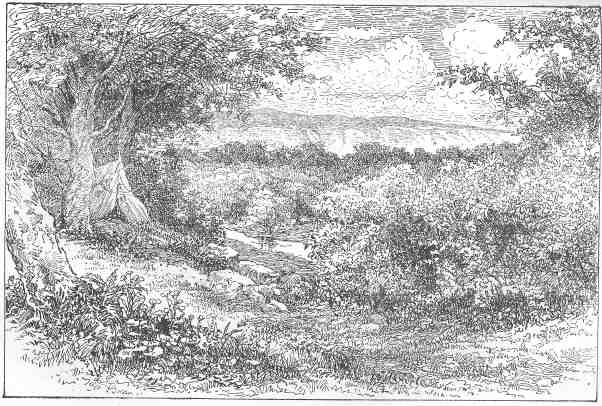
I never associate Vulcan and his Cyclops with the idea of a
forge. These gentry would be the very last people in the
world to flit across my mind whilst gazing at the forge from the
bottom of the dark lane. The truth is, they are highly
unpoetical fellows, as well they may be, connected as they are
with Grecian mythology. At the very mention of their names
the forge burns dull and dim, as if snow-balls had been suddenly
flung into it; the only remedy is to ply the bellows, an
operation which I now hasten to perform.
I am in the dingle making a horse-shoe. Having no other
horses on whose hoofs I could exercise my art, I made my first
essay on those of my own horse, if that could be called horse
which horse was none, being only a pony. Perhaps if I had
sought all England, I should scarcely have found an animal more
in need of the kind offices of the smith. On three of his
feet there were no shoes at all, and on the fourth only a remnant
of one, on which account his hoofs were sadly broken and
lacerated by his late journeys over the hard and flinty
roads. “You belonged to a tinker before,” said
I, addressing the animal, “but now you belong to a
smith. It is said that the household of the shoemaker
invariably go worse shod than that of any other craft. That
may be the case of those who make shoes of leather, but it
sha’n’t be said of the household of him who makes
shoes of iron; at any rate, it sha’n’t be said of
mine. I tell you what, my gry, whilst you continue with me,
you shall both be better shod, and better fed, than you were with
your last master.”
I am in the dingle making a petul; and I must here observe,
that whilst I am making a horse-shoe, the reader need not be
surprised if I speak occasionally in the language of the lord of
the horse-shoe—Mr. Petulengro. I have for some time
past been plying the peshota, or bellows, endeavouring to raise
up the yag, or fire, in my primitive forge. The angar, or
coals, are now burning fiercely, casting forth sparks and long
vagescoe chipes, or tongues of flame; a small bar of sastra, or
iron, is lying in the fire, to the length of ten or twelve
inches, and so far it is hot, very hot, exceeding hot,
brother. And now you see me, prala, snatch the bar of iron,
and place the heated end of it upon the covantza, or anvil, and
forthwith I commence cooring the sastra as hard as if
I had been just engaged by a master at the rate of dui caulor, or
two shillings a day, brother; and when I have beaten the iron
till it is nearly cool, and my arm tired, I place it again in the
angar, and begin again to rouse the fire with the pudamengro,
which signifies the blowing thing, and is another and more common
word for bellows, and whilst thus employed I sing a gypsy song,
the sound of which is wonderfully in unison with the hoarse
moaning of the pudamengro, and ere the song is finished, the iron
is again hot and malleable. Behold, I place it once more on
the covantza, and recommence hammering; and now I am somewhat at
fault; I am in want of assistance; I want you, brother, or some
one else, to take the bar out of my hand and support it upon the
covantza, whilst I, applying a chinomescro, or kind of chisel, to
the heated iron, cut off with a lusty stroke or two of the
shukaro baro, or big hammer, as much as is required for the
petul. But having no one to help me, I go on hammering till
I have fairly knocked off as much as I want, and then I place the
piece in the fire, and again apply the bellows, and take up the
song where I left it off; and when I have finished the song, I
take out the iron, but this time with my plaistra, or pincers,
and then I recommence hammering, turning the iron round and round
with my pincers: and now I bend the iron, and lo, and behold, it
has assumed something the outline of a petul.
I am not going to enter into further details with respect to
the process—it was rather a wearisome one. I had to
contend with various disadvantages; my forge was a rude one, my
tools might have been better; I was in want of one or two highly
necessary implements, but, above all, manual dexterity.
Though free of the forge, I had not practised the albeytarian art
for very many years, never since—but stay, it is not my
intention to tell the reader, at least in this place, how and
when I became a blacksmith. There was one thing, however,
which stood me in good stead in my labour, the same thing which
through life has ever been of incalculable utility to me, and has
not unfrequently supplied the place of friends, money, and many
other things of almost equal importance—iron perseverance,
without which all the advantages of time and circumstance are of
very little avail in any undertaking. I was determined to
make a horse-shoe, and a good one, in spite of every
obstacle—ay, in spite of dukkerin. At the end of four
days, during which I had fashioned and refashioned the thing at
least fifty times, I had made a petul such as no master of the
craft need have been ashamed of; with the second shoe I had less
difficulty, and, by the time I had made the fourth,
I would have scorned to take off my hat to the best smith in
Cheshire.
But I had not yet shod my little gry; this I proceeded now to
do. After having first well pared the hoofs with my churi,
I applied each petul hot, glowing hot to the pindro. Oh,
how the hoofs hissed; and, oh, the pleasant, pungent odour which
diffused itself through the dingle, an odour good for an ailing
spirit.
I shod the little horse bravely—merely pricked him once,
slightly, with a cafi, for doing which, I remember, he kicked me
down; I was not disconcerted, however, but, getting up, promised
to be more cautious in future; and having finished the operation,
I filed the hoof well with the rin baro; then dismissed him to
graze amongst the trees, and, putting my smaller tools into the
muchtar, I sat down on my stone, and, supporting my arm upon my
knee, leaned my head upon my hand. Heaviness had come over
me.
Heaviness had suddenly come over me, heaviness of heart, and
of body also. I had accomplished the task which I had
imposed upon myself, and now that nothing more remained to do, my
energies suddenly deserted me, and I felt without strength, and
without hope. Several causes, perhaps, co-operated to bring
about the state in which I then felt myself. It is not
improbable that my energies had been overstrained during the
work, the progress of which I have attempted to describe; and
every one is aware that the results of overstrained energies are
feebleness and lassitude—want of nourishment might likewise
have something to do with it. During my sojourn in the
dingle, my food had been of the simplest and most unsatisfying
description, by no means calculated to support the exertion which
the labour I had been engaged upon required; it had consisted of
coarse oaten cakes, and hard cheese, and for beverage I had been
indebted to a neighbouring pit, in which, in the heat of the day,
I frequently saw, not golden or silver fish, but frogs and eftes
swimming about. I am, however, inclined to believe that
Mrs. Hearne’s cake had quite as much to do with the matter
as insufficient nourishment. I had never entirely recovered
from the effects of its poison, but had occasionally, especially
at night, been visited by a grinding pain in the stomach, and my
whole body had been suffused with cold sweat; and indeed these
memorials of the drow have never entirely disappeared—even
at the present time they display themselves in my system,
especially after much fatigue of body and excitement of
mind. So there I sat in the dingle upon my stone, nerveless
and hopeless, by whatever cause or causes that state had been
produced—there I sat with my head leaning upon my hand, and
so I continued a long, long time. At last I lifted my head
from my hand, and began to cast anxious, unquiet looks about the
dingle—the entire hollow was now enveloped in deep
shade—I cast my eyes up; there was a golden gleam on the
tops of the trees which grew towards the upper parts of the
dingle, but lower down all was gloom and twilight,
yet, when I first sat down on my stone, the sun was right above
the dingle, illuminating all its depths by the rays which it cast
perpendicularly down, so I must have sat a long, long time upon
my stone. And now, once more, I rested my head upon my
hand, but almost instantly lifted it again in a kind of fear, and
began looking at the objects before me, the forge, the tools, the
branches of the trees, endeavouring to follow their rows, till
they were lost in the darkness of the dingle; and now I found my
right hand grasping convulsively the three forefingers of the
left, first collectively, and then successively, wringing them
till the joints cracked; then I became quiet, but not for
long.
Suddenly I started up, and could scarcely repress the shriek
which was rising to my lips. Was it possible? Yes,
all too certain; the evil one was upon me; the inscrutable horror
which I had felt in my boyhood had once more taken possession of
me. I had thought that it had forsaken me; that it would
never visit me again; that I had outgrown it; that I might almost
bid defiance to it; and I had even begun to think of it without
horror, as we are in the habit of doing of horrors of which we
conceive we run no danger; and, lo! when least thought of, it had
seized me again. Every moment I felt it gathering force,
and making me more wholly its own. What should I
do?—resist, of course; and I did resist. I grasped, I
tore, and strove to fling it from me; but of what avail were my
efforts? I could only have got rid of it by getting rid of
myself: it was part of myself, or rather it was all myself.
I rushed amongst the trees, and struck at them with my bare
fists, and dashed my head against them, but I felt no pain.
How could I feel pain with that horror upon me! and then I flung
myself on the ground, gnawed the earth and swallowed it; and then
I looked round; it was almost total darkness in the dingle, and
the darkness added to my horror. I could no longer stay
there; up I rose from the ground, and attempted to escape; at the
bottom of the winding path which led up the acclivity I fell over
something which was lying on the ground; the something moved, and
gave a kind of whine. It was my little horse, which had
made that place its lair; my little horse, my only companion and
friend in that now awful solitude. I reached the mouth of
the dingle; the sun was just sinking in the far west, behind me;
the fields were flooded with his last gleams. How beautiful
everything looked in the last gleams of the sun! I felt
relieved for a moment; I was no longer in the horrid dingle; in
another minute the sun was gone, and a big
cloud occupied the place where he had been; in a little time it
was almost as dark as it had previously been in the open part of
the dingle. My horror increased; what was I to do?—it
was of no use fighting against the horror, that I saw; the more I
fought against it, the stronger it became. What should I
do: say my prayers? Ah! why not? So I knelt down
under the hedge, and said, “Our Father”; but that was
of no use; and now I could no longer repress cries; the horror
was too great to be borne. What should I do: run to the
nearest town or village, and request the assistance of my
fellow-men? No! that I was ashamed to do; notwithstanding
the horror was upon me, I was ashamed to do that. I knew
they would consider me a maniac, if I went screaming amongst
them; and I did not wish to be considered a maniac.
Moreover, I knew that I was not a maniac, for I possessed all my
reasoning powers, only the horror was upon me—the screaming
horror! But how were indifferent people to distinguish
between madness and this screaming horror? So I thought and
reasoned; and at last I determined not to go amongst my
fellow-men whatever the result might be. I went to the
mouth of the dingle, and there placing myself on my knees, I
again said the Lord’s Prayer; but it was of no use; praying
seemed to have no effect over the horror; the unutterable fear
appeared rather to increase than diminish; and I again uttered
wild cries, so loud that I was apprehensive they would be heard
by some chance passenger on the neighbouring road; I, therefore,
went deeper into the dingle; I sat down with my back against a
thorn bush; the thorns entered my flesh, and when I felt them I
pressed harder against the bush; I thought the pain of the flesh
might in some degree counteract the mental agony; presently I
felt them no longer; the power of the mental horror was so great
that it was impossible, with that upon me, to feel any pain from
the thorns. I continued in this posture a long time,
undergoing what I cannot describe, and would not attempt if I
were able. Several times I was on the point of starting up
and rushing anywhere; but I restrained myself, for I knew I could
not escape from myself, so why should I not remain in the dingle?
so I thought and said to myself, for my reasoning powers were
still uninjured. At last it appeared to me that the horror
was not so strong, not quite so strong upon me. Was it
possible that it was relaxing its grasp, releasing its
prey? O what a mercy! but it could not be—and yet I
looked up to heaven, and clasped my hands, and said, “Our
Father”. I said no more, I was too agitated; and now
I was almost sure that the horror had done its worst.
After a little time I arose, and staggered down yet
farther into the dingle. I again found my little horse on
the same spot as before; I put my hand to his mouth, he licked my
hand. I flung myself down by him and put my arms round his
neck; the creature whinned, and appeared to sympathise with me;
what a comfort to have any one, even a dumb brute, to sympathise
with me at such a moment! I clung to my little horse as if
for safety and protection. I laid my head on his neck, and
felt almost calm; presently the fear returned, but not so wild as
before; it subsided, came again, again subsided; then drowsiness
came over me, and at last I fell asleep, my head supported on the
neck of the little horse. I awoke; it was dark, dark
night—not a star was to be seen—but I felt no fear,
the horror had left me. I arose from the side of the little
horse, and went into my tent, lay down, and again went to
sleep.
I awoke in the morning weak and sore, and shuddering at the
remembrance of what I had gone through on the preceding day; the
sun was shining brightly, but it had not yet risen high enough to
show its head above the trees which fenced the eastern side of
the dingle, on which account the dingle was wet and dank from the
dews of the night. I kindled my fire, and, after sitting by
it for some time to warm my frame, I took some of the coarse food
which I have already mentioned; notwithstanding my late struggle
and the coarseness of the fare, I ate with appetite. My
provisions had by this time been very much diminished, and I saw
that it would be speedily necessary, in the event of my
continuing to reside in the dingle, to lay in a fresh
store. After my meal I went to the pit and filled a can
with water, which I brought to the dingle, and then again sat
down on my stone. I considered what I should next do; it
was necessary to do something, or my life in this solitude would
be insupportable. What should I do? rouse up my forge and
fashion a horse-shoe? but I wanted nerve and heart for such an
employment; moreover, I had no motive for fatiguing myself in
this manner; my own horse was shod, no other was at hand, and it
is hard to work for the sake of working. What should I do?
read? Yes, but I had no other book than the Bible which the
Welsh Methodist had given me; well, why not read the Bible?
I was once fond of reading the Bible; ay, but those days were
long gone by. However, I did not see what else I could well
do on the present occasion; so I determined to read the Bible; it
was in Welsh—at any rate it might amuse me; so I took the
Bible out of the sack in which it was lying in the cart, and
began to read at the place where I chanced to open it. I opened it at that part where the history of Saul
commences. At first I read with indifference; but after
some time my attention was riveted, and no wonder; I had come to
the visitations of Saul—those dark moments of his when he
did and said such unaccountable things; it almost appeared to me
that I was reading of myself; I, too, had my visitations, dark as
ever his were. Oh, how I sympathised with Saul, the tall,
dark man! I had read his life before, but it had made no
impression on me; it had never occurred to me that I was like
him, but I now sympathised with Saul, for my own dark hour was
but recently passed, and, perhaps, would soon return again; the
dark hour came frequently on Saul.
Time wore away; I finished the book of Saul, and, closing the
volume, returned it to its place. I then returned to my
seat on the stone, and thought of what I had read, and what I had
lately undergone. All at once I thought I felt well-known
sensations, a cramping of the breast, and a tingling of the soles
of the feet; they were what I had felt on the preceding
day—they were the forerunners of the fear. I sat
motionless on my stone: the sensations passed away, and the fear
came not. Darkness was now coming again over the earth; the
dingle was again in deep shade; I roused the fire with the breath
of the bellows, and sat looking at the cheerful glow; it was
cheering and comforting. My little horse came now and lay
down on the ground beside the forge; I was not quite
deserted. I again ate some of the coarse food, and drank
plentifully of the water which I had fetched in the
morning. I then put fresh fuel on the fire, and sat for a
long time looking on the blaze; I then went into my tent.
I awoke, on my own calculation, about midnight—it was
pitch dark, and there was much fear upon me.
Two mornings after the period to which I have brought the
reader in the preceding chapter, I sat by my fire at the bottom
of the dingle. I had just breakfasted, and had finished the
last morsel of food which I had brought with me to that
solitude.
“What shall I now do?” said I to myself;
“shall I continue here, or decamp? This is a sad,
lonely spot; perhaps I had better quit it; but whither should I
go? the wide world is before me, but what can I do therein?
I have been in the world already without much success. No,
I had better remain here; the place is lonely, it is true, but
here I am free and independent, and can do what I please; but I
can’t remain here without food. Well, I will find my
way to the nearest town, lay in a fresh supply of provision, and
come back, turning my back upon the world, which has turned its
back upon me. I don’t see why I should not write a
little sometimes; I have pens and an ink-horn, and for a
writing-desk I can place the Bible on my knee. I
shouldn’t wonder if I could write a capital satire on the
world on the back of that Bible; but first of all I must think of
supplying myself with food.”
I rose up from the stone on which I was seated, determining to
go to the nearest town with my little horse and cart, and procure
what I wanted. The nearest town, according to my best
calculation, lay about five miles distant; I had no doubt,
however, that by using ordinary diligence I should be back before
evening. In order to go lighter, I determined to leave my
tent standing as it was, and all the things which I had purchased
of the tinker, just as they were. “I need not be
apprehensive on their account,” said I to myself;
“nobody will come here to meddle with them; the great
recommendation of this place is its perfect solitude; I daresay
that I could live here six months without seeing a single human
visage. I will now harness my little gry and be off to the
town.”
At a whistle which I gave, the little gry, which was feeding
on the bank near the uppermost part of the dingle, came running
to me: for by this time he had become so accustomed to me,
that he would obey my call for all the world as if he had been
one of the canine species. “Now,” said I to
him, “we are going to the town to buy bread for myself, and
oats for you. I am in a hurry to be back; therefore, I pray
you to do your best, and to draw me and the cart to the town with
all possible speed, and to bring us back; if you do your best, I
promise you oats on your return. You know the meaning of
oats, Ambrol?”
Ambrol whinnied as if to let me know that he understood me
perfectly well, as indeed he well might, as I had never once fed
him during the time he had been in my possession without saying
the word in question to him. Now, ambrol, in the Gypsy
tongue, signifieth a pear.
So I caparisoned Ambrol, and then, going to the cart, I
removed two or three things from out it into the tent; I then
lifted up the shafts, and was just going to call to the pony to
come and be fastened to them, when I thought I heard a noise.
I stood stock still supporting the shaft of the little cart in
my hand, and bending the right side of my face slightly towards
the ground; but I could hear nothing. The noise which I
thought I had heard was not one of those sounds which I was
accustomed to hear in that solitude: the note of a bird, or the
rustling of a bough; it was—there I heard it again, a sound
very much resembling the grating of a wheel amongst gravel.
Could it proceed from the road? Oh no, the road was too far
distant for me to hear the noise of anything moving along
it. Again I listened, and now I distinctly heard the sound
of wheels, which seemed to be approaching the dingle; nearer and
nearer they drew, and presently the sound of wheels was blended
with the murmur of voices. Anon I heard a boisterous shout,
which seemed to proceed from the entrance of the dingle.
“Here are folks at hand,” said I, letting the shaft
of the cart fall to the ground, “is it possible that they
can be coming here?”
My doubts on that point, if I entertained any, were soon
dispelled; the wheels, which had ceased moving for a moment or
two, were once again in motion, and were now evidently moving
down the winding path which led to my retreat. Leaving my
cart, I came forward and placed myself near the entrance of the
open space, with my eyes fixed on the path down which my
unexpected, and I may say unwelcome, visitors were coming.
Presently I heard a stamping or sliding, as if of a horse in some
difficulty; and then a loud curse, and the next moment appeared a
man and a horse and cart; the former holding the head of the horse up to prevent him from falling, of which he was
in danger, owing to the precipitous nature of the path.
Whilst thus occupied, the head of the man was averted from
me. When, however, he had reached the bottom of the
descent, he turned his head, and perceiving me, as I stood
bareheaded, without either coat or waistcoat, about two yards
from him, he gave a sudden start, so violent, that the backward
motion of his hand had nearly flung the horse upon his
haunches.
“Why don’t you move forward?” said a voice
from behind, apparently that of a female, “you are stopping
up the way, and we shall be all down upon one another;” and
I saw the head of another horse overtopping the back of the
cart.
“Why don’t you move forward, Jack?” said
another voice, also of a female, yet higher up the path.
The man stirred not, but remained staring at me in the posture
which he had assumed on first perceiving me, his body very much
drawn back, his left foot far in advance of his right, and with
his right hand still grasping the halter of the horse, which gave
way more and more, till it was clean down on his haunches.
“What’s the matter?” said the voice which I
had last heard.
“Get back with you, Belle, Moll,” said the man,
still staring at me, “here’s something not over-canny
or comfortable.”
“What is it?” said the same voice; “let me
pass, Moll, and I’ll soon clear the way,” and I heard
a kind of rushing down the path.
“You need not be afraid,” said I, addressing
myself to the man, “I mean you no harm; I am a wanderer
like yourself—come here to seek for shelter—you need
not be afraid; I am a Roman chabo by matriculation—one of
the right sort, and no mistake. Good-day to ye, brother; I
bid ye welcome.”
The man eyed me suspiciously for a moment, then turning to his
horse with a loud curse, he pulled him up from his haunches, and
led him and the cart farther down to one side of the dingle,
muttering as he passed me, “afraid. Hm!”
I do not remember ever to have seen a more ruffianly-looking
fellow; he was about six feet high, with an immensely athletic
frame; his face was black and bluff, and sported an immense pair
of whiskers, but with here and there a grey hair, for his age
could not be much under fifty. He wore a faded blue
frock-coat, corduroys, and highlows; on his black head was a kind
of red nightcap; round his bull neck a Barcelona
handkerchief—I did not like the look of the man at all.
“Afraid,” growled the fellow, proceeding to
unharness his horse; “that was the word, I
think.”
But other figures were now already upon the scene.
Dashing past the other horse and cart, which by this time had
reached the bottom of the pass, appeared an exceedingly tall
woman, or rather girl, for she could scarcely have been above
eighteen; she was dressed in a tight bodice, and a blue stuff
gown; hat, bonnet or cap she had none, and her hair, which was
flaxen, hung down on her shoulders unconfined; her complexion was
fair, and her features handsome, with a determined but open
expression. She was followed by another female, about
forty, stout and vulgar-looking, at whom I scarcely glanced, my
whole attention being absorbed by the tall girl.
“What’s the matter, Jack?” said the latter,
looking at the man.
“Only afraid, that’s all,” said the man,
still proceeding with his work.
“Afraid at what—at that lad? why, he looks like a
ghost. I would engage to thrash him with one
hand.”
“You might beat me with no hands at all,” said I,
“fair damsel, only by looking at me; I never saw such a
face and figure, both regal. Why, you look like Ingeborg,
Queen of Norway; she had twelve brothers, you know, and could
lick them all, though they were heroes:—
‘On Dovrefeld in Norway,
Were once together seen,
The twelve heroic brothers
Of Ingeborg the queen.’”
“None of your chaffing, young fellow,” said the
tall girl, “or I will give you what shall make you wipe
your face; be civil, or you will rue it.”
“Well, perhaps I was a peg too high,” said I;
“I ask your pardon—here’s something a bit
lower:—
‘As I was jawing to the gav yeck divvus
I met on the drom miro Rommany chi—’”
“None of your Rommany chies, young fellow,” said
the tall girl, looking more menacingly than before and clenching
her fist, “you had better be civil, I am none of your
chies; and though I keep company with gypsies, or, to speak more
proper, half and halfs, I would have you to know that I come of
Christian blood and parents, and was born in the great house of
Long Melford.”
“I have no doubt,” said I, “that it was a
great house judging from your size, I
shouldn’t wonder if you were born in a church.”
“Stay, Belle,” said the man, putting himself
before the young virago, who was about to rush upon me, “my
turn is first;” then, advancing to me in a menacing
attitude, he said, with a look of deep malignity, “Afraid
was the word, wasn’t it?”
“It was,” said I, “but I think I wronged
you; I should have said, aghast, you exhibited every symptom of
one labouring under uncontrollable fear.”
The fellow stared at me with a look of stupid ferocity, and
appeared to be hesitating whether to strike or not; ere he could
make up his mind, the tall girl started forward, crying,
“He’s chaffing, let me at him”; and, before I
could put myself on my guard, she struck me a blow on the face
which had nearly brought me to the ground.
“Enough,” said I, putting my hand to my cheek;
“you have now performed your promise, and made me wipe my
face; now be pacified, and tell me fairly the grounds of this
quarrel.”
“Grounds!” said the fellow; “didn’t
you say I was afraid? and if you hadn’t, who gave you leave
to camp on my ground?”
“Is it your ground?” said I.
“A pretty question,” said the fellow; “as if
all the world didn’t know that. Do you know who I
am?”
“I guess I do,” said I; “unless I am much
mistaken, you are he whom folks call the ‘Flaming
Tinman’. To tell you the truth, I’m glad we
have met, for I wished to see you. These are your two
wives, I suppose; I greet them. There’s no harm
done—there’s room enough here for all of us—we
shall soon be good friends, I dare say; and when we are a little
better acquainted, I’ll tell you my history.”
“Well, if that doesn’t beat all,” said the
fellow.
“I don’t think he’s chaffing now,”
said the girl, whose anger seemed to have subsided on a sudden;
“the young man speaks civil enough.”
“Civil,” said the fellow with an oath; “but
that’s just like you; with you it is a blow, and all
over. Civil! I suppose you would have him stay here,
and get into all my secrets, and hear all I may have to say to my
two morts.”
“Two morts!” said the girl, kindling up,
“where are they? Speak for one, and no more. I
am no mort of yours, whatever some one else may be. I tell
you one thing, Black John, or Anselo, for t’other
an’t your name, the same thing I told the young man here:
be civil, or you will rue it.”
The fellow looked at the girl furiously, but his glance
soon quailed before hers; he withdrew his eyes, and cast them on
my little horse, which was feeding amongst the trees.
“What’s this?” said he, rushing forward and
seizing the animal. “Why, as I am alive, this is the
horse of that mumping villain Slingsby.”
“It’s his no longer; I bought it and paid for
it.”
“It’s mine now,” said the fellow; “I
swore I would seize it the next time I found it on my beat; ay,
and beat the master too.”
“I am not Slingsby.”
“All’s one for that.”
“You don’t say you will beat me?”
“Afraid was the word.”
“I’m sick and feeble.”
“Hold up your fists.”
“Won’t the horse satisfy you?”
“Horse nor bellows either.”
“No mercy, then.”
“Here’s at you.”
“Mind your eyes, Jack. There, you’ve got
it. I thought so,” shouted the girl, as the fellow
staggered back from a sharp blow in the eye. “I
thought he was chaffing at you all along.”
“Never mind, Anselo. You know what to do—go
in,” said the vulgar woman, who had hitherto not spoken a
word, but who now came forward with all the look of a fury;
“go in apopli; you’ll smash ten like he.”
The Flaming Tinman took her advice, and came in, bent on
smashing, but stopped short on receiving a left-handed blow on
the nose.
“You’ll never beat the Flaming Tinman in that
way,” said the girl, looking at me doubtfully.
And so I began to think myself, when, in the twinkling of an
eye, the Flaming Tinman disengaging himself of his frock-coat,
and, dashing off his red night-cap, came rushing in more
desperately than ever. To a flush hit which he received in
the mouth he paid as little attention as a wild bull would have
done; in a moment his arms were around me, and in another, he had
hurled me down, falling heavily upon me. The fellow’s
strength appeared to be tremendous.
“Pay him off now,” said the vulgar woman.
The Flaming Tinman made no reply, but planting his knee on my
breast, seized my throat with two huge horny hands. I gave
myself up for dead, and probably should have been so in another
minute but for the tall girl, who caught
hold of the handkerchief which the fellow wore round his neck
with a grasp nearly as powerful as that with which he pressed my
throat.
“Do you call that fair play?” said she.
“Hands off, Belle,” said the other woman;
“do you call it fair play to interfere? hands off, or
I’ll be down upon you myself.”
But Belle paid no heed to the injunction, and tugged so hard
at the handkerchief that the Flaming Tinman was nearly throttled;
suddenly relinquishing his hold of me, he started on his feet,
and aimed a blow at my fair preserver, who avoided it, but said
coolly:—
“Finish t’other business first, and then I’m
your woman whenever you like; but finish it fairly—no foul
play when I’m by—I’ll be the boy’s
second, and Moll can pick you up when he happens to knock you
down.”
The battle during the next ten minutes raged with considerable
fury; but it so happened that during this time I was never able
to knock the Flaming Tinman down, but on the contrary received
six knock-down blows myself. “I can never stand
this,” said I, as I sat on the knee of Belle, “I am
afraid I must give in; the Flaming Tinman hits very hard,”
and I spat out a mouthful of blood.
“Sure enough you’ll never beat the Flaming Tinman
in the way you fight—it’s of no use flipping at the
Flaming Tinman with your left hand; why don’t you use your
right?”
“Because I’m not handy with it,” said I; and
then getting up, I once more confronted the Flaming Tinman, and
struck him six blows for his one, but they were all left-handed
blows, and the blow which the Flaming Tinman gave me knocked me
off my legs.
“Now, will you use Long Melford?” said Belle,
picking me up.
“I don’t know what you mean by Long
Melford,” said I, gasping for breath.
“Why, this long right of yours,” said Belle,
feeling my right arm—“if you do, I shouldn’t
wonder if you yet stand a chance.”
And now the Flaming Tinman was once more ready, much more
ready than myself. I, however, rose from my second’s
knee as well as my weakness would permit me; on he came, striking
left and right, appearing almost as fresh as to wind and spirit
as when he first commenced the combat, though his eyes were
considerably swelled, and his nether lip was cut in two; on he
came, striking left and right, and I did not like his blows at all, or even the wind of them, which was anything
but agreeable, and I gave way before him. At last he aimed
a blow which, had it taken full effect, would doubtless have
ended the battle, but owing to his slipping, the fist only grazed
my left shoulder, and came with terrific force against a tree,
close to which I had been driven; before the Tinman could recover
himself, I collected all my strength, and struck him beneath the
ear, and then fell to the ground completely exhausted, and it so
happened that the blow which I struck the tinker beneath the ear
was a right-handed blow.
“Hurrah for Long Melford!” I heard Belle exclaim;
“there is nothing like Long Melford for shortness all the
world over.”
At these words I turned round my head as I lay, and perceived
the Flaming Tinman stretched upon the ground apparently
senseless. “He is dead,” said the vulgar woman,
as she vainly endeavoured to raise him up; “he is dead; the
best man in all the north country, killed in this fashion, by a
boy.” Alarmed at these words, I made shift to get on
my feet; and, with the assistance of the woman, placed my fallen
adversary in a sitting posture. I put my hand to his heart,
and felt a slight pulsation. “He’s not
dead,” said I, “only stunned; if he were let blood,
he would recover presently.” I produced a penknife
which I had in my pocket, and, baring the arm of the Tinman, was
about to make the necessary incision, when the woman gave me a
violent blow, and, pushing me aside, exclaimed: “I’ll
tear the eyes out of your head, if you offer to touch him.
Do you want to complete your work, and murder him outright, now
he’s asleep? you have had enough of his blood
already.” “You are mad,” said I, “I
only seek to do him service. Well, if you won’t let
him be blooded, fetch some water and fling it in his face, you
know where the pit is.”
“A pretty manœuvre,” said the woman;
“leave my husband in the hands of you and that limmer, who
has never been true to us; I should find him strangled or his
throat cut when I came back.” “Do you
go,” said I, to the tall girl, “take the can and
fetch some water from the pit.” “You had better
go yourself,” said the girl, wiping a tear as she looked on
the yet senseless form of the tinker; “you had better go
yourself, if you think water will do him good.” I had
by this time somewhat recovered my exhausted powers, and, taking
the can, I bent my steps as fast as I could to the pit; arriving
there, I lay down on the brink, took a long draught, and then
plunged my head into the water; after which I filled the can, and
bent my way back to the dingle. Before I
could reach the path which led down into its depths, I had to
pass some way along its side; I had arrived at a part immediately
over the scene of the last encounter, where the bank, overgrown
with trees, sloped precipitously down. Here I heard a loud
sound of voices in the dingle; I stopped, and laying hold of a
tree, leaned over the bank and listened. The two women
appeared to be in hot dispute in the dingle. “It was
all owing to you, you limmer,” said the vulgar woman to the
other; “had you not interfered, the old man would soon have
settled the boy.”
“I’m for fair play and Long Melford,” said
the other. “If your old man, as you call him, could
have settled the boy fairly, he might, for all I should have
cared, but no foul work for me; and as for sticking the boy with
our gulleys when he comes back, as you proposed, I am not so fond
of your old man or you that I should oblige you in it, to my
soul’s destruction.” “Hold your tongue,
or I’ll—”; I listened no farther, but hastened
as fast as I could to the dingle. My adversary had just
begun to show signs of animation; the vulgar woman was still
supporting him, and occasionally cast glances of anger at the
tall girl who was walking slowly up and down. I lost no
time in dashing the greater part of the water into the
Tinman’s face, whereupon he sneezed, moved his hands, and
presently looked round him. At first his looks were dull
and heavy, and without any intelligence at all; he soon, however,
began to recollect himself, and to be conscious of his situation;
he cast a scowling glance at me, then one of the deepest
malignity at the tall girl, who was still walking about without
taking much notice of what was going forward. At last he
looked at his right hand, which had evidently suffered from the
blow against the tree, and a half-stifled curse escaped his
lips. The vulgar woman now said something to him in a low
tone, whereupon he looked at her for a moment, and then got upon
his legs. Again the vulgar woman said something to him; her
looks were furious, and she appeared to be urging him on to
attempt something. I observed that she had a clasped knife
in her hand. The fellow remained standing for some time as
if hesitating what to do; at last he looked at his hand, and,
shaking his head, said something to the woman which I did not
understand. The tall girl, however, appeared to overhear
him, and, probably repeating his words, said: “No, it
won’t do; you are right there, and now hear what I have to
say,—let bygones be bygones, and let us all shake hands,
and camp here, as the young man was saying just now”.
The man looked at her, and then, without any reply, went to his
horse, which was lying down among the trees, and kicking it up, led it to the cart, to which he
forthwith began to harness it. The other cart and horse had
remained standing motionless during the whole affair which I have
been recounting, at the bottom of the pass. The woman now
took the horse by the head, and leading it with the cart into the
open part of the dingle turned both round, and then led them
back, till the horse and cart had mounted a little way up the
assent; she then stood still and appeared to be expecting the
man. During this proceeding Belle had stood looking on
without saying anything; at last, perceiving that the man had
harnessed his horse to the other cart, and that both he and the
woman were about to take their departure, she said: “You
are not going, are you?” Receiving no answer, she
continued: “I tell you what, both of you, Black John, and
you Moll, his mort, this is not treating me over
civilly,—however, I am ready to put up with it, and to go
with you if you like, for I bear no malice. I’m sorry
for what has happened, but you have only yourselves to thank for
it. Now, shall I go with you, only tell me?”
The man made no manner of reply, but flogged his horse. The
woman, however, whose passions were probably under less control,
replied, with a screeching tone: “Stay where you are, you
jade, and may the curse of Judas cling to you,—stay with
the bit of a mullo whom you helped, and my only hope is that he
may gulley you before he comes to be—Have you with us,
indeed! after what’s past, no, nor nothing belonging to
you. Fetch down your mailla go-cart and live here with your
chabo.” She then whipped on the horse, and ascended
the pass, followed by the man. The carts were light, and
they were not long in ascending the winding path. I
followed to see that they took their departure. Arriving at
the top, I found near the entrance a small donkey cart, which I
concluded belonged to the girl. The tinker and his mort
were already at some distance; I stood looking after them for a
little time, then taking the donkey by the reins I led it with
the cart to the bottom of the dingle. Arrived there, I
found Belle seated on the stone by the fireplace. Her hair
was all dishevelled, and she was in tears.
“They were bad people,” said she, “and I did
not like them, but they were my only acquaintance in the wide
world.”
In the evening of that same day the tall girl and I sat at tea
by the fire, at the bottom of the dingle; the girl on a small
stool, and myself, as usual, upon my stone.
The water which served for the tea had been taken from a
spring of pellucid water in the neighbourhood, which I had not
had the good fortune to discover, though it was well known to my
companion, and to the wandering people who frequented the
dingle.
“This tea is very good,” said I, “but I
cannot enjoy it as much as if I were well: I feel very
sadly.”
“How else should you feel,” said the girl,
“after fighting with the Flaming Tinman? All I wonder
at is that you can feel at all! As for the tea, it ought to
be good, seeing that it cost me ten shillings a pound.”
“That’s a great deal for a person in your station
to pay.”
“In my station! I’d have you to know, young
man—however, I haven’t the heart to quarrel with you,
you look so ill; and after all, it is a good sum for one to pay
who travels the roads; but if I must have tea, I like to have the
best; and tea I must have, for I am used to it, though I
can’t help thinking that it sometimes fills my head with
strange fancies—what some folks call vapours, making me
weep and cry.”
“Dear me,” said I, “I should never have
thought that one of your size and fierceness would weep and
cry!”
“My size and fierceness! I tell you what, young
man, you are not over civil this evening; but you are ill, as I
said before, and I sha’n’t take much notice of your
language, at least for the present; as for my size, I am not so
much bigger than yourself; and as for being fierce, you should be
the last one to fling that at me. It is well for you that I
can be fierce sometimes. If I hadn’t taken your part
against Blazing Bosville, you wouldn’t be now taking tea
with me.”
“It is true that you struck me in the face first; but
we’ll let that pass. So that man’s name is
Bosville; what’s your own?”
“Isopel Berners.”
“How did you get that name?”
“I say, young man, you seem fond of asking questions!
will you have another cup of tea?”
“I was just going to ask for another.”
“Well, then, here it is, and much good may it do you; as
for my name, I got it from my mother.”
“Your mother’s name, then, was Isopel?”
“Isopel Berners.”
“But had you never a father?”
“Yes, I had a father,” said the girl, sighing,
“but I don’t bear his name.”
“Is it the fashion, then, in your country for children
to bear their mother’s name?”
“If you ask such questions, young man, I shall be angry
with you. I have told you my name, and whether my
father’s or mother’s, I am not ashamed of
it.”
“It is a noble name.”
“There you are right, young man. The chaplain in
the great house where I was born, told me it was a noble name; it
was odd enough, he said, that the only three noble names in the
county were to be found in the great house; mine was one; the
other two were Devereux and Bohun.”
“What do you mean by the great house?”
“The workhouse.”
“Is it possible that you were born there?”
“Yes, young man; and as you now speak softly and kindly,
I will tell you my whole tale. My father was an officer of
the sea, and was killed at sea as he was coming home to marry my
mother, Isopel Berners. He had been acquainted with her,
and had left her; but after a few months he wrote her a letter,
to say that he had no rest, and that he repented, and that as
soon as his ship came to port he would do her all the reparation
in his power. Well, young man, the very day before they
reached port they met the enemy, and there was a fight, and my
father was killed, after he had struck down six of the
enemy’s crew on their own deck; for my father was a big
man, as I have heard, and knew tolerably well how to use his
hands. And when my mother heard the news, she became half
distracted, and ran away into the fields and forests, totally
neglecting her business, for she was a small milliner; and so she
ran demented about the meads and forests for a long time, now
sitting under a tree, and now by the side of a river—at
last she flung herself into some water, and would have
been drowned, had not some one been at hand and rescued her,
whereupon she was conveyed to the great house, lest she should
attempt to do herself further mischief, for she had neither
friends nor parents—and there she died three months after,
having first brought me into the world. She was a sweet,
pretty creature, I’m told, but hardly fit for this world,
being neither large, nor fierce, nor able to take her own
part. So I was born and bred in the great house, where I
learnt to read and sew, to fear God, and to take my own
part. When I was fourteen I was put out to service to a
small farmer and his wife, with whom, however, I did not stay
long, for I was half starved, and otherwise ill-treated,
especially by my mistress, who one day attempting to knock me
down with a besom, I knocked her down with my fist, and went back
to the great house.”
“And how did they receive you in the great
house?”
“Not very kindly, young man—on the contrary, I was
put into a dark room, where I was kept a fortnight on bread and
water; I did not much care, however, being glad to have got back
to the great house at any rate, the place where I was born, and
where my poor mother died, and in the great house I continued two
years longer, reading and sewing, fearing God, and taking my own
part when necessary. At the end of the two years I was
again put out to service, but this time to a rich farmer and his
wife, with whom, however, I did not live long, less time, I
believe, than with the poor ones, being obliged to leave
for—”
“Knocking your mistress down?”
“No, young man, knocking my master down, who conducted
himself improperly towards me. This time I did not go back
to the great house, having a misgiving that they would not
receive me, so I turned my back to the great house where I was
born, and where my poor mother died, and wandered for several
days, I know not whither, supporting myself on a few halfpence
which I chanced to have in my pocket. It happened one day,
as I sat under a hedge crying, having spent my last farthing,
that a comfortable-looking elderly woman came up in a cart, and
seeing the state in which I was, she stopped and asked what was
the matter with me; I told her some part of my story, whereupon
she said: ‘Cheer up, my dear, if you like you shall go with
me, and wait upon me’. Of course I wanted little
persuasion, so I got into the cart and went with her. She
took me to London and various other places, and I soon found that
she was a travelling woman, who went about the country with silks
and linen. I was of great use to
her, more especially in those places where we met evil
company. Once, as we were coming from Dover, we were met by
two sailors, who stopped our cart, and would have robbed and
stripped us. ‘Let me get down,’ said I; so I
got down, and fought with them both, till they turned round and
ran away. Two years I lived with the old gentlewoman who
was very kind to me, almost as kind as a mother; at last she fell
sick at a place in Lincolnshire, and after a few days died,
leaving me her cart and stock in trade, praying me only to see
her decently buried, which I did, giving her a funeral fit for a
gentlewoman. After which I travelled the country melancholy
enough for want of company, but so far fortunate, that I could
take my own part when anybody was uncivil to me. At last,
passing through the valley of Todmorden, I formed the
acquaintance of Blazing Bosville and his wife, with whom I
occasionally took journeys for company’s sake, for it is
melancholy to travel about alone, even when one can take
one’s own part. I soon found they were evil people;
but, upon the whole, they treated me civilly, and I sometimes
lent them a little money, so that we got on tolerably well
together. He and I, it is true, had once a dispute, and
nearly came to blows, for once, when we were alone, he wanted me
to marry him, promising if I would, to turn off Grey Moll, or if
I liked it better, to make her wait upon me as a maid-servant; I
never liked him much, but from that hour less than ever. Of
the two, I believe Grey Moll to be the best, for she is at any
rate true and faithful to him, and I like truth and constancy,
don’t you, young man?”
“Yes,” said I, “they are very nice
things. I feel very strangely.”
“How do you feel, young man?”
“Very much afraid.”
“Afraid, at what? At the Flaming Tinman?
Don’t be afraid of him. He won’t come back, and
if he did, he shouldn’t touch you in this state.
I’d fight him for you, but he won’t come back, so you
needn’t be afraid of him.”
“I’m not afraid of the Flaming Tinman.”
“What, then, are you afraid of?”
“The evil one.”
“The evil one,” said the girl, “where is
he?”
“Coming upon me.”
“Never heed,” said the girl, “I’ll
stand by you.”
The kitchen of the public-house was a large one, and many
people were drinking in it; there was a confused hubbub of
voices.
I sat down on a bench behind a deal table, of which there were
three or four in the kitchen; presently a bulky man, in a green
coat, of the Newmarket cut, and without a hat, entered, and
observing me, came up, and in rather a gruff tone cried:
“Want anything, young fellow?”
“Bring me a jug of ale,” said I, “if you are
the master, as I suppose you are, by that same coat of yours, and
your having no hat on your head.”
“Don’t be saucy, young fellow,” said the
landlord, for such he was, “don’t be saucy,
or—” Whatever he intended to say, he left
unsaid, for fixing his eyes upon one of my hands, which I had
placed by chance upon the table, he became suddenly still.
This was my left hand, which was raw and swollen, from the
blows dealt on a certain hard skull in a recent combat.
“What do you mean by staring at my hand so?” said I,
withdrawing it from the table.
“No offence, young man, no offence,” said the
landlord, in a quite altered tone; “but the sight of your
hand—,” then observing that our conversation began to
attract the notice of the guests in the kitchen, he interrupted
himself, saying in an undertone: “But mum’s the word
for the present, I will go and fetch the ale.”
In about a minute he returned, with a jug of ale foaming
high. “Here’s your health,” said he,
blowing off the foam, and drinking; but perceiving that I looked
rather dissatisfied, he murmured: “All’s right, I
glory in you; but mum’s the word.” Then placing
the jug on the table, he gave me a confidential nod, and
swaggered out of the room.
What can the silly, impertinent fellow mean, thought I; but
the ale was now before me, and I hastened to drink, for my
weakness was great, and my mind was full of dark thoughts, the
remains of the indescribable horror of the preceding
night. It may kill me, thought I, as I drank deep, but who
cares, anything is better than what I have suffered. I
drank deep, and then leaned back against the wall; it appeared as
if a vapour was stealing up into my brain, gentle and benign,
soothing and stilling the horror and the fear; higher and higher
it mounted, and I felt nearly overcome; but the sensation was
delicious, compared with that I had lately experienced, and now I
felt myself nodding; and bending down I laid my head on the table
on my folded hands.
And in that attitude I remained some time, perfectly
unconscious. At length, by degrees, perception returned,
and I lifted up my head. I felt somewhat dizzy and
bewildered, but the dark shadow had withdrawn itself from
me. And now, once more, I drank of the jug; this second
draught did not produce an overpowering effect upon me—it
revived and strengthened me. I felt a new man.
I looked around me: the kitchen had been deserted by the
greater part of the guests; besides myself, only four remained;
these were seated at the farther end. One was haranguing
fiercely and eagerly; he was abusing England, and praising
America. At last he exclaimed: “So when I gets to New
York, I will toss up my hat, and damn the King”.
That man must be a Radical, thought I.
The individual whom I supposed to be a radical, after a short
pause, again uplifted his voice: he was rather a strong-built
fellow of about thirty, with an ill-favoured countenance, a white
hat on his head, a snuff-coloured coat on his back, and, when he
was not speaking, a pipe in his mouth. “Who would
live in such a country as England?” he shouted.
“There is no country like America,” said his
nearest neighbour, a man also in a white hat, and of a very
ill-favoured countenance, “there is no country like
America,” said he, withdrawing a pipe from his mouth;
“I think I shall”—and here he took a draught
from a jug, the contents of which he appeared to have in common
with the other,—“go to America one of these days
myself.”
“Poor old England is not such a bad country, after
all,” said a third, a simple-looking man in a labouring
dress, who sat smoking a pipe without anything before him.
“If there was but a little more work to be got, I should
have nothing to say against her. I hope,
however—”
“You hope, who cares what you hope?” interrupted
the first, in a savage tone; “you are one of those sneaking
hounds who are satisfied with dog’s wages, a bit of bread
and a kick. Work, indeed! who, with the spirit of a man,
would work for a country where there is neither liberty of
speech, nor of action? a land full of beggarly aristocracy,
hungry borough-mongers, insolent parsons, and “their ---
wives and daughters,” as William Cobbett says, in his
Register.”
“Ah, the Church of England has been a source of
incalculable mischief to these realms,” said another.
The person who uttered these words sat rather aloof from the
rest; he was dressed in a long black surtout. I could not
see much of his face, partly owing to his keeping it very much
directed to the ground, and partly owing to a large slouched hat,
which he wore; I observed, however, that his hair was of a
reddish tinge. On the table near him was a glass and
spoon.
“You are quite right,” said the first,
alluding to what this last had said, “the Church of England
has done incalculable mischief here. I value no religion
three halfpence, for I believe in none; but the one that I hate
most is the Church of England; so when I get to New York, after I
have shown the fine fellows on the quay a spice of me, by --- the
King, I’ll toss up my hat again, and --- the Church of
England too.”
“And suppose the people of New York should clap you in
the stocks?” said I.
These words drew upon me the attention of the whole
four. The radical and his companion stared at me
ferociously; the man in black gave me a peculiar glance from
under his slouched hat; the simple-looking man in the labouring
dress laughed.
“What are you laughing at, you fool?” said the
radical, turning and looking at the other, who appeared to be
afraid of him, “hold your noise; and a pretty fellow,
you,” said he, looking at me, “to come here, and
speak against the great American nation.”
“I speak against the great American nation?” said
I, “I rather paid them a compliment.”
“By supposing they would put me in the stocks.
Well, I call it abusing them, to suppose they would do any such
thing—stocks, indeed!—there are no stocks in all the
land. Put me in the stocks? why, the President will come
down to the quay, and ask me to dinner, as soon as he hears what
I have said about the King and the Church.”
“I shouldn’t wonder,” said I, “if you
go to America, you will say of the President and country what now
you say of the King and Church, and cry out for somebody to send
you back to England.”
The radical dashed his pipe to pieces against the table.
“I tell you what, young fellow, you are a spy of the
aristocracy, sent here to kick up a disturbance.”
“Kicking up a disturbance,” said I, “is
rather inconsistent with the office of spy. If I were a
spy, I should hold my head down, and say nothing.”
The man in black partially raised his head and gave me another
peculiar glance.
“Well, if you ar’n’t sent to spy, you are
sent to bully, to prevent people speaking, and to run down the
great American nation; but you sha’n’t bully
me. I say down with the aristocracy, the beggarly
aristocracy. Come, what have you to say to that?”
“Nothing,” said I.
“Nothing!” repeated the radical.
“No,” said I, “down with them as soon as you
can.”
“As soon as I can! I wish I could. But I can
down with a bully of theirs. Come, will you fight for
them?”
“No,” said I.
“You won’t?”
“No,” said I; “though from what I have seen
of them I should say they are tolerably able to fight for
themselves.”
“You won’t fight for them,” said the
radical, triumphantly; “I thought so; all bullies,
especially those of the aristocracy, are cowards. Here,
landlord,” said he, raising his voice, and striking against
the table with the jug, “some more ale—he won’t
fight for his friends.”
“A white feather,” said his companion.
“He! he!” tittered the man in black.
“Landlord, landlord,” shouted the radical,
striking the table with the jug louder than before.
“Who called?” said the landlord, coming in at
last. “Fill this jug again,” said the other,
“and be quick about it.” “Does any one
else want anything?” said the landlord.
“Yes,” said the man in black; “you may bring me
another glass of gin and water.” “Cold?”
said the landlord. “Yes,” said the man in
black, “with a lump of sugar in it.”
“Gin and water cold, with a lump of sugar in it,”
said I, and struck the table with my fist.
“Take some?” said the landlord, inquiringly.
“No,” said I, “only something came into my
head.”
“He’s mad,” said the man in black.
“Not he,” said the radical.
“He’s only shamming; he knows his master is here, and
therefore has recourse to these manœuvres, but it
won’t do. Come, landlord, what are you staring
at? Why don’t you obey your orders? Keeping
your customers waiting in this manner is not the way to increase
your business.”
The landlord looked at the radical and then at me. At
last, taking the jug and glass, he left the apartment, and
presently returned with each filled with its respective
liquor. He placed the jug with the beer before the radical,
and the glass with the gin and water before the man in black, and
then, with a wink to me, he sauntered out.
“Here is your health, sir,” said the man of the
snuff-coloured coat, addressing himself to the man in black,
“I honour you for what you said about the Church of
England. Every one who speaks against the Church of England
has my warm heart. Down with it, I
say, and may the stones of it be used for mending the roads, as
my friend William says in his Register.”
The man in black, with a courteous nod of his head, drank to
the man in the snuff-coloured coat. “With respect to
the steeples,” said he, “I am not altogether of your
opinion; they might be turned to better account than to serve to
mend the roads; they might still be used as places of worship,
but not for the worship of the Church of England. I have no
fault to find with the steeples, it is the church itself which I
am compelled to arraign; but it will not stand long, the
respectable part of its ministers are already leaving it.
It is a bad church, a persecuting church.”
“Whom does it persecute?” said I.
The man in black glanced at me slightly, and then replied
slowly, “the Catholics”.
“And do those whom you call Catholics never
persecute?” said I.
“Never,” said the man in black.
“Did you ever read Fox’s Book of
Martyrs?” said I.
“He! he!” tittered the man in black, “there
is not a word of truth in Fox’s Book of
Martyrs.”
“Ten times more than in the Flos
Sanctorum,” said I.
The man in black looked at me, but made no answer.
“And what say you to the Massacre of the Albigenses and
the Vaudois, ‘whose bones lie scattered on the cold
Alp,’ or the Revocation of the Edict of Nantes?”
The man in black made no answer.
“Go to,” said I, “it is because the Church
of England is not a persecuting church, that those whom you call
the respectable part are leaving her; it is because they
can’t do with the poor Dissenters what Simon de Montfort
did with the Albigenses, and the cruel Piedmontese with the
Vaudois, that they turn to bloody Rome; the Pope will no doubt
welcome them, for the Pope, do you see, being very much in want,
will welcome—”
“Hollo!” said the radical, interfering,
“What are you saying about the Pope? I say hurrah for
the Pope! I value no religion three halfpence, as I said
before, but if I were to adopt any, it should be the Popish, as
it’s called, because I conceives the Popish to be the grand
enemy of the Church of England, of the beggarly aristocracy, and
the borough-monger system, so I won’t hear the Pope abused
while I am by. Come, don’t look fierce. You
won’t fight, you know, I have proved it; but I will give
you another chance—I will fight for the Pope, will you
fight against him?”
“Oh dear me, yes,” said I, getting up and
stepping forward. “I am a quiet, peaceable young man,
and, being so, am always ready to fight against the
Pope—the enemy of all peace and quiet. To refuse
fighting for the aristocracy is a widely different thing from
refusing to fight against the Pope—so come on, if you are
disposed to fight for him. To the Pope broken bells, to
Saint James broken shells. No Popish vile oppression, but
the Protestant succession. Confusion to the Groyne, hurrah
for the Boyne, for the army at Clonmel, and the Protestant young
gentlemen who live there as well.”
“An Orangeman,” said the man in black.
“Not a Platitude,” said I.
The man in black gave a slight start.
“Amongst that family,” said I, “no doubt
something may be done, but amongst the Methodist preachers I
should conceive that the success would not be great.”
The man in black sat quite still.
“Especially amongst those who have wives,” I
added.
The man in black stretched his hand towards his gin and
water.
“However,” said I, “we shall see what the
grand movement will bring about, and the results of the lessons
in elocution.”
The man in black lifted the glass up to his mouth, and in
doing so, let the spoon fall.
“But what has this to do with the main question?”
said I: “I am waiting here to fight against the
Pope.”
“Come, Hunter,” said the companion of the man in
the snuff-coloured coat, “get up, and fight for the
Pope.”
“I don’t care for the young fellow,” said
the man in the snuff-coloured coat.
“I know you don’t,” said the other,
“so get up, and serve him out.”
“I could serve out three like him,” said the man
in the snuff-coloured coat.
“So much the better for you,” said the other,
“the present work will be all the easier for you, get up,
and serve him out at once.”
The man in the snuff-coloured coat did not stir.
“Who shows the white feather now?” said the
simple-looking man.
“He! he! he!” tittered the man in black.
“Who told you to interfere?” said the radical,
turning ferociously towards the simple-looking man; “say
another word, and I’ll—And you!”
said he, addressing himself to the man in black, “a pretty
fellow you to turn against me, after I had taken your part.
I tell you what, you may fight for yourself. I’ll see
you and your Pope in the pit of Eldon, before I fight for either
of you, so make the most of it.”
“Then you won’t fight?” said I.
“Not for the Pope,” said the radical;
“I’ll see the Pope—”
“Dear me!” said I, “not fight for the Pope,
whose religion you would turn to, if you were inclined for
any. I see how it is, you are not fond of fighting; but
I’ll give you another chance—you were abusing the
Church of England just now. I’ll fight for
it—will you fight against it?”
“Come, Hunter,” said the other, “get up, and
fight against the Church of England.”
“I have no particular quarrel against the Church of
England,” said the man in the snuff-coloured coat,
“my quarrel is with the aristocracy. If I said
anything against the church, it was merely for a bit of
corollary, as Master William Cobbett would say; the quarrel with
the church belongs to this fellow in black; so let him carry it
on. However,” he continued suddenly, “I
won’t slink from the matter either; it shall never be said
by the fine fellows on the quay of New York, that I
wouldn’t fight against the Church of England. So down
with the beggarly aristocracy, the church, and the Pope, to the
bottom of the pit of Eldon, and may the Pope fall first, and the
others upon him.”
Thereupon, dashing his hat on the table, he placed himself in
an attitude of offence, and rushed forward. He was, as I
have said before, a powerful fellow, and might have proved a
dangerous antagonist, more especially to myself, who, after my
recent encounter with the Flaming Tinman, and my wrestlings with
the evil one, was in anything but fighting order. Any
collision, however, was prevented by the landlord, who, suddenly
appearing, thrust himself between us. “There shall be
no fighting here,” said he, “no one shall fight in
this house, except it be with myself; so if you two have anything
to say to each other, you had better go into the field behind the
house. But, you fool,” said he, pushing Hunter
violently on the breast, “do you know whom you are going to
tackle with? this is the young chap that beat Blazing Bosville,
only as late as yesterday, in Mumpers’ Dingle. Grey
Moll told me all about it last night, when she came for some
brandy for her husband, who, she said, had been half killed; and
she described the young man to me so closely, that I knew him
at once, that is, as soon as I saw how his left hand
was bruised, for she told me he was a left-hand hitter.
Ar’n’t it all true, young man?
Ar’n’t you he that beat Flaming Bosville in
Mumpers’ Dingle?” “I never beat Flaming
Bosville,” said I, “he beat himself. Had he not
struck his hand against a tree, I shouldn’t be here at the
present moment.” “Here! here!” said the
landlord, “now that’s just as it should be; I like a
modest man, for, as the parson says, nothing sits better upon a
young man than modesty. I remember, when I was young,
fighting with Tom of Hopton, the best man that ever pulled off
coat in England. I remember, too, that I won the battle;
for I happened to hit Tom of Hopton, in the mark, as he was
coming in, so that he lost his wind, and falling squelch on the
ground, do ye see, he lost the battle, though I am free to
confess that he was a better man than myself; indeed, the best
man that ever fought in England; yet still I won the battle, as
every customer of mine, and everybody within twelve miles round,
has heard over and over again. Now, Mr. Hunter, I have one
thing to say, if you choose to go into the field behind the
house, and fight the young man, you can. I’ll back
him for ten pounds; but no fighting in my kitchen—because
why? I keeps a decent kind of an establishment.”
“I have no wish to fight the young man,” said
Hunter; “more especially as he has nothing to say for the
aristocracy. If he chose to fight for them,
indeed—but he won’t, I know; for I see he’s a
decent, respectable young man; and, after all, fighting is a
blackguard way of settling a dispute; so I have no wish to fight;
however, there is one thing I’ll do,” said he,
uplifting his fist, “I’ll fight this fellow in black
here for half a crown, or for nothing, if he pleases; it was he
that got up the last dispute between me and the young man, with
his Pope and his nonsense; so I will fight him for anything he
pleases, and perhaps the young man will be my second; whilst
you—”
“Come, doctor,” said the landlord, “or
whatsoever you be, will you go into the field with Hunter?
I’ll second you, only you must back yourself.
I’ll lay five pounds on Hunter, if you are inclined to back
yourself; and will help you to win it as far, do you see, as a
second can; because why? I always likes to do the fair
thing.”
“Oh! I have no wish to fight,” said the man
in black hastily; “fighting is not my trade. If I
have given any offence, I beg anybody’s pardon.”
“Landlord,” said I, “what have I to
pay?”
“Nothing at all,” said the landlord; “glad
to see you. This is the
first time that you have been at my house, and I never charge new
customers, at least customers such as you, anything for the first
draught. You’ll come again, I dare say; shall always
be glad to see you. I won’t take it,” said he,
as I put sixpence on the table; “I won’t take
it.”
“Yes, you shall,” said I; “but not in
payment for anything I have had myself: it shall serve to pay for
a jug of ale for that gentleman,” said I, pointing to the
simple-looking individual; “he is smoking a poor
pipe. I do not mean to say that a pipe is a bad thing; but
a pipe without ale, do you see—”
“Bravo!” said the landlord, “that’s
just the conduct I like.”
“Bravo!” said Hunter. “I shall be
happy to drink with the young man whenever I meet him at New
York, where, do you see, things are better managed than
here.”
“If I have given offence to anybody,” said the man
in black, “I repeat that I ask pardon,—more
especially to the young gentleman, who was perfectly right to
stand up for his religion, just as I—not that I am of any
particular religion, no more than this honest gentleman
here,” bowing to Hunter; “but I happen to know
something of the Catholics—several excellent friends of
mine are Catholics—and of a surety the Catholic religion is
an ancient religion, and a widely extended religion, though it
certainly is not a universal religion, but it has of late made
considerable progress, even amongst those nations who have been
particularly opposed to it—amongst the Prussians and the
Dutch, for example, to say nothing of the English; and then, in
the East, amongst the Persians, amongst the
Armenians—”
“The Armenians,” said I; “oh dear me, the
Armenians—”
“Have you anything to say about those people,
sir?” said the man in black, lifting up his glass to his
mouth.
“I have nothing further to say,” said I,
“than that the roots of Ararat are occasionally found to be
deeper than those of Rome.”
“There’s half a crown broke,” said the
landlord, as the man in black let fall the glass, which was
broken to pieces on the floor. “You will pay me the
damage, friend, before you leave this kitchen. I like to
see people drink freely in my kitchen, but not too freely, and I
hate breakages; because why? I keeps a decent kind of an
establishment.”
The public-house where the scenes which I have attempted to
describe in the preceding chapters took place, was at the
distance of about two miles from the dingle. The sun was
sinking in the west by the time I returned to the latter
spot. I found Belle seated by a fire, over which her kettle
was suspended. During my absence she had prepared herself a
kind of tent, consisting of large hoops covered over with
tarpaulin, quite impenetrable to rain, however violent.
“I am glad you are returned,” said she, as soon as
she perceived me; “I began to be anxious about you.
Did you take my advice?”
“Yes,” said I; “I went to the public-house
and drank ale as you advised me; it cheered, strengthened, and
drove away the horror from my mind—I am much beholden to
you.”
“I knew it would do you good,” said Belle;
“I remembered that when the poor women in the great house
were afflicted with hysterics and fearful imaginings, the
surgeon, who was a good, kind man, used to say: ‘Ale, give
them ale, and let it be strong’.”
“He was no advocate for tea, then?” said I.
“He had no objection to tea; but he used to say,
‘Everything in its season’. Shall we take ours
now—I have waited for you.”
“I have no objection,” said I; “I feel
rather heated, and at present should prefer tea to
ale—‘Everything in its season,’ as the surgeon
said.”
Thereupon Belle prepared tea, and, as we were taking it, she
said: “What did you see and hear at the
public-house?”
“Really,” said I, “you appear to have your
full portion of curiosity; what matters it to you what I saw and
heard at the public-house?”
“It matters very little to me,” said Belle;
“I merely inquired of you, for the sake of a little
conversation—you were silent, and it is uncomfortable for
two people to sit together without opening their lips—at
least I think so.”
“One only feels uncomfortable,” said I, “in
being silent, when one happens to be thinking of
the individual with whom one is in company. To tell you the
truth, I was not thinking of my companion, but of certain company
with whom I had been at the public-house.”
“Really, young man,” said Belle, “you are
not over complimentary; but who may this wonderful company have
been—some young—?” and here Belle stopped.
“No,” said I, “there was no young
person—if person you were going to say. There was a
big portly landlord, whom I dare say you have seen; a noisy
savage radical, who wanted at first to fasten upon me a quarrel
about America, but who subsequently drew in his horns; then there
was a strange fellow, a prowling priest, I believe, whom I have
frequently heard of, who at first seemed disposed to side with
the radical against me, and afterwards with me against the
radical. There, you know my company, and what took
place.”
“Was there no one else?” said Belle.
“You are mighty curious,” said I. “No,
none else, except a poor, simple mechanic, and some common
company, who soon went away.”
Belle looked at me for a moment, and then appeared to be lost
in thought—“America?” said she,
musingly—“America?”
“What of America?” said I.
“I have heard that it is a mighty country.”
“I dare say it is,” said I; “I have heard my
father say that the Americans are first-rate marksmen.”
“I heard nothing about that,” said Belle;
“what I heard was, that it is a great and goodly land,
where people can walk about without jostling, and where the
industrious can always find bread; I have frequently thought of
going thither.”
“Well,” said I, “the radical in the
public-house will perhaps be glad of your company thither; he is
as great an admirer of America as yourself, though I believe on
different grounds.”
“I shall go by myself,” said Belle,
“unless—unless that should happen which is not
likely—I am not fond of radicals no more than I am of
scoffers and mockers.”
“Do you mean to say that I am a scoffer and
mocker?”
“I don’t wish to say you are,” said Belle;
“but some of your words sound strangely like scoffing and
mocking. I have now one thing to beg, which is, that if you
have anything to say against America, you would speak it out
boldly.”
“What should I have to say against America? I
never was there.”
“Many people speak against America who never were
there.”
“Many people speak in praise of America who never were
there; but with respect to myself, I have not spoken for or
against America.”
“If you liked America you would speak in its
praise.”
“By the same rule, if I disliked America I should speak
against it.”
“I can’t speak with you,” said Belle;
“but I see you dislike the country.”
“The country!”
“Well, the people—don’t you?”
“I do.”
“Why do you dislike them?”
“Why, I have heard my father say that the American
marksmen, led on by a chap of the name of Washington, sent the
English to the right-about in double-quick time.”
“And that is your reason for disliking the
Americans?”
“Yes,” said I, “that is my reason for
disliking them.”
“Will you take another cup of tea?” said
Belle.
I took another cup; we were again silent. “It is
rather uncomfortable,” said I, at last, “for people
to sit together without having anything to say.”
“Were you thinking of your company?” said
Belle.
“What company?” said I.
“The present company.”
“The present company! oh, ah!—I remember that I
said one only feels uncomfortable in being silent with a
companion, when one happens to be thinking of the
companion. Well, I had been thinking of you the last two or
three minutes, and had just come to the conclusion, that to
prevent us both feeling occasionally uncomfortably towards each
other, having nothing to say, it would be as well to have a
standing subject, on which to employ our tongues. Belle, I
have determined to give you lessons in Armenian.”
“What is Armenian?”
“Did you ever hear of Ararat?”
“Yes, that was the place where the ark rested; I have
heard the chaplain in the great house talk of it; besides, I have
read of it in the Bible.”
“Well, Armenian is the speech of people of that place,
and I should like to teach it you.”
“To prevent—”
“Ay, ay, to prevent our occasionally feeling
uncomfortable together. Your acquiring it
besides might prove of ulterior advantage to us both; for
example, suppose you and I were in promiscuous company, at Court,
for example, and you had something to communicate to me which you
did not wish any one else to be acquainted with, how safely you
might communicate it to me in Armenian.”
“Would not the language of the roads do as well?”
said Belle.
“In some places it would,” said I, “but not
at Court, owing to its resemblance to thieves’ slang.
There is Hebrew, again, which I was thinking of teaching you,
till the idea of being presented at Court made me abandon it,
from the probability of our being understood, in the event of our
speaking it, by at least half a dozen people in our
vicinity. There is Latin, it is true, or Greek, which we
might speak aloud at Court with perfect confidence of safety, but
upon the whole I should prefer teaching you Armenian, not because
it would be a safer language to hold communication with at Court,
but because, not being very well grounded in it myself, I am
apprehensive that its words and forms may escape from my
recollection, unless I have sometimes occasion to call them
forth.”
“I am afraid we shall have to part company before I have
learnt it,” said Belle; “in the meantime, if I wish
to say anything to you in private, somebody being by, shall I
speak in the language of the roads?”
“If no roadster is nigh, you may,” said I,
“and I will do my best to understand you. Belle, I
will now give you a lesson in Armenian.”
“I suppose you mean no harm,” said Belle.
“Not in the least; I merely propose the thing to prevent
our occasionally feeling uncomfortable together. Let us
begin.”
“Stop till I have removed the tea-things,” said
Belle; and, getting up, she removed them to her own
encampment.
“I am ready,” said Belle, returning, and taking
her former seat, “to join with you in anything which will
serve to pass away the time agreeably, provided there is no harm
in it.”
“Belle,” said I, “I have determined to
commence the course of Armenian lessons by teaching you the
numerals; but, before I do that, it will be as well to tell you
that the Armenian language is called Haik.”
“I am sure that word will hang upon my memory,”
said Belle.
“Why hang upon it?”
“Because the old woman in the great house used to
call so the chimney-hook, on which they hung the kettle; in like
manner, on the hake of my memory I will hang your
hake.”
“Good!” said I, “you will make an apt
scholar; but, mind, that I did not say hake, but haik; the words
are, however, very much alike; and, as you observe, upon your
hake you may hang my haik. We will now proceed to the
numerals.”
“What are numerals?” said Belle.
“Numbers. I will say the Haikan numbers up to
ten. There, have you heard
them?”—“Yes.” “Well, try and
repeat them.”
`“I only remember number one,” said Belle,
“and that because it is me.”
“I will repeat them again,” said I, “and pay
greater attention. Now, try again.”
“Me, jergo, earache.”
“I neither said jergo nor earache. I
said yergou and yerek. Belle, I am afraid I
shall have some difficulty with you as a scholar.”
Belle made no answer. Her eyes were turned in the
direction of the winding path, which led from the bottom of the
hollow where we were seated, to the plain above.
“Gorgio shunella,” she said, at length, in a low
voice.
“Pure Rommany,” said I; “where?” I
added in a whisper.
“Dovey odoi,” said Belle, nodding with her head
towards the path.
“I will soon see who it is,” said I; and starting
up, I rushed towards the pathway, intending to lay violent hands
on any one I might find lurking in its windings. Before,
however, I had reached its commencement, a man, somewhat above
the middle height, advanced from it into the dingle, in whom I
recognised the man in black whom I had seen in the
public-house.
The man in black and myself stood opposite to each other for a
minute or two in silence; I will not say that we confronted each
other that time, for the man in black, after a furtive glance,
did not look me in the face, but kept his eyes fixed, apparently
on the leaves of a bunch of ground nuts which were growing at my
feet. At length, looking around the dingle, he exclaimed:
“Buona Sera, I hope I don’t
intrude”.
“You have as much right here,” said I, “as I
or my companion; but you had no right to stand listening to our
conversation.”
“I was not listening,” said the man, “I was
hesitating whether to advance or retire; and if I heard some of
your conversation, the fault was not mine.”
“I do not see why you should have hesitated if your
intentions were good,” said I.
“I think the kind of place in which I found myself might
excuse some hesitation,” said the man in black, looking
around; “moreover, from what I had seen of your demeanour
at the public-house, I was rather apprehensive that the reception
I might experience at your hands might be more rough than
agreeable.”
“And what may have been your motive for coming to this
place?” said I.
“Per far visita à sua signoria, ecco il
motivo.”
“Why do you speak to me in that gibberish?” said
I; “do you think I understand it?”
“It is not Armenian,” said the man in black;
“but it might serve in a place like this, for the breathing
of a little secret communication, were any common roadster near
at hand. It would not do at Court, it is true, being the
language of singing women, and the like; but we are not at
Court—when we are, I can perhaps summon up a little
indifferent Latin, if I have anything private to communicate to
the learned Professor.”
And at the conclusion of this speech the man in black lifted
up his head, and, for some moments, looked me in the face.
The muscles of his own seemed to be slightly convulsed,
and his mouth opened in a singular manner.
“I see,” said I, “that for some time you
were standing near me and my companion, in the mean act of
listening.”
“Not at all,” said the man in black; “I
heard from the steep bank above that to which I have now alluded,
whilst I was puzzling myself to find the path which leads to your
retreat. I made, indeed, nearly the compass of the whole
thicket before I found it.”
“And how did you know that I was here?” I
demanded.
“The landlord of the public-house, with whom I had some
conversation concerning you, informed me that he had no doubt I
should find you in this place, to which he gave me instructions
not very clear. But now I am here, I crave permission to
remain a little time, in order that I may hold some communion
with you.”
“Well,” said I, “since you are come, you are
welcome, please to step this way.”
Thereupon I conducted the man in black to the fireplace where
Belle was standing, who had risen from her stool on my springing
up to go in quest of the stranger. The man in black looked
at her with evident curiosity, then making her rather a graceful
bow, “Lovely virgin,” said he, stretching out his
hand, “allow me to salute your fingers”.
“I am not in the habit of shaking hands with
strangers,” said Belle.
“I did not presume to request to shake hands with
you,” said the man in black, “I merely wished to be
permitted to salute with my lips the extremity of your two
forefingers.”
“I never permit anything of the kind,” said Belle;
“I do not approve of such unmanly ways, they are only
befitting those who lurk in corners or behind trees, listening to
the conversation of people who would fain be private.”
“Do you take me for a listener, then?” said the
man in black.
“Ay, indeed I do,” said Belle; “the young
man may receive your excuses, and put confidence in them if he
please, but for my part I neither admit them, nor believe
them;” and thereupon flinging her long hair back, which was
hanging over her cheeks, she seated herself on her stool.
“Come, Belle,” said I, “I have bidden the
gentleman welcome; I beseech you, therefore, to make him welcome;
he is a stranger, where we are at home, therefore, even did we
wish him away, we are bound to treat him kindly.”
“That’s not English doctrine,” said
the man in black.
“I thought the English prided themselves on their
hospitality,” said I.
“They do so,” said the man in black; “they
are proud of showing hospitality to people above them, that is,
to those who do not want it, but of the hospitality which you
were now describing, and which is Arabian, they know
nothing. No Englishman will tolerate another in his house,
from whom he does not expect advantage of some kind, and to those
from whom he does, he can be civil enough. An Englishman
thinks that, because he is in his own house, he has a right to be
boorish and brutal to any one who is disagreeable to him, as all
those are who are really in want of assistance. Should a
hunted fugitive rush into an Englishman’s house, beseeching
protection, and appealing to the master’s feelings of
hospitality, the Englishman would knock him down in the
passage.”
“You are too general,” said I, “in your
strictures; Lord ---, [484] the unpopular Tory
minister, was once chased through the streets of London by a mob,
and, being in danger of his life, took shelter in the shop of a
Whig linen-draper, declaring his own unpopular name, and
appealing to the linen-draper’s feelings of hospitality;
whereupon, the linen-draper, utterly forgetful of all party
rancour, nobly responded to the appeal, and telling his wife to
conduct his lordship upstairs, jumped over the counter with his
ell in his hand, and placing himself with half a dozen of his
assistants at the door of his boutique, manfully
confronted the mob, telling them that he would allow himself to
be torn to a thousand pieces, ere he would permit them to injure
a hair of his lordship’s head; what do you think of
that?”
“He! he! he!” tittered the man in black.
“Well,” said I, “I am afraid your own
practice is not very different from that which you have been just
now describing; you sided with the radical in the public-house
against me, as long as you thought him the most powerful, and
then turned against him, when you saw he was cowed. What
have you to say to that?”
“Oh! when one is in Rome, I mean England, one must do as
they do in England, I was merely conforming to the custom of the
country, he! he! but I beg your pardon here, as I did in the
public-house. I made a mistake.”
“Well,” said I, “we will drop the matter,
but pray seat yourself on that stone, and I will sit down on the
grass near you.”
The man in black, after proffering two or three excuses
for occupying what he supposed to be my seat, sat down upon the
stone, and I squatted down gypsy fashion, just opposite to him,
Belle sitting on her stool at a slight distance on my
right. After a time I addressed him thus: “Am I to
reckon this a mere visit of ceremony? Should it prove so,
it will be, I believe, the first visit of the kind ever paid
me.”
“Will you permit me to ask,” said the man in
black—“the weather is very warm,” said he,
interrupting himself, and taking off his hat.
I now observed that he was partly bald, his red hair having
died away from the fore part of his crown; his forehead was high,
his eyebrows scanty, his eyes grey and sly, with a downward
tendency, his nose was slightly aquiline, his mouth rather
large—a kind of sneering smile played continually on his
lips, his complexion was somewhat rubicund.
“A bad countenance,” said Belle, in the language
of the roads, observing that my eyes were fixed on his face.
“Does not my countenance please you, fair damsel?”
said the man in black, resuming his hat and speaking in a
peculiarly gentle voice. “How,” said I,
“do you understand the language of the roads?”
“As little as I do Armenian,” said the man in
black; “but I understand look and tone.”
“So do I, perhaps,” retorted Belle; “and, to
tell you the truth, I like your tone as little as your
face.”
“For shame,” said I; “have you forgot what I
was saying just now about the duties of hospitality? You
have not yet answered my question,” said I, addressing
myself to the man, “with respect to your visit.”
“Will you permit me to ask who you are?”
“Do you see the place where I live?” said I.
“I do,” said the man in black, looking around.
“Do you know the name of this place?”
“I was told it was Mumpers’, or Gypsies’
Dingle,” said the man in black.
“Good,” said I; “and this forge and tent,
what do they look like?”
“Like the forge and tent of a wandering Zigan; I have
seen the like in Italy.”
“Good,” said I; “they belong to
me.”
“Are you, then, a Gypsy?” said the man in
black.
“What else should I be?”
“But you seem to have been acquainted with
various individuals with whom I have likewise had acquaintance;
and you have even alluded to matters, and even words, which have
passed between me and them.”
“Do you know how Gypsies live?” said I.
“By hammering old iron, I believe, and telling
fortunes.”
“Well,” said I, “there’s my forge, and
yonder is some iron, though not old, and by your own confession I
am a soothsayer.”
“But how did you come by your knowledge?”
“Oh,” said I, “if you want me to reveal the
secrets of my trade, I have, of course, nothing further to
say. Go to the scarlet dyer, and ask him how he dyes
cloth.”
“Why scarlet?” said the man in black.
“Is it because Gypsies blush like scarlet.”
“Gypsies never blush,” said I; “but
Gypsies’ cloaks are scarlet.”
“I should almost take you for a Gypsy,” said the
man in black, “but for—”
“For what?” said I.
“But for that same lesson in Armenian, and your general
knowledge of languages; as for your manners and appearance I will
say nothing,” said the man in black, with a titter.
“And why should not a Gypsy possess a knowledge of
languages?” said I.
“Because the Gypsy race is perfectly illiterate,”
said the man in black; “they are possessed, it is true, of
a knavish acuteness; and are particularly noted for giving subtle
and evasive answers—and in your answers, I confess, you
remind me of them; but that one of the race should acquire a
learned language like the Armenian, and have a general knowledge
of literature, is a thing che io non credo
afatto.”
“What do you take me for?” said I.
“Why,” said the man in black, “I should
consider you to be a philologist, who, for some purpose, has
taken up a Gypsy life; but I confess to you that your way of
answering questions is far too acute for a
philologist.”
“And why should not a philologist be able to answer
questions acutely?” said I.
“Because the philological race is the most stupid under
Heaven,” said the man in black; “they are possessed,
it is true, of a certain faculty for picking up words, and a
memory for retaining them; but that any one of the sect should be
able to give a rational answer, to say nothing of an acute one,
on any subject—even though the subject were
philology—is a thing of which I have no idea.”
“But you found me giving a lesson in Armenian to this
handmaid?”
“I believe I did,” said the man in black.
“And you heard me give what you are disposed to call
acute answers to the questions you asked me?”
“I believe I did,” said the man in black.
“And would any one but a philologist think of giving a
lesson in Armenian to a handmaid in a dingle?”
“I should think not,” said the man in black.
“Well, then, don’t you see that it is possible for
a philologist to give not only a rational, but an acute
answer?”
“I really don’t know,” said the man in
black.
“What’s the matter with you?” said I.
“Merely puzzled,” said the man in black.
“Puzzled?”
“Yes.”
“Really puzzled?”
“Yes.”
“Remain so.”
“Well,” said the man in black, rising,
“puzzled or not, I will no longer tresspass upon your and
this young lady’s retirement; only allow me, before I go,
to apologise for my intrusion.”
“No apology is necessary,” said I; “will you
please to take anything before you go? I think this young
lady, at my request, would contrive to make you a cup of
tea.”
“Tea!” said the man in black—“he!
he! I don’t drink tea; I don’t like
it—if, indeed, you had,” and here he stopped.
“There’s nothing like gin and water, is
there?” said I, “but I am sorry to say I have
none.”
“Gin and water,” said the man in black, “how
do you know that I am fond of gin and water?”
“Did I not see you drinking some at the
public-house?”
“You did,” said the man in black, “and I
remember, that when I called for some, you repeated my
words—permit me to ask, is gin and water an unusual drink
in England?”
“It is not usually drunk cold, and with a lump of
sugar,” said I.
“And did you know who I was by my calling for it
so?”
“Gypsies have various ways of obtaining
information,” said I.
“With all your knowledge,” said the man in black,
“you do not appear to have known that I was coming to visit
you.”
“Gypsies do not pretend to know anything which
relates to themselves,” said I; “but I advise you, if
you ever come again, to come openly.”
“Have I your permission to come again?” said the
man in black.
“Come when you please; this dingle is as free for you as
me.”
“I will visit you again,” said the man in
black—“till then, addio.”
“Belle,” said I, after the man in black had
departed, “we did not treat that man very hospitably; he
left us without having eaten or drunk at our expense.”
“You offered him some tea,” said Belle,
“which, as it is mine, I should have grudged him, for I
like him not.”
“Our liking or disliking him had nothing to do with the
matter, he was our visitor and ought not to have been permitted
to depart dry; living as we do in this desert, we ought always to
be prepared to administer to the wants of our visitors.
Belle, do you know where to procure any good Hollands?”
“I think I do,” said Belle,
“but—”
“I will have no ‘buts’. Belle, I
expect that with as little delay as possible, you procure, at my
expense, the best Hollands you can find.”
Time passed on, and Belle and I lived in the dingle; when I
say lived, the reader must not imagine that we were always
there. She went out upon her pursuits, and I went out where
inclination led me; but my excursions were very short ones, and
hers occasionally occupied whole days and nights. If I am
asked how we passed the time when we were together in the dingle,
I would answer that we passed the time very tolerably, all things
considered; we conversed together, and when tired of conversing I
would sometimes give Belle a lesson in Armenian; her progress was
not particularly brilliant, but upon the whole satisfactory; in
about a fortnight she had hung up 100 Haikan numerals upon the
hake of her memory. I found her conversation highly
entertaining; she had seen much of England and Wales, and had
been acquainted with some of the most remarkable characters who
travelled the roads at that period; and let me be permitted to
say that many remarkable characters have travelled the roads of
England, of whom fame has never said a word. I loved to
hear her anecdotes of these people; some of whom I found had
occasionally attempted to lay violent hands either upon her
person or effects, and had invariably been humbled by her without
the assistance of either justice or constable. I could
clearly see, however, that she was rather tired of England, and
wished for a change of scene; she was particularly fond of
talking of America, to which country her aspirations chiefly
tended. She had heard much of America, which had excited
her imagination; for at that time America was much talked of, on
roads and in homesteads, at least so said Belle, who had good
opportunities of knowing, and most people allowed that it was a
good country for adventurous English. The people who
chiefly spoke against it, as she informed me, were soldiers
disbanded upon pensions, the sextons of village churches, and
excisemen. Belle had a craving desire to visit that
country, and to wander with cart and little animal amongst its
forests; when I would occasionally object, that she would be
exposed to danger from strange and perverse
customers, she said that she had not wandered the roads of
England so long and alone, to be afraid of anything which might
befall in America; and that she hoped, with God’s favour,
to be able to take her own part, and to give to perverse
customers as good as they might bring. She had a dauntless
heart that same Belle. Such was the staple of Belle’s
conversation. As for mine, I would endeavour to entertain
her with strange dreams of adventure, in which I figured in
opaque forests, strangling wild beasts, or discovering and
plundering the hordes of dragons; and sometimes I would narrate
to her other things far more genuine—how I had tamed savage
mares, wrestled with Satan, and had dealings with ferocious
publishers. Belle had a kind heart, and would weep at the
accounts I gave her of my early wrestlings with the dark
monarch. She would sigh, too, as I recounted the many
slights and degradations I had received at the hands of ferocious
publishers; but she had the curiosity of a woman; and once, when
I talked to her of the triumphs which I had achieved over
unbroken mares, she lifted up her head and questioned me as to
the secret of the virtue which I possessed over the aforesaid
animals; whereupon I sternly reprimanded, and forthwith commanded
her to repeat the Armenian numerals; and, on her demurring, I
made use of words, to escape which she was glad to comply, saying
the Armenian numerals from one to a hundred, which numerals, as a
punishment for her curiosity, I made her repeat three times,
loading her with the bitterest reproaches whenever she committed
the slightest error, either in accent or pronunciation, which
reproaches she appeared to bear with the greatest patience.
And now I have given a very fair account of the manner in which
Isopel Berners and myself passed our time in the dingle.
Amongst other excursions, I went several times to the
public-house, to which I introduced the reader in a former
chapter. I had experienced such beneficial effects from the
ale I had drunk on that occasion, that I wished to put its virtue
to a frequent test; nor did the ale on subsequent trials belie
the good opinion which I had at first formed of it. After
each visit which I made to the public-house, I found my frame
stronger, and my mind more cheerful than they had previously
been. The landlord appeared at all times glad to see me,
and insisted that I should sit within the bar, where, leaving his
other guests to be attended to by a niece of his who officiated
as his housekeeper, he would sit beside me and talk of matters
concerning “the ring,” indulging himself with a cigar
and a glass of sherry, which he told me was his favourite wine,
whilst I drank my ale. “I loves the conversation of
all you coves of the ring,” said he once, “which is
natural, seeing as how I have fought in a ring myself. Ah,
there is nothing like the ring; I wish I was not rather too old
to go again into it. I often think I should like to have
another rally—one more rally, and then—but
there’s a time for all things—youth will be served,
every dog has his day, and mine has been a fine one—let me
be content. After beating Tom of Hopton, there was not much
more to be done in the way of reputation; I have long sat in my
bar the wonder and glory of this here neighbourhood.
I’m content, as far as reputation goes; I only wish money
would come in a little faster; however, the next main of cocks
will bring me in something handsome—comes off next
Wednesday at --- have ventured ten five-pound
notes—shouldn’t say ventured either—run no risk
at all, because why? I know my birds.” About
ten days after this harangue, I called again at about three
o’clock one afternoon. The landlord was seated on a
bench by a table in the common room, which was entirely empty; he
was neither smoking nor drinking, but sat with his arms folded,
and his head hanging down over his breast. At the sound of
my step he looked up; “Ah,” said he, “I am glad
you are come, I was just thinking about
you”. “Thank you,” said I; “it was
very kind of you, especially at a time like this, when your mind
must be full of your good fortune. Allow me to congratulate
you on the sums of money you won by the main of cocks at --- I
hope you brought it all safe home.” “Safe
home,” said the landlord; “I brought myself safe
home, and that was all; came home without a shilling, regularly
done, cleaned out.” “I am sorry for
that,” said I; “but after you had won the money, you
ought to have been satisfied, and not risked it again—how
did you lose it? I hope not by the pea and
thimble.” “Pea and thimble,” said the
landlord, “not I; those confounded cocks left me nothing to
lose by the pea and thimble.” “Dear me,”
said I; “I thought that you knew your birds.”
“Well, so I did,” said the landlord; “I knew
the birds to be good birds, and so they proved, and would have
won if better birds had not been brought against them, of which I
knew nothing, and so do you see I am done, regularly
done.” “Well,” said I, “don’t
be cast down; there is one thing of which the cocks by their
misfortune cannot deprive you—your reputation; make the
most of that, give up cock-fighting, and be content with the
custom of your house, of which you will always have plenty, as
long as you are the wonder and glory of the
neighbourhood.”
The landlord struck the table before him violently with his
fist. “Confound my reputation!” said he.
“No reputation that I have will be satisfaction to my
brewer for the seventy pounds I owe him. Reputation
won’t pass for the current coin of this here realm; and let
me tell you, that if it a’n’t backed by some of it,
it a’n’t a bit better than rotten cabbage, as I have
found. Only three weeks since I was, as I told you, the
wonder and glory of the neighbourhood; and people used to come
and look at me, and worship me, but as soon as it began to be
whispered about that I owed money to the brewer, they presently
left off all that kind of thing; and now, during the last three
days, since the tale of my misfortune with the cocks has got
wind, almost everybody has left off coming to the house, and the
few who does, merely comes to insult and flout me. It was
only last night that fellow, Hunter, called me an old fool in my
own kitchen here. He wouldn’t have called me a fool a
fortnight ago; ’twas I called him fool then, and last night
he called me old fool; what do you think of that? the man that
beat Tom of Hopton, to be called, not only a fool, but an old
fool; and I hadn’t heart, with one blow of this here fist
into his face, to send his head
ringing against the wall; for when a man’s pocket is low,
do you see, his heart a’n’t much higher; but it is of
no use talking, something must be done. I was thinking of
you just as you came in, for you are just the person that can
help me.”
“If you mean,” said I, “to ask me to lend
you the money which you want, it will be to no purpose, as I have
very little of my own, just enough for my own occasions; it is
true, if you desired it, I would be your intercessor with the
person to whom you owe the money, though I should hardly imagine
that anything I could say—” “You are
right there,” said the landlord; “much the brewer
would care for anything you could say on my behalf—your
going would be the very way to do me up entirely. A pretty
opinion he would have of the state of my affairs if I were to
send him such a ’cessor as you, and as for your lending me
money, don’t think I was ever fool enough to suppose either
that you had any, or if you had that you would be fool enough to
lend me any. No, no, the coves of the ring knows better; I
have been in the ring myself, and knows what fighting a cove is,
and though I was fool enough to back those birds, I was never
quite fool enough to lend anybody money. What I am about to
propose is something very different from going to my landlord, or
lending any capital; something which, though it will put money
into my pocket, will likewise put something handsome into your
own. I want to get up a fight in this here neighbourhood,
which would be sure to bring plenty of people to my house, for a
week before and after it takes place, and as people can’t
come without drinking, I think I could, during one fortnight, get
off for the brewer all the sour and unsaleable liquids he now
has, which people wouldn’t drink at any other time, and by
that means, do you see, liquidate my debt; then, by means of
betting, making first all right, do you see, I have no doubt that
I could put something handsome into my pocket and yours, for I
should wish you to be the fighting man, as I think I can depend
upon you.” “You really must excuse me,”
said I, “I have no wish to figure as a pugilist, besides
there is such a difference in our ages; you may be the stronger
man of the two, and perhaps the hardest hitter, but I am in much
better condition, am more active on my legs, so that I am almost
sure I should have the advantage, for, as you very properly
observed, ‘Youth will be served’.”
“Oh, I didn’t mean to fight,” said the
landlord; “I think I could beat you if I were to train a
little; but in the fight I propose I looks more to the main
chance than anything else. I question whether half so many
people could be brought together if you were to fight with me as the person I have in view, or whether there would
be half such opportunities for betting, for I am a man, do you
see, the person I wants you to fight with is not a man, but the
young woman you keeps company with.”
“The young woman I keep company with,” said I;
“pray what do you mean?”
“We will go into the bar, and have something,”
said the landlord, getting up. “My niece is out, and
there is no one in the house, so we can talk the matter over
quietly.” Thereupon I followed him into the bar,
where, having drawn me a jug of ale, helped himself as usual to a
glass of sherry, and lighted a cigar, he proceeded to explain
himself farther. “What I wants is to get up a fight
between a man and a woman; there never has yet been such a thing
in the ring, and the mere noise of the matter would bring
thousands of people together, quite enough to drink out—for
the thing should be close to my house—all the
brewer’s stock of liquids, both good and bad.”
“But,” said I, “you were the other day boasting
of the respectability of your house; do you think that a fight
between a man and a woman close to your establishment would add
to its respectability?” “Confound the
respectability of my house,” said the landlord, “will
the respectability of my house pay the brewer, or keep the roof
over my head? No, no! when respectability won’t keep
a man, do you see, the best thing is to let it go and
wander. Only let me have my own way, and both the brewer,
myself, and every one of us, will be satisfied. And then
the betting—what a deal we may make by the
betting—and that we shall have all to ourselves, you, I,
and the young woman; the brewer will have no hand in that.
I can manage to raise ten pounds, and if by flashing that about,
I don’t manage to make a hundred, call me
horse.” “But, suppose,” said I,
“the party should lose, on whom you sport your money, even
as the birds did?” “We must first make all
right,” said the landlord, “as I told you before; the
birds were irrational beings, and therefore couldn’t come
to an understanding with the others, as you and the young woman
can. The birds fought fair; but I intend you and the young
woman should fight cross.” “What do you mean by
cross?” said I. “Come, come,” said the
landlord, “don’t attempt to gammon me; you in the
ring, and pretend not to know what fighting cross is. That
won’t do, my fine fellow; but as no one is near us, I will
speak out. I intend that you and the young woman should
understand one another and agree beforehand which should be beat;
and if you take my advice you will determine between you that the
young woman shall be beat, as I am sure
that the odds will run high upon her, her character as a fist
woman being spread far and wide, so that all the flats who think
it will be all right, will back her, as I myself would, if I
thought it would be a fair thing.”
“Then,” said I, “you would not have us fight
fair.” “By no means,” said the landlord,
“because why? I conceives that a cross is a certainty
to those who are in it, whereas by the fair thing one may lose
all he has.” “But,” said I, “you
said the other day, that you liked the fair thing.”
“That was by way of gammon,” said the landlord;
“just, do you see, as a Parliament cove might say
speechifying from a barrel to a set of flats, whom he means to
sell. Come, what do you think of the plan?”
“It is a very ingenious one,” said I.
“A’n’t it,” said the landlord.
“The folks in this neighbourhood are beginning to call me
old fool, but if they don’t call me something else, when
they sees me friends with the brewer, and money in my pocket, my
name is not Catchpole. Come, drink your ale, and go home to
the young gentlewoman.”
“I am going,” said I, rising from my seat, after
finishing the remainder of the ale.
“Do you think she’ll have any objection?”
said the landlord.
“To do what?” said I.
“Why, to fight cross.”
“Yes, I do,” said I.
“But you will do your best to persuade her?”
“No, I will not,” said I.
“Are you fool enough to wish to fight fair?”
“No,” said I, “I am wise enough to wish not
to fight at all.”
“And how’s my brewer to be paid?” said the
landlord.
“I really don’t know,” said I.
“I’ll change my religion,” said the
landlord.
One evening Belle and myself received another visit from the
man in black. After a little conversation of not much
importance, I asked him whether he would not take some
refreshment, assuring him that I was now in possession of some
very excellent Hollands which, with a glass, a jug of water, and
a lump of sugar, were heartily at his service; he accepted my
offer, and Belle going with a jug to the spring, from which she
was in the habit of procuring water for tea, speedily returned
with it full of the clear, delicious water of which I have
already spoken. Having placed the jug by the side of the
man in black, she brought him a glass and spoon, and a tea-cup,
the latter containing various lumps of snowy-white sugar: in the
meantime I had produced a bottle of the stronger liquid.
The man in black helped himself to some water, and likewise to
some Hollands, the proportion of water being about two-thirds;
then adding a lump of sugar, he stirred the whole up, tasted it,
and said that it was good.
“This is one of the good things of life,” he
added, after a short pause.
“What are the others?” I demanded.
“There is Malvoisia sack,” said the man in black,
“and partridge, and beccafico.”
“And what do you say to high mass?” said I.
“High mass!” said the man in black;
“however,” he continued, after a pause, “I will
be frank with you; I came to be so; I may have heard high mass on
a time, and said it too, but as for any predilection for it, I
assure you I have no more than for a long High Church
sermon.”
“You speak à la Margutte?” said I.
“Margutte!” said the man in black, musingly,
“Margutte?”
“You have read Pulci, I suppose?” said I.
“Yes, yes,” said the man in black, laughing;
“I remember.”
“He might be rendered into English,” said I,
“something in this style:—
“To which Margutte answered
with a sneer,
I like the blue no better than the black,
My faith consists alone in savoury cheer,
In roasted capons, and in potent sack;
But above all, in famous gin and clear,
Which often lays the Briton on his back,
With lump of sugar, and with lympth from well,
I drink it, and defy the fiends of hell.”
“He! he! he!” said the man in black; “that
is more than Mezzofante could have done for a stanza of
Byron.”
“A clever man,” said I.
“Who?” said the man in black.
“Mezzofante di Bologna.”
“He! he! he!” said the man in black; “now I
know that you are not a Gypsy, at least a soothsayer; no
soothsayer would have said that—”
“Why,” said I, “does he not understand
five-and-twenty tongues?”
“Oh, yes,” said the man in black; “and
five-and-twenty added to them; but—he! he! he! it was
principally from him who is certainly the greatest of
philologists that I formed my opinion of the sect.”
“You ought to speak of him with more respect,”
said I; “I have heard say that he has done good service to
your see.”
“Oh, yes,” said the man in black; “he has
done good service to our see, that is, in his way; when the
neophytes of the propaganda are to be examined in the several
tongues in which they are destined to preach, he is appointed to
question them, the questions being first written down for him, or
else, he! he! he! Of course you know Napoleon’s
estimate of Mezzofante; he sent for the linguist from motives of
curiosity, and after some discourse with him, told him that he
might depart; then turning to some of his generals, he observed:
‘Nous avons eu ici un exemple qu’un homme peut
avoir beaucoup de paroles avec bien peu
d’esprit’.”
“You are ungrateful to him,” said I; “well,
perhaps, when he is dead and gone you will do him
justice.”
“True,” said the man in black; “when he is
dead and gone we intend to erect him a statue of wood, on the
left-hand side of the door of the Vatican library.”
“Of wood?” said I.
“He was the son of a carpenter, you know,” said
the man in black; “the figure will be of wood, for no other
reason, I assure you; he! he!”
“You should place another statue on the
right.”
“Perhaps we shall,” said the man in black;
“but we know of no one amongst the philologists of Italy,
nor, indeed, of the other countries, inhabited by the faithful,
worthy to sit parallel in effigy with our illustrissimo; when,
indeed, we have conquered these regions of the perfidious by
bringing the inhabitants thereof to the true faith, I have no
doubt that we shall be able to select one worthy to bear him
company, one whose statue shall be placed on the right hand of
the library, in testimony of our joy at his conversion; for, as
you know, ‘There is more joy,’ etc.”
“Wood?” said I.
“I hope not,” said the man in black; “no, if
I be consulted as to the material for the statue, I should
strongly recommend bronze.”
And when the man in black had said this, he emptied his second
tumbler of its contents, and prepared himself another.
“So you hope to bring these regions again beneath the
banner of the Roman See?” said I, after the man in black
had prepared the beverage, and tasted it.
“Hope,” said the man in black; “how can we
fail? Is not the Church of these regions going to lose its
prerogative?”
“Its prerogative?”
“Yes; those who should be the guardians of the religion
of England are about to grant Papists emancipation and to remove
the disabilities from Dissenters, which will allow the Holy
Father to play his own game in England.”
On my inquiring how the Holy Father intended to play his game,
the man in black gave me to understand that he intended for the
present to cover the land with temples, in which the religion of
Protestants would be continually scoffed at and reviled.
On my observing that such behaviour would savour strongly of
ingratitude, the man in black gave me to understand that if I
entertained the idea that the See of Rome was ever influenced in
its actions by any feeling of gratitude I was much mistaken,
assuring me that if the See of Rome in any encounter should
chance to be disarmed and its adversary, from a feeling of
magnanimity, should restore the sword which had been knocked out
of its hand, the See of Rome always endeavoured on the first
opportunity to plunge the said sword into its adversary’s
bosom,—conduct which the man in black seemed to think was
very wise, and which he assured me had already enabled it to get
rid of a great many troublesome adversaries, and would, he had no
doubt, enable it to get rid of a great many more.
On my attempting to argue against the propriety of such
behaviour, the man in black cut the matter short, by saying, that
if one party was a fool he saw no reason why the other should
imitate it in its folly.
After musing a little while I told him that emancipation had
not yet passed through the legislature, and that perhaps it never
would, reminding him that there was often many a slip between the
cup and the lip; to which observation the man in black agreed,
assuring me, however, that there was no doubt that emancipation would be carried, inasmuch as there was a
very loud cry at present in the land; a cry of
“tolerance,” which had almost frightened the
Government out of its wits; who, to get rid of the cry, was going
to grant all that was asked in the way of toleration, instead of
telling the people to “Hold their nonsense,” and
cutting them down, provided they continued bawling longer.
I questioned the man in black with respect to the origin of
this cry; but he said to trace it to its origin would require a
long history; that, at any rate, such a cry was in existence, the
chief raisers of it being certain of the nobility, called Whigs,
who hoped by means of it to get into power, and to turn out
certain ancient adversaries of theirs called Tories, who were for
letting things remain in statu quo; that these Whigs were
backed by a party amongst the people called Radicals, a specimen
of whom I had seen in the public-house; a set of fellows who were
always in the habit of bawling against those in place; “and
so,” he added, “by means of these parties, and the
hubbub which the papists and other smaller sects are making, a
general emancipation will be carried, and the Church of England
humbled, which is the principal thing which the See of Rome cares
for.”
On my telling the man in black that I believed that even among
the high dignitaries of the English Church there were many who
wished to grant perfect freedom to religions of all descriptions,
he said: “He was aware that such was the fact, and that
such a wish was anything but wise, inasmuch as if they had any
regard for the religion they professed, they ought to stand by it
through thick and thin, proclaiming it to be the only true one,
and denouncing all others, in an alliterative style, as dangerous
and damnable; whereas by their present conduct, they were
bringing their religion into contempt with the people at large,
who would never continue long attached to a church, the ministers
of which did not stand up for it, and likewise cause their own
brethren, who had a clearer notion of things, to be ashamed of
belonging to it. I speak advisedly,” said he, in
continuation, “there is one Platitude.”
“And I hope there is only one,” said I; “you
surely would not adduce the likes and dislikes of that poor silly
fellow as the criterions of the opinions of any party?”
“You know him?” said the man in black; “nay,
I heard you mention him in the public-house; the fellow is not
very wise, I admit, but he has sense enough to know that unless a
church can make people hold their tongues when it thinks fit, it
is scarcely deserving the name of a church; no, I think that the
fellow is not such a very bad stick, and that upon the
whole he is, or rather was, an advantageous specimen of the High
Church English clergy, who, for the most part, so far from
troubling their heads about persecuting people, only think of
securing their tithes, eating their heavy dinners, puffing out
their cheeks with importance on country justice benches, and
occasionally exhibiting their conceited wives, hoyden daughters,
and gawky sons at country balls, whereas
Platitude—”
“Stop,” said I; “you said in the
public-house that the Church of England was a persecuting church,
and here in the dingle you have confessed that one section of it
is willing to grant perfect freedom to the exercise of all
religions, and the other only thinks of leading an easy
life.”
“Saying a thing in the public-house is a widely
different thing from saying it in the dingle,” said the man
in black; “had the Church of England been a persecuting
church, it would not stand in the position in which it stands at
present; it might, with its opportunities, have spread itself
over the greater part of the world. I was about to observe,
that instead of practising the indolent habits of his High Church
brethren, Platitude would be working for his money, preaching the
proper use of fire and faggot, or rather of the halter and the
whipping-post, encouraging mobs to attack the houses of
Dissenters, employing spies to collect the scandal of
neighbourhoods, in order that he might use it for sacerdotal
purposes, and, in fact, endeavouring to turn an English parish
into something like a Jesuit benefice in the south of
France.”
“He tried that game,” said I, “and the
parish said, ‘Pooh, pooh,’ and, for the most part,
went over to the Dissenters.”
“Very true,” said the man in black, taking a sip
at his glass, “but why were the Dissenters allowed to
preach? why were they not beaten on the lips till they spat out
blood, with a dislodged tooth or two? Why, but because the
authority of the Church of England has, by its own fault, become
so circumscribed that Mr. Platitude was not able to send a host
of beadles and sbirri to their chapel to bring them to reason, on
which account Mr. Platitude is very properly ashamed of his
church, and is thinking of uniting himself with one which
possesses more vigour and authority.”
“It may have vigour and authority,” said I,
“in foreign lands, but in these kingdoms the day for
practising its atrocities is gone by. It is at present
almost below contempt, and is obliged to sue for grace in
formâ pauperis.”
“Very true,” said the man in black, “but let
it once obtain emancipation, and it will cast its slough, put on
its fine clothes, and make converts by
thousands. ‘What a fine church,’ they’ll
say; ‘with what authority it speaks—no doubts, no
hesitation, no sticking at trifles.’ What a contrast
to the sleepy English Church! they’ll go over to it by
millions, till it preponderates here over every other, when it
will of course be voted the dominant one; and then—and
then—” and here the man in black drank a considerable
quantity of gin and water.
“What then?” said I.
“What then?” said the man in black, “why,
she will be true to herself. Let Dissenters, whether they
be Church of England, as perhaps they may still call themselves,
Methodist or Presbyterian, presume to grumble, and there shall be
bruising of lips in pulpits, tying up to whipping-posts, cutting
off ears and noses—he! he! the farce of King Log has been
acted long enough; the time for Queen Stork’s tragedy is
drawing nigh;” and the man in black sipped his gin and
water in a very exulting manner.
“And this is the church which, according to your
assertion in the public-house, never persecutes?”
“I have already given you an answer,” said the man
in black, “with respect to the matter of the public-house;
it is one of the happy privileges of those who belong to my
church to deny in the public-house what they admit in the dingle;
we have high warranty for such double speaking. Did not the
foundation stone of our church, Saint Peter, deny in the
public-house what he had previously professed in the
valley?”
“And do you think,” said I, “that the people
of England, who have shown aversion to anything in the shape of
intolerance, will permit such barbarities as you have
described?”
“Let them become Papists,” said the man in black;
“only let the majority become Papists, and you will
see.”
“They will never become so,” said I; “the
good sense of the people of England will never permit them to
commit such an absurdity.”
“The good sense of the people of England?” said
the man in black, filling himself another glass.
“Yes,” said I; “the good sense of not only
the upper, but the middle and lower classes.”
“And of what description of people are the upper
class?” said the man in black, putting a lump of sugar into
his gin and water.
“Very fine people,” said I, “monstrously
fine people; so, at least, they are generally believed to
be.”
“He! he!” said the man in black; “only those
think them so who don’t know them. The male part of
the upper class are in youth a set of heartless
profligates; in old age, a parcel of poor, shaking, nervous
paillards. The female part, worthy to be the sisters and
wives of such wretches, unmarried, full of cold vice, kept under
by vanity and ambition, but which, after marriage, they seek not
to restrain; in old age, abandoned to vapours and horrors, do you
think that such beings will afford any obstacle to the progress
of the church in these regions, as soon as her movements are
unfettered?”
“I cannot give an opinion; I know nothing of them,
except from a distance. But what think you of the middle
classes?”
“Their chief characteristic,” said the man in
black, “is a rage for grandeur and gentility; and that same
rage makes us quite sure of them in the long run.
Everything that’s lofty meets their unqualified
approbation; whilst everything humble, or, as they call it,
‘low,’ is scouted by them. They begin to have a
vague idea that the religion which they have hitherto professed
is low; at any rate that it is not the religion of the mighty
ones of the earth, of the great kings and emperors whose shoes
they have a vast inclination to kiss, nor was used by the grand
personages of whom they have read in their novels and romances,
their Ivanhoes, their Marmions, and their Ladies of the
Lake.”
“Do you think that the writings of Scott have had any
influence in modifying their religious opinions?”
“Most certainly I do,” said the man in
black. “The writings of that man have made them
greater fools than they were before. All their conversation
now is about gallant knights, princesses and cavaliers, with
which his pages are stuffed—all of whom were Papists, or
very High Church, which is nearly the same thing; and they are
beginning to think that the religion of such nice sweet-scented
gentry must be something very superfine. Why, I know at
Birmingham the daughter of an ironmonger, who screeches to the
piano the Lady of the Lake’s hymn to the Virgin Mary,
always weeps when Mary Queen of Scots is mentioned, and fasts on
the anniversary of the death of that very wise martyr, Charles
the First. Why, I would engage to convert such an idiot to
popery in a week, were it worth my trouble. O Cavaliere
Gualtiero, avete fatto molto in favore della Santa
Sede!”
“If he has,” said I, “he has done it
unwittingly; I never heard before that he was a favourer of the
popish delusion.”
“Only in theory,” said the man in black.
“Trust any of the clan MacSycophant for interfering openly
and boldly in favour of any cause on which the sun does not shine
benignantly. Popery is at present, as you say, suing for
grace in these regions in formâ pauperis; but let royalty once take it up, let
old gouty George once patronise it, and I would consent to drink
puddle-water, if the very next time the canny Scot was admitted
to the royal symposium he did not say: ‘By my faith, yere
Majesty, I have always thought, at the bottom of my heart, that
popery, as ill-scrapit tongues ca’ it, was a very grand
religion; I shall be proud to follow your Majesty’s example
in adopting it’.”
“I doubt not,” said I, “that both gouty
George and his devoted servant will be mouldering in their tombs
long before royalty in England thinks about adopting
popery.”
“We can wait,” said the man in black; “in
these days of rampant gentility, there will be no want of kings
nor of Scots about them.”
“But not Walters,” said I.
“Our work has been already tolerably well done by
one,” said the man in black; “but if we wanted
literature we should never lack in these regions hosts of
literary men of some kind or other to eulogise us, provided our
religion were in the fashion, and our popish nobles chose, and
they always do our bidding, to admit the canaille to their
tables, their kitchen tables. As for literature in
general,” said he, “the Santa Sede is not
particularly partial to it, it may be employed both ways.
In Italy, in particular, it has discovered that literary men are
not always disposed to be lick-spittles.”
“For example, Dante,” said I.
“Yes,” said the man in black. “A
dangerous personage; that poem of his cuts both ways; and then
there was Pulci, that Morgante of his cuts both ways, or rather
one way, and that sheer against us; and then there was Aretino,
who dealt so hard with the poveri frati; all writers, at
least Italian ones, are not lick-spittles. And then in
Spain, ’tis true, Lope de Vega and Calderon were most
inordinate lick-spittles; the Principe Constante of the
last is a curiosity in its way; and then the Mary Stuart
of Lope; I think I shall recommend the perusal of that work to
the Birmingham ironmonger’s daughter; she has been lately
thinking of adding ‘a slight knowledge of the magneeficent
language of the Peninsula’ to the rest of her
accomplishments, he! he! he! but then there was Cervantes,
starving, but straight; he deals us some hard knocks in that
second part of his Quixote; then there was some of the writers of
the picaresque novels. No; all literary men are not
lick-spittles, whether in Italy or Spain, or, indeed, upon the
Continent; it is only in England that all—”
“Come,” said I, “mind what you are about to
say of English literary men.”
“Why should I mind?” said the man in black,
“there are no literary men here. I have heard of
literary men living in garrets, but not in dingles, whatever
philologists may do; I may, therefore, speak out freely. It
is only in England that literary men are invariably
lick-spittles; on which account, perhaps, they are so despised,
even by those who benefit by their dirty services. Look at
your fashionable novel writers, he! he! and above all at your
newspaper editors, ho! ho!”
“You will, of course, except the editors of the --- from
your censure of the last class?” said I.
“Them!” said the man in black; “why, they
might serve as models in the dirty trade to all the rest who
practise it. See how they bepraise their patrons, the grand
Whig nobility, who hope, by raising the cry of liberalism, and by
putting themselves at the head of the populace, to come into
power shortly. I don’t wish to be hard, at present,
upon those Whigs,” he continued, “for they are
playing our game; but a time will come when, not wanting them, we
will kick them to a considerable distance: and then, when
toleration is no longer the cry, and the Whigs are no longer
backed by the populace, see whether the editors of the --- will
stand by them; they will prove themselves as expert lick-spittles
of despotism as of liberalism. Don’t think they will
always bespatter the Tories and Austria.”
“Well,” said I, “I am sorry to find that you
entertain so low an opinion of the spirit of English literary
men; we will now return, if you please, to the subject of the
middle classes; I think your strictures upon them in general are
rather too sweeping—they are not altogether the foolish
people which you have described. Look, for example, at that
very powerful and numerous body the Dissenters, the descendants
of those sturdy Patriots who hurled Charles the Simple from his
throne.”
“There are some sturdy fellows amongst them, I do not
deny,” said the man in black, “especially amongst the
preachers, clever withal—two or three of that class nearly
drove Mr. Platitude mad, as perhaps you are aware, but they are
not very numerous; and the old sturdy sort of preachers are fast
dropping off, and, as we observe with pleasure, are generally
succeeded by frothy coxcombs, whom it would not be very difficult
to gain over. But what we most rely upon as an instrument
to bring the Dissenters over to us is the mania for gentility,
which amongst them has of late become as great, and more
ridiculous, than amongst the middle classes belonging to the
Church of England. All the plain and simple fashions of
their forefathers they are either about to abandon, or have already done so. Look at the most part of
their chapels, no longer modest brick edifices, situated in quiet
and retired streets, but lunatic-looking erections, in what the
simpletons call the modern Gothic taste, of Portland stone, with
a cross upon the top, and the site generally the most conspicuous
that can be found; and look at the manner in which they educate
their children, I mean those that are wealthy. They do not
even wish them to be Dissenters, ‘the sweet dears shall
enjoy the advantages of good society, of which their parents were
debarred’. So the girls are sent to tip-top
boarding-schools, where amongst other trash they read
Rokeby, and are taught to sing snatches from that
high-flying ditty the ‘Cavalier ---’
‘Would you match the base Skippon, and
Massey, and Brown,
With the barons of England, who fight for the crown?’
he! he! their own names. Whilst the lads are sent to
those hot-beds of pride and folly—colleges, whence they
return with a greater contempt for everything ‘low,’
and especially for their own pedigree, than they went with.
I tell you, friend, the children of Dissenters, if not their
parents, are going over to the church, as you call it, and the
church is going over to Rome.”
“I do not see the justice of that latter assertion at
all,” said I; “some of the Dissenters’ children
may be coming over to the Church of England, and yet the Church
of England be very far from going over to Rome.”
“In the high road for it, I assure you,” said the
man in black, “part of it is going to abandon, the rest to
lose, their prerogative, and when a church no longer retains its
prerogative, it speedily loses its own respect, and that of
others.”
“Well,” said I, “if the higher classes have
all the vices and follies which you represent, on which point I
can say nothing, as I have never mixed with them; and even
supposing the middle classes are the foolish beings you would
fain make them, and which I do not believe them as a body to be,
you would still find some resistance amongst the lower classes; I
have a considerable respect for their good sense and independence
of character, but pray let me hear your opinion of
them.”
“As for the lower classes,” said the man in black,
“I believe them to be the most brutal wretches in the
world, the most addicted to foul feeding, foul language, and foul
vices of every kind; wretches who have neither love for country,
religion, nor anything save their own vile selves. You
surely do not think that they would oppose a change of religion?
why, there is not one of them but would hurrah for the Pope, or Mahomet, for the sake of a hearty gorge
and a drunken bout, like those which they are treated with at
election contests.”
“Has your church any followers amongst them?” said
I.
“Wherever there happens to be a Romish family of
considerable possessions,” said the man in black,
“our church is sure to have followers of the lower class,
who have come over in the hope of getting something in the shape
of dole or donation. As, however, the Romish is not yet the
dominant religion, and the clergy of the English establishment
have some patronage to bestow, the churches are not quite
deserted by the lower classes; yet were the Romish to become the
established religion, they would, to a certainty, all go over to
it; you can scarcely imagine what a self-interested set they
are—for example, the landlord of that public-house in which
I first met you, having lost a sum of money upon a cock-fight,
and his affairs in consequence being in a bad condition, is on
the eve of coming over to us, in the hope that two old Popish
females of property, whom I confess, will advance a sum of money
to set him up again in the world.”
“And what could have put such an idea into the poor
fellow’s head?” said I.
“Oh! he and I have had some conversation upon the state
of his affairs,” said the man in black; “I think he
might make a rather useful convert in these parts, provided
things take a certain turn, as they doubtless will. It is
no bad thing to have a fighting fellow, who keeps a public-house,
belonging to one’s religion. He has been occasionally
employed as a bully at elections by the Tory party, and he may
serve us in the same capacity. The fellow comes of a good
stock; I heard him say that his father headed the High Church
mob, who sacked and burnt Priestley’s house at Birmingham
towards the end of the last century.”
“A disgraceful affair,” said I.
“What do you mean by a disgraceful affair?” said
the man in black. “I assure you that nothing has
occurred for the last fifty years which has given the High Church
party so much credit in the eyes of Rome as that; we did not
imagine that the fellows had so much energy. Had they
followed up that affair by twenty others of a similar kind, they
would by this time have had everything in their own power; but
they did not, and, as a necessary consequence, they are reduced
to almost nothing.”
“I suppose,” said I, “that your church would
have acted very differently in its place.”
“It has always done so,” said the man in black,
coolly sipping. “Our church has always armed the
brute population against the genius and intellect of a country,
provided that same intellect and genius were
not willing to become its instruments and eulogists; and provided
we once obtain a firm hold here again, we would not fail to do
so. We would occasionally stuff the beastly rabble with
horseflesh and bitter ale, and then halloo them on against all
those who were obnoxious to us.”
“Horseflesh and bitter ale!” I replied.
“Yes,” said the man in black; “horseflesh
and bitter ale, the favourite delicacies of their Saxon
ancestors, who were always ready to do our bidding after a
liberal allowance of such cheer. There is a tradition in
our church, that before the Northumbrian rabble, at the
instigation of Austin, attacked and massacred the presbyterian
monks of Bangor, they had been allowed a good gorge of horseflesh
and bitter ale. He! he! he!” continued the man in
black, “what a fine spectacle to see such a mob, headed by
a fellow like our friend, the landlord, sack the house of another
Priestley!”
“Then you don’t deny that we have had a
Priestley,” said I, “and admit the possibility of our
having another? You were lately observing that all English
literary men were sycophants?”
“Lick-spittles,” said the man in black;
“yes, I admit that you have had a Priestley, but he was a
Dissenter of the old sort; you have had him, and perhaps may have
another.”
“Perhaps we may,” said I. “But with
respect to the lower classes, have you mixed much with
them?”
“I have mixed with all classes,” said the man in
black, “and with the lower not less than the upper and
middle, they are much as I have described them; and of the three,
the lower are the worst. I never knew one of them that
possessed the slightest principle, no, not—. It is
true, there was one fellow whom I once met, who—, but it is
a long story, and the affair happened abroad.”
“I ought to know something of the English people,”
he continued, after a moment’s pause; “I have been
many years amongst them labouring in the cause of the
church.”
“Your see must have had great confidence in your powers,
when it selected you to labour for it in these parts?” said
I.
“They chose me,” said the man in black,
“principally because being of British extraction and
education, I could speak the English language and bear a glass of
something strong. It is the opinion of my see, that it
would hardly do to send a missionary into a country like this who
is not well versed in English; a country where they think, so far
from understanding any language besides his own, scarcely one
individual in ten speaks his own intelligibly; or an ascetic
person, where as they say, high and
low, male and female, are, at some period of their lives, fond of
a renovating glass, as it is styled, in other words, of
tippling.”
“Your see appears to entertain a very strange opinion of
the English,” said I.
“Not altogether an unjust one,” said the man in
black, lifting the glass to his mouth.
“Well,” said I, “it is certainly very kind
on its part to wish to bring back such a set of beings beneath
its wing.”
“Why, as to the kindness of my see,” said the man
in black, “I have not much to say; my see has generally in
what it does a tolerably good motive; these heretics possess in
plenty what my see has a great hankering for, and can turn to a
good account—money!”
“The founder of the Christian religion cared nothing for
money,” said I.
“What have we to do with what the founder of the
Christian religion cared for?” said the man in black;
“how could our temples be built, and our priests supported
without money? but you are unwise to reproach us with a desire of
obtaining money; you forget that your own church, if the Church
of England be your own church, as I suppose it is, from the
willingness which you displayed in the public-house to fight for
it, is equally avaricious; look at your greedy Bishops, and your
corpulent Rectors; do they imitate Christ in His disregard for
money? Go to! you might as well tell me that they imitate
Christ in His meekness and humility.”
“Well,” said I, “whatever their faults may
be, you can’t say that they go to Rome for
money.”
The man in black made no direct answer, but appeared by the
motion of his lips to be repeating something to himself.
“I see your glass is again empty,” said I;
“perhaps you will replenish it.”
The man in black arose from his seat, adjusted his
habiliments, which were rather in disorder, and placed upon his
head his hat, which he had laid aside, then, looking at me, who
was still lying on the ground, he said: “I might, perhaps,
take another glass, though I believe I have had quite as much as
I can well bear; but I do not wish to hear you utter anything
more this evening after that last observation of yours—it
is quite original; I will meditate upon it on my pillow this
night after having said an ave and a pater—go to Rome for
money!” He then made Belle a low bow, slightly
motioned to me with his hand as if bidding farewell, and then
left the dingle with rather uneven steps.
“Go to Rome for money,” I heard him say as he
ascended the winding path, “he! he! he! Go to Rome
for money, ho! ho! ho!”
Nearly three days elapsed without anything of particular
moment occurring. Belle drove the little cart containing
her merchandise about the neighbourhood, returning to the dingle
towards the evening. As for myself, I kept within my wooded
retreat, working during the periods of her absence leisurely at
my forge. Having observed that the quadruped which my
companion drove was as much in need of shoes as my own had been
some time previously, I had determined to provide it with a set,
and during the aforesaid periods occupied myself in preparing
them. As I was employed three mornings and afternoons about
them, I am sure that the reader will agree that I worked
leisurely, or rather lazily. On the third day Belle arrived
somewhat later than usual; I was lying on my back at the bottom
of the dingle, employed in tossing up the shoes, which I had
produced, and catching them as they fell, some being always in
the air mounting or descending, somewhat after the fashion of the
waters of a fountain.
“Why have you been absent so long?” said I to
Belle, “it must be long past four by the day.”
“I have been almost killed by the heat,” said
Belle; “I was never out in a more sultry day—the poor
donkey, too, could scarcely move along.”
“He shall have fresh shoes,” said I, continuing my
exercise; “here they are, quite ready; to-morrow I will
tack them on.”
“And why are you playing with them in that
manner?” said Belle.
“Partly in triumph at having made them, and partly to
show that I can do something besides making them; it is not every
one who, after having made a set of horse-shoes, can keep them
going up and down in the air, without letting one
fall.”
“One has now fallen on your chin,” said Belle.
“And another on my cheek,” said I, getting up;
“it is time to discontinue the game, for the last shoe drew
blood.”
Belle went to her own little encampment; and as for myself,
after having flung the donkey’s shoes into my tent, I put
some fresh wood on the fire, which was
nearly out, and hung the kettle over it. I then issued
forth from the dingle, and strolled round the wood that
surrounded it; for a long time I was busied in meditation,
looking at the ground, striking with my foot, half unconsciously,
the tufts of grass and thistles that I met in my way. After
some time, I lifted up my eyes to the sky, at first vacantly, and
then with more attention, turning my head in all directions for a
minute or two; after which I returned to the dingle. Isopel
was seated near the fire, over which the kettle was now hung; she
had changed her dress—no signs of the dust and fatigue of
her late excursion remained; she had just added to the fire a
small billet of wood, two or three of which I had left beside it;
the fire cracked, and a sweet odour filled the dingle.
“I am fond of sitting by a wood fire,” said Belle,
“when abroad, whether it be hot or cold; I love to see the
flames dart out of the wood; but what kind is this, and where did
you get it?”
“It is ash,” said I, “green ash.
Somewhat less than a week ago, whilst I was wandering along the
road by the side of a wood, I came to a place where some peasants
were engaged in cutting up and clearing away a confused mass of
fallen timber: a mighty-aged oak had given way the night before,
and in its fall had shivered some smaller trees; the upper part
of the oak, and the fragments of the rest, lay across the
road. I purchased, for a trifle, a bundle or two, and the
wood on the fire is part of it—ash, green ash.”
“That makes good the old rhyme,” said Belle,
“which I have heard sung by the old woman in the great
house:—
‘Ash, when green,
Is fire for a queen.’”
“And on fairer form of queen, ash fire never
shone,” said I, “than on thine, O beauteous queen of
the dingle.”
“I am half disposed to be angry with you, young
man,” said Belle.
“And why not entirely?” said I.
Belle made no reply.
“Shall I tell you?” I demanded. “You
had no objection to the first part of the speech, but you did not
like being called queen of the dingle. Well, if I had the
power, I would make you queen of something better than the
dingle—Queen of China. Come, let us have
tea.”
“Something less would content me,” said Belle,
sighing, as she rose to prepare our evening meal.
So we took tea together, Belle and I. “How
delicious tea is after a hot summer’s day, and a long
walk,” said she.
“I dare say it is most refreshing then,” said I;
“but I have heard people say that they most enjoy it on a
cold winter’s night, when the kettle is hissing on the
fire, and their children playing on the hearth.”
Belle sighed. “Where does tea come from?”
she presently demanded.
“From China,” said I; “I just now mentioned
it, and the mention of it put me in mind of tea.”
“What kind of country is China?”
“I know very little about it; all I know is, that it is
a very large country far to the East, but scarcely large enough
to contain its inhabitants, who are so numerous, that though
China does not cover one-ninth part of the world, its inhabitants
amount to one-third of the population of the world.”
“And do they talk as we do?”
“Oh no! I know nothing of their language; but I
have heard that it is quite different from all others, and so
difficult that none but the cleverest people amongst foreigners
can master it, on which account, perhaps, only the French pretend
to know anything about it.”
“Are the French so very clever, then?” said
Belle.
“They say there are no people like them, at least in
Europe. But talking of Chinese reminds me that I have not
for some time past given you a lesson in Armenian. The word
for tea in Armenian is—by-the-bye, what is the Armenian
word for tea?”
“That’s your affair, not mine,” said Belle;
“it seems hard that the master should ask the
scholar.”
“Well,” said I, “whatever the word may be in
Armenian, it is a noun; and as we have never yet declined an
Armenian noun together, we may as well take this opportunity of
declining one. Belle, there are ten declensions in
Armenian!”
“What’s a declension?”
“The way of declining a noun.”
“Then, in the civilest way imaginable, I decline the
noun. Is that a declension?”
“You should never play on words; to do so is low vulgar,
smelling of the pothouse, the workhouse. Belle, I insist on
your declining an Armenian noun.”
“I have done so already,” said Belle.
“If you go on in this way,” said I, “I shall
decline taking any more tea with you. Will you decline an
Armenian noun?”
“I don’t like the language,” said
Belle. “If you must teach me languages, why not teach
me French or Chinese?”
“I know nothing of Chinese; and as for French, none but
a Frenchman is clever enough to speak it—to say nothing of
teaching; no, we will stick to Armenian, unless, indeed, you
would prefer Welsh!”
“Welsh, I have heard, is vulgar,” said Belle;
“so, if I must learn one of the two, I will prefer
Armenian, which I never heard of till you mentioned it to me;
though of the two, I really think Welsh sounds best.”
“The Armenian noun,” said I, “which I
propose for your declension this night, is . . . which signifieth
Master.”
“I neither like the word nor the sound,” said
Belle.
“I can’t help that,” said I; “it is
the word I choose; Master, with all its variations, being the
first noun, the sound of which I would have you learn from my
lips. Come, let us begin—
“A master . . . Of a master, etc.
Repeat—”
“I am not much used to say the word,” said
Belle. “But, to oblige you, I will decline it as you
wish;” and thereupon Belle declined master in Armenian.
“You have declined the noun very well,” said I;
“that is in the singular number; we will now go to the
plural.”
“What is the plural?” said Belle.
“That which implies more than one, for example, masters;
you shall now go through masters in Armenian.”
“Never,” said Belle, “never; it is bad to
have one master, but more I would never bear, whether in Armenian
or English.”
“You do not understand,” said I; “I merely
want you to decline masters in Armenian.”
“I do decline them; I will have nothing to do with them,
nor with master either; I was wrong to—What sound is
that?”
“I did not hear it, but I daresay it is thunder; in
Armenian—”
“Never mind what it is in Armenian; but why do you think
it is thunder?”
“Ere I returned from my stroll, I looked up into the
heavens, and by their appearance I judged that a storm was nigh
at hand.”
“And why did you not tell me so?”
“You never asked me about the state of the atmosphere,
and I am not in the habit of giving my opinion to people on any
subject, unless questioned. But, setting that aside, can
you blame me for not troubling you with forebodings about storm
and tempest, which might have prevented
the pleasure you promised yourself in drinking tea, or perhaps a
lesson in Armenian, though you pretend to dislike the
latter.”
“My dislike is not pretended,” said Belle;
“I hate the sound of it, but I love my tea, and it was kind
of you not to wish to cast a cloud over my little pleasures; the
thunder came quite time enough to interrupt it without being
anticipated—there is another peal—I will clear away,
and see that my tent is in a condition to resist the storm, and I
think you had better bestir yourself.”
Isopel departed, and I remained seated on my stone, as nothing
belonging to myself required any particular attention; in about a
quarter of an hour she returned, and seated herself upon her
stool.
“How dark the place is become since I left you,”
said she; “just as if night were just at hand.”
“Look up at the sky,” said I, “and you will
not wonder; it is all of a deep olive. The wind is
beginning to rise; hark how it moans among the branches; and see
how their tops are bending—it brings dust on its
wings—I felt some fall on my face; and what is this, a drop
of rain?”
“We shall have plenty anon,” said Belle; “do
you hear? it already begins to hiss upon the embers; that fire of
ours will soon be extinguished.”
“It is not probable that we shall want it,” said
I, “but we had better seek shelter; let us go into my
tent.”
“Go in,” said Belle, “but you go in alone;
as for me, I will seek my own.”
“You are right,” said I, “to be afraid of
me; I have taught you to decline master in Armenian.”
“You almost tempt me,” said Belle, “to make
you decline mistress in English.”
“To make matters short,” said I, “I decline
a mistress.”
“What do you mean?” said Belle angrily.
“I have merely done what you wished me,” said I,
“and in your own style; there is no other way of declining
anything in English, for in English there are no
declensions.”
“The rain is increasing,” said Belle.
“It is so,” said I; “I shall go to my tent;
you may come, if you please; I do assure you I am not afraid of
you.”
“Nor I of you,” said Belle; “so I will
come. Why should I be afraid? I can take my own part;
that is—”
We went into the tent and sat down, and now the rain began to
pour with vehemence. “I hope we shall not be flooded
in this hollow,” said I to Belle. “There
is no fear of that,” said Belle: “the wandering
people, amongst other names, call it the dry hollow. I
believe there is a passage somewhere or other by which the wet is
carried off. There must be a cloud right above us, it is so
dark. Oh! what a flash!”
“And what a peal,” said I; “that is what the
Hebrews call Koul Adonai—the voice of the
Lord. Are you afraid?”
“No,” said Belle, “I rather like to hear
it.”
“You are right,” said I; “I am fond of the
sound of thunder myself. There is nothing like it; Koul
Adonai behadar; the voice of the Lord is a glorious voice, as
the prayer-book version hath it.”
“There is something awful in it,” said Belle;
“and then the lightning, the whole dingle is now in a
blaze.”
“‘The voice of the Lord maketh the hinds to calve,
and discovereth the thick bushes.’ As you say, there
is something awful in thunder.”
“There are all kinds of noises above us,” said
Belle; “surely I heard the crashing of a tree?”
“‘The voice of the Lord breaketh the cedar
trees,’” said I, “but what you hear is caused
by a convulsion of the air; during a thunderstorm there are
occasionally all kinds of aërial noises. Ab Gwilym,
who, next to King David, has best described a thunderstorm,
speaks of these aërial noises in the following
manner:—
‘Astonied now I stand at strains,
As of ten thousand clanking chains;
And once, methought, that overthrown,
The welkin’s oaks came whelming down;
Upon my head up starts my hair:
Why hunt abroad the hounds of air?
What cursed hag is screeching high,
Whilst crash goes all her crockery?’
You would hardly believe, Belle, that though I offered at
least ten thousand lines nearly as good as those to the
booksellers in London, the simpletons were so blind to their
interest as to refuse purchasing them.”
“I don’t wonder at it,” said Belle,
“especially if such dreadful expressions frequently occur
as that towards the end; surely that was the crash of a
tree?”
“Ah!” said I, “there falls the cedar
tree—I mean the sallow; one of the tall trees on the
outside of the dingle has been snapped short.”
“What a pity,” said Belle, “that the fine
old oak, which you saw the peasants cutting up, gave
way the other night, when scarcely a breath of air was stirring;
how much better to have fallen in a storm like this, the fiercest
I remember.”
“I don’t think so,” said I; “after
braving a thousand tempests, it was meeter for it to fall of
itself than to be vanquished at last. But to return to Ab
Gwilym’s poetry, he was above culling dainty words, and
spoke boldly his mind on all subjects. Enraged with the
thunder for parting him and Morfydd, he says, at the conclusion
of his ode:—
‘My curse, O Thunder, cling to thee,
For parting my dear pearl and me’.”
“You and I shall part; that is, I shall go to my tent if
you persist in repeating from him. The man must have been a
savage. A poor wood-pigeon has fallen dead.”
“Yes,” said I, “there he lies just outside
the tent; often have I listened to his note when alone in this
wilderness. So you do not like Ab Gwilym; what say you to
old Göthe:—
‘Mist shrouds the night, and rack;
Hear, in the woods, what an awful crack!
Wildly the owls are flitting,
Hark to the pillars splitting
Of palaces verdant ever,
The branches quiver and sever,
The mighty stems are creaking,
The poor roots breaking and shrieking,
In wild mixt ruin down dashing,
O’er one another they’re crashing;
Whilst ’midst the rocks so hoary,
Whirlwinds hurry and worry.
Hear’st not, sister—’”
“Hark!” said Belle, “hark!”
“‘Hear’st not, sister, a
chorus
Of voices—?’”
“No,” said Belle, “but I hear a
voice.”
I listened attentively, but I could hear nothing but the loud
clashing of branches, the pattering of rain, and the muttered
growl of thunder. I was about to tell Belle that she must
have been mistaken, when I heard a shout, indistinct it is true,
owing to the noises aforesaid, from some part of the field above
the dingle. “I will soon see what’s the
matter,” said I to Belle, starting up. “I will
go, too,” said the girl. “Stay where you
are,” said I; “if I need you, I will call;”
and, without waiting for any answer, I hurried to the mouth of
the dingle. I was about a few yards only from the top of
the ascent, when I beheld a blaze of light, from whence I knew
not; the next moment there was a loud crash, and I appeared
involved in a cloud of sulphurous smoke. “Lord have
mercy upon us,” I heard a voice say, and methought I heard
the plunging and struggling of horses. I had stopped short
on hearing the crash, for I was half stunned; but I now hurried
forward, and in a moment stood upon the plain. Here I was
instantly aware of the cause of the crash and the smoke.
One of those balls, generally called fireballs, had fallen from
the clouds, and was burning on the plain at a short distance; and
the voice which I had heard, and the plunging, were as easily
accounted for. Near the left-hand corner of the grove which
surrounded the dingle, and about ten yards from the fire-ball, I
perceived a chaise, with a postillion on the box, who was making
efforts, apparently useless, to control his horses, which were
kicking and plunging in the highest degree of excitement. I
instantly ran towards the chaise, in order to offer what help was
in my power. “Help me,” said the poor fellow,
as I drew nigh; but, before I could reach the horses, they had
turned rapidly round, one of the fore-wheels flew from its
axle-tree, the chaise was overset, and the postillion flung
violently from his seat upon the field. The horses now
became more furious than before, kicking desperately, and
endeavouring to disengage themselves from the fallen
chaise. As I was hesitating whether to run to the
assistance of the postillion, or endeavour to disengage the animals, I heard the voice of Belle exclaiming:
“See to the horses, I will look after the man”.
She had, it seems, been alarmed by the crash which accompanied
the fire-bolt, and had hurried up to learn the cause. I
forthwith seized the horses by the heads, and used all the means
I possessed to soothe and pacify them, employing every gentle
modulation of which my voice was capable. Belle, in the
meantime, had raised up the man, who was much stunned by his
fall; but presently recovering his recollection to a certain
degree, he came limping to me, holding his hand to his right
thigh. “The first thing that must now be done,”
said I, “is to free these horses from the traces; can you
undertake to do so?” “I think I can,”
said the man, looking at me somewhat stupidly. “I
will help,” said Belle, and without loss of time laid hold
of one of the traces. The man, after a short pause, also
set to work, and in a few minutes the horses were
extricated. “Now,” said I to the man,
“what is next to be done?” “I don’t
know,” said he; “indeed, I scarcely know anything; I
have been so frightened by this horrible storm, and so shaken by
my fall.” “I think,” said I, “that
the storm is passing away, so cast your fears away too; and as
for your fall, you must bear it as lightly as you can. I
will tie the horses amongst those trees, and then we will all
betake us to the hollow below.” “And
what’s to become of my chaise?” said the postillion,
looking ruefully on the fallen vehicle. “Let us leave
the chaise for the present,” said I; “we can be of no
use to it.” “I don’t like to leave my
chaise lying on the ground in this weather,” said the man;
“I love my chaise, and him whom it belongs to.”
“You are quite right to be fond of yourself,” said I,
“on which account I advise you to seek shelter from the
rain as soon as possible.” “I was not talking
of myself,” said the man, “but my master, to whom the
chaise belongs.” “I thought you called the
chaise yours,” said I. “That’s my way of
speaking,” said the man; “but the chaise is my
master’s, and a better master does not live.
Don’t you think we could manage to raise up the
chaise?” “And what is to become of the
horses?” said I. “I love my horses well
enough,” said the man; “but they will take less harm
than the chaise. We two can never lift up that
chaise.” “But we three can,” said Belle;
“at least, I think so; and I know where to find two poles
which will assist us.” “You had better go to
the tent,” said I, “you will be wet
through.” “I care not for a little
wetting,” said Belle; “moreover, I have more gowns
than one—see you after the horses.” Thereupon,
I led the horses past the mouth of the dingle, to a place where a
gap in the hedge afforded admission to the
copse or plantation, on the southern side. Forcing them
through the gap, I led them to a spot amidst the trees, which I
deemed would afford them the most convenient place for standing;
then, darting down into the dingle, I brought up a rope, and also
the halter of my own nag, and with these fastened them each to a
separate tree in the best manner I could. This done, I
returned to the chaise and the postillion. In a minute or
two Belle arrived with two poles, which, it seems, had long been
lying, overgrown with brushwood, in a ditch or hollow behind the
plantation. With these both she and I set to work in
endeavouring to raise the fallen chaise from the ground.
We experienced considerable difficulty in this undertaking; at
length, with the assistance of the postillion, we saw our efforts
crowned with success—the chaise was lifted up, and stood
upright on three wheels.
“We may leave it here in safety,” said I,
“for it will hardly move away on three wheels, even
supposing it could run by itself; I am afraid there is work here
for a wheelwright, in which case I cannot assist you; if you were
in need of a blacksmith it would be otherwise.”
“I don’t think either the wheel or the axle is
hurt,” said the postillion, who had been handling both;
“it is only the linch-pin having dropped out that caused
the wheel to fly off; if I could but find the linch-pin! though,
perhaps, it fell out a mile away.” “Very
likely,” said I; “but never mind the linch-pin, I can
make you one, or something that will serve: but I can’t
stay here any longer, I am going to my place below with this
young gentlewoman, and you had better follow us.”
“I am ready,” said the man; and after lifting up the
wheel and propping it against the chaise, he went with us,
slightly limping, and with his hand pressed to his thigh.
As we were descending the narrow path, Belle leading the way,
and myself the last of the party, the postillion suddenly stopped
short, and looked about him. “Why do you stop?”
said I. “I don’t wish to offend you,”
said the man; “but this seems to be a strange place you are
leading me into; I hope you and the young gentlewoman, as you
call her, don’t mean me any harm—you seemed in a
great hurry to bring me here.” “We wished to
get you out of the rain,” said I, “and ourselves too;
that is, if we can, which I rather doubt, for the canvas of a
tent is slight shelter in such a rain; but what harm should we
wish to do you?” “You may think I have
money,” said the man, “and I have some, but only
thirty shillings, and for a sum like that it would be hardly
worth while to—” “Would it not?”
said I; “thirty shillings, after
all, are thirty shillings, and for what I know, half a dozen
throats may have been cut in this place for that sum at the rate
of five shillings each; moreover, there are the horses, which
would serve to establish this young gentlewoman and myself in
housekeeping, provided we were thinking of such a
thing.” “Then I suppose I have fallen into
pretty hands,” said the man, putting himself in a posture
of defence; “but I’ll show no craven heart; and if
you attempt to lay hands on me, I’ll try to pay you in your
own coin. I’m rather lamed in the leg, but I can
still use my fists; so come on both of you, man and woman, if
woman this be, though she looks more like a grenadier.”
“Let me hear no more of this nonsense,” said
Belle; “if you are afraid, you can go back to your
chaise—we only seek to do you a kindness.”
“Why, he was just now talking of cutting throats,”
said the man. “You brought it on yourself,”
said Belle; “you suspected us, and he wished to pass a joke
upon you; he would not hurt a hair of your head, were your coach
laden with gold, nor would I.” “Well,”
said the man, “I was wrong—here’s my hand to
both of you,” shaking us by the hands; “I’ll go
with you where you please, but I thought this a strange, lonesome
place, though I ought not much to mind strange, lonesome places,
having been in plenty of such when I was a servant in Italy,
without coming to any harm—come, let us move on, for
’tis a shame to keep you two in the rain.”
So we descended the path which led into the depths of the
dingle; at the bottom I conducted the postillion to my tent,
which, though the rain dripped and trickled through it, afforded
some shelter; there I bade him sit down on the log of wood, while
I placed myself as usual on my stone. Belle in the meantime
had repaired to her own place of abode. After a little
time, I produced a bottle of the cordial of which I have
previously had occasion to speak, and made my guest take a
considerable draught. I then offered him some bread and
cheese, which he accepted with thanks. In about an hour the
rain had much abated: “What do you now propose to
do?” said I. “I scarcely know,” said the
man; “I suppose I must endeavour to put on the wheel with
your help.” “How far are you from your
home?” I demanded. “Upwards of thirty
miles,” said the man; “my master keeps an inn on the
great north road, and from thence I started early this morning
with a family which I conveyed across the country to a hall at
some distance from here. On my return I was beset by the
thunderstorm, which frightened the horses,
who dragged the chaise off the road to the field above, and
overset it as you saw. I had proposed to pass the night at
an inn about twelve miles from here on my way back, though how I
am to get there to-night I scarcely know, even if we can put on
the wheel, for, to tell you the truth, I am shaken by my fall,
and the smoulder and smoke of that fire-ball have rather
bewildered my head; I am, moreover, not much acquainted with the
way.”
“The best thing you can do,” said I, “is to
pass the night here; I will presently light a fire, and endeavour
to make you comfortable—in the morning we will see to your
wheel.” “Well,” said the man, “I
shall be glad to pass the night here, provided I do not intrude,
but I must see to the horses.” Thereupon I conducted
the man to the place where the horses were tied. “The
trees drip very much upon them,” said the man, “and
it will not do for them to remain here all night; they will be
better out on the field picking the grass, but first of all they
must have a good feed of corn;” thereupon he went to his
chaise, from which he presently brought two small bags, partly
filled with corn; into them he inserted the mouths of the horses,
tying them over their heads. “Here we will leave them
for a time,” said the man; “when I think they have
had enough, I will come back, tie their fore-legs, and let them
pick about.”
It might be about ten o’clock at night. Belle, the
postillion, and myself, sat just within the tent, by a fire of
charcoal which I had kindled in the chafing-pan. The man
had removed the harness from his horses, and, after tethering
their legs, had left them for the night in the field above, to
regale themselves on what grass they could find. The rain
had long since entirely ceased, and the moon and stars shone
bright in the firmament, up to which, putting aside the canvas, I
occasionally looked from the depths of the dingle. Large
drops of water, however, falling now and then upon the tent from
the neighbouring trees, would have served, could we have
forgotten it, to remind us of the recent storm, and also a
certain chilliness in the atmosphere, unusual to the season,
proceeding from the moisture with which the ground was saturated;
yet these circumstances only served to make our party enjoy the
charcoal fire the more. There we sat bending over it:
Belle, with her long beautiful hair streaming over her
magnificent shoulders; the postillion smoking his pipe, in his
shirt-sleeves and waistcoat, having flung aside his greatcoat,
which had sustained a thorough wetting; and I without my
wagoner’s slop, of which, it being in the same plight, I
had also divested myself.
The new comer was a well-made fellow of about thirty, with an
open and agreeable countenance. I found him very well
informed for a man in his station, and with some pretensions to
humour. After we had discoursed for some time on
indifferent subjects, the postillion, who had exhausted his pipe,
took it from his mouth, and, knocking out the ashes upon the
ground, exclaimed: “I little thought, when I got up in the
morning, that I should spend the night in such agreeable company,
and after such a fright”.
“Well,” said I, “I am glad that your opinion
of us has improved; it is not long since you seemed to hold us in
rather a suspicious light.”
“And no wonder,” said the man, “seeing the
place you were taking me to. I was not a little, but very
much afraid of ye both; and so I continued for some time, though,
not to show a craven heart, I pretended to be
quite satisfied; but I see I was altogether mistaken about
ye. I thought you vagrant Gypsy folks and trampers; but
now—”
“Vagrant Gypsy folks and trampers,” said I;
“and what are we but people of that stamp?”
“Oh,” said the postillion, “if you wish to
be thought such, I am far too civil a person to contradict you,
especially after your kindness to me, but—”
“But!” said I; “what do you mean by
but? I would have you to know that I am proud of being a
travelling blacksmith: look at these donkey-shoes, I finished
them this day.”
The postillion took the shoes and examined them.
“So you made these shoes?” he cried at last.
“To be sure I did; do you doubt it?”
“Not in the least,” said the man.
“Ah! ah!” said I, “I thought I should bring
you back to your original opinion. I am, then, a vagrant
Gypsy body, a tramper, a wandering blacksmith.”
“Not a blacksmith, whatever else you may be,” said
the postillion laughing.
“Then how do you account for my making those
shoes?”
“By your not being a blacksmith,” said the
postillion; “no blacksmith would have made shoes in that
manner. Besides, what did you mean just now by saying you
had finished these shoes to-day? a real blacksmith would have
flung off three or four sets of donkey shoes in one morning, but
you, I will be sworn, have been hammering at these for days, and
they do you credit, but why? because you are no blacksmith; no,
friend, your shoes may do for this young gentlewoman’s
animal, but I shouldn’t like to have my horses shod by you,
unless at a great pinch indeed.”
“Then,” said I, “for what do you take
me?”
“Why, for some runaway young gentleman,” said the
postillion. “No offence, I hope?”
“None at all; no one is offended at being taken or
mistaken for a young gentleman, whether runaway or not; but from
whence do you suppose I have run away?”
“Why, from college,” said the man: “no
offence?”
“None whatever; and what induced me to run away from
college?”
“A love affair, I’ll be sworn,” said the
postillion. “You had become acquainted with this
young gentlewoman, so she and you—”
“Mind how you get on, friend,” said Belle, in a
deep serious tone.
“Pray proceed,” said I; “I dare say
you mean no offence.”
“None in the world,” said the postillion;
“all I was going to say was that you agreed to run away
together, you from college, and she from boarding-school.
Well, there’s nothing to be ashamed of in a matter like
that, such things are done every day by young folks in high
life.”
“Are you offended?” said I to Belle.
Belle made no answer; but, placing her elbows on her knees
buried her face in her hands.
“So we ran away together?” said I.
“Ay, ay,” said the postillion, “to Gretna
Green, though I can’t say that I drove ye, though I have
driven many a pair.”
“And from Gretna Green we came here?”
“I’ll be bound you did,” said the man,
“till you could arrange matters at home.”
“And the horse-shoes?” said I.
“The donkey-shoes, you mean,” answered the
postillion; “why, I suppose you persuaded the blacksmith
who married you to give you, before you left, a few lessons in
his trade.”
“And we intend to stay here till we have arranged
matters at home?”
“Ay, ay,” said the postillion, “till the old
people are pacified and they send you letters directed to the
next post town, to be left till called for, beginning with,
‘Dear children,’ and enclosing you each a cheque for
one hundred pounds, when you will leave this place, and go home
in a coach like gentlefolks, to visit your governors; I should
like nothing better than to have the driving of you: and then
there will be a grand meeting of the two families, and after a
few reproaches, the old people will agree to do something
handsome for the poor thoughtless things; so you will have a
genteel house taken for you, and an annuity allowed you.
You won’t get much the first year, five hundred at the
most, in order that the old folks may let you feel that they are
not altogether satisfied with you, and that you are yet entirely
in their power; but the second, if you don’t get a cool
thousand, may I catch cold, especially should young madam here
present a son and heir for the old people to fondle, destined one
day to become sole heir of the two illustrious houses, and then
all the grand folks in the neighbourhood, who have, bless their
prudent hearts! kept rather aloof from you till then, for fear
you should want anything from them—I say, all the carriage
people in the neighbourhood, when they see how swimmingly matters
are going on, will come in shoals to visit you.”
“Really,” said I, “you are getting on
swimmingly.”
“Oh,” said the postillion, “I was not
a gentleman’s servant nine years without learning the ways
of gentry, and being able to know gentry when I see
them.”
“And what do you say to all this?” I demanded of
Belle.
“Stop a moment,” interposed the postillion,
“I have one more word to say: and when you are surrounded
by your comforts, keeping your nice little barouche and pair,
your coachman and livery servant, and visited by all the carriage
people in the neighbourhood—to say nothing of the time when
you come to the family estates on the death of the old
people—I shouldn’t wonder if now and then you look
back with longing and regret to the days when you lived in the
damp, dripping dingle, had no better equipage than a pony or
donkey cart, and saw no better company than a tramper or Gypsy,
except once, when a poor postillion was glad to seat himself at
your charcoal fire.”
“Pray,” said I, “did you ever take lessons
in elocution?”
“Not directly,” said the postillion; “but my
old master who was in Parliament, did, and so did his son, who
was intended to be an orator. A great professor used to
come and give them lessons, and I used to stand and listen, by
which means I picked up a considerable quantity of what is called
rhetoric. In what I last said, I was aiming at what I have
heard him frequently endeavouring to teach my governors as a
thing indispensably necessary in all oratory, a graceful
pere—pere—peregrination.”
“Peroration, perhaps?”
“Just so,” said the postillion; “and now I
am sure I am not mistaken about you; you have taken lessons
yourself, at first hand, in the college vacations, and a
promising pupil you were, I make no doubt. Well, your
friends will be all the happier to get you back. Has your
governor much borough interest?”
“I ask you once more,” said I, addressing myself
to Belle, “what do you think of the history which this good
man has made for us?”
“What should I think of it,” said Belle, still
keeping her face buried in her hands, “but that it is mere
nonsense?”
“Nonsense!” said the postillion.
“Yes,” said the girl, “and you know
it.”
“May my leg always ache, if I do,” said the
postillion, patting his leg with his hand; “will you
persuade me that this young man has never been at
college?”
“I have never been at college, but—”
“Ay, ay,” said the postillion;
“but—”
“I have been to the best schools in Britain, to say
nothing of a celebrated one in Ireland.”
“Well, then, it comes to the same thing,”
said the postillion; “or perhaps you know more than if you
had been at college—and your governor?”
“My governor, as you call him,” said I, “is
dead.”
“And his borough interest?”
“My father had no borough interest,” said I;
“had he possessed any, he would perhaps not have died as he
did, honourably poor.”
“No, no,” said the postillion; “if he had
had borough interest, he wouldn’t have been poor, nor
honourable, though perhaps a right honourable. However,
with your grand education and genteel manners, you made all right
at last by persuading this noble young gentlewoman to run away
from boarding-school with you.”
“I was never at boarding-school,” said Belle,
“unless you call—”
“Ay, ay,” said the postillion,
“boarding-school is vulgar, I know: I beg your pardon, I
ought to have called it academy, or by some other much finer
name—you were in something much greater than a
boarding-school.”
“There you are right,” said Belle, lifting up her
head and looking the postillion full in the face by the light of
the charcoal fire; “for I was bred in the
workhouse.”
“Wooh!” said the postillion.
“It is true that I am of good—”
“Ay, ay,” said the postillion, “let us
hear—”
“Of good blood,” continued Belle; “my name
is Berners, Isopel Berners, though my parents were
unfortunate. Indeed, with respect to blood, I believe I am
of better blood than the young man.”
“There you are mistaken,” said I; “by my
father’s side I am of Cornish blood, and by my
mother’s of brave French Protestant extraction. Now,
with respect to the blood of my father—and to be descended
well on the father’s side is the principal thing—it
is the best blood in the world, for the Cornish blood, as the
proverb says—”
“I don’t care what the proverb says,” said
Belle; “I say my blood is the best—my name is
Berners, Isopel Berners—it was my mother’s name, and
is better, I am sure, than any you bear, whatever that may be;
and though you say that the descent on the father’s side is
the principal thing—and I know why you say so,” she
added with some excitement—“I say that descent on the
mother’s side is of most account, because the
mother—”
“Just come from Gretna Green, and already
quarrelling,” said the postillion.
“We do not come from Gretna Green,” said
Belle.
“Ah, I had forgot,” said the postillion,
“none but great people go to Gretna Green. Well,
then, from church, and already quarrelling about family, just
like two great people.”
“We have never been to church,” said Belle,
“and, to prevent any more guessing on your part, it will be
as well for me to tell you, friend, that I am nothing to the
young man, and he, of course, nothing to me. I am a poor
travelling girl, born in a workhouse: journeying on my occasions
with certain companions, I came to this hollow, where my company
quarrelled with the young man, who had settled down here, as he
had a right to do, if he pleased; and not being able to drive him
out, they went away after quarrelling with me, too, for not
choosing to side with them; so I stayed here along with the young
man, there being room for us both, and the place being as free to
me as to him.”
“And, in order that you may be no longer puzzled with
respect to myself,” said I, “I will give you a brief
outline of my history. I am the son of honourable parents,
who gave me a first-rate education, as far as literature and
languages went, with which education I endeavoured, on the death
of my father, to advance myself to wealth and reputation in the
big city; but failing in the attempt, I conceived a disgust for
the busy world, and determined to retire from it. After
wandering about for some time, and meeting with various
adventures, in one of which I contrived to obtain a pony, cart
and certain tools, used by smiths and tinkers, I came to this
place, where I amused myself with making horse-shoes, or rather
pony-shoes, having acquired the art of wielding the hammer and
tongs from a strange kind of smith—not him of Gretna
Green—whom I knew in my childhood. And here I lived,
doing harm to no one, quite lonely and solitary, till one fine
morning the premises were visited by this young gentlewoman and
her companions. She did herself anything but justice when
she said that her companions quarrelled with her because she
would not side with them against me; they quarrelled with her,
because she came most heroically to my assistance as I was on the
point of being murdered; and she forgot to tell you, that after
they had abandoned her she stood by me in the dark hour,
comforting and cheering me, when unspeakable dread, to which I am
occasionally subject, took possession of my mind. She says
she is nothing to me, even as I am nothing to her. I am of
course nothing to her, but she is mistaken in thinking she is
nothing to me. I entertain the highest
regard and admiration for her, being convinced that I might
search the whole world in vain for a nature more heroic and
devoted.”
“And for my part,” said Belle, with a sob,
“a more quiet, agreeable partner in a place like this I
would not wish to have; it is true he has strange ways, and
frequently puts words into my mouth very difficult to utter;
but—but—” and here she buried her face once
more in her hands.
“Well,” said the postillion, “I have been
mistaken about you; that is, not altogether, but in part.
You are not rich folks, it seems, but you are not common people,
and that I could have sworn. What I call a shame is, that
some people I have known are not in your place and you in
theirs—you with their estates and borough interest, they in
this dingle with these carts and animals; but there is no help
for these things. Were I the great Mumbo Jumbo above, I
would endeavour to manage matters better; but being a simple
postillion, glad to earn three shillings a day, I can’t be
expected to do much.”
“Who is Mumbo Jumbo?” said I.
“Ah!” said the postillion, “I see there may
be a thing or two I know better than yourself. Mumbo Jumbo
is a god of the black coast, to which people go for ivory and
gold.”
“Were you ever there?” I demanded.
“No,” said the postillion, “but I heard
plenty of Mumbo Jumbo when I was a boy.”
“I wish you would tell us something about
yourself. I believe that your own real history would prove
quite as entertaining, if not more, than that which you imagined
about us.”
“I am rather tired,” said the postillion,
“and my leg is rather troublesome. I should be glad
to try to sleep upon one of your blankets. However, as you
wish to hear something about me, I shall be happy to oblige you;
but your fire is rather low, and this place is chilly.”
Thereupon I arose, and put fresh charcoal on the pan; then
taking it outside the tent, with a kind of fan which I had
fashioned, I fanned the coals into a red glow, and continued
doing so until the greater part of the noxious gas, which the
coals are in the habit of exhaling, was exhausted. I then
brought it into the tent and reseated myself, scattering over the
coals a small portion of sugar. “No bad smell,”
said the postillion; “but upon the whole I think I like the
smell of tobacco better; and with your permission I will once
more light my pipe.”
Thereupon he relighted his pipe; and after taking two or three
whiffs, began in the following manner.
“I am a poor postillion, as you see; yet, as I have seen
a thing or two, and heard a thing or two of what is going on in
the world, perhaps what I have to tell you connected with myself
may not prove altogether uninteresting. Now, my friends,
this manner of opening a story is what the man who taught
rhetoric would call a hex—hex—”
“Exordium,” said I.
“Just so,” said the postillion; “I treated
you to a per—per—peroration some time ago, so that I
have contrived to put the cart before the horse, as the Irish
orators frequently do in the honourable House, in whose speeches,
especially those who have taken lessons in rhetoric, the
per—per—what’s the word?—frequently goes
before the exordium.
“I was born in the neighbouring county; my father was
land-steward to a squire of about a thousand a year. My
father had two sons, of whom I am the youngest by some
years. My elder brother was of a spirited, roving
disposition, and for fear that he should turn out what is
generally termed ungain, my father determined to send him to sea:
so once upon a time, when my brother was about fifteen, he took
him to the great sea-port of the county, where he apprenticed him
to a captain of one of the ships which trade to the high Barbary
coast. Fine ships they were, I have heard say, more than
thirty in number, and all belonging to a wonderful great
gentleman, who had once been a parish boy, but had contrived to
make an immense fortune by trading to that coast for gold dust,
ivory and other strange articles; and for doing so, I mean for
making a fortune, had been made a knight baronet. So my
brother went to the high Barbary shore, on board the fine vessel,
and in about a year returned and came to visit us; he repeated
the voyage several times, always coming to see his parents on his
return. Strange stories he used to tell us of what he had
been witness to on the high Barbary coast, both off shore and
on. He said that the fine vessel in which he sailed was
nothing better than a painted hell; that the
captain was a veritable fiend, whose grand delight was in
tormenting his men, especially when they were sick, as they
frequently were, there being always fever on the high Barbary
coast; and that though the captain was occasionally sick himself,
his being so made no difference, or rather it did make a
difference, though for the worse, he being when sick always more
inveterate and malignant than at other times. He said that
once, when he himself was sick, his captain had pitched his face
all over, which exploit was much applauded by the other high
Barbary captains; all of whom, from what my brother said,
appeared to be of much the same disposition as my brother’s
captain, taking wonderful delight in tormenting the crews, and
doing all manner of terrible things. My brother frequently
said that nothing whatever prevented him from running away from
his ship, and never returning, but the hope he entertained of one
day being captain himself, and able to torment people in his
turn, which he solemnly vowed he would do, as a kind of
compensation for what he himself had undergone. And if
things were going on in a strange way off the high Barbary shore
amongst those who came there to trade, they were going on in a
way yet stranger with the people who lived upon it.
“Oh, the strange ways of the black men who lived on that
shore, of which my brother used to tell us at home; selling their
sons, daughters and servants for slaves, and the prisoners taken
in battle, to the Spanish captains, to be carried to Havannah,
and when there, sold at a profit, the idea of which, my brother
said, went to the hearts of our own captains, who used to say
what a hard thing it was that free-born Englishmen could not have
a hand in the traffic, seeing that it was forbidden by the laws
of their country; talking fondly of the good old times when their
forefathers used to carry slaves to Jamaica and Barbadoes,
realising immense profit, besides the pleasure of hearing their
shrieks on the voyage; and then the superstitions of the blacks,
which my brother used to talk of; their sharks’ teeth,
their wisps of fowls’ feathers, their half-baked pots, full
of burnt bones, of which they used to make what they called
fetish; and bow down to, and ask favours of, and then, perhaps,
abuse and strike, provided the senseless rubbish did not give
them what they asked for; and then, above all, Mumbo Jumbo, the
grand fetish master, who lived somewhere in the woods, and who
used to come out every now and then with his fetish companions; a
monstrous figure, all wound round with leaves and branches, so as
to be quite indistinguishable, and, seating himself on the high
seat in the villages, receive homage from the people,
and also gifts and offerings, the most valuable of which were
pretty damsels, and then betake himself back again, with his
followers into the woods. Oh, the tales that my brother
used to tell us of the high Barbary shore! Poor fellow!
what became of him I can’t say; the last time he came back
from a voyage, he told us that his captain, as soon as he had
brought his vessel to port, and settled with his owner, drowned
himself off the quay in a fit of the horrors, which it seems high
Barbary captains, after a certain number of years, are much
subject to. After staying about a month with us, he went to
sea again, with another captain; and bad as the old one had been,
it appears the new one was worse, for, unable to bear his
treatment, my brother left his ship off the high Barbary shore,
and ran away up the country. Some of his comrades, whom we
afterwards saw, said that there were various reports about him on
the shore; one that he had taken on with Mumbo Jumbo, and was
serving him in his house in the woods, in the capacity of
swash-buckler, or life-guardsman; another, that he was gone in
quest of a mighty city in the heart of the negro country;
another, that in swimming a stream he had been devoured by an
alligator. Now, these two last reports were bad enough; the
idea of their flesh and blood being bit asunder by a ravenous
fish, was sad enough to my poor parents; and not very comfortable
was the thought of his sweltering over the hot sands in quest of
the negro city; but the idea of their son, their eldest child,
serving Mumbo Jumbo as swash-buckler, was worst of all, and
caused my poor parents to shed many a scalding tear.
“I stayed at home with my parents until I was about
eighteen, assisting my father in various ways. I then went
to live at the squire’s, partly as groom, partly as
footman. After living in the country some time, I attended
the family in a trip of six weeks, which they made to
London. Whilst there, happening to have some words with an
old ill-tempered coachman, who had been for a great many years in
the family, my master advised me to leave, offering to recommend
me to a family of his acquaintance who were in need of a
footman. I was glad to accept his offer, and in a few days
went to my new place. My new master was one of the great
gentry, a baronet in Parliament, and possessed of an estate of
about twenty thousand a year; his family consisted of his lady, a
son, a fine young man, just coming of age, and two very sweet,
amiable daughters. I liked this place much better than my
first, there was so much more pleasant noise and bustle—so
much more grand company—and so many more opportunities of
improving myself. Oh, how I liked to see
the grand coaches drive up to the door, with the grand company;
and though, amidst that company, there were some who did not look
very grand, there were others, and not a few, who did. Some
of the ladies quite captivated me; there was the Marchioness of
--- in particular. This young lady puts me much in mind of
her; it is true, the Marchioness, as I saw her then, was about
fifteen years older than this young gentlewoman is now, and not
so tall by some inches, but she had the very same hair, and much
the same neck and shoulders—no offence, I hope? And
then some of the young gentlemen, with their cool, haughty,
care-for-nothing looks, struck me as being very fine
fellows. There was one in particular, whom I frequently
used to stare at, not altogether unlike some one I have seen
hereabouts—he had a slight cast in his eye, and but I
won’t enter into every particular. And then the
footmen! Oh, how those footmen helped to improve me with
their conversation. Many of them could converse much more
glibly than their masters, and appeared to have much better
taste. At any rate, they seldom approved of what their
masters did. I remember being once with one in the gallery
of the play-house, when something of Shakspeare’s was being
performed; some one in the first tier of boxes was applauding
very loudly. ‘That’s my fool of a
governor,’ said he; ‘he is weak enough to like
Shakspeare—I don’t—he’s so confoundedly
low, but he won’t last long—going down.
Shakspeare culminated’—I think that was the
word—‘culminated some time ago.’
“And then the professor of elocution, of whom my
governors used to take lessons, and of which lessons I had my
share, by listening behind the door; but for that professor of
elocution I should not be able to round my periods—an
expression of his—in the manner I do.
“After I had been three years at this place my mistress
died. Her death, however, made no great alteration in my
way of living, the family spending their winters in London, and
their summers at their old seat in S--- as before. At last,
the young ladies, who had not yet got husbands, which was strange
enough, seeing, as I told you before, they were very amiable,
proposed to our governor a travelling expedition abroad.
The old baronet consented, though young master was much against
it, saying, they would all be much better at home. As the
girls persisted, however, he at last withdrew his opposition, and
even promised to follow them, as soon as his parliamentary duties
would permit, for he was just got into Parliament; and, like most
other young members, thought that nothing could
be done in the House without him. So the old gentleman and
the two young ladies set off, taking me with them, and a couple
of ladies’ maids to wait upon them. First of all, we
went to Paris, where we continued three months, the old baronet
and the ladies going to see the various sights of the city and
the neighbourhood, and I attending them. They soon got
tired of sight-seeing, and of Paris too; and so did I.
However, they still continued there, in order, I believe, that
the young ladies might lay in a store of French finery. I
should have passed my idle time at Paris, of which I had plenty
after the sight-seeing was over, very unpleasantly, but for Black
Jack. Eh! did you never hear of Black Jack? Ah! if
you had ever been an English servant in Paris, you would have
known Black Jack; not an English gentleman’s servant who
has been at Paris for this last ten years but knows Black Jack
and his ordinary. A strange fellow he was—of what
country no one could exactly say—for as for judging from
speech, that was impossible, Jack speaking all languages equally
ill. Some said he came direct from Satan’s kitchen,
and that when he gives up keeping ordinary, he will return there
again, though the generally received opinion at Paris was, that
he was at one time butler to King Pharaoh, and that, after lying
asleep for four thousand years in a place called the Kattycombs,
he was awaked by the sound of Nelson’s canon, at the battle
of the Nile; and going to the shore took on with the admiral, and
became, in course of time, ship steward; and that after
Nelson’s death, he was captured by the French, on board one
of whose vessels he served in a somewhat similar capacity till
the peace, when he came to Paris, and set up an ordinary for
servants, sticking the name of Katcomb over the door, in allusion
to the place where he had his long sleep. But, whatever his
origin was, Jack kept his own counsel, and appeared to care
nothing for what people said about him, or called him. Yes,
I forgot, there was one name he would not be called, and that was
Portuguese. I once saw Black Jack knock down a coachman,
six foot high, who called him black-faced Portuguese.
‘Any name but dat, you shab,’ said Black Jack, who
was a little round fellow, of about five feet two; ‘I would
not stand to be called Portuguese by Nelson himself.’
Jack was rather fond of talking about Nelson, and hearing people
talking about him, so that it is not improbable that he may have
sailed with him; and with respect to his having been King
Pharaoh’s butler, all I have to say is, I am not disposed
to give the downright lie to the report. Jack was always
ready to do a kind turn to a poor servant out
of place, and has often been known to assist such as were in
prison, which charitable disposition he perhaps acquired from
having lost a good place himself, having seen the inside of a
prison, and known the want of a meal’s victuals, all which
trials King Pharaoh’s butler underwent, so he may have been
that butler; at any rate, I have known positive conclusions come
to, on no better premises, if indeed as good. As for the
story of his coming direct from Satan’s kitchen, I place no
confidence in it at all, as Black Jack had nothing of Satan about
him, but blackness, on which account he was called Black
Jack. Nor am I disposed to give credit to a report that his
hatred of the Portuguese arose from some ill treatment which he
had once experienced when on shore, at Lisbon, from certain
gentlewomen of the place, but rather conclude that it arose from
an opinion he entertained that the Portuguese never paid their
debts, one of the ambassadors of that nation, whose house he had
served, having left Paris several thousand francs in his
debt. This is all that I have to say about Black Jack,
without whose funny jokes, and good ordinary, I should have
passed my time in Paris in a very disconsolate manner.
“After we had been at Paris between two and three
months, we left it in the direction of Italy, which country the
family had a great desire to see. After travelling a great
many days in a thing which, though called a diligence, did not
exhibit much diligence, we came to a great big town, seated
around a nasty saltwater basin, connected by a narrow passage
with the sea. Here we were to embark; and so we did as soon
as possible, glad enough to get away; at least I was, and so I
make no doubt were the rest; for such a place for bad smells I
never was in. It seems all the drains and sewers of the
place run into that same salt basin, voiding into it all their
impurities, which, not being able to escape into the sea in any
considerable quantity, owing to the narrowness of the entrance,
there accumulate, filling the whole atmosphere with these same
outrageous scents, on which account the town is a famous
lodging-house of the plague. The ship in which we embarked
was bound for a place in Italy called Naples, where we were to
stay some time. The voyage was rather a lazy one, the ship
not being moved by steam; for at the time of which I am speaking,
some five years ago, steamships were not so plentiful as
now. There were only two passengers in the grand cabin,
where my governor and his daughters were, an Italian lady and a
priest. Of the lady I have not much to say; she appeared to
be a quiet respectable person enough, and after our arrival at Naples, I neither saw nor heard anything
more of her; but of the priest I shall have a good deal to say in
the sequel (that, by-the-bye, is a word I learnt from the
professor of rhetoric), and it would have been well for our
family had they never met him.
“On the third day of the voyage the priest came to me,
who was rather unwell with sea-sickness, which he, of course,
felt nothing of, that kind of people being never affected like
others. He was a finish-looking man of about forty-five,
but had something strange in his eyes, which I have since thought
denoted that all was not right in a certain place called the
heart. After a few words of condolence, in a broken kind of
English, he asked me various questions about our family; and I,
won by his seeming kindness, told him all I knew about them, of
which communicativeness I afterwards very much repented. As
soon as he had got out of me all he desired, he left me; and I
observed that during the rest of the voyage he was wonderfully
attentive to our governor, and yet more to the young
ladies. Both, however, kept him rather at a distance; the
young ladies were reserved, and once or twice I heard our
governor cursing him between his teeth for a sharking
priest. The priest, however, was not disconcerted, and
continued his attentions, which in a little time produced an
effect, so that, by the time we landed at Naples, our great folks
had conceived a kind of liking for the man, and when they took
their leave invited him to visit them, which he promised to
do. We hired a grand house or palace at Naples; it belonged
to a poor kind of prince, who was glad enough to let it to our
governor, and also his servants and carriages; and glad enough
were the poor servants, for they got from us what they never got
from the prince—plenty of meat and money—and glad
enough, I make no doubt, were the horses for the provender we
gave them; and I daresay the coaches were not sorry to be cleaned
and furbished up. Well, we went out and came in; going to
see the sights, and returning. Amongst other things we saw
was the burning mountain, and the tomb of a certain sorcerer
called Virgilio, who made witch rhymes, by which he could raise
the dead. Plenty of people came to see us, both English and
Italians, and amongst the rest the priest. He did not come
amongst the first, but allowed us to settle and become a little
quiet before he showed himself; and after a day or two he paid us
another visit, then another, till at last his visits were
daily.
“I did not like that Jack Priest; so I kept my eye upon
all his motions. Lord! how that Jack Priest did curry
favour with our governor and the two young
ladies; and he curried, and curried, till he had got himself into
favour with the governor, and more especially with the two young
ladies, of whom their father was doatingly fond. At last
the ladies took lessons in Italian of the priest, a language in
which he was said to be a grand proficient, and of which they had
hitherto known but very little; and from that time his influence
over them, and consequently over the old governor, increased,
till the tables were turned, and he no longer curried favour with
them, but they with him; yes, as true as my leg aches, the young
ladies curried, and the old governor curried favour with that
same priest; when he was with them, they seemed almost to hang on
his lips, that is, the young ladies; and as for the old governor,
he never contradicted him, and when the fellow was absent, which,
by-the-bye was not often, it was ‘Father so-and-so said
this, and Father so-and-so said that; Father so-and-so thinks we
should do so-and-so, or that we should not do
so-and-so’. I at first thought that he must have
given them something, some philtre or the like; but one of the
English maid-servants, who had a kind of respect for me, and who
saw much more behind the scenes than I did, informed me that he
was continually instilling strange notions into their heads,
striving, by every possible method, to make them despise the
religion of their own land, and take up that of the foreign
country in which they were. And sure enough, in a little
time, the girls had altogether left off going to an English
chapel, and were continually visiting places of Italian
worship. The old governor, it is true, still went to his
church, but he appeared to be hesitating between two opinions;
and once when he was at dinner he said to two or three English
friends, that since he had become better acquainted with it, he
had conceived a much more favourable opinion of the Catholic
religion than he had previously entertained. In a word, the
priest ruled the house, and everything was done according to his
will and pleasure; by degrees he persuaded the young ladies to
drop their English acquaintances, whose place he supplied with
Italians, chiefly females. My poor old governor would not
have had a person to speak to, for he never could learn the
language, but for two or three Englishmen who used to come
occasionally and take a bottle with him, in a summer-house, whose
company he could not be persuaded to resign, notwithstanding the
entreaties of his daughters, instigated by the priest, whose
grand endeavour seemed to be to render the minds of all three
foolish, for his own ends. And if he was busy above stairs
with the governor, there was another
busy below with us poor English servants, a kind of subordinate
priest, a low Italian; as he could speak no language but his own,
he was continually jabbering to us in that, and by hearing him
the maids and myself contrived to pick up a good deal of the
language, so that we understood most that was said, and could
speak it very fairly; and the themes of his jabber were the
beauty and virtues of one whom he called Holy Mary, and the power
and grandeur of one whom he called the Holy Father; and he told
us that we should shortly have an opportunity of seeing the Holy
Father, who could do anything he liked with Holy Mary: in the
meantime we had plenty of opportunities of seeing Holy Mary, for
in every church, chapel and convent to which we were taken, there
was an image of Holy Mary, who, if the images were dressed at all
in her fashion, must have been very fond of short petticoats and
tinsel, and who, if those said figures at all resembled her in
face, could scarcely have been half as handsome as either of my
two fellow-servants, not to speak of the young ladies.
“Now it happened that one of the female servants was
much taken with what she saw and heard, and gave herself up
entirely to the will of the subordinate, who had quite as much
dominion over her as his superior had over the ladies; the other
maid, however, the one who had a kind of respect for me, was not
so easily besotted; she used to laugh at what she saw, and at
what the fellow told her, and from her I learnt that amongst
other things intended by these priestly confederates was robbery;
she said that the poor old governor had already been persuaded by
his daughters to put more than a thousand pounds into the
superior priest’s hands for purposes of charity and
religion, as was said, and that the subordinate one had already
inveigled her fellow-servant out of every penny which she had
saved from her wages, and had endeavoured likewise to obtain what
money she herself had, but in vain. With respect to myself,
the fellow shortly after made an attempt towards obtaining a
hundred crowns, of which, by some means, he knew me to be in
possession, telling me what a meritorious thing it was to give
one’s superfluities for the purposes of religion.
‘That is true,’ said I, ‘and if, after my
return to my native country, I find I have anything which I
don’t want myself, I will employ it in helping to build a
Methodist chapel.’
“By the time that the three months were expired for
which we had hired the palace of the needy Prince, the old
governor began to talk of returning to England, at least of
leaving Italy. I believe he had become frightened
at the calls which were continually being made upon him for
money; for after all, you know, if there is a sensitive part of a
man’s wearing apparel, it is his breeches pocket; but the
young ladies could not think of leaving dear Italy and the dear
priest; and then they had seen nothing of the country, they had
only seen Naples; before leaving dear Italia they must see more
of the country and the cities; above all, they must see a place
which they called the Eternal City, or by some similar
nonsensical name; and they persisted so that the poor governor
permitted them, as usual, to have their way; and it was decided
what route they should take, that is, the priest was kind enough
to decide for them; and was also kind enough to promise to go
with them part of the route, as far as a place where there was a
wonderful figure of Holy Mary, which the priest said it was
highly necessary for them to see before visiting the Eternal
City; so we left Naples in hired carriages, driven by fellows
they call veturini, cheating, drunken dogs, I remember
they were. Besides our own family there was the priest and
his subordinate, and a couple of hired lackeys. We were
several days upon the journey, travelling through a very wild
country, which the ladies pretended to be delighted with, and
which the governor cursed on account of the badness of the roads;
and when we came to any particularly wild spot we used to stop,
in order to enjoy the scenery, as the ladies said; and then we
would spread a horse-cloth on the ground, and eat bread and
cheese, and drink wine of the country; and some of the holes and
corners in which we bivouacked, as the ladies called it, were
something like this place where we are now, so that when I came
down here it put me in mind of them. At last we arrived at
the place where was the holy image.
“We went to the house or chapel in which the holy image
was kept, a frightful, ugly black figure of Holy Mary, dressed in
her usual way; and after we had stared at the figure, and some of
our party had bowed down to it, we were shown a great many things
which were called holy relics, which consisted of thumbnails and
fore-nails and toe-nails, and hair and teeth, and a feather or
two, a mighty thigh-bone, but whether of a man or a camel, I
can’t say; all of which things I was told, if properly
touched and handled, had mighty power to cure all kinds of
disorders; and as we went from the holy house, we saw a man in a
state of great excitement; he was foaming at the mouth, and
cursing the holy image and all its household, because, after he
had worshipped it and made offerings to it, and besought it to
assist him in a game of chance which he was about to
play, it had left him in the lurch, allowing him to lose all his
money; and when I thought of all the rubbish I had seen, and the
purposes which it was applied to, in conjunction with the rage of
the losing gamester at the deaf and dumb image, I could not help
comparing the whole with what my poor brother used to tell me of
the superstitious practices of the blacks on the high Barbary
shore, and their occasional rage and fury at the things they
worshipped; and I said to myself, if all this here doesn’t
smell of fetish may I smell fetid.
“At this place the priest left us, returning to Naples
with his subordinate, on some particular business, I
suppose. It was, however, agreed that he should visit us at
the Holy City. We did not go direct to the Holy City, but
bent our course to two or three other cities which the family
were desirous of seeing, but as nothing occurred to us in these
places of any particular interest, I shall take the liberty of
passing them by in silence. At length we arrived at the
Eternal City; an immense city it was, looking as if it had stood
for a long time, and would stand for a long time still; compared
with it, London would look like a mere assemblage of bee-skeps;
however, give me the bee-skeps with their merry hum and bustle,
and life and honey, rather than that huge town, which looked like
a sepulchre, where there was no life, no busy hum, no bees, but a
scanty, sallow population, intermixed with black priests, white
priests, grey priests; and though I don’t say there was no
honey in the place, for I believe there was, I am ready to take
my Bible oath that it was not made there, and that the priests
kept it all for themselves.”
“The day after our arrival,” continued the
postillion, “I was sent, under the guidance of a lackey of
the place, with a letter, which the priest, when he left, had
given us for a friend of his in the Eternal City. We went
to a large house, and on ringing, were admitted by a porter into
a cloister, where I saw some ill-looking, shabby young fellows
walking about, who spoke English to one another. To one of
these the porter delivered the letter, and the young fellow going
away, presently returned and told me to follow him; he led me
into a large room, where, behind a table, on which were various
papers, and a thing, which they call in that country a crucifix,
sat a man in a kind of priestly dress. The lad having
opened the door for me, shut it behind me, and went away.
The man behind the table was so engaged in reading the letter
which I had brought, that at first he took no notice of me; he
had red hair, a kind of half-English countenance, and was
seemingly about five-and-thirty. After a little time he
laid the letter down, appeared to consider a moment, and then
opened his mouth with a strange laugh, not a loud laugh, for I
heard nothing but a kind of hissing deep down the throat; all of
a sudden, however, perceiving me, he gave a slight start, but
instantly recovering himself, he inquired in English concerning
the health of the family, and where we lived; on my delivering
him a card, he bade me inform my master and the ladies that in
the course of the day he would do himself the honour of waiting
upon them. He then arose and opened the door for me to
depart; the man was perfectly civil and courteous, but I did not
like that strange laugh of his, after having read the
letter. He was as good as his word, and that same day paid
us a visit. It was now arranged that we should pass the
winter in Rome, to my great annoyance, for I wished to return to
my native land, being heartily tired of everything connected with
Italy. I was not, however, without hope that our young
master would shortly arrive, when I trusted that matters, as far
as the family were concerned, would be put on a better
footing. In a few days our new acquaintance, who, it seems,
was a mongrel Englishman, had
procured a house for our accommodation; it was large enough, but
not near so pleasant as that we had at Naples, which was light
and airy, with a large garden. This was a dark, gloomy
structure in a narrow street, with a frowning church beside it;
it was not far from the place where our new friend lived, and its
being so was probably the reason why he selected it. It was
furnished partly with articles which we bought, and partly with
those which we hired. We lived something in the same way as
at Naples; but though I did not much like Naples, I yet liked it
better than this place, which was so gloomy. Our new
acquaintance made himself as agreeable as he could, conducting
the ladies to churches and convents, and frequently passing the
afternoon drinking with the governor, who was fond of a glass of
brandy and water and a cigar, as the new acquaintance also
was—no, I remember, he was fond of gin and water, and did
not smoke. I don’t think he had so much influence
over the young ladies as the other priest, which was, perhaps,
owing to his not being so good-looking; but I am sure he had more
influence with the governor, owing, doubtless, to his bearing him
company in drinking mixed liquors, which the other priest did not
do.
“He was a strange fellow, that same new acquaintance of
ours, and unlike all the priests I saw in that country, and I saw
plenty of various nations—they were always upon their
guard, and had their features and voice modulated; but this man
was subject to fits of absence, during which he would frequently
mutter to himself; then, though he was perfectly civil to
everybody, as far as words went, I observed that he entertained a
thorough contempt for most people, especially for those whom he
was making dupes. I have observed him whilst drinking with
our governor, when the old man’s head was turned, look at
him with an air which seemed to say, ‘What a thundering old
fool you are!’ and at our young ladies, when their backs
were turned, with a glance which said distinctly enough,
‘You precious pair of ninnyhammers’; and then his
laugh—he had two kinds of laughs—one which you could
hear, and another which you could only see. I have seen him
laugh at our governor and the young ladies, when their heads were
turned away, but I heard no sound. My mother had a sandy
cat, which sometimes used to open its mouth wide with a mew which
nobody could hear, and the silent laugh of that red-haired priest
used to put me wonderfully in mind of the silent mew of my
mother’s sandy-red cat. And then the other laugh,
which you could hear; what a strange laugh that was, never loud,
yes, I have heard it tolerably loud. He once passed near me, after having taken leave of a silly
English fellow—a limping parson of the name of Platitude,
who they said was thinking of turning Papist, and was much in his
company; I was standing behind the pillar of a piazza, and as he
passed he was laughing heartily. Oh, he was a strange
fellow, that same red-haired acquaintance of ours!
“After we had been at Rome about six weeks, our old
friend the priest of Naples arrived, but without his subordinate,
for whose services he now perhaps thought that he had no
occasion. I believe he found matters in our family wearing
almost as favourable an aspect as he could desire: with what he
had previously taught them and shown them at Naples and
elsewhere, and with what the red-haired confederate had taught
them and shown them at Rome, the poor young ladies had become
quite handmaids of superstition, so that they, especially the
youngest, were prepared to bow down to anything, and kiss
anything however vile and ugly, provided a priest commanded them;
and as for the old governor, what with the influence which his
daughters exerted, and what with the ascendancy which the
red-haired man had obtained over him, he dared not say his purse,
far less his soul, was his own. Only think of an Englishman
not being master of his own purse. My acquaintance, the
lady’s maid, assured me, that to her certain knowledge, he
had disbursed to the red-haired man, for purposes of charity, as
it was said, at least one thousand pounds during the five weeks
we had been at Rome. She also told me that things would
shortly be brought to a conclusion, and so indeed they were,
though in a different manner from what she and I and some other
people imagined; that there was to be a grand festival, and a
mass, at which we were to be present, after which the family were
to be presented to the Holy Father, for so those two priestly
sharks had managed it; and then—she said she was certain
that the two ladies, and perhaps the old governor, would forsake
the religion of their native land, taking up with that of these
foreign regions, for so my fellow-servant expressed it, and that
perhaps attempts might be made to induce us poor English servants
to take up with the foreign religion, that is, herself and me,
for as for our fellow-servant, the other maid, she wanted no
inducing, being disposed body and soul to go over to it.
Whereupon, I swore with an oath that nothing should induce me to
take up with the foreign religion; and the poor maid, my
fellow-servant, bursting into tears, said that for her part she
would sooner die than have anything to do with it; thereupon we
shook hands and agreed to stand by
and countenance one another: and moreover, provided our governors
were fools enough to go over to the religion of these here
foreigners, we would not wait to be asked to do the like, but
leave them at once, and make the best of our way home, even if we
were forced to beg on the road.
“At last the day of the grand festival came, and we were
all to go to the big church to hear the mass. Now it
happened that for some time past I had been much afflicted with
melancholy, especially when I got up of a morning, produced by
the strange manner in which I saw things going on in our family;
and to dispel it in some degree, I had been in the habit of
taking a dram before breakfast. On the morning in question,
feeling particularly low-spirited when I thought of the foolish
step our governor would probably take before evening, I took two
drams before breakfast; and after breakfast, feeling my
melancholy still continuing, I took another, which produced a
slight effect upon my head, though I am convinced nobody observed
it.
“Away we drove to the big church; it was a dark, misty
day, I remember, and very cold, so that if anybody had noticed my
being slightly in liquor, I could have excused myself by saying
that I had merely taken a glass to fortify my constitution
against the weather; and of one thing I am certain, which is,
that such an excuse would have stood me in stead with our
governor, who looked, I thought, as if he had taken one too; but
I may be mistaken, and why should I notice him, seeing that he
took no notice of me: so away we drove to the big church, to
which all the population of the place appeared to be moving.
“On arriving there we dismounted, and the two priests
who were with us led the family in, whilst I followed at a little
distance, but quickly lost them amidst the throng of
people. I made my way, however, though in what direction I
knew not, except it was one in which everybody seemed striving,
and by dint of elbowing and pushing, I at last got to a place
which looked like the aisle of a cathedral, where the people
stood in two rows, a space between being kept open by certain
strangely-dressed men who moved up and down with rods in their
hands; all were looking to the upper end of this place or aisle;
and at the upper end, separated from the people by palings like
those of an altar, sat in magnificent-looking stalls, on the
right and the left, various wonderful-looking individuals in
scarlet dresses. At the farther end was what appeared to be
an altar, on the left hand was a pulpit, and on the right a stall
higher than any of the rest, where was a figure whom I could
scarcely see.
“I can’t pretend to describe what I saw
exactly, for my head, which was at first rather flurried, had
become more so from the efforts which I had made to get through
the crowd; also from certain singing which proceeded from I know
not where, and above all from the bursts of an organ which were
occasionally so loud that I thought the roof, which was painted
with wondrous colours, would come toppling down on those
below. So there stood I, a poor English servant, in that
outlandish place, in the midst of that foreign crowd, looking at
that outlandish sight, hearing those outlandish sounds, and
occasionally glancing at our party, which, by this time, I
distinguished at the opposite side to where I stood, but much
nearer the place where the red figures sat. Yes, there
stood our poor governor, and the sweet young ladies, and I
thought they never looked so handsome before, and close by them
were the sharking priests, and not far from them was that
idiotical parson Platitude, winking and grinning, and
occasionally lifting up his hands as if in ecstasy at what he saw
and heard, so that he drew upon himself the notice of the
congregation.
“And now an individual mounted the pulpit, and began to
preach in a language which I did not understand, but which I
believe to be Latin, addressing himself seemingly to the figure
in the stall; and when he had ceased, there was more singing,
more organ playing, and then two men in robes brought forth two
things which they held up; and then the people bowed their heads,
and our poor governor bowed his head, and the sweet young ladies
bowed their heads, and the sharking priests, whilst the idiotical
parson Platitude tried to fling himself down; and then there were
various evolutions withinside the pale, and the scarlet figures
got up and sat down, and this kind of thing continued for some
time; at length the figure which I had seen in the principal
stall came forth and advanced towards the people; an awful figure
he was, a huge old man with a sugar-loaf hat, with a
sulphur-coloured dress, and holding a crook in his hand like that
of a shepherd; and as he advanced the people fell on their knees,
our poor old governor amongst them; the sweet young ladies, the
sharking priests, the idiotical parson Platitude all fell on
their knees, and somebody or other tried to pull me on my knees,
but by this time I had become outrageous; all that my poor
brother used to tell me of the superstitions of the high Barbary
shore rushed into my mind, and I thought they were acting them
over here; above all, the idea that the sweet young ladies, to
say nothing of my poor old governor, were, after the conclusion of all this mummery, going to deliver
themselves up body and soul into the power of that horrid-looking
old man, maddened me, and, rushing forward into the open space, I
confronted the horrible-looking old figure with the sugar-loaf
hat, the sulphur-coloured garments, and shepherd’s crook,
and shaking my fist at his nose, I bellowed out in
English:—
“‘I don’t care for you, old Mumbo Jumbo,
though you have fetish!’
“I can scarcely tell you what occurred for some
time. I have a dim recollection that hands were laid upon
me, and that I struck out violently left and right. On
coming to myself, I was seated on a stone bench in a large room,
something like a guarde room, in the custody of certain fellows
dressed like Merry Andrews; they were bluff, good-looking,
wholesome fellows, very different from the sallow Italians; they
were looking at me attentively, and occasionally talking to each
other in a language which sounded very like the cracking of
walnuts in the mouth, very different from cooing Italian.
At last one of them asked me in Italian what had ailed me, to
which I replied, in an incoherent manner, something about Mumbo
Jumbo; whereupon the fellow, one of the bluffest of the lot, a
jovial, rosy-faced rascal, lifted up his right hand, placing it
in such a manner that the lips were between the forefinger and
thumb, then lifting up his right foot and drawing back his head,
he sucked in his breath with a hissing sound, as if to imitate
one drinking a hearty draught, and then slapped me on the
shoulder, saying something which sounded like goot wine, goot
companion, whereupon they all laughed, exclaiming, ya, ya, goot
companion. And now hurried into the room our poor old
governor, with the red-haired priest; the first asked what could
have induced me to behave in such a manner in such a place, to
which I replied that I was not going to bow down to Mumbo Jumbo,
whatever other people might do. Whereupon my master said he
believed I was mad, and the priest said he believed I was drunk;
to which I answered that I was neither so mad nor drunk but I
could distinguish how the wind lay. Whereupon they left me,
and in a little time I was told by the bluff-looking Merry
Andrews I was at liberty to depart. I believe the priest,
in order to please my governor, interceded for me in high
quarters.
“But one good resulted from this affair; there was no
presentation of our family to the Holy Father, for old Mumbo was
so frightened by my outrageous looks that he was laid up for a
week, as I was afterwards informed.
“I went home, and had scarcely been there half an hour
when I was sent for by the governor, who again referred
to the scene in church, said that he could not tolerate such
scandalous behaviour and that unless I promised to be more
circumspect in future, he should be compelled to discharge
me. I said that if he was scandalised at my behaviour in
the church, I was more scandalised at all I saw going on in the
family, which was governed by two rascally priests, who, not
content with plundering him, appeared bent on hurrying the souls
of us all to destruction; and that with respect to discharging
me, he could do so that moment, as I wished to go. I
believe his own reason told him that I was right, for he made no
direct answer; but, after looking on the ground for some time, he
told me to leave him. As he did not tell me to leave the
house, I went to my room intending to lie down for an hour or
two; but scarcely was I there when the door opened, and in came
the red-haired priest. He showed himself, as he always did,
perfectly civil, asked me how I was, took a chair and sat
down. After a hem or two he entered into a long
conversation on the excellence of what he called the Catholic
religion; told me that he hoped I would not set myself against
the light, and likewise against my interest; for that the family
were about to embrace the Catholic religion, and would make it
worth my while to follow their example. I told him that the
family might do what they pleased, but that I would never forsake
the religion of my country for any consideration whatever; that I
was nothing but a poor servant, but I was not to be bought by
base gold. ‘I admire your honourable feelings,’
said he; ‘you shall have no gold; and as I see you are a
fellow of spirit, and do not like being a servant, for which I
commend you, I can promise you something better. I have a
good deal of influence in this place, and if you will not set
your face against the light, but embrace the Catholic religion, I
will undertake to make your fortune. You remember those
fine fellows to-day who took you into custody, they are the
guards of his Holiness. I have no doubt that I have
interest enough to procure your enrolment amongst
them.’ ‘What,’ said I, ‘become
swash buckler to Mumbo Jumbo up here! May I
---’—and here I swore—‘if I do. The
mere possibility of one of their children being swash-buckler to
Mumbo Jumbo on the high Barbary shore has always been a source of
heart-breaking to my poor parents. What, then, would they
not undergo if they knew for certain that their other child was
swash-buckler to Mumbo Jumbo up here?’ Thereupon he
asked me, even as you did some time ago, what I meant by Mumbo
Jumbo? And I told him all I had heard about the Mumbo Jumbo
of the high Barbary shore; telling him that I had no
doubt that the old fellow up here was his brother, or nearly
related to him. The man with the red hair listened with the
greatest attention to all I said, and when I had concluded, he
got up, nodded to me, and moved to the door; ere he reached the
door I saw his shoulders shaking, and as he closed it behind him
I heard him distinctly laughing, to the tune of—he! he!
he!
“But now matters began to mend. That same evening
my young master unexpectedly arrived. I believe he soon
perceived that something extraordinary had been going on in the
family. He was for some time closeted with the governor,
with whom, I believe, he had a dispute; for my fellow-servant,
the ladies’ maid, informed me that she heard high
words.
“Rather late at night the young gentleman sent for me
into his room, and asked me various questions with respect to
what had been going on, and my behaviour in the church, of which
he had heard something. I told him all I knew with respect
to the intrigues of the two priests in the family, and gave him a
circumstantial account of all that had occurred in the church,
adding that, under similar circumstances, I was ready to play the
same part over again. Instead of blaming me, he commended
my behaviour, told me I was a fine fellow, and said he hoped that
if he wanted my assistance, I would stand by him: this I promised
to do. Before I left him, he entreated me to inform him the
very next time I saw the priests entering the house.
“The next morning, as I was in the court-yard, where I
had placed myself to watch, I saw the two enter and make their
way up a private stair to the young ladies’ apartment; they
were attended by a man dressed something like a priest, who bore
a large box; I instantly ran to relate what I had seen to my
young master. I found him shaving. ‘I will just
finish what I am about,’ said he, ‘and then wait upon
these gentlemen.’ He finished what he was about with
great deliberation, then taking a horsewhip, and bidding me
follow him, he proceeded at once to the door of his
sisters’ apartment: finding it fastened, he burst it open
at once with his foot and entered, followed by myself.
There we beheld the two unfortunate young ladies down on their
knees before a large female doll, dressed up, as usual, in rags
and tinsel; the two priests were standing near, one on either
side, with their hands uplifted, whilst the fellow who brought
the trumpery stood a little way down the private stair, the door
of which stood open; without a moment’s hesitation, my
young master rushed forward, gave the image a cut or two with his
horsewhip, then flying at the priests, he gave them a sound
flogging, kicked them down the private stair, and spurned the
man, box and image after them; then locking the door,
he gave his sisters a fine sermon, in which he represented to
them their folly in worshipping a silly wooden graven image,
which, though it had eyes, could see not; though it had ears,
could hear not; though it had hands, could not help itself; and
though it had feet, could not move about unless it were
carried. Oh, it was a fine sermon that my young master
preached, and sorry I am that the Father of the Fetish, old
Mumbo, did not hear it. The elder sister looked ashamed,
but the youngest, who was very weak, did nothing but wring her
hands, weep and bewail the injury which had been done to the dear
image. The young man, however, without paying much regard
to either of them went to his father, with whom he had a long
conversation, which terminated in the old governor giving orders
for preparations to be made for the family’s leaving Rome
and returning to England. I believe that the old governor
was glad of his son’s arrival, and rejoiced at the idea of
getting away from Italy, where he had been so plundered and
imposed upon. The priests, however, made another attempt
upon the poor young ladies. By the connivance of the female
servant who was in their interest, they found their way once more
into their apartment, bringing with them the fetish image, whose
body they partly stripped, exhibiting upon it certain sanguine
marks which they had daubed upon it with red paint, but which
they said were the result of the lashes which it had received
from the horsewhip. The youngest girl believed all they
said, and kissed and embraced the dear image; but the eldest,
whose eyes had been opened by her brother, to whom she was much
attached, behaved with proper dignity; for, going to the door,
she called the female servant who had a respect for me, and in
her presence reproached the two deceivers for their various
impudent cheats, and especially for this their last attempt at
imposition; adding, that if they did not forthwith withdraw and
rid her sister and herself of their presence, she would send word
by her maid to her brother, who would presently take effectual
means to expel them. They took the hint and departed, and
we saw no more of them.
“At the end of three days we departed from Rome, but the
maid whom the priests had cajoled remained behind, and it is
probable that the youngest of our ladies would have done the same
thing if she could have had her own will, for she was continually
raving about her image, and saying, she should wish to live with
it in a convent; but we watched the poor thing, and got her on
board ship. Oh, glad was I to leave that fetish country,
and old Mumbo behind me!”
“We arrived in England, and went to our country seat,
but the peace and tranquillity of the family had been marred, and
I no longer found my place the pleasant one which it had formerly
been; there was nothing but gloom in the house, for the youngest
daughter exhibited signs of lunacy, and was obliged to be kept
under confinement. The next season I attended my master,
his son and eldest daughter to London, as I had previously
done. There I left them, for hearing that a young baronet,
an acquaintance of the family, wanted a servant, I applied for
the place, with the consent of my masters, both of whom gave me a
strong recommendation, and being approved of, I went to live with
him.
“My new master was what is called a sporting character,
very fond of the turf, upon which he was not very
fortunate. He was frequently very much in want of money,
and my wages were anything but regularly paid; nevertheless, I
liked him very much, for he treated me more like a friend than a
domestic, continually consulting me as to his affairs. At
length he was brought nearly to his last shifts, by backing the
favourite at the Derby, which favourite turned out a regular
brute, being found nowhere at the rush. Whereupon, he and I
had a solemn consultation over fourteen glasses of brandy and
water, and as many cigars—I mean, between us—as to
what was to be done. He wished to start a coach, in which
event he was to be driver and I guard. He was quite
competent to drive a coach, being a first-rate whip, and I dare
say I should have made a first-rate guard; but to start a coach
requires money, and we neither of us believed that anybody would
trust us with vehicles and horses, so that idea was laid
aside. We then debated as to whether or not he should go
into the Church; but to go into the Church—at any rate to
become a dean or bishop, which would have been our aim—it
is necessary for a man to possess some education; and my master,
although he had been at the best school in England, that is, the
most expensive, and also at College, was almost totally illiterate, so we let the Church scheme follow that of
the coach. At last, bethinking me that he was tolerably
glib at the tongue, as most people are who are addicted to the
turf, also a great master of slang, remembering also that he had
a crabbed old uncle, who had some borough interest, I proposed
that he should get into the House, promising in one fortnight to
qualify him to make a figure in it, by certain lessons which I
would give him. He consented; and during the next fortnight
I did little else than give him lessons in elocution, following
to a tittle the method of the great professor, which I had picked
up listening behind the door. At the end of that period, we
paid a visit to his relation, an old gouty Tory, who, at first,
received us very coolly. My master, however, by flattering
a predilection of his for Billy Pitt, soon won his affections so
much that he promised to bring him into Parliament, and in less
than a month was as good as his word. My master, partly by
his own qualifications, and partly by the assistance which he had
derived, and still occasionally derived, from me, cut a wonderful
figure in the House, and was speedily considered one of the most
promising speakers; he was always a good hand at promising.
He is at present, I believe, a Cabinet minister.
“But as he got up in the world, he began to look down on
me. I believe he was ashamed of the obligation under which
he lay to me; and at last, requiring no further hints as to
oratory from a poor servant like me, he took an opportunity of
quarrelling with me and discharging me. However, as he had
still some grace, he recommended me to a gentleman with whom,
since he had attached himself to politics, he had formed an
acquaintance, the editor of a grand Tory Review. I lost
caste terribly amongst the servants for entering the service of a
person connected with a profession so mean as literature; and it
was proposed at the Servants’ Club, in Park Lane, to eject
me from that society. The proposition, however, was not
carried into effect, and I was permitted to show myself among
them, though few condescended to take much notice of me. My
master was one of the best men in the world, but also one of the
most sensitive. On his veracity being impugned by the
editor of a newspaper, he called him out, and shot him through
the arm. Though servants are seldom admirers of their
masters, I was a great admirer of mine, and eager to follow his
example. The day after the encounter, on my veracity being
impugned by the servant of Lord C--- in something I said in
praise of my master I determined to call him out, so I went into
another room and wrote a challenge. But whom should I send it by? Several servants to whom I
applied refused to be the bearers of it; they said I had lost
caste, and they could not think of going out with me. At
length the servant of the Duke of B--- consented to take it; but
he made me to understand that, though he went out with me, he did
so merely because he despised the Whiggish principles of Lord
C---’s servant, and that if I thought he intended to
associate with me, I should be mistaken. Politics, I must
tell you, at that time ran as high amongst the servants as the
gentlemen, the servants, however, being almost invariably opposed
to the politics of their respective masters, though both parties
agreed in one point, the scouting of everything low and literary,
though I think, of the two, the liberal or reform party were the
most inveterate. So he took my challenge, which was
accepted; we went out, Lord C---’s servant being seconded
by a reformado footman from the Palace. We fired three
times without effect; but this affair lost me my place, my master
on hearing it forthwith discharged me; he was, as I have said
before, very sensitive, and he said this duel of mine was a
parody of his own. Being, however, one of the best men in
the world, on his discharging me he made me a donation of twenty
pounds.
“And it was well that he made me this present, for
without it I should have been penniless, having contracted rather
expensive habits during the time that I lived with the young
baronet. I now determined to visit my parents, whom I had
not seen for years. I found them in good health, and, after
staying with them for two months, I returned again in the
direction of town, walking in order to see the country. On
the second day of my journey, not being used to such fatigue, I
fell ill at a great inn on the north road, and there I continued
for some weeks till I recovered, but by that time my money was
entirely spent. By living at the inn I had contracted an
acquaintance with the master and the people, and become
accustomed to inn life. As I thought that I might find some
difficulty in procuring any desirable situation in London, owing
to my late connection with literature, I determined to remain
where I was, provided my services would be accepted. I
offered them to the master, who, finding I knew something of
horses, engaged me as a postillion. I have remained there
since. You have now heard my story.
“Stay, you sha’n’t say that I told my tale
without a per—peroration. What shall it be? Oh,
I remember something which will serve for one. As I was
driving my chaise some weeks ago, on my return from L---, I saw
standing at the gate of an avenue,
which led up to an old mansion, a figure which I thought I
recognised. I looked at it attentively, and the figure, as
I passed, looked at me; whether it remembered me I do not know,
but I recognised the face it showed me full well.
“If it was not the identical face of the red-haired
priest whom I had seen at Rome, may I catch cold!
“Young gentleman, I will now take a spell on your
blanket—young lady, good-night.”
[End of Vol. III.,
1851.]


