Voltaire belongs to Geneva rather than to Lausanne.
The most distinguished of the strangers
upon whom Lausanne has an exclusive claim is
Gibbon.
He was sent there, in the first instance, as a
punishment for having embraced the Roman
Catholic faith, and was lodged in the house of
M. Pavilliard, a Calvinistic minister, whose instructions
were to educate his pupil if possible, but
to convert him at all costs. The desired conversion
was effected, though it was more thorough than had
been intended. Gibbon was persuaded to receive
the Sacrament from a Protestant pastor, but never
troubled himself with religion afterwards except in
the capacity of historian. But, though he was at
first treated like a schoolboy, and consoled himself
for the loss of his liberty by getting drunk, he soon
fell in love with the town—'Fanny Lausanne,' as
he called it in a letter—and also fell in love with
Mademoiselle Suzanne Curchod. That is one of
the most famous of all literary love-stories, and one
may properly pause here to relate it at length.
Mademoiselle Curchod was the daughter of a
country clergyman—very well educated, very
beautiful, and very generally admired. Her earliest
admirers were, naturally, the rising young ministers
of the Gospel.[2] It amused her to invite them to
sign documents, composed in playful imitation of
legal contracts, binding themselves 'to come and
preach at Crassier as often as she required, without
waiting to be solicited, pressed, or entreated, seeing
that the greatest of their pleasures was to oblige
her on every possible occasion.' Her female friends,
hearing of this, wrote to her expressing their disapproval,
and strongly advising her to turn the
preachers out of the house as soon as they had
finished their sermons; but there is no evidence
that she acted on their advice.
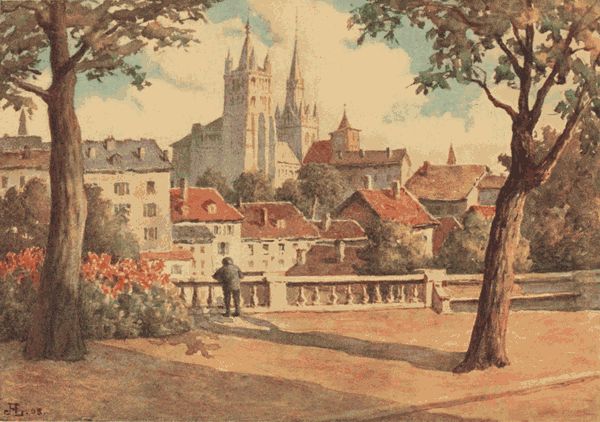
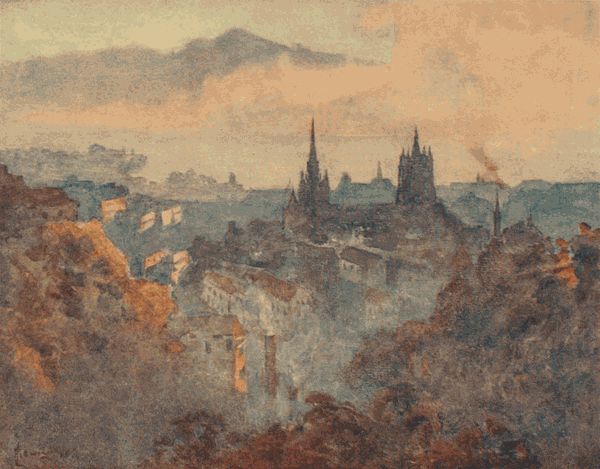
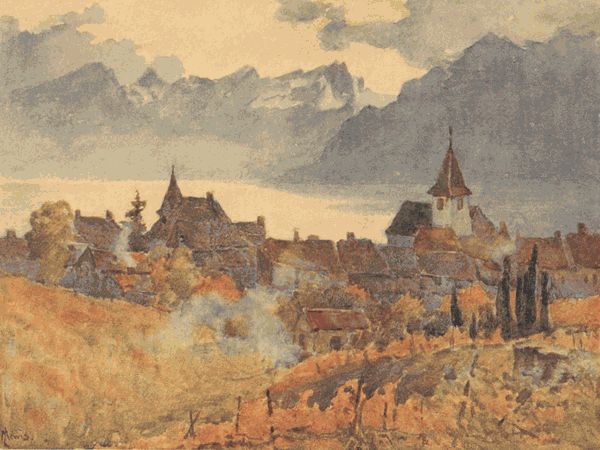
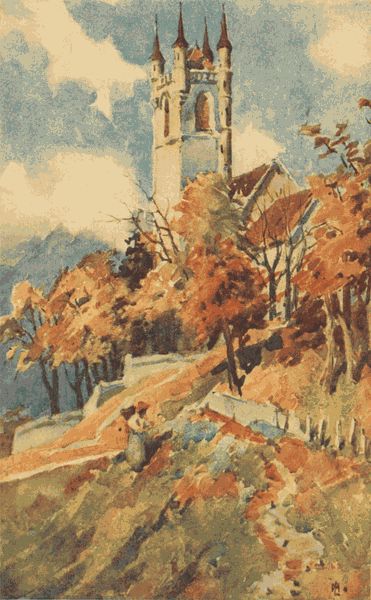
THE SPIRES OF ST. FRANÇOIS,
LAUSANNE
Visiting Lausanne, she extended the circle of her
admirers. Her bright intelligence enabled her to
shine as a member of a certain Société du Printemps,
and also of a certain Académie des Eaux—a debating
club given to the discussion of such problems as
'Does an element of mystery really make love more
agreeable?' or 'Can there be friendship between a
man and a woman in the same sense as between
two women or two men?' Her conduct in this
connection was such that her friends warned her
that her desire to make herself agreeable to young
men was too clearly advertised; but it does not
appear that the warning made any impression on
her. At all events, she was very successful in
making herself agreeable to Gibbon, then a lad
about eighteen years of age. 'Saw Mademoiselle
Curchod. Omnia vincit amor, et nos cedamus
amori,' is one of the early entries in his diary; and
we have a picture of Gibbon, at about the same
date, from Mademoiselle Curchod's own pen. In
middle age—as we can see from his portraits—he
was an ugly, ungainly, podgy little man; but it
is not thus that he appears in the portrait drawn
by the woman who loved him.
'He has beautiful hair,' Mademoiselle Curchod
writes, 'a pretty hand, and the air of a man of
rank. His face is so intellectual and strange that
I know no one like him. It has so much expression
that one is always finding something new
in it. His gestures are so appropriate that they
add much to his speech. In a word, he has one
of those extraordinary faces that one never tires
of trying to depict. He knows the respect that
is due to women. His courtesy is easy without
verging on familiarity. He dances moderately
well.'
So these two naturally—and rightly and properly—fell
in love; they must have seemed each other's
ideal complements, if ever lovers were. But they
were not to marry. The story of their attachment,
their separation, and their subsequent Platonic
friendship is one of the romances of literature.
Gibbon himself has told the story in one of the
most frequently quoted passages of his autobiography.
His version of it is inexact and misleading;
but it must be quoted, if only in order that
it may be criticized:
'I need not blush,' he writes, 'at recollecting the
object of my choice; and though my love was disappointed
of success, I am rather proud that I was
once capable of feeling such a pure and exalted
sentiment. The personal attractions of Mademoiselle
Susan Curchod were embellished by the
virtues and talents of the mind. Her fortune was
humble, but her family was respectable. Her
mother, a native of France, had preferred her
religion to her country. The profession of her
father did not extinguish the moderation and
philosophy of his temper, and he lived content with
a small salary and laborious duty in the obscure
lot of minister of Crassy, in the mountains that
separate the Pays de Vaud from the county of
Burgundy. In the solitude of a sequestered village
he bestowed a liberal, and even learned, education
on his only daughter. She surpassed his hopes by
her proficiency in the sciences and languages; and
in her short visits to some relations at Lausanne,
the wit, the beauty, and erudition of Mademoiselle
Curchod were the theme of universal applause. The
report of such a prodigy awakened my curiosity;
I saw and loved. I found her learned without
pedantry, lively in conversation, pure in sentiment,
and elegant in manners; and the first sudden
emotion was fortified by the habits and knowledge
of a more familiar acquaintance. She permitted
me to make two or three visits at her father's house.
I passed some happy days there, in the mountains
of Burgundy, and her parents honourably encouraged
the connection. In a calm retirement the gay
vanity of youth no longer fluttered in her bosom,
and I might presume to hope that I had made
some impression on a virtuous heart. At Crassy
and Lausanne I indulged my dream of felicity;
but on my return to England I soon discovered
that my father would not hear of this strange
alliance, and that, without his consent, I was myself
destitute and helpless. After a painful struggle
I yielded to my fate; I sighed as a lover, I
obeyed as a son; my wound was insensibly healed
by time, absence, and the habits of a new life. My
cure was accelerated by a faithful report of the
tranquillity and cheerfulness of the lady herself,
and my love subsided in friendship and esteem.'
Such is Gibbon's story, which is also the accepted
story. It is, perhaps, a palliation of its inaccuracies
that, at the time when he wrote it down, he and
Mademoiselle Curchod—then Madame Necker—were
on such pleasant terms of friendship that
neither of them cared to remember or be reminded
that either had ever treated the other badly. We
shall come to that matter presently; here it is
proper that the inaccuracies should be noted.
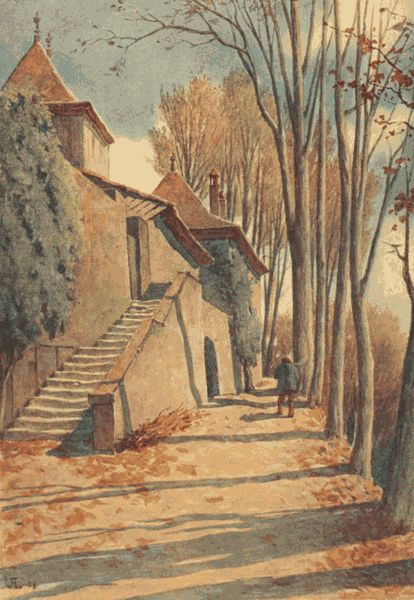
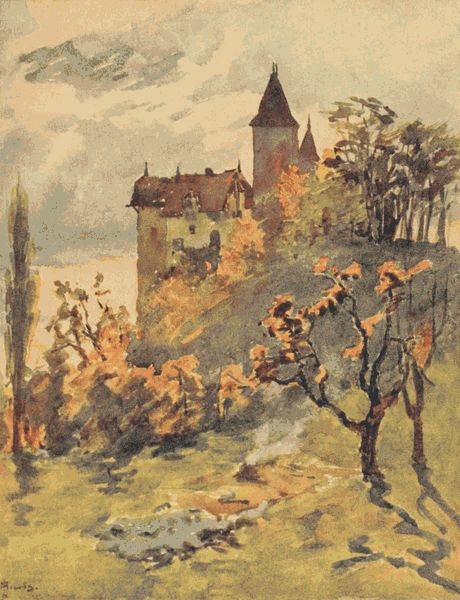
CHÂTEAU DE PRANGINS
The Steps by which Joseph Buonaparte
escaped in 1815
Gibbon's story, it will be observed, gives us the
impression that, on getting home, he lost no time
in opening his heart to his father, and, having
done this, lost no further time in acquainting
Mademoiselle Curchod with his father's views.
M. d'Haussonville tells us that he left Lausanne
in 1758, kept Mademoiselle Curchod waiting four
years for a letter,[3] and then in 1762 sat down and
wrote, breaking off the engagement. One shrinks
from the attempt to picture the feelings of the poor
girl who, after enduring suspense, and trying to
frame excuses for silence, broke the seal of the
long-expected missive, only to read:
'I do not know how to begin this letter. Yet
begin it I must. I take up my pen, I drop it, I
resume it. This commencement shows you what
it is that I am about to say. Spare me the rest.
Yes, Mademoiselle, I must renounce you for ever.
The sentence is passed; my heart laments it; but,
in the presence of my duty, every other consideration
must be silent....
'My father spoke of the cruelty of deserting him,
and of sending him prematurely to his grave, of
the cowardice of trampling underfoot my duty to
my country. I withdrew to my room and remained
there for two hours. I will not attempt to picture
to you my state of mind. But I left my room to
tell my father that I agreed to sacrifice to him the
happiness of my life.
'Mademoiselle, may you be happier than I can
ever hope to be! This will always be my prayer;
this will even be my consolation.... Assure
M. and Madame Curchod of my respect, my
esteem, and my regrets. Good-bye. I shall
always remember Mademoiselle Curchod as the
most worthy, the most charming, of women. May
she not entirely forget a man who does not deserve
the despair to which he is a prey.'
Even this, however, was not the end of the
story, though one would think it was if one had
only Gibbon's narrative to go by. In 1763 he
revisited Lausanne, and his own story of his
sojourn does not so much as mention Mademoiselle
Curchod's name. One would gather from it either
that he did not see her, or that love had already on
both sides 'subsided in friendship and esteem.'
But when the Vicomte d'Haussonville was given
access to the archives of the Necker family, he
found letters proving that this was not by any
means the case.
Mademoiselle Curchod's father was then dead,
and she was living at Geneva, supporting her
mother by teaching. Some of her friends—notably
Pastor Moultou—tried to bring Gibbon to a sense
of the obligations which they felt he owed to
her. Rousseau was brought into the business,
and expressed an opinion which led Gibbon to
retort, 'That extraordinary man, whom I admire
and pity, should have been less precipitate in condemning
the moral character and conduct of a
stranger.' It is useless, however, to try to piece
the whole story together—the materials are inadequate.
One can only take the letters which the
Vicomte d'Haussonville has published, and which,
as he points out, are by no means the whole of the
correspondence, and see what sidelights they throw
upon it.
First we have one of Mademoiselle Curchod's
letters. Whether she wrote it because she had
met Gibbon and found his manner towards her
changed, or was perplexed and troubled because he
had not sought a meeting, we have no means of
knowing. But it is quite clear that she wrote it
under the sense of having been treated badly.
'For five years,' she writes, 'I have, by my
unique and, indeed, inconceivable behaviour, done
sacrifice to this chimera. At last my heart,
romantic as it is, has been convinced of my mistake.
I ask you, on my knees, to dissuade me
from my madness in loving you. Subscribe the
full confession of your indifference, and my soul
will adapt itself to the changed conditions; certainty
will bring me the tranquillity for which I
sigh. You will be the most contemptible of men
if you refuse to be frank with me. God will
punish you, in spite of my prayers, if there is the
least hypocrisy in your reply.'
The reply is lost. Mademoiselle Curchod
presumably destroyed it because it pained her.
Apparently it contained a proposal of Platonic
friendship as a substitute for love. At all events,
Mademoiselle Curchod's answer seems to accept
that situation, whether with ulterior designs or not,
for it begins:
'What is fortune to me? Besides, it is not to
you that I have sacrificed it, but to an imaginary
being which will never exist elsewhere than in a
silly, romantic head like mine. From the moment
when your letter disillusioned me, you resumed
your place, in my eyes, on the same footing as
other men; and, after being the only man whom I
could love, you have become one of those to whom
I feel the least drawn, because you are the one
that bears the least resemblance to my chimerical
ideal.... Follow out the plan that you propose,
place your attachment for me on the same footing
as that of my other friends, and you will find me
as confiding, as tender, and, at the same time, as
indifferent as I am to them.'
And the writer proceeds to take up the Platonic
position at once, to criticize Gibbon's first essay in
literature, to offer him useful introductions, and
to ask him to advise her whether she would be
likely to be well treated if she took a situation as
'lady companion' in England.
Even in this Platonic correspondence, however,
Gibbon, with a prudence beyond his years, seems
to have scented danger.
'Mademoiselle,' he wrote, 'must you be for ever
pressing upon me a happiness which sound reason
compels me to decline? I have forfeited your love.
Your friendship is left to me, and it bestows so
much honour upon me that I cannot hesitate. I
accept it, mademoiselle, as a precious offering in
exchange for my own friendship, which is already
yours, and as a blessing of which I know the value
too well to be disposed to lose it.
'But this correspondence, mademoiselle, I am
sensible of the pleasures which it brings me, but, at
the same time, I am conscious of its dangers. I
feel the dangers that it has for me; I fear the
dangers that it may have for both of us. Permit
me to avoid those dangers by my silence. Forgive
my fears, mademoiselle; they have their origin
in my esteem for you.'
And he proceeded to answer her questions concerning
the position and prospects of 'lady companions'
in England, expecting, no doubt, that he
would hear no more from her.
Even then, however, the story was not ended.
The most passionate of Mademoiselle Curchod's
letters bears a later date. It is the letter of a
woman who feels that she has been treated shamefully.
If it were not that Mademoiselle Curchod
made a happy marriage so very soon afterwards, one
would also say that it was the letter of a woman
whose heart was broken. One gathers from it that,
while Mademoiselle Curchod appreciated Gibbon's
difficulty in marrying her while he was dependent
upon his father, she was willing to wait for him
until his father's death should leave him free to
follow the impulse of his heart. In the meantime
she reproaches him for having caused her to reject
other offers of marriage, and protests that it is not
true, whatever calumnious gossips may have said,
that, in Gibbon's absence, she has flirted with other
men. Above all, she protests that she has not
flirted with Gibbon's great friend, M. Deyverdun.
Her last words are:
'I am treating you as an honest man of the
world, who is incapable of breaking his promise, of
seduction, or of treachery, but who has, instead of
that, amused himself in racking my heart with
tortures, well prepared, and well carried into effect.
I will not threaten you, therefore, with the wrath
of heaven—the expression that escaped from me in
my first emotion. But I assure you, without laying
any claim to the gift of prophecy, that you will one
day regret the irreparable loss that you have
incurred in alienating for ever the too frank and
tender heart of
'S. C.'
The rest is silence; and the presumption is
strong that these were actually the last words
which sealed the estrangement. If it were not
for Mademoiselle Curchod's subsequent attitude
towards him, one would be bound to say that
Gibbon behaved abominably. But, as we shall
see presently, her resentment was not enduring.
Perhaps she was aware of extenuating circumstances
that we do not know of. Perhaps, in her heart of
hearts, she was conscious of having spread her net
to catch a husband who then seemed a very brilliant
match to the daughter of the country clergyman.
The letter of the friend who begged her not to
advertise so clearly her desire to make herself
agreeable to men would certainly lend some colour
to the suggestion. At any rate, since she herself
forgave Gibbon, it seems unfair for anyone else to
press the case against him.
It was nearly twenty years later—in 1783—that
Gibbon decided to make Lausanne his home.
A good deal of water had flowed under the bridge
in the meantime. He had written, and published,
half of his History; and that half had sufficed to
make him famous. He had been an officer in the
militia and a Member of Parliament. He had been
a constant figure in fashionable society, and an
occasional figure in literary society; a fellow-member
with Charles James Fox of Boodle's,
White's, and Brooks's; a fellow-member of the
Literary Club with Johnson, Burke, Adam Smith,
Oliver Goldsmith, Sir Joshua Reynolds, and Sir
Joseph Banks. He had held office in the department
of the Board of Trade, and lost it at the time
of the coalition between Fox and North. His
applications for employment in the Diplomatic
Service—whether as Secretary to the Embassy at
Paris or as Minister Plenipotentiary at Berne—had
been politely rejected. And he had become a
middle-aged bachelor whose income, unless supplemented
by the emoluments of some public office,
hardly sufficed for the demands of his social
position.
In these circumstances it occurred to him to
propose to his friend, M. Deyverdun—the same
M. Deyverdun with whom Mademoiselle Curchod
vowed that she had never flirted—that they should
keep house together at Lausanne. M. Deyverdun,
who was like himself a confirmed bachelor of
moderate means, and had a larger house than he
wanted, was delighted with the proposal. All
Gibbon's friends and relatives told him that he was
making a fool of himself; but he knew better. He
sold all his property, except his library, and 'bade
a long farewell to the fumum et opes strepitumque
Romæ.' His first winter, as he puts it in his
delightful style, 'was given to a general embrace
without nice discrimination of persons and characters.'
The comprehensive embrace completed,
he settled down to work.
His life at Lausanne is faithfully mirrored in his
letters, more particularly in his letters to Lord
Sheffield. It was at once a luxurious and an industrious
life. One fact which stands out clearly is
that Gibbon took no exercise. He boasts that, in
a period of five years, he never moved five miles
from Lausanne; he apologizes for a corpulence
which makes it absolutely impossible for him to
cross the Great Saint Bernard; he admits that, when
he entertained Mr. Fox, he did not go for walks
with that statesman, but hired a guide to do so on
his behalf. He also drank a great deal of Madeira
and Malvoisie. His letters to Lord Sheffield are
full of appeals for pipes of these exhilarating
beverages. He declares that they are necessary for
the preservation of his health, and appears to have
persuaded himself that they were good for gout.
The consequence was that he had several severe
attacks of that distressing malady.
Gout or no gout, however, he freely enjoyed the
relaxation of social intercourse. He was never
tired of pointing out to his correspondents that,
whereas in London he was nobody in particular, in
Lausanne he was a leader of society. His position
there was, in fact, similar in many ways to that
of Voltaire at Geneva; though he differed from
Voltaire in always keeping on good terms with
all his neighbours. To be invited to his parties
was no less a mark of distinction than it had been,
a generation earlier, to be invited to the philosopher's
parties at Ferney. One of the letters tells us how
he gave a ball, and stole away to bed at 2 a.m.,
leaving the young people, his guests, to keep it up
till after sunrise. He also gave frequent dinners,
and still more frequent card-parties. When the
gout was very bad, he gave card-parties in his bedroom.
Distinguished strangers often came to see him,
and gave Lausanne the tone of a fashionable resort.
'You talk of Lausanne,' he writes, 'as a place of
retirement, yet, from the situation and freedom of
the Pays de Vaud, all nations, and all extraordinary
characters are astonished to meet each other.
The Abbé Raynal, the great Gibbon, and Mercier,
author of the "Tableau de Paris," have been in the
same room. The other day the Prince and Princesse
de Ligne, the Duke and Duchess d'Ursel, etc.,
came from Brussels on purpose to act a comedy.'
And again: 'A few weeks ago, as I was walking
on our terrace with M. Tissot, the celebrated
physician; M. Mercier, the author of the "Tableau
de Paris"; the Abbé Raynal; Monsieur, Madame,
and Mademoiselle Necker; the Abbé de Bourbon,
a natural son of Lewis the Fifteenth; the Hereditary
Prince of Brunswick, Prince Henry of Prussia,
and a dozen Counts, Barons, and extraordinary
persons,' etc.
From time to time he faced the question whether
it would be well to marry. Madame Necker dissuaded
him from the adventure on the ground that
in order to marry happily it is necessary to marry
young. It is not certain that her advice was disinterested,
but it was good advice to give to a man
who, after expressing his readiness to adopt 'some
expedient, even the most desperate, to secure the
domestic society of a female companion,' summed
up his sentiments upon the subject in this candid
language:
'I am not in love with any of the hyænas of
Lausanne, though there are some who keep their
claws tolerably well pared. Sometimes, in a solitary
mood, I have fancied myself married to one or
another of those whose society and conversation
are the most pleasing to me; but when I have
painted in my fancy all the probable consequences
of such a union, I have started from my dream,
rejoiced in my escape, and ejaculated a thanksgiving
that I was still in possession of my natural
freedom.'
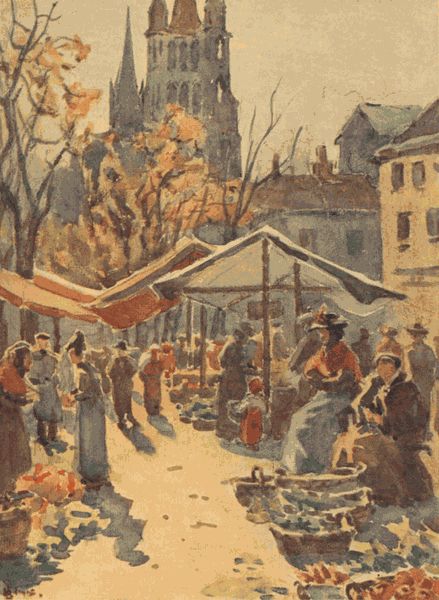
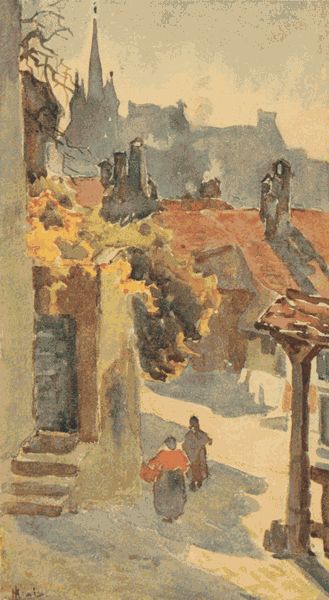
THE MARKET-PLACE, LAUSANNE
This, however, was not written until after the
History was finished. Gibbon never felt the need
of a female companion so long as he had his work
to occupy him. The fact that he began to feel it
acutely as soon as ever the work was done gives an
added pathos to this, the most famous and the most
frequently quoted passage of his memoirs:
'I have presumed to mark the moment of conception:
I shall now commemorate the hour of
my final deliverance. It was on the day, or rather
night, of the 27th of June, 1787, between the hours
of eleven and twelve, that I wrote the last lines
of the last page, in a summer-house in my garden.
After laying down my pen, I took several turns
in a berceau, or covered walk of acacias, which commands
a prospect of the country, the lake, and the
mountains. The air was temperate, the sky was
serene, the silver orb of the moon was reflected
from the waters, and all Nature was silent. I will
not dissemble the first emotions on the recovery of
my freedom, and, perhaps, the establishment of
my fame. But my pride was soon humbled, and a
sober melancholy was spread over my mind by the
idea that I had taken an everlasting leave of an old
and agreeable companion, and that whatsoever
might be the future fate of my History, the life of
the historian must be short and precarious.'
The life of the historian was, in fact, destined to
last only for another six years—years in which he
sometimes was desperately anxious to relieve his
loneliness, aggravated by the death of Deyverdun,
by seeking 'the domestic society of a female companion,'
but inclined, on the whole, to the opinion
encouraged by Madame Necker, that the remedy
would be worse than the disease. We probably
shall not be wrong in conjecturing that the pleasure
which he derived from Madame Necker's correspondence
and society assisted him in coming to
this decision. At any rate, we must admit that
there are few literary romances more remarkable
than this story, of the renewal of love some thirty
years or so after a lovers' quarrel.
The lovers parted, as we have seen, with high-strung
feelings—at least upon the lady's side. They
met again soon after Mademoiselle Curchod had
accepted the heart and hand of Jacques Necker,
the rich Parisian banker, destined to become
Louis XVI.'s Minister of Finance. Gibbon, coming
to Paris, called, and was well received. We have
accounts of the visit from both of them. Madame
Necker says that her vanity was flattered because
Gibbon appeared to be dazzled by the contemplation
of her wealth. Gibbon complains that he was
not taken very seriously, that M. Necker invited
him to supper every evening, and went to bed,
leaving him alone with his wife. The philosopher
Balzac would have called him a fool, and classed
him with the prédestinés; but it does not appear
that scandal, or occasion for scandal, or anything
worse than the interchange of sentimental persiflage,
resulted.
A gap in the history of their friendship follows,
but in 1776 we find the Neckers visiting Gibbon in
Bentinck Street. Gibbon writes patronizingly of
the husband as 'a sensible, good-natured creature,'
and of the wife he says: 'I live with her just as I
used to do twenty years ago, laugh at her Paris
varnish, and oblige her to become a simple, reasonable
Suissesse.'
We need not interpret this statement au pied de
la lettre, but the visit certainly marks a stage in the
story of their intimacy. Gibbon went to see the
Neckers in Paris in the following year, and after
his return to London Madame du Deffand told
him how she had talked to Madame Necker about
him. 'We talked of M. Gibbon. Of what else?
Of M. Gibbon—continually of M. Gibbon.' And
Madame Necker herself wrote, at about the same
time, with reference to the publication of the first
volumes of 'The Decline and Fall':
'Wherever I go your books shall follow me, and
give me pleasure and happiness. If you write, too,
your letters will be welcome and appreciated. If
you do not write ... but I refuse to contemplate
this painful possibility.'
Gibbon's migration to Lausanne and the Neckers'
purchase of their famous country seat at Coppet
united them by still closer ties, and one cannot
help noticing that at this period of their lives—when
they were both something over fifty years of
age—Madame Necker's letters to Gibbon became
at once more frequent and more affectionate.
Some of those letters, indeed, can only be distinguished
from love-letters by reading into them our
knowledge of Madame Necker's reputation for
propriety. We have seen her dissuading Gibbon
from marriage on the ground that to marry late is
to marry unhappily. Another reason which she
gives is that 'without a miracle it would be impossible
to find a woman worthy of you.' Of a contemplated
visit to Lausanne she says: 'I am looking
forward with a delightful sentiment to the day I
am to pass with you.' And afterwards:
'Returning here, and finding only the tombs of
those I loved so well, I found you, as it were, a
solitary tree whose shade still covers the desert
which separates me from the first years of my
life.'
And in another letter, more sentimental still, we
read:
'Come back to us when you are free. The
moment of your leisure ought always to belong to
her who has been your first love and your last. I
cannot make up my mind which of these titles is
the sweeter and the dearer to my heart.'
What are we to make of it all? Nothing,
assuredly, that entitles us to cast a stone at
Madame Necker, or to express for her husband a
pity which he never felt for himself. Yet one
imagines that after M. Necker, who kept such early
hours, had retired to his well-earned repose, there
must sometimes have been certain sentimental
communings, in which the old note of persiflage
was no longer to be heard. One listens in fancy to
the regrets of these two who never forgot that they
had once been lovers—regrets, no doubt, not openly
expressed, but only coyly hinted—for the things
that might have been.
The regrets, we may take it, were tempered by
the lurking consciousness that things were really
better as they were. The lovers must have known
that, if they had married on nothing a year, the
one would never have written his history and the
other would never have had her salon, but they
would have been two struggling nonentities whom
the world would never have heard of. They must
have felt, too, that the success in life which they
had achieved separately, but could not possibly
have achieved together, had meant much to them:
that in winning it they had fulfilled their destinies;
that their tempers would have soured if they had
had to live without it. All this they must have
admitted to themselves, and even in their most
candid moments, to each other. And yet—and
yet——
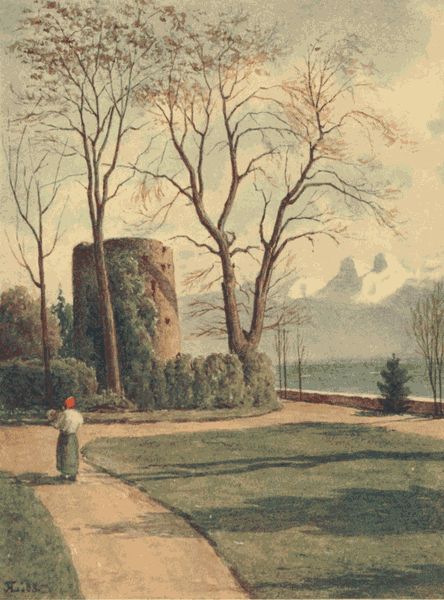
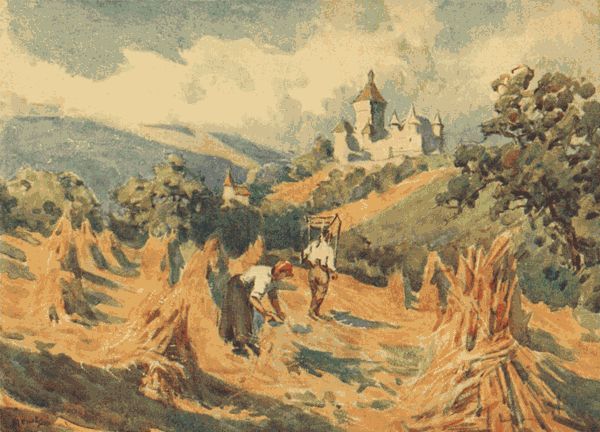
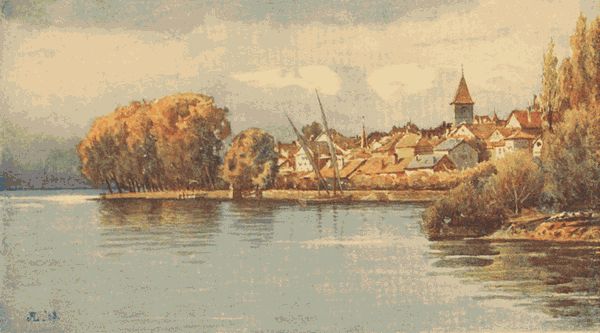
LA TOUR DE HALDIMAND, OUCHY,
LAUSANNE