What is Latin?
If you will look at the map of Italy on the opposite page, you will find
near the middle of the peninsula and facing the west coast a district
called Latium,1 and Rome its capital. The
Latin language, meaning the language of Latium, was spoken by the
ancient Romans and other inhabitants of Latium, and Latin was the name
applied to it after the armies of Rome had carried the knowledge of her
language far beyond its original boundaries. As the English of to-day is
not quite the same as that spoken two or three hundred years ago, so
Latin was not always the same at all times, but changed more or less in
the course of centuries. The sort of Latin you are going to learn was in
use about two thousand years ago. And that period has been selected
because the language was then at its best and the greatest works of
Roman literature were being produced. This period, because of its
supreme excellence, is called the Golden Age of Roman letters.
The Spread of Latin.
For some centuries after Rome was founded, the Romans were a feeble and
insignificant people, their territory was limited to Latium, and their
existence constantly threatened by warlike neighbors. But after the
third century before Christ, Rome’s power grew rapidly. She conquered
all Italy, then reached out for the lands across the sea and beyond the
Alps, and finally ruled over the whole ancient world. The empire thus
established lasted for more than four
hundred years. The importance of Latin increased with the growth of
Roman power, and what had been a dialect spoken by a single tribe became
the universal language. Gradually the language changed somewhat,
developing differently in different countries. In Italy it has become
Italian, in Spain Spanish, and in France French. All these nations,
therefore, are speaking a modernized form of Latin.
The Romans and the Greeks.
In their career of conquest the Romans came into conflict with the
Greeks. The Greeks were inferior to the Romans in military power, but
far superior to them in culture. They excelled in art, literature,
music, science, and philosophy. Of all these pursuits the Romans were
ignorant until contact with Greece revealed to them the value of
education and filled them with the thirst for knowledge. And so it came
about that while Rome conquered Greece by force of arms, Greece
conquered Rome by force of her intellectual superiority and became her
schoolmaster. It was soon the established custom for young Romans to go
to Athens and to other centers of Greek learning to finish their
training, and the knowledge of the Greek language among the educated
classes became universal. At the same time many cultured
Greeks—poets, artists, orators, and philosophers—flocked to
Rome, opened schools, and taught their arts. Indeed, the preëminence of
Greek culture became so great that Rome almost lost her ambition to be
original, and her writers vied with each other in their efforts to
reproduce in Latin what was choicest in Greek literature. As a
consequence of all this, the civilization and national life of Rome
became largely Grecian, and to Greece she owed her literature and her art.
Rome and the Modern World.
After conquering the world, Rome impressed her language, laws, customs
of living, and modes of thinking upon the subject nations, and they
became Roman; and the world has remained largely Roman ever since. Latin
continued to live, and the knowledge of Latin was the only light of
learning that burned steadily through the dark ages that followed the
downfall of the Roman Empire. Latin was the common language of scholars
and remained so even down to the days of Shakespeare. Even yet it is
more nearly than any other tongue the universal language of the learned.
The life of to-day is much nearer the life of ancient Rome than the
lapse of centuries would lead one to suppose. You and I are Romans still
in many ways, and if Cæsar and Cicero should appear among us, we should
not find them, except for dress and language, much unlike men of
to-day.
Latin and English.
Do you know that more than half of the words in the English dictionary
are Latin, and that you are speaking more or less Latin every day? How
has this come about? In the year 1066 William the Conqueror invaded
England with an army of Normans. The Normans spoke French—which,
you remember, is descended from Latin—and spread their language to
a considerable extent over England, and so Norman-French played an
important part in the formation of English and forms a large proportion
of our vocabulary. Furthermore, great numbers of almost pure Latin words
have been brought into English through the writings of scholars, and
every new scientific discovery is marked by the addition of new terms of
Latin derivation. Hence, while the simpler and commoner words of our
mother tongue are Anglo-Saxon, and Anglo-Saxon forms the staple of our
colloquial language, yet in the realms of literature, and especially in
poetry, words of Latin derivation are very abundant. Also in the learned
professions, as in law, medicine, and engineering, a knowledge of Latin
is necessary for the successful interpretation of technical and
scientific terms.
Why study Latin?
The foregoing paragraphs make it clear why Latin forms so important a
part of modern education. We have seen that our civilization rests upon
that of Greece and Rome, and that we must look to the past if we would
understand the present. It is obvious, too, that the knowledge of Latin
not only leads to a more exact and effective use of our own language,
but that it is of vital importance and of great practical value to any
one preparing for a literary or professional career. To this it may be
added that the study of Latin throws a flood of light upon the structure
of language in general and lays an excellent foundation for all
grammatical study.
Finally, it has been abundantly proved that there is no more effective
means of strengthening the mind than by the earnest pursuit of this
branch of learning.
Review Questions.
Whence does Latin get its name? Where is Latium? Where is Rome? Was
Latin always the same? What sort of Latin are we to study? Describe the
growth of Rome’s power and the spread of Latin. What can you say of the
origin of Italian, French, and Spanish? How did the ancient Greeks and
Romans compare? How did Greece influence Rome? How did Rome influence
the world? In what sense are we Romans still? What did Latin have to do
with the formation of English? What proportion of English words are of
Latin origin, and what kind of words are they? Why should we study
Latin?
THE ALPHABET
1.
The Latin alphabet contains the same letters as the English except that
it has no w and no j.
2.
The vowels, as in English, are a, e, i, o, u, y. The other
letters are consonants.
3.
I is used both as a vowel and as a consonant. Before a vowel in
the same syllable it has the value of a consonant and is called I
consonant.
Thus in Iū-li-us the first i is a consonant, the second a
vowel.
SOUNDS OF THE LETTERS1
4.
Latin was not pronounced like English. The Romans at the beginning of
the Christian era pronounced their language substantially as described
below.
5.
The vowels have the following sounds:
| Vowels2 |
Latin Examples |
|
ā as in father
ă like the first a in aha´, never as in hat
|
hāc, stās
ă´-măt, că-nās
|
ē as in they
ĕ as in met
|
tē´-lă, mē´-tă
tĕ´-nĕt, mĕr´-cēs
|
ī as in machine
ĭ as in bit
|
sĕr´-tī, prā´-tī
sĭ´-tĭs, bĭ´-bī
|
ō as in holy
ŏ as in wholly, never as in hot
|
Rō´-mă, ō´-rĭs
mŏ´-dŏ, bŏ´-nōs
|
|
ū as in rude, or as oo in boot
ŭ as in full, or as oo in foot
|
ū´-mŏr, tū´-bĕr
ŭt, tū´-tŭs
|
Note. It is to be observed that there
is a decided difference in sound, except in the case of a,
between the long and the short vowels. It is not merely a matter of
quantity but also of quality.
6.
In diphthongs (two-vowel sounds) both vowels are heard in a
single syllable.
| Diphthongs |
Latin Examples |
ae as ai in aisle
au as ou in out
|
tae´-dae
gau´-dĕt
|
|
ei as ei in eight
eu as ĕ´o͝o (a short e followed by a short u
in one syllable)
|
dein´-dĕ
seu
|
|
oe like oi in toil
ui like o͝o´ĭ (a short u followed by a short
i in one syllable. Cf. English we)
|
foe´-dŭs
cui, huic
|
Note. Give all the vowels and
diphthongs their proper sounds and do not slur over them in unaccented
syllables, as is done in English.
7.
Consonants are pronounced as in English, except that
| Consonants |
Latin Examples |
|
c is always like c in cat, never as in
cent
g is always like g in get, never as in
gem
i consonant is always like y in yes
n before c, qu, or g is like ng in
sing (compare the sound of n in anchor)
|
că´-dō, cĭ´-bŭs, cē´-nă
gĕ´-mō, gĭg´-nō
iăm, iŏ´-cŭs
ăn´-cŏ-ră (ang´-ko-ra)
|
|
qu, gu, and sometimes su before a vowel have the
sound of qw, gw, and sw. Here u has the value of
consonant v and is not counted a vowel
|
ĭn´-quĭt, quī, lĭn´-guă, săn´-guĭs, suā´-dĕ-ō
|
|
s is like s in sea, never as in ease
t is always like t in native, never as in
nation
|
rŏ´-să, ĭs
ră´-tĭ-ō, nā´-tĭ-ō
|
|
v is like w in wine, never as in vine
x has the value of two consonants (cs or gs) and is
like x in extract, not as in exact
|
vī´-nŭm, vĭr
ĕx´-trā, ĕx-āc´-tŭs
|
|
bs is like ps and bt like pt
ch, ph, and th are like c, p,
t
|
ŭrbs, ŏb-tĭ´-nĕ-ō
pŭl´-chĕr, Phoe´-bē, thĕ-ā´-trŭm
|
a. In combinations of consonants give each its distinct sound.
Doubled consonants should be pronounced with a slight pause between the
two sounds. Thus pronounce tt as in rat-trap, not as in
rattle; pp as in hop-pole, not as in upper.
Examples, mĭt´-tō, Ăp´pĭ-ŭs, bĕl´-lŭm.
SYLLABLES
8.
A Latin word has as many syllables as it has vowels and diphthongs. Thus
aes-tā´-tĕ has three syllables, au-dĭ-ĕn´-dŭs has
four.
a. Two vowels with a consonant between them never make one
syllable, as is so often the case in English. Compare English
inside with Latin īn-sī´-dĕ.
9.
Words are divided into syllables as follows:
1. A single consonant between two vowels goes with the second. Thus
ă-mā´-bĭ-lĭs, mĕ-mŏ´-rĭ-ă, ĭn-tĕ´-rĕ-ā,
ă´-bĕst, pĕ-rē´-gĭt.3
2. Combinations of two or more consonants:
a. A consonant followed by l or r goes with the
l or r. Thus pū´-blĭ-cŭs, ă´-grī.
Exception. Prepositional compounds of
this nature, as also ll and rr, follow rule b. Thus
ăb´-lŭ-ō, ăb-rŭm´-pō, ĭl´-lĕ, fĕr´-rŭm.
b. In all other combinations of consonants the first consonant
goes with the preceding vowel.4 Thus
măg´-nŭs, ĕ-gĕs´-tās, vĭc-tō´-rĭ-ă,
hŏs´-pĕs, ăn´-nŭs, sŭ-bāc´-tŭs.
3. The last syllable of a word is called the ul´-ti-ma; the
one next to the last, the pe-nult´; the one before the penult,
the an´-te-pe-nult´.
10.
EXERCISE
Divide the words in the following passage into syllables and
pronounce them, placing the accent as indicated:
Vā́dĕ ăd fŏrmī́căm, Ō pĭ́gĕr, ĕt cōnsī́dĕrā vĭ́ās ĕ́iŭs ĕt dĭ́scĕ
săpĭĕ́ntĭăm: quae cŭm nōn hắbĕăt dŭ́cĕm nĕc praecĕptṓrĕm nĕc
prī́ncĭpĕm, pắrăt ĭn aestā́tĕ cĭ́bŭm sĭ́bĭ ĕt cŏ́ngrĕgăt ĭn mĕ́ssĕ quŏd
cŏ́mĕdăt.
[Go to the ant, thou sluggard; consider her ways, and be wise: which,
having no guide, overseer, or ruler, provideth her meat in the summer
and gathereth her food in the harvest.]
QUANTITY
11.
The quantity of a vowel or a syllable is the time it takes to pronounce
it. Correct pronunciation and accent depend upon the proper observance
of quantity.
12.
Quantity of Vowels. Vowels are either long (¯) or short (˘). In
this book the long vowels are marked. Unmarked vowels are to be
considered short.
1. A vowel is short before another vowel or h; as
pŏ-ē´-ta, tră´-hō.
2. A vowel is short before nt and nd, before final
m or t, and, except in words of one syllable, before final
l or r. Thus a´-mănt, a-măn´-dus,
a-mā´-băm, a-mā´-băt, a´-ni-măl, a´-mŏr.
3. A vowel is long before nf, ns, nx, and
nct. Thus īn´-fe-rō, re´-gēns, sān´-xī,
sānc´-tus.
4. Diphthongs are always long, and are not marked.
13.
Quantity of Syllables. Syllables are either long or short, and
their quantity must be carefully distinguished from that of vowels.
1. A syllable is short,
a. If it ends in a short vowel; as ă´-mō,
pĭ´-grĭ.
Note. In final syllables the short
vowel may be followed by a final consonant. Thus the word
mĕ-mŏ´-rĭ-ăm contains four short syllables. In the first three a
short vowel ends the syllable, in the last the short vowel is followed
by a final consonant.
2. A syllable is long,
a. If it contains a long vowel or a diphthong, as cū´-rō,
poe´-nae, aes-tā´-te.
b. If it ends in a consonant which is followed by another
consonant, as cor´-pus, mag´-nus.
Note. The vowel in a long syllable may
be either long or short, and should be pronounced accordingly. Thus in
ter´-ra, in´-ter, the first syllable is long, but the
vowel in each case is short and should be given the short sound. In
words like saxum the first syllable is long because x has
the value of two consonants (cs or gs).
3. In determining quantity h is not counted a consonant.
Note. Give about twice as much time to
the long syllables as to the short ones. It takes about as long to
pronounce a short vowel plus a consonant as it does to pronounce a long
vowel or a diphthong, and so these quantities are considered equally
long. For example, it takes about as long to say cŭr´-rō as it
does cū´-rō, and so each of these first syllables is long.
Compare mŏl´-lis and mō´-lis, ā-mĭs´-sī and
ā-mi´-sī.
ACCENT
14.
Words of two syllables are accented on the first, as mēn´-sa,
Cae´-sar.
15.
Words of more than two syllables are accented on the penult if the
penult is long. If the penult is short, accent the antepenult. Thus
mo-nē´-mus, re´-gi-tur, a-gri´-co-la,
a-man´-dus.
Note. Observe that the position of the
accent is determined by the length of the syllable and not by the
length of the vowel in the syllable. (Cf. § 13. 2, Note.)
16.
Certain little words called enclit´ics5 which have no separate existence, are added to and
pronounced with a preceding word. The most common are -que,
and; -ve, or; and -ne, the question sign.
The syllable before an enclitic takes the accent, regardless of its
quantity. Thus populus´que, dea´que, rēgna´ve,
audit´ne.
HOW TO READ LATIN
17.
To read Latin well is not so difficult, if you begin right. Correct
habits of reading should be formed now. Notice the quantities carefully,
especially the quantity of the penult, to insure your getting the accent
on the right syllable. (Cf. § 15.) Give
every vowel its proper sound and every syllable its proper length. Then
bear in mind that we should read Latin as we read English, in phrases
rather than in separate words. Group together words that are closely
connected in thought. No good reader halts at the end of each word.
18.
Read the stanzas of the following poem by Longfellow, one at a time,
first the English and then the Latin version. The syllables inclosed in
parentheses are to be slurred or omitted to secure smoothness of
meter.
EXCELSIOR [HIGHER]! 6
The shades of night were falling fast,
As through an Alpine village passed
A youth, who bore, ’mid snow and ice,
A banner with the strange device,
Excelsior!
|
Cadēbant noctis umbrae, dum
Ibat per vīcum Alpicum
Gelū nivequ(e) adolēscēns,
Vēxillum cum signō ferēns,
Excelsior!
|
His brow was sad; his eye beneath,
Flashed like a falchion from its sheath,
And like a silver clarion rung
The accents of that unknown tongue,
Excelsior!
|
Frōns trīstis, micat oculus
Velut ē vāgīnā gladius;
Sonantque similēs tubae
Accentūs lingu(ae) incognitae,
Excelsior!
|
In happy homes he saw the light
Of household fires gleam warm and bright;
Above, the spectral glaciers shone,
And from his lips escaped a groan,
Excelsior!
|
In domibus videt clārās
Focōrum lūcēs calidās;
Relucet glaciēs ācris,
Et rumpit gemitūs labrīs,
Excelsior!
|
“Try not the Pass!” the old man said;
“Dark lowers the tempest overhead,
The roaring torrent is deep and wide!”
And loud that clarion voice replied,
Excelsior!
|
Dīcit senex, “Nē trānseās!
Suprā nigrēscit tempestās;
Lātus et altus est torrēns.”
Clāra vēnit vōx respondēns,
Excelsior!
|
At break of day, as heavenward
The pious monks of Saint Bernard
Uttered the oft-repeated prayer,
A voice cried through the startled air,
Excelsior!
|
Iam lūcēscēbat, et frātrēs
Sānctī Bernardī vigilēs
Ōrābant precēs solitās,
Cum vōx clāmāvit per aurās,
Excelsior!
|
A traveler, by the faithful hound,
Half-buried in the snow was found,
Still grasping in his hand of ice
That banner with the strange device,
Excelsior!
|
Sēmi-sepultus viātor
Can(e) ā fīdō reperītur,
Comprēndēns pugnō gelidō
Illud vēxillum cum signō,
Excelsior!
|
There in the twilight cold and gray,
Lifeless, but beautiful, he lay,
And from the sky, serene and far,
A voice fell, like a falling star,
Excelsior!
|
Iacet corpus exanimum
Sed lūce frīgidā pulchrum;
Et caelō procul exiēns
Cadit vōx, ut Stella cadēns,
Excelsior!
|
FIRST PRINCIPLES
19.
Subject and Predicate. 1. Latin, like English, expresses thoughts
by means of sentences. A sentence is a combination of words that
expresses a thought, and in its simplest form is the statement of a
single fact. Thus,
Galba is a farmer
Galba est agricola
|
The sailor fights
Nauta pugnat
|
In each of these sentences there are two parts:
| Subject |
Galba
Galba
The sailor
Nauta
|
Predicate |
is a farmer
est agricola
fights
pugnat
|
2. The subject is that person, place, or thing about which something
is said, and is therefore a noun or some word which can serve the
same purpose.
a. Pronouns, as their name implies (pro, “instead of,” and
noun), often take the place of nouns, usually to save repeating
the same noun, as, Galba is a farmer; he is a sturdy
fellow.
3. The predicate is that which is said about the subject, and
consists of a verb with or without modifiers.
a. A verb is a word which asserts something (usually an act)
concerning a person, place, or thing.
20.
The Object. In the two sentences, The boy hit the ball and
The ball hit the boy, the same words are used, but the meaning is
different, and depends upon the order of the words. The doer of
the act, that about which something is said, is, as we have seen above,
the subject. That to which something is done is the
direct object of the verb. The boy hit the ball is
therefore analyzed as follows:
| Subject |
Predicate |
| The boy |
hit the ball
(verb) (direct object)
|
a. A verb whose action passes over to the object directly, as in
the sentence above, is called a transitive verb. A verb which
does not admit of a direct object is called intransitive, as,
I walk, he comes.
21.
The Copula. The verb to be in its different
forms—are, is, was, etc.—does not tell
us anything about the subject; neither does it govern an object. It
simply connects the subject with the word or words in the predicate that
possess a distinct meaning. Hence it is called the copula, that
is, the joiner or link.
22.
In the following sentences pronounce the Latin and name the nouns,
verbs, subjects, objects, predicates, copulas:
| 1. |
America est patria mea
America is fatherland my
|
| 2. |
Agricola fīliam amat
(The) farmer (his) daughter loves
|
| 3. |
Fīlia est Iūlia
(His) daughter is Julia
|
| 4. |
Iūlia et agricola sunt in īnsulā
Julia and (the) farmer are on (the) island
|
| 5. |
Iūlia aquam portat
Julia water carries
|
| 6. |
Rosam in comīs habet
(A) rose in (her) hair (she) has
|
| 7. |
Iūlia est puella pulchra
Julia is (a) girl pretty
|
| 8. |
Domina fīliam pulchram habet
(The) lady (a) daughter beautiful has
|
a. The sentences above show that Latin does not express some
words which are necessary in English. First of all, Latin has no
article the or a; thus agricola may mean
the farmer, a farmer, or simply farmer. Then, too, the
personal pronouns, I, you, he, she, etc., and the possessive
pronouns, my, your, his, her, etc., are not expressed if the
meaning of the sentence is clear without them.
FIRST PRINCIPLES (Continued)
23.
Inflection. Words may change their forms to indicate some change
in sense or use, as, is, are; was, were; who, whose, whom; farmer,
farmer’s; woman, women. This is called inflection. The
inflection of a noun, adjective, or pronoun is called its
declension, that of a verb its conjugation.
24.
Number. Latin, like English, has two numbers, singular and
plural. In English we usually form the plural by adding -s or
-es to the singular. So Latin changes the singular to the plural
by changing the ending of the word. Compare
Naut-a pugnat
The sailor fights
|
Naut-ae pugnant
The sailors fight
|
25.
Rule. Nouns that end in -a in
the singular end in -ae in the plural.
26.
Learn the following nouns so that you can give the English for the Latin
or the Latin for the English. Write the plural of each.
- agri´cola, farmer (agriculture)1
- aqua, water (aquarium)
- causa, cause, reason
- do´mina, lady of the house, mistress (dominate)
- filia, daughter (filial)
- fortū´na, fortune
|
- fuga, flight (fugitive)
- iniū´ria, wrong, injury
- lūna, moon (lunar)
- nauta, sailor (nautical)
- puel´la, girl
- silva, forest (silvan)
- terra, land (terrace)
|
27.
Compare again the sentences
Nauta pugna-t
The sailor fights
|
Nautae pugna-nt
The sailors fight
|
In the first sentence the verb pugna-t is in the third person
singular, in the second sentence pugna-nt is in the third person
plural.
28.
Rule. Agreement of Verb. A
finite verb must always be in the same person and number as its
subject.
29.
Rule. In the conjugation of the
Latin verb the third person singular active ends in -t, the third
person plural in -nt. The endings which show the person and
number of the verb are called personal endings.
30.
Learn the following verbs and write the plural of each. The personal
pronouns he, she, it, etc., which are necessary in
the inflection of the English verb, are not needed in the Latin, because
the personal endings take their place. Of course, if the verb’s subject
is expressed we do not translate the personal ending by a pronoun; thus
nauta pugnat is translated the sailor fights, not the
sailor he fights.
| ama-t |
he (she, it) |
loves, is loving, does love (amity, amiable) |
| labō´ra-t |
“ “ “ |
labors, is laboring, does labor |
| nūntia-t2 |
“ “ “ |
announces, is announcing, does announce |
| porta-t |
“ “ “ |
carries, is carrying, does carry (porter) |
| pugna-t |
“ “ “ |
fights, is fighting, does fight (pugnacious) |
31.
EXERCISES
I. 1. The daughter loves, the daughters love. 2. The sailor is
carrying, the sailors carry. 3. The farmer does labor, the farmers
labor. 4. The girl is announcing, the girls do announce.
5. The ladies are carrying, the lady carries.
II. 1. Nauta pugnat, nautae pugnant. 2. Puella amat, puellae
amant. 3. Agricola portat, agricolae portant. 4. Fīlia
labōrat, fīliae labōrant. 5. Nauta nūntiat, nautae nūntiant.
6. Dominae amant, domina amat.

DOMINA
FIRST PRINCIPLES (Continued)
32.
Declension of Nouns. We learned above (§§ 19, 20) the difference
between the subject and object, and that in English they may be
distinguished by the order of the words. Sometimes, however, the order
is such that we are left in doubt. For example, the sentence The lady
her daughter loves might mean either that the lady loves her
daughter, or that the daughter loves the lady.
1. If the sentence were in Latin, no doubt could arise, because the
subject and the object are distinguished, not by the order of the words,
but by the endings of the words themselves. Compare the following
sentences:
Domina fīliam amat
Fīliam domina amat
Amat fīliam domina
Domina amat fīliam
|
The lady loves her daughter
|
Fīlia dominam amat
Dominam fīlia amat
Amat dominam fīlia
Fīlia amat dominam
|
The daughter loves the lady
|
a. Observe that in each case the subject of the sentence ends in
-a and the object in -am. The form of the noun
shows how it is used in the sentence, and the order of the words has no
effect on the essential meaning.
2. As stated above (§ 23), this change of
ending is called declension, and each different ending produces
what is called a case. When we decline a noun, we give all its
different cases, or changes of endings. In English we have three
cases,—nominative, possessive, and objective; but, in nouns, the
nominative and objective have the same form, and only the possessive
case shows a change of ending, by adding ’s or the apostrophe.
The interrogative pronoun, however, has the fuller declension,
who? whose? whom?
33.
The following table shows a comparison between English and Latin
declension forms, and should be thoroughly memorized:
| English Cases |
Latin Cases |
|
Declension of who? |
Name of case and use |
Declension of domina and translation |
Name of case and use |
S
i
n
g
u
l
a
r
|
Who? |
Nominative—
case of the subject |
do´min-a
the lady |
Nominative—
case of the subject |
| Whose? |
Possessive—
case of the possessor |
domin-ae
the lady’s
|
Genitive—
case of the possessor
|
| Whom? |
Objective—
case of the object
|
domin-am
the lady
|
Accusative—
case of the direct object
|
P
l
u
r
a
l
|
Who? |
Nominative—
case of the subject
|
domin-ae
the ladies
|
Nominative—
case of the subject
|
| Whose? |
Possessive—
case of the possessor
|
domin-ā´rum
the ladies’
of the ladies
|
Genitive—
case of the possessor
|
| Whom? |
Objective—
case of the object
|
domin-ās
the ladies |
Accusative—
case of the direct object
|
When the nominative singular of a noun ends in -a, observe
that
a. The nominative plural ends in -ae.
b. The genitive singular ends in -ae and the genitive
plural in -ārum.
c. The accusative singular ends in -am and the accusative
plural in -ās.
d. The genitive singular and the nominative plural have the same
ending.
34.
EXERCISE
Pronounce the following words and give their general meaning. Then
give the number and case, and the use of each form. Where the same form
stands for more than one case, give all the possible cases and uses.
1. Silva, silvās, silvam. 2. Fugam, fugae, fuga. 3. Terrārum,
terrae, terrās. 4. Aquās, causam, lūnās. 5. Fīliae, fortūnae,
lūnae. 6. Iniūriās, agricolārum, aquārum. 7. Iniūriārum,
agricolae, puellās. 8. Nautam, agricolās, nautās.
9. Agricolam, puellam, silvārum.
FIRST PRINCIPLES (Continued)
35.
We learned from the table (§ 33) that the
Latin nominative, genitive, and accusative correspond, in general, to
the nominative, possessive, and objective in English, and that they are
used in the same way. This will be made even clearer by the following
sentence:
Fīlia agricolae nautam amat,
the farmer’s daughter (or the daughter of the farmer)
loves the sailor
What is the subject? the direct object? What case is used for the
subject? for the direct object? What word denotes the possessor? In what
case is it?
36.
Rule. Nominative Subject. The
subject of a finite verb is in the Nominative and answers the question
Who? or What?
37.
Rule. Accusative Object. The
direct object of a transitive verb is in the Accusative and answers the
question Whom? or What?
38.
Rule. Genitive of the Possessor.
The word denoting the owner or possessor of something is in the
Genitive and answers the question Whose?
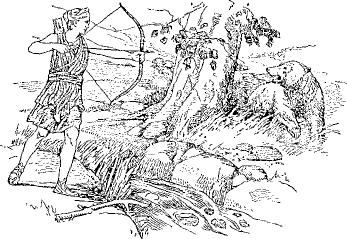
DIANA SAGITTAS PORTAT ET FERAS NECAT
39.
EXERCISES
First learn the special
vocabulary, p. 283.
I. 1. Diāna est dea. 2. Lātōna est dea. 3. Diāna et Lātōna sunt
deae. 4. Diāna est dea lūnae. 5. Diāna est fīlia Lātōnae.
6. Lātōna Diānam amat. 7. Diāna est dea silvārum.
8. Diāna silvam amat. 9. Diāna sagittās portat. 10. Diāna
ferās silvae necat. 11. Ferae terrārum pugnant.
For the order of words imitate the Latin above.
II. 1. The daughter of Latona does love the forests. 2. Latona’s
daughter carries arrows. 3. The farmers’ daughters do labor.
4. The farmer’s daughter loves the waters of the forest.
5. The sailor is announcing the girls’ flight. 6. The girls
announce the sailors’ wrongs. 7. The farmer’s daughter labors.
8. Diana’s arrows are killing the wild beasts of the land.
40.
CONVERSATION
Translate the questions and answer them in Latin. The answers may be
found in the exercises preceding.
1. Quis est Diāna?
2. Cuius fīlia est Diāna?
3. Quis Diānam amat?
4. Quis silvam amat?
5. Quis sagittās portat?
6. Cuius fīliae labōrant?
FIRST PRINCIPLES (Continued)
41.
The Dative Case. In addition to the relationships between words
expressed by the nominative, genitive (possessive), and accusative
(objective) cases, there are other relationships, to express which in
English we use such words as from, with, by,
to, for, in, at.1
Latin, too, makes frequent use of such prepositions; but often it
expresses these relations without them by means of case forms which
English does not possess. One of the cases found in the Latin declension
and lacking in English is called the dative.
42.
When the nominative singular ends in -a, the dative singular ends
in -ae and the dative plural in -īs.
Note. Observe that the genitive
singular, the dative singular, and the nominative
plural all have the same ending, -ae; but the uses of the
three cases are entirely different. The general meaning of the sentence
usually makes clear which case is intended.
a. Form the dative singular and plural of the following nouns:
fuga, causa, fortūna, terra, aqua,
puella, agricola, nauta, domina.
43.
The Dative Relation. The dative case is used to express the
relations conveyed in English by the prepositions to,
towards, for.
These prepositions are often used in English in expressions of
motion, such as She went to town, He ran towards the
horse, Columbus sailed for America. In such cases the dative
is not used in Latin, as motion through space is foreign to the
dative relation. But the dative is used to denote that to or
towards which a benefit, injury, purpose, feeling, or quality is
directed, or that for which something serves or exists.
a. What dative relations do you discover in the following?
The teacher gave a prize to John because he replied so promptly to
all her questions—a good example for the rest of us. It is a
pleasure to us to hear him recite. Latin is easy for him, but it is very
hard for me. Some are fitted for one thing and others for another.
44.
The Indirect Object. Examine the sentence
Nauta fugam nūntiat,
the sailor announces the flight
Here the verb, nūntiat, governs the direct object,
fugam, in the accusative case. If, however, we wish to mention
the persons to whom the sailor announces the flight, as, The
sailor announces the flight to the farmers, the verb will
have two objects:
|
1. Its direct object, flight (fugam)
2. Its indirect object, farmers
|
According to the preceding section, to the farmers is a
relation covered by the dative case, and we are prepared for the
following rule:
45.
Rule. Dative Indirect Object.
The indirect object of a verb is in the Dative.
a. The indirect object usually stands before the direct
object.
46.
We may now complete the translation of the sentence The sailor
announces the flight to the farmers, and we have
Nauta agricolīs fugam nūntiat
47.
EXERCISES
First learn the special
vocabulary, p. 283.
Point out the direct and indirect objects and the genitive of the
possessor.
I. 1. Quis nautīs pecūniam dat? 2. Fīliae agricolae nautīs pecūniam
dant. 3. Quis fortūnam pugnae nūntiat? 4. Galba agricolīs
fortunam pugnae nūntiat. 5. Cui domina fābulam nārrat?
6. Fīliae agricolae domina fābulam nārrat. 7. Quis Diānae
corōnam dat? 8. Puella Diānae corōnam dat quia Diānam amat.
9. Dea lūnae sagittās portat et ferās silvārum necat.
10. Cuius victōriam Galba nūntiat? 11. Nautae victōriam Galba
nūntiat.
Imitate the word order of the preceding exercise.
II. 1. To whom do the girls give a wreath? 2. The girls give a
wreath to Julia, because Julia loves wreaths. 3. The sailors tell
the ladies2 a story, because the ladies love
stories. 4. The farmer gives his (§ 22. a) daughter water. 5. Galba
announces the cause of the battle to the sailor. 6. The goddess of
the moon loves the waters of the forest. 7. Whose wreath is Latona
carrying? Diana’s.
FIRST PRINCIPLES (Continued)
48.
The Ablative Case. Another case, lacking in English but found in
the fuller Latin declension, is the ab´la-tive.
49.
When the nominative singular ends in -a, the ablative singular
ends in -ā and the ablative plural in -īs.
a. Observe that the final -ă of the nominative is short, while
the final -ā of the ablative is long, as,
b. Observe that the ablative plural is like the dative
plural.
c. Form the ablative singular and plural of the following nouns:
fuga, causa, fortūna, terra, aqua,
puella, agricola, nauta, domina.
50.
The Ablative Relation. The ablative case is used to express the
relations conveyed in English by the prepositions from,
with, by, at, in. It denotes
1. That from which something is separated, from which it starts, or
of which it is deprived—generally translated by from.
2. That with which something is associated or by means of which it is
done—translated by with or by.
3. The place where or the time when something
happens—translated by in or at.
a. What ablative relations do you discover in the following?
In our class there are twenty boys and girls. Daily at eight o’clock
they come from home with their books, and while they are at school they
study Latin with great zeal. In a short time they will be able to read
with ease the books written by the Romans. By patience and perseverance
all things in this world can be overcome.
51.
Prepositions. While, as stated above (§ 41), many relations expressed in English by
prepositions are in Latin expressed by case forms, still prepositions
are of frequent occurrence, but only with the accusative or
ablative.
52.
Rule. Object of a Preposition.
A noun governed by a preposition must be in the Accusative or
Ablative case.
53.
Prepositions denoting the ablative relations from, with, in, on,
are naturally followed by the ablative case. Among these are
|
ā1 or ab, from, away
from
dē, from, down from
ē1 or ex, from, out from,
out of
cum, with
in, in, on
|
1. Translate into Latin, using prepositions. In the water, on
the land, down from the forest, with the fortune, out of the forests,
from the victory, out of the waters, with the sailors, down from the
moon.
54.
Adjectives. Examine the sentence
Puella parva bonam deam amat, the little girl loves the good
goddess
In this sentence parva (little) and bonam
(good) are not nouns, but are descriptive words expressing
quality. Such words are called adjectives,2 and they are said to belong to the noun which they
describe.
You can tell by its ending to which noun an adjective belongs. The
ending of parva shows that it belongs to puella, and the
ending of bonam that it belongs to deam. Words that belong
together are said to agree, and the belonging-together is called
agreement. Observe that the adjective and its noun agree in
number and case.
55.
Examine the sentences
|
Puella est parva, the girl is little
Puella parva bonam deam amat, the little girl loves the good
goddess
|
In the first sentence the adjective parva is separated from
its noun by the verb and stands in the predicate. It is therefore called
a predicate adjective. In the second sentence the adjectives
parva and
bonam are closely attached to the nouns puella and
deam respectively, and are called attributive
adjectives.
a. Pick out the attributive and the predicate adjectives in the
following:
Do you think Latin is hard? Hard studies make strong brains. Lazy
students dislike hard studies. We are not lazy.
56.
DIALOGUE
Julia and Galba
First learn the special
vocabulary, p. 283.
I. Quis, Galba, est Diāna?
G. Diāna, Iūlia, est pulchra dea lūnae et silvārum.
I. Cuius fīlia, Galba, est Diāna?
G. Lātōnae fīlia, Iūlia, est Diāna.
I. Quid Diāna portat?
G. Sagittās Diāna portat.
I. Cūr Diāna sagittās portat?
G. Diāna sagittās portat, Iūlia, quod malās ferās silvae magnae
necat.
I. Amatne Lātōna fīliam?
G. Amat, et fīlia Lātōnam amat.
I. Quid fīlia tua parva portat?
G. Corōnās pulchrās fīlia mea parva portat.
I. Cui fīlia tua corōnās pulchrās dat?
G. Diānae corōnās dat.
I. Quis est cum fīliā tuā? Estne sōla?
G. Sōla nōn est; fīlia mea parva est cum ancillā meā.
a. When a person is called or addressed, the case used is called
the voc´ative (Latin vocāre, “to call”). In form the
vocative is regularly like the nominative. In English the name of
the person addressed usually stands first in the sentence. The Latin
vocative rarely stands first. Point out five examples of the
vocative in this dialogue.
b. Observe that questions answered by yes or no in
English are answered in Latin by repeating the verb. Thus, if you wished
to answer in Latin the question Is the sailor fighting?
Pugnatne nauta? you would say Pugnat, he is
fighting, or Nōn pugnat, he is not fighting.
THE FIRST OR Ā-DECLENSION
57.
In the preceding lessons we have now gone over all the cases, singular
and plural, of nouns whose nominative singular ends in -a. All
Latin nouns whose nominative singular ends in -a belong to the
First Declension. It is also called the Ā-Declension because of
the prominent part which the vowel a plays in the formation of
the cases. We have also learned what relations are expressed by each
case. These results are summarized in the following table:
| Case |
Noun |
Translation |
Use and General Meaning of Each Case |
|
|
Singular |
|
| Nom. |
do´min-a |
the lady |
The subject |
| Gen. |
domin-ae |
of the lady, or the lady’s |
The possessor of something |
| Dat. |
domin-ae |
to or for the lady |
Expressing the relation to or for,
especially the indirect object |
| Acc. |
domin-am |
the lady |
The direct object |
| Abl. |
domin-ā |
from, with, by, in, the lady |
Separation (from), association or means (with, by),
place where or time when (in, at) |
|
|
Plural |
|
| Nom. |
domin-ae |
the ladies |
The same as the singular |
| Gen. |
domin-ā´rum |
of the ladies, or the ladies’ |
| Dat. |
domin-īs |
to or for the ladies |
| Acc. |
domin-ās |
the ladies |
| Abl. |
domin-īs |
from, with, by, in, the ladies |
58.
The Base. That part of a word which remains unchanged in
inflection and to which the terminations are added is called the
base.
Thus, in the declension above, domin- is the base and -a
is the termination of the nominative singular.
59.
Write the declension of the following nouns, separating the base from
the termination by a hyphen. Also give them orally.
pugna, terra, lūna, ancil´la, corō´na, īn´sula, silva
60.
Gender. In English, names of living beings are either masculine
or feminine, and names of things without life are neuter. This is called
natural gender. Yet in English there are some names of things to
which we refer as if they were feminine; as, “Have you seen my yacht?
She is a beauty.” And there are some names of living beings to
which we refer as if they were neuter; as, “Is the baby here? No, the
nurse has taken it home.” Some words, then, have a gender quite
apart from sex or real gender, and this is called grammatical
gender.
Latin, like English, has three genders. Names of males are usually
masculine and of females feminine, but names of things have
grammatical gender and may be either masculine, feminine, or neuter.
Thus we have in Latin the three words, lapis, a stone;
rūpēs, a cliff; and saxum, a rock.
Lapis is masculine, rūpēs feminine, and
saxum neuter. The gender can usually be determined by the
ending of the word, and must always be learned, for without
knowing the gender it is impossible to write correct Latin.
61.
Gender of First-Declension Nouns. Nouns of the first declension
are feminine unless they denote males. Thus silva is feminine,
but nauta, sailor, and agricola, farmer, are
masculine.
62.
EXERCISES
First learn the special
vocabulary, p. 284.
I. 1. Agricola cum fīliā in casā habitat. 2. Bona fīlia
agricolae cēnam parat. 3. Cēna est grāta agricolae1 et agricola bonam fīliam laudat. 4. Deinde fīlia
agricolae gallīnās ad cēnam vocat. 5. Gallīnae fīliam agricolae
amant. 6. Malae fīliae bonās cēnās nōn parant. 7. Fīlia
agricolae est grāta dominae. 8. Domina in īnsulā magnā habitat.
9. Domina bonae puellae parvae pecūniam dat.
II. 1. Where does the farmer live? 2. The farmer lives in the small
cottage. 3. Who lives with the farmer? 4. (His) little
daughter lives with the farmer. 5. (His) daughter is getting
(parat) a good dinner for the farmer. 6. The farmer praises
the good dinner. 7. The daughter’s good dinner is pleasing to the
farmer.
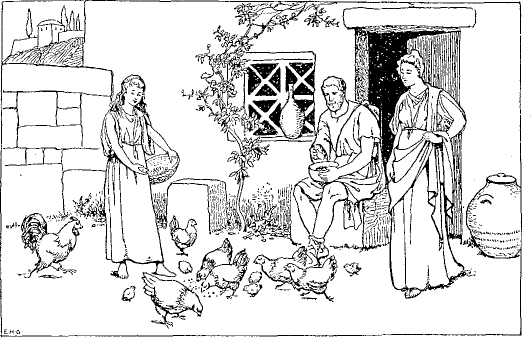
What Latin words are suggested by this picture?
63.
CONVERSATION
Answer the questions in Latin.
1. Quis cum agricolā in casā habitat?
2. Quid bona fīlia agricolae parat?
3. Quem agricola laudat?
4. Vocatne fīlia agricolae gallīnās ad cēnam?
5. Cuius fīlia est grāta dominae?
6. Cui domina pecūniam dat?
FIRST DECLENSION (Continued)
64.
We have for some time now been using adjectives and nouns together and
you have noticed an agreement between them in case and in
number (§ 54). They agree also in
gender. In the phrase silva magna, we have a feminine
adjective in -a agreeing with a feminine noun in -a.
65.
Rule. Agreement of Adjectives.
Adjectives agree with their nouns in gender, number, and
case.
66.
Feminine adjectives in -a are declined like feminine nouns in
-a, and you should learn to decline them together as follows:
| Noun |
Adjective |
|
domina (base domin-), f., lady |
bona (base bon-), good |
|
Singular |
TERMINATIONS |
| Nom. |
do´mina |
bona |
-a |
| Gen. |
dominae |
bonae |
-ae |
| Dat. |
dominae |
bonae |
-ae |
| Acc. |
dominam |
bonam |
-am |
| Abl. |
dominā |
bonā |
-ā |
|
Plural |
TERMINATIONS |
| Nom. |
dominae |
bonae |
-ae |
| Gen. |
dominā´rum |
bonā´rum |
-ārum |
| Dat. |
dominīs |
bonīs |
-īs |
| Acc. |
dominās |
bonās |
-ās |
| Abl. |
dominīs |
bonīs |
-īs |
a. In the same way decline together puella mala, the
bad girl; ancil´la parva, the little maid; fortū´na
magna, great fortune.
67.
The words dea, goddess, and fīlia, daughter,
take the ending -ābus instead of -īs in the dative and
ablative plural. Note the dative and ablative plural in the
following declension:
|
dea bona (bases de- bon-) |
|
Singular |
Plural |
| Nom. |
dea bona |
deae bonae |
| Gen. |
deae bonae |
deā´rum bonā´rum |
| Dat. |
deae bonae |
deā´bus bonīs |
| Acc. |
deam bonam |
deās bonās |
| Abl. |
deā bonā |
dea´bus bonīs |
a. In the same way decline together fīlīa parva.
68.
Latin Word Order. The order of words in English and in Latin
sentences is not the same.
In English we arrange words in a fairly fixed order. Thus, in the
sentence My daughter is getting dinner for the farmers, we cannot
alter the order of the words without spoiling the sentence. We can,
however, throw emphasis on different words by speaking them with more
force. Try the effect of reading the sentence by putting special force
on my, daughter, dinner, farmers.
In Latin, where the office of the word in the sentence is shown by
its ending (cf. § 32. 1), and
not by its position, the order of words is more free, and
position is used to secure the same effect that in English is secured by
emphasis of voice. To a limited extent we can alter the order of words
in English, too, for the same purpose. Compare the sentences
|
I saw a game of football at Chicago last November (normal
order)
Last November I saw a game of football at Chicago
At Chicago, last November, I saw a game of football
|
1. In a Latin sentence the most emphatic place is the first;
next in importance is the last; the weakest point is the
middle. Generally the subject is the most important word,
and is placed first; usually the verb is the next in
importance, and is placed last. The other words of the sentence
stand between these two in the order of their importance. Hence the
normal order of words—that is, where no unusual emphasis is
expressed—is as follows:
subject—modifiers of the
subject—indirect object—direct
object—adverb—verb
Changes from the normal order are frequent, and are due to the desire
for throwing emphasis upon some word or phrase. Notice the order of
the
Latin words when you are translating, and imitate it when you are
turning English into Latin.
2. Possessive pronouns and modifying genitives normally stand after
their nouns. When placed before their nouns they are emphatic, as
fīlia mea, my daughter; mea fīlia, my
daughter; casa Galbae, Galba’s cottage; Galbae
casa, Galba’s cottage.
Notice the variety of emphasis produced by writing the following
sentence in different ways:
|
Fīlia mea agricolīs cēnam parat (normal order)
Mea fīlia agricolīs parat cēnam (mea and cēnam
emphatic)
Agricolīs fīlia mea cēnam parat (agricolīs emphatic)
|
3. An adjective placed before its noun is more emphatic than when it
follows. When great emphasis is desired, the adjective is separated from
its noun by other words.
|
Fīlia mea casam parvam nōn amat (parvam not emphatic)
Fīlia mea parvam casam nōn amat (parvam more emphatic)
Parvam fīlia mea casam nōn amat (parvam very emphatic)
|
4. Interrogative words usually stand first, the same as in
English.
5. The copula (as est, sunt) is of so little importance
that it frequently does not stand last, but may be placed wherever it
sounds well.
69.
EXERCISE
First learn the special
vocabulary, p. 284.
Note the order of the words in these sentences and pick out those
that are emphatic.
1. Longae nōn sunt tuae viae. 2. Suntne tubae novae in meā casā?
Nōn sunt. 3. Quis lātā in silvā habitat? Diāna, lūnae clārae
pulchra dea, lātā in silvā habitat. 4. Nautae altās et lātās amant
aquās. 5. Quid ancilla tua portat? Ancilla mea tubam novam portat.
6. Ubi sunt Lesbia et Iūlia? In tuā casa est Lesbia et Iūlia est in
meā. 7. Estne Italia lāta terra? Longa est Italia, nōn lāta.
8. Cui Galba agricola fābulam novam nārrat? Fīliābus dominae clārae
fābulam novam nārrat. 9. Clāra est īnsula Sicilia. 10. Quem
laudat Lātōna? Lātōna laudat fīliam.
THE SECOND OR O-DECLENSION
70.
Latin nouns are divided into five declensions.
The declension to which a noun belongs is shown by the ending of the
genitive singular. This should always be learned along with the
nominative and the gender.
71.
The nominative singular of nouns of the Second or O-Declension
ends in -us, -er, -ir, or -um. The genitive
singular ends in -ī.
72.
Gender. Nouns in -um are neuter. The others are regularly
masculine.
73.
Declension of nouns in -us and -um. Masculines in
-us and neuters in -um are declined as follows:
|
dominus (base domin-), m., master |
pīlum (base pīl-), n., spear |
|
Singular |
| |
TERMINATIONS |
|
TERMINATIONS |
| Nom. |
do´minus1 |
-us |
pīlum |
-um |
| Gen. |
dominī |
-ī |
pīlī |
-ī |
| Dat. |
dominō |
-ō |
pīlō |
-ō |
| Acc. |
dominum |
-um |
pīlum |
-um |
| Abl. |
dominō |
-ō |
pīlō |
-ō |
| Voc. |
domine |
-e |
pīlum |
-um |
|
Plural |
| Nom. |
dominī |
-ī |
pīla |
-a |
| Gen. |
dominō´rum |
-ōrum |
pīlō´rum |
-ōrum |
| Dat. |
dominīs |
-īs |
pīlīs |
-īs |
| Acc. |
dominōs |
-ōs |
pīla |
-a |
| Abl. |
dominīs |
-īs |
pīlīs |
-īs |
a. Observe that the masculines and the neuters have the same
terminations excepting in the nominative singular and the nominative and
accusative plural.
b. The vocative singular of words of the second declension in
-us ends in -ĕ, as domine, O master;
serve, O slave. This is the most important exception to
the rule in § 56. a.
74.
Write side by side the declension of domina, dominus, and
pīlum. A comparison of the forms will lead to the following
rules, which are of great importance because they apply to all five
declensions:
a. The vocative, with a single exception (see § 73. b), is like the nominative. That is,
the vocative singular is like the nominative singular, and the vocative
plural is like the nominative plural.
b. The nominative, accusative, and vocative of neuter nouns are
alike, and in the plural end in -a.
c. The accusative singular of masculines and feminines ends in
-m and the accusative plural in -s.
d. The dative and ablative plural are always alike.
e. Final -i and -o are always long; final
-a is short, except in the ablative singular of the first
declension.
75.
Observe the sentences
|
Lesbia est bona, Lesbia is good
Lesbia est ancilla, Lesbia is a maidservant
|
We have learned (§ 55) that bona,
when used, as here, in the predicate to describe the subject, is called
a predicate adjective. Similarly a noun, as
ancilla, used in the predicate to define the subject is
called a predicate noun.
76.
Rule. Predicate Noun. A
predicate noun agrees in case with the subject of the verb.

PILA
77.
DIALOGUE

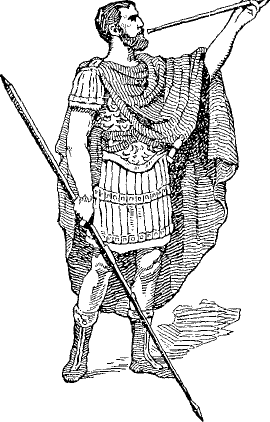
LEGATUS CUM PILO ET TUBA
Galba and Marcus
First learn the special
vocabulary, p. 285.
G. Quis, Mārce, est lēgātus cum pīlō et tubā?
M. Lēgātus, Galba, est Sextus.
G. Ubi Sextus habitat?2
M. In oppidō Sextus cum fīliābus habitat.
G. Amantne oppidānī Sextum?
M. Amant oppidānī Sextum et laudant, quod magnā cum cōnstantiā
pugnat.
G. Ubi, Mārce, est ancilla tua? Cūr nōn cēnam parat?
M. Ancilla mea, Galba, equō lēgātī aquam et frūmentum dat.
G. Cūr nōn servus Sextī equum dominī cūrat?
M. Sextus et servus ad mūrum oppidī properant.
Oppidānī bellum parant.3
habitat
|
he lives
he is living
he does live |
78.
CONVERSATION
Translate the questions and answer them in Latin.
1. Ubi fīliae Sextī habitant?
2. Quem oppidānī amant et laudant?
3. Quid ancilla equō lēgātī dat?
4. Cuius equum ancilla cūrat?
5. Quis ad mūrum cum Sextō properat?
6. Quid oppidānī parant?
SECOND DECLENSION (Continued)
79.
We have been freely using feminine adjectives, like bona, in
agreement with feminine nouns of the first declension and declined like
them. Masculine adjectives of this class are declined like
dominus, and neuters like pīlum. The adjective and noun,
masculine and neuter, are therefore declined as follows:
|
Masculine Noun and Adjective |
Neuter Noun and Adjective |
|
dominus bonus, the good master |
pīlum bonum, the good spear |
|
Bases domin- bon- |
Bases pīl- bon- |
|
Singular |
| |
TERMINATIONS |
|
TERMINATIONS |
| Nom. |
do´minus bonus |
-us |
pīlum bonum |
-um |
| Gen. |
dominī bonī |
-ī |
pīlī bonī |
-ī |
| Dat. |
dominō bonō |
-ō |
pīlō bonō |
-ō |
| Acc. |
dominum bonum |
-um |
pīlum bonum |
-um |
| Abl. |
dominō bonō |
-ō |
pīlō bonō |
-ō |
| Voc. |
domine bone |
-e |
pīlum bonum |
-um |
|
Plural |
| Nom. |
dominī bonī |
-ī |
pīla bona |
-a |
| Gen. |
dominō´rum bonō´rum |
-ōrum |
pīlō´rum bonō´rum |
-ōrum |
| Dat. |
dominīs bonīs |
-is |
pīlīs bonīs |
-īs |
| Acc. |
dominōs bonōs |
-ōs |
pīla bona |
-a |
| Abl. |
dominīs bonīs |
-īs |
pīlīs bonīs |
-īs |
Decline together bellum longum, equus parvus, servus malus, mūrus
altus, frūmentum novum.
80.
Observe the sentences
|
Lesbia ancilla est bona, Lesbia, the maidservant, is
good
Fīlia Lesbiae ancillae est bona, the daughter of Lesbia, the
maidservant, is good
Servus Lesbiam ancillam amat, the slave loves Lesbia, the
maidservant
|
In these sentences ancilla, ancillae, and
ancillam denote the class of persons to which Lesbia
belongs and explain who she is. Nouns so related that the second is only
another name for the first and explains it are said to be in apposition,
and are always in the same case.
81.
Rule. Apposition. An
appositive agrees in case with the noun which it explains.
82.
EXERCISES
First learn the special
vocabulary, p. 285.
I. 1. Patria servī bonī, vīcus servōrum bonōrum, bone popule.
2. Populus oppidī magnī, in oppidō magnō, in oppidīs magnīs.
3. Cum pīlīs longīs, ad pīla longa, ad mūrōs lātōs. 4. Lēgāte
male, amīcī legātī malī, cēna grāta dominō bonō. 5. Frūmentum
equōrum parvōrum, domine bone, ad lēgātōs clārōs. 6. Rhēnus est in
Germāniā, patriā meā. 7. Sextus lēgātus pīlum longum portat.
8. Oppidānī bonī Sextō lēgātō clārā pecūniam dant. 9. Malī
servī equum bonum Mārcī dominī necant. 10. Galba agricola et Iūlia
fīlia bona labōrant. 11. Mārcus nauta in īnsulā Siciliā
habitat.
II. 1. Wicked slave, who is your friend? Why does he not praise
Galba, your master? 2. My friend is from (ex) a village of
Germany, my fatherland. 3. My friend does not love the people of
Italy. 4. Who is caring for1 the good
horse of Galba, the farmer? 5. Mark, where is Lesbia, the
maidservant? 6. She is hastening1 to the
little cottage2 of Julia, the farmer’s
daughter.
ADJECTIVES OF THE FIRST AND SECOND DECLENSIONS
83.
Adjectives of the first and second declensions are declined in the three
genders as follows:
|
Singular |
|
MASCULINE |
FEMININE |
NEUTER |
| Nom. |
bonus |
bona |
bonum |
| Gen. |
bonī |
bonae |
bonī |
| Dat. |
bonō |
bonae |
bonō |
| Acc. |
bonum |
bonam |
bonum |
| Abl. |
bonō |
bonā |
bonō |
| Voc. |
bone |
bona |
bonum |
|
Plural |
| Nom. |
bonī |
bonae |
bona |
| Gen. |
bonōrum |
bonārum |
bonōrum |
| Dat. |
bonīs |
bonīs |
bonīs |
| Acc. |
bonōs |
bonās |
bona |
| Abl. |
bonīs |
bonīs |
bonīs |
a. Write the declension and give it orally across the
page, thus giving the three genders for each case.
b. Decline grātus, -a, -um; malus, -a, -um;
altus, -a, -um; parvus, -a, -um.
84.
Thus far the adjectives have had the same terminations as the nouns.
However, the agreement between the adjective and its noun does
not mean that they must have the same termination. If the
adjective and the noun belong to different declensions, the terminations
will, in many cases, not be the same. For example, nauta,
sailor, is masculine and belongs to the first declension. The
masculine form of the adjective bonus is of the second
declension. Consequently, a good sailor is nauta bonus.
So, the wicked farmer is agricola malus. Learn the
following declensions:
85.
nauta bonus (bases naut- bon-),
m., the good sailor
| Singular |
Plural |
| Nom. |
nauta |
bonus |
nautae |
bonī |
| Gen. |
nautae |
bonī |
nautārum |
bonōrum |
| Dat. |
nautae |
bonō |
nautīs |
bonīs |
| Acc. |
nautam |
bonum |
nautās |
bonōs |
| Abl. |
nautā |
bonō |
nautīs |
bonīs |
| Voc. |
nauta |
bone |
nautae |
bonī |
86.
EXERCISES
First learn the special
vocabulary, p. 285.
I. 1. Est1 in vīcō nauta bonus.
2. Sextus est amīcus nautae bonī. 3. Sextus nautae bonō galeam
dat. 4. Populus Rōmānus nautam bonum laudat. 5. Sextus cum
nautā bonō praedam portat. 6. Ubi, nauta bone, sunt arma et tēla
lēgātī Rōmānī? 7. Nautae bonī ad bellum properant. 8. Fāma
nautārum bonōrum est clāra. 9. Pugnae sunt grātae nautīs bonīs.
10. Oppidānī nautās bonōs cūrant. 11. Cūr, nautae bonī, malī
agricolae ad Rhēnum properant? 12. Malī agricolae cum bonīs nautīs
pugnant.
II. 1. The wicked farmer is hastening to the village with (his)
booty. 2. The reputation of the wicked farmer is not good.
3. Why does Galba’s daughter give arms and weapons to the wicked
farmer? 4. Lesbia invites the good sailor to dinner. 5. Why is
Lesbia with the good sailor hastening from the cottage? 6. Sextus,
where is my helmet? 7. The good sailors are hastening to the
toilsome battle. 8. The horses of the wicked farmers are small.
9. The Roman people give money to the good sailors.
10. Friends care for the good sailors. 11. Whose friends are
fighting with the wicked farmers?

GALEAE
NOUNS IN -IUS AND -IUM
87.
Nouns of the second declension in -ius and -ium end in
-ī in the genitive singular, not in -iī, and the
accent rests on the penult; as, fīlī from fīlius
(son), praesi´dī from praesi´dium
(garrison).
88.
Proper names of persons in -ius, and fīlius, end in
-ī in the vocative singular, not in -ĕ, and the
accent rests on the penult; as, Vergi´lī, O Vergil;
fīlī, O son.
a. Observe that in these words the vocative and the genitive are
alike.
89.
praesidium (base praesidi-), n.,
garrison
fīlius (base fīli-), m.,
son
| Singular |
| Nom. |
praesidium |
fīlius |
| Gen. |
praesi´dī |
fīlī |
| Dat. |
praesidiō |
fīliō |
| Acc. |
praesidium |
fīlium |
| Abl. |
praesidiō |
fīliō |
| Voc. |
praesidium |
fīlī |
The plural is regular. Note that the -i- of the base is lost
only in the genitive singular, and in the vocative of words like
fīlius.
Decline together praesidium parvum; fīlius bonus;
fluvius longus, the long river; proelium clārum,
the famous battle.
90.
EXERCISES
First learn the special
vocabulary, p. 285.
I. 1. Frūmentum bonae terrae, gladī malī, bellī longī.
2. Cōnstantia magna, praesidia magna, clāre Vergi´lī. 3. Male
serve, Ō clārum oppidum, male fīlī, fīliī malī, fīlī malī. 4. Fluvī
longī, fluviī longī, fluviōrum longōrum, fāma praesi´dī magnī.
5. Cum gladiīs parvīs, cum deābus clārīs, ad nautās clārōs.
6. Multōrum proeliōrum, praedae magnae, ad proelia dūra.
Germānia
II. Germānia, patria Germānōrum, est clāra terra. In Germāniā sunt
fluviī multī. Rhēnus magnus et lātus fluvius Germāniae est. In silvīs
lātīs Germāniae sunt ferae multae. Multi Germāni in oppidīs magnis et
in vīcīs parvīs habitant et multī sunt agricolae bonī. Bella Germānōrum
sunt magna et clāra. Populus Germāniae bellum et proelia amat et saepe
cum finitimīs pugnat. Fluvius Rhēnus est fīnitimus oppidīs1 multīs et clārīs.
SECOND DECLENSION (Continued)
91.
Declension of Nouns in -er and -ir. In early Latin
all the masculine nouns of the second declension ended in -os.
This -os later became -us in words like servus, and
was dropped entirely in words with bases ending in -r, like
puer, boy; ager, field; and vir,
man. These words are therefore declined as follows:
92.
puer, m., boy
ager, m., field
vir, m., man
|
Base puer- |
Base agr- |
Base vir- |
|
|
Singular |
TERMINATIONS |
| Nom. |
puer |
ager |
vir |
—— |
| Gen. |
puerī |
agrī |
virī |
-ī |
| Dat. |
puerō |
agrō |
virō |
-ō |
| Acc. |
puerum |
agrum |
virum |
-um |
| Abl. |
puerō |
agrō |
virō |
-ō |
|
Plural |
|
| Nom. |
puerī |
agrī |
virī |
-ī |
| Gen. |
puerōrum |
agrōrum |
virōrum |
-ōrum |
| Dat. |
puerīs |
agrīs |
virīs |
-īs |
| Acc. |
puerōs |
agrōs |
virōs |
-ōs |
| Abl. |
puerīs |
agrīs |
virīs |
-īs |
a. The vocative case of these words is like the nominative,
following the general rule (§ 74. a).
b. The declension differs from that of servus only in the
nominative and vocative singular.
c. Note that in puer the e remains all the way
through, while in ager it is present only in the nominative. In
puer the e belongs to the base, but in ager (base
agr-) it does not, and was inserted in the nominative to make it
easier to pronounce. Most words in -er are declined like
ager. The genitive shows whether you are to follow
puer or ager.
93.
Masculine adjectives in -er of the second declension are declined
like nouns in -er. A few of them are declined like puer,
but most of them like ager. The feminine and neuter nominatives
show which form to follow, thus,
| Masc. |
Fem. |
Neut. |
|
|
| līber |
lībera |
līberum |
(free) |
is like puer |
| pulcher |
pulchra |
pulchrum |
(pretty) |
is like ager |
For the full declension in the three genders, see § 469. b. c.
94.
Decline together the words vir līber, terra lībera,
frūmentum līberum, puer pulcher, puella pulchra,
oppidum pulchrum
95.
Italia1
First learn the special
vocabulary, p. 286.
Magna est Italiae fāma, patriae Rōmānōrum, et clāra est Rōma, domina
orbis terrārum.2 Tiberim,3 fluvium Rōmānum, quis nōn laudat et pulchrōs fluviō
fīnitimōs agrōs? Altōs mūrōs, longa et dūra bella, clārās victōriās quis
nōn laudat? Pulchra est terra Italia. Agrī bonī agricolīs praemia dant
magna, et equī agricolārum cōpiam frūmentī ad oppida et vīcōs portant.
In agrīs populī Rōmānī labōrant multī servī. Viae Italiae sunt longae et
lātae. Fīnitima Italiae est īnsula Sicilia.
96.
DIALOGUE
Marcus and Cornelius
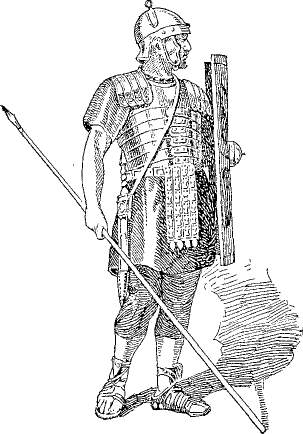
LEGIONARIUS
C. Ubi est, Mārce, fīlius tuus? Estne in pulchrā terrā Italiā?
M. Nōn est, Cornēlī, in Italiā. Ad fluvium Rhēnum properat cum cōpiīs
Rōmānīs quia est4 fāma Novī bellī cum
Germānīs. Līber Germāniae populus Rōmānōs Nōn amat.
C. Estne fīlius tuus copiārum Rōmānārum lēgātus?
M. Lēgātus nōn est, sed est apud legiōnāriōs.
C. Quae5 arma portat6?
M. Scūtum magnum et lōrīcam dūram et galeam pulchram portat.
C. Quae tēla portat?
M. Gladium et pīlum longum portat.
C. Amatne lēgātus fīlium tuum?
M. Amat, et saepe fīliō meō praemia pulchra et praedam multam dat.
C. Ubi est terra Germānōrum?
M. Terra Germānōrum, Cornēlī est fīnitima Rhēnō, fluviō magnō et altō.
THE POSSESSIVE ADJECTIVE PRONOUNS
97.
Observe the sentences
|
This is my shield
This shield is mine
|
In the first sentence my is a possessive adjective; in the
second mine is a possessive pronoun, for it takes the place of a
noun, this shield is mine being equivalent to this shield is
my shield. Similarly, in Latin the possessives are sometimes
adjectives and sometimes pronouns.
98.
The possessives my, mine, your, yours, etc. are declined like
adjectives of the first and second declensions.
|
Singular |
| 1st Pers. |
meus, mea, meum |
my, mine |
| 2d Pers. |
tuus, tua, tuum |
your, yours |
| 3d Pers. |
suus, sua, suum |
his (own), her (own), its (own) |
|
Plural |
| 1st Pers. |
noster, nostra, nostrum |
our, ours |
| 2d Pers. |
vester, vestra, vestrum |
your, yours |
| 3d Pers. |
suus, sua, suum |
their (own), theirs |
Note. Meus has the irregular
vocative singular masculine mī, as mī fīlī, O my
son.
a. The possessives agree with the name of the thing
possessed in gender, number, and case. Compare the English and Latin
in
|
Sextus is calling his boy
Julia is calling her boy
|
Sextus
Iūlia
|
suum puerum vocat |
Observe that suum agrees with puerum, and is unaffected by
the gender of Sextus or Julia.
b. When your, yours, refers to one person, use
tuus; when to more than one, vester; as,
Lesbia, your wreaths are pretty
Girls, your wreaths are pretty
|
Corōnae tuae, Lesbia, sunt pulchrae
Corōnae vestrae, puellae, sunt pulchrae
|
c. Suus is a reflexive possessive, that is, it
usually stands in the predicate and regularly refers back to the
subject. Thus, Vir suōs servōs vocat means The man
calls his (own) slaves. Here his (suōs) refers to
man (vir), and could not refer to any one else.
d. Possessives are used much less frequently than in English,
being omitted whenever the meaning is clear without them. (Cf. § 22. a.) This is especially true of suus, -a,
-um, which, when inserted, is more or less emphatic, like our his
own, her own, etc.
99.
EXERCISES
First learn the special
vocabulary, p. 286.
I. 1. Mārcus amīcō Sextō cōnsilium suum nūntiat 2. Est cōpia frūmentī
in agrīs nostrīs. 3. Amīcī meī bonam cēnam ancillae vestrae laudant
4. Tua lōrīca, mī fīlī, est dūra. 5. Scūta nostra et tēla, mī
amīce, in castrls Rōmānīs sunt. 6. Suntne virī patriae tuae līberī?
Sunt. 7. Ubi, Cornēlī, est tua galea pulchra? 8. Mea galea,
Sexte, est in casā meā. 9. Pīlum longum est tuum, sed gladius est
meus. 10. Iūlia gallīnās suās pulchrās amat et gallīnae dominam
suam amant. 11. Nostra castra sunt vestra. 12. Est cōpia
praedae in castrīs vestrīs. 13. Amīcī tuī miserīs et aegrīs cibum
et pecūniam saepe dant.
II. 1. Our teacher praises Mark’s industry. 2. My son Sextus is
carrying his booty to the Roman camp.1
3. Your good girls are giving aid to the sick and wretched.2 4. There are 3
frequent battles in our villages. 5. My son, where is the
lieutenant’s food? 6. The camp is mine, but the weapons are
yours.
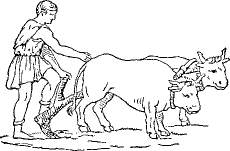
AGRICOLA ARAT
THE ABLATIVE DENOTING WITH
100.
Of the various relations denoted by the ablative case (§ 50) there is none more important than that expressed
in English by the preposition with. This little word is not so
simple as it looks. It does not always convey the same meaning, nor is
it always to be translated by cum. This will become clear from
the following sentences:
|
a. Mark is feeble with (for or because of)
want of food
b. Diana kills the beasts with (or by) her
arrows
c. Julia is with Sextus
d. The men fight with great steadiness
|
a. In sentence a, with want (of food) gives
the cause of Mark’s feebleness. This idea is expressed in Latin by the
ablative without a preposition, and the construction is called the
ablative of cause:
Mārcus est īnfīrmus inopiā cibī
b. In sentence b, with (or by) her
arrows tells by means of what Diana kills the beasts. This
idea is expressed in Latin by the ablative without a preposition, and
the construction is called the ablative of means:
Diāna sagittīs suīs ferās necat
c. In sentence c we are told that Julia is not alone, but
in company with Sextus. This idea is expressed in Latin by the
ablative with the preposition cum, and the construction is called
the ablative of accompaniment:
Iūlia est cum Sextō
d. In sentence d we are told how the men fight. The idea
is one of manner. This is expressed in Latin by the ablative with
cum, unless there is a modifying adjective present, in which case
cum may be omitted. This construction is called the ablative
of manner:
Virī (cum) cōnstantiā magnā pugnant
101.
You are now able to form four important rules for the ablative denoting
with:
102.
Rule. Ablative of Cause.
Cause is denoted by the ablative without a preposition. This answers
the question Because of what?
103.
Rule. Ablative of Means.
Means is denoted by the ablative without a preposition. This answers
the question By means of what? With what?
N.B. Cum must never be used with the ablative expressing cause or
means.
104.
Rule. Ablative of Accompaniment.
Accompaniment is denoted by the ablative with cum. This
answers the question With whom?
105.
Rule. Ablative of Manner. The
ablative with cum is used to denote the manner of an action.
Cum may be omitted, if an adjective is used with the ablative.
This answers the question How? In what manner?
106.
What uses of the ablative do you discover in the following passage, and
what question does each answer?
The soldiers marched to the fort with great speed and broke down the
gate with blows of their muskets. The inhabitants, terrified by the din,
attempted to cross the river with their wives and children, but the
stream was swollen with (or by) the rain. Because of this many
were swept away by the waters and only a few, almost overcome with
fatigue, with great difficulty succeeded in gaining the farther
shore.
107.
EXERCISES
First learn the special
vocabulary, p. 286.
I. The Romans prepare for War. Rōmānī, clārus Italiae populus,
bellum parant. Ex agrīs suīs, vicīs, oppidīsque magnō studiō virī validī
ad arma properant. Iam lēgatī cum legiōnariīs ex Italiā ad Rhēnum,
fluvium Germāniae altum et lātum, properant, et servī equīs et carrīs
cibum frūmentumque ad castra Rōmāna portant. Inopiā bonōrum tēlōrum
īnfirmī sunt Germānī, sed Rōmānī armāti galeīs, lōrīcīs, scūtīs,
gladiīs, pīlīsque sunt validī.
II. 1. The sturdy farmers of Italy labor in the fields with great
diligence. 2. Sextus, the lieutenant, and (his) son Mark are
fighting with the Germans. 3. The Roman legionaries are armed with
long spears. 4. Where is Lesbia, your maid, Sextus? Lesbia is with
my friends in Galba’s cottage. 5. Many are sick because of bad
water and for lack of food. 6. The Germans, with (their) sons and
daughters, are hastening with horses and wagons.
THE NINE IRREGULAR ADJECTIVES
108.
There are nine irregular adjectives of the first and second declensions
which have a peculiar termination in the genitive and dative singular of
all genders:
|
Masc. |
Fem. |
Neut. |
| Gen. |
-īus |
-īus |
-īus |
| Dat. |
-ī |
-ī |
-ī |
Otherwise they are declined like bonus, -a, -um. Learn the
list
and the meaning of each:
|
alius, alia, aliud, other, another (of several)
alter, altera, alterum, the one, the other (of two)
ūnus, -a, -um, one, alone; (in the plural) only
ūllus, -a, -um, any
nūllus, -a, -um, none, no
sōlus, -a, -um, alone
tōtus, -a, -um, all, whole, entire
uter, utra, utrum, which? (of two)
neuter, neutra, neutrum, neither (of two)
|
109.
PARADIGMS
|
Singular |
|
MASC. |
FEM. |
NEUT. |
MASC. |
FEM. |
NEUT. |
| Nom. |
nūllus |
nūlla |
nūllum |
alius |
alia |
aliud |
| Gen. |
nūllī´us |
nūllī´us |
nūllī´us |
alī´us |
alī´us |
alī´us |
| Dat. |
nūllī |
nūllī |
nūllī |
aliī |
aliī |
aliī |
| Acc. |
nūllum |
nūllam |
nūllum |
alium |
aliam |
aliud |
| Abl. |
nūllō |
nūllā |
nūllō |
aliō |
aliā |
aliō |
|
The Plural is Regular |
a. Note the peculiar neuter singular ending in -d of
alius. The genitive alīus is rare. Instead of it use
alterīus, the genitive of alter.
b. These peculiar case endings are found also in the declension
of pronouns (see § 114). For this reason
these adjectives are sometimes called the pronominal
adjectives.
110.
Learn the following idioms:
|
alter, -era, -erum ... alter, -era, -erum, the one ...
the other (of two)
alius, -a, -ud ... alius, -a, -ud, one ... another
(of any number)
aliī, -ae, -a ... aliī, -ae, -a, some ...
others
|
EXAMPLES
1. Alterum oppidum est magnum, alterum parvum, the one town
is large, the other small (of two towns).
2. Aliud oppidum est validum, aliud īnfīrmum, one town is
strong, another weak (of towns in general).
3. Aliī gladiōs, aliī scūta portant, some carry swords,
others shields.
111.
EXERCISES
I. 1. In utrā casā est Iūlia? Iūlia est in neutrā casā. 2. Nūllī malō
puerō praemium dat magister. 3. Alter puer est nauta, alter
agricola. 4. Aliī virī aquam, aliī terram amant. 5. Galba ūnus
(or sōlus) cum studiō labōrat. 6. Estne ūllus carrus in agrō
meō? 7. Lesbia est ancilla alterīus dominī, Tullia alterīus.
8. Lesbia sōla cēnam parat. 9. Cēna nūllīus alterīus ancillae
est bona. 10. Lesbia nūllī aliī virō cēnam dat.
Note. The pronominal adjectives, as you
observe, regularly stand before and not after their nouns.
II. 1. The men of all Germany are preparing for war. 2. Some
towns are great and others are small. 3. One boy likes chickens,
another horses. 4. Already the booty of one town is in our fort.
5. Our whole village is suffering for (i.e. weak because of)
lack of food. 6. The people are already hastening to the other
town. 7. Among the Romans (there) is no lack of grain.
THE DEMONSTRATIVE IS, EA, ID
112.
A demonstrative is a word that points out an object definitely, as
this, that, these, those. Sometimes these words are pronouns, as,
Do you hear these? and sometimes adjectives, as, Do you hear
these men? In the former case they are called demonstrative
pronouns, in the latter demonstrative adjectives.
113.
Demonstratives are similarly used in Latin both as pronouns and
as adjectives. The one used most is
is, masculine; ea, feminine; id, neuter
| Singular |
this
that |
Plural |
these
those |
114.
Is is declined as follows. Compare its declension with that of
alius, § 109.
| Base
e- |
|
Singular |
Plural |
|
MASC. |
FEM. |
NEUT. |
MASC. |
FEM. |
NEUT. |
| Nom. |
is |
ea |
id |
eī (or iī) |
eae |
ea |
| Gen. |
eius |
eius |
eius |
eōrum |
eārum |
eōrum |
| Dat. |
eī |
eī |
eī |
eīs (or iīs) |
eīs (or iīs) |
eīs (or iīs) |
| Acc. |
eum |
eam |
id |
eōs |
eās |
ea |
| Abl. |
eō |
eā |
eō |
eīs (or iīs) |
eīs (or iīs) |
eīs (or iīs) |
Note that the base e- changes to i- in a few cases. The
genitive singular eius is pronounced eh´yus. In the plural
the forms with two i’s are preferred and the two i’s are
pronounced as one. Hence, pronounce iī as ī and iīs
as īs.
115.
Besides being used as demonstrative pronouns and adjectives the Latin
demonstratives are regularly used for the personal pronoun he, she,
it. As a personal pronoun, then, is would have the following
meanings:
|
Sing.
|
Nom. |
is, he; ea, she; id, it
|
| Gen. |
eius, of him or his; eius, of her,
her, or hers; eius, of it or its
|
| Dat. |
eī, to or for him; eī, to or for
her; eī, to or for it
|
| Acc. |
eum, him; eam, her; id, it
|
| Abl. |
eō, with, from, etc., him; eā, with,
from, etc., her; eō, with, from, etc.,
it
|
|
Plur.
|
Nom. |
eī or iī, eae, ea, they
|
| Gen. |
eōrum, eārum, eōrum, of them, their
|
| Dat. |
eīs or iīs, eīs or iīs, eīs or
iīs, to or for them
|
| Acc. |
eōs, eās, ea, them
|
| Abl. |
eīs or iīs, eīs or iīs, eīs or
iīs, with, from, etc., them
|
116.
Comparison between suus and is. We learned above
(§ 98. c) that suus is a
reflexive possessive. When his, her (poss.), its,
their, do not refer to the subject of the sentence, we express
his, her, its by eius, the genitive singular of is,
ea, id; and their by the genitive plural, using
eōrum to refer to a masculine or neuter antecedent noun and
eārum to refer to a feminine one.
EXAMPLES
|
Galba calls his (own) son, Galba suum fīlium
vocat
Galba calls his son (not his own, but another’s), Galba eius
fīlium vocat
Julia calls her (own) children, Iūlia suōs līberōs
vocat
Julia calls her children (not her own, but another’s), Iūlia
eius līberōs vocat
The men praise their (own) boys, virī suōs puerōs
laudant
The men praise their boys (not their own, but others’), virī
eōrum puerōs laudant
|
117.
EXERCISES
First learn the special
vocabulary, p. 287.
1. He praises her, him, it, them. 2. This cart, that report,
these teachers, those women, that abode, these abodes. 3. That
strong garrison, among those weak and sick women, that want of firmness,
those frequent plans.
4. The other woman is calling her chickens (her own).
5. Another woman is calling her chickens (not her own).
6. The Gaul praises
his arms (his own). 7. The Gaul praises his arms (not his
own). 8. This farmer often plows their fields. 9. Those
wretched slaves long for their master (their own). 10. Those
wretched slaves long for their master (not their own).
11. Free men love their own fatherland. 12. They love its
villages and towns.
118.
DIALOGUE1
Cornelius and Marcus
M. Quis est vir, Cornēlī, cum puerō parvō? Estne Rōmānus et līber?
C. Rōmānus nōn est, Mārce. Is vir est servus et eius domicilium est in
silvīs Galliae.
M. Estne puer fīlius eius servī an alterīus?
C. Neutrīus fīlius est puer. Is est fīlius lēgātī Sextī.
M. Quō puer cum eō servō properat?
C. Is cum servō properat ad lātōs Sextī agrōs.2 Tōtum frūmentum est iam mātūrum et magnus servōrum
numerus in Italiae3 agrīs labōrat.
M. Agricolaene sunt Gallī et patriae suae agrōs arant?
C. Nōn agricolae sunt. Bellum amant Gallī, nōn agrī cultūram. Apud eōs
virī pugnant et fēminae auxiliō līberōrum agrōs arant parantque
cibum.
M. Magister noster puerīs puellīsque grātās Gallōrum fābulās saepe
nārrat et laudat eōs saepe.
C. Mala est fortūna eōrum et saepe miserī servī multīs cum lacrimīs
patriam suam dēsīderant.
CONJUGATION
THE PRESENT, IMPERFECT, AND FUTURE TENSES OF SUM
119.
The inflection of a verb is called its conjugation (cf. § 23). In English the verb has but few changes in
form, the different meanings being expressed by the use of personal
pronouns and auxiliaries, as, I am carried, we have carried, they
shall have carried, etc. In Latin, on the other hand, instead of
using personal pronouns and auxiliary verbs, the form changes with the
meaning. In this way the Romans expressed differences in tense, mood,
voice, person, and number.
120.
The Tenses. The different forms of a verb referring to different
times are called its tenses. The chief distinctions of time are
present, past, and future:
1. The present, that is, what is happening now, or what
usually happens, is expressed by
|
the Present Tense
|
2. The past, that is, what was happening, used to happen,
happened, has happened, or had happened, is expressed by
|
the Imperfect, Perfect, and Pluperfect Tenses
|
3. The future, that is, what is going to happen, is
expressed by
|
the Future and Future Perfect Tenses
|
121.
The Moods. Verbs have inflection of mood to indicate the
manner in which they express action. The moods of the Latin verb are the
indicative, subjunctive, imperative, and infinitive.
a. A verb is in the indicative mood when it makes a
statement or asks a question about something assumed as a fact. All the
verbs we have used thus far are in the present indicative.
122.
The Persons. There are three persons, as in English. The first
person is the person speaking (I sing); the second person the
person spoken to (you sing); the third person the person spoken
of
(he sings). Instead of using personal pronouns for the different
persons in the two numbers, singular and plural, the Latin verb uses the
personal endings (cf. § 22 a; 29). We have already learned that -t is the
ending of the third person singular in the active voice and -nt
of the third person plural. The complete list of personal endings of the
active voice is as follows:
|
Singular |
Plural |
| 1st Pers. |
I |
-m or -ō |
we |
-mus |
| 2d Pers. |
thou or you |
-s |
you |
-tis |
| 3d Pers. |
he, she, it |
-t |
they |
-nt |
123.
Most verbs form their moods and tenses after a regular plan and are
called regular verbs. Verbs that depart from this plan are called
irregular. The verb to be is irregular in Latin as in
English. The present, imperfect, and future tenses of the indicative are
inflected as follows:
| Present Indicative |
|
SINGULAR |
PLURAL |
| 1st Pers. |
su-m, I am |
su-mus, we are |
| 2d Pers. |
e-s, you1 are |
es-tis, you1 are |
| 3d Pers. |
es-t, he, she, or it is |
su-nt, they are |
| Imperfect Indicative |
| 1st Pers. |
er-a-m, I was |
er-ā´-mus, we were |
| 2d Pers. |
er-ā-s, you were |
er-ā´-tis, you were |
| 3d Pers. |
er-a-t, he, she, or it was |
er-a-nt, they were |
| Future Indicative |
| 1st Pers. |
er-ō, I shall be |
er´-i-mus, we shall be |
| 2d Pers. |
er-i-s, you will be |
er´-i-tis, you will be |
| 3d Pers. |
er-i-t, he will be |
er-u-nt, they will be |
a. Be careful about vowel quantity and accent in these forms, and
consult §§ 12.2; 14;
15.
124.
DIALOGUE
The Boys Sextus and Marcus
First learn the special
vocabulary, p. 287.
S. Ubi es, Mārce? Ubi est Quīntus? Ubi estis, amīcī?
M. Cum Quīntō, Sexte, in silvā sum. Nōn sōlī sumus; sunt in silvā multī
aliī puerī.
S. Nunc laetus es, sed nūper nōn laetus erās. Cūr miser erās?
M. Miser eram quia amīcī meī erant in aliō vicō et eram sōlus. Nunc sum
apud sociōs meōs. Nunc laetī sumus et erimus.
S. Erātisne in lūdo hodiē?
M. Hodiē nōn erāmus in lūdō, quod magister erat aeger.
S. Eritisne mox in lūdō?
M. Amīcī meī ibi erunt, sed ego (I) nōn erō.
S. Cūr nōn ibi eris? Magister, saepe irātus, inopiam tuam studī
dīligentiaeque nōn laudat.
M. Nūper aeger eram et nunc īnfīrmus sum.
125.
EXERCISE
1. You are, you were, you will be, (sing. and plur.). 2. I
am, I was, I shall be. 3. He is, he was, he will be. 4. We
are, we were, we shall be. 5. They are, they were, they will be.
6. Why were you not in school to-day? I was sick. 7. Lately he
was a sailor, now he is a farmer, soon he will be a teacher.
8. To-day I am happy, but lately I was wretched. 9. The
teachers were happy because of the boys’ industry.
PUERI ROMANI IN LUDO
THE FOUR REGULAR CONJUGATIONS · PRESENT ACTIVE
INDICATIVE OF AMŌ AND MONEŌ
126.
There are four conjugations of the regular verbs. These conjugations are
distinguished from each other by the final vowel of the present
conjugation-stem.1 This vowel is called the
distinguishing vowel, and is best seen in the present
infinitive.
Below is given the present infinitive of a verb of each
conjugation, the present stem, and the distinguishing
vowel.
| Conjugation |
Pres. Infin. |
Pres. Stem |
DISTINGUISHING
VOWEL |
| I. |
amā´re, to love |
amā- |
ā |
| II. |
monē´re, to advise |
monē- |
ē |
| III. |
re´gĕre, to rule |
regĕ- |
ĕ |
| IV. |
audī´re, to hear |
audi- |
ī |
a. Note that the present stem of each conjugation is found by
dropping -re, the ending of the present infinitive.
Note. The present infinitive of
sum is esse, and es- is the present stem.
127.
From the present stem are formed the present, imperfect,
and future tenses.
128.
The inflection of the Present Active Indicative of the first and of the
second conjugation is as follows:
|
a´mō, amā´re (love) |
mo´neō, monē´re (advise) |
|
|
Pres. Stem amā- |
Pres. Stem monē- |
PERSONAL
ENDINGS |
|
Sing.
|
1. a´mō, I love |
mo´neō, I advise |
-ō |
| 2. a´mās, you love |
mo´nēs, you advise |
-s |
| 3. a´mat, he (she, it) loves |
mo´net, he (she, it) advises |
-t |
|
Plur.
|
1. amā´mus, we love |
monē´mus, we advise |
-mus |
| 2. amā´tis, you love |
monē´tis, you advise |
-tis |
| 3. a´mant, they love |
mo´nent, they advise |
-nt |
1. The present tense is inflected by adding the personal endings to the
present stem, and its first person uses -o and not -m. The
form amō is for amā-ō, the two vowels ā-ō
contracting to ō. In moneō there is no contraction.
Nearly all regular verbs ending in -eo belong to the second
conjugation.
2. Note that the long final vowel of the stem is shortened before
another vowel (monē-ō = mo´nĕō), and before final
-t (amăt, monĕt) and -nt (amănt,
monĕnt). Compare § 12. 2.
129.
Like amō and moneō inflect the present active indicative
of the following verbs2:
| Indicative Present |
Infinitive Present |
| a´rō, I plow |
arā´re, to plow |
| cū´rō, I care for |
cūrā´re, to care for |
| *dē´leō, I destroy |
dēlē´re, to destroy |
| dēsī´derō, I long for |
dēsīderā´re, to long for |
| dō,3 I give |
da´re, to give |
| *ha´beō, I have |
habē´re, to have |
| ha´bitō, I live, I dwell |
habitā´re, to live, to dwell |
| *iu´beō, I order |
iubē´re, to order |
| labō´rō, I labor |
labōrā´re, to labor |
| lau´dō, I praise |
laudā´re, to praise |
| mātū´rō, I hasten |
mātūrā´re, to hasten |
| *mo´veō, I move |
movē´re, to move |
| nār´rō, I tell |
nārrā´re, to tell |
| ne´cō, I kill |
necā´re, to kill |
| nūn´tiō, I announce |
nūntiā´re, to announce |
| pa´rō, I prepare |
parā´re, to prepare |
| por´tō, I carry |
portā´re, to carry |
| pro´perō, I hasten |
properā´re, to hasten |
| pug´nō, I fight |
pugnā´re, to fight |
| *vi´deō, I see |
vidē´re, to see |
| vo´cō, I call |
vocā´re, to call |
130.
The Translation of the Present. In English there are three ways
of expressing present action. We may say, for example, I live, I am
living, or I do live. In Latin the one expression
habitō covers all three of these expressions.
131.
EXERCISES
Give the voice, mood, tense, person, and
number of each form.
I. 1. Vocāmus, properātis, iubent. 2. Movētis, laudās, vidēs.
3. Dēlētis, habētis, dant. 4. Mātūrās, dēsīderat, vidēmus.
5. Iubet, movent, necat. 6. Nārrāmus, movēs, vident.
7. Labōrātis, properant, portās, parant. 8. Dēlet, habētis,
iubēmus, dās.
N.B. Observe that the personal ending is of prime importance in
translating a Latin verb form. Give that your first attention.
II. 1. We plow, we are plowing, we do plow. 2. They care for,
they are caring for, they do care for. 3. You give, you are having,
you do have (sing.). 4. We destroy, I do long for, they are
living. 5. He calls, they see, we are telling. 6. We do fight,
we order, he is moving, he prepares. 7. They are laboring, we kill,
you announce.
IMPERFECT ACTIVE INDICATIVE OF AMŌ AND
MONEŌ
132.
Tense Signs. Instead of using auxiliary verbs to express
differences in tense, like was, shall, will, etc.,
Latin adds to the verb stem certain elements that have the force of
auxiliary verbs. These are called tense signs.
133.
Formation and Inflection of the Imperfect. The tense sign of the
imperfect is -bā-, which is added to the present stem. The
imperfect consists, therefore, of three parts:
| Present Stem |
Tense Sign |
PERSONAL
ENDING |
| amā- |
ba- |
m |
| loving |
was |
I |
The inflection is as follows:
| Conjugation I |
Conjugation II |
|
|
SINGULAR
|
PERSONAL
ENDINGS
|
| 1. amā´bam, I was loving |
monē´bam, I was advising |
-m |
| 2. amā´bās, you were loving |
monē´bās, you were advising |
-s |
| 3. amā´bat, he was loving |
monē´bat, he was advising |
-t |
|
PLURAL
|
|
| 1. amābā´mus, we were loving |
monēbā´mus, we were advising |
-mus |
| 2. amābā´tis, you were loving |
monēbā´tis, you were advising |
-tis |
| 3. amā´bant, they were loving |
monē´bant, they were advising |
-nt |
a. Note that the ā of the tense sign -bā- is
shortened before -nt, and before m and t when
final. (Cf. § 12. 2.)
In a similar manner inflect the verbs given in § 129.
134.
Meaning of the Imperfect. The Latin imperfect describes an act as
going on or progressing in past time, like the English
past-progressive tense (as, I was walking). It is the regular
tense used to describe a past situation or condition of affairs.
135.
EXERCISES
I. 1. Vidēbāmus, dēsīderābat, mātūrābās. 2. Dabant, vocābātis,
dēlēbāmus. 3. Pugnant, laudābās, movēbātis. 4. Iubēbant,
properābātis, portābāmus. 5. Dabās, nārrābant, labōrābātis.
6. Vidēbant, movēbās, nūntiābāmus. 7. Necābat, movēbam,
habēbat, parābātis.
II. 1. You were having (sing. and plur.), we were killing,
they were laboring. 2. He was moving, we were ordering, we were
fighting. 3. We were telling, they were seeing, he was calling.
4. They were living, I was longing for, we were destroying.
5. You were giving, you were moving, you were announcing, (sing.
and plur.). 6. They were caring for, he was plowing, we were
praising.
136.
Ni´obe and her Children
First learn the special
vocabulary, p. 287.
Niobē, rēgina Thēbānōrum, erat pulchra fēmina sed superba. Erat
superba nōn sōlum fōrmā1 suā marītīque
potentiā1 sed etiam magnō līberōrum
numerō.1 Nam habēbat2 septem fīliōs et septem fīliās. Sed ea superbia erat
rēgīnae3 causa magnae trīstitiae et
līberīs3 causa dūrae poenae.
Note. The words Niobē,
Thēbānōrum, and marītī will be found in the general
vocabulary. Translate the selection without looking up any other
words.
FUTURE ACTIVE INDICATIVE OF AMŌ AND
MONEŌ
137.
The tense sign of the Future Indicative in the first and second
conjugations is -bi-. This is joined to the present stem of the
verb and followed by the personal ending, as follows:
| Present Stem |
Tense Sign |
PERSONAL
ENDING |
| amā- |
bi- |
s |
| love |
will |
you |
138.
The Future Active Indicative is inflected as follows.
| Conjugation I |
Conjugation II |
|
SINGULAR |
| 1. amā´bō, I shall love |
monē´bō, I shall advise |
| 2. amā´bis, you will love |
monē´bis, you will advise |
| 3. amā´bit, he will love |
monē´bit, he will advise |
|
PLURAL |
| 1. amā´bimus, we shall love |
monē´bimus, we shall advise |
| 2. amā´bitis will love |
monē´bitis, you will advise |
| 3. amā´bunt, they will love |
monē´bunt, they will advise |
a. The personal endings are as in the present. The ending
-bō in the first person singular is contracted from -bi-ō.
The -bi- appears as -bu- in the third person plural. Note
that the inflection is like that of erō, the future of
sum. Pay especial attention to the accent.
In a similar manner inflect the verbs given in § 129.
139.
EXERCISES
I. 1. Movēbitis, laudābis, arābō. 2. Dēlēbitis, vocābitis, dabunt.
3. Mātūrābis, dēsīderābit, vidēbimus. 4. Habēbit, movēbunt,
necābit. 5. Nārrābimus, monēbis, vidēbunt. 6. Labōrābitis,
cūrābunt, dabis. 7. Habitābimus, properābitis, iubēbunt, parābit.
8. Nūntiābō, portābimus, iubēbō.
II. 1. We shall announce, we shall see, I shall hasten. 2. I
shall carry, he will plow, they will care for. 3. You will
announce, you will
move, you will give, (sing. and plur.). 4. We shall fight,
we shall destroy, I shall long for. 5. He will call, they will see,
you will tell (plur.). 6. They will dwell, we shall order,
he will praise. 7. They will labor, we shall kill, you will have
(sing. and plur.), he will destroy.
140.
Niobe and her Children
(Concluded)
First learn the special
vocabulary, p. 288.
Apollō et Diāna erant līberī Lātōnae. Iīs Thēbānī sacra crēbra
parābant.1 Oppidānī amābant Lātōnam et
līberōs eius. Id superbae rēgīnae erat molestum. “Cūr,” inquit, “Lātōnae
et līberīs sacra parātis? Duōs līberōs habet Lātōna; quattuordecim habeō
ego. Ubi sunt mea sacra?” Lātōna iīs verbīs2
īrāta līberōs suōs vocat. Ad eam volant Apollō Diānaque et sagittīs3 suīs miserōs līberōs rēgīnae superbae dēlent.
Niobē, nūper laeta, nunc misera, sedet apud līberōs interfectōs et cum
perpetuīs lacrimīs4 eōs dēsīderat.
Note. Consult the general vocabulary
for Apollō, inquit, duōs, and quattuordecim.
Try to remember the meaning of all the other words.
REVIEW OF VERBS · THE DATIVE WITH ADJECTIVES
141.
Review the present, imperfect, and future active indicative, both orally
and in writing, of sum and the verbs in § 129.
142.
We learned in § 43 for what sort of
expressions we may expect the dative, and in § 44 that one of its commonest uses is with
verbs to express the indirect object. It is also very common with
adjectives to express the object toward which the quality denoted
by the adjective is directed. We have already had a number of cases
where grātus, agreeable to, was so followed by a dative;
and in the last lesson we had molestus, annoying to,
followed by that case. The usage may be more explicitly stated by the
following rule:
143.
Rule. Dative with Adjectives.
The dative is used with adjectives to denote the object toward which
the given quality is directed. Such are, especially, those meaning
near, also fit, friendly, pleasing,
like, and their opposites.
144.
Among such adjectives memorize the following:
|
idōneus, -a, -um, fit, suitable (for)
amīcus, -a, -um, friendly (to)
inimīcus, -a, -um, hostile (to)
grātus, -a, -um, pleasing (to), agreeable (to)
molestus, -a, -um, annoying (to),
troublesome (to)
fīnitimus, -a, -um, neighboring (to)
proximus, -a, -um, nearest, next (to)
|
145.
EXERCISES
I. 1. Rōmānī terram idōneam agrī cultūrae habent. 2. Gallī cōpiīs
Rōmānīs inimīcī erant. 3. Cui dea Lātōna amīca non erat?
4. Dea Lātōna superbae rēgīnae amīca nōn erat. 5. Cibus
noster, Mārce, erit armātīs virīs grātus. 6. Quid erat molestum
populīs Italiae? 7. Bella longa cum Gallīs erant molesta populīs
Italiae. 8. Agrī Germānōrum fluviō Rhēnō fīnitimī erant.
9. Rōmānī ad silvam oppidō proximam castra movēbant. 10. Nōn
sōlum fōrma sed etiam superbia rēgīnae erat magna. 11. Mox rēgīna
pulchra erit aegra trīstitiā. 12. Cūr erat Niobē, rēgīna
Thēbānōrum, laeta? Laeta erat Niobē multīs fīliīs et fīliābus.
II. 1. The sacrifices of the people will be annoying to the haughty
queen. 2. The sacrifices were pleasing not only to Latona but also
to Diana. 3. Diana will destroy those hostile to Latona.
4. The punishment of the haughty queen was pleasing to the goddess
Diana. 5. The Romans will move their forces to a large field1 suitable for a camp. 6. Some of the allies
were friendly to the Romans, others to the Gauls.
146.
Cornelia and her Jewels
First learn the special
vocabulary, p. 288.
Apud antīquās dominās, Cornēlia, Āfricānī fīlia, erat2 maximē clāra. Fīliī eius erant Tiberius Gracchus et Gāius
Gracchus. Iī puerī cum Cornēliā in oppidō Rōmā, clārō Italiae oppidō,
habitābant. Ibi eōs cūrābat Cornēlia et ibi magnō cum studiō eōs
docēbat. Bona fēmina erat Cornēlia et bonam disciplīnam maximē
amābat.
Note. Can you translate the paragraph
above? There are no new words.
PRESENT ACTIVE INDICATIVE OF REGŌ AND
AUDIŌ
147.
As we learned in § 126, the present stem of
the third conjugation ends in -ĕ, and of the fourth in -ī.
The inflection of the Present Indicative is as follows:
| Conjugation III |
Conjugation IV |
|
re´gō, re´gere (rule) |
au´diō, audī´re (hear) |
|
Pres. Stem regĕ- |
Pres. Stem audī- |
| SINGULAR |
| 1. re´gō, I rule |
au´diō, I hear |
| 2. re´gis, you rule |
au´dīs, you hear |
| 3. re´git, he (she, it) rules |
au´dit, he (she, it) hears |
| PLURAL |
| 1. re´gimus, we rule |
audī´mus, we hear |
| 2. re´gitis, you rule |
audī´tis, you hear |
| 3. re´gunt, they rule |
au´diunt, they hear |
1. The personal endings are the same as before.
2. The final short -e- of the stem regĕ- combines with
the -ō in the first person, becomes -u- in the third
person plural, and becomes -ĭ- elsewhere. The inflection is like
that of erō, the future of sum.
3. In audiō the personal endings are added regularly to the stem
audī-. In the third person plural -u- is inserted between
the stem and the personal ending, as audi-u-nt. Note that the
long vowel of the stem is shortened before final -t just as in
amō and moneō. (Cf. § 12. 2.)
Note that -i- is always short in the third conjugation and
long in the fourth, excepting where long vowels are regularly shortened.
(Cf. § 12. 1, 2.)
148.
Like regō and audiō inflect the present active indicative
of the following verbs:
| Indicative Present |
Infinitive Present |
| agō, I drive |
agere, to drive |
| dīcō, I say |
dīcere, to say |
| dūcō, I lead |
dūcere, to lead |
| mittō, I send |
mittere, to send |
| mūniō, I fortify |
mūnīre, to fortify |
| reperiō, I find |
reperīre, to find |
| veniō, I come |
venīre, to come |
149.
EXERCISES
I. 1. Quis agit? Cūr venit? Quem mittit? Quem dūcis? 2. Quid
mittunt? Ad quem veniunt? Cuius castra mūniunt? 3. Quem agunt?
Venīmus. Quid puer reperit? 4. Quem mittimus? Cuius equum dūcitis?
Quid dīcunt? 5. Mūnīmus, venītis, dīcit. 6. Agimus, reperītis,
mūnīs. 7. Reperis, ducitis, dīcis. 8. Agitis, audimus,
regimus.
II. 1. What do they find? Whom do they hear? Why does he come?
2. Whose camp are we fortifying? To whom does he say? What are we
saying? 3. I am driving, you are leading, they are hearing.
4. You send, he says, you fortify (sing. and plur.).
5. I am coming, we find, they send. 6. They lead, you drive,
he does fortify. 7. You lead, you find, you rule, (all
plur.).
150.
Cornelia and her Jewels
(Concluded)
Proximum domicīliō Cornēliae erat pulchrae Campānae domicilium.
Campāna erat superba nōn sōlum fōrmā suā sed maximē ōrnāmentīs suīs.
Ea1 laudābat semper. “Habēsne tū ūlla
ornāmenta, Cornēlia?”
inquit. “Ubi sunt tua ōrnāmenta?” Deinde Cornēlia fīliōs suōs Tiberium
et Gāium vocat. “Puerī meī,” inquit, “sunt mea ōrnāmenta. Nam bonī
līberī sunt semper bonae fēminae ōrnāmenta maximē clāra.”
Note. The only new words here are
Campāna, semper, and tū.
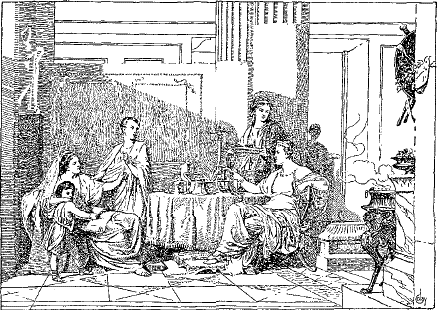
“PUERI MEI SUNT MEA ORNAMENTA”
IMPERFECT ACTIVE INDICATIVE OF REGŌ AND
AUDIŌ · THE DATIVE WITH SPECIAL INTRANSITIVE VERBS
151.
PARADIGMS
| Conjugation III |
Conjugation IV |
| SINGULAR |
| 1. regē´bam, I was ruling |
audiē´bam, I was hearing |
| 2. regē´bās, you were riding |
audiē´bās, you were hearing |
| 3. regē´bat, he was ruling |
audiē´bat, he was hearing |
| PLURAL |
| 1. regēbā´mus, we were ruling |
audiēbā´mus, we were hearing |
| 2. regēbā´tis, you were ruling |
audiēbā´tis, you were hearing |
| 3. regē´bant, they were ruling |
audiē´bant, they were hearing |
1. The tense sign is -bā-, as in the first two conjugations.
2. Observe that the final -ĕ- of the stem is lengthened before
the tense sign -bā-. This makes the imperfect of the third
conjugation just like the imperfect of the second (cf. monēbam
and regēbam).
3. In the fourth conjugation -ē- is inserted between the stem
and the tense sign -bā- (audi-ē-ba-m).
4. In a similar manner inflect the verbs given in § 148.
152.
EXERCISES
I. 1. Agēbat, veniēbat, mittēbat, dūcēbant. 2. Agēbant,
mittēbant, dūcēbas, mūniēbant. 3. Mittēbāmus, dūcēbātis, dīcēbant.
4. Mūniēbāmus, veniēbātis, dīcēbās. 5. Mittēbās, veniēbāmus,
reperiēbat. 6. Reperiēbās, veniēbās, audiēbātis. 7. Agēbāmus,
reperiēbātis, mūniēbat. 8. Agēbātis, dīcēbam, mūniēbam.
II. 1. They were leading, you were driving (sing. and plur.),
he was fortifying. 2. They were sending, we were finding, I was
coming. 3. You were sending, you were fortifying, (sing. and
plur.), he was saying. 4. They were hearing, you were leading
(sing. and plur.), I was driving. 5. We were saying, he was
sending, I was fortifying. 6. They were coming, he was hearing, I
was finding. 7. You were ruling (sing. and plur.), we were
coming, they were ruling.
153.
The Dative with Special Intransitive Verbs. We learned above (§ 20. a) that a verb which does not
admit of a direct object is called an intransitive verb. Many
such verbs, however, are of such meaning that they can govern an
indirect object, which will, of course, be in the dative case (§ 45). Learn the following list of intransitive verbs
with their meanings. In each case the dative indirect object is the
person or thing to which a benefit, injury, or feeling is directed. (Cf.
§ 43.)
|
crēdō, crēdere, believe (give belief to)
faveō, favēre, favor (show favor to)
noceō, nocēre, injure (do harm to)
pāreō, pārēre, obey (give obedience to)
persuādeō, persuādēre, persuade (offer persuasion to)
resistō, resistere, resist (offer resistance to)
studeō, studēre, be eager for (give attention to)
|
154.
Rule. Dative with Intransitive
Verbs. The dative of the indirect object is used with the
intransitive verbs crēdō, faveō, noceō,
pāreō, persuādeō, resistō, studeō, and
others of like meaning.
155.
EXERCISE
1. Crēdisne verbīs sociōrum? Multī verbīs eōrum nōn crēdunt. 2. Meī
fīnitimī cōnsiliō tuō nōn favēbunt, quod bellō student. 3. Tiberius
et Gāius disciplīnae dūrae nōn resistēbant et Cornēliae pārēbant.
4. Dea erat inimīca septem fīliābus rēgīnae. 5. Dūra poena et
perpetua trīstitia rēgīnae nōn persuādēbunt. 6. Nūper ea resistēbat
et nunc resistit potentiae Lātōnae. 7. Mox sagittae volābunt et
līberīs miserīs nocēbunt.
FUTURE ACTIVE INDICATIVE OF REGŌ AND
AUDIŌ
156.
In the future tense of the third and fourth conjugations we meet with a
new tense sign. Instead of using -bi-, as in the first and second
conjugations, we use -ā-1 in the first
person singular and -ē- in the rest of the tense. In the third
conjugation the final -ĕ- of the stem is dropped before this
tense sign; in the fourth conjugation the final -ī- of the stem
is retained.2
157.
PARADIGMS
| Conjugation III |
Conjugation IV |
| SINGULAR |
| 1. re´gam, I shall rule |
au´diam, I shall hear |
| 2. re´gēs, you will rule |
au´diēs, you will hear |
| 3. re´get, he will rule |
au´diet, he will hear |
| PLURAL |
| 1. regē´mus, we shall rule |
audiē´mus, we shall hear |
| 2. regē´tis, you will rule |
audiē´tis, you will hear |
| 3. re´gent, they will rule |
au´dient, they will hear |
1. Observe that the future of the third conjugation is like the
present of the second, excepting in the first person singular.
2. In the same manner inflect the verbs given in § 148.
158.
EXERCISES
I. 1. Dīcet, dūcētis, mūniēmus. 2. Dīcent, dīcētis, mittēmus.
3. Mūnient, venient, mittent, agent. 4. Dūcet, mittēs, veniet,
aget. 5. Mūniet, reperiētis, agēmus. 6. Mittam, veniēmus,
regent. 7. Audiētis, veniēs, reperiēs. 8. Reperiet, agam,
dūcēmus, mittet. 9. Vidēbitis, sedēbō, vocābimus.
II. 1. I shall find, he will hear, they will come. 2. I shall
fortify, he will send, we shall say. 3. I shall drive, you will
lead, they will hear. 4. You will send, you will fortify, (sing.
and plur.), he will say. 5. I shall come, we shall find, they
will send.
6. Who3 will believe the story? I4 shall believe the story. 7. Whose friends do you
favor? We favor our friends. 8. Who will resist our weapons? Sextus
will resist your weapons. 9. Who will persuade him? They will
persuade him. 10. Why were you injuring my horse? I was not
injuring your horse. 11. Whom does a good slave obey? A good slave
obeys his master. 12. Our men were eager for another battle.
VERBS IN -IŌ OF THE THIRD CONJUGATION · THE
IMPERATIVE MOOD
159.
There are a few common verbs ending in -iō which do not belong to
the fourth conjugation, as you might infer, but to the third. The fact
that they belong to the third conjugation is shown by the ending of the
infinitive. (Cf. § 126.) Compare
|
audiō, audī´re (hear), fourth conjugation
capiō, ca´pere (take), third conjugation
|
160.
The present, imperfect, and future active indicative of capiō are
inflected as follows:
|
capiō, capere, take
|
|
Pres. Stem cape-
|
| Present |
Imperfect |
Future |
| SINGULAR |
| 1. ca´piō |
capiē´bam |
ca´piam |
| 2. ca´pis |
capiē´bās |
ca´piēs |
| 3. ca´pit |
capiē´bat |
ca´piet |
| PLURAL |
| 1. ca´pimus |
capiēbā´mus |
capiē´mus |
| 2. ca´pitis |
capiēbā´tis |
capiē´tis |
| 3. ca´piunt |
capiē´bant |
ca´pient |
1. Observe that capiō and the other -iō verbs follow
the fourth conjugation wherever in the fourth conjugation two vowels
occur in succession. (Cf. capiō, audiō; capiunt, audiunt; and all
the imperfect and future.) All other forms are like the third
conjugation. (Cf. capis, regis; capit, regit; etc.)
2. Like capiō, inflect
|
faciō, facere, make, do
fugiō, fugere, flee
iaciō, iacere, hurl
rapiō, rapere, seize
|
161.
The Imperative Mood. The imperative mood expresses a command; as,
come! send! The present tense of the imperative is used
only in the second person, singular and plural. The singular in the
active voice is regularly the same in form as the present stem. The
plural is formed by adding -te to the singular.
| Conjugation |
Singular |
Plural |
| I. |
|
amā, love thou |
amā´te, love ye |
| II. |
|
monē, advise thou |
monē´te, advise ye |
| III. |
(a) |
rege, rule thou |
re´gite, rule ye |
|
(b) |
cape, take thou |
ca´pite, take ye |
| IV. |
|
audī, hear thou |
audī´te, hear ye |
| sum (irregular) |
es, be thou |
este, be ye |
1. In the third conjugation the final -ĕ- of the stem becomes -ĭ- in
the plural.
2. The verbs dīcō, say; dūcō, lead; and
faciō, make, have the irregular forms dīc,
dūc, and fac in the singular.
3. Give the present active imperative, singular and plural, of
veniō, dūcō, vocō, doceō, laudō,
dīcō, sedeō, agō, faciō, mūniō,
mittō, rapiō.
162.
EXERCISES
I. 1. Fugient, faciunt, iaciēbat. 2. Dēlē, nūntiāte, fugiunt.
3. Venīte, dīc, faciētis. 4. Dūcite, iaciam, fugiēbant.
5. Fac, iaciēbāmus, fugimus, rapite. 6. Sedēte, reperī,
docēte. 7. Fugiēmus, iacient, rapiēs. 8. Reperient,
rapiēbātis, nocent. 9. Favēte, resistē, pārēbitis.
10. Volā ad multās terrās et dā auxilium. 11. Ego tēla mea capiam
et multās ferās dēlēbō. 12. Quis fābulae tuae crēdet? 13. Este
bonī, puerī, et audīte verba grāta magistrī.
II. 1. The goddess will seize her arms and will hurl her weapons.
2. With her weapons she will destroy many beasts. 3. She will
give aid to the weak.1 4. She will fly
to many lands and the beasts will flee. 5. Romans, tell2 the famous story to your children.
THE PASSIVE VOICE · PRESENT, IMPERFECT, AND FUTURE
INDICATIVE OF AMŌ AND MONEŌ
163.
The Voices. Thus far the verb forms have been in the active
voice; that is, they have represented the subject as
performing an action; as,
The lion——> killed——> the hunter
A verb is said to be in the passive voice when it represents
its subject as receiving an action; as,
The lion <—— was killed <—— by the
hunter
Note the direction of the arrows.
164.
Passive Personal Endings. In the passive voice we use a different
set of personal endings. They are as follows:
|
Sing. |
1. -r, I |
Plur. |
1. -mur, we |
| 2. -ris, -re, you |
2. -minī, you |
| 3. -tur, he, she, it |
3. -ntur, they |
a. Observe that the letter -r appears somewhere in all but
one of the endings. This is sometimes called the passive
sign.
165.
PARADIGMS
|
amō, amāre |
monēo, monēre |
|
|
Pres. Stem amā- |
Pres. Stem monē- |
|
|
Present Indicative |
PERSONAL
ENDINGS |
| Sing. |
a´mor, I am loved
|
mo´neor, I am advised
|
-or1 |
amā´ris or amā´re, you are loved
|
monē´ris or monē´re, you are advised
|
-ris or -re |
amā´tur, he is loved
|
monē´tur, he is advised
|
-tur |
| Plur. |
amā´mur, we are loved
|
monē´mur, we are advised
|
-mur |
amā´minī, you are loved
|
monē´minī, you are advised
|
-mini |
aman´tur, they are loved
|
monen´tur, they are advised
|
-ntur |
| |
|
Imperfect Indicative
(Tense Sign -bā-) |
|
| Sing. |
amā´bar, I was being loved
|
monē´bar, I was being advised
|
-r |
amābā´ris or amābā´re, you were being loved
|
monēbā´ris or monēbā´re, you were being advised
|
-ris or -re |
amābā´tur, he was being loved
|
monēbā´tur, he was being advised
|
-tur |
| Plur. |
amābā´mur, we were being loved
|
monēbā´mur, we were being advised
|
-mur |
amābā´minī, you were being loved
|
monēbā´minī, you were being advised
|
-minī |
amāban´tur, they were being loved
|
monēban´tur, they were being advised
|
-ntur |
| |
|
|
Future
(Tense Sign -bi-) |
|
| Sing. |
amā´bor, I shall be loved
|
monē´bor, I shall be advised
|
-r |
amā´beris or amā´bere, you will be loved
|
monē´beris or monē´bere, you will be advised
|
-ris or -re
|
amā´bitur, he will be loved
|
monē´bitur, he will be advised
|
-tur |
| Plur. |
amā´bimur, we shall be loved
|
monē´bimur, we shall be advised
|
-mur |
amābi´minī, you will be loved
|
monēbi´minī, you will be advised
|
-minī |
amābun´tur, they will be loved
|
monēbun´tur, they will be advised
|
-ntur |
1. The tense sign and the personal endings are added as in the
active.
2. In the future the tense sign -bi- appears as -bo- in
the first person, -be- in the second, singular number, and as
-bu- in the third person plural.
3. Inflect laudō, necō, portō, moveō,
dēleō, iubeō, in the present, imperfect, and future
indicative, active and passive.
166.
Intransitive verbs, such as mātūrō, I hasten;
habitō, I dwell, do not have a passive voice with a
personal subject.
167.
EXERCISES
I. 1. Laudāris or laudāre, laudās, datur, dat.
2. Dabitur, dabit, vidēminī, vidētis. 3. Vocābat, vocābātur,
dēlēbitis, dēlēbiminī. 4. Parābātur, parābat, cūrās, cūrāris
or cūrāre. 5. Portābantur, portābant, vidēbimur, vidēbimus.
6. Iubēris or iubēre, iubēs, laudābāris or laudābāre,
laudābās. 7. Movēberis or movēbere, movēbis, dabantur, dabant.
8. Dēlentur, dēlent, parābāmur, parābāmus.
II. 1. We prepare, we are prepared, I shall be called, I shall call,
you were carrying, you were being carried. 2. I see, I am seen, it
was being announced, he was announcing, they will order, they will be
ordered. 3. You will be killed, you will kill, you move, you are
moved, we are praising, we are being praised. 4. I am called, I
call,
you will have, you are cared for. 5. They are seen, they see, we were
teaching, we were being taught, they will move, they will be moved.
PERSEUS ANDROMEDAM SERVAT
168.
Per´seus and Androm´eda
First learn the special
vocabulary, p. 288.
Perseus fīlius erat Iovis,2 maximī3 deōrum. Dē eō multās fabulās nārrant poētae. Eī
favent deī, eī magica arma et ālās dant. Eīs tēlīs armātus et ālīs
frētus ad multās terrās volābat et mōnstra saeva dēlēbat et miserīs
īnfīrmīsque auxilium dabat.
Aethiopia est terra Āfricae. Eam terram Cēpheus5 regēbat. Eī6
Neptūnus, maximus aquārum deus, erat īrātus et mittit7 mōnstrum saevum ad Aethiopiam. Ibi mōnstrum nōn sōlum
lātīs pulchrīsque Aethiopiae agrīs nocēbat sed etiam domicilia
agricolārum dēlēbat, et multōs virōs, fēminās, līberōsque necābat.
Populus ex agrīs fugiēbat et oppida mūrīs validīs mūniēbat. Tum Cēpheus
magnā trīstitiā commōtus ad Iovis ōrāculum properat et ita dīcit: “Amīcī
meī necantur; agrī meī vāstantur. Audī verba mea, Iuppiter. Dā miserīs
auxilium. Age mōnstrum saevum ex patriā.”
PRESENT, IMPERFECT, AND FUTURE INDICATIVE PASSIVE OF
REGŌ AND AUDIŌ
169.
Review the present, imperfect, and future indicative active of
regō and audiō, and learn the passive of the same tenses
(§§ 490, 491).
a. Observe that the tense signs of the imperfect and future are
the same as in the active voice, and that the passive personal endings
(§ 164) are added instead of the active
ones.
b. Note the slight irregularity in the second person singular
present of the third conjugation. There the final -e- of the stem
is not changed to -i-, as it is in the active. We therefore have
re´geris or re´gere, not re´giris,
re´gire.
c. Inflect agō, dīcō, dūcō, mūniō,
reperiō, in the present, imperfect, and future indicative, active
and passive.
170.
EXERCISES
I. 1. Agēbat, agēbātur, mittēbat, mittēbātur, dūcēbat. 2. Agunt,
aguntur, mittuntur, mittunt, mūniunt. 3. Mittor, mittar, mittam,
dūcēre, dūcere. 4. Dīcēmur, dīcimus, dīcēmus, dīcimur, mūniēbaminī.
5. Dūcitur, dūciminī, reperīmur, reperiar, agitur.
6. Agēbāmus, agēbāmur, reperīris, reperiēminī. 7. Mūnīminī,
veniēbam, dūcēbar,
dīcētur. 8. Mittiminī, mittitis, mittēris, mitteris, agēbāminī.
9. Dīcitur, dīcit, mūniuntur, reperient, audientur.
II. 1. I was being driven, I was driving, we were leading, we were
being led, he says, it is said. 2. I shall send, I shall be sent,
you will find, you will be found, they lead, they are led. 3. I am
found, we are led, they are driven, you were being led (sing. and
plur.). 4. We shall drive, we shall be driven, he leads, he is
being led, they will come, they will be fortified. 5. They were
ruling, they were being ruled, you will send, you will be sent, you are
sent, (sing. and plur.). 6. He was being led, he will come,
you are said (sing. and plur.).
171.
Perseus and Andromeda
(Continued)
First learn the special
vocabulary, p. 288.
Tum ōrāculum ita respondet: “Mala est fortūna tua. Neptūnus, magnus
aquārum deus, terrae Aethiopiae inimīcus, eās poenās mittit. Sed parā
īrātō deō sacrum idōneum et mōnstrum saevum ex patriā tuā agētur.
Andromeda fīlia tua est mōnstrō grāta. Dā eam mōnstrō. Servā cāram
patriam et vītam populī tuī.” Andromeda autem erat puella pulchra. Eam
amābat Cēpheus maximē.
PRESENT, IMPERFECT, AND FUTURE INDICATIVE PASSIVE OF
-IŌ VERBS · PRESENT PASSIVE INFINITIVE AND IMPERATIVE
172.
Review the active voice of capiō, present, imperfect, and future,
and learn the passive of the same tenses (§ 492).
a. The present forms capior and capiuntur are like
audior, audiuntur, and the rest of the tense is like
regor.
b. In like manner inflect the passive of iaciō and
rapiō.
173.
The Infinitive. The infinitive mood gives the general meaning of
the verb without person or number; as, amāre, to love.
Infinitive means unlimited. The forms of the other moods, being
limited by person and number, are called the finite, or limited,
verb forms.
174.
The forms of the Present Infinitive, active and passive, are as
follows:
| Conj. |
Pres. Stem |
Pres. Infinitive Active |
Pres. Infinitive Passive |
| I. |
amā- |
amā´re, to love |
amā´rī, to be loved |
| II. |
monē- |
monē´re, to advise |
monē´rī, to be advised |
| III. |
rege- |
re´gere, to rule |
re´gī, to be ruled |
|
cape- |
ca´pere, to take |
ca´pī, to be taken |
| IV. |
audī- |
audī´re, to hear |
audīrī, to be heard |
1. Observe that to form the present active infinitive we add
-re to the present stem.
a. The present infinitive of sum is esse. There is
no passive.
2. Observe that the present passive infinitive is formed from the
active by changing final -e to -ī, except in the third
conjugation, which changes final -ere to -ī.
3. Give the active and passive present infinitives of doceō,
sedeō, volō, cūrō, mittō, dūcō,
mūniō, reperiō, iaciō, rapiō.
175.
The forms of the Present Imperative, active and passive, are as
follows:
|
Active1 |
Passive |
| CONJ. |
SING. |
PLUR. |
SING. |
PLUR. |
| I. |
a´mā |
amā´te |
amā´re, be thou loved |
amā´minī, be ye loved |
| II. |
mo´nē |
monē´te |
monē´re, be thou advised |
monē´minī, be ye advised |
| III. |
re´ge |
re´gite |
re´gere, be thou ruled |
regi´minī, be ye ruled |
|
ca´pe |
ca´pite |
ca´pere, be thou taken |
capi´minī, be ye taken |
| IV. |
au´dī |
audī´te |
audī´re, be thou heard |
audī´minī, be ye heard |
1. Observe that the second person singular of the present passive
imperative is like the present active infinitive, and that both singular
and plural are like the second person singular2 and plural, respectively, of the present passive
indicative.
2. Give the present imperative, both active and passive, of the verbs
in § 174. 3.
176.
EXERCISES
First learn the special
vocabulary, p. 289.
I. 1. Tum Perseus ālīs ad terrās multās volabit. 2. Mōnstrum saevum
per aquās properat et mox agrōs nostrōs vāstābit. 3. Sī autem
Cēpheus ad ōrāculum properābit, ōrāculum ita respondēbit. 4. Quis
tēlīs Perseī superābitur? Multa mōnstra tēlīs eius superābuntur.
5. Cum cūrīs magnīs et lacrimīs multīs agricolae ex domiciliīs
cārīs aguntur. 6. Multa loca vāstābantur et multa oppida
dēlēbantur. 7. Mōnstrum est validum, tamen superābitur.
8. Crēdēsne semper verbīs ōrāculī? Ego iīs non semper crēdam.
9. Pārēbitne Cēpheus ōrāculō? Verba ōrāculī eī persuādēbunt.
10. Si nōn fugiēmus, oppidum capiētur et oppidānī necābuntur.
11. Vocāte puerōs et nārrāte fābulam clāram dē mōnstrō saevō.
II. 1. Fly thou, to be cared for, be ye sent, lead thou. 2. To
lead, to be led, be ye seized, fortify thou. 3. To be hurled, to
fly, send thou, to be found. 4. To be sent, be ye led, to hurl, to
be taken. 5. Find thou, hear ye, be ye ruled, to be fortified.
SYNOPSES IN THE FOUR CONJUGATIONS · THE ABLATIVE
DENOTING FROM
177.
You should learn to give rapidly synopses of the verbs you have had, as
follows:1
|
Conjugation I |
Conjugation II |
|
Indicative |
|
ACTIVE |
PASSIVE |
ACTIVE |
PASSIVE |
| Pres. |
a´mō |
a´mor |
mo´neō |
mo´neor |
| Imperf. |
amā´bam |
amā´bar |
monē´bam |
monē´bar |
| Fut. |
amā´bo |
amā´bor |
monē´bo |
monē´bor |
|
|
Imperative |
| Pres. |
a´mā |
amā´re |
mo´nē |
monē´re |
|
Infinitive |
| Pres. |
amā´re |
amā´rī |
monē´re |
monē´rī |
| |
|
Conjugation III |
Conjugation III
(-iō verbs)
|
|
Indicative |
|
ACTIVE |
PASSIVE |
ACTIVE |
PASSIVE |
| Pres. |
re´gō |
re´gor |
ca´piō |
ca´pior |
| Imperf. |
regē´bam |
regē´bar |
capiē´bam |
capiē´bar |
| Fut. |
re´gam |
re´gar |
ca´piam |
ca´piar |
|
Imperative |
| Pres. |
re´ge |
re´gere |
ca´pe |
ca´pere |
|
Infinitive |
| Pres. |
re´gere |
re´gī |
ca´pere |
ca´pī |
| |
|
Conjugation IV |
|
Indicative |
|
ACTIVE |
PASSIVE |
| Pres. |
au´diō |
au´dior |
| Imperf. |
audiē´bam |
audiē´bar |
| Fut. |
au´diam |
au´diar |
|
Imperative |
| Pres. |
au´dī |
audī´re |
|
Infinitive |
| Pres. |
audī´re |
audī´rī |
1. Give the synopsis of rapiō, mūniō, reperiō,
doceō, videō, dīcō, agō, laudō,
portō, and vary the person and number.
178.
We learned in § 50 that one of the three
relations covered by the ablative case is expressed in English by the
preposition from. This is sometimes called the separative
ablative, and it has a number of special uses. You have already
grown familiar with the first mentioned below.
179.
Rule. Ablative of the Place
From. The place from which is expressed by the ablative with the
prepositions ā or ab, dē, ē or
ex.
Agricolae ex agrīs veniunt, the farmers come from the
fields
a. ā or ab denotes from near a place;
ē or ex, out from it; and dē, down
from it. This may be represented graphically as follows:
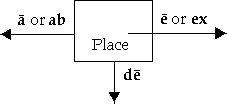
180.
Rule. Ablative of Separation.
Words expressing separation or deprivation require an ablative to
complete their meaning.
a. If the separation is actual and literal of one
material thing from another, the preposition ā or ab,
ē or ex, or dē is generally used. If no actual
motion takes place of one thing from another, no preposition is
necessary.
| (a) |
Perseus terram ā mōnstrīs līberat
Perseus frees the land from monsters
(literal separation— actual motion is expressed)
|
| (b) |
Perseus terram trīstitiā līberat
Perseus frees the land from sorrow
(figurative separation— no actual motion is expressed)
|
181.
Rule. Ablative of the Personal
Agent. The word expressing the person from whom an action starts,
when not the subject, is put in the ablative with the preposition
ā or ab.
a. In this construction the English translation of ā,
ab is by rather than from. This ablative is
regularly used with passive verbs to indicate the person by whom
the act was performed.
Mōnstrum ā Perseō necātur, the monster is being slain by
(lit. from) Perseus
b. Note that the active form of the above sentence would be
Perseus monstrum necat, Perseus is slaying the monster. In
the passive the object of the active verb becomes the
subject, and the subject of the active verb becomes the
ablative of the personal agent, with ā or ab.
c. Distinguish carefully between the ablative of means and the
ablative of the personal agent. Both are often translated into English
by the preposition by. (Cf. § 100.
b.) Means is a thing; the agent or actor is a
person. The ablative of means has no preposition. The
ablative of the personal agent has ā or ab. Compare
|
Fera sagittā necātur, the wild beast is killed by an
arrow
Fera ā Diānā necātur, the wild beast is killed by
Diana
|
Sagittā, in the first sentence, is the ablative of means; ā
Diānā, in the second, is the ablative of the personal agent.
182.
EXERCISES
First learn the special
vocabulary, p. 289.
I. 1. Viri inopiā cibī dēfessī ab eō locō discēdent. 2. Germānī
castrīs Rōmānīs adpropinquābant, tamen lēgātus cōpiās ā proeliō
continēbat. 3. Multa Gallōrum oppida ab Rōmanīs capientur.
4. Tum Rōmānī tōtum populum eōrum oppidōrum gladiīs pīlīsque
interficient. 5. Oppidānī Rōmānīs resistent, sed defessī longō
proelīo fugient. 6. Multī ex Galliā fugiēbant et in Germānōrum
vicīs habitābant. 7. Miserī nautae vulnerantur ab inimīcīs2 saevīs et cibō egent. 8. Discēdite et date
virīs frūmentum et cōpiam vīnī. 9. Cōpiae nostrae ā proeliō
continēbantur ab Sextō lēgatō. 10. Id oppidum ab prōvinciā Rōmānā
longē aberat.
II. 1. The weary sailors were approaching a place dear to the goddess
Diana. 2. They were without food and without wine. 3. Then
Galba and seven other men are sent to the ancient island by Sextus.
4. Already they are not far away from the land, and they see armed
men on a high place. 5. They are kept from the land by the men with
spears and arrows. 6. The men kept hurling their weapons down from
the high place with great eagerness.
PERFECT, PLUPERFECT, AND FUTURE PERFECT OF
SUM
183.
Principal Parts. There are certain parts of the verb that are of
so much consequence in tense formation that we call them the
principal parts.
The principal parts of the Latin verb are the present, the past, and
the past participle; as go, went, gone; see, saw, seen, etc.
The principal parts of the Latin verb are the first person
singular of the present indicative, the present infinitive,
the first person singular of the perfect indicative, and the
perfect passive participle.
184.
Conjugation Stems. From the principal parts we get three
conjugation stems, from which are formed the entire conjugation. We have
already learned about the present stem, which is found from the
present infinitive (cf. § 126. a). The other two stems are the
perfect stem and the participial stem.
185.
The Perfect Stem. The perfect stem of the verb is formed in
various ways, but may always be found by dropping -ī from the
first person singular of the perfect, the third of the principal
parts. From the perfect stem are formed the following tenses:
The Perfect Active Indicative
The Pluperfect Active Indicative (English Past Perfect)
The Future Perfect Active Indicative
All these tenses express completed action in present, past, or future
time respectively.
186.
The Endings of the Perfect. The perfect active indicative is
inflected by adding the endings of the perfect to the perfect stem.
These endings are different from those found in any other tense, and are
as follows:
| Sing. |
1. -ī, I |
Plur. |
1. -imus, we |
| 2. -istī, you |
2. -istis, you |
| 3. -it, he, she, it |
3. -ērunt or -ēre, they |
187.
Inflection of sum in the perfect, pluperfect, and future perfect
indicative:
| Pres. Indic. |
Pres. Infin. |
Perf. Indic. |
| Prin. Parts
sum |
esse |
fuī |
|
Perfect Stem fu- |
| Perfect |
| SINGULAR |
PLURAL |
| fu´ī, I have been, I was |
fu´imus, we have been, we were |
| fuis´tī, you have been, you were |
fuis´tis, you have been, you were |
| fu´it, he has been, he was |
fuē´runt or fuē´re, they have been, they
were |
|
Pluperfect (Tense Sign
-erā-) |
| fu´eram, I had been |
fuerā´mus, we had been |
| fu´erās, you had been |
fuerā´tis, you had been |
| fu´erat, he had been |
fu´erant, they had been |
|
Future Perfect (Tense Sign
-erā-) |
| fu´erō, I shall have been |
fue´rimus, we shall have been |
| fu´eris, you will have been |
fue´ritis, you will have been |
| fu´erit, he will have been |
fu´erint, they will have been |
1. Note carefully the changing accent in the perfect.
2. Observe that the pluperfect may be formed by adding eram,
the imperfect of sum, to the perfect stem. The tense sign is
-erā-.
3. Observe that the future perfect may be formed by adding
erō, the future of sum, to the perfect stem. But the third
person plural ends in -erint, not in -erunt. The tense
sign is -eri-.
4. All active perfects, pluperfects, and future perfects are formed
on the perfect stem and inflected in the same way.
188.
DIALOGUE
The Boys Titus, Marcus, and Quintus
First learn the special
vocabulary, p. 289.
M. Ubi fuistis, Tite et Quīnte?
T. Ego in meō lūdō fuī et Quīntus in suō lūdō fuit. Bonī puerī fuimus.
Fuitne Sextus in vīcō hodiē?
M. Fuit. Nūper per agrōs proximōs fluviō properābat. Ibi is et Cornēlius
habent nāvigium.
T. Nāvigium dīcis? Aliī1 nārrā eam
fābulam!
M. Vērō (Yes, truly), pulchrum et novum nāvigium!
Q. Cuius pecūniā2 Sextus et Cornēlius id
nāvigium parant? Quis iīs pecūniam dat?
M. Amīcī Cornēlī multum habent aurum et puer pecūniā nōn eget.
T. Quō puerī nāvigābunt? Nāvigābuntne longē ā terrā?
M. Dubia sunt cōnsilia eōrum. Sed hodiē, crēdō, sī ventus erit idōneus,
ad maximam īnsulam nāvigābunt. Iam anteā ibi fuērunt. Tum autem ventus
erat perfidus et puerī magnō in perīculō erant.
Q. Aqua ventō commōta est inimīca nautīs semper, et saepe perfidus
ventus nāvigia rapit, agit, dēletque. Iī puerī, sī nōn fuerint maximē
attentī, īrātā aquā et validō ventō superābuntur et ita interficientur.
189.
EXERCISE
1. Where had the boys been before? They had been in school.
2. Where had Sextus been? He had been in a field next to the river.
3. Who has been with Sextus to-day? Cornelius has been with him.
4. Who says so? Marcus. 5. If the wind has been suitable, the
boys have been in the boat. 6. Soon we shall sail with the boys.
7. There3 will be no danger, if we are
(shall have been) careful.4
THE PERFECT ACTIVE INDICATIVE OF THE FOUR REGULAR
CONJUGATIONS
190.
Meanings of the Perfect. The perfect tense has two distinct
meanings. The first of these is equivalent to the English present
perfect, or perfect with have, and denotes that the action of the
verb is complete at the time of speaking; as, I have finished my
work. As this denotes completed action at a definite time, it is
called the perfect definite.
The perfect is also used to denote an action that happened sometime
in the past; as, I finished my work. As no definite time is
specified, this is called the perfect indefinite. It corresponds
to the ordinary use of the English past tense.
a. Note carefully the difference between the following
tenses:
| I |
was finishing
used to finish |
my work
(imperfect, § 134) |
|
I finished my work (perfect indefinite)
|
|
I have finished my work (perfect definite)
|
When telling a story the Latin uses the perfect indefinite to
mark the different forward steps of the narrative, and the
imperfect to describe situations and circumstances that
attend these steps. If the following sentences were Latin, what tenses
would be used?
“Last week I went to Boston. I was trying to find an old friend of
mine, but he was out of the city. Yesterday I returned home.”
191.
Inflection of the Perfect. We learned in § 186 that any perfect is inflected by adding the
endings of the perfect to the perfect stem. The inflection in the four
regular conjugations is then as follows:
| Conj. I |
Conj. II |
Conj. III |
Conj. IV |
| amāvī |
monuī |
rēxī |
cēpī |
audīvī |
I have loved
I loved or did love
|
I have advised
I advised or did advise
|
I have ruled
I ruled or did rule
|
I have taken
I took or did take
|
I have heard
I heard or did hear
|
| Perfect Stems |
| amāv- |
monu- |
rēx- |
cēp- |
audīv- |
| Singular |
| 1. amā´vī |
mo´nuī |
rē´xī |
cē´pī |
audī´vī |
| 2. amāvis´tī |
monuis´tī |
rēxis´tī |
cēpis´tī |
audīvis´tī |
| 3. amā´vit |
mo´nuit |
rē´xit |
cē´pit |
audī´vit |
| Plural |
| 1. amā´vimus |
monu´imus |
rē´ximus |
cē´pimus |
audī´vimus |
| 2. amāvis´tis |
monuis´tis |
rēxis´tis |
cēpis´tis |
audīvis´tis |
3. amāvē´runt or amāvē´re
|
monuē´runt or monuē´re
|
rēxē´runt or rēxē´re
|
cēpē´runt or cēpē´re
|
audīvē´runt or audīvē´re
|
1. The first person of the perfect is always given as the third of the
principal parts. From this we get the perfect stem. This shows the
absolute necessity of learning the principal parts thoroughly.
2. Nearly all perfects of the first conjugation are formed by adding
-vī to the present stem. Like amāvī inflect parāvī,
vocāvī, cūrāvī, laudāvī.
3. Note carefully the changing accent in the perfect. Drill on
it.
192.
Learn the principal parts and inflect the perfects:
| Pres. Indic. |
Pres. Infin. |
Perf. Indic. |
|
| dō |
dăre |
dedī |
give |
| dēleō |
dēlēre |
dēlēvī |
destroy |
| habeō |
habēre |
habuī |
have |
| moveō |
movēre |
mōvī |
move |
| pāreō |
pārēre |
pāruī |
obey |
| prohibeō |
prohibēre |
prohibuī |
restrain, keep from |
| videō |
vidēre |
vīdī |
see |
| dīcō |
dīcere |
dīxī |
say |
| discēdō |
discēdere |
discessī |
depart |
| dūcō |
dūcere |
dūxī |
lead |
| faciō |
facere |
fēcī |
make, do |
| mittō |
mittere |
mīsī |
send |
| mūniō |
mūnīre |
mūnīvī |
fortify |
| veniō |
venīre |
vēnī |
come |
193.
Perseus and Andromeda
(Continued)
First learn the special
vocabulary, p. 290.
Cēpheus, adversā fortūnā maximē commōtus, discessit et multīs cum
lacrimīs populō Aethiopiae verba ōrāculī nārrāvit. Fāta Andromedae,
puellae pulchrae, ā tōtō populō dēplōrābantur, tamen nūllum erat
auxilium. Deinde Cēpheus cum plēnō trīstitiae animō cāram suam fīliam ex
oppidī portā ad aquam dūxit et bracchia eius ad saxa dūra revīnxit. Tum
amīcī puellae miserae longē discessērunt et diū mōnstrum saevum
exspectāvērunt.
Tum forte Perseus, ālīs frētus, super Aethiopiam volābat. Vīdit
populum, Andromedam, lacrimās, et, magnopere attonitus, ad terram
dēscendit. Tum Cēpheus eī tōtās cūrās nārrāvit et ita dīxit: “Pārēbō
verbīs ōrāculī, et prō patriā fīliam meam dabō; sed sī id mōnstrum
interficiēs et Andromedam servābis, tibi (to you) eam dabō.”
PLUPERFECT AND FUTURE PERFECT ACTIVE INDICATIVE ·
PERFECT ACTIVE INFINITIVE
194.
|
Conj. I |
Conj. II |
Conj. III |
Conj. IV |
|
amō |
moneō |
regō |
capiō |
audiō |
| Perfect Stems |
amāv- |
monu- |
rēx- |
cēp- |
audīv- |
|
Pluperfect Indicative Active
|
|
Tense Sign -erā-
|
| SINGULAR |
| I had loved |
I had advised |
I had ruled |
I had taken |
I had heard |
| 1. amā´veram |
monu´eram |
rē´xeram |
cē´peram |
audī´veram |
| 2. amā´verās |
monu´erās |
rē´xerās |
cē´perās |
audī´verās |
| 3. amā´verat |
monu´erat |
rē´xerat |
cē´perat |
audī´verat |
| PLURAL |
| 1. amāverā´mus |
monuerā´mus |
rēxerā´mus |
cēperā´mus |
audīverā´mus |
| 2. amāverā´tis |
monuerā´tis |
rēxerā´tis |
cēperā´tis |
audīverā´tis |
| 3. amā´verant |
monu´erant |
rē´xerant |
cē´perant |
audī´verant |
| |
|
Future Perfect Indicative Active
|
|
Tense Sign -eri-
|
| SINGULAR |
I shall have loved
|
I shall have advised
|
I shall have ruled
|
I shall have taken
|
I shall have heard
|
| 1. amā´verō |
monu´erō |
rē´xerō |
cē´perō |
audī´verō |
| 2. amā´veris |
monu´eris |
rē´xeris |
cē´peris |
audī´veris |
| 3. amā´verit |
monu´erit |
rē´xerit |
cē´perit |
audī´verit |
| PLURAL |
| 1. amāve´rimus |
monue´rimus |
rēxe´rimus |
cēpe´rimus |
audīve´rimus |
| 2. amāve´ritis |
monue´ritis |
rēxe´ritis |
cēpe´ritis |
audīve´ritis |
| 3. amā´verint |
monu´erint |
rē´xerint |
cē´perint |
audī´verint |
1. Observe that these are all inflected alike and the rules for
formation given in § 187. 2-4 hold
good here.
2. In like manner inflect the pluperfect and future perfect
indicative active of dō, portō, dēleō,
moveō, habeō, dīcō, discēdō, faciō,
veniō, mūniō.
195.
The Perfect Active Infinitive. The perfect active infinitive is
formed by adding -isse to the perfect stem.
| Conj. |
Perfect Stem |
Perfect Infinitive |
| I. |
|
amāv- |
amāvis´se, to have loved |
| II. |
|
monu- |
monuis´se, to have advised |
| III. |
(a) |
rēx- |
rēxis´se, to have ruled
|
|
(b) |
cēp- |
cēpis´se, to have taken |
| IV. |
|
audīv- |
audīvis´se, to have heard |
| sum |
fu- |
fuis´se, to have been |
1. In like manner give the perfect infinitive active of dō,
portō, dēleō, moveō, habeō, dīcō,
discēdō, faciō, veniō, mūniō.
196.
EXERCISES
I. 1. Habuistī, mōvērunt, miserant. 2. Vīdit, dīxeris, dūxisse.
3. Mīsistis, pāruērunt, discesserāmus. 4. Mūnīvit, dederam,
mīserō. 5. Habuerimus, dēlēvī, pāruit, fuisse. 6. Dederās,
mūnīveritis, vēnerātis, mīsisse. 7. Vēnerās, fēcisse, dederātis,
portāveris.
8. Quem verba ōrāculī mōverant? Populum verba ōrāculī mōverant.
9. Cui Cēpheus verba ōrāculī nārrāverit? Perseō Cēpheus verba
ōrāculī nārrāverit. 10. Amīcī ab Andromedā discesserint.
11. Mōnstrum saevum domicilia multa dēlēverat. 12. Ubi
mōnstrum vīdistis? Id in aquā vīdimus. 13. Quid mōnstrum faciet?
Mōnstrum Andromedam interficiet.
II. 1. They have obeyed, we have destroyed, I shall have had.
2. We shall have sent, I had come, they have fortified. 3. I
had departed, he has obeyed, you have sent (sing. and plur.).
4. To have destroyed, to have seen, he will have given, they have
carried. 5. He had destroyed, he has moved, you have had (sing.
and plur.). 6. I have given, you had moved (sing. and
plur.), we had said. 7. You will have made (sing. and
plur.), they will have led, to have given.
8. Who had seen the monster? Andromeda had seen it. 9. Why had
the men departed from1 the towns? They had
departed because the monster had come. 10. Did Cepheus obey2 the oracle3? He did.
REVIEW OF THE ACTIVE VOICE
197.
A review of the tenses of the indicative active shows the following
formation:
|
TENSES OF THE INDICATIVE
|
Present
= First of the principal parts
|
|
Imperfect
= Present stem + -ba-m
|
|
Future
= Present stem +
|
-bō, Conj. I and II
-a-m, Conj. III and IV
|
|
Perfect
= Third of the principal parts
|
|
Pluperfect
= Perfect stem + -era-m
|
|
Future Perfect
= Perfect stem + -erō
|
198.
The synopsis of the active voice of amō, as far as we have
learned the conjugation, is as follows:
Principal Parts
amō, amāre, amāvī
|
Pres. Stem
amā-
|
Perf. Stem
amāv-
|
|
Indic.
|
Pres. amō |
Indic.
|
Perf. amāvī |
| Imperf. amābam |
Pluperf. amāveram |
| Fut. amābō |
Fut. perf. amāverō |
|
Pres. Imv. amā |
|
|
Pres. Infin. amāre
|
Perf. Infin. amāvisse
|
1. Learn to write in the same form and to give rapidly the principal
parts and synopsis of parō, dō, laudō,
dēleō, habeō, moveō, pāreō, videō,
dīcō, discēdō, dūcō, mittō, capiō,
muniō, veniō.1
199.
Learn the following principal parts:2
|
Pres. Indic. |
Pres. Infin. |
Perf. Indic. |
|
Irregular
Verbs
|
sum
ab´sum
dō
|
esse
abes´se
dare
|
fuī
ā´fuī
dedī
|
be
be away
give
|
Conjugation
II |
contineō
doceō
egeō
faveō
iubeō
noceō
persuādeō
respondeō
sedeō
studeō
|
continēre
docēre
egēre
favēre
iubēre
nocēre
persuādēre
respondēre
sedēre
studēre
|
continuī
docuī
eguī
fāvī
iussī
nocuī
persuāsī
respondī
sēdī
studuī
|
hold in, keep
teach
need
favor
order
injure
persuade
reply
sit
be eager
|
Conjugation
III |
agō
crēdō
fugiō
iaciō
interficiō
rapiō
resis´tō
|
agere
crēdere
fugere
iacere
interficere
rapere
resis´tere
|
ēgī
crēdidī
fūgī
iēcī
interfēcī
rapuī
re´stitī
|
drive
believe
flee
hurl
kill
seize
resist
|
Conjugation
IV |
repe´riō |
reperī´re |
rep´perī |
find |
200.
Perseus and Andromeda
(Concluded)
First learn the special
vocabulary, p. 290. Read the whole story.
Perseus semper proeliō studēbat3 et
respondit,3 “Verba tua sunt maximē grāta,” et
laetus arma sua magica parāvit.3 Subitō
mōnstrum vidētur; celeriter per aquam properat et Andromedae
adpropinquat. Eius amīcī longē absunt et misera puella est sōla. Perseus
autem sine morā super aquam volāvit.3 Subitō
dēscendit3 et dūrō gladiō saevum mōnstrum
graviter vulnerāvit.3 Diū pugnātur,4 diū proelium est dubium. Dēnique autem Perseus
mōnstrum interfēcit3 et victōriam
reportāvit.3 Tum ad saxum vēnit3 et Andromedam līberāvit3 et
eam ad Cēpheum dūxit.3 Is, nūper miser, nunc
laetus, ita dīxit3: “Tuō auxiliō, mī amīce,
cāra fīlia mea est lībera; tua est Andromeda.” Diū Perseus cum Andromedā
ibi habitābat3 et magnopere ā tōtō populō
amābātur.3
THE PASSIVE PERFECTS OF THE INDICATIVE · THE PERFECT
PASSIVE AND FUTURE ACTIVE INFINITIVE
201.
The fourth and last of the principal parts (§ 183) is the perfect passive participle.
From it we get the participial stem on which are formed the future
active infinitive and all the passive perfects.
1. Learn the following principal parts, which are for the first time
given in full:
| Conj. |
Pres. Indic. |
Pres. Infin. |
Perf. Indic. |
Perf. Pass. Part |
| I. |
amō |
amā´-re |
amā´v-ī |
amā´t-us |
|
This is the model for all regular verbs of the first conjugation.
|
| II. |
mo´neō |
monē´-re |
mo´nu-ī |
mo´nit-us |
| III. |
regō |
re´ge-re |
rēx-ī |
rēct-us |
|
ca´piō |
ca´pe-re |
cēp-ī |
capt-us |
| IV. |
au´diō |
audī´-re |
audī´v-ī |
audī´t-us |
2. The base of the participial stem is found by dropping -us
from the perfect passive participle.
202.
In English the perfect, past perfect, and future perfect tenses of the
indicative passive are made up of forms of the auxiliary verb to
be and the past participle; as, I have been loved, I had
been loved, I shall have been loved.
Very similarly, in Latin, the perfect, pluperfect, and future perfect
passive tenses use respectively the present, imperfect, and future of
sum as an auxiliary verb with the perfect passive participle,
as
|
Perfect passive, amā´tus sum, I have been or was
loved
Pluperfect passive, amā´tus eram, I had been loved
Future perfect passive, amā´tus erō, I shall have been
loved
|
1. In the same way give the synopsis of the corresponding tenses of
moneō, regō, capiō, and audiō, and give the
English meanings.
203.
Nature of the Participle. A participle is partly verb and partly
adjective. As a verb it possesses tense and voice. As an adjective it
is declined and agrees with the word it modifies in gender, number, and
case.
204.
The perfect passive participle is declined like bonus, bona,
bonum, and in the compound tenses (§ 202) it agrees as a predicate adjective with the
subject of the verb.
Examples in
Singular
|
Vir laudātus est, the man was praised, or has been
praised
Puella laudāta est, the girl was praised, or has been
praised
Cōnsilium laudātum est, the plan was praised, or has
been praised
|
Examples in
Plural
|
Virī laudātī sunt, the men were praised, or have been
praised
Puellae laudātae sunt, the girls were praised, or have
been praised
Cōnsilia laudāta sunt, the plans were praised, or have
been praised
|
1. Inflect the perfect, pluperfect, and future perfect indicative
passive of amō, moneō, regō, capiō, and
audiō (§§ 488-492).
205.
The perfect passive infinitive is formed by adding esse,
the present infinitive of sum, to the perfect passive participle;
as, amā´t-us (-a, -um) esse, to have been
loved; mo´nit-us (-a, -um) esse, to
have been advised.
1. Form the perfect passive infinitive of regō, capiō,
audiō, and give the English meanings.
206.
The future active infinitive is formed by adding esse, the
present infinitive of sum, to the future active participle. This
participle is made by adding -ūrus, -a, -um to the base of the
participial stem. Thus the future active infinitive of amō is
amat-ū´rus (-a, -um) esse, to be about to
love.
a. Note that in forming the three tenses of the active infinitive
we use all three conjugation stems:
|
Present, amāre (present stem), to love
Perfect, amāvisse (perfect stem), to have loved
Future, amātūrus esse (participial stem), to be about to
love
|
1. Give the three tenses of the active infinitive of laudō,
moneō, regō, capiō, audiō, with the English
meanings.
207.
EXERCISES
I. 1. Fābula Andromedae nārrāta est. 2. Multae fābulae ā
magistrō nārrātae sunt. 3. Ager ab agricolā validō arātus erat.
4. Agrī ab agricolīs validīs arātī erant. 5. Aurum ā servō
perfidō ad domicilium suum portātum erit. 6. Nostra arma ā lēgātō
laudāta sunt. Quis vestra arma laudāvit? 7. Ab ancillā tuā ad cēnam
vocātae sumus. 8. Andromeda mōnstrō nōn data est, quia mōnstrum ā
Perseō necātum erat.
II. 1. The provinces were laid waste, the field had been laid waste,
the towns will have been laid waste. 2. The oracles were heard, the
oracle was heard, the oracles had been heard. 3. The oracle will
have been heard, the province had been captured, the boats have been
captured. 4. The fields were laid waste, the man was advised, the
girls will have been advised. 5. The towns had been ruled, we shall
have been captured, you will have been heard.
REVIEW OF PRINCIPAL PARTS · PREPOSITIONS
YES-OR-NO QUESTIONS
208.
The following list shows the principal parts of all the verbs you have
had excepting those used in the paradigms. The parts you have had before
are given for review, and the perfect participle is the only new form
for you to learn. Sometimes one or more of the principal parts are
lacking, which means that the verb has no forms based on that stem. A
few verbs lack the perfect passive participle but have the future active
participle in -ūrus, which appears in the principal parts
instead.
|
Irregular Verbs
|
sum
absum
dō1
|
esse
abesse
dare
|
fuī
āfuī
dedī
|
futūrus
āfutūrus
datus
|
be
be away
give
|
| Conjugation I |
| portō |
portāre |
portāvī |
portātus |
carry |
|
So for all verbs of this conjugation thus far used.
|
| Conjugation II |
contineō
dēleō
doceō
egeō
faveō
iubeō
moveō
noceō
pāreō
persuādeō
prohibeō
respondeō
sedeō
studeō
videō
|
continēre
dēlēre
docēre
egēre
favēre
iubēre
movēre
nocēre
pārēre
persuādēre
prohibēre
respondēre
sedēre
studēre
vidēre
|
continuī
dēlēvī
docuī
eguī
fāvī
iussī
mōvī
nocuī
pāruī
persuāsī
prohibuī
respondī
sēdī
studuī
vīdī
|
contentus
dēlētus
doctus
——
fautūrus
iussus
mōtus
nocitūrus
——
persuāsus
prohibitus
respōnsus
-sessus
——
vīsus
|
hold in, keep
destroy
teach
lack
favor
order
move
injure
obey
persuade (from)
restrain, keep
reply
sit
be eager
see
|
| Conjugation III |
agō
crēdō
dīcō
discēdō
dūcō
faciō2
fugiō
iaciō
interficiō
mittō
rapiō
resistō
|
agere
crēdere
dīcere
discēdere
dūcere
facere
fugere
iacere
interficere
mittere
rapere
resistere
|
ēgī
crēdidī
dīxī
discessī
dūxī
fēcī
fūgī
iēcī
interfēcī
mīsī
rapuī
restitī
|
āctus
crēditus
dictus
discessus
ductus
factus
fugitūrus
iactus
interfectus
missus
raptus
——
|
drive
believe
say
depart
lead
make
flee
hurl
kill
send
seize
resist
|
| Conjugation IV |
mūniō
reperiō
veniō
|
mūnīre
reperīre
venīre
|
mūnīvī
rep´perī
vēnī
|
mūnītus
repertus
ventus
|
fortify
find
come
|
209.
Prepositions. 1. We learned in §§ 52,
53 that only the accusative and the
ablative are used with prepositions, and that prepositions
expressing ablative relations govern the ablative case. Those we have
had are here summarized. The table following should be learned.
|
ā or ab, from, by
cum, with
dē, down from, concerning
ē or ex, out from, out of
prō, before, in front of; for, in behalf
of
sine, without
|
2. Prepositions not expressing ablative relations must govern the
accusative (§ 52). Of these we have
had the following:
|
ad, to
apud, among
per, through
|
There are many others which you will meet as we proceed.
3. The preposition in when meaning in or on
governs the ablative; when meaning to, into, against
(relations foreign to the ablative) in governs the
accusative.
210.
Yes-or-No Questions. Questions not introduced by
some interrogative word like who, why, when, etc., but expecting
the answer yes or no, may take one of three forms:
|
1. Is he coming? (Asking for information.
Implying nothing as to the answer expected.)
2. Is he not coming? (Expecting the answer
yes.)
3. He isn´t coming, is he? (Expecting the
answer no.)
|
These three forms are rendered in Latin as follows:
|
1. Venitne? is he coming?
2. Nōnne venit? is he not coming?
3. Num venit? he isn´t coming, is
he?
|
a. -ne, the question sign, is usually added to the verb,
which then stands first.
b. We learned in § 56. b
that yes-or-no questions are usually answered by repeating
the verb, with or without a negative. Instead of this, ita,
vērō, certē, etc. (so, truly, certainly, etc.) may
be used for yes, and nōn, minimē, etc. for
no if the denial is emphatic, as, by no means, not at
all.
211.
EXERCISES
First learn the special
vocabulary, p. 290.
I. 1. Nōnne habēbat Cornēlia ōrnāmenta aurī? Habēbat. 2. Num Sextus
lēgātus scūtum in dextrō bracchiō gerēbat? Nōn in dextrō, sed sinistrō
in bracchiō Sextus scūtum gerēbat. 3. Frūstrā bella multa ab Gallīs
gesta erant. 4. Ubi oppidum ā perfidō Sextō occupātum est, oppidānī
miserī gladiō interfectī sunt. 5. Id oppidum erat plēnum frūmentī.
6. Nōnne Sextus ab oppidānīs frūmentum postulāvit? Vērō, sed iī
recūsāvērunt frūmentum dare. 7. Cūr oppidum ab Sextō dēlētum est?
Quia frūmentum recūsātum est. 8. Ea victōria nōn dubia erat.
9. Oppidānī erant dēfessī et armīs egēbant. 10. Num fugam
temptāvērunt? Minimē.
II. 1. Where was Julia standing? She was standing where you had
ordered. 2. Was Julia wearing any ornaments? She had many ornaments
of gold. 3. Did she not attempt flight when she saw the danger? She
did. 4. Who captured her? Galba captured her without delay and held
her by the left arm. 5. She didn´t have the lady’s gold, did she?
No, the gold had been taken by a faithless maid and has been brought
back.
CONJUGATION OF POSSUM · THE INFINITIVE USED
AS IN ENGLISH
212.
Learn the principal parts of possum, I am able, I
can, and its inflection in the indicative and infinitive. (Cf. § 495.)
a. Possum, I can, is a compound of potis,
able, and sum, I am.
213.
The Infinitive with Subject Accusative. The infinitive
(cf. § 173) is a verbal noun. Used
as a noun, it has the constructions of a noun. As a verb it can govern a
case and be modified by an adverb. The uses of the infinitive are much
the same in Latin as in English.
1. In English certain verbs of wishing, commanding, forbidding,
and the like are used with an object clause consisting of a substantive
in the objective case and an infinitive, as, he commanded the men to
flee. Such object clauses are called infinitive clauses, and the
substantive is said to be the subject of the infinitive.
Similarly in Latin, some verbs of wishing, commanding,
forbidding, and the like are used with an object clause consisting
of an infinitive with a subject in the accusative case, as, Is virōs
fugere iussit, he commanded the men to flee.
214.
Rule. Subject of the Infinitive.
The subject of the infinitive is in the accusative.
215.
The Complementary Infinitive. In English a verb is often followed
by an infinitive to complete its meaning, as, the Romans are able to
conquer the Gauls. This is called the complementary
infinitive, as the predicate is not complete without the added
infinitive.
Similarly in Latin, verbs of incomplete predication are
completed by the infinitive. Among such verbs are possum, I am
able, I can; properō, mātūrō, I hasten;
temptō, I attempt; as
|
Rōmānī Gallōs superāre possunt, the Romans are able to (or
can) conquer the Gauls
Bellum gerere mātūrant, they hasten to wage war
|
a. A predicate adjective completing a complementary infinitive
agrees in gender, number, and case with the subject of the main
verb.
Malī puerī esse bonī nōn possunt, bad boys are not able to
(or cannot) be good.
Observe that bonī agrees with puerī.
216.
The Infinitive used as a Noun. In English the infinitive is often
used as a pure noun, as the subject of a sentence, or as a predicate
nominative. For example, To conquer (= conquering) is
pleasing; To see (= seeing) is to believe (= believing). The
same use of the infinitive is found in Latin, especially with
est, as
|
Superāre est grātum, to conquer is pleasing
Vidēre est crēdere, to see is to believe
|
a. In the construction above, the infinitive often has a subject,
which must then be in the accusative case, as
Galbam superāre inimīcōs est grātum multīs,
for Galba to conquer his enemies is pleasing to many
b. An infinitive used as a noun is neuter singular. Thus, in the
sentence superāre est grātum, the predicate adjective
grātum is in the neuter nominative singular to agree with
superāre the subject.
217.
EXERCISES
First learn the special
vocabulary, p. 291.
I. 1. Magister lūdī līberōs cum dīligentiā labōrāre iussit.
2. Egēre cibō et vinō est virīs molestum. 3. Virī armātī
vetuērunt Gallōs castra ibi pōnere. 4. Estne lēgātus in castellō an
in mūrō? Is est prō portā. 5. Ubi nostrī1 fugere incēpērunt, lēgātus ab vestrīs1 captus est. 6. Gallī castellum ibi oppugnāverant ubi
praesidium erat īnfīrmum. 7. Aliī pugnāre temptābant, aliī portās
petēbant. 8. Fēminae prō domiciliīs sedēbant neque resistere
validīs Gallīs poterant. 9. Bellum est saevum, nec īnfīrmīs nec
miserīs favet. 10. Sed virī arma postulābant et studēbant Gallōs dē
mūrīs agere. 11. Id castellum ab Gallīs occupārī Rōmānīs nōn grātum
erit. 12. Gallī ubi ā Rōmānīs victī sunt, esse līberī2 cessāvērunt. 13. Diū sine aquā vīvere nōn
potestis.
II. 1. The girl began daily to carry water from the river to the
gates. 2. The Gauls had pitched their camp in a place suitable for
a battle. 3. For a long time they tried in vain to seize the
redoubt. 4. Neither did they cease to hurl weapons against3 the walls. 5. But they were not able to
(could not) take the town.
218.
The Faithless Tarpe´ia
Sabīnī ōlim cum Rōmānīs bellum gerēbant et multās victōriās
reportāverant. Iam agrōs proximōs mūrīs vāstābant, iam oppidō
adpropinquābant. Rōmānī autem in Capitōlium fūgerant et longē perīculō
aberant. Mūrīs validīs et saxīs altīs crēdēbant. Frūstrā Sabīnī tēla
iaciēbant, frūstrā portās dūrās petēbant; castellum occupāre nōn
poterant. Deinde novum cōnsilium cēpērunt.4
Tarpēia erat puella Rōmāna pulchra et superba. Cotīdiē aquam cōpiīs
Rōmānīs in Capitōlium portābat. Eī5 nōn
nocēbant Sabīnī, quod ea sine armīs erat neque Sabīnī bellum cum fēminīs
līberīsque gerēbant. Tarpēia autem maximē amābat ōrnāmenta aurī. Cotīdiē
Sabīnōrum ōrnāmenta vidēbat et mox ea dēsīderāre incipiēbat. Eī ūnus
ex6 Sabīnīs dīxit, “Dūc cōpiās Sabīnās intrā
portās, Tarpēia, et maxima erunt praemia tua.”
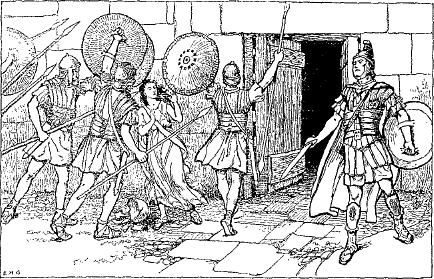
TARPEIA PUELLA PERFIDA
THE RELATIVE PRONOUN AND THE INTERROGATIVE
PRONOUN
219.
Sentences are simple, compound, or complex.
a. A simple sentence is a sentence containing but one
statement, that is, one subject and one predicate: The Romans
approached the town.
b. A compound sentence is a sentence containing two or
more independent statements: The Romans approached the town | and
| the enemy fled.
Note. An independent statement is one
that can stand alone; it does not depend upon another statement.
c. A complex sentence is a sentence containing one
independent statement and one or more dependent statements: When the
Romans approached the town | the enemy fled.
Note. A dependent or subordinate
statement is one that depends on or qualifies another statement; thus
the enemy fled is independent, and when the Romans approached
the town is dependent or subordinate.
d. The separate statements in a compound or complex sentence are
called clauses. In a complex sentence the independent statement
is called the main clause and the dependent statement the
subordinate clause.
220.
Examine the complex sentence
The Romans killed the men who were taken
Here are two clauses:
a. The main clause, The Romans killed the men
b. The subordinate clause, who were taken
The word who is a pronoun, for it takes the place of the noun
men. It also connects the subordinate clause who were
taken with the noun men. Hence the clause is an adjective
clause. A pronoun that connects an adjective clause with a
substantive is called a relative pronoun, and the substantive for
which the relative pronoun stands is called its antecedent. The
relative pronouns in English are who, whose, whom, which, what,
that.
221.
The relative pronoun in Latin is quī, quae, quod,
and it is declined as follows:
|
Singular |
Plural |
|
MASC. |
FEM. |
NEUT. |
MASC. |
FEM. |
NEUT. |
| Nom. |
quī |
quae |
quod |
quī |
quae |
quae |
| Gen. |
cuius |
cuius |
cuius |
quōrum |
quārum |
quōrum |
| Dat. |
cui |
cui |
cui |
quibus |
quibus |
quibus |
| Acc. |
quem |
quam |
quod |
quōs |
quās |
quae |
| Abl. |
quō |
quā |
quō |
quibus |
quibus |
quibus |
1. Review the declension of is, § 114, and note the similarity in the endings. The
forms quī, quae, and quibus are the only forms
showing new endings.
Note. The genitive cuius and the
dative cui are pronounced co͝oi´yo͝os (two syllables) and
co͝oi (one syllable).
222.
The Relative Pronoun is translated as follows:1
|
Masc. and Fem. |
Neut. |
| Nom. |
who, that |
which, what, that |
| Gen. |
of whom, whose |
of which, of what, whose |
| Dat. |
to or for whom |
to or for which, to or for what |
| Acc. |
whom, that |
which, what, that |
| Abl. |
from, etc., whom |
from, etc., which or what |
a. We see from the table above that quī, when it refers to
a person, is translated by some form of who or by that;
and that when it refers to anything else it is translated by which,
what, or that.
223.
Note the following sentences:
|
The Romans killed the men who were taken
The Romans killed the woman who was taken
Rōmānī interfēcērunt virōs quī captī sunt
Rōmānī interfēcērunt fēminam quae capta est
|
In the first sentence who (quī) refers to the
antecedent men (virōs), and is masculine plural. In
the second, who (quae) refers to woman
(fēminam), and feminine singular. From this we learn that
the relative must agree
with its antecedent in gender and number. In neither of
the sentences are the antecedents and relatives in the same case.
Virōs and fēminam are accusatives, and quī and
quae are nominatives, being the subjects of the subordinate
clauses. Hence
224.
Rule. Agreement of the Relative.
A relative pronoun must agree with its antecedent in gender and
number; but its case is determined by the way it is used in its own
clause.
225.
Interrogative Pronouns. An interrogative pronoun is a pronoun
that asks a question. In English the interrogatives are who?
which? what? In Latin they are quis? quid?
(pronoun) and quī? quae? quod? (adjective).
226.
Examine the sentences
|
a. Who is the man? Quis est vir?
b. What man is leading them? Quī vir eōs dūcit?
|
In a, who is an interrogative pronoun. In
b, what is an interrogative adjective. Observe that
in Latin quis, quid is the pronoun and quī,
quae, quod is the adjective.
227.
1. The interrogative adjective quī, quae, quod is
declined just like the relative pronoun. (See § 221.)
2. The interrogative pronoun quis, quid is declined
like quī, quae, quod in the plural. In the singular
it is declined as follows:
|
Masc. and Fem. |
Neut. |
| Nom. |
quis, who? |
quid, what? which? |
| Gen. |
cuius, whose? |
cuius, whose? |
| Dat. |
cui, to or for whom? |
cui, to or for what or which? |
| Acc. |
quem, whom? |
quid, what? which? |
| Abl. |
quō, from, etc., whom? |
quō, from, etc., which or what? |
Note. Observe that the masculine and
feminine are alike and that all the forms are like the corresponding
forms of the relative, excepting quis and quid.
228.
EXERCISES
I. 1. Quis est aeger? Servus quem amō est aeger. 2. Cuius scūtum
habēs? Scūtum habeō quod lēgātus ad castellum mīsit. 3. Cui lēgātus
suum scūtum dabit? Fīliō meō scūtum dabit. 4. Ubi Germānī
antīquī vīvēbant? In terrā quae est proxima Rhēnō Germānī vīvēbant.
5. Quibuscum2 Germānī bellum gerēbant?
Cum Rōmānīs, qui eōs superāre studēbant, Germānī bellum gerēbant.
6. Quī virī castra pōnunt? Iī sunt virī quōrum armīs Germānī victī
sunt. 7. Quibus tēlīs cōpiae nostrae eguērunt? Gladiīs et telīs
nostrae cōpiae eguērunt. 8. Ā quibus porta sinistra tenēbātur? Ā
sociīs porta sinistra tenēbātur. 9. Quae prōvinciae ā Rōmānīs
occupātae sunt? Multae prōvinciae ā Rōmānīs occupātae sunt.
10. Quibus virīs deī favēbunt? Bonīs virīs deī favēbunt.
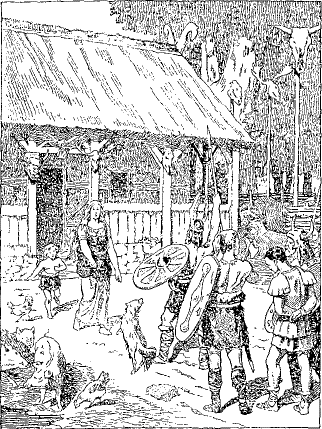
GERMANI ANTIQUI
II. 1. What victory will you announce? 2. I will announce to the
people the victory which the sailors have won. 3. The men who were
pitching camp were eager for battle. 4. Nevertheless they were soon
conquered by the troops which Sextus had sent. 5. They could not
resist our forces, but fled from that place without delay.
229.
The Faithless Tarpeia
(Concluded)3
Tarpēia, commōta ōrnamentīs Sabīnōrum pulchrīs, diū resistere nōn
potuit et respondit: “Date mihi4 ōrnāmenta
quae in sinistrīs bracchīs geritis, et celeriter cōpiās vestrās in
Capitōlium dūcam.” Nec
Sabīnī recūsāvērunt, sed per dūrās magnāsque castellī portās
properāvērunt quō5 Tarpēia dūxit et mox intrā
validōs et altōs mūrōs stābant. Tum sine morā in6 Tarpēiam scūta graviter iēcērunt; nam scūta quoque in
sinistrīs bracchiīs gerēbant. Ita perfida puella Tarpēia interfecta est;
ita Sabīnī Capitōlium occupāvērunt.
THE THIRD DECLENSION · CONSONANT STEMS
230.
Bases and Stems. In learning the first and second declensions we
saw that the different cases were formed by adding the case terminations
to the part of the word that did not change, which we called the
base. If to the base we add -ā in the first declension,
and -o in the second, we get what is called the stem. Thus
porta has the base port- and the stem portā-;
servus has the base serv- and the stem servo-.
These stem vowels, -ā- and -o-, play so important a
part in the formation of the case terminations that these declensions
are named from them respectively the Ā- and
O-Declensions.
231.
Nouns of the Third Declension. The third declension is called the
Consonant or I-Declension, and its nouns are classified according
to the way the stem ends. If the last letter of the stem is a
consonant, the word is said to have a consonant stem; if the stem
ends in -i-, the word is said to have an i-stem.
In consonant stems the stem is the same as the base. In
i-stems the stem is formed by adding -i- to the
base. The presence of the i makes a difference in certain of
the cases, so the distinction is a very important one.
232.
Consonant stems are divided into two classes:
I. Stems that add -s to the base to form the nominative
singular.
II. Stems that add no termination in the nominative singular.
CLASS I
233.
Stems that add -s to the base in the nominative singular are
either masculine or feminine and are declined as follows:
|
prīnceps, m., chief |
mīles, m., soldier |
lapis, m., stone |
|
Bases or
Stems |
prīncip- |
mīlit- |
lapid- |
|
|
Singular |
TERMINATIONS
M. AND F. |
| Nom. |
prīnceps |
mīles |
lapis |
-s |
| Gen. |
prīn´cipis |
mīlitis |
lapidis |
-is |
| Dat. |
prīn´cipī |
mīlitī |
lapidī |
-ī |
| Acc. |
prīn´cipem |
mīlitem |
lapidem |
-em |
| Abl. |
prīn´cipe |
mīlite |
lapide |
-e |
|
Plural |
|
| Nom. |
prīn´cipēs |
mīlitēs |
lapidēs |
-ēs |
| Gen. |
prīn´cipum |
mīlitum |
lapidum |
-um |
| Dat. |
prīnci´pibus |
mīlitibus |
lapidibus |
-ibus |
| Acc. |
prīn´cipēs |
mīlitēs |
lapidēs |
-ēs |
| Abl. |
prīnci´pibus |
mīlitibus |
lapidibus |
-ibus |
|
|
rēx, m., king |
iūdex, m., judge |
virtūs, f., manliness |
|
Bases or
Stems |
rēg- |
iūdic- |
virtūt- |
|
| Nom. |
rēx |
iūdex |
virtūs |
-s |
| Gen. |
rēgis |
iūdicis |
virtū´tis |
-is |
| Dat. |
rēgī |
iūdicī |
virtū´tī |
-ī |
| Acc. |
rēgem |
iūdicem |
virtū´tem |
-em |
| Abl. |
rēge |
iūdice |
virtū´te |
-e |
|
Plural |
|
| Nom. |
rēgēs |
iūdicēs |
virtū´tēs |
-ēs |
| Gen. |
rēgum |
iūdicum |
virtū´tum |
-um |
| Dat. |
rēgibus |
iūdicibus |
virtū´tibus |
-ibus |
| Acc. |
rēgēs |
iūdicēs |
virtū´tēs |
-ēs |
| Abl. |
rēgibus |
iūdicibus |
virtū´tibus |
-ibus |
1. The base or stem is found by dropping -is in the genitive
singular.
2. Most nouns of two syllables, like prīnceps
(prīncip-), mīles (mīlit-), iūdex
(iūdic-), have i in the base, but e in the
nominative.
a. lapis is an exception to this rule.
3. Observe the consonant changes of the base or stem in the
nominative:
a. A final -t or -d is dropped before -s;
thus mīles for mīlets, lapis for lapids,
virtūs for virtūts.
b. A final -c or -g unites with -s and forms
-x; thus iūdec + s = iūdex, rēg +
s = rēx.
4. Review § 74 and apply the rules to
this declension.
In like manner decline dux, ducis, m., leader;
eques, equitis, m., horseman; pedes, peditis, m.,
foot soldier; pēs, pedis, m.,foot.
234.
EXERCISES
First learn the special
vocabulary, p. 291.
I. 1. Neque peditēs neque equitēs occupāre castellum Rōmānum
poterant. 2. Summā virtūte mūrōs altōs cotīdiē oppugnābant.
3. Pedes mīlitum lapidibus quī dē mūrō iaciēbantur saepe
vulnerābantur. 4. Quod novum cōnsilium dux cēpit? 5. Is
perfidam puellam pulchrīs ōrnāmentīs temptāvit. 6. Quid puella
fēcit? 7. Puella commōta aurō mīlitēs per portās dūxit.
8. Tamen praemia quae summō studiō petīverat nōn reportāvit.
9. Apud Rōmānōs antīquōs Tarpēia nōn est laudāta.
II. 1. What ship is that which I see? That (illud) ship is the
Victory. It is sailing now with a favorable wind and will soon
approach Italy. 2. The judges commanded the savages to be seized
and to be killed. 3. The chiefs of the savages suddenly began to
flee, but were quickly captured by the horsemen. 4. The king led
the foot soldiers to the wall from which the townsmen were hurling
stones with the greatest zeal.
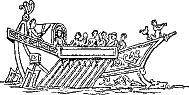
NAVIGIUM
THE THIRD DECLENSION · CONSONANT STEMS
(Continued)
CLASS II
235.
Consonant stems that add no termination in the nominative are declined
in the other cases exactly like those that add -s. They may be
masculine, feminine, or neuter.
236.
PARADIGMS
|
Masculines and Feminines |
|
|
cōnsul, m., consul |
legiō, f., legion |
ōrdō, m., row |
pater, m., father |
|
Bases or
Stems |
cōnsul- |
legiōn- |
ōrdin- |
patr- |
|
|
Singular |
TERMINATIONS
M. AND F. |
| Nom. |
cōnsul |
legiō |
ōrdō |
pater |
— |
| Gen. |
cōnsulis |
legiōnis |
ōrdinis |
patris |
-is |
| Dat. |
cōnsulī |
legiōnī |
ōrdinī |
patrī |
-ī |
| Acc. |
cōnsulem |
legiōnem |
ōrdinem |
patrem |
-em |
| Abl. |
cōnsule |
legiōne |
ōrdine |
patre |
-e |
|
Plural |
|
| Nom. |
cōnsulēs |
legiōnēs |
ōrdinēs |
patrēs |
-ēs |
| Gen. |
cōnsulum |
legiōnum |
ōrdinum |
patrum |
-um |
| Dat. |
cōnsulibus |
legiōnibus |
ōrdinibus |
patribus |
-ibus |
| Acc. |
cōnsulēs |
legiōnēs |
ōrdinēs |
patrēs |
-ēs |
| Abl. |
cōnsulibus |
legiōnibus |
ōrdinibus |
patribus |
-ibus |
1. With the exception of the nominative, the terminations are exactly
the same as in Class I, and the base or stem is found in the same way.
2. Masculines and feminines with bases or stems in -in- and
-ōn- drop -n- and end in -ō in the nominative, as
legiō (base or stem legiōn-), ōrdō (base or stem
ōrdin-).
3. Bases or stems in -tr- have -ter in the nominative,
as pater (base or stem patr-).
4. Note how the genitive singular gives the clue to the whole
declension. Always learn this with the nominative.
237.
EXERCISES
First learn the special
vocabulary, p. 291.
I. 1. Audīsne tubās, Mārce? Nōn sōlum tubās audiō sed etiam ōrdinēs
militum et carrōs impedīmentōrum plēnōs vidēre possum. 2. Quās
legiōnēs vidēmus? Eae legiōnēs nūper ex Galliā vēnērunt. 3. Quid
ibi fēcērunt? Studēbantne pugnāre an sine virtūte erant? 4. Multa
proelia fēcērunt1 et magnās victōriās et
multōs captīvōs reportāvērunt. 5. Quis est imperātor eārum
legiōnum? Caesar, summus Rōmānōrum imperātor. 6. Quis est eques quī
pulchram corōnam gerit? Is eques est frāter meus. Eī corōna ā cōnsule
data est quia summā virtūte pugnāverat et ā barbarīs patriam
servāverat.
II. 1. Who has seen my father to-day? 2. I saw him just now
(nūper). He was hastening to your dwelling with your mother and
sister. 3. When men are far from the fatherland and lack food, they
cannot be restrained2 from wrong3. 4. The safety of the soldiers is dear to Cæsar, the
general. 5. The chiefs were eager to storm a town full of grain
which was held by the consul. 6. The king forbade the baggage of
the captives to be destroyed.
THE THIRD DECLENSION · CONSONANT STEMS
(Concluded)
238.
Neuter consonant stems add no termination in the nominative and are
declined as follows:
|
flūmen, n., river |
tempus, n., time |
opus, n., work |
caput, n., head |
|
Bases or
Stems |
flūmin- |
tempor- |
oper- |
capit- |
|
|
Singular |
TERMINATIONS |
| Nom. |
flūmen |
tempus |
opus |
caput |
— |
| Gen. |
flūminis |
temporis |
operis |
capitis -is |
-is |
| Dat. |
flūminī |
temporī |
operī |
capitī |
-ī |
| Acc. |
flūmen |
tempus |
opus |
caput |
— |
| Abl. |
flūmine |
tempore |
opere |
capite |
-e |
|
|
Plural |
|
| Nom. |
flūmina |
tempora |
opera |
capita |
-a |
| Gen. |
flūminum |
temporum |
operum |
capitum |
-um |
| Dat. |
flūminibus |
temporibus |
operibus |
capitibus |
-ibus |
| Acc. |
flūmina |
tempora |
opera |
capita |
-a |
| Abl. |
flūminibus |
temporibus |
operibus |
capitibus |
-ibus |
1. Review § 74 and apply the rules to
this declension.
2. Bases or stems in -in- have -e- instead of
-i- in the nominative, as flūmen, base or stem
flūmin-.
3. Most bases or stems in -er- and -or- have -us
in the nominative, as opus, base or stem oper-;
tempus, base or stem tempor-.
239.
EXERCISES
First learn the special
vocabulary, p. 292.
I. 1. Barbarī ubi Rōmam cēpērunt, maxima rēgum opera dēlēvērunt.
2. Rōmānī multās calamitātēs ā barbarīs accēpērunt. 3. Ubi
erat summus terror apud oppidānōs, animī dubiī eōrum ab ōrātōre clarō
cōnfīrmāti sunt. 4. Rōma est in rīpīs fiūminis magnī. 5. Ubi
Caesar imperātor mīlitēs suōs arma capere iussit, iī ā proeliō continērī
nōn potuērunt. 6. Ubi proelium factum est, imperātor reperīrī nōn
potuit. 7. Imperātor sagittā in capite vulnerātus erat et stāre nōn
poterat. 8. Eum magnō labōre pedes ex proeliō portāvit. 9. Is
bracchiīs suīs imperātōrem tenuit et eum ex perīculīs summīs servāvit.
10. Virtūte suā bonus mīles ab imperātōre corōnam accēpit.
II. 1. The consul placed a crown on the head of the victor.
2. Before the gates he was received by the townsmen. 3. A
famous orator praised him and said, “By your labors you have saved the
fatherland from disaster.” 4. The words of the orator were pleasing
to the victor. 5. To save the fatherland was a great task.

CORONA
REVIEW LESSON
240.
Review the paradigms in §§ 233, 236, 238; and decline all nouns of
the third declension in this selection.
Terror Cimbricus1
Ōlim Cimbrī et Teutonēs, populī Germāniae, cum fēminīs līberīsque
Italiae adpropinquāverant et cōpiās Rōmānās maximō proeliō vīcerant. Ubi
fuga legiōnum nūntiāta est, summus erat terror tōtīus Rōmae, et Rōmānī,
graviter commōtī, sacra crēbra deīs faciēbant et salūtem petēbant.
Tum Mānlius ōrātor animōs populī ita cōnfīrmāvit:—“Magnam
calamitātem accēpimus. Oppida nostra ā Cimbrīs Teutonibusque capiuntur,
agricolae interficiuntur, agrī vāstantur, cōpiae barbarōrum Rōmae
adpropinquant. Itaque, nisi novīs animīs proelium novum faciēmus et
Germānōs ex patriā nostrā sine morā agēmus, erit nūlla salūs fēminīs
nostrīs līberīsque. Servāte līberōs! Servāte patriam! Anteā superātī
sumus quia imperātōrēs nostrī fuērunt īnfīrmī. Nunc Marius, clārus
imperātor, quī iam multās aliās victōriās reportāvit, legiōnēs dūcet et
animōs nostrōs terrōre Cimbricō līberāre mātūrābit.”
Marius tum in Āfricā bellum gerēbat. Sine morā ex Āfricā in Italiam
vocātus est. Cōpiās novās nōn sōlum tōtī Italiae sed etiam prōvinciīs
sociōrum imperāvit.2 Disciplīnā autem dūrā
labōribusque perpetuīs mīlitēs exercuit. Tum cum peditibus equitibusque,
quī iam proeliō studēbant, ad Germānōrum castra celeriter properāvit.
Diū et ācriter pugnātum est.3 Dēnique barbarī
fūgērunt et multī in fugā ab equitibus sunt interfectī. Marius pater
patriae vocātus est.
THE THIRD DECLENSION · I-STEMS
241.
To decline a noun of the third declension correctly we must know whether
or not it is an i-stem. Nouns with i-stems are
1. Masculines and feminines:
a. Nouns in -ēs and -īs with the same number of
syllables in the genitive as in the nominative. Thus caedēs,
caedis, is an i-stem, but mīles, mīlitis, is a
consonant stem.
b. Nouns in -ns and -rs.
c. Nouns of one syllable in -s or -x preceded by a
consonant.
2. Neuters in -e, -al, and -ar.
242.
The declension of i-stems is nearly the same as that of consonant
stems. Note the following differences:
a. Masculines and feminities have -ium in the genitive
plural and -īs or -ēs in the accusative plural.
b. Neuters have -ī in the ablative singular, and an
-i- in every form of the plural.
243.
Masculine and Feminine I-Stems. Masculine and feminine
i-stems are declined as follows:
|
caedēs, f., slaughter |
hostis, m., enemy |
urbs, f., city |
cliēns, m., retainer |
|
| Stems |
caedi- |
hosti- |
urbi- |
clienti- |
|
| Bases |
caed- |
host- |
urb- |
client- |
|
|
Singular |
TERMINATIONS
M. AND F. |
| Nom. |
caedēs |
hostis |
urbs |
cliēns1 |
-s, -is, or -ēs |
| Gen. |
caedis |
hostis |
urbis |
clientis |
-is |
| Dat. |
caedī |
hostī |
urbī |
clientī |
-ī |
| Acc. |
caedem |
hostem |
urbem |
clientem |
-em (-im) |
| Abl. |
caede |
hoste |
urbe |
cliente |
-e (-ī) |
|
|
Plural |
|
| Nom. |
caedēs |
hostēs |
urbēs |
clientēs |
-ēs |
| Gen. |
caedium |
hostium |
urbium |
clientium |
-ium |
| Dat. |
caedibus |
hostibus |
urbibus |
clientibus |
-ibus |
| Acc. |
caedīs, -ēs |
hostīs, -ēs |
urbīs, -ēs |
clientīs, -ēs |
-īs, -ēs |
| Abl. |
caedibus |
hostibus |
urbibus |
clientibus |
-ibus |
1. avis, cīvis, fīnis, ignis,
nāvis have the ablative singular in -ī or -e.
2. turris has accusative turrim and ablative
turrī or turre.
244.
Neuter I-Stems. Neuter i-stems are declined as
follows:
|
īnsigne, n., decoration |
animal, n., animal |
calcar, n., spur |
|
| Stems |
īnsigni- |
animāli- |
calcāri- |
|
| Bases |
īnsign- |
animāl- |
calcār- |
|
|
Singular |
TERMINATIONS |
| Nom. |
īnsigne |
animal |
calcar |
-e or— |
| Gen. |
īnsignis |
animālis |
calcāris |
-is |
| Dat. |
īnsignī |
animālī |
calcārī |
-ī |
| Acc. |
īnsigne |
animal |
calcar |
-e or— |
| Abl. |
īnsignī |
animālī |
calcārī |
-ī |
|
Plural |
|
| Nom. |
īnsignia |
animālia |
calcāria |
-ia |
| Gen. |
īnsignium |
animālium |
calcārium |
-ium |
| Dat. |
īnsignibus |
animālibus |
calcāribus |
-ibus |
| Acc. |
īnsignia |
animālia |
calcāria |
-ia |
| Abl. |
īnsignibus |
animālibus |
calcāribus |
-ibus |
1. Review § 74 and see how it applies to
this declension.
2. The final -i- of the stem is usually dropped in the
nominative. If not dropped, it is changed to -e.
3. A long vowel is shortened before final -l or -r.
(Cf. § 12. 2.)
245.
EXERCISES
First learn the special
vocabulary, p. 292.
I. 1. Quam urbem vidēmus? Urbs quam vidētis est Rōma. 2. Cīvēs
Rōmānī urbem suam turribus altīs et mūrīs longīs mūnīverant.
3. Ventī nāvīs longās prohibēbant fīnibus hostium adpropinquāre.
4. Imperātor a clientibus suīs calcāria aurī et alia īnsignia
accēpit. 5. Mīlitēs Rōmānī cum hostibus bella saeva gessērunt et
eōs caede
magnā superāvērunt. 6. Alia animālia terram, alia mare amant.
7. Nāvēs longae quae auxilium ad imperātōrem portābant ignī ab
hostibus dēlētae sunt. 8. In eō marī avis multās vīdimus quae longē
ā terrā volāverant. 9. Nōnne vīdistis nāvīs longās hostium et ignīs
quibus urbs nostra vāstābātur? Certē, sed nec caedem cīvium nec fugam
clientium vīdimus. 10. Avēs et alia animālia, ubi ignem vīdērunt,
salūtem fugā petere celeriter incēpērunt. 11. Num. iūdex in peditum
ōrdinibus stābat? Minimē, iūdex erat apud equitēs et equus eius īnsigne
pulchrum gerēbat.
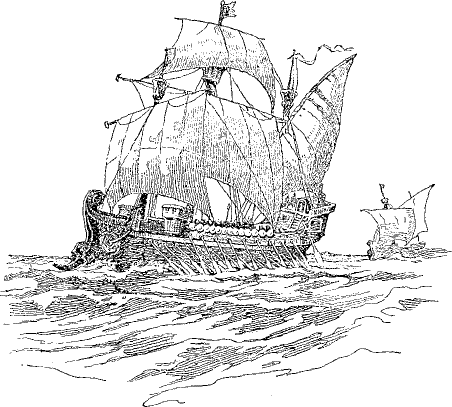
NAVES LONGAE
II. 1. Because of the lack of grain the animals of the village were
not able to live. 2. When the general2
heard the rumor, he quickly sent a horseman to the village. 3. The
horseman had a beautiful horse and wore spurs of gold. 4. He said
to the citizens, “Send your retainers with horses and wagons to our
camp, and you will receive an abundance of grain.” 5. With happy
hearts they hastened to obey his words.3
IRREGULAR NOUNS OF THE THIRD DECLENSION · GENDER IN
THE THIRD DECLENSION
246.
PARADIGMS
The “Stems” are missing in the printed book. They have been supplied
from the inflectional table in the Appendix.
|
vīs, f., force |
iter, n., march |
| Stems |
vī- and
vīri- |
iter- and itiner- |
| Bases |
v- and vīr- |
iter- and itiner- |
| Singular |
| Nom. |
vīs |
iter |
| Gen. |
vīs (rare) |
itineris |
| Dat. |
vī (rare) |
itinerī |
| Acc. |
vim |
iter |
| Abl. |
vī |
itinere |
| Plural |
| Nom. |
vīrēs |
itinera |
| Gen. |
vīrium |
itinerum |
| Dat. |
vīribus |
itineribus |
| Acc. |
vīrīs, or -ēs |
itinera |
| Abl. |
vīribus |
itineribus |
247.
There are no rules for gender in the third declension that do not
present numerous exceptions.1 The following
rules, however, are of great service, and should be thoroughly
mastered:
1. Masculine are nouns in -or, -ōs, -er,
-ĕs (gen. -itis).
a. arbor, tree, is feminine; and iter,
march, is neuter.
2. Feminine are nouns in -ō, -is, -x, and
in -s preceded by a consonant or by any long vowel but
ō.
a. Masculine are collis (hill), lapis,
mēnsis (month), ōrdō, pēs, and nouns in
-nis and -guis—as ignis, sanguis
(blood)—and the four monosyllables
|
dēns, a tooth
mōns, a mountain
pōns, a bridge
fōns, a fountain
|
3. Neuters are nouns in -e, -al, -ar,
-n, -ur, -ŭs, and caput.
248.
Give the gender of the following nouns and the rule by which it is
determined:
| animal |
calamitās |
flūmen |
lapis |
nāvis |
| avis |
caput |
ignis |
legiō |
opus |
| caedēs |
eques |
īnsigne |
mare |
salūs |
| calcar |
fīnis |
labor |
mīles |
urbs |
249.
EXERCISES
First learn the special
vocabulary, p. 292.
I. The First Bridge over the Rhine. Salūs sociōrum erat semper
cāra Rōmānīs. Ōlim Gallī, amīcī Rōmānōrum, multās iniūriās ab Germānīs
quī trāns flūmen Rhēnum vivēbant accēperant. Ubi lēgātī ab iīs ad
Caesarem imperātōrem Rōmānum vēnērunt et auxilium postulāvērunt, Rōmānī
magnīs itineribus ad hostium fīnīs properāvērunt. Mox ad rīpās magnī
flūminis vēnērunt. Imperātor studēbat cōpiās suās trāns fluvium dūcere,
sed nūllā viā2 poterat. Nūllās nāvīs habēbat.
Alta erat aqua. Imperātor autem, vir clārus, numquam adversā fortūnā
commōtus, novum cōnsilium cēpit. Iussit suōs3
in4 lātō flūmine facere pontem. Numquam anteā
pōns in Rhēnō vīsus erat. Hostēs ubi pontem quem Rōmānī fēcerant
vīdērunt, summō terrōre commōtī, sine morā fugam parāre incēpērunt.
II. 1. The enemy had taken (possession of) the top of the mountain.
2. There were many trees on the opposite hills. 3. We pitched
our camp near (ad) a beautiful spring. 4. A march through
the enemies’ country is never without danger. 5. The time of the
month was suitable for the march. 6. The teeth of the monster were
long. 7. When the foot soldiers4 saw the
blood of the captives, they began to assail the fortifications with the
greatest violence.5
ADJECTIVES OF THE THIRD DECLENSION ·
I-STEMS
250.
Adjectives are either of the first and second declensions (like
bonus, aeger, or līber), or they are of the third
declension.
251.
Nearly all adjectives of the third declension have
i-stems, and they are declined almost like nouns with
i-stems.
252.
Adjectives learned thus far have had a different form in the nominative
for each gender, as, bonus, m.; bona, f.; bonum, n.
Such an adjective is called an adjective of three endings.
Adjectives of the third declension are of the following classes:
| I. |
Adjectives of three endings—
a different form in the nominative for each gender.
|
| II. |
Adjectives of two endings—
masculine and feminine nominative alike, the neuter different.
|
| III. |
Adjectives of one ending—
masculine, feminine, and neuter nominative all alike.
|
253.
Adjectives of the third declension in -er have three endings;
those in -is have two endings; the others have one ending.
CLASS I
254.
Adjectives of Three Endings are declined as follows:
|
ācer, ācris, ācre, keen, eager
|
|
Stem ācri- |
Base ācr- |
|
|
Singular |
Plural |
|
MASC. |
FEM. |
NEUT. |
MASC. |
FEM. |
NEUT. |
| Nom. |
ācer |
ācris |
ācre |
ācrēs |
ācrēs |
ācria |
| Gen. |
ācris |
ācris |
ācris |
ācrium |
ācrium |
ācrium |
| Dat. |
ācrī |
ācrī |
ācrī |
ācribus |
ācribus |
ācribus |
| Acc. |
ācrem |
ācrem |
ācre |
ācrīs, -ēs |
ācrīs, -ēs |
ācria |
| Abl. |
ācrī |
ācrī |
ācrī |
ācribus |
ācribus |
ācribus |
CLASS II
255.
Adjectives of Two Endings are declined as follows:
|
omnis, omne, every, all1
|
|
Stem omni- |
Base omn- |
|
Singular |
Plural |
|
MASC. AND FEM. |
NEUT. |
MASC. AND FEM. |
NEUT. |
| Nom. |
omnis |
omne |
omnēs |
omnia |
| Gen. |
omnis |
omnis |
omnium |
omnium |
| Dat. |
omnī |
omnī |
omnibus |
omnibus |
| Acc. |
omnem |
omne |
omnīs, ēs |
omnia |
| Abl. |
omnī |
omnī |
omnibus |
omnibus |
CLASS III
256.
Adjectives of One Ending are declined as follows:
|
pār, equal |
|
Stem pari- |
Base par- |
|
Singular |
Plural |
|
MASC. AND FEM. |
NEUT. |
MASC. AND FEM. |
NEUT. |
| Nom. |
pār |
pār |
parēs |
paria |
| Gen. |
paris |
paris |
parium |
parium |
| Dat. |
parī |
parī |
paribus |
paribus |
| Acc. |
parem |
pār |
parīs, ēs |
paria |
| Abl. |
parī |
parī |
paribus |
paribus |
1. All i-stem adjectives have -ī in the ablative
singular.
2. Observe that the several cases of adjectives of one ending have
the same form for all genders excepting in the accusative singular and
in the nominative and accusative plural.
3. Decline vir ācer, legiō ācris, animal ācre,
ager omnis, scūtum omne, proelium pār.
257.
There are a few adjectives of one ending that have consonant stems. They
are declined exactly like nouns with consonant stems.
258.
EXERCISES
First learn the special
vocabulary, p. 293.
I. The Romans invade the Enemy’s Country. Ōlim peditēs Rōmānī
cum equitibus vēlōcibus in hostium urbem iter faciēbant. Ubi nōn longē
āfuērunt, rapuērunt agricolam, quī eīs viam brevem et facilem
dēmōnstrāvit. Iam Rōmānī moenia alta, turrīs validās aliaque opera urbis
vidēre poterant. In moenibus stābant multī prīncipēs. Prīncipēs ubi
vīdērunt Rōmānōs, iussērunt cīvīs lapidēs aliaque tēla dē mūrīs iacere.
Tum mīlitēs fortēs continērī ā proeliō nōn poterant et ācer imperātor
signum tubā darī iussit. Summā vī omnēs mātūrāvērunt. Imperātor Sextō
lēgātō impedīmenta omnia mandāvit. Sextus impedīmenta in summō colle
conlocāvit. Grave et ācre erat proelium, sed hostēs nōn parēs Rōmānīs
erant. Aliī interfectī, aliī captī sunt. Apud captīvōs erant māter
sororque rēgis. Paucī Rōmānōrum ab hostibus vulnerātī sunt. Secundum
proelium Rōmānīs erat grātum. Fortūna fortibus semper favet.
II. 1. Some months are short, others are long. 2. To seize the
top of the mountain was difficult. 3. Among the hills of Italy are
many beautiful springs. 4. The soldiers were sitting where the
baggage had been placed because their feet were weary. 5. The city
which the soldiers were eager to storm had been fortified by strong
walls and high towers. 6. Did not the king intrust a heavy crown of
gold and all his money to a faithless slave? Yes, but the slave had
never before been faithless.

AQUILA LEGIONIS
THE FOURTH OR U-DECLENSION
259.
Nouns of the fourth declension are either masculine or neuter.
260.
Masculine nouns end in -us, neuters in -ū. The genitive
ends in -ūs.
a. Feminine by exception are domus, house;
manus, hand; and a few others.
PARADIGMS
The “Stems” are missing in the printed book. They have been supplied
from the inflectional table in the Appendix.
|
adventus, m., arrival |
cornū, n., horn |
|
| Stems |
adventu- |
cornu- |
|
| Bases |
advent- |
corn- |
|
|
Singular |
TERMINATIONS |
|
MASC. |
NEUT. |
| Nom. |
adventus |
cornū |
-us |
-ū |
| Gen. |
adventūs |
cornūs |
-ūs |
-ūs |
| Dat. |
adventuī (ū) |
cornū |
-uī (ū) |
-ū |
| Acc. |
adventum |
cornū |
-um |
-ū |
| Abl. |
adventū |
cornū |
-ū |
-ū |
|
Plural |
|
| Nom. |
adventūs |
cornua |
-ūs |
-ua |
| Gen. |
adventuum |
cornuum |
-uum |
-uum |
| Dat. |
adventibus |
cornibus |
-ibus |
-ibus |
| Acc. |
adventūs |
cornua |
-ūs |
-ua |
| Abl. |
adventibus |
cornibus |
-ibus |
-ibus |
1. Observe that the base is found, as in other declensions, by
dropping the ending of the genitive singular.
2. lacus, lake, has the ending -ubus in the
dative and ablative plural; portus, harbor, has either
-ubus or -ibus.
3. cornū is the only neuter that is in common use.
261.
EXERCISES
First learn the special
vocabulary, p. 293.
I. 1. Ante adventum Caesaris vēlōcēs hostium equitēs ācrem impetum in
castra fēcērunt. 2. Continēre exercitum ā proeliō nōn facile erat.
3. Post adventum suum Caesar iussit legiōnēs ex castrīs
dūcī. 4. Prō castrīs cum hostium equitātū pugnātum est. 5. Post
tempus breve equitātus trāns flūmen fūgit ubi castra hostium posita
erant. 6. Tum victor imperātor agrōs vāstāvit et vīcōs hostium
cremāvit. 7. Castra autem nōn oppugnāvit quia mīlitēs erant dēfessī
et locus difficilis. 8. Hostēs nōn cessāvērunt iacere tēla, quae
paucīs nocuērunt. 9. Post adversum proelium principēs Gallōrum
lēgātōs ad Caesarem mittere studēbant, sed populō persuādēre nōn
poterant.
II. 1. Did you see the man-of-war on the lake? 2. I did not see
it (fem.) on the lake, but I saw it in the harbor.
3. Because of the strong wind the sailor forbade his brother to
sail. 4. Cæsar didn´t make an attack on the cavalry on the right
wing, did he? 5. No, he made an attack on the left wing.
6. Who taught your swift horse to obey? 7. I trained my horse
with my (own) hands, nor was the task difficult. 8. He is a
beautiful animal and has great strength.
EXPRESSIONS OF PLACE · THE DECLENSION OF
DOMUS
262.
We have become thoroughly familiar with expressions like the
following:
|
Galba ad (or in) oppidum properat
Galba ab (dē or ex) oppidō properat
Galba in oppidō habitat
|
From these expressions we may deduce the following rules:
263.
Rule. Accusative of the Place
to. The place to which is expressed by ad or
in with the accusative. This answers the question
Whither?
264.
Rule. Ablative of the Place
from. The place from which is expressed by ā or
ab, dē, ē or ex, with the separative
ablative. This answers the question Whence? (Cf. Rule, § 179.)
265.
Rule. Ablative of the Place at or
in. The place at or in which is expressed by the ablative
with in. This answers the question Where?
a. The ablative denoting the place where is called the
locative ablative (cf. locus, place).
266.
Exceptions. Names of towns, small islands,1 domus, home, rūs, country,
and a few other words in common use omit the prepositions in expressions
of place, as,
|
Galba Athēnās properat, Galba hastens to Athens
Galba Athēnīs properat, Galba hastens from Athens
Galba Athēnīs habitat, Galba lives at (or in)
Athens
Galba domum properat, Galba hastens home
Galba rūs properat, Galba hastens to the country
Galba domō properat, Galba hastens from home
Galba rūre properat, Galba hastens from the country
Galba rūrī (less commonly rūre) habitat, Galba
lives in the country
|
a. Names of countries, like Germānia,
Italia, etc., do not come under these exceptions. With them
prepositions must not be omitted.
267.
The Locative Case. We saw above that the place-relation expressed
by at or in is regularly covered by the locative ablative.
However, Latin originally expressed this relation by a separate form
known as the locative case. This case has been everywhere merged
in the ablative excepting in the singular number of the first and second
declensions. The form of the locative in these declensions is like the
genitive singular, and its use is limited to names of towns and small
islands, domī, at home, and a few other words.
268.
Rule. Locative and Locative
Ablative. To express the place in which with names of
towns and small islands, if they are singular and of the first or
second declension, use the locative; otherwise use the locative
ablative without a preposition; as,
|
Galba Rōmae habitat, Galba lives at Rome
Galba Corinthī habitat, Galba lives at Corinth
Galba domī habitat, Galba lives at home
|
Here Rōmae, Corinthī, and domī are
locatives, being singular and of the first and second
declensions respectively. But in
|
Galba Athēnīs habitat, Galba lives at Athens,
Galba Pompēiīs habitat, Galba lives at Pompeii
|
Athēnīs and Pompēiīs are locative ablatives. These
words can have no locative case, as the nominatives Athēnae and
Pompēiī are plural and there is no plural locative case
form.
269.
The word domus, home, house, has forms of both the second
and the fourth declension. Learn its declension (§ 468).
270.
EXERCISES
First learn the special
vocabulary, p. 293.
I. 1. Corinthī omnia īnsignia aurī ā ducibus victōribus rapta erant.
2. Caesar Genāvam exercitum magnīs itineribus dūxit. 3. Quem
pontem hostēs cremāverant? Pontem in Rhēnō hostēs cremāverant.
4. Pompēiīs multās Rōmānōrum domōs vidēre poteritis. 5. Rōmā
cōnsul equō vēlōcī rūs properāvit. 6. Domī cōnsulis hominēs multī
sedēbant. 7. Imperātor iusserat lēgātum Athēnās cum multīs nāvibus
longīs nāvigāre. 8. Ante moenia urbis sunt ōrdinēs arborum altārum.
9. Propter arborēs altās nec lacum nec portum reperīre potuimus.
10. Proeliīs crēbrīs Caesar legiōnēs suās quae erant in Galliā
exercēbat. 11. Cotīdiē in locō idoneō castra pōnēbat et
mūniēbat.
II. 1. Cæsar, the famous general, when he had departed from Rome,
hastened to the Roman province on a swift horse.2 2. He had heard a rumor concerning the allies at
Geneva. 3. After his arrival Cæsar called the soldiers together and
commanded them to join battle. 4. The enemy hastened to retreat,
some because3 they were afraid, others
because3 of wounds. 5. Recently I was at
Athens and saw the place where the judges used to sit.4 6. Marcus and Sextus are my brothers; the one lives
at Rome, the other in the country.
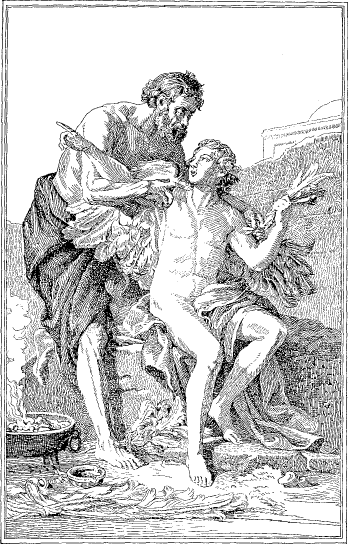
DAEDALUS ET ICARUS
271.
Daed´alus and Ic´arus
Crēta est īnsula antīqua quae aquā altā magnī maris pulsātur. Ibi
ōlim Mīnōs erat rēx. Ad eum vēnit Daedalus quī ex Graeciā patriā
fugiēbat. Eum Mīnōs rēx benignīs verbīs accēpit et eī domicilium in
Crētā dedit. 5Quō in locō Daedalus sine cūrā
vīvebat et rēgī multa et clāra opera faciēbat. Post tempus longum autem
Daedalus patriam cāram dēsīderāre incēpit. Domum properāre studēbat, sed
rēgī persuādēre nōn potuit et mare saevum fugam vetābat.
THE FIFTH OR Ē-DECLENSION · THE ABLATIVE OF
TIME
272.
Gender. Nouns of the fifth declension are feminine except
diēs, day, and merīdiēs, midday, which are
usually masculine.
273.
PARADIGMS
The “Stems” are missing in the printed book. They have been supplied
from the inflectional table in the Appendix.
|
diēs, m., day |
rēs, f. thing |
|
| Stems |
diē- |
rē- |
|
| Bases |
di- |
r- |
|
|
Singular |
TERMINATIONS |
| Nom. |
diēs |
rēs |
-ēs |
| Gen. |
diēī |
reī |
-ē̆ī |
| Dat. |
diēī |
reī |
-ē̆ī |
| Acc. |
diem |
rem |
-em |
| Abl. |
diē |
rē |
-ē |
|
Plural |
|
| Nom. |
diēs |
rēs |
-ēs |
| Gen. |
diērum |
rērum |
-ērum |
| Dat. |
diēbus |
rēbus |
-ēbus |
| Acc. |
diēs |
rēs |
-ēs |
| Abl. |
diēbus |
rēbus |
-ēbus |
1. The vowel e which appears in every form is regularly long. It
is shortened in the ending -eī after a consonant, as in
r-ĕī; and before -m in the accusative singular, as in
di-em. (Cf. § 12. 2.)
2. Only diēs and rēs are complete in the plural. Most
other nouns of this declension lack the plural. Aciēs, line of
battle, and spēs, hope, have the nominative and
accusative plural.
274.
The ablative relation (§ 50) which is
expressed by the prepositions at, in, or on may refer not
only to place, but also to time, as at noon, in summer, on the first
day. The ablative which is used to express this relation is called
the ablative of time.
275.
Rule. The Ablative of Time.
The time when or within which anything happens is
expressed by the ablative without a preposition.
a. Occasionally the preposition in is found.
Compare the English Next day we started and On the next
day we started.
276.
EXERCISES
First learn the special
vocabulary, p. 294.
I. Galba the Farmer. Galba agricola rūrī vīvit. Cotīdiē prīmā
lūce labōrāre incipit, nec ante noctem in studiō suō cessat. Merīdiē
Iūlia fīlia eum ad cēnam vocat. Nocte pedēs dēfessōs domum vertit.
Aestāte fīliī agricolae auxilium patrī dant. Hieme agricola eōs in lūdum
mittit. Ibi magister pueris multās fābulās dē rēbus gestīs Caesaris
nārrat. Aestāte fīliī agricolae perpetuīs labōribus exercentur nec grave
agrī opus est iīs molestum. Galba sine ūllā cūrā vivit nec rēs adversās
timet.
II. 1. In that month there were many battles in Gaul. 2. The
cavalry of the enemy made an attack upon Cæsar’s line of battle.
3. In the first hour of the night the ship was overcome by the
billows. 4. On the second day the savages were eager to come under
Cæsar’s protection. 5. The king had joined battle, moved by the
hope of victory. 6. That year a fire destroyed many birds and other
animals. 7. We saw blood on the wild beast’s teeth.
277.
Daed´alus and Ic´arus
(Continued)
Tum Daedalus gravibus cūrīs commōtus fīliō suō Īcarō ita dixit:
“Animus meus, Īcare, est plēnus trīstitiae nec oculī lacrimīs egent.
Discēdere ex Crētā, Athēnās properāre, maximē studeō; sed rēx recūsat
audīre verba mea et omnem reditūs spem ēripit. Sed numquam rēbus
adversīs vincar. Terra et mare sunt inimīca, sed aliam fugae viam
reperiam.” Tum in artīs ignōtās animum dīmittit et mīrum capit
cōnsilium. Nam pennās in ōrdine pōnit et vērās ālās facit.
PRONOUNS CLASSIFIED · PERSONAL AND REFLEXIVE
PRONOUNS
278.
We have the same kinds of pronouns in Latin as in English. They are
divided into the following eight classes:
1. Personal pronouns, which show the person speaking, spoken
to, or spoken of; as, ego, I; tū, you;
is, he. (Cf. § 279. etc.)
2. Possessive pronouns, which denote possession; as,
meus, tuus, suus, etc. (Cf. § 98.)
3. Reflexive pronouns, used in the predicate to refer back to
the subject; as, he saw himself. (Cf. § 281.)
4. Intensive pronouns, used to emphasize a noun or pronoun;
as, I myself saw it. (Cf. § 285.)
5. Demonstrative pronouns, which point out persons or things;
as, is, this, that. (Cf. § 112.)
6. Relative pronouns, which connect a subordinate adjective
clause with an antecedent; as, quī, who. (Cf. § 220.)
7. Interrogative pronouns, which ask a question; as,
quis, who? (Cf. § 225.)
8. Indefinite pronouns, which point out indefinitely; as,
some one, any one, some, certain ones, etc. (Cf. § 296.)
279.
The demonstrative pronoun is, ea, id, as we learned
in § 115, is regularly used as the personal
pronoun of the third person (he, she, it,
they, etc.).
280.
The personal pronouns of the first person are ego, I;
nōs, we; of the second person, tū, thou or
you; vōs, ye or you. They are declined as
follows:
| Singular |
|
FIRST PERSON |
SECOND PERSON |
| Nom. |
ego, I |
tū, you |
| Gen. |
meī, of me |
tuī, of you |
| Dat. |
mihi, to or for me |
tibi, to or for you |
| Acc. |
mē, me |
tē, you |
| Abl. |
mē, with, from, etc., me |
tē, with, from, etc.,
you |
| Plural |
| Nom. |
nōs, we |
vōs, you |
| Gen. |
nostrum or nostrī, of us |
vestrum or vestrī, of you |
| Dat. |
nōbīs, to or for us |
vōbīs, to or for you |
| Acc. |
nōs, us |
vōs, you |
| Abl. |
nōbīs, with, from, etc.,
us |
vōbīs, with, from, etc., you |
1. The personal pronouns are not used in the nominative excepting for
emphasis or contrast.
281.
The Reflexive Pronouns. 1. The personal pronouns ego and
tū may be used in the predicate as reflexives; as,
| videō mē, I see myself |
vidēmus nōs, we see ourselves |
| vidēs tē, you see yourself |
vidētis vōs, you see yourselves |
2. The reflexive pronoun of the third person (himself, herself,
itself, themselves) has a special form, used only in these senses,
and declined alike in the singular and plural.
|
Singular and Plural |
| Gen. |
suī |
Acc. |
sē |
| Dat. |
sibi |
Abl. |
sē |
| Examples |
Puer sē videt, the boy sees himself
Puella sē videt, the girl sees herself
Animal sē videt, the animal sees itself
Iī sē vident, they see themselves
|
a. The form sē is sometimes doubled, sēsē, for
emphasis.
3. Give the Latin for
| I teach myself |
We teach ourselves |
| You teach yourself |
You teach yourselves |
| He teaches himself |
They teach themselves |
282.
The preposition cum, when used with the ablative of ego,
tū, or suī, is appended to the form, as, mēcum,
with me; tēcum, with you; nōbīscum, with
us; etc.
283.
EXERCISES
First learn the special
vocabulary, p. 294.
I. 1. Mea māter est cāra mihi et tua māter est cāra tibi.
2. Vestrae litterae erant grātae nōbis et nostrae litterae erant
grātae vōbīs. 3. Nūntius rēgis quī nōbīscum est nihil respondēbit.
4. Nūntiī pācem amīcitiamque sibi et suīs sociīs postulāvērunt.
5. Sī tū arma sūmēs, ego rēgnum occupābō. 6. Uter vestrum est
cīvis Rōmānus? Neuter nostrum. 7. Eō tempore multī supplicium
dedērunt quia rēgnum petierant. 8. Sūme supplicium, Caesar, dē
hostibus patriae ācribus. 9. Prīmā lūce aliī metū commōtī sēsē
fugae mandāvērunt; aliī autem magnā virtūte impetum exercitūs nostrī
sustinuērunt. 10. Soror rēgis, ubi dē adversō proeliō audīvit, sēsē
Pompēiīs interfēcit.
II. 1. Whom do you teach? I teach myself. 2. The soldier wounded
himself with his sword. 3. The master praises us, but you he does
not praise. 4. Therefore he will inflict punishment on you, but we
shall not suffer punishment. 5. Who will march (i.e. make a march)
with me to Rome? 6. I will march with you to the gates of the city.
7. Who will show us1 the way? The gods
will show you1 the way.
Daed´alus and Ic´arus
(Concluded)
284.
Puer Īcarus ūnā2 stābat et mīrum patris opus
vidēbat. Postquam manus ultima3 ālīs imposita
est, Daedalus eās temptāvit et similis avī in aurās volāvit. Tum ālās
umerīs fīlī adligāvit et docuit eum volāre et dīxit, “Tē vetō, mī fīlī,
adpropinquāre aut sōlī aut marī. Sī fluctibus adpropinquāveris,4 aqua ālīs tuīs nocēbit, et sī sōlī
adpropinquāveris,4
ignis eās cremābit.” Tum pater et filius iter difficile incipiunt. Ālās
movent et aurae sēsē committunt. Sed stultus puer verbīs patris nōn
pāret. Sōlī adpropinquat. Ālae cremantur et Īcarus in mare dēcidit et
vitam āmittit. Daedalus autem sine ūllō perīculō trāns fluctūs ad
īnsulam Siciliam volāvit.
THE INTENSIVE PRONOUN IPSE AND THE
DEMONSTRATIVE ĪDEM
285.
Ipse means -self (him-self, her-self, etc.) or is
translated by even or very. It is used to emphasize a noun
or pronoun, expressed or understood, with which it agrees like an
adjective.
a. Ipse must be carefully distinguished from the reflexive
suī. The latter is always used as a pronoun, while ipse is
regularly adjective. Compare
|
Homō sē videt, the man sees himself (reflexive)
Homō ipse perīculum videt, the man himself (intensive)
sees the danger
Homō ipsum perīculum videt, the man sees the danger itself
(intensive)
|
286.
Except for the one form ipse, the intensive pronoun is declined
exactly like the nine irregular adjectives (cf. §§ 108, 109). Learn the
declension (§ 481).
287.
The demonstrative īdem, meaning the same, is a compound of
is. It is declined as follows:
|
Singular |
Plural |
|
MASC. |
FEM. |
NEUT. |
MASC. |
FEM. |
NEUT. |
| Nom. |
īdem |
e´adem |
idem |
iī´dem
eī´dem |
eae´dem |
e´adem |
| Gen. |
eius´dem |
eius´dem |
eius´dem |
eōrun´dem |
eārun´dem |
eōrun´dem |
| Dat. |
eī´dem |
eī´dem |
eī´dem |
iīs´dem
eīs´dem |
iīs´dem
eīs´dem |
iīs´dem
eīs´dem |
| Acc. |
eun´dem |
ean´dem |
idem |
eōs´dem |
eās´dem |
e´adem |
| Dat. |
eī´dem |
eī´dem |
eī´dem |
iīs´dem
eīs´dem |
iīs´dem
eīs´dem |
iīs´dem
eīs´dem |
a. From forms like eundem (eum + -dem),
eōrundem (eōrum + -dem), we learn the rule that
m before d is changed to n.
b. The forms iīdem, iīsdem are often spelled and
pronounced with one ī.
288.
EXERCISES
First learn the special
vocabulary, p. 295.
I. 1. Ego et tū1 in eādem urbe vīvimus.
2. Iter ipsum nōn timēmus sed ferās saevās quae in silvā dēnsā esse
dīcuntur. 3. Ōlim nōs ipsī idem iter fēcimus. 4. Eō tempore
multās ferās vīdimus. 5. Sed nōbīs nōn nocuērunt. 6. Caesar
ipse scūtum dē manibus mīlitis ēripuit et in ipsam aciem properāvit.
7. Itaque mīlitēs summā virtūte tēla in hostium corpora iēcērunt.
8. Rōmānī quoque gravia vulnera accēpērunt. 9. Dēnique hostēs
terga vertērunt et ommīs in partīs2 fūgērunt.
10. Eādem hōrā litterae Rōmam ab imperātōre ipsō missae sunt.
11. Eōdem mēnse captīvī quoque in Italiam missī sunt. 12. Sed
multī propter vulnera iter difficile trāns montīs facere recūsābant et
Genāvae esse dīcēbantur.
II. 1. At Pompeii there is a wonderful mountain. 2. When I was
in that place, I myself saw that mountain. 3. On the same day many
cities were destroyed by fire and stones from that very mountain.
4. You have not heard the true story of that calamity, have
you?3 5. On that day the very sun could
not give light to men. 6. You yourself ought to tell (to) us that
story.
289.
How Horatius held the Bridge4
Tarquinius Superbus, septimus et ultimus rēx Rōmānōrum, ubi in
exsilium ab īrātīs Rōmānīs ēiectus est, ā Porsenā, rēge Etrūscōrum,
auxilium petiit. Mox Porsena magnīs cum cōpiīs Rōmam vēnit, et ipsa urbs
summō in perīculō erat. Omnibus in partibus exercitus Rōmānus victus
erat. Iam rēx montem Iāniculum5 occupāverat.
Numquam anteā Rōmānī tantō metū tenēbantur. Ex agrīs in urbem
properābant et summō studiō urbem ipsam mūniēbant.
THE DEMONSTRATIVE PRONOUNS HIC, ISTE,
ILLE
290.
We have already learned the declension of the demonstrative pronoun
is and its use. (Cf. Lesson XVII.) That pronoun refers to persons
or things either far or near, and makes no definite reference to place
or time. If we wish to point out an object definitely in place or time,
we must use hic, iste, or ille. These
demonstratives, like is, are used both as pronouns and as
adjectives, and their relation to the speaker may be represented
graphically thus:

a. In dialogue hic refers to a person or thing near the
speaker; iste, to a person or thing near the person addressed;
ille, to a person or thing remote from both. These distinctions
are illustrated in the model sentences, § 293, which should be carefully studied and
imitated.
291.
Hic is declined as follows:
|
Singular |
Plural |
|
MASC. |
FEM. |
NEUT. |
MASC. |
FEM. |
NEUT. |
| Nom. |
hic |
haec |
hoc |
hī |
hae |
haec |
| Gen. |
huius |
huius |
huius |
hōrum |
hārum |
hōrum |
| Dat. |
huic |
huic |
huic |
hīs |
hīs |
hīs |
| Acc. |
hunc |
hanc |
hoc |
hōs |
hās |
haec |
| Abl. |
hōc |
hāc |
hōc |
hīs |
hīs |
hīs |
a. Huius is pronounced ho͝o´yo͝os, and huic
is pronounced ho͝oic (one syllable).
292.
The demonstrative pronouns iste, ista, istud, and
ille, illa, illud, except for the nominative and
accusative singular neuter forms istud and illud, are
declined exactly like ipse, ipsa, ipsum. (See § 481.)
293.
MODEL SENTENCES
Is this horse (of mine) strong?
|
Estne hic equus validus?
|
That horse (of yours) is strong, but that one (yonder)
is weak
|
Iste equus est validus, sed ille est īnfīrmus
|
Are these (men by me) your friends?
|
Suntne hī amīcī tuī?
|
Those (men by you) are my friends, but those (men yonder)
are enemies
|
Istī sunt amīcī meī, sed illī sunt inimīcī
|
294.
EXERCISES
First learn the special
vocabulary, p. 295.
I. A German Chieftain addresses his Followers. Ille fortis
Germānōrum dux suōs convocāvit et hōc modō animōs eōrum cōnfirmāvit.
“Vōs, quī in hīs fīnibus vīvitis, in hunc locum convocāvī1 quia mēcum dēbētis istōs agrōs et istās domōs ab iniūriīs
Rōmānōrum liberāre. Hoc nōbīs nōn difficile erit, quod illī hostēs hās
silvās dēnsās, ferās saevās quārum vestīgia vident, montēs altōs timent.
Sī fortēs erimus, deī ipsī nōbīs viam salūtis dēmonstrābunt. Ille sōl,
istī oculī calamītātēs nostrās vīdērunt.1
Itaque nōmen illīus reī pūblicae Rōmānae nōn sōlum nōbis, sed etiam
omnibus hominibus quī lībertātem amant, est invīsum. Ad arma vōs vocō.
Exercēte istam prīstinam virtūtem et vincētis.”
II. 1. Does that bird (of yours)2 sing?
2. This bird (of mine)2 sings both3 in summer and in winter and has a beautiful
voice. 3. Those birds (yonder)2 in the
country don´t sing in winter. 4. Snatch a spear from the hands of
that soldier (near you)2 and come home with
me. 5. With those very eyes (of yours)2
you will see the tracks of the hateful enemy who burned my dwelling and
made an attack on my brother. 6. For (propter) these deeds
(rēs) we ought to inflict punishment on him without delay.
7. The enemies of the republic do not always suffer punishment.
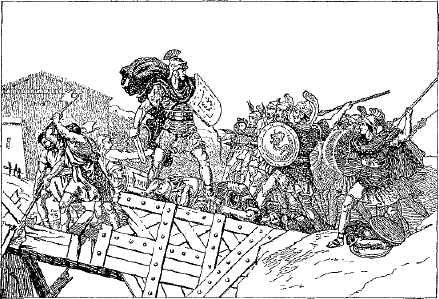
HORATIUS PONTEM DEFENDIT
295.
How Horatius held the Bridge
(Continued)
Altera urbis pars mūrīs, altera flūmine satis mūnīrī vidēbātur. Sed
erat pōns in flūmine quī hostibus iter paene dedit. Tum Horātius Cocles,
fortis vir, magnā vōce dīxit, “Rescindite pontem, Rōmānī! Brevī tempore
Porsena in urbem cōpiās suās trādūcet.” Iam hostēs in ponte erant, sed
Horātius cum duōbus (cf. § 479) comitibus ad extrēmam pontis
partem properāvit, et hi sōli aciem hostium sustinuērunt. Tum vērō cīvēs
Rōmānī pontem ā tergō rescindere incipiunt, et hostēs frūstrā Horātium
superāre temptant.
THE INDEFINITE PRONOUNS
296.
The indefinite pronouns are used to refer to some person or
some thing, without indicating which particular one is meant. The
pronouns quis and quī, which we have learned in their
interrogative and relative uses, may also be indefinite; and nearly all
the other indefinite pronouns are compounds of quis or quī
and declined almost like them. Review the declension of these words, §§ 221, 227.
297.
Learn the declension and meaning of the following indefinites:
| Masc. |
Fem. |
Neut. |
| quis |
quid, some one, any one (substantive)
|
| quī |
qua or quae |
quod, some, any (adjective), § 483
|
|
aliquis
|
aliquid, some one, any one (substantive), § 487
|
| aliquī |
aliqua |
aliquod, some, any (adjective), § 487
|
| quīdam |
quaedam |
quoddam, quiddam, a certain, a certain one, § 485
|
|
quisquam
|
quicquam or quidquam (no plural), any one (at all)
(substantive), § 486
|
|
quisque
|
quidque, each one, every one (substantive), § 484
|
| quisque |
quaeque |
quodque, each, every (adjective), § 484
|
Transcriber’s Note:
In the original text, the combined forms (masculine/feminine) were
printed in the “masculine” column.
Note. The meanings of the neuters,
something, etc., are easily inferred from the masculine and
feminine.
a. In the masculine and neuter singular of the indefinites,
quis-forms and quid-forms are mostly used as substantives,
quī-forms and quod-forms as adjectives.
b. The indefinites quis and quī never stand first
in a clause, and are rare excepting after sī, nisi,
nē, num (as, sī quis, if any one; sī
quid, if anything; nisi quis, unless some one).
Generally aliquis and aliquī are used instead.
c. The forms qua and aliqua are both feminine
nominative singular and neuter nominative plural of the indefinite
adjectives quī and aliquī respectively. How do these
differ from the corresponding forms of the relative quī?
d. Observe that quīdam (quī + -dam) is
declined like quī, except that in the accusative singular and
genitive plural m of quī becomes n (cf. § 287. a): quendam,
quandam, quōrundam, quārundam; also that the neuter
has quiddam (substantive) and quoddam (adjective) in the
nominative and accusative singular. Quīdam is the least
indefinite of the indefinite pronouns, and implies that you could name
the person or thing referred to if you cared to do so.
e. Quisquam and quisque (substantive) are declined
like quis.
f. Quisquam, any one (quicquam or
quidquam, anything), is always used substantively and
chiefly in negative sentences. The corresponding adjective any is
ūllus, -a, -um (§ 108).
298.
EXERCISES
First learn the special
vocabulary, p. 295.
I. 1. Aliquis dē ponte in flūmen dēcidit sed sine ūllō perīculō
servātus est. 2. Est vērō in vītā cuiusque hominis aliqua bona
fortūna. 3. Nē mīlitum quidem1 quisquam
in castrīs mānsit. 4. Sī quem meae domī vidēs, iubē eum discēdere.
5. Sī quis pontem tenet, nē tantus quidem exercitus capere urbem
potest. 6. Urbs nōn satis mūnīta erat et merīdiē rēx quīdam paene
cōpiās suās trāns pontem trādūxerat. 7. Dēnique mīles quīdam
armātus in fluctūs dēsiluit et incolumis ad alteram rīpam oculōs vertit.
8. Quisque illī fortī mīlitī aliquid dare dēbet. 9. Tanta vērō
virtūs Rōmānīs semper placuit. 10. Ōlim Corinthus erat urbs satis
magna et paene par Rōmae ipsī; nunc vērō moenia dēcidērunt et pauca
vestīgia urbis illīus reperīrī possunt. 11. Quisque lībertātem
amat, et aliquibus vērō nōmen rēgis est invīsum.
II. 1. If you see a certain Cornelius at Corinth, send him to me.
2. Almost all the soldiers who fell down into the waves were
unharmed. 3. Not even at Pompeii did I see so great a fire.
4. I myself was eager to tell something to some one. 5. Each
one was praising his own work. 6. Did you see some one in the
country? I did not see any one. 7. Unless some one will remain on
the bridge with Horatius, the commonwealth will be in the greatest
danger.
299.
How Horatius held the Bridge
(Concluded)
Mox, ubi parva pars pontis mānsit, Horātius iussit comitēs discēdere
et sōlus mīrā cōnstantiā impetum illius tōtius exercitūs sustinēbat.
Dēnique magnō fragōre pōns in flūmen dēcīdit. Tum vērō Horātius tergum
vertit et armātus in aquās dēsiluit. In eum hostēs multa tēla iēcērunt;
incolumis autem per fluctūs ad alteram rīpam trānāvit. Eī propter tantās
rēs gestās populus Rōmānus nōn sōlum alia magna praemia dedit sed etiam
statuam Horāti in locō pūblicō posuit.
REGULAR COMPARISON OF ADJECTIVES
300.
The quality denoted by an adjective may exist in either a higher or a
lower degree, and this is expressed by a form of inflection called
comparison. The mere presence of the quality is expressed by the
positive degree, its presence in a higher or lower degree by the
comparative, and in the highest or lowest of all by the superlative. In
English the usual way of comparing an adjective is by using the suffix
-er for the comparative and -est for the superlative; as,
positive high, comparative higher, superlative
highest. Less frequently we use the adverbs more and
most; as, positive beautiful, comparative more
beautiful, superlative most beautiful.
In Latin, as in English, adjectives are compared by adding suffixes
or by using adverbs.
301.
Adjectives are compared by using suffixes as follows:
| Positive |
Comparative |
Superlative |
clārus, -a, -um (bright)
(Base clār-)
|
clārior, clārīus (brighter)
|
clārissimus, -a, -um (brightest)
|
brevis, breve (short)
(Base brev-)
|
brevior, brevius (shorter)
|
brevissimus, -a, -um (shortest)
|
vēlōx (swift)
(Base veloc-)
|
vēlōcior, vēlōcius (swifter)
|
vēlōcissimus, -a, -um (swiftest)
|
a. The comparative is formed from the base of the positive by
adding -ior masc. and fem., and -ius neut.; the
superlative by adding -issimus, -issima, -issimum.
302.
Less frequently adjectives are compared by using the adverbs
magis, more; maximē, most; as,
idōneus, suitable; magis idōneus, more
suitable; maximē idōneus, most suitable.
303.
Declension of the Comparative. Adjectives of the comparative
degree are declined as follows:
|
Singular |
Plural |
|
MASC. AND FEM. |
NEUT. |
MASC. AND FEM. |
NEUT. |
| Nom. |
clārior |
clārīus |
clāriōrēs |
clāriōra |
| Gen. |
clāriōris |
clāriōris |
clāriōrum |
clāriōrum |
| Dat. |
clāriōrī |
clāriōrī |
clāriōribus |
clāriōribus |
| Acc. |
clāriōrem |
clārius |
clāriōrēs |
clāriōra |
| Abl. |
clāriōre |
clāriōre |
clāriōribus |
clāriōribus |
a. Observe that the endings are those of the consonant stems of
the third declension.
b. Compare longus, long; fortis,
brave; recēns (base, recent-), recent; and
decline the comparative of each.
304.
Adjectives in -er form the comparative regularly, but the
superlative is formed by adding -rimus, -a, -um to the nominative
masculine of the positive; as,
| Positive |
Comparative |
Superlative |
ācer, ācris, ācre
(Base acr-)
|
ācrior, ācrius |
ācerrimus, -a, -um |
pulcher, pulchra, pulchrum
(Base pulchr-)
|
pulchrior, pulchrius |
pulcherrimus, -a, -um |
līber, lībera, līberum
(Base līber-)
|
līberior, līberius |
līberrimus, -a, -um |
a. In a similar manner compare miser, aeger,
crēber.
305.
The comparative is often translated by quite, too, or
somewhat, and the superlative by very; as, altior,
quite (too, somewhat) high; altissimus,
very high.
306.
EXERCISES
First learn the special
vocabulary, p. 296.
I. 1. Quid explōrātōrēs quaerēbant? Explōrātōrēs tempus
opportūnissimum itinerī quaerēbant. 2. Mediā in silvā ignīs quam
crēberrimōs fēcimus, quod ferās tam audācis numquam anteā vīderāmus.
3. Antīquīs temporibus Germānī erant fortiōrēs quam Gallī.
4. Caesar erat clārior quam inimīcī1 quī
eum necāvērunt. 5. Quisque scūtum ingēns et pīlum longius gerēbat.
6. Apud barbarōs Germānī erant audācissimī et fortissimī.
7. Mēns hominum est celerior quam corpus. 8. Virī aliquārum
terrārum sunt miserrimī. 9. Corpora Germānōrum erant ingentiōra
quam Rōmānōrum. 10. Ācerrimī Gallōrum prīncipēs sine ūllā morā
trāns flūmen quoddam equōs vēlōcissimōs trādūxērunt. 11. Aestāte
diēs sunt longiōrēs quam hieme. 12. Imperātor quīdam ab
explōrātōribus dē recentī adventū nāvium longārum quaesīvit.
II. 1. Of all birds the eagle is the swiftest. 2. Certain
animals are swifter than the swiftest horse. 3. The Roman name was
most
hateful to the enemies of the commonwealth. 4. The Romans always
inflicted the severest2 punishment on
faithless allies. 5. I was quite ill, and so I hastened from the
city to the country. 6. Marcus had some friends dearer than
Cæsar.3 7. Did you not seek a more
recent report concerning the battle? 8. Not even after a victory so
opportune did he seek the general’s friendship.
N.B. Beginning at this point, the
selections for reading
will be found near the end of the volume. (See p. 197.)
IRREGULAR COMPARISON OF ADJECTIVES · THE ABLATIVE
WITH COMPARATIVES WITHOUT QUAM
307.
The following six adjectives in -lis form the comparative
regularly; but the superlative is formed by adding -limus to the
base of the positive. Learn the meanings and comparison.
| Positive |
Comparative |
Superlative |
| facilis, -e, easy |
facilior, -ius |
facillimus, -a, -um |
| difficilis, -e, hard |
difficilior, -ius |
difficillimus, -a, -um |
| similis, -e, like |
similior, -ius |
simillimus, -a, -um |
| dissimilis, -e, unlike |
dissimilior, -ius |
dissimillimus, -a, -um |
| gracilis, -e, slender |
gracilior, -ius |
gracillimus, -a, -um |
| humilis, -e, low |
humilior, -ius |
humillimus, -a, -um |
308.
From the knowledge gained in the preceding lesson we should translate
the sentence Nothing is brighter than the sun
Nihil est clārius quam sōl
But the Romans, especially in negative sentences, often expressed the
comparison in this way,
Nihil est clārius sōle
which, literally translated, is Nothing is brighter away from the
sun; that is, starting from the sun as a standard, nothing is
brighter. This relation is expressed by the separative ablative
sōle. Hence the rule
309.
Rule. Ablative with
Comparatives. The comparative degree, if quam is omitted,
is followed by the separative ablative.
310.
EXERCISES
First learn the special
vocabulary, p. 296.
I. 1. Nēmō mīlitēs alacriōrēs Rōmānīs vīdit. 2. Statim imperātor
iussit nūntiōs quam celerrimōs litterās Rōmam portāre. 3. Multa
flūmina sunt lēniōra Rhēnō. 4. Apud Rōmanōs quis erat clārior
Caesare? 5. Nihil pulchrius urbe Rōmā vīdī. 6. Subitō
multitūdo audacissima magnō clamōre proelium ācrius commīsit.
7. Num est equus tuus tardus? Nōn vērō tardus, sed celerior aquilā.
8. Ubi Romae fuī, nēmō erat mihi amicior Sextō. 9. Quaedam
mulierēs cibum mīlitibus dare cupīvērunt. 10. Rēx vetuit cīvis ex
urbe noctū discēdere. 11. Ille puer est gracilior hāc muliere.
12. Explōrātor duās (two) viās, alteram facilem, alteram
difficiliōrem, dēmōnstrāvit.
II. 1. What city have you seen more beautiful than Rome? 2. The
Gauls were not more eager than the Germans. 3. The eagle is not
slower than the horse. 4. The spirited woman did not fear to make
the journey by night. 5. The mind of the multitude was quite gentle
and friendly. 6. But the king’s mind was very different.
7. The king was not like (similar to) his noble father.
8. These hills are lower than the huge mountains of our
territory.
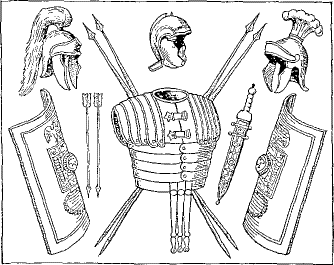
ARMA ROMANA
IRREGULAR COMPARISON OF ADJECTIVES
(Continued)
311.
Some adjectives in English have irregular comparison, as good,
better, best; many, more, most. So Latin comparison presents
some irregularities. Among the adjectives that are compared irregularly
are
| Positive |
Comparative |
Superlative |
| bonus, -a, -um, good |
melior, melius |
optimus, -a, -um |
| magnus, -a, -um, great |
maior, maius |
maximus, -a, -um |
| malus, -a, -um, bad |
peior, peius |
pessimus, -a, -um |
| multus, -a, -um, much |
——, plūs |
plūrimus, -a, -um |
| multī, -ae, -a, many |
plūrēs, plūra |
plūrimī, -ae, -a |
| parvus, -a, -um, small |
minor, minus |
minimus, -a, -um |
312.
The following four adjectives have two superlatives. Unusual forms are
placed in parentheses.
exterus, -a, -um, outward
|
(exterior, -ius, outer)
|
extrēmus, -a, -um
(extimus, -a, -um)
|
outermost, last
|
īnferus, -a, -um, low
|
īnferior, -ius, lower
|
īnfimus, -a, -um
īmus, -a, -um
|
lowest
|
posterus, -a, -um, next
|
(posterior, -ius, later)
|
postrēmus, -a, -um
(postumus, -a, -um)
|
last
|
superus, -a, -um, above
|
superior, -ius, higher
|
suprēmus, -a, -um
summus, -a, -um
|
highest
|
313.
Plūs, more (plural more, many, several), is
declined as follows:
|
Singular |
Plural |
|
MASC. AND FEM. |
NEUT. |
MASC. AND FEM. |
NEUT. |
| Nom. |
—— |
plūs |
plūrēs |
plūra |
| Gen. |
—— |
plūris |
plūrium |
plūrium |
| Dat. |
—— |
—— |
plūribus |
plūribus |
| Acc. |
—— |
plūs |
plūrīs, -ēs |
plūra |
| Abl. |
—— |
plūre |
plūribus |
plūribus |
a. In the singular plūs is used only as a neuter
substantive.
314.
EXERCISES
First learn the special
vocabulary, p. 296.
I. 1. Reliquī hostēs, quī ā dextrō cornū proelium commīserant, dē
superiōre locō fūgērunt et sēsē in silvam maximam recēpērunt. 2. In
extrēmā parte silvae castra hostium posita erant. 3. Plūrimī
captīvī ab equitibus ad Caesarem ductī sunt. 4. Caesar vērō iussit
eōs in servitūtem trādī. 5. Posterō diē magna multitūdō mulierum ab
Rōmānīs in valle īmā reperta est. 6. Hae mulierēs maximē
perterritae adventū Caesaris sēsē occīdere studēbant. 7. Eae quoque
plūrīs fābulās dē exercitūs Rōmānī sceleribus audīverant. 8. Fāma
illōrum mīlitum optima nōn erat. 9. In barbarōrum aedificiīs maior
cōpia frūmentī reperta est. 10. Nēmō crēbrīs proeliīs contendere
sine aliquō perīculō potest.
II. 1. The remaining women fled from their dwellings and hid
themselves. 2. They were terrified and did not wish to be captured
and given over into slavery. 3. Nothing can be worse than slavery.
4. Slavery is worse than death. 5. In the Roman empire a great
many were killed because they refused to be slaves. 6. To surrender
the fatherland is the worst crime.
IRREGULAR COMPARISON OF ADJECTIVES
(Concluded) · ABLATIVE OF THE MEASURE OF DIFFERENCE
315.
The following adjectives are irregular in the formation of the
superlative and have no positive. Forms rarely used are in
parentheses.
| Comparative |
Superlative |
| citerior, hither |
(citimus, hithermost) |
| interior, inner |
(intimus, inmost) |
| prior, former |
prīmus, first |
| propior, nearer |
proximus, next, nearest |
| ulterior, further |
ultimus, furthest |
316.
In the sentence Galba is a head taller than Sextus, the phrase
a head taller expresses the measure of difference in
height between
Galba and Sextus. The Latin form of expression would be Galba is
taller than Sextus by a head. This is clearly an ablative
relation, and the construction is called the ablative of the measure
of difference.
|
Examples
|
Galba est altior capite quam Sextus
Galba is a head taller (taller by a head) than Sextus.
Illud iter ad Italiam est multō brevius
That route to Italy is much shorter (shorter by much)
|
317.
Rule. Ablative of the Measure of
Difference. With comparatives and words implying comparison the
ablative is used to denote the measure of difference.
a. Especially common in this construction are the neuter
ablatives
eō, by this, by that
hōc, by this
multō, by much
nihilō,1 by nothing
paulō, by a little
|
318.
EXERCISES
First learn the special
vocabulary, p. 297.
I. 1. Barbarī proelium committere statuērunt eō magis quod Rōmānī
īnfīrmī esse vidēbantur. 2. Meum cōnsilium est multō melius quam
tuum quia multō facilius est. 3. Haec via est multō lātior quam
illa. 4. Barbarī erant nihilō tardiōrēs quam Rōmānī. 5. Tuus
equus est paulō celerior quam meus. 6. Iī quī paulō fortiōrēs erant
prohibuērunt reliquōs aditum relinquere. 7. Inter illās cīvitātēs
Germānia mīlitēs habet optimōs. 8. Propior via quae per hanc vallem
dūcit est inter portum et lacum. 9. Servī, quī agrōs citeriōrēs
incolēbant, priōrēs dominōs relinquere nōn cupīvērunt, quod eōs amābant.
10. Ultimae Germāniae partēs numquam in fidem Rōmānōrum vēnērunt.
11. Nam trāns Rhēnum aditus erat multō difficilior exercituī
Rōmānō.
II. 1. Another way much more difficult (more difficult by much) was
left through hither Gaul. 2. In ancient times no state was stronger
than the Roman empire. 3. The states of further Gaul did not wish
to give hostages to Cæsar. 4. Slavery is no better (better by
nothing) than death. 5. The best citizens are not loved by the
worst. 6. The active enemy immediately withdrew into the nearest
forest, for they were terrified by Cæsar’s recent victories.
FORMATION AND COMPARISON OF ADVERBS
319.
Adverbs are generally derived from adjectives, as in English (e.g. adj.
sweet, adv. sweetly). Like adjectives, they can be
compared; but they have no declension.
320.
Adverbs derived from adjectives of the first and second declensions are
formed and compared as follows:
|
Positive |
Comparative |
Superlative |
Adj.
Adv. |
cārus, dear
cārē, dearly |
cārior
cārius |
cārissimus
cārissimē |
Adj.
Adv. |
pulcher, beautiful
pulchrē, beautifully |
pulchrior
pulchrius |
pulcherrimus
pulcherrimē |
Adj.
Adv. |
līber, free
līberē, freely |
līberior
līberius |
līberrimus
līberrimē |
a. The positive of the adverb is formed by adding -ē to
the base of the positive of the adjective. The superlative of the adverb
is formed from the superlative of the adjective in the same way.
b. The comparative of any adverb is the neuter accusative
singular of the comparative of the adjective.
321.
Adverbs derived from adjectives of the third declension are formed like
those described above in the comparative and superlative. The positive
is usually formed by adding -iter to the base of adjectives of
three endings or of two endings, and -ter to the base of those of
one ending;1 as,
|
Positive |
Comparative |
Superlative |
Adj.
Adv. |
fortis, brave
fortiter, bravely |
fortior
fortius |
fortissimus
fortissimē |
Adj.
Adv. |
audāx, bold
audācter, boldly |
audācior
audācius |
audācissimus
audācissimē |
322.
Case Forms as Adverbs. As we learned above, the neuter accusative
of comparatives is used adverbially. So in the positive or superlative
some adjectives, instead of following the usual formation, use the
accusative or the ablative singular neuter adverbially; as,
Adj.
Adv.
|
facilis, easy
facile (acc.), easily
|
prīmus, first
prīmum (acc.), first
prīmō (abl.), at first
|
Adj.
Adv.
|
multus, many
multum (acc.), much
multō (abl.), by much
|
plūrimus, most
plūrimum (acc.), most
|
323.
Learn the following irregular comparisons:
| bene, well |
melius, better |
optimē, best |
| diū, long (time) |
diūtius, longer |
diūtissimē, longest |
| magnopere, greatly |
magis, more |
maximē, most |
| parum, little |
minus, less |
minimē, least |
| prope, nearly, near |
propius, nearer |
proximē, nearest |
| saepe, often |
saepius, oftener |
saepissimē, oftenest |
324.
Form adverbs from the following adjectives, using the regular rules, and
compare them: laetus, superbus, molestus,
amīcus, ācer, brevis, gravis,
recēns.
325.
Rule. Adverbs. Adverbs modify
verbs, adjectives, and other adverbs.
326.
EXERCISES
First learn the special
vocabulary, p. 297.
I. 1. Nūlla rēs melius gesta est quam proelium illud2 ubi Marius multō minōre exercitū multō maiōrēs cōpiās
Germānōrum in fugam dedit. 2. Audācter in Rōmānōrum cohortīs hostēs
impetūs fēcērunt 3. Marius autem omnēs hōs fortissimē sustinuit.
4. Barbarī nihilō fortiōrēs erant quam Rōmānī. 5. Prīmō
barbarī esse superiōrēs vidēbantur, tum Rōmānī ācrius contendērunt.
6. Dēnique, ubi iam diūtissimē paene aequō proeliō pugnātum est,
barbarī fugam petiērunt. 7. Quaedam Germānōrum gentēs, simul atque
rūmōrem illīus calamitātis audīvērunt, sēsē in ultimīs regiōnibus fīnium
suōrum abdidērunt.
8. Rōmānī saepius quam hostēs vīcērunt, quod meliōra arma habēbant.
9. Inter omnīs gentīs Rōmānī plūrimum valēbant. 10. Hae
cohortēs simul atque in aequiōrem regiōnem sē recēpērunt, castra sine
ūllā difficultāte posuērunt.
II. 1. Some nations are easily overcome by their enemies.
2. Germany is much larger than Gaul. 3. Were not the Romans
the most powerful among the tribes of Italy? 4. On account of (his)
wounds the soldier dragged his body from the ditch with the greatest
difficulty. 5. He was able neither to run nor to fight. 6. Who
saved him? A certain horseman boldly undertook the matter. 7. The
rumors concerning the soldier’s death were not true.
NUMERALS · THE PARTITIVE GENITIVE
327.
The Latin numeral adjectives may be classified as follows:
1. Cardinal Numerals, answering the question how many?
as, ūnus, one; duo, two; etc.
2. Ordinal Numerals, derived in most cases from the cardinals
and answering the question in what order? as, prīmus,
first; secundus, second; etc.
3. Distributive Numerals, answering the question how many
at a time? as, singulī, one at a time.
328.
The Cardinal Numerals. The first twenty of the cardinals are as
follows:
| 1, ūnus |
6, |
sex |
11, ūndecim |
16, sēdecim |
| 2, duo |
7, |
septem |
12, duodecim |
17, septendecim |
| 3, trēs |
8, |
octō |
13, tredecim |
18, duodēvīgintī |
| 4, quattuor |
9, |
novem |
14, quattuordecim |
19, ūndēvīgintī |
| 5, quīnque |
10, |
decem |
15, quīndecim |
20, vīgintī |
a. Learn also centum = 100, ducentī = 200,
mīlle = 1000.
329.
Declension of the Cardinals. Of the cardinals only ūnus,
duo, trēs, the hundreds above one hundred, and
mīlle used as a noun, are declinable.
a. ūnus is one of the nine irregular adjectives, and is
declined like nūllus (cf. §§ 109, 470). The plural of ūnus is
used to agree with a plural noun of a singular meaning, as, ūna
castra, one camp; and with other nouns in the sense of
only, as, Gallī ūnī, only the Gauls.
b. Learn the declension of duo, two; trēs,
three; and mīlle, a thousand. (§ 479.)
c. The hundreds above one hundred are declined like the plural of
bonus; as,
ducentī, -ae, -a
ducentōrum, -ārum, -ōrum
etc. etc. etc.
|
330.
We have already become familiar with sentences like the following:
|
Omnium avium aquila est vēlōcissima
Of all birds the eagle is the swiftest
Hoc ōrāculum erat omnium clārissimum
This oracle was the most famous of all
|
In such sentences the genitive denotes the whole, and the word it
modifies denotes a part of that whole. Such a genitive, denoting the
whole of which a part is taken, is called a partitive
genitive.
331.
Rule. Partitive Genitive.
Words denoting a part are often used with the genitive of the whole,
known as the partitive genitive.
a. Words denoting a part are especially pronouns, numerals, and
other adjectives. But cardinal numbers excepting mīlle regularly
take the ablative with ex or dē instead of the partitive
genitive.
b. Mīlle, a thousand, in the singular is usually an
indeclinable adjective (as, mīlle mīlitēs, a thousand
soldiers), but in the plural it is a declinable noun and takes the
partitive genitive (as, decem mīlia mīlitum, ten thousand
soldiers).
Examples:
|
Fortissimī hōrum sunt Germānī
The bravest of these are the Germans
Decem mīlia hostium interfecta sunt
Ten thousand (lit. thousands) of the enemy were
slain
Ūna ex captīvīs erat soror rēgis
One of the captives was the king’s sister
|
332.
EXERCISES
First learn the special
vocabulary, p. 297.
I. 1. Caesar maximam partem aedificiōrum incendit. 2. Magna pars
mūnītiōnis aquā flūminis dēlēta est. 3. Gallī huius regiōnis
quīnque mīlia hominum coēgerant. 4. Duo ex meīs frātribus eundem
rūmōrem audīvērunt. 5. Quis Rōmānōrum erat clarior Caesare?
6. Quīnque cohortēs ex illā legiōne castra quam fortissimē
dēfendēbant. 7. Hic locus aberat aequō spatiō1 ab castrīs Caesaris et castrīs Germānōrum. 8. Caesar
simul atque pervēnit, plūs commeātūs ab sociīs postulāvit. 9. Nōnne
mercātōrēs magnitūdinem īnsulae cognōverant? Longitūdinem sed nōn
lātitūdinem cognōverant. 10. Paucī hostium obtinēbant collem quem
explōrātōrēs nostrī vīdērunt.
II. 1. I have two brothers, and one of them lives at Rome.
2. Cæsar stormed that very town with three legions. 3. In one
hour he destroyed a great part of the fortification. 4. When the
enemy could no longer2 defend the gates, they
retreated to a hill which was not far distant.3 5. There three thousand of them bravely resisted the
Romans.4
NUMERALS (Continued) · THE ACCUSATIVE OF
EXTENT
333.
Learn the first twenty of the ordinal numerals (§ 478). The ordinals are all declined
like bonus.
334.
The distributive numerals are declined like the plural of bonus.
The first three are
|
singulī, -ae, -a, one each, one by one
bīnī, -ae, -a, two each, two by two
ternī, -ae, -a, three each, three by three
|
335.
We have learned that, besides its use as object, the accusative is used
to express space relations not covered by the ablative. We have had such
expressions as per plūrimōs annōs, for a great many
years; per tōtum diem, for a whole day. Here the
space relation is one of extent of time. We could also say per
decem pedēs, for ten feet, where the space relation is one of
extent of space. While this is correct Latin, the usual form is
to use the accusative with no preposition, as,
|
Vir tōtum diem cucurrit, the man ran for a whole day
Caesar mūrum decem pedēs mōvit,
Cæsar moved the wall ten feet
|
336.
Rule. Accusative of Extent.
Duration of time and extent of space are expressed by the
accusative.
a. This accusative answers the questions how long? how
far?
b. Distinguish carefully between the accusative of time how
long and the ablative of time when, or within
which.
Select the accusatives of time and space and the ablatives of time in
the following:
When did the general arrive? He arrived at two o’clock. How long had
he been marching? For four days. How far did he march? He marched
sixty-five miles. Where has he pitched his camp? Three miles from the
river, and he will remain there several days. The wall around the camp
is ten feet high. When did the war begin? In the first year after the
king’s death.
337.
EXERCISES
First learn the special
vocabulary, p. 298.
I. Cæsar in Gaul. Caesar bellum in Gallia septem annōs gessit.
Prīmō annō Helvētiōs vīcit, et eōdem annō multae Germanōrum gentēs eī
sēsē dēdidērunt. Multōs iam annōs Germānī Gallōs vexabant1 et ducēs Germānī cōpiās suās trāns Rhēnum saepe
trādūcēbant.1 Nōn singulī veniēbant, sed
multa milia hominum in Galliam contendēbant. Quā dē causā prīncipēs
Galliae concilium convocāvērunt atque statuērunt legates ad Caesarem
mittere. Caesar, simul atque hunc rūmōrem audīvit, cōpiās suās sine morā
coēgit. Primā lūce fortiter cum Germanīs proelium commīsit. Tōtum diem
ācriter pugnātum est. Caesar ipse ā dextrō cornū acicm dūxit. Magna pars
exercitūs Germānī cecidit. Post magnam caedem paucī multa milia passuum
ad flūmen fūgērunt.
II. 1. Cæsar pitched camp two miles from the river. 2. He fortified
the camp with a ditch fifteen feet wide and a rampart nine feet high.
3. The camp of the enemy was a great way off (was distant by a
great space). 4. On the next day he hastened ten miles in three
hours. 5. Suddenly the enemy with all their forces made an attack
upon (in with acc.) the rear. 6. For two hours the
Romans were hard pressed by the barbarians. 7. In three hours the
barbarians were fleeing.
DEPONENT VERBS
338.
A number of verbs are passive in form but active in meaning; as,
hortor, I encourage; vereor, I fear. Such
verbs are called deponent because they have laid aside
(dē-pōnere, to lay aside) the active forms.
a. Besides having all the forms of the passive, deponent verbs
have also the future active infinitive and a few other active forms
which will be noted later. (Sec§§ 375, 403.b.)
339.
The principal parts of deponents are of course passive in form, as,
| Conj. I |
|
hortor, hortārī, hortātus sum, encourage
|
| Conj. II |
|
vereor, verērī, veritus sum, fear
|
| Conj. III |
(a) |
sequor, sequī, secūtus sum, follow
|
|
(b) |
patior, patī, passus sum, suffer, allow
|
| Conj. IV |
|
partior, partīrī, partītus sum, share, divide
|
Learn the synopses of these verbs. (See § 493.) Patior is conjugated
like the passive of capiō (§ 492).
340.
PREPOSITIONS WITH THE ACCUSATIVE
The prepositions with the accusative that occur most frequently
are
|
ante, before
apud, among
circum, around
contrā, against, contrary to
extrā, outside of
in, into, in, against, upon
inter, between, among
|
intrā, within
ob, on account of (quam ob rem, wherefore,
therefore)
per, through, by means of
post, after, behind
propter, on account of, because of
trāns, across, over
|
a. Most of these you have had before. Review the old ones and
learn the new ones. Review the list of prepositions governing the
ablative, § 209.
341.
EXERCISES
First learn the special
vocabulary, p. 298.
I. 1. Trēs ex lēgātīs, contrā Caesaris opīniōnem, iter facere per
hostium fīnīs verēbantur. 2. Quis eōs hortātus est? Imperātor eōs
hortātus est et iīs persuādēre cōnātus est, sed nōn potuit. 3. Quid
lēgātōs perterruit? Aut timor hostium, quī undique premēbant, aut
longitūdō viae eōs perterruit. 4. Tamen omnēs ferē Caesarem multō
magis quam hostīs veritī sunt. 5. Fortissimae gentēs Galliae ex
Germānīs oriēbantur. 6. Quam ob rem tam fortēs erant? Quia nec
vīnum nec alia quae virtūtem dēlent ad sē portārī patiēbantur.
7. Caesar ex mercātōribus dē īnsulā Britanniā quaesīvit, sed nihil
cognōscere potuit. 8. Itaque ipse statuit hanc terram petere, et
mediā ferē aestāte cum multīs nāvibus longīs profectus est.
9. Magnā celeritāte iter confēcit et in opportūnissimō locō
ēgressus est. 10. Barbarī summīs vīribus eum ab īnsulā prohibēre
cōnātī sunt. 11. Ille autem barbarōs multa mīlia passuum īnsecūtus
est; tamen sine equitātū eōs cōnsequī nōn potuit.
II. 1. Contrary to our expectation, the enemy fled and the cavalry
followed close after them. 2. From all parts of the multitude the
shouts arose of those who were being wounded. 3. Cæsar did not
allow the cavalry to pursue too far.1
4. The cavalry set out at the first hour and was returning2 to camp at the fourth hour. 5. Around the
Roman camp was a rampart twelve feet high. 6. Cæsar will delay
three days because of the grain supply. 7. Nearly all the
lieutenants feared the enemy and attempted to delay the march.

INTRODUCTORY NOTE
The preceding part of this book has been concerned chiefly with forms
and vocabulary. There remain still to be learned the forms of the
Subjunctive Mood, the Participles, and the Gerund of the regular verb,
and the conjugation of the commoner irregular verbs. These will be taken
up in connection with the study of constructions, which will be the
chief subject of our future work. The special vocabularies of the
preceding lessons contain, exclusive of proper names, about six hundred
words. As these are among the commonest words in the language, they
must be mastered. They properly form the basis of the study of
words, and will be reviewed and used with but few additions in the
remaining lessons.
For practice in reading and to illustrate the constructions
presented, a continued story has been prepared and may be begun at this
point (see p. 204). It has been divided into chapters of convenient
length to accompany progress through the lessons, but may be read with
equal profit after the lessons are finished. The story gives an account
of the life and adventures of Publius Cornelius Lentulus, a Roman boy,
who fought in Cæsar’s campaigns and shared in his triumph. The colored
plates illustrating the story are faithful representations of ancient
life and are deserving of careful study.
THE SUBJUNCTIVE MOOD
342.
In addition to the indicative, imperative, and infinitive moods, which
you have learned, Latin has a fourth mood called the subjunctive. The
tenses of the subjunctive are
Present
Imperfect
Perfect
Pluperfect
|
Active and Passive
|
343.
The tenses of the subjunctive have the same time values as the
corresponding tenses of the indicative, and, in addition, each of
them may refer to future time. No meanings of the tenses will be
given in the paradigms, as the translation varies with the construction
used.
344.
The present subjunctive is inflected as follows:
| Conj. I |
Conj. II |
Conj. III |
Conj. IV |
| Active Voice |
| SINGULAR |
| 1. a´mem |
mo´neam |
re´gam |
ca´piam |
au´diam |
| 2. a´mēs |
mo´neās |
re´gās |
ca´piās |
au´diās |
| 3. a´met |
mo´neat |
re´gat |
ca´piat |
au´diat |
| PLURAL |
| 1. amē´mus |
moneā´mus |
regā´mus |
capiā´mus |
audiā´mus |
| 2. amē´tis |
moneā´tis |
regā´tis |
capiā´tis |
audiā´tis |
| 3. a´ment |
mo´neant |
re´gant |
ca´piant |
au´diant |
| |
| Passive Voice |
| SINGULAR |
| 1. a´mer |
mo´near |
re´gar |
ca´piar |
au´diar |
| 2. amē´ris (-re) |
moneā´ris (-re) |
regā´ris (-re) |
capiā´ris (-re) |
audiā´ris (-re) |
| 3. amē´tur |
moneā´tur |
regā´tur |
capiā´tur |
audiā´tur |
|
PLURAL |
| 1. amē´mur |
moneā´mur |
regā´mur |
capiā´mur |
audiā´mur |
| 2. amē´minī |
moneā´minī |
regā´minī |
capiā´minī |
audiā´minī |
| 3. amen´tur |
monean´tur |
regan´tur |
capian´tur |
audian´tur |
a. The present subjunctive is formed from the present stem.
b. The mood sign of the present subjunctive is -ē- in the
first conjugation and -ā- in the others. It is shortened in the
usual places (cf. § 12), and takes the place
of the final vowel of the stem in the first and third conjugations, but
not in the second and fourth.
c. The personal endings are the same as in the indicative.
d. In a similar way inflect the present subjunctive of
cūrō, iubeō, sūmō, iaciō, mūniō.
345.
The present subjunctive of the irregular verb sum is inflected as
follows:
|
Sing.
|
1. sim
2. sīs
3. sit
|
Plur.
|
1. sīmus
2. sītis
3. sint
|
346.
The Indicative and Subjunctive Compared. 1. The two most
important of the finite moods are the indicative and the subjunctive.
The indicative deals with facts either real or assumed. If, then, we
wish to assert something as a fact or to inquire after a fact, we use
the indicative.
2. On the other hand, if we wish to express a desire or
wish, a purpose, a possibility, an
expectation, or some such notion, we must use the subjunctive.
The following sentences illustrate the difference between the indicative
and the subjunctive ideas.
|
Indicative Ideas |
|
Subjunctive Ideas |
| 1. |
He is brave
Fortis est
|
1. |
May he be brave
Fortis sit (idea of wishing)
|
| 2. |
We set out at once
Statim proficīscimur
|
2. |
Let us set out at once
Statim proficīscāmur (idea of willing)
|
| 3. |
You hear him every day
Cotīdiē eum audīs
|
3. |
You can hear him every day
Cotīdiē eum audiās (idea of possibility)
|
|
4. |
He remained until the ship arrived
Mānsit dum nāvis pervēnit
|
4. |
He waited until the ship should arrive
Exspectāvit dum nāvis pervenīret1
(idea of expectation)
|
| 5. |
Cæsar sends men who find the bridge
Caesar mittit hominēs quī pontem reperiunt
|
5. |
Cæsar sends men who are to find (or to find) the
bridge
Caesar hominēs mittit quī pontem reperiant (idea of purpose)
|
Note. From the sentences above we
observe that the subjunctive may be used in either independent or
dependent clauses; but it is far more common in the latter than in the
former.
347.
EXERCISE
Which verbs in the following paragraph would be in the indicative and
which in the subjunctive in a Latin translation?
There have been times in the history of our country when you might be
proud of being an American citizen. Do you remember the day when Dewey
sailed into Manila Bay to capture or destroy the enemy’s fleet? You
might have seen the admiral standing on the bridge calmly giving his
orders. He did not even wait until the mines should be removed from the
harbor’s mouth, but sailed in at once. Let us not despair of our country
while such valor exists, and may the future add new glories to the
past.
THE SUBJUNCTIVE OF PURPOSE
348.
Observe the sentence
Caesar hominēs mittit quī pontem reperiant,
Cæsar sends men to find the bridge
The verb reperiant in the dependent clause is in the
subjunctive because it tells us what Cæsar wants the men to do; in other
words, it expresses his will and the purpose in his mind. Such a use of
the subjunctive is called the subjunctive of purpose.
349.
Rule. Subjunctive of Purpose.
The subjunctive is used in a dependent clause to express the purpose
of the action in the principal clause.
350.
A clause of purpose is introduced as follows:
I. If something is wanted, by
|
quī, the relative pronoun (as above)
ut, conj., in order that, that
quō (abl. of quī, by which), in order that,
that, used when the purpose clause contains a comparative. The
ablative quō expresses the measure of difference. (Cf. § 317.)
|
II. If something is not wanted, by
|
nē, conj., in order that not, that not, lest
|
351.
EXAMPLES
| 1. |
Caesar cōpiās cōgit quibus hostīs īnsequātur
Cæsar collects troops with which to pursue the foe
|
| 2. |
Pācem petunt ut domum revertantur
They ask for peace in order that they may return home
|
| 3. |
Pontem faciunt quō facilius oppidum capiant
They build a bridge that they may take the town more easily (lit.
by which the more easily)
|
| 4. |
Fugiunt nē vulnerentur
They flee that they may not (or lest they) be
wounded
|
352.
Expression of Purpose in English. In English, purpose clauses are
sometimes introduced by that or in order that, but much
more frequently purpose is expressed in English by the infinitive, as
We eat to live, She stoops to conquer. In Latin prose, on
the other hand, purpose is never expressed by the infinitive. Be
on your guard and do not let the English idiom betray you into this
error.
353.
EXERCISES
I.
1. Veniunt ut |
dūcant, mittant, videant, audiant, dūcantur, mittantur, videantur,
audiantur.
|
2. Fugimus nē |
capiāmur, trādāmur, videāmus, necēmur, rapiāmur, resistāmus.
|
3. Mittit nūntiōs quī |
dicant, audiant, veniant, nārrent, audiantur, in conciliō sedeant.
|
4. Castra mūniunt quō facilius |
sēsē dēfendant, impetum sustineant, hostīs vincant, salūtem petant.
|
II. 1. The Helvetii send ambassadors to seek1 peace. 2. They are setting out at daybreak in order
that they may make a longer march before night. 3. They will hide
the women in the forest (acc. with in) that they may not
be captured. 4. The Gauls wage many wars to free1 their fatherland from slavery. 5. They will resist
the Romans2 bravely lest they be
destroyed.
INFLECTION OF THE IMPERFECT SUBJUNCTIVE THE SEQUENCE
OF TENSES
354.
The imperfect subjunctive may be formed by adding the personal endings
to the present active infinitive.
| Conj. I |
Conj. II |
Conj. III |
Conj. IV |
| ACTIVE |
| 1. amā´rem |
monē´rem |
re´gerem |
ca´perem |
audī´rem |
| 2. amā´rēs |
monē´rēs |
re´gerēs |
ca´perēs |
audī´rēs |
| 3. amā´ret |
monē´ret |
re´geret |
ca´peret |
audī´ret |
| 1. amārē´mus |
monērē´mus |
regerē´mus |
caperē´mus |
audīrē´mus |
| 2. amārē´tis |
monērē´tis |
regerē´tis |
caperē´tis |
audīrē´tis |
| 3. amā´rent |
monē´rent |
re´gerent |
ca´perent |
audī´rent |
| |
| PASSIVE |
| 1. amā´rer |
monē´rer |
re´gerer |
ca´perer |
audī´rer |
| 2. amārē´ris(-re) |
monērē´ris(-re) |
regerē´ris(-re) |
caperē´ris(-re) |
audīrē´ris(-re) |
| 3. amārē´tur |
monērē´tur |
regerē´tur |
caperē´tur |
audīrē´tur |
| 1. amārē´mur |
monērē´mur |
regerē´mur |
caperē´mur |
audīrē´mur |
| 2. amārē´minī |
monērē´minī |
regerē´minī |
caperē´minī |
audīrē´minī |
| 3. amāren´tur |
monēren´tur |
regeren´tur |
caperen´tur |
audīren´tur |
a. In a similar way inflect the imperfect subjunctive, active and
passive, of cūrō, iubeō, sūmō, iaciō,
mūniō.
355.
The imperfect subjunctive of the irregular verb sum is inflected
as follows:
| Sing. |
1. es´sem |
Plur. |
1. essē´mus |
| 2. es´sēs |
2. essē´tis |
| 3. es´set |
3. es´sent |
356.
The three great distinctions of time are present, past,
and future. All tenses referring to present or future time are
called primary tenses, and those referring to past time are
called secondary tenses. Now it is a very common law of language
that in a complex sentence the tense in the dependent clause should be
of the same kind as the tense in the principal clause. In the sentence
He says that he is coming, the principal verb,
says, is present, that is, is in a primary tense; and is
coming, in the dependent clause, is naturally also primary. If I
change he says to he said,—in other words, if I make
the principal verb secondary in character,—I feel it natural to
change the verb in the dependent clause also, and I say, He
said that he was coming. This following of a tense by
another of the same kind is called tense sequence, from
sequī, “to follow.”
In Latin the law of tense sequence is obeyed with considerable
regularity, especially when an indicative in the principal clause is
followed by a subjunctive in the dependent clause. Then a primary tense
of the indicative is followed by a primary tense of the subjunctive, and
a secondary tense of the indicative is followed by a secondary tense of
the subjunctive. Learn the following table:
357.
Table for Sequence of Tenses
|
Principal Verb in the
Indicative |
Dependent Verbs in the Subjunctive |
Incomplete or
Continuing Action |
Completed Action |
P
r
i
m
a
r
y |
Present
Future
Future perfect
|
Present |
Perfect |
S
e
c
o
n
d
a
r
y |
Imperfect
Perfect
Pluperfect
|
Imperfect |
Pluperfect |
358.
Rule. Sequence of Tenses.
Primary tenses are followed by primary tenses and secondary by
secondary.
359.
EXAMPLES
I. Primary tenses in principal and dependent clauses:
| |
Mittit
Mittet
Mīserit
|
hominēs ut agrōs vāstent
|
| He |
sends
will send
will have sent
|
men
|
that they may
in order to
to
|
lay waste the fields
|
II. Secondary tenses in principal and dependent clauses:
| |
Mittēbat
Mīsit
Mīserat
|
hominēs ut agrōs vāstārent
|
| He |
was sending
sent or has sent
had sent
|
men
|
that they might
in order to
to
|
lay waste the fields
|
360.
EXERCISES
I.
|
1. Vēnerant ut |
dūcerent, mitterent, vidērent, audīrent, dūcerentur, mitterentur,
vidērentur, audirentur |
|
2. Fugiēbat nē |
caperētur, trāderētur, vidērētur, necārētur, raperētur,
resiteret. |
|
3. Misit nūntiōs quī |
dīcerent, audīrent, venīrent, nārrārent, audīrentur, in conciliō
sedērent. |
|
4. Castra mūnīvērunt quō facilius |
sēsē dēfenderent, impetum sustinērent, hostīs vincerent,
salūtem peterent. |
II. 1. Cæsar encouraged the soldiers in order that they might fight
more bravely. 2. The Helvetii left their homes to wage war.
3. The scouts set out at once lest they should be captured by the
Germans. 4. Cæsar inflicted punishment on them in order that the
others might be more terrified. 5. He sent messengers to Rome to
announce the victory.
THE PERFECT AND PLUPERFECT SUBJUNCTIVE SUBSTANTIVE
CLAUSES OF PURPOSE
361.
The perfect and the pluperfect subjunctive active are inflected as
follows:
| Conj. I |
Conj. II |
Conj. III |
Conj. IV |
| Perfect Subjunctive Active |
| SINGULAR |
| 1. amā´verim |
monu´erim |
rē´xerim |
cē´perim |
audī´verim |
| 2. amā´veris |
monu´eris |
rē´xeris |
cē´peris |
audī´veris |
| 3. amā´verit |
monu´erit |
rē´xerit |
cē´perit |
audī´verit |
| PLURAL |
| 1. amāve´rimus |
monue´rimus |
rēxe´rimus |
cēpe´rimus |
audīve´rimus |
| 2. amāve´ritis |
monue´ritis |
rēxe´ritis |
cēpe´ritis |
audīve´ritis |
| 3. amā´verint |
monu´erint |
rē´xerint |
cē´perint |
audī´verint |
| |
| Pluperfect Subjunctive Active |
| SINGULAR |
| 1. amāvis´sem |
monuis´sem |
rēxis´sem |
cēpis´sem |
audīvis´sem |
| 2. amāvis´sēs |
monuis´sēs |
rēxis´sēs |
cēpis´sēs |
audīvis´sēs |
| 3. amāvis´set |
monuis´set |
rēxis´set |
cēpis´set |
audīvis´set |
| PLURAL |
| 1. amāvissē´mus |
monuissē´mus |
rēxissē´mus |
cēpissē´mus |
audīvissē´mus |
| 2. amāvissē´tis |
monuissē´tis |
rēxissē´tis |
cēpissē´tis |
audīvissē´tis |
| 3. amāvis´sent |
monuis´sent |
rēxis´sent |
cēpis´sent |
audīvis´sent |
a. Observe that these two tenses, like the corresponding ones in
the indicative, are formed from the perfect stem.
b. Observe that the perfect subjunctive active is like the future
perfect indicative active, excepting that the first person singular ends
in -m and not in -ō.
c. Observe that the pluperfect subjunctive active may be formed
by adding -issem, -issēs, etc. to the perfect stem.
d. In a similar way inflect the perfect and pluperfect
subjunctive active of cūrō, iubeō, sūmō,
iaciō, mūniō.
362.
The passive of the perfect subjunctive is formed by combining the
perfect passive participle with sim, the present subjunctive of
sum.
| Conj. I |
Conj. II |
Conj. III |
Conj. IV |
| Perfect Subjunctive Passive |
| SINGULAR |
| 1. amā´tus sim |
mo´nitus sim |
rēc´tus sim |
cap´tus sim |
audī´tus sim |
| 2. amā´tus sīs |
mo´nitus sīs |
rēc´tus sīs |
cap´tus sīs |
audī´tus sīs |
| 3. amā´tus sit |
mo´nitus sit |
rēc´tus sit |
cap´tus sit |
audī´tus sit |
| PLURAL |
| 1. amā´tī sīmus |
mo´nitī sīmus |
rēc´tī sīmus |
cap´tī sīmus |
audī´tī sīmus |
| 2. amā´tī sītis |
mo´nitī sītis |
rēc´tī sītis |
cap´tī sītis |
audī´tī sītis |
| 3. amā´tī sint |
mo´nitī sint |
rēc´tī sint |
cap´tī sint |
audī´tī sint |
363.
The passive of the pluperfect subjunctive is formed by combining the
perfect passive participle with essem, the imperfect subjunctive
of sum.
| Conj. I |
Conj. II |
Conj. III |
Conj. IV |
| Pluperfect Subjunctive Passive |
| SINGULAR |
| 1. amātus essem |
monitus essem |
rēctus essem |
captus essem |
audītus essem |
| 2. amātus essēs |
monitus essēs |
rēctus essēs |
captus essēs |
audītus essēs |
| 3. amātus esset |
monitus esset |
rēctus esset |
captus esset |
audītus esset |
| PLURAL |
| 1. amātī essēmus |
monitī essēmus |
rēctī essēmus |
captī essēmus |
audītī essēmus |
| 2. amātī essētis |
monitī essētis |
rēctī essētis |
captī essētis |
audītī essētis |
| 3. amātī essent |
monitī essent |
rēctī essent |
captī essent |
audītī essent |
a. In a similar way inflect the perfect and pluperfect
subjunctive passive of cūrō, iubeō, sūmō,
iaciō, mūniō.
364.
The perfect and pluperfect subjunctive of the irregular verb sum
are inflected as follows:
| Perfect |
Pluperfect |
| fu´erim |
fue´rimus |
fuis´sem |
fuissē´mus |
| fu´eris |
fue´ritis |
fuis´sēs |
fuissē´tis |
| fu´erit |
fu´erint |
fuis´set |
fuis´sent |
365.
A substantive clause is a clause used like a noun, as,
|
That the men are afraid is clear enough (clause as subject)
He ordered them to call on him (clause as object)
|
We have already had many instances of infinitive clauses used in this
way (cf. § 213), and have noted the
similarity between Latin and English usage in this respect. But the
Latin often uses the subjunctive in substantive clauses, and this
marks an important difference between the two languages.
366.
Rule. Substantive Clauses of
Purpose. A substantive clause of purpose with the subjunctive is
used as the object of verbs of commanding, urging,
asking, persuading, or advising, where in English
we should usually have the infinitive.
EXAMPLES
| 1. |
The general ordered the soldiers to run
|
Imperātor mīlitibus imperāvit ut currerent
|
| 2. |
He urged them to resist bravely
|
Hortātus est ut fortiter resisterent
|
| 3. |
He asked them to give the children food
|
Petīvit ut līberīs cibum darent
|
| 4. |
He will persuade us not to set out
|
Nōbīs persuādēbit nē proficīscāmur
|
| 5. |
He advises us to remain at home
|
Monet ut domī maneāmus
|
a. The object clauses following these verbs all express the
purpose or will of the principal subject that something be done or not
done. (Cf. § 348.)
367.
The following verbs are used with object clauses of purpose. Learn the
list and the principal parts of the new ones.
|
hortor, urge
imperō, order (with the dative of the person
ordered and a subjunctive clause of the thing ordered
done)
moneō, advise
|
petō, quaerō, rogō, ask, seek
persuādeō, persuade (with the same construction as
imperō)
postulō, demand, require
suādeō, advise (cf. persuādeō)
|
N.B. Remember that iubeō, order, takes the infinitive as
in English. (Cf. § 213. 1.) Compare
the sentences
|
Iubeō eum venīre, I order him to come
Imperō eī ut veniat, I give orders to him that he is to
come
|
We ordinarily translate both of these sentences like the first, but the
difference in meaning between iubeō and imperō in the Latin requires the
infinitive in the one case and the subjunctive in the
other.
368.
EXERCISES
I. 1. Petit atque hortātur ut ipse dīcat. 2. Caesar Helvētiīs
imperāvit nē per prōvinciam iter facerent. 3. Caesar nōn iussit
Helvētiōs per prōvinciam iter facere. 4. Ille cīvibus persuāsit ut
dē fīnibus suīs discēderent. 5. Caesar prīncipēs monēbit nē
proelium committant. 6. Postulāvit nē cum Helvētiīs aut cum eōrum
sociīs bellum gererent. 7. Ab iīs quaesīvī nē proficīscerentur.
8. Iīs persuādēre nōn potuī ut domī manērent.
II. 1. Who ordered Cæsar to make the march? (Write this sentence
both with imperō and with iubeō.) 2. The
faithless scouts persuaded him to set out at daybreak. 3. They will
ask him not to inflict punishment. 4. He demanded that they come to
the camp. 5. He advised them to tell everything (omnia).
Note. Do not forget that the English
infinitive expressing purpose must be rendered by a Latin subjunctive.
Review § 352.
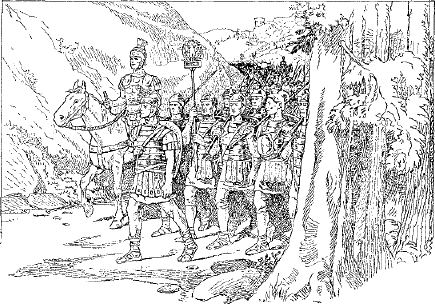
LEGIO ITER FACIT
THE SUBJUNCTIVE OF POSSUM · VERBS OF
FEARING
369.
Learn the subjunctive of possum (§ 495), and note especially the
position of the accent.
370.
Subjunctive after Verbs of Fearing. We have learned that what we
want done or not done is expressed in Latin by a subjunctive clause of
purpose. In this class belong also clauses after verbs of
fearing, for we fear either that something will happen or that it
will not, and we either want it to happen or we do not. If we want a
thing to happen and fear that it will not, the purpose clause is
introduced by ut. If we do not want it to happen and fear that it
will, nē is used. Owing to a difference between the English and
Latin idiom we translate ut after a verb of fearing by that
not, and nē by that or lest.
371.
EXAMPLES
timeō
timēbō
timuerō
|
ut
|
veniat
vēnerit
|
I fear, shall fear, shall have feared, that he will not come, has not
come
timēbam
timuī
timueram
|
ut
|
venīret
vēnisset
|
I was fearing, feared, had feared, that he would
not come, had not come
The same examples with nē instead of ut would be
translated I fear that or lest he will come, has
come, etc.
372.
Rule. Subjunctive after Verbs of
Fearing. Verbs of fearing are followed by a substantive clause of
purpose introduced by ut (that not) or nē
(that or lest).
373.
EXERCISES
I. 1. Caesar verēbātur ut supplicium captīvōrum Gallīs placēret.
2. Rōmānī ipsī magnopere verēbantur nē Helvētiī iter per prōvinciam
facerent. 3. Timēbant ut satis reī frūmentāriae mittī posset.
4. Vereor ut hostium impetum sustinēre possim. 5. Timuit nē
impedīmenta ab hostibus capta essent. 6. Caesar numquam timuit nē
legiōnēs vincerentur. 7. Legiōnēs pugnāre nōn timuērunt.1
II. 1. We fear that they are not coming. 2. We fear lest they
are coming. 3. We feared that they had come. 4. We feared that
they had not come. 5. They feared greatly that the camp could not
be defended. 6. Almost all feared1 to
leave the camp.
THE PARTICIPLES
374.
The Latin verb has the following Participles:1
|
Conj. I |
Conj. II |
Conj. III |
Conj. IV |
|
ACTIVE |
| Present |
amāns
loving |
monēns
advising |
regēns
ruling |
capiēns
taking |
audiēns
hearing |
| Future |
amātūrus
about to love |
monitūrus
about to advise |
rēctūrus
about to rule |
captūrus
about to take |
audītūrus
about to hear |
|
PASSIVE |
| Perfect |
amātus
loved, having been loved |
monitus
advised, having been advised |
rēctus
ruled, having been ruled |
captus
taken, having been taken |
audītus
heard, having been heard |
| Future2 |
amandus
to be loved |
monendus
to be advised |
regendus
to be ruled |
capiendus
to be taken |
audiendus
to be heard |
a. The present active and future passive participles are formed
from the present stem, and the future active and perfect passive
participles are formed from the participial stem.
b. The present active participle is formed by adding -ns
to the present stem. In -iō verbs of the third conjugation, and
in the fourth conjugation, the stem is modified by the addition of
-ē-, as capi-ē-ns, audi-ē-ns. It is declined like
an adjective of one ending of the third declension. (Cf. § 256.)
|
amāns, loving |
|
Base
amant-
|
Stem
amanti-
|
|
Singular |
Plural |
|
MASC. AND FEM. |
NEUT. |
MASC. AND FEM. |
NEUT. |
| Nom. |
amāns |
amāns |
amantēs |
amantia |
| Gen. |
amantis |
amantis |
amantium |
amantium |
| Dat. |
amantī |
amantī |
amantibus |
amantibus |
| Acc. |
amantem |
amāns |
amantīs or -ēs |
amantia |
| Abl. |
amantī or -e |
amantī or -e |
amantibus |
amantibus |
(1) When used as an adjective the ablative singular ends in
-ī; when used as a participle or as a substantive, in
-e.
(2) In a similar way decline monēns, regēns,
capiēns, audiēns.
c. The future active participle is formed by adding -ūrus
to the base of the participial stem. We have already met this form
combined with esse to produce the future active infinitive. (Cf.
§ 206.)
d. For the perfect passive participle see § 201. The future passive participle or gerundive is
formed by adding -ndus to the present stem.
e. All participles in -us are declined like
bonus.
f. Participles agree with nouns or pronouns like adjectives.
g. Give all the participles of the following verbs: cūrō,
iubeō, sūmō, iaciō, mūniō.
375.
Participles of Deponent Verbs. Deponent verbs have the
participles of the active voice as well as of the passive; consequently
every deponent verb has four participles, as,
| Pres. Act. |
hortāns, urging |
| Fut. Act. |
hortātūrus, about to urge |
| Perf. Pass. (in form) |
hortātus, having urged |
| Fut. Pass. (Gerundive) |
hortandus, to be urged |
a. Observe that the perfect participle of deponent verbs is
passive in form but active in meaning. No other verbs have a
perfect active participle. On the other hand, the future passive
participle of deponent verbs is passive in meaning as in other
verbs.
b. Give the participles of cōnor, vereor,
sequor, patior, partior.
376.
Tenses of the Participle. The tenses express time as follows:
1. The present active participle corresponds to the English present
active participle in -ing, but can be used only of an action
occurring at the same time as the action of the main verb; as,
mīlitēs īnsequentēs cēpērunt multōs, the soldiers, while
pursuing, captured many. Here the pursuing and the capturing are
going on together.
2. The perfect participle (excepting of deponents) is regularly
passive and corresponds to the English past participle with or without
the auxiliary having been; as, audītus, heard or
having been heard.
3. The future active participle, translated about to, etc.,
denotes time after the action of the main verb.
377.
Review §§ 203, 204,
and, note the following model sentences:
1. Mīlitēs currentēs erant dēfessī, the soldiers who were
running (lit. running) were weary.
2. Caesar profectūrus Rōmam nōn exspectāvit, Cæsar, when
about to set out (lit. about to set out) for Rome, did not
wait.
3. Oppidum captum vīdimus, we saw the town which had been
captured (lit. captured town).
4. Imperātor trīduum morātus profectus est, the general,
since (when, or after) he had delayed (lit.
the general, having delayed) three days, set out.
5. Mīlitēs vīctī terga nōn vertērunt, the soldiers, though
they were conquered (lit. the soldiers conquered), did not
retreat.
In each of these sentences the literal translation of the participle
is given in parentheses. We note, however, that its proper translation
usually requires a clause beginning with some conjunction (when,
since, after, though, etc.), or a relative clause. Consider, in each
case, what translation will best bring out the thought, and do not, as a
rule, translate the participle literally.
378.
EXERCISES
I. 1. Puer timēns nē capiātur fugit. 2. Aquila īrā commōta avīs
reliquās interficere cōnāta erat. 3. Mīlitēs ab hostibus pressī
tēla iacere nōn potuērunt. 4. Caesar decimam legiōnem laudātūrus ad
prīmum agmen prōgressus est. 5. Imperātor hortātus equitēs ut
fortiter pugnārent signum proeliō dedit. 6. Mīlitēs hostīs octō
milia passuum īnsecūtī multīs cum captīvīs ad castra revertērunt.
7. Sōl oriēns multōs interfectōs vīdit. 8. Rōmānī cōnsilium
audāx suspicātī barbaris sēsē nōn commīsērunt. 9. Nāvis ē portū
ēgressa nūllō in perīculō erat.
II.3 1. The army was in very great danger
while marching through the enemy’s country. 2. Frightened by the
length of the way, they longed for home. 3. When the scouts were
about to set out, they heard the shouts of victory. 4. When we had
delayed many days, we set fire to the buildings and departed.
5. While living at Rome I heard orators much better than these.
6. The soldiers who are fighting across the river are no braver
than we.
THE IRREGULAR VERBS VOLŌ, NŌLŌ,
MĀLŌ · THE ABLATIVE WITH A PARTICIPLE, OR ABLATIVE ABSOLUTE
379.
Learn the principal parts and conjugation of volō, wish;
nōlō (ne + volō), be unwilling; mālō
(magis + volō), be more willing, prefer (§ 497). Note the irregularities in
the present indicative, subjunctive, and infinitive, and in the
imperfect subjunctive. (Cf. § 354.)
a. These verbs are usually followed by the infinitive with or
without a subject accusative; as, volunt venīre, they wish to
come; volunt amīcōs venīre, they wish their friends to
come. The English usage is the same.1
380.
Observe the following sentences:
1. Magistrō laudante omnēs puerī dīligenter labōrant, with
the teacher praising, or since the teacher praises, or the
teacher praising, all the boys labor diligently.
2. Caesare dūcente nēmō prōgredī timet, with Cæsar
leading, or when Cæsar leads, or if Cæsar leads, or
Cæsar leading, no one fears to advance.
3. Hīs rēbus cognitīs mīlitēs fūgērunt, when this was
known, or since this was known, or these things having
been learned, the soldiers fled.
4. Proeliō commissō multī vulnerātī sunt, after the battle
had begun, or when the battle had begun, or the battle
having been joined, many were wounded.
a. One of the fundamental ablative relations is expressed in
English by the preposition with (cf. § 50). In each of the sentences above we have a noun
and a participle in agreement in the ablative, and the translation shows
that in each instance the ablative expresses attendant
circumstance. For example, in the first sentence the circumstance
attending or accompanying the diligent labor of the boys is the praise
of the teacher. This is clearly a with relation, and the ablative
is the case to use.
b. We observe, further, that the ablative and its participle are
absolutely independent grammatically of the rest of the sentence. If we
were to express the thought in English in a similar way, we should use
the nominative independent or absolute. In Latin the construction is
called the Ablative Absolute, or the Ablative with a Participle. This
form of expression is exceedingly common in Latin, but rather rare in
English, so we must not, as a rule, employ the English absolute
construction to translate the ablative abolute. The attendant
circumstance may be one of time (when or after), or one of
cause (since), or one of concession (though), or one of
condition (if). In each case try to discover the precise
relation, and translate the ablative and its participle by a clause which
will best express the thought.
381.
Rule. Ablative Absolute. The
ablative of a noun or pronoun with a present or perfect participle in
agreement is used to express attendant circumstance.
Note 1. The verb sum has no
present participle. In consequence we often find two nouns or a noun and
an adjective in the ablative absolute with no participle expressed; as,
tē duce, you (being) leader, with you as
leader; patre īnfirmō, my father (being)
weak.
Note 2. Be very careful not to put in
the ablative absolute a noun and participle that form the subject or
object of a sentence. Compare
|
a. The Gauls, having been conquered by Cæsar, returned
home
b. The Gauls having been conquered by Cæsar, the army returned
home
|
In a the subject is The Gauls having been conquered by
Cæsar, and we translate,
Gallī ā Caesare victi domum revertērunt
In b the subject is the army. The Gauls having been
conquered by Cæsar is nominative absolute in English, which requires
the ablative absolute in Latin, and we translate,
Gallīs ā Caesare victīs exercitus domum revertit
Note 3. The fact that only deponent
verbs have a perfect active participle (cf. § 375. a) often compels a change of voice
when translating from one language to the other. For example, we can
translate Cæsar having encouraged the legions just as it stands,
because hortor is a deponent verb. But if we wish to say Cæsar
having conquered the Gauls, we have to change the voice of the
participle to the passive because vincō is not deponent, and say,
the Gauls having been conquered by Cæsar (see translation
above).
382.
EXERCISES
I. 1. Māvīs, nōn vīs, vultis, nōlumus. 2. Ut nōlit, ut vellēmus, ut
mālit. 3. Nōlī, velle, nōluisse, mālle. 4. Vult, māvultis, ut
nōllet, nōlīte. 5. Sōle oriente, avēs cantāre incēpērunt.
6. Clāmōribus audītīs, barbarī prōgredī recūsābant. 7. Caesare
legiōnēs hortātō, mīlitēs paulō fortius pugnāvērunt. 8. Hīs rēbus
cognitīs, Helvētiī fīnitimīs persuāsērunt ut sēcum iter facerent.
9. Labōribus cōnfectīs, mīlitēs ā Caesare quaerēbant ut sibi
praemia daret. 10. Conciliō convocātō, prīncipēs ita respondērunt.
11. Dux plūrīs diēs in Helvētiōrum fīnibus morāns multōs vīcōs
incendit. 12. Magnitūdine Germānōrum cognitā, quīdam ex Rōmānis
timēbant. 13. Mercātōribus rogātīs, Caesar nihilō plūs reperīre
potuit.
II. 1. He was unwilling, lest they prefer, they have wished.
2. You prefer, that they might be unwilling, they wish. 3. We
wish, they had preferred, that he may prefer. 4. Cæsar, when he
heard the rumor (the rumor having been heard), commanded
(imperāre) the legions to advance more quickly. 5. Since
Cæsar was leader, the men were willing to make the journey. 6. A
few, terrified2 by the reports which they had
heard, preferred to remain at home. 7. After these had been left
behind, the rest hastened as quickly as possible. 8. After Cæsar
had undertaken the business (Cæsar, the business having been
undertaken), he was unwilling to delay longer.3
THE IRREGULAR VERB FĪŌ · THE SUBJUNCTIVE OF
RESULT
383.
The verb fīō, be made, happen, serves as the passive of
faciō, make, in the present system. The rest of the verb
is formed regularly from faciō. Learn the principal parts and
conjugation (§ 500).
Observe that the i is long except before -er and in
fit.
a. The compounds of facio with prepositions usually form
the passive regularly, as,
| Active |
cōnficiō, cōnficere, cōnfēcī, cōnfectus |
| Passive |
cōnficior, cōnficī, cōnfectus sum |
384.
Observe the following sentences:
1. Terror erat tantus ut omnēs fugerent, the terror was so
great that all fled.
2. Terror erat tantus ut nōn facile mīlitēs sēsē reciperent,
the terror was so great that the soldiers did not easily recover
themselves.
3. Terror fēcit ut omnēs fugerent, terror caused all to
flee (lit. made that all fled).
a. Each of these sentences is complex, containing a principal
clause and a subordinate clause.
b. The principal clause names a cause and the subordinate clause
states the consequence or result of this cause.
c. The subordinate clause has its verb in the subjunctive, though
it is translated like an indicative. The construction is called the
subjunctive of consequence or result, and the clause is called a
consecutive or result clause.
d. In the last example the clause of result is the object of the
verb fēcit.
e. The conjunction introducing the consecutive or result clause
is ut = so that; negative, ut nōn = so that
not.
385.
Rule. Subjunctive of Result.
Consecutive clauses of result are introduced by ut or ut
nōn and have the verb in the subjunctive.
386.
Rule. Object clauses of result with
ut or ut nōn are found after verbs of effecting or
bringing about.
387.
Purpose and Result Clauses Compared. There is great similarity in
the expression of purpose and of result in Latin. If
the sentence is affirmative, both purpose and result clauses may be
introduced by ut; but if the sentence is negative, the purpose
clause has nē and the result clause ut nōn. Result clauses
are often preceded in the main clause by such words as tam,
ita, sic (so), and these serve to point them out.
Compare
| a. |
Tam graviter vulnerātus est ut caperētur
|
He was so severely wounded that he was captured
|
| b. |
Graviter vulnerātus est ut caperētur
|
He was severely wounded in order that he might be captured
|
Which sentence contains a result clause, and how is it pointed
out?
388.
EXERCISES
I. 1. Fit, fīet, ut fīat, fīēbāmus. 2. Fīō, fīēs, ut fierent, fierī,
fīunt. 3. Fīētis, ut fīāmus, fīs, fīemus. 4. Mīlitēs erant tam
tardī ut ante noctem in castra nōn pervenīrent. 5. Sōl facit ut
omnia sint pulchra. 6. Eius modī perīcula erant ut nēmō proficīscī
vellet. 7. Equitēs hostium cum equitātū nostrō in itinere
contendērunt, ita tamen1 ut nostrī omnibus in
partibus superiōrēs essent. 8. Virtūs mīlitum nostrōrum fēcit ut
hostēs nē ūnum quidem2 impetum sustinērent.
9. Hominēs erant tam audācēs ut nūllō modō continērī possent.
10. Spatium erat tam parvum ut mīlitēs tēla iacere nōn facile
possent. 11. Hōc proeliō factō barbarī ita perterritī sunt ut ab
ultimīs gentibus lēgātī ad Caesarem mitterentur. 12. Hoc proelium
factum est nē lēgātī ad Caesarem mitterentur.
II. 1. It will happen, they were being made, that it may happen.
2. It happens, he will be made, to happen. 3. They are made,
we were being made, lest it happen. 4. The soldiers are so brave
that they conquer. 5. The soldiers are brave in order that they may
conquer. 6. The fortification was made so strong that it could not
be taken. 7. The fortification was made strong in order that it
might not be taken. 8. After the town was taken,3 the townsmen feared that they would be made slaves.
9. What state is so weak that it is unwilling to defend itself?
THE SUBJUNCTIVE OF CHARACTERISTIC OR DESCRIPTION ·
THE PREDICATE ACCUSATIVE
389.
Akin to the subjunctive of consequence or result is the use of the
subjunctive in clauses of characteristic or description.
This construction is illustrated in the following sentences:
1. Quis est quī suam domum nōn amet? who is there who does
not love his own home?
2. Erant quī hoc facere nōllent, there were (some) who were
unwilling to do this.
3. Tū nōn is es quī amīcōs trādās, you are not such a one
as to, or you are not the man to, betray your friends.
4. Nihil videō quod timeam, I see nothing to fear
(nothing of such as character as to fear it).
a. Each of these examples contains a descriptive relative clause
which tells what kind of a person or thing the antecedent is. To express
this thought the subjunctive is used. A relative clause that merely
states a fact and does not describe the antecedent uses the indicative.
Compare the sentences
|
Cæsar is the man who is leading us, Caesar est is quī nōs
dūcit
(mere statement of fact, no description, with the indicative)
Cæsar is the man to lead us, Caesar est is quī nōs
dūcat
(descriptive relative clause with the subjunctive)
|
b. Observe that in this construction a demonstrative pronoun and
a relative, as is quī, are translated such a one as to, the
man to.
c. In which of the following sentences would you use the
indicative and in which the subjunctive?
|
These are not the men who did this
These are not the men to do this
|
390.
Rule. Subjunctive of
Characteristic. A relative clause with the subjunctive is often
used to describe an antecedent. This is called the subjunctive of
characteristic or description.
391.
Observe the sentences
|
1. Rōmānī Caesarem cōnsulem fēcērunt, the Romans made Cæsar
consul.
2. Caesar cōnsul ā Rōmānīs factus est, Cæsar was made
consul by the Romans.
|
a. Observe in 1 that the transitive verb fēcērunt,
made, has two objects: (1) the direct object, Caesarem;
(2) a second object, cōnsulem, referring to the same person as
the direct object and completing the predicate. The second accusative is
called a Predicate Accusative.
b. Observe in 2 that when the verb is changed to the passive both
of the accusatives become nominatives, the direct object becoming
the subject and the predicate accusative the predicate
nominative.
392.
Rule. Two Accusatives. Verbs
of making, choosing, calling, showing, and
the like, may take a predicate accusative along with the direct object.
With the passive voice the two accusatives become nominatives.
393.
The verbs commonly found with two accusatives are
|
creo, creāre, creāvī, creātus, choose
|
|
|
appellō, appellāre, appellāvī, appellātus
nōminō, nōmināre, nōmināvī, nōminātus
vocō, vocāre, vocāvī, vocātus
|
call
|
|
faciō, facere, fēcī, factus, make
|
|
394.
EXERCISES
I. 1. In Germāniae silvis sunt1 multa
genera ferārum quae reliquīs in locīs nōn vīsa sint. 2. Erant1 itinera duo quibus Helvētiī domō discēdere
possent. 3. Erat1 manus nūlla, nūllum
oppidum, nūllum praesidium quod sē armīs dēfenderet. 4. Tōtō
frūmentō raptō, domī nihil erat quō mortem prohibēre possent.
5. Rōmānī Galbam ducem creāvērunt et summā celeritāte profectī
sunt. 6. Neque erat1 tantae multitūdinis
quisquam quī morārī vellet. 7. Germānī nōn iī sunt quī adventum
Caesaris vereantur. 8. Cōnsulibus occīsīs erant quī2 vellent
cum rēgem creāre. 9. Pāce factā erat nēmō quī arma trādere nōllet.
10. Inter Helvētiōs quis erat quī nōbilior illō esset?
II. 1. The Romans called the city Rome. 2. The city was called
Rome by the Romans. 3. The better citizens wished to choose him
king. 4. The brave soldier was not the man to run. 5. There
was no one 3to call me friend. 6. These
are not the men to4 betray their friends.
7. There were (some) who called him the bravest of all.
THE CONSTRUCTIONS WITH THE CONJUNCTION CUM ·
THE ABLATIVE OF SPECIFICATION
395.
The conjunction cum has the following meanings and
constructions:
|
cum temporal = when,
followed by the indicative or the subjunctive
cum causal = since,
followed by the subjunctive
cum concessive =
although, followed by the subjunctive
|
As you observe, the mood after cum is sometimes indicative and
sometimes subjunctive. The reason for this will be made clear by a study
of the following sentences:
1. Caesarem vīdī tum cum in Galliā eram, I saw Cæsar at the
time when I was in Gaul.
2. Caesar in eōs impetum fēcit cum pācem peterent, Cæsar
made an attack upon them when they were seeking peace.
3. Hoc erat difficile cum paucī sine vulneribus essent,
this was difficult, since only a few were without wounds.
4. Cum prīmī ōrdinēs fūgissent, tamen reliquī fortiter
cōnsistēbant, though the front ranks had fled, yet the rest
bravely stood their ground.
a. The underlying principle is one already familiar to you (cf.
§ 389.a). When the cum clause states
a fact and simply fixes the time at which the main action took
place, the indicative mood is used. So, in the first example, cum in
Galliā eram fixes the time when I saw Cæsar.
b. On the other hand, when the cum clause describes the
circumstances under which the main act took place, the subjunctive
mood is used. So, in the second example, the principal clause states
that Cæsar made an attack, and the cum clause describes the
circumstances under which this act occurred. The idea of time is
also present, but it is subordinate to the idea of description.
Sometimes the descriptive clause is one of cause and we translate
cum by since; sometimes it denotes concession and
cum is translated although.
396.
Rule. Constructions with
Cum. The conjunction cum means when,
since, or although. It is followed by the subjunctive
unless it means when and its clause fixes the time at which the
main action took place.
Note. Cum in clauses of
description with the subjunctive is much more common than its use with
the indicative.
397.
Note the following sentences:
1. Oppidum erat parvum magnitūdine sed magnum multitūdine
hominum, the town was small in size but great in
population.
2. Homō erat corpore īnfīrmus sed validus animō, the man
was weak in body but strong in courage.
a. Observe that magnitūdine, multitūdine,
corpore, and animō tell in what respect something
is true. The relation is one covered by the ablative case, and the
construction is called the ablative of specification.
398.
Rule. Ablative of Specification.
The ablative is used to denote in what respect something is
true.
399.
IDIOMS
|
aliquem certiōrem facere, to inform some one (lit. to
make some one more certain)
certior fierī, to be informed (lit. to be made more
certain)
iter dare, to give a right of way, allow to pass
obsidēs inter sē dare, to give hostages to each other
|
400.
EXERCISES
I. 1. Helvētiī cum patrum nostrōrum tempore domō prefectī essent,
cōnsulis exercitum in fugam dederant. 2. Cum Caesar in Galliam
vēnit, Helvētiī aliōs agrōs petēbant. 3. Caesar cum in citeriōre
Gallia esset, tamen dē Helvētiōrum cōnsiliīs certior fīēbat.
4. Cum Helvētiī bellō clārissimī essent, Caesar iter per prōvinciam dare
recūsāvit. 5. Lēgātus cum haec audīvisset, Caesarem certiōrem
fecit. 6. Cum principēs inter sē obsidēs darent, Rōmānī bellum
parāvērunt. 7. Caesar, cum id nūntiātum esset, mātūrat ab urbe
proficīscī. 8. Nē virtūte quidem Gallī erant parēs Germānis.
9. Caesar neque corpore neque animō īnfīrmus erat. 10. Illud
bellum tum incēpit cum Caesar fuit cōnsul.
Observe in each case what mood follows cum, and try to give the
reasons for its use. In the third sentence the cum clause is
concessive, in the fourth and sixth causal.
II. 1. That battle was fought at the time when (tum cum) I was
at Rome. 2. Though the horsemen were few in number, nevertheless
they did not retreat. 3. When the camp had been sufficiently
fortified, the enemy returned home. 4. Since the tribes are giving
hostages to each other, we shall inform Cæsar. 5. The Gauls and the
Germans are very unlike in language and laws.
VOCABULARY REVIEW · THE GERUND AND GERUNDIVE · THE
PREDICATE GENITIVE
401.
Review the word lists in §§ 510, 511.
402.
The Gerund. Suppose we had to translate the sentence
By overcoming the Gauls Cæsar won great glory
We can see that overcoming here is a verbal noun corresponding
to the English infinitive in -ing, and that the thought calls for
the ablative of means. To translate this by the Latin infinitive would
be impossible, because the infinitive is indeclinable and therefore has
no ablative case form. Latin, however, has another verbal noun of
corresponding meaning, called the gerund, declined as a neuter of
the second declension in the genitive, dative,
accusative, and ablative singular, and thus supplying the
cases that the infinitive lacks.1 Hence, to
decline in Latin the verbal noun overcoming, we should use the
infinitive for the nominative and the gerund for the other cases, as
follows:
| Nom. |
superāre |
overcoming
to overcome |
Infinitive |
Gen.
Dat.
Acc.
Abl.
|
superandī, of overcoming
superandō, for overcoming
superandum, overcoming
superandō, by overcoming |
Gerund |
Like the infinitive, the gerund governs the same case as the verb
from which it is derived. So the sentence given above becomes in
Latin
Superandō Gallōs Caesar magnam glōriam reportāvit
403.
The gerund2 is formed by adding -ndī,
-ndō, -ndum, -ndō, to the present stem, which is shortened or
otherwise changed, as shown below:
|
Paradigm of the Gerund
|
|
CONJ. I |
CONJ. II |
CONJ. III |
CONJ. IV |
| Gen. |
amandī |
monendī |
regendī |
capiendī |
audiendī |
| Dat. |
amandō |
monendō |
regendō |
capiendō |
audiendō |
| Acc. |
amandum |
monendum |
regendum |
capiendum |
audiendum |
| Abl. |
amandō |
monendō |
regendō |
capiendō |
audiendō |
a. Give the gerund of cūrō, dēleō, sūmō,
iaciō, veniō.
b. Deponent verbs have the gerund of the active voice (see § 493). Give the gerund of
cōnor, vereor, sequor, patior,
partior.
404.
The Gerundive. The gerundive is the name given to the future
passive participle (§ 374. d)
when the participle approaches the meaning of a verbal noun and is
translated like a gerund. It is the adjective corresponding to the
gerund. For example, to translate the plan of waging war, we may
use the gerund with its direct object and say cōnsilium gerendī
bellum; or we may use the gerundive and say cōnsilium bellī
gerendī, which means, literally, the plan of the war to be
waged, but which came to have the same force as the gerund with its
object, and was even preferred to it.
405.
Compare the following parallel uses of the gerund and gerundive:
|
Gerund |
Gerundive |
| Gen. |
Spēs faciendī pācem
The hope of making peace
|
Spēs faciendae pācis
The hope of making peace
|
| Dat. |
Locus idōneus pugnandō
A place suitable for fighting
|
Locus idōneus castrīs pōnendīs
A place suitable for pitching camp
|
| Acc. |
Mīsit equitēs ad īnsequendum
He sent horsemen to pursue
|
Mīsit equitēs ad īnsequendōs hostīs
He sent horsemen to pursue the enemy
|
| Abl. |
Nārrandō fābulās magister puerīs placuit
The teacher pleased the boys by telling stories
|
Nārrandīs fābulīs magister puerīs placuit
The teacher pleased the boys by telling stories
|
a. We observe
(1) That the gerund is a noun and the gerundive an adjective.
(2) That the gerund, being a noun, may stand alone or with an
object.
(3) That the gerundive, being an adjective, is used only in agreement
with a noun.
406.
Rule. Gerund and Gerundive.
1. The Gerund is a verbal noun and is used only in the genitive,
dative, accusative, and ablative singular. The constructions of these
cases are in general the same as those of other nouns.
2. The Gerundive is a verbal adjective and must be used instead of
gerund + object excepting in the genitive and in the ablative without a
preposition. Even in these instances the gerundive construction is more
usual.
407.
Rule. Gerund or Gerundive of
Purpose. The accusative of the gerund or gerundive with
ad, or the genitive with causā3 (= for the sake of), is used to express purpose.
| Gerund |
Gerundive |
|
Ad audiendum vēnērunt or
Audiendī causā vēnērunt
They came to hear
|
Ad urbem videndam vēnērunt or
Urbis videndae causā vēnērunt
They came to see the city
|
Note. These sentences might, of course,
be written with the subjunctive of purpose,—vēnērunt ut
audīrent; vēnērunt ut urbem vidērent. In short expressions,
however, the gerund and gerundive of purpose are rather more common.
408.
We have learned that the word denoting the owner or possessor of
something is in the genitive, as, equus Galbae, Galba’s
horse. If, now, we wish to express the idea the horse is
Galba’s, Galba remains the possessor, and hence in the genitive as
before, but now stands in the predicate, as, equus est Galbae.
Hence this is called the predicate genitive.
409.
Rule. Predicate Genitive. The
possessive genitive often stands in the predicate, especially after the
forms of sum, and is then called the predicate genitive.
410.
IDIOMS
|
alīcui negōtium dare, to employ someone (lit. to give
business to some one)
novīs rēbus studēre, to be eager for a revolution (lit.
to be eager for new things)
reī mīlitāris perītissimus, very skillful in the art of
war
sē suaque omnia, themselves and all their possessions
|
411.
EXERCISES
I. 1. Caesar cum in Galliā bellum gereret, militibus decimae legiōnis
maximē fāvit quia reī mīlitāris perītissimī erant. 2. Sociīs
negōtium dedit reī frumentāriae cūrandae. 3. Lēgāti nōn sōlum
audiendī causā sed etiam dicendī causā vēnērunt. 4. Imperātor
iussit explōrātōres locum idōneum mūnindō reperīre. 5. Nuper hae
gentēs novīs rēbus studēbant; mox iīs persuādēbō ut Caesarī sē suaque
omnia dēdant. 6. Iubēre est regīnae1 et
pārēre est multitūdinis.4 7. Hōc proeliō
factō quīdam ex hostibus ad pācem petendam venērunt. 8. Erant quī
arma trādere nōllent. 9. Hostēs tam celeriter prōgressī sunt ut
spatium pīla in hostīs iaciendī non darētur. 10. Spatium neque arma
capiendī5 neque auxilī petendī2 datum est.
II. 1. These ornaments 6belong to Cornelia.
2. Men very skillful in the art of war were sent 7to capture the town. 3. The scouts found a hill
suitable for fortifying very near to the river. 4. Soon the cavalry
will come 8to seek supplies. 5. The mind
of the Gauls is eager for revolution and for undertaking wars.
6. To lead the line of battle 8belongs
to the general. 7. 10Whom shall we
employ to look after the grain supply?
THE IRREGULAR VERB EŌ · INDIRECT
STATEMENTS
412.
Learn the principal parts and the conjugation of eō, go
(§ 499).
a. Notice that ī-, the root of eō, is changed to
e- before a vowel, excepting in iēns, the nominative of
the present participle. In the perfect system -v- is regularly
dropped.
413.
Learn the meaning and principal parts of the following compounds of
eō with prepositions:
|
ad´eō, adī´re, ad´iī, ad´itus, go to, visit, with the
accusative
ex´eō, exī´re, ex´iī, ex´itus, go forth, with ex or
dē and the ablative of the place from which
in´eō, inī´re, in´iī, in´itus, begin, enter upon, with the
accusative
red´eō, redī´re, red´iī, red´itus, return, with ad
or in and the accusative of the place to which
trāns´eō, trānsī´re, trāns´iī, trāns´itus, cross, with the
accusative
|
414.
Indirect Statements in English. Direct statements are those which
the speaker or writer makes himself or which are quoted in his exact
language. Indirect statements are those reported in a different form of
words from that used by the speaker or writer. Compare the following
direct and indirect statements:
|
Direct statements
|
1. The Gauls are brave
2. The Gauls were brave
3. The Gauls will be brave
|
|
Indirect statements after a verb in the present tense
|
1. He says that the Gauls are brave
2. He says that the Gauls were brave
3. He says that the Gauls will be brave
|
|
Indirect statements after a verb in a past tense
|
1. He said that the Gauls were brave
2. He said that the Gauls had been brave
3. He said that the Gauls would be brave
|
We see that in English
a. The indirect statement forms a clause introduced by the
conjunction that.
b. The verb is finite (cf. § 173)
and its subject is in the nominative.
c. The tenses of the verbs originally used are changed after the
past tense, He said.
415.
Indirect Statements in Latin. In Latin the direct and indirect
statements above would be as follows:
Direct
Statements
|
1. Gallī sunt fortēs
2. Gallī erant fortēs
3. Gallī erunt fortēs
|
Indirect
Statements
|
1. Dīcit or Dīxit Gallōs esse fortīs (He says or
He said the Gauls to be brave)1
2. Dīcit or Dīxit Gallōs fuisse fortīs (He says or
He said the Gauls to have been brave)1
3. Dīcit or Dīxit Gallōs futūrōs esse fortīs (He
says or He said the Gauls to be about to be brave)1
|
Comparing these Latin indirect statements with the English in the
preceding section, we observe three marked differences:
a. There is no conjunction corresponding to that.
b. The verb is in the infinitive and its subject is in the
accusative.
c. The tenses of the infinitive are not changed after a past
tense of the principal verb.
416.
Rule. Indirect Statements.
When a direct statement becomes indirect, the principal verb is
changed to the infinitive and its subject nominative becomes subject
accusative of the infinitive.
417.
Tenses of the Infinitive. When the sentences in § 415 were changed from the direct to the indirect
form of statement, sunt became esse, erant became
fuisse, and erunt became futūrōs esse.
418.
Rule. Infinitive Tenses in Indirect
Statements. A present indicative of a direct statement becomes
present infinitive of the indirect, a past indicative becomes perfect
infinitive, and a future indicative becomes future infinitive.
Note. When translating into Latin an
English indirect statement, first decide what tense of the indicative
would have been used in the direct form. That will show you what tense
of the infinitive to use in the indirect.
419.
Rule. Verbs followed by Indirect
Statements. The accusative-with-infinitive construction in
indirect statements is found after verbs of saying,
telling, knowing, thinking, and
perceiving.
420.
Verbs regularly followed by indirect statements are:
| a. |
Verbs of saying and telling:
dīcō, dīcere, dīxī, dictus, say
negō, negāre, negāvī, negātus, deny, say not
nūntiō, nūntiāre, nūntiāvī, nūntiātus, announce
respondeō, respondēre, respondī, respōnsus, reply
|
| b. |
Verbs of knowing:
cognōscō, cognōscere, cognōvī, cognitus, learn, (in the
perf.) know
sciō, scīre, scīvī, scītus, know
|
| c. |
Verbs of thinking:
arbitror, arbitrārī, arbitrātus sum, think, consider
exīstimō, exīstimāre, exīstimāvī, exīstimātus, think,
believe
iūdicō, iūdicāre, iūdicāvi, iūdicātus, judge, decide
putō, putāre, putāvī, putātus, reckon, think
spērō, spērāre, spērāvi, spērātus, hope
|
| d. |
Verbs of perceiving:
audiō, audīre, audīvī, audītus, hear
sentiō, sentīre, sēnsī, sēnsus, feel, perceive
videō, vidēre, vīdī, vīsus, see
intellegō, intellegere, intellēxī, intellēctus, understand,
perceive
|
Learn such of these verbs as are new to you.
421.
IDIOMS
|
postrīdiē eius diēī, on the next day (lit. on the next
day of that day)
initā aestāte, at the beginning of summer
memoriā tenēre, to remember (lit. to hold by
memory)
per explōrātōrēs cognōscere, to learn through scouts
|
422.
EXERCISES
I. 1. It, īmus, īte, īre. 2. Euntī, iisse or īsse, ībunt,
eunt. 3. Eundi, ut eant, ībitis, īs. 4. Nē īrent, ī, ībant,
ierat. 5. Caesar per explorātores cognōvit Gallōs flūmen trānsīsse.
6. Rōmānī audīvērunt Helvētiōs initā aestāte dē fīnibus suīs
exitūrōs esse. 7. Legātī respondērunt nēminem ante Caesarem illam
īnsulam adīsse. 8. Prīncipēs Gallōrum dīcunt sē nūllum cōnsilium
contrā Caesaris imperium initūrōs esse. 9. Arbitrāmur potentiam
rēgīnae esse maiōrem quam cīvium. 10. Rōmānī negant se lībertātem
Gallīs ēreptūrōs esse. 11. Hīs rēbus cognitīs sēnsimus lēgātōs non
vēnisse ad pācem petendam. 12. Helvētii sciunt Rōmānōs priōrēs
victōriās memoriā tenēre. 13. Sociī cum intellegerent multōs
vulnerārī, statuērunt in suōs fīnīs redīre. 14. Aliquis nūntiāvit
Mārcum cōnsulem creātum esse.
II. 1. The boy is slow. He says that the boy is, was, (and) will be
slow. 2. The horse is, has been, (and) will be strong. He judged
that the horse was, had been, (and) would be strong. 3. We think
that the army will go forth from the camp at the beginning of summer.
4. The next day we learned through scouts that the enemy’s town was
ten miles off.2 5. The king replied that
the ornaments belonged to3 the queen.

TUBA
VOCABULARY REVIEW · THE IRREGULAR VERB FERŌ ·
THE DATIVE WITH COMPOUNDS
423.
Review the word lists in §§ 513, 514.
424.
Learn the principal parts and conjugation of the verb ferō,
bear (§ 498).
1. Learn the principal parts and meanings of the following compounds
of ferō, bear:
|
ad´ferō, adfer´re, at´tulī, adlā´tus, bring to; report
cōn´ferō, cōnfer´re, con´tulī, conlā´tus, bring together,
collect
dē´ferō, dēfer´re, dē´tulī, dēlā´tus, bring to; report; grant,
confer
īn´ferō, īnfer´re, in´tulī, inlā´tus, bring in, bring
against
re´ferō, refer´re, ret´tulī, relā´tus, bear back,
report
|
425.
The dative is the case of the indirect object. Many intransitive verbs
take an indirect object and are therefore used with the dative (cf. § 153). Transitive verbs take a direct object
in the accusative; but sometimes they have an indirect object or dative
as well. The whole question, then, as to whether or not a verb takes
the dative, depends upon its capacity for governing an indirect
object. A number of verbs, some transitive and some intransitive,
which in their simple form would not take an indirect object, when
compounded with certain prepositions, have a meaning which calls for an
indirect object. Observe the following sentences:
|
1. Haec rēs exercituī magnam calamitātem attulit, this
circumstance brought great disaster to the army.
2. Germānī Gallīs bellum īnferunt, the Germans make war upon
the Gauls.
3. Hae cōpiae proeliō nōn intererant, these troops did not
take part in the battle.
4. Equitēs fugientibus hostibus occurrunt, the horsemen meet
the fleeing enemy.
5. Galba cōpiīs fīlium praefēcit, Galba put his son in command
of the troops.
|
In each sentence there is a dative, and in each a verb combined with a
preposition. In no case would the simple verb take the dative.
426.
Rule. Dative with Compounds.
Some verbs compounded with ad, ante, con,
dē, in, inter, ob, post, prae,
prō, sub, super, admit the dative of the indirect
object. Transitive compounds may take both an accusative and a
dative.
Note 1. Among such verbs are1
|
ad´ferō, adfer´re, at´tulī, adlā´tus, bring to; report
ad´sum, ades´se, ad´fuī, adfutū´rus, assist; be
present
dē´ferō, dēfer´re, dē´tulī, dēlātus, report; grant,
confer
dē´sum, dees´se, dē´fuī, ——, be wanting, be
lacking
īn´ferō, īnfer´re, in´tulī, inlā´tus, bring against, bring
upon
inter´sum, interes´se, inter´fuī, interfutū´rus, take part
in
occur´rō, occur´rere, occur´rī, occur´sus, run against,
meet
praefi´ciō, praefi´cere, praefē´cī, praefec´tus, appoint over,
place in command of
prae´sum, praees´se, prae´fuī, ——, be over, be in
command
|
427.
IDIOMS
|
graviter or molestē ferre, to be annoyed at, to be
indignant at, followed by the accusative and infinitive
sē cōnferre ad or in, with the accusative, to betake
one’s self to
alicui bellum īnferre, to make war upon some one
pedem referre, to retreat (lit. to bear back the
foot)
|
428.
EXERCISES
I. 1. Fer, ferent, ut ferant, ferunt. 2. Ferte, ut ferrent,
tulisse, tulerant. 3. Tulimus, ferēns, lātus esse, ferre.
4. Cum nāvigia insulae adpropinquārent, barbarī terrōre commōtī
pedem referre cōnātī sunt. 5. Gallī molestē ferēbant Rōmānōs agrōs
vastāre. 6. Caesar sociīs imperāvit nē fīnitimis suīs bellum
īnferrent. 7. Explorātōrēs, qui Caesarī occurrērunt, dīxērunt
exercitum hostium vulneribus dēfessum sēsē in alium locum contulisse.
8. Hostes sciēbant Rōmānōs frūmentō egēre et hanc rem Caesarī
summum perīculum adlātūram esse. 9. Impedīmentīs in ūnum locum
conlātis, aliquī mīlitum flūmen quod nōn longē
aberat trānsiērunt. 10. Hōs rēx hortātus est ut ōrāculum adīrent et rēs
audītās ad sē referrent. 11. Quem imperātor illī legiōnī praefēcit?
Pūblius illī legiōnī pracerat. 12. Cum esset Caesar in citeriōre
Galliā, crēbrī ad eum2 rūmōrēs adferēbantur
litterīsque quoque certior fīēbat Gallōs obsidēs inter sē dare.
II. 1. The Gauls will make war upon Cæsar’s allies. 2. We heard
that the Gauls would make war upon Cæsar’s allies. 3. Publius did
not take part in that battle. 4. We have been informed that Publius
did not take part in that battle. 5. The man who was in command of
the cavalry was wounded and began to retreat. 6. Cæsar did not
place you in command of the cohort to bring3
disaster upon the army.
VOCABULARY REVIEW · THE SUBJUNCTIVE IN INDIRECT
QUESTIONS
429.
Review the word lists in §§ 517, 518.
430.
When we report a statement instead of giving it directly, we have an
indirect statement. (Cf. § 414.) So, if we
report a question instead of asking it directly, we have an indirect
question.
| Direct Question |
Indirect Question |
|
Who conquered the Gauls? |
He asked who conquered the Gauls |
a. An indirect question depends, usually as object, upon a verb
of asking (as petō, postulō, quaerō, rogō)
or upon some verb or expression of saying or mental action. (Cf. § 420.)
431.
Compare the following direct and indirect questions:
| Direct |
Indirect |
Quis Gallōs vincit?
Who is conquering the Gauls?
|
a. |
Rogat quis Gallōs vincat
He asks who is conquering the Gauls
|
| b. |
Rogavit quis Gallōs vinceret
He asked who was conquering the Gauls
|
Ubī est Rōma?
Where is Rome?
|
a. |
Rogat ubi sit Rōma
He asks where Rome is
|
| b. |
Rogāvit ubi esset Rōma
He asked where Rome was
|
Caesarne Gallōs vīcit?
Did Cæsar conquer the Gauls?
|
a. |
Rogat num Caesar Gallōs vīcerit
He asks whether Cæsar conquered the Gauls
|
| b. |
Rogāvit num Caesar Gallōs vīcisset
He asked whether Cæsar had conquered the Gauls
|
a. The verb in a direct question is in the indicative mood, but
the mood is subjunctive in an indirect question.
b. The tense of the subjunctive follows the rules for tense
sequence.
c. Indirect questions are introduced by the same interrogative
words as introduce direct questions, excepting
thatyes-or-no direct questions (cf. § 210) on becoming indirect are usually introduced by
num, whether.
432.
Rule. Indirect Questions. In
an indirect question the verb is in the subjunctive and its tense is
determined by the law for tense sequence.
433.
IDIOMS
|
dē tertiā vigiliā, about the third watch
iniūriās alicui īnferre, to inflict injuries upon some one
facere verba prō, with the ablative, to speak in behalf of
in reliquum tempus, for the future
|
434.
EXERCISES
I. 1. Rēx rogāvit quid lēgātī postulārent et cūr ad sē vēnissent.
2. Quaesīvit quoque num nec recentīs iniūriās nec dubiam Rōmānōrum
amīcitiam memoriā tenērent. 3. Vidētisne quae oppida hostēs
oppugnāverint? 4. Nōnne scītis cūr Gallī sub montem sēse
contulerint? 5. Audīvimus quās iniūrias tibi Germānī intulissent.
6. Dē tertiā vigiliā imperātor mīsit hominēs quī cognōscerent quae
esset nātūra montis. 7. Prō hīs ōrātor verba fēcit et rogāvit cūr
cōnsulēs nāvīs ad plēnem summī perīculī locum mittere vellent.
8. Lēgātīs convocātīs dēmōnstrāvit quid fierī vellet.
9. Nūntius referēbat quid
in Gallōrum conciliō dē armīs trādendīs dictum esset. 10. Moneō nē
in reliquum tempus peditēs et equitēs trāns flūmen dūcās.
II. 1. What hill did they seize? I see what hill they seized.
2. Who has inflicted these injuries upon our dependents?
3. They asked who had inflicted those injuries upon their
dependents. 4. Whither did you go about the third watch? You know
whither I went. 5. At what time did the boys return home? I will
ask at what time the boys returned home.
VOCABULARY REVIEW · THE DATIVE OF PURPOSE, OR END
FOR WHICH
435.
Review the word lists in §§ 521, 522.
436.
Observe the following sentences:
|
1. Explōrātōrēs locum castrīs dēlēgērunt, the scouts chose a
place for a camp.
2. Hoc erat magnō impedīmentō Gallīs, this was (for) a
great hindrance to the Gauls.
3. Duās legiōnēs praesidiō castrīs relīquit, he left two
legions as (lit. for) a guard to the camp.
|
In each of these sentences we find a dative expressing the purpose or
end for which something is intended or for which it serves. These
datives are castrīs, impedīmentō, and praesidiō. In
the second and third sentences we find a second dative expressing the
person or thing affected (Gallīs and castrīs). As
you notice, these are true datives, covering the relations of for
which and to which. (Cf. § 43.)
437.
Rule. Dative of Purpose or End.
The dative is used to denote the purpose or end for which,
often with another dative denoting the person or thing
affected.
438.
IDIOMS
|
cōnsilium omittere, to give up a plan
locum castrīs dēligere, to choose a place for a camp
alicui magnō ūsuī esse, to be of great advantage to some
one (lit. for great advantage to some one)
|
439.
EXERCISES
I. 1. Rogāvit cūr illae cōpiae relictae essent. Respondērunt illās
cōpiās esse praesidiō castrīs. 2. Caesar mīsit explōrātōrēs ad
locum dēligendum castrīs. 3. Quisque exīstimāvit ipsum nōmen
Caesaris magnō terrōrī barbarīs futūrum esse. 4. Prīmā lūce īdem
exercitus proelium ācre commīsit, sed gravia suōrum vulnera magnae cūrae
imperātōrī erant. 5. Rēx respondit amīcitiam populī Rōmānī sibi
ōrnāmentō et praesidiō dēbēre esse. 6. Quis praeerat equitātuī quem
auxiliō Caesarī sociī mīserant? 7. Aliquibus rēs secundae sunt
summae calamitātī et rēs adversae sunt mīrō ūsuī. 8. Gallīs magnō
ad pugnam erat impedīmentō quod equitātus ā dextrō cornū premēbat.
9. Memoria prīstinae virtūtis nōn minus quam metus hostium erat
nostrīs magnō ūsuī. 10. Tam dēnsa erat silva ut prōgredī nōn
possent.
II. 1. I advise you 1to give up the plan
2of making war upon the brave Gauls.
2. Do you know 3where the cavalry has
chosen a place for a camp? 3. The fear of the enemy will be of
great advantage to you. 4. Cæsar left three cohorts as (for) a
guard to the baggage. 5. In winter the waves of the lake are so
great 4that they are (for) a great hindrance
to ships. 6. Cæsar inflicted severe5
punishment on those who burned the public buildings.
VOCABULARY REVIEW · THE GENITIVE AND ABLATIVE OF
QUALITY OR DESCRIPTION
440.
Review the word lists in §§ 524, 525.
441.
Observe the English sentences
|
(1) A man of great courage, or (2) A man with
great courage
(3) A forest of tall trees, or (4) A forest with
tall trees
|
Each of these sentences contains a phrase of quality or description.
In the first two a man is described; in the last two a forest. The
descriptive phrases are introduced by the prepositions of and
with.
In Latin the expression of quality or description is very similar.
The prepositions of and with suggest the genitive and
the ablative respectively, and we translate the sentences above
|
(1) Vir magnae virtūtis, or (2) Vir magnā virtūte
(3) Silva altārum arborum, or (4) Silva altīs
arboribus
|
There is, however, one important difference between the Latin and the
English. In English we may say, for example, a man of courage,
using the descriptive phrase without an adjective modifier. In Latin,
however, an adjective modifier must always be used, as above.
a. Latin makes a distinction between the use of the two cases in
that numerical descriptions of measure are in the genitive and
descriptions of physical characteristics are in the ablative.
Other descriptive phrases may be in either case.
442.
EXAMPLES
|
1. Fossa duodecim pedum, a ditch of twelve feet.
2. Homō magnīs pedibus et parvō capite, a man with big feet
and a small head.
3. Rēx erat vir summā audāciā or rēx erat vir summae
audāciae, the king was a man of the greatest boldness.
|
443.
Rule. Genitive of Description.
Numerical descriptions of measure are expressed by the genitive with
a modifying adjective.
444.
Rule. Ablative of Description.
Descriptions of physical characteristics are expressed by the
ablative with a modifying adjective.
445.
Rule. Genitive or Ablative of
Description. Descriptions involving neither numerical statements
nor physical characteristics may be expressed by either the genitive or
the ablative with a modifying adjective.
446.
IDIOMS
|
Helvētiīs in animō est, the Helvetii intend, (lit. it
is in mind to the Helvetians)
in mātrimōnium dare, to give in marriage
nihil posse, to have no power
fossam perdūcere, to construct a ditch (lit. to lead a
ditch through)
|
447.
EXERCISES
I. 1. Mīlitēs fossam decem pedum per eōrum fīnīs perdūxērunt.
2. Prīnceps Helvētiōrum, vir summae audāciae, prīncipibus gentium
fīnitimārum sorōrēs in mātrimōnium dedit. 3. Eōrum amīcitiam
cōnfīrmāre voluit quō facilius Rōmānīs bellum īnferret. 4. Germanī
et Gallī nōn erant eiusdem gentis. 5. Omnēs ferē Germānī erant
magnīs corporum vīribus.1 6. Gallī qui
oppidum fortiter dēfendēbant saxa ingentis magnitūdinis dē mūrō
iaciēbant. 7. Cum Caesar ab explōrātōribus quaereret quī illud
oppidum incolerent, explōrātōrēs respondērunt eōs esse homines summā
virtūte et magnō cōnsiliō. 8. Moenia vīgintī pedum ā sinistrā
parte, et ā dextrā parte flūmen magnae altitūdinis oppidum dēfendēbant.
9. Cum Caesar in Galliam pervēnisset, erat rūmor Helvētiīs in animō
esse iter per prōvinciam Rōmānam facere. 10. Caesar, ut eōs ab
fīnibus Rōmānis prohibēret, mūnītiōnem 2multa
mīlia passuum longam fēcit.
II. 1. Cæsar was a general of much wisdom and great boldness, and
very skillful in the art of war. 2. The Germans were of great size,
and thought that the Romans had no power. 3. Men of the highest
courage were left in the camp as (for) a guard to the baggage.
4. The king’s daughter, who was given in marriage to the chief of a
neighboring state, was a woman of very beautiful appearance. 5. The
soldiers will construct a ditch of nine feet around the camp. 6. A
river of great width was between us and the enemy.
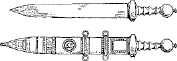
GLADII
REVIEW OF AGREEMENT, AND OF THE GENITIVE, DATIVE,
AND ACCUSATIVE
448.
There are four agreements:
1. That of the predicate noun or of the appositive with the noun to
which it belongs (§§ 76, 81).
2. That of the adjective, adjective pronoun, or participle with its
noun (§ 65).
3. That of a verb with its subject (§ 28).
4. That of a relative pronoun with its antecedent (§ 224).
449.
The relation expressed by the genitive is, in general, denoted in
English by the preposition of. It is used to express
|
1. Possession
|
a. As attributive (§ 38).
b. In the predicate (§ 409).
|
|
2. The whole of which a part is taken (partitive genitive) (§ 331).
|
|
3. Quality or description (§§ 443, 445).
|
450.
The relation expressed by the dative is, in general, denoted in
English by the prepositions to or for when they do not
imply motion through space. It is used to express
|
1. The indirect object
|
a. With intransitive verbs and with transitive verbs in
connection with a direct object in the accusative (§ 45).
b. With special intransitive verbs (§ 154).
c. With verbs compounded with ad, ante, con,
dē, in, inter, ob, post, prae,
prō, sub, super (§ 426).
|
|
2. The object to which the quality of an adjective is directed (§ 143).
|
|
3. The purpose, or end for which, often with a second dative denoting
the person or thing affected (§ 437).
|
451.
The accusative case corresponds, in general, to the English
objective. It is used to express
1. The direct object of a transitive verb (§ 37).
2. The predicate accusative together with the direct object after
verbs of making, choosing, falling, showing, and the like (§ 392).
3. The subject of the infinitive (§ 214).
4. The object of prepositions that do not govern the ablative (§ 340).
5. The duration of time and the extent of space (§ 336).
6. The place to which (§§ 263, 266).
452.
EXERCISES
I. 1. Mīlitēs quōs vīdimus dīxērunt imperium bellī esse Caesaris
imperātōris. 2. Helvētiī statuērunt quam1 maximum numerum equōrum et carrōrum cōgere.
3. Tōtīus Galliae Helvētiī plūrimum valuērunt. 4. Multās hōrās
ācriter pugnātum est neque quisquam poterat vidēre hostem fugientem.
5. Virī summae virtūtis hostīs decem mīlia passuum īnsecūtī sunt.
6. Caesar populō Rōmānō persuāsit ut sē cōnsulem creāret.
7. Victōria exercitūs erat semper imperātōrī grātissima.
8. Trīduum iter fēcērunt et Genāvam, in oppidum2 hostium, pervēnērunt. 9. Caesar audīvit Germānōs
bellum Gallīs intulisse. 10. Magnō ūsuī mīlitibus Caesaris erat
quod priōribus proeliīs sēsē exercuerant.
II. 1. One3 of the king’s sons and many of
his men were captured. 2. There was no one who wished4 to appoint her queen. 3. The grain supply was always
a care (for a care) to Cæsar, the general. 4. I think that the camp
is ten miles distant. 5. We marched for three hours through a very
dense forest. 6. The plan 5of making war
upon the allies was not pleasing to the king. 7. When he came to
the hill he fortified it 6by a twelve-foot
wall.
REVIEW OF THE ABLATIVE
453.
The relations of the ablative are, in general, expressed in English by
the prepositions with (or by), from (or by),
and in (or at). The constructions growing out of these
meanings are
|
I. Ablative rendered with (or by):
|
|
|
1. Cause (§ 102)
2. Means (§ 103)
3. Accompaniment (§ 104)
4. Manner (§ 105)
5. Measure of difference (§ 317)
6. With a participle (ablative absolute) (§ 381)
7. Description or quality (§§ 444, 445)
8. Specification (§ 398)
|
|
II. Ablative rendered from (or by):
|
|
|
1. Place from which (§§ 179, 264)
2. Ablative of separation (§ 180)
3. Personal agent with a passive verb (§ 181)
4. Comparison without quam (§ 309)
|
|
III. Ablative rendered in (or at):
|
|
|
1. Place at or in which (§§ 265, 266)
2. Time when or within which (§ 275)
|
454.
EXERCISES
I. 1. Gallī locīs superiōribus occupātīs itinere exercitum prohibēre
cōnantur. 2. Omnēs oppidānī ex oppidō ēgressī salūtem fugā petere
incēpērunt. 3. Caesar docet sē mīlitum vītam suā salūte habēre
multō cāriōrem. 4. Cum celerius omnium opīniōne pervēnisset, hostēs
ad eum obsidēs mīsērunt 5. Vīcus in valle positus montibus
altissimīs undique continētur. 6. Plūrimum inter Gallōs haec gēns
et virtūte et hominum numerō valēbat. 7. Secundā vigiliā nūllō
certō ōrdine neque imperiō ē castrīs ēgressī sunt. 8. Duābus
legiōnibus Genāvae relictīs,
proximō diē cum reliquīs domum profectus est. 9. Erant itinera duo
quibus itineribus Helvētiī domō exīre possent. 10. Rēx erat summā
audāciā et magnā apud populum potentiā. 11. Gallī timōre servitūtis
commōtī bellum parābant. 12. Caesar monet lēgātōs ut contineant
militēs, nē studiō pugnandī aut spē praedae longius1 prōgrediantur. 13. Bellum ācerrimum ā Caesare in
Gallōs gestum est.
II. 1. The lieutenant after having seized the mountain restrained his
(men) from battle. 2. All the Gauls differ from each other in laws.
3. This tribe is much braver than the rest. 4. This road is
2ten miles shorter than that. 5. In
summer Cæsar carried on war in Gaul, in winter he returned to Italy.
6. At midnight the general set out from the camp with three
legions. 7. I fear that you cannot protect3 yourself from these enemies. 8. 4After this battle was finished peace was made by all the
Gauls.
REVIEW OF THE GERUND AND GERUNDIVE, THE INFINITIVE,
AND THE SUBJUNCTIVE
455.
The gerund is a verbal noun and is used only in the genitive, dative,
accusative, and ablative singular. The constructions of these cases are
in general the same as those of other nouns (§§ 402; 406.1).
456.
The gerundive is a verbal adjective and must be used instead of gerund +
object, excepting in the genitive and in the ablative without a
preposition. Even in these instances the gerundive construction is more
usual (§ 406.2).
457.
The infinitive is used:
I. As in English.
a. As subject or predicate nominative (§ 216).
b. To complete the predicate with verbs of incomplete predication
(complementary infinitive) (§ 215).
c. As object with subject accusative after verbs of wishing,
commanding, forbidding, and the like (§ 213).
II. In the principal sentence of an indirect statement after verbs of
saying and mental action. The subject is in the accusative
(§§ 416, 418, 419).
458.
The subjunctive is used:
1. To denote purpose (§§ 349, 366, 372).
2. To denote consequence or result (§§ 385, 386).
3. In relative clauses of characteristic or description (§ 390).
4. In cum clauses of time, cause, and concession (§ 396).
5. In indirect questions (§ 432).
459.
EXERCISES
I. 1. Caesar, cum pervēnisset, militēs hortābātur nē cōnsilium oppidī
capiendi omitterent. 2. Rēx, castrīs prope oppidum positīs, mīsit
explōrātōrēs quī cognōscerent ubi exercitus Rōmanus esset. 3. Nēmo
relinquēbātur quī arma ferre posset. 4. Nūntiī vīdērunt ingentem
armōrum multitudinem dē mūrō in fossani iactam esse. 5. Dux suōs
trānsīre flūmen iussit. Trānsīre autem hoc flūmen erat difficillimum.
6. Rōmānī cum hanc calamitātem molestē ferrant, tamen terga vertere
recūsāvērunt. 7. Hōc rūmōre audītō, tantus terror omnium animōs
occupāvit ut nē fortissimī quidem proelium committere vellent.
8. Erant quī putārent tempus annī idōneum nōn esse itinerī
faciendō. 9. Tam ācriter ab utraque parte pugnābātur ut multa mīlia
hominum occīderentur. 10. Quid timēs? Timeō nē Rōmānīs in animō sit
tōtam Galliam superāre et nōbīs iniūriās inferre.
II. 1. Do you not see who is standing on the wall? 2. We hear
that the plan of taking the town has been given up. 3. Since the
Germans thought that the Romans could not cross the Rhine, Cæsar ordered
a bridge to be made. 4. When the bridge was finished, the savages
were so terrified that they hid themselves. 5. They feared that
Cæsar would pursue them. 6. Cæsar 1asked
the traders what the size of the island was. 7. The traders advised
him not 2to cross the sea. 8. He sent
scouts 3to choose a place for a camp.
INTRODUCTORY SUGGESTIONS
How to Translate. You have already had considerable practice
in translating simple Latin, and have learned that the guide to the
meaning lies in the endings of the words. If these are neglected, no
skill can make sense of the Latin. If they are carefully noted and
accurately translated, not many difficulties remain. Observe the
following suggestions:
1. Read the Latin sentence through to the end, noting endings of
nouns, adjectives, verbs, etc.
2. Read it again and see if any of the words you know are nominatives
or accusatives. This will often give you what may be called the backbone
of the sentence; that is, subject, verb, and object.
3. Look up the words you do not know, and determine their use in the
sentence from their endings.
4. If you cannot yet translate the sentence, put down the English
meanings of all the words in the same order as the Latin words.
You will then generally see through the meaning of the sentence.
5. Be careful to
a. Translate adjectives with the nouns to which they belong.
b. Translate together prepositions and the nouns which they
govern.
c. Translate adverbs with the words that they modify.
d. Make sense. If you do not make sense, you have made a
mistake. One mistake will spoil a whole sentence.
6. When the sentence is correctly translated, read the Latin over
again, and try to understand it as Latin, without thinking of the
English translation.
The Parts of a Sentence. You will now meet somewhat longer
sentences than you have had before. To assist in translating them,
remember, first of all, that every sentence conveys a meaning and either
tells us something, asks a question, or gives a command. Every sentence
must have a subject and a verb, and the verb may always have an adverb,
and, if transitive, will have a direct object.
However long a sentence is, you will usually be able to recognize its
subject, verb, and object or predicate complement without any
difficulty. These will give you the leading thought, and they must never
be lost sight of while making out the rest of the sentence. The chief
difficulty in translating arises from the fact that instead of a single
adjective, adverb, or noun, we often have a phrase or a clause taking
the place of one of these; for Latin, like English, has adjective,
adverbial, and substantive clauses and phrases. For example, in the
sentence The idle boy does not study, the word idle is an
adjective. In The boy wasting his time does not study, the words
wasting his time form an adjective phrase modifying boy.
In the sentence The boy who wastes his time does not study, the
words who wastes his time form an adjective clause modifying
boy, and the sentence is complex. These sentences would show the
same structure in Latin.
In translating, it is important to keep the parts of a phrase and the
parts of a clause together and not let them become confused with the
principal sentence. To distinguish between the subordinate clauses and
the principal sentence is of the first importance, and is not difficult
if you remember that a clause regularly contains a word that marks it as
a clause and that this word usually stands first. These words join
clauses to the words they depend on, and are called subordinate
conjunctions. They are not very numerous, and you will soon learn to
recognize them. In Latin they are the equivalents for such words as
when, while, since, because, if, before, after, though, in order
that, that, etc. Form the habit of memorizing the Latin subordinate
conjunctions as you meet them, and of noting carefully the mood of the
verb in the clauses which they introduce.
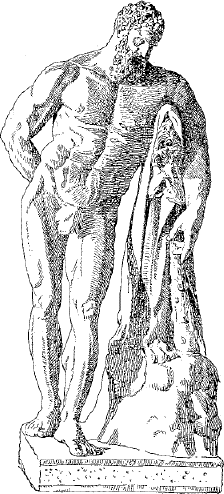
HERCULES
THE LABORS OF HERCULES
Hercules, a Greek hero celebrated for his great strength, was pursued
throughout his life by the hatred of Juno. While yet an infant he
strangled some serpents sent by the goddess to destroy him. During his
boyhood and youth he performed various marvelous feats of strength, and
on reaching manhood he succeeded in delivering the Thebans from the
oppression of the Minyæ. In a fit of madness, sent upon him by Juno, he
slew his own children; and, on consulting the Delphic oracle as to how
he should cleanse himself from this crime, he was ordered to submit
himself for twelve years to Eurystheus, king of Tiryns, and to perform
whatever tasks were appointed him. Hercules obeyed the oracle, and
during the twelve years of his servitude accomplished twelve
extraordinary feats known as the Labors of Hercules. His death was
caused, unintentionally, by his wife Deiani´ra. Hercules had shot with
his poisoned arrows a centaur named Nessus, who had insulted Deianira.
Nessus, before he died, gave some of his blood to Deianira, and told her
it would act as a charm to secure her husband’s love. Some time after,
Deianira, wishing to try the charm, soaked one of her husband’s garments
in the blood, not knowing that it was poisoned. Hercules put on the
robe, and, after suffering terrible torments, died, or was carried off
by his father Jupiter.
LIII.1
THE INFANT HERCULES AND THE SERPENTS
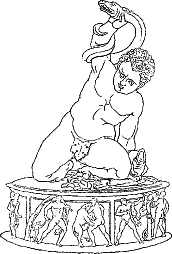
HERCULES ET SERPENTES
Dī2 grave supplicium sūmmit de malīs, sed iī
quī lēgibus3 deōrum pārent, etiam post mortem
cūrantur. Illa vīta dīs2 erat grātissima quae
hominibus miserīs ūtilissima fuerat. Omnium autem praemiōrum summum erat
immortālitās. Illud praemium Herculī datum est.
Herculis pater fuit Iuppiter, māter Alcmēna, et omnium hominum
validissimus fuisse dīcitur. Sed Iūnō, rēgīna deōrum, eum, adhūc
īnfantem, interficere studēbat; nam eī4
et5 Herculēs et Alcmēna erant invīsī. Itaque
mīsit duās serpentīs, utramque saevissimam, quae mediā nocte domum6 Alcmēnae vēnērunt. Ibi Herculēs, cum frātre suō,
nōn in lectulō sed in scūtō ingentī dormiēbat. Iam audācēs serpentēs
adpropinquāverant, iam scūtum movēbant. Tum frāter, terrōre commōtus,
magnā vōce mātrem vocāvit, sed Herculēs ipse, fortior quam frāter,
statim ingentīs serpentīs manibus suīs rapuit et interfēcit.
LIV.
HERCULES CONQUERS THE MINYÆ
Herculēs ā puerō1 corpus suum gravissimīs et
difficillimīs labōribus exercēbat et hōc modō vīrēs2 suās cōnfirmāvit. Iam adulēscēns Thēbīs3 habitābat. Ibi Creōn quīdam erat rēx. Minyae, gēns
validissima, erant fīnitimī Thēbānīs, et, quia ōlim Thēbānōs vīcerant,
quotannīs lēgātōs mittēbant et vectīgal postulābant. Herculēs autem
cōnstituit cīvīs suōs hōc vectīgālī līberāre et dixit rēgī, “Dā mihi
exercitum tuum et ego hōs superbōs hostīs superābō.” Hanc condiciōnem
rēx nōn recūsāvit, et Herculēs nūntiōs in omnīs partis dīmīsit et cōpiās
coēgit.4 Tum tempore opportūnissimō proelium
cum Minyīs commīsit. Diū pugnātum est, sed dēnique illī impetum
Thēbānōrum sustinēre nōn potuērunt et terga vertērunt fugamque
cēpērunt.
HE COMMITS A CRIME AND GOES TO THE DELPHIAN ORACLE
TO SEEK EXPIATION
Post hoc proelium Creōn rēx, tantā victōriā laetus, fīliam suam Herculī
in mātrimōnium dedit. Thēbīs Herculēs cum uxōre suā diū vīvēbat et ab
omnibus magnopere amābātur; sed post multōs annōs subitō 1in furōrem incidit et ipse suā manū līberōs suōs
interfēcit. Post breve tempus 2ad sānitātem
reductus tantum scelus expiāre cupiēbat et cōnstituit ad ōrāculum
Delphicum iter facere. Hoc autem ōrāculum erat omnium clārissimum. Ibi
sedēbat fēmina quaedam quae Pȳthia appellābātur. Ea cōnsilium dabat iīs
quī ad ōrāculum veniēbant.
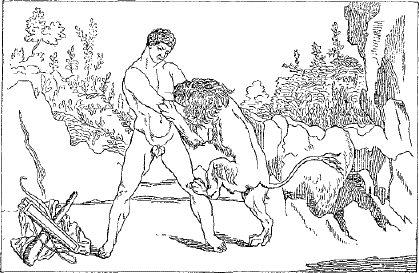
HERCULES LEONEM SUPERAT
LV.
HERCULES BECOMES SUBJECT TO EURYSTHEUS1 ·
HE STRANGLES THE NEME´AN LION
Itaque Herculēs Pȳthiae tōtam rem dēmonstrāvit nec scelus suum abdidit.
Ubi iam Herculēs fīnem fēcit, Pȳthia iussit eum ad urbem Tīryntha2 discēdere et ibi rēgī Eurystheō sēsē committere.
Quae3 ubi audīvit, Herculēs ad illam urbem
statim contendit et Eurystheō sē in servitūtem trādidit et dīxit, “Quid
prīmum, Ō rēx, mē facere iubēs?” Eurystheus, quī perterrēbātur vī et
corpore ingentī Herculis et eum occidī4
studēbat, ita respondit: “Audī, Herculēs! Multa mira5 nārrantur dē leōne saevissimō quī hōc tempore in valle
Nemaeā omnia vāstat. Iubeō tē, virōrum omnium fortissimum, illō mōnstrō
hominēs līberāre.” Haec verba Herculī maximē placuērunt. “Properābo,”
inquit,
“et parēbō imperiō6 tuō.” Tum in silvās in
quibus leō habitābat statim iter fēcit. Mox feram vīdit et plūrīs
impetūs fēcit; frūstrā tamen, quod neque sagittīs neque ūllō aliō tēlō
mōnstrum vulnerāre potuit. Dēnique Herculēs saevum leōnem suīs
ingentibus bracchiīs rapuit et faucīs eius omnibus vīribus compressit.
Hōc modō brevī tempore eum interfēcit. Tum corpus leōnis ad oppidum in
umerīs reportāvit et pellem posteā prō7 veste
gerēbat. Omnēs autem quō eam regiōnem incolēbant, ubi fāmam dē morte
leōnis ingentis accēpērunt, erant laetissimī et Herculem laudābant
verbīs amplissimīs.
LVI.
SLAYING THE LERNE´AN HYDRA
Deinde Herculēs ab Eurystheō iussus est Hydram occīdere. Itaque cum
amīcō Iolāō1 contendit ad palūdem Lernaeam
ubi Hydra incolēbat. Hoc autem mōnstrum erat serpēns ingēns quae novem
capita habēbat. Mox is mōnstrum repperit et summō2 cum perīculō collum eius sinistrā manū rapuit et tenuit.
Tum dextrā manū capita novem abscīdere incēpit, sed frūstrā labōrābat,
quod quotiēns hoc fēcerat totiēns alia nova capita vidēbat. Quod3 ubi vīdit, statuit capita ignī cremāre. Hōc modō
octō capita dēlēvit, sed extrēmum caput vulnerārī nōn potuit, quod erat
immortāle. Itaque illud sub ingentī saxō Herculēs posuit et ita
victōriam reportāvit.
LVII.
THE ARCADIAN STAG AND THE ERYMANTHIAN BOAR
Postquam Eurystheō mors Hydrae nuntiata est, summus terror animum eius
occupavit. Itaque iussit Herculem capere et ad sē reportāre cervum
quendam; nam minimē cupīvit tantum virum in rēgnō suō tenēre. Hie autem
cervus dīcēbātur aurea cornua et pedēs multō1
celeriōrēs ventō2 habēre. Prīmum Herculēs
vestīgia animālis petīvit, deinde, ubi cervum ipsum vīdit, omnibus
vīribus currere incēpit. Per plūrimōs diēs contendit nec noctū cessāvit.
Dēnique postquam per
tōtum annum cucurrerat—ita dīcitur—cervum iam dēfessum cēpit
et ad Eurystheum portāvit.
Tum vērō iussus est Herculēs aprum quendam capere quī illō tempore agrōs
Erymanthiōs vāstābat et hominēs illīus locī magnopere perterrēbat.
Herculēs laetē negōtium suscēpit et in Arcadiam celeriter sē recēpit.
Ibi mox aprum repperit. Ille autem; simul atque Herculem vīdit, statim
quam3 celerrimē fūgit et metū perterritus in
fossam altam sēsē abdidit. Herculēs tamen summā cum difficultāte eum
extrāxit, nec aper ūllō modō sēsē līberāre potuit, et vīvus ad
Eurystheum portātus est.
LVIII.
HERCULES CLEANS THE AUGE´AN STABLES AND KILLS THE STYMPHALIAN BIRDS
Deinde Eurystheus Herculī hunc labōrem multō graviōrem imperāvit.
Augēās1 quīdam, quī illō tempore rēgnum
Ēlidis2 obtinēbat, tria mīlia boum3 habēbat. Hī4 ingentī stabulō
continēbantur. Hoc stabulum, quod per trīgintā annōs nōn pūrgātum erat,
Herculēs intrā spatium ūnīus diēī pūrgāre iussus est. llle negōtium
alacriter suscēpit, et prīmum labōre gravissimō maximam fossam fōdit per
quam flūminis aquam dē montibus ad mūrum stabulī dūxit. Tum partem
parvam mūrī dēlēvit et aquam in stabulum immīsit. Hōc modō fīnm operis
fēcit ūnō diē facillimē.
Post paucōs diēs Herculēs ad oppidum Stymphālum iter fēcit; nam
Eurystheus iusserat eum avis Stymphālidēs occīdere. Hae avēs rōstra
ferrea habēbant et hominēs miserōs dēvorābant. Ille, postquam ad locum
pervēnit, lacum vīdit in quō avēs incolēbant. Nūllō tamen modō Herculēs
avibus adpropinquāre potuit; lacus enim nōn ex aquā sed ē līmō
cōnstitit.5 Dēnique autem avēs 6dē aliquā causā perterritae in aurās volāvērunt et magna
pars eārum sagittīs Herculis occīsa est.
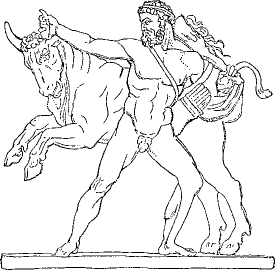
HERCULES ET TAURUS
LIX.
HERCULES CAPTURES THE CRETAN BULL AND CARRIES HIM LIVING TO
EURYSTHEUS
Tum Eurystheus iussit Herculem portāre vīvum ex īnsulā Crētā taurum
quendam saevissimum. Ille igitur nāvem cōnscendit—nam ventus erat
idōneus—atque statim solvit. Postquam trīduum nāvigavit, incolumis
īnsulae adpropinquāvit. Deinde, postquam omnia parāta sunt, contendit ad
eam regiōnem quam taurus vexābat. Mox taurum vīdit ac sine ūllō metū
cornua eius corripuit. Tum ingentī labōre mōnstrum ad nāvem trāxit atque
cum hāc praedā ex īnsulā discessit.
THE FLESH-EATING HORSES OF DIOME´DES
Postquam ex īnsulā Crētā domum pervēnit, Hercules ab Eurystheō in
Thrāciam missus est. Ibi Diomēdēs quīdam, vir saevissimus, rēgnum
obtinēbat et omnīs ā fīnibus suīs prohibēbat. Herculēs iussus erat equōs
Diomedis rapere et ad Eurystheum dūcere. Hī autem equī hominēs
miserrimōs dēvorābant dē quibus rēx supplicium sūmere cupiēbat. Herculēs
ubi pervēnit, prīmum equōs ā rēge postulāvit, sed rēx eōs dēdere
recūsāvit. Deinde ille īrā commōtus rēgem occīdit et corpus eius equīs
trādidit. Itaque is quī anteā multōs necāverat, ipse eōdem suppliciō
necātus est. Et equī, nūper saevissima animālia, postquam dominī suī
corpus dēvorāvērunt, mānsuētī erant.
LX.
THE BELT OF HIPPOL´YTE, QUEEN OF THE AMAZONS
Gēns Amāzonum1 dīcitur2 omnīnō ex mulieribus fuisse. Hae cum virīs proelium
committere nōn verēbantur. Hippolytē, Amāzonum rēgīna, balteum habuit
pulcherrimum. Hunc balteum possidēre fīlia Eurystheī vehementer
cupiēbat. Itaque Eurystheus iussit Herculem impetum in Amāzonēs facere.
Ille multīs cum cōpiīs nāvem cōnscendīt et paucis diēbus in Amāzonum
fīnīs pervēnit, ac balteum postulāvit. Eum trādere ipsa Hipporytē quidem
cupīvit; reliquīs tamen Amazonibus3
persuādēre nōn potuit. Postrīdiē Herculēs proelium commīsit. Multās
hōrās utrimque quam fortissimē pugnātum est Dēnique tamen mulieres terga
vertērunt et fugā salūtem petiērunt. Multae autem captae sunt, in quō
numerō erat ipsa Hippolytē. Herculēs postquam balteum accēpit, omnibus
captīvīs lībertātem dedit.
THE DESCENT TO HADES AND THE DOG CER´BERUS

HERCULES ET CERBERUS
Iamque ūnus modo ē duodecim labōribus relinquēbātur sed inter omnīs hic
erat difficillimus. Iussus est enim canem Cerberum4 ex Orcō in lūcem trahere. Ex Orcō autem nēmō anteā
reverterat. Praetereā Cerberus erat mōnstrum maximē horribile et tria
capita habēbat. Herculēs postquam imperia Eurystheī accēpit, statim
profectus est et in Orcum dēscendit. Ibi vērō nōn sine summō periculō
Cerberum manibus rapuit et ingentī cum labōre ex Orcō in lūcem et
adurbem Eurystheī trāxit.
Sic duodecim laborēs illī5 intrā duodecim
annōs cōnfectī sunt. Dēmum post longam vītam Herculēs ā deīs receptus
est et Iuppiter fīliō suō dedit immortālitātem.
P. CORNELIUS LENTULUS: THE STORY OF A ROMAN
BOY1
LXI.
PUBLIUS IS BORN NEAR POMPE´II
P. Cornēlius Lentulus,2 adulēscēns Rōmānus,
amplissimā familiā3 nātus est; nam pater
eius, Mārcus, erat dux perītissimus, cuius virtūte4 et cōnsiliō multae victōriae reportātae erant; atque
mater eius, lūlia, ā clārissimīs maiōribus orta est. Nōn vērō in urbe
sed rūrī5 Pūblius nātus est, et cum mātre
habitābat in vīllā quae in maris lītore et sub radīcibus magnī montis
sita erat. Mōns autem erat Vesuvius et parva urbs Pompēiī octō
mīlia6 passuum7
aberat. In Italiā antīquā erant plūrimae quidem villae et pulchrae, sed
inter hās omnīs nūlla erat pulchrior quam villa Mārcī Iūliaeque. Frōns
vīllae mūrō a maris fluctibus mūniēbātur. Hinc mare et lītora et īnsulae
longē lātēque cōnspicī8 ac saepe nāvēs longae
et onerāriae poterant. Ā tergō et ab utrōque latere agrī ferācissimī
patēbant. Undique erat magna variōrum flōrum cōpia et multa ingentium
arborum genera quae aestāte9 umbram
dēfessīs agricolīs grātissimam adferēbant. Praetereā erant1 in agrīs stabulīsque multa animālium genera, nōn sōlum
equī et bovēs sed etiam rārae avēs. Etiam erat10 magna piscīna plēna piscium; nam Rōmānī piscīs
dīligenter colēbant.
PUERI ROMANI
LXII.
HIS LIFE ON THE FARM
Huius vīllae Dāvus, servus Mārcī, est vīlicus1 et cum Lesbiā uxōre omnia cūrat. Vīlicus et uxor in casā
humilī, mediīs in agrīs sitā, habitant. Ā prīmā lūce ūsque ad vesperum
sē2 gravibus labōribus exercent ut omnī rēs
bene gerant.3 Plūrima enim sunt officia Dāvī
et Lesbiae. Vīlicus servōs regit nē tardī sint4; mittit aliōs quī agrōs arent,4 aliōs quī hortōs inrigent,4 et
opera in5 tōtum diem impōnit. Lesbia autem
omnibus vestīmenta parat, cibum coquit, pānem facit.

CASA ROMANA
Nōn longē ab hōrum casā et in summō colle situm surgēbat domicilium
ipsīus dominī dominaeque amplissimum. Ibi plūrīs annōs6 Pūblius cum mātre vītam fēlīcem agēbat; nam pater eius,
Mārcus, in terrīs longinquīs gravia reī pūblicae bella gerēbat nec
domum7 revertī poterat. Neque puerō quidem
molestum est rūrī8 vīvere. Eum multae rēs
dēlectant. Magnopere amat silvās, agrōs, equōs, bovēs, gallīnās, avīs,
reliquaque animālia. Saepe plūrīs hōrās9 ad
mare sedet quō9 melius fluctūs et nāvīs
spectet. Nec omnīnō sine comitibus erat, quod Lȳdia, Dāvī fīlia, quae
erat eiusdem aetātis, cum eō adhūc infante lūdēbat, inter quōs cum annīs
amīcitia crēscēbat. Lȳdia nūllum alium ducem dēligēbat et Pūblius ab
puellae latere rārō
discēdēbat. Itaque sub clārō Italiae sōle Pūblius et Lȳdia, amīcī
fidēlissimī, per campōs collīsque cotīdiē vagābantur. Modo in silvā
fīnitimā lūdebant ubi Pūblius sagittīs10
celeribus avis dēiciēbat et Lȳdia corōnīs variōrum flōrum comās suās
ōrnābat; modo aquam et cibum portābant ad Dāvum servōsque dēfessōs quī
agrōs colēbant: modo in casā parvā aut hōrās lactās in lūdō cōnsūmēbant
aut auxilium dabant Lesbiae, quae cibum virō et servīs parābat vel aliās
rēs domesticās agēbat.
LXIII.
MARCUS LENTULUS, THE FATHER OF PUBLIUS, IS SHIPWRECKED · JULIA RECEIVES
A LETTER FROM HIM
Iam Pūblius1 decem annōs habēbat cum M.
Cornēlius Lentulus, pater eius, quī quīnque annōs2 grave bellum in Asiā gerēbat, non sine glōriā domum3 revertēbātur. Namque multa secunda proelia
fēcerat, maximās hostium cōpiās dēlēverat, multās urbīs populo4 Rōmānō inimīcās cēperat. Primum nūntius pervēnit
quī ā Lentulō5 missus erat6 ut profectiōnem suam nūntiāret. Deinde plūrīs diēs7 reditum virī optimī māter fīliusque exspectābant
et animīs8 sollicitis deōs immortālīs frūstrā
colēbant. Tum dēmum hās litterās summo cum gaudiō accēpērunt:
9“Mārcus Iūliae suac salūtem dīcit. Sī valēs,
bene est; ego valeō. Ex Graeciā, quō10
praeter spem et opīniōnem hodiē pervēnī, hās litterās ad tē scribō.
Namque nāvis nostra frācta est; nōs autem—11dīs est gratia—incolumes sumus. Ex Asiae12 portū nāvem lēnī ventō solvimus. Postquam13 altum mare tenuimus 14nec iam
ūllae terrae appāruērunt, caelum undique et undique fluctūs, subitō
magna tempestās coorta est et nāvem vehementissimē adflīxit. Ventīs
fluctibusque
adflīctātī15 nec sōlem discernere nec cursum
tenēre poterāmus et omnia praesentem mortem intentābant. Trīs diēs16 et trīs noctīs16 sine
rēmīs vēlīsque agimur. Quārtō diē17 prīmum
terra vīsa est et violenter in saxa, quae nōn longē ā lītore aberant,
dēiectī sumus. Tum vērō maiōra perīcula timēbāmus; sed nauta quīdam, vir
fortissimus, ex nāve in fluctūs īrātōs dēsiluit 18ut fūnem ad lītus portāret; quam rem summō labōre vix
effēcit. Ita omnēs servātī sumus. Grātiās igitur et honōrem Neptūnō
dēbēmus, quī deus nōs ē perīculō ēripuit. Nunc Athēnīs19 sum, quō cōnfūgī ut mihi paucās hōrās ad quiētem
darem.20 Quam prīmum autem aliam nāvem
condūcam ut iter ad Italiam reliquum cōnficiam et domum21 ad meōs cārōs revertar. Salūtā nostrum Pūblium
amīcissimē et valētūdinem tuam cūrā dīligenter. 22Kalendīs Mārtiīs.”
LXIV.
LENTULUS REACHES HOME · PUBLIUS VISITS POMPEII WITH HIS FATHER
Post paucōs diēs nāvis M. Cornēlī Lentulī portum Mīsēnī1 petiit, quī portus nōn longē ā Pompēiīs situs est; quō in
portū classis Rōmānā pōnēbātur et ad pugnās nāvālīs ōrnābātur. Ibi nāvēs
omnium generum cōnspicī poterant. Iamque incrēdibilī celeritāte nāvis
longa quā Lentulus vehēbātur lītorī adpropinquāvit; nam nōn sōlum ventō
sed etiam rēmīs impellēbātur. In altā puppe stābat gubernātor et nōn
procul aliquī mīlitēs Rōmānī cum armīs splendidīs, inter quōs
clārissimus erat Lentulus. Deinde servī rēmīs contendere
cessāvērunt2; nautae vēlum contrāxērunt et
ancorās iēcērunt. Lentulus statim ē nāvī ēgressus est et3 ad villam suam properāvit. Eum Iūlia, Pūblius, tōtaque
familia excēpērunt. 4Quī complexūs, quanta
gaudia fuērunt!
Postrīdiē eius diēī Lentulus fīliō suō dīxit, “Venī, mī Pūblī, mēcum.
Pompēiōs iter hodiē faciam. Māter tua suādet5
ut frūctūs et cibāria emam. Namque plūrīs amīcōs ad cēnam vocāvimus et
multīs rēbus6 egēmus. Ea hortātur ut quam
prīmum proficīscāmur.” “Libenter, mī pater,” inquit Pūblius. “Tēcum esse
mihi semper est grātum; nec Pompēiōs umquam vīdī. Sine morā proficīscī
parātus sum.” Tum celeriter currum cōnscendērunt et ad urbis mūrōs vectī
sunt. Stabiānā portā7 urbem ingressī sunt.
Pūblius strātās viās mīrātur et saxa altiōra quae in mediō disposita
erant et altās orbitās quās rotae inter haec saxa fēcerant. Etiam
strepitum mīrātur, multitūdinem, carrōs, fontīs, domōs, tabernās,
forum8 cum statuīs, templīs, reliquīsque
aedificiīs pūblicīs.
LXV.
A DAY AT POMPEII
Apud forum ē currū dēscendērunt et Lentulus dīxit, “Hīc sunt multa
tabernārum genera, mī Pūblī. Ecce, trāns viam est popīna! 1Hoc genus tabernārum cibāria vēndit. Frūctūs quoque ante
iānuam stant. Ibi cibāria mea emam.” “Optimē,” respondit Pūblius. “At
ubi, mī pater, crūstula emere possumus? Namque māter nōbīs imperāvit
2ut haec quoque parārēmus. Timeō ut3 ista popīna vēndat crūstula.” “Bene dīcis,”
inquit Lentulus. “At nōnne vidēs illum fontem ā dextrā ubi aqua per
leōnis caput fluit? In illō ipsō locō est taberna pīstōris quī sine
dubiō vēndit crūstula.”
Brevī tempore4 omnia erant parāta, iamque
5quīnta hōra erat. Deinde Lentulus et fīlius
ad caupōnam properāvērunt, quod famē6 et
sitī7 urgēbantur. Ibi sub arboris umbrā
sēdērunt et puerō imperāvērunt ut sibi8 cibum
et vīnum daret. Huic imperiō9 puer celeriter
pāruit. Tum laetī sē10 ex labōre
refēcērunt.
Post prandium prefectī sunt ut alia urbis spectācula vidērent. Illō
tempore fuērunt Pompēiīs11 multa templa, duo
theātra, thermae magnumque amphitheātrum, quae omnia post paucōs annōs
flammīs atque incendiīs Vesuvī et terrae mōtū dēlēta sunt. Ante hanc
calamitātem autem hominēs 1nihil dē monte
veritī sunt. In amphitheātrō quidem Pūblius morārī cupīvit ut spectācula
gladiātōria vidēret, quae in13 illum ipsum
diem prōscrīpta erant et iam 15rē vērā
incēperant. Sed Lentulus dīxit, “Morārī, Pūblī, 16vereor ut possīmus. Iam decima hōra est et via est longa.
Tempus suādet ut quam prīmum domum revertāmur.” Itaque servō imperāvit
ut equōs iungeret, et sōlis occāsū16 ad
vīllam pervēnērunt.
LXVI.
LENTULUS ENGAGES A TUTOR FOR HIS SON
Ā prīmīs annīs quidem Iūlia ipsa fīlium suum docuerat, et Pūblius nōn
sōlum 1pūrē et Latīnē loquī poterat sed etiam
commodē legēbat et scrībēbat. Iam Ennium2
aliōsque poētās lēgerat. Nunc vērō Pūblius 3duodecim annōs habēbat; itaque eī pater bonum magistrum,
4virum omnī doctrīnā et virtūte ōrnātissimum,
parāvit, 5quī Graeca, mūsicam, aliāsque artīs
docēret. 6Namque illīs temporibus omnēs ferē
gentēs Graecē loquēbantur. Cum Pūbliō aliī puerī, Lentulī amīcōrum
fīliī,7 discēbant. Nam saepe apud Rōmānōs mōs
erat 8nōn in lūdum fīliōs mittere sed domī
per magistrum docēre. Cotīdiē discipulī cum magistrō in peristȳlō9 Mārcī domūs sedēbant. Omnēs puerī bullam auream,
orīginis honestae signum, in collō gerēbant, et omnēs togā praetextā
amictī erant, 10quod nōndum sēdecim
annōs11 nātī sunt.
SCENE IN SCHOOL · AN EXERCISE IN COMPOSITION

TABULA ET STILUS
Discipulī. Salvē, magister.
Magister. Vōs quoque omnēs, salvēte.
1Tabulāsne portāvistis et stilōs?
D. Portāvimus.
M. Iam fābulam Aesōpī2 discēmus. Ego legam,
vōs in tabulīs scrībite. Et tū, Pūblī, dā mihi ē capsā3 Aesōpī volūmen.4 Iam audīte
omnēs: Vulpēs et Ūva.
Vulpēs ōlim famē coācta ūvam dēpendentem vīdit. Ad ūvam saliēbat, sūmere
cōnāns. Frūstrā diū cōnāta, tandem īrāta erat et salīre cessāns dīxit:
“Illa ūva est acerba; acerbam ūvam 5nihil
moror.”
Omnia´ne scrīpsistis, puerī?
D. Omnia, magister.
LXVII.
PUBLIUS GOES TO ROME TO FINISH HIS EDUCATION
Iamque Pūblius, 1quīndecim annōs nātus, 2prīmīs litterārum elementīs cōnfectīs, Rōmam
petere voluit ut scholās grammaticōrum et philosophōrum frequentāret. Et
facillimē patrī3 suō, qui ipse philosophiae
studiō tenēbātur, persuāsit. Itaque 4omnibus
rēbus ad profectiōnem comparātīs, pater fīliusque equīs animōsīs
vectī5 ad magnam urbem profectī sunt. Eōs
proficīscentīs Iūlia tōtaque familia vōtīs precibusque prōsecūtae sunt.
Tum per loca6 plāna et collis silvīs vestītōs
viam ingressī sunt ad Nōlam, quod oppidum eōs hospitiō modicō excēpit.
Nōlae7 duās hōrās morātī sunt, quod sōl
merīdiānus ārdēbat. Tum rēctā viā8 circiter
vīgintī mīlia9 passuum9 Capuam,9 ad īnsignem Campāniae
urbem, contendērunt. Eō10 multā nocte dēfessī
pervēnērunt. 11Postrīdiē eius diēī, somnō et
cibō recreātī, Capuā discessērunt et 13viam
Appiam ingressī, quae Capuam tangit et ūsque ad urbem Rōmam dūcit, ante
merīdiem Sinuessam pervēnērunt, quod oppidum tangit mare. Inde prīmā
lūce proficīscentēs Formiās13 properāvērunt,
ubi Cicerō, ōrātor clarissimus, quī forte apud vīllam suam erat, eōs
benignē excēpit. Hinc 14itinere vīgintī
quīnque mīlium passuum factō, Tarracīnam, oppidum in saxīs altissimīs
situm, vīdērunt. Iamque nōn longē aberant palūdēs magnae, quae multa
mīlia passuum undique patent. Per eās pedestris via est gravis et in
nāve viātōrēs vehuntur. Itaque 15equīs
relictīs Lentulus et Pūblius nāvem cōnscendērunt, et, ūnā nocte in
trānsitū cōnsūmptā, Forum Appī vēnērunt. Tum brevī tempore Arīcia eōs
excēpit. Hoc oppidum, in colle
situm, ab urbe Romā sēdecim mīlia passuum abest. Inde dēclivis via ūsque
ad latum campum dūcit ubi Rōma stat. Quem ad locum ubi Pūblius vēnit et
Rōmam adhūc remōtam, maximam tōtīus orbis terrārum urbem, cōnspēxit,
summā admīrātiōne et gaudiō adfectus est. Sine morā dēscendērunt, et,
mediō intervāllō quam celerrimē superātō, urbem portā Capēnā ingressī
sunt.
LXVIII.
PUBLIUS PUTS ON THE TOGA VIRILIS

BULLA
Pūblius iam tōtum annum Rōmae morābātur1
multaque urbis spectācula vīderat et multōs sibi2 amīcōs parāverat. Eī3 omnēs
favēbant; 4dē eō omnēs bene spērāre poterant.
Cotīdiē Pūblius scholas philosophōrum et grammaticōrum tantō studiō
frequentābat 5ut aliīs clārum exemplum
praebēret. Saepe erat cum patre in cūriā6;
quae rēs effēcit 7ut summōs reī pūblicae
virōs et audīret et vidēret. Ubi 8sēdecim
annōs natus est, bullam9 auream et togam
praetextam mōre Rōmānō dēposuit atque virīlem togam sūmpsit. Virīlis
autem toga erat omnīnō alba, sed praetexta clāvum purpureum in margine
habēbat. 10Dēpōnere togam praetextam et
sūmere togam virīlem erat rēs grātissima puerō Rōmānō, quod posteā vir
et cīvis Rōmānus habēbātur.
11Hīs rēbus gestīs Lentulus ad uxōrem suam
hās litterās scrīpsit:
12“Mārcus Iūliae suae salūtem dīcit. Sī
valēs, bene est; ego valeō. Accēpī tuās litterās. Hās nunc Rōmā per
servum fidēlissimum mittō ut dē Pūbliō nostrō quam celerrimē sciās. Nam
hodiē eī togam virīlem dedī. Ante lucem surrēxī13 et prīmum bullam auream dē collō eius
remōvī. Hāc Laribus14 cōnsecrātā et sacrīs
factīs, eum togā virīlī vestīvī. Interim plūrēs amīcī cum multitūdine
optimōrum cīvium et honestōrum clientium pervēnerant 15quī Pūblium domō in forum dēdūcerent. Ibi in cīvitātem
receptus est et nōmen, Pūblius Cornēlius Lentulus, apud cīvīs Rōmānōs
ascrīptum est. Omnēs eī amīcissimī fuērunt et magna16 de eō praedīcunt. Sapientior enim aequālibus17 est et magnum ingenium habet. 18Cūrā ut valeās.”
LXIX.
PUBLIUS JOINS CÆSAR’S ARMY IN GAUL
Pūblius iam adulēscēns postquam togam virīlem sūmpsit, aliīs rēbus
studēre incēpit et praesertim ūsū1 armōrum
sē2 dīligenter exercuit. Magis magisque
amāvit illās artīs quae mīlitārem animum dēlectant. Iamque erant 3quī eī cursum mīlitārem praedīcerent. Nec sine
causā, quod certē patris īsigne exemplum 4ita
multum trahēbat. 5Paucīs ante annīs C. Iūlius
Caesar, ducum Rōmānōrum maximus, cōnsul creātus erat et hōc tempore in
Galliā bellum grave gerēbat. Atque in exercitū eius plūrēs adulēscentēs
mīlitābant, apud quōs erat amīcus quīdam Pūblī. Ille Pūblium crēbrīs
litterīs vehementer hortābātur 6ut iter in
Galliam faceret. Neque Pūblius recūsāvit, et, multīs amīcīs ad portam
urbis prōsequentibus, ad Caesaris castra profectus est. Quārtō diē
postquam iter ingressus est, ad Alpīs, montīs altissimōs, pervēnit. Hīs
summā difficultāte superātīs, tandem Gallōrum in fīnibus erat. Prīmō
autem veritus est ut7 castrīs Rōmānīs
adpropinquāre posset, quod Gallī, maximīs cōpiīs coāctīs, Rōmānōs
obsidēbant et viās omnīs iam clauserant. Hīs rēbus commōtus Pūblius
vestem Gallicam induit nē ā Gallīs caperētur, et ita per hostium cōpiās
incolumis ad castra
pervenīre potuit. Intrā mūnītiōnes acceptus, ā Caesare benignē exceptus
est. Imperātor fortem adulēscentem amplissimīs verbīs laudāvit et eum
8tribūnum mīlītum creāvit.
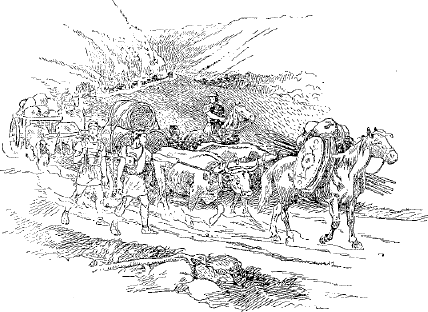
IMPEDIMENTA
HOW THE ROMANS MARCHED AND CAMPED
Exercitus quī in hostium fīnibus bellum genit multīs perīcuīs
circumdatus est. 1Quae perīcula ut vītāret,
Rōmāni summam cūram adhībēre solēbant. Adpropinquanteēs cōpiīs hostium
agmen ita dispōnēbant 2ut imperātor ipse cum
plāribus legiōnibus expedītīs3 prīmum agmen
dūceret. Post eās cōpiās impedīmenta4 tōtīus
exercitūs
conlocābant. 5Tum legiōnēs quae proximē
cōnscrīptae erant tōtum agmen claudēbant. Equitēs quoque in omnīs partīs
dīmittēbantur quī loca explōrārent; et centuriōnēs praemittēbantur ut
locum castrīs idōneum dēligerent. Locus habēbatur idōneus castrīs 6quī facile dēfendī posset et prope aquam esset.
Quā dē causā castra7 in colle ab utrāque
parte arduō, ā fronte lēniter dēclīvī saepe pōnēbantur; vel locus
palūdibus cīnctus vel in flūminis rīpīs situs dēligēbātur. Ad locum
postquam exercitus pervēnit, aliī mīlitum 8in
armīs erant, aliī castra mūnīre incipiēbant. Nam 9quō tūtiōrēs ab hostibus mīlitēs essent, nēve incautī et
imparātī opprimerentur, castra fossā lātā et vāllō altō mūniēbant. In
castrīs portae quattuor erant ut ēruptiō mīlitum omnīs in partīs fierī
posset. In angulīs castrōrum erant turrēs dē quibus tēla in hostīs
coniciēbantur. 10Tālibus in castrīs quālia
dēscrīpsimus Pūblius ā Caesare exceptus est.
LXX.
THE RIVAL CENTURIONS

CENTURIO
Illīs in castrīs erant duo centuriōnēs,1
fortissimī virī, T. Pullō et L. Vorēnus, quōrum neuter alterī
virtūte2 cēdere volēbat. Inter eōs iam multōs
annōs īnfēnsum certāmen gerēbātur. Tum dēmum fīnis contrōversiae hōc
modō3 factus est. Diē tertiō postquam Pūblius
pervēnit, hostēs, maiōribus cōpiīs coāctīs, ācerrimum impetum in castra
fēcērunt. Tum Pullō, 4cum Rōmānī
tardiōrēs5 vidērentur, “Cūr dubitās,” inquit,
“Vorēne? Quam commodiōrem occāsiōnem exspectās? Hic diēs dē virtūte
nostrā iūdicābit.” Haec6 cum dīxisset,
extrā mūnītiōnēs prōcessit et in eam hostium partem quae cōfertissima
7vidēbātur inrūpit. Neque Vorēnus quidem tum
vāllō8 sēsē continet, sed Pullōnem
subsequitur. Tum Pullō pīlum in hostīs immittit atque ūnum ex
multitūdine prōcurrentem trāicit. Hunc percussum et exanimātum hostēs
scūtīs prōtegunt et in Pullōnem omnēs tēla coniciunt. Eius scūtum
trānsfīgitur et tēlum in balteō dēfīgitur. Hic cāsus vāgīnam āvertit et
dextram manum eius gladium ēdūcere cōnantis9
morātur. Eum ita impedītum hostēs circumsistunt.
Tum vēro 10eī labōrantī Vorēnus, cum sit
inimīcus, tamen auxilium dat. Ad hunc cōnfestim 11ā Pullōne omnis multitūdō sē convertit. Gladiō comminus
pugnat Vorēnus, atque, ūnō interfectō, reliquōs paulum prōpellit. Sed
īnstāns cupidius12 īnfēlīx, 13pede sē fallente, concidit.
Huic rūrsus circumventō auxilium dat Pullō, atque ambō incolumēs,
plūribus interfectīs, summā cum laude intrā mūnītiōnēs sē recipiunt. Sic
inimīcōrum alter alterī auxilium dedit nec de eōrum virtūte quisquam
iūdicāre potuit.
LXXI.
THE ENEMY BESIEGING THE CAMP ARE REPULSED
Cum iam sex hōrās pugnatum esset1 ac nōn
sōlum vīrēs sed etiam tēla Rōmānōs dēficerent1, atque hostēs ācrius instārent,1 et vāllum scindere fossamque complēre incēpissent,1 Caesar, vir reī mīlitāris perītissimus,
suīs imperāvit ut proelium paulisper intermitterent,2 et, signō datō, ex castrīs ērumperent.2 3Quod iussī sunt faciunt, et
subitō ex omnibus portīs ērumpunt. Atque tam celeriter mīlitēs
concurrērunt et tam propinquī erant hostēs4
ut spatium pīla coniciendī5 nōn darētur.
Itaque reiectīs pīlīs 6comminus gladiīs
pugnātum est. Diū et audācter hostēs restitērunt et in extrēmā spē
salūtis tantam virtūtem praestitērunt ut ā dextrō cornū vehementer 7multitūdine suōrum aciem Rōmanam premerent. 8Id imperātor cum animadvertisset, Pūblium
adulēscentem cum equitātū mīsit quī labōrantibus9 auxilium daret. Eius impetum sustinēre nōn potuērunt
hostēs10 et omnēs terga vertērunt. Eōs in
fugam datōs Pūblius subsecūtus est ūsque ad flūmen Rhēnum, quod ab eō
locō quīnque mīlia passuum aberat. Ibi paucī salūtem sibi repperērunt.
Omnibus reliquīs interfectīs, Pūblius et equitēs in castra sēsē
recēpērunt. Dē hāc calamitāte fīnitimae gentēs cum certiōrēs factae
essent, ad Caesarem lēgātōs mīsērunt et sē suaque omnia dēdidērunt.
LXXII.
PUBLIUS GOES TO GERMANY · ITS GREAT FORESTS AND STRANGE ANIMALS
Initā aestāte Caesar litterīs certior fīēbat et per explōrātōrēs
cognōscēbat plūrīs cīvitātēs Galliae novīs rēbus studēre,1 et contrā populum Rōmānum coniūrāre1 obsidēsque 2inter sē
dare,1 atque cum hīs Germānōs quōsdam quoque
sēsē coniūnctūrōs esse.1 Hīs litterīs
nūntiīsque commōtus Caesar cōnstituit quam celerrimē in Gallōs
proficīscī,3 ut eōs inopīnantīs opprimeret,
et Labiēnum lēgātum cum duābus legiōnibus peditum et duōbus mīlibus
equitum in Germānōs mittere.3
4Itaque rē frūmentāriā comparātā castra
mōvit. Ab utrōque5 rēs bene gesta est; nam
Caesar tam celeriter in hostium fīnīs pervēnit ut spatium 6cōpiās cōgendī nōn darētur7; et
Labiēnus dē Germānīs tam grave supplicium sūmpsit ut nēmō ex eā gente in
reliquum tempus Gallīs auxilium dare audēret.7
Hoc iter in Germāniam Pūblius quoque fēcit et, 8cum ibi morārētur, multa mīrābilia vīdit. Praesertim vērō
ingentem silvam mīrābātur, quae tantae magnitūdinis esse dīcēbātur 9ut nēmō eam trānsīre posset, nec quisquam scīret
aut initium aut fīnem. Quā dē rē plūra cognōverat ā mīlite quōdam quī
ōlim captus ā Germānīs multōs annōs ibi incoluit. Ille10 dē silvā dīcēns, “Īnfīnītae magnitūdinis est haec
silva,” inquit; “nee quisquam est 11huius
Germāniae 12quī initium eius sciat aut ad
fīnem adierit. Nāscuntur illīc multa tālia animālium genera quālia
reliquīs in locīs nōn inveniuntur. Sunt bovēs quī ūnum13 cornū habent; sunt etiam animālia quae appellantur
alcēs. Hae nūllōs crūrum14 articulōs habent.
Itaque, sī forte concidērunt, sēsē ērigere nūllō modō possunt. Arborēs
habent prō15 cubīlibus; ad eās sē applicant
atque ita reclīnātae quiētem capiunt. Tertium est genus eōrum quī ūrī
appellantur. Hī sunt paulō minōrēs elephantīs.16 Magna vis eōrum est et magna vēlōcitās. Neque hominī
neque ferae parcunt.17”
LXXIII.
THE STORMING OF A CITY
Pūblius plūrīs diēs in Germāniā morātus1 in
Galliam rediit, et ad Caesaris castra sē contulit. Ille quia molestē
ferēbat Gallōs2 eius regiōnis obsidēs dare
recūsāvisse et exercituī frūmentum praebēre
nōluisse, cōnstituit eīs3 bellum īnferre.
Agrīs vāstātīs, vīcīs incēnsīs, pervēnit ad oppidum validissimum quod et
nātūrā et arte mūnītum erat. Cingēbātur mūrō vīgintī quīnque pedēs4 altō. Ā lateribus duōsitum, praeruptō fastīgiō ad
plānitiem vergēgat; ā quārtō tantum5 latere
aditus erat facilis. Hoc oppidum oppugnāre, 6cum opus esset difficillimum, tamen cōnstituit Caesar. Et
castrīs mūnītīs Pūbliō negōtium dedit ut rēs 7ad oppugnandum necessāriās parāret.
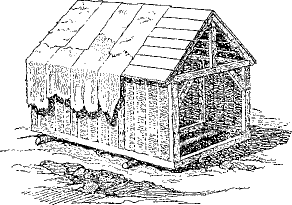
VINEA
Rōmānōrum autem oppugnātiō est haec.8 Prīmum
turrēs aedificantur quibus mīlitēs in summum mūrum ēvādere possint9; vīneae10 fīunt quibus
tēctī mīlitēs ad mūrum succēdant; pluteī11
parantur post quōs mīlitēs tormenta12
administrent; sunt quoque arietēs quī mūrum et portās discutiant. Hīs
omnibus rēbus comparātīs, deinde 13agger ab
eā parte ubi aditus est facillimus exstruitur et cum
vīneīs ad ipsum oppidum agitur. Tum turris in aggere prōmovētur;
arietibus quī sub vīneīs conlocātī erant mūrus et portae discutiuntur;
ballistīs, catapultīs, reliquīsque tormentīs lapidēs et tēla in oppidum
coniciuntur. Postrēmō cum iam turris et agger altitūdinem mūrī adaequant
et arietēs moenia perfrēgērunt,14 signō datō
mīlitēs inruunt et oppidum expugnant.
LXXIV.
THE CITY IS TAKEN · THE CAPTIVES ARE QUESTIONED
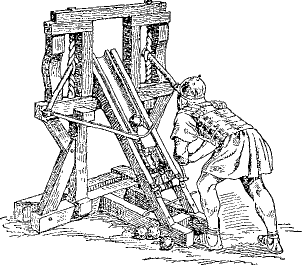
BALLISTA
Omnibus rēbus necessāriīs ad oppugnandum ā Pūbliō comparātīs,
dēlīberātur in conciliō quod cōnsilium 1oppidī expugnandī ineant.2 Tum
ūnus3 ex centuriōnibus, vir reī mīlitāris
perītissimus, “Ego suādeō,” inquit, “ut ab eā parte, ubi aditus sit4 facillimus, aggerem exstruāmus5 et turrim prōmoveāmus5 atque
ariete admōtō simul mūrum discutere cōnēmur.5” 6Hoc cōnsilium cum omnibus
placēret, Caesar concilium dīmīsit. Deinde mīlitēs hortātus ut priōrēs
victōriās memoriā7 tenērent, iussit aggerem
exstruī, turrim et arietem admovērī. Neque oppidānīs8 cōnsilium dēfuit. Aliī ignem et omne genus tēlōrum dē
mūrō in turrim coniēcērunt, aliī ingentia saxa in vīneās et arietem
dēvolvērunt. Diū utrimque ācerrimē
pugnātum est. Nē vulnerātī quidem pedem rettulērunt. Tandem, 9dē tertiā vigiliā, Pūblius, quem Caesar illī operī10 praefēcerat, nūntiāvit partem11 mūrī ictibus arietis labefactam concidisse. Quā rē
audītā Caesar signum dat; mīlitēs inruunt et magnā cum caede hostium
oppidum capiunt.
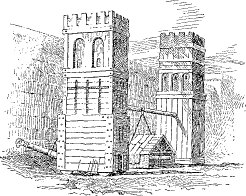
TURRES, ARIETES, VINEA
Postrīdiē eius diēī, hōc oppidō expugnātō, 12captīvōrum quī nōbilissimī sunt ad imperātōrem ante
praetōrium13 addūcuntur. Ipse, lōrīcā aurātā
et paludāmentō purpureō īnsignis, captīvōs per interpretem in hunc modum
interrogat:14 Vōs quī estis15?
Interpres. Rogat imperātor quī
sītis.
Captīvī. Fīliī rēgis sumus.
Interpres. Dīcunt sē fīliōs esse
rēgis.
Imperātor. Cūr mihi tantās iniūriās
intulistis?
Interpres. Rogat cūr sibi tantās
iniūriās intuleritis.
Captīvī. Iniūriās eī nōn intulimus sed
prō patriā bellum gessimus. Semper voluimus Rōmānīs esse amīcī, sed
Rōmānī sine causā nōs domō patriāque expellere cōnātī sunt.
Interpres. 16Negant sē iniūriās tibi intulisse, sed prō patriā bellum
gessisse. 17Semper sē voluisse amīcōs Rōmānīs
esse, sed Rōmānōs sine causā sē domō patriāque expellere cōnātōs
esse.
Imperātor. 18Manēbitisne in reliquum tempus in fidē, hāc rebelliōne
condōnātā?
Tum vērō captīvī multīs cum lacrimīs iūrāvērunt sē in fidē mānsūrōs
esse, et Caesar eōs incolumīs domum dīmīsit.
LXXV.
CIVIL WAR BREAKS OUT BETWEEN CÆSAR AND POMPEY · THE BATTLE OF
PHARSALIA
Nē cōnfectō1 quidem bellō Gallicō, 2bellum cīvīle inter Caesarem et Pompēium exortum
est. Nam Pompēius, quī summum imperium petēbat, senātuī persuāserat ut
Caesarem reī pūblicae hostem3 iūdicāret et
exercitum eius dīmittī iubēret. Quibus cognitīs rēbus Caesar exercitum
suum dīmittere recūsāvit, atque, hortātus mīlitēs ut ducem totiēns
victōrem ab inimīcōrum iniūriīs dēfenderent, imperāvit ut sē Rōmam
sequerentur. Summā cum alacritāte mīlitēs pāruērunt, et trānsitō
Rubicōne4 initium bellī cīvīlis
factum est.
Italiae urbēs quidem omnēs ferē 5rēbus
Caesaris favēbant et eum benignē excēpērunt. Quā rē commōtus Pompēius
ante Caesaris adventum Rōmā excessit et Brundisium6 pervēnit, inde 7paucīs post
diēbus cum omnibus cōpiīs ad Ēpīrum mare trānsiit. Eum Caesar cum septem
legiōnibus et quīngentīs equitibus secūtus est, et īnsignis inter
Caesaris comitātum erat Pūblius.
Plūribus leviōribus proeliīs factīs, tandem cōpiae adversae ad
Pharsālum8 in Thessaliā sitam castra
posuērunt. Cum Pompeī exercitus
esset bis tantus quantus Caesaris, tamen erant multī quī veterānās
legiōnēs quae Gallōs et Germānōs superāverant vehementer timēbant.
Quōs9 10ante
proelium commissum Labiēnus11 lēgātus, quī ab
Caesare nūper dēfēcerat, ita adlocūtus est: “12Nōlīte exīstimāre hunc esse exercitum veterānōrum
mīlitum. Omnibus interfuī proeliīs13 neque
temerē incognitam rem prōnūntiō. Perexigua pars illīus exercitūs quī
Gallōs superāvit adhūc superest. Magna pars occīsa est, multī domum
discessērunt, multī sunt relictī in Italiā. Hae cōpiae quās vidētis in
14citeriōre Galliā nūper cōnscrīptae sunt.”
Haec15 cum dīxisset, iūrāvit sē nisi victōrem
in castra nōn reversūrum esse. 16Hoc idem
Pompēius et omnēs reliquī iūrāvērunt, et magnā spē et laetitiā, sīcut
certam ad victōriam, cōpiae ē castrīs exiērunt.
Item Caesar, animō17 ad dīmicandum parātus,
exercitum suum ēdūxit et septem cohortibus 18praesidiō castrīs relictīs cōpiās triplicī aciē
īnstrūxit. Tum, mīlitibus studiō pugnae ārdentibus, tubā signum dedit.
Mīlitēs prōcurrērunt et pīlīs missīs gladiōs strīnxērunt. Neque vērō
virtūs hostibus dēfuit. Nam et tēla missa sustinuērunt et impetum
gladiōrum excēpērunt et ōrdinēs cōnservāvērunt. Utrimque diū et ācriter
pugnātum est nec quisquam pedem rettulit. Tum equitēs Pompēī aciem
Caesaris circumīre cōnātī sunt. Quod19 ubi
Caesar animadvertit, tertiam aciem,20 quae ad
id tempus quiēta fuerat, prōcurrere iussit. Tum vērō integrōrum
impetum21 dēfessī hostēs sustinēre nōn
potuērunt et omnēs terga vertērunt. Sed Pompēius dē fortūnīs suīs
dēspērāns sē in castra equō contulit, inde mox cum paucīs equitibus
effūgit.
LXXVI.
THE TRIUMPH OF CAESAR

SIGNIFER
Pompēiō amīcīsque eius superātīs atque omnibus hostibus ubīque victīs,
Caesar imperātor Rōmam rediit et 1extrā
moenia urbis in campō Mārtiō castra posuit. Tum vērō amplissimīs
honōribus adfectus est. Dictātor creātus est, et eī triumphus ā senātū
est dēcrētus. 2Quō diē de Gallīs triumphum
ēgit, tanta multitūdō hominum in urbem undique cōnflūxit 3ut omnia loca essent cōnferta. Templa patēbant, ārae
fūmābant, columnae sertīs ōrnātae erant. 4Cum
vērō pompa urbem intrāret, quantus hominum fremitus ortus est! Prīmum
per portam ingressī sunt senātus et magistrātūs. Secūtī sunt tībīcinēs,
signiferī, peditēs laureā corōnātī canentēs: “Ecce Caesar nunc
triumphat, quī subēgit Galliam,” et “Mīlle, mīlle, mīlle, mīlle Gallōs
trucīdāvimus.” Multī praedam captārum urbium portābant, arma, omnia
bellī īnstrūmenta. Secūtī sunt equitēs, animōsīs atque splendidissimē
ōrnātīs equīs vectī, inter quōs Pūblius adulēscēns fortissimus
habēbātur. Addūcēbantur taurī, arietēs, 5quī
dīs immortālibus immolārentur. Ita longō agmine prōgrediēns exercitus
6sacrā viā per forum in Capitōlium
perrēxit.
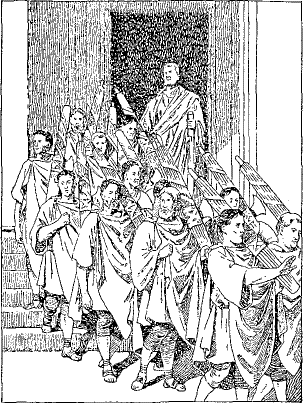
LICTORES CUM FASCIBUS
Imperātor ipse cum urbem intrāret, undique laetō clāmōre multitūdinis
salūtātus est. Stābat in currū aureō quem quattuor albī equī vehēbant.
Indūtus 7togā pictā, alterā manū habēnās et
lauream
tenēbat, alterā eburneum scēptrum. Post eum servus in currū stāns auream
corōnam super caput eius tenēbat. Ante currum miserrimī captīvī, rēgēs
prīncipēsque superātārum gentium, catēnīs vīnctī, prōgrediēbantur; et
vīgintī quattuor līctōrēs8 laureatās fascīs
ferentēs et signiferī currum Caesaris comitābantur. Conclūdit agmen
multitūdō captīvōrum, quī, in servitūtem redāctī,9 dēmissō vultū, vīnctīs10
bracchiīs, sequuntur; quibuscum veniunt longissimō ōrdine mīlitēs, etiam
hī praedam vel insignia mīlitāria ferentēs.
Caesar cum Capitōlium ascendisset, in templō Iovī Capitōlīnō sacra
fēcit. Simul11 captivōrum quī nōbilissimī
erant, abductī in carcerem,12 interfectī
sunt. Sacrīs factīs Caesar dē Capitōliō dēscendit et in forō mīitibus
suīs honōrēs mīlitārīs dedit eīsque pecūniam ex bellī praedā
distribuit.
Hīs omnibus rēbus cōnfectīs, Pūblius Caesarem valēre13 iussit et quam celerrimē ad vīllam contendit ut patrem
mātremque salūtāret.
15Dē rēbus gestīs P. Cornēlī Lentulī
hāctenus.
NOUNS
460.
Nouns are inflected in five declensions, distinguished by the final
letter of the stem and by the termination of the genitive singular.
First Declension—Ā-stems,
Gen. Sing. -ae
Second Declension—O-stems,
Gen. Sing. -ī
Third Declension—Consonant stems
and I-stems, Gen. Sing. -is
Fourth Declension—U-stems,
Gen. Sing. -ūs
Fifth Declension—Ē-stems,
Gen. Sing. -ē̆ī
461.
FIRST DECLENSION. Ā-STEMS
|
domina, lady
Stem dominā-
Base domin-
|
|
Singular |
Plural |
|
TERMINATIONS |
|
TERMINATIONS |
| Nom. |
domina |
-a |
dominae |
-ae |
| Gen. |
dominae |
-ae |
dominārum |
-ārum |
| Dat. |
dominae |
-ae |
dominīs |
-īs |
| Acc. |
dominam |
-am |
dominās |
-ās |
| Abl. |
dominā |
-ā |
dominīs |
-īs |
a. Dea and fīlia have the termination -ābus
in the dative and ablative plural.
462.
SECOND DECLENSION. O-STEMS
a. Masculines in -us
|
dominus, master
Stem domino-
Base domin-
|
|
Singular |
Plural |
|
TERMINATIONS |
|
TERMINATIONS |
| Nom. |
dominus |
-us |
dominī |
-ī |
| Gen. |
dominī |
-ī |
dominōrum |
-ōrum |
| Dat. |
dominō |
-ō |
dominīs |
-īs |
| Acc. |
dominum |
-um |
dominōs |
-ōs |
| Abl. |
dominō |
-ō |
dominīs |
-īs |
1. Nouns in -us of the second declension have the termination
-e´ in the vocative singular, as domine.
2. Proper names in -ius, and filius, end in -ī
in the vocative singular, and the accent rests on the penult, as
Vergi´lī, fīlī.
b. Neuters in -um
|
pīlum, spear
Stem
pīlo- Base pīl-
|
|
Singular |
Plural |
|
TERMINATIONS |
|
TERMINATIONS |
| Nom. |
pīlum |
-um |
pīla |
-a |
| Gen. |
pīlī |
-ī |
pīlōrum |
-ōrum |
| Dat. |
pīlō |
-ō |
pīlīs |
-īs |
| Acc. |
pīlum |
-um |
pīla |
-a |
| Abl. |
pīlō |
-ō |
pīlīs |
-īs |
1. Masculines in -ius and neuters in -ium end in
-ī in the genitive singular, not in -iī, and the
accent rests on the penult.
c. Masculines in -er
AND -ir
|
puer, boy |
ager, field |
vir, man |
|
| Stems |
puero- |
agro- |
viro- |
|
| Bases |
puer- |
agr- |
vir- |
|
|
Singular |
TERMINATIONS |
| Nom. |
puer |
ager |
vir |
— |
| Gen. |
puerī |
agrī |
virī |
-ī |
| Dat. |
puerō |
agrō |
virō |
-ō |
| Acc. |
puerum |
agrum |
virum |
-um |
| Abl. |
puerō |
agrō |
virō |
-ō |
|
|
Plural |
|
| Nom. |
puerī |
agrī |
virī |
-ī |
| Gen. |
puerōrum |
agrōrum |
virōrum |
-ōrum |
| Dat. |
puerīs |
agrīs |
virīs |
-īs |
| Acc. |
puerōs |
agrōs |
virōs |
-ōs |
| Abl. |
puerīs |
agrīs |
virīs |
-īs |
463.
THIRD DECLENSION.
|
CLASSIFICATION
|
I. Consonant Stems |
1. Stems that add -s to the base to form the nominative singular:
masculines and feminines only.
2. Stems that add no termination in the nominitive singular: a.
masculines and feminines; b. neuters.
|
| II. I-Stems. |
Masculines, feminines, and neuters. |
464.
I. CONSONANT STEMS
1. Nouns that add -s to the base to form the nominative
singular: masculines and feminines only
|
prīnceps, m., chief |
mīles, m., soldier |
lapis, m., stone |
|
Bases or
Stems |
prīncip- |
mīlit- |
lapid- |
|
|
Singular |
TERMINATIONS |
| Nom. |
prīnceps |
mīles |
lapis |
-s |
| Gen. |
prīn´cipis |
mīlitis |
lapidis |
-is |
| Dat. |
prīn´cipī |
mīlitī |
lapidī |
-ī |
| Acc. |
prīn´cipem |
mīlitem |
lapidem |
-em |
| Abl. |
prīn´cipe |
mīlite |
lapide |
-e |
|
Plural |
|
| Nom. |
prīn´cipēs |
mīlitēs |
lapidēs |
-ēs |
| Gen. |
prīn´cipum |
mīlitum |
lapidum |
-um |
| Dat. |
prīnci´pibus |
mīlitibus |
lapidibus |
-ibus |
| Acc. |
prīn´cipēs |
mīlitēs |
lapidēs |
-ēs |
| Abl. |
prīnci´pibus |
mīlitibus |
lapidibus |
-ibus |
|
|
rēx, m., king |
iūdex, m., judge |
virtūs, f., manliness |
|
Bases or
Stems |
rēg- |
iūdic- |
virtūt- |
|
| Nom. |
rēx |
iūdex |
virtūs |
-s |
| Gen. |
rēgis |
iūdicis |
virtū´tis |
-is |
| Dat. |
rēgī |
iūdicī |
virtū´tī |
-ī |
| Acc. |
rēgem |
iūdicem |
virtū´tem |
-em |
| Abl. |
rēge |
iūdice |
virtū´te |
-e |
|
Plural |
|
| Nom. |
rēgēs |
iūdicēs |
virtū´tēs |
-ēs |
| Gen. |
rēgum |
iūdicum |
virtū´tum |
-um |
| Dat. |
rēgibus |
iūdicibus |
virtū´tibus |
-ibus |
| Acc. |
rēgēs |
iūdicēs |
virtū´tēs |
-ēs |
| Abl. |
rēgibus |
iūdicibus |
virtū´tibus |
-ibus |
Note. For consonant changes in the
nominative singular, cf.
§ 233. 3.
2. Nouns that have no termination in the nominative
singular
a. Masculines and Feminines
|
cōnsul, m., consul |
legiō, f., legion |
ōrdō, m., row |
pater, m., father |
|
Bases or
Stems |
cōnsul- |
legiōn- |
ōrdin- |
patr- |
|
|
Singular |
TERMINATIONS |
| Nom. |
cōnsul |
legiō |
ōrdō |
pater |
— |
| Gen. |
cōnsulis |
legiōnis |
ōrdinis |
patris |
-is |
| Dat. |
cōnsulī |
legiōnī |
ōrdinī |
patrī |
-ī |
| Acc. |
cōnsulem |
legiōnem |
ōrdinem |
patrem |
-em |
| Abl. |
cōnsule |
legiōne |
ōrdine |
patre |
-e |
|
Plural |
|
| Nom. |
cōnsulēs |
legiōnēs |
ōrdinēs |
patrēs |
-ēs |
| Gen. |
cōnsulum |
legiōnum |
ōrdinum |
patrum |
-um |
| Dat. |
cōnsulibus |
legiōnibus |
ōrdinibus |
patribus |
-ibus |
| Acc. |
cōnsulēs |
legiōnēs |
ōrdinēs |
patrēs |
-ēs |
| Abl. |
cōnsulibus |
legiōnibus |
ōrdinibus |
patribus |
-ibus |
Note. For vowel and consonant changes
in the nominative singular, cf.
§ 236. 1-3.
b. Neuters
|
flūmen, n., river |
tempus, n., time |
opus, n., work |
caput, n., head |
|
Bases or
Stems |
flūmin- |
tempor- |
oper- |
capit- |
|
|
Singular |
TERMINATIONS |
| Nom. |
flūmen |
tempus |
opus |
caput |
— |
| Gen. |
flūminis |
temporis |
operis |
capitis -is |
-is |
| Dat. |
flūminī |
temporī |
operī |
capitī |
-ī |
| Acc. |
flūmen |
tempus |
opus |
caput |
— |
| Abl. |
flūmine |
tempore |
opere |
capite |
-e |
|
Plural |
|
| Nom. |
flūmina |
tempora |
opera |
capita |
-a |
| Gen. |
flūminum |
temporum |
operum |
capitum |
-um |
| Dat. |
flūminibus |
temporibus |
operibus |
capitibus |
-ibus |
| Acc. |
flūmina |
tempora |
opera |
capita |
-a |
| Abl. |
flūminibus |
temporibus |
operibus |
capitibus |
-ibus |
Note. For vowel and consonant changes
in the nominative singular, cf.
§ 238. 2, 3.
465.
II. I-STEMS
a. Masculines and Feminines
|
caedēs, f., slaughter |
hostis, m., enemy |
urbs, f., city |
cliēns, m., retainer |
|
| Stems |
caedi- |
hosti- |
urbi- |
clienti- |
|
| Bases |
caed- |
host- |
urb- |
client- |
|
|
Singular |
TERMINATIONS |
| Nom. |
caedēs |
hostis |
urbs |
cliēns |
-s, -is, or -ēs |
| Gen. |
caedis |
hostis |
urbis |
clientis |
-is |
| Dat. |
caedī |
hostī |
urbī |
clientī |
-ī |
| Acc. |
caedem |
hostem |
urbem |
clientem |
-em (-im) |
| Abl. |
caede |
hoste |
urbe |
cliente |
-e (-ī) |
|
Plural |
|
| Nom. |
caedēs |
hostēs |
urbēs |
clientēs |
-ēs |
| Gen. |
caedium |
hostium |
urbium |
clientium |
-ium |
| Dat. |
caedibus |
hostibus |
urbibus |
clientibus |
-ibus |
| Acc. |
caedīs, -ēs |
hostīs, -ēs |
urbīs, -ēs |
clientīs, -ēs |
-īs, -ēs |
| Abl. |
caedibus |
hostibus |
urbibus |
clientibus |
-ibus |
1. Avis, cīvis, fīnis, ignis,
nāvis, have the abl. sing. in -ī or -e.
2. Turris has accusative turrim and ablative
turrī or turre.
b. Neuters
|
īnsigne, n., decoration |
animal, n., animal |
calcar, n., spur |
|
| Stems |
īnsigni- |
animāli- |
calcāri- |
|
| Bases |
īnsign- |
animāl- |
calcār- |
|
|
Singular |
TERMINATIONS |
| Nom. |
īnsigne |
animal |
calcar |
-e or — |
| Gen. |
īnsignis |
animālis |
calcāris |
-is |
| Dat. |
īnsignī |
animālī |
calcārī |
-ī |
| Acc. |
īnsigne |
animal |
calcar |
-e or — |
| Abl. |
īnsignī |
animālī |
calcārī |
-ī |
|
Plural |
|
| Nom. |
īnsignia |
animālia |
calcāria |
-ia |
| Gen. |
īnsignium |
animālium |
calcārium |
-ium |
| Dat. |
īnsignibus |
animālibus |
calcāribus |
-ibus |
| Acc. |
īnsignia |
animālia |
calcāria |
-ia |
| Abl. |
īnsignibus |
animālibus |
calcāribus |
-ibus |
466.
THE FOURTH DECLENSION. U-STEMS
|
adventus, m., arrival |
cornū, n., horn |
|
| Stems |
adventu- |
cornu- |
|
| Bases |
advent- |
corn- |
|
|
Singular |
TERMINATIONS |
|
MASC. |
NEUT. |
| Nom. |
adventus |
cornū |
-us |
-ū |
| Gen. |
adventūs |
cornūs |
-ūs |
-ūs |
| Dat. |
adventuī (ū) |
cornū |
-uī (ū) |
-ū |
| Acc. |
adventum |
cornū |
-um |
-ū |
| Abl. |
adventū |
cornū |
-ū |
-ū |
|
Plural |
| |
| Nom. |
adventūs |
cornua |
-ūs |
-ua |
| Gen. |
adventuum |
cornuum |
-uum |
-uum |
| Dat. |
adventibus |
cornibus |
-ibus |
-ibus |
| Acc. |
adventūs |
cornua |
-ūs |
-ua |
| Abl. |
adventibus |
cornibus |
-ibus |
-ibus |
467.
THE FIFTH DECLENSION. Ē-STEMS
|
diēs, m., day |
rēs, f. thing |
|
| Stems |
diē- |
rē- |
|
| Bases |
di- |
r- |
|
|
Singular |
TERMINATIONS |
| Nom. |
diēs |
rēs |
-ēs |
| Gen. |
diēī |
reī |
-ē̆ī |
| Dat. |
diēī |
reī |
-ē̆ī |
| Acc. |
diem |
rem |
-em |
| Abl. |
diē |
rē |
-ē |
|
Plural |
|
| Nom. |
diēs |
rēs |
-ēs |
| Gen. |
diērum |
rērum |
-ērum |
| Dat. |
diēbus |
rēbus |
-ēbus |
| Acc. |
diēs |
rēs |
-ēs |
| Abl. |
diēbus |
rēbus |
-ēbus |
468.
SPECIAL PARADIGMS
|
deus, m., god |
domus, f., house |
vīs, f., strength |
iter, n., way |
| Stems |
deo- |
domu- |
vī- and vīri- |
iter- and itiner- |
| Bases |
de- |
dom- |
v- and vīr- |
iter- and itiner- |
| Singular |
| Nom. |
deus |
domus |
vīs |
iter |
| Gen. |
deī |
domūs |
vīs (rare) |
itineris |
| Dat. |
deō |
domuī, -ō |
vī (rare) |
itinerī |
| Acc. |
deum |
domum |
vim |
iter |
| Abl. |
deō |
domō, -ū |
vī |
itinere |
| Plural |
| Nom. |
deī, dī |
domūs |
vīrēs |
itinera |
| Gen. |
deōrum, deum |
domuum, -ōrum |
vīrium |
itinerum |
| Dat. |
deīs, dīs |
domibus |
vīribus |
itineribus |
| Acc. |
deōs |
domōs, -ūs |
vīrīs, -ēs |
itinera |
| Abl. |
deīs, dīs |
domibus |
vīribus |
itineribus |
a. The vocative singular of deus is like the
nominative.
b. The locative of domus is domī.
ADJECTIVES
469.
FIRST AND SECOND DECLENSIONS. O- AND
Ā-STEMS
a. Adjectives in -us
|
bonus, good
Stems bono- m. and n.,
bona- f.
Base bon-
|
| Singular |
|
MASC. |
FEM. |
NEUT. |
| Nom. |
bonus |
bona |
bonum |
| Gen. |
bonī |
bonae |
bonī |
| Dat. |
bonō |
bonae |
bonō |
| Acc. |
bonum |
bonam |
bonum |
| Abl. |
bonō |
bonā |
bonō |
| Plural |
| Nom. |
bonī |
bonae |
bona |
| Gen. |
bonōrum |
bonārum |
bonōrum |
| Dat. |
bonīs |
bonīs |
bonīs |
| Acc. |
bonōs |
bonās |
bona |
| Abl. |
bonīs |
bonīs |
bonīs |
b. Adjectives in -er
|
līber, free
Stems lībero- m. and n.,
līberā- f.
Base līber-
|
| Singular |
|
MASC. |
FEM. |
NEUT. |
| Nom. |
līber |
lībera |
līberum |
| Gen. |
līberī |
līberae |
līberī |
| Dat. |
līberō |
līberae |
līberō |
| Acc. |
līberum |
līberam |
līberum |
| Abl. |
līberō |
līberā |
līberō |
| Plural |
| Nom. |
līberī |
līberae |
lībera |
| Gen. |
līberōrum |
līberārum |
līberōrum |
| Dat. |
līberīs |
līberīs |
līberīs |
| Acc. |
līberōs |
līberās |
lībera |
| Abl. |
līberīs |
līberīs |
līberīs |
|
pulcher, pretty
Stems pulchro- m. and n.,
pulchrā- f.
Base pulchr-
|
| Singular |
|
MASC. |
FEM. |
NEUT. |
| Nom. |
pulcher |
pulchra |
pulchrum |
| Gen. |
pulchrī |
pulchrae |
pulchrī |
| Dat. |
pulchrō |
pulchrae |
pulchrō |
| Acc. |
pulchrum |
pulchram |
pulchrum |
| Abl. |
pulchrō |
pulchrā |
pulchrō |
| Plural |
| Nom. |
pulchrī |
pulchrae |
pulchra |
| Gen. |
pulchrōrum |
pulchrārum |
pulchrōrum |
| Dat. |
pulchrīs |
pulchrīs |
pulchrīs |
| Acc. |
pulchrōs |
pulchrās |
pulchra |
| Abl. |
pulchrīs |
pulchrīs |
pulchrīs |
470.
THE NINE IRREGULAR ADJECTIVES
|
alius, another
Stems alio- m. and n.,
aliā- f.
Base ali-
|
|
Singular |
Plural |
|
MASC. |
FEM. |
NEUT. |
MASC. |
FEM. |
NEUT. |
| Nom. |
alius |
alia |
aliud |
aliī |
aliae |
alia |
| Gen. |
alīus |
alīus |
alīus |
aliōrum |
aliārum |
aliōrum |
| Dat. |
aliī |
aliī |
aliī |
aliīs |
aliīs |
aliīs |
| Acc. |
alium |
aliam |
aliud |
aliōs |
aliās |
alia |
| Abl. |
aliō |
aliā |
aliō |
aliīs |
aliīs |
aliīs |
| |
|
ūnus, one, only
Stems ūno- m. and n.,
ūnā- f.
Base ūn-
|
|
MASC. |
FEM. |
NEUT. |
MASC. |
FEM. |
NEUT. |
| Nom. |
ūnus |
ūna |
ūnum |
ūnī |
ūnae |
ūna |
| Gen. |
ūnīus |
ūnīus |
ūnīus |
ūnōrum |
ūnārum |
ūnōrum |
| Dat. |
ūnī |
ūnī |
ūnī |
ūnīs |
ūnīs |
ūnīs |
| Acc. |
ūnum |
ūnam |
ūnum |
ūnōs |
ūnās |
ūna |
| Abl. |
ūnō |
ūnā |
ūnō |
ūnīs |
ūnīs |
ūnīs |
a. For the complete list see
§ 108.
471.
ADJECTIVES OF THE THIRD DECLENSION.
I-STEMS
I. THREE ENDINGS
|
ācer, ācris, ācre, keen, eager
|
Stem ācri-
Base ācr-
|
|
Singular |
Plural |
|
MASC. |
FEM. |
NEUT. |
MASC. |
FEM. |
NEUT. |
| Nom. |
ācer |
ācris |
ācre |
ācrēs |
ācrēs |
ācria |
| Gen. |
ācris |
ācris |
ācris |
ācrium |
ācrium |
ācrium |
| Dat. |
ācrī |
ācrī |
ācrī |
ācribus |
ācribus |
ācribus |
| Acc. |
ācrem |
ācrem |
ācre |
ācrīs, -ēs |
ācrīs, -ēs |
ācria |
| Abl. |
ācrī |
ācrī |
ācrī |
ācribus |
ācribus |
ācribus |
II. TWO ENDINGS
|
omnis, omne, every, all
|
Stem omni-
Base omn-
|
|
Singular |
Plural |
|
MASC. AND FEM. |
NEUT. |
MASC. AND FEM. |
NEUT. |
| Nom. |
omnis |
omne |
omnēs |
omnia |
| Gen. |
omnis |
omnis |
omnium |
omnium |
| Dat. |
omnī |
omnī |
omnibus |
omnibus |
| Acc. |
omnem |
omne |
omnīs, -ēs |
omnia |
| Abl. |
omnī |
omnī |
omnibus |
omnibus |
III. ONE ENDING
|
pār, equal
Stem pari-
Base par-
|
|
Singular |
Plural |
|
MASC. AND FEM. |
NEUT. |
MASC. AND FEM. |
NEUT. |
| Nom. |
pār |
pār |
parēs |
paria |
| Gen. |
paris |
paris |
parium |
parium |
| Dat. |
parī |
parī |
paribus |
paribus |
| Acc. |
parem |
pār |
parīs, -ēs |
paria |
| Abl. |
parī |
parī |
paribus |
paribus |
1. Observe that all i-stem adjectives have -ī in the ablative
singular.
This sentence appears to be a footnote, but there is no footnote tag
on the page.
472.
PRESENT ACTIVE PARTICIPLES
|
amāns, loving
Stem amanti-
Base amant-
|
|
Singular |
Plural |
|
MASC. AND FEM. |
NEUT. |
MASC. AND FEM. |
NEUT. |
| Nom. |
amāns |
amāns |
amantēs |
amantia |
| Gen. |
amantis |
amantis |
amantium |
amantium |
| Dat. |
amantī |
amantī |
amantibus |
amantibus |
| Acc. |
amantem |
amāns |
amantīs, -ēs |
amantia |
| Abl. |
amante, -ī |
amante, -ī |
amantibus |
amantibus |
| |
|
iēns, going
Stem ienti-, eunti-
Base ient-, eunt-
|
| Nom. |
iēns |
iēns |
euntēs |
euntia |
| Gen. |
euntis |
euntis |
euntium |
euntium |
| Dat. |
euntī |
euntī |
euntibus |
euntibus |
| Acc. |
euntem |
iēns |
euntīs, -ēs |
euntia |
| Abl. |
eunte, -ī |
eunte, -ī |
euntibus |
euntibus |
473.
REGULAR COMPARISON OF ADJECTIVES
| Positive |
Comparative |
Superlative |
| MASC. |
MASC. AND FEM. |
NEUT. |
MASC. |
FEM. |
NEUT. |
| altus (alto-) |
altior |
altius |
altissimus |
-a |
-um |
| līber (lībero-) |
līberior |
līberius |
līberrimus |
-a |
-um |
| pulcher (pulchro-) |
pulchrior |
pulchrius |
pulcherrimus |
-a |
-um |
| audāx (audāci-) |
audācior |
audācius |
audācissimus |
-a |
-um |
| brevis (brevi-) |
brevior |
brevius |
brevissimus |
-a |
-um |
| ācer (ācri-) |
ācrior |
ācrius |
ācerrimus |
-a |
-um |
474.
DECLENSION OF COMPARATIVES
|
altior, higher
|
|
Singular |
Plural |
|
MASC. AND FEM. |
NEUT. |
MASC. AND FEM. |
NEUT. |
| Nom. |
altior |
altius |
altiōrēs |
altiōra |
| Gen. |
altiōris |
altiōris |
altiōrum |
altiōrum |
| Dat. |
altiōrī |
altiōrī |
altiōribus |
altiōribus |
| Acc. |
altiōrem |
altius |
altiōrēs |
altiōra |
| Abl. |
altiōre |
altiōre |
altiōribus |
altiōribus |
|
|
|
plūs, more
|
| Nom. |
—— |
plūs |
plūrēs |
plūra |
| Gen. |
—— |
plūris |
plūrium |
plūrium |
| Dat. |
—— |
—— |
plūribus |
plūribus |
| Acc. |
—— |
plūs |
plūrīs (-ēs) |
plūra |
| Abl. |
—— |
plūre |
plūribus |
plūribus |
475.
IRREGULAR COMPARISON OF ADJECTIVES
| Positive |
Comparative |
Superlative |
| bonus, -a, -um, good |
melior, melius, better |
optimus, -a, -um, best |
| malus, -a, -um, bad |
peior, peius, worse |
pessimus, -a, -um, worst |
| magnus, -a, -um, great |
maior, maius, greater |
maximus, -a, -um, greatest |
| multus, -a, -um, much |
——, plūs, more |
plūrimus, -a, -um, most |
| parvus, -a, -um, small |
minor, minus, smaller |
minimus, -a, -um, smallest |
| senex, senis, old |
senior |
maximus nātū |
| iuvenis, -e, young |
iūnior |
minimus nātū |
| vetus, veteris, old |
vetustior, -ius |
veterrimus, -a, -um |
| facilis, -e, easy |
facilior, -ius |
facillimus, -a, -um |
| difficilis, -e, difficult |
difficilior, -ius |
difficillimus, -a, -um |
| similis, -e, similar |
similior, -ius |
simillimus, -a, -um |
| dissimilis, -e, dissimilar |
dissimilior, -ius |
dissimillimus, -a, -um |
| humilis, -e, low |
humilior, -ius |
humillimus, -a, -um |
| gracilis, -e, slender |
gracilior, -ius |
gracillimus, -a, -um |
| exterus, outward |
exterior, outer, exterior |
extrēmus
extimus |
outermost, last |
| īnferus, below |
īnferior, lower |
īnfimus
īmus |
lowest |
| posterus, following |
posterior, later |
postrēmus
postumus |
last |
| superus, above |
superior, higher |
suprēmus
summus |
highest |
| [cis, citrā, on this side] |
citerior, hither |
citimus, hithermost |
| [in, intrā, in, within] |
interior, inner |
intimus, inmost |
| [prae, prō, before] |
prior, former |
prīmus, first |
| [prope, near] |
propior, nearer |
proximus, next |
| [ultrā, beyond] |
ulterior, further |
ultimus, furthest |
476.
REGULAR COMPARISON OF ADVERBS
| Positive |
Comparative |
Superlative |
| cārē (cārus), dearly |
cārius |
cārissimē |
| miserē (miser), wretchedly |
miserius |
miserrimē |
| ācriter (ācer), sharply |
ācrius |
ācerrimē |
| facile (facilis), easily |
facilius |
facillimē |
477.
IRREGULAR COMPARISON OF ADVERBS
| Positive |
Comparative |
Superlative |
| diū, long, a long time |
diūtius |
diūtissimē |
| bene (bonus), well |
melius, better |
optimē, best |
| male (malus), ill |
peius, worse |
pessimē, worst |
| magnopere, greatly |
magis, more |
maximē, most |
| multum (multus), much |
plūs, more |
plūrimum, most |
| parum, little |
minus, less |
minimē, least |
| saepe, often |
saepīus |
saepissimē |
478.
NUMERALS
The cardinal numerals are indeclinable excepting ūnus, duo,
trēs, the hundreds above one hundred, and mīlle used as a
noun. The ordinals are declined like bonus, -a, -um.
|
Cardinals |
Ordinals |
|
(How many)
|
(In what order)
|
| 1, |
ūnus, -a, -um, |
one |
prīmus, -a, -um |
first |
| 2, |
duo, duae, duo |
two |
secundus (or alter) |
second |
| 3, |
trēs, tria |
three, |
tertius |
third, |
| 4, |
quattuor |
etc. |
quārtus |
etc. |
| 5, |
quīnque |
quīntus |
| 6, |
sex |
sextus |
| 7, |
septem |
septimus |
| 8, |
octō |
octāvus |
| 9, |
novem |
nōnus |
| 10, |
decem |
decimus |
| 11, |
ūndecim |
ūndecimus |
| 12, |
duodecim |
duodecimus |
| 13, |
tredecim (decem (et) trēs) |
tertius decimus |
| 14, |
quattuordecim |
quārtus decimus |
| 15,
|
quīndecim |
quīntus decimus |
| 16, |
sēdecim |
sextus decimus |
| 17, |
septendecim |
septimus decimus |
| 18, |
duodēvīgintī (octōdecim) |
duodēvīcēnsimus |
| 19, |
ūndēvīgintī (novendecim) |
ūndēvīcēnsimus |
| 20, |
vīgintī |
vīcēnsimus |
| 21, |
vīgintī ūnus or
ūnus et vīgintī, etc. |
vīcēnsimus prīmus
or
ūnus et vīcēnsimus, etc. |
| 30, |
trīgintā |
trīcēnsimus |
| 40, |
quadrāgintā |
quadrāgēnsimus |
| 50, |
quīnquāgintā |
quīnquāgēnsimus |
| 60, |
sexāgintā |
sexāgēnsimus |
| 70, |
septuāgintā |
septuāgēnsimus |
| 80, |
octōgintā |
octōgēnsimus |
| 90, |
nōnāgintā |
nōnāgēnsimus |
| 100, |
centum |
centum |
| 101, |
centum (et) ūnus, etc. |
centum (et) ūnus, etc. |
| 120, |
centum (et) vīgintī |
centum (et) vīgintī |
| 121, |
centum (et) vīgintī ūnus, etc. |
centum (et) vīgintī ūnus, etc. |
| 200, |
ducentī, -ae, -a |
ducentī, -ae, -a |
| 300, |
trecentī |
trecentī |
| 400, |
quadringentī |
quadringentī |
| 500, |
quīngentī |
quīngentī |
| 600, |
sescentī |
sescentī |
| 700, |
septingentī |
septingentī |
| 800, |
octingentī |
octingentī |
| 900, |
nōngentī |
nōngentī |
| 1000, |
mīlle |
mīlle |
479.
Declension of duo, two, trēs, three, and
mīlle, a thousand.
|
Masc. |
Fem. |
Neut. |
M. and F. |
Neut. |
Sing. |
Plur. |
| N. |
duo |
duae |
duo |
trēs |
trīa |
mīlle |
mīlia |
| G. |
duōrum |
duārum |
duōrum |
trium |
trium |
mīlle |
mīlium |
| D. |
duōbus |
duābus |
duōbus |
tribus |
tribus |
mīlle |
mīlibus |
| A. |
duōs or duo |
duās |
duo |
trīs or trēs |
tria |
mīlle |
mīlia |
| A. |
duōbus |
duābus |
duōbus |
tribus |
tribus |
mīlle |
mīlibus |
Note. Mīlle is used in the
plural as a noun with a modifying genitive, and is occasionally so used
in the nominative and accusative singular. For the declension of
ūnus cf. § 470.
PRONOUNS
480.
PERSONAL
|
ego, I |
tū, you |
suī,
of himself, etc. |
|
Sing. |
Plur. |
Sing. |
Plur. |
Sing. |
Plur. |
| Nom. |
ego |
nōs |
tū |
vōs |
—— |
—— |
| Gen. |
meī |
nostrum, -trī |
tuī |
vestrum, -trī |
suī |
suī |
| Dat. |
mihi |
nōbīs |
tibi |
vōbīs |
sibi |
sibi |
| Acc. |
mē |
nōs |
tē |
vōs |
sē, sēsē |
sē, sēsē |
| Abl. |
mē |
nōbīs |
tē |
vōbīs |
sē, sēsē |
sē, sēsē |
Note that suī is always reflexive.
481.
DEMONSTRATIVE
Demonstratives belong to the first and second declensions, but have
the pronominal endings -ī̆us and -ī in the gen. and dat.
sing.
|
ipse, self
|
|
Singular |
Plural |
|
MASC. |
FEM. |
NEUT. |
MASC. |
FEM. |
NEUT. |
| Nom. |
ipse |
ipsa |
ipsum |
ipsī |
ipsae |
ipsa |
| Gen. |
ipsī´us |
ipsī´us |
ipsī´us |
ipsōrum |
ipsārum |
ipsōrum |
| Dat. |
ipsī |
ipsī |
ipsī |
ipsīs |
ipsīs |
ipsīs |
| Acc. |
ipsum |
ipsam |
ipsum |
ipsōs |
ipsās |
ipsa |
| Abl. |
ipsō |
ipsā |
ipsō |
ipsīs |
ipsīs |
ipsīs |
| |
|
hic, this (here), he
|
| Nom. |
hic |
haec |
hoc |
hī |
hae |
haec |
| Gen. |
huius |
huius |
huius |
hōrum |
hārum |
hōrum |
| Dat. |
huic |
huic |
huic |
hīs |
hīs |
hīs |
| Acc. |
hunc |
hanc |
hoc |
hōs |
hās |
haec |
| Abl. |
hōc |
hāc |
hōc |
hīs |
hīs |
hīs |
| |
|
iste, this, that (of yours), he
|
| Nom. |
iste |
ista |
istud |
istī |
istae |
ista |
| Gen. |
istī´us |
istī´us |
istī´us |
istōrum |
istārum |
istōrum |
| Dat. |
istī |
istī |
istī |
istīs |
istīs |
istīs |
| Acc. |
istum |
istam |
istud |
istōs |
istās |
ista |
| Abl. |
istō |
istā |
istō |
istīs |
istīs |
istīs |
|
|
|
ille, that (yonder), he
|
| Nom. |
ille |
illa |
illud |
illī |
illae |
illa |
| Gen. |
illī´us |
illī´us |
illī´us |
illōrum |
illārum |
illōrum |
| Dat. |
illī |
illī |
illī |
illīs |
illīs |
illīs |
| Acc. |
illum |
illam |
illud |
illōs |
illās |
illa |
| Abl. |
illō |
illā |
illō |
illīs |
illīs |
illīs |
| |
|
is, this, that, he
|
| Nom. |
is |
ea |
id |
iī, eī |
eae |
ea |
| Gen. |
eius |
eius |
eius |
eōrum |
eārum |
eōrum |
| Dat. |
eī |
eī |
eī |
iīs, eīs |
iīs, eīs |
iīs, eīs |
| Acc. |
eum |
eam |
id |
eōs |
eās |
ea |
| Abl. |
eō |
eā |
eō |
iīs, eīs |
iīs, eīs |
iīs, eīs |
| |
|
īdem, the same
|
| Nom. |
īdem |
e´adem |
idem |
iī´dem
eī´dem |
eae´dem |
e´adem |
| Gen. |
eius´dem |
eius´dem |
eius´dem |
eōrun´dem |
eārun´dem |
eōrun´dem |
| Dat. |
eī´dem |
eī´dem |
eī´dem |
iīs´dem
eīs´dem |
iīs´dem
eīs´dem |
iīs´dem
eīs´dem |
| Acc. |
eun´dem |
ean´dem |
idem |
eōs´dem |
eās´dem |
e´adem |
| Abl. |
eō´dem |
eā´dem |
eō´dem |
iīs´dem
eīs´dem |
iīs´dem
eīs´dem |
iīs´dem
eīs´dem |
Note. In the plural of is and
īdem the forms with two i’s are preferred, the two i’s being
pronounced as one.
482.
RELATIVE
|
quī, who, which, that
|
|
Singular |
Plural |
|
MASC. |
FEM. |
NEUT. |
MASC. |
FEM. |
NEUT. |
| Nom. |
quī |
quae |
quod |
quī |
quae |
quae |
| Gen. |
cuius |
cuius |
cuius |
quōrum |
quārum |
quōrum |
| Dat. |
cui |
cui |
cui |
quibus |
quibus |
quibus |
| Acc. |
quem |
quam |
quod |
quōs |
quās |
quae |
| Abl. |
quō |
quā |
quō |
quibus |
quibus |
quibus |
483.
INTERROGATIVE
|
quis, substantive, who, what
|
|
Singular |
Plural |
|
MASC. AND FEM. |
NEUT. |
MASC. |
FEM. |
NEUT. |
| Nom. |
quis |
quid |
qui |
quae |
quae |
| Gen. |
cuius |
cuius |
quōrum |
quārum |
quōrum |
| Dat. |
cui |
cui |
quibus |
quibus |
quibus |
| Acc. |
quem |
quid |
quōs |
quās |
quae |
| Abl. |
quō |
quō |
quibus |
quibus |
quibus |
The interrogative adjective quī, quae, quod, is declined like
the relative.
484.
INDEFINITES
quis and quī, as declined above,1 are used also as indefinites (some, any). The
other indefinites are compounds of quis and quī.
|
quisque, each
|
|
Substantive |
Adjective |
|
MASC. AND FEM. |
NEUT. |
MASC. |
FEM. |
NEUT. |
| Nom. |
quisque |
quidque |
quisque |
quaeque |
quodque |
| Gen. |
cuius´que |
cuius´que |
cuius´que |
cuius´que |
cuius´que |
| Dat. |
cuique |
cuique |
cuique |
cuique |
cuique |
| Acc. |
quemque |
quidque |
quemque |
quamque |
quodque |
| Abl. |
quōque |
quōque |
quōque |
quāque |
quōque |
485.
quīdam, a certain one, a
certain
Observe that in the neuter singular the adjective has quoddam
and the substantive quiddam.
| Singular |
|
MASC. |
FEM. |
NEUT. |
| Nom. |
quīdam |
quaedam |
quoddam
quiddam (subst.) |
| Gen. |
cuius´dam |
cuius´dam |
cuius´dam |
| Dat. |
cuidam |
cuidam |
cuidam |
| Acc. |
quendam |
quandam |
quoddam
quiddam (subst.) |
| Abl. |
quōdam |
quādam |
quōdam |
|
Plural |
| Nom. |
quīdam |
quaedam |
quaedam |
| Gen. |
quōrun´dam |
quārun´dam |
quōrun´dam |
| Dat. |
quibus´dam |
quibus´dam |
quibus´dam |
| Acc. |
quōsdam |
quāsdam |
quaedam |
| Abl. |
quibus´dam |
quibus´dam |
quibus´dam |
486.
quisquam, substantive, any one
(at all)
|
MASC. AND FEM. |
NEUT. |
| Nom. |
quisquam |
quicquam (quidquam) |
| Gen. |
cuius´quam |
cuius´quam |
| Dat. |
cuiquam |
cuiquam |
| Acc. |
quemquam |
quicquam (quidquam) |
| Abl. |
quōquam |
quōquam |
487.
aliquis, substantive, some one.
aliquī, adjective, some
| Singular |
|
Substantive |
Adjective |
|
MASC. AND FEM. |
NEUT. |
MASC. |
FEM. |
NEUT. |
| Nom. |
aliquis |
aliquid |
aliquī |
aliqua |
aliquod |
| Gen. |
alicu´ius |
alicu´ius |
alicu´ius |
alicu´ius |
alicu´ius |
| Dat. |
alicui |
alicui |
alicui |
alicui |
alicui |
| Acc. |
aliquem |
aliquid |
aliquem |
aliquam |
aliquod |
| Abl. |
aliquō |
aliquō |
aliquō |
aliquā |
aliquō |
|
Plural for both Substantive and Adjective
|
|
MASC. |
FEM. |
NEUT. |
| Nom. |
aliquī |
aliquae |
aliqua |
| Gen. |
aliquō´rum |
aliquā´rum |
aliquō´rum |
| Dat. |
ali´quibus |
ali´quibus |
ali´quibus |
| Acc. |
aliquōs |
aliquās |
aliqua |
| Abl. |
ali´quibus |
ali´quibus |
ali´quibus |
a. quis (quī), any one, any, is the least
definite (§ 297. b). aliquis
(aliquī), some one, some, is more definite than
quis. quisquam, any one (at all), and its adjective
ūllus, any, occur mostly with a negative, expressed or
implied, and in clauses of comparison.
REGULAR VERBS
488.
FIRST CONJUGATION. Ā-VERBS.
AMŌ
|
Principal Parts amō, amāre, amāvī,
amātus
|
|
Pres. Stem amā-
Perf. Stem amāv-
Part. Stem amāt-
|
| ACTIVE |
PASSIVE |
| INDICATIVE |
| PRESENT |
|
I love, am loving, do love, etc. |
I am loved, etc. |
| amō |
amāmus |
amor |
amāmur |
| amās |
amātis |
amāris, -re |
amāminī |
| amat |
amant |
amātur |
amantur |
|
IMPERFECT |
|
I loved, was loving, did love, etc. |
I was loved, etc. |
| amābam |
amābāmus |
amābar |
amābāmur |
| amābās |
amābātis |
amābāris, -re |
amābāminī |
| amābat |
amābant |
amābātur |
amābantur |
|
FUTURE |
|
I shall love, etc. |
I shall be loved, etc. |
| amābō |
amābimus |
amābor |
amābimur |
| amābis |
amābitis |
amāberis, -re |
amābiminī |
| amābit |
amābunt |
amābitur |
amābuntur |
|
PERFECT |
|
I have loved, loved, did love, etc. |
I have been (was) loved, etc. |
| amāvi |
amāvimus |
amātus, -a, -um |
sum |
amātī, -ae, -a |
sumus |
| amāvistī |
amāvistis |
es |
estis |
| amāvit |
amāvērunt, -re |
est |
sunt |
|
PLUPERFECT |
|
I had loved, etc. |
I had been loved, etc. |
| amāveram |
amāverāmus |
amātus, -a, -um |
eram |
amātī, -ae, -a |
erāmus |
| amāverās |
amāverātis |
erās |
erātis |
| amāverat |
amāverant |
erat |
erant |
|
FUTURE PERFECT |
|
I shall have loved, etc. |
I shall have been loved, etc. |
| amāverō |
amāverimus |
amātus, -a, -um |
erō |
amātī, -ae, -a |
erimus |
| amāveris |
amāveritis |
eris |
eritis |
| amāverit |
amāverint |
erit |
erunt |
|
SUBJUNCTIVE |
|
PRESENT |
| amem |
amēmus |
amer |
amēmur |
| amēs |
amētis |
amēris, -re |
amēminī |
| amet |
ament |
amētur |
amentur |
|
IMPERFECT |
| amārem |
amāremus |
amārer |
amārēmur |
| amārēs |
amārētis |
amārēris, -re |
amārēminī |
| amāret |
amārent |
amārētur |
amārentur |
|
PERFECT |
| amāverim |
amāverimus |
amātus, -a, -um |
sim |
amātī, -ae, -a |
sīmus |
| amāveris |
amāveritis |
sīs |
sītis |
| amāverit |
amāverint |
sit |
sint |
|
PLUPERFECT |
| amāvissem |
amāvissēmus |
amātus, -a, -um |
essem |
amātī, -ae, -a |
essēmus |
| amāvissēs |
amāvissētis |
essēs |
essētis |
| amāvisset |
amāvissent |
esset |
essent |
|
IMPERATIVE
|
|
PRESENT |
|
amā, love thou |
amāre, be thou loved |
|
amāte, love ye |
amāminī, be ye loved |
|
FUTURE |
|
amātō, thou shalt love |
amātor, thou shalt be loved |
|
amātō, he shall love |
amātor, he shall be loved |
|
amātōte, you shall love |
—— |
|
amantō, they shall love |
amantor, they shall be loved |
|
INFINITIVE |
|
Pres. amāre, to love |
amārī, to be loved |
|
Perf. amāvisse, to have loved |
amātus, -a, -um esse, to have been loved |
|
Fut. amātūrus, -a, -um esse, to be about to
love |
[amātum īrī], to be about to be loved |
| PARTICIPLES |
|
Pres. amāns, -antis, loving |
Pres. —— |
|
Fut. amātūrus, -a, -um, about to love |
Gerundive1 amandus, -a, -um, to be
loved |
|
Perf. —— |
Perf. amātus, -a, -um, having been loved,
loved |
| GERUND |
|
|
Nom. —— |
SUPINE (Active Voice) |
|
Gen. amandī, of loving |
Acc. [amātum], to love |
|
Dat. amandō, for loving |
Abl. [amātū], to love, in the loving |
|
Acc. amandum, loving |
|
|
Abl. amandō, by loving |
|
489.
SECOND CONJUGATION. Ē-VERBS.
MONEŌ
|
Principal Parts
moneō, monēre, monuī, monitus
|
|
Pres. Stem monē-
Perf. Stem monu-
Part. Stem monit-
|
| ACTIVE |
PASSIVE |
| INDICATIVE |
| PRESENT |
|
I advise, etc., |
I am advised, etc. |
| moneō |
monēmus |
moneor |
monēmur |
| monēs |
monētis |
monēris, -re |
monēminī |
| monet |
monent |
monētur |
monentur |
|
IMPERFECT |
|
I was advising, etc., |
I was advised, etc. |
| monēbam |
monēbāmus |
monēbar |
monēbāmur |
| monēbās |
monēbātis |
monēbāris, -re |
monēbāminī |
| monēbat |
monēbant |
monēbātur |
monēbāntur |
|
FUTURE |
|
I shall advise, etc., |
I shall be advised, etc. |
| monēbō |
monēbimus |
monēbor |
monēbimur |
| monēbis |
monēbitis |
monēberis, -re |
monēbiminī |
| monēbit |
monēbunt |
monēbitur |
monēbuntur |
|
PERFECT |
|
I have advised, I advised, etc. |
I have been (was) advised, etc. |
| monuī |
monuimus |
monitus, -a,
-um |
sum |
monitī, -ae, -a |
sumus |
| monuistī |
monuistis |
es |
estis |
| monuit |
monuērunt, -re |
est |
sunt |
|
PLUPERFECT |
|
I had advised, etc., |
I had been advised, etc. |
| monueram |
monuerāmus |
monitus, -a,
-um |
eram |
monitī, -ae, -a |
erāmus |
| monuerās |
monuerātis |
eras |
eratis |
| monuerat |
monuerant |
erat |
erant |
|
FUTURE PERFECT |
|
I shall have advised, etc. |
I shall have been advised, etc. |
| monuerō |
monuerimus |
monitus, -a,
-um |
erō |
monitī, -ae, -a |
erimus |
| monueris |
monuerītis |
eris |
eritis |
| monuerit |
monuerīnt |
erit |
erunt |
|
SUBJUNCTIVE |
|
PRESENT |
| moneam |
moneāmus |
monear |
moneāmur |
| moneās |
moneātis |
moneāris, -re |
moneāminī |
| moneat |
moneant |
moneātur |
moneantur |
|
IMPERFECT |
| monērem |
monērēmus |
monērer |
monērēmur |
| monērēs |
monērētis |
monērēris, -re |
monērēminī |
| monēret |
monērent |
monērētur |
monērentur |
|
PERFECT |
| monuerim |
monuerimus |
monitus, -a,
-um |
sim |
monitī, -ae, -a |
sīmus |
| monueris |
monueritis |
sīs |
sītis |
| monuerit |
monuerint |
sit |
sint |
|
PLUPERFECT |
| monuissem |
monuissēmus |
monitus, -a,
-um |
essem |
monitī, -ae, -a |
essēmus |
| monuissēs |
monuissētis |
essēs |
essētis |
| monuisset |
monuissent |
esset |
essent |
| IMPERATIVE |
|
PRESENT |
|
monē, advise thou |
monēre, be thou advised |
|
monēte, advise ye |
monēminī, be ye advised |
|
FUTURE |
|
monētō, thou shall advise |
monētor, thou shalt be advised |
|
monētō, he shall advise |
monētor, he shall be advised |
|
monētōte, you shall advise |
—— |
|
monentō, they shall advise |
monentor, they shall be advised |
|
INFINITIVE |
|
Pres. monēre, to advise |
monērī, to be advised |
|
Perf. monuisse, to have advised |
monitus, -a, -um esse, to have been advised |
|
Fut. monitūrus, -a, -um esse, to be about to
advise |
[monitum īrī], to be about to be advised |
| PARTICIPLES |
|
Pres. monēns, -entis, advising |
Pres. —— |
|
Fut. monitūrus, -a, -um, about to advise |
Ger. monendus, -a, -um, to be advised |
|
Perf. —— |
Perf. monitus, -a, -um, having been advised,
advised |
| GERUND |
|
|
Nom. —— |
SUPINE (Active Voice) |
|
Gen. monendī, of advising |
Acc. [monitum], to advise |
|
Dat. monendō, for advising |
Abl. [monitū], to advise, in the advising |
|
Acc. monendum, advising |
|
|
Abl. monendō, by advising |
|
490.
THIRD CONJUGATION. Ĕ-VERBS.
REGŌ
|
Principal Parts
regō, regere, rexī, rēctus
|
|
Pres. Stem rege-
Perf. Stem rēx-
Part. Stem rēct-
|
| ACTIVE |
PASSIVE |
| INDICATIVE |
| PRESENT |
|
I rule, etc. |
I am ruled, etc. |
| regō |
regimus |
re´gor |
re´gimur |
| regis |
regitis |
re´geris, -re |
regi´minī |
| regit |
regunt |
re´gitur |
regun´tur |
|
IMPERFECT |
|
I was ruling, etc. |
I was ruled, etc. |
| regēbam |
regēbāmus |
regē´bar |
regēbā´mur |
| regēbās |
regēbātis |
regēbā´ris, -re |
regēbā´minī |
| regēbat |
regēbant |
regēbā´tur |
regēban´tur |
|
FUTURE |
|
I shall rule, etc. |
I shall be ruled, etc. |
| regam |
regēmus |
re´gar |
regē´mur |
| regēs |
regētis |
regē´ris, -re |
regē´minī |
| reget |
regent |
regē´tur |
regen´tur |
|
PERFECT |
|
I have ruled, etc. |
I have been ruled, etc. |
| rēxī |
rēximus |
rēctus, -a, -um |
sum |
rēctī, -ae, -a |
sumus |
| rēxistī |
rēxistis |
es |
estis |
| rēxit |
rēxērunt, -re |
est |
sunt |
|
PLUPERFECT |
|
I had ruled, etc. |
I had been ruled, etc. |
| rēxeram |
rēxerāmus |
rēctus, -a, -um |
eram |
rēctī, -ae, -a |
erāmus |
| rēxerās |
rēxerātis |
erās |
erātis |
| rēxerat |
rēxerant |
erat |
erant |
|
FUTURE PERFECT |
|
I shall have ruled, etc. |
I shall have been ruled, etc. |
| rēxerō |
rēxerimus |
rēctus, -a, -um |
erō |
rēctī, -ae, -a |
erimus |
| rēxeris |
rēxeritis |
eris |
eritis |
| rēxerit |
rēxerint |
erit |
erunt |
|
SUBJUNCTIVE |
|
PRESENT |
| regam |
regāmus |
regar |
regāmur |
| regās |
regātis |
regāris, -re |
regāminī |
| regat |
regant |
regātur |
regantur |
|
IMPERFECT |
| regerem |
regerēmus |
regerer |
regerēmur |
| regerēs |
regerētis |
regerēris, -re |
regerēminī |
| regeret |
regerent |
regerētur |
regerentur |
|
PERFECT |
| rēxerim |
rēxerimus |
rēctus, -a, -um |
sim |
rēctī, -ae, -a |
sīmus |
| rēxeris |
rēxeritis |
sīs |
sītis |
| rēxerit |
rēxerint |
sit |
sint |
|
PLUPERFECT |
| rēxissem |
rēxissēmus |
rēctus, -a, -um |
essem |
rēctī, -ae, -a |
essēmus |
| rēxissēs |
rēxissētis |
essēs |
essētis |
| rēxisset |
rēxissent |
esset |
essent |
| IMPERATIVE |
|
PRESENT |
|
rege, rule thou |
regere, be thou ruled |
|
regite, rule ye |
regiminī, be ye ruled |
|
FUTURE |
|
regitō, thou shalt rule |
regitor, thou shalt be ruled |
|
regitō he shall rule |
regitor, he shall be ruled |
|
regitōte, ye shall rule |
—— |
|
reguntō, they shall rule |
reguntor, they shall be ruled |
|
INFINITIVE |
|
Pres. regere, to rule |
regī, to be ruled |
|
Perf. rēxisse, to have ruled |
rēctus, -a, -um esse, to have been ruled |
|
Fut.rēctūrus, -a, -um esse, to be about to
rule |
[rēctum īrī], to be about to be ruled |
|
PARTICIPLES |
|
Pres. regēns, -entis, ruling |
Pres. —— |
|
Fut. rēctūrus, -a, -um, about to rule |
Ger. regendus, -a, -um, to be ruled |
|
Perf. —— |
Perf. rēctus, -a, -um, having been ruled,
ruled |
| GERUND |
|
|
Nom. —— |
SUPINE (Active Voice) |
|
Gen. regendī, of ruling |
Acc [rēctum], to rule |
|
Dat. regendō, for ruling |
Abl. [rēctū], to rule, in the
ruling |
|
Acc. regendum, ruling |
|
|
Abl. regendō, by ruling |
|
491.
FOURTH CONJUGATION. Ī-VERBS.
AUDIŌ
|
Principal Parts
audiō, audīre, audīvī, audītus
|
|
Pres. Stem audī-
Perf. Stem audīv-
Part. Stem audīt-
|
| ACTIVE |
PASSIVE |
| INDICATIVE |
| PRESENT |
|
I hear, etc. |
I am heard, etc. |
| audiō |
audīmus |
au´dior |
audī´mur |
| audīs |
audītis |
audī´ris, -re |
audī´minī |
| audit |
audiunt |
audī´tur |
audiun´tur |
|
IMPERFECT |
|
I was hearing, etc. |
I was heard, etc. |
| audiēbam |
audiēbāmus |
audiē´bar |
audiēbā´mur |
| audiēbās |
audiēbātis |
audiēbā´ris, -re |
audiēbā´minī |
| audiēbat |
audiēbant |
audiēbā´tur |
audiēban´tur |
|
FUTURE |
|
I shall hear, etc. |
I shall be heard, etc. |
| audiam |
audiēmus |
au´diar |
audiē´mur |
| audiēs |
audiētis |
audiē´ris, -re |
audiē´minī |
| audiet |
audient |
audiē´tur |
audien´tur |
|
PERFECT |
|
I have heard, etc. |
I have been heard, etc. |
| audīvī |
audīvimus |
audītus, -a, -um |
sum |
audītī, -ae, -a |
sumus |
| audīvistī |
audīvistis |
es |
estis |
| audīvit |
audīvērunt, -re |
est |
sunt |
|
PLUPERFECT |
|
I had heard, etc. |
I had been heard, etc. |
| audīveram |
audīverāmus |
audītus, -a, -um |
eram |
audītī, -ae, -a |
erāmus |
| audīverās |
audīverātis |
erās |
erātis |
| audīverat |
audīverant |
erat |
erant |
|
FUTURE PERFECT |
|
I shall have heard, etc. |
I shall have been heard, etc. |
| audīverō |
audīverimus |
audītus, -a, -um |
erō |
audītī, -ae, -a |
erimus |
| audīveris |
audīveritis |
eris |
eritis |
| audīverit |
audīverint |
erit |
erunt |
|
SUBJUNCTIVE |
|
PRESENT |
| audiam |
audiāmus |
audiar |
audiāmur |
| audiās |
audiātis |
audiāris, -re |
audiāminī |
| audiat |
audiant |
audiātur |
audiantur |
|
IMPERFECT |
| audīrem |
audīrēmus |
audīrer |
audīrēmur |
| audīrēs |
audīrētis |
audīrēris, -re |
audīrēminī |
| audīret |
audīrent |
audīrētur |
audīrentur |
|
PERFECT |
| audīverim |
audiverimus |
audītus, -a, -um |
sim |
audītī, -ae, -a |
sīmus |
| audīveris |
audiveritis |
sīs |
sītis |
| audīverit |
audīverint |
sit |
sint |
|
PLUPERFECT |
| audīvissem |
audīvissēmus |
audītus, -a, -um |
essem |
audītī, -ae, -a |
essēmus |
| audīvissēs |
audīvissētis |
essēs |
essētis |
| audīvisset |
audīvissent |
esset |
essent |
| IMPERATIVE |
|
PRESENT |
|
audī, hear thou |
audīre, be thou heard |
|
audīte, hear ye |
audīminī, be ye heard |
|
FUTURE |
|
audītō, thou shalt hear |
audītor, thou shalt be heard |
|
audītō, he shall hear |
audītor, he shall be heard |
|
audītōte, ye shall hear |
—— |
|
audiuntō, they shall hear |
audiuntor, they shall be heard |
|
INFINITIVE |
|
Pres. audīre, to hear |
audīrī, to be heard |
|
audīvisse, to have heard |
audītus, -a, -um esse, to have been heard |
|
audītūrus, -a, -um esse, to be about to hear |
[audītum īrī, to be about to be heard |
|
PARTICIPLES |
|
Pres. audiēns, -entis, hearing |
Pres. —— |
|
Fut. audītūrus, -a, -um, about to hear |
Ger. audiendus, -a, -um to be heard |
|
Perf. —— |
Perf. audītus, -a, -um, having been heard,
heard |
| GERUND |
|
|
Nom. —— |
SUPINE (Active Voice) |
|
Gen. audiendī, of hearing |
Acc. [audītum], to hear |
|
Dat. audiendō, for hearing |
Abl. [audītu], to hear, in the
hearing |
|
Acc. audiendum, hearing |
|
|
Abl. audiendō, by hearing |
|
492.
THIRD CONJUGATION. VERBS IN -IŌ.
CAPIŌ
|
Principal Parts
capiō, capere, cēpī, captus
|
|
Pres. Stem cape-
Perf. Stem cēp-
Part. Stem capt-
|
| ACTIVE |
PASSIVE |
| INDICATIVE |
| PRESENT |
| capiō |
capimus |
ca´pior |
ca´pimur |
| capis |
capitis |
ca´peris, -re |
capi´minī |
| capit |
capiunt |
ca´pitur |
capiun´tur |
|
IMPERFECT |
| capiēbam |
capiebamus |
capiē´bar |
capiēbā´mur |
| capiēbas |
capiēbātis |
capiēba´ris, -re |
capiēbā´minī |
| capiēbat |
capiēbant |
capiēbā´tur |
capieban´tur |
|
FUTURE |
| capiam |
capiēmus |
ca´piar |
capiē´mur |
| capiēs |
capiētis |
capiē´ris, -re |
capiē´minī |
| capiet |
capient |
capiē´tur |
capien´tur |
|
PERFECT |
|
cēpī, cēpistī, cēpit, etc. |
captus, -a, -um sum, es, est, etc. |
|
PLUPERFECT |
|
cēperam, cēperās, cēperat, etc. |
captus, -a, -um eram, erās, erat, etc. |
|
FUTURE PERFECT |
|
cēperō, cēperis, cēperit, etc. |
captus, -a, -um erō, eris, erit, etc. |
| SUBJUNCTIVE |
| PRESENT |
|
capiam, capiās, capiat, etc. |
capiar, -iāris, -re, -iātur, etc. |
|
IMPERFECT |
|
caperem, caperēs, caperet, etc. |
caperer, -erēris, -re, -erētur, etc. |
|
PERFECT |
|
cēperim, cēperis, cēperit, etc. |
captus, -a, -um sim, sīs, sit, etc. |
|
PLUPERFECT |
|
cēpissem, cēpissēs, cēpisset, etc. |
captus,-a, -um essem, essēs, esset, etc. |
| IMPERATIVE |
| PRESENT |
|
2d Pers. cape |
capite |
capere |
capiminī |
|
FUTURE |
|
2d Pers. capitō |
capitōte |
capitor |
—— |
|
3rd Pers. capitō |
capiuntō |
capitor |
capiuntor |
|
INFINITIVE |
|
Pres. capere |
capī |
|
Perf. cēpisse |
captus, -a, -um esse |
|
Fut. captūrus, -a, -um esse |
[captum īrī] |
| PARTICIPLES |
|
Pres. capiēns, -ientis |
Pres. —— |
|
Fut. captūrus, -a, -um |
Ger. capiendus, -a, -um |
|
Perf. —— |
Perf. captus, -a, -um |
| GERUND |
SUPINE (Active Voice) |
|
Gen. capiendī |
Acc. [captum] |
|
etc. |
Abl. [captū] |
493.
DEPONENT VERBS
|
Principal Parts |
I. |
hortor, hortārī, hortātus sum, urge |
|
II. |
vereor, verērī, veritus sum, fear |
|
III. |
sequor, sequī, secūtus sum, follow |
|
IV. |
partior, partīrī, partītus sum, share, divide |
Note. In addition to the passive
conjugation, deponent verbs use certain forms from the active. These are
marked with a star. Deponent -iō verbs of the third conjugation are
inflected like the passive of capiō.
| Indicative |
| Pres. |
hortor |
vereor |
sequor |
partior |
|
hortāris, -re |
verēris, -re |
sequeris, -re |
partīris, -re |
|
hortātur |
verētur |
sequitur |
partītur |
|
hortāmur |
verēmur |
sequimur |
partīmur |
|
hortāminī |
verēminī |
sequiminī |
partīminī |
|
hortantur |
verentur |
sequuntur |
partiuntur |
| Impf. |
hortābar |
verēbar |
sequēbar |
partiēbar |
| Fut. |
hortābor |
verēbor |
sequar |
partiar |
| Perf. |
hortātus sum |
veritus sum |
secūtus sum |
partītus sum |
| Plup. |
hortātus eram |
veritus eram |
secūtus eram |
partītus eram |
| F. P. |
hortātus erō |
veritus erō |
secūtus erō |
partītus erō |
|
Subjunctive |
| Pres. |
horter |
verear |
sequar |
partiar |
| Impf. |
hortārer |
verērer |
sequerer |
partīrer |
| Perf. |
hortātus sim |
veritus sim |
secūtus sim |
partītus sim |
| Plup. |
hortātus essem |
veritus essem |
secūtus essem |
partītus essem |
|
Imperative |
| Pres. |
hortāre |
verēre |
sequere |
partīre |
| Fut. |
hortātor |
verētor |
sequitor |
partītor |
|
Infinitive |
| Pres. |
hortārī |
verērī |
sequī |
partīrī |
| Perf. |
hortātus esse |
veritus esse |
secūtus esse |
partītus esse |
| Fut. |
*hortātūrus esse |
*veritūrus esse |
*secūtūrus esse |
*partītūrus esse |
|
Participles |
| Pres. |
*hortāns |
*verēns |
*sequēns |
*partiēns |
| Fut. |
*hortāturus |
*veritūrus |
*secūtūrus |
*partītūrus |
| Perf. |
hortātus |
veritus |
secūtus |
partītus |
| Ger. |
hortandus |
verendus |
sequendus |
partiendus |
|
Gerund |
|
*hortandī, etc. |
*verendī, etc. |
*sequendī, etc. |
*partiendī, etc. |
|
Supine |
|
*[hortātus, -tū] |
*[veritum, -tū] |
*[secūtum, -tū] |
*[partītum, -tū] |
IRREGULAR VERBS
494.
sum, am, be
|
Principal Parts
sum, esse, fuī, futūrus
|
|
Pres. Stem es-
Perf. Stem fu-
Part. Stem fut-
|
| Indicative |
| Present |
| SINGULAR |
PLURAL |
| sum, I am |
sumus, we are |
| es, thou art |
estis, you are |
| est, he (she, it) is |
sunt, they are |
| Imperfect |
| eram, I was |
erāmus, we were |
| erās, thou wast |
erātis, you were |
| erat, he was |
erant, they were |
|
Future |
| erō, I shall be |
erimus, we shall be |
| eris, thou wilt be |
eritis, you will be |
| erit, he will be |
erunt, they will be |
| Perfect |
| fuī, I have been, was |
fuimus, we have been, were |
| fuistī, thou hast been, wast |
fuistis, you have been, were |
| fuit, he has been, was |
fuērunt, fuēre, they have been,
were |
| Pluperfect |
| fueram, I had been |
fuerāmus, we had been |
| fuerās, thou hadst been |
fuerātis, you had been |
| fuerat, he had been |
fuerant, they had been |
| Future Perfect |
| fuerō, I shall have been |
fuerimus, we shall have been |
| fueris, thou wilt have been |
fueritis, you will have been |
| fuerit, he will have been |
fuerint, they will have been |
| Subjunctive |
| Present |
Imperfect |
| SINGULAR |
PLURAL |
SINGULAR |
PLURAL |
| sim |
sīmus |
essem |
essēmus |
| sīs |
sītis |
essēs |
essētis |
| sit |
sint |
esset |
essent |
| Perfect |
Pluperfect |
| fuerim |
fuerimus |
fuissem |
fuissēmus |
| fueris |
fueritis |
fuissēs |
fuissētis |
| fuerit |
fuerint |
fuisset |
fuissent |
| Imperative |
|
PRESENT |
FUTURE |
|
2d Pers. Sing. es, be thou |
2d Pers. Sing. estō, thou shalt be |
|
2d Pers. Plur. este, be ye |
3d Pers. Sing. estō, he shall be |
|
2d Pers. Plur. estōte, ye shall be
3d Pers. Plur. suntō, they shall be
|
|
|
Infinitive |
Participle |
|
Pres. esse, to be |
|
|
Perf. fuisse, to have been |
|
|
Fut. futūrus, -a, -um esse or fore,
to be about to be
|
futūrus, -a, -um, about to be |
495.
possum, be able, can
|
Principal Parts
possum, posse, potuī, ——
|
|
Indicative |
Subjunctive |
|
SINGULAR |
PLURAL |
SINGULAR |
PLURAL |
| Pres. |
possum |
pos´sumus |
possim |
possī´mus |
|
potes |
potes´tis |
possīs |
possī´tis |
|
potest |
possunt |
possit |
possint |
| Impf. |
poteram |
poterāmus |
possem |
possē´mus |
| Fut. |
poterō |
poterimus |
—— |
—— |
| Perf. |
potuī |
potuimus |
potuerim |
potuerimus |
| Plup. |
potueram |
potuerāmus |
potuissem |
potuissēmus |
| F. P. |
potuerō |
potuerimus |
—— |
—— |
|
Infinitive |
|
Pres. posse |
Perf. potuisse |
|
Participle |
|
Pres. potens, gen. -entis, (adjective)
powerful |
496.
prōsum, benefit
|
Principal Parts
prōsum, prōdesse, prōfuī, prōfutūrus
|
|
Pres. Stem prōdes-
Perf. Stem prōfu-
Part. Stem prōfut-
|
|
Indicative |
Subjunctive |
|
SINGULAR |
PLURAL |
SINGULAR |
PLURAL |
| Pres. |
prōsum |
prō´sumus |
prōsim |
prōsī´mus |
|
prōdes |
prōdes´tis |
prōsīs |
prōsī´tis |
|
prōdest |
prōsunt |
prōsit |
prōsint |
| Impf. |
prōderam |
prōderāmus |
prōdessem |
prodessē´mus |
| Fut. |
prōderō |
prōderimus |
—— |
—— |
| Perf. |
prōfuī |
prōfuimus |
prōfuerim |
prōfuerimus |
| Plup. |
prōfueram |
prōfuerāmus |
prōfuissem |
prōfuissēmus |
| F. P. |
prōfuerō |
prōfuerimus |
—— |
—— |
|
Imperative |
|
Pres. 2d Pers. prōdes, prōdeste |
Fut. 2d Pers. prōdestō, prōdestōte |
|
Infinitive |
| Pres. prōdesse |
Perf. prōfuisse |
Fut. prōfutūrus, -a, -um esse |
|
Future Participle prōfutūrus, -a, -um
|
497.
Principal
Parts |
volō, velle, voluī, ——,
be willing, will, wish
nōlō, nōlle, nōluī, ——,
be unwilling, will not
mālō, mālle, māluī, ——,
be more willing, prefer
|
Nōlō and mālō are compounds of volō. Nōlō
is for ne (not) + volō, and mālō for
mā (from magis, more) + volō. The second
person vīs is from a different root.
|
Indicative |
| SINGULAR |
| Pres. |
volō |
nōlō |
mālō |
|
vīs |
nōn vis |
māvīs |
|
vult |
nōn vult |
māvult |
| PLURAL |
|
volumus |
nōlumus |
mālumus |
|
vultis |
nōn vultis |
māvul´tis |
|
volunt |
nōlunt |
mālunt |
| Impf. |
volēbam |
nōlēbam |
mālēbam |
| Fut. |
volam, volēs, etc. |
nōlam, nōlēs, etc. |
mālam, mālēs, etc. |
| Perf. |
voluī |
nōluī |
māluī |
| Plup. |
volueram |
nōlueram |
mālueram |
| F. P. |
voluerō |
nōluerō |
māluerō |
|
Subjunctive |
| SINGULAR |
| Pres. |
velim |
nōlim |
mālim |
|
velīs |
nōlīs |
mālīs |
|
velit |
nōlit |
mālit |
| PLURAL |
|
velī´mus |
nōlī´mus |
mālī´mus |
|
velī´tis |
nōlī´tis |
mālī´tis |
|
velint |
nōlint |
mālint |
| Impf. |
vellem |
nōllem |
māllem |
| Perf. |
voluerim |
nōluerim |
māluerim |
| Plup. |
voluissem |
nōluissem |
māluissem |
|
Imperative |
| Pres. |
—— |
nōlī
nōlīte
|
—— |
| Fut. |
—— |
nōlītō, etc. |
—— |
|
Infinitive |
| Pres. |
velle |
nōlle |
mālle |
| Perf. |
voluisse |
nōluisse |
māluisse |
|
Participle |
| Pres. |
volēns, -entis |
nōlēns, -entis |
—— |
498.
ferō, bear, carry,
endure
|
Principal Parts
ferō, ferre, tulī, lātus
|
|
Pres. Stem fer-
Perf. Stem tul-
Part. Stem lāt-
|
|
Indicative |
|
ACTIVE |
PASSIVE |
| Pres. |
ferō |
ferimus |
feror |
ferimur |
|
fers |
fertīs |
ferris, -re |
ferimimī |
|
fert |
ferunt |
fertur |
feruntur |
| Impf. |
ferēbam |
ferēbar |
| Fut. |
feram, ferēs, etc. |
ferar, ferēris, etc. |
| Perf. |
tulī |
lātus, -a, -um sum |
| Plup. |
tuleram |
lātus, -a, -um eram |
| F. P. |
tulerō |
lātus, -a, -um erō |
|
Subjunctive |
| Pres. |
feram, ferās, etc. |
ferar, ferāris, etc. |
| Impf. |
ferrem |
ferrer |
| Perf. |
tulerim |
lātus, -a, -um sim |
| Plup. |
tulissem |
lātus, -a, -um essem |
|
Imperative |
| Pres. 2d Pers. fer |
ferte |
ferre |
feriminī |
| Fut. 2d Pers. fertō |
fertōte |
fertor |
|
| 3d Pers. fertō |
ferunto |
fertor |
feruntor |
|
Infinitive |
| Pres. |
ferre |
ferrī |
| Perf. |
tulisse |
lātus, -a, -um esse |
| Fut. |
lātūrus, -a, -um esse |
—— |
|
Participles |
| Pres. |
ferēns, -entis |
Pres. —— |
| Fut. |
lātūrus, -a, -um |
Ger. ferendus, -a, -um |
| Perf. |
—— |
Perf. lātus, -a, -um |
|
Gerund |
Supine (Active Voice) |
| Gen. ferendī |
Acc. ferendum |
Acc. [lātum] |
| Dat. ferendō |
Abl. ferendō |
Abl. [lātū] |
499.
eō, go
|
Principal Parts
eō, īre, iī (īvī), ĭtum (n. perf. part.)
|
|
Pres. Stem ī-
Perf. Stem ī-
or īv-
Part. Stem it- |
|
Indicative |
Subjunctive |
Imperative |
|
SING. |
PLUR. |
| Pres. |
eō
īs
it
|
īmus
ītis
eunt
|
eam |
2d Pers. ī |
īte |
| Impf. |
ībam |
īrem |
| |
| Fut. |
ībō |
—— |
2d Pers. ītō
3d Pers. ītō
|
ītōte
euntō
|
|
Perf. |
iī (īvī) |
ierim (īverim) |
| |
| Plup. |
ieram (īveram) |
īssem (īvissem) |
| |
| F. P. |
ierō (īverō) |
| | |
|
Infinitive |
Participles |
| Pres. |
īre |
Pres. iēns, gen. euntis
(§ 472) |
| Perf. |
īsse (īvisse) |
Fut. itūrus, -a, -um |
| Fut. |
itūrus, -a, -um esse |
Ger. eundum |
| | |
Gerund |
Supine |
| | |
Gen. eundī |
Acc. [itum] |
| | |
Dat. eundō |
Abl. [itū] |
| | |
Acc. eundum |
| | |
Abl. eundō |
a. The verb eō is used impersonally in the third person
singular of the passive, as ītur, itum est,
etc.
b. In the perfect system the forms with v are very
rare.
500.
fīō, passive of faciō;
be made, become, happen
|
Principal Parts
fīō, fierī, factus sum
|
|
Indicative |
Subjunctive |
Imperative |
| Pres. |
fīō
fīs
fit
|
——
——
fīunt
|
fīam |
2d Pers. fī |
fīte |
| Impf. |
fīēbam |
fierem |
| |
| Fut. |
fīam |
—— |
| |
|
Perf. |
factus, -a, -um sum |
factus, -a, -um sim |
| |
|
Plup. |
factus, -a, -um eram |
factus, -a, -um essem |
| |
|
F. P. |
factus, -a, -um erō |
| | |
|
Infinitive |
|
Participles |
| Pres. |
fierī |
|
Perf. factus, -a, -um |
| Perf. |
factus, -a, -um esse |
|
Ger. faciendus, -a, -um |
| Fut. |
[factum īrī] |
| | |
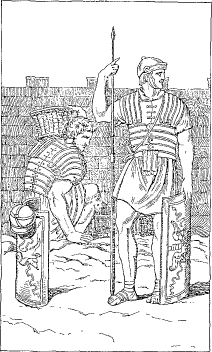
CASTRA MURO FOSSAQUE MUNIUNTUR
501.
RULES OF SYNTAX
Note. The rules of syntax are here
classified and numbered consecutively. The number of the text section in
which the rule appears is given at the end of each.
Nominative Case
1.
The subject of a finite verb is in the nominative and answers the
question Who? or What? § 36.
Agreement
2.
A finite verb must always be in the same person and number as its
subject. § 28.
3.
A predicate noun agrees in case with the subject of the verb. § 76.
4.
An appositive agrees in case with the noun which it explains. § 81.
5.
Adjectives agree with their nouns in gender, number, and case. § 65.
6.
A predicate adjective completing a complementary infinitive agrees in
gender, number, and case with the subject of the main verb.
§ 215. a.
7.
A relative pronoun must agree with its antecedent in gender and number;
but its case is determined by the way it is used in its own clause. § 224.
Prepositions
8.
A noun governed by a preposition must be in the accusative or ablative
case. § 52.
Genitive Case
9.
The word denoting the owner or possessor of something is in the genitive
and answers the question Whose? § 38.
10.
The possessive genitive often stands in the predicate, especially after
the forms of sum, and is then called the predicate
genitive. § 409.
11.
Words denoting a part are often used with the genitive of the whole,
known as the partitive genitive. § 331.
12.
Numerical descriptions of measure are expressed by the genitive with a
modifying adjective. § 443.
Dative Case
13.
The indirect object of a verb is in the dative. § 45.
14.
The dative of the indirect object is used with the intransitive verbs
crēdō, faveō, noceō, pāreō,
persuādeō, resistō, studeō, and others of like
meaning. § 154.
15.
Some verbs compounded with ad, ante, con,
dē, in, inter, ob, post, prae,
prō, sub, super, admit the dative of the indirect
object. Transitive compounds may take both an accusative and a dative.
§ 426.
16.
The dative is used with adjectives to denote the object toward which the
given quality is directed. Such are, especially, those meaning
near, also fit, friendly, pleasing, like, and their
opposites. § 143.
17.
The dative is used to denote the purpose or end for which;
often with another dative denoting the person or thing affected.
§ 437.
Accusative Case
18.
The direct object of a transitive verb is in the accusative and answers
the question Whom? or What? § 37.
19.
The subject of the infinitive is in the accusative. § 214.
20.
The place to which is expressed by ad or in with
the accusative. Before names of towns, small islands, domus, and
rūs the preposition is omitted.
§§ 263,
266.
21.
Duration of time and extent of space are expressed by the
accusative. § 336.
22.
Verbs of making, choosing, calling, showing, and the like, may
take a predicate accusative along with the direct object. With
the passive voice the two accusatives become nominatives. § 392.
Ablative Case
23.
Cause is denoted by the ablative without a preposition. This
answers the question Because of what? § 102.
24.
Means is denoted by the ablative without a preposition. This
answers the question By means of what? or With what? § 103.
25.
Accompaniment is denoted by the ablative with cum. This
answers the question With whom? § 104.
26.
The ablative with cum is used to denote the manner of an action.
Cum may be omitted, if an adjective is used with the ablative.
This answers the question How? or In what manner? § 105.
27.
With comparatives and words implying comparison the ablative is used to
denote the measure of difference. § 317.
28.
The ablative of a noun or pronoun with a present or perfect participle
in agreement is used to express attendant circumstance. This is called
the ablative absolute. § 381.
29.
1. Descriptions of physical characteristics are expressed by the
ablative with a modifying adjective. § 444.
2. Descriptions involving neither numerical statements nor physical
characteristics may be expressed by either the genitive or the ablative
with a modifying adjective. § 445.
30.
The ablative is used to denote in what respect something is true.
§ 398.
31.
The place from which is expressed by ā or ab,
dē, ē or ex with the separative ablative. This
answers the question Whence? Before names of towns, small islands,
domus, and rūs the preposition is omitted.
§§ 264,
266.
32.
Words expressing separation or deprivation require an ablative to
complete their meaning. This is called the ablative of
separation. § 180.
33.
The word expressing the person from whom an action starts, when not the
subject, is put in the ablative with the preposition ā or
ab. This is called the ablative of the personal agent. § 181.
34.
The comparative degree, if quam is omitted, is followed by the
separative ablative. § 309.
35.
The time when or within which anything happens is expressed by
the ablative without a preposition. § 275.
36.
1. The place at or in which is expressed by the ablative with
in. This answers the question Where? Before names of towns, small
islands, and rūs the preposition is omitted.
§§ 265,
266.
2. Names of towns and small islands, if singular and of the first or
second declension, and the word domus express the place in
which by the locative. § 268.
Gerund and Gerundive
37.
1. The gerund is a verbal noun and is used only in the genitive, dative,
accusative, and ablative singular. The constructions of these cases are
in general the same as those of other nouns.
§ 406. 1.
2. The gerundive is a verbal adjective and must be used instead of
gerund + object, excepting in the genitive and in the ablative without a
preposition. Even in these instances the gerundive construction is more
usual.
§ 406. 2.
38.
The accusative of the gerund or gerundive with ad, or the
genitive with causā, is used to express purpose. § 407.
Moods and Tenses of Verbs
39.
Primary tenses are followed by primary tenses, and secondary by
secondary. § 358.
40.
The subjunctive is used in a dependent clause to express the
purpose of the action in the principal clause. § 349.
41.
A substantive clause of purpose with the subjunctive is used as
object with verbs of commanding, urging, asking, persuading, or
advising, where in English we should usually have the infinitive.
§ 366.
42.
Verbs of fearing are followed by a substantive clause of purpose
introduced by ut (that not) or nē (that or
lest). § 372.
43.
Consecutive clauses of result are introduced by ut or
ut nōn, and have the verb in the subjunctive. § 385.
44.
Object clauses of result with ut or ut nōn are
found after verbs of effecting or bringing about. § 386.
45.
A relative clause with the subjunctive is often used to describe an
antecedent. This is called the subjunctive of characteristic or
description. § 390.
46.
The conjunction cum means when, since, or although.
It is followed by the subjunctive unless it means when and its
clause fixes the time at which the main action took place. § 396.
47.
When a direct statement becomes indirect, the principal verb is changed
to the infinitive, and its subject nominative becomes subject accusative
of the infinitive. § 416.
48.
The accusative-with-infinitive construction in indirect statements is
found after verbs of saying, telling, knowing, thinking, and
perceiving. § 419.
49.
A present indicative of a direct statement becomes present infinitive of
the indirect, a past indicative becomes perfect infinitive, and a future
indicative becomes future infinitive. § 418.
50.
In an indirect question the verb is in the subjunctive and its
tense is determined by the law for tense sequence. § 432.
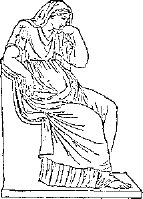
DOMINA
502.
Give the English of the following words:1
| Nouns |
agricola
ancilla
aqua
casa
causa
cēna
corōna |
dea
domina
fābula
fera
fīlia
fortūna
fuga |
gallīna
iniūria
īnsula
lūna
nauta
pecūnia
puella |
pugna
sagitta
silva
terra
tuba
via
victōria |
| Adjectives |
alta
bona |
clāra
grāta |
lāta
longa |
magna
mala |
nova
parva |
pulchra
sōla |
| Verbs |
amat
dat |
est
habitat |
labōrat
laudat |
nārrat
necat |
nūntiat
parat |
portat
pugnat |
sunt
vocat |
| Prepositions |
Pronouns |
Adverbs |
Conjunctions |
Interrogative
Particle |
ā or ab
ad
cum
dē
ē or ex
in |
mea
tua
quis
cuius
cui
quem
quid |
cūr
deinde
nōn
ubi |
et
quia
quod |
-ne |
503.
Give the Latin of the following words:1
Underline the words you do not remember. Do not look up a single word
till you have gone through the entire list. Then drill on the words you
have underlined.
flight
story
new
lives (verb)
away from
who
why
forest
wreath
deep, high
dinner
famous
cottage
battle (noun)
trumpet
lady, mistress
whom
island |
wide
tells
money
calls
with
your
then, in the
next place
daughter
to whom
fortune
out from
labors (verb)
gives
small
in
and
sailor
farmer |
goddess
wild beast
praises (verb)
alone
pleasing
prepares
are
to
because
arrow
my
kills
girl
fights (verb)
carries
chicken
victory
land |
what
way
bad
loves
pretty
water
great
is
announces
injury, wrong
where
not
good
maid
down from
long
cause
whose |
504.
Review Questions. How many syllables has a Latin word? How are
words divided into syllables? What is the ultima? the penult? the
antepenult? When is a syllable short? When is a syllable long? What is
the law of Latin accent? Define the subject of a sentence; the
predicate; the object; the copula. What is inflection? declension?
conjugation? What is the ending of the verb in the third person
singular, and what in the plural? What does the form of a noun show?
Name the Latin cases. What case is used for the subject? the direct
object? the possessor? What relation is expressed by the dative case?
Give the rule for the indirect object. How are questions answered in
Latin? What is a predicate adjective? an attributive adjective? What is
meant by agreement? Give the rule for the agreement of the adjective.
What are the three relations expressed by the ablative? What can you say
of the position of the possessive pronoun? the modifying genitive? the
adjective? What is the base? What is grammatical gender? What is the
rule for gender in the first declension? What are the general principles
of Latin word order?
505.
Fill out the following summary of the first declension:
|
The First or Ā-Declension |
1. Ending in the nominative singular |
|
2. Rule for gender |
|
3. Case terminations |
a. Singular
b. Plural |
|
4. Irregular nouns |
506.
Give the English of the following words:
|
Nouns of the First Declension
|
agrī cultūra
cōnstantia
|
cōpia
dīligentia
|
fāma
fēmina
|
galea
inopia
|
lacrima
lōrīca
|
patria
praeda
|
|
Nouns of the Second Declension
|
ager
amīcus
arma (plural)
auxilium
bellum
carrus
castrum |
cibus
cōnsilium
domicilium
dominus
equus
fīlius
fluvius |
frūmentum
gladius
lēgātus
līberī
magister
mūrus
numerus |
oppidānus
oppidum
pīlum
populus
praemium
proelium
puer |
scūtum
servus
studium
tēlum
vīcus
vir |
|
Adjectives of the First and Second Declensons
|
aeger, aegra, aegrum
alius, alia, aliud
alter, altera, alterum
armātus, -a, -um
crēber, crēbra, crēbrum
dūrus, -a, -um
fīnitimus, -a, -um
īnfīrmus, -a, -um
legiōnārius, -a, -um
līber, lībera, līberum
mātūrus, -a, -um
meus, -a, -um
miser, misera, miserum
multus, -a, -um |
neuter, neutra, neutrum
noster, nostra, nostrum
alter, altera, alterum
pulcher, pulchra, pulchrum
sōlus, -a, -um
suus, -a, -um
fīnitimus, -a, -um
tuus, -a, -um
ūllus, -a, -um
ūnus, -a, -um
uter, utra, utrum
validus, -a, -um
vester, vestra, vestrum
|
|
Verbs |
Demonstrative
Pronoun |
Adverbs |
arat
cūrat
dēsīderat
mātūrat
properat
|
is, ea, id
Conjunctions
an
-que
sed
|
iam
quō
saepe
Preposition
apud |
507.
Give the Latin of the following words:
sword
corselet
man
your (plural)
hasten
but
among
tear (noun)
village
strong
long for
and (enclitic)
often
want (noun)
which (of two)
care for
or (in a question)
whither
wagon
townsman
wretched
ripe
|
war
number
my
free (adj.)
children
wall
grain
weapon
one
plow (verb)
this or that
already
helmet
river
zeal
any
he
son
slave
your (singular)
she
woman
horse
|
shield (noun)
whole
it
aid (noun)
legionary
weak
arms
master
(of school)
friend
neighboring
sick
lieutenant
field
report, rumor
abode
boy
his own
alone
prize (noun)
master (owner)
carefulness
plenty
troops
|
plan (noun)
people
beautiful
no (adj.)
our
battle
spear
food
steadiness
fatherland
town
fort
camp
neither (of two)
much
agriculture
other
the other (of two)
hard
booty
frequent
armed
|
508.
Review Questions. How many declensions are there? What three
things must be known about a noun before it can be declined? What three
cases of neuter nouns are always alike, and in what do they end in the
plural? What two plural cases are always alike? When is the vocative
singular not like the nominative? What is a predicate noun? With what
does it agree? What is an appositive? Give the rule for the agreement of
an appositive. How can we tell whether a noun in -er is declined
like puer or like ager?
Decline bonus, līber, pulcher. How can we tell
whether an adjective in -er is declined like līber or like
pulcher? Why must we say nauta bonus and not nauta
bona? Name the Latin possessive pronouns. How are they declined?
With what does the possessive pronoun agree? When do we use tuus
and when vester? Why is suus called a reflexive
possessive? What is the non-reflexive possessive of the third person?
When are possessives omitted? What four uses of the ablative case are
covered by the relations expressed in English by with? Give an
illustration in Latin of the ablative of manner; of the
ablative of cause; of the ablative of means; of the
ablative of accompaniment. What ablative regularly has
cum? What ablative sometimes has cum? What uses of the
ablative never have cum? Name the nine pronominal adjectives,
with their meanings. Decline alius, nūllus. Decline
is. What does is mean as a demonstrative adjective or
pronoun? What other important use has it?
509.
Fill out the following summary of the second declension:
The Second or
O-Declension |
1. Endings in the nominative |
|
2. Rule for gender |
|
3. Case terminations of nouns in -us |
a. Singular
b. Plural |
|
a. The vocative singular of nouns in -us |
|
4. Case terminations of nouns in -um |
a. Singular
b. Plural |
|
5. Peculiarities of nouns in -er and -ir |
|
6. Peculiarities of nouns in -ius and -ium |
510.
Give the English of the following words:
|
Nouns of the First Declension |
|
disciplīna
fōrma |
poena
potentia |
rēgīna
superbia |
trīstitia |
|
Nouns of the Second Declension |
| lūdus |
ōrnāmentum |
sacrum |
socius |
verbum |
|
Adjectives of the First and Second Declensions |
amīcus
antīquus
fīnitimus
|
grātus
idōneus
inimīcus
|
interfectus
īrātus
laetus
|
molestus
perpetuus
proximus
|
septem
superbus
|
|
Adverbs |
Conjunctions |
Personal Pronoun |
hodiē
ibi
maximē
|
mox
nunc
nūper
|
etiam
nōn sōlum ... sed etiam
|
ego
|
| Verbs |
| CONJ. I |
CONJ. II |
CONJ. III |
CONJ. IV |
volō, -āre
IRREGULAR VERB
sum, esse
|
dēleō, -ēre
doceō, -ēre
faveō, -ēre
habeō, -ēre
iubeō, -ēre
moneō, -ēre
moveō, -ēre
noceō, -ēre
pāreō, -ēre
persuādeō, -ēre
sedeō, -ēre
studeō, -ēre
videō, -ēre
|
agō, -ere
capiō, -ere
crēdō, -ere
dīcō, -ere
dūcō, -ere
faciō, -ere
fugiō, -ere
iaciō, -ere
mittō, -ere
rapiō, -ere
regō, -ere
resistō, -ere
|
audiō, -īre
mūniō, -īre
reperiō, -īre
veniō, -īre
|
511.
Give the Latin of the following words. In the case of verbs
always give the first form and the present infinitive.
ancient
come
resist
see
be
fly
I
proud
word
sadness
find
rule (verb)
be eager for
|
not only ...
but also
seven
ally, companion
pride
fortify
send
sit
also
school
hear
hurl
persuade
only
|
nearest
sacred rite
queen
flee
obey
lately
constant
ornament
power
make, do
injure
now
annoying
lead
|
move
soon
glad
punishment
believe
advise
especially,
most of all
angry
beauty
say
command (verb)
there
slain |
training
take
have
to-day
unfriendly
drive
favor (verb)
suitable
pleasing
teach
neighboring
destroy
friendly
seize
|
512.
Review Questions. What is conjugation? Name two important
differences between conjugation in Latin and in English. What is tense?
What is mood? What are the Latin moods? When do we use the indicative
mood? Name the six tenses of the indicative. What are personal endings?
Name those you have had. Inflect sum in the three tenses you have
learned. How many regular conjugations are there? How are they
distinguished? How is the present stem found? What tenses are formed
from the present stem? What is the tense sign of the imperfect? What is
the meaning of the imperfect? What is the tense sign of the future in
the first two conjugations? in the last two? Before what letters is a
final long vowel of the stem shortened? What are the three possible
translations of a present, as of pugnō? Inflect arō, sedeō,
mittō, faciō, and veniō, in the present, imperfect, and
future active. What forms of -iō verbs of the third conjugation
are like audiō? what like regō? Give the rule for the
dative with adjectives. Name the special intransitive verbs that govern
the dative. What does the imperative mood express? How is the present
active imperative formed in the singular? in the plural? What three
verbs have a shortened present active imperative? Give the present
active imperative of portō, dēleō, agō, faciō, mūniō.
513.
Give the English of the following words:
|
Nouns of the First Declension |
| āla |
cūra |
mora |
porta |
prōvincia |
vīta |
|
Nouns of the Second Declension |
animus
aurum |
bracchium
deus |
locus
mōnstrum |
nāvigium
ōrāculum |
perīculum
ventus |
vīnum |
|
Adjectives of the First and Second Declensions |
adversus
attentus
cārus
|
commōtus
dēfessus
dexter
|
dubius
maximus
perfidus
|
plēnus
saevus
sinister
|
| Adverbs |
anteā
celeriter
dēnique
|
diū
frūstrā
graviter
|
ita
longē
semper
|
subitō
tamen
tum
|
| Conjunctions |
| autem |
sī |
ubi |
|
Prepositions |
| dē |
per |
prō |
sine |
| Verbs |
|
CONJ. I |
CONJ. II |
adpropinquō
nāvigō
occupō
postulō
|
recūsō
reportō
servō
stō
|
superō
temptō
vāstō
vulnerō
|
contineō
egeō
prohibeō
respondeō
teneō
|
|
CONJ. III |
IRREGULAR VERB |
| discēdō |
gerō |
interficiō |
absum |
514.
Translate the following words. Give the genitive and the gender
of the nouns and the principal parts of the verbs.
be away
wind
through
if
savage
wound (verb)
wine
delay
faithless
right
seize
quickly
before, in behalf of
battle
down from or concerning
|
moreover
greatest
oracle
danger
lay waste
gate
doubtful
opposite, adverse
demand
finally
attentive
then, at that time
weary
overcome,
conquer
|
boat, ship
sail (verb)
life
save
full
refuse
heavily
monster
approach
nevertheless
place
be without,
lack
moved
gold
restrain, keep from |
without
hold
suddenly
dear
always
god
hold in, keep
afar
thus, so,
as follows
arm (noun)
when
in vain
stand
bring back, win |
before,
previously
depart,
go away
province
care, trouble
kill
reply (verb)
wing
mind, heart
left (adj.)
bear, carry on
try
for a long time
|
515.
Give the principal parts and meaning of the following verbs:
sum
dō
teneō
iubeō
agō
mittō
mūniō
|
moveō
crēdō
rapiō
reperiō
dēleō
resistō
audiō
|
moneō
capiō
doceō
regō
faveō
noceō
dīcō
|
pāreō
dūcō
faciō
persuādeō
sedeō
studeō
fugiō
|
veniō
iaciō
videō
absum
egeō
gerō
stō
|
516.
Review Questions. What are the personal endings in the passive
voice? What is the letter -r sometimes called? What are the
distinguishing vowels of the four conjugations? What forms constitute
the principal parts? What are the three different conjugation stems? How
may they be found? What are the tenses of the indicative? of the
infinitive? What tense of the imperative have you learned? What forms
are built on the present stem? on the perfect stem? on the participial
stem? What are the endings of the perfect active indicative? What is the
tense sign of the pluperfect active? of the future perfect active? How
is the present active infinitive formed? the present passive infinitive?
How is the present active imperative formed? the present passive
imperative? How is the perfect active infinitive formed? the perfect
passive infinitive? How is the future active infinitive formed? What is
a participle? How are participles in -us declined? Give the rule
for the agreement of the participle. How are the perfect, pluperfect,
and future perfect passive indicative formed? Conjugate the verb
sum in all moods and tenses as far as you have learned it (§ 494). What is meant by the separative
ablative? How is the place from which expressed in Latin? Give
the rule for the ablative of separation; for the ablative of the
personal agent. How can we distinguish between the ablative of means and
the ablative of the personal agent? What is the perfect definite? the
perfect indefinite? What is the difference in meaning between the
perfect indefinite and the imperfect? What two cases in Latin may be
governed by a preposition? Name the prepositions that govern the
ablative. What does the preposition in mean when it governs the
ablative? the accusative? What are the three interrogatives used to
introduce yes-and-no questions? Explain the force of each.
What words are sometimes used for yes and no? What are the
different meanings and uses of ubi?
517.
Give the English of the following words:
| Nouns |
|
FIRST DECLENSION |
SECOND DECLENSION |
| rīpa |
barbarī
captīvus
|
castellum
impedīmentum
|
|
THIRD DECLENSION |
animal
arbor
avis
caedēs
calamitās
calcar
caput
cīvis
cliēns
|
collis
cōnsul
dēns
dux
eques
fīnis
flūmen
fōns
frāter
|
homō
hostīs
ignis
imperātor
īnsigne
iter
iūdex
labor
lapis
|
legiō
mare
māter
mēnsis
mīles
mōns
nāvis
opus
ōrātor
|
ōrdō
pater
pedes
pēs
pōns
prīnceps
rēx
salūs
sanguis
|
soror
tempus
terror
turris
urbs
victor
virtūs
vīs
|
|
Adjectives of the First and Second Declensions |
| barbarus |
dexter |
sinister |
summus |
| Prepositions |
Adverbs |
Conjunctions |
in with the abl.
in with the acc.
trāns
|
cotīdiē
numquam
|
nec, neque
nec ... nec, or neque ... neque
|
| Verbs |
|
CONJ. I |
CONJ. III |
cessō
confirmō
|
oppugnō
vetō
|
accipiō
incipiō
|
petō
ponō
|
vincō
vivō
|
518.
Translate the following words. Give the genitive and the gender
of the nouns and the principal parts of the verbs:
forbid
rank, row
brother
force
across
savages
horseman
never
mountain
manliness,
courage
leader
put, place
time
savage,
barbarous
sister
seek
captive
hindrance,
baggage
|
man-of-war
judge
defeat, disaster
fire
tree
foot soldier
receive
general
highest
fountain
orator
neither ... nor
and not
left
tooth
soldier
month
city
victor
daily
live (verb)
|
conquer
consul
mother
retainer
citizen
head
safety
assail, storm
begin
march
decoration
bridge
bird
cease
man
river
work (noun)
and
ship
bank
|
redoubt, fort
sea
tower
drill (verb)
legion
terror
into, to
right (adj.)
in
stone
blood
labor (noun)
king
spur
chief
slaughter
strengthen
foot
enemy
animal
father
|
519.
Review Questions. Give the conjugation of possum. What is
an infinitive? What three uses has the Latin infinitive that are like
the English? What is the case of the subject of the infinitive? What is
meant by a complementary infinitive? In the sentence The bad boy
cannot be happy, what is the case of happy? Give the rule.
Decline quī. Give the rule for the agreement of the relative.
What are the two uses of the interrogative? Decline quis. What is
the base of a noun? How is the stem formed from the base? Are the stem
and the base ever the same? How many declensions of nouns are there?
Name them. What are the two chief divisions of the third declension? How
are the consonant stems classified? Explain the formation of
lapis from the stem lapid-, mīles from
mīlit-, rēx from rēg-. What nouns have
i-stems? What peculiarities of form do i-stems
have,—masc., fem., and neut.? Name the five nouns that have
-ī and -e in the abl. Decline turris. Give the
rules for gender in the third declension. Decline mīles,
lapis, rēx, virtūs, cōnsul, legiō,
homō, pater, flūmen, opus, tempus,
caput, caedēs, urbs, hostis, mare,
animal, vīs, iter.
520.
Fill out the following scheme:
|
The Third Declension |
Gender Endings |
Masculine
Feminine
Neuter |
|
Case Terminations |
I. Consonant Stems |
a. Masc. and fem.
b. Neuters |
|
II. I-Stems |
a. Masc. and fem.
b. Neuters |
|
Irregular Nouns |
521.
Give the English of the following words:
| Nouns |
|
FIRST DECLENSION |
SECOND DECLENSION |
amīcitia
hōra
littera
|
annus
modus
nūntius
oculus
|
rēgnum
signum
supplicium,
supplicium dare
supplicium sūmere dē
|
tergum,
tergum vertere
vestīgium
|
|
THIRD DECLENSION |
FOURTH DECLENSION |
aestās
corpus
hiems
lībertās
lūx,
prīma lūx
nōmen
|
nox
pars
pāx
rūs
sōl
vōx
vulnus
|
adventus
cornū
domus
equitātus
exercitus
fluctus
|
impetus
lacus
manus
metus
portus
|
|
FIFTH DECLENSION |
INDECLINABLE NOUN |
aciēs
diēs
fidēs,
in fidem venīre
|
rēs,
rēs gestae
rēs adversae
rēs pūblica
rēs secundae
|
spēs
|
nihil
|
| Adjectives |
|
FIRST AND SECOND DECLENSIONS |
THIRD DECLENSION |
dēnsus
invīsus
mīrus
paucī
prīmus
|
prīstinus
pūblicus
secundus
tantus
vērus
|
ācer, ācris, ācre
brevis, breve
difficilis, difficile
facīlis, facile
fortis, forte
|
gravis, grave
incolumis, incolume
omnis, omne
pār, pār
vēlōx, vēlōx
|
| Pronouns |
| PERSONAL |
DEMONSTRATIVE |
INTENSIVE |
INDEFINITE |
ego
nōs
suī
tū
vōs
|
hic
īdem
ille
iste
|
ipse |
aliquis, aliquī
quīdam
quis, quī
quisquam
quisque
|
| Adverbs |
Conjunctions |
Prepositions |
nē ... quidem
ōlim
|
paene
quoque
|
satis
vērō
|
itaque
nisi
|
ante
post
propter
|
| Verbs |
| CONJ. I |
CONJ. II |
CONJ. III |
CONJ. IV |
conlocō
convocō
cremō
dēmōnstrō
mandō
|
dēbeō
exerceō
maneō
placeō
sustineō
|
committō,
committere proelium
dēcidō
ēripiō
sūmō,
sūmere supplicium dē
trādūcō
vertō |
dēsiliō |
522.
Translate the following words. Give the genitive and the gender
of the nouns and the principal parts of the verbs.
if not, unless
on account of
unharmed
public
commonwealth
leap down, dismount
lead across
remain
call together
friendship
footprint, trace
each
fear (noun)
hope
therefore
behind, after
so great
equal
in truth, indeed
that (yonder)
a certain
fall down
owe, ought
measure, mode
eye
name
wave, billow
thing, matter
exploits
republic
prosperity
|
adversity
former, old-time
all, every
any one (at all)
this (of mine)
heavy, serious
hateful, detested
true
burn
snatch from
letter
punishment
inflict
punishment on
suffer punishment
liberty
sun
sustain
take up, assume
hour
reign, realm
messenger
part, direction
body
harbor
faith, protection
of himself
also, too
sufficiently
|
burn
that (of yours)
before
you (plur.)
light
daybreak
winter
attack
line of battle
army
drill, train
join battle
house, home
midday
wonderful
brave
almost
the same
some, any
if any one
self, very
not even
easy
dense
point out, explain
difficult
first
arrange, station
please
year
|
peace
back
turn the back, retreat
night
hand, force
lake
day
commit, intrust
a few only
sharp, eager
we
turn
you (sing.)
I
signal
summer
cavalry
wound
horn, wing
country
second, favorable
short
voice
formerly, once
arrival
come under the
protection of
swift
nothing
|
523.
Review Questions. By what declensions are Latin adjectives
declined? What can you say about the stem of adjectives of the third
declension? Into what classes are these adjectives divided? How can you
tell to which of the classes an adjective belongs? Decline ācer,
omnis, pār. What are the nominative endings and genders of nouns of
the fourth
or u-declension? What nouns are feminine by exception? Decline
adventus, lacus, cornū, domus. Give the rules for the ordinary
expression of the place to which, the place from which,
the place in which. What special rules apply to names of towns,
small islands, and rūs? What is the locative case? What words
have a locative case? What is the form of the locative case? Translate
Galba lives at home, Galba lives at Rome, Galba lives at Pompeii.
What is the rule for gender in the fifth or ē-declension? Decline
diēs, rēs. When is the long ē shortened? What can
you say about the plural of the fifth declension? Decline tuba,
servus, pīlum, ager, puer, mīles,
cōnsul, flūmen, caedēs, animal. How is the
time when expressed? Name the classes of pronouns and define each
class. Decline ego, tū, is. What are the reflexives of the first
and second persons? What is the reflexive of the third person? Decline
it. Translate I see myself, he sees himself, he sees him. Decline
ipse. How is ipse used? Decline īdem. Decline
hic, iste, ille. Explain the use of these words.
Name and translate the commoner indefinite pronouns. Decline
aliquis, quisquam, quīdam, quisque.
524.
Give the English of the following words:
| Nouns |
|
FIRST DECLENSION |
SECOND DECLENSION |
aquila
fossa
|
aedificium
captīvus
concilium
|
imperium
negōtium
|
spatium
vāllum
|
|
THIRD DECLENSION |
agmen
celeritās
cīvitās
clāmor
cohors
difficultās
explōrātor
|
gēns
lātitūdō
longitūdō
magnitūdō
mēns
mercātor
mīlle
|
mors
mulier
multitūdō
mūnītiō
nēmō
obses
opīniō
|
regiō
rūmor
scelus
servitūs
timor
vallēs
|
|
FOURTH DECLENSION |
FIFTH DECLENSION |
aditus
commeātus
|
passus
|
rēs frūmentāria
|
|
Adjectives |
|
FIRST AND SECOND DECLENSIONS |
aequus
bīnī
ducentī
duo
exterus
īnferus
|
maximus
medius
minimus
opportūnus
optimus
pessimus
|
plūrimus
posterus
prīmus
reliquus
secundus
|
singulī
superus
tardus
ternī
ūnus
|
|
THIRD DECLENSION |
alacer, alacris, alacre
audāx, audāx
celer, celeris, celere
citerior, citerius
difficilis, difficile
dissimilis, dissimile
facilis, facile
gracilis, gracile
|
humilis, humile
ingēns, ingēns
interior, interius
lēnis, lēne
maior, maius
melior, melius
minor, minus
nōbilis, nōbile
|
peior, peius
——, plūs
prior, prius
recēns, recēns
similis, simile
trēs, tria
ulterior, ulterius
|
| Adverbs |
ācriter
audācter
bene
facile
ferē
fortiter
|
magis
magnopere
maximē
melius
minimē
multum
|
optimē
parum
paulō
plūrimum
prope
propius
|
proximē
quam
statim
tam
undique
|
| Conjunctions |
Prepositions |
atque, ac
aut
aut ... aut
et ... et
nam
|
quā dē causā
quam ob rem
simul atque or
simul ac
|
circum
contrā
inter
ob
trāns
|
| Verbs |
|
CONJ. I |
CONJ. II |
cōnor
hortor
|
moror
vexō
|
obtineō
perterreō
|
valeō
vereor
|
|
CONJ. III |
abdō
cadō
cognōscō
cōnsequor
contendō
cupiō
currō
|
dēdō
dēfendō
ēgredior
incendō
incolō
īnsequor
occīdō
|
patior
premō
proficīscor
prōgredior
quaerō
recipiō
relinquō
|
revertor
sequor
statuō
subsequor
suscipiō
trādō
trahō
|
|
CONJ. III |
|
orior |
perveniō |
|
525.
Translate the following words. Give the genitive and the gender
of the nouns and the principal parts of the verbs:
on account of
nearly
keenly, sharply
thousand
two
opportune
remaining
above (adj.)
next
grain supply
pace
shout (noun)
from all sides
against
around
three
further
line of march
manor
region
fortification
eagle
almost
boldly
bravely
across
between, among
hither (adj.)
so
less
more
most
worst
difficulty
hostage
death
command, power
captive
or
and
arrive
attempt, try
length
|
width
scout
cohort
tribe, nation
business
by a little
somewhat
crime
difficult
equal
move forward,
advance
multitude
woman
desire (verb)
give over,
surrender
kill
overtake
hasten, strive
hide
one
first
second, favorable
two hundred
former
inner
middle
low
outward
three by three
provisions
speed
ditch
wherefore or
therefore
for this reason
fear (noun)
return
inquire
set out
move out, disembark |
fear (verb)
worse
greater, larger
two by two
least (adv.)
opinion,
expectation
approach, entrance
trader
magnitude, size
council, assembly
space, room
either ... or
rise, arise
suffer, allow
press hard
fall
surrender
set fire to
defend
possess, hold
delay (verb)
nearest (adv.)
nearer (adv.)
better (adj.)
well known, noble
mild, gentle
swift
eager
low (adj.)
slender
one by one
no one
least (adv.)
little (adv.)
learn, know
drag
undertake
run
fix, decide
|
leave
abandon
be strong
receive, recover
terrify, frighten
dwell
state, citizenship
valley
slavery
greatly
best of all (adv.)
better (adv.)
well (adv.)
very much
much
unlike
like (adj.)
slow
very greatly,
exceedingly
building
mind (noun)
easily
easy
recent
huge, great
bold
immediately
as soon as
for
than
best (adj.)
greatest
follow close
encourage
annoy, ravage
hide
follow
pursue
both ... and
rampart
|
526.
Review Questions. What is meant by comparison? In what two ways
may adjectives be compared? Compare clārus, brevis, vēlōx, and
explain the formation of the comparative and the superlative. What are
the adverbs used in comparison? Compare brevis by adverbs.
Decline the comparative of vēlōx. How are adjectives in
-er compared? Compare ācer, pulcher, liber.
What are possible translations for the comparative and superlative? Name
the six adjectives that form the superlative in -limus. Translate
in two ways Nothing is brighter than the sun. Give the rule for
the ablative with comparatives. Compare bonus, magnus, malus, multus,
parvus, exterus, īnferus, posterus, superus. Decline plūs.
Compare citerior, interior, propior, ulterior. Translate That
route to Italy is much shorter. Give the rule for the expression of
measure of difference. Name five words that are especially common in
this construction. How are adverbs usually formed from adjectives of the
first and second declensions? from adjectives of the third declension?
Compare the adverbs cārē, līberē, fortiter,
audācter. What cases of adjectives are sometimes used as adverbs?
What are the adverbs from facilis? multus? prīmus?
plūrimus? bonus? magnus? parvus? Compare
prope, saepe, magnopere. How are numerals
classified? Give the first twenty cardinals. Decline ūnus, duo, trēs,
mīlle. How are the hundreds declined? What is meant by the partitive
genitive? Give the rule for the partitive genitive. What sort of words
are commonly used with this construction? What construction is used
with quīdam and cardinal numbers excepting mīlle? Give the
first twenty ordinals. How are they declined? How are the distributives
declined? Give the rule for the expression of duration of time and
extent of space. What is the difference between the ablative of time and
the accusative of time? What is a deponent verb? Give the synopsis of
one. What form always has a passive meaning? Conjugate amō,
moneō, regō, capiō, audiō, in the active and
passive.
527.
Review the vocabularies of the first seventeen lessons. See
§§ 502,
503,
506,
507.
528.
Review Questions. Name the tenses of the subjunctive. What time
is denoted by these tenses? What are the mood signs of the present
subjunctive? How may the imperfect subjunctive be formed? How do the
perfect subjunctive and the future perfect indicative active differ in
form? How is the pluperfect subjunctive active formed? Inflect the
subjunctive active and passive of cūrō, dēleō,
vincō, rapiō, mūniō. Inflect the
subjunctive tenses of sum; of possum. What are the tenses
of the participles in the active? What in the passive? Give the active
and passive participles of amō, moneō, regō,
capiō, audiō. Decline regēns. What participles do
deponent verbs have? What is the difference in meaning between the
perfect participle of a deponent verb and of one not deponent? Give the
participles of vereor. How should participles usually be
translated? Conjugate volō, nolō, mālō,
fīō.
What is the difference between the indicative and subjunctive in
their fundamental ideas? How is purpose usually expressed in English?
How is it expressed in Latin? By what words is a Latin purpose clause
introduced? When should quō be used? What is meant by sequence of
tenses? Name the primary tenses of the indicative and of the
subjunctive; the secondary tenses. What Latin verbs are regularly
followed by substantive clauses of purpose? What construction follows
iubeō? What construction follows verbs of fearing? How is
consequence or result expressed in Latin? How is a result clause
introduced? What words are often found in the principal clause
foreshadowing the coming of a result clause? How may negative purpose be
distinguished from negative result? What is meant by the subjunctive of
characteristic or description? How are such clauses introduced? Explain
the ablative absolute. Why is the ablative absolute of such frequent
occurrence in Latin? Explain the predicate accusative. After what verbs
are two accusatives commonly found? What do these accusatives become
when the verb is passive?

IMPERATOR MILITES HORTATUR
The words in heavy type are used in Cæsar’s “Gallic War.”
LESSON IV, § 39
|
Nouns
dea, goddess (deity)
Diā´na, Diana
fera, a wild beast (fierce)
Lātō´na, Latona
sagit´ta, arrow
|
Verbs
est, he (she, it) is; sunt, they are
necat, he (she, it) kills, is killing, does kill
Conjunction1
et, and
|
|
Pronouns
quis, interrog. pronoun, nom. sing., who?
cuius (pronounced co͝oi´yo͝os, two syllables), interrog.
pronoun, gen. sing., whose?
|
LESSON V, § 47
|
Nouns
corō´na, wreath, garland, crown
fā´bula, story (fable)
pecū´nia, money (pecuniary)
pugna, battle (pugnacious)
victō´ria, victory
|
Verbs
dat, he (she, it) gives
nārrat, he (she, it) tells (narrate)
Conjunction1
quia or quod, because
|
|
Pronoun
cui (pronounced co͝oi, one syllable), interrog. pronoun,
dat. sing., to whom? for whom?
|
LESSON VI, § 56
|
Adjectives
bona, good
grāta, pleasing
magna, large, great
mala, bad, wicked
parva, small, little
pulchra, beautiful, pretty
sōla, alone
|
Nouns
ancil´la, maidservant
Iūlia, Julia
Adverbs1
cūr, why
nōn, not
Pronouns
mea, my; tua, thy, your (possesives)
quid, interrog. pronoun, nom. and acc. sing., what?
|
-ne, the question sign, an enclitic ( § 16) added to the first word, which,
in a question, is usually the verb, as amat, he loves, but
amat´ne? does he love? est, he is;
estne? is he? Of course -ne is not used when the
sentence contains quis, cūr, or some other interrogative
word.
|
LESSON VII, § 62
|
Nouns
casa, -ae, f., cottage
cēna, -ae, f., dinner
gallī´na, -ae, f., hen, chicken
īn´sula, ae, f., island (pen-insula)
Adverbs
de-in´de, then, in the next place
ubi, where
Preposition
ad, to, with acc. to express motion toward
|
Verbs
ha´bitat, he (she, it) lives, is living, does live
(inhabit)
laudat, he (she, it) praises, is praising, does praise
(laud)
parat, he (she, it) prepares, is preparing, does
prepare
vocat, he (she, it) calls, is calling, does call; invites, is
inviting, does invite (vocation)
|
|
Pronoun
quem, interrog. pronoun, acc. sing., whom?
|
LESSON VIII, § 69
|
Nouns
Italia, -ae, f., Italy
Sicilia, -ae, f., Sicily
tuba, -ae, f., trumpet (tube)
via, -ae, f., way, road, street (viaduct)
|
Adjectives
alta, high, deep (altitude)
clāra, clear, bright; famous
lāta, wide (latitude)
longa, long (longitude)
nova, new (novelty)
|
LESSON IX, § 77
|
Nouns
|
|
bellum, -ī, n., war (re-bel)
cōnstantia, -ae, f., firmness, constancy, steadiness
dominus, -ī, m., master, lord (dominate)
equus, -ī, m., horse (equine)
frūmentum, -ī, n., grain
lēgātus, -ī, m., lieutenant, ambassador (legate)
Mārcus, -ī, m., Marcus, Mark
|
mūrus, -ī, m., wall (mural)
oppidānus, -ī, m., townsman
oppidum, -ī, n., town
pīlum, -ī, n., spear (pile driver)
servus, -ī, m., slave, servant
Sextus, -ī, m., Sextus
Verbs
cūrat, he (she, it) cares for, with acc.
properat, he (she, it) hastens
|
LESSON X, § 82
|
Nouns
|
|
amīcus, -ī, m., friend (amicable)
Germānia, -ae, f., Germany
patria, -ae, f., fatherland
|
populus, -ī, m., people
Rhēnus, -ī, m., the Rhine
vīcus, -ī, m., village
|
LESSON XI, § 86
|
Nouns
|
|
arma, armōrum, n., plur., arms, especially defensive
weapons
fāma, -ae, f., rumor; reputation, fame
|
galea, -ae, f., helmet
praeda, -ae, f., booty, spoils (predatory)
tēlum, -ī, n., weapon of offense, spear
|
|
Adjectives
|
|
dūrus, -a, -um, hard, rough; unfeeling, cruel; severe,
toilsome (durable)
|
Rōmānus, -a, -um, Roman. As a noun, Rōmānus, -ī,
m., a Roman
|
LESSON XII, § 90
|
Nouns
fīlius, fīlī, m., son (filial)
fluvius, fluvī, m., river (fluent)
gladius, gladī, m., sword (gladiator)
praesidium, praesi´dī, n., garrison, guard,
protection
proelium, proelī, n., battle
|
Adjectives
fīnitimus, -a, -um, bordering upon, neighboring, near to.
As a noun, fīnitimī, -ōrum, m., plur., neighbors
Germānus, -a, -um, German. As a noun, Germānus, -ī,
m., a German
multus, -a, -um, much; plur., many
|
|
Adverb
saepe, often
|
LESSON XIII, § 95
|
Nouns
|
|
ager, agrī, m., field (acre)
cōpia, -ae, f., plenty, abundance (copious); plur.,
troops, forces
Cornēlius, Cornē´lī, m., Cornelius
lōrī´ca, -ae, f., coat of mail, corselet
|
praemium, praemī, n., reward, prize (premium)
puer, puerī, m., boy (puerile)
Rōma, -ae, f., Rome
scūtum, -ī, n., shield (escutcheon)
vir, virī, m., man, hero (virile)
|
|
Adjectives
|
|
legiōnārius, -a, -um,1 legionary,
belonging to the legion. As a noun, legiōnāriī, -ōrum, m.,
plur., legionary soldiers
līber, lībera, līberum, free (liberty) As a noun.
līberī, -ōrum, m., plur., children (lit. the
freeborn)
|
pulcher, pulchra, pulchrum, pretty, beautiful
Preposition
apud, among, with acc.
Conjunction
sed, but
|
LESSON XIV, § 99
|
Nouns
|
|
auxilium, auxi´lī, n., help, aid (auxiliary)
castrum, -ī, n., fort (castle); plur., camp (lit.
forts)
cibus, -ī, m., food
|
cōnsilium, cōnsi´lī, n., plan (counsel)
dīligentia, -ae, f., diligence, industry
magister, magistrī, m., master, teacher1
|
|
Adjectives
|
|
aeger, aegra, aegrum, sick
crēber, crēbra, crēbrum, frequent
|
miser, misera, miserum, wretched, unfortunate
(miser)
|
LESSON XV, § 107
|
Nouns
carrus, -ī, m., cart, wagon
inopia, -ae, f., want, lack; the opposite of
cōpia
studium, studī, n., zeal, eagerness (study)
Verb
mātūrat, he (she, it) hastens. Cf. properat
|
Adjectives
armātus, -a, -um, armed
īnfīrmus, -a, -um, week, feeble (infirm)
vali´dus, -a, -um, strong, sturdy
Adverb
iam, already, now
|
-que, conjunction, and; an enclitic (cf.
§ 16) and always added to
the
second of two words to be connected, as arma tēla´que,
arms and weapons.
|
LESSON XVII, § 117
|
Nouns
|
|
agrī cultūra, -ae, f., agriculture
domicilīum, domīci´lī, n., dwelling place (domicile)
abode
fēmina, -ae, f., woman (female)
|
Gallia, -ae, f., Gaul
Gallus, -i, m., a Gaul
lacrima, -ae, f., tear
numerus, -ī, m., number (numeral)
|
|
Adjective
mātūrus, -a, -um, ripe, mature
Verbs
arat, he (she, it) plows (arable)
dēsīderat, he (she, it) misses, longs for (desire), with
acc.
|
Adverb
quō, whither
Conjunction
an, or, introducing the second half of a double question,
as Is he a Roman or a Gaul, Estne Romanus an Gallus?
|
LESSON XVIII, § 124
|
Nouns
lūdus, -ī, m.,school
socius, socī, m., companion, ally (social)
|
Adjectives
īrātus, -a, -um, angry, furious (irate)
laetus, -a, -um, happy, glad (social)
|
|
Adverbs
|
|
hodiē, to-day
ibi, there, in that place
mox, presently, soon, of the immediate future
|
nunc, now, the present moment
nūper, lately, recently, of the immediate past
|
LESSON XX, § 136
|
Nouns
|
|
fōrma, -ae, f., form, beauty
poena, -ae, f., punishment, penalty
potentia, -ae, f., power (potent)
|
regīna, -ae, f., queen (regal)
superbia, -ae, f., pride, haughtiness
trīstītīa, -ae, f., sadness, sorrow
|
|
Adjectives
septem, indeclinable, seven
superbus, -a, -um, proud, haughty (superb)
|
Conjunctions
nōn sōlum ... sed etiam, not only ... but also
|
LESSON XXI, § 140
|
Nouns
sacrum, -ī, n., sacrifice, offering, rite
verbum, -ī, n., word (verb)
Verbs
sedeō, -ēre, sit (sediment)
volō, -āre, fly (volatile)
|
Adjectives
interfectus, -a, -um, slain
molestus, -a, -um, troublesome, annoying (molest)
perpetuus, -a, -um, perpetual, continuous
|
|
ego, personal pronoun, I (egotism). Always emphatic in the
nominative.
|
LESSON XXII, § 146
|
Nouns
|
|
disciplīna, -ae, f., training, culture, discipline
ōrnāmentum, -ī, n., ornament, jewel
|
Gāius, Gāī, m., Caius, a Roman first name
Tiberius, Tibe´rī, m., Tiberius, a Roman first name
|
|
Verb
doceō, -ēre, teach (doctrine)
|
Adverb
maximē, most of all, especially
|
|
Adjective
antīquus, -qua, -quum, old, ancient (antique)
|
LESSON XXVII, § 168
|
Nouns
āla, -ae, f., wing
deus, -ī, m., god (deity)1
monstrum, -ī, n., omen, prodigy; monster
ōrāculum, -ī, n., oracle
Verb
vāstō, -āre, lay waste, devastate
|
Adjectives
commōtus, -a, -um, moved, excited
maximus, -a, -um, greatest (maximum)
saevus, -a, -um, fierce, savage
Adverbs
ita, thus, in this way, as follows
tum, then, at that time
|
LESSON XXVIII, § 171
|
Verbs
respondeō, -ēre, respond, reply
servō, -āre, save, preserve
Adjective
cārus, -a, -um, dear (cherish)
|
Conjunction
autem, but, moreover, now. Usually
stands second, never first
Noun
vīta, -ae, f., life (vital)
|
LESSON XXIX, § 176
|
Verb
superō, -āre, conquer, overcome (insuperable)
Nouns
cūra, -ae, f., care, trouble
locus, -ī, m., place, spot (location). Locus is
neuter in the plural and is declined loca, -ōrum, etc.
perīculum, -ī, n., danger, peril
|
Adverbs
semper, always
tamen, yet, nevertheless
Prepositions
dē, with abl., down from; concerning
per, with acc., through
Conjunction
si, if
|
LESSON XXX, § 182
|
Verbs |
|
absum, abesse, irreg., be away, be absent, be distant,
with separative abl.
adpropinquō, -āre, draw near, approach (propinquity), with
dative1
contineō, -ēre, hold together, hem in, keep
(contain)
|
discēdō, -ere, depart, go away, leave, with separative
abl.
egeō, -ēre, lack, need, be without, with separative
abl.
interficiō, -ere, kill
prohibeō, -ēre, restrain, keep from (prohibit)
vulnerō, -āre, wound (vulnerable)
|
|
Nouns
prōvincia, -ae, f., province
vīnum, -ī, n., wine
|
Adjective
dēfessus, -a, -um, weary, worn out
Adverb
longē, far, by far, far away
|
LESSON XXXI, § 188
|
Nouns
aurum, -ī, n., gold (oriole)
mora, -ae, f., delay
nāvigium, nāvi´gī, n., boat, ship
ventus, -ī, m., wind (ventilate)
Verb
nāvigō, -āre, sail (navigate)
|
Adjectives
attentus, -a, -um, attentive, careful
dubius, -a, -um, doubtful (dubious)
perfidus, -a, -um, faithless, treacherous (perfidy)
Adverb
anteā, before, previously
|
|
Preposition
sine, with abl., without
|
LESSON XXXII, § 193
|
Nouns
animus, -ī, m., mind, heart; spirit, feeling
(animate)
bracchium, bracchī, n., forearm, arm
porta, -ae, f., gate (portal)
|
Adjectives
adversus, -a, -um, opposite; adverse, contrary
plēnus, -a, -um, full (plenty)
|
|
Preposition
prō, with abl., before; in behalf of; instead of
|
Adverb
diū, for a long time, long
|
LESSON XXXIV, § 200
|
Adverbs
|
|
celeriter, quickly (celerity)
dēnique, finally
|
graviter, heavily, severely (gravity)
subitō, suddenly
|
|
Verb
reportō, -āre, -āvī, bring back, restore; win, gain
(report)
|
LESSON XXXVI, § 211
|
dexter, dextra, dextrum, right (dextrous)
|
sinister, sinistra, sinistrum, left
frūstrā, adv., in vain (frustrate)
|
|
gerō, gerere, gessī, gestus, bear, carry on; wear;
bellum gerere, to wage war
occupō, occupāre, occupāvī, occupātus, seize, take possession
of (occupy)
postulō, postulāre, postulāvī, postulātus, demand
(ex-postulate)
recūsō, recūsāre, recūsāvī, recūsātus, refuse
stō, stāre, stetī, status, stand
temptō, temptāre, temptāvī, temptātus, try, tempt, test;
attempt
teneō, tenēre, tenuī, ——, keep, hold
(tenacious)
The word ubi, which we have used so much in the sense of
where in asking a question, has two other uses equally
important:
1. ubi = when, as a relative conjunction denoting time;
as,
Ubi mōnstrum audīvērunt, fūgērunt, when they heard the
monster, they fled
2. ubi = where, as a relative conjunction denoting place;
as,
Videō oppidum ubi Galba habitat, I see the town where Galba
lives
Ubi is called a relative conjunction because it is
equivalent to a relative pronoun. When in the first sentence is
equivalent to at the time at which; and in the second,
where is equivalent to the place in which.
|
LESSON XXXVII, § 217
|
neque or nec, conj., neither, nor, and ... not;
neque ... neque, neither ... nor
|
castellum, -ī, n., redoubt, fort (castle)
cotīdiē, adv., daily
|
|
cessō, cessāre, cessāvī, cessātus, cease, with the infin.
incipiō, incipere, incēpī, inceptus, begin (incipient),
with the infin.
oppugnō, oppugnāre, oppugnāvī, oppugnātus, storm,
assail
petō, petere, petivi or petiī, petītus, aim at, assail,
storm, attack; seek, ask (petition)
pōnō, pōnere, posuī, positus, place, put (position);
castra pōnere, to pitch camp
possum, posse, potuī, ——, be able, can
(potent), with the infin.
vetō, vetāre, vetuī, vetitus, forbid (veto), vith the
infin.; opposite of iubeō, command
vincō, vincere, vīcī, victus, conquer (in-vincible)
vīvō, vīvere, vīxī, ——, live, be alive
(re-vive)
|
LESSON XXXIX, § 234
|
barbarus, -a, -um, strange, foreign, barbarous. As a noun,
barbarī, -ōrum, m., plur., savages, barbarians
dux, ducis, m., leader (duke). Cf. the verb
dūcō
eques, equitis, m., horseman, cavalryman
(equestrian)
iūdex, iūdicis, m., judge
lapis, lapidis, m., stone (lapidary)
mīles, mīlitis, m., soldier (militia)
|
pedes, peditis, m., foot soldier (pedestrian)
pēs, pedis,1 m., foot
(pedal)
prīnceps, prīncipis, m., chief (principal)
rēx, rēgis, m., king (regal)
summus, -a, -um, highest, greatest (summit)
virtūs, virtūtis, f., manliness, courage (virtue)
|
LESSON XL, § 237
|
Caesar, -aris, m., Cæsar
captīvus, -ī, m., captive, prisoner
cōnsul, -is, m., consul
frāter, frātris, m., brother (fraternity)
homō, hominis, m., man, human being
impedīmentum, -ī, n., hindrance (impediment); plur.
impedīmenta, -ōrum, baggage
|
imperātor, imperātōris, m., commander in chief, general
(emperor)
legiō, legiōnis, f., legion
māter, mātris, f., mother (maternal)
ōrdō, ōrdinis, m., row, rank (order)
pater, patris, m., father (paternal)
salūs, salūtis, f., safety (salutary)
soror, sorōris, f., sister (sorority)
|
LESSON XLI, § 239
|
calamitās, calamitātis, f., loss, disaster, defeat
(calamity)
caput, capitis, n., head (capital)
flūmen, flūminis, n., river (flume)
labor, labōris, m., labor, toil
opus, operis, n., work, task
|
ōrātor, ōrātōris, m., orator
rīpa, -ae, f., bank (of a stream)
tempus, temporis, n., time (temporal)
terror, terrōris, m., terror, fear
victor, victōris, m., victor
|
|
accipiō, accipere, accēpī, acceptus, receive, accept
cōnfirmō, cōnfīrmāre, cōnfīrmāvī, cōnfīrmātus, strengthen,
establish, encourage (confirm)
|
LESSON XLIII, § 245
|
animal, animālis (-ium1), n.,
animal
avis, avis (-ium), f., bird (aviation)
caedēs, caedīs (-ium), f., slaughter
calcar, calcāris (-ium), n., spur
cīvis, cīvis (-ium), m. and f., citizen (civic)
cliēns, clientis (-ium), m., retainer, dependent
(client)
fīnis, fīnis (-ium), m., end, limit (final); plur.,
country, territory
hostis, hostis (-ium), m. and f., enemy in war (hostile).
Distinguish from inimīcus, which means a personal
enemy
|
ignis, ignis (-ium), m., fire (ignite)
īnsigne, īnsignis (-ium), n. decoration, badge
(ensign)
mare, maris (-ium2), n., sea
(marine)
nāvis, nāvis (-ium), f., ship (naval);
nāvis longa, man-of-war
turris, turris (-ium), f., tower (turret)
urbs, urbis (-ium), f., city (suburb). An urbs is
larger than an oppidum.
|
LESSON XLIV, § 249
|
arbor, arboris, f., tree (arbor)
collis, collis (-ium), m., hill
dēns, dentis (-ium), m., tooth (dentist)
fōns, fontis (-ium), m.. fountain, spring; source
iter, itineris, n., march, journey, route
(itinerary)
mēnsis, mēnsis (-ium), m., month
moenia, -ium, n., plur., walls, fortifications. Cf.
mūrus
|
mōns, montis (-ium), m., mountain;
summus mōns, top of the mountain
numquam, adv., never
pōns, pontis, m., bridge (pontoon)
sanguis, sanguinis, m., blood (sanguinary)
summus, -a, -um, highest, greatest (summit)
trāns, prep, with acc., across (transatlantic)
vīs (vīs), gen. plur. virium, f. strength, force,
violence (vim)
|
LESSON XLV, § 258
|
ācer, ācris, ācre, sharp, keen, eager (acrid)
brevis, breve, short, brief
difficilis, difficile, difficult
facilis, facile, facile, easy
fortis, forte, brave (fortitude)
gravis, grave, heavy, severe, serious (grave)
|
omnis, omne, every, all (omnibus)
pār, gen. paris, equal (par)
paucī, -ae, -a, few, only a few (paucity)
secundus, -a, -um, second; favorable, opposite of
adversus
signum, -ī, n., signal, sign, standard
vēlōx, gen. vēlōcis, swift (velocity)
|
|
conlocō, conlocāre, conlocāvī, conlocātus, arrange, station,
place (collocation)
dēmōnstrō, dēmōnstrāre, dēmōnstrāvī, dēmōnstrātus, point out,
explain (demonstrate)
mandō, mandāre, mandāvī, mandātus, commit, intrust
(mandate)
|
LESSON XLVI, § 261
|
adventus, -ūs, m., approach, arrival (advent)
ante, prep, with acc., before (ante-date)
cornū, -ūs, n., horn, wing of an army (cornucopia);
ā dextrō cornū, on the right wing;
ā sinistrō cornū, on the left wing
equitātus, -ūs, m., cavalry
exercitus, -ūs, m., army
|
impetus, -ūs, m., attack (impetus); impetum facere
in, with acc., to make an attack on
lacus, -ūs, dat. and abl. plur. lacubus, m., lake
manus, -ūs, f., hand; band, force (manual)
portus, -ūs, m., harbor (port)
post, prep, with acc., behind, after (post-mortem)
|
|
cremō, cremāre, cremāvī, cremātus, burn (cremate)
exerceō, exercēre, exercuī, exercitus, practice, drill,
train (exercise)
|
LESSON XLVII, § 270
|
Athēnae, -ārum, f., plur., Athens
Corinthus, -ī, f., Corinth
domus, -ūs, locative domī, f., house, home (dome).
Cf. domicilium
Genāva, -ae, f., Geneva
Pompēii, -ōrum, m., plur., Pompeii, a city in Campania. See
map
|
propter, prep. with acc., on account of, because of
rūs, rūris, in the plur. only nom. and acc. rūra, n.,
country (rustic)
tergum, tergī, n., back; ā tergō, behind, in the
rear
vulnus, vulneris, n., wound (vulnerable)
|
|
committō, committere, commīsī, commissus, intrust, commit;
proelium committere, join battle
convocō, convocāre, convocāvī, convocātus, call together,
summon (convoke)
timeō, timēre, timuī, ——, fear; be afraid
(timid)
vertō, vertere, vertī, versus, turn, change (convert);
terga vertere, to turn the backs, hence to
retreat
|
LESSON XLVIII, § 276
|
aciēs, -ēī, f., line of battle
aestās, aestātis, f., summer
annus, -ī, m., year (annual)
diēs, diēī, m., day (diary)
fidēs, fideī, no plur., f., faith, trust; promise, word;
protection; in fidem venīre, to come under the
protection
fluctus, -ūs, m. wave, billow (fluctuate)
hiems, hiemis, f., winter
hōra, -ae, f., hour
|
lūx, lūcis, f., light (lucid); prīma lux,
daybreak
merīdiēs, acc. -em, abl. -ē, no plur., m.,
midday (meridian)
nox, noctis (-ium), f., night (nocturnal)
prīmus, -a, -um, first (prime)
rēs, reī, f., thing, matter (real);
rēs gestae, deeds, exploits (lit. things
performed); rēs adversae, adversity; rēs
secundae, prosperity
spēs, speī, f., hope
|
LESSON XLIX, § 283
|
amīcitia, -ae, f., friendship (amicable)
itaque, conj., and so, therefore, accordingly
littera, -ae, f., a letter of the alphabet;
plur., a letter, an epistle
metus, metūs, m., fear
nihil, indeclinable, n., nothing (nihilist)
|
nūntius, nūntī, m., messenger. Cf. nūntiō
pāx, pācis, f., peace (pacify)
rēgnum, -ī, n., reign, sovereignty, kingdom
supplicum, suppli´cī, n., punishment;
supplicum sūmere dē, with abl., inflict punishment
on;
supplicum dare, suffer punishment. Cf. poena
|
placeō, placēre, placuī, placitus, be pleasing to, please,
with dative. Cf.
§ 154
sūmō, sūmere, sūmpsī, sūmptus, take up, assume
sustineō, sustinēre, sustinuī, sustentus, sustain
|
|
corpus, corporis, n., body (corporal)
dēnsus, -a, -um, dense
īdem, e´adem, idem, demonstrative pronoun, the same
(identity)
ipse, ipsa, ipsum, intensive pronoun, self; even,
very
mīrus, -a, -um, wonderful, marvelous (miracle)
|
ōlim, adv., formerly, once upon a time
pars, partis (-ium), f., part, region, direction
quoque, adv., also. Stands after the word which it
emphasizes
sōl, sōlis, m., sun (solar)
vērus, -a, -um, true, real (verity)
|
|
dēbeō, dēbēre, dēbuī, dēbitus, owe, ought (debt)
ēripiō, ēripere, ēripuī, ēreptus, snatch from
|
LESSON LI, § 294
|
hic, haec, hoc, demonstrative pronoun, this (of mine);
he, she, it
ille, illa, illud, demonstrative pronoun that (yonder);
he, she, it
invīsus, -a, -um, hateful, detested, with dative Cf. § 143
iste, ista, istud, demonstrative pronoun, that (of yours);
he, she, it
lībertās, -ātis, f., liberty
modus, -ī, m., measure; manner, way, mode
|
nōmen, nōminis, n., name (nominate)
oculus, -ī, m., eye (oculist)
prīstinus, -a, -um, former, old-time (pristine)
pūblicus, -a, -um, public, belonging to the state; rēs
pūblica, reī pūblicae, f., the commonwealth, the state, the
republic
vestīgium, vestī´gī, n., footprint, track; trace,
vestige
vōx, vōcis, f., voice
|
LESSON LII, § 298
|
incolumis, -e, unharmed
nē ... quidem, adv., not even. The emphatic word stands
between nē and quidem
nisi, conj., unless, if ... not
paene, adv., almost (pen-insula)
|
satis, adv., enough, sufficiently (satisfaction)
tantus, -a, -um, so great
vērō, adv., truly, indeed, in fact. As a conj. but,
however, usually stands second, never first.
|
|
dēcidō, dēcidere, dēcidī, ——, fall down
(deciduous)
dēsiliō, dēsilīre, dēsiluī, dēsultus, leap down,
dismount
maneō, manēre, mānsī, mānsūrus, remain
trādūcō, trādūcere, trādūxī, trāductus, lead across
|
LESSON LIII, § 306
|
aquila, -ae, f., eagle (aquiline)
audāx, gen. audācis, adj., bold, audacious
celer, celeris, celere, swift, quick (celerity). Cf.
vēlōx
explōratōr, -ōris, m., scout, spy (explorer)
ingēns, gen. ingentis, adj., huge, vast
medius, -a, -um, middle, middle part of (medium)
|
mēns, mentis (-ium), f., mind (mental). Cf.
animus
opportūnus, -a, -um, opportune
quam, adv., than. With the superlative quam gives
the force of as possible, as quam audācissimī virī, men
as bold as possible
recens, gen. recentis, adj., recent
tam, adv., so. Always with an adjective or adverb, while
ita is generally used with a verb
|
|
quaerō, quaerere, quaesīvī, quaesītus, ask, inquire, seek
(question). Cf. petō
|
LESSON LIV, § 310
|
alacer, alacris, alacre, eager, spirited, excited
(alacrity)
celeritās, -ātis, f., speed (celerity)
clāmor, clāmōris, m., shout, clamor
lēnis, lēne, mild, gentle (lenient)
mulier, muli´eris, f., woman
multitūdō, multitūdinis, f., multitude
nēmŏ, dat. nēminī, acc. nēminem (gen.
nūllīus, abl. nūllō, from nūllus), no plur., m. and
f., no one
|
nōbilis, nōbile, well known, noble
noctū, adv. (an old abl.), by night (nocturnal)
statim, adv., immediately, at once
subitō, adv., suddenly
tardus, -a, -um, slow (tardy)
|
|
cupiō, cupere, cupīvī, cupītus, desire, wish
(cupidity)
|
LESSON LV, § 314
|
aedificium, aedifi´cī, n., building, dwelling
(edifice)
imperium, impe´rī, n., command, chief power; empire
mors, mortis (-ium), f., death (mortal)
|
reliquus, -a, -um, remaining, rest of. As a noun, m. and
n. plur., the rest (relic)
scelus, sceleris, n., crime
servitūs, -ūtis, f., slavery (servitude)
vallēs, vallis (-ium), f., valley
|
|
abdō, abdere, abdidī, abditus, hide
contendō, contendere, contendī, contentus, strain, struggle;
hasten (contend)
occīdō, occīdere, occīdī, occīsus, cut down, kill. Cf.
necō, interficiō
perterreō, perterrēre, perterruī, perterritus, terrify,
frighten
recipiō, recipere, recēpī, receptus, receive, recover;
sē recipere, betake one’s self, withdraw, retreat
trādō, trādere, trādidī, trāditus, give over, surrender,
deliver (traitor)
|
LESSON LVI, § 318
|
aditus, -ūs, m., approach, access; entrance
cīvitās, cīvitātis, f., citizenship; body of citizens,
state (city)
inter, prep, with acc., between, among (interstate
commerce)
|
nam, conj., for
obses, obsidis, m. and f., hostage
paulō, adv. (abl. n. of paulus), by a little,
somewhat
|
|
incolō, incolere, incoluī, ——, transitive,
inhabit; intransitive, dwell. Cf.
habitō, vīvō
relinquō, relinquere, relīquī, relictus, leave, abandon
(relinquish)
statuō, statuere, statuī, statūtus, fix, decide (statute),
usually with infin.
|
LESSON LVII, § 326
|
aequus, -a, -um, even, level; equal
cohors, cohortis (-ium), f., cohort, a tenth part of a
legion, about 360 men
currō, currere, cucurrī, cursus, run (course)
difficultās, -ātis, f., difficulty
fossa, -ae, f., ditch (fosse)
|
gēns, gentis (-ium), f., race, tribe, nation
(Gentile)
negōtium, negōtī, n., business, affair, matter
(negotiate)
regiō, -ōnis, f., region, district
rūmor, rūmōris, m., rumor, report. Cf. fāma
simul atque, conj., as soon as
|
|
suscipiō, suscipere, suscēpī, susceptus, undertake
trahō, trahere, trāxī, trāctus, drag, draw
(ex-tract)
valeō, valēre, valuī, valitūrus, be strong; plūrimum
valēre, to be most powerful, have great influence (value). Cf.
validus
|
LESSON LVIII, § 332
|
commeātus, -ūs, m.. provisions
lātitūdō, -inis, f., width (latitude)
longitūdō, -inis, f., length (longitude)
magnitūdō, -inis, f., size, magnitude
|
mercātor, mercātōris, m., trader, merchant
mūnītiō, -ōnis, f., fortification (munition)
spatium, spatī, n., room, space, distance; time
|
|
cognōscō, cognōscere, cognōvī, cognitus, learn; in the
perfect tenses, know (re-cognize)
cōgō, cōgere, coēgī, coāctus, collect; compel
(cogent)
dēfendō, dēfendere, dēfendī, dēfēnsus, defend
incendō, incendere, incendī, incēnsus, set fire to, burn
(incendiary). Cf. cremō
obtineō, obtinēre, obtinuī, obtentus, possess, occupy,
hold (obtain)
perveniō, pervenīre, pervēnī, perventus, come through,
arrive
|
LESSON LIX, § 337
|
agmen, agminis, n., line of march, column; prīmum
agmen, the van; novissimum agmen, the
rear
atque, ac, conj., and; atque is used before vowels
and consonants, ac before consonants only. Cf. et and
-que
concilium, conci´lī, n., council, assembly
|
Helvētiī, -ōrum, m., the Helvetii, a Gallic tribe
passus, passūs, m., a pace, five Roman feet; mīlle
passuum, a thousand (of) paces, a Roman mile
quā dē causā, for this reason, for what reason
vāllum, -ī, n., earth-works, rampart
|
|
cadō, cadere, cecidī, cāsūrus, fall (decadence)
dēdō, dēdere, dēdidī, dēditus, surrender, give up; with a
reflexive pronoun, surrender one’s self, submit, with the dative
of the indirect object
premō, premere, pressī, pressus, press hard, harass
vexō, vexāre, vexāvī, vexātus, annoy, ravage (vex)
|
LESSON LX, § 341
|
aut, conj., or; aut ... aut, either ...
or
causā, abl. of causa, for the sake of, because of.
Always stands after the gen. which modifies it
ferē, adv., nearly, almost
|
opīniō, -ōnis, f., opinion, supposition, expectation
rēs frūmentāria, reī frūmentāriae, f. (lit. the grain
affair), grain supply
timor, -ōris, m., fear. Cf. timeō
undique, adv., from all sides
|
|
cōnor, cōnārī, cōnātus sum, attempt, try
ēgredior, ēgredī, ēgressus sum, move out, disembark;
prōgredior, move forward, advance (egress, progress)
moror, morārī, morātus sum, delay
orior, orirī, ortus sum, arise, spring; begin; be born
(from) (origin)
proficīscor, proficīscī, profectus sum, set out
revertor, revertī, reversus sum, return (revert). The
forms of this verb are usually active, and not deponent, in the perfect
system. Perf. act., revertī
sequor, sequī, secūtus sum, follow (sequence). Note the
following compounds of sequor and the force of the different
prefixes: cōnsequor (follow with), overtake;
īnsequor (follow against), pursue; subsequor
(follow under), follow close after
|
Translations inclosed within parentheses are not to be used as such;
they are inserted to show etymological meanings.
The “parentheses” are shown in square brackets [ ], as in the
original.
A
B
C
D
E
F
G
H
I
L
M
N
O
P
Q
R
S
T
U
V
|
A
|
|
ā or ab, prep. with abl. from, by, off. Translated
on in ā dextrō cornū, on the right wing; ā
fronte, on the front or in front; ā dextrā,
on the right; ā latere, on the
side; etc.
ab-dō, -ere, -didī, -ditus, hide, conceal
ab-dūcō, -ere, -dūxī, -ductus, lead off, lead away
abs-cīdō, -ere, -cīdī,-cīsus [ab(s), off, +
caedō, cut], cut off
ab-sum, -esse, āfuī, āfutūrus, be away, be absent, be distant,
be off; with ā or ab and abl., § 501.32
ac, conj., see atque
ac-cipiō, -ere, -cēpī, -ceptus [ad, to, +
capiō, take], receive, accept
ācer, ācris, ācre, adj. sharp; figuratively, keen,
active, eager ( § 471)
acerbus, -a, -um, adj. bitter, sour
aciēs, -ēī, f. [ācer, sharp], edge; line of
battle
ācriter, adv. [ācer, sharp], compared ācrius,
ācerrimē, sharply, fiercely
ad, prep. with acc. to, towards, near. With the gerund or
gerundive, to, for
ad-aequō, -āre, -āvī, -ātus, make equal, make level
with
ad-dūcō, -ere, -dūxī, -ductus, lead to; move, induce
ad-eō, -īre, -iī, -itus, go to, approach, draw near,
visit, with acc. ( § 413)
ad-ferō, ad-ferre, at-tulī, ad-lātus, bring, convey; report,
announce; render, give ( § 426)
ad-ficiō, -ere, -fēcī, -fectus [ad, to, +
faciō, do], affect, visit
adflīctātus, -a, -um, adj. [part. of adflīctō,
shatter], shattered
ad-flīgō, -ere, -flīxī, -flīctus, dash upon, strike upon;
harass, distress
ad-hibeō, -ēre, -uī, -itus [ad, to, + habeō,
hold], apply, employ, use
ad-hūc, adv. hitherto, as yet, thus far
aditus, -ūs, m. [adeō, approach], approach,
access; entrance. Cf. adventus
ad-ligō, -āre, -āvī, -ātus, bind to, fasten
ad-loquor, -loquī, -locūtus sum, dep. verb [ad, to,
+ loquor, speak], speak to, address,
with acc.
ad-ministrō, -āre, -āvī, -ātus, manage, direct
admīrātiō, -ōnis, f. [admīror, wonder at],
admiration, astonishment
ad-moveō, -ēre, -mōvī, -mōtus, move to; apply,
employ
ad-propinquō, -āre, -āvī, -ātus, come near, approach, with
dat.
ad-sum, -esse, -fuī, -futūres, be present; assist; with
dat.,
§ 426
adulēscēns, -entis, m. and f. [part. of adolēscō,
grow], a youth, young man, young person
adventus, -ūs, m. [ ad, to, + veniō,
come], approach, arrival ( § 466)
adversus, -a, -um, adj. [part. of advertō, turn
to], turned towards, facing; contrary, adverse.
rēs adversae, adversity
aedificium, aedifi´cī, n. [aedificō, build],
building, edifice
aedificō, -āre, -āvi, -ātus [aedēs, house, +
faciō, make], build
aeger, aegra, aegrum, adj. sick, feeble
aequālis, -e, adj. equal, like. As a noun, aequālis,
-is, m. or f. one of the same age
aequus, -a, -um, adj. even, level; equal
Aesōpus, -ī, m. Æsop, a writer of fables
aestās, -ātis, f. summer, initā aestāte, at the
beginning of summer
aetās, -ātis, f. age
Aethiopia, -ae, f. Ethiopia, a country in Africa
Āfrica, -ae, f. Africa
Āfricānus, -a, -um, adj. of Africa. A name given to Scipio
for his victories in Africa
ager, agrī, m. field, farm, land ( § 462. c)
agger, -eris, m. mound
agmen, -inis, n. [agō, drive], an army on
the march, column.
prīmum agmen, the van
agō, -ere, ēgī, āctus, drive, lead; do, perform.
vītam agere, pass life
agricola, -ae, m. [ager, field, + colō,
cultivate], farmer
agrī cultūra, -ae, f. agriculture
āla, -ae, f. wing
alacer, -cris, -cre, adj. active, eager. Cf.
ācer
alacritās, -ātis, f. [alacer, active],
eagerness, alacrity
alacriter, adv. [alacer, active], comp alacrius,
alacerrimē, actively, eagerly
albus, -a, -um, adj., white
alcēs, -is, f. elk
Alcmēna, -ae, f. Alcme´na, the mother of Hercules
aliquis (-quī), -qua, -quid (-quod), indef. pron. some one,
some ( § 487)
alius, -a, -ud (gen. -īus, dat. -ī), adj.
another, other.
alius ... alius, one ... another.
aliī ... aliī, some ... others ( § 110)
Alpēs, -ium, f. plur. the Alps
alter, -era, -erum (gen. -īus, dat. -ī), adj.
the one, the other (of two).
alter ... alter, the one ... the other ( § 110)
|
altitūdō, -inis, f. [altus, high],
height
altus, -a, -um, adj. high, tall, deep
Amāzonēs, -um, f. plur. Amazons, a fabled tribe of warlike
women
ambō, -ae, -ō, adj. (decl. like duo), both
amīcē, adv. [amīcus, friendly], superl.
amīcissimē, in a friendly manner
amiciō, -īre, ——, -ictus [am-, about, +
iaciō, throw], throw around, wrap about,
clothe
amīcitia, -ae, f. [amīcus, friend],
friendship
amīcus, -a, -um, adj. [amō, love], friendly.
As a noun, amīcus, -ī, m. friend
ā-mittō, -ere, -mīsī, -missus, send away;
lose
amō, -āre, -āvī, -ātus, love, like, be fond of ( § 488)
amphitheātrum, -ī, n. amphitheater
amplus, -a, -um, adj. large, ample; honorable, noble
an, conj. or, introducing the second part of a double
question
ancilla, -ae, f. maidservant
ancora, -ae, f. anchor
Andromeda, -ae, f. Androm´eda, daughter of Cepheus and
wife of Perseus
angulus, -ī, m. angle, corner
anim-advertō, -ere, -tī, -sus [animus, mind, +
advertō, turn to], turn the mind to, notice
animal, -ālis, n. [ anima, breath], animal
( § 465. b)
animōsus, -a, -um, adj. spirited
animus, -ī, m. [anima, breath], mind, heart;
spirit, courage, feeling; in this sense often plural
annus, -i, m. year
ante, prep, with acc. before
anteā, adv. [ante], before, formerly
antīquus, -a, -um, adj. [ante, before], former,
ancient, old
aper, aprī, m. wild boar
Apollō, -inis, m. Apollo, son of Jupiter and Latona,
brother of Diana
ap-pāreō, -ēre, -uī, —— [ad + pāreō,
appear], appear
ap-pellō, -āre, -āvī, -ātus, call by name, name. Cf.
nōminō, vocō
Appius, -a, -um, adj. Appian
ap-plicō, -āre, -āvī, -ātus, apply, direct, turn
apud, prep, with acc. among; at, at the house of
aqua, -ae, f. water
aquila, -ae, f. eagle
āra, -ae, f. altar
arbitror, -ārī, -ātus sum, think, suppose ( § 420. c). Cf.
exīstimō, putō
Arcadia, -ae, f. Arcadia, a district in southern
Greece
ārdeō, -ēre, ārsī, ārsūrus, be on fire, blaze, burn
arduus, -a, -um, adj. steep
Arīcia, -ae, f. Aricia, a town on the Appian Way, near
Rome
ariēs, -etis, m. battering-ram ( p.
221)
arma, -ōrum, n. plur. arms, weapons. Cf.
tēlum
armātus, -a, -um, adj. [armō, arm], armed,
equipped
arō, -āre, -āvī, -ātus, plow, till
ars, artis, f. art, skill
articulus, -ī, m. joint
ascrībō, -ere, -scrīpsī, -scrīptus [ad, in
addition, + scrībō, write], enroll,
enlist
Āsia, -ae, f. Asia, i.e. Asia Minor
at, conj. but. Cf. autem, sed
Athēnae, -ārum, f. plur. Athens
Atlās, -antis, m. Atlas, a Titan who was said to hold up
the sky
at-que, ac, conj. and, and also, and what is more.
atque may be used before either vowels or consonants, ac
before consonants only
attentus, -a, -um, adj. [part. of attendō, direct
(the mind) toward], attentive, intent on, careful
at-tonitus, -a, -um, adj. thunderstruck, astounded
audācia, -ae, f. [audāx, bold], boldness,
audacity
audācter, adv. [audāx, bold], compared audācius,
audācissimē, boldly
audāx, -ācis, adj. bold, daring
audeō, -ēre, ausus sum, dare
audiō, -īre, -īvī or -īī, -ītus, hear, listen to ( §§ 420.d; 491)
Augēās, -ae, m. Auge´as, a king whose stables Hercules
cleaned
aura, -ae, f. air, breeze
aurātus, -a, -um, adj. [aurum, gold], adorned
with gold
aureus, -a, -um, adj. [aurum, gold],
golden
aurum, -ī, n. gold
aut, conj. or.
aut ... aut, either ... or
autem, conj., usually second, never first, in the clause, but,
moreover, however, now. Cf. at, sed
auxilium, auxi´lī, n. help, aid, assistance; plur.
auxiliaries
ā-vertō, -ere, -tī, -sus, turn away, turn aside
|
|
B
|
ballista, -ae, f. ballista, an engine for hurling missiles
( p. 220)
balteus, -ī, m. belt, sword belt
barbarus, -ī, m. barbarian, savage
bellum, -ī, n. war.
bellum īnferre, with dat. make war upon
bene, adv. [for bonē, from bonus], compared
melius, optimē, well
benignē, adv. [benignus, kind], compared
benignius, benignissimē, kindly
benignus, -a, -um, adj. good-natured, kind, often used
with dat.
bīnī, -ae, -a, distributive numeral adj. two each, two at a
time ( § 334)
|
bis, adv. twice
bonus, -a, -um, adj. compared melior, optimus, good,
kind ( § 469. a)
bōs, bovis (gen. plur. boum or bovum, dat. and abl.
plur. bōbus or būbus), m. and f. ox, cow
bracchium, bracchī, n. arm
brevis, -e, adj. short
Brundisium, -ī, n. Brundisium, a seaport in southern
Italy. See map
bulla, -ae, f. bulla, a locket made of small concave
plates of gold fastened by a spring ( p.
212)
|
|
C
|
|
C. abbreviation for Gāius, Eng. Caius
cadō, -ere, ce´cidī, cāsūrus, fall
caedēs, -is, f. [ caedō, cut], ( a cutting
down), slaughter, carnage ( § 465. a)
caelum, -ī, n. sky, heavens
Caesar, -aris, m. Cæsar, the famous general, statesman,
and writer
calamitās, -ātis, f. loss, calamity, defeat,
disaster
Campānia, -ae, f. Campania., a district of central Italy.
See map
Campānus, -a, -um, adj. of Campania
campus, -ī, m. plain, field, esp. the Campus
Martius, along the Tiber just outside the walls of Rome
canis, -is, m. and f. dog
canō, -ere, ce´cinī, ——, sing
cantō, -āre, -āvi, -ātus [canō, sing],
sing
Capēnus, -a, -um, adj. of Capena, esp. the Porta
Cape´na, the gate at Rome leading to the Appian Way
capiō, -ere, cēpī, captus, take, seize, capture ( § 492)
Capitōlīnus, -a, -um, adj. belonging to the Capitol,
Capitoline
Capitōlium, Capitō´lī, n. [caput, head], the
Capitol, the hill at Rome on which stood the temple of Jupiter
Capitolinus and the citadel
capsa, -ae, f. box for books
captīvus, -ī, m. [capiō, take],
captive
Capua, -ae, f. Capua, a large city of Campania. See
map
carcer, -eris, m. prison, jail
carrus, -ī, m. cart, wagon
cārus, -a, -um, adj. dear; precious
casa, -ae, f. hut, cottage
castellum, -ī, n. [dim. of castrum, fort],
redoubt, fort
castrum, -ī, n. fort. Usually in the plural, castra,
-ōrum, a military camp.
castra pōnere, to pitch camp
cāsus, -us, m. [cadō, fall], chance; misfortune,
loss
catapulta, -ae, f. catapult, an engine for hurling
stones
catēna, -ae, f. chain
caupōna, -ae, f. inn
causa, -ae, f. cause, reason, quā dē causā, for
this reason
cēdō, -ere, cessī, cessūrus, give way, retire
celer, -eris, -ere, adj. swift, fleet
celeritās, -ātis, f. [celer, swift], swiftness,
speed
celeriter, adv. [celer, swift], compared
celerius, celerrimē, swiftly
cēna, -ae, f. dinner
centum, indecl. numeral adj. hundred
centuriō, -ōnis, m. centurion, captain
Cēpheus (dissyl.), -eī (acc. Cēphea), m.
Cepheus, a king of Ethiopia and father of Andromeda
Cerberus, -ī, m. Cerberus, the fabled three-headed dog
that guarded the entrance to Hades
certāmen, -inis, n. [certō, struggle], struggle,
contest, rivalry
certē, adv. [certus, sure], compared certius,
certissimē, surely, certainly
certus, -a, -um, adj. fixed, certain, sure.
aliquem certiōrem facere (to make some one more certain),
to inform some one
cervus, -ī, m. stag, deer
cessō, -āre, -āvī, -ātus, delay, cease
cibāria, -ōrum, n. plur. food, provisions
cibus, -ī, m. food, victuals
Cimbrī, -ōrum, m. plur. the Cimbri
Cimbricus, -a, -um, adj. Cimbrian
cīnctus, -a, -um, adj. [part. of cingō, surround],
girt, surrounded
cingō, -ere, cīnxī, cīnctus, gird, surround
circiter, adv. about
circum, prep, with acc. around
circum´-dō, -dare, -dedī, -datus, place around, surround,
inclose
circum´-eō, -īre, -iī, -itus, go around
circum-sistō, -ere, circum´stetī, ——, stand
around, surround
circum-veniō, -īre, -vēnī, -ventus (come around),
surround
citerior, -ius, adj. in comp., superl. citimus, hither,
nearer ( § 475)
cīvīlis, -e, adj. [cīvis], civil
cīvis, -is, m. and f. citizen ( § 243. 1)
cīvitās, -ātis, f. [cīvis, citizen], (body of
citizens), state; citizenship
clāmor, -ōris, m. shout, cry
clārus, -a, -um, adj. clear; famous, renowned; bright,
shining
classis, -is, f. fleet
claudō, -ere, -sī, -sus, shut, close
clavus, -ī, m. stripe
cliēns, -entis, m. dependent, retainer, client ( § 465. a)
Cocles, -itis, m. (blind in one eye), Cocles, the
surname of Horatius
co-gnōscō, -ere, -gnōvī, -gnītus, learn, know, understand.
Cf. sciō ( § 420. b)
cōgō, -ere, coēgī, coāctus [co(m)-, together, +
agō, drive], (drive together), collect; compel,
drive
cohors, cohortis, f. cohort, the tenth part of a legion,
about 360 men
collis, -is, m. hill, in summō colle, on top of
the hill ( § 247.
2. a)
collum, -ī, n. neck
colō, -ere, coluī, cultus, cultivate, till; honor, worship;
devote one’s self to
columna, -ae, f. column, pillar
com- (col-, con-, cor-, co-), a prefix, together, with, or
intensifying the meaning of the root word
coma, -ae, f. hair
comes, -itis, m. and f. [com-, together, +
eō, go], companion, comrade
comitātus, -ūs, m. [comitor, accompany], escort,
company
comitor, -ārī, -ātus sum, dep. verb [comes,
companion], accompany
com-meātus, -ūs, m. supplies
com-minus, adv. [com-, together, + manus,
hand], hand to hand
com-mittō, -ere, -mīsī, -missus, join together; commit,
intrust.
proelium committere, join battle.
sē committere with dat, trust one’s self to
commodē, adv. [commodus, fit], compared
commodius, commodissimē, conveniently, fitly
commodus, -a, -um, adj. suitable, fit
com-mōtus, -a, -um, adj. [part. of commoveō, move],
aroused, moved
com-parō, -āre, -āvī, -ātus [com-, intensive, +
parō, prepare], prepare; provide, get
com-pleō, -ēre, -plēvī, -plētus [com-, intensive, +
pleō, fill], fill up
complexus, -ūs, m. embrace
|
com-primō, -ere, -pressī, -pressus [com-, together,
+ premō, press], press together, grasp, seize
con-cidō, -ere, -cidī, —— [com-, intensive, +
cadō, fall], fall down
concilium, conci´lī, n. meeting, council
con-clūdō, -ere, -clūsī, -clūsus [com-, intensive, +
claudō, close], shut up, close; end, finish
con-currō, -ere, -currī, -cursus [com-, together, +
currō, run], run together; rally, gather
condiciō, -ōnis, f. [com-, together, + dicō,
talk], agreement, condition, terms
con-dōnō, -āre, -āvī, -ātus, pardon
con-dūcō, -ere, -dūxī, -ductus, hire
cōn-ferō, -ferre, -tulī, -lātus, bring together.
sē cōnferre, betake one’s self
cōn-fertus, -a, -um, adj. crowded, thick
cōnfestim, adv. immediately
cōn-ficiō, -ere, -fēcī, -fectus [com-, completely,
+ faciō, do], make, complete, accomplish,
finish
cōn-fīrmō, -āre, -āvī, -ātus, make firm, establish,
strengthen, affirm, assert
cōn-fluō, -ere, -flūxī, ——, flow
together
cōn-fugiō, -ere, -fūgī, -fugitūrus, flee for refuge,
flee
con-iciō, -ere, -iēcī, -iectus [com-, intensive, +
iaciō, throw], hurl
con-iungō, -ere, -iūnxī, -iūnctus [com-, together,
+ iungō, join], join together, unite
con-iūrō, -āre, -āvī, -ātus [com-, together, +
iūrō, swear], unite by oath, conspire
con-locō, -āre, -āvī, -ātus [com-, together, +
locō, place], arrange, place, station
conloquium, conlo´quī, n. [com-, together, +
loquor, speak], conversation, conference
cōnor, -ārī, -ātus sum, dep. verb, endeavor, attempt,
try
cōn-scendō, -ere, -scendī, -scēnsus [com-, intensive, +
scandō, climb], climb up, ascend.
nāvem cōnscendere, embark, go on board
cōn-scrībō, -ere, -scrīpsī, -scrīptus [com-,
together, + scrībō, write], (write
together), enroll, enlist
cōn-secrō, -āre, -āvī, -ātus [com-, intensive, +
sacrō, consecrate], consecrate, devote
cōn-sequor, -sequī, -secūtus sum, dep. verb [com-,
intensive, + sequor, follow], pursue; overtake;
win
cōn-servō, -āre, -āvī, -ātus [com-, intensive, +
servō, save], preserve, save
cōnsilium, cōnsi´lī, n. plan, purpose, design;
wisdom
cōn-sistō, -ere, -stitī, -stitus [com-, intensive, +
sistō, cause to stand], stand firmly, halt, take one’s
stand
cōn-spiciō, -ere, -spēxī, -spectus [com-, intensive, +
spiciō, spy], look at attentively, perceive,
see
cōnstantia, -ae, f. firmness, steadiness,
perseverance
cōn-stituō, -ere, -uī, -ūtus [com-, intensive, +
statuō, set], establish, determine, resolve
cōn-stō, -āre, -stitī, -stātūrus [com-, together, +
stō, stand], agree; be certain ; consist of
cōn-sūmō, -ere, -sūmpsī, -sūmptus [com-, intensive, +
sumō, take], consume, use up
con-tendō, -ere, -dī, -tus, strain; hasten; fight, contend,
struggle
con-tineō, -ēre, -uī, -tentus [com-, together, +
teneō, hold], hold together, hem in, contain;
restrain
contrā, prep, with acc. against, contrary to
con-trahō, -ere, -trāxī, -trāctus [com-, together,
+ trahō, draw], draw together; of sails,
shorten, furl
contrōversia, -ae, f. dispute, quarrel
con-veniō, -īre, -vēnī, -ventus [com-, together, +
veniō, come], come together, meet, assemble
con-vertō, -ere, -vertī, -versus [com-, intensive, +
vertō, turn], turn
con-vocō, -āre, -āvī, -ātus [com-, together, +
vocō, call], call together
co-orior, -īrī, -ortus sum, dep. verb [com-, intensive, +
orior, rise], rise, break forth
cōpia, -ae, f. [com-, intensive, + ops,
wealth], abundance, wealth, plenty. Plur. cōpiae,
-ārum, troops
coquō, -ere, coxī, coctus, cook
Corinthus, -ī, f. Corinth, the famous city on the Isthmus
of Corinth
Cornēlia, -ae, f. Cornelia, daughter of Scipio and mother
of the Gracchi
Cornēlius, Cornē´lī, m. Cornelius, a Roman name
cornū, -ūs, n. horn; wing of an army, ā dextrō
cornū, on the right wing ( § 466)
corōna, -ae, f. garland, wreath; crown
corōnātus, -a, -um, adj. crowned
corpus, -oris, n. body
cor-ripiō, -ere, -uī, -reptus [com-, intensive, +
rapiō, seize], seize, grasp
cotīdiānus, -a, -um, adj. daily
cotīdiē, adv. daily
crēber, -bra, -brum, adj. thick, crowded, numerous,
frequent
crēdō, -ere, -dīdī, -ditus, trust, believe, with dat. ( § 501.14)
cremō, -āre, -āvī, -ātus, burn
creō, -āre, -āvī, -ātus, make; elect, appoint
Creōn, -ontis, m. Creon, a king of Corinth
crēscō, -ere, crēvī, crētus, rise, grow, increase
Crēta, -ae, f. Crete, a large island in the
Mediterranean
Crētaeus, -a, -um, adj. Cretan
crūs, crūris, n. leg
crūstulum, -ī, n. pastry, cake
cubīle, -is, n. bed
cultūra, -ae, f. culture, cultivation
cum, conj. with the indic. or subjv. when; since; although
( § 501.46)
cum, prep, with abl. with ( § 209)
cupidē, adv. [cupidus, desirous], compared
cupidius, cupidissimē, eagerly
cupiditās, -ātis, f. [cupidus, desirous],
desire, longing
cupiō, -ere, -īvī or -iī, -ītus, desire, wish. Cf.
volō
cūr, adv. why, wherefore
cūra, -ae, f. care, pains; anxiety
cūria, -ae, f. senate house
cūrō, -āre, -āvī, -ātus [cūra, care], care for,
attend to, look after
currō, -ere, cucurrī, cursus, run
currus, -ūs, m. chariot
cursus, -ūs, m. course
custōdiō, -īre, -īvī, -ītus [custōs, guard],
guard, watch
|
|
D
|
|
Daedalus, -ī, m. Dæd´alus, the supposed inventor of the
first flying machine
Dāvus, -ī, m. Davus, name of a slave
dē, prep, with abl. down from, from; concerning, about,
for ( § 209).
quā dē causā, for this reason, wherefore
dēbeō, -ēre, -uī, -itus [dē, from, + habeō,
hold], owe, ought, should
decem, indecl. numeral adj. ten
dē-cernō, -ere, -crēvī, -crētus [dē, from, +
cernō, separate], decide, decree
dē-cidō, -ere, -cidī, —— [dē, down, +
cadō, fall], fall down
decimus, -a, -um, numeral adj. tenth
dēclīvis, -e, adj. sloping downward
dē-dō, -ere, -didī, -ditus, give up, surrender, sē
dēdere, surrender one’s self
dē-dūcō, -ere, -dūxī, -ductus [dē, down, +
dūcō, lead], lead down, escort
dē-fendō, -ere, -dī, -fēnsus, ward off, repel,
defend
dē-ferō, -ferre, -tulī, -lātus [ dē, down, +
ferō, bring], bring down; report, announce ( § 426)
dē-fessus, -a, -um, adj. tired out, weary
dē-ficiō, -ere, -fēcī, -fectus [dē, from, +
faciō, make], fail, be wanting; revolt from
dē-fīgō, -ere, -fīxī, -fīxus [dē, down, +
fīgō, fasten], fasten, fix
dē-iciō, -ere, -iēcī, -iectus [dē, down, +
iaciō, hurl], hurl down; bring down, kill
de-inde, adv. (from thence), then, in the next place
dēlectō, -āre, -āvī, -ātus, delight
dēleō, -ēre, -ēvī, -ētus, blot out, destroy
dēlīberō, -āre, -āvī, -ātus, weigh, deliberate,
ponder
dē-ligō, -ere, -lēgī, -lēctus [dē, from, +
legō, gather], choose, select
Delphicus, -a, -um, adj. Delphic
dēmissus, -a, -um [part. of dēmittō, send down],
downcast, humble
dē-mōnstrō, -āre, -āvī, -ātus [dē, out, +
mōnstrō, point], point out, show
dēmum, adv. at last, not till then.
tum dēmum, then at last
dēnique, adv. at last, finally. Cf. postrēmō
dēnsus, -a, -um, adj. dense, thick
dē-pendeō, -ēre, ——, —— [dē,
down, + pendeō, hang], hang from, hang
down
dē-plōrō, -āre, -āvī, -ātus [dē, intensive, +
plōrō, wail], bewail, deplore
dē-pōnō, -ere, -posuī, -positus [dē, down, +
pōnō, put], put down
dē-scendō, -ere, -dī, -scēnsus [dē, down, +
scandō, climb], climb down, descend
dē-scrībō, -ere, -scrīpsī, -scrīptus [dē, down, +
scrībō, write], write down
dēsīderō, -āre, -āvī, -ātus, long for
dē-siliō, -īre, -uī, -sultus [dē, down, +
saliō, leap], leap down
dē-spērō, -āre, -āvī, -ātus [dē, away from,
+ spērō, hope], despair
dē-spiciō, -ere, -spēxi, -spectus [dē, down],
look down upon, despise
dē-sum, -esse, -fuī, -futūrus [ dē, away from, +
sum, be], be wanting, lack, with dat. ( § 426)
dē-volvō, -ere, -volvī, -volūtus [dē, down, +
volvō, roll], roll down
dē-vorō, -āre, -āvī, -ātus [dē, down, +
vorō, swallow], devour
dexter, -tra, -trum (-tera, -terum), adj. to the right,
right.
ā dextrō cornū, on the right wing
Diāna, -ae, f. Diana, goddess of the moon and twin sister
of Apollo
|
dīcō, -ere, dīxī, dictus (imv. dīc), say, speak,
tell. Usually introduces indirect discourse ( § 420. a)
dictātor, -ōris, m. [dictō, dictate],
dictator, a chief magistrate with unlimited power
diēs, -ēi or diē, m., sometimes f. in sing., day
( § 467)
dif-ferō, -ferre, distulī, dīlātus [dis-, apart, +
ferō, carry], carry apart; differ.
differre inter sē, differ from each other
dif-ficilis, -e, adj. [ dis-, not, + facilis,
easy], hard, difficult ( § 307)
difficultās, -ātis, f. [difficilis, hard],
difficulty
dīligenter, adv. [dīligēns, careful], compared
dīligentius, dīligentissimē, industriously,
diligently
dīligentia, -ae, f. [dīligēns, careful],
industry, diligence
dī-micō, -āre, -āvī, -ātus, fight, struggle
dī-mittō, -ere, -mīsī, -missus [dī-, off, +
mittō, send], send away, dismiss, disband.
dīmittere animum in, direct one’s mind to, apply one’s self
to
Diomēdēs, -is, m. Dī-o-mē´dēs, a name
dis-, dī-, a prefix expressing separation, off, apart, in
different directions. Often negatives the meaning
dis-cēdō, -ere, -cessī, -cessus [dis-, apart, +
cēdō, go], depart from, leave, withdraw, go
away
dis-cernō, -ere, -crēvī, -crētus [dis-, apart, +
cernō, sift], separate; distinguish
disciplīna, -ae, f. instruction, training,
discipline
discipulus, -ī, m. [discō, learn], pupil,
disciple
discō, -ere, didicī, ——, learn
dis-cutiō, -ere, -cussī, -cussus [dis-, apart, +
quatiō, shake], shatter, dash to pieces
dis-pōnō, -ere, -posuī, -positus [dis-, apart, +
pōnō, put], put here and there, arrange,
station
dis-similis, -e, adj. [ dis-, apart, +
similis, like], unlike, dissimilar ( § 307)
dis-tribuō, -ere, -uī, -ūtus, divide, distribute
diū, adv., compared diūtius, diūtissimē, for a long
time, long ( § 477)
dō, dare, dedī, datus, give.
in fugam dare, put to flight.
alicui negōtium dare, employ some one
doceō, -ēre, -uī, -tus, teach, show
doctrīna, -ae, f. [doctor, teacher], teaching,
learning, wisdom
dolor, -ōris, m. pain, sorrow
domesticus, -a, -um, adj. [domus, house], of the
house, domestic
domicilium, domici´lī, n. dwelling; house, abode. Cf.
domus
domina, -ae, f. mistress (of the house), lady ( § 461)
dominus, -ī, m. master (of the house), owner, ruler
( § 462)
domus, -ūs, f. house, home.
domī, locative, at home ( § 468)
dormiō, -īre, -īvī, -ītus, sleep
dracō, -ōnis, m. serpent, dragon
dubitō, -āre, -āvī, -ātus, hesitate
dubius, -a, -um, adj. [duo, two], (moving two
ways), doubtful, dubious
du-centī, -ae, -a, numeral adj. two hundred
dūcō, -ere, dūxī, ductus (imv. dūc), lead,
conduct
dum, conj. while, as long as
duo, duae, duo, numeral adj. two ( § 479)
duo-decim, indecl. numeral adj. twelve
dūrus, -a, -um, adj. hard, tough; harsh, pitiless,
bitter
dux, ducis, m. and f. [cf. dūcō, lead], leader,
commander
|
|
E
|
ē or ex, prep, with abl. out of, from, off, of ( § 209)
eburneus, -a, -um, adj. of ivory
ecce, adv. see! behold! there! here!
ē-dūcō, -ere, -dūxī, -ductus [ē, out, +
dūcō, lead], lead out, draw out
ef-ficiō, -ere, -fēcī, -fectus [ex, thoroughly, +
faciō, do], work out; make, cause
ef-fugiō, -ere, -fūgī, -fugitūrus [ex, from, +
fugiō, flee], escape
egeō, -ēre, -uī, ——, be in need of, lack, with
abl. ( § 501.32)
ego, pers. pron. I; plur. nōs, we ( § 480)
ē-gredior, -ī, ēgressus sum, dep. verb [ē, out of,
+ gradior, go], go out, go forth.
ē nāvī ēgredī, disembark
ē-iciō, -ere, -iēcī, -iectus [ē, forth, +
iaciō, hurl], hurl forth, expel
elementum, -ī, n., in plur. first principles,
rudiments
elephantus, -ī, m. elephant
Ēlis, Ēlidis, f. E´lis, a district of southern
Greece
emō, -ere, ēmī, ēmptus, buy, purchase
enim, conj., never standing first, for, in fact, indeed.
Cf. nam
Ennius, Ennī, m. Ennius, the father of Roman poetry, born
239 B.C.
eō, īre, iī ( īvī), itūrus, go ( § 499)
eō, adv. to that place, thither
Ēpīrus, -ī, f. Epi´rus, a district in the north of
Greece
eques, -itis, m. [equus, horse], horseman,
cavalryman
equitātus, -ūs, m. [equitō, ride],
cavalry
equus, -ī, m. horse
ē-rigō, -ere, -rēxī, -rēctus [ē, out, +
regō, make straight], raise up
ē-ripiō, -ere, -uī, -reptus [ē, out of, +
rapiō, seize], seize, rescue
ē-rumpō, -ere, -rūpī, -ruptus [ē, forth, +
rumpō, break], burst forth
ēruptiō, -ōnis, f. sally
Erymanthius, -a, -um, adj. Erymanthian, of Erymanthus, a
district in southern Greece
et, conj. and, also.
et ... et, both ... and. Cf. atque, ac, -que
etiam, adv. (rarely conj.) [et, also, + iam,
now], yet, still; also, besides. Cf. quoque.
nōn sōlum ... sed etiam, not only ... but also
|
Etrūscī, -ōrum, m. the Etruscans, the people of Etruria.
See map of Italy
Eurōpa, -ae, f. Europe
Eurystheus, -ī, m. Eurys´theus, a king of Tiryns, a city
in southern Greece
ē-vādō, -ere, -vāsī, -vāsus [ē, out, + vādō,
go], go forth, escape
ex, see ē
exanimātus, -a, -um [part. of exanimō, put out of
breath (anima)], adj. out of breath, tired;
lifeless
ex-cipiō, -ere, -cēpī, -ceptus [ex, out, +
capiō, take], welcome, receive
exemplum, -ī, n. example, model
ex-eō,-īre,-iī,-itūrus [ ex, out, + eō,
go], go out, go forth ( § 413)
ex-erceō, -ēre, -uī, -itus [ex, out, +
arceō, shut], (shut out), employ, train, exercise,
use
exercitus, -us, m. [exerceō, train],
army
ex-īstimō, -āre, -āvī, -ātus [ ex, out, +
aestimō, reckon], estimate; think, judge ( § 420. c). Cf.
arbitror, putō
ex-orior, -īrī, -ortus sum, dep. verb [ex, forth, +
orior, rise], come forth, rise
expedītus, -a, -um, adj. without baggage
ex-pellō, -ere, -pulī, -pulsus [ex, out, +
pellō, drive], drive out
ex-piō, -āre, -āvī, -ātus [ex, intensive, + pīo,
atone for], make amends for, atone for
explōrātor, -ōris, m. [explōrō, investigate],
spy, scout
explōrō, -āre, -āvī, -ātus, examine, explore
ex-pugnō, -āre, -āvī, -ātus [ex, out, +
pugnō, fight], take by storm, capture
exsilium, exsi´lī, n. [exsul, exile],
banishment, exile
ex-spectō, -āre, -āvī, -ātus [ex, out, +
spectō, look], expect, wait
ex-struō, -ere, -strūxī, -strūctus [ex, out, +
struō, build], build up, erect
exterus, -a, -um, adj., compared exterior, extrēmus or
extimus, outside, outer ( § 312)
extrā, prep, with acc. beyond, outside of
ex-trahō, -ere, -trāxī, -trāctus [ex, out, +
trahō, drag], drag out, pull forth
extrēmus, -a, -um, adj., superl. of exterus, utmost,
farthest ( § 312)
|
|
F
|
|
fābula, -ae, f. story, tale, fable
facile, adv. [ facilis, easy], compared facilius,
facillimē, easily ( § 322)
facilis, -e, adj. [cf. faciō, make], easy,
without difficulty ( § 307)
faciō, -ere, fēcī, factus (imv. fac), make, do; cause,
bring about.
impetum facere in, make an attack upon.
proelium facere, fight a battle.
iter facere, make a march or journey.
aliquem certiōrem facere, inform some one.
facere verba prō, speak in behalf of.
Passive fīō, fierī, factus sum, be done, happen.
certior fierī, be informed
fallō, -ere, fefellī, falsus, trip, betray, deceive
fāma, -ae, f. report, rumor; renown, fame,
reputation
famēs, -is (abl. famē), f. hunger
familia, -ae, f. servants, slaves; household, family
fascēs, -ium (plur. of fascis), f. fasces ( p. 225)
fastīgium, fastī´gī, n. top; slope, descent
fātum, -ī, n. fate, destiny
faucēs, -ium, f. plur. jaws, throat
faveō, -ēre, fāvī, fautūrus, be favorable to, favor, with
dat. ( § 501.14)
fēlīx, -īcis, adj. happy, lucky
fēmina, -ae, f. woman. Cf. mulier
fera, -ae, f. [ferus, wild], wild
beast
ferāx, -ācis, adj. fertile
ferē, adv. about, nearly, almost
ferō, ferre, tulī, lātus, bear.
graviter or molestē ferre, be annoyed ( § 498)
ferreus, -a, -um, adj. [ferrum, iron], made of
iron
fidēlis, -e, adj. [fidēs, trust], faithful,
true
fidēs, fideī or fidē, trust, faith; promise,
word; protection.
in fidem venīre, come under the protection.
in fidē manēre, remain loyal
fīlia, -ae (dat. and abl. plur. fīliābus), f.
daughter ( § 461. a)
fīlius, fīlī (voc. sing, fīlī), m. son
fīnis, -is, m. boundary, limit, end; in plur.
territory, country ( § 243. 1)
fīnitimus, -a, -um, adj. [fīnis, boundary],
adjoining, neighboring. Plur. fīnitimī, -ōrum, m.
neighbors
|
fīō, fierī, factus sum, used as passive of faciō. See
faciō ( § 500)
flamma, -ae, f. fire, flame
flōs, flōris, m. flower
fluctus, -ūs, m. [of. fluō, flow], flood, wave,
billow
flūmen, -inis, n. [cf. fluō, flow], river
( § 464. 2. b)
fluō, -ere, flūxī, fluxus, flow
fluvius, fluvī, m. [cf. fluō, flow],
river
fodiō, -ere, fōdī, fossus, dig
fōrma, -ae, f. form, shape, appearance; beauty
Formiae, -ārum, f. Formiae, a town of Latium on the Appian
Way. See map
forte, adv. [abl. of fors, chance], by
chance
fortis, -e, adj. strong; fearless, brave
fortiter, adv. [fortis, strong], compared
fortius, fortissimē, strongly; bravely
fortūna, -ae, f. [fors, chance], chance, fate,
fortune
forum, -ī, n. market place, esp. the Forum Rōmānum,
where the life of Rome centered
Forum Appī, Forum of Appius, a town in Latium on the
Appian Way
fossa, -ae, f. [cf. fodiō, dig], ditch
fragor, -ōris, m. [cf. frangō, break], crash,
noise
frangō, -ere, frēgī, frāctus, break
frāter, -tris, m. brother
fremitus, -ūs, m. loud noise
frequentō, -āre, -āvī, -ātus, attend
frētus, -a, -um, adj. supported, trusting. Usually with
abl. of means
frōns, frontis, f. front, ā fronte, in
front
frūctus, -ūs, m. fruit
frūmentārius, -a, -um, adj. pertaining to grain.
rēs frūmentāria, grain supplies
frūmentum, -ī, n. grain
frūstrā, adv. in vain, vainly
fuga, -ae, f. [cf. fugiō, flee],
flight.
in fugam dare, put to flight
fugiō, -ere, fūgī, fugitūrus, flee, run; avoid, shun
fūmō, -are, ——, ——, smoke
fūnis, -is, m. rope
furor, -ōris, m. [furō, rage],
madness.
in furōrem incīdere, go mad
|
|
G
|
|
Gāius, Gāī, m. Gaius, a Roman name, abbreviated C.,
English form Caius
Galba, -ae, m. Galba, a Roman name
galea, -ae, f. helmet
Gallia, -ae, f. Gaul, the country comprising what is now
Holland, Belgium, Switzerland, and France
Gallicus, -a, -um, adj. Gallic
gallīna, -ae, f. hen, chicken
Gallus, -ī, m. a Gaul
gaudium, gaudī, n. joy
Genāva, -ae, f. Geneva, a city in Switzerland
gēns, gentis, f. [cf. gignō, beget], race,
family; people, nation, tribe
genus, -eris, n. kind, variety
Germānia, -ae, f. Germany
Germānus, -ī, m. a German
gerō, -ere, gessī, gestus, carry, wear; wage.
bellum gerere, wage war.
rēs gestae, exploits.
bene gerere, carry on successfully
|
gladiātōrius, -a, -um, adj. gladiatorial
gladius, gladī, m. sword
glōria, -ae, f. glory, fame
Gracchus, -ī, m. Gracchus, name of a famous Roman
family
gracilis, -e, adj. slender ( § 307)
Graeca, -ōrum, n. plur. Greek writings, Greek
literature
Graecē, adv. in Greek
Graecia, -ae, f. Greece
grammaticus, -ī, m. grammarian
grātia, -ae, f. thanks, gratitude
grātus, -a, -um, adj. acceptable, pleasing. Often with
dat. ( § 501.16)
gravis, -ē, adj. heavy; disagreeable; serious, dangerous;
earnest, weighty
graviter, adv. [gravis, heavy], compared
gravius, gravissimē, heavily; greatly, seriously.
graviter ferre, bear ill, take to heart
gubernātor, -ōris, m. [gubernō, pilot],
pilot
|
|
H
|
|
habēna, -ae, f. halter, rein.
habeō, -ēre, -uī, -itus, have, hold; regard, consider,
deem
habitō, -āre, -āvī, -ātus [cf. habeō, have],
dwell, abide, inhabit. Cf. incolō, vīvō
hāc-tenus, adv. thus far
Helvētiī, -ōrum, m. the Helvetii, a Gallic tribe
Herculēs, -is, m. Hercules, son of Jupiter and Alcmena,
and god of strength
Hesperidēs, -um, f. the Hesperides, daughters of Hesperus,
who kept the garden of the golden apples
hic, haec, hoc, demonstrative adj. and pron. this (of
mine); as pers. pron. he, she, it ( § 481)
hīc, adv. here
hiems, -emis, f. winter
hīnc, adv. [hīc, here], from here,
hence
Hippolytē, -ēs, f. Hippolyte, queen of the Amazons
|
ho-diē, adv. [modified form of hōc diē, on this
day], to-day
homō, -inis, m. and f. (human being), man, person
honestus, -a, -um, adv. [honor, honor],
respected, honorable
honor, -ōris, m. honor
hōra, -ae, f. hour
Horātius, Horā´tī, m. Horatius, a Roman name
horribilis, -e, adj. terrible, horrible
hortor, -āri, -ātus sum, dep. verb, urge, incite, exhort,
encourage ( § 493)
hortus, -ī, m. garden
hospitium, hospi´tī, n. [hospes, host],
hospitality
hostis, -is, m. and f. enemy, foe ( § 465. a)
humilis, -e, adj. low, humble ( § 307)
Hydra, -ae, f. the Hydra, a mythical water snake slain by
Hercules
|
|
I
|
|
iaciō, -ere, iēcī, iactus, throw, hurl
iam, adv. now, already.
nec iam, and no longer
Iāniculum, -ī, n. the Janiculum, one of the hills of
Rome
iānua, -ae, f. door
ibi, adv. there, in that place
Īcarus, -ī, m. Ic´arus, the son of Dædalus
ictus, -ūs, m. [cf. īcō, strike], blow
īdem, e´adem, idem, demonstrative pron. [ is + dem],
same ( § 481)
idōneus, -a, -um, adj. suitable, fit
igitur, conj., seldom the first word, therefore, then. Cf.
itaque
ignōtus, -a, -um, adj. [in-, not, +
(g)notus, known], unknown, strange
ille, illa, illud, demonstrative adj. and pron. that
(yonder); as pers. pron. he, she, it ( § 481)
illīc, adv. [cf. ille], yonder, there
im-mittō, -ere, -mīsī, -missus [in, against, +
mittō, send], send against; let in
immolō, -āre, -āvī, -ātus [in, upon, + mola,
meal], sprinkle with sacrificial meal; offer,
sacrifice
im-mortālis, -e, adj. [in-, not, + mortalis,
mortal], immortal
im-mortālitās, -ātis, f. [immortālis, immortal],
immortality
im-parātus, -a, -um, adj. [in-, not, +
parātus, prepared], unprepared
impedīmentum, -ī, n. [impediō, hinder],
hindrance; in plur. baggage
impedītus, -a, -um, adj. [part. of impediō,
hinder], hindered, burdened
im-pellō, -ere, -pulī, -pulsus [in, against, +
pellō, strike], strike against; impel, drive,
propel
imperātor, -ōris, m. [imperō, command],
general
imperium, impe´rī, n. [imperō, command],
command, order; realm, empire; power, authority
imperō, -āre, -āvī, -ātus, command, order. Usually with
dat. and an object clause of purpose ( § 501.41). With acc. object, levy,
impose
impetus, -ūs, m. attack, impetum facere in, make
an attack upon
im-pōnō, -ere, -posui, -positus [in, upon, +
pōnō, place], place upon; impose, assign
in, prep, with acc. into, to, against, at, upon, towards;
with abl. in, on.
in reliquum tempus, for the future
in-, inseparable prefix. With nouns and adjectives often with a
negative force, like English un-, in-
in-cautus, -a, -um, adj. [in-, not, +
cautus, careful], off one’s guard
incendium, incendī, n. flame, fire. Cf. ignis,
flamma
in-cendō, -ere, -dī, -cēnsus, set fire to, burn
in-cidō, -ere, -cidī, ——, [in, in, on,
+ cadō, fall], fall in, fall on; happen.
in furōrem incidere, go mad
in-cipiō, -ere, -cēpi, -ceptus [in, on, +
capiō, take], begin
in-cognitus, -a, -um, adj. [in-, not, +
cognitus, known], unknown
in-colō, -ere, -uī, ——, [in, in, +
colō, dwell], inhabit; live
incolumis, -e, adj. sound, safe, uninjured, imharmed
in-crēdibilis, -e, adj. [in-, not, +
crēdibilis, to be believed], incredible
inde, from that place, thence
induō, -ere, -uī, -ūtus, put on
indūtus, -a, -um, adj. [part. of induō, put on],
clothed
in-eō, -īre, -iī, -itus [ in, into, + eō,
go], go into; enter upon, begin, with acc. ( § 413)
īn-fāns, -fantis, adj. [in-, not, + *fāns,
speaking], not speaking. As a noun, m. and f.
infant
īn-fēlīx, -īcis, adj. [in-, not, + fēlīx,
happy], unhappy, unlucky
īnfēnsus, -a, -um, adj. hostile
īn´-ferō, īnfer´re, in´tulī, inlā´tus [ in, against,
+ ferō, bear], bring against or upon, inflict, with
acc. and dat. ( § 501.15).
bellum īnferre, with dat., make war upon
īnferus, -a, -um, adj. low, below ( § 312).
īn-fīnītus, -a, -um, adj. [in-, not, +
fīnītus, bounded], boundless, endless
īn-fīrmus, -a, -um, adj. [in-, not, +
fīrmus, strong], weak, infirm
ingenium, inge´ni, n. talent, ability
ingēns, -entis, adj. vast, huge, enormous, large. Cf.
magnus
|
in-gredior, -gredī, -gressus sum [in, in, +
gradior, walk], advance, enter
inimīcus, -a, -um, adj. [in-, not, + amīcus,
friendly], hostile. As a noun, inimīcus, -ī, m.
enemy, foe. Cf. hostis
initium, ini´tī, entrance, beginning
initus, -a, -um, part. of ineō.
initā aestāte, at the beginning of summer
iniūria, -ae, f. [in, against, + iūs,
law], injustice, wrong, injury.
alicui iniūriās īnferre, inflict wrongs upon some
one
inopia, -ae, f. [inops, needy], want, need,
lack
in-opīnāns, -antis, adj. [in-, not, +
opīnāns, thinking], not expecting, taken by
surprise
inquit, said he, said she. Regularly inserted in a direct
quotation
in-rigō, -āre, -āvī, -ātus, irrigate, water
in-rumpō, -ere, -rūpī, -ruptus [in, into, +
rumpō, break], burst in, break in
in-ruō, -ere, -ruī,—— [in, in, +
ruō, rush], rush in
īn-sequor, -sequī, -secūtus sum, dep. verb [in, on,
+ sequor, follow], follow on, pursue
īn-signe, -is, n. badge, decoration ( § 465. b)
īnsignis, -e, adj. remarkable, noted
īnstāns, -antis, adj. [part. of īnsto, be at hand],
present, immediate
īn-stō, -āre, -stitī, -statūrus [in, upon, +
stō, stand], stand upon; be at hand; pursue, press
on
īnstrūmentum, -ī, n. instrument
īn-struō, -ere, -strūxī, -strūctus [in, on, +
struō, build], draw up
īnsula, -ae, f. island
integer, -gra, -grum, untouched, whole; fresh, new
intellegō, -ere, -lēxī, -lēctus [ inter, between,
+ legō, choose], perceive, understand ( § 420. d)
intentō, -āre, -āvī, -ātus, aim; threaten
inter, prep. with acc. between, among; during, while ( § 340)
interfectus, -a, -um, adj. [part. of inter-ficiō,
kill], slain, dead
inter-ficiō, -ere, -fēcī, -fectus [inter, between,
+ faciō, make], put out of the way, kill. Cf.
necō, occīdō, trucīdō
interim, adv. meanwhile
interior, -ius, adj. interior, inner ( § 315)
inter-mittō, -ere, -mīsī, -missus, leave off,
suspend
interpres, -etis, m. and f. interpreter
inter-rogō, -āre, -āvī, -ātus, question
inter-sum, -esse, -fuī, -futūrus [ inter, between,
+ sum, be], be present, take part in, with dat. ( § 501.15)
inter-vāllum, -ī, n. interval, distance
intrā, adv. and prep. with acc. within, in
intrō, -āre, -āvi, -ātus, go into, enter
in-veniō, -īre, -vēnī, -ventus [in, upon,
+veniō, come], find
invīsus, -a, -um, adj. [part. of invideō, envy],
hated, detested
Iolāus, -ī, m. I-o-lā´us, a friend of Hercules
ipse, -a, -um, intensive pron. that very, this very; self,
himself, herself, itself, ( § 481)
īra, -ae, f. wrath, anger
īrātus, -a, -um, adj. [part. of īrāscor, be angry],
angered, enraged
is, ea, id, demonstrative adj. and pron. this, that; he, she,
it ( § 481)
iste, -a, -ud, demonstrative adj. and pron. that (of
yours), he, she, it ( § 481)
ita, adv. so, thus. Cf. sīc and tam
Italia, -ae, f. Italy
ita-que, conj. and so, therefore
item, adv. also
iter, itineris, n. journey, march, route; way, passage ( §§ 247.1.a; 468).
iter dare, give a right of way, allow to pass.
iter facere, march (see p. 159)
iubeō, -ēre, iussī, iussus, order, command. Usually with
the infin. and subj. acc. ( § 213)
iūdex, -icis, m. and f. judge ( § 464. 1)
iūdicō, -āre, -āvī, -ātus [ iūdex, judge], judge,
decide ( § 420. c)
Iūlia, -ae, Julia, a Roman name
Iūlius, Iūlī, m. Julius, a Roman name
iungō, -ēre, iūnxī, iūnctus, join; yoke, harness
Iūnō, -ōnis, f. Juno, the queen of the gods and wife of
Jupiter
Iuppiter, Iovis, m. Jupiter, the supreme god
iūrō, -āre, -āvī, -ātus, swear, take an oath
iussus, -a, -um, part. of iubeō, ordered
|
|
L
|
|
L., abbreviation for Lūcius
labefactus, -a, -um, adj. [part. of labefaciō, cause to
shake], shaken, weakened, ready to fall
Labiēnus, -ī, m. La-bi-e´nus, one of Cæsar’s
lieutenants
labor, -ōris, m. labor, toil
labōrō, -āre, -āvī, -ātus [labor, labor], labor;
suffer, be hard pressed
lacrima, -ae, f. tear
lacus, -ūs (dat. and abl. plur. lacubus), m.
lake
laetē, adv. [laetus, glad], compared laetius,
laetissimē, gladly
laetitia, -ae, f. [laetus, glad], joy
laetus, -a, -um, adj. glad, joyful
Lār, Laris, m.; plur. Larēs, -um (rarely -ium),
the Lares or household, gods
lātē, adv. [lātus, wide], compared lātius,
lātissimē, widely
Latinē, adv. in Latin.
Latīnē loquī, to speak Latin
lātitūdō, -inis, f. [lātus, wide],
width
Lātōna, -ae, f. Latona, mother of Apollo and Diana
latus, -a, -um, adj. wide
lātus, -eris, n. side, flank.
ab utrōque latere, on each side
laudō, -āre, -āvī, -ātus [laus, praise],
praise
laurea, -ae, f. laurel
laureātus, -a, -um, adj. crowned with laurel
laus, laudis, f. praise
lectulus, -ī, m. couch, bed
lēgātus, -ī, m. ambassador; lieutenant
legiō, -ōnis, f. [cf. legō, gather], ( body of
soldiers), legion, about 3600 men ( § 464. 2. a)
legiōnārius, -a, -um, adj. legionary. Plur. legiōnariī,
-ōrum, m. the soldiers of the legion
legō, -ere, lēgī, lēctus, read
lēnis, -e, adj. gentle, smooth, mild
lēniter, adv. [lēnis, gentle], compared lēnius,
lēnissimē, gently
|
Lentulus, -i, m. Lentulus, a Roman family name
leō, -ōnis, m. lion
Lernaeus, -a, -um, adj. Lernæean, of Lerna, in southern
Greece
Lesbia, -ae, f. Lesbia, a girl’s name
levis, -e, adj. light
lēx, lēgis, f. measure, law
libenter, adv. [libēns, willing], compared
libentius, libentissimē, willingly, gladly
līber, -era, -erum, adj. free ( § 469. b)
līberī, -ōrum, m. [līber, free],
children
līberō, -āre, -āvī, -ātus [līber, free], set
free, release, liberate
lībertās, -ātis, f. [līber, free], freedom,
liberty
līctor, -ōris, m. lictor ( p.
225)
līmus, -ī, m. mud
littera, -ae, f. a letter of the alphabet; in plur. a
letter, epistle
lītus, -oris, n. seashore, beach
locus, -ī, m. (plur. locī and loca, m. and n.),
place, spot
longē, adv. [longus, long], comp. longius,
longissimē, a long way off; by far
longinquus, -a, -um, adj. [longus, long],
distant, remote
longitūdō, -inis, f. [longus, long],
length
longus, -a, -um, adj. long
loquor, loqui, locūtus sum, dep. verb, talk, speak
lōrīca, -ae, f. [lōrum, thong], coat of mail,
corselet
lūdō, -ere, lūsī, lūsus, play
lūdus, -ī, m. play; school, the elementary grades. Cf.
schola
lūna, -ae, f. moon
lūx, lūcis, f. (no gen. plur.), light.
prīma lūx, daybreak
Lȳdia, -ae, f. Lydia, a girl’s name
|
|
M
|
|
M., abbreviation for Mārcus
magicus, -a, -um, adj. magic
magis, adv. in comp. degree [ magnus, great],
more, in a higher degree ( § 323)
magister, -trī, m. master, commander; teacher
magistrātus, -ūs, m. [magister, master],
magistracy; magistrate
magnitūdō, -inis, f. [magnus, great], greatness,
size
magnopere, adv. [abl. of magnum opus], compared magis,
maximē, greatly, exceedingly ( § 323)
magnus, -a, -um, adj., compared maior, maximus, great,
large; strong, loud ( § 311)
maior, maius, -ōris, adj., comp. of magnus, greater,
larger ( § 311)
maiōrēs, -um, m. plur. of maior, ancestors
mālō, mālle, māluī, —— [ magis, more, +
volō, wish], wish more, prefer ( § 497)
malus, -a, -um, adj., compared peior, pessimus, bad,
evil ( § 311)
mandō, -āre, -āvī, -ātus [manus, hand, + dō,
put], (put in hand), intrust; order, command
maneō, -ēre, mānsī, mānsūrus, stay, remain, abide
Mānlius, Mānlī, m. Manlius, a Roman name
mānsuētus, -a, -um, adj. [part. of mānsuēscō,
tame], tamed
manus, -ūs, f. hand; force, band
Mārcus, -ī, m. Marcus, Mark, a Roman first name
mare, -is, n. (no gen. plur.), sea.
mare tenēre, be out to sea
margō, -inis, m. edge, border
marītus, -ī, m. husband
Marius, Marī, m. Marius, a Roman name, esp. C.
Marius, the general
Mārtius, -a, -um, adj. of Mars, esp. the Campus
Martius
māter, -tris, f. mother
mātrimōnium, mātrimō´nī, n. marriage.
in mātrimōnium dūcere, marry
mātūrō, -āre, -āvī, -ātus, hasten. Cf. contendō,
properō
mātūrus, -a, -um, adj. ripe, mature
maximē, adv. in superl. degree [ maximus, greatest],
compared magnopere, magis, maximē, especially, very much
( § 323)
maximus, -a, -um, adj., superl. of magnus, greatest,
extreme ( § 311)
medius, -a, -um, adj. middle part; middle,
intervening
melior, -ius, -ōris, adj., comp. of bonus, better
( § 311)
melius, adv. in comp. degree, compared bene, melius,
optimē, better ( § 323)
memoria, -ae, f. [memor, mindful],
memory.
memoriā tenēre, remember
mēns, mentis, f. mind. Cf. animus
mercātor, -ōris, m. [mercor, trade], trader,
merchant
merīdiānus, -a, -um, adj. [merīdiēs, noon], of
midday
merīdiēs, —— (acc. -em, abl. -ē), m.
[medius, mid, + diēs, day],
noon
metus, -ūs, m. fear, dread
meus, -a, -um, possessive adj. and pron. my, mine ( § 98)
|
mīlitāris, -e, adj. [mīles, soldier],
military.
rēs mīlitāris, science of war
mīlitō, -āre, -āvī, -ātus [mīles, soldier],
serve as a soldier
mīlle, plur. mīlia, -ium, numeral adj. and subst.
thousand ( § 479)
minimē, adv. in superl. degree, compared parum, minus,
minimē, least, very little; by no means ( § 323)
minimus, -a, -um, adj. in superl. degree, compared parvus,
minor, minimus, least, smallest ( § 311)
minor, minus, -ōris, adj. in comp. degree, compared parvus,
minor, minimus, smaller, less ( § 311)
Mīnōs, -ōis, m. Minos, a king of Crete
minus, adv. in comp. degree, compared parum, minus,
minimē, less ( § 323)
Minyae, -ārum, m. the Minyae, a people of Greece
mīrābilis, -e, adj. [mīror, wonder at],
wonderful, marvelous
mīror, -ārī, -ātus sum, dep. verb [mīrus,
wonderful], wonder, marvel, admire
mīrus, -a, -um, adj. wonderful
Mīsēnum, -ī, Mise´num, a promontory and harbor on the
coast of Campania. See map
miser, -era, -erum, adj. wretched, unhappy,
miserable
missus, -a, -um, part. of mittō, sent
mittō, -ere, mīsī, missus, send
modicus, -a, -um [modus, measure], modest,
ordinary
modo, adv. [abl. of modus, measure, with shortened
o], only, merely, just now.
modo ... modo, now ... now, sometimes ... sometimes
modus, -ī, m. measure; manner, way; kind
moenia, -ium, n. plur. [cf. mūniō, fortify],
walls, ramparts
molestē, adv. [molestus, troublesome], compared
molestius, molestissimē, annoyingly.
molestē ferre, to be annoyed
molestus, -a, -um, troublesome, annoying, unpleasant ( § 501.16)
moneō, -ēre, -uī, -itus, remind, advise, warn ( § 489)
mōnstrum, -ī, n. monster
mora, -ae, f. delay
moror, -ārī, -ātus sum, dep. verb [mora, delay],
delay, linger; impede
mors, mortis, f. [cf. morior, die],
death
mōs, mōris, m. custom, habit
mōtus, -ūs, m. [cf. moveō, move], motion,
movement.
terrae mōtus, earthquake
moveō, -ēre, mōvī, mōtus, move
mox, adv. soon, presently
mulier, -eris, f. woman
multitūdō, -inis, f. [multus, much],
multitude
multum ( multō), adv. [ multus, much],
compared plūs, plūrimum, much ( § 477)
multus, -a, -um, adj., compared plūs, plūrimus,
much; plur. many ( § 311)
mūniō, -īre, -īvī or -iī, -ītus, fortify, defend
mūnītiō, -ōnis, f. [mūniō, fortify], defense,
fortification
mūrus, -ī, m. wall. Cf. moenia
mūsica, -ae, f. music
|
|
N
|
|
nam, conj. for. Cf. enim
nam-que, conj., a strengthened nam, introducing a reason
or explanation, for, and in fact; seeing that
nārrō, -āre, -āvī, -ātus, tell, relate
nāscor, nāscī, nātus sum, dep. verb, be born, spring
from
nātūra, -ae, f. nature
nātus, part. of nāscor
nauta, -ae, m. [for nāvita, from nāvis,
ship], sailor
nāvālis, -e, adj. [nāvis, ship], naval
nāvigium, nāvi´gī, n. ship, boat
nāvigō, -āre, -āvī, -ātus [nāvis, ship, +
agō, drive], sail, cruise
nāvis, -is (abl. -ī or -e), f. ship ( § 243. 1).
nāvem cōnscendere, embark, go on board.
nāvem solvere, set sail.
nāvis longa, man-of-war
nē, conj. and adv. in order that not, that (with verbs of
fearing), lest; not.
nē ... quidem, not even
-ne, interrog. adv., enclitic (see
§§ 16,
210). Cf. nōnne and
num
nec or neque, conj. [nē, not, + que,
and], and not, nor.
nec ... nec or neque ... neque, neither ...
nor
necessārius, -a, -um, adj. needful, necessary
necō, -āre, -āvī, -ātus [cf. nex, death], kill. Cf.
interficiō, occīdō, trucīdō
negō, -āre, -āvī, -ātus, deny, say not ( § 420. a)
negōtium, negō´tī, n. [nec, not, + ōtium,
ease], business, affair, matter.
alicui negōtium dare, to employ some one
Nemaeus, -a, -um, adj. Neme´an, of Neme´a, in southern
Greece
nēmŏ, dat. nēminī (gen. nūllīus, abl. nūllō,
supplied from nūllus), m. and f. [nē, not, +
homō, man], (not a man), no one, nobody
Neptūnus, -ī, m. Neptune, god of the sea, brother of
Jupiter
neque, see nec
neuter, -tra, -trum (gen. -trīus, dat. -trī), adj.
neither (of two) ( § 108)
nē-ve, conj. adv. and not, and that not, and lest
nihil, n. indecl. [nē, not, + hīlum, a
whit], nothing.
nihil posse, to have no power
nihilum, -ī, n., see nihil
|
Niobē, -ēs, f. Ni´obe, the queen of Thebes whose children
were destroyed by Apollo and Diana
nisi, conj. [nē, not, + sī, if],
if not, unless, except
nōbilis, -e, adj. well known; noble
noceō, -ēre, -uī, -itūrus [cf. necō, kill],
hurt, injure, with dat. ( § 501.14)
noctū, abl. used as adv. [cf. nox, night], at
night, by night
Nōla, -ae, f. Nola, a town in central Campania. See
map
nōlō, nōlle, nōluī, —— [ ne, not, +
volō, wish], not to wish, be unwilling ( § 497)
nōmen, -inis, n. [cf. nōscō, know], (means of
knowing), name
nōminō, -āre, -āvī, -ātus [nōmen, name], name,
call. Cf. appellō, vocō
nōn, adv. [nē, not, + ūnum, one],
not.
nōn sōlum ... sed etiam, not only ... but also
nōn-dum, adv. not yet
nōn-ne, interrog. adv. suggesting an affirmative answer,
not? ( § 210). Cf.
-ne and num
nōs, pers. pron. we (see ego) ( § 480)
noster, -tra, -trum, possessive adj. and pron. our, ours.
Plur. nostrī, -ōrum, m. our men ( § 98)
novem, indecl. numeral adj. nine
novus, -a, -um, adj. new.
novae rēs, a revolution
nox, noctis, f. night, multā nocte, late at
night
nūllus, -a, -um (gen. -īus, dat. -ī) adj.
[ nē, not, + ūllus, any], not any, none,
no ( § 108)
num, interrog. adv. suggesting a negative answer ( § 210). Cf. -ne and
nōnne. In indir. questions, whether
numerus, -ī, m. number
numquam, adv. [nē, not, + umquam,
ever], never
nunc, adv. now. Cf. iam
nūntiō, -āre, -āvī, -ātus [ nūntius, messenger],
report, announce ( § 420. a)
nūntius, nūntī, m. messenger
nūper, adv. recently, lately, just now
nympha, -ae, f. nymph
|
|
O
|
|
ob, prep. with acc. on account of. In compounds it often
means in front of, against, or it is intensive.
quam ob rem, for this reason ( § 340)
obses, -idis, m. and f. hostage
ob-sideō,-ēre,-sēdī, -sessus [ob, against, +
sedeō, sit], besiege
obtineō, -ēre, -uī, -tentus [ob, against, +
teneō, hold], possess, occupy, hold
occāsiō, -ōnis, f. favorable opportunity, favorable
moment
occāsus, -ūs, m. going down, setting
occīdō, -ere, -cīdī, -cīsus [ob, down, +
caedō, strike], strike down; cut down, kill. Cf.
interficiō, necō
occupō, -āre, -āvī, -ātus [ob, completely, +
capiō, take], seize, take possession of, occupy.
Cf. rapio
oc-currō, -ere, -currī, -cursus [ ob, against +
currō, run], run towards; meet, with dat. ( § 426)
ōceanus, -ī, m. the ocean
octō, indecl. numeral adj. eight
oculus, -ī, m. eye
officium, offi´cī, n. duty
ōlim, adv. formerly, once upon a time
ōmen, -inis, n. sign, token, omen
ō-mittō, -ere, -mīsī, -missus [ob, over, past, +
mittō, send], let go, omit.
consilium omittere, give up a plan
omnīnō, adv. [omnis, all], altogether, wholly,
entirely
omnis, -e, adj. all, every. Cf. tōtus
onerāria, -ae, f. [onus, load], with nāvis
expressed or understood, merchant vessel, transport
onus, -eris, n. load, burden
|
opīniō, -ōnis, f. [opīnor, suppose], opinion,
supposition, expectation
oppidānus, -ī, m. [oppidum, town],
townsman
oppidum, -ī, n. town, stronghold
opportūnus, -a, -um, adj. suitable, opportune,
favorable
op-primō, -ere, -pressī, -pressus [ob, against, +
premō, press], (press against), crush;
surprise
oppugnātiō, -ōnis, f. storming, assault
oppugnō, -āre, -āvī, -ātus [ob, against, +
pugnō fight], fight against, assault, storm,
assail
optimē, adv. in superl. degree, compared bene, melius,
optimē, very well, best of all ( § 323)
optimus, -a, -um, adj. in superl. degree, compared bonus,
melior, optimus, best, most excellent ( § 311)
ōrāculum, -ī, n. [ōrō, speak], oracle
ōrātor, -ōris, m. [ōrō, speak], orator
orbis, -is, m. ring, circle.
orbis terrārum, the earth, world
orbita, -ae, f. [orbis, wheel], rut
Orcus, -ī, m. Orcus, the lower world
orīgo, -inis, f. [orior, rise], source,
origin
orior, -īrī, ortus sum, dep. verb, arise, rise, begin; spring,
be born
ōrnāmentum, -ī, n. [ōrnō, fit out], ornament,
jewel
ōrnātus, -a, -um, adj. [part. of ōrnō, fit out]
fitted out; adorned
ōrnō, -āre, -āvī, -ātus, fit out, adorn
|
|
P
|
|
P., abbreviation for Pūblius
paene, adv. nearly, almost
palūdāmentum, -ī, n. military cloak
palūs, -ūdis, f. swamp, marsh
pānis, -is, m. bread
parātus, -a, -um, adj. [part. of parō, prepare],
prepared, ready
parcō, -ere, peper´cī ( parsī), parsūrus,
spare, with dat. ( § 501.14)
pāreō, -ēre, -uī, ——, obey, with dat. ( § 501 .14)
parō, -āre, -āvī, -ātus, prepare for, prepare; provide,
procure
pars, partis, f. part, share; side, direction
parum, adv., compared minus, minimē, too little, not
enough ( § 323)
parvus, -a, -um, adj., compared minor, minimus, small,
little ( § 311)
passus, -ūs, m. step, pace.
mīlle passuum, thousand paces, mile ( § 331. b)
pateō, -ēre, patuī, ——, lie open, be open;
stretch, extend
patior, -ī, passus sum, dep. verb, bear, suffer, allow,
permit
patria, -ae, f. [cf. pater, father],
fatherland, (one’s) country
paucus, -a, -um, adj. (generally plur.), few, only a
few
paulisper, adv. for a little while
paulō, adv. by a little, little
paulum adv. a little, somewhat
pāx, pācis, f. (no gen. plur.), peace
pecūnia, -ae, f. [pecus, cattle],
money
pedes, -itis, m. [pēs, foot], foot
soldier
pedester, -tris, -tre, adj. [pēs, foot], on
foot; by land
peior, peius, -ōris, adj. in comp. degree, compared malus,
peior, pessimus, worse ( § 311)
pellis, -is, f. skin, hide
penna, -ae, f. feather
per, prep. with acc. through, by means of, on account of.
In composition it often has the force of thoroughly, completely,
very ( § 340)
percussus, -a, -um, adj. [part. of percutiō, strike
through], pierced
per-dūcō, -ere, -dūxī, -ductus [per, through, +
dūcō, lead], lead through.
fossam perdūcere, to construct a ditch
per-exiguus, -a, -um, adj. [per, very, +
exiguus, small], very small, very short
perfidus, -a, -um, adj. faithless, treacherous,
false
per-fringō, -ere, -frēgī, -frāctus [per, through,
frangō, break], shatter
pergō, -ere, perrēxī, perrēctus [per, through, +
regō, conduct], go on, proceed, hasten
perīculum, -ī, n. trial, test; danger
peristȳlum, -ī, n. peristyle, an open court with columns
around it
perītus, -a, -um, adj. skillful
perpetuus, -a, -um, adj. perpetual
Perseus, -eī, Perseus, a Greek hero, son of Jupiter and
Danaë
persōna, -ae, f. part, character, person
per-suādeō, -ēre, -suāsī, -suāsus [ per, thoroughly,
+ suādeō, persuade], persuade, advise, with dat.
( § 501.14), often with an object clause
of purpose ( § 501.41)
per-terreō, -ēre, -uī, -itus [per, thoroughly, +
terreō, frighten], thoroughly terrify, alarm
per-veniō, -īre, -vēnī, -ventus [per, through, +
veniō, come], arrive, reach, come to
pēs, pedis, m. foot.
pessimus, -a, -um, adj. in superl. degree, compared malus,
peior, pessimus, worst ( § 311)
petō, -ere, -īvī or -iī, -ītus, strive for, seek, beg, ask;
make for, travel to. Cf. postulō, quaerō, rogō
Pharsālus, -ī, f. Pharsa´lus or Pharsa´lia, a town
in Thessaly, near which
Cassar defeated Pompey, 48 B.C.
philosophia, -ae, f. philosophy
philosophus, -ī, m. philosopher
pictus, -a, -um, adj. [part. of pingō, paint],
colored, variegated
piscīna, -ae, f. [piscis, fish], fish
pond
piscis, -is, m. fish
pīstor, -ōris, m. baker
placeō. -ēre, -uī, -itus, please, be pleasing,
plānitiēs, -ēī, f. [plānus, level],
plain
plānus, -a, -um, adj. level, flat
plēnus, -a, -um, full
plūrimum, adv. in superl. degree, compared multum, plūs,
plūrimum, very much.
plūrimum valēre, be most influential ( § 322)
plūrimus, -a, -um, adj. in superl. degree, compared multus,
plūs, plūrimus, most, very many ( § 311)
plūs, plūris, adj. in comp. degree, compared multus, plūs,
plūrimus; sing. n. as substantive, more; plur. more,
several ( § 311)
pluteus, -ī, m. shield, parapet
poena, -ae, f. punishment, penalty
poēta, -ae, m. poet
pompa, -ae, f. procession
Pompēiī, -ōrum, m. Pompeii, a city of Campania. See
map
Pompēius, Pompē´ī, m. Pompey, a Roman name
pōmum, -ī, n. apple
pōnō, -ere, posuī, positus, put, place.
castra pōnere, pitch camp
popīna, -ae, f. restaurant
populus, -ī, m. people
Porsena, -ae, m. Porsena, king of Etruria, a district of
Italy. See map
porta, -ae, f. gate, door
portō, -āre, -āvī, -ātus, bear, carry
portus, -ūs, m. [cf. porta, gate],
harbor
possideō, -ēre, -sēdī, -sessus, have, own, possess
possum, posse, potuī, ——, irreg. verb [ potis,
able, + sum, I am], be able, can ( § 495).
nihil posse, have no power
post, prep, with acc. after, behind ( § 340)
posteā, adv. [post, after, + eā,
this], afterwards
|
( posterus), -a, -um, adj., compared posterior,
postrēmus or postumus, following, next ( § 312)
postquam, conj. after, as soon as
postrēmō, adv. [abl. of postrēmus, last], at
last, finally. Cf. dēmum, dēnique ( § 322)
postrīdiē, adv. [posterō, next, + diē,
day], on the next day
postulō, -āre, -āvī, -ātus, ask, demand, require. Cf.
petō, quaerō, rogō
potentia, -ae, f. [potēns, able], might, power,
force
prae-beō, -ēre, -uī, -itus [prae, forth, +
habeō, hold], offer, give
praeda, -ae, f. booty, spoil, plunder
prae-dīcō, -ere, -dīxī, -dictus [prae, before, +
dīcō, tell], foretell, predict
prae-ficiō, -ere, -fēcī, -fectus [ prae, before, +
faciō, make], place in command, with acc. and dat.
( § 501.15)
prae-mittō, -ere, -mīsī, -missus [prae, forward, +
mittō, send], send forward
praemium, praemī, n. reward, prize
praeruptus, -a, -um [part. of prae-rumpō, break
off], broken off, steep
praesēns, -entis, adj. present, immediate
praesertim, adv. especially, chiefly
praesidium, praesi´di, n. guard, garrison,
protection
prae-stō, -āre, -stitī, -stitus [ prae, before, +
sto, stand], ( stand before), excel, surpass,
with dat. ( § 501.15); show,
exhibit
prae-sum, -esse, -fuī, -futūrus [ prae, before, +
sum, be], be over, be in command of, with dat. ( § 501.15)
praeter, prep, with acc. beyond, contrary to ( § 340)
praetereā, adv. [praeter, besides, + eā,
this], in addition, besides, moreover
praetextus, -a, -um, adj. bordered, edged
praetōrium, praetō´rī, n. prætorium
prandium, prandī, n. luncheon
premō, -ere, pressī, pressus, press hard, compress; crowd,
drive, harass
(prex, precis), f. prayer
prīmō, adv. [ prīmus, first], at first, in the
beginning ( § 322)
prīmum, adv. [prīmus, first], first.
quam primum, as soon as possible
prīmus, -a, -um, adj. in superl. degree, compared prior,
prīmus, first ( § 315)
prīnceps, -cipis, m. [ prīmus, first, +
capiō, take], ( taking the first place), chief,
leader ( § 464. 1)
prior, prius, -ōris, adj. in comp. degree, superl.,
prīmus, former ( § 315)
prīstinus, -a, -um, adj. former, previous
prō, prep, with abl. before; for, for the sake of, in behalf
of; instead of, as ( § 209). In composition, forth,
forward
prō-cēdō, -ere, -cussī, -cessūrus [prō, forward, +
cēdō, go], go forward, proceed
procul, adv. far, afar off
prō-currō, -ere, -currī (-cucurrī), -cur-sus
[prō, forward, + currō, run], run
forward
proelium, proeli, n. battle, combat.
proelium committere, join battle.
proelium facere, fight a battle
profectiō, -ōnis, f. departure
proficīscor, -ī, -fectus sum, dep. verb, set out, march.
Cf. ēgredior, exeō
prō-gredior, -ī, -gressus sum, dep. verb [prō,
forth, + gradior, go], go forth, proceed,
advance. Cf. pergō, prōcēdō
prōgressus, see prōgredior
prohibeō, -ēre, -uī, -itus [prō, forth, away from,
+ habeō, hold], keep away from, hinder,
prevent
prō-moveō, -ēre, -mōvī, -mōtus [prō, forward, +
moveō, move], move forward, advance
prō-nūntiō, -āre, -āvī, -ātus [prō, forth, +
nūntiō, announce], proclaim, declare
prope, adv., compared propius, proxi-mē, nearly.
Prep, with acc. near
prō-pellō, -ere, -pulī, -pulsus [prō, forth, +
pellō, drive], drive forth; move, impel
properō, -āre, -āvī, -ātus [properus, quick], go
quickly, hasten. Cf. contendō, maturō
propinquus, -a, -um, adj. [prope, near], near,
neighboring
propior, -ius, -ōris, adj. in comp. degree, superl.,
proximus, nearer ( § 315)
propius, adv. in comp. degree, compared prope, propius,
proximē, nearer ( § 323)
propter, prep. with acc. on account of, because of ( § 340)
prō-scrībō, -ere, -scrīpsī, -scriptus [prō, forth,
+ scribō, write], proclaim, publish. Cf.
prōnūntiō
prō-sequor, -sequī, -secūtus sum, dep. verb [prō,
forth, + sequor, follow], escort, attend
prō-sum, prōdesse, prōfuī, prōfutūrus [ prō, for, +
sum, be], be useful, benefit, with dat. ( §§ 496; 501.15)
prō-tegō, -ere, -tēx=i], -tēctus [prō, in front, +
tegō, cover], cover in front, protect
prōvincia, -ae, f. territory, province
proximē, adv. in superl. degree, compared prope, propius,
proximē, nearest, next; last, most recently ( § 323)
proximus, -a, -um, adj. in superl. degree, compared propior,
proximus, nearest, next ( § 315)
pūblicus, -a, -um, adj. [populus,people], of the
people, public, res pūblica, the commonwealth
puella, -ae, f. [diminutive of puer, boy], girl,
maiden
pugna, -ae, f -fight, battle. Cf. proelium
pugnō, -āre, -āvī, -ātus [pugna, battle], fight.
Cf. contendō, dīmicō
pulcher, -chra, -chrum, adj. beautiful, pretty ( §§ 469.b; 304)
Pullō, -ōnis, m. Pullo, a centurion
pulsō, -āre, -āvī, -ātus, strike, beat
puppis, -is (acc. -im, abl. -ī), f. stern of
a ship, deck
pūrē, adv. [pūrus, pure], comp. pūrius,
purely
pūrgō, -āre, -āvī, -ātus, cleanse, clean
purpureus, -a, -um, adj. purple, dark red
putō, -āre, -āvī, -ātus, reckon, think ( § 420, c). Cf. arbitror,
exīstimō
Pȳthia, -ae, f. Pythia, the inspired priestess of Apollo
at Delphi
|
|
Q
|
|
quā dē causā, for this reason, wherefore
quā rē, therefore, for this reason
quaerō, -ere, -sīvī, -sītus, seek, ask, inquire. Cf.
petō, postulō, rogō
quālis, -e, interrog. pronom. adj. of what sort, what kind
of.
talis ... qualis, such ... as
quam, adv. how; after a comparative, than ; with a
superlative, translated as ... as possible, quam prīmum,
as soon as possible
quantus, -a, -um, adj. [quam, how], how great, how
much, tantus ... quantus, as great as
quārtus, -a, -um, numeral adj. [quattuor, four],
fourth
quattuor, indecl. numeral adj. four
quattuor-decim, indecl. numeral adj. fourteen
-que, conj., enclitic, and ( § 16). Cf. ac, atque, et
quī, quae, quod, rel. pron. and adj. who, which, what,
that ( § 482)
quia, conj. because. Cf. quod
quīdam, quaedam, quiddam (quoddam), indef. pron. and adj. a
certain one, a certain, a ( § 485).
quidem, adv. to be sure, certainly, indeed, nē ...
quidem, not even
quiēs, -ētis, f. rest, repose
quiētus, -a, -um, adj. quiet, restful
|
quīndecim, indecl. numeral adj. fifteen
quīngentī, -ae, -a, numeral adj. five hundred
quīnque, indecl. numeral adj. five
quīntus, -a, -um, numeral adj. fifth
quis (quī), quae, quid (quod), interrog. pron. and adj. who?
what? which? ( § 483).
quis (quī), qua (quae), quid (quod), indef. pron. and adj., used
after sī, nisi, nē, num, any one, anything, some one,
something, any, some ( § 484).
quisquam, quicquam or quidquam (no fem. or plur.), indef.
pron. any one (at all), anything (at all) ( § 486).
quisque, quaeque, quidque (quodque), indef. pron. and adj.
each, each one, every ( § 484).
quō, interrog. and rel. adv. whither, where
quō, conj. in order to, that, with comp. degree ( § 350).
quod, conj. because, in that. Cf. quia
quoque, conj., following an emphatic word, also, too. Cf.
etiam
quot-annīs, adv. [quot, how many + annus,
year], every year, yearly
quotiēns, interrog. and rel. adv. how often? as often
as
|
|
R
|
|
rādīx, -īcis, f. root; foot
rapiō, -ere, -uī, -tus, seize, snatch
rārō, adv. [rārus, rare], rarely
rārus, -a, -um, adj. rare
re- or red-, an inseparable prefix, again, back, anew,
in return
rebelliō, -ōnis, f. renewal of war, rebellion
recēns, -entis, adj. recent
re-cipiō, -ere, -cēpī, -ceptus [re-, back, +
capiō, take], take back, receive.
sē recipere, withdraw, retreat
re-clīnātus, -a, -um, part. of reclīnō, leaning
back
re-creātus, -a, -um, part. of recreō,
refreshed
rēctus, -a, -um, adj. [part. of regō, keep
straight], straight, direct
re-cūsō, -āre, -āvī, -ātus, refuse
red-āctus, -a, -um, part. of redigō, reduced,
subdued
red-eō, -īre, -iī, -itus [ red-, back, + eō,
go], go back, return ( § 413). Cf. revertō
reditus, -ūs, m. [cf. redeō, return], return,
going back
re-dūcō, -ere, -dūxī, -ductus [re-, back, +
dūcō, lead], lead back
re-ferō, -ferre, rettulī, -lātus [re-, back, +
ferō, bear], bear back; report.
pedem referre, withdraw, retreat
re-ficiō, -ere, -fēcī, -fectus [re-, again, +
faciō, make], make again, repair.
sē reficere, refresh one’s self
rēgīna, -ae, f. [rēx, king], queen
regiō, -ōnis, f. region, district
rēgnum, -ī, n. sovereignty; kingdom
regō, -ere, rēxī, rēctus [cf. rēx, king],
govern, rule ( § 490)
re-iciō, -ere, -iēcī, -iectus [re-, back, +
iaciō, hurl], hurl back; throw away
re-linquō, -ere, -līquī, -lictus [re-, behind, +
linquō, leave], leave behind, leave, abandon
reliquus, -a, -um, adj. [cf. relinquō, leave],
left over, remaining. As a noun, plur. the rest
remōtus, -a, -um, adj. [part. of re-moveō, remove],
remote, distant
re-moveō, -ēre, -mōvī, -motus [re-, back, +
moveō, move], remove
rēmus, -ī, m. oar
|
re-periō, -īre, repperī, repertus, find
re-portō, -āre, -āvī, -ātus [re-, back, +
portō, carry], carry back, bring back, win,
gain
rēs, reī, f. thing, business, matter, deed, event,
circumstance ( § 467).
quam ob rem, for this reason.
rēs adversae, adversity.
rēs frūmentāria, grain supplies.
rēs gestae, exploits.
rēs militāris, science of war.
rēs pūblica, the commonwealth.
rēs secundae, prosperity
re-scindō, -ere, -scidī, -scissus [re-, back, +
scindō, cut], cut off, cut down
re-sistō, -ere, -stitī, —— [ re-, back,
+ sistō, cause to stand], oppose, resist, with dat.
( § 501.14)
re-spondeō, -ēre, -spondī, -spōnsus [ re-, in
return, + spondeō, promise], answer, reply ( § 420. a)
re-vertō, -ere, -ī, ——, or dep. verb re-vertor,
-ī, -sus sum [re-, back, + vertō, turn],
turn back, return. Usually active in the perf. system
re-vinciō, -īre, -vīnxī, -vīnctus [re-, back, +
vinciō, bind], fasten
rēx, rēgis, m. [cf. regō, rule], king
Rhēnus, -ī, m. the Rhine, a river of Germany
rīpa, -ae, f. bank
rogō, -āre, -āvī, -ātus, ask. Cf. petō, postulō,
quaerō
Rōma, -ae, f. Rome. See map
Rōmānus, -a, -um, adj. [Rōma, Rome], Roman,
follows its noun. As a noun, m. and f. a Roman
rosa, -ae, f. rose
rōstrum, -ī, n. beak of a ship. In plur., the
rostra, the speaker’s stand in the Roman Forum
rota, -ae, f. wheel
Rubicō, -ōnis, m. the Rubicon, a river in northern Italy.
See map
rūmor, -ōris, m. report, rumor
rūrsus, adv. [for reversus, turned back], again,
in turn
rūs, rūris (locative abl. rūrī, no gen., dat., or abl.
plur.), n. the country ( § 501.
36. 1). Cf. ager, patria, terra
|
|
S
|
|
Sabīnus, -a, -um, adj. Sabine. As a noun, m. and f. a
Sabine. The Sabines were an ancient people of central Italy. See
map
sacrum, -ī, n. [sacer, consecrated], something
consecrated, sacrifice; usually in plur., religious
rites
saepe, adv., compared saepius, saepissimē, often,
frequently
saevus, -a, -um, adj. cruel, savage
sagitta, -ae, f. arrow
saliō, -īre, -uī, saltus, jump
salūs, -ūtis, f. safety; health.
salūtem dīcere, send greetings
salūtō, -āre, -āvī, -ātus [salūs, health],
greet, salute
salvē, imv. of salveō, hail, greetings
sānitās, -ātis, f. [sānus, sound], health,
sanity
sapiēns, -entis, adj. [part. of sapiō, be wise],
wise, sensible
satis, adv. and indecl. noun, enough, sufficient,
sufficiently
saxum, -ī, n. rock, stone
scelus, -eris, n. crime, sin
scēptrum, -ī, n. scepter
schola, -ae, f. school, the higher grades. Cf.
lūdus
scientia, -ae, f. [sciēns, knowing], skill,
knowledge, science
scindō, -ere, scidī, scissus, cut, tear
sciō, -īre, -īvī, -ītus, know ( § 420. b). Cf.
cognōscō
scrībō, -ere, scrīpsī, scrīptus, write
scūtum, -ī, n. shield, buckler
sē, see suī
sēcum = sē + cum
secundus, -a, -um, adj. [sequor, follow],
following, next, second; favorable, successful.
rēs secundae, prosperity
sed, conj. but, on the contrary.
nōn sōlum ... sed etiam, not only ... but also
sēdecim, indecl. numeral adj. sixteen
sedeō, -ēre, sēdī, sessus, sit
semper, adv. always, forever
senātus, -ūs, m. [cf. senex, old], council of
elders, senate
sentiō, -īre, sēnsī, sēnsus, feel, know, perceive ( § 420. d). Cf.
intellegō, videō
septem, indecl. numeral adj. seven
septimus, -a, -um, numeral adj. seventh
sequor, -ī, secūtus sum, dep. verb, follow ( § 493)
serpēns, -entis, f. [serpō, crawl], serpent,
snake
sertae, -ārum, f. plur. wreaths, garlands
servitūs, -ūtis, f. [servus, slave], slavery,
servitude
servō, -āre, -āvī, -ātus, save, rescue, keep
servus, -ī, m. slave
sēsē, emphatic for sē
sex, indecl. numeral adj. six
Sextus, -ī, m. Sextus, a Roman first name
sī, conj. if
sīc, adv. thus, in this way. Cf. ita,
tam
Sicilia, -ae, f. Sicily. See map
sīc-ut, just as, as if
signifer, -erī, m. [ signum, standard, +
ferō, bear], standard bearer ( p. 224)
signum, -ī, n. ensign, standard; signal
silva, -ae, f. wood, forest
similis, -e, adj., compared similior, simillimus, like,
similar ( § 307)
simul, adv. at the same time
simul ac or simul atque, conj. as soon as
sine, prep. with abl. without ( § 209)
singulī, -ae, -a, distributive numeral adj. one at a time,
single ( § 334)
sinister, -tra, -trum, adj. left
Sinuessa, -ae, f. Sinues´sa, a town in Campania. See
map
sitis, -is (acc. -im, abl. -ī, no plur.), f.
thirst
situs, -a, -um, adj. [part. of sinō, set],
situated, placed, lying
socius, socī, m. comrade, ally
sōl, sōlis (no gen. plur.), m. sun
soleō, -ēre, solitus sum, semi-dep. verb, be wont, be
accustomed
sollicitus, -a, -um, adj. disturbed, anxious
sōlum, adv. [sōlus, alone], alone,
only.
nōn sōlum ... sed etiam, not only ... but also
sōlus, -a, -um (gen. -īus, dat. -ī), adj. alone,
only ( § 108)
solvō, -ere, solvī, solūtus, loosen, unbind.
nāvem solvere, set sail
|
somnus, -ī, m. sleep
soror, -ōris, f. sister
spatium, spatī, n. space, distance; time;
opportunity
spectāculum, -ī, n. [spectō, look at], show,
spectacle
spectō, -āre, -āvī, -ātus, look at, witness
spērō, -āre, -āvī, -ātus [spēs, hope], hope, expect
( § 420. c)
splendidē, adv. [splendidus], compared splendidius,
splendidissimē, splendidly, handsomely
splendidus, -a, -um, adj. brilliant, gorgeous,
splendid
Stabiānus, -a, -um, Stabian
stabulum, -ī, n. [cf. stō, stand], standing
place, stable, stall
statim, adv. [cf. stō, stand], on the spot, at
once, instantly
statua, -ae, f. [sistō, place, set],
statue
statuō, -ere, -uī, -ūtus [status, station],
decide, determine
stilus, -ī, m. iron pencil, style ( p.
210)
stō, -āre, stetī, status, stand
strātus, -a, -um, adj. [part. of sternō, spread],
paved (of streets)
strepitus, -ūs, m. [strepō, make a noise],
noise, din
stringō, -ere, strīnxī, strictus, bind tight; draw,
unsheathe
studeō, -ēre, -uī, ——, give attention to, be
eager, with dat. ( § 501.14)
studium, studī, n. [cf. studeō, be eager for],
eagerness, desire, zeal, devotion
stultus, -a, -um, adj. foolish, stupid
Stymphālis, -idis, adj. f. Stymphalian, of Stympha´lus, a
lake in southern Greece
Stymphālus, -ī, m. Stympha´lus, a district of southern
Greece with a town, mountain, and lake, all of the same name
suādeō, -ēre, -sī, -sus, advise, recommend, with subjv. of
purpose ( § 501.41)
sub, prep, with acc. and abl. under, below, up to; at or
to the foot of
sub-igō, -ere, -ēgī, -āctus [sub, under, +
agō, drive], subdue, reduce
subitō, adv. [subitus, sudden],
suddenly
sub-sequor, -ī, -secūtus sum, dep. verb [sub,
below, + sequor, follow], follow close after,
follow up
suc-cēdō, -ere, -cessī, -cessus [sub, below, +
cēdō, go], follow, succeed
suī, reflexive pron. of himself (herself, itself,
themselves) ( § 480).
sēcum = sē + cum.
sēsē, emphatic form of sē
sum, esse, fuī, futūrus, irreg. verb, be; exist ( § 494)
summus, -a, -um, adj. in superl. degree, compared superus,
superior, suprēmus or summus ( § 312), supreme, highest; best,
greatest.
in summō colle, on the top of the hill
sūmō, -ere, sūmpsī, sūmptus, take up; assume, put
on.
sūmere supplicium dē, inflict punishment on
super, prep. with acc. and abl. over, above
superbia, -ae, f. [superbus, proud], pride,
arrogance
superbus, -a, -um, adj. proud, haughty
superior, comp. of superus
superō, -āre, -āvī, -ātus [superus, above], go
over; subdue, overcome; surpass, excel
super-sum, -esse, -fuī, ——, be over, survive,
with dat. ( § 501.15)
superus, -a, -um, adj., compared superior, suprēmus or
summus, above, upper ( § 312)
supplicium, suppli´cī, n. [supplex, kneeling in
entreaty], punishment, torture.
supplicium sūmere dē, inflict punishment on.
supplicium dare, suffer punishment
surgō, -ere, surrēxī, —— [sub, from
below, + regō, straighten], rise
sus-cipiō, -ere, -cēpī, -ceptus [sub, under, +
capiō, take], undertake, assume, begin
suspicor, -ārī, -ātus sum, dep. verb, suspect, surmise,
suppose
sus-tineō, -ēre, -tinuī, -tentus [sub, under, +
teneō, hold], hold up, bear, sustain,
withstand
suus, -a, -um, reflexive possessive adj. and pron., his, her,
hers, its, their, theirs ( § 98)
|
|
T
|
|
T., abbreviation of Titus
taberna, -ae, f. shop, stall
tabula, -ae, f. tablet for writing
tālis, -e, adj. such.
tālis ... quālis, such ... as
tam, adv. so, such. Cf. ita, sīc
tamen, adv. yet, however, nevertheless
tandem, adv. at length, finally
tangō, -ere, tetigī, tāctus, touch
tantum, adv. [tantus], only
tantus, -a, -um, adj. so great, such.
tantus ... quantus, as large as
tardus, -a, -um, adj. slow, late; lazy
Tarpēia, -ae, f. Tarpeia (pronounced Tar-pē´ya),
the maiden who opened the citadel to the Sabines
Tarquinius, Tarqui´nī, Tarquin, a Roman king. With the
surname Superbus, Tarquin the Proud
Tarracīna, -ae, f. Tarraci´na, a town in Latium. See
map
taurus, -ī, m. bull
tēctus, -a, -um, adj. [part. of tegō, cover],
covered, protected
tēlum, -ī, n. weapon
temerē, adv. rashly, heedlessly
tempestās, -ātis, f. [tempus, time] storm,
tempest
templum, -ī, n. temple, shrine
tempto, -āre, -āvī, -ātus, try, test; make trial of,
attempt
tempus, -oris, n. time ( § 464.
2. b). in reliquum tempus, for the
future
teneō, -ēre, tenuī, ——, hold, keep
tergum, -ī, n. back, ā tergō, on the
rear, tergum vertere, retreat, flee
ternī, -ae, -a, distributive numeral adj. three each, by
threes ( § 334)
terra, -ae, f. earth, ground, land.
orbis terrārum, the whole world
terror, -ōris, m. [cf. terreō, frighten], dread,
alarm, terror
tertius, -a, -um, numeral adj. third
Teutonēs, -um, m. the Teutons
theātrum, -ī, n. theater
Thēbae, -ārum, f. Thebes, a city of Greece
Thēbānī, -ōrum, m. Thebans, the people of Thebes
thermae, -ārum, f. plur. baths
Thessalia, -ae, f. Thessaly, a district of northern
Greece
Thrācia, -ae, f. Thrace, a district north of Greece
Tiberius, Tibe´rī, m. Tiberius, a Roman first name
tībīcen, -īnis, m. [cf. tībia, pipe], piper,
flute player
|
timeō, -ēre, -uī, ——, fear, be afraid of. Cf.
vereor
timor, -ōris, m. [cf. timeō, fear], fear, dread,
alarm. Cf. metus
Tīryns, Tīrynthis, f. Ti´ryns, an ancient town in southern
Greece, where Hercules served Eurystheus
toga, -ae, f. [cf. tegō, cover], toga
tormentum, -ī, n. engine of war
totiēns, adv. so often, so many times
tōtus, -a, -um, (gen. -īus, dat. -ī), adj. all,
the whole, entire ( § 108)
trā-dō, -ere, -didī, -ditus [trāns, across, +
dō, deliver], give up, hand over, surrender,
betray
trā-dūcō, -ere, -dūxī, -ductus [trāns, across, +
dūcō, lead], lead across
trahō, -ere, trāxī, trāctus, draw, pull, drag.
multum trahere, protract, prolong much
trā-iciō, -ere, -iēcī, -iectus [trāns, across, +
iaciō, hurl], throw across; transfix
trā-nō, -āre, -āvī, -ātus [trāns, across, +
nō, swim], swim across
trāns, prep. with acc. across, over ( § 340)
trāns-eō, -īre, -iī, -itus [ trāns, across, +
eō, go], go across, cross ( § 413)
trāns-fīgō, -ere, -fīxī, -fīxus [trāns, through, +
fīgō, drive], transfix
trānsitus, —— (acc. -um, abl. -ū), m.
[cf. trānseō, cross over], passage
across
trēs, tria, numeral adj. three ( § 479)
trīduum, trīduī, n. [trēs, three, + diēs,
days], three days’ time, three days
trīgintā, indecl. numeral adj. thirty
triplex, -icis, adj. threefold, triple
trīstis, -e, adj. sad; severe, terrible
trīstitia, -ae, f. [trīstis, sad], sadness,
sorrow
triumphō, -āre, -āvī, -ātus [triumphus, triumph],
celebrate a triumph
triumphus, -ī, m. triumphal procession, triumph.
triumphum agere, celebrate a triumph
trucīdō, -āre, -āvī, -ātus, cut to pieces, slaughter. Cf.
interficiō, necō, occīdō
tū, tuī (plur. vōs), pers. pron. thou, you ( § 480)
tuba, -ae, f. trumpet
Tullia, -ae, f. Tullia, a Roman name
tum, adv. then, at that time
tūtus, -a, -um, adj. safe
tuus, -a, -um, possessive adj. and pron. your, yours ( § 98)
|
|
U
|
|
ubi, rel. and interrog. adv. where, when
ūllus, -a, -um (gen. -īus, dat. -ī), adj.
any ( § 108)
ulterior, -ius, -ōris, adj. in comp. degree, superl.
ultimus, farther, more remote ( § 315)
ultimus, -a, -um, adj. in superl. degree (see ulterior),
farthest ( § 315)
umbra, -ae, f. shade
umerus, -ī, m. shoulder
umquam, adv. ever, at any time
ūnā, adv. [ūnus, one], in the same place, at the
same time
ūndecimus, -a, -um, numeral adj. [ūnus, one, +
decimus, tenth], eleventh
undique, adv. from every quarter, on all sides,
everywhere
ūnus, -a, -um (gen. -īus, dat. -ī), numeral adj.
one; alone ( § 108)
|
urgeō, -ēre, ursī, ——, press upon, crowd, hem
in
ūrus, -ī, m. wild ox, urus
ūsque, adv. all the way, even
ūsus, -ūs, m. use, advantage
ut, conj. with the subjv. that, in order that, that not
(with verbs of fearing), so that, to ( § 350. 1)
uter, -tra, -trum (gen. -īus, dat. -ī), interrog.
pron. which of two? which? ( § 108)
uterque, utraque, utrumque, indef. pron. each of two, each,
both.
ab utrāque parte, on both sides
ūtilis, -e, adj. [ūtor, use], useful
utrimque, adv. [uterque, each of two], on each
side, on either hand
ūva, -ae, f. grape, bunch of grapes
uxor, -ōris, f. wife
|
|
V
|
|
vāgīna, -ae, sheath, scabbard
vagor, -ārī, -ātus sum, dep. verb, wander
valeō, -ēre, -uī, -itūrus, be powerful, be well; in the
imperative as a greeting, farewell.
plūrimum valēre, have the most power
valētūdō, -inis, f. [valeō, be well],
health
validus, -a, -um, adj. [cf. valeō, be strong],
strong, able, well
vallēs, -is, f. valley
vāllum, -ī, n. rampart, earthworks
varius, -a, -um, adj. bright-colored
vāstō, -āre, -āvī, -ātus [vāstus, empty], (make
empty), devastate, lay waste
vectīgal, -ālis, n. tax, tribute
vehementer, adv. [vehemēns, eager], compared
vehementius, vehementissimē, eagerly, vehemently
vehō, -ere, vexī, vectus, convey, carry. In the passive
often in the sense of ride, sail
vel, conj. or.
vel ... vel, either ... or. Cf. aut
vēlōcitās, -ātis, f. [vēlōx, swift],
swiftness
vēlōx, -ōcis, adj. swift, fleet
vēlum, -ī, n. sail
vēndō, -ere, vēndidī, vēnditus, sell
veniō, -īre, vēnī, ventus, come, go
ventus, -ī, m. wind
verbum, -ī, n. word.
verba facere prō, speak in behalf of
vereor, -ērī, -itus sum, dep. verb, fear; reverence,
respect ( § 493). Cf. timeō
Vergilius, Vergi´lī, m. Vergil, the poet
vergō, -ere, ——, ——, turn,
lie
vērō, adv. [vērus, true], in truth, surely;
conj. but, however.
tum vērō, then you may be sure, introducing the climax of
a story
vertō, -ere, -tī, -sus, turn, change.
tergum vertere, retreat, flee
vērus, -a, -um, true, actual
vesper, -erī, m. evening
vester, -tra, -trum, possessive adj. and pron. your, yours
( § 98)
vestīgium, vestī´gī, n. [cf. vestīgō, track],
footstep, track, trace
vestīmentum, -ī, n. [vestis, clothing],
garment
vestiō, -īre, -īvī, -ītus [vestis, clothing],
clothe, dress
vestis, -is, f. clothing, attire, garment, robe
vestītus, -a, -um, adj. [part. of vestiō, clothe],
clothed
Vesuvius, Vesu´vi, m. Vesuvius, the volcano near Pompeii.
See map
|
veterānus, -a, -um, adj. old, veteran
vetō, -āre, -uī, -itus, forbid, prohibit
vexō, -āre, -āvī, -ātus, trouble, annoy
via, -ae, f. way, road, street; way, manner. Cf.
iter
viātor, -ōris, m. [via], traveler
victor, -ōris, m. [vincō, conquer], conqueror,
victor. In apposition, with adj. force victorious
victōria, -ae, f. [victor, victor],
victory
vīcus, -ī, m. village
videō, -ēre, vīdī, vīsus, see, perceive. Pass. be seen;
seem ( § 420. d)
vigilia, -ae, f. [vigil awake], watch.
dē tertia vigilia, about the third watch
vīgintī, indecl. numeral adj. twenty
vīlicus, -ī, m. [vīlla, farm], steward, overseer
of a farm
vīlla, -ae, f. farm, villa
vinciō, -īre, vīnxī, vīnctus, bind, tie, fetter
vincō, -ere, vīcī, victus, conquer, defeat, overcome. Cf.
subigō, superō
vīnum, -ī, n. wine
violenter, adv. [violentus, violent], compared
violentius, violentissimē, violently, furiously
vir, virī, m. man, husband; hero ( § 462. c)
virīlis, -e, adj. [vir, man], manly
virtūs, -ūtis, f. [ vir, man], manliness;
courage, valor; virtue ( § 464. 1)
vīs, ( vīs), f. strength, power, might, violence ( § 468)
vīta, -ae, f. [cf. vīvō, live], life,
vītam agere, spend or pass life
vīto, -āre, -āvī, -ātus, shun, avoid
vīvō, -ere, vīxī, ——, live. Cf. habitō,
incolō
vīvus, -a, -um, adj. [cf. vīvō, live], alive,
living
vix, adv. scarcely, hardly
vocō, -āre, -āvī, -ātus, call, summon, invite. Cf.
appellō, nōminō
volō, -āre, -āvī, -ātūrus, fly
volō, velle, voluī, ——, irreg. verb, will, be
willing; wish ( § 497). Cf.
cupio
volūmen, -inis, n. roll, book
Vorēnus, -ī, m. Vore´nus, a centurion
vōs, pers. pron.; you (see tū) ( § 480)
vōtum, -ī, n. [neut. part. of voveō, vow], vow,
pledge, prayer
vōx, vōcis, f. [cf. vocō, call], voice, cry;
word
vulnerō, -āre, -āvī, -ātus [vulnus, wound],
wound, hurt
vulnus, -eris, n. wound, injury
vulpēs, -īs, f. fox
|
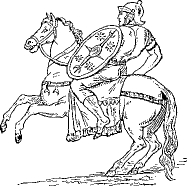
EQUES ROMANUS
This vocabulary contains only the words used in the English-Latin
exercises. For details not given here, reference may be made to the
Latin-English vocabulary. The figures 1, 2, 3, 4, after verbs indicate
the conjugation.
A
B
C
D
E
F
G
H
I
J
K
L
M
N
O
P
Q
R
S
T
U
V
W
Y
Z
|
A
|
|
a, an, commonly not translated
able (be), possum, posse, potuī, ——( § 495)
abode, domicilium, domici´lī, n.
about (adv.), circiter
about (prep.), dē, with abl.
about to, expressed by fut. act. part.
abundance, cōpia, -ae, f.
across, trāns, with acc.
active, ācer, ācris, ācre
advance, prōgredior, 3
advantage, ūsus, -ūs, m.
advise, moneō, 2
after (conj.), postquam; often expressed by the perf.
part.
after (prep.), post, with acc.
against, in, contrā, with acc.
aid, auxilium, auxi´lī, n.
all, omnis, -e; tōtus, -a, -um ( § 108)
allow, patior, 3
ally, socius, socī, m.
almost, paene; ferē
alone, ūnus, -a, -um; sōlus, -a, -um ( § 108)
already, iam
also, quoque
always, semper
ambassador, lēgātus, -ī, m.
among, apud, with acc.
ancient, antīquus, -a, -um
and, et; atque (ac); -que
and so, itaque
Andromeda, Andromeda, -ae, f.
angry, īrātus, -a, um
animal, animal, -ālis, n.
|
announce, nūntiō, 1
annoying, molestus, -a, -um
another, alius, -a, -ud ( § 109)
any, ūllus, -a, -um ( § 108)
any one, anything, quisquam, quicquam or quidquam ( § 486)
appearance, fōrma, -ae, f.
appoint, creō, 1
approach, adpropinquō, 1, with dat.
are, used as auxiliary, not translated; as a copula, sum
( § 494)
arise, orior, 4
arm, bracchium, bracchī, n.
armed, armātus, -a, -um
arms, arma, -ōrum, n. plur.
army, exercitus, -ūs, m.
around, circum, with acc.
arrival, adventus, -us, m.
arrow, sagitta, -ae, f.
art of war, rēs mīlitāris
as possible, expressed by quam and superl..
ask, petō, 3; quaerō, 3; rogō, 1
assail, oppugnō, 1
at, in, with acc. or abl.; with names of towns, locative case
or abl. without a preposition ( § 268); time
when, abl.
at once, statim
at the beginning of summer, initā
aestāte
Athens, Athēnae, -ārum, f.
attack, impetus, -us, m.
attempt, cōnor, 1; temptō, 1
away from, ā or ab, with abl.
|
|
B
|
|
bad, malus, -a, -um
baggage, impedīmenta, -ōrum, n. plur.
bank, rīpa, -ae, f.
barbarians, barbarī, -ōrum, m. plur.
battle, proelium, proelī, n.; pugna, -ae. f.
be absent, be far, absum ( § 494)
be afraid, timeō, 2; vereor, 2
be in command of, praesum, with dat. ( §§ 494, 426)
be informed, certior fīō
be off, be distant, absum ( § 494)
be without, egeō, with abl. ( § 180)
beast (wild), fera, -ae, f.
beautiful, pulcher, -chra, -chrum
because, quia; quod
because of, propter, with acc.; or abl. of cause
before, heretofore (adv.), anteā
before (prep.), ante, with acc.;
prō, with abl.
begin, incipiō, 3
believe, crēdō, 3, with dat. ( § 153)
belong to, predicate genitive ( § 409)
best, optimus, superl. of bonus
betray, trādō, 3
better, melior, comp. of bonus
between, inter, with acc.
|
billow, fluctus, -us, m.
blood, sanguis, -inis, m.
body, corpus, -oris. n.
bold, audāx, -ācis; fortis, -e
boldly, audācter; fortiter
boldness, audācia, -ae, f.
booty, praeda, -ae, f.
both, each (of two), uterque, utraque, utrumque
both ... and, et ... et
boy, puer, -erī, m.
brave, fortis, -e
bravely, fortiter
bridge, pōns, pontis, m.
bright, clārus, -a, -um
bring back, reportō, 1
bring upon, īnferō, -ferre, -tulī, -lātus,
with acc. and dat. ( § 426)
brother, frāter, -tris, m.
building, aedificium, aedifi´cī. n.
burn, cremō, 1; incendō, 3
business, negōtium, negō´tī, n.
but, however, autem, sed
by, ā, ab, with abl.; denoting means, abl. alone; sometimes
implied in a participle
by night, noctū
|
|
C
|
|
Cæsar, Caesar, -aris, m.
calamity, calamitās, -ātis, f.
call, vocō, 1; appellō, 1; nōminō, 1
call together, convocō, 1
camp, castra, -ōrum, n. plur.
can, could, possum, posse, potuī, —— ( § 495)
capture, capiō, 3; occupō, 1
care, cūra, -ae, f.
care for, cūrō, 1
careful, attentus, -a, -um
carefulness, dīligentia, -ae, f.
carry, ferō, ferre, tulī, lātus ( § 498); portō, 1
carry on, gerō, 3
cart, carrus, -ī, m.
cause, causa, -ae, f.
cavalry, equitātus, -ūs, m.
cease, cessō, 1
Cepheus, Cēpheus, -ī, m.
certain (a), quīdam, quaedam, quoddam (quiddam) ( § 485)
chicken, gallīna, -ae, f.
chief, prīnceps, -cipis, m.
children, līberī, -ōrum, m. plur.
choose, dēligō, 3
choose, elect, creō, 1
|
citizen, cīvis, -is, m. and f. ( § 243. 1)
city, urbs, urbis, f.
clear, clārus, -a, -um
cohort, cohors, -rtis, f.
come, veniō, 4
command, imperō, 1, with dat. ( § 45); iubeō, 2; praesum, with
dat. ( § 426)
commit, committō, 3
commonwealth, rēs pūblica, reī pūblicae
concerning, dē, with abl.
conquer, superō, 1; vincō, 3
construct (a ditch), perdūcō, 3
consul, cōnsul, -ulis, m.
contrary to, contrā, with acc.
Corinth, Corinthus, -ī, f.
Cornelia, Cornēlia, -ae, f.
Cornelius, Cornēlius, Cornē´li, m.
corselet, lōrīca, -ae, f.
cottage, casa, -ae, f.
country, as distinguished from the city, rūs, rūris,
n.; as territory, fīnēs, -ium, m., plur. of fīnis
courage, virtūs, -ūtis, f.
crime, scelus, -eris, n.
cross, trānseō, 4 ( § 499)
crown, corōna, -ae, f.
|
|
D
|
|
daily, cotīdiē
danger, perīculum, -ī, n.
daughter, fīlia, -ae, f. ( § 67)
day, diēs, -ēī, m.
daybreak, prīma lūx
dear, cārus, -a, -um
death, mors, mortis, f.
deed, rēs, reī, f.
deep, altus, -a, -um
defeat, calamitās, -ātis, f.
defend, dēfendō, 3
delay (Noun), mora, -ae, f.
delay (verb), moror, 1
demand, postulō, 1
dense, dēnsus, -a, -um
depart, discēdō, 3; exeō, 4; proficīscor, 3
dependent, cliēns, -entis, m.
design, cōnsilium, consi´lī n.
desire, cupiō, 3
destroy, dēleō, 2
|
Diana, Diāna, -ae, f.
differ, differō, differre, distulī, dīlātus ( § 498)
different, dissimilis, -e
difficult, difficilis, -e
difficulty, difficultās, -ātis, f.
diligence, dīligentia, -ae, f.
dinner, cēna, -ae, f.
disaster, calamitās, -ātis, f.
distant (be), absum, -esse, āfuī, āfutūrus ( § 494)
ditch, fossa, -ae, f.
do, agō, 3; faciō, 3; when used as auxiliary, not
translated
down from, dē, with abl.
drag, trahō, 3
drive, agō, 3
dwell, habitō, 1; incolō, 3; vīvō, 3
dwelling, aedificium, aedifi´cī, n.
|
|
|
each, quisque, quaeque, quidque (quodque) ( § 484)
each of two, uterque, utraque, utrumque
each other, inter with acc. of a reflexive
eager, ācer, ācris, ācre; alacer, alacris, alacre
eager (be), studeō, 2
eagerness, studium, studī, n.
eagle, aquila, -ae, f.
easily, facile
easy, facilis, -e
|
either ... or, aut ... aut
empire, imperium, impe´rī, n.
employ, negōtium dō
encourage, hortor, 1
enemy, hostis, -is, m. and f.; inimīcus, -ī,
m.
enough, satis
entire, tōtus, -a, -um ( § 108)
expectation, opīniō, -ōnis, f.
eye, oculus, -ī, m.
|
|
F
|
|
faithless, perfidus, -a, -um
famous, clārus, -a, -um
far, longē
farmer, agricola, -ae, m.
farther, ulterior, -ius
father, pater, patris, m.
fatherland, patria, -ae, f.
favor, faveō, 2
favorable, idōneus, -a,-um; secundus, -a, -um
fear, metus, -ūs, m.; timor, -ōris, m.
fear, be afraid, timeō, 2
few, paucī, -ae, -a
field, ager, agrī, m.
fifteen, quīndecim
fight, contendō, 3; pugnō, 1
find, reperiō, 4
finish, cōnficiō, 3
firmness, cōnstantia, -ae, f.
first, prīmus, -a, -um
flee, fugiō, 3
flight, fuga, -ae, f.
fly, volō, 1
foe, see enemy
follow close after, subsequor, 3
food, cibus, -ī, m.
foot, pēs, pedis, m.
|
foot-soldier, pedes, -itis, m.
for (conj.), enim, nam
for (prep.), sign of dat.; dē, prō, with abl.;
to express purpose, ad, with gerundive; implied in acc. of time
and of extent of space
for a long time, diū
forbid, vetō, 1
forces, cōpiae, -ārum, f., plur. of cōpia
forest, silva, -ae, f.
fort, castellum, -ī, n.; castrum, -ī, n.
fortification, mūnitiō, -ōnis, f.
fortify, mūniō, 4
fortune, fortūna, -ae, f.
fourth, quārtus, -a, -um
free, līber, -era, -erum
free, liberate, līberō, 1
frequent, crēber, -bra, -brum
friend, amīcus, -ī, m.
friendly (adj.), amīcus, -a, -um
friendly (adv.), amīcē
friendship, amīcitia, -ae, f.
frighten, perterreō, 2
from, ā or ab, dē, ē, ex, with abl. Often expressed by
the separative ablative without a prep.
from each other, inter, with acc. of a reflexive
pron.
full, plēnus, -a, -um
|
|
G
|
|
Galba, Galba, -ae, m.
garland, corōna, -ae, f.
garrison, praesidium, praesi´dī, n.
gate, porta, -ae, f.
Gaul, Gallia, -ae, f.
Gaul (a), Gallus, -ī, m.
general, imperātor, -ōris, m.
Geneva, Genāva, -ae, f.
gentle, lēnis, -e
German, Germānus, -a, -um
Germans (the), Germānī, -ōrum, m. plur.
Germany, Germānia, -ae, f.
get (dinner), parō, 1
girl, puella, -ae, f.
|
give, dō, dare, dedī, datus
give over, surrender, dēdō, 3; trādō, 3
give up, omittō, 3
go forth, prōgredior, 3
god, deus, -ī, m. ( § 468)
goddess, dea, -ae, f. ( § 67)
gold, aurum, -ī, n.
good, bonus, -a, -um
grain, frūmentum, -ī, n.
grain supply, rēs frūmentāria
great, ingēns, -entis; magnus, -a, -um
greatest, maximus, -a, -um; summus, -a, -um
guard, praesidium, praesi´dī, n.
|
|
H
|
|
hand, manus, -ūs, f.
happy, laetus, -a, -um
harbor, portus, -ūs, m.
hasten, contendō, 3; mātūrō, 1; properō, 1
hateful, invīsus, -a, -um
haughty, superbus, -a, -um
have, habeō, 2
have no power, nihil possum
he, is; hic; iste; ille; or not expressed
head, caput, -itis, n.
hear, audiō
heart, animus, -ī, m.
heavy, gravis, -e
Helvetii (the), Helvētiī, -ōrum, m. plur.
hem in, contineō, 2
hen, gallīna, -ae, f.
her, eius; huius; istīus; illīus; reflexive, suus, -a, -um
( § 116)
hide, abdō, 3
|
high, altus, -a, -um
highest, summus, -a, -um
hill, collis, -is, m.
himself, suī. See self
hindrance, impedīmentum, -ī, n.
his, eius; huius; istīus; illīus; reflexive, suus, -a, -um
( § 116)
hither, citerior, -ius ( § 315)
hold, teneō, 2
home, domus, -ūs, f. ( § 468).
hope (Noun), spēs, speī, f.
hope (verb), spērō, 1
horse, equus, -ī, m.
horseman, eques, -itis, m.
hostage, obses, -idis, m. and f.
hostile, inimīcus, -a, -um
hour, hōra, -ae, f.
house, domicilium, domici´lī, n.; domus, -ūs, f.
( § 468)
hurl, iaciō, 3
|
|
I
|
I, ego ( § 280);
or not expressed
if, sī. if not, nisi
ill, aeger, -gra, -grum
immediately, statim
in (of place), in, with abl.; (of time or of
specification) abl. without prep.
in order that, ut, with subjv.;
in order that not, lest, nē, with subjv.
in vain, frūstrā
industry, dīligentia, -ae, f.
inflict injuries upon, iniūriās īnferō with dat. ( § 426)
inflict punishment on, supplicium sūmō de
inform some one, aliquem certiōrem faciō
|
injure, noceō, 2, with dat. ( § 153)
injury, iniūria, -ae, f.
into, in, with acc.
intrust, committō, 3; mandō, 1
invite, vocō, 1
is, used as auxiliary, not translated; as a copula, sum
( § 494)
island, īnsula, -ae, f.
it, is; hie; iste; ille; or not expressed
Italy, Italia, -ae, f.
its, eius; huius; istīus; illīus; reflexive, suus, -a, -um
( § 116)
itself, suī. See self
|
|
J
|
|
join battle, proelium committō
journey, iter, itineris, n. ( § 468)
judge (Noun), iūdex, -icis, m.
|
judge (verb), iūdicō, 1
Julia, Iūlia, -ae, f.
just now, nūper
|
|
K
|
|
keep, contineō, 2; prohibeo, 2; teneō, 2
keep on doing something, expressed by the impf.
indic.
kill, interficiō, 3; necō, 1 ; occīdō, 3
|
king, rēx, rēgis, m.
kingdom, rēgnum, -ī, n.
know, cognōscō, 3, in perf.; sciō, 4
|
|
L
|
|
labor (Noun), labor, -ōris, m.
labor (verb), labōrō, 1
lack (Noun), inopia, -ae, f.
lack ( verb), egeō, 2, with abl. ( § 180)
lady, domina, -ae, f.
land, terra, -ae, f.
language, lingua, -ae, f.
large, ingēns, -entis ; magnus, -a, -um
larger, maior, maius
lately, nūper
Latona, Lātōna, -ae, f.
law, lēx, lēgis, f.
lay waste, vāstō, 1
lead, dūco, 3
leader, dux, ducis, m. and f.
learn, know, cognōscō, 3
leave, depart from, discēdō, 3
leave behind, abandon, relinquō, 3
|
left, sinister, -tra, -trum
legion, legiō, -ōnis, f.
legionaries, legiōnāriī, -ōrum, m. plur.
length, longitūdō, -inis, f.
lest, nē, with subjv.
letter (of the alphabet), littera, -ae, f; (an
epistle) litterae, -ārum, f. plur.
lieutenant, lēgātus, -ī, m.
light, lūx, lūcis, f.
like (adj.), similis, -e
like, love, amō, 1
line of battle, aciēs, aciēī, f.
little, parvus, -a, -um
live, habitō, 1; incolō, 3; vīvō, 3
long, longus, -a, -um
long, for a long time, diū
long for, dēsīderō, 1
look after, cūrō, 1
love, amō, 1
|
|
|
|
maid, maid servant, ancilla, -ae,f.
make, faciō, 3
make war upon, bellum īnferō with dat. ( § 426)
man, homō, -inis, m. and f.; vir, virī, m.
man-of-war, nāvis longa
many, multī, -ae, -a, plur. of multus
march, iter, itineris, n. ( § 468)
Mark, Mārcus, -ī, m.
marriage, mātrimōnium, mātrimō´nī, n.
master, dominus, -ī, m.; magīster, -trī, m.
matter, negōtium, negō´tī, n.; rēs, reī, f.
means, by means of, the abl.
messenger, nūntius, nūntī, m.
midnight, media nox
miles, mīlia passuum
mind, animus, -ī, m.; mēns, mentis, f.
|
mine, meus, -a, -um
mistress, domina, -ae, f.
money, pecūnia, -ae, f.
monster, mōnstrum, -ī, n.
month, mēnsis, -is, m.
moon, lūna, -ae, f.
more ( adj.), plūs, plūris ( § 313); or a comparative.
Adverb, magis
most (adj.), plūrimus, -a, -um; superl. degree.
Adverb, maximē; plūrimum
mother, māter, mātris, f.
mountain, mōns, montis, m.
move, moveō, 2
moved, commōtus, -a, -um
much (by), multō
multitude, multitūdō, -inis. f.
my, meus, -a, -um
myself, mē, reflexive. See self
|
|
N
|
|
name, nōmen, -inis, n.
nation, gēns, gentis, f.
near, propinquus, -a, -um
nearest, proximus, -a, -um
nearly, ferē
neighbor, fīnitimus, -ī, in.
neighboring, fīinitimus, -a, -um
neither, neque or nec;
neither ... nor, neque (nec) ... neque (nec)
never, numquam
nevertheless, tamen
new, novus, -a, -um
next day, postrīdiē eius diēī
next to, proximus, -a, -um
|
night, nox, noctis, f.
nine, novem
no, minimē; or repeat verb with a negative ( § 210)
no, none, nūllus, -a, -um ( § 109)
no one, nēmō, nūllīus
nor, neque or nec
not, nōn
not even, nē ... quidem
not only ... but also, nōn sōlum ... sed etiam
nothing, nihil or nihilum, -ī, n.
now, nunc
number, numerus, -ī, m.
|
|
O
|
obey, pāreō, 2, with dat. ( § 153)
of, sign of gen.;
dē, with abl.;
out of, ē or ex, with abl.
often, saepe
on (of place), in, with abl.;
(of time) abl. without prep.
on account of, propter, with acc.; or abl. of cause.
on all sides, undique
once (upon a time), ōlim
one, ūnus, -a, -um ( § 108)
one ... another, alius ... alius ( § 110)
only (adv.), sōlum; tantum
|
opportune, opportunus, -a, -um
opposite, adversus, -a, -um
oracle, ōrāculum, -ī, n.
orator, ōrātor, -ōris, m.
order, imperō, 1; iubeō, 2
ornament, ōrnāmentum, -ī, n.
other, alius, -a, -ud ( § 109)
others (the), reliquī, -ōrum, m. plur.
ought, dēbeō, 2
our, noster, -tra, -trum
ourselves, nōs, as reflexive object. See self
overcome, superō, 1 ; vincō, 3
own (his, her, its, their), suus, -a, -um
|
|
P
|
|
part, pars, partis, f.
peace, pāx, pācis, f.
people, populus, -ī, m.
Perseus, Perseus, -ī, m.
persuade, persuādeō, 2, with dat. ( § 153)
pitch camp, castra pōnō
place (Noun), locus, -ī, m.
place, arrange, conlocō, 1
place, put, pōnō, 3
place in command, praeficiō, 3, with acc. and dat. ( § 426)
plan (a), cōnsilium, cōnsi´lī, n.
please, placeō, 2, with dat. ( § 154)
pleasing, grātus, -a, -um
plow, arō, 1
Pompeii, Pompēiī, -ōrum, m. plur.
|
possible (as), expressed by quam and superl.
powerful (be), valeō, 2
praise, laudō, 1
prefer, mālō, mālle, māluī, —— ( § 497)
prepare for, parō, 1, with acc.
press hard, premō, 3
protection, fidēs, fideī, f.
province, prōvincia, -ae, f.
public, pūblicus, -a, -um
Publius, Pūblius, Pūblī, m.
punishment, poena, -ae, f.; supplicium, suppli´cī,
n.
purpose, for the purpose of, ut, quī, or quō, with
subjv.;
ad, with gerund or gerundive; causā, following the genitive of
a gerund or gerundive
pursue, īnsequor, 3
|
|
Q
|
|
queen, rēgīna, -ae, f.
quickly, celeriter
|
quite, expressed by the comp. degree
|
|
R
|
|
rampart, vāllum, -ī, n.
rear, novissimum agmen
reason, causa, -ae, f.
receive, accipiō, 3; excipiō, 3
recent, recēns, -entis
recently, nūper
redoubt, castellum, -ī, n.
refuse, recūsō, 1
remain, maneō, 2
remaining, reliquus, -a, -um
reply, respondeō, 2
report (Noun), fama, -ae, f.; rūmor, -ōris,
m.
report ( verb), adferō; dēferō; referō ( § 498)
republic, rēs pūblica
require, postulō, 1
resist, resistō, 3, with dat. ( § 154)
|
rest (the), reliquī, -ōrum, m. plur.
restrain, contineō, 2
retainer, cliēns, -entis, m.
retreat, pedem referō; terga vertō
return, redeō, 4; revertor, 3
revolution, rēs novae
Rhine, Rhēnus, -ī, m.
right, dexter, -tra, -trum
river, flūmen, -inis, n.; fluvius, fluvī, m.
road, via, -ae, f.
Roman, Rōmānus, -a, -um
Rome, Rōma, -ae, f.
row, ōrdō, -inis, m.
rule, regō, 3
rumor, fāma, -ae, f.; rūmor, -ōris, m.
run, currō, 3
|
|
S
|
|
sacrifice, sacrum, -ī, n.
safety, salūs, -ūtis, f.
sail, nāvigō, 1
sailor, nauta, -ae, m.
sake, for the sake of, causā, following a gen.
same, īdem, eadem, idem ( § 287)
savages, barbarī, -ōrum, m. plur.
save, servō, 1
say, dīcō, 3
school, lūdus, -ī, m.; schola, -ae, f.
scout, explōrātor, -ōris, m.
sea, mare, -is, n.
second, secundus, -a, -um
see, videō, 2
seek, petō, 3
seem, videor, 2, passive of videō
seize, occupō, 1; rapiō, 3
send, mittō, 3
set fire to, incendō, 3
set out, proficīscor, 3
seven, septem
Sextus, Sextus, -ī, m.
she, ea; haec; ista; illa ( § 115); or not expressed
short, brevis, -e
shout, clāmor, -ōris, m.
show, dēmōnstrō, 1
Sicily, Sicilia, -ae, f.
sick, aeger, -gra, -grum
side, latus, -eris, n.
siege, obsidiō, -ōnis, f.
since, cum, with subjv. ( § 396); the abl. abs. ( § 381)
sing, canō, 3; cantō, 1
sister, soror, -ōris, f.
sit, sedeō, 2
size, magnitūdō, -inis, f.
skillful, perītus, -a, -um
slave, servus, -ī, m.
slavery, servitiūs, -ūtis, f.
slow, tardus, -a, -um
|
small, parvus, -a, -um
snatch, rapiō, 3
so, ita; sīc; tam
so great, tantus, -a, -um
so that, ut; so that not, ut nōn
soldier, mīles, -itis, m.
some, often not expressed; quis (quī), qua (quae), quid
(quod); aliquī, aliqua, aliquod
some one, quis; aliquis ( § 487)
some ... others, aliī ... aliī ( § 110)
something, quid; aliquid ( § 487)
son, fīlius, fīlī, m.
soon, mox
space, spatium, spatī, n.
spear, pīlum, -ī, n.
spirited, ācer, ācris, ācre; alacer, alacris, alacre
spring, fōns, fontis, m.
spur, calcar, -āris, n.
stand, stō, 1
state, cīvitās, -ātis, f.
station, conlocō, 1
steadiness, cōnstantia, -ae, f.
stone, lapis, -idis, m.
storm, oppugnō, 1
story, fābula, -ae, f.
street, via, -ae, f.
strength, vīs, (vīs), f.
strong, fortis, -e; validus, -a, -um
sturdy, validus, -a, -um
such, tālis, -e
suddenly, subitō
suffer punishment, supplicium dō
sufficiently, satis
suitable, idōneus, -a, -um
summer, aestās, -ātis, f.
sun, sōl, sōlis, m.
supplies, commeātus, -ūs, m.
surrender, trādō, 3
suspect, suspicor, 1
swift, celer, -eris, -ere; vēlōx, -ōcis
sword, gladius, gladī, m.
|
|
T
|
|
take, capture, capiō, 3
take part in, intersum, -esse, -fuī, -futūrus, with dat.
( § 426)
take possession of, occupō, 1
tall, altus, -a, -um
task, opus, operis, n.
teach, doceō, 2
teacher, magister, -trī, m.
tear (Noun), lacrima, -ae, f.
tell, dīcō, 3; nārrō, 1
ten, decem
terrified, perterritus, -a, -um
terrify, perterreō, 2
than, quam
that (conj. after verbs of saying and the like), not
expressed
that (pron.), is; iste; ille
that, in order that, in purpose clauses, ut; after
verbs of fearing, nē ( §§ 349,
366,
372)
that not, lest, in purpose clauses, nē; after verbs of
fearing, ut ( §§ 349, 366, 372)
the, not expressed
their, gen. plur. of is; reflexive, suus, -a, -um
( § 116)
their own, suus, -a, -um ( § 116)
then, at that time, tum
then, in the next place, deinde, tum
there, as expletive, not expressed
there, in that place, ibi
therefore, itaque
they, iī; hī; istī; illī; or not expressed
|
think, arbitror, 1; exīstimō, 1; putō, 1
third, tertius, -a, -um
this, hic, haec, hoc; is, ea, id
though, cum. with subjv. ( § 396)
three, trēs, tria ( § 479)
through, per, with acc.
thy, tuus, -a, -um
time, tempus, -oris, n.
to, sign of dat.; ad, in, with acc.; expressing
purpose, ut, quī, with subjv.; ad, with gerund or
gerundive
to each other, inter, with acc. of a reflexive pron.
to-day, hodiē
tooth, dēns, dentis, m.
top of, summus, -a, -um
town, oppidum, -ī, n.
townsman, oppidānus, -ī, m.
trace, vestīgium, vestī´gī, n.
trader, mercātor, -ōris, m.
train, exerceō, 2
tree, arbor, -oris, f.
tribe, gēns, gentis, f.
troops, cōpiae, -ārum, f. plur.
true, vērus, -a, -um
trumpet, tuba, -ae, f.
try, cōnor, 1; temptō, 1
twelve, duodecim
two, duo, duae, duo ( § 479)
|
|
U
|
|
under, sub, with acc. or abl.
undertake, suscipiō, 3
unharmed, incolumis, -e
unless, nisi
|
unlike, dissimilis, -e
unwilling ( be), nōlō, nōlle, nōluī, —— ( § 497)
up to, sub, with acc.
us, nōs, acc. plur. of ego
|
|
V
|
very, superl. degree; maximē; ipse, -a, -um ( § 285)
victor, victor, -ōris, m.
victory, victōria, -ae, f.
village, vīcus, -ī, m.
|
violence, vīs, (vīs), f.
violently, vehementer
voice, vōx, vōcis, f.
|
|
W
|
|
wage, gerō, 3
wagon, carrus. -ī, m.
wall, mūrus, -ī, m.
want, inopia, -ae, f.
war, bellum, -ī, n.
watch, vigilia, -ae, f.
water, aqua, -ae, f.
wave, fluctus, -ūs, m.
way, iter, itineris, n. ( § 468); via, -ae, f.
way, manner, modus, -ī, m.
we, nōs, plur. of ego; or not expressed
weak, īnfīrmus, -a, -um
weapons, arma, -ōrum, n. plur.; tēla, -ōrum, n.
plur.
wear, gerō, 3
weary, dēfessus, -a, -um
what, quis (quī), quae, quid (quod) ( § 483)
when, ubi; cum ( § 396); often expressed by a
participle
where, ubi
which, quī, quae, quod ( § 482);
which of two, uter, utra, utrum ( § 108)
while, expressed by a participle
whither, quō
who ( rel.), quī, quae ( § 482); ( interrog.) quis ( § 483)
whole, tōtus, -a, -um ( § 108)
whose, cuius; quōrum, quārum, quōrum, gen. of quī, quae,
quod, rel.; or of quis, quid, interrog.
why, cūr
|
wicked, malus, -a, -um
wide, lātus, -a, -um
width, lātitūdō, -inis, f.
wild beast, fera, -ae, f.
willing ( be), volō, velle, voluī, —— ( § 497)
win (a victory), reportō, 1
wind, ventus, -ī, m.
wine, vīnum, -ī, n.
wing, cornū, -ūs, n.
winter, hiems, -emis, f.
wisdom, cōnsilium, consi´lī, n.
wish, cupiō, 3; volō, velle, voluī, —— ( § 497);
wish not, nōlō, nōlle, nōluī, —— ( § 497)
with, cum, with abl.; sometimes abl. alone
withdraw, sē recipere
without, sine, with abl.
woman, fēmina, -ae, f.; mulier, -eris, f.
wonderful, mīrus, -a, -um
word, verbum, -ī, n.
work, labor, -ōris, m.; opus, -eris, n.
worse, peior, peius, comp. of malus
worst, pessimus, -a, -um, superl. of malus
wound (Noun), vulnus, -eris, n.
wound (verb), vulnerō, 1
wreath, corōna, -ae, f.
wretched, miser, -era, -erum
wrong, iniūria, -ae, f.
|
|
Y
|
|
year, annus, -ī, m.
yes, certē; ita; vērō; or, more usually, repeat the verb
( § 210)
yonder (that), ille, -a, -ud
|
you, sing. tū; plur. vōs ( § 480); or not expressed
your, sing. tuus, -a, -um; plur. vester, -tra,
-trum ( § 98. b)
|
|
Z
|
|
zeal, studium, studī, n.
|
|
The numbers in all cases refer to sections.
|
ā-declension of nouns, 57,
461
ā-verbs, conjugation of, 488
ablative case, 48, 50
absolute, 381
after a comparative, 309
of accompaniment, 104
of agent, 181
of cause, 102
of description,
444, 445
of manner, 105
of means or instrument, 103
of measure of difference, 317
of place from which, 179
of place where, 265
of separation, 180
of specification, 398
of time, 275
accent,
14-16
accompaniment
abl. of, 104
accusative case, 33
as subject of the infinitive, 214
object, 37
of duration and extent, 336
of place to which, 263, 266
predicate, 392
with prepositions, 340
|
adjectives,
54, 55
agreement, 65
comparison
regular, 301
by adverbs, 302
irregular, 307,
311,
312, 315
declension of comparatives, 303
of first and second declensions,
83,
93, 469
of third declension, 250-257, 471
with the dative, 143
adverbs, 319
comparison,
320, 323
formation
regular,
320, 321
irregular,
322, 323
agent
expressed by the abl. with ā or ab, 181
agreement
of adjectives,
65, 215. a
of appositives, 81
of predicate nouns, 76
of relative pronouns, 224
of verbs, 28
aliquis, 487
alius, 108,
110,
470
alphabet,
1-3
alter,
108, 110
antepenult, 9. 3
accent of, 15
apposition,
80, 81
article
not used in Latin,
22. a
|
| |
|
base, 58
| |
| |
|
cardinal numerals, 327-329, 478
case, 32. 2
causal clauses with cum,
395,
396
cause,
expressed by the abl., 102
characteristic
subjv. of,
389, 390
comparative
declension of, 303
comparison
abl. of, 309
degrees of, 300
of adjectives,
300-315
irregular,
311-315, 473, 475
of adverbs
regular,
320-476
irregular,
323, 477
positive wanting, 315
six adjectives in -lis, 307
|
complementary infinitive, 215
compound verbs
with the dative,
425, 426
concessive clauses with cum,
395,
396
conjugation stems, 184
conjugations
the four regular,
126, 488-491
irregular,
494-500
consonants, 2
copula, 21
cum
conjunction, 395
cum
preposition, 209
|
| |
|
dative case, 43
of indirect object,
44, 45
of purpose, or end for which, 437
with adjectives, 143
with compound verbs, 426
with special verbs, 153
dea
declension of, 67
declension,
23, 32
degree of difference
expressed by the abl., 317
demonstrative adjectives and pronouns,
112-115, 290-292, 481
deponent verbs, 338, 339, 493
descriptive ablative and genitive,
441-445
|
descriptive relative clause
with the subjv.,
389, 390
deus
declension of, 468
difference, measure of,
316,
317
diphthongs, 6
direct statements, 414
distributive numerals,
327. 3,
334
domī
locative, 267
domus
declension of, 468
duo
declension of, 479
duration of time, expressed by the acc., 336
|
| |
|
ē-declension of nouns,
272,
273, 467
ē-verbs, conjugation of, 489
ĕ-verbs, conjugation of, 490
ego
declension of,
280, 480
|
enclitics, 16
eō
conjugation of, 499
extent of space
expressed by the acc., 336
|
| |
|
fearing
subjv. after verbs of, 370-372
ferō
conjugation of, 498
fifth or ē-declension,
272,
273, 467
fīlia
declension of, 67
fīlius
declension of,
87-89
finite verb
defined, 173
fīō
conjugation of, 500
|
first conjugation, 488
first or ā-declension, 57,
461
fourth conjugation, 491
fourth or u-declension,
259,
260, 466
from
how expressed,
178-181
future participle
formation of,
374. c
future perfect
formation of
active, 187. 3
passive, 202
future tense
formation of,
137, 156
|
| |
|
gender
in English and in Latin, 60
in the first declension, 61
in the second declension, 72
in the third declension, 247
in the fourth declension, 260
in the fifth declension, 272
general observations on declension, 74
|
genitive case
English equivalents of, 33
of description,
443, 445
of nouns in -ius and -ium, 87
partitive, 331
possessive,
38, 409
gerund
a verbal noun,
402, 403
gerundive
a verbal adjective, 404
with ad to express purpose, 407
|
| |
|
hic
declension and use of, 290, 291
|
how to read Latin, 17
|
| |
|
i
consonant, 3
i-stems of nouns, 231, 241-244
ī-verbs
conjugation of, 491
īdem
declension of,
287, 481
iēns
declension of, 472
ille
declension and use of, 290-293, 481
imperative
formation of,
161, 175
irregular, 161. 2
in commands, 161
imperfect indicative, formation and use of,
133,
134,
165. 1
imperfect subjunctive, 354
indefinite pronouns and adjectives,
296,
297,
484-487
independent clauses, 219
indirect object, 44, 45
indirect questions,
430-432
indirect statements,
414-419
infinitive
as object, 213
as subject, 216
complementary, 215
definition of, 173
does not express purpose, 352
formation of, 126,
174,
205, 206
in indirect statements, 415-410
used as in English, 213-216
|
inflection
defined, 23
instrument
abl. of,
100. b, 103
intensive pronoun
ipse, declension and use of,
285,
286, 481
interrogative pronouns and adjectives,
225-227, 483
intransitive verbs,
defined,
20. a
with the dative, 153
iō-verbs of the third conj., 492
ipse
declension and use of, 285, 481
irregular adjectives, 108
irregular comparison
of adjectives, 307
311,
312
of adverbs, 323
irregular nouns, 67, 246, 468
irregular verbs,
494-500
is
declension and use of, 113-116
iste
declension and use of, 290, 292, 481
iter
declension of, 468
|
| |
|
Latin word order, 68
|
locative case, 267
|
| |
|
magis and maximē
comparison by, 302
mālō
conjugation of,
4.97
manner
abl. of, 105
means
abl. of, 103
|
measure of difference
abl. of,
316, 317
mīlle,
declension of, 479
construction with,
331. a,b
moods, defined, 121
|
| |
|
-ne, enclitic
in questions, 210
nē, conj., that not, lest
with negative clauses of purpose, 350.II
with verbs of fearing, 370
nine irregular adjectives,
108-110
nōlō
conjugation of, 497
nominative case, 35, 36
nōnne
in questions, 210
|
nōs
declension of,
280, 480
Nouns, 19. 2
first declension,
57, 461
second declension,
71-74,87-92,462
third declension,
230-247, 463-465
fourth declension, 259, 260, 466
fifth declension, 272,
273,
467
num, in questions, 210
number, 24
numerals,
327-334, 478, 479
|
| |
|
o-declension of nouns,
71-74, 87-92, 462
object, 20
direct, 37
indirect,
44, 45
|
order of words, 68
ordinal numerals,
327. 2,
478
|
| |
|
participial stem, 201. 2
participles, defined, 203
agreement of, 204
formation,
of present,
374. b
of perfect, 201
of future,
374. c,d
of deponent verbs, 375
tenses of, 376
translated by a clause, 377
partitive genitive, 330,
331
passive voice
defined, 163
formation of,
164, 202
penult, 9. 3
accent of, 15
perfect indicative
formation,
in the active,
185, 186
in the passive, 202
meaning of, 190
definite, 190
indefinite, 190
distinguished from the imperfect, 190
perfect infinitive
active, 195
passive, 205
perfect passive participle, 201
perfect stem, 185
perfect subjunctive
active, 361
passive, 362
person, 122
personal endings
active, 122
passive, 164
personal pronouns, 280,
480
place
where, whither, whence, 263-265
names of towns and domus and rūs,
266-268
pluperfect indicative
active, 187. 2
passive, 202
|
pluperfect subjunctive
active, 361
passive, 363
plūs
declension of, 313
possessive pronouns, 97,
98
possum
conjugation of, 495
predicate
defined, 19
predicate adjective
defined, 55
predicate noun, 75, 76
prepositions
with the abl., 209
with the acc., 340
present indicative, 128,
130, 147
present stem,
126. a
present subjunctive, 344
primary tenses, 356
principal parts, 183
pronouns
classification of, 278
defined,
19. 2. a
demonstrative, 481
indefinite,
297, 484-487
intensive, 285,
286,
481
interrogative, 483
personal, 480
possessive,
97, 98
reflexive, 281
relative,
220, 221
pronunciation,
4-7
prōsum
conjugation of, 496
purpose
dative of,
436, 437
expressed by the gerund or gerundive with ad, 407
not expressed by the infinitive, 352
subjunctive of,
348-350, 365-367
|
| |
|
quality
gen. or abl. of,
441-445
quam
with a comparative, 308
quantity,
11-13
questions
direct, 210
indirect,
430-432
quī
declension and use of, 220,221, 482
|
quīdam
declension of, 485
quis
declension and use of, 225-227, 483
quisquam
declension of, 486
quisque
declension of, 484
|
| |
|
reflexive pronouns, 281
relative clauses of characteristic or description,
389,
390
relative clauses of purpose,
348,
349
relative pronouns, 220,
221
|
result clauses, 384-387
reviews,
502-528
rūs
constructions of, 266
|
| |
|
sē
distinguished from ipse,
285. a
second conjugation, 489
second or o-declension,
71-93, 462
sentences
simple, complex, compound, 219
separation
abl. of, 180
separative ablative,
178-181
sequence of tenses,
356-358
space
extent of, expressed by the acc., 336
specification
abl. of, 398
stems
of nouns, 230
of verbs, 184
subject
defined, 19. 2
of the infinitive, 213, 214
subjunctive
formation of the present, 344
of the imperfect, 354
of the perfect,
361, 362
of the pluperfect,
361. c,
363
|
subjunctive constructions
characteristic or description,
389,
390
indirect questions, 430-432
purpose, 349,
366,
372
result,
385, 386
time, cause, or concession, with cum,
395,
396
subjunctive ideas, 346
subjunctive tenses, 342,
343
subordinate clauses, 219
suī
declension of,
281, 480
sum
conjugation of, 494
suus
use of,
98. c, 116
syllables, 8
division of, 9
quantity of, 13
syntax
rules of, 501
|
| |
|
temporal clauses with cum,
395,
396
tense
defined, 120
tense signs
imperfect, 133
future,
137, 156
pluperfect active, 187. 2
future perfect active, 187. 3
tenses
primary and secondary, 356
sequence of,
357, 358
third conjugation,
490, 492
third declension of nouns
classes,
231, 463
consonant stems,
232-238, 464
gender, 247
i-stems,
241-244, 465
irregular nouns, 246
|
time
abl. of, 275
time
acc. of, 336
towns
rules for names of, 266, 267, 268
transitive verb,
20. a
trēs
declension of, 479
tū
declension of,
280, 480
tuus
compared with vester, 98.
b
|
| |
|
u-declension of nouns,
259,
260, 466
|
ultima, 9. 3
|
| |
|
verbs
agreement of, 28
conjugation of,
126, 488-491
deponent, 338,
339,
493
irregular,
494-500
personal endings of, 122, 164
principal parts of, 183
vester
compared with tuus,
98. b
vīs
declension of, 468
vocabularies
English-Latin, pp.
332-343
Latin-English, pp.
299-331
special, pp.
283-298
|
vocative case,
56. a
of nouns in -us of the second declension,
73. b
of proper nouns in -ius and of fīlius, 88
voice
defined, 163
volō
conjugation of, 497
vōs
declension of,
280, 480
vowels
sounds of,
5, 6
quantity of, 12
|
