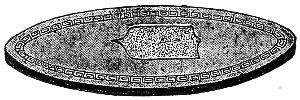
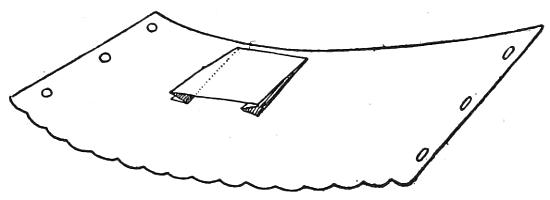
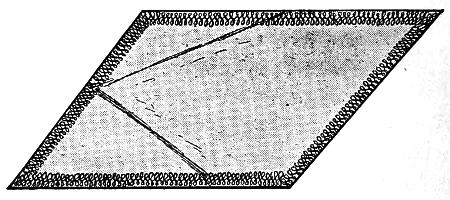
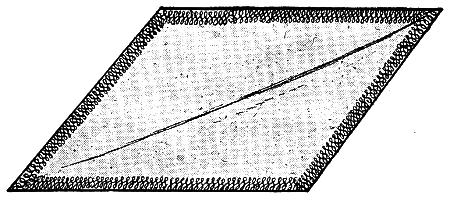
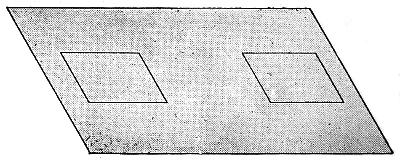
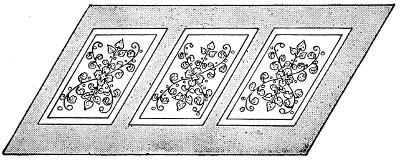
Requirements. Coin mat loaded with two
double pennies, shell side undermost. Lighted
candle and velvet mat (with pocket) on table.
Presentation. Performer comes forward with
coin mat hanging down in his right hand (mouth of
loaded space upwards), and asks for the loan of a
penny, marked in some conspicuous way. Receiving
it on the mat, he shows it, so placed, to the persons,
seated on each side of the owner, in so doing
making it obvious to them, without remark, that
his hands are otherwise empty. Then returning to
his table, with the mat and the coin on it still in
his hand, he delivers patter to the following effect:
“Now I am going to show you a nice easy way
of making money. I was told when I was a small
boy, ‘Take care of the pence, and the pounds will
take care of themselves.’ I believe they do. The
pounds take such good care of themselves that very
few of them seem to come my way. But you can
make a bit even with pennies, if you know how to
set about it. All you need is a really good penny
to start with. It doesn’t matter how you get the
penny. You may beg, borrow, or steal it. Personally,
I prefer to borrow it. If you try the other
two ways you get yourself disliked, but you can
always get people to lend you things, if you ask
prettily; and I’ve always been celebrated for my
nice borrowing manner. You must all have noticed
that the gentleman lent me a penny without
the slightest hesitation. I daresay if I had asked
him, he would have made it two-pence, or even six-pence,
if he had as much about him. In this case,
however, one penny is enough for my purpose;
and here it is with the owner’s own mark upon it.
Observe that it is just a plain ordinary penny, and
you can see for yourselves that it is the only one
I have—in my hands, I mean. I am always truthful.
As a matter of fact, I believe I have another
in my left trouser-pocket, but I promise you that
I won’t use it.”
Pass mat, with coin on it, from one hand to the
other, showing the hands otherwise empty, and
leaving the mat finally in the right hand: then let
the marked coin slide off it into left hand, the
concealed coins passing with it. Put down the
mat, and show all three coins together (the marked
coin in front) held between forefinger and thumb,
broadside toward the spectators. Thus held, they
are, even at a few feet distant, undistinguishable
from a single coin.
“Now I am going to make money. Not much,
perhaps, in fact only a penny at a time. I shall
start by making this one penny into two. Cent
per cent is not bad, is it? Observe, I use no violence.
It’s all done by kindness. I just warm the
coin a little over this candle-flame. That softens
the metal and I am able to squeeze another penny
out of this one, so!”
Show as two accordingly, by sliding off the
hindermost coin in its shell, exhibiting it on both
sides, and laying it on the table.
“You have all heard of turning an honest penny.
Well, this is one way of doing it. It is said, too,
that one good turn deserves another, so we’ll try
again. I warm the first penny a little more, and
again I pull another out of it.” (Draw second
double coin from behind the original penny.)
“Now we have three, two in my hands” (showing
one in each hand) “and one on the table.
“I think I heard somebody say that I couldn’t
make any more? I don’t like to do it, because the
process takes a good deal out of the original penny,
and I might spoil it. On the other hand, I don’t
like to decline a challenge, so here goes! I warm
these two again, and then, with a little extra pressure,
because it naturally becomes more difficult
each time, I get yet another penny, as you see.
So now, in all, we have four.” (Show those in
hand as three, by drawing solid coin out of shell,
then, picking up double coin from mat, show as four
accordingly.) “Did I hear a lady say ‘Just one
more’? Well, then, one more.” (Develop the
double coin just picked up, and show as five.)
“But here I must really draw the line. If I kept
on like this, there would be none of the original
penny left. It is already getting weaker and
weaker. Besides, there wouldn’t be time for anything
else, and I have several still more wonderful
things to show you.
“And now to put these extra pennies back again
into the original coin. At present it is only one-fifth
its proper weight and if the owner tried to
pass it in this condition there would be trouble.
I should explain, by the way, that these others are
not really solid coins: though they look like it.
They are what the spiritualists call astral coins,
if you know what that means: I don’t quite know
myself; so I won’t attempt to explain, but I believe
in the Police Courts they are known as ‘duffers.’”
Lay all five coins on the velvet mat, each of the
shells slightly overlapping the solid coin to which
it belongs.
“Here we have one, two, three, four, five. I
pick up two of them.” (Draw shell over solid in
act of picking up.) “I give them a gentle squeeze
and they become one only.” (Show as one, and
replace on mat behind the mouth of pocket.)
“Now I treat two more in the same way.”
(Repeat accordingly, replacing these also, as one,
on mat.) “We have now only three left. Let me
see, which is the original? Ah! here it is, with the
owner’s mark upon it.” (Pick it up and show in
left hand.) “Now I rub one of these others into
it.” (Make the movement of picking up one of
the double coins, and of rubbing it into the coin in
left hand, but in reality “vanish” it, in the supposed
act of picking up, into the pocket of mat.)
“And now I pass this other one into it in the
same way, and we have only the original penny left.
It is like the ten little niggers, isn’t it, only that
they never came back. Here is your penny, Sir.
Please observe that it still has your own mark
upon it, which is proof positive that there has
been ‘no deception.’”
N. B. If the performer is a novice, he may
simplify the trick by loading the coin mat with
one double and one ordinary coin only, or two
ordinary coins, limiting the successive productions
accordingly.
At an early period of my magical career, I
devised a trick to which I gave the name of Concatenation
Extraordinary, and which will be found
described in Later Magic, page 94. In effect it
consisted of the magical welding of a number of
loose iron links into a continuous chain. It was
performed by the aid of a Black Art table, a bottomless
tumbler, and a silk thread. “Though I
say it that shouldn’t,” it was an ingenious trick,
and I was very proud of it. Unfortunately, some
good natured friend (I rather think it was
Mr. David Devant) pointed out to me that about
ninety-five per cent of my ingenuity was wasted,
inasmuch as the same effect, so far as the spectator
was concerned, could be produced by infinitely
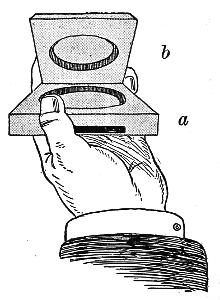
simpler means, viz.:—by using a glass with double
mirror partition, when all the other paraphernalia
became unnecessary. You had only to load the
hinder compartment with the complete chain, and
after a due amount of “talkee-talkee,” drop the
loose links into the forward one, turn the glass
round, and the deed was done.
The trick, as a trick, was just as good in its new
shape as before, but being at that time (comparatively)
young and foolish, its extreme simplicity
spoilt it for me, and I lost all interest in it. Not
long since, however, I was reminded of it by coming
across the chain and links which had figured in
my performance of the trick, and it struck me that,
in a slightly modified form, it may still be worth
the attention of the drawing-room conjurer.
The requirements for the trick in this, its latest
form, are as follows:
First, the mirror glass; and as to this I may note
in passing that the “mirror” is best made of tin-plate,
not too highly polished, in place of the looking-glass
plate which was, until a quite recent
period, generally employed for the purpose.
Secondly, a length of small iron chain, made up
of twenty-six links, connected in the centre by a
twenty-seventh link of brass.
Thirdly, two shorter lengths of similar chain,
consisting of thirteen links each, and a loose brass
link, corresponding to the one in the centre of the
longer chain. The complete chain is to be placed
at the outset in the hinder compartment of the
mirror glass, which should be of such a size that
the chain nearly fills it.
Lastly will be needed a bottle containing Eau de
Cologne, of which a few drops have been poured
on the chain in the glass.
The patter may run to something like the following
effect.
“You are doubtless aware, ladies and gentlemen,
that electricity is now largely employed in the
welding of metals. Of course to produce such a
result on a large scale, such as welding guns, enormous
strength of current is required; amounting
in fact to millions of ampères, or volts, or ohms, or
watts. I blush to confess I don’t know which is
which, but it’s of no consequence. If I had ever
so many ampères, or the rest of it, I shouldn’t know
what to do with them. I am only able to manufacture
my electricity on a very small scale, but
with the aid of a little magic, I get very good
results.
“You are also no doubt aware that when certain
metals, particularly copper and zinc, are brought
into close connection, an electrical current is set
up between them. The same thing applies, in a
less degree, to iron and brass, as I hope to be able
to show you.
“I have here two short lengths of iron chain.
Will somebody be kind enough to count the links?
You will find, I think, that there are exactly
thirteen in each. Please notice this, because, in
some mysterious way, it has something to do with
the success of my experiment. You know thirteen
is an unlucky number, and the chains themselves
don’t like to consist of that number of links, and
if they can alter it, they try to do so. I am going
to give them the opportunity, with a little electrical
assistance. Thirteen, as I have said, is an unlucky
number, and twice thirteen makes twenty-six,
which is not much better, but if you add one more,
you get twenty-seven, which is a very lucky number
indeed. Everybody knows that three is a
lucky number. Three times three are nine, which
of course must be luckier still, and three times nine
are twenty-seven, which is naturally best of all.
“Now I am going to give these two chains an
opportunity to convert themselves into that lucky
number, by taking in this extra link, which as you
perceive is brass, an opposition metal. Observe,
I drop one of the chains into this glass. See that
I do so fairly. Then I drop in the single link,
and lastly, the other piece of chain. And now, in
order to set up an electrical reaction, I add just a
few drops from this bottle of Eau de Cologne. As
a matter of fact, a little salt and water would have
the same effect, but I use Eau de Cologne because
it smells nicer. And now I must ask the loan of
some lady’s handkerchief, to cover the glass, and
concentrate the electric current.”
Holding the handkerchief in right hand, pick
up the glass with left hand, and raise it a few
inches from the table. In lowering it, cover it with
the handkerchief, and at the same time give it the
necessary half-turn. Take out your watch, and
make believe to time the operation, remarking, “I
find it needs a full half-minute, to allow the charm
to work. Time! Let us see how we have succeeded.”
Take off the handkerchief, and draw the chain
slowly out of the glass. “Yes. All is well. I
should say welded, and I trust you will say, ‘Well
done.’ The chain is complete, and now consists of
twenty-seven links, the lucky number. Perhaps
some gentleman will verify the fact.
“I must tell you frankly that I don’t guarantee
the correctness of my explanation. I can’t say
exactly how much the electricity has to do with it.
I only know that if you go to work the right way,
which means, do as I do, you get the result, and
there you are. This experiment always provokes
a lot of discussion. The other evening one gentleman
said it was done this way. A lady said it was
that way, and a sharp boy (the younger they are
the more they know) was quite sure it was done
another way altogether. But they were all wrong.
It is done just the way I have shown you, and if
you do as I do, and say as I say, you will no doubt
produce the same result.[7] If you don’t, well, you
will be no use as a conjurer, and you had better
go into some other business.”
Some less instructed reader may possibly
enquire, “But why the Eau de Cologne? What
does that do?” Precisely nothing, and therein lies
its virtue. As indicated in the section on “patter”
(post) it often happens that some little bit of
spoof, supererogatory in reality so far as the spectator
is concerned, is accepted as covering the real
key to the puzzle. This is a case in point. Taking
it for granted that the Eau de Cologne would not
be used without some reason, the spectator sets to
work to discover that reason, and so gets farther
from the real solution.
The root-idea of this item must be credited to
Signor Antonio Molini, the inventor of the very
effective stage trick known as Le Souper du
Diable. The principle on which that trick is
worked is so subtle, and withal so simple, that it is
surprising that it has not long since been applied
to the production of less bulky objects than the
tablecloth, eatables and drinkables which figure in
the Satanic supper. The following is an application
of the Signor Molini’s idea on a scale better
adapted to the drawing room.
Requisites.
(1) Three zinc or zinc-lined tubes, as a, b, c, in
Fig. 15, ranging in height from about three inches
upwards, and graduated in size so as to fit easily
one within the other.
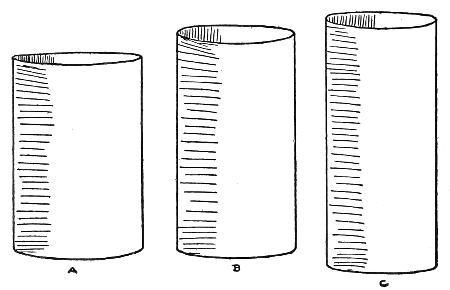
Fig. 15
(2) Three balls, one red and two white, of such
diameter as to pass easily through the narrowest
tube. Two smaller balls, one red and one white,
about half an inch in diameter.
(3) A box of matches.
Each of the two smaller tubes (c and d in diagram)
to be loaded with one of the larger white
balls, suspended from the upper edge of the tube
by a wire hook, shaped as a in Fig. 16, connected
with the ball by a loop of fine silk or cotton thread.
The red ball is vested, and the two little balls may
rest in a shallow tray or other appropriate receptacle
on the table, deep enough as to conceal them
from the view of the spectators.
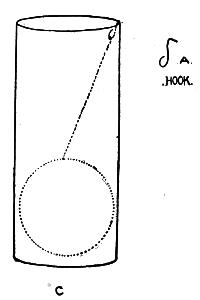
Fig. 16
Introductory Patter. “You have no idea, ladies
and gentlemen, what a lot of hints I get from different
people for the improvement of my entertainment.
If I were to adopt them all, I have no
doubt it would be very fine indeed. The worst of
it is that it would take a year or two to try them,
so for the present I am obliged to leave things as
they are.
“You will observe that I have here three tubes”
(showing No. 1 and passing wand through it to
prove it is empty), “quite ordinary tubes, with a
hole at each end, and nothing at all between. I
don’t suppose you would notice anything to object
to about them, but some people are so very particular.
A gentleman who said he had an artistic
eye (I don’t know which eye it was) said to me,
‘Look here, Professor, that trick of yours would be
ever so much better if you had all those tubes the
same size. That lot looks as if you had picked
them up at a jumble sale.’[8] I explained to him,
kindly but firmly, that there was a special reason
for having the three tubes of different sizes;
namely, that by so doing it was made possible”
(suiting the action to the word) “to pass this one
(No. 1) over this other (No. 2); and this again
over the smallest one, thereby saving much space
in packing. He said, ‘Never mind, you take my
tip and make ’em all the same size.’ I dare say
he was right, but I haven’t had time to do it yet.”
During this little harangue, which appears to be
mere “spoof,” you have practically worked the
trick. Suiting the action to the word, you have
passed the largest tube No. 1 over No. 2 and lifted
it off again. In its downward movement the tube
passes over the little hook on No. 2; but in lifting
it off again its upper edge comes within the outer
arm of the hook, and carries this off with the ball
attached to it, leaving tube No. 2 empty. The latter,
shown empty accordingly, is passed over No.
3 and carries off its load in the same way.
You have thus proved (!) in the most convincing
way that all three tubes are empty, though as
a matter of fact No. 3 is the only one in that condition,
Nos. 1 and 2 each containing a suspended
ball.
The patter from this point may vary according
to the fancy of the performer. If he has the knack
of producing the appropriate combination of fact
and fiction, it is preferable that he should do so for
himself. As I have elsewhere remarked, borrowed
patter rarely comes so “trippingly on the
tongue” as that of which the performer can say
with, let us hope, undue depreciation of his merits,
“a poor thing, but mine own.”
The fable with which I should myself introduce
the trick would run somewhat as follows:
“You have all heard, ladies and gentlemen, of
intensive culture, gooseberries grown while you
wait, and that sort of thing. It is done by enclosing
the seed, or the young plant, in a confined space
and keeping it warm and comfy. It has always
seemed to me that there is a good deal of magic
about the process, and I thought I would like to
try it myself, but it would be no good my trying
to grow vegetables. I shouldn’t have room to
grow more than one radish, or one spring onion
at a time, which would hardly be worth while. I
finally decided to grow a few billiard balls, for use
in my entertainment, and I’ll show you how it’s
done.
“You must please imagine that these three tubes
are three hothouses on the new system.” (Picks
up and exhibits one of the little white balls.) “Of
course everything has to be raised from seed in the
first instance, but it would take too long to show
you the whole process from the beginning, so we
will start with this little ball, grown from seed last
night. In its present condition it is too small to
be of any use, but by means of my intensive culture
we can soon make it grow larger. I will drop
it into No. 1 forcing house.”
Performer shows little ball in right hand and
makes believe to transfer it to the left, in reality
rolling it, as in the well-known “Cups and Balls”
trick, between the roots of the second and third
fingers. The left hand, held above tube No. 1,
makes the movement of crumbling an imaginary
ball into it. “Now we will plant another in the
same way.”
You pick up apparently another little white ball,
but in reality the same; which has remained in the
right hand. Now, however, it will be well to vary
the sleight used, so you show the ball between the
second finger and thumb of the left hand, and
apparently take it back by means of the pincette
or tourniquet; then professedly dropping it into
the second tube.
“And now, to complete the set, we shall have to
grow a red ball. Here is a seedling of that colour.”
You pick up the little red ball, and make
believe to pass it after the same fashion into the
third tube.
“And now to supply the heat. We do not need
much, the space being so confined. I find that even
the flame of a match is sufficient.”
You strike a match and move the flame round
and round within the top of the larger tube till the
thread catches fire and releases the ball. Should
this be heard to drop, you account for it by remarking
“I dare say you noticed a little explosion.
That is caused by the sudden radio-activity of the
component atoms re-arranging themselves in the
expanded form.” You raise the tube and show
the ball: then go through the same process with
the second tube. Under cover of raising this tube
to show the ball, you get the large red ball from the
vest into the left hand and palm it.
“Perhaps you would like to watch the progress
a little more closely.” You pick up the third tube
and place it upright on the palm of the left hand,
in so doing introducing the palmed ball from
below, and advance with it to the company.
“The red balls are especially sensitive to heat.
Even the warmth of the breath is generally enough
for these. Anyhow, we will try.” You breathe
into the tube, and lifting it show the ball, then
offering both tube and ball for inspection.
It will hardly be necessary to point out to the
acute reader that the alteration of procedure in
the case of the last tube is rendered necessary; first,
by the fact that the tube up to that point contains
no ball, and secondly in order to avoid the difficulty
of striking a match with the right hand only, the
left being otherwise occupied.
The trick may appropriately be followed by the
exhibition of a few of the usual ball sleights. If
it is worked on a “black art” table it may be
brought to an effective close by the “dematerialisation,”
in succession, of the three balls.
This is another application of the principle
introduced by Signor Molini and utilised in the
trick last described.
The requisites for the trick are as follows:
(1) Mirror glass; at the outset, empty.
(2) Two tubes of cardboard, sheet brass, or zinc,
as A and B in Fig. 17. The height and width of
A are about 3½ and 2½ inches respectively. B is
a little taller, but a trifle less in diameter.
(3) A third tube, C, with its lower edge turned
inward an eighth of an inch all around. This tube
is a little shorter than A, and in diameter a trifle
smaller than B, which must pass easily over it.
Attached to either side of its upper edge, outside,
are soldered two little wire hooks, the points on the
outside directed downwards.
(4) A coil of paper ribbon, of such size as to fit
closely into the lower end of C, and forming, when
so placed, a temporary bottom to it. The inner
end of the coil must be drawn up an inch or so,
so as to form a little cone in the centre.
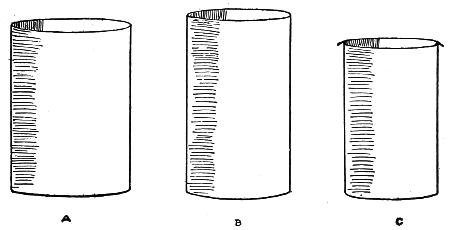
Fig. 17
(5) A similar coil unwound into a loose mass
of paper ribbon.
(6) About three-quarters of a pint of haricot
beans. Of these a sufficient number must be
poured into C (around the little cone), to fill it.
The remainder are to be brought forward on some
sort of tray.[9]
C loaded as last described, is to be placed
within B.
The trick may be introduced as follows:
“Most of you, I dare say, have seen the little
natural curiosity known as the Jumping Bean.
To all appearance these are just like other beans;
but if you spread a dozen or so of them on the
table and watch them carefully, you presently see
one or more of them turn over, or even make a little
jump. A young and lively bean will sometimes
hop as far as half an inch.
“Scientific gentlemen tell us that their agility is
caused by a little insect inside the bean. When
he wags his tail, or scratches himself with his hind
leg, it causes the bean to turn over, or to make a
hop. That seems to me rather a lame explanation
because there is no hole in the bean that the insect
could possibly have got in at. I believe myself,
that they are in truth magic beans, and I have been
trying to train some beans of my own to do the
same thing on a larger scale, and in such a way
that you can all see them do it.
“Here are my beans.” (Show those on tray.)
“Examine them as much as you like. The more
you examine them, the more you won’t find anything
particular about them. You won’t notice
any difference between them and any other beans,
but as a matter of fact they are a good deal more
energetic than beans of the ordinary kind, and
when they get to know and love you, they will do
all sorts of remarkable things.
“I will pour a few of them into this glass.”
(The front compartment of the mirror glass is
filled to about two-thirds of its height.) “To prevent
their getting out again without your knowing
it I will press them down with a handful of these
pretty paper shavings.”
This is also done, the quantity of paper being so
regulated, in accordance with previous experiment,
that when pressed down it shall come half
an inch or so below the brim of the glass.
“To make matters still more secure I will ask
the loan of a lady’s handkerchief to cover the glass
with.”
The handkerchief is taken in the right hand, the
left meanwhile raising the glass a little way to
meet it. In covering and lowering it again to the
table the needful half-turn is made.
“I will not touch the glass again until the experiment
is finished. Meanwhile I want to call your
attention to these two tubes. You will observe
that one of them is slightly larger than the other.
A gentleman told me the other evening that I was
wrong in saying so. He maintained that the one
was smaller than the other. I didn’t argue with
him. I never do with that sort of man. It is just
a question of the point of view. Anyhow, I had
the one made larger, or the other one smaller,
whichever way it is, so that the one can go comfortably
over the other, like this.”
A, first carelessly moved about so as to show
clearly that it is empty, is brought down over B
and lifted off again, carrying off within it C and
its load; after which B is in turn shown to be
empty.
“Now I am going to order the beans to jump out
of the glass and into one or other of these empty
tubes, at your own choice. Right? or left?
Which shall it be?”
Performer asks the question standing behind his
table, and by means of the familiar equivoque
(“my” or “your” left or right) interprets the
answer to mean A.
“And now I have only to pronounce the proper
magic spell. The trouble is to remember the right
one. They are rather confusing, and if you happen
to pronounce the wrong one, or even pronounce
the right one the wrong way, the consequences may
be serious. But I think I know this one pretty
well. ‘Peripatetico-paticocorum.’ I fancy I
have got it right. I don’t know quite what it
means myself, and nobody seems to be able to tell
me. A Japanese gentleman told me he thought it
was Spanish, but a Spaniard said he felt sure it
was Welsh. Somebody else suggested that I
should ‘ask a pleeceman.’ I did ask a policeman,
and he said, ‘Go to—’ somewhere I won’t mention,
but I don’t think he meant it as a translation. My
own idea is that it is a bit of Esperanto. Anyhow,
it has the desired effect; for you see the beans have
left the glass” (uncovering it and showing it
empty), “and they have jumped into this tube,
which is what I wanted them to do.”
The beans are poured from the tube into the
vacant portion, now to the front, of the mirror
glass, with due care that the coil at bottom shall not
be seen.
“But there’s something wrong here. I must
have made some little mistake in the pronunciation
of the magic spell, for the paper seems to have disappeared
as well as the beans. There is certainly
no room for it in the tube. Here it is, though, or
some of it.”
The paper is unwound, and when it comes to
an end the wand is passed through A and C (now
bottomless) together, again proving (?) that the
former which is always shown to the spectators
could not possibly have contained the beans
in any natural way. A moment or two later the
inner tube can easily be got rid of behind the mass
of paper ribbon.
This trick may be worked either upon a black
art table or black art mat. We will assume that
the latter is used.
The requisites for this trick will in such case
be as follows:
1. The mat. This may be a small circular one,
a few inches in circumference without pocket.
2. A handkerchief, fourteen or fifteen inches
square, of some gaudy pattern, carefully folded
and placed in a square Japanese handkerchief box.[10]
3. A circular velvet patch as described ante, in
the chapter dealing with novel applications of the
Black Art principle.
4. A half-crown placed in a pochette, or otherwise
so as to be readily get-at-able.
Presentation. Performer opens the box and
takes out the handkerchief, which he carefully
unfolds, handling it as if it were something of
extraordinary value.
“I have here, ladies, a curio of an exceptionally
curious kind. This is said to be the identical
handkerchief which Othello gave to Desdemona,
and which afterwards caused so much unpleasantness.
No doubt you all know your Shakespeare,
and will remember that Othello tells his wife,
‘There’s magic in the web of it.’ And there is
magic in it still. Not so much as there was, I dare
say, but still it retains a good many magical qualities.
Among them is a curious talent for recovering
lost property. For instance, I once had a dog.
His name was Socrates, but he was generally called
‘Socks.’ In fact, he preferred it. He was a valuable
dog, because he combined so many different
breeds. He was partly pug, and partly greyhound,
and partly dachshund, and partly chow,
and partly bull-dog and partly terrier, and partly
of two or three other breeds that I can’t for the
moment remember. One day Socks went out to see
a friend, and didn’t come back again. I sat up all
night for him with a stick, but he didn’t come home
till morning. In fact, he didn’t come home even
then. I thought I had lost him for good, and I
was quite distressed about it.
“Just when I was beginning to get over the loss
I had a further shock. My precious Desdemona
handkerchief was missing. But the very next day
I heard a barking outside, and there was my dog
with the handkerchief tied round his neck and
three other dogs with him. The handkerchief had
recovered them all.
“You don’t believe that little story. I thought
you wouldn’t. People never will believe anything
a little bit out of the way. It is just the same with
fish stories. I know a man who, when he was a
boy, fishing in a pond with a maggot on a bent pin,
caught a four-pound salmon. He didn’t claim
any credit for doing it. He says himself it was
just an accident, and might have happened to anybody.
But he never can get anyone to believe him,
and it has spoilt his character. He was naturally
a truthful man, but being always disbelieved has
made him reckless, and now, whenever he tells the
story he sticks another half-pound on to the salmon.
I believe it is a fifteen pounder now.[11]
“With regard to the handkerchief, however, I
can easily prove to you that what I have stated is
correct. I can’t prove it quite in the same way,
because even if any lady or gentleman present
had lost a dog, it would take the handkerchief a
day or two to find it, and you would get tired of
waiting. So I must show you the virtues of the
handkerchief in a simpler way.
“Will some gentleman oblige me with the loan
of a half-crown, marked so that he can be sure of
knowing it again?”
On receiving the coin the performer returns to
his table, holding it on high so that it can be seen
that there is no substitution, and lays it on the
black art mat.
“Presently I propose to lose this coin, and get
the handkerchief to find it, but first you would like,
no doubt, to have a look at the handkerchief itself.
Notice the richness of the pattern. It is said to
be after a design in the Alhambra. I don’t mean
the Alhambra you gentlemen go to, but the real
Moorish one in Spain.”
Leaving the handkerchief for the time being in
the possession of a spectator he returns to the
table, meanwhile palming the velvet patch, and the
substituted half-crown, and ostensibly picks up
the original, in reality rendering it invisible by
laying the patch over it, and showing the substitute
in its place, after the manner described at p. 19.
He then advances to the company with the substitute
coin and offers it to one or other of the spectators,
remarking, “Take it, please, and pass it to
one or other of your neighbours so that I shan’t
know where it is.”
Under pretence of offering the coin, he passes
it from the one hand to the other, and vanishes it
by, say, the tourniquet, so that the person holding
out a hand to receive it gets nothing, and says so.
“What do you say, Sir? You have not got it?
But surely, I have just handed it to you. You are
not joking? Then it must have fallen on the floor.
Please look around you a bit.” (Pretends to do
so himself.) “Not there? Well, this is extraordinary.”
(To the lender of the coin.) “I am
very sorry, Sir. Your money is lost in a way I
did not anticipate. But after all, when I come to
think of it, it’s of no consequence. The handkerchief
will find it wherever it is, even if it has to
follow it into somebody’s pocket. By the way,
where is the handkerchief?” He takes it from the
person with whom it was left, and holding it by
two of its corners, and showing both hands otherwise
empty, lowers it down carefully over the
black patch on table.
“And now to work the spell. ‘Bismillah!
Bechesm! Salaam Aleikoum!’ You must excuse
my speaking Arabic, but that is the only language
the handkerchief understands. I see that the gentleman
who lent me the half-crown is looking a
little bit anxious. Cheer up, Sir, the handkerchief
has never failed me yet. But we must give it time.
Say, half a minute.” (Looks at watch.) “This
is curious. Half a minute gone. One minute,
and nothing has happened. The handkerchief has
made no move. Something must have gone wrong.
But stay! If the handkerchief has not gone to the
coin, perhaps the coin has gone to the handkerchief.
Let us see!”
He lifts the handkerchief by the centre, picking
up the black patch with it, and thereby disclosing
the coin, which is handed back on the mat to the
owner. Then carefully folding up the handkerchief,
performer replaces it in its box, and in so
doing regains possession of the velvet patch, to be
got rid of at a convenient opportunity.
This, in good hands, will be found a very effective
trick. I have the less hesitation in saying so,
because the assertion is only to a very limited
extent self-praise. The idea of the effect to be produced
was my own, as also to a certain extent the
method of producing it. I had even got so far as
to devise, in anticipation, suitable patter. When,
however, I proceeded to put my ideas into practice
I found myself pulled up by unexpected obstacles.
The object to be attained, as will be seen by the
sequel, was the instantaneous re-adjustment of the
sundered parts of a small pyramid, and this I proposed
to do by means of the pull of a thread, fine
enough to be practically invisible. Now, to make
segments of a pyramid not only draw together,
but sit squarely one upon another, it is necessary
to have forces operating simultaneously in two different
directions, and the need for this caused difficulties
which I found myself unable to cope with.
Indeed, I had practically decided to content myself
by producing a somewhat similar effect in a simpler
way, as exemplified in the trick which I have
called the Miracle of Mumbo Jumbo, which next
follows.
As luck would have it, however, I mentioned my
difficulties to my good friend, Mr. Holt Schooling,
a gentleman whom I have more than once had
occasion to refer to in my writings in connection
with some neat device. Mr. Schooling declared
that the original idea was too good to be abandoned,
and offered to try his hand at bringing it to a successful
issue. I must frankly confess that I had
no great hope of his success; but Mr. Schooling is
a man of many talents. Apart from eminence in
his own profession (that of actuary and statistician)
he is not only an expert amateur conjurer,
but an exceptionally skilful mechanic, and he
possesses withal an unlimited capacity for taking
pains. He used these qualities to such good purpose
that I am enabled to include this striking
effect among the contents of the present volume.
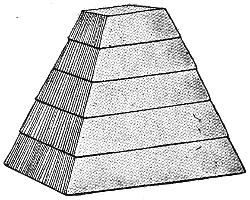
Fig. 18
The principal item of apparatus is naturally the
pyramid itself, which is of blackened wood as
illustrated in Fig. 18. For the sake of lightness it
is of necessity a small affair, being four inches in
height, about six across the base, and two across
the top. It is divided into five horizontal slabs or
segments, as indicated by the dotted lines. Midway
on each side of each slab, at about half an inch
distance from the upper edge, a minute hole is
bored, parallel to the outer slope of the segment;
exactness in this particular being an essential condition
of success. Of the four holes in each slab,
two only are actually used in the trick, the other
two being added partly for the sake of uniformity,
and partly to disguise the significance of the other
pair. Each slab, save those at the top and bottom,
is also perforated perpendicularly by three or four
holes of considerable diameter, the object of these
being merely to lessen the weight of the slab.
In preparing the pyramid for use in the trick, a
piece of plaited silk fishing-line, stained black, and
in length five to six feet, is passed by the aid of a
needle upwards through the small hole in one side
of the largest slab; then in the same way through
the corresponding hole in the next, and so on till it
comes out through the uppermost. Thence it is
again passed downward through the next adjoining
hole in each slab till it comes out at the bottom,
when the ends are drawn level and tied in a
knot.
The use of plaited silk fishing line for such purposes
is one of Mr. Schooling’s specialties, and is a
“tip” to make a note of. Line of this kind is in
proportion to its thickness much stronger than
ordinary silk thread, and, not being liable to
untwist, its surface remains permanently hard and
smooth, a great desideratum where it is important
to minimise friction. Further, it does not “kink”
as a twisted thread is liable to do.
Two other items of apparatus are used, viz.:
(1) An electric torch in the shape of a wand, the
light appearing at the end.

Fig. 19
(2) A little knife or cutter specially designed by
Mr. Schooling for use in this trick. This consists
of a half-inch length of a safety-razor blade, set
in a handle consisting of a piece of tin one inch
square, folded in half, and then bent back to a right
angle on each side, the blade projecting along the
line of juncture as shown in Fig. 19. In use the
cutter is held by what may be called its backbone
between the first joints of the first and second
fingers of the extended hand, as shown in Fig. 20.
This cutter must be placed ready to hand upon the
table. It is so minute that there is no fear of its
attracting attention.[12]
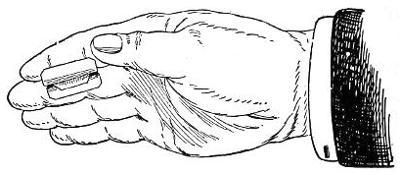
Fig. 20
In presenting the trick the pyramid, with its sections
duly threaded and placed one upon another,
is brought in on a wooden board similar to an
ordinary drawing-board, measuring twenty-four
inches by sixteen, and like the pyramid itself,
stained black. It is essential to the satisfactory
working of the trick that the “base” section of the
pyramid shall not shift when the thread is pulled.
This is ensured by having two L shaped “stops”
of thin wood glued or screwed to the board near the
left hand corner nearest to the performer when in
use.
The trick may be introduced as follows:
“I don’t know whether any of you ladies and
gentlemen are well up in Egyptology. I can’t say
I am, myself. I know a camel when I see one, but
that is about as far as I have got. There is, however,
one point about it which has always interested
me very much. It is a point which has puzzled
not only the Egyptologists, but all the other
ologists; namely, how the pyramids were built.
They consist, as no doubt you know, of enormous
masses of stone; so large that the cleverest engineers
of our day cannot tell us how they were
placed one upon another. If you can imagine the
lifting of the Royal Exchange in one lump and
dumping it down on the top of the Bank of England,
you will have some idea of the sort of job
the Egyptian builders had to tackle.[13] Anyhow,
the work was done, and as it is clear that it could
not have been done by any known mechanical
means, we are compelled to seek some other solution
of the problem.
“I don’t know whether any of you read novels.
If you do, you must often have noticed the curious
way in which fiction constantly anticipates fact.
The novelist describes some utterly impossible
thing, and a few years later some other fellow goes
and does it. Jules Verne described a voyage
under the sea long before the submarine was
invented, and Mr. Wells wrote ‘The War in the
Air’ while the aeroplane and the Zeppelin were
still in their infancy. But there is one conception
of the novelist which has not till now been made
an accomplished fact. That is the force called
‘Vril,’ described by Lord Lytton in his novel, ‘The
Coming Race.’ He describes Vril as a sort of
hyper-electricity capable in the hands of those who
know how to gather and use it, of producing all
sorts of wonders, even to removing mountains.
Imprisoned in a wand and directed by a strong
will, it will shrivel up an enemy or a wild beast as
by a flash of lighting.
“I have always had an idea that this must have
been the force used by the Egyptians to build the
pyramids. I have managed to collect a small
quantity of an unknown force which answers very
closely to Lord Lytton’s description of Vril, and
I have charged this wand with it. As regards killing
things, I have only tested it so far on a black
beetle. The experiment was a success. He was
blown to atoms, all but one hind leg. I should
like to try it on a tiger; if I could get one cheap.
Does any gentleman present know of a secondhand
tiger in a good strong cage going cheap?
No? I was afraid you wouldn’t. I am hoping
however for a chance of trying it some night on
a burglar. If a gentleman of the Bill Sykes persuasion
should steal into my chamber at dead of
night with felonious designs upon my Waterbury
and my collarstud, he will be as a dead man. I
shall just point this wand at him and say ‘Die,’
and he will be merely a little heap of ashes to be
swept up by the housemaid in the morning.
“I can however give you an example of the power
of my Vril as a motive force. I shall do so by
using it to build or rather rebuild this little pyramid
in your presence.
“This is a correct copy of the real thing. It
takes to pieces, as you see. One, two, three, four,
five!”
As he pronounces the last few words, the performer,
standing behind his table, picks up the
pyramid, and holding it aloft in his right hand
draws away the base from the other sections, sliding
it along the thread, and “bedding” it between
the “stops” at the left hand bottom corner of the
board. He then slides the other portions, one by
one, along the thread in the same way, laying them
in a row diagonally across the board. This will
have taken up a considerable portion of the thread,
but there will still be a loop some inches in length
hanging down near the left hand corner of the
table.
“Now please watch carefully. This wand, you
will remember, has been carefully charged with
my imitation Vril.”
While speaking these last words the performer
gets one finger of his left hand within the loop.
He now turns on the light at the end of the wand,
and with it makes a quick sweep from right to left
over the severed parts of the pyramid, making at
the same time a half-turn away from the table, and
quickly drawing away the thread. If this is done
neatly the severed parts of the pyramid run
together one upon the other in a single instant.
It is probable that the parts may not sit exactly
one upon another. Whether this is so or not, the
performer makes believe to notice that it is so, as
it gives him a needful opportunity. He remarks:
“The power was hardly strong enough, I see.
There is a block here that needs a little straightening
up.” Having meanwhile picked up the little
cutter between the fingers he bends over the table
and squares up the pyramid as may (or may not)
be necessary, and under cover of so doing draws
the blade across the thread where it crosses the
top, thereby severing it, and then moving back a
little to note the effect of his correction draws it
away altogether. Shifting the restored pyramid
to the centre of the board he brings all forward for
examination. The severed thread is allowed to
drop on the floor, to be picked up after the performance
is over.
The items needed for the presentation of this
trick are as follows:
(1) A miniature pagoda of quaint design. It
consists of five circular sections, resting one upon
another as illustrated in Fig. 21. The trick in
effect consists of the automatic re-adjustment of
these sections after being taken apart and shown
lying apparently haphazard on a Japanese tray.
For drawing-room use the pagoda is about six
inches high and the same diameter across the base.
For stage purposes it may be made a trifle larger.
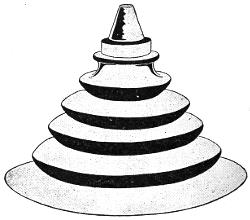
Fig. 21
(2) The tray. This, for use with a pagoda of
the size above mentioned, should be not less than
twenty inches long by ten or twelve wide, and
fairly heavy, as being less liable to shift in use. It
must have an upright rim; through one corner of
which a minute hole is bored, countersunk and
polished on each side of the opening in order to
diminish friction on a thread passing through it.
(3) An electric torch in the shape of a bottle;
the light showing itself at the mouth.
(4) A black dress-hook, sewn point upwards to
the lower edge of the performer’s vest on the right
or left side, as may best suit his own position in
working the trick, just where back and front meet.
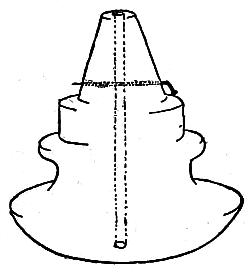
Fig. 22
It will be found on examination of the pagoda
that each of the parts of which it consists has a hole
bored vertically through its centre. The topmost
portion has in addition a pinhole passing horizontally
across it, about halfway down. Through this
a black pin, bent at the head, passes as shown in
Fig. 22. In preparation for the trick a piece about
three feet long of black plaited silk line, with a
small wire ring at one end, is passed by the aid of
a needle through the hole in the tray from the outer
side; thence upward through the various sections
of the pagoda, beginning with the undermost, till
it finally comes up through the head. After the
needle has been drawn off, the end of the thread is
formed into a loop, which is passed over the cross-pin
before mentioned. The thread is then drawn
taut from below, the several segments of the
pagoda resting fairly one upon another in the centre
of the tray. The intermediate portion of the
thread is drawn up till the little ring at the outer
end comes close to the tray, and is laid upon it in
zigzag fashion so as prevent the possibility of
its fouling at a critical moment.
The introductory patter may run as follows:
“In the course of my travels in Central Africa—you
didn’t know that I had been in Central Africa?
Strange, how little the world knows of its greatest
men! But no matter! When I was in Africa I
chanced to come upon the place where the Golliwoggs
live.
“It’s a nice place—for those who like that sort
of place, but most people would find it a little too
warm. It is so warm there that the hens lay their
eggs hard-boiled, and you dig up potatoes ready
baked. It is too warm for anything but simple
life,—the very simple life, particularly as regards
clothing. The ordinary walking dress for a gentleman
Golliwogg is a pair of braces. The king
wears two pairs; except on state occasions, when
he wears one of those short shirts instead. You
know the kind I mean—all front. I think they
call them ‘dickeys.’
“The ladies are more dressy. They get the
fashions from back numbers of the Daily Mail;
kimonos and camisoles and corsets all in the latest
style. They are made with green paint and put
on with a shaving brush. There is only one thing
that bothers the court dressmakers. They can’t
make a crinoline.”
[If desired to shorten the patter the fashion
details may be omitted.]
“I mention these little matters in order to give
you an idea of the place, in case any of you might
like to take a week-end trip there. If you are old
and tough, you might risk it. If you are young
and tender, you had better not.
“The special point of interest is a curious pagoda
in the centre of the village. It is seventy-five feet
high and is supposed to be the habitation of Mumbo
Jumbo; a sort of deputy devil, much respected in
those parts. This little model is an exact copy of
it. You can’t call it pretty, but there is a very
remarkable thing about it. When the king
dies (which happens by accident about once
a fortnight), the pagoda is pulled down, and if the
new king is acceptable to Mumbo Jumbo (which
depends upon the amount of his tip to the chief
witch doctor) old Mum rebuilds it himself by
magic. You don’t see him do it. The pagoda just
sits up and paws the air, so to speak. If Mumbo
does not approve, the proposed king gets a knock
on the head with a cocoa-nut, and some more liberal
Golliwogg is crowned instead.
“I naturally wanted to know how the miracle
was worked; and I managed to buy the secret from
one of the witch doctors. He sold it to me for a
pair of sixpenny-half penny sock suspenders. He
didn’t wear socks, but that didn’t matter. He put
the suspenders on at once and strutted about, as
proud as a dog with three tails.
“Now, I am going to tell you the secret. Scientists
tell us that the sun throws out three sorts
of rays; light-rays, heat-rays, and force-rays.
The artful witch doctors have found out a way of
bottling off the force rays. They are mild at first,
but when they get old in the bottle, so to speak, they
become so strong that if you know how to do it you
can lift the heaviest weights with them.
“I managed to get hold of a small bottle of the
rays” (show bottle) “and I will show you, on a
very small scale, how the thing is done.
“First, we will take the pagoda to pieces.”
Standing behind the table, the performer moves
the pagoda to the corner of the tray nearest his
own left hand; so as to leave space for the different
portions when separated. He then picks up all the
parts save the base, holding them carefully
together, and drawing away with them a length
of the thread about equal to the diagonal of the
tray. Passing the undermost section downwards
along the thread, he lays it down beside the base,
afterwards treating the other portions in the same
way, the several portions finally resting on the tray
somewhat as shown in Fig. 23.
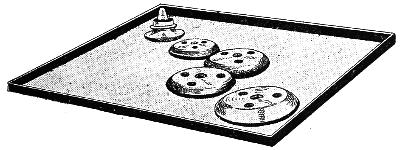
Fig. 23
If the length of the thread has been properly
gauged (this is a matter to be determined by
experiment beforehand), there should be some
twelve or fourteen inches of “slack.” Slipping
the ring at the end over the little hook before
mentioned, the performer moves a little away
from the table, so as to draw this portion
of the thread all but taut, between his own body
and the tray.
“And now to utilise our force rays.” Holding
up the bottle-shaped torch in his right hand, he
turns its light onto the tray, at the same time edging
away farther from the table and moving about
behind it so as to cause a gradual pull upon the
thread; the effect being that the severed parts of
the pagoda mount gradually one upon another in
due order. It is probable that they will not rest
exactly one upon the other. In any case the performer
affects to notice that they do not. Making
a remark to that effect he steps close to the table
to straighten them up, and under cover of so doing
draws with the finger nail the pin in the uppermost
portion, thereby releasing the thread. Stepping
back again, as though the better to judge whether
the pagoda is now “plumb,” he thereby draws
away the line, and detaching the ring from the
hook, lets it fall to the ground. This done, he
returns to the table, and shifting the restored
pagoda to the centre of the tray, brings all forward,
inviting anyone who cares to do so, to satisfy
himself that there has been “no deception.”
The requirements for this trick are as follows:
(1) Two wands, exactly alike in appearance.
One of them to be that just used in some previous
trick or tricks (which we will call No. 2), and the
other, prepared as to be presently explained, to
be secretly substituted for it immediately before
the presentation of the present trick. This can be
easily done by the aid of a couple of pairs of cup-hooks
fixed behind the table or a chair after the
manner described in “Later Magic,” p. 126; or
the wands may be exchanged during journey to
the table at an early stage of the trick; by means
of a pocket of suitable shape within the left breast
of the coat. This is a matter as to which the performer
will please himself, but the exhibition in
the first instance of an obviously unprepared wand
is essential to the artistic finish of the trick.[14]
(2) Two pieces of ribbon, three-quarters to one
inch wide, alike in colour. Of these, one piece is
to be wound round the end of wand No. 2 at about
three inches from the end, and secured by a rubber
ring, of the solid kind used for holding together
the ribs of an umbrella. This wand, after being
“switched” for the unprepared one, must be so
placed upon the table that the end on which the
ribbon is wound shall be masked from view by the
second piece of ribbon, lying in a loose heap in
front of it.
(3) A stoppered bottle of clear glass, preferably
of some ornamental or quaint design. This bears
a label, of discoloured and time-worn appearance,
with the letter H R written on it in crabbed but
distinct characters, and is about half-filled with
Eau de Cologne or lavender water, to which a few
grains of cochineal have been added, giving it a
rich ruby colour. So far as the working of the
trick is concerned plain water might be used, but a
coloured and scented liquid is preferable for the
sake of effect.
(4) A spare rubber ring, of the kind above
described, placed in left-hand vest-pocket.
The trick may be introduced as follows:
“For the next surprise I have to show you we
are indebted to the ancient alchemists. People
regard them as back numbers nowadays, because
they didn’t know anything about aeroplanes, or
appendicitis, or income tax and such-like up-to-date
luxuries; but they had a good many useful
little secrets of their own. One of them was the
recipe for what was called the Alkahest, a liquid
which immediately dissolved anything it touched;
from a gold watch to a set of fire-irons. The secret
of making it has long been lost, and all that still
exists of the liquid itself I have here in this
bottle.”
The bottle is here brought forward and offered
for inspection.
“Pretty colour, isn’t it? And it has a very
delightful perfume.” (Takes out stopper.)
“You are welcome to smell it but I don’t advise
you to taste it. If you did you would probably
never taste anything again. I want you to notice,
by the way, those two letters H R on the label.
There is a dead secret attached to those letters.
They mean something, of course; but nobody
knows what it is.”
The bottle is replaced on the table.
“This bottle came into my hands by inheritance.
An ancestor of mine, in the reign of James the
First, was an alchemist in a small way. He is
reputed to have made a handsome income by selling
ladies something to put in their husbands’ tea.
History doesn’t say what. Let us hope it was only
sugar. Well, this old gentleman managed to get
hold of the recipe for making the Alkahest.
Whether he found it out himself, or whether he
cribbed it from the cookery-book of some other
alchemist, I can’t say. Anyhow, he got it; and
he made up some of the stuff and put it in that
bottle.
“When he was just going to be burnt as a wizard,
which was the regular thing with scientific
men in those days, he handed the bottle to his eldest
son, my great-great-grandfather seventeen
times removed, saying, ‘Take it, my son, and may
it do you more good than it has done me.’
“My great-great-grandfather took the bottle;
but he had no idea what it contained. He was just
going to ask his father what the letters on it meant,
but just at that moment the old gentleman flared
up, and it was too late. For the rest of his life my
great-great-grandfather puzzled his head as to
what those two letters H R stood for, but all he
could think of was ‘horse-radish,’ and he knew
it couldn’t be that.
“Since that the bottle has been handed down in
our family for sixteen generations, till at last it
came to the hands of my Uncle James, and he puzzled
over those letters like the rest. Uncle James
was a bit of a ‘nut,’ and prided himself on his fine
head of hair, but in course of time he found he was
getting a bit thin on the top, and it worried him.
One day, thinking over the mysterious letters, an
idea struck him. ‘H R!’ he exclaimed, ‘H R!
why “Hair Restorer” of course, not a doubt of it!
I’ll try it this very night.’ He did. He rubbed
it in, and went to sleep quite happy, but when he
tried to brush his hair in the morning there wasn’t
any left to brush. The Alkahest had taken it all
off, and left him as bald as a baby.
“He went to bed again, and ordered a wig, but
before it could be sent home he caught such a
cold in his head that he died. Just-sneezed-himself-away.”
(The last words to be spoken slowly and sadly.)
“I notice that some of you ladies are weeping.
It is an affecting story, no doubt, and I used to
shed a tear over it myself. But after all, you
didn’t know my Uncle James. Neither did I, for
the matter of that, and if we had known him we
might not have liked him. So we won’t stop to
grieve about him.[15]
“One of the most striking experiments with the
Alkahest is the dissolving of a paving stone, particularly
if you lay a bunch of violets on it and
dissolve them both together, when you get a scuttleful
of best Violet Powder. Unfortunately I
haven’t a paving stone handy, and I don’t suppose
any gentleman present is likely to have one about
him. No? I feared not! Another pretty experiment
is the dissolving of a diamond ring,
but I have no diamond rings myself, and I find
that if I borrow other people’s and don’t return
them I get myself disliked. So I must try to show
the power of the Alkahest in a less expensive way.”
Returning to his table, the performer with his
right hand picks up the prepared wand (holding
it so as to conceal the ribbon coiled upon it), and
with the left hand the mass of loose ribbon.
“I have here a piece of ribbon: just ordinary
ribbon. Will some lady oblige me by tying a knot
in it, about three inches from the end. Thank you!
Now will some other lady tie another knot about
three inches from the first one.”
This is repeated till five or six knots have been
tied, taking up about half the ribbon.
“I am not sure how many knots have been tied.
Please count them for me as I roll the ribbon round
my wand.”
So saying, he winds the ribbon, beginning with
the knotted end, on to the free portion of the wand,
counting the knots as he does so, and continuing
the winding till the whole has been taken up. In
so doing he takes care to cover up the knots, and
to make the appearance of the rolled ribbon correspond
as nearly as possible with the hidden coil
upon the other end, finally securing it with the rubber
ring from his pocket.
We will suppose that five knots are found to
have been tied. The performer returns to the
table to fetch the bottle; and during the transit
passes the wand to the opposite hand, in so doing
drawing off the knotted ribbon (to be dropped a
moment later into the profonde), and exposes the
opposite end. He removes stopper from bottle,
leaving it on the table.
“Now comes the most critical part of the operation.
I am going by means of the Alkahest to
dissolve these knots. How many did we say there
were? Five? Then I must use five drops and
no more. If I were to overdo it in the smallest
degree the consequences would be serious. I
should destroy the ribbon altogether, and in these
hard times ribbon is ribbon, even if it is only six-three
a yard.”
He brings forward the bottle, and with great
pretence of accuracy lets fall on the ribbon the
suggested number of drops. Then slipping off the
rubber ring he offers the end of the ribbon to some
member of the company to unwind, when the knots
are naturally found to have disappeared.
“The Alkahest retains its virtue, you see, even
after so many years. Every knot is completely
dissolved. I will conclude by asking you an
impromptu riddle. Just one of those bright
thoughts that strike me sometimes when I least
expect it—
“When is a knot not a knot?”
“When it’s not there.”
This is of the nature of a magical toy rather
than a conjuring trick proper, but its exhibition
may form a pleasant interlude in the course of a
social entertainment. I invented it at an early
stage of my magical career, and exhibited it on
various occasions for the amusement of friends,
but made no further use of it. The apparatus has
been put aside, and has been out of sight, out of
mind, for many years past. Coming across it accidentally
some short time ago, I was agreeably surprised
to find that it would still answer questions
as promptly, and doubtless as truthfully, as of
yore.
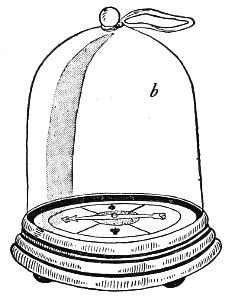
Fig. 24
The general appearance of the apparatus, which
is eight inches high by seven in outside diameter,
is as depicted in Fig. 24. It consists of a circular
mahogany stand or base, resting on three small
feet, and surmounted by a glass dome b. This last
is in fact a bell-glass, as used by gardeners, and
has at top the usual knob, whereby to lift it. To
this is attached a short loop of narrow ribbon.
The glass dome does not rest directly on the stand,
its lower edge being encased in a mahogany mount.
From the centre of the stand rises a vertical pin,
a quarter of an inch in height, serving as pivot for
a metal pointer (Fig. 25), which, by means of a
little cup, or socket, at its centre, can be lifted on
and off, and revolves freely upon it, after the manner
of a compass. A further item of the apparatus
is a reversible cardboard dial, whose two sides,
front and back, are depicted in Figs. 26 and 27. It
will be seen that the circumference of this dial is
divided on the one side (Fig. 26) into four equal
sections, each bearing a pip of one of the four suits.
The other side (Fig. 27) is divided into eight sections,
marked with the numerals, from seven to ten
inclusive, and the letters A, K, Q, and J, answering
to Ace, King, Queen and Jack.
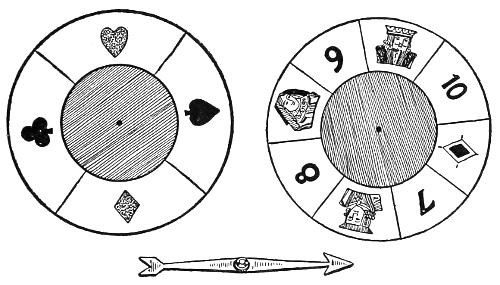
Fig. 26 Fig. 25 Fig. 27
With the Oracle is used a set of eight questions,
and a piquet pack of cards, on the backs of which
are written or printed thirty-two answers appropriate
to such questions, one of each suit to each
question. The person consulting the Oracle having
selected the question he or she desires to have
answered, the dial is laid on the stand with the
“suit” or Fig. 26 side uppermost, and the pointer
is placed in position on its pivot. The querist is
invited to breathe into the glass, which is then
lowered on to the stand. The pointer begins to
move, and after a moment or two of indecision,
comes to rest opposite one or other of the four suit-pips;
we will suppose, for the sake of illustration,
the diamond. The glass is then lifted off, the dial
reversed, the pointer replaced, and the glass once
more lowered on to the stand. Again the pointer
moves, and stops this time, we will say, at the number
“seven.” The seven of diamonds is sought
for in the pack, and is found to bear a more or less
appropriate answer to the question asked.
The movements of the pointer are governed by
the fact that, imbedded in the mahogany mount
surrounding the base of the bell glass, is a piece
of thick steel wire, strongly magnetised, and
extending half way round the circle. The pointer,
though so coloured as to have the appearance of
brass, is in reality a magnetic steel needle, and
therefore when resting on the pivot and covered
by the glass, will automatically move round till
it comes to rest between the two magnetic poles
formed to the opposite ends of the hidden wire.
The operator can therefore, by placing the glass
cover accordingly, cause the indicator to stop at
any part of the dial that he pleases.
It remains to be explained what guides him in
the manipulation of the glass, so as to cause the
needle to stop at the point he desires. It will be
remembered that, attached to the knob at the top
of the glass, is a loop of ribbon, serving to suspend
the glass in use from the forefinger, as shown in
Fig. 28. But the loop has in truth a much more
important function than this. Before the loop is
formed, the ribbon is tied tightly round the neck
of the knob, previously waxed to prevent its slipping
round, and the knot is so placed that it shall
exactly correspond with that pole of the magnet
to which the point of the needle is intended to be
in use attracted. This done, a loop is formed with
the two ends of the ribbon, and so arranged in
point of length that when the glass is suspended
from the forefinger, as in the diagram, the thumb
and second finger of the operator shall be just right
for moving it round in either direction, the little
knot guiding him by feel to bring it to the desired
point.
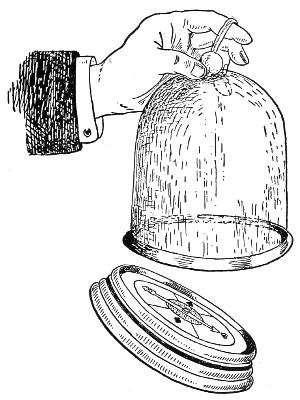
Fig. 28
The exhibitor is not limited to any particular
set of questions and answers. At the cost of a
fresh pack of cards and a little ingenuity, he can
please himself in this particular. The selection of
suitable questions and answers is however a somewhat
delicate matter. The answers must on the
one hand be smart enough to afford amusement
to the company generally; and on the other hand
must not be so pungent as to be likely to cause
offence to a person putting the question.
The questions and answers I devised for my own
use ran somewhat as follows:
| 1. What does my husband (or wife, as the case may be) most
think about? |
|
ANSWERS |
| Seven of Diamonds. |
Yourself. |
| ” Hearts. |
Money. |
| ” Spades. |
Dinnertime. |
| ” Clubs. |
Golf. |
| 2. Shall I live to grow old? |
| Eight of Diamonds. |
Yes, if you don’t worry about it. |
| ” Hearts. |
A well-spent youth will be followed
by a happy old age. |
| ” Spades. |
As old as you care to be. |
| ” Clubs. |
Yes, old, and fat. |
| 3. What is my chief fault? |
| Nine of Diamonds. |
You haven’t any. |
| ” Hearts. |
Excessive modesty. |
| ” Spades. |
Flirting. |
| ” Clubs. |
Swank. |
| 4. Shall I have what I am wishing for? |
| Ten of Diamonds. |
Yes, if you deserve it. |
| ” Hearts. |
If you go the right way to get it. |
| ” Spades. |
Not likely. |
| ” Clubs. |
It is like your cheek to wish for it. |
| 5. What am I thinking about at this moment? |
| Jack of Diamonds. |
A new hat. |
| ” Hearts. |
Servants. |
| ” Spades. |
You wouldn’t like me to tell. |
| ” Clubs. |
That it is a long time between drinks. |
| 6. What shall I do to get health? |
| Queen of Diamonds. |
Don’t think about it. |
| ” Hearts. |
Keep smiling. |
| ” Spades. |
Take Podger’s Purple Pills. |
| ” Clubs. |
Eat less. |
| 7. How old am I? |
| King of Diamonds. |
Just right, don’t get any older. |
| ” Hearts. |
Whatever you are, you don’t look it. |
| ” Spades. |
You never tell, so I won’t. |
| ” Clubs. |
Old enough to know better. |
| 8. What shall I be this time next year? |
| Ace of Diamonds. |
A year older. |
| ” Hearts. |
A trifle stouter. |
| ” Spades. |
A year wiser. |
| ” Clubs. |
Bald as a baby. |
It will be found on comparing them that the
answers are arranged on a regular system, those on
the red cards being of a more or less complimentary
nature, or otherwise favourable; the black
suits less so, particularly the clubs, which are
rather the reverse, and are intended to be used as
replies to gentlemen only. Bearing this arrangement
in mind, it is a comparatively easy matter to
suit the answer to the querist.
The questions must be memorised in proper
order, and it is desirable to do the same with the
answers also, though there should be no difficulty,
remembering the principle of arrangement, in giving
a fairly appropriate answer, even though the
memory be for the moment at fault as to its exact
terms. To avoid the necessity of giving the same
answer more than once, it is well to make a rule
that the same question shall not be asked more than
three times.
The Oracle may be introduced as follows:
“Allow me to introduce to your notice a curio of
an exceptionally interesting kind. This elegant
little affair is said to have been the private Oracle
of Rameses the Second, a gentleman who flourished
in Egypt about four thousand years ago. I can’t
be sure to a year or two, because it was before my
time, but I believe that is about right. People
sometimes express surprise that, being so ancient,
the Oracle should be in such good condition, but
that is accounted for by its having been preserved
in the same case as Rammy’s mummy. I don’t
mean his mamma, but the gentleman himself, in
the cold storage of the period. The story may or
may not be true. I can’t take any responsibility
for it. Others declare that the Oracle was the favourite
plaything of Helen of Troy. Historians do
tell such tarradiddles that one doesn’t know what
to believe.
“The powers of the Oracle are limited, for it will
only answer eight questions, and in its own way,
but its answers are quite trustworthy—well, perhaps
not quite. Let us say as trustworthy as those
of Bond Street fortune-tellers at a guinea a guess.
Who will be the first to test its veracity?
“I should mention, by the way, that, as each
answer exhausts a certain amount of power, the
same question must not be asked more than three
times. You would like to consult the Oracle,
Madam? Then please select one of the questions
on this card, and read it out for the information of
the Company.
“You wish to know” (repeating question).
“Good. The answer to your question will be found
on one or other of the cards in this pack, and the
Oracle will tell us which one to look for. First,
however, I must ask you to breathe into this glass.
That supplies the missing link, so to speak, and
makes it a sort of personal affair between you and
the Oracle.” (This is done.)
“Thank you. Now I shall place the glass on its
stand, and this little pointer” (holding it up and
placing it on its pivot) “will reveal the correct
answer, first indicating the suit among which the
answer is to be found. You may notice that it
wobbles a bit at first. That is because it is thinking
over the question. Now it has come to rest,
and it says the answer will be found in the”—(name
suit.) “And now to find out which is the
right card of that suit. I take off the glass and
turn the dial over. Please concentrate your mind
on your question. I put the glass and the pointer
on again. Again the pointer thinks it over, and
finally decides as you see, for the—” (naming
number of card.) “Now all we have to do is to
look out that card” (does so) “and here we have
the answer to your question.”
Before inviting a fresh querist to breathe into
the glass, it is well to wipe it out carefully with a
silk pocket handkerchief, professedly to dispel the
personal magnetism of the last enquirer, any
remains of which, left within the glass, might
imperil the correctness of the anticipated answer.
The reader is probably familiar with the trick
known as “The Silver Tube and Ball.” If not,
it may be stated that the “tube” is of metal, nickelled,
and about eight inches long by one and a
half in diameter. With it is used an ebony ball,
which is made to pass into and out of the tube in a
very surprising way.
The secret lies partly in the fact that half way
down, the internal diameter of the tube is very
slightly narrowed, forming a sort of “choke,” so
that a ball dropped into it at the upper end does
not fall right through, as one would naturally
expect, but stops at that point, wedging itself
lightly, so that the tube can be reversed without
any fear of the ball falling out, though it can be
instantly driven out by bringing down the tube
smartly on the table, or by very slight pressure
behind it.
The other part of the secret lies in the fact that
two balls are in reality used, the existence of the
second being of course unknown to the spectator.
The tube being loaded as above mentioned, i.e. having
the one ball wedged in it just below the choke,
if the duplicate is dropped in from above it will
apparently fall through, though as a matter of fact
this ball comes to a standstill in the tube above the
choke, while the other is driven out at the bottom.
The secret use of this second ball enables the performer
to produce sundry surprising results in the
way of appearances and disappearances.
The possibilities of the trick in this form are
however speedily exhausted, and it has a serious
drawback in the fact that it is necessary to invert
the tube afresh before each production, as it is
obvious that a ball contained in it must be brought
below the choke before it can be produced. I had
at one time rather a fancy for the trick, but it
seemed to me that it was capable of a good deal of
improvement, and after some cogitation I succeeded
in producing a new trick on somewhat similar
lines; but free from the defect mentioned above
and capable withal of producing a far wider variety
of effects.
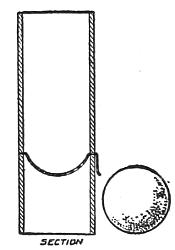
Fig. 29
I use two tubes of stiff cardboard, each about
four inches long by one and a half in diameter.
One of these is just a plain tube with no speciality
about it. The other has a piece of fine wire crossing
it midway from side to side, and taking the
form of a half hoop, as shown in Fig. 29, the ends
serving as pivots on which it moves freely. On the
outside, one of its ends is turned down vertically,
forming a tiny switch or handle. The normal
tendency of the halfhoop is to hang downward
across the tube (thereby closing it to the passage of
a ball) but a touch of the finger, moving the little
switch to right or left, raises the loop to a horizontal
position against one or other of the sides
of the tube, when it no longer offers any obstacle
to the passing of the ball. The wire used is so thin
that with the halfhoop lying against its side a spectator
may safely be allowed to look through the
tube even at a very short distance, without fear of
his perceiving the presence of the wire.
The requirements for the trick, all told, are as
follows:
- (1) The wand.
- (2) The plain tube.
- (3) The trick tube.
- (4) Two white balls.
- (5) A red ball.
- (6) A lighted candle.
- (7) A small red silk handkerchief.
One of the white balls must be vested or otherwise
so placed as to be ready for production from
the wand. The second white ball and the red ball
are stowed in the pochettes, one on each side. The
faked tube may be vested and exchanged for the
plain one during the journey back to the table
after the dummy has been tendered for inspection;
the latter being dropped into the profonde.
These however are matters which the expert will
arrange after his own fashion. If the performer,
not being an expert, doubts his ability to
“change” the tubes neatly during the transit, he
may suppress the plain tube altogether and commence
at once with the exhibition of the faked tube
from the platform, but the omission makes the
trick less convincing.
We will suppose that the performer goes for
the maximum effect and advances offering the
dummy tube for inspection. The patter I suggest
for the trick in this form runs as follows:
“I have here, ladies and gentlemen, a hollow tube.
It is not uncommon for tubes to be hollow, but this
one is, if anything, even hollower than usual. I
should like some lady or gentleman to examine it
carefully and testify that it is just a plain ordinary
tube with absolutely no deception of any sort about
it. If it was not so, you may be sure I should
hardly venture to let you examine it. You can see
through it, hear through it, or blow through it.
You are satisfied? Then I will show you a curious
little experiment with it.”
During the return to the table the dummy is
exchanged for the trick tube.
“I call the experiment I am about to show you
‘The Mystery of Mahomet.’ I gave it that name
because it was Mahomet who suggested the idea to
me. I don’t mean personally. I didn’t know
him. In point of fact he did not give me the idea
till after he had been dead for some years. This
sounds peculiar, but I will explain.
“When Mahomet died he wasn’t buried like
other people. His coffin was placed in a mosque,
where it hangs in the air like a captive balloon,
about twenty feet up, resting on nothing at all. I
am not certain as to the exact height from the
ground, but that is what the Moslems say, and they
would hardly tell a story about a little thing like
that. It has always been a mystery what keeps
the prophet up aloft. Some say it is done by mesmerism,
some say by magnetism, and one old gentleman
declared it was done by mormonism. No
doubt, when you come to think of it Mahomet was
a bit of a Mormon. But they are all wide of the
mark. As a matter of fact the coffin rests on a
slab of compressed air. It’s quite simple, when
you know it. I haven’t a coffin handy, but by
means of this little tube I can show you the effect
of the same principle on a smaller scale.
Fig. 30
“As some of you have not had the opportunity
of personally examining the tube I should like to
prove to you in the first place that it is really what
it appears to be, a simple cardboard cylinder, open
from end to end, and as free from deception as I
am myself.
“Proof 1.” (Wand dropped through tube on
to table.)
“Proof 2.” (Tube held in front of candle showing
flame through it.“)
“Proof 3.” (Tube dropped over candle as in
Fig. 30, or spun on wand, held horizontally as in
Fig. 31; the halfhoop in each case being made to
lie against the side of the tube.)
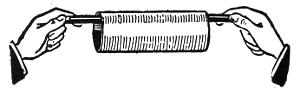
Fig. 31
“I have here a little ball, of such a size that it
passes easily through the tube.”[17] The ball is
allowed to fall through, from the one hand to the
other.
“Now I will place the tube upright on the
table and drop the ball in once more. Where is it
now? On the table, you say. Quite right: here
it is.” (Lift tube, closing it, and placing it on
end beside ball.) “But now I take a few handfuls
of air and press them well down into the tube”
(makes believe to do so), “and I drop the ball in
again. This time you see it does not fall through.
As a matter of fact it has stopped halfway, resting
on the compressed air in the tube.” (Lift tube,
showing that the ball has not passed through.
After replacing the tube switch the wire loop to
the horizontal position, allowing the ball to drop
inside the tube.) “I think there can be no doubt
that this is the way Mr. Home, the medium, managed
to float about with his head in the air and his
feet on the mantelpiece. All that was needed was
a few pints of compressed air in his tail-pockets.
It’s quite simple, when you know how it’s done.
“Of course, as the tube is open at the top, the
effect doesn’t last very long. The compressed air
gradually expands again and becomes too thin to
support the ball any longer. I dare say by this
time it has done so.” (Lift tube, exposing ball,
and re-closing tube). “Yes, here it is.”
“I can keep the air from escaping to a certain
extent, because I happen to have a very strong
won’t. A strong will is a good thing to have, but
sometimes a strong won’t is even more useful.
Once again I will fill the tube with compressed air.”
(Make believe to do so, then pick up the closed
tube.) “I drop the ball in again, and this time it
will remain suspended till I permit the compressed
air to escape.” (Pick up tube, holding it vertically
a few inches above the table.) “Say when you
would like the ball to fall. Now? Good! I withdraw
my strong won’t and the ball falls at once.”
(Switch loop, allowing it to do so, then pass tube,
closing it, to opposite hand and load into it duplicate
ball at top; then replacing tube on table.)
“Now, by way of variety, we will try compressing
the ball instead of the air.” (Pick up ball left
on table and make believe to transfer it to the opposite
hand. Then, with the left hand empty, make
pretence of crushing it into the hand.) “The ball
is now resolved into its component atoms. You
didn’t see them go? No, of course you didn’t.
For the time being they are dematerialised: but the
compressed air in the tube will soon solidify them
again.” (Lift tube, keeping ball suspended.)
“It has not got solid yet, but we shall not have long
to wait.” (After a few moments again lift tube,
opening it and allowing ball to pass through.)
“Here is the ball, now as solid as before.”
Transfer tube closed to opposite hand and in so
doing load in red ball at top. In replacing tube
on table open and close it again, so that the ball
shall fall, but shall rest within the tube on the
table.
“Now I will show you another curious effect. A
ball which has been dematerialised in that way
becomes very sensitive to colour. I will just give
the ball a rub with this red silk handkerchief and
drop it into the tube again.” Drop in white ball
after rubbing, keeping tube closed; then raise it
and show red ball at bottom.
“Here it is again, you see, but it has taken the
colour of the handkerchief and is now a rosy red,
a sort of maiden’s blush; the blush of a very shy
maiden. Unfortunately maiden’s blush is not a
fast colour, unless it’s the wrong kind; the kind
that’s rubbed in with a powder puff. This kind
soon gets pale again. I rub the ball again, this
time with a white handkerchief, and again drop
it into the tube.”
Drop in red ball, tube closed, lift and show white
ball, under cover of its appearance transferring
tube to opposite hand and allowing red ball to
run back into palm to be got rid of a moment
later.
“I think I heard a lady say, ‘Where is the red
ball?’ This is the red ball, at least it was the red
ball a moment ago. There is no other, for, as you
see, the tube is empty.”
Again drop tube over candle as in Fig. 30. Pass
ball from hand to hand and finally make believe to
swallow it, meanwhile dropping it into the profonde.
“After being treated like this the ball becomes so
volatile that I used to be always losing it. But I
never lose it now. I just swallow it and then I
know just where it is when I want it. It saves a
lot of trouble.”
The blocks which give its title to this trick are
inch-square wooden cubes, three in number, as
illustrated in Fig. 32. Each is coloured black on
two of its opposite sides; these in use being made
top and bottom. The four remaining sides are in
the case of one block red, of another white, and of
a third blue. The only other item of apparatus
known to the spectators is a square cardboard tube,
as depicted in Fig. 33. This is about five inches
long, and of such dimensions laterally as to let
either block slide by its own weight easily through
it, but no more. All four items may be freely submitted
to inspection, for in this case appearances
are not deceitful. Both the blocks and the tube are
no more and no less than they seem to be.
In exhibiting the trick, the tube is placed upright
on the table, and the three blocks are dropped into
it one after another, the company being requested
to note particularly the order in which they are
inserted, which we will suppose to be in the first
instance blue, then white, and lastly red, as shown
without the tube in Fig. 32. It is clear that, once
inserted, they cannot by any natural means alter
their relative positions, but, strange to say, when
they are again uncovered, the red block just
inserted at the top is found to have passed to the
bottom, the other two moving up accordingly.
This surprising effect is produced by the secret
introduction into the tube of a fourth block of
which the spectators know nothing. This, which
we will call the “trick” block, is, like the rest, coloured
black at the top and bottom; but of the
remaining four sides two, contiguous to each other,
are red, and the other two blue.

Fig. 32 Fig. 33 Fig. 34
When the tube is handed back to the performer
after inspection, before placing it on the table he
secretly introduces the trick block into its lower
end, privately noting against which sides of the
tube the two red faces will lie, and taking care in
placing the tube upon the table that the angle
formed by these two sides shall be to the front.
The other three blocks are then, in accordance with
the patter, dropped in from above, in the order
shown in Fig. 32, resting, unknown to the spectators,
on top of the trick block. When the performer
lifts off the tube, which he does grasping it diagonally
between thumb and finger at about an inch
from the top, he does so with gentle pressure,
thereby holding back the uppermost block within
the tube, and exposing the two others with the trick
block at the bottom, as indicated by Fig. 34.
I gave a description of this trick in the Magician
of February, 1914. The patter for its exhibition
was based on a popular nursery legend, and as this
mode of presentation won general approval from
the juveniles I cannot do better than repeat it practically
as there given. The needful working
instructions will be found interspersed with the
patter.
“What I am going to show you now is not a trick,
or, if you can call it a trick, it is one that works
itself, for you will see for yourselves that I have
really nothing to do with it. It is just an illustration
of the force of bad example.
“No doubt you have all heard of a young gentleman
called Fidgety Phil. There is a little poem
about him. It says:
‘Fidgety Phil
Couldn’t keep still,
Made his mother and father ill.’
“There are a lot more verses but I am sorry to
say I don’t know them. However, these few lines
are enough to show you what sort of a boy Fidgety
Phil was. He was the kind of boy that wherever
he is, he wants to be somewhere else. When he
was standing up he wanted to sit down, and when
he was sitting down he wriggled about on his chair
till he was allowed to stand up again.
“These little blocks are all that are left of a
box of bricks which are said to have belonged to
Fidgety Phil and they show what even a box of
bricks may come to if a bad example is constantly
set before them. These three little bricks have got
to be just as fidgety as Phil was himself. Anyhow,
that is the only way in which I can account
for their queer behaviour.
“Please have a good look at them, and see if you
can discover anything peculiar about them. I
can’t, myself.” (The blocks are handed for examination.)
“They seem to me to be just ordinary
bits of coloured wood, and this square tube is
believed to have been a chimney pot belonging to
the same set. I want you to notice particularly
that the bricks are just the right size to fit closely
in the chimney. They go in quite easily; but when
they are once inside they can’t turn round, or turn
over, or change places. But the curious thing is
that though they can’t they do, as you will see
presently.
“I place the chimney-pot here on the table,
where you can see all round it, and I drop the
three bricks into it one by one. Notice particularly
the order in which I put them in. First, the
blue. You heard it go down. Next, the white,
and now, the red. Don’t forget. Blue at the bottom,
white in the middle, and red at the top.
“Now, without my saying or doing anything,
they will at once begin to shift about. They can’t
keep still for more than a few seconds. When I
lift off the chimney pot, you will find that they have
changed places.” (It is lifted accordingly, performer
holding back the uppermost block within it
by gentle pressure on opposite angles of the tube,
and exhibiting only the three lower blocks now as
in Fig. 34.)
“There, as I told you, like Fidgety Phil, they
couldn’t keep still. The white brick has climbed
to the top, the red one has gone down to the bottom,
and the blue one is now in the middle.
“We will try again. I will put the bricks in in
just the same order, to make it easier for you to
remember them.”
Performer has meanwhile allowed the red block,
left in the upper part of the tube, to sink to the
bottom, checked by the third finger, and replaces
tube upright on table.
“As before, I drop in first the blue, then the
white, then the red.” (This last being the trick
block, care must be taken to keep its red sides well
to the front.)
“Again I lift off the chimney pot, and again
you see, the bricks have changed places. White
has come to the top, and red has gone to the bottom
again.”
The trick block, which this time remained at
the top, is now allowed to slide down to the bottom.
The tube is again placed on the table, but so turned
that the blue sides of the block within it are brought
to the front.
“I can’t tell you why the bricks behave in this
way, but you can see for yourselves that I have
nothing to do with it. We will try it once more,
and for a change I will put the red block in first,
then the white and then the blue. That order will
be easy to remember. Red, white and blue reckoning
from the bottom upwards. Again I remove the
cover. The same thing has happened again, but
with a little difference. White has come to the
top again, but blue has this time gone to the bottom.”
While attention is drawn to the new order of
the blocks, the performer allows the ordinary blue
one, now left in the tube, to slide out into his hand,
and in picking up the others secretly substitutes
this for the trick block, which is now at the bottom
of the tube.
“Once more, ladies and gentlemen, here is the
chimney pot, and here are the three bricks, for
inspection by any one who cares to look at them.
Perhaps some of you may be able to account for
their remarkable behaviour. It’s a puzzle to me;
but I never was good at guessing. My own idea is
that they are haunted by the ghost of Fidgety
Phil. If not, I give it up.”
To avoid misconception, it may be well to state
at once that the peculiar spelling of the word “od”
in the above title is not a printer’s error. The
explanation will be found in the patter, which is
founded on a discovery claimed to have been made
by a scientist at one time of world-wide renown,
and the responsibility for so spelling the word rests
with him. For programme purposes the reader
is at liberty to re-name the trick according to his
own fancy. “Mysterious Motion,” or “Moved by
Magic” would fairly represent the effect produced,
which consists in causing a borrowed coin to move
automatically at the will of the operator, in various
directions.
The requirements for the trick are as follows:
(1) The “tramway” whereon the coin is to be
made to travel. This consists of a slab of wood
thirteen inches long by four wide, and three-eighths
of an inch thick and covered as to its upper
side with fine black cloth. To the cloth-covered
side of this is attached, by means of a screw at
each corner, a parallelogram of brass or copper
wire enclosing a space two inches wide. The four
screws, which are likewise of brass, and which are
of the round-headed kind, are within the parallelogram
and serve to keep the wire extended. Midway
at each end is another screw, driven in outside
the wire, in such manner as to make all taut.
These last two screws, for a reason connected with
the working of the trick, stand up a shade higher
than the other four, but the difference is not great
enough to be noticeable. See Fig. 35.
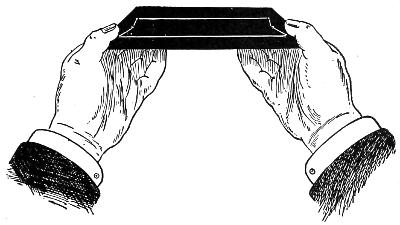
Fig. 35
(2) A special “pull” carried on the person of
the performer. This consists of a fine black
thread, to one end of which is attached a weight
travelling up and down the trouser leg, after the
manner described (in connection with a self-suspending
wand) at page 111 of “Later Magic.” In
the present case, however, the weight is much
smaller, being in fact just large enough to rather
more than counterbalance the coin used in the
trick, plus the friction to be overcome by the thread
in the working of the trick. The degree of such
friction is an uncertain quantity, as it will largely
depend on the nature of the operator’s underwear
and its closeness to his own body. The precise
weight most effective must be ascertained by previous
experiment, and regulated accordingly.
It will be found convenient to use by way of
weight a glass tube, closed at the bottom like a
test-tube and loaded with buckshot, more or less
in quantity according to the weight required.
The mouth of the tube is closed by a cork, through
which one end of the thread is passed, and secured
on the under side by a knot and a spot of gum.
When the minimum weight that will effectually
serve the desired purpose has been ascertained, any
vacant space above the leaden pellets should be
filled with cotton wool (to prevent rattling) and the
cork should then be cemented into the tube. If
preferred, the wool may be interspersed among the
buckshot.
The opposite end of the thread, which will be
somewhere about thirty inches in length (this again
being a point to be determined by experiment),
is passed through the curled end of a good-sized
safety pin. This, for use in the trick, is attached
to the inside of the performer’s vest, just within
the lowest part of the opening. To the free-end
of the thread, after passing through the loop of
the pin, is attached a disc of copper or zinc, three-quarters
of an inch in diameter, against which, on
one side, is pressed and flattened out a pellet of
conjurer’s wax, in good adhesive condition. If the
length of the thread has been duly regulated, the
little disc will rest normally just within the vest,
but can be drawn out the extent of a couple of feet
or so, returning swiftly to its hiding place the
moment it is released.
(3) A glass ball—professedly crystal.
(4) An ordinary match-box, empty.
Instructions for the working of the trick will
be most conveniently given step by step with the
patter, which may run as follows:
“In the early days of Queen Victoria’s reign,
when the oldest of us here present were good little
boys or girls, and the rest were not born or thought
of, there lived a celebrated scientific gentleman,
called the Baron von Reichenbach. I am sorry to
say he was a German, but he couldn’t help it. As
his father and mother were Germans, he had to be
one too. It shows how careful children ought to be
in the choice of their parents. He invented a lot of
useful things, among them creosote and paraffin.
Neither of them smells very nice, but they don’t
trouble about that in Germany.
“Besides being a great chemist, Von Thingany
dabbled in what are called the occult sciences, and
he claimed to have discovered a new force (a sort
of magnetism, only different) and which, he
declared, pervaded every thing in nature, especially
crystal. Directed by a strong will, like his
own, or mine, it would do all sorts of wonderful
things. It seemed to me that such a force would
come in very handy for magical purposes, and I
set to work to invent it over again, and I have at
any rate produced something very like it. The
Baron called his force ‘odd,’ but he spelt it ‘od,’
which is odd too. You must judge for yourselves
whether my force is the same as his, and you can
spell it which way you like.
“I have only been able so far to work up a very
small amount of the force, say about six mouse-power,
so it won’t turn tables, or lift pianos. I can
only get it, so far, to move a small weight like a
florin or a half-dollar, and that only for a very short
distance. For greater conveniences I have made
this little tramway for the coin to perform upon.
These wires which you see are not for it to travel
on, but merely to get more equal distribution of
the force. There is nothing out of the way about
it, nor with this ball, except that it is crystal.
Examine both as much as you please.”
The two articles are accordingly offered for
inspection. The performer takes back the tramway
in the left hand, holding it by one end in such
manner that it is gripped in the fork of the thumb,
leaving the thumb itself comparatively free. Taking
back the ball with the right hand and remarking
“Now to develop the force,” he rubs it on his
left coat-sleeve, and strokes the surface of the tramway
two or three times with it.
“Having now established a proper degree of
‘oddity’ between the tram and the crystal, I will
ask for the loan of a half-dollar (or florin as the
case may be) marked in any way the owner
pleases.”
He replaces the ball on the table, and in the act
of again turning to the audience gets hold of the
waxed disc and draws it away from the body, holding
it clipped between the ends of the first and second
fingers, the left thumb pressing the thread
against the cloth top of the tramway, and acting for
the time being (and indeed throughout the trick)
as a brake neutralising at pleasure the pull of the
weight.
He receives the coin on the tramway; then picking
it up with the right hand, makes some observation
as to the mark, meanwhile pressing the
waxed side of the disc against it, then replacing it,
disc down, in the middle of the tramway.
“I shall now, by means of the ‘od’ force, compel
the coin to move towards me.” This he does
accordingly, by relaxing the pressure of the thumb
upon the thread and merely bringing the pull of
the weight into operation. When the coin has all
but reached the nearer end of the tramway, he says,
“We will now see if we can make it travel a little
longer distance.” So saying he draws the thread
out again and lays the coin on the farther end of
the tram, and again makes it travel slowly back.
A good effect may be here produced by making it
stop halfway, and (after remarking in a casual
way that the power is hardly strong enough) picking
up the ball, again rubbing it upon the sleeve
and moving it, a few inches distance, in the direction
in which the coin is to travel, when it resumes
its journey accordingly.
Once more picking up the coin, he replaces it at
the farther end of the tramway, but in so doing
passes the thread outside and around the screw at
that end. He then remarks, as if bethinking himself:
“By the way, a lady suggested the other
night that the coin was attracted towards me by
my personal magnetism. I know I am an attractive
man: I have been told so frequently but that
is not the explanation in this case, as I will prove
to you by making the coin travel away from me.”
So saying, he draws the coin towards him, easing
off the pressure on the thread to enable him to do
so, and leaves it at the inner end. The ball is
now moved away from himself, and the pressure
of the brake being relaxed, the coin is now drawn
in the same direction.
“‘Quod erat demonstrandum,’ as our old friend
Shakespeare (or was it Euclid) used to say.” (To
the lender of the coin.) “You must take care of
this coin, Sir; it is now charged with a minute
quantity of the ‘od’ force, and so long as you
keep it you can never be ‘stony-broke.’ I will show
you just one more effect with it before I return it to
you.”
While speaking, he has carelessly picked up the
coin, and replaced it on the inner side of the screw
so that this shall be no longer encircled by the
thread. Picking up the match box from the table,
he pushes out the “tray” portion with the forefinger;
then throwing aside the outer case, he picks
up the tray, and inverts it over the coin.
“I will now show you that the ‘od’ force still
operates even though it is cut off from any direct
connection with the subject of the experiment: but
in this case a little more power is required.” So
saying he rubs the glass ball again on his coat-sleeve,
and, moving the ball accordingly, causes the
coin to travel towards him, the match-box naturally
moving with it. In again picking up the coin,
to return it to the owner, he detaches it from the
disc, which flies back to its original resting-place.
This is a trick involving some little trouble in
the way of preparation, and perhaps a little more
than average address on the part of the performer,
but on the other hand it costs little; for all the
needful appliances may be homemade, and in the
hands of an expert the trick will amply repay the
time and trouble expended upon it. Baldly stated,
its effect consists in the magical introduction of a
marked coin into the innermost of a nest of three
envelopes, each securely sealed.
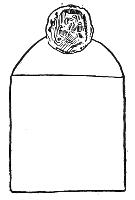
Fig. 36
The requirements for the trick are as under:
1. Two nests of envelopes. The innermost of
each is one of the little square kind used in shops
to contain copper “change,” or to hold the weekly
wage of an employee. It should be of cartridge or
stout manila paper, and about two inches square.
The next larger is of the ordinary square or so-called
square-note size, and the third a little larger
still. Envelopes of the two last mentioned sizes
are not always to be obtained made of cartridge
or manila, but this condition is not in their case
absolutely essential. The flap of each envelope
must be stuck down and sealed with red wax.[18]
2. A special envelope, which we will call the
“trick” envelope. This is of the same size and
kind as the innermost of the nested envelopes but
has undergone special preparation as follows:
Taking two ordinary envelopes, cut round the
edges of one of them with a penknife, completely
dividing back from front. Take the plain or non-flap
side of the one so treated, lay it squarely under
the flap of the other, and stick the flap down upon
it in the ordinary way: then add a seal of red
wax, as closely as possible corresponding in appearance
with the two seals of the innermost of the
nested envelopes. Lastly, cut away the superfluous
paper round the seal and the edges of the
flap. The envelope will now be shown as in Fig.
36, and when closed will have the appearance of
an envelope sealed in the ordinary way, though it
as yet lacks the connecting medium for actually
securing it.
3. The “coin mat” (page 4) freshly treated
with the usual adhesive. The side so treated is to
be turned downwards on the table with a shilling
pressed against the adhesive portion.
4. A penknife, to be used as envelope opener.
As shortly as possible before the presentation of
the trick, the trick envelope must be further prepared
by spreading a thin layer of seccotine on that
portion of the underside of the flap immediately
under the seal.
N. B. This must not be done too long beforehand,
as it is essential to the success of the trick
that the envelope be used while the seccotine is still
in a “tacky” condition.
The envelope prepared as above, to be laid on the
table, behind some small object, or preferably just
inside the foremost rim of a Japanese tray; at one
corner, mouth uppermost, and flap to the rear.
Under these conditions, the butting of the opposite
edge of the envelope against the forward wall of
the tray will be found greatly to facilitate the subsequent
introduction of the borrowed coin. Before
so placing the envelope, its edges on each side
should be pressed slightly inwards, so as to make
it expand a little at the opening.
These arrangements duly made, the performer
may introduce the trick as follows:
“I don’t know whether anybody here remembers
George the Third, I can’t say I do myself. He
was before my time, but there is a funny little story
told about him. One day when out for a walk, he
went into a farmhouse where he found the family
having their dinner. One dish consisted of apple-dumplings,
and the question crossed the King’s
mind, ‘How on earth did the apples get into the
dumplings?’ He didn’t like to ask, but he
couldn’t get the puzzle out of his head. He
thought about it so much and it worried him so
that at last he went clean out of his mind. He
became non compos mentis, which is the doctors’
polite way of saying dotty.
“I mention this story by way of a caution. What
I am going to show you is ever so much more incomprehensible
than any number of apple-dumplings;
in fact, so extra-extraordinary that if anybody here
was the least bit excitable and I sprung it upon
him unawares he might go dotty like old Georgie.
So if any of you feel at all nervous, don’t hesitate
to go home, or you can go and sit on the stairs
till this particular experiment is over. Nobody
moves! I am pleased to find that you are all so
strong-minded, but if anything happens don’t
blame me.
“I have known strong men; men of massive intellect,
like myself, come here with a smile on their
faces, but when they left the smile was replaced by
an air of grim determination. You could see at
a glance that they had made up their minds to find
out how it was done, or die. They haven’t come
again: so I suppose they died.[19]
“As you are prepared to run the risk I will ask
some gentleman to oblige me with the loan of a
shilling, marked, in some unmistakable way.
Thank you, Sir. You have marked the coin?
Then please place it here, on this little tray. I
won’t touch it myself at present. All please keep
one eye upon it, the other eye you had better keep
on me.”
Receive the coin on the mat, held in right hand.
After showing the left hand empty, transfer the
mat to that hand and show the right empty.
Return the mat to right hand, but before doing so
turn that hand over so as to receive the mat with
thumb undermost. Just as you reach the table
to place the mat upon it bring the second and third
fingers over the borrowed coin, and under cover
of your own body turn the mat over. In putting it
down on the table draw away the borrowed coin
into the hand and palm it. To the eye of the spectator
the state of things will be unaltered, your
own coin, now uppermost on the mat, being taken
for the borrowed one.
You continue, standing behind your table, and
resting the right hand, with the palmed coin, close
to the trick envelope, and holding up the two nests
in the other hand: “I have here two envelopes,
or, to be exact, six envelopes, for each of those you
see contains two more, one within the other: all
carefully sealed. I am going to pass the coin this
gentleman has lent me into the innermost of one
or other of them, I don’t care which, for they are
exactly alike, so I shall leave the choice to yourselves.”
While you are speaking as above the disengaged
hand slips the genuine coin into the trick envelope,
closes it, pressing the flap well down, and palms it,
dropping it a moment or two later into a pochette
till needed.
“You decide for this envelope? Just as you
please. As the other will not be needed I will ask
somebody to open it, and bear witness that things
are exactly as I have stated.”
Leaving the chosen envelope on the table in full
view and bringing forward the other, have the latter
opened by some member of the company with
the penknife. Hand the envelope produced from
it, with the knife, to a second spectator, to be dealt
with in like manner. When the innermost is
reached, have this opened by the lender of the
marked coin: this apparent proof of good faith
tending to make him less critical when, at a later
stage, he is invited to do the same with the trick
envelope.
“Nothing could be fairer, could it? You will all
agree that it would have been impossible to introduce
anything into the innermost of those three
envelopes without breaking all three seals. When
I say impossible, of course I mean impossible to a
mere man. To a magician there is no such word as
impossible, except in the dictionary. In fact, the
more impossible a thing is, the more any respectable
magician makes up his mind to do it. Watch
me carefully, please. I want you to be quite sure
all through that there is no deception.
“Now then, to pass the coin into this other envelope.”
As you say this, you pick up the coin mat,
depress it enough for all present to see the coin
upon it, and make the motion of sliding it off into
the left hand. This should be done while standing
a little in front of your table. In turning to
replace the mat, reverse it and lay it with the side
to which the coin adheres downwards. If deftly
executed, this reversal of the mat will be imperceptible,
as it is covered by the turn to the table.
Even if it were noticed it would have practically no
significance for the spectators, who naturally take
it for granted that the coin has passed from the
mat into your hand. The moment you have laid
down the mat, the now disengaged hand picks up
the nest of envelopes, and you make believe to rub
the coin (supposedly in left hand) into it. This
done, you hold the envelope aloft in each hand
alternately, allowing it to be seen that the hands
are otherwise empty.
“So far, so good! The coin has passed from my
hands into the innermost envelope. But I don’t
expect you to take my word for it. Will you, sir”
(any given spectator) “open the outermost envelope,
first, however, satisfying yourself that it is still
securely sealed?”
It is just possible, though not very likely, that
the person to whom the envelope and penknife have
been handed may notice, and remark audibly, that
he cannot feel any coin in the envelope. If such a
remark is made, you reply that the coin naturally
had to be dematerialised before it could pass into
the envelope, and it will take a few minutes for it
to re-materialise, but it will become gradually more
solid, and will then be distinctly perceptible.
The outer envelope having been opened you take
back its contents, and under pretext of getting as
many witnesses as possible to fair play, have the
next envelope opened by a second person, seated
at some little distance from the lender of the shilling.
The last named gentleman is invited himself
to open the last envelope, or rather, the trick envelope,
which you in transit substitute for it. Having
already opened a precisely similar envelope, and
found it securely fastened, he is not likely to anticipate
anything different about this one. If he uses
the penknife and cuts it open along the edge of
the flap in the usual way he will naturally hold it
with the thumb upon the seal and all will be well.
As a rule, he will be more concerned to identify the
coin as the one he lent than to seek for any suspicious
feature about the envelope. Even in the
unlikely case of his tearing open the envelope,
instead of cutting it, it is doubtful whether he
would detect the use of the seccotine, which should
by this time be practically dry; and by the rest of
the spectators it would still be taken for granted
that this envelope, like the rest, was sealed in the
ordinary way.
It will be obvious to the expert reader that the
central idea, viz., the transformation by the use
of seccotine of an open envelope into one apparently
sealed in the regular way, is one that admits
of a wide variety of detail as to the mode of presentation.
For instance: The procedure suggested
for getting rid of the duplicate coin, and
apparently rubbing it into the envelope, is but one
of many alternatives. The coin might be
“passed” by the agency of fire, i.e., wrapped in a
piece of flash paper with open fold at bottom and
flared off at the psychological moment over a candle
flame, or it might be got rid of by vanishing it into
the pocket of a black art mat, or by the use of a
black art patch, as described at page 20.
The critical part of the trick is the “switching”
of the two envelopes at the final stage, but in view
of their small size this is a matter of very little
difficulty. The expert will probably do this after
some fashion of his own. The less instructed
reader may use the following plan, which he will
find by no means difficult of execution, though it
will need some little practice to work it neatly.
While the second envelope is being opened, get
the trick envelope from the pochette into the right
hand, clipping it against the second and third joints
of the second and third fingers, with the “seal”
side turned away from them. When the genuine
envelope is handed to you receive it with the left
hand, and immediately transfer it to the right,
pushing it between the fingers and the palmed one,
with the seal facing in the same direction. The
moment it is masked by the fingers push the trick
envelope outward with the thumb, bringing this
into view in its place. Smartly executed the
change is instantaneous and cannot possibly be
detected. The apparent object of passing it from
hand to hand is to have the left hand empty and
so free to take back the penknife from the last
holder. From this point all will be easy, as it
is the trick envelope which is now alone in view,
and all you have to guard against is any accidental
exposure of the one now hidden in the hand.
This description may justly appear somewhat
long-winded, but its length is occasioned by the
number of small details demanding notice. In
performance, the trick should not take, at most,
more than ten minutes. The introductory patter
may of course be shortened at pleasure.
This is an extremely small volume, consisting
in fact of six pages only, and no letterpress, the
instructions for its use being embodied in a separate
leaflet. On each of its pages are miniature
reproductions of thirty-six playing cards, six in a
row; every card of the pack being represented once
at least among the whole number. The object of
the book is to enable the owner to discover the
name of a card drawn (or merely thought of) by
some member of the company. The chooser is
only asked to look at the book, and state on which
one or more of its pages the card in question
appears, when the performer, without seeing or
handling the book himself, can instantly name the
card. The six pages of the book are reproduced
in the diagrams which follow. Figs. 37-42.
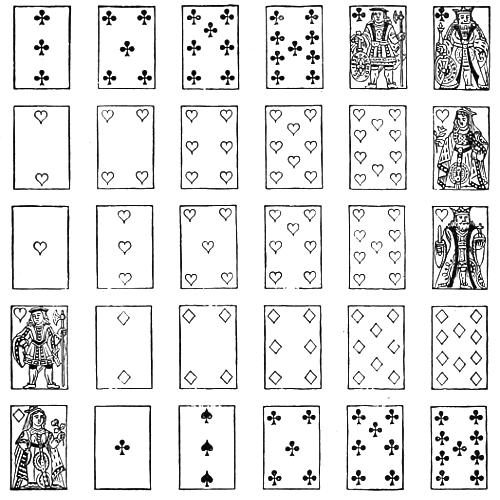
Fig. 37
Fig. 38
Fig. 39
Fig. 40
Fig. 41
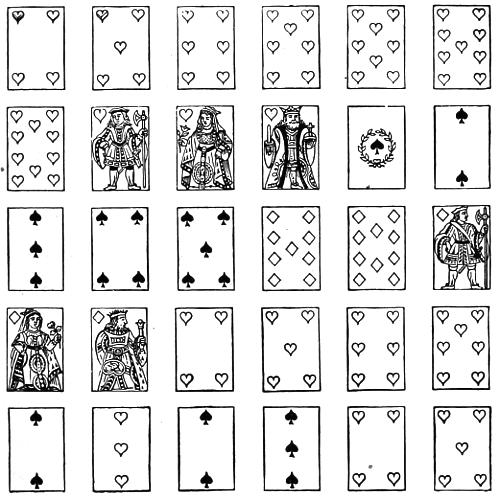
Fig. 42
To be in a position to work the trick, it is necessary
in the first place to memorise each of the fifty-two
cards of the pack in connection with a particular
number. This may at first sight appear a formidable
undertaking, but it is not so in reality.
All that really needs to be memorised is the order
of the suits; which is as under:
- 1. Clubs.
- 2. Hearts.
- 3. Spades.
- 4. Diamonds.
This order may be instantly recalled by using as
a memory-peg the word CHaSeD, which contains
the initials of the four suits in the proper order, or
the reader may if he prefers it recall them by
reflecting that Cool Heads Soon Decide.
The arrangement of each suit follows the natural
order, the ace of clubs being No. 1; the deuce 2;
and the trey 3; knave 11; queen 12 and king 13.
The card next following, viz., the ace of hearts, will
be 14; the deuce of hearts 15, and so on, the complete
arrangement being as shown below:
- 1. Ace of clubs.
- 2. Deuce of clubs.
- 3. Trey of clubs.
- 4. Four of clubs.
- 5. Five of clubs.
- 6. Six of clubs.
- 7. Seven of clubs.
- 8. Eight of clubs.
- 9. Nine of clubs.
- 10. Ten of clubs.
- 11. Knave of clubs.
- 12. Queen of clubs.
- 13. King of clubs.
- 14. Ace of hearts.
- 15. Deuce of hearts.
- 16. Trey of hearts.
- 17. Four of hearts.
- 18. Five of hearts.
- 19. Six of hearts.
- 20. Seven of hearts.
- 21. Eight of hearts.
- 22. Nine of hearts.
- 23. Ten of hearts.
- 24. Knave of hearts.
- 25. Queen of hearts.
- 26. King of hearts.
- 27. Ace of spades.
- 28. Deuce of spades.
- 29. Trey of spades.
- 30. Four of spades.
- 31. Five of spades.
- 32. Six of spades.
- 33. Seven of spades.
- 34. Eight of spades.
- 35. Nine of spades.
- 36. Ten of spades.
- 37. Knave of spades.
- 38. Queen of spades.
- 39. King of spades.
- 40. Ace of diamonds.
- 41. Deuce of diamonds.
- 42. Trey of diamonds.
- 43. Four of diamonds.
- 44. Five of diamonds.
- 45. Six of diamonds.
- 46. Seven of diamonds.
- 47. Eight of diamonds.
- 48. Nine of diamonds.
- 49. Ten of diamonds.
- 50. Knave of diamonds,
- 51. Queen of diamonds.
- 52. King of diamonds.
The arrangement of the table being once understood,
the number associated with any given card
in the club suit suggests itself automatically, e.g.,
the seven of clubs is likewise No. 7 in the list. To
ascertain the name of the card corresponding to
any of the higher numbers, all that is needed is to
subtract from that number 13, or such higher multiple
of thirteen as the case will admit, and the
difference will represent its position in its own
suit.
Suppose, for instance, that the performer desires
to know what card answers to the number 20.
Deducting thirteen from 20, the remainder, 7, tells
him that the card is the seventh (i.e. the seven)
of the second suit, viz., hearts. If he wants to
know the name of No. 29, he deducts 26, when the
remainder, 3, tells him that the card is the three of
the third suit, spades. If the card be No. 40, the
number to be deducted will be 39, and the
remainder, 1, tells him that the card is the first
of the fourth suit, viz., the ace of diamonds. After
a very few trials, this little exercise in mental
arithmetic becomes so familiar that the calculation
becomes practically instantaneous.
Going a step further; with each of the six pages
of the pocket-book is associated a special number,
known as its “key” number. These are as under:
| Page 1 |
Key Number |
1 |
| ” 2 |
” ” |
2 |
| ” 3 |
” ” |
4 |
| ” 4 |
” ” |
8 |
| ” 5 |
” ” |
16 |
| ” 6 |
” ” |
32 |
The memorising of these is also a very simple
matter, for it will be noted that the key numbers
are the first six factors of the familiar geometrical
progression, 1, 2, 4, 8, 16, 32. Printed as below:
| 1, |
2, |
3, |
4, |
5, |
6 |
| 1, |
2, |
4, |
8, |
16, |
32 |
the upper figures, in ordinary type, expressing the
numbers of the pages, and the lower, in black type,
the corresponding key numbers, a very small
amount of study will associate them so closely in
the mind as to fix them firmly in the memory.
Having mastered these two simple lessons, the
learner is in a position to use the pocket-book. To
ascertain the card chosen, he has only to add
together the key numbers of the pages in which
he is told that such card appears. The total will
be the number at which that card stands in the list
given on page 185, and, this being known, it becomes
an easy matter to name the card itself.
We will suppose, for instance, that performer
is told that the chosen card appears on the second
page, and no other. The key number of this page
being 2, the card must be the second in the list, viz.,
the deuce of clubs. If he is told that the chosen
card is to be found on pages 1, 3 and 6: the key number
of these three pages being 1, 4 and 32: together
making 37, and thirty-seven less twenty-six being
eleven, he knows that the card must be the eleventh
of the third suit, otherwise the knave of spades.
If he is told that the card is on the third, fifth and
sixth pages, the key numbers of which are 4, 16 and
32, total 52, it is clear that the card must be the
last in the list, viz., the king of diamonds.
So much for the working of the trick. But the
reader, if of an enquiring mind, will naturally ask,
“How is this result obtained?” The answer rests
upon a special property of the geometrical progression
which forms the six key numbers. It is
a curious fact that by the use of these six numbers,
either singly or in combination with others of the
series, any number, from unity up to 63, can be
expressed. Thus, the numbers, 1, 2, 4, 8, 16 and
32 we already have, these being numbers of the
series. As to other numbers:
- 1 + 2 = 3
- 4 + 1 = 5
- 4 + 2 = 6
- 4 + 2 + 1 = 7
- 8 + 1 = 9
- 8 + 2 = 10
- 8 + 2 + 1 = 11
- 8 + 4 = 12
- 8 + 4 + 1 = 13
and so on throughout up to 52, which being the
limit of the pack, is the highest number with which
we need concern ourselves.
In making up the pages of the pocket-book,
advantage has been taken of this principle. A
given card is inserted on that page or pages (and
those only) whose key numbers, alone or added
together, correspond with the position which the
card holds in the list. Thus the ace of clubs
will appear on the first page (not because it is the
first card, but because the key number of that page
is 1) and on no other. The deuce of clubs, in like
manner, on page 2, the key number of that card
being two. The next card, the three of clubs, must
appear on page 1 and page 2, their key numbers
together amounting to 3. The process as to cards
standing at higher numbers is the same. Thus, the
ace of spades, being the twenty-seventh card, and
twenty-seven being the aggregate of 16, 8, 2 and 1,
will appear on the first, second, fourth and fifth
pages. Conversely, if the performer is told that
the card appears on the four pages last named, he
knows that it is the twenty-seventh card, i.e., the
ace of spades. Any spaces remaining vacant on
the page after the whole pack has been dealt with,
are filled up by duplicates of cards already figuring
on the same page, their appearing under these
conditions making no difference to the calculation.
I am indebted to an ingenious amateur, Mr.
Victor Farrelly, for the idea of a novel method of
using the pocket-book. Mr. Farrelly does not
offer of his own accord to show what can be done
with it, but keeps it in reserve, for use in a special
emergency. Every conjurer meets now and then
with the pig-headed person who absolutely declines
to have a given card forced upon him, and persists
in endeavouring to extract one from some other
part of the pack. Armed with the pocket-book, the
performer can set such a person at defiance, and
indeed get additional kudos from his objectionable
behaviour.
He cheerfully gives up the struggle, saying “You
seem to think, sir, that I wish to influence your
choice in some way. To prove the contrary, I give
the pack into your own hands. Shuffle it well.
Thank you. Now take from it any card you please.
Look at it, and put it in your pocket. You are
satisfied, I presume, that I do not know that card?
You are quite right. I have not the smallest idea
of it, but I shall discover it without the smallest
difficulty by a process of mathematical magic. I
have here” (producing pocket-book) “a little book
of six pages, on each of which thirty-six cards are
illustrated. Will you kindly see whether the card
you chose is represented among those on the first
page? Meanwhile I will divide the pack, which
please remember I have not touched since you
shuffled it yourself, into six portions, one for each
page of the book.” This is done, the six packets
being turned face down on the table.
We will suppose that the chosen card is not found
on the first page. “Then,” says the performer,
“this first packet will tell me nothing, and may be
disregarded. Now, for the second page, is your
card upon that? It is? Then I draw two cards
from the second heap, and turn up one of them.
And now for the third page. Do you find your
card there? You do? Then I take up three cards
from the third packet, and again turn up the last
one.”
We will suppose that the chosen card is not found
in either the fourth or the fifth page, but re-appears
on the sixth, whereupon six cards are counted off
from the corresponding packet, and the last of
them turned up. The performer has by this time
mentally added up the key numbers of the second,
third and sixth pages: viz., 2, 4 and 32, together
making 38, and knows therefrom that the card is
the thirty-eighth in the list, viz., the queen of
spades. He does not however at once display his
knowledge, but pretends to make a mental calculation
from the cards exposed upon the table, giving,
if he so pleases, and the cards lend themselves to
it, some fanciful explanation of his method. It
seems to me, however, that this last is a needless
elaboration. Personally, I should prefer merely
to call attention by name to the cards exposed, and
say, “When these three cards appear in conjunction,
it is clear that the card drawn was the queen
of spades” (or whatever it may happen to be).
Any one deluded, as the majority will probably be,
into believing that you really infer the name of the
drawn card from those on the table, will be farther
from the real solution than ever.