IN her unpublished Mémoires,[1] which she began, but never completed,
and only a few pages of which—possibly all that she wrote—have been
preserved, Sophie Arnould tells us that she was born in 1745, “in the
same alcove in which Admiral Coligny had been assassinated two hundred
years before.” As a matter of fact, the celebrated singer was born on
February 14, 1745, and it was not until some years after her birth that
her parents removed to the Hôtel de Ponthieu, Rue Béthisy, then known as
the Rue des Fossés-Saint-Germain l’Auxerrois.[2]
Sophie’s parents belonged to the upper bourgeoisie, and at the time
of her birth appear to have been in comfortable circumstances. Her
father, Jean Arnould, was a worthy man, whose worldly ambitions were
limited to securing a comfortable competence, retiring from business,
and purchasing some Government or municipal office and the social
distinction which went with it. Her mother, however, had received an
excellent education, “which, joined to her natural intelligence,” says
Sophie, “rendered her in society the most amiable and interesting of
women.” She affected literary society and numbered among her friends and
acquaintances Voltaire, Fontenelle, who, a few days before his death,
called to show her the manuscript of one of the great Corneille’s
tragedies, Piron, the Comte de Caylus, Moncrif, the Abbé (afterwards the
Cardinal) de Bernis, Diderot, and d’Alembert.
So impressed was Madame Arnould by the conversation of these
celebrities, that she determined to make her little girl a prodigy of
learning. Sophie’s education began almost as soon as she was out of her
cradle. She was precocious and learned quickly. At four, she declares,
she could read; at seven she wrote better than at the time of penning
her Mémoires, and at the same age could read music at sight without
any difficulty. The infant prodigy was petted and spoiled to the top of
her bent, “dressed up in silk and satin, with marcasite necklace and
flowers in her hair.”
When the child was four or five years old she attracted the attention of
the Princess of Modena, wife of the Prince de Conti, from whom, however,
she was separated. Madame de Conti, lonely and bored, without husband,
lover, child, or occupation, took a violent fancy to Sophie, and begged
Madame Arnould to let her have the little girl to live with her. Madame
Arnould consented, and Sophie became the plaything of the eccentric
princess, “who dragged her about everywhere as she might have her little
dog,” now nursing her on her knee, now setting her down to the
harpsichord, now taking her visiting in her carriage, now summoning her
to her salon to amuse her guests, and anon, if she happened to be in an
ill-humour, turning her out into the ante-chamber to play with the
yawning lackeys.
No pains were spared with Sophie’s education, and the best masters of
the day were engaged to teach her all the arts and accomplishments.
Before she was twelve, she could both write and speak her own language
correctly—a rare accomplishment in those days outside literary
circles,[3] and was familiar with Latin or Italian; while she could sing
like a professional.
Her musical talents were not destined to remain long hidden. When the
time for her first communion drew near, she was placed in the Ursuline
Convent at Saint-Denis, the supérieure of which was a fellow
townswoman and friend of Madame Arnould. Here she sang in the choir, and
with such astonishing success that Court and town flocked to hear her,
and Voltaire, from his retreat at Ferney, wrote to his little friend a
letter congratulating her on her twofold success as a vocalist and a
first communicant; an epistle which Madame Arnould, who did not share
the Patriarch’s views on matters of religion, promptly committed to the
fire, although the Duc de Nivernais begged for a copy on his knees. On
leaving Saint-Denis, Sophie returned to live with Madame de Conti, who,
delighted by the notice which she had attracted, provided her with the
most celebrated music-masters to be found in France: Balbatre gave her
lessons on the harpsichord, and the famous Jéliotte—Jéliotte, the pride
of the Opera!—Jéliotte, “the happy and discreet conqueror of all the
fair ladies in Paris!”—condescended to sing with her. Sophie proved
herself worthy of her teachers.
It was then the fashion, among ladies of rank, to do penance during Lent
by retiring to one of the many convents in Paris or its neighbourhood.
Some of the visitors were, of course, sincerely desirous of benefiting
by the services, the conversation of the nuns, and the opportunities for
meditation which these peaceful abodes afforded; but to the majority the
practice would appear to have been regarded merely as a kind of rest
cure. There was nothing at all austere or conventual about the life for
such as these. They rose late, walked in the gardens, dined on plain but
well-cooked food, received visits from their friends, attended a service
or two, supped, and retired early to bed; and if their souls did not
greatly benefit, the early hours and simple fare worked wonders with
their complexions. They had, too, an opportunity of listening to some
very beautiful singing; for, during Holy Week, the convents vied with
one another in engaging the finest voices of the Opera to reinforce
their choirs, and the services of such singers as Jéliotte, Chassé, and
Mlles. Fel, Chevalier, and Anna Tonelli were always in great request.
At the beginning of Holy Week 1757, Madame de Conti, who, as became an
Italian princess, was very strict in her observance of Lent, arrived at
the Abbey of Panthémont, where she found the community in a state of
consternation. The convent in question had not deemed it necessary to
enlist the services of any of the stars of the Opera, as it numbered
among its inmates a nun with an exceptionally beautiful voice. But alas!
she had suddenly been taken ill, and it was feared that it would be
impossible to replace her. Half fashionable Paris would be coming on
Holy Wednesday to hear the Tenebræ sung, and there would be no one
capable of singing it. The abbess fell upon Madame de Conti’s neck and
wept tears of mortification.
The princess bade her not despair, told her of the talent of her little
protégée, and suggested that she should be sent for; a proposal to
which the grateful abbess readily consented.
Holy Wednesday came, and with it a great crowd of visitors. At the
beginning of the service Sophie was a little nervous, but quickly
recovered her presence of mind, and sang so divinely that her hearers
were enraptured, and some, in spite of the solemnity of the place, could
not refrain from applause. The following day there was not a vacant seat
in the church; while on Good Friday the doors were literally besieged,
and more than two hundred carriages were turned back. Those who had
succeeded in gaining admission had every reason to congratulate
themselves on their good fortune, for Sophie sang the Miserere of
Lalande, and with such exquisite pathos that there was scarcely a dry
eye in the congregation.[4]
Paris was as delighted as if it had found a new fashion. All the
Faubourg Saint-Germain wended its way to the Hôtel de Conti to
congratulate the princess upon the possession of this little wonder with
her angelic voice. The Court was scarcely less interested and, finally,
the Queen, the pious Marie Leczinska, who lived in a little world of her
own and seldom troubled herself about what was happening in the one
outside, expressed a desire to see Sophie.
“On your account,” remarked Madame de Conti to the radiant girl, “her
Majesty condescends to remember my existence.” (The said Majesty did not
approve of ladies who lived apart from their husbands.) Nevertheless,
the Queen had to be obeyed, and so the princess, who was proud of her
protégée and, in truth, far from displeased with so striking a tribute
to her discernment, ordered her coach and set out for Versailles.
On reaching the Château, Madame de Conti and Sophie were conducted to
Marie Leczinska’s apartments, where the Queen almost immediately joined
them. Her Majesty smiled very graciously upon the girl, and kissed her
forehead, murmuring: “She is indeed very pretty!” Then several
portfolios of music were put before her, and she was bidden to choose
what she would like to sing, and not to be afraid; a somewhat
unnecessary exhortation, since never was there a more self-possessed
young person. Sophie, quite undismayed by the presence of her royal
auditor, forthwith assailed a very difficult piece, and had scarcely
finished when the Queen, who was herself a musician of no mean
attainments, remarked to Madame de Conti: “I should like to have her,
cousin; you will give her up to me, will you not?” meaning that she
wished to make her one of her Musicians of the Chamber. Afterwards
refreshments were brought in, and the Queen, having complimented the
young singer and bestowed upon her a friendly pat with her fan, took her
departure.
But there was another Queen of France: Madame de Pompadour, to wit, who
had already expressed a wish to hear Sophie sing; a wish which could no
more be ignored than that of Marie Leczinska. On the morrow of the
interview with the Queen, Madame du Hausset, the favourite’s femme de
chambre, presented herself at the Hôtel de Conti, bearing a letter from
her mistress to the princess, requesting the loan of little Mlle.
Arnould till the evening.
This request caused Madame de Conti considerable embarrassment. What one
called then “les grandes convenances” forbade her to present Sophie to
both the crowned and the uncrowned Queen of France. On the other hand, a
refusal would mortally offend the latter, who was an extremely awkward
person to offend, as a great many people, from Princes of the Blood and
Ministers of State to ballad-mongers, had found to their cost. The poor
lady was at a loss what to do.
Finally, she sought refuge in a compromise. Sophie should go to
Versailles again, but, on this occasion, not in her patroness’s company,
but in that of her mother. So Madame Arnould was sent for and told to
take her daughter, as from Madame de Conti, to the favourite; and the
princess congratulated herself on having emerged with credit from a very
embarrassing situation.
Madame de Pompadour received her visitor very graciously, and remarked
that “mother and daughter were the very picture of one another,” after
which, saying that the King had sent for her, and that she would return
in a few minutes, she left them to themselves. In the room in which
they sat were two magnificent harpsichords, one of which had been
decorated with charming pictures by Boucher. This instrument attracted
Sophie’s attention, and, while Madame de Pompadour was absent, she
stepped up to it, ran her fingers over the keys, and began to sing. The
marchioness, returning at that moment, listened entranced to the girl’s
singing until she had finished, when she exclaimed: “My dear child, le
bon Dieu has made you for the theatre; you were born, formed as one
ought to be for it: you will not tremble before the public.”
Then their hostess conducted them through her apartments, where Sophie
appears to have been particularly struck by the favourite’s sumptuous
bed, with its green and gold hangings and gold fringes, raised, like a
throne, upon a daïs, and enclosed within a semi-circular balustrade of
gold and marble, the exact counter-part, in fact, of the Queen’s own
couch. The marchioness begged her to sing again, and, delighted with her
sweet voice, smilingly inquired who were her masters; to change
countenance, however, when she heard their names, for they were the same
whom she had engaged for her idolised little daughter, Alexandrine
d’Étoiles, who had died some years before.
As Sophie and her mother were taking their leave, Madame de Pompadour
drew the latter aside, and said in a low voice: “If the Queen should ask
for your daughter for the music of the Chamber, do not have the
imprudence to consent. The King goes from time to time to these little
family concerts, and, instead of giving this child to the Queen, you
will have made a present of her to the King.” Then she turned to Sophie,
and, having examined the lines in the girl’s forehead and hand, said to
her gravely: “You will make a charming princess!”
A few days after these visits, Madame Arnould received a communication
from the Gentlemen of the Chamber to the effect that her Majesty had
deigned to admit the demoiselle Sophie Arnould into her private company
of musicians and singers, at a salary of one hundred louis; Madame
Arnould received a similar appointment, at the same salary as her
daughter.
Hardly had the good lady had time to master the contents of this
document, when there came a second of a much less welcome nature. It was
a lettre de cachet, informing her that by the express order of the
King, the demoiselle Sophie Arnould was attached to his Majesty’s
company of musicians, and, in particular, to his theatre of the Opera.
On reading this, the poor mother burst into tears. She had no objection
to her daughter singing before the virtuous Marie Leczinska, but the
Opera was a very different matter. No young girl could hope to preserve
her virtue for long at the Académie Royale de Musique, the rules of
which emancipated its members from parental control. Rather than see her
child ruined, she resolved to consign her to a convent, and,
accordingly, hurried off to Madame de Conti to implore her assistance.
Madame de Conti promised to do all in her power to save Sophie from the
danger which threatened her, and took the girl to her friend the Abbess
of Panthémont. “I bring you,” said she, “this young girl, of whom the
Gentlemen of the Chamber wish to make an actress; a decision which does
not meet with my approval. Conceal her for me in some little corner of
your convent, until I have had an opportunity of speaking to the King.”
To which the discreet abbess replied: “Princess, salvation is possible
in every profession. I cannot bring myself to thwart the wishes of the
King, to whom I owe my abbey. Go and see the abbesses of Saint-Antoine
and Val-de-Grâce: perhaps, in this matter, they will have more courage
than myself.”
Madame de Conti tried Saint-Antoine and Val-de-Grâce; but at both she
received the same answer as at Panthémont; and was reluctantly forced to
the conclusion that further attempts in the same direction offered but
very small prospect of success.
There remained, however, another way of escape: marriage. Sophie had an
admirer—a devoted and, what was more to the point, an eligible
admirer—a certain Chevalier de Malézieux, who asked nothing better than
to give her the protection of his name. In his day, M. de Malézieux had
been a noted vainqueur de dames, but that day, alas! was long past,
and though he strove manfully to repair the ravages of time by the aid
of an ingenious toilette, the only result of his efforts was to give him
the appearance of a majestic ruin.
Madame de Conti had, at first, regarded this veteran dandy’s attentions
to her protégée with scant favour, and, meeting the old gentleman one
day at the Arnoulds’ house, charitably related for his benefit the story
of a prince of her own family, who had imprudently contracted a marriage
at the age of eighty, and had died the same night. Still, a day or two
later, she told Sophie that she might do worse than take charge of the
chevalier and his infirmities, provided that he would agree to settle
his whole fortune upon her; and after the arrival of the lettre de
cachet from Versailles, and her abortive attempts to secure the girl’s
admission to a convent, actually proposed to send for M. de Malézieux,
and have the marriage celebrated there and then.
Madame Arnould, however, did not altogether approve of such haste, while
Sophie shed tears enough to melt the heart of the sternest parent; and
the matter, therefore, remained in abeyance. Nevertheless, the
chevalier, encouraged by Madame de Conti, pressed his suit with ardour,
dyed his eyebrows, rouged his cheeks, “shaved twice a day,” and, one
fine morning, presented himself at the Arnoulds’ house, bearing the
draft of a marriage-contract, in which the whole of his property,
amounting to some 40,000 livres a year, was settled upon Sophie.
The prospect of so advantageous a settlement in life for her daughter
was a temptation greater than any self-respecting mother could be
expected to resist, and though M. Arnould declined to force the girl
into a marriage which was distasteful to her, his wife lost no
opportunity of sounding the praises of M. de Malézieux—or rather of M.
de Malézieux’s income—in Sophie’s reluctant ear. That young lady,
however, only pouted, and when her antiquated admirer strove to soften
her heart towards him by citing the example of Madame de Maintenon, who,
when a young and beautiful girl, no older than Sophie herself, had
espoused the crippled poet Scarron, replied, laughing: “I will make a
similar marriage to-morrow, on condition that my husband will begin by
being a cripple, and end by being a king.”[5]
And so poor M. de Malézieux’s contract was never signed, and no
alternative now remained for Madame Arnould but to allow Sophie to enter
the Opera, trusting that, for some time to come, her services would only
be required for the Concerts of Sacred Music which were given during
Lent. This hope, however, was not realised, for the directors of the
Opera happened to be just at that time on the look-out for some novelty
to divert the attention of their patrons from the mediocrity of the
pieces with which they had lately been provided, and, accordingly, on
December 15, 1757, the young singer was called upon to make her first
bow to the public.
It was a very modest début—merely the singing of an air introduced
into an opera-ballet by Mouret, entitled Les Amours des Dieux.[6]
Nevertheless, restricted as were the girl’s opportunities on this
occasion, she quickly became a public favourite; indeed, the eagerness
to see and hear her was so great that on the evenings on which she
appeared, the doors of the theatre were besieged, and Fréron
sarcastically observed that “he doubted whether people would give
themselves so much trouble to enter Paradise.”
“Mlle. Arnould,” says the Mercure de France of the following January,
which was but the feeble echo of the enthusiasm of the public,
“continues her début in Les Amours des Dieux, with great and
well-deserved success. She attracts the public to such an extent that
the Thursday has become the most brilliant day at the Opera, altogether
effacing the Friday. The second air which she sings affords her more
scope for the display of her talent than the first. She possesses at
once a charming face, a beautiful voice, and warmth of sentiment. She
is full of expression and of soul. Her voice is not only tender, but
passionate. In a word, she has received all the gifts of Nature, and, in
order to perfect them, she receives all the resources of Art.”
At the beginning of the New Year, Sophie appeared in a second piece,
called La Provençale, in which she confirmed the favourable impression
she had created in Les Amours des Dieux. “Mlle. Arnould,” says the
Mercure, “sang the Provençale with the ingenuous charm of her age.
In this rôle she had only one important song. It is the monologue (‘Mer
paisible’...), into which she threw all the expression that it
demanded. The crowded houses which have followed it up to Lent are
proofs of the pleasure which she gives the public.”
In the following April the young actress reaped the reward of her
success by receiving her first important part, that of Venus in Énée et
Lavinie, a tragic opera in five acts by Fontenelle, music by
Dauvergne.[7] The confidence reposed in her was not misplaced, and she
received as much applause as she had previously obtained in ariettas and
pastorals. Such was her success indeed that she was speedily promoted to
the principal rôle, and the admiring critic of the Mercure, who had
already spoken in high terms of the new singer’s rendering of Venus,
consecrated to her the following article:
“On Tuesday, April 13, Mlle. Arnould played the rôle of Lavinie for the
first time. Her success was complete. The tragic indeed seems to be the
genre most suited to her. It is, at any rate, that in which she has
appeared to most advantage. Her gestures are noble without arrogance and
expressive without grimaces. Her acting is vivacious and animated, and
yet never departs from the natural. This excellent actress has already
partially corrected herself of a kind of slowness, which is only
suitable to the arietta. Bad examples had led her astray. We invite her
to pay heed to no one but herself, if she wishes to approach nearer and
nearer to perfection.”
“So great a success renders it almost needless for us to observe that
Mlle. Arnould has retained this rôle; that she has brought back the
public to the Opera; finally, that she has adorned Énée et Lavinie
with an appearance of novelty.”
Some months later the Mercure returns to the subject of Énée et
Lavinie, and observes that Mlle. Arnould played the latter part “with
that intelligence, that dignity, those natural and touching graces which
enchant the public.” “Happily,” continues the critic, “she has depended
upon her own impulses before allowing herself to be intimidated by all
the little prejudices of the art. Model as a débutante, she reanimates
the lyric stage and appears to communicate her soul to those who have
the modesty and the talent to imitate her.”
Towards the end of June of that year, Sophie created a trio of small
parts in an opera-ballet in three acts, entitled Les Fêtes de
Paphos.[8] Collé, that most exacting of critics, is very severe on
this piece, but, at the same time, has nothing but praise for Sophie,
who appears to have covered herself with glory. “At the first
representation,” he writes, “the music of this ballet was thought
pitiable, and it would not have survived six, if it had not been for a
young actress who made her first appearance this winter, and who, in
four months, has become the queen of the theatre. Never have I seen
combined in the same actress more grace, more truth of sentiment,
dignity of expression, intelligence, and fire. Never have I seen grief
more charmingly expressed. She can depict the deepest horror without her
countenance losing one feature of its beauty. She would be twice as
great an actress as Mlle. Le Maure,[9] if she only possessed two-thirds
of her voice, and Mlle. Le Maure will always be regarded as a great
artiste. I speak of Mlle. Sophie Arnould, who is not yet nineteen years
old.”[10]
The voice of Sophie Arnould was very far from being a powerful one.
“Nature,” she says in her Mémoires, “had seconded this taste [the
taste for music] with a tolerably agreeable voice, weak but sonorous,
though not extremely so. But it was sound and well-balanced, so that,
with a clear pronunciation and without any defect save a slight lisp,
which could hardly be considered a fault, not a word of what I sang was
lost, even in the most spacious buildings.”
She might have added, without fear of contradiction, that her voice was
infinitely sweet and that she possessed the gift of imparting to it
wonderful pathos and expression. “She brought to harmony, emotion, to
the song, compassion, to the play of the voice, sentiment. She charmed
the ear and touched the heart. All the domain of the tender drama, all
the graces of terror, were hers. She possessed the cry, and the tears,
and the sigh, and the caresses of the pathetic.... What art, what
genius, must there have been to wrest so many harmonies from a
contemptible voice, a feeble throat.”[11]
Another important factor in Sophie’s success is to be found in the fact
that she was not only a great singer, but an accomplished actress, which
great singers rarely are. When Madame Arnould had found that she had no
alternative but to allow her daughter to enter the Opera, she had, like
a sensible woman, decided that, since to the Opera Sophie must go,
nothing which could possibly make for her success in her profession
should be neglected, and had sent her to take lessons in singing from
Mlle. Fel, and in acting from Mlle. Clairon. The girl had not failed to
benefit by the teaching of the famous tragédienne, and her command of
facial expression and the dignity and grace of her movements would have
reflected credit on a veteran member of the Comédie-Française, while for
a débutante of the lyric stage they were little short of
extraordinary.
And yet, with all her vocal and histrionic talents, it may be doubted
whether Sophie would so speedily have attained the dazzling position in
the estimation of both the public and the critics which was now hers,
had she not been fortunate enough to possess physical attractions of a
high order. If we are to judge of her appearance solely by her portraits
by La Tour and Greuze, she must have been a very pretty woman. In the
former, which the excellent engraving by Bourgeois de la Richardière has
helped to popularise, Sophie is depicted at the moment when she is about
to sing. Her lips are parted; her eyes, fine and full of expression, and
surmounted by arched eyebrows, are turned imploringly heavenward; while
her face, which is oval in shape, with small and regular features, wears
a look at once charming and pathetic. In the Greuze portrait—now in the
Wallace Collection at Hertford House—the actress is dressed in white,
with a large black hat decorated with a white plume. Her elbow rests on
a chair, her chin on the back of her hand; her expression is nonchalant
and slightly ennuyé.
These portraits, as we have already remarked, are those of a very pretty
woman; but it should be added that the pen-portraits which some of her
contemporaries have left of Sophie are not altogether in accord with the
crayon of La Tour or the brush of Greuze—nor yet with the description
which the lady gives us of her own charms[12]—and we are, therefore,
inclined to think that both artists have rather idealised their subject,
a practice not uncommon with portrait-painters in the eighteenth
century or, for that matter, in much later times. Collé and Grimm, it is
true, both speak of Sophie as beautiful, though without condescending to
particulars; but, on the other hand, Madame Vigée Lebrun asserts that
the beauty of her face was spoiled by her mouth, while one of the
inspectors of the Lieutenant of Police describes her skin as “black and
dry.” That curious work L’Espion anglais confirms the artist and the
inspector: “To tell the truth, there is nothing remarkable about her;
her face is long and thin; she has a villainously ugly mouth, prominent
teeth, standing out from the gums, and a black and greasy skin.” The
writer adds, however, that she possessed “two fine eyes,” a feature
which also impressed Madame Lebrun, who says that they gave their owner
“a piquant look,” and were “indicative of the wit which had made her
celebrated.”
But two fine eyes, as one of her biographers very justly observes, count
for much, especially when animated by the intelligence, the feeling, and
the passion which belonged to Sophie; and no sooner did she appear upon
the stage than a host of soupirants gathered about her. For some
months, however, they sighed in vain. The guardian of the Golden Fleece
was not more vigilant or more awe-inspiring than Madame Arnould. Every
evening she escorted her daughter to the theatre, remained in her
dressing-room while the mysteries of her toilette were being performed,
accompanied her to the corner of the stage, and then waited in the wings
until the young actress made her exit, when she again took charge of
her. She seemed to have as many eyes as Argus himself. If an admirer
bolder than the rest ventured to approach Sophie, before he had uttered
half a dozen words down would swoop the watchful mother, with a
freezing: “Allons! laissez la petite en repos, s’il vous plait,
Monsieur!” before which the luckless gallant fled incontinently. If a
poulet were despatched, it was invariably intercepted and returned to
the sender, with a message which made him feel supremely foolish. “She
is not a woman at all,” exclaimed the indignant Duc de Fronsac, after
one of these rebuffs; “she is a veritable watch-dog!”
But even the most intelligent of watch-dogs cannot always discriminate
between friend and foe. The danger came from a quarter whence the poor
mother least expected it. She herself admitted the wolf into the
sheepfold.
For some time past, matters had not gone well with the Arnoulds; M.
Arnould had become involved in some disastrous speculations, which had
swallowed up the greater part of his fortune, and a long and serious
illness had made further inroads upon his resources. Accordingly, about
the time that Sophie made her début at the Opera, he removed from the
Rue du Louvre to the Hôtel de Lisieux, Rue
Fossés-Saint-Germain-l’Auxerrois, and converted his new residence into
an inn, where “persons from the provinces were accommodated at thirty
sols a night.”[13] To this inn there came, one fine day in the spring of
1758, a handsome young man of about five and twenty, who informed the
Arnoulds that his name was Dorval, that he was an artist by profession,
and that he had just arrived from Normandy, to study painting and get a
play produced. M. Dorval was a model guest. He never grumbled about his
food or his wine, never questioned the amount of his bills, never
returned home with an unsteady gait or accompanied by undesirable
acquaintances, as did so many young provincials who aspired to imitate
the vices of the fine gentlemen of the capital. And then he was so
ingenuous, so friendly, and had such charming manners. He knew nothing
of the ways of Paris, he said, but, morbleu! he had heard that it was
a terribly wicked place and full of snares and pitfalls for unwary
youth. Would M. Arnould do him the favour of taking care of his purse?
Would Madame have the complaisance to do the same for his lace? Ah! it
was indeed a fortunate hour which had led him to the Hôtel de Lisieux!
The good people might have thought it a little singular that a young man
with so well-filled a purse and such fine lace should have selected so
unpretentious a hostelry as theirs for a lengthy stay; also that,
although he never looked askance at the menus of the Hôtel de Lisieux,
he was constantly receiving hampers containing fish, game, truffles, and
choice wines, which, he said, came from his fond parents in Normandy,
and begged his hosts and their daughter to share with him. But M. Dorval
quite disarmed suspicion—if any existed—by reading the letters he
received from home to the sympathetic Madame Arnould, and, besides,
innkeepers have more important matters requiring their attention than
the investigation of the private affairs of their guests, particularly
those who give no trouble, pay regularly, and are so agreeable and
open-handed as was this young Norman.
M. Dorval overwhelmed Madame Arnould with attention; he had literary
tastes, and recognised in her a kindred soul. To Sophie he was also
attentive, though not more so than good-breeding required. In a short
time he had become quite a friend of the family, dining and supping
with them, escorting the ladies to the Opera and home again at the
conclusion of the performance, and spending the rest of the evening in
their company. One night, after playing a couple of games of backgammon
with M. Arnould, Dorval pleaded an insupportable headache and retired to
his modest apartment. Soon afterwards a man in a lackey’s livery entered
the house by means of a false key, knocked at his door, and informed him
that all was ready. Dorval emerged from his room, and was joined by
Sophie. The pair crept noiselessly down the stairs, across the courtyard
and into the street, at the corner of which a coach was awaiting them.
Dorval helped the girl in and took his seat beside her; the driver
cracked his whip; the coach rolled away. Sophie was carried off!
Terrible was the consternation at the Hôtel de Lisieux the following
morning. Madame Arnould was like one distraught; M. Arnould, who had not
yet fully recovered from his recent illness, had a serious relapse. As
for the Chevalier de Malézieux, when the news was communicated to him he
took to his bed and never left it again, dying of grief—or, perhaps, of
wounded vanity. In Paris, nothing else was talked of but the elopement
of the queen of the Opera, and many were the wagers made about the
identity of the fortunate individual who had borne away the coveted
prize. All uncertainty was soon at an end. Two days later a letter was
brought to the Hôtel de Lisieux, signed Louis, Comte de
Brancas-Lauraguais, in which the writer offered his apologies to M. and
Madame Arnould for the deception he had been obliged to practise upon
them, and concluded by a formal promise to espouse their daughter—if he
should ever become a widower!
Madame Arnould dried her tears; M. Arnould’s illness took a favourable
turn. Since Sophie had been carried off, it was at least some
consolation to learn that her abductor was a man of rank and wealth, and
not a mere middle-class libertine; one, too, who, without doubt, was
only prevented from giving his name and all that went with it to the
object of his affection by the unfortunate circumstance that he was
already provided with a wife. The worthy pair quite forgot their
disgrace as they thought of the brilliant future which awaited their
daughter, when the earth should have closed over poor, delicate Madame
de Lauraguais—she lived till 1793, and her career was ended by the
guillotine—and the count’s father, the old Duc de Lauraguais, should
have gone the way of all flesh. Why, if the Fates were kind, ere many
months had passed Sophie might be a countess—nay, a duchess! And so
when, in due course, the prodigal daughter came, in a magnificent coach,
to pay a visit of courtesy to her parents, she found, instead of tears
and reproaches, caresses and pardon. Such was the moral code of the year
of grace 1758!
Louis Léon Félicité de Brancas, Comte de Lauraguais, the first lover of
Sophie Arnould, was a singular creature. “He has all possible talents
and all possible eccentricities,” wrote Voltaire, while Collé describes
him as “the most serious fool in the kingdom.” His conceit was
stupendous, his extravagance unbounded, his energy and versatility truly
astonishing; he dabbled in everything and confidently believed that he
excelled in whatever he might choose to undertake. Now he was composing
tragedies intended to eclipse the masterpieces of Corneille and Racine;
now making experiments in chemistry or anatomy which were to completely
revolutionise those sciences; anon writing treatises in favour of
inoculation, or endeavouring to bring about reforms in the theatre,[14]
or riding in horse-races.[15] The violence with which he advocated his
own views and his unsparing denunciations of all who ventured to differ
from him, no matter how highly placed they might be, were perpetually
bringing him into collision with the authorities, and he was several
times exiled or imprisoned, only to resume his eccentric career the
moment his punishment was at an end. The stories about him are
numberless.
On one occasion he wrote a comedy, entitled La Cour du Roi Pétaud, and
coaxed his unsuspecting father to persuade the Comte de Saint-Florentin,
the Minister of the King’s Household, to direct the Comédie-Italienne to
produce it. The order was on the point of being sent, when one of
Saint-Florentin’s secretaries, happening to glance through the play,
discovered, to his horror, that it was nothing less than a clever and
biting satire on certain idiosyncrasies of his Most Christian Majesty
Louis XV. himself, which, had it been represented, would most certainly
have entailed banishment or the Bastille on all concerned in its
production.[16]
On another, he appeared, at four o’clock in the morning, at the lodging
of two poor but talented young chemists, hustled them into a coach which
was in waiting, and carried them off to Sèvres, where he had a little
house, in which he was in the habit of conducting his chemical
experiments. Leading his companions to the laboratory, he addressed them
as follows: “Messieurs, I wish you to make certain experiments; you will
not leave this house until they are completed. Adieu; I shall return a
week hence; you will find here everything you require; the servants have
orders to attend to your wants; set to work.” So saying, he locked them
in and went away. When he returned, the young chemists communicated to
him the result of their labours, a discovery of some little importance,
upon which he offered them a sum of money if they would agree to
surrender to him the credit of having made it. “You,” said he, “have
genius, and you want money. I have money, and I want genius. Let us
strike a bargain. You shall have clothes to wear, and the glory shall be
mine.” The young chemists consented, and Lauraguais went about boasting
everywhere of the discovery he had made; and such, says Diderot, who
tells the story, was his conceit that he soon succeeded in persuading
himself that it was he to whom the credit really belonged, and that the
young men had done nothing, except render him some merely mechanical
assistance.[17]
A third story of this extraordinary man is even more amusing than the
preceding one. He appears to have had a theory that it would be possible
for a person to support life entirely on a diet of forced fruit,
provided that they were kept in the same temperature as was required for
the production of what they consumed. He, therefore, persuaded one of
his mistresses to allow herself to be shut up in a green-house and fed
upon grapes, pine-apples, and so forth. This regimen, as may be
supposed, did not agree with the lady, who soon declared that she was
starving. “Ungrateful girl!” exclaimed the disgusted count. “Can you
complain of not having sufficient to eat—a trivial matter at
best—while you are thus abundantly supplied with the luxuries that
every one longs for?”
So eccentric a character as Lauraguais was hardly calculated to make any
woman happy, whether wife or mistress, and Sophie declared long
afterwards that the count “had given her two million kisses and caused
her to shed four million tears.” Nevertheless, the liaison was a
tolerably long one, and, for the first three years, in the course of
which the actress presented her lover with two children, we are assured
that they were a most affectionate couple. By the police-reports of the
time, Sophie is represented as an extravagant, grasping and avaricious
woman, who cared for the count only so long as he was able and willing
to gratify her innumerable caprices. Extravagant she no doubt was, but
in regard to the other and graver charge, she would appear to have been
maligned, that is to say, if we are to place any reliance in the
following anecdote related by Diderot:
“For some days past a rumour has been current that Mlle. Arnould is
dead, but it requires confirmation. In the meanwhile, the Abbé Raynal
has made me her funeral oration, by relating to me some fragments of a
conversation which passed between her and Madame Portail [the wife of a
president of the Parliament of Paris], in which, it appears, the latter
played the part of a wanton, and the little actress that of an honest
woman:
“ ‘Is it possible, Mademoiselle, that you have no diamonds?’
“ ‘No, Madame, nor do I think them necessary for a little bourgeoise of
the Rue du Four.’
“ ‘Then, I presume, you have an allowance?’
“ ‘An allowance! Why should I have that, Madame? M. de Lauraguais has a
wife, children, a position to maintain, and I do not see that I could
honourably accept the smallest part of a fortune which legitimately
belongs to others.’
“ ‘Oh, par ma foi! If I were in your place, I should leave him.’
“ ‘That may be, but he likes me, and I like him. It may have been
imprudent to take him, but, since I have done so, I shall keep him.’
“I do not recollect the remainder of the conversation, but I have an
idea that it was as dishonourable on the part of the president’s wife as
honourable on the part of the actress.”[18]
If Lauraguais really was so generous a protector as the police-reports
and those writers who accept them would have us believe, it is certainly
rather surprising to find on November 13, 1759, when the count’s passion
for his mistress was undoubtedly at a very high temperature, the sieur
Jean Baptiste Delamarre, tipstaff to the Châtelet de Paris, acting on
behalf of the sieur Jean Baptiste Desper, perruquier, requiring the
attendance of a commissary of police to witness an execution upon the
goods of the demoiselle Madeleine Sophie Arnould, residing on the first
floor of a house in the Rue de Richelieu. The said demoiselle, it
appeared, had, twelve months before, taken the apartment in question, on
a lease for three, six, or nine years, at an annual rental of 2400
livres; but the perruquier had not as yet seen any part of that sum. The
goods seized were left in the charge of one Chevalier, fruiterer of the
Rue Traversière, parish of Saint-Roch, from whom, we may presume, Sophie
or Lauraguais subsequently redeemed them.[19]
After her elopement with the Comte de Lauraguais, Sophie became more
than ever the idol of the public, and, for the next few years, might
without exaggeration have parodied the famous mot of le Grand
Monarque and exclaimed: “L’Opéra, c’est moi!” Never, declared both
public and critics, had the heroines of lyrical tragedy: the Psychés,
the Proserpines, the Thisbés, the Iphises, and the Cléopâtres, found so
worthy a representative, and, no matter how insipid the opera which
related the story of their woes might happen to be, the young singer was
always sure of an enthusiastic reception. The patrons of the
Palais-Royal seemed indeed as if they could not have enough of her; the
directors, who owed to her popularity their increased receipts, were at
her feet; every one adored her, or pretended to do so, and every one
trembled before her epigrams.
For side by side with her reputation as a singer and actress, Sophie was
building up another reputation, and one which was to endure long after
her stage triumphs had been forgotten: that of a diseur de bons mots,
and of bons mots of a peculiarly caustic kind. Few indeed were the
wits of her time—and they were plentiful enough in the eighteenth
century—who cared to cross swords with her, and such was the dread
which her sharp tongue inspired that people imagined they detected a
sarcasm lurking even in her most innocent remark, as the following
incident will show.
It was the custom of the Royal Family of France to dine in public (au
grand couvert) on certain days of the week, and any respectably dressed
person was permitted to view his Most Christian King partaking of his
soup or his venison. In the days of Louis XIV., who, if his
sister-in-law, the Princess Palatine, is to be believed, was in the
habit of disposing at a single meal of as much as would suffice an
ordinary person for at least three,[20] a dinner au grand couvert must
have been a spectacle worth going a long way to see; but as “the
Well-Beloved” had no pretensions to emulate the gastronomic feats of his
predecessor, the ceremony was now shorn of much of its former interest.
Sophie, who had never yet enjoyed a near view of her sovereign,
expressed one day a desire to attend one of these dinners, and a noble
admirer, accordingly, conducted her to Versailles and into the Salon de
Grand Couvert, where he placed her exactly opposite the King. His
Majesty was in the act of raising his glass to his lips when he caught
her eye. At the same moment Sophie remarked, half-involuntarily, to her
companion: “The King drinks!” Louis, who had heard much of the young
lady’s biting wit, was apparently under the impression that these simple
words were intended as a covert jest at his expense, and became so
embarrassed that every one present noticed it. Finally, he motioned to
Sophie to withdraw, which she did, reflecting that a reputation as a wit
sometimes has its drawbacks.
To appreciate the witticisms of Sophie Arnould as they deserve, they
must be read in the language in which they were uttered, for, when
translated, the point of many of them—plays upon names and so forth—is
lost. Not a few, too, of her most pungent sayings will scarcely bear
reproduction in a modern work, for her wit was essentially the wit of
the coulisses, whose frequenters were seldom at any pains to curb
their tongues, even in the presence of the highest in the land.
Fortunately, however, there still remain a considerable number of mots
which may be rendered into English with tolerable fidelity and without
injuring the susceptibilities of even the most fastidious of readers.
Sophie was an inveterate punster, a form of wit more appreciated in the
eighteenth century than it is to-day. Here is one, however, which most
of us will find it hard not to forgive.
The Duc de Bouillon became so enamoured of the charms of a young singer
named Mlle. Laguerre that, in the course of three months, he was
reported to have squandered upon her no less a sum than 800,000 livres.
This prodigality greatly exasperated the creditors of the duke, who
complained to the King himself, with the result that the infatuated
nobleman received orders to retire to his country-seat. A few days
later, some one, meeting Sophie, happened to inquire after the health of
Mlle. Laguerre. “I do not know how she is at present,” was the reply;
“but for the last month the poor child has been living entirely on soup
(bouillon).”
This same Mlle. Laguerre created the principal rôle in Piccini’s
Iphigénie en Tauride, produced on January 22, 1781. At the first
performance she sang admirably and contributed largely to the
enthusiastic reception it received; but on the second evening her
efforts were but too obviously inspired by wine. “Mon Dieu!” exclaimed
Sophie. “This is not Iphigenia in Tauris; it is Iphigenia in Champagne!”
Mlle. Laguerre was only one among many of Sophie’s colleagues to suffer
from the sharpness of that lady’s tongue. She was particularly severe
upon the famous danseuse Mlle. Guimard, the subject of our next
sketch, whose many wealthy conquests would appear to have excited her
jealousy. Mlle. Guimard, though the very embodiment of grace and
elegance upon the stage, was slender almost to attenuation, and Sophie
dubbed her “la squelette des Grâces.” Seeing her one evening
performing a pas de trois with two male dancers, she declared that it
put her in mind of a couple of dogs quarrelling over a bone. On another
occasion, when the danseuse’s well-known liaison with Jarente,
Bishop of Orléans, the holder of the feuille of benefices, happened to
be the subject of conversation, she remarked: “I cannot conceive why
that little silk-worm is so thin; she lives upon such a good leaf
(feuille).”
Another butt of her sarcasm was Mlle. Beaumesnil, who, after gallantries
innumerable, married a singer of the Opera, named Belcourt. By that time
her charms were on the wane, and, making a virtue of necessity, she
became a model wife. One day, some one speaking of her early career,
observed that she had then been like a weather-cock, veering round to a
new lover every day. “Just so,” answered Sophie, “and very like a
weather-cock in this also, that she did not become fixed till she was
rusty.”
But Sophie was very far from confining her witticism to her comrades of
the Opera; no one was safe from her shafts. When the intriguing old Duc
de la Vauguyon, the Dauphin’s governor, who had done his best to sow
dissension between that prince and Marie Antoinette, died, he was
regretted by no one. The day after his death, the opera of Castor et
Pollux was played. In this piece there was a ballet of devils, which on
this particular evening went all wrong, whereupon Sophie observed that
the devils were so much upset by M. de la Vauguyon’s arrival among them
that their heads were turned.
M. de Boynes, who succeeded the Duc de Choiseul-Praslin as Minister of
Marine, in 1760, was an honest and well-meaning man, but entirely
ignorant of the duties of that important post. One evening he appeared
at the Opera, where the scene on the stage represented a ship on a
stormy sea. “Oh, how fortunate!” exclaimed Sophie. “He has come here to
get some idea of the Navy.”
Better perhaps was her remark about the Abbé Terrai, the detested
Comptroller-General of Finance, whose expedients for raising money
excited so much indignation in the last years of Louis XV. The abbé, who
suffered from a defective circulation, was seen, one bitter winter’s
day, with his hands hidden in a huge muff. “What need has he of a muff?”
asked the actress. “Are not his hands always in our pockets?”
The Ministers, indeed, seem to have been very favourite objects of
Sophie’s sarcasm. On being shown a snuff-box, with the head of the Duc
de Choiseul on one side, and that of Sully, the great Minister of Henri
IV. on the other, she exclaimed: “Tiens! they have put the receipts
and the expenses together.”
The liaison between Sophie and the Comte de Lauraguais was, as might
be expected, from the singular character of the latter, not untroubled
by storms. The count, though honestly attached to his mistress, was
jealous, suspicious, headstrong, and passionate, always full of some new
and frequently wild project or other, with which he expected her to
sympathise, while the slightest opposition to his wishes was sufficient
to throw him into such paroxysms of rage that it was dangerous to
approach him.[21] At times, he led poor Sophie a terrible life, and over
and over again she was on the point of leaving him. At last, in the
autumn of 1761, after their irregular union had lasted about three
years, it came temporarily to a close.
Lauraguais had written a tragedy on the not very novel subject of
Iphigenia in Tauris.[22] He had dedicated it to Voltaire, and, so soon
as it was completed, set out for Ferney, to read it to the Patriarch. It
would appear that, for some time past, the count’s vagaries had been
more than usually difficult to endure—possibly the labours of
composition had not been without their effect upon his temper. Any way,
Sophie resolved to profit by this moment of liberty, and no sooner had
her tyrannical lover left Paris, than she ordered her coach—a present
from the absent Lauraguais—threw into it pell-mell everything portable
that she had ever received from him: jewellery, plate, lace, porcelain,
and so forth, placed the two children whom she had borne him on the top,
and despatched the whole cargo to the Hôtel de Lauraguais, Rue de Lille,
with a note for Madame de Lauraguais, in which she stated that “having
resolved to recover her freedom, she did not wish to retain anything
which might serve to remind her of her unhappy love-affair.”[23] Madame
de Lauraguais, who was a good and long-suffering woman, accepted the
children, “regretting very much that they were not her own,” but sent
back the coach and the rest of its contents.
At the same time, Sophie wrote to Ferney the following letter:
“Monsieur, mon cher ami,—You have written a very fine tragedy, so
fine that I can no more understand it than your other proceedings. You
have gone to Geneva, to receive a crown of the laurels of Parnassus from
the hands of M. de Voltaire, leaving me alone and abandoned to myself. I
profit by my liberty, that liberty so precious to philosophers, to leave
you. Do not take it ill that I am weary of living with a madman who
dissected his coachman, and who wished to act as my accoucheur, with
the intention of dissecting me also. Allow me, therefore, to remove
myself out of reach of your philosophic bistoury.”[24]
When the Comte de Lauraguais received the aforegoing epistle he was so
overcome that he clutched his valet by the shoulder, exclaiming:
“Support me, Fabien; this blow is more than I can bear!” Then, bidding a
hasty adieu to Voltaire, he posted off to Paris and tried, by promises,
threats, and every means he could think of, to induce his mistress to
return to him. All his efforts were, however, fruitless, and soon
afterwards Sophie placed the comble upon his misery by “coming to an
arrangement” with M. Bertin, a wealthy financier.[25]
The gallantry of the eighteenth century, it should be understood, had
its etiquette, which was strictly observed by all who wished to be
thought men of honour. Before even approaching Sophie on the matter, M.
Bertin wrote to the Comte de Lauraguais, to inform him that, having been
given to understand that all was at end between the count and Mlle.
Arnould, he proposed to take the lady in question under his protection,
if she were willing to honour him by accepting it. Sophie consented, on
certain conditions; Lauraguais sorrowfully withdrew, and M. Bertin gave
a supper-party, at which he formally presented Mlle. Arnould to his
friends.
M. Bertin was not only rich and generous, but easy-going, good-tempered,
and practical; in fact, the very antithesis of his erratic predecessor.
He had lately been cruelly deceived by Mlle. Hus, a star of the
Comédie-Française, his admiration for whom is said to have cost him
something like a million livres, and his heart positively yearned for
sympathy and affection. But alas! Sophie had none to give him. It was in
vain that he paid her debts; that he provided a handsome dowry for one
of her sisters; that he commissioned a celebrated coachbuilder of the
singular name of Antechrist to construct for her an equipage which was
the envy and admiration of all the ladies in Paris; that he loaded her
with diamonds. The actress soon decided that poor M. Bertin was dull,
wearisome, altogether insupportable, and began to look about for fresh
conquests.
She had not far to look. So soon as it was known that the adorable Mlle.
Arnould was no longer inaccessible, all the admirers whom the jealous
transports of Lauraguais had kept at a respectful distance flocked
around her, and Sophie, having broken with the man who had possessed her
heart, threw scruples to the winds, and bestowed her favours upon
several gallants, varying in social position—or, at least, so M. de
Sartines’s inspectors reported—from the Prince de Conti to a handsome
young friseur, who called daily to dress the lady’s hair.
But, in spite of these “passades” and the lavish generosity wherewith
her titular protector sought to gain her affections, love for Lauraguais
still smouldered in Sophie’s breast, and, at the beginning of the
following year, only a few days after the enamoured M. Bertin had
bestowed upon her the sum of 12,000 livres, by way of a New Year’s gift,
all Paris was astonished to hear that she had thrown over the financier
and returned to the count.
At first, the public was inclined to applaud what it was pleased to
consider the rare disinterestedness of the lady in preferring a
comparatively poor admirer to an exceptionally wealthy one. But when it
became known that poor Bertin’s brief reign had cost him over 100,000
livres, exclusive of the New Year’s gift mentioned above, it veered
round, and Bachaumont reports that the general impression was that the
financier had been very hardly treated. He himself expresses the opinion
that the favoured lover was in honour bound to indemnify the abandoned
one for the very large sums he had expended on the capricious Sophie,
and that, as this had not been done, Mlle. Arnould must be held to have
gained the affection of tender and susceptible hearts on false
pretences, and must therefore—morally at least—“be relegated to the
crowd of women from whom she had been drawn.”[26]
It is only fair to Lauraguais to say that, very soon after this was
written, he gave the lie to the rumour that Sophie’s liaison with
Bertin had been nothing but an ingenious speculation on the part of that
lady, by refunding to his discomfited rival all that he had disbursed on
her behalf, so that, in the end, the financier “lost nothing except the
most charming woman in Paris.”
The second stage of the liaison between Sophie and Lauraguais was not
less stormy than the first; in fact, it might quite as appropriately be
called a renewal of hostilities as a renewal of love. A week or two of
bliss, and then their quarrels recommenced, more frequent and more
violent than before. After what had passed, the count felt that he had
the right to be suspicious, and he took the fullest advantage of it.
Almost every day there were angry accusations, indignant denials, bitter
reproaches, and floods of tears, followed by apologies, vows of
amendment, and reconciliation. Never was there a more singular pair of
lovers. They seem to have been perpetually separating and coming
together again, for, though life with one another was intolerable, they
were even more unhappy apart; while if any misfortune happened to befall
either of them, however strained their relations at the time might be,
all grievances were straightway forgotten. An instance of this occurred
towards the end of the following year.
The practice of inoculation for the small-pox, which had been introduced
into England by Lady Mary Wortley Montagu early in the eighteenth
century, had hitherto made but little progress in France,
notwithstanding the fact that it had had several distinguished
advocates, including Voltaire and Jean Jacques Rousseau. Towards the
year 1763, however, a strong movement in its favour took place, in
consequence of which the Parliament of Paris, on the requisition of the
Advocate-General, Joly de Fleury, passed a decree prohibiting
inoculation until the Faculties of Medicine and Theology should have
pronounced a definite opinion on the subject.
The decree roused the indignation of Lauraguais, who was one of the
warmest supporters of the innovation, and his indignation vented itself
in a Mémoire sur l’inoculation, wherein M. Joly de Fleury was very
roughly handled. This memoir he read before the Académie des Sciences,
of which he was a member, and demanded permission to print it. The
Academy at first demurred, but ultimately gave its consent, on the
understanding that the references to the Advocate-General should be
expunged. Apparently this condition was not observed, for the
publication of the memoir was followed by an acrimonious correspondence,
ending with a lettre de cachet, which directed that M. le Comte de
Lauraguais should be conveyed to Metz and imprisoned in the citadel
during his Majesty’s pleasure.[27]
On learning of the arrest of her lover, Sophie was in despair. She
closed her salon and put on mourning. The few friends who were permitted
to intrude upon her sorrow found her dissolved in tears, and went about
declaring that nothing so pathetic had ever been seen before. The Abbé
de Voisenon wrote to the imprisoned count, describing in touching
language the actress’s grief, and felicitating him on having found a
faithful mistress at the Opera; a piece of good fortune, said the abbé,
so remarkable that it ought to go far to console him for his captivity:
“Ne te plains pas de ton malheur,
Du cœur de La Vallière il te fournit la preuve,
On assure qu’Arnould se souvient d’être veuve
Et que de sa constance elle fait son bonheur.”
Lauraguais’s family and friends did everything in their power to procure
his release; but both Louis XV. and Choiseul had come to regard that
nobleman as a public nuisance, and turned a deaf ear to their appeals.
And so the count remained for some four months at Metz, and might have
remained a good deal longer, had not a fortunate chance enabled Sophie
to intervene on his behalf.
On November 2, the opera of Dardanus was played before the Court, at
Fontainebleau, Sophie taking the part of the heroine Iphise, one of her
most successful impersonations. On this occasion she appears to have
surpassed herself, and even the bored King was moved to something like
admiration. Profiting by the impression she had created, without waiting
to doff the robes of Iphise, she begged for a few minutes’ conversation
with the Duc de Choiseul, and, throwing herself at his feet, besought
him to release her lover. “The heart of the gallant and all-powerful
Minister was touched, and he had not the courage to refuse to this
beautiful and tearful Iphise the return of her Dardanus.”[28]
Lauraguais returned more infatuated than ever. Gratitude had redoubled
his love for his mistress; never had she appeared to him more adorable.
Declaring that it was his intention to consecrate to her alone the
liberty which he owed to her, he installed himself at Sophie’s house, as
in the early days of their liaison, and refused even to see his
unfortunate wife, whom he unjustly suspected of having been a trifle
lukewarm in her efforts to obtain his release. This was a little too
much for the endurance even of that long-suffering lady, and, soon
afterwards, she sought and obtained a judicial separation.
His few months’ imprisonment at Metz would appear to have exercised a
chastening effect upon the volatile count, as, for the next three or
four years, though quarrels were still of frequent occurrence, there was
no open rupture between the lovers. During this period, two more
children were born to them: a son, Antoine Constant, who subsequently
entered the army, rose to be colonel of a regiment of cuirassiers, and
was killed at the battle of Wagram; and a daughter, Alexandrine Sophie,
of whom we shall have something to say later on.
Perhaps the comparative harmony which now reigned between this singular
pair was the result of a tacit understanding that they should forgive
and forget. At any rate, they were very far from being all in all to one
another during these years. Some doubt seems to have existed as to
whether Alexandrine Sophie, born March 7, 1767, had not the right to
claim an even more illustrious descent than that of the Brancas; for,
though M. de Lauraguais recognised the child as his, the assiduous
attentions paid by the Prince de Conti to her mother rendered it quite
possible that she had royal blood in her veins. On his side, the count
indulged in several “passades,” one of which, with a certain Mlle.
Robbi, a colleague of Sophie, threatened to develop into a more
permanent connection. Finally, in the spring of 1768, the union was
again dissolved, Lauraguais being, on this occasion, the one to sever
the knot.
On February 26 of that year, a young German danseuse, Mlle. Heinel by
name, who had already achieved a reputation in Vienna, made her
appearance at the Opera, and created a great sensation. “Mlle. Heinel,”
says Grimm, “afflicted with seventeen or eighteen years, two large,
expressive eyes, and two well-shaped legs, which support a very pretty
face and figure, has arrived from Vienna and made her début at the
Opera in the danse noble. She displays a precision, a sureness, an
aplomb, and a dignity of bearing comparable to the great Vestris. The
connoisseurs of dancing pretend that, in two or three years, Mlle.
Heinel will be the first danseuse in Europe, and the connoisseurs of
charms are disputing the glory of ruining themselves for her.”[29]
In a letter written some months later, Grimm becomes quite ecstatic over
the beauty and talent of his young compatriot:
“Her grace and dignity make of her a celestial creature. To see her, I
do not say dance, but merely walk across the stage, is alone worth the
money that one pays at the door of the Opera.”[30]
The charms of this “celestial creature” proved more than the
susceptible heart of M. de Lauraguais could withstand, and we read in
the Mémoires secrets, under date March 28, 1768:
“Her (Mlle. Heinel’s) attractions have so captivated M. le Comte de
Lauraguais as to cause him to forget those of Mlle. Arnoux (sic). He has
given her, as a wedding-present à l’Allemand, 30,000 livres, 20,000
livres to a brother, to whom she is much attached, an exquisite set of
furniture, a coach, and so forth. It is computed that the première
cost this magnificent nobleman 100,000 livres.”
Sophie appears to have been anything but heart-broken at the desertion
of her eccentric lover—probably she was as anxious to be rid of him,
for a season, as he was to leave her—and, less than a year later, we
find her corresponding with him in the friendliest manner. By that time
the count had had more than enough of the society of Mlle. Heinel,
concerning whom Sophie has many spiteful things to say. She herself, she
informs him—perhaps with a view of exciting his jealousy—is receiving
great attention from the Prince de Conti, who often invites her,
together with other past, present, and potential members of his
seraglio,[31] to his box at the Opera, where he invariably greets her
with a kiss upon the chin.[32]
Sophie’s life at this period affords us very little that is edifying to
contemplate, and much that is the reverse. Her apartment in the Rue du
Dauphin was the rendezvous of many wits and men of letters: Marmontel,
Crébillon fils, Dorat, Voisenon, and the Abbé Arnaud; but it was also
frequented by nearly all the fashionable libertines of the day, and “her
table was an altar of free life and free love.” “Foreign Ambassadors
covered her with diamonds, Serene Highnesses threw themselves at her
feet, dukes and peers sent her carriages, and Princes of the Blood
deigned to have children by her.”[33] Unlike the majority of her
colleagues, who clung tenaciously to the few poor shreds of reputation
that were left them, Sophie appears to have been perfectly indifferent
to public opinion, and jested cynically with comparative strangers on
the depraved life she was leading.
In the spring of 1770, we find her accepting a new amant en titre, in
the person of Charles Alexander Marc Marcellin d’Alsace, Prince d’Hénin
et du Saint-Empire. The Prince d’Hénin was a dull, pompous man,
nicknamed, by a play on his title, “le prince des nains,” who seems to
have taken the actress under his protection merely because it was the
mode in those days to keep a mistress, and the more notorious the lady,
the greater the distinction she conferred upon her lover. His chief
recommendations, so far as Sophie was concerned, were that he was very
rich and disposed to allow her to do pretty much as she pleased, so
long as the admirers whom he chanced to encounter on his visits to her
house behaved towards him with the deference which he considered due to
his exalted rank.
Her apartment in the Rue du Dauphin not being large enough to
accommodate all the distinguished persons who desired to pay homage to
her, Sophie, about this time, removed to a more commodious one in the
Rue des Petits-Champs. This, in its turn, becoming too small for her
requirements, she made up her mind to have an hôtel built, and selected
a site in the Chaussée-d’Antin, immediately adjoining the hôtel of Mlle.
Guimard—the “Temple of Terpsichore,” as it was called—the erection of
which had half-ruined more than one of the adorers of “la squelette des
Grâces.”
In the Bibliothèque Nationale may be seen a drawing of the façade of the
proposed house, and plans of the rez-de-chaussée and the first and
second floors. The drawing of the façade bears the following
inscription:
“Façade of a projected house for Mlle. Arnould in the Chaussée-d’Antin.
The house to be constructed side by side with that of Mlle. Guimard, and
to be of the same dimensions.—Bélanger.”
On the portico, which is supported by two Doric columns, may be seen the
figure of the Muse Euterpe, with the features of Sophie Arnould. The
plan of the second floor is inscribed: “Plan of the second floor of
Mlle. Arnould’s projected house, in which there are to be four small
rooms for the accommodation of the children.”
This palace never got beyond the paper stage, for Sophie fell in love
with the architect and the architect with her, in consequence of which,
we may presume, the Prince d’Hénin, or whatever wealthy admirer was to
have defrayed the expenses, declined to have anything further to do with
the scheme.
François Joseph Bélanger, the architect in question, was a charming man.
He was then about thirty years of age, handsome, good-tempered, witty,
and one of the most rising members of his profession.[34] Sophie loved
him dearly—for a time at least—though this did not prevent her
indulging in various passing fancies. Once, when he was temporarily out
of favour, she sent him his congé, and, at the same time, wrote to an
actor named Florence, inviting him to take the vacant place in her
affections. Bélanger, however, happening to call at her house at a time
when she was not at home, found the two letters on her desk, read them,
and promptly changed the envelopes. The result was that Florence
received the congé, instead of the avowal of love, and naturally
became very cold in his manner towards Sophie, who, deeply mortified,
turned for consolation to her faithful architect.
At one time a rumour was current that Sophie was about to become Madame
Bélanger, and, when questioned on the matter, the lady replied: “What
would you have? So many people are endeavouring to destroy my reputation
that I need some one who can restore it. I could not make a better
choice, since I have selected an architect!” The marriage, however, did
not take place, though that would not appear to have been the fault of
Bélanger. Notwithstanding the fact that a lady with so romantic a past,
and three fine children to prevent people forgetting it, was hardly the
kind of wife for a rising professional man, the architect would have
been only too willing to regularise their connection. But Sophie had no
mind to marry any one who was unable to satisfy all her caprices; and it
is probable that the rumour referred to was started and circulated by
her with the object of giving the lie to another, which was occasioning
her intense annoyance.[35]
Sophie’s insolence and pride in this the heyday of her prosperity knew
no bounds. She insulted the Lieutenant of Police and was, in
consequence, placed under arrest for twenty-four hours; she made biting
epigrams about Ministers and other distinguished persons, which, no
doubt, duly reached her victims’ ears; she behaved with such “unexampled
audacity” and “essential want of respect” towards Madame du Barry, on
the occasion of a performance before the Court, at Fontainebleau, that,
but for the intervention of the injured lady—the most sweet-tempered
left-hand queen who ever degraded a throne—she would have spent the
next six months as a prisoner in the Hôpital,[36] and she drove the
unfortunate directors of the Opera to the verge of distraction with her
whims and caprices.
The race of prime donne is proverbially a capricious one; the
profession of an impresario one of the most trying which can fall to the
lot of man. Yet, it may be doubted whether any queen of song since opera
was invented can have occasioned her managers anything approaching the
anxiety and annoyance caused by Mlle. Sophie Arnould. She knew she was
necessary, well-nigh indispensable, and she abused her position. Dearly
did the administration pay for the increased receipts which her
popularity brought them. Every day she had some new grievance, some
unexpected whim. She wished to sing and she did not wish to sing, she
retired and she reappeared. Sometimes she would create a part in an
opera, sing divinely to crowded houses for three or four nights, then
suddenly discover that it was unsuited to her or made too great demands
upon her strength, and insist upon another singer taking her place for
the remainder of the run of the piece. A few evenings later, jealous
perhaps of the applause which her successor was receiving, she would
come down to the theatre and announce her intention of resuming her
part, only to throw it up again so soon as she considered that she had
asserted her superiority.
To revive an opera in which she had scored a success was often as risky
a venture as to produce a new one, since it might, and very often did,
happen, that Mlle. Arnould—who, it should be mentioned, unlike the
majority of public performers, cared very little for applause—would be
indisposed, that is to say, indisposed to exert her full powers, with
the result that the once popular piece would be received in comparative
silence. In February 1769, Dardanus was revived. Iphise, the heroine,
was one of Sophie’s greatest rôles, but on the first night she either
could not or would not sing, and the opera became, in consequence,
“almost a burlesque.”
It is only, however, fair to say that she made ample atonement on the
following evening. Thinking perhaps, as one of her biographers suggests,
that any one was good enough to sing with a voiceless prima donna, the
management entrusted the part of Dardanus to a new tenor named Muguet,
“who had neither voice, figure, nor expression.” The audience not
unnaturally resented the experiment, and M. Muguet and the opera with
him were in a fair way to be hissed off the stage, when Sophie came to
the rescue and, by superb singing and impassioned acting, restored the
house to good humour and converted a complete failure into something
approaching a success.
Seeing that the ladies of the Opera were the King’s servants in the
literal sense of the phrase, and that misbehaviour on their part was
wont to be construed as disobedience to his Majesty’s commands and
punished accordingly, why, it may well be asked, was such conduct
tolerated? Why did not the chief of the King’s Household intervene with
one of those lettres de cachet which were generally so efficacious in
bringing contumacious artistes to their senses? The answer is that
Sophie had so many noble admirers always ready to espouse her cause that
to punish her as she deserved could not have failed to create a great
deal of unpleasantness; for which reason, though the directors appealed
again and again to the Comte de Saint-Florentin to exercise his
authority, their representations were without effect. Here is an
instance:
On March 24, 1772, Sophie, who was announced to take the part of
Thélaïre, in Rameau’s Castor et Pollux, had not arrived when the time
came for the opera to begin, and her place was, therefore, taken by her
understudy, Mlle. Beaumesnil. As no intimation of her inability to
appear that evening had reached them, the directors naturally concluded
that she had been suddenly taken ill, and their astonishment and
indignation may be imagined when they presently espied the lady in a
box, laughing and talking with several of her admirers, and, seemingly,
in the best of health and spirits. A message demanding an explanation of
what she meant by appearing in the front of the house when she was
“billed” to play a part produced the impertinent reply that she had come
to take a lesson from Mlle. Beaumesnil! The angry directors thereupon
appealed to the chief of the King’s Household and begged him to send the
recalcitrant actress to For l’Évêque. But the Prince d’Hénin, or some
other influential adorer, interceded on her behalf, and the only
punishment she received was “a severe reprimand.”
Such misplaced leniency, Bachaumont tells us, was highly displeasing to
a certain section of the Opera’s patrons, and when, an evening or two
later, Mademoiselle did condescend to appear, a number of people came to
the theatre “with the intention of humiliating her by hissing.” Sophie,
however, perhaps desirous of making atonement to the public for its
previous disappointment, put forth all her powers and sang and acted so
admirably that the malcontents’ courage failed them, and, finally,
forgetting the object which had brought them thither, they joined
heartily in the general applause.[37]
Owing to the cares of maternity and other causes, chief of which would
seem to have been a pronounced antipathy to hard work, Sophie’s
appearances at the Opera were very irregular, and sometimes her name did
not find a place in the bills for several months together. Thus, she was
absent from October 1761 to the following February; again from November
1766 to August 1767; while in 1770 she does not appear to have sung at
all. A less popular actress, or one whose life outside the theatre was
less notorious, might have incurred some risk of finding herself
forgotten. But Sophie’s admirers were numerous and faithful, and when
she had a part which suited her, and was in the humour to do herself
justice, her singing and, more especially, her acting were so superior
to her rivals that the house was invariably crowded. Among her triumphs
may be mentioned: Thisbé, in Pyrame et Thisbé; Oriane, in Amadis de
Gaule;[38] Aline, in Aline, Reine de Golconde,[39] “which,” says
Bachaumont, “she endowed with all the delicate graces of sentiment,
beauty, and talent”; Psyché, in L’Amour et Psyché; Iphise, in
Dardanus, and Thélaïre, in Castor et Pollux, when the critic of the
Mercure declared that she was “not a character of the piece, but
Thélaïre herself, and that the feelings she depicted passed
involuntarily into the souls of the spectators.”[40]
Although Bélanger was Mlle. Arnould’s amant de cœur, the Prince
d’Hénin remained her titular protector. The prince was an exceedingly
dull and fatuous person, with the most absurdly exaggerated idea of his
own importance, and bored the lady insufferably, although financial
considerations compelled her to tolerate him. At the same time, she was
at no pains to conceal from her friends the ennui which his visits
occasioned her, and when, at the beginning of the year 1774, the Comte
de Lauraguais, with whom she still maintained friendly relations,
returned from a lengthy visit to England, she hastened to pour her
troubles into his sympathetic ear. Perhaps Lauraguais would have been
not unwilling to resume his connection with Sophie, had there been no
Prince d’Hénin in the way, and cherished a grudge against that nobleman
for taking the place which had so long been his own. Perhaps he had some
other grievance against him, for the prince was by no means universally
beloved. Any way, he determined to have a little diversion at his
expense. We read in the Mémoires secrets:
“February 19, 1774.—The Comte de Lauraguais, that amiable nobleman,
whose inextinguishable gaiety is so marvellously seconded by his lively
imagination, after having amused London, has come to enliven this
capital with his sallies and ingenious pleasantries, of which one
relates a charming instance: Some days ago, he summoned four doctors of
the Faculty of Medicine to a consultation, in order to know whether it
were possible for any one to die of ennui. They replied in the
affirmative and, after a long preamble, setting forth the reasons for
their decision, signed a paper to that effect, in all good faith. The
family of Brancas is so generally composed of lunatics, hypochondriacs,
hysterical and melancholy persons, and so forth, that they imagined that
the question put to them concerned some relative of the consultant, and
agreed that the only means of effecting a cure was to remove out of the
patient’s sight the object which occasioned this condition of inertia
and stagnation.
“Armed with this document duly signed and witnessed, the facetious
nobleman proceeded to lay it before a Commissary of Police and, at the
same time, to lodge a complaint against the Prince d’Hénin, who, by his
continual obsession of Mlle. Arnoux (sic), would infallibly cause
that actress to perish of ennui, and the public to lose one whom it
valued highly, and whom he especially desired to preserve.”
Needless to say, the commissary did not issue the warrant demanded; but,
equally needless to say, he related the jest to every one he happened to
meet that morning, with the result that, in a very few hours, this
“charming instance of the inextinguishable humour of the Comte de
Lauraguais” was the talk of Paris, and was voted the best comedy that
had been played for many a long day. The Prince d’Hénin naturally did
not look at the matter in quite the same light, and talked about
sending the count a challenge. According to one account, he actually did
so, and a bloodless duel followed. But since, as we shall presently see,
he was a nobleman by no means remarkable for his courage, it is more
probable that he ultimately decided to pocket the affront.
In the course of that same month, Sophie Arnould determined to withdraw
altogether from the Opera and, accordingly, sent in her resignation,
giving as her reason the unsatisfactory state of her health. The Duc de
la Vrillière, however, declined to accept it, at the same time assuring
her, in a courteous letter, that, “under no circumstances would more be
required of her than her strength would permit of her undertaking.”
Although it would appear that Sophie was really somewhat out of health
at that time—so that Lauraguais’s charge against the poor Prince
d’Hénin was not without a basis of truth—her resolution to quit the
scene of her many triumphs was dictated by a very different reason. The
fact of the matter was that the Sophie Arnould of 1774 was not the
Sophie Arnould of 1758—not the singer who had charmed all Paris in Les
Amours des Dieux and Énée et Lavinie. Her voice, always more
expressive than powerful, was becoming perceptibly weaker. Her beauty,
though she was still very attractive, had lost its freshness. Her
frequent absences, her endless caprices, her arrogance and insolence, so
long tolerated, had begun to weary not only the long-suffering directors
of the Opera, but the public and the critics who influenced it. Where
there had been applause, there was now silence. Where there had been
praise, there was now criticism, and criticism sometimes of a peculiarly
galling kind. In a word, Sophie’s long reign was drawing to a close. And
Paris was eagerly awaiting the arrival of a new composer. Gluck, who
was to revolutionise opera in France, was coming, at the invitation of
Marie Antoinette, to give a series of “musical dramas”—as he himself
called them—reconstructed from those which had delighted Vienna and
Italy. Supported as he would be by the young Dauphiness and the Court,
his success was a foregone conclusion. What unthinkable humiliation for
her if, when the principal parts came to be allotted, she should be
passed over in favour of one of her youthful competitors: Mlle. Laguerre
or, worse still, Rosalie Levasseur, the mistress of Mercy-Argenteau, the
Austrian Ambassador, between whom and herself the bitterest rivalry
existed! Rather than incur such a risk, she would retire of her own
accord, while her laurels were still untarnished, while her sovereignty
was still acknowledged.

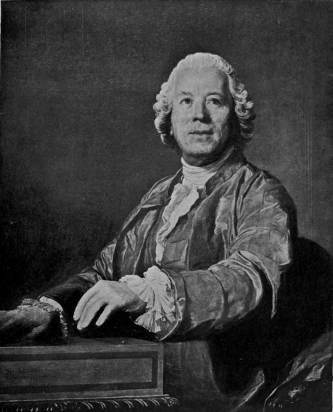
GLUCK
After the painting by N. F. Duplessis
But, as we have just seen, her resignation was not accepted, and when
Gluck arrived in Paris, he appears to have had little difficulty in
deciding to entrust the title-part in his Iphigénie en Aulide to her,
though his choice was probably influenced more by Sophie’s histrionic
than her vocal capabilities, for while her voice was neither so powerful
nor so fresh as those of the two ladies mentioned above, her acting was
immeasurably superior to theirs.
We are inclined to think, however, that even if Sophie had been much
less fitted than she was to undertake the difficult rôle of Iphigénie,
Gluck would still have hesitated before passing her over, since to have
done so would have been certain to arouse a storm of hostile criticism,
a singularly inauspicious opening to his Paris campaign. As matters
stood, his position was, at first, far from an easy one. The musical
world of Paris was the most critical and contentious of any capital in
Europe, and the advent of a foreign operatic troupe or a new composer
was invariably the sign for the amateurs of music to range themselves
into hostile camps and to discuss the merits and demerits of the
innovation with as much warmth as, in the present day, rival schools of
politicians might debate a question of international importance. Just as
in 1752, when an Italian troupe came to perform the Serva Padrona of
Pergolese and other works of the Italian buffo order, all musical Paris
was divided into Buffonists and anti-Buffonists; so now, immediately on
Gluck’s arrival, two parties were formed, one prepared to laud to the
skies everything the master might compose, the other resolved to uphold
the traditions of the old French opera at all costs and to drive the
daring reformer from the field.[41]
Gluck found the task of producing Iphigénie the most difficult of any
which he had yet undertaken. What he saw and heard at the Palais-Royal
disgusted as much as it astonished him; orchestra, singers, chorus,
ballet—all were lamentably inefficient, and it was obvious that a
course of the most rigorous training would be required ere they would be
competent to do his work anything like justice. The state of the Paris
Opera at this time was indeed almost incredible. “Disorder, abuse,
caprice, routine, inertia,” says Desnoiresterres, “were despotically
enthroned there, without a protest from any one. If reform were urgent,
so many persons were interested in the statu quo that there was
scarcely any hope of obtaining from the administration, from this
ignorant and prejudiced crowd, any improvement that was at all
practical. In the midst of all the pomp and expenditure was a
carelessness, an anarchy, a disorder past all belief. Actors and
actresses pushed indecency to such a point as to appear outside the
coulisses, the latter in white camisoles with a culotte d’argent and
a band across the forehead; the former in a simple peignoir. It was not
an infrequent sight, while the foreground was occupied by Jupiter or
Theseus, to see, through the scenes, the dancers moving and fluttering
about, they having actually chosen the background of the stage to
practise their steps and make their jetés-battus.”[42] The choruses
drew themselves up in a semi-circle, impassive, without a gesture, like
grenadiers on guard, and evinced not the slightest interest either in
the words they had to sing or in the action of the principal performers.
The latter went to the opposite extreme. “One sees the actresses, almost
in convulsions, violently tear the yelps out of their lungs, their fists
clenched against their chest, the head thrown back, the face inflamed,
the veins swollen, the stomach heaving; one does not know which is the
more disagreeably affected, the eye or the ear; their exertion gives as
much pain to those who see them as their singing does to those who hear
them.”[43]
The orchestra, which in winter was in the habit of performing in gloves,
is compared by Mercier, the author of Le Tableau de Paris, to “an old
coach drawn by consumptive horses and led by one deaf from his birth,”
and besides being careless and indifferent, was continually at variance
with the singers on the question whether the latter should follow the
musicians or the musicians follow them. Grétry relates the following
conversation, which took place between Sophie Arnould and Francœur,
the conductor of the orchestra, during a rehearsal of his own opera of
Céphale et Procris, in 1773:
“What is the meaning of this, Monsieur? The orchestra seems in a state
of rebellion?”
“What do you mean by rebellion, Mademoiselle? We are all here for the
service of the King, and we serve him zealously.”
“I should like to serve him also, but your orchestra puts me out and
spoils my singing.”
“Nevertheless, Mademoiselle, we play in time.”
“In time! Quelle bête est-ce là? Follow me, Monsieur, and understand
that your accompaniment is the very humble servant of the actress who is
reciting!”
As the Goncourts point out, under the apparent insolence of her claim,
Sophie was here asserting the rights of the dramatic vocalist before the
musical revolution, of which Gluck was the pioneer, when opera-singers
were regarded merely as men and women reciting musical tragedy with
intonations indicated by a musician. Until then they had enjoyed the
most complete independence as to the manner of presenting their phrases.
Until then they had been at liberty to hurry or slacken the time, to
pause on or shorten any particular note, according to the inspiration of
the moment, or even as they felt more or less fatigued, the orchestra
following as best it could. “ ‘Quelle bête est-ce là?’ Sophie had but
little doubt when she uttered these words that cette bête was on the
eve of reducing her talent and reputation to nothing.”[44]
The pretension, however, was one which a composer, like Gluck, “who took
the trouble to note not only the inflections of the voice, but also the
long notes and the short ones, the accent and the time,” could not for
one moment tolerate; and his insistence on its abandonment was the
cause of endless wrangling at rehearsals, where the principal vocalists
roundly declared that, if he refused them the liberty which had so long
been theirs, their talent would become superfluous and they would be
reduced to the level of mere chorus-singers.
These disputes were chiefly with the lady members of the troupe, though
the male singers did not fail to occasion the composer an infinity of
trouble. Legros, who had been cast for the part of Achilles, had an
admirable voice, but his singing was totally lacking in expression,
while his movements on the stage were stiff and awkward; and though
Gluck laboured unceasingly to remedy these faults, it was some months
ere he succeeded. Larrivée, to whom had been entrusted the rôle of
Agamemnon, was even more difficult to deal with, being so obstinate and
self-opinionated that to remonstrate with him seemed almost waste of
breath. Once the composer was forced to tell him that he seemed to have
no comprehension of his part, and to be unable to enter into the spirit
of it. “Wait till I put on my costume,” answered the singer
complacently; “you won’t recognise me then.” At the general rehearsal
Gluck took his seat in a box. Larrivée reappeared, in the costume of
Agamemnon, but his interpretation remained the same. “Ah, my friend!”
cried the composer, “I recognise you perfectly!”[45] Finally, Gluck had
to contend with the ballet, and, in particular, with its chief, the
celebrated Gaetano Vestris—“le dieu de la danse”—who once observed
that there were only three great men in Europe: Frederick II., Voltaire,
and himself! Vestris naturally considered the dancing by far the most
important feature of an opera, and, although there were already several
ballets in Iphigénie, wanted yet another. Gluck angrily refused.
“Quoi!” stammered Vestris; “moi! le dieu de la danse!”
“If you are the God of Dancing, Monsieur,” replied the composer, “dance
in heaven, not in my opera!”[46]
When, some months later, Orphée was being rehearsed, the ballet-master
asked Gluck to write him the music of a chaconne. The latter, who had
strongly objected to the introduction of any dancing whatever into
Orphée, being of opinion that it would interfere with the seriousness
and pathos of the general action, was horrified.
“A chaconne!” he cried. “Do you suppose, Monsieur, that the Greeks,
whose manners I am endeavouring to depict, knew what a chaconne was?”
“Did they not?” rejoined the God of Dancing. “Then they are much to be
pitied!”
In those days it was the custom to attend the rehearsals of a piece
which happened to be arousing an unusual amount of interest, and the
demand for admission to those of Iphigénie was so great that La
Vrillière wrote to the directors of the Opera, ordering them to take
special precautions to avoid any disturbance and to allow no one to
enter without a ticket signed by themselves. The desire to be present is
not difficult to understand, since to see Gluck at a rehearsal must have
been a sight not easily forgotten. Throwing off his coat and replacing
his wig by an old cotton night-cap, he would dart about the stage,
imploring Mlle. Arnould to follow his music, M. Larrivée not to sing
through his nose, M. Legros to endeavour to express something at least
of the dignity and nobility which one was accustomed to associate with
the great champion of the Greeks, and the chorus to endeavour to look
and move a little less like automata. “Look you, Mademoiselle!” he would
cry, purple with passion, when Sophie or some other actress proved more
than usually contumacious, “I am here to make you perform Iphigénie.
If you are willing to sing, nothing can be better. If you are not
willing to do so, do not trouble. I will go and see Madame la Dauphine
and tell her what you say. If it is impossible for me to get my opera
produced, I shall order my travelling-carriage and take the road to
Vienna.”
This indeed was no idle threat, and had it not been for the support
accorded him by Marie Antoinette, there can be very little doubt that he
would have shaken the dust of Paris off his feet. But, with the
Dauphiness behind him, the malcontents, grumble as they might, had no
option but to obey this terrible man, whom they devoutly wished at the
bottom of the Seine.
The first performance was fixed for April 13, 1774, but almost at the
last moment Legros announced that he was too ill to appear. Gluck
immediately demanded the postponement of the opera. The management
pointed out that the Royal Family were to be present, and that all
arrangements had been made for their reception, and begged him to allow
another singer to take the place of the absent tenor. The composer
rejoined that, rather than see his work mutilated by an inferior
rendering of so important a part, he would throw it into the fire; and
the directors were compelled to give way.
The opera was eventually produced on April 19, amidst the most intense
excitement. From eleven o’clock in the morning the box-offices were
besieged by an immense concourse of people, and it was found necessary
to double and treble the ordinary guard, to prevent disorder. The public
interest was no doubt stimulated by rumours that the Anti-Gluckists were
planning a hostile demonstration; and Marie Antoinette, in great alarm
for the success of her protégé, sent orders to the Lieutenant of
Police to take measures to nip any such attempt in the bud. The
Dauphiness herself, accompanied by her obedient husband, the Comte and
Comtesse de Provence, the Duchesses de Chartres and de Bourbon, and the
Princesse de Lamballe, entered the theatre before the public was
admitted, and was followed by most of the Ministers and practically the
whole Court; indeed, but for the absence of Louis XV.—who scarcely ever
visited Paris during the later years of his reign—and Madame du Barry,
the spectators might have imagined themselves at Versailles or
Fontainebleau.
The opera was very cordially received,[47] though, according to Grimm,
parts pleased more than the ensemble. Both he and the Mémoires secrets
are very severe upon the ballets, “the airs of which had been absolutely
neglected”; while the latter declare that “the decorations were
pitiable.” The second representation did not take place until three days
later, when the crowd was even greater than on the first night, and a
brisk and remunerative business was done by certain speculators, who had
bought up the two-franc parterre tickets and retailed them at from
three to seven times their value.[48] During the interval, certain
improvements appear to have been made in the ballets, scenery, and
accessories, for the opera was now “applauded to the skies, and, when
the curtain fell, the calls for the author lasted for half an hour.”[49]
The author, however, did not appear, being ill in bed, a fact which,
considering all the worry and anxiety he had suffered during the past
few weeks, will hardly occasion much surprise.
All the leading performers distinguished themselves, and Sophie covered
herself with glory. “Mlle. Arnould,” says the Mercure, “charms as much
as she astonishes us in the rôle of Iphigénie, by her dignified and
sympathetic acting, by the animation and correctness of her singing, by
an expression always true and delicate; by her voice itself, which seems
in this opera to possess more variety, power, and extent.” Grimm, a far
less partial observer, where Sophie is concerned, than the musical
critic of the Mercure, is equally enthusiastic: “She renders the part
of Iphigénie as it has perhaps never been rendered at the
Comédie-Française, and she sings not only with all the charm that we
have found in her for a long time past, but with an infinite precision,
which is less common with her. It seems that the Chevalier Gluck has
exactly divined the character and range of her voice and has assigned to
it all the notes of her part.”[50]
Iphigénie grew in favour with each repetition and soon became quite
the rage, as a proof of which may be mentioned the fact that the ladies
began to wear a “headdress in the form of a coronet surmounted by the
crescent of Diana, whence escaped a kind of veil that covered the back
of the head; it was called à l’Iphigénie.”
Encouraged by the success which had attended Iphigénie, Gluck at once
set to work to adapt Orfeo, the most successful of the operas he had
produced in Italy, for the Paris stage. A good many alterations were
necessary, as the title-part had originally been written for a
contralto, the celebrated Guadagni, and it had now to be cast for
Legros. That gentleman, whose head would appear to have been slightly
turned by the applause he had received as Achilles, when handed his
part, informed the composer that he should decline to sing it, unless he
had an opportunity of making a brilliant exit in the first act; and this
necessitated further alterations. However, the rest of the troupe were
by this time far more amenable to reason than they had been during the
rehearsals of Iphigénie, and by the end of July the opera was ready
for production.
It was while Orphée was in preparation that an incident occurred which
was not without its effect upon Sophie Arnould’s connection with the
operas of Gluck. After her triumph in the part of Iphigénie, Sophie had,
of course, been entrusted with that of Eurydice, and had persuaded the
composer to hold some informal rehearsals in her apartment in the Rue
Neuve-des-Petits-Champs. Now, for some reason, the prima donna’s titular
protector, the Prince d’Hénin, had conceived a strong antipathy to Gluck
(Mr. Douglas supposes that he was displeased at the frequency of the
composer’s visits to his mistress’s house, though, as jealousy was
certainly not one of his failings, this seems to us hardly probable),
and had on several occasions let fall very disparaging remarks about the
German musician, which had in due course reached the latter’s ears. One
day, in the midst of a rehearsal, the Prince d’Hénin was announced. All
rose from their seats and bowed—all, that is to say, save Gluck, who
settled himself more firmly in his chair and took not the slightest
notice of the distinguished visitor.
“I was under the impression,” remarked the Prince, when he had recovered
from his first astonishment, “that it is the custom in France to rise
when any one enters the room, especially if it be a person of
consideration.”
Gluck sprang from his seat, walked up to the speaker, and, looking him
full in the face, replied: “It is the custom in Germany, Monsieur, to
rise only for those whom one esteems.” Then, turning to Sophie, he
added: “Since I perceive, Mademoiselle, that you are not mistress in
your own house, I leave you and shall return no more.” With which he
picked up his hat and stalked out.
Gluck wanted to challenge the prince to a duel, but, being assured that
such a step would be useless, as the latter would certainly shelter
himself behind his rank and refuse to fight with a musician, took
counsel with his friend and admirer the Duc de Nivernais. That nobleman,
whom Lord Chesterfield had once held up to his son as a model for him to
form himself upon, was now in his sixty-eighth year, notwithstanding
which he at once constituted himself the composer’s champion, and
informed M. d’Hénin that he must either apologise to Gluck or fight him
(the duke). In the meanwhile, the story had reached Marie
Antoinette—now Queen—who sent a peremptory order to the prince to make
reparation to her injured protégé, under pain of her displeasure. The
latter, reflecting that even if he escaped the sword of the duke, who
handled one as neatly as he composed verses, he would undoubtedly be
exiled, had no choice but to obey, and, with a very bad grace, called
upon Gluck and made the amende honorable.
Orphée et Eurydice was produced on August 2 and met with a success
surpassing even that of Iphigénie. The same, unfortunately, cannot be
said of Sophie. The friendly critic of the Mercure declares that “she
acted and sang with much soul, intelligence, and correctness”; but the
general opinion seems to have been that her display was decidedly
inferior to that which she had given in the previous opera. This
impression is, no doubt, partly to be accounted for by the fact that she
was on this occasion somewhat overshadowed by Legros, who, Grimm tell
us, “sang the principal rôle with so much fire, taste, and sentiment,
that it was difficult to recognise him.” At the same time, it is evident
that her voice was no longer equal to the strain of any very exacting
part, especially if, as was now very frequently the case, she happened
to be in indifferent health.
In the early days of January 1775, Iphigénie, in which Gluck had made
several alterations, was revived and received with even more enthusiasm
than on its first production. All the artistes resumed their old parts,
and Sophie’s rendering of the heroine was again loudly applauded. She
did not, however, enjoy her success for long, as, after a few
performances, she resigned her part to Mlle. Laguerre, who in March fell
ill and was, in her turn, replaced by Rosalie Levasseur.
Sophie’s health, at this time, would appear to have been far from
satisfactory. Any way, she did not sing again for more than ten months,
and thus took no part in Cythère assiégée, a light opera first
produced in 1759, and now reconstructed by Gluck, at the request of
Marie Antoinette. The libretto was by Favart, and the incongruity
between his light and playful style and the solemn and pathetic music of
the composer caused the piece to be very coldly received.
At the beginning of December, Sophie reappeared in the rôle of Adèle in
Adèle de Ponthieu, a part which she had successfully created three
years before, and might have repeated the triumph she had then secured,
but for an unfortunate incident which occurred on the first night.
Louis XVI.’s younger brother, the Comte d’Artois (afterwards Charles
X.)—a very different person in those days from the gloomy and
Jesuit-ridden old monarch of 1830—attended the performance, and, from
the shelter of his private box, proceeded, as was his wont, to ogle and
make signs to the actresses upon the stage. Presently he cast “a
benevolent glance” upon Mlle. Arnould, when that lady so far forgot the
respect due to the visitor’s exalted rank as to smile familiarly in his
direction, “exactly as she might have done to a comrade or a lover.” The
audience, the chronicler tell us, was inexpressibly shocked at the
lady’s behaviour, and “testified its indignation in a manner that was
humiliating to her.”[51]
Meanwhile, Gluck was at work upon his Alceste, and Sophie had every
reason to believe that, after her brilliant triumph in Iphigénie and
her very successful rendering of the part of Eurydice, she would again
be cast for the principal rôle. But alas! a bitter disappointment was in
store for her.
We have mentioned that Rosalie Levasseur was the mistress of
Mercy-Argenteau, the Austrian Ambassador at the French Court. Shrewd and
capable though Mercy was in everything relating to his professional
duties—the manner in which he had succeeded in keeping the peace, and
all that it involved, between Marie Antoinette and Madame du Barry,
during the last years of the late King’s reign was a perfect masterpiece
of diplomacy—in love, he appears to have been as foolish as any of the
gilded youths who haunted the coulisses of the Opera and the
Comédie-Française. The fair Rosalie exercised the most absolute
ascendency over him—a fact which was the more astonishing, as all Paris
knew that she had an amant de cœur, in the person of Nicolet, the
clown. Mercy, in fact, could deny her nothing, and even carried his
infatuation so far as to purchase for her a barony of the Holy Roman
Empire, with a considerable revenue; while, on another occasion, he
condescended to bribe Larrivée, whose singing in a certain opera the
young lady found was quite eclipsing her own, not to put forth his full
powers.[52]
Now, Rosalie had set her heart upon supplanting Sophie and filling the
principal part in the forthcoming opera, and called upon her lover to
assist her to realise her ambition. First, she suggested—or persuaded
Mercy to suggest—that Gluck should take up his quarters in her house,
in the Rue des Fossoyeurs-Saint-Germain, and give her singing-lessons; a
proposal to which the composer, who, besides being an Austrian subject,
was under considerable obligations to the Ambassador, who, with Marie
Antoinette, had been mainly instrumental in bringing him to Paris,
readily consented. Next, she induced him to teach her the music of
Alceste and took care to show herself a docile as well as an
industrious pupil. Finally, she hinted pretty plainly that he ought to
entrust her with the title-part when the opera was produced, pointing
out that, though she might lack the histrionic ability of Mlle. Arnould,
her voice was fresher and more powerful, to say nothing of the advantage
which the composer would derive from having the part rendered exactly as
he desired, whereas the elder actress would very probably insist on
rendering it in conformity with her own ideas.
These arguments were, it is needless to say, warmly seconded by Mercy;
and Gluck, who was anxious to please the amorous diplomatist, and in
whose mind the insult he had received from Sophie’s titular protector
perhaps still rankled, after some hesitation, yielded to their wishes.
“Gluck,” says the composer’s French biographer, Desnoiresterres, “was
wanting in gratitude towards Mlle. Arnould, so charming, so passionate
in Iphigénie, so pathetic still, though somewhat eclipsed by Legros,
in Orphée.” At the same time, he points out that Gluck would never
have superseded Sophie had he thought that the change would prejudice
his work, and that the event proved that he had not over-estimated the
talents of Rosalie Levasseur, who, in the part of Alceste, “displayed
much art and sensibility.”[53]
Poor Sophie seems to have borne her disappointment, notwithstanding that
she could hardly have failed to see in it the end of her own dramatic
career, with praiseworthy equanimity, merely observing when she heard
the news: “Rosalie ought certainly to have the part; she has the voice
of the people.” This remark was duly repeated to her triumphant rival,
who retaliated by a disgusting lampoon, composed by one of her admirers
named Guichard, copies of which were printed and circulated in the
theatre, while others were sent to Sophie’s friends. The injured lady,
however, was equal to the occasion; she sent certain copies which had
fallen into her hands to the journals, and turned the tables very
adroitly on Mlle. Levasseur and her ally, all decent-minded persons
combining to condemn such methods of warfare.
Although the dethroned prima donna wisely refrained from giving public
expression to her feelings, others were not prepared to imitate her
discretion. The Prince d’Hénin, who could be very bold indeed when there
was no likelihood of his being called upon to fight a duel, having heard
that there was some talk of giving Sophie’s dressing-room at the Opera
to Rosalie Levasseur, went down to the theatre and threatened to flog
the unfortunate directors within an inch of their lives, if they dared
to inflict such a slight upon a lady whom he honoured with his
protection; the few critics who still remained faithful to the waning
star condemned in unmeasured terms the selection of Mlle. Levasseur for
so important a rôle in place of an actress “who had so long been, and
still was, the delight of the Opera”; while the Anti-Gluckists, only too
delighted to find so stout a stick wherewith to belabour the composer,
raised a perfect howl of indignation.
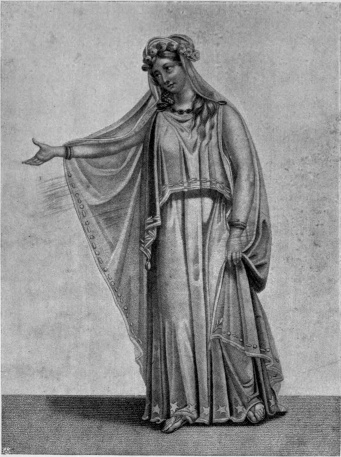
SOPHIE ARNOULD
From an engraving by Prud’hon after the drawing by Cœuré in the
Collection of M. Godfrey Meyer
The result of all this was most unfortunate for Sophie. The contest
between the Gluckists and their opponents had now reached a very acute
stage, and it was the general belief of the composer’s admirers that the
partisans of the old school were prepared to employ the most
questionable methods in order to counteract the ever-increasing
popularity of the German. A rumour spread that a cabal had been formed
to ensure the failure of Alceste, and that Sophie and her friends had
joined it. There seems to have been little truth in this report, the
best refutation of it being the fact that, although Alceste was
somewhat coldly received at first, its success grew with each
performance, and none at all, so far as it concerned Sophie, who, in a
letter to a theatrical journal, Le Nouveau Spectateur, in
acknowledgment of some sympathetic references to herself which had
appeared in a previous issue, expressly disclaimed all hostility to
Gluck or Rosalie Levasseur:
“I await with impatience your judgment on the opera of Alceste,
which is about to interest and divide all Paris. Your views will
confirm those which I myself have formed from witnessing the
rehearsals only. If the success which I obtained in Iphigénie
might have predisposed me in favour of the authors, their want of
consideration, I even venture to say their bad conduct, towards me
might have served to alter my opinion of them. But I have too much
respect for myself to join (as these gentlemen would have people
believe) in any cabal which may be formed for or against the new
work. Such things I have always considered beneath me; the former
savours of charlatanerie, the latter of baseness. I have confined
my vengeance to not asserting my right to the principal rôle.[54]
But no personal reason will make me underrate genius, nor prevent
me from rendering justice to that of M. Gluck. He is, I proclaim it
aloud, the musician of the soul and master of all the modulations
that express sentiment and passion, especially grief.
“As to the author of the words, I leave to the public the task of
judging him. If I belonged to the Académie-Française, my opinion
would carry as much weight as that of any other of the Forty. But I
belong to the Académie Royale de Musique. I acknowledge my
incompetence and my motto is: tacet. I will merely permit myself
to say that one does not always find subjects as interesting as
Iphigenia, nor models as sublime as Racine.
“In regard to the performers, if I may be allowed to speak of them,
I should praise the acting of M. Gros [Legros], in the part of
Admetus, and the singing of Mlle. Rosalie, in the part of Alceste.
“I have the honour to be, very perfectly, Monsieur,
“Your very humble and very obedient servant,
“Sophie Arnould.”
The good effect which this letter might have produced was, unhappily,
entirely discounted by a series of bitter attacks upon Alceste, Gluck,
and Rosalie, which appeared in subsequent issues of the same journal. On
the day after the first performance of the new opera, the Nouveau
Spectateur published an anonymous letter, containing the following
choice morsel of criticism:
“It seemed as if the music was being sung by invalids who had just
swallowed half a pint of emetic and were making futile efforts to
vomit.”
This was soon followed by a second letter reproaching Gluck for having
taken “a girl like Rosalie to play the part of Alceste,” and several
articles declaring that the opera was “more mournful than affecting,”
and that, in preferring Mlle. Levasseur to Mlle. Arnould, the composer
showed that he “misunderstood the taste of the nation in music as well
as in acting.”
These letters, there can be little doubt, were the work of Lefuel de
Méricourt, the editor of the journal in question, a libellous scribe of
the school of Pidansat de Mairobert.[55] But the admirers of Gluck and
the friends of Rosalie believed, or affected to believe, that, if not
written, they had, at any rate, been inspired by Sophie, and thirsted
for revenge.
Their opportunity arrived at the beginning of the following October,
when Sophie, in the vain hope of counterbalancing the success of Rosalie
in Alceste, created the part of Lyris in Euthyme et Lyris, an opera
by a very mediocre composer named Desormery. The theatre became the
battlefield of the contending factions. The Anti-Gluckists and the
personal friends of Sophie crowded to the Palais-Royal and loudly
acclaimed the singer; but the opposition came in even greater numbers,
and the applause was drowned in a tempest of groans, hisses, and
cat-calls.
Marie Antoinette heard of the scenes which were nightly taking place at
the theatre, and, though herself an enthusiastic supporter of Gluck, was
indignant at the treatment accorded an actress whose talent she had
often admired. She determined to come to her assistance and, therefore,
visited the Opera on two or three occasions and warmly applauded Sophie.
On the evenings on which she was present the opposition was silent, but
the next the hissing and hooting broke out with redoubled violence,
rather intensified than otherwise by the Queen’s intervention. “To-day,”
we read in the Mémoires secrets, “the Queen being no longer present
to intimidate the pit, the partisans of the Chevalier Gluck arrived in
force and completely overwhelmed Mlle. Arnoux (sic) with the hisses
which they had spared her at the previous performance. She also sang
badly. One does not believe that she will dare to continue to present
herself to the eyes of the public, and especially to its ears; and
perhaps this humiliation will mark the period of a definite retirement,
to which the weakness of her voice ought to have determined her ere
this.”[56]
The writer of the above paragraph was, no doubt, actuated by personal
hostility to the actress; but, at the same time, it was only too true
that Sophie’s voice was failing rapidly. Early in March 1777, Iphigénie
en Aulide was again revived, and Sophie reappeared in the part which
she had created so brilliantly. She was now, however, manifestly unequal
to the effort required of her, and seemed to have altogether lost her
old power of holding the audience enthralled. “The public,” she had once
observed, “behaves to actresses like Love to warriors; it has no
consideration for an old soldier”; and she herself is a particularly
painful illustration of the truth of her own axiom, at least, so far as
it concerns the Parisian playgoers of the eighteenth century. Forgetting
the many triumphs of the woman who had for nearly twenty years been its
idol, the public seemed to see before it only a performer who had
committed the unpardonable offence of disappointing its expectations,
and joined with the Gluckists and the personal enemies of the actress in
expressing its disgust. Sophie was relentlessly hissed.[57]
Again the Queen attempted to stem the tide of public feeling by
attending the theatre and applauding the unfortunate singer. But Marie
Antoinette was now fast losing what popularity she had once enjoyed with
the Parisians, and even her presence and example “did not prevent the
malcontents from continuing their indecent manœuvres.”
It is not easy to understand why Sophie, who, in the heyday of her
success, had often absented herself from the theatre for months
together, merely from indolence or caprice, should have continued to
appear on the stage, in the face of these hostile demonstrations. The
only explanation which her biographers can find is that she had recently
concluded with the directors of the Opera a fresh arrangement, whereby,
in lieu of the regular salary which she hitherto received, she was to be
paid the sum of five louis for each performance, and that, since she is
known to have been at this time in pecuniary difficulties, she endured
the taunts of the public for the sake of the money.
For our own part, we are inclined to think that, though financial
considerations may not have been without their effect upon her decision,
her chief reason was a very different one. Sophie was a courageous and
high-spirited woman; she knew that the demonstrations against her were
prompted far more by personal animosity than by the failure of her
powers, and she was determined not to allow her enemies the satisfaction
of boasting that they had driven her from the stage.
The malice of her foes, however, pursued her even outside the theatre.
She was hissed while performing at a concert given by the Duc and
Duchesse de Chartres. She was driven, one day, from the garden of the
Palais-Royal, by an ill-bred youth, who, on recognising her, began to
sing the air from Alceste: “Caron t’appelle, entends sa voix!” Even
Lefuel de Méricourt abandoned her, and in an article in his precious
journal, “regretted the loss of a part of her physical gifts by an
actress who had been so long the idol of the public.”
At length, at the beginning of June 1778, Sophie decided to retire from
the stage. She continued to sing from time to time at the Concerts of
Sacred Music, at benefit performances, and in private theatres; but at
the Opera her name was definitely placed on the retired list. For her
services at the theatre, she received a pension of 2000 livres, and one
of the same amount in her quality as Court singer. This, as pensions
went in those days, must be considered liberal treatment and compares
very favourably with the lot of the actors and actresses of the
Comédie-Française, who, even after thirty years’ service, only received
a pension of 1500 livres. Mlle. Clairon, the greatest tragédienne of
her time, on her retirement in 1766, after twenty-two years on the
stage, had to rest content with one of 1000 livres.
Now began for Sophie Arnould a life very different from that to which
she had so long been accustomed. Youth, beauty, and fame were gone, and
with them her lovers too, for, soon after her retirement from the stage,
the Prince d’Hénin deserted her for Mlle. Raucourt, of the
Comédie-Française, whom Sophie had generously taken to live with her,
and endeavoured to protect against the hostility of the public.[58]
One thing, however, still remained to her—her wit, which, if it were
powerless to retain her wealthy and aristocratic admirers, sufficed to
draw to her salon men whose friendship was infinitely to be preferred.
Poets, philosophers, encyclopædists, dramatists were all at home in the
house of Sophie Arnould. Diderot and d’Alembert were among her most
frequent guests; Helvétius, who had once, for a brief period, been very
near and dear to her, remained one of her greatest friends; Beaumarchais
delighted in an assaut d’esprit with his witty hostess; Rulhière came
and brought with him Jean Jacques Rousseau; Marmontel, Duclos, Favart,
Linguet, and a host of lesser lights made her salon one of their
favourite rendezvous; that most affable of literary noblemen, the Prince
de Ligne, seldom failed to make his appearance there whenever he
happened to visit the French capital, and Voltaire himself—King
Voltaire—when he came to Paris in 1778, to enjoy at last the triumph of
his renown at its centre—and to die—condescended to call upon Sophie.
The day and hour of the great man’s visit were duly notified to Sophie,
who, knowing what kind of a reception would please him, collected a band
of children, headed by her own little daughter, Alexandrine, who, the
moment Voltaire entered the room, sprang forward and proceeded to hug
and kiss him. The Patriarch was delighted. “You wish to kiss me,” said
he laughing, “and I have no face left!”
After conversing with Sophie for some time, the poet remarked: “Ah,
Mademoiselle! I am eighty-four years old, and I have committed
eighty-four follies.”
“A mere trifle,” replied Sophie consolingly; “I am not yet forty, and I
have committed a thousand!”
That same year, Mesmer visited Paris, professing to cure all diseases by
means of animal magnetism, and speedily became the doctor à la mode.
Some of Sophie’s friends advised her to consult him, but, as she did
not happen to have any need of his professional services herself, she
sent her lap-dog instead, declaring that, if he could cure that pampered
animal, who had been ailing for some time past, presumably as the result
of a too generous diet, she would believe in him. Mesmer, anxious to
prove that the success of his system was not dependent upon the
credulity of the patient, undertook the case, and, in a few days,
returned the dog, with the assurance that it was now in the best of
health. Sophie thereupon wrote him a letter of thanks, which the doctor
sent to the journals. He soon, however, had cause to regret this step,
for, four days later, the dog died, much to the joy of the sceptics, who
asked Sophie what could have induced her to give the German a
testimonial so little deserved. “I have nothing to reproach myself
with,” she replied; “the poor animal died in excellent health.”
When Sophie retired from the stage, she was apparently in possession of
what most members of her profession, in those days, would have
considered a very comfortable income, as from a packet of letters
published for the first time by M. Henri Gauthier-Villars, in La
Nouvelle Revue (February 1897), we learn that her notary, a certain M.
Alleaume, was in the habit of paying her fifty louis a month, out of the
moneys she was supposed to lodge in his hands.[59] The maintenance and
education of her three children, however, seems to have involved her in
considerable expense, while during her long years of prosperity she had
acquired such extravagant habits that her income was quite inadequate
for her needs, and she was, in consequence, continually in pecuniary
difficulties. Her letters to Alleaume, indeed, are almost without
exception demands for money, in which she brings all her persuasive
powers to bear upon the stern man of business, in the hope of inducing
him to unlock his cash-box and advance her “her month.”
“Well, petit père Alleaume,” she writes, “I never see you now, and I
ask myself why?—why this difference to poor Sophie?—for it is not kind
of you to avoid the poor people who love you. You will reply to that:
‘But it is you who never see me, unless you have something to ask.’
“Wait and see if I never ask for anything, unless I visit you. Here for
example: Will you please advance me my month? for I am absolutely
without funds.
“Will petit père Alleaume remain inflexible for four days to the
request of Sophie?”
And again:
“I swear to you, though you may be somewhat incredulous as to the state
of my mind, that when you have put my little business clear and
straight—I promise you, on my word as a living being, that I will think
twice ere I incur the smallest expense. It is not possible for me to be
miserly—it is a disgusting vice.”
Then, in a third letter:
“Eh! bon jour, my good friend; it is an age since I saw you or
embraced you. When are you going to spend a morning with me? Do you know
that I have learned a good deal of sense since the beginning of the
year? Do you know that I intend to keep my word and commit hardly any
foolish extravagance; and you will see that you will be very satisfied
with poor Sophie. If you knew how many small debts I have discharged,
you would be well content with your Sophie. I have not yet got into my
den (at Port-à-l’Anglais), but so soon as I have, I should like to meet
you, and talk over all this business at our leisure. If, in the
meanwhile, you would like to come this evening and eat a truffled
turkey, much bigger and a thousand times more of a dinde than I am,
you will be welcome.”
In spite of these promises of amendment, we find her, shortly
afterwards, writing to inform the worthy notary that an execution has
been levied upon her for non-payment of her capitation tax and other
dues, and to beg him to send her the sum of 196 livres to enable her to
get rid of the emissaries of the law.
As time goes on, the letters multiply, all full of entreaties, excuses,
promises, regrets, expostulations. She assures him that she cares
nothing for money—one can well believe that—but has an intense desire
to be free from debt. Then, when he shows a marked disinclination to
make any further advances, she declares that not even on the stage of
the Opera has she met with so inhuman, so hard-hearted, a monster. But
the notary, annoyed at finding that her promises are never kept, and
that, notwithstanding her protestations, she makes no change in her
extravagant way of living, shuts himself up in his office and turns a
deaf ear to her appeals. Sophie redoubles her entreaties, reiterates her
vows of amendment, sends him epistles bedewed with her tears. All is in
vain; petit père Alleaume remains inflexible.
In November 1780, Sophie’s daughter, Alexandrine, married a certain
André de Murville, a young man of respectable middle-class family, who
dabbled in literature. Alexandrine was, at this time, only in her
fourteenth year; an ungainly, red-haired child, who seems to have
inherited both her mother’s biting wit and—or, at least, so scandal
asserted—her mother’s indifference to the conventions of morality.[60]
For which reasons, Sophie was probably glad to be rid of her. The
ceremony took place at Saint-Roch, and was attended by several worthy
bourgeois couples, relatives of Murville, who must have been
considerably shocked when Sophie, on being presented to them, remarked
upon the strangeness of the circumstance that the mother of the bride
should be the only unmarried lady present.[61]
For the next few years, we hear little of Sophie. She appears, like so
many women of her class, to have endeavoured to find consolation in
devotion, but soon gave up the attempt, protesting that the directors of
conscience were worse than the directors of the Opera. By the bankruptcy
of the Prince de Guéménée, in 1782, she lost a considerable part of her
fortune—how we are not told—a disaster which probably accounts for the
fact that she soon afterwards quitted Paris and took a little house at
Clichy-la-Garenne, “with an acre of land, which, however, she did not
cultivate.” Here, in 1785, she was joined by her daughter, whose
marriage had turned out very unhappily, and who was now suing for a
separation, on the ground of her husband’s cruelty.
In her plaint, which bears date October 19, 1795, Alexandrine declares
that “since she had had the misfortune to espouse the sieur Murville,
she had never known a moment’s peace”; that he had “several times struck
her at the end of frightful scenes”; that she had been forced to make
over to him all the moneys that had been settled upon her, and that she
was now “sick, destitute, and in urgent need of medical assistance to
prevent the loss of an eye, which her husband had grievously injured at
the risk of killing her.”
In a second plaint, made the following year, she relates that, a few
days after the birth of her first child, towards whose support he now
refused to contribute, her husband had called her atrocious names,
seized her violently by the right arm, “with such force as to leave a
red mark,” and, finally, turned her out of the house, at one o’clock in
the morning.
About the same time, the unhappy Alexandrine applied to the Minister of
the King’s Household for admission to the Opera in the humble capacity
of a chorus-singer; but, for some reason, her request does not appear to
have been granted.
At Clichy, Sophie lived a very quiet life, though she seems to have been
fond of entertaining her humble neighbours. “I went sometimes to see
Mlle. Arnould, at Clichy,” writes Millin. “One day, I found her in the
midst of a large circle. There were twenty persons at table. I was on
the point of retiring, when she called me back and said to me: ‘Come in!
I am marrying the son of my cook to the daughter of my gardener. Both
families are my guests; we are celebrating the pleasures of Love and
Equality.’ In the evening, her two sons arrived. They wanted money. She
had none to give them. ‘Ah, well!’ said she, ‘each of you take a horse
from the stable.’ And they went away with the two horses.”[62]
The expenses of her family—she had now to support Alexandrine and her
two children, in addition to her sons—pressed heavily upon poor Sophie,
and, in January 1788, we find her writing to one of her old friends, a
financier of the name of Boutin, begging him to arrange for her a loan
of 24,000 livres, which she proposes to repay by four yearly instalments
of 6000 livres. As security, she offers a mortgage on her house at
Clichy, which, she declares, is worth 20,000 francs, and another on the
furniture of a house belonging to her in the Rue Caumartin, and assures
him that she will keep her promise to repay the money “with certainty,
honour, and probity.”
She appears to have obtained the accommodation she sought, but was
speedily in difficulties again, and compelled to apply for assistance to
some of her old friends, whom, when they sent her money, or even
“evinced an intention to oblige her,” she overwhelms with gratitude,
declaring that, if it be true, as learned men assert, that the soul
never perishes, her own will remember the obligation, even after death.
Yet, harassed though she was, she could sympathise with the distress of
others. On January 21, 1789, a young man of the name of Bompas was
arrested at the Barrière de Clichy, with three parcels in his
possession, containing a large quantity of lady’s underwear, “marked
with the letters S.A. in red cotton,” a porcelain mustard-pot, a green
morocco case holding two decanters and a crystal goblet, two pairs of
candlesticks, and various other articles. On being brought before a
commissary of police, he confessed that the above-mentioned articles
were the property of Mlle. Arnould, whose residence he had burglariously
entered the previous evening. Sophie caused inquiries to be made and,
finding that Bompas was a journeyman carpenter of hitherto
irreproachable character, who had been out of work for several weeks and
had been driven to the theft by necessity, generously declined to
prosecute, and the prisoner was accordingly released.
Several writers have stated that, in the early days of the Revolution,
Sophie’s salon became a political club and that she herself was an
enthusiastic advocate of republican doctrines. “There are beings,” wrote
Champcenetz, in the course of a brutal attack on the ex-singer which he
published in the royalist organ, La Chronique scandaleuse, “who would
not die content unless they had degraded themselves in every conceivable
way. Of this the aged Sophie Arnould is an example. After delivering
herself for forty years to every scoundrel of bad taste, she has now
turned demagogue, that she may receive at her house the dregs of the
human race. She has sent to study at the Jacobins the two children, with
whom a man of gallantry once presented her, through inadvertence.”[63]
That Sophie, in common with her old lover Lauraguais and others of her
aristocratic and literary friends, sympathised to a certain extent with
the Revolution—that is to say, with the Revolution in its earlier
phases—is probable enough. That, crippled as she was with debts, she
kept open house for all the turbulent spirits of her time, or carried
her partisanship so far as to endeavour to influence the opinions of
her sons, who were quite old enough to form them without any assistance
from their mother, as Champcenetz—an old enemy, by the way, of both
Sophie and Lauraguais—asserts, we beg leave to doubt. Any way, her
enthusiasm for the new order of things must have been very short-lived,
for, in 1789, her pension of 4000 livres was reduced to 2000, and from
1793 not paid at all, but, according to an entry in the Archives, “left
owing.”
In 1790, Sophie sold her house at Clichy-la-Garenne and purchased, “for
a mere song,” an old disused priory at Luzarches. Her new residence she
christened Le Paraclet, though whether she derived much comfort from the
house itself is open to question, as it was in the last stage of
dilapidation, and she had no money to spare for even the most urgent
repairs. In an amusing letter, written in 1794 to Belanger, she
describes it as “only the carcase of a house, which waits for doors and
windows until it shall please God to send me the means,” and adds that
she is “camping provisionally in the dovecot of the ancient monks.”
Her surroundings, however, appear to have afforded her some compensation
for the ruinous condition of the building. “I have a beautiful park,
containing all that it is possible to desire whether for ornament or
use; superb kitchen-garden; a vineyard, which has yielded me this year
six hogsheads of wine; a forest, a wood, an orchard, a pond well stocked
with fish, fresh air, beautiful scenery, good land. This is the fourth
year that I have been here, and I remain in the greatest solitude. But
well! I have not felt one moment’s ennui since I came.”
While at Luzarches, Sophie received a domiciliary visit from the local
revolutionary committee. She received them with a smiling face, though
she must have been quaking with fear, since her intimacy with the Prince
de Condé and other distinguished émigrés was sufficient to have sent
her to the guillotine a dozen times over.
“I have always been a very active citizen,” said she; “I know the Rights
of Man by heart” (a remark which was certainly true), “and I have sung
twenty years at the Opéra-National for the pleasure of the Sovereign
People.”
The committee, however, were not satisfied with these assurances and
insisted on ransacking the house, in quest of compromising
correspondence and so forth. Presently they came across a bust of Gluck
and paused before it.
“It is Marat,” said Sophie, in a tone of the deepest veneration.
The worthy sans-culottes uncovered, and convinced that they had just
been contemplating the august features of the father of the people,
whose sanguinary career the knife of Charlotte Corday had recently
brought to an abrupt termination, retired, with many apologies for
having doubted the patriotism of the Citoyenne Arnould.[64]
Sophie remained at Luzarches for seven years, “tout à fait en
paysanne.” She wore sabots, she planted cabbages, she gathered peas
and apples, and she reared, or tried to rear, poultry. Her daughter
Alexandrine lived with her for a couple of years, and then took
advantage of the new law of divorce to get rid of the estimable Murville
and replace him by the son of the local postmaster, “a stout boy, who
was quite unsuitable for her.” Sophie, though, as we have seen, by no
means strait-laced herself, strongly disapproved of her daughter’s
conduct, and made it the occasion of one of her most celebrated bons
mots. “Divorce,” she gravely observed, “is the sacrament of adultery.”
All this time the unfortunate woman was gradually becoming poorer and
poorer. Her pension had been discontinued; the greater part of what
money she had possessed apart from that seems to have been swallowed up,
with so many other fortunes, in the financial chaos which accompanied
the political one; while to apply to her friends for help was no longer
of any avail. Not a few of them, among whom was the Prince d’Hénin, had
departed to another world, by way of the Place de la Révolution; others,
like Lauraguais, were in exile; those who were still within reach of her
appeals were ruined. Of all her old friends and admirers the only one to
whom she could turn was Belanger, and it was but little that he could do
to assist his once-adored Sophie. He himself had been imprisoned and had
narrowly escaped the guillotine, and when he was released, to find that
everything portable belonging to him had been carried off by a faithless
servant, he was thrust, bon gré mal gré, into a miserably-paid
municipal office, which kept him hard at work from seven o’clock in the
morning until nearly midnight, and left him no time for practising his
profession. Moreover, he was now married, having, while in prison,
espoused a companion in misfortune, Mlle. Dervieux, of the Opera, who
had been a notorious courtesan, and, consequently, had no money to spare
for old friends in distress.
Nevertheless, the kind-hearted architect did all that was in his power.
He wrote to Sophie; he went to visit her; he entertained her at his
house, and acted as her intermediary with the Minister of the Interior,
in order to secure the restitution of the pension to which she was
entitled. And Sophie, on her side, makes him the confidant of all her
hopes and disappointments, and writes him long, affectionate letters,
beginning: “Mon bel ange,” and one of them superscribed, “À mon
meilleur ami.”
Once, learning that she was in sore distress, Belanger sent her a double
louis—probably all that the poor man could afford—which the grateful
Sophie acknowledges in the following letter:
“8 Nivôse, Year viii. (January 29, 1800).
“Ah, mon bel ange, my friend, you are always the same for
goodness and generosity. What a good heart is yours! I would thank
you sincerely, my poor friend, but what expressions can I
employ?... They would always fall short of my gratitude, not for
the money, but for the action. Ah! what good you have done my
heart! Here are a hundred years of happiness for me, if I had them
to live. Console yourself, my friend; I have still a few sous, and
have no need of the two louis that you sent me, and of which you
have deprived yourself for me; for I also know what your position
is. But I will keep this piece to wear upon my heart, and it
shall not leave me until my death. I know the motto I shall put
there; it shall be my relic. Good-bye, mon bel ange, my good
angel, my true friend. Believe me there does not exist on earth a
being who is more tenderly attached to you, and more inviolably
attached to you, than your
“Sophie Arnould.
“On the 24th, I shall be with my good friends, with you and your
wife, and shall devote that day to my happiness.”
In another letter, written eleven months later, we find her rejoicing
over the victory of Hohenlinden, in which “her son in the army, her
hussar, had well avenged them with the army of the Rhine against the
Austrians.” She has received details of the engagement from Constant
himself, who sends many affectionate messages to his “good and tender
mother” and the Belangers, and desires to be remembered to “the amiable
ladies of their circle.” The hastily-scribbled notes of the hussar, who
seems to have been both a good son and a brave and capable officer—he
rose, as we have mentioned elsewhere, to the rank of colonel and fell at
Wagram—seem to have been one of the chief consolations of poor Sophie’s
life.
When the first of the above letters was written, Sophie had been living
for some years in Paris. She had returned to the capital in 1797, and
had at first taken lodgings over a barber’s shop in the Rue du
Petit-Lion, from which, however, she had removed, a few months later, to
an apartment in the Hôtel d’Angivilliers. She still retained possession
of the old priory at Luzarches, and appears to have occasionally visited
it.
From the Hôtel d’Angivilliers, we find her writing to Lauraguais, who,
though he had contrived to save his head,[65] was now almost as poor as
she herself was, and was living on a small farm which he had bought or
rented at Manicamp, in the department of the Aisne. He had invited her
to share his retreat, but Sophie felt obliged to decline the offer. She
had succeeded, not without great difficulty, in obtaining from François
de Neufchâteau, the Minister of the Interior, a pension of 200 livres a
month, and, as pensions were paid very grudgingly, she feared that her
leaving Paris might serve as an excuse for discontinuing it. Unable to
join Lauraguais in the country, she now invites him to come and live
with her, “as to end her days near him, to render him all the attentions
of friendship, of the most tender, the most constant attachment, is the
desire of her heart and will crown her happiness.” “One must have money,
you will say,” she continues, after pointing out that Paris will be the
safest place for him to be in, in the coming renewal of the faction
strife, which she believes to be close at hand. “But you have a
little, and I have a little also. We shall not have any great
expenses to meet. No rent to pay; we must breakfast at home; for dinner
we can visit our friends; we will be moderate at their houses and very
moderate at our own. I have also some wood at Le Paraclet, a portion of
which I will have brought here.... As to our means of living; well, my
Dorval, we must help one another. We will take for our models Baucis and
Philemon. Dorval will write the great adventures of the Revolution; I
will transmit to posterity those of our youth. That is already a long
time ago, but one never forgets what has moved one deeply. The heart
alone, my Dorval, has imperishable recollections.... I shall prepare for
you all that I can procure for your needs and comfort. You shall have a
fine room, very large and airy and in a good position, where you will
be alone and free, with a staircase and door to yourself, a good bed,
chairs and commodes to match, a big table for your papers, writing
materials, &c. Finally, I hope you will not be uncomfortable. As for
other matters, I have all that is required. To assist me, I keep one
servant, a woman about thirty years of age, unmarried, and not too
intelligent, but who works well and is a great help to me. The
intelligent ones are only intrigantes, &c. We must avoid all that, and
for good reasons. But do not, my friend, be uneasy about yourself; I
shall always be at your service, and shall always say:
“ ‘Ah! qu’on est heureux de déchausser ce qu’on aime!’
“Adieu. I will let you know when the lodging will be ready. That will
not be long; and do not send any excuses for not coming. Adieu.”
Lauraguais did not see his way to accept this invitation, but he appears
to have been residing in Paris, for some time at least, during the last
year or two of Sophie’s life, and to have done what little he could to
assist her.
The poverty in which poor Sophie spent the last years of her life was in
a great measure the result of her own goodness of heart. Soon after she
removed from Luzarches to Paris, her daughter Alexandrine died, leaving
behind her three children totally unprovided for. The ex-singer
heroically undertook the charge of her grandchildren, although she must
have been aware that the cost of their maintenance would leave her with
hardly sufficient to procure the barest necessaries. Still, by the aid
of the most rigid economy, she contrived to support both herself and
them until the summer of 1799, when François de Neufchâteau resigned
office, and the pension he had accorded her was discontinued. The
unfortunate woman was now almost penniless—it was at this time that
Belanger sent her the double louis which called forth the letter of
thanks we have already cited. Nevertheless, even when face to face with
starvation, her wit did not desert her, as will be seen by the following
letter, which she addressed to Lucien Bonaparte, the new Minister of the
Interior:
Paris, I Pluviôse, Year viii. (January 21, 1801).
“Citizen Minister,—I am called Sophie Arnould; a name perhaps
quite unknown to you, but formerly very familiar to the Theatre of
the Gods.
‘Je chantais, ne vous déplaise.’
...Since my earliest years, and without any other destiny than the
chance which governs so many things, twenty years of my life have
been consecrated to the Théâtre des Arts,[66] where some natural
talents, a careful education, and the most artistic teaching were
supported by the counsels of men of taste, scholars, artists, in a
word, of persons justly celebrated. As for myself, I had then to
recommend me, a suitable physique, an abundant youth, vivacity,
soul, a bad head, and a good heart. These were the auspices under
which I was fortunate enough to make my life illustrious, and to
gain, together with a sort of celebrity, glory, fortune, and many
friends. Alas! now Chance has turned against me. As for celebrity,
my name is still cited with some praise in association with those
of Psyché, Thélaïre, Iphigénie, Eglé, Pomone, in a word, at the
Théâtre des Arts. As for the friends, I can only say that I so well
deserved them that I have only lost those whom death has taken from
me, and those of whom the decemviral axe has deprived me.
There is thus only inconstant Fortune which, without rhyme or
reason, has given me the slip ... and in what circumstances too!...
When I am too old for Love and too young for Death. You see then,
Citizen Minister, how cruel it is, after so much happiness, to find
oneself reduced to so miserable a state, and, after having kindled
so many fires, to be to-day without even a log to burn on my own
hearth! For the fact is that, since the nation has placed me on its
Pension List, I have nowhere to sleep and nothing to live on. I
assuredly do not ask for riches, but only for enough to enable me
to finish my life and to avoid an unhappy old age. I have heavy
expenses, because, in my fortunate days, I was the support of the
unfortunate members of my family. That had to be, but my poverty
does not make them rich. Finally, Citizen Minister, I beg you to
come to my assistance and to continue those benefits which my
friend, François de Neufchâteau, when he became Minister, procured
for me. I owe this testimony to his heart....
“Sophie Arnould.”
Lucien Bonaparte’s reply to this letter was to promise Sophie a free
benefit at the Opera. He subsequently, however, withdrew this
permission, at the same time announcing his intention to make her, by
way of compensation, a grant of 6000 francs. But, in the then depleted
state of the Treasury, many months frequently intervened between a
promise and its performance; and the poor woman could only obtain a
portion of the money. Her condition was now pitiable, since not only was
she living in extreme poverty, but her health was failing rapidly. An
accident which she had met with some time before had induced a malignant
growth which defied medical treatment, and occasioned her terrible
suffering. In her distress, she begged Belanger to write to the
Minister, and the architect addressed to Lucien Bonaparte the following
pathetic letter:
11 Messidor, Year x. (June 30, 1802).
“Citizen Minister,—I address this letter to you alone. It is
written from the bedside of the celebrated Arnould, who is now on
the point of death. [She did not die until four months later.] This
woman is dying in want of the necessaries which her state of
distress does not permit her to procure. You accorded her a benefit
performance at the Théâtre des Arts, for which some obliging
persons offered her 12,000 francs. You subsequently desired that
this permission should be withdrawn and, in exchange, offered her
6000 francs. She has only received 4000. The 2000 which are still
due would be of the greatest service to her; but to whom am I to
address myself to obtain the fulfilment of your promise? The
treasurer of the Théâtre des Arts declares that he must have a
special order from you, and that, without such order, he can hand
over nothing. And this unhappy woman, of whom Gluck said: ‘Without
the charm of the voice and elocution of Mlle. Arnould, my
Iphigénie would never have been accepted in France’—this
unfortunate woman finds herself to-day deprived even of the means
of prolonging her life, for want of assistance! What would the
Moncrifs, the Rousseaus, the d’Alemberts, the Diderots, Helvétius,
the Baron d’Holbach, and all those celebrated men who so courted
her society (as you may find in their correspondence) have said to
this? What would Voltaire himself have said? he who, at the age of
eighty-four, had himself carried to her house, and inscribed these
verses on her bust:
“ ‘Ses grâces, ses talents ont illustré son nom;
Elle a su tout charmer, jusqu’à la jalousie.
Alcibiade en elle eut cru voir Aspasie,
Maurice, Lecouvreur, et Gourville, Ninon.’
“This woman, now so utterly forsaken, was once surrounded by men of
learning. She lived to help the unfortunate; she lived to leave
models and pupils to the stage, which she adorned and even created.
Eminent men have immortalised her talents and her wit; and yet this
woman is dying for want of means to procure remedies for the cruel
sufferings which she is enduring.”[67]
It is believed that this letter was the means of shaming the Minister
into paying the remainder of the sum due. Let us hope that such was the
case, and that the money was able to procure poor Sophie some relief in
her last hours. She died on Vendémiaire 30, Year xi. (October 22, 1802),
having previously received the last Sacraments from the hands of the
curé of Saint-Germain-l’Auxerrois.
She was buried the following day; in what cemetery is uncertain. The
Goncourts think it must have been at Montmartre, because all persons at
this period who died in the Ier Arrondissement were interred there.
But, as Mr. Douglas suggests, it is quite likely that Belanger or
Lauraguais might have caused her to be buried elsewhere.


