THE STRUGGLE OVER OUR GENEALOGICAL TREE
OUR APE-RELATIVES AND THE VERTEBRATE-STEM
EXPLANATION OF PLATE II
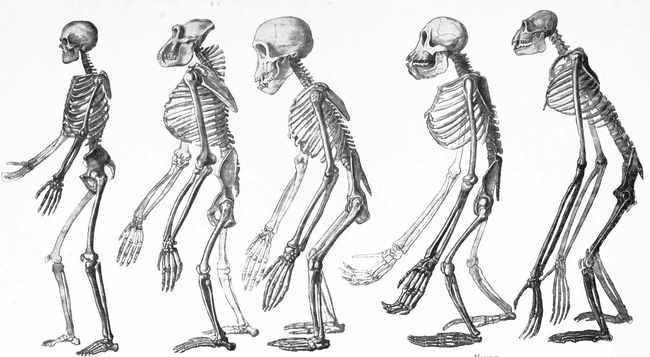
SKELETONS OF FIVE ANTHROPOID APES
These skeletons of the five living genera of anthropomorpha are
reduced to a common size, in order to show better the relative
proportions of the various parts. The human skeleton is
1
20
th natural
size, the gorilla
1
18
th, the chimpanzee
1
7
th, the orang
1
7
th, the gibbon
1
9
th. Young specimens of the chimpanzee and orang have been selected,
because they approach nearer to man than the adult. No one of the
living anthropoid apes is nearest to man in all respects; this cannot be
said of either of the African (gorilla and chimpanzee) or the Asiatic
(orang and gibbon). This anatomic fact is explained phylogenetically
on the ground that none of them are direct ancestors of man; they
represent divergent branches of the stem, of which man is the crown.
However, the small gibbon is nearest related to the hypothetical
common ancestor of all the anthropomorpha to which we give the
name of Prothylobates. Further information will be found in my
Last Link and Evolution of Man (chap. xxiii.).
Plate II.
SKELETONS OF FIVE ANTHROPOID APES.
View Larger Image Here.
YoungYoung
1/20
1/18
1/7
1/7
1/9
MAN
GORILLA
CHIMPANZEE
ORANG
GIBBON
(Homo)
(Anthropithecus)
(Satyrus)
(Hylobates)
CHAPTER II
THE STRUGGLE OVER OUR GENEALOGICAL TREE
OUR APE-RELATIVES AND THE VERTEBRATE-STEM
In the previous chapter I tried to give you a general
idea of the present state of the controversy in regard to
evolution. Comparing the various branches of thought
we found that the older mythological ideas of the
creation of the world were driven long ago out of the
province of inorganic science, but that they did not
yield to the rational conception of natural development
until a much later date in the field of organic nature.
Here the idea of evolution did not prove completely
victorious until the beginning of the twentieth century,
when its most zealous and dangerous opponent, the
Church, was forced to admit it. Hence the open
acknowledgment of the Jesuit, Father Wasmann,
deserves careful attention, and we may look forward to
a further development. If his force of conviction and
his moral courage are strong enough, he will go on to
draw the normal conclusions from his high scientific
attainments and leave the Catholic Church, as the
prominent Jesuits, Count Hoensbroech and the able
geologist, Professor Renard of Ghent, one of the workers
on the deep-sea deposits in the Challenger expedition,
have lately done. But even if this does not happen,
his recognition of Darwinism, in the name of Christian
belief, will remain a landmark in the history of evolution.
His ingenious and very Jesuitical attempt to bring
together the opposite poles will have no very
mischievous effect; it will rather tend to hasten the
victory of the scientific conception of evolution over the
mystic beliefs of the Churches.
You will see this more clearly if we go on to consider
the important special problem of the "descent of man
from the ape," and its irreconcilability with the conventional
belief that God made man according to His
own image. That this ape or pithecoid theory is an
irresistible deduction from the general principle of
evolution was clearly recognised forty-five years ago,
when Darwin's work appeared, by the shrewd and
vigilant theologians; it was precisely in this fact that
they found their strongest motive for vigorous resistance.
It is quite clear. Either man was brought into existence,
like the other animals, by a special creative act,
as Moses and Linné taught (an "embodied idea of the
Creator," as the famous Agassiz put it so late as 1858);
or he has been developed naturally from a series of
mammal ancestors, as is claimed by the systems of
Lamarck and Darwin.
In view of the very great importance of this pithecoid
theory, we will first cast a brief glance at its founders
and then summarise the proofs in support of it. The
famous French biologist, Jean Lamarck, was the first
scientist definitely to affirm the descent of man from
the ape and seek to give scientific proof of it. In his
splendid work, fifty years in advance of his time, the
Philosophie Zoologique (1809), he clearly traced the
modifications and advances that must have taken place
in the transformation of the man-like apes (the primate
forms similar to the orang and the chimpanzee); the
adaptation to walking upright, the consequent modification
of the hands and feet, and later, the formation
of speech and the attainment of a higher degree of
intelligence. Lamarck's remarkable theory, and this
important consequence of it, soon fell into oblivion.
When Darwin brought evolution to the front again fifty
years afterwards, he paid no attention to the special
conclusion. He was content to make the following
brief prophetic observation in his work: "Light will
be thrown on the origin and the history of man." Even
this innocent remark seemed so momentous to the first
German translator of the work, Bronn, that he suppressed
it. When Darwin was asked by Wallace
whether he would not go more fully into it, he replied:
"I think of avoiding the whole subject, as it is so much
involved in prejudice; though I quite admit that it is
the highest and most interesting problem for the
thinker."
The first thorough works of importance on the subject
appeared in 1863. Thomas Huxley in England, and
Carl Vogt in Germany, endeavoured to show that the
descent of man from the ape was a necessary consequence
of Darwinism, and to provide an empirical base
for the theory by every available argument. Huxley's
work on Man's Place in Nature was particularly valuable.
He first gave convincingly, in three lectures, the
empirical evidence on the subject—the natural history
of the anthropoid apes, the anatomical and embryological
relations of man to the next lowest animals, and the
recently discovered fossil human remains. I then (1866)
made the first attempt to establish the theory of evolution
comprehensively by research in anatomy and embryology,
and to determine the chief stages in the natural classification
of the vertebrates that must have been passed
through by our earlier vertebrate ancestors. Anthropology
thus becomes a part of zoology. In my History
of Creation I further developed these early evolutionary
sketches, and improvements were made in the successive
editions.
In the meantime, the great master, Darwin, had
decided to deal with this chief evolutionary problem
in a special work. The two volumes of his Descent
of Man appeared in 1871. They contained an able
discussion of sexual selection, or the selective influence
of sexual love and high psychic activities connected
therewith, and their significance in regard to the
origin of man. As this part of Darwin's work was
afterwards attacked with particular virulence, I will
say that, in my opinion, it is of the greatest importance,
not only for the general theory of evolution, but
also for psychology, anthropology, and æsthetics.
My own feeble early efforts (1866), not only to
establish the descent of man from the nearest
related apes, but also to determine more precisely
the long series of our earlier and lower vertebrate
ancestors, had not at all satisfied me. In particular,
I had had to leave unanswered in my General
Morphology the very interesting question: from which
invertebrate animals the vertebrate stem originally
came. A clear and unexpected light was thrown
on it some time afterwards by the astounding
discoveries of Kowalevsky, which revealed an essential
agreement in embryonic development between the
lowest vertebrate (Amphioxus) and a lowly tunicate
(Ascidia). In the succeeding years, the numerous
discoveries in connection with the formation of the
germinal layers in different animals so much enlarged
our embryological outlook that I was able to prove
the complete homology of the two-layered gastrula (a
cup-shaped embryonic form) in all the tissue-forming
animals (metazoa) in my Monograph on the Sponges.
From this I inferred, in virtue of the biogenetic law,
the common descent of all the metazoa from one and
the same gastrula-shaped stem-form, the gastræa. This
hypothetical stem-form, to which man's earliest multicellular
ancestors also belong, was afterwards proved
by Monticelli's observations to be still in existence.
The evolution of these very simple tissue-forming
animals from still simpler unicellular forms (protozoa)
is shown by the corresponding processes that we
witness in what is called the segmentation of the
ovum or gastrulation, in the development of the
two-layered germ from the single cell of the ovum.
Encouraged by these great advances of modern
phylogeny, and with the support of many new discoveries
in comparative anatomy and embryology, in
which a number of distinguished observers were at
work, I was able in 1874 to venture on the first
attempt to trace continuously the whole story of man's
evolution. In doing so, I took my stand on the
firm ground of the biogenetic law, seeking to give
a phylogenetic cause for each fact of embryology.
My Evolution of Man, which made the first attempt
to accomplish this difficult task, was materially
improved and enlarged as new and important discoveries
were made. The latest edition (1903 [1904
in English]) contains thirty chapters distributed in
two volumes, the first of which deals with embryology
(or ontogeny), and the second with the
development of species (or phylogeny).
Though I was quite conscious that there were
bound to be gaps and weak points in these first
attempts to frame a natural anthropogeny, I had
hoped they would have some influence on modern
anthropology, and especially that the first sketches
of a genealogical tree of the animal world would
prove a stimulus to fresh research and improvement.
In this I was much mistaken. The dominant school
of anthropology, especially in Germany, declined to
suffer the introduction of the theory of evolution,
declaring it to be an unfounded hypothesis, and
described our carefully prepared ancestral trees as
mere figments. This was due, in the first place, to
the great authority of the founder and president (for
many years) of the German Anthropological Society,
Rudolf Virchow, as I briefly pointed out in the
previous chapter. In view of the great regard that
is felt for this distinguished scientist, and the extent
to which his powerful opposition prevented the spread
of the theory, it is necessary to deal more fully with
his position on the subject. I am still further constrained
to do this because of the erroneous views
of it that are circulating, and my own fifty years'
acquaintance with my eminent teacher enables me to
put them right.
Not one of Virchow's numerous pupils and friends
can appreciate more than I do his real services to
medical science. His Cellular Pathology (1858), his
thorough application of the cell-theory to the science of
disease, is, in my opinion, one of the greatest advances
made by modern medicine. I had the good fortune to
begin my medical studies at Würzburg in 1852, and to
spend six valuable terms under the personal guidance
of four biologists of the first rank—Albert Kölliker,
Rudolf Virchow, Franz Leydig and Carl Gegenbaur.
The great stimulus that I received from these distinguished
masters in every branch of comparative and
microscopic biology was the starting-point of my whole
training in that science, and enabled me subsequently to
follow with ease the higher intellectual flight of Johannes
Müller. From Virchow especially I learned, not only
the analytic art of careful observation and judicious
appreciation of the detailed facts of anatomy, but also
the synthetic conception of the whole human frame, the
profound conviction of the unity of our nature, the
inseparable connection of body and mind, to which
Virchow gave a fine expression in his classic essay on
"The Efforts to bring about Unity in Scientific Medicine"
(1849). The leading articles which he wrote at that
time for the Journal of Pathological Anatomy and
Physiology, which he had founded, contain much new
insight into the wonders of life, and a number of excellent
general reflections on their significance—pregnant ideas
that we can make direct use of for Monistic purposes.
In the controversy that broke out between empirical
rationalism and materialism and the older vitalism and
mysticism, he took the side of the former, and fought
together with Jacob Moleschott, Carl Vogt, and Ludwig
Büchner. I owe the firm conviction of the unity of
organic and inorganic nature, of the mechanical character
of all vital and psychic activity, which I have always
held to be the foundation of my Monistic system, in a
great measure to Virchow's teaching and the exhaustive
conversations I had with him when I was his assistant.
The profound views of the nature of the cell and the
independent individuality of these elementary organisms,
which he advanced in his great work Cellular Pathology,
remained guiding principles for me in the prolonged
studies that I made thirty years afterwards of the
organisation of the radiolaria and other unicellular
protists; and also in regard to the theory of the cell-soul,
which followed naturally from the psychological
study of it.
His life at Würtzburg was the most brilliant period
of Virchow's indefatigable scientific labours. A change
took place when he removed to Berlin in 1856. He
then occupied himself chiefly with political and social
and civic interests. In the last respect he has done so
much for Berlin and the welfare of the German people
that I need not enlarge on it. Nor will I go into his
self-sacrificing
and often thankless political work as leader
of the progressive party; there are differences of
opinion as to its value. But we must carefully examine
his peculiar attitude towards evolution, and especially
its chief application, the ape-theory. He was at first
favourable to it, then sceptical, and finally decidedly
hostile.
When the Lamarckian theory was brought to light
again by Darwin in 1859, many thought that it was
Virchow's vocation to take the lead in defending it.
He had made a thorough study of the problem of
heredity; he had realised the power of adaptation
through his study of pathological changes; and he had
been directed to the great question of the origin of man
by his anthropological studies. He was at that time
regarded as a determined opponent of all dogmas; he
combated transcendentalism either in the form of
ecclesiastical creeds or anthropomorphism. After 1862
he declared that "the possibility of a transition from
species to species was a necessity of science." When
I opened the first public discussion of Darwinism at
the Stettin scientific congress in 1863, Virchow and
Alexander Braun were among the few scientists who
would admit the subject to be important and deserving
of the most careful study. When I sent to him in 1865
two lectures that I had delivered at Jena on the origin
and genealogical tree of the human race, he willingly
received them amongst his Collection of Popular
Scientific Lectures. In the course of many long conversations
I had with him on the matter, he agreed with
me in the main, though with the prudent reserve and
cool scepticism that characterised him. He adopts the
same moderate attitude in the lecture that he delivered
to the Artisans' Union at Berlin in 1869 on "Human
and Ape Skulls."
His position definitely changed in regard to
Darwinism from 1877 onward. At the Scientific
Congress that was then held at Munich I had, at
the pressing request of my Munich friends, undertaken
the first address (on 18th September) on "Modern
Evolution in Relation to the whole of Science." In
this address I had substantially advanced the same
general views that I afterwards enlarged in my Monism,
Riddle of the Universe, and Wonders of Life. In the
ultramontane capital of Bavaria, in sight of a great
university which emphatically describes itself as Catholic,
it was somewhat bold to make such a confession of
faith. The deep impression that it had made was
indicated by the lively manifestations of assent on the
one hand, and displeasure on the other, that were at
once made in the Congress itself and in the Press. On
the following day I departed for Italy (according to
an arrangement made long before). Virchow did not
come to Munich until two days afterwards, when he
delivered (on 22nd September, in response to entreaties
from people of position and influence) his famous
antagonistic speech on "The Freedom of Science in
the Modern State." The gist of the speech was that
this freedom ought to be restricted; that evolution is
an unproved hypothesis, and ought not to be taught in
the school because it is dangerous to the State: "We
must not teach," he said, "that man descends from the
ape or any other animal." In 1849, the young Monist,
Virchow, had emphatically declared this conviction,
"that he would never be induced to deny the thesis
of the unity of human nature and its consequences";
now, twenty-eight years afterwards, the prudent Dualistic
politician entirely denied it. He had formerly taught
that all the bodily and mental processes in the human
organism depend on the mechanism of the cell-life;
now he declared the soul to be a special immaterial
entity. But the crowning feature of this reactionary
speech was his compromise with the Church,
which he had fought so vigorously twenty years
before.
The character of Virchow's speech at Munich is best
seen in the delight with which it was at once received
by the reactionary and clerical papers, and the profound
concern of all Liberal journals, either in the political or
the religious sense. When Darwin read the English
translation of the speech he—generally so gentle in his
judgments—wrote: "Virchow's conduct is shameful,
and I hope he will some day feel the shame." In 1878,
I made a full reply to it in my Free Science and Free
Teaching, in which I collected the most important
press opinions on the matter.[6]
From this very decided turn at Munich until his
death, twenty-five years afterwards, Virchow was an
indefatigable and very influential opponent of evolution.
In his annual appearances at congresses he has always
contested it, and has obstinately clung to his statement
that "it is quite certain that man does not descend from
the ape or any other animal." To the question:
"Whence does he come, then?" he had no answer,
and retired to the resigned position of the Agnostic,
which was common before Darwin's time: "We do not
know how life arose, and how the various species came
into the world." His son-in-law, Professor Rabl, has
tried to draw attention once more to his earlier conception,
and has declared that even in later years
Virchow often recognised the truth of evolution in
private conversation. This only makes it the more
regrettable that he always said the contrary in public.
The fact remains that ever since the opponents of
evolution, especially the reactionaries and clericals, have
appealed to the authority of Virchow.
The wholly reactionary system that this led to has
been well described by Robert Drill (1902) in his
Virchow as a Reactionary. How little qualified the
great pathologist was to appreciate the scientific
bases of the pithecoid theory is clear from the
absurd statement he made, in the opening speech
of the Vienna Congress of Anthropologists, in 1894,
that man might just as well be claimed to descend
from a sheep or an elephant as from an ape. Any
competent zoologist can see from this the little
knowledge Virchow had of systematic zoology and
comparative anatomy. However, he retained his
authority as president of the German Anthropological
Society, which remained impervious to Darwinian
ideas. Even such vigorous controversialists as Carl
Vogt, and such scientific partisans of the ape-man
of Neanderthal as Schaafhausen, could make no
impression. Virchow's authority was equally great
for twenty years in the Berlin Press, both Liberal
and Conservative. The Kreutzzeitung and the Evangelische
Kirchenzeitung were delighted that "the
learned progressist was conservative in the best
sense of the word as regards evolution." The
ultramontane Germania rejoiced that the powerful
representative of pure science had, "with a few
strokes of his cudgel, reduced to impotence" the
absurd ape-theory and its chief protagonist, Ernst
Haeckel. The National-Zeitung could not sufficiently
thank the free-thinking, popular leader for having
lifted from us for ever the oppressive mountain of
the theory of simian descent. The editor of the
Volks-Zeitung, Bernstein, who has done so much for
the spread of knowledge in his excellent popular
manuals of science, obstinately refused to admit
articles that ventured to support the erroneous
ape-theory "refuted" by Virchow.
It would take up too much space to attempt to
give even a general survey of the remarkable and
enormous literature of the subject that has accumulated
in the last three decades in the shape of
thousands of learned treatises and popular articles.
The greater part of these works have been written
under the influence of conventional religious prejudice,
and without the necessary acquaintance with the
subject, that can only be obtained by a thorough
training in biology. The most curious feature of
them is that most of the authors restrict their
genealogical interests to the most manlike apes, and
do not deal with their origin, or with the deeper
roots of our common ancestral tree. They do not
see the wood for the trees. Yet it is far easier and
safer to penetrate the great mysteries of our animal
origin, if we look at the subject from the higher
standpoint of vertebrate phylogeny and go deeper
into the earlier records of the evolutionary history
of the vertebrates.
Since the great Lamarck established the idea of
the vertebrate at the beginning of the nineteenth
century (1801), and his Parisian colleague, Cuvier,
shortly afterwards recognised the vertebrates as one
of his four chief animal groups, the natural unity of
this advanced section of the animal world has not
been contested. In all the vertebrates, from the
lowest fishes and amphibians up to the apes and
man, we have the same type of structure, the same
characteristic disposition and relations of the chief
organs; and they differ materially from the corresponding
features in all other animals. The mysterious
affinities of the vertebrates induced Goethe, 140 years
ago, long before Cuvier, to make prolonged and
laborious studies in their comparative anatomy at
Jena and Weimar. Just as he had, in his Metamorphosis
of Plants, established the unity of
organisation by means of the leaf as the common
primitive organ, he, in the metamorphosis of the
vertebrates, found this common element in the
vertebral theory of the skull. And when Cuvier
established comparative anatomy as an independent
science, this branch of biology was developed to
such an extent by the classic research of Johannes
Müller, Carl Gegenbaur, Richard Owen, Thomas
Huxley, and many other morphologists, that Darwinism
found its most powerful weapons in this arsenal.
The striking differences of external form and internal
structure that we find in the fishes, amphibians,
reptiles, birds, and mammals, are due to adaptation
to the various uses of their organs and their
environments. On the other hand, the astonishing
agreement in their typical character, that persists in
spite of their differences, is due to inheritance from
common ancestors.
The evidence thus afforded by comparative anatomy
is so cogent that anyone who goes impartially and
attentively through a collection of skeletons can
convince himself at once of the morphological unity
of the vertebrate stem. The evolutionary evidence
of comparative ontogeny, or embryology, is less easy
to grasp and less accessible, but not less important.
It came to light at a much later date, and its
extreme value was only made clear, by means of the
biogenetic law, some forty years ago. It shows that
every vertebrate, like every other animal, develops
from a single cell, but that the course of its embryonic
development is peculiar, and characterised by embryonic
forms that are not found in the invertebrates. We
find in them especially the chordula, or chorda-larva,
a very simple worm-shaped embryonic form, without
limbs, head, or higher sense-organs; the body consists
merely of six very simple primitive organs. From
these are developed steadily the hundreds of different
bones, muscles, and other organs that we afterwards
distinguish in the mature vertebrate. The remarkable
and very complex course of this embryonic development
is essentially the same in man and the ape, and
in the amphibians and fishes. We see in it, in
accordance with the biogenetic law, a new and
important witness to the common descent of all
vertebrates from a single primitive form, the chordæa.
But, important as these arguments of comparative
embryology are, one needs many years' study in the
unfamiliar and difficult province of embryology before
one can realise their evolutionary force. There are,
in fact, not a few embryologists (especially of the
modern school of experimental embryology) who do
not succeed in doing so. It is otherwise with the
palpable proofs that we take from a remote science,
paleontology. The remarkable fossil remains and
impressions of extinct animals and plants give us
directly the historical evidence we need to understand
the successive appearance and disappearance of the
various species and groups. Geology has firmly
established the chronological order of the sedimentary
rocks, which have been successively formed of mud
at the floor of the ocean, and has deduced their age
from the thickness of the strata, and determined the
relative date of their formation. The vast period
during which organic life has been developing on the
earth runs to many million years. The number is
variously estimated at less than a hundred or at
several hundred million years.[7] If we take the
smaller number of 200 million years, we find them
distributed amongst the five chief periods of the
earth's organic development in such a way that the
earlier or archeozoic period absorbs nearly one half.
As the sedimentary rocks of this period, chiefly
gneisses and crystalline schists, are in a metamorphosed
condition, the fossil remains in them are unrecognisable.
In the next succeeding strata of the paleozoic
period we find the earliest remains of fossilised
vertebrates, Silurian primitive fishes (selachii) and
ganoids. These are followed, in the Devonian system,
by the first dipneust fishes (a transitional form from
the fishes to the amphibia). In the next, the
Carboniferous system, we find the first terrestrial or
four-footed vertebrates—amphibians of the order of
the stegocephala. A little later, in the Permian
rocks, the earliest amniotes, lowly, lizard-like reptiles
(tocosauria), make their appearance; the warm-blooded
birds and mammals are still wanting. We have the
first traces of the mammals in the Triassic, the earliest
sedimentary rocks of the mesozoic age; these are of
the monotreme sub-class (pantotheria and allotheria).
They are succeeded by the first marsupials
(prodidelphia) in the Jurassic, the ancestral forms of the
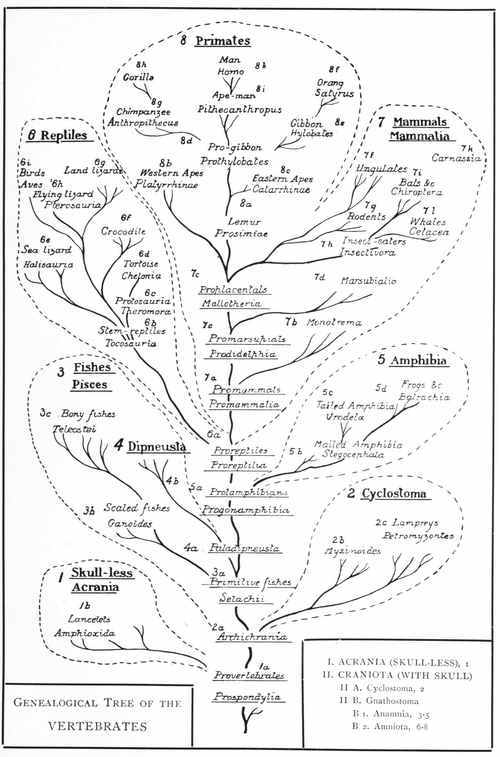
placentals (mallotheria), in the Cretaceous. See p. 115.
But the richest development of the mammal class
takes place in the next or Tertiary age. In the
course of its four periods—the eocene, oligocene,
miocene, and pliocene—the mammal species increase
steadily in number, variety, and complexity, down to
the present time. From the lowest common ancestral
group of the placentals proceed four divergent branches,
the legions of the carnassia, rodents, ungulates, and
primates. The primate legion surpasses all the rest.
In this Linné long ago included the lemurs, apes,
and man. The historical order in which the various
stages of vertebrate development make their successive
appearance corresponds entirely to the morphological
order of their advance in organisation, as we have
learned it from the study of comparative anatomy
and embryology.
These paleontological facts are among the most
important proofs of the descent of man from a long
series of higher and lower vertebrates. There is no
other explanation possible except evolution for the
chronological succession of these classes, which is in
perfect harmony with the morphological and systematic
distribution. The anti-evolutionists have not even
attempted to give any other explanation. The fishes,
dipneusts, amphibians, reptiles, monotremes, marsupials,
placentals, lemurs, apes, anthropoid apes, and ape-men
(pithecanthropi), are inseparable links of a long ancestral
chain, of which the last and most perfect link is man.
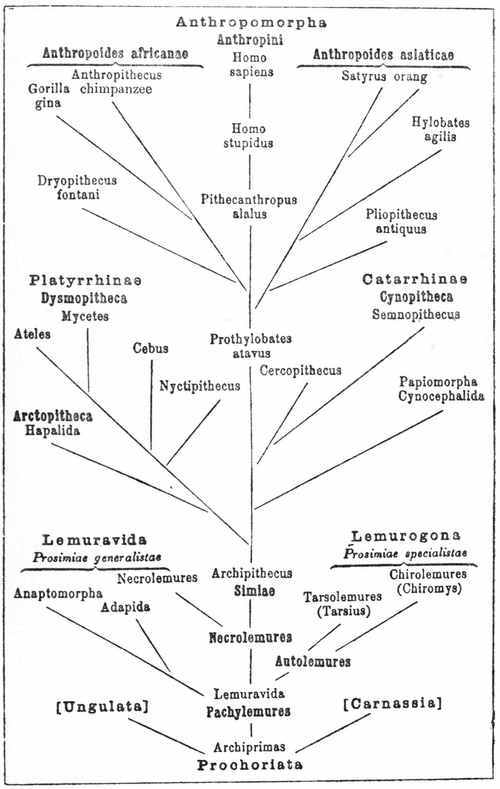
(Cf. the tables pp. 116-118.)
One of the paleontological facts I have quoted,
namely, the late appearance of the mammal class in
geology—is particularly important. This most advanced
group of the vertebrates comes on the stage in the
Triassic period, in the second and shorter half of the
organic history of the earth. It is represented only by
low and small forms in the whole of the mesozoic age,
during the domination of the reptiles. Throughout this
long period, which is estimated by some geologists at
8-11, by others at 20 or more, million years, the
dominant reptile class developed its many remarkable
and curious forms; there were swimming marine reptiles
(halisauria), flying reptiles (pterosauria), and colossal
land reptiles (dinosauria). It was much later, in the
Tertiary period, that the mammal class attained the
wealth of large and advanced placental forms that
secured its predominance over this more recent period.
The many and thorough investigations made during
the last few decades into the ancestral history of the
mammals have convinced all zoologists who were
engaged in them that they may be traced to a common
root. All the mammals, from the lowest monotremes
and marsupials to the ape and man, have a large number
of striking characteristics in common, and these
distinguish them from all other vertebrates: the hair
and glands of the skin, the feeding of the young with
the mother's milk, the peculiar formation of the lower
jaw and the ear-bones connected therewith, and other
features in the structure of the skull; also, the possession
of a knee-cap (patella), and the loss of the nucleus in
the red blood-cells. Further, the complete diaphragm,
which entirely separates the pectoral cavity from the
abdominal, is only found in the mammals; in all the
other vertebrates there is still an open communication
between the two cavities. The monophyletic (or single)
origin of the whole mammalian class is therefore now
regarded by all competent experts as an established
fact.
In the face of this important fact, what is called the
"ape-question" loses a good deal of the importance
that was formerly ascribed to it. All the momentous
consequences that follow from it in regard to our human
nature, our past and future, and our bodily and psychic
life, remain undisturbed whether we derive man directly
from one of the primates, an ape or lemur, or from some
other branch, some unknown lower form, of the
mammalian stem. It is important to point this out,
because certain dangerous attempts have been made
lately by Jesuitical zoologists and zoological Jesuits to
cause fresh confusion on the matter.
In a richly illustrated and widely read work that
Hans Kraemer published a few years ago, under the
title, The Universe and Man, an able and learned
anthropologist, Professor Klaatsch of Heidelberg, deals
with "the origin and development of the human race,"
and admirably describes the primitive history of man
and his civilisation. However, he denounces the idea
of man's descent from the ape as "irrational, narrow-minded,
and false"; he grounds this severe censure
on the fact that none of the living apes can be the
ancestor of humanity. But no competent scientist had
ever said anything so foolish. If we look closer into
this fight with windmills, we find that Klaatsch holds
substantially the same view of the pithecoid theory
as I have done since 1866. He says expressly: "The
three anthropoid apes, the gorilla, chimpanzee, and
orang, seem to diverge from a common root, which
was near to that of the gibbon and man." I had long
ago given the name of archiprimas to this single
hypothetical root-form of the primates, which he calls
the "primatoid." It lived in the earliest part of the
Tertiary period, and had probably been developed in
the Cretaceous from older mammals. The very
forced and unnatural hypothesis by means of which
Klaatsch goes on to make the primates depart very
widely from the other mammals, seems to me to be
quite untenable, like the similar hypothesis that Alsberg,
Wilser, and other anthropologists who deny our
pithecoid descent, have lately advanced.
All these attempts have a common object—to save
man's privileged position in Nature, to widen as much
as possible the gulf between him and the rest of the
mammals, and to conceal his real origin. It is the
familiar tendency of the parvenu, which we so often
notice in the aristocratic sons of energetic men who
have won a high position by their own exertions.
This sort of vanity is acceptable enough to the ruling
powers and the Churches, because it tends to support
their own fossilised pretensions to a "Divine image"
in man and a special "Divine grace" in princes. The
zoologist or anthropologist who studies our genealogy
in a strictly scientific spirit takes no more notice of
these tendencies than of the Almanach de Gotha. He
seeks to discover the naked truth, as it is yielded by
the great results of modern science, in which there
is no longer any doubt that man is really a descendant
of the ape—that is to say, of a long extinct anthropoid
ape. As has been pointed out over and over again
by distinguished supporters of this opinion, the
proofs of it are exceptionally clear and simple—much
clearer and simpler than they are in regard to many
other mammals. Thus, for instance, the origin of
the elephants, the armadilloes, the sirena, or the whales,
is a much more difficult problem than the origin of man.
When Huxley published his powerful essay on
"Man's Place in Nature" in 1863, he gave it a frontispiece
showing the skeletons of man and the four living
anthropoid apes, the Asiatic orang and gibbon, and the
African chimpanzee and gorilla. Plate II. in the present
work differs from this in giving two young specimens of
the orang and the chimpanzee, and raising their size
to correspond with the other three skeletons. Candid
comparison of these five skeletons shows that they are
not only very like each other generally, but are identical
in the structure, arrangement, and connection of all the
parts. The same 200 bones compose the skeleton in
man and in the four tailless anthropoid apes, our nearest
relatives. The same 300 muscles serve to move the
various parts of the skeleton. The same hair covers the
skin; the same mammary glands provide food for the
young. The same four-chambered heart acts as central
pump of the circulation; the same 32 teeth are found in
our jaws; the same reproductive organs maintain the
species; the same groups of neurona or ganglionic cells
compose the wondrous structure of the brain, and
accomplish that highest function of the plasm which we
call the soul, and many still believe to be an immortal
entity. Huxley has thoroughly established this profound
truth, and by further comparison with the lower apes
and lemurs he came to formulate his important pithecometra
principle: "Whatever organ we take, the
differences between man and the anthropoid apes are
slighter than the corresponding differences between the
latter and the lower apes." If we make a superficial
comparison of our skeletons of the anthropomorpha, we
certainly notice a few salient differences in the size of
the various parts; but these are purely quantitative, and
are due to differences in growth, which in turn are caused
by adaptation to different environments. There are, as
is well known, similar differences between human beings;
their arms are sometimes long, sometimes short; the
forehead may be high or low, the hair thick or thin, and
so on.
These anatomic proofs of the pithecoid theory are
most happily supplemented and confirmed by certain
recent brilliant discoveries in physiology. Chief amongst
these are the famous experiments of Dr. Hans
Friedenthal at Berlin. He showed that the human
blood acts poisonously on and decomposes the blood of
the lower apes and other mammals, but has not that
effect on the blood of the anthropoid apes.[8]
From previous transfusion experiments it had been
learned that the affinity of mammals is connected to a
certain extent with their chemical blood-relationship.
If the living blood of two nearly related animals of the
same family, such as the dog and the fox, or the rabbit
and the hare, is mixed together, the living blood-cells
of each species remain uninfluenced. But if we mix the
blood of the dog and the rabbit, or the fox and the hare,
a struggle for life immediately takes place between the
two kinds of blood-cells. The watery fluid or serum
destroys the blood-cells of the rodent, and vice versâ.
It is the same with specimens of the blood of the various
primates. The blood of the lower apes and lemurs,
which are close to the common root of the primate stem,
has a destructive effect on the blood of the anthropoid
apes and man, and vice versâ. On the other hand, the
human blood has no injurious effect when it is mixed
with that of the anthropoid apes.
In recent years these interesting experiments have
been continued by other physiologists and physicians,
such as Professor Uhlenhuth at Greifswald and Nuttall
at London, and they have proved directly the blood-relationship
of various mammals. Nuttall studied
them carefully in 900 different kinds of blood, which
he tested by 16,000 reactions. He traced the gradation
of affinity to the lowest apes of the New World;
and Uhlenhuth continued as far as the lemurs. By
these results the affinity of man and the anthropoid
apes, long established by anatomy, has now been
proved physiologically to be in real "blood-relationship."[9]
Not less important are the embryological discoveries
of the deceased zoologist, Emil Selenka. He made
two long journeys to the East Indies, in order to
study on the spot the embryology of the Asiatic
anthropoid apes, the orang and gibbon. By means
of a number of embryos that he collected he showed
that certain remarkable peculiarities in the formation
of the placenta, that had up to that time been considered
as exclusively human, and regarded as a
special distinction of our species, were found in just
the same way in the closely related anthropoid apes,
though not in the rest of the apes. On the ground
of these and other facts, I maintain that the descent
of man from extinct Tertiary anthropoid apes is proved
just as plainly as the descent of birds from reptiles,
or the descent of reptiles from amphibians, which no
zoologist hesitates to admit to-day. The relationship
is as close as was claimed by my former fellow-student,
the Berlin anatomist, Robert Hartmann (with whom
I sat at the feet of Johannes Müller fifty years ago),
in his admirable work on the anthropoid apes (1883).
He proposed to divide the order of primates into
two families, the primarii (man and the anthropoid
apes), and simianæ (the real apes, the catarrhine or
eastern, and the platyrrhine or western apes).
Since the Dutch physician, Eugen Dubois, discovered
the famous remains of the fossil ape-man
(pithecanthropus erectus) eleven years ago in Java, and
thus brought to light "the missing link," a large
number of works have been published on this very
interesting group of the primates. In this connection
we may particularly note the demonstration by the
Strassburg anatomist, Gustav Schwalbe, that the
previously discovered Neanderthal skull belongs to an
extinct species of man, which was midway between
the pithecanthropus and the true human being—the
homo primigenus. After a very careful examination,
Schwalbe at the same time refuted all the biassed
objections that Virchow had made to these and other
fossil discoveries, trying to represent them as pathological
abnormalities. In all the important relics of
fossil men that prove our descent from anthropoid
apes Virchow saw pathological modifications, due to
unsound habits, gout, rickets, or other diseases of
the dwellers in the diluvial caves. He tried in
every way to impair the force of the arguments for
our primate affinity. So in the controversy over
the pithecanthropus he raised the most improbable
conjectures, merely for the purpose of destroying its
significance as a real link between the anthropoid
apes and man.
Even now, in the controversy over this important
ape-question, amateurs and biassed anthropologists often
repeat the false statement that the gap between man
and the anthropoid ape is not yet filled up and the
"missing link" not yet discovered. This is a most
perverse statement, and can only arise either from
ignorance of the anatomical, embryological, and
paleontological facts, or incompetence to interpret
them aright. As a fact, the morphological chain that
stretches from the lemurs to the earlier western apes,
from these to the eastern tailed apes, and to the tailless
anthropoid apes, and from these direct to man, is now
uninterrupted and clear. It would be more plausible
to speak of missing links between the earliest lemurs
and their marsupial ancestors, or between the latter and
their monotreme ancestors. But even these gaps
are unimportant, because comparative anatomy and
embryology, with the support of paleontology, have
dissipated all doubt as to the unity of the mammalian
stem. It is ridiculous to expect paleontology to furnish
an unbroken series of positive data, when we remember
how scanty and imperfect its material is.
I cannot go further here into the interesting recent
research in regard to special aspects of our simian
descent; nor would it greatly advance our object,
because all the general conclusions as to man's primate
descent remain intact, whichever way we construct
hypothetically the special lines of simian evolution. On
the other hand, it is interesting for us to see how the
most recent form of Darwinism, so happily described by
Escherich as "ecclesiastical evolution," stands in regard
to these great questions. What does its astutest representative,
Father Erich Wasmann, say about them?
The tenth chapter of his work, in which he deals at
length with "the application of the theory of evolution
to man," is a masterpiece of Jesuitical science, calculated
to throw the clearest truths into such confusion
and so to misrepresent all discoveries as to prevent any
reader from forming a clear idea of them. When we
compare this tenth chapter with the ninth, in which
Wasmann represents the theory of evolution as an
irresistible truth on the strength of his own able studies,
we can hardly believe that they both came from the
same pen—or, rather, we can only understand when we
recollect the rule of the Jesuit Congregation: "The
end justifies the means." Untruth is permitted and
meritorious in the service of God and his Church.
The Jesuitical sophistry that Wasmann employs in
order to save man's unique position in Nature, and
to prove that he was immediately created by God,
culminates in the antithesis of his two natures. The
"purely zoological conception of man," which has
been established beyond question by the anatomical
and embryological comparison with the ape, is said
to fail because it does not take into account the chief
feature, his "mental life." It is "psychology that is
best fitted to deal with the nature and origin of
man." All the facts of anatomy and embryology that
I have gathered together in my Evolution of Man in
proof of the series of his ancestors are either ignored
or misconstrued and made ridiculous by Wasmann.
The same is done with the instructive facts of
anthropology, especially the rudimentary organs,
which Robert Wiedersheim has quoted in his Man's
Structure as a Witness to his Past. It is clear that
the Jesuit writer lacks competence in this department;
that he has only a superficial and inadequate acquaintance
with comparative anatomy and embryology. If
Wasmann had studied the morphology and physiology
of the mammals as thoroughly as those of the ants,
he would have concluded, if he were impartial, that
it is just as necessary to admit a monophyletic (or
single) origin for the former as for the latter. If, in
Wasmann's opinion, the 4,000 species of ants form
a single "natural system"—that is to say, descend
from one original species—it is just as necessary to
admit the same hypothesis for the 6,000 (2,400 living
and 3,600 fossil) species of mammals, including the
human species.
The severe strictures that I have passed on the
sophisms and trickery of this "ecclesiastical evolution"
are not directed against the person and the character
of Father Wasmann, but the Jesuitical system which
he represents. I do not doubt that this able naturalist
(who is personally unknown to me) has written his
book in good faith, and has an honourable ambition
to reconcile the irreconcilable contradictions between
natural evolution and the story of supernatural
creation. But this reconciliation of reason and
superstition is only possible at the price of a sacrifice
of the reason itself. We find this in the case of all
the other Jesuits—Fathers Cathrein, Braun, Besmer,
Cornet, Linsmeier, and Muckermann—whose ambiguous
"Jesuitical science" is aptly dealt with in the article
of R. H. Francé that I mentioned before (No. 22 of
the Freie Wort, 16th February, 1904, Frankfort).
This interesting attempt of Father Wasmann's does
not stand alone. Signs are multiplying that the
Church militant is about to enter on a systematic
campaign. I heard from Vienna on the 17th of
February, that on the previous day (which happened
to be my birthday), a Jesuit, Father Giese, had, in a
well-received address, admitted not only evolution in
general, but even its application to man, and declared
it to be reconcilable with Catholic dogmas—and this
at a crowded meeting of "catechists"! It is important
to note that in a new Catholic cyclopædia, Benziger's
Library of Science, the first three volumes (issued at
Einsiedeln and Cologne, 1904) deal very fully and ably
with the chief problems of evolution: the first with
the formation of the earth, the second with spontaneous
generation, the third with the theory of descent. The
author of them, Father M. Gander, makes most
remarkable concessions to our theory, and endeavours
to show that they are not inconsistent with the Bible
or the dogmatic treatises of the chief fathers and schoolmen.
But, though there is a profuse expenditure of
sophistical logic in these Jesuitical efforts, Gander will
hardly succeed in misleading thoughtful people. One
of his characteristic positions is that spontaneous generation
(as the development of organised living things by
purely material processes) is inconceivable, but that it
might be made possible "by a special Divine arrangement."
In regard to the descent of man from other
animals (which he grants), he makes the reserve that
the soul must in any case have been produced by a
special creative act.
It would be useless to go through the innumerable
fallacies and untruths of these modern Jesuits in detail,
and point out the rational and scientific reply. The
vast power of this most dangerous religious congregation
consists precisely in its device of accepting one
part of science in order to destroy the other part more
effectively with it. Their masterly act of sophistry,
their equivocal "probabilism," their mendacious
"reservatio mentalis," the principle that the higher
aim sanctifies the worst means, the pernicious casuistry
of Liguori and Gury, the cynicism with which they
turn the holiest principles to the gratification of their
ambition, have impressed on the Jesuits that black
character that Carl Hoensbroech has so well exposed
recently.
The great dangers that menace real science, owing
to this smuggling into it of the Jesuitical spirit, must
not be undervalued. They have been well pointed
out by Francé, Escherich, and others. They are all
the greater in Germany at the present time, as the
Government and the Reichstag are working together
to prepare the way for the Jesuits, and to yield a
most pernicious influence on the school to these
deadly enemies of the free spirit of the country.
However, we will hope that this clerical reaction
represents only a passing episode in modern history.
We trust that one permanent result of it will be the
recognition, in principle, even by the Jesuits, of the
great idea of evolution. We may then rest assured
that its most important consequence, the descent of
man from other primate forms, will press on victoriously,
and soon be recognised as a beneficent and
helpful truth.