Since light waves have such high frequencies, a different
mode of generation comes into play. We can no
longer count on the controlled movement of free electrons
outside atoms and molecules. Rather, light and all
the radiations in the higher frequencies are generated by
the movement of electrons inside atoms and molecules.
Let us review momentarily the modern, albeit highly
simplified, conception of an atom. Remember that no one
has yet seen one. We describe the atom on the basis of
how it acts, as well as how it reacts to things scientists
do to it.
For the present purpose, the best model we have of the
atom is that of a miniature solar system, with a nucleus
or heavy part at the center and a cloud of electrons dashing
around the nucleus in fixed orbits.
The term “fixed orbits” is used advisedly.
Our planet moves in a certain orbit around the sun. If
we attached a large enough rocket to the earth we theoretically
could move it closer to or farther away from the
sun. In the atom, we have learned, this cannot be done. An
electron can only exist in one of a certain number of fixed
orbits; different kinds of atoms have different numbers
of orbits.
We might think in terms of an elevator that can only
stop at the various floors of an apartment building. Each
upper floor is like an orbit of the electron. But you get
nothing for nothing in the world of physics, and just as it
takes energy to raise an elevator to a higher floor, it takes
energy to move an electron to an outer orbit.
Hence the atom is said to be raised to higher energy levels
when an electron is nudged to an outer orbit. The energy
input can be of many different kinds. Examples are heat,
pressure, electrical current, chemical energy, and various
forms of electromagnetic radiation. If too much energy is
put into the elevator it goes flying out the roof. If too much
energy is put into the atom, one or more of its electrons
will go flying out of the atom. This is called ionization, and
the atom, now minus one of its negative electrons and therefore
positively charged, is called a positive ion.
15
But if the right amount of energy is put into the atom,
one of its electrons will merely be raised to a higher
energy level. Shown in Figure 9, for instance, are the
ground state (Circle No. 1) and two possible higher energy
levels. As you can see there are three possible transitions.
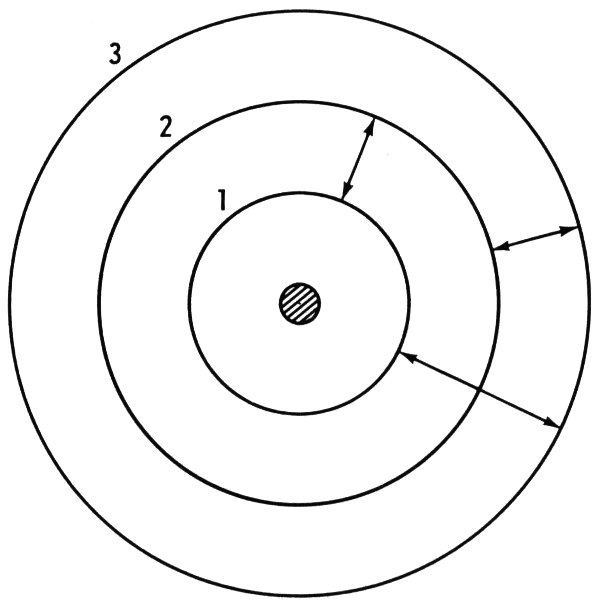
Figure 9 Schematic representation of the electron orbits and energy
levels of an atom. Each circle represents a separate possible
orbit and each arrow a possible energy level difference.
The higher energy levels are abnormal, or excited,
states, however, and the electron will shortly fall back to
its normal (ground state) orbit (assuming some other
electron has not fallen into it first). In order for the electron
to do this (go back to its normal orbit), it must give
off the energy it has acquired. This it does in the form of
electromagnetic radiation.
The energy difference between the two levels will determine
what kind of radiation is emitted, for there is a
direct correlation between energy and frequency.[8] If the
energy difference between the two levels is such that the
frequency of emitted radiation is roughly between 10¹⁴ and
10¹⁵ cycles per second, we see the radiation as light. When
16
more energy is added, the radiation emerges as ultraviolet
or X rays. In other words the higher the energy difference,
the higher the frequency, and vice versa. Thus it is that
cosmic rays, with the highest frequencies known to man,
can pass right through us as if we weren’t there.
This simple picture of energy levels and associated
frequencies doesn’t quite hold for ordinary white light,
however. Such light is generally produced by a process
called incandescence, which results from the heating of a
material until it glows. True, the atoms of the incandescent
material are being raised to higher energy levels by
chemical energy (as in fire), electricity (light bulb), or
nuclear energy (the sun). In a hot solid, however, the explanation
becomes more complicated. Many different electronic
configurations are possible and the differences in
energy among the various levels (which can be many more
than the three shown in Figure 9) vary only slightly from
one another. The result is a wide band of radiation.
Thus, while the incandescent electric bulb is a great
advance over fire, it is still a very inefficient source of
light. Because it depends upon incandescence, a considerable
portion of the electrical input goes into the production
of unwanted heat, for the bulb’s filament radiates in the
infrared as well as the visible region.
For providing illumination, the fluorescent tube is far
more efficient than the incandescent lamp: a 40-watt fluorescent
tube gives as much light as a 150-watt incandescent
light. This is because its radiation is more controlled,
operating more in accord with our description of electronic
energy levels. Hence more of its output is in the
desired visual region of the spectrum.
In certain types of lighting, particular energy level
changes may predominate, leading to the characteristic
colors of neon tubes and vapor lamps. Although the resulting
radiation bandwidth is narrow enough in these
devices to appear as a definite color instead of the broad
spectrum we know as white, it is still quite broad. In other
words, the radiation is still frequency incoherent—and it
is still spatially incoherent.
To understand this, let us return for a moment to the
group of radio antennas we showed in Figure 8. All of
17
them, you will recall, could be made to radiate in phase.
In the production of light, however, each antenna is replaced
by a single atom!
This creates two problems. First, because the energy
stored in the atom is quite small, it comes out not as a
continuous wave but as a tiny packet of radiation—a photon.[9]
It has an effect more like the hack of an ax than the
buzz of a power saw.
Second, atoms are notoriously “individualistic”. When a
batch of atoms in a material has been raised to higher
energy levels there is no way to know in what order, or in
what direction, they will release their energy.
This kind of process is called spontaneous emission,
since each atom “makes up its own mind”. All we know is
that within a certain period of time—a short period, to be
sure—a certain percentage of these higher energy atoms
will release their photons.
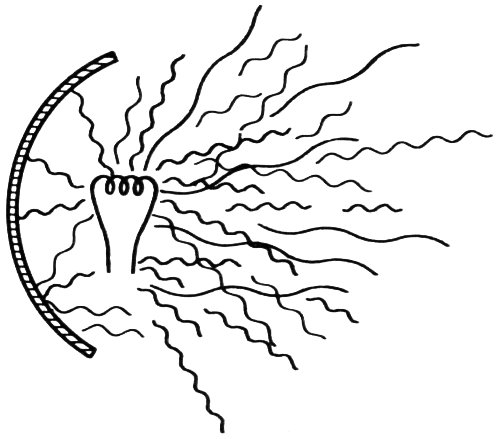
Figure 10 Ordinary light
is a jumble of frequencies,
directions, and phases.
What we have, then, is incoherent
radiation—a jumble
of frequencies (or colors), directions,
and phases. Such
light, symbolized in Figure 10,
works well enough in lighting
up this page, but is almost
worthless as a carrier of information
(and in other ways,
as we shall see shortly). About
the best that can be done with
it is to turn it on and off in a
sort of visual Morse code,
which is exactly what is done
on the blinker communication systems sometimes used for
ship-to-ship communication.
In other words, ordinary light cannot be modulated as
radio waves can.
It is of interest to note, however, that ordinary white
light can be made coherent, to some extent, but at a very
18
high cost in the intensity of the light. For example, we
might first pass the light through a series of filters, each
of which would subtract some portion of the spectrum,
until only the desired wavelength came through. As can be
seen in Figure 11, only a small fraction of the original
light would be left.
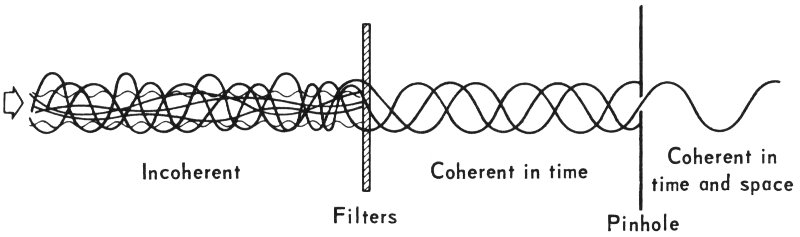
Figure 11 Obtaining coherent radiation the hard way. Filters and
pinhole block all but a small amount of the original radiation.
- Incoherent
- Filters
- Coherent in time
- Pinhole
- Coherent in time and space
We would then have monochromatic (one color) light,
which is temporally coherent radiation, but it would still
be spatially incoherent. In our diagram, we show three
monochromatic waves. If we then passed this light through
a tiny pinhole as shown, most of these few remaining waves
would be blocked; the ones that got through would be pretty
much in step. (In a similar manner, a true point source of
light would produce spatially coherent radiation; but, as in
the process described here, there wouldn’t be very much of
it.)
We have, finally, obtained coherent light.
The important thing about the laser is that, by its very
nature, it produces coherent light automatically.
Now....
19
WHAT’S SO SPECIAL ABOUT COHERENT LIGHT?
So desirable are the qualities of coherent light that the
complicated filtering process described above has actually
been used. For example, one British experimenter, Dennis
Gabor, used it in the 1940s in an attempt to make a better
microscope. But so great was the effort, and so meager
the resulting light, that this project was abandoned.
In the course of Dr. Gabor’s experiments, however, he
did manage to make a special kind of picture, using coherent
light, which he called a hologram. He derived the
name from two Greek words meaning a whole picture. We
shall see why in a moment.
Ordinary black and white photographs merely record
darks and lights, or the intensity of the illumination,
thereby providing a scale of grays, nothing more. But
because waves of coherent light consistently maintain their
relative spacing, they can be used to record additional information,
namely the distance from objects.
For example, if we shine a beam of coherent (laser)
light between two objects we can, knowing the light wavelength,
determine the distance between them to a high
degree of accuracy. The basic idea is diagramed in Figure 12.
It can be seen that the number of waves times the
wavelength gives the precise distance (to within 1 wavelength
of light) from the laser source to each object. But
this would be a difficult process to implement.
A better way, and one that is already in operation, is
to use conventional methods to measure the approximate
distance and use the laser beam for precise or fine measurement.
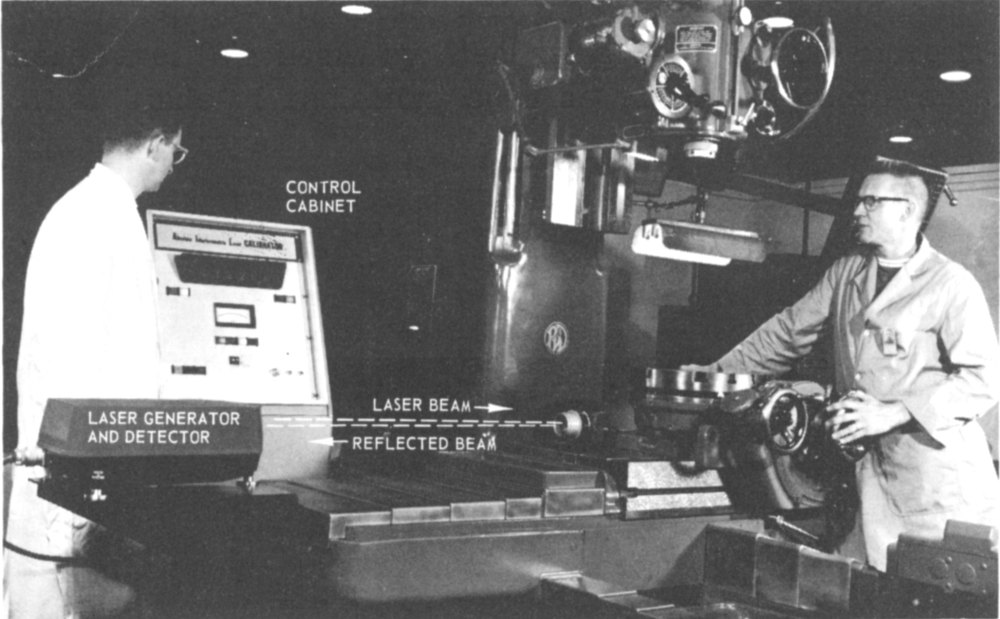
In the device shown in Figure 2, the beam is
split into two parts. One part is kept in the instrument
itself to act as a reference. The other is aimed at a reflector,
which sends it back to a detector in the main
device, where it is automatically compared with the reference
beam. If the two beams are in phase (that is, if
their crests are superimposed), the waves combine and
produce a high intensity beam at the detector. As the reflector
moves closer to or farther away from the laser
source the beam intensity decreases and then increases
20
again as the wave crests move in and out of phase. The
instrument counts the changes and displays the distance
the reflector moves, as a function of the wavelengths, on
the control cabinet meters.
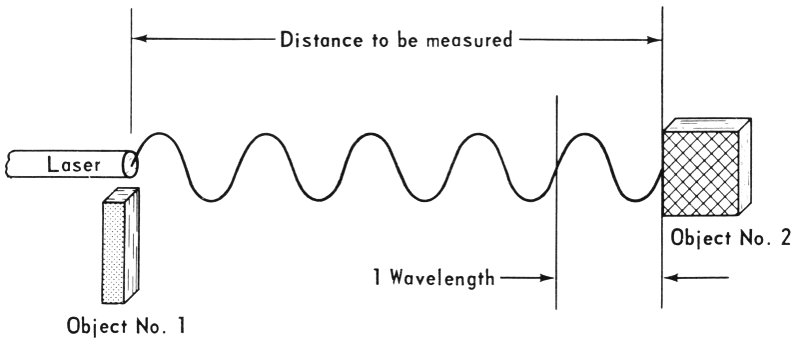
Figure 12 Principle of distance measurement using coherent light.
Wavelength times number of waves gives precise distance between
laser and object.
- Distance to be measured
- Laser
- Object No. 2
- 1 Wavelength
- Object No. 1
Since the word for the interaction of the waves in a
system like this is “interference”, the measurement process
is called interferometry (pronounced in ter fer OM e
try). Although not new, it can now be applied for the first
time in machine tool applications, providing the accuracy
needed in this age of space technology and microminiaturization.
Measurements with a laser interferometer can be
made with an accuracy of 0.5 part per million at distances
up to 200 inches. Such precision was previously unheard
of in a machine shop environment, having been limited
to laboratory measurements, and only at a range of a few
inches. Under similar laboratory conditions, measurements
by laser interferometry now detect movements of 10⁻¹¹
centimeter, a distance approaching the dimensions of an
atomic nucleus.
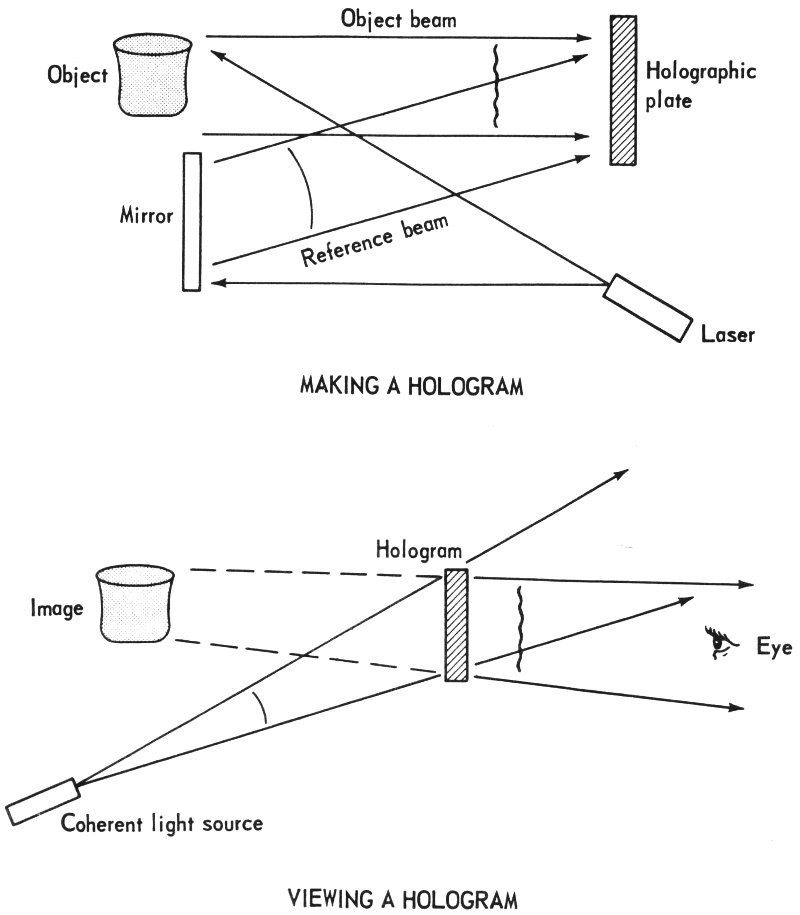
Now let us suppose we expand the laser beam as shown on
page 22, and, with the aid of a mirror, direct part of it (the
reference beam) at a photographic plate. The remaining
portion of the diverging beam is used to illuminate the
object to be photographed. Some of this light (the object
beam) is reflected toward the plate and carries with it
information about the object, as indicated by the wavy line.
21
In the region where these two beams intersect, interference
occurs, and a sample of this interference is recorded within
the photographic emulsion. Where two crests meet a
dark spot is recorded; where the waves are out of phase
the processed plate is clear. The result is a hologram, a
complex pattern of “fringes”, characteristic of the contour
and light and dark areas of the object, as well as its distance
from the plate. These fringes have the ability to
diffract light rays. When light from a laser, or a point
source of white light, is directed at the hologram from the
same direction as the reference beam, part of the light is
“bent” so that it appears to come from the place once occupied
by the object. The result is a remarkably realistic
3-dimensional image.
There, in a nutshell, is the incredible new technique of
holography. The extreme order of laser light is illustrated
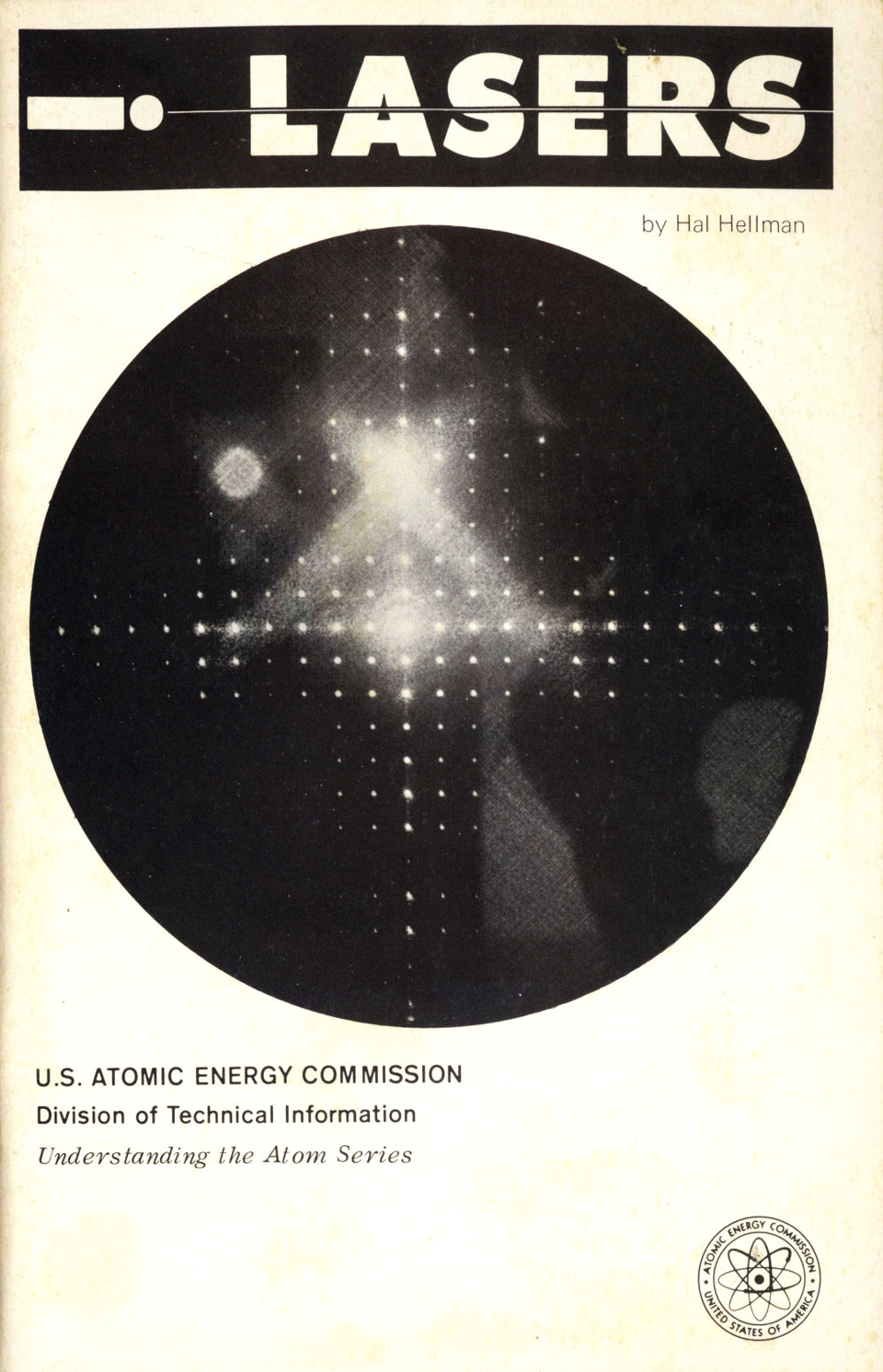
by the regularity of the dots on the cover of this booklet.
This strange kind of light provides us with yet other
advantages. Indeed, one of the most important is the fact
that the energy of the laser is not being sprayed out in all
directions. All of it is concentrated in the narrow beam
that emerges from the device. And it stays narrow. Laser
light has already been shone on the moon, the beam
spreading out to only a few miles in traveling there from
earth. The best optical searchlight beam would spread
wider than the moon itself, thus dissipating its energy.
It is for this reason, as well as its temporal coherence,
that laser light is being considered for communications.
A narrow beam is particularly important for space communications
because of the long distances involved.
But it is also possible to focus laser light as no light
has ever been focused before. At close range a laser beam
can be focused down to a circle just a few wavelengths
across, concentrating its energy and making it possible
to drill holes only 0.0002 inch in diameter. The photo on
page 52 shows the exquisite control that can be exercised.
Let us see what this focusability means in terms of
power. Consider, by way of analogy, a dainty 100-pound
lady in a pair of spike-heeled shoes. As she takes a step,
her weight will be concentrated on one of those heels. If
the area of the heel is, say, one quarter of a square inch
22
(½ × ½ inch), the pressure exerted on the poor tile or
carpet rises to 400 pounds per square inch (4 × 100) and if
the heel is only ¼ inch on a side, the pressure will be
1600 pounds per square inch!
- MAKING A HOLOGRAM
- Object
- Object beam
- Holographic plate
- Mirror
- Reference beam
- Laser
- VIEWING A HOLOGRAM
- Hologram
- Image
- Eye
- Coherent light source
What we are getting at, of course, is the fact that the
coherence of the laser beam permits it to be concentrated
into a tiny area. Thus whatever total energy is being sent
out by the laser can be concentrated to the point where its
effective energy is tremendous. The sun emits some
6500 watts per square centimeter. Laser beams have
already reached 500 million watts per square centimeter.
But the power of the laser does not derive solely from
its ability to be focused. Even an unfocused beam is several
times more powerful than the sun’s output (per square
centimeter).
23
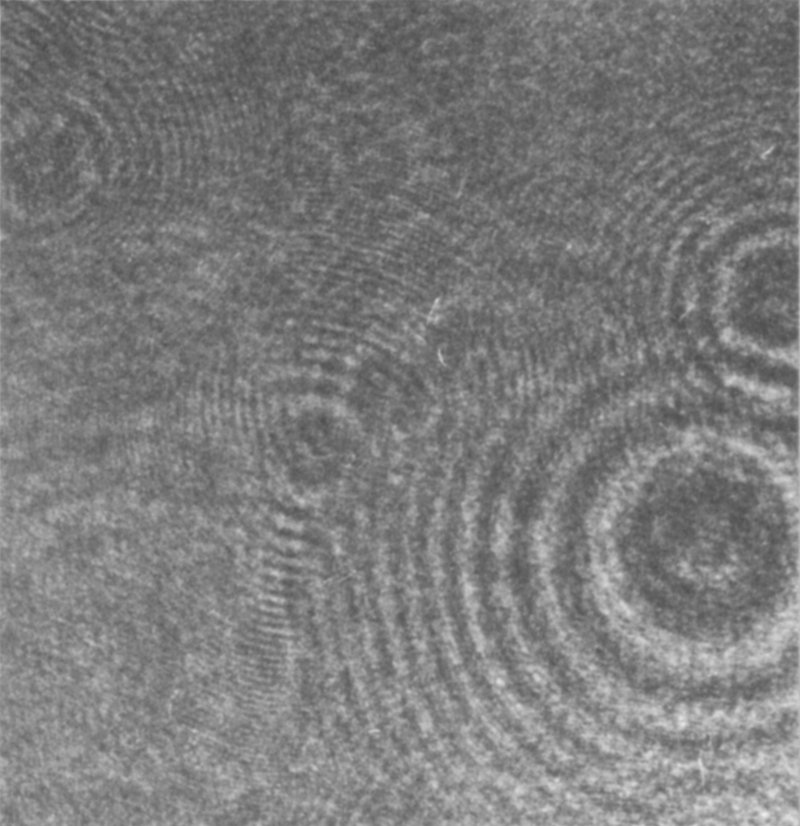
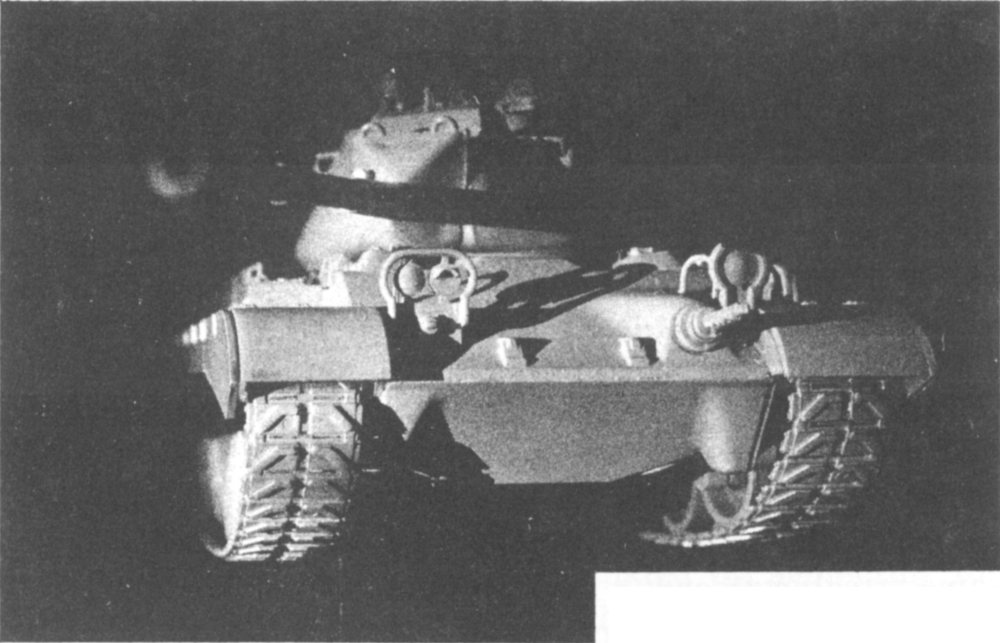
Figure 13 The typical hologram,
looks like a geometric
design, but it contains more information
than would an ordinary
photograph. The images below, made from a hologram,
show the detail, apparent solidity,
and parallax effect of the reconstructed
light waves. The parallax
effect is the ability to see around
the objects just as one could if
they were really there. (See frontispiece.)
24
The crucial difference between the sun’s light or any
ordinary kind of light and laser light lies in the extent to
which the emission of energy can be controlled. In the
production of ordinary light the atoms, as we know, emit
spontaneously, or in an uncontrolled fashion. But if the
atoms could be forced to take in the proper amount of
energy, store it, and release it when we wanted them to,
we would have stimulated, rather than spontaneous, emission.
This, however, is practically the same as the amplification
principle we discussed earlier. In that case, a small
radio signal is jacked up into a large one by stimulating
an available power source to release its energy at the
same wavelength and in step with the smaller signal.
The question is, how can we do this with light?
25
CONTROLLED EMISSION
The laser and its parent, the maser, can be traced back
half a century to its theoretical beginnings. The great
physicist Albert Einstein is most widely known for his
work in relativity. But he did early and important work
on that other gigantic 20th century scientific achievement,
the quantum theory.[10] In one of his papers, published first
in Zurich, Switzerland, in 1916, Einstein showed that controlled
emission of light energy could be obtained from an
atom under certain conditions. When an atom or molecule
has somehow had its energy level raised, the release of
this stored energy could be stimulated by subjecting the
atom or molecule to a small “shot” of electromagnetic
radiation of the proper frequency.
Einstein wrote that when such a photon of energy caused
an electron to drop from a higher to a lower orbit, the
electron would emit another photon of the same frequency
and in the same direction as the one that hit it.[11] In other
words, the energy of the emitted photon would be added
to that of the photon that stimulated the emission in the
first place. Here, potentially, was light amplification. The
three major factors, absorption of energy, spontaneous
emission, and stimulated emission are diagrammed in
Figure 14.
There the matter lay for more than 30 years.
In 1951 Charles H. Townes, then on the Columbia University
faculty, was interested in ways of extending to still
higher frequencies the range of microwaves available for
use in communications and in other scientific applications.
Townes and other scientists who were interested in the
problem were to meet in Washington, D. C., on the 26th of
April. The night before the meeting he slept in a small
Washington hotel; but he awoke at 5:30—pondering, pondering
the high frequency problem.
26
He dressed and took a walk, then sat on a park bench
and savored the beauty of azaleas in bloom. But all the
while his mind was running over the various aspects of
the problem.
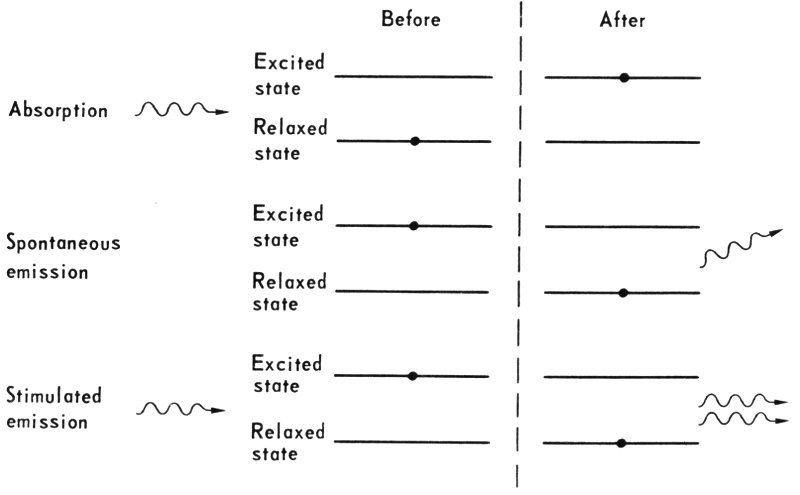
Figure 14 An atom can release absorbed energy spontaneously or
it can be stimulated to do so.
| | | Before | After |
|---|
| | Excited state | —–— | —•— |
| Absorption ~~→ |
| | Relaxed state | —•— | —–— |
| | Excited state | —•— | —–— |
| Spontaneous emission |
| | Relaxed state | —–— | —•— | ~~→ |
| | Excited state | —•— | —–— |
| Stimulated emission ~~→ |
| | Relaxed state | —–— | —•— | ~~→ |
| | | | | ~~→ |
Suddenly the answer came to him.
Normally more of the molecules in any substance are
in low-energy states than in high ones. He would change
the natural balance and create a situation with an abnormally
large number of high-energy molecules. Then he
would stimulate them to emit their energy by nudging them
with microwaves. Here was amplification.
He could even take some of the emitted radiation and
feed it back into the device to stimulate additional molecules,
thereby creating an oscillator. This feedback arrangement,
he knew, could be carried out in a cavity,
which would resonate (just like an organ pipe) at the proper
frequency. The resonator would be a box whose dimensions
were comparable with the wavelength of the radiation,
that is, a few centimeters on a side.
On the back of an envelope he figured out some of the
basic requirements. Three years, and many experiments,
later the maser (microwave amplification by stimulated
27
emission of radiation) was a reality. The original maser
was a small metal box into which excited ammonia molecules
were added. When microwaves were beamed into the
excited ammonia the box emitted a pure, strong beam of
high frequency microwaves, far more temporally coherent
than any that had ever been achieved before. The output of
an ammonia maser is stable to one part in 100 billion,
making it an extremely accurate atomic “clock”.[12] Moreover,
the amplifying properties of masers have been found
to be very useful for magnifying faint radio signals from
space, and for satellite communications.
Ammonia gas was chosen for the first maser because
molecules of ammonia have two individual energy states
that are separated by a gap corresponding in frequency to
23,870 megacycles (23,870 million cycles) per second.
Ammonia molecules also react to a nonuniform electric
field in ways that depend on their energy level: low-level
molecules can be attracted and high-level ones repelled by
the same field. Thus it is possible to separate the low-energy
molecules from the high, and to get the excited
molecules into the cavity without too much trouble.
This procedure for getting the majority of atoms or
molecules in a container into a higher energy state, is
called population inversion and is basic to the operation of
both masers and lasers.
It should be noted that two Russians, N. G. Basov and
A. M. Prokhorov, were working along similar lines independently
of Townes. In 1952 they presented a paper at an
All-Union (U.S.S.R.) Conference, in which they discussed
the possibility of constructing a “molecular generator”,
that is, a maser. Their proposal, first published in 1954,
was in many respects similar to Townes’s. In 1955, Basov
and Prokhorov discussed, in a short note, a new way to
obtain the active atomic systems for a maser, a method
that turned out to be of great importance.
28
Thus on October 29, 1964, the Nobel Prize in Physics
was awarded, not only to Townes, but to Basov and Prokhorov
as well. The award was for fundamental work in
the field of quantum electronics, which has led to the
construction of oscillators and amplifiers based on the
“aser” principle.
29