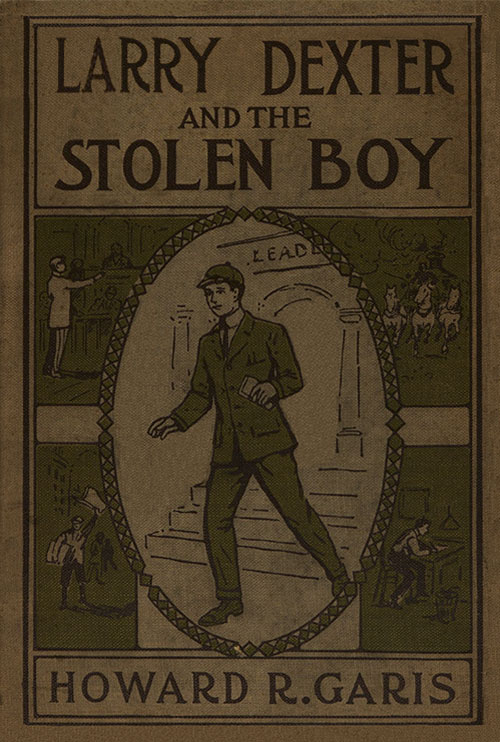
LARRY DEXTER AND THE STOLEN BOY — PREFACE — CONTENTS
See Transcriber’s Note at end of text.
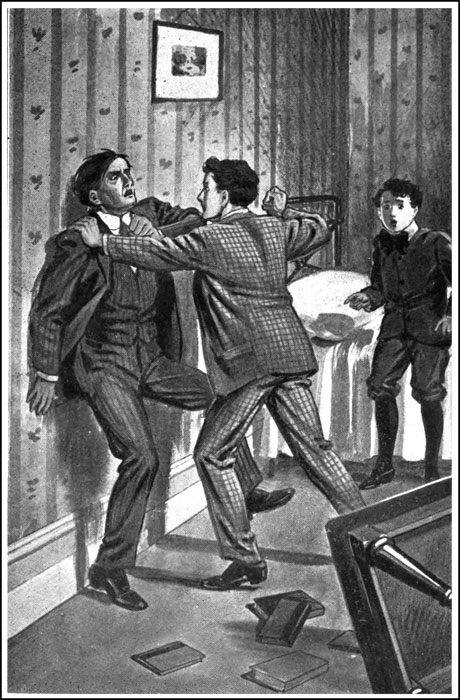
LARRY FORCED THE MAN AGAINST THE WALL.—Page 198 Larry Dexter and the Stolen Boy.
LARRY DEXTER
AND THE
STOLEN BOY
OR
A YOUNG REPORTER ON
THE LAKES
BY
HOWARD R. GARIS
AUTHOR OF “LARRY DEXTER’S GREAT SEARCH,” “LARRY DEXTER,
REPORTER,” “DICK HAMILTON’S FORTUNE,” “DICK HAMILTON’S
CADET DAYS,” “DICK HAMILTON’S FOOTBALL TEAM,” ETC.
ILLUSTRATED
NEW YORK
GROSSET & DUNLAP
PUBLISHERS
BOOKS FOR BOYS
By Howard R. Garis
THE DICK HAMILTON SERIES
DICK HAMILTON’S FORTUNE
Or The Stirring Doings of a Millionaire’s Son.
DICK HAMILTON’S CADET DAYS
Or The Handicap of a Millionaire’s Son
DICK HAMILTON’S STEAM YACHT
Or A Young Millionaire and the Kidnappers
DICK HAMILTON’S FOOTBALL TEAM
Or A Young Millionaire on the Gridiron
(Other volumes in preparation)
12mo. Cloth. Illustrated.
Price, Per volume, 60 cents, postpaid.
THE YOUNG REPORTER SERIES
FROM OFFICE BOY TO REPORTER
Or The First Step In Journalism
LARRY DEXTER, THE YOUNG REPORTER
Or Strange Adventures in a Great City
LARRY DEXTER’S GREAT SEARCH
Or The Hunt for a Missing Millionaire
LARRY DEXTER AND THE BANK MYSTERY
Or A Young Reporter in Wall Street
LARRY DEXTER AND THE STOLEN BOY
Or A Young Reporter on the Lakes
12mo. Cloth. Illustrated.Price, per volume, 40 cents, postpaid.
GROSSET & DUNLAP
PUBLISHERS NEW YORK
Copyright, 1912, by
GROSSET & DUNLAP
Larry Dexter and the Stolen Boy
My Dear Boys:
Most unexpected things happen to newspaper
reporters. That is one reason why, in spite of
the hard work attached to the profession, so many
bright young lads like it. It was that way with
Larry Dexter. It was the unexpected that he
was always looking for, and nearly always
he found it.
In this, the fifth book of “The Young Reporter
Series,” I have related for you something
that happened when Larry unexpectedly went to
a concert. Before he knew it he was involved in
a mystery that had to do with a stolen boy.
How he promised the stricken mother to find
her son for her, how he picked up slender clews
and followed them, how, seemingly beaten and
baffled, he still kept to the trail—all this I have
set down for you in this book as well as I knew
how.
I hope it is not presuming too much to say that
I trust you will like this volume as well as you
have my other books. Larry is a character to be
proud of, and I have tried to do him justice.
“Hello, Larry, just the chap I want to see!”
greeted Paul Rosberg, one of the oldest reporters
on the New York Leader, as a tall, good-looking
young fellow came into the city room one September
afternoon. “I’ve been hoping you’d
show up.”
“Why, what’s the matter?” asked Larry Dexter,
the “star” man on the Leader, when it came
to solving strange cases and mysteries. “Do you
want the loan of five dollars, or has your typewriter
gone out of commission?”
“Neither,” replied Paul Rosberg, with a smile,
though he knew Larry would oblige him were it
necessary. For Larry Dexter had a natural
talent for machinery, and often adjusted the
“balky” typewriters of his fellow reporters. Also,
he would lend them cash when they were temporarily
embarrassed, not to say broke. For
Larry had made considerable money of late,
especially in solving the big bank mystery, and
he was always willing and ready to lend to his
less fortunate brethren.
“Then, if it isn’t either one of those things, I
can’t imagine what it is,” went on the young reporter,
as he sat down at his desk. The city room
was nearly vacant, all the other reporters having
gone home. For the last edition of the Leader
was off the presses, and work for the day was
over, the sheet being an afternoon one.
“I want you to do me a favor,” went on Mr.
Rosberg, who was considerably older than Larry,
and, as he spoke the man began reaching in his
various pockets as if searching for something.
“You haven’t anything on for to-night, have
you?”
“No, I’ve been out on a Sunday special story,
and I’ve cleaned it up. It didn’t take me as long
as I expected, so I thought I’d come back to the
office to see if Mr. Emberg had anything else
for me.”
“You’re too conscientious Larry; altogether
too fussy,” spoke his companion. “But I’m
tickled to pieces that you did come in. I was
hoping you, or some of the other obliging lads
would, for I’m stuck on a night assignment that
I don’t want, and it comes at a bad time. There,
cover that for me, will you?”
He handed Larry two slips of pasteboard, theater
tickets, as was evident at first glance.
“Hum!” mused Larry as he looked at them.
“Farewell appearance of Madame Androletti, eh?
I wonder how many ‘farewell’ appearances she’s
had? This must be about the forty-ninth. She’ll
soon finish up at this rate. ‘Grand concert and
musicale,’” he went on reading. “Musicale with
a final ‘e’ no less. In the new Music Hall, to-night,
too. I say, Mr. Rosberg, what does it
mean, anyhow? Do you want me to go to this
concert with you?”
“No, Larry, I want you to cover it for me.
Report it, if you like that better. Say, look here,
old man” (Larry was not an old man by any
means, but the term was used as a friendly one),
“this is my wedding anniversary to-night, and
I promised my little lady that I’d come home early
to a supper celebration she’s gotten up. Then, at
the last minute, the editor wants me to cover this
concert. Seems as though Madame Androletti
has some pull with the paper, and wants a
representative at her concert, though I don’t see why
the morning paper reporters wouldn’t do as well.
“But, as you know, I’ve been doing theatricals
and musicales for this sheet for some time, and
they want me to cover this. Not that I need to
do it personally, but they expect me to look after
it. Now, I don’t want to go, and that’s why I’m
asking you to cover it for me.”
“But look here!” cried Larry, lamely accepting
the tickets which the other held out. “I don’t
know anything about music. That is, not enough
to report a concert. I like it, and all that, but I
don’t know how to grind out that stuff about high
notes, coloratura work, placement, ensemble, vocal
range, and all that sort of thing, that I see in your
accounts of musical doings every once in a while.
I’d make a mess of it.”
“That’s all right, Larry,” spoke the musical
critic. “I’ve thought of that. I’ll do all the
fancy ‘word-slinging.’ I’ll write the story to-morrow
morning. All I want you to do is to go there
and bring me back a program. You can ask the
leader of the orchestra if it was carried out. He’ll
jot down the names of any extra numbers the
madame may have sung as encores. Then it will
be up to me. I know nearly all the concert pieces
anyhow, and I can fix up an account.
“Just you keep your eyes open, size up the
crowd, watch how the lady sings, get me a few
notes about her bouquets and all that, and I’ll do
the rest. It won’t be the first time I’ve written
about a concert without being there.”
“But,” objected Larry, “I won’t know whether
she’s singing good, bad or indifferent.”
“No trouble about that,” spoke the other.
“Madame Androletti always sings well. I’ve
heard her.”
“But won’t Mr. Emberg object?” asked Larry,
naming the city editor.
“No, I’ve fixed it with him. I asked him if I
couldn’t get some one to cover the concert for
me, on account of my celebration to-night, and he
said it was up to me. So I’ve drawn you.
Pshaw, Larry, it’s easy! Anybody who can solve
a million-dollar bank mystery the way you did,
can surely cover a simple concert.”
“But it’s so different,” objected the young
reporter.
“Not at all. It just needs common sense. Go
ahead now, cover it for me,” and with this Mr.
Rosberg hurried out of the room, leaving Larry
standing there, holding the two concert tickets.
“Take some one with you—your best girl,”
the older reporter called back, and he caught the
elevator, and rapidly descended to the street.
“Well, I guess I’m in for it,” mused Larry, as
he looked at the tickets in his hand. They were
choice seats, he noted, and, had he been obliged
to buy them, they would have cost five dollars.
That was one advantage of being a reporter.
“Take my girl with me,” went on the young
reporter. “Well, why not? I wonder if Molly
Mason wouldn’t like to go?” and Larry’s
thoughts went to the pretty department-store
clerk, who had helped him solve the million-dollar
bank mystery. “I’ll call her on the ’phone.
She can’t have left the store yet,” he went on. A
few minutes later he listened to her rapturous
acceptance.
“Oh, Larry!” she exclaimed, “of course I’ll be
delighted to go. I’ve just got a new dress, and,
oh, it’s awfully nice of you to ask me, I’m sure.”
“I’m being nice to myself,” answered Larry.
“All right; I’ll call for you about eight.”
And so that was how, a few hours afterward,
Larry rolled up to the modest apartment house
where Molly Mason lived, the young reporter arriving
in a taxicab.
“Oh, what luxurious extravagance!” exclaimed
Molly, as she sank down on the cushions.
“Why did you do it?”
“Oh, as long as I’m going to report a swell
concert I might as well do it in style,” replied
Larry. “I hope you’ll like it.”
“Oh, I know I shall!” she exclaimed.
An usher showed them to their seats. The
hall was beginning to fill, and Larry and his companion
looked around curiously, not that Larry
was not used to the members of “swell” society,
for his duties had often taken him among them,
and he had come to have rather a common regard
for that class of persons.
But to Miss Mason it was a dream of delight,
as, on her slender wages, she seldom got a chance
to attend expensive amusements, for she had to
help support her family. The audience was a
rich as well as cultivated one, as Larry soon saw.
“There, I forgot to get programs!” he exclaimed,
after he and Molly were comfortably
seated. “I’ll go back and get a couple. I won’t
be a minute.”
She nodded brightly, and resumed her gaze
about the rapidly-filling theater. From the depths
back of, and under the stage, could be heard the
mysterious, and always
thrilling, sounds of the orchestra tuning up.
As Larry picked up two programs from the
table in the lobby he saw a tall, large man, conspicuous
in a dress suit, with some sort of ribbon
decoration pinned to the lapel of his coat, enter
the rear of the auditorium. The man stood gazing
down over the heads of the audience with
sharp and piercing eyes, that seemed to take in
every detail. He looked to be a foreigner, an
Italian, most likely.
“Some count or marquis,” thought Larry as
he looked at the man’s decoration, noting that it
was a foreign one. “It’s queer how they like to
tog themselves out in ribbons and such things.”
The young reporter was about to return to his
seat with the programs when he noticed two
young Italians in one of the rear rows of the hall.
They had turned, and were gazing at the large
man in the dress suit. Most of the men in the
audience were similarly attired, but the two
Italians in the rear, though well dressed, did not
have on the clothes that fashion has decreed for
such affairs.
It was, therefore, somewhat to Larry’s surprise,
that he saw the evidently titled and cultured
foreigner make an unmistakable signal to
the two men. The big man raised his right hand
to his right cheek, with the fingers and thumb
spread out. He held it there a moment, and, taking
it away, brought it back again, as though to
indicate the numeral ten.
As Larry watched, he saw the taller of the two
men hold up one finger. Apparently satisfied, the
big man turned aside, and approached an usher.
“At what time does Madame Androletti make
her appearance to-night?” he asked, with a foreign
accent.
“At nine, first, and then at ten,” was the answer,
and Larry was at once struck with the answer.
The singer came on at ten, and ten was
the numeral the big man had signaled to the
others. What could it mean? Larry wondered.
“Very good,” answered the foreigner, as he
turned aside, and went out into the lobby, with a
hasty glance toward the two in the rear seats.
Larry saw them both nod their heads.
“Well, I don’t know that it concerns me,”
mused the young reporter, as he returned to his
seat. “It looks rather odd, but I guess I’ve got
so that I’m looking for mysteries in everything.
I’ve got to get out of the habit.”
He looked at the program, after handing Molly
one, and noted that the cause for the long wait
between the two appearances of the singer was
because of a heavy orchestral number coming in
between her first and second selections. After
that she was to sing several songs in succession.
“I’m going to watch when she comes on at
ten,” said Larry to himself.
The concert soon began, with an overture, and
Larry found himself enjoying it, even though he
knew little about classical harmony. Molly was
in raptures, for she had a natural taste for music
that Larry lacked, and she had taken a number of
piano lessons.
“It’s grand!” she whispered to him.
Madame Androletti came on for her first number,
being loudly applauded. Larry made some
notes, that he might give Mr. Rosberg an intelligent
account of the affair, and then gave himself
up to the rapture of the music.
The orchestral number followed, and then, as
the hour of ten approached, Larry found himself
wondering what would happen. The musicians
tuned their instruments for what was to be one
of the chief vocal numbers, and there was a hush
of expectancy.
The curtains and draperies parted and Madame
Androletti came on again, bowing with pleasure
at the applause. Larry found himself watching
her curiously. Then he turned and cast a hasty
glance to where the two strange men had been
seated. They had left the hall.
“That’s strange,” mused Larry, and then
turned back, for the singer was beginning
her song, her exquisite voice filling the big
auditorium.
She had not sung half a dozen words, throwing
into them all the dramatic force of which she was
capable, before Larry, who was watching her
closely, saw a strange change come over her.
She stepped back, evidently in fear, and then
her hands went up over her eyes, as though to
shut out some terrifying sight. At first the audience
thought it was all part of her acting—though
the song did not call for that sort of stage
“business.”
A moment later, however, showed the mistake.
For Madame Androletti ceased singing, and the
strains of the orchestra came to an end with a
sudden crash.
The singer cried out something in Italian.
What it was Larry did not know, but he could
tell, by her tones, that she was frightened.
An instant later she swayed, and she would
have fallen to the stage had not her maid and her
manager sprung from the wings and caught her.
“Curtain!” Larry heard the manager call
quickly, and the big sheet of asbestos slid slowly
down. The audience was in an uproar, though
a subdued one, and there was no sign of panic.
“She’s fainted!” was whispered on all sides.
Before the curtain was fully down Larry
looked under it, and he had a glimpse of the eyes
of the stricken singer peering out. And there
was fright in them—deadly fright.
Like a flash Larry turned and looked back of
him, for it was at some distant point in the hall
that Madame Androletti was gazing.
The young reporter saw, standing at the head
of an aisle that led directly to the center of the
stage, the decorated foreigner who had signaled
to the two men the hour of ten. And it was but
a little past that now.
This man stood there in plain view, his eyes
fixed on the slowly falling curtain that was hiding
the frightened singer from view, and on his face
was a mocking smile. Then he turned and
walked slowly from the place. No one but Larry
seemed to have noted him, as the eyes of all
others were turned on the stage.
“Oh, what was it?” gasped Molly Mason,
clinging to Larry’s arm. “Something has happened!
She must be ill!”
“I think she has fainted,” said a lady sitting
next to Larry’s companion. “Singers often do
so from stress of emotion, or from the heat and
strain. She has only fainted. She will probably
be all right in a little while.”
The orchestra, in answer to a signal from the
conductor had swung into a gay number. The
curtain had fallen, concealing what was going on
behind it.
“It was a faint—just a faint,” every one was
saying.
But Larry Dexter thought:
“It was more than a faint. If ever there was
deadly fear on a woman’s face, it was on hers.
There’s something going on here that the audience
knows nothing about, and I’m going to
have a try at it. That big man, and those two
others are in it, too, I’ll wager. Maybe I’ve
stumbled on something more than just an assignment
to cover a concert.”
After events were soon to prove Larry Dexter
was right.
CHAPTER II LARRY SCENTS A MYSTERY
“Madame Androletti craves the indulgence
of the audience for but a few moments. She is
indisposed, but will resume her singing directly.”
Thus announced her manager, a few minutes
after the fall of the curtain, when the orchestra
had been quieted by his upraised hand. Applause
followed his little address.
“Oh, I’m so glad it didn’t amount to anything,”
said Miss Mason to Larry. “She is such a beautiful
singer that I shouldn’t want to miss hearing
her. And I might never get the opportunity
again. Isn’t it nice that it isn’t really anything?”
“Yes,” assented Larry, but he was far from
feeling that it amounted to nothing. The young
reporter was doing some hard thinking.
“There may be a big thing back of this, and
again it may amount to nothing,” he reasoned
with himself. “I’m inclined to think, though,
that there’s something doing. Now how am I to
set about getting it?
“I guess I’ll sit tight for a while and see what
develops. If I go to making inquiries now some
of the other newspapermen will get ‘wise,’ and
I’ll lose any chances of a ‘beat,’ if there’s one in
it. I’ll saw wood for a while.”
The orchestra resumed the playing of a spirited
air, and while the audience is waiting for the
singer to recover, I will take this chance to tell
you, my new readers, something more about
Larry Dexter, the young reporter.
Larry had come to New York some years before,
a farm boy, with an ambition to become a
newspaper man. In the first book of this series,
entitled “From Office Boy to Reporter; or, The
First Step in Journalism,” I told how Larry accomplished
this, but not without hard work, and
he was in no little danger, because of the mean
actions of Peter Manton, a rival copy boy on
another paper, the Scorcher. But Larry won
out.
In the second book, entitled “Larry Dexter, the
Young Reporter,” an account is given of Larry’s
“assignments,” or the particular pieces of newspaper
work set aside for him. Some of them
were very strange, and not a few of them dangerous.
Larry had a number of startling adventures
in getting big “beats,” or exclusive pieces
of news.
His mother, with whom Larry lived, was often
worried about him, but Larry had to support her,
as well as his sisters, Mary and Lucy, and his
little brother James, so he did not give up because
his work was hard.
Deserved success came to Larry, and he made
considerable money, for he discovered deeds to
some land that his mother had a right to, but
which was being kept from her, and he managed
to get possession of the real estate.
Larry came into real prominence in the newspaper
world when he made his successful search
for Mr. Hampton Potter, the millionaire, as
related in the book called “Larry Dexter’s Great
Search.”
In that volume are given the details of why
Mr. Potter disappeared, and how the young
reporter found him, after a long hunt, in which he
ran many dangers. During the time he worked
on this case Larry and Miss Grace Potter, the
millionaire’s daughter, became good friends.
When the Consolidated National Bank was
robbed of a million dollars one day, all Wall
Street was astounded. An endeavor was made
to keep the robbery secret for a time, but Larry,
with the help of Mr. Potter, got the story and
secured a “scoop,” or “beat.”
Then he began to solve the bank mystery, for
it was a mystery as to where the million had
gone. In the volume entitled “Larry Dexter and
the Bank Mystery,” I give the details of how our
hero solved the mystery, got back the million,
and secured the arrest of the thief. He did not do
this easily, however, and for a long time he was
on the wrong “trail.”
The solving of this mystery added further to
Larry’s fame, and he was more than ever the
“star,” or chief reporter, on the Leader, where he
had first obtained his start in journalism, and
where he preferred to remain, though other
papers made him handsome offers.
And now Larry was covering an ordinary concert
to oblige a fellow scribe.
“But, unless I’m greatly mistaken,” mused
Larry, as the orchestra played on, “this is going
to be something more than an ordinary concert.
Of course all the other papers will have the story
about Madame Androletti fainting in the middle
of her song, but I don’t believe they’ll find out
why she did.
“I believe it was because she saw that man,
though why the sight of him should affect her so
is a mystery. That’s where I’ve got to begin; at
that man with the foreign decoration. I don’t
believe many people noticed him staring at her
under the curtain. They were all too intent on
the singer herself.”
Larry was doing some hard thinking.
“Oh, isn’t that wonderful—that music?” whispered
Miss Mason to him.
“What’s that? Oh, yes, it’s fine!” answered
Larry dreamily.
“I don’t believe you even heard it,” she went
on, as the wonderful melody rose and fell. “You
act just as you did lots of times when you came to
see me the time you were working on the bank
mystery.”
“Well, I feel almost that same way,” spoke
Larry with a smile.
“Do you mean to say there’s a mystery here,
Larry Dexter?” she asked in a tense whisper.
“If there is——”
“Hush,” begged Larry, as the orchestral number
came to an end. “Let’s see if she comes out
now. I’ll tell you about it later. I may need
your help.”
“Oh, fine!” she whispered, with sparkling eyes.
As I have said, Molly Mason had aided Larry
in solving the bank mystery, for it was of her that
the thief had purchased the valise which he used
to hold the million dollars, and Molly gave Larry
a valuable clew.
The final chords of the music died away, and
there was a hush of expectancy. Would the noted
singer be able to go on? Or was her indisposition
too much to allow her to do so? Every one
waited anxiously for some announcement from
behind that big curtain. And Larry looked
eagerly toward the stage.
He had made up his mind that he would try to
see Madame Androletti after the concert, and ask
her what had frightened her. True, she might
not tell him, but Larry was too good a newspaperman
to mind a refusal. And he had his own way
of getting news.
The young reporter looked about the hall. He
wanted to see if the big man, with the foreign
decoration, was again present. But, if he was,
our hero failed to get a glimpse of him. Nor
could he see the two more ordinarily dressed men
who had answered the man’s signal.
“Well, this looks as if something was doing,”
said Larry to himself, as there was a movement
behind the curtain. A murmur ran through the
audience as the manager again stepped before the
footlights.
“Oh, I do hope she can sing,” whispered Miss
Mason. “I wouldn’t miss it for anything! Oh,
what a strain public performers must be under, to
have to appear when they are not able.”
“It’s part of the game,” murmured Larry, narrowly
watching the manager.
The latter began to speak.
“I am glad to be able to inform you,” he said,
“that Madame Androletti has somewhat recovered
from her indisposition, and will be able to
continue. She craves your indulgence, however,
if she is not just exactly in voice, but she will do
her best.”
Applause interrupted him.
“Madame Androletti will omit the number she
was singing when she fainted,” the conductor
went on, “as it might have a bad effect on her
nerves. She will substitute another,” and he
named it, Larry making a note for the benefit of
the musical critic whose place he was temporarily
filling.
The manager bowed, there was more applause,
and then the singer herself appeared. The applause
burst out into a great volume of sound, for
the audience recognized the pluck it took to come
back when physically indisposed, and they appreciated
what Madame Androletti was doing.
She bowed and smiled, and signaled for the
orchestra to begin.
As the first notes of the accompaniment music
burst out Larry noticed that the singer cast a
glance around the big hall, and even up into the
galleries.
“She’s looking for that man,” thought the
young reporter. “What strange influence has he
over her? What’s the mystery I’m just on the
edge of, I wonder?”
Madame Androletti began to sing, and as the
first few notes rippled out she cast a quick glance
into the wings. Few noticed it, but Larry did,
and as his eyes followed hers he saw a boy, of
about ten years of age, standing behind a representation
of a tree trunk, part of the stage-setting.
He was a boy with dark, curling hair, an Italian,
evidently, as was the singer. Larry at once
jumped to a conclusion.
“That’s Madame Androletti’s boy!” he
thought, and the look of love that was on the
singer’s face as she glanced toward the youngster
seemed to confirm this.
“By Jove! I believe I’m on the track!”
thought Larry Dexter, as he saw the boy move
out of sight.
CHAPTER III A STOLEN BOY
“Doesn’t she sing wonderfully?” whispered
Miss Mason to Larry.
“Yes,” he answered, but it was plain that his
thoughts were on something else besides the
music. He was narrowly watching the singer, occasionally
casting glances into the wings, or the
scenery at either side of the stage. He was
watching for another sight of the boy, who looked
so much like Madame Androletti.
The concert went on, and it seemed that nothing
more out of the ordinary was to happen. The
orchestra played its numbers to perfection, as
nearly as Larry could tell, and, as for the singing,
he made up his mind that he would report to Mr.
Rosberg that it was “slick.”
Larry was not very well “up,” on musical
terms, but he knew that the Leader was not paying
him as a musical critic, and he did not worry.
“Anyhow, there’ll be a good story in how she
collapsed in the middle of a song, whether the
report of the concert is good or not,” mused
Larry.
Madame Androletti came on several times, and
sang as encores a number of songs not down on
the program. She seemed to be in unusually good
spirits, and was roundly applauded. Not a trace
of her former indisposition was noticeable.
“I’ll have to wait a bit after the concert is
over,” Larry whispered to his companion, during
a pause in the program.
“Why?” she asked.
“I want to get an interview with Madame
Androletti, and I’ve got to ask the orchestra
leader what those extra numbers were.”
“I can do that for you,” offered Molly readily.
“I know some of them, as it is, and I can easily
get the names of the others.”
“Will you?” he asked eagerly. “That’ll be
fine! Then we won’t have to wait so long. Are
you sure you won’t mind?”
“Not a bit,” she replied, with a smile. “I
fancy I would like to be a reporter.”
“You’d make a better one than lots of ’em who
imagine they’re journalists,” said Larry.
The concert was nearing an end. Madame Androletti
had sung her last number with great success,
and had retired, bowing her thanks for the
frantic applause. The curtain started down, and
Larry watched it.
Suddenly he became aware that something unusual
was taking place behind it. He had a
glimpse of the lower part of the singer’s dress,
which he could easily distinguish under the curtain.
She was the only lady in view among a
number of gentlemen, who had also taken part in
the program. And Larry was sure he saw the
singer running across the stage as fast as she
could go, with gentlemen trailing after her. Of
the latter Larry could only see their legs from
their knees down. The curtain was almost on
the stage.
The playing of the orchestra drowned any noise
that might have otherwise been heard. Larry
looked around. The audience was leaving. No
one seemed to be paying any attention to the
stage, not even the musicians, who were down too
low to see under the curtain, in any event.
Larry noted, with satisfaction, that a number
of reporters for other papers, whom he had seen
earlier in the evening, had gone. They had not
stayed to the finish.
“And maybe here’s where I beat ’em!” thought
Larry grimly.
He looked about for a sight of the big decorated
foreigner, or his confederates, as the young
reporter called them, but none was in sight.
“I’m going back of the scenes,” Larry whispered
to Molly. “You just ask the orchestra
leader the names of the extra numbers. Say
you’re from the Leader, and it will be all right.
I’ll be back as soon as I can. Wait in the lobby
for me.”
With that the young reporter left his seat, and,
crossing through an empty row of orchestra
chairs, he made his way to a lower box, whence
he could get behind the curtain.
Larry boldly pushed his way in. He was used
to doing that. Besides, at this time, there was no
one to stop him. He found himself on an almost
deserted stage. It was brilliantly lighted, for
scene-shifters were at work, putting away the
setting just used, and bringing out another that
was to come into play for the next performance
the following afternoon.
No one seemed to pay any attention to the
young reporter. He knew the general location
of the dressing-rooms, and started toward them,
intending to ask the first door-tender he saw for
Madame Androletti. He was dimly aware of
some confusion in the left wings, but he could see
nothing.
“That’s the place for me!” thought Larry, hurrying
on.
He had crossed the stage, and was pressing
ahead, when some one hailed him.
“Hey, young feller, where you goin’?”
“Back here,” answered Larry, non-committally.
“Where’s that?”
“To see Madame Androletti.”
“Got a pass? Got any authority?”
Larry took a quick resolve.
“I’m from the Leader!” he exclaimed. “I
want to see Madame Androletti. I covered the
concert to-night. It was great. There’s my card.
See you later—appointment—important—she
wants to see me!” murmured Larry, quickly, as
he hurried on, thrusting a bit of pasteboard into
the man’s hand.
“Wants to see you, eh?” murmured the man.
“Yes,” called back Larry, now some distance
away. The young reporter little realized how
true his hastily-spoken words would prove to be.
The young newspaper reporter pushed on. He
was amid a confusion of scenery now. Tree
stumps, castle walls, the ceilings of rooms, a pair
of stairs, an arbor covered with trailing vines—the
various things used to set the stage. He
threaded in and out among them.
A man in a dress suit confronted him, a man
whom Larry at once recognized as Madame
Androletti’s manager.
“Who are you? What do you want?” the
manager asked suspiciously.
Larry realized that he could not bluff this man.
“I’m from the Leader,” said the young
reporter quickly. “My card,” and he extended
one. “What’s the matter? I’m sure something
is wrong. I’ve got to have the story. Why did
Madame Androletti faint? What’s up now?”
The manager glanced at Larry’s card.
“Ah, from the Leader, eh? Well, your paper
has been very kind to us. I will tell you, though
I do not usually see the need of sensationalism.
However, there is none here. As you may perhaps
know, Madame Androletti, whom I have the
honor of representing, personally, travels about
with her young son, Lorenzo. He is her only
child, and, since the death of his father, he has
been en tour with his mother. He is always somewhere
on the stage when she sings.
“She is very nervous about him, and just now,
after her final number, she missed him. She
feared he might have strayed away, and been hurt,
and she called out. That raised a little alarm,
and, as we all know how devoted she is to him,
we all began a search for the lad.”
The manager, who was Señor Maurice Cotta,
paused.
“Did you find him?” asked Larry.
“His mother did,” was the answer of Señor
Cotta. “He was in her dressing-room, I believe.
She is close at hand. Hark, I think I can hear
her talking to him now.”
He held up a fat, pudgy hand. Larry listened.
Plainly enough he could hear a woman’s voice
murmuring:
“My son! My boy! My little Lorenzo!” Then
followed something in Italian.
“So, you see, there is no story for you, Señor
Leader—I beg your pardon—Dexter,” spoke the
manager, with a smile. “I am sorry, but you will
have only to write about our concert.”
“And about Madame Androletti fainting,”
added Larry, feeling rather disappointed, as all
true newspaper men do at a story not “panning
out.” It is not through heartlessness that they
are thus regretful, but because it is their profession
to hunt out news.
“Oh, yes, her indisposition,” murmured Señor
Cotta.
“It was plucky of her to keep on,” said Larry.
“I’ll have a good story of it.”
“Ah, thank you.”
“Perhaps I could see her, and ask her if she is
all right again,” proposed Larry. “A little
interview——”
“Ah, exactly!” exclaimed the manager, not at
all unwilling to get all the press notices he could
for the prima donna he was managing. “This
way, I’ll point out her room. She will see you.”
He left Larry at the door of the dressing-room.
It was not the first time our hero had interviewed
stage people in their rooms. As he paused, before
knocking, he heard the murmuring voice again.
“Ah, my Lorenzo! My little Lorenzo!”
Larry was at once impressed by two things.
One was that there was no answering tones of a
boy’s voice, and the other was that there was, in
the notes of Madame Androletti, extreme anguish.
It was not as though she was speaking to her son,
but, rather, lamenting him. Larry grew suddenly
suspicious.
He knocked on the door. There was a moment
of silence, and then a strained voice answered:
“Who is there? Go away! I can see no one!”
Larry resolved on a sudden plan. He was
going to do a daring thing. There was no other
person in sight.
“Madame Androletti!” he called, with his lips
close to the portal. “I am a reporter from the
Leader. I was at your concert to-night. I saw
the man with the foreign decoration. I saw his
two confederates. I may be able to help you find
your son.”
The door was fairly flung open. The singer,
with tears in her eyes, confronted the young
reporter.
“What is that?” she whispered hoarsely. “You
can find my boy? My Lorenzo—my little boy?
Oh, don’t play with me! Who are you? How do
you know my boy is gone? Oh, but he is! Why
should I try to hide it? He is gone—stolen!
Oh, can you help me?” and she held out her hands
to Larry with a dramatic gesture.
He had guessed better than he dared to hope.
The boy was missing, after all. And she had given
the impression to every one else in the theater
that he was safe with her! What mystery was
here?
CHAPTER IV LARRY’S NEW ASSIGNMENT
Larry stepped into the singer’s dressing-room.
She was still attired as she had been on the stage.
Her hair was disheveled, and there were traces of
tears on her beautiful face.
As the young reporter entered, a woman came
from an inner room, and said something in
Italian to the singer. The latter answered her in
the same language, and then, turning to Larry,
said:
“This is my maid, my faithful Goegi. She
alone, besides myself, knows that Lorenzo has
been taken away—that is except yourself, Señor,
and—and the scoundrels who have taken him.
Oh, if you know where he is, speak quickly! End
my suspense!”
She had closed the door, so that her anguished
words might not penetrate to the regions outside
of her room, and she gazed tearfully at Larry.
“I did not say I knew where he was,” the young
reporter replied gently. “But perhaps I can find
him for you. I have worked on several mystery
cases, including those of missing persons. I realized
that something was wrong here, almost as
soon as you fainted, and so I made up my mind
to see you. Why did you let it be known that
your son was with you, when he was not?” asked
Larry, for a glimpse around the room showed no
signs of the boy. There were several pictures of
him, however, and Larry easily recognized in
them the little lad he had seen standing in the
wings.
“Why did I, señor? Because there has been a
great crime committed, a crime of cunning and
daring, and I must meet cunning and daring with
the same weapons. It is no time for force. I
realize that. Neither would it have done any
good to have started a pursuit at once. The
villains are too cute for that.
“So it was that I might have time to think—time
to plan—that I dissembled. I pretended that
Lorenzo was in my room when he was not. I did
not want them all in here. So I pretended. But
you—you discovered my secret. Now, can you
help me find my boy? Will you? I do not know
you, I have never seen you before, and yet from
your face I see that I can trust you. And also
you reporters—you are so resourceful. Every
day I read of the marvelous things you do. In
my country it is not so. But, oh, these wonderful
United States! Perhaps you can help me. Will
you?”
Once more she held out her hands in a mute
appeal.
“I will if I can!” exclaimed Larry. “I’ll do all
in my power. Listen! I’m a newspaper man,
first of all, and though I want to help you, it is
only through the power of the press that I can.
I ask no reward, only that you let my paper—the
Leader—have this news first, exclusively. I’m
glad now that you did not raise an alarm. It
makes it possible for me to get a ‘beat.’ Tell me
all you wish to about the case. Then I’ll get
busy.”
“Oh, it is such a long story, I cannot tell half
of it now. Sufficient to say that there are enemies
of my dead husband who seek to injure me
through my only son. They have often sought
to get possession of him, but I have foiled them
by keeping him close to me always. But this time
I failed. Oh, Lorenzo! My poor Lorenzo!
where are you?”
She was overcome with emotion for a moment,
but soon resumed her story.
“I had been warned,” she said, “but I did not
heed. To-night, when I saw that man—my
enemy—I was filled with fear. I fainted, and
when I was myself again I looked for Lorenzo.
He was safe, and I asked him to stand in sight,
in the wings, during the rest of the concert. Only
by such means would I know he was safe. He
did so, and all went well, until the end.
“Then, after my last number, I looked for him.
I did not see him. I cried out! I ran! The
others were alarmed. They asked me what was
the matter. I did not tell them all I feared. I
said I thought Lorenzo might have fallen down
some trap-door, or have stumbled over some
scenery—anything to keep the truth back for a
time.”
“Why?” asked Larry curiously.
“Because I realized that if I gave an alarm at
once, and took after the scoundrels, they might—they
might injure my son. There was but one
thing to do—meet cunning with cunning—and I
took that way.
“When many of my friends, and the stage
hands, were looking for my boy, I rushed to my
dressing-room, and called out that he was here.
Then I shut the door, and told Goegi to keep my
secret until I could make my plans.
“And then you—you—a reporter came along—and
you have it at your fingers’ ends. I do not
understand. How did you know so much?”
“I guessed it,” replied Larry. “We newspaper
men have to guess at a lot, and sometimes we hit
it. But how long has he been missing? Where
did he go? Who took him? Which way did he
go? Did any one see him taken away?”
“Oh, what a lot of questions!” cried the singer,
and she smiled the least bit through her tears.
“I can not answer them all, but I will do my best.
I saw Lorenzo standing in the wings when my
last song was almost finished. When I looked
again he was gone.”
“But some one must have seen him,” insisted
Larry. “There were a lot of people back of the
scenes, and they must have noticed him. Did the
stage-doorkeeper see him go out?”
“I do not know. I have not asked. Listen.
It is necessary to be secret about this at present.
I do not want any publicity.”
“But I can’t help you without publicity,” insisted
Larry. “That’s my business. I’m a newspaper
reporter. I want the story.”
“Yes! Yes!” exclaimed the singer. “I understand.
Let me think!”
She paced rapidly up and down the room. Then
she exclaimed:
“I have it. Yours is an afternoon paper, is it
not?”
“Yes.”
“And you want—oh, such a funny language—you
want a carrot?”
“No, a ‘beat,’” explained Larry, with a smile.
“An exclusive story—I want to ‘beat’—get ahead
of—all the other papers.”
“I see. Well, I will help you. It may be that
my son was taken away to but, temporarily,
frighten me—to bring me to terms. In that case
he will be brought back to me soon—by to-morrow
morning, or I will hear from those who
have him. Now, then, if I do not hear, then you
may print the story, and I will see no one but you
until after it comes out. After that—when the
world knows—I am afraid many reporters
will——”
“Of course they will!” cried Larry. “You’ll be
overwhelmed with them, but the more publicity
you have the better for you. You’ll have every
one in these United States on the lookout for
your boy. Newspapers help a lot. All I want is
the first story, and after that the others can
come in.”
“All right. I agree to your plan. It’s a good
one. But do you know who that man with the
decoration was? He is Señor Delcato Parloti, a
plotter, and schemer, and the enemy of my late
husband. Oh, how I fear him!”
“And those other two men—to whom he
signaled?”
“I do not know them—perhaps his aids. Oh,
this is terrible!” and once more she gave way to
her grief.
Presently she mastered herself again, and
resumed:
“I have friends—powerful friends, and I will
set them quietly on the trail of this Parloti. If I
do not have word with him by morning, or if I
do not hear from him, then I will send for you,
and you may have the story.
“In fact, you may have the story anyhow, for
in one case it will be about the return of my son
to me, and in the other——”
She could not finish, but Larry knew what she
meant.
Rapidly he asked a few more questions, until
he had more of the story. With what would be
told him later, he knew he would have a startling
article for the Leader.
Bidding the singer good-by, and promising to
keep her secret until the time for publicity came,
Larry took his leave, agreeing to hold himself in
readiness for her summons the next morning.
As the young reporter left the dressing-room he
saw no signs of excitement on the now almost
deserted stage. Clearly all the others had accepted
Madame Androletti’s innocent deception,
practiced to bring about the return of her son.
“But I don’t see how she’s going to get out of
the theater without letting some one see that the
boy isn’t with her,” thought Larry. “That’ll be
sure to bring up questions. However, she may be
actress enough to carry it off with the aid of her
maid. Say, but I’m on the track of a big story,
all right!”
A few minutes later he joined Molly Mason in
the lobby.
“Did I keep you waiting too long?” he asked.
“Oh, no, I enjoyed it! I don’t mean that!” she
exclaimed, with a blush at Larry’s queer look.
“I don’t mean that I enjoyed your absence. But
I was talking music to the leader of the orchestra.
He gave me all the information you wanted. I
wrote it on this program for you.”
“Thanks! You’re getting to be quite a reporter!”
said Larry with a smile. “And now for
home!” he added as he summoned the taxicab.
“Oh, but did you get your story?” she asked.
“Part of it,” replied Larry. “I’m hoping for
more. It may be a big one.”
Then he turned the subject to the concert
proper, and they talked of that until the girl’s
home was reached.
“Thank you for a lovely time,” she whispered.
“You’re welcome,” replied Larry, and he
thought to himself that, after all, perhaps his substituting
for the musical critic might lead to big
results.
Late as it was he called up Mr. Emberg, the
city editor, at his home, and gave an inkling of
what was in the wind.
“Come right over here, Larry,” commanded his
chief, and soon the two were in consultation.
“So you’ll get a story out of it, no matter which
way it goes,” commented Mr. Emberg, when
Larry had told him the facts.
“It looks so. I’ve got to wait until morning,
though.”
“All right. Be ready to jump right out on this.
As I see it, even if she gets the stolen boy back,
we’ll have a two or three days’ yarn out of it. So
you drop everything else, Larry, and take this new
assignment.”
“And if the boy isn’t returned?”
“Then it’s your assignment to find him. You
solved the bank mystery, and that about Mr. Potter,
so try your hand at this.”
As Larry went home, after leaving the city
editor, he had a feeling that all the hard assignments
were coming his way.
“But I like it!” he exclaimed, half aloud. “And
I’ll do my best to locate that little chap. I wonder
why there are such men as kidnappers in the
world?”
Larry looked eagerly over the morning papers.
Though all of them had a story about the temporary
indisposition of the talented singer, none
of them had the real account.
“Now for a ‘beat’!” cried Larry to himself.
The telephone rang.
“Mr. Dexter!” sang out the boy whose duty it
was to answer it. “You’re wanted.”
Larry sprang to the instrument, and, as he did
so he heard a voice saying:
“This is Madame Androletti! Come as quickly
as you can!”
CHAPTER V SCOOPING THE “SCORCHER”
The start which Larry gave when he heard the
voice of the prima donna over the telephone was
noticed by the city editor.
“What is it?” asked Mr. Emberg, slipping to
Larry’s side, just as the young reporter was telling
Madame Androletti over the wire that he
would call on her at once.
“It’s the stolen boy case!” he answered, when
he had hung up the receiver. “He can’t have
come back, and she can’t have had any trace of
him, for she was half crying when she told me to
come up. I’m going to get the story. It’s ripe
now, and it’s a good one. There’s something big
back of it all.”
“That’s the way to talk, Larry. Get right after
it! Can you get a ‘scoop’ out of it?”
“I’m going to try hard. None of the other
papers are on to it yet.”
“Look out that the Scorcher doesn’t spring
some fake sensation on you. This is just their
kind of a yarn. Beat ’em if you can.”
“I will,” and with that Larry hurried out to
catch the elevator. Mr. Emberg stepped out into
the corridor with him.
“There are some queer points to this story,
Larry,” he said. “I can’t understand why
Madame Androletti shouldn’t have raised an
alarm at once when she found her son missing.”
“It does seem odd,” agreed the young reporter.
“And yet she explains that by saying that the case
was so peculiar that if she went out and made a
big fuss, and called in the police, the kidnappers
might do her, or her son, some harm. It’s just
like when some one does something mean to you,
and you pretend not to know it for a while, laying
low, and holding back, so as to get a better chance
to get even with ’em.”
“I see,” agreed the city editor, with a laugh at
Larry’s boyish explanation. “And yet the kidnappers
must know that Madame Androletti is
aware that her son has been spirited away.”
“Of course. And yet if she continues to act
quietly, as she has done, it may make them curious
to find out what her game is, and they may not
carry out their original plan, whatever it is. Then,
too, there’s no doubt but what this is done for a
ransom, and sooner or later an offer will come
from the fellows who have the boy, stating how
much they want to return him.”
“I suppose so. There ought to be a heavier
punishment for kidnapping than at present. Well,
get along, Larry.”
The young reporter lost no time in reaching the
apartments of the singer. She had several rooms
in a large hotel, on Murray Hill, New York,
where she and her maid stayed. Up to the time
he was taken away from the theater, her son had
also been there.
Larry found Madame Androletti in tears, but
she soon composed herself, and began to tell her
story.
“I have heard something about you, since I met
you last night,” she said, by way of preface.
“Nothing unpleasant, I hope,” spoke Larry.
“On the contrary, good. I was talking with
my maid about you. She has been in this country
some time, and she reads much of your papers.
You are the reporter, are you not, who solved the
Wall Street bank mystery?”
“Yes, I was lucky enough to do that,” replied
Larry.
“And you also searched for and found Mr. Potter,
the missing millionaire. Ah, I have sung at
his charming house.”
“Yes, I located him,” said Larry. “But——”
“Ah, you are too modest!” she interrupted.
“But I was glad to know this, for after two such
celebrated cases I feel sure that you can find my
son.”
“I’m going to do my best, Madame Androletti,
if I have to trace him clear across the continent.
But, if you please, I’d like to hear the particulars
about him, and who this man is—the man with the
foreign decoration—who probably took him
away.”
“Ah, he is a villain, a bad-hearted man!” the
singer exclaimed. “I will tell you.”
She then stated briefly, that Delcato Parloti, at
the sight of whom in the theater she had fainted,
was a distant relative of her late husband.
“My husband, who lived near Rome, Italy, was
a very rich man,” she went on, “and had he not
married me, all his estate at his death would have
passed to Parloti and others. But after our marriage,
of course, I was the one who would inherit
the property, and this left Parloti nothing but
what he had of his own—he had no expectation
of a fortune. This made him very bitter against
my husband and myself.
“Lorenzo is my only child, and when my husband
died, about three years ago, this Parloti at
once began to persecute me. He did all in his
power to get my fortune away from me, and at
last began to threaten me through my son. That
made me very much afraid, and I fled from Italy
to this country. I thought I would be safe.
“Parloti sent me a message not long ago. He
said if I would not sign over to him all my rights
in the property my husband had left, my son
would be taken from me. But the cruel part of it
is that, under the law, I can not sign away those
rights. They fall to my son. It is quite complicated,
and I do not understand it. Gladly would I
give up all my husband left, retaining only such a
modest fortune as I have in my own right, to save
my son, but I cannot—cannot, under the law sign
away those rights, and this bad man will not believe
it. He insists that I give him the fortune, or
he will take my son until I do.
“So, as I said, I fled from Italy. I hoped I
would be safe, and for some years I have been.
Then, when I think all is well, that man last night
walked into the hall where I was singing. Do you
wonder I faint, señor?”
“No, indeed!” exclaimed Larry, who had been
making rapid notes of the story, with names, dates
and other details that I have omitted here.
“And so they took my boy!” cried the singer.
“They have stolen him from me! But with your
help, good Señor Dexter, you who solved the
million-dollar bank mystery, we will get him back,
will we not?”
“We will!” cried Larry enthusiastically, though
he knew that there was plenty of hard work ahead
of him, and but a slim chance that he would be
successful.
“I’ll do all I can,” he said, “and so will every
one on the Leader. You’ll have all the help the
newspaper can give.”
“Oh, how can I reward you?” she cried. “My
fortune——”
“All the reward I ask is to have the story alone—exclusively!”
cried Larry. “I want a ‘scoop’.”
“Oh, you reporters! Such funny words! First,
you want a cabbage is it——?” and she looked at
Larry, and smiled.
“No, a ‘beat,’” he corrected.
“Oh, yes. And then you demand what you call
a—shovel——”
“No, a ‘scoop.’ I guess it means shoveling all
the other fellows out of the way, though,” explained
the young reporter. “But if I get either a
‘beat,’ or a ‘scoop,’ it’s all the same. Now I’m off
to the office, to write this story, and then I’ll come
back and make some plans. I want to know more
about this Parloti. If any reporters from other
papers come to see you, please——”
He was interrupted by the ringing of the private
telephone in the singer’s room. She answered
it, repeating some of the message that
came to her.
“A Mr. Peter Manton to see me,” she said
aloud. “But I know no Señor Manton. Tell
him——”
In a flash Larry was at her side.
“That’s another reporter,” he whispered. “My
rival. He’s on the Scorcher. Don’t give him the
story.”
“What shall I do? If I do not see him, he may
print some terribly untrue story, and——”
“That’s just what the Scorcher would be likely
to do, anyhow,” agreed Larry, “though Pete isn’t
such a bad sort himself. Let me think. I’ll tell
you. Can’t you fool him in some way? Sort of
string him along until I get away, and have my
story in the first edition of the Leader. Then I
don’t care what he prints.”
“Yes, yes! I see. You mean to ‘scoop’ him!”
“That’s it.”
“And I will help you!” The singer was excited
now, and she was more like herself, a great
actress. “I will fool him! I and Goegi, my maid.
We will change places. She shall be the mistress,
and I the maid. Remember, Goegi, you are the
singer, and I am your attendant. And you speak
no English. Do not forget that. I will have to
translate what you say to this reporter. We will
see him up here, when Señor Dexter has gone. Is
it not so?” she asked, turning to Larry.
“Fine!” he cried. “That ought to fool him all
right. I’ll hurry in now. Detain him as long as
you can. It will be some little while until we can
get out an extra on this.”
“I will see Señor Manton in a few minutes,”
spoke Madame Androletti over the wire, which
she had held open.
Larry hurried out of the room, going down in
the servant’s elevator, to avoid landing in the
hotel lobby, and so meeting his old rival, Peter
Manton.
“I guess I’ve ‘scooped’ the Scorcher,” thought
our hero, as he hastened toward his office with the
big story all ready to write.
CHAPTER VI A VISIT TO SEÑOR PARLOTI
Larry heard afterward what happened to
Peter. The reporter for the Scorcher, after waiting
impatiently for some time in the hotel corridor,
was shown up to the singer’s room. Then
came another wait.
Madame Androletti, attired as her maid, came
out and announced that the “singer” would see
him soon.
“But I can’t wait!” insisted Peter. “I’m in a
big hurry. I have a tip that Madame Androletti’s
son is ill, or something, and I want a story
about it.”
“The Madame will see you at once!” exclaimed
the pretended maid, with a smile. In spite of the
fact that her heart was torn with anguish at the
loss of her son, the singer was enough of an
actress to carry out the rôle she had assumed for
Larry’s sake.
There was another wait, while Madame Androletti
pretended to go and confer with her mistress
in another room.
“Oh, this delay is fierce!” exclaimed Peter,
who, on looking at his watch, saw that it was
nearly first edition time. “I’ll never get the story
in time for the paper. And I’ll wager that Larry
Dexter is after it, too. I want to beat him!”
Another wait, and then, thinking that this part
of the game had been carried far enough, Goegi
came in. Attired in the garments of her mistress,
and with a veil over her face, the disguise was
sufficiently good to deceive Peter.
“Now for the story!” he cried. “Where is your
son, madame?” he demanded. “I understand that
something has happened to him.”
And now another source of delay developed.
It appeared that the pretended singer could not
speak English, and the real singer translated to
her maid what Peter had asked, and also her
replies. This took more time.
“The story! The story!” insisted Peter, walking
up and down the room in his excitement.
“What about the boy?”
“What has the señor heard, and where?” asked
the maid, which question was duly translated, the
inquiry of the real singer having been made in
Italian.
“Oh, what has that got to do with it?” demanded
the representative of the Scorcher, but he
condescended to state that he had called casually
at the theater to learn if Madame Androletti
would give the remainder of her performances for
the week. There some stage hand, who had heard
the excitement of the night before, had hinted
that something was wrong with the singer’s son.
Like any good newspaper man, Peter had followed
this up with a visit to Madame Androletti.
He had, however, not the least inkling of what the
real story was.
And then began a battle of wits. On his part,
by skilful questioning, Peter endeavored to find
out what was at the bottom of the affair. On the
part of the singer and her maid, to be loyal to
Larry, they tangled matters up as much as they
could, by reason of two languages being used.
They were fighting for delay, and when, finally,
Peter did get a glimmer of the truth it was too
late for his first edition.
All he knew, when he finally rushed away from
the singer’s room, was that her son had mysteriously
disappeared, whether kidnapped or not,
Madame Androletti would not say positively.
“I’m going to telephone that in,” decided
Peter. “It will make a scare head for the
Scorcher.”
He got his city editor on the wire.
“I’ve got a great story!” exclaimed Peter. “It’s
about that Italian singer and her son. It’s a
peach!”
“Too late!” said the city editor briefly.
“Too late?” gasped Peter. “Why?”
“Because the Leader is just on the street with
the whole yarn, double-leaded, and with scare
heads. You’re ‘scooped,’ Peter! Come on in and
fix up something to cover us, but we’re beaten to a
frazzle.”
“Well, I’ll be jiggered!” exclaimed Larry’s
rival, as he hung up the telephone receiver. “They
fooled me! This is another one you’ve put over
on me, Larry Dexter!”
But Larry had other things
to think of, now
that he had secured his coveted “scoop.” One of
them was to provide for a “follow,” or secondary
story, and the other was to get on the trail of the
men who had spirited the little lad away.
“For there was more than one in this game,”
decided Larry.
He thought of the big, well-dressed man, with
the foreign decoration on his coat, and the two
rather poorly-dressed individuals in the back of
the hall to whom the other had signaled.
“I think those three are in it,” decided the
young reporter, “and I’ve got to get some clews
that will lead me to them. What had I better do
first?”
A moment’s thought told him that the best
source of information was Madame Androletti
herself.
“She may know where to start to look for this
Parloti,” reasoned Larry. “I want to see him
first. He is the leader in this business, I’m sure.”
“Did you get your turnip?” asked the singer
of the young reporter, when she received him
again, a few hours later.
Larry looked puzzled, until the maid, who had
now assumed her real character, said something in
a low voice in Italian to her mistress.
“Oh, I mean your ‘beat’!” exclaimed Madame
Androletti. “I never can seem to think of the
right name of the vegetable. But did you get it?”
“Yes, thank you,” replied Larry. Then she
told him how she had detained Peter until it was
too late for him to get in his story.
“And now about Parloti,” suggested the young
reporter, after he had been given several more
minor facts about the missing boy. He was also
provided with a photograph, to use when he made
inquiries about him as he worked on the case.
Madame Androletti was not sure of the address
of the man she feared, but she told Larry of several
hotels where Italians of note were in the habit
of stopping.
“I’ll trace him!” exclaimed our hero, as he
started out.
It was not as easy as he had hoped, but late that
afternoon he did find the place where the suspected
man was registered.
“Is he in?” Larry asked the clerk at the desk.
A glance into the letter-box corresponding to
the room occupied by Parloti showed that the
key was absent.
“He may be in his room,” said the clerk, and a
bell boy soon brought word that this was so, and
that Larry was to go up.
“Come, this is too easy!” reflected the reporter.
“I don’t know that I exactly like this. If he had
refused to see me it would have been more natural.
He must know who I am, and he has probably
seen the Leader by this time, with his name in it.
Yet, instead of hiding away, he calmly stays here
and sends word that he’ll see me. He doesn’t act
like a criminal. I wonder if, after all, Madame
Androletti is right. I’m glad I qualified the yarn,
and didn’t say, positively, that Parloti was the one
who had the boy.”
Larry was enough of a newspaper man to know
how to do this. He did not want to involve the
paper in a libel suit. For it is one thing to suspect
a man of a crime, and it is another to convict him.
And, until a person is convicted no newspaper
dare, legally, state that he is guilty.
“Ah, Señor Dexter, of the Leader,” said
Parloti, with a slight raising of his eyebrows as
Larry entered the room.
“Yes,” replied the young reporter.
“And what can I do for you?”
“I guess you know why I’m here,” spoke Larry,
bluntly.
“I have read your charming paper—yes.”
There was a crafty look, not unmixed with anger,
in the eyes of the man.
“Is it true, what Madame Androletti says about
you?” asked Larry boldly. “Do you know where
her son is? Did you have a hand in taking him
away?”
“I do not know where he is! I did not take him
away!” cried the man excitedly. “I shall also
demand a retraction from your paper. You have
slandered me.”
“We’ll stand the damage,” spoke Larry, coolly.
“But I guess there are certain things true in that
story; aren’t they?”
“No! Not a one! Not a one! It is all nonsense!
Who am I that I should kidnap little boys? Who
am I that I should want the fortune of Madame
Androletti? Answer me that, Mr. Reporter?”
“I don’t know who you are, and I don’t care!”
exclaimed Larry, boldly, for the manner of the
man did not impress him. The young reporter
believed Parloti to be “bluffing.”
“You shall soon learn who I am!” the Italian
went on. “I am not to be insulted with impunity!
I shall demand a retraction from your editor, or
he will meet me on the field of honor!”
“We don’t have such fields over here,” spoke
Larry with a smile. “We use them for baseball
diamonds and football gridirons. I’m afraid
you’ll have to think of something else.”
“I shall think of my honor!” cried the Italian.
“For what else did you come to see me?”
“To learn if you wanted to make any statement—to
give your side of the kidnapping,” replied
Larry.
“Kidnapping! There has been no kidnapping!”
insisted Parloti, shaking his fist at Larry, who
remained cool.
“Madame Androletti’s son has been stolen
away,” went on the reporter.
“What is that to me? I tell you I know nothing
of it. I have not seen her. I——”
“You were in the music hall last night!” interrupted
Larry; “I saw you. I saw you look at her,
and it was when she saw you she fainted. I saw
you give the ‘ten’ signal to your tools. I was
there!” and Larry, with a sudden impulse, laid
his hand on his cheek as he had seen Parloti do.
“Ha! What is that? You saw! You! I
must——”
The man was very much excited. He fairly
rushed at Larry, for the Italian had been taken by
surprise.
“I—I—I must—I must be calm,” he whispered,
as his arm sank to his side.
“Well?” asked Larry suggestively.
“I will say no more to you! I will answer no
more questions. Go! I desire to be alone!”
“Then you won’t tell where the stolen boy is?”
asked Larry.
“No! No! A thousand times, no! I will say
nothing. Get out of here!” and once more he
rushed at Larry, who stood his ground, and
looked fearlessly at the infuriated man.
“Leave at once, or I shall summon a porter to
remove you!” cried Parloti, reaching for the electric-bell
signal.
His voice was high, and his face was red with
passion. Larry thought it best to leave, and, as
he turned to the door, he became aware of a motion
in a room adjoining that in which he and the
Italian stood.
A connecting portal swung partly open, and
Larry looked eagerly toward it, hoping against
hope that he might get a glimpse of the stolen boy.
He did not see Lorenzo, however, but he did see
some one, at the sight of whose face he started.
For there, peering at him from the half-opened
door, was one of the two men who had been in
the rear of the hall—one of those to whom Parloti
had signaled.
“By Jove!” exclaimed Larry, under his breath.
“Shut that door!” yelled Parloti in Italian, and
the portal was slammed, while Larry hurried off,
not caring to risk a personal encounter with the
excited man who confronted him.
CHAPTER VII LARRY SEEKS CLEWS
“Well, there’s not much to be gotten out of
him, in his present state of mind,” mused Larry as
he went down in the hotel elevator, with a vision
of the excited Parloti before him. “But I sure
did stumble on a mystery. That man in the other
room showed his face just at the right time for
me, and at the wrong time for Parloti.
“I’ll wager Parloti didn’t want it known that he
was in the same apartment with him. Now if I
could only locate the other one I’d be pretty close
to where the boy is. Maybe he’s in that hotel!”
For a moment Larry had half a notion to go
back and demand to be allowed to search the
rooms. Then a moment’s reflection told him that
his wild and half-formed idea could not be true.
The hotel was a well-known one, and above suspicion.
It would be impossible to conceal a kidnapped
boy in it, unknown to the management,
especially after all the publicity that had been
given to the case, for, after Larry’s paper came
out with the big “scoop,” all the other New York
journals followed, and the whole city was ringing
with the story. The police were urged by editorials,
and by frenzied letters, written to the
papers by frantic fathers and mothers, to leave
nothing undone to get the kidnappers, and recover
the boy.
“Parloti thought he could bluff me,” thought
Larry, “but I’m certain he had a hand in this.
He’s playing a bold game. I guess I need some
real police aid on this case. I’ll go down to
headquarters.”
This he did and after a consultation with a certain
officer, whom he knew well, Larry and the
latter decided on a plan of action.
On the reporter’s promise that the detective
should get the proper newspaper credit due him,
the latter offered to proceed in the case, and hold
for Larry exclusively all the information he got.
Larry needed some one with the proper legal authority
to make a search of Parloti’s rooms, and
also look up the two men whom the young
reporter believed were the tools of the chief
plotter.
“Sure I’ll do it,” agreed Detective Nyler, who
had helped Larry with suggestions in the bank
mystery. “It’ll be a feather in my cap if I can
arrest the kidnappers.”
But it was decided to act cautiously, and to this
end a watch was put on the suspected man, his
hotel being under surveillance day and night. It
was ascertained that the man who had been with
him had gone out soon after Larry’s visit, and no
one knew who he was. It would have been worse
than useless, the young reporter knew, to question
Parloti again.
The Italian did not carry out his threat to “call
out” the editor of the Leader unless a retraction
was made. And the only retraction that was made
was a statement to the effect that Parloti denied
knowing anything of the whereabouts of the
stolen boy, or that he ever planned to take him.
Meanwhile Madame Androletti was plunged in
grief, in spite of her brave attitude, and of the aid
she had given Larry in trying to solve the mystery.
She gave up her concert tour and, to avoid
further publicity, went to a small quiet hotel in
New York, under an assumed name, Larry alone,
of those outside her manager and immediate
friends, knowing where she was.
“And now!” exclaimed Larry, late that night,
“I’ve got to get after some other clews. Let’s
see, where’s the first place to start? At the music
hall, of course, from where the boy disappeared.
I ought to have gone there at first, but I couldn’t
cover everything. I’ll go there now. It will be some
time before the evening performance.”
For a theatrical company had replaced the
singer as an attraction. The magic of Larry’s
card admitted him behind the scenes. He wanted
to talk with some of the scene-shifters, the door-keeper,
and others, for he had been unable to learn
anything of moment from those who made up the
personal company of Madame Androletti. They
had been too busy with the performance to pay
much attention to the boy.
All that they knew was that he had been roving
about the wings, watching his mother sing. Then
he had mysteriously vanished.
And, after much questioning, Larry was forced
to admit that the stage hands and the door-keeper
knew little more. A number of the scene-shifters
and mechanics had noted the lad, for the singer
had played a week’s engagement, and the boy had
been present each night, and at the matinees.
“But did any of you see him taken away?”
asked Larry.
None of them had.
“How many stage doors are there?” asked the
young reporter, and, learning that there were several
ways of getting behind the scenes, aside from
passing back of them from the front of the theater,
Larry inquired of the door-keepers.
None of them had seen the boy go out alone,
or in company with any one. The door-keepers
were positive that this was so, and they were veterans
at their business, and thoroughly to be
relied upon.
For it is hard to pass the door-keeper of the
stage, unless you are known, or have proper credentials,
and no strangers had entered or come out
that night, each guard was certain.
“But the boy disappeared!” insisted Larry.
“Where did he go to? He certainly didn’t vanish
into the air. Some one must have taken him out.”
“Or else he walked out himself, and was captured
later,” suggested a stage hand.
“In that case some of the door-keepers would
have seen him,” replied Larry, and that closed
this phase of the matter.
The boy’s hat and light coat were found in his
mother’s dressing-room, showing that he had been
taken away suddenly, and without time for the
plotters to properly attire him for going out. Or
perhaps they had brought along a cap and a coat
for him. This was likely.
“There are almost as many ends to this case as
there were to the bank mystery,” mused Larry
when his questioning had brought him no new
clews. “But I’ll find something sooner or later.”
He even questioned the musicians, for he
thought it possible that Lorenzo might have, in
some way, slipped down into the under-stage
apartment set aside for the use of the orchestra.
But none of them had seen the stolen lad.
Baffled, but not discouraged, Larry went home,
hoping that the morning would bring some new
information. It did not, though he managed to
get a story concerning the activities of his friend,
Detective Nyler, who had made a search of
Parloti’s rooms in the hotel. There had been no
trace of the stolen boy there.
“But I found out the name of the fellow you
saw in the room,” said the officer. “One of those
who were in the back of the theater, and to whom
Parloti signaled.”
“You did! Good! What is it?”
“Well, it may be a fake one, but Parloti called
him Giovanni Ferrot. So you can put that down
as part of a clew, though it doesn’t amount to
much.”
“And where is Ferrot?”
“Gone. Nobody knows where. But I’m going
to look for him. I have a good description of
him.”
The next few days brought forth little that was
new. Larry kept relentlessly on the trail of
Parloti, as did the police.
Though the young reporter did not visit the
suspected man openly, he hung about his hotel,
trailed and followed him when he went out, and
kept so close a watch over the Italian that the
quarry became nervously indignant.
“When are you going to let me alone?” he
cried to Larry, one afternoon, turning suddenly
on the reporter.
“When you tell me what I want to know,” was
the calm answer.
“But I know nothing, I tell you! I have not
the stolen boy! If I had, would I remain openly
here as I do?”
That was rather a poser for Larry. He did
not know what to say. But still he kept his watch
on Parloti.
CHAPTER VIII A THREATENING LETTER
Thinking the matter over calmly, Larry was
forced to admit that one weak link of the chain
that he sought to forge about Parloti was the fact
that the man stayed on at his hotel openly, in spite
of the suspicion against him.
“If he’s guilty I should think he’d escape at the
first opportunity,” said the city editor, while talking
over the case with Larry.
“Perhaps he knows that if he tried to do that
he’d be arrested,” suggested the young reporter.
“Flight would be an evidence of guilt, and Nyler
is keeping a close watch on him. So am I.”
“And he doesn’t show the least sign of going
away?”
“Not the least. Lots of reporters from other
papers have interviewed him, and, though he admits
that he is not on friendly terms with Madame
Androletti, he says he knows nothing about the
taking away of the boy.”
“Why does he admit being unfriendly?”
“Because, he says, that the fortune she has is
rightfully his, and he has brought suit to recover
it. But he was defeated in the Italian courts. He
says he will yet have justice, but he denies that he
would try to get it through taking away a little
boy.”
“What do you think, Larry?”
“Well, I don’t know what to think. I believe
Parloti had a hand in the matter, in spite of what
he says. But it’s like the case of the bank mystery.
I might be mistaken. And there’s another point
in this case like that Wall Street robbery.”
“What’s that?” inquired the city editor.
“It’s this: If Parloti is guilty, the fact of his
staying here, and facing the music, and his constant
denials, prove him a good actor, just as that
bank clerk was, in staying in the bank when he
had hidden the million away.”
“That’s so. Well, keep right after him, Larry,
and see what you can get out of it. You might
yet find the boy, and get a big ‘beat’.”
“I’d like to, not only for the ‘scoop,’ but because
I would like to help Madame Androletti. She is
beginning to lose hope. The suspense is terrible
for her.”
“I can imagine it would be. Well, do your best
for her, and follow the clews wherever they lead.
Don’t mind the expense; the paper will stand it.”
Larry redoubled his watch over Parloti, to that
individual’s annoyance. He could scarcely go
anywhere but either Larry or Detective Nyler, or
some one in their interests, watched him. It
would have been a hard matter for him to have
escaped, but apparently he did not want to do
that. In vain, however, did he endeavor to shake
off his relentless personal shadowers.
Meanwhile nothing had been heard of the two
“tools,” as Larry called them, meaning the men
who had been in the back of the hall, to whom
Parloti had apparently signaled the night the boy
was stolen. The big Italian refused to even talk
about them, and, beyond learning the name of
one—Ferrot—no information was obtained. Both
seemed to have vanished utterly, and Larry suspected
that they had the boy in custody, and were
holding him until Parloti could join them.
“Then will come a demand for money on poor
Madame Androletti,” mused Larry, “and I suppose
she’ll give in, for the sake of getting her son
back. But I wish I could get him without her
paying any ransom. I’d like to catch those kidnappers,
too, and see them sent to jail for long
terms.”
But the more Larry puzzled over the case the
more he became confused. There were few clews
of any account and those he seemed to have run
to the ground.
“But I am not giving up!” he exclaimed grimly.
And he kept on seeking for the clew that would
lead him to the hiding place of the stolen boy.
The case was now world-wide, for the singer
was a well-known character. Nearly every paper
in the country had published a picture of the
missing lad, and the reward which his mother had
offered stimulated many to make a search for
him.
Many false “tips” came into the office of the
Leader, as they always do to every newspaper
when a big story is on. And, though some of
these tips, or bits of information, were false on
the face of them, still none was neglected, for
there was no telling when one of them might
prove to be real, leading to the finding of the boy.
Larry investigated most of these, running them
down and finding them to end in nothing. These
took up a good deal of his time, but they also made
reading matter for the paper, and this was something,
for the case of the missing lad had to be
kept on the front page, that being the Leader’s
policy, and to keep it there made fresh news necessary
each day.
Once a tip came in that a boy, who might be
the one wanted, was held a captive in a lonely hut
on the New Jersey meadows, just over the river
from New York.
Larry went out on this, and tramped half a day
through a swamp, looking for the lonely hut. He
found it, but also found that it was a sort of camp
for some boys from Jersey City, who had a small
motor boat, which they ran in the Hackensack
River. They had fitted up a hut on the dryest
part of the meadows, and there they had royal
good times, in spite of the mosquitoes. Larry
came upon them one afternoon, and found the
members of the “club” all present.
They made him welcome when he stated his
errand, but, of course, they knew nothing of the
stolen boy.
“Have something to eat?” asked the one called
“Cap,” probably from the fact that he ran the
motorboat.
“Well, I am hungry,” admitted the young
reporter, with a smile.
Thereupon they set out what they had, and it
was not at all unpalatable. They had a small
stove, over which they made coffee, and fried eggs
and bacon, and Larry made a good meal in rather
novel surroundings.
He questioned the boys, and managed to get
material for a Sunday supplement story, for such
were always welcome to the hard-worked editor of
that edition of the Leader. In turn the boys asked
Larry about his work, and one and all, before he
left, had determined to become reporters.
Another time Larry was sent down into the
slums, where, so the “tip” stated, a boy was being
held a captive. Larry did not find the boy he
sought, but he did come upon a case that called
for attention.
A boy, who was not perfect, mentally, had been
kept in a small, dark room by some relatives who
cared for him, as he was an orphan. His condition
was woeful, and Larry, taking pity, notified
the proper authorities. The boy was taken to an
institution, operated on, and fully restored to
health, becoming, some time later, a copy-boy on
the Leader, and eventually making a useful
member of society.
So, though the tips were often misleading, not
through malice, but because of overzealousness, or
ignorance, some of them resulted in good.
“Well, haven’t you found the boy yet?” asked
Molly Mason, when Larry called on her one
evening.
“Not yet,” he answered wearily.
“Don’t you think you ever will?”
“Well, it’s hard to say, Molly. I’m still keeping
a watch on this Parloti, but it doesn’t seem to do
any good. He is very angry at me, and threatens
to get even.”
“Aren’t you afraid?”
“No, not a bit. Why should I be?”
“Why, he might injure you.”
“Oh, we reporters have to learn how to take
care of ourselves. But I’m beginning to think
that I might as well drop the Parloti clew, and
look for another. But I didn’t call to talk shop.
Have you anything to do this evening?”
“No.”
“Then let’s go to a theater. I want to forget
all about clews, and missing boys, and such things
for a while, and maybe I can work better
afterward.”
A little later the two were in a playhouse, enjoying
a high-class farce, the laughs over which
served to refresh Larry, who had worked hard in
the past weeks.
“It’s early yet,” remarked the young reporter
to his pretty companion, as they came out of the
theater.
“Early!” she exclaimed. “What do you reporters
call early, I’d like to know? It’s nearly
eleven o’clock.”
“It’s not late until one,” spoke Larry with a
laugh, “and that’s early, as the man in the story
remarked.”
“But what do you mean?” asked Molly. “I’m
afraid it’s too late for me.”
“Not at all,” Larry assured her. “At least it
isn’t too late to go for a little taxi-ride; is it? I
think it will do you good, after sitting in a hot
theater. What do you say to a little spin before
I take you home?”
“Oh, Larry, I’m afraid you’re getting me into
luxurious habits,” she remarked, with a sigh, but
it was not a very protesting sigh, and the young
reporter at once summoned a taxi.
“Drive about anywhere,” he ordered the chauffeur,
who grinned cheerfully in anticipation of a
fat fee. Molly settled herself comfortably back
among the cushions.
“Well,” she asked, “did going to the theater
help you in finding any new clews to the stolen
boy, Larry?”
“I’m afraid not,” he replied, with a laugh, as
the cab swung along the brilliantly lighted
streets. “I have tried to think out a new lead,
but I can’t seem to. I’m up against a stone wall,
and, speaking of bricks and mortar, what do you
say to taking a little spin in Central Park? That
will
be a change from the streets.”
“All right,” assented his companion, and the
young reporter gave the necessary order.
They were soon speeding toward the big enclosure
that forms one of New York’s playgrounds,
but they were not destined to ride
through it, for, as they approached the entrance,
there came a sudden jolt to the taxi, a muttered
exclamation from the driver, and he pulled up
short.
“What’s the matter?” cried Larry in some
alarm.
“Tire trouble, that’s all. Don’t worry. There’s
a lot of our cabs around here, and I’ll summon
another for you if you’re in a hurry. But I’ll
have a good tire on in a jiffy, if you’d like to
wait.”
“All right; we’ll wait,” replied Larry, with a
glance at his companion, who nodded an assent.
“It’s pleasant and cool sitting here,” went on the
young reporter, “and I think——”
He did not finish his sentence, but, with a sudden
movement, leaned forward and looked at two
men who were at that moment entering the park.
At a glance Larry knew one to be Parloti and the
other, he was sure, was one of the two men who
had been in the rear of the theater the night the
boy disappeared.
“There he goes!” exclaimed Larry to Molly.
“Who?” she asked, rather alarmed at his
manner.
“That man! Parloti! The one I believe took
the boy. I must follow him. One of his tools is
with him. And yet——”
He looked at the girl. She understood what
he meant.
“Don’t wait on my account,” she assured him
quickly. “I’m not a bit afraid here—with the
chauffeur. Follow him, if you want to.”
“I do want to,” spoke Larry. “I’d like to see
if I can gain anything from hearing them talk.
And yet I don’t like to desert you.”
“Reporters can’t always do as they like,” she
remarked. “It’s your duty to go. Don’t wait, or
you may lose him.”
“All right,” agreed Larry. He spoke to the
chauffeur:
“Say, old man, a party has just gone into the
park. I want to shadow him. Will you look
after the young lady until I come back?”
“Surest thing you know!” exclaimed the taxi-man,
good-naturedly. “Go ahead. This tire is
going to take me a little longer than I thought.”
Larry waved his hand to Molly, and, with a
smile of reassurance at her, he glided into the
park. A quick look showed him a policeman
standing not far away, and he felt sure his companion
would not be subjected to annoyances.
Besides, the chauffeur was a man Larry knew
slightly and he realized that Molly would be safe.
Through the shadows, along the walks of the
park, Larry ran, making as little noise as he
could. He looked ahead and had a glimpse of the
two men who had attracted his attention. They
seemed to be talking earnestly together.
“I must hear what they say,” murmured the
young reporter. “It may give me the very clew
I need. It may tell me whether or not it is worth
while following Parloti any more.”
He managed, without attracting the attention
of the men he was shadowing, to draw nearer to
them. As they passed under a light Larry could
see, and make sure, that it was Parloti and one of
his confederates. There was no doubt of it.
Larry got so near that he realized it was not
safe to remain on the pavement any longer, so he
took to the grass. Nearer and nearer he drew,
until he could make out their voices.
And then a disappointment awaited him. They
were talking in Italian!
“I might have known it!” whispered Larry to
himself. “Oh, if I only understood Italian.”
He did know a few words of it, but not enough
to do him any good. Still he followed on, hoping
they might change to English. But they did not,
though they continued to talk excitedly, and with
many gestures, in their own tongue.
Suddenly Larry trod on a stick, which broke
with a loud snap. Unfortunately, at that moment,
he was under a light, and the men, wheeling
quickly, caught sight of him. Parloti started,
said something in a low voice to his companion,
and then walked back toward Larry. The young
reporter stood calmly waiting.
“Look here!” exclaimed the suspected man,
fiercely, “I know you, Mr. Reporter, and I want
to tell you that I am getting tired of this! I demand
that you stop following me!”
“And if I refuse?”
“Then you will take the consequences. You
are in danger! Do you hear? Danger!”
Larry laughed, but he realized that it was of no
use to shadow the men farther. They would be
on their guard.
“Good-night!” he called coolly. “But I’ll get
the stolen boy yet.”
“Bah!” sneered Parloti, with a shrug of his
shoulders, as he rejoined his companion. Larry
turned back.
“Well?” inquired Molly, as he came up to the
taxi.
“Failure,” he said briefly, and then he explained.
“I guess I’d better take you back,” he
went on, for the auto was in shape to run again.
Molly said the wait had not seemed long, and the
chauffeur had been very nice to her.
It was late when Larry got home, but he
found his mother sitting up for him. He was
surprised at this, as she did not usually do so.
“Why, mother!” he exclaimed. “Is anything
the matter? Any of the children ill?”
“No, Larry, but something rather strange happened
a while ago.”
“What was it?”
“Well, as I was sitting here, waiting until it
was a little later before going to bed, I heard a
step in the hall. At first I thought it was you,
home rather early. I started for the door, and,
as I did so a letter was thrust under.”
“A letter?”
“Yes. I picked it up, and opened the door as
quickly as I could, but no one was in sight.”
“Oh, that’s nothing. Probably some messenger
boy was in a hurry to go to a moving-picture
show, and he just slid the message under, and ran
downstairs. Where’s the letter?”
His mother handed it to him. It was in a plain
envelope, and bore no address. Larry was rather
surprised. He quickly tore it open, and took out
a single slip of white paper. On it was some
typewriting. Larry read:
“Unless you cease hounding Parloti you may
meet the same fate as did the stolen boy.”
That was all there was to it.
CHAPTER IX A SUDDEN DISAPPEARANCE
“What is it, Larry?” asked his mother, seeing
a sudden change come over his face as he read the
brief note. “What is it? Bad news? Has
anything happened?”
The young reporter came to a quick decision.
On no account must his mother know of the threat
that had been made against him. She worried
enough, as it was, over the dangers to which he
was exposed on his various assignments. Dangers
there were, sometimes imagined, but, often
enough, sufficiently real to make even Larry himself
wonder, at times, whether “the game was
worth the candle.”
“Larry, what is it?” she asked again, as he
paused before replying.
“Oh, nothing,” he answered as carelessly as he
could.
“But I’m sure it’s something!” she insisted.
“A note left in that peculiar way—a messenger
afraid of being seen, and then, the way you act.
It must be something.”
Larry laughed, though he did not feel at all gay
at that moment.
“It’s just about an assignment, mother,” he
said. “A new sort of clew—at least I hope it will
be. It isn’t worth bothering about. Nothing at
all to worry over. Let’s get to bed, it’s late. We
had a very nice time, Molly and I—the show was
very good,” and then, as if to prove what he said
about the strange note being of no account, Larry
crumpled it up as though to toss it aside. But he
did not. Instead, he put it carefully in his pocket,
crumpled as it was. He had an idea that he might
trace where it came from, if he had time.
“There, that’s disposed of,” he remarked, with
a forced note of cheerfulness in his voice. “To
bed, mother.”
“I’m glad you enjoyed yourself, Larry,” she
remarked. “Molly is a very nice girl. Lucy likes
her very much,” for Molly Mason had called on
Larry’s sister several times, and the two girls had
become good friends.
In the solitude of his own room, Larry took out
the anonymous letter again, carefully smoothed
out the wrinkles and creases, and looked at it
carefully.
“It’s going to be mighty hard to trace that,”
he reasoned. “It’s on plain paper, not even a
water-mark in it, and it might have been written
on almost any typewriter. If I had the time, or if
it was worth it, I might find out what kind of a
machine had been used, but I don’t believe I will.”
Larry recalled a number of cases, where, in the
courts, certain disputed typewriting had been
proved to have been done on a particular machine.
More than this the very machine had been located,
due to certain peculiarities, or defects, in the individual
letters.
But, as the young reporter looked closely at the
note, he could discover no faint marks, or breaks,
in the type that might serve as a clew.
“I’d need a microscope to do it, anyhow,” he
said to himself. “And then it would be too much
of a task to hunt all over New York for the
machine on which this was written.
“One thing I can do, though, and I will. I’ll
learn if Parloti has a typewriter, and I’ll try to get
a sample of the kind of work it does, for I suspect
that he, or some of his tools, sent this. The chase
is getting too hot for Mr. Parloti. He’s beginning
to feel the pressure.
“I wonder, after all, if he’s the guilty one. His
staying here, after all the hue and cry, shows that
he has nerve, if nothing else. He wants me to
stop hounding him, does he? Well, I’ll put the
screws on all the harder, and I’ll have Nyler do the
same thing.”
Larry put his resolution into effect the next
day. He showed the threatening note to his
detective friend, who agreed with him that it
would hardly be worth while to look for the
writer, unless the clews pointed strongly to
Parloti.
Larry used the note as the basis for a story,
reproducing it in big type in the Leader, and giving
a humorous turn to it, so that his mother
would not worry. In fact he laughed at the
threat, and practically invited the kidnappers to
come and get him.
“By Jove! Everything seems to come Larry’s
way!” complained Peter Manton, when he saw
the latest “scoop” his rival had secured, through
the receipt of the note.
“Well, I wish something would come your
way once in a while,” suggested the city editor of
the Scorcher, who did not relish having his paper
beaten so often. “Why can’t you write a note to
yourself, drop it in the box, and play it up for a
sensation?” he asked. “We might have a story
then.”
“It wouldn’t do, after this one,” said Peter.
“Everyone would guess that it was faked. Besides,
I haven’t gotten after Parloti the way
Larry has.”
“Well, why haven’t you?”
“Because I don’t believe he took the boy.”
“You don’t? Who do you think did?”
“I’m blessed if I know,” and Peter scratched
his head in perplexity.
“Well, if I called myself a newspaper reporter
I’d get a story once in a while!” exclaimed the
city editor, in disgust. “Otherwise you might as
well go back to the real estate business,” for Peter
had tried that, after having been a reporter for a
while, but the call of the ink and the presses had
been too much for him, and he had gone back to
his desk and typewriter. “Get a story!” exclaimed
the editor.
“I’ll try,” promised Peter, but he did not have
much hope of success.
In the meanwhile Larry “put the screws” on
Parloti. He kept after him closer than ever, and
besides Nyler, several other detectives “shadowed”
him more closely than before. Parloti’s
life was made miserable.
It became known that he was a sort of gentleman
adventurer, with no particular trade or calling,
living on his wits, principally, and on a small
income from property in Italy. He was well
educated, and spoke English almost perfectly.
He had been decorated several times, and, had he
chosen to live a more usual sort of life, might
have done well. But he was too much a soldier
of fortune to do this.
Larry worked night and day seeking for clews,
not only for the missing boy, but for some trace
of the person who had written him the threatening
letter. On the latter, however, he failed.
Larry interviewed the janitor of the apartment
house where he and his mother lived, but the man
had seen nothing of the messenger who had left
the note, and had so silently disappeared
afterward.
“He must have come in with a false key,” the
janitor said, “for the door is kept locked at
night.”
“Whoever it was went to a lot of trouble,” remarked
the young reporter, “for he could just as
well have mailed me the letter to my home, or at
the office, and I wouldn’t have had so much
chance of finding out where it came from as
though he left it. He took a chance on being
caught.”
“But he wasn’t,” said the janitor.
“No, worse luck, he wasn’t,” agreed Larry
grimly.
So close a watch was kept on Parloti that it
was believed he could hold no communication
with his two tools, as Larry called them, without
the fact being known to the police. The suspected
man was under surveillance night and day,
but nothing developed.
“I can’t understand it,” said Larry, much puzzled,
when two weeks had passed, and no trace
of Lorenzo had been found.
“The same here,” grumbled Detective Nyler.
“I never saw a case that was so plain on the face
of it, and yet was so puzzling when you come to
work it out. Think of it—a boy in plain sight of
his mother in a theater one minute, and the next
he disappears as if by magic. And, mind you, not
a soul seems to have noticed which way he went,
or what became of him after he left the wings for
a moment.
“And then this Parloti. I’ve tried every way
I know to tangle him up, and trip him, but he just
goes on staying at his hotel as if he never had a
thought of kidnapping the boy, though he practically
threatened to do so.”
“It is queer,” admitted the young reporter.
“I’m going to have another talk with him.
Madame Androletti is wasting away from grief,
and maybe if I put it to him strongly enough
he’ll weaken and give himself away.”
“I doubt it, but you can try,” suggested the
detective with a shrug of his shoulders.
“It might be a good plan to have Madame Androletti
see him herself,” went on Larry. “That
would bring him around, if anything would, I
should think, to have him see the way she takes
it. I’m going to try.”
But that plan failed, though not for want of
trying. The singer did indeed visit the man
suspected, and though he received her courteously,
he denied knowing anything of the matter. He
even said he would help her if he could, but this
was not believed, for there was that old feud between
the two, and the singer did not trust him.
Nor was Larry any more successful. He made
what he declared was his last appeal to Parloti,
begging him to tell his tools, who had the boy, to
name the price of ransom, and end the widow’s
suspense.
“It is of no use, Señor Dexter!” exclaimed the
Italian fiercely. “I will not receive you again,
nor talk to you. I have not the boy, I never had
him—nor have my ‘tools,’ as you call them. It is
useless to persecute me further. I can tell you
nothing. I will tell you nothing. Leave me
alone, or——”
“You’ll write more threatening letters, I suppose,”
said Larry boldly.
“No, señor!” cried the man. “I never wrote
you any letter, nor did I tell any one to. We of
the Parloti race do not threaten—we act!” and
there was that in his voice, and in the sinister
look he cast at the young reporter, to show that
he meant what he said. But Larry was not
afraid.
The days dragged on, and there was no news.
Larry was at his wits’ ends for clews, and for
news to print about the case. Most of the other
papers had dropped the kidnapping story, or, at
best, used only a few lines concerning it. But
Larry would not give up. Nor did the police, for
it was rather a reflection on them that, under their
very noses, a boy had been kidnapped and they
could not get a clew to him.
“Well, anything new to-day?” asked Larry of
Detective Nyler, when on a visit to police headquarters
one afternoon.
“There sure is,” was the unexpected answer.
“You don’t mean to say you’ve gotten something
out of Parloti?” exclaimed the young
reporter.
“No, and none of us will for a long time, I
fancy. He’s skipped out.”
“What! Gone!” gasped Larry.
“That’s it, and he went suddenly, too, last
night. I was watching the hotel off and on. I
saw him come in, and go up to his room. He
didn’t know me, for I had on a new disguise. I
was an old newspaper man.”
“Newspaper man?”
“Yes, one who sells ’em, not the kind that gets
the items,” explained the detective, with a smile.
“Well, as I said, Parloti came in, and went up to
his room, but he never came down again.”
“Never came down again? You don’t mean
he’s dead; do you?”
“Not a bit of it. He skipped out. Went down
the fire-escape, which is just outside his window.
Larry, he’s given us the slip.”
“Then he’s guilty after all!” cried the young
reporter. “He’s fooled us completely. He played
us for amateur detectives. He stayed here long
enough to make it look as if he wasn’t the man
we wanted, and then, when he gets a chance, and
suspicion is beginning to weaken, he lights out.”
“It looks so,” admitted Nyler.
Larry started to leave the room.
“Where are you going?” asked the detective.
“I’m going to the hotel where Parloti used to
stay, and see if I can pick up any clews in his
apartment.”
“Good. I’ll go with you!”
CHAPTER X THE TORN NOTE
Only a word from Detective Nyler to the
hotel clerk was needed to enable Larry and his
friend to visit the room of the man who had
disappeared so suddenly.
“It’s just as he left it,” remarked the officer,
when they stood in the apartment.
“How do you know?” asked Larry.
“Because, after I found out I’d been fooled I
made it my business to come in here, and not a
thing has been changed. You see, Parloti’s week
isn’t up for a few days yet, and, as he has paid
for the room, they can’t very well put his things
out. I even spoke to the chambermaid, and asked
her not to sweep or dust; I thought we might like
to look around.”
“That’s good,” commented Larry. “But how
did you know he’d gone down the fire-escape?”
“I’ll tell you. It’s simple enough when you
know how. After I saw him come in the hotel,
and go up in the elevator, presumably to his room,
I got rid of my disguise as a seller of papers. I
had been in the hotel lobby, and that’s how I happened
to see Parloti. When I thought he was
safely settled in his room, I came up to mine.”
“Yours?” asked Larry in surprise. “I didn’t
know you had a room here.”
“Yes, I hired one a few days ago. It’s right
across the hall from Parloti’s, and I’ve been keeping
tabs on him, but up to the time he left I
hadn’t been able to get anything on him.
“As I said, I went to my room, which was just
across the corridor from his. By standing on a
chair, and looking through the transom over my
door, I could see into his room, and, owing to the
fact that his transom was opened, and that there
is a large mirror in his room, I had a good view
of everything he did.
“I satisfied myself early last night that he was
doing nothing more than reading, and then I sat
down to wait. In a little while I heard his door
open, in response to a knock. I looked out and
saw a messenger boy standing there with a telegram.
Parloti was quite excited when he read it
a little later, and I watched him pace up and down
his room. Then I sat down to await developments,
but I had a hole in my door, through which
I could see when his opened.
“I felt that I had him safe, for I knew he
couldn’t come out without me seeing him. His
room has but one door, though he has a connecting
bath, and a small dressing-room. But they
can only be entered through his apartment.
“Well, after sitting there for a while, listening
for his door to open, and taking occasional glances
through the hole in my door, I thought I’d take
another transom-look. I did, and I saw that he
wasn’t there. I waited some time, and he did not
come from either of the other rooms. Then I got
suspicious.
“With a skeleton key I went in his apartment.
He had left, and the open window at the fire-escape,
and some marks in the dust on the iron
platform, showed me plainly enough how he’d
given us the slip. Of course I got busy at once,
but I couldn’t get a trace of him. The fire-escape
that he went down lands in a little alley, seldom
used, and he could travel along that, after dark,
and get out on the street without being seen. Oh,
he fooled us all right!”
Larry said nothing for a few seconds after the
detective finished his narrative. Then he asked:
“Did you look for that telegram?”
“I did, but I couldn’t find it. He must have
taken it with him.”
“Couldn’t you get a copy of it at the office?
You know, telegraph companies make a copy of
every message that comes over the wires.”
“Yes, I know that, but this wasn’t a regular
message. It must have been written by some of
Parloti’s friends, who just stepped into a district
messenger office and had it delivered by a boy.
That is often done.”
“If we could only find that note!” exclaimed
Larry, “it might give us a clew to the whole
mystery.”
“It might,” agreed the officer, “but it’s gone.”
“How do you know?”
“Because, over the transom I saw Parloti tear
it up, and put the pieces in his pocket. He took it
away with him. He isn’t such a dunce as to risk
leaving evidence like that behind.”
“I suppose not,” said Larry, “especially as it
was probably a message telling him to skip. If
we only had it! I wonder if, by any possible
chance, he could have dropped pieces of it when
he went down the fire-escape? It was pretty
windy last night, and some of the scraps might
have blown out of his pocket, especially in going
down a fire-escape ladder.”
“Well, it’s worth looking into,” assented Detective
Nyler. “Here, you’re younger than I am,
Larry, climb down the escape, and look about on
the ground. You may find something.”
It did not take the young reporter long to do
this. But his careful search was not rewarded by
so much as a fragment of paper that was of any
service. He did find a receipted hotel bill that
Parloti had evidently dropped from the window,
or that had fallen from his pocket, but this was
all. There were no pieces of a torn note to help
solve the riddle.
Larry climbed up the fire-escape to the room
again. Then he and the detective went carefully
over the apartment. It was evident that Parloti
had left in haste, for his clothing was scattered
about, showing that he had hurriedly packed
some and left the rest behind.
“What sort of a coat did he have on when he
tore up the note and put the pieces in the pocket?”
asked the young reporter, as he looked into a
closet containing several suits that the Italian had
left.
“Well, it was what some people call a smoking
jacket, though I never could understand why a
man couldn’t smoke just as well in an ordinary
coat as in one of those fancy ones. It was a
smoking jacket, and——”
The detective stopped suddenly, for Larry was
taking from a closet the very jacket in question.
The young reporter held the garment up in one
hand, and, with the other, he began exploring the
pockets on either side.
“Here’s something!” he cried, as he pulled out
some torn fragments of paper. “Maybe it’s the
note.”
“By Jove!” exclaimed the detective. “I am a
dumb one! Say, I never stopped to think that
Parloti wouldn’t make a getaway in his smoking
jacket. He had that on when he got the note.
He tore the paper up, and stuck the pieces in the
pocket. I saw him do that. Then I sat down to
watch. When I looked again he was gone. And
I just passed over that jacket in the closet as if
it didn’t amount to anything. Say, put me back
in the baby class, will you?” he asked Larry. “I
don’t belong on the police force.”
“Oh, that’s nothing,” said the young reporter.
“Any one would make that mistake, and it was
only by luck that I happened to think of it. But
maybe, after all, this isn’t the note we want.”
“We can soon tell,” said the detective, clearing
a space on the bureau.
Together they began fitting together the pieces
of the torn note. It was very soon evident that
it was not all there.
“He took most of it with him,” said Mr. Nyler.
“Even in his hurry he thought of that. He must
have reached his hand in the pocket of this jacket,
and grabbed up the pieces as he was leaving. But
he did not get them all.”
“There are only a few words I can make out,”
said Larry, “and they don’t seem to be connected.
This is the best we can do.”
They peered at the pieces of the torn note.
The words that confronted them were these:
      boy
          ocated
  come
          ot.
CHAPTER XI LARRY MEETS A FARMER
“Say, that doesn’t make any sense!” exclaimed
Detective Nyler, as he stared at the few words,
and parts of words on the torn note. “I don’t
see what good that’s going to do, after all our
success in finding it.”
“No, it doesn’t make sense,” agreed Larry.
“But I think I can make something of it.”
“What?”
“Well, in the first place I believe the stolen boy
is referred to. Of course it might be some other
stolen boy, but, knowing that Parloti had an interest
in forcing Madame Androletti to come to
terms about the property in Italy, it is evidently
her boy who is referred to.”
“Probably,” agreed the detective, “and yet that
word we take for ‘boy,’ might be some other one.
You can see that the two other words are only
partly here. Maybe ‘boy’ is part of a word.”
“Yes,” assented Larry, “but there are very few
words in ordinary use that end in boy, except, of
course, such as bell-boy or copy-boy or errand
boy, or some of those. There is carboy, to be
sure, one of those big bottles they put acids in, and
hautboy, but——”
“What in the world is a ho-boy?” asked the
detective, pronouncing the word as Larry had
done, but which is not the way it is spelled. “I
never heard of one.”
“A hautboy,” explained the young reporter, “is
a sort of musical instrument, like a clarionet. I
don’t believe Parloti’s correspondent meant that,
though, of course, he might. I think he referred
to the stolen boy.”
“So do I,” agreed the detective. “But what do
you make of the rest? ‘Ocated’ isn’t a word, and
neither is ‘ot.’”
“No, but the first undoubtedly means located,
and the last, unless I’m mistaken is the signature.”
“But who would sign himself just ‘Ot,’ like
some African cannibal?”
“Ferrot, the man who probably helped Parloti
get the boy,” exclaimed Larry quickly.
“That’s it!” cried Nyler. “Larry, you’re on the
right track! This note, torn as it is, makes a good
clew. Ferrot wrote it, and sent it to Parloti,
telling him he had the boy located, and to come at
once. Now I see my way clear. The first place
we want to head for is the district messenger
office nearest this hotel.”
“Why?”
“To ask which of the boys brought a note here
last night for Parloti. And then, from the clerk
in charge, we can find out if anyone answering the
description of Ferrot left it to be delivered. We’re
on the right track at last.”
“Just wait a minute,” suggested Larry, who
had gathered up the fragments of the note. “If
Parloti had a hand in stealing the boy, or his men
did, why should one of them send him word that
the boy was located? Wouldn’t they know where
he was themselves?”
For a moment the detective was silent. Then
he burst out with:
“No! By Jove, Larry, I’m beginning to see
things now. The boy got away after they had
him, and they’ve only just now located him. That
explains it. That shows why Parloti hung around
New York after poor little Lorenzo was spirited
away.
“Some of their plans went wrong, and the boy
gave them the slip. He couldn’t get back to his
mother, or communicate with her, or he’d have
done so. Maybe they had him drugged, or something
like that. Anyhow, he was out of their
possession, and Ferrot, or some of the kidnapping
gang, happened to locate him. Then they sent
word to the chief conspirator, Parloti, to come at
once, and he did. He didn’t dare go openly, for
he knew we’d be after him, so he took the fire-escape
route.”
“It begins to look that way,” admitted the
young reporter. “But what’s to be done next?”
“I don’t know. Still, it isn’t as bad as it was.
If they only got possession of the boy for the
second time last night, they haven’t much the start
of us. Come on!”
Carefully saving the pieces of the note, Larry
followed his detective friend from the hotel to
police headquarters. There the intricate machinery
of the “Scotland Yard” department (so
called after the English detective bureau) was
put into operation.
Every available man was instructed to be on
the lookout for the stolen boy, since it was possible
he might yet be in New York. Officers, whose
posts took in the Italian, and other foreign sections,
of the city were told to be on the lookout,
and outgoing steamers and trains were watched.
Larry got a fine story, and a beat, about the
finding of the torn note, and the flight of Parloti.
All the other papers had to copy the account, and
Peter Manton received another severe “call
down” from his city editor for being “scooped.”
“Say, there’s no use trying to get ahead of
Larry Dexter on this game,” declared Peter, and
his city editor was beginning to believe him.
As for Madame Androletti, her hopes revived
when the news was brought to her, but after several
days had passed, and nothing further developed,
she became gloomy again. It began to look
as if the clew of the torn note would prove
unavailing.
Larry was working hard, but, try as he did, he
seemed to be up against a stone wall. The stolen
boy was as well hidden as ever. As for Parloti,
there was no trace of him. He had disappeared
as completely as had little Lorenzo Androletti.
“Well, I’m sure I don’t know what to do!”
exclaimed Larry one day; “I’m at the end of
my rope.”
Then, as he had often done before, when puzzled
or worried, he decided to take a walk, and he
picked out the Bronx, the upper section of New
York, as his destination.
Riding in the subway and the elevated trains
to Bronx Park, Larry strolled through that,
looking at the animals, but not thinking about
them. Then he branched off into what was as
near the country as any place so near a large city
could be. It was in the West Farms section of
the old city of Manhattan, a place of historical
interest, but Larry thought little of this now. His
mind was too busy with thoughts of the stolen
boy.
Leaving behind the big apartment houses,
which were springing up on every side, the young
reporter soon found himself in a comparatively
quiet spot, and he walked along what was once a
country road.
“It’s nicer here than in the city,” reflected
Larry. “It’s like where we used to live. I almost
wish I was back on the farm again. This being a
reporter, and solving mysteries, isn’t what it’s
cracked up to be. But I’m not going to quit
now,” and he shut his teeth with dogged
determination.
Larry walked on for some distance, getting
farther and farther away from the turmoil of the
city. But if he had hoped that the quiet would
help him to think better, or aid him to hit on
some plan for finding the stolen boy, he was
doomed to disappointment. The more he puzzled
over the mystery the more tangled up he became.
“Where is he?” he murmured to himself.
“Where is Lorenzo? Why can’t I get some trace
of him?”
Looking down the road Larry saw a cloud of
dust approaching. At first he took it to be some
one on a motorcycle.
“Guess I’ll get on the other side,” he mused,
“so I won’t get so much of the dust.”
He was about to cross over, when he saw that
the cloud was caused by an elderly man, driving
a rather dilapidated wagon, attached to a somewhat
bony horse. The man was urging the animal
to top speed, which was not saying much.
“In something of a hurry,” said Larry to himself.
“The truck farmers around here aren’t
usually that way.”
For the outfit looked like one belonging to a
small gardener, and Larry, looking about him,
saw several cultivated patches of land that, one
day, would be sites for big apartment houses.
As the farmer came opposite Larry the horse
was pulled in with a jerk, and the man, whose
chin whiskers vibrated up and down with a queer
motion as he talked, hailed our hero.
“Say, be I on the right road for police headquarters?”
the man asked.
“Well, you can get there this way, if you keep
going far enough,” replied Larry. “But the
Bronx station is nearer. Why, have you been
robbed?”
“No, I hain’t, young feller. Burglars has got
t’ git up pretty middlin’ early in th’ mornin’ t’ rob
Hank Meldron. That’s my name. But I want a
detective, or some one like that, and I reckoned
police headquarters was th’ place t’ find ’em.”
“It is, but there are some attached to the Bronx
station. What is the trouble?” asked Larry,
scenting a story at once.
“Matter? Matter enough, I reckon. I want t’
give information about a boy bein’ held in captivity
near my place, that’s what I want t’ do!
It’s suthin’ scandalous th’ way he’s being treated.
I’m goin’ t’ notify th’ police at once!”
A boy in captivity! Larry was all excitement
at once. He saw big possibilities here.
CHAPTER XII THE LONELY HOUSE
Larry crossed the road and stood beside the
ancient farm wagon. The driver saw his intention,
and waited for our hero, yelling a command
to the horse to stand still. This was hardly
needed, as the steed showed no signs of desiring
to move. It had not been driven so fast before in
many years.
“I know several detectives at police headquarters,”
said Larry, his heart beating strangely at
the possibility he saw before him. “I also know
some in the Bronx here, and perhaps I can help
you. If you’ll tell me why you want an officer I
can telephone downtown, and that will be quicker
than driving in.”
“I guess it will be, young feller. I’d a telephoned
myself, only I don’t know how to use th’
queer contraption. I tried it once, an’ by heck, I
got so twisted that I didn’t know which end t’ put
t’ my ear, so I reckoned I’d hitch up an’ take in
th’ news by word of mouth. I’m a stranger
’round here. I jest started a truck farm. I am
from Jersey.”
“But what’s the matter?” asked Larry. “You
say there’s a boy being held in captivity?”
“That’s what he is, stranger, an’ every time he
tries t’ git away them tramps chase after him,
while one feller, with a gun, stands ready t’ shoot
him if he gits too far. It’s nothin’ short of scandalous,
that’s what I say, an’ arter my wife an’ I
talked it over this mornin’ I decided t’ tell th’
authorities.”
“Did the boy try to get away this morning?”
asked Larry.
“He sure did. An’ suthin’ ought t’ be done
about it. Maybe, arter all, I’d better drive in t’
N’York. An’ yet I don’t like t’, with Major here.
He’s easily riled when he sees one of them automobiles,
an’ I understand they’re tolable thick in
th’ city.”
“They certainly are,” replied Larry. “I think
we can do better by telephoning, or putting the
horse up at some stable around here, and going
to the Bronx station.”
“Well, young feller, seeing as how you seem
t’ know th’ ropes, I’ll leave it t’ you. We’ll put
Major up at that road house over there, and I’ll
tell ye all ’bout it.”
This first was soon done, and, when he had the
truck farmer in a quiet spot along the road, Larry
began asking questions.
“I’ll tell you all about it,” promised Mr. Meldron,
which he proceeded to do.
It appeared that he lived in an old-fashioned
farm-house, about five miles from where Larry
had met him. He did a general truck-raising
business, carting his vegetables to a small town
just outside of the limits of Manhattan, whence
they were sent to market.
“There’s constables there,” he said, “but land
sakes, I wouldn’t trust ’em with a case like this,
even if my own brother-in-law is on th’ force, an’
has a reg’lar badge. This is a case for real
detectives.”
“What sort of a case is it?” asked Larry, who,
so far, had not been able to get much satisfaction
from the farmer.
“It’s a case of a boy bein’ held in captivity,”
explained the man. “I’ve got quite considerable
of a piece of land,” he went on, “and part of it,
where I raise my late beans, is down in a holler,
behind a big hill. About half a mile away there’s
an old house that nobody’s lived in for years.
There’s some trouble as to who it belongs t’, an’
nobody will take a chance on rentin’ it, ’cept
maybe fer a month or so. Anyhow, th’ house has
been empty for quite a spell.
“This mornin’ I went out t’ look at th’ beans;
when I got on top of th’ hill that looks down in
th’ holler, where th’ old house is, I see suthin’
goin’ on there that I didn’t like.”
“What was it?” asked Larry.
“Well, it was two or three rough-dressed men
hangin’ around there. Tramps, I sized ’em up
for, right away, an’ as we’ve had more or less
trouble with them fellers out our way, I looked
for all I was wuth.”
“But I thought you said something about a
boy,” spoke Larry.
“So I did, I’m comin’ t’ that part of it in a
minute. I watched them tramps, an’ see that they
was gittin’ a meal. There was smoke comin’ out
from the chimbley, an’ one of th’ ragged fellers
was pumpin’ water.
“Well, I thinks t’ myself, it ain’t no fun t’ have
a colony of tramps camped so close t’ your house.
They come in an’ steal late vegetables an’ fruit,
an’ land knows it’s hard enough t’ make a livin’
as it is without feedin’ tramps. So I was makin’
up my mind that I’d notify my brother-in-law,
who’s a constable, an’ we’d clean th’ place out.
“Then I seen suthin’ that puzzled me. Out
from th’ house come a feller who wasn’t dressed
like a tramp. He was—well, he was dressed as
good as you be,” and the farmer looked at Larry
approvingly. “Thinks I t’ myself, this must be
th’ boss tramp. Then I see him sort of talkin’
t’ th’ others, and pretty soon one of ’em come out
with a cannon.”
“A cannon!” exclaimed Larry, wondering if
the men of whom the farmer was speaking were
desperate enough to fortify the house they
occupied.
“Yep; leastways it looked like a cannon. It
was on wheels, and it was black, an’ it had a muzzle
to it.”
“What did they do with it?”
“Well, th’ well-dressed feller, he took it down
the road a piece, an’ then he aimed it at th’
house.”
“What happened next?” asked Larry, full of
curiosity.
“That’s the queer part of it. Here’s where the
boy comes in. The feller trained the cannon on
th’ house, an’ them tramps didn’t seem t’ mind it
a bit. They went right on gettin’ their meal,
drawin’ water, an’ choppin’ wood, and what not.
Fust time I ever see tramps work without being
made.”
“But about the boy?” cried Larry impatiently.
“I’m comin’ t’ him,” said the farmer. “Arter a
bit one of th’ tramps went in th’ house, an’ th’
others sort of disappeared. Then, all t’ once I
see a little feller, somewhat smaller than you,
runnin’ out of that house t’ beat th’ band.
“Out of th’ old weed-grown front yard he
come, and then he began t’ leg it down th’ road,
straight toward th’ feller that was standin’ by the
cannon. Thinks I t’ myself he’ll be shot sure.
That’s what th’ cannon’s for, I thinks, an’ I were
jest a goin’ t’ yell, when I see a whole lot of them
tramps come streamin’ out from behind th’ house,
an’ they chases arter th’ poor lettle feller who was
runnin’ t’ beat th’ band.
“Gosh! you never saw such a chase. Down th’
road run th’ boy, with th’ tramps arter him, an’
the feller with th’ cannon waitin’ t’ blow him
t’ flinders. Then th’ boy got in sight of th’ gun,
but he never stopped. Talk about pluck! He had
it all right.
“Th’ feller with th’ cannon tried t’ shoot it, but,
seems like it got jammed, or stuck, or suthin’.
Anyhow he couldn’t shoot it, for I didn’t see no
smoke, an’ I didn’t hear no noise. It might have
been one of them new-fangled wireless cannon,
eh?”
“Maybe,” agreed Larry. “What next?”
“Well, them tramps kept chasin’ arter that
poor boy until finally they caught up to him. Say,
I jest wish you could see th’ way they grabbed
him! It was sure scandalous! I yelled out, but
they was too far away t’ hear me.”
“Why didn’t you run over and help him?”
asked Larry.
“I didn’t dast. Them tramps is desprit fellers,”
replied the farmer. “Anyhow, they was
too quick for me. They had th’ poor feller caught
’fore I could say Jack Robinson. He tried t’ git
away, but he couldn’t, an’ they certainly handled
him shameful.
“They started back toward th’ house with him,
an’ by heck, if he didn’t give ’em th’ slip when he
was close t’ it. Yes, he did. I give him credit
for it, too. He got away an’ he run like a whitehead,
but th’ tramps was too much fer him, an’
they took him in th’ house.”
“Is he there yet?” asked Larry eagerly, his
mind filled with visions of Lorenzo, the stolen
boy.
“I think he is,” replied the farmer. “I was so
excited that I jest stood there in my bean patch,
wonderin’ if I’d dreamed it all. I were jest
comin’ away, thinkin’ how I could best notify th’
New York police, when suthin’ else happened.”
“What?” asked Larry impatiently.
“Th’ boy got away again. Yes, by jimminetties!
He did! Clumb out of a winder, on a rope,
too. Slid down it as slick as ever I see. But,
poor feller, he didn’t git clear.”
“Why not?”
“Because there was a couple of them tramp fellers
waitin’ for him. They grabbed him as soon
as he landed on th’ ground, an’ took him inside.
Lands sakes, but I felt sorry for th’ plucky
chap.”
“What next?” cried Larry.
“Then I come away,” replied Mr. Meldron. “I
wanted t’ notify th’ police as soon as I could, so
I hitched up an’ here I be.”
“And it’s a good thing you acted as you did!”
cried Larry. “I think you have helped solve a big
mystery.”
“How’s that?”
“Why, I believe the boy you speak of is the
little lad stolen from Madame Androletti!” cried
the young reporter. “I think I am on the trail at
last!”
“Get out! You don’t mean it!” cried the
farmer. “Then you come right back with me, an’
we’ll raid them tramps, an’ git th’ boy.”
“Right!” cried Larry.
A little later he and the farmer were driving
back along the country road, and, after a hasty
explanation to his wife, the truck-grower led
Larry to the bean patch.
“There’s th’ lonely house, where th’ boy is held
captive!” exclaimed the farmer, pointing to a
deserted dwelling down in the hollow. Larry
gazed at it curiously and hopefully.
CHAPTER XIII THE RAID
For a few moments the young reporter did not
speak. Then Farmer Meldron exclaimed:
“Wa’all, what had best be done about it?”
“I don’t exactly know. I’ve got to think about
it,” replied Larry. “We’ve got
to go slow, and be
careful, or they may take the alarm, and spirit
the boy away.”
“That’s what I thought,” said the farmer.
“That’s why I took care not to be seen by ’em
while I was watchin’. But land sakes, them fellers
seem as bold as brass!”
“You say the boy ran down the road, and the
tramps raced after him?” asked Larry, eagerly
looking toward the lonely house. There was now
no sign of life about it.
“That’s what they did,” explained Mr.
Meldron.
“I should think they would have been seen by
some one driving along the road,” went on Larry.
“Either they are very bold, or else they are taking
foolish chances, trying to hold a boy captive
in such an open place as that.”
“Well, it’s open enough, I’ll allow,” admitted
the reporter’s companion, “but then that road ain’t
much traveled. It’s an old one, but I don’t s’pose
any one drives on it once a month. Some folks
use it for a short cut, but usually it’s so cut up,
and spoiled by the rain, that it’s better to go the
long way around. You can save time.
“So that’s why no one but me seen the boy bein’
chased, and that was only by accident. It’s dreadful
lonely down in that hollow, and hardly any
one ever goes near the house. It couldn’t be a
better place for them kidnappin’ tramps. But
what had we best do? I wonder who that poor
little boy is, anyhow?”
“I think I know!” said Larry.
“You don’t say! Know him! Well, for land
sakes! How comes that?”
“I think he is the stolen boy for whom I’ve been
looking a long time,” went on the young reporter.
“Most unexpectedly I have stumbled on his place
of captivity. It’s lucky I met you,” and he proceeded
to tell of the kidnapping of Lorenzo Androletti.
The farmer listened, full of wonder.
“Say, that’s a case!” he exclaimed when Larry
had finished. “And they took him right out of
the theater when his maw was singin’! Say, them
kidnappers is bold fellers, all right! I hope they
go to jail for life.”
“So do I, but I hope we get them first, and gain
possession of the boy,” spoke Larry. “Now,
we’ve got to make some plan to raid the house,
and surround it so they can’t get away.”
“Now you’re talkin’!” exclaimed Mr. Meldron.
“Maybe we’d better have brought some police
back with us.”
“No; I think we shall do very well with what
help we can get around here,” replied Larry. “Is
there a telephone anywhere near?”
“Yes, my brother-in-law has one. He’s a constable,
you know, and often he’s called on t’ arrest
chicken thieves, and the like. Why?”
“Well, I want to call up some officer, a deputy
sheriff, or a constable, or some one like that, and
have him come with us. Your brother-in-law
would do all right, just so we have some one with
legal authority to make arrests. Then you and
I, and a few other men from around here, can raid
that place as well as if we had the New York
police with us.”
“Think so?” asked the farmer doubtfully.
“I’m sure of it,” replied Larry confidently.
“Those tramps won’t fight back.”
“If they do, by heck! I’ve got an old musket
that I can take along!” exclaimed the farmer. “I
keep it to shoot chicken hawks with, but it’ll do
for child-stealers jest as well. Say, young feller,
I’m with you from the drop of the hat! Glad I
met you. Come on, now, we’ll go see if my
brother-in-law is t’ home. Nestor, his name is—Bob
Nestor—and he’s strong and hearty. Let’s
get a move on.”
Larry glanced once more toward the lonely
house which he hoped would hold the solution of
the mystery of the stolen boy. The farmer was
moving off through his bean patch. There still
was no sign of life about the deserted place.
Then, as Larry looked, and when he was on the
verge of turning to follow Mr. Meldron, he saw
a man emerge from the house. Even at that distance
Larry could see that the fellow was roughly
dressed. Soon he was joined by two more, who
came from the place, and the three proceeded to
kindle a fire on the ground.
“Look here!” called Larry to Mr. Meldron.
“What do you think they’re up to now. Going to
burn the house?”
“No; I don’t reckon so. Likely they’re goin’
to cook a meal. They can’t probably do much
cookin’ in th’ old house, for the chimbley must be
pretty well busted, and caved in.
“Yes, that’s what they’re up to,” the farmer
went on, having come back to stand at Larry’s
side. “See, thy’re hangin’ a gypsy kittle over th’
fire. They’re goin’ to make soup. That shows
they’re goin’ t’ stay a spell, anyhow. Now’s our
chance t’ get a crowd, an’ raid ’em.”
“That’s right!” agreed Larry. The two, who
were concealed from observation by a stack of
bean poles, watched the tramps a few minutes
longer, until they saw the preparations for the
meal well under way. Several of the crowd of
men had now come from the house and were
seated about the fire.
“Is it far to your brother-in-law’s house?”
asked Larry, as he followed the farmer through
the bean patch.
“About a mile. There’s several neighbors near
him that we can get. They’re all truck farmers
like me, and I guess we can take care of them
tramps.”
Larry’s heart was beating high with hope. All
at once he saw his search ended successfully, and
the stolen boy recovered. He saw, in fancy, the
glad mother, and while the young reporter would
willingly have worked for her interests alone, as
well as that of her son, he was glad over the prospect
of a big exclusive story. That was one reason
why he did not care to have the New York
police mixed up in the case. With them making
the raid it was likely that the story would “leak”
to other newspapers.
By a lucky chance Bob Nestor was found at
home. He was properly excited over the prospect
of raiding the tramps, and recovering a kidnapped
boy.
“I’ve been wanting some exercise for some
time,” he said, as Larry and Mr. Meldron told
their stories, “and this looks like I was going to
get it. I’ll just pin on my badge, and take a
couple of pairs of handcuffs along. Likely I’ll
need more, but we can just handcuff the most
desperate ones, and the rest we can hold until we
get ’em to the nearest jail. Guess we’d better take
’em to Whitfield,” he said to his relative, naming
a small town nearby. Mr. Meldron agreed.
By using the telephone, a number of neighboring
truck-growers were communicated with, and
they readily agreed to come over and help raid
the tramps.
“Say, this’ll be exciting all right!” exclaimed
one burly man over the wire. “I wouldn’t miss it
for a good deal!”
In about an hour the posse had assembled at the
constable’s house. Some of them carried old-fashioned
muzzle-loading guns, and one man had
a pitchfork. Others had caught up heavy clubs.
“This looks like business,” remarked Larry,
who had been introduced to the men. They
greeted him kindly, and some were not a little
awed by the fact that, as one of them whispered,
“He’s writ lots of pieces for th’ papers,” while
another recalled Larry’s part in the great bank
mystery.
As for the young reporter, he wanted to telephone
word in to his paper about the big story in
prospect, but he reflected that using the wire
might somehow allow the story to get out before
he was ready, and his “scoop” might be spoiled.
“I’ll just wait,” he decided. “Besides, there
might be some slip-up. This may not be the Androletti
boy, but some other poor chap who has
been kidnapped, though I haven’t heard of any
other lad being taken away lately.”
“Wa’al, now that we’re ready, we may as well
start,” suggested Mr. Meldron, when his brother-in-law,
the constable, had looked over his force.
“No use waitin’ too long, or them scoundrels may
give us the slip yet.”
It was agreed that the sooner the raid was
made the better it would be, and the posse started
off. They planned to approach the old house
from several points, so as to surround it as nearly
as possible.
“There’s ten of us,” remarked Mr. Meldron,
who kept close to Larry, “an’ I guess them tramps
will have a hard job breakin’ through our lines.
If any of ’em try to get past you, boys, swat ’em!”
“We will!” came the grim chorus.
It was decided to move up swiftly, once each
man was in his appointed place, and, as the country
around the place was well wooded, except on
the side where Larry and Mr. Meldron had
watched the deserted house, it was thought there
would be little chance of discovery until it was too
late for the tramps to escape.
Larry and Mr. Meldron were to approach
through the bean patch, but by crouching down,
and taking advantage of the cover of underbrush,
and bushes, they could come up very close without
being seen.
“Forward, march!” exclaimed Bob Nestor, and
the raid was under way. There was not a little
nervous apprehension, on the part of everyone,
and Larry found himself wondering what would
happen, and whether he could rescue the captive
lad.
CHAPTER XIV WHAT HAPPENED
Larry was so intent on the progress of himself
and Mr. Meldron that he paid little attention to
what the others were doing. They had left him
and his companion, in order to circle about the
suspected house, and were soon out of sight.
“We’re to close in when we hear Bob fire his
gun in the air, ain’t we?” asked Mr. Meldron in
a whisper, when he and Larry had advanced some
distance through the underbrush.
“That’s it. He’s got the farthest to go, and it
will take him some little time to get around. We’ll
have to wait for him. I hope everything comes
off all right.”
“So do I,” said the farmer. “I guess them
tramps won’t light out right away. It’s dinner
time, and they’re as fond of eatin’ as most folks,
I reckon.”
“I’m beginning to feel that way myself,” spoke
Larry, for he had had an early breakfast that
morning, and it was now past noon.
In due time Larry and his companion had approached
as close as they dared to the house,
without running the chance of being seen. They
crouched down behind a fringe of bushes, while
in front of them was an open space, what had once
been the yard about the old house, but which was
now overgrown with long and tangled grass.
The young reporter and the farmer were about
three hundred feet away from the house, and they
had a clear view of the tramps, who were gathered
about the fire, over which something was cooking
in a kettle. Now and then one of the sprawling
men on the ground would go to the pot, and dip
out some soup in a tin can which served him for
a plate.
The group seemed to be a merry one, though
they did not talk loudly enough for Larry to hear
what they were saying. Occasionally one of them
would break out into song, the others joining in
a chorus.
“Some of ’em is good singers, if they be
tramps,” commented Mr. Meldron in a whisper.
“That’s so,” agreed Larry. “And they’re all
disguised, too?”
“Disguised? How do you mean?”
“Why, nearly every one of ’em has a false beard
or mustache on. I can see it from here. They
don’t fit very well.” Larry had had some experience
with false beards, when working on the
bank mystery, and he knew what he was talking
about.
“Disguised!” exclaimed the farmer. “Well, I
s’pose that’s natural.”
Larry looked beyond the house for a sight of
any of the other raiders, but he saw none of
them.
“I wish they’d hurry up,” spoke the farmer.
“Not that these here fellers show any signs of
trying to skip, but I’d like the job over with.”
“So would I,” agreed Larry. “I don’t see anything
of the boy, though, do you?”
“Not a sign,” replied the farmer. “But they’ve
probably got him safe under lock and key after
the way he tried to escape before.”
“Here comes someone else out of the house,”
spoke Larry in a whisper. “Maybe something is
going to happen.”
The man who came down the steps was apparently
a tramp like the rest, but he seemed to
be the leader.
“Get ready!” he called to the others, loudly
enough for Larry and his companion to hear;
“you’ve been long enough at the eats. Come on.”
“Where’s the kid?” asked another.
“He’ll be out in a minute, and then we’ll finish
up this business, and get back to New York.”
“Finish up!” whispered the farmer hoarsely.
“I wonder if they’re going to do away with the
poor little chap.”
“They wouldn’t dare!” declared Larry. “But
I can’t understand what they mean by going back
to New York. I should think that would be the
very place they’d keep away from.”
“Look! Look!” suddenly exclaimed the farmer,
pointing toward the house. Larry saw a strange
sight.
From the lonely house came bursting a small
boy, and to the startled gaze of Larry he seemed
very much like the pictures of the stolen Lorenzo.
Forth he came, and darted away across the deep
grass of the yard.
“There he goes!” cried the tramp leader. “Get
after him now, and see how long it takes to catch
him!”
The tramps about the fire sprang to their feet,
and were off after the fleeing lad.
“By heck! I can’t stand this!” fairly shouted
Mr. Meldron. “I don’t care where the others
are, I’m going to close in.”
“So am I!” yelled Larry, as he saw a good
chance to rescue the stolen lad.
The farmer raised his gun in the air, and fired.
At the sound of it the tramps looked back in
alarm, and the boy ceased running.
“Go on! Go on!” yelled Larry. “We’re going
to save you!”
A second later another shot was fired.
“There they are!” cried Mr. Meldron. “That’s
Bob’s gun! Now we’ll close in on ’em!”
He and Larry rushed forward. At the same
time, from behind the house, came the others of
the posse. The tramps and their young captive
were surrounded.
But a strange thing happened. The boy who
had ceased running, did not appear to be at all
frightened or alarmed. Instead a puzzled look
came over his face, as it did over the faces of the
tramps. They stood grouped together, and a man
came out from the old house, and called:
“What’s the matter there?”
“You’ll find out what’s the matter!” replied
Bob Nestor savagely. “We’ve got you just
where we want you. Surrender in the name of
the law!”
“Surrender? What for? Are you crazy?” demanded
the man on the porch of the old house.
“What are you after, anyhow?”
“That boy! The stolen boy!” burst out the
constable. “We have come for him, and we’re
going to have him. Surrender, I tell you,” and he
brought his gun to bear.
“Say, put that weapon aside!” exclaimed the
man, and Larry, as he caught the smooth and cultivated
accents in his voice, began to understand
something that had been puzzling him. At the
same time he felt a sense of great disappointment.
“Do you give up the boy?” cried Bob.
“Give him up! I guess not! Are you crazy?”
Some of the tramps were laughing now, and,
as for the boy, he was smiling.
“Give him up or we’ll take him!” threatened
Mr. Meldron. “We know all about him, and
we’re going to have him and restore him to his
mother.”
“Oh, are you?” coolly asked the man on the
porch. “Well, you won’t have far to go to do
that, seeing that she’s here. Alice!” he called,
and a well-dressed lady came out on the stoop.
Her face wore a puzzled expression.
“Gentlemen, I don’t know who you are,” went
on the man on the porch smoothly, “but this lady
is my wife, and that is my son, whom you talk of
taking away. I guess you’ve made a mistake.”
“What? Ain’t he the kidnapped son of
Madame Androletti?” demanded the constable,
much crestfallen.
“Not a bit of it,” came the firm answer,
“though I don’t mind admitting that this is a kidnapping
play.”
“A play?” cried Mr. Meldron.
A man came around the corner of the house,
carrying a box-like arrangement on a tripod. At
the sight of it the farmer who had brought Larry
to the lonely house cried out:
“Lay low, fellers! There’s their cannon.”
“Cannon!” exclaimed Larry, who now understood
it all. “That’s no cannon. It’s a moving-picture
camera.”
“Moving-picture camera!” gasped the constable.
“You’ve guessed it,” said the man on the porch,
“and now, if you’re through trying to rescue some
one who doesn’t need to be rescued, perhaps you’ll
be good enough to stand aside so we can go on
with our acting, and make some reels of film.”
“Acting!” cried Mr. Meldron. “They’re actors
instead of tramps!”
“That’s it,” came in a chorus from the ragged
men, and one of them took off his false beard and
waved it gaily at the group of puzzled and
chagrined farmers.
“We’ve come on a wild-goose chase,” murmured
Larry, “though I can’t blame Mr. Meldron
for being suspicious of what he saw. They were
only making a moving-picture play, after all.”
“Perhaps you’ll explain why you came near
spoiling our act?” suggested the man, evidently
the manager.
“I will,” offered Larry. “It was a natural
mistake, as I think you will agree.”
He then detailed the circumstances; how Mr.
Meldron had seen the boy fleeing down the road,
pursued by the tramps, and carried into the
lonely house.
“Mr. Meldron met me by accident,” Larry went
on, “and as I am working on the Androletti case
for a newspaper, I naturally, as did he, jumped to
the conclusion that we had stumbled on a
kidnapping case.”
“So you have,” spoke an actor, “only it wasn’t
the right kind. I’m sorry we disappointed you.”
“So am I,” admitted Larry ruefully. He then
told how the raid had been planned, and its unexpected
outcome was apparent to all.
“My wife and son and I have a small theatrical
troupe for making moving-picture plays,” explained
the head actor, who proved to be a Mr.
Blake. “We go to different places about the
country in the vicinity of New York, to get the
proper scenic background.
“A play, involving the capture of a boy, and his
attempt to escape from some tramps, was needed.
I heard of this old house here, and, as it had the
right kind of surroundings, and was lonely
enough, I brought my troupe here. We have been
sort of camping out, for we needed a day or two
to rehearse the scenes before we took the pictures.
That’s what we’ve been doing, and we are
about finished. I don’t blame you gentlemen for
thinking it was the real thing. It’s a credit to our
acting. If we had known you were coming we
could have arranged to work you into a scene.
Maybe it’s not too late yet. You might be a
rescue party. Will you?”
“I think not,” said Larry. “We’ve been disappointed
enough as it is, and these gentlemen want
to get home to their dinners. We’ll leave you to
finish your play in peace.”
“Sorry we can’t have a real kidnapped boy for
you,” went on Mr. Blake, “but I can’t spare
Edgar,” and he nodded toward his son.
“No, indeed!” exclaimed the lad’s mother.
“Oh, but I am so sorry for Mrs. Androletti! I
know her slightly, and I do hope you succeed in
finding her son for her,” she said to Larry.
“I’ve got to begin all over again,” the young
reporter said with a rueful smile. “My hopes are
all shattered. But I can at least have a story out
of it.”
“It wasn’t your fault at all,” said Mr. Meldron,
as he walked away at Larry’s side, when they had
bidden the troupe of actors good-by. “I shouldn’t
have jumped to conclusions so quick-like. I’m
wuss than a kid, I guess.”
“No, I think you were justified,” spoke Larry.
“It certainly did look suspicious. I hope you
won’t mind being written up in the paper—you
and the others.”
“Not a bit of it! It’s the least we can do for
you after fooling you on a fake kidnapping,” said
the constable.
“And to think them fellers was acting all the
while!” murmured one farmer. “Gosh, but they
fooled us!”
CHAPTER XV A NEW CLEW
“Well, I wonder what I’m going to do next?”
said Larry aloud as he walked over the fields beside
Mr. Meldron. The other farmers were
straggled out, talking excitedly over what had
happened.
“I know one thing you’re goin’ t’ do fust!”
said the man who was responsible for the whole
affair.
“What?” asked Larry curiously.
“Come home t’ dinner with me. It’s th’ least
I kin do for you, after all th’ trouble I put you
to, an’ if your stomach is anything like mine it’s
playin’ tag with your backbone, it’s that lonesome
and empty.”
“That about describes my condition,” admitted
the young reporter, with a laugh. “But I don’t
want to trouble your wife. I can find some restaurant
around here, I guess.”
“Nary a one. But shucks, that ain’t no trouble.
My wife allers cooks enough for a whole fambily,
when there’s only me and her. Come right along,
or I’ll be more disappointed than I was when I
found them fellers was actors instid of tramps
with a kidnapped boy, though I’m glad he wasn’t
after all.”
“So am I,” agreed Larry, with a laugh. He
looked back, and saw the troupe of moving-picture
players going through the scene where the boy
makes another attempt to escape from the house
of the tramps. The moving-picture camera was
in full operation, and it was this machine which
Mr. Meldron had mistaken for a cannon.
Later on Larry had the pleasure of seeing reproduced
the moving pictures of the drama in
which he played such a strange part. It gave him
a queer sensation to see thrown on the screen the
views of the pretended tramps, and the little boy
running away from them.
“It isn’t everybody who tries to break up a
photo-play drama,” mused the young reporter.
He had a good meal at the house of the farmer,
and then, seeking the nearest telephone, he sent in
to the Leader a humorous account of what had
happened. Even though, in a way, it was a disappointment,
Larry got a good story out of it, and,
what is more, a “beat.” The account was copied
in several papers.
“Say, there’s no use trying to get ahead of
Larry Dexter,” lamented Peter Manton, when he
saw the story in the Leader. “Even when he has
a slip-up he manages to ‘scoop’ all the rest of us
by it. I’ve a good notion to quit the game.”
“If you don’t turn in a good story pretty soon,
you’ll quit whether you want to or not,” said the
city editor of the Scorcher significantly.
Peter went out with a fierce determination to
unearth new clews to the stolen boy and beat
Larry, but his efforts amounted to nothing.
“Well, Larry,” said Mr. Emberg one day, some
little time after the raid on the moving-picture
players, “what are you going to do next to locate
the stolen boy?”
“I don’t know,” the young reporter admitted
frankly. “I am about ready to give up. Don’t
you want to put someone else on the case? I
don’t seem to be making good. Maybe if a new
fellow took hold he could see some things I can’t.”
“Larry, you’re going to stick right on this case
until you find that boy, or until—well, until it’s
been proven that he can’t be found,” said the city
editor. “Don’t imagine for a moment that the
Leader isn’t satisfied with your work. You’re
doing fine. Even when there’s a balk, you get a
good yarn out of it. Don’t be discouraged. I
merely asked to see if you had any ideas of a new
line to work on.”
“Well, I don’t mind admitting that I haven’t,”
said Larry. “I don’t know which way to turn
next.”
“You’re no worse off than the police,” was the
comment of Mr. Emberg. “They can’t get any
clews, either.”
“But we want to do better than the police,” said
Larry.
“You did in the bank case, and you did the time
you found Mr. Potter,” went on Mr. Emberg.
“You’ll win out yet, Larry. Don’t get
discouraged.”
The young reporter tried not to be, but it was
hard work. For, with all his efforts, he could not
seem to get a single new clew to work on. And
the old ones had been run into the earth.
“If only something would happen!” complained
Larry. “I don’t see why the kidnappers (or the
kidnapper if there’s only one) haven’t made a
demand for ransom money. They didn’t take
that boy away merely for the sake of his company.
They want to make something out of him.
“But they’re as silent as the grave. Not a word
or a sign from them. They may be hidden here in
New York, or they may be on the other side of
the earth. There’s no telling.”
Indeed, it was not strange that Larry should be
baffled. Even the detectives were all at sea. New
York had been gone over as if with a fine tooth
comb. Every quarter of the city had been
searched, clew after clew had been followed up,
suspicious characters by the score had been arrested,
but still there was no trace of Lorenzo
Androletti. He had disappeared as completely as
if he had sunk below the surface of the earth, or
as if he had gone up in a balloon.
Nor was there any trace of Parloti. The pieces
of the torn note he had left behind after his flight
furnished the only clew to him, and this clew was
not sufficient to locate him. Nor were his tools—those
two mysterious men—found, though a diligent
search was made for them.
“Everything is up in the air,” complained
Larry, as he thought over the various ends of the
case. “I can’t get hold of anything to work on.”
Meanwhile Madame Androletti’s grief grew
more keen each day that went by without tidings
of her son. She lived in retirement, seeing only a
few persons, of whom Larry was one.
He called often, not that he had good news to
impart, but, somehow, hoping against hope, that
perhaps, after all, the mother might be the first
to hear good news. But there was no word from
Lorenzo.
A number of private detectives had been engaged
on the case, as well as the members of the
regular police force, but they had not been as successful
as had Larry. They spent large sums in
traveling about, and Madame Androletti paid
them gladly, but it amounted to nothing.
Occasionally they stumbled on what they
thought was a clew, and there would be great
hopes, but everything fizzled out, and they were
forced to admit that they were mistaken.
Of all the New York papers, the Leader alone
gave much space to the kidnapping case. And
for this the sheet was laughed at, and made the
butt of editorials by rivals.
“That’s all right, Larry,” said Mr. Emberg,
when a particularly sarcastic editorial had appeared
in the Scorcher. “They are only jealous
because you’ve beaten them so much. Keep at it.”
“If I only could, Mr. Emberg! If only I could
get hold of a new clew!”
And then, most unexpectedly, it came.
Larry was in the city room of the Leader one
afternoon, finishing up a Sunday supplement story
that he had worked on during his spare time,
when the telephone rang.
“Some one for you, Mr. Dexter,” announced a
copy boy.
Larry took the instrument, and, no sooner had
he listened to the first few words than a change
came over his face.
“Yes! Yes!” he said eagerly. “I’ll be right
up!”
He ran over to Mr. Emberg, and whispered:
“It’s a new clew! Madame Androletti has just
received a letter from her son!”
CHAPTER XVI OFF FOR THE WEST
Larry was fairly scrambling into his coat,
which he seldom wore around the office. He
caught up his hat, and jabbed a bunch of copy
paper, for notes, into his pocket.
“A letter from the stolen boy,” repeated the
city editor.
“That’s what Madame Androletti says. It just
came, by mail, and she called me up at once. Say,
it may be a good clew, and it may pan out to be
nothing; but it’s a story, anyhow!”
“That’s so,” agreed Mr. Emberg. “Get right
after it, Larry, and telephone in, to catch the last
edition.”
“I will!” cried the young reporter as he hurried
from the city room.
All the way up in the subway to Madame Androletti’s
house, Larry was thinking of what
might be the outcome of the new clew. He had
not asked many questions over the wire for two
reasons: One was that he wanted to have a
personal talk with the singer as soon as possible,
and the other was the fear that some listening ear
on the maze of telephone wires might catch the
secret, and “tip off” some newspaper. Larry was
very cautious when it came to exclusive stories.
Goegi, the maid, admitted him to the apartments
of the singer. Larry found Madame Androletti
much excited.
“Oh, I am so glad you are here!” she cried,
shaking hands with the young reporter. “It seems
an age since I telephoned you. I think we are on
the right track at last.”
“Have you really a letter from your son?”
asked Larry. “Are you sure it is from him? Is
it not some terrible joke?”
“It is the handwriting of Lorenzo,” said the
singer with a happy smile on her face, as she held
out a scrap of paper. “I would know his writing
among a thousand, and, besides, he uses a pet
name for me that no one else would ever think
of. Oh, it is from dear Lorenzo, surely enough.
And now to find him. Where do you think
he is?”
“I haven’t the least idea,” said Larry.
“Away out West. Among the cowboys and
Indians!”
“Cowboys and Indians!” exclaimed the
reporter.
“Yes, I’m sure there must be buffaloes out
there, too, for I have looked up the place on a
map, and there is a city called Buffalo, not far
from where my dear, lost boy posted this letter.
Oh, I have read of your terrible Indians; and your
cowboys, the brave fellows! If they have my son
he is sure to be safe.”
“But in what part of the West is he?” asked
Larry. “There are not many Indians left in this
country. Of course there are plenty of cowboys,
but the buffaloes are about exterminated. Where
is Lorenzo?”
“Here is the letter!” exclaimed the anxious
mother. “The postmark on the envelope is
Detroit.”
“Detroit! In Michigan!” cried Larry. “Near
the dividing point between Lake Huron and Lake
Erie. So they have taken him out to the Great
Lakes’ region. Well, it is something to know
where to start to look for him.”
“The lakes! The lakes!” murmured the singer.
“Do you think they took him there to——”
She did not finish.
“Now don’t worry!” exclaimed Larry heartily.
“He is in no danger from those lakes, any more
than he would be from the waters around New
York.”
“But the Indians! The buffaloes! Will the
cowboys be able to save him from them?”
“All the Indians and cowboys in Detroit are in
the theaters, or moving-picture plays,” said Larry,
with a laugh. “As for the buffaloes, there aren’t
any. But let me read the letter.”
Quickly he took it from the envelope. It was
but a single sheet of paper, evidently torn from
some parcel, for it was creased and worn. It
began:
“Dear Andyetti:”
“That’s his pet name for me,” said the fond
mother. “It’s a sort of mannish name, and when—when
his dear father died, I had to be both
parents to him. That’s how we made up the
name.”
“I see,” spoke Larry softly.
Then he went on with the letter.
“Oh, how I miss you. A bad man took me
away. We came far in the train. He got me in
the theater. I tried many times to write to you,
but they stopped me. Now I am in a big city,
in a little room. It is not in a nice place. From
my window I can see big chimneys, and not much
else. I do not like the things they give me to eat.
They are bad to me. Oh, when will you come for
me? I am writing this with a little bit of pencil
I have saved for a long time. I am going to
throw it out of the window, and I hope some good
person will pick it up and mail it to you.
“I have no money, not even a postage stamp.
I will make an envelope of some of this wrapping
paper, and stick it together with paste made from
some bread crumbs.
“Oh, Andyetti, how I want you! Come and
get me!”
“Your Lorenzo.”
Larry’s eyes were moist as he finished reading
the childish letter. And yet it was not so childish,
either. It was as full of grief as if a man had
penciled it, for the boy was wise beyond his years,
having had a good education, and being naturally
bright.
“Well, what do you think?” cried Madame Androletti,
as Larry finished reading the letter.
“I think it is from your boy,” he said slowly,
“and that he is held captive in Detroit.”
“Can you find him?”
“That’s another question. I’m going to make
a big try. I’ll start West at once.”
“But is not Detroit a big city? How can you
find him in a big place?”
“By searching. I’ll go down in the tenement
district, and look for a place where I can see big
chimneys. Probably there are a number of such
locations—factory districts—but by keeping at it
I will find him.”
“Unless they take him away again. They have
evidently been traveling with him about the
country.”
“Yes,” admitted Larry. “Well, I’ll get on the
trail as soon as I can. Where is the envelope in
which this came?”
The singer handed it to him. It was rudely
made, and yet with a certain childish skill. Folded
from a piece of the same paper on which the
pleading note was written! Pasted together with
water and bread crumbs! The postmark was
clearly Detroit.
“How do you imagine he mailed it?” asked the
mother.
“He must have simply addressed it, and tossed
it out of the window,” spoke Larry. “Some one
picked it up, and kindly placed a stamp on it, for
it is clear that your son had none.”
“That is so. Oh, if I but knew who mailed it
I would reward them!”
“I may find out when I go West,” said the
young reporter. “How did you get the letter?”
“It came to me with much other mail, that had
been forwarded from the music hall. That was
my last business address. Lorenzo remembered
it, brave little chap!”
“And a good thing he did, though I guess if a
letter had been marked merely with your name it
would have reached you, since you are quite a
celebrity since this—this happened.”
“Yes, unfortunately. Oh, but if I can get
Lorenzo back, I will never let him out of my sight
again!”
Once more Larry read the letter and looked at
the envelope. He could see, in fancy, what had
happened. The stolen boy, in his lonely room, a
captive, had managed to get hold of a stump of
pencil and a scrap of paper. Then he had written
his tearful message, and dropped it out of a window,
hoping against hope he must have been that
it would be picked up and mailed.
“And I wonder where he is now?” thought
Larry. “Have they kept him in Detroit, or have
they crossed the lakes, and gone into Canada with
him? Oh, if I could only locate and rescue him!”
“You say you will go West?” asked Madame
Androletti eagerly.
“At once!” exclaimed Larry. “I’ll leave for
Detroit to-night, and I’ll do all I can to find your
son, and the men who have him.”
“Never mind those men! Get me back Lorenzo!”
she pleaded.
Larry began to make hasty plans. First of all
he must telephone in the story. This he did from
a ’phone in the room of the singer, describing the
letter, and dictating it over the wire.
“Another ‘beat,’” mused Larry, as he hung up
the receiver of the instrument. “They are coming
thick and fast. I only hope I don’t fall down on
the big one—when I get the stolen boy!”
The clew he had to work on was slender indeed.
Merely that the stolen boy was in Detroit, and
Detroit was no small city in which to search.
“But I’ll find him!” cried Larry. “I’ll find him
if it takes a year of searching!”
“Well,” asked the city editor, as the young
reporter again entered the office of the Leader,
“what do you think of it?”
“Lots; I’m going West at once. I think I’m
on the right trail at last. I’ll get that boy—or
help the police to do the trick!”
CHAPTER XVII ON THE LAKES
Larry was not long in making his arrangements
for the trip West. Hurrying home with a
copy of the late edition of the Leader, containing
his story of the stolen boy’s letter, the young reporter
began packing his clothes in a suit-case.
“Where to now, Larry?” asked his mother.
“Oh, it does seem that you haven’t any home life
at all, lately. What with the bank mystery, and
now this stolen-boy case, I hardly see you at all.”
“And he doesn’t play with me, either!” added
little James.
“Well, I think this is the beginning of the end,”
remarked Larry, as he went on with his packing.
“I think I’ll bring back the stolen boy with me,
mother.”
“Do you really mean it, Larry?”
“Well, I think I’m on the best clew I’ve struck
yet,” he answered, as he showed his mother the
paper containing the story of the letter. “It looks
very promising.”
“Oh, I hope it proves so!” Mrs. Dexter exclaimed.
“I can feel for his poor mother. The
anxiety must be terrible. Oh, Larry, go, and
bring him back. I’ll never say a word, no matter
how long you stay away, if you can only find that
boy. Only come home as soon as you do find
him.”
“As fast as steam and electricity can bring us!”
he cried cheerfully. “But there, I mustn’t be too
hopeful, for, after all, I may fall down on this, as
I did in the moving-picture play, though I don’t
consider that was altogether my fault.”
“Do you really think the letter was written by
the boy?” asked Larry’s sister Lucy.
“Oh, yes, there’s no doubt of that. His mother
knows Lorenzo’s handwriting. It was mere luck
that some one found his letter, after he threw it
out of the window, and mailed it. It might, just
as easily, have lain in the street unnoticed. Or,
worse still, those who are holding him a prisoner
might have found it, and then they would have
taken extra precautions, so that he never could
have sent word of where he is.”
“Hadn’t you better hurry more, Larry?” suggested
his mother. “I should think you’d fairly
want to fly out there, before those men move on
with the poor boy again.”
“I do wish they had an airship service out to
the lakes, but, as matters stand, I don’t believe
there is need of any special rush.”
“Why not?”
“Well, I think that those fellows have picked
out a place where they are going to stay for some
time with the boy. Evidently they’ve been on the
move with him, up to now, or else they’ve held
him captive in some lonely place where he couldn’t
get a chance to send his mother any word. For
he’s a smart boy, and in the time he’s been kept
away he would have found opportunity to do
something to give us a clew, except it was utterly
impossible.
“So that’s why I think they’re likely to keep
him in Detroit for some time, and though I’m not
going to waste many hours, I’m not going to go
off on a rush. I think I’ll go by boat, instead of
train, even though it’s slower. I like the water,
and it will give me a chance to see something of
the great lakes.”
“Why do you think they picked out Detroit?”
asked Mrs. Dexter.
“Well, it’s hard to say,” answered Larry.
“Perhaps they wanted to be in a position to escape
by land or water if they found the police on their
trail. Then, too, they may have gone from New
York to Buffalo, and have taken a boat there for
Detroit. Any way so as to break the trail. But I
think I’m on it just the same,” and the young reporter
concluded his packing with more hope in
his heart than he had had in some time.
Larry had made a copy of the boy’s letter, and
this he now looked at again, before bidding his
family good-by for what might be a long time.
“Big chimneys,” mused Larry. “He says he
can see big chimneys from his window, and not
much else. I’ve got to look for chimneys, first
of all.”
With plenty of expense money in his pocket,
and arrangements made so that he could get more
in Detroit, Larry started off on his trip along the
Great Lakes. He was to go by train to Buffalo,
and, as it was nearly night when he got started,
he took a sleeper.
Little of interest occurred on the trip West.
The train was on time,
and in due course Larry
found himself on one of the largest of the
steamers on Lake Erie.
The weather was fine, and Larry really began
to enjoy himself, as he sat on deck. Though he
was filled with anxiety over the plight of the
stolen boy, and though he realized that much depended
on himself in rescuing the lad, still the
young reporter would not allow his thoughts to
become gloomy.
“I’ll just think of this as a sort of vacation,”
he said. “I can’t really do anything until I get to
Detroit, and maybe I’ll be a long while there before
I can get on the right track. So I’ll take it
easy while I can.”
Certainly Larry was entitled to it, for he had
worked hard on the case up to now, and there was
much of danger and hard work ahead of him still.
Then, too, he had not had much of a respite from
the Wall Street bank mystery, which was one of
the most baffling cases the young reporter had
ever been called on to solve.
So it is no wonder that he began to take a little
enjoyment out of the lake trip. It was simply
a case of where he could do nothing, for there was
nothing to do.
“Just the same, I’d like to know whether they
brought the boy over this route?” Larry mused,
as he looked at the waters of the lake, sparkling
in the sun.
“Just think of it, they may have even come on
this same steamer. That’s something I hadn’t
thought of. I must look that up. The purser
ought to know. I’ll have a talk with him.”
Larry laughed to himself. It was not five minutes
ago that he had made a sort of vow that he
would not worry or do any work until he got to
Detroit, and here he was making labor for
himself.
But he knew better than to leave the slightest
thread loose, and when, by so simple a means as
asking questions, he could learn whether or not
the kidnappers had been on this steamer, he
decided to do it.
The purser, however, could give him no information.
He was obliging enough about it when
Larry asked him, and went over his records from
the date when Lorenzo was stolen down to the
last trip. But, though innumerable boys appeared
on the passenger list, none bore a description tallying
with that of Madame Androletti’s son. Nor
could the purser, who had not missed a trip on the
boat in that time, recall any suspicious persons
taking a boy away.
“Well, I’ve settled that much, anyhow,”
thought Larry, as he turned in for the night.
“Now to wait until I get to Detroit, and then—the
tall chimneys. What a queer clew to locate a
stolen boy?”
Larry slept peacefully, in spite of his busy brain
that would not stop thinking of the case on which
he was engaged. He awoke, after a trip along
the Detroit River, to find Detroit looming up in
the distance.
“Well, I’m ready for you!” he exulted, as he
paced the deck. “If you’re there, Lorenzo, I’ll
have you out of the hands of those scoundrels if
it’s at all possible.”
But, in spite of his rather boastful words, the
young reporter knew that he had the hardest part
of his task still before him.
“Now, let’s see, where had I best begin?”
mused Larry, as he went ashore. “First of all,
to establish headquarters. I’ll go to a good hotel
and put up there. Then to look for the little room
with a view of only chimneys. Poor little chap!
What a dreary time it must be for him. And why
in the world haven’t those kidnappers done something
before this? Why haven’t they made a
demand for money—for a ransom? What is their
object in keeping so silent?”
And in spite of himself, Larry felt a sense of
fear and danger that he would not even give a
place to in his thoughts.
“No, it can’t be!” he exclaimed. “Lorenzo is
alive, and I’ll get him!”
From then on there were busy days for Larry
Dexter. He at once began a tour of the city,
looking for tall chimneys, and he found them
plentiful. But he used a sort of process of elimination.
That is, he would locate the chimneys,
and then, by making a careful observation of the
neighborhood, he would learn whether or not
there were boarding houses, or furnished rooms
for people in moderate circumstances, there. In
many cases there were not, and that meant that
Lorenzo, in all probability, was not there.
“For it’s certain that the kidnappers aren’t in
any fancy hotel,” decided Larry. “They’re in the
tenement district, most likely, and that’s why the
poor boy doesn’t get much to eat. Those fellows
are keeping under cover, and the best place for
them is in one of the human beehives.”
Several days passed—they lengthened into a
week—and Larry was as far from success as at
first. Madame Androletti had become so impatient
at the lack of good news that she came on
to Detroit to stay, and Larry reported to her every
day. In spite of his lack of progress the singer
did not lose confidence in him, and, even when he
suggested it, she would not call in the police or
private detectives.
“For why should I?” she asked. “Up to now
they have not been anywhere nearly as successful
as you, Larry, and should I trust them now? No!
I will leave it to you. But, oh, Larry, find him
soon for me—soon!” and tears filled her eyes.
Into one factory district after another Larry
carried his search. Tenement after tenement he
visited, taking in turn those where particular
nationalities herded together.
“If they were Italians who have the boy they
might go in with their own kind, or they might
pick out a place where none of their countrymen
were,” reasoned Larry. “It’s hard to know just
what to think. I’ve just got to keep on searching.”
Several times he hired a small motorboat and
went for a cruise, for he loved the water. Nor
were these excursions without an object, for he
made inquiries along the water front, and of all
sorts of lake characters, as to whether they had
seen anything of a suspicious looking man or men
with a frightened Italian boy. But none had.
“Well, I’m not making much progress,”
thought Larry one evening, after a day of hard
work and fruitless inquiry. “But better luck
to-morrow.” And, strangely enough, his luck
did turn.
CHAPTER XVIII THE DESERTED ROOM
“Well, this looks like a street that would have
lots of factory chimneys on it,” said Larry the
next morning, as he stood at the head of a busy
thoroughfare. “Tenement houses, too. Lots of
’em, and, very likely, furnished rooms and boarding
places. This is the most promising place I’ve
struck yet.”
In accordance with a sort of plan he had
formed, Larry first located the largest cluster of
tall chimneys. Then he picked out a tenement
house, and went at once to the rear of it, where
he knew there would be outside stairways, as is
always the case.
“I want a view from there,” he said.
No one interfered with him, or spoke to him, as
he made his way through the hall. Children
swarmed about, as they always do in these places.
The advent of strangers into a tenement house
was too common to excite observation. For were
not inspectors of one sort or another always coming
in, or rent collectors, or the man who collected
installments on the furniture?
So, instead of bringing out a curious crowd,
the entrance of a stranger into a tenement of the
common kind was more apt to send the dwellers
into their rooms, behind locked doors. For it is
often convenient to pretend to be out when the
rent collector, or installment man, calls.
But Larry cared little for what the people did.
He wanted to get a view from the rear of this
tenement. Then, if it was at all promising, he
could begin to make inquiries.
And to Larry’s delighted surprise the view,
while a most gloomy one from a scenic standpoint,
was just what he wanted. As he looked from the
topmost rear porch of the tenement, he could see
little else but chimneys, tall stacks and short ones,
big and little—a veritable forest of brick and
sheet-iron stacks.
“Well, this is the best place I’ve struck yet!”
the young reporter exclaimed. “Now to make
some inquiries.” He knew two ways of doing
this—both good. One was to interview the children,
and the other was to apply at the nearest
small grocery.
For, if you ever want to know anything that
has happened in a tenement, ask the children about
it. If that doesn’t give you the information, try
the grocery.
Larry began his inquiries at the grocery first,
and the keeper of it, a shrewd Hebrew, had the
history of every family in the neighboring tenement
down “pat.” It was part of his business, for
he did a big credit trade; that is, big in the
number of persons he trusted.
Yes, there were in the building several Italian
boys of the age of the one Larry sought. But
whether they were strangers from New York, the
grocer could not say. There were suspicious
looking men, too. There always were, but who
could say they were the ones wanted. Then Larry
got down to “brass tacks,” as he called it.
“Do you happen to know whether there is a
boy held captive in a rear room of the tenement?”
asked Larry.
“A captiff! Vor why should I?” exclaimed the
Hebrew with a shrug of his shoulders. “I haf not
zeen him. I know not.”
“I’ve got to make a sort of house-to-house canvass,”
thought Larry. “Let’s see. How can I do
it? Guess I’ll be a sort of inspector for the time
being. I’ll be looking for sick children. That will
be a safe play. I’ll use my fire badge.”
He had one that he had used to gain admission
inside the fire lines in New York. Pinning this
on his coat, the young reporter started to knock
on doors in the tenement, beginning on the second
floor, for from the lower rear rooms no view of
the chimneys could be had, and it was on this view
that the young reporter relied.
His harmless masquerade as an inspector of
sick children worked well. Most of the youngsters
were at school, but there were plenty at
home, and many were ill. Larry pretended to
make notes about them, and some women took him
for a doctor.
One poor mother demanded medicine for a sick
baby, and Larry’s heart was sore at the misery
he met with. In one case he gave a half-starving
woman money enough for a week’s food at least,
and so, though he had no right to assume the character
he did, there was no harm in it, and eventually
good came of it.
But he was not meeting the success for which
he hoped. Inquiry after inquiry he made, but he
did not find a trace of the stolen boy. He got to
the top floor. Some of the apartments were vacant;
the tenants had been dispossessed, Larry
was told. There was but one set of rooms left at
which to inquire, and these were on the rear of
the house.
“This is my last chance!” thought Larry.
“But still there are other tenements, and other
places where there are many chimneys. I’m not
giving up yet.”
He knocked. The door was opened by a
woman, who eyed him suspiciously.
“I am inspecting for sick children,” said Larry,
the phrase he had been using. “Have you any?”
“I have no children. There are none here. Go
away!”
“Have there been any?” asked Larry in desperation,
slipping his foot in the crack of the
door, so that it could not be closed. “I’m looking
for an Italian boy, about ten or twelve years old.
Have you seen one—in company with some
men?”
The woman started. She looked more closely
at Larry.
“Maybe you was a detective?” she asked
quickly.
“Well, sort of, if you like to call me that,” admitted
the young reporter, his heart beating suddenly
with new hope. “Why?”
“Come in,” she said, and Larry entered the
squalid apartment.
“You was looking for this Italian boy, yes?”
“I am!” cried Larry. “Tell me quickly, have
you seen him? Was he here?”
“Sure he was here, but he has went.”
“Gone? When?”
“Two days ago. I am sure he is the one what
you is wantin’. He was a quiet little feller an’ he
was much afraid of the young mans who had him.
The little feller, he cry lots. I hear him in the
nights, but I dast not do anything. I am afraid.
I am afraid efen now to speak mit you, but if you
are a detective, you know—you will not let harm
come. But he is gone, that little feller, an’ the
ones who had him.”
“Where have they gone?” exclaimed Larry.
“I doan’t know.”
“Where were they? In here?”
“No; but you should listen. There is two back
rooms on this floor that are not in with mine.
They rent separate. Comes here some time ago
a boy and two young mans. The boy is sick, I
t’ink. He says nothing. I see them go in the
back rooms, for the agent of the house leaves mit
me the keys yet. I open the rooms for them. I
say to one of them: ‘That your boy, mister?’
What he say? Ha! He say to me to keep still,
an’ not bodder him. I keep still, but now they are
gone, I speak. I am sure something is wrong.”
“And so am I!” cried Larry. “Oh, but I’m too
late! Look, is that the boy?” and he showed her a
picture of Lorenzo.
“That is him!
That is him!” she cried. “Oh,
the poor little feller. Who is he?”
“Never mind that now,” spoke Larry. “I’ll
tell you later. But where did they go? Did no
one see them? Can I have a look in the rooms?”
“For sure you can. I have the keys from the
agent of this house. But I know not when those
two go—the boy and that man with the bad eyes.
One man is only here one day. In the night they
go. Listen, detective man: The boy he is never
allowed to go out at all. He is kept in the rooms
by the bad man. Sometimes another comes—another
man—an’ he stays while the first one goes
out to buy things to eat; but not much, mind you.
Never do they leave that boy alone.
“Sometimes I listen in the nights, and I hears
him cry, so sad like. For many years I am sorry
that I haf no childrens of my own, but when I
hears this boy cryin’, I am glad, for I would not
like that one of my little ones should suffer so.
Oh, it was sad!” and her honest eyes filled with
tears.
“Why did they leave so quickly?” asked Larry.
“Did any one scare them away?”
“I know not. Listen, you: One night I hear a
noise in the hall, a sort of crying noise. I peek
out of my door, and I see them leading the little
boy away.”
“Why didn’t you say something—stop them?”
cried Larry. “That boy was stolen from his
mother! I have been looking all over for him!”
“Stolen! Oh, what a shamefulness! But I did
not dare stop them. Listen, you: I live here all
alone, and there were two evil men with that boy.
In the darkness of the night they took him away,
and he comes not back. The rooms are empty.”
“Took him away!” cried Larry softly. “I’m
too late! Now I may never find him.”
He thought rapidly for a few moments.
“Let me see the room where he was held a prisoner,”
he requested of the woman.
“For certainly, yes,” she assented. “I show
you.”
Taking a key down from a nail on the wall, she
led the way to a sort of passage at the end of the
hall. It appeared that when the tenement was
built a mistake had been made and two rooms,
intended to go in with the apartment which the
woman rented, had been shut off from the others
by a wall. These rooms later were fitted up to
accommodate two persons. There were a bedroom
and a kitchen, with a small bath attached.
“And it’s here Lorenzo was held a prisoner!”
exclaimed Larry, as he entered the deserted room
which, the woman said, had been used by the boy.
The place was not clean, and it was in disorder.
The bed was not made, and there were scraps of
food all about.
“Poor little feller!” murmured the sympathetic
woman.
“Yes,” agreed Larry. “Oh, if I could only
have found him before! But perhaps it’s not too
late yet. If I could only find some sort of a clew
to where they have gone! But I’m all at sea
again.”
He gazed about the room. There was little that
seemed to offer any hint as to where the men had
taken the stolen boy. The kidnappers would see
to that. And yet they might have overlooked
something—something that would tell Larry what
he wanted to know.
“They must have found out that he dropped the
letter from the window,” thought the young reporter.
“That probably gave them a scare, and
they lit out. Tell me,” he said to the woman,
“was one man, who led the boy away, tall and
big?” and he described Parloti.
“No; he did not look so,” she replied: “They
were both small men.”
“The two whom Parloti signaled in the theater,”
decided Larry. “His tools. He makes them
do all the risky work. But what is his object?
Why is he delaying? Why doesn’t he come out
in the open, and demand the money or a share
in the property as the price for returning the boy?
I can’t understand it.”
Larry walked back and forth in the deserted
room. The woman opened a window to air the
place. A little breeze sprang up and blew about
the litter on the floor. A piece of paper landed at
Larry’s feet.
Idly he picked it up. At once he knew it for
the same kind of wrapping paper on which
Lorenzo had written his letter. Larry turned the
scrap over. To his surprise, it showed writing.
There, as if it stared up at him, he read this:
You      Ron
            Lorenzo.
“By Jove! Maybe this means something!”
cried the young reporter.
CHAPTER XIX CRUISING ABOUT
“What is it? What have you found?” asked
the woman, whose name, Larry learned, was Mrs.
Christensen. “Is it something to tell about the
poor little feller?”
“I hope so,” replied Larry. “It’s signed with
his name, anyhow. But I can’t understand what
‘You Ron’ means.”
“‘You Ron,’” repeated Mrs. Christensen.
“Why it’s a reg’lar Chinese laundry name.”
“It does look like that,” admitted Larry.
“Maybe the villyans have him hid away in one
of them Chinese places,” she suggested. “There’s
lots of ’em hereabouts.”
“Perhaps,” said Larry. He was looking at the
scrap of paper as though it might speak and tell
him what he wanted to know.
“‘You Ron,’” he murmured over and over
again. “‘You Ron.’ I wonder what in the world
that means? The boy wouldn’t have taken the
trouble to write it, and put his name to it unless
it meant something. He had to do it in a hurry,
too, for it’s rather scrawled. And then he dropped
it here, in all the litter, thinking and hoping that
some one would find it, and guess what it meant.
I only wish I could know what it means, for I’m
sure it stands for something.”
Larry gazed at the scrap of paper. He turned
it over and over. He looked at it upside down.
He even held it up in front of a cracked looking-glass
on the wall, for sometimes written characters,
made by a reversed process, or backwards,
can be read by holding them in front of a mirror.
Not so with this one, however. It was as much
of a puzzle one way as the other.
“Don’t you want to go see some of the Chinay-men?”
asked Mrs. Christensen. “They’re bad,
some of ’em, and they may have the poor boy hid
away in some of their opyum pipes that I’ve read
about.”
“Hardly that, I think,” said Larry, “and
yet——”
Once more he looked at the paper.
“‘You Ron,’ he repeated over again, sometimes
rapidly, and again slowly. Suddenly a changed
expression came over his face.
“I think I have it!” he cried.
“Do you mean that piece of paper tells you
where the stolen boy is?” asked Mrs. Christensen.
“You detective fellers is wonderful wise.”
“I don’t know about that,” spoke Larry. “And
I’m not sure that this tells where the stolen boy is.
But I’ve just seen something that I ought to have
known as soon as I picked up this bit of paper.
‘You Ron’!” he cried. “Don’t you see what it
means?”
“I can’t say that I does,” replied Mrs. Christensen.
“It sounds like Chinese to me.”
“It’s the name of the lake!” went on the young
reporter, “Lake Huron. That’s what Lorenzo
meant to write. He must have heard the men
speaking of it, and he wrote it down just as it
sounded to his Italian ears. ‘You Ron,’ means
Huron sure. I see it now. The kidnappers have
taken him on Lake Huron.”
“Lake Huron!” gasped the woman. “And do
you think they’ll drown him there?”
“Not a bit of it!” cried Larry stoutly. “I don’t
believe they’re as desperate as that. They want
to escape with him, that’s all. And they’ve gone
to Lake Huron. Why didn’t I see that at first.
‘You Ron’ was as near as Lorenzo could come to
spelling it, and he left this scrap of paper here for
a clew. He’s a smart and plucky lad, all right.”
“And are you going to Lake Huron after him?”
demanded Mrs. Christensen.
“I surely am. But it’s a big contract. I guess
I’ll need a boat, all right. A motorboat for a
cruise about the lake, and yet they may have only
crossed the lake, to the Canadian side. Oh, why
couldn’t Lorenzo give me a little more information?
But perhaps that was all he had time to
write. I’ve got to make a search on the lakes for
him now. But still this shows that he’s alive, and
fairly well. It will
be some hope for his mother.”
“His poor mother! Oh, how sorry I am for
her!” exclaimed the woman. “I do hope you can
find her boy for her.”
“I’m going to make a big try!” exclaimed the
young reporter, as he put the scrap of paper away
in his pocket-book.
There was nothing more that Larry could learn
at the place where the stolen boy had been held
captive. With one last glance about the rooms he
came away, and, after thanking Mrs. Christensen
for the aid she had given, he hastened to tell the
news to the waiting mother.
Mrs. Androletti was at once comforted and
alarmed. It was joy to her to know that her son
was alive. But she was alarmed when Larry
spoke of Lake Huron.
“Oh, the terrible water!” she exclaimed. “I
know when we came over from Italy, though we
were on a great ship, Lorenzo was frightened.
He does not like the water, and he never did. I
am not afraid of it, but, oh, for him! What shall
we do? Where shall we look for him now?”
“Well,” remarked Larry, “I suppose one thing
is as good as another. I’m all at sea, except for
the fact that it is somewhere on Lake Huron that
those men have taken your son. They may have
only crossed the lake, but, in that case, I think
they would have mentioned some city on the other
side, or some destination, and Lorenzo would have
written that instead of the name of the lake itself,
as nearly as he could catch it. So what I have to
propose is this:
“I will engage a small boat, and cruise about
looking for him. I can easily hire a motor launch
here, and though it may take some time to get on
the trail, it is the only thing I see that can be
done.”
“And I agree with you,” spoke Mrs. Androletti.
“But suppose they have taken Lorenzo on a long
trip, on some big steamer, that goes over all the
lakes?”
“I don’t believe they would do that,” said
Larry. “They would be afraid of being discovered.
This case has attracted so much attention,
there has been so much published about it,
and your boy’s picture has been in so many papers,
that those who have stolen him have to keep under
cover with him.
“This is very evident from the fact that they
picked out such a poor tenement place to stay with
him. No, they won’t try to take him on board any
of the big steamers. They’ll hire a small boat, I
think, and keep out on the lake until such time as
they can come ashore, and go to some place where
they can hide.”
“Oh, do you think so?” cried the singer. “But
what is their object? Why do they torture me
so? Why are they holding my boy from me?
Why do they not demand half my fortune? and I
would gladly give it to them—yes, all of it. For
life is nothing to me without him!”
“I don’t know,” answered Larry slowly. “I
can’t imagine what their game is. It’s a deep one,
I’m sure. All I know is that they have your boy,
and that, in all probability, they are out on Lake
Huron with him. And I’m going after him.”
“And I’m going with you!” cried the singer.
“You?”
“Yes; I can’t stand this suspense any longer.
I must do something. I will hire the best motorboat
that can be had, and together we will cruise
about, looking for my boy. Will you take me
with you?”
“I will!” cried Larry, holding out his hands,
and Mrs. Androletti clasped them as his own
mother might have done.
Larry spent many busy hours. It was not so
easy as he had imagined hiring a gasolene launch
for an indefinite cruise. He telegraphed to Mr.
Emberg, at the Leader office, and word came back
that he could do whatever he thought best. There
was no limit to expense bills, he was told.
Larry was careful about what kind of a boat
he selected. And, truth to tell, there was not much
choice in craft that were on the market for
charter.
“It might be better to buy one,” thought the
young reporter. “We could use it as long as we
wanted, and then sell it again. I’ll go look for one
for sale.”
He went down to the river front, and, as he
came near a public dock he saw a boat tied fast
there, which at once took his fancy. She was a
“beauty,” as he at once characterized her. Of
large size, with slanting masts, a raking funnel
and her lines were perfect. Between the masts
were the wires which indicated that wireless communication
could be maintained for some distance,
at any rate.
“Oh, if I could only get a boat like that one!”
exclaimed Larry, half aloud. “We could go all
over Lake Huron in her. But I guess it’s out of
the question. She certainly is a ‘beaut,’ though.”
He stood on the string-piece of the pier admiring
the motor craft. As he took in the various
details, and glimpsed into the motor-room through
the opened transoms of the trunk cabin, he heard
a voice speaking.
“Well, daddy, how long are we going to stay
here?” was asked in girlish tones.
Larry started at the sound. Where had he
heard that voice before?
“By Jove!” he exclaimed to himself.
A moment later there was a movement in a
companionway, and a girlish figure came on deck.
For an instant the young lady gazed at Larry
Dexter. Then she exclaimed:
“Oh, daddy, you’ll never guess who’s here!”
“Who?” came a voice from below.
“Our reporter! Larry Dexter. Oh, I’m so
glad to see you!” she cried, holding out her hands.
“Wherever did you come from, and how did you
know that we were going to put in here? You
newspaper men know everything, I believe, and
what you don’t you always guess at!”
“Grace!” cried Larry. “Grace Potter! Well,
I never knew your father had a motor yacht.”
“Come on board!” she cried. “We have only
had it a little while. We’ve been cruising about,
daddy and I, and now we don’t know what to do
next. Maybe you can suggest something.”
“I can,” said Larry quietly, a daring plan coming
into his mind.
“Good! Come aboard. Father will be up in a
minute. Oh, it seems like hearing from home to
see you again, Larry.”
The young reporter walked up the gangplank
to the deck of the trim motor yacht. Every
glimpse he had of her revealed new beauties.
“Glad to see you,” murmured Mr. Potter.
“You seem to find me, Larry, no matter where I
go,” and the millionaire, whom Larry had once
located, when it seemed that he had disappeared
forever, shook hands with our hero.
“And, what do you think, daddy?” exclaimed
Grace; “he has a new plan for a cruise for us.”
“You have?” exclaimed Mr. Potter. “Let’s
hear it, Larry; I’d like to run up against something
new.”
“Then lend me your yacht to trace the stolen
boy!” cried Larry suddenly. “That will be something
new, and it may furnish plenty of
excitement.”
“The stolen boy!” murmured Mr. Potter.
“Yes, father, don’t you remember? Madame
Androletti’s son,” explained Grace, who was a
great reader of the newspapers. “Larry is working
on that case.”
“I thought you had retired after you solved the
bank mystery,” spoke the millionaire, with a
smile.
“Not quite,” answered the young reporter; and
then he told of his plans.
“Use my yacht? Of course you can!” cried Mr.
Potter, when Larry proffered his request. “I’ll
run it for you, with my crew. Grace and I will
come along, and Madame Androletti can be our
guest. We know her slightly. It’s great. This
is just what I needed.
“I’ve been taking a vacation, but, so far, it
hasn’t amounted to much. Now I’ve got some object.
We’ll cruise about looking for the scoundrels
who have that poor boy. How soon can
you come aboard, Larry?”
“As soon as I can get Madame Androletti.”
“Then the sooner the better. Wait, I’ll go
with you, and formally invite her.”
“And I’m coming, too,” said Grace.
A little later they were with tearful Madame
Androletti, who gladly accepted the offer of the
millionaire’s vessel. She was ready to start at
once.
“And now to find the stolen boy!” cried Grace
Potter, as she stood on deck with Larry, some
time later, as the Elizabeth, which was the name
of Mr. Potter’s yacht, was churning her way
from the dock.
“It may be a longer cruise than you think for,”
spoke Larry, as he thought of the expanse of
Lake Huron.
“I don’t care how long it is!” she said, as she
smiled at the young reporter. “It will be worth
while.”
And so the cruise began. How would it end?
CHAPTER XX CUT ADRIFT
There had been little delay in starting off in
the Elizabeth. She was provisioned for a long
cruise, and in charge of a competent crew. There
was plenty of gasolene in her tanks, and there
were many stations along the lake shore where
more could be procured.
“Have you made any plans?” asked Mr. Potter
of Larry, when they were well on their way
to Lake Huron by the way of Lake St. Clair.
“I can’t say that I have,” he replied. “You see,
I can’t tell where the men have gone, taking the
boy with them. They may be cruising about on
the lake, or they may have headed for the Canadian
shore, or some place on this side, where they
can stay in hiding.”
“That’s so, but I agree with you that most
likely they have hired some sort of a craft and are
steaming about.”
“One reason for this is,” went on Mr. Potter,
“that they would not dare risk going about too
publicly, as in a large steamer. They will have
to keep under cover, for the appearance of the
stolen boy is well known, by his descriptions that
have appeared in the papers, and by his
photograph.
“So, if they are out in a boat, they’ll very likely
put in only at small and isolated ports. And
we’ll do the same. We’ll make a tour of the great
lakes, if necessary. I haven’t had a vacation in
some years, and I’m going to take a good one
now.”
“I don’t know that it will be much of a vacation
for you, hunting for a stolen boy,” said
Larry.
“Yes, it will!” exclaimed the millionaire. “It
will be a change for me, and, besides, I want to
help Madame Androletti if I can. I have often
heard her sing, and I admire her very much. As
soon as I get back from this trip, and we have the
boy—or, for that matter, whether we get him or
not—I’m going to use my influence to have the
strongest kind of a law passed, providing for the
extreme penalty for kidnapping.”
“I’m glad to hear that,” said Larry, “and I
can assure you that the Leader will back up your
efforts.”
“Thanks. It’s always a help to have a good
newspaper back of you,” spoke the millionaire.
Madame Androletti seemed much improved in
spirits as soon as she started on the cruise.
While, of course, there was no immediate chance
of locating her son, it was a relief to her to be
doing something, even though it was but sailing
about, rather than to sit still, waiting for some
news.
“I could not have stood it much longer,” she
said.
Larry and Mr. Potter talked over their plans.
They had come away in a hurry and without
much thought of what they had best do. The
young reporter sent a story to his paper, telling
of finding the deserted room, where Lorenzo had
been, and of a new clew he was following. He
received an answer back to proceed as he thought
best.
“I think we can get on the trail as soon by following
along shore, and putting in at various
ports, as by any other way,” suggested the millionaire.
“To my notion, those fellows are not
going very far out on the lake. In the first place,
I don’t believe they have a vessel big enough to
weather a hard storm such as we’re likely to get
any time now, with winter coming on. And in
the second place, they can’t have any object in
crossing Huron.
“They are in this kidnapping business to make
money. I’m sure of that. They have been keeping
silent up to now, so as to make it all the more
agonizing for Madame Androletti. They want
to get her in such a state that she’ll give in the
moment she gets their demand for ransom money.
That’s why they have not made any advances to
her. They are playing a deep game.”
“Yes, I believe so,” assented Larry. “That
Parloti looked to be a deep plotter.”
“And you still think him guilty?”
“Well, I wouldn’t like to say. I’ve been fooled
more than once,” said Larry, with a smile. “I
may be again.”
“Of course it’s best to be cautious,” returned
Mr. Potter, “but I’m convinced that Parloti is
at the bottom of this. If we can find him, we’ll
have the boy.”
The cruise continued. The weather was calm,
and but for the nervous anxiety of the voyagers
it would have been most delightful. Madame
Androletti improved in spirits, and, as for Grace
Potter, she vied with Larry in keeping watch for
suspicious-looking vessels.
But none was seen. Lake steamer after lake
steamer was passed, but it was agreed that it
would be useless to try to locate Lorenzo on any
of these.
“He’ll be on a small, disreputable-looking craft,
if he’s on any,” declared Mr. Potter, and Larry
assented.
But they saw none of these. They put into
port after port, and made thorough inquiries, but
with no success. I say with no success, but they
did discover some clews.
Several times they heard of a small motor boat
that had put in just ahead of them for gasolene
or supplies. It was not in good condition, and
nearly every place they asked about her, they
heard that she was in some kind of mechanical
trouble.
“And she doesn’t come to the dock, either,”
remarked one man who ran a small repair shop
near the lake shore. “I know the craft you speak
of,” he said, in answer to inquiries. “I heard of
her from a friend of mine down the lake a way.
It seems as if whoever’s running her is afraid of
letting a repair man come on board. They came
to me and told me what was busted. I said I
couldn’t fix it without I saw it.
“But they wouldn’t take me out to her. They
came ashore in a small boat, and, after a lot of
talk, they bought some motor parts, and said
they’d do the repairs themselves.”
“What was the name of the boat?” asked
Larry.
“She lay so far off shore that I couldn’t make
it out. Maybe she didn’t have a name. Anyhow,
I didn’t get it. But I’m sure it’s the craft you
want, all right, though I neither saw nor heard of
a boy. I didn’t like the looks of the men any
too well.”
“And she’s only about a day ahead of us?”
asked Mr. Potter.
“That’s about all. If she has more motor
trouble she won’t be that much. I believe you can
catch her.”
“We’ll try!” cried Larry.
After that the Elizabeth was speeded up to her
top notch, and fairly foamed through the water.
“It looks like a storm,” remarked Larry one
night, when, after a hard day’s run, they had put
in at a small port to learn that the mysterious
craft they were chasing had left but a short time
before.
“Yes, and but for the coming storm I’d give
chase,” said Mr. Potter. “But, as it is, I think
we’d better tie up for the night. Their boat won’t
be able to do much in the blow. I say let’s tie up,
and go on in the morning.”
Larry agreed that this was a good plan, and the
Elizabeth
was hove to, and anchored not far from
shore. As the occupants of her turned in for the
night the wind was rising, and there was a heavy
swell on.
It was about midnight when Larry was awakened
by an unusual pitching and tossing of the
vessel. He was almost thrown out of his bunk.
“Mr. Potter! Something’s wrong.”
“I should say so!” exclaimed the millionaire.
“We’ve dragged our anchor in the storm, and
we’re adrift!”
Quickly he sprang from his berth and called
some orders to the man on watch. In a few moments
the Elizabeth was under power, and was
moving ahead over the heaving waters of the
lake. The mate came down into the cabin.
“Well, what is it?” asked Mr. Potter.
“The captain told me to report to you, sir,” he
said, “that our cable had been cut. That’s why
we went adrift.”
CHAPTER XXI IN THE GRIP OF THE STORM
For a moment there was silence in the cabin of
the Elizabeth. Larry, Mr. Potter and the mate
stood looking at one another, while on the deck
above them sounded the rush and run of many
feet, and hoarse calls and orders.
“Cut adrift!” exclaimed Mr. Potter. “Is it
possible?”
“No doubt about it, sir,” replied the mate. “I
saw the cable myself, sir, and it’s as clean cut as
if some one had used the cook’s meat cleaver
on it.”
“An accident, do you think?”
“I shouldn’t like to say, sir. The captain told
me to report to you, and to ask you to step up on
deck sir, when you could conveniently do so,
sir.”
“Tell him I’ll be there directly.”
The millionaire looked at Larry. The young
reporter had not spoken during the talk between
the owner of the yacht and the mate. Then, as
Mr. Potter started toward his stateroom to attire
himself in something more substantial than a bath
robe, Larry said:
“Do you think this looks queer, Mr. Potter?”
“I don’t know, Larry. That cable was a new
one, and good and strong. There’s quite a sea
on, but not enough to have frayed the strands.
And yet he says it was cleanly cut. I must look
into this. Come up on deck, if you like, when
you’ve dressed.”
“I will,” and Larry swung into his own room.
The Elizabeth was under way now, and her motors
were throbbing and turning the screw that
churned the water to foam under her stern.
Suddenly a girl’s voice called:
“What is it, daddy? Has anything happened?
Why are we under way? I thought we had
anchored for the night.”
“So we did, Grace, but we have decided to
unanchor,” spoke her father, with a grim smile
at Larry, and a motion to the young reporter to
indicate that he was to keep silent regarding the
trouble.
“But what does it mean?” she insisted, from
behind her closed stateroom door. “Are we in
any danger? I’m going to get up. Shall I call
Madame Androletti?”
“No! Don’t!” her father urged her. Then,
under his breath he added: “I don’t want to look
after any more women folks than I have to in
case of trouble. Stay in your room, Grace,” he
called to her. “Everything is all right. We’ll
anchor again soon.”
And yet how could he, with the best bower lying
at the bottom of the lake, where it remained after
the cable was cut?
But the injunction to Grace not to alarm the
singer was not necessary. Awakened by the
pitching and tossing of the yacht, Madame Androletti
called out, as the millionaire started up
on deck to join Captain Reardon.
“Oh, what has happened?” she wanted to
know. “Are we in any danger?”
“Not the slightest, my dear Madame,” replied
the millionaire. “We are merely getting an early
start, that is all.”
But it was useless to try to quiet two women,
once their nervous fears were aroused. As Larry
came from his room, attired in conventional style,
he saw Grace, and the woman whose son he was
seeking, come from their rooms together.
“Oh, Larry!” cried the girl. “What is it?
Where is my father?”
“He’s up on deck, Grace. It’s all right. We
merely lost our anchor in the storm, and we had
to get under way to keep from being tossed on
shore. It will be all right.”
“Lost our anchor? How?”
“We’ll know soon,” replied the young reporter,
noncommittally. “I’ll let you know as soon as I
find out for sure. I’m going up on deck.”
“In all this storm?” cried Madame Androletti,
in some alarm.
“Oh, this isn’t bad,” laughed Larry. And yet,
as he mounted the companion stairway, and had
to hold tightly to the rail, so as not to be pitched
down on his head, he realized that the storm was
rapidly getting worse.
“But I guess Miss Elizabeth is a plucky enough
girl to weather it,” thought Larry grimly. “She
will if she’s anything like our friend Grace,” and
he looked back into the cabin to see the millionaire’s
daughter, with her arms about Madame
Androletti, trying to comfort her, and allay the
fears of the singer.
Once on deck, though the wind blew with considerable
force, it was not quite as bad as Larry
had feared. True, there was a heavy sea on,
and to those who have never seen the Great
Lakes in a storm, let me tell you that a blow there
can raise almost as high waves as on the Atlantic
or Pacific Oceans. The Great Lakes are lakes
only in name—they are really inland seas.
“Here we are, Larry!” called Mr. Potter, as
our hero started toward the bridge. The young
reporter turned to behold, in the glare of a storm
lantern, the millionaire and the captain examining
the end of the severed cable. The first mate was
on the bridge, or what corresponded to it, steering
the vessel.
“It’s cut, all right,” said Captain Reardon, as
he handed the end of the cable to Larry. “And
it was no accident, either.”
“How do you make that out?” asked Mr.
Potter.
“Because that’s been done with a knife. See
how clean the cut is. Of course the sharp prow
of another vessel, moving at great speed, might
do it, but I don’t think it did. If a vessel had
come near enough to us to do that we’d have
heard it. The man on watch didn’t report a
thing, though.”
“Then how could it have been done?” asked the
millionaire.
“Some one sneaked up in a small boat, and
used a knife or hatchet,” replied the captain
decidedly.
“But who——”
“The kidnappers!” cried Larry. “That’s who
it was.”
“But what object could they have?” asked Mr.
Potter.
“To prevent our following them,” went on the
young reporter eagerly. “We must have been too
close on their trail, and they wanted to make us
meet with an accident, or else they put back out
of the blow, discovered us, and tried to wreck us.”
“Which they would have done, if this hadn’t
been discovered in time,” said the captain. “In
this blow it wouldn’t have taken much to send
us on shore and then—well, it would be all up
with the Elizabeth,” he finished grimly.
The wind, which had been blowing steadily,
seemed suddenly to increase in violence. There
was a sharp, jagged streak of lightning off to the
west, and it was instantly followed by a sharp
clap of thunder.
“It’s coming on worse!” cried Mr. Potter. “Is
everything snug up here, Captain Reardon?”
“Everything, sir. You might as well get below.
I’ll double the watch on deck, and we’ll
keep a sharp lookout for those scoundrels. They
must be somewhere in the vicinity, but they’ve
doused their lights. A foolhardy piece of business,
too. Whew! There comes a big one!”
As he spoke a mighty wave came aboard, the
stanch motor craft fairly burying her nose in it.
The spray flew aft, wetting them all.
“Better go below,” advised the captain. “It’s
getting worse every minute.”
“Here comes some one!” cried Mr. Potter, as
a figure staggered toward them. “I hope Grace
hasn’t come up.”
“It’s the second engineer!” cried the captain,
for the Elizabeth, though comparatively a small
boat, carried a full crew. “What is it?” cried the
commander.
“The port motor has gone out of commission,
sir,” was the reply. “We’ll have to limp along
at half speed.”
“All right. Do the best you can. Any chance
of repairing it, Murdock?”
“I don’t know. I didn’t stop to look.”
“Very well. Get below, and fix it up if you
can. We’ll need all the power we can raise in
this blow!”
Hardly had the captain spoken than there came
a fiercer gust than any that had preceded, and the
Elizabeth fairly heeled over in the grip of the
storm.
“We’ve got our work cut out for us!” cried
Mr. Potter. “Let’s get below, Larry; Grace and
Mrs. Androletti may be frightened.”
“All right,” answered the young reporter, as
he cast a look off into the blackness, broken only
by the white foam-capped waves. He wondered
where the kidnappers’ vessel was, and what the
stolen boy was doing at that moment.
CHAPTER XXII ANOTHER ACCIDENT
Grace and the singer were clinging to each
other in the main cabin as Mr. Potter and Larry
came down.
“Oh, father! what is it?” cried Grace. “Are
we going to sink? Are we in danger?”
“Sink? No; not a bit of it!” exclaimed the
millionaire stoutly. “The Elizabeth isn’t the kind
of a girl to go back on her friends that way.
We’re in some difficulties, but they’ll soon be
over, and we’ll have a fine run through the
storm.”
As he spoke there was a thunder of water on
the deck of the craft, and a big wave coming
aboard made the boat tremble from stem to stern.
Larry and Mr. Potter were almost thrown from
their feet, and had the woman and girl not been
sitting down on one of the leather couches they
would have been tossed from one end of the cabin
to the other.
“Oh! We are sinking!” cried Madame Androletti.
“My poor boy! Out in this storm!
We are sinking!”
“Nothing of the sort!” exclaimed Mr. Potter.
“Larry, are we in danger?” cried Grace. “Is
daddy saying we are safe just to make us not
worry?”
“As far as I know we are perfectly safe,” answered
the young reporter. “For that matter, we
are not far from a harbor, and, if the storm gets
too bad, we can put in there.”
“Of course,” agreed the millionaire, “but we
are not going to. We are going to catch those
fellows and get back the stolen boy! It was some
of the kidnappers, Madame Androletti, who I
believe cut us adrift. Then came this storm, and
one of our motors had to go out of commission
just at the wrong moment. But don’t worry.
We’ll pull through all right yet, and we’ll have
your boy, before many hours—that is, if he’s
aboard the boat we’re after, as I believe he is.”
“Oh, and if he should not be!” murmured the
singer. “I do not think I could stand another
disappointment!”
“We’ll find him!” cried Larry, with a confidence
he did not altogether feel.
“Hadn’t you ladies better go to your staterooms,
and lie down?” suggested Mr. Potter.
“Oh, no, daddy, let us stay here,” pleaded
Grace. “It’s so lonesome to be shut up all by
yourself when there’s a storm. Let us stay here.”
“Very well,” he assented. “Perhaps it will be
better so. I’ll have the cook get us up something
to eat—some coffee—that is, if we can drink it
without spilling it all over us.”
Indeed, this would probably be the case, for the
yacht was pitching and tossing at really alarming
angles. Now she would be up on the crest of a
mountain of water, and, a moment later she
would slide down the inclined side of it, into a
valley of foam. Again, she would pitch from side
to side like a cork in a whirlpool.
“Look after the ladies, Larry, until I see how
things are going,” directed Mr. Potter, as he
went to rouse the cook. But there was no need
of this, as every man in the crew had been up
some time, doing all he could for the safety of
the craft, the cook included. Soon the appetizing
smell of coffee came to the cabin, though how the
cook made it in his pitching and tossing galley
was a mystery.
“We’re doing very well,” Mr. Potter came
back to report, after having paid a visit to the
engine-room. “The stalled motor, which blew
out a cylinder gasket, will soon be repaired, and
we can make better speed.”
As it was, the Elizabeth was just able to hold
her own in the storm. She was a large and powerful
motorboat, and, even running at half speed,
she was quite fast. But it was no ordinary blow
that she found herself in after the cable had
been cut.
“It shows how desperate they are, and that we
are after the right parties,” decided Larry, speaking
of the kidnappers.
“But how do you suppose they knew we were
after them?” asked Grace, when, during a little
lull in the storm, they could eat and drink without
having to hold on to something solid with one
hand.
“Oh, they are like most criminals, suspicious, I
suppose,” answered the young reporter. “Then,
too, we have been making any number of inquiries
about them, and this yacht is one that
easily attracts attention. Once it was known that
those aboard the Elizabeth were looking for a
suspicious-looking craft, those on that same craft,
if they had a guilty conscience, would hurry to
get away.”
“And they’ll get away as far and as fast as
they can,” spoke Mr. Potter. “If it hadn’t been
for this storm, I believe we could have caught
them, even after they cut us adrift. As it is, we
are going to have no end of trouble.”
Madame Androletti was very nervous, and at
every pitch and toss of the yacht she started up
as though she feared they were going to the
bottom. The others did all they could to reassure
her, but it was plain that the strain of the last
two months was telling on her.
The storm seemed to grow worse, instead of
better, as the early hours of morning ticked themselves
off. The wind blew a gale, and the thunder
and lightning were incessant. The rain, which
had not been severe at first, rapidly increased in
violence, until it fairly swept the deck in a deluge,
adding to the work of the waves.
But the downpour served one good purpose.
It was so heavy at times that it actually beat down
the crests of the billows, and that made the boat
ride a little easier.
Meanwhile the engine-room force had been
working hard on the disabled motor. It was no
small task, at best, to replace the gasket, which
is like a big washer, designed to make a gas-tight
joint between the cylinder and the head. To
work in cramped quarters in a storm, with the
boat almost standing one on his head, it was all
the engineer and his assistants could do.
But they finally accomplished it. The motor
had been run at top speed during this time, and
now, with some of the strain taken off it, when its
mate resumed duty the craft might do better.
“Well, Mr. Potter, we are going to try and
run with both motors now,” the engineer reported,
about five o’clock that morning. What a long
night it had seemed since twelve!
“Very well,” replied the millionaire. “Take it
easy at first.”
Slowly the speed of the Elizabeth increased,
as both powerful machines spun the screw around,
and then, though the storm was not any less, the
craft, cutting through the waves, rode on a more
even keel.
“Now I think we’d all better try to get some
rest,” suggested Mr. Potter. “It will soon be
light enough to see, and we will watch for the
boat we’re after.”
They went to their staterooms, but not to sleep.
Soon the gray dawn of the November morning
shone through the ports, and, with the advent of
daylight, the rain, thunder and lightning ceased.
But the wind still kept up.
It was on a wild and desolate scene that our
friends gazed when they ventured on deck after
a hasty breakfast. The big waves of Lake Huron
seemed to make that body of water an ocean,
rather than a lake. It was very clear, for the
storm had blown away all the mists.
“Not a boat in sight,” remarked Larry, as he
peered through a telescope, which he steadied
against one of the wireless masts. “I wonder
which way they went.”
“They must have run before the storm,” decided
Mr. Potter. “I think if we keep on our
present course we will sight them sooner or later,
unless they have——”
He stopped, for Madame Androletti was coming
on deck. Even though she did not love the
water, she was a good sailor, as indeed were all
on board the Elizabeth.
“Were you going to say unless they had gotten
too far ahead, and have gone ashore?” asked
Larry, as he saw the singer go over to talk to
Grace.
“No, Larry, I was going to say ‘unless they
have sunk,’ but I don’t like even to think that,”
answered Mr. Potter. “They must be ahead of
us, though with an inferior boat I don’t see how
they could have outspeeded us. Still, they had a
good start, and the wind helped them. Then,
too, we were at half speed part of the time.”
The storm was beginning to blow itself out.
Every hour saw a let-up in the violence of the
wind, and when that died away it would mean
that the waves would begin to subside. But it
was plain the swell would not go down that day.
The Elizabeth forged ahead, pitching and tossing.
But the passengers were getting used to that
now, and rather enjoyed it. The stanch craft
had not leaked a drop.
All the morning, by turns, a lookout was kept,
and the waste of waters was swept by a powerful
glass. But only a few large lake steamers were
seen, and Larry knew it was none of these of
which they were in search. He wanted to see a
small motorboat, the dingier and more dilapidated
the better, for that, he believed, would contain the
kidnappers and the stolen boy.
It was just after the midday meal had been
served that there came a sudden jar to the
Elizabeth.
“What’s that?” cried Mr. Potter, who was on
deck with Larry.
“It felt as though we hit something,” said the
young reporter. “I’ll go below and find out.”
But there was no need, for, a moment later, the
chief engineer came up. On his face there was a
look of trouble.
“What is it?” asked Mr. Potter.
“That gasket again. Two of ’em this time, and
I haven’t another spare one aboard. We’ll have
to run at half speed, or else put back for some.”
“Well, run at half speed. It’s the best we can
do,” replied the millionaire.
CHAPTER XXIII “MOTORBOAT AHOY!”
Glad as they all were that the storm was abating,
there was a little feeling of gloom when the
engineer made his announcement about the second
accident.
“Oh, daddy! Isn’t it too bad!” exclaimed
Grace. “Now we may not be able to catch those
men!”
“Oh, I think we will,” replied her father.
“That is, if we can see them. If we can once get
within sight of them I believe we can run them
down, even if we’re only working one motor. All
right,” he nodded to the engineer. “Do the best
you can. Is there no way you make new
gaskets?”
“Well, sir, we might be able to cut them out
of some washer stuff we have on board, but I’m
afraid they wouldn’t hold under pressure. They’d
blow out again, and they might do more serious
damage than they did this time.”
“Damage!” exclaimed Mr. Potter. “Was any
one hurt?”
“Oh, one of the men had his hand slightly
bruised, when the gasket blew out, but it doesn’t
amount to much. I wanted him to lay off, but he
wouldn’t.”
“Why not?”
“Well, sir, he says he’s got a boy of his own,
and he knows how he’d feel if he was kidnapped.
You see, sir, the crew all know what sort of a
chase we’re on.”
“Well,” and Mr. Potter nodded understandingly.
“Well, this man—he’s Jenks, one of the oilers,
sir—he said he wouldn’t lay off, and make the
crew short-handed, as long as he could stick it
out. So that’s how it is, sir. The men want to
capture the boat the worst way, sir, and save the
boy.”
“I see,” murmured the millionaire. “I won’t
forget Jenks.”
“And I won’t, either,” decided Larry, making
a note of the occurrence, to work into the story
of the chase which he intended writing for his
paper.
So the Elizabeth was run at half speed, while
the lookout was still kept up for the suspicious
craft of which they were in pursuit.
The day wore on. It was about three o’clock,
when one of the men stationed in the bow raised
a cry:
“Motorboat ahoy!”
“Where?” demanded Mr. Potter, running forward
with Larry.
“Dead ahead, sir!”
They looked to where he pointed, and saw a
craft, of about half the size of the Elizabeth, plowing
through the waves. Larry brought a glass
to bear.
“Well?” asked the millionaire impatiently.
“It’s a shabby enough looking boat,” replied the
young reporter, “and I can’t make any name out
on her. It might be the one we want, and it
might not.”
“We’ll have a try at her, at any rate,” decided
Mr. Potter. “Captain Reardon, put us right for
her. We’ll get as close as we can, and——”
He hesitated.
“Well?” asked the commander, waiting for
orders.
“We can hail them, and ask them for the loan
of a gasket. That will be a good excuse, and we
really need some. They may not get suspicious
then, or, at least, until we get so close that they
can’t get away from us, crippled as we are. Eh,
Larry?”
“I think that’s a good plan.”
Orders were sent to the engine-room to get all
the speed possible out of the one motor in commission,
and then the Elizabeth forged ahead on
what all hoped would be the final spurt in the
chase after the kidnappers.
“They don’t seem to be moving very fast,”
remarked Grace, as she looked at the craft toward
which they were making their way. “They are
hardly moving at all.”
“Oh, if we can only catch up to them—and get
my boy!” murmured the singer.
“I don’t see a soul on board,” said Larry, as
once more he looked through the glass. “Maybe
the boat has been abandoned.”
“No, sir, she is under way,” said the lookout.
“You can see the foam at her stem, and the
exhaust from the motor.”
“That’s right,” admitted the young reporter,
when his attention had been called to these points
by a trained seaman.
Nearer and nearer together the two craft came.
But, just as the lookout was about to give a hail,
and make the request for the loan of the gasket
packing, there was a sudden increase in the foam
under the bow of the suspicious-looking craft.
“She’s off!” cried Larry. “They’ve taken the
alarm!”
“That’s so!” agreed Mr. Potter. “Oh, if only
both our motors were working!”
Dingy looking though she was, smaller in size
and evidently inferior in every way, the other
craft showed a surprising burst of speed. Rapidly
she drew away from the Elizabeth.
“Oh, my boy! My boy!” cried Madame
Androletti. “I will never see him!”
“Yes, you shall!” cried Larry. “We’ll get him
yet!”
“Give us all the speed you can!” Mr. Potter
called down the tube to the engineer of the motor
craft.
“Aye, aye, sir,” came back the answer.
The chase was on.
CHAPTER XXIV THE CHASE
There was scarcely any wind now, but there
was still a heavy swell on the lake. With eager
eyes those aboard the Elizabeth watched the vessel
of which they were in pursuit. It scarcely
seemed possible that such an inferior-looking craft
could forge ahead of the splendid Elizabeth, but
she did. Later Larry learned that the boat had
been a racer, and was very powerfully engined.
But she was in bad order. Even with that she
kept ahead.
“Oh, if we only can catch them!” murmured
Grace, as she stood beside Larry.
“We’ve just got to!” exclaimed the young
reporter.
An hour went by.
“Are we gaining or losing?” asked Mr. Potter
of the lookout, a man who had been on the Great
Lakes for many years.
“Well, sir, it’s hard to say, in a stern chase.
That’s always a long chase, you know. You can’t
see whether you’re gaining or losing. But I think
we’re holding our own, sir.”
“Good!” cried the millionaire. “I’ll give a hundred
dollars to every man in the crew if we catch
that boat before dark!” he cried.
“And I’ll do the same!” exclaimed Madame
Androletti. “Oh, if I can but see my boy again!”
and she gave way to her emotion. Grace led her
below to her stateroom.
“I’ll print every man’s picture in the paper,”
offered Larry, and his offer, with the others, soon
spread throughout the boat. And, strange as it
may seem, the men were almost as pleased at the
young reporter’s promise as they were at the offer
of money.
“They’ll all do their best,” said Captain Reardon.
“If we had all day, we might do something—we
might catch them, even with our disabled
engine, for I believe they are only making a spurt.
Sooner or later they’ll have an accident to their
machinery, and then maybe we can get them.
They’re forcing their motor too hard, I’m sure.
But the time is against us. It will soon be dark,
and then they’ll give us the slip.”
“Oh, if we could only get up more speed!”
cried the millionaire. “Next time I chase kidnappers
I’ll have a double supply of gaskets aboard!”
Another hour passed, and, if the Elizabeth was
no nearer her quarry, she had not fallen behind.
But it was getting later.
Suddenly there was a cheer from the engine-room.
“What’s that?” cried Mr. Potter.
“I’ll see,” volunteered Larry. He came back on
the run. “They’ve managed to patch up the two
gaskets!” he cried. “They’re going to start the
other motor soon, and then we’ll make short work
of these fellows.”
“Good!” cried Mr. Potter. “How did they
manage it?”
“Oh, the men are fairly desperate to make the
capture. Most of ’em have families, and they all
feel for Madame Androletti. They’d do anything
to help her get her son back.”
“That’s what I like to hear. How soon can we
resume full speed?”
“In about ten minutes.”
“And then I am afraid it will be too late,” murmured
Captain Reardon.
“Why?” Larry wanted to know.
The commander pointed to a line of mist creeping
over the big lake from the west.
“Fog,” he said. “It will be here in a few minutes,
and then—good-bye to the chase, no matter
how fast we are.”
“Fate is against us,” said Mr. Potter, “but we’ll
do our best. They’re headed for shore; aren’t
they, captain?”
“Yes, and they’ll get there before we do. Then
they’ll abandon the boat, and skip out. The
search will have to be begun all over again.”
Larry groaned. But he did not give up. With
anxious eyes he watched the approach of the fog-bank.
Then he looked to the boat of which they
were in pursuit. She seemed to be going slower,
as if her machinery were giving out.
Suddenly the Elizabeth shot ahead. Her other
motor was working.
“Here we go!” cried Larry.
But it was too late. In another moment the
fog was swirling around them, hiding the other
boat completely from view. Thick and wet, the
gray blanket settled down, making pursuit out of
the question.
“Fate surely is against us,” thought Larry.
“We’ll never catch them now.”
Mr. Potter gazed gloomily out into the mist
which hung like drops of dew on the rigging, and
on the faces of the men. It was an exceptionally
heavy fog.
“I shall have to reduce to half speed, sir,” said
Captain Reardon. “It would be too risky going
fast in this mist.”
“I suppose so.”
“And I’ll have to use whistle and bell.”
“Yes. It’s the only way.”
“The only boat in sight when this fog shut
down on us,” went on the commander, “was the
one we were chasing, and she’ll keep ahead of us.
But there’s no telling when a lake steamer might
come along, and we don’t want to be run down.”
“Certainly not,” agreed Mr. Potter. “Well, we
might as well go below, Larry. The chase is
over.”
“No, it isn’t!” cried the young reporter.
“What do you mean?”
“I mean that I’m not going to give up. I believe
those fellows will land. They’ll try to get
away on shore, now. But I’m going to keep after
them! Is there any town or city off there, captain?”
he asked, pointing through the mist toward
shore.
“Yes, there’s a little town—Marshall, I think
they call it—dead ahead of us now. I have often
put in there in a storm. It’s a good harbor.”
“Then let’s put in there now!” cried Larry.
“Most likely that will be where the kidnappers
will go. We may be able to pick up the trail
from there.”
“It’s the only thing to do,” agreed Mr. Potter.
Madame Androletti did not altogether understand
how greatly the fog hindered the chance of
catching the other boat, and, mercifully, they did
not tell her. They only said that the chase was
being kept up.
“I’ll get Parloti yet!” said Larry fiercely. “And
I’ll have the stolen boy, too.”
“Then you still think Parloti was the one who
took him?” asked Mr. Potter.
“If not the one who took him, the one who
planned it all. He’s a cold-blooded scoundrel!”
The Elizabeth crept on. It grew dark early,
with the fog to shut out the sun, and though it
was but six o’clock when the motorboat tied up
at a wharf in Marshall, it was as dark as night.
“Now what’s to be done?” asked the millionaire
of Larry.
“Get your daughter and Madame Androletti to
some hotel,” suggested the reporter. “I’m going
to take up the trail again.”
“How?”
“By inquiring if that other boat came in here.
If it didn’t I’m going to get in touch with other
harbors along here. They’re sure to land somewhere.”
“All right. I guess that’s as good a plan as
any. I’ll look after the ladies, and get them to the
hotel. I can’t tell which one until I inquire for
the best. I’ll leave word with Captain Reardon
where we go, and you can call back at the boat
and find out. Good luck!”
“I guess I’ll need it,” said Larry with a wan
smile. The case of the stolen boy was getting on
his nerves.
“I feel as though I knew Lorenzo very well,”
mused the young reporter, as he started to make
inquiries along the shore front, “and yet, aside
from a glimpse of him in the theater, I’ve never
seen him. Well, I hope I find him now!”
Tired, and a bit discouraged, he began his inquiries.
At first he did not meet with success,
but the shore front was long, and it would take
some time to cover it.
The young reporter came to a wharf that extended
well out into the lake. It seemed dark and
deserted, and he was rather doubtful whether it
would do any good to inquire there. But he
realized that he must overlook no possible
chances.
As he approached the dark and gloomy entrance
he was halted by a sharp voice demanding:
“Well, what do you want?”
“I want to inquire if you have seen a small boat
land anywhere around here?” spoke Larry. “A
boat with two men and a boy in it. The boy
might be sick.”
“I don’t know. Why do you ask?” came the
question, and Larry told briefly about little
Lorenzo.
“No such boat came in here,” replied the man,
as he swung his lantern up to throw the light in
Larry’s face. “I’m the watchman here, and I’ve
been on duty since five o’clock. I don’t let strange
boats land at my dock, anyhow. This is private.”
“Could they have landed at some of the public
docks?”
“Yes, I suppose so, if the watchman didn’t
care what chances he took.”
“Then there are watchmen at all the docks?”
asked Larry.
“Yes. They’re supposed to be always on
guard. But there’s a public dock some way down
the water front where landings can be made at
night, I understand. You might inquire there.”
Larry made up his mind to do so, and on his
journey down he stopped to inquire at several
public wharves. At one, though he walked some
distance inside the shed covering it, he met no
alert watchman to stop him.
“This is queer,” mused the young reporter. “I
thought the watchmen were supposed not to allow
any strangers on the docks.”
He went on a little farther through the long,
dark shed, and, as he approached a pile of merchandise,
that had evidently been unloaded from
some boat, he heard a voice whisper in tense
tones:
“Cheese it! Here comes some one!”
Instantly there was a movement, and then all
was still.
“Something wrong here,” decided Larry. “I
wonder if it could be the men I want? If I only
had some sort of a light!”
He paused, listening intently, but all he could
hear was the lapping of the water against the
piling under the dock. He fancied he could hear
the breathing of some one concealed by the pile
of boxes and barrels, but he was not sure.
A moment later he heard footsteps approaching,
and then he saw the gleam of a swinging
lantern.
“The watchman at last,” mused Larry. “But
I shouldn’t wonder but what there were thieves
hidden on this dock, unless those who spoke were
the ones I’m after.”
“Well, what do you want?” asked the watchman
sharply, as he saw Larry. “What are you
doing here?”
“You might ask others that same question,”
retorted the young reporter calmly.
“What do you mean?”
“I mean that I walked in here because I saw
no one on guard, and I heard some one say,
‘Cheese it!’ from behind that pile of goods,” and
Larry indicated some barrels, bales and boxes.
“You did!” cried the watchman. “Waterfront
thieves, I’ll wager! Glad you told me. We’ll
have a look!”
With a heavy club in one hand, and swinging
his lantern in the other, the watchman advanced,
followed by Larry. But before they could reach
the boxes and bales there was a scurry of feet,
and several dark figures rushed down the dock.
“Hold on, or I’ll shoot!” cried the watchman.
But the dark figures did not tarry, running the
faster.
A sliver of flame cut the darkness as the watchman
fired his revolver, but he had only shot in
the air to scare the thieves, and they ran on. As
Larry and the watchman followed they heard
some one jump into a boat, and, a little later, there
was the sound of frantic rowing.
“They got away!” exclaimed the watchman
regretfully. “It isn’t the first time they’ve
tried to steal things off this dock, and I haven’t
caught ’em.”
“Is this a public dock?” asked Larry.
“Yes, and all sorts of stuff is landed here. The
water-rats come in boats and get what they can,
too. I’m short-handed to-night. My partner is
sick, and I’m trying to cover both ends of the
dock—the land and water. That’s why I wasn’t
on guard here when you walked in. But were
you looking for something?”
Larry explained about his search.
“Sorry I can’t help you,” spoke the watchman.
“I don’t believe that boat came here. Two
men and a sick boy would be sure to be noticed.
They didn’t come since I’ve been on the watch,
and the day man would surely have mentioned it
if he’d seen ’em. Sorry I can’t help you, after
what you did for me—telling me about those
thieves.”
“Oh, that’s all right,” spoke Larry pleasantly.
“I’ll inquire further. I hope those thieves didn’t
get anything.”
“I guess not. We were too quick for ’em.
Those thieves sneaked in here when I was down
at the water end of the dock, I guess, pulling my
time-clock. I’ll take a look at this pile of stuff.”
Flashing his lantern on it plainly showed the
watchman where a number of boxes had been disturbed,
as if the thieves had gotten ready to cart
them away, but none seemed to be missing.
“Well, I wish I could help you, but I can’t,”
spoke the watchman, as Larry was about to leave.
“I’ll give you a note to the watchman at the next
public dock. He’s a friend of mine, and he may
have seen the men you want come ashore.”
The note was soon written, and with that in
his possession Larry set out again on his search.
At the next public dock he found the man on
guard, but his inquiry was fruitless.
It was not until nearly nine o’clock, after three
hours of asking questions of dockmasters, longshoremen
and others, that Larry got the trail he
had sought so long.
“A motorboat come in out of the fog?” repeated
a grizzled dock laborer. “No, I didn’t see
that, but I did see a small boat, with two men
and a sick boy in it, land here about half-past
five.”
“A sick boy!” cried Larry, his hopes reviving
suddenly.
“Yes, they had to carry him. Seasick, I guess.
They asked me where there was a boarding house,
and the nearest doctor.”
“And you told them?” asked Larry eagerly.
“I sent them to the Imperial, one block down,”
replied the man. “It’s a decent hotel-boarding
house, and there’s doctors nearby. That’s all I
knew.”
“And it’s enough!” cried the young reporter,
pressing a bill into the man’s hand. “They’re the
ones I want. I’ve got them at last. If Lorenzo is
sick they can’t move him in a hurry. Getting sick
may mean his being taken out of the scoundrels’
hands.
“Now for the last act with the kidnappers,”
and Larry squared his shoulders, and set off for
the Imperial.
CHAPTER XXV A HAPPY MOTHER—CONCLUSION
“And so they came ashore in a small boat,”
mused Larry, as he neared the hotel. “I begin to
see what happened. Either their machinery gave
out, and they had to leave their craft, or they
were afraid to land in her, for fear of arousing
suspicion. But I think this is the beginning of
the end.”
He walked up to the clerk’s desk in the hotel.
“Two men and a boy,” began Larry briskly.
“The boy is ill. You have them here?”
He was determined to play a bold game now.
It was near the end, he believed, and there was no
time for dilly-dallying. He must chance all on a
single throw. True, he might be mistaken, but the
signs of the trail looked good.
“Yes, they are here,” replied the hotel clerk.
“The boy was quite ill, but I believe he is better
now. He was sick on the water, they said. Italians,
all of them, if I’m any judge. They spoke
of getting a doctor, and if you——”
“I’ll go right up!” exclaimed Larry, anxious
to take advantage of the clerk’s half-formed idea.
“Front!” called the clerk, ringing a bell to summon
a boy to escort Larry to the room of the
strangers.
“Never mind. I can find my way if you tell me
the number,” interrupted the young reporter. For
the work he had in hand he wanted no bell-boy to
announce his coming.
“All right,” spoke the clerk indifferently.
“Room ten on the first floor. It’s in the rear.”
“They always seem to choose the rear,” mused
Larry, as he started up the stairs, for there was no
elevator. The hotel was little more than a boarding
house. “Always the rear. They want to be
in a position to escape if they have to, I guess, as
Parloti did before, down the fire-escape.
“I wonder if I’ll find him here? His name
wasn’t on the register, though of course he
wouldn’t go under that name now.” Larry had
had a brief glance at the hotel book, and saw
where the three strangers had registered. The
names were not familiar to him.
The hall of the first floor was not well lighted,
but Larry could make out the numbers on the
doors of the rooms. He paused for a moment
in front of Number Ten, and listened. He heard
a low, sobbing sound, and then a voice spoke
angrily in Italian. It was a man’s voice. Another
answered.
There was a brief and somewhat heated conversation.
Then came more sobs—sobs in the tone
of a boy! Larry gritted his teeth. He heard a
boy’s voice pleading, and a man’s answering in
passion.
The young reporter had made not a sound as he
approached. He felt that he was at the right
room.
“I’ve got them at last!” he exulted, clenching
his fists and shutting his teeth grimly. “This is
the end.”
In a flash his plan was made. He knew it
would not do to knock, and wait for an invitation
to enter. Suspicious as the men would naturally
be, anyhow, after the chase of the day they would
be doubly so.
“I’ve got to break in on them!” thought Larry.
“These doors aren’t very strong. The locks are
old-fashioned. Here’s for a football rush!”
He backed across the hall, and, with all the
speed he could gather, he leaped at the door, aiming
with his shoulder at the place where he saw
the knob and lock.
With a crash that fairly shook the floor, the
door burst inward. Larry’s hat flew off into the
hall. Straight into the room he plunged, and such
was his impetus that he knocked over a table, scattering
the books on it to the floor.
In a flash he noted the occupants. Two men
and a boy—and the boy, at a glance, he knew for
the stolen Lorenzo! He, with his dark, curling
black hair, and his almost girlish face! In spite
of what he had gone through the little lad was
well dressed.
“Don’t be afraid, Lorenzo!” exclaimed Larry as
soon as he could recover himself from the shock
of having knocked over the table. “I’ve come to
bring you back to your mother.”
The boy was wild-eyed with fright as he stood
near the bed in the room, but a look of relief
came over his face at Larry’s words. He murmured
his thanks and sobbed—but happily.
As for the two men, after the first shock of the
surprising entrance of the reporter, they sprang to
their feet.
“Who are you? What do you want? How
dare you break in here?” demanded one.
“You’ll find out soon enough who I am, and
why I came!” cried Larry boldly. “I came for
that boy. We chased you in the motorboat to-day,
and now I’ve found you. Come on in!” he yelled,
looking back at the smashed door, as though he
had a force to aid him.
“It is all up! Fly!” yelled the other man, adding
something in Italian to his companion.
Larry had a glimpse of a second room opening
out of the bed-chamber. It was a room with a
fire-escape showing at the window. The man
made for this, calling to his companion to follow.
But the latter, with an angry cry, sprang toward
the boy.
Fearing that some harm might be intended the
lad, Larry, with a quick motion, leaped over the
upset table. In a second he confronted the man.
Baffled in his intention, the fellow raised his hand
to strike our hero.
But Larry was not there when the blow came.
The young reporter cleverly dodged, and the kidnapper
almost overbalanced himself. In a flash,
Larry saw his advantage and hit out at him.
This blow found its mark, and the man went
down with a crash that shook the room. He
uttered a growl of rage as he scrambled to his
feet, and again made a rush at our hero.
“That ought to bring help!” thought Larry as
he stood on guard, after casting a glance at
Lorenzo. “They must have heard him fall all
over the hotel.”
But no one came, and the man, with a snarl of
anger, again struck out. Larry dodged once
more, and the boxing lessons he had taken stood
him in good stead.
“It’s queer he doesn’t call out for help!” mused
Larry rapidly. Indeed he had but little time to
think of anything else but defending himself, and
getting things in shape so that he might rescue
the stolen boy. Silently, but with a look of hate
on his face, the man recovered himself quickly,
and made another attempt to hit Larry.
“I have it!” thought the young reporter. “This
man dare not call out. He knows no one would
come to help him! He daren’t give himself away.
That’s why the other one skipped out! I’m going
to tackle him, and make all the noise I want to!”
Larry dodged a severe blow, stooping down
under the man’s arm, and the next instant he
came up inside the guard of the kidnapper. There
was a short, sharp struggle, in which the man was
hurled forcibly against the wall, again jarring the
whole room. But still no one came to interrupt
the fight.
“I guess they must be used to rows like this in
the hotel,” mused the young reporter.
But the fight could not last long. Out of the
corner of his eye Larry could see that little
Lorenzo was terribly frightened. The boy might
get so alarmed that he would slip away, and then
our hero would have all his tracing to do over
again.
“I’m going to close in!” whispered Larry to
himself, and, a moment later, he hurled himself
on the kidnapper, catching him unawares, and
nearly taking the wind out of him.
Larry forced the man against the wall, pinning
him by the shoulder with his left hand, while he
raised his right, ready to drive it into the kidnapper’s
face.
“Give it up, you scoundrel!” cried Larry.
The man, with one look into the eyes of the
young reporter, weakened. Larry had won, and
he had captured at least one of the kidnappers, and
recovered the stolen boy.
“Quick, Lorenzo!” cried Larry to the small
chap. “Ring the bell for help. Keep pushing the
button,” and he motioned to an electric one on
the wall near the door. “Ring as if the place was
on fire. I’ll attend to this chap.”
All the fight seemed to be taken out of the fellow.
He was like a child in Larry’s grasp, though
he was bigger than our hero. Lorenzo rang like
mad, and soon the corridor outside the room was
filled with bell-boys, chambermaids, waiters and
porters. Then it was all up with the kidnapper.
He was bound.
“There’s another, though!” cried Larry. “He
went down the fire-escape. See if you can stop
him. It may be Parloti, though it didn’t look like
him. Then call the police to take this one.
Lorenzo, I’m going to take you to your mother!”
“Oh, señor, the dear Lord will bless you for
that!” cried the boy, as he fell weeping into
Larry’s arms.
Eager hands took charge of the kidnapper, who
was soon turned over to the police. A hasty
search failed to disclose his confederate, who
escaped, though eventually he was captured.
And then Larry performed what was one of
the happiest acts of his life. He restored the
stolen boy to his happy mother. In an automobile,
one of the few in the town, the trip was made
to the motorboat, and then to the hotel where
Madame Androletti, Grace and Mr. Potter were
stopping.
“Oh, mother!” cried Lorenzo, as he ran into
her arms.
“My boy! My boy!” gasped the happy mother,
and then when she had kissed him, her next caress
was for Larry, who received it blushingly enough.
“I have two boys now,” said the singer proudly.
“My own, and the one who brought my own
to me.”
“But how on earth did you do it, Larry?”
asked Grace, when some semblance to calmness
had been restored. The young reporter told his
story, modestly enough, and Lorenzo added to it.
“And how did they take you away?” inquired
the singer of her son.
“It was in the theater where you sang that
night,” he explained. “A man came to me as I
stood in the wings. He said you wanted me to
get something from your dressing-room. When
he had me in a dark corner he put a cloth over
my face. It smelled sweet and sickish.”
“Chloroform,” murmured Larry.
“Then I felt myself going down,” resumed the
boy. “When I awoke we were in the cellar,
under the stage. He had taken me down a trap-door.”
“And that is why none of the theater men saw
you taken out,” spoke Madame Androletti.
“Yes,” said Lorenzo. “I was kept in the basement
three days. Then again they made me
unconscious. In fact, I was so weak all that time
that I could not call out. I think they must have
given me medicine to keep me quiet. Then they
took me away. Where it was I do not know, but
we always seemed to be on the move. We always
went away at night. I think I was in New York
part of the time. Then we went on trains and
boats. At last I was kept for some time in one
room. From there I sent the letter.”
“Detroit,” said Larry. “I was there soon after
they took you away.”
“And from then on,” said Lorenzo, “we have
been traveling about. I heard them say something
like ‘You Ron’ and I wrote that on a piece of
paper, and left it behind. I hoped some one
would find it.”
“I did,” said Larry, with a smile. “It gave me
the right clew to Lake Huron, though that was a
new way to spell it.”
“And from then on we have been on the lake,”
resumed the boy, as he sat with his arm around
his mother. “They kept me below, most of the
time, but I knew we were traveling. To-day they
seemed worried. It was the night after the storm.
Before the storm broke one of the men had gone
off in a small boat.”
“That was when they cut our cable,” said the
young reporter.
“Then came the fog,” said Lorenzo, “after we
had run as fast as we could. Then our engine
broke. I was sick from the waves. They put me
in a small boat, left the motorboat afloat, and
came ashore. Then—oh, how I begged them to
let me go, but they would not. And—and—you
came!” he exclaimed, with a bright look at Larry.
“That is all!”
“But I can’t understand,” spoke the young reporter.
“I’ve been expecting to run up against
Parloti, or his two tools, all the while, and I
haven’t seen them at all. Did they take you,
Lorenzo?”
“No, not Parloti at all. I know him. Mother
warned me against him, but he did not take me.”
“Then who was it?” asked Larry. He learned
the whole story a little later.
It seems that Parloti, in spite of his denials, did
plan to kidnap Lorenzo. The deed was to take
place the same night the boy was really stolen,
but some one got ahead of the big Italian. He
had his two tools in the audience, and gave them
the signal for ten o’clock, as Larry had seen.
But, in the meanwhile, a half brother of Parloti,
by the name of Baston, who would have
shared in the singer’s property had Parloti been
able to get possession of it, grew impatient. Baston
had several times urged his kinsman to act,
and kidnap Lorenzo, but the latter had always
some excuse.
Then Baston acted for himself. He managed
to make a hiding place in the basement, under the
stage, and took the boy there through a trap-door.
He gained admission to the stage in the same
way, unobserved. Then when the chance came, he
fled with the boy and a companion—the same
companion whom Larry captured in the hotel.
It was Baston who escaped, but was arrested later.
The reason he and his confederate did not demand
a ransom was because they could not agree
on a division.
Parloti was as much surprised as any one at the
kidnapping of Lorenzo, and for a time could not
understand it. No wonder he was annoyed at the
attention Larry gave him.
Then Parloti got a letter. It was from his tool
Ferrot, and read:
“The stolen boy will never be recovered. You
had better come with us and take your chances.
I have a new plan for getting possession of the
property.”
It was the fragments of this letter which Larry
and the detective found, and which caused them
to think that Parloti was the guilty man. But he
was not, though he would have been if he had had
the chance. He fled to join Ferrot, whose plan,
however, did not work. Nor could Parloti, with
all his skill, get a trace of Lorenzo. It remained
for Larry Dexter to find him. The threatening
letter Larry received was from Parloti, who hoped
to bluff the young reporter off the search.
“And so the mystery is cleared up!” exclaimed
the young reporter, when all the explanations had
been made. “And I’m glad of it.”
“And I can’t tell you how glad I am!” cried Madame
Androletti, as she caressed her son, restored
to her after so long. Though he had been treated
meanly, Lorenzo soon recovered his health. He
had been drugged a good part of the time, to prevent
him from calling for help as his captors took
him about the country in their frantic efforts to
hide.
“And now to telegraph in the big story!” cried
Larry, a little later on that night of excitement.
“I guess it will be a ‘beat’ all right.”
And it was. The next day newsboys called
through the streets of New York:
“Extra! Extra! Full account ob de findin’ ob
de lost boy! Stolen boy recovered! Extra!
Extra!”
“Say, I’m going to get out of the business,”
complained Peter Manton, when he saw Larry’s
exclusive story. “There’s no use bucking against
such luck as Larry has.”
But we know that Larry’s luck consisted of a
good deal of hard work.
In order to hasten the recovery of the lad Mr.
Potter took him and his mother for a cruise on the
Great Lakes. Larry went along, for his city
editor decided that he was entitled to a vacation.
And Larry very much enjoyed the trip. I might
add that Miss Grace Potter was also on the
Elizabeth.
In due time Madame Androletti resumed her
farewell concert tour, and her son was well looked
after, so there was no further danger of him
being taken away. For that matter, those who
had an interest in kidnapping him were serving
long terms in prison.
“Oh, Larry, you don’t know how good it seems
to have you back!” exclaimed his mother, as the
young reporter came home after his vacation
cruise on the lakes. “It seemed almost as if you
were my stolen boy. You’re not going away
again, are you?”
“Well, not right off, mother,” he replied. “I
don’t know what my next assignment will be. I
think I’ll make one for myself, and hug and kiss
you all!” and he did, from his mother down to
little James.
And now, after having followed Larry Dexter
through a number of mysteries, which he successfully
solved, we will take leave of him for a
while.
THE END
The Famous Rover Boys Series
By ARTHUR W. WINFIELD
American Stories of American Boys and Girls
ONE MILLION COPIES ALREADY SOLD OF THIS SERIES
12mo. Cloth. Handsomely printed and illustrated.
Price, 60 Cents per volume, postpaid.
THE ROVER BOYS IN THE AIR
Or From College Campus to the Clouds
THE ROVER BOYS DOWN EAST
Or The Struggle for the Stanhope Fortune
THE ROVER BOYS AT COLLEGE
Or The Right Road and the Wrong
THE ROVER BOYS ON TREASURE ISLE
Or The Strange Cruise of the Steam Yacht
THE ROVER BOYS ON THE FARM
Or The Last Days at Putnam Hall
THE ROVER BOYS IN SOUTHERN WATERS
Or The Deserted Steam Yacht
THE ROVER BOYS ON THE PLAINS
Or The Mystery of Red Rock Ranch
THE ROVER BOYS ON THE RIVER
Or The Search for the Missing Houseboat
THE ROVER BOYS IN CAMP
Or The Rivals of Pine Island
THE ROVER BOYS ON LAND AND SEA
Or The Crusoes of Seven Islands
THE ROVER BOYS IN THE MOUNTAINS
Or A Hunt for Fame and Fortune
THE ROVER BOYS ON THE GREAT LAKES
Or The Secret of the Island Cave
THE ROVER BOYS OUT WEST
Or The Search for a Lost Mine
THE ROVER BOYS IN THE JUNGLE
Or Stirring Adventures in Africa
THE ROVER BOYS ON THE OCEAN
Or A Chase for a Fortune
THE ROVER BOYS AT SCHOOL
Or The Cadets of Putnam Hall
GROSSET & DUNLAP — NEW YORK
The Putnam Hall Series
Companion Stories to the Famous Rover Boys Series
By ARTHUR M. WINFIELD
Open-air pastimes have always been popular with boys, and
should always be encouraged. These books mingle adventure
and fact, and will appeal to every manly boy.
12mo. Handsomely printed and illustrated.
Price 60 Cents Per Volume, Postpaid.
THE PUTNAM HALL MYSTERY
Or The School Chums’ Strange Discovery
The particulars of the mystery and the solution of it are very
interesting reading.
THE PUTNAM HALL ENCAMPMENT
Or The Secret of the Old Mill
A story full of vim and vigor, telling what the cadets did during
the summer encampment, including a visit to a mysterious old
mill, said to be haunted. The book has a wealth of fun in it.
THE PUTNAM HALL REBELLION
Or The Rival Runaways
The boys had good reasons for running away during Captain
Putnam’s absence. They had plenty of fun, and several queer
adventures.
THE PUTNAM HALL CHAMPIONS
Or Bound to Win Out
In this volume the Putnam Hall Cadets show what they can
do in various keen rivalries on the athletic field and elsewhere.
There is one victory which leads to a most unlooked-for discovery.
THE PUTNAM HALL CADETS
Or Good Times in School and Out
The cadets are lively, flesh-and-blood fellows, bound to make
friends from the start. There are some keen rivalries, in school
and out, and something is told of a remarkable midnight feast and
a hazing that had an unlooked for ending.
THE PUTNAM HALL RIVALS
Or Fun and Sport Afloat and Ashore
It is a lively, rattling, breezy story of school life in this country
written by one who knows all about its pleasures and its perplexities,
its glorious excitements, and its chilling disappointments.
GROSSET & DUNLAP — NEW YORK
The Rise in Life Series
By Horatio Alger, Jr.
These are Copyrighted Stories which cannot be obtained elsewhere.
They are the stories last written by this famous author.
12mo. Illustrated. Bound in cloth, stamped in colored inks.
Price, 40 Cents per Volume, Postpaid.
THE YOUNG BOOK AGENT, Or Frank Hardy’s Road to
Success
A plain but uncommonly interesting tale of everyday life, describing
the ups and downs of a boy book-agent.
FROM FARM TO FORTUNE, Or Nat Nason’s Strange
Experience
Nat was a poor country lad. Work on the farm was hard, and after a
quarrel with his uncle, with whom he resided, he struck out for
himself.
OUT FOR BUSINESS, Or Robert Frost’s Strange Career
Relates the adventures of a country boy who is compelled
to leave home and seek his fortune in the great world at large.
FALLING IN WITH FORTUNE, Or The Experiences of a
Young Secretary
This is a companion tale to “Out for Business,” but complete in
itself, and tells of the further doings of Robert Frost as private
secretary.
YOUNG CAPTAIN JACK, Or The Son of a Soldier
The scene is laid in the South during the Civil War, and the
hero is a waif who was cast up by the sea and adopted
by a rich Southern planter.
NELSON THE NEWSBOY, Or Afloat in New York
Mr. Alger is always at his best in the portrayal of life in New York
City, and this story is among the best he has given our young
readers.
LOST AT SEA, Or Robert Roscoe’s Strange Cruise
A sea story of uncommon interest. The hero falls in with a strange
derelict—a ship given over to the wild animals of a menagerie.
JERRY, THE BACKWOODS BOY, Or the Parkhurst
Treasure
Depicts life on a farm of New York State. The mystery of the treasure
will fascinate every boy. Jerry is a character well worth knowing.
RANDY OF THE RIVER, Or the adventures of a Young
Deckhand
Life on a river steamboat is not so romantic as some young people may
imagine, but Randy Thompson wanted work and took what was offered.
JOE, THE HOTEL BOY, Or Winning Out by Pluck.
A graphic account of the adventures of a country boy in the city.
BEN LOGAN’S TRIUMPH, Or The Boys of Boxwood
Academy
The trials and triumphs of a city newsboy in the country.
GROSSET & DUNLAP — NEW YORK
The Flag and Frontier Series
By CAPTAIN RALPH BONEHILL.
These bracing stories of American life, exploration and adventure
should find a place in every school and home library for the enthusiasm
they kindle in American heroism and history. The historical background
is absolutely correct. Every volume complete in itself.
12mo. Bound in cloth. Stamped in colors.
Price, 60 Cents per Volume. Postpaid.
WITH BOONE ON THE FRONTIER, Or The Pioneer Boys of
Old Kentucky.
Relates the true-to-life adventures of two boys who, in company with
their folks, move westward with Daniel Boone. Contains many thrilling
scenes among the Indians and encounters with wild animals.
PIONEER BOYS OF THE GREAT NORTHWEST, Or With
Lewis and Clark Across the Rockies.
A splendid story describing in detail the great expedition formed
under the leadership of Lewis and Clark, and telling what was done
by the pioneer boys who were first to penetrate the wilderness of
the northwest.
PIONEER BOYS OF THE GOLD FIELDS, Or The Nugget
Hunters of ’49.
Giving the particulars of the great rush of the gold seekers to
California in 1849. In the party making its way across the continent
are three boys who become chums, and share in no end of adventures.
WITH CUSTER IN THE BLACK HILLS, Or A Young Scout
Among the Indians.
Tells of the experiences of a youth who, with his parents, goes
to the Black Hills in search of gold. Custer’s last battle is
well described.
BOYS OF THE FORT, Or A Young Captain’s Pluck.
This story of stirring doings at one of our well-known forts in the
Wild West is of more than ordinary interest. Gives a good insight
into army life of to-day.
THE YOUNG BANDMASTER, Or Concert, Stage and Battlefield.
The hero is a youth who becomes a cornetist in an orchestra, and
works his way up to the leadership of a brass band. He is carried
off to sea and is taken to Cuba, and while there joins a military
band which accompanies our soldiers in the attack on Santiago.
OFF FOR HAWAII, Or The Mystery of a Great Volcano.
Several boys start on a tour of the Hawaiian Islands. They have
heard that there is a treasure located in the vicinity of Kilauea,
the largest active volcano in the world, and go in search of it.
A SAILOR BOY WITH DEWEY, Or Afloat in the Philippines.
The story of Dewey’s victory in Manila Bay as it appeared to a real,
live American youth who was in the navy at the time. Many adventures
in Manila and in the interior follow.
WHEN SANTIAGO FELL, Or The War Adventures of Two Chums.
Two boys leave New York to join their parents in Cuba. The war
between Spain and the Cubans is on, and the boys are detained
at Santiago, but escape across the bay at night. Many adventures
follow.
GROSSET & DUNLAP — NEW YORK
The Enterprise Books
Captivating Stories for Boys by Justly Popular Writers
The episodes are graphic, exciting, realistic—the tendency of the tales
is to the formation of an honorable and manly character. They are
unusually interesting, and convey lessons of pluck, perseverance and
manly independence.
12mo. Illustrated. Attractively bound in cloth.
Price, 40 Cents per Volume. Postpaid.
MOFFAT, WILLIAM D.
THE CRIMSON BANNER. A Story of College Baseball
A tale that grips one from start to finish. The students are almost
flesh and blood, and the contests become real as we read about them.
The best all-around college and baseball tale yet presented.
GRAYDON, WILLIAM MURRAY
CANOE BOYS AND CAMP FIRES.
In this book we have the doings of several bright and lively boys,
who go on a canoeing trip and meet with many exciting happenings.
HARKNESS, PETER T.
ANDY, THE ACROBAT. Or, With the Greatest Show on Earth
Andy is as bright as a silver dollar. In the book we can smell
the sawdust, hear the flapping of the big white canvas and the
roaring of the lions, and listen to the merry “hoop la!” of the
clown.
FOSTER, W. BERT
THE QUEST OF THE SILVER SWAN. A Tale of Ocean
Adventure
A youth’s story of the deep blue sea—of the search for a derelict
carrying a fortune. Brandon Tarr is a manly lad, and all lads will
be eager to learn whether he failed or succeeded in his mission.
WHITE, MATTHEW, Jr.
TWO BOYS AND A FORTUNE. Or, The Tyler Will
If you had been poor and were suddenly left a half-million dollars,
what would you do with it? That was the problem that confronted the
Pell family, and especially the twin brothers, Rex and Roy. A strong,
helpful story, that should be read by every boy in our land.
WINFIELD, ARTHUR M.
BOB, THE PHOTOGRAPHER. Or, A Hero in Spite of Himself
Relates the experiences of a poor boy who falls in with a “camera
fiend,” and develops a liking for photography. After a number of
stirring adventures Bob becomes photographer for a railroad; thwarts
the plan of those who would injure the railroad corporation and
incidently clears a mystery surrounding his parentage.
BONEHILL, CAPTAIN RALPH
LOST IN THE LAND OF ICE. Or, Daring Adventures
Round the South Pole
An expedition is fitted out by a rich young man and with him goes
the hero of the tale, a lad who has some knowledge of a treasure
ship said to be cast away in the land of ice. The heroes land among the
wild Indians of Patagonia and have many exciting adventures.
GROSSET & DUNLAP — NEW YORK
The Dorothy Chester Series
By EVELYN RAYMOND
A series of stories for American girls, by one of the most popular
writers of fiction for girls’ reading. The books are full of interest,
winsome and thoroughly wholesome.
12mo. Handsomely printed on excellent paper, and finely illustrated.
Handsomely bound in cloth, stamped in Colors.
Price, 60 Cents per Volume. Postpaid.
DOROTHY CHESTER
The Haps and Mishaps of a Foundling
The first volume tells how Dorothy was found on the doorstep,
taken in, and how she grew to be a lovable girl of twelve, and was
then carried off by a person who held her for ransom. She made
a warm friend of Jim, the nobody; and the adventures of the pair
are as interesting as they are surprising.
DOROTHY CHESTER AT SKYRIE
Shows Dorothy at her country home near the Highlands of the
Hudson. Here astonishing adventures befell her, and once again
Jim, the nobody, comes to her assistance.
Other Volumes in Preparation.
The Bobbsey Twins Books
For Little Men and Women
By LAURA LEE HOPE
Copyright publications which cannot be obtained elsewhere.
Books that will charm the hearts of the little ones, and of which
they never will tire. Small 12mo. Handsomely printed and illustrated.
Bound in cloth, stamped in Colors.
Price, 85 Cents per Volume. Postpaid.
THE BOBBSEY TWINS
Or, Merry Days Indoors and Out
THE BOBBSEY TWINS IN THE COUNTRY
THE BOBBSEY TWINS AT THE SEASHORE
GROSSET & DUNLAP — NEW YORK
The Young Reporter Series
BY HOWARD R. GARIS
The author is a practised journalist, and these stories
convey a true picture of the workings of a great newspaper.
The incidents are taken from life.
12mo. Bound in Cloth. Illustrated.
Price, 40 Cents per Volume. Postpaid.
FROM OFFICE BOY TO REPORTER
Or The First Step in Journalism.
LARRY DEXTER, THE YOUNG REPORTER
Or Strange Adventures in a Great City.
LARRY DEXTER’S GREAT SEARCH
Or the Hunt for a Missing Millionaire.
LARRY DEXTER AND THE BANK MYSTERY
Or A Young Reporter in Wall Street.
LARRY DEXTER AND THE STOLEN BOY
Or A Young Reporter on the Lakes.
The Sea Treasure Series
BY ROY ROCKWOOD
No manly boy ever grew tired of sea stories—there is a
fascination about them, and they are a recreation to the
mind. These books are especially interesting and are
full of adventure, clever dialogue and plenty of fun.
12mo. Bound in Cloth. Illustrated.
Price, 40 Cents per Volume. Postpaid.
ADRIFT ON THE PACIFIC
Or The Secret of the Island Cave.
THE CRUISE OF THE TREASURE SHIP
Or The Castaways of Floating Island.
THE RIVAL OCEAN DIVERS
Or The Search for a Sunken Treasure.
JACK NORTH’S TREASURE HUNT
Or Daring Adventures in South America.
GROSSET & DUNLAP — NEW YORK
The Railroad Series
BY ALLEN CHAPMAN.
Ralph Fairbanks was bound to become a railroad man, as
his father had been before him. Step by step he worked his
way upward, serving first in the Roundhouse, cleaning locomotives;
then in the Switch Tower, clearing the tracks; then
on the Engine, as a fireman; then as engineer of the Overland
Express; and finally as Train Dispatcher.
In this line of books there is revealed the whole workings
of a great American railroad system. There are adventures
in abundance—railroad wrecks, dashes through forest fires, the
pursuit of a “wildcat” locomotive, the disappearance of a
pay car with a large sum of money on board—but there is
much more than this—the intense rivalry among railroads and
railroad men, the working out of running schedules, the getting
through “on time” in spite of all obstacles, and the
manipulation of railroad securities by evil men who wish to
rule or ruin.
Books that every American boy ought to own.
RALPH, THE TRAIN DISPATCHER
Or The Mystery of the Pay Car.
RALPH ON THE OVERLAND EXPRESS
Or The Trials and Triumphs of a Young Engineer.
RALPH ON THE ENGINE
Or The Young Fireman of the Limited Mail.
RALPH OF THE ROUND HOUSE
Or Bound to Become a Railroad Man.
RALPH IN THE SWITCH TOWER
Or Clearing the Track.
12mo. Illustrated. Handsomely bound in cloth.
Price, 60 Cents per Volume. Postpaid.
GROSSET & DUNLAP — NEW YORK
THE TOM SWIFT SERIES
By VICTOR APPLETON
12mo, printed from large type on good paper, each volume with half-tone
frontispiece. Handsomely bound in cloth. Printed wrappers.
Price, 40 Cents per Volume, postpaid.
It is the purpose of these spirited tales to convey in a realistic
way the wonderful advances in land and sea locomotion. Stories
like these impress themselves on the youthful memory and their
reading is productive only of good.
TOM SWIFT AND HIS MOTOR CYCLE
Or Fun and Adventure on the Road
TOM SWIFT AND HIS MOTOR BOAT
Or The Rivals of Lake Carlopa
TOM SWIFT AND HIS AIRSHIP
Or The Stirring Cruise of the Red Cloud
TOM SWIFT AND HIS SUBMARINE BOAT
Or Under the Ocean for Sunken Treasure
TOM SWIFT AND HIS ELECTRIC RUNABOUT
Or The Speediest Car on the Road
TOM SWIFT AND HIS ELECTRIC RIFLE
Or Daring Adventures in Elephant Land
TOM SWIFT AND HIS SKY RACER
Or The Quickest Flight on Record
TOM SWIFT IN THE CAVES OF ICE
Or The Wreck of the Airship
TOM SWIFT AMONG THE DIAMOND MAKERS
Or The Secret of Phantom Mountain
TOM SWIFT AND HIS WIRELESS MESSAGE
Or The Castaways of Earthquake Island
TOM SWIFT IN THE CITY OF GOLD
Or Marvellous Adventures Underground
TOM SWIFT AND HIS AIR GLIDER
Or Seeking the Platinum Treasure
TOM SWIFT IN CAPTIVITY
Or A Daring Escape by Airship
TOM SWIFT AND HIS WIZARD CAMERA
Or The Perils of Moving Picture Taking
TOM SWIFT AND HIS GREAT SEARCHLIGHT
Or On the Border for Uncle Sam
GROSSET & DUNLAP, Publishers, NEW YORK
THE DICK HAMILTON SERIES
BY HOWARD R. GARIS
A NEW LINE OF CLEVER TALES FOR BOYS
DICK HAMILTON’S FORTUNE
Or The Stirring Doings of a Millionaire’s Son
Dick, the son of a millionaire, has a fortune left to him by his
mother. But before he can touch the bulk of this money it is stipulated
in his mother’s will that he must do certain things, in order to
prove that he is worthy of possessing such a fortune. The doings
of Dick and his chums make the liveliest kind of reading.
DICK HAMILTON’S CADET DAYS
Or The Handicap of a Millionaire’s Son
The hero, a very rich young man, is sent to a military academy to
make his way without the use of money. A fine picture of life at an
up-to-date military academy is given, with target shooting, broadsword
exercise, trick riding, sham battles, and all. Dick proves
himself a hero in the best sense of the word.
DICK HAMILTON’S STEAM YACHT
Or A Young Millionaire and the Kidnappers
A series of adventures while yachting in which our hero’s wealth
plays a part. Dick is marooned on an island, recovers his yacht and
foils the kidnappers. The wrong young man is spirited away, Dick
gives chase and there is a surprising rescue at sea.
DICK HAMILTON’S FOOTBALL TEAM
Or A Young Millionaire on the Gridiron
A very interesting account of how Dick succeeded in developing
a champion team and of the lively contests with other teams. There
is also related a number of thrilling incidents in which Dick is the
central figure.
Other volumes in preparation.
12mo. Handsomely printed and illustrated, and bound in cloth,
stamped in colors. Printed wrappers.
Price, 60 Cents per volume, postpaid
GROSSET & DUNLAP — NEW YORK
THE BOYS OF COLUMBIA HIGH SERIES
By GRAHAM B. FORBES
Never was there a cleaner, brighter, more manly boy
than Frank Allen, the hero of this series of boys’ tales,
and never was there a better crowd of lads to associate
with than the students of the School. All boys will read
these stories with deep interest. The rivalry between the
towns along the river was of the keenest, and plots and
counterplots to win the championships, at baseball, at
football, at boat racing, at track athletics, and at ice
hockey, were without number. Any lad reading one
volume of this series will surely want the others.
The Boys of Columbia High;
Or The All Around Rivals of the School.
The Boys of Columbia High on the Diamond;
Or Winning Out by Pluck.
The Boys of Columbia High on the River;
Or The Boat Race Plot that Failed.
The Boys of Columbia High on the Gridiron;
Or The Struggle for the Silver Cup.
The Boys of Columbia High on the Ice;
Or Out for the Hockey Championship.
12mo. Illustrated. Handsomely bound in cloth, with
cover design and wrappers in colors.
Price, 40 cents per volume.
GROSSET & DUNLAP, Publishers, NEW YORK
The Outdoor Chums Series
By CAPTAIN QUINCY ALLEN
The outdoor chums are four wide-awake lads, sons of
wealthy men of a small city located on a lake. The boys
love outdoor life, and are greatly interested in hunting,
fishing, and picture taking. They have motor cycles,
motor boats, canoes, etc., and during their vacations go
everywhere and have all sorts of thrilling adventures.
The stories give full directions for camping out, how to
fish, how to hunt wild animals and prepare the skins for
stuffing, how to manage a canoe, how to swim, etc. Full
of the very spirit of outdoor life.
THE OUTDOOR CHUMS
Or, The First Tour of the Rod, Gun and Camera Club.
THE OUTDOOR CHUMS ON THE LAKE
Or, Lively Adventures on Wildcat Island.
THE OUTDOOR CHUMS IN THE FOREST
Or, Laying the Ghost of Oak Ridge.
THE OUTDOOR CHUMS ON THE GULF
Or, Rescuing the Lost Balloonists.
THE OUTDOOR CHUMS AFTER BIG GAME
Or, Perilous Adventures in the Wilderness.
12mo. Averaging 240 pages. Illustrated. Handsomely
bound in Cloth.
Price, 40 Cents per Volume
GROSSET & DUNLAP — NEW YORK
Transcriber’s Note:
Punctuation has been standardized; hyphenation, spelling
and word usage have been retained as in the original publication
except as follows:
Page 4
high notes, colatura work, placement changed to
high notes, coloratura work, placement
Page 6
and alway thrilling changed to
and always thrilling
Page 7
right hand to his right cheeks changed to
right hand to his right cheek
Page 46
But Larry had other thing to think of changed to
But Larry had other things to think of
Page 65
That wll be a change from the streets changed to
That will be a change from the streets
“All rght; we’ll wait,” changed to
“All right; we’ll wait,”
Page 100
We’ve go to go slow changed to
We’ve got to go slow
Page 133
The train was on tme changed to
The train was on time
Page 142
“That is hm! That is him!” she cried changed to
“That is him! That is him!” she cried
Page 148
t Iwill be some hope for his mother changed to It will be some hope for his mother
Page 161
and the Eilzabeth was hove to changed to
and the Elizabeth was hove to
Captivating Stories for Boys by Justly Popular Writers
A Youth’s story of the deep blue sea changed to
A youth’s story of the deep blue sea