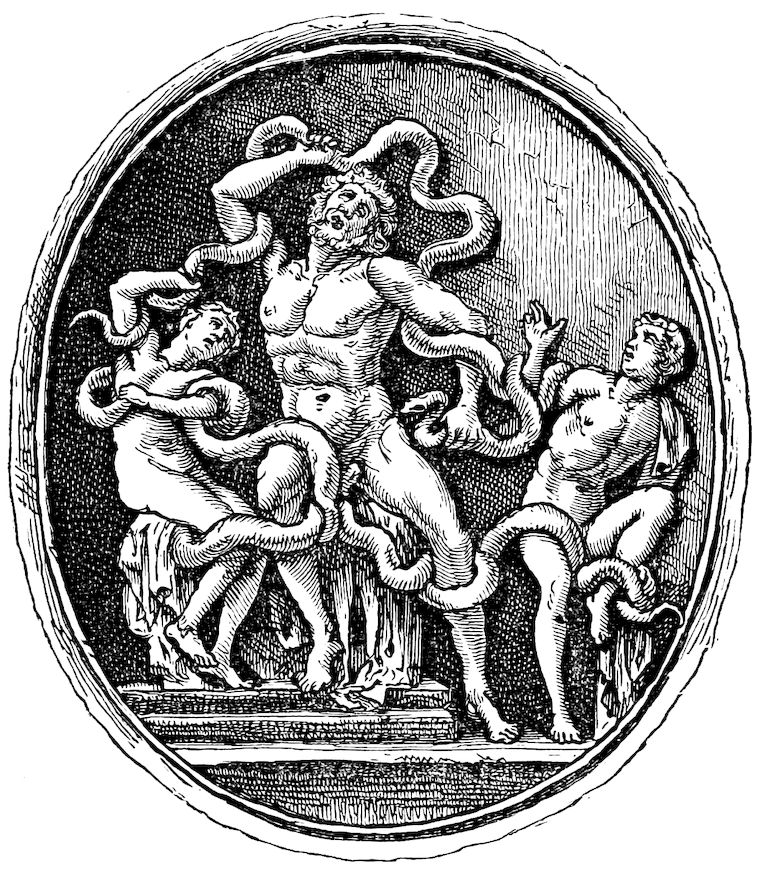
Laocoon. An Essay upon the Limits of Painting and Poetry. WITH REMARKS ILLUSTRATIVE OF VARIOUS POINTS IN THE HISTORY OF ANCIENT ART.
Transcriber’s Note:
New original cover art included with this eBook is granted to the public domain.
BY
GOTTHOLD EPHRAIM LESSING.
TRANSLATED BY ELLEN FROTHINGHAM.
BOSTON:
ROBERTS BROTHERS.
1890.
Entered according to Act of Congress, in the year 1873, by
ROBERTS BROTHERS,
In the office of the Librarian of Congress, at Washington.
University Press:
John Wilson & Son, Cambridge.
TRANSLATOR’S PREFACE.
v
A translation of the Laocoon was given to
the English public by E. C. Beasley, one of the
tutors of Leamington College, in 1853. Very
few copies found their way to America, and the
book is now difficult to obtain.
The desire of the present translator has
been to make a version which could be easily
read by persons ignorant of any language save
English. To this end an attempt was made to
banish all foreign languages from the text, and
substitute for the original quotations their equivalents,
as near as possible, in English. This
method was found, however, on trial, to be incompatible
with the closeness of Lessing’s criticism,
depending, as that in many cases does,
on the shade of meaning of the original word.
For the sake of consistency, therefore, Lessing’s
method has been adhered to in every instance;
the words of the author cited being retained in
vithe text, and a translation given in a foot-note
wherever the meaning was not sufficiently indicated
by the context. The same course has
been pursued with the modern as with the
ancient languages.
Dryden’s translation of Virgil has been used
throughout, and Bryant’s of Homer in every
case but one, where a quotation from the Æneid
and the Odyssey stood in close connection. In
this single instance Pope’s version was preferred;
his style being more in harmony with
that of Dryden, and his want of literalness
being here not objectionable.
Such notes as were not necessary to the
understanding of the text have been transferred
to the end of the book.
The translator would here acknowledge the
valuable assistance received from Mr. W. T.
Brigham in the rendering of quotations from
the classics.
Ellen Frothingham.
Boston, June, 1873.
PREFACE. — I.
vii
The first who compared painting with poetry
was a man of fine feeling, who was conscious
of a similar effect produced on himself by both
arts. Both, he perceived, represent absent things
as present, give us the appearance as the reality.
Both produce illusion, and the illusion of
both is pleasing.
A second sought to analyze the nature of this
pleasure, and found its source to be in both cases
the same. Beauty, our first idea of which is
derived from corporeal objects, has universal
laws which admit of wide application. They
may be extended to actions and thoughts as
well as to forms.
A third, pondering upon the value and distribution
of these laws, found that some obtained
more in painting, others in poetry: that in
regard to the latter, therefore, poetry can come
viiito the aid of painting; in regard to the former,
painting to the aid of poetry, by illustration
and example.
The first was the amateur; the second, the
philosopher; the third, the critic.
The first two could not well make a false use
of their feeling or their conclusions, whereas
with the critic all depends on the right application
of his principles in particular cases. And,
since there are fifty ingenious critics to one of
penetration, it would be a wonder if the application
were, in every case, made with the caution
indispensable to an exact adjustment of the
scales between the two arts.
If Apelles and Protogenes, in their lost works
on painting, fixed and illustrated its rules from
the already established laws of poetry, we may
be sure they did so with the same moderation
and exactness with which Aristotle, Cicero, Horace,
and Quintilian, in their still existing writings,
apply the principles and experiences of
painting to eloquence and poetry. It is the
prerogative of the ancients in nothing either to
exceed or fall short.
But we moderns have in many cases thought
to surpass the ancients by transforming their
pleasure-paths into highways, though at the risk
ixof reducing the shorter and safer highways to
such paths as lead through deserts.
The dazzling antithesis of the Greek Voltaire,
that painting is dumb poetry, and poetry speaking
painting, stood in no text-book. It was one
of those conceits, occurring frequently in Simonides,
the inexactness and falsity of which we
feel constrained to overlook for the sake of the
evident truth they contain.
The ancients, however, did not overlook them.
They confined the saying of Simonides to the
effect produced by the two arts, not failing
to lay stress upon the fact that, notwithstanding
the perfect similarity of their effects, the
arts themselves differ both in the objects and in
the methods of their imitation, ὕλῃ καὶ τρόποις
μιμήσεως.
But, as if no such difference existed, many
modern critics have drawn the crudest conclusions
possible from this agreement between
painting and poetry. At one time they confine
poetry within the narrower limits of painting,
and at another allow painting to fill the whole
wide sphere of poetry. Whatever is right in
one must be permitted to the other; whatever
pleases or displeases in one is necessarily pleasing
or displeasing in the other. Full of this
xidea they, with great assurance, give utterance
to the shallowest judgments, whenever they find
that poet and painter have treated the same
subject in a different way. Such variations
they take to be faults, and charge them on
painter or poet, according as their taste more
inclines to the one art or the other.
This fault-finding criticism has partially misled
the virtuosos themselves. In poetry, a fondness
for description, and in painting, a fancy for
allegory, has arisen from the desire to make the
one a speaking picture without really knowing
what it can and ought to paint, and the other a
dumb poem, without having considered in how
far painting can express universal ideas without
abandoning its proper sphere and degenerating
into an arbitrary method of writing.
To combat that false taste and those ill-grounded
criticisms is the chief object of the
following chapters. Their origin was accidental,
and in their growth they have rather followed
the course of my reading than been systematically
developed from general principles. They
are, therefore, not so much a book as irregular
collectanea for one.
Yet I flatter myself that, even in this form,
they will not be wholly without value. We
xiGermans suffer from no lack of systematic books.
No nation in the world surpasses us in the faculty
of deducing from a couple of definitions
whatever conclusions we please, in most fair and
logical order.
Baumgarten acknowledged that he was indebted
to Gesner’s dictionary for a large proportion
of the examples in his “Æsthetics.” If
my reasoning be less close than that of Baumgarten,
my examples will, at least, savor more of
the fountain.
Since I made the Laocoon my point of departure,
and return to it more than once in the
course of my essay, I wished him to have a share
in the title-page. Other slight digressions on
various points in the history of ancient art,
contribute less to the general design of my work,
and have been retained only because I never can
hope to find a better place for them.
Further, I would state that, under the name
of painting, I include the plastic arts generally;
as, under that of poetry, I may have allowed
myself sometimes to embrace those other arts,
whose imitation is progressive.
LAOCOON.
1
The chief and universal characteristic of the Greek
masterpieces in painting and sculpture consists,
according to Winkelmann, in a noble simplicity
and quiet grandeur, both of attitude and expression.
“As the depths of the sea,” he says,[1] “remain always
at rest, however the surface may be agitated,
so the expression in the figures of the Greeks reveals
in the midst of passion a great and steadfast
soul.”
“Such a soul is depicted in the countenance of
the Laocoon, under sufferings the most intense.
Nor is it depicted in the countenance only: the
agony betrayed in every nerve and muscle,—we
almost fancy we could detect it in the painful contraction
of the abdomen alone, without looking at
the face and other parts of the body,—this agony,
I say, is yet expressed with no violence in the face
and attitude. He raises no terrible cry, as Virgil
sings of his Laocoon. This would not be possible,
from the opening of the mouth, which denotes
2rather an anxious and oppressed sigh, as described
by Sadolet. Bodily anguish and moral greatness
are diffused in equal measure through the whole
structure of the figure; being, as it were, balanced
against each other. Laocoon suffers, but he suffers
like the Philoctetes of Sophocles. His sufferings
pierce us to the soul, but we are tempted to envy
the great man his power of endurance.”
“To express so noble a soul far outruns the
constructive art of natural beauty. The artist must
have felt within himself the mental greatness which
he has impressed upon his marble. Greece united
in one person artist and philosopher, and had
more than one Metrodorus. Wisdom joined hands
with art and inspired its figures with more than
ordinary souls.”
The remark which lies at the root of this criticism—that
suffering is not expressed in the countenance
of Laocoon with the intensity which its
violence would lead us to expect—is perfectly
just. That this very point, where a shallow observer
would judge the artist to have fallen short of nature
and not to have attained the true pathos of suffering,
furnishes the clearest proof of his wisdom, is
also unquestionable. But in the reason which Winkelmann
assigns for this wisdom, and the universality
of the rule which he deduces from it, I venture to
differ from him.
His depreciatory allusion to Virgil was, I confess,
the first thing that aroused my doubts, and the
second was his comparison of Laocoon with Philoctetes.
3Using these as my starting-points, I shall
proceed to write down my thoughts in the order in
which they have occurred to me.
“Laocoon suffers like the Philoctetes of Sophocles.”
How does Philoctetes suffer? Strange that
his sufferings have left such different impressions
upon our minds. The complaints, the screams, the
wild imprecations with which his pain filled the
camp, interrupting the sacrifices and all offices of
religion, resounded not less terribly through the
desert island to which they had been the cause of
his banishment. Nor did the poet hesitate to make
the theatre ring with the imitation of these tones
of rage, pain, and despair.
The third act of this play has been regarded as
much shorter than the others. A proof, say the
critics,[2] that the ancients attached little importance
to the equal length of the acts. I agree with their
conclusion, but should choose some other example
in support of it. The cries of pain, the moans, the
broken exclamations, ἆ, ἆ! φεῦ! ἀτταταῖ! ὢ μοὶ,
μοί! the παπαῖ, παπαῖ! filling whole lines, of which
this act is made up, would naturally require to be
prolonged in the delivery and interrupted by more
frequent pauses than a connected discourse. In the
representation, therefore, this third act must have
occupied about as much time as the others. It
seems shorter on paper to the reader than it did
to the spectator in the theatre.
A cry is the natural expression of bodily pain.
4Homer’s wounded heroes not infrequently fall with a
cry to the ground. Venus screams aloud[3] at a
scratch, not as being the tender goddess of love,
but because suffering nature will have its rights.
Even the iron Mars, on feeling the lance of Diomedes,
bellows as frightfully as if ten thousand raging
warriors were roaring at once, and fills both
armies with terror.[4]
High as Homer exalts his heroes in other respects
above human nature, they yet remain true to it in
their sensitiveness to pain and injuries and in the
expression of their feelings by cries or tears or
revilings. Judged by their deeds they are creatures
of a higher order; in their feelings they are genuine
human beings.
We finer Europeans of a wiser posterity have, I
know, more control over our lips and eyes. Courtesy
and decency forbid cries and tears. We have
exchanged the active bravery of the first rude ages
for a passive courage. Yet even our ancestors were
greater in the latter than the former. But our ancestors
were barbarians. To stifle all signs of pain, to
meet the stroke of death with unaverted eye, to die
laughing under the adder’s sting, to weep neither over
our own sins nor at the loss of the dearest of friends,
are traits of the old northern heroism.[5] The law
given by Palnatoko to the Jomsburghers was to fear
nothing, nor even to name the word fear.
5Not so the Greek. He felt and feared. He
expressed his pain and his grief. He was ashamed
of no human weakness, yet allowed none to hold
him back from the pursuit of honor or the performance
of a duty. Principle wrought in him what
savageness and hardness developed in the barbarian.
Greek heroism was like the spark hidden in
the pebble, which sleeps till roused by some outward
force, and takes from the stone neither clearness
nor coldness. The heroism of the barbarian
was a bright, devouring flame, ever raging, and
blackening, if not consuming, every other good
quality.
When Homer makes the Trojans advance to battle
with wild cries, while the Greeks march in resolute
silence, the commentators very justly observe
that the poet means by this distinction to characterize
the one as an army of barbarians, the other of
civilized men. I am surprised they have not perceived
a similar characteristic difference in another
passage.[6]
The opposing armies have agreed upon an armistice,
and are occupied, not without hot tears on both
sides (δάκρυα θερμὰ χέοντες), with the burning of
their dead. But Priam forbids his Trojans to weep
(οὐδ’ εἴα κλαίειν Πρίαμος μέγας), “and for this reason,”
says Madame Dacier; “he feared they might
become too tender-hearted, and return with less
spirit to the morrow’s fight.” Good; but I would
ask why Priam alone should apprehend this. Why
6does not Agamemnon issue the same command to
his Greeks? The poet has a deeper meaning. He
would show us that only the civilized Greek can
weep and yet be brave, while the uncivilized Trojan,
to be brave, must stifle all humanity. I am in no
wise ashamed to weep (Νεμεσσῶμαί γε μὲν οὐδὲν
κλαίειν), he elsewhere[7] makes the prudent son of
wise Nestor say.
It is worthy of notice that, among the few tragedies
which have come down to us from antiquity,
there should be two in which bodily pain constitutes
not the least part of the hero’s misfortunes. Besides
Philoctetes we have the dying Hercules, whom also
Sophocles represents as wailing, moaning, weeping,
and screaming. Thanks to our well-mannered neighbors,
those masters of propriety, a whimpering Philoctetes
or a screaming Hercules would now be
ridiculous and not tolerated upon the stage. One
of their latest poets,[8] indeed, has ventured upon a
Philoctetes, but he seems not to have dared to show
him in his true character.
Among the lost works of Sophocles was a Laocoon.
If fate had but spared it to us! From the
slight references to the piece in some of the old
grammarians, we cannot determine how the poet
treated his subject. Of one thing I am convinced,—that
he would not have made his Laocoon more of a
Stoic than Philoctetes and Hercules. Every thing
stoical is untheatrical. Our sympathy is always
proportionate with the suffering expressed by the
7object of our interest. If we behold him bearing
his misery with magnanimity, our admiration is
excited; but admiration is a cold sentiment, wherein
barren wonder excludes not only every warmer emotion,
but all vivid personal conception of the suffering.
I come now to my conclusion. If it be true that
a cry, as an expression of bodily pain, is not inconsistent
with nobility of soul, especially according to
the views of the ancient Greeks, then the desire to
represent such a soul cannot be the reason why the
artist has refused to imitate this cry in his marble.
He must have had some other reason for deviating
in this respect from his rival, the poet, who expresses
it with deliberate intention.
II.
8
Be it truth or fable that Love made the first attempt
in the imitative arts, thus much is certain: that she
never tired of guiding the hand of the great masters
of antiquity. For although painting, as the art
which reproduces objects upon flat surfaces, is now
practised in the broadest sense of that definition,
yet the wise Greek set much narrower bounds to it.
He confined it strictly to the imitation of beauty.
The Greek artist represented nothing that was not
beautiful. Even the vulgarly beautiful, the beauty
of inferior types, he copied only incidentally for
practice or recreation. The perfection of the subject
must charm in his work. He was too great
to require the beholders to be satisfied with the
mere barren pleasure arising from a successful likeness
or from consideration of the artist’s skill. Nothing
in his art was dearer to him or seemed to him
more noble than the ends of art.
“Who would want to paint you when no one wants
to look at you?” says an old epigrammatist[9] to a misshapen
man. Many a modern artist would say, “No
matter how misshapen you are, I will paint you.
Though people may not like to look at you, they
will be glad to look at my picture; not as a portrait
9of you, but as a proof of my skill in making so
close a copy of such a monster.”
The fondness for making a display with mere
manual dexterity, ennobled by no worth in the subject,
is too natural not to have produced among the
Greeks a Pauson and a Pyreicus. They had such
painters, but meted out to them strict justice. Pauson,
who confined himself to the beauties of ordinary
nature, and whose depraved taste liked best
to represent the imperfections and deformities of
humanity,[10] lived in the most abandoned poverty;[11]
and Pyreicus, who painted barbers’ rooms, dirty
workshops, donkeys, and kitchen herbs, with all the
diligence of a Dutch painter, as if such things were
rare or attractive in nature, acquired the surname of
Rhyparographer,[12] the dirt-painter. The rich voluptuaries,
indeed, paid for his works their weight in gold,
as if by this fictitious valuation to atone for their insignificance.
Even the magistrates considered this subject a
matter worthy their attention, and confined the
artist by force within his proper sphere. The law
of the Thebans commanding him to make his copies
more beautiful than the originals, and never under
pain of punishment less so, is well known. This
was no law against bunglers, as has been supposed
by critics generally, and even by Junius himself,[13]10but was aimed against the Greek Ghezzi, and condemned
the unworthy artifice of obtaining a likeness
by exaggerating the deformities of the model. It
was, in fact, a law against caricature.
From this same conception of the beautiful came
the law of the Olympic judges. Every conqueror in
the Olympic games received a statue, but a portrait-statue
was erected only to him who had been thrice
victor.[14] Too many indifferent portraits were not
allowed among works of art. For although a portrait
admits of being idealized, yet the likeness should
predominate. It is the ideal of a particular person,
not the ideal of humanity.
We laugh when we read that the very arts among
the ancients were subject to the control of civil law;
but we have no right to laugh. Laws should unquestionably
usurp no sway over science, for the
object of science is truth. Truth is a necessity of
the soul, and to put any restraint upon the gratification
of this essential want is tyranny. The object
of art, on the contrary, is pleasure, and pleasure is
not indispensable. What kind and what degree of
pleasure shall be permitted may justly depend on
the law-giver.
The plastic arts especially, besides the inevitable
influence which they exercise on the character of a
nation, have power to work one effect which demands
the careful attention of the law. Beautiful statues
fashioned from beautiful men reacted upon their
creators, and the state was indebted for its beautiful
11men to beautiful statues. With us the susceptible
imagination of the mother seems to express itself
only in monsters.
From this point of view I think I detect a truth in
certain old stories which have been rejected as fables.
The mothers of Aristomenes, of Aristodamas, of
Alexander the Great, Scipio, Augustus, and Galerius,
each dreamed during pregnancy that she was
visited by a serpent. The serpent was an emblem of
divinity.[15] Without it Bacchus, Apollo, Mercury, and
Hercules were seldom represented in their beautiful
pictures and statues. These honorable women had
been feasting their eyes upon the god during the
day, and the bewildering dream suggested to them
the image of the snake. Thus I vindicate the
dream, and show up the explanation given by the
pride of their sons and by unblushing flattery. For
there must have been some reason for the adulterous
fancy always taking the form of a serpent.
But I am wandering from my purpose, which was
simply to prove that among the ancients beauty was
the supreme law of the imitative arts. This being
established, it follows necessarily that whatever else
these arts may aim at must give way completely if
incompatible with beauty, and, if compatible, must at
least be secondary to it.
I will confine myself wholly to expression. There
are passions and degrees of passion whose expression
produces the most hideous contortions of the
face, and throws the whole body into such unnatural
12positions as to destroy all the beautiful lines that
mark it when in a state of greater repose. These
passions the old artists either refrained altogether
from representing, or softened into emotions which
were capable of being expressed with some degree
of beauty.
Rage and despair disfigured none of their works.
I venture to maintain that they never represented
a fury.[16] Wrath they tempered into severity. In
poetry we have the wrathful Jupiter, who hurls the
thunderbolt; in art he is simply the austere.
Anguish was softened into sadness. Where that
was impossible, and where the representation of intense
grief would belittle as well as disfigure, how
did Timanthes manage? There is a well-known
picture by him of the sacrifice of Iphigenia, wherein
he gives to the countenance of every spectator a
fitting degree of sadness, but veils the face of the
father, on which should have been depicted the most
intense suffering. This has been the subject of
many petty criticisms. “The artist,” says one,[17]
“had so exhausted himself in representations of
sadness that he despaired of depicting the father’s
face worthily.” “He hereby confessed,” says another,[18]
“that the bitterness of extreme grief cannot
13be expressed by art.” I, for my part, see in this no
proof of incapacity in the artist or his art. In proportion
to the intensity of feeling, the expression of
the features is intensified, and nothing is easier than
to express extremes. But Timanthes knew the
limits which the graces have imposed upon his art.
He knew that the grief befitting Agamemnon, as
father, produces contortions which are essentially
ugly. He carried expression as far as was consistent
with beauty and dignity. Ugliness he would
gladly have passed over, or have softened, but since
his subject admitted of neither, there was nothing
left him but to veil it. What he might not paint he
left to be imagined. That concealment was in short
a sacrifice to beauty; an example to show, not how
expression can be carried beyond the limits of art,
but how it should be subjected to the first law of
art, the law of beauty.
Apply this to the Laocoon and we have the cause
we were seeking. The master was striving to attain
the greatest beauty under the given conditions of
bodily pain. Pain, in its disfiguring extreme, was
not compatible with beauty, and must therefore be
softened. Screams must be reduced to sighs, not
because screams would betray weakness, but because
they would deform the countenance to a repulsive
degree. Imagine Laocoon’s mouth open, and judge.
Let him scream, and see. It was, before, a figure to
inspire compassion in its beauty and suffering. Now
it is ugly, abhorrent, and we gladly avert our eyes
from a painful spectacle, destitute of the beauty
14which alone could turn our pain into the sweet feeling
of pity for the suffering object.
The simple opening of the mouth, apart from the
violent and repulsive contortions it causes in the
other parts of the face, is a blot on a painting and a
cavity in a statue productive of the worst possible
effect. Montfaucon showed little taste when he
pronounced the bearded face of an old man with
wide open mouth, to be a Jupiter delivering an
oracle.[19] Cannot a god foretell the future without
screaming? Would a more becoming posture of the
lips cast suspicion upon his prophecies? Valerius
cannot make me believe that Ajax was painted
screaming in the above-mentioned picture of Timanthes.[20]
Far inferior masters, after the decline of art,
do not in a single instance make the wildest barbarian
open his mouth to scream, even though in
mortal terror of his enemy’s sword.[21]
This softening of the extremity of bodily suffering
into a lesser degree of pain is apparent in the works
of many of the old artists. Hercules, writhing in
his poisoned robe, from the hand of an unknown
master, was not the Hercules of Sophocles, who
made the Locrian rocks and the Eubœan promontory
ring with his horrid cries. He was gloomy rather
than wild.[22] The Philoctetes of Pythagoras Leontinus
seemed to communicate his pain to the beholder,
15an effect which would have been destroyed by the
slightest disfigurement of the features. It may be
asked how I know that this master made a statue
of Philoctetes. From a passage in Pliny, which
ought not to have waited for my emendation, so
evident is the alteration or mutilation it has under
gone.[23]
III.
16
But, as already observed, the realm of art has in
modern times been greatly enlarged. Its imitations
are allowed to extend over all visible nature, of
which beauty constitutes but a small part. Truth
and expression are taken as its first law. As nature
always sacrifices beauty to higher ends, so should
the artist subordinate it to his general purpose, and
not pursue it further than truth and expression allow.
Enough that truth and expression convert what is
unsightly in nature into a beauty of art.
Allowing this idea to pass unchallenged at present
for whatever it is worth, are there not other
independent considerations which should set bounds
to expression, and prevent the artist from choosing
for his imitation the culminating point of any action?
The single moment of time to which art must confine
itself, will lead us, I think, to such considerations.
Since the artist can use but a single moment
of ever-changing nature, and the painter must further
confine his study of this one moment to a single
point of view, while their works are made not simply
to be looked at, but to be contemplated long and
often, evidently the most fruitful moment and the
most fruitful aspect of that moment must be chosen.
Now that only is fruitful which allows free play to
17the imagination. The more we see the more we
must be able to imagine; and the more we imagine,
the more we must think we see. But no moment in
the whole course of an action is so disadvantageous
in this respect as that of its culmination. There is
nothing beyond, and to present the uttermost to the
eye is to bind the wings of Fancy, and compel her,
since she cannot soar beyond the impression made on
the senses, to employ herself with feebler images, shunning
as her limit the visible fulness already expressed.
When, for instance, Laocoon sighs, imagination can
hear him cry; but if he cry, imagination can neither
mount a step higher, nor fall a step lower, without
seeing him in a more endurable, and therefore less
interesting, condition. We hear him merely groaning,
or we see him already dead.
Again, since this single moment receives from art
an unchanging duration, it should express nothing
essentially transitory. All phenomena, whose nature
it is suddenly to break out and as suddenly to disappear,
which can remain as they are but for a
moment; all such phenomena, whether agreeable or
otherwise, acquire through the perpetuity conferred
upon them by art such an unnatural appearance,
that the impression they produce becomes weaker
with every fresh observation, till the whole subject
at last wearies or disgusts us. La Mettrie, who had
himself painted and engraved as a second Democritus,
laughs only the first time we look at him.
Looked at again, the philosopher becomes a buffoon,
and his laugh a grimace. So it is with a cry. Pain,
18which is so violent as to extort a scream, either soon
abates or it must destroy the sufferer. Again, if a
man of firmness and endurance cry, he does not do
so unceasingly, and only this apparent continuity in
art makes the cry degenerate into womanish weakness
or childish impatience. This, at least, the
sculptor of the Laocoon had to guard against,
even had a cry not been an offence against beauty,
and were suffering without beauty a legitimate subject
of art.
Among the old painters Timomachus seems to
have been the one most fond of choosing extremes
for his subject. His raving Ajax and infanticide
Medea were famous. But from the descriptions we
have of them it is clear that he had rare skill in
selecting that point which leads the observer to
imagine the crisis without actually showing it, and
in uniting with this an appearance not so essentially
transitory as to become offensive through the continuity
conferred by art. He did not paint Medea
at the moment of her actually murdering her children,
but just before, when motherly love is still
struggling with jealousy. We anticipate the result
and tremble at the idea of soon seeing Medea in her
unmitigated ferocity, our imagination far outstripping
any thing the painter could have shown us of that
terrible moment. For that reason her prolonged
indecision, so far from displeasing us, makes us wish
it had been continued in reality. We wish this conflict
of passions had never been decided or had
lasted at least till time and reflection had weakened
19her fury and secured the victory to the maternal
sentiments. This wisdom on the part of Timomachus
won for him great and frequent praise, and
raised him far above another artist unknown, who
was foolish enough to paint Medea at the height of
her madness, thus giving to this transient access of
passion a duration that outrages nature. The poet[24]
censures him for this, and says very justly, apostrophizing
the picture, “Art thou then for ever thirsting
for the blood of thy children? Is there always a
new Jason and a new Creusa to inflame thy rage?
To the devil with the very picture of thee!” he adds
angrily.
Of Timomachus’ treatment of the raving Ajax,
we can judge by what Philostratus tells us.[25] Ajax
was not represented at the moment when, raging
among the herds, he captures and slays goats and
oxen, mistaking them for men. The master showed
him sitting weary after these crazy deeds of heroism,
and meditating self-destruction. That was really
the raving Ajax, not because he is raving at the
moment, but because we see that he has been raving,
and with what violence his present reaction of shame
and despair vividly portrays. We see the force of
the tempest in the wrecks and corpses with which it
has strewn the beach.
IV.
20
A review of the reasons here alleged for the moderation
observed by the sculptor of the Laocoon in
the expression of bodily pain, shows them to lie
wholly in the peculiar object of his art and its
necessary limitations. Scarce one of them would
be applicable to poetry.
Without inquiring here how far the poet can succeed
in describing physical beauty, so much at least
is clear, that since the whole infinite realm of perfection
lies open for his imitation, this visible covering
under which perfection becomes beauty will be
one of his least significant means of interesting us
in his characters. Indeed, he often neglects it
altogether, feeling sure that if his hero have gained
our favor, his nobler qualities will either so engross
us that we shall not think of his body, or have so
won us that, if we think of it, we shall naturally
attribute to him a beautiful, or, at least, no unsightly
one. Least of all will he have reference to the eye
in every detail not especially addressed to the sense
of sight. When Virgil’s Laocoon screams, who stops
to think that a scream necessitates an open mouth,
and that an open mouth is ugly? Enough that
“clamores horrendos ad sidera tollit” is fine to the
21ear, no matter what its effect on the eye. Whoever
requires a beautiful picture has missed the whole
intention of the poet.
Further, nothing obliges the poet to concentrate
his picture into a single moment. He can take up
every action, if he will, from its origin, and carry it
through all possible changes to its issue. Every
change, which would require from the painter a
separate picture, costs him but a single touch; a
touch, perhaps, which, taken by itself, might offend
the imagination, but which, anticipated, as it has
been, by what preceded, and softened and atoned for
by what follows, loses its individual effect in the
admirable result of the whole. Thus were it really
unbecoming in a man to cry out in the extremity of
bodily pain, how can this momentary weakness lower
in our estimation a character whose virtues have
previously won our regard? Virgil’s Laocoon cries;
but this screaming Laocoon is the same we know
and love as the most far-seeing of patriots and the
tenderest of fathers. We do not attribute the cry
to his character, but solely to his intolerable sufferings.
We hear in it only those, nor could they have
been made sensible to us in any other way.
Who blames the poet, then? Rather must we
acknowledge that he was right in introducing the
cry, as the sculptor was in omitting it.
But Virgil’s is a narrative poem. Would the
dramatic poet be included in this justification? A
very different impression is made by the mention of
a cry and the cry itself. The drama, being meant
22for a living picture to the spectator, should therefore
perhaps conform more strictly to the laws of
material painting. In the drama we not only fancy
we see and hear a crying Philoctetes, we actually
do see and hear him. The more nearly the actor
approaches nature, the more sensibly must our eyes
and ears be offended, as in nature they undoubtedly
are when we hear such loud and violent expressions
of pain. Besides, physical suffering in general possesses
in a less degree than other evils the power of
arousing sympathy. The imagination cannot take
hold of it sufficiently for the mere sight to arouse in
us any corresponding emotion. Sophocles, therefore,
might easily have overstepped the bounds not
only of conventional propriety, but of a propriety
grounded in the very nature of our sensibilities, in
letting Philoctetes and Hercules moan and weep,
scream and roar. The by-standers cannot possibly
feel such concern for their suffering as these excessive
outbreaks seem to demand. To us spectators
the lookers-on will seem comparatively cold; and
yet we cannot but regard their sympathy as the
measure of our own. Add to this that the actor can
rarely or never carry the representation of bodily
pain to the point of illusion, and perhaps the modern
dramatic poets are rather to be praised than
blamed for either avoiding this danger altogether or
skirting it at a safe distance.
Much would in theory appear unanswerable if the
achievements of genius had not proved the contrary.
These observations are not without good foundation,
23yet in spite of them Philoctetes remains one of the
masterpieces of the stage. For a portion of our
strictures do not apply to Sophocles, and by a
disregard of others he has attained to beauties
which the timid critic, but for this example, would
never have dreamed of. The following remarks will
make this apparent:—
1. The poet has contrived wonderfully to intensify
and ennoble the idea of physical pain. He chose a
wound,—for we may consider the details of the
story dependent upon his choice, in so far as he
chose the subject for their sake,—he chose, I say,
a wound and not an inward distemper, because the
most painful sickness fails to impress us as vividly
as an outward hurt. The inward sympathetic fire
which consumed Meleager when his mother sacrificed
him in the brand to her sisterly fury, would
therefore be less dramatic than a wound. This
wound, moreover, was a divine punishment. In it a
fiercer than any natural poison raged unceasingly,
and at appointed intervals an access of intenser
pain occurred, always followed by a heavy sleep,
wherein exhausted nature acquired the needed
strength for entering again upon the same course of
pain. Chateaubrun represents him as wounded simply
by the poisoned arrow of a Trojan. But so
common an accident gives small scope for extraordinary
results. Every one was exposed to it in the
old wars; why were the consequences so terrible
only in the case of Philoctetes? A natural poison
that should work for nine years without destroying
24life is far more improbable than all the fabulous
miraculous elements with which the Greek decked
out his tale.
2. But great and terrible as he made the physical
sufferings of his hero, he was well aware that these
alone would not suffice to excite any sensible degree
of sympathy. He joined with them, therefore, other
evils, also insufficient of themselves to move us
greatly, but receiving from this connection a darker
hue of tragedy, which in turn reacted upon the
bodily pain. These evils were complete loss of
human companionship, hunger, and all the discomforts
attendant on exposure to an inclement sky
when thus bereft.[26] Imagine a man under these
circumstances, but in possession of health, strength,
and industry, and we have a Robinson Crusoe, who
has little claim to our compassion, though we are by
no means indifferent to his fate. For we are seldom
so thoroughly content with human society as not to
find a certain charm in thinking of the repose to be
enjoyed without its pale; more particularly as every
one flatters himself with the idea of being able
gradually to dispense altogether with the help of
others. Again, imagine a man suffering from the
most painful of incurable maladies, but surrounded
by kind friends who let him want for nothing, who
relieve his pain by all the means in their power, and
are always ready to listen to his groans and complaints;
we should pity him undoubtedly, but our
compassion would soon be exhausted. We should
25presently shrug our shoulders and counsel patience.
Only when all these ills unite in one person, when
to solitude is added physical infirmity, when the sick
man not only cannot help himself, but has no one to
help him, and his groans die away on the desert air,—then
we see a wretch afflicted by all the ills to
which human nature is exposed, and the very thought
of putting ourselves in his place for a moment fills
us with horror. We see before us despair in its
most dreadful shape, and no compassion is stronger
or more melting than that connected with the idea of
despair. Such we feel for Philoctetes, especially at
the moment when, robbed of his bow, he loses the
only means left him of supporting his miserable
existence. Alas for the Frenchman who had not
the sense to perceive this nor the heart to feel it!
or, if he had, was petty enough to sacrifice it all to
the pitiful taste of his nation! Chateaubrun gives
Philoctetes companionship by introducing a princess
into his desert island. Neither is she alone, but has
with her a lady of honor: a thing apparently as
much needed by the poet as by the princess. All
the admirable play with the bow he has left out and
introduced in its stead the play of bright eyes. The
heroic youth of France would in truth have made
themselves very merry over a bow and arrows, whereas
nothing is more serious to them than the displeasure
of bright eyes. The Greek harrows us with
fear lest the wretched Philoctetes should be forced
to remain on the island without his bow, and there
miserably perish. The Frenchman found a surer
26way to our hearts by making us fear that the son of
Achilles would have to depart without his princess.
And this is called by the Parisian critics triumphing
over the ancients. One of them even proposed to
name Chateaubrun’s piece “La difficulté vaincue.”[27]
3. Turning now from the effect of the whole, let
us examine the separate scenes wherein Philoctetes
is no longer the forsaken sufferer, but has hope of
leaving the dreary island and returning to his kingdom.
His ills are therefore now confined entirely
to his painful wound. He moans, he cries, he goes
through the most hideous contortions. Against this
scene objections on the score of offended propriety
may with most reason be brought. They come from
an Englishman, a man, therefore, not readily to be
suspected of false delicacy. As already hinted, he
supports his objections by very good arguments.
“All feelings and passions,” he says, “with which
others can have little sympathy, become offensive if
too violently expressed.”[28] “It is for the same
reason that to cry out with bodily pain, how intolerable
soever, appears always unmanly and unbecoming.
There is, however, a good deal of sympathy
even with bodily pain. If I see a stroke aimed and
just ready to fall upon the leg or arm of another
person, I naturally shriek and draw back my own
leg or my own arm; and when it does fall, I feel it
in some measure and am hurt by it as well as the
27sufferer. My hurt, however, is no doubt excessively
slight, and, upon that account, if he makes any
violent outcry, as I cannot go along with him, I
never fail to despise him.”
Nothing is more deceptive than the laying down
of general laws for our emotions. Their web is so
fine and intricate that the most cautious speculation
is hardly able to take up a single thread and trace it
through all its interlacings. And if it could, what
should we gain? There is in nature no single,
unmixed emotion. With every one spring up a
thousand others, the most insignificant of which
essentially modifies the original one, so that exception
after exception arises until our supposed universal
law shrinks into a mere personal experience
in a few individual cases. We despise a man, says
the Englishman, whom we hear crying out under
bodily pain. But not always; not the first time;
not when we see that the sufferer does all in his
power to suppress expressions of pain; not when
we know him to be otherwise a man of resolution:
still less when we see him giving proof of firmness
in the midst of his suffering; when we see that pain,
though it extort a cry, can extort nothing further;
that he submits to a continuance of the anguish
rather than yield a jot of his opinions or resolves,
although such a concession would end his woes.
All this we find in Philoctetes. To the old Greek
mind moral greatness consisted in unchanging love
of friends as well as unfaltering hatred of enemies.
This greatness Philoctetes preserves through all his
28tortures. His own griefs have not so exhausted his
tears that he has none to shed over the fate of his
old friends. His sufferings have not so enervated
him that, to be free from them, he would forgive his
enemies and lend himself to their selfish ends. And
did this man of rock deserve to be despised by the
Athenians, because the waves, that could not shake
him, wrung from him a moan?
I confess to having little taste for the philosophy
of Cicero in general, but particularly distasteful to
me are his views with regard to the endurance of
bodily pain set forth in the second book of his Tusculan
Disputations. One would suppose, from his
abhorrence of all expressions of bodily pain, that he
was training a gladiator. He seems to see in such
expressions only impatience, not considering that
they are often wholly involuntary, and that true
courage can be shown in none but voluntary actions.
In the play of Sophocles he hears only the cries and
complaints of Philoctetes and overlooks altogether
his otherwise resolute bearing. Else what excuse
for his rhetorical outbreak against the poets? “They
would make us effeminate by introducing the bravest
of their warriors as complaining.” They should
complain, for the theatre is no arena. The condemned
or hired gladiator was bound to do and
bear with grace. No sound of lamentation must be
heard, no painful contortion seen. His wounds and
death were to amuse the spectators, and art must
therefore teach the suppression of all feeling. The
least manifestation of it might have aroused compassion,
29and compassion often excited would soon have
put an end to the cruel shows. But what is to be
avoided in the arena is the very object of the tragic
stage, and here, therefore, demeanor of exactly the
opposite kind is required. The heroes on the stage
must show feeling, must express their sufferings, and
give free course to nature. Any appearance of art
and constraint represses sympathy. Boxers in buskin
can at most excite our admiration. This term
may fitly be applied to the so-called Senecan tragedies.
I am convinced that the gladiatorial shows
were the chief reason why the Romans never attained
even to mediocrity in their tragedies. In the bloody
amphitheatre the spectators lost all acquaintance
with nature. A Ctesias might have studied his art
there, never a Sophocles. The greatest tragic genius,
accustomed to these artificial death scenes, could
not help degenerating into bombast and rodomontade.
But as these were incapable of inspiring true
heroism, so were the complaints of Philoctetes incapable
of producing effeminacy. The complaints
are human, while the deeds are heroic. Both together
make the human hero, who is neither effeminate
nor callous, but appears first the one and then
the other, as now Nature sways him, and now principle
and duty triumph. This is the highest type
that wisdom can create and art imitate.
4. Sophocles, not content with securing his suffering
Philoctetes against contempt, has even shielded
him beforehand from such hostile criticism as that
employed by the Englishman. Though we may not
30always despise a man who cries out under bodily
pain, we certainly do not feel that degree of sympathy
with him which his cry seems to demand. How
then should those comport themselves who are about
this screaming Philoctetes? Should they appear to
be greatly moved? That were contrary to nature.
Should they seem as cold and embarrassed as the
by-stander on such occasions is apt actually to be?
Such a want of harmony would offend the spectator.
Sophocles, as I have said, anticipated this and guarded
against it in the following way,—he gave to each of
the by-standers a subject of personal interest. They
are not solely occupied with Philoctetes and his cries.
The attention of the spectator, therefore, is directed
to the change wrought in each person’s own views
and designs by the sympathy excited in him, whether
strong or weak, not to the disproportion between the
sympathy itself and its exciting cause. Neoptolemus
and the chorus have deceived the unhappy Philoctetes,
and while perceiving the despair they are
bringing upon him they behold him overpowered by
one of his accesses of pain. Even should this arouse
no great degree of sympathy in them, it must at
least lead them to self-examination and prevent their
increasing by treachery a misery which they cannot
but respect. This the spectator looks for; nor is
his expectation disappointed by the magnanimous
Neoptolemus. Had Philoctetes been master of his
suffering, Neoptolemus would have persevered in his
deceit. Philoctetes, deprived by pain of all power
of dissimulation, necessary as that seems to prevent
31his future travelling companion from repenting
too soon of his promise to take him with him, Philoctetes,
by his naturalness, recalls Neoptolemus to
nature. The conversion is admirable, and all the
more affecting for being brought about by unaided
human nature. The Frenchman had recourse again
here to the bright eyes. “De mes déguisements que
penserait Sophie?” says the son of Achilles. But I
will think no more of this parody.
Sophocles, in “The Trachiniæ,” makes use of this
same expedient of combining in the by-standers another
emotion with the compassion excited by a cry
of physical pain. The pain of Hercules has no
enervating effect, but drives him to madness. He
thirsts for vengeance, and, in his frenzy, has already
seized upon Lichas and dashed him in pieces against
the rock. The chorus is composed of women who
are naturally overpowered with fear and horror.
Their terror, and the doubt whether a god will
hasten to Hercules’ relief, or whether he will fall
a victim to his misfortune, make the chief interest
of the piece with but a slight tinge of compassion.
As soon as the issue has been decided by the oracle,
Hercules grows calm, and all other feelings are lost
in our admiration of his final decision. But we must
not forget, when comparing the suffering Hercules
with the suffering Philoctetes, that one is a demi-god,
the other but a man. The man is never ashamed to
complain; but the demi-god feels shame that his
mortal part has so far triumphed over his immortal,
32that he should weep and groan like a girl.[29] We
moderns do not believe in demi-gods, but require
our most insignificant hero to feel and act like one.
That an actor can imitate the cries and convulsions
of pain so closely as to produce illusion, I
neither deny nor affirm. If our actors cannot, I
should want to know whether Garrick found it
equally impossible; and, if he could not succeed, I
should still have the right to assume a degree of
perfection in the acting and declamation of the
ancients of which we of to-day can form no idea.
V.
33
Some critics of antiquity argue that the Laocoon,
though a work of Greek art, must date from the
time of the emperors, because it was copied from the
Laocoon of Virgil. Of the older scholars who have
held this opinion I will mention only Bartolomæus
Martiani,[30] and of the moderns, Montfaucon.[31] They
doubtless found such remarkable agreement between
the work of art and the poem that they could not
believe the same circumstances, by no means selfsuggesting
ones, should have occurred by accident
to both sculptor and poet. The question then
arose to whom the honor of invention belonged, and
they assumed the probabilities to be decidedly in
favor of the poet.
They appear, however, to have forgotten that a
third alternative is possible. The artist may not
have copied the poet any more than the poet the
34artist; but both perhaps drew their material from
some older source, which, Macrobius suggests, might
have been Pisander.[32] For, while the works of this
Greek writer were still in existence, the fact was
familiar to every schoolboy that the Roman poet’s
whole second book, the entire conquest and destruction
of Troy, was not so much imitated as literally
translated from the older writer. If then Pisander
was Virgil’s predecessor in the history of Laocoon
also, the Greek artists did not need to draw their
material from a Latin poet, and this theory of the
date of the group loses its support.
If I were forced to maintain the opinion of Martiani
and Montfaucon, I should escape from the
difficulty in this way. Pisander’s poems are lost,
and we can never know with certainty how he told
the story of Laocoon. Probably, however, he narrated
it with the same attendant circumstances of
which we still find traces in the Greek authors.
Now these do not in the least agree with the version
of Virgil, who must have recast the Greek tradition
to suit himself. The fate of Laocoon, as he tells it,
is quite his own invention, so that the artists, if their
representation harmonize with his, may fairly be
supposed to have lived after his time, and have used
his description as their model.
Quintus Calaber indeed, like Virgil, makes Laocoon
express suspicion of the wooden horse; but
the wrath of Minerva, which he thereby incurs, is
very differently manifested. As the Trojan utters
35his warning, the earth trembles beneath him, pain
and terror fall upon him; a burning pain rages in
his eyes; his brain gives way; he raves; he becomes
blind. After his blindness, since he still continues
to advise the burning of the wooden horse, Minerva
sends two terrible dragons, which, however, attack
only Laocoon’s children. In vain they stretch out
their hands to their father. The poor blind man
cannot help them. They are torn and mangled,
and the serpents glide away into the ground, doing
no injury to Laocoon himself. That this was not
peculiar to Quintus,[33] but must have been generally
accepted, appears from a passage in Lycophron,
where these serpents receive the name of “childeaters.”[34]
But if this circumstance were generally accepted
among the Greeks, Greek artists would hardly have
ventured to depart from it. Or, if they made variations,
these would not be likely to be the same as
those of a Roman poet, had they not known him
and perhaps been especially commissioned to use
him as their model. We must insist on this point,
I think, if we would uphold Martiani and Montfaucon.
Virgil is the first and only one[35] who represents
both father and children as devoured by the
serpents; the sculptors have done this also, although,
as Greeks, they should not; probably, therefore,
they did it in consequence of Virgil’s example.
36I am well aware that this probability falls far
short of historical certainty. But since I mean to
draw no historical conclusions from it, we may be
allowed to use it as an hypothesis on which to base
our remarks. Let us suppose, then, that the sculptors
used Virgil as their model, and see in what way they
would have copied him. The cry has been already
discussed. A further comparison may perhaps lead
to not less instructive results.
The idea of coiling the murderous serpents about
both father and sons, tying them thus into one
knot, is certainly a very happy one, and betrays
great picturesqueness of fancy. Whose was it? the
poet’s or the artist’s? Montfaucon thinks it is not
to be found in the poem;[36] but, in my opinion, he
has not read the passage with sufficient care.
The poet has described the serpents as being of
a wonderful length. They have wound their coils
about the boys and seize the father also (corripiunt)
37as he comes to their aid. Owing to their great
length they could not in an instant have disengaged
themselves from the boys. There must therefore
have been a moment when the heads and forward
parts of the bodies had attacked the father while the
boys were still held imprisoned in the hindmost
coils. Such a moment is unavoidable in the progress
of the poetic picture; and the poet makes it
abundantly manifest, though that was not the time
to describe it in detail. A passage in Donatus[38]
seems to prove that the old commentators were conscious
of it; and there was still less likelihood of its
escaping the notice of artists whose trained eye was
quick to perceive any thing that could be turned to
their advantage.
The poet carefully leaves Laocoon’s arms free
that he may have the full use of his hands.
In this point the artist must necessarily have followed
him; for nothing contributes more to the
expression of life and motion than the action of
the hands. In representations of passion, especially,
the most speaking countenance is ineffective
without it. Arms fastened close to the body by the
serpents’ coils would have made the whole group
cold and dead. We consequently see them in full
activity, both in the main figure and the lesser ones,
and most active where for the moment the pain is
sharpest.
38With the exception of this freedom of the arms,
there was, however, nothing in the poet’s manner of
coiling the serpents which could be turned to account
by the artists. Virgil winds them twice round the
body and twice round the neck of Laocoon, and lets
their heads tower high above him.
Bis medium amplexi, bis collo squamea circum
Terga dati, superant capite et cervicibus altis.[40]
This description satisfies our imagination completely.
The noblest parts of the body are compressed to
suffocation, and the poison is aimed directly at the
face. It furnished, however, no picture for the artist,
who would show the physical effects of the poison
and the pain. To render these conspicuous, the
nobler parts of the body must be left as free as possible,
subjected to no outward pressure which would
change and weaken the play of the suffering nerves
and laboring muscles. The double coils would have
concealed the whole trunk and rendered invisible
that most expressive contraction of the abdomen.
What of the body would be distinguishable above
or below or between the coils would have been
swollen and compressed, not by inward pain but by
outward violence. So many rings about the neck
would have destroyed the pyramidal shape of the
group which is now pleasing to the eye, while the
pointed heads of the serpents projecting far above
39this huge mass, would have been such a violation of
the rules of proportion that the effect of the whole
would have been made repulsive in the extreme.
There have been designers so devoid of perception
as to follow the poet implicitly. One example of
the hideous result may be found among the illustrations
by Francis Cleyn.[41] The old sculptors saw at
a glance that their art required a totally different
treatment. They transferred all the coils from the
trunk and neck to the thighs and feet, parts which
might be concealed and compressed without injury
to the expression. By this means they also conveyed
the idea of arrested flight, and a certain immobility
very favorable to the arbitrary continuance of one
posture.
I know not how it happens that the critics have
passed over in silence this marked difference between
the coils in the marble and in the poem. It reveals
the wisdom of the artist quite as much as another
difference which they all comment upon, though
rather by way of excuse than of praise,—the difference
in the dress. Virgil’s Laocoon is in his
priestly robes, while in the group he, as well as his
two sons, appears completely naked. Some persons,
it is said, find a great incongruity in the fact that a
king’s son, a priest, should be represented naked
when offering a sacrifice. To this the critics answer
in all seriousness that it is, to be sure, a violation
of usage but that the artists were driven to it from
inability to give their figures suitable clothing. Sculpture,
40they say, cannot imitate stuffs. Thick folds
produce a bad effect. Of two evils they have therefore
chosen the lesser, and preferred to offend against
truth rather than be necessarily faulty in drapery.[42]
The old artists might have laughed at the objection,
but I know not what they would have said to this
manner of answering it. No greater insult could be
paid to art. Suppose sculpture could imitate different
textures as well as painting, would Laocoon
necessarily have been draped? Should we lose
nothing by drapery? Has a garment, the work of
slavish hands, as much beauty as an organized body,
the work of eternal wisdom? Does the imitation of
the one require the same skill, involve the same
merit, bring the same honor as the imitation of the
other? Do our eyes require but to be deceived, and
is it a matter of indifference to them with what they
are deceived?
In poetry a robe is no robe. It conceals nothing.
Our imagination sees through it in every part.
Whether Virgil’s Laocoon be clothed or not, the
agony in every fibre of his body is equally visible.
The brow is bound with the priestly fillet, but not
concealed. Nay, so far from being a hinderance, the
fillet rather strengthens our impression of the sufferer’s
agony.
His priestly dignity avails him nothing. The very
41badge of it, which wins him universal consideration
and respect, is saturated and desecrated with the
poisonous slaver.
But this subordinate idea the artist had to sacrifice
to the general effect. Had he retained even the
fillet, his work would have lost in expression from
the partial concealment of the brow which is the
seat of expression. As in the case of the cry he
sacrificed expression to beauty, he here sacrificed
conventionality to expression. Conventionality, indeed,
was held of small account among the ancients.
They felt that art, in the attainment of beauty, its true
end, could dispense with conventionalities altogether.
Necessity invented clothes, but what has art to do
with necessity? There is a beauty of drapery, I
admit; but it is nothing as compared with the beauty
of the human form. Will he who can attain to the
greater rest content with the lesser? I fear that
the most accomplished master in drapery, by his
very dexterity, proves his weakness.
VI.
42
My supposition that the artists imitated the poet is
no disparagement to them. On the contrary the
manner of their imitation reflects the greatest credit
on their wisdom. They followed the poet without suffering
him in the smallest particular to mislead them.
A model was set them, but the task of transferring it
from one art into another gave them abundant opportunity
for independent thought. The originality
manifested in their deviations from the model proves
them to have been no less great in their art than the
poet was in his.
Now, reversing the matter, I will suppose the poet
to be working after the model set him by the artists.
This is a supposition maintained by various scholars.[44]
I know of no historical arguments in favor of their
opinion. The work appeared to them of such
exceeding beauty that they could not believe it to be
of comparatively recent date. It must have been
made when art was at its perfection, because it was
worthy of that period.
We have seen that, admirable as Virgil’s picture
is, there are yet traits in it unavailable for the
43artist. The saying therefore requires some modification,
that a good poetical description must make a
good picture, and that a poet describes well only
in so far as his details may be used by the artist.
Even without the proof furnished by examples, we
should be inclined to predicate such limitation from
a consideration of the wider sphere of poetry, the
infinite range of our imagination, and the intangibility
of its images. These may stand side by side
in the greatest number and variety without concealment
or detriment to any, just as the objects themselves
or their natural symbols would in the narrow
limits of time or space.
But if the smaller cannot contain the greater it
can be contained in the greater. In other words, if
not every trait employed by the descriptive poet can
produce an equally good effect on canvas or in
marble, can every trait of the artist be equally effective
in the work of the poet? Undoubtedly; for
what pleases us in a work of art pleases not the eye,
but the imagination through the eye. The same
picture, whether presented to the imagination by
arbitrary or natural signs, must always give us a
similar pleasure, though not always in the same
degree.
But even granting this, I confess that the idea of
Virgil’s having imitated the artists is more inconceivable
to me than the contrary hypothesis. If
the artists copied the poet, I can account for all
their deviations. Differences would necessarily have
arisen, because many traits employed by him with
44good effect would in their work have been objectionable.
But why such deviations in the poet? Would
he not have given us an admirable picture by copying
the group faithfully in every particular?[45]
I can perfectly understand how his fancy, working
independently, should have suggested to him this
and that feature, but I see no reason why his judgment
should have thought it necessary to transform
the beauties that were before his eyes into these
differing ones.
It even seems to me that, had Virgil used this
group as his model, he could hardly have contented
himself with leaving the general embrace of the
three bodies within the serpents’ folds to be thus
guessed at. The impression upon his eye would
have been so vivid and admirable, that he could
not have failed to give the position greater prominence
in his description. As I have said, that was
not the time to dwell upon its details; but the addition
of a single word might have put a decisive
emphasis upon it, even in the shadow in which the
poet was constrained to leave it. What the artist
could present without that word, the poet would not
have failed to express by it, had the work of art
been before him.
The artist had imperative reasons for not allowing
the sufferings of his Laocoon to break out into cries.
But if the poet had had before him in the marble
this touching union of pain with beauty, he would
certainly have been under no necessity of disregarding
45the idea of manly dignity and magnanimous
patience arising from it and making his Laocoon
suddenly startle us with that terrible cry. Richardson
says that Virgil’s Laocoon needed to scream,
because the poet’s object was not so much to excite
compassion for him as to arouse fear and horror
among the Trojans. This I am ready to grant,
although Richardson appears not to have considered
that the poet is not giving the description in his own
person, but puts it into the mouth of Æneas, who,
in his narration to Dido, spared no pains to arouse
her compassion. The cry, however, is not what
surprises me, but the absence of all intermediate
stages of emotion, which the marble could not have
failed to suggest to the poet if, as we are supposing,
he had used that as his model. Richardson goes on
to say, that the story of Laocoon was meant only as
an introduction to the pathetic description of the
final destruction of Troy, and that the poet was
therefore anxious not to divert to the misfortunes of
a private citizen the attention which should be concentrated
on the last dreadful night of a great city.[46]
But this is a painter’s point of view, and here inadmissible.
In the poem, the fate of Laocoon and the
destruction of the city do not stand side by side as
in a picture. They form no single whole to be embraced
at one glance, in which case alone there would
have been danger of having the eye more attracted
by the Laocoon than by the burning city. The two
descriptions succeed each other, and I fail to see
46how the deepest emotion produced by the first could
prejudice the one that follows. Any want of effect
in the second must be owing to its inherent want of
pathos.
Still less reason would the poet have had for altering
the serpents’ coils. In the marble they occupy
the hands and encumber the feet, an arrangement
not less impressive to the imagination than satisfactory
to the eye. The picture is so distinct and clear
that words can scarcely make it plainer than natural
signs.
Micat alter et ipsum
Laocoonta petit, totumque infraque supraque
Implicat et rabido tandem ferit ilia morsu.
· · · · ·
At serpens lapsu crebro redeunte subintrat
Lubricus, intortoque ligat genua infima nodo.
These lines are by Sadolet. They would doubtless
have come with greater picturesqueness from
Virgil, had his fancy been fired by the visible model.
Under those circumstances he would certainly have
written better lines than those we now have of
him.
Bis medium amplexi, bis collo squamea circum
Terga dati, superant capite et cervicibus altis.
These details satisfy the imagination, it is true; but
not if we dwell upon them and try to bring them
distinctly before us. We must look now at the
serpents, and now at Laocoon. The moment we
try to combine them into one picture, the grouping
47begins to displease, and appear in the highest degree
unpicturesque.
But these deviations from his supposed model,
even if not unfortunate, were entirely arbitrary.
Imitation is intended to produce likeness, but how
can likeness result from needless changes? Such
changes rather show that the intention was not to
produce likeness, consequently that there has been
no imitation.
Perhaps not of the whole, some may urge, but of
certain parts. Good; but what are the parts so
exactly corresponding in the marble and in the
poem, that the poet might seem to have borrowed
them from the sculptor? The father, the children,
and the serpents, both poet and sculptor received
from history. Except what is traditional in both,
they agree in nothing but the single circumstance
that father and sons are bound by the serpents’ coils
into a single knot. But this arose from the new
version, according to which father and sons were
involved in a common destruction,—a version, as
already shown, to be attributed rather to Virgil,
since the Greek traditions tell the story differently.
If, then, there should have been any imitation here,
it is more likely to have been on the side of the
artist than of the poet. In all other respects their
representations differ, but in such a way that the
deviations, if made by the artist, are perfectly consistent
with an intention to copy the poet, being
such as the sphere and limitations of his art would
impose on him. They are, on the contrary, so
48many arguments against the supposed imitation of
the sculptor by the poet. Those who, in the face
of these objections, still maintain this supposition,
can only mean that the group is older than the
poem.
VII.
49
When we speak of an artist as imitating a poet or a
poet an artist, we may mean one of two things,—either
that one makes the work of the other his
actual model, or that the same original is before
them both, and one borrows from the other the
manner of copying it.
When Virgil describes the shield of Æneas, his
imitation of the artist who made the shield is of the
former kind. The work of art, not what it represents,
is his model. Even if he describe the devices
upon it they are described as part of the shield, not
as independently existing objects. Had Virgil, on
the other hand, copied the group of the Laocoon,
this would have been an imitation of the second
kind. He would then have been copying, not the
actual group, but what the group represents, and
would have borrowed from the marble only the
details of his copy.
In imitations of the first kind the poet is an originator,
in those of the second a copyist. The first is
part of the universal imitation which constitutes the
very essence of his art, and his work is that of a
genius, whether his model be nature or the product
of other arts. The second degrades him utterly.
50Instead of the thing itself, he imitates its imitations,
and gives us a lifeless reflection of another’s genius
for original touches of his own.
In the by no means rare cases where poet and
artist must study their common original from the
same point of view, their copies cannot but coincide
in many respects, although there may have been no
manner of imitation or emulation between them.
These coincidences among contemporaneous artists
and poets may lead to mutual illustrations of things
no longer present to us. But to try to help out these
illustrations by tracing design where was only chance,
and especially by attributing to the poet at every
detail a reference to this statue or that picture, is
doing him very doubtful service. Nor is the reader
a gainer by a process which renders the beautiful
passages perfectly intelligible, no doubt, but at the
sacrifice of all their life.
This is the design and the mistake of a famous
English work by the Rev. Mr. Spence, entitled,
“Polymetis; or, An inquiry concerning the agreement
between the works of the Roman poets and
the remains of the ancient artists, being an attempt
to illustrate them mutually from one another.”[47]
Spence has brought to his work great classical
learning and a thorough knowledge of the surviving
works of ancient art. His design of using these as
means to explain the Roman poets, and making the
poets in turn throw light on works of art hitherto
51imperfectly understood, has been in many instances
happily accomplished. But I nevertheless maintain
that to every reader of taste his book must be intolerable.
When Valerius Flaccus describes the winged thunderbolts
on the shields of the Roman soldiers,—
Nec primus radios, miles Romane, corusci
Fulminis et rutilas scutis diffuderis alas,
the description is naturally made more intelligible to
me by seeing the representation of such a shield on
an ancient monument.[48] It is possible that the old
armorers represented Mars upon helmets and shields
in the same hovering attitude that Addison thought
he saw him in with Rhea on an ancient coin,[49] and
that Juvenal had such a helmet or shield in mind in
that allusion of his which, till Addison, had been a
puzzle to all commentators.
The passage in Ovid where the wearied Cephalus
invokes Aura, the cooling zephyr,—
and his Procris takes this Aura for the name of a
rival,—this passage, I confess, seems to me more
natural when I see that the ancients in their works
of art personified the gentle breezes, and, under the
name Auræ, worshipped certain female sylphs.[50]
I acknowledge that when Juvenal compares an
idle patrician to a Hermes-column, we should hardly
52perceive the point of the comparison unless we had
seen such a column and knew it to be a poorly cut
pillar, bearing the head, or at most the trunk, of the
god, and, owing to the want of hands and feet, suggesting
the idea of inactivity.[51]
Illustrations of this kind are not to be despised,
though neither always necessary nor always conclusive.
Either the poet regarded the work of art not
as a copy but as an independent original, or both
artist and poet were embodying certain accepted
ideas. Their representations would necessarily have
many points of resemblance, which serve as so
many proofs of the universality of the ideas.
But when Tibullus describes Apollo as he appeared
to him in a dream,—the fairest of youths, his
temples wreathed with the chaste laurel, Syrian
odors breathing from his golden hair that falls in
ripples over his long neck, his whole body as pink
and white as the cheek of the bride when led to her
bridegroom,—why need these traits have been borrowed
from famous old pictures? Echion’s “nova
nupta verecundia notabilis” may have been in Rome
and been copied thousands of times: did that prove
virgin modesty itself to have vanished from the
world? Since the painter saw it, was no poet to see
it more save in the painter’s imitation?[52] Or when
another poet speaks of Vulcan as wearied and his
face reddened by the forge, did he need a picture to
53teach him that labor wearies and heat reddens?[53]
Or when Lucretius describes the alternations of the
seasons and brings them before us in the order of
nature, with their whole train of effects on earth
and air, was Lucretius the creature of a day? had
he lived through no entire year and seen its changes,
that he must needs have taken his description from
a procession of statues representing the seasons?
Did he need to learn from statues the old poetic
device of making actual beings out of such abstractions?[54]
Or Virgil’s “pontem indignatus Araxes,”
that admirable poetic picture of a river overflowing
its banks and tearing down the bridge that spans it,—do
we not destroy all its beauty by making it simply a
reference to some work of art, wherein the river god
was represented as actually demolishing a bridge?[55]
What do we want of such illustrations which banish
the poet from his own clearest lines to give us in
his place the reflection of some artist’s fancy?
I regret that this tasteless conceit of substituting
for the creations of the poet’s own imagination a
familiarity with those of others should have rendered
a book, so useful as the Polymetis might have
been made, as offensive as the feeblest commentaries
of the shallowest quibblers, and far more derogatory
to the classic authors. Still more do I regret
that Addison should in this respect have been the
predecessor of Spence, and, in his praiseworthy
54desire to make the old works of art serve as interpreters,
have failed to discriminate between those
cases where imitation of the artist would be becoming
in the poet, and those where it would be degrading
to him.[56]
VIII.
55
Spence has the strangest notions of the resemblance
between painting and poetry. He believes the two
arts to have been so closely connected among the
ancients that they always went hand in hand, the
poet never losing sight of the painter, nor the painter
of the poet. That poetry has the wider sphere,
that beauties are within her reach which painting can
never attain, that she may often see reason to prefer
unpicturesque beauties to picturesque ones,—these
things seem never to have occurred to him. The
slightest difference, therefore, between the old poets
and artists throws him into an embarrassment from
which it taxes all his ingenuity to escape.
The poets generally gave Bacchus horns. Spence
is therefore surprised that we seldom see these
appendages on his statues.[57] He suggests one reason
and another; now the ignorance of the antiquarians,
and again “the smallness of the horns
themselves, which were very likely to be hid under
the crown of grapes or ivy which is almost a constant
ornament of the head of Bacchus.” He goes
all round the true cause without ever suspecting it.
The horns of Bacchus were not a natural growth
56like those of fauns and satyrs. They were ornaments
which he could assume or lay aside at
pleasure.
Tibi, cum sine cornibus adstas,
Virgineum caput est, ...
says Ovid in his solemn invocation to Bacchus.[58]
He could therefore show himself without horns, and
did, in fact, thus show himself when he wished to
appear in his virgin beauty. In this form artists
would choose to represent him, and necessarily
omitted all disagreeable accompaniments. Horns
fastened to the diadem, as we see them on a head in
the royal museum in Berlin,[59] would have been a
cumbersome appendage, as would also the diadem
itself, concealing the beautiful brow. For this reason
the diadem appears as rarely as the horns on
the statues of Bacchus, although, as its inventor, he
is often crowned with it by the poets. In poetry
both horns and diadem served as subtle allusions to
the deeds and character of the god: in a picture or
statue they would have stood in the way of greater
beauties. If Bacchus, as I believe, received the
name of Biformis, Δίμορφος, from having an aspect
of beauty as well as of terror, the artists would
naturally have chosen the shape best adapted to the
object of their art.
In the Roman poets Minerva and Juno often
57hurl the thunderbolt. Why are they not so represented
in art? asks Spence.[60] He answers, “This
power was the privilege of these two goddesses, the
reason of which was, perhaps, first learnt in the Samothracian
mysteries. But since, among the ancient
Romans, artists were considered as of inferior rank,
and therefore rarely initiated into them, they would
doubtless know nothing of them; and what they
knew not of they clearly could not represent.” I
should like to ask Spence whether these common
people were working independently, or under the
orders of superiors who might be initiated into the
mysteries; whether the artists occupied such a degraded
position among the Greeks; whether the
Roman artists were not for the most part Greeks by
birth; and so on.
Statius and Valerius Flaccus describe an angry
Venus with such terrible features that we should
take her at the moment for a fury rather than for the
goddess of love. Spence searches in vain for such
a Venus among the works of ancient art. What is
his conclusion? That more is allowed to the poet
than to the sculptor and painter? That should
have been his inference. But he has once for all
established as a general rule that “scarce any thing
can be good in a poetical description which would
appear absurd if represented in a statue or picture.”[61]
Consequently the poets must be wrong. “Statius
and Valerius Flaccus belong to an age when Roman
poetry was already in its decline. In this very
58passage they display their bad judgment and corrupted
taste. Among the poets of a better age such
a repudiation of the laws of artistic expression will
never be found.”[62]
Such criticism shows small power of discrimination.
I do not propose to undertake the defence of
either Statius or Valerius, but will simply make a
general remark. The gods and other spiritual
beings represented by the artist are not precisely the
same as those introduced by the poet. To the artist
they are personified abstractions which must always
be characterized in the same way, or we fail to
recognize them. In poetry, on the contrary, they
are real beings, acting and working, and possessing,
besides their general character, qualities and passions
which may upon occasion take precedence. Venus
is to the sculptor simply love. He must therefore
endow her with all the modest beauty, all the tender
charms, which, as delighting us in the beloved object,
go to make up our abstract idea of love. The least
departure from this ideal prevents our recognizing
her image. Beauty distinguished more by majesty
than modesty is no longer Venus but Juno. Charms
commanding and manly rather than tender, give
us, instead of a Venus, a Minerva. A Venus
all wrath, a Venus urged by revenge and rage, is
to the sculptor a contradiction in terms. For love,
as love, never is angry, never avenges itself. To
the poet, Venus is love also, but she is the goddess
of love, who has her own individuality outside
59of this one characteristic, and can therefore be
actuated by aversion as well as affection. What
wonder, then, that in poetry she blazes into anger and
rage, especially under the provocation of insulted
love?
The artist, indeed, like the poet, may, in works
composed of several figures, introduce Venus or any
other deity, not simply by her one characteristic, but
as a living, acting being. But the actions, if not the
direct results of her character, must not be at variance
with it. Venus delivering to her son the
armor of the gods is a subject equally suitable to
artist and poet. For here she can be endowed with
all the grace and beauty befitting the goddess of
love. Such treatment will be of advantage as helping
us the more easily to recognize her. But when
Venus, intent on revenging herself on her contemners,
the men of Lemnos, wild, in colossal shape,
with cheeks inflamed and dishevelled hair, seizes the
torch, and, wrapping a black robe about her, flies
downward on the storm-cloud,—that is no moment
for the painter, because he has no means of making
us recognize her. The poet alone has the privilege
of availing himself of it. He can unite it so closely
with some other moment when the goddess is the
true Venus, that we do not in the fury forget the
goddess of love. Flaccus does this,—
Or, we may say, the poet alone possesses the art
of so combining negative with positive traits as to
unite two appearances in one. No longer now the
tender Venus, her hair no more confined with golden
clasps, no azure draperies floating about her, without
her girdle, armed with other flames and larger
61arrows, the goddess hastes downward, attended by
furies of like aspect with herself. Must the poet
abstain from the use of this device because artists
are debarred from it? If painting claim to be the
sister of poetry, let the younger at least not be jealous
of the elder, nor seek to deprive her of ornaments
unbecoming to herself.
IX.
62
When we compare poet and painter in particular
instances, we should be careful to inquire whether
both have had entire freedom, and been allowed to
labor for the highest results of their art without the
exercise of any constraint from without.
Religion often exercised such constraint upon the
old artists. A work, devotional in character, must
often be less perfect than one intended solely to
produce pleasure. Superstition loaded the gods
with symbols which were not always reverenced in
proportion to their beauty.
In the temple of Bacchus at Lemnos, from which
the pious Hypsipyle rescued her father under the
guise of the deity,[65] the god was represented horned.
So he doubtless appeared in all his temples, the
horns being symbols typical of his nature and functions.
The unfettered artist, whose Bacchus was
not designed for a temple, omitted the symbol. If,
among the statues of the god that remain to us, we
find none with horns,[66] that circumstance perhaps
proves that none of them were sacred statues, representing
the god in the shape under which he was
worshipped. We should naturally expect, too, that
63against such the fury of the pious iconoclasts in the
first centuries of Christianity would have been especially
directed. Only here and there a work of art
was spared, because it had never been desecrated by
being made an object of worship.
But since, among the antiques that have been
unburied, there are specimens of both kinds, we should
discriminate and call only those works of art which
are the handiwork of the artist, purely as artist, those
where he has been able to make beauty his first and
last object. All the rest, all that show an evident
religious tendency, are unworthy to be called works
of art. In them Art was not working for her own
sake, but was simply the tool of Religion, having
symbolic representations forced upon her with more
regard to their significance than their beauty. By
this I do not mean to deny that religion often sacrificed
meaning to beauty, or so far ceased to emphasize
it, out of regard for art and the finer taste of the
age, that beauty seemed to have been the sole end
in view.
If we make no such distinction, there will be
perpetual strife between connoisseurs and antiquarians
from their failure to understand each other.
When the connoisseur maintains, according to his
conception of the end and aim of art, that certain
things never could have been made by one of the
old artists, meaning never by one working as artist
from his own impulse, the antiquarian will understand
him to say that they could never have been
fashioned by the artist, as workman, under the influence
64of religion or any other power outside the
domain of art. He will therefore think to confute
his antagonist by showing some figure which the
connoisseur, without hesitation, but to the great
vexation of the learned world, will condemn back
to the rubbish from which it had been dug.[67]
But there is danger, on the other hand, of exaggerating
the influence of religion on art. Spence
furnishes a remarkable instance of this. He found
in Ovid that Vesta was not worshipped in her temple
under any human image, and he thence drew the
conclusion that there had never been any statues of
the goddess. What had passed for such must be
statues, not of Vesta, but of a vestal virgin.[68] An
extraordinary conclusion! Because the goddess was
worshipped in one of her temples under the symbol
of fire, did artists therefore lose all right to personify
after their fashion a being to whom the poets
give distinct personality, making her the daughter
of Saturn and Ops, bringing her into danger of falling
under the ill treatment of Priapus, and narrating
yet other things in regard to her? For Spence commits
the further error of applying to all the temples
of Vesta and to her worship generally what Ovid
says only of a certain temple at Rome.[69] She was
not everywhere worshipped as in this temple at
Rome. Until Numa erected this particular sanctuary,
she was not so worshipped even in Italy. Numa
65allowed no deity to be represented in the shape of
man or beast. In this prohibition of all personal
representations of Vesta consisted, doubtless, the
reformation which he introduced into her rites.
Ovid himself tells us that, before the time of Numa,
there were statues of Vesta in her temple, which,
when her priestess Sylvia became a mother, covered
their eyes with their virgin hands.[70] Yet further
proof that in the temples of the goddess outside the
city, in the Roman provinces, her worship was not
conducted in the manner prescribed by Numa, is
furnished by various old inscriptions, where mention
is made of a priest of Vesta (Pontificis Vestæ).[71]
At Corinth, again, was a temple of Vesta without
statues, having only an altar whereon sacrifices were
offered to the goddess.[72] But did the Greeks, therefore,
have no statues of Vesta? There was one at
Athens in the Prytaneum, next to the statue of
Peace.[73] The people of Iasos boasted of having one
in the open air, upon which snow and rain never
fell.[74] Pliny mentions one in a sitting posture, from
the chisel of Scopas, in the Servilian gardens at
Rome, in his day.[75] Granting that it is difficult for
us now to distinguish between a vestal virgin and
the goddess herself, does that prove that the ancients
66were not able or did not care to make the distinction?
Certain attributes point evidently more to
one than the other. The sceptre, the torch, and the
palladium would seem to belong exclusively to the
goddess. The tympanum, attributed to her by Codinus,
belongs to her, perhaps, only as the Earth.
Or perhaps Codinus himself did not know exactly
what it was he saw.[76]
X.
67
Spence’s surprise is again aroused in a way that
shows how little he has reflected on the limits of
poetry and painting.
“As to the muses in general,” he says, “it is
remarkable that the poets say but little of them in a
descriptive way; much less than might indeed be
expected for deities to whom they were so particularly
obliged.”[77]
What is this but expressing surprise that the
poets, when they speak of the muses, do not use the
dumb language of the painter? In poetry, Urania
is the muse of astronomy. Her name and her
employment reveal her office. In art she can be
recognized only by the wand with which she points
to a globe of the heavens. The wand, the globe,
and the attitude are the letters with which the artist
spells out for us the name Urania. But when the
poet wants to say that Urania had long read her
death in the stars,—
Why should he add, out of regard to the artist,—Urania,
wand in hand, with the heavenly globe
68before her? Would that not be as if a man, with
the power and privilege of speech, were to employ
the signs which the mutes in a Turkish seraglio had
invented to supply the want of a voice?
Spence expresses the same surprise in regard to
the moral beings, or those divinities who, among the
ancients, presided over the virtues and undertook
the guidance of human life.[79] “It is observable,”
he says, “that the Roman poets say less of the best
of these moral beings than might be expected. The
artists are much fuller on this head; and one who
would know how they were each set off must go to
the medals of the Roman emperors. The poets,
in fact, speak of them very often as persons; but
of their attributes, their dress, and the rest of their
figure they generally say but little.”
When a poet personifies abstractions he sufficiently
indicates their character by their name and
employment.
These means are wanting to the artist, who must
therefore give to his personified abstractions certain
symbols by which they may be recognized. These
symbols, because they are something else and mean
something else, constitute them allegorical figures.
A female figure holding a bridle in her hand,
another leaning against a column, are allegorical
beings. But in poetry Temperance and Constancy
are not allegorical beings, but personified abstractions.
Necessity invented these symbols for the artist,
69who could not otherwise indicate the significance of
this or that figure. But why should the poet, for
whom no such necessity exists, be obliged to accept
the conditions imposed upon the artist?
What excites Spence’s surprise should, in fact, be
prescribed as a law to all poets. They should not
regard the limitations of painting as beauties in
their own art, nor consider the expedients which
painting has invented in order to keep pace with
poetry, as graces which they have any reason to
envy her. By the use of symbols the artist exalts a
mere figure into a being of a higher order. Should
the poet employ the same artistic machinery he
would convert a superior being into a doll.
Conformity to this rule was as persistently observed
by the ancients as its studious violation is
by the viciousness of modern poets. All their imaginary
beings go masked, and the writers who have
most skill in this masquerade generally understand
least the real object of their work, which is to let
their personages act, and by their actions reveal
their character.
Among the attributes by which the artist individualizes
his abstractions, there is one class, however,
better adapted to the poet than those we have been
considering, and more worthy of his use. I refer to
such as are not strictly allegorical, but may be
regarded as instruments which the beings bearing
them would or could use, should they ever come to
act as real persons. The bridle in the hand of
Temperance, the pillar which supports Constancy
70are purely allegorical, and cannot therefore be used
by the poet. The scales in the hand of Justice are
less so, because the right use of the scales is one of
the duties of Justice. The lyre or flute in the hand
of a muse, the lance in the hand of Mars, hammer
and tongs in the hands of Vulcan, are not symbols
at all, but simply instruments without which none of
the actions characteristic of these beings could be
performed. To this class belong the attributes
sometimes woven by the old poets into their descriptions,
and which, in distinction from those that are
allegorical, I would call the poetical. These signify
the thing itself, while the others denote only some
thing similar.[80]
XI.
71
Count Caylus also seems to require that the poet
should deck out the creatures of his imagination
with allegorical attributes.[81] The Count understood
painting better than poetry.
But other points more worthy of remark have
struck me in the same work of his, some of the
most important of which I shall mention here for
closer consideration.
The artist, in the Count’s opinion, should make
himself better acquainted with Homer, that greatest
of all word painters,—that second nature, in fact.
He calls attention to the rich and fresh material
furnished by the narrative of the great Greek, and
assures the painter that the more closely he follows
the poet in every detail, the nearer his work will
approach to perfection.
This is confounding the two kinds of imitation
mentioned above. The painter is not only to copy
the same thing that the poet has copied, but he is
to copy it with the same touches. He is to use the
poet not only as narrator, but as poet.
But why is not this second kind of imitation,
72which we have found to be degrading to the poet,
equally so to the artist? If there had existed
previous to Homer such a series of pictures as he
suggests to Count Caylus, and we knew that the
poet had composed his work from them, would he
not lose greatly in our estimation? Why should we
not in like manner cease to admire the artist who
should do no more than translate the words of the
poet into form and color?
The reason I suppose to be this. In art the difficulty
appears to lie more in the execution than
in the invention, while with poetry the contrary is
the case. There the execution seems easy in comparison
with the invention. Had Virgil copied the
twining of the serpents about Laocoon and his sons
from the marble, then his description would lose its
chief merit; for what we consider the more difficult
part had been done for him. The first conception
of this grouping in the imagination is a far greater
achievement than the expression of it in words. But
if the sculptor have borrowed the grouping from the
poet, we still consider him deserving of great praise,
although he have not the merit of the first conception.
For to give expression in marble is incalculably more
difficult than to give it in words. We weigh invention
and execution in opposite scales, and are inclined
to require from the master as much less of one as
he has given us more of the other.
There are even cases where the artist deserves
more credit for copying Nature through the medium
of the poet’s imitation than directly from herself.
73The painter who makes a beautiful landscape from
the description of a Thomson, does more than one
who takes his picture at first hand from nature. The
latter sees his model before him; the former must,
by an effort of imagination, think he sees it. One
makes a beautiful picture from vivid, sensible impressions,
the other from the feeble, uncertain representations
of arbitrary signs.
From this natural readiness to excuse the artist
from the merit of invention, has arisen on his part
an equally natural indifference to it. Perceiving
that invention could never be his strong point, but
that his fame must rest chiefly on execution, he
ceased to care whether his theme were new or old,
whether it had been used once or a hundred times,
belonged to himself or another. He kept within the
narrow range of a few subjects, grown familiar to
himself and the public, and directed all his invention
to the introducing of some change in the treatment,
some new combination of the old objects.
That is actually the meaning attached to the word
“invention” in the old text-books on painting. For
although they divide it into the artistic and the
poetic, yet even the poetic does not extend to the
originating of a subject, but solely to the arrangement
or expression.[82] It is invention, not of the
whole, but of the individual parts and their connection
with one another; invention of that inferior
kind which Horace recommended to his tragic poet:
Recommended, I say, but not commanded. He
recommended it as easier for him, more convenient,
more advantageous: he did not command it as
intrinsically nobler and better.
The poet, indeed, has a great advantage when he
treats of familiar historical facts and well-known
characters. He can omit a hundred tiresome details
otherwise indispensable to an understanding of the
piece. And the sooner he is understood, the sooner
he can interest his readers. The same advantage is
possessed by the painter when his subject is so familiar
to us that we take in at a glance the meaning and
design of his whole composition, and can not only
see that his characters are speaking, but can even
hear what they say. On that first glance the chief
effect depends. If that necessitate a tiresome guessing
and pondering, our readiness to be touched is
chilled. We take revenge upon the unwise artist by
hardening ourselves against his expression; and alas
for him, if to that expression he have sacrificed
beauty! No inducement remains for us to linger
before his work. What we see does not please us,
and what it means we do not understand.
Considering now these two points: first, that
75invention and novelty in the subject are by no
means what we chiefly require from the painter; and
secondly, that a familiar subject helps and quickens
the effect of his art, I think we shall find a deeper
reason for his avoidance of new subjects than indolence
or ignorance or absorption of his whole industry
and time in the mechanical difficulties of his
art, which are the causes assigned for it by Count
Caylus. We may even be inclined to praise as a
wise and, as far as we are concerned, a beneficent
forbearance on the part of the artist, what seemed
to us at first a deficiency in art and a curtailment of
our enjoyment.
I have no fear that experience will contradict me.
Painters will be grateful to the Count for his good
intentions, but will hardly make as general use of
his advice as he expects. Should such, however, be
the case, a new Caylus would be needed at the end
of a hundred years to remind us of the old themes
and recall the artist to a field where others before
him have reaped undying laurels. Or shall we
expect the public to be as learned as the connoisseur
with his books, and familiar with all the scenes
of history and fable that offer fit subjects for art?
I grant that artists, since the time of Raphael,
would have done better to take Homer for their
manual than Ovid. But since, once for all, they
have not done so, let us leave the public in its old
ruts, and not throw more difficulties in the way of
its pleasure than are necessary to make the pleasure
worth having.
76Protogenes had painted the mother of Aristotle.
I know not how much the philosopher paid for the
picture, but instead of the full payment, or perhaps
over and above it, he gave the painter a piece of
advice which was of more value than the money.
Not, as I believe, in the way of flattery, but because
he knew that art needed to make itself universally
intelligible, he advised him to paint the exploits of
Alexander. The whole world was ringing with the
fame of them, and he could foresee that their memory
would remain to all posterity. But Protogenes
was not wise enough to follow this counsel. “Impetus
animi,” says Pliny, “et quædam artis libido,”[84]
a certain presumption in art, and a craving after
something new and strange, led him to the choice of
other subjects. He preferred the story of Ialysus,[85]
of Cydippe, and others of like kind, whose meaning
we can now scarce even conjecture.
XII.
77
Homer treats of two different classes of beings and
actions,—the visible and the invisible. This distinction
cannot be made on canvas, where every
thing is visible, and visible in precisely the same
way.
When Count Caylus, therefore, makes pictures of
invisible actions follow immediately upon pictures
of visible ones; and in scenes of mixed actions, participated
in by beings of both kinds, does not, and
perhaps cannot, indicate how those figures which
only we who look at the picture are supposed to see,
shall be so represented that the characters in the
picture shall not see them, or at least shall not look
as if they could not help seeing them, he makes the
whole series, as well as many separate pictures, in
the highest degree confused, unintelligible, and self-contradictory.
With the book before us this difficulty might finally
be overcome. The great objection would be that,
with the loss of all distinction to the eye between
the visible and the invisible beings, all the characteristic
traits must likewise disappear, which serve
to elevate the higher order of beings above the
lower.
78When, for instance, the gods who take different
sides in the Trojan war come at last to actual blows,
the contest goes on in the poem unseen.[86] This
invisibility leaves the imagination free play to enlarge
the scene at will, and picture the gods and their
movements on a scale far grander than the measure
of common humanity. But painting must accept a
visible theatre, whose various fixed parts become
a scale of measurement for the persons acting upon
it. This scale is always before the eye, and the
disproportionate size of any superhuman figures
makes beings that were grand in the poem monstrous
on canvas.
Minerva, on whom Mars had made the first attack,
steps backward and with mighty hand lifts from the
ground an enormous stone, black and rough, which,
in old times, had required the strength of many
men to be rolled into its place and set up as a landmark.[87]
To obtain an adequate idea of the size of this stone,
we must remember that Homer makes his heroes
twice as strong as the mightiest men of his day, yet
79says they were far surpassed in strength by the men
whom Nestor had known in his youth. Now if
Minerva is to hurl at Mars a stone which it had
required, not one man, but many men of the time of
Nestor’s youth to set up as a landmark, what, I ask,
should be the stature of the goddess? If her size
be proportioned to that of the stone, all marvel
ceases. A being of thrice my size can, of course,
throw three times as large a stone. But if the
stature of the goddess be not proportioned to the
size of the stone, the result is a palpable improbability
in the picture which cannot be atoned for by
the cold consideration that a goddess is necessarily
of supernatural strength.
Mars, overthrown by this enormous stone, covered
seven hides,—
ἑπτὰ δ’ ἐπέσχε πέλεθρα πεσών.
It is impossible for the painter to give the god this
extraordinary size. Yet if he do not, we have no
Homeric Mars lying on the ground, but an ordinary
warrior.[88]
Longinus says, it has often seemed to him that
Homer’s design was to raise his men to gods and
degrade his deities to men. Painting accomplishes
this. On canvas we lose every thing which in
poetry exalts the gods above mere godlike men.
Size, strength, speed,—qualities which Homer has
always in store for his gods in miraculous measure,
far surpassing any thing he attributes to his most
80famous heroes,[89]—are necessarily reduced in the
picture to the common scale of humanity. Jupiter
and Agamemnon, Apollo and Achilles, Ajax and
Mars, are all kindred beings, only to be distinguished
by some arbitrary outward sign.
The expedient to which painters have recourse to
indicate that a certain character is supposed to be
invisible, is a thin cloud veiling the side of the figure
that is turned towards the other actors on the scene.
This cloud seems at first to be borrowed from
Homer himself. For, when in the confusion of
battle one of the chief heroes becomes exposed to a
danger from which nothing short of divine aid can
save him, the poet makes his guardian deity veil him
in a thick cloud or in darkness, and so lead him
from the field. Paris is thus delivered by Venus,[90]
Idæus by Neptune,[91] Hector by Apollo.[92] Caylus
never omits strongly to recommend to the artist this
mist or cloud, whenever he is to paint pictures of
such occurrences. But who does not perceive that
this veiling in mist and darkness is only the poet’s
way of saying that the hero became invisible? It
always seems strange to me, therefore, to find this
poetical expression embodied in a picture, and an
actual cloud introduced, behind which, as behind a
screen, the hero stands hidden from his enemy.
This was not the poet’s meaning. The artist in this
exceeds the limits of painting. His cloud is a
hieroglyphic, a purely symbolic sign, which does not
81make the rescued hero invisible, but simply says
to the observers,—“You are to suppose this man
to be invisible.” It is no better than the rolls of
paper with sentences upon them, which issue from
the mouth of personages in the old Gothic pictures.
Homer, to be sure, makes Achilles give three
thrusts with his lance at the thick cloud[93] while
Apollo is carrying off Hector,—τρὶς δ’ ἠέρα τύψε
βαθεῖαν. But that, in the language of poetry, only
means that Achilles was so enraged that he thrust
three times with his lance before perceiving that his
enemy was no longer before him. Achilles saw no
actual cloud. The whole secret of this invisibility
lay not in the cloud, but in the god’s swift withdrawal
of the imperilled hero. In order to indicate
that the withdrawal took place so instantaneously
that no human eye could follow the retreating form,
the poet begins by throwing over his hero a cloud;
not because the by-standers saw the cloud in the
place of the vanished shape, but because to our
mind things in a cloud are invisible.
The opposite device is sometimes used, and, instead
of the object being made invisible, the subject is smitten
with blindness. Thus Neptune blinds the eyes
of Achilles when he rescues Æneas from his murderous
hands by transporting him from the thick of
the contest to the rear.[94] In reality, the eyes of
Achilles were no more blinded in the one case than
in the other the rescued heroes were veiled in a
cloud. Both are mere expressions employed by the
82poet to impress more vividly on our minds the
extreme rapidity of the removal; the disappearance,
as we should call it.
But artists have appropriated the Homeric mist not
only in those cases of concealment or disappearance
where Homer himself employed or would have employed
it, but in cases where the spectator was to
perceive something which the characters on the canvas,
or some of them at least, were not to be conscious
of. Minerva was visible to Achilles only,
when she restrained him from committing violence
against Agamemnon. “I know no other way of
expressing this,” says Caylus, “than to interpose a
cloud between the goddess and the other members
of the council.” This is entirely contrary to the
spirit of the poet. Invisibility was the natural
condition of his deities. So far from any stroke
of blindness or intercepting of the rays of light
being necessary to render them invisible,[95] a special
illumination, an increased power of human vision
was needed to see them. Not only, therefore, is
this cloud an arbitrary and not a natural symbol in
painting, but it does not possess the clearness which,
as an arbitrary sign, it should. It has a double
meaning, being employed as well to make the invisible
visible as to render the visible invisible.
XIII.
83
If Homer’s works were completely destroyed, and
nothing remained of the Iliad and Odyssey but this
series of pictures proposed by Caylus, should we
from these—even supposing them to be executed
by the best masters—form the same idea that we
now have of the poet’s descriptive talent alone,
setting aside all his other qualities as a poet?
Let us take the first piece that comes to hand,—the
picture of the plague.[96] What do we see on the
canvas? Dead bodies, the flame of funeral pyres,
the dying busied with the dead, the angry god upon
a cloud discharging his arrows. The profuse wealth
of the picture becomes poverty in the poet. Should
we attempt to restore the text of Homer from this
picture, what can we make him say? “Thereupon
the wrath of Apollo was kindled, and he shot his
arrows among the Grecian army. Many Greeks
died, and their bodies were burned.” Now let us
turn to Homer himself:[96]
The poet here is as far beyond the painter, as life is
better than a picture. Wrathful, with bow and
quiver, Apollo descends from the Olympian towers.
I not only see him, but hear him. At every step the
arrows rattle on the shoulders of the angry god.
He enters among the host like the night. Now he
seats himself over against the ships, and, with a
terrible clang of the silver bow, sends his first shaft
against the mules and dogs. Next he turns his
poisoned darts upon the warriors themselves, and
unceasing blaze on every side the corpse-laden pyres.
It is impossible to translate into any other language
the musical painting heard in the poet’s words.
Equally impossible would it be to infer it from the
canvas. Yet this is the least of the advantages
85possessed by the poetical picture. Its chief superiority
is that it leads us through a whole gallery of
pictures up to the point depicted by the artist.
But the plague is perhaps not a favorable subject
for a picture. Take the council of the gods,[97] which
is more particularly addressed to the eye. An open
palace of gold, groups of the fairest and most
majestic forms, goblet in hand, served by eternal
youth in the person of Hebe. What architecture!
what masses of light and shade! what contrasts!
what variety of expression! Where shall I begin,
where cease, to feast my eyes? If the painter thus
enchant me, how much more will the poet! I open
the book and find myself deceived. I read four
good, plain lines, which might very appropriately be
written under the painting. They contain material
for a picture, but are in themselves none.[97]
Οἱ δὲ θεοὶ πὰρ Ζηνὶ καθήμενοι ἠγορόωντο
χρυσέῳ ἐν δαπέδῳ, μετὰ δέ σφισι πότνια Ἥβη
νέκταρ ἐῳνοχόει· τοὶ δὲ χρυσέοις δεπάεσσιν
δειδέχατ’ ἀλλήλους, Τρώων πόλιν εἰσορόωντες.
Apollonius, or a more indifferent poet still, would
not have said it worse. Here Homer is as far
behind the artist as, in the former instance, he surpassed
him.
86Yet, except in these four lines, Caylus finds no
single picture in the whole fourth book of the Iliad.
“Rich as this book is,” he says, “in its manifold
exhortations to battle, in the abundance of its conspicuous
and contrasting characters, in the skill
with which the masses to be set in motion are
brought before us, it is yet entirely unavailable for
painting.” “Rich as it otherwise is,” he might have
added, “in what are called poetic pictures.” For
surely in this fourth book we find as many such
pictures, and as perfect, as in any of the whole
poem. Where is there a more detailed, a more
striking picture than that of Pandarus breaking the
truce at the instigation of Minerva, and discharging
his arrow at Menelaus? than that of the advance
of the Grecian army? or of the mutual attack? or
of the deed of Ulysses, whereby he avenges the
death of his friend Leucus?
What must we conclude, except that not a few of
the finest pictures in Homer are no pictures for the
artist? that the artist can extract pictures from him
where he himself has none? that such of his as
the artist can use would be poor indeed did they
show us no more than we see on the canvas? what,
in short, but a negative answer to my question?
Painted pictures drawn from the poems of Homer,
however numerous and however admirable they may
be, can give us no idea of the descriptive talent of
the poet.
XIV.
87
If it, then, be true that a poem not in itself picturesque
may yet be rich in subjects for an artist,
while another in a high degree picturesque may
yield him nothing, this puts an end to the theory
of Count Caylus, that the test of a poem is its availability
for the artist, and that a poet’s rank should
depend upon the number of pictures he supplies to
the painter.[98]
Far be it from us to give this theory even the
sanction of our silence. Milton would be the first
to fall an innocent victim. Indeed, the contemptuous
judgment which Caylus passes upon the English
poet would seem to be the result not so much of
national taste as of this assumed rule. Milton resembles
Homer, he says, in little excepting loss of
sight. Milton, it is true, can fill no picture galleries.
But if, so long as I retained my bodily eye, its sphere
must be the measure of my inward vision, then I
should esteem its loss a gain, as freeing me from
such limitations.
The fact that “Paradise Lost” furnishes few subjects
for a painter no more prevents it from being
the greatest epic since Homer, than the story of
88the passion of Christ becomes a poem, because you
can hardly insert the head of a pin in any part of
the narrative without touching some passage which
has employed a crowd of the greatest artists. The
evangelists state their facts with the dryest possible
simplicity, and the painter uses their various details
while the narrators themselves manifested not the
smallest spark of genius for the picturesque. There
are picturesque and unpicturesque facts, and the
historian may relate the most picturesque without
picturesqueness, as the poet can make a picture of
those least adapted to the painter’s use.
To regard the matter otherwise is to allow ourselves
to be misled by the double meaning of a
word. A picture in poetry is not necessarily one
which can be transferred to canvas. But every
touch, or every combination of touches, by means
of which the poet brings his subject so vividly before
us that we are more conscious of the subject
than of his words, is picturesque, and makes what
we call a picture; that is, it produces that degree
of illusion which a painted picture is peculiarly qualified
to excite, and which we in fact most frequently
and naturally experience in the contemplation of the
painted canvas.[99]
XV.
89
Experience shows that the poet can produce this
degree of illusion by the representation of other than
visible objects. He therefore has at his command
whole classes of subjects which elude the artist.
Dryden’s “Ode on Cecilia’s Day” is full of musical
pictures, but gives no employment to the brush.
But I will not lose myself in examples of this kind,
for they after all teach us little more than that colors
are not tones, and ears not eyes.
I will confine myself to pictures of visible objects,
available alike to poet and painter. What is the
reason that many poetical pictures of this class are
unsuitable for the painter, while many painted pictures
lose their chief effect in the hands of the
poet?
Examples may help us. I revert to the picture
of Pandarus in the fourth book of the Iliad, as one
of the most detailed and graphic in all Homer.
From the seizing of the bow to the flight of the arrow
every incident is painted; and each one follows its
predecessor so closely, and yet is so distinct from
it, that a person who knew nothing of the use of
a bow could learn it from this picture alone.[100] Pandarus
90brings forth his bow, attaches the string, opens
the quiver, selects a well-feathered arrow never
before used, adjusts the notch of the arrow to the
string, and draws back both string and arrow;
the string approaches his breast, the iron point of
the arrow nears the bow, the great arched bow
springs back with a mighty twang, the cord rings,
and away leaps the eager arrow speeding towards
the mark.
Caylus cannot have overlooked this admirable
picture. What, then, did he find which made him
judge it no fitting subject for an artist? And what
in the council and carousal of the gods made that
seem more adapted to his purpose? The subjects
are visible in one case as in the other, and what
more does the painter need for his canvas?
The difficulty must be this. Although both themes,
as representing visible objects, are equally adapted
to painting, there is this essential difference between
them: one is a visible progressive action, the various
parts of which follow one another in time; the
other is a visible stationary action, the development
of whose various parts takes place in space. Since
painting, because its signs or means of imitation
can be combined only in space, must relinquish all
representations of time, therefore progressive actions,
as such, cannot come within its range. It must
content itself with actions in space; in other words,
with mere bodies, whose attitude lets us infer their
action. Poetry, on the contrary—
XVI.
91
But I will try to prove my conclusions by starting
from first principles.
I argue thus. If it be true that painting employs
wholly different signs or means of imitation from
poetry,—the one using forms and colors in space,
the other articulate sounds in time,—and if signs
must unquestionably stand in convenient relation
with the thing signified, then signs arranged side by
side can represent only objects existing side by side,
or whose parts so exist, while consecutive signs can
express only objects which succeed each other, or
whose parts succeed each other, in time.
Objects which exist side by side, or whose parts
so exist, are called bodies. Consequently bodies
with their visible properties are the peculiar subjects
of painting.
Objects which succeed each other, or whose parts
succeed each other in time, are actions. Consequently
actions are the peculiar subjects of poetry.
All bodies, however, exist not only in space, but
also in time. They continue, and, at any moment of
their continuance, may assume a different appearance
and stand in different relations. Every one of
these momentary appearances and groupings was
the result of a preceding, may become the cause of
92a following, and is therefore the centre of a present
action. Consequently painting can imitate actions
also, but only as they are suggested through forms.
Actions, on the other hand, cannot exist independently,
but must always be joined to certain agents.
In so far as those agents are bodies or are regarded
as such, poetry describes also bodies, but only indirectly
through actions.
Painting, in its coexistent compositions, can use
but a single moment of an action, and must therefore
choose the most pregnant one, the one most
suggestive of what has gone before and what is to
follow.
Poetry, in its progressive imitations, can use but a
single attribute of bodies, and must choose that one
which gives the most vivid picture of the body as
exercised in this particular action.
Hence the rule for the employment of a single
descriptive epithet, and the cause of the rare occurrence
of descriptions of physical objects.
I should place less confidence in this dry chain of
conclusions, did I not find them fully confirmed by
Homer, or, rather, had they not been first suggested
to me by Homer’s method. These principles alone
furnish a key to the noble style of the Greek, and
enable us to pass just judgment on the opposite
method of many modern poets who insist upon
emulating the artist in a point where they must of
necessity remain inferior to him.
I find that Homer paints nothing but progressive
actions. All bodies, all separate objects, are painted
93only as they take part in such actions, and generally
with a single touch. No wonder, then, that artists
find in Homer’s pictures little or nothing to their purpose,
and that their only harvest is where the narration
brings together in a space favorable to art a
number of beautiful shapes in graceful attitudes, however
little the poet himself may have painted shapes,
attitudes, or space. If we study one by one the whole
series of pictures proposed by Caylus, we shall in
every case find proof of the justness of these conclusions.
Here, then, I leave the Count with his desire to
make the painter’s color-stone the touchstone of the
poet, and proceed to examine more closely the style
of Homer.
For a single thing, as I have said, Homer has
commonly but a single epithet. A ship is to him at
one time the black ship, at another the hollow ship,
and again the swift ship. At most it is the well-manned
black ship. Further painting of the ship
he does not attempt. But of the ship’s sailing, its
departure and arrival, he makes so detailed a picture,
that the artist would have to paint five or six, to
put the whole upon his canvas.
If circumstances compel Homer to fix our attention
for a length of time on any one object, he still
makes no picture of it which an artist can follow
with his brush. By countless devices he presents
this single object in a series of moments, in every
one of which it assumes a different form. Only in
the final one can the painter seize it, and show us
94ready made what the artist has been showing us in
the making. If Homer, for instance, wants us to
see the chariot of Juno, Hebe must put it together
piece by piece before our eyes. We see the wheels,
the axle, the seat, the pole, the traces and straps,
not already in place, but as they come together
under Hebe’s hands. The wheels are the only part
on which the poet bestows more than a single
epithet. He shows us separately the eight brazen
spokes, the golden fellies, the tires of brass, and
the silver nave. It would almost seem that, as
there was more than one wheel, he wished to spend
as much more time in the description as the putting
on would require in reality.[101]
Ἥβη δ’ ἀμφ’ ὀχέεσσι θοῶς βάλε καμπύλα κύκλα,
χάλκεα ὀκτάκνημα, σιδηρέῳ ἄξονι ἀμφίς.
τῶν ἤτοι χρυσέη ἴτυς ἄφθιτος, αὐτὰρ ὕπερθεν
χάλκε’ ἐπίσσωτρα προσαρηρότα, θαῦμα ἰδέσθαι·
πλῆμναι δ’ ἀργύρου εἰσὶ περίδρομοι ἀμφοτέρωθεν.
δίφρος δὲ χρυσέοισι καὶ ἀργυρέοισιν ἱμᾶσιν
ἐντέταται, δοιαὶ δὲ περίδρομοι ἄντυγές εἰσιν.
95τοῦ δ’ ἐξ ἀργύρεος ῥυμὸς πέλεν· αὐτὰρ ἐπ’ ἄκρῳ
δῆσε χρύσειον καλὸν ζυγόν, ἐν δὲ λέπαδνα
κάλ’ ἔβαλε, χρύσει’·
When Homer wishes to tell us how Agamemnon
was dressed, he makes the king put on every article
of raiment in our presence: the soft tunic, the great
mantle, the beautiful sandals, and the sword. When
he is thus fully equipped he grasps his sceptre. We
see the clothes while the poet is describing the act
of dressing. An inferior writer would have described
the clothes down to the minutest fringe, and of the
action we should have seen nothing.[102]
μαλακὸν δ’ ἔνδυνε χιτῶνα,
καλὸν νηγάτεον, περὶ δὲ μέγα βάλλετο φᾶρος·
ποσσὶ δ’ ὑπὸ λιπαροῖσιν ἐδήσατο καλὰ πέδιλα,
ἀμφὶ δ’ ἄρ’ ὤμοισιν βάλετο ξίφος ἀργυρόηλον.
εἵλετο δὲ σκῆπτρον πατρώϊον, ἄφθιτον αἰεί·
How does he manage when he desires to give a
more full and minute picture of the sceptre, which is
here called only ancestral and undecaying, as a
similar one in another place is only χρυσέοις ἥλοισι
πεπαρμένον,—golden-studded? Does he paint for
us, besides the golden nails, the wood, and the
96carved head? He might have done so, had he been
writing a description for a book of heraldry, from
which at some later day an exact copy was to be made.
Yet I have no doubt that many a modern poet
would have given such heraldic description in the
honest belief that he was really making a picture
himself, because he was giving the painter material
for one. But what does Homer care how far he outstrips
the painter? Instead of a copy, he gives us
the history of the sceptre. First we see it in the
workshop of Vulcan; then it shines in the hands of
Jupiter; now it betokens the dignity of Mercury;
now it is the baton of warlike Pelops; and again
the shepherd’s staff of peace-loving Atreus.[103]
σκῆπτρον, τὸ μὲν Ἥφαιστος κάμε τεύχων·
Ἥφαιστος μὲν δῶκε Διὶ Κρονίωνι ἄνακτι,
αὐτὰρ ἄρα Ζεὺς δῶκε διακτόρῳ Ἀργειφόντῃ·
Ἑρμείας δὲ ἄναξ δῶκεν Πέλοπι πληξίππῳ,
αὐτὰρ ὃ αὖτε Πέλοψ δῶκ’ Ἀτρέϊ, ποιμένι λαῶν·
97Ἀτρεὺς δὲ θνήσκων ἔλιπεν πολύαρνι Θυέστῃ,
αὐτὰρ ὃ αὖτε Θυέστ’ Ἀγαμέμνονι λεῖπε φορῆναι,
πολλῇσιν νήσοισι καὶ Ἄργεϊ παντὶ ἀνάσσειν.
And so at last I know this sceptre better than if
a painter should put it before my eyes, or a second
Vulcan give it into my hands.
It would not surprise me to find that some one of
Homer’s old commentators had admired this passage
as a perfect allegory of the origin, progress,
establishment, and final inheritance of monarchical
power among men. I should smile indeed were I to
read that the maker of the sceptre, Vulcan, as fire, as
that which is of supreme importance to the maintenance
of mankind, typified the removal of the
necessities which induced the early races of men
to subject themselves to a single ruler; that the first
king was a son of Time (Ζεὺς Κρονίων), revered
and venerable, who desired to share his power with
a wise and eloquent man, a Mercury (Διακτόρῳ
Ἀργειφόντῃ), or to resign it wholly to him; that
the wise speaker, at the time when the young state
was threatened by foreign enemies, delivered his
supreme authority to the bravest warrior (Πέλοπι
πληξίππῳ); that the brave warrior, after having subdued
the enemies and secured the safety of the
realm, let this power play into the hands of his son,
who, as a peace-loving ruler, a beneficent shepherd
of his people (ποιμὴν λαῶν), introduced comfort and
luxury; that thus the way was opened, after his
death, for the richest of his relations (πολύαρνι
98Θυέστῃ) to obtain by gifts and bribery, and finally
to secure to his family for ever, as a piece of property
obtained by purchase, that authority which had
originally been conferred as a mark of confidence,
and had been regarded by merit rather as a burden
than an honor. I should smile at all this, but it
would increase my respect for a poet to whom so
much could be attributed.
But this is a digression. I am now considering
the history of the sceptre as a device for making us
linger over a single object, without entering into a
tiresome description of its various parts. Again,
when Achilles swears by his sceptre to be revenged
on Agamemnon for his contemptuous treatment,
Homer gives us the history of this sceptre. We see
it still green upon the mountains, the axe severs it
from the parent trunk, strips it of leaves and bark,
and makes it ready to serve the judges of the people,
as the token of their godlike office.[104]
99Homer’s object was not so much to describe two
staves of different shape and material, as to give us
a graphic picture of the different degrees of power
which these staves represented. One the work of
Vulcan, the other cut upon the hills by an unknown
hand; one the old possession of a noble house, the
other destined to be grasped by the first comer; one
extended by a monarch over many islands and over
all Argos, the other borne by one from among the
Greeks, who, in connection with others, had been
intrusted with the duty of upholding the laws. This
was in fact the difference between Agamemnon and
Achilles; and Achilles, even in the blindness of his
passion, could not but admit it.
Not only when Homer’s descriptions have these
higher aims in view, but even when his sole object
is the picture, he will yet break this up into a sort of
history of the object in order that the various parts,
which we see side by side in nature, may just as
naturally follow each other in his picture, and, as it
were, keep pace with the flow of the narrative.
He wants, for instance, to paint us the bow of
Pandarus. It is of horn, of a certain length, well
polished, and tipped at both ends with gold. What
does he do? Does he enumerate these details thus
drily one after another? By no means. That would
be telling off such a bow, setting it as a copy, but
not painting it. He begins with the hunting of the
wild goat from whose horns the bow was made.
Pandarus had lain in wait for him among the rocks
and slain him. Owing to the extraordinary size of
100the horns, he decided to use them for a bow. They
come under the workman’s hands, who joins them
together, polishes, and tips them. And thus, as I
have said, the poet shows us in the process of creation,
what the painter can only show us as already
existing.[105]
τόξον ἐύξοον ἰξάλου αἰγὸς
ἀγρίου, ὅν ῥά ποτ’ αὐτὸς στέρνοιο τυχήσας
πέτρης ἐκβαίνοντα, δεδεγμένος ἐν προδοκῇσιν,
βεβλήκει πρὸς στῆθος· ὁ δ’ ὕπτιος ἔμπεσε πέτρῃ.
τοῦ κέρα ἐκ κεφαλῆς ἑκκαιδεκάδωρα πεφύκει·
καὶ τὰ μὲν ἀσκήσας κεραοξόος ἤραρε τέκτων,
πᾶν δ’ εὖ λειήνας, χρυσέην ἐπέθηκε κορώνην.
I should never have done, were I to try to write out
all the examples of this kind. They will occur in
numbers to every one familiar with Homer.
XVII.
101
But, it may be urged, the signs employed in poetry
not only follow each other, but are also arbitrary;
and, as arbitrary signs, they are certainly capable of
expressing things as they exist in space. Homer
himself furnishes examples of this. We have but to
call to mind his shield of Achilles to have an instance
of how circumstantially and yet poetically a
single object can be described according to its coexistent
parts.
I will proceed to answer this double objection. I
call it double, because a just conclusion must hold,
though unsupported by examples, and on the other
hand the example of Homer has great weight with
me, even when I am unable to justify it by rules.
It is true that since the signs of speech are arbitrary,
the parts of a body can by their means be made
to follow each other as readily as in nature they
exist side by side. But this is a property of the
signs of language in general, not of those peculiar
to poetry. The prose writer is satisfied with being
intelligible, and making his representations plain
and clear. But this is not enough for the poet. He
desires to present us with images so vivid, that we
fancy we have the things themselves before us, and
102cease for the moment to be conscious of his words,
the instruments with which he effects his purpose.
That was the point made in the definition given
above of a poetical picture. But the poet must
always paint; and now let us see in how far bodies,
considered in relation to their parts lying together
in space, are fit subjects for this painting.
How do we obtain a clear idea of a thing in space?
First we observe its separate parts, then the union
of these parts, and finally the whole. Our senses
perform these various operations with such amazing
rapidity as to make them seem but one. This rapidity
is absolutely essential to our obtaining an idea of
the whole, which is nothing more than the result of
the conception of the parts and of their connection
with each other. Suppose now that the poet should
lead us in proper order from one part of the object
to the other; suppose he should succeed in making
the connection of these parts perfectly clear to us;
how much time will he have consumed?
The details, which the eye takes in at a glance, he
enumerates slowly one by one, and it often happens
that, by the time he has brought us to the last, we
have forgotten the first. Yet from these details we
are to form a picture. When we look at an object
the various parts are always present to the eye. It
can run over them again and again. The ear, however,
loses the details it has heard, unless memory
retain them. And if they be so retained, what pains
and effort it costs to recall their impressions in the
proper order and with even the moderate degree of
103rapidity necessary to the obtaining of a tolerable idea
of the whole.
Let us take an example which may be called a
masterpiece of its kind.
Dort ragt das hohe Haupt vom edeln Enziane
Weit übern niedern Chor der Pöbelkräuter hin,
Ein ganzes Blumenvolk dient unter seiner Fahne,
Sein blauer Bruder selbst bückt sich und ehret ihn.
Der Blumen helles Gold, in Strahlen umgebogen,
Thürmt sich am Stengel auf, und krönt sein grau Gewand,
Der Blätter glattes Weiss mit tiefem Grün durchzogen,
Strahlt von dem bunten Blitz von feuchtem Diamant.
Gerechtestes Gesetz! dass Kraft sich Zier vermähle,
In einem schönen Leib wohnt eine schön’re Seele.
Hier kriecht ein niedrig Kraut, gleich einem grauen Nebel,
Dem die Natur sein Blatt im Kreuze hingelegt,
Die holde Blume zeigt die zwei vergöldten Schnäbel,
Die ein von Amethyst gebildter Vogel trägt.
Dort wirft ein glänzend Blatt, in Finger ausgekerbet,
Auf einen hellen Bach den grünen Wiederschein;
Der Blumen zarten Schnee, den matter Purpur färbet,
Schliesst ein gestreifter Stern in weisse Strahlen ein.
Smaragd und Rosen blühn auch auf zertretner Heide,
Und Felsen decken sich mit einem Purpurkleide.[106]
104The learned poet is here painting plants and
flowers with great art and in strict accordance with
nature, but there is no illusion in his picture. I do
not mean that a person who had never seen these
plants and flowers could form little or no idea of
them from his description. Perhaps all poetical
pictures require a previous knowledge of their subject.
Neither would I deny that a person possessing
such knowledge might derive from the poet
a more vivid idea of certain details. I only ask
how it is with a conception of the whole. If that is
to become more vivid, none of the separate details
must stand in undue prominence, but the new illumination
must be equally shared by all. Our imagination
must be able to embrace them all with equal
rapidity in order to form from them in an instant
that one harmonious whole which the eye takes in
at a glance. Is that the case here? If not, how
can it be said, “that the most exact copy produced
by a painter is dull and faint compared with this
105poetical description?”[107] It is far inferior to what
lines and colors can produce on canvas. The
critic who bestowed upon it this exaggerated praise
must have regarded it from an entirely false point
of view. He must have looked at the foreign graces
which the poet has woven into his description, at his
idealization of vegetable life, and his development
of inward perfections, to which outward beauty
serves but as the shell. These he was considering,
and not beauty itself or the degree of resemblance
and vividness of the image, which painter and poet
respectively can give us. Upon this last point
every thing depends, and whoever maintains that
the lines,
Der Blumen helles Gold in Strahlen umgebogen,
Thürmt sich am Stengel auf, und krönt sein grau Gewand,
Der Blätter glattes Weiss, mit tiefem Grün durchzogen,
Strahlt von dem bunten Blitz von feuchtem Diamant,
can vie in vividness of impression with a flowerpiece
by a Huysum, must either never have analyzed
his own sensations, or must wilfully ignore them.
It might be very pleasant to hear the lines read if we
had the flowers in our hand; but, taken by themselves,
they say little or nothing. I hear in every
word the laborious poet, but the thing itself I am
unable to see.
Once more, then, I do not deny that language has
the power of describing a corporeal whole according
to its parts. It certainly has, because its signs,
although consecutive, are nevertheless arbitrary.
But I deny that this power exists in language as the
106instrument of poetry. For illusion, which is the
special aim of poetry, is not produced by these
verbal descriptions of objects, nor can it ever be so
produced. The coexistence of the body comes into
collision with the sequence of the words, and although
while the former is getting resolved into the latter,
the dismemberment of the whole into its parts is
a help to us, yet the reunion of these parts into a
whole is made extremely difficult, and not infrequently
impossible.
Where the writer does not aim at illusion, but is
simply addressing the understanding of his readers
with the desire of awakening distinct and, as far as
possible, complete ideas, then these descriptions of
corporeal objects, inadmissible as they are in poetry,
are perfectly appropriate. Not only the prose
writer, but the didactic poet (for in as far as he
is didactic he is no poet) may use them with good
effect. Thus Virgil, in his Georgics, describes a cow
fit for breeding:—
Here the poet is plainly concerned more with the
setting forth of the separate parts than with the
effect of the whole. His object is to tell us the characteristics
of a handsome colt and a good cow, so
that we may judge of their excellence according to
the number of these characteristics which they possess.
Whether or not all these can be united into a
vivid picture was a matter of indifference to him.
Except for this purpose, elaborate pictures of
bodily objects, unless helped out by the above-mentioned
Homeric device of making an actual series
out of their coexistent parts, have always been considered
by the best critics as ineffective trifles,
requiring little or no genius. “When a poetaster,”
108says Horace, “can do nothing else, he falls to
describing a grove, an altar, a brook winding through
pleasant meadows, a rushing river, or a rainbow.”
Lucus et ara Dianæ,
Et properantis aquæ per amœnos ambitus agros,
Aut flumen Rhenum, aut pluvius describitur arcus.[110]
Pope, when a man, looked back with contempt
on the descriptive efforts of his poetic childhood.
He expressly enjoined upon every one, who would
not prove himself unworthy the name of poet, to
abandon as early as possible this fondness for
description. A merely descriptive poem he declared
to be a feast made up of sauces.[111] Herr Von
Kleist, I know, prided himself very little on his
“Spring.” Had he lived, he would have refashioned
it altogether. He wanted to introduce into it
some plan, and was meditating how he could best
make the crowd of pictures, which seemed to have
been drawn at random from the whole vast range of
fresh creation, rise in some natural order and follow
each other in fitting sequence. He would, at the
same time, have done what Marmontel, doubtless
with reference to his Eclogues, recommended to
several German poets. He would have converted
a series of pictures scantily interwoven with mental
emotions, into a series of emotions sparingly interspersed
with images.[112]
XVIII.
109
And shall Homer nevertheless have fallen into those
barren descriptions of material objects?
Let us hope that only a few such passages can be
cited. And even those few, I venture to assert, will
be found really to confirm the rule, to which they
appear to form an exception.
The rule is this, that succession in time is the
province of the poet, coexistence in space that of
the artist.
To bring together into one and the same picture
two points of time necessarily remote, as Mazzuoli
does the rape of the Sabine women and the reconciliation
effected by them between their husbands and
relations; or as Titian does, representing in one piece
the whole story of the Prodigal Son,—his dissolute
life, his misery, and repentance,—is an encroachment
of the painter on the domain of the poet, which
good taste can never sanction.
To try to present a complete picture to the reader
by enumerating in succession several parts or things
which in nature the eye necessarily takes in at a
glance, is an encroachment of the poet on the domain
of the painter, involving a great effort of the imagination
to very little purpose.
110Painting and poetry should be like two just and
friendly neighbors, neither of whom indeed is allowed
to take unseemly liberties in the heart of the other’s
domain, but who exercise mutual forbearance on
the borders, and effect a peaceful settlement for
all the petty encroachments which circumstances
may compel either to make in haste on the rights
of the other.
I will not bring forward in support of this the fact
that, in large historical pictures the single moment
of time is always somewhat extended, and that perhaps
no piece, very rich in figures, can be found, in
which every character has exactly the motion and
attitude proper to him at that particular moment.
The position of some belongs to a preceding point
of time, that of others to a later. This is a liberty
which the painter must justify by certain subtleties
of arrangement, such as placing his figures more in
the foreground or background, and thus making
them take a more or less immediate interest in what
is going on. I will merely quote, in favor of my
view, a criticism of Mengs on Raphael’s drapery.[113]
“There is a reason for all his folds, either in the
weight of the material or the tension of the limbs.
We can often infer from their present condition what
they had been previously. Raphael indeed aimed at
giving them significance in this way. We can judge
from the folds whether, previously to the present
posture, a leg or an arm had been more in front or
111more behind, whether a limb had been bent and is
now straightening itself, or whether it had been outstretched
and is now bending.” Here unquestionably
the artist unites into one two distinct points of
time. For, since the foot in its motion forward is
immediately followed by that portion of the garment
which rests upon it,—unless indeed the garment be
of exceedingly stiff material, in which case it is ill
adapted to painting,—there can be no moment at
which the drapery assumes in the least degree any
other fold than the present posture of the limb demands.
If any other be represented, then the fold
is that of the preceding moment while the position
of the foot is that of the present. Few, however,
will be inclined to deal thus strictly with the artist who
finds it for his interest to bring these two moments
of time before us at once. Who will not rather
praise him for having had the wisdom and the courage
to commit a slight fault for the sake of greater
fulness of expression?
A similar indulgence is due to the poet. The continuity
of his imitation permits him, strictly speaking,
to touch at one moment on only a single side,
a single property of his corporeal objects. But if
the happy construction of his language enables him
to do this with a single word, why should he not
sometimes be allowed to add a second such word?
why not a third, if it be worth his while, or even a
fourth? As I have said, a ship in Homer is either
simply the black ship, or the hollow ship, or the
swift ship; at most the well-manned black ship.
112That is true of his style in general. Occasionally
a passage occurs where he adds a third descriptive
epithet:[114] Καμπύλα κύκλα, χάλκεα, ὀκτάκνημα, “round,
brazen, eight-spoked wheels.” Even a fourth: ἀσπίδα
πάντοσε ἐΐσην, καλήν, χαλκείην, ἐξήλατον,[115] “a uniformly
smooth, beautiful, brazen, wrought shield.” Who
will not rather thank than blame him for this little
luxuriance, when we perceive its good effect in a few
suitable passages?
The true justification of both poet and painter
shall not, however, be left to rest upon this analogy
of two friendly neighbors. A mere analogy furnishes
neither proof nor justification. I justify them
in this way. As in the picture the two moments of
time follow each other so immediately that we can
without effort consider them as one, so in the poem
the several touches answering to the different parts
and properties in space are so condensed, and succeed
each other so rapidly, that we seem to catch
them all at once.
Here, as I have said, Homer is greatly aided by
his admirable language. It not only allows him all
possible freedom in multiplying and combining his
epithets, but enables him to arrange them so happily
that we are relieved of all awkward suspense with
regard to the subject. Some of the modern languages
are destitute of one or more of those advantages.
Those which, like the French, must have
recourse to paraphrase, and convert the καμπύλα
κύκλα, χάλκεα, ὀκτάκνημα of Homer into “the round
113wheels which were of brass and had eight spokes,”
give the meaning, but destroy the picture. The
sense is here, however, nothing; the picture every
thing. The one without the other turns the most
graphic of poets into a tiresome tattler. This fate has
often befallen Homer under the pen of the conscientious
Madame Dacier. The German language can
generally render the Homeric adjectives by equally
short equivalents, but it cannot follow the happy
arrangement of the Greek. It can say, indeed, “the
round, brazen, eight-spoked;” but “wheels” comes
dragging after. Three distinct predicates before
any subject make but a confused, uncertain picture.
The Greek joins the subject with the first predicate
and lets the others follow. He says, “round wheels,
brazen, eight-spoked.” Thus we know at once of
what he is speaking, and learn first the thing and
then its accidents, which is the natural order of our
thoughts. The German language does not possess
this advantage. Or shall I say, what really amounts
to the same thing, that, although possessing it, the
language can seldom use it without ambiguity? For
if adjectives be placed after the subject (runde Räder,
ehern und achtspeichigt) they are indeclinable, differing
in nothing from adverbs, and if referred, as
adverbs, to the first verb that is predicated of the
subject, the meaning of the whole sentence becomes
always distorted, and sometimes entirely falsified.
But I am lingering over trifles and seem to have
forgotten the shield of Achilles, that famous picture,
which more than all else, caused Homer to be
114regarded among the ancients as a master of painting.[116]
But surely a shield, it may be said, is a single corporeal
object, the description of which according to its
coexistent parts cannot come within the province of
poetry. Yet this shield, its material, its form, and
all the figures which occupied its enormous surface,
Homer has described, in more than a hundred magnificent
lines, so circumstantially and precisely that
modern artists have found no difficulty in making a
drawing of it exact in every detail.
My answer to this particular objection is, that I
have already answered it. Homer does not paint
the shield finished, but in the process of creation.
Here again he has made use of the happy device of
substituting progression for coexistence, and thus converted
the tiresome description of an object into a
graphic picture of an action. We see not the shield,
but the divine master-workman employed upon it.
Hammer and tongs in hand he approaches the anvil;
and, after having forged the plates from the rough
metal, he makes the pictures designed for its decoration
rise from the brass, one by one, under his finer
blows. Not till the whole is finished do we lose
sight of him. At last it is done; and we wonder at
the work, but with the believing wonder of an eyewitness
who has seen it a-making.
The same cannot be said of the shield of Æneas
in Virgil. The Roman poet either failed to see the
fineness of his model, or the things which he wished
115to represent upon his shield seemed to him not of
such a kind as to allow of their being executed before
our eyes. They were prophecies, which the god
certainly could not with propriety have uttered in
our presence as distinctly as the poet explains them
in his work. Prophecies, as such, require a darker
speech, in which the names of those persons to come,
whose fortunes are predicted, cannot well be spoken.
In these actual names, however, lay, it would seem,
the chief point of interest to the poet and courtier.[117]
But this, though it excuse him, does not do away with
the disagreeable effect of his departure from the
Homeric method, as all readers of taste will admit.
The preparations made by Vulcan are nearly the
same in Homer as in Virgil. But while in Homer
we see, besides the preparations for the work, the
work itself, Virgil, after showing us the god at work
with his Cyclops,
Ingentem clypeum informant ...
... Alii ventosis follibus auras
Accipiunt, redduntque; alii stridentia tingunt
Æra lacu. Gemit impositis incudibus antrum.
Illi inter sese multa vi brachia tollunt
In numerum, versantque tenaci forcipe massam,[118]
116suddenly drops the curtain and transports us to a
wholly different scene. We are gradually led into
the valley where Venus appears, bringing Æneas
the arms that in the mean while have been finished.
She places them against the trunk of an oak; and,
after the hero has sufficiently stared at them, and
wondered over them, and handled them, and tried
them, the description or picture of the shield begins,
which grows so cold and tedious from the constantly
recurring “here is,” and “there is,” and “near by
stands,” and “not far from there is seen,” that all
Virgil’s poetic grace is needed to prevent it from
becoming intolerable. Since, moreover, this description
is not given by Æneas, who delights in the mere
figures without any knowledge of their import,
... rerumque ignarus imagine gaudet,
nor by Venus, although she might be supposed to
know as much about the fortunes of her dear grandson
as her good-natured husband, but by the poet
himself, the action meanwhile necessarily remains at
a stand-still. Not a single one of the characters takes
part; nor is what follows in the least affected by the
representations on the shield. The subtle courtier,
helping out his material with every manner of flattering
allusion, is apparent throughout; but no trace do
we see of the great genius, who trusts to the intrinsic
merit of his work, and despises all extraneous means
of awakening interest. The shield of Æneas is
therefore, in fact, an interpolation, intended solely to
flatter the pride of the Romans; a foreign brook
117with which the poet seeks to give fresh movement to
his stream. The shield of Achilles, on the contrary,
is the outgrowth of its own fruitful soil. For a shield
was needed; and, since even what is necessary never
comes from the hands of deity devoid of beauty, the
shield had to be ornamented. The art was in treating
these ornamentations as such, and nothing more;
in so weaving them into the material that when we
look at that we cannot but see them. This could
be accomplished only by the method which Homer
adopted. Homer makes Vulcan devise decorations,
because he is to make a shield worthy of a divine
workman. Virgil seems to make him fashion the
shield for the sake of the decorations, since he deems
these of sufficient importance to deserve a special
description long after the shield is finished.
XIX.
118
The objections brought against Homer’s shield by
the elder Scaliger, Perrault, Terrasson, and others,
are well known, as are also the answers of Madame
Dacier, Boivin, and Pope. But these latter, it seems
to me, have gone somewhat too far, and confiding in
the justness of their cause have asserted things incorrect
in themselves and contributing little to the poet’s
justification.
In answer to the chief objection, that Homer had
burdened his shield with more figures than there
could possibly have been room for, Boivin undertook
to show in a drawing how the necessary space
might be obtained. His idea of the various concentric
circles was very ingenious, although there is no
foundation for it in the poet’s words and nothing anywhere
to indicate that shields divided in this way
were known to the ancients. Since Homer calls
it (σάκος πάντοσε δεδαιλωμένον) a shield, artistically
wrought on all sides, I should prefer to gain the
required space by turning to account the concave
surface. A proof that the old artists did not leave
this empty is furnished in the shield of Minerva
by Phidias.[119] But not only does Boivin fail to seize
119this advantage, but, by separating into two or three
pictures what the poet evidently meant for one,
he unnecessarily multiplies the representations while
diminishing the space by one-half. I know the
motive which led him to this, but it was one by which
he should not have allowed himself to be influenced.
He should have shown his opponents the unreasonableness
of their demands, instead of trying to satisfy
them.
An example will make my meaning clear. When
Homer says of one of the two cities:[120]
λαοὶ δ’ εἰν ἀγορῇ ἔσαν ἀθρόοι· ἔνθα δὲ νεῖκος
ὠρώρει δύο δ’ ἄνδρες ἐνείκεον εἵνεκα ποινῆς
ἀνδρὸς ἀποφθιμένου· ὁ μὲν εὔχετο πάντ’ ἀποδοῦναι,
δήμῳ πιφαύσκων, ὁ δ’ ἀναίνετο μηδὲν ἑλέσθαι·
ἄμφω δ’ ἱέσθην ἐπὶ ἴστορι πεῖραρ ἑλέσθαι.
120λαοὶ δ’ ἀμφοτέροισιν ἐπήπυον, ἀμφὶς ἀρωγοί.
κήρυκες δ’ ἄρα λαὸν ἐρήτυον· οἱ δὲ γέροντες
εἵατ’ ἐπὶ ξεστοῖσι λίθοις ἱερῷ ἐνὶ κύκλῳ,
σκῆπτρα δὲ κηρύκων ἐν χέρσ’ ἔχον ἠεροφώνων·
τοῖσιν ἔπειτ’ ἤϊσσον, ἀμοιβηδὶς δὲ δίκαζον.
κεῖτο δ’ ἄρ’ ἐν μέσσοισι δύω χρυσοῖο τάλαντα,
he refers, as I understand him, to but a single picture,
that of a public lawsuit about the contested payment
of a considerable fine for the committal of a murder.
The artist, who is to execute this design, can use but
a single moment of the action,—that of the accusation,
of the examination of witnesses, of the pronouncing
of the sentence, or any other preceding or
following or intervening moment which may seem to
him most fitting. This single moment he makes as
pregnant as possible, and reproduces it with all that
power of illusion which in the presentation of visible
objects art possesses above poetry. Left far behind
in this respect, what remains to the poet, if his words
are to paint the same design with any degree of success,
but to avail himself of his peculiar advantages?
These are the liberty of extending his representation
over what preceded, as well as what was to follow,
the artist’s single point of time, and the power of
showing not only what the artist shows, but what he
has to leave to our imagination. Only by using these
advantages can the poet raise himself to a level with
the artist. Their works most resemble each other
when their effect is equally vivid; not when one brings
before the imagination through the ear neither more
121nor less than the other presents to the eye. Had
Boivin defended the passage in Homer according to
this principle, he would not have divided it into as
many separate pictures as he thought he detected
distinct points of time. All that Homer relates
could not, indeed, be united in a single picture. The
accusation and the denial, the summoning of the
witnesses and the shouts of the divided populace,
the efforts of the heralds to quiet the tumult and the
sentence of the judges, are things successive in time,
not coexistent in space. But what is not actually in
the picture is there virtually, and the only true way of
representing an actual picture in words is to combine
what virtually exists in it with what is absolutely
visible. The poet who allows himself to be bound
by the limits of art may furnish data for a picture,
but can never create one of his own.
The picture of the beleaguered city[121] Boivin divides
likewise into three. He might as well have made
twelve out of it as three. For since he has once for
all failed to grasp the spirit of the poet, and requires
him to be bound by the unities of a material picture,
he might have discovered many more violations
of these unities. In fact he ought almost to have
devoted a separate space on the shield to every
separate touch of the poet. In my opinion Homer
has but ten different pictures on the whole shield,
every one of which he introduces with ἐν μὲν ἔτευξε,
or ἐν δὲ ποίησε, or ἐν δ’ ἐτίθει, or ἐν δὲ πόικιλλε
Ἀμφιγυήεις, “on it he wrought,” “on it he placed,”
122“on it he formed,” “on it Vulcan skilfully fashioned.”[122]
In the absence of these introductory words
we have no right to suppose a distinct picture. On
the contrary every thing which they cover must be
regarded as a single whole, wanting in nothing but
the arbitrary concentration into one moment of time,
which the poet was in no way bound to observe.
Had he observed this, and, by strictly limiting himself
to it, excluded every little feature which in the
material representation would have been inconsistent
with this unity of time; had he in fact done what his
cavillers require,—these gentlemen would indeed
have had no fault to find with him, but neither would
any person of taste have found aught to admire.
Pope not only accepted Boivin’s drawing, but
thought he was doing a special service by showing
that every one of these mutilated pieces was in
accordance with the strictest rules of painting, as
laid down at the present day. Contrast, perspective,
the three unities, he found, were all observed in
the best possible manner. And although well aware
that, according to the testimony of good and trustworthy
witnesses, painting at the time of the Trojan
war was still in its cradle, he supposes either that
Homer, instead of being bound by the achievements
of painting at that time or in his own day, must in
virtue of his godlike genius have anticipated all that
art should in future be able to accomplish, or else
that the witnesses could not have been so entirely
worthy of faith that the direct testimony of this
123artistic shield should not be preferred to theirs.
Whoever will, may accept the former supposition: the
latter, surely, no one will be persuaded to adopt who
knows any thing more of the history of art than the
date of the historians. That painting in the time of
Homer was still in its infancy he believes, not merely
on the authority of Pliny, or some other writer, but
chiefly because, judging from the works of art mentioned
by the ancients, he sees that even centuries
later no great progress had been made. The pictures
of Polygnotus, for instance, by no means stand the
test which Pope thinks can be successfully applied
to Homer’s shield. The two great works by this
master at Delphi, of which Pausanias has left a
circumstantial description,[123] were evidently wholly
wanting in perspective. The ancients had no knowledge
of this branch of art, and what Pope adduces
as proof that Homer understood it, only proves that
he has a very imperfect understanding of it himself.[124]
“That Homer,” he says, “was not a stranger to
aerial perspective appears in his expressly marking
the distance of object from object. He tells us, for
instance, that the two spies lay a little remote from
the other figures, and that the oak under which was
spread the banquet of the reapers stood apart. What
he says of the valley sprinkled all over with cottages
and flocks appears to be a description of a large
country in perspective. And, indeed, a general argument
for this may be drawn from the number of figures
on the shield, which could not be all expressed
124in their full size; and this is therefore a sort of
proof that the art of lessening them according to
perspective was known at that time.” The mere
representing of an object at a distance as smaller than
it would be if nearer the eye, by no means constitutes
perspective in a picture. Perspective requires a single
point of view; a definite, natural horizon; and this
was wanting in the old pictures. In the paintings
of Polygnotus the ground, instead of being level,
rose so decidedly at the back that the figures which
were meant to stand behind seemed to be standing
above one another. If this was the usual position
of the various figures and groups,—and that it was
so may fairly be concluded from the old bas-reliefs,
where those behind always stand higher than those
in front, and look over their heads,—then we may
reasonably take it for granted in Homer, and should
not unnecessarily dismember those representations
of his, which according to this treatment might be
united in a single picture. The double scene in the
peaceful city, through whose streets a joyous marriage
train was moving at the same time that an
important trial was going on in the market-place,
requires thus no double picture. Homer could very
well think of it as one, since he imagined himself to
be overlooking the city from such a height as to
command at once a view of the streets and the
market.
My opinion is that perspective in pictures came
incidentally from scene-painting, which was already
in its perfection. But the applications of its rules
125to a single smooth surface was evidently no easy
matter; for, even in the later paintings found among
the antiquities of Herculaneum, there are many and
various offences against perspective, which would
now hardly be excusable even in a beginner.[125]
But I will spare myself the labor of collecting my
desultory observations on a point whereon I may
hope to receive complete satisfaction from Winkelmann’s
promised “History of Art.”[126]
XX.
126
To return, then, to my road, if a saunterer can be
said to have a road.
What I have been saying of bodily objects in
general applies with even more force to those which
are beautiful.
Physical beauty results from the harmonious action
of various parts which can be taken in at a glance.
It therefore requires that these parts should lie
near together; and, since things whose parts lie
near together are the proper subjects of painting,
this art and this alone can imitate physical beauty.
The poet, who must necessarily detail in succession
the elements of beauty, should therefore desist
entirely from the description of physical beauty as
such. He must feel that these elements arranged
in a series cannot possibly produce the same effect
as in juxtaposition; that the concentrating glance
which we try to cast back over them immediately
after their enumeration, gives us no harmonious picture;
and that to conceive the effect of certain eyes,
a certain mouth and nose taken together, unless we
can recall a similar combination of such parts in
nature or art, surpasses the power of human imagination.
127Here again Homer is the model of all models.
He says, Nireus was fair; Achilles was fairer;
Helen was of godlike beauty. But he is nowhere
betrayed into a more detailed description of these
beauties. Yet the whole poem is based upon the
loveliness of Helen. How a modern poet would
have revelled in descriptions of it!
Even Constantinus Manasses sought to adorn his
bald chronicle with a picture of Helen. I must
thank him for the attempt, for I really should not
know where else to turn for so striking an example
of the folly of venturing on what Homer’s wisdom
forbore to undertake. When I read in him:[127]
ἦν ἡ γυνὴ περικαλλὴς, εὔοφρυς, εὐχρουστάτη,
εὐπάρειος, εὐπρόσωπος, βοῶπις, χιονόχρους,
ἑλικοβλέφαρος, ἁβρὰ, χαρίτων γέμον ἄλσος,
λευκοβραχίων, τρυφερὰ, κάλλος ἄντικρυς ἔμπνουν,
τὸ πρόσωπον κατάλευκον, ἡ παρειὰ ῥοδόχρους,
τὸ πρόσωπον ἐπίχαρι, τὸ βλέφαρον ὡραῖον,
κάλλος ἀνεπιτήδευτον, ἀβάπτιστον, αὐτόχρουν,
ἔβαπτε τὴν λευκότητα ῥοδόχροια πυρσίνη,
128ὡς εἴ τις τὸν ἐλέφαντα βάψει λαμπρᾷ πορφύρᾳ.
δειρὴ μακρά, κατάλευκος, ὅθεν ἐμυθουργήθη
κυκνογενῆ τὴν εὔοπτον Ἑλένην χρηματίζειν,
it is like seeing stones rolled up a mountain,[128] on whose
summit they are to be built into a gorgeous edifice;
but which all roll down of themselves on the other
side. What picture does this crowd of words leave
behind? How did Helen look? No two readers
out of a thousand would receive the same impression
of her.
But political verses by a monk are, it is true, no
poetry. Let us hear Ariosto describe his enchantress
Alcina:[129]—
129Di persona era tanto ben formata,
Quanto mai finger san pittori industri.
Con bionda chioma, lunga e annodata,
Oro non è, che piu risplenda e lustri.
Spargeasi per la guancia delicata
Misto color di rose e di ligustri.
Di terso avorio era la fronte lieta,
Che lo spazio finia con giusta meta.
Sotto due negri, e sottilissimi archi
Son due negri, occhi, anzi due chiari soli
Pietosi a riguardar, a mover parchi,
Intorno a cui par ch’ Amor scherzi, e voli,
130E ch’ indi tutta la faretra scarchi,
E che visibilmente i cori involi.
Quindi il naso per mezzo il viso scende
Che non trova l’ invidia ove l’ emende.
Sotto quel sta, quasi fra due vallette,
La bocca sparsa di natio cinabro,
Quivi due filze son di perle elette,
Che chiude, ed apre un bello e dolce labro;
Quindi escon le cortesi parolette,
Da render molle ogni cor rozzo e scabro;
Quivi si forma quel soave riso,
Ch’ apre a sua posta in terra il paradiso.
Bianca neve è il pel collo, e ’l petto latte,
Il collo è tondo, il petto colmo e largo;
Due pome acerbe, e pur d’ avorio fatte,
Vengono e van, come onda al primo margo,
Quando piacevole aura il mar combatte.
Non potria l’ altre parti veder Argo,
Ben si può giudicar, che corrisponde,
A quel ch’ appar di fuor, quel che s’ asconde.
Mostran le braccia sua misura giusta,
Et la candida man spesso si vede,
Lunghetta alquanto, e di larghezza angusta,
Dove nè nodo appar, nè vena eccede.
Si vede al fin de la persona augusta
Il breve, asciutto, e ritondetto piede.
Gli angelici sembianti nati in cielo
Non si ponno celar sotto alcun velo.
Milton, speaking of Pandemonium, says:—
The work some praise, and some the architect.
Praise of one, then, is not always praise of the other.
A work of art may merit great approbation without
redounding much to the credit of the artist; and,
131again, an artist may justly claim our admiration, even
when his work does not entirely satisfy us. By
bearing this in mind we can often reconcile contradictory
judgments, as in the present case. Dolce,
in his dialogues on painting, makes Aretino speak
in terms of the highest praise of the above-quoted
stanzas,[130] while I select them as an instance of painting
without picture. We are both right. Dolce
admires the knowledge of physical beauty which the
poet shows: I consider only the effect which this
knowledge, conveyed in words, produces on my
imagination. Dolce concludes from this knowledge
that good poets are no less good painters: I, judging
from the effect, conclude that what painters can
best express by lines and colors is least capable of
expression in words. Dolce recommends Ariosto’s
description to all painters as a perfect model of a
beautiful woman: I recommend it to all poets as the
most instructive of warnings not to attempt, with
still greater want of success, what could not but
fail when tried by an Ariosto.
It may be that when the poet says,—
Di persona era tanto ben formata,
Quanto mai finger san pittori industri,
he proves himself to have had a complete knowledge
of the laws of perspective, such as only the most
industrious artist can acquire from a study of nature
and of ancient art.[131]
In the words,—
132Spargeasi per la guancia delicata
Misto color di rose e di ligustri,
he may show himself to be a perfect master of
color,—a very Titian.[132] His comparing Alcina’s
hair to gold, instead of calling it golden hair, may
be taken as proof that he objected to the use of
actual gold in coloring.[133] We may even discover in
the descending nose the profile of those old Greek
noses, afterwards borrowed by Roman artists from
the Greek masterpieces.[134] Of what use is all this
insight and learning to us readers who want to
fancy we are looking at a beautiful woman, and
desire to feel that gentle quickening of the pulses
which accompanies the sight of actual beauty? The
poet may know the relations from which beauty
springs, but does that make us know them? Or, if
we know them, does he show them to us here? or
does he help us in the least to call up a vivid image
of them?
A brow that forms a fitting bound,
Che lo spazio finia con giusta meta;
A nose where envy itself finds nothing to amend,
Che non trova l’ invidia, ove l’ emende;
A hand, narrow, and somewhat long,
Lunghetta alquanto, e di larghezza angusta;
what sort of a picture do these general formulæ give
us? In the mouth of a drawing-master, directing
his pupils’ attention to the beauties of the academic
model, they might have some meaning. For the
133students would have but to look at the model to see
the fitting bounds of the gay forehead, the fine cut
of the nose, and the slenderness of the pretty hand.
But in the poem I see nothing, and am only tormented
by the futility of all my attempts to see
any thing.
In this respect Virgil, by imitating Homer’s reticence,
has achieved tolerable success. His Dido is
only the most beautiful (pulcherrima) Dido. Any
further details which he may give, have reference to
her rich ornaments and magnificent dress.
If, on this account, any should apply to him what
the old artist said to one of his pupils who had
painted a gayly decked Helen,—“Since you could
not paint her beautiful, you have painted her rich,”—Virgil
would answer: “I am not to blame that I
could not paint her beautiful. The fault lies in the
limits of my art, within which it is my merit to have
kept.”
I must not forget here the two odes of Anacreon
wherein he analyzes the beauty of his mistress and
134of Bathyllus.[136] The device which he uses entirely
justifies the analysis. He imagines that he has
before him a painter who is working from his description.
“Thus paint me the hair,” he says; “thus
the brow, the eyes, the mouth; thus the neck and
bosom, the thighs and hands.” As the artist could
execute but one detail at a time, the poet was
obliged to give them to him thus piecemeal. His
object is not to make us see and feel, in these
spoken directions to the painter, the whole beauty of
the beloved object. He is conscious of the inadequacy
of all verbal expression; and for that reason
summons to his aid the expression of art, whose
power of illusion he so extols, that the whole song
seems rather a eulogium of art than of his lady.
He sees not the picture but herself, and fancies she
is about to open her mouth to speak.
ἀπέχει· βλέπω γὰρ αὐτήν.
τάχα, κηρέ, καὶ λαλήσεις.
So, too, in his ode to Bathyllus, the praises of the
beautiful boy are so mingled with praises of art and
the artist, that we are in doubt in whose honor the
song was really written. He selects the most beautiful
parts from various pictures, the parts for which
the pictures were remarkable. He takes the neck
from an Adonis, breast and hands from a Mercury,
the thighs from a Pollux, the belly from a Bacchus,
until he has the whole Bathyllus as a finished Apollo
from the artist’s hand.
135μετὰ δὲ πρόσωπον ἔστω,
τὸν Ἀδώνιδος παρελθὼν,
ἐλεφάντινος τράχηλος·
μεταμάζιον δὲ ποίει
διδύμας τε χεῖρας Ἑρμοῦ,
Πολυδεύκεος δὲ μηρούς,
Διονυσίην δὲ νηδύν.
· · · · ·
τὸν Ἀπόλλωνα δὲ τοῦτον
καθελών, ποίει Βάθυλλον.
Thus Lucian, to give an idea of the beauty of
Panthea, points to the most beautiful female statues
by the old sculptors.[137] What is this but a confession
that here language of itself is powerless; that poetry
stammers, and eloquence grows dumb, unless art
serve as interpreter.
XXI.
136
But are we not robbing poetry of too much by taking
from her all pictures of physical beauty?
Who seeks to take them from her? We are only
warning her against trying to arrive at them by a
particular road, where she will blindly grope her
way in the footsteps of a sister art without ever
reaching the goal. We are not closing against her
other roads whereon art can follow only with her
eyes.
Homer himself, who so persistently refrains from
all detailed descriptions of physical beauty, that we
barely learn, from a passing mention, that Helen
had white arms[138] and beautiful hair,[139] even he manages
nevertheless to give us an idea of her beauty,
which far surpasses any thing that art could do.
Recall the passage where Helen enters the assembly
of the Trojan elders. The venerable men see her
coming, and one says to the others:[140]—
137Οὐ νέμεσις Τρῶας καὶ ἐϋκνήμιδας Ἀχαιοὺς
τοιῇδ’ ἀμφὶ γυναικὶ πολὺν χρόνον ἄλγεα πάσχειν·
αἰνῶς ἀθανάτῃσι θεῇς εἰς ὦπα ἔοικεν.
What can give a more vivid idea of her beauty than
that cold-blooded age should deem it well worth the
war which had cost so much blood and so many
tears?
What Homer could not describe in its details, he
shows us by its effect. Paint us, ye poets, the delight,
the attraction, the love, the enchantment of
beauty, and you have painted beauty itself. Who
can think of Sappho’s beloved, the sight of whom,
as she confesses, robs her of sense and thought, as
ugly? We seem to be gazing on a beautiful and
perfect form, when we sympathize with the emotions
which only such a form can produce. It is not Ovid’s
minute description of the beauties of his Lesbia,—
Quos humeros, quales vidi tetigique lacertos!
Forma papillarum quam fuit apta premi!
Quam castigato planus sub pectore venter!
Quantum et quale latus! quam juvenile femur!
that makes us fancy we are enjoying the same sight
which he enjoyed; but because he gives the details
with a sensuousness which stirs the passions.
Yet another way in which poetry surpasses art
in the description of physical beauty, is by turning
beauty into charm. Charm is beauty in motion, and
therefore less adapted to the painter than the poet.
The painter can suggest motion, but his figures are
really destitute of it. Charm therefore in a picture
138becomes grimace, while in poetry it remains what
it is, a transitory beauty, which we would fain see
repeated. It comes and goes, and since we can
recall a motion more vividly and easily than mere
forms and colors, charm must affect us more strongly
than beauty under the same conditions. All that
touches and pleases in the picture of Alcina is
charm. Her eyes impress us not from their blackness
and fire, but because they are—
Pietosi a riguardar, a mover parchi,
they move slowly and with gracious glances, because
Cupid sports around them and shoots from them
his arrows. Her mouth pleases, not because vermilion
lips enclose two rows of orient pearls, but
because of the gentle smile, which opens a paradise
on earth, and of the courteous accents that melt the
rudest heart. The enchantment of her bosom lies
not so much in the milk and ivory and apples, that
typify its whiteness and graceful form, as in its
gentle heavings, like the rise and fall of waves under
a pleasant breeze.
Due pome acerbe, e pur d’ avorio fatte,
Vengono e van, come onda al primo margo,
Quando piacevole aura il mar combatte.
I am convinced that such traits as these, compressed
into one or two stanzas, would be far more effective
than the five over which Ariosto has spread them,
interspersed with cold descriptions of form much
too learned for our sensibilities.
Anacreon preferred the apparent absurdity of requiring
139impossibilities of the artist, to leaving the
image of his mistress unenlivened with these mobile
charms.
τρυφεροῦ δ’ ἔσω γενείου
περὶ λυγδίνῳ τραχήλῳ
Χάριτες πέτοιντο πᾶσαι.
He bids the artist let all the graces hover about
her tender chin and marble neck. How so? literally?
But that is beyond the power of art. The painter
could give the chin the most graceful curve and the
prettiest dimple, Amoris digitulo impressum (for the
ἔσω here seems to me to mean dimple); he could
give the neck the softest pink, but that is all. The
motion of that beautiful neck, the play of the muscles,
now deepening and now half concealing the
dimple, the essential charm exceeded his powers.
The poet went to the limits of his art in the attempt
to give us a vivid picture of beauty, in order that
the painter might seek the highest expression in
his. Here we have, therefore, a fresh illustration
of what was urged above, that the poet, even when
speaking of a painting or statue, is not bound to
confine his description within the limits of art.
XXII.
140
Zeuxis painted a Helen, and had the courage to
write beneath his picture those famous lines of
Homer wherein the elders express their admiration
of her beauty. Never did painting and poetry engage
in closer rivalry. Victory remained undecided, and
both deserved to be crowned.
For as the wise poet showed us only in its effects
the beauty which he felt the impossibility of describing
in detail, so the equally wise painter exhibited
beauty solely through its details, deeming it unworthy
of his art to have recourse to any outward aids.
His whole picture was the naked figure of Helen.
For it was probably the same that he painted for the
people of Cortona.[141]
Let us, for curiosity’s sake, compare with this Caylus’s
picture as sketched for modern artists from the
same lines of Homer.
“Helen, covered with a white veil, appears in the
midst of several old men, Priam among the number,
who should be at once recognizable by the emblems
of his royal dignity. The artist must especially exert
his skill to make us feel the triumph of beauty
141in the eager glances and expressions of astonished
admiration on the countenances of the old men.
The scene is over one of the gates of the town.
The background of the painting may be lost either
in the open sky or against the higher buildings of
the town. The first would be the bolder, but the
one would be as suitable as the other.”
Imagine this picture, executed by the greatest
master of our time, and compare it with the work of
Zeuxis. Which will show the real triumph of beauty?
This, where I feel it myself, or that, where I am to
infer it from the grimaces of admiring graybeards?
“Turpe senilis amor!” Looks of desire make the
most reverend face ridiculous, and an old man who
shows the cravings of youth is an object of disgust.
This reproach cannot be brought against the Homeric
elders. Theirs is but a passing spark of feeling
which wisdom instantly stifles; an emotion which
does honor to Helen without disgracing themselves.
They acknowledge their admiration, but add
at once,[142]—
ἀλλὰ καὶ ὣς, τοίη περ ἐοῦσ’, ἐν νηυσὶ νεέσθω,
μηδ’ ἡμῖν τεκέεσσί τ’ ὀπίσσω πῆμα λίποιτο.
This decision saves them from being the old coxcombs
which they look like in Caylus’s picture.
And what is the sight that fixes their eager looks?
A veiled, muffled figure. Is that Helen? I cannot
142conceive what induced Caylus to make her wear a
veil. Homer, to be sure, expressly gives her one,
αὐτίκα δ’ ἀργεννῇσι καλυψαμένη ὀθόνῃσιν
ὡρμᾶτ’ ἐκ θαλάμοιο,
“She left her chamber, robed and veiled in white,”
but only to cross the street in. And although he
makes the elders express their admiration before she
could have had time to take it off or throw it back,
yet they were not seeing her then for the first time.
Their confession need not therefore have been caused
by the present hasty glance. They might often
have felt what, on this occasion, they first acknowledged.
There is nothing of this in the picture.
When I behold the ecstasy of those old men, I want
to see the cause, and, as I say, am exceedingly
surprised to perceive nothing but a veiled, muffled
figure, at which they are staring with such devotion.
What of Helen is there? Her white veil and something
of her outline, as far as outline can be traced
beneath drapery. But perhaps the Count did not
mean that her face should be covered. In that case,
although his words—“Hélène couverte d’un voile
blanc”—hardly admit of such an interpretation,
another point excites my surprise. He recommends
to the artist great care in the expression of the old
men’s faces, and wastes not a word upon the beauty
of Helen’s. This modest beauty, approaching timidly,
her eyes moist with repentant tears,—is, then,
the highest beauty so much a matter of course to
our artists, that they need not be reminded of it? or
143is expression more than beauty? or is it with pictures
as with the stage, where we are accustomed to
accept the ugliest of actresses for a ravishing princess,
if her prince only express the proper degree
of passion for her.
Truly this picture of Caylus would be to that of
Zeuxis as pantomime to the most sublime of poetry.
Homer was unquestionably more read formerly
than now, yet we do not find mention of many
pictures drawn from him even by the old artists.[143]
They seem diligently to have availed themselves of
any individual physical beauties which he may have
pointed out. They painted these, well knowing that
in this department alone they could vie with the
poet with any chance of success. Zeuxis painted
besides Helen a Penelope, and the Diana of Apelles
was the goddess of Homer attended by her nymphs.
I will take this opportunity of saying that the
passage in Pliny referring to this picture of Apelles
needs correcting.[144] But to paint scenes from Homer
merely because they afforded a rich composition,
striking contrasts, and artistic shading, seems not to
have been to the taste of the old artists; nor could
it be, so long as art kept within the narrow limits of
its own high calling. They fed upon the spirit of
the poet, and filled their imagination with his noblest
traits. The fire of his enthusiasm kindled theirs.
They saw and felt with him. Thus their works
became copies of the Homeric, not in the relation of
144portrait to original, but in the relation of a son to a
father,—like, but different. The whole resemblance
often lies in a single trait, the other parts being
alike in nothing but in their harmony with that.
Since, moreover, the Homeric masterpieces of
poetry were older than any masterpiece of art, for
Homer had observed nature with the eye of an
artist before either Phidias or Apelles, the artists
naturally found ready made in his poems many
valuable observations, which they had not yet had
time to make for themselves. These they eagerly
seized upon, in order that, through Homer, they
might copy nature. Phidias acknowledged that the
lines,[145]—
Ἦ καὶ κυανέῃσιν ἐπ’ ὀφρύσι νεῦσε Κρονίων·
ἀμβρόσιαι δ’ ἄρα χαῖται ἐπεῤῥώσαντο ἄνακτος
κρατὸς ἀπ’ ἀθανάτοιο· μέγαν δ’ ἐλέλιξεν Ὄλυμπον,
served him as the model of his Olympian Jupiter,
and that only through their help had he succeeded in
making a godlike countenance, “propemodum ex
ipso cœlo petitum.” Whoever understands by this
merely that the imagination of the artist was fired
by the poet’s sublime picture, and thus made capable
of equally sublime representations, overlooks, I think,
145the chief point, and contents himself with a general
statement where something very special and
much more satisfactory is meant. Phidias here
acknowledges also, as I understand him, that this
passage first led him to notice how much expression
lies in the eyebrows, “quanta pars animi” is shown
in them. Perhaps it further induced him to bestow
more attention upon the hair, in order to express in
some degree what Homer calls ambrosial curls.
For it is certain that the old artists before Phidias
had very little idea of the language and significance
of the features, and particularly neglected the hair.
Even Myron was faulty in both these respects, as
Pliny observes,[146] and, according to the same authority,
Pythagoras Leontinus was the first who distinguished
himself by the beauty of his hair. Other
artists learned from the works of Phidias what
Phidias had learned from Homer.
I will mention another example of the same kind
which has always given me particular pleasure. Hogarth
passes the following criticism on the Apollo
Belvidere.[147] “These two masterpieces of art, the
Apollo and the Antinous, are seen together in
the same palace at Rome, where the Antinous fills
the spectator with admiration only, whilst the Apollo
strikes him with surprise, and, as travellers express
themselves, with an appearance of something more
than human, which they of course are always at a
loss to describe; and this effect, they say, is the more
146astonishing, as, upon examination, its disproportion
is evident even to a common eye. One of the best
sculptors we have in England, who lately went to
see them, confirmed to me what has been now said,
particularly as to the legs and thighs being too long
and too large for the upper parts. And Andrea
Sacchi, one of the great Italian painters, seems to
have been of the same opinion, or he would hardly
have given his Apollo, crowning Pasquilini the musician,
the exact proportion of the Antinous (in a
famous picture of his now in England), as otherwise
it seems to be a direct copy from the Apollo.
“Although in very great works we often see an
inferior part neglected, yet here this cannot be the
case, because in a fine statue, just proportion is one
of its essential beauties; therefore it stands to
reason, that these limbs must have been lengthened
on purpose, otherwise it might easily have been
avoided.
“So that if we examine the beauties of this figure
thoroughly, we may reasonably conclude, that what
has been hitherto thought so unaccountably excellent
in its general appearance, hath been owing to
what hath seemed a blemish in a part of it.”
All this is very suggestive. Homer also, I would
add, had already felt and noticed the same thing,—that
an appearance of nobility is produced by a disproportionate
size of the foot and thigh. For, when
Antenor is comparing the figure of Ulysses with
that of Menelaus, he says,[148]—
147στάντων μὲν Μενέλαος ὑπείρεχεν εὐρέας ὤμους,
ἄμφω δ’ ἑζομένω, γεραρώτερος ἦεν Ὀδυσσεύς.
“When both were standing Menelaus overtopped
him by his broad shoulders; but when both were
sitting, Ulysses was the more majestic.” Since,
when seated, Ulysses gained in dignity what Menelaus
lost, we can easily tell the proportion which the
upper part of the body in each bore to the feet
and thighs. In Ulysses the upper part was large in
proportion to the lower: in Menelaus the size of the
lower parts was large in proportion to that of the
upper.
XXIII.
148
A single incongruous part may destroy the harmonious
effect of many beauties, without, however,
making the object ugly. Ugliness requires the
presence of several incongruous parts which we
must be able to take in at a glance if the effect produced
is to be the opposite of that which we call
beauty.
Accordingly ugliness in itself can be no subject
for poetry. Yet Homer has described its extreme in
Thersites, and described it by its coexistent parts.
Why did he allow himself in the case of ugliness
what he wisely refrained from as regards beauty?
Will not the effect of ugliness be as much hindered
by the successive enumeration of its elements, as
the effect of beauty is neutralized by a similar treatment?
Certainly it will, and therein lies Homer’s justification.
The poet can make ugliness his theme only
because it acquires through his description a less
repulsive aspect, and ceases in a measure to produce
the effect of ugliness. What he cannot employ by
itself, he uses as an ingredient to excite and strengthen
certain mixed impressions, with which he must entertain
us in the absence of those purely agreeable.
149These mixed sensations are those of the ridiculous
and the horrible.
Homer makes Thersites ugly in order to make
him ridiculous. Mere ugliness, however, would not
have this effect. Ugliness is imperfection, and the
ridiculous requires a contrast between perfections
and imperfections.[149] This is the explanation of my
friend, to which I would add that this contrast must
not be too sharp and decided, but that the opposites
must be such as admit of being blended into
each other. All the ugliness of Thersites has not
made the wise and virtuous Æsop ridiculous. A
silly, monkish conceit sought to transfer to the
writer the γέλοιον of his instructive fables by representing
his person as deformed. But a misshapen
body and a beautiful soul are like oil and vinegar,
which, however much they may be stirred together,
will always remain distinct to the taste. They give
rise to no third. Each one produces its own effect,—the
body distaste, the soul delight. The two
emotions blend into one only when the misshapen
body is at the same time frail and sickly, a hinderance
and source of injury to the mind. The result,
however, is not laughter, but compassion; and the
object, which before we had simply respected, now
excites our interest. The frail, misshapen Pope
must have been more interesting to his friends than
the strong, handsome Wycherley.
But although Thersites is not ridiculous on account
150of his ugliness alone, he would not be ridiculous
without it. Many elements work together to produce
this result; the ugliness of his person corresponding
with that of his character, and both contrasting
with the idea he entertains of his own importance,
together with the harmlessness, except to himself,
of his malicious tongue. The last point is the οὐ
φθαρτικόν (the undeadly), which Aristotle[150] takes to
be an indispensable element of the ridiculous. My
friend also makes it a necessary condition that the
contrast should be unimportant, and not interest us
greatly. For, suppose that Thersites had had to pay
dearly for his spiteful detraction of Agamemnon,
that it had cost him his life instead of a couple of
bloody wales, then we should cease to laugh at him.
To test the justice of this, let us read his death in
Quintus Calaber.[151] Achilles regrets having slain
Penthesilea. Her noble blood, so bravely shed,
claims the hero’s respect and compassion, feelings
which soon grow into love. The slanderous Thersites
turns this love into a crime. He inveighs
against the sensuality which betrays even the bravest
of men into follies:
ἥτ’ ἄφρονα φῶτα τίθησι
καὶ πινυτόν περ ἐόντα.
Achilles’ wrath is kindled. Without a word he
deals him such a blow between cheek and ear
that teeth, blood, and life gush from the wound.
This is too barbarous. The angry, murderous Achilles
151becomes more an object of hate to me than
the tricky, snarling Thersites. The shout of delight
raised by the Greeks at the deed offends me. My
sympathies are with Diomedes, whose sword is drawn
on the instant to take vengeance on the murderer of
his kinsman. For Thersites as a man is of my kin
also.
But suppose that the attempts of Thersites had
resulted in open mutiny; that the rebellious people
had actually taken to the ships, and treacherously
abandoned their commanders, who thereupon had
fallen into the hands of a vindictive enemy; and
that the judgment of the gods had decreed total
destruction to fleet and nation: how should we then
view the ugliness of Thersites? Although harmless
ugliness may be ridiculous, hurtful ugliness is always
horrible.
I cannot better illustrate this than by a couple of
admirable passages from Shakespeare. Edmund,
bastard son of the Earl of Gloucester in King Lear,
is no less a villain than Richard, Duke of Gloucester,
who, by the most hideous crimes, paved his way
to the throne, which he ascended under the title of
Richard the Third. Why does he excite in us
far less disgust and horror? When the bastard
says,[152]—
Thou, nature, art my goddess; to thy law
My services are bound; wherefore should I
Stand in the plague of custom, and permit
The curiosity of nations to deprive me,
152For that I am some twelve or fourteen moonshines
Lag of a brother? Why bastard? wherefore base?
When my dimensions are as well compact,
My mind as generous, and my shape as true
As honest Madam’s issue? why brand they thus
With base? with baseness? bastardy? base, base?
Who, in the lusty stealth of nature, take
More composition and fierce quality,
Than doth, within a dull, stale, tired bed,
Go to creating a whole tribe of fops
Got ’tween asleep and wake?
I hear a devil speaking, but in the form of an angel
of light.
When, on the contrary, the Earl of Gloucester
says,[153]—
But I,—that am not shaped for sportive tricks,
Nor made to court an amorous looking-glass;
I, that am rudely stamped, and want love’s majesty;
To strut before a wanton, ambling nymph;
I, that am curtailed of this fair proportion,
Cheated of feature by dissembling nature,
Deformed, unfinished, sent before my time
Into this breathing world, scarce half made up,
And that so lamely and unfashionably,
That dogs bark at me as I halt by them;
Why I, in this weak piping time of peace,
Have no delight to pass away the time;
Unless to spy my shadow in the sun,
And descant on mine own deformity;
And, therefore, since I cannot prove a lover,
To entertain these fair, well-spoken days,
I am determined to prove a villain.
I hear a devil and see a devil, in a shape which only
the devil should wear.
XXIV.
153
Such is the use which the poet makes of ugliness of
form. How can the painter legitimately employ
it?
Painting as imitative skill can express ugliness;
painting as a fine art will not express it. In the
former capacity its sphere extends over all visible
objects; in the latter it confines itself to those
which produce agreeable impressions.
But do not disagreeable impressions please in the
imitation? Not all. An acute critic has already
remarked this in respect of disgust.[154] “Representations
of fear,” he says, “of sadness, horror, compassion,
&c., arouse painful emotions only in so far
as we believe the evil to be actual. The consideration
that it is but an illusion of art may resolve
these disagreeable sensations into those of pleasure.
But, according to the laws of imagination, the disagreeable
sensation of disgust arises from the mere
representation in the mind, whether the object be
thought actually to exist or not. No matter how
apparent the art of the imitation, our wounded sensibilities
are not relieved. Our discomfort arose not
from the belief that the evil was actual, but from the
154mere representation which is actually present. The
feeling of disgust, therefore, comes always from
nature, never from imitation.”
The same criticism is applicable to physical ugliness.
This also wounds our sight, offends our taste
for order and harmony, and excites aversion without
regard to the actual existence of the object in which
we perceive it. We wish to see neither Thersites
himself nor his image. If his image be the less
displeasing, the reason is not that ugliness of shape
ceases to be ugly in the imitation, but that we possess
the power of diverting our minds from this
ugliness by admiration of the artist’s skill. But this
satisfaction is constantly disturbed by the thought
of the unworthy use to which art has been put, and
our esteem for the artist is thereby greatly diminished.
Aristotle adduces another reason[155] for the pleasure
we take in even the most faithful copy of what in
nature is disagreeable. He attributes this pleasure
to man’s universal desire for knowledge. We are
pleased when we can learn from a copy τί ἕκαστον,
what each and every thing is, or when we can conclude
from it ὅτι οὗτος ἐκεῖνος, that it is the very thing
we already know. But this is no argument in favor
of the imitation of ugliness. The pleasure which
arises from the gratification of our desire for knowledge
is momentary and only incidental to the object
with regard to which it has been satisfied, whereas
the discomfort which accompanies the sight of ugliness
155is permanent, and essential to the object causing
it. How, then, can one counterbalance the other?
Still less can the trifling entertainment of tracing a
likeness overcome the unpleasant impression produced
by ugliness. The more closely I compare the
ugly copy with the ugly original, the more I expose
myself to this influence, so that the pleasure of
the comparison soon disappears, leaving nothing
behind but the painful impression of this twofold
ugliness.
From the examples given by Aristotle he appears
not to include ugliness of form among the disagreeable
things which may give pleasure in the imitation.
His examples are wild beasts and dead bodies.
Wild beasts excite terror even when they are not
ugly; and this terror, not their ugliness, may be
made to produce sensations of pleasure through
imitation. So also of dead bodies. Keenness of
sympathy, the dreadful thought of our own annihilation,
make a dead body in nature an object of
aversion. In the imitation the sense of illusion
robs sympathy of its sharpness, and, by the addition
of various palliating circumstances, that disturbing
element may be either entirely banished or so inseparably
interwoven with these softening features, that
terror is almost lost in desire.
Since, then, ugliness of form, from its exciting
sensations of pain of a kind incapable of being
converted by imitation into pleasurable emotions,
cannot in itself be a fitting subject for painting as a
fine art, the question arises whether it may not be
156employed in painting as in poetry as an ingredient
for strengthening other sensations.
May painting make use of deformity in the attainment
of the ridiculous and horrible?
I will not venture to answer this question absolutely
in the negative. Unquestionably, harmless
ugliness can be ridiculous in painting also, especially
when united with an affectation of grace and dignity.
Equally beyond question is it that hurtful ugliness
excites terror in a picture as well as in nature, and
that the ridiculous and the terrible, in themselves
mixed sensations, acquire through imitation an added
degree of fascination.
But I must call attention to the fact that painting
and poetry do not stand upon the same footing in
this respect. In poetry, as I have observed, ugliness
of form loses its disagreeable effect almost entirely
by the successive enumeration of its coexistent parts.
As far as effect is concerned it almost ceases to be
ugliness, and can thus more closely combine with
other appearances to produce new and different
impressions. But in painting ugliness is before our
eyes in all its strength, and affects us scarcely less
powerfully than in nature itself. Harmless ugliness
cannot, therefore, long remain ridiculous. The disagreeable
impression gains the mastery, and what
was at first amusing becomes at last repulsive. Nor
is the case different with hurtful ugliness. The
element of terror gradually disappears, leaving the
deformity unchanging and unrelieved.
Count Caylus was therefore right in omitting the
157episode of Thersites from his series of Homeric
pictures. But are we justified in wishing it out
of Homer? I perceive with regret that this is done
by one critic whose taste is otherwise unerring.[156] I
postpone further discussion of the subject to a future
occasion.
XXV.
158
The second distinction mentioned by the critic just
quoted, between disgust and other disagreeable emotions,
appears in the distaste which deformity excites
in us.
“Other disagreeable passions,” he says,[157] “may
sometimes, in nature as well as in art, produce gratification,
because they never arouse pure pain. Their
bitterness is always mixed with satisfaction. Our
fear is seldom devoid of hope; terror rouses all our
powers to escape the danger; anger is mixed with a
desire for vengeance; sadness, with the pleasant
recollection of former happiness; and compassion
is inseparable from the tender sentiments of love
and good-will. The mind is at liberty to dwell
now on the agreeable, and now on the disagreeable
side, and thus to obtain a mingling of pleasure and
pain, more delightful than the purest pleasure. Very
little study of ourselves will furnish us with abundant
instances. Why else is his anger dearer to an
angry man and his sadness to a melancholy one,
than all the cheerful images by which we strive to
soothe him? Quite different is the case with disgust
and its kindred sensations. Here the mind is
159conscious of no perceptible admixture of pleasure.
A feeling of uneasiness gains the mastery, and under
no imaginable conditions in nature or art would the
mind fail to recoil with aversion from representations
of this nature.”
Very true; but, since the critic acknowledges the
existence of other sensations nearly akin to that of
disgust, and producing, like that, nothing but pain,
what answers more nearly to this description than
emotions excited by the sight of physical deformity?
These are not only kindred to that of disgust, but
they resemble it in being destitute of all admixture
of pleasure in art as well as in nature. Under no
imaginable conditions, therefore, would the mind
fail to recoil with aversion from such representations.
This aversion, if I have analyzed my feelings with
sufficient care, is altogether of the nature of disgust.
The sensation which accompanies the sight of physical
deformity is disgust, though a low degree of it.
This, indeed, is at variance with another remark of
our critic, according to which only our more occult
senses—those of taste, smell, and touch—are capable
of receiving impressions of disgust. “The first
two,” he says, “from an excessive sweetness, and
the latter from an extreme softness of bodies which
offer too slight resistance to the fibres coming in
contact with them. Such objects, then, become
intolerable to the sight, but solely through the association
of ideas, because we remember how disagreeable
they were to our sense of taste, smell, or touch.
160For, strictly speaking, there are no objects of disgust
to the eyes.” I think, however, that some
might be mentioned. A mole on the face, a hare-lip,
a flattened nose with prominent nostrils, are deformities
which offend neither taste, smell, nor touch.
Yet the sight of them excites in us something much
more nearly resembling disgust than we feel at sight
of other malformations, such as a club-foot or a
hump on the back. The more susceptible the temperament,
the more distinctly are we conscious, when
looking at such objects, of those motions in the
body which precede nausea. That these motions
soon subside, and rarely if ever result in actual
sickness, is to be explained by the fact that the eye
receives in and with the objects causing them such a
number of pleasing images that the disagreeable
impressions are too much weakened and obscured
to exert any marked influence on the body. The
more occult senses of taste, smell, and touch, on
the contrary, cannot receive other impressions when
in contact with the repulsive object. The element
of disgust operates in full force, and necessarily
produces much more violent effects upon the body.
The same rules hold of things loathsome as of
things ugly, in respect of imitation. Indeed, since
the disagreeable effect of the former is the more
violent, they are still less suitable subjects of painting
or poetry. Only because the effect is softened
by verbal expression, did I venture to assert that
the poet might employ certain loathsome traits as
an ingredient in such mixed sensations as can with
161good effect be strengthened by the use of ugliness.
The ridiculous may be heightened by an element
of disgust; representations of dignity and propriety
likewise become ludicrous when brought into contrast
with the disgusting. Examples of this abound
in Aristophanes. I am reminded of the weasel that
interrupted the worthy Socrates in his astronomical
observations.[158]
ΜΑΘ. πρώην δέ γε γνώμην μεγάλην ἀφῃρέθη
ὑπ’ ἀσκαλαβώτου. ΣΤΡ. τίνα τρόπον; κάτειπέ μοι.
ΜΑΘ. ζητοῦντος αὐτοῦ τῆς σελήνης τὰς ὁδοὺς
καὶ τὰς περιφοράς, εἶτ’ ἄνω κεχηνότος
ἀπὸ τῆς ὀροφῆς νύκτωρ γαλεώτης κατέχεσεν.
ΣΤΡ. ἥσθην γαλεώτῃ καταχέσαντι Σωκράτους.
If what fell into the open mouth had not been
disgusting, there would be nothing ludicrous in the
story.
An amusing instance of this occurs in the Hottentot
story of Tquassouw and Knonmquaiha, attributed
to Lord Chesterfield, which appeared in the
“Connoisseur,” an English weekly, full of wit and
humor. The filthiness of the Hottentots is well
known, as also the fact of their regarding as beautiful
and holy what excites our disgust and aversion.
The pressed gristle of a nose, flaccid breasts descending
162to the navel, the whole body anointed with a
varnish of goat’s fat and soot, melted in by the sun,
hair dripping with grease, arms and legs entwined
with fresh entrails,—imagine all this the object of
an ardent, respectful, tender love; listen to expressions
of this love in the noble language of sincerity
and admiration, and keep from laughing if you
can.[159]
The disgusting seems to admit of being still more
closely united with the terrible. What we call the
horrible is nothing more than a mixture of the
elements of terror and disgust. Longinus[160] takes
offence at the “Τῆς ἐκ μὲν ῥινῶν μύξαι ῥέον (mucus
flowing from the nostrils) in Hesiod’s picture of
Sorrow;[161] but not, I think, so much on account of the
loathsomeness of the trait, as from its being simply
loathsome with no element of terror. For he does not
seem inclined to find fault with the μακροὶ δ’ ὄνυχες
χείρεσσιν ὑπῆσαν, the long nails projecting beyond the
fingers. Long nails are not less disgusting than a
running nose, but they are at the same time terrible.
It is they that tear the cheeks till the blood runs to
the ground:
... ἐκ δὲ παρειῶν
αἶμ’ ἀπελείβετ’ ἔραζε....
The other feature is simply disgusting, and I should
advise Sorrow to cease her crying.
163Read Sophocles’ description of the desert cave of
his wretched Philoctetes. There are no provisions
to be seen, no comforts beyond a trampled litter of
dried leaves, an unshapely wooden bowl, and a
tinder-box. These constitute the whole wealth of
the sick, forsaken man. How does the poet complete
the sad and frightful picture? By introducing
the element of disgust. “Ha!” Neoptolemus draws
back of a sudden, “here are rags drying full of
blood and matter.”[162]
NE. ὁρώ κενὴν οἴκησιν ἀνθρώπων δίχα.
ΟΔ. οὐδ’ ἔνδον οἰκοποιός ἐστί τις τροφή;
ΝΕ. στείπτή γε φυλλὰς ὡς ἐναυλίζοντί τῳ.
OΔ. τὰ δ’ ἄλλ’ ἔρημα, κοὔδέν ἐσθ’ ὑπόστεγον;
ΝΕ. αὐτόξυλόν γ’ ἔκπωμα φαυλουργοῦ τινὸς
τεχνήματ’ ἀνδρὸς, καὶ πυρεῖ’ ὁμοῦ τάδε.
OΔ. κείνου τὸ θησαύρισμα σημαίνεις τόδε.
ΝΕ. ἰοὺ, ἰού· καὶ ταῦτά γ’ ἄλλα θάλπεται
ῥάκη, βαρείας του νοσηλείας πλέα.
So in Homer, Hector dragged on the ground, his
face foul with dust, his hair matted with blood,
Squalentem barbam et concretos sanguine crines,
(as Virgil expresses it[163]) is a disgusting object, but
all the more terrible and touching.
Who can recall the punishment of Marsyas, in
Ovid, without a feeling of disgust?[164]
164Clamanti cutis est summos direpta per artus:
Nec quidquam, nisi vulnus erat; cruor undique manat:
Detectique patent nervi: trepidæque sine ulla
Pelle micant venæ: salientia viscera possis,
Et perlucentes numerare in pectore fibras.
But the loathsome details are here appropriate.
They make the terrible horrible, which in fiction
is far from displeasing to us; since, even in nature,
where our compassion is enlisted, things horrible are
not wholly devoid of charm.
I do not wish to multiply examples, but this one
thing I must further observe. There is one form
of the horrible, the road to which lies almost exclusively
through the disgusting, and that is the horror
of famine. Even in ordinary life we can convey no
idea of extreme hunger save by enumerating all the
innutritious, unwholesome, and particularly disgusting
things with which the stomach would fain appease
its cravings. Since imitation can excite nothing of
the feeling of actual hunger, it has recourse to
another disagreeable sensation which, in cases of
extreme hunger, is felt to be a lesser evil. We may
thus infer how intense that other suffering must be
which makes the present discomfort in comparison
of small account.
Ovid says of the Oread whom Ceres sent to meet
Famine,[165]—
165Hanc (Famem) procul ut vidit....
... refert mandata deæ; paulumque morata
Quanquam aberat longe, quanquam modo venerat illuc,
Visa tamen sensisse famem....
This is an unnatural exaggeration. The sight of a
hungry person, even of Hunger herself, has no such
power of contagion. Compassion and horror and
loathing may be aroused, but not hunger. Ovid has
not been sparing of this element of the horrible in
the picture of Famine; while both he and Callimachus,[166]
in their description of Erisichthon’s starvation,
have laid chief emphasis upon the loathsome
traits. After Erisichthon has devoured every thing,
not sparing even the sacrificial cow, which his mother
had been fattening for Vesta, Callimachus makes him
fall on horses and cats, and beg in the streets for
crumbs and filthy refuse from other men’s tables.
Καὶ τὰν βῶν ἔφαγεν, τὰν Ἑστίᾳ ἔτρεφε μάτηρ,
Καὶ τὸν ἀεθλοφόρον καὶ τὸν πολεμήιον ἵππον,
Καὶ τὰν αἴλουρον, τὰν ἔτρεμε θηρία μικκά—
Καὶ τόχ’ ὁ τῶ βασιλῆος ἐνὶ τριόδοισι καθῆστο
αἰτίζων ἀκόλως τε καὶ ἔκβολα λύματα δαιτός.
Ovid represents him finally as biting into his own
flesh, that his body might thus furnish nourishment
for itself.
Vis tamen illa mali postquam consumserat omnem
Materiam ...
Ipse suos artus lacero divellere morsu
Cœpit· et infelix minuendo corpus alebat.
166The hideous harpies were made loathsome and obscene
in order that the hunger occasioned by their
carrying off of the food might be the more horrible.
Hear the complaints of Phineus in Apollonius:[167]—
τυτθὸν δ’ ἦν ἄρα δή ποτ’ ἐδητύος ἄμμι λίπωσι,
πνεῖ τόδε μυδαλέον τε καὶ οὐ τλητὸν μένος ὀδμῆς.
οὔ κέ τις οὐδὲ μίνυνθα βροτῶν ἄνσχοιτο πελάσσας,
οὐδ’ εἰ οἱ ἀδάμαντος ἐληλαμένον κέαρ εἴη.
ἀλλά με πικρὴ δῆτά κε καὶ ἄατος ἐπίσχει ἀνάγκη
μίμνειν, καὶ μίμνοντα κακῇ ἐν γαστέρι θέσθαι.
I would gladly excuse in this way, if I could, Virgil’s
disgusting introduction of the harpies. They,
however, instead of occasioning an actual present
hunger, only prophesy an inward craving; and this
prophecy, moreover, is resolved finally into a mere
play upon words.
Dante not only prepares us for the starvation of
Ugolino by a most loathsome, horrible description
of him together with his former persecutor in hell,
but the slow starvation itself is not free from disgusting
features, as where the sons offer themselves
as food for the father. I give in a note a passage
from a play by Beaumont and Fletcher, which might
have served me in the stead of all other examples,
were it not somewhat too highly drawn.[168]
167I come now to objects of disgust in painting.
Even could we prove that there are no objects
directly disgusting to the eye, which painting as a
fine art would naturally avoid, it would still be
obliged to refrain from loathsome objects in general,
because they become through the association of ideas
disgusting also to the sense of sight. Pordenone, in
a picture of the entombment, makes one of the by-standers
hold his nose. Richardson[169] objects to this
on the ground that Christ had not been long enough
dead for corruption to set in. In the raising of
Lazarus, however, he would allow the painter to
represent some of the lookers-on in that attitude,
because the narrative expressly states that the body
was already offensive. But I consider the representation
in both cases as insufferable, for not only
the actual smell, but the very idea of it is nauseous.
We shun bad-smelling places even when we have a
cold in the head. But painting does not employ
loathsomeness for its own sake, but, like poetry, to
give emphasis to the ludicrous and the terrible. At
its peril! What I have already said of ugliness in
this connection applies with greater force to loathsomeness.
This also loses much less of its effect
in a visible representation than in a description
addressed to the ear, and can therefore unite less
closely with the elements of the ludicrous and terrible
in painting than in poetry. As soon as the
surprise passes and the first curious glance is satisfied,
the elements separate and loathsomeness
appears in all its crudity.
XXVI.
168
Winkelmann’s “History of Ancient Art” has appeared,
and I cannot venture a step further until I
have read it. Criticism based solely upon general
principles may lead to conceits which sooner or
later we find to our shame refuted in works on
art.
The ancients well understood the connection between
painting and poetry, and are sure not to have
drawn the two arts more closely together than the
good of both would warrant. What their artists
have done will teach me what artists in general
should do; and where such a man precedes with the
torch of history, speculation may boldly follow.
We are apt to turn over the leaves of an important
work before seriously setting ourselves to read
it. My chief curiosity was to know the author’s
opinion of the Laocoon; not of its merit as a work
of art, for that he had already given, but merely of
its antiquity. Would he agree with those who think
that Virgil had the group before him, or with those
who suppose the sculptors to have followed the
poet?
I am pleased to find that he says nothing of
169imitation on either side. What need is there, indeed,
of supposing imitation?
Very possibly the resemblances which I have been
considering between the poetic picture and the marble
group were not intentional but accidental, and,
so far from one having served as a model for the
other, the two may not even have had a common
model. Had he, however, been misled by an appearance
of imitation, he must have declared in favor of
those who make Virgil the imitator. For he supposes
the Laocoon to date from the period when
Greek art was in its perfection: to be, therefore, of
the time of Alexander the Great.
“Kind fortune,” he says,[170] “watching over the
arts even in their extinction, has preserved for the
admiration of the world a work of this period of
art, which proves the truth of what history tells
concerning the glory of the many lost masterpieces.
The Laocoon with his two sons, the work of Agesander,
Apollodorus,[171] and Athenodorus, of Rhodes,
dates in all probability from this period, although
we cannot determine the exact time, nor give, as
some have done, the Olympiad in which these artists
flourished.”
In a note he adds: “Pliny says not a word with
170regard to the time when Agesander and his assistants
lived. But Maffei, in his explanation of the
ancient statues, professes to know that these artists
flourished in the eighty-eighth Olympiad; and others,
like Richardson, have maintained the same on his
authority. He must, I think, have mistaken an
Athenodorus, a pupil of Polycletus, for one of our
artists. Polycletus flourished in the eighty-seventh
Olympiad, and his supposed pupil was therefore
referred to the Olympiad following. Maffei can
have no other grounds for his opinion.”
Certainly he can have no other. But why does
Winkelmann content himself with the mere mention
of this supposed argument of Maffei? Does it
refute itself? Not altogether. For although not
otherwise supported, it yet carries with it a certain
degree of probability unless we can prove that Athenodorus,
the pupil of Polycletus, and Athenodorus,
the assistant of Agesander and Polydorus, could
not possibly have been one and the same person.
Happily this is proved by the fact that the
two were natives of different countries. We have
the express testimony of Pausanias[172] that the first
Athenodorus was from Clitor in Arcadia, while the
second, on the authority of Pliny, was born at
Rhodes.
Winkelmann can have had no object in refraining
from a direct refutation of Maffei by the statement
of this circumstance. Probably the arguments which
171his undoubted critical knowledge derived from the
skill of the workmanship seemed to him of such
great weight, that he deemed any slight probability
which Maffei’s opinion might have on its side a
matter of no importance. He doubtless recognized
in the Laocoon too many of those argutiæ[173]
(traits of animation) peculiar to Lysippus, to suppose
it to be of earlier date than that master who
was the first to enrich art with this semblance of
life.
But, granting the fact to be proved that the Laocoon
cannot be older than Lysippus, have we thereby
proved that it must be contemporaneous with him or
nearly so? May it not be a work of much later
date? Passing in review those periods previous
to the rise of the Roman monarchy, when art in
Greece alternately rose and sank, why, I ask, might
not Laocoon have been the happy fruit of that
emulation which the extravagant luxury of the
first emperors must have kindled among artists?
Why might not Agesander and his assistants have
been the contemporaries of Strongylion, Arcesilaus,
Pasiteles, Posidonius, or Diogenes? Were not some
of the works of those masters counted among the
greatest treasures ever produced by art? And
if undoubted works from the hand of these men
were still in existence, but the time in which they
lived was unknown and left to be determined by the
style of their art, would not some inspiration from
heaven be needed to prevent the critic from referring
172them to that period which to Winkelmann
seemed the only one worthy of producing the
Laocoon?
Pliny, it is true, does not expressly mention the
time when the sculptors of the Laocoon lived. But
were I to conclude from a study of the whole passage
whether he would have them reckoned among
the old or the new artists, I confess the probability
seems to me in favor of the latter inference. Let
the reader judge.
After speaking at some length of the oldest and
greatest masters of sculpture,—Phidias, Praxiteles,
and Scopas,—and then giving, without chronological
order, the names of the rest, especially of those who
were represented in Rome by any of their works,
Pliny proceeds as follows:[174]—
173Nec multo plurium fama est, quorundam claritati in operibus
eximiis obstante numero artificum, quoniam nec unus occupat
gloriam, nec plures pariter nuncupari possunt, sicut in Laocoonte,
qui est in Titi Imperatoris domo, opus omnibus et
picturæ et statuariæ artis præponendum. Ex uno lapide eum
et liberos draconumque mirabiles nexus de consilii sententia
fecere summi artifices, Agesander et Polydorus et Athenodorus
Rhodii. Similiter Palatinas domus Cæsarum replevere
probatissimis signis Craterus cum Pythodoro, Polydectes cum
Hermolao, Pythodorus alius cum Artemone, et singularis Aphrodisius
Trallianus. Agrippæ Pantheum decoravit Diogenes
Atheniensis; et Caryatides in columnis templi ejus probantur
inter pauca operum: sicut in fastigio posita signa, sed propter
altitudinem loci minus celebrata.
Of all the artists mentioned in this passage, Diogenes
of Athens is the one whose date is fixed with
the greatest precision. He adorned the Pantheon
of Agrippa, and therefore lived under Augustus.
But a close examination of Pliny’s words will, I
think, determine with equal certainty the date of
Craterus and Pythodorus, Polydectes and Hermolaus,
the second Pythodorus and Artemon, as also
of Aphrodisius of Tralles. He says of them: “Palatinas
domus Cæsarum replevere probatissimis signis.”
Can this mean only that the palaces were
filled with admirable works by these artists, which
the emperors had collected from various places and
brought to their dwellings in Rome? Surely not.
The sculptors must have executed their works expressly
for the imperial palaces, and must, therefore,
have lived at the time of these emperors. That
they were artists of comparatively late date, who
worked only in Italy, is plain from our finding no
174mention of them elsewhere. Had they worked in
Greece at an earlier day, Pausanias would have
seen some work of theirs and recorded it. He mentions,
indeed, a Pythodorus,[175] but Hardouin is wrong
in supposing him to be the same referred to by
Pliny. For Pausanias calls the statue of Juno at
Coronæa, in Bœotia, the work of the former, ἄγαλμα
ἀρχαῖον (an ancient idol), a term which he applies
only to the works of those artists who lived in the
first rude days of art, long before Phidias and Praxiteles.
With such works the emperors would certainly
not have adorned their palaces. Of still less
value is another suggestion of Hardouin, that Artemon
may be the painter of the same name elsewhere
mentioned by Pliny. Identity of name is a slight
argument, and by no means authorizes us to do
violence to the natural interpretation of an uncorrupted
passage.
If it be proved beyond a doubt that Craterus and
Pythodorus, Polydectes and Hermolaus, with the
rest, lived at the time of the emperors whose palaces
they adorned with their admirable works, then I
think we can assign no other date to those artists,
the sculptors of the Laocoon, whose names Pliny
connects with these by the word similiter. For if
Agesander, Polydorus, and Athenodorus were really
such old masters as Winkelmann supposes, it would
be the height of impropriety for an author, who
makes great account of precision of expression, to
175leap from them to the most modern artists, merely
with the words “in like manner.”
But it may be urged that this similiter has no
reference to a common date, but to some other
circumstance common to all these masters, who yet
in age were widely different. Pliny, it may be said,
is speaking of artists who had worked in partnership,
and on this account had not obtained the fame they
merited. The names of all had been left in neglect,
because no one artist could appropriate the honor of
the common work, and to mention the names of all
the participators would require too much time (quoniam
nec unus occupat gloriam, nec plures pariter
nuncupari possunt). This had been the fate of the
sculptors of the Laocoon, as well as of the many
other masters whom the emperors had employed in
the decoration of their palaces.
But, granting all this, the probabilities are still in
favor of the supposition that Pliny meant to refer
only to the later artists whose labors had been in
common. If he had meant to include older ones,
why confine himself to the sculptors of the Laocoon?
Why not mention others, as Onatas and Calliteles,
Timocles and Timarchides, or the sons of this Timarchides,
who together had made a statue of Jupiter at
Rome?[176] Winkelmann himself says that a long list
might be made of older works which had more than
one father.[177] And would Pliny have thought but of
the single example of Agesander, Polydorus, and
176Athenodorus, if he had not meant to confine himself
strictly to the more modern masters?
If ever a conjecture gained in probability from the
number and magnitude of the difficulties solved by it,
this one, that the sculptors of the Laocoon flourished
under the first emperors, has that advantage in a high
degree. For had they lived and worked in Greece at
the time which Winkelmann assigns to them, had the
Laocoon itself existed earlier in Greece, then the
utter silence of the Greeks with regard to such a
work, “surpassing all the results of painting or statuary”
(opere omnibus et picturæ et statuariæ artis
præponendo), is most surprising. It is hard to believe
that such great masters should have created nothing
else, or that the rest of their works should have been,
equally with the Laocoon, unknown to Pausanias.
In Rome, on the contrary, the greatest masterpiece
might have remained long concealed. If the Laocoon
had been finished as early as the time of Augustus,
there would be nothing surprising in Pliny’s being
the first, and, indeed, the last, to mention it. For
remember what he tells[178] of a Venus by Scopas,
which stood in the temple of Mars at Rome:
... “quemcunque alium locum nobilitatura. Romæ quidem
magnitudo operum eam obliterat, ac magni officiorum negotiorumque
acervi omnes a contemplatione talium abducunt: quoniam
otiosorum et in magno loci silentio apta admiratio talis est.”
177Those who would fain see in the group an imitation
of Virgil’s Laocoon will readily catch at what I
have been saying, nor will they be displeased at
another conjecture which just occurs to me. Why
should not Asinius Pollio, they may think, have been
the patron who had Virgil’s Laocoon put into marble
by Greek artists? Pollio was a particular friend of
the poet, survived him, and appears to have written
an original work on the Æneid. For whence but
from such a work could the various comments have
been drawn which Servius quotes from that author?[179]
Pollio was, moreover, a lover of art and a connoisseur,
possessed a valuable collection of the best
of the old masterpieces, ordered new works from
the artists of his day, and showed in his choice a
taste quite likely to be pleased by so daring a piece
as the Laocoon,[180] “ut fuit acris vehementiæ, sic quoque
spectari monumenta sua voluit.”
Since, however, the cabinet of Pollio in Pliny’s day,
when the Laocoon was standing in the palace of
Titus, seems to have existed entire in a separate
building, this supposition again loses something of
its probability. Why might not Titus himself have
done what we are trying to ascribe to Pollio?
XXVII.
178
A little item first brought to my notice by Winkelmann
himself confirms me in my opinion that the
sculptors of the Laocoon lived at the time of the
emperors, or at least could not date from so early a
period as he assigns them. It is this:[181] “In Nettuno,
the ancient Antium, Cardinal Alexander Albani discovered
in 1717 in a deep vault, which lay buried
under the sea, a vase of the grayish black marble
now called bigio, wherein the Laocoon was inlaid.
Upon this vase is the following inscription:—
ΑΘΑΝΟΔΩΡΟΣ ΑΓΗΣΑΝΔΡΟΥ
ΡΟΔΙΟΣ ΕΠΟΙΗΣΕ.
“Athanodorus of Rhodes, son of Agesander, made
it.” We learn from this inscription that father and
son worked on the Laocoon; and probably Apollodorus
(Polydorus) was also a son of Agesander, for this
Athanodorus can be no other than the one mentioned
by Pliny. The inscription also proves that more
than three works of art have been found—the number
stated by Pliny—on which the artists have set
the word “made,” in definite past time, ἐποίησε, fecit.
179Other artists, he says, from modesty, made use of
indefinite time, “was making,” ἐποίει, faciebat.
Few will contradict Winkelmann in his conclusion
that the Athanodorus of this inscription can be no
other than the Athenodorus whom Pliny mentions as
among the sculptors of the Laocoon. Athanodorus
and Athenodorus are entirely synonymous; for the
Rhodians used the Doric dialect. But the other conclusions
which he draws from the inscription require
further comment.
The first, that Athenodorus was a son of Agesander,
may pass. It is highly probable, though by no
means certain. Some of the old artists, we know,
called themselves after their teachers instead of taking
their fathers’ names. What Pliny says of the
brothers Apollonius and Tauriscus cannot well be
explained in any other way.[182]
But shall we say that this inscription contradicts
the statement of Pliny that there were only three
works of art to which their masters had set their
names in definite past time (ἐποίησε instead of ἐποίει)?
This inscription! What need of this to teach us
what we might have learned long ago from a multitude
of others? On the statue of Germanicus was
there not the inscription Κλεομένης—ἐποίησε, Cleomenes
made? on the so-called Apotheosis of Homer,
Ἀρχέλαος ἐποίησε, Archelaus made? on the well-known
vase at Gaeta, Σαλπίων ἐποίησε, Salpion made? nor
are other instances wanting.[183]
180Winkelmann may answer: “No one knows that
better than I. So much the worse for Pliny. His
statement has been so much the oftener contradicted,
and is so much the more surely refuted.”
By no means. How if Winkelmann has made
Pliny say more than he meant to say? How if these
examples contradict, not Pliny’s statement, but only
something which Winkelmann supposes him to have
stated? And this is actually the case. I must
quote the whole passage. Pliny, in the dedication
of his work to Titus, speaks with the modesty of a
man who knows better than any one else how far
what he has accomplished falls short of perfection.
He finds a noteworthy example of such modesty
among the Greeks, on the ambitious and boastful
titles of whose books (inscriptiones, propter quas
vadimonium deseri possit) he dwells at some length,
and then says:[184]
181Et ne in totum videar Græcos insectari, ex illis nos velim
intelligi pingendi fingendique conditoribus, quos in libellis his
invenies, absoluta opera, et illa quoque quæ mirando non
satiamur, pendenti titulo inscripsisse: ut APELLES FACIEBAT,
aut POLYCLETUS: tanquam inchoata semper arte
et imperfecta: ut contra judiciorum varietates superesset
artifici regressus ad veniam, velut emendaturo quidquid desideraretur,
si non esset interceptus. Quare plenum verecundiæ
illud est, quod omnia opera tanquam novissima inscripsere, et
tanquam singulis fato adempti. Tria non amplius, ut opinor,
absolute traduntur inscripta, ILLE FECIT, quæ suis locis
reddam: quo apparuit, summam artis securitatem auctori
placuisse, et ob id magna invidia fuere omnia ea.
I desire to call particular attention to the words
of Pliny, “pingendi fingendique conditoribus” (the
creators of the imitative arts). Pliny does not say
that it was the habit of all artists of every date to
affix their names to their works in indefinite past
time. He says explicitly that only the first of the
old masters—those creators of the imitative arts,
Apelles, Polycletus, and their contemporaries—possessed
this wise modesty, and, by his mention of
these alone, he gives plainly to be understood, though
he does not actually say it in words, that their successors,
particularly those of a late date, expressed
themselves with greater assurance.
With this interpretation, which is the only true
one, we may fully accept the inscription from the
hand of one of the three sculptors of the Laocoon
without impugning the truth of what Pliny says,
that but three works existed whereon their creators
had cut the inscription in the finished past time;
only three, that is, among all the older works, of the
182time of Apelles, Polycletus, Nicias, and Lysippus.
But then we cannot accept the conclusion that Athenodorus
and his assistants were contemporaries of
Apelles and Lysippus, as Winkelmann would make
them. We should reason thus. If it be true that
among the works of the old masters, Apelles, Polycletus,
and others of that class, there were but three
whose inscriptions stood in definite past time, and if
it be further true that Pliny has mentioned these
three by name,[185] then Athenodorus, who had made
neither of these three works, and who nevertheless
employs the definite past time in his inscriptions,
cannot belong among those old masters; he cannot
be a contemporary of Apelles and Lysippus, but
must have a later date assigned him.
In short, we may, I think, take it as a safe criterion
that all artists who employed the ἐποίησε, the definite
past tense, flourished long after the time of Alexander
the Great, either under the empire or shortly before.
Of Cleomenes this is unquestionably true; highly
probable of Archelaus; and of Salpion the contrary,
at least, cannot be proved. So also of the
rest, not excepting Athenodorus.
Let Winkelmann himself decide. But I protest
beforehand against the converse of the proposition.
If all who employed the ἐποίησε belong among the
later artists, not all who have used the ἐποίει are to
be reckoned among the earliest. Some of the more
recent artists also may have really possessed this
becoming modesty, and by others it may have been
assumed.
XXVIII.
183
Next to his judgment of the Laocoon, I was curious
to know what Winkelmann would say of the so-called
Borghese Gladiator. I think I have made a discovery
with regard to this statue, and I rejoice in it with
all a discoverer’s delight.
I feared lest Winkelmann should have anticipated
me, but there is nothing of the kind in his work. If
ought could make me doubt the correctness of my
conjecture, it would be the fact that my alarm was
uncalled for.
“Some critics,” says Winkelmann,[186] “take this statue
for that of a discobolus, that is, of a person throwing
a disc or plate of metal. This opinion was expressed
by the famous Herr von Stosch in a paper addressed
to me. But he cannot have sufficiently studied the
position which such a figure would assume. A person
in the act of throwing must incline his body
backward, with the weight upon the right thigh,
while the left leg is idle. Here the contrary is the
case. The whole figure is thrown forward, and rests
on the left thigh while the right leg is stretched backward
to its full extent. The right arm is new, and a
piece of a lance has been placed in the hand. On
184the left can be seen the strap that held the shield.
The fact that the head and eyes are turned upward
and that the figure seems to be protecting himself
with the shield against some danger from above would
rather lead us to consider this statue as representing
a soldier who had especially distinguished himself in
some position of peril. The Greeks probably never
paid their gladiators the honor of erecting them a
statue; and this work, moreover, seems to have been
made previous to the introduction of gladiators into
Greece.”
The criticism is perfectly just. The statue is no
more a gladiator than it is a discobolus, but really
represents a soldier who distinguished himself in this
position on occasion of some great danger. After
this happy guess, how could Winkelmann help going
a step further? Why did he not think of that warrior
who in this very attitude averted the destruction of a
whole army, and to whom his grateful country erected
a statue in the same posture?
The statue, in short, is Chabrias.
This is proved by the following passage from
Nepos’ life of that commander:—[187]
185“Hic quoque in summis habitus est ducibus; resque multas
memoria dignas gessit. Sed ex his elucet maxime inventum
ejus in prœlio, quod apud Thebas fecit, quum Bœotiis subsidio
venisset. Namque in eo victoriæ fidente summo duce Agesilao,
fugatis jam ab eo conductitiis catervis, reliquam phalangem
loco vetuit cedere, obnixoque genu scuto, projectaque
hasta impetum excipere hostium docuit. Id novum Agesilaus
contuens, progredi non est ausus suosque jam incurrentes tuba
revocavit. Hoc usque eo tota Græcia fama celebratum est,
ut illo statu Chabrias sibi statuam fieri voluerit, quæ publice ei
ab Atheniensibus in foro constituta est. Ex quo factum est,
ut postea athletæ, ceterique artifices his statibus in statuis
ponendis uterentur in quibus victoriam essent adepti.”
The reader will hesitate a moment, I know, before
yielding his assent; but, I hope, only for a moment.
The attitude of Chabrias appears to be not exactly that
of the Borghese statue. The thrusting forward of the
lance, “projecta hasta,” is common to both; but commentators
explain the “obnixo genu scuto” to be
“obnixo genu in scutum,” “obfirmato genu ad scutum.”
Chabrias is supposed to have showed his men
how to brace the knee against the shield and await the
enemy behind this bulwark, whereas the statue holds
the shield aloft. But what if the commentators are
wrong, and instead of “obnixo genu scuto” belonging
186together, “obnixo genu” were meant to be read
by itself and “scuto” alone, or in connection with
the “projectaque hasta,” which follows? The insertion
of a single comma makes the correspondence
perfect. The statue is a soldier, “qui obnixo genu,[188]
scuto projectaque hasta impetum hostis excipit,” who,
with firmly set knee, and shield and lance advanced,
awaits the approach of the enemy. It shows what
Chabrias did, and is the statue of Chabrias. That a
comma belongs here is proved by the “que” affixed
to the “projecta,” which would be superfluous if
“obnixo genu scuto” belonged together, and has,
therefore, been actually omitted in some editions.
The great antiquity which this interpretation assigns
to the statue is confirmed by the shape of the
letters in the inscription. These led Winkelmann
himself to the conclusion that this was the oldest of
the statues at present existing in Rome on which the
master had written his name. I leave it to his critical
eye to detect, if possible, in the style of the workmanship
any thing which conflicts with my opinion.
Should he bestow his approval, I may flatter myself
on having furnished a better example than is to be
found in Spence’s whole folio of the happy manner
in which the classic authors can be explained by the
old masterpieces, and in turn throw light upon them.
XXIX.
187
Winkelmann has brought to his work, together with
immense reading and an extensive and subtle knowledge
of art, that noble confidence of the old masters
which led them to devote all their attention to the
main object, treating all secondary matters with what
seems like studied neglect, or abandoning them altogether
to any chance hand.
A man may take no little credit to himself for
having committed only such errors as anybody might
have avoided. They force themselves upon our
notice at the first hasty reading; and my only excuse
for commenting on them is that I would remind a
certain class of persons, who seem to think no one
has eyes but themselves, that they are trifles not
worthy of comment.
In his writings on the imitation of the Greek works
of art, Winkelmann had before allowed himself to
be misled by Junius, who is, indeed, a very deceptive
author. His whole work is a cento, and since
his rule is to quote the ancients in their very words,
he not infrequently applies to painting passages
which in their original connection had no bearing
whatever on the subject. When, for instance, Winkelmann
would tell us that the highest effect in art, as
188in poetry, cannot be attained by the mere imitation of
nature, and that poet as well as painter should choose
an impossibility which carries probability with it
rather than what is simply possible, he adds: “This
is perfectly consistent with Longinus’ requirement
of possibility and truth from the painter in opposition
to the incredibility which he requires from the poet.”
Yet the addition was unfortunate, for it shows a
seeming contradiction between the two great art
critics which really does not exist. Longinus never
said what is here attributed to him. Something similar
he does say with regard to eloquence and poetry,
but by no means of poetry and painting. Ὡς δ’
ἕτερόν τι ἡ ῥητορικὴ φαντασία βούλεται, καὶ ἕτερον ἡ
παρὰ ποιηταῖς, οὐκ ἂν λάθοι σε, οὐδ’ ὅτι τῆς μὲν ἐν ποιήσει
τέλος ἐστὶν ἔκπληξις, τῆς δ’ ἐν λόγοις ἐνάργεια, he writes
to his friend Terentian;[189] and again, Οὐ μὴν ἀλλὰ τὰ
μὲν παρὰ τοῖς ποιηταῖς μυθικωτέραν ἔχει τὴν ὑπερέκπτωσιν,
καὶ πάντη τὸ πιστὸν ὑπεραίρουσαν· τῆς δὲ ῥητορικῆς φαντασίας,
κάλλιστον ἀεὶ τὸ ἔμπρακτον καὶ ἐνάληθές.[190]
But Junius interpolates here painting instead of
oratory, and it was in his writings, not in those of
Longinus, that Winkelmann read: “Præsertim cum
poeticæ phantasiæ finis sit ἔκπληξις, pictoriæ vero, ἐνάργεια,
καὶ τὰ μὲν παρὰ τοῖς ποιηταῖς, ut loquitur idem
189Longinus,” &c.[191] The words of Longinus, to be
sure, but not his meaning.
The same must have been the case with the following
remark:[192] “All motions and attitudes of Greek
figures which were too wild and fiery to be in accordance
with the character of wisdom, were accounted
as faults by the old masters and classed by them
under the general name of parenthyrsus.” The old
masters? There can be no authority for that except
Junius. Parenthyrsus was a word used in rhetoric,
and, as a passage in Longinus would seem to show,
even there peculiar to Theodorus.[193] Τούτῳ παρακεῖται
τρίτον τι κακίας εἶδος ἐν τοῖς παθητικοῖς, ὅπερ ὁ
Θεόδωρος παρένθυρσον ἐκάλει· ἔστι δὲ πάθος ἄκαιρον καὶ
κενόν, ἔνθα μὴ δεῖ πάθους· ἢ ἄμετρον, ἔνθα μετρίου δεῖ.
I doubt, indeed, whether this word can be translated
into the language of painting. For in oratory
and poetry pathos can be carried to extreme without
becoming parenthyrsus, which is only the extreme of
pathos in the wrong place. But in painting the
extreme of pathos would always be parenthyrsus,
whatever its excuse in the circumstances of the persons
concerned.
So, also, various errors in the “History of Art”
have arisen solely from Winkelmann’s haste in accepting
190Junius instead of consulting the original authors.
When, for instance, he is citing examples to show
that excellence in all departments of art and labor
was so highly prized by the Greeks, that the best
workman, even on an insignificant thing, might
immortalize his name, he brings forward this among
others:[194] “We know the name of a maker of very
exact balances or scales; he was called Parthenius.”
Winkelmann must have read the words of Juvenal,
“lances Parthenio factas,” which he here appeals
to, only in Junius’s catalogue. Had he looked up
the original passage in Juvenal, he would not have
been misled by the double meaning of the word
“lanx,” but would at once have seen from the connection
that the poet was not speaking of balances
or scales, but of plates and dishes. Juvenal is
praising Catullus for throwing overboard his treasures
during a violent storm at sea, in order to save
the ship and himself. In his description of these
treasures, he says:—
Ille nec argentum dubitabat mittere, lances
Parthenio factas, urnæ cratera capacem
Et dignum sitiente Pholo, vel conjuge Fusci.
Adde et bascaudas et mille escaria, multum
Cælati, biberet quo callidus emtor Olynthi.
What can the “lances” be which are here standing
among drinking-cups and bowls, but plates and
dishes? And what does Juvenal mean, except that
Catullus threw overboard his whole silver table-service,
including plates made by Parthenius. “Parthenius,”
191says the old scholiast, “cœlatoris nomen”
(the name of the engraver). But when Grangäus, in
his annotations, appends to this name, “sculptor, de
quo Plinius” (sculptor spoken of by Pliny), he must
have been writing at random, for Pliny speaks of no
artist of that name.
“Yes,” continues Winkelmann, “even the name
of the saddler, as we should call him, has been preserved,
who made the leather shield of Ajax.” This
he cannot have derived from the source to which he
refers his readers,—the life of Homer, by Herodotus.
Here, indeed, the lines from the Iliad are
quoted wherein the poet applies to this worker in
leather the name Tychius. But it is at the same
time expressly stated that this was the name of a
worker in leather of Homer’s acquaintance, whose
name he thus introduced in token of his friendship
and gratitude.[195]
Here we have exactly the opposite of what Winkelmann
asserts. So utterly forgotten, even in Homer’s
time, was the name of the saddler who made the
192shield of Ajax, that the poet was at liberty to substitute
that of a perfect stranger.
Various other little errors I have found which are
mere slips of memory, or concern things introduced
merely as incidental illustrations.
For instance, it was Hercules, not Bacchus, who,
as Parrhasius boasts, appeared to him in the same
shape he had given him on the canvas.[197]
Tauriscus was not from Rhodes, but from Tralles,
in Lydia.[198]
The Antigone was not the first tragedy of Sophocles.[199]
But I refrain from multiplying such trifles.
Censoriousness it could not be taken for; but to
those who know my great respect for Winkelmann it
might seem trifling.
NOTES TO THE LAOCOON. — Note 1, p. 8 . — Note 2, p. 9 . — Note 3, p. 11 . — Note 4, p. 12 . — Note 5, p. 14 . — Note 6, p. 15 . — Note 7, p. 24 . — Note 8, p. 34 . — Note 9, p. 35 . — Note 10, p. 36 . — Note 11, p. 37 . — Note 12, p. 39 . — Note 13, p. 40 . — Note 14, p. 42 . — Note 15, p. 44 . — DE LAOCOONTIS STATUA JACOBI SADOLETI CARMEN. — LAOCOON, BY JAMES SADOLET. — Note 16, p. 45 . — Note 17, p. 51 . — Note 18, p. 51 . — Note 19, p. 52 . — Note 20, p. 53 . — Note 21, p. 62 . — Note 22, p. 62 . — Note 23, p. 64 . — Note 24, p. 64 . — Note 25, p. 65 . — Note 26, p. 65 . — Note 27, p. 66 . — Note 28, p. 70 . — Note 29, p. 71 . — Note 30, p. 76 . — Note 31, p. 79 . — Note 32, p. 80 . — Note 33 , p. 82 . — Note 34 , p. 87 . — Note 35 , p. 88 . — Note 36 , p. 89 . — Note 37 , p. 108 . — Note 38 , p. 108 . — Note 39 , p. 115 . — Note 40 , p. 118 . — Note 41 , p. 122 . — Note 42 , p. 123 . — Note 43 , p. 128 . — Note 44 , p. 131 . — Note 45 , p. 131 . — Note 46 , p. 132 . — Note 47 , p. 132 . — Note 48 , p. 132 . — Note 49 , p. 143 . — Note 50 , p. 145 . — Note 51 , p. 162 . — Note 52 , p. 166 . — Note 53 , p. 177 . — Note 54 , p. 179 . — Note 55 , p. 182 . — Note 56 , p. 186 . — Note 57 , p. 192 .
193
195
Antiochus (Anthol. lib. ii. cap. 4). Hardouin, in his commentary
on Pliny (lib. xxxv. sect. 36), attributes this epigram
to a certain Piso. But among all the Greek epigrammatists
there is none of this name.
For this reason Aristotle commanded that his pictures should
not be shown to young persons, in order that their imagination
might be kept as free as possible from all disagreeable images.
(Polit. lib. viii. cap. 5, p. 526, edit. Conring.) Boden, indeed,
would read Pausanias in this passage instead of Pauson,
because that artist is known to have painted lewd figures (de
Umbra poetica comment. 1, p. xiii). As if we needed a philosophic
law-giver to teach us the necessity of keeping from
youth such incentives to wantonness! A comparison of
this with the well-known passage in the “Art of Poesy”
would have led him to withhold his conjecture. There are
commentators, as Kühn on Ælian (Var. Hist. lib. iv. cap. 3),
who suppose the difference mentioned by Aristotle as existing
between Polygnotus, Dionysius, and Pauson to consist
in this: that Polygnotus painted gods and heroes; Dionysius,
men; and Pauson, animals. They all painted human
figures; and the fact that Pauson once painted a horse,
does not prove him to have been a painter of animals as
Boden supposes him to have been. Their rank was determined
by the degree of beauty they gave their human figures;
196and the reason that Dionysius could paint nothing but men,
and was therefore called pre-eminently the anthropographist,
was that he copied too slavishly, and could not rise into the
domain of the ideal beneath which it would have been blasphemy
to represent gods and heroes.
The serpent has been erroneously regarded as the peculiar
symbol of a god of medicine. But Justin Martyr expressly
says (Apolog. ii. p. 55, edit. Sylburgh), παρά παντὶ τῶν νομιζομένων
παρ’ ὑμῖν θεῶν, ὄφις σύμβολον μέγα καὶ μυστήριον ἀναγράφεται;
and a number of monuments might be mentioned where the
serpent accompanies deities having no connection with health.
Look through all the works of art mentioned by Pliny, Pausanias,
and the rest, examine all the remaining statues, bas-reliefs,
and pictures of the ancients, and nowhere will you find
a fury. I except figures that are rather symbolical than belonging
to art, such as those generally represented on coins.
Yet Spence, since he insisted on having furies, would have
done better to borrow them from coins than introduce them by an
ingenious conceit into a work where they certainly do not exist.
(Seguini Numis. p. 178. Spanheim, de Præst. Numism.
Dissert. xiii. p. 639. Les Césars de Julien, par Spanheim,
p. 48.) In his Polymetis he says (dial. xvi.): “Though furies
are very uncommon in the works of the ancient artists, yet
there is one subject in which they are generally introduced by
them. I mean the death of Meleager, in the relievos of
which they are often represented as encouraging or urging
Althæa to burn the fatal brand on which the life of her only
son depended. Even a woman’s resentment, you see, could
not go so far without a little help from the devil. In a copy of
one of these relievos, published in the ‘Admiranda,’ there are
two women standing by the altar with Althæa, who are probably
meant for furies in the original, (for who but furies would
assist at such a sacrifice?) though the copy scarce represents
197them horrid enough for that character. But what is most to
be observed in that piece is the round disc beneath the centre
of it, with the evident head of a fury upon it. This might
be what Althæa addressed her prayers to whenever she wished
ill to her neighbors, or whenever she was going to do any
very evil action. Ovid introduces her as invoking the furies
on this occasion in particular, and makes her give more than
one reason for her doing so.” (Metamorph. viii. 479.)
In this way we might make every thing out of any thing.
“Who but furies,” asks Spence, “would have assisted at such
a sacrifice?” I answer, the maid-servants of Althæa, who
had to kindle and feed the fire. Ovid says (Metamorph.
viii.):—
Protulit hunc (stipitem) genetrix, tædasque in fragmina poni
Imperat, et positis inimicos admovet ignes.
“The mother brought the brand and commands torches to be
placed upon the pieces, and applies hostile flame to the pile.”
Both figures have actually in their hands these “tædas,” long
pieces of pine, such as the ancients used for torches, and one,
as her attitude shows, has just broken such a piece. As little
do I recognize a fury upon the disc towards the middle of the
work. It is a face expressive of violent pain,—doubtless the
head of Meleager himself (Metamorph. viii. 515).
Inscius atque absens flamma Meleagros in illa
Uritur; et cæcis torreri viscera sentit
Ignibus; et magnos superat virtute dolores.
“Meleager, absent and unconscious, is consumed in that fire,
and feels his bowels parched with the unseen flames; yet
with courage he subdues the dreadful pains.”
The artist used this as an introduction to the next incident of
the same story,—the death of Meleager. What Spence
makes furies, Montfaucon took to be fates, with the exception
of the head upon the disc, which he also calls a fury. Bellori
leaves it undecided whether they are fates or furies. An “or”
which sufficiently proves that they are neither the one nor the
other. Montfaucon’s further interpretation should have been
198clearer. The female figure resting on her elbows by the bed,
he should have called Cassandra, not Atalanta. Atalanta is
the one sitting in a grieving attitude with her back towards
the bed. The artist has very wisely turned her away from the
family, as being only the beloved, not the wife, of Meleager,
and because her distress at a calamity of which she had been
the innocent cause must have exasperated his family.
He thus describes the degrees of sadness actually expressed
by Timanthes: “Calchantem tristem, mæstum Ulyssem, clamantem
Ajacem, lamentantem Menelaum.” Ajax screaming
would have been extremely ugly, and since neither Cicero nor
Quintilian, when speaking of this picture, so describe him, I
shall venture with the less hesitation to consider this an addition
with which Valerius has enriched the canvas from his
own invention.
We read in Pliny (lib. 34, sect. 19): “Eundem [Myro] vicit
et Pythagoras Leontinus, qui fecit statiodromon Astylon, qui
Olympiæ ostenditur: et Libyn puerum tenentem tabulam,
eodem loco, et mala ferentem nudum. Syracusis autem claudicantem:
cujus hulceris dolorem sentire etiam spectantes
videntur.” “Pythagoras Leontinus surpassed him (Myro).
He made the statue of the runner, Astylon, which is exhibited
at Olympia, and in the same place a Libyan boy holding a tablet,
and a rude statue bearing apples; but at Syracuse a limping
figure, the pain of whose sore the beholders themselves seem
to feel.” Let us examine these last words more closely. Is
there not evident reference here to some person well known as
having a painful ulcer? “Cujus hulceris,” &c. And shall
that “cujus” be made to refer simply to the “claudicantem,”
and the “claudicantem,” perhaps, to the still more remote
“puerum?” No one had more reason to be known by such a
malady than Philoctetes. I read, therefore, for “claudicantem,”
“Philoctetem,” or, at least, both together, “Philoctetem
199claudicantem,” supposing that, as the words were so
similar in sound, one had crowded out the other. Sophocles
represents him as στίβον κατ’ ἀνάγκην ἕρπειν, compelled to drag
his limping gait, and his not being able to tread as firmly on
his wounded foot would have occasioned a limp.
When the chorus perceives Philoctetes under this accumulation
of miseries, his helpless solitude seems the circumstance
that chiefly touches them. We hear in every word the social
Greek. With regard to one passage, however, I have my
doubts. It is this:—
Ἵν’ αὐτὸς ἦν πρόσουρος οὐκ ἔχων βάσιν,
οὐδέ τιν’ ἐγχώρων,
κακογείτονα παρ’ ᾧ στόνον ἀντίτυπον
βαρυβρῶτ’ ἀποκλαύ—
σειεν αἱματηρόν.
Lit.: I myself, my only neighbor, having no power to walk,
nor any companion, a neighbor in ill, to whom I might wail
forth my echoing, gnawing groans, bloodstained.
The common translation of Winshem renders the lines
thus:—
Ventis expositus et pedibus captus
Nullum cohabitatorem
Nec vicinum ullum saltem malum habens, apud quem gemitum mutuum.
Gravemque ac cruentum
Ederet.
The translation of Thomas Johnson differs from this only
in the choice of words:—
Ubi ipse ventis erat expositus, firmum gradum non habens,
Nec quenquam indigenarum,
Nec malum vicinum, apud quem ploraret
Vehementur edacem
Sanguineum morbum, mutuo gemitu.
One might think he had borrowed these words from the translation
of Thomas Naogeorgus, who expresses himself thus
200(his work is very rare, and Fabricius himself knew it only
through Operin’s Catalogue):—
... ubi expositus fuit
Ventis ipse, gradum firmum haud habens,
Nec quenquam indigenam, nec vel malum
Vicinum, ploraret apud quem
Vehementer edacem atque cruentum
Morbum mutuo.
If these translations are correct, the chorus pronounces the
strongest possible eulogy on human society. The wretch
has no human being near him; he knows of no friendly
neighbor; even a bad one would have been happiness. Thomson,
then, might have had this passage in mind when he puts
these words into the mouth of his Melisander, who was likewise
abandoned by ruffians on a desert island:—
Cast on the wildest of the Cyclad isles
Where never human foot had marked the shore,
These ruffians left me; yet believe me, Arcas,
Such is the rooted love we bear mankind,
All ruffians as they were, I never heard
A sound so dismal as their parting oars.
To him, also, the society of ruffians was better than none. A
great and admirable idea! If we could but be sure that
Sophocles, too, had meant to express it! But I must reluctantly
confess to finding nothing of the sort in him, unless,
indeed, I were to use, instead of my own eyes, those of the
old scholiast, who thus transposes the words:—Οὐ μόνον
ὅπου καλὸν οὐκ εἶχέ τινα τῶν ἐγχωρίων γείτονα, ἀλλὰ οὐδὲ κακόν,
παρ’ οὗ ἀμοιβαῖον λόγον στενάζων ἀκούσειε. Brumoy, as well as
our modern German translator, has held to this reading, like
the translators quoted above. Brumoy says, “Sans société,
même importune;” and the German, “jeder Gesellschaft,
auch der beschwerlichsten, beraubt.” My reasons for differing
from all of these are the following. First, it is evident
that if κακογείτονα was meant to be separated from τιν’ ἐγχώρων
and constitute a distinct clause, the particle οὐδέ would necessarily
have been repeated before it. Since this is not the
201case, it is equally evident that κακογείτονα belongs to τίνα, and
there should be no comma after ἐγχώρων. This comma crept
in from the translation. Accordingly, I find that some Greek
editions (as that published at Wittenberg of 1585 in 8vo, which
was wholly unknown to Fabricius) are without it, but put a
comma only after κακογείτονα, as is proper. Secondly, is that
a bad neighbor from whom we may expect, as the scholiast
has it, στόνον ἀντίτυπον, ἀμοιβαῖον? To mingle his sighs with
ours is the office of a friend, not an enemy. In short, the
word κακογείτονα has not been rightly understood. It has been
thought to be derived from the adjective κακός, when it is
really derived from the substantive τὸ κακόν. It has been
translated an evil neighbor, instead of a neighbor in ill. Just
as κακόμαντις means not an evil, in the sense of a false,
untrue prophet, but a prophet of evil, and κακότεχνος means
not a bad, unskilful painter, but a painter of bad things. In
this passage the poet means by a neighbor in ill, one who is
overtaken by a similar misfortune with ourselves, or from
friendship shares our sufferings; so that the whole expression,
οὐδ’ ἔχων τιν’ ἐγχώρων κακογείτονα, is to be translated simply by
“neque quenquam indigenarum mali socium habens.” The
new English translator of Sophocles, Thomas Franklin, must
have been of my opinion. Neither does he find an evil neighbor
in κακογείτων, but translates it simply “fellow-mourner.”
Exposed to the inclement skies,
Deserted and forlorn he lies,
No friend nor fellow-mourner there,
To soothe his sorrow and divide his care.
Saturnal. lib. v. cap. 2. “Non parva sunt alia quæ Virgilius
traxit a Græcis, dicturumne me putatis quæ vulgo nota sunt?
quod Theocritum sibi fecerit pastoralis operis autorem, ruralis
Hesiodum? et quod in ipsis Georgicis, tempestatis serenitatisque
signa de Arati Phænomenis traxerit? vel quod eversionem
Trojæ, cum Sinone suo, et equo ligneo cæterisque
omnibus, quæ librum secundum faciunt, a Pisandro pene ad
202verbum transcripserit? qui inter Græcos poetas eminet opere,
quod a nuptiis Jovis et Junonis incipiens universas historias,
quæ mediis omnibus sæculis usque ad ætatem ipsius Pisandri
contigerunt, in unam seriem coactas redegerit, et unum ex
diversis hiatibus temporum corpus effecerit? in quo opere inter
historias cæteras interitus quoque Trojæ in hunc modum
relatus est. Quæ fideliter Maro interpretando, fabricatus est
sibi Iliacæ urbis ruinam. Sed et hæc et talia ut pueris decantata
prætereo.”
Not a few other things were brought by Virgil from the
Greeks, and inserted in his poem as original. Do you think I
would speak of what is known to all the world? how he took
his pastoral poem from Theocritus, his rural from Hesiod?
and how, in his Georgics, he took from the Phenomena of
Aratus the signs of winter and summer? or that he translated
almost word for word from Pisander the destruction of Troy,
with his Sinon and wooden horse and the rest? For he is
famous among Greek poets for a work in which, beginning his
universal history with the nuptials of Jupiter and Juno, he
collected into one series whatever had happened in all ages, to
the time of himself, Pisander. In which work the destruction
of Troy, among other things, is related in the same way. By
faithfully interpreting these things, Maro made his ruin of
Ilium. But these, and others like them, I pass over as familiar
to every schoolboy.
I do not forget that a picture mentioned by Eumolpus in Petronius
may be cited in contradiction of this. It represented the
destruction of Troy, and particularly the history of Laocoon
exactly as narrated by Virgil. And since, in the same gallery
at Naples were other old pictures by Zeuxis, Protogenes, and
Apelles, it was inferred that this was also an old Greek picture.
But permit me to say that a novelist is no historian.
This gallery and picture, and Eumolpus himself, apparently
existed only in the imagination of Petronius. That the whole
was fiction appears from the evident traces of an almost
203schoolboyish imitation of Virgil. Thus Virgil (Æneid lib. ii.
199–224):—
Hic aliud majus miseris multoque tremendum
Objicitur magis, atque improvida pectora turbat.
Laocoon, ductus Neptuno sorte sacerdos,
Solemnis taurum ingentem mactabat ad aras.
Ecce autem gemini a Tenedo tranquilla per alta
(Horresco referens) immensis orbibus angues
Incumbunt pelago, pariterque ad litora tendunt:
Pectora quorum inter fluctus arrecta, jubæque
Sanguineæ exsuperant undas: pars cetera pontum
Pone legit, sinuatque immensa volumine terga.
Fit sonitus, spumante salo: jamque arva tenebant,
Ardentesque oculos suffecti sanguine et igni
Sibila lambebant linguis vibrantibus ora.
Diffugimus visu exsangues. Illi agmine certo
Laocoonta petunt, et primum parva duorum
Corpora natorum serpens amplexus uterque
Implicat, et miseros morsu depascitur artus.
Post ipsum, auxilio subeuntem ac tela ferentem,
Corripiunt, spirisque ligant ingentibus; et jam
Bis medium amplexi, bis collo squamea circum
Terga dati, superant capite et cervicibus altis.
Ille simul manibus tendit divellere nodos,
Perfusus sanie vittas atroque veneno:
Clamores simul horrendos ad sidera tollit.
Quales mugitus, fugit cum saucius aram
Taurus et incertam excussit cervice securim.
And thus Eumolpus, in whose lines, as is usually the case
with improvisators, memory has had as large a share as imagination:—
Ecce alia monstra. Celsa qua Tenedos mare
Dorso repellit, tumida consurgunt freta,
Undaque resultat scissa tranquillo minor.
Qualis silenti nocte remorum sonus
Longe refertur, cum premunt classes mare,
Pulsumque marmor abiete imposita gemit.
Respicimus, angues orbibus geminis ferunt
Ad saxa fluctus: tumida quorum pectora
Rates ut altæ, lateribus spumas agunt:
Dat cauda sonitum; liberæ ponto jubæ
Coruscant luminibus, fulmineum jubar
204Incendit æquor, sibilisque undæ tremunt;
Stupuere mentes. Infulis stabant sacri
Phrygioque cultu gemina nati pignora
Laocoonte, quos repente tergoribus ligant
Angues corusci: parvulas illi manus
Ad ora referunt: neuter auxilio sibi
Uterque fratri transtulit pias vices,
Morsque ipsa miseros mutuo perdit metu.
Accumulat ecce liberûm funus parens
Infirmus auxiliator; invadunt virum
Jam morte pasti, membraque ad terram trahunt.
Jacet sacerdos inter aras victima.
The main points are the same in both, and in many places
the same words are used. But those are trifles, and too
evident to require mention. There are other signs of imitation,
more subtle, but not less sure. If the imitator be a man
with confidence in his own powers, he seldom imitates without
trying to improve upon the original; and, if he fancy himself
to have succeeded, he is enough of a fox to brush over with
his tail the footprints which might betray his course. But he
betrays himself by this very vanity of wishing to introduce
embellishments, and his desire to appear original. For his
embellishments are nothing but exaggerations and excessive
refinements. Virgil says, “Sanguineæ jubæ”; Petronius,
“liberæ jubæ luminibus coruscant”; Virgil, “ardentes oculos
suffecti sanguine et igni”; Petronius, “fulmineum jubar incendit
æquor.” Virgil, “fit sonitus spumante salo”; Petronius,
“sibilis undæ tremunt.” So the imitator goes on exaggerating
greatness into monstrosity, wonders into impossibilities. The
boys are secondary in Virgil. He passes them over with a few
insignificant words, indicative simply of their helplessness
and distress. Petronius makes a great point of them, converting
the two children into a couple of heroes.
Neuter auxilio sibi
Uterque fratri transtulit pias vices
Morsque ipsa miseros mutuo perdit metu.
Who expects from human beings, and children especially, such
self-sacrifice? The Greek understood nature better (Quintus
205Calaber, lib. xii.), when he made even mothers forget their
children at the appearance of the terrible serpents, so intent
was every one on securing his own safety.
... ἔνθα γυναῖκες
Οἴμωζον, καὶ πού τις ἑῶν ἐπελήσατο τέκνων
Aὐτὴ ἀλευομένη στυγερὸν μόρον....
The usual method of trying to conceal an imitation is to
alter the shading, bringing forward what was in shadow, and
obscuring what was in relief. Virgil lays great stress upon
the size of the serpents, because the probability of the whole
subsequent scene depends upon it. The noise occasioned by
their coming is a secondary idea, intended to make more vivid
the impression of their size. Petronius raises this secondary
idea into chief prominence, describing the noise with all possible
wealth of diction, and so far forgetting to describe the size
of the monsters that we are almost left to infer it from the noise
they make. He hardly would have fallen into this error, had
he been drawing solely from his imagination, with no model
before him which he wished to imitate without the appearance
of imitation. We can always recognize a poetic picture as an
unsuccessful imitation when we find minor details exaggerated
and important ones neglected, however many incidental beauties
the poem may possess, and however difficult, or even
impossible, it may be to discover the original.
Suppl. aux Antiq. Expl. T. i. p. 243. Il y a quelque petite
différence entre ce que dit Virgile, et ce que le marbre représente.
Il semble, selon ce que dit le poëte, que les serpens quittèrent
les deux enfans pour venir entortiller le père, au lieu
que dans ce marbre ils lient en même temps les enfans et leur
père.
Donatus ad v. 227, lib. ii. Æneid. Mirandum non est, clypeo
et simulacri vestigiis tegi potuisse, quos supra et longos et
206validos dixit, et multiplici ambitu circumdedisse Laocoontis
corpus ac liberorum, et fuisse superfluam partem. The “non”
in the clause “mirandum non est,” should, it seems to me, be
omitted, unless we suppose the concluding part of the sentence
to be missing. For, since the serpents were of such extraordinary
length, it would certainly be surprising that they could
be concealed beneath the goddess’s shield, unless this also
were of great length, and belonged to a colossal figure. The
assurance that this was actually the case must have been
meant to follow, or the “non” has no meaning.
In the handsome edition of Dryden’s Virgil (London, 1697).
Yet here the serpents are wound but once about the body, and
hardly at all about the neck. So indifferent an artist scarcely
deserves an excuse, but the only one that could be made for
him would be that prints are merely illustrations, and by no
means to be regarded as independent works of art.
This is the judgment of De Piles in his remarks upon Du
Fresnoy: “Remarquez, s’il vous plaît, que les draperies tendres
et légères, n’étant données qu’au sexe féminin, les anciens
sculpteurs ont évité autant qu’ils out pu, d’habiller les figures
d’hommes; parce qu’ils ont pensé, comme nous l’avons déjà
dit qu’en sculpture on ne pouvait imiter les étoffes, et que les
gros plis faisaient un mauvais effet. Il y a presque autant
d’exemples de cette vérité, qu’il y a parmi les antiques, de
figures d’hommes nuds. Je rapporterai seulement celui du
Laocoon, lequel, selon la vraisemblance, devrait être vêtu.
En effet, quelle apparence y a-t-il qu’un fils de roi, qu’un
prêtre d’Apollon, se trouvât tout nud dans la cérémonie
actuelle d’un sacrifice? car les serpens passèrent de l’île de
Tenedos au rivage de Troye, et surprirent Laocoon et ses fils
dans le temps même qu’il sacrifiait à Neptune sur le bord de
la mer, comme le marque Virgile dans le second livre de son
Enéide. Cependant les artistes qui sont les auteurs de ce bel
207ouvrage, ont bien vu qu’ils ne pouvaient pas leur donner de
vêtements convenables à leur qualité, sans faire comme un
amas de pierres, dont la masse ressemblerait à un rocher, au
lieu des trois admirables figures, qui ont été, et qui sont toujours,
l’admiration des siècles. C’est pour cela que de deux
inconveniens, ils out jugé celui des draperies beaucoup plus
fâcheux, que celui d’aller contre la vérité même.”
Maffei, Richardson, and, more recently, Herr Von Hagedorn.
(Betrachtungen über die Malerei, p. 37. Richardson,
Traité de la Peinture, vol. iii.) De Fontaines does not merit
being reckoned in the same class with these scholars. In the
notes to his translation of Virgil, he maintains, indeed, that
the poet had the group in mind, but he is so ignorant as to
ascribe it to Phidias.
I can adduce no better argument in support of my view than
this poem of Sadolet. It is worthy of one of the old poets,
and, since it may well take the place of an engraving, I venture
to introduce it here entire.
Ecce alto terræ e cumulo, ingentisque ruinæ
Visceribus, iterum reducem longinqua reduxit
Laocoonta dies; aulis regalibus olim
Qui stetit, atque tuos ornabat, Tite, Penates.
Divinæ simulacrum artis, nec docta vetustas
Nobilius spectabat opus, nunc celsa revisit
Exemptum tenebris redivivæ mœnia Romæ.
Quid primum summumque loquar? miserumne parentem
Et prolem geminam? an sinuatos flexibus angues
Terribili aspectu? caudasque irasque draconum
Vulneraque et veros, saxo moriente, dolores?
Horret ad hæc animus, mutaque ab imagine pulsat
Pectora, non parvo pietas commixta tremori.
Prolixum bini spiris glomerantur in orbem
Ardentes colubri, et sinuosis orbibus errant,
208Ternaque multiplici constringunt corpora nexu.
Vix oculi sufferre valent, crudele tuendo
Exitium, casusque feros: micat alter, et ipsum
Laocoonta petit, totumque infraque supraque
Implicat et rabido tandem ferit ilia morsu.
Connexum refugit corpus, torquentia sese
Membra, latusque retro sinuatum a vulnere cernas.
Ille dolore acri, et laniatu impulsus acerbo,
Dat gemitum ingentem, crudosque evellere dentes
Connixus, lævam impatiens ad terga Chelydri
Objicit: intendunt nervi, collectaque ab omni
Corpore vis frustra summis conatibus instat.
Ferre nequit rabiem, et de vulnere murmur anhelum est.
At serpens lapsu crebro redeunte subintrat
Lubricus, intortoque ligat genua infima nodo.
Absistunt suræ, spirisque prementibus arctum
Crus tumet, obsepto turgent vitalia pulsu,
Liventesque atro distendunt sanguine venas.
Nec minus in natos eadem vis effera sævit
Implexuque angit rapido, miserandaque membra
Dilacerat: jamque alterius depasta cruentum
Pectus, suprema genitorem voce cientis,
Circumjectu orbis, validoque volumine fulcit.
Alter adhuc nullo violatus corpora morsu,
Dum parat adducta caudam divellere planta,
Horret ad aspectum miseri patris, hæret in illo,
Et jam jam ingentes fletus, lachrymasque cadentes
Anceps in dubio retinet timor. Ergo perenni
Qui tantum statuistis opus jam laude nitentes,
Artifices magni (quanquam et melioribus actis
Quæritur æternum nomen, multoque licebat
Clarius ingenium venturæ tradere famæ)
Attamen ad laudem quæcunque oblata facultas
Egregium hanc rapere, et summa ad fastigia niti.
Vos rigidum lapidem vivis animare figuris
Eximii, et vivos spiranti in marmore sensus
Inserere, aspicimus motumque iramque doloremque,
Et pene audimus gemitus; vos extulit olim
Clara Rhodos, vestræ jacuerunt artis honores
Tempore ab immenso, quos rursum in luce secunda
Roma videt, celebratque frequens: operisque vetusti
Gratia parta recens. Quanto præstantius ergo est
Ingenio, aut quovis extendere fata labore,
Quam fastus et opes et inanem extendere luxum.
209
So, from the depths of earth and the bowels of mighty ruins, the long-deferred
day has brought back the returning Laocoon, who stood of old in thy
royal halls and graced thy penates, Titus. The image of divine art, a work
as noble as any produced by the learning of antiquity, now freed from darkness,
beholds again the lofty walls of renovated Rome. With what part shall
I begin as the greatest? the unhappy father and his two sons? the sinuous
coils of the terrible serpents? the tails and the fierceness of the dragons? the
wounds and real pains of the dying stone? These chill the mind with horror,
and pity, mingled with no slight fear, drives our hearts back from the dumb
image. Two gleaming snakes cover a vast space with their gathered coils,
and move in sinuous rings, and hold three bodies bound in a many-twisted
knot. Eyes scarce can bear to behold the cruel death and fierce sufferings.
One gleaming seeks Laocoon himself, winding him all about, above, below,
and attacks his groins at last with poisonous bite. The imprisoned body
recoils, and you see the limbs writhe and the side shrink back from the wound.
Forced by the sharp pain and bitter anguish, he groans; and, trying to tear
out the cruel teeth, throws his left hand upon the serpent’s back. The
nerves strain, and the whole body in vain collects its strength for the supreme
effort. He cannot endure the fierce torture, and pants from the wound. But
the slippery snake glides down with frequent folds, and binds his leg below the
knee with twisted knot. The calves fall in, the tight-bound leg swells between
the pressing coils, and the vitals grow tumid from the stopping of the pulses,
and black blood distends the livid veins. The same cruel violence attacks the
children no less fiercely, tortures them with many encircling folds, and lacerates
their suffering limbs. Now satiated upon the bloody breast of one, who,
with his last breath, calls upon his father, the serpent supports the lifeless
body with the mighty circles thrown around it. The other, whose body has as
yet been hurt by no sting, while preparing to pluck out the tail from his foot,
is filled with horror at sight of his wretched father, and clings to him. A
double fear restrains his great sobs and falling tears. Therefore ye enjoy perpetual
fame, ye great artificers who made the mighty work, although an
immortal name may be sought by better deeds, and nobler talents may be
handed down to future fame. Yet any power employed to snatch this praise
and reach the heights of fame is excellent. Ye have excelled in animating the
rigid stone with living forms, and inserting living senses within the breathing
marble. We see the movement, the wrath and pain, and almost hear the
groans. Illustrious Rhodes begot you of old. Long the glories of your art
lay hid, but Rome beholds them again in a second dawn, and celebrates them
with many voices, in fresh acknowledgment of the old labor. How much nobler,
then, to extend our fates by art or toil than to swell pride and wealth and
empty luxury.
(Leodegarii a Quercu Farrago Poematum, T. ii.) Gruter has
210introduced this poem with another one of Sadolet into his
well-known collection, but with many errors. (Delic. Poet.
Italorum. Parte alt.)
De la Peinture, tome iii. p. 516. C’est l’horreur que les
Troïens ont conçue contre Laocoon, qui était nécessaire à Virgile
pour la conduite de son poëme; et cela le mène à cette
description pathétique de la destruction de la patrie de son
héros. Aussi Virgile n’avait garde de diviser l’attention sur la
dernière nuit, pour une grand ville entière, par la peinture d’un
petit malheur d’un particulier.
I say it is possible, but I would wager ten against one that it
is not so. Juvenal is speaking of the early days of the
republic, when splendor and luxury were yet unknown, and
the soldier put whatever gold and silver he got as booty upon
his arms and the caparisons of his horse. (Sat. xi.)
Tunc rudis et Grajas mirari nescius artes
Urbibus eversis prædarum in parte reperta
Magnorum artificum frangebat pocula miles.
Ut phaleris gauderet equus, cælataque cassis
Romuleæ simulacra feræ mansuescere jussæ
Imperii fato, geminos sub rupe Quirinos,
Ac nudam effigiem clypeo fulgentis et hasta,
Pendentisque Dei perituro ostenderet hosti.
The soldier broke up the precious cups, the masterpieces
of great artists, to make a she-wolf, a little Romulus and
Remus to deck his helmet with. All is plain down to the
last two lines, where the poet proceeds to describe such a
figure on the helmets of the old soldiers. The figure is meant
for the god Mars, but what can the term pendentis mean as
applied to him? Rigaltius found in an old gloss the interpretation
“quasi ad ictum se inclinantis.” Lubinus supposes the
figure to have been on the shield, and, as the shield hung
from the arm, the figure might be spoken of as hanging. But
this is contrary to the construction, the subject of “ostenderet”
211being not “miles” but “cassis.” According to Britannicus,
whatever stands high in the air may be said to hang, and the
expression may be used of this figure perched above or upon
the helmet. Some would read “perdentis” as a contrast to the
following “perituro,” though none but themselves would think
the contrast desirable. What does Addison say to this doubtful
passage? He thinks all the commentators are wrong and
maintains this to be the true meaning. “The Roman soldiers,
who were not a little proud of their founder and the military
genius of their republic, used to bear on their helmets the first
history of Romulus, who was begot by the god of war and
suckled by a wolf. The figure of the god was made as if
descending upon the priestess Ilia, or, as others call her, Rhea
Silvia. As he was represented descending, his figure appeared
suspended in the air over the vestal virgin, in which sense the
word ‘pendentis’ is extremely proper and poetical. Besides
the antique basso-rilievo (in Bellori) that made me first think
of this interpretation, I have since met with the same figures
on the reverses of a couple of ancient coins, which were
stamped in the reign of Antoninus Pius.” (Addison’s Travels,
Rome, Tonson’s edition, 1745, p. 183.)
Since Spence considers this such a happy discovery on the
part of Addison, that he quotes it as a model of its kind and
as the strongest proof of the value of the works of the old
artists in throwing light on the classic Roman poets, I cannot
refrain from a closer examination of it. (Polymetis, dial. vii.)
I must observe, in the first place, that the bas-relief and the
coin would hardly have recalled to Addison the passage from
Juvenal, had he not remembered reading in the old scholiast,
who substituted “venientis” for “fulgentis” in the last line
but one, this interpretation: “Martis ad Iliam venientis ut
concumberet.” Now, instead of this reading of the old
scholiast, let us accept Addison’s, and see if we have then the
slightest reason for supposing the poet to have had Rhea in
mind. Would it not rather be a complete inversion on his
part, where he is speaking of the wolf and the boys, to be
thinking of the adventure to which the children owe their
212life? Rhea has not yet become a mother, and the boys are
already lying under the rock. Would an hour of dalliance be
a fitting emblem for the helmet of a Roman soldier? The
soldier was proud of the divine origin of the founder of his
country, and that was sufficiently typified by the wolf and the
children. What need of introducing Mars at a moment when
he was any thing but the dread-inspiring god? His visit to
Rhea may have been represented on any number of old marbles
and coins: did that make it a fitting ornament for armor?
What are the marbles and coins on which Addison saw Mars
in this hovering attitude? The old bas-relief to which he
appeals is said to be in Bellori, but we shall look for it in vain
in the Admiranda, his collection of finest old bas-reliefs. Spence
cannot have found it there or elsewhere, for he makes no mention
of it. Nothing remains, therefore, but the coins, which
we will study from Addison himself. I see a recumbent
figure of Rhea, and Mars standing on a somewhat higher
plane, because there was not room for him on the same level.
That is all: there is no sign of his being suspended. Such an
effect is produced very strongly, it is true, in Spence’s copy.
The upper part of the figure is thrown so far forward as to
make standing impossible; so that if the body be not falling,
it must be hovering. Spence says this coin is in his possession.
It is hard to question a man’s veracity, even in a trifle,
but our eyes are often greatly influenced by a preconceived
opinion. He may, besides, have thought it allowable for the
good of the reader to have the artist so emphasize the expression
which he thought he saw, that as little doubt might
remain on our mind as on his. One thing is plain: that
Spence and Addison refer to the same coin, which is either
very much misrepresented by one or embellished by the other.
But I have another objection to make to this supposed hovering
attitude of Mars. A body thus suspended, without any
visible cause for the law of gravitation not acting upon it, is
an absurdity of which no example can be found in the old
works of art. It is not allowable even in modern painting.
If a body is to be suspended in the air, it must either have
213wings or appear to rest upon something, if only a cloud.
When Homer makes Thetis rise on foot from the sea-shore to
Olympus, Τὴν μὲν ἄρ’ Οὔλυμπον δὲ πόδες φέρον (Iliad, xviii. 148),
Count Caylus is too well aware of the limitations of art to
counsel the painter to represent her as walking unsupported
through the air. She must pursue her way upon a cloud
(Tableaux tirés de l’Iliade, p. 91), as in another place he puts
her into a chariot (p. 131), although exactly the opposite is
stated by the poet. How can it be otherwise? Although the
poet represents the goddess with a human body, he yet removes
from her every trace of coarse and heavy materiality, and
animates her with a power which raises her beyond the influence
of our laws of motion. How could painting so distinguish
the bodily shape of a deity from the bodily shape of a
human being, that our eyes should not be offended by observing
it acted upon by different laws of motion, weight, and
equilibrium? How but by conventional signs, such as a pair
of wings or a cloud? But more of this elsewhere; here it is
enough to require the defenders of the Addison theory to
show on the old monuments a second figure floating thus
unsupported in the air. Can this Mars be the only one of its
kind? why? Were there some particular conditions handed
down by tradition which would necessitate such exceptional
treatment in this one case? There is no trace of such in Ovid
(Fast. lib. i.), but rather proof that no such conditions ever
could have existed. For in other ancient works of art which
represent the same story, Mars is evidently not hovering, but
walking. Examine the bas-relief in Montfaucon (Suppl. T. i. p.
183), which is to be found, if I am not mistaken, in the Mellini
palace at Rome. Rhea lies asleep under a tree, and Mars
approaches her softly, with that expressive backward motion
of the right hand by which we warn those behind to stay
where they are, or to advance gently. His attitude is precisely
the same as on the coin, except that in one case he holds
his lance in the right, in the other in the left hand. We often
find famous statues and bas-reliefs copied on coins, and the
same may well be the case here, only that the cutter of the
214die did not perceive the force of the backward motion of the
hand, and thought it better employed in holding the lance.
Taking all these arguments into consideration, what degree of
probability remains to Addison’s theory? Hardly more than
a bare possibility. But where can better explanation be had if
this fails? Possibly among the interpretations rejected by
Addison. But if not, what then? The passage in the poet is
corrupted, and so it must remain. It certainly will so remain,
if twenty new conjectures are invented. We might say that
“pendentis” here was to be taken figuratively in the sense of
uncertain, undecided. Mars “pendens” would then be the
same as Mars “incertus” or Mars “communis.” “Dii communes,”
says Servius (ad. v. 118, lib. xii. Æneid), are Mars,
Bellona, and Victory, so called from their favoring both parties
in war. And the line,—
Pendentisque Dei (effigiem) perituro ostenderet hosti,
would mean that the old Roman soldier was accustomed to
wear the image of the impartial god in the presence of his
enemy, who, in spite of the impartiality, was soon to perish.
A very subtle idea, making the victories of the old Romans
depend more upon their own bravery than on the friendly aid
of their founder. Nevertheless, “non liquet.”
“Till I got acquainted with these Auræ (or sylphs),” says
Spence (Polymetis, dial. xiii.), “I found myself always at a
loss in reading the known story of Cephalus and Procris in
Ovid. I could never imagine how Cephalus crying out, ‘Aura
venias’ (though in ever so languishing a manner), could give
anybody a suspicion of his being false to Procris. As I had
been always used to think that Aura signified only the air in
general, or a gentle breeze in particular, I thought Procris’s
jealousy less founded than the most extravagant jealousies
generally are. But when I had once found that Aura might
signify a very handsome young woman as well as the air, the
case was entirely altered, and the story seemed to go on in a
very reasonable manner.” I will not take back in the note the
215approval bestowed in the text on this discovery, on which
Spence so plumes himself. But I cannot refrain from remarking
that, even without it, the passage was very natural and
intelligible. We only needed to know that Aura occurs frequently
among the ancients as a woman’s name. According to
Nonnus, for instance (Dionys. lib. xlviii.), the nymph of Diana
was thus named, who, for claiming to possess a more manly
beauty than the goddess herself, was, as a punishment for her
presumption, exposed in her sleep to the embraces of Bacchus.
Juvenalis Satyr. viii. v. 52–55.
... At tu
Nil nisi Cecropides; truncoque simillimus Hermæ!
Nullo quippe alio vincis discrimine, quam quod
Illi marmoreum caput est, tua vivit imago.
“But thou art nothing if not a descendant of Cecrops; in
body most like a Hermes; forsooth the only thing in which
you surpass that, is that your head is a living image, while the
Hermes is marble.” If Spence had embraced the old Greek
writers in his work, a fable of Æsop might perhaps—and yet
perhaps not—have occurred to him, which throws still clearer
light upon this passage in Juvenal. “Mercury,” Æsop tells us,
“wishing to know in what repute he stood among men, concealed
his divinity, and entered a sculptor’s studio. Here he
beheld a statue of Jupiter, and asked its value. ‘A drachm,’
was the answer. Mercury smiled. ‘And this Juno?’ he
asked again. ‘About the same.’ The god meanwhile had
caught sight of his own image, and thought to himself,—‘I,
as the messenger of the gods, from whom come all gains, must
be much more highly prized by men.’ ‘And this god,’ he
asked, pointing to his own image, ‘how dear might that be?’
‘That?’ replied the artist, ‘buy the other two, and I will
throw that in.’” Mercury went away sadly crestfallen. But
the artist did not recognize him, and could therefore have had
no intention of wounding his self-love. The reason for his setting
so small a value on the statue must have lain in its workmanship.
216The less degree of reverence due to the god whom
it represented could have had nothing to do with the matter,
for the artist values his works according to the skill, industry,
and labor bestowed upon them, not according to the rank and
dignity of the persons represented. If a statue of Mercury
cost less than one of Jupiter or Juno, it was because less
skill, industry, and labor had been expended upon it. And
such was the case here. The statues of Jupiter and Juno
were full-length figures, while that of Mercury was a miserable
square post, with only the head and shoulders of the god upon
it. What wonder, then, that it might be thrown in without
extra charge? Mercury overlooked this circumstance, from
having in mind only his own fancied superiority, and his
humiliation was therefore as natural as it was merited. We
look in vain among the commentators, translators, and imitators
of Æsop’s fables for any trace of this explanation. I
could mention the names of many, were it worth the trouble,
who have understood the story literally; that is, have not
understood it at all. On the supposition that the workmanship
of all the statues was of the same degree of excellence,
there is an absurdity in the fable which these scholars have
either failed to perceive or have very much exaggerated.
Another point which, perhaps, might be taken exception to in
the fable, is the price the sculptor sets upon his Jupiter. No
potter can make a puppet for a drachm. The drachm here
must stand in general for something very insignificant. (Fab.
Æsop, 90.)
Cretius de R. N. lib. v. 736–747.
It Ver, et Venus, et Veneris prænuntius ante
Pinnatus graditur Zephyrus; vestigia propter
Flora quibus mater præspargens ante viai
Cuncta coloribus egregiis et odoribus opplet,
Inde loci sequitur Calor aridus, et comes una
Pulverulenta Ceres; et Etesia flabra Aquilonum.
Inde Autumnus adit; graditur simul Evius Evan;
Inde aliæ tempestates ventique sequuntur,
Altitonans Vulturnus et Auster fulmine pollens.
217Tandem Bruma nives adfert, pigrumque rigorem
Reddit, Hyems sequitur, crepitans ac dentibus Algus.
Spring advances and Venus and winged Zephyrus, the herald
of Venus, precedes, whose path mother Flora fills with wondrous
flowers and odors. Then follow in order dry Heat and
his companion dusty Ceres, and the Etesian blasts of the
Northwind. Then Autumn approaches, and Evian Bacchus.
Then other tempests and winds, deep-thundering Volturnus
and Auster (south and south-east winds), mighty with lightnings.
At length, the solstice brings snow, and slothful numbness
returns; Winter follows, and cold with chattering teeth.
Spence regards this passage as one of the most beautiful in
the whole poem, and it is certainly one on which the fame of
Lucretius as a poet chiefly rests. But, surely, to say that the
whole description was probably taken from a procession of
statues representing the seasons as gods, is to detract very much
from his merit, if not to destroy it altogether. And what reason
have we for the supposition? This, says the Englishman:
“Such processions of their deities in general were as
common among the Romans of old, as those in honor of the
saints are in the same country to this day. All the expressions
used by Lucretius here come in very aptly, if applied to
a procession.”
Excellent reasons! Against the last, particularly, we might
make many objections. The very epithets applied to the various
personified abstractions,—“Calor aridus,” “Ceres pulverulenta,”
“Volturnus altitonans,” “fulmine pollens Auster,”
“Algus dentibus crepitans,”—show that they received their
characteristics from the poet and not from the artist. He
would certainly have treated them very differently. Spence
seems to have derived his idea of a procession from Abraham
Preigern, who, in his remarks on this passage, says, “Ordo
est quasi Pompæ cujusdam. Ver et Venus, Zephyrus et
Flora,” &c. But Spence should have been content to stop
there. To say that the poet makes his seasons move as in a
procession, is all very well; but to say that he learned their
sequences from a procession, is nonsense.
218
Valerius Flaccus, lib. ii. Argonaut, v. 265–273.
Serta patri, juvenisque comam vestisque Lyæi
Induit, et medium curru locat; æraque circum
Tympanaque et plenas tacita formidine cistas.
Ipsa sinus hederisque ligat famularibus artus;
Pampineamque quatit ventosis ictibus hastam,
Respiciens; teneat virides velatus habenas
Ut pater, et nivea tumeant ut cornua mitra,
Et sacer ut Bacchum referat scyphus.
“The maid clothes her father with the garlands, the locks
and the garments of Bacchus, and places him in the centre of
the chariot; around him the brazen drums and the boxes filled
with nameless terror; herself, looking back, binds his hair
and limbs with ivy and strikes windy blows with the vine-wreathed
spear; veiled like the father she holds the green
reins; the horns project under the white turban, and the
sacred goblet tells of Bacchus.”
The word “tumeant,” in the last line but one, would seem to
imply that the horns were not so small as Spence fancies.
The so-called Bacchus in the garden of the Medicis at Rome
(Montfaucon Suppl. aux Ant. T. 1, p. 254) has little horns
growing from the brow. But for this very reason some critics
suppose it to be a faun. And indeed such natural horns are
an insult to the human countenance, and can only be becoming
in beings supposed to occupy a middle station between men
and beasts. The attitude also and the longing looks the figure
casts upward at the grapes, belong more properly to a follower
of the god than to the god himself. I am reminded here of
what Clemens Alexandrinus says of Alexander the Great.
(Protrept. p. 48, edit. Pott.) Ἐβούλετο δὲ καὶ Ἀλέξανδρος
Ἄμμωνος υἱὸς εἶναι δοκεῖν, καὶ κερασφόρος ἀναπλάττεσθαι πρὸς τῶν
ἀγαλματοποιῶν, τὸ καλὸν ἀνθρώπου ὑβρίσαι σπεύδων κέρατι. It
was Alexander’s express desire to be represented in his statue
with horns. He was well content with the insult thus done to
219human beauty, if only a divine origin might be imputed to
him.
When I maintained in a former chapter that the old artists had
never made a fury, it had not escaped me that the furies had
more than one temple, which certainly would not have been
left devoid of their statues. Pausanias found some of wood
in their temple at Cerynea, not large nor in any way remarkable.
It would seem that the art, which had no opportunity of
displaying itself on them, sought to make amends on the images
of the priestesses which stood in the hall of the temple,
as they were of stone and of very beautiful workmanship.
(Pausanias Achaic. cap. xxv. p. 587, edit. Kuhn.) Neither
had I forgotten that heads of them were supposed to have
been found on an abraxas, made known by Chiffletius, and on
a lamp by Licetus. (Dissertat. sur les Furies par Bannier;
Mémoires de l’Académie des Inscript. T. v. 48.) Neither
was I unacquainted with the Etruscan vase of Gorius (Tabl.
151. Musei Etrusci) whereon are Orestes and Pylades attacked
by furies. But I was speaking of works of art, under
which head I consider none of these to come. If the latter
deserve more than the others to be included under the name,
it would in one aspect rather confirm my theory than contradict
it. For, little as the Etruscan artists aimed at beauty in
most cases, they yet seem to have characterized the furies
more by their dress and attributes than by any terrible aspect
of countenance. These figures thrust their torches at Orestes
and Pylades, with such a tranquil expression of face that they
almost seem to be terrifying them in sport. The horror they
inspire in Orestes and Pylades appears from the fear of the
two men, not at all from the shape of the furies themselves.
They are, therefore, at once furies and no furies. They perform
the office of furies, but without that appearance of violence
and rage which we are accustomed to associate with the
name. They have not that brow which, as Catullus says,
“expirantis præportat pectoris iras.” Winkelmann thought
220lately that he had discovered, upon a cornelian in the cabinet
of Stoss, a fury, running, with streaming hair and garments,
and a dagger in her hand. (Library of the Fine Arts, vol. v.)
Von Hagedorn at once counselled all the artists to turn this
discovery to account, and represent furies thus in their pictures.
(Betrachtungen über die Malerei, p. 222.) But Winkelmann
himself presently threw doubt on his discovery,
because he did not find that the ancients ever armed the
furies with daggers instead of torches. (Descript. des Pierres
Gravées, p. 84.) He must then consider the figures on the
coins of the cities of Lyrba and Massaura, which Spanheim
calls furies (Les Césars de Julien, p. 44), to be not such but a
Hecate triformis. Else here would be exactly such a fury,
with a dagger in each hand, and strangely enough also with
flowing hair, while in the other figures the hair is covered with
a veil. But granting Winkelmann’s first supposition to have
been correct, the same would apply to this engraved stone as
to the Etruscan vase, unless owing to the fineness of the work
the features were indistinguishable. Besides, all engraved
stones, from their use as seals, belong rather to symbolism;
and the figures on them are more often a conceit of the owner
than the voluntary work of the artist.
Fast. lib. vi. 295–98.
Esse diu stultus Vestæ simulacra putavi:
Mox didici curvo nulla subesse tholo.
Ignis inextinctus templo celatur in illo;
Effigiem nullam Vesta, nec ignis, habet.
“I long foolishly thought there were images of Vesta; then
I found that none existed beneath the arching dome. An ever-burning
fire is hidden in that temple. Image there is none
either of Vesta or of fire.”
Ovid is speaking only of the worship of Vesta at Rome,
and of the temple erected to her there by Numa, of whom he
just before says:
221Regis opus placidi, quo non metuentius ullum
Numinis ingenium terra Sabina tulit.
“The work of that peaceful king who feared the gods more
than any other offspring of the Sabine land.”
Fast. lib. iii. v. 45, 46.
Sylvia fit mater: Vestæ simulacra feruntur
Virgineas oculis opposuisse manus.
Spence should thus have compared the different parts of
Ovid together. The poet is speaking of different times; here
of the state of things before Numa, there of the state of things
after him. Statues of her were worshipped in Italy as they
were in Troy, whence Æneas brought her rites with him.
Manibus vittas, Vestamque potentem,
Æternumque adytis effert penetralibus ignem,
says Virgil of the ghost of Hector, after he had warned Æneas
to fly. “He bears in his hands from the innermost shrine
garlands, and mighty Vesta and the eternal fire.” Here the
eternal fire is expressly distinguished from Vesta herself and
from her statue. Spence cannot have consulted the Roman
poets with much care, since he allowed such a passage as this
to escape him.
Plinius, lib. xxxvi. sect. 4. “Scopas fecit.—Vestam sedentem
laudatam in Servilianis hortis.” Lipsius must have had this
passage in mind when he wrote (de Vesta cap. 3): “Plinius
Vestem sedentem effingi solitam ostendit, a stabilitate.” But
what Pliny says of a single work by Scopas he ought not to
have taken for a generally accepted characteristic. In fact,
he observes that on coins Vesta was as often represented
standing as sitting. This, however, was no correction of
Pliny, but only of his own mistaken conception.
222
Georg. Codinus de Originib. Constant. Τὴν γῆν λέγουσιν
Ἑστίαν, καὶ πλάττουσιν αὐτὴν γυναῖκα, τύμπανον βαστάζουσαν, ἐπειδὴ
τοὺς ἀνέμους ἡ γῆ ὑφ’ ἑαυτὴν συγκλείει. Suidas, following him, or
both following some older authority, says the same thing
under the word Ἑστία. “Under the name of Vesta the Earth
is represented by a woman bearing a drum, in which she is
supposed to hold the winds confined.” The reason is somewhat
puerile. It would have sounded better to say that she
carried a drum, because the ancients thought her figure bore
some resemblance to one, σχῆμα αὐτῆς τυμπανοειδὲς εἶναι. (Plutarchus
de placitis Philos. cap. 10, id. de facie in orbe Lunæ.)
Perhaps, after all, Codinus was mistaken in the figure or the
name or both. Possibly he did not know what better name to
give to what he saw Vesta holding, than a drum. Or he
might have heard it called tympanum, and the only thing the
word suggested to him was the instrument known to us as a
kettle-drum. But “tympana” were also a kind of wheel.
Hinc radios trivere rotis, hinc tympana plaustris
Agricolæ.—(Virgilius Georgic. lib. ii. 444.)
Very similar to such a wheel appears to me the object borne
by Fabretti’s Vesta (ad Tabulam Iliadis, p. 334) which that
scholar takes to be a hand-mill.
Lib. i. Od. 35.
Te semper anteit sæva Necessitas:
Clavos trabales et cuneos manu
Gestans ahenea; nec severus
Uncus abest liquidumque plumbum.
In this picture of Necessity drawn by Horace, perhaps the
richest in attributes of any to be found in the old poets, the
nails, the clamps, and the liquid lead, whether regarded as
means of confinement or implements of punishment, still
belong to the class of poetical, rather than allegorical, attributes.
But, even so, they are too crowded; and the passage
223is one of the least effective in Horace. Sanadon says:
“J’ose dire que ce tableau, pris dans le détail, serait plus
beau sur la toile que dans une ode héroïque. Je ne puis
souffrir cet attirail patibulaire de clous, de coins, de crocs, et
de plomb fondu. J’ai cru en devoir décharger la traduction,
en substituant les idées générales aux idées singulières. C’est
dommage que le poëte ait eu besoin de ce correctif.” Sanadon’s
sentiment was fine and true, but he does not give the
right ground for it. The objection is not that these attributes
are the paraphernalia of the gallows, for he had but to interpret
them in their other sense to make them the firmest supports
of architecture. Their fault is in being addressed to the
eye and not to the ear. For all impressions meant for the eye,
but presented to us through the ear, are received with effort,
and produce no great degree of vividness. These lines of
Horace remind me of a couple of oversights on the part of
Spence, which give us no very good idea of the exactitude
with which he has studied the passages he cites from the old
poets. He is speaking of the image under which the Romans
represented faith or honesty. (Dial. x.) “The Romans,” he
says, “called her ‘Fides;’ and, when they called her ‘Sola
Fides,’ seem to mean the same as we do by the words ‘downright
honesty.’ She is represented with an erect, open air, and
with nothing but a thin robe on, so fine that one might
see through it. Horace therefore calls her ‘thin-dressed’ in
one of his odes, and ‘transparent’ in another.” In these few
lines are not less than three gross errors. First, it is false that
“sola” was a distinct epithet applied to the goddess Fides. In
the two passages from Livy, which he adduces as proof (lib. i.
sect. 21, lib. ii. sect. 3), the word has only its usual signification,—the
exclusion of all else. In one place, indeed, the
“soli” has been questioned by the critics, who think it must
have crept into the text through an error in writing, occasioned
by the word next to it, which is “solenne.” In the other
passage cited, the author is not speaking of fidelity at all, but
of innocence, Innocentia. Secondly, Horace, in one of his
odes (the thirty-fifth of the first book, mentioned above), is
said to have applied to Fides the epithet thin-dressed:
224Te spes, et albo rara fides colit
Velata panno.
“Rarus,” it is true, can also mean thin; but here it means
only rare, seldom appearing, and is applied to Fidelity herself,
not to her clothing. Spence would have been right, had the
poet said, “Fides raro velata panno.” Thirdly, Horace is
said to have elsewhere called faith or honesty transparent, in
the sense in which friends protest to one another, “I wish you
could read my heart.” This meaning is said to be found in
the line of the eighteenth ode of the First Book:
Arcanique Fides prodiga, pellucidior vitro.
How can a critic allow himself to be thus misled by a word?
Is a faith, “arcani prodiga,” lavish of secrets, faithfulness?
is it not rather faithlessness? And it is of faithlessness, in
fact, that Horace says, “She is transparent as glass, because
she betrays to every eye the secrets entrusted to her.”
Apollo delivers the washed and embalmed body of Sarpedon
to Death and Sleep, that they may bring him to his native
country. (Iliad, xvi. 681, 682.)
πέμπε δέ μιν πομποῖσιν ἅμα κραιπνοῖσι φέρεσθαι,
Ὕπνῳ καὶ Θανάτῳ διδυμάοσιν.
Caylus recommends this idea to the painter, but adds: “It is
a pity that Homer has given us no account of the attributes
under which Sleep was represented in his day. We recognize
the god only by his act, and we crown him with poppies. These
ideas are modern. The first is of service, but cannot be employed
in the present case, where even the flowers would be out
of keeping in connection with the figure of Death.” (Tableaux
tirés de l’Iliade, de l’Odyssée d’Homère, et de l’Enéide de Virgile,
avec des observations générales sur le costume, à Paris,
1757–58.) That is requiring of Homer ornamentations of that
petty kind most at variance with the nobility of his style. The
most ingenious attributes he could have bestowed on Sleep
would not have characterized him so perfectly, nor have brought
225so vivid a picture of him before us, as the single touch which
makes him the twin brother of Death. Let the artist seek to
express this, and he may dispense with all attributes. The old
artists did, in fact, make Sleep and Death resemble each other,
like twin-brothers. On a chest of cedar, in the Temple of Juno
at Elis, they both lay as boys in the arms of Night. One was
white, the other black; one slept, the other only seemed to
sleep; the feet of both were crossed. For so I should prefer
to translate the words of Pausanias (Eliac. cap. xviii. p. 422,
edit. Kuhn), ἀμφοτέρους διεστραμμένους τοὺς πόδας, rather than by
“crooked feet,” as Gedoyn does, “les pieds contrefaits.” What
would be the meaning of crooked feet? To lie with crossed
feet is customary with sleepers. Sleep is thus represented by
Maffei. (Raccol. Pl. 151.) Modern artists have entirely abandoned
this resemblance between Sleep and Death, which we
find among the ancients, and always represent Death as a
skeleton, or at best a skeleton covered with skin. Caylus
should have been careful to tell the artists whether they had
better follow the custom of the ancients or the moderns in this
respect. He seems to declare in favor of the modern view, since
he regards Death as a figure that would not harmonize well
with a flower-crowned companion. Has he further considered
how inappropriate this modern idea would be in a Homeric
picture? How could its loathsome character have failed to
shock him? I cannot bring myself to believe that the little
metal figure in the ducal gallery at Florence, representing a
skeleton sitting on the ground, with one arm on an urn of
ashes (Spence’s Polymetis, tab. xli.), is a veritable antique.
It cannot possibly represent Death, because the ancients
represented him very differently. Even their poets never
thought of him under this repulsive shape.
Richardson cites this work as an illustration of the rule that
the attention of the spectator should be diverted by nothing,
however admirable, from the chief figure. “Protogenes,” he
says, “had introduced into his famous picture of Ialysus a
226partridge, painted with so much skill that it seemed alive, and
was admired by all Greece. But, because it attracted all eyes
to itself, to the detriment of the whole piece, he effaced it.”
(Traité de la Peinture, T. i. p. 46.) Richardson is mistaken;
this partridge was not in the Ialysus, but in another picture of
Protogenes called the Idle Satyr, or Satyr in Repose, Σάτυρος
ἀναπαυόμενος. I should hardly have mentioned this error,
which arose from a misunderstanding of a passage in Pliny,
had not the same mistake been made by Meursius. (Rhodi.
lib. i. cap. 14.) “In eadem tabula, scilicet in qua Ialysus,
Satyrus erat, quem dicebant Anapauomenon, tibeas tenens.”
Something of the same kind occurs in Winkelmann. (Von
der Nachahm. der Gr. W. in der Mal. und Bildh. p. 56.)
Strabo is the only authority for this partridge story, and he
expressly discriminates between the Ialysus and the Satyr
leaning against a pillar on which sat the partridge. (Lib. xiv.)
Meursius, Richardson, and Winkelmann misunderstood the
passage in Pliny (lib. xxxv. sect. 36), from not perceiving that
he was speaking of two different pictures: the one which
saved the city, because Demetrius would not assault the place
where it stood; and another, which Protogenes painted during
the siege. The one was Ialysus, the other the Satyr.
This invisible battle of the gods has been imitated by Quintus
Calaber in his Twelfth Book, with the evident design of improving
on his model. The grammarian seems to have held
it unbecoming in a god to be thrown to the ground by a stone.
He therefore makes the gods hurl at one another huge masses
of rock, torn up from Mount Ida, which, however, are shattered
against the limbs of the immortals and fly like sand
about them.
... οἱ δὲ κολώνας
χερσὶν ἀποῤῥήξαντες ἀπ’ οὔρεος Ἰδαίοιο
βάλλον ἐπ’ ἀλλήλους· αἳ δὲ ψαμάθοισιν ὁμοῖαι
ῥεῖα διεσκίδναντο θεῶν περὶ δ’ ἄσχετα γυῖα
ῥηγνύμενα διὰ τυτθά....
227A conceit which destroys the effect by marring our idea of
the size of the gods, and throwing contempt on their weapons.
If gods throw stones at one another, the stones must be able
to hurt them, or they are like silly boys pelting each other
with earth. So old Homer remains still the wiser, and all
the fault-finding of cold criticism, and the attempts of men
of inferior genius to vie with him, serve but to set forth his
wisdom in clearer light. I do not deny that Quintus’s imitation
has excellent and original points; but they are less in harmony
with the modest greatness of Homer than calculated to do
honor to the stormy fire of a more modern poet. That the
cry of the gods, which rang to the heights of heaven and the
depths of hell, should not be heard by mortals, seems to me a
most expressive touch. The cry was too mighty to be grasped
by the imperfect organs of human hearing.
No one who has read Homer once through, ever so hastily,
will differ from this statement as far as regards strength and
speed; but he will not perhaps at once recall examples where
the poet attaches superhuman size to his gods. I would therefore
refer him, in addition to the description of Mars just
quoted, whose body covered seven hides, to the helmet of
Minerva, κυνέην ἑκατὸν πολίων πρυλέεσσ’ ἀραρυῖαν (Iliad, v. 744),
under which could be concealed as many warriors as a hundred
cities could bring into the field; to the stride of Neptune
(Iliad, xiii. 20); and especially to the lines from the
description of the shield, where Mars and Minerva lead the
troops of the beleaguered city. (Iliad, xviii. 516–519.)
ἦρχε δ’ ἄρά σφιν Ἄρης καὶ Παλλὰς Ἀθήνη,
ἄμφω χρυσείω, χρύσεια δὲ εἵματα ἕσθην,
καλὼ καὶ μεγάλω σὺν τεύχεσιν, ὥς τε θεώ περ,
ἀμφὶς ἀριζήλω· λαοὶ δ’ ὑπ’ ὑπολίζονες ἦσαν.
... While the youths
Marched on, with Mars and Pallas at their head,
Both wrought in gold, with golden garments on,
228Stately and large in form, and over all
Conspicuous in bright armor, as became
The gods; the rest were of an humbler size.—Bryant.
Judging from the explanations they feel called upon to give
of the great helmet of Minerva, Homer’s commentators, old
as well as new, seem not always sufficiently to have borne in
mind this wonderful size of the gods. (See the notes on the
above-quoted passage in the edition of Clarke and Ernesti.)
But we lose much in majesty by thinking of the Homeric
deities as of ordinary size, as we are accustomed to see them
on canvas in the company of mortals. Although painting
is unable to represent these superhuman dimensions, sculpture
to a certain extent may, and I am convinced that the old
masters borrowed from Homer their conception of the gods in
general as well as the colossal size which they not infrequently
gave them. (Herodot. lib. ii. p. 130, edit. Wessel.) Further
remarks upon the use of the colossal, its excellent effect in
sculpture and its want of effect in painting, I reserve for
another place.
Homer, I acknowledge, sometimes veils his deities in a cloud,
but only when they are not to be seen by other deities. In
the fourteenth book of the Iliad, for instance, where Juno and
Sleep, ἠέρα ἐσσαμένω, betake themselves to Mount Ida, the crafty
goddess’s chief care was not to be discovered by Venus, whose
girdle she had borrowed under pretence of a very different
journey. In the same book the love-drunken Jupiter is
obliged to surround himself and his spouse with a golden
cloud to overcome her chaste reluctance.
πῶς κ’ ἔοι, εἴ τις νῶϊ θεῶν αἰειγενετάων
εὕδοντ’ ἀθρήσειε....
She did not fear to be seen by men, but by the gods. And
although Homer makes Jupiter say a few lines further on,—
Ἥρη, μήτε θεῶν τόγε δείδιθι μήτε τιν’ ἀνδρῶν
ὄψεσθαι· τοῖόν τοι ἐγὼ νέφος ἀμφικαλύψω,
χρύσεον.
229“Fear thou not that any god or man will look upon us,” that
does not prove that the cloud was needed to conceal them
from the eyes of mortals, but that in this cloud they would be
as invisible to the gods as they always were to men. So,
when Minerva puts on the helmet of Pluto (Iliad, v. 485),
which has the same effect of concealment that a cloud would
have, it is not that she may be concealed from the Trojans,
who either see her not at all or under the form of Sthenelus,
but simply that she may not be recognized by Mars.
Tableaux tirés de l’Iliade, Avert. p. 5. “On est toujours
convenu, que plus un poëme fournissait d’images et d’actions,
plus il avait de supériorité en poésie. Cette réflexion m’avait
conduit à penser que le calcul des différens tableaux, qu’ offrent
les poëmes, pouvait servir à comparer le mérite respectif des
poëmes et des poëtes. Le nombre et le genre des tableaux
que présentent ces grands ouvrages, auraient été une espèce de
pierre de touche, ou, plutôt, une balance certaine du mérite
de ces poëmes et du génie de leurs auteurs.”
What we call poetic pictures, the ancients, as we learn from
Longinus, called “phantasiæ;” and what we call illusion in
such pictures, they named “enargia.” It was therefore said
by some one, as Plutarch tells us (Erot. T. ii. edit. Henr. Steph.
p. 1351), that poetic “phantasiæ” were, on account of their
“enargia,” waking dreams: Αἱ ποιητικαὶ φαντασίαι διὰ τὴν
ἐνάργειαν ἐγρηγορότων ἐνύπνια εἰσίν. I could wish that our
modern books upon poetry had used this nomenclature, and
avoided the word picture altogether. We should thus have
been spared a multitude of doubtful rules, whose chief foundation
is the coincidence of an arbitrary term. No one would then
have thought of confining poetic conceptions within the limits
of a material picture. But the moment these conceptions
were called a poetic picture, the foundation for the error was
laid.
230
Iliad, iv. 105.
αὐτίκ’ ἐσύλα τόξον ἐΰξοον
καὶ τὸ μὲν εὖ κατέθηκε τανυσσάμενος, ποτὶ γαίῃ
ἀγκλίνας·...
αὐτὰρ ὁ σύλα πῶμα φαρέτρης, ἐκ δ’ ἕλετ’ ἰὸν
ἀβλῆτα πτερόεντα, μελαινέων ἕρμ’ ὀδυνάων·
αἶψα δ’ ἐπὶ νευρῇ κατεκόσμει πικρὸν ὀϊστὸν,
ἕλκε δ’ ὁμοῦ γλυφίδας τε λαβὼν καὶ νεῦρα βόεια·
νευρὴν μὲν μαζῷ πέλασεν, τόξον δὲ σίδηρον.
αὐτὰρ ἐπειδὴ κυκλοτερὲς μέγα τόξον ἔτεινεν,
λίγξε βιὸς, νευρὴ δὲ μέγ’ ἴαχεν ἆλτο δ’ ὀϊστὸς
ὀξυβελὴς, καθ’ ὅμιλον ἐπιπτέσθαι μενεαίνων.
To bend that bow the warrior lowered it
And pressed an end against the earth....
Then the Lycian drew aside
The cover from his quiver, taking out
A well-fledged arrow that had never flown,—
A cause of future sorrows. On the string
He laid that fatal arrow....
Grasping the bowstring and the arrow’s notch
He drew them back and forced the string to meet
His breast, the arrow-head to meet the bow,
Till the bow formed a circle. Then it twanged;
The cord gave out a shrilly sound; the shaft
Leaped forth in eager haste to reach the host.—Bryant.
Prologue to the Satires, 340.
That not in Fancy’s maze he wandered long,
But stooped to Truth and moralized his song.
Ibid. 148.
... Who could take offence
While pure description held the place of sense?
Warburton’s remark on this last line may have the force of
an explanation by the poet himself. “He uses pure equivocally,
to signify either chaste or empty; and has given in this
231line what he esteemed the true character of descriptive poetry,
as it is called,—a composition, in his opinion, as absurd as
a feast made up of sauces. The use of a picturesque imagination
is to brighten and adorn good sense: so that to employ it
only in description, is like children’s delighting in a prism for
the sake of its gaudy colors, which, when frugally managed
and artfully disposed, might be made to represent and illustrate
the noblest objects in nature.”
Both poet and commentator seem to have regarded the
matter rather from a moral than an artistic point of view.
But so much the better that this style of poetry seems equally
worthless from whichever point it be viewed.
Poétique Française, T. ii. p. 501. “J’écrivais ces réflexions
avant que les essais des Allemands dans ce genre (l’Eglogue)
fussent connus parmi nous. Ils ont exécuté ce que j’avais
conçu; et s’ils parviennent à donner plus au moral et moins
au détail des peintures physiques, ils excelleront dans ce
genre, plus riche, plus vaste, plus fécond, et infiniment plus
naturel et plus moral que celui de la galanterie champêtre.”
I see that Servius attempts to excuse Virgil on other grounds,
for the difference between the two shields has not escaped his
notice. “Sane interest inter hunc et Homeri clypeum; illic
enim singula dum fiunt narrantur; hic vero perfecto opere
nascuntur; nam et hic arma prius accipit Æneas, quam spectaret;
ibi postquam omnia narrata sunt, sic a Thetide deferuntur
ad Achillem.” There is a marked difference between this
and the shield of Homer: for there events are narrated one
by one as they are done, here they are known by the finished
work; here the arms are received by Æneas before being
seen, there, after all has been told, they are carried by Thetis
to Achilles. (Ad. v. 625, lib. viii. Æneid.) Why? “For this
reason,” says Servius: “because, on the shield of Æneas,
were represented not only the few events referred to by the
poet, but,—
232... genus omne futuræ
Stirpis ab Ascanio, pugnataque in ordine bella,
“All the description of his future race from Ascanius, and the
battles, in the order in which they should occur.” It would
have been impossible for the poet, in the same short space of
time occupied by Vulcan in his work, to mention by name the
long line of descendants, and to tell of all their battles in the
order of their occurrence. That seems to be the meaning of
Servius’s somewhat obscure words: “Opportune ergo Virgilius,
quia non videtur simul et narrationis celeritas potuisse
connecti, et opus tam velociter expedire, ut ad verbum posset
occurrere.” Since Virgil could bring forward but a small
part of “the unnarratable text of the shield,” and not even
that little while Vulcan was at work, he was obliged to reserve
it till the whole was finished. For Virgil’s sake, I hope that
this argument of Servius is baseless. My excuse is much
more creditable to him. What need was there of putting the
whole of Roman history on a shield? With few pictures
Homer made his shield an epitome of all that was happening
in the world. It would almost seem that Virgil, despairing
of surpassing the Greek in the design and execution of
his pictures, was determined to exceed him at least in their
number, and that would have been the height of childishness.
“Scuto ejus, in quo Amazonum prœlium cælavit intumescente
ambitu parmæ; ejusdem concava parte deorum et gigantum,
dimicationem.”
“Her shield, on the convex side of which he sculptured a
battle of the Amazons, and on the concave side the contest of
the gods and giants.” (Plinius, lib. xxxvi. sect. 4.)
The first begins at line 483 and goes to line 489; the second
extends from 490 to 509; the third, from 510 to 540; the
fourth, from 541 to 549; the fifth, from 550 to 560; the sixth,
from 561 to 572; the seventh, from 573 to 586; the eighth,
233from 587 to 589; the ninth, from 590 to 605; and the tenth,
from 606 to 608. The third picture alone is not so introduced;
but that it is one by itself is evident from the words introducing
the second,—ἐν δὲ δύω ποίησε πόλεις,—as also from the
nature of the subject.
Iliad, vol. v. obs. p. 61. In this passage Pope makes an
entirely false use of the expression “aerial perspective,” which,
in fact, has nothing to do with the diminishing of the size
according to the increased distance, but refers only to the
change of color occasioned by the air or other medium through
which the object is seen. A man capable of this blunder may
justly be supposed ignorant of the whole subject.
Constantinus Manasses Compend. Chron. p. 20 (edit. Venet).
Madame Dacier was well pleased with this portrait of Manasses,
except for its tautology. “De Helenæ pulchritudine omnium
optime Constantinus Manasses; nisi in eo tautologiam
reprehendas.” (Ad Dictyn Cretensem, lib. i. cap. 3, p. 5.) She
also quotes, according to Mezeriac (Comment. sur les Epîtres
d’Ovide, T. i. p. 361), the descriptions given by Dares Phrygius,
and Cedrenus, of the beauty of Helen. In the first there is
one trait which sounds rather strange. Dares says that Helen
had a mole between her eyebrows: “notam inter duo supercilia
habentem.” But that could not have been a beauty. I
wish the Frenchwoman had given her opinion. I, for my
part, regard the word “nota” as a corruption, and think that
Dares meant to speak of what the Greeks called μεσόφρυον, and
the Latins, “glabella.” He means to say that Helen’s eyebrows
did not meet, but that there was a little space between them.
The taste of the ancients was divided on this point. Some
considered this space between the eyebrows beauty, others not.
(Junius de Pictura Vet. lib. iii. cap. 9, p. 245.) Anacreon took a
middle course. The eyebrows of his beloved maiden were
neither perceptibly separated, nor were they fully grown together:
234they tapered off delicately at a certain point. He
says to the artist who is to paint her (Od. 28):—
τὸ μεσόφρυον δὲ μή μοι
διάκοπτε, μήτε μίσγε,
ἐχέτω δ’ ὅπως ἐκείνη
τὸ λεληθότως σύνοφρυν
βλεφάρων ἴτυν κελαινήν.
This is Pauer’s reading, but the meaning is the same in other
versions, and has been rightly given by Henr. Stephano:—
Supercilii nigrantes
Discrimina nec arcus,
Confundito nec illos:
Sed junge sic ut anceps
Divortium relinquas,
Quale esse cernis ipsi.
But if my interpretation of Dares’ meaning be the true one,
what should we read instead of “notam?” Perhaps “moram.”
For certainly “mora” may mean not only the interval of time
before something happens, but also the impediment, the space
between one thing and another.
Ego inquieta montium jaceam mora,
is the wish of the raving Hercules in Seneca, which Gronovius
very well explains thus: “Optat se medium jacere inter duas
Symplegades, illarum velut moram, impedimentum, obicem;
qui eas moretur, vetet aut satis arcte conjungi, aut rursus distrahi.”
The same poet uses “laceratorum moræ” in the sense
of “juncturæ.” (Schrœderus ad. v. 762. Thyest.)
Dialogo della Pittura, intitolata l’Aretino: Firenze 1735,
p. 178. “Se vogliono i Pittori senza fatica trovare un perfetto
esempio di bella Donna, legiano quelle Stanze dell’ Ariosto,
nelle quali egli discrive mirabilmente le belezze della Fata
Alcina; e vedranno parimente, quanto i buoni Poeti siano
ancora essi Pittori.”
235
Ibid. “Ecco, che, quanto alla proporzione, l’ingeniosissimo
Ariosto assegna la migliore, che sappiano formar le mani de’
più eccellenti Pittori, usando questa voce industri, per dinotar
la diligenza, che conviene al buono artefice.”
Ibid. “Qui l’Ariosto colorisce, e in questo suo colorire
dimostra essere un Titiano.”
Ibid. “Poteva l’Ariosto nella guisa, che ha detto chioma
bionda, dir chioma d’oro: ma gli parve forse, che havrebbe
havuto troppo del Poetico. Da che si può ritrar, che ’l
Pittore dee imitar l’oro, e non metterlo (come fanno i Miniatori)
nelle sue Pitture, in modo, che si possa dire, que’ capelli
non sono d’oro, ma par che risplendano, come l’oro.” What
Dolce goes on to quote from Athenæus is remarkable, but
happens to be a misquotation. I shall speak of it in another
place.
Ibid. “Il naso, che discende giù, havendo peraventura la
considerazione a quelle forme de’ nasi, che si veggono ne’
ritratti delle belle Romane antiche.”
Pliny says of Apelles (lib. xxxv. sect. 36): “Fecit et Dianam
sacrificantium Virginum choro mixtam; quibus vicisse Homeri
versus videtur id ipsum describentis.” “He also made a Diana
surrounded by a band of virgins performing a sacrifice; a
work in which he would seem to have surpassed the verses of
Homer describing the same thing.” This praise may be perfectly
just; for beautiful nymphs surrounding a beautiful goddess,
who towers above them by the whole height of her
majestic brow, form a theme more fitting the painter than the
poet. But I am somewhat suspicious of the word “sacrificantium.”
236What have the nymphs of Diana to do with offering
sacrifices? Is that the occupation assigned them by Homer?
By no means. They roam with the goddess over hills and
through forest; they hunt, play, dance. (Odyss. vi. 102–106).
οἵη δ’ Ἄρτεμις εἰσὶ κατ’ οὔρεος ἰοχέαιρα
ἢ κατὰ Τηΰγετον περιμήκετον, ἢ Ἐρύμανθον
τερπομένη κάπροισι καὶ ὠκείῃς ἐλάφοισι·
τῇ δὲ θ’ ἅμα Νύμφαι, κοῦραι Διὸς αἰγιόχοιο
ἀγρονόμοι παίζουσι·...
As when o’er Erymanth Diana roves
Or wide Taygetus’s resounding groves;
A sylvan train the huntress queen surrounds,
Her rattling quiver from her shoulder sounds;
Fierce in the sport along the mountain brow,
They bay the boar or chase the bounding roe.
High o’er the lawn with more majestic pace,
Above the nymphs she treads with stately grace.—Pope.
Pliny, therefore, can hardly have written “sacrificantium,”
rather “venantium” (hunting), or something like it; perhaps
“sylvis vagantium” (roaming the woods), which corresponds
more nearly in number of letters to the altered word. “Saltantium”
(bounding), approaches most nearly to the παίζουσι of
Homer. Virgil, also, in his imitation of this passage, represents
the nymphs as dancing. (Æneid, i. 497, 498.)
Qualis in Eurotæ ripis, aut per juga Cynthi
Exercet Diana choros....
Such on Eurotas’ banks or Cynthus’ height
Diana seems; and so she charms the sight,
When in the dance the graceful goddess leads
The choir of nymphs and overtops their heads.—Dryden.
Spence gives a remarkable criticism on this passage. (Polymetis,
dial. viii.) “This Diana,” he says, “both in the picture
and in the descriptions, was the Diana Venatrix, though she
was not represented, either by Virgil or Apelles or Homer, as
hunting with her nymphs; but as employed with them in that
237sort of dances which of old were regarded as very solemn
acts of devotion.” In a note he adds, “The expression of
παίζειν, used by Homer on this occasion, is scarce proper for
hunting; as that of “choros exercere,” in Virgil, should be
understood of the religious dances of old, because dancing, in
the old Roman idea of it, was indecent, even for men, in public,
unless it were the sort of dances used in honor of Mars or
Bacchus or some other of their gods.” Spence supposes that
those solemn dances are here referred to, which, among the
ancients, were counted among the acts of religion. “It is in
consequence of this,” he says, “that Pliny, in speaking of
Diana’s nymphs on this very occasion, uses the word “sacrificare”
of them, which quite determines these dances of theirs to
have been of the religious kind.” He forgets that, in Virgil,
Diana joins in the dance, “exercet Diana choros.” If this were
a religious dance, in whose honor did Diana dance it? in her
own, or in honor of some other deity? Both suppositions are
absurd. If the old Romans did hold dancing in general to be
unbecoming in a grave person, was that a reason why their
poets should transfer the national gravity to the manners of
the gods, which were very differently represented by the old
Greek poets? When Horace says of Venus (Od. iv. lib. i.),—
Jam Cytherea choros ducit Venus, imminente luna;
Junctæque Nymphis Gratiæ decentes
Alterno terram quatiunt pede....
“Now Cytherean Venus leads the bands, under the shining
moon, and the fair graces, joined with the nymphs, beat the
ground with alternate feet,”—were these, likewise, sacred,
religious dances? But it is wasting words to argue against
such a conceit.
Plinius, lib. xxxiv. sect. 19. “Ipse tamen corporum tenus
curiosus, animi sensus non expressisse videtur, capillum quoque
et pubem non emendatius fecisse, quam rudis antiquitas
instituisset.
238“Hic primus nervos et venas expressit, capillumque diligentius.”
The Connoisseur, vol. i. no. 21. The beauty of Knonmquaiha
is thus described. “He was struck with the glossy
hue of her complexion, which shone like the jetty down on
the black hogs of Hessaqua; he was ravished with the prest
gristle of her nose; and his eyes dwelt with admiration on the
flaccid beauties of her breasts, which descended to her navel.”
And how were these charms set off by art? “She made a
varnish of the fat of goats mixed with soot, with which she
anointed her whole body as she stood beneath the rays of the
sun; her locks were clotted with melted grease, and powdered
with the yellow dust of Buchu; her face, which shone like the
polished ebony, was beautifully varied with spots of red
earth, and appeared like the sable curtain of the night bespangled
with stars; she sprinkled her limbs with wood-ashes, and
perfumed them with the dung of Stinkbingsem. Her arms
and legs were entwined with the shining entrails of an heifer;
from her neck there hung a pouch composed of the stomach
of a kid; the wings of an ostrich overshadowed the fleshy
promontories behind; and before she wore an apron formed
of the shaggy ears of a lion.”
Here is further the marriage ceremony of the loving pair.
“The Surri, or Chief Priest, approached them, and, in a deep
voice, chanted the nuptial rites to the melodious grumbling of
the Gom-Gom; and, at the same time (according to the
manner of Caffraria), bedewed them plentifully with the
urinary benediction. The bride and bridegroom rubbed in
the precious stream with ecstasy, while the briny drops trickled
from their bodies, like the oozy surge from the rocks of
Chirigriqua.”
The Sea-Voyage, act iii. scene 1. A French pirate ship is
thrown upon a desert island. Avarice and envy cause quarrels
239among the men, and a couple of wretches, who had long
suffered extreme want on the island, seize a favorable opportunity
to put to sea in the ship. Robbed thus of their whole
stock of provisions, the miserable men see death, in its worst
forms, staring them in the face, and express to each other
their hunger and despair as follows:—
Lamure. Oh, what a tempest have I in my stomach!
How my empty guts cry out! My wounds ache,
Would they would bleed again, that I might get
Something to quench my thirst!
Franville. O Lamure, the happiness my dogs had
When I kept house at home! They had a storehouse,
A storehouse of most blessed bones and crusts.
Happy crusts! Oh, how sharp hunger pinches me!
Lamure. How now, what news?
Morillar. Hast any meat yet?
Franville. Not a bit that I can see.
Here be goodly quarries, but they be cruel hard
To gnaw. I ha’ got some mud, we’ll eat it with spoons;
Very good thick mud; but it stinks damnably.
There’s old rotten trunks of trees, too,
But not a leaf nor blossom in all the island.
Lamure. How it looks!
Morillar. It stinks too.
Lamure. It may be poison.
Franville. Let it be any thing,
So I can get it down. Why, man,
Poison’s a princely dish!
Morillar. Hast thou no biscuit?
No crumbs left in thy pocket? Here is my doublet,
Give me but three small crumbs.
Franville. Not for three kingdoms,
If I were master of ’em. Oh, Lamure,
But one poor joint of mutton we ha’ scorned, man!
Lamure. Thou speak’st of paradise;
Or but the snuffs of those healths,
We have lewdly at midnight flung away.
Morillar. Ah, but to lick the glasses!
But this is nothing, compared with the next scene, when the
ship’s surgeon enters.
Franville. Here comes the surgeon. What
Hast thou discovered? Smile, smile, and comfort us.
240Surgeon. I am expiring,
Smile they that can. I can find nothing, gentlemen,
Here’s nothing can be meat without a miracle.
Oh, that I had my boxes and my lints now,
My stupes, my tents, and those sweet helps of nature!
What dainty dishes could I make of them!
Morillar. Hast ne’er an old suppository?
Surgeon. Oh, would I had, sir!
Lamure. Or but the paper where such a cordial
Potion, or pills hath been entombed!
Franville. Or the best bladder, where a cooling glister?
Morillar. Hast thou no searcloths left?
Nor any old poultices?
Franville. We care not to what it hath been ministered.
Surgeon. Sure I have none of these dainties, gentlemen.
Franville. Where’s the great wen
Thou cut’st from Hugh the sailor’s shoulder?
That would serve now for a most princely banquet.
Surgeon. Ay, if we had it, gentlemen.
I flung it overboard, slave that I was.
Lamure. A most improvident villain!
Æneid, lib. ii. 7, and especially lib. xi. 183. We might safely,
therefore, add such a work to the list of lost writings by this
author.
Consult the list of inscriptions on ancient works of art in
Mar. Gudius. (ad Phædri fab. v. lib. i.), and, in connection
with that, the correction made by Gronovius. (Præf. ad Tom.
ix. Thesauri Antiq. Græc.)
He at least expressly promises to do so: “quæ suis locis reddam”
(which I shall speak of in their proper place). But if this
was not wholly forgotten, it was at least done very cursorily, and
not at all in the way this promise had led us to expect. When he
writes (lib. xxxv. sect. 39), “Lysippus quoque Æginæ picturæ
suæ inscripsit, ἐνέκαυσεν; quod profecto non fecisset, nisi
encaustica inventa,” he evidently uses ἐνέκαυσεν to prove
241something quite different. If he meant, as Hardouin supposes,
to indicate in this passage one of the works whose
inscription was written in definite past time, it would have
been worth his while to put in a word to that effect. Hardouin
finds reference to the other two works in the following
passage: “Idem (Divus Augustus) in Curia quoque,
quam in Comitio consecrabat, duas tabulas impressit parieti:
Nemeam sedentem supra leonem, palmigeram ipsam, adstante
cum baculo sene, cujus supra caput tabula bigæ dependet.
Nicias scripsit se inussisse; tali enim usus est verbo. Alterius
tabulæ admiratio est, puberem filium seni patri similem esse,
salva ætatis differentia, supervolante aquila draconem complexa.
Philochares hoc suum opus esse testatus est.” (Lib.
xxxv. sect. 10.) Two different pictures are here described
which Augustus had set up in the newly built senate-house. The
second was by Philochares, the first by Nicias. All that is said
of the picture by Philochares is plain and clear, but there are
certain difficulties in regard to the other. It represented Nemea
seated on a lion, a palm-branch in her hand, and near her an old
man with a staff: “cujus supra caput tabula bigæ dependet.”
What is the meaning of that? “over his head hung a tablet
on which was painted a two-horse chariot.” That is the
only meaning the words will bear. Was there, then, a
smaller picture hung over the large one? and were both by
Nicias? Hardouin must so have understood it, else where
were the two pictures by Nicias, since the other is expressly
ascribed to Philochares? “Inscripsit Nicias igitur geminæ
huic tabulæ suum nomen in hunc modum: Ὁ ΝΙΚΙΑΣ ΕΝΕΚΑΥΣΕΝ:
atque adeo e tribus operibus, quæ absolute fuisse
inscripta, ILLE FECIT, indicavit Præfatio ad Titum, duo
hæc sunt Niciae.” I should like to ask Hardouin one question.
If Nicias had really used the indefinite, and not the
definite past tense, and Pliny had merely wished to say that
the master, instead of γράφειν, had used ἐγκαίειν, would he not
still have been obliged to say in Latin, “Nicias scripsit se
inussisse?” But I will not insist upon this point. Pliny may
really have meant to indicate here one of the three works
242before referred to. But who will be induced to believe that
there were two pictures, placed one above the other? Not I
for one. The words “cujus supra caput tabula bigæ dependet”
must be a corruption. “Tabula bigæ,” a picture of
a two-horse chariot, does not sound much like Pliny, although
Pliny does elsewhere use “biga” in the singular. What sort
of a two-horse chariot? Such as were used in the races at the
Nemæan games, so that this little picture should, from its
subject, be related to the chief one? That cannot be; for not
two but four horse chariots were usual in the Nemæan games.
(Schmidius in Prol. ad Nemeonicas, p. 2.) At one time, I
thought that Pliny might, instead of “bigæ,” have written a
Greek word, πτυχίον, which the copyists did not understand.
For we know, from a passage in Antigonus Carystius, quoted
by Zenobius (conf. Gronovius, T. ix. Antiquit. Græc. Præf.
p. 7), that the old artists did not always put their name on
the work itself, but sometimes on a separate tablet, attached
to the picture or statue, and this tablet was called πτυχίον.
The word “tabula, tabella,” might have been written in the
margin in explanation of the Greek word, and at last have
crept into the text. πτυχίον was turned into “bigæ,” and so
we get “tabula bigæ.” This πτυχίον agrees perfectly with
what follows; for the next sentence contains what was written
on it. The whole passage would then read thus: “cujus
supra caput πτυχίον dependet, quo Nicias scripsit se inussisse.”
My correction is rather a bold one, I acknowledge. Need a
critic feel obliged to suggest the proper reading for every passage
that he can prove to be corrupted? I will rest content
with having done the latter, and leave the former to some
more skilful hand. But to return to the subject under discussion.
If Pliny be here speaking of but a single picture by
Nicias, on which he had inscribed his name in definite past
time, and if the second picture thus inscribed be the above-mentioned
one of Lysippus, where is the third? That I cannot
tell. If I might look for it elsewhere among the old writers,
the question were easily answered. But it ought to be found
in Pliny; and there, I repeat, I am entirely unable to discover
it.
243
Thus Statius says “obnixa pectora” (Thebaid. lib. vi. v.
863):
... rumpunt obnixa furentes
Pectora.
which the old commentator of Barths explains by “summa vi
contra nitentia.” Thus Ovid says (Halievt. v. ii.), “obnixa
fronte,” when describing the “scarus” trying to force its way
through the fish-trap, not with his head, but with his tail.
Non audet radiis obnixa occurrere fronte.
Geschichte der Kunst, part ii. p. 328. “He produced the
Antigone, his first tragedy, in the third year of the seventy-seventh
Olympiad.” The time is tolerably exact, but it is
quite a mistake to suppose that this first tragedy was the
Antigone. Neither is it so called by Samuel Petit, whom
Winkelmann quotes in a note. He expressly puts the Antigone
in the third year of the eighty-fourth Olympiad. The
following year, Sophocles went with Pericles to Samos, and
the year of this expedition can be determined with exactness.
In my life of Sophocles, I show, from a comparison with
a passage of the elder Pliny, that the first tragedy of this
author was probably Triptolemus. (Lib. xviii. sect. 12.)
Pliny is speaking of the various excellence of the fruits of
different countries, and concludes thus: “Hæ fuere sententiæ,
Alexandro magno regnante, cum clarissima fuit Græcia, atque
in toto terrarum orbe potentissima; ita tamen ut ante mortem
ejus annis fere CXLV. Sophocles poeta in fabula Triptolemo
frumentum Italicum ante cuncta laudaverit, ad verbum translata
sententia:
Et fortunatam Italiam frumento canere candido.”
He is here not necessarily speaking of the first tragedy of
Sophocles, to be sure. But the date of that, fixed by Plutarch,
the scholiast, and the Arundelian marbles, as the seventy-seventh
244Olympiad, corresponds so exactly with the date assigned
by Pliny to the Triptolemus, that we can hardly help regarding
that as the first of Sophocles’ tragedies. The calculation is
easily made. Alexander died in the hundred and fourteenth
Olympiad. One hundred and forty-five years cover thirty-six
Olympiads and one year, which subtracted from the total,
gives seventy-seven. The Triptolemus of Sophocles appeared
in the seventy-seventh Olympiad; the last year of this same
Olympiad is the date of his first tragedy: we may naturally
conclude, therefore, that these tragedies are one. I show at
the same time that Petit might have spared himself the writing
of the whole half of the chapter in his “Miscellanea” which
Winkelmann quotes (xviii. lib. iii.). In the passage of Pliny,
which he thinks to amend, it is quite unnecessary to change
the name of the Archon Aphepsion into Demotion, or ἀνεψιός.
He need only have looked from the third to the fourth year of
the seventy-seventh Olympiad to find that the Archon of that
year was called Aphepsion by the ancient authors quite as
often as Phædon, if not oftener. He is called Phædon by
Diodorus Siculus, Dionysius Halicarnassus, and the anonymous
author of the table of the Olympiads; while the Arundelian
marbles, Apollodorus, and, quoting him, Diogenes Laertius,
call him Aphepsion. Plutarch calls him by both names;
Phædon in the life of Theseus and Aphepsion in the life of
Cimon. It is therefore probable, as Palmerius supposes,
“Aphepsionem et Phædonem Archontas fuisse eponymos;
scilicet, uno in magistratu mortuo, suffectus fuit alter.” (Exercit.
p. 452.) This reminds me that Winkelmann, in his first
work on the imitation of Greek art, allowed an error to creep
in with regard to Sophocles. “The most beautiful of the
youths danced naked in the theatre, and Sophocles, the great
Sophocles, was in his youth the first to show himself thus to
his fellow-citizens.” Sophocles never danced naked on the
stage. He danced around the trophies after the victory of
Salamis, according to some authorities naked, but according to
others clothed. (Athen. lib. i. p. m. 20.) Sophocles was one
of the boys who was brought for safety to Salamis, and on
245this island it pleased the tragic muse to assemble her three
favorites in a gradation typical of their future career. The
bold Æschylus helped gain the victory; the blooming Sophocles
danced around the trophies; and on the same happy
island, on the very day of the victory, Euripides was born.
17. Plinius, lib. xxxv. sect. 35. Cum mœstos pinxisset omnes,
præcipue patruum, et tristitiæ omnem imaginem consumpsisset,
patris ipsius vultum velavit, quem digne non poterat
ostendere.
18. Valerius Maximus, lib. viii. cap. 2. Summi mœroris
acerbitatem arte exprimi non posse confessus est.
30. Topographiæ Urbis Romæ, lib. iv. cap. 14. Et quanquam
hi (Agesander et Polydorus et Athenodorus Rhodii)
ex Virgilii descriptione statuam hanc formavisse videntur, &c.
31. Suppl. aux Ant. Expliq. T. i. p. 242. Il semble qu’Agésandre,
Polydore, et Athénodore, qui en furent les ouvriers,
aient travaillé comme à l’envie, pour laisser un monument qui
répondait à l’incomparable description qu’a fait Virgile de
Laocoon, &c.
63. Argonaut. lib. ii. v. 102–106. “Gracious the goddess
is not emulous to appear, nor does she bind her hair with
the burnished gold, letting her starry tresses float about her.
Wild she is and huge, her cheeks suffused with spots; most
like to the Stygian virgins with crackling torch and black
mantle.”
64. Thebaid. lib. v. 61–64. “Leaving ancient Paphos and
the hundred altars, not like her former self in countenance
or the fashion of her hair, she is said to have loosened
the nuptial girdle and have sent away her doves. Some
report that in the dead of night, bearing other fires and
mightier arms, she had hasted with the Tartarean sisters to
bed-chambers, and filled the secret places of homes with
twining snakes, and all thresholds with cruel fear.”
127. “She was a woman right beautiful, with fine eyebrows, of
clearest complexion, beautiful cheeks; comely, with large, full
eyes, with snow-white skin, quick-glancing, graceful; a grove
filled with graces, fair-armed, voluptuous, breathing beauty
undisguised. The complexion fair, the cheek rosy, the countenance
pleasing, the eye blooming; a beauty unartificial, untinted,
of its natural color, adding brightness to the brightest
cherry, as if one should dye ivory with resplendent purple.
Her neck long, of dazzling whiteness; whence she was called
the swan-born, beautiful Helen.”
158. Nubes, 170–174. Disciple. But he was lately deprived of
a great idea by a weasel. Strepsiades. In what way? tell me.
Disciple. He was studying the courses of the moon and her
revolutions, and, while gazing upward open-mouthed, a weasel
in the dark dunged upon him from the roof.
164. Metamorph. vi. 387. “The skin is torn from the upper
limbs of the shrieking Marsyas, till he is nought but one great
wound: thick blood oozes on every side; the bared sinews are
visible; and the palpitating veins quiver, stripped of the covering
of skin; you can count the protruding entrails, and the
muscles shining in the breast.
165. Metamorph. lib. viii. 809. “Seeing Famine afar off,
she delivers the message of the goddess. And after a little
while, although she was yet at a distance and was but approaching,
yet the mere sight produced hunger.”
167. Argonaut. lib. ii. 228–233. “Scarcely have they left us any
food that smells not mouldy, and the stench is unendurable.
No one for a time could bear the foul food, though his stomach
were beaten of adamant. But bitter necessity compels
me to bethink me of the meal, and, so remembering, put it
into my wretched belly.”
171. Not Apollodorus, but Polydorus. Pliny is the only one
who mentions these artists, and I am not aware that the manuscripts
differ in the writing of the name. Had such been the
case, Hardouin would certainly have noticed it. All the older
editions also read Polydorus. Winkelmann must therefore
have merely made a slight error in transcribing.
172. Ἀθηνόδωρος δὲ καὶ Δαμέας ... οὗτοι δὲ Ἀρκάδες εἰσὶν ἐκ
Κλείτορος. Phoc. cap. ix. p. 819 (edit. Kuhn).
174. Lib. xxxvi. sect. 4. “Nor are there many of great repute
the number of artists engaged on celebrated works preventing
the distinction of individuals; since no one could have
all the credit, nor could the names of many be rehearsed at
once: as in the Laocoon, which is in the palace of the emperor
Titus, a work surpassing all the results of painting or statuary.
From one stone he and his sons and the wondrous coils of the
serpents were sculptured by consummate artists, working in concert:
Agesander, Polydorus, and Athenodorus, all of Rhodes.
In like manner Craterus with Pythodorus, Polydectes with
Hermolaus, another Pythodorus with Artemon, and Aphrodisius
of Tralles by himself, filled the palaces of the Cæsars
on the Palatine with admirable statuary. Diogenes, the Athenian,
decorated the Pantheon of Agrippa, and the Caryatides on
the columns of that temple rank among the choicest works, as
do also the statues on the pediment, though these, from the
height of their position, are less celebrated.”
178. Plinius, xxxvi. sect. 4.... “which would make the glory
of any other place. But at Rome the greatness of other works
overshadows it, and the great press of business and engagements
turns the crowd from the contemplation of such things;
for the admiration of works of art belongs to those who have
leisure and great quiet.”
184. Prefatio Edit. Sillig. “Lest I should seem to find too
much fault with the Greeks, I would be classed with those
founders of the art of painting and sculpture, recorded in
these little volumes, whose works, although complete and
such as cannot be sufficiently admired, yet bear a suspended
title, as Apelles or Polycletus ‘was making’; as if the work
were always only begun and still incomplete, so that the
artist might appeal from criticism as if himself desirous of
improving, had he not been interrupted. Wherefore from
modesty they inscribed every work as if it had been their last,
and in hand at their death. I think there are but three with
the inscription, ‘He made it,’ and these I shall speak of in
their place. From this it appeared that the artists felt fully
satisfied with their work, and these excited the envy of all.”
187. Cap. i. “He was also reckoned among their greatest
leaders, and did many things worthy of being remembered.
Among his most brilliant achievements was his device in the
battle which took place near Thebes, when he had come to the
aid of the Bœotians. For when the great leader Agesilaus
was now confident of victory, and his own hired troops had
fled, he would not surrender the remainder of the phalanx, but
with knee braced against his shield and lance thrust forward,
he taught his men to receive the attack of the enemy. At
sight of this new spectacle, Agesilaus feared to advance, and
ordered the trumpet to recall his men who were already
advancing. This became famous through all Greece, and
Chabrias wished that a statue should be erected to him in this
position, which was set up at the public cost in the forum at
Athens. Whence it happened that afterwards athletes and
other artists [or persons versed in some art] had statues
erected to them in the same position in which they had
obtained victory.”
189. Περὶ Ὕψους, τμῆμα, ιδ’ (edit. T. Fabri), ρ. 36, 39. “But so
it is that rhetorical figures aim at one thing, poetical figures at
quite another; since in poetry emphasis is the main object, in
rhetoric distinctness.”
190. “So with the poets, legends and exaggeration obtain and
in all transcend belief; but in rhetorical figures the best is
always the practicable and the true.”
192. Von der Nachahmung der griech. Werke, &c., 23.
193. Τμῆμα, β. “Next to this is a third form of faultiness in
pathos, which Theodorus calls parenthyrsus; it is a pathos
unseasonable and empty, where pathos is not necessary; or
immoderate, where it should be moderate.”
“Miss Frothingham’s translation is something to be glad of: it lends itself
kindly to perusal, and it presents Goethe’s charming poem in the metre of the
original.... It is not a poem which could be profitably used in an argument for
the enlargement of the sphere of woman: it teaches her subjection, indeed, from
the lips of a beautiful girl, which are always so fatally convincing; but it has its
charm, nevertheless, and will serve at least for an agreeable picture of an age when
the ideal woman was a creature around which grew the beauty and comfort and
security of home.”—Atlantic Monthly.
“The poem itself is bewitching. Of the same metre as Longfellow’s ‘Evangeline,’
its sweet and measured cadences carry the reader onward with a real pleasure
as he becomes more and more absorbed in this descriptive wooing song. It is
a sweet volume to read aloud in a select circle of intelligent friends.”—Providence
Press.
“Miss Frothingham has done a good service, and done it well, in translating
this famous idyl, which has been justly called ‘one of the most faultless poems of
modern times.’ Nothing can surpass the simplicity, tenderness, and grace of the
original, and these have been well preserved in Miss Frothingham’s version. Her
success is worthy of the highest praise, and the mere English reader can scarcely
fail to read the poem with the same delight with which it has always been read by
those familiar with the German. Its charming pictures of domestic life, the
strength and delicacy of its characterization, the purity of tone and ardent love of
country which breathe through it, must always make it one of the most admired
of Goethe’s works.”—Boston Christian Register.
Sold everywhere. Mailed, postpaid, by the Publishers,
ROBERTS BROTHERS, Boston.
SANSKRIT AND ITS KINDRED LITERATURES.
STUDIES IN COMPARATIVE MYTHOLOGY.
By LAURA ELIZABETH POOR.
16mo. Cloth. 400 pages Price, $2.00.
The book goes over ground which has been made new by the modern discoveries
in philology and mythology. It describes and compares the literatures of
the different Aryan families, and brings forward the comparative mythology, as it
manifests itself in each different country, filling a place which is almost empty in
that department, and giving in a brief space information which is scattered
through hundreds of different volumes. In fact, there is no one book which contains
just what this does,—a sketch of comparative mythology, with history
enough to make it clear and connected. It creates and fills a place of its own.
Rev. Dr. F. H. Hedge, of Harvard University, Cambridge, says of it:—
“The unpretending volume with the above title is just what was needed to
popularize the results of the researches of such scholars as Wilson, Spiegel,
Grimm, Monier Williams, Müller, Whitney, and others, and to place them within
easy reach of readers who may not have access to those writers. The author’s
task seems to have been well executed; she has produced an entertaining and
instructive work, full of interesting matter, illustrated by choice extracts, and written
in an easy and animated style. Such books, of course, are not consulted as
final authorities, but this is well worth reading by all who desire an initial acquaintance
with the subjects discussed.”
“One of the chief merits of the volume is the clearness with which the author
expresses her thoughts, and the skill with which she disentangles the subtleties of
metaphysical and religious doctrines, making them plain to the most casual
reader.”—Boston Courier.
“The book, of course, is an elementary one, but it must be valuable to the
young student who desires to get a complete view of literature and of the reciprocal
relations of its various divisions. It can hardly fail to interest the reader in
the new science of which it gives results, and lead him to more exhaustive studies
for himself. If such a work could be made a school text-book it would give
pupils a long start in their pursuit of a correct and systematic knowledge of language
and literature.”—Buffalo Courier.
“Let no intelligent reader be deterred from its diligent perusal by the learned
name which introduces the interesting book now offered to the public to illustrate
studies in comparative mythology. The word Sanskrit has an abstruse sound to
unenlightened ears, but there is nothing abstruse in the subject as here presented,
and nothing difficult to be understood by persons of ordinary culture.... The
writer’s treatment of the subject is much to be commended. It is bright, fresh,
earnest, and strong. She arouses the reader’s attention from the beginning,
charms his imagination by choice extracts from the literary treasures of past ages,
pleases his taste by drawing parallelisms between the myths of the past and the
fables of the present, convinces him that one literature unites different nations
and different centuries, and that each nation is a link in the great chain of development
of the human mind. We earnestly commend this work to all who would
understand the unity and continuity of literature. It is full of general information
and instruction, the style is earnest and easy, the enthusiasm sympathetic, and
the presentation specially thought-stirring and satisfactory.”—Providence
Journal.
TRANSCRIBER’S NOTES
Silently corrected palpable typographical errors; retained non-standard spellings and
dialect.
Reindexed footnotes using numbers and collected together at the end of the last
chapter.