Stannard had been summoned to Omaha, much to Button's curiosity and
disquiet. Mrs. Stannard, left temporarily widowed, was none the less
radiant. A romance was unfolding right under her roof, and the heart of
the woman was glad. Her patient was sitting up in spick and span uniform
and a sunshiny parlor. Plainly furnished as were the frontier quarters
of that day and generation, the room looked very bright and cosey this
crisp December evening. Christmas had come and gone with but faint
celebration, as compared with former years. There had been several
callers, masculine and regimental, during the earlier afternoon, but now
they were off for stables. There had been an influx of army wives and
daughters, to wish Bob Lanier many happy returns, for this was his
birthday. Shrewd woman, with all her gentle kindliness and tact, was
Mrs. Stannard. She had sent word to all her cronies of the interesting
event and suggested a call. More significance, therefore, would be
attached to a neglect to an acceptance of the hint. Perhaps this is how
it happened that just about four p.m., when most people were gone, Mrs.
Sumter came quietly, cheerily, convoying her two girls, and presently
Bob Lanier was smiling into the eyes of Miriam Arnold, whose hand he
took last and clung to longest of the three.
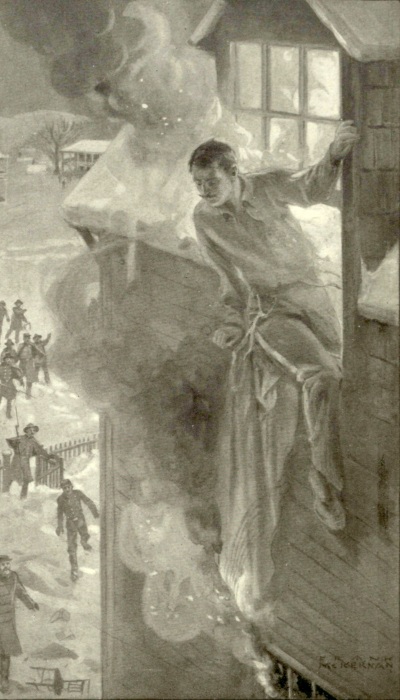
Not since the night of the fire had he set eyes on her. Not since the
night of the dance had he spoken with her, and he was startled to see
the change. Bravely though she bore herself, the flush that mantled her
cheek was but momentary, and left her pallid and wan. Miriam looked as
though she had been seriously ill. Kate Sumter had given him only
hurried and almost embarrassed words of greeting. Mrs. Sumter, however,
had extended both her hands in an impulse of loyal liking and
friendship, and it is doubtful if Bob even saw the daughter's face.
Certainly he never noted the lack of heart in her manner. His eyes had
flitted almost instantly to Miriam Arnold's, and there they hung. A few
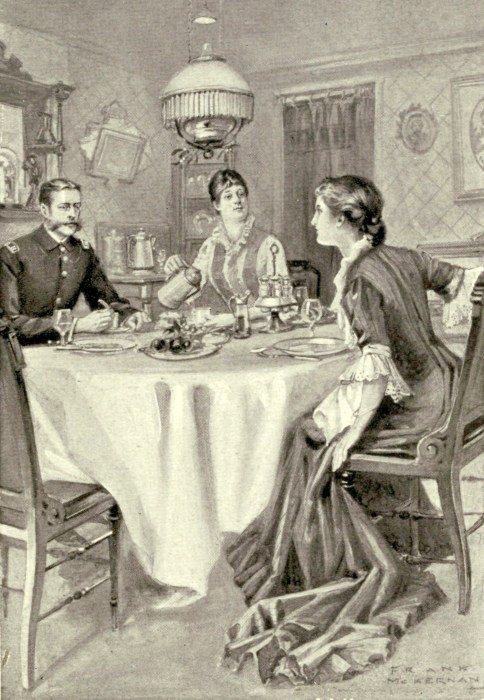
minutes of swift, purposeless chat ensued, Mrs. Stannard and Mrs. Sumter
doing most of it. Then, somehow, three women seemed to drift away and
become engrossed in matters of their own over by the Navajo-covered
lounge, and then Miriam lifted up her eyes and looked one moment into
the young soldier's face.
The bandages had been removed, though his left hand was still encased in
a huge white kid glove, a discard from the hand of Ennis. Eyebrows and
mustache had suffered much, and a red streak ran from the left temple
down toward the neck, yet Bob looked fit and debonair and happy in
spite of his weight of martial woes.
"It's the first chance I've had to thank you for the dance we—didn't
finish," said he, noting with a thrill the tremor of the little hand
that fluttered for that moment in his grasp.
"Do you think it a thing to be thankful for? I don't."
"I wouldn't have lost it for a month's pay, to put it mildly, and it
will take more than a month's pay to repair later damages," said he,
trying to smile and be unsentimental.
"How very much more than that you may lose!" said she. "Do you think I
could have danced with you if I had dreamed what—what you were doing?"
"You were dancing like a dream," said he. "Do you mean I was dancing
like a nightmare?"
"You were doing what was sure to involve you in grave trouble, and—it
wasn't kind to me, Mr. Lanier."
"I'm all contrition for the anxiety it caused you, Miss Miriam, and for
absolutely nothing else. I wish you to know that I did nothing unusual.
Colonel Button was angry with me for a very different matter."
One moment she was silent; then, with lips that quivered in spite of her
effort—a quiver that he saw and that set his heart to bounding
madly—with lowered voice she hurried on: "And that, too, involves me,
or mine. And you"—then uplifting her swimming eyes—"you would not
tell."
And then the barrier of his pride was swept away.
"Miriam!" he cried, his hands eagerly seeking and seizing hers, only
faintly resisting. "There was no need to tell." He was standing facing
her now, close to the curtained window, his back toward the twittering
trio near the dining-room door and imperceptibly edging thither at Mrs.
Stannard's suggestion of coffee. Was this prearranged? Bob never saw
nor heeded. She did, however, and well knew its meaning, and the woman
in her, that thrilled and throbbed at sight of the passion in his eyes
the worship in his face coquetting with her own delight would have torn
herself away to follow them, but her little hands were held in a grasp
against which she might struggle in vain. He was lifting them to his
heart, and as he drew them he was drawing her. She had to come, her long
curling lashes sweeping the soft cheeks, now once more blushing like the
dawn. "Oh, Mr. Lanier," he heard her murmur, as though pleading and
warning. One swift glance he tossed over his shoulder at the last form
vanishing through the doorway, then his dark eyes, glowing and
rejoiceful, fastened on hers, and quick and fervent came the next words:
"There is only one thing that need be told—that must be told, because
I've just been brimming over with it all these weeks" (ah, how the
bonny head was drooping now, but drooping toward him), "and now I can
keep it back no longer. Miriam, Miriam, I love you—I love you! Have you
nothing to tell me?"
One instant of thrilling suspense, then with a sob welling up from her
burdened heart, the barrier of her pride and reserve went as his had
gone a moment ago. "Oh, you know—you know it! Who hasn't known it
since that awful night?" she cried, and then found herself folded,
weeping uncontrollably, almost deliriously, in his arms, his lips
raining kisses on the warm, wet cheek. A moment he held her
close-wrapped to his heart, then gradually, yet with irresistible power,
turned upward the tear-stained, blushing, exquisite face, so that he
could feast his eyes upon her beauty, then with joy unutterable, his
lips sank upon the soft, quivering mouth in the first love kiss she had
ever known, and their troubles vanished into heaven at the touch.
Mrs. Stannard, you were a jewel and a general. Now, how about the major?
"For conference with the Judge-Advocate of the Department," read the
order that summoned him, and from that conference forth went our doughty
dragoon in search of conquest. "It is understood," said the officials,
"that you know the circumstances under which Lieutenant Lanier became
responsible for the money borrowed at Laramie by or for that young Mr.
Lowndes, also that you know him." There were other matters, but that
came up first. Stannard knew and was quite willing to set forth with a
plain-clothes member of the Omaha force on a mission for and from
headquarters.
In a derby hat and civilian suit of the fashion of '72, the latter much
too snug for him, our squadron leader of the Sioux campaign looked
little like a trooper as he sauntered with his detective companion into
the lobby of the Paxton a few minutes later, and listened to his
modernized tale of the prodigal son. It was all known to the police.
Lowndes had run through the purse and patience of his Eastern kindred
some two years before. Lowndes had been transported to a cattle ranch
near Fort Cushing in hopes of permanent benefit, but speedily neglected
the range for the more congenial society of the fort. He was well born
and bred. He was made free at first at the mess, but wore out his
welcome. He went on the campaign for excitement and got much more than
he wanted. He took to gambling among the scouts and packers and
sergeants, for the officers had soon cold-shouldered him. But he was a
college man, a secret society man, as had been Lieutenant Lanier before
entering the Point. Since the campaign Lowndes had been going from bad
to worse; had gambled away the money sent him by his relatives, and
they were now sorely anxious about him. Moreover, he was needed as a
material witness for the defense in the case of Lieutenant Lanier, and
would answer no letters to his post-office address. He hadn't been near
the ranch in nearly a month, hadn't been seen about Cushing City since
the blizzard; was believed to be somewhere in this neighborhood in
disguise.
And even as the story was being told, there came bounding down the broad
stairway from above, a slender, well-built youth, in whom the
civilization of the East was stamped in the stylish, trim-fitting
travelling suit with cap to match, in the further items of natty silken
scarf and the daintiest of hand and foot covering. It was the erect,
jaunty carriage that caught the major's eye. In build, bearing, and gait
the approaching stranger was Bob Lanier all over. He came straight
toward them, and was tripping lightly, swiftly by when Stannard sprang to his feet.
"Rawdon!" he cried, voice and manner at once betraying the soldier and
the habit of authority and command. It was as imperative as the crisp,
curt "Halt" of veteran sentry, and effective as though backed by
levelled bayonet.
But if Stannard for an instant looked for demur, resistance, attempt to
avoid, or even a trace of confusion on the part of this transmogrified
trooper, the idea as quickly vanished. A wave of color, it is true,
swept instantly to the young fellow's temples, but the sudden light of
recognition in his handsome eyes was frank and fearless. Quickly he
whirled about, courteously he raised his cap, instinctively his heels
clicked together as he stood attention to his squadron leader of the
summer agone.
"I beg the major's pardon," said he. "I did not expect him here, and had
never seen him in civilian dress."
And now the detective, too, was on his feet, and curiously noting the
pair.
"You're on furlough I understand, but I heard—my wife said—you were
in Chicago."
"Mrs. Stannard was right, sir. My wife and her father are there now,
visiting my sister. Doctor Mayhew told me of the charges against
Lieutenant Lanier, and that is what brings me back at once."
"Going back at once?" began the major, mollified, yet mystified. "I
presume you know more of these matters than any one else."
"With possibly two exceptions, sir. I hope to nab one of them here."
"Lowndes?" queried Stannard.
"Lowndes," answered Rawdon.
"Then you're just the man we want."
That afternoon as the Union Pacific express stood ready at the Union
station for the start, there boarded one of the sleepers a burly,
thick-set, bluff-mannered man in huge fur overcoat, close followed by
two younger companions. One of these latter, erect and graceful in
bearing, alert and quick in every movement, with clear-cut and handsome
features, was dressed with care and taste, evidently a man accustomed to
metropolitan scenes and society; the other, a youth of probably his own
age, though looking elder, was sallow, shabby, with a dejected
down-at-the-heel expression to his entire personality that told
infallibly of failure and humiliation. At a sign from their leader he
dropped dumbly into a section, settled himself next the frosty window,
with his head shrunk down in his worn coat-collar, and his slouch hat
pulled over his eyes.
"Better pull off that overcoat and make yourself comfortable, Lowndes,"
said the younger man. "You've a long journey ahead."
Whereat a tall, spare, elderly gentleman in the adjoining section slowly
lowered his newspaper and turned half round, while a tall, spare,
elderly, sharp-featured woman beside him, in prim travelling garb,
sprang from her seat and brushing the burly man aside, precipitated
herself upon the shrinking object in the corner.
"Mortimer Watson Lowndes!" cried she. "Where on earth have you been?"
For answer Mortimer Watson bowed his flabby face in his hands and wept
dismally.
Two days later the colonel's office at Fort Cushing was the scene of a
somewhat remarkable trial. It had no force in law, yet was held to be
conclusive. There was no array of uniformed judges sitting, by order, as
a general court-martial. The tribunal consisted, in point of fact, of a
single man, acting as judge, jury and attorney, to wit, "Black Bill"
Riggs, Inspector-General of the Department of the Platte. To the
unspeakable disgust of most of the officers, and the outspoken
disapprobation of many of their wives, only those closely concerned in
or connected with the case were invited to be present. Certain others
who had just happened in, thinking to hear the proceedings, were,
indeed, invited to leave.
Colonel Button, as post commander and principal accuser, was, of course,
at his usual desk. Colonel Riggs, his jealously regarded rival, was
seated at a little table, whereon was much stationery and a stack of
memoranda. Lieutenant Lanier, somewhat pale but entirely placid,
occupied a chair to the left of that table, with Captain Sumter, as his
troop commander and counsel, by his side. Captain Snaffle was in support
of the post commander to cross-question if he saw fit. Barker, the
adjutant, was present, as a matter of course. A headquarters clerk sat
facing Riggs, prepared to take notes, and the trim orderly stood outside
the closed door. Three or four people in civilian garb sat awaiting
summons in the adjutant's office across the hall, and Sergeant Fitzroy,
with trouble in his eyes and wrath in his heart, was flitting uneasily
about in the domain of the sergeant-major.
"If you are ready, Colonel Button," began Riggs, with elaborate
courtesy, "I am, and let me briefly say that I have seen Trooper
Rafferty at the hospital, also certain other men named by Captain
Snaffle; but in order that all parties may be given opportunity to hear
and to examine, and at the request of Lieutenant Lanier, who desires the
fullest investigation and publicity, I have invited you and the captain
to hear what I consider the really valuable evidence. Will you call in
Trooper Rawdon?"
Snaffle's face was a sight when the door opened and there entered a very
self-possessed young man, in stylish and becoming civilian dress, who
nevertheless stood bolt upright, with his hand raised in salute.
"Hwat's he mean by coming here in 'cits'?" said Snaffle, in hoarse
whisper, to his commander.
"Yes, Colonel Riggs; if this man's a soldier, why isn't he in uniform?"
With perfect respect, at a nod from Riggs, the newcomer replied: "My
uniforms, and other belongings of mine, were taken from my trunk in town
during my absence."
"You could have borrowed one," said Snaffle truculently.
"I told him he need not," retorted Riggs. "And now, gentlemen, we'll
waste no time trying to worry the witness. Mr. Rawdon, you were a duly
enlisted trooper, I believe. Take that chair."
"And am still, sir, as far as I know."
"But your discharge is ordered, as I understand it."
"It was applied for and recommended, and General Whipple told me in
Chicago a few days ago it was settled; but that would have made no
difference, sir. I should have been proud to wear the uniform until
officially discharged."
Riggs wheeled in his chair. "Colonel Button, it has been fully explained
to this—man, and to the next, that what they tell us here is to be
just what they would swear to before a court. You can decide for
yourself on hearing it whether you wish them to swear to it or not. Now,
Rawdon, tell us how you came to enlist."
"As the representative of three newspapers, in Chicago and the East.
They were anxious to have an Indian campaign, and the life of an
enlisted man, described as it really was. I joined a squad of recruits
for this regiment right after the news of the Crazy Horse Battle on
Powder River."
"Do you still hold that job?"
"No, sir;" and there was a twitch of the muscles about the corners of
the mouth suggestive of amusement.
"Why?"
"I failed to—give satisfaction. Only scraps of my letters were
published."
"What did they want?"
"Criticism principally, and confirmation of the stories of abuse and ill
treatment of soldiers by their officers."
"Were your letters never published?"
"Three of them, eventually, after the campaign—in the New York Morning
Mail."
Whereupon Riggs spun in his chair and rejoicefully surveyed Button, who
sat like a man in a daze, staring, opened-eyed, at the witness. For the
life of him Sumter could not suppress a chuckle.
"Then, as I understand it, you were favorably impressed with the
life—and conditions?"
"In spite of hardship and privation, yes, sir; and because I found
complete refutation of the stories about the officers, both as regarded
their dealing with the Indians and with their own men."
"Were there any persons with the command who knew you and your mission?"
"Two, sir, as it turned out. Trooper Cary, who enlisted at the same time
I did, and a civilian, Mr. Lowndes, who recognized us at Fort Frayne. We
were at college together. He and Cary became very intimate toward the
last, and yet I think they kept my secret in spite of our falling out."
"Do you care to tell us why you fell out?"
"I prefer that Mr. Lowndes should do that. He and Cary had been chums in
college days, and though we were in the same society I did not know them
then as I do now."
"You had trouble with Sergeant Fitzroy at first, did you not?"
"Almost from the start, sir."
"We have heard his version. What is yours?"
Rawdon's frank face clouded and colored one moment, but the eyes never
flinched.
"It was partly on account of the lady who is now my wife, and partly on
account of—money. Fitzroy is an out-and-out usurer, and has a dozen
sergeants in the regiment in his debt and under his thumb, Captain
Snaffle's first sergeant among them."
"It's a lie!" said Snaffle.
"It's the truth," said Riggs, "and I have other proofs. You will curb
your tongue and your temper, Captain Snaffle, if you please. Go on,
Rawdon."
"I had reason to believe he was squeezing Doctor Mayhew. I had learned
to love Mayhew's daughter. I had a little money laid by, and was getting
a good salary. I made Doctor Mayhew take enough to free himself, and won
Fitzroy's hate on both accounts."
"You are accused of assaulting him the night of the 16th. What of that?"
"I did not even see him or speak to him. I had been in town in the
afternoon, arranging for our marriage. Doctor Mayhew would not hear of
it until I had got my discharge, but we had decided to be married
Saturday morning, and to go East that afternoon, as important business
called me. Mr. Lowndes will tell you that he owed me much money. I had
lost my position as correspondent, needed the cash, and pressed him for
it. He had promised faithfully to have it ready, but ready it was not. I
knew of his relatives in Massachusetts and urged him to telegraph, but
he said he could get some of it, at least, at the fort. So I drove him
and Cary out in a sleigh, left them at the store, and, circling the
fort, spent two hours with Miss Mayhew. Then getting uneasy, as they did
not come, drove round back to the store just in time to see Lieutenant
Foster's sleigh going like the wind to town, and found Rafferty in
frantic excitement. He said there was hell to pay. The lieutenant was in
arrest. Lowndes and Cary had run away with some of his clothes. There'd
been a shindy up the row, and just then a soldier friend came running.
'Skip for your life, Rawdon,' said he. 'There's been robbery at Captain
Sumter's, and Sergeant Fitzroy swears it was you, and that you've struck
him and assaulted him. The colonel orders you arrested wherever found.
The patrols are out now!' There was no time to explain. I lashed my
team to town, caught Lowndes in cavalry overcoat and cap, the fool, and
with not a cent to his name. I gave Cary a note to Miss Mayhew, which he
never delivered, and took Lowndes with me on Number Six at 11.40."
"Then you were not at Captain Sumter's that night?"
"Nowhere near it, sir."
Snaffle's eyes were fairly popping from their sockets. Hadn't he said
all along it was Lanier?
"Now, another matter," continued Riggs. "That night at Laramie of which
you told me. These gentlemen will be interested."
"There was nothing remarkable in that. I had heard of the same thing
being done at West Point. I heard in the nick of time of the order to
the officer-of-the-day to inspect for Lieutenant Lanier. I imagined that
something very serious would happen to him. I knew he'd gone to the
post with Lowndes, and why. So, with my apologies now to the lieutenant,
I slipped round to his tent and into his blankets."
"Did the lieutenant know of it—or of the reason?"
"Never, so far as I know. I doubt if he knows it now. Lowndes told me
the lieutenant—before he entered West Point—was a member of our
fraternity. That was enough."
"And so far as I am concerned," said Riggs, "that is enough. Have you
gentlemen any questions to ask?"
"Not—now," answered Button slowly. "But I desire personally to see—the
witness—later."