I heard the Poet’s voice in the balcony, followed
by the pushing back of heavy persiane, and then:
‘Lamia! Come as quickly as you can; I want
to show you what you may never have a chance
of seeing again.’
There was no reason why, if there was anything
new or wonderful to behold, Lamia and the
Poet should have a monopoly of the spectacle; so,
arraying myself as rapidly as I could, I emerged
onto the balcony just as Lamia, in incomplete but
most fascinating attire, did the same.
‘Oh!’ she exclaimed. ‘What hills! What
slopes! What villas! But where is Florence?’
‘Wait,’ said the Poet, ‘and you shall see.
Like you, dear Lamia, she is very fair,’—how I
wish I had the courage to address her in that
fashion!—‘but, unlike you, she has not yet
flowered out of the night.’
‘Neither have I, quite, I fear,’ she said, showing,
when thuswise reminded, a quite unnecessary concern
respecting her hastily-donned apparel.
‘She is veiled, absolutely veiled, as I have never
seen her before, in a, shall I call it, peignoir of
white mist, which conceals her utterly from sight.
But look! she is beginning to disrobe her marble
beauty.’
‘O, what is that, that surges through the
mist?‘
‘That is the noblest symbol of civic liberty in
the world, the Tower of the Palazzo Vecchio.’
‘And that? And that?‘
‘The topmost tier of Giotto’s Belfry, worthy,
by its sublime simplicity, to serve for the type
of all great Art; and, at its side in the rapidly-clearing
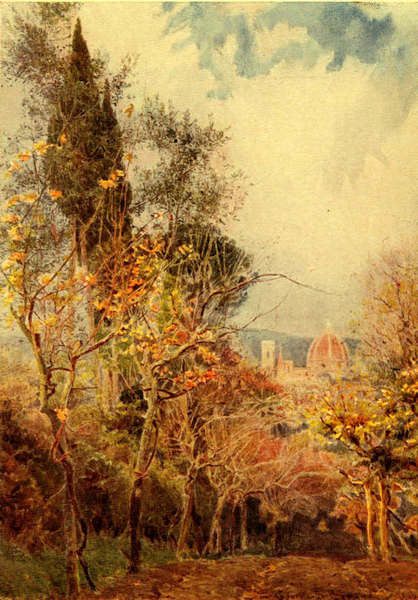
ether, the cupola of the Duomo, that
Michelangelo would not copy and could not
better.‘Dome after dome, tower after tower, campanile
after campanile, surged silently out of the mist;
and, to use the Poet’s I hope not too familiar
simile, the silvery folds of night sank downward
to her feet, and Florence stood in naked loveliness
before Lamia’s delighted gaze. Over the eastern
hills came the bright vernal sun, every mountain
slope broke into smiles and dimples, and in the
last of its seaward valleys Arno glanced and
gleamed with joy of the expanding dawn. Distance
lends enchantment to the sound as well as to the
view, and the clang and clash of innumerable
belfries came modulated through the intervening
air, wherefrom the last lingering trails of mist were
gradually wizarded away.
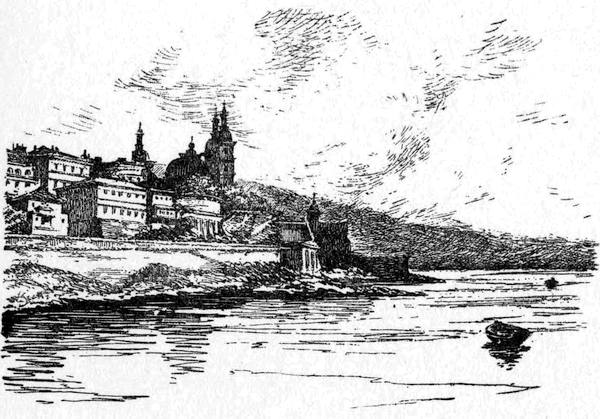
FLORENCE
Question and answer followed each other in
uninterrupted succession. Yes, that was San
Miniato Al Monte, with La Bella Villanella
hard by; and that beyond was Santa Margherita,
neighboured by the villa in which Guicciardini
completed his History. And yes,—Lamia was quite
right,—that was the Torre del Gallo, and away to
the right and farther up the hills was the Medicean
Poggio-a-Cajano, where Lorenzo wrote his
poem on the Ambra. Over the matchless panorama
of hill and valley her interrogatories wandered
unceasingly, whilst we called on our recollection to
supply the names she asked for.
Suddenly, other persiane were pushed back, and
Veronica joined us.
‘What are you all doing?’
‘Do you remember,’ answered Lamia, ‘the wife
of Cosimo, Pater Patriæ, asking him, when advanced
in years, why he so often sate with closed eyes, and
his answering that he did so in order to accustom
them to what they must soon always be doing? I
am opening mine thus early, feeling that, in such
a world as this, I shall never be able to close them
again.’
‘It is perfect, absolutely perfect,’ said Lamia,
‘and no wonder Politian found it so.’
‘But did Politian really live here?’ I asked.
‘Let us be wise enough to think so,’ said the
Poet, ‘and it was quite in keeping with Lorenzo’s
magnificence, when that testy scholar, to whom he
had committed the tuition of his sons, quarrelled
with Donna Clarice because she thought she also
should have something to say to their training, to
provide him with such a sanctuary. Besides, in
Italy, Tradition is not, as some one has said
she is elsewhere, a toothless old crone with memory
half gone, but the trustworthy depositary of unforgotten
glories.‘
‘It is more than a tradition,’ said Veronica.
‘Only this morning I came across a passage from
Politian’s correspondence, which would seem to
confirm local legend. Here it is. He is writing
to Lorenzo. “When you are incommoded by the
heat of the season at Careggi, you will perchance
bethink you of the shelter of my abode, nor deem
it undeserving of your notice. Nestled in the
sloping sides of the hill, we have here water in
abundance, and, being constantly refreshed by
moderate breezes, experience but little inconvenience
from the fervour of the sun. As you
approach the villa itself, it seems embosomed in
a grove; but, when you reach it, you discover
that it commands a full view of the city. Though
the neighbourhood is not without its denizens, I
can here enjoy the solitude so congenial to my
disposition. But I can offer you the temptation
of other allurements. Wandering beyond his own
boundaries, Pico della Mirandola sometimes steals
unexpectedly on my retirement, and draws me from
my seclusion to share his supper. What that is,
you well know; modest indeed, but neatly served,
and made grateful by the charm of his converse.
But be you my guest. The meal shall be as good,
and the wine better.”‘
‘How very philosophic!’ said Lamia. ‘So
much so, that the passage was probably written on
the morrow of a certain fascinating young woman,
whose name I cannot remember, but of whom
Politian, I have read, was, notwithstanding his
erudition, deeply enamoured, giving her hand to a
rival scholar, though which of them, I need scarcely
say, I have equally forgotten.’
‘The great Marullus, I think,’ said the Poet;
‘and your fascinating young woman was Alessandra,
the accomplished daughter of Lorenzo’s
Chancellor, Bartolomeo della Scala, whose house,
still standing, you must remind us to show you in
Florence.‘
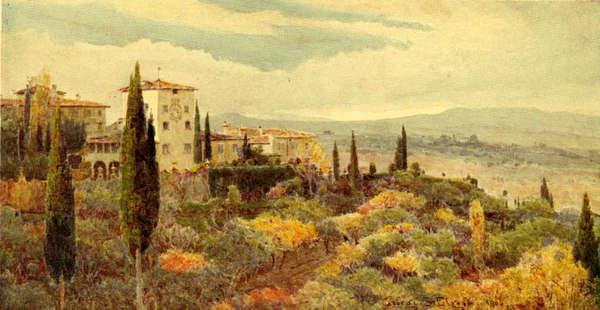
A TUSCAN VILLA
Our first business was to make acquaintance
with the immediate surroundings of the home provided
for us by Veronica’s indefatigable foresight,
operating through a protracted correspondence
none of us had been deemed worthy to peruse.
The rural architecture of Tuscany is of a noble
simplicity; and, in the main portion of our villa,
built in the course of the sixteenth century, there
was no deviation from the familiar type. But,
adjoining it westward, and seemingly of more
ancient date, were an upper and a lower loggia of
conventual aspect; the upper one having a sloping
roof of rich red tiles supported by graceful
pillars of pietra serena, and the lower one serving
as an Italian equivalent of an English verandah,
only more spacious and more tasteful, in which we
could sun or shade ourselves according to the
mood of the weather. Together, they formed an
impenetrable barrier against the well-known keenness
of the tramontana, while the main building
provided ample shelter against possible inclemency
from the east. To the west our view was over
the final valley of the Arno, that spacious plain of
fertile cultivation tenderly protected by hills of
exquisite shape and moderate elevation, on whose
bolder ridges stand historic towns of unmatched
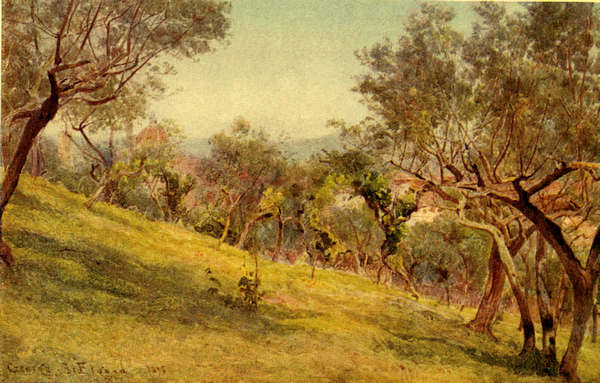
picturesqueness; while southward, over vineyards
and olive-groves terraced down precipitously-sloping
ground, we gazed on the domes and towers
of the fair Tuscan capital. If one lives on the side
of a hill, one cannot reasonably expect to have a
very vast level expanse for the purposes of a
garden. A quadrangular space of modest dimensions
between the house and the low boundary wall,
where the ground began to fall away, was all that
had been dedicated to that pleasurable end; and
this afforded Lamia an opportunity of observing
that two such enthusiastic horticulturists as the
Poet and myself would find but few worlds to
conquer in so narrow a territory.
‘Forget,’ I ventured to plead, ‘what it is useless
to remember. England is well enough, and so is
Italy, but only on condition that you do not ask
from the one what belongs to the other. I am
not quite sure that the person who is intimately
acquainted with both is ever quite satisfied with
either, since it is part of our perverse human
nature mentally to extol what we have not, to the
depreciation of what we have.’
‘Is it to a woman you say that?’ observed
Lamia, to my complete confusion. ‘Men preach
Philosophy, women practise it; and I shall probably
show myself quite content without your
well-filled borders, while you inwardly, and
perhaps sometimes outwardly, long for your
rampant greenery and untidy efflorescence.
These garofani—you see,’ she said, turning to
the Poet, ‘I know the Italian for carnations,—in
their tasteful pots along the loopholed wall are
much more to my taste than all the straggling
annuals and robust perpetuals in the world.’
‘I can see,’ he said, kindly coming to my
rescue, ‘you have found your proper home at last.
I thought it would be so; and we can only congratulate
ourselves on the result. But now let us
explore farther afield, and we shall probably find
that, if we will only use the word garden in a
liberal sense, and indeed in that in which it is used
in the corner of England where we have our home,
there is more of it than we have just rashly
assumed.’
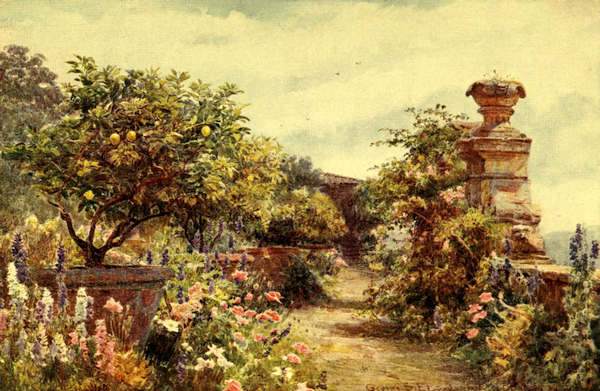
Thereupon, we passed through a cool, spacious
cortile, cloistered on two of its sides, but for the
rest open to the sky, and whose only occupants
were a disused fountain and a tall glistening orange-tree
covered with golden fruit, of course of the hardy
bitter sort; thence under an archway festooned
with wistaria not yet in flower, and out into the
podere, which I must needs call by that name, since
there is no English equivalent for it, and which is
nowhere to be seen in such perfection as in
Tuscany.
‘Indeed, indeed you are right,’ exclaimed
Lamia; ‘right as when you once said that, were
it always Spring, one would never garden, even
in England. O this young green corn, with its
purple anemones, its crimson tulips, its pale almond
and intensely bright peach blossom, its fantastically
growing fig-trees with their budding tips, its burgeoning
vines and spectral olive-trees, all dwelling
together on the fair hillside that seems to be
smiling self-complacently at its own loveliness!
Look at that bank of irises, not yet broken from
their sheath! But when they have, what a sight
they will be!’
It is always delightful to have one’s feelings
expressed by some one else in language of enthusiasm
one might oneself be afraid to employ; and we
accompanied Lamia, as a sort of chorus, echoing
all she said, and only too well pleased to follow in
her footsteps, as she wandered on and on through
a world of beauty wholly new to her.
‘And these lovely grassy paths,’ she said, ‘that
lead everywhere and nowhere, tempting one to
travel on in search of something unknown, but
with ever, on either side, more sprouting wheat,
more pendent vines, more crookedly-branching
fig-stems, more tulips, more windflowers, more
mountains, more glimpses of towers and belfries in
the glittering distance. In England everything
seems to crouch. Here everything seems to
soar.’
Lured onward by Lamia’s enjoyment, and
mounting by such easy and gradual slopes that we
hardly noticed we were ascending, we suddenly
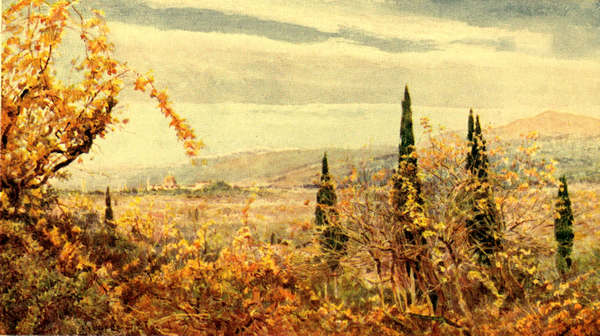
came to a grassy plateau almost encircled by secular
cypresses that are the distinctive glory of Tuscany;
and here we might have been tempted to halt, had
it not been that yet beyond it were rugged paths
that zigzagged among tall, dense bushes of white
heath and yellow broom, both now in full flower;
while on shapeless boulders and protruding rocks
were the stars of the white, the yellow, and the
rose-coloured cistus. Here and there we came on
sheets of the single pink anemone; elsewhere, in
the more sheltered nooks, were the Apennine wind-flower
which, with due care and choice of position,
perhaps you remember, we have persuaded to
flourish in the garden that we love.
‘As Veronica has told us that we are to lead
a life of strict simplicity,’ said Lamia, ‘we had
better do something to make it graceful; and, if
you two will only cut some branches of heath and
broom, I will be equally energetic among the
anemones.’
We were descending homeward with our lovely
spoil, when we heard a creaking sound well known
to me; and, in another moment, we overtook the
slowly-rolling wheels of a wooden wain—of wood,
not only in its low, long body, but of wood
throughout, with wooden wheels, wooden pole,
and wooden yoke—drawn by a couple of cream-coloured
steers, and bearing a fragrant load of
newly-cut rye-grass. Though at no little inconvenience
and delay, on the incline along which it was
moving, the peasants who accompanied it at once
cried a halt, that they might show their respect to
and make the acquaintance of the new-comers.
Of the manifold charms of Tuscany, perhaps there
is none so great or so enduring as the charm
of manner peculiar to its rural population. Frank
without being free, deferential but never servile,
not without a fine reserve yet with never a touch
of shyness, withholding not a certain tribute
to social superiority, while tacitly intimating the
fundamental equality that appertains to human
brotherhood, the demeanour and speech of Tuscan
contadini keep intercourse perpetually fresh, and
impart to conversation on the tritest and most
familiar themes perennial liveliness and interest.
Their salutations, frequent though these be, for
they would never think of passing you without
one, are divested of conventionality by their manifest
sincerity. They can never see you, never
speak to you, too often; and, whenever they speak,
they smile. For thousands of years, morning has
risen upon the world, but without any diminution
in its freshness; and it is the same with their Buon
giorno, signore! their Felice sera, sua signoria!
their Felicissima notte, e buon riposo! their A
rivederla! and all their ancient consecrated phrases
for conveying their sense of the strong link that
binds human creatures to each other. Every time
they say these things, they mean them; nor do
they ever tire of the iterated and reiterated courtesies
of life. The undeferential nod of Northern
manners, the mumbled recognition, the slipshod
salutation, would seem shocking to them, as
lacking in human piety. On this occasion, no
doubt, natural curiosity blended with native good-breeding
to make them halt in their labours; for
they were, I have no doubt, as eager to make our
acquaintance as we were to make theirs. Yet of
visible curiosity there was not a trace, as they lifted
their hats from their beaded foreheads and remained
bareheaded till we begged them to cover themselves.
What they conveyed was a fervour of welcome
akin to the glow of an Italian sun, a welcome that
warmed us through and through, and made us feel
that, at that instant, we were forming friendships
that, save for some fault of ours, would last through
life. Were we all in good health? Had we had
a fatiguing journey? Were we comfortable and
happy in the villa? They hoped we were going
to stay a long time. Could they do anything for
us? Did we love Italy? Had we been there
before? O, but it was evident we had; for we
talked their language like one of themselves
(somewhat of an exaggeration, save in the case of
Veronica). Yes, the season was fairly forward,
and there was good promise for everything, given
what was now wanted, plenty of sunshine. Commonplaces,
you perhaps will say. Indeed, yes.
But which of us in this world is so surprisingly
original? The real originality, in some countries
I could mention, would be amiability, unfailing
courtesy in the ever-recurring trifles of life, a wish
to please and to be pleased, and a perpetual freshening
of existence by treating nothing in it as a
matter of course, or as undeserving of recognition
and thankfulness. Even the most original of us
are original only sometimes; and, if we are to consort
with each other at all, we must needs indulge
in a good deal of repetition and commonplace.
But freshness of manner can make repetition sound
absolutely new, and kindliness of disposition invest
the veriest commonplace with an air that everybody
shall take for uncommon.
It was with difficulty we led Lamia away from
her new acquaintances, not the least attractive of
those being the sleek, smooth-coated, soft-eyed
oxen that play so large a part in the picturesqueness
as in the rural life of Tuscany, and that seemed
to appreciate the tender stroking of her hand and
the equally soft caress of her voice.
‘I never felt such a bumpkin before,’ she said,
‘as in the presence of those gracious peasants.
What barbarians they must think us!’
‘If they thought that of you, Lamia,’ I said,
more struck by the exaggeration than by the
humility of her remark, ‘they certainly contrived
to conceal their impression. Still, speaking generally,
rural Tuscany is a school of manners.’
The noble simplicity referred to as the distinguishing
mark of villa architecture in Tuscany, is
as dominant in the interior as on the exterior of its
buildings; ample space being their chief feature and
adornment. Unless they have been invaded by
modern hands, they depend for effect on bold outlines
rather than on decorative detail; and they are
furnished in harmony with the same severe taste.
When Veronica admonished us that we were to lead
a life of strict simplicity, she referred to this
circumstance among others.
‘I hope,’ she said, ‘you have left your sybaritic
tastes at home. You will find many shapely but
no comfortable chairs, no superfluity of cushions,
nowhere a footstool, and, if you choose to lie on
what looks like a sofa, you will soon find you are
not reposing on rose-leaves. You must not come
to me and complain that there is not a bell in your
room, or, if there is, that it apparently has no
communication with the outer world. If Lamia
wishes to make a mess indoors with her flowers
and branches of blossom, she shall not be denied;
but you must not look for those more permanent
graces of life to which you are all so attached.’
‘Don’t mind me,‘ said Lamia. ‘I am quite
prepared to empty my own bath, brush my own
skirts, answer the bell instead of ringing it, and
live on fagioli and dried funghi. Indeed, it was
chiefly to indulge in those unusual luxuries that I
came to Italy.’
Considering who it is that has created, cherished,
and fostered in us those sybaritic tastes, and
that attachment to the graces and elegancies of life
of which Veronica spoke, and with which she told
us we were now to dispense, we may be pardoned,
I think, if, at the first opportunity, we indulged in
some private humour at her expense. If we are
demoralised by domestic luxury, who is it but
Veronica that has corrupted us? I protest that
most men, in the matter of material comfort, are
absolute Spartans, and, as for the Poet, his native
austerity was once not to be surpassed, and he
still indulges from time to time in his ideal, at
any rate in conversation. But he too has, for the
most part, succumbed to Veronica’s unequalled
capacity for making life at once graceful and
commodious; and I am not sure that now he
would not, if at home, feel almost wronged if,
should he happen to want a paper-cutter, he had to
rise from his chair in order to go in search of one.
‘Just you wait!’ said Lamia, ‘and see what
becomes of the simple life to which we are to
dedicate ourselves. The first time Veronica goes
to Florence, she will return, I will engage to say,
laden with manifold conveniences of existence,
and by degrees she will introduce a world of things
into this splendid vacuum; and if, some fine
morning, you meet a plumber or bell-hanger on the
stairs, you need not regard him as an interloper.
Nor would I mind wagering my next quarter’s
dress-money that, before long, you will see me
sitting in the easiest of easy-chairs, and gracefully
reposing on the softest of ottomans.‘
‘I doubt it,’ said the Poet, ‘for Veronica has a
fine sense of the fitness of things, and her tastes
are sufficiently flexible for her to distinguish
between Northern and Southern needs, Northern
and Southern traditions. When Francesco Cibo,
the nephew of Innocent VIII., married Lorenzo’s
daughter, and came to Florence with a large and
splendid retinue, he was entertained during the
period of the nuptials with the utmost magnificence.
But, at the end of that time, he observed that all
the silver vessels and ornaments, of which there had
been such a profusion, disappeared from the table,
and were replaced by others of brass; and, moreover,
that every meal was now served with the utmost
plainness and frugality. Anxious lest his Roman
attendants should carry back to the Eternal City
the impression that he had contracted a union with
either a very poor or a very parsimonious family,
he sought to discover how they were faring, and
found they were still being entertained in the most
sumptuous manner. The enigma was explained
when Lorenzo said to him, “You are now one of
ourselves, and as one of ourselves I treat you.
My grandsire Cosimo used to say to his sons,
‘Remember you are only citizens of Florence, and
must reserve what splendours you can command
for the glorification of the City.’ As his descendant,
I obey his injunction.”‘
‘Hark!’ I said. ‘Already there are sounds
of modern civilisation. The grass-plot is being
mown.’
Lamia and the Poet listened, though I think
the latter at once guessed my meaning.
‘What is it?’ said Lamia. ‘A mowing-machine?
I cannot hear it. I hear only the
bleating of sheep.’
We passed afresh into the garden, and there
was a flock of ewes and lambs nibbling the sweet
short clover, attended by a picturesque shepherd
girl, who carefully kept them off the shrubs, but
went on industriously knitting all the while.
‘Is not that a simple enough mowing-machine
for you?’ I asked. ‘It attains to even Veronica’s
ideal of primitive expedients.‘
‘It is as simple and primitive,’ said Lamia, ‘as
much of the garden itself. What a comfort it is
to find oneself in a country where’—I imagine
this was intended as a shaft against myself—‘there
does not rage a fidgety mania for perfection.
Flowers here are reduced to their proper subordination
in the universe.’
Whether Lamia was right or wrong in this
conclusion, it must be allowed that, as a race,
Italians have not that tender attachment to flowers
which is universal among ourselves, and that being,
contrary to general belief, far less sentimental and
more practical than we are, they do not care to
devote much attention to the growing of anything
that cannot be taken to market and turned into
quattrini, or ready cash. Hence, they will willingly
grow carnations, freesias, arum-lilies, lilies of the
valley, ranunculuses, and such like flowers that
find a quick sale on the ledges of the Palazzo
Strozzi, or under the shadow of the Municipio in
the Piazza della Trinità. But even these are
so reared that the purchaser alone gets any
delectation out of them, and the spot where they
are produced is but little more of a garden in
consequence of their temporary presence. The
difficulty is to induce an Italian gardener to
believe that you care for flowers for their own
sake, that you regard the sale of them as a sort
of desecration, that you feel they ought to be
love-gifts, tokens of present or mementoes of
absent affection, and, in any case, cherished companions
of one’s private thoughts, one’s habitual
pursuits, and one’s transitory emotions. He cannot
understand that you want to consort with
them, to tend them in sickness and health, to
cultivate them for better or for worse, to let them
twine and garland themselves about your inner
and your outer life, to make them, in fact, flesh
of your flesh, and spirit of your spirit, till death
do you part, when, with a sweet form of suttee,
they will come and immolate themselves upon
your grave.
This conflict of ideals between the Poet and
myself on the one side, and Ippolito, the gardener,
on the other,—for the humblest folk in Tuscany
have classical names, which they imagine to be
Christian, and indeed frequently are so, thanks to
some primitive martyr in the Church Calendar,—began
at once, and never wholly ceased. We put
our veto on the sale in Florence of flower or leaf
grown on the premises; and as Veronica, with all
her marvellous foresight, had not extended our
contract to these, we had to arrange with him what
was to be paid by us for what would otherwise
have been profitable produce. Ippolito’s calculations
were of the most elaborate character; but
their complexity arose solely from his scrupulous
desire to do justice as between man and man.
Personally, he had no money interest in the matter;
for, but for what he regarded as our unaccountable
tastes, he would have carried all the saleable flowers
twice a week to that charming little market-place
which every visitor to the fair city knows so well,
made the best bargain he could with the purchasing
public, and credited his padrone with the amount
received. Selling the flowers, he could know, to a
centesimo, what they were worth. Not selling
them, in deference to these odd forestieri, and
therefore having to surmise what they would
probably have fetched could they have been sold,
and anxious neither to defraud his master nor to
rob us, he lived, during our sojourn, a life of
continual arithmetical anxiety. In vain were the
Poet’s magnificent endeavours to make him understand
that we were not, as modern language has
it, so mighty particular as to what we paid for
rescuing the flowers from what he regarded as an
ignoble doom. We could excite no sentimental
emotion on the subject in Ippolito. To him it was
simply a matter of addition in decimals, the sum
total of which should represent the practical results
of abstract justice. It must not be supposed,
however, that this quite satisfied him, or entirely
quieted his conscience. To the last he let us
perceive that he considered our arbitrary conduct
to have a certain moral obliquity about it, since it
caused and consecrated so much absolute waste;
waste of time, waste of material, waste of money.
Once, when we were not present, he appealed to
Veronica, and asked if we were really in earnest in
forbidding him to sell any portion of the flowers.
The violets flowered by tens of thousands, the
carnations were rotting on their stalks, and it was
not possible more freesias could be wanted for
indoors; and, with his Ma, Signora mia, and
Senta, Sua Signoria, he did his best to convert her.
But she told him we were inexorable; and, though
she fully shared our sentiments on the subject, she
laughed at us for a couple of zucconi, or dunderheads,
for allowing ourselves to pay twice what the
flowers were worth: a form of judgment which, as
we have seen, was not quite equitable, but which
nevertheless represented, with tolerable accuracy,
the low estimate she entertained of either the
Poet’s or my capacity for a bargain.
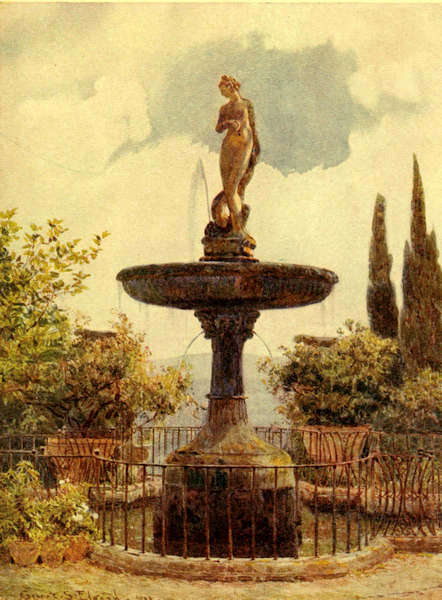
A NOBLE FOUNTAIN
Once Ippolito was thoroughly convinced of our
obduracy concerning his mercenary traditions, he
showed an amiable readiness to please us, by bringing
pot after pot of well-grown plants from frame
and shelf and sheltering nook, and placing them
where we would, and mostly round the noble
fountain that flashed quietly but unceasingly in the
centre of the garden enclosure; though he well
knew that, even in the genial weather with which
we were being favoured, the length of their days
would thereby be somewhat curtailed; white arum-lilies,
freesias, lilies of the valley, and early
carnations, thus making a most lively show.
‘Do not suppose, though,’ I said to Lamia,
‘that Italy has not its true garden season, even in
the English sense; and I trust you will, in due
course, be able to judge of it for yourself. But it
is brief in its marvellous beauty. Like the people
themselves of this lovely land, the year ages soon,
when compared with the lagging Spring, the lingering
Summer, and the slowly-ripening Autumn of
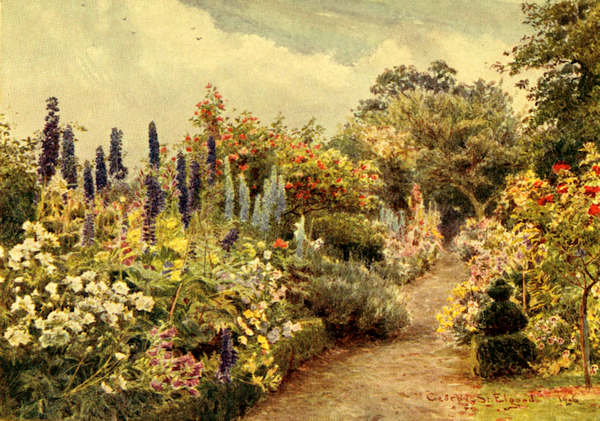
Northern climes. But when the roses come they
will come in battalions, the wistaria will run riot
over wall and pergola, the Spiræa Van Houtte will
whitely decorate itself with a lavishness unknown
to chillier latitudes, and Madonna lilies will astound
you by their height, and irises by their profusion.
For a month, in a favourable season for six weeks,
one will be embowered in bloom; then suddenly to
find, if one gardens in English fashion, you have
no garden at all.’
‘A short life and a merry one,’ said Lamia:
‘an ideal existence.’
‘But do not let us forget,’ I observed, ‘that
when this brief exuberant blending of Spring and
Summer has passed away from the garden, the
purple and opal bunches of the festooned and
trellised vine come timely to take its place.’
‘Nor,’ added the Poet, ‘should we omit that
bewitching preliminary to the profuse period you
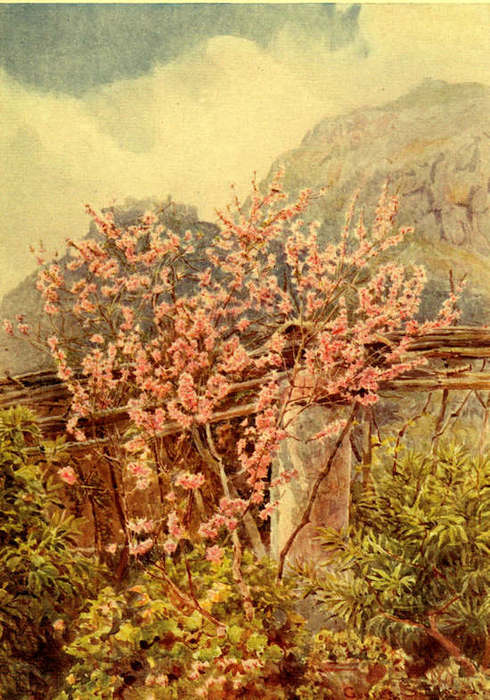
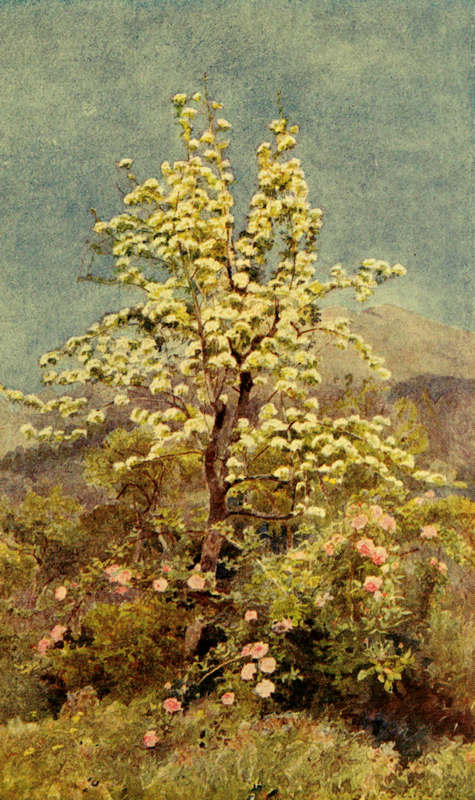
speak of, when, as now, in whichever direction you
look or ramble in that astonishing valley, almond
and peach, plum-blossom, pear-blossom, and
apple-bloom, fleck with their rich rival tints, from
purest white to rosiest pink, the silvery spray of the
ubiquitous olives.’
‘Silvery till ruffled by the wind,’ he went on,
‘as Lorenzo so admirably describes it in his poem
on the Ambra.
‘L’uliva, in qualche dolce piaggia aprica,
Secondo il vento par, or verde, or bianca.‘
‘What an incautious quotation!’ said Lamia;
‘and, were I a critic, I should at once fasten on
you a charge of gross plagiarism. I remember, if
you do not:—
‘The smiling slopes with olive groves bedecked,
Now darkly green, now, as the breeze did stir,
Spectral and white, as though the air were flecked
With elfin branches laced with gossamer;
And then so faint, the eye could scarce detect
Which the gray hillside, which the foliage fair;
Until once more it dense and sombre grew,
To shift again just as the zephyr blew.
‘Have I not established my case?’
‘Completely, my dear Lamia; and I am glad
to find myself in such excellent company as that of
Lorenzo, more especially now that we have taken
possession of a villa where he must often have
been a guest, with Politian for host, and Poggio
and Pico della Mirandola for companions.‘
‘I fear,’ said Lamia modestly, ‘I should have
found them too learned to be congenial society.’
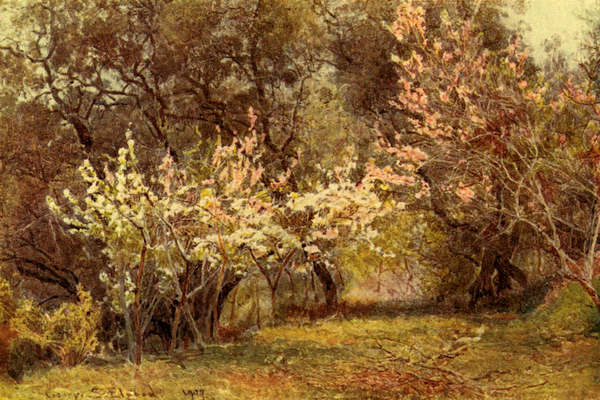
PEACH, PLUM, AND PEAR-BLOSSOM
‘Not when Lorenzo was with them; for he
assimilated their learning to life, and contrived to
make gaiety out of their scholarship. With more
even than the statesmanship of his grandfather,
and of whom it may equally be said that he ruled
without arms and without a title, endowed with
no inconsiderable portion of the culture of the
students he so generously abetted, Lorenzo was a
thorough man-of-the-world, and more than a
respectable man-of-letters. I recommend to you
his description, in the Selve d’ Amore, of the
shepherd leading his flock from the wintry fold to
the Spring pasture, and carrying in his arms a
newly-dropped lamb, his sonnet on the origin of
the violet, and, still more perhaps, the one in praise
of rural sights, sounds, and solitude. Permit me
to cite at least a portion of it:—
‘Cerchi, chi vuol, le pompe, e gli alti onori,
Le piazze, e tempi, e gli edifizi magni,
Le delicie, il tesor, qual accompagni
Mille duri pensier, mille dolori.
Un verde praticel pien di bei fiori,
Un rivolo che l’erba intorno bagni,
Un augelletto che d’amor si lagni,
Acqueta molto meglio i nostri ardori.‘
‘I fear,’ said Lamia, ‘I have not yet made
sufficient progress in my studies to follow your
recitation completely. Will you kindly translate?’
‘Let a spontaneous paraphrase suffice, which
will reproduce the original with, if with less
literary perhaps with more spiritual, accuracy.
‘Covet who will the patronage of Kings,
And pompous titles Emperors bestow,
Splendour, and revelry, and all that brings
A thousand bitter thoughts, a world of woe:
A meadow glistening in an April shower,
A green-banked rivulet, and, near his nest,
A blackbird carolling in guelder bower,
‘Tis these that soothe and satisfy the breast.‘
‘Surely it is strange,’ I said, ‘that a man so
occupied with affairs of State as Lorenzo, conspiring
and conspired against from morning to night,
a landowner not indifferent to the prosperity of his
estate, a banker attentive to the profitable employment
of his capital, a father most anxious for the
wise bringing up of his sons, a collector of manuscripts,
gems and intaglios, a founder of libraries,
an owner of alum mines, a prince, a statesman, and
a diplomatist, should not only have experienced
such a sentiment as you have cited, but should
have found leisure to give expression to it.’
‘And in so short a space of time,’ said Lamia,
more indulgent than usual to my observations.
‘Was he not only forty-one when he died?’
‘He was,’ I said, ‘but he seems to have lived
every hour of his life, and to have acted on the
principle he lays down in his contribution to the
Disputationes Camaldulenses, that life should consist
in equal parts of action and contemplation; thereby
being rather at issue with Plato, whom he loved
so well. But even in his most contemplative
moods he never seems to be divorced from the
themes that interest mankind. There is a passage
in a poem of his expository of the Platonic Philosophy
which some critics have thought gave
Michelangelo the suggestion for his famous marble
Sonno, which you will shortly see in the Sacristy of
San Lorenzo; while, in his Simposio there is a
description of a toping friar which is worthy of
Chaucer, and in the Canzoni a Ballo and the
Canti Carnascialeschi, which I cannot recommend
you to read save in what you will scarcely find, an
expurgated edition, he expresses the very thoughts,
feelings, and ideals of the populace of Florence.’
‘Veronica shall be my Bowdler,’ said Lamia,
‘and meanwhile I thank you for your erudition!
But, as it happens to be my birthday, do you
think you could forget the Medici for a few
moments, if only to wish me, in the most conventional
manner, “many happy returns”?‘
I had not forgotten the circumstance, and indeed
had armed myself with a propitiatory gift which I
intended to offer later in the day. But, before I
could stammer out my excuses, she put her hand
in that of the Poet, and said:
‘Perhaps you have forgotten that, not very
long ago, you rebuked me most gently for one of
my numerous foibles, and that I asked you to tell
me what I ought to do, and to be, in order to
merit your approval. Will you, for a birthday
present, tell me now?’
We had come, in our saunterings, to the long
low wall, leaning over which we gazed down direct
on Florence.
‘With pleasure,’ he said, ‘and I must only
hope you will not think me too severe.
A BIRTHDAY PRESENT
I
‘“Say what, to please you, you would have me be.”
Then listen, dear!
I fain would have you very fair to see,
And sweet to hear.
II
‘You should have Aphrodite’s form and face,
With Dian’s tread;
And something of Minerva’s lofty grace
Should crown your head.
III
‘Summer should wander in your voice, and Spring
Gleam in your gaze,
And pure thoughts ripen in your heart that bring
Calm Autumn days.
IV
‘Yours should be winning ways that make Love live,
And ne’er grow old,
With ever something yet more sweet to give,
Which you withhold.
V
‘You should have generous hopes that can beguile
Life’s doubts and fears,
And, ever waiting on your April smile,
The gift of tears.
VI
You should be close to us as earth and sea,
And yet as far
As Heaven itself. In sooth, I’d have you be
Just what you are.‘
O these poets! I need scarcely say that, after
this insidious effusion, I stowed away the present
I had intended for Lamia in a secret drawer,
reserving it for some more propitious occasion.
I hope I am not prejudiced when I say that the
verses were scarcely among the Poet’s happier compositions.
But diamonds would have lacked lustre,
after such metrical adulation.
But did you go all that way, it will perhaps be
asked, and introduce Lamia to the acknowledged
fascinations of Tuscany, only to wander in search
of wild-flowers, to climb rural hill-sides, to rave
about scenery and sunshine, to listen reverentially
to the Poet’s rhymes, and to discuss things in
general, and Lamia’s favourite themes in particular?
Surely, you may be disposed to add, all those things
could have been done just as well at home. Had
Florence itself, its churches, its palaces, its galleries,
its storied thoroughfares, no attraction for you all?
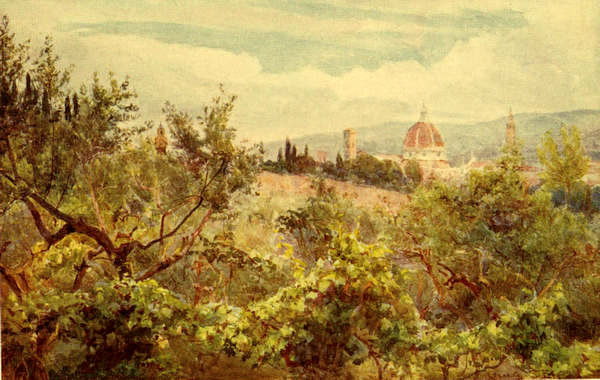
FLORENCE
Indeed they had. But these have been written
about with such minuteness by the learned, and
with such fervour by the enthusiastic, that you
would hardly thank so homely a pen as mine for
describing them afresh. Moreover, let it be confessed
that we had a way of our own, which is
hardly the common way, of impressing Lamia’s
sensitive mind with the artistic marvels of the City
of Flowers. To the rest of us, Florence was
already as familiar even as the Garden that we love,
and the Poet had a theory, in which I entirely concurred,
as to how Lamia’s familiarity should grow
to be like ours, with a reserved freshness of its
own. ‘There are two ways,’ he said, ‘of
approaching a place like Florence. You can try
to take possession of it, or you can allow it to take
possession of you. The first is the more usual,
but the second is, I would suggest, the more
excellent way. Once when I was travelling hitherward,
I remember an American tourist who was
the only other occupant of the railway compartment,
asking me if I knew Pisa; and, on my replying
that I did, he said he should be much obliged if I
would point it out to him. Shortly we approached
it, and the train slackened pace in order to make
the customary halt of some seven or eight
minutes. “This is Pisa,” I said, and he at once
leaned out of the window, and there he remained
intently gazing till its Duomo, Leaning Tower,
and Baptistery, could be seen no more. Then
he turned to me, and said, “I thank you, sir, for
showing me Pisa. I should not have liked to
return to the States without having seen Pisa.”
I beg of you not to take my fellow-traveller as a
national type, for Americans are as various, and
differ from each other as much, as the people of
other countries. But I cannot think he had seen
Pisa. Yet numbers of people resemble him in
their tacit assumption that a hasty visual impression
or snapshot, so to speak, deserves to be
described as seeing, though, assuredly, where great
works of art are concerned, it is not to see with
the mind’s eye, to say nothing of the spirit’s.‘
‘I am easily taken possession of, as you know,’
said Lamia, for a moment pointedly turning to me,
who certainly know nothing of the kind, and
indeed know very much the reverse, and then redirecting
her attention to the Poet. ‘But, if one
is to be taken possession of by all the lovely places
and things in this world, would not one have to
live to a rather venerable age?’
‘There is an alternative,’ I said, ‘is there not?
which is to be taken possession of by only some
of them, but to be taken possession of by these
thoroughly.’
‘How conjugal and domestic that sounds.
But it makes no allowance for feminine curiosity.
I should be sorry, when we leave Florence, to think
there was anything in it worth seeing I had not
seen.‘
‘Neither shall there be, I hope,’ said the Poet,
‘but, if one is really to see what is worth seeing, I
think one must bridle one’s curiosity a little about
much that is not worth seeing. The specialist, no
doubt, must be boundlessly curious concerning his
particular pursuit, and the professional student
of Art is a specialist. We are, at best, only
dilettanti, and seek solely to expand our minds
through sympathetic and discriminating enjoyment.‘
‘In fact,’ said Lamia, ‘it is with Art as with
Life. If one is to enjoy it, one must not know
too much about it. In that case, I can promise
myself, during the next few weeks, no end of
pleasure.’
We none of us, unless it be Veronica sometimes,
resent Lamia’s seemingly irrelevant way of diverting
a discussion, and the Poet has less reason than
any of us to do so, since she not only accepts his
utterances as words of absolute wisdom, but invariably
strives to shape herself according to his
canons of life and conduct. Accordingly, when we
descended into Florence, which was pretty often,
she manifested neither impatience nor curiosity,
but suffered herself to fall into the fortuitous
fashion of wandering about it that he recommended.
We had neither guide nor guide-book; and, if any
of us showed a disposition to enter here or to linger
there, we entered or lingered as a matter of course.
Lamia was left to her own impulses in giving
much or little attention to tomb, fresco, statue,
altar-piece, pulpit, or doorway; nor was she distracted
by any information concerning them till
she asked for it. Then, indeed, it was given most
willingly, and it was rarely that one or other of us
could not answer her inquiries. The Poet and I
were sometimes at fault, but Veronica never. If
you think that by such a method as this much
must have been overlooked that is well deserving
of notice, you must remember there was nothing to
prevent us from returning to the same chapel or
sacristy, the same monument or bas-relief, again
and again; and, so varying is the human mood in
general, and Lamia’s mood in particular, that what
she would pass by on one occasion would wholly
engross her attention in another. Thus there
was a certain method underlying our apparent
purposelessness, and I fancy she ended by knowing
fully as much about Florence as those who order
their visits to its innumerable treasures, while I am
sure she enjoyed herself infinitely more. Moreover,
this unsystematic system of artistic vagrancy issued
sometimes in welcome surprises that extended the
experience of all of us. One evening, for instance,
just as we were on the point of quitting the city
and driving homeward, Lamia said:
‘Let us go into the Duomo for a few minutes.’
‘But it is so dark,’ I suggested, ‘you will see
nothing!’
We entered, nevertheless. It was the eve of
Good Friday, when, according to the Roman
Catholic Ritual, the Host, instead of being
enshrined as usual on the High Altar, is, in commemoration
of the sacred tragedy of Calvary,
borne to a dimly-lighted Sepulchre, where, all night
long, the faithful come to watch and pray. The
Office of Tenebræ was just over, and the worshippers
had all passed out of the Cathedral. There
remained in the doubtful light only a Verger and
ourselves, till, from either side of the Choir, there
emerged a figure robed in black, and bearing a
lighted torch. Slowly, solemnly, and parallel to
each other, they skirted the inner walls of the
building, till they met at the main doorway, and
then, at the same grave pace, they walked up
the long empty nave. I had a surmise of what
was signified by this slow and lonely procession,
but in order to be quite sure I said to the
Verger:
‘Cosa fanno?’ (What are they doing?)
‘Cercano Il Signore, e non lo trovano,’ he replied.
(They are looking for Our Lord, and cannot find
Him.)
We all had heard the reply. Then we quitted
the Duomo, and drove home in silence.
Surely it is true, is it not, that accidental
experiences have a sharper savour and leave behind
them a more enduring reminiscence than projected
ones? What one expects but rarely comes up to
expectation, and has generally cost some thought
or trouble to procure. What happens unexpectedly,
if it be of the welcome kind, finds one
disarmed and indisposed to criticise, and the
emotion it excites is all sheer gain, no price of
admission, to so speak, having been paid for it.
Just as wandering along a river is more agreeable
than walking along a canal, so people who canalise
their lives and prearrange their enjoyments lose
much of the enchantment which attends the guiding
beneficence of chance. In Florence, you can
scarcely halt anywhere, but story sacred or profane,
saint or scholar, painter or patriot, poet, martyr,
or enthusiast, has left some indelible trace to mark
and glorify the spot, and to make you lift your
head and then your heart. The very lapidary
inscriptions let into the walls where architect or
sculptor, jurist or astronomer once abode, are a
continual invitation to the wayfarer to pause, to
read, to ponder. Nor is it perhaps the most
famous or the best known that are the most
interesting and suggestive. The Poet seemed to
have a special faculty for arresting our footsteps
by those most worthy of contemplation. ‘Is not
this one,’ he said, ‘peculiarly consolatory in a
period like the present, when most people, and the
Italians especially, seem to think that originality
consists in artificial novelty and even grotesqueness—for
that is where such novelty too often leads—of
manner and expression.’
Thereupon he read: ‘Qui visse e morì Benedetto
da Majano, chi nelle opere sue confrontò con
venustà di stile e di forme le grandi idee del genio
creatore.’ (Here lived and died Benedetto da
Maiano, who in his works conferred charm of style
and beauty of form on the lofty ideas of creative
genius.)
‘To do that,’ he said, ‘is to overcome the
main difficulty and solve the essential problem of
Art, whether in marble or in language. In our
day, too many persons shirk the difficulty and
ignore the problem, and seek to conceal the
poverty of their ideas under the extravagance of
their manner.’
‘Some of these are very successful,’ I ventured
to observe.
‘Not,’ said Veronica, ‘if in the notion of
success be included that of succession. Congratulated
to-day, will they not be consigned to
oblivion to-morrow, when right taste has resumed
its authority, or when some one yet more extravagant
creates an impression, equally sudden
and equally transitory, of a somewhat similar
character?’
‘I think so,’ said the Poet, ‘and I am sufficiently
enamoured of venustà di stile to hope so. As
great a master of style as this century has produced
says somewhere, “On peut tout dire dans le style
simple et correct des bons auteurs. Les expressions
violentes viennent toujours ou d’une prétention, ou
de l’ignorance de nos richesses réelles.” Do you
mind, Lamia, committing that sentence to memory,
for I see you sometimes deeply immersed in works
of much pretension, but consisting for the most
part of expressions violentes, though I never observe
you admiring in marble or on canvas the violence
or the profuse colouring you occasionally tolerate in
language?‘
‘Is it not,’ said Veronica, ‘that in architecture,
painting, and sculpture, the manner in which a
thing is done is so much more conspicuous, so to
speak, than what is done, that failure, whether it
arise from feebleness or from violence, strikes us at
once; whereas, in language, what is said, if interesting
in itself, makes us indulgent to, and indeed
forgetful of, the manner of saying it?’
‘I suppose that is so,’ he answered; ‘and
perhaps it is one of the incidental drawbacks to
literature. Fortunately, however, what you say is
more true of prose than of verse; defect of style
in poetry being at least as obvious to fastidious
readers as in marble. And yet,’ he added, ‘in our
time, a grotesque, violent, and what seems to me
lamentable way of saying things has been more
than tolerated in verse, for the sake of the things
said. For my part, I should be sorry to be original,
either in prose or verse, at the expense of truth or
beauty.’
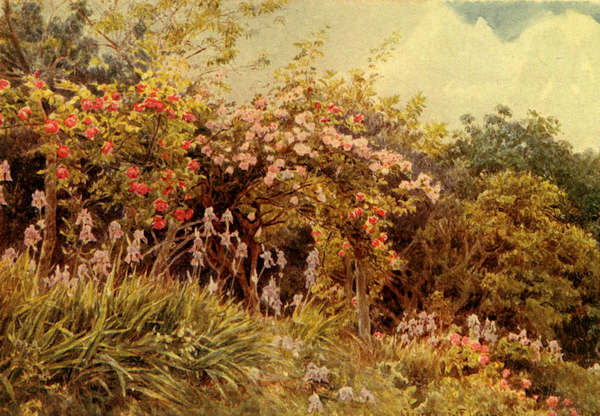
ROSES AND IRIS
The absence of method in our visits to cloister
or gallery seemed to govern most of our movements.
Sometimes we were but two, sometimes
but three, of a company; and it would happen
that, when we were four, we lost touch of each
other for a time, and went our separate ways.
Veronica not infrequently was missing; and generally,
when this occurred, when she returned alone
to the villa, she brought with her some ‘object of
antiquity,’ as the Florentine dealers in curios and
old furniture call such things, purchased after
considerable thought and much bargaining. I
think you know Veronica has a large heart, and
would defraud no one of his due, and indeed would
give any one more than his due, where no bargaining
was in question. But she knows just as
much about the date and value of cassettone, triptych,
or embroidery, as any of the various dealers
on the Ponte Vecchio or in the Via de’ Serragli;
and she not unnaturally enjoyed displaying her
peculiar learning in those interesting haunts. Her
perfect familiarity with the language, and indeed
even with Florentine patois, added to her advantage
and strengthened her position in appraising the
value of mediæval picture-frame or sixteenth-century
mirror. Moreover, it is the greatest
possible error to suppose that Florentine dealers
are consumed with a single-minded desire to rob
unwary purchasers; and I am convinced they much
preferred to conclude a fair bargain with Veronica,
than an unfair one with the first ignorant comer.
Oriental ways and traditions of business still linger
sufficiently with them to make prezzo fisso or a
rigidly-fixed price exceedingly distasteful. Their
day is long, they have abundance of time on their
hands, and, if the few things they sell in the course
of the week were sold without demur and in a
couple of minutes, life would be insufferably tedious
for want of human intercourse and agreeable conversation.
Veronica invariably regaled us with
minute accounts, on the occasion of each fresh
purchase, of the polite but protracted controversy
that had attended it; and very diverting these
were. She preferred to conduct these transactions
without our company; for, in the first place, as
she truly enough remarked, we knew nothing
whatever upon the subject and could therefore be
of no use to her, and, in the second place, when we
honoured her with our useless society, one or
other of us invariably ended by showing signs of
impatience, and to be impatient over a bargain
is inevitably to get the worst of it. She did
not always come off a winner in these friendly
encounters; and she was just as candid and as
diverting in confessing her defeats as in recording
her victories. On one occasion she suffered a
peculiarly humiliating disaster, which she detailed
with much zest at her own expense. Wishing to
give an agreeable surprise to Lamia on the occasion
of that Birthday, when, as you will perhaps remember,
I was so sorely discomfited, she went in search
of some amber beads which Lamia had more than
once expressed a longing to find in order to complete
a set she already possessed. But it was
indispensable they should be of a special hue. At
length, Veronica discovered some in a shop in the
Por Santa Maria, but, do what she would, and
notwithstanding all her Florentine wit, she could
not bring the owner of them into what she deemed
a reasonable frame of mind as regards price.
‘Ebbene,’ she said, ‘I will try elsewhere,’
She tried everywhere, but in vain, and so at
length had to go back to the Por Santa Maria, and
say she would take the beads at the man’s own
price.
‘But now, Signora mia,’ he said, ‘that is no
longer the price: you can find no others in
Florence to suit you, so these in the meantime
have become more valuable.’ And he added some
insignificant sum to the original figure, more for
the sake of triumph than from any mercenary
motive. Had Veronica been making a purchase
for herself, I am sure she would have defrauded
him of his victory by leaving him in possession pf
his amber treasures. But she would not disappoint
Lamia, and so paid the forfeit of her unsuccessful
strategy.
But we had a less humorous and far more
touching experience on another occasion. Visiting
a hillside village some twenty-five miles away,
we were all much taken by a small altar-piece, a
Presentation in the Temple, which stood in a
side-chapel in a little church of otherwise no
particular pretension. We discussed, then and
there, by whom it may have been painted, for I
need scarcely say that, on that subject, we all, like
so many other people, consider ourselves exceedingly
expert, and quite competent to express an
opinion. The Parroco, a venerable Priest of
courtly manners but much humility, did not affect
to adjudicate among us, but was evidently much
interested in our deliberations, and still more in
our admiration of the picture. At last he hesitatingly
asked Veronica if we should like to become
the owners of it. This had certainly not occurred
to us, and we were rather taken aback by the
question. But Veronica, enchanted at the chance
of an unexpected bit of bargaining, said ‘Yes,’
without a moment’s hesitation. So modest a sum,
however, was asked, if compared with the high
artistic qualities we had been attributing to it, that
it went against her conscience, which, as you know,
is the strongest part of her, to offer anything less.
Moreover, she probably remembered, on second
thoughts, that the place was not a suitable one for
financial transactions; and any remaining scruple
we might have had in completing the bargain was
set at rest by his telling us that he had long been
anxious to buy a second-hand harmonium that was
for sale, whereby the services of his little church
could be conducted in a more seemly manner.
The picture was carried off; and, by the time it
had been in our possession forty-eight hours, its
artistic value had enormously increased, and there
was hardly any Umbrian painter, Raphael perhaps
excepted, to whom we were not ready to ascribe
it. We discussed, over and over again, where it
should be hung when we returned to England,
and first one position of honour and then another
was suggested for it. But, as I knew well enough
from the first would turn out to be the case,
it was finally assigned by Veronica to the Poet’s
study.
For a week she had the satisfaction of seeing
all of us as much interested in, and as proud of, a
purchase as herself. But, on the morning of the
eighth day after our mountain excursion, the old
Priest suddenly made his appearance at the villa,
whither he had walked all the way; and, in a state
of much agitation, he said that he had come to ask
us to give him back the picture, the price of which
he would restore and which he had in his hand.
At first there was a protesting chorus, and Veronica
was particularly eloquent in pointing out that the
request was most unreasonable, as we had given
the full amount asked for, without any demur.
Thereupon the poor old man explained, with tears
in his eyes, that his parishioners had missed the
picture, and, though he had told them of his
intended purchase of the harmonium, they insisted
on its being restored to its traditional home, and
all his pleas and arguments had proved unavailing
with them. To such an appeal but one answer
was possible. The picture was returned, and the
Poet’s study will never see that Umbrian masterpiece.
Our disappointment was great; but why,
said Veronica, should everybody be disappointed?
Poor old man! He stood there a most touching
figure. So we put our hearts and purses together;
and the sound of the second-hand harmonium now
follows on his quavering voice, when, in answer
to his Dominus vobiscum, the entire mountain congregation
shrills out, to its instrumental accompaniment,
Et cum spiritu tuo.
As a rule, however, Veronica’s purchases, over
and above being definitive, were as useful as they
were ornamental; and it sometimes seemed as
though Lamia’s predictions concerning the transformation
that was gradually to come over the
villa were about to be fulfilled. Veronica invariably
declared that the furniture she brought back
with her from the Via Maggio, or the Piazza Santa
Maria Novella, was intended strictly for home
consumption, and would in due course be packed
and dispatched to England. Where she would
find room in a house already remarkably well
stocked, was a mystery to all of us; and meanwhile
it remained on the spot, to whose aspect it certainly
added finish and charm, and to whose commodiousness
it materially contributed.
‘I told you,’ said Lamia, ‘I should end by
having a comfortable armchair, and you see I have.
Nor can I well doubt that a host of work-people
have been secretly introduced by Veronica,
for I can now count on my bell ringing with
absolute certainty; and, as for Placida and Perfetta,’—Placida
and Perfetta were two handmaidens,—‘though
they still regard fair words and sweet
smiles as the principal ingredients of domestic
service, they have developed a talent for tidying
my drawers and arranging my toilet-table which
cannot but have proceeded from severe drilling by
Veronica, while you and I were discussing the Infinite
under the shade of cheerful boughs. Shortly after
we first came, Veronica gave one of our dear devoted
but somewhat primitive attendants a sponge, for
what purpose I cannot say. But this domestic
novelty was found so useful, that each of them in
turn, she discovered, had the loan of it, till it came
to enjoy an absolute monopoly in the cleaning of
the establishment. Now, I believe, sponges, and all
other requisites of a well-ordered place of residence,
are as plentiful as blackberries. Do you remember,’
she said, turning to me, ‘your giving me some
most lovely flowers last week, which, of course, I
treasured beyond words, even after they had faded?
But I discovered, the next morning, that Perfetta,
moved by a spirit of economy which seems to be
a perfect passion with these dear people, was applying
them, on the carpet, to the same purpose, I
am told, for which we sometimes use tea-leaves in
England. That was a sad ending, was it not, to
your lovely gift?’
Lamia’s observation on ‘the principal ingredients
of domestic service,’ as understood in Italy by those
who render it, was strictly accurate. They wait
on you with a smile, and minister to your need
with copious conversation. They will end by
giving you all you ask for; but you must ask,
and you must not expect that, having asked for it
ninety-nine times, you will get it the hundredth,
without asking for it again. That would be to
defraud them, and you as well, of an opportunity
of talk, the thing they love most in the world.
Moreover, they have an invincible objection to
being made methodical; nor can you give them
greater pleasure than to ask them to do the work
naturally pertaining to somebody else. The cook
would be delighted to nurse the baby, the housemaid
would find it quite natural to be bidden to
cook the dinner, the butler would eagerly go in
search of the vegetables, and the gardener at once
mount the box and drive you into Florence.
Only do not ask them to be perfect, according to
English ideas, in their own line. They will do
anything on earth for you, if you go the right way
about it; but they will not be turned into machines.
Nothing I have ever seen in Veronica is more
admirable, or shows so conclusively the discrimination
she can blend with her love of order, than the
amount of method, limited no doubt but quite
unusual, with which, for the time at least, she
imbued those about us; and Lamia, as we have
seen, indulged in a little characteristic raillery on
the subject.
‘It is all very well,’ said the Poet, ‘for us to
have our little joke about a certain person’s passion
for discipline. But, upon my word, what Italy
stands in need of is a Ruler with plenary powers,
of the temperament and talents of Veronica. So
the Roman Empire was founded, so the British.
Dear Lamia, you are very charming; our friend
here is, I do not forget, a gardener of much repute,
and I write verses which, I am told, sometimes
give pleasure to people who are easily pleased.
But Veronica is worth all of us put together a
hundred times over.‘
‘Quite so,’ said Lamia. ‘Veronica is our
Minerva Medica, whose salutary if sometimes
unpalatable wisdom keeps us in such tolerable
health as moral valetudinarians like myself are
capable of; whereas I am but a would-be Egeria,
who have not yet succeeded in inducing any one,
and you, dear Poet, least of all, to be my Numa.
Still, do not judge me altogether by the way in
which I conduct myself here, among a people very
much after my own heart. I have a conscience,
which I showed by declaring it at the frontier, as
I heard it was contraband. I proved to be right;
it was confiscated, and I have got on very comfortably
without it ever since. Indeed, I should have
missed a new gown much more. Poets, we all
know, never have a conscience, in any country.
But, as Veronica has enough for two, indeed—obligingly
remembering my existence—for three, I
daresay we shall continue to manage fairly well in
this easy-going land, with Veronica’s occasional
assistance.‘
At this moment, Veronica joined us under the
lower loggia, where we had for some time been
sitting, and desisting more frequently than perhaps
you have imagined, from audible converse, in
order to commune silently with the plashing of the
fountain in front of us, with city, plain, and river
far below, and with hill-slope and summit everywhere
around us. The sun had just disappeared;
and, each instant, mountain and sky grew more and
more unreal, more and more transfigured in the
afterglow. The last Ave Maria bell had rung;
the last wain drawn by the sleek, swaying oxen
had creaked up the hill; and, somewhere among
the more distant olives, a peasant lingering at his
work, but pondering aloud on his love, sang out
with clear voice to the clear air:
‘Fin al fin de’ giorni miei,
Io te sola voglio amar.‘
‘You never told us,’ said Veronica, ‘what you
two did yesterday afternoon.’ The two were the
Poet and Lamia.
‘You scarcely gave us the chance,’ Lamia
replied. ‘We were all so absorbed in admiring the
bust you brought from Florence of the founder
of the Magliabecchian Library, whose name I have
already forgotten, but who was himself, you told
us, what you, dear Veronica, will become if you
go on accumulating stray black-letter volumes
at the rate you are doing at present,—quædam
bibliotheca. But have a care. What if they were
lost or stolen? I was reading only yesterday
that, when Guarino, returning to Florence from
Constantinople with a cargo of Greek manuscripts,
was shipwrecked, and all his treasures went to the
bottom of the sea, his hair turned white. See
how well-informed I am getting. I can tell you
still more on this interesting subject, and indeed
meditate lecturing on it next winter in the Sala
Dante. Cosimo de’ Medici healed a political
breach with Alfonso of Naples by sending him
a Manuscript of Livy; and Lorenzo declared
to Pico della Mirandola, probably where we
are now sitting, that, if his fortune proved insufficient,
he would pledge his furniture in order
to buy books. But, when your purse gives out,
you will spare my easy-chair, Veronica, won’t
you?‘
‘You have still not told us where you went
yesterday afternoon.’
Lamia remained silent; leaving it to the Poet
to reply:
‘We carried some flowers to the grave of
Elizabeth Barrett Browning.’
Again there was silence. Then, shortly, Veronica
asked:
‘Did nothing come of it?’
We all well knew the meaning of the question,
and so did he, and accordingly replied:
‘Well, yes, something came of it, such as it
is’; and, not waiting for us to express a desire
he was aware we all entertained, he unaffectedly
recited to us the following lines:—
AT HER GRAVE
I
Lo, here among the rest you sleep,
As though no difference were
‘Twixt them and you, more wide, more deep,
Than such as fondness loves to keep
Round each lone sepulchre.
II
Yet they but human, you divine,
Warmed by that heavenly breath,
Which, when ephemeral lights decline,
Like lamp before nocturnal shrine,
Still burneth after death.
III
Yes, here in Tuscan soil you lie,
With Tuscan turf above;
And, lifting silent spires on high,
The cypresses remind the sky
Of the city of your love.
IV
And you did grow so like to her
Wherein you dwelt so long,
Your thoughts, like her May roses, were
Untrained, unchecked, but how astir,
And oh how sweet, with song!
V
The Poet of Olympian mien
His frenzy doth control,
And, gazing on the dread Unseen,
Keep mind majestic, will serene,
And adamantine soul.
VI
He, save to Wisdom sternly true,
Is but the sport of Fate
And gladiatorial pain. But you!
A poet, and a woman too!
The burden was too great.
VII
And so you laid it down, and here,
Oblivious of life’s load,
Quiet you sleep through all the year,
Young Spring, staid Summer, Autumn sere,
And Winter’s icy goad.
VIII
The swallows, freshly on the wing,
In April’s sun rejoice;
The nightingales unceasing sing;
Yes, Spring brings back the birds of Spring,
But not, alas! your voice.
IX
So round your sleep I soft let fall
Frail emblems of regret;
The lowly wind-flower, tulip tall,
The iris mantling wayside wall,
And weeping violet.
X
My votive flowers to-day will blow,
To-morrow be decayed;
But, though long sunk from sight, I know,
The glory of your afterglow
Will never wholly fade.