“We do not here have to do with a line of argument, but with the
examination of a positive fact, which is more general than is
supposed, and which has not received the attention it deserves,
doubtless because, very often, it is quite difficult to discover.
This fact consists in the influence which circumstances exert on the
different organisms subjected to them.
“In truth, for a long time there has been noticed the influence of
different states of our organization on our character, our
propensities (penchants), our actions, and even our ideas; but it
seems to me that no one has yet recognized that of our actions and
of our habits on our organization itself. Now, as these actions and
these habits entirely depend on the circumstances in which we
habitually find ourselves, I shall try to show how great is the
influence which these circumstances exercise on the general form, on
the condition of the parts, and even on the organization of living
bodies. It is therefore this very positive fact which is to be the
subject of this chapter.
“If we have not had numerous occasions to plainly recognize the
effects of this influence on certain organisms which we have
transported under entirely new and different circumstances, and if
we had not seen these effects and the changes resulting from them
produced, in a way, under our very eyes, the important fact in
question would have always remained unknown.
“The influence of circumstances is really continuously and
everywhere active on living beings, but what renders it difficult
for us to appreciate this influence is that its effects only become
sensible or recognizable (especially in the animals) at the end of a
long period.
“Before stating and examining the proofs of this fact, which
deserves our attention, and which is very important for a zoölogical
philosophy, let us resume the thread of the considerations we had
begun to discuss.
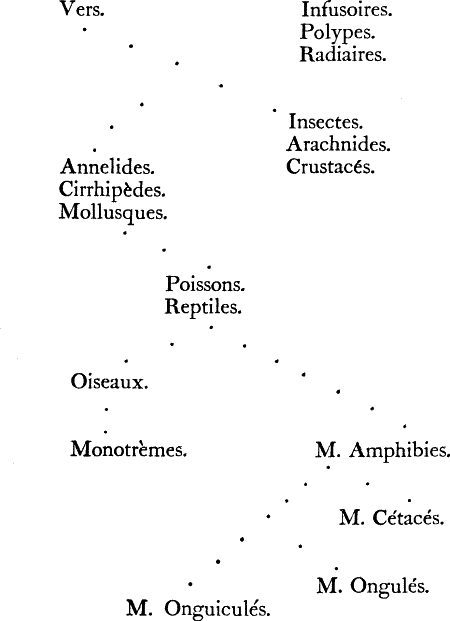
“In the preceding paragraph we have seen that it is now an
incontrovertible fact that, in considering the animal scale in a
sense the inverse of that of nature, we find that there exists in
the groups composing this scale a continuous but irregular
modification (dégradation) in the organization of animals which
they comprise, an increasing simplification in the organization of
these organisms; finally, a proportionate diminution in the number
of faculties of these beings.
“This fact once recognized may throw the greatest light on the very
order which nature has followed in the production of all the
existing animals; but it does not show why the structure of animals
in its increasing complexity from the more imperfect up to the most
perfect offers only an irregular gradation, whose extent presents a
number of anomalies or digressions which have no appearance of order
in their diversity.
“Now, in seeking for the reason of this singular irregularity in the
increasing complexity of organization of animals, if we should
consider the outcome of the influences that the infinitely
diversified circumstances in all parts of the globe exercise on the
general form, the parts, and the very organization of these animals,
everything will be clearly explained.
“It will, indeed, be evident that the condition in which we find all
animals is, on one side, the result of the increasing complexity of
the organization which tends to form a regular gradation, and, on
the other, that it is that of the influences of a multitude of very
different circumstances which continually tend to destroy the
regularity in the gradations of the increasing complexity of the
organization.
“Here it becomes necessary for me to explain the meaning I attach to
the expression circumstances influencing the form and structure of
animals—namely, that in becoming very different they change, with
time, both their form and organization by proportionate
modifications.
“Assuredly, if these expressions should be taken literally, I should
be accused of an error; for whatever may be the circumstances, they
do not directly cause any modification in the form and structure of
animals.
“But the great changes in the circumstances bring about in animals
great changes in their needs, and such changes in their needs
necessarily cause changes in their actions. Now, if the new needs
become constant or very permanent, the animals then assume new
habits, which are as durable as the needs which gave origin to
them. We see that this is easily demonstrated and even does not need
any explanation to make it clearer.
“It is then evident that a great change in circumstances having
become constant in a race of animals leads these animals into new
habits.
“Now, if new circumstances, having become permanent in a race of
animals, have given to these animals new habits—that is to say,
have led them to perform new actions which have become
habitual—there will from this result the use of such a part by
preference to that of another, and in certain cases the total lack
of use of any part which has become useless.
“Nothing of all this should be considered as a hypothesis or as a
mere peculiar opinion; they are, on the contrary, truths which
require, in order to be made evident, only attention to and the
observation of facts.
“We shall see presently by the citation of known facts which prove
it, on one side that the new wants, having rendered such a part
necessary, have really by the result of efforts given origin to this
part, and that as the result of its sustained use it has gradually
strengthened it, developed, and has ended in considerably increasing
its size; on the other side we shall see that, in certain cases, the
new circumstances and new wants having rendered such a part wholly
useless, the total lack of use of this part has led to the result
that it has gradually ceased to receive the development which the
other parts of the animal obtain; that it gradually becomes
emaciated and thin; and that finally, when this lack of use has been
total during a long time, the part in question ends in disappearing.
All this is a positive fact; I propose to give the most convincing
proofs.
“In the plants, where there are no movements, and, consequently, no
habits properly so called, great changes in circumstances do not
bring about less great differences in the development of their
parts; so that these differences originate and develop certain of
them, while they reduce and cause several others to disappear. But
here everything operates by the changes occurring in the nutrition
of the plant, in its absorptions and transpirations, in the amount
of heat, light, air, and humidity which it habitually receives;
finally, in the superiority that certain of the different vital
movements may assume over others.
“Between individuals of the same species, some of which are
constantly well nourished, and in circumstances favorable to their
entire development, while the others live under reversed
circumstances, there is brought about a difference in the condition
of these individuals which gradually becomes very remarkable. How
many examples could I not cite regarding animals and plants, which
would confirm the grounds for this view! Now, if the circumstances
remain the same, rendering habitual and constant the condition of
individuals badly fed, diseased, or languishing, their internal
organization becomes finally modified, and reproduction between the
individuals in question preserves the acquired modifications, and
ends in giving rise to a race very distinct from that of the
individuals which unceasingly meet with circumstances favorable to
their development.
“A very dry spring-time is the cause of the grass of a field growing
very slowly, remaining scraggy and puny, flowering and fruiting
without growing much.
“A spring interspersed with warm days and rainy days makes the same
grass grow rapidly, and the harvest of hay is then excellent.
“But if any cause perpetuates the unfavorable circumstances
surrounding these plants, they vary proportionally, at first in
their appearance and general condition, and finally in several
particulars of their characters.
“For example, if some seed of any of the grasses referred to should
be carried into an elevated place, on a dry and stony greensward
much exposed to the winds, and should germinate there, the plant
which should be able to live in this place would always be badly
nourished, and the individuals reproduced there continuing to exist
under these depressing circumstances, there would result a race
truly different from that living in the field, though originating
from it. The individuals of this new race would be small, scraggy,
and some of their organs, having developed more than others, would
then offer special proportions.
“Those who have observed much, and who have consulted the great
collections, have become convinced that in proportion as the
circumstances of habitat, exposure, climate, food, mode of life,
etc., come to change, the characters of size, form, proportion
between the parts, color, consistence, agility, and industry in the
animals change proportionally.
“What nature accomplishes after a long time, we bring about every
day by suddenly changing, in the case of a living plant, the
circumstances under which it and all the individuals of its species
exist.
“All botanists know that the plants which they transplant from their
birthplace into gardens for cultivation gradually undergo changes
which at last render them unrecognizable. Many plants naturally
very hairy then become glabrous, or almost so; many of those which
were creeping and trailing, then become erect; others lose their
spines or their prickles; others still, from the woody and perennial
condition which their stem possesses in a warm climate, pass, in our
climate, into an herbaceous condition, and among these several are
nothing more than annual plants; finally, the dimensions of their
parts themselves undergo very considerable changes. These effects of
changes of circumstances are so well known that botanists prefer not
to describe garden plants, at least only those which have been newly
cultivated.
“Is not cultivated wheat (Triticum sativum) only a plant brought
by man into the condition in which we actually see it? Who can tell
me in what country such a plant lives in a state of nature—that is
to say, without being there the result of its culture in some
neighboring region?
“Where occur in nature our cabbage, lettuce, etc., in the condition
in which we see them in our kitchen-gardens? Is it not the same as
regards a number of animals which domestication has changed or
considerably modified?
“What very different races among our fowls and domestic pigeons,
which we have obtained by raising them in different circumstances
and in different countries, and how vainly do we now endeavor to
rediscover them in nature!
“Those which are the least changed, without doubt by a more recent
process of domestication, and because they do not live in a climate
which is foreign to them, do not the less possess, in the condition
of some of their parts, great differences produced by the habits
which we have made them contract. Thus our ducks and our domestic
geese trace back their type to the wild ducks and geese; but ours
have lost the power of rising into the high regions of the air, and
of flying over extensive regions; finally, a decided change has
been wrought in the state of their parts compared with that of
animals of the race from which they have descended.
“Who does not know that such a native bird, which we raise in a cage
and which lives there five or six years in succession, and after
that replaced in nature—namely, set free—is then unable to fly
like its fellows which have always been free? The slight change of
circumstance operating on this individual has only diminished its
power of flight, and doubtless has not produced any change in the
shape of its parts. But if a numerous series of generations of
individuals of the same race should have been kept in captivity for
a considerable time, there is no doubt but that even the form of the
parts of these individuals would gradually undergo notable changes.
For a much stronger reason, if, instead of a simple captivity
constantly maintained over them, this circumstance had been at the
same time accompanied by a change to a very different climate, and
if these individuals by degrees had been habituated to other kinds
of food, and to other kinds of movements to obtain it; certainly
these circumstances, united and becoming constant, would insensibly
form a new and special race.
“Where do we find, in nature, this multitude of races of dogs,
which, as the result of domesticity to which we have reduced these
animals, have been brought into their present condition? Where do we
find these bull-dogs, greyhounds, water spaniels, spaniels,
pug-dogs, etc., etc., races which present among themselves much
greater differences than those which we admit to be specific in wild
animals of the same genus?
“Without doubt, a primitive single race, very near the wolf, if it
is not itself the true type, has been submitted by man, at some
period, to the process of domestication. This race, which then
offered no difference between its individuals, has been gradually
dispersed by man into different countries, with different climates;
and after a time these same individuals, having undergone the
influences of their habitats, and of the different habits they were
obliged to contract in each country, have undergone remarkable
changes, and have formed different special races. Now, the man who,
for commercial reasons or from interests of any other kind, travels
a very great distance, having carried into a densely populated
place, as for example a great capital, different races of dogs
originated in some very distant country, then the increase of these
races by heredity (génération) has given rise successively to all
those we now know.
“The following fact proves, as regards plants, how a change in any
important circumstance leads to a change in the parts of their
organisms.
“So long as Ranunculus aquatilis is submerged in the water, its
leaves are all finely incised and the divisions hair-like; but when
the stalks of this plant reach the surface of the water, the leaves
which grow out in the air are wider, rounded, and simply lobed. If
some feet from the same plant the roots succeed in pushing into a
soil only damp, without being submerged, their stalks then are
short, none of their leaves are divided into capillary divisions,
which gives rise to Ranunculus hederaceus, which the botanists
regard as a species whenever they meet with it.
“There is no doubt that as regards animals important changes in the
circumstances under which they are accustomed to live do not produce
alteration in their organs; for here the changes are much slower in
operating than in plants, and, consequently, are to us less marked,
and their cause less recognizable.
“As to the circumstances which have so much power in modifying the
organs of living beings, the most influential are, doubtless, the
diversity of the surroundings in which they live; but besides this
there are many others which, in addition, have a considerable
influence in the production of the effects in question.
“It is known that different localities change in nature and quality
owing to their position, their nature, and their climate, as is
easily seen in passing over different places distinguished by
special features; hence we see a cause of variation for the animals
and plants which live in these different places. But what we do not
sufficiently know, and even what we generally refuse to believe, is
that each place itself changes with time in exposure, in climate, in
nature, and quality, although with a slowness so great in relation
to our own continuance that we attribute to it a perfect stability.
“Now, in either case, these changed localities proportionally change
the circumstances relative to the organisms which inhabit them, and
the latter then give rise to other influences bearing on these same
beings.
“We perceive from this that, if there are extremes in these changes,
there are also gradations—namely, degrees which are intermediate
and which fill the interval. Consequently there are also gradations
in the differences which distinguish what we call species.
“It is then evident that the whole surface of the earth offers, in
the nature and situation of the matters which occupy its different
points, a diversity of circumstances which is throughout in relation
with that of the forms and parts of animals, independent of the
special diversity which necessarily results from the progress of the
composition of organization in each animal.
“In each locality where animals can live, the circumstances which
establish there an order of things remain for a long time the same,
and really change there only with a slowness so great that man
cannot directly notice them. He is obliged to consult monuments to
recognize that in each one of these places the order of things that
he discovers there has not always been the same, and to perceive
that it will change more.
“The races of animals which live in each of these places should,
then, retain their customary habits there also for a long time;
hence to us seems an apparent constancy of races which we call
species—constancy which has originated among us the idea that
these races are as ancient as nature.
“But in the different points of the earth’s surface which can be
inhabited, nature and the situation of the places and climates
constitute there, for the animals as for the plants, different
circumstances of all sorts of degrees. The animals which inhabit
these different places should then differ from each other, not only
on account of the state of nature of the organization in each race,
but, besides, by reason of the habits that the individuals of each
race there are forced to have; so, in proportion as he traverses the
larger parts of the earth’s surface the observing naturalist sees
circumstances changing in a manner somewhat noticeable; he
constantly sees that the species change proportionately in their
characters.
“Now, the true order of things necessary to consider in all this
consists in recognizing:
“1. That every slight change maintained under the circumstances
where occur each race of animals, brings about in them a real change
in their wants.
“2. That every change in the wants of animals necessitates in them
other movements (actions) to satisfy the new needs, and
consequently other habits.
“3. That every new want necessitating new actions to satisfy it,
demands of the animal which feels it both the more frequent use of
such of its parts of which before it made less use, which develops
and considerably enlarges them, and the use of new parts which
necessity has caused to insensibly develop in it by the effects of
its inner feelings; which I shall constantly prove by known facts.
“Thus, to arrive at a knowledge of the true causes of so many
different forms and so many different habits of which the known
animals offer us examples, it is necessary to consider that
circumstances infinitely diversified, but all slowly changing, into
which the animals of each race are successively thrown, have caused,
for each of them, new wants and necessarily changes in their habits.
Moreover, this truth, which cannot be denied, being once recognized,
it will be easy to see how the new needs have been able to be
satisfied, and the new habits formed, if any attention be given to
the two following laws of nature, which observation always confirms:
“In every animal which has not exceeded the term of its development,
the more frequent and sustained use of any organ gradually
strengthens this organ, develops and enlarges it, and gives it a
strength proportioned to the length of time of such use; while the
constant lack of use of such an organ imperceptibly weakens it,
causes it to become reduced, progressively diminishes its faculties,
and ends in its disappearance.
“Everything which nature has caused individuals to acquire or lose
by the influence of the circumstances to which their race may be for
a long time exposed, and consequently by the influence of the
predominant use of such an organ, or by that of the constant lack of
use of such part, it preserves by heredity (génération) and passes
on to the new individuals which descend from it, provided that the
changes thus acquired are common to both sexes, or to those which
have given origin to these new individuals.
“These are the two fundamental truths which can be misunderstood
only by those who have never observed or followed nature in its
operations, or only by those who allow themselves to fall into the
error which I have combated.
“Naturalists having observed that the forms of the parts of animals
compared with the uses of these parts are always in perfect accord,
have thought that the forms and conditions of parts have caused the
function; but this is a mistake, for it is easy to demonstrate by
observation that it is, on the contrary, the needs and uses of
organs which have developed these same parts, which have even given
origin to them where they did not exist, and which consequently have
given rise to the condition in which we observe them in each animal.
“If this were not so, it would have been necessary for nature to
have created for the parts of animals as many forms as the diversity
of circumstances in which they have to live had required, and that
these forms and also the circumstances had never varied.
“This is certainly not the existing order of things, and if it were
really such, we should not have the race-horses of England; we
should not have our great draft horses, so clumsy and so different
from the first named, for nature herself has not produced their
like; we should not, for the same reason, have terrier dogs with bow
legs, greyhounds so swift in running, water-spaniels, etc.; we
should not have tailless fowls, fantail pigeons, etc.; finally, we
could cultivate the wild plants as much as we pleased in the rich
and fertile soil of our gardens without fearing to see them change
by long culture.
“For a long time we have felt the force of the saying which has
passed into the well-known proverb—habits form a second nature.
“Assuredly, if the habits and nature of each animal can never vary,
the proverb is false, has no foundation, and does not apply to the
instances which led to its being spoken.
“If we should seriously consider all that I have just stated, it
might be thought that I had good reason when in my work entitled
Recherches sur les Corps vivans (p. 50) I established the
following proposition:
“‘It is not the organs—that is to say, the nature and form of the
parts of the body of an animal—which have given rise to its habits
and its special faculties; but it is, on the contrary, its habits,
its manner of life, and the circumstances in which are placed the
individuals from which it originates, which have, with time, brought
about the form of its body, the number and condition of its organs,
finally, the faculties which it enjoys.’
“If we weigh this proposition, and if we recall all the observations
which nature and the state of things continually lead us to do, then
its importance and its solidity will become more evident.
“Time and favorable circumstances are, as I have already said, the
two principal means which nature employs to give existence to all
her productions: we know that time for her has no limits, and that
consequently it is ever at her disposal.
“As to the circumstances of which she has need, and which she uses
still daily to cause variations in all that she continues to
produce, we can say that they are, in some degree, for her
inexhaustible.
“The principal circumstances arise from the influence of climate;
from those of different temperatures of the atmosphere, and from all
the environing media; from that of the diversity of different
localities and their situation; from that of habits, the ordinary
movements, the most frequent actions; finally, from that of means of
preservation, of mode of living, of defence, of reproduction, etc.
“Moreover, owing to these diverse influences, the faculties increase
and become stronger by use, become differentiated by the new habits
preserved for long ages, and insensibly the organization, the
consistence—in a word, the nature and condition of parts, as also
of the organs—participate in the results of all these influences,
become preserved, and are propagated by generation.
“These truths, which are only the results of the two natural laws
above stated, are in every case completely confirmed by facts; they
clearly indicate the course of nature in all the diversity of its
products.
“But instead of contenting ourselves with generalities which might
be considered as hypothetical, let us directly examine the facts,
and consider, in the animals, the result of the use or disuse of
their organs on the organs themselves, according to the habits that
each race has been compelled to contract.
“I shall now attempt to prove that the constant lack of exercise of
organs at first diminishes their faculties, gradually impoverishes
them, and ends by making them disappear, or even causing them to be
atrophied, if this lack of use is perpetuated for a very long time
through successive generations of animals of the same race.
“I shall next prove that, on the contrary, the habit of exercising
an organ, in every animal which has not attained the limit of the
diminution of its faculties, not only perfects and increases the
faculties of this organ, but, besides, enables it to acquire
developments and dimensions which insensibly change it; so that with
time it renders it very different from the same organ in another
animal which exercises it much less.
“The lack of use of an organ, become constant by the habits formed,
gradually impoverishes this organ, and ends by causing it to
disappear and even to destroy it.
“As such a proposition can only be admitted on proof, and not by its
simple announcement, let us prove it by the citation of the leading
known facts on which it is based.
“The vertebrate animals, whose plan of organization is in all nearly
the same, although they offer much diversity in their parts, have
jaws armed with teeth; moreover, those among them which
circumstances have placed in the habit of swallowing their food
without previous mastication are exposed to the result that their
teeth become undeveloped. These teeth, then, either remain concealed
between the bony edges of the jaws, without appearing above, or even
their gums are found to have been atrophied.
“In the baleen whales, which have been supposed to be completely
deprived of teeth, M. Geoffroy has found them concealed in the jaws
of the fœtus of this animal. This professor has also found in the
birds the groove where the teeth should be situated; but they are no
longer to be seen there.
“In the class even of mammals, which comprises the most perfect
animals, and chiefly those in which the vertebrate plan of
organization is most perfectly carried out, not only the baleen has
no usable teeth, but the ant-eater (Myrmecophaga) is also in the
same condition, whose habit of not masticating its food has been for
a long time established and preserved in its race.
“The presence of eyes in the head is a characteristic of a great
number of different animals, and becomes an essential part of the
plan of organization of vertebrates.
“Nevertheless the mole, which owing to its habits makes very little
use of vision, has only very small eyes, which are scarcely visible,
since they exercise these organs to a very slight extent.
“The Aspalax of Olivier (Voyage en Egypte et en Perse, ii.
pl. 28 f. 2), which lives under ground like the mole, and which
probably exposes itself still less than that animal to the light of
day, has totally lost the power of sight; also it possesses only
vestiges of the organ of which it is the seat; and yet these
vestiges are wholly concealed under the skin and other parts which
cover them, and do not permit the least access to the light.
“The Proteus, an aquatic reptile allied to the salamander in its
structure, and which lives in the dark subterranean waters of deep
caves, has, like the Aspalax, only vestiges of the organs of
sight—vestiges which are covered and concealed in the same manner.
“We turn to a decisive consideration relative to this question.
“Light does not penetrate everywhere; consequently animals which
habitually live in situations where it does not penetrate lack the
occasion of exercising the organs of sight, if nature has provided
them with them. Moreover, the animals which make part of the plan of
organization in which eyes are necessarily present, have
originally had them. However, since we find them among those which
are deprived of the use of this organ, and which have only vestiges
concealed and covered over, it should be evident that the
impoverishment and even the disappearance of these organs are the
result of a constant lack of exercise.
“What proves it is that the organ of hearing is never in this
condition, and that we always find it in the animals when the nature
of their organization should require its existence; the reason is as
follows.
“The cause of sound, that which, moved by the shock or the
vibrations of bodies, transmits to the organ of hearing the
impression which it receives, penetrates everywhere, traverses all
the media, and even the mass of the densest bodies: from this it
results that every animal which makes a part of a plan of
organization to which hearing is essential, has always occasion to
exercise this organ in whatever situation it lives. So, among the
vertebrate animals we see none deprived of their organs of
hearing; but in the groups below them, when the same organs are once
wanting, we do not again find them.
“It is not so with the organ of sight, for we see this organ
disappear, reappear, and again disappear, in proportion to the
possibility or impossibility of the animal’s exercising it.
“In the acephalous molluscs, the great development of the mantle
of these molluscs has rendered their eyes and even their head
entirely useless. These organs, also forming a part of a plan of
organization which should comprise them, have disappeared and
atrophied from constant lack of use.
“Finally, it is a part of the plan of organization of reptiles, as
in other vertebrate animals, to have four legs appended to their
skeleton. The serpents should consequently have four, though they do
not form the lowest order of reptiles, and are not so near the
fishes as the batrachians (the frogs, the salamanders, etc.).
“However, the serpents having taken up the habit of gliding along
the ground, and of concealing themselves in the grass, their body,
owing to continually repeated efforts to elongate itself so as to
pass through narrow spaces, has acquired a considerable length
disproportionate to its size. Moreover, limbs would have been very
useless to these animals, and consequently would not have been
employed: because long legs would have interfered with their need of
gliding, and very short legs, not being more than four in number,
would have been incapable of moving their body. Hence the lack of
use of these parts having been constant in the races of these
animals, has caused the total disappearance of these same parts,
although really included in the plan of organization of the animals
of their class.
“Many insects which by the natural character of their order, and
even of their genus, should have wings, lack them more or less
completely from disuse. A quantity of Coleoptera, Orthoptera,
Hymenoptera, and of Hemiptera, etc., afford examples; the habits of
these animals do not require them to make use of their wings.
“But it is not sufficient to give the explanation of the cause which
has brought about the condition of the organs of different
animals—a condition which we see to be always the same in those of
the same species; we must besides observe the changes of condition
produced in the organs of one and the same individual during its
life, by the single result of a great change in the special habits
in the individuals of its species. The following fact, which is one
of the most remarkable, will serve to prove the influence of habits
on the condition of organs, and show how changes wrought in the
habits of an individual, produce the condition of the organs which
are brought into action during the exercise of these habits.
“M. Tenon, member of the Institute, has given an account to the
Class of Sciences, that having examined the intestinal canal of
several men who had been hard drinkers all their lives, he had
constantly found it to be shortened to an extraordinary extent,
compared with the same organ in those not given to such a habit.
“We know that hard drinkers, or those who are addicted to
drunkenness, take very little solid food, that they eat very
lightly, and that the beverage which they take in excess frequently
suffices to nourish them.
“Moreover, as fluid aliments, especially spirituous liquors, do not
remain a long time either in the stomach or in the intestines, the
stomach and the remainder of the intestinal canal lose the habit of
being distended in intemperate persons, so also in sedentary persons
and those engaged in mental labor, who are habituated to take but
little food. Gradually and at length their stomach becomes
contracted, and their intestines shortened.
“We are not concerned here with the shrinkage and shortening
produced by a puckering of the parts, which permit ordinary
extension, if instead of a continued emptiness these viscera should
be filled; the shrinkage and shortening in question are real,
considerable, and such that these organs would burst open rather
than yield suddenly to the causes which would require ordinary
extension.
“In circumstances of persons of the same age, compare a man who, in
order to devote himself to habitual study and mental work, which
have rendered his digestion more difficult, has contracted the habit
of eating lightly, with another who habitually takes a good deal of
exercise, walks out often, and eats heartily; the stomach of the
first will be weakened, and a small quantity of food will fill it,
while that of the second will be not only maintained in its ordinary
health but even strengthened.
“We have here the case of an organ much modified in its dimensions
and in its faculties by the single cause of a change in habits
during the life of the individual.
“The frequent use of an organ become constant by habit increases
the faculties of this organ, even develops it, and enables it to
acquire dimensions and a power of action which it does not possess
in animals which exercise less.
“We have just said that the lack of employment of an organ which
necessarily exists modifies it, impoverishes it, and ends by its
disappearing entirely.
“I shall now demonstrate that the continued employment of an organ,
with the efforts made to draw out its powers under circumstances
where it would be of service, strengthens, extends, and enlarges
this organ, or creates a new one which can exercise the necessary
functions.
“The bird which necessity drives to the water to find there prey
fitted for its sustenance, opens the digits of its feet when it
wishes to strike the water and propel itself along its surface. The
skin which unites these digits at their base, by these acts of
spreading apart being unceasingly repeated contracts the habit of
extending; so that after a while the broad membranes which connect
the digits of ducks, geese, etc., are formed as we see them. The
same efforts made in swimming—i.e., in pushing back the water, in
order to advance and to move in this liquid—have likewise extended
the membrane situated between the digits of the frogs, the
sea-turtles, the otter, beaver, etc.
“On the contrary, the bird whose mode of life habituates it to perch
on trees, and which is born of individuals who have all contracted
this habit, has necessarily the digits of the feet longer and shaped
in another way than those of the aquatic animals which I have just
mentioned. Its claws, after a while, became elongated, pointed, and
curved or hook-like in order to grasp the branches on which the
animal often rests.
“Likewise we see that the shore bird, which is not inclined to swim,
and which moreover has need of approaching the edge of the water to
find there its prey, is in continual danger of sinking in the mud.
Now, this bird, wishing to act so that its body shall not fall into
the water, makes every effort to extend and elongate its legs. It
results from this that the long-continued habit that this bird and
the others of its race contract, of extending and continually
elongating their legs, is the cause of the individuals of this
race being raised as if on stilts, having gradually acquired long,
naked legs, which are denuded of feathers up to the thighs and often
above them (Système des Animaux sans Vertèbres, p. 16).
“We also perceive that the same bird, wishing to catch fish without
wetting its body, is obliged to make continual efforts to lengthen
its neck. Now, the results of these habitual efforts in this
individual and in those of its race have enabled them, after a
time, to singularly elongate them—as, indeed, is proved by the long
neck of all shore birds.
“If any swimming birds, such as the swan and the goose, whose legs
are short, nevertheless have a very long neck, it is because these
birds in swimming on the surface of the water have the habit of
plunging their head down as far as they can, to catch aquatic larvæ
and different animalcules for food, and because they make no effort
to lengthen their legs.
“When an animal to satisfy its wants makes repeated efforts to
elongate its tongue, it will acquire a considerable length (the
ant-eater, green wood-pecker); when it is obliged to seize anything
with this same organ, then its tongue will divide and become forked.
That of the humming-birds, which seize with their tongue, and that
of the lizard and serpents, which use it to feel and examine objects
in front of them, are proofs of what I advocate.
“Wants, always occasioned by circumstances, and followed by
sustained efforts to satisfy them, are not limited in results, in
modifying—that is to say, in increasing or diminishing—the extent
and the faculties of organs; but they also come to displace these
same organs when certain of these wants become a necessity.
“The fishes which habitually swim in large bodies of water, having
need of seeing laterally, have, in fact, their eyes placed on the
sides of the head. Their bodies, more or less flattened according to
the species, have their sides perpendicular to the plane of the
water, and their eyes are placed in such a way that there is an eye
on each flattened side. But those fishes whose habits place them
under the necessity of constantly approaching the shores, and
especially the shelving banks or where the slope is slight, have
been forced to swim on their flattened faces, so as to be able to
approach nearer the edge of the water. In this situation, receiving
more light from above than from beneath, and having a special need
of being always attentive to what is going on above them, this need
has forced one of their eyes to undergo a kind of displacement, and
to assume the very singular situation which is familiar to us in the
soles, turbots, dabs, etc. (Pleuronectes and Achirus). The
situation of these eyes is asymmetrical, because this results from
an incomplete change. Now, this change is entirely completed in the
rays, where the transverse flattening of the body is entirely
horizontal, as also the head. Also the eyes of the rays, both
situated on the upper side, have become symmetrical.
“The serpents which glide along the surface of the ground are
obliged chiefly to see elevated objects, or what are above their
eyes. This necessity has brought an influence to bear on the
situation of the organs of vision in these animals; and, in fact,
they have the eyes placed in the lateral and upper parts of the
head, so as to easily perceive what is above or at their sides; but
they only see for a short distance what is in front of them.
Moreover, forced to supply the lack of ability to see and recognize
what is in front of their head, and which might injure them, they
need only to feel such objects with the aid of their tongue, which
they are obliged to dart out with all their power. This habit has
not only contributed to render the tongue slender, very long and
retractile, but has also led in a great number of species to its
division, so as to enable them to feel several objects at once; it
has likewise allowed them to form an opening at the end of their
head, to enable the tongue to dart out without their being obliged
to open their jaws.
“Nothing is more remarkable than the result of habits in the
herbivorous mammals.
“The quadruped to whom circumstances and the wants which they have
created have given for a long period, as also to others of its race,
the habit of browsing on grass, only walks on the ground, and is
obliged to rest there on its four feet the greater part of its life,
moving about very little, or only to a moderate extent. The
considerable time which this sort of creature is obliged to spend
each day to fill itself with the only kind of food which it
requires, leads it to move about very little, so that it uses its
legs only to stand on the ground, to walk, or run, and they never
serve to seize hold of or to climb trees.
“From this habit of daily consuming great amounts of food which
distend the organs which receive it, and of only moving about to a
limited extent, it has resulted that the bodies of these animals are
thick, clumsy, and massive, and have acquired a very great volume,
as we see in elephants, rhinoceroses, oxen, buffaloes, horses, etc.
“The habit of standing upright on their four feet during the greater
part of the day to browse has given origin to a thick hoof which
envelops the extremity of the digits of their feet; and as their
toes are not trained to make any movement, and because they have
served no other use than as supports, as also the rest of the leg,
the most of them are short, are reduced in size, and even have ended
by totally disappearing. Thus in the pachyderms, some have five
toes enveloped in horn, and consequently their foot is divided into
five parts; others have only four, and still others only three. But
in the ruminants, which seem to be the most ancient of mammals,
which are limited only to standing on the ground, there are only two
digits on each foot, and only a single one is to be found in the
solipedes (the horse, the ass).
“Moreover, among these herbivorous animals, and especially among the
ruminants, it has been found that from the circumstances of the
desert countries they inhabit they are incessantly exposed to be
the prey of carnivorous animals, and find safety only in precipitous
flight. Necessity has forced them to run swiftly; and from the habit
they have thus acquired their body has become slenderer and their
limbs much more delicate: we see examples in the antelopes, the
gazelles, etc.
“Other dangers in our climate to which are continually exposed the
deer, the roebuck, the fallow-deer, of perishing from the chase made
by man, have reduced them to the same necessity, restrained them to
similar habits, and have given rise to the same results.
“The ruminating animals only using their legs as supports, and not
having strong jaws, which are only exercised in cutting and browsing
on grass, can only fight by striking with the head, by directing
against each other the vertex of this part.
“In their moments of anger, which are frequent, especially among the
males, their internal feelings, by their efforts, more strongly urge
the fluids toward this part of their head, and it there secretes the
corneous matter in some, and osseous matter mixed with corneous
matter in others, which gives origin to solid protuberances; hence
the origin of horns and antlers, with which most of these animals
have the head armed.
“As regards habits, it is curious to observe the results in the
special form and height of the giraffe (camelopardalis); we know
that this animal, the tallest of mammals, inhabits the interior of
Africa, and that it lives in localities where the earth, almost
always arid and destitute of herbage, obliges it to browse on the
foliage of trees, and to make continual efforts to reach it. It has
resulted from this habit, maintained for a long period in all the
individuals of its race, that its forelegs have become longer than
the hinder ones, and that its neck is so elongated that the
giraffe, without standing on its hind legs, raises its head and
reaches six meters in height (almost twenty feet).
“Among the birds, the ostriches, deprived of the power of flight,
and raised on very long legs, probably owe their singular
conformation to analogous circumstances.
“The result of habits is as remarkable in the carnivorous mammals as
it is in the herbivorous, but it presents effects of another kind.
“Indeed, those of these mammals which are habituated, as their race,
both to climb as well as to scratch or dig in the ground, or to tear
open and kill other animals for food, have been obliged to use the
digits of their feet; moreover, this habit has favored the
separation of their digits, and has formed the claws with which they
are armed.
“But among the carnivores there are some which are obliged to run in
order to overtake their prey; moreover, since these need and
consequently have the habit of daily tearing with their claws and
burying them deeply in the body of another animal, to seize and then
to tear the flesh, and have been enabled by their repeated efforts
to procure for these claws a size and curvature which would greatly
interfere in walking or running on stony soil, it has resulted in
this case that the animal has been obliged to make other efforts to
draw back these too salient and curved claws which would impede it,
and hence there has resulted the gradual formation of those special
sheaths in which the cats, tigers, lions, etc., withdraw their claws
when not in action.
“Thus the efforts in any direction whatever, maintained for a long
time or made habitually by certain parts of a living body to satisfy
necessities called out by nature or by circumstances, develop these
parts and make them acquire dimensions and a shape which they never
would have attained if these efforts had not become the habitual
action of the animals which have exercised them. The observations
made on all the animals known will everywhere furnish examples.
“Can any of them be more striking than that which the kangaroo
offers us? This animal, which carries its young in its abdominal
pouch, has adopted the habit of holding itself erect, standing only
on its hind feet and tail, and only changing its position by a
series of leaps, in which it preserves its erect attitude so as not
to injure its young.
“Let us see the result:
“1. Its fore legs, of which it makes little use, and on which it
rests only during the instant when it leaves its erect attitude,
have never reached a development proportionate to that of the other
parts, and have remained thin, very small, and weak;
“2. The hind legs, almost continually in action, both for supporting
the body and for leaping, have, on the contrary, obtained a
considerable development, and have become very large and strong;
“3. Finally, the tail, which we see is of much use in supporting the
animal and in the performance of its principal movements, has
acquired at its base a thickness and a strength extremely
remarkable.
“These well-known facts are assuredly well calculated to prove what
results from the habitual use in the animals of any organ or part;
and if, when there is observed in an animal an organ especially well
developed, strong, and powerful, it is supposed that its habitual
use has not produced it, that its continual disuse will make it lose
nothing, and, finally, that this organ has always been such since
the creation of the species to which this animal belongs, I will ask
why our domestic ducks cannot fly like wild ducks—in a word, I
might cite a multitude of examples which prove the differences in us
resulting from the exercise or lack of use of such of our organs,
although these differences might not be maintained in the
individuals which follow them genetically, for then their products
would be still more considerable.
“I shall prove, in the second part, that when the will urges an
animal to any action, the organs which should execute this action
are immediately provoked by the affluence of subtile fluids (the
nervous fluid), which then become the determining cause which calls
for the action in question. A multitude of observations prove this
fact, which is now indisputable.
“It results that the multiplied repetitions of these acts of
organization strengthen, extend, develop, and even create the organs
which are necessary. It is only necessary attentively to observe
that which is everywhere occurring to convince ourselves of the
well-grounded basis of this cause of organic developments and
changes.
“Moreover, every change acquired in an organ by a habit of use
sufficient to have produced it is then preserved by heredity
(génération) if it is common to the individuals which, in
fecundation, unite in the reproduction of their species. Finally,
this change is propagated, and thus is transmitted to all the
individuals which succeed and which are submitted to the same
circumstances, unless they have been obliged to acquire it by the
means which have in reality created it.
“Besides, in reproductive unions the crossings between the
individuals which have different qualities or forms are necessarily
opposed to the continuous propagation of these qualities and these
forms. We see that in man, who is exposed to so many diverse
circumstances which exert an influence on him, the qualities or the
accidental defects which he has been in the way of acquiring, are
thus prevented from being preserved and propagated by generation.
If, when some particular features of form or any defects are
acquired, two individuals under this condition should always pair,
they would reproduce the same features, and the successive
generations being confined to such unions, a special and distinct
race would then be formed. But perpetual unions between individuals
which do not have the same peculiarities of form would cause all the
characteristics acquired by special circumstances to disappear.
“From this we can feel sure that if distances of habitation did not
separate men the intermixture by generation would cause the general
characteristics which distinguish the different nations to
disappear.
“If I should choose to pass in review all the classes, all the
orders, all the genera, and all the species of animals which exist,
I should show that the structure of individuals and their parts,
their organs, their faculties, etc., etc., are in all cases the sole
result of the circumstances in which each species is found to be
subjected by nature and by the habits which the individuals which
compose it have been obliged to contract, and which are only the
product of a power primitively existing, which has forced the
animals into their well-known habits.
“We know that the animal called the ai, or the sloth (Bradypus
tridactylus), is throughout life in a condition so very feeble that
it is very slow and limited in its movements, and that it walks on
the ground with much difficulty. Its movements are so slow that it
is thought that it cannot walk more than fifty steps in a day. It is
also known that the structure of this animal is in direct relation
with its feeble state or its inaptitude for walking; and that should
it desire to make any other movements than those which it is seen to
make, it could not do it.
“Therefore, supposing that this animal had received from nature its
well-known organization, it is said that this organization has
forced it to adopt the habits and the miserable condition it is in.
“I am far from thinking so; because I am convinced that the habits
which the individuals of the race of the ai were originally
compelled to contract have necessarily brought their organization
into its actual state.
“Since continual exposure to dangers has at some time compelled the
individuals of this species to take refuge in trees and to live in
them permanently, and then feed on their leaves, it is evident that
then they would give up making a multitude of movements that animals
which live on the ground perform.
“All the needs of the ai would then be reduced to seizing hold of
the branches, to creeping along them or to drawing them in so as to
reach the leaves, and then to remain on the tree in a kind of
inaction, so as to prevent falling. Besides, this kind of
sluggishness would be steadily provoked by the heat of the climate;
for in warm-blooded animals the heat urges them rather to repose
than to activity.
“Moreover, during a long period of time the individuals of the race
of the ai having preserved the habit of clinging to trees and of
making only slow and slightly varied movements, just sufficient for
their needs, their organization has gradually become adapted to
their new habits, and from this it will result:
“1. That the arms of these animals making continual efforts readily
to embrace the branches of trees, would become elongated;
“2. That the nails of their digits would acquire much length and a
hooked shape, by the continued efforts of the animal to retain its
hold;
“3. That their digits never having been trained to make special
movements, would lose all mobility among themselves, would become
united, and would only preserve the power of bending or of
straightening out all together;
“4. That their thighs, continually embracing both the trunks and the
larger branches of trees, would contract a condition of habitual
separation which would tend to widen the pelvis and to cause the
cotyloid cavities to be directed backward;
“5. Finally, that a great number of their bones would become fused,
and hence several parts of their skeleton would assume an
arrangement and a figure conformed to the habits of these animals,
and contrary to what would be necessary for them to have for other
habits.
“Indeed, this can never be denied, because, in fact, nature on a
thousand other occasions shows us, in the power exercised by
circumstances on habits, and in that of the influence of habits on
forms, dispositions, and the proportion of the parts of animals,
truly analogous facts.
“A great number of citations being unnecessary, we now see to what
the case under discussion is reduced.
“The fact is that divers animals have each, according to their genus
and their species, special habits, and in all cases an organization
which is perfectly adapted to these habits.
“From the consideration of this fact, it appears that we should be
free to admit either one or the other of the following conclusions,
and that only one of them is susceptible of proof.
“Conclusion admitted up to this day: Nature (or its Author), in
creating the animals, has foreseen all the possible kinds of
circumstances in which they should live, and has given to each
species an unchanging organization, as also a form determinate and
invariable in its different parts, which compels each species to
live in the places and in the climate where we find it, and has
there preserved its known habits.
“My own conclusion: Nature, in producing in succession every
species of animal, and beginning with the least perfect or the
simplest to end her work with the most perfect, has gradually
complicated their structure; and these animals spreading generally
throughout all the inhabitable regions of the globe, each species
has received, through the influence of circumstances to which it has
been exposed, the habits which we have observed, and the
modifications in its organs which observation has shown us it
possesses.
“The first of these two conclusions is that believed up to the
present day—namely, that held by nearly every one; it implies, in
each animal, an unchanging organization and parts which have never
varied, and which will never vary; it implies also that the
circumstances of the places which each species of animal inhabits
will never vary in these localities; for should they vary, the same
animals could not live there, and the possibility of discovering
similar forms elsewhere, and of transporting them there, would be
forbidden.
“The second conclusion is my own: it implies that, owing to the
influence of circumstances on habits, and as the result of that of
habits on the condition of the parts and even on that of the
organization, each animal may receive in its parts and its
organization, modifications susceptible of becoming very
considerable, and of giving rise to the condition in which we find
all animals.
“To maintain that this second conclusion is unfounded, it is
necessary at first to prove that each point of the surface of the
globe never varies in its nature, its aspect, its situation whether
elevated or depressed, its climate, etc., etc.; and likewise to
prove that any part of animals does not undergo, even at the end of
a long period, any modification by changes of circumstances, and by
the necessity which directs them to another kind of life and action
than that which is habitual to them.
“Moreover, if a single fact shows that an animal for a long time
under domestication differs from the wild form from which it has
descended, and if in such a species in domesticity we find a great
difference in conformation between the individuals submitted to
such habits and those restricted to different habits, then it will
be certain that the first conclusion does not conform to the laws of
nature, and that, on the contrary, the second is perfectly in accord
with them.
“Everything combines then to prove my assertion—namely, that it is
not the form, either of the body or of its parts, which gives rise
to habits, and to the mode of life among animals; but that it is on
the contrary the habits, the manner of living, and all the other
influencing circumstances which have, after a time, constituted the
form of the body and of the parts of animals. With the new forms,
new faculties have been acquired, and gradually nature has come to
form the animals as we actually see them.
“Can there be in natural history a consideration more important, and
to which we should give more attention, than that which I have just
stated?
“We will end this first part with the principles and the exposition
of the natural classification of animals.”