The city of the Rani slept. The bazaars and side
streets were deserted. But for an occasional
light gleaming fitfully through a half opened
casement, and the dark forms of sentinels pacing
back and forth in noiseless tread upon the walls, Jhansi
might have been a city of the dead. In countless, glittering
myriads, the heavenly bodies strode majestically in their
eternal courses above the silent night. By the mercy of
the supreme Parem-eswara, the labor of the day completed
with the departing sun, the people had lain down to rest;
their joys, sorrows, hopes, for a space, gathered into
oblivion. Thus Jhansi slept.
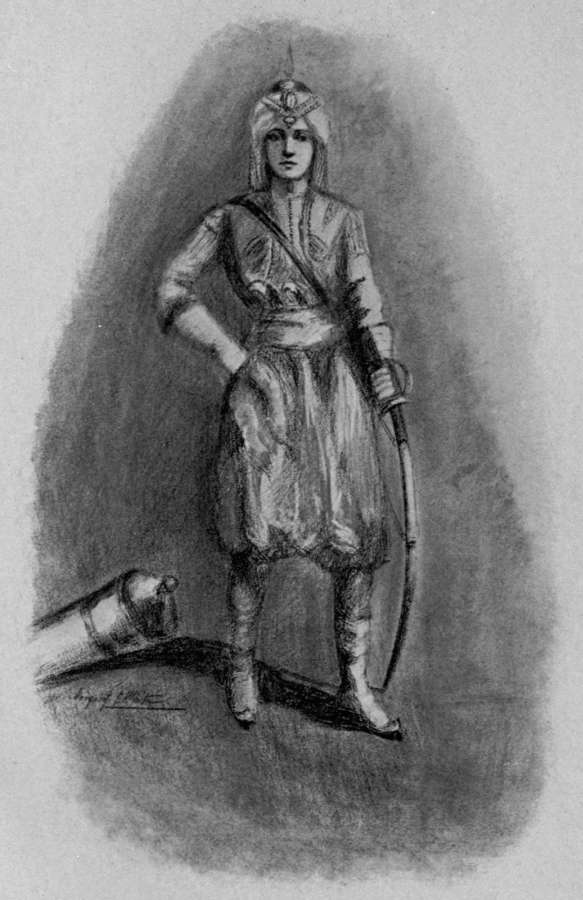
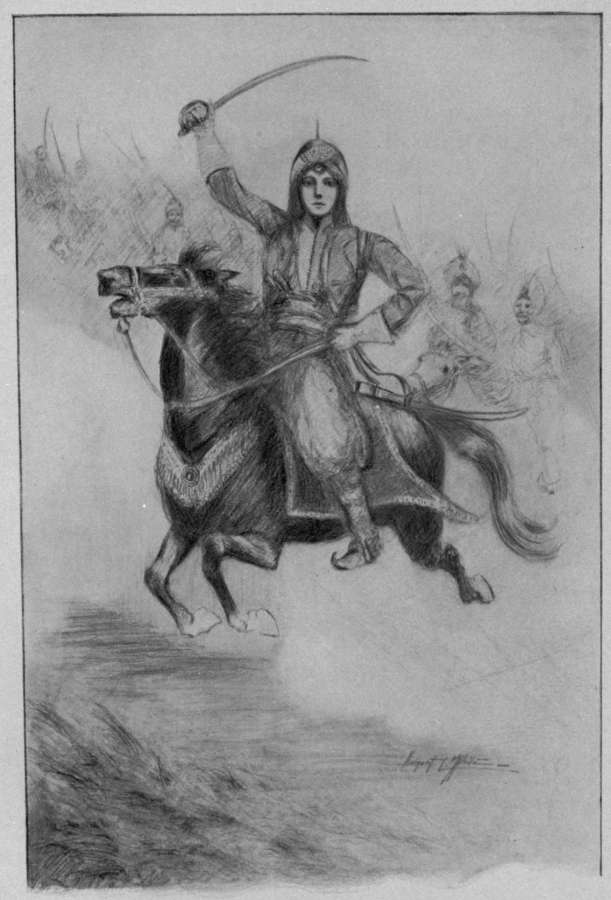
Three figures habited in male attire approached the
eastern gate, and gave a password. The gate was slowly
opened, and the three went forth. Behind them, the massive
portals swung back into place upon grating hinges.
Direct from the lofty, frowning bastion, a road led
toward the summer palace on the borders of the lake.
Here and there clumps of tamarind and acacia rose indistinctly
on either side of the way. Rapidly, yet with
caution to avoid intercepting the nocturnal adventure of
some poisonous reptile, the three directed their steps
along the road. Their feet impressed the thick coating of
dust noiselessly. Not a word was exchanged, and no
sound broke upon their ears save the occasional yelping
of a startled cur or the dismal cry of a jackal summoning
a companion to a scent of prey. Once, only, a solitary
figure met them at a little distance from the city. If
bent upon evil, he concealed his purpose by a greeting of
peace.
"The blessing of God be with you," he cried.
"And with you, O Stranger, peace," the foremost of
the three answered in a woman's voice, despite the conflicting
evidence of her dress.
Presently they came to a parting of the road. A narrow
path led amid a growth of trees to the brink of the
lake. Massively the white square walls of the tomb of
Firoz Khan, with its central dome became visible through
the branches. The party halted.
"What now, my Lord"? the owner of the voice that
had returned the wayfarer's salutation asked.
"Noble Rani," that of Ahmad Khan replied, "yonder
is our destination. Behind the wall thou canst just
discern to the right, lie, well concealed, a hundred of thy
Valaiti bodyguard; but I know not if the conspirators
are assembled."
At the moment a white cloth was waved thrice above
the wall. Ahmad evidently took it for a signal. He spoke
in a low tone.
"Whoever the villains may be, they are now gathered
together. Here I will leave thee to pass in hiding to
the guard, while if thou art still determined upon the enterprise,
thou hadst better advance boldly to the entrance.
For the rest, I make no doubt thine own judgment
and discretion, will serve thee better than any advice
of mine."
"Well said, my faithful Ahmad," the Rani answered.
"Thou art certain to hear my call if need be from yonder
hiding place"?
"Were it softer than the note of the bulbul, fair Lady,
be assured, it would reach me even at the gate of Paradise."
Thus while Ahmad stealthily disappeared among the
trees, the Rani motioned her waiting woman to follow,
and proceeded fearlessly toward the entrance of the tomb.
That those within had taken measures to prevent a
surprise was demonstrated by a challenge the moment
that the Rani emerged into the open space about the
building.
"Stand! who comes"? a voice demanded.
The Rani replied promptly in firm accents. "Two
followers of the noble Prasad Singh."
A short period of consultation among the conspirators
apparently ensued. Without, the Rani awaited the answer
with deep emotion. Would the report prove true
or false, that he whom she loved was a traitor as well
as a libertine?
Presently the response came.
"It is well, advance."
"Alas! it is ill," her heart murmured. "Ah God! the
ingratitude, the cruelty of it."
She advanced to the open door and entered the main
chamber of the tomb. A shaded lamp dimly illuminated
the interior. Her glance swept quickly from the five or
six armed men gathered in a group, to a stalwart form
she intuitively recognized as that of Prasad Singh, in
spite of the disguise he had assumed. He was pacing to
and fro a little apart from his companions, as if impatient
of some detail of his plan yet to be completed.
He turned quickly on her entrance and spoke in a
voice of stern rebuke.
"Thou art late," he exclaimed. "Thou hast kept us
waiting long after the appointed hour."
"Pardon, my Lord," replied the Rani, halting in the
dark shadow of a pillar. "Our steps were misdirected."
"A curse upon the muddled brain of that astrologer,"
he muttered. "Now hearken, while I tell thee briefly,
what I have impressed upon thy comrades at some length.
We go now to the city as belated travelers, with an admission
at the gate that hath already been assured. Thou
wilt then follow my steps quickly and silently to the
Rani's palace. As the others have their allotted duty,
thou wilt seek the garden gate and hold it securely
so that no one passes in or forth. If force be threatened
thou wilt in like manner threaten force, aye, and use it
if so need be. Thou hast arms"? he asked.
"Aye, noble captain," she replied. "Arms have we.
But if the Rani doth herself come forth. What then,
great sir"? she questioned in return.
"Thou wilt detain her above all others, though careful
to do her no personal harm," he enjoined emphatically.
"But should she command us to let her pass, my
Lord"? she pressed still further, in a quiet, assumed
voice.
"Thou wilt obey the command of him who payeth thee
for thy service, thou idle questioner," he returned. "Thy
order is to hold her securely until my pleasure concerning
her hath been learned."
There followed a momentary pause, then her voice rose
solemnly to the vaulted roof.
"My Lord Raja, Prasad Singh, thou hast no need to
go to Jhansi for the Rani. Behold she is now before
thee."
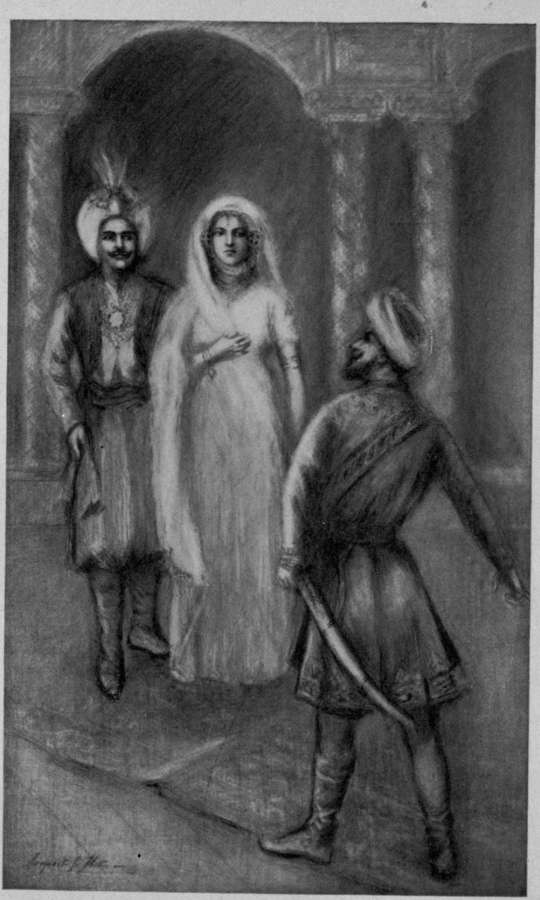
She moved from the shadow and stood confronting him,
an expression of offended dignity visible upon her face.
He uttered an exclamation of surprise mingled with
dismay. Impulsively he strode forward.
"Stand where thou art," she commanded. "Move
not a pace, a man of you, for at the raising of my
voice a hundred troopers, lying at hand, will hasten to
my side."
With a muttered oath Prasad halted, while the Rani
turned to the door and summoned Ahmad.
Almost upon the instant the Mohammedan noble and
a score of the Rani's bodyguard appeared before the
entrance.
"Alas, Ahmad," she said. "Our hope is dashed in
pieces as a pitcher hurled upon a rock. Bipin, poor fellow,
hath earned my displeasure as well as my gratitude for
the truth that he has told. I would now, that I could
recompense him for being a liar concerning this night's
work. Take these duped fools into safe keeping, and
then await my order. I will speak with Prasad first."
She motioned the shrinking forms inside the chamber
to pass without, and remained alone with Prasad.
For several minutes there reigned an unbroken silence,
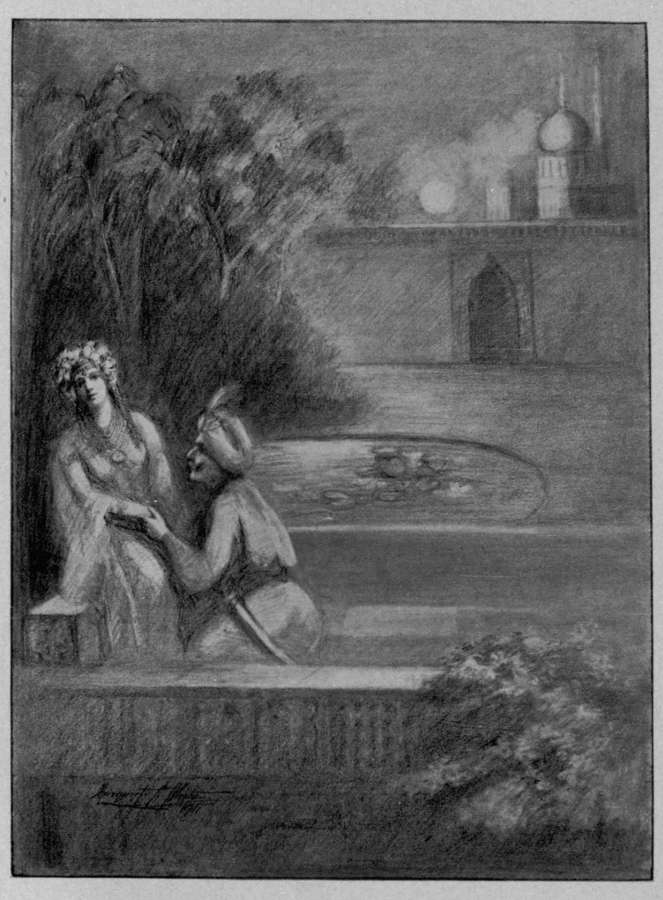
as the Rani and her guilty lover stood face to face. The
moon had risen over the lake and sent its pale light
through a crevice in the dome of the ruined tomb. It
marked by deep shadows the recesses, and filled the
chamber with an atmosphere in sympathy with the chill
that seized upon the heart of the woman.
She spoke at last in a measured tone.
"How, now, my Lord Prasad Singh. A short while
since you said the Rani was to be held until she heard
your pleasure. Behold, she now patiently awaiteth it.
What wilt thou do with her"?
Prasad hesitated a moment, then cast himself at her
feet.
"Taunt me not, noble one," he petitioned. "I do not
seek thy pardon; but I do ask thee to hear me speak."
"Aye, will I," came the response coldly. "Is it not to
hear what thou canst say for such surprising conduct
that I am now waiting on thy words."
"As God sees my heart, my sole excuse is my all consuming
love for thee."
"Thy love for me," she echoed. "Surely it is a most
unusual way of showing it, good Prasad. Thou gatherest
here a company of rascals to assault my palace, and
order them to heed not my command, to hold me a prisoner
until I shall learn thy pleasure. Thy love for me.
Oh"! she cried with a note of scorn in her voice. "Thou
must indeed cherish a constant love for me."
"Ah, fair one, be not so ungracious," he besought her.
"Surely thou hast tried me more than I was able to
endure."
"I tried thee," she repeated bitterly. "Aye, I did try
thee, and thou hast proved to be most woefully amiss.
What art thou, a drinker of spirits, a libertine, and Ah
God! a traitor to thy Queen."
Stung by her accusations he sprang passionately to his
feet.
"It is not true," he retorted hotly. "Upon all things
sacred do I swear to it."
"Aye, thou art in a fitting situation for thy oath to
carry weight," she answered; "but, believe me I care not
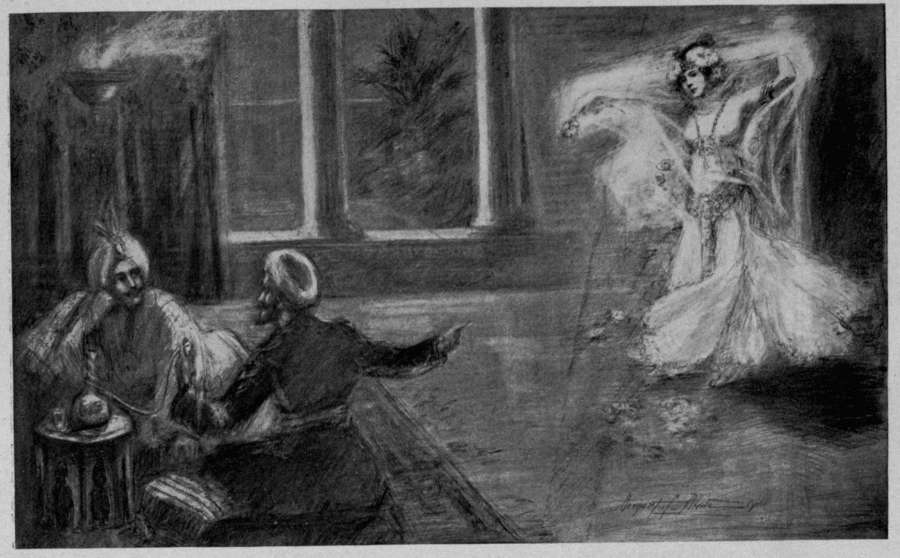
for thy escapades with natch girls, or thy drunken orgies.
Of such I do not look for an account. Thy reason for
this company is what I seek."
"Some accursed villain hath betrayed me," he muttered
fiercely. "That dog of an astrologer, or can it be my
good Moslem friend, the noble Ahmad Khan"?
"Nay," she replied sorrowfully. "It is thine own false
heart, O Prasad, that hath betrayed thee. I know of no
astrologer, and as for Ahmad Khan, thou art only adding
an injustice to thy other wickedness by slandering the
fidelity of a friend. Even when this villainy of thine was
made plain to me, he it was who stood firm as a champion
of thy miserable faith. I doubt not that now his heart is
sore with grief."
"Then fair Lady," he exclaimed. "Since the Gods
have willed it, that I shall appear in thine eyes as the
vilest of creatures, life hath no more object. Take it, O
Rani. I yield it to thee as readily here, as I would have
done for thee amid the press of battle."
He drew a dagger from his girdle and offered the
handle to the Rani. He bowed his head submissively.
She gazed upon him with sorrowful eyes. She took
the dagger from him and for a moment grasped it
tightly. Would she plunge it to his heart? He waited
resignedly. It would be an act of mercy was his only
thought.
Then she spoke in slow accents, first sternly, but toward
the close with a quaver in her voice.
"As the Rani, I could, O Prasad, kill thee; but as
Lachmi Bai thou—thou art forgiven. Oh! why hast thou
thus treated me"?
The dagger flashed with a clatter to the pavement; her
hand dropped listlessly to her side.
With a sudden burst of joy in his heart and arms
outstretched, he stepped forward, prompted by an impulse
of the moment.
She waved him back imperiously.
"Nay, I command, do thou not touch me. If thou
art forgiven by Lachmi Bai, thou art not pardoned by
the Jhansi Rani. Thy life she hath returned to thee that
thou mayest redeem thine honor by honorable deeds, but
thou canst not remain in Jhansi."
He drew back with dejection stamped upon his face.
She turned to the door and summoned Ahmad Khan.
The Mohammedan responded with reluctant steps. He
paused on beholding Prasad, sighed deeply, and directed
his eyes toward the ground.
"Ahmad," she commanded. "It is my wish that thou
dost now conduct the noble Prasad Singh safely to the
boundary of the state. He doth leave me with a message
to the Rao Sahib."
She added this from the desire to screen the Hindu
noble's public downfall.
"Noble Lady," petitioned Ahmad, ignoring her intention.
"Thou placest on my shoulders too heavy a
burden. Prasad Singh hath grown to be my friend. I
cannot regard or hold one as a prisoner who hath so
recently been my honored guest. I beg thou wilt depute
this unhappy duty to another, such as thy faithful servant,
the Dost Ali Khan, now without."
"By Heaven"! cried Prasad angrily, a wave of jealousy
sweeping all other feeling to the winds. "To such
indignity I will not submit."
He stooped and seizing the dagger that had remained
upon the floor, stood at bay defiantly.
For a moment surprise was depicted on the Rani's face,
then she sought his reason.
"Why dost thou so object to the escort of Dost Ali"?
she asked innocently.
"Thou askest me why I should object to this Dost
Ali"? he retorted. "No," he laughed mockingly. "In
pleasant company forsooth with thy——"
Something in the Rani's expression appealed direct
to his sense of honor, checking him in the utterance of
the final word. Fortunately it died upon his lips unspoken.
As if she had penetrated his meaning the Rani started,
her countenance menacing with sudden passion. She
clutched Ahmad so tightly by the wrist that he was
forced to set his teeth to withhold an oath of pain.
The situation was also critical for him. If the Rani
were to accept the implied challenge of her virtue, the
result might be a disclosure of his deep intrigue.
The danger, for Ahmad, passed as she replied with an
effort of controlled emotion.
"Truly thou art mad, O Prasad. Thy folly and
passion doth almost accomplish its inevitable end.
Fortunate is it, those who wish thee well have pity for
thee. To reason with thee would only be an act, equally
insane."
She walked toward him fearlessly and laid her hand
upon the dagger hilt.
"Come," she enjoined. "Thou hast surrendered.
Thou shalt obey my will within my state, even if it be
my pleasure that Dost Ali doth accompany thee to the
boundary."
"A curse upon thy pleasure," retorted Prasad sullenly,
relinquishing the dagger to her hand. "The sooner that
my feet are free from this unlucky soil, perchance the
more quickly will I gain some peace of mind. I care
not how I leave it, so I ride forth speedily."
"Ah! in truth, good Prasad, how well dost thou display
thy penitence," she answered reproachfully. "This
dagger will I hold as a pledge for thy better nature yet
to claim. Farewell, my Lord. I pray a kindlier fortune
may attend our next meeting."
She moved toward the door, and pausing, turned upon
him a look of deep regret.
Prasad's countenance betrayed no change of feeling.
The Rani passed out into the moonlight, where her
troopers had grouped themselves about the tomb. Ahmad
followed. He begged to know her wish concerning
the other prisoners.
"Carry them also to the boundary," she ordered, "and
let them go to whatever place God wills. I pray I may
never set eyes on one of them again."
"Doth the Rani now wish to return to Jhansi"? he
asked, "or will she accept the poor hospitality of Ahmad
Khan. His house is within a little distance."
"Not now, good Ahmad," she replied. "I would be
for a short time alone. Remain here with those unneeded
for the escort, while I go yonder to the shrine. Presently
I will return."
She acknowledged the salute of the officers as they
gazed with wonder on her masculine attire, and moved
slowly amid the trees to the temple of the great god of
Hindustan.
"Thanks be to Allah," Ahmad murmured devoutly.
"This night is mine."
Black was the heart of the Mohammedan. The night
was his—a night of hell riot loosened in his soul. Passion
and murder struggled for the first place in his intention.
Blood was already on his hands. Like a tiger his thirst
for more was now unquenchable.
Mohurran Goshi called to his door earlier in the evening
had received his unreckoned due. Ahmad's dagger
had forever settled the account between them. The wise
discerner of other's good and evil fortune, had failed to
calculate his own swiftly approaching end.
In like manner a secret order to Dost Ali was to terminate
the conspirators' existence. Ahmad quickly
planned that in some dark ravine, before the boundary
was reached, the deed might be easily accomplished.
Prasad to be dispatched in revenge, the others as a safer
fetter than money upon their silence. He quickly selected
the escort, and then drew Dost Ali to one side.
"It is the Rani's command, O discreet Ali," he said in
an undertone, "that these rascals are to be conducted to
the boundary; but thou wilt easily gather her implied
meaning. She declared she doth hope never to set eyes
on any one of them again. Dost understand, she trusteth
to thy sword, that not one of them may by chance
return."
Dost Ali drew himself up and replied tersely.
"I understand her command that they are to be set
free at the boundary."
"By Allah"! exclaimed Ahmad petulantly. "Thy
mind doth evidence little penetration. Clearly she doth
not wish them to be set free at the boundary, but in some
convenient spot dispatched from further harm."
"If such be her meaning," replied the other firmly,
"she must express it thus to me in words. Too well do
I know my duty to place an interpretation of my own
upon her plain command. As the order stands, I will
escort them to the boundary."
An exclamation of impatience burst from Ahmad's lips.
The moment was opportune for a still more wicked design.
It left him no time to argue the matter further.
"Then get thee gone upon thy business," he retorted
angrily. "For all my trouble I see thou art poorly witted
to rise in favor at the Rani's court. Thy stupidity will
interpose between a great reward."
"To obey an order strictly was ever the injunction of
my illustrious teacher, Dost Mohammed Khan," the young
officer replied firmly. "Alone, by so doing, do I seek
reward."
He saluted Ahmad haughtily, and turned to order the
mounting of his command.
"A curse upon the fool," muttered Ahmad fiercely.
"Who could have reckoned on a conscience from the
Afghan school? But that the hour has come to gratify
a yearning hunger, I would beat submission to his brain."
He bade the rest of the troopers await his return, and
set forth in the opposite direction taken by the Rani.
When beyond the range of observation from the tomb,
he turned, and quickly but cautiously made a detour with
the temple also, as his destination.
In his mind he beheld the woman of his passionate
desire, practically alone and unprotected. To the priests
and attendants he wasted not a thought. They would
fly in terror at the first cry of alarm. She, for whom he
had jeopardized his soul by swearing falsely on the Koran
would then remain to suffer willingly or otherwise the
purpose of his mind. That the ground was sacred,
mattered not. Dedicated to a heathen God, it would have
been an act of his faith to slaughter the priests and raze
the building to the ground. More, was not she, also, an
unbeliever, given into his embrace by the will of God.
When accomplished, a swift horse in waiting, would, if
need be, carry him far distant from the vengeance of the
outraged woman. Of that he had not been unmindful.
The Rani had approached the temple with sorrow consuming
her heart. Her affection for Prasad had gone
forth spontaneously almost at their first meeting. She
had beheld in him what she believed to be her ideal of a
chivalrous noble. That he possessed failings due to youth
and inexperience she was ready to admit; but that he
should prove such a hopeless failure in all his qualities,
was a bitter disappointment. A drunkard, a consort of
other women, while he asserted his unalterable love for
her, a conspirator against her authority if not her person,
surely her affection could not have been bestowed upon a
more worthless object. Her temperament was not such
as to display her anguish by lamenting Prasad's faithlessness
and her own wrong into every willing ear; but
none the less was there the necessity to obtain relief by
an outpouring of her spirit. In secret, before the great
God she worshipped, she purposed to seek consolation
for her wounded heart; then to go forth and bear outwardly
before her people no trace of her inward grief.
The temple was wrapt in silence. In the outer building
white robed, recumbent figures of priests and attendants
lay here and there where they had chosen a resting
place. With hushed steps the Rani stole past these,
crossed a courtyard, and entered the chamber of the God.
Save for the glow from an incense burner, the interior
was veiled in darkness, to emphasize the unknown mysterious
element of Siva's being. Before her, the figure
of the God loomed a darker object, seated upon an altar
pedestal, wrapt in profound, eternal meditation. The
morrow was a festival and flowers had already been bountifully
scattered upon the altar, and, in wreaths, hung
about the person of the sacred image. She stood for a
moment before the shrine, then knelt in prayer.
"O great Siva," she petitioned. "All wise, all powerful,
all just God, Protector of Animals, Vanquisher of
Death; thou, whose vision and understanding doth penetrate
all things from the infinitude of Heaven to the deepest
secrets of the human soul, behold the unhappiness of
thy daughter. Striving to be just yet ever suffering
injustice, to appease jealousy but to behold new dissension
rise on every hand, and O Holy God, loving only
to receive ingratitude and faithlessness in return. Give
me, I beg of thee, above all things, a spirit of resolute
courage to combat the vicissitudes of life, and to hold
death powerless of terror in whatever form it shall come.
Aye, and O Great God, give to me this divine quality so
that I may inspire the faltering hearts of others, if need
be to valiant deeds for the honor of our faith and country."
She raised her face upward to the protecting hands
of the God, and remained thus in silent communion.
Ahmad Khan, too, approached the temple, and passed
by the sleeping figures. With noiseless tread he crossed
the court, and stood upon the threshold of the shrine.
Before him, the woman still knelt in wrapt devotion. For
a moment his eyes feasted on her captivating form. Ah
Allah! his at last.
With the prize seeming to his hand, the intoxication
of the moment stayed his grasp. His opportunity was
lost. A cry near by, shrill and prolonged, as of a beast
relentlessly attacked by some more powerful adversary,
rose upon the night. It echoed within the temple. The
Rani started to her feet as Ahmad took a hasty stride
forward. She seized a torch at hand and thrust it into
the incense burner. Then facing him, she held it high
above her head.
Ahmad halted suddenly and trembled.
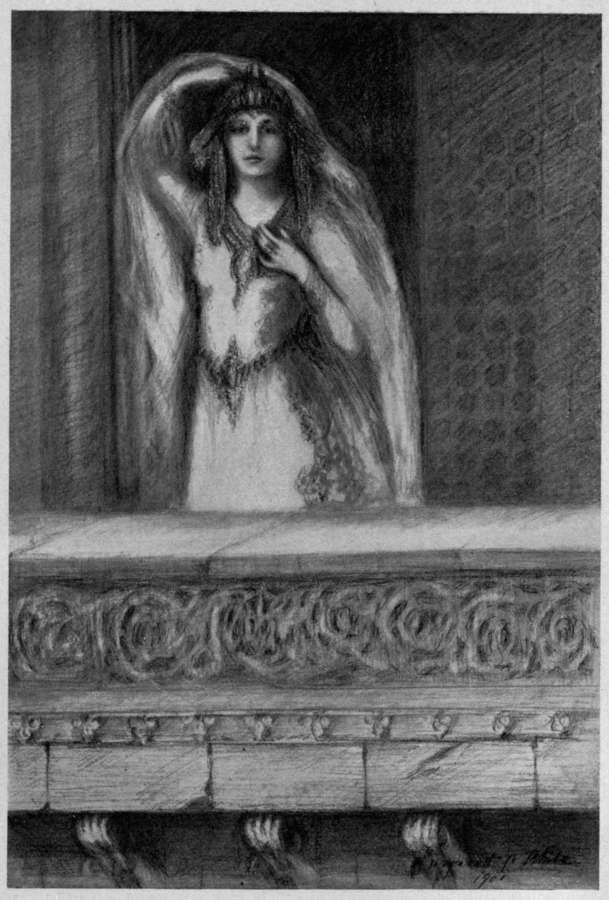
The figure of the Rani, majestic and awe inspiring,
posed before the dark image of the God, thrilled his soul
with a first sensation of terror. She appeared to gaze
full upon him, yet beheld him not. Her stature seemed to
rise visibly before his eyes. The light of the torch flaring
upward cast into strong relief the ornate decorations of
the shrine, the countenance of Siva no longer buried in
thought; but, in his non-Aryan aspect, wrathful and
menacing. Her lips moved, but no sound came forth.
She appeared to be enveloped in an ecstatic dream.
Before his fixed gaze, strange beings floated in the air.
Ancient Vedic Gods, the bright and shining ones. Indra
the rain bringer, Agni the God of fire, Vayu of the wind,
Rudra the ruler of the tempest; their very names long
since buried in oblivion to the multitude.
They gathered about the transfigured form of the Rani,
as if to protect her from a shadow of harm.
Was the scene but the effect of a feverish imagination?
In contradiction to the tenets of his religion, superstitious
of all that was visionary and inexplicable, Ahmad was
ready to believe the whole a dread reality, a manifestation
of divine blessing resting upon the head of the girl.
He would have cried aloud for mercy, but terror had
bereft his tongue of speech. He clasped his brow tightly.
For a moment he reeled, then fell to the pavement.
The night was lost and won.