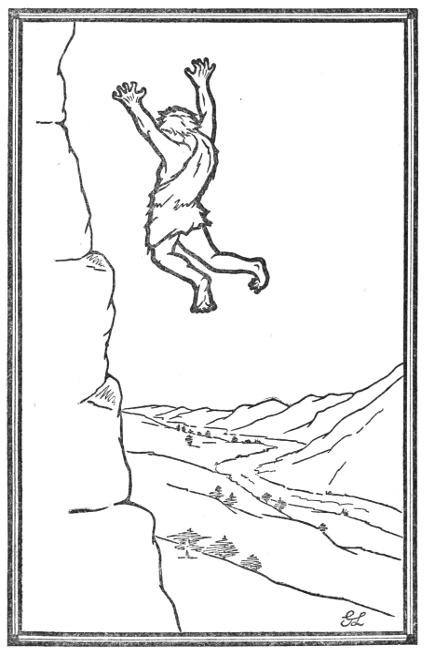
Gonch acquired more experience of the
Mammoth Man’s peculiar whims, other
than his friendship for the Hairy Mammoth
and Woolly Rhinoceros. He gained
this when he and Kutnar went down into the valley
together and mingled with the Mousterian cave-men.
The game laws or ban on needless slaughter
of which Pic had spoken, Gonch had hitherto considered
as the fancy of a disordered mind. Now
to his astonishment, he found them not only a reality
but scrupulously observed by one and all, although
he saw no sign of the authority that
enforced them. The Mousterians killed no more
than sufficient for their wants and what they did
kill was used to the best advantage. Nothing was
wasted. The flesh served as food and the hides
were set aside to be used as clothing during the cold
season. Even the limb bones were split open for
the juicy marrow they contained.
It was a strange community, this valley of the
Vézère; too peaceful to suit Gonch. The cave-men
themselves rarely fought or killed each other.
Naturally this put a premium on human flesh, another
drawback from the Muskman’s point of
view; and he blamed it all on the mad Mammoth
Man who should have attended strictly to his flint-working
instead of imbuing the whole community
with his crazy notions.
Gonch learned something more that surprised
him and this concerned Kutnar. The latter spent
most of his time with the men, an unusual proceeding,
for boys were usually left with the women
when the men went forth on hunting or other expeditions.
Kutnar, however, seemed to enjoy special
privileges. He was a strong, active lad, but a boy
nevertheless and Gonch marvelled that men would
tolerate his taking part in their affairs. It must
be that as son of the master flint-worker, he was
an extraordinarily privileged youth. Then, too,
he went about unarmed; so it appeared, for he bore
nothing but his pouch of pebbles and the rawhide
thong wound about his waist. The hunters were
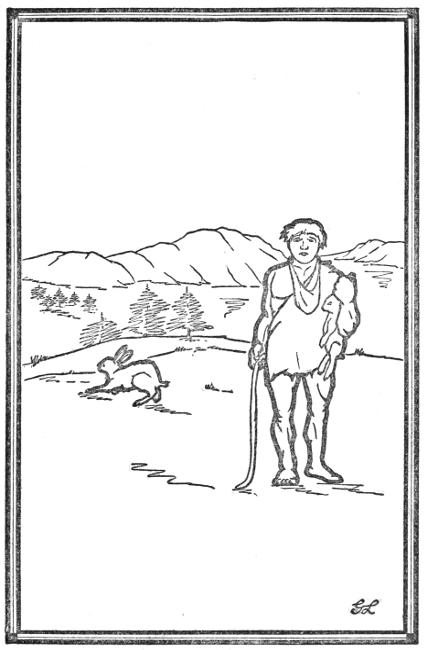
walking across the meadow when a hare sprang up
beneath their feet, bounded away several rods and
then sat bolt upright. At a signal from the leader
of the band, all stopped. The man beckoned to
Kutnar. “Your turn now,” and then as the boy
came forward, all stood at attention, apparently
much interested in what was about to happen.
While Gonch looked curiously on, wondering
what new and strange spectacle was to be presented,
Kutnar unwound the thong from his waist
and held it dangling with the two ends in his right
hand. Taking a pebble from his pouch he set it
in the rawhide’s hanging fold; then with a whispered
“Stand clear” he whirled thong and pebble
several times about his shoulders and let fly. So
swiftly sped the stone that no eye could follow it.
Gonch could not observe that anything in particular
had happened until one of the hunters ran forward
and picked up the hare, no longer sitting
upright but kicking its last upon the green meadow
grass.
“A chance shot,” thought Gonch who by this time
had arrived at some understanding of this new
method of stone-throwing. Nevertheless the sling
was a novelty and the lad had displayed much skill
in its use. Gonch went closer to examine it.
Stones were usually hurled from the hand or by a
throwing-stick, never from a strip of hide.
“Fling-string,” he muttered scornfully. “It
was a lucky cast. The stone might fly anywhere
except to the mark meant for it.”
But Gonch was mistaken. What Kutnar had
done, he could do again, not once but many times.
Half a dozen more hares and several rabbits fell
before his unerring aim and then the hunters returned
homeward with their bag, for the game-laws
applied to all animals, small as well as large
and what they or rather Kutnar had killed was sufficient
for their immediate needs. On the way
back, Gonch’s opinion of Kutnar and his sling had
undergone a profound change. It was a boy’s
weapon but one which a grown man could respect.
The youth’s skill with it was beyond the stretch
of one’s imagination. “The lad is a marvel,”
thought Gonch. “He has killed enough food for a
dozen men,” and he had a wholesome respect after
that, not only for the fling-string as he called it,
but the arm and eye that could send the pebble so
straight and swiftly to its mark.
But the most amazing thing of all, he was to discover
when he found how intimate Kutnar was
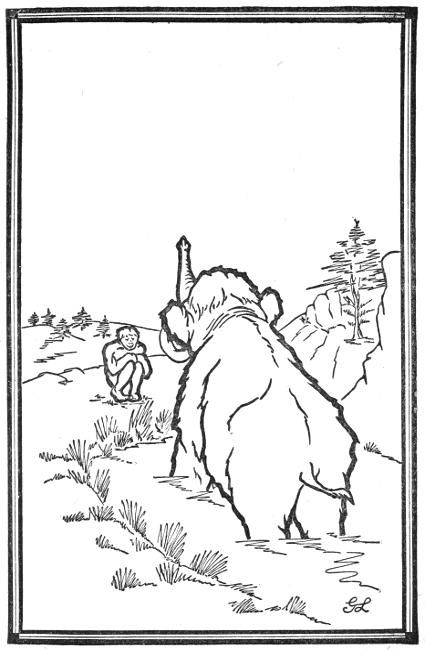
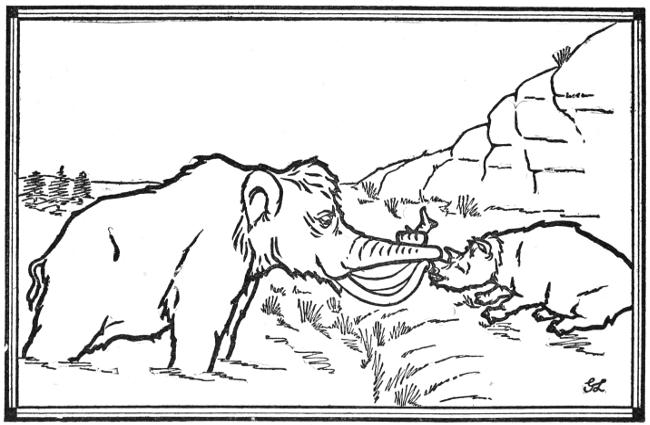
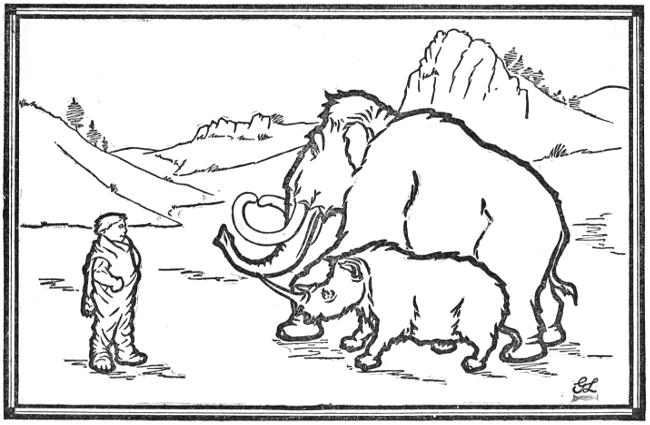
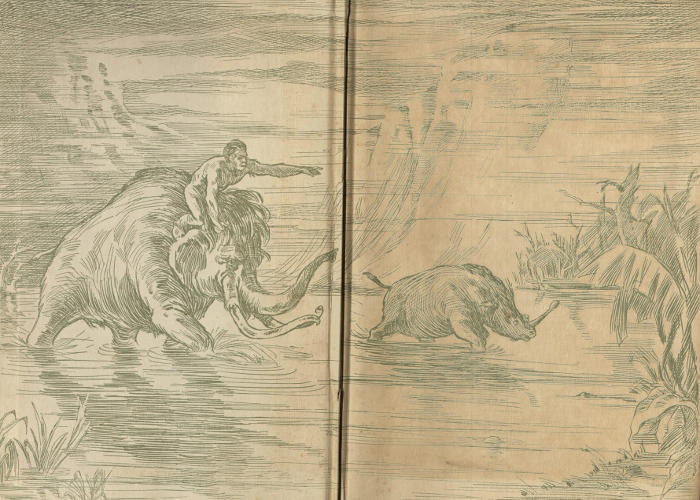
with the friendly Mammoth and Rhinoceros. He
heard Kutnar one day jabbering away to the two,
apparently in response to their squeals and grunts.
“Why do you make those noises?” asked Gonch.
“Wulli and Hairi don’t know the man-language
but I know theirs. My father taught it to me and
we can understand each other perfectly,” explained
the boy.
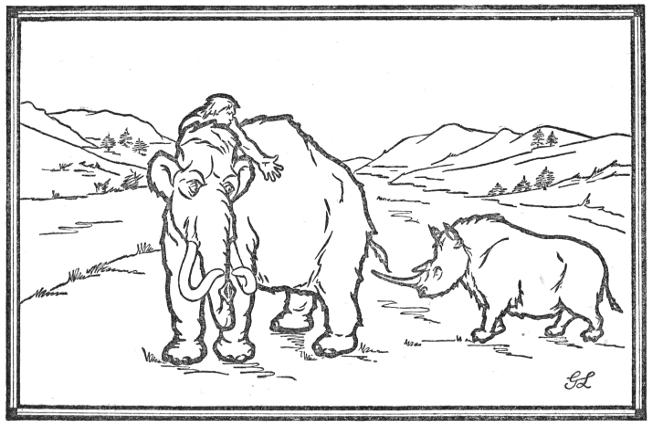
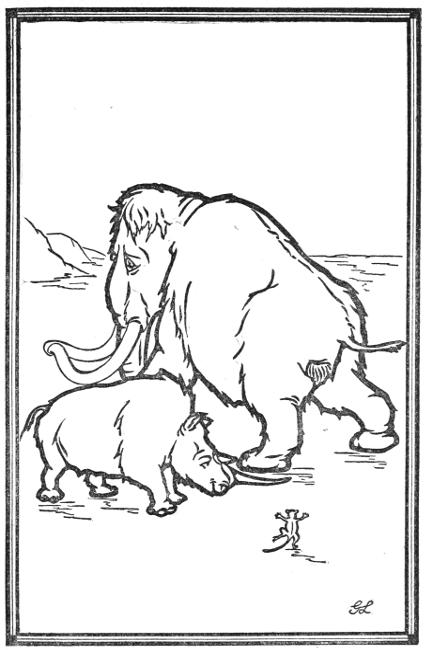
The two animals were quite at home in the valley,
for the Mousterian hunters left them severely
alone. It was evident that men and beasts had
arrived at some understanding. They were a
strange pair, were the two beasts, grand surviving
relics of an ancient order of things. The Mammoth
was a giant nearly ten feet tall from sole to
shoulder hump. He wore a long-haired overcoat
underlain by closely packed wool. The Rhinoceros
was similarly clad. In the matter of clothing they
much resembled each other, also both of them were
arctic animals, sometimes called Tundr-folk because
of their homes in the bleak unforested tundras
of northern Russia and Siberia.
Pic the Weapon Maker was usually to be found
squatting upon the cave-threshold, making tools
and weapons from the flint his people brought to
him. They also brought food and other necessities
and received finished flint weapons in exchange.
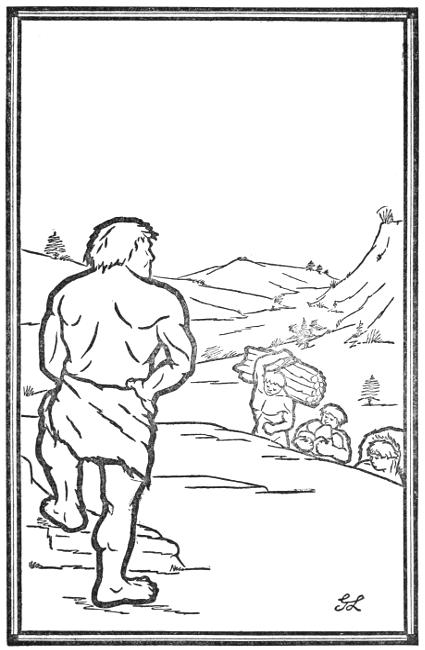
Gonch looked upon this manner of trading as a remarkable
arrangement. He could almost see Pic
sitting apart from the other men, on the threshold
of Castillo, making and handing out superb blades
while lines of hunters ascended the mountain side,
all laden with freshly-killed game. Totan did not
figure in this day dream, for he had been disposed
of and Gonch himself had taken his place. It was a
beautifully drawn picture, all woven about the
Mousterian flint-worker but it contained one jarring
note, which dream as he would, the Muskman
could not obliterate. Pic in repose was an angel;
aroused, a demon. That terrible face and the iron
grip upon his wrist were things that Gonch could
not forget, try as he would. “We can tie him up
when he has his crazy fits,” he thought and although
this seemed a good way of remedying the difficulty,
it did not drive away the dark cloud entirely.
Gonch saw much of Pic’s weapon-making, but
spy as he would, he could not catch him working
with that little tool he had partially observed when
lying by the fire during the occasion of his first
visit to Moustier. Whenever his guest appeared,
Pic put away his tool and worked entirely with the
hammerstone, changing to ones of smaller size and
less weight during the progress of the work from
the hewn blank to the semi-finished flake. His
skill with the stone-maul was uncanny. Gonch
marvelled at the deft strokes, forever varying in
force and direction but each one striking just right
to remove each chip from its place and properly
shape the blade. But none of the weapons he saw
made, ever quite reached the completed stage. Pic
jealously guarded the retouching tool from
Gonch’s sight and scheme as the latter would, he
could not catch a glimpse of it.
Gonch felt that he was losing rather than gaining
ground with the Mammoth Man. He realized
the importance of winning the latter’s confidence
and of being in a position to offer inducements
before he could hope to arrange the long journey
to the southland. And so he flattered his host,
joked with him and painted pictures of Castillo in
glowing colors; to all of which Pic would say: “If
these things are so, why do you, a southron, leave
them and come here?” or else he would hold his
peace and appear more interested in his flint-hammering
than in what the Muskman was descanting;
and finally when he scowled and glared at his
guest, Gonch knew it was time to take himself off.
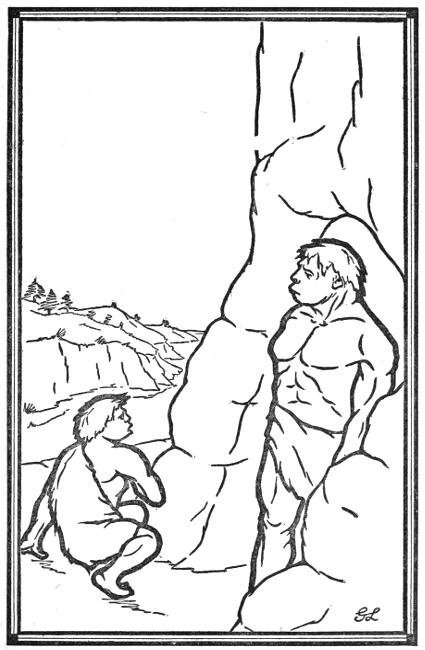
It was after one of these parleys when he had
gone down into the valley, with bitterness in his
heart against all the world in general and the Mammoth
Man in particular, that he scaled the cliffs to
the plateau above in order to be alone and scheme
anew. When he reached the upper level, he snarled
angrily for the plateau was as flat and smooth as
a board. Several hundred yards distant, a huge
boulder rested at the very edge of the cliff, so
Gonch went to that and sat down with his back to
it, safe from spying and interruption. It trembled
as he touched it; a huge stone of many tons
weight and yet it moved with the mere touch of his
shoulders. It had been long since any man dared
to go near this eerie boulder which rocked with the
wind. Some said that a giant flesh-eating beast
had long been sealed within it and that it struggled
to escape when the wind blew. So they gave it a
wide berth but Gonch, having neither seen nor
heard of it before, considered it a mere rock. Here
was a good place to seclude himself and so he
crouched with his back to it and to the valley below
him. He tried to think and plan but with his slightest
motion, the boulder teetered from side to side.
It was most disconcerting; the stone seemed bewitched.
He scrambled to his feet and walked
around it wondering how a mere rock could have
gotten itself into such a peculiar predicament.
Nothing but an ordinary stone; of that he soon
assured himself. It was so evenly balanced that
he might tip it over and send it crashing down the
cliffs if he chose. He was about to resume his former
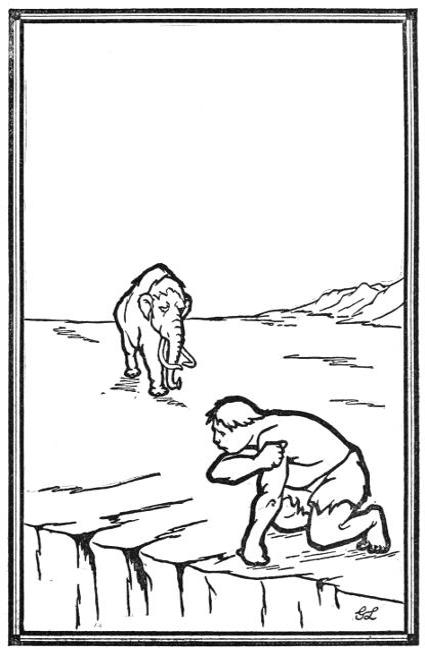
seat behind it when he heard sounds in the valley
below. He poked his head over the cliff coping,
then as quickly withdrew it to avoid being
seen.
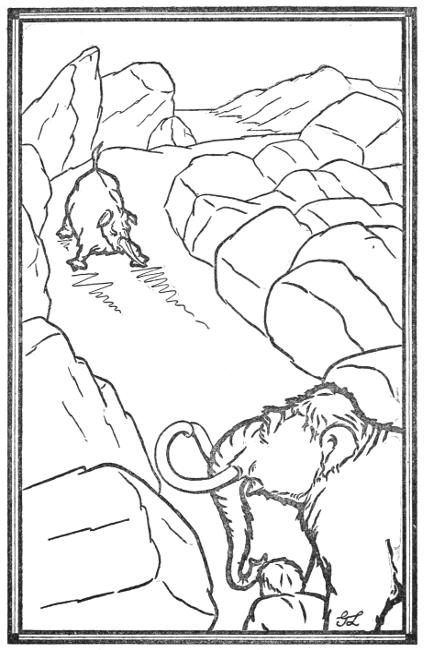
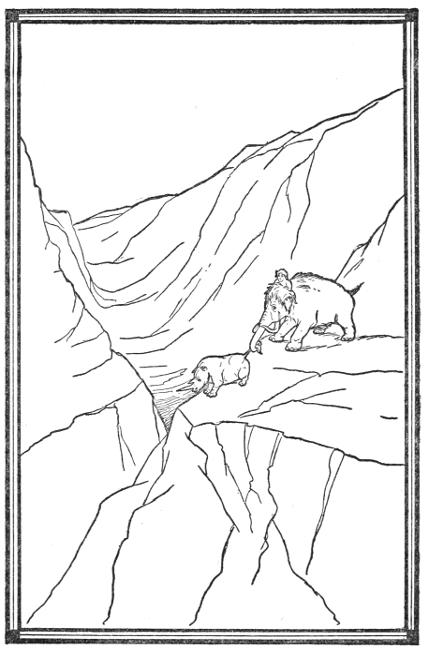
Two animals were plodding along the foot of the
cliffs. Soon they would pass directly beneath the
man crouching above their heads; also they would
pass beneath the Tilting Stone.
Gonch got upon his hands and knees growling
softly like a tiger awaiting its prey. He had recognized
the two animals at a glance. They were
the Mammoth and Woolly Rhinoceros. This was
the chance of a lifetime. He a lone man might slay
one or both beasts by the mere touch of his hand.
“There are none here to see,” something within
him said. “Who will deny that the rock simply
fell? Who can say what caused it to fall? Be a
man and vent your spite on this mad flint-worker.”
He growled softly once more, set his shoulders
against the stone and waited.
The thumping of feet sounded almost beneath
the Tilting Stone. Gonch listened intently, timing
himself for the fateful moment. The beasts were
walking fast as he could hear but it was not given
him to know that the sounds took time travelling
from the foot of the cliffs to where he crouched.
The moment had arrived. He gave one mighty
shove. The stone lost its balance—almost too
slowly—then gathering momentum, went tumbling
over the cliff. For an instant, Gonch stood outlined
against the sky, then a shrill cry rang out
below and he jumped back just as the boulder
struck bottom with a tremendous crash. He heard
squeals and bellows but he dared not look to see,
for that voice—the cry of a human being, had terrified
him. Away he bolted across the plateau and
from the cliffs as fast as his legs would carry him.
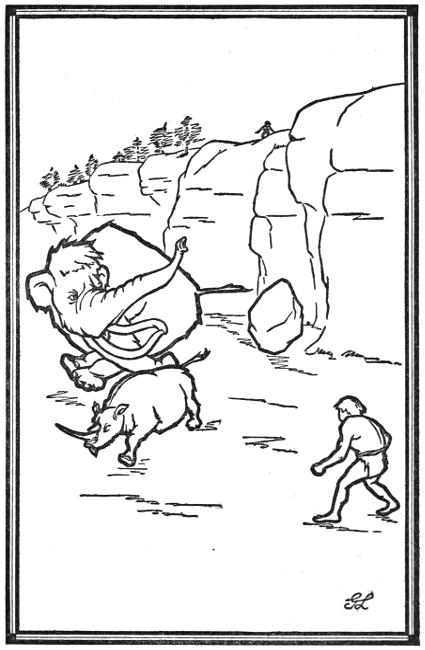
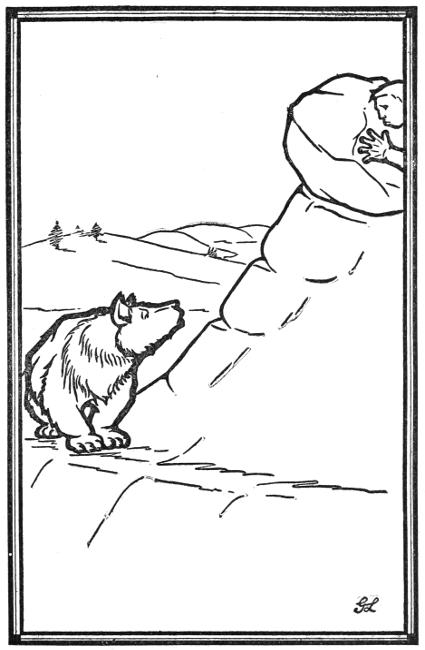
The Fall of the Tilting Stone
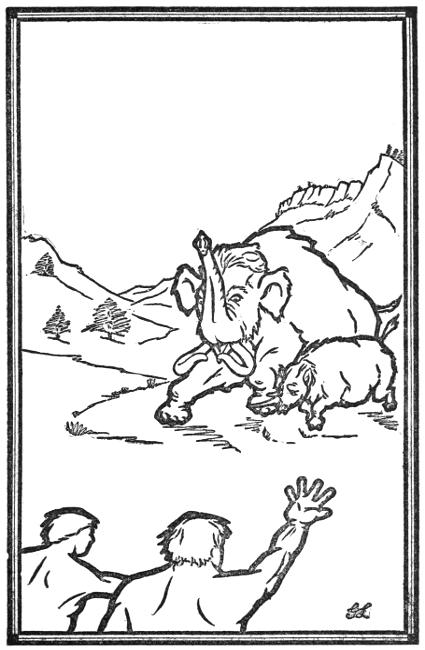
Down in the valley, the boy Kutnar was running
toward the fallen boulder, shouting “Hi—yo!”
and waving his arms at the Mammoth and
Rhinoceros who were galloping away in a great
fright because of the falling stone that had crashed
to the ground so closely behind them. They heard
someone shouting and recognized Kutnar’s voice,
so they slowed up and looked back. All was now
quiet and finally by much arm-waving, the lad induced
his two friends to return. This they did
very slowly and carefully, not feeling entirely convinced
that all danger had passed. Kutnar was
perched astride of the great boulder that had so
nearly destroyed them. He spoke in the strange
tongue that Hairi and Wulli so well knew.
“I saw it falling,” he said as they came up. “I
shouted to warn you.”
The snorts, squeals and grunts with which the
two animals answered would have meant nothing
to an ordinary man; but Kutnar had no trouble
understanding them.
“A narrow escape,” sighed the Mammoth who
was trembling from head to foot. “It is but a
stone but it fell. What caused it to fall? It might
have killed us.”
“It would certainly have killed us, had it dropped
upon our backs,” said the Rhinoceros solemnly.
“Never was I so startled. I nearly jumped over
my nose-horn.”
“And I, over my tusks,” the Mammoth added.
Kutnar laughed. “Yes you both jumped like
rabbits”; then he looked up at the cliffs and his face
became serious. “The stone did not fall of itself,”
he said, half to himself. “Someone pushed it over.
I saw——”
“Someone pushed it?” inquired the Mammoth.
He looked thoughtfully at the great boulder and
shivered. It had been a nerve-racking experience.
He hoped he would never have another like it.
“Yes, someone pushed it,” Kutnar repeated.
“Who?”
“I do not know. I saw him but an instant; then
he jumped back.”
“It must have been the Cave Lion,” the Mammoth
suggested. “He hates us and only a strong
animal could have moved such a big rock.”
“No, it was not the Cave Lion.” Kutnar became
silent as he watched the Rhinoceros who was now
sniffing the stone vigorously. Finally Wulli’s nose
settled on one spot and here he made a most thorough
investigation. When this was concluded to
his satisfaction, he raised his head and gazed triumphantly,
first at one then the other of his companions.
“I know,” he squealed. “I found where he
touched it. My nose never lies. I know.”
“Who was it?” the Mammoth asked.
“A hyena.”
“A hyena?” the boy laughed. “No, Wulli; you
are wrong for once. Smell again.”
The Rhinoceros took another long careful sniff.
Once more he raised his head and maintained stubbornly:
“My nose never lies, I tell you. I know
that smell of him who eats men and bad meat. I
say it was a hyena.”
For an instant the boy eyed his companion in
doubt. Heretofore Wulli’s nose had been infallible.
It was his eyes versus the Rhino’s nose.
Probably the eyes were mistaken. They had
caught only a fleeting glimpse. He laughed again.
A second laugh echoed overhead. The three
friends looked hastily upward and saw a hideous
face leering down upon them. Quick as lightning,
Kutnar made ready his sling and hurled a pebble.
A loud yelp and the face disappeared. “Hyena
it was,” said the lad. “Wulli is right; his nose
never lies, but had I not seen the beast a second
time, I would have sworn that he who pushed the
rock down upon us, was a man.”