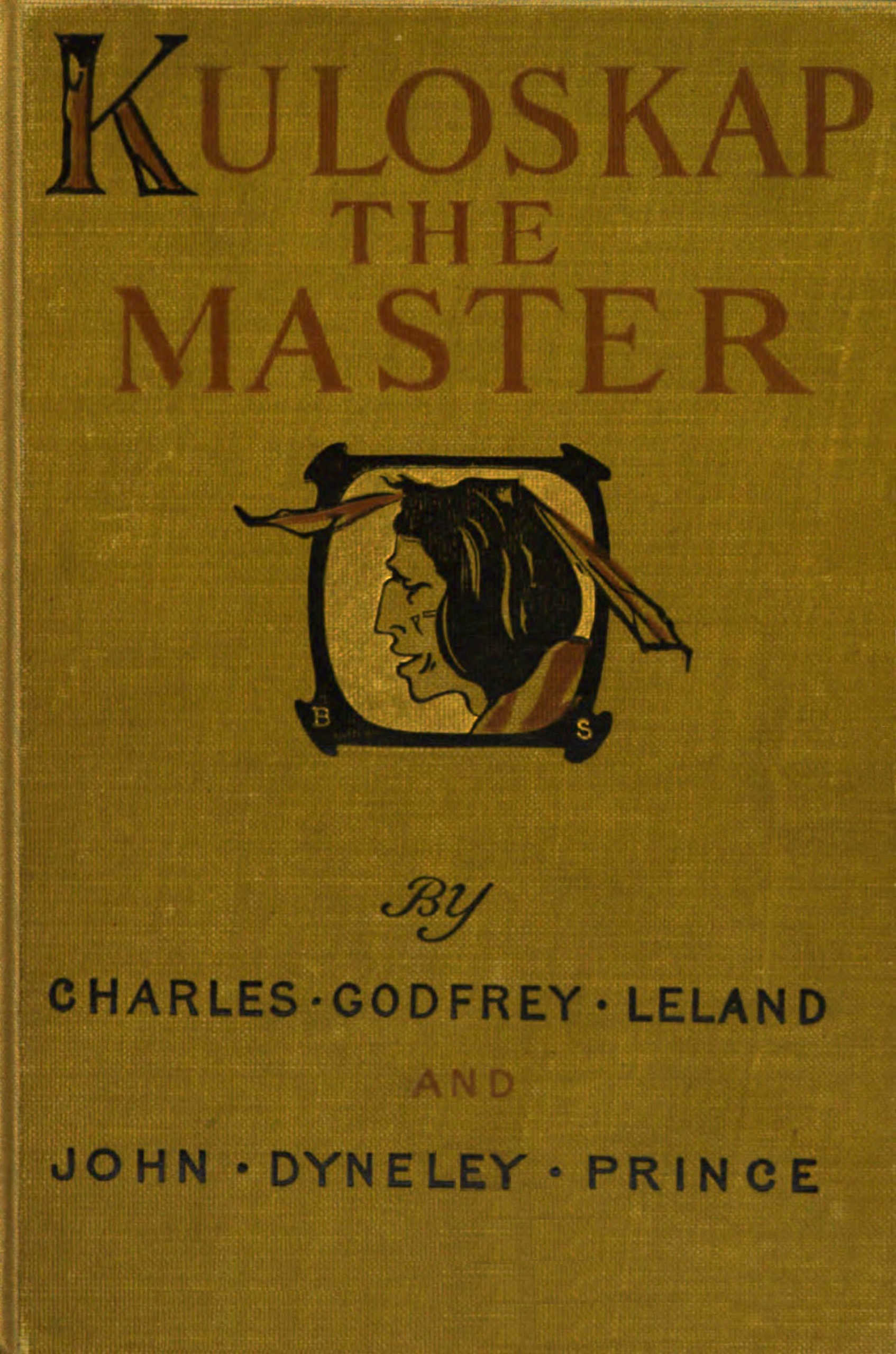
Kulóskap the Master
Whole book · 72 sections
Kulóskap the Master
And Other Algonkin Poems
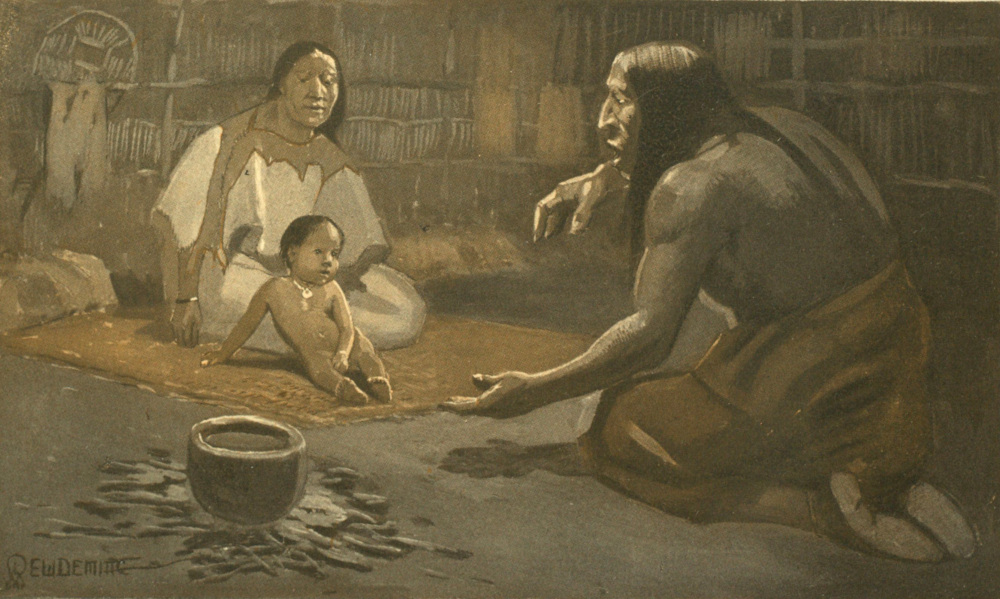
And bade the little creature come to him;
Back smiled the baby, but it did not budge.
(See page 108.)
Kulóskap the Master
And Other Algonkin Poems
Translated Metrically by
CHARLES GODFREY LELAND, Hon. F.R.S.L.; M.A.
(Harvard)
Author of “The Algonquin Legends of New England”
AND
JOHN DYNELEY PRINCE, Ph.D. (Johns Hopkins)
Professor in Columbia University and author of various articles on Algonkin dialects
FUNK & WAGNALLS COMPANY
New York and London
1902
Copyright, 1902
By FUNK & WAGNALLS COMPANY
New York
Registered at Stationers’ Hall, London, England
Printed in the United States of America
Published November, 1902
ILLUSTRATIONS IN THE VOLUME
Half-tone Text Illustrations by F. BERKELEY SMITH
Ten Tracings after Indian Designs by
CHARLES GODFREY LELAND
Frontispiece by EDWIN WILLARD DEMING
Contents
| PAGE | ||
|---|---|---|
| Preface—By CHARLES GODFREY LELAND | 11 | |
| Introduction—By JOHN DYNELEY PRINCE | 21 | |
| PART FIRST—THE EPIC OF KULÓSKAP | ||
| Canto First—Creation Legends | ||
| I. | The Birth of Kulóskap | 43 |
| II. | The Creation of Man and the Animals | 50 |
| III. | The Origin of the Rattlesnakes | 56 |
| IV. | How Kulóskap named the Animals | 59 |
| Canto Second—The Master’s Kindness to Man | ||
| I. | What Kulóskap did for the Indians | 62 |
| II. | How Kulóskap granted Gifts and Favors to many Indians | 64 |
| III. | Kulóskap and the Fool | 90 |
| IV. | The Three Brothers who became Trees | 94 |
| V. | Kulóskap and the Wise Wishers | 98 |
| VI. | How Kulóskap was conquered by the Babe | 107 |
| Canto Third—The Master and the Animals | ||
| I. | Kulóskap and the Loons | 110 |
| II. | Kulóskap and the Beaver | 112 |
| III. | The Sable and the Serpent | 118 |
| IV. | Kulóskap and the Turtle | 123 |
| V. | How Mikchik the Turtle was false to the Master | 136 |
| VI. | How Kulóskap conquered Aklibimo the Great Bull Frog | 140 |
| VII. | How Kulóskap went Whale Fishing | 152 |
| VIII. | Kulóskap and Wuchōsen the Wind Eagle | 158 |
| Canto Fourth—The Master and the Sorcerers | ||
| I. | Kulóskap and Winpe | 162 |
| II. | How a Witch sought to cajole the Master | 172 |
| III. | How Kulóskap fought the Giant Sorcerers | 174 |
| IV. | How the Master showed himself a Great Smoker | 182 |
| V. | Kulóskap and the Witch | 185 |
| VI. | Kulóskap and the Witch called “The Pitcher” | 194 |
| VII. | How Kulóskap sailed through the Cavern of Darkness | 203 |
| VIII. | How the Master found the Summer | 208 |
| IX. | How Kulóskap left the World | 213 |
| X. | The Master and the Final Day | 217 |
| PART SECOND—WITCHCRAFT LORE | ||
| I. | The Wizard’s Chant | 223 |
| II. | The Woman and the Serpent | 225 |
| III. | The Wizard Snake | 229 |
| IV. | The Measuring Worm | 231 |
| V. | The Pʾmûla or Air-Demon | 236 |
| VI. | The Little Boy kidnapped by the Bear | 239 |
| VII. | The Wizard and the Christian Priest | 242 |
| VIII. | Wizard Warfare | 244 |
| IX. | The Wizard’s Hunting | 250 |
| X. | Six Short Tales of Witchcraft | 253 |
| XI. | A Delaware Youth and his Uncle | 256 |
| XII. | The Dance of Old Age | 260 |
| XIII. | A Tale of the River-Elves | 269 |
| PART THIRD—LYRICS AND MISCELLANY | ||
| I. | The Song of Lappilatwan | 273 |
| II. | The Story of Nipon the Summer | 283 |
| III. | The Scarlet Tanager and the Leaf | 295 |
| IV. | The Blind Boy | 305 |
| V. | A Passamaquoddy Love Song | 308 |
| VI. | The Song of the Stars | 312 |
| VII. | How the Indians lost their Power | 314 |
| VIII. | The Partridge and the Spring | 320 |
| IX. | Lox, the Indian Devil | 325 |
| L’Envoi | 337 | |
| Appendix: The Passamaquoddy Wampum Records | 340 | |
| Glossary | 361 | |
Full Page Illustrations
| PAGE | |
|---|---|
| Kulóskap and the Babe | Frontispiece |
| The Creation of Man | 50 |
| The Origin of the Rattlesnakes | 58 |
| What Kulóskap did for the Indians | 67 |
| Kulóskap and the Loons | 110 |
| Kulóskap and the Beaver | 116 |
| The Sable and the Serpent | 122 |
| How Kulóskap went Whale Fishing | 154 |
| Kulóskap and Winpe | 170 |
| How Kulóskap fought the Giant Sorcerers at Saco | 178 |
| How Kulóskap sailed through the Cavern of Darkness | 205 |
| The Little Boy Kidnapped by the Bear | 241 |
| Wizard Warfare | 246 |
| The Dance of Old Age | 266 |
| Lox, the Indian Devil | 333 |
Preface
BY
CHARLES GODFREY LELAND
PREFACE — FOOTNOTES:
Very few persons are aware that there has perished, or is rapidly perishing, among the Red Indians of North America, far more poetry than was ever written by all the white inhabitants and that this native verse is often of a very high order. For the Indian sagas, or legends, or traditions were, in fact, all songs; as is the case to this day with similar lore in Italy. Indeed, in the latter country, I have been asked if I would have a fairy tale chanted or repeated as prose! Thus, all the narratives in my “Algonquin Legends of New England,” especially those referring to Kulóskap (Klûskâbe), or to the gods, might have been correctly made into a poetic cycle, as the Finnish Kalevala was made by Lönnrot.
After I had published my Legends, however, I was made aware by Louis Mitchell, a Passamaquoddy Indian, who had been in the Legislature of Maine, and had collected and written out for me, with strictest literalness, a great number of manuscripts, that there were in existence certain narratives and poems quite different in kind from anything which I possessed. Among the former was a History of the Passamaquoddy Tribe, illustrated with numerous designs of the birchbark school of art, which I transferred to my friend the late Dr. D. G. Brinton as its most appropriate possessor. Three of the poems Mitchell wrote out for me in exact, though often quite ungrammatical language, which was so close to the original that the metres betrayed themselves throughout. I regret that, though I had certainly acquired some knowledge of “Indian,” it was, as a Passamaquoddy friend one day amiably observed, “only baby Injun now grow bigger some day like Miʿkumwess s’posin’ you want to,” in reference to a small goblin who is believed to have the power of increasing his stature at will. However, I with great care put the Mitchell Anglo-Algonkin into English metre, having been impressed, while at the work, with the exquisitely naïve and fresh character of the original, which, while it often reminded me of Norse poetry, in many passages had strictly a life and beauty of its own.
Among my varied and most valued small possessions is what was once, beyond doubt, the sketch book of Salvator Rosa himself, consisting of a number of blank leaves on one of which still remains an exquisite pen sketch of a head by Bronzino. There were in it also, at one time, as appears from a memorandum and on a flyleaf, several sketches of Salvator, but these have been cut out and sold. The binding or cover of the book was made from a large folio-thick parchment leaf from a fourteenth century religious manuscript, whereon are seven illuminated vermilion capitals still remaining. And, as my manuscript exactly fitted the cover, I placed it therein, where it rested for many years, undisturbed even by a thought save when it occurred to me how the great and savage master, who was himself a poet, would have rejoiced among Indians and liked their lyrics!
“Io sono pittore
Gar flink mit der Hand
Und bin Salvatore
La Rosa genannt.”
It so befell that I, per fortuna, became correspondent with Professor J. Dyneley Prince, who had come some time after but got far before me in a knowledge of Algonkin, as was shown in various papers containing the original text and translations of Algonkin legends in different dialects. Whereupon, the thought occurred to me that this fully qualified scholar might revise, correct, and compare my metrical version with the original text, which task would be much facilitated by the fact that he also was well acquainted with Louis Mitchell, and I may here mention that, while I had at one time obtained an accurate copy of the celebrated Algonkin “Wampum Record” which was recited annually in bygone days at the Council of the Tribes, and had it read to me, and written out in Indian English. Prof. Dyneley Prince has himself translated it and reproduces a portion of it in the present work. So it came to pass that this book was written. And I may here mention that my colleague, while his specialty is the Semitic tongues, also has (like my late friend E. H. Palmer, who professed Arabic at Cambridge) the gift of the Romany and even Shelta, which are as the Latin and Greek of the roads!
During more than one-third of a life which began in 1824, I have passed almost annually over the continent of Europe. I have lived for the past fifteen years in Florence, in touch with the Apennines, or opposite Bellosguarda, sung by many a poet, and the Alps and castled crags of the Rhine come to me often in my dreams; yet I never found in it all that strange and sweet charm like a song without words which haunts the hills and valleys of rural New England. That it has existed and been deeply felt and clearly recognized, is evident in the works of Hawthorne, with whom we may include Washington Irving, Judd[1] and indeed many more, every one of whom bears witness of having been awakened by a spell which he never felt in other lands. And this spirit of its memory is the most beautiful which I have at command:
“I feel its magic from afar
Like another life in me;
I hear—though not with living ear
And see the forms which with my eye
I ne’er again shall see!”
Yet with all this, there was still one thing wanting; that which Nature itself would not give fully, even to a Wordsworth: the subtle final charm of human tradition, poetry, or romance. True, it may be the slightest—a mere touch of gold-leaf or an illuminated letter, or a sun-gleam on the mountain top—but the most inspired poet can never feel that he is really “heart-intimate” with scenery, if it has for him no ties of tradition or folk-lore. When I was young, I felt this lack, and bore in patience the very common reproach of Europeans that we had a land without ancient legends or song. But now that I am older grown, I have learned that this want is all in our own ignorance and neglect of what we had only to put forth our hand to reach. We bewailed our wretched poverty when we had in our lap a casket full of treasure which we would not take the pains to open. Few indeed and far between are those who ever suspected till of late years that every hill and dale in New England had its romantic legend, its beautiful poem, or its marvellous myth—the latter equal in conception and form to those of the Edda—or that a vast collection of these traditions still survives in perfect preservation among the few remaining Indians of New England and the Northeast Coast, or the Wabano. This assertion is, I trust, verified by what is given in the Micmac tales by the late Rev. S. Rand, the collection made by Miss Abbey Alger of Boston, and my own “Algonquin Legends of New England,”[2] which I, sit venia, may mention was the first to appear of the series. And I venture to say from the deepest conviction that it will be no small occasion of astonishment and chagrin, a hundred years hence, when the last Algonkin Indian of the Wabano shall have passed away, that so few among our literary or cultured folk cared enough to collect this connected aboriginal literature. Unto which I may truly add that, when such collection was made, there were far more critics to find fault with the way in which it was done, than persons to do it.
A few of the poems contained in this volume have already appeared in prose form in the “Algonquin Legends of New England.” As these were in fact poetry, or chanted in rude measure, I had at first the intention to give them in English in their original form and to group all those referring to the divinity in an epic, as Lönnrot made the Finnish Kalevala, or Homer his own great works. This I have to a degree accomplished in the present volume.
To render my meaning clear as to the legends having been poems, the reader may be aware that all rude races make no distinction between prose narrative and poetry. When an Indian, an Italian mountaineer, an Arab, and sometimes a Gypsy (I have had experience of all in this respect) would spin off some long romantic yarn, he either gives you a choice, or, more frequently, begins to intone or chant the tale in a manner which is something between plain-song and the singing of “Captain Kidd” in a northeaster by one who has no vocal gift. Then the voice falls into one or the other of two measures which I believe I have accurately followed in the present work. This primitive rhythm is quite irregular, following only a general cadence rather than observing any fixed number of beats in each line. I have endeavored to represent this peculiarity in the English version by not adhering too strictly to an unvarying measure. These Amerindian[3] metres are not all like that of Hiawatha, which is, however, quite in accord with the form of the Slavonic and Spanish romances.
Although not entirely ignorant of Passamaquoddy, Penobscot and Micmac, I am not proficient therein and have chiefly based my work on very careful translations executed by others. Here, however, I avail myself of the assistance and authority of my collaborateur, J. Dyneley Prince, who as these pages witness, has seriously studied the eastern Algonkin dialects, especially the idiom of the Canadian Abenakis.
A Penobscot woman once told me that it was Klûskâbe—she did not call him Kulóskap, as the Passamaquoddies do—who divided the great mountain of which Boston originally consisted into three hills. I have since learned from an authentic legend gathered by Miss Roma Lister that Virgil did the same at Rome. Here the seven hills were confused with three. Every reader of Scott will recall the great wizard Michael Scott, who was believed to have worked the same miracle:
“And, Warrior, I could say to thee
The word that cleft Eildon hills in three.”
These coincidences are very remarkable. I regret that I have not the Penobscot song in which the division of the Boston hill is described, but I believe that it exists.
The traditions and, to some extent, the languages and histories of the aboriginal tribes are quite as worthy of being taught at our universities to all who propose to become American scholars as many other branches which are endowed at great expense, and are a great source of pride. But the true value of work like this is, that the country will be if those who love it so desire, once more repeopled with the fairies of yore. Those who will may walk in the spirit-haunted paths, trodden in the early time by strange beings; the rocks will have their goblins again and the “Diana’s Bath,” as it is now styled, will be known by its ancient Indian name of “The Home of the Water Elves.”[4] It was Bryant, I think, who declared that the forest trees of New England were all the summer time repeating in Indian words “their old poetic legends to the wind,” and it is a tradition that there are ancient Indians who understand the language of Mūūin the Bear—wherein may lurk more truth than most would deem, according to the latest faith!—but these were unto all lost tongues, and the dreams were thinnest air. Now that it is indeed possible from these poems and such tales as have begun to reappear to see the forms of olden time once more. I venture to express the hope that all who love nature in New England will turn to the study of its folk-lore and thereby secure the final flash of gold on the mountain tops, the last touch in the picture of which I have spoken. When I was a boy my happiest hours were spent in the rural scenery of Massachusetts. Could I have had such books then, I could have enjoyed it all far more. Therefore, I wish with all my heart, and truly from no selfish point of view, that every lover of rock and river and greenwood tree would master these old Indian tales or poems, and see in all Nature new charms.
CHARLES GODFREY LELAND.
[1] Author of “Margaret” (illustrated beautifully by Felix Darley).
[2] “The Algonquin Legends of New England,” by Charles G. Leland. Boston (Houghton, Mifflin & Co.), 1885.
[3] Amerindian is a term invented and used by the Americanists of the Smithsonian Institution, to denote aboriginal American races and languages.
[4] At the Intervale in the White Mountains, N. H., the Indian name for the spot known as “Diana’s Bath,” is Wʾwagʾmeswuk wigît (Passamaquoddy), “the fairies’ home.”
Introduction
BY
JOHN DYNELEY PRINCE
INTRODUCTION — FOOTNOTES:
I became interested in Indian languages and lore at Bar Harbor, Me., in 1887, chiefly through my able coadjutor. It was Mr. Leland’s important work, “The Algonquin Legends of New England” (Boston, 1885), which inspired me to make my first investigations in this field. Mr. Leland was indeed the pioneer in examining the oral literature of the northeastern Algonkin tribes, a fact which few scholars seem to recognize. To him especially, as well as to the late Rev. Silas Rand of Nova Scotia and to Miss Abbey Alger of Boston, do we owe some highly valuable additions to our knowledge of early eastern Algonkin thought. My own researches have been devoted more to linguistic and phonetic investigations among the Canadian Abenakis than to comparative mythological study—in which, however, I feel a very deep interest. In the present work I have had the pleasant task of arranging and editing Mr. Leland’s material, to which I have added some of my own collections. Mr. Leland’s poems are indicated by the letter L and my contributions by the letter P.
I gladly take this opportunity to express my gratitude to my friend, Mr. A. S. Gatschet of the Smithsonian Institution at Washington, for a great deal of valuable advice and instruction given to me at different times during my American researches. His extensive knowledge of Algonkin philology and folk-lore has always been most kindly placed at my disposal.
The existing representatives of the Algonkin or Algic race may be separated linguistically into three great divisions: the Blackfeet of the extreme west, whose idiom differs most greatly from all the other dialects;[5] the Cree-Ojibwe of the middle west, which embraces a number of closely allied linguistic variations[6] and the Wabanaki races of the eastern coast, with whom the present work is concerned. It should be noted that the Algonkin languages, like all American idioms, are polysynthetic, i.e., either by means of prefixes and suffixes which were themselves separate words, or, by combining the radicals with other radicals, they build up words and often sentences from original radicals which, in all probability, were primitively monosyllabic. These original stems were in reality only indifferent themes which might be used practically in any sense, be it nominal or verbal. An excellent example of polysynthesis is seen in the combination ndalagaʿkimzi Alsigontegok, “I learned it at St. Francis” (Abenaki), which may be analyzed as follows: n, inseparable prefix of the first person, dal the prepositional element “in” or “at” (cf. the separable post-position tali, “in”), √ agaʿkim, the root “to learn, teach”—itself a reduplicated form of original √ kim, “learn”—and, finally, -zi, the reflexive ending. Alsigontegok is the locative case of Alsigontegw, “river of empty habitations,” the Abenaki name for the Indian village of St. Francis, near Pierreville. The termination -tegw, locative tegok, always means “river,” but cannot be used separately. If the reader will reflect that the entire linguistic structure is arranged on this plan, the immense physical difficulty of these idioms will be appreciated. On the other hand, the Algonkin languages, by reason of their very power to form these long idea-words, are admirably adapted for narration and song, however poor a medium they might be for modern business.
Among the following poems and tales will be found selections taken from Passamaquoddies, Penobscots, Abenakis, Micmacs and Delawares, all of which tribes are members of the so-called Wabanaki branch of the Algonkin stock and are consequently nearly related in language and folk-lore. This term Wabanaki or Oñbanaki (Abenaki) means “land of the dawn or east,” and undoubtedly points to that section of country in which these people first established tribal relations. Wabanaki (Oñbanaki) is also a common term for “a man from the east.”[7]
The Passamaquoddy Indians of Pleasant Point, Me., numbering about five hundred in all, are identical with the Milicetes or Etchemins of New Brunswick and Nova Scotia. The name Passamaquoddy is a purely local term, meaning “spearers of pollock fish” (peskátum). The correct form is Pestumokádyik. These people are by far the most interesting remnant of the Wabanaki, as they still retain an unusually extensive oral literature, embracing love poems, legends, and historical tales of considerable value. It will be noticed, moreover, that, of the material given in the present work, that coming from the Passamaquoddy is by far the best from a literary point of view. I need only call the reader’s attention to the very remarkable song recording the attack of the squirrels on Lappilatwan, who dwelt in the birch tree, “ever sitting with his mouth open” (wechkutonébit), a song of which Mr. Leland gives a most charming version. I know no parallel to this in any other literature. The wonderful song of Nipon, the summer, and the truly tender legend of the loves of the Leaf and the Firebird will serve still further to illustrate the purity of Passamaquoddy thought and diction.
The following brief historical sketch, taken from the manuscripts of the Passamaquoddy Louis Mitchell, will give some idea of the conditions which prevailed among the Wabanaki previous to the coming of the Europeans.
“In former days the Wabanaki nation, the Indians called Megʾwek, or Mohawks, and other members of the Iroquoian Six Nations, were wont to wage bloody and unceasing war with one another. The Wabanaki nation consisted of five tribes: Passamaquoddies, Penobscots, Micmacs, Milicetes, and the tribe, now extinct, which formerly inhabited the banks of the Kennebec River. The bitterest foes of the Wabanaki were undoubtedly the Megʾwek or Mohawks, who on the slightest provocation would send bands to harry them and destroy their crops. The Mohawks invariably treated their prisoners with the most merciless severity, showing no pity even to the women and children. A favorite torture which they frequently practised was to build a large fire of hemlock coals, into the flames of which they drove their captives, compelling them to walk back and forth over the glowing embers until relieved by death. No case is on record where a brave of the Wabanaki succumbed to the fearful pain and begged for mercy. The warriors would always pace the fiery path with undaunted resolution and without uttering a sound, until nature put an end to their agony. Tortures of this sort were practised by all the tribes, but the Mohawks exceeded the others in cruelty.”
“The cause of the strife was an hereditary dispute about hunting grounds. Besides the enmity which they nourished in common against the Six Nations, the Wabanaki had also internal disputes. Thus, the Penobscots were at feud with the Milicetes and the Micmacs with the Passamaquoddies.”
“The first war between the last two tribes was brought about by the quarrel of two boys, sons of chiefs. On this occasion the Passamaquoddies were on a friendly visit to the Micmacs, during which the sons of the Passamaquoddy and Micmac chiefs went shooting together. They both shot at a white sable, killing the animal by their joint effort, but each lad claimed it as his game. Finally, the Passamaquoddy boy, becoming enraged, killed the son of the Micmac chief. The latter on hearing of the murder could think only of vengeance, and positively refused to listen to the Passamaquoddy chief’s attempt at reconciliation. The latter even offered the life of his own son who had been guilty of the murder, but all to no purpose. In consequence of this unfortunate occurrence, the celebrated ‘great war’ was then declared, which lasted many years.”
“The Micmacs although more numerous than their enemies, were inferior warriors, so that the victory was always won (sic!) by the Passamaquoddies. So great was the hostile spirit that the two tribes fought whenever they met, paying no heed to the time of year. On one occasion, the Passamaquoddies went to Tlancowatik, thirty miles west of St. John, N. B., with a small party consisting principally of women and children, with the chief and a few braves. At this place they met a number of Micmacs on their way to Passamaquoddy Bay. The Micmac chief being a lover of fair play ordered his men to land on an island to await the coming of a messenger. The other chief sent word that on the following day ‘the boys would come out to play.’ As the Passamaquoddy chief had very few men able to bear arms, he made the women attire themselves like warriors so that from a distance they might be mistaken for men, and directed them to play on the beach shouting and laughing as if entirely fearless. The Micmac chief, deceived by this stratagem and being afraid, summoned his braves to council, and setting forth the disasters which had been caused by the long war advised a treaty of peace. This proposition was made to the Passamaquoddies who, wearied by the perpetual state of unrest, gladly acceded to the request. A general council was accordingly called, by which it was decided that ‘as long as the sun rises and sets, as long as the great lakes send their waters to the sea, so long should peace reign over the two tribes.’
“The usual ceremonies for making peace were then observed, as follows: (1) a marriage was contracted between a brave of the challenging people and a maiden of the challenged people. This was regarded as a type of perpetual future good will. (2) A feast lasting two months was celebrated nightly; and (3) games of ball, canoe and foot races and other sports were carried on. After such ceremonies were over no breach of a treaty is on record, not even a single murder.”
“After the great Micmac war was ended, the Passamaquoddies lived at peace except for occasional raids of Mohawks, but the latter finally received a blow from which they never recovered, the details of which are as follows: It was the custom of the Mohawks to make night attacks, and at one time, when the Passamaquoddies were at the head of Passamaquoddy Bay, the Mohawks approached the camp, which was called Quenasquamcook, with the purpose of utterly destroying it. On this occasion, however, they were seen by a Passamaquoddy brave whose people lay in ambush for them. It was the custom of chiefs to wear medallions of white wampum shells which were visible at a long distance, particularly in the moonlight. Picking out in this way the person of the Mohawk chief whose name was Lox (‘Wolverine’) the watching braves shot him first, owing to which calamity the Mohawks were thrown into confusion and fled. The Passamaquoddies followed them as soon as day broke, but the tracks were so scattered that they could not find the refugees. It was ascertained afterwards that the Mohawks had quarrelled among themselves, one party being in favor of making peace with the enemy, while another faction was strongly opposed to such a measure. The discussion of the question ended in a fierce combat. This was the final blow to the Mohawk cause, so that the nation ever afterward sought to be at peace with the Passamaquoddies.”
“After this battle the Passamaquoddies were never again molested, but the Penobscot tribe was still at war with the Milicetes and Mohawks and, in fact, was nearly destroyed three times by their ruthless foes.”[8]
After this period of intertribal enmity came the ratification of the Wampum Laws preserved in the so-called “Wampum Record,” part of which is given in the Appendix. This Wababi Agʾnodmâgon, as I received it, is really an historical account transmitted orally by elderly men whose memories had been especially trained for the purpose from early youth. The laws themselves are not given in my version. It was customary for these keepers of tribal history from time to time to instruct the younger members of their clan in the annals of the people. The Passamaquoddy accounts were kept in the memory of the historians by means of wampum shells arranged on strings in such a manner that certain combinations suggested certain sentences or ideas to the narrator or “reader” who, of course, already knew his record by heart and was merely aided by the association in his mind of the arrangement of the wampum beads with incidents or sentences in the tale, song, or ceremony which he was rendering. This explains such expressions as “marriage wampum” or “burial wampum,” which are common among the Passamaquoddies, and simply mean combinations of wampum which suggested to the initiated interpreter the ritual of the tribal marriage and burial ceremonies. Passamaquoddy tradition has it that the Wampum Records (i.e., the actual laws) were read ceremonially every year at Caughnawauga, the Iroquois headquarters.
This custom of preserving records by means of a mnemonic system was peculiar to all the tribes of the Algonkin race as well as to the Iroquoian clans. Brinton refers to the record or tally sticks of the Crees and Chippeways as the “rude beginning of a system of mnemonic aids.” It seems to have been customary in early times to burn a mark or rude figure on a stick, suggestive of a sentence or idea. Brinton adds: “In later days, instead of burning the marks upon the stick, they were painted, the colors as well as the figures having certain conventional meanings. The sticks are described as about six inches in length, slender, although varying in shape, and tied up in bundles.” Among the more cultured tribes the sticks were eventually replaced by wooden tablets, on which the symbols were engraved with a sharp instrument, such as a flint or knife. The Passamaquoddies, however, appear never to have advanced beyond the use of wampum strings as mnemonic aids.
I obtained the Wampum Records at Bar Harbor, Me., in 1887, from the Passamaquoddy Indian mentioned above by Mr. Leland, Mr. Louis Mitchell, who was at that time Indian member of the Maine Legislature. The manuscripts which he sent me contained both the Indian text and a translation into Indian-English, which I have rearranged in an idiom I trust somewhat more intelligible to the general reader.[9]
The Penobscot Indians of Maine number at present not more than three hundred and fifty, most of whom are resident at the Indian village of Oldtown on Penobscot River, near Bangor. These people still speak a characteristic Algonkin language which bears more resemblance to the idiom of the Abenakis at St. Francis, near Pierreville, Quebec, than it does to that of the nearer Algonkin neighbors of the Penobscots, the Passamaquoddies. Moreover, a philological examination of Penobscot and Abenaki shows that both of these forms of Algonkin speech are sister dialects, which have sprung from a common original at a comparatively recent date.[10] It is well known that the Abenakis of Canada are the direct descendants (of course with some admixture of French and other blood) of the majority of the savages who escaped from the great battle of the Kennebec in Maine, where the English commander Bradford overthrew their tribe on December 3, 1679. Many of the survivors at once fled to French Canada, where they settled themselves in their present village of St. Francis, near Pierreville, Quebec (Alsigontegok, “river of empty habitations”). Others again may have wandered into Canada at a slightly later date. There can be little doubt that the Indians now called Penobscots from their residence near the river of that name are the descendants of those of the early Abenakis who, instead of fleeing to French dominions, eventually submitted themselves to the victorious English. It is interesting to notice that the Canadian Abenakis are the only one of the Wabanaki clans which calls itself by the generic name (Abenaki-Wabanaki).
The Micmacs are the easternmost and by far the most numerous of the Wabanaki remnants. They are to be found in various places in the Canadian provinces of Quebec, New Brunswick, Nova Scotia, Prince Edward’s Island, and Newfoundland. Their grade of intelligence is much lower than that of the other members of the same family, but they still have a vast store of folk-lore, legends, and poems which is perishing for want of interested collectors. Their language differs so greatly from the dialects of the Penobscots, Abenakis, and Passamaquoddies that the members of these clans always use English or French when communicating with their Micmac neighbors, while an intelligent Passamaquoddy can without difficulty understand a Penobscot or Abenaki, if the dialect is pronounced slowly.
The story of the enforced westward wanderings of the ill-fated Delawares or Lenâpe has been told in detail by my late friend Dr. Brinton (“The Lenâpe and their Legends,” pp. 122–6).
At the present day this famous tribe, whose three clans—the Minsi, the Unami, and the Unalachtigo—were once the dominant native race in Delaware, New Jersey, Pennsylvania, and parts of New York State is represented by but a few bands living on scattered reservations, some in Indian Territory and some in Ontario, Canada. The Delawares of Indian Territory have quite lost their identity as a tribe of Indians, as they have been incorporated with the Cherokee Nation, by whose chief and council they are governed. The last recognized Delaware chief of this division of the tribe was Charles Jurney-cake, whose daughters are now married to white men. These Indians occupy lands in the Muskogee Agency, situated in the northwestern part of the Cherokee Nation. There are still about eight hundred Delawares in this region, all of whom moved to the Cherokee country from Kansas, in 1867. I am informed that a few members of the race linger on at New Westfield, near Ottawa, Kansas, most of whom are under the charge of the Moravian Church.
In Ontario, Canada, there are only about three hundred in all; one hundred at Hagersville, on the Six Nations’ (Iroquois) Reserve (Chief Nelles Montour), one hundred at Munceytown, and the same number at Moraviantown, which is the seat of a Moravian mission. The Canadian Delawares are all Protestants, belonging, for the most part, either to the Church of England or to the Moravians.[11]
Brinton (op. cit., pp. 91 ff.) has pointed out the chief differences between the two ancient dialects of the Lenâpe, viz.: the Unami-Unalachtigo and the Minsi. Of these, the Minsi is spoken by all the Canadian Delawares. In this connection, however, it is interesting to note that, in a letter to Dr. Brinton, dated Moraviantown, 1884, Chief Gottlieb Tobias states that three aged persons were then living who could still talk the other dialect. It is evident that most of the Delawares of Indian Territory use the Unami-Unalachtigo, since Chief Montour, of Hagersville, Ont., writes that, when he visited the Cherokee settlement of his race some years ago, he could only understand with difficulty the speech of his congeners resident there. On the other hand, he asserts that the Delawares near Ottawa, Kansas, use pure Minsi.
Chief Montour is a highly intelligent and well educated Indian who takes a deep interest in the language and lore of his tribe. The Delaware witchcraft tale given in the following collection about the Muttóntoe was sent to me by him.
The lore of the Maine and eastern Canadian Wabanaki may be said to center chiefly around the clown-like being known to the Passamaquoddies as Kulóskap and to the Penobscots as Klûskâbe. My coadjutor, Mr. Leland, has ably treated of the nature of this purely American creation in his Algonquin Legends, pp. 15–139. Kulóskap (Klûskâbe) is a god-man of truly Indian type who undoubtedly represents the principle of good, and particularly good nature, as opposed to his twin-brother Malsum the Wolf, who may be called the Ahrimân of the Wabanaki, although this is almost too dignified a term. It is highly interesting to notice that these twins were born from an unknown divine mother, the good Kulóskap in the natural manner, and the evil Wolf through the woman’s side, a method which he deliberately chose in order to kill his mother. The tendency of Kulóskap, in spite of his name, was essentially benevolent. Oddly enough Kulóskap means “the liar,” from a stem √ klûsk, “lie” + ap, “a man, person, one who stands.” The stem appears in Penobscot only in compounds; cf. klûskachemuwâgon, “a lie falsehood.” This appellation, uncomplimentary as it sounds to our ears, was not really meant in this sense by the Indians. Kulóskap is called the deceiver, not because he deceives or injures man, but because he is clever enough to lead his enemies astray, the highest possible virtue to the early American mind. Kulóskap was at once the creator and friend of Man, and, strangely enough, he made the Indian (or Man; the terms are synonymous) from the ash tree. The following collection of songs, mostly from Micmac sources, bearing especially on the doings of Kulóskap, has been arranged by Mr. Leland and myself into a sort of epic embracing all the native lore known to us concerning this personage. The same culture-hero appears in the legends of the entire Algonkin family, although often under another name. In the present collection, to secure uniformity, the single name of Kulóskap has been used throughout.
Wabanaki mythology was really pure Shamanism, seeing a spirit in every tree and waterfall, and a malignant or benevolent influence in many animals. Like most barbaric races, these people were also fervent believers in witchcraft, a superstition which still survives in the minds of many of the older Indians. Any missionary to the Passamaquoddies, or to their kindred, the New Brunswick Milicetes, the Penobscots of Oldtown, Me., or to the Micmacs and Abenakis of Quebec, will admit that belief in the ancient Shamanistic sorcery among these Indians has by no means died out. Among the Passamaquoddies and Milicetes particularly, there is still a perfect mine of material relating to the wizards and their power over other men and over the curious beings with which the Indians have peopled the mysterious forests of their country.
In pre-Christian times the Passamaquoddies, like their other Algic kindred, were firm believers in the almost unlimited power of their Mʾdeolinʾwuk or wizards, belief in the existence of many of whom still remains, subordinate, of course, to the Catholic doctrine, which nearly all the Indians profess—there being, I am informed, only three or four Protestant Passamaquoddy families.
A few examples of these sorcerers’ power are described below in the curiously curt style of Algic narrative.[12] We see from these tales that the wizards could transform themselves into animals at will; that they could cast a spell or curse on an enemy, even though he might also be a Mʾdeolin; that they could violate the laws of nature so far as to walk in hard ground, sinking up to the ankles or knees at every step, and, finally—that they could communicate with each other telepathically. I need hardly comment on the first two and the fourth of these wonders, as they are common among all Shamanistic conjurers, but the third phenomenon, the power to sink into hard ground while walking, is, I believe, characteristically American. Rink states that this is not an unusual feat among the conjurers of the Greenland Eskimo, who frequently sink into rocky and frozen ground “as if in snow.” The trick is probably done by some peculiar way of stooping, or is merely suggested, possibly by means of hypnotic influence. Leland compares here, however, the Old Norse statements regarding their wizards, who occasionally sank into the ground and who had power to pass through earth with the same ease as through air or water (Algonquin Legends, p. 342). It would be hardly permissible to draw a parallel between the ancient Norsemen and the northern Indians on this account, as the case Leland cites is that of a conjurer who disappeared into the ground head downwards, when he was stabbed at by a foe. It should be noticed that in the following tale, my Passamaquoddy authority did not see the actual feat, but only the deep tracks of the wizard where he had sunk into the earth “the night before.”
The anecdote of a cannibalistic feast is highly interesting. The wizards here eat their murdered comrade, evidently with the idea of absorbing into themselves some or all of his power. The cannibalistic orgies of the South Sea Islanders should be compared with this practice. For example, the Fijis and the New Zealand Maoris ate their enemies with the same object in view, viz., to become as brave as the fallen foe had been. All authorities tend to show, however, that cannibalism was extremely rare among the American races, and was only resorted to in isolated cases like the one here noted.
In the Delaware tale given below, a similar instance of cannibalism is cited; only in this case, the wizard, who is evidently a being similar in nature to the Passamaquoddy Kiwaʿkw or the Micmac Chînu, desires to devour a very old, worn-out man. I can only look upon this feature as a highly interesting relic from very primitive times, when it was probably not unusual to devour the aged, perhaps for a double purpose: both to get rid of them, as was the case until recently among the islanders of Tierra del Fuego, and also, perhaps, to absorb sacramentally into the living members of the family the essence of the dead parent, whose soul is thus prevented from becoming entirely extinct. The fact that a giant ghoul desires to eat the Delaware old man is, however, a distinctly Algonkin feature, quite in accord with the ideas prevalent among the Passamaquoddies, Penobscots and Micmacs regarding the Kiwaʿkw-Chînu.
The Passamaquoddy tale given below of the Kiwaʿkw or snow demon is one of a great number. The Algonkin Indian believed in many spirits, some benevolent like the Wʾnagʾmeswuk or “little people,” who were wont to warn the tribesmen of impending danger; some neutral, like the wandering Kiwaʿkw in this tale, or the Chibelaʿkwe, the tree sprite who sits in the crotch of the large branches; and some again distinctly malevolent, like the Appodumken or spirit of the deep water, who lurks in the lakes to drag down the unwary swimmer. The Kiwaʿkw, however, as remarked above, was often an evil being. Compare also Leland’s wonderful tales of the Chînu (Algonquin Legends, pp. 233 ff).
The reader’s attention should be called at this point to the remarkable ideas prevalent among the Wabanaki regarding the cohabitation of women and serpents (see below, and also Leland, op. cit., pp. 268 ff). These may seem strange coming from a land where there are no ophidians large enough to warrant such a superstition. It is not impossible, however, that in these hideous tales we have some relic of far distant prehistoric days when huge serpents were not unknown. It should be added, moreover, that in every case of such sexual relations between snakes and man among the Wabanaki the serpent was always a wizard (Mʾdeolin) in disguise, a fact which shows that in the later superstition at least the unusual character of such monstrous serpents was fully appreciated.
The following points should be noted with regard to the pronunciation of the Indian words herein given. The vowels have the Italian values, except that ö = German ö in schön. The apostrophe ʾ is a very short u-vowel. The consonants are equivalent to the same consonants in English, except that ñ represents the French nasal n in mon, and the final combination kw or final q must be uttered as a k followed by w accompanied by a gentle indeterminate short vowel. The inverted apostrophe ʿ has the value of a softly breathed h. Thus kiwâʿkw must be pronounced kee-wah-kwᵘ.
As explained the name of the culture-hero is spelled Kulóskap for the sake of uniformity, but so far as possible, the Indian expressions used in the different stories have been kept in harmony with the original languages. The reason for this discrepancy lies in the fact that some of the Passamaquoddy and Micmac tales were related by Penobscots, who frequently inadvertently used their own forms. For the same reason, in some stories labelled as Micmac, Passamaquoddy words will occasionally be found. In every such case the Micmac tales came through a Passamaquoddy medium, who, whenever he was ignorant of the proper Micmac word, used the corresponding Passamaquoddy expression, but elsewhere employed Micmac words. The Indian headings to the stories are nearly all in Passamaquoddy because the raconteurs generally began in this dialect, even when they broke into Micmac or Penobscot in continuing the tale in question. The Glossary explains every Indian word occurring in the midst of the English text.
We present these selections from the still vast storehouse of Wabanaki lore, not to prove any preconceived theory as to their origin, or as to the origin of the eastern coast tribes themselves. No man can ever know now whence the Algonkin races came. Whether they with other peoples were emigrants from palaeolithic Europe, crossing by way of some long since vanished land-bridge, or whether they wandered into their present habitat from the western part of our own continent, having had their origin in pre-historic Asia, it is impossible to say and, in view of the absolute darkness in which we grope, all theories are futile. I cannot see a meaning in the word Wabanaki, “land of the dawn or east,” which points to any period further back than the time of these peoples’ first tribal centralization on the present eastern coast of North America.
Let then our labor in this work suffice merely to present to the English-speaking public a few interesting and characteristic specimens of the traditions of a rapidly perishing race—a race which fifty years from now will have hardly a single living representative.
JOHN DYNELEY PRINCE.
[5] Cf. J. W. Tims, “Grammar and Dictionary of the Blackfoot Language,” London, 1889.
[6] Cf. Horden, “Grammar of the Cree Language,” London, 1881; Wilson, “The Ojebway Language,” Toronto, 1874.
[7] Cf. Prince, in Misc. Linguistica Ascoliana, Turin, 1901, p. 344.
[8] See Prince, Annals N. Y. Academy of Sciences, XI., No. 15, pp. 370–374.
[9] See Prince, Proceedings of the American Philosophical Society, XXXVI., pp. 479 ff.
[10] See Prince, American Anthropologist, IV., No. 1.
[11] See Prince, American Journal of Philology, XXI., pp. 295, 296.
[12] See also Prince, Proceedings of the American Philosophical Society, XXXVIII., pp. 181–189.
PART FIRST
The Epic of Kulóskap
Canto First — I — THE BIRTH OF KULÓSKAP, THE LORD OF BEASTS AND MEN, AND THE DEATH OF MALSUM THE WOLF — FOOTNOTES:
CREATION LEGENDS
[Passamaquoddy]
Yut nit nʾkani akʾnodʾmâgon
Uch Kulóskap elaknotmot
its piche.[13]
Wonderful traditions
Of the olden time;
Very old indeed,
Ere the world began:
The great lord Kulóskap
Who in after days
Was worshipped everywhere
By the Wabanaki
Or Children of the Dawn,
Was as yet unborn,
Living as a twin
With another named
Malsumsis—the Wolf.
Wolf, the lesser one,
As his brother was good
So was this one bad;
One, the Lord of Light,
One, of Darkness dire.
Now ere they were born,
The two a council held
That they might decide
How they would be born.
And Kulóskap said:
“I shall be content
If I may come to life
Even as others come.”
But Malsum, the Wolf,
Said: “Just as you will;
But I am too great
E’er to see the light
As common creatures do;
I will burst to light
Rending everything
E’en through death to life.”
So it came to pass
Kulóskap, the Lord,
Came in peace to light;
Malsum kept his word,
And the mother died.
So the two grew up,
Till one day the Wolf,
Who knew that both were given
Strange mysterious lives
Charmed ’gainst everything
Save one concealèd death,
Asked of the elder what
His hidden bane might be?
Then the wise Kulóskap
Thought how when he was born
Malsumsis in his pride
Had slain his mother;
And he said: “If Wolf knew
The secret of my life,
That life would soon be o’er.”
And therefore he agreed
To tell Malsum the Wolf
The secret of his death,
If he the younger born
Would tell him in return
The secret of his own.
Therefore the elder said,
To test his brother’s truth:
“The feather of an owl
Is the one thing on earth
Which e’er can end my life.”
In sooth, this was a lie
Although no evil one,
And yet from uttering it
Kulóskap got his name
Which means the Liar, or,
As Indians mean the word:
A wise and crafty man.
And then it came to pass
That in the after-days
Kwâbîtsis the son
Of the Great Beaver, or
As others tell the tale
Miʿko the squirrel, or else
The very devil himself
Who dwelt within his heart,
Tempted Malsum to slay
His brother Kulóskap;
For in those early days
All men were wicked—all
Lived but in evil deeds.
So Malsum took his bow
And, stealing through the woods
Into his dark retreat,
Shot Koʿkoʿkhas, the owl,
And with his feathers struck
Kulóskap while asleep.
Up leaped the Lord enraged,
Yet even in his wrath
He spoke right craftily:
“Thou ever evil One!
Thou murderer of all!
Know that no feather can
E’er take my life. ’Tis by
A pine-root and a blow
That I am doomed to die,
By that, and that alone.”
So on another day
When both together went
A-hunting in the woods
Kulóskap laid him down
To sleep upon the leaves
Where all was very still;
Then Malsum, ever bent
On evil and on death,
With a great pine-tree root
Smote with his giant strength
His brother on the head.
Up leapt the Lord again
Unharmèd as before,
And drove the Wolf away,
Away in bitter scorn,
Away into the woods.
Then sitting by a brook
He saw the flowering rush,
Or cat-tail, in the stream—
Of all the plants on earth
The weakest, softest thing—
And said unto himself,
Although he spoke aloud:
“What soul would ever dream
That in that plant abides
The secret of my death?”
The Beaver who lay hid
Deep down among the reeds.
Heard what the Lord had said,
And hastening to Malsumsis
Told him the whole. For this
Malsum had freely sworn
To give the Beaver aught
Or all that he might wish.
But when the Beaver asked
For wings, that he might fly
Even as pigeons do,
Malsum replied in scorn,
And laughing from his heart:
“Thou with a sorry tail
Like any rugged rasp,
What need hast thou of wings!
Mud-scraper! Get thee gone!”
In a bitter rage
Forth the Beaver ran,
Ran by night and day,
Till he found the Lord,
Kulóskap the Wise,
Unto whom he told
All that he had done,
Sorrowing that he
Had so evil been,
Sorrowing that he
Had ever heard and told
The secret of his life.
Then in sorrow too,
And yet in anger grim,
Up the Lord arose,
Rose all in his might,
And plucking up a fern,
Sought in the deep dark wood
For Malsumsis the Wolf:
And having found him there
Smote him a single blow;
Down fell the demon dead.
Then Kulóskap sang a song,
Lamenting for the dead;
Though ever unto him
He had so evil been,
And as a bitter foe
Had sought to end his life;
Sung over him a song,
Then homewards went his way. L.
[13] This is an ancient story of Kulóskap which they told long ago.
II — THE CREATION OF MAN AND THE ANIMALS — FOOTNOTES:
[Passamaquoddy and Micmac]
Kulóskap nitamk naga nit kʾchi pechies
Yut kilun kʾmʾt-kinansnok.[14]
Kulóskap was first,
First and greatest,
To come into our land—
Into Nova Scotia, Canada,
Into Maine, into Wabanaki,
The land of sunrise, or light.
There were no Indians like us,
Here in those early days;
Only far in the West
Lived red men strange and wild.
First born were the Miʿkumwessuk
The fairies of the forest,
The Wʾnâgʾmeswuk, elves,
The little men, dwellers in rocks.
Thus it was Kulóskap the Great
Made man: He took his arrows
And shot at a tree—the ash,
Known as the basket-tree.
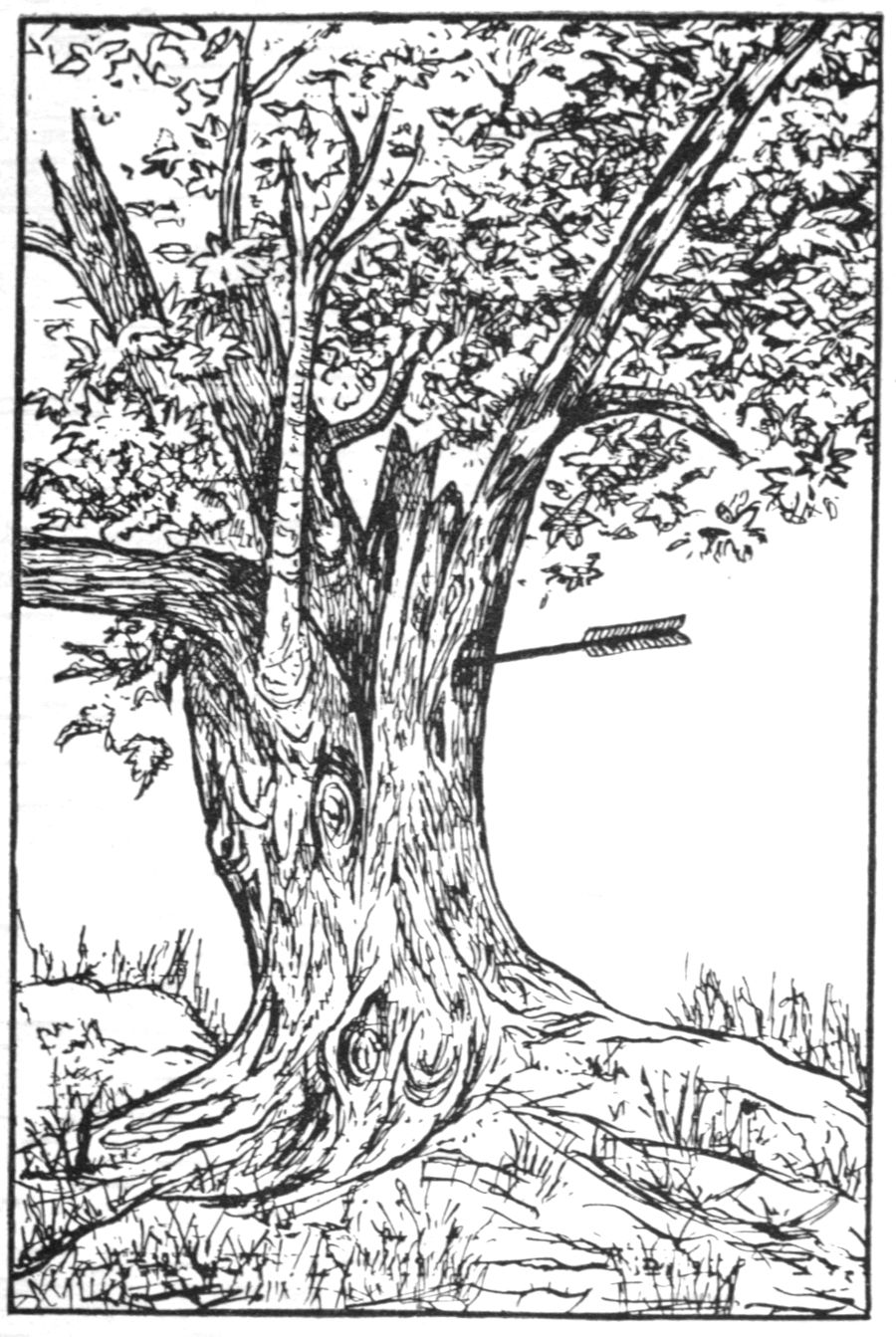
From the hole made by the arrow
Came forth new forms, and these
Were the first of human kind.
And so the Lord gave them a name
Meaning “those born from trees.”
Kulóskap the Lord of Light
Made all the animals.
First, he created
All of giant size;
Such was the beginning.
Then he said to Teâm, the Moose,
Who was tall as the Kiwaʿkw,
The colossal giant of the mountain,
The awful king of the forest,
The lord of the roaring river:
“What wouldst thou do, Teâm,
Shouldst thou see man a-coming?”
Answered the monstrous Teâm,
“I would tear the trees down on him.”
Then the Lord Kulóskap
Saw that the Moose was too strong;
So he made him smaller and weaker
So that the Indians could kill him.
Even so with the Squirrel
Who was as large in those days
As the great wolf in our time;
“What would you do, Sâkskadu?”
Asked the Lord of Beasts and Men,
“If you should meet an Indian?”
“I would scratch up trees by their roots
That they might fall upon him.”
Answered the Squirrel undaunted.
“Thou also art far too strong,”
Replied the mighty Master;
So he smoothed him down in his hands,
And, as he was smoothed, the Squirrel
Grew ever smaller and smaller,
Till he was as we see him now.
Then he asked the Great White Bear:
“And thou, Kʾchî Mūʾūin!
What wouldst thou do if ever
A man should come in thy way?”
And the Bear replied: “I would eat him.”
Then the Master bade him go
And live among rocks and ice,
Very far away in the North,
Where he would see no Indians.
And there he is ever in snow.
So Kulóskap the Great,
Lord of all things that are,
Did question all the beasts,
Changing their size or strength,
Or measuring out their lives,
According to their answers.
He took the Loon for his hunter
To serve him as a dog;
But the Loon was often absent,
Not to be found when wanted;
So he took in his place two Wolves,
One black, the other white;
And these wild dogs are his messengers
Who bear to him tidings of all.
Many years ago,
Yet still within our time,
Very far to the North,
An Indian in his canoe
Was about to cross a bay
To a distant place;
When, just before he launched,
There came in haste a stranger
Followed by two great dogs,
Who asked to be taken over.
“You may come,” replied the Indian,
“Come over the bay and welcome,
But what will you do with your dogs?
For we cannot take them with us!”
The stranger replied, “They may go
Around by land and meet us.”
“That cannot be,” said the other,
“No dogs could run such a distance,
Not even in weeks of running.”
But as there was no answer
He paddled, saying nothing,
Over the bay to the landing,
And there the dogs were waiting!
But when he turned his head
He found the stranger had vanished,
And then he said to himself:
“Now have I seen Kulóskap,
The Lord of Beasts and Men.”
And yet at a later day
At a place afar in the North,
There were many Indians assembled
When there came a strange commotion.
The ground was heaving and rumbling,
The rocks were shaking and falling,
And even the boldest among them
Felt faint at heart with terror;
When lo, they saw before them
The Lord of all, Kulóskap!
And he said to them: “Lo, I am here,
And when you feel the ground
Trembling again as to-day,
Then know that I have returned.”
So it is that man will know
When the last great war shall be,
The war of the Final Day!
For then Kulóskap the Lord
Will make the plain and the mountains
Shake with an awful noise.
The Beaver had been the foe
Of the Lord in the beginning;
Hence it came that Kulóskap slew
Full many of the tribe.
Away up in the Tobaic
Are two salt water rocks—
That is, they stand by the ocean
Near a fresh water stream—
A spot which to the Beaver
Had ever been forbidden.
But one day when far away,
So far that none could see
Who had not the magic vision,
Kulóskap saw the Beaver
Defying his injunction,
And drinking from the stream.
Then with his might, in anger,
The god tore up a rock
And hurled it at the Beaver.
It was many leagues away,
The Beaver deftly dodged it—
Few beasts are so quick at dodging—
But when another boulder
Came after the first one, Kwâbît
Ran deep into a mountain
From which he came forth no more.
But the rocks which the Master threw,
And the mountain and the fountain,
Are shown unto this day;
And the Indians say in reverence;
“Kulóskap once was here!”
[14] Kulóskap was the greatest one who ever came into our land.
III — THE ORIGIN OF THE RATTLESNAKES — FOOTNOTES:
[Passamaquoddy]
Ntʾladwewâgʾnuk aʿtosis yut the snake.[15]
You know Aʿtosis, the Snake?
Truly all snakes are evil,
But worst among them all
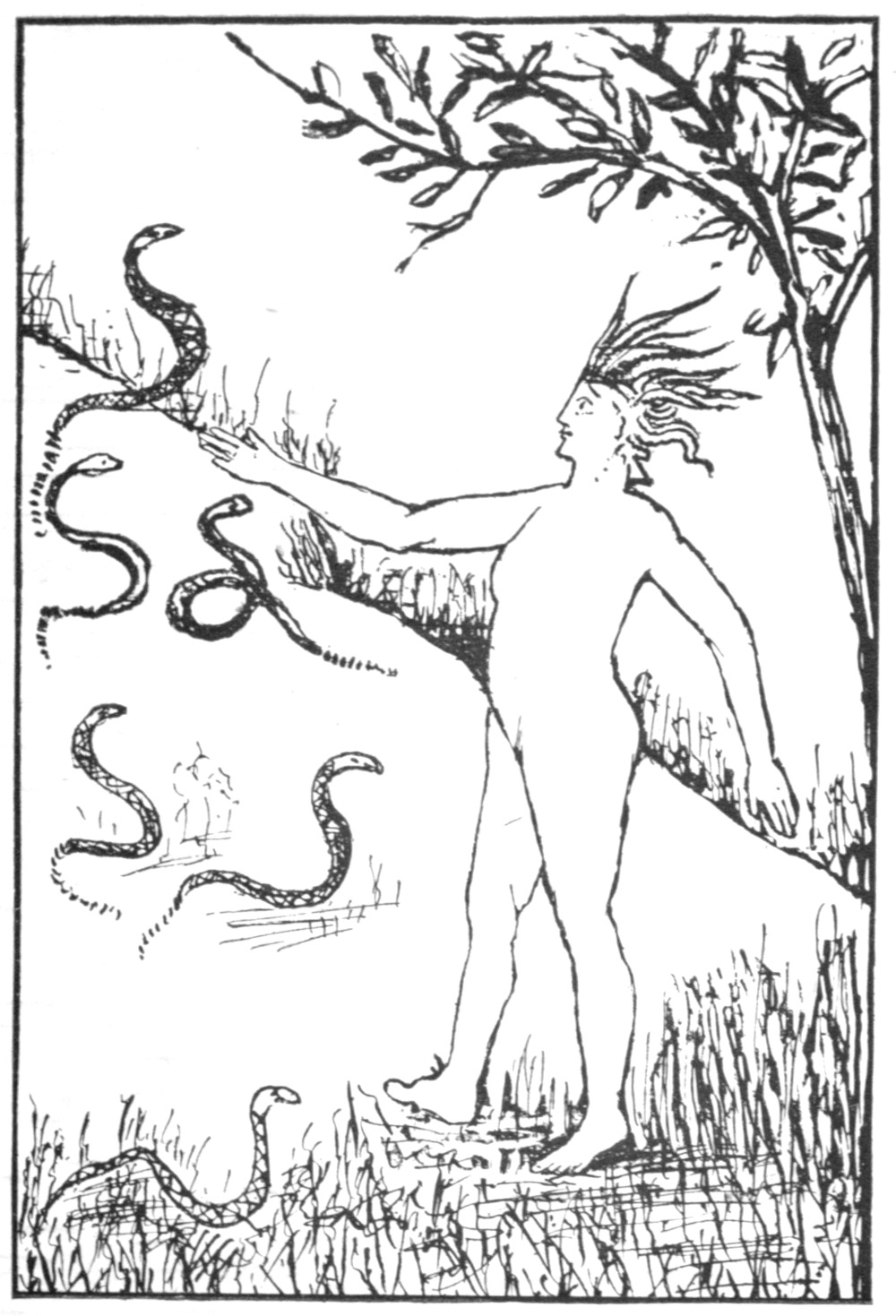
Is the Rattlesnake their master.
Well! In the olden time,
The Rattlesnakes were Indians,
And they were very saucy:
Men said they were all face,
And never could be frozen;
They could not be put down by much,
And they rose for very little.
When the Great Flood was coming,
Kulóskap the awful prophet,
Gave them full warning of it.
They answered, “They did not care.”
He told them that the water
Would rise o’er the heads of all;
They said, “Should this come to pass,
We shall all be very wet.”
He bade them be good and quiet,
And pray to escape from drowning;
They whooped and hurrahed to mock him.
He said, “The Great Flood is coming!”
They gave three cheers for the Flood.
Then he added, “’Twill drown you all!”
The Indians whooped again,
And got out all their rattles,
Which were made of turtle shell
Containing little pebbles,
And rattled with all their might
In a daring dance to the Flood.
Yes, ’twas a rattling dance!
The rain began to fall,
But the Indians danced on.
The thunder roared, and they answered
With rattles and with war-cries
The Indians danced on.
To the flash and crash of lightning
Amid the rising waters
The Indians danced on!
Then Kulóskap was angry
Yet in the rising flood
He did not drown a soul,
But for their arrogance
Changed all to serpent form—
That of the Rattlesnake,
Which crawls about the rocks,
And so unto this day,
Whene’er they see a man,
They lift their heads and hiss;
And move them up and down—
That is the way snakes dance,
Shaking their rattles, too,
As we do when we dance.
How do you like the sound? L.
[15] In my language aʿtosis is the snake.
IV — HOW KULÓSKAP NAMED THE ANIMALS, AND DISCOVERED THAT MAN WAS THE LORD OF THEM ALL — FOOTNOTES:
[Passamaquoddy]
Wut ktagʾnodʾmul uch Kulóskap.[16]
This is an ancient tale of the Lord,
Told ’mid the tales of the spirit time,
How the Master of Beasts and Men
Was born in the Sunrise land,
The land of the Wabanaki;
Though other traditions tell
That he came from across the ocean
In a great stone canoe,
A barque which was all of granite,
Covered with trees for masts.
When the great Lord of All,
The Chief of Beasts and Men,
Descended from this ark,
He went into the land
Of the Wabanaki,
The children of the Light;
And calling all the Beasts
Gave unto each a name:
Unto the Bear, Mūūin;
And as he gave it, asked:
“Oh Bear, what would’st thou do,
If thou should’st meet a man?”
To which Mūūin replied
Simply and honestly:
“I fear him and should run.”
“Well spoken,” said the Lord,
“Man should be feared by all.”
Now at that time, Miʿko,
The Squirrel, was as great,
Or, some say, far more great
Than even the Northern Bear;
So the Lord Kulóskap
Took Miʿko ’neath his hands,
And softly smoothed him down;
And as he felt the touch
Miʿko grew less and less,
And dwindled until he
Was what we see him now.
Howbeit in later days,
Miʿko was Kulóskap’s dog,
And, when the Master willed,
He oft grew large again
Touched by the Master’s hand,
And slew his fiercest foes.
But, being asked what he
Would do if chased by Man,
Miʿko at once exclaimed:
“I would climb up a tree
As fast as legs could run.”
“Well answered,” said the Lord,
“And therefore, I ordain
That from this day henceforth
Thou and thy kind at large
Shall ever dwell in trees.”
The Moose was standing by,
Intently looking on,
With great, soft, staring eyes,
Attending to it all
With deepest interest.
Calling then Kchi Mūs,
Big Moose, the Master said:
“But say what would’st thou do
If thou should’st meet with Man?”
“In faith,” replied Kchi Mūs,
“I’d canter through the woods
Fast as my legs would fly.”
“Well spoken,” said the god,
“So shalt thou ever live
In shade and forests wild.”
The Beaver being asked
What he would do, replied
That he would seek a stream
Ere he would face mankind.
So the great Lord perceived
That of all creatures born
Who walked upon the earth
The first and best was Man. L.
[16] This I will tell you about Kulóskap.
Canto Second — I — WHAT KULÓSKAP DID FOR THE INDIANS — FOOTNOTES:
THE MASTER’S KINDNESS TO MAN
[Passamaquoddy]
Piche mesogw Kulóskap nemiquosikw.[17]
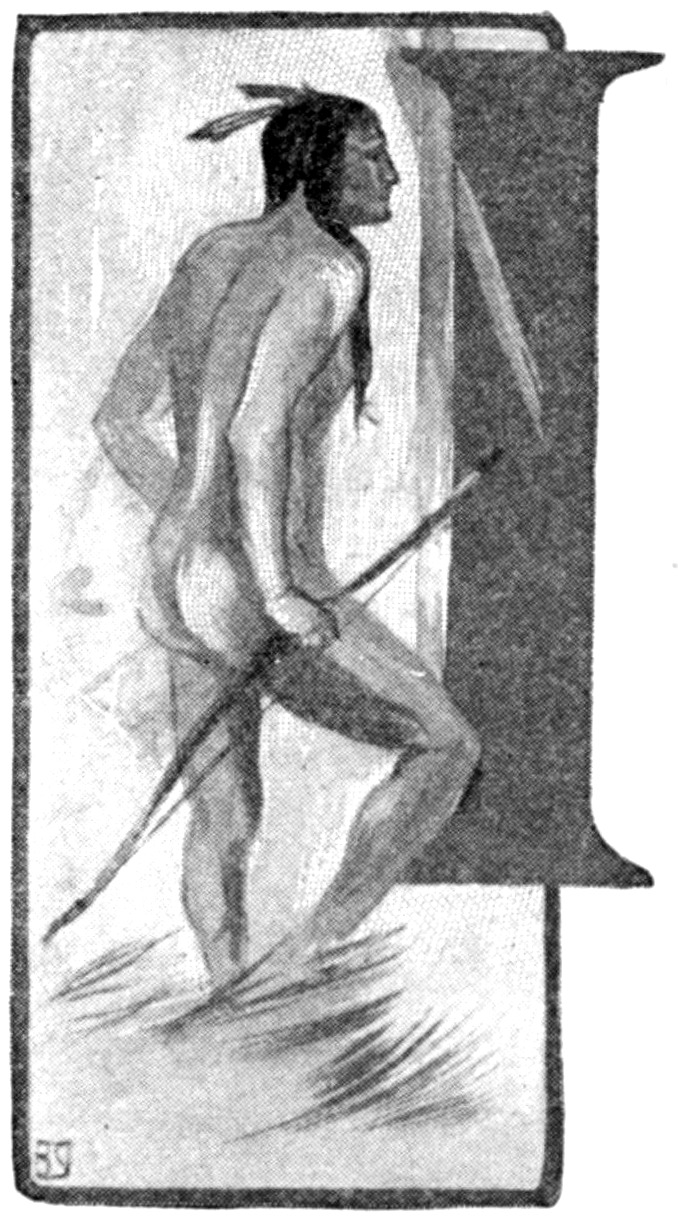
In the very olden time
Before Kulóskap the Master,
The Lord of Beasts and Men,
Had come into the world,
Or man was by him instructed,
All lived in wonderful darkness;
Men could not even see
To slay their enemies;
But the Lord brought light unto them,
The daybreak and the dawn.
Therefore, for this his people
Are known as the Wabanaki,
The Men of the Early Dawn.
And many a thing he taught them:
The noble art of hunting,
How to build huts and canoes,
And weirs to catch the fishes,
And how to trap the beaver,
And net the shad and salmon.
Before he came they knew not
How to make nets or weapons;
Then he, the Mighty Master,
Showed them the hidden virtues
Of plants and roots and blossoms,
And all the herbs which Indians
Could use for any purpose;
And also every creature,
Beasts, birds, and all the fishes,
All things which could be eaten
Or serve for joy to man.
Then, pointing to the heaven,
He taught the names of the stars,
With all the wonderful stories,
The very old traditions,
Of all that the planets had been.
He greatly loved mankind,
And wherever he might be,
Though afar in the wilderness,
He never was far away,
Away from his Indian children.
He dwelt in a lonely land,
But whoever went to seek him
The Master ever found. L.
[17] Long ago before Kulóskap was seen.
II — HOW KULÓSKAP GRANTED GIFTS AND FAVORS TO MANY INDIANS — FOOTNOTES:
[Micmac and Passamaquoddy]
Long ere Kulóskap the Master
Had left the land and his people,
And before he had ceased to wander
In the ways of man, he called
The loons his faithful servants,
And bade them make it known
That for many years to come
He would still remain on earth,
And that whoever would seek him
Might have one wish full granted,
Whatever that wish might be.
Although the journey was long
And the trials were terrible
Which all must endure who would find
The Lord of Men and Beasts,
There were many who ventured on
The wonderful pilgrimage.
Now you may hear what happened
To several of these seekers,
Even as I heard the tales
From a Passamaquoddy Sénap.
When all the land had heard
That the Master would grant a wish
To any who would seek him,
Three Indians resolved
That they would try this thing.
One was a Milicete
Who came from near St. John,
And the other two were Penobscots
From Oldtown, that is in Maine.
And they went upon the journey
And found that the path was long,
And the way was very hard;
Their sufferings were great,
It was well nigh seven years
Before they saw the Lord.
But while it was yet three months
Ere they came unto his dwelling,
They heard the bark of his dogs,
And, as day by day they drew nearer
The sound grew louder and louder,
Till after many trials
Led by the bay of the hounds
They found the mighty one,
The Lord of Men and Beasts,
And he made them very welcome
And entertained them all.
Then in due time he asked them
What was it they desired.
And then the first replied—An
honest simple man
Who was of but little account
Among the Indian people
Because he hunted badly—
He prayed that he might excel
In killing or catching game;
Then the Master gave him a flute,
Or the magic pipe which pleases
The ear of everyone,
And has the power to bring
By wonderful fascination
All animals to that piper
Who plays it in their haunts.
He thanked the Lord and left.
Now the second of the three,
A reckless amorous youth
Yet who never could succeed
In winning women’s love,
When asked what he would have
Said: “I would win my way
To many maidens’ hearts!”
And being questioned, “How many?”
Replied, “I would know no limit.
Let there be only enough,
And more than enough beside.”
Thereat the Master frowned,
But, smiling anew, he gave him
A bag which was tightly tied,
And said to him, “Do not open
Till you shall have reached your home.”
So he thanked the Lord and left.
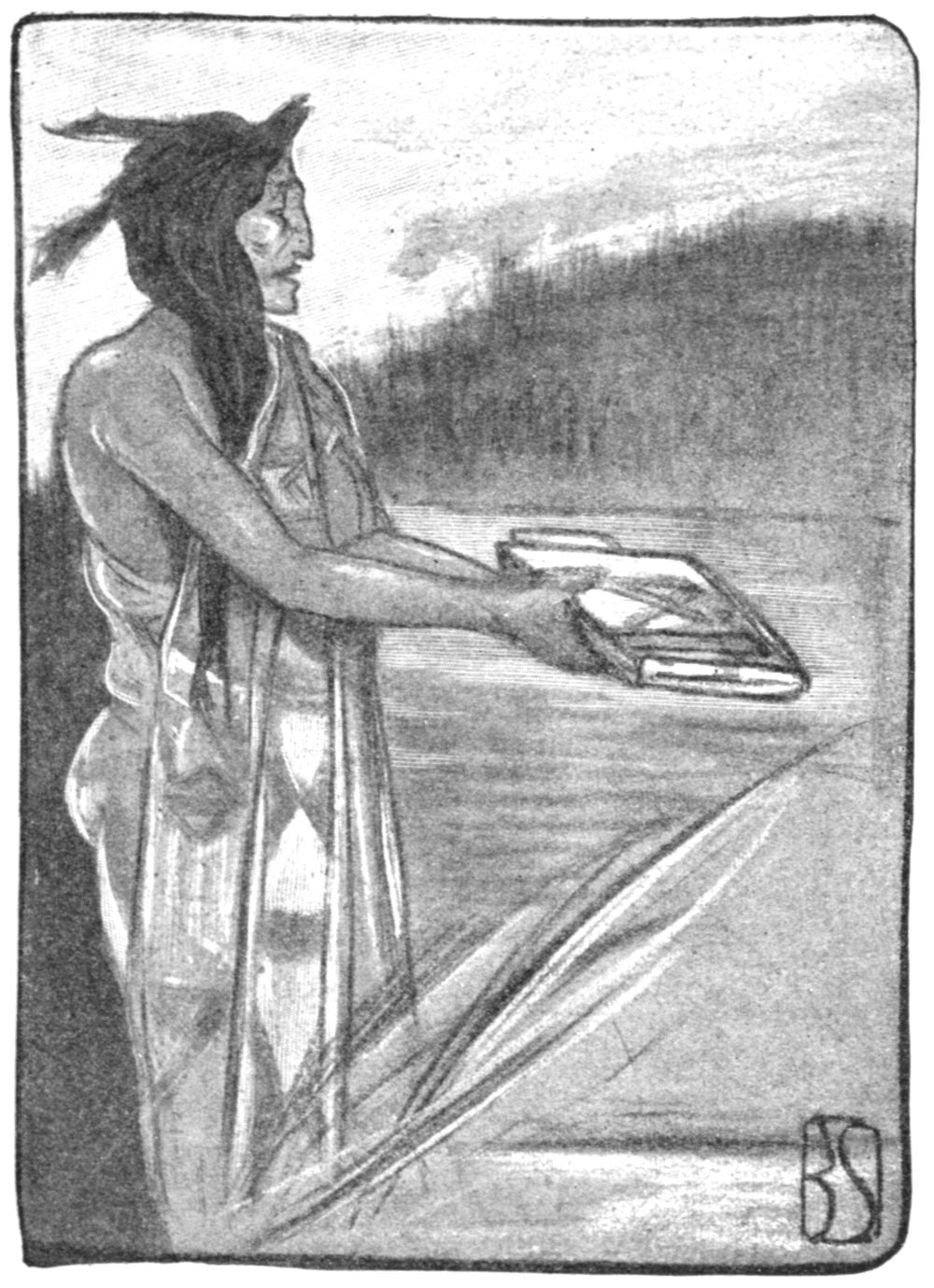
But, smiling anew, he gave him
A bag which was tightly tied.
Now the third who had come with these
Was a gay and handsome youth,
Yet very foolish withal
Since he cared for nothing whatever
Save to make the Indians laugh,
And to cut a figure with jests
At every gathering.
He, being asked what he sought,
Replied that he fain would have
The power to make a sound
Which when uttered would startle all,
And make them laugh indeed
As they never had laughed before.
This was a wondrous cry
Which the sorcerers of yore
Uttered to gladden hearts,
But now that the art is lost.
That is indeed the cause
That our times are so sorrowful,
Since that magic, merry cry
Is heard no more in the land.
And unto him likewise
The Master was truly kind
Sending Marten into the woods
To seek for a certain root
Which, when eaten by any one,
Conferred the mystic power
Of making the wondrous sound.
But when it was bestowed
He was warned not to touch
The root till he reached his home.
It had taken them seven years
To reach the Master’s lodge,
But seven days were enough
To tread the path to their huts—
That is, for him who got there,
For indeed there was only one,
And that was the hunter, who
With his marvellous pipe in his pocket,
And never a care in his heart,
Trudged on well satisfied
To think that all his life
He never should want a joint
Of venison in his cabin
Or a bear-skin to lie upon,
As indeed he never did.
Now the one who so loved women
And never had won a wife,
Was wild with wistfulness
And great anxiety.
Therefore he could not wait,
And he had not gone very far
Into the woods, ere he
Sat down and opened the bag.
There was a whirr as of wings
And they came flying forth
By hundreds round his head
Like beautiful white doves
Swarming all about—
Wonderful lovely girls
With large black burning eyes,
And torrents of flowing hair.
Wild with passion the witches
Threw their fair arms around him
And kissed him as he responded
To their ardent, fond embraces.
But ever more and more
They came, more glowing with love,
Till he bade them give way for a space,
Till he bade them let him be;
But they only pressed the more.
So, panting, crying for breath,
And smothered in love, he died,
And those who came that way
Found him a silent corpse,
But what became of the witches
Kulóskap only can tell!
Now the third went merrily on,
Tramping along through the woods,
When it flashed upon his mind
In an instant, that Kulóskap
Had bestowed on him a gift;
And, without the slightest heed
To what the Master had said
Of waiting till he got home,
He took out the magic root
And ate it, then and there;
When all at once he found
He could utter the magic cry
Which startles all who hear it,
Inspiring them to joy
And making them laugh aloud;
Then, as it rang afar
O’er many a forest dale
Waking the ringing echo
Of the far-distant hill,
Until it was answered by
A solemn snowy owl,
He felt that he had won
A wondrous power indeed;
So he walked gayly on
O’er many a hill and dale,
Whistling or trumpeting
As happy as a bird.
But he ere long began
To weary of himself,
When, seeing in a glade
A deer, he bent his bow;
When, just as he would shoot,
The wild unearthly sound
Broke out, despite himself,
Even like a demon warble,
The deer took flight and fled;
And the young man cursed aloud!
And when he reached the town
Half dead with hunger, he
Indeed was little worth
To make the others laugh,
Though for a time he did,
Which somewhat cheered his heart,
But, as the days went on,
They wearied of the sound,
And, when they saw him come,
Turned off another way;
Which vexed him to the heart,
So that one day he went
Alone into the woods
And there he slew himself.
The dark and evil demon,
The sprite of the night-air,
Pʾmûla named by some,
From whom the gift had come,
Swooped down from clouds on high,
And bore his soul away
To the dwelling place of darkness
And men heard of him no more.
Now ’tis a thing well known
To all the Indians
Who keep the holy faith
Of the good olden time,
That there are wondrous dwellers
Deep in the silent woods,
Such as the elves and fairies
Who are called by different names;
In Micmac Wigŭladŭmūchŭk
But by the Passamaquoddy
Wʾnâgʾméswuk. They
Can work strange deeds and sing
Such songs of magic power
As charm the wildest beasts
And tame the wolf and bear
And soothe the wolverine.
From them and them alone
Are brought the magic pipes,
Or flutes, which sometimes pass
To sorcerers or great braves.
When these are played upon
Women who hear the tone
Are all bewitched with love,
And the moose and caribou
Follow the winning sound,
Yes, even to their death;
And when the forest elves
Are pleased with anyone
They make of him an elf
E’en like unto themselves.
Back in the olden time
There was an Indian town
In which dwelt two young men,
Kekwâjû the Badger,
And the other Kâktugwââsis,
The Little Thunder. They
Chanced to hear that Kulóskap
Would give to anyone
Whatever he desired:
And so they went their way
On the long pilgrimage
For many years, until
They reached the wondrous isle
Where the great Master dwelt,
Where first they met Dame Bear,
Then Marten, and at last
The mighty Lord himself
Who welcomed them with grace.
Then all sat down to a meal,
But all that was placed before them
Was one small dish of meat,
A very tiny morsel.
Then the elder of the pilgrims,
A reckless jolly fellow,
Thinking it was a joke
And that he was mocked for sport,
Cut off nearly all the meat,
And ate it. Then what was left
Grew at once to its former size;
So it went on, and all
Ate all that they desired,
And found the food of the best,
And when the meal was over
The dish was as full as before.
Now of these two, the Badger
Had set his heart on becoming
A wigʾladʾmûch or fairy,
Which would give him magic power
While the other wished to win
A very beautiful girl,
The daughter of a chief,
A most powerful Sagamore,
Who set such cruel tasks
To all who came to woo her
That all who had made the trial
Thus far had come to their deaths.
Then the Master took the Badger
Who sought initiation
Into the occult art,
And by a wondrous trick
Covered him all with filth
And put him to utter shame
Then led him down to the river
Where he washed him clean, and gave him
A beautiful change of clothing.
And, combing his hair, placed on it
A fillet of wondrous virtue;
For when he had bound it on
He became a wigʾladʾmûch
A fairy and enchanter,
No longer a common mortal,
But one of the elfin world.[18]
And as he wished to excel
In magic song and music,
The Master gave him a flute,
Which would charm all living beings;
And, singing, he bade him join
In the air, and as he did so,
He found he knew all the art;
And from that day, thereafter,
He had a wondrous voice.
Now to seek the beautiful girl
It was needful that the lover
Should sail far over the sea;
And during this adventure
The Būʾūin or magician
Was charged to take all care
Of Kâktugwââs, the Thunder;
And therefore he begged the Master
To lend him his canoe,
To which Kulóskap answered,
“I will gladly lend it to thee
If thou’lt honestly return it
When thou needest it no more.
For I tell thee in very truth
I never yet did intrust it
To any mortal man
But what in the end I had to
Go after it myself.”
Then the Badger solemnly swore
That, as he was an honest Indian,
He would, when the need was over,
Indeed return the canoe.
For never in all his life
Had he stolen any Kwédŭn
(Canoe) nor borrowed anything
Without returning it promptly.
But when they came to the bay
There was no canoe to be seen,
But not very far away,
There arose a little island
Of granite which was covered
With pine-trees, tall and waving.
“See—that is my canoe!”
The Master said to them smiling,
And when he took them on it
They found that it was indeed
A great and large canoe
With lofty masts, and sails—
So the two went forth rejoicing.
Then they sailed on and came
To a large and beautiful island
Where they carefully hid the canoe.
Ere long they came to a village
That of the Sagamore,
The father of the girl
For whom many had lost their lives.
And, having come to his wigwam,
They entered and were welcomed
And placed on the seat of honor,
And sat at the evening meal.
Now ’tis of old the custom
When an Indian seeks a wife,
Be it from her father or friends,
He makes small ado about it,
And only utters two words
Which mean in the Micmac language:
“I am tired of living alone.”
And the Sagamore hearing this,
Consented that Little Thunder
Should marry her whom he sought,
But on several conditions—
The first that he should slay
And bring to him the head
Of a certain horrible monster,
Like to a wingless dragon,
The dreadful and horned Chipíchkâm.
So this was agreed upon,
Then the strangers went to their cabin
And all the world to sleep.
All save the wise Būʾūin
Who soon arose from his bed,
And went alone and afar,
Till he came to the den of the monster
In a gaping gulf in the ground.
Over the hole he laid
A mighty log, and began
The magic dance round the den;
Then the serpent or great Chipíchkâm,
Hearing the call, came forth,
Putting out his head from the hole,
And weaving it about
After the manner of snakes.
While he was doing this,
He rested his head for an instant
On the over-arching log,
When, with a blow of his hatchet
The Indian severed the neck;
Then, taking the head by one
Of its shining yellow horns,
He bore it to his friend
Who gave it in the morning
Unto the chief, who said:
“This time I fear indeed,
That I must lose my child,
Yet thou hast more to do.”
More indeed, for the chief
Said, “Look at yonder hill,
I fain would see my son
Coast down it on a sled.”
Now the hill was indeed a mountain.
Its sides were very steep,
Ragged with rocks and holes
And terrible with trees
And rough with snow and ice.
Then they brought out two toboggans,
One for the strangers. This
The Badger should direct;
While on the other sat
Two great and powerful men,
And these were Būʾūinuk
Or sorcerers who were skilled
In sledding, and they hoped
To see the others soon
Fall out upon the ground,
And then to run over them.
And at the word they went
Flying at fearful speed
Adown the mountain side,
And ever faster still
As if to headlong death.
Soon he who sought the girl
Went whirling from his sled,
And the two sorcerers howled
In triumph an hurrah!
For they knew not that this was done
By their enemy that he
Might get them before his sledge.
Then he put forth his arm,
And seizing the younger man
Turned for a pace aside,
And then again shot on.
Then the sorcerers stopped,
Thinking that those before
Were checked and at an end;
When lo! their enemy
In his sled shot over their heads,
And over a mighty wall
Of ice, as a bird might fly
High above all in the air;
Then, touching the ground once more,
Ran with tremendous speed,
First down into the vale,
Then up, and ever up
Upon the opposite hill
Where the village stood, till it struck
The wigwam of the chief,
Ripping it all in two.
Again the Sagamore said:
“This time I fear indeed
That I must lose my child:
Yet thou hast more to do!”
Yes, and far more to do:
For then the Sagamore said:
“I have a runner here,
A man so fleet of foot
That never in his life
Has he been overcome,
And thou must strive with him
And gain the victory
Ere thou canst win thy wife.”
So then the race was set,
And Thunder should compete,
But at the time his friend
Lent him the magic pipe
Which gave him wondrous power
Over all dark sorcery
Such as Būʾūinuk use
And witches dark and vile.
Now when the pair had met
The youth said: “Who art thou?”
And the sorcerer replied:
“I am the Wegaduskʾ;”
Which means the Northern Lights,
“But tell me who art thou?”
“I am Wosogwoesk,
Chain-lightning is my name,”
The Thunder answering said.
And, as the race was run
All in the early morn,
Then in an instant both
No longer were in sight.
They were far, far away
Beyond the distant hills;
Then, waiting, all sat still,
Till long before the noon
Chain-lightning came again;
He showed no weariness,
Nor was he out of breath,
Yet had gone through the world.
Then all sat still again
Till evening, when they saw
The Northern Light return
Completely, sadly tired;
He quivered and he shook
As beaten by fatigue,
Yet for all that the Light
Had not been through the world,
For, coming to the south,
The heat had sent him home.
Again the Sagamore said,
“This time I fear again
That I must lose my child,
Yet thou hast more to do.”
The Sagamore had a man
Whom none could overcome
In swimming of all kinds,
Or diving in the sea;
With him the youth must strive.
And when they met, the Badger
Asked him, “What is thy name?”
And he replied, “I am
Ukchigʾmûech (Sea Duck),
But tell me who art thou?”
He answerèd “The Kwîmû,”
That is, “the Loon,” and then
They dived from a high rock
Deep down into the sea.
Ere long the Sea Duck rose
Again to get his breath,
But long the Indians
Waited and watched until
They saw the Loon again.
An hour passed, and then
Another hour, before
He rose from the deep sea.
But when at last he came,
The Sagamore sadly said,
“This is the end of all
Our weary work, for now,
I have truly lost my child!”
Yet it was not the end
Of all the curious deeds
Which they beheld, before
The strangers took their leave.
For, when the wedding came
In the evening of that day,
There was a general dance,
A wild festivity,
At which the wizard bold
Astonished every one;
For as he danced around
On the hard beaten floor,
They saw his feet sink in
Deeper at every step,
And ever deeper still
As the strange dance went on,
Still ploughing up the ground
In ridges rough and high,
Forming a trench, until
His head and nothing more
Could from without be seen.
That ended all the dance,
Since no one after him
Save wizards or a witch
Could dance on such a floor.
The bridegroom and the bride,
With them the wizard bold,
Then entered the canoe
And sailed away toward home;
Yet they had more to meet,
And trials to endure,
Though of no dangerous kind;
’Tis said they were but jests
Played by the Master’s skill.
For they had not gone far,
When right before their path
They saw an awful storm
Coming to meet them. He
Who had the elfin power
Knew that it had been raised
By sorcery, because
The tempests which are due
To hidden magic power
Are ever worst of all.
So without fear he rose
And sang the sorcerer’s song,
And, filling lungs and cheeks
With air, he blew against
The rising hurricane,
Wind against wind until
He blew the wind away,
Then all the mighty flood
Was smooth as smooth could be:
So they sailed ever on
Over a sunlit sea,
And yet it was not long
Ere the elf-gifted one
Saw rising ’mid the waves
A dark and curious form,
That of a monstrous beast
Fast-coming as a foe,
And then they knew it was
The Giant Beaver, called
Kwâbît, in fearful rage;
But when the mighty one
Saw this, he sailed direct
Even at the monster’s jaws,
And, coming to him, said:
“Lo, I am the great foe
Of all thy race and called
The Beaver-Hunter; I,
Am he who butchers them;
Full many a one ere now
Has perished by my hand.”[19]
Kwâbît had placed himself
Under the water, with
His tail upraised above
The level of the waves,
That he might sink the barque
With one tremendous blow,
As is the Beaver’s way;
But he of magic power
With well directed stroke
Of the tumîhîgʾn, or
His tomahawk, then cut
The body from the tail,
Leaving the Beaver dead;
Then blithely sailed away.
Yet had they not gone far
When coming round a point
They saw another beast,
Also of giant size,
Waiting to be their death;
Abúkchelû the Skunk,
A thing which many dread
More than a raging wolf;
And he, too, had his tail
Uplifted in the air;
But, ere the brute could make
His hideous attack,
The wary gifted one
Caught up his hunting spear,
And, hurling it with haste,
So pierced Abúkchelû,
That father of the skunks,
That down he fell and died.
Thrice did he kick in pain
Before he passed away.
So then the gifted one,
Stepping upon the shore,
Took up a long dead pine
Which lay upon the shore,
And, as he stuck its point
Into Abúkchelû,
Lifted him high in air,
And, fastening the tree
Firmly into the ground,
Left him, and said with scorn,
Even as he turned away;
“Just show your tail now, there!”
And ever they sailed on
Over the silver sea,
O’er blue and dancing waves,
Till home they came with joy,
And at the landing place
They saw the Master stand;
And his first words were, “Well!
I see, my friends, that you
Have brought me my canoe
All safely back again.”
And they replied, “We have.”
And gayly he inquired
“Has all gone well with you?”
And when he thus had said,
He laughed and let them know
’Twas he in all their trials
And triumphs who had worked
And brought it all to pass.
Then to the gifted one
He said, “Now go in peace
Thy way with these thy friends;
Lead ever happy lives
There in the elfin world
Deep in the forest-shades,
Far in the silent land
Of flowers and mystery.
But of this thing be sure,
If any care should come
Unto you, think of me
And I will give you aid.”
They rose and went their way.
[18] All of this corresponds accurately to the ancient Greek and Roman initiation to the Mysteries, in which the hair-string or fillet played a prominent part.L.
[19] This is oddly like the declaration of the Beaver Killer in The Hunting of the Snark, in fact, it is almost identical with it. But the Rand MS. in which it occurs was written many years before the latter work appeared.
III — KULÓSKAP AND THE FOOL — FOOTNOTES:
[Micmac]
Kes saak: Nigumaach ut
Agunudumâkun Klûskâbel.[20]
“Of the old times the tale is,
A story of Kulóskap,”
Unto whom there went full many
When they heard that all could have
Whatever they desired;
And truly he gave them all
Whate’er it was they asked for,
But whether they got their wish
Depended on the wisdom
Which they showed when it was won.
Now the Master liked it not
If, when he had plainly told
What it was that one must do,
That man should double on him
Or quibble, or disobey.
So then it came to pass
That a certain fool of the kind
Who never can do aught
Without a twist or a turn
In his own peculiar way,
Went a long journey to ask
A favor of the Lord.
His trials were many and sore;
He came unto a chain
Of mountains exceeding high,
In a dark and lonely land
Wherein no sound was heard;
And the ascent was hard
As climbing a slippery pole.
And the going down
Or descent on the other side
Was more ungrateful still,
For ’twas all a precipice
With broken, crumbly edge
Which overhung a gulf;
Yet it was worse beyond.
For there the road led on
Between the hideous heads
Of two great serpents, which
Did almost touch their lips,
And darted terrible tongues
At those who went between.
And yet again ’twas worse
When the way passed under a wall,
The awful Wall of Death
Which hung like a dreadful cloud
Over a dismal plain,
Rising and falling at times;
Yet when, no one could know.
So those who were beneath
When it fell and struck the ground
Were ever crushed to death.
Yet he escaped all this
And came to the Master’s home
Where he was well received,
And dwelt for many days;
And when the Master asked
What ’twas that he would have?
He answered, “If my Lord
Will give me a medicine
Which will cure me of every ill,
I shall be well content.”
And he asked for nothing more.
Then the Master gave to him
A little package, and said:
“Herein is that which thou seek’st
But I charge thee solemnly
That thou lettest not thine eyes
Behold what is therein,
Till thou shalt have reached thy home.”
So he thanked the Lord, and left.
Yet he was not far away
Ere he longed to open the gift,
And test the medicine,
And still more the Master’s truth.
And so he said to himself:
“If this be all deceit,
It was very shrewdly planned,
To bid me not open it
Until I should be at home.
Tush! If the medicine
Is really what I required
It cannot lose its power.
In truth I will test it now.”
So he opened it—when lo!
All that which was therein
Fell to the ground and spread
As water, everywhere,
And then like a summer mist
As quickly melted away.
So when he returned to his home
He was mocked by one and all.
[20] This is a story about Kulóskap of long ago.
IV — THE THREE BROTHERS WHO BECAME TREES — FOOTNOTES:
[Passamaquoddy and Micmac]
Nequt nikt nsapihioak udelabasinia unachihonamihánia
Kelhosilichil naga omsnamnia eli-bawatmotit uch negum.[21]
There were three brothers, who
Had made the pilgrimage
To seek the Lord of Life,
And win their wishes. One
Was wondrous great and tall,
The tallest in the land;
Of this he was right proud,
For he was one of those
Who slyly put soft clay
Into their moccasins
That they may be admired
By folk of lesser size,
And win the love of squaws.
And his hair was plastered up
To stand on high, and on
The summit of it was
A very long turkey tail;
But what this man desired
Was to be taller still.
The second brother asked
That he might ever live
Where he might behold the land
And all the beauty of it,
And do naught else save rest
In peace forever more.
And the third one asked to live
Unto a great old age,
And ever be in health
Till he should pass away.
Now when they came to the isle
They found three lodges there,
And in two of them were men
Who are not spoken of
In any of the tales
Which I have ever heard:
In one dwelt Kulpujot—
A wondrous one indeed!
For there is not a bone in him,
Yet every spring and autumn
He is “rolled over with hand-spikes”
By order of the Lord;
And this is what his name
Means in the Micmac tongue.
In the autumn he is turned
Over towards the West,
But in spring towards the East;
And the meaning of it all
Is the seasons of the year
As they follow in their course.
He with his breath alone
Can sweep all armies forth,
And with his looks alone
Perform most wondrous things;
This means what weather can do
With sunshine, frost and ice,
Which are felt in everything.
And in the other dwelt
Kuhkw, which in Micmac means,
The Earthquake. This great man
Can pass beneath the ground,
And make the mountains shake,
And tremble by his power.
Now when the Lord had heard
What it was that they desired,
He bade the Earthquake come
And put them with their feet
Fast planted in the ground.
And when ’twas done, the three
At once were turned to trees;
To pines, as one tale tells,
Or cedars, as some say;
In either case each man
Received what he required.
Thus, he who would be tall
Became exceeding great,
For his head rose o’er the wood
Even as a giant pine;
Nor was the top-feather forgotten;
It waves in the wind to this hour.
And on a summer day
Who listens in a pine wood,
May hear the trees a murmuring
In the soft Indian tongue
All of the olden time:
(“Î nĭl etuchi nek mʾkilaskîtap
Î nĭl etuchi nek mʾkiluskíjin”)
“Oh, I’m such a great man!
Oh, I’m such a big Indian!”
And the second brother, who wished
To remain in peace in the land,
So stays, for while his roots
Are in the ground he must do so;
And the third, who fain would live
To the end in perfect health,
Unless they’ve cut him down
Is standing as of yore.
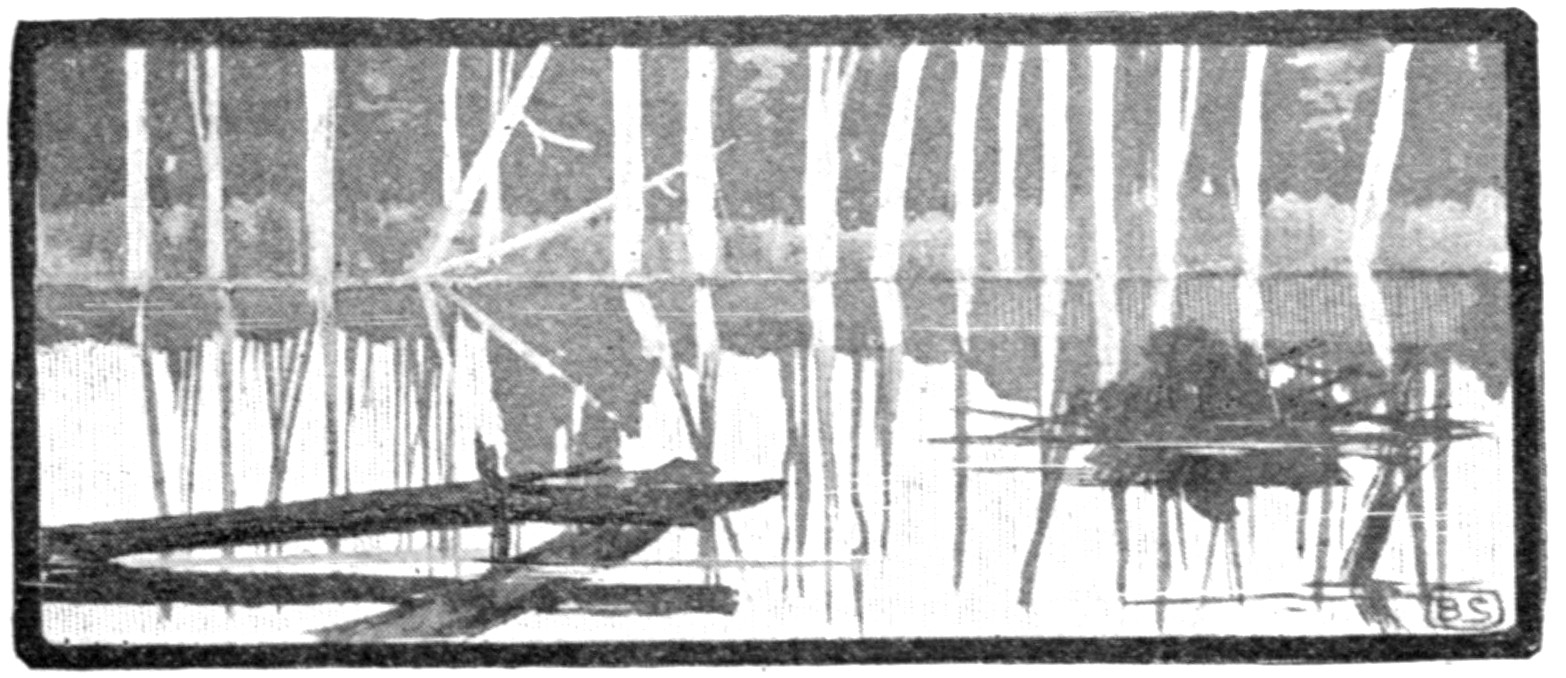
[21] Once there were three brothers who went to see the Lord of Life and get their wishes from him.
V — KULÓSKAP AND THE WISE WISHERS — FOOTNOTES:
[Micmac]
Kes saak; kes saak.[22]
All of the olden time.
Now when ’twas noised abroad
That whoever sought the Master
Could obtain the wish of his heart,
There were three men who said:
“Let us seek the Lord and see
If this be truly so.”
So they left their home in the spring
When the bluebird began his song,
And walked till the autumn frosts,
And then into the winter,
Ever steadily onward
Till the next midsummer came;
And being in a forest
They found a winding path
Which they followed till they came
To a very beautiful river
Which led to a great fair lake;
And still they kept to the path,
Yet where it failed, the trees
Were blazed, or the bark removed
On the side of the trunk, but ever
Opposite to the place
Where the wigwam or village lies
Towards which the pathway leads,
So the mark can aye be seen
As the traveller goes to the goal,
But not while leaving it.
Then after a time they came
To a long point of land
Which ran into the lake,
Where, having climbed a hill,
They saw in the distance smoke;
Guided by this they came
To a large and beautiful hut;
And entering it they found,
Seated upon the right,
A handsome stately man
Like a chief of middle age,
And on the left a woman,
So old and so decrepit
That it seemed as if a century
Or more had made her life;
And opposite the door
Was a mat which seemed to show
That some other had there a place.
And the Master made them welcome
And spoke as if he were
Well pleased to see them there,
But asked not whence they came,
Or whither they were going,
As others are wont to do.
Ere long they heard the sound
As of a paddle outside,
And the noise of a canoe
When it is drawn ashore.
Then in there came a youth
Of beautiful form and features,
Well clad and bearing weapons
As if returned from the chase;
Who addressed the woman Kejû!
Which is in the Micmac, “Mother;”
And told her he had game.
So then, with sore ado,
For she was very weak,
The old dame tottered out
And brought in one by one
Four beavers; but she had
Such trouble to cut them up,
That the elder of the pilgrims
Said to the youngest, “Nchígŭnŭm!
My brother—do thou the work.”
And so they supped on beaver,
And then they stayed for a week,
Resting themselves in comfort,
For all were sadly worn,
And also utterly ragged;
But then there came to pass
A wonderful thing which showed
That they were in fairy land,
For the master said to the youth,
“Go wash the mother’s face!”
He did so—when all her wrinkles
Vanished, and she became
Very young and fair:
The travellers had never
In all their lives beheld
A maid so beautiful:
Her hair, once white and scanty,
Now hung to her very feet,
It was as dark and glossy
As any blackbird’s breast;
And, clad in fine array,
She showed a tall lithe form,
Graceful, in all points perfect.
Then the travellers said to themselves,
“Truly this Sagamore is
A very great magician.”
With him they all walked forth
To see the place where he dwelt,
They never had felt the sunshine
So soft and so sweetly tempered
By a cooling gentle breeze;
For all in that land was fair,
And day by day grew fairer
To all who dwelt therein:
Tall trees, with richest leafage
And many fragrant flowers,
Grew everywhere in groves
Without any lower limbs,
And clear of underbrush,
Wide as a forest; yet
The eye could pierce the distance
In any or every way.
Now when for the first time
They felt that they had come
Into another life,
An ever-enchanted land,
The Master gently questioned
And asked them whence they came,
And what it was they sought;
They said they sought Kulóskap,
And he answered, “I am he!”
Then they were awed by his presence,
For now a wondrous glory
And majesty showed in him.
For as the woman had changed,
So he, and he seemed divine.
Then the elder pilgrim said:
“Lo, I am a wicked man
Accursed with furious moods,
Given to wrath and reviling;
Yet I would fain be gentle,
Pious and meek and good.”
And the second said: “I am poor,
My life is very hard,
And, though I toil unceasing,
I can barely make a living,
And I would fain be rich.”
And the third replied, “Though proud,
I am of low estate,
Being despised and scorned,
While I long to be respected
And loved by every one.”
And to all of these the Master
Made answer, “So shall it be!”
Then, taking from his belt
His powerful upsinai,
That is his medicine-bag,
He gave unto each Indian
A little box and bade him
Keep it well closed, nor heed it
Till he should reach his home.
Then he led them to the wigwam
And gave them all new garments,
Exceedingly rich apparel,
The like of which the pilgrims
Had never seen before.
Then, when it was time to depart,
Since they knew not the way
Unto their home, he rose
And went with them for a distance.
A year had they been in coming,
But having put on his belt
He led them and they followed,
Till, ere the afternoon,
He took them to the top
Of a lofty mountain, from which
Afar off they beheld
Another, whose outline blue
Rose lofty o’er the plain.
Yet it seemed so far away
They thought ’twould be a week
Ere they should gain its top,
But the Master led them on,
And in the afternoon
Of the day when they first beheld it,
Lo, they were on the summit!
And looking from this afar,
All seemed familiar to them:
The plains and hills and river,
And wood and dale and valley—
It was their native land!
“And there,” said the Master to them
“There lies your village home.”
So he left them on the mountain,
And they went on their way.
Before the sun had set
They were among their people,
Each by his wigwam fire;
At first sight no one knew them,
Because of a wondrous change;
The like of their fair attire
Had never in those days
Been seen by any man.
But when they made themselves known,
All gathered round to behold them,
In wonder or silent awe,
Or to listen to their adventures,
And truly all were amazed.
Then each man opened his box,
And found therein an unguent
Exceedingly rich and fragrant,
With which they rubbed themselves
From head to foot completely.
And always from that day
The three smelt so divinely
That all who could draw near them
Were ever in delight;
And happy were the Indians
Who could get a single whiff
Of that celestial fragrance
Spread by them all around!
Now he who had been despised
For his deformity,
Leanness, weakness, and meanness,
Became as grand and stately,
As beautiful and graceful,
As the fairest pine of the forest;
There was in all the land
No man so much admired,
And his people were proud of him.
He who desired abundance,
Had it in fullest measure,
The wild deer came to his arrows,
The fish leaped into his nets;
As he gave freely to all,
All gave as freely to him.
And he who had been wicked,
Hasty and wild and cruel,
Became as meek and gentle,
Calm and ever forbearing
Making others like himself;
He had ever a blessing on him,
As there ever is upon those
Who make their wishes with wisdom,
For such folk shall be happy
Unto the end of their days.
[22] Long ago; long ago.
VI — HOW KULÓSKAP WAS CONQUERED BY THE BABE — FOOTNOTES:
[Penobscot]
Yut nit nekani agnodʾmâgon uch Kulóskap
Elakʾnotmotits piʾche.[23]
All of the olden time.
They tell this tale
Of great Kulóskap. He had conquered all
Of his worst enemies, even the Kiwaʾkw
Who were ice-giant ghouls, and over them,
Mʾdeolinʾwak or sorcerers
And Pʾmûla the night air’s evil spirit,
And every manner of uncanny ghosts,
Grim witches, devils, goblins, cannibals,
And the dark demons of the forest shade.
And now he paused, and, thinking o’er his deeds,
Long wondered if his work was at an end.
This thought unto a certain wife he told—
A clever woman with a ready tongue—
And she replied: “O Master—not so fast!
For One there still remains whom no man yet
Has ever overcome in any strife
Or got the better of in any way;
And who will ever, as I oft have heard,
Remain unconquered to the end of time.”
“And who is he?” inquired the Lord, amazed.
“It is the mighty Waʾsis,” she replied:
“And there he sits before you on the floor!
And mark my words—if you do trouble him,
He’ll cause you greater trouble in the end!”
Now Waʾsis was the Baby. And he sat
Upon the floor, in baby peace profound
Sucking a piece of maple sugar sweet;
Greatly content and troubling nobody.
Now as the mighty Lord of Men and Beasts
Had never married, nor had had a child,
The art of nursing or of managing
Such little ones was all unknown to him;
And therefore he was sure, as all such folk
Invariably are, be they or maids
Or blooming bachelors, that he at least
Knew all about it and would have his way,
And make the young obey him. So the Lord
Turned to the babe with a bewitching smile,
Back smiled the baby, but it did not budge.
And then the Master spoke in sweeter tone,
Making his voice like that of summer birds,
And all to no avail; for Waʾsis sat,
And, sucking at his sugar silently,
Looked at Kulóskap with untroubled eyes.
So then the Lord as in great anger frowned
And ordered Waʾsis in an awful voice
To crawl to him at once. And baby burst
Into wild tears, and high he raised his voice
Unto a squall tremendous—yet for all
Did never move an inch from where he sat.
Then, since he could do only one thing more,
The Master had recourse to sorcery
And used the awful spells, and sang the songs
Which raise the dead and scare the devils wild
And send the witches howling to their graves,
And make the forest pines bend low to earth.
And Waʾsis looked at him admiringly
And seemed to find it interesting, quite;
Yet, peacefully as ever kept his place.
So, in despair, Kulóskap gave it up,
And Waʾsis, ever sitting on the floor
In the warm sunshine, went “Goo! goo!” and crowed;
That was his infant crow of victory.
Now to this very day, whene’er you see
A baby well contented, crying “Goo!”
Or crowing in this style, know that it is
Because he then remembers in great joy
How he in strife, all in the olden time,
Did overcome the Master, conqueror
Of all the world. For that, of creatures all,
Or beings which on earth have ever been
Since the beginning, Baby is alone
The never yielding and invincible. L.
[23] This is an old story of Kulóskap. They told it long ago.
Canto Third — I — KULÓSKAP AND THE LOONS — FOOTNOTES:
THE MASTER AND THE ANIMALS
[Micmac and Passamaquoddy]
Kulóskap umimat netinniaspʾnil
Winpeul kʾchi mteolinul.[24]
While the Master was pursuing
Winpe the giant magician,
One day at Uktukâmkw
He saw afar in the distance
Over the silent water,
Far away in the sunset,
Kwîmûŭk (the Loons) a-flying.
Thence did their chief in a circle
Lead them around the lake;
Yet ever drawing nearer
To the Home of Beasts and Men;
And as he came, the Master
Said: “What is thy will, O Kwîmû?”
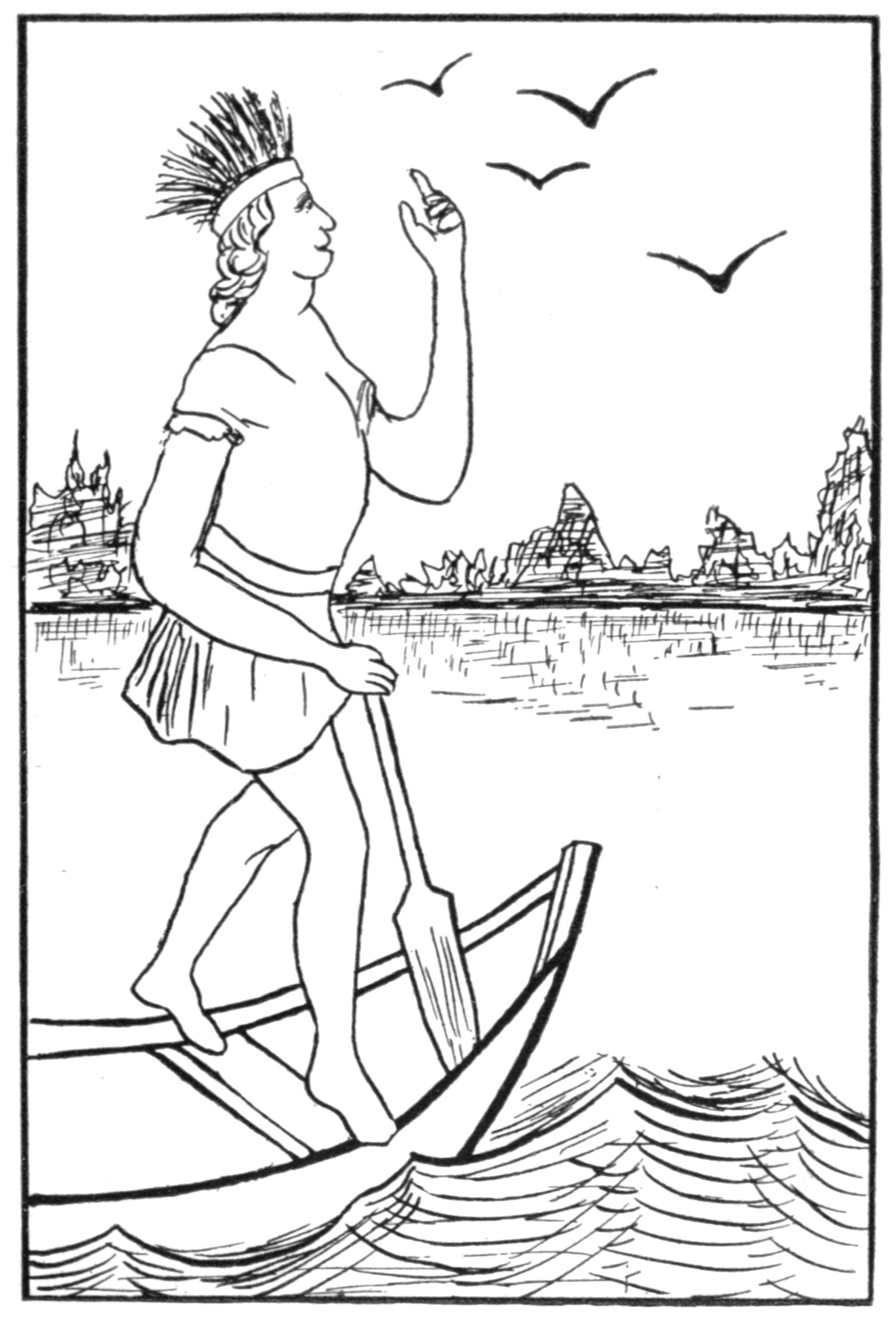
To whom the Loon replied
“I fain would be thy servant,
Thy servant and thy friend.”
Then the Master taught them a cry,
A strange long cry like the howl
Of a dog when he calls to the moon,
Or when, far away in the forest,
He seeks to find his master;
And told them when they required him
To utter this long strange cry.
Now it came to pass long after
The Master in Uktâkŭmkûk
(The which is Newfoundland)
Came to an Indian village
And all who dwelt therein
Were Kwîmûŭk, who had been
Loons in the time before;
And now they were very glad
As men to see once more
The Master who had blessed them
When they were only birds;
Therefore he made them his huntsmen,
Also his messengers;
Hence comes that in all the stories
Which are told of the mighty Master
The Loons are ever his friends;
And the Indians when they hear
The cry of the Loons, exclaim:
“Kwîmû elkomtûejul
Kulóskapŭl,” “The Loon is calling
Kulóskap,” the Master.
[24] Kulóskap used to fight with Winpe the great wizard.
II — KULÓSKAP AND THE BEAVER — FOOTNOTES:
[Micmac]
Kulóskap naga Kwâbît.[25]
Over all the land
Of the Wabanaki,
The Land of the Break of Day,
There is never a place
Where the hand of Kulóskap
Made not a mark.
It is seen on hills and rivers,
On the great roads through mountains,
As well as on mighty rocks
Which once were living monsters.
Such is the wonderful highway
Running along the river
Called Herbert—the road which is named
By white men the Boar’s Back,
By Indians Onwokun,
Which is their word for Causeway.
The tale is told of Kulóskap
That, once while travelling
To visit Partridge Island
And then Cape Blomidon,
His friends were tired of rowing,
Tired of travel by water,
And wished to cross by land;
And, while they all were resting,
The Master, raising his magic
Unto a mighty deed
To be spoken of forever,
Went away for a little time
And cast up a giant ridge,
A wide and beautiful level
Over great bogs and streams,
And across this they travelled
Rejoicing, to await him.
And yet again the Master
Did a very wondrous deed;
For it came to pass in those days
That the beavers had built a dam
From Âûkogegéchk or Blomidon,
Even unto the opposite shore,
And thereby made a pond
Which filled up all the valley.
Now in those times the beavers
Were beasts of monstrous size,
And the Master, though kind of heart,
Seems to have had indeed
But little love for them
Since the day when young Kwâbîtsis,
The son of the Great Beaver,
Tempted Malsum to slay his brother
In the very early time.
Now to this very day
They find the bones of these beavers;
There are many on Unamagik,
Their teeth are six inches wide,
There are no such beavers to-day!
And these are indeed the bones
Of the beavers who built the dam
Across at Cape Blomidon
And crossed the Annapolis Valley.
Now the Master would fain go hunting,
And thereby do a deed
Which should equal the great whale-fishing
Of Kitpûsiigʾnâû.
So he cut the great dam near the shore,
And he bade the boy Marten watch;
For he said, “I greatly suspect
That there is a little beaver
Who is hiding hereabouts.”
And when the dam was cut
From where it joined the shore,
There was a mighty rush,
And the roar of many waters,
So that the beaver dam,
Which was made of giant trees
Deftly fastened together,
Swung full around to the westward;
And yet it did not break
Away from the other shore.
Therefore the end of it lodged
With a great split therein
When the flood had found a passage;
And the whole may be seen there still,
To this very day, even,
As it is seen by all
Of those who pass up the bay;
And still this point, Cape Split,
Is called by the Micmacs Plîgun
Which means the opening
Or cleft of a beaver dam.
Then to frighten the Beaver
The Master threw at it
Several handfuls of earth,
Which falling to eastward
Of what is called Partridge Island,
Became the Five Islands, and
The pond which was left behind
Became the Basin of Minas.
Yet another tradition tells
That after cutting the dam
The Master sat and watched,
And yet no Beaver came forth,
For Kwâbît had escaped by a hole
Which led back to the other side;
Kulóskap then tore up
A rock and he threw it
Very far indeed,
One hundred and fifty miles,
To frighten the Beaver back;
But over the Grand Falls
Kwâbît had gone in haste
And so for the time escaped;
Yet the stone remaineth there
As a wonder to this day.
However, others declare
That by this rock the Beaver
Was killed while swimming away;
For thus the tale was told
By a Penobscot woman
As she sat weaving a basket,
A basket or abaznoda
Of that sweet-scented grass
Which Indians dearly love.
Kulóskap gave the names
To everything on earth;
He first made man and woman
Bestowing on them life;
He also made the winds
To make the waters move;
The Turtle was his uncle,
Tiakēūch the Mink
Was his adopted son,
While Mūnŭmkwech, the Woodchuck—
She was his grandmother.
The Beaver built a dam
The greatest ever seen.
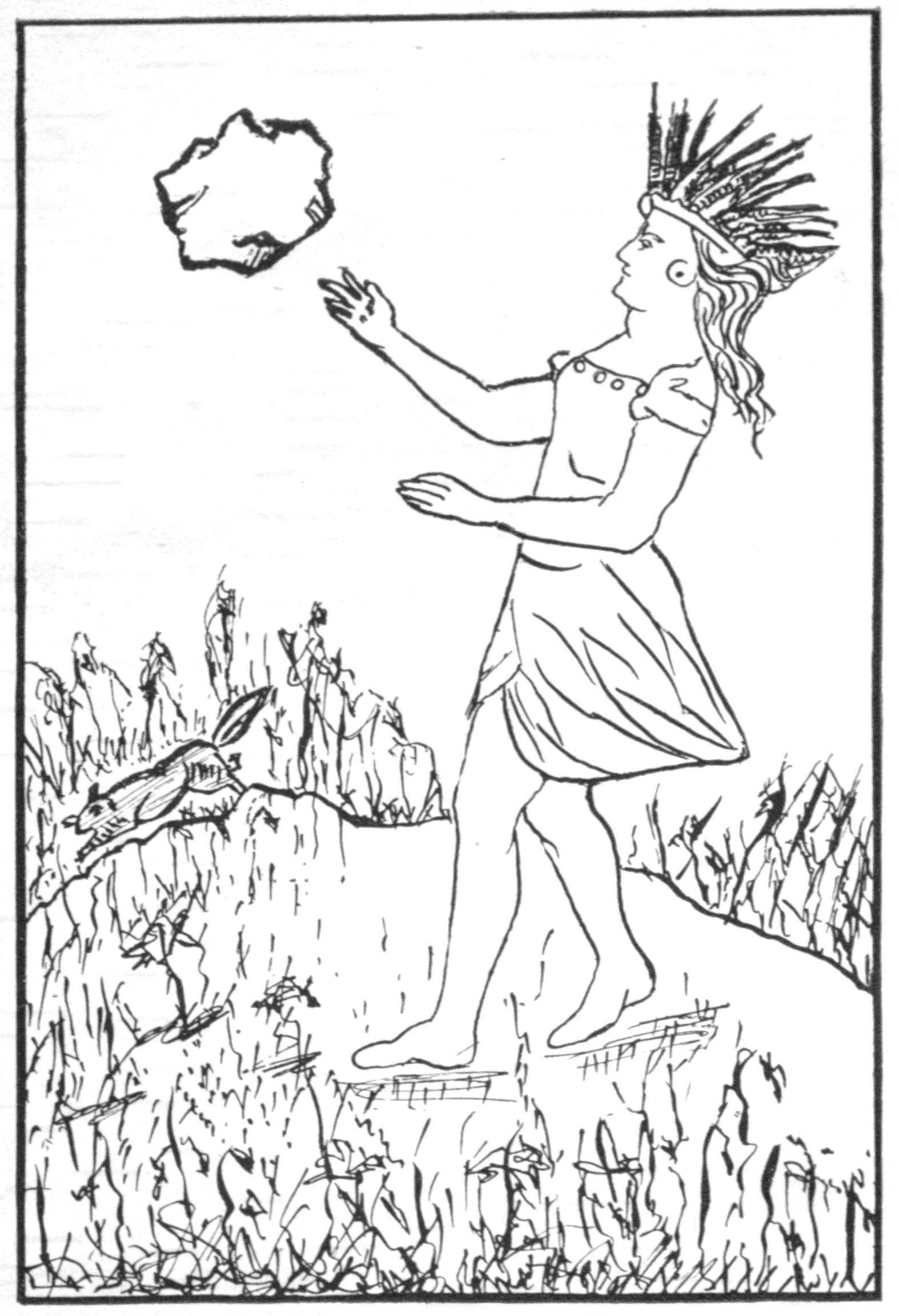
Kulóskap turned it away,
And killed the Beaver, too;
At Mûschik he killed a moose;
The bones are there e’en now,
At Bar Harbor, turned to stone.
The entrails of the moose,
Across the bay he cast
Unto his dogs, and they,
Which were also turned to stone,
To this day may be seen there,
As I have seen them myself;
And there, too, in the rock
Are the prints of his arrow and bow.
[25] Kulóskap and the Beaver.
III — THE SABLE AND THE SERPENT — FOOTNOTES:
[Passamaquoddy]
Kulóskap wtiwaspʾnil nequt
Otloketmul nʾmokswesul.[26]
All of the olden time,
All in a year it befell
That Kulóskap had a foe:
A very evil man,
A very sinful beast,
A very vile magician,
Who after he had tried
A hundred tricks in vain
Took on the form of a snake,
A serpent of awful size,
In hope to kill the Lord.
Now the Master had a boy
His faithful servitor,
Nʾmokswes or the Sable;
A boy of elfin kind
Who played the magic flute
Wherewith he could entice
All birds and animals
To come to him, when they
Once heard its wondrous sound.
It happened on a time
When Kulóskap was afar,
The Sable broke his flute,
And, deeply crushed with grief,
Would not return again,
But wandered far away
Into the wilderness.
And all of this the Lord
Knew well—for by his art
He knew when aught went wrong
Pertaining to himself.
Then, when returned, he asked
The old, old grandmother
Where Sable was? but she
Could only weep. And then,
The Master said: “I’ll roam
Forever if I must,
But I will find the boy.”
So he went forth, resolved,
Following Sable’s trail,
And tracked him through the snow,
Three days and nights, and then
Heard some one sing afar;
It was the magic song
Which sorcerers only sing
When in the direst need,
And death is drawing near.
So, circling round the place,
Kulóskap looked adown,
And saw a lodge, and heard
The voice distinctly sound,
As he grew nearer; it
Was Sable’s wondrous voice;
Then heard him sing a curse
Against all serpent kind,
And he was wandering
About the place to seek
A stick, extremely straight.
The Master understood
What this all meant: how that
Sable had been enticed
Into the wilderness
By Atoʾsis the Snake,
And that the Serpent-chief
Was in the lodge, and he
Had sent the Sable forth
To seek a long straight rod
For evil magic deeds.
Then, softly singing, he
Bade Sable disobey,
And get a crooked stick,
As twisted as could be,
And told him carefully
What more he was to do.
Then Sable found in fact
A very rugged rod,
As twisted as a worm,
When it is wounded; then
As he came in, the Snake
Cried out, amazed and wroth,
“How hast thou dared to bring
To me a stick like that?”
But Sable, answering,
Replied, “It is not straight,
But what is crookedest
May be the straightest made,
And I do know a charm
Whereby this may be done;
I will but heat this stick
A little in the fire,
And sing the proper spell
And then it shall be straight.”
Now Atoʾsis the Snake,
Like all the crafty folk,
Was very curious
And so looked closely on.
But Sable, when the stick
Was burning, or red hot,
Thrust it into his eyes;
(It had a forked end)
Utterly blinding him;
Then headlong rushed away.
The serpent followed him,
But, even as he left
The wigwam, there he met
The Master, who forthwith
Struck him a mighty blow
And slew him out of hand;
Of old times this befell—
And thus my story ends.
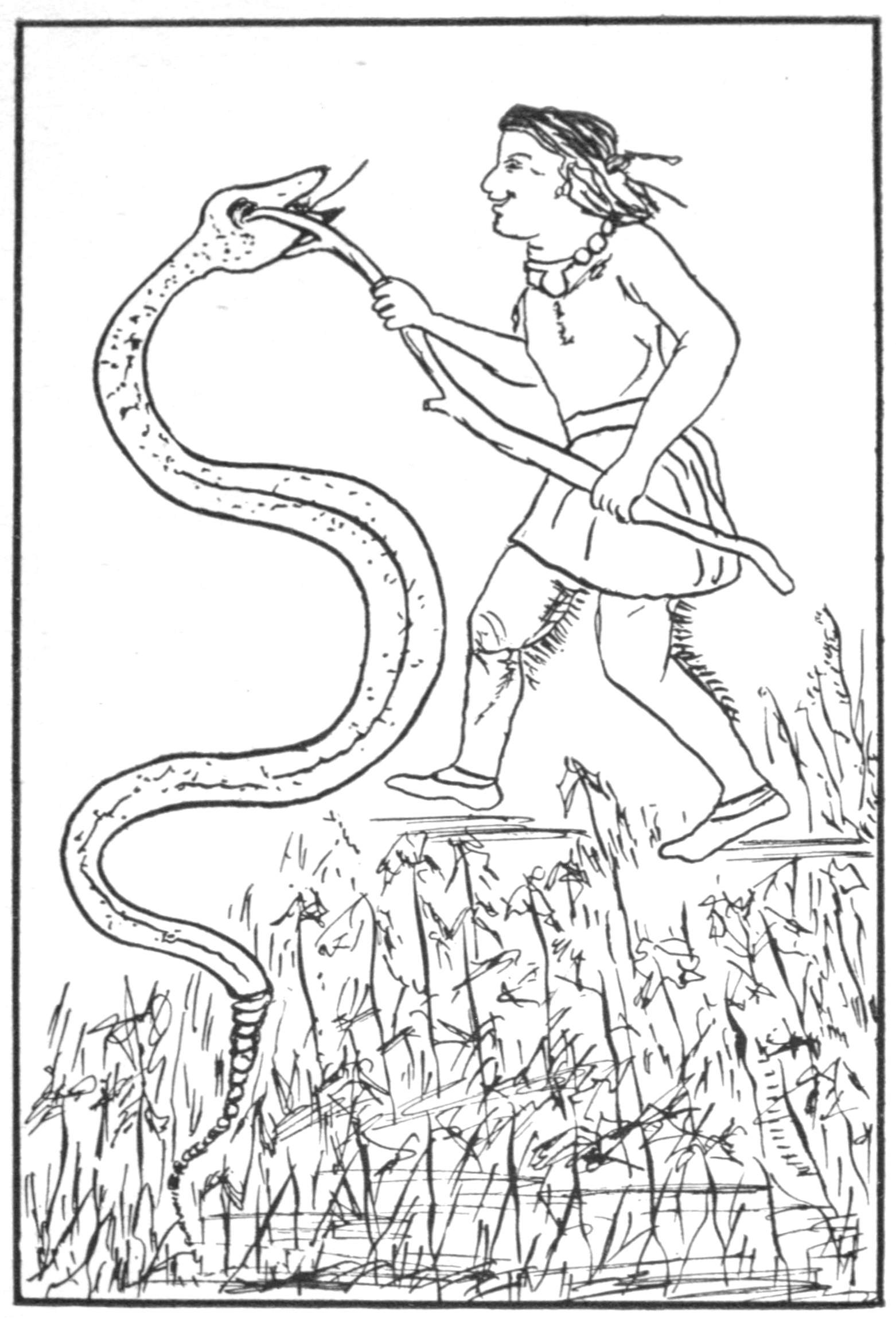
[26] Kulóskap had a servant once who was a Sable.
IV — KULÓSKAP AND THE TURTLE — FOOTNOTES:
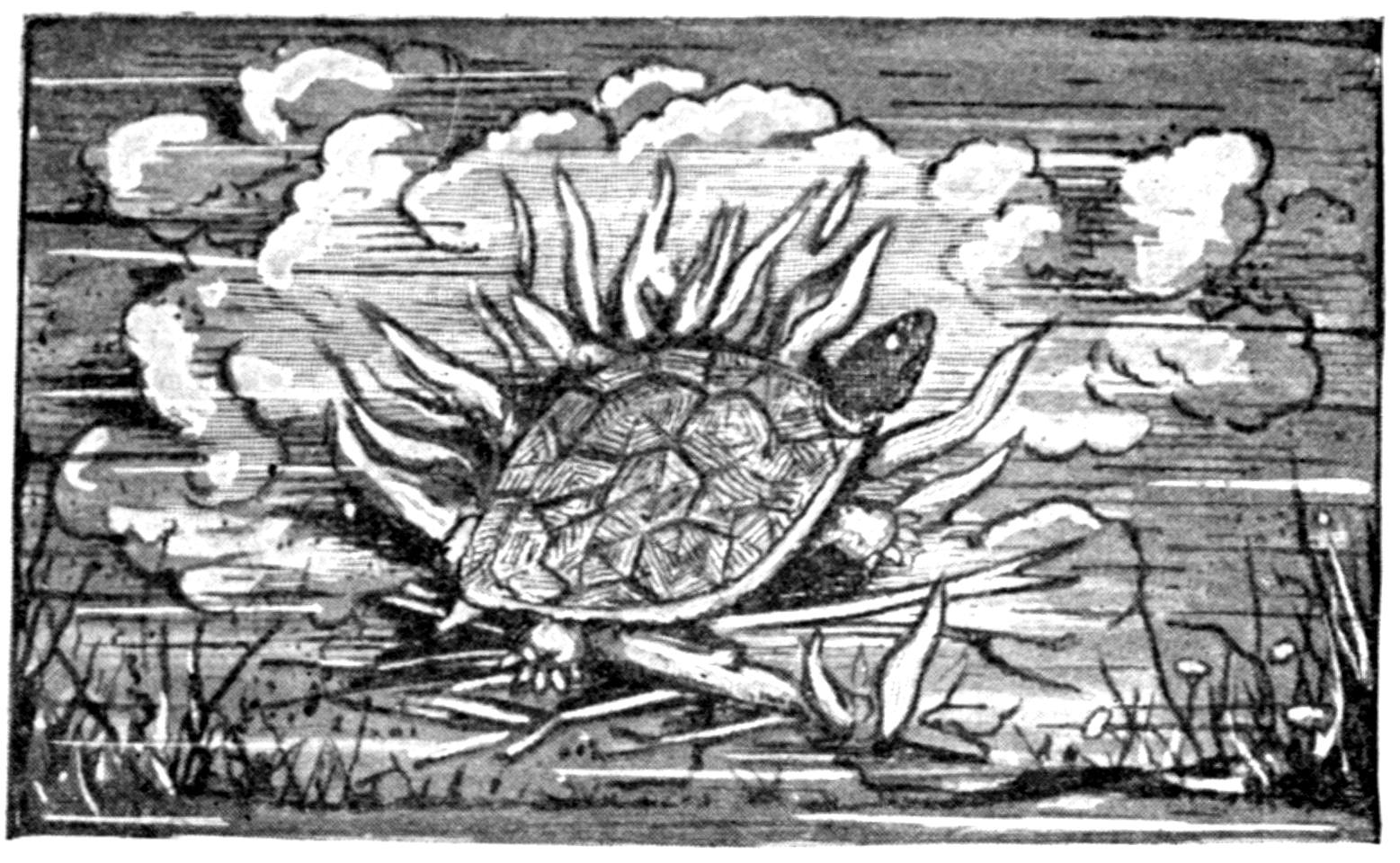
[Micmac and Passamaquoddy]
Nekke meiawet nektuk Piliomeskasik ktakʾmigw otlian Pikto.[27]
When the Master left Uktâkumkûk,
Called by the English Néwfoundlánd,
He went to Piktook or Pictou,
Which means “the rising of bubbles,”
Because at that place the water
Is ever strangely moving.
There he found an Indian village
And in the village a man
Whom he loved through all his life.
Yet it was not because this man,
Whose name in Micmac is Mikchik
And in our Passamaquoddy
Chikwenóchk “the Turtle,”
Was great or well favored or rich;
He was truly none of these,
Being very poor and lazy,
No longer young or lively,
Nor in any way clever or wise.
It is said he was the uncle
Of Kulóskap, but many declare
It was only by adoption.[28]
However, he always bore
His trials with such good nature,
His wants with such merry patience,
That the Master took strangely to him
With most unwonted affection,
As if he had determined
To make of the idler a man;
Which verily came to pass
Quite soon, and very quaintly,
As you shall presently hear.
When he came to Piktook,
A town of a hundred wigwams,
Kulóskap being a handsome
And very stately warrior
With the air of a great chief,
Was greatly admired by all,
Especially the women;
So that every one felt honored
Whose wigwam he deigned to enter;
Yet he saw the folk very seldom,
And dwelt with old uncle Mikchik
Delighting in his fancies,
Quaint ways and old time stories,
Very old songs of the fathers;
Such things were the joy of his heart.
Now ’twas the time for holding
The great and yearly feast
With dancing and merry games;
But Kulóskap cared not to go
As guest or as performer.
However, he asked his uncle,
“Wilt thou not go to the feast?
All the fair girls of the forest,
All the beautiful matrons,
All the bewitching widows
From far and wide will be there;
Why hast thou never married?
There are many nice women a-waiting,
’Tis evil living alone.”
Thus answered Uncle Turtle:
“I am poor and old and homely,
With no garments fit for a feast;
Therefore ’tis better for me
To smoke my pipe at home.”
“Well, if that be the only hindrance,
Uncle,” replied the Master,
“I can turn tailor I trow,
And fit you to a turn—
Fit you as if by magic,
Or in fact by magic itself;
Therefore have thou no care
As to your face or outside,
For to him who hath the art
’Tis as easy to make a man over
As any suit of clothes.”
“That may be true, my nephew,”
Quoth Turtle, “but what say you,
As to the making over
The inside of a mortal?”
“By Kwâbît the immortal Beaver!”
Replied the Master, laughing,
“That is something harder to do,
Else I were not at work
So long in this world of ours.
Yet, ere I leave this town
For you I will do that also.
As for this present sport,
Do but put on this belt.”
And when he wore the girdle
Mikchik became so young
And so bewitchingly handsome
That never a man or woman
In the land had seen the like;
And as the Master arrayed him
In garments of great splendor,
He also gave him his word
That, as a man, he ever
Should be of men the comeliest,
And as animal, hardest to kill,
Most vital and enduring,
As it truly came to pass.
So Mikchik went to the feast.
Now the chieftain of the Piktook
Had three very beautiful daughters,
And of the three, the youngest
Was the loveliest in the land.
On her the old-young turtle
Cast his experienced eyes
With a boy-like, innocent look,
And said, “I think that damsel
Would exactly suit my complaint,
And therefore I think I will take her!”
Now all the young men in Piktook
Were of just the same opinion,
And all were firmly resolved
To kill the one who should win her.
So the next day the Master,
Taking a bunch of wâbab,
That is, of the finest wampum,
Went to the chief of the Piktook
Proposing that his uncle
Should marry the youngest daughter.
And truly the chief was willing,
While the mother at once cried, “Yes!”
To such a grand proposal;
So, without loss of time,
The maiden swept out a wigwam,
And made a bed of sprays,
Or of leaves, upon the floor,
Spreading out a great white bear skin
As a cover over all.
Then with Mikchik and the Master
They had dried meat for supper,
And so the pair were wed.
Now the Turtle seemed very lazy,
And for days after they were married
While other men were hunting
He lounged about at home
Smoking over the fire,
Till one frosty, sunny morning,
His wife said to him, “Mikchik,
If this goes on much longer
We two must certainly starve.”
So he put on his snow-shoes,
Taking his bow and arrows,
And she followed silently after
To see what he would do.
But in truth he did very little,
For he had not gone far forward
Ere he tripped and fell rolling over.
And the wife, returning disgusted,
Said in a rage to her mother:
“He is not in the least a hunter.
He can’t even walk on snow-shoes.”
But the mother said: “Be patient,
There is more in him than you dream.”
One day it came to pass
That the Master said to Mikchik
“To-morrow will be held
The very great yearly ball-play
And you must share in the game.
It will be sore for you,
A game of life and death,
For all the young men who live here
Are your enemies, and will seek
To slay you in the rush
By crowding close together,
And trampling you under foot.
But when they do this, ’twill be
Close by the Sagamore’s lodge,
And that you may escape them
I give you, Uncle, the power
To jump twice over the roof;
But if they chance to bring it
To a third attempt, ’twill be
A very terrible thing for you,
And yet it must come to pass;
‘No honey without a sting;
No chase, no venison.’”
And all of it came to pass
As the Master had foretold;
For the young men of the village
All joined to kill the Turtle,
And to escape them, Mikchik
Jumped, when beset, so high
Over the Sagamore’s lodge
That he looked like an eagle flying.
But when for a third time he
Attempted another leap,
His scalp-lock caught on a pole,
And there he hung a-dangling
In the smoke which rose from below.
Then Kulóskap, who was sitting
On a skin in the tent beneath,
Said: “Uncle the hour is come,
Now will I make thee Sagem,
Grand Sagamore of the Tortoise,
The chief of the Lenni Lenâbe;
Thou shalt bear up a great nation
Which shall rest upon thy shell!”
Then he smoked Mikchik so long
That his skin became a shell,
A very hard round shell,
And the marks of the smoke from the pipe
May be seen thereon to-day.
And of all his entrails he left
But one which was very short,
And then indeed Mikchik
Seeing himself so reduced
Cried out, “Beloved nephew,
You will kill me certainly!”
But the Lord replied, “Far from it,
I am giving you longer life—
A longer life than is given
To any other on earth;
From this time forth, my uncle,
You may pass through a glowing fire,
And never feel its breath,
You may live on land or in water,
Nay, though your head be cut off
It will live for nine days after,
And even so long shall beat
Your heart when cut from your body.”
Whereat Mikchik rejoiced.
And this came, indeed, betimes,
And not before it was needed;
For on the very next day
All of the men went hunting,
And the Master warned the Turtle
That they would attempt his life.
So the men all went before,
While the Turtle toiled slowly behind them;
But when they saw him no more,
He made a magic flight
Far over their heads, and deep
In the forest he slew a moose,
He drew it upon the track
Which he knew that they soon must take;
And when his foes came up,
There he sat on the moose
Smoking, and waiting for them.
Now Kulóskap the Wise
Had unto them foretold
That on that day they would see
Some one come out as first
Who they thought would be last of all.
And when this came to pass,
They were more enraged than before,
And so they planned again
To kill Mikchik, but his nephew
Who was on the point of leaving
The village and all therein,
Told him how it would be.
“First of all, my uncle,
They will build a mighty fire,
And throw you into the flame,
But endure it, and with joy;
For by my magic power
I will see that it does no harm.
Only beg as a dying favor
Not to be cast into water,
Into the water to drown,
Beg and implore and entreat them
To spare thee that terrible torture,
Yes, fight to the bitter end;
So will they certainly do it,
And so it shall come to pass.”
Then he bade farewell to the Turtle,
And they built up a blazing fire
And threw him at once into it;
Wherein, being very lazy,
He turned over and went to sleep,
And when the fire burned low
He called for more wood to rebuild it
Because it was bitterly cold.
Then they all called out, “Let us drown him!”
But hearing this, as in terror
He implored them not to do it.
“Cut me to pieces,” he said,
“Burn me again, or stab me,
But do not, I beg you, throw me
Into the water to drown!”
Therefore they swore they would drown him,
And dragged him down to the shore;
He screamed like a mad magician,
And fought like a wolverine,
Tearing up trees and roots,
Rending the rocks like a tempest;
Yet at length they overpowered him,
And took him in a canoe
To the middle of the lake
And throwing him in they watched him,
Watched him as he was sinking
Till he vanished far down below;
And thinking him surely dead
Returned to their homes rejoicing.
Now on the next day at noon
There was a glowing sunshine,
And something was seen basking
Upon a great flat rock
About a mile from the shore.
So two of the younger men
Took a canoe and went forth
To see what this might be.
And when they came to the rock
Just hanging over the water,
Whom should they see but Mikchik
A-dozing in the sunlight!
But, seeing them coming to take him,
He only said “Good-bye!”
And rolled over into the lake
Wherein it is said he is living
Unto this very day.
So in memory of this thing,
All turtles in swamps or rivers
When they see a man a-coming
Tip-tilt them into the water
With a plump! which means “Good-bye!”—
Or which sounds like it in Indian[29]—
As their ancestor did of yore.
The Turtle lived with his wife
Happily, long and contented.
Then it happened in after years
That Kulóskap came one day
To visit his uncle, and saw
A babe which uttered a word.
As ’twere in a childish cry:
“Knowest thou what he is saying?”
Inquired the Master smiling.
“Truly not I,” said Mikchik,
“For I deem it is in the language
Which is spoken by the demons
Or spirits of the air,
Which ’tis said no mortal knoweth.”
“Well, I think,” replied Kulóskap,
“That he is talking of eggs
For he cries ‘Huwâh, Huwâh’
As if he were trying to say
Wâhwun—which means an egg
In the Passamaquoddy tongue.”
“But where are eggs to be found?”
Inquired the uncle amazed.
“Seek in the sand,” said the Master,
Where he sought and found full many
And greatly he marvelled at them.
In memory of which and the Master,
All the female turtles
Lay eggs to this very day. L.
[27] When the Master left Newfoundland he came to Pictou.
[28] It is usual to give as a mere matter of politeness terms of consanguinity to persons in conversation. Mikchik the Turtle appears in all the legends as a perfect Panurge or Falstaff, a worthless old scamp, who is nevertheless liked by everybody and privileged. P.
[29] It is curious that in Italy a stone thrown into water is supposed by the sound which it makes to answer Yes or No to questions.
V — HOW MIKCHIK THE TURTLE WAS FALSE TO THE MASTER — FOOTNOTES:
[Passamaquoddy]
Kulóskap meiawet.[30]
Kulóskap the Master
Was lord of beasts and men
Even the one as the other
He ruled them one and all.
Great indeed was his army
His tribe indeed was the whole.
In it the Golden Eagle
Was a leading chief who married
A female Caribou;
And the Turtle, Kulóskap’s uncle,
Married the only daughter
Of the Eagle and Caribou.
Of these things are many traditions,
Many and very long,
Which are told by the fire in winter;
Old people knew these stories,
The younger now forget them
And the wisdom in them all.
It is said that Mikchik the Turtle
Was ever loved by his nephew,
While another tradition tells
That he was false to the Master:
I know not how it may be,
I can only tell the story
As it was told to me.
When the Turtle married,
The Master bade him make
A splendid feast, and for this
He gave him wonderful power.
Then he bade him go down to a point
Of very great rocks by the sea
Where whales were always found,
And told him to bring a whale,
And gave him the might to do so.
But he set an appointed mark
Or space, and said that he must not
Go even an inch beyond it:
So the Turtle went down to the sea,
And caught a monstrous whale,
And bore it up to the camp;
It all seemed very easy,
But he quite forgot that the power
Was given him by the Master;
So he took it all as his own.
Like all men of his kind
He was very vain and curious.
So to see what would come of it
He went beyond the mark
While carrying the whale,
And doing this he lost
The strength on him bestowed;
And sank beneath his burden
Crushed by the mighty whale.
Then many ran to the Master
Saying that Turtle was dead,
But he answered “Cut up the whale
For the dead will soon revive.”
So they cut it up and cooked it;
And when the feast was ready,
The Turtle came yawning on,
And stretching out his leg
Cried out: “How tired I am!
Truly, I think I must
Have overslept myself!”
Then all men feared the Lord,
For now they knew him a spirit,
A spirit of terrible power.
However it came to pass
That the Turtle grew mightily
All in his own conceit,
And thought he could take the place
Of the Master and reign in his stead;
So he called together a council
Of all the beasts, to find
How Kulóskap might be slain.
Greatly the Great One laughed
When he had learned all this
And little did he care.
And knowing all that passed
In their evil hearts, he went
Disguised as an agèd squaw
Into the Council Lodge.
There were two witches there,
The Porcupine and Toad,
Bearing the human form;
Of them he humbly asked
How the Master was to die,
And to him the Toad replied,
“Well! What is that to thee?
And what hast thou to do
With such a thing as this?”
“Truly I meant no harm,”
Was all the Master said.
And then he softly touched
The tip of either’s nose.
And rising, went his way.
But when the witches looked
At one another—both
Screamed out in dire dismay
For neither had a nose!
Their faces were smooth and flat;
So it came that the Porcupine
And Toad, are to this day
Noseless among the beasts.
So the Council came to an end. L.
[30] Kulóskap the Master.
VI — HOW KULÓSKAP CONQUERED AKLIBIMO, THE GREAT BULLFROG — FOOTNOTES:
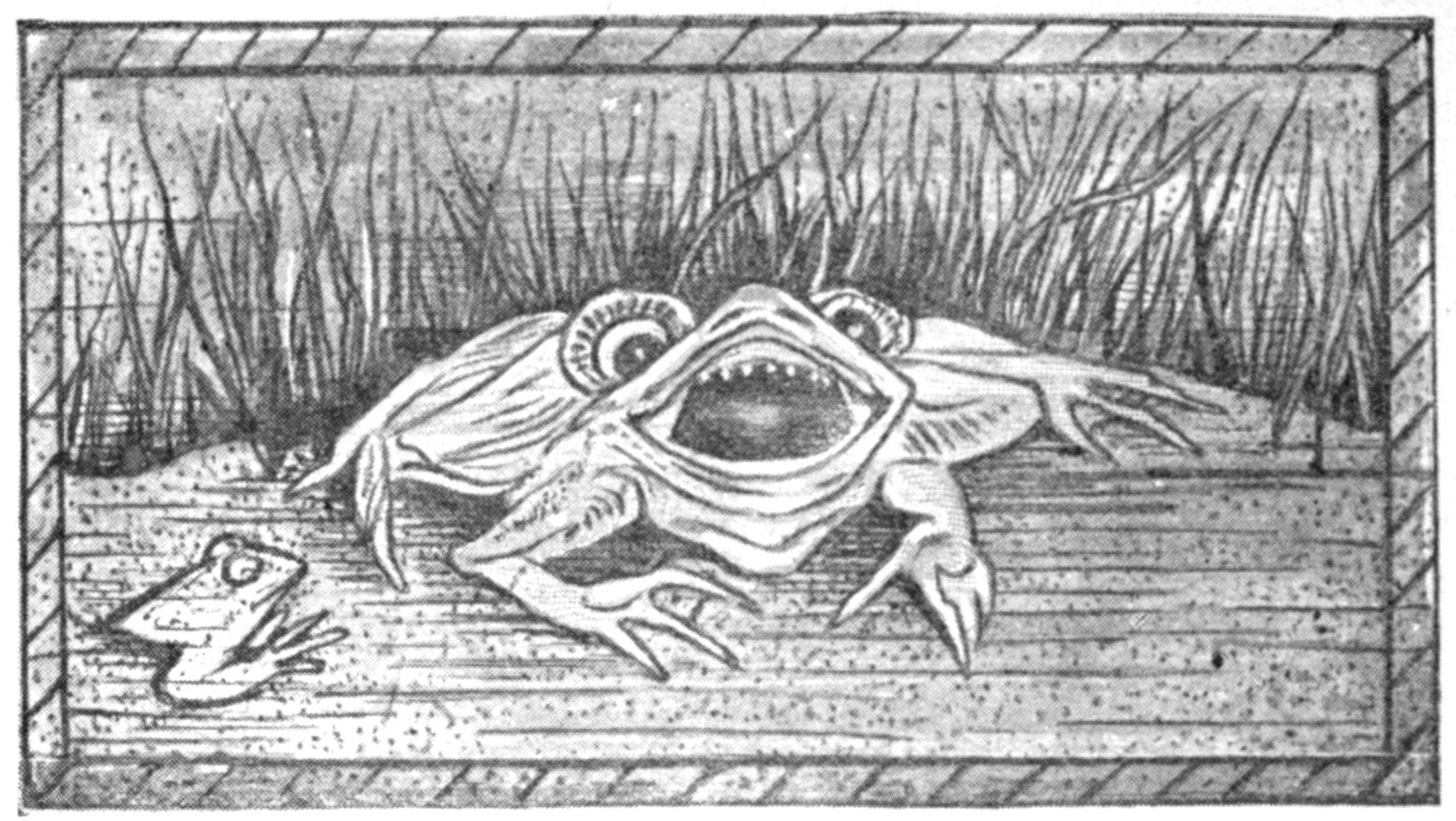
[Passamaquoddy]
Piʾchce uskichinwi otenesis
Pakichiotote pemtanikek.[31]
Long, long ago,
Far, far away in the mountains
An Indian village stood,
Little known to other men;
All lived therein at their ease,
The men did well in their hunting
The women worked at home,
And all went well—save in one thing
And that one thing was this:
That the town lay by a brook
And except in the stream there was not
A single drop of water
In all the country round
Save in the puddles of rain.
No one of all these Indians
Had ever found a spring,
Yet they all were very fond
Of a drink of good, clear water
And that in their brook was good.
So over it they grew dainty
And were very proud of it.
But after a time they saw
That the brook was running low,
Not only in summer time,
But in autumn after the rains;
And as the water fell
Their spirits, too, sank low;
But day by day it grew less,
Until its bed was as dry
As a dead bone is, which lies
In the ashes of a fire.
Now they had sometime heard
That, far away in the hills
Where none of them had been,
There was another village
Upon this very stream;
But what kind of people dwelt
Therein, no one could say;
So, thinking that these folk
Knew something about the drought,
They sent a man to look
Into the thing. Three days
Onward and upward he went,
Till on the third he came
Unto the village where
He found a solid dam
Built over the rivulet
So that no water could pass,
But all was kept in a pond.
Then, asking the village folk
Why they had done this evil,
Since ’twas of no use to them,
They said: “Go ask our chief,
It was he who ordered it.”
And when the messenger came
To see the Sagamore,
Behold, there lay before him,
Lazily in the mud,
A creature who was more
Of monster than of man—
Though truly in human form—
For he was immense in size,
In measure like a giant,
Fat, bloated, at all points
Most brutal to behold;
His great, round, yellow eyes
Stuck from his head as knots
Or knobsticks from a pine.
His mouth with stringy lips
Went well from ear to ear;
His feet were broad and flat,
With toes immensely long—
He was marvellous to behold!
And unto him the man
Set forth his just complaint,
To which the brute at first
Made no reply beyond
A most uncivil grunt
And a croak, but he said at last
In a loud, bellowing voice,
Such as we sometimes hear
At night from pond or pool:
“Do as you choose,
“Do as you choose,
“Do as you choose!
“What do I care?
“What do I care?
“What do I care?
“If you want water,
“If you want water,
“If you want water,
“Go somewhere else.”
Then the messenger told
How his people were pining
Near dead of their thirst,
Which seemed hugely to please
The monster, who grinned for joy,
Till at last he rose to his feet.
And, making a single spring
Of many rods to the dam,
Took an arrow and bored a hole
So that a little water
Just trickled out, and then cried:
“Up and begone,
“Up and begone,
“Up and begone!”
Then the messenger returned
In sorrow to his people,
Bringing them little joy,
And for a very few days
There was a little water,
Then it stopped and they suffered again.
Now these good Indians, who
Were the honestest fellows alive,
Best natured in all the world,
And never harmed any one
Except their enemies,
Were in a pickle indeed;
For sad it is to have
Nothing but water to drink;
But to want even that
When one is raging with thirst
Is worse than waiting for dinner
When we have no dinner to wait for.
Now this the Lord Kulóskap,
Who was merciful in heart
And knew all that was passing
In the hearts of his Indian children,
Observed, and pitying them
Came to them all at once;
For he ever came as the wind
And no man e’er wist how.
Now, just before he came,
These honest Indians
Had in a council resolved
To send their boldest man
Though ’twere to certain death,
Even unto the village
Where dwelt the evil chief
Who built the cursèd dam
Which kept the water with which
They slaked their thirst when they
Could get it—that is to say,
Whenever the water was running.
And when he got there, the brave
Was either to obtain
That the water-dam be cut,
Or, failing, do something desperate—
They knew not exactly what;
But it was expected by all
That if he were refused
He would paint the village with care
Of a deep vermilion hue,
Leaving on every lodge
Blood, and in this intent,
Should, armed at every point,
Go with his tomahawk,
His axe and scalping-knife
Singing his death-song, too,
As he went on his way;
And they were all agog.
Now the Master was greatly pleased
When he observed all this,
For nothing delighted him more
Than plucky, desperate deeds;
So he resolved that he
Would see to this thing himself.
Therefore he came to them—
The people of the town
Which was then so high and dry—
Looking so terribly fierce
That in all the land there was none
Who was half so horrible;
For he seemed to be ten feet high,
With a hundred wonderful plumes,
Feathers of red and black,
From his scalp-lock uprising;
His face fresh-painted like blood,
Green rings around his eyes,
While a very large clam-shell hung
From either ear, and behind,
A great spread eagle, which
Was awful to behold,
Flapped wings at every step;
So that the hearts of all
Beat as he entered the village,
For as simple Indians, they
Accounted that this must be
Either Lox, the Wolverine,
Or Michihant the Devil
Himself in person, who
Had turned to Indian form.
And the squaws declared that they
Had ne’er seen aught so fine,
Such a lovely, lovable man!
Then the Master having heard
The whole of their terrible tale,
Bade them cheer up, for he
Would soon set all to rights.
So without delay he went
Straight up the bed of the brook,
And coming to the town
Sat down, and bade a boy
Bring him some water to drink;
To which the boy replied
That not a drop could be had
In that town unless ’twere given
Out by the chief himself.
“Then go to your Sagamore,”
Said the Master, “and bid him hurry,
Or verily I will know
The reason why I wait.”
And when the boy had gone
There was no reply before
An hour, when the boy returned,
During which time the Master
Sat on a log and smoked.
Then at last the messenger
Came with a little cup
Which was only just half full
Of water, extremely foul.
Then the Master rose and said:
“Now I will go to your chief,
And I think that he soon will give
Far better water than this!”
And having come to the chief
He said, “Now give me to drink
And that of the best, at once,
Thou villainous Thing of Mud!”
Then the Sagamore in a rage
Bellowed: “Begone and find
Thy water where thou canst;”
When Kulóskap thrust his spear
At once into the beast,
Into his belly, lo!
Gushed forth a mighty stream,
For it was all the water
Which should have run in the brook—
He had taken it all to himself!
Then the Master, rising high
As any giant pine,
Caught the monster in his hand,
And crumpled in his back
With a mighty grip—and lo!
It was the Bull-Frog! Then
He hurled him with contempt
Into the stream to follow
The current ever on.
And ever since that time
The Bull-Frog’s back has borne
Those crumpled wrinkles which
Are in the lower part:
These are the print-marks made
By the Master’s awful squeeze.
Kulóskap then returned
Unto the town, but there
Found not a living soul,
For a marvellous thing had come
To pass while he was gone;
A thing which shall be heard
In every Indian’s speech
Through all the ages, as
’Tis told by all to-day.
For as these people were,
As I said, good simple folk,
They had talked together, just
As boys do at their play,
When they are hungry, thus:
“What would you like to have?”
When another will reply:
“Truly, I’d like to eat
A good hot venison steak,
With maple sugar and bear’s oil;”
“Nay, give me for my part
Some succotash and honey.”
Even so these villagers said:
“Suppose you really had
All the cold sparkling water
There is in the world, what then
Would you do with it?” One replied,
“I would live in the soft smooth mud,
And always be wet and cool.”
To which another said,
That he would plunge from the rocks
And dive in the deep cold stream,
Aye drinking as he dived.
And the third said: “I would be washed
Up and down with the rippling waves,
Living at will on land,
Or in the water;” Then
The fourth said: “None of you
Know how to wish, and I
Will teach you how. I’d live
In water all the time.
And forever swim in it!”
Now it chanced that these things were said
In the hour when, while it passes
Over the world, all the wishes
Which are uttered by men are granted.
And so it was with these Indians;
For the first became a leech,
The second a spotted frog,
The third a crab which is washed
Up and down with the tide,
And the fourth a fish which swims
A-drinking ever more.
Ere this, there had been in the world
None of the creatures which dwell
In the water, but now they were there
Of every kind. And the river
Came rushing and roaring on,
And they all went headlong down
Into the endless ocean,
To be washed into many lands,
And places all over the world,
Forever and ever more.
[31] Long ago, an Indian village stood far back in the mountains.
VII — HOW KULÓSKAP WENT WHALE-FISHING — FOOTNOTES:
[Micmac]
Piche Kulóskap pechian
Machieswi menikok.[32]
All of the olden time!
The Master Kulóskap came
To Pulowechē Munígû,
That is to Partridge Island.
And on the isle he met
With Kitpûsâgunâû,
Whose mother had been slain
By a fearful cannibal giant:
Therefore, like Kulóskap,
He warred through all his life
Upon the monstrous race;
From which it came to pass
That they were loving friends,
Which did not hinder them
From a hearty, merry strife
In which they barely missed
Taking each other’s lives
In the most good-natured way
As ye shall hear anon.
Now being on the isle,
The Lord of Men and Beasts
Was entertained as guest
By Kitpûsâgunâû,
Born after his mother’s death.
And, as the night came on,
The host said to the Lord.
“Let us go forth to sea
In my canoe, and catch
Some whales by torch light.” So
Kulóskap, nothing loath,
Consented, for he was
A mighty fisherman,
Like all the Wabanaki
Who live along the shore.
Now when they came to the beach
There were many mighty rocks
Lying scattered here and there.
Then Kitpûsâgunâû,
Lifting the largest of them,
Put it upon his head,
And it became a canoe.
Then picking up another
It turned to a paddle; next
A long and narrow piece
Which he split away from a rock
Was changed to a fishing spear;
And then Kulóskap asked
“Who shall sit in the stern
And paddle; and who shall take
The spear?” The other said
“That will I do.” And so
The Master paddled; ere long
The canoe passed o’er a whale.
A monster of a fish;
There was not his like in the sea.
But he who held the spear
Sent it down into the waves
As if ’twere a thunderbolt;
And as the handle rose
He snatched it up, and so
The mighty fish was caught;
And as Kitpûsâgunâû
Whirled it on high, the whale
Loud roaring touched the clouds;
Then taking it from the spear
He tossed it into the barque
As if it had been a trout.
And both the giants laughed;
And the sound of their laugh was heard
All over the land afar,
The Wabanaki land.
So, being at home, the host
Took up a knife of stone
Splitting the whale in two,
And threw one half to his guest.
And they roasted each his piece,
Over the fire and ate it.
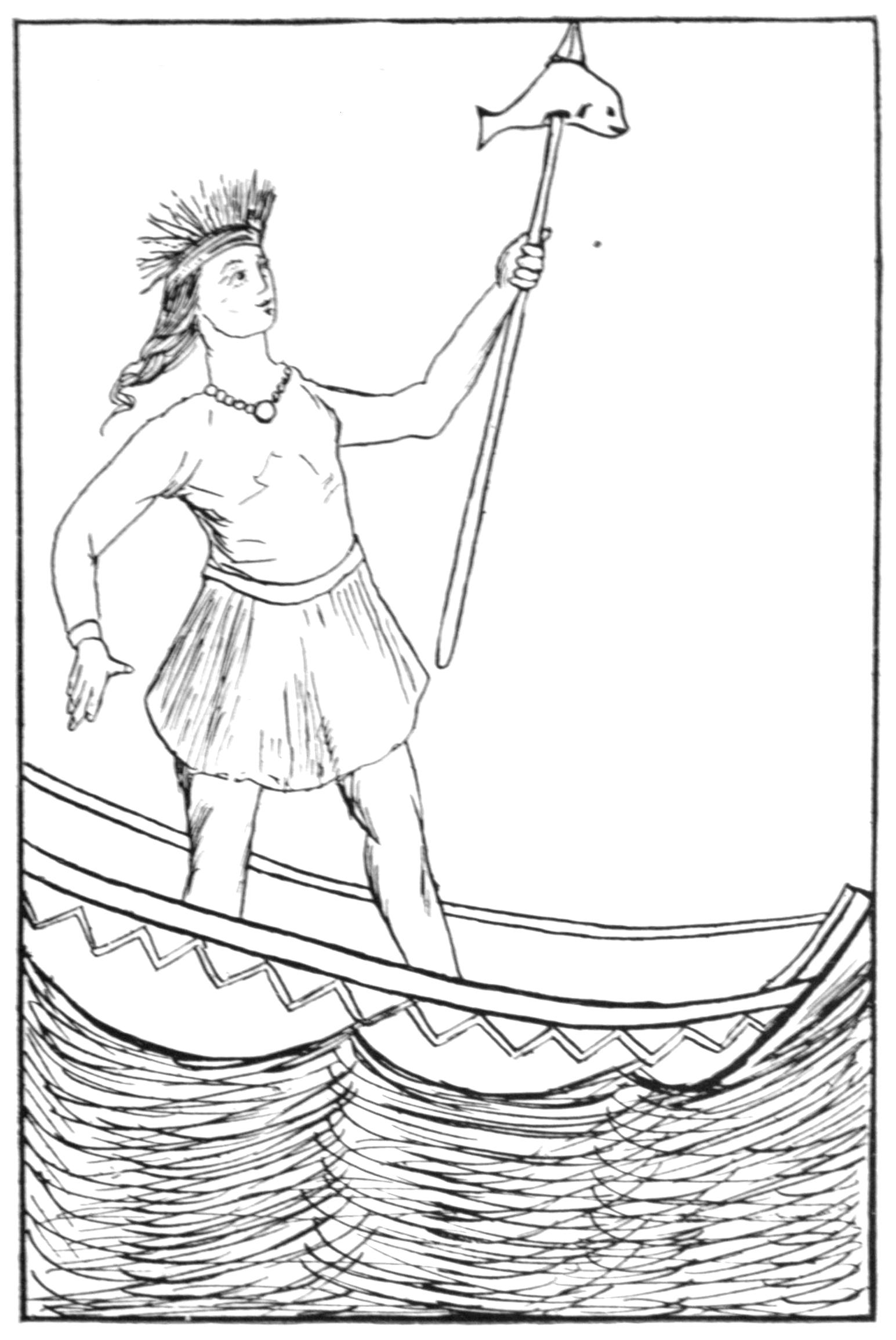
Now the Master, having marked
The light which was in the heaven
Long after the sun went down,
Said, “The sky is red, and the night
I think will be bitter cold.”
And the other understood
That by his magic power
The Lord would bring a frost
And make it cold indeed;
So he made the Marten bring
All the wood that lay without,
With the fresh oil of a porpoise
Which he multiplied ten times
By sorcery; and then
They sat them down and smoked,
And sang old songs and told
Tales of the early time.
But ever the cold came on,
And at midnight, when the fire
And fuel were all burnt out,
The Marten froze to death,
And then the grandmother.
But still the giants smoked on,
And laughed and talked as before.
Then the rocks all round without
Split with the awful cold.
The great trees in the forest
Were rent with frost, and the sound
Was like thunder above, but still
The Master and “He who was born
After his mother’s death.”
Kitpûsâgunâû,
Laughed on, and so they sat
Until the sun arose.
And then Kulóskap said
Unto the grandmother:
“Nugumích, nemchaase!”
“O grandmother, arise.”
And then unto the boy
“Abistaneûch, nemchaase!”
“Marten, arise!” and both
Awoke to life once more.
Then as the day was fair
They went into the woods
To seek for game, yet found
Full little. All they got
Was one small beaver, so
The Master said: “My friend,
You may keep all of that.”
Then Kitpûsâgunâû
Fastened it to his knee
Where it dangled like a mouse.
But as the giant went
On through the woods, and on,
The beaver ever grew
Larger and larger still,
Till ’twas of monstrous size;
Then he who bore it, took
A mighty sapling. This
He twisted to a withe
And with it, to his waist
He tied the beaver fast;
But still it grew apace
Till, trailing after him,
It tore down all the trees,
So that the giant left
A clean fair road behind.
Then when the night came on
They fished for whales again,
And feasted as before
And had the cold again;
So, even as before,
The grandmother lay dead
Of cold, with Marten, too.
Then Kitpûsâgunâû
Yielded unto the spell,
And Kulóskap sat alone,
Alone as conqueror.
But when the sun arose
He brought them back to life;
And, laughing heartily,
Said merrily, “Good-bye!”
To Kitpûsâgunâû.[33] L.
VIII — KULÓSKAP AND WUCHOʿSEN, THE WIND-EAGLE — FOOTNOTES:
[Passamaquoddy]
Wuchoʿsen nit kininagwʾsit
Kʾchî plakʾn potowatak pemlamsuk.[34]
Wuchoʿsen the Giant Eagle,
The Bird-Who-Blows-the-Winds,
Lives far away in the North,
Ever sitting on a rock
Which is at the end of the sky;
Because when he flaps his wings
The wind blows over the earth,
Men gave him the name of old.
When Kulóskap lived among men,
He often in his canoe
Went forth to kill the wild-fowl,
Ducks or swans or brant,
Which swim upon the sea.
One day the tempest roared,
The waves were as high as hillocks,
Even Kulóskap the Lord
Cared not to face the storm;
So then he said to himself:
“Wuchoʿsen has made this mischief
And all to show his power,
So now he shall feel mine!”
He turned him to the North,
It was long ere he came to the end;
There on a moss-grown rock
He found a great White Bird,
The Eagle of the Wind.
“Grandfather!” said the God,
“Thou takest no compassion
Upon us Kosesak—
That is, ’thy suffering children’—
For thou hast raised this storm.
It is too terrible!
Be easier with thy wings!”
The Giant Bird replied:
“Even from the earliest time,
And from the earliest days,
Ere aught beside on earth
Had ever uttered word,
I moved my wings and spoke
In Wind unto the World;
For mine was the first Voice
E’er heard in life or time,
Therefore I’ll ever speak,
And ever move my wings,
At freedom, as I will.”
Then Kulóskap the God,
Arose in all his might,
Tremendous—for he rose
Up to the clouds above—
And took the Giant Bird
As if he were a duck,
And, tying fast his wings,
Cast him afar, adown
Into a deep dark cleft
Between the splintered rocks,
And left him lying there.
Then all the Indians
Could go in their canoes
As freely as they chose
For many days and months.
But then as time went by,
They noted day by day
That all the waters grew
So stagnant and so foul
That even the Master found
He could not row his bark;
All was so thick and dead,
And rottenness and slime
Crept into all the world.
And then he thought upon
The Giant Bird, and went
To find him, far away.
As he had left him, so
He found him, for the Bird,
The Spirit of Air,
Can never truly die.
And so he picked him up,
And then with care untied
One single wing, but left
The other tightly bound.
And since that time the Wind
Has never been so wild
As ’t ever was of yore. L.
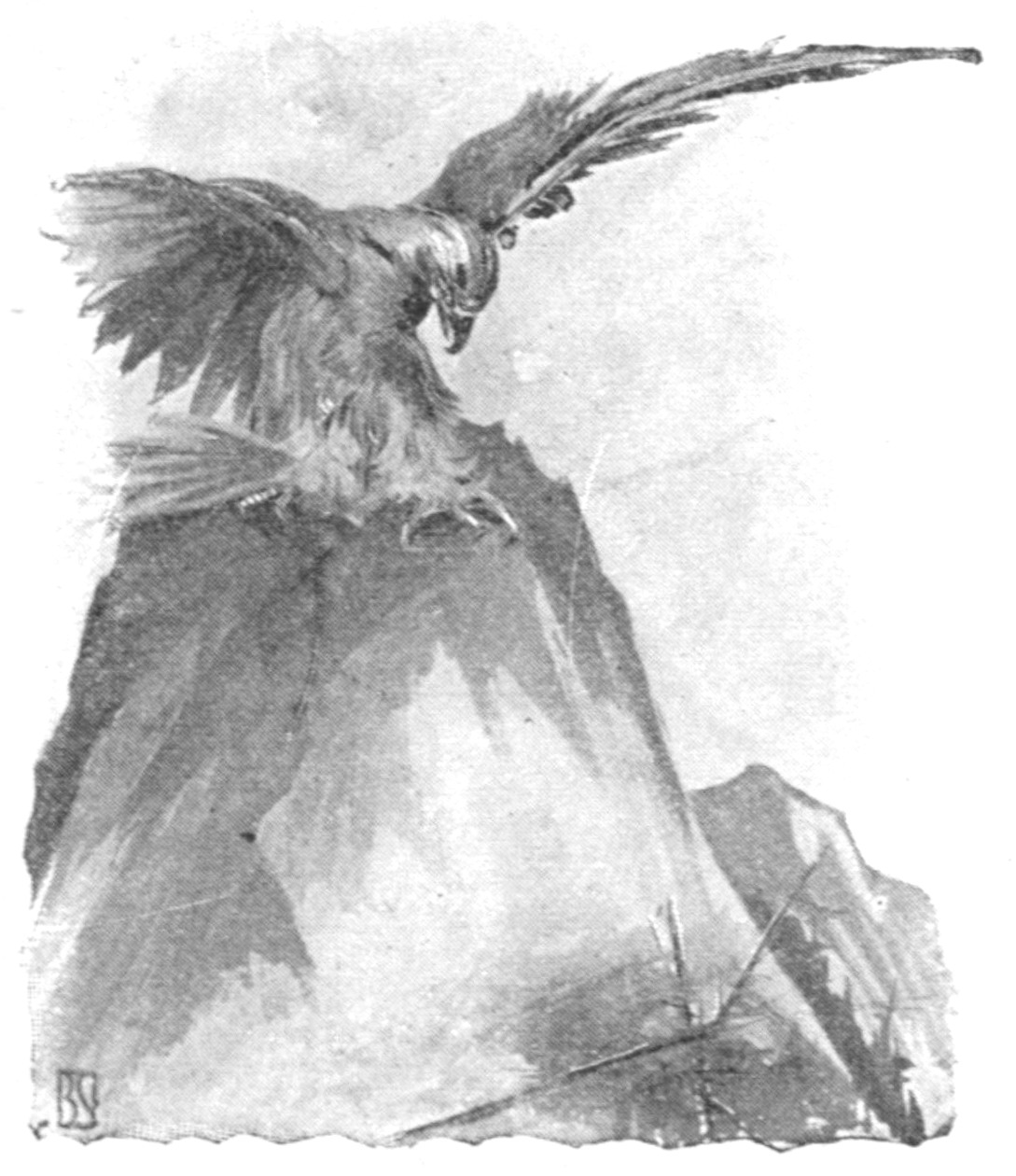
[34] Wuchoʿsen, that is the great eagle which blows the winds.
Canto Fourth — I — KULÓSKAP AND WINPE; OR, THE MASTER’S FIRST VICTORY — FOOTNOTES:
THE MASTER AND THE SORCERERS
[Micmac]
Piʾche ktagudimol.[35]
All in the olden time,
Or in the first of all,
Of all things here on earth,
Men were as animals
And animals as men.
But how this mystery was,
No one can understand,
Though some explain it thus:
As Man was made the first,
All creatures first were men,
But as they gave themselves
To this or that desire
Like that of animals,
And all their souls to it,
So were they changed to brutes.
Yet ere this came to pass
There was a middle time
When they could change their forms
To beasts or men at will;
Yet more and more and more
Even as men, they showed
In all, the Animal.
Then Kulóskap the Great
Lived on a wooded isle
With many Indians
Whose names and natures, too,
Were all of beasts and birds.
These men, and most of all
The one called Pulowech,
The Partridge, had attained
To certain magic power.
These, as they found him great,
Grew jealous of the Lord,
He who was ever Man;
And so they all resolved
To leave him in the isle.
But with them take away
His grandmother, likewise
Marten, the boy, who served
The Master in his lodge.
In Micmac Marten’s name
Is Abistanēūch; he
Was of the Elfin kind,
One who could change his form
To what he pleased. For all
Relating to the Lord
Was wonderful and strange.
This Marten ever ate
From a small dish of bark
Called Witchkwîdlakunchich.
Whene’er he left this plate
Kulóskap always knew
The place where it was laid,
And by a glance thereat
Could tell whate’er had happed
Unto his family.
Kulóskap had, beside,
A wondrous magic belt
Which gave him endless strength
And untold mystic power.
Yet to increase his might,
Even he, the Lord of Men,
Must often all alone,
Dwell in the wilderness,
And fast and pray and dream,
Until by penance strong
He gained once more his power.
Among his enemies
Who dwelt upon the isle,
Was one named Winpe, who
Of all was terrible;
So he and all the rest,
With Marten as a slave,
Likewise the grandmother,
One day when Kulóskap
Was hunting in the North
Got into their canoes
With all their worldly gear,
And sailed, far, far away.
Now when the Lord returned
And saw that all were gone,
He sought and found the dish
Which Marten had concealed,
And on it read the truth:
How he had been deceived
And whither all had fled.
Now, it is said, the Lord
To gain tremendous power,
Or such grand mastery
As man had never won,
Went to the wilderness,
And there for seven years
So trained his mighty mind
By penance into will,
That when the time was o’er
He knew that he had won,
And that no thing on earth
No sorcerer nor fiend,
Giant nor devil grim,
Could now resist his power.
So when the time had come
He called his dogs, and went
Down to the shore and looked
Far o’er the rolling sea,
And sang the magic song
Which all the Whales obey.
Soon in the distance rose
A small dark spot, which grew
In size as it drew near.
’Twas but a little whale;
It came unto the Lord,
But he was now a giant;
He stepped upon the whale.
It sank beneath his feet;
He laughed and said, “Begone!
Thou art too small for me!”
He sang again the song,
But now with all his power;
And then there came the Queen
Of all the whales, and she
Was as a giantess
Even among her kind;
She bore him easily
Unto Kespūgitk, then
She paused and said, “O Lord!
I dare not further go,
For I shall run ashore.”
And this he wished because
He would not wet his feet,
And so he lied and said:
“The land is far away.”
So she went boldly on,
Till she beheld below,
The bottom of the sea
With many shells on it;
And then she said in fear:
“The land, does it not seem
To thee like a bow-string?” “No!”
He answered, “Land is far.”
The water grew so shoal
That soon she heard the song
Of many Clams, who lay
Deep shelled below the sand.
They were the enemies
Of Kulóskap the Man,
Their only enemy,
And so they sang to her:
“Hasten and throw him off,
And drown him in the sea.”
But great Putúp the whale
Who did not know their tongue,
Asked what the words might mean?
And he replied in song
“They tell you to make haste;
Nenagimk, ’to hurry’;
To hurry, to hurry along,
Away—as fast as you can.”
The whale like lightning flew
Until she found herself
High up upon the shore,
Then she, too, cried in woe:
“Alas, alas! Nujich!
My grandchild, you have been
My death at last—for now
I cannot leave the land;
I shall swim in the sea no more!”
But Kulóskap answered her:
“Nʾgumi, have no fear!
You shall not suffer, for
You shall swim in the sea once more.”
Then with a push of his bow
Against her head, he sent
The whale into the sea,
Into the deep once more.
And then the whale rejoiced,
But ere she went she said:
“O darling grandson mine!
O Master! Hast thou not
Tobacco in thy pouch,
Therewith a pipe to spare?”
And he replied, “Ah yes!
I see you want a smoke,
I have what you require.”
He gave the whale a pipe,
Tobacco and a light
And so she sailed away
Rejoicing as she went,
A-smoking as she swam;
While Kulóskap, the Lord,
Leaning upon his bow
Beheld the long low cloud
Which trailed behind her, till
She vanished far away.
So to this very day,
The Indians, when they see
A whale who blows, cry out:
“Behold, it smokes a pipe,
The pipe of Kulóskap.”
And so the Lord went on,
Meeting at every step
Adventures wild and strange;
Witches and sorcerers
Sought to delay his steps,
Until at last he came
To Uktâkumkuk, or
Néwfoundland, where his foes
Had been, then fled away.
Again he sang his song,
And once again a whale
Carried him far away,
Away unto the North;
And now he found indeed
That he had gained his end,
Since by the shore he saw
A wigwam, and therein
His sorrowing grandmother
And Marten well-nigh dead;
Winpe the sorcerer
Had treated them full ill.
Greatly did they rejoice
To see their Lord once more;
And then Kulóskap said:
“When Winpe shall return
Do all that’s in your power
To irritate the man
To make him mad with wrath;
So shall he lose his power,
For anger weakeneth will.”
They did what he required
When Winpe came again,
Till in a roaring rage
He sought to take their lives;
When lo! before their eyes
The Master stood and gazed
In aspect terrible,
Upon his angry foe.
Winpe fell back a pace
To gain once more his power;
It came and it was great.
With all his evil will
The sorcerer raised his strength
And as it came he grew
In giant stature, till
His head was o’er the pines;
And truly in those days
The pines were higher far
Than those we have to-day:
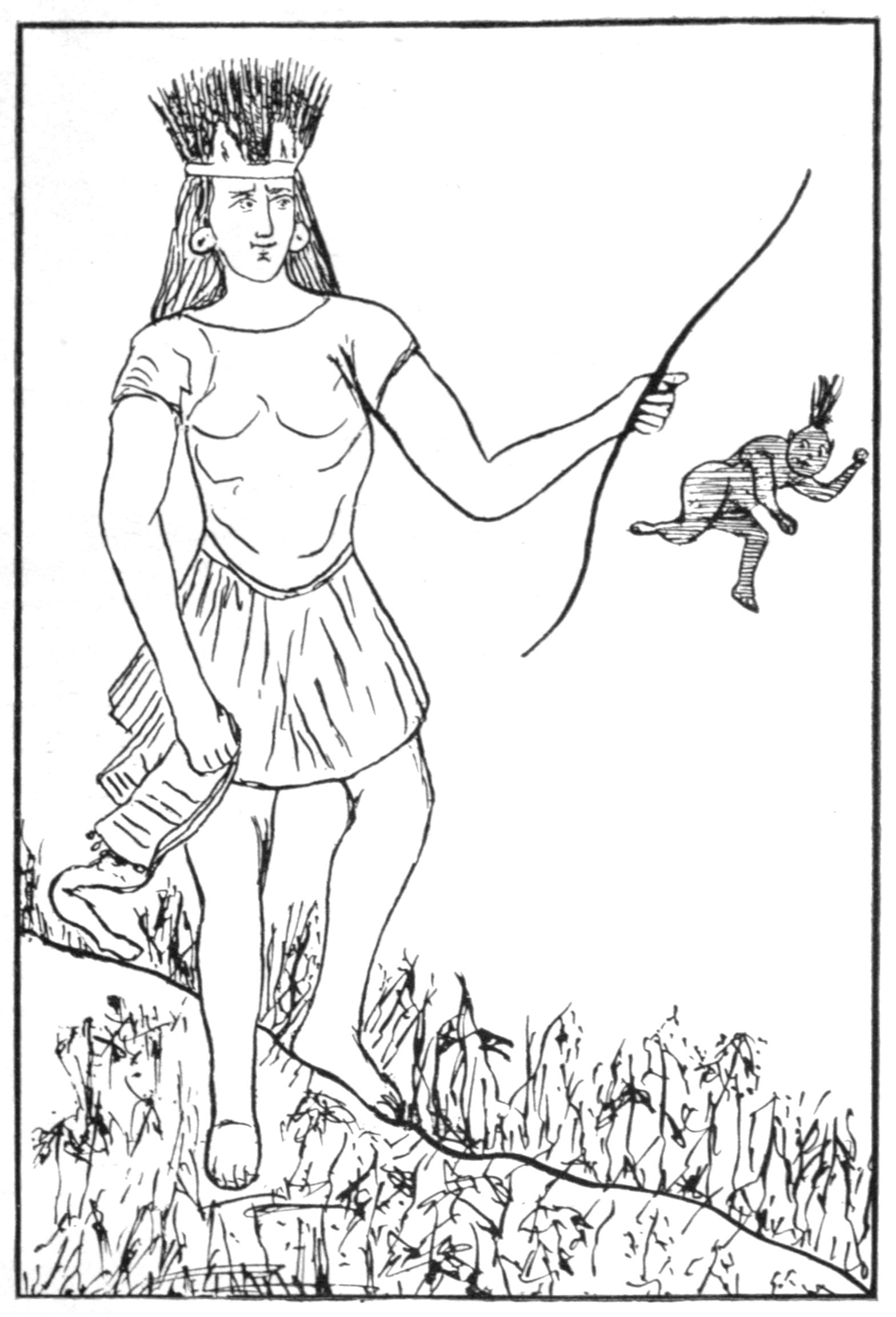
But Kulóskap the Great
The Lord of Men and Beasts,
Laughed as the thunder roars.
And grew until his head
Was far above the clouds,
Until he reached the stars,
And ever higher still,
Till Winpe seemed to be
A child beneath his feet.
Then, holding him in scorn,
Kulóskap the great lord
Smote Winpe with his bow
As one might strike a dog;
Down fell the sorcerer dead!
[35] I will tell you of long ago.
II — HOW A WITCH SOUGHT TO CAJOLE THE MASTER — FOOTNOTES:
[Micmac]
Kes saak.[36]
This is a story of the olden time.
It chanced that great Kulóskap met a witch,
An evil being who had made herself
Look like a fair young girl, and that so well
By all the deepest art of sorcery,
That she was sure the Lord could never see
Through her disguise—wherein she was a fool,
Because he read her at a single glance.
She bade him take her out in his canoe;
So forth they sailed over a summer sea
With a sweet breeze. The witch upon the way
Sought to beguile the Lord with loving words
To which he made no answer, knowing well
What kind of passenger he had on board.
And so she played all her cajoleries,
While he remained as grim as any bear,
Replying with a growl to loving words;
Till in a rage she changed her melody
Into the curse which raises up the storm
As if to show defiance of his power.
And it was terrible when the wind howled
Over the waves which madly rose and fell
Like great white wolves a-jumping while they run;
And the red lightnings flashed, while the great sea
Grew dark as if to show their fire the more.
And then the Master was enraged indeed,
That a vile witch should dare to play such tricks
With him, the mighty Lord of Beasts and Men;
And, driving the canoe unto the beach,
He leaped ashore, and giving it a push
He sent it headlong out to sea again,
And cried: “Sail with the devil if you will,
But ne’er on earth again in human form!”
Then she in terror cried: “What must I be?
Oh, Master, say what shape shall I assume?”
And he replied: “Whatever form you please—
That grace alone I give thee.” In despair
She plunged into the deep and there became
The wĕbĕtumekw, a ferocious shark
Which has upon its back a mighty fin
Like a great sail when swimming in the sea.
So the canoe and witch were changed as one
To the great evil fish, and to this day
The Indians when they see it, ever cry:
“Behold the girl, who in the olden time
Was punished by the Master.” That is all! L.
[36] Of old time.
III — HOW KULÓSKAP FOUGHT THE GIANT SORCERERS AT SACO — FOOTNOTES:
[Passamaquoddy]
Yut nʾkani aknodʾmâgon uch Kulóskap.[37]
This is a tale of Kulóskap,
An old one. There was a father
Who had three sons and a daughter,
And all were Mteolinwuk,
That is, they were magicians
Of terrible power, and giants;
They ate men, women, and children;
Yea, they did everything
That was wicked and horrible;
And the land grew tired of them
And of all their abominations.
Yet when this family
Was young, Kulóskap had been
Ever and truly their friend;
He had made their father his father,
The brothers his brothers, the sister
His sister by adoption,
As Indians often do.
But, as they all grew older,
And the Master began to hear
On every side of their sins.
He said: “I will go among them
And find if this be true;
If it be so, they shall die—
I will not spare one of those
Who oppress and devour mankind,
I care not who he may be.”
This evil family dwelt
Near the place that now is Saco,
Upon the sandy field
Which is in the Intervale,
Or the summer bed of the river,
Among the White Mountains, which lie
Between Kèzitwâzuch,
Or Mount Kearsarge the mighty,
And Kchibenabesk
The towering rock, and near
Wʾnâgʾmeswuk Wigît
The Home of the Water Elves.
Now the old man, the father
Of all these evil sorcerers,
Had only one eye, and he
Was half gray like a stony mountain;
Then the Master made himself
Like to the hoary old fellow;
There was not between them
The difference of a hair.
So having taken this form
He entered into the wigwam
And sat by the agèd man.
Then the murdering brothers
Who never spared a soul,
Hearing that some one was talking,
Peeped slyly in, and seeing
A stranger so like their father
That they knew not which was which,
Said: “This is a great magician,
But he shall be tried ere he goes,
And that right bitterly.”
Then the giantess sister took
The tail of a whale, and cooked it,
And gave it to the stranger
That he might eat it, when
Just as it lay before him
On the platter, and on his knees,
The elder brother entered
And saying: “This is too good
For a beggar like you,” took it
Away to his own wigwam.
And then the Master said:
“That which was given to me
Is mine—so I take it again.”
And sitting still he willed
Or wished for it to return.
And lo! the dish came flying
Again into his lap!
And he ate from it, undisturbed.
Then the brothers said: “This truly
Is a very great magician,
But he shall be tried ere he goes,
And that right bitterly!”
When he had eaten, they brought
A mighty bone; the jaw
Of a whale, and the elder brother
With great ado, and using
Both arms and all his strength,
Bent it a little, and proudly
He held it to the Master
Who with the thumb and finger
Of his right hand alone,
Snapped it like a green twig,
And crumbled it to powder.
Then the brothers said again:
“This is truly a great magician,
But he shall be tried ere he goes,
And that right bitterly.”
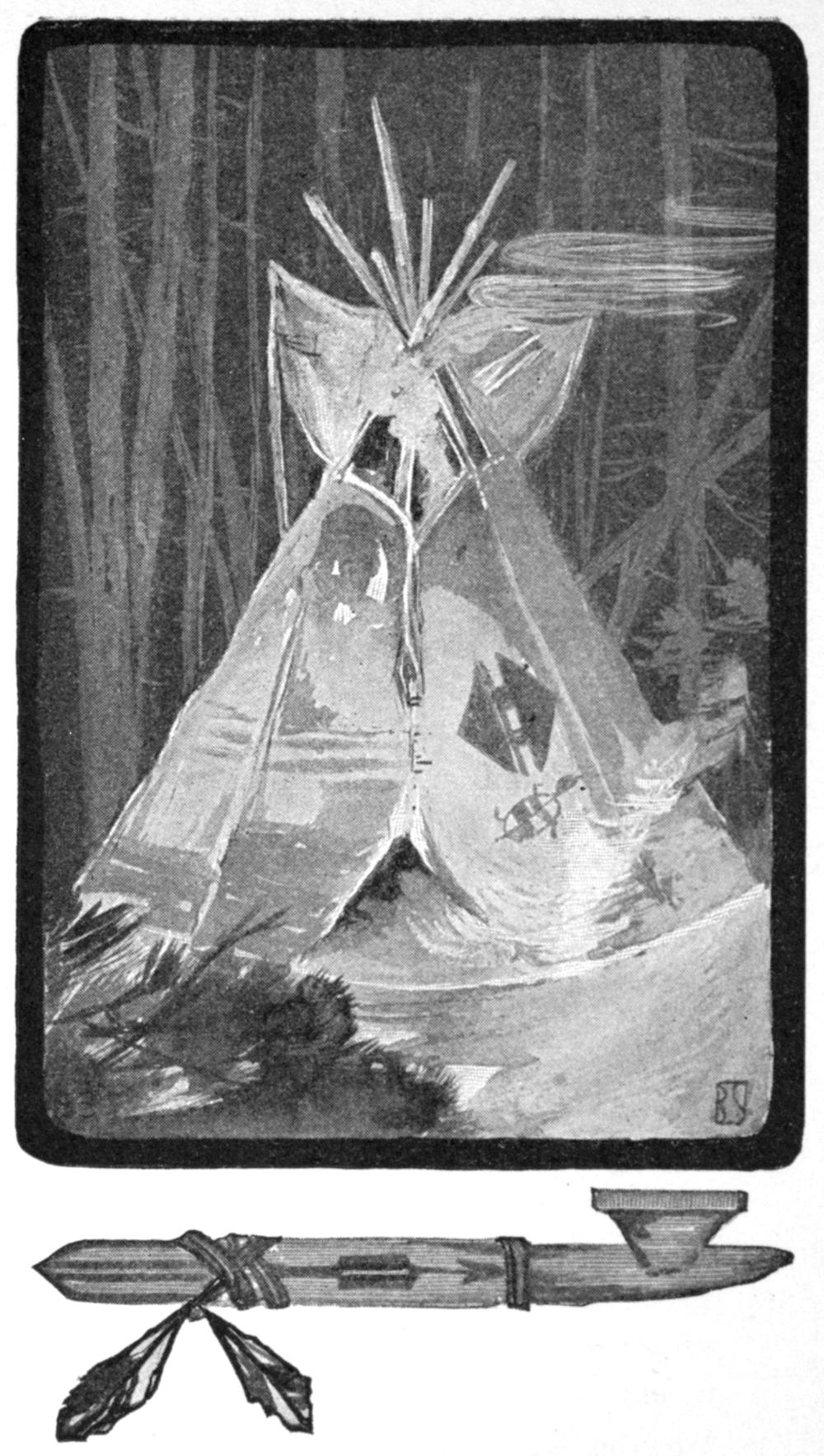
Then they brought an enormous pipe
Full of the strongest tobacco;
Then they brought an enormous pipe
Full of the strongest tobacco;
No man, not even a sorcerer
Could have smoked such fearful stuff.
And as it was passed around
All of them smoked. The brothers
Blew the smoke through their nostrils
As if it were light as air.
But the Master filled it full
And, lighting it, burned all
The tobacco into ashes
At one puff, with a single pull!
Blowing all the smoke through his nose
Even as they had done.
Then they said and now in anger:
“This is truly a great magician;
But he shall be tried ere he goes”—
They never said it again!
Yet still they tried to smoke.
They shut the door of the wigwam
Hoping to smother him.
But he puffed and puffed away
As if he had been on the top
Of a mountain in a breeze,
Till one said: “This is idle,
Let us go and play at ball!”
The place where they were to play
Was the sandy stony plain
Which lies on the bend of the river.
And so the game began.
Kulóskap discovered
That the ball with which they played
Was a hideous human skull,
A living thing which snapped at
His heels. Had the Master been
As other men, the monster
Would have bitten a foot away.
Then he laughed aloud, and said:
“So this is your style of foot-ball!
Well and good! But let us all play
With our own balls.” He stepped
Up to a tree by the river,
And broke off a hole or knot
And it turned to a living skull,
But one which was ten times greater,
And ten times more terrible
Than that which the sorcerers used.
And the three brothers ran
Before it as it chased them
As rabbits are chased by a lynx;
They were entirely beaten.
Then Kulóskap stamped in the sand,
And the waters rose and came rushing
Fearfully from the mountains
Adown the river bed;
The whole land rang with their roar.
Then the Master sang the song,
The magic song which changes
All creatures to other forms,
Which changed the Three and their father
Into the Chinames,
A fish which is long and broad
As a man, and they all went headlong
Down in the flood to the ocean
Where they must dwell forever
And are caught unto this day.
These three magicians wore
Each one a collar of wampum
Of purple beads and white,
Wherefore the Chinames
Has exactly round its neck
Or below its head, the same,
Distinctly marked and clear;
They were mighty men in their day
And great Mteolinwuk,
But were tried before they went
And that most bitterly.
Yes indeed, Nsîwes, my brother,
This story is really true,
For Kulóskap was very great
In his day—and a day will come
When I myself shall go to him. L.
[37] This is an old story about Kulóskap.
IV — HOW THE MASTER SHOWED HIMSELF A GREAT SMOKER — FOOTNOTES:
[Passamaquoddy]
Piʿche Kulóskap kʾchî skitap.[38]
Kulóskap the Great,
Lord of Beasts and Men,
Was ever a boon companion
And a right valiant smoker.
In all the world was no man
Who loved a well-filled pipe
Of good and fragrant tobacco
So heartily as he did.
Now in that happy time,
The sun shone warmer and brighter,
The summers were far longer
In the land of the Wabanaki
Than they truly are to-day.
And the Indians raised tomáwe,
That is to say, tobacco,
Far better than the best
Which ever is seen to-day.
And they found a mighty solace
In burning the gold-brown leaves.
There came one day to the Master
A great and evil magician
Who sought to take his life,
As the Master at once perceived;
For he read the thoughts of men
As though they were strings of wampum—
Seeing deep into every heart.
Now this evil magician thought,
By first amazing the Master
Through some wonderful trick, to weaken
The will which gave him strength;
As they say a fish is frightened
When he sees that his foe swims faster,
And is too much alarmed to fight.
So the sorcerer sat to smoke
With a pipe whose bowl was bigger
Than the head of any man,
With a stem full ten feet long;
But ever that of Kulóskap
Grew to the size of a pumpkin,
And then like the ten-foot boulder
Which lies on the beach at Rye;
And the smoke which rose from his puffing
Was like that of a forest fire.
Then the sorcerer filled his pipe
Afresh with strong tobacco,
Such as would kill if they breathed it
A porcupine or a toad.
And at one pull he burned it
Leaving no spark behind;
And at one whiff he sent it
Out in one great round ball;
Then sat and looked at the Master.
And then the Lord Kulóskap,
Whose pipe was many times greater,
Also sent his tobacco
Out in a puff as round—
Out in a mighty ball
As hard as any flint,
And, blowing it on the ground
Which was of granite rock,
Split it asunder, so
That a valley yawned between them.
Then they both sat in silence
Until the Master said:
“Do that—and then take my life.”
But the wizard could do no more,
And returned in shame and anger
To the evil ones who had sent him. L.
[38] Long ago Kulóskap was a great man.
V — KULÓSKAP AND THE WITCH — FOOTNOTES:
[Passamaquoddy and Micmac]
Nequt Kulóskap meiaoet
Pechian kʾtakʾmikomnok. Nit kʾmʾtkinansnok
Neke bʾsʾnboek kʾchî Kiwaʿkwik.[39]
When Kulóskap the Master
Came into this world of ours,
Or the Land of the Wabanaki,
It was full of giants and monsters,
Sorcerers, dwarfs and demons,
Mighty beasts and men,
Fiends and the Indian devils,
And, worst of all, the witches,
And worst among them Pûjinskwes,
A word which means “The Pitcher.”
She could be fair when she would,
Fair as a rosy sky
With stars still beaming in it
In very early dawn;
Or terrible as a storm,
When it howls among the mountains,
And lightens in the midnight.
Now while the Master was young,
And had not gained the power
Which he won in riper age,
Pûjinskwes sought his love.
But he knew that she was evil,
So he fled away from her wooing,
And the wild-cat witch pursued him.
It was a dreadful flight,
Since to make their steps the longer
Both took the giant form,
Took it by magic power.
It was an awful storm,
A terrible storm in winter
When the wind is chasing the clouds;
It was like a frightful tempest
In summer when the lightning
Chases after the thunder.
Deep lay the snow on the earth;
Therefore they both wore snow-shoes;
But, when they came to the shore,
Kulóskap leaped from the mainland
Over the sea between
To the island of Grand Manan;
And so he escaped from the sorceress;
For the shoes which the Master wore
Were round and out of the common;
While those of the witch were long,
Long it is said and pointed,
And the marks of the two are still
To be seen deep pressed in the rocks
By the shore to this very day.
But for days and years thereafter
Pûjinskwes sought to slay him,
And she had terrible power,
The might of the Evil Witches
Which came from the early time.
Now ’tis the greater part
Of the Indian art of magic
To know what our foes are planning,
Planning and plotting against us,
And all their tricks and devices
Which they scheme in the darkened paths,
The darkened paths of Evil.
In knowing this, Kulóskap
Was the greatest and the first,
And, knowing new arts of magic,
Went far beyond them all.
For before his time all sorcerers
Went every one his way
Unheeding the ways of others,
Even in wickedness.
But Kulóskap first of all
Threw out his soul unto others
To find what others knew.
When the Lord was on the warpath
Seeking the sorcerer Winpe
Who had carried away his household,
He came to Ogomkeok
Where he found a great birch wigwam,
And, in the wigwam seated
Bending over a fire,
A strange old woman—a horror
Of all old hags and ugliest—
Trembling in every limb,
As if death stood at her elbow,
Dirty, ragged and loathsome,
He never had seen the like.
Then looking up at the Master
With bleared and pitiful stare,
She begged him to bring some fire-wood
Which he did indeed, while knowing
Who it was who was so disguised,
For he knew it was Pûjinskwes
And he laughed at her in his heart.
Then she said to him, “O stranger,
As thou art a man of mercy,
Pray free me from the waagûkw
From the monstrous terrible vermin
Which madden me by their bites!”
Now all the waagûkw were devils,
The spirits of every poison,
Which she thought had such a power
As must even kill the Master.
But he foreseeing this
Had taken as he came
Cranberries from a swamp,
And bidding her bend over,
He took the imps from her hair,
And every one as he took it
Turned into a porcupine,
Or else a terrible toad.
When she asked him, “Have you found one?”
And, “I have,” replied the Master;
Then, “Crush it,” was her answer,
So then he crushed a berry,
And Pûjinskwes, hearing the sound,
Thought to herself: “The poison
Which is now upon his fingers
Will soon be in his heart,
And death will follow after.”
But Kulóskap put the devils
One by one as he found them
Under a wooden platter
Which was lying close beside him.
And as he did this he chanted
A song which put her to sleep,
A song of wonderful power.
So she slept until the morrow
And when she awoke, the Master
Was far away, and her devils,
Porcupines, toads and all,
Were swarming over the floor,
For they had upset the platter.
Then she was filled with fury
To think he despised her so
That he had not even cared
To kill her while a-sleeping.
Then she burst forth in madness,
Wild as the Indian devil
Forth in her own true figure
As beautiful as sin,
Wild as the wolverine;
And gathering up her imps,
And summoning all her power
Of magic by fiercer will,
Went forth to meet the Master.
Onward he went to the North
Till he came to a pass in the hills.
It was a great ravine
Wherein two monstrous beasts
Waylaid all travellers
And tore them limb from limb.
Straight at his dogs they flew;
He did but touch the dogs,
And speak a word of power,
When up they grew to size
Stupendous, so they seized
The beasts e’en as the wolf
Seizes a rabbit. Then
The fight was at an end.
These dogs had been so trained
That when called off they fought
More fiercely than before,
And when told not to bite
They ever bit the more.
Soon he came to the top
Of a high hill, and looking
Afar o’er all the land
Beheld, away in the distance,
A wigwam, and knew in his heart
That an enemy dwelt therein;
And coming to it he found
An old woman with two fair daughters.
But he knew at a glance that the mother
Was a witch among the witches,
And the one who sought his life.
The girls came to him greeting
With fond and pleasing glances,
Asking if he was hungry,
And offering him a dainty:
The entrails of a bear
Which, when turned and smoked and seasoned,
Are deemed by all delicious.
They are a common gift
Of Indian girls to their lovers,
For, when cast around the neck
As a necklace, it means “I love you.”
But these had been enchanted,
Poisoned by magic spells;
Had the Master taken them then
He would have lost his power.
Little they knew of the magic,
The new and wonderful magic
Of reading the thoughts of men,
Which the Lord had brought into the land,
Unknown to the witches of yore;
So as they came wooing round him
With smiles and wanton glances,
He smiled, as if all he wanted
Of them, was to be won!
So he took the gift which they offered,
But, instead of putting it on,
Cried out to his dogs, “Cuss! cuss!”
Which in Micmac means “Stop, stop!”
But which they had been trained to believe
Was, “Hie at them!” They flew at the witches
When both flashed up like fire
In the terrible form of devils,
As flaming female fiends.
Then came an awful tumult
Such as never before was seen
In the land of the Wabanâki;
All the earth and rocks around
Were rent in the dreadful tumult
And all the while the Master
Cried merrily to his dogs:
“Stop, stop! These are my sisters,
Let them alone! Be quiet!”
But the more he bade them be peaceful
The more they attacked the witches
And drove them at last away.
Then the Master entered the wigwam
Where Pûjinskwes sat waiting,
Waiting for him as dead,
Waiting for him as food.
So he said to her while smiling,
“Grandmother, are you hungry?
Do you love the links of a bear?
Then here are some.” He threw them
Around her neck and she died,
Died and became a devil.
Yet the sorcerers when devils
Ever rise to life again;
Ever rise to work men mischief,
For evil can never die.
Then the Master kept on his way
Till he met the giant Winpe—
The evil sorcerer Winpe
Whom he slew in terrible battle.
This is the song of the Micmacs,
Of the Master’s earlier deeds.
[39] When Kulóskap the Lord came into our land the country was full of great giants.
VI — KULÓSKAP AND THE WITCH CALLED “THE PITCHER” — FOOTNOTES:
[Passamaquoddy]
Uskijinwi otenesis.[40]
There was an Indian village
Wherein dwelt many people,
Who were all of the Pogumʾk
Or of the Black Cat totem;
And wisest and bravest among them
Was Kulóskap the chief;
And when he went forth a-hunting
With the tumʾhîgʾn (tomahawk),
The knife and bow and arrow,
He slew the moose and the bear;
So he gave meat to the poor,
So he fed all the tribe,
Yet, though he was chief of the Black Cats,
He was by his mother a Bear.
Pûjinskwes the witch and devil
Was also one of the Black Cats;
She was woman or man as she listed,
But in those days she lived as a man;
And, because she hated the chieftain,
She thought how she might kill him,
And take his place in the tribe.
One day when all the people
Were packing to travel away
To another place for summer,
Pûjinskwes asked the chief
To go with him (or her,
As you may choose to take it),
Adown to the water side
To seek for the eggs of the gull.
Then both in a canoe
Went far away, and still farther,
Till they came to a lonely island.
And while Kulóskap was seeking
For eggs along the seaside
She stole away in silence,
Away in the agwedʾn
That is, in the birch-canoe.
And as she paddled away
She sang in the Indian tongue:
“Nikedha pogumʾk mʾneʿnuk
Petesinel sagʾmawiw!”[41]
“I have left the Black Cat on an island,
I shall be the chieftain now.”
So she returned to the village;
Next day they all departed,
There was not one of them left,
Save the one who was worth them all.
Then at night they camped, and expected
The chief who w’ould come to them,
And then the evil Pitcher
Ruled them as Sagamore.
Now for thirty days Kulóskap
Who had well-nigh lost his power
Of magic, as all magicians
Are often all exhausted,
Remembered that his friend
The Fox was mteolin,
With all the strength of sorcery.
And still the mighty Master
Could sing the wonderful song
Which is heard to any distance,
Away over forests and mountains,
Over the rolling rivers.
So he sang and the Fox soon heard it,
And he travelled by night and day
Until he came to the ocean,
And swam to the lonely isle.
“Now swim with me to the mainland,”
Said the Fox unto the Master.
“Brother, I cannot do it
For all my power is gone.”
“Hold to my tail” said the Fox,
“Be of good faith, my brother,
We soon shall gain the shore.”
“But remember,” said the Fox,
“While we are in the water
Thou must keep thine eyes fast shut.
All depends upon that,
On that alone and thy faith.”
So all went well for a time,
But anon the chief grew weary,
And opening one eye a little
It seemed to him that truly
They were not ten feet from the shore,
And being of little faith
He thought—for he spoke not aloud:
“We shall never get to land:”
But the Fox who read his thought,
Replied, “Do not believe it,
I will that we reach the shore.”
But the journey lasted long,
For what seemed unto the Master
To be ten feet, was really
Ten miles—and the wind was high,
And the waves were wild and beat them,
For the witch had raised a storm;
And it was late in the evening
Before they reached the land.
“And now my elder brother,”
Said the Fox, “you may go your way.”
He went and came to the camp
Where he had left his people.
There all was silent and sad,
The ashes were cold on the hearths,
In the deserted homes,
In the lonely, silent wigwams;
So he followed the tracks of the Indians,
And in a day came near them.
The first whom he overtook
Was his mother bearing his brother;
Nʾmokswes, that is the Sable,
Or as others say the Marten.
She bore him on her back,
The child’s back lay against her,
So that, while she looked forward,
He could only look behind.
As Kulóskap peered from a thicket,
Smiling to see the boy,
The Sable cried: “Oh, my brother
Is coming to us at last!”
And she turned her head, yet saw nothing,
For the Master hid his head
Quickly behind a tree.
But the infant cried again:
“Indeed and truly, mother,
I saw my brother there!”
And this time glancing quickly
She caught a sight of the Master,
And they all laughed for joy.
Then the mother threw Nʾmokswes
Like a stick down into the leaves,
But the Master bade him rise
And run to the camp with speed.
“And when you are there,” he said,
“Build up a mighty fire,
A fire of hemlock bark,
And take the Pitcher’s babe,
Whom she so dearly loves,
And has given to you to tend,
And throw it into the fire;
Then run to me for your life,
For verily thou wilt be
In direst need to do it.”
And as he had commanded
It was done. When the fire was hot
Nʾmokswes threw the imp,
The child of an evil mother,
Into the roaring flames,
And it was burned to death.
Then the sorceress who was maddened,
As you may well believe,
With rage, pursued the Sable,
Even as a starving wolf
Chases a rabbit in winter:
Nʾmokswes in great fear
Cried, “Oh my elder brother!”
And the sorceress yelled: “Call out!
Call loudly as you can!
For to save your life you must run
As far as the distant island
Where I left him long ago.”
But at the word the Master
Stepped forward, and as he faced her
Said: “He need not run so far.”
Then, seeing him, fear came o’er her,
But laughing aloud to hide it,
She said: “I only chased him
In sport, for I truly love him.”
But the Master answered grimly,
“I know thee and thy love,
And also all thy tricks,
Thou who art truly a devil.”
Then feeling that his power
Of magic was returning,
He used his mighty will,
And the will awoke to might,
And before his breath the sorceress
Was driven backward lightly,
Like a leaf before the wind
Till her back was against a tree;
Then he said to her, “Remain
Ever attached to the bark,”
And so indeed she remained,
Though not as the Master meant.
Then the Master and his brother
Together went to the camp;
Great was the joy when he came.
The Pitcher had a hatchet,
And so with much ado
She cut herself (or himself),
In time away from the tree.
The Black Cats heard her chopping,
Pounding and chopping all night;
And wondered what it might be.
She came to them in the morning,
But a fragment from the tree
Ever adhered to her back:
So they laughed at her in scorn,
And sang together these words:
“He who made the chief
Stay on a distant island,
Is now stuck by the chief
Fast with his back to a tree.”
It is said she turned to a toad
Which bears to this day on its back
A hump, or the piece of wood
Which was carried away from the tree.
Though another legend has it
That, as during all her life
She had tormented men
With her insatiate longing,
She was changed to a mosquito
Which preys on them in the night,
The blood-thirsty stinging Tʾsiso
Ever a-stinging and singing:
“Give me thy life and blood.”
It is said it was at Fresh-Water,
After she left Bar Harbor,
That she changed into the insect
Which ever will bear her name.
Pûjinskwes had many children
Whose fathers were giants and monsters,
Sorcerers and demons,
But, as they all were hideous,
She stole from the Indian women
Their fairest babes, and pretended
That they were all her own.
Among these was a comely youth,
And as he grew older he wondered
That most of his brothers and sisters
Were dark and like the devils
While he, and a few, were fair.
So one day he asked Pûjinskwes
Why it was? She answered laughing:
“The dark were born in the darkness,
But thou, my son, by day.”
VII — HOW KULÓSKAP SAILED THROUGH THE CAVERN OF DARKNESS — FOOTNOTES:
[Micmac]
Nʾkani bʾmaoinnoak itmok niktuk iloiknuk wesisek
Kulóskap honichan uch negum
Naga honosokoan nihit Piliomeskasik ktakʾmigw.[42]
It is told in old traditions,
And even in them with a difference,
According to the nations
In which these songs are sung,
That “in these olden times,”
Kulóskap’s seven neighbors,
That is, seven beasts of the forest,
Stole his family from him
And that he long pursued them
Even to Néwfoundlánd.
When he came there it was night,
And, finding Marten alone,
He took him into the forest,
Bidding him seek for game,
Putting his belt on the boy;
Which gave him such magic power
That he killed both moose and bear,
And brought all gayly home.
Now it came to pass in the morning,
That old Dame Kâkâgûch,
The meddling and spying Crow,
Observed that meat was drying
In the smoke of the Master’s wigwam.
This news she spread abroad,
Adding that trouble was coming,
For the Master must have returned.
Then a great fear came upon them,
They sat every man in his wigwam,
Waiting for death in silence
For they knew the Master had come.
But when he had slain Winpe
And saw them sitting in silence,
Frightened like so many rabbits
Before a hungry wild-cat,
He laughed aloud and forgave them;
For he was noble and generous,
And cared for no small foe.
And as they were very hungry,
For he had come in a time
When all of them were starving.
He fed them all with venison;
So sorrow left the wigwams.
But as they had left him of old,
He left them in turn and departed.
Ere they had known his power,
They had left him alone to die;
Now that they knew his power,
They feared they should die without him.
But he left them to go their path
And turned his steps toward others.
Then, having made a canoe,
The Master and his mother,
Dame Bear, and Marten, his brother,
Went forth on a mighty river
Which was in its beginning
Both broad and beautiful.
So they sailed away down the stream
Till they came to mighty cliffs
Which ever grew higher and closer,
Till they met in an arch overhead,
But the river ran on beneath them,
And ever far underground,
Deep into earth and deeper,
Till it dashed into roaring rapids
Among rocks and wild ravines;
Then under cataracts,
So horrible that death
Seemed to come and go as they darted
With every plunge and motion
Headlong in their canoe.
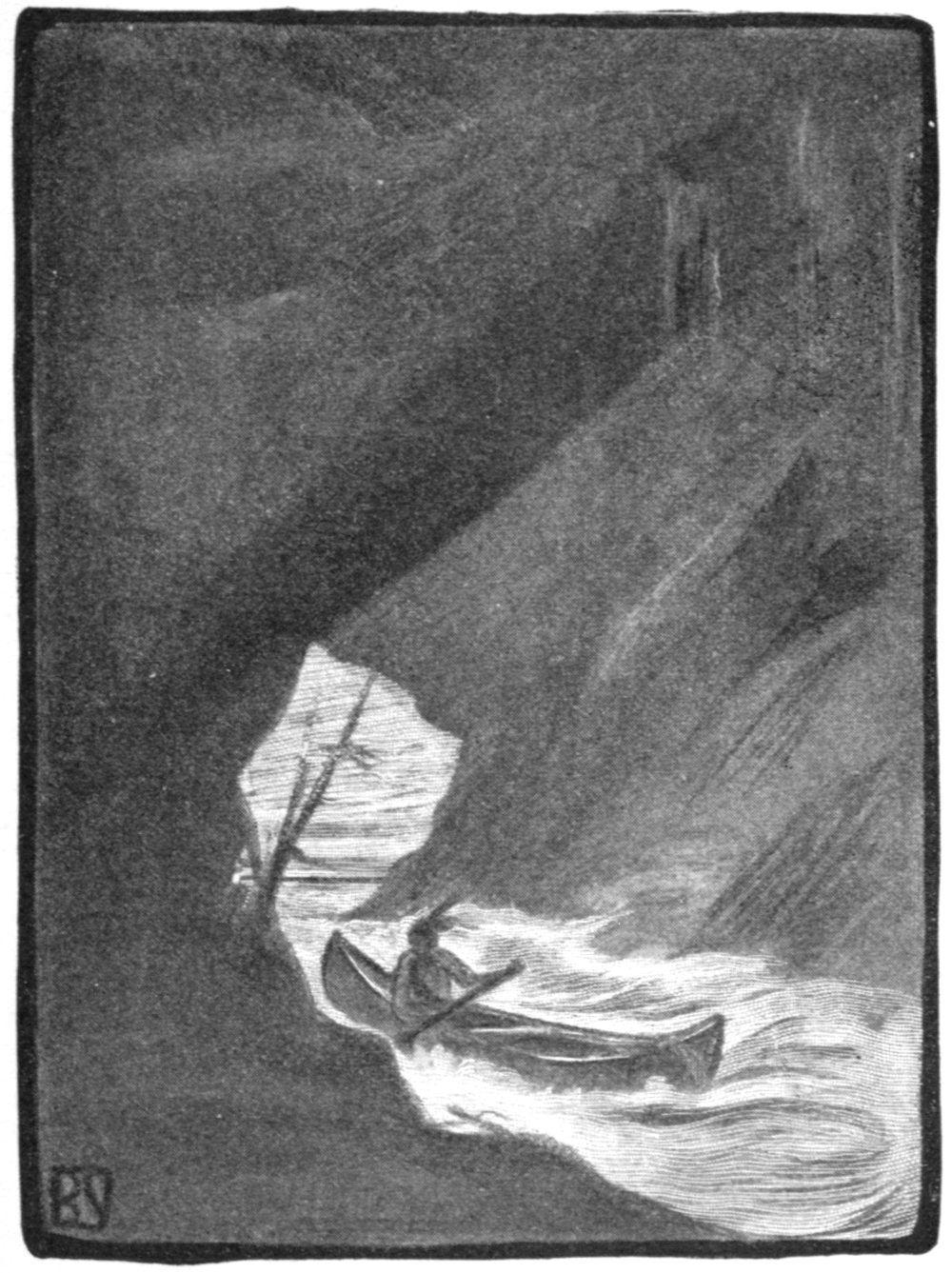
But the Master with silent soul
Ever sang the songs of magic.
Narrower grew the water,
More dreadful still the current,
And fear came over the mother
And then on the brother Marten,
Till of that fear they died.
But the Master with silent soul
Ever sang the songs of magic,
The awful incantations,
Till he had passed the darkness
And came again into sunlight,
The bright and beautiful day.
He found upon the bank
A lonely deserted wigwam,
Therein he carried the dead,
And, laying them down, he said:
“Nemchaase!” that is, “Arise!”
And behold they both arose,
And thought they had only slept.
Then the Master found by this trial
He had gained his greatest power. L.
[42] The old people say that seven beasts stole Kulóskap’s family from him and that he followed them to Newfoundland.
VIII — HOW THE MASTER FOUND THE SUMMER — FOOTNOTES:
[Passamaquoddy]
Piche pamaosoinnoak wiwikitopʾnik
Mequatoekak ospassio.[43]
In the long time ago,
When people ever lived
In the red morning light
Or ever the day of man had come;
Before the sun had risen
And ere the Eastern land
Was peopled as to-day,
Kulóskap, the great lord,
Went far into the North
Where all was snow and ice.
He came to a great lodge
Wherein he found a giant,
Truly a wondrous one
The greatest of his race,
For he was Winter. When
The Indian god came in,
He sat in silence down;
Then gave as welcoming
A pipe unto his guest;
And as they smoked, the host
Told stories to the chief—
Tales of the olden time,
In the old giant tongue.
A charm was in the words,
The enchantment of the frost,
And so the giant talked on,
Freezing with every word,
Until Kulóskap fell
Into a sleep like death.
Six months he silent lay,
Even as the bear or toad
Lies quietly till spring:
Then, when the charm was gone,
The Indian god awoke,
Woke with his might renewed.
Homeward he turned his way
Unto the glowing South.
At every step his foot
Met with the growing grass,
Warm breezes greeted him,
And many a forest flower
Rose up and talked in song.
He came into a dell
Deep in the greenwood shade,
Where many little fays,
Fair little sun-ray elves,
Were dancing in their joy.
And their sweet fairy queen,
Bright Summer, led the round—
Summer most beautiful
Of beings ever born.
He caught fair Summer up,
And, by a crafty trick,
He kept her as his own;
For, as he fled away,
And as the elves pursued,
He let behind him trail
A long and slender cord
Cut from a moose-hide. All
Pulled gayly at the end;
But as he ran, he let
The cord run out, and they
Were ever left behind,
Because by magic power
The moose-cord had no end!
Even so the Lord escaped
The Fairies of the Light,
The Ladies of the Dawn!
Again as he returned
He came unto the lodge
Where grim old Winter lay,
Who gayly welcomed him,
Hoping to freeze the god
Again into sleep, and hold
Him very sternly there,
Forever in his power.
But hidden in his breast
Kulóskap held the charm
Of a great victory,
For he had Summer there;
Even as now to you
I sing the summer song!
They sat them down and smoked.
This time the Master told
Tales of the ancient time
In the old giant tongue
Once spoken by the gods—
Magic and wonder tales.
This time he had the power;
His spell was mightiest,
And his strange wizardry
The stronger of the two.
Ere long the hut grew warm
And then down Winter’s cheeks,
His cheeks of hard gray stone,
The melting ice-drops ran,
Till he and all his home
Fell down, and in a flood
As water rushed away
Adown between the rocks
Into the roaring sea!
Then everything awoke.
The seeds and wildflowers grew.
The snow in rivers ran
Bearing away the leaves
Left from the Fall before;
The fairies all came out
And then Kulóskap turned
Again unto the South,
Leaving his captive there;
Summer was in the land. L.
[43] Long ago people used to live in the red light of morning.
IX — HOW KULÓSKAP LEFT THE WORLD — FOOTNOTES:
[Passamaquoddy and Micmac]
Yut negum tan Kulóskap
Udelinaktamnes uskitkamigw.[44]
When the great Kulóskap,
The Lord of Beasts and Men,
By power, for all his people
And for the world, had subdued
All of the evil things
Which cursed the early time,
Giants and sorcerers,
Witches and devils dire,
Fiends and every horror,
All were silenced then.
The ice-hearted Kiwakʿw
Wandered no longer free
In the green wilderness,
And the mighty bird Kullû,
Great as a hundred eagles,
No longer scared the Indian
As it spread its mighty wings
Like a cloud ’twixt earth and the sun.
Evil beasts, devils and serpents
Were found no more in the land,
And the world at last knew peace;
For the Master had taught to man
All that should make him happy;
But all were in turn ungrateful,
And, while they feared the Master,
Grew every day more wicked,
Forgetting him in their hearts;
And sin roared in the land.
Now when the ways of men
And of beasts became so evil,
So false, proud and ferocious,
Kulóskap as their lord
Was angered at their sin,
Yet bore it as a god
Till all his love was gone;
As oil spreads over the sea
Till all is thinned away.
Then he sent messengers forth
Inviting all to a feast,
The richest ever known
By the great Lake Minas shore,
On the silver water’s edge;
And all the beasts of the wood,
The fathers of all the tribes,
Came to the feast in state,
Came at the call, to revel;
But the Lord had little to say.
Solemn and grim was the banquet,
All knew that the chief was going,
And knew, too, why he would leave them.
And when the feast was over,
Kulóskap, the Lord of all living,
Entered his great canoe
And sailed away over the water,
The shining waves of Minas;
And they looked in silence at him
Until they could see him no more.
Yet, after they ceased to behold him,
They still heard his voice in song,
The wonderful voice of the Master!
But the sounds grew fainter and fainter
And softer in the distance,
Till at last they died away.
Then over them all was silence,
Till a wonder came to pass;
For all the beasts, who, before
Had spoken but one common language,
Now talked in different tongues;
Each with a tongue of his own
Understood the others no more.
So they parted from one another
And fled to the sea or the forest;
And, since that day of the parting,
They never have met in council,
And never again will meet
Till the day when all sins and sorrows
Will be in full forgiven,
Forgiven and forgotten,
And their Lord the great Kulóskap
Shall return to restore to his children
The age of sunshine and plenty;
When all shall dwell together
In peace and joy forever;
Till then the world will mourn.
And ’tis said that, when the Master
Had left Acadia,
The bird who most had loved him,
The great white Snowy Owl
Went far into the North,
Into the deep dark forest,
Where to this day his children
Sing to the night “Kūkuʿskūūs!”
Which means in Indian,
“I am sorry, oh, I am sorry!”
And the loons who had been his huntsmen,
Go up and down by the waters,
Over the snow-topped mountains,
Across the rushing rivers,
Through dale and wood and valley,
Seeking in vain for their master,
The Lord whom they cannot meet;
Ever wailing, wailing sadly,
Because they find him not. L.
[44] This is how Kulóskap left the world.
X — THE MASTER AND THE FINAL DAY — FOOTNOTES:
[Passamaquoddy]
Kulóskap mech pʾmaoso?[45]
“Is Kulóskap living yet?”
Yes, far away, but no one knoweth where—
Beyond the mountains or above the skies,
Where in the autumn’s lengthening twilight shades,
He smokes his tūmʾhîgʾnpowâgon,
His ancient tomahawk-pipe,
Making the brown air
Of the pleasant Indian summer.
Some say that he sailed away
In his marvellous stone canoe,
Afar beyond the sea,
To the country of the East;
Some that he went to the West;
And ’tis said that in days of old
There were men who knew where he dwelt,
And, making a pilgrimage
Could get from him what they sought.
And they say that, even now,
If you travel ever on,
Travel in perfect faith,
You’ll find at last the Kchi Sagem,
That is the great Sagamore
The greatest of all lords.
“Is Kulóskap living yet?”
Yes, he lives in a very great wigwam,
A wigwam very long—
That is, a council lodge—
Where he always is making arrows;
And all one side of the lodge
Is full of arrows now,
All closely packed together,
Even as your fingers lie.
When all the lodge shall be full
The god will come forth to battle,
And till then no mortal being
May ever enter the wigwam.
“On whom will war be made?”
He will make it on all mankind,
He will end all life that endures,
For the world will pass away
When that battle shall come to an end.
I know not when it will be,
To-morrow it may come
Or hundreds of years away.
“Are any to be saved
By any one, in that hour?”
That is beyond my ken,
All I have heard is this:
That the world will pass away
In roaring fire and flame,
While all the sea will rise
Hot boiling into mist,
And that the good with it
Will rise on high to heaven;
It may perhaps be so;
I’ve only heard it told,
Just heard it—and no more. L.
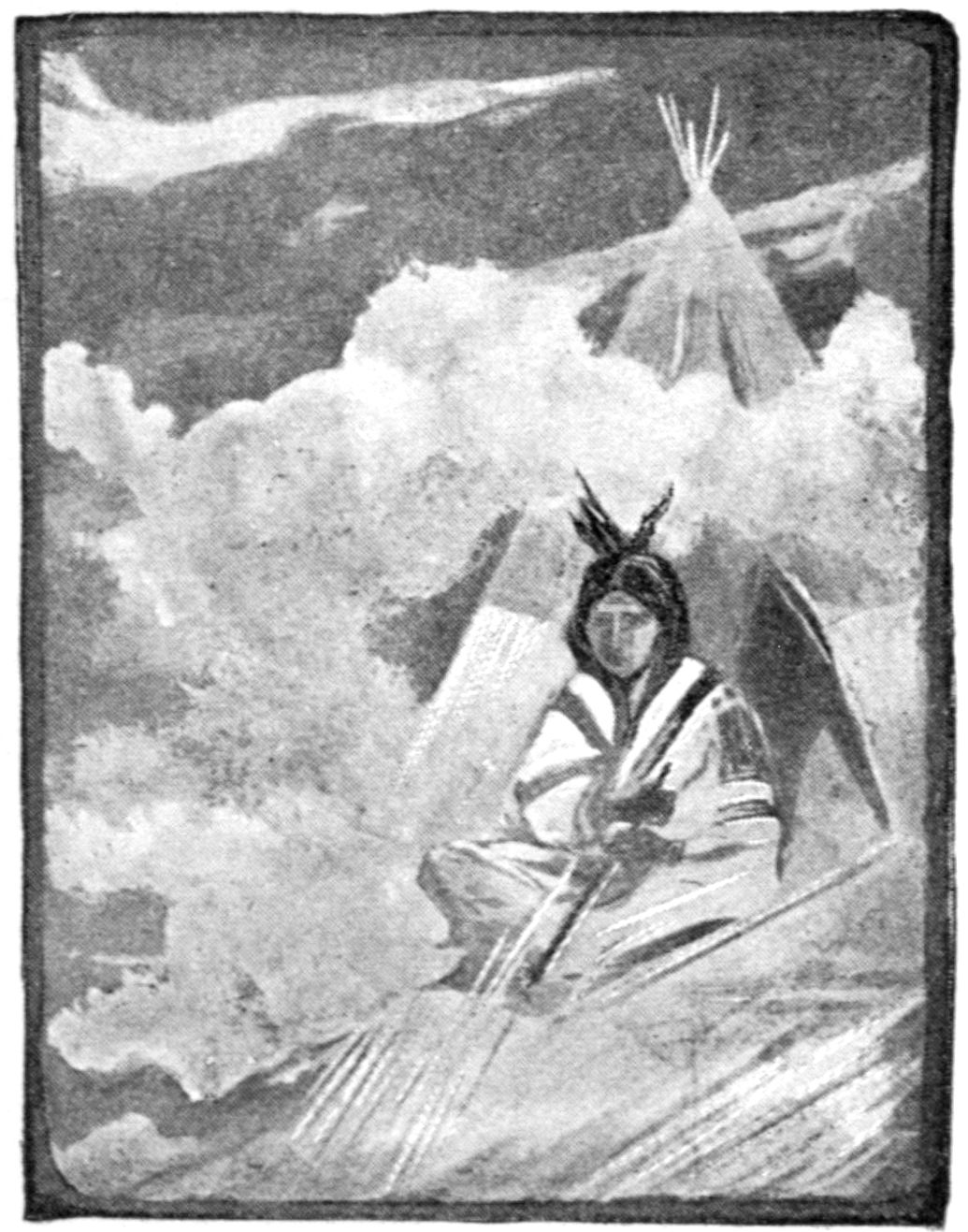
[45] Is Kulóskap alive yet?
PART SECOND
Witchcraft Lore
WITCHCRAFT LORE — I — THE WIZARD’S CHANT — FOOTNOTES:
[Passamaquoddy]
Nil nolbin naga ntetlitemen pekholagon.[46]
I sit and beat the wizard’s magic drum;
And by its mystic sound I call the beasts.
From mountain lair and forest nook they throng;
E’en mighty storms obey the dreadful sound.
I sit and beat the wizard’s magic drum;
The storm and thunder answer when it calls.
Aplasemwesit, mighty whirlwind, stops
To hearken to the mystic sound I make.
I sit and beat the wizard’s magic drum;
And Chibelaʿkwe, night-air spirit, flies
To hearken to the mystic sound I make;
And old Wuʾchoʿsen, storm-bird of the North,
Rests his great pinions, causing calm to reign,
To hearken to the mystic sound I make.
I sit and beat the wizard’s magic drum;
And Lumpeguin, who dwells beneath the wave,
Arises to the surface struck with awe,
To hearken to the mystic sound I make.
E’en Atwuskniges, armed with axe of stone,
Will cease his endless chopping, and be still
To hearken to the mystic sound I make.
I sit and beat the wizard’s magic drum;
And Appodumken, with his long, red hair,
Ariseth from the depths, and draweth near
To hearken to the mystic sound I make.
The lightning, thunder, storm and forest sprite,
The whirlwind, gale, and spirit of the deep,
The Chibelaʿkwe, loathly night-air ghost,
All come together, and with reverent mien
Will hearken to the mystic sound I make. P.
[46] I sit and beat the magic drum.
II — THE WOMAN AND THE SERPENT — FOOTNOTES:
[Passamaquoddy]
Piʿchedog Laʿtogwesnuk.[47]
Far away, very far in the North,
There dwelt by a great fair lake
An Indian and his wife,
A very beautiful woman
Given to strange wild dreams;
Passion was in her blood.
The lake was frozen over
For many months in the year;
One day, when she cut away
The ice, she saw in the water
A pair of wonderful eyes
Steadily gazing at her;
Bright eyes which charmed her so
That she could not move a hand;
Then she saw a handsome face
And a graceful slender young man,
Who rose from the glittering water,
And he himself, like it,
Glittered from head to foot;
On his breast were nʾskemanul,
Or shining silvery plates.
He said, “I am Aʿtosis,
The King of all the Serpents”;
Little she cared for his nature,
She talked with him of love,
She returned his fond embraces;
Every day she came to meet him,
And often in the night.
Her husband noticed that often
She strayed away from home,
And asked her, why she wandered?
She answered, “To get fresh air.”
The weather grew ever warmer;
The ice from the lake had melted,
Grass, flowers and leaves were growing.
The woman patiently waited
Till her husband was asleep;
Then she stole away in silence
From the one whom she kissed no more
Unto her serpent lover
Whom she kissed with all her heart.
The husband greatly suspecting,
Resolved to watch her wandering.
And so, to avert suspicion,
Said, “Stay here in the wigwam,
For I shall be gone three days
To hunt the deer in the forest.”
But at the end of the second
He came again to the wigwam,
And found that she was absent.
As he sat, re-kindling the fire,
She entered. He saw upon her
Bright shining silver scales;
He asked her what ’twas that glittered?
She answered, “My silver brooches.”
He said. “I must go again
To be absent hunting to-morrow.”
He went to the top of a hill
Overlooking the lake, where he watched her.
She went and sat by the shore;
Then rose afar in the water
What seemed to his sight to be
A shining flake of ice,
But when it came to the shore
’Twas a tall and slender man
All clad, as it seemed, in silver.
The woman leapt up and embraced him,
And gave him many kisses.
The husband in awe and anger
Went forth to other people,
And left his wife forever;
But soon her father and mother
Came to her home to see her,
And dwelt with her many days.
And every day, when returning
From an absence they knew not whither,
She brought them furs and venison,
With fish and fowl in plenty.
They asked her whence she had it?
She answered, “I have another,
A husband who suits me better
Than him whom first I married.
This one can give me all.
He is a better hunter.”
She sent them away with presents,
With many silver bracelets,
With many ear-rings and brooches
And said: “Do not return
Till the ice is here in winter.”
When they returned they found her
White as a silver lily:
Her Indian hue had faded;
And soon she gave birth to offspring
But her children all were serpents.
Then the parents went away;
But even as they left her
She said: “When you come again
You will see me but never know me!”
Years after three Indian hunters
Who had heard this wondrous story
Sought by the lake for the wigwam.
It was standing still, but empty,
But all the wood about it
Was full of great black serpents
Which from the grass uprising
Would look them in the face
Then glide away in silence. L.
[47] Far away in the north.
III — THE WIZARD SNAKE — FOOTNOTES:
[Abenaki]
Noñwat nizwak noñkskwesizak.[48]
Long years ago, two lovely Indian girls
Were wont to leave their people every week,
Embarking secretly in birch canoe.
Their tribe knew neither why nor where they went.
One summer’s noon a hunter chanced to stray
Close to a well-hid pond in forest deep,
Where, puzzled by the sound of plashing spray,
He stole behind the alders for a peep.
There swam the damsels in abandoned glee,
Their hair all streaming with a loathly snake.
Then when they felt the hunter’s look of awe
Straightway they dived beneath the surface foul.
In horror, back the hunter made his way
And told the Indians what his eyes had seen.
Then, all together left the happy town
And struggling through the brush and tangled wood
Went straightway to that fearsome pool to save
The damsels from a fate too dread to tell.
But ah, when they drew near, they heard them sing,
All sad and woful in a wailing chant:
“No more, no more may we turn back again,
For mortal eye hath seen us in our sin.” P.
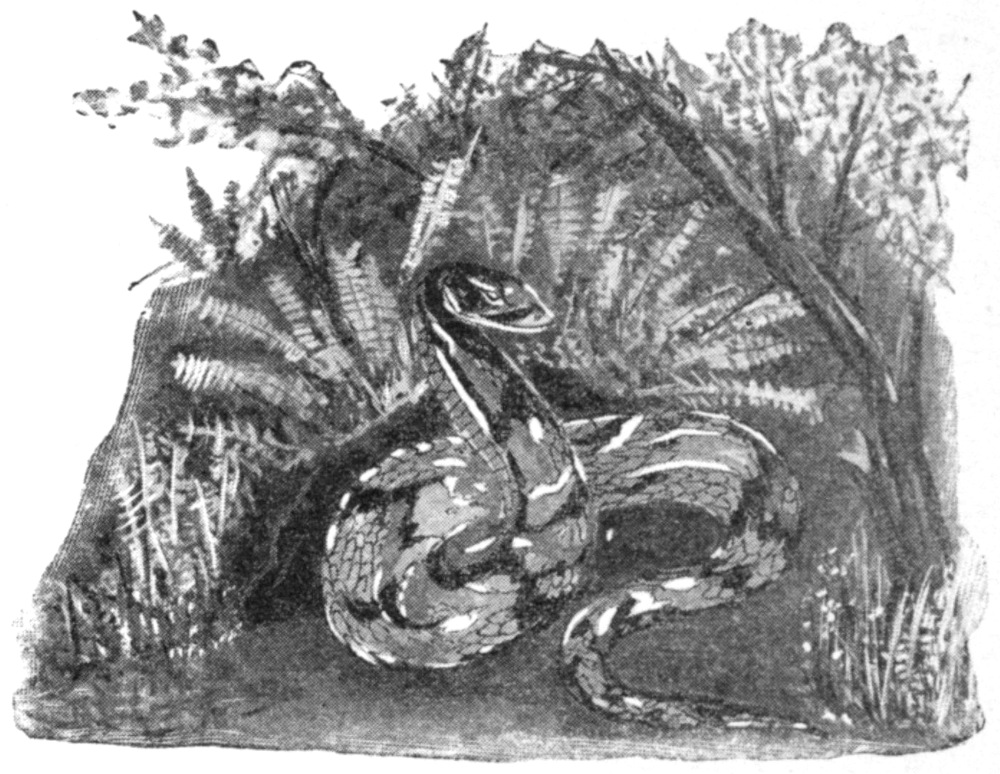
[48] Long ago there were two maidens.
IV — THE MEASURING WORM — FOOTNOTES:
[Abenaki]
Noñwat alnoñbak liwʾlalmoñldamōk
Ali mʾdaulinʾwak aïdit.[49]
Long, long ago the Indians believed in witches’ power.
One day a man was hunting far from human sights and sounds,
Deep in the wildest forest glades, nor thought of magic wiles,
When suddenly he heard a voice which said to him: “Depart,
And come again to this same spot at earliest streak of dawn.”
Awestruck, the hunter at the hour appointed sought once more
To hear the mystic tones which came to him he knew not whence.
So at the morrow’s dawn he trod again the darksome glade;
And once again he heard the voice command him in this wise:
“Begone from here and seek the spot where yawns a precipice.
There on the earth thine eyes shall see a liver freshly cut
This eat and then depart; but come again, I’ll give thee strength.”
Then on the following day, he brought his bow and arrows sharp
And heard the voice command him: “Do thou shoot at yonder tree,”
He shot, and saw his arrow pass straight through the doomèd tree.
Astonished beyond measure then, he bade his mother look.
“O kini nikʾn,” “mother, see,” he cried in wonder great.
His mother saw and straightway feared; began to watch the lad,
And marked that when he lay at night no sleep would come to him,
But always after little time he’d rise and steal away,
Till daylight dawned and then he would come creeping back to bed.
At last, all tortured by her pain and harrowed by her fears,
She questioned him and said: “My son, where hast thou been all night?”
Quoth he: “My friend and I have played together in the wood.”
She asked once more: “My son, pray tell what is it that you do.”
“We have been killing serpents vile and eating them,” said he;
“A serpent’s liver eaten giveth magic gifts to man.
I am not as I was before, but have the power to move
And climb from ledge to ledge as doth a worm, upon my head.
My friend hath taught me how to pass through ways impassable
To all save us.” “Who is thy friend?” His mother asked of him.
“His name is Tatebákwunowat, which means ‘a Measuring Worm.’
Of sport like this I never dreamed;” and yet the mother feared,
And told her agèd husband that their son was lost to them;
For he’d become mʾdaulin and endowed with secret might.
Then spake the father: “This shall cease; I know a way to save
The foolish lad.” So when the evening came, he locked him in
And would not let him forth to roam in spite of all his prayers.
Then came the sound of some one walking heavily and hard,
The old man looked and saw a Thing of horror at his door,
Large eyes, short arms, short body and long legs of insect shape.
“Set free thy son thou foolish one,” the loathsome wizard cried.
“Not I,” replied the father, and at once let fall the flap
Before his wigwam door. The lad grew very ill and begged,
Entreated and implored that he might be allowed to roam
As he had done before, but only got the answer “No.”
Yet once again when morning’s light shone whitely on the trees,
Another wizard slowly came before the wigwam door.
At his approach the leaves and shrubs all rustled as from wind.
“Why dost thou seek to keep thy son from getting magic power?
He hath the magic gift to be the greatest of the great
Among us men who practise arts unknown to thee and thine.”
So spoke the wizard scornfully; the father stern replied:
“I have no wish that son of mine should be like thee and thine.”
Then quoth the wizard: “Thou shalt see thy son die here to-night,
For we have taken him too far to let him back to thee.”
“I care not if he die or no,” the father answering said,
And moaning with an angry moan the wizard drew away
And soon was lost to sight amid the waving forest leaves.
In awful agony the boy lay stretched upon the earth
Retching and crying out as one who soon must breathe his last.
Till suddenly he vomited a mass of serpent skins,
And then at last cast up the magic liver from his mouth.
This was the end of all his woe, for when that loathsome thing
Had left his body he arose all strong and purged and clean
And never more was known to seek to practise magic arts. P.
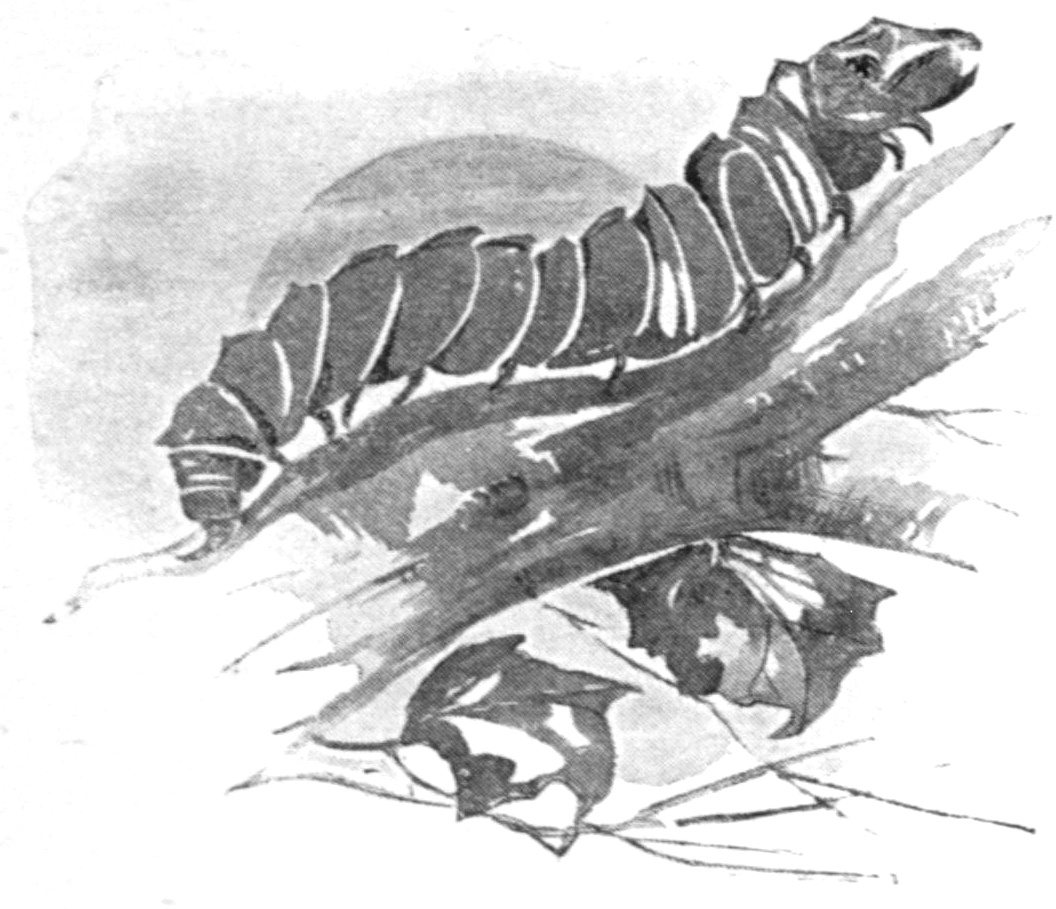
[49] Long ago the Indians believed there were wizards.
V — THE PʾMULA OR AIR-DEMON — FOOTNOTES:
[Abenaki]
Noñwat agua ni alnoñbak pʾmigowak kʾpiwi.[50]
In days of yore some Indians were camping in the woods
And one of them when near a stream heard a strange sound o’erhead.
At once he looked and lo he saw a sprite of upper air,
Called by the Indians, Pʾmûla, alighting on a ledge.
The demon took a piece of yellow metal from his lips
And bent himself to drink and then, restoring to his mouth
The metal, spread his spacious wings and, rising, soared away.
The man perceived that power to fly lay hidden in this charm,
And so at once decided he would steal the thing away.
It was not long before he heard again the rush of wings.
This time, though, when the demon had alighted, he ran forth,
And, snatching up the yellow charm, said, laughingly: “Ha, ha,
My friend, do thou lie there a while, and I will fly about!”
Then the Pʾmûla told the man: “If thou wilt let me go,
I’ll give to thee another charm which aye will bring thee luck.”
The Indian at once believed the demon’s given word
And gave him back the yellow charm which brings the power of flight.
Soaring aloft the Pʾmûla at once was lost to view
But after a brief period returned and gave the man
The two great eye-rings of a snake, and once again was gone.
No sooner had the hapless wight these eye-rings in his hands,
Than every kind of snake and beast that roam the northern woods
Surrounded him, till, terrified, he rushed to his canoe.
E’en there a giant serpent’s head confronted him agape.
Then, quite beside himself with fear, he fled to thickest wood,
And when at length all out of breath and weary with the chase
He had to pause, he saw that still a host of snakes was there.
Then suddenly he thought: “This dread comes from the magic rings.”
So, raising up a heavy stone, he laid them safe beneath.
And there they lie unto this day all full of mystic power.
The Indian then ran away and saw no more strange sights,
But ever on his hunts abroad he killed sufficient food,
For all the forest creatures had no fear of him who once
Had had the serpent’s eye-rings from the demon of the air. P.
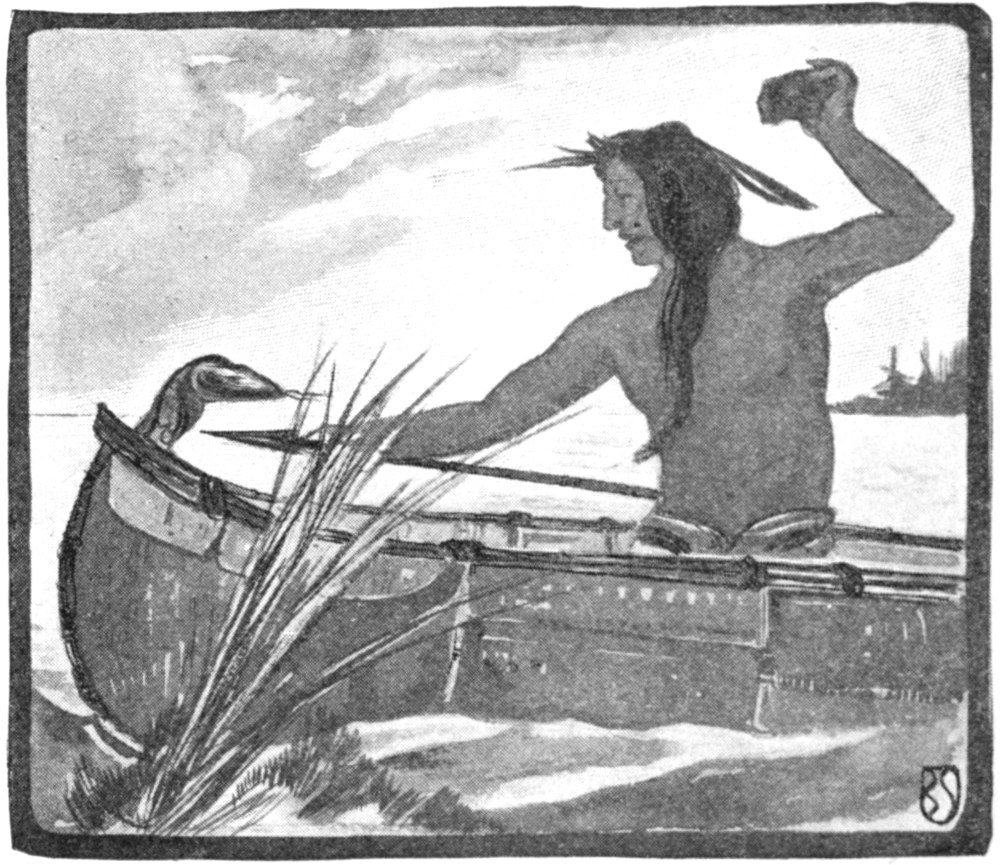
[50] Long ago some Indians camped in the woods.
VI — THE LITTLE BOY KIDNAPPED BY THE BEAR — FOOTNOTES:
[Penobscot]
Nâwad agua eleʿkza niʿkwop kʾdado kéowun.[51]
I am going to tell you now what happened long ago.
Some Indians were camping with their children near a lake
And one fair morning started off to hunt the wary moose,
The children left alone in camp, as is the Indian way.
On that same day a little lad who scarce could walk unhelped,
Tottered and crawled away from camp until he lost the path
And passed the cold and bitter night afar out in the bush.
When morning dawned he thought he saw his mother drawing near
And, rushing to her side, he held her fast in firm embrace.
This was a she-bear, shaggy, great and strong as oxen twain.
She seized the lad and bore him off and fed him in her den.
When the old folk returned to camp they sought the boy in vain.
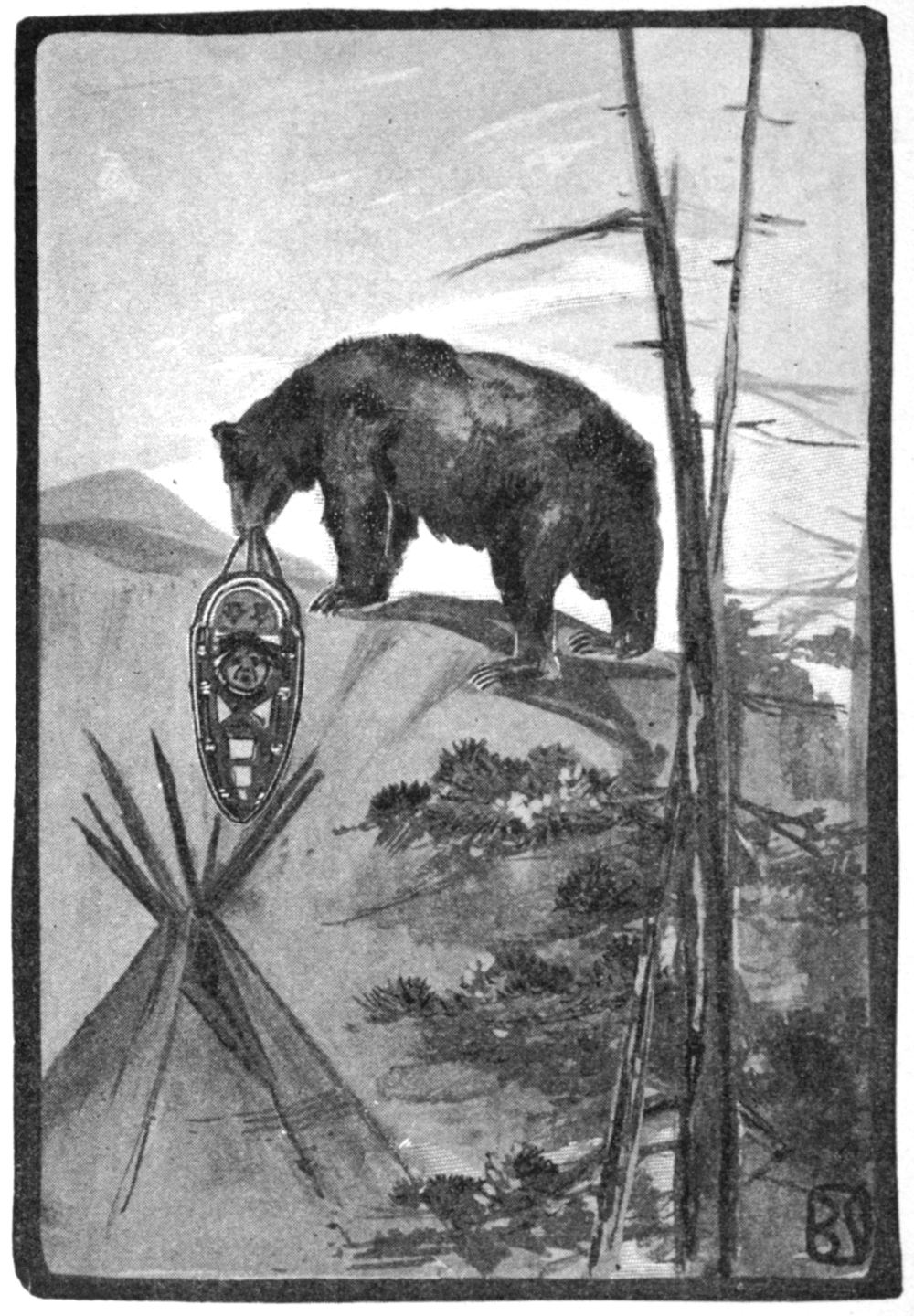
This was a she-bear, shaggy, great and strong as oxen twain,
She seized the lad and bore him off.
For ten full days, all day and night, they sought the boy in vain.
At last they broke up camp and, sorrowing, went back unto their town.
All winter long the baby lay warmed by the sleeping bear
And drawing nourishment at need forth from her milky teats—
A wonder this, and quite unlike the usual way of bears.
But this one was a wizard bear who wished to keep the lad.
When spring-time came, the wizard of the little Indian town
Took twenty men and started off to seek the long-lost lad.
He had found out by secret arts the way to his abode.
When they arrived, the furious bear rushed forth in anger dire
But met her death by magic shot, and thus the boy was saved;
He ran away, but soon was caught and to his kind restored,
But during many years that lad was wild as any bear. P.
[51] I am going to tell you of what happened long ago.
VII — THE WIZARD AND THE CHRISTIAN PRIEST — FOOTNOTES:
[Abenaki]
Askua ali wigiidit waʿkasimigʾzowak
Salaʾki agua ni wijiganun kigamʾwinno.[52]
A priest of God came to an Indian town
And settled there to teach the people truth,
Which some received and others spurned with scorn.
Some hostile Mohawks fell upon that town,
Killing the folk, all save the Priest and one,
An Indian of many magic gifts.
Late in the afternoon of that same day
The Mohawks reached their village with these two:
The holy Priest and Wizard skilled in craft.
The Mohawks held a council by the fire
Discussing how to torture best the twain,
So as to see their frenzy, and enjoy
With gloating satisfaction every pain.
They all agreed to heat two earthen pots
On fiery coals unto the whitest heat;
Then place these pots upon the head of each
And watch them dance about till life was spent.
With merry whoop they started up the fires;
Began at once to heat the torture pots.
Soon, when they thought the glow was great enough,
They first of all laid hands upon the Priest.
Then he who had been taken with the Priest
At once brought all his magic arts to bear,
And burst his bonds asunder with a yell
That curdled every heart among the foe.
The Wizard cried in Indian tongue: “Nda
Awâni niûna ndelima—
Magahôûnana,” which means: “My friends,
We shall not torture any one (to-day).”
And then he leapt upon the fiery coals
And danced and danced, until his feet did fry
And sizzle hot like bacon in a pan.
Then all the Indians were full of fear.
But when to crown the horror of the whole
They saw the wizard put the glowing pot
On his own head and leap about in glee,
They all took flight in terror to the woods.
Then spake the Wizard: “Father, now escape.”
When they had reached all safe and sound their home,
The Priest said to the Wizard: “O my son,
Thou shouldst repent and turn thee from thine art
Unto God’s ways and ever keep the Faith.”
Then quoth the Wizard laughing: “Father mine,
Had I repented and mine art eschewed,
Then were we both of us dead men this day.”[53] P.
[52] A priest came to where some families were camping.
[53] This song is very interesting, as indicating a survival of the old Indian faith in their magicians as superior to Christian power. It is quite like the many indications in Italian tales, relating to witches, in which the sorcerer conquers the priest.—C. G. L.
VIII — WIZARD WARFARE — FOOTNOTES:
[Abenaki]
Noñwat nd-odananok
Mʾsalok mdaulinʾwak.[54]
Long, long years ago
When wizards were not few
There happened near our town
A war of which I’ll tell.
One day a wizard wise
Sought counsel from the gods,
And entered in the hut
They knew as petegwîgun—
A round-house made of bark,
With opening above;
No door nor window there
Save only at the top
Through which the wizard climbed,
And, lying there in trance,
Saw all the foemen’s wiles.
Then, singing magic songs,
Forth from that hut he came
And ordered all the tribe
To rise and meet the foe,
The cruel Mohawk foe,
Encamped not far away.
So all the Indian braves
Embarked in their canoes,
Went down one stream, then up
Another, paddling soft,
Avoiding any sound.
At last they saw a smoke
Arising far away.
Then spake the wizard thus:
“Do ye all wait me here
And I will go and spy
The numbers of the foe,
Taking with me but one;
Another Indian brave
Who hath the magic gift.”
These wizards then withdrew
Into a thicket’s shade,
Whence suddenly emerged
In beaver’s guise the one,
In muskrat form his friend.
When they drew very near
The island where the foe,
The cruel Iroquois,
Were feasting on a moose,
The beaver and the rat
Dived deep beneath the stream,
Causing that sudden plash
Which even to this day
Makes many a hunter jump.
Among the Iroquois
Another wizard sat
And when he heard the plash
Quoth he: “The foe is there,
The fierce Abenakis.”
Then, grasping in his hand,
The legbone of a moose,
He flung it straight and far
To where the muskrat swam
And struck him on the head.
The beaver seized his friend
And drew him ’neath the stream
And held him till he drowned,
In order that his pains
And struggle for his life
Should not alarm the foe.
The Iroquois then rose
And danced around the fire
Thinking in hideous glee
Of how when morrow came
They’d torture all their foes.
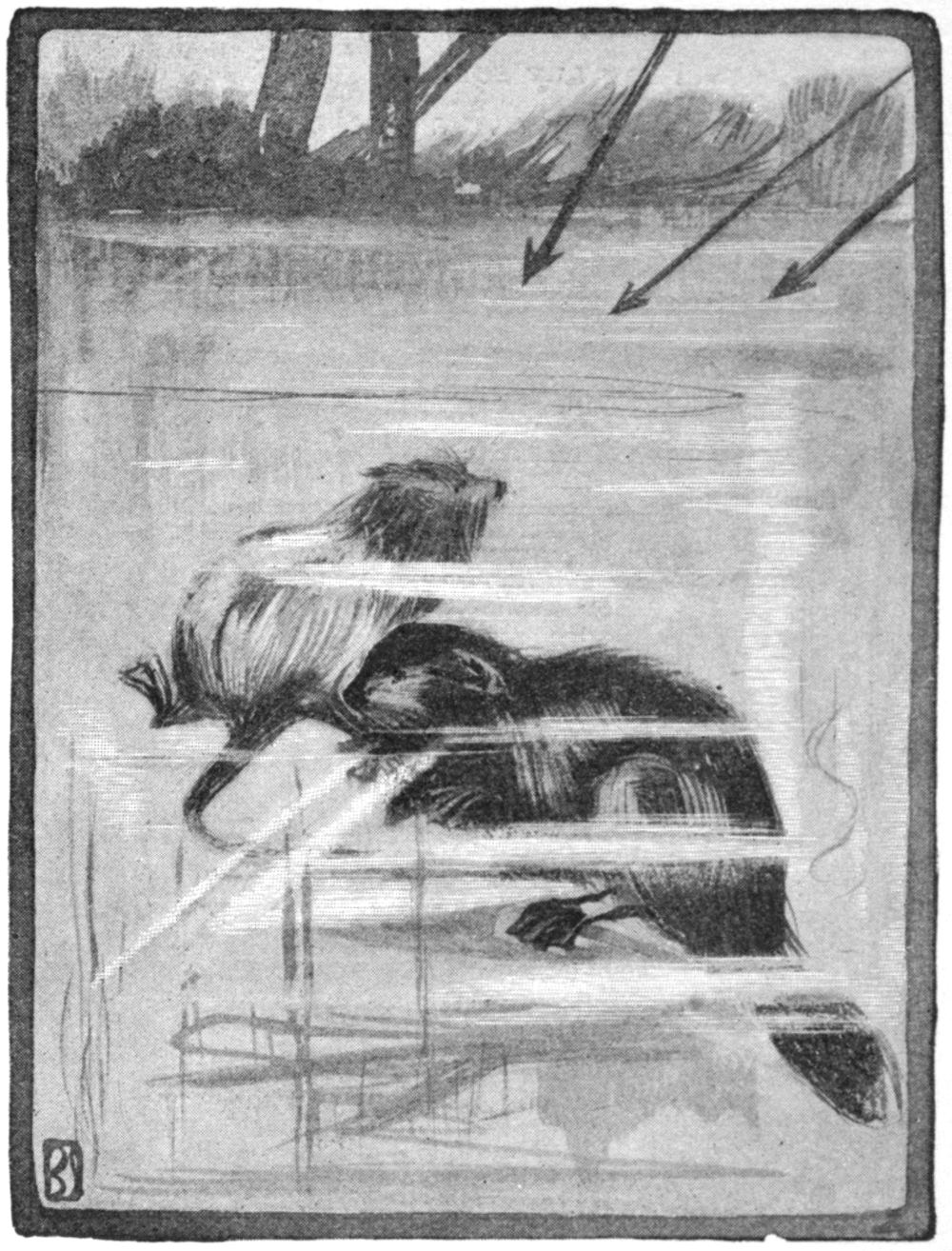
The beaver seized his friend
And drew him ’neath the stream.
They then lay down to sleep.
At once the beaver swam
To shore to their canoes
And gnawed with his sharp teeth
Great holes in the birch bark
Of which these craft were made.
The wizard beaver then
Swam back to his own folk
To whom he said: “Arise,
Come, quickly hunt them out.”
The fierce Abenakis
Came stealthily and still
And landed on the isle
Where lay the Iroquois.
Then, whooping with the cry
Of war which chills the soul,
The fierce Abenakis
Awoke the Iroquois
Who, paralyzed with fright,
Rushed straight to their canoes
Which sank in mid-stream all—
The work of wizard teeth.
Then the Abenakis
Swooped down with horrid cries
And then slew all their foes
Save only two. I’ll tell
What ’twas they did to them.
Of all their slaughtered foes
They first cut off the heads
And stuck them up on stakes
All over that fair isle.
Then to their prisoners
Whom they had saved alive,
They gave a little thought.
So first they bound them fast
Then pried with cruel sticks
Their mouths till open wide;
Cut off their lower lips,
Showing the grinning teeth,
Then severing half their ears
And half their noses too,
They said to them in scorn:
“Kdihleba nda mina
Ni nojimigahakw:”
“We warn you now, my friends,
Do not attempt again
To come against us here.”
This was the way they marked
The prisoners in old days.
Then they gave them food
Enough to give them life
Upon the journey home,
In order that these maimed
And harshly usèd foes
Should tell the Iroquois
In northern forest far
That the Abenakis
Were mightier than they.
That island to this day
Is called the Place of Skulls,
Wdupsek in our tongue. P.
[54] Long ago there were many wizards in our town.
IX — THE WIZARD’S HUNTING — FOOTNOTES:
[Abenaki]
Noñwat mʾzi mʾdaulinowak nadialoldowak.[55]
In ancient days when wizard power was great
There were two mighty men who knew these arts
And understood full well unholy skill.
Once on a time it chanced that these great twain
Did quarrel for a certain hunting ground.
The one had set up deadfalls in the paths
Where run the timid deer, all ignorant
Of man, and man’s desire to slaughter them.
The other wizard straightway came along
And, ruthless, snapped these deadfalls every one,
To irritate his fellow wizard’s heart.
Twice did the mischief-maker do this deed,
Till, finally, the injured man bethought
Him that he must consult the secret powers
How he should catch and punish well the foe.
So crawling into petegwîgun′s shade—
This was the magic round-house where the gods
Give wisdom unto man—he lay in trance
Until he saw a cruel wolverine,
Which he at once knew well to be the foe.
Then, leaping from the house of magic arts,
He followed fast the trail of Wolverine
Who was the evil-hearted enemy.
This mischief-making wizard straightway knew
That he was being followed, so he changed
Himself into a hooting, snowy owl
That wakes the echoes of the forest night.
Thus he escaped and forthwith went again
And full of glee the other’s deadfalls broke.
At last the injured wizard in despair
Went to consult his uncle in the glade
Where hang the alders drooping by the stream.
“O Uncle, aid me in my direst need
And find for me this rascal foe,” he cried,
“Who changes into every living thing,
And thus escapes my burning righteous wrath.”
His uncle was a wizard full of power,
So he at once departed for a time
And then, returning, said: “I’ve found thy foe,
He lives within thy shanty in the woods,
He’s taken his abode within the cracks
Where thou hast sewn the bark upon thy roof.”
“How then shall I be able to outwit
A foe so wily and so full of skill?”
The nephew asked. The uncle told him all.
And then the injured wizard went his way
Unto his barken shanty in the woods.
When he was sitting by the fire that night
An evil bat of monstrous size flew forth
From underneath the shanty’s sloping roof.
Straightway the wizard seized and held the bat
So close unto the glowing fiery coals
That all his filthy, vermin-reeking hair
Was clean consumed—then let him fly away,
Feeling that vengeance had been wreaked full well.
No more thereafter was there mischief wrought
And all his hunting met with fortune fair.
Then later in the year the wizard came
Home to the village laden down with spoils
And trophies of the chase, and there he saw
A man he knew with skin all scarred and burned.
Quoth this one to the wizard: “O my friend
I have been duly punished for my sin.
Do thou now heal me quickly and forgive
That I have caused thee trouble in the chase.”
The wizard then took pity on his foe
And healed his burns and made him whole again. P.
[55] Long ago all the wizards used to hunt.
X — SIX SHORT TALES OF WITCHCRAFT — FOOTNOTES:
[Passamaquoddy]
Kʾchi Joe Benoit mʾdeaulin
Kʾchi kʾnokwchil pohégunul.[56]
Old Joe Benoit, a friend of mine,
Was full of all unholy skill and power.
He quarrelled with a man who like himself,
Was wizard and a guileful, crafty foe.
A giant turtle’s form Joe Benoit took;
The other changed himself into a snake;
The twain then met and fought in combat dire
Within the waters of a little lake
Which since that time has ever borne the name
Of Neʿseyik, which means “the muddy lake,”
Because their strife had stirred up all the soil
And weeds, and roiled the waters of that pool.
Joe Benoit slew his foe, the giant snake.
Old Lacote was a wizard made a trap,
A deadfall trap for bear off in the woods.
When he had set the trap all fast and firm,
He crawled within to test the prop-stick stout.
But by the magic arts of wizard foe
Through old Sabatis’ guile who owed him hate,
The prop-stick fell and let the great bear-trap
Drop full upon old Lacote’s head and back.
His son was there and dragged the old man forth.
But Lacote knew to whom he owed ill-luck.
When I was fifteen years I saw a man
Who had become a demon of the wood,
A Miʿkumwess with power to change his size
And art to sink into the rocky soil
Up to his ankle-joints or knees as though ’twere sand.
I saw myself the tracks where he had sunk
Into a soil all full of rocks and roots.
My father was a wizard and had power
To call unto his partner miles away.
I’ve often heard him singing in the night
All low and weird, and when the morning dawned,
He’d tell me what his partner’s luck had been.
I never knew his magic skill to fail.
My brother told me, many years ago,
Some wizards had a quarrel, and they slew
One of their number, took his corpse away
And ate it on the isle of Grand Manan,
Sitting upon a ledge above the sea.
Two men were hunting on an inland lake
When suddenly they heard a fearful whoop
As of a man in agony, who ran
Adown the lake along the farther shore.
They went out in their barque and there they saw
Him come right up to where their shanty lay.
Returning to the shore they begged him then:
“Pray stay and eat,” but he, with accents wild,
Cried: “Nay, I may not stop in this warm place.
I must away, away unto the North,
Where ice and snow shall cool my bounding blood.”
This man was a Kiwaʿkw, a demon ghoul,
Ice-giant—of that race which loves to prey
Upon the tender flesh of man and babe. P.
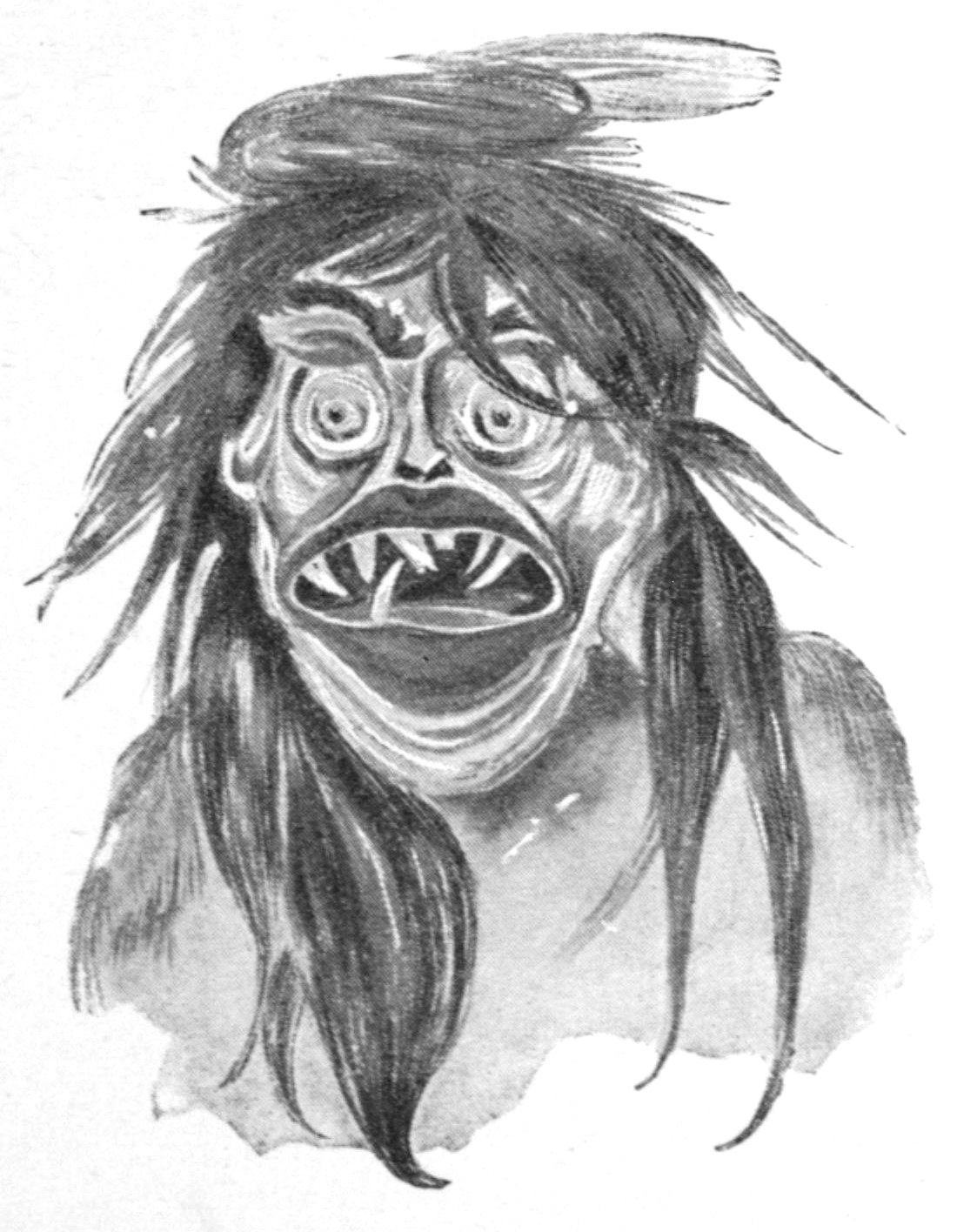
[56] Old Joe Benoit the wizard changed himself to a great turtle.
XI — A DELAWARE YOUTH AND HIS UNCLE — FOOTNOTES:
[Delaware]
Weekwaum lawee kohpee
Weekena withkeelno wauk wʾsheetha.[57]
Afar in the midst of the forest
Dwelt a youth and his uncle,
His uncle of many summers.
Once on a time the old man
Was sick unto death with an illness
Whose cause was unknown to himself
And his nephew, his fond loving nephew.
So, thinking the light of his being
Was soon to go out, the old uncle
Called to his bedside the young man
To hear his last words of affection.
The loving nephew grievèd,
Grieved in the depths of his heart,
Then thought to himself: “My dear uncle,
At least shall not die on bare earth.
I’ll make for him now a great basket
And line it with soft, downy feathers.
So shall he die in all comfort.”
He worked all the night at the basket
And then, when the morrow dawned,
Presented his work to his uncle
Who wept tears of gladness and said:
“Dear nephew—how great is thy kindness!”
The old man then lay in the basket
And to him came a vision of dread;
He stretched forth his hand to his nephew,
A gesture to draw his attention,
And then told the youth of his vision.
Quoth: “Some one is coming at midnight
From whom thou shalt shrink with great trembling,
But fear not, take courage, my nephew,
Although he shall come to our wigwam
At midnight when all things are sleeping.”
That night, long after their supper,
The youth sat him down by the fire,
On the further side of the fire,[58]
And waited to see what was coming.
Then all of a sudden a creature
Too awful to tell of was with him,
A wizard of hideous presence
Who dropped through the smoke-hole a-shrieking:
“Give up to me, youth, thine old uncle
I wish to devour his lean flesh.”
The youth gave not way to his terror
But leapt to his feet and said boldly:
“Foul being, mine uncle remains here
And ne’er shall be eaten by thee.”
Howled the wizard, the cannibal wizard:
“When I come here once more have him ready,
Rash lad, or thou dearly shalt rue it.”
Thought the youth in his heart: “He is awful.
It must be that my uncle shall leave me.
I will journey afar toward the sunset
If perchance I may find there some people
Who shall aid me in this my dire need.”
Then the young man took leave of his uncle
And said to him: “Fear not, beloved,
I go to seek aid for thy sickness,
Soon I’ll return to thy side.”
After journeying days through the forest
He passed a small curious wigwam
From which came a lad who addressed him:
“Hail, stranger, how fareth thine uncle?”
The youth was amazed beyond measure
That one who appeared but an infant
Should know all about his affairs,
But he passed on in silence and wonder.
Soon after he came to a wigwam
Near which stood a great, kindly wizard,
Who saw from the face of the traveller
That he was in fear for his uncle.
Then when he heard how the nephew
Had met with the terrible being,
He said: “This in truth is Muttóntoe,
Muttóntoe, the spirit of evil,
Who yearns for the flesh of thy kinsman.
But fear not, my lad, I will aid thee,
I’ll tell thee the way to o’ercome him.”
When the nephew had heard all the wisdom
And learned how to conquer Muttóntoe,
He went back at once to his uncle.
Then after they’d eaten that evening,
He swept up the dirt from the wigwam
And placed in his own bed the uncle.
Then he lay himself in the basket,
Where he felt himself filled full of magic
And power to conquer Muttóntoe.
At the dead hour of midnight
Once more in the midst of the wigwam
The monster dropped down through the smoke-hole.
“Awake, lad,” quoth he, “I’m Muttóntoe.
Bring forth thine old uncle, I want him.”
Then out from the basket the nephew
Stept boldly, all covered with feathers.
A terrible sight to Muttóntoe,
Who leapt with a shriek through the smoke-hole
And never returned to that wigwam,
Where the youth and his uncle, still living,
Dwell happily in the dark forest. P.
XII — THE DANCE OF OLD AGE — FOOTNOTES:
[Passamaquoddy]
Piʾche uskichinwi utenesizek.[59]
All in the early time
In an inland village
Many Indians lived,
Of two of them I’ll tell:
One was a handsome man,
Young, brave, a great hunter;
The other, a beautiful girl.
What might be her name?—
Malikakusquess?
Or Kaliwahdasi?
I do not remember
Which of the two it was.
But she was very proud,
Fierce as she was fair,
And through and through revengeful.
And, what was worst of all,
She was an awful witch,
Seven witches in one,
Like seven devils united
But this she hid from all;
Only the Wʾnagʾmeswuk,
The singular silent spirits,
Who are ever flitting around us,
Knew of this terrible secret.
She wanted the youth to wed her,
But he at that time was busy,
Very busy in getting ready
To go on his autumn hunt,
Which would last far into the winter;
And he had no time for wooing,
As he very plainly told her.
Truly he must have spoken
Very plainly indeed;
For her heart shrunk up in anger
Until ’twas hard as a flint
With sharply cutting edges,
And thus she cut in reply:
“You may go afar to the North,
You may go if you like on your hunt
But you never will return
The same as when you departed;
Remember me when the change
Comes over you in the forest.”
He gave no heed to her words,
He cared not for her, nor feared her,
So he went away with his brother,
And for many days together
They hunted in the North,
Hunted the deer and moose;
The girl was all forgotten.
But one day when deep in the woods,
And very far in the North,
In the mid winter gloom,
The youth went raging mad,
For the witch had struck him sore,
Though far and far away,
Struck him with sorcery.
The elder brother with him
Was a brave among the braves,
A fierce and terrible man
Who had no dream of fear:
And as he could do naught else
He did the most desperate deed
Which the wildest of the warriors
Among the Wabanaki
Has ever dared to do;
For he went down to the river
At midnight and alone,
And sang the terrible song
Which calls the Wîwilmekw,
The Demon of the Worm,
Even to devils a terror.
Nil nʾwikwima Wîwilmekw
Nil nʾwikwima chipinaʿkwsit
Nit besq weshʾmʾwit
Nil npechikinapin nekmomeswelas
“I call on the Wîwilmekw,
I call on the Terrible One,
On the One with the Horns,
I dare him to appear!”
It came in all its horrors,
Its eyes were like deep red fire,
Its horns rose sharp and high.
It asked him, what he would have?
He answered that his brother
Had lost himself in madness,
And he fain would cure the youth.
“I will give you what you want,”
Answered the Wîwilmekw,
“If you are not afraid.”
“I have no fear at all,”
The Indian replied,
“Of anything that lives.”
“Hast thou no fear of me?”
The Demon Worm inquired.
“No more of thee than I
Have of the Michihant,
Who is the Devil of all.”
“If you dare take me by
My horns,” the fiend replied,
“And scrape them with your knife,
And lay the scrapings by,
Then you may have your wish.”
In truth this Indian was
As savage, wild and brave,
As was the Devil himself;
He had great need indeed
To be all that he was;
For the Wîwilmekw,
Most terrible to see,
Grew fiercer than before,
Yet the man drew out his knife
And boldly scraped away,
Until the Demon said:
“Now hold! You have enough.”
“And now go seek your camp,
Put half the scrapings then
Into a cup half full
Of water from the spring,
And bid your brother drink!”
“And with the other half?”
The Indian inquired.
“Keep that till you return,
Then give it to the girl
Who made the trouble—she
Needs medicine as well.”
So the man returned to camp
And made his brother well.
And when the hunt was o’er
They turned them to their home.
There they arrived at night;
A great festivity
Was stirring all the town,
Torches were everywhere,
And everywhere the scent
Of mskîkwul wʾli-mhaskil,
Which is the perfumed grass
Burning intensely sweet.
The dance was going on,
So, many were athirst.
And this the hunter knew,
The younger of the pair;
So he had made a drink
Cool, and with honey sweet,
Fragrant with pleasant herbs—
A dainty drink indeed—
But, mingled with it all,
There lurked a subtle life,
The powder from the horn
Of the Wîwilmekw.
So thirsty was the witch
As she from dancing came,
So warm that, when the youth
Held out to her the cup,
She seized and drank it dry
All without giving heed
As to what hand had held
The cool, refreshing draught;
Then turning to the one
Who was her partner, she
Went on into the dance,
And then a wondrous thing
Was seen by all therein:
For lo! at every turn
The maiden older grew,
One year for every round;
Beginning as a girl
In all her freshest youth
She at the lodge’s end,
Seemed fifty years of age,
And still, as she danced on,
Added unto her age,
Till just as she returned
Unto the very place
Whence she had come, she fell
All dead upon the floor,
A little dried-up thing,
A wrinkled, wizened squaw,
A thing of the last old age
Or of a hundred years.
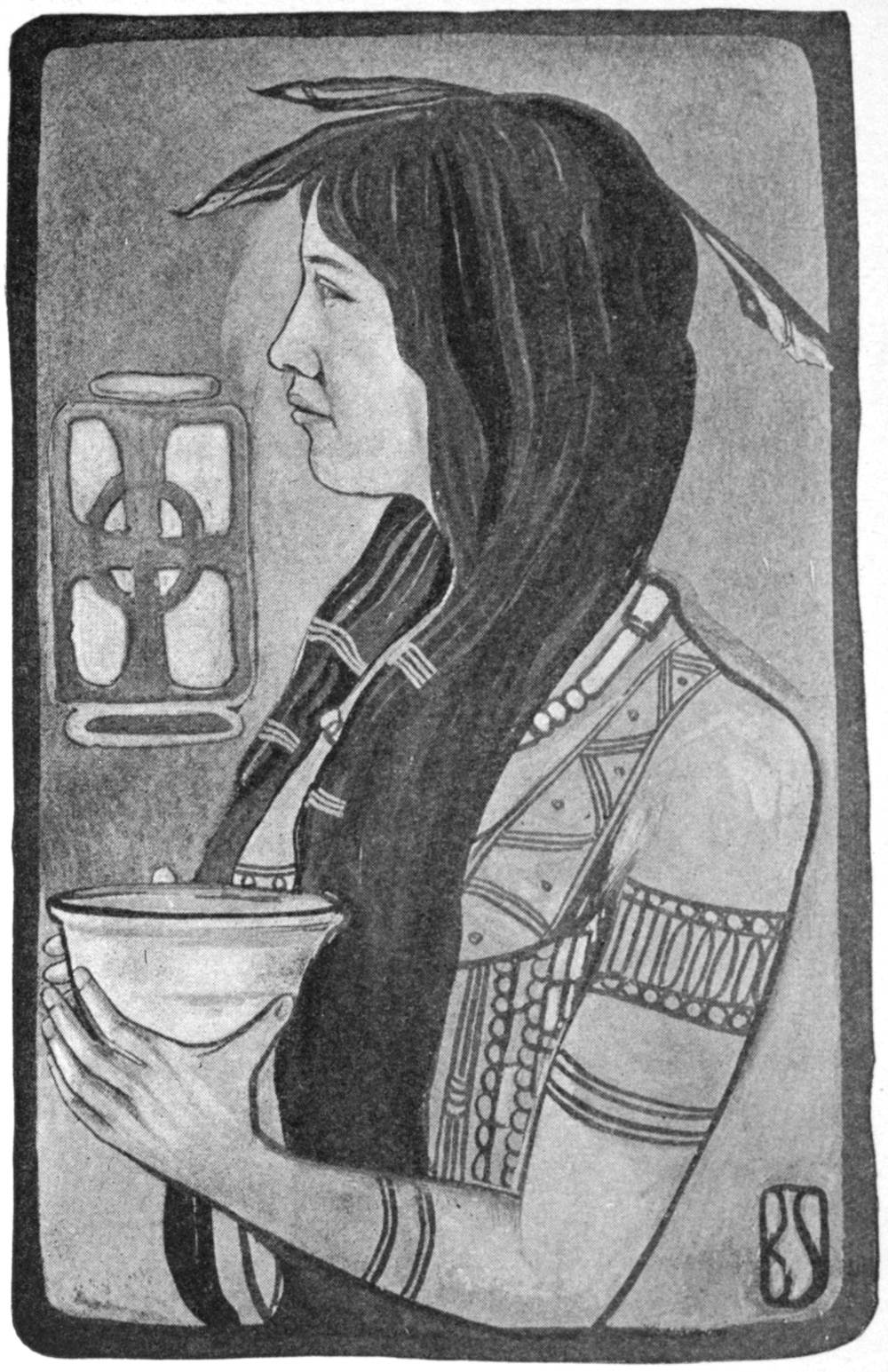
She seized and drank it dry
All without giving heed
As to what hand had held
The cool, refreshing draught.
There is another Passamaquoddy version of this poem which is hardly less striking in its ending. The brother, having obtained the scrapings of the horn, merely touches with them a large green beech tree which becomes dead in an instant and then falls to the ground, actually rotten as if it were a century old. And, when the same powder is given to the witch,
She grew older in an instant,
She became very old indeed:
A pale color rippled
All over her face. She fell,
Looking a hundred years,
Dead upon the floor.
Shrivelled and dried as she fell,
Then dropped to powder—“She
Will trouble you no more.”
Then said the conjurer;
“Her dance is over now.” L.
[59] Long ago in an Indian village.
XIII — A TALE OF THE RIVER-ELVES — FOOTNOTES:
[Abenaki]
Noñwat Manoñuamasak
Udainoñ kwaʿliwi kd-odana-na.[60]
Long ago some River-elves were living near our town.
These Elves would always work at night along the river shore,
And fashion little wheels of clay and leave them on the bank.
When these small cakes of clay were fresh some Indians there were
Who learned to eat them and to take great pleasure in their taste.
In ancient times—this is the tale which oft was told to me—
An Indian and squaw were out afar in bark canoe
When in the current’s swirling waves they right before them saw
A wee canoe in which there sat two children, as they thought.
Now these were hideous River-elves, and when they had beheld
The Indians, they called to them: “O ye of fairer face
And better looks go back,” and then tipped over their canoe,
Which, as it rolled, the Indians perceived to be of stone,
And nevermore thereafter did they see the River-elves,
Who when the loud-voiced Whites had settled all the country-side,
Withdrew far up the rushing stream where no canoe may pass
Save only stone ones. Nor again did ever Indian find
Those wheels of clay which he of old so dearly loved to eat.[61] P.
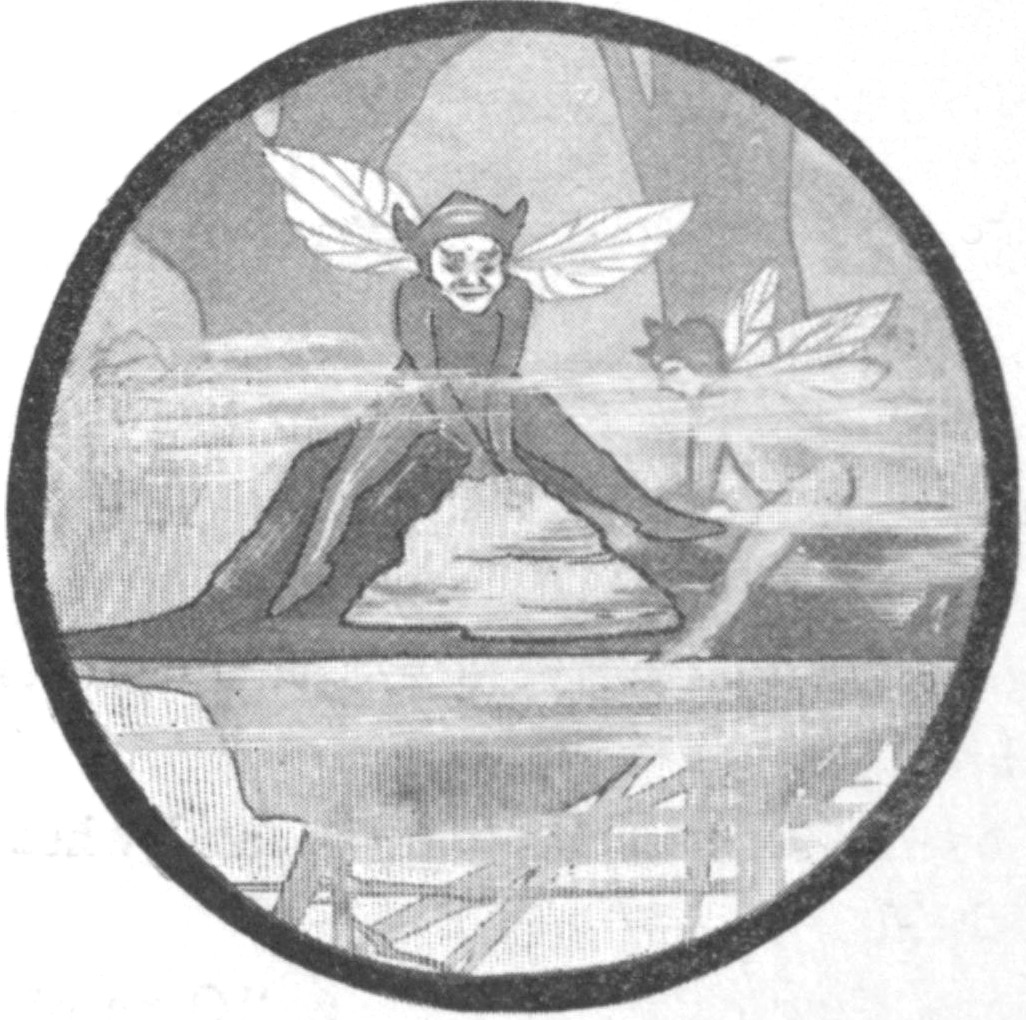
[60] Long ago the River-elves were around our town.
[61] This song clearly indicates “earth-eating” among the Indians. It still exists among negroes in the United States.
PART THIRD
Lyrics and Miscellany
I — THE SONG OF LAPPILATWAN, THE SINGER IN THE DUSK — FOOTNOTES:
LYRICS AND MISCELLANY
Piʿche Lappilatwan mechimiu-olamto
Wʾtagwsiu-ut msiu sipsis.[62]
Lappilatwan, fair tree-fungus,
From days of old,
The ever good-natured,
Of all the birds cousin.
Dwelt on the birch-tree;
All the birds of the forest,
Even the little insects,
Even the little worms,
Crawled up the great birch
To see their good friend.
Thus always at sunset
They heard him singing:
Lappilatwan
Wappilatwan
Wechkutonébit,
“Fair tree-fungus,
Fair tree-fungus,
Sits with mouth open,”
The signal song
Unto all wood birds,
Worms and insects,
To go to sleep;
So that all the birds,
Little worms, little insects,
When they heard
Lappilatwan
Wappilatwan
Knew he was silent
For all the night
There where he hung
In the cold birch tree,
Cold, rough and damp,
All night, all day!
All through the year.
But when the day dawns
His song rings again;
Lappilatwan
Wechkutonébit,
“Fair tree-fungus
Fair tree-fungus
Sits with mouth open.”
Then every bird
Every small insect,
All creeping things
Who heard his song,
Knew there was coming
A beautiful day:
“Let us arise!
The daylight is breaking!”
They rose at his call.
One bright fresh morning,
Lively Sexkâtû
The flying squirrel
Climbed the great birch-tree,
And there he found
Lappilatwan
From a branch hanging,
And he thus spoke;
“Tell me how long
Have you dwelt here?”
“I have lived in this tree
Since your great grandfather
Kʾchî Kʾmûsums
Was born on that cedar
From which you came
Early this morning.”
“But tell me truly,
Lappilatwan,
How long will you
Dwell in this birch-tree?”
“While the birch-tree
Sends forth its leaves,
While its trunk stands,
I will dwell in its branches.”
Sexkâtû the squirrel
Wanted that birch-tree
For his own home:
He would be nesting
In that same place.
Thus he then answered:
“You have been here
Long—and far too long.
It is time for you
To yield to another:
Let me come here!”
Lappilatwan
Answered him quietly:
“Noses, ‘my grandchild:’
I cannot go hence.
If I should do so
Birds and the insects
Could not hear me call.
Could not hear my songs
From another tree;
You, who are so clever,
Far quicker than I am.
You can make your home
All over the forest.”
“You must go!” said Sexkâtû,
Then he gnawed at the branch;
There was the nest
Of the Hamw[´ĕ]sŭk,
Of the stinging wasps,
Who came swarming out
From their little wigwam;
More than a hundred,
Flew at Sexkâtû
Clung to his back
Madly they stung him,
Till stunned with their stinging
Saucy Sexkâtû
Fell to the ground.
Well nigh a-dyin,
With stings and with bruises.
Ere long the news spread,
Soon all the squirrels
Said: “Sexkâtûwuk
Kʾputwusin,”
“Let us take council.”
Red squirrels, gray squirrels,
Striped squirrels, flying ones,
Came running together,
Then they cried out:
“Lappilatwan
Must leave his tree,
And if it may be,
Be put to death!”
All in a band
They went to the birch-tree,
Then they observed that
In one way only
Could they approach
Lappilatwan.
Straight up the trunk
Not many together.
The news spread afar,
Soon there came flying
The wasps and the hornets,
The bees and the black flies,
The angry mosquitoes:
Even the midges,
The little Chessúyek
Came to the rescue
Of Lappilatwan.
The chief of the squirrels
Gave out the order:
“Let the battle begin!”
The squirrels rushed onward
They rushed to the birch-tree:
Yet only a few
At once together
Could climb up the trunk:
Musesaaqua, the horse-fly,
Was brave in that battle.
Mosquitoes and midges
Like gallant warriors
Rushed on the squirrels,
With their sharp spears.
Ere the first squirrel
Was half-way up the birch-tree,
He and his followers
Fell to the ground
Wounded and dying.
Lappilatwan
High up on the birch-tree
Saw the battle rage,
But was ever silent,
Silent till sunset;
Then his loud song
Rang through the forest:
“Lappilatwan
Wechkûtonébit.”
“Fair tree-fungus
Sits with mouth open.”
Soon as they heard it
All of the warriors,
Squirrels and insects
Valiant mosquitoes,
Humble hornets,
Bold bumble-bees,
Wild whizzing wasps,
Gallant merry midges
Went to their wigwams.
Lappilatwan
Had faith in his warriors:
Truly he trusted
That they could defend him.
When in the morning
They heard the signal,
The song of awaking,
Ring from the birch-tree,
The mighty armies
Again assembled;
The chiefs held council;
Thus spoke Sexkâtû
While all were silent:
“Listen, oh squirrels!
Last night in dreaming
This was revealed to me:
If in the battle
One of your warriors
Can touch for an instant
Lappilatwan
Ever so lightly,
Before he sings us
The summons to sleep,
Then we shall conquer;
Failing to touch him
Ere we hear ringing
‘Lappilatwan
Wappilatwan’
We are defeated.
Now you have heard me,
On to the birch-tree!”
The angry flies
Sharpen their spears;
Dip them in poison;
Loud was their buzz!
As they went to battle,
Terrible slaughter
Followed their onrush;
Desperate squirrels
Heedless of death
Clung to the birch-tree
Wingèd warriors
By many thousands
Swarmed on the foe;
Many a horse-fly
Beheld no more
His wife and children;
Many a hornet
Sat no more
By the fire of his wigwam;
The dying bumble-bee
Chanted his death song.
Dire was the slaughter,
Full thrice greater
Than on the first day;
Still they rushed onward,
Fiercer for battle,
Giving no heed
That the day was ending;
Never observing
The sun down-sinking,
When over the forest
Rang loud the summons:
“Lappilatwan
Wappilatwan.”
All was over.
High on the birch-tree
Untouched by a foeman—
Sat the watchman—
The flies were victorious!
This poem is like Homer’s Batrachomyomachia, the battle of the frogs and mice, as sung by some Icelandic bard. The humor is as Greek as the form is Norse. L.
[62] Long ago, Lappilatwan, always good-natured, was cousin of all the birds. These lines indicate the measure to which the whole was sung; i.e., they are a “staff-rhyme.”
II — THE STORY OF NIPON THE SUMMER — FOOTNOTES:
[Passamaquoddy]
In the far old time
Lived near the sun
A beautiful woman,
Nipon her name.
Green were her garments
All of fresh leaves.
And with green leaves
And beautiful flowers
She covered her wigwam.
She had a grandmother,
Kʾmēwun, the rain,
Who dwelt far away.
But when she came
To visit her grandchild
One thing she ever
Said ere she left her:
“One thing I bid thee
With hardest warning,
To one thing I bind thee
With a strong will:
Look that thou never
Seek in thy wandering
The Laʿtogwesnuk,
The land of the North:
For there dwells Pûn,
Pûn, the winter;
A deadly foe
Thou wilt surely find him.
Should thy feet fall
In the Laʿtogwesnuk
Thy beauty will leave thee,
Thy green dress fade,
Hair turning gray
Thy strength become weakness.”
Little heed
And scant attention
Gave Nipon
To Kʾmēwun, the rain.
One fair morning
She sat by her wigwam
In the bright sunshine,
And looking afar
At the Laʿtogwesnuk
All that she saw
Seemed strangely lovely
As if enchanted.
No human being
Was in the Northland,
But o’er it all
Was beautiful sunshine;
There she beheld
At a long distance
A wonderful land:
Broad shining lakes,
High blue mountains,
Bright rolling rivers
All strange and sweet.
Something came over her,
She knew not what;
A dream or a voice;
There was no help,
She must rise and go.
Must go to the land
Of Laʿtogwesnuk
Unto the Northland.
Up rose Nipon
Unto the North
Wending her way,
When she heard a voice,
The voice of the Rain
(Though she could not see her),
Kʾmēwun, a-wailing:
“Bide, my daughter!
If thou goest
Unto the Northland
Pûn the winter
Will surely kill thee!”
She heard nothing
Of all the warning,
She could not stay
For a spell was on her;
Ever onward
She went to the North.
For many days,
For many moons,
Still the sun shone,
Still she saw
The beautiful country
Of mountains and rivers,
Until one day
Nipon noted
That as she followed,
The land went onward,
And as she travelled,
It travelled before her.
All around her
Was nothing but sunshine.
Stopping a little
To think of the wonder,
She heard a whisper,
The voice of the Rain:
“Stay, my daughter!”
It made her wilful,
She still went onward;
On to the North.
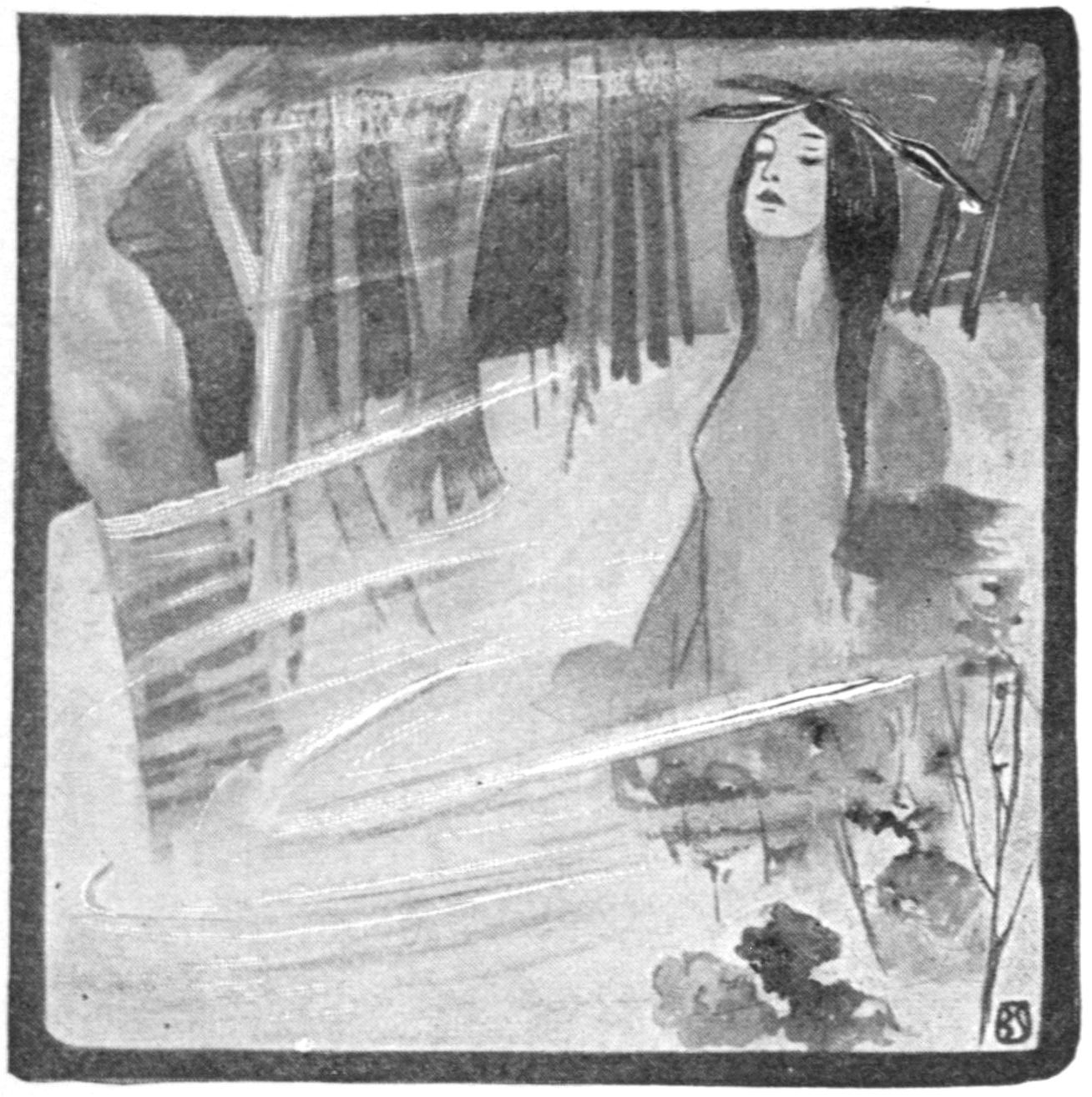
Still the far country
Went on before her,
And something she never
Had known came o’er her—
She felt the cold!
An unseen power
Now drove her onward;
Will had departed,
Still the mountains
Went on before her;
The green leaves
Of her beautiful garment
Grew yellow and faded,
And were blown away
By the grim wind;
Her long hair
Turned gray and white;
The sun grew dim
And then shone no more;
She was very weak;
The beautiful mountains
Were heaps of snow;
The beautiful rivers
And lakes were of ice—
All in the North.
Kʾmēwun, the Rain,
Was sad in her soul.
She looked afar
No smoke was rising
From Nipon’s wigwam:
“She has not returned,”
Said the Rain-mother,
So in her fear
She went to the wigwam.
All was silent,
The boughs and the flowers
Which covered the wigwam
Were yellow and faded:
“My child!—my child!
Thou art caught at last
By the icy Pûn,
By the wicked winter!
Afar in the North.”
Straight she called for
Her bravest warriors.
The ever-unseen.
These were their names:
Saunésen the south wind,
Wchîpi the east wind,
With Sĕnusóktun
The warming breeze.
Quickly she cried:
“Hasten away
To the Laʿtogwésnuk,
Fight like heroes,
Use all your power
To rescue Nĭpon
From Pûn, the winter,
Fly to the North!”
The wind warriors,
The unseen by man,
Flew like lightning
On their long journey.
As they entered
The Laʿtogwesnuk
Pûn the winter
Felt ill at ease;
He called his chieftains:
Great Laʿtogwĕsin
The terrible north wind,
And the wild north-wester,
The chill north-east wind,
With all the frosts
Sleet-spirits, snow-spirits,
And every child
Of the killing cold
Who dwell in the North.
“Fly!” he cried,
“For our foes are coming!
Up from the Southland,
The home of Summer!”
Even as he spoke
The sweat dropped from him
His face grew thin,
His feet seemed smaller:
“I feel them coming!
Fly to the battle!”
The mighty wind-giants
Flew to the fight,
Great snow-flakes
And heavy hail-stones
Met and melted
With the great rain-drops;
Winds were loud roaring,
Thunder pealing,
Tempest fighting tempest,
Storm against storm;
The drops of sweat
Grew ever bigger
On Pûn’s cheeks;
On Nipon’s head
The hair grew whiter;
Louder and louder
The winds were blowing,
Snow was falling,
Thicker and thicker,
But the driving rain
And the mild south winds
Were ever warmer
And bigger the drops
Grew on Pûn’s face;
His strength had left him.
Down he fell
And in his falling
A leg was broken:
“Lo, I must perish
If this lasts longer,
Set Nipon free!
She it is
Who has brought this trouble
And made this battle.
By my own prisoner
I have been conquered.
Set Nipon free!”
At the word spoken,
Even in the instant,
The winds were silent.
Snow and rain ceased.
Turning her back
To the Laʿtogwesnuk
And Pûn the winter,
Weary Nipon
Set out on her journey.
Old she was, old
As she bore from the North
In her white hair
The hue of its snows,
In her tottering weakness
Its chilling frosts.
Many moons passed,
Still she travelled;
The sun grew warmer,
Days and shadows
Were ever longer;
The air was softer;
Greener and greener
Grew the mountains;
Freer from ice
Rivers were rushing;
Lakes were shining
In the sunlight;
Flowers were unfolding
To the warm breezes.
Weary Nipon
Was weary no longer;
Her heart grew lighter,
Her hair grew darker,
Her face was fairer,
Brighter and younger,
Thus becoming
All she had been
In her early beauty.
Then the butterflies
Knew her again,
And fluttered round her,
And all the flowers
Greeted with perfume
In scent-voices
As she went past.
On she went
To the grandmother’s wigwam,
To old Kʾmēwun.
As she drew near
The clouds grew thicker;
Rain-winds were blowing,
Rain-drops falling,
Showers pelting,
Torrents pouring,
Thunder roaring round:
Still she went on,
Her path lit
By wild lightning,
Till in the midst
Where the clouds were darkest
She found the wigwam
And entered the door.
There as if dying
Lay Kʾmēwun
The ancient Rain-mother,
Weaker and older,
And worn and weary.
“Thou, my daughter!”
She said to Nipon,
“Hast well-nigh killed me!
By disobedience
Thou hast brought suffering
On me and all things.
But for my battle
With Pûn the winter
All life had perished:
Never again though,
While life is in me
Can I venture
On such a struggle!
Be this thy warning!
Else will Pûn,
The cruel winter,
Conquer all things
And ice and snow
For ever and ever
Cover the world.” L.
[63] Long ago a fair woman named Nipon always lived near the sun.
III — THE SCARLET TANAGER AND THE LEAF — FOOTNOTES:
[Passamaquoddy]
Piche yut kʾchî wachok nit wigit welitasit mipis.[64]
In the earliest time on the greatest mountain
Lived merry Mĭpis, the Little Leaf;
When spring is coming and sunlight is shining
He climbs a tree, and there, all summer,
Dressed in green he rocks in the branches,
Listens all day to the birds and the breezes,
And goes to sleep to the song of the owl.
When fall is coming and days are shorter,
Mĭpis dresses himself in scarlet;
Glad and gay in the Indian Summer;
But as the nights grow cold and longer,
He puts on a coat of brown or yellow,
Curls himself up like a bear for winter,
Lets go his hold and falls to the ground;
There he sleeps, all under the snow-drift
Till he hears in the spring the blue-bird calling,
And the stream fighting its enemy ice—
Carrying proudly in pieces as prisoners
The foe which kept it a frozen captive,
All the winter under its wigwam.
Then little Mĭpis, the Leaf, awaking,
Dresses in green and climbs in the sunshine,
Up through a tree, and upon the branches,
Lives as he did the summer before.
Merry Mĭpis on a bright May morning
Was stretching himself in the warm sunshine
When he heard afar a wonderful music,
A sound like a flute and the voice of a maiden,
Rippling melodies melting in one.
Never before had he heard such singing;
Then looking up he beheld before him
A beautiful merry little bird-girl,
Dressed in garments of brilliant scarlet,
Just like his own in the Indian Summer.
“O fairest of small birds!” said merry Mĭpis;
“Who are you, and what is your name?”
Thus she answered: “I am Squʿtes:
The Little Fire. When I fly in the forest
And meet in my way a bar of sunshine,
I look as I enter and leave the shadow
Like a red flame which leaps up in darkness,
And then falls asleep in the night again.
I have lived in the deep green forest,
Even as you have, for many ages,
Singing my songs to Kʾmûsomsʾn
Unto our Father the mighty mountain,
And because he well loved my music,
For a reward he sent me hither
To seek a youth whose name is Mĭpis,
Whom he wills that I should wed.
And as I think, and hope as I think it,
You are truly the one whom I seek.”
Little Leaf listened in silence
Being by nature very cunning,
Trained to suspicion from his childhood;
Thus his grandmother ever taught him:
“My child—beware of all living creatures,
Even the very smallest insect
May eat your life out. A worm so little
That it can pass through the prick of a needle
Even as a rabbit runs through a valley,
Or as a fish swims free up a river,
May cut your stem or blight your beauty;
Anything living may be your death.”
So to Squʿtes, Mĭpis listened,
Charmed with her beauty yet still mistrusting,
Liking her look yet deeply doubting,
Wondering whether this lovely creature
Was truly a friend or a false-hearted foe.
Beautiful Squʿtes, never heeding
What the Leaf thought, began to warble;
Pouring out in the pleasant sunshine
Her morning song. As Mĭpis listened
To the melodious trill, he melted;
For the sweet tune filled all the forest,
Every leaf on the tree was listening,
Branches were waving in keeping cadence,
Even the busy ants stopped running,
The butterfly sat on a flower to hear;
And as the music grew tender and stronger,
And as in one long soft note it ended,
Little Leaf said to her: “Be my own!”
So in the greenwood they lived together;
Other singers often assembled,
Other birds were often about them,
Coming to see the beautiful stranger,
Longing to try with hers their voices,
But at every trial the Little Fire
Flew in her melody far above them,
Even as she went beyond them in beauty.
One morning Squʿtes sang to the Leaf:
“Let us go and visit Kʾmûsomsʾn
Our mighty grandfather—the Mountain:
He made us happy—let us thank him!”
So the little Squʿtes and Mĭpis
Went like a flame through the shades of the forest,
Till they came to the cave of the grandsire.
Glad the grandfather was when he saw them!
Thus he spoke unto them—“Nosesak!
Grandchildren! Heed well what I tell you!
While you live never leave the mountain!
While you are here you are always in safety:
But when away from it, ever in danger
From one who is ever seeking to kill you:
The little Indian boy Monimques,
Who, armed with a terrible bow and arrows,
Shoots all the little birds of the forest,
And carries them home to old Monimques,
Who roasts them all in the fire and eats them.
Even worse is another foeman,
A dreadful little boy who is flying
All the time over rivers and valleys,
Aplasemwesit, the Little Whirlwind,
Who never rests. He is always trying
To blow the leaves away from the branches,
And drives them headlong, in flocks together,
To his grandfather the terrible Tempest,
The great wild Whirlwind who kills them all.”
Taking the Leaf in her bill, the Red Bird
Flew through the forest among the branches
To the great tree which grew secluded
In the safest place in all the mountain.
On its topmost branch they built a wigwam;
Bad little Indians never came near them
Hunting for birds with their bows and arrows,
Nor the wicked whirlwind looking for leaves.
There they lived and were perfectly happy,
Nothing but kind words passed between them,
Only kind words and favorite songs.[65]
Leaves like men are never contented,
When all’s for the best they never know it;
So it came to pass that Mĭpis one morning
Saw far away in the pleasant sunlight
A land of beautiful lakes and mountains,
Lovelier far than the place they lived in;
And felt in his heart an earnest longing
To wander away. So he said to the Red Bird:
“Look, my dear, at that beautiful country!
There we are sure to be perfectly happy:
I can no longer live here on the mountain!”
Taking the Leaf in her little bill,
The Red Bird flew over rock and river,
Till she came to the beautiful country;
Again on a tree they built their wigwam,
And Squʿtes sat and sang on the branches:
The little Indian boy Monimques
Never had heard such beautiful singing,
Never beheld such wonderful feathers;
Amazed he stood for a while and listened,
Then bending his bow let fly an arrow.
Down fell the Red Bird, sorely wounded,
And proud of his prey the boy ran homeward.
Then another foe came rushing after,
Aplasemwesit the Little Whirlwind,
Seeing the Red Leaf soon he seized it,
Took it in triumph unto his grandsire
The mighty Storm; when the chief beheld it,
“This,” he said, “is no common capture,
This is the Leaf of the Leaves, my grandson!
He shall not die. I will keep him a prisoner:
He has come from afar. We must guard him with care.”
Greatly the Storm Chief fears the Mountain
Who stops the wind in its wildest flight.
That night there came a dream to Kʾmûsomsʾn
And he learned that the Leaf had been taken prisoner,
By Aplasemwesit and kept as captive.
Waking in anger he called to his son:
“Go to the chief of the storms and tell him
To send me the Leaf!” His son departed
And when he came to the mighty Whirlwind
Said: “Give me the Leaf! Else, ere the evening
All of our tribe will be on the war path.”
Gladly the Whirlwind gave up his captive,
And the son of the Mountain carried him home.
Soon the Leaf was safe in his wigwam
On the great tree. He lived in sorrow,
And when the notes of a bird came ringing
Out of the forest, his grief was greater;
His life was gone with the Little Fire,
And the fire of his life was all in ashes.
Thus it fared with the beautiful Red Bird;
When the old Monimques beheld her,
Long he was silent, then said: “My grandson!
This is truly no common capture!
Well it is that thou didst not kill it!
Let the bird live in peace in our wigwam!
But take good care lest it escape!”
Day after day the Red Bird grew better
And soon her color was as bright as ever,
Until one morning when least expected,
Her voice broke forth like a brook into sunshine.
These were her words: “Could the Wind but hear me,
I should not long be kept a captive,
Soon he would carry the news to the Mountain!
Soon the Mountain would send a warrior,
Soon the warrior would give me freedom!
Soon I should be with the Leaf again!”
As the old Monimques heard her singing:
His heart at the words grew weak with fear:
“Truly it was a bad beginning
That ever my grandson shot this singer,
And truly, ’twould have a woful ending,
If the Mountain should learn she is here!
It is madness to keep her a captive,
But certain death if we let her go free!”
While he thought it over his grandson returned
Bringing a burden of birds of the forest,
And little singers who live by the rivers:
And when they were cooked, and the chief had eaten,
Down by the fire he lay on a bear skin,
Smoking himself into silent sleep.
The door was closed, nor was there a crevice
Through which the Red Bird could creep to freedom
When all at once she thought of the opening
Through which the smoke from the fire ascended
Ever upward so densely pouring
Nobody deemed she would dare to pass it.
As the head of Monimques drooped on his shoulder
And as the pipe stem dropped from his fingers
And as the little Wʾnagʾmeswuk
The tiny fairies who tap the eyelids,
Soothed him into deepest slumber,
Softly the Red Bird rose and taking
A birchen bucket, filled it with water.
Dipping her wing in the water she sprayed it
Little by little upon the fire;
Little by little the fire, like Monimques
Sunk to sleep, and the bright red flame
Lay down to rest in the dull gray ashes.
Out of the smoke-hole, in careful silence
Flitted Squʿtes, and when far from the wigwam,
In the fresh air and the beautiful sunshine,
Heard other song-birds far beneath her.
As she went flying over the forest,
Leaving death behind, with love before her,
She had never been half so happy.
And what was her joy when she reached the mountain
And saw from afar on the great tree rising
A bright Red Leaf which shone in the sunset;
Straight was her flight as that of an arrow,
Fast as an arrow, when she beheld him.
And the Red Leaf leapt as if smit by an arrow,
When all in an instant her arms were round him.
Then without an instant’s warning
All his darkness was turned to daylight,
And the Red Wing burst into tears of rapture.
It was long ago, even in the morning
Of the first moons that this all happened;
Trees had not mouldered as yet in the valleys,
To the cold depths of many a river
Fishes as yet had not found their way,
And all the secret roads of the forest
Had not been learned by the bear or woodchuck;
But even then the Squʿtes and Mĭpis
Lived all the summer upon the mountain,
Sung in its shadows and shone in the sunshine
Still as of yore they are singing and shining;
And so it will be while the mountain is there. L.
IV — THE BLIND BOY — FOOTNOTES:
A VERY OLD SONG
[Passamaquoddy]
Nit neke epit pʾiche nitwechi moskesits
Poskaniknikok mechinechik etli-poskʿnot.[66]
There was a woman, long, long ago,
She came out of a pit
In which dead people were buried;
She made her home in a tree;
She was dressed in leaves;
All long, long ago.
When she walked among the dry leaves,
Her feet were so covered
That they could not be seen;
She walked in the woods
Singing all the time:
“I want company: I am lonesome!”
All long, long ago!
From afar o’er the lakes and mountains
A wild man heard her cry;
He came to her, she saw him,
Saw him and was afraid;
She tried to flee away,
For he was clothed with the rainbow,
Color and light were his garments.
She ran and he pursued her,
Pursued her rapidly,
Unto the foot of a mountain.
He spoke in a strange language,
She could not understand him.
He would make her tell where she dwelt.
They married and had two children
One of them was a boy,
A boy who was blind from his birth.
But he frightened his mother by his sight;
He could tell her what was coming:
What was coming from afar,
What was near he could not see.
He could see the bear and moose,
Far away beyond the mountains;
He could see through everything.
The father was a great being,
He was a mighty hunter;
His wife had magic gifts.
A boy was born to them
Alas, the boy was blind!
In time his sight returned,
He said that he could see.
The mother did not believe it,
She thought it was magic sight.
So one day she bade her husband
Put on him certain things
Which no one could behold
Who saw them not with eyes
As every one could see them.
And then she asked the boy
“What is it that your father
Uses to pull his sled?”
Promptly the child replied
“The rainbow.” Then she said:
“What has he for a bow-string?”
To which his answer was
“It is Ketaksuwauʿt
That is the Spirits’ Road”
(Meaning the Milky Way).
Yet once more she inquired:
“What has he on his sled?”
“A beaver,” he replied;
She knew that he could see.
It would appear from collateral indications of other songs in different tribes that this song is of very great antiquity. The first portion of it was chanted to Mrs. W. Wallace Brown by an old Indian woman; the remainder was recovered from the Passamaquoddy Thomas Josephs or Tamaquah. There appears to be in the myth, for such it undoubtedly is, a refinement of philosophic or theosophic speculation. This is shown in the conception of the young magician, or poet, so gifted though blind that his mother could not determine whether he saw all things by clairvoyance or natural vision.L.
[66] Long ago there was a woman who came out of a pit where dead people are buried.
V — PASSAMAQUODDY LOVE SONG
ORIGINAL TEXT
Anigowanotenu!
Boski ktabin elmi nelemwik
Elmi papkeyik; boski ktlabin,
Anigowanotenu!
Neket mpesel etli-nemiotyikw.
Etuchi wlinakwben sebayi sibuk;
Etuchi wli baquasketen.
Kʾmachtina nolithasiben.
Mechinoltena keppithamʾl.
Anigowanotenu!
Boski ktlabin elmi nelemwik
Elmi papkeyik; boski ktlabin,
Anigowanotenu!
Negetlo he eli-alnisukmekwben
Sibayi guspenik
Etuchi welanakwsititben wuchowek
He eli-machip klamisken mipisel.
Anigowanotenu!
Anigowanotenu!
Nittloch apch eli-alnisuknukw tan etuch apachyaie;
Tan etuch boski pʾkesik mipisel
Yut pemden nit kʾtlaskuyin.
Anigowanotenu!
Boski kʾtlabin elmi nelemwik
Elmi papkeyik;
Boski kʾtlabin,
Anigowanotenu!
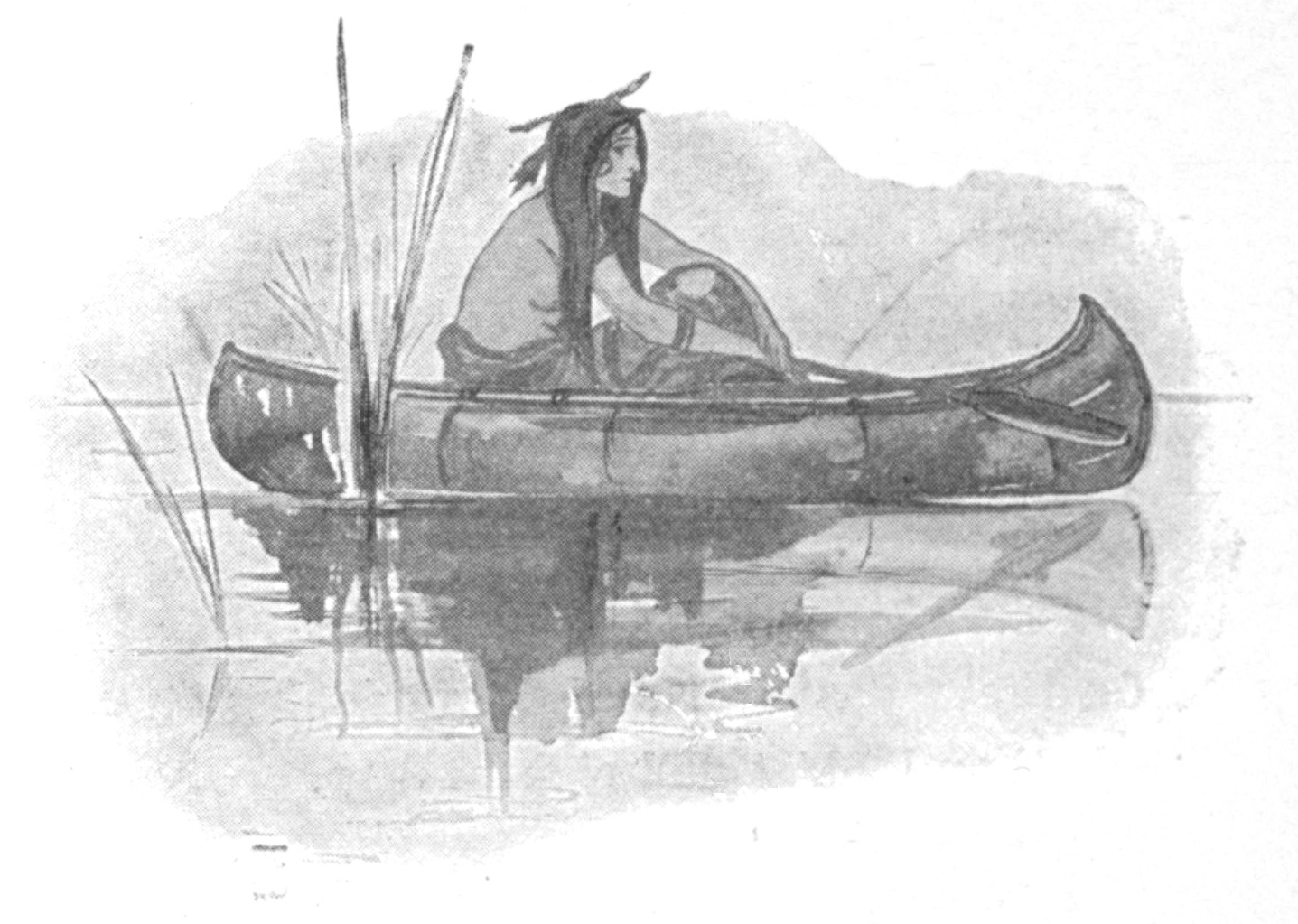
V — PASSAMAQUODDY LOVE SONG
Anigowanotenû!
Oft these lonely days thou look’st
On beauteous river and down shining stream.
Oft thou look’st and sighest deep,
Anigowanotenû!
With me thy lover by thy side
How fair that stream did bubble on!
How lovely was the silver moon!
Thy heart now tells thee of that joy.
E’en unto death I think of thee.
Anigowanotenû!
Oft these lonely days thou look’st
On beauteous river and down shining stream.
Oft thou look’st and sighest deep.
Anigowanotenû!
When we in birch canoe did glide
Together on that glistening lake,
How fair the hills and how we watched
The red leaves whirling in the breeze.
Anigowanotenû!
Anigowanotenû!
We’ll rove once more in bark canoe
And watch the green leaves swirl on high
When spring smiles on the mountain tops.
Anigowanotenû!
Oft these lonely days thou look’st
On beauteous river and down shining stream.
Oft thou look’st and sighest deep.
Anigowanotenû! P.
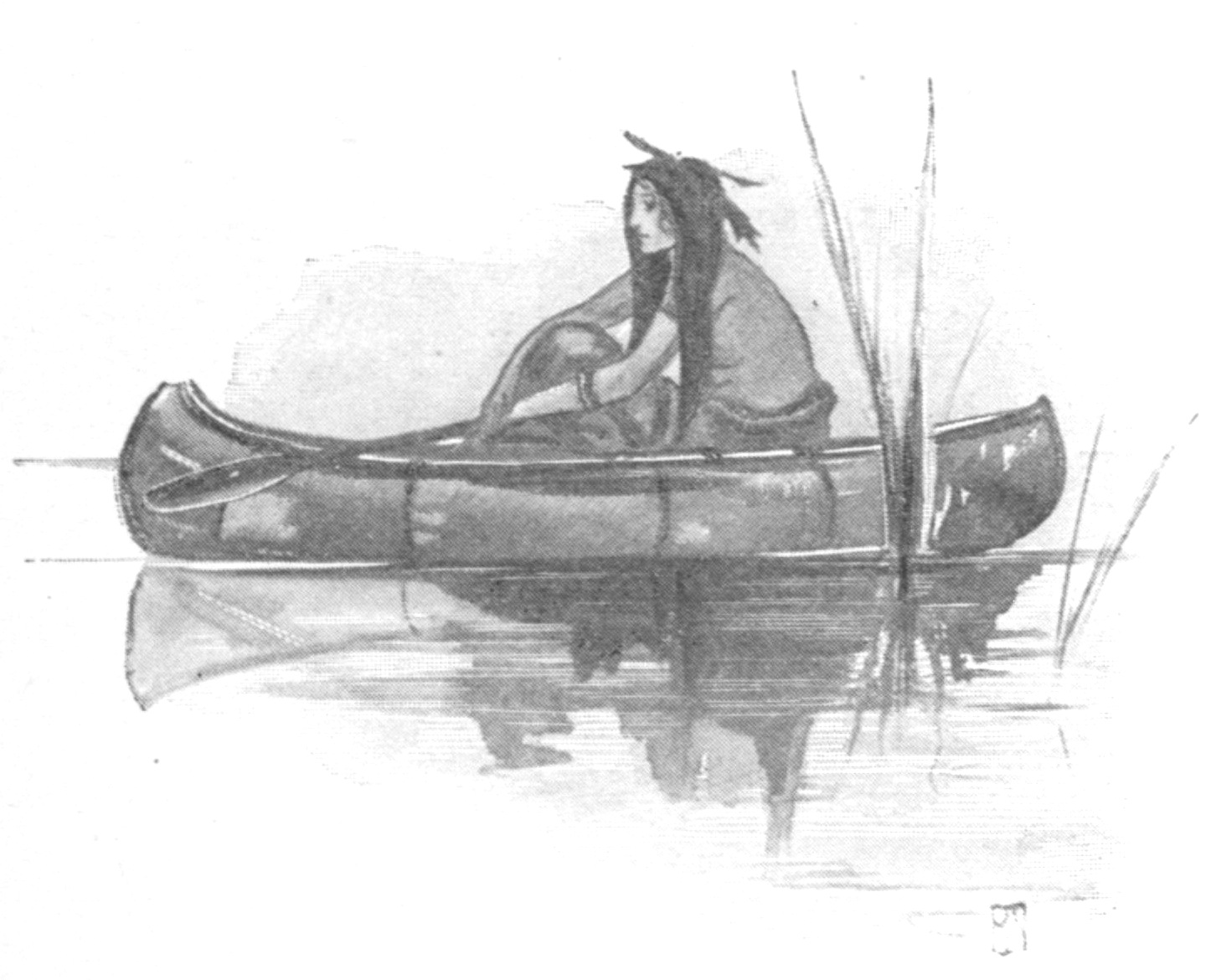
VI — THE SONG OF THE STARS
[Passamaquoddy text]
Nilun pesazmuk elintaquik.
Ntʾlintotebin kʾpesaukhenmâgonok.
Nilun sipsizuk squʿtek;
Kʾpʾmitoiapon pissokiqs
Kʾpesaukhenmagon pesazum.
Kʾtʾlintoanen âût niwesquok;
Otâût Kʾchî-Niwesq
Koitchimkononnoak nohowok katonkewinoak,
Nosokoat moinial
Nit mesq tepnaskwiewis
Mesq katonketitiq
Ketlapinen pemtenikek
Yot lintoakʾn pemtenikek.
VI — THE SONG OF THE STARS
We are the stars which sing.
We sing with our light.
We are the birds of fire
We fly across the heaven,
Our light is a star.
We make a road for Spirits,
A road for the Great Spirit.
Among us are three hunters
Who chase a bear:
There never was a time
When they were not hunting;
We look down on the mountains.
This is the Song of the mountains. L. & P.
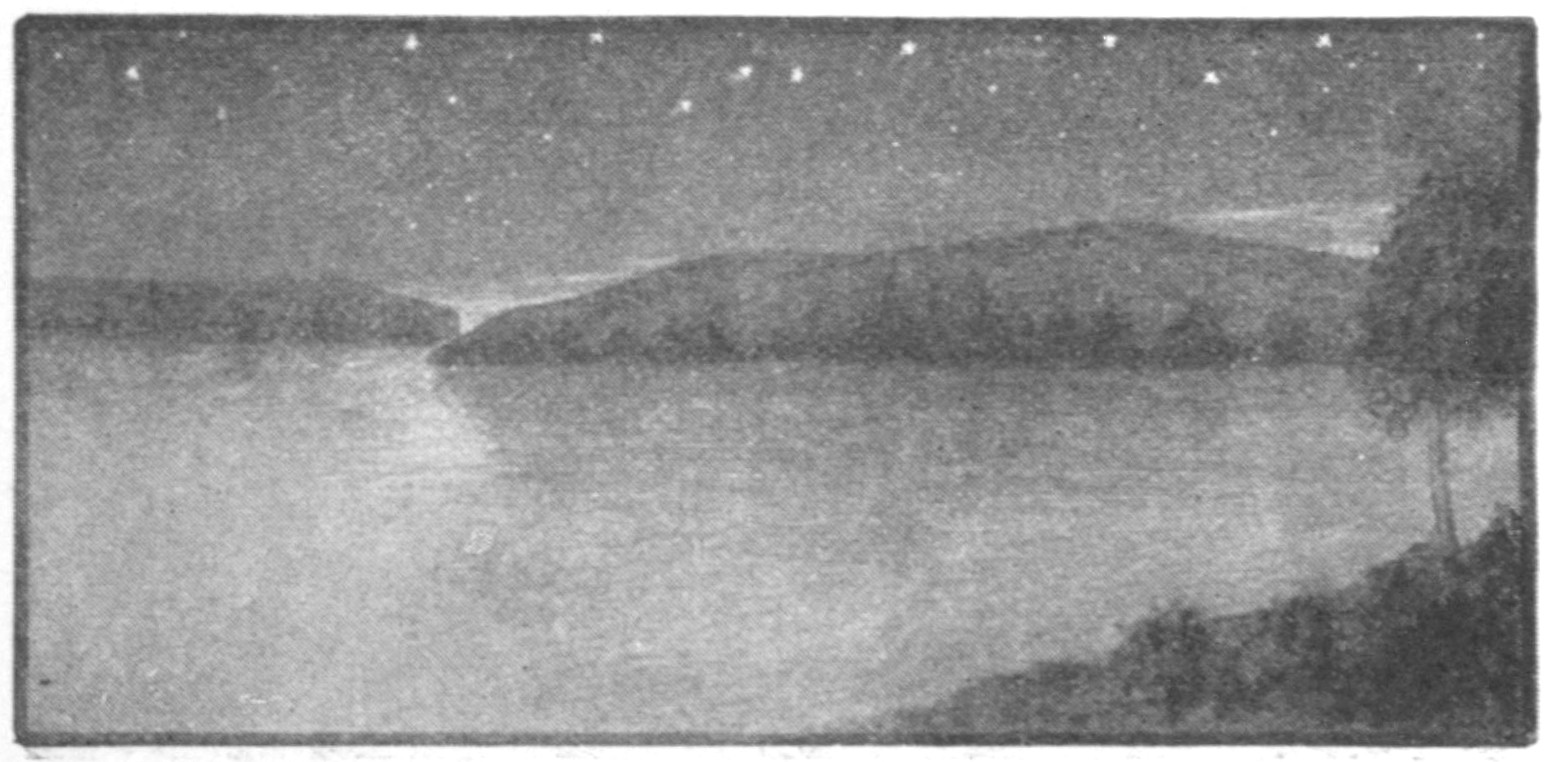
VII — HOW THE INDIANS LOST THEIR POWER — FOOTNOTES:
[Penobscot]
Uskichinwi pilskwessis muiso Ktatnok
Naya kamach okiwachitahasin.[67]
All of the olden time!
Once as an Indian girl
Was gathering blue-berries,
On Mount Katahdin’s side,
She felt a strange loneliness,
And said unto herself:
“I would that I were wed
Unto some brave great man!”
And, seeing the great mount
In glory rising high
E’en as ’twere to heaven
(White the red sunlight shone
Upon the very head),
She said: “A man indeed,
Like great Katahdin there!
High rising over all,
That were the man for me.”
This she was heard to say
Ere she went further on
Up to the mountain top—
Three years then passed away
Ere she was seen again,
And then when she returned
’Twas with a charming child,
The fairest in the land;
Only one thing was strange:
His eyebrows were of stone.
She had been wed in truth,
To Mount Katahdin’s self;
The Spirit of the Mount
Had ta’en her to himself,
And when she greatly longed
To see her folk again,
He said: “Then go in peace.”
But one thing he forbade
With terrible command:
That she should ever tell
To any mortal soul
Who ’twas had married her.
The boy had wondrous gifts;
The sages of the tribe
Said he was soon to be
A mighty sorcerer;
For when he did but point
His finger at the moose,
Or anything which ran,
At once it would drop dead,
Killed by his magic will;
And, when in a canoe
He pointed at the ducks,
The wild fowl swam no more,
And all the water round
Was full of floating game
Which all might gather in,
As freely as they would.
And so it came to pass
That through that wondrous Boy
The mother and her tribe
Had ever food enough.
Now this is all the truth,
And ’twas a wondrous thing,
As ever yet was told.
Katahdin the great lord
Of the Wabanaki;
The children of the Light,
Or of the Break of Day;
Had wed him to the girl
That she might have a child
Who should raise up the tribe,
And make them great once more
Even a mighty race,
The Lords of all the land.
And so to her he said:
“Declare unto thy folk
That they shall never ask
Of thee, who was the sire
Of this brave lad, our son;
They’ll know it all right well
If they but see his face,
And thou shalt not be teased
By questions and by talk
From fools who fain would know
The by-ways of a god.”
And so she made it known
That none should question her,
And gave them all their food,
And bade them let her be!
And truly this was like
The casting oil on fire,
And men and women all
Were raging to inquire
About the mystery,
And ask the wife herself
Who might her husband be?
Though everybody knew
In all the country round.
And though it had been said
That life and death and all
Hung on her telling naught.
Though what were life or death
To any woman born,
Likewise to many a man,
Compared unto the joy
Of learning that which is
None of their business—
And tattling it abroad?
And so they pressed her sore,
Still teasing her to tell,
And giving her no rest
As fools are wont to do.
Until one day, enraged,
She thought: “This passes strength
And I’ll bear it no more.
Truly my lord was right,
These people are too vile,
Too petty and too mean,
For subjects to my son,
He ne’er shall lead them on
To glorious victory!
They are not of the kind
To make a mighty race:
With them it shall be o’er!”
And as they still kept on
Tormenting, teasing her.
She spoke and said: “Ye fools!
Who fain would kill yourselves
By your own folly, ye
Mud-wasps who sting the hands
Which fain would pluck you forth
When drowning in the pool.
Why will ye trouble me
To tell you what ye know?
When ye keep asking me
‘Who my boy’s father was?’
Can ye not plainly see
Katahdin in his brows?
Now it shall be indeed
To your great woe and pain,
And abject misery,
That ever ye did ask
Of what concerned you not.
So now from this day forth,
Ye all may feed yourselves;
For now my boy no more
Will lend his help to you.”
So she arose and went
Her way into the woods
And up the mountain side,
Leading her little son;
And from that day and hour
Was seen on earth no more.
And since that time our tribe
With all the Indian folk
Who once might have become
A great and glorious race,
Have dwindled down into
A very little folk.
For when our minds grow small
And gossip is our god,
We must diminish too.
Truly it had been wise
For them of olden time,
And for us too, indeed,
Could they have held their tongues. L.
[67] Long ago an Indian girl was walking on Katahdin and she felt very lonesome.
VIII — THE PARTRIDGE AND THE SPRING — FOOTNOTES:
[Passamaquoddy]
Uskitap iaqu bamose kʾchikok
Etuchi nodak metetaguak kequ pichikok.[68]
A man was walking the woods
When he heard afar a noise
As of footsteps beating the ground.
With a cry as of merry singing;
So he sought to find the people;
’Twas a week before he found them.
’Twas a man and his wife a-dancing
About a tree; on its summit
There sat a great Raccoon,
And by their constant treading
They had worn a trench in the ground—
Yea, in it, up to their waists.
And when the stranger in wonder
Asked of them, “What are you doing?”
They answered that being hungry
They were trying to fell the tree,
And bring it down by dancing.
The stranger said to them:
“Know ye not that another,
A newer and better way
Of felling trees more quickly,
Has come into the land?”
They asked him how it might be.
Then, while they greatly wondered,
Taking his axe, he showed them
How to cut down trees in a hurry;
But made it a condition
That when the Raccoon should be taken
They might have his meat and eat it,
But the pelt should be his portion.
So, when the tree had fallen,
And the game became their booty,
The woman tanned the skin
Which was strangely large and glossy
And gave it to the Indian
Who took it and went away.
Then afar in a path in the forest
He met with another man,
And was greatly amazed at the sight,
Because the other was bearing
A very large birch wigwam,
A dwelling with many rooms.
He never had seen the like,
And at first was in a fright,
But the man, putting down the house,
Burst into a fit of laughter,
And shook him by the hand,
Seeming in faith to be
A downright honest fellow.
Then, while they smoked and laughed,
The man of the house beheld
The skin which the other bore
Of Espuns, the Raccoon,
And said with curious air:
“He kekw nit?” “What have you there
The skin of magic power?”
Then the other answering told
How he met the man and his wife
Who danced around the tree:
Whereat the man of the house
Offered to buy the skin
At any price at all,
And offered the house for it.
Then the other looked it through
And truly he was amazed
To find how many rooms
Were all contained in it,
And what a wondrous store
Of furniture and arms
And kettles and the like
Were stored in every room.
“But oh and alack,” he cried,
“I could never carry this house
As you do, on your head.”
“You can do it with ease,” replied
Pilowî wʾskichin,
That is “the stranger man;”
“Just put it on your head.”
He tried and found it as light
As a kchi bʾsnŭd, or
A basket made of birch.
And so he went his way,
Bearing the magic house
Lightly upon his head,
Till he came to a hard-wood ridge
In which was a bubbling spring;
And here he said: “I will live.”
So searching he found a room
In which there was a bed;
A better he ne’er had seen,
All covered with the skin
Of a snow-white northern bear.
So he laid him down to sleep.
In the morning when he awoke
What was his wonderment
To see above his head,
All hanging to the beams,
Good food of every kind,
All dainties known to man.
For there were venison,
Bear hams and many ducks,
Buckets of maple sugar,
Others of cranberries,
And many golden ears
Of drying Indian corn.
But as in his delight
He stretched out both his hands
To grasp the tempting food,
The bear-skin, melting fast,
As water ran away—
For it was but the snow
Which all the winter long
Had gathered o’er his nest.
And as he stretched his arms,
Lo! they were changed to wings!
And up he flew to the food,
Which was the early buds
Of the birch on which they hung.
He was in truth himself
A Partridge who had been
Wintering beneath the snow,
And who in joy came forth
To greet the pleasant spring. L.
[68] A man was walking in the woods and he heard something far off.
IX — LOX, THE INDIAN DEVIL — FOOTNOTES:
[Passamaquoddy]
Laks uskiehinwi Wahant
Nekŭm mechikit wesis kchikok.[69]
Lox the Wolverine,
Is of all the beasts of the forest
Crafty and most ferocious,
Cunning and utterly given
To every kind of mischief.
In all the world of the wood
There is none so utterly evil,
And therefore he is called
By right, the Indian Devil.
Now it happened on a time,
That Lox, or the Wolverine,
Who had many a time been killed,
And as often rose from the dead
By his sheer force of will—
The one great gift he had—
Found himself down in luck,
Yea, very deeply down.
Crossing in bitter winter
A wide and dismal region
Very poorly supplied
For travel of any kind,
The cold wind blew like knives,
Snow fell with sleet and frost,
And hail and pelting rain
All in bad company
Came on him all in one.
And yet this evil soul
Was reckless through it all
And jolly, for he had
With every devilish vice
One virtue, as I said,
One saving gift, and that
Was, that of all the beasts
Who in the forest dwelt,
Or devils in Hʿlamkîk
(That is the Indian hell),
He had the hardest heart,
Toughest, as all allowed,
And most unconquerable.
He was the first to fight
And last one to give in
(Indeed, he never did
Give in, nor meant to do),
From which it came that he
Was specially admired
By all the blackguard beasts
Who prowled about the woods;
Wherein they differed little
From many among men.
Now, as of all the rogues,
Rowdies and rascal roughs,
The Wolves are just the worst,
You may right well believe
That ’twas with wondrous joy
Lox heard, as night came on,
Afar a long sad howl,
Betokening the presence
Of a pack of these pleasant folk;
It was music to the ears
Of the Indian Devil, Lox.
So he lifted up his voice
All in the Wolfish tongue;
For he was deeply learned
In many languages;
And soon was in the midst
Of a score of howling beasts
Of lupine land-loafers,
Who danced and rolled and screamed,
Biting each other for joy
At seeing him again—
The Indian Devil, Lox.
And then the eldest wolf
The Sagem or the chief,
Said unto him: “I hope
Thou’lt camp with us to-night;
For truly it is ill
For any gentleman
To be alone where he
Might meet with vulgar beasts!”
And Lox replied as if
He did a favor, all
With condescending air;
And ate their best dried meat,
And took the highest place
Beside their fires, and smoked
The chief’s best tomawe,
That is tobacco, from
The chieftain’s choicest pipe;
While all the others grinned
At his tremendous cheek,
To see him put it on—
The Indian Devil, Lox.
And when they laid them down
To sleep, the Sagamore
Said to the younger wolves:
“Be sure and cover up
The stranger with your tails.”
But Lox, who thought it was
A blanket made of fur,
Soon threw the cover off,
And then the chief and all
Admired the plucky guest
Who seemed to have no care
Of cold, or for their care;
And little did he care—
The Indian Devil, Lox.
Then in the early morn
When he would wend his way,
The Sagem of the Wolves
Said to the Wolverine:
“Oh Uncle—thou hast yet
Before thee three long days
All in a land where there
Is neither house nor hearth,
And thou wilt find it hard
To camp without a fire;
Now by good luck I have
An admirable spell
By which thou canst have fires,
And only three—yet they
Will serve thee to the end—
This is the way ’tis done:
Build up a pile of sticks,
And then jump over it,
Even as children do,
And thou wilt see it blaze.
This is a sacred charm
Of great antiquity
A secret ’mong the wolves.
Thou art the very first,
Not of our holy race,
To whom it hath been given;
No Gentile knoweth it.”
And so he bade farewell
To the Indian Devil Lox.
So Lox went trudging on,
Away unto the West;
And, as he went, he thought
Of the great gift of the
Peculiar pious race,
And, wondering to himself
If ’twere not all a flam,
Since ’twas his nature to
Suspect all kinds of deeds,
As he had ne’er done one
Save to some evil end,
And being curious
And very anxious to
Behold some strange new thing,
He said unto himself:
“Tush! I will try it now.”
So piling up some sticks
He bounded over them;
They burst into a blaze.
So all had come to pass
As the Wolf prophesied:
Which greatly did amaze
The Indian Devil Lox.
So having warmed himself
He went his way with joy,
But very soon observed
That it grew cold again.
The wind blew sharp and shrill,
The snow began to fall,
And Lox began to think
How very nice ’twould be,
And pleasant, to be warm.
Now ’tis a curious truth
All very wicked men
Have always one weak spot,
So Lox the Wolverine
Without reflection piled
More sticks together; then
Jumped over them at once.
Up leaped a jolly blaze
As if to dance with him;
This was the second fire
And he had still three nights
Of bitter killing cold,
Ere he could reach his home—
The Indian Devil Lox!
And yet this Wolverine
Who was wise in all that’s bad,
Wicked and witty in sin,
Had not indeed gone far
Or out-walked the afternoon,
Before he began to think,
As he shivered and cursed the cold,
Of lighting another fire.
“Ah—hem!” he said, “who knows
But the weather may take a turn
To a thaw, and give us a night
Which may be rather warm!
Hum! ha! Methinks by the look
Of the clouds that the wind may be
South-westerly! I think
I have heard my grandmother say:
That a color such as I see,
Of red in the sky, means something—
I forget what it is—but it may be
A change for the better—or worse!
Well, I’ll take the chance.” Thus saying,
He piled up the sticks again,
And had a third fire—although
The first night had not come.
But he warmed himself and was happy—
The Indian Devil Lox!
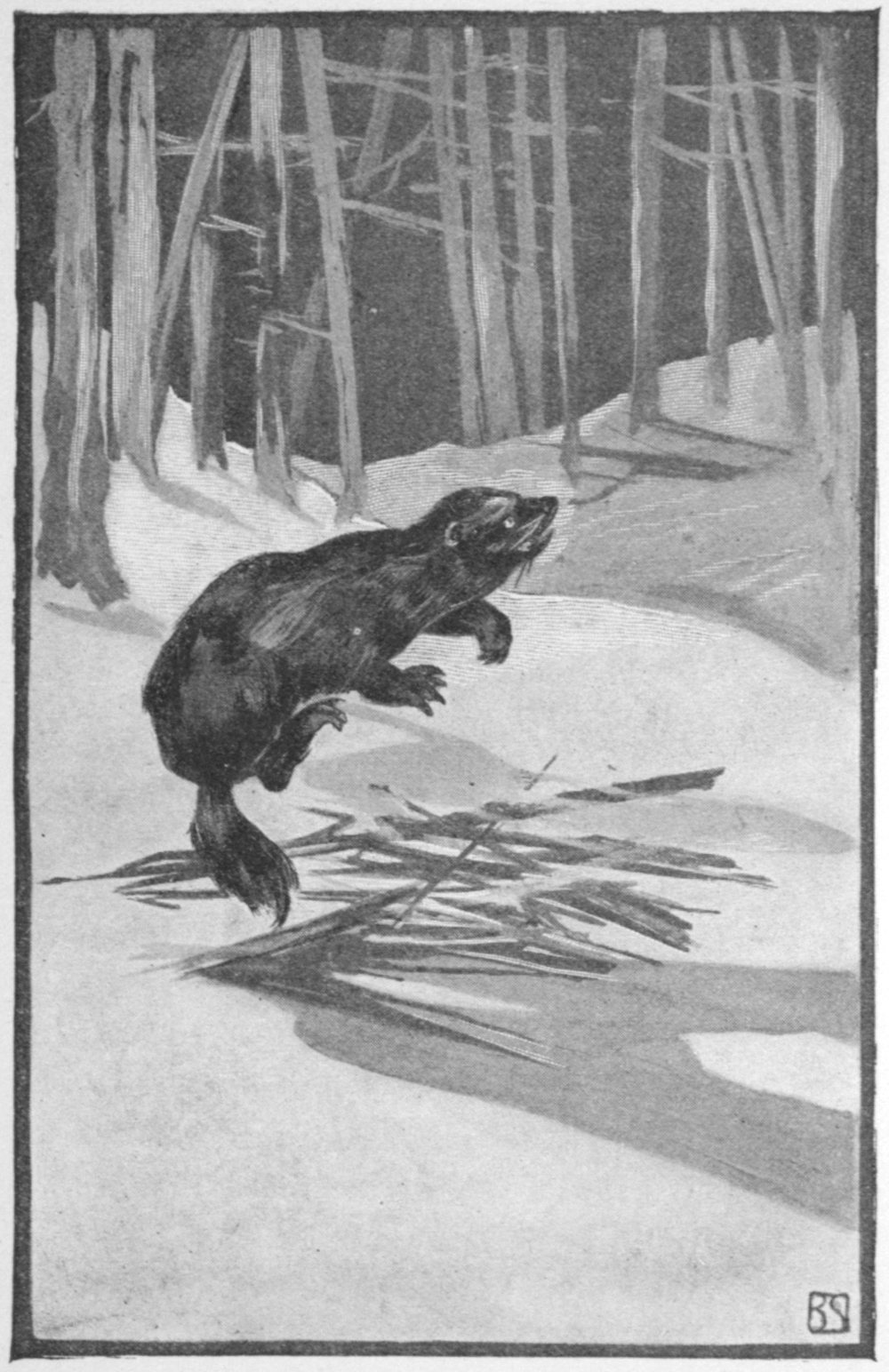
Then gayly jumping over
Awaited the cheerful blaze.
Then as it grew dark and darker,
As the coals and sticks grew blacker,
When a fire is dying away,
He came to his camping place,
And then it grew cold in earnest,
A cold to split a flint.
However, Lox the Believing,
Said, “What is good for once
Must surely be good for ever,”
And made up a pile of sticks,
Then gayly jumping over
Awaited the cheerful blaze.
But all in vain, not a sparkle,
Not a hint of anything burning,
Not even a tiny crackle
Came from the silent wood.
But as Lox was persevering,
He hopefully kept on jumping,
Till after some thirty efforts
There arose a little smoke
Which came as if it were angry
At being so frequently called,
And then returned no more.
But Lox to himself repeating
“All smoke has fire behind it,”
Kept bravely at his leaping
Until the Indian Devil
Of madness and desperation
Awoke within his soul,
And he swore by it that he ever
Would keep straight on with his jumping
Till something blazed—or burst!
He himself was almost blazing—
The Indian Devil Lox.
So he kept on a-leaping,
But to him there came no comfort,
Not even the glow of a spark;
And being at last aweary
He fell in a swoon on the wood-pile,
And so he froze to death,
And that was the last that winter,
Which was heard of him in the land.
Yet I think in time he recovered,
For since then, he very often
Has appeared among the people—
Lox, The Indian Devil,
The Indian Devil Lox. L.
[69] Lox, the Indian Devil, is the worst beast in the woods.
L’Envoi
L’ENVOI
O happy sylvan hours and days of yore!
O quaint old speech which echoes in our ears!
From you we learn our country’s early lore,
The forest people’s sorrows, joys and fears.
So pass in peace, ye simple woodland race!
We may no longer hope to bid you live.
In our mad turmoil ye can have no place,
But we have taken what ye have to give. P.
APPENDIX
The Passamaquoddy Wampum Records
APPENDIX
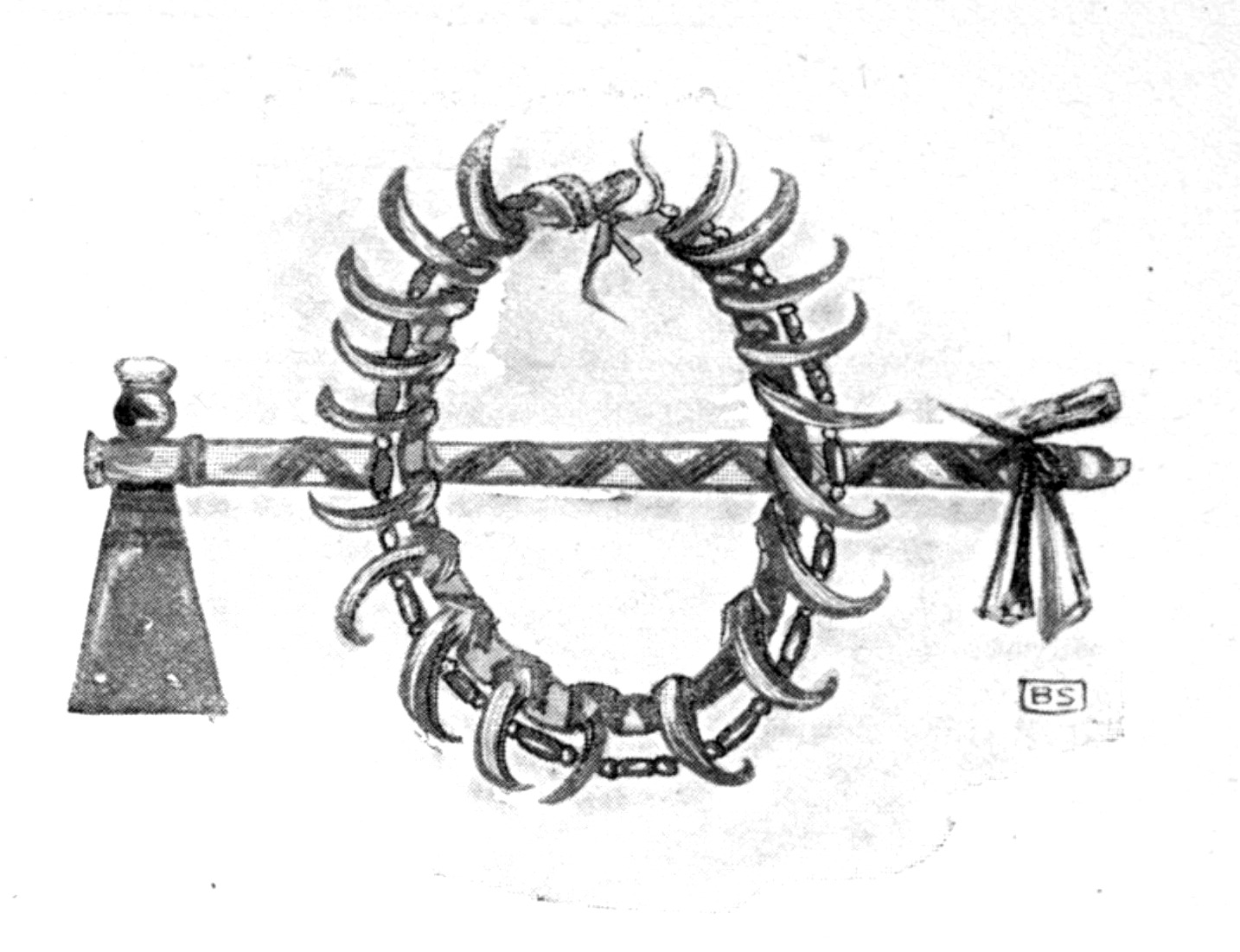
The Passamaquoddy Wampum Records
[This is an emendation of the text published by me in Proceedings of the American Philosophical Society, xxxvi., pp. 479 ff. P.]
Mechi mieu begokni tohocioltowuk kʾchi ya wioo wʾskitap epitjik wasisek nespi wʾsikyojik yot mechi mipniltimkil; nit etuch alit-huswinook negmaoo tepit-hodmotit chewi kegw layoo kegusitch eliyoek chewi layoo tech na neksayiu. Nit etuchi mʾsioo sise pʾchittaketil kinwetaswinoo mʾsitte elipitt wʾskichin anquotch elquiyik sownisnook anquotch wʾchipenook ketkik snoot segdenook ketkik kʾski yasnook. Pechiote pechiyik Wabnakik.[70] Kʾmach wʾsipkikmʾn yaka keswook naga wewʾchiyanya nitta tama wejiwetit wʾtiyawa wʾskichunoo kepechip-tolnen wʾliagnotmagʾn. Nit ettlowsittgw-ton kisipootwusoo likislootemook. Mʾsitte tekepitt wʾskichin kinwetto nit kʾchi lagootwagʾn kitwitasso. Mʾsioo wʾskichin nootek aknoomagʾn mʾsioo wʾlitt-hasoo. Mʾsioo wʾsiwatch yogonyalkatkisilet tekowmʾk maltnitin. Nit mʾsioo kesookmik sittobjitakan opootwuswinoom. Mʾsioo kesookmik sittopetchitakan nissoo kessena agwamʾk opootwuswinoom natchiwitchitagwik kʾchi lagootwagʾn kessena kʾchi mawopootwuswagʾn.
Nit mʾsioo kisma wewsettil nit omache tipit-hodmʾnya ta nʾteh wʾtelook-hʾdinya. Stepal mʾsioo siwatch yokotit eli wʾabli pemowsittit; yokt kʾchi sogmak wʾtiyana-kʾt kihee yot elapimʾk asittwechosyokw kʾnʾmittunen elipegak naptwuk kenemittonenwul kesek ewablikil yotʾl pegaknigil temʾhigʾnsisʾl to (?) naga tapyik tepakw-yil chewi pooskenoswul oskemioo nitte mʾsioo wʾtlkislootmʾnya wʾtlagootinya; nit otaginwipoonmʾnya kisook etuchi pootwusitit.
Nit liwettasoo chikte wigwam. Yot wʾkesekmenya etasikiskakil katama loo-wen-kelosioo mʾsitte pootwuswin chewitpit-hasoo tanetch wʾtitmʾn. Tan etuchi littootit tebaskuswagʾnʾl mʾsitte wʾtipithodmʾnya tanetch likisi-chenetasso manʾtimʾk guni chikpultowuk topemlokemkil.
Apch etuchi apkw-timootit wigwam liwitassoo mʾsittakw-wen tlewestoo nitt na guni omache pootwuswinya; mʾsioo potwooswin wʾtoknootmʾn elipipyaks naga mech matnuttitit mʾsioo eli wʾsikyoltotitits guenipnʾltimʾk; nittlo alteketch tepnasko yotipit-hatosoo naga kʾtemakitt-haman wʾtepittemowa wʾtowasismowa naga mamatwikoltijik; mechi mieu yokli-wʾsikyaspenik tahalote saglit-hat wʾsikap naga mʾtappeguin. Nit mʾsioo mitte westotitit. Nit likisloomuk wʾtlitonia kʾchi lakalosnihagʾn naga tochioo opoomʾnya epasioo kʾchi wigwam tebagalosneoo; na wʾtlitunia ebiss oponmoonya omittakw-sowall nit wen pelestowat nit etuch eshemhoottam yotʾl eyilijil wʾnijanʾl tebakalusneoo. Mʾsitte na wʾtachwiyik settswawall naga na mejimioo wʾmʾtutwatmʾn wʾkchi squt wa wechi skanekaswenook. Yot wechi mach-hak wababi tebaskuswagʾnʾl.
Nit lagalosnihagʾnʾl etli-nʾsettwasik spemek nit nitmame lagootwi-kislootmewagʾn mʾsitte kesigpesitt wʾskichin newanko kesookinito kenooklo kechayami milijpesw. Mʾsitte yokteke wʾskichinwuk wʾtachwi elyanya naga wiginya tebagaloosneoo teketch wen kegw liwableloket chiwisemha wʾnikikowal wʾtesemhogol; nit ebis kisi mawettasiks nittlo tane teppo wigit tebakalosneoo chejik sʾtʾmenal tan eyigil tebaskuswagʾnʾl kessena essemha. Nit wigwam ettlinwasik tabakalosneoo hidmowioo mʾsitte kesitt wʾskichin kesittakw chewi sanke wipemowsoo. Katama apch chigawi yotoltiwun chewi lipemowsowuk tahalo wesi westoltijik witsegesotoltijik opeskon wenikicowa. Nittlo kʾchi squt etli wʾsittwasik wigwamek hidmowiw mʾsitte ta wut kiswichitakw wʾskichin nittetch ettlositit squtek wela manch skat apch teke yiwibmes-honwal. Nittlo wenikigowal ettlin mʾsitt woot wigwamek nit kʾchi Sagem Kanawak. Nitte lakaloshigʾn naga hibis hidmowiw wababi tebaskuswagʾnl. Tan woot pelsetek chewi mawe sagyawal etli nʾsettwojik nit mʾsigekw kisittpiyak.
Nitte apch omach elok-hʾdinya hʾnʾwʾtlitunia apsegiguil wʾtebaskuswagʾnowal. Mʾsioo yotʾl tebaskuswagʾnʾl chewi-littaswul wababik. Wechich kiskittasik tan teppo elikimwittpiyak elnogak mʾsittech yo naga elimilichpegek wapap. Yot wapap elyot sagmak naga mʾitapeguinwuk naga nipwultimkil. Elok-hʾdimek tan etuchi metchmete sagem naga elipuskenoot eli-mʾtakittmowatil mʾsitte wʾskichinwuk. Wulasikowdowi wapap; wigwamkewi wapap.
APPENDIX
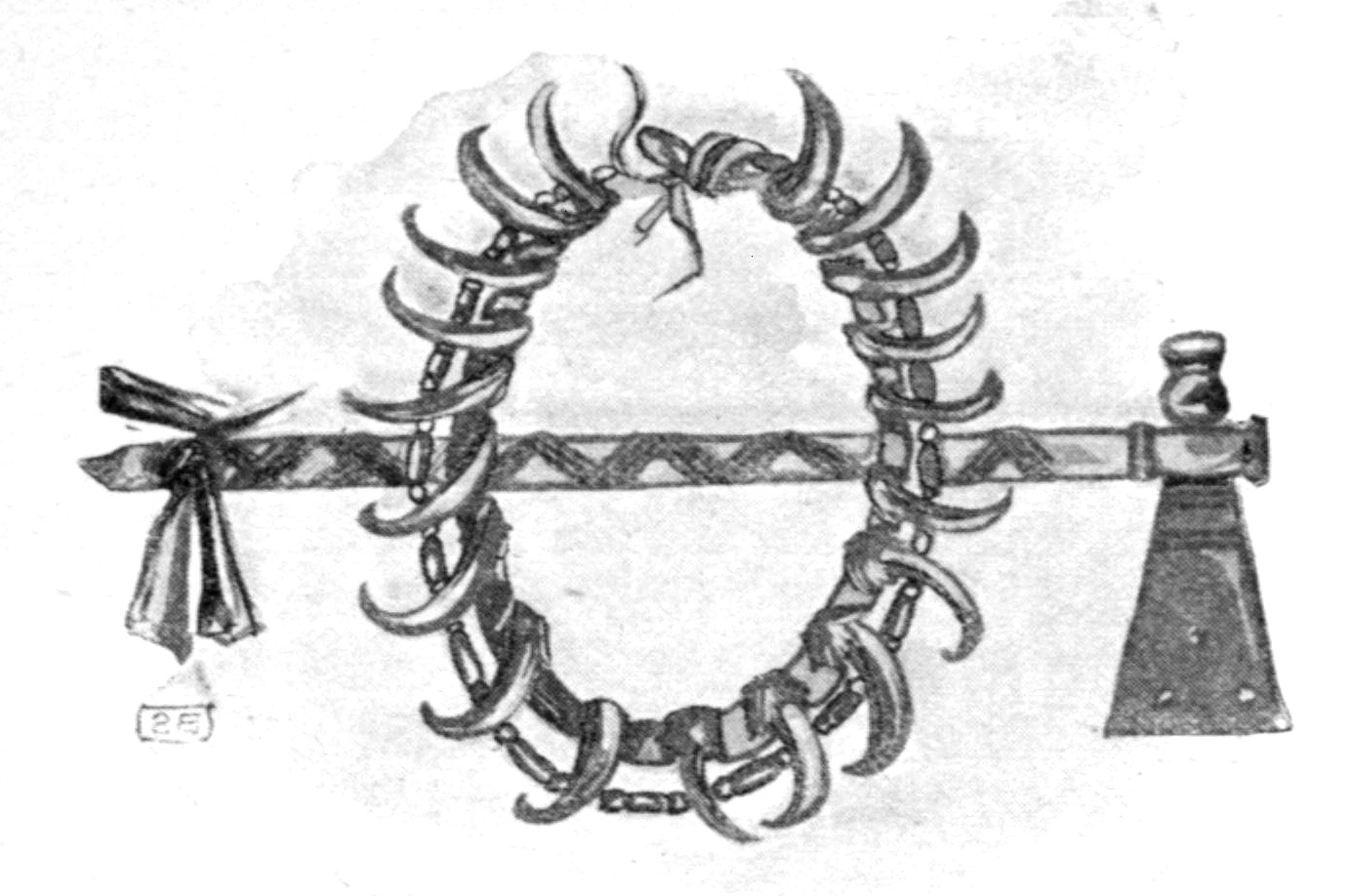
The Wampum Records in English
Many bloody fights had been fought, many men, women and children had been tortured by constant and cruel wars until some of the wise men among the Indians began to think that something must be done, and that whatever was to be done should be done quickly. They accordingly sent messengers to all parts of the country, some going to the South, others to the East, and others to the West and Northwest. Some even went as far as the Wabanaki. It was many months before the messengers reached the farthest tribes. When they arrived at each nation, they notified the people that the great Indian nations of the Iroquois, Mohawks and others had sent them to announce the tidings of a great Lagootwagon or general council for a treaty of peace. Every Indian who heard the news rejoiced, because they were all tired of the never-ending wars. Every tribe, therefore, sent two or more of their cleverest men as representatives to the great council.
When all the delegates were assembled they began to deliberate concerning what was best to do, as they all seemed tired of their evil lives. The leading Chief then spoke as follows: “As we look back upon our bloodstained trail, we see that many wrongs have been done by all of our people. Our gory tomahawks, clubs, bows and arrows must undoubtedly be buried for ever.” It was decided, therefore, by all concerned to make a general Lagootwagon or treaty of peace, and a day was appointed when they should begin the rites.
For seven days, from morning till night, a strict silence was observed, during which each representative deliberated on the speech he should make and tried to discover the best means for checking the war. This was called the “Wigwam of Silence.”
After this they held another wigwam called mʾsittakw-wen tlewestoo, or “Wigwam of Oratory.” The ceremonies then began. Each representative recited the history of his nation, telling all the cruelties, tortures and hardships they had suffered during their wars and stating that the time had now come to think of and take pity on their women and children, their lame and old, all of whom had suffered equally with the strongest and bravest warriors. When all the speeches had been delivered, it was decided to erect an extensive fence and within it to build a large wigwam. In this wigwam, they were to make a big fire and, having made a switch or whip, to place “their father” as a guard over the wigwam with the whip in his hand. If any of his children did wrong he was to punish them with the whip. Every child of his within the enclosure must therefore obey his orders implicitly. His duty also was to keep replenishing the fire in the wigwam so that it should not go out. This is the origin of the Wampum laws.
The fence typified a treaty of peace for all the Indian nations who took part in the council, fourteen in number, of which there are many tribes. All these were to go within the fence and dwell there, and if any should do wrong they would be liable to punishment with the whip at the hands of “their father.” The wigwam within the fence represented a universal house for all the tribes, in which they might live in peace, without disputes and quarrels, like members of one family. The big fire (ktchi squt) in the wigwam denoted the warmth of the brotherly love engendered in the Indians by their treaty. The father ruling the wigwam was the Great Chief who lived at Caughnawaga. The whip in his hand was the type of the Wampum laws, disobedience to which was punishable by consent of all the tribes mentioned in the treaty.
After this, they proceeded to make lesser laws, all of which were to be recorded by means of wampum, in order that they could be read to the Indians from time to time. Every feast, every ceremony, therefore, has its own ritual in the wampum; such as the burial and mourning rites after the death of a chief, the installation of a chief, marriage, etc. There were also salutation and visiting wampum.
ELOK-HʾDIMʾK TAN ETUCHI MECHMETE SAGEM
Tan etuchi mechinet sagem omutlʾwaqulmʾnʾl chewi temitaha naga nʾkikw-wakw-san. Mʾsitte tan kesiyit wʾtowegaknul wʾtchapyil wʾtumhigen naga wʾmutewagʾn w’skichinwnk wʾnittagitmowawal enguchi gʾdunweyin. Tan etuchi tepnasgoyak wʾskichinwuk wikwmania pootwuswinoowo pootwuswinia wateplomania pili sagmal negootekmi kataina wʾkislomowyil sagnial. Nitte eli kisi-mawekislootmootitits nit opechitakaya kinwetaswinoo newunol kessena kaniachin begwitnol hesgun elye Mikmakik, Kebeklo, Panwapskek Welastogok sagem teli mechinet Pastemogatiek. Tan etuchi pechiyatit kinwettasijik elyatit Mikmakik nitte mʾmittutil wechkiyak eguidin metenegnahasik wʾkisin-setumenya kegw itmowio nitte sagem wʾmoweman oskmaknesum wʾtiyan nit wechkoyak kegw nikt kinwut wechipechijik. Nit mʾsitte wen wasisek naga epijik wʾskittapyik mʾtappyataswook wenachi asikwenya malemte eguayik. Nitte peskw wʾgapetasin natuchio wʾthntowatmun nʾskawewinto-wagʾnʾl. Nit wʾtali esui nʾskawan elamkigap wiyalit. Malemte mechintoo nitte na yok wechiyojik peskw littposwin omilawiyan nit na negum wʾtasitetunan wʾsiwesul na negum wʾwuskawan.
Malemte mʾsioo mechi nʾskaw-hʾtimek naga tuchioo omach yapasinya imye-wigwamʾk wʾnaji-mawehimyanya. Malemtech apch kisi-myawletwuk naga tuchioo lippan tanpunote wigwamʾk. Nit m’sioo wen pejit epijik wasisek mʾsioo wʾtlapasinya wʾnaji-wʾlasikwawa sʾsikiptinenawa naga na opummunya mʾtewegon tesagioo wigwamʾk etli wechiwetit nit naga tojio hchi-yawiwul wʾskichin wutakewagʾnl.
Elukemkil etchwi kisetuchil meskw kisi sepyatikw nit amskwas welaguiwik ehʾli wulit-has soeltowegw pemgowlutwuk. Nit apch wespasagiwik yokt mejiwejik opetchitaganya pesgowal oskittapemwal sagma-wigwamʾk wutiyanya sagmal opawatmunia mʾsitte wʾunemyanya oskittapi gwandowanek. Nitte sagem wʾtakinwettuwan oskittapemomaweman gwandowanek naga apch wʾtaginwettuwan yohote wechi-welijihi. Nit na kisi kusyapasitit naga tojoo omoosketunia wapapyil naga tojoo egitoso neget elikislotmotits. Nit ettlowsit Pestumagatiek wʾkuskatam wʾkʾchi-wʾskinosismowow; nitlo kʾpawatmagʾnkil yot ettlowsiyan kʾnajiwichi kehman eliat-kʾchi w’skinosismul. Malemte naga kisi westoltitit yokt wechiwejik nit na sagem onakisinn na wutelewestoon wʾtiyan wʾpemowsowinoom nit negum holithodmun wenajiwi-chakekemiw wicho keman wʾsiwesul kipnael. Nit apch yokt wechiwejik onagesin wʾteleweston olasweltumʾn kisi-weleyet sagman eliwulmatulit napch okisiyinya naga tojoo onestomʾnya kisookch etuchiweswesittit.
Wechiyowitit nittech apch liwitasso eldagemk ekelhoochin malemte kisachwuk weswesinya. Wechiyawitit nit sagem wʾtokinwettuwan oskittapem nikt kʾsiwesnowook kisachwuk weswesinya katama kiseltumwownewin toji neksayiu omach-honya. Napch moskettaso wapap kelhodwei naga wʾtegitmunya wʾtiyawa: nit yot etlowsit Mikmakik epit wasis wʾskittap kʾpowatmagon kʾchenesin apch wagisook nio nit kigwusin katagonkuthagʾn kʾmachkulit-hookowa. Nit ittmowioo katama okiseltumwawun omach-halin.
Nit apch elok-hʾdimʾk liwitasso nʾskowhʾdin. Nit apch sagem opechitagon oskittapem onachi-ketonkatinya kʾchikook nit appi kʾtunkatitit nit wʾtelogwsumnia tan eli pechputit mʾsioo weyesis nepahatijihi malem-te mʾsioo kegw kisogwew. Nit mʾsioo macheptaso gwandowanek nit etli kitimawemittsoltitit naga kinwetowan nojikakolwet (or notgudmit) wʾtalqueminowticook kʾwaltewall (or wikw-poosaltin). Nit mʾsioo wen wʾnastowan. Elque milit nitte na wʾquaskoltinya wasisek epitjik wʾskitapyik pemip-hatijihi waltewa mosque weya malemte pechik sikowlutwuk gwandowanek. Nitte mʾsioo tʾholpiyanya pemkemigek nit yokt nojitophasijik otephemwan yayate elapesit. Yot nit elwittasik elok-hʾdimʾk egelhodwi wikw-paltin; nit kisapeseltitit omach yapasinya. Nitte apch neksayiu appat aptdoowuk. Nit naga tochio hʾnskowhʾdin nit apch yokt wechiwejik onakisin peskw wʾtlintowatmʾnhichi eleyiks elittotits omesomsowuk peskwun kessena nisnol elintowatkil. Nit na sagem wut wechi yot wenaskawan-na.
Malemte nit mechintotimʾk nit sagem holpin eppasio gwandowanek kelnek pegholagnesis naga epesis nitte omache kʾtumosin omachetemun opekholagʾn naga otlintowatmun kʾtumaswintowagʾnʾl. Nit miswen onayinyan opemkan wʾskittapyik epitjik pechiote wasisek nit omikmow powlʾtinya.
Nit malemte mechit piye apch naga tojoo apch otakinwipunmunia etuchi mach-hatit. Apch kisatchitit nit apch sagem nimwul-kʾdʾminya hilelok-hʾdimkil. Anquotch metch nichi kesspemi minwukelhak yot nit eldakewagʾn anquotch metch nihilente kessena te peskw kisoos etasi-welaquiwigil pemkak; nit quenni wechi yot.
CEREMONIES CUSTOMARY AT THE DEATH OF A CHIEF
When the chief of a tribe died, his flag-pole was cut down and burnt, and his war-like appurtenances, bows and arrows, tomahawk and flag, were buried with him. The Indians mourned for him one year, after which the Pwutwusimwuk or leading men were summoned by the tribe to elect a new chief. The members of one tribe alone could not elect their own chief; according to the common laws of the allied nations, he had to be chosen by a general wigwam. Accordingly, after the council of the leading men had assembled, four or six canoes were dispatched to the Micmac, Penobscot and Maliseet tribes if a Passamaquoddy chief had died.[71] These canoes bore each a little flag in the bow as a sign that the mission on which the messengers came was important. On the arrival of the messengers at their destination, the chief of the tribe to which they came called all his people, children, women and men, to meet the approaching boats. The herald, springing to land, first sang his salutation song (nʾskawewintuagun), walking back and forth before the ranks of the other tribe. When he had finished his chant the other Indians sang their welcoming song in reply.
As soon as the singing was over they marched to some imyewigwam or meeting house to pray together. The visiting Indians were then taken to a special wigwam allotted to their use over which a flag was set. Here they were greeted informally by the members of the tribe with hand-shaking, etc. The evening of the first day was spent in entertaining the visitors.
On the next day the messengers sent to the chief desiring to see all the tribe assembled in a gwandowanek or dance hall. When the tribe had congregated there, the strangers were sent for, who, producing their strings of wampum to be read according to the law of the big wigwam, announced the death of the chief of their tribe, “their eldest boy” (kʾchi wʾskinosismowal), and asked that the tribe should aid them to elect a new chief. The chief of the stranger tribe then arose and formally announced to his people the desire of the envoys, stating his willingness to go to aid them, his fatherless brothers, in choosing a new father. The messengers, arising once more, thanked the chief for his kindness and appointed a day to return to their own people.
The ceremony known as Kelhoochun then took place. The chief notified his men that his brothers were ready to go, but that they should not be allowed to go so soon. The small wampum string called kellhoweyi or prolongation of the stay was produced at this point, which read that the whole tribe, men, women and children, were glad to see their brothers with them and begged them to remain a day or two longer; that “our mothers” (kigwusin), i.e., all the tribal women, would keep their paddles yet a little while. This meant that the messengers were not to be allowed to depart so soon.
Here followed the ceremony called Nʾskuhudin. A great hunt was ordered by the chief and the game brought to the meeting-hall and cooked there. The noochila-kalwet or herald went about the village crying wikw-poosaltin, which was intelligible to all. Men, women and children immediately came to the hall with their birch-bark dishes and sat about the game in a circle, while four or five men with long-handled dishes distributed the food, of which every person had a share. This feast was called kelhootwi-wikw-poosaltin. When it was over the Indians dispersed, but returned later to the hall when the messengers sang again their salutation songs in honor of their forefathers, in reply to which the chief of the tribe sang his song of greeting.
When the singing was over, the chief seated himself in the midst of the hall with a small drum in one hand and a stick in the other. To the accompaniment of his drum he sang his kʾtumasoointawagunul or dance songs, which was the signal for a general dance, followed by another feast.
The envoys again appointed a day to return, but were deterred in the same manner. As these feasts often lasted three weeks or a month, a dance being held every night, it was frequently a long time before they could go back to their own tribe, because the chief would detain them whenever they wished to return. Such was the custom.
ELOK-HʾDIMʾK TAN ETUCHI ELYOOT SAGEM
Malemte mʾsigekw mitnaskiyi nit naga toji sankiyiw omajahapanya malemtech nikt pechiyik elyatit wecheyawitit nitte na omawemania opemowsowinomwa wʾteginwetowania eli kisi-kiwkenitit eli pekwatotit wichoketwagʾn. Miyawal te nikt na ketkik otapch-yanya ki wʾkenitsepenik. Nit wʾchi-mach-yiw otaskowalmunia wechiyan nachiwichi sakmakatenik. Malemte pechiyik omʾsioo nit me (?) elok-hʾdimkil-lelan nach sekeptin ewan nut pemkemek. Pechiyatil odenesisek kisi-pemkatil kisi-nʾskowhʾditit.
Malemte tama nisook nekiwik naga omache hel-yanya mʾtewagemʾl nit sagem kitwi yotomʾtewagwemul. Malemte kisachit otemepelanya hʾnit peskw sagmak oponmowan naga wʾnasettowan omannimʾl naga na onas-hewhotlanya pileyal elequotewagʾnʾl. Nit peskw sagem onestomowan yohot sagmal kisiyajik wutege kʾchi-wʾskinosismowa kʾtachwi-elokepa tan eli kisi-wu-lasweyekw naga na kʾtachicbik sitʾwania nekemch na elookil tan wechi miyawil wahod opemowsowinoom. Yotʾl na echwi elokejil sagem wʾtachiwi-sagitonel mʾsioo tan yootʾl nekachikil. Wʾtachwi-klamanel chikow yootʾl timkil matnʾtoltimkil wʾtachwi na kig-ha opemowsowinoom. Chikate wʾpemowsowagʾn lawutik.
Napch omach yot asinya gwandowanek wʾnachmoyo-wagʾnya. Napch sagem wʾkutomasin naga wisek-han sagmal sagmaskw wisekhod pili sagmal naga kiska-mek.
Apch wespasakiwik naga okeptinen teboloman el-wigʾnʾk keswuk nihitanke yachihi wʾtliteboloma wataholoteh elitebolomoot sagem. Peskw na elipemket wut eli wisek-hot. Eli miloot oʾmanimwa aguami sagleyowal katik sagem napch wut piliwi sagem oskowiman naga onestomowan kesich pigak wutlokewagʾnowal miyawal tena okisajin otewepoosan mʾtewaguem. Nittle metewagʾn-mel osagmamwal nikt gaptinek wiwunik apwihtowatijil ya te chikihigʾnʾl kelnajit ayat na tan teppo yot kegus ewabligik quasijik kemenia pekusek wʾtachwi pekiyawal. Yot nit itmowin wʾtachiwi wulankeyowwowwal tan te quenowsiltil pemowsowagʾnawa te wʾtlipoonmʾnia. Wʾtachwi lipoonmenia opokenoom ya hotankeyowa tich-hi nihitanke yatgotachihi tan etuchi nesa naguak pechyamkotit. Chewi noteyik gaptinek woot sagem kislomot kitama kiseltumwawun wichipnusin ansa teppo wʾtankeyowa opemowsowinoom naga wʾnote genekmen tan gekw-nesanaguak pechiyak. Nit woot sagem naga otelitepsowinoom okisitpesotinia.
Nit apch ketkil elok-hʾdimkil malemte nit welaguiwik nit yaka opemkanya tegio te apch echeguak enitespatek wʾtenkamhedoltinia. Enowdoltowuk epeskum-hʾdinya wʾkisik-apwelanya metewagwemel. Nit mʾsioo tan elitowtoltitit ek-hodasik tan woot neglo-wechik niktech wikw-nekik niltelkisek hodasikil. Nit elok-hʾdimʾk anquoch queneket nihi sente kessena te pes-kisoos.
THE CEREMONY OF INSTALLATION
When they reached home, however, and the embassies from the other Wabanaki tribes had also returned, the people of the bereaved tribe were summoned to assemble before the messengers, who informed them of the success of their mission. When the delegates from the other tribes, who had been appointed to elect the chief, had arrived and the salutation and welcome ceremonies had been performed, an assembly was called to elect the chief.
This took place about the second day after the arrival of the other Wabanaki representatives. A suitable person, a member of the bereaved tribe, was chosen by acclamation for the office of chief. If there was no objection to him, a new flag-pole was made and prepared for raising, and a chief from one of the kindred tribes put a medal of wampum on the chief-elect, who was always clothed in new garments. The installing chief then addressed the people, telling them that another “eldest boy” had been chosen, to whom they owed implicit obedience. Turning to the new chief, he informed him that he must act in accordance with the wishes of his people. The main duties of a chief were to act as arbiter in all matters of dispute, and to act as commander-in-chief in case of war, being ready to sacrifice himself for the people’s good if need were.
After this ceremony they marched to the hall, where another dance took place, the new chief singing and beating the drum. A wife of one of the other chiefs then placed a new deer-skin or bear-skin on the shoulders of the new chief as a symbol of his authority, after which the dance continued the whole night.
The officers of the new chief (geptins) were still to be chosen. These were seven in number and were appointed in the same manner and with the same ceremonies as the chief. Their duties, which were much more severe, were told them by the installing chief. The flag-pole, which was the symbol of the chief, was first raised. The geptins stood around it, each with a brush in his hand, with which they were instructed to brush off any particle of dust that might come upon it. This signified that it was their duty to defend and guard their chief and that they should be obliged to spill their blood for him, in case of need and in defence of the tribe. All the women and children and disabled persons in the tribe were under the care of the geptins. The chief himself was not allowed to go into battle, but was expected to stay with his people and to give orders in time of danger.
After the tribal officers had been appointed, the greatest festivities were carried on; during the day they had canoe races, foot races and ball-playing, and during the night, feasting and dancing. The Indians would bet on the various sports, hanging the prizes for each game on a pole. It was understood that the winner of the game was entitled to all the valuables hung on this pole. The festivities often lasted an entire month.
NIBOWE ELDAKEWAGʾN NʾKANSOSWEI
Tan etuchi wʾskinoos pewatek oniswitijil en wʾtakin-wetowan wʾnikigo naga tan yotʾl pawatgil nika nio nitaskowtitiesil netch woot kʾtakw-hemoos wʾtakinwetuwan wʾtelnapem nit skawen waplithodmuk nittech tekw-chetunia. Nit woot kʾtakw-kʾmoosimilan kelwasilipil pileyal mowinewiyul kessena odook kessena quabitewiyul. Nutch woot oskinoos omachep-hon odeneksonel yot nackskw wikowak netch nitponan woot neksonel nowtek wigwamek; yote ebonel nisnol naga nowtek naga kʾsoshone. Nit elichpi milipitasik elawigwam nit kisekelat wʾdoneksonel. Woot loo nackskw omitakwsel otakin-wetuwan otelnapem malemte kisi-mowemat wʾnestowan eliwisilit wʾskinosel pechipowat matonijanel wʾniswinya. Nit skawen wablitthodmuk nittech woot kitakw-pʾmoos wʾtelkiman wʾtusel nowtek pemekpit eneksone nittech nit kisit piye nipwoltin nitan elikwusitasik wigopaltin mawemitsoltin ayot pemkamik neskow hʾdimʾk. Anquotch quenatkʾt pemlokemkil.
THE MARRIAGE CEREMONY
The Ancient Rite
It was the duty of the young Indian man who wished to marry to inform his parents of his desire, stating the name of the maiden. The young man’s father then notified all the relatives and friends of the family that his son wished to marry such and such a girl. If the friends and relations were willing, the son was permitted to offer his suit. The father of the youth prepared a clean skin of the bear, beaver or deer, which he presented to his son. Provided with this, the suitor went to the wigwam of his prospective bride’s father and placed the hide at the back of the wigwam or nowteh. The girl’s father then notified his relations and friends, and if there was no objection, he ordered his daughter to seat herself on the skin, as a sign that the young man’s suit was acceptable. The usual wedding ceremonies were then held, viz., a public feast, followed by dancing and singing, which always lasted at least a week.
FOOTNOTES:
NIBOWE ELDAKEWAGʾN YOT PILIOO YOT KISI MAWETASIK
Tan etuchi wʾskinoos ketwakatek wʾtachwich na kinwettwa wʾnikiko wʾnestowan nackskwyil powatkil. Netch woot kʾtakw-hemoos omaweman wʾtelnapemwa nit skatwen waplit-hodmuk. Nitch wʾdakinwettowania nojikelol welijil nitch omacheptunia nequotatkeyi wapap nittech nit milatit woot nackwesk omitakw-sel naga tan te kisikesitit kesosejihi najichik lutkig wapap egitasik nibowei. Liwitasso kʾlelwewei yotech wʿtetlegitmʾn elgitnuwik wʾnestowalch na eli-wisilit oskinosel nit pawatek nitʾl nackskwuyil oniswinya. Nittech nit metewestakw nittech weswi yapasinia yot wʾskinoos wigek. Nittech-et-laskowasooltitit tegio asittemoot. Nittech na woot nackskw omitakw-sel omaweman otelnapemwʾl nittech skatwen wablithamagw nitʾl pechi kelolwelijil nittlowen kegw kʾchi chitwat ewabligik wʾmestomʾnch. Nittech sagesso kʿtinipwooltimkepn. Nittlo mʾsioo li wulit-hodmotit nit etepkisitpiye. Nit neke oskichinwuk kisi papatmotit nitch patlias onipwik-han.
Nittech nittʾl nibowe eldakewagʾnʾl elok-hʾdim. Wutech wʾskinoos omilwan pileyal elquootewagʾnʾl nit kissewett woot pilkatek netch omach-yapasinia oniswitijil wigwek netch wʾnatlasikwan wʿniswitijil wenachi sekeptinenan wʾniswitijil naga kesosejihi. Yot nit eliwittasik eldakewagʾn wulisakowdawagʾn. Nit weswesit wikwak nutch nut holpiyanya yohot na pechi kesosejihi quesquesoos naga pilskwessis naga gana wʾskittapyik. Wutech na wʾskinoos na onagʾnl makeslasikasijihi nittech omach-yapasinia wʾnachi-sekeptinenya. Malemtech metlasikowdoltin. Nittech uletonya kʾchi mawepoltimek wutech nackskw towipootpoonek liwitass natpoonan oskittapyik epijik pechi te wasisek. Wutech na wʾskinoos soksagw kotch meketch tlagw-te mijwagʾn malemch kisakwtek. Nit wikopaltinya netch wʾgagalwaltinya kʾwaltewall. Mʾsitte wen wʾnestem nit.
Nit omache-guaskoltinia natchi teppam wan wikopalan. Mechte nibowattimek meskw metekto. Nitte otlas-hewhodlusooltinya naga omach-yapasinia gwandowanek. Malemte pachaswook gwandowanek pechi kesosejihi. Nitte kes yapasitit nitte pesgowat peskutenil ech-wechi kʾchich yot lusoweskw eliyit kis gwandowanek. Nit ne oskinoo-lusoo. Ena negum omach-yapasinia kesooswechihi malemte petapaswuk kesyapasittit nit apch peskw-tay peskowat. Nitte gaptin omachep-han omachi-ostook kegania oniswitijil.
Malemte epasitpokak en-onatpoon-hʾdinya kiste wulaquipwagʾn. Nitt etli-mikomoot yokt kisiniswijik nit yotʾl lusowesquiwil omache-kesoosanya kʾchi epitjik. Otasohonel na onespiptonial.
METEGUT.
THE MARRIAGE CEREMONY IN LATER DAYS.
After the adoption of the wampum laws the marriage ceremony was much more complicated.
When the young man had informed his parents of his desire to marry and the father had secured the consent of the relations and friends, an Indian was appointed to be the Keloolwett or marriage herald, who, taking the string of wampum called the Kelolwawei, went to the wigwam of the girl’s father, generally accompanied by as many witnesses as cared to attend. The herald read the marriage wampum in the presence of the girl and her father, formally stating that such and such a suitor sought his daughter’s hand in marriage. The herald, accompanied by his party, then returned to the young man’s wigwam to await the reply. After the girl’s father had notified his relatives and friends and they had given their consent, the wedding was permitted to go on.
The usual ceremonies then followed. The young man first presented the bride-elect with a new dress. She, after putting it on, went to her suitor’s wigwam with her female friends, where she and her company formally saluted him by shaking hands. This was called wulisakowdowagon or salutation. She then returned to her father’s house, where she seated herself with her following of old women and girls. The groom then assembled a company of his friends, old and young men, and went with them to the bride’s wigwam to salute her in the same manner. When these salutations were over a great feast was prepared by the bride, enough for all the people, men, women and children. The bridegroom also prepared a similar feast. Both of these dinners were cooked in the open air and when the food was ready they cried out kʾwaltewall, “your dishes.” Every one understood this, which was the signal for the merrymakers to approach and fall to.
The marriage ceremonies, however, were not over yet. The wedding party arrayed themselves in their best attire and formed two processions, that of the bride entering the assembly wigwam first. In later times it was customary to fire a gun at this point as a signal that the bride was in the hall, whereupon the groom’s procession entered the hall in the same manner, when a second gun was fired. The geptins of the tribe and one of the friends of the bride then conducted the girl to the bridegroom to dance with him. At midnight, after the dancing, a supper was served, to which the bride and groom went together and where she ate with him for the first time. The couple were then addressed by an aged man (nojimikokemit) on the duties of marriage.
Finally, a number of old women accompanied the newly made wife to her husband’s wigwam, carrying with them her bed-clothes. This final ceremony was called natboonan, taking or carrying the bed.P.
THE END.
[70] According to Indian tradition, six Iroquoian tribes united in a confederation in the interests of peace. This was the famous league of the six nations: Onondagas, Mohawks, Oneidas, Senecas, Cayugas and Tuscaroras. The first five of these completed their league as early as the middle of the fifteenth century under the Onondaga chief Hiawatha. The object of the federation was to abolish war altogether (see Brinton, “The American Race,” pp. 82, 83). It is evident that the Passamaquoddy tradition embodied in this part of the Wampum Records refers to these proposals made by their Iroquois neighbors.
[71] From here on the recorder mentions only the neighboring Algonkin tribes as belonging to the federation which he has in mind. The northern Algonkin tribes were very probably in a loose federation with the Iroquois merely for purposes of intertribal arbitration. These Algonkin clans themselves, however, seem to have been politically interdependent, as one clan could not elect a chief without the consent of all the others.
Glossary
Glossary
Âbâznōdâ, “basket” (A. and P.); cognitive of abazi, “tree,” i.e., something made of wood. Cf. P. bʾsnŭd.
Âbĭstânēûch, “marten” (M.); probably cognitive with A. âpânâkĕs and panakos, “marten.”
Ãbŭkchĕlû, “skunk” (M.); cf. P. âpîchîlû. The A. word is segoñgw, “skunk,” from a cognitive of which, viz., Ojibwe, [=ž]ikág, is derived the English “skunk,” and the city-name “Chicago,” “place of skunks”!
Âklîbĭmô, “bull frog” (P.); cf. M. ăblîgĕmû, “bull-frog.”
Ăgŭnōdămâkŭn, “story” (P.); cf. kt-ăgʾnōdʾmŭl, “I will tell thee”; ăgŭnôdŭmaak′, “one relates.” The A. stem oñdoka, “tell,” is clearly a metathesis of the same root.
Agwē′dʾn, “birch canoe” (P.); see M. kwēdŭn.
Alsigontegw = Arsikantekw is composed of the elements arsi, “empty”; kan, an infix which signifies “cabin”; and the suffix -tekw, which always means “river”; cf. tego, “wave.” The modern form of the word is Alsigontekw, which the Indians wrongly connect with als, “shell,” and translate “river where shells abound.” Als appears, however, as ess in the older language. See on this subject, Gill, Notes sur les Vieux Manuscrits Abenakis, pp. 13 ff, Montreal, 1886.
Ămwĕ′sŭk, “wasps” (P.); cf. M. amuĕs′, “a wasp.”
Aplasemwesitt, “whirlwind” (P.); M. pĭptōgōgwââsik, A. pĕtĕgwîlômsĕn.
Appodumken, like the Lumpeguin (both P.), dwelt under the water. He had long red hair and was the favorite bugaboo used by Indian mothers to frighten the children away from the water. Appodumken is identical with A. Waodumkenowat, who plugs the eyes, ears, and nostrils of drowned corpses with mud.
Aʿtosis, “snake” (P.); in M. mtaaskum, clearly not cognate.
Atwusknigess, a Pass. invisible being who occasionally fells trees with a single blow of his stone axe. This accounted for the fall of an apparently healthy tree.
Âûkōgēgĕ′chk, Blomidon; “Dogwood grove” (M.): also called utkogunchîchk, “bark doubled and sewed together.”
Awasos, See Mūūin.
Awesos, See Mūūin.
Bʾsnŭd, “basket” (P.); see abaznoda.
Bûsîjĭk, “they sailed off” (P.); 3 p. pl. participle. The singular is bûsit, “one who embarks.”
Bûʾûin, “a wizard” (M.) = P. mʾdeolin in meaning. The English powwow is a derivative from the Mass. Narragansett cognitive of this word; powwâ, “medicine man”; cf. Roger Williams, “Key to the Indian Language,” Providence, 1827, p. 111.
Chessuyek, “mosquitoes” (P.). The singular is chîsu or tʾsîso, q.v. This has no connection with M. pijegunjit and A. pegues, “mosquito.”
Chibelaʿkwe, “night air sprite,” a monster consisting solely of head and legs, without a body. It was always seen sitting in the crotch of a tree.
Nʾchigunum, “my younger brother” (M.).
Chikwenochk, “turtle” (P.).
Chinames, “a fish as long and broad as a man” (M.?).
Chînu, a Micmac equivalent of P. Kiwaʿkw, q.v.
Chipi′chkâm, “horned dragon”, really a huge wizard snake (M.).
Elkomtûejul, “he is calling him,” with obviative ending -ul (M.).
Ēpīt, “woman”; pl. ēpījĭk (P.); cf. M. ēbit.
Etuchi, “so,” “thus” (P.); cf. A. adoji.
Hămwĕsŭk, See Amwĕsŭk.
Hʾlâmkîk, “hell” (P.); lit., “the lower land,” from hʿlâm, “below,” and ki, “land,” + locative -k. Cp. A. Alômki.
Î, excl., “oh!” (P.).
Kt-iyi-pʾn, “we have” (P.). This is the inclusive we, i.e., thou and I. The exclusive form would be nt-iyi-pʾn.
Kâk′âguch, “crow” (M.). In P. kâkâgos.
Kâktûgwāās, “thunder” (M.); really “young thunder,” a common proper name.
Kaktugwāāsĭs, “little thunder” (M.); a further diminutive (ending = is) of Kâktûgwāās, “little thunder.” Kâktûgwāāsĭs means properly, “son of Little Thunder.”
Kaliwahdasi, “female proper name” (P.).
Kʾchî, “big,” “large” (P.); also A. and Penobscot.
Kchî-benabesk, “large rock” (P.).
Kĕjû, “O mother” (M.); voc. of nkĕ′ch, “my mother.” Cp. A. nikʾn, voc. of nigawes.
Kĕkwâjû, “badger” (M.); cogn. with Ojib., missá-kak-wijis.
Kekw? “what?” (P.); cp. A. kagui? M. kogūē? “what?”
Kespugitk, “a place name.”
Kes saak, “long ago” (M.).
Ketaksuwâûʿt, “spirits’ road” (P.); a combination of ketākw, “spirit,” and âûʿt, “road.”
Kezitwâzuch, “Kearsarge” (Pen.).
Kitpusâgʾnâû, Pass. proper name (?). A mythical being.
Kiwaʿkw, “giant ghoul” or “ice-giant” (P.); cp. A. kiwaʿkwa, a mythical being, similar in form to a man, who inhabited the snows of the far north.
Kʾmewun, “rain” (P.); cf. P. kʾmēĭn, “it is raining.”
Koʿkoʿkhas, “owl” (P.); cp. M. kûkûgwĕs, A. kokokhas.
Kuhkw, “earthquake” (M.).
Kukuʿskûûs, “snowy owl,” a P. word, undoubtedly of onomatapoetic origin.
Kullû, “a fabulous bird of gigantic size” (M. and P.).
Kulpujot, “one rolled over with handspikes” (M.); a fabulous being supposed to be connected with the changes of season.
Kwâbît, “beaver” (P.); cf. M. kobet.
Kwabîtsis, “little beaver” (P.); diminutive of kwâbît.
Kwĕdŭn, “canoe” (M.). See Ăgwē′dŭn.
Kwîmû, “loon” (M.); cp. P. ŭkwîn.
Lappilatwan, Pass. name of a small bird which sings from sunset until quite dark. Lappilatwan properly means a tree-fungus, but the word is applied to this bird because it sits in the branches without moving. See Wappilatwan and Wechkutonébit.
Laʿtogwesnuk, “Northland” (P.).
Lenni Lenâbe, “Delawares” (P.); clearly a loan word from Minsi, Linni Linâpe, “the men” (par excellence). Cp. Prince, “Proc. Amer. Philos. Soc.,” 1899, p. 186; “Amer. Journ. Philol.,” p. 295, n. 1.
Lisignigen, “breastwork” (P.); M. lŭtkŭdāāgŭn, “hedge.”
Lox, “wolverine” (P.); cogn. with A. alaskan, “wolverine.” Note the metathesis.
Lumpeguin, “water demon” (P.); see Appodumken.
Malikakwsquess, Pass. female name.
Malsum, “wolf” (P.); cp. A. moñlsem.
Malsumsis, “little wolf” (P.), the diminutive of the above.
Manoñgamasak, “river elves” (A.).
Mʾdeolin, “wizard,” “witchcraft”; pl. mʾdeolinʾwuk, P. and mʾdaulinōwak, (A. and Pen.). Cf. Ojibwe, medewin, “witchcraft.” It probably means originally “one who drums.” Cp. Old Delaware, meteú, “a medicine doctor”; also a turkey cock, from the drumming of its wings.
Michihant, “devil” (P.); a combination of michi, “bad” = A. maji + hant, the same stem seen in A. Madahoñdo, “demon.”
Mikchik, “turtle” (P.); cp. M. mikchikch.
Miʿko, “squirrel” (P.); cp. A. miʿkowa.
Miʿkumwess, “wood devil”; pl. miʿkumwessuk; a small spirit normally, which has the power, however, of increasing its stature at will.
Mĭpis, “little leaf” (Pass. diminutive); pl. mĭpyĭl. Cp. M. nebe, “leaf.”
Mʿskikwul wuli-mʾhaskil, “perfumed grass” (P.). Cp. M. Mskegûl, “grass,” and welemaak, “fragrant”; A. mʾskikoal, “grass.”
Monimquess, “woodchuck” (P.). See M. munumkwech.
Munumkwech, “woodchuck” (M.); see P. monimquess.
Mûs, “moose” (P.); see M. Teâm. The English moose is undoubtedly a loanword from Pass. mûs; cp. Pen. mûñs; A. moñz.
Mūschik, “place name” (P.).
Mūsesaaqua, “horse fly” (P.); cp. M. msusók.
K-musums, “thy grandfather”; k-musomsʾn, “our grandfather” (P.); cp. A. nʾmahom, “my grandfather.”
Mūūin, “bear” (M.) and P. In A. and Pen. we find awasos and awesos respectively.
Naga, “and” (P.); M. ak; A. ta.
Nʾgŭmĭch, “my grandmother” (M.); cp. A. nōkĕmĕs.
Nekmʾkila, “I am big” (P.).
Nemchaase, “arise” (M.).
Nenagimk, “hurry up!” (M.).
Neʿs[´ē]yik, Pass, place-name = “the muddy lake.”
Nikʾn, “O mother” (A.); dim. voc. of nigawes, “my mother.”
Nĭl, “I” (P. and M.).
Nipon, “summer” (P.); also niben in Abenaki.
Nit, “that” (P.).
Nʾmokkswess, “sable” (P.); see M. abistaneuch.
Noñwat, “long ago” (A.); cp. Pen. nâwad.
Nowut Kemaganek, a Pass. place-name.
Nsk[´ē]manul, “silver plates” (P.).
Nŭgŭmĭch, “my grandmother” (M.). See Nʾgŭmĭch.
Nujich, “my grandchild” (M.).
Nulūks, “my nephew” (M.).
Ogomkeok, place-name (M.).
Onwokun, place-name (M.); “a causeway”; cp. A. ondawahanik, “a divide.”
N-osesak, “my children” (P.).
Piʿche, “long ago” (P.).
Piliomeskasik kʾtakʾmigw, “Newfoundland” (P.). This is a literal translation of the English name. See Uktâkŭmkûk.
Pilowi, “strange” (A. Pen. Pass.).
Piktuk, place-name (M.).
Plîgun, “Cape Split” (P.); M. plekteok, “large handspikes for breaking open a beaver dam.”
Pʾmûla, “night-air demon” (A.). This word occurs also in Passamaquoddy and Penobscot as the name of a flying malevolent sprite.
Pogumʾk, “black-cat” (P.); an animal of the mink tribe, sometimes called “fisher.”
Pûjinskwess, “pitcher.” Pass. word denoting an evil witch; cp. M. Pikchimskwesû.
Pulowech, “partridge” (M.).
Puloweche munigu, “Partridge Island” (M.).
Pûn, “winter” (P.); cp. A. pon.
Putup, “whale” (P.); M. bûtŭp.
K-putwusin, “let us take council” (P.); cp. A. podawazina, both 1 p. pl. inclusive.
Saak; see kes.
Sagem, “chief” (P.); cp. A. Soñgmoñ. English sagamore is a loanword from this.
Sâkskâdu, “squirrel” (M. and P.). See Sexkâtu.
Saŭnesen, “south wind” (P.); cp. A. soñwanaki, “the southland.”
Sĕnap, “man” (P.); cp. A. sanoñba; Pen. sĕnōbē.
Senusoktun, “warming breeze” (P.).
Sexkâtu, “squirrel”; see sâkskâdu.
Nsiwes, “my brother” (P.).
Skitap, “man” (P.); cp. old Pass. wusketomp.
Squʿtes, “little fire” (P.); dim. of squt, “fire”; cp. A. skweda.
Teâm, “moose” (M.); See Mûs.
Tiakēûch, “mink” (M.); cp. P. chiâkes.
Tomâwē, “tobacco” (P. and M.).
Tsîso, “mosquito”; see chessuyek.
Tumʾhîgen, “axe” (P.); cp. A. tamahigan.
Tumʾhîgenpowâgon, “tomahawk-pipe” (P.).
Ukchigʾmuech, “sea duck” (M.).
Uktâkŭmkûk, “Newfoundland” (M.); lit., “the mainland.”
Uktukâmkw, “Newfoundland” (P.); the usual form is piliomeskasik kʾtakʾmigw, q.v.
Unamagik, “otters” (P.); cp. A. unegigw, “otter.” A place name.
Upsinai, “medicine-bag” (M.).
Uskichin } “Indian” (P.).
Uskijin }
Waaguʿkw, “lice” (M.).
Wâbab, “wampum” (P.); lit., “something white,” from the color of the shells. In A. skwōñzo.
Wabanaki, “the land of the dawn, or east” (P. and Pen.); in A. Woñbanaki, from woñban, “dawn” (lit., “whitening”) + aki, “land.” This also means “an Eastlander.”
Wahwun, “egg” (P.); M. wâû; A. woñwan.
Wappilatwan, “toadstool” (P.); punningly applied as an epithet to Lappilatwan, q.v. See wechkutonébit.
Waʿsis, “child” (P.); cp. A. awoñsis.
Wʾchipi, “East wind” (P.).
Webetumekw, “shark” (M.).
Wechkutonébit, “he sits with his mouth open” (P.); parti., 3 p., singular. See Lappilatwan and Wappilatwan.
Wegadusk, “northern lights” (M.).
Wʾnagʾmeswuk, “fairies” (P.); small beings in human form of a benevolent character.
Wichkwîdlakunchich, “small dish of bark” (P.).
Wîgît, “he, they live or lives” (P.); parti., 3 p., sing. and plural. The stem wig, “dwell, live,” is common to all the Algic idioms. Cp. wigwâm, “a house.”
Wiguladumuch, “elves”; pl. -uk (M.).
Winpe, a Pass. evil spirit, perhaps cogn. with M. Winsit, “devil.”
Wîwĭlmekw, a Pass. horned monster, living in the water.
Wuchoʿsen, “north wind” (P.). This word denotes a fabulous eagle which causes the wind by the motion of his wings.
Wut, “that” (P.).
Owing to lack of space, this Glossary contains only the most important Indian words which appear in the English text. No attempt has been made to explain the Indian headings grammatically, nor the text of quoted poems.P.
OTHER WORKS BY
CHARLES GODFREY LELAND
- The Poetry and Mystery of Dreams, 1850
- Hans Breitmann’s Ballads, 1868
- The English Gypsies and Their Language, 1872
- English Gypsey Ballads, 1873
- Life of Abraham Lincoln, 1881
- The Minor Arts, 1881
- The Gypsies, 1883
- The Algonquin Legends of New England, 1884 (2d edition 1885)
- Dictionary of Jargon and Slang (in collaboration with Prof. Barrère), 1891
- Gypsey Sorcery, 1891
- Legends of Florence, 2d series, 1895–6
- Hans Breitmann in Tyrol, 1895
- Songs of the Sea and Lays of the Land, 1895
- Mending and Repairing, 1896
- One Hundred Profitable Arts (issued as a series of handbooks)
- Legends of Virgil, 1899
- The Gothic Mother Goose (in preparation)
- Flaxius (in preparation)
OTHER WORKS BY
JOHN DYNELEY PRINCE
- Notes on the Language of the Eastern Algonkin Tribes, in the American Journal of Philology, ix. pp. 310–316, 1888
- Archæology in Turkey, in the New York Independent, Dec. 6, 1888
- The Linguistic Position of the Osmanli Turkish, in Johns Hopkins University Circular, April, 1891
- MENE MENE TEKEL UPHARSIN, an historical study of the Fifth Chapter of Daniel, with translation of the Cyrus Cylinder and the Annals of Nabonidus, Baltimore, 1893
- The Syntax of the Assyrian Preposition Ina, in the Proceedings of the American Oriental Society, April, 1895, pp. ccxviii-ccxxvi
- The Book of Psalms, English Translation of Wellhausen’s Notes, in the Polychrome Edition of the Old Testament, Leipzig, 1895
- Brasluniau o Bagdad, in the Drych (Welsh Newspaper), March 5, 1896
- The Passamaquoddy Wampum Records, in the Proceedings of the American Philosophical Society, pp. 479–495, 1897
- Old Testament Notes, in the Journal of Biblical Literature, xvi. pp. 175–6, 1897
- The Syntax of the Assyrian Preposition Ana, in Journal of the American Oriental Society, xviii. pp. 355–6, 1897
- Some Passamaquoddy Documents in the Annals of the New York Academy of Science, xi. nr. 15, pp. 369–377, 1898
- On Daniel viii. 11–12, in Journal of Biblical Literature, xvii. pp. 203 ff. 1898
- Assyrian Prepositional Usage, Journal of the American Oriental Society, xx. pp. 1–11, 1899
- A CRITICAL COMMENTARY on the Book of Daniel, Leipzig, 1899
- On Psalm ii. 12, in Journal of Biblical Literature, xix. pp. 1–4, 1900
- Forgotten Indian Place-Names in the Adirondacks, Journal American Folklore, 1900, pp. 123–128
- Some Passamaquoddy Witchcraft Tales, in Proceedings of the American Philosophical Society, xxxviii. pp. 181–189, 1900
- The Unilingual Inscriptions K. 138 and K. 3232 translated from the Sumerian, Journal of the American Oriental Society, xxi. pp. 1–22, 1900
- Notes on Passamaquoddy Literature, in Annals of the New York Academy of Science, xiii. pp. 381–386, 1901
- Notes on the Modern Minsi Delaware Dialect, American Journal of Philology, xxi. pp. 295–302, 1901
- The Modern Dialect of the Canadian Abenakis, in Miscellanea Linguistica in Onore di Graziodio Ascoli, pp. 343–362, 1901
Transcriber’s Note:
FLAXIUS,
OR LEAVES FROM THE LIFE OF AN IMMORTAL
BY
Charles Godfrey Leland, F.R.S.L.,
A.M. (Harvard) &c.
Published by P. Wellby, London.
“It is not so much the spirit of Breitmann which animates these pages as that of Pantagruel. From the President of the United States, Roosevelt, he goes to Hamlet and resolves to visit Hades. The tale of Flaxius and the Were-wolf is a brilliant narrative.... Flaxius breaks a lance for Jezebel and also for Herodias with graceful impartiality. The chapter on the Bookseller is among the most charming in the work.... It is quite certain that many readers will welcome Flaxius as a philosopher seeking la vraie verité, a philosopher whose sympathy is very human, and who has in spite of all his erudition ... something of the naïve spontaneous pen of his Teutonic rival, Hans Breitmann.”
Condensed from a review of 150 lines in the London Academy.
“The prose which is nearly all the book is a continued delight and surprise in its humorous ideas, as well as in its more pitiful and thoughtful moods.” “The whole is a literary entertainment of a rare and delicate kind. Truly it is one of the daintiest, quaintest, most frolicsome, and at the same time most spiritual of jeux d’esprit.”—The (London) Free Lance.
“An extremely pleasant and agreeable book.... No one who cares for curious customs presented in a quaint and entrancing manner will miss ‘Flaxius: Leaves from the Life of an Immortal.’”—Pall Mall Gazette.
Letters that have both an accent and macron are shown within brackets, like this: [´ē]. Words may have inconsistent hyphenation and use of diacriticals.
Footnotes were renumbered sequentially; except for the Glossary, footnotes were moved to the end of the chapter. Partially printed punctuation and diacriticals were completed. Misspelled words were not corrected. The word ‘a’ was added to ‘in a pickle.’ In the Appendix, the English translation was moved to follow the related section of Native language.