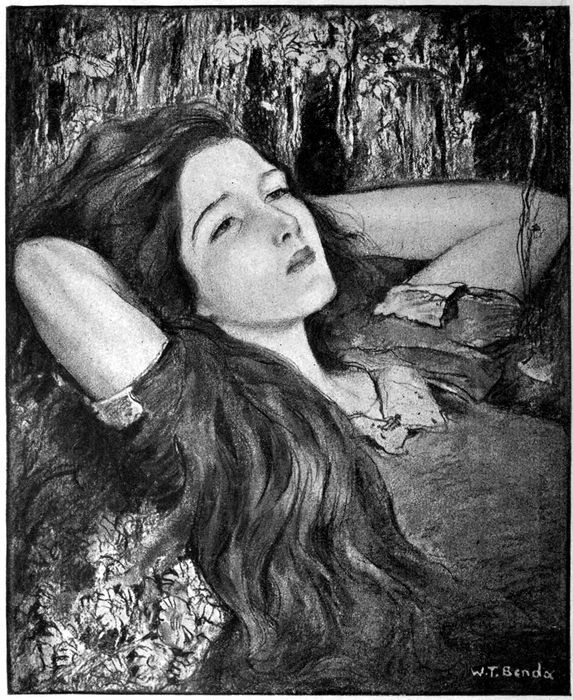
Girt with a girdle of morning-glory and
vetches in full blossom, and twining a great
wreath of heavy corn-flowers round my head,
I lie upon my back in the forest glade.
It is a fine summer afternoon, and sultry.
In the pines overhead there is a faint murmur,
continuous, a little sad; the birches, with
their slender waving boughs, utter a quiet
whisper, but no breeze is to be felt.
As I lie here, I presently fall to crooning a
sing-song chant—not any known air, but one
made up of many tunes, heard long ago, or
never heard at all. The words, too, are either
remembered, or they spring up as I sing. If
the rhyme fails me, I do not break off the tune
to find one, but make an assonance do just as
well. So I sing of a dream I have dreamt,
2and then of love—hot, burning love,—and I
end with an invocation to the Faun of the
wood; for my desire is toward him.
It is warm and still. By fits and starts birds
chirp—so softly that they seem to be whispering.
I half expect to see a chamois, with long
horns curling back from its brow, peep out
wistfully from between the birch-trunks.
The sun, shining athwart the leaves that
quiver, flings mobile twinkling rounds of
light upon the pine-needles. I close my eyes.
A great bright stain appears, followed by a
succession of rainbow hues, ending in a spot
of scarlet flame.
It is warm and still. The scent of wild
thyme is in my nostrils. Behold me, a woodland
nymph, awaiting the Faun of the woods!
I have left my vast ice-plains, my Northern
Lights, my cold silvery dreams among the
stalactites of my grottoes, and have come to
bask in the strong sunshine of life.
And I welcome life with a peal of laughter,
the outcome of many a day of tortured
thought and fruitless pondering. I yield myself
up to it, not from any internal weakness,
but submitting to its brutality with a supreme
3effort that crushes down all repulsion, all
revolt.
Upon the ruins of my mystic dreams there
has grown up a lush rank flower—the worship
of Life and its delights.
And my resignation is ungrudging, royally
complete: for I do love life, in spite of all.
My mind—my cruel, insatiable, gloomy
mind—would have put happiness to death;
but I now trample it down. To-day I will
pluck the flame-red blossom of Life: and my
song shall call upon the Faun!
No Faun comes to my call; but instead of
his hoofs, I hear the gallop of a horse in the
distance. Laying my ear to the ground, I
make sure.
Yes, I know: it is Janusz, coming after
me. So I cease from singing, and lie silent
and without motion; he is riding along the
forest pathway, and I hope he may miss me,
hidden here among the pines. And yet I am
not unaware that, should he ride past and
not discover me, I should feel disappointed.
Notwithstanding, I make no movement. The
only deceit I care to shun is self-deceit.
Janusz, who has seen me afar amongst the
birches and the pines, urges his horse forward,
4and approaches behind me, so that I
cannot catch sight of him. He means (so I
guess) to come upon me suddenly with a rush,
and frighten or flutter me, or in some way or
other throw me off my balance. On which
account, I take care not to make the least
movement, lying with my hands clasped underneath
my head, and looking up at the sky.
He rides at me with a swift run, and reins
in his horse only two paces away from me.
He at once realizes that my attitude is a challenge;
it annoys him. There is a pause. In
order to make me turn my head in his direction,
he keeps his horse standing in the same
place: this is hard to do.
But I too remain motionless, repressing a
desire to laugh. Janusz is, I know, too good
a rider to let his beast tread upon me. I
can hear it snorting impatiently, and its hoofs
pawing the ground.
The flies in the wood torment it so much
that presently it is unable to restrain itself,
and frets forward a few paces, to my side.
And so I can see Janusz. A handsome man,
in a light-coloured jockey’s cap, tight-fitting
trousers, and long patent leather boots; just
now so vexed that his nostrils are quivering.
5Bowing stiffly, he takes his right foot out
of the stirrup, and prepares to dismount.
“You might have failed to see me, and ridden
farther. I thought you would,” I remark,
with a faint uninterested smile.
“As it happened, I did not fail.”
“So I see.”
“Did you want me to fail?”
“I did.”
“For what reason, pray?”
“I was in a very pleasant mood—a sort of
pantheistic mingling with Nature, that requires
solitude to be enjoyed.”
“All the same, I am going to stay,” he says
with a determined air, and carefully ties his
horse’s reins to a pine-branch.
A silence follows. Janusz brushes a few
pine-cones out of his way, and then seats himself
by my side. I sit up likewise, arrange the
wreath of corn-flowers on my head, and lean
back against a trunk.
“Do you not see that we are at odds?” he
asks at length.
“That may very well be,” I answer with
some disdain. “And how did you find out
where I was?”
“I followed you.”
6“Did you, indeed?”
“My balcony commands an extensive view.
Your rose-coloured dress was plainly to be
seen, as you went along the meadows and
fields. You followed the path that skirts the
ditch, did you not? And so on to the wood,
where you disappeared. I followed on horseback
along the highroad: a far shorter way.”
“Yes, your way; straight on, but less picturesque
than mine.”
“Am I to see some hidden meaning in
this?”
“Oh, no, you need not—as you choose.”
Janusz is of those who love “intellectual”
talk; I put forth all the social tact that I have,
and do my best to keep down to his level. I
strive to attract him, not with my good looks,
but with my mental charms, which I have
now enlisted in the service of my physical
self. My coquetry varies in quality as does
the psychical character of its object; and thus
it never fails in artistry. Here I am guided
by the Law of Contrast. For instance, when
I first flirted with Roslawski, I brought into
play the primitive elemental sides of my nature;
though indeed I had later to change
all my tactics. And it is my quality as a
7woman—with my womanly wisdom and wit
and originality—that I am acting upon
Janusz; should I lose half my good looks, I
should still, as a woman, be not less lovable
in his eyes. In the psychology of contemporary
love, this is a significant fact.
Over his handsome clean-cut face, a glow
passes now and again. His eyes are fixed
upon my features. I meanwhile, swift in
change as a chameleon, and bright with radiant
looks and glances, am watching him with
artistic and quite impersonal interest: with
those quivering sensitive nostrils, he makes me
think of some beautiful high-bred animal.
His eyes, which usually beam and glisten,
are at present dimmed and glazed over, as
if their fire had been extinguished, burned
out by the passion within him. Now and
then his eyes fall before mine, and he attempts
to call up a pleasant smile; but in the
attempt his white teeth glitter dangerously.
A gnat has settled on his forehead, and I
tell him so. He waves it away listlessly.
“Let it bite,” he says with a smile; “it matters
little. I have blood enough and to
spare.”
There is a touch of self-satisfaction in his
8voice as he says this. It was then a mistake
of mine to have supposed him unaware of the
nature of his strength. Knowledge of one’s
strong points makes for happiness; he is enviable.
Now he takes up some pine-cones, with
which he pelts his horse playfully. It begins
to kick and stamp. Instead of teasing the
poor brute to no purpose, he ought (I say)
to take one of the trees for his mark; and with
that I go up to the horse. It gives me a distrustful
look out of its beautiful eyes, while
I stroke and pat its neck.
“Miss Janina, do not go so near my beast;
it may hurt you.”
“You were not afraid when it was but now
standing close to my head,” I reply laughingly.
“But I was holding it in then,” he mutters
between his set teeth.
Up he comes, stretching out his hand to
pull me away by force; but I flash him a
quick glance of surprise, and at once he is
subdued.
“I beg you,” he says in a voice half-strangled
with emotion, “I beg you to let me kiss
your hand.”
9He is quite close to me. One instant I am
hot as fire; but I do not draw away from him,
nor put my hands behind me. Standing motionless,
with my half-averted head bent down
close to the horse’s mane, I answer calmly:
“I will not.”
Janusz, with dog-like obedience, shrinks
back, and stands a few paces away.
“Let us go home now,” I say after a short
silence; “but you must let me ride your
horse.”
“With the utmost pleasure; but then, how
will you manage for a saddle?”
“Oh, that’s all right. Even on your saddle,
I can contrive to ride woman-fashion. Only
you will have to arrange the stirrup.”
I leap into the saddle, my foot just touching
his hand. Janusz himself settles it in the
stirrup, which he shortens for me. As he does
so, I once more see a glow sweep over his face.
“Pray allow me to lead the horse. It is
restive, and may throw you.”
“No, thanks; I am not in the least afraid.”
On a sudden, with an unexpected movement,
he catches hold of me, and presses his
face hard against my knees.
At the same instant nearly, I give the horse
10a smart blow with my whip, and gallop away,
not looking behind me; it is not easy to keep
my balance on that saddle.
This I have done, not to escape from him,
nor as being in any sort of fear. It was only
that he should not perceive my flushed face—flushed
neither with indignation nor with
shame.
Janusz has gone to L. for some days. I am
alone with Martha, with whom I enjoy myself
very much. There is no one else on earth
with whom I can share the delight of reading
together wise and beautiful books. As
we read, we become lost in mutual admiration
at the depth and subtlety of the remarks we
make: whence arises a delightful state of
mind in which each loses consciousness of the
other being present. Our impressions are
equally instantaneous, equally immediate; a
look, a gesture, suffices for one to understand
the other. We are growing absolutely similar,
all but identical. Set apart from all that
surrounds us, our minds meet on dizzy
heights, spanned by aërial bridges which
bring our souls together, over the tremendous
gulfs that stretch beneath us; thereon few can
11walk, for the bridges are of gossamer threads.
In the valleys of the mind it is not hard for
two souls to come together; but as one reaches
the mountain-tops, each is farther and farther
apart, and the chasm between them becomes
more and more profound; besides, at the tread
of the first ponderous foot, those bridges of
cunning workmanship, running from peak to
peak, are broken and fall to pieces.
Nevertheless, there is no love, nor even
much liking, between Martha and myself.
We do not so much as call each other friends.
We both agree that, between one woman and
another, no true love is possible; and so we
do not try to cheat ourselves with a counterfeit.
But, though we do not say everything
openly and in words, still we know and understand
one another to perfection.
The one thing that could drive us apart
would be mutual rivalry in love for a man.
Happily, however, Martha holds this to be
out of the question. Ascetically disposed, she
prides herself on the fact that no one has ever
loved her. She likes as a rule to play the
part of one that the world and that men misunderstand
and fail to appreciate. This part,
moreover, she plays very gracefully, she being
12a pretty girl, and no one taking her too
much in earnest.
“My life,” she is wont to say, “is as pure
as a blank page; no thrill is recorded there,
no kiss, no blush. I have no faith save in this
crystal transparency of my being; save in the
knowledge that Life passes close to me,
touches me, grazes me, and yet by some
miracle never leaves upon my long white
robe one streak from the golden pollen of the
flowers she bears; no faith save in the immaculateness
of this my soul, that can travel
through a coal-mine, and yet come out white
as snow. The only article of my faith, the
sole thing I care for, is the conviction that I
shall go through life nobly and beautifully,
in sweetness and tranquillity infinite; that my
passage upon earth will be all sunshine and
loveliness: the blossoming of a rare and
goodly flower. So may I die! Even though
love could give me happiness, I still would
stand aloof from it....”
Yes, but now and then in the dim blue twilight,
she plays Der Frühling of Grieg: and
then I feel that what she says is not the truth.
In her notes there is a tone of longing unspeakable,
that begs, with gentle half-audible
13entreaty ... for something. And that fair
white soul of her is always sobbing with pain,
and dreaming—ever dreaming—of love.
When all is said, I am clever, young, and
good-looking: so I want to live my life.
Nietzsche will not have us forget the law:
For a woman, a stick. Amiel declares she
must love one only, and obey a sex-morality
that has been made for her alone. Garborg
tells us that she ought not to go anywhere
without a governess, so that her future husband
may find suspicion impossible. In spite
of all which, I am resolved to live my own
woman’s life.
Hitherto I have not found out what
femininity essentially is. In the Roslawski
period, I piously believed æsthetic feeling to
be the great typical quality of womanliness.
But now—Ellen Key asserts that the woman
always shapes herself as the man desires. If
then he, the Only One, be a primitive, masterful,
despotic man, am I to season his siesta
and cigar with witty conversation, and bind
my hair and dance and sound the timbrel for
him, whilst to all others my eyes alone are to
be visible, my face hidden under a veil? I
14want to live my woman’s life ... nothing
more. Until, perhaps....
Oh, how hard it is for a girl to bear, upon
her white and shapely shoulders, the awful
burden of conscious humanity!
At times, Janusz is as gentle as a tame
young wolf, and that ravenous look has faded
from his eyes. Then I permit him to kiss my
hands and lay them to his sunburnt cheeks.
When the wild beast within him has for a
while fallen asleep, he has all the kindness,
all the sweetness of a child. Yet even then I
feel the presence of a latent force which may
break out at any time: a force which—I cannot
tell why—seems to me antagonistic.
“How I wish you would allow me to call
you my darling!” he said to-day, when sitting
at my feet on a bank of turf, and touching the
border of my skirt caressingly, like a favourite
cat.
I looked from above at the long lashes of
his downcast eyes, at his scarlet lips, at his
beautifully chiselled nose, and said within
myself: “Why don’t you then? I should
only just set one long loving kiss—two perhaps—upon
15those lips of yours and leave you
without one word of regret.”
“Are you offended then?” he asked, looking
up at me.
I knitted my brows slightly, but could not
keep the corners of my mouth still.
“Yes, I am.”
“But you are smiling. Why do you smile
so strangely?”
And his eyes gaze at me from under his
thick brows—gaze slyly and sweetly, while
the hot blood burns in my cheeks. Never, in
the days of Roslawski and our long-learned
conversations about literature, did I feel such
a sensation as this.
An evening party at the Sedniewski’s, Topolow:
somebody’s name-day. All four of us
go, Martha and I, the grandfather, and
Janusz. Rather a large gathering: girls like
flowers, fresh and bright-hued. Some of the
young men have been brought for the occasion
from as far as Lodz.
I go in, with my cheeks fresh and ruddy
from our drive along the windy road: my
dress is of a beautiful sea-green hue. The
party is quaintly and prettily framed in a
16large low-ceilinged drawing-room, lighted
from above by an antique chandelier, with
tiers of branches that shed sparkling many-coloured
light around. Along the walls stand
many fine old pieces of furniture, and on the
veranda outside an orchestra is softly tuning
up.
As I enter, I make an impression—the usual
one. For a time, whilst every glance is turned
in my direction, I feel as if pitted against
them all. But, though I scarce know any one
here, I am not embarrassed even for one instant.
The sensation of unfriendliness, borne
in upon me from those around, the feeling of
my loneliness in this throng, only produces in
me a reaction of haughty defiance. I should
feel more embarrassed if I did not make this
impression, and should come in without attracting
any attention at all.
As Madame Sedniewska welcomes me, I
overhear a whispered remark on my left.
“Dressed like a third-rate actress.”
This interests me, and I turn round; for I
think the observation, though quite beside the
mark, rather neatly expressed. A tall girl,
dressed in white, English style from head to
foot, meets my eyes, and silently gives me back
17glance for glance. Beyond question it is she.
After all the introductions have been made, I
proceed by choice to converse with her.
Her name is Imszanska; she has an ugly
fiancé and a handsome brother; the most interesting
(I think) of all the young men
present. He asks me politely how I like the
country-side here, and then goes on talking
to Martha, who in her evening dress looks
less comely than her wont, her face being pale
and wearing an expression of unnatural constraint.
We take tea; after which dancing begins.
Dancing is to me a pastime as pleasant as
riding; and I dance splendidly. Again and
again, in one of the long mirrors that reach
to the floor, I see myself and the black arms
which encircle me, my listless form thrown
backwards indolently, sleepily as it were, my
red lips contrasting with the white of my set
teeth, and sea-green gauze floating round me
in loose watery undulations; while about my
figure twine the elastic snake-like stalks of
great white nenuphar blossoms.
I am soon aware that I have made an impression—an
impression so palpable that the
women themselves pretend to be, not only unconcerned,
18but pleased at my success. One
of them is so kind as to set a hairpin straight
for me. At such an entertainment, the struggle
to be first, though depriving it of some of
the pleasure which it should directly give,
affords us the interest of a game in which, the
harder it is to win, the more intoxicating the
victory becomes.
After the cotillon, which I danced with
Imszanski, I stood up with Janusz for the
“Oberek.” He is a perfect master of ceremonies,
and as such he is sans peur et sans reproche.
I like to dance with him most of all. He
bears me along like a runaway steed. Careering
in a tiny orbit, towards the centre of
which we lean all the time, we turn round and
round with vertiginous speed, like two planets
run mad. Locked in each other’s arms, carried
onward by our own impetus, we glide
along with half-closed eyes, involuntarily, all
but unconsciously, with a passive motion, as
if by ourselves unable to keep so tremendous
a pace. Around us we perceive only a confused
mass of thick clotted brightness; the
lights, the mirrors, the brilliant circle of
lookers-on, are no longer distinguishable as
19they fly round us: all is merged in one maze
of colours.
A wild flame is gleaming in my partner’s
eyes, and their pupils are sparkling like sunlit
diamonds. Our maddening pace, together
with that dancing tune, boisterous with its
musically monotonous din, are acting upon
him as a war-dance acts upon a primitive race.
As for me, though his hot breath is on me
like a flame, I feel quite calm. Tired out,
almost fainting, I meekly let his wild “ravishing
strides” carry me along as he chooses.
At last I go back to my seat; a deafening
thunder of applause greets us both; I bow
my head to thank them, but can for some time
distinguish nothing. Meanwhile I hear
Janusz, who has regained his self-control, and
is now ordering the orchestra to play the
“Mazur.”
Miss Imszanska, coming up and seating herself
by my side, says to me: “You dance with
all the grace of a swan; my brother says he
never saw anything like it.”
In the intervals between the dances, we
walk in the garden, which is extensive and
full of trees. The white flowers of the tobacco-plants,
just visible at night against the
20blackness of the sward, breathe forth their
strange and intense aroma. A sort of drowsy
hallucination takes possession of me: I fancy
I am on earth no longer, but in some Hades
of flowers, of sweet sounds, of beautiful
things, and of Night triumphant. I lean
heavily on Janusz, almost nestling in his arms.
My smile gleams white in the dusk, and my
long eye-lashes quiver as with sleep. Janusz
bends over me, and his gaze seeks to meet
mine.
“Look at me!” he whispers, glowing with
impatience.
I too am all aglow; yet I turn my head
away, and look stubbornly at some cluster of
bushes at a distance. But all the time my
heart is beseeching him, and saying over and
over: “Kiss me, kiss me—now—now—now!”
A moment before, a dress was still looming
in the dark in front of us; now we are quite
alone. Our eyes have begun to make out the
shapes of things; we can discern the trees, and
the long narrow strip of pathway where we
are walking between two hedges of quickset.
Black cloudlike shadows seem now to flee
away, now to gather and close upon us.
21Suddenly a spasm of horrible unearthly
dread clutches at my heart.
“Good God! Look there!” I cry.
“What—what of it?”
I raise my hand to my eyes, and shudder all
over with fear, and press close to him.
“There—just beneath us, far, horribly far
down—there is water!”
“Well, what of that? There is nothing to
be frightened at. I know the garden; it is
only a brook which feeds the pond.”
“Let us go away—away at once. I saw
it glitter through the leaves in the dark: it
was so strange! And so deep down: an abyss
where I never dreamed the ground sloped at
all.”
“But we could not fall in: there is a stone
barrier.”
“No matter,” I whisper, half-frantic with
dread. “Let us go!”
We make the best of our way back. Janusz
is silent, but I feel, as I am holding to his
arm, that he too is trembling. He might have
quieted me with the words: “Fear nothing by
my side!” For but a minute ago, I had
boundless confidence in him. Now I know
that he can be frightened.
22We hear the sounds of the harp and the
violin, and a row of lit windows shines on
the pitch-black trees.
Janusz breaks the silence. “I have no fear
in a forest at night; I fear neither robbers nor
wild beasts: but things one cannot explain
are not to my liking.”
Yes, I quite understand, and share the same
dislike: but somehow I had a fancy that....
We dance merrily till morning; my painful
impression has quite faded.
As we return, we change places; Martha
goes with her grandfather, and I am with
Janusz. Daybreak shows us a lovely landscape:
hills covered with dark woods, fields
white with stubble. The sky grows rosy, and
we catch ever new glimpses of dim heights,
of solitary pear-trees scattered in the fields, of
tall sombre poplars in rows, marking the
highways in the plain.
We travel long by a road full of deep holes;
we climb the heights, we go down into the
valleys. All the country round is enchantingly
beautiful.
Up comes the sun, casting upon the road
distinct mobile shadows, lengthened out monstrously,
23of our two equipages and of our own
figures.
I feel stupefied after this sleepless night;
my face is hot, my lips are burning. Yet, and
in spite of my plaid and the rugs, I shiver
with cold, I close my eyes and lean my head
against the back of the carriage, listening to
the screaking wheels, to the trot of the snorting
horses, and to the timid chirruping of the
birds, just roused by daylight. Though
awake, I am dreaming.
Janusz bends over me, and touches my lips
with his in a gentle kiss, as if he meant not to
wake me.
I do not move at all, and pretend to sleep
on, though well aware that Janusz knows I
am awake.
And now my golden morning—here it is!
On one of the last warm summer days,
Martha and I go and bathe together outside
the park. When undressed, she is very pleasant
to look upon. She pretends to object, but
puts on her bathing-dress so deliberately that
I can gaze quite at my ease. After having
bathed in the clear cool water, we return and
lie down on the lush grass in the park. We
24are surrounded by tall trunks, bare to a great
height; far above us their branches form a
canopy of bright green verdure under the
blue sky.
“I wonder,” say I to her, “how plain people
feel about themselves. With us, comeliness
is such a matter of course!... If I
were to lose my good looks, or even my knowledge
that I am good-looking, I really think I
could not bear life.... It is that alone
which gives me strength in presence of others.
I go out in the full glare of day without a
sunshade; in company, I sit with my face
turned straight to the lamplight; I walk in
the crowd, with head erect, fearing no one,
abashed by no one—simply because I know
that the sight of me must cause pleasure....
If I am good-natured, it is because of
my good looks. I hate nobody, envy nobody,
and am filled with a sort of Pagan, sunshiny,
royal love for all.”
“And which of us two do you think is prettier?”
asks Martha.
“I don’t know.... In reality, each of
us thinks herself prettier; but we are both too
cultured ever to have tried conclusions on
that subject.”
25Strictly speaking, I am not so fair as she:
but then, she is less graceful than I. Besides,
my eyes have a golden tint, such as no other
girls have, so far as I know.
I often walk a few versts with Martha, as
far as the “Kirkut,” or Jewish cemetery.
There they stand, the hewn gravestones, in
long parallel upright rows. Upon them you
may see cabalistic signs and symbols; a lion,
a broken taper, or a shelf of books; and certain
embellishments that might almost be
styled “decadent.” The graves, overgrown
with moss, heather, and wild thyme, are
nearly level with the rest of the ground. The
wooden inclosure, over which we always have
to climb, is lost in the woods among the pine-trunks;
and those long regular rows of stones
raise their heads in a forest elsewhere untouched
by man. Here, I feel as though I
had gone far back into the dim immemorial
Past.
I love that burial-ground; I love to contemplate
Life trampling upon Death; and as I
gaze, I cease to fear Death any more. Death
makes away with the individual only, with
the accidental manifestations of Life: Life
26itself remains. I see myself standing for the
whole of mankind, and identical with Life. I
always was; I shall be everlasting.... Death
is slumbering quietly beneath my feet.
And with that a delightful sense, as it were
of infinite might, comes over me. To my
power, to my continuance, I can find no limit.
I am not of the earth, I am not Janka
Dernowicz; I am eternal, unsleeping consciousness;
I am the Universe! In this
burial-ground, Janusz grows dismal, and
holds forth on the evanescence of all earthly
things. A beautiful animal which lives in
fear of Death!
What if it be true that animals have no
souls?
At times I experience the pangs of an entirely
unjustified longing for the man who
came into my life and went out of it like a
hurricane. Yes, now and again I long for
my ice-plains and my Northern Lights!
Once he asked me whether I should never
wish to feel and think and strive along with
some companion in life.
Then I burst into laughter; for I hate sentiment—hate
27to mix up love and “brotherhood
of souls.”
Now I am near thinking that this man,
whom I never loved, may be the only one fit
to become my husband.
Often of nights, lying awake and staring
into the darkness with wide-open eyes, I feel
burning lips, lips famished with hunger, that
are pressed to mine....
And when I seize the kiss upon those lips,
I know that they are the lips, not of Roslawski,
but of Janusz.
And then I am full of terror lest an evil
thing has been done that never can be undone—lest
something may have fallen away for
ever out of my life.
Then do I no longer feel any desire for any
one; and I weep in the dark, but silently, not
to awaken Martha.
In the morning, I look upon Janusz with
hatred and with loathing; and I treat him
harshly, though he is indeed in no wise to
blame. I merely use him ill, because my
soul is a-wandering alone over those ice-plains
of mine, is still dreaming cold silvery dreams,
is seeking in vain for a fraternal soul.
28Is it then really an impossibility to be in
love without loving also?
While out shooting to-day, Janusz had just
such a gleam in his eyes as he has when he
gloats on me.
He is a typical primitive man of a nomad
race of hunters, in whom the instinct of conservation
manifests itself as vehemently when
procuring his own subsistence as when acting
for the preservation of the race. Game
is to him a vital necessity; so is woman.
I was sorry for the hares he had killed and
lectured him with great unction on man’s cruelty
in taking the lives of such defenceless innocent
creatures.
Just now I was thinking how I should like
to lock Janusz up in a nice cage, and have
him all to myself. I should give him plenty
of food, but neither let him read (that prohibition
he would not find very hard) nor
talk to any one; so that he, with all his treasures
of vitality, might be mine alone. And
occasionally I should enter the cage.
I should then be far more spiritually disposed
than I am now. At present, my splendid,
primitive, untamed beast is hungry and
29howling, and mars the divine symphony I
listen to in my dreams of light.
I should appease it, and go out to walk in
my sacred grove, along the margin of the
dark abysmal lake which is in my soul.
And I should willingly have Roslawski to
walk with me there!
Janusz has asked me if I would consent
to become his wife.
“If only for a month or two, I would with
pleasure,” was my truthful reply, which I
afterwards turned into a jest: not a nice one,
I must say.
Janusz darted one or two angry looks at me,
and gave vent to this aphorism: “There are
things one should never jest about.”
Most certainly he is right. And all this
begins to worry me just a little.
I might perhaps fancy myself playing the
part of his seductress; of his wife, never.
And what to do with him now, I can’t tell.
I should like to go away now. Oh, why
has all this come about so suddenly?
Out boating late in the evening, on the
great pond beyond the park.
30I have consented to come here, for I am so
wretched, I want to die. And I know that
Janusz, whom I have been tormenting all day
long, can no longer control himself.
His nerves are racked to the very utmost;
it is my doing. He clutches me by the shoulders
and holds me down to the side of the boat
with an iron grip. To get the better of his
mad fit, I keep myself very passive and cool.
“Hear me, Janka!” he growls between his
teeth, his face close to mine, “you! listen: I
am speaking for the last time. Say Yes!”
I could disarm him with a single cry of
pain or fear: but I remain mute. I must
have strong sensations to-night.
“I’ll kill—I’ll kill you! Do you hear? I
hate you as much as I love you, and more.
Speak instantly—speak!”
His rage is suffocating him; the words stick
in his throat. His knee is pressed hard upon
my bosom; his nails dig deep into my flesh.
With all my strength I stifle a groan, and
wait. The boat is careening over more and
more, and begins to be water-logged.
“I shall drown you! See, the boat is about
to go down! Say Yes!”
Quietly, silently, I look into his wild burning
31eyes, of which the whites gleam through
the darkness and fascinate me.
For an instant I have a desire to close my
eyelids and disappear, sinking noiselessly
into the dark water. My eyes nevertheless instinctively
encounter his.
Suddenly I feel that the grip of his
clenched hands is growing weaker.
Now sure of victory, I whisper, “No!” with
a smile.
Janusz, uttering a cry of pain, falls back
into the boat. He presses his forehead hard
against my feet which he covers with kisses,
and is swept by a storm of convulsive sobs.
The boat recovers her balance, and rocks up
and down violently.
But I am the reverse of elated by my victory.
For now I can no longer believe in the
omnipotence of mere physical strength, which
has just shown itself less mighty than the
power of Mind.
Had Janusz continued to grapple with me
thus for a few seconds more, I think I might
have given way to him. And now I envy him
the incomparable joy of acknowledging my
predominance.
The warrior does not delight in triumphing
32over one less strong, but in confessing the
power of him that has been found stronger,
and by whom he has been overcome.
Over this writhing figure, shaken with sobs
that grow fainter and fainter with fatigue, I
look out far into the night. No moon, not a
star. And the rushes along the shore keep up
an incessant rustling.
And the dark lake, my soul, is looking up
with unseeing eyes to the dark sky.
All around is dead: no life anywhere.
Nothing remains but my loneliness—the unbounded
loneliness of my strength, self-centred
and unparalleled.
Never yet have I felt my power so
strongly, and never yet has it made me so sad.
The black sky bends its lowering vault
above me; under its clouds the black pond
lifts up swelling waves. Between the Infinite
and my soul, there is nowhere any room for
strength.
Oh, “I am so weary, weary of these
heights!” How I desire to meet with a force
able to subdue mine!
“Pray, Janusz, pray get up,” I say, gently
stroking his hair; “I beg you, rise; it must
be very late. Where are the oars?”
33I am lying in the hollow between two rows
of graves, breathing the perfume of the white
forest gilliflowers, abloom in the “Kirkut,”
and thinking of life—of this most admirable
and most beautiful marvel, life. I am explaining
to Martha how my worship of life is
really the outcome of resignation.
“But in me resignation has taken a form
that it has not in you. ‘If I cannot have all,
I refuse to have anything;’ such is the creed
of despairing pride, held by slaves and
wretched men. My belief in Azoism is nothing
but the creed of a proud woman, who is
reconciled to her slavery, and will take up no
spurious imitations of freedom. Such a withdrawal
from the vortex we live in, enabling
me to look on all things as Garborg does,
from above them, and with a smile of dignified
amenity—this is what I love. It often
seems to me, so little I feel adapted for my
life on earth, that I have somehow wandered
hither by a mischance, a blunder.”
“It is well,” says Martha. “Adaptation to
environment is of avail only to brute animals:
man can make his own world by viewing it
in his own special way.
“I,” she goes on to say sadly, “believe in
34nothing. And yet women in general are inclined
to have faith in an existence after
death. It is simply an outcome of sympathy
with suffering, and of an instinct of justice.
You know how the thought of useless suffering
in nature makes me beside myself. Think
of all those silent agonies which never will be
known; of those tortures endured throughout
the world by multitudes that leave no trace
behind them.... When but a little boy,
Janusz once focussed the sun’s rays on a little
insect he had fastened by its wing, and which
was writhing in impotent throes. I can still
see those poor limbs, red in the glow, quivering
in excruciating pain, until I snatched the
lens away from Janusz, and set the half-roasted
creature free.... Those were its
last impressions of life: after them came—Nothingness!
I can see all the tiny invisible
beings that I slay by hundreds in my daily
walks, trampling them down in the long grass
or under the pine-needles, and unwittingly
leaving them to expire in the most dreadful
torments, perhaps drawn out for many an
hour.... I know, too, of the pain which
fishes undergo, often kept living in the air
for whole days, and seen to move convulsively,
35even when on the fire.... All this
pain, and nothing to justify, nothing to compensate
it! This I know; for beyond death
there is nothing!”
“But did it never strike you that, if there
is nothing beyond death, it is impossible for
nothingness to be there?”
She looks at me inquiringly.
“The ideas of justice, of vengeance, of compensation,
are purely of this earth, though
they once formed a religious ideal in the worship
of Jehovah. I put them in the same
category as the concept of mercy, now prevailing
amongst Christians. Some other idea
will spring up later, equally foreign to that
of existence beyond the grave.”
“Well, and what do you infer from that?”
“My belief is, that the phenomenon called
death consists in our losing all sensations,
‘categories,’ concepts and all projections (so
to speak) of this our world; and in our finding
other sensations in the next. Perhaps not
even that. For in the next world, just as there
will be no idea of justice, so there may be
none of sensations. Do you follow me?”
“So you think you shall continue to exist
then?”
36“I cannot say—I cannot say.”
For a few minutes I listen to the undertone
of the pine-trees, sounding far above us in the
sky.
“You see,” I continue, “there, it may well
be, we shall have no idea of an Ego which
excludes and contradicts the Non-Ego. The
distinction between them has arisen from the
fact of our existence upon earth: it is a form
into which we mould our impressions; something
purely accidental, depending upon the
quality and mechanism of the brain....
There, too, the idea of Time may be wanting;
also that of Space. Of course, from our earthly
point of view, it is nonsense to say that the
world is boundless: that which the brain calls
‘the Infinite’ cannot be represented in imagination
as space. Truly, there are times
when I simply feel admiration for a God who
has created so great and endlessly complicated
a scheme of beings.”
Martha’s disappointment is plain to perceive.
“So then you believe in God?”
“I do not know, and do not trouble about
it. It is not likely the ideas of creation out
of nothing, of sovereignty as opposed to subjection,
37of volition as opposed to passiveness,
have any counterpart out of our minds....
Notice, Martha, that in my view the expression,
‘Transcendental Being,’ implies a contradiction.
Our very idea of Being is a mere
outcome of experience: and I go so far beyond
Nature, I leap so completely out of my
human skin, that I can force myself to the
contemplation of an unimaginable world, in
which there is no contradiction between Being
and Non-Being....
“Therefore, I do not trouble whether I
shall in that world be myself or not myself:
nor even whether I shall be or not be....”
She gazes at me, her eyes wide open, and
says under her breath:
“Yes, I see.”
“And, do you know, the capacity of thus
abstracting one’s thought itself from its outward
form, of looking upon the universe and
one’s very thought from such a standpoint,
sets one on heights incomprehensibly sublime,
and gives the purest, the most unearthly
delight.”
... There is a black cat here, with
eyes like emeralds; it ranges noiselessly
amongst the rows of gravestones. A singularly
38sociable creature; it follows us everywhere
in our walks, like a dog.... When
I look at it, I cannot help believing in
Metempsychosis: there must dwell within
this cat some very refined aristocratic soul, one
that looks upon everything with supreme
scepticism.
“What is the matter, Martha?”
“Nothing. I have only dropped a hairpin.”
A tortoise-shell pin has fallen out of her
thick black tresses, and dropped on to the
earth with a faint sound.
Martha is just now in a very lofty mood.
This real world of ours strikes her as a contrast,
ridiculous in its littleness, to the world
we are speaking of. So she does not wish
me to pick up that pin, though it has dropped
quite close to me on the heather. To my
mind this is too high-flown, too girlish.
After all, the realities of life are paramount,
and we ought to have so much intellectual culture
as never to forget it.
Wherefore I give her the pin, smiling very
sarcastically.
“After all,” I conclude, rising from the
hollow ridge and preparing to walk home,
“I quite understand that what I have said
39amounts to the same as belief in nothing. It
is all the same to me whether I shall cease
to be after death, or be transferred to a world
wherein there is no idea of being, or of any
Ego, conditioning my self-consciousness. I
understand, too, that a world in which Being
does not contradict Non-Being, is to our
minds equivalent to no world at all. So that
my faith is similar to your unfaith, but inferred
and formulated otherwise.”
Janusz is very humble and wretched now.
Sometimes, when we sit long together of an
evening, he will fall asleep with his head in
my lap, worn out with nervous exhaustion.
And then I am face to face with something
very strange.
I feel a mysterious dread of the torment of
an everlasting vigil, together with a sense of
responsibility beyond my strength. Yet I do
not wake him, although I am shuddering with
dread; I will not let him know that I am
afraid!... There are certain things one
should not speak about to children....
That I love solitude when alone, but that the
feeling of solitude when some one is by me,
fills me with unspeakable dread, for then I
40hear my soul uttering her triumphant laugh:
this I would never confess to him.
Vigorous I am, and able to struggle for a
long time. But even for warriors there come
moments when they trustfully lay their tired
heads on some one’s lap; when they feel secure
in the knowledge of some one above
them, watching over them, standing between
them and their foes, between them and the
Infinite, the Unknown.
Is there any man in the world who could
thus lull my watchfulness to sleep? There is
one, only one. But the price I should pay
would be all that makes life charming.
When Janusz is sleeping on my lap, I then
invariably think of—Roslawski.
As a rule, it is from a novelist’s or an artist’s
standpoint—from without and objectively—that
I view whatever happens in my
life; consciously throwing all my impressions
into the form of sentences, rounded and complete,
often affected and unnatural; and in
everything I say, think, or do, seeking for
dramatic, literary, or picturesque effects.
This peculiarity I hold for one of the tragic
41sides of my life, since it almost entirely robs
my impressions of their directness.
People sometimes blame me for being mannered,
for attitudinizing, for performing
everything with artifice, whether I make a
bow or do my hair. And I fully admit they
are right. But then, artificiality comes naturally
to me. Every motion, every smile of
mine is present to me before it is elicited: it
is scrutinized and judged by me, as though
I were some one else. For me, there is no
present; I look at all things from out of the
Future: there are no involuntary bursts of
thought, no inarticulate words or mechanical
gestures for me. And should I try to behave
with apparent artlessness, I should then be
artificial twice over.
This afternoon a carriage, covered with
mud, and drawn by a couple of splendid
sorrel horses, pulls up in front of our terrace.
Imszanski jumps out, throwing the reins to
the groom, who sits behind. Janusz welcomes
him, and he slowly comes up the steps.
He has driven thirty-five miles, but his impassive
features bear not the slightest trace
of fatigue.
42He improves upon acquaintance. Beyond
all doubt, he is the handsomest man I know:
a great point in his favour. His movements,
characterized by a certain graceful languor,
betray his noble descent; in his bright eyes
there is to be seen continual concentrated
thought and tranquil, half-forgotten sorrow.
He has every accomplishment, talks interestingly,
elegantly, with literary turns and expressions;
he has at his call every variety of
smile but never laughs outright. Considerate
restraint is his speciality.
His first words on entering are: “My sister
sends you her greetings: she wanted to come
with me, but I was afraid to take her. It is so
long a journey, and the roads are in so bad a
state now.”
He pays court both to Martha and to myself
with equal politeness; with her he is
more serious, with me more gallant. Which
is the proper thing, as I am a visitor in the
neighbourhood.
I am all but enchanted, and my eyes are
continually fixed on him. And yet at the
same time I know that this paragon of a man
could never succeed in winning my love.
From a physical point of view, I care even
43less for him than for Roslawski. This, I suppose,
is precisely on account of his marvellous
beauty, which may draw off my attention
from him as a man and an intelligent being.
I could gaze with just as much enthusiasm
on his portrait.
We go out to inspect some new kinds of
ornamental shrubs which Martha has recently
had planted in the park. Janusz walks
with me; Imszanski with Martha, a few
paces before us.
These two make a pretty picture, on which
I like to gaze. In this grand old park, they
remind me of the days of yore, and the
knights and their lady-loves. Martha, I remark,
has a style and breeding that I lack.
To help her over a plash of water, Imszanski
gives her his hand. She gathers up her dress,
just revealing her neat and shapely ankles.
The pair are just like dancers in a minuet,
and so handsome that I cannot find it in my
heart to envy them.
Janusz walks at my side like a shadow, and
follows my glances with eyes ablaze.
“A fine man, Imszanski: you like him,
don’t you?” he asks. “But,” he goes on to
say, “I don’t advise you to try your hand on
44him: he is another’s. Has loved long and
hopelessly.”
“Has he?”
“When in Warsaw, he went the length of
attempting suicide—unsuccessfully, I need
not say.”
“But this love of his, is it not only hopeless,
but unrequited too?”
“Well, he proposed—and was refused.
But that’s no wonder. Such a man should
never marry; a whole seraglio would not be
enough for him.”
“H’m, yes; that would be quite in his line.
Who is the girl? Does she live near?”
“Yes, she does.”
“And who may she be? Please tell me.
Was she at the Sedniewski party?”
“Don’t ask; I must not tell. It has been
kept secret.”
“But did anybody confide in you?”
“Why, no.”
“Then I have as much right to know as you
have. I am awfully curious, and wonder at
the girl’s taste.... Do I know her?”
He holds out for some time, but in the end
I disarm him: though in the way I dislike
most and very seldom employ, ... by
45wheedling and coaxing him. The secret shall
go down to the grave with me, I promise him.
He hesitates awhile; then says in an undertone:
“Martha.”
I do my best to conceal my unbounded astonishment
under some commonplace expressions
of faint surprise. I obviously have not
the slightest intention to keep my word: I
will ask Martha about the whole business.
Can she possibly not be in love with such a
Phœnix? Can she too have found him undesirable
because of that beauty of his?
During supper I watch her closely, and
see in her face that very same pallor, that
very look of weariness and constraint that
she was wearing in Topolow. No, his love
is certainly not unrequited.
I have no fondness, and consequently no
fellow-feeling, for the girl: but now I am
more interested than before in her theory of
“Azoism.” I formerly thought she had
taken it up as an apology for her life; now I
see that her life itself compels her to
profess it.
Imszanski himself is always the same,
courteous and languidly good-humoured.
46He is talking with Martha’s grandfather
about this year’s crops, and looking quite interested
in the subject.
It is a cool windy autumn day. Clouds are
floating close to the earth, rain is in the air,
and no birds are seen. Along the woods
stretch the fields, either already harrowed, or
covered with dingy whitish stubble. Something
has gone out of my life forever: I cannot
get rid of the thought.
We three are riding together over the desolate
plain. Janusz rides in front of us, playing
acrobatic tricks on horseback, and really
performing wonderful feats of agility.
But it is now ebb-tide with me. Those
tight trousers, those raw leather boots of his—I
hate them, and scorn myself for having
let that sort of thing ever make any impression
on me; assuredly there is nothing in all
this that is worthy of scorn.
Autumn has come. That is all.
We come abreast upon the muddy highway,
all three strangely sick at heart. In silence
we ride on.
Latterly Janusz has altered very much.
His face is pale; it is the face of a man lost
47in troubled thought. When we are by ourselves,
he scarcely ever raises his eyes to
mine; and his outbursts of energy resemble
the frenzy of delirium. After the equestrian
evolutions just performed, he looks wearied
and gloomy, and his lips are closed fast as he
rides.
Why is each of us thus? I alone can tell.
Because Martha is thinking of Imszanski, and
Janusz of me, and I am thinking of Roslawski.
It is just like a novel: each of us as remote
as one star is from another.
I got a post-card from Obojanski yesterday,
saying he had come back; so I shall have
to be off in four days. I must then see Roslawski,
who has no doubt returned to Warsaw
by now. A fever of impatience possesses me.
On my return, I lie down on the drawing-room
sofa, still in my riding-habit.
Martha, as usual, is journeying from pantry
to cellar, Janusz has gone to dress for supper;
“Grandfather” is probably asleep in
some nook. I feel maddened with impatience
at the thought of seeing Him again. I tear
my hair, sobbing noiselessly and without
tears.
My misery is at its height. And now, besides,
48I feel this: that I am sorry to go away—sorry
for Janusz. Something there is
within me, tearing at my soul—tearing it to
bits, to shreds, to tatters.
I hear Janusz coming, take up an easy recumbent
attitude, without rising from the
sofa, and arrange my hair.
“What! you here already?” I remark in a
peevishly flippant tone of inquiry.
He does not reply, but draws near with
noiseless reverent steps, in an attitude of supreme
worship, such as an idolator may pay
to the idol he distractedly adores. Kneeling
down before me, he gently takes my hands and
presses them to his brow. I do not withdraw
them. I lean forwards instinctively.
“Janka, listen,” he says tenderly, in a voice
that trembles with suppressed emotion; “say
that you will be my wife; say so, my dear....
You know what you have made of
me.... You laughed at me for my sober-mindedness,
my shallow outlook upon
life, my thoughtless joie de vivre. Now I am
quite different.... Now I am like you,
and like the rest of your set.... Could
I ever, in the old days, have thought it possible
that I should become like a child—crying
49my eyes out at the thought of your going
away, Janka? I have nothing in the world
to console me but you ... Janka, since
you told me you were sorry for the hares I
had killed, I have not gone out shooting any
more.... Oh, I shall not struggle with
you, I should not get the mastery; but as your
slave, I beg you, I entreat you, be my wife!
Oh, my adorable lady, my most sweet one, say
but that you will! You will be happy; you
will see me do everything, everything to
please you.... You will live like a princess....
If you will not give me this assurance,
I shall go to ruin, indeed I shall. Janka, I
will leave the University without taking my
degree.... I will follow you everywhere on
earth. Martha, too; does she not love you?
And does it matter to you if you say Yes now?
Nothing hinders you from saying the word;
I even think you love me just a little....
Oh, Janka, Janka!”
He ends with a burst of tears. My head
bends down to his, and we both weep together.
In turns I am rent by compassion for
him and by my longing for Roslawski. I kiss
his black silky curls, and we cry like children.
50Finally we agree that I shall go to Warsaw
“to take counsel with my family and with
my own heart”; and I am to give him a definite
answer in a month’s time.
By then I shall surely have seen Roslawski—and
everything will have been settled: for
life or for death.
Every morning, the trees in the park are
now white with hoarfrost, and we find the
threshing-floor in the barn covered with
many a steel-blue swallow, lying frozen to
death. The stoves are heated, the windows
hermetically closed (for the time being), and,
though autumn has but just commenced, we
are in winter quarters already.
In the calm white country house, sleep
reigns supreme.
The wild wind howls through the sombre
shrubberies, and sweeps showers of drifting
leaves, green but frost-bitten, along the walls
of the park. Through the windows I look
out into the cold bleak night, a night of desolation
and evil omen: such a night as one
might expect to bring us mysterious half-frozen
travellers who have lost their way;
and on this very night they should come
51knocking at the door. The old, faithful, superstitious
servants should mutter the saying:
“Some one has hanged himself, the
wind is so high,” and the dogs should howl
together mournfully.
There is no light save in one window, by
which, through the broad chinks in the shutters,
its bright streaks filter out into the park.
The maids are there, keeping vigil as usual;
Janusz and the old man have gone to bed and
have long been asleep.
Around there breathes that stillness and
quiet sense of security which a winter night is
wont to bring with it—an atmosphere of
repose.
I am kneeling by the fire, in a plain dressing-gown,
with my hands clasped behind my
head, and my eyes fixed upon the flames.
Flashes of red light up my dark face and my
chestnut hair. Now and then I put big logs
on the fire from the heap close at hand; I
like to resemble a vestal virgin.
Martha, partly undressed and without her
corset, lies dejectedly smoking a cigarette on
a rose-coloured couch, not looking in my
direction.
She absent-mindedly strokes a cat, which
52lies close to her and purrs loudly, pretending
to be pleased but cross in fact, because she
wants to sleep, and Martha prevents her.
“I shall be so bored when you leave us,
Janka,” she says. “There will be a sad void
all over the place.”
“Then come with me to Warsaw.”
“Somebody must remain to keep house at
Klosow; besides, Grandfather cannot be left
alone. I shall not be free till after a year’s
time, when Janusz has finished his course of
agronomy.”
“Do you know, Martha, you remind me of
a heroine in an old-fashioned novel and I
don’t care for variety. You are too goody-goody.
Such a pity as it is to waste a year
of one’s youth.... You may quite well
leave everything to the steward’s care....
Remember, you will soon be twenty-five, and
life never goes back.”
“But I am glad—how glad!—that it does
not.”
“That’s a pose, or a mere high-flown mood.
You love life in spite of all.”
Turning towards her, I meet her earnest
gaze—calm, and yet, oh! how mournful!
“I hate life, Janka!” she replies.
53Silence follows. The cat leaps from off the
couch, stretches herself, and makes for the
fireplace with leisurely velvet tread. She
rubs herself against me, lies down in the full
glare of the hearth, and instantly falls asleep.
“Once,” Martha continues, “I saw them
kill a black sheep, as I had told them to do.
A clean-shaven old farm-labourer first tied its
legs, and then sharpened his knife on a whetstone
for a long time. Finally, he turned its
beautiful tapering head on one side, and deliberately,
skilfully, drew the knife backwards
and forwards across its throat. And
the poor animal did not so much as shrink:
never did it once bleat, or show the least sign
of reluctance. I wanted to run away, or cover
my eyes, or at least turn from the sight: but
I forced myself to undergo that internal
agony, in order to atone for the quiet death of
that meek, harmless beast. I asked the labourer
afterwards whether he was not sorry
for killing it. He answered me: ‘Why
should I be? It was my lady’s order. I
would cut a man’s throat for her, if she told
me to.’
“Once my threshing-machine killed a man.
Corn had been stolen, and I had to watch the
54men by myself, the steward being away at
the time. They had stolen it, because I
had more than they.... I remember the
man leaning forwards incautiously—a horrible
cry—a dull grinding sound—and a sudden
silence. The machine had stopped; out
of it they took only a bleeding mass. I made
the dead man’s widow a life-pension, and saw
to the bringing up of the children. And because
of that, they call me benefactress and
angel!
“Or again. A woman of seventeen died in
childbed. Three days and three nights she
lay howling in the farm-servants’ quarters,
howling like a wounded beast, so that I could
hear her even in my own room. Well, she
died at last; but the boy survived. He is now
three years old, he laughs in the sunshine, cuts
earthworms to pieces for a pastime, and tears
off cockchafers’ legs.
“Kosa, a peasant here, had a son who was
dying slowly of consumption. The priest was
sent for, and brought him the last sacraments.
Outside the hut, he had to bargain with Kosa
about the burial fees.
“Once, in our pond, the loathsome swollen
corpse of a new-born child came floating to
55the surface. What harm had it ever done?
Possibly it was put to death because its life
of a day or two had made it the instrument of
some wrong done!
“Janka, I hate life!”
“Listen,” I say, casting my eyes down. “I—I
don’t know how to begin; that is, I wanted
to tell you that it may be I am leaving you
only for a short time. In a few weeks, I shall
perhaps be here again.”
“I wish you would,” she replies. “Janusz
is in a pitiful state.”
Another pause ensues. I am thinking how
far indeed I am from such a wish; and I feel
something rising in my throat. Suddenly I
decide to speak now.
“Martha,” I say, “tell me the reason why
you refused Imszanski.” She starts, and
stares at me with eyes like a frightened deer’s.
“Fear nothing,” I say, reassuringly. “You
must not think I shall inflict compassion on
you; I am only calmly and objectively interested.
Tell me: can you possibly not be in
love with so amazingly handsome a man?”
She is silent a while, debating with herself;
and then:
56“Yes, I was in love with him,” she replies,
in a calm low voice.
“Well, and have you sacrificed your happiness
to that abstract theory of yours?”
Another pause.
“Not exactly.... The fact is that I simply
could not bear to think I had not been his
only love.”
There she stops, but I feel she is only waiting
for me to question her further: this is
the moment when she must lay bare to me
what she has hitherto, with her wonted secretiveness,
concealed from every eye. Yet I
refrain from questions.
Again she speaks, slowly and as one that
looks back on memories that are still fresh:
“We often spent the winter evenings together.
His soul was the thing nearest and dearest to
me on earth, but I loved him yet more because
his eyes were so mournful and his lips so fine.
“He may have been too outspoken: he desired
I should know all about him, before I
plighted my troth. I wish I had known nothing;
there is bliss only where there is ignorance....
For there have been some instants
of forgetfulness; and these have given
me an inkling of what my happiness would
57have been—how immense, how incredible—had
I been his only love in the past, as I am
(it yet may be) his only love in the present.
“It was on a most beautiful winter’s night,
silvery in the moonbeams, that I saw it pass
before me, that long procession of women, fair
as the flowers of spring: ‘a connoisseur in
women’ is what they call him. A whole garden
of red flowers sprang up in the snowy
wilderness, shining afar like a great pool of
gore. I closed my eyes with the torture of
the sight.
“If it be true that love consists of happiness
and delight, then all this delight ought to have
been mine: and Life had taken it from me:
not to give it to others, but just to throw it
away (ah! the crime of it!) to fritter it away
amongst a multitude of delights that might
have been. For indeed, what would have
made my bliss was a wrong inflicted upon
others, in the form of compulsion and shame,
the torment of humiliation, the infringement
of their right to live, hurling them into an
abyss of misery and abandonment, and closing
the gates against their return to a happier
state:—all these deeds of wrong-doing
were acts that might have given me bliss!...
58“Now, it came that in one of those moments
of oblivion, when I felt I was happy, I told
him I would be his affianced wife.
“Then he gathered me in his arms—Oh,
with what a movement, admirable in its tenderness—and
pressed me gently to his heart,
that he might kiss my lips.
“And then came the most astonishing instant
in all my life. I had, to put it simply,
a vision. Upon his lips I saw blood—clotted,
dried blood—the ashes as it were of thousands
and thousands of kisses. It was neither loathing
nor hatred that I felt; only an exceeding
horror for what is as much against Nature as
was any elaborate excruciating torture of
Mediæval times—as a crime committed in
secret and hidden under flowers to conceal its
every trace. And from beneath those flowers—a
sea of them there was—I seemed to hear
the groans as it were of those slain at some
banquet of Heliogabalus: or rather I heard
laughter, artificial, forced, metallic laughter—the
laughter which ‘women of that sort’ always
utter, it being the paid merriment to
which they are bound:—such a laugh as breaks
off suddenly, abruptly, as though startled at
59its own sound. And I saw my white lilies
plunged in that sea of tainted blood!
“So I repulsed him, as I would have repulsed
a foe. And here,” she concluded suddenly,
in a falsetto of spasmodic laughter,
“here my little idyll comes to an end.”
“But do you love the man still?”
“I do.”
From the farmyard comes the crowing of
a cock: as a key that grates in a rusty lock, it
grates on our ears. Dawn is here.
I like the man; or it may be that I rather
like his surroundings, inseparably connected
in thought with him. I like those rooms of
severe aspect, with their high ceilings, and
shelves which are nearly as high filled with
books, all in regular order and bound in black.
I like the great table in the centre, lit up with
bright lamps, and strewn with periodicals in
every language. I like, too, those heavy, comfortable,
leather-covered arm-chairs which
stand round it. Obojanski also I like, who in
this environment is a handsome man, with
grey hair and eyes dark and youthful.
Formerly my professor, Obojanski has been
extremely useful to me in my studies. The
60profit I have derived from him is, however,
chiefly negative, from the critical side of his
teaching. It still pleases him, in our mutual
relations, to take up the attitude of a master.
Generally I come to him late in the evening,
dressed in black, in the style of “la dame
voilée.” If he is working, I sit with him, and
set to reading some interesting book: but we
mostly converse together, and invariably of
serious things.
Obojanski is an old bachelor, and objects to
women as a rule. “The idea of emancipation,
possibly not quite unreasonable in principle,
has been misunderstood and warped from its
true meaning by the women themselves. For
instance, they are not content with equality in
the field of economics; they want to have the
same freedom in their conduct as is enjoyed
by men. A fine place the world would be, if
they had! And, as concerns the admission of
women to the higher studies, this is absolutely
superfluous: a woman’s brain is not
able to think with the logical accuracy which
these require.”
“As to this last,” I reply, “a census of the
sexes would not, I think, be desirable. It may
well be doubted, not only whether all males,
61but whether all learned men, are capable of
accurate logical reasoning.”
“Oh, of course, exceptions are everywhere
to be found,” he answers gravely, with his own
peculiar directness of mental association.
To his mind, I am among women one of
those exceptions. He is never scandalized at
my late visits; perhaps only for the reason
that my visits are made to him. He is withal
full of respect for my intellectual capacity,
which he thinks due to him. For him, I am
the one woman who can talk reasonably.
For my own part, I do not consider myself
to be clever merely for being able to draw a
logical conclusion from two premises. What
I call cleverness is the faculty of understanding
all things, and of wondering at none; that
of setting aside all preconceived ideas and
doctrines, by reason of which men have set up
“categories,” and of giving up accepted forms
of thinking, that seem to be, but are not, necessary
to thought; the faculty of getting out
of oneself, and viewing both oneself and
everything else from without and objectively.
I sit down in one of the high-backed arm-chairs,
and begin to talk about some abstruse
subject or other, but making every endeavour
62to lead the conversation round to Roslawski.
“Do you know London?” I ask.
“Oh, yes; I was there; a long time ago,
when I had just finished my University
studies.”
“I think Roslawski went there for about six
months.”
“Yes, and he is there still.”
My strength has just been put to the test,
and I am satisfied. The news I hear neither
makes my lips tremble, nor dims my dark-golden
eyes with the slightest mist. But I am
careful not to pretend either indifference or
special good humour. Obojanski, in spite of
his weak points, is no mean expert in the
knowledge of human nature.
“Indeed! Why, I was informed he had returned
to Warsaw already.”
“No. I am expecting him about the middle
of this month. He is a nice fellow, is he
not? We three got on very well together.”
“I hope you don’t mean that we two do not
get on well,” I answer, smiling amiably.
He shows me a post-card that he has got
from Roslawski: water, some shipping, and
an ugly building ashore, with innumerable
windows. I for the first time see his handwriting:
63sloping, not very legible; nothing
much out of the ordinary. I should like to
press it to my lips, which would be a piece of
highly unjustifiable sentimentalism.
Greatly as I want to go home, and—like a
child—have “a good cry” all by myself, I
stay on there for some time. Obojanski offers
me several books, dealing mostly with matters
zoölogical. I of course try to excuse myself
as best I can. At last, he lectures me on the
way I am wasting my talents, and says that
my mind, “if deprived of intellectual nourishment,
will pine away.”
“But, Professor,” I point out, not without a
touch of pride, “I really am not at all naturally
fitted to be a woman of scientific attainments.”
“Ah, but have a little faith in yourself;
you ought to. Truly, science is your exclusive
vocation; but you must work; you need to
work a good deal. With your abilities....”
I go home, taking the books with me. My
room is dark and dreary and solitary. I am
most bitterly disappointed.
I have done a silly thing to-day.
A girl named Nierwiska works in the office
64with me. I like her best of all, because she
is the prettiest. Both her looks and her getup
are in rather consistent Japanese style; a
style that makes her look limp and drooping
under the burden of her own hair. Now, on
my return from the holidays, I had noticed
that she was much changed and extremely
dejected.
To-day, contrary to my custom, I left the
office with her, and it turned out that our way
home was the same for a good distance.
Our conversation runs at first on indifferent
matters. Nierwiska answers briefly, in
low tones, now and then casting a somewhat
suspicious glance towards me. Women have
intuition; and she, less cultured than Martha,
is averse to purely objective curiosity. I feel
that, at any question too bluntly put, she will
shut her lips fast, shrink back into herself,
and close up like a mimosa leaf; and this
makes me doubly cautious. Our talk turns
upon the general lot of women who earn their
bread.
“Those who are forced to work for their
livelihood,” she says in musical tones, “are
apt to fall into a chronic state of dreariness,
even when no real and tangible cause is there.”
65“You are right. Certainly, there are people
who cannot understand how it is possible
to feel sad, so long as no harm is done them.
But for us, life itself is an evil; it harms us.”
“Because of the work we have to do.”
“Then don’t you like your work?”
“On the contrary. I should like it,
but....”
“Well, but what?”
“In general, I can work with a pretty good
will; but just now I am so weary and so upset....”
We are now in front of the house where
Nierwiska is living. As we take leave of each
other, I draw her into the doorway, and ask
her in a whisper:
“You are in love, are you not?”
She starts away from me in a flutter of shyness.
I stroke her hand soothingly.
“And things don’t go smoothly, eh? Tell
me.”
She hangs her head, and replies, in an earnest
childlike tone:
“No, they do not.”
“What! does he not love you?”
“Perhaps he does—just a little. But I must
tell you, with me, self-respect comes first of
66all.... I cannot.... Even should I be
forced to break it all off, I will have nothing
to blush for.”
I look at her attentively, not without surprise:
till now, I had not known her to be of
this stamp.
“As for me,” I suddenly burst out, “as for
me,—if the man who ruined my life, and took
his leave without even a smile or a kind word
of farewell, were only to beckon me to him
to-day, I would at once follow him like a
lamb!”
Then, in the rough, free and easy way of
comrades at work, I bid her good-bye with a
hand-shake, and walk swiftly away from her
door, depressed and uncomfortable; humbled,
in a word.
And now, I am in a most vile humour. She
has shown herself far more clear-headed than
I have. By means of a few commonplaces,
she has forced from me an avowal that I never
would have made, no, not even to Martha
herself!... A pose,—in part at least,—that
prodigious self-respect of hers. All the same,
she is sacrificing her love to it.
Strange creatures they are! Take Martha’s
case: purity! why, she was raving about it.
67Nothing should stand in my way, if I
loved; and therefore no doubt I cannot meet
with love anywhere.
I often call upon Obojanski now, in the
dim semi-conscious hope that I may meet him
there. And each of my visits is only a fresh
disappointment.
This “hope deferred” is working me up beyond
all bearing; and the bitterness of my
suffering makes me long for him yet more
impatiently and more fondly. Really, I begin
to believe that I love the man.
I care no longer for songs, for dances, for
flowers. I dream of a strange life, a cold out-of-the-way
life,—he and I together,—nay, a
life from which kisses should be shut out. I
cannot tell why, but I somehow fancy I could
not bring myself to kiss that hard, firm-set
mouth. Nothing binds me to him—nothing
but the sway of his keen, icy glance. And yet,
I live in the belief that he is destined to be
mine, that no one else shall be my husband.
I went to Obojanski to-day, in order to return
to him (unread) a monograph about
some species of insect.
From the ante-room I could hear a man’s
voice.
68My heart gave a bound of joy, mingled
with trepidation; it was stilled again at once.
It was, as I presently found out, the voice
of Smilowicz, a former pupil of Obojanski:
an ugly little man, who makes people laugh a
great deal, not by his wit, but by his queer,
comical grimaces.
“I must begin by telling you quite frankly,”
he says, turning to me, “that at first sight I
thought you hateful; you had all the outward
appearance of a fine lady. It was only when
the Professor had explained to me that you
were an accountant and worked for your living,
that my hatred changed into sympathy
for you.”
His hearty laugh infects me with a gaiety
so artificial that it almost gives me pain.
“Your compliment, paid in so negative a
form, I cannot doubt to be sincere; as such
it is a novelty. But I have not the least wish
to make my appearance symbolize the dreary
lot of a woman who works.”
Obojanski, somewhat annoyed, remarks:
“Alas! that even the cleverest of her sex
should have this little bit of vanity!”
I glance at his form, gracefully leaning
back in his easy-chair, clad in a fine suit of
69black cloth; at his trousers, beautifully
creased, his nicely-tied cravat, and his silvery
beard in perfect trim; and I smile silently.
I shall not tell him what comes to my mind:
he would directly begin to protest that his
clothing is as unpretentious as can be; neither
dirty nor untidy, but nothing more. Now all
these half-conscious, but innumerable, little
insincerities, are distasteful to me: there is
something unmanly about them.
“Vanity is nothing but the æsthetic feeling
in its maturity. Undoubtedly it contains an
element of coquetry, but the latter has its
source in the reproductive instinct.” This I
say, seriously, but speaking quickly, to hide
what I feel; adding, “It is by a woman’s
clothing that her individuality and degree of
artistic culture are made known.”
“Individuality? In the fetters of fashion?
Bah!”
“Well, what is fashion after all? It only
expresses variations in the preferences of human
beings: just like the various periods in
literature and art and history.”
Smilowicz interferes. “Yes, but these variations
of preference should be free, not enforced.”
70“There is no help for that. In every sphere
of life we meet with individuals who have
happy thoughts, and with crowds who imitate
them. No one orders them to imitate: they
do so willingly, driven by the force of other
people’s opinions, because they neither think
nor act for themselves. Besides, is the following
of fashion necessarily a spirit of imitation?
It is very often, as it were, something
infectious in the air we breathe. Short
sleeves succeed to long ones, sleeves puffed
about the wrists, to sleeves puffed at the shoulders:
just as Idealism comes after Realism,
and as Mysticism reigns where Positivism
reigned once.”
“Tut, tut, tut,” says the Professor, “there is
some difference between literature and dress.”
“Oh, surely.... Now, every general trend
should allow particular tendencies to come
into play, and it is just in these that individuality
is manifested. And that’s why I simply
cannot bear male attire, with its never-changing
stiffness and lifelessness of form.”
“Ah, but do you not see that this fixed
standard is the ‘great leveller of classes,’
which annihilates inequalities in social standing?
Attired as I am, there is no difference
71between me and a shoemaker in his Sunday
suit.”
Once again, the insincerity, the cheap semi-conscious
coquetry of these words, is disagreeable
to me. No one looking at him could
help seeing that a shoemaker, were he clad in
those very garments, would be otherwise attired
than he. And this Obojanski is perfectly
well aware of.
“That,” I make answer, “is just what is
wrong with men’s clothing; it excludes the
manifestation of what in reality exists, and,
by removing the outward show of an evil, it
helps us to forget its presence. I do not think
that to be at all right.”
“Yes,” Smilowicz chimes in with his funny
smile, “its result for you, Professor, would be
that people, taking you for a shoemaker,
might fancy you to be an honest man who gets
his bread by his work alone.”
The notes of Grieg’s Der Frühling just now
recur to my mind: they so strongly recall those
evenings I spent with Martha. I was happier
then: every present good is always greatly
magnified, when past. I now look back on
Klosow as on a Paradise—to which I shall
never return!
72Something grievous is awaiting me here.
And, meanwhile, he does not come—he does
not come!
“There are times when I doubt whether I
am doing well to awake your mind so early,
and raise doubts on all the points you were
accustomed to believe in. I fear you may find
such views an intolerable weight upon your
mind, and lose yourself in the maze of my
own sceptical musings.”
With these words, Obojanski winds up a
long lecture that tends to prove there is no
such thing as a God, and that the soul is but
a function of the body. I smile at his fears,
which (I assure him) are quite groundless:
I am not in danger of any doubt whatever on
things fundamental.
“I now see that I look upon you as a friend,
and talk to you about everything. I forget
that you are a woman—and as yet all but a
little girl.”
And here the electric bell rings; its tinkle
announces nothing out of the common to me!
“Who has come so late?” I ask, trembling
all over.
“Roslawski, very likely.... He arrived
73yesterday, and wrote that he would be here;
but I was not expecting him any longer.”
I hear the servant’s steps in the ante-room,
and the door as it opens. Obojanski leaves
the room, and presently I recognize that voice—his
voice! He is explaining the cause of
his delay in coming.
“Have you any one with you?” he asks,
evidently averse to seeing strangers now.
“No, no; only Smilowicz and Miss Dernowicz,
whom you know.... Come along.”
This time my self-control has quite forsaken
me, and I feel my face on fire.... My first
impulse is to jump up from my chair and
welcome him; fortunately, I have not the
strength to rise.
I keep silence, hanging down my head, so
as to conceal the working of my features.
Smilowicz says something to me, but I cannot
make out what.
In comes Roslawski; I bow without looking
him in the face; indeed, I scarce raise my
head at all.
I am terribly afraid I shall do some unexpected
thing. A wild unaccountable terror
comes over me, such as one feels when about
to faint. I clench my teeth, expectant.
74After a while, my nervousness passes away,
and I can hear myself asking him about his
voyage, about England, about the sea; the
calm indifference of my own voice is a surprise
to me.
The first coherent thought which strikes me
is—that I am a handsome woman: that I must
be handsome. Roslawski is talking to Obojanski;
it is a long time since they met, and
they must be left to themselves a little while.
I get up from my arm-chair and go towards
Smilowicz, who stands silently by, looking at
a new book on one of the shelves. Cool, majestic,
with head erect and bright eyes shining
serenely in the gas-light, I walk by, close to
Roslawski. I see myself as from without, clad
in a clinging black dress, wearing a great soft
and quaintly designed autumn hat; with outlines
that form a graceful silhouette, slow
movements, picturesque in their indolence,
the outcome of a superfluity of latent vital
force, kept down and subdued by the will.
For the first time now I cast my eyes upon
him, and meet that cold, critical glance of his.
No one but myself has ever hitherto been able
to look at me in such wise.
I am standing by Smilowicz, and stoop
75down with a motion full of elegance and
grace, to read the title of the book he is perusing.
And all the time I know that the other’s
cold glance is fixed on me.
“You have changed very considerably during
the vacation, Miss Dernowicz,” Roslawski
says to me, in an undertone audible in the
quiet room.
“Have I?” This I say with a smile, raising
my head.
“Yes, you seem taller now, and more like a
‘grown-up.’ Last year there was still something
of the schoolgirl in your appearance.”
I protest, laughingly, and try to talk with
Smilowicz. But instead of listening to him,
I am thinking.
Roslawski is to my mind not so much a man
as a mechanical power, something of a nature
that is hostile and full of hatred; something
dangerous; a mesmeric influence. This tall,
well-dressed, well-informed gentleman in
glasses is not to my mind a living man: rather
a sort of abstract idea. At times I can scarce
believe him to have any personal existence at
all.
I have somehow the impression that I am
standing upon a railway track, in a whirlwind
76of frozen snow. Above the howling of the
blast, I hear the thunder of an approaching
train; but I remain rooted to the spot, my
eyes fixed upon the cold unfeeling glare from
the lamps of the engine rushing on and going
to crush me:—rooted there as in a dreadful
nightmare, and unable to take my eyes away
from those calm and ever-dazzling lights.
There I stand, waiting, powerless, full of hostility
yet of self-abasement.
Tea is brought, and the conversation becomes
general. To the atmosphere that always
reigns at Obojanski’s, Roslawski now
brings a newly imported stock of British iciness
and rigidity. We all are sensible of the
bonds of I know not what invisible etiquette,
enveloping and wrapping us up like subtle,
unbreakable cobwebs: we no longer venture
to laugh out loud; everything is suppressed
and stiff and grey.
“So then,” he says, without for a second
taking his eyes off me during the whole of our
conversation, “so then, you can manage to
look at everything in life as an object of observation
and severe minute analysis?”
“Yes, I can. Predominance of the thinking
77over the emotional faculties is a characteristic
of my brain.”
“Don’t you consider this a disadvantage to
you? Such constant vigilance must deprive
you of all directness in feeling.”
“To some extent, yes. But this want of
directness is fully compensated by the very
process of observation and analysis, which are
a source of intense pleasure to me. Besides,
in the place of mere intensity of impression,
I attain a far wider range; for my mind has
the pleasure of perceiving and discriminating
certain nice shades, which escape the notice
of others.”
A smile rises to Roslawski’s lips, and I feel
my soul freezing within me.
And now, summer is dead and gone: withered
with suffering and desire, the flame-red
flower of Life has fallen to the ground. Now
once more the infinite ice-plains are stretching
all around me. Behold the sun quenched
in the black sky, and the greenish Northern
Lights rising above the horizon. And my ice-cold
dreams, that had died, now come to life
again. And see! that Soul of mine, which
trampled my flowers beneath her feet, girds
up her loins and goes forth into the snowy
78Infinite, priding herself upon her sorry triumph,
and singing joyously her lofty and
sublime hymn to Death!
Oh, how terrible it is, when the Soul is victorious!
How terrible!
The weather has changed very suddenly;
it is nearly as warm as in summer, and the
leaves seem to have turned yellow with heat.
I am coming home from the office, alone
and forsaken by all.
I am dreaming (like a dream indeed it is)
of the boundless fields, the picturesque ridges,
the dark forests and fragrant meadows of
Klosow. I see the park, too, with its neatly-trimmed
shrubberies and lofty trees; their
bare trunks and leafy tops forming a canopy
high overhead under the sky, and the foliage
turning yellow or red in the sunny glare. The
pond, too, do I see—so large that it may be
called a lake—the pond, bleak and desolate in
the moonless, starless night; that night, when
I broke away from the magic spell of Life, and
slew my own felicity with my own hands.
Before my eyes, people are walking along
the avenues, strewn with dry dead leaves.
The slightest breath of air brings down from
79the trees these tatters and strips, once a purple
kingly mantle: but men go on, pitilessly
trampling down the rustling leaves.
Now I am in a strange humour—a sort of
Pantheistic mood. My Ego is multiplying,
growing into countless gods, and penetrating
the whole world, wherein there is no room
for aught save Me. And, therefore, prodigious
amazement takes hold of me, when I
think how all these crowds of people can tread
upon my golden autumnal leaves, or glance
at me, because I have a noticeable face and a
hat à la diable m’enporte. Can I think that
they live? There is no life but mine only.
No, they have not life.
And there,—an immense way off, on the
farther shore of the Ocean of Infinity,—there
he stands, he, the only foe worthy of me: and
he waits that I should go onward to meet him!
And I—I stand in fear. For a week I have
not been at Obojanski’s, where he goes pretty
nearly every night.
When the thought comes to me of the splendid
sorrel mount I had, and of Janusz whose
lips were so sweet, I have a mind to burst out
crying. But I shall not go back there, unless....
Oh, if I could help going back!
80I have an irresistible inclination to seek for
types amongst people. I do not like things
accidental, either without logical connection,
or without connection with the special nature
of a given mind. If it depended upon me,
I would, like a scientist at work in his laboratory,
remove from every character whatever
is unnecessary and unessential, lest this should
render its reactions with others too complicated
and obscure. For example, I should
like to make of Obojanski a sage of ancient
Greece, and eliminate from him everything
that disagreed with this type. Smilowicz
should be a narrow-minded Socialist: as matters
stand, he is too clever for his type, and
most needlessly cleverer than Obojanski.
Roslawski is almost perfect. I should only
desire—and this, too, for purely personal motives—that
he might look upon marriage from
a less absolutely ideal standpoint.
What my own type is, I do not know. Very
likely I have none; and this has troubled my
mind for ever so many a year. I am unable
to find anything general in myself, or to define
my own nature in one word and make an
abstraction of it. For that, I am far too complex.
81My father was a bricklayer; and yet there
is nothing vulgar in my face or postures or
motions. I sweep my floor and clean my own
shoes: yet my hands are as soft as velvet.
During the whole of my childhood, I used
either to go barefoot, or in cheap, clumsy
boots; yet my feet are white and bear no mark
that I ever went so. My work for the greater
part of the day—the adding up of innumerable
columns of figures—is such as might benumb
most brains, and yet I am quite able to
think keenly. Though I neither write poetry,
nor sing, nor paint, I have a thoroughly artistic
mind. My way of living borders on the
penurious; yet I have all the epicurean instincts
of those who live at another’s expense.
After all, I am (as I am perfectly well aware)
nothing extraordinary; and yet, to be the little
that I am, I have not undergone one twinge
of conscience; in all that is Me, there is not
one atom of harm done to any one, and no one
single tear of any being alive.
A post-card from Martha, with a “Decadent”
figure of a woman, all covered over
with microscopic handwriting.
“Grandfather is dangerously ill. I have
82not had a wink of sleep for a week, and am
almost light-headed in consequence. Nervous
energy alone has sustained me till now:
I cannot answer for the morrow. I continually
feel as if my brain were swelling, and
would presently fly to pieces. I am tormented
with the horrible uselessness of undeserved
pain. I don’t want to think what the end of
all this is to be. I only know that something
within me is giving way. Never yet has my
spirit been so broken down: I am now paying
the score of the Past, and with usurious interest
besides. The autumn of life has come
upon me, taking me unawares: nor is it relieved
by any reminiscence of a springtime
that never was mine. Every night, and all
night long, I am sitting by poor Grandfather’s
bed, going over my interminable
litany of sorrow, and shedding my heart’s
blood drop by drop.—M.”
And about Janusz not one word!
As I am going home from the office to-day,
I come across Smilowicz, with a big parcel of
books under his arm. In spite of his ridiculous
smile, the man impresses me: the life he
leads is in such strict conformity with the doctrines
83which he professes. Obojanski tells me
he is a very able teacher of Natural Science;
but he loses all his lessons, because he cannot
reconcile his advanced opinions with what the
school superintendents require. For some
time past, he has had nothing, or nearly nothing,
to eat: he spends his mornings in the University
Library, and his evenings at Obojanski’s.
As we pass along by the “Philharmonia”
building, he informs me that he has never
been inside it.
“Do you object to going there?”
“Most certainly. I am against music, fine
costumes, everything that represents satisfaction
and amusement. To me all that only suggests
extortion, wrong-doing, and injustice:
for but a few are able to go there, and that
only at the expense of others.”
“But you forget that wrong-doing and injustice
are by no means essentials of the Beautiful,
of Art, and of artistic delight, though
at the present time they happen to exist in
connection with these. Your theory seems to
me to make far too much of what actually is.
Try to deliver yourself from the fetters of
the Temporal; look upon the present day, as
84being yourself outside of it and soaring above
it: do you see what I mean?—I also resent
whatever is unjust, but I can separate the
Beautiful therefrom and love it, both in Art
and in life.”
“Well, you may be right, but I cannot take
up so objective a point of view. In me indignation
overbears any gentler artistic sentiment.
Yet more: I think it is not now the
time to enjoy Art, or to plunge into the deep
and subtle analyses of Estheticism. What we
want at the present time is Action.”
“But, for myself, I quiet my conscience with
the fact, which I know to be true, that I am
living now just as I should live in that future
when, as Ferri says, all are from the very outset
to have equal opportunities for their development.”
Smilowicz is pleased.
“Ah, then you understand.... I was
afraid you had been surprised at my friendship
for Obojanski, seeing the way I am accustomed
to talk. But, you know, if scientific
work were properly remunerated, Obojanski’s
monographs would bring him in enough
money to live as sumptuously as he is doing
now. So he arrives at the very same result,
85though by different roads. Yet that, unfortunately,
is paltering with principles.”
Oh, I should not object, so far as I am concerned,
to any such “paltering!” As things
stand, I am working too much: I might work
less and do something better.... All my
talent is quite thrown away on those everlasting
accounts.
My dream is now, how to make more
money. And this renders me somewhat uneasy;
perhaps it is on account of pecuniary
circumstances that I am now considering the
possibility of marriage with Janusz, in case
Roslawski....
This I should not like. Not because it
would show my character in an ignoble light.
That’s nonsense. No, but it would mark how
little I care for the creature I could take on
such terms.
I am of those whose sin is greater than the
sin of Eve and Adam: I have eaten of the
fruit of the knowledge that there is neither
good nor evil.
Yes, for I have gone on—on to the very end.
Every one has something he can call his own.
Sufferers magnify in their mind the power of
86suffering; those who have abandoned everything
make a god of their strength of will to
do so. But I have nothing left, nothing absolutely.
Of beauty I have not enough to love
that beauty in myself. Wisdom is wisdom
from one standpoint only: that lost, its very
idea ceases to exist. I have too much mind
to be artful and mysterious, so I strike no one
as being uncommon. I have all the shortcomings
of a perfect sage; for I believe in
nothing, and am indifferent to all things. But
I am not, as sages are, encyclopædic, nor do
I love knowledge, nor have I any. At the
same time, I do not, like a typical Decadent,
hug myself at the thought of my doubts and
of my indifference. Quite the contrary—to
others, nay, even to myself, I play the part of
one that is blithe, well-favoured, happy, and
quite satisfied with being what I am. This
is not because I deliberately try to keep my
secret to myself, but because merriment is to
my mind less wearisome than the apathy of
doubt. And I have not as my own even
what I say here, for I am not sure that it is
true....
Roslawski...? Well, say I am attracted
by the interest of an experiment.
87Out of which I am making a grave and
important affair, simply because of my love
for some pathos in life....
Why, Janusz himself can be “distinguished”
on certain occasions.
Madame, (he writes),
May I venture to remind you that the period
chosen by you, within which to give me a
definite answer, will have come to an end on
Monday next?
I beg to remain, Madame,
Most respectfully yours,
Janusz.
Yes, the time has come. I shall go to Obojanski’s
to-night.
Here I have come, with fevered lips and
ice-cold heart, only to find that Roslawski
went away but a quarter of an hour ago, having
to dine with some friends this evening.
I still can smell in the air the brand of
cigars that he smokes.... My eyebrows and
lids are twitching as if agitated by some
witch’s spell.
Yet I experience not the least disappointment
at not finding him here: rather a sense
88of relief, that I can put the affair off a little
longer.
Obojanski tells me what a favourite of Roslawski
I am, and goes so far as to hint—in
jest—that he is in love with me. This very
evening he was asking why I have paid no
visit to my old Professor for such a length of
time. This, for a man of his sort, must mean
a great deal.
In the main, however, Obojanski is this evening
in a pessimistic and quarrelsome mood.
He blames me for too readily taking up with
new trends of thought: which does me great
harm. There is no contemporary poet equal
to Homer: I ought therefore to be somewhat
more deeply read in the works of the old
classics, which reflect such a healthy feeling
of harmony between body and mind.
“You are,” he says, “daily less mindful of
the admirable maxim, ‘Mens sana in corpore
sano.’”
“Why, no; I decidedly uphold proper care
of the body, to make it hardy and healthy, and
able to resist the wear and tear of our now
over-subtle and over-sensitive minds.”
“Yes, but nowadays our very minds are diseased.”
89“Well, then, let my motto be: ‘In a sound
body, a diseased mind!’”
Or what people may choose to call diseased.
Scholars and thinkers, though they surely
must have made some studies in logic, yet reason
thus by analogy: Disease of the body is
any departure from its normal state: consequently,
any but an average mind is diseased.
But if they start from the premise that mind
and body are identical, then why reason at all
on the matter?
Now I would burst into song, to run about
in the open country, flooded with the white
low sunbeams, and to utter cries of joy.
Why? Because the old Professor has said:
“He is in love with you!” And because I believe
he has spoken the truth.
Yes, and I shall continue to believe it till
sundown, and I still am dreaming of a joyful
triumph. I had one before, but it was far
from joyful.
To-morrow evening I shall go to see Obojanski
once more; and I shall tremble with
great fear.
I am sure my answer to Janusz will be delayed.
To-night Smilowicz and Roslawski
90accompanied me home together. I cannot say
whether I shall get any opportunity for a private
talk with him. Perhaps it is better so:
but, then, Janusz is waiting for his answer
down in Klosow.
Roslawski is the one man in the world before
whose gaze my eyes must droop. That
alone can throw me off my balance, rob me
of my customary untroubled assurance; for it
is the only force able to master mine.
Towards the end, our talk turns to love and
marriage.
The latter Smilowicz looks upon from an
economic standpoint, and thinks it is, in our
present conditions of life, a necessary evil.
All the same, he informs Obojanski that a
certain mutual acquaintance of theirs, who
married not long ago, is perfectly happy with
his wife.
“Ah, yes,” Obojanski guardedly observes,
“in the first months, even such a thing is not
impossible.”
Roslawski’s face puts on a cold smile. Indeed,
he is in favour of marriage, as is quite
natural with a man who has sown his wild
oats, and is desirous of love that is lawful.
The fastest men I ever knew were theoretically
91in favour of monogamy. Imszanski,
too, always told Martha that, were it not for
the fickleness of women and various other untoward
conditions, he would be happiest with
one woman and one alone.
On this point, Obojanski is a sceptic; this
is the only subject on which he can speak
wittily.
“And you,—do you intend to marry for
love?” Roslawski asks me suddenly, with a
subtle tinge of flippancy in his tone, such as
men of his kind always use in speaking to
women: an attitude with him quite instinctive
and unreasoned, since he is very far from
sharing Obojanski’s prejudice concerning the
inferiority of our sex.
A sudden qualm of terror seizes me, but I
master it, and say with a tranquil smile:
“Your question makes me feel as if under examination.
Confess now that you are at present
wanting to know what my reply will be,
not what I really intend to do.”
There is an ironical gleam in his eyes.
“You may take my word for it that I am
not,” he answers emphatically.
“In that case, I’ll tell you as much as I myself
know. If I marry for love, it will not last
92very long; if, on the contrary, I do so with
judgment and out of a conscious conviction
that the man is destined for me, then I shall
be faithful to my husband all my life.”
“And which of these alternatives do you
prefer?”
“The second,” I reply; and add truthfully,
“for there are certain classes of feeling in
which I object to changes.”
“Really? But you would have the same
result, even if you married for love.”
“I am afraid I cannot bring myself to believe
in the eternal duration of mere feeling.
Love in marriage, as a rule, becomes in time
a sort of mutuality of habit, a sense of solidarity,
as it were, and now and then even a
brotherhood of minds. It is just in such cases
that divorce would be advisable.”
“And when it is a marriage of reason?”
“Why, then the question is correctly stated
from the first; at the outset, suitability of
characters and of individualities are taken into
consideration, so as to prevent any possibility
of future disagreement.”
“And yet it is possible to obtain the continuance
of love by incessantly watching over
it, by not unfrequently putting on a mask, and
93by keeping private certain emotions and
states of mind which might prejudice one
party in the eyes of the other.”
How the remembrance of Janusz comes
back to me as I listen! Of all this, he knew
nothing at all.
“I doubt whether so much trouble is very
profitable,” I return. “The game is hardly
worth the candle.”
“And yet some there are,” he goes on to say,
“for whom present bliss has no value, if they
know beforehand that the morrow will take it
away. And they often prefer to renounce it
entirely.”
The words are spoken calmly, without any
apparent significance; yet there is in their
tone, I fancy, an under-current of ominous
import.
“Well,” I say, repressing my irrational
dread, “then let all such take care to marry
with judgment.”
“Nevertheless, to give love and get in its
place only intellectuality is not a good bargain,
I fear.”
Now—now I understand—and I almost
feel hatred for the man. Yes, I may throw
94myself under the wheels of a locomotive, but
never will I say I do that out of love for it!
“Reasonable people should remember that
‘the heart is no servant,’ and that, beyond intellectual
and conscious resolve, we can find
nothing on which we can safely count.” This
I say, as light-heartedly and as smilingly as I
can, feeling meanwhile the dismay of a horrible
misgiving—almost a certitude—clutching
at my heart.
And now at last I am alone with Roslawski
and Obojanski. I remain in my corner all
the evening, saying little, overwhelmed with
dread of the coming decisive moment. That
tall, red-haired gentleman in glasses,—I simply
detest him!
Roslawski sets to playing Wagner,—stiffly,
correctly, like an automaton. His playing
grates strongly upon my nerves: each of the
notes taps on my heart-strings.
Obojanski is enchanted. He goes about the
room on tiptoe, making the floor creak as he
walks; he fetches music from the book-shelves
for Roslawski, and lays them in heaps on the
piano. Now and again he glances at me, and
whispers, almost aloud: “How very beautiful!”
95He finally brings me a volume of some
German encyclopædia, and opens it at the
article “Wagner,” which he expects me to
read.
I am so upset that I nearly break down.
Resting my head on the back of the sofa, I
look up at the ceiling to swallow down my
tears as they well up. And I begin to weave
fancies.
A wonderful immemorial forest, through
which, clad in armour, knights are riding on
white steeds. Most lofty oaks, strong-limbed
and gnarled, with black trunks and dark-blue
foliage, strike their roots deep into the ground.
Amid mosses in hue like malachite, ferns put
forth their sprays of sea-green lace. Fairies
dance merrily among the trees, and scatter
round them pearls of ringing laughter. And
far away, lost in reverie, upon a dark, enchanted
lake there floats a swan. A strange,
clear, chilly splendour illuminates the twilight.
All at once a thunderbolt, a red thunderbolt
falls: and the oak forest and the lake vanish
into the depths of the earth.... Yet
thunderstorms only take place on sultry summer
days.
96No, no, all this was but a dream.
Now there comes before me the infinite
wilderness of my own ice-plains, hard-frozen
beneath the cold and glassy skies. I am
afraid, I am horribly afraid, I cannot breathe,
seeing those endless plains of ice, under that
canopy of green and frosty light: it is the
kingdom of my soul!
But far away, at the sky-line, where without
warmth the Aurora Borealis beams, there
stands a huge statue, a basalt-hewn statue.
This recks not of the unbounded wilderness,
nor of the chilly gleams of the Northern
Lights, nor of the stars, those silver eyes of
Time. Tranquil and undismayed it stands.
That is Roslawski.
On I march towards him, plodding through
the deep and drifting snow; at his feet, I fall
upon my knees.
And I beseech him to hide the boundless
wilderness from my sight; to protect me from
the icy air of death, so that I may dwell in
this land of my soul, and yet not die. “For
behold, this day I am weak exceedingly, this
day I stand in fear of the plains of ice.”
But he says: “Here in the snows around
me, you must first lay out a garden as of the
97tropics; and yourself must blossom into a
flame-red and purple rose.”
And I make answer: “My lord, without
the light of the sun, how is any rose to blow?”
Once more a thunderclap resounds. He is
gone. I am all alone amid my ice-plains:
and I live yet.
Bound I am, with fetters made of ice. The
silvery wings of my soul are glittering under
the canopy of heaven, and in the greenish
splendour of the Northern Lights. She
would not share with me my years of burning
heat, and now she will not have me share this
realm of hers. A snake is lying on my bosom,
and, coiled about my neck, sucks the warm
blood thence....
We bid good-night to Obojanski, and go
out into the street together.
“I have to tell you something; or, rather,
I have one question, only one, to put to you.”
These are my first words.
“I am quite at your service.”
From the instant when I begin to speak,
the sense of dread passes away from me, and
an immense quietude takes its place.
“I must, however, lay down one condition.
I will have from you no other answer save
98the word Yes or No. I do not wish—and this
is of consequence to me—to hear any comments
whatever. Do you agree?”
“Most willingly,” he returns, with a smile;
“the condition that you lay down I certainly
shall keep.”
“You must know then,” I go on, “that, since
I became acquainted with you, I have known
you for the only man who could make me
happy. Some time ago, another man, one who
deserves my sympathy and whom I trust,
asked me to marry him. Being of opinion
that, in the last resort, the knowledge that one
is greatly loved may serve as a substitute for
happiness, I have taken a month to think the
matter over. My decision depends upon your
answer. I ought perhaps to add that I can
foresee what this is likely to be; but that I am
very anxious to get absolute certainty on this
point, lest I should at some future time have
to reproach myself with having let my chance
of happiness go by.”
There is a silence.
“May I venture to ask you to put your question
in a more definite form?”
“Are you, or are you not, willing to marry
me?”
99Another silence.
“No: and yet, supposing that....”
“Remember my condition.”
No more is said.
In front of my lodgings we bid each other
a calm and friendly farewell.
The next morning, on my way to my office,
I put a long scented envelope into a post-box.
It is addressed to Janusz.
Nevertheless, the decision which it contains
is—not to marry him.
Yes, I am now the bond-slave of my soul:
these my ice-plains, it is no longer mine to
leave them.
I have done with suffering.... During
all these long days and nights, I have not shed
one tear. I do not suffer now: the agony-delirium
has passed those limits, beyond
which no difference is felt between joy and
misery, beyond which there is no night of woe,
that contrasts with day.
In the still autumn twilight, I am shut up
in my dark and lonely room. Lest I should
awake my soul, that has fallen asleep, I am
pacing the soft carpet with noiseless steps.
I am in terror of the very movements which
100I myself make. Trembling with cold—or is
it with my own emptiness of heart?—and leaning
against my doorway in the darkness,
wrapped in the folds of my soft shaggy portière,
I open my swooning lips to utter a
soundless cry, and look staring into the mobile
fluttering dark with tired and quiet gaze.
I do not suffer; I exist—in a world wherein
the night of woe no longer is a contrast with
day, wherein there prevails a tranquil dusk,
without sun and without stars.
There is no Ego of mine. I am beyond
existence and beyond nothingness—in that
world wherein dies the immemorial conflict
between dream and vigil; where Wrong,
robed in her queenly purple, is no longer
shadowed by Vengeance, in her pallid green
attire; where stony Hatred no longer hugs in
her fierce embrace the weeping god of love;
where the marble statue of Pride no longer
renders homage to the grim spectre, Fear;
wherein there are no more wretched victories,
nor the portentous delights of worshipping
oneself and the Power of Self!
No, there is no more any Ego of mine....
I am in a world to which even the unlimited
fields of Infinity cannot reach, for it
101was everlastingly beyond all limits. I am in
a world in which Duration neither flows nor
stands still; wherein Solitude is not, though
neither are there spirits to commune with;
where there is only no solitude, because there
is no Me.
Do I suffer? No. I am in a world where
I have no being.
I could well die, if I chose: but my body,
well-favoured as it is, would fain not part
from my bright, though mournful soul.
Therefore am I willing to live.
But there is nought for which I can any
longer care; I dwell in a world which my soul
is never to behold: for when Death comes,
my soul’s existence will be over.
Yet not because nothingness is there. To
believe that there is nothingness, one must indeed
have an intense power of faith. I cannot
bring myself to accept the creed of nothingness.
For in the world where I am now,
neither Being is, nor Non-Being; there is
neither the Ego nor the Non-Ego; nor has the
soul ever laid her icy hand upon the body:
I am in a world wherein there is no soul of
mine.
My soul will end its being at the instant of
102Death, not because that world is a world of
nothingness, but because therein is no such
thing as indestructibility of substance.
I might, if I chose, die; but death matters
nothing to me. To solve the riddle of life, I
do not require death. For now I know all.
I know that, in that other world, knowledge
and ignorance are not incompatible, nor is
there in that world any desire to know. And
therefore I shall never solve the riddle of life,
because I have solved it now.
I know that which no man knows: that to
read the riddle, I need not know all things.
For there is no Me!
And I am indeed in a world which contradicts
our world, but with a contradiction in
which negation and assertion are the same.
But in one thing I do believe—the only
thing that is.
And that thing is: No!
Such a No as does not contradict Yes, but
means what No means, taken together with
Yes.
Such a No as Roslawski said to me.
And if I suffer nothing, it is because I belong
to a world wherein joy and sorrow are
the same.
II THE “GARDEN OF RED FLOWERS”
103
Imszanski was patient and persevering,
and determined to take no repulse as final.
In the end he had the good luck to come at
the right time, when Martha was in a favourable
mood: whereupon she relented, gave up
all her objections, and married him very willingly.
For close on a year after their marriage, I
had no sight of them. They were travelling
about Europe, and Martha had never been
abroad. Every two or three days I would get
a post-card from her, which I of course “read
between the lines.” Plunged though she was
in an atmosphere of intense bliss, she was continually
revolving the thought of death in her
mind. But that is probably no unfrequent
phenomenon in such cases.
She returned, bringing with her a son a few
months of age—returned very pale, and like
104a shadow, yet prettier than she had ever been
before.
Having grown much thinner, she seems to
be taller now. She wears her dark plaited
hair round her tiny head, like a crown. Her
age is thirty or thereabouts. Imszanski, though
considerably older, seems of that age too.
They have rented a flat in Warsaw, and insisted
on my sharing it with them. But I
spend the best part of my day in the office, just
as in former times.
To me, life brings nothing new; my memories
are mostly colourless or grey. Truly, I
am disappointed with myself, since I belong
to the class of those who “give great promise”
all their life.
All the same, though I cannot overcome
this, my “tristesse de vivre,” I daily look upon
it with more indifferent serenity.
You at first look straight in front of you.
Then, when a certain point has been passed,
you begin to look behind you. Now, this
point is by no means the instant when happiness
passes you by, or you are struck some
awful blow, waking you up from a sweet illusion;
it is a moment which may, like every
other, go by in laughter or in tears: it may
105even be slept through; and you do not know
when it comes, but you know well enough
when it has passed.
For me, it has passed: and now I look behind
me. Though I should prefer to look
nowhere at all. I look back, and I think all
that was perhaps not worth such a fuss....
And yet!...
In any case, I have learned some wisdom,
and wisdom is eternal. There remains of it
enough for me to smile in my solitude. And
there remains some pride, too,—the pride of
knowing that I am what I am.
On returning from a concert, I went with
my friend, Wiazewski, to Lipka, to meet the
company we usually see there.
I take some interest in the atmosphere,
reeking and tainted though it is, of a high-class
restaurant, crowded with “gilded youth,”
old financiers, beautiful actresses, and demi-mondaines.
The saloon is a large one, lit with
wide-branched chandeliers. The air is thick
with tobacco-smoke, through which the
sparkles of a thousand lights and the brilliant
notes of the merry orchestra assail both eye
and ear. The ceiling is painted in antique
106style. The background is all speckled with
bright stains—blots of white napery on the
tables, and candles shaded with glass “lampions”
of various tints, forming spots of many
a colour. There is a twinkling mingled with
a tinkling: the rays of electric blossoms over
our heads, and around us the jingling of cups
and glasses, join together in a seething tumult.
This is a life apart. Not the daily round
of appearances—the mere mask which hides
life,—but life immediate, naked, real. You
see here that in spite of all it is possible to be
merry and to care for nothing. Here are no
unsightly garments, no clumsy inartistic motions;
no children (that most objectionable
element in life!); no “respectable” women,
who are to be recognized by their ugliness,
their want of style and charm, their tediousness
and stupidity, and the fact that, when
they think at all, they are always hopelessly
depressed. This is a very good illustration of
the “Law of Selection”: in marriage, the
qualities of virtue and fidelity are of more account
as guarantees of felicity than such endowments
as beauty and health. Beautiful
women of a lively temperament are set aside
as too knowing, too exacting, and of doubtful
107trustworthiness: and so they go to swell the
ranks of the fallen.
For my own part, did I not fear the accusation
of anti-social tendencies, I would, from
the height of my cheerless philosophical eminence,
declare that I view the “frail sisterhood,”
as an institution, without intolerance.
Therein breathes something that tells of times
gone by: something existing, but of which
men do not speak. There exist human beings,
scorned as a class, whatever their personal
endowments may be, with whom no other class
is allowed to come in contact, under pain of
defilement:—not unlike pariahs. These beings
are to be bartered for precious metals by
means of a secret contract—bought as the
slaves of ancient times were bought. Their
existence is kept a secret quite disinterestedly,
for the mere sake of the secret itself: every
one knows all about them. In our days, so
hyper-civilized, so deprived of all poetry by
reason of excessive culture, this is a most astonishing
state of things.
Nearly every man here present has a wife,
actual or intended: but these are not permitted
to enter: they would be by far too much out of
place.
108No doubt, their wives, having put the children
to bed, had some words with the servant
over the daily account of money spent, and
put on a clean night-gown (of a wretchedly
bad cut, by the way), say their prayers and
lay themselves down to sleep under the red
woolen coverlet, thinking all the time: “How
late he always returns after these meetings!”
or else she may bite her nails with fury, revolving
in her mind the idea of another angry
scene with her husband—a scene foredoomed
as heretofore to be without effect. Or again,
in agonized resignation, she may bend over
the baby’s cradle, and murmur mournfully,
with naïve pathos: “For your sake, my
child!” And the girls whose troths are
plighted have long ago gone to sleep under
the wing of their domestic guardians, lulled
to slumber with some such sweet fancies as:
“Most men have intrigues before they marry:
he, and he alone, has surely none.” And so
forth....
They are foolish—but fortunate, because
not allowed to come in here.
Ah! once upon a time, in the days of my
childish marvellings, how bitterly did I weep
over all these things!
109“Stephen, how late is it?” I asked Wiazewski.
“It will soon be midnight. Our friends are
not coming, it would seem. Are you in a
hurry to get home?”
“I never am; I have got a latch-key, and so
wake nobody when I come in. But are you
not yourself sometimes engaged of an evening?”
He shook his head, his teeth shining good-humouredly
in a friendly smile.
“You know perfectly well that there is not
an assignation I would not set aside to spend
an evening with you. To me, friendship is a
boon far rarer and far more precious than
love.”
“I do not hold with you at all. I have
enough of the cold consideration granted me
by the world.”
Stephen smiled again.
“There is no help for it, Janka,” he said.
“Men of our times are too weakly to love an
all-around woman: the very thought of one
gives them an unpleasant shock. The day for
types of women so extremely complex as you
are has now gone by; at present women are
preferred who display some very distinct and
110special characteristic: especially either primitive
natures, or such as have been depraved by
civilization; or types of spirituality or of sensuality;
women either of very well-balanced
minds, or nervous even to hysteria; or, again,
those in whom warmth of heart or a distinguished
bearing prevails. And that is why the
monogamic instinct is now dying out completely:
in a few years’ time, it will be no
more.”
Wiazewski was on the war-path, the topic
being a favourite one of his.
“For how can a man be true to his wife, if
he takes her ‘for better, for worse, ... till
death do them part,’ only, let us say, to kiss a
mole that she has on her neck, just under her
left ear? Monogamy requires exceedingly
strong, rich, abundant natures.”
“Then it would follow that our near future
would witness our return to the hetairism of
primæval times?”
“No doubt; for both the primitive instincts
of the senses, and their ultra-refined activity,
have identically the same result.”
A handsome woman, with strikingly original
features, accompanied by an elderly man,
clean-shaven (an actor probably) went by
111near our table. She too had the look of an
actress.
Wiazewski’s eyes followed her with keen
scrutiny.
“A fine woman,” I remarked.
He turned his eyes away from her.
“She is not my sort,” he replied. “Far too
cultured for my taste.”
Then he again returned to the subject.
“Hetairism, yes. Yes, undoubtedly. But
if it all depended upon me, I should wish for
one slight restriction.... You see, one of
the most genial types of womanhood is the
wifely type: that of a woman faithful, trustworthy,
absolutely your own.... It were
desirable that such a type should not perish
entirely. But I should wish her only as a
class to contrast with others, and as a haven of
rest, when wearied with those.”
I was gazing at the pretty Frenchwoman;
suddenly I saw a delighted expression flash
over her striking and reposeful face, somewhat
harem-like in its beauty. I instinctively
followed her glance, and—not without somewhat
of embarrassed astonishment—discovered
Imszanski. He was just entering from
the doorway, and going through the saloon,
112distributing on all sides bows or smiles, as a
beautiful woman does flowers. His wonderfully
sweet and dreamy eyes were seeking
some one in the room.
A sudden flash lit them up, as they met the
gaze of the handsome Frenchwoman.
Imszanski, on his way to them, happened to
see me, and Wiazewski in my company.
Directly, and without showing the least surprise
or embarrassment, he changed his expression
and saluted us with urbane cordiality,
and though he had just gone past our table,
he returned, shook hands, and begged leave
to sit down beside us.
The Frenchwoman at the neighbouring table
was just putting on her gloves, while the
actor paid the bill. I should very willingly
have told Imszanski not to mind about us, but
go on to his acquaintances, who we could see
were expecting him. But I refrained, not
wishing to lay on his shoulders a burden of
gratitude for keeping this matter concealed
from Martha, which might later have proved
irksome to him.
Stephen, too, understood.
“We are here,” he presently said, “waiting
for Madame Wildenhoff, Owinski with his
113intended, and Czolhanski. It is rather late
now: I doubt whether they are going to turn
up.”
Imszanski turned aside to say something to
a waiter, when he noted with satisfaction that
the actors had left the saloon.
He then said he hoped and trusted that we
would not look upon him as an intruder,
though he had thrust himself on us in such a
way.
Czolhanski, a journalist, arrived at about
one o’clock, together with Owinski and his
fiancée, Miss Gina Wartoslawska, whom I had
seen several times previously at Imszanski’s.
Her real name is Regina; but she is called
Gina. In the movements of her lithe elastic
figure is a sort of snake-like suppleness, which
tells us of a nervous nature, burning with a
passion almost painfully suppressed. She is
like a tame panther. Her eyes, long, narrow,
partly concealed beneath thin lids, wander
hither and thither about the floor with a
drooping, apathetic look. Her lips are broad,
flattened as it were by many kisses, moist and
crimson as if they bled. And, with all that,
there is in her something of the type of a
priestess.
114She came in, drawing black gloves off her
slender hands, greeted us with an unsmiling
face, and at once called out to a waiter who
was passing by:
“A glass of water!”
She drank the whole glass at one draught,
and sat down at some distance from the table,
with her head bent forward, and her hands
clasped over her knees. Owinski took a seat
close beside her.
“Czolhanski,” he told us, “has only just got
through his critique of the leading actress in
to-night’s play. We had to stay for him in the
editor’s waiting-room.”
“Ah,” grumbled the critic, “it’s beastly, this
work all done to order and at railway speed!
Such a piece as that ought to be thought over
till it is possible to form a definite judgment
upon it. As it is, we are forced to save the
situation by means of a lot of sententious generalities.”
At last, Madame Wildenhoff arrived with
her husband. At the unexpected sight of
Imszanski in our company, a deep blush mantled
her face. She seated herself next to Gina,
and burst into a fit of chuckling, shading her
eyes with beautiful hands that carried many
115a ring. All this was rather unusual and disquieting.
Imszanski flushed slightly; a warm
haze, so thin that it could scarce be seen, bedimmed
his eyes, and his long lashes drooped
over them.
Wildenhoff, an unpleasant cut-and-dried
sort of man, whose humour inclined to sarcastic
silence, proposed that we should pass
into a private room. She protested.
“Oh, no! I dearly love noise and music and
an uproar all about me. We had better stay
here, hadn’t we?”
Wildenhoff smiled at his wife and was presently
deep in study of the bill of fare.
She again set to laughing without any
cause: a disquieting sort of chuckle, with
something like a sob now and then.
I glanced at the two couples, feeling a
twinge of envy. “There is love between
them.” ...
Oh, but all that was so very, very long ago!
I wish Stephen would fall in love with me.
But he is always running after some theory or
other. At times he is as droll as a boarding school
girl. I do believe his friendship for
me to be absolutely disinterested. He, on his
side, declares that a handsome woman, as such,
116means nothing to him. The type he loves is
uncultured, shallow-brained animality.
He is as yet too youthful. Men’s taste for
women more spiritualized, more cultured,
more quick-witted, is only a reaction: it shows
a decline in the vital forces, and tells of old
age about to set in.
All the time of our return home, he, rather
in the clouds, holds forth with artificial animation.
“With you, Janka, I could well live alone
in a wilderness, were you even twice as beautiful
as you are—and never remember that I
was in presence of a being of the other sex.
And, indeed, this is the most natural thing in
the world: if such a thought ever entered my
brain, I should feel humiliated that a woman
was mentally my equal.”
“But is it with perfect disinterestedness that
you have chosen a pretty young woman for
your best friend?”
“Why should I not do so? That gives me
the advantage of a double pleasure: not only
can I enjoy your conversation; I can enjoy
your appearance as well.”
“You might just as easily take a handsome
man for your friend.”
117“Yes, but then beauty in a woman generally
accompanies intelligence; whereas good-looking
men are, as a rule, rather foolish. Moreover,
however objectively I strive to judge of
things, I must confess that a woman’s body is
more handsome than a man’s.”
“And what of her mind?”
“Why, she has none: I mean there is no
such thing as a feminine mind. Though, look
you, it is not unlikely that women also have
minds. There is nothing sexual about the
brain, either way.”
“Yet you have always said I had the mind
of a man.”
“I was wrong; as a friend, you are neither
male nor female. You are something that I
set in a class apart; and I want you to do the
same by me.”
At our door, I take leave of the whole company.
Imszanski desires to go on with “the
ladies” a little farther, but he is back at once.
I can guess why....
The Imszanskis are, as they have given
out, “At Home” on Sundays. From three till
dinner-time, the door is practically open to all.
These “At Homes” are formal, tedious, and
118rather pretentious affairs. There are, besides,
but few people who come; for Imszanski has
no acquaintances with whom he is on really
cordial terms.
But I like these Sundays: they soothe my
nerves as warm baths do. With the people
who come, I need not attempt to keep up any
appearance of truthfulness. On the contrary,
I say very far-fetched and most fantastic
things—things, besides, that I know not to be
likely to interest any one present.
But here is the field wherein Imszanski
bears away the palm. Never are his movements
more elegant, his smiles more cordial,
his glances more winning. No one can better
than he deal out the small change of social
amenities in his looks, his superficial judgments
on literature and on art; none, when
addressing a compliment to a woman, can
more subtly envelope what he means in a mist
of allusions.
Both husband and wife appear to advantage.
He, with the perfect culture of his ancient
and noble descent, is simply enchanting.
Martha is a contrast to him, as standing for
something newer, but deeper: the culture
given by unassuageable sorrow, the concentrated
119reverie seen in the sad looks of those
dark-blue eyes, albeit a kind smile always
flutters on her parched red lips.
Now and again, the Wildenhoffs come here
on Sundays. They produce a most interesting
effect. Everybody is saying that Madame
has an intrigue with Imszanski. Martha
knows that, and every one knows that Martha
knows: and she feigns ignorance, though
aware that no one believes her. So here is being
piled up an immense heap of lies: which
is a curious situation, and as such not unpleasing
to me.
Of Madame Wildenhoff, Lombroso would
have said that she belonged to the class of
courtesans “by right of birth.” Her snowy
flesh, her golden hair, her brows, blackly
looming above azure eyes, her rosy cheeks and
scarlet mouth,—the whole of this fairy colouring
gives an appearance of complete artificiality;
and her wonderful shape and inborn talent
for coquetry make one regret that such
gifts should have been lost on such a very unsuitable
field of action. For I myself have
not the least doubt that need of money is but
a secondary motive with those who join the
“frail sisterhood.” Were it, as is generally
120supposed, the chief inducement, what should
force men to lead lives so similar to the lives
of demi-mondaines?
I like to watch Imszanski with her, playing
the part of the host. Nothing, it would seem,
nothing in the whole world can possibly throw
him off his balance. He greets her just as he
would any other visitor, with a set “So-pleased-to-meet-you”
sort of smile; gives her
as much of his time as he does to any of the
women there; and converses with her, partly
flirting, partly freezing her with the haughty
consciousness of his preëminence as a drawing-room
“lion.” He makes no endeavour to
conceal his liking for her, but shows just as
much as it becomes him to have for any young
and handsome woman. It would be a breach
of the laws of hospitality, if he had not for
each of these a few discreet compliments, and
for each a look of warm admiration, beaming
from those ever half-curtained almond eyes.
Orcio is sometimes called in from the
nursery; and in he comes—a little fair-haired
boy in black velvet, with a superb collar of
yellowish lace. The ladies talk to him in
French, in order to praise his accent.
121To-day the following conversation took
place:
“Qui aimes-tu davantage, Georges,—papa
ou maman?” was the question put to him by
Madame Wildenhoff, who, her hand in a
white glove of Danish leather, was stroking
the boy’s curls with a blandishing smile.
“C’est papa,” was Orcio’s reply.
“Et pourquoi donc?”
“Parce que maman ne rit jamais.”
Whereupon everybody set hurriedly to expatiate
upon the accomplishments of Orcio,—who
is not yet four! This they did, wishing
to hide a certain confusion felt: that enfant
terrible had so unconsciously touched on a
matter that every one knew, but no one talked
about.
Madame Wildenhoff, who no doubt expected
the boy’s answer, and had perhaps
elicited it purposely, was the only person to
underline its meaning; she let her long eye-lashes
droop over her rosy cheeks, pretending
to be shocked at the unseemly associations that
it had by her means called up.
Martha laughed in merry contradiction of
what Orcio had just said; then, kissing his
fair brow, she told him to make a nice bow
122to the company and go back to the nursery
with the maid.
Society is irksome to Martha now. We two
often went together formerly to the theatre or
to a concert: at present she cares no more to
go.
I mostly spend my evenings with her, in
interminable conversations. She either relates
something to me, or else she “gives sorrow
words.” I listen.
She is just now much grieved that her husband
Witold has for nearly a fortnight hardly
ever been at home. Some days we even dine
without him.
“It is surely so,” she was saying yesterday.
“He enjoys his manhood to the full: everything
is his. There, he has ‘Bohemian’ society,
revelling, fast people, singing, champagne,
flowers, and forgetfulness: here, he
finds the pure and quiet light of the domestic
fireside, the delights of fatherhood, the love
of a faithful wife. When he is tired of one
sort of pleasure, why then he tries the other....
And we—we are all crippled, helpless
things—all!”
Silence for a moment.
123“There he gets his amusement at the expense
of those poor weaklings, whose souls
have been wrenched away from them, who
have lost the feeling of their human dignity,
the consciousness of their right to live, even
the very sense of pleasure; who groan under
that most unjust burden, their own self-contempt;
who feel the continual oppression of a
guilt which does not exist, and for whom the
first wrinkle is as a sentence of death.
“But on his domestic hearth there beams
another fire, and beams on another kind of
weakling; a strange creature, now no longer
able to descend into Life’s hurly-burly; for
whom certain deeds, for many a century regarded
with scorn, have through long heredity
of atavistic feelings become really loathsome....
“Our duty is to amuse them—the lords of
life and death—with the effects of contrast;
that they may have the assurance of having
experienced the whole gamut of emotions,
that they may enjoy their manhood to the
full.”
When Witold came home to-day from the
club (which was at about noon) Martha received
him in a beautiful white peignoir,
124trimmed with Angora fur, and asked him
whether he had yet breakfasted. He thanked
her graciously, kissed her hand and brow, and
desired to see Orcio.
Martha changed colour. She is not so
jealous, even of women, as she is of her beautiful
little boy, perhaps because he is with her
constantly.
The nursemaid brought Orcio, who at once
jumped on to his father’s knee, and began
talking at the top of his voice about a number
of things which had happened to interest him
since the day before.
Imszanski was enchanted with the little one,
and kissed his rosy face.
For men like him, there is something incomparably
sublime and public-spirited in
the fact of being a father; this they hold to be
the only thing that compensates and atones for
the life they lead.
Martha shrank away; standing at a distance,
fury in her heart and a smile on her
face, she looked on at the father caressing his
boy.
“Look, you,” she whispered to me, “this—this
is my vocation, this the mission of my
life; all the pain I have undergone, all the
125rage of my never-ending and vain revolt, all
my disappointed existence; all these have
been, only that they two should sit here thus,
forgetting me entirely; and that all the wrong
done to me by the father should come to life
again in that son of his!”
But Witold, having caressed Orcio, went
to bed. Not until the evening did he wake
up, fresh and hearty-looking, to dine with us,
kiss Martha’s hand, retail with lively wit several
stories then going the round of the town,
and make his way to the club once more.
In his love-affairs, Wiazewski is just as
fickle and as insatiable as Imszanski; but their
“spheres of influence” are different. Wiazewski
has a liking for seamstresses, shop-assistants,
and so forth; whereas Imszanski is specially
interested in cocottes (even his intrigue
with Madame Wildenhoff is a case in point).
Neither of the two has any great liking for
the other, in spite of their mutually courteous
bearing at all times. Imszanski has against
my friend that he is too democratic: whereas
Wiazewski looks on Imszanski as a fool.
The latter explains his dislike for demi-mondaines
thus:
126“I have a great liking for misdeeds, but not
when committed by professional criminals.”
The art of playing with his victims has
been brought by him to the acme of perfection.
To this end, he employs what naturalists
call “mimicry.” His features being
rather common, he has no trouble in putting
a girl off her guard; he makes up as a commercial
man, or a lackey, or a waiter; and in
such parts he expresses himself most eloquently
in the slang of those classes, which he
has picked up to perfection.
He is a thorough expert in the art of getting
into touch with the minds of such people;
and the ease with which he finds his way
through a labyrinth of ideas quite unknown
to us is truly admirable.
On principle, he is for continual change;
but latterly he has been making an exception,
and declares he has hit upon the right
sort, or nearly so. For some time he has been
“keeping company” with a girl, whom he has,
on account of her exceptional qualities, distinguished
from the common herd. I once saw
her at his lodgings and was struck with her
good looks.
127He has been reading a letter from her to-day.
I asked him to give it to me as a “document,”
which he very readily consented to do.
It runs thus:
“Dear Stephen I must tell you about something
that is Roman the intended husband
of Genka came to see me at the shop yesterday
evening and he set a-talking to me this
way don’t I have no notion where Genka is
so I answer back what business of mine is that
and he just says don’t you make believe for
Genka is in Krucza with that there mechanic
and he keeps her I hear is in love with her
but I’ll pay him out for it, only the street
and the number where he lives are gone clean
out of my head can you tell me I know his
name is Stephen and I answer this way
don’t you go worriting an honest fellow for
he don’t have nothing to say to no girls let
alone such hussies as Genka he asked me
where you lived and I said Krucza number
129 fourth floor and Stephen Tworkowski is
your name and he said thankee and hooked it
and he says he’ll ask the porter in Wspolna
and I said don’t you poke your nose in or
128you’ll get your head punched as you did once
before when you flung dirt at me so if he
comes you tell him so and give the beast a
talking to.... And something else my dear
darling ideal I write this I love you to
distraction I am regularly off my head with
thinking of you and I have your photo before
me and kiss it night and day. O God how I
love him more than my life more than my
faith I can’t tell what sin I have sinned that
I have to pay so dear and you dearest you are
so cold and you’ll bring me to my grave with
your coldness and in no time too I don’t know
but it seems to me you told Elizabeth I slept
in Hoza and she makes a mock of me and I
don’t care a fig for I am daft for your love
no one won’t cure me and no one can’t it’s
too late I loved you when I saw you first
and shall till my life ends and so long as I
don’t put an end to it and who will make me
do that but you Stephen my dearest pet and
sweetheart.
“I end this scrawl of mine throwing away
my pen crying my eyes out and dying of hunger
for that blessed Sunday.
“Your unhappy or rather love-sick
Hela.”
129Quite aware that I am doing wrong, I let
Martha look back into her past; and I even
question her myself so as to bring before her
eyes the long dismal perspective of her
wounded love, I listen in the manner she
likes best, calmly and without any show of
compassion. Nor have I any for her, any
more than for a fish that must needs live in
cold water, or for a bat that cannot bear the
sunlight. Martha likes to suffer, and—perhaps
for this very reason—she is compelled to
suffer. Indeed, she is something of a Sybarite
in her almost abnormal sensitiveness to pain.
She is fond of telling me all the petty foolish
troubles of an injured wife; and this procures
her an odd sense of what may be called a sort
of enjoyment.
“But, all the same, there was a time once
when he loved you, did he not?”
“Oh, Witold declares that up to now he
has loved none but me!”
“Well, well; but then at what time did this—the
present phase begin? For some time at
least, he must have been faithful to you.”
“Oh, yes, for a few months. Quite at the
beginning. Though I myself was never
happy.... First of all, during the six
130weeks before our wedding, I was constantly
a prey to such mystic terrors that I came near
losing my senses. You know that I do not
admit any of those hackneyed maxims of morality—and
yet I continually felt that some evil
thing was afoot, and a day of reckoning close
at hand. And besides, how intolerable then
was the thought that now I had to marry him,
however averse I might feel to the act; that
now I had more at stake upon my side than
he on his!”
“And afterwards, by the seaside?”
“Oh, then it was entrancing! I almost felt
happy. But it lasted so short a time! Shortly
after our arrival I fell sick, and grew unwieldy
and weakly and plain. And then, if
you can believe me, surrounded with all those
marvels of nature and of art, I was always
longing for Klosow, my own place!”
After a silence of a few minutes, she went
on:
“I saw a drawing by Brenner. It was always
in my thoughts; a woman who had died
after an operation, stretched on a table, stark
and stiff. There was a man bending over her,
mourning; his hair was like Witold’s. And
another picture, showing the tragedy of
131motherhood: a young mother has just
breathed her last; on her bosom sits a naked
child, a loathsome idiot, looking out at life
with wide open, bewildered, lack-lustre eyes.
I can’t help fancying that Orcio resembles
that child.”
With a sudden abrupt movement, she rang
for the man-servant.
“Ask the nurse why the child is not in bed
yet. I hear it making a noise. Tell her she
must put it to bed. Or else take it farther
away from this room.”
When the servant had gone out, I said to
her:
“Why, what made you speak so angrily to
him.”
“Really, I cannot recognize myself any
more: my nerves are so horribly unstrung.”...
And she sank into a sombre reverie.
“Tell me more,” I said, to draw her out.
“More? Well, I was not so badly off then.
We took delight in the blue sky, in the murmuring
green sea, and in our all but absolute
solitude. Witold was ever by my side,
tender and kind—masking with his exquisite
courtesy the disgust I must have made him
feel. Why, for myself I myself often felt pity
132and aversion; I who had never before been
other than graceful all my life.
“Then things went worse.... Listen; but
it is too much for me just now.”
“Then don’t talk of it, Martha.”
“Ah! what does it matter after all? If I
could forget ... but I can’t.
“A few weeks before George’s birth,
Witold for the first time spent the night away
from home. I sat up all the time, and looked
out through the window over the sea. Ah,
that night!
“The servants had gone to bed long before.
There was a great storm, with boisterous gusts
of wind: and I gave ear to the never-ceasing
roar of the waves. You know what a visionary
I am. I at once fancied Witold must
have been sailing in a boat to the farther shore
of the bay, and gone down to the bottom of
the sea. I was horribly alarmed for his sake;
and for a time, not an inkling of the truth
flashed upon my mind. The horror of my
fancy came over me so strongly that I quite
forgot all about his past.... For I believed
with faith unbounded in his immense
love for me, and should have scouted, as a
ridiculous notion, the idea of his possibly being
133unfaithful. I was out of my mind with
terror. I counted the hours that went by, in
agonized expectation, surrounded with the
dark cloudy night, and hearing the terrific
howling and rolling of the winds and waves....
Ah, that night!
“In the morning he came in.
“With the mien of a youthful page, he
doffed his hat to the ground in a courtly bow,
and stood motionless in my presence, humble,
clasping his hands: then, in a soft sweet voice
somewhat broken by emotion, he said, in an
accent of dismay:
“‘Ah! my lady, I am afraid, greatly afraid!’
“I did not rush to welcome him, nor did I
cry out aloud: I felt too weak for any display
of joy. But at that first instant, in the sole
knowledge that he was living, an infinite intensity
of quiet and fathomless and endless
bliss flooded my heart: and I was minded to
exclaim, like Mary Magdalene at the
Sepulchre, ‘Rabboni: which is to say, Master!’
“And then up rose the sun!
“He had never before appeared so admirable
to me, as in that attitude of a page of
Mediæval times, and with the playful humility
of his bright smile; he had never yet been
134so loved by me, so dear beyond all measure.
No, I had never been so glad in all my life
as in this one short instant of consolation!
“And yet they say that women have intuitive
minds!
“I was as it were caught and suspended in
an aërial cobweb that stretched over an abyss
of waters; and there I gazed upon the golden
glitter of the morning landscape now that the
tempest was over—gazed into the blue and
shimmering stillness. Beneath me, under the
bridge of hanging gossamer, rolled the sombre
sea of dread and death; before me rose
the sea of life, crimson and blood-red in hue.
But I—I saw nothing there, save the dawn
and the sunshine.”
Here she broke off, closed her eyes, and,
resting her head on the arm of her easy-chair,
remained some time plunged in the contemplation
of that past scenery, all azure and
gold. I let her rest so for a while, and then,
rousing her:
“Well, and what then?” said I.
She knit her brows slightly.
“Then, ah! then! It was a mere idle question,
for I troubled about nothing now that I
135had him again; but I asked him what he had
been doing all night.
“‘Oh, but I am in fear, in such fear of you,’
he said, smiling, kneeling down before me,
and clasping his hand—so! You know the
gesture well; it is almost the embodiment of
childlike humility.
“‘Oh, what?’
“‘I want you to promise you will not be
angry with me.’
“I was suddenly torn with a sharp misgiving.
“‘No, do not tell me, Witold,’ I whispered.
“But he was unable to conceal anything
from me. All he said in excuse was that I
ought to pardon everything, by reason of his
great love; that no woman could ever snatch
from me the place which I held in his heart.
That he had not been truly unfaithful, since
his true and only love had always been with
me; I was the only woman that his soul loved,
and not his senses.... It is ever the same:
stretch out your hands for life, and Death will
come to you!”
“And what did you do?”
“In the first moments I did not understand
136all. He again and again said he loved me a
hundred times more than ever before; I was
the only woman, so pure, so ideal ... and
I could not make out what he meant. But
my hands, when touched by his lips, grew
cold as ice.
“He was frightened, and tried to soothe
me; said he would never do it any more; it
was not properly his fault, he had been overtaken
with wine: and besides, she—she was
indeed most beautiful.
“At the bare memory, I saw his eyes flash
bright. Oh, he is a connoisseur in women!
“And then, at last, I understood it all; and
I thought (believe me, with the utmost sincerity):
‘Why, rather than this, has he not
been drowned in the depths of the sea?’
“A mist came before my eyes: I rubbed
them to see clear. Then a sudden pain
clutched at my heart and made me writhe
with torture. I fainted; when I came to, I
was seized with fits of hysteria. In short, I
made all the scenes that the typical ‘injured
wife’ is wont to make.
“Then, at the time when George came, I
was dangerously ill. Witold did not admit
that he had done me wrong, nor did he come
137near me all the time. Later, he justified himself
by saying that he could have been of no
use, and was himself far too sensitive to bear
the sight of suffering.
“Finally, when all danger was over, and
Orcio was making the house ring with the
noise he made, there was the same night over
again; and he was again ‘a little flushed with
wine,’ and ‘guilty of no offense’; again I was
‘his only love.’ And later, the same scene
was repeated over and over, and at shorter
intervals. And this day ... it is just as
usual....
“And now I am looking into the very bottom
of my soul. Have you ever seen it? An
open coffin, in which there are no worms,
there is no corruption. Only patches of
colour, continually fading and changing and
reviving, and forming lovely, lovely stars—just
as in a kaleidoscope. And these hues
glisten like the scales of a serpent which rolls
and coils itself in ecstasy.”
A smile passed over her face. Then she
gave a long shudder and closed her eyes fast.
Starting up on a sudden, she joined her
hands behind her bare and shapely neck.
“If you knew, Janka,” she whispered, “if
138you only knew how I love him! If you knew
how I am longing for him every moment
when he is away! If you knew how fondly,
how wildly, how madly I love the exceeding
sweetness of his mouth!”
Madame Wildenhoff does not belong to the
class of women that Martha was speaking of.
I think that, were it not for her intrigue with
Imszanski, even Martha herself might
acknowledge her as a “complete woman.”
One may, however, be a complete woman, and
yet not a complete human being. We are not
yet in the habit of distinguishing these two
ideas, as we distinguish between “human being”
and “man.” The part of a human being
is one so seldom played by a woman—they
have so few opportunities of doing so—that
we expect their womanliness to comprise the
whole of humanity. Nor do we realize how
much we lower woman by such an expectation.
Now, as a woman, Madame Wildenhoff is
complete, although her human nature cannot
be said to be rich.
Her life, which she told me with the utmost
frankness, has not been wanting in colour.
139The daughter of a rich land-owner, she was
not yet sixteen when she crossed the frontier
to elope with a neighbour over forty, and
with whom she was not even in love! The
whole affair came about quite by chance.
She was the friend of his daughter, whom
(though he was not in favour of religious education
for women) he had decided to send to
a convent in France: and the parents of Lola
had asked him, since the two girls had made
their studies together from the very beginning,
to take their daughter with him as well.
This man, having put his own daughter into
the care of the nuns, asked Lola whether, instead
of poring over books in a convent, she
would not like to go with him to Italy. She
very readily agreed to what she considered
as a most natural plan. After a few months
had elapsed, she threw him over for a very
handsome Italian, who afterwards turned out
to be a Parisian Jew. After a good many
other such experiences, her parents, as a last
resort, took legal measures to find her. This
time they actually placed her in a convent:
and there, during three years of penance, her
outlook upon life took definite shape.
Her father at length relented, and allowed
140her to return home, for the family had given
up country life altogether, and now resided
in town. There, before the year was out, she
entered the married state.
Her first lover was Wartoslawski, who died
some time ago; Gina Wartoslawska, whom I
have mentioned, is his daughter.
No long period elapsed ere Madame
Wildenhoff became unfaithful to her husband:
but he, from the height of his silent
scepticism, looks down with scornful amenity
upon her “flirtation.” It may even be that
he does not dislike this state of things.
One child, a daughter, has been born of
the marriage. She is two years older than
Orcio; and Madame Wildenhoff has for her
the greatest care and the tenderest maternal
love.
I went to call upon her to-day, in the place
of Martha, who is constantly unwell. She
was by herself; for Wildenhoff, of course,
like all husbands of his kind, either was no
longer at home, or had not yet come back.
She tried to interest me by talking, as her
custom is, about herself.
“My outward appearance, when all is said
in its favour that can be said, is insufficient
141to explain the extraordinary success I have all
my life had with men. My only ability—call
it an art if you like—consists in influencing
men by an appeal to their lower natures.
That is the only way to succeed with them:
for all of them are mere animals—all!”
She offered me some fruit, taking up the
vase containing it with the gesture of a
“hetaira” of old days, presenting a goblet of
golden wine.
“You see,” she said, “I am an epicure. I
want to get as much as I can out of life, and
I know how to get it. With nothing but
champagne and songs and flowers life would
pall upon me very soon; so I like now and
then to get the atmosphere of an ‘At Home’:
for instance, with the Imszanskis. As to her,
I don’t know whether she is really purer than
the atmosphere of a private supper-room: at
all events, her style of corruption is peculiar—more
Gothic—and the virus is more skilfully
inoculated. I like to take a rest, and
spend some quiet evenings in my family circle,
teach little Sophy her alphabet, or pass
sleepless nights in penance and vigil and sombre
meditations. After which, I may perform
a sudden ‘pirouette’, Paris style, and
142blow from afar a farewell kiss to husband,
Sophy, mamma, grandmamma—and virtue!”
She laughed merrily.
“The future of the nations is not what I am
looking forward to. No, I am resolved to
get for myself the greatest possible amount
of happiness, under the circumstances in
which I am placed.... You will say I
am a mere product of environment; well, let
it be so. But mind: the way I live harms
no one. If I am contented, so is my husband,
and so are my admirers as well.”
“And their wives too?” I hazarded.
“Well, but is it my fault if they are fools?
Now, I’ll tell you what. Never have I taken
a man from a woman he loved. I am not of
those whose sole aim is to make difficult conquests.”
She added, after a pause:
“For ever so long (and that you must surely
know) Imszanski has been quite indifferent to
his wife.”
Just then the bell rang in the ante-chamber.
Madame Wildenhoff gave a start, then burst
into a fit of laughter. In that laugh of hers,
I find something peculiarly interesting; but
I cannot guess what.
143I rose to bid her farewell.
“Why, what are you running away for? It
is only Gina. I like to see two clever, handsome
women together; a thing which, I must
tell you, very seldom happens.”
Gina came in with her customary smileless
greeting, and as usual called for a glass
of water. Then she set to look through certain
albums, scattered about the table. Her
figure, perfectly faultless in style, stood out
like a sort of anachronism on the background
of that florid middle-class drawing-room. In
the light one could see that her eyebrows
and lashes were golden, and her wavy hair of
a dark auburn hue, falling in a dishevelled
mass on to her shoulders as she bent forward.
Madame Wildenhoff attempted to lead the
conversation towards topics of general
interest.
She began by the rights of women, and
their failure to understand what emancipation
really signifies. Gina speaks little, but
belongs, like Madame Wildenhoff, to the
category of those that are emancipated in
every sense of the word. As a matter of fact,
her intended husband is her paramour, and
144she has not the slightest intention ever to become
his wife.
I have for some time noticed that she is possessed
with a spirit of contradiction. In presence
of people who have some certain definite
convictions, she always takes the opposite
side: this possibly in order to produce a more
striking effect by the sharp contrast of tones.
This attitude called up in my mind certain
reminiscences from out of atavistic past. I
began to talk about the gradual extinction of
individual monogamistic women, of the eroticism
which has soaked our democracies
through and through, of the necessity for a
class of courtesans, that the type of those
women who care for something besides love
intrigues may be preserved, and other nonsense
of similar nature.
Gina only looked at me with a drowsy
smile; but Madame Wildenhoff took up the
cudgels with a sort of enthusiasm. A curious
thing: her talk is not unlike Martha’s, though
their natures are very far asunder indeed.
“Men are endowed by nature with a sense
of equilibrium: so long as they are in the
prime of life, they live and love and laugh at
plain and virtuous women. Car il faut que
145jeunesse se passe. They therefore require
what may be called the ‘brute-woman’; a
woman who laughs and glitters and shines for
a few years, till she ages: then of course she
withdraws from the arena, regretting that ‘she
ever followed such a path.’ It is only after
men have sown their wild oats that the animal
dies out of them, and there wakes up—a
plebeian, or a thinker, or a father, or a citizen;
and then he stretches out his hands
towards what we may call the ‘human
woman.’ Then comes the triumph of her who
respects herself; her day of victory has
dawned, she is at last ‘appreciated,’ which is
to say remunerated for her virtue with that
famous respect which is never given to those
of the other class. True, the intellectuals may
complain sometimes that men will not acknowledge
them as mentally their equals; but
the foolish ones will be honoured by their husbands’
friendship and confidence; and the
good mothers will have no aim or happiness
in life beyond the bringing up of children:
while they each and all either look down upon
the ‘brute-woman’ or regard them with
philanthropic compassion.”
“Poor things!” Gina exclaimed; “they do
146not know that the tragic excitement of a single
night may be perhaps worth more than a
whole existence passed in such torpid apathy
as theirs.”
To-day there is some festival or other. I
have not gone to the office, and have been sitting
all the morning at Martha’s bedside, who
is not to get up until the afternoon. She is as
usual always complaining, her sad eyes gazing
into mine.
“Janka, I can no longer sleep a wink. Last
night it was twelve before I ceased tossing on
my pillow. Like a child, I cried myself to
sleep at last: and when I woke, it was no
later than three o’clock.”
She crossed behind her head her lace-decked
arms, and looked out into space with
infinite wistfulness.
Then she continued in a low voice: “I
cannot imagine why my former life in Klosow
now comes back to me so very vividly. I remember
how sometimes I used to rise early
on a winter morning, when it was still dark,
and how I dressed by lamplight, shivering
with cold, and fighting down my longing to
go back to my warm bed. Then I would put
147on a huge fur, and take the keys, and go to
the farm with a lantern in my hand. Do you
know, all this is present to me now, just like
a vision? And then I remember the far-off
fields, lying fallow beneath the snow, and
stretching away even to the verge of the horizon,
under the sky in which the stars were
beginning to grow pale. I remember the
farm buildings, vague dark spots upon the
landscape, the forests like streaks of violet, the
grey fences, and the delicate tracery of the
leafless garden trees. And now through the
darkness there come sounds: the clattering of
tin pails, and the faint drowsy calling of the
maids to one another. Oh, and I remember
well the cold, the lusty, fresh, piercing cold,
making the teeth clatter in one’s head. And
then, the close warmth of the cow-byres, and
the low black-raftered ceiling overhead; the
outlines of the solemn-looking cows and
sleepy milkmaids, the bright circles of the
lanterns on the floor, and the quaint broken
shadows on the beams and girders above; the
milk stream rhythmically into the pails, the
indolent lowing of the kine, and the jingling
sound of the chain that bound the savage steer
to the crib.... You remember the cat,
148too—our cat? Don’t you: so sharp of wit,
following us everywhere like a dog? All
that’s so far off, so irrevocably gone! Oh, I
tell you, I would give more than my life, if I
could but see one such morning return—only
one such bleak and dark and frosty morning,
and I were now as I was then!...”
She turned her cheek to the pillow, and
shed tears.
“Martha, your nerves are again in a very
poor state. If you like, I shall go with you
to Klosow; and we shall spend Christmas
there together, and enjoy a few idyllic days
as of old.”
“Oh, no, Janka; they would only be the miserable
ghosts of times that are past for ever.
That stupid, clubby-faced woman, Janusz’s
wife, would get on my nerves so; besides, the
thought that Witold would be staying here
with Madame Wildenhoff, and glad I was
away!
“But,” she added with a sudden revival of
spirits, “do you know, I fancy her triumph
will be over pretty soon? It is true that
Witold was never very much attached to her:
but now it would seem that his affections are
strongly engaged elsewhere.”
149“Are they?” I asked, much interested: for
I recalled Lipka and my unexpected meeting
with Imszanski there.
“Did he tell you anything?”
“Oh, he is simply ridiculous—so hopelessly
frank with me. He never will spare me
any details, and holds it in some sort as a duty
to conceal nothing from me....”
She laughed bitterly, and at once looked
sullen again.
“Yesterday, before you came home from the
office, I asked Witold all about her. She is
some star of the Parisian demi-monde, who
has made up her mind to get an engagement
at any price on the stage here: and Witold is
expected, on account of his influence in
Warsaw, to obtain a fixed situation for her.
It appears that her voice is tolerable, and her
outward appearance marvellous: he has described
her to me in every particular. It was,
I assure you, one of the most emotional experiences
I ever went through.”
She closed her eyes, to intensify the image
that she was forming in her mind.
“The woman is tall, and seemingly of spare
proportions: but only seemingly so. Her
bony framework is exceedingly slight and
150reed-like: so you see, Janka, on close inquiry
she is found not to be really thin.”
As she spoke, she turned upon her pillow,
tearing at its satin covering with her nails, and
striving to swallow down her tears of rage.
I could not contain myself.
“Why on earth does he tell you about such
things? He must be a monster.”
“There are a great many things that he
never can understand—what I told you seems
but the merest trifle to him.”
She took a spoonful of bromide, and continued:
“You must know that he tells me she has
large oval-shaped eyes, with extremely long
lashes—eyes of an unfathomable black, in
very striking contrast with her voluptuous
mouth; always sorrowful, dreamy, and with
a far-away look, like the beggar-maid loved
by King Cophetua. She has also much
originality, something like an odalisque, and
uniting the primitiveness of a mountain goat
with all the cultured grace of a maid of
honour at a royal court.”
This, after the elimination of certain exaggerated
points, was easily recognizable as
the description of that fair Frenchwoman
151whom I had seen at Lipka’s. And now I
understood why Imszanski had shown himself
so very full of courtesy toward Czolhanski.
The latter, as a theatrical critic, may be useful
to him.
“She dresses, it appears, most superbly,
with all the magnificence of Babylonian
times: golden combs and strings of pearls in
her hair; in her ears, rings of the greatest
price. Moreover, she is a very miracle of
depravity. Witold smiled as he told me so,
with an inward look, as though recalling
some particular.
“As he told me so, he smiled; and I too
smiled, listening with the blandest interest.
He looked at me attentively, kissed my hand,
and said:
“‘Your nerves are better now, I see. How
glad I am! You have no idea. You have at
last realized that to feel jealous of a cocotte
would be unworthy of you.’
“‘Why, of course. Yes, yes; I am all right
now.’ And yet, Janka, I never felt it so
deeply; I never saw things with such awful
clearness of vision. And alas! I never, never
yet loved Witold with such passionate love.
152“But, more than him, I love that pain which
I feel....”
She rose in bed, as if to repel something
that was weighing her down; then she sat
propped up by her cushions and pillows.
“Do you imagine that in all this I had any
idea of revengeful pleasure at Mme. Wildenhoff’s
disappointment, and for that reason
made him tell me what he did? Not in the
least. I wanted to drink my fill of pain; as
in Spain they wave a red flag in bull-fights
before the bloodshot eyes of the poor brute,
to make him yet madder with rage and despair,
so I wished to excite myself to the same
delirious state.
“I do not wish for anything that can diminish
the intensity of my anguish, I hate whatever
could mitigate or deaden it. I love to
gloat over the raw bleeding wounds, bare and
unbandaged....”
At that moment, the nurse tapped at the
door, to ask whether Orcio might not come in
to bid his mother good morning.
“No—no! shut the door! I will have no
one here! Janka, you have not the least idea
how I hate my son.”
153At Lipka’s to-night: and this time in a private
room. Mme. Wildenhoff talked at great
length, somewhat to the following effect:
“There is in reality only one kind of perfect
love—that of the brute creation; indeliberate,
irreflective love, wherein victory is to
the strongest and most beautiful; the pure reproductive
instinct, unalloyed by any culture
or mental analysis whatsoever. But we—we,
who are civilized—unfortunately look down
upon this sort of love. For we have reckoned,
with quasi-mathematical exactitude, how
much of love should be taken, and how much
rejected, in order to get the greatest possible
sum of quintessential delight. And thence
has sprung quite a new type of love: instinct
which has emancipated itself from obedience
to the laws of nature—love with its chief motive,
preservation of the species, eliminated.
Now love of the kind I have spoken of generally
receives the epithet of bestial; whereas on
the contrary it is most specially the outcome
of refinement.”
“It appears among nations at the epoch of
their highest development, and is the harbinger
of their speedy decline,” remarked
Czolhanski, with solemn dignity.
154“What does it matter? Après nous le
déluge!”
“And to what class would you assign conjugal
love?” asked Owinski. Gina, who had
silently disposed her lithe, snake-like, supple
figure on a little sofa, looked round with astonishment
at her fiancé.
“Oh, we may call it love of a third type,”
answered Madame Wildenhoff: “love sanctioned
by law, the union of two souls in friendship,
and the bringing forth of rachitic offspring:
an abnormal combination of brute
and human love.”
“Do you then, Madame,” urged Owinski,
“perceive no good points in marriage?”
“None whatever,” she replied with a bland
smile, “because—and this reason alone would
suffice me—because I hate marriage with all
my heart. It has been and is the aim of my
life to blast marriage, whenever I can succeed
in doing so. Between the happiest and
most moral couples—those in which one of
the two, the husband or the wife, leads a profligate
life, and the other knows nothing of it—I
bring the dissolving element, enlightenment,
and rejoice when I see the couples fall
apart.”
155Here she bent aside toward her husband’s
chair, and said to him in an affectionate and
audible whisper:
“But we are a pattern couple, are we not?”
This time, Imszanski went home with me.
I overheard Czolhanski say, on taking leave
of him: “You may rely upon me absolutely;
I will manage everything.”
It has been terribly cold, and now there is
a thaw. At such times, I love to wander up
and down the avenues in the park, which then
are completely deserted.
My nostrils inhale that peculiar scent of
bare moist earth, and the effluvium from the
buds as yet invisible; and I muse upon those
incomparable and marvellously beautiful
things that have never been realized.
On the yellow background of dry dead
grass, there appeared in the distance a young
man to whom, as to myself, loneliness was
no doubt pleasant, and who enjoyed walking
along the avenues oversprinkled with last
year’s fallen leaves.
He came up with me, and on passing by,
looked keenly into my eyes, and with something
of astonishment.
156I did not return his glance, but walked
more slowly, so as to lag behind him.
The young man stopped presently, and
waited until I came up; then he passed by me
again with a protracted stare.
This manœuvre was repeated several times.
Presently I was seized with an unaccountable
desire to burst into a fit of nervous laughter,
which I smothered down as best I could. At
any rate, I had the full control of my eyes,
the expression of which was mere indifference
and disdain. Presently I looked him steadily
in the face, to stare him out of countenance;
so that he could see my attitude to be
unmistakably hostile.
“But why,” I was thinking all the time,
“why should I look upon him—this handsome
slender stripling—as my foe? He certainly
does not mean to harm me in any way;
his interest is simply aroused in finding a person
who has the same taste for solitude as himself,
whilst he naturally has a friendly feeling
towards a good-looking woman.”
The young fellow, at first kindly disposed,
was nettled by the look of hostility in my
eyes. He came up close to me, with a flippant
157laugh, and said in an ironical tone of sympathy:
“I would give anything in reason to know
what sorrows of the heart have driven you
to take so very romantic a walk as this.”
I was silent, and knit my brows.
“Souls that pine in loneliness,” he went on,
as sarcastic as before, “ought to comfort each
other, I think: don’t you?”
There was a pause, as we walked side by
side.
“But why knit those fair eyebrows so? Oh,
really, you frighten me.... Such malignant
eyes! Come, come, I shall do you no harm;
why be so cantankerous?”
In a rage and turning my back on him, I
walked swiftly away. He made no attempt
to follow. On arriving at the gate, where I
was safe at last, I looked round. He was
standing where he had stood before, and from
afar waving me with bared head a graceful
farewell.
The incident mortified and abashed me. I
had behaved like a silly goose, narrow-minded
and ill-tempered; I had spoiled a
situation that might have had pleasant or curious
158developments. Why on earth had I
done so?
Was this, again, only a matter of form?
The necessity of that regular introduction, so
dear to the bourgeoisie, in a drawing-room
where two persons are made acquainted with
each other by a third? Or was it not rather
that dread—now a part of our life—the instinctive
dread of things as they are, the eternal
need of playing the part of a besieged
fort, which defends itself stubbornly in order
to surrender on the best terms possible?
As I came out of the park, a carriage driven
at full speed passed by me; I saw a couple of
feathers and a good deal of fur. Suddenly
the coachman pulled up, and Mme. Wildenhoff
jumped out and came towards me.
“Ah! how delighted I am to meet you!
You won’t get away from me this time. Pray
step in: I must make a regular woman of
you.”
“With pleasure: but what’s the matter?”
“You shall hear.”
We got in. Mme. Wildenhoff gave the
man orders to drive slowly.
“Quite a warm day!” she observed....
159“Well, you see, I have one idée fixe, at least
that’s what my husband calls it.”
“And that is?...”
“Ah, what a coincidence to have met you,
of whom I was just thinking!”
“Very good, but what do you want me for?”
“Wait a bit; I must begin at the beginning.
“Let me tell you that I consider it a most
important point that we should, in the cause
of Woman, meet and come to an understanding
with women of so-called ‘loose character.’
And, in particular, enter into social relations
with them. It is indeed an eccentricity on
my part; but I enjoy stemming and making
head against the current.”
“It may lead to curious developments,” I
said.
“You are perfectly right. In the first place,
we must all of us get to understand our community
of interests. The social boycott which
the whole demi-monde has to undergo, is a
real civil war waged by women against one
another; a weakening of our powers, to which
men not only do not object, but which they
also tend to aggravate. It is they who make
‘those dreadful creatures, bereft of a conscience,’
responsible for all the transgressions
160which they themselves commit: so that the
fury of jealousy which their mothers and
their wives, actual or intended, would otherwise
pour out upon their heads, is all transformed
into a feeling of hatred against such
women. It is undoubtedly a very clever bit
of tactics on their part; but we ought not to
let ourselves be taken in so easily; we should
all close our ranks and join shoulder to shoulder
to fight the common foe.”
“But what if those women hate us more
than we do them?”
“That they do, is true; but it is only because
they believe us to be happier than they
are. We have to dispel this egregious delusion;
we must let them know that we feel
our wrongs as keenly as they do theirs; that
we recognize them as our companions in
womanhood, as sharers in our common humanity....
It is because we do nothing that
such a falsehood has been able to take such
strong root.
“We should join with them, for they are
our necessary complement: not only so, but
mingle with them without endeavouring to intensify
the difference between us and them by
trying, in so far as we can, to deprive our
161souls of those immense fields of womanliness,
and renounce to our own detriment the
glamour of frivolity and of frailty. There
must be a thorough fusion; and it is only by
such levelling down that we shall arrive at
the synthesis of womanhood: a new type, a
complete type, in which the only difference
observable will be those of individuals, not
of avocations.”
“All that’s very fine, but where are you
taking me?”
“I am coming to that. I am just paying a
formal visit to an ex-courtesan, a Mme.
Wieloleska—formerly Mary tout court, for I
don’t know her family name. And I absolutely
want you to come along with me.”
“But ... is she possible?”
“Quite; you may believe me. She takes
everything as a matter of course, and will be
much pleased to receive you.... Only you
will have to behave exactly as if she were
Wieloleski’s real wife.”
“What? then they are not married?”
“The idea! The man has a wife and five
children somewhere down in the country....
And that woman has got such a hold
on him that he won’t stir so much as one step
162from her side.... You must take a look at
their place.... She was formerly quite a
common demi-mondaine, though well spoken
of.”
“And how did you get to know her?”
“Oh, she’s an old acquaintance, made by
means of Imszanski.”
The carriage had stopped in front of an
ornamental gateway, leading to a handsome
suburban villa, screened from view to some
extent by a tracery of branches and tree-trunks,
and in a frame of towering fir-trees.
As I went up the broad white steps at the
entrance, I felt my heart beat, and could not
tell exactly why. Perhaps at the fancy which
then came to me, that I might, within those
very doors, come face to face with the naked,
dark, and horrible mystery of Life!
An elderly and very stylish footman raised
the door-hanging to usher us into a large sitting-room,
conventionally furnished à la
sécession.
In a few minutes there entered a very tall,
slim, lady-like person, quietly dressed in a
clinging morning gown, somewhat like a riding-habit,
and followed by a little white lamb,
163which came treading stiffly and sometimes
funnily sliding along the polished floor.
Mme. Mary welcomed Mme. Wildenhoff
with smiling effusion.
“I have come to call upon you with a friend
of mine: Miss Dernowicz, Mme. Wieloleska,”
she said, introducing me. “I trust you
will have no objection; I wanted to show her
your greenhouse very much.”
“Indeed, my dear Madame, but you are
doing me a pleasure. I feel so bored in this
solitude, where I see nobody at all. All day
long, my husband is in the greenhouse or pottering
about the hotbeds; he has engaged a
new gardener from Haarlem, and it is quite
out of the question getting him anywhere out
of doors. If you care, we shall have a look
at the greenhouse at once. I tell you, if it
were not for my books and studies, I really
might be tempted to make away with myself.”
“And why should you not take a walk sometimes?
The weather is splendid just now.”
“Oh, no! My husband won’t go out; and it
would not be proper for a woman to go out
alone. You know how uncharitable people
are.”
164“And what may you be studying,
Madame?” I asked.
“Pretty nearly everything possible,” she replied,
laughing. “I take at least five hours of
lessons daily. One of my professors only just
left the house: he is giving me a course of
University lessons on the ancient literature
of India. Since a week, too, I have been
learning to read hieroglyphics.... Haven’t
you made a study of them?... They are
very interesting.... One is carried away—other
lands, other times.... And I am so
curious about everything in the world....
But I am best in languages. It is so extremely
important to be able to read every writer
in the original.”
“For you must know,” put in Mme. Wildenhoff,
“that Mme. Mary is a well-known
linguist.”
“Indeed?”
“Ah,” she said, smiling modestly, “it all
comes to me so easily. At the present time, I
am proficient in French, English, German,
Italian, Spanish, Swedish, Dutch, and Russian.
This year I am learning the Finnish
and Japanese languages. I have, moreover,
read Homer and Virgil in the original Greek
165and Latin. Not one hundredth part of their
marvellous beauties can be rendered in a
translation: and I am so sensitive to the Beautiful...!”
“Do you know?” she broke off, turning
towards Mme. Wildenhoff, “I have at last
managed to satisfy my husband that we must
positively take a trip to Algeria. And that
will have to be in a few weeks: it is too hot
there in summer.... Ah! you can’t think
how hard it is to get him away from those
flowers of his; he loves them so dearly!”
I examined Mme. Wieloleska with careful
scrutiny. Her face is pale and surrounded
with scanty locks of fair hair; her eyes, small,
greyish and expressionless, and bordered with
a faint pink hue, are continually in motion to
and fro; she has a tiny nose with rounded nostrils,
and a full, rather bloodless mouth, now
and then moving with a quick twitch, like a
child making a wry face; and with all that
she is attractive. Her talkativeness, her
tuneless voice, and a certain carelessness in her
manner, correct one’s first impression that she
is pretentious, and give the effect of a schoolgirl
désinvolture, rather than the effrontery of
a bona-roba.
166She stooped to caress her pet lamb, which
had lain down at her feet in a posture that
suggested careful training. Then she rose,
saying: “Perhaps we may now go and look
at the place.”
On our way to the conservatory, we had to
pass through several rooms and galleries full
of pictures. On the right, we saw a workroom,
with bright jets of gas burning, though
the night had not yet fallen. Several girls
were there, busily bending over tambour
frames.
“These are my little ones,” said Mme.
Wieloleska, smiling at them. “Unfortunately,
I have no children myself, so I have
undertaken to bring up these girls.”
“What are they about here?”
“They are learning embroidery, under the
tuition of a German instructress. I am particularly
anxious that my philanthropic plans
may not do them more harm than good; for
my husband very wisely says that ‘it is not
hard to give, but to give judiciously....’”
“Well, but what do you do with the embroidered
work afterwards?”
“Oh, you see, I don’t like to wear lace upon
my linen—besides, it is not the fashion nowadays—so
167I have everything covered over with
embroidery. Linen is far more beautiful so.
I—I might perhaps show you—yes, I think
it’s all right here—only women present....”
She laughed, winking significantly, and
took us farther down the passage, where, with
a swift twist and twirl, like a ballet-dancer,
she raised her dress above her knees, showing
several tiers of cambric flounces beyond her
silk stockings. At no other time of our visit
was there anything to recall what she had
once been.
“You, I fancy,” she said, turning to me,
“wear a petticoat; I am not sure you had not
better give it up. A well-flounced undergarment
makes the dress look quite sufficiently
wide; a petticoat altogether effaces the outlines
of the hips.” Then passing her hand
down my waist: “It is a pity,” she said;
“for you have a splendid shape—hips like a
Spanish woman’s.”
We have found Wieloleski standing at the
very end of the conservatory, and carefully
watching his gardener at work. He is a tall
man, something over forty, rather stout; very
elegant-mannered, and courteous, but distant
and abstracted. He has an extensive bald
168place, with long thin wisps combed over it
from the left, though without any attempt at
concealment; and an abundant black beard.
As he was taking us about his greenhouse,
he observed: “It is only at present, and since
I have been living here, that I have learned
to understand Tolstoi properly. It is only by
a close acquaintance with nature and with
manual work, that we discover all the emptiness
of society life and its form and prejudices,
and all the futility of social dissensions
and hatreds.”
I am not so well able to maintain my position
as a cool observer, as Mme. Wildenhoff
is: and here I could not refrain from
presenting an objection to him.
“And nevertheless, your being able to stand
thus aside in social struggles, proceeds from
the fact that you possess property; and property
itself lies within the sphere of these struggles,
since they make an object of it. So the
very land you own brings you back into these
classes of society from which you flee.”
Wieloleski, rather surprised, offered me a
few white kalia flowers, just gathered, before
he replied, in a calm but very dogmatic tone.
“On this point, I cannot agree with you.
169Those who dispute the right of property take
no account of the reality of things. Immemorial
custom has made the right of property
as much a ‘category of thought,’ as Space is,
or Time.”
Mary, who was just behind us, interrupted
him: “Oh, Edmund is reading you a lecture
already, I hear. My dear, you had better
come and flirt with Mme. Lola, and I’ll
take Miss Janina with me.”
She came and put her arm round my waist,
saying that she liked me very much indeed.
This I answered with an indulgent smile, always
suitable when women pay compliments
to women.
She felt that this was not the way to win
me, so she set to talk about literature.
“There are some books,” she said, “in which
I find a rest, and which enable me to escape
from reality altogether. And that’s why I
can’t bear such authors—Zola, for instance—as
bring dirt which ought to revolt any delicate
mind, into a sphere where poetry alone
should reign supreme.”
I hazarded another objection here.
“Do you not think that the first step
170towards healing the ulcers of society is to lay
them bare?”
“Ugh! why write about them? We all
know them too well! In life itself, there is,
I tell you, quite enough of sorrow and of
miasma. You, so young, may possibly not
have as yet had any opportunity of coming
into contact with them.... No, no: why
should we ourselves spoil the short sweet
moments when it is possible to dream?”
She then proposed that we should take a
rest on a seat of bamboo-work, ensconced
amongst exotic plants and shrubs in large
green tubs. As soon as we had sat down, her
trained pet lamb came and lay down on the
skirt of her dress.
“Every one ought to have some sacred book—some
Bible or other—ought he not?” she
asked, after a short silence. “Alas! there is
no one, with ever so little knowledge of philosophy,
who can possibly believe in the existence
of God—and all the rest of it.
“But we can at any rate respect the poetry
which religion contains, and the feelings of
those who have not as yet lost their faith: is
it not so?”
171“Certainly,” I replied with the utmost
gravity.
“Well, the Bible which I could not go to
sleep without reading, and out of which I read
portions daily instead of my prayers, is that
book of legends by Voragine.... Do you
know it?”
“Oh, yes,” I assented, “the Golden Legend.”
“Oh, what a world of poetry there is in it!
What treasures of freshness and simplicity of
feeling!”
“Well, I say! if they are all of her kidney!”
was all I remarked to Mme. Wildenhoff,
as I returned with her after our half-hour’s
call at Wieloleski’s. I felt a good deal bored,
and mused over the meaning of the well-known
aphorism:
1. When the brute’s gorged, an angel wakes within it.
For some time Imszanski has been spending
his evenings at home! He either goes out
later in the evening, or not at all, and
Martha’s hopes are reviving within her; but
I do not take this conversion of his very seriously.
We three sit together frequently; now and
172then Czolhanski and Owinski, or Rosuchowski
drop in.
One peculiarity about Owinski is the continual
vague absent look in his eyes, caused
by his extremely short sight. He cannot see
two paces in front of him, and distinguishes
people by their voices only. His facial muscles
are in constant play; and he never smiles
but with set teeth. He is very far indeed
from being good-looking; yet I do not wonder
at Gina’s loving him to distraction.
Witold has been pleased to take me as his
confidante now. He is probably feeling compunction
for his recent behaviour, somewhat
late in the day.
Life, taken in general, is a barren waste.
His theory of love does not permit him to
hold innocent those delusions of the senses
which are usually termed “bits of love-making,”
though in reality, they and love have
nothing in common. They are then evil; but
they have become necessary evils, to which
men have in the course of ages completely
accustomed themselves; evils from which
women—he means of course those of the better
classes—are free, and against which they
ought to be guarded with the utmost care.
173By means of this reasoning, he considers his
relations with Martha to be all they should
be; for he always endeavoured to spare her,
and to preserve her high ideals, and her feelings
of purity.
I could not help smiling as he said this,
knowing as I did how little his intention had
been realized.
But now he too seems to be tiring of the
life he leads—this howling wilderness of a
life. “These women are so shallow, so mindless,
so fatuous! Their own looseness of morals
is the keynote which decides every one of
their acts.”
I could now shrewdly guess what his drift
was.
“Take, for instance, Mme. Wildenhoff.
She enjoys a change of—affections—once a
month. That’s her business: but why the
devil does she bring in Philosophy and Sociology,
and Emancipation? The thing she
does is as old as the hills, and why trouble
about her and women like her?”
I had long ago made the remark that men
object to women who argue. On the other
hand, they rate their souls very high indeed.
Now, Witold confesses, it is the soul—the
174soul alone, the soul at any price—that he
wants to have.
Who knows whether he will not again become
a faithful husband to Martha?
I dislike all colourless people. And I dislike
myself along with them, since I find I
am growing more and more colourless day by
day. I feel out of sympathy with my own
type of character: I am ordinary. I have
had enough of my life; more than enough
of it.
How terribly I am craving now for some
one who shall tell me—and tell me incessantly—that
I am good-looking and clever
and original in mind, that I dress nicely and
move gracefully.
For though at this moment I am quite satisfied
that none of these things are so: yet,
if I were told so this day, I should at once
believe it to be true.
I am in pain. At times I feel a special
need of saying all that I think. At times it
is so hard to wear a mask.... And I want
some sympathy....
I was at the Wildenhoff’s to-day, and had
a talk with Witold. I cannot conceive how it
175came about, but on a sudden I found I was
saying too much—or rather, speaking too
much to the point.
Finding the position I had taken up was
too advanced and too much exposed, I decided
to beat a retreat.
“But can you conceive in what the tragedy
of my life consists in reality?” I asked.
On which, in mute questioning, he raised
his beautiful mournful eyes to mine.
“In that all I have told you is untrue ... and all I have not told you is untrue
likewise. It is my style to talk of my sadness
one day, and the next to tell of my life’s cloudless
philosophy.”
“And to whom of all men do you tell the
truth? To Wiazewski? I don’t know. Perhaps
to no one. When I have taken off, one
after another, all the styles I wear, there is
nothing more left of me.”
At this juncture, Mme. Wildenhoff, dressed
in a very low-cut black velvet gown, came up
to us.
“Why has not Martha been here to-day?”
she asked. “We have not seen her for ever
so long.”
176“She meant to come but she is continually
a victim to sick headaches.”
“Ah, yes, those sick headaches,” she remarked
sympathizingly. “They are so very
hard to get rid of!”
Presently she asked if I would come and
look at a beautiful screen, a birthday gift for
her, painted by Gina. Imszanski remained
where he was.
I asked Mme. Wildenhoff why Owinski
was not present.
“Really, I cannot say,” was her answer.
“He was to come: but it is rather late.”
“I noticed that Gina was very much out of
sorts to-day.”
“Yes, and I must say that I feel rather uneasy
about her. There is something here that
I cannot at all understand, and I love the
girl.... Owinski is perpetually wool-gathering;
he is a man you cannot rely upon....
He strikes me as one who would be deaf to
any remonstrances, any reproaches.... He
is a typical poet....”
“Then it may be that Gina is wrong in holding
off from marriage with the man.”
“Marriage? A fine thing that would be!
She is surely wealthy enough to do without
177it.... Marriage!” she added, not without a
touch of pride. “Of what use was it in
Imszanski’s case, I beg?”
She just looked into a mirror, hanging opposite
her bed, and then swiftly glanced over
me from head to foot. The comparison between
us must have been not unpleasant, for
she at once became more cheerful and
friendly.
“My dear Miss Janina, Gina’s is a nature
far too artistic for marriage. No one who can
paint like that would ever make a husband
of her sweetheart. Pardon me; the thing is
absolutely out of the question.... Look
at those flowers; with what grace she has
dashed them off!”
“They are certainly exquisite. But did you
notice how extraordinary an interest Owinski
took in what you were saying about marriage
last Thursday?”
“Yes, oh, yes; I remember.... But I can’t
suppose he is thinking of marrying any one
else.... No, that is surely impossible.”
She was at once in a state of great excitement.
“Look here. Now that marriage is no more
than a contract, assuring to the wife board
178and lodging for self and offspring, and to the
husband a woman in permanency, always at
home and on the qui vive; now that a
bachelor cannot marry until he has achieved
a position in the world, so that a marrying
man who is not bald sounds like a contradictio
in adjecto,—marriage amounts in principle to
the same as prostitution, whereas its every
particular is yet more shocking.”
“I am afraid I don’t quite follow you.”
“Why, the thing is as clear as clear can be.
A courtesan makes only a temporary bargain,
and if she makes it for a longer time, she
always reserves to herself complete liberty of
action, some intervals of freedom, and the
power of breaking her chain whenever she
pleases; whilst the ‘honest woman’ makes the
bargain for her whole life, without any hope
of ever being set free: for we need not take
divorce into account, were it but for the fact
that a divorced woman is adversely viewed by
her ‘honest’ sisters.... A common courtesan,
even one who lodges in a house of
ill fame, has her ‘Alphonse,’ some one to
whom, and some place wherein she can give
sincere, true and disinterested love, which the
average honest woman cannot dare to allow
179herself, without the imminent danger of losing
her right of alimony. Now, as to the
moral difference. It lies in this: that one
possesses only one husband, together with the
respect of society, whereas the other has
many, and is despised. Though I cannot for
the life of me see what logical connection
there is between a number of lovers and the
obligation for a woman to respect the rights
of humanity. Again: the police take charge
of the street-walker’s health; but who sees
after the wife that her own husband has contaminated?
The former may die of anything;
the other, the honest woman, in childbed, if
married; if not—if, having no portion, she
cannot have a husband—she may die of what
you will—and there you are! And Abolitionists
arrange congresses, publish books and
pamphlets, found philanthropic institutions,
refuges, Christian associations to raise fallen
women, and young people’s leagues to shield
their purity during school-years. All this, to
what purpose? That a common doctor, and
not the police, should see after the street-girl’s
health; that a few silly females should be shut
up, not in bagnios, but in sewing-rooms; and
that some women may have to teach their husbands
180certain things which the latter have not
yet learnt! And all this in the interest of
‘coming generations!’ An empty phrase. Is
not all that most ridiculous?”
She laughed; but to me her words were
painful.
“But then, instead of this, are we to do
nothing?”
“Not at all. Let us found homes and
refuges: not for the women, but for the children
whose mothers are unable to take care
of them. And as to the so-called ignominy,
that will remain; but we ought to laugh it to
scorn. And allow me to add,” she went on,
in a more earnest tone, “that to loosen in so
far as we can all artificial bonds is a far easier
and a more natural task than to draw them
still tighter. Both roads lead to the same
goal,—with the difference that in one case the
goal would signify freedom, and in the other
slavery.”
As she spoke, I remembered what Witold
had said to me about her.
She abruptly broke off. “Oh, let’s join the
company! What will they think of a hostess
who neglects her guests so!”
In the drawing-room, Owinski had not
181made his appearance as yet. Gina, as beautiful
as a portrait by some Old Master, was reclining
silently, in an amaranthine-coloured
easy-chair.
Imszanski shot a glance and a faint smile at
Mme. Wildenhoff, and offered me his arm to
go in to supper.
Whoever it was—Amiel, I think,—who
maintained that women do not care to be analyzed,
was in the wrong. It is rather men
who dislike such analysis.
Why does a woman rarely fall in love with
a man inferior to herself? Because she wants
to be loved for all that is in her. And thence
proceeds the grievance, not less distasteful
than groundless, that men do not look on
women as having minds as well as bodies.
Now a man is quite satisfied if the woman
acknowledges his superiority over her.
Those whom I like best are not those who
attract me most, but who are able to comprehend
and to realize my whole power of attraction.
That is why I dislike to hear Imszanski
babbling, in a superficial and general manner,
of the excellence of my nature, not knowing in
what it consists, and unable to grasp it.
And that, too, is why I have a liking for
182Wiazewski, and a wish that he could find it in
his heart to love me.
Spring is coming. With a hot sun overhead,
there is a cool breeze around. I feel
joyful, and frolicsome, and full of animal
spirits. I could fall upon the neck of the first
man I met in the street! To be loved by somebody,
that is my craving. I might feel less
fearfully alone and cut off from everything in
the world,—I would give many a year of my
life. Lord! if anyone would kiss me ...
now!—Only, not one of those.... Oh, not
one of them!
So many years have passed away since that
parting, never to fade out of my mind! Yes:
he was the only man I could ever have loved....
How quickly it all passed away, and how
completely it all came to an end! Strange.—A
bit of life.
And now it sleeps, that happiness,—sleeps
beneath the flowery palls of many a springtime,
past and gone.
Such a spring; oh, well-a-day! And in my
heart and life all is so blank and so dismal!
I have lived but a short, a very short time;
and notwithstanding, how many and how fair
183flowers of memory have I culled! If I could
only remember them all—all of them—why,
then, life would be endurable still.
And I am ever, as I go on, closer and closer
to life: I wade along, athwart its foaming and
tempestuous current; but it is in vain I would
try to plunge into its waves and moisten these
lips of mine, so parched with thirst,—as if I
were traversing a sea of quicksilver, whose dry
metallic drops fly into liquid dust when they
are touched.
And still I have to wait—to wait—to wait
for something else, something like the spring
in its glamour and its sunshine—to wait for a
marvel, a prodigy, a miracle, that is to come!
In company with Gina and Owinski, I was
just leaving a coffee-house. In front of us,
surrounded by several men, there walked a
woman, rather thickset, far from tall, who
wore a short-skirted, bright-coloured dress,
and a wide-brimmed hat, also of a bright hue.
She went slowly, with an undulating motion
of the hips, turning, now to right, now to left,
now behind her, chattering with lively interest,
and addressing them all together, her
hands meanwhile nimble with gestures like
those of a flower-girl offering nosegays. We
184caught glimpses of her profile,—very long
lashes and a short straight nose. There seemed
to be some witchery wafted towards me from
that figure.
“A cocotte?” I asked Gina.
She looked at her, and nodded, with a lowering
face.
We had previously been talking of love.
She resumed the subject where I had interrupted
her.
... “Ah, but I am not by any means telling
you it is absolute bliss. No. Love only
intensifies all things whatever: and thus, not
joy only, but pain as well. Love is an exceedingly
powerful stimulant, the strengthener of
all that belongs to life. And this, when all its
colours are thus suddenly brightened up, becomes
like some magic fairy tale, some eternal
Divine Vision of life....”
Owinski, plunged deep in his musings, was
not listening to us at all, though Gina spoke
especially for him. The golden fire which
flashed in her eyes died out when she realized
this.
“We ourselves are alone in fault; it is we
who have brought about that immense misery,
the fiery pain of which is now eating our
185hearts out. For every time we have turned a
man away from us, every denial of the lips
that belied the pulsing of the blood is a sin
against Life. Every such night, when those
who craved love for love received it not, but
were perforce obliged to purchase it with gold,
is a sin against Life—of which we are guilty.
“And therefore should we all—like consecrated
priestesses,—go forth:—forth to suffering
and to shame, with the laughter of Spring,
and its cry Evoë! love for love, joy for joy,
pain for pain,—welling up from our hearts!”
“But why then pain?”
“I do not know; but so it has to be. Surely
you feel that intense joy is not to be purchased
without intense pain.”
Owinski, looking down the long vista of the
street, took not the slightest interest in what
she was saying. Gina became silent; it may
be that a feeling of shame had come upon her.
The strangely bewitching woman had
stopped, coming to a sudden standstill to take
leave of some of her companions. Her laughter
resounded through the brightly lit, deserted
street, with all the effrontery and witchery
of Life itself.
Half-consciously, Owinski turned towards
186her, and so did we; a breath of the coming
spring seemed blowing in our direction thence.
“Is she to your taste?” Gina asked her
fiancé, with a curiosity in her tone of voice
that she strove to make light of.
“What did you say?—oh, I don’t know,
didn’t see her,” he returned, wool-gathering
as usual.
Wishing to please her, he again turned
round to look; but the whole company had
already disappeared in the doorway of a
neighbouring restaurant.
Gina took his arm, with a gesture of famished
and baffled desire. Laying her head on
the sleeve of his great-coat, she brushed a wisp
of hair from her cheek.
“No,” she said to me in an undertone; “no,
I cannot tell; I myself am ignorant of the end
for which suffering exists; why must there
always be suffering?”
Still Owinski heard not a word we said; so
we could converse quite freely. For my part,
I could not love a man so continually lost in
thought.
“Seldom have I happened upon a type in
such sharp contrast to all that I am,” she continued,
187alluding to the woman we had just
seen.
Far down in Gina’s eyes, whose nervous energy
was tired and worn out,—somewhere
very deep down,—there shone a livid gleam
of disquiet.
She gazed searchingly at her fiancé, but
there was no change in the expression of his
face. After a time, he was aware that her
glance was upon him; then he bent forward
to her, and, stroking her glove, said smiling:
“What is the matter with you, Gina?”
“Nothing—only love for you,” she whispered.
Afterwards, we sat with Mme. Wildenhoff
almost till dawn.
“What’s to be done? If he loves her no
longer, he cannot be forced to stay with her,”
said Mme. Lola to me, speaking of Owinski,
of course. “Changes in feeling have nothing
in common with ethics and the sense of duty.” ... And so on, and so on.
Gina approached us presently.
“To-morrow I shall be living by myself,”
she told us. “I am now in such a state that
I can’t bear any one, not even so amiable a
person as Idalia. She will live in my studio,
188which she likes very much, and the room that
she rented formerly will now be let. I should
greatly like to find another tenant for her.”
Mme. Wildenhoff turned upon me directly
with these unexpected words:
“Wouldn’t you like to lodge with Idalia?
She plays so beautifully; and that family life
must, I fancy, bore you by now.”
It then occurred to me that Mme. Wildenhoff’s
intention was to get me away from Imszanski!
Was I right? Possibly.
“I shall think it over,” I answered in a
pleasant tone. “Though indeed I like just as
much to hear Martha play.”
This staying up all night long nearly once
every forty-eight hours or so fatigues me beyond
measure. They—that is, all the others—have
nothing to do; they rise at noon, and
enjoy plenty of money and leisure; and their
greatest enjoyment is talking interminably
about the deepest problems of existence. But
for me, what with having battle with sleep in
the morning, to walk so very far to my office
through mud and slush, and to sit motionless
at my desk for so many hours, those nights
charge me with a burden very hard to bear.
189I have, it is true, a frame of iron: but such a
life would wear it out at length.
I am weary and miserable, and from time
to time I feel almost distracted. My state is
that of one who has an appointment, and
waits, waits, waits, through the hours and
through the years, although the time allotted
to keep it has long since passed by. I experience
the same fever of impatience, the same
clutching at my heart, when in my delusion
I think I can at last hear his footsteps; the
same chill of terror, when for an instant I
think he will never come.
All this is very banal, very “missish.” Yes,
I know, I know. But now and then it is simply
beyond my power to keep down, simply
overwhelming. For the time assigned to me,
the wonderful time of meeting with one whom
I love, fled into the past so long, so long ago!
Ah, it has come, that time! It came yesterday.
I had already felt it in the air for many
a day; it was in Martha’s eyes; my own heart
told me. And while I yearned for it constantly,
yet did I fear it like a sentence of death.
Having returned long after Martha had
190fallen asleep, he noticed that there was a light
in my room, and tapped gently. I did not
answer: nevertheless he came in.
“How late you have stayed up reading!” he
said in a whisper. And then, seating himself
on the couch beside me, he remained silent.
Covering my eyes with my hands, I let my
head droop as low as to his knees, and in an
instant was possessed with a mad, frenzied
effervescence of expectancy. I shivered all
over as with the ague; then shook all over
with soundless laughter. Something was
leaping up in my breast, palpitating in my
very throat, in my brain, in my hands that
were covering my eyes.... Had this unparalleled
excitement lasted but one moment
more I should have cried out aloud with terror
and agony.
Then in an instant I grew quiet, overwhelmed
with a sense of sudden numbness:
and I let my head droop yet lower. Witold
bent over me, and kissed my hair and shoulders.
And then he raised up my head, and
showered kisses on my eyes and mouth and
throat.
Not one word of love did we speak. Already,
191long before, we had understood one
another. But there were a thousand thoughts
rushing through my brain.
He bent his marvellously beautiful head
down to my knees, and whispered low some
few strange inaudible words—words of incantation,
words of magic: he could afford to
be humble, for he was like a king who knows
how mighty he is and how supreme. And
then his lips were very red, as on fire....
All at once I shook myself free with a hissing
intake of the breath, and gently extricated
myself from his embrace.
“What, my Queen of the Icy Caverns!” he
said in sport, with his eyes fixed upon mine.
“Has some thought of death come to make
you afraid?”
“No; I was thinking of Martha.”
His bantering humour left him at once.
“Oh! for once in our lives surely we might
learn to think only of ourselves,” he said, and
his tone showed that he was vexed with me.
“And have you found that lesson so very
hard to learn?”
“That’s unkind of you,” he whispered, and
closed my mouth with a kiss....
192“And now I have no more love left, not
even for my husband. Not that I love another,
not that Witold has made me suffer
torments beyond endurance. No: I am merely
unable to feel anything else in the world
save pain. The very thought of him is a torture.”
As she spoke, I bowed my head very low.
“It may be that there is some world in
which Kant’s ‘categories’ do not hold, where
we are out of Space, out of Time. I believe
it is so. Sometimes space does not exist for
me: I have the power to see all those he has
loved with him in one place. There are moments,
too, when time does not exist for me:
I can see them all together in one instant—both
those that have been and those that are
to be; yes, those that are to be, Janka.”
From under her brows she threw me a questioning
glance, and went on:
“But I can see, I can fancy nothing, save
under the mental form of Pain. Yes, and I
have thus discovered a new ‘category’!”
It were difficult to say why, just at that moment,
I remembered Wieloleski and his discovery
that land-owning was also a “category,”
193and this put me in a humour of pleasantry
that it was not easy to shake off.
“Looked at through this prism of Pain,”
she continued, “the sun itself is black, the most
superb flowers in the Red Garden turn to
tongues of flame, and the cistern filled with
flowers of bliss changes into an infinite, infinite
ocean of blood.”
She looked round, and shuddered.
“Pray, Janka, do not go to bed to-night; do
not leave me alone during the dark hours.
Truly, I cannot remember when he went out.
I think he was not at all at home to-day.”
“Yes, he was; he dined with us.”
She passed her hand over her brow.
“You are right, but it doesn’t matter. At
any rate, he will not be here till morning.
Janka, do not sleep in your room!”
By this time it is impossible for me to endure
the sight of Martha. She fills me with
such mystic awe that I am ready to shriek
aloud with dread of her. I feel as though I
were the cause of all her afflictions, as if it
were I who have marred her life. Her eyes
hurt me—those great dark-blue, sorrowful
194eyes. But all the same it must make no difference
to her; to her who—
On returning from the office, I stepped in
to Mme. Wildenhoff’s, to see about the room
Gina spoke of. At any price, I must get away
from here. I want never to see either her or
him any more.
Mme. Wildenhoff was a little paler than
her wont; she looked out of sorts, and complained
that her head ached. I understood
that something had gone wrong between him
and her. And again my heart was crushed
with fear. Only when I looked at her did I
remember that she likewise—... I had for
the time being entirely forgotten that fact.
My first impulse was to flee her; but Mme.
Wildenhoff retained me against my will. She,
I think, has not made any definite guess; but
the other!
“I must confess to you,” she began, “that
all I have made you think of me is untrue—a
mask of mine, a mannerism, an empty theory.
All women are at their heart’s core exactly
alike; during all their life they follow one
thing alone, and perish in pursuit of it.”
“You mean love?” I questioned, trying
clumsily to feign indifference.
195“Yes. That is the one thing. It is our fate;
if not the first thing that we pursue, it is always
the last that we give up. There is no
help for it—none. We may be all our life
forcing upon ourselves the conviction that we
have the same rights as men, and are capable
of bearing the same amount of liberty as they;
but there must come a moment when, for that
one true love, we most willingly give up all
its counterfeits.”
“But you have, Madame, the comfort to
know that men too are liable to a similar reaction.
When quite sated with freedom, the
very greatest profligates will settle down to a
married life.”
“Only for a short while, and then they begin
all over again, and return to their favourite
pastime.... Why, take Imszanski, for
instance; you surely know him well....”
My face flushed up as red as fire, but I undauntedly
raised my eyes to hers. She, on
encountering my gaze, blushed, too. Once
more I felt an uneasy flutter at my heart.
She burst into a sudden transport.
“I love, I love, and without any return!—Oh,
how unlike me, is it not?”
Whereupon she laughed hysterically, and
196then shed tears, tearing at her handkerchief
with her teeth. She was waiting for me to
put her some questions, that she might be able
to confide her sorrows to me. I thought I
should soon be likely to go mad.
At last Gina came in. She took me to
Idalia, a fairly well-known pianist, who returned
here from Paris a year since.
The room was very much to my taste; so
was Idalia. There, all is tranquil and artistic.
There I find nothing of that monstrous life
which hurts me so—that lie which I feel here
in my eyes as they look, in my mouth as it
speaks!
Now I have left the Imszanski’s for good.
Even for my nature, life with them was too
exquisite a torment.
Martha, according to her custom, has understood
everything but let nothing come to
her as a surprise. Nor has she in any way
altered her behaviour towards me.
When I told her it was too far for me to go
from her house to the office, she never asked
why, during close upon three years, I had not
noticed the distance. She appears not to know
that I am aware she has no more trust in me.
When, for the last time, I entered my room,
197in which there was but little change (for only
a few of my things had been brought to their
flat) I burst out crying. Martha stood by my
side, grave and mournful.
Later, too, at the moment of my departure,
there came to me a horrible pain of unbounded
bewilderment, that took me, so to
speak, suddenly by the throat. All this was,
I thought, so heart-rending, so incomprehensible!
Imszanski was speaking to the porter who
helped the man-servant to take my things
downstairs. Then I asked Martha: “Don’t
you—don’t you think it were better for me to
die now, this instant?”
A smile dawned in her face, which she
averted to hide it.
“No,” she said; “there is no need. Nothing
comes to me unexpectedly now.... And latterly
I have found an enemy—in myself besides.”
Quietly, daintily, she kissed me on the lips,
and then, with a gracious gesture, gave her
hand to Imszanski, who was going out to take
me to my new abode.
I sit for a long time, spending the evening
with Imszanski. And I enjoy myself. Although
198I do not for one instant forget her,
that graceful melancholy woman, who now is
wandering through the magnificent apartments
of her lonely dwelling, always awaiting
him, though she knows he will not come, and
at the slightest noise rushing to the ante-chamber,
listening with her ear close against
the door, and her brain on fire with excitement.
But the billows of undisturbed stillness
are beating all around her.... And
then she goes back to her rooms, and seats herself
upon an easy-chair, and again upon a
lounge, trying to fall asleep; and to keep herself
from sobbing aloud, she bites her fingers
hard.... And in a little while she goes once
again and listens at the ante-chamber door.
For now I am no longer by her side; now she
is quite, quite alone; and so cruelly abandoned!
Not for an instant do I forget all this; and
yet I enjoy myself. The faint bitterness of
this tragedy gives, I suppose, an additional
flavour to our amorous and delightful dalliance.
Witold would prefer not to speak of the
subject, which I nevertheless bring forward
again and again.
199“But tell me now, how could you behave
with such abominable baseness, forcing yourself
into Martha’s life so? For you married
her under downright compulsion: I well remember
that she resisted with all her might.
Were you at the time really in love with her?”
“She attracted me extremely, and I was
puzzled by her great love for virginity.
Never before had I found any woman with
the instinct developed to such a degree. And
I was then in a romantic, an idealistic, a Platonic
mood, with which Martha harmonized
to perfection.”
“Well, and how was it that this mood of
yours came to alter so quickly?”
“I found Martha just a little disappointing:
and even at the time when I married her I was
quite sure that she could not satisfy me for
long. All that alluring mystery of her ascetic
philosophy of life merely proceeded from
anæmia and poverty of temperament.”
“Witold! Witold! do go back to her again.
For remember; I shall never love you as she
does.”
“No, I will not; I will not,” and he gathered
me in his arms: “I will not leave you,
nor would I, even if you came to hate me.
200Besides: what, in this whole affair, has pained
Martha most? Why, it is your leaving us.
She is always sitting in your room; and she
very often talks of you, and wonders why you
don’t come.”
I had reached the conclusion that all
Witold had said was but of a piece with the
rest of Martha’s behaviour, studiously correct
in regard of him: but I have got a letter from
her to-day.
“Come to me, Janka, come! Do not bear
me more ill-will than I bear to you. Remember
that everything in our relations is still just
as it was before. The memories are too deep-rooted;
I cannot—— Once I loved you even
more than——
“I await you. M.”
I shall go to her to-morrow.
She received me, clad in a black dressing-gown,
with grey borders and a silver fringe.
I found it hard to conceal the painful impression
that I felt. We talked together in a
friendly way for about an hour.
With some air of mystery, she explained to
me the idea she had of fitting up a boudoir
201entirely in mourning. “It might be made
quite ornamental. The walls hung with
crêpe, the furniture of black wood, upholstered
with white plush, crosses of silver and
of ebony, standing and suspended chandeliers
of silver, a profusion of such flowers as are
used to dress a catafalque, a large table in the
centre, covered with a black cloth. And the
boudoir lit with wax tapers only.”
She then showed me an album bound in
black leather, with a silver cross that stood
out in relief on the cover.
With an embarrassed smile, she explained
its contents to me.
“Here I have placed all Witold’s loves, in
chronological order,” she said, and the very
sound of his name made her blush hotly.
“The number looks very great indeed, but this
is because I have in many cases several portraits
of the same person.”
I looked it over for a time, enthralled and
captivated by these faces, each of a different
type, some laughing, some grave, some pathetic,
others comical or exotic or commonplace,
these full of fire, those ethereal-looking;
many attired in the strangest raiment, or
posing in voluptuous attitudes, and stretching
202out their half-nude limbs with serpent-like
grace,—all these surrounded with Oriental
magnificence: and again exquisite women,
very lady-like in their British stiffness, and
the sexless elegance of their tailor-made
dresses simple but striking. A multitudinous
chaotic assembly of many a style and many a
nationality, down to one monstrously sensual
negress, no doubt a singer in some music-hall.
“Since you have been away,” she said, “it
has been a custom with me to pore over this
album. Those different faces remind me of
the different periods of my life. I possess but
few belonging to the old times of Witold’s
love-making; but of those he loved since he
married, not one is wanting here. Some of
them I purchased myself.”
“That,” I observed, “was of old a custom
of yours. I remember well how as a girl the
collections you liked best to make were
post-cards with photographs of handsome
actresses.”
“Oh, but that was quite different,” she replied
with a shake of the head. “I feel such
a pleasure in gloating over this collection!”
“Yes, the pleasure you take in self-inflicted
torture!”
203“No, not even that. You see, I gaze at
those beautiful faces, those full red voluptuous
mouths, those white rounded shoulders, so
pleasantly smooth and soft; I look through
the garments and see the colour of the flesh
beneath: and each of these women I fancy delirious,
swooning in his arms; and so I feed
my mind with the thought of their delight in
him—or perhaps (I am not quite sure which)
of his delight in them!”
Her nostrils were quivering. She settled
herself in her soft-cushioned seat, and closed
her eyelids; they were red with tears.
On one of the first pages of the album I
found Mary Wieloleska, clad as an Algerian
girl, blithe and blandishing, and far better-looking
than in reality. Towards the end
there were about a dozen photographs of
Mme. Wildenhoff, and one—a small one—of
that French actress whom we had seen at
Lipka’s restaurant. The thought flashed upon
me—a very unflattering one assuredly—that
she had already placed me there too; but, sitting
as I was by Martha’s side, I could not
possibly look at the last page. Besides, she
herself held the album, and showed me no
204photographs after those of Mme. Wildenhoff
and of the French actress.
The same thought occurred to us both at
once, and it cast over us the shadow of a
moody silence.
She laid her head on my bosom, and closed
her eyes with an expression of the utmost
fatigue.
“Don’t go on like that,” I said to her soothingly.
“That way madness lies, and you
might easily get there.”
“Oh, that is very likely. Indeed I wish I
may. Oh, to lose memory, and consciousness,
and all feeling!” And then: “For I am everlastingly
wringing my own heart, Janka!” she
added, very sorrowfully.
Silently, I stroked her long dishevelled hair,
and all the while, with tender craving and
emotional entrancement, my mind was reverting
to Witold.
“Are you my husband’s paramour by now?”
It was with some surprise that I was aware
the question evoked in me a reaction of outraged
dignity. But I choked down the feeling,
and unembarrassed, though with downcast
eyes, I answered, in a low voice:
“No, not as yet.”
205“That is better. You may then presently
become his wife.”
Her mouth was slightly twitching. She has
that most unpleasant habit of melting with
compassion over her own woes.
“Only, please, Martha, not death! Don’t
let us hear about death!”
“I am in a very bad way.”
“The idea! You always have been so terribly
afraid to die; you told me so. Do you
remember?”
“Oh, but it’s quite another thing now!—Afraid
of death, I?—No, I desire it with all
the desire of my wretched heart. Yes, I desire
it that you may become his wife, that you
may yourself fathom the depths of the tortures
I have gone through, and bask (as I am
doing) in the beams of the bliss they give; that
you, like me, may taste the delight of them by
cupfuls brimming over!—Yet more, yet more!—May
you quaff your fill of wormwood, till
you overflow with it!—be suffocated with the
mortal scent of those flowers of his—drink in
their odoriferous delight and the poisonous
steam of them, even to agony, even to death!—May
I be avenged, when you are forced to
yield him up to another! And may the knowledge
206that even death itself is no sufficient expiation,
make the bitterness of your last hour
bitterer still.... Oh, God!”
She hid her face in her hands; she was
trembling all over with the violence of her
spasmodic outburst. Finally, she fell on her
knees before me, covering my hands with
kisses that I felt burning hot.
“No, Janka, these words of mine are not
true: they are lies,—lies! There is no longer
any hatred at all, nor any thirst for vengeance:
there is none—I love you!... I shall die,
that you may be happy—in his Red Garden—and
that he too may be happy by your side.
Don’t you believe me? Won’t you look into
my heart? My only wish is for your happiness:
beyond this, I have no wish whatsoever....
I humble myself at your feet thus, see!
and bless you that in your turn you have taken
away from me what to me is dearer than life
itself; that you have poured into the cistern
of my bliss the last drop of that nectar which
inebriates unto death. I love you: it was
Christ, was it not? who gave the command
that we ought to love our enemies.... Hear
me!—I am dying that you may be happy with
him. I wish you all happiness. I want to receive
207death at your hands,—your beautiful
hands, so soft to caress. I would not have you
feel any twinge of remorse: I would you could
kill me, and yet not know that my death
has cleared the way for your triumphal
chariot.—Oh, Janka! be happy!”
Her head fell back; her eyes closed fast,
and her teeth were clenched, showing between
her half-open lips.
“Slay me, Oh, slay me!”
Now she has fainted. I lift her up, and lay
her limp and lifeless body on a couch.
The purple chamber grows dark in the
gathering twilight.
III A CANTICLE OF LOVE
208
“I expect you will be here in a day or two;
so this letter will never be sent. I am writing
only to be alone with you this evening; and
if I write it, it is but for my own sake.
“It is an autumn evening, most marvellously
fine. I want to be with you. For I do love
you, my dear, my only one!
“The earth is black, the sky is blue, the
gloom is deepening. A little while since,
Idalia handed me a letter from you; and now
I am in a vein of tenderness. I will not even
chide you for excess of openness in your naturalistic
way of expressing your desires.
There are moments when I can pardon everything....
I want to show that I love you,
very truly and very much. The days of my
ill-humour, the days of my dark misgivings,
have passed away now, and the days of bright
vision are come. This very morning I was
209saying to Idalia that I should advise her not
to fall in love, for I am so far gone that I cannot
fancy myself capable of loving anybody
but you....
“I should be a hundred times better to you
than I am, if I were not afraid. For now,
since you made your confession, I feel afraid
lest you should get the upper hand: and in
love, I do not believe that two can both be on
an equal footing. And if I but yield up to
you one jot of my rights—anything whatever—you
show no generous feeling at all, but triumph
over my self-abasement, as if it were
abjection. Witold, have some little generous
feeling; allow me to rest for a moment from
this eternal watch I must keep over myself;
let me love you in peace, were it only for a
short while.
“Again and again, the painful thought is
borne in upon me, that—this time as well as
the last—the pleasure of meeting you will not
compensate for the pain of longing when
apart. My mind misgives me, too, that you
might have come to-day, but did not: ‘Why?
you really didn’t know,’ as once before. I
make no reproaches, but am a little piqued,
and may once more go off, as I did last spring,
210in order to get away from you, so that you
may learn better how genial, how clever, how
incomparable I am.
“There is no doubt about it: you love me
more than I love you. And if I say this so
frankly, that is only because it is not absolutely
true. Now I am going to tell you a
most important thing, which I never yet
pointed out to you quite clearly, and to which
you have to give a direct answer. So, attention!—We
might love each other equally, but
I love you less: why?—Because you do not
make yourself in the least uneasy about my
love, neither as to what you confess you have
done, nor (which is far more important) as
to the disposition you may be in at the time.
You have done what you have done, and you
feel as you feel; and you find frankness a more
convenient thing than concealment. And so
I must constantly keep your love at high
pressure, forcing my disposition, and not
showing what I really feel. Now this is unjust.
Once you said to me: ‘Never allow me
to get the upper hand, for I should make a
slave of you: as soon as Martha became my
slave, I ceased to love her.’ I then resolved
to hold my position of superiority, became
211more secret, less natural; and all that is in
me of feebleness, abasement, poverty of spirit,—the
ewig Weibliches—I most carefully
locked up and kept to myself alone, in order
to provide our love with a longer existence,
which surely concerns you as much as myself.
If now I told you not to press your cheek
against my dress, nor humble yourself before
me, because I cannot love where I do not honour—you
would begin to sulk and to tell me,
with the air of a cross sullen child, that you
are the one of us two who loves most, and that
I have shown myself a selfish girl.—In my
opinion, the preservation of our mutual love
is the affair of us both, and like an altar on
which we should both of us sacrifice absolute
sincerity, especially as concerns passing dispositions,
and more especially such as imply
self-abasement; we must play a part, wear a
mask, and keep strictly to ourselves all such
grievances as might lower one in the eyes of
the other. So I ask you, who know this well
by the experience of your own life: am I right
or not? If I am, then: Do you intend to make
me love you as much as you love me, or would
you lower the level of your love to that of
mine? That is: will you bear the burden of
212constant watchfulness with me, or do you deliberately
consent that I should set it aside?—Answer
me that. And do not forget all about
it in ten minutes.—And, in spite of all, I love
you very much.
J. D.”
Witold returned only yesterday. He was
at a great shooting party in Klosow, where he
was obliged to go, as a proof of his friendly
relations with Janusz, and so put a stop to
rumours rife among the neighbouring gentry
that Martha and he were separated. Once I
forbade Janusz to shoot hares; all that has
long ago been forgotten, and now he astonishes
everybody by his skill as a marksman.
The Past—is the Past!
These few last years, which have not told
at all upon Witold, have changed Janusz beyond
recognition. He has married “a young
lady from the country,” and grown fat and
rubicund and common; he has four sons, of
whom he is excessively proud: Witold brings
me news that he is expecting a fifth shortly.
The former wild primitiveness of his nature
only shows itself now on his occasional visits
to town, when he carouses and revels furiously,
in company with Witold.
213As to his sister Martha, she has been in Germany
for about six months, staying at a sanatorium
for nervous patients. She is allowed
neither to receive any letters nor to write any.
We only now and then get news from the doctor,
saying that she is better, and will soon be
able to return to her home. She is, as the
kindly German has the politeness to add, always
pining after her husband and her son.
The latter is being brought up with Janusz’s
boys, and the country air must have a very
salutary influence upon his system.
I took but a very short leave this summer,
spending nearly all the time in town with
Witold, and leading something like a domestic
life; for he shows himself in my case very
particular about keeping up appearances. I
wonder why, in his former relations with
Mme. Wildenhoff, he never cared a fig for
them! Perhaps he means, by taking such care,
to show how much he esteems me.
He read my letter through, but made no
comments on it; he suddenly remembered
some incident at the shooting party, telling it
to me. And then he set about caressing and
kissing me: he had been wanting me so very,
very badly!
214“But answer my question, Witold,” I said.
“How can I? I don’t know,” was his answer,
as he ardently kissed my inquisitorial
eyes.
“Janka, is not this the best answer of all?”
He is always like that. My looks set us
apart, his kisses unite us together.
But I am wrestling, held in the grip of my
love, as a kite that soars above the clouds
wrestles with the string held by a boy at play!
Idalia is not averse to having company at
her lodgings, where I have met several characters
in the artistic world.
Wiazewski cannot hear “Bohemianism.”
Yet in spite of this he not unwillingly comes,
too, to see us, and to “observe.”
“Look well at all those men,” he says. “For
the most part ill-shaped, ill-favoured, sitting
in corners and smoking cigarettes, and paying
no attention whether ladies are present or not.
All of them sceptical and pessimistic, taking
no interest in any but exaggerated views, and
in most deadly earnest about all their convictions.
That is the type of men I most abhor.
If intelligent, they grow narrow-minded; and,
if dull, utterly impossible in society. You
215have surely noticed that the greatest fool, so
long as he has no convictions of his own, may
be a very nice gentlemanly fellow.”
“And what about the women?”
“They are less unendurable. They don’t
talk of feminism, they don’t approve of
women’s emancipation, and (best of all) they
practise it very effectively indeed. They have
a great deal of intuition, but for all that—and
luckily so—not a grain of conscious experience.”
“Whom do you like best of all?”
“Miss Janina Dernowicz.”
“I was asking about artists; I am not one.”
“Ah, I see.—Artists? The prettiest is Miss
Wartoslawska, whom I have known for a good
long space of time. But just now she is far
from looking as well as usual.—Why does not
Owinski come here with her now?”
“Owinski?” I hesitated for a moment.
Then: “Well, the engagement has been
broken off for a month,” I said.
“Has it? Yes, I had heard something about
his being affianced to some one, but fancied it
was only gossip.... Why, he seemed to be
a very passive sort of fellow, and bore the
yoke meekly enough.”
216“I don’t know who is responsible for what
has taken place.”
“Oh, you have but to look at her, and you
can’t help guessing.... Besides, women always
love longer and more deeply. It is
through love that they attain their highest degree
of culture; and I must acknowledge that,
so far as culture goes, they have outstripped
men; a woman’s instinct stands higher than
the wisdom of a man.”
“Why, Stephen, from where have you got
this attitude of benevolent optimism towards
woman?”
“Of tragical pessimism, I should say,” he
answered, gayly, but then was lost in a brown
study.
How am I to know? Very likely this also
is love. And a good thing, too, that it came
to me: I was so lonely then and so crushed
with longing!
Now and then I enjoy emotions of superhuman
delight, of ecstatic bewilderment.
And then again there flutter about me, like
black moths, certain bitter self-reproaches for
the past, and maddening apprehensions as to
the future,—Really, it is too ridiculous!...
217As if there could be anything worse than the
sepulchral monotony of my life, as it formerly
was!
And yet I know—I know!—that this is not
happiness: that this romantic adventure of
mine will have no morrow.
Put an end to it? I cannot; for just now
the man is as necessary to me as the air I
breathe. But some time or other I shall not
love him any more; and then I shall hold it as
a sacred duty to pay him for his deeds in the
past by my future conduct.
And she, this my poor love! stands here,
gazing with eyes full of frantic terror at her
end, that will and must come some day!
The keynote in the tragedy of woman’s life
is the fact that her need for permanent love
stands in contradiction with men’s instincts
and with their interests. Wiazewski calls this
her “higher culture.” I think that Schopenhauer’s
justification of this need as simply a
case of design in nature is far more convincing.
For how can we see any superiority in
an instinct that we find equally developed in
the most refined inamorata with her deep emotions,
and in the average middle-class woman,
all given up to passivity and routine?
218After Owinski had engaged himself to a
new fiancée, he would still, in the beginning,
come at times and call upon Gina.
She would receive him with a smiling face
and serene looks, and endeavour to delude him
into thinking that no change had taken place,
and that, if he said he had come back to her,
she would be neither surprised nor dismayed....
She would talk about things which had
interested them both; about her paintings and
his poems. Together they read books, treating
of the Beautiful, and Life, and Love.
Once he said that he could not come to see
her the next day, as his intended was to arrive
in town; she took it as quietly as if he had announced
his mother’s or his sister’s arrival.
But, though they still called each other by
their Christian names, they no longer kissed,
not even at parting.
On one occasion, she asked him to read her
one of his poems; a thing he was always willing
to do. She listened, adapting to each
changing phrase of his mind as she had used
to do, and following every flash of his eye.—Now,
there were many works of his with
which she was not acquainted: formerly, she
had been the first to read anything he wrote
219With a composed and tranquil mien, she listened
even to the love-song, written for “the
other.” Of course, they were the output of
the reaction which had set in: the magic power
of innocence; the first confession of love from
the untouched lips of one ignorant of life; the
return of his springtime, of his youth, of his
ideals.... Gina had great self-control. At
the end of one such poem, she handed him a
love-song of the old times, written three years
before, and under her enchantment. And this
too he read aloud as he had read the others;
and, roused to enthusiasm by the very music
of the lines, showed a fire too evidently, alas!
out of all connection with the object which
had once inspired them.
Like a tune sunk deep in memory in bygone
days, the words at once brought all the past
before her: it rose up, plainly visible to her
mind’s eye. The vision was agonizing, and
the dismay of it made her raise her hands to
her throat, as if to prevent the outburst of lamentation
that now tore her bosom, as if she
had been a feeble child, long and unjustly ill-treated.
For she knew not how long, she wept
like one distraught, even forgetting that he
was present and only aware that all her universe
220had given way, was broken to pieces,
crumbled to dust, annihilated.
Some one took her tenderly in his arms,
smoothed her hair, kissed those moist, red,
tear-swollen eyes of hers.
She felt it, and this act, meant to comfort
her, seemed to her harder than all to bear. It
was a kiss of pure sympathy for suffering, of
mere humanity, a last farewell kiss.
The anguish she felt stifled her; she could
not breathe,—till her pain tore its way out of
her breast in a tempest of weeping.
Then, as in a nightmare, she heard his steps
farther, farther away, and the sound of the
door closing upon him. She knew it was closing
upon him for ever; she knew that he would
not return.
And then there came a time when she crept
to his feet, like some poor beast that its master
has driven away; and when, no longer admitted
to his house, she loitered about for him
in coffee-houses and in the street, and importuned
him with letters incessantly. Whichever
way he went, he was doomed to behold
that face, pale as a spectre, and those eyes, so
reproachful and so full of entreaty!
At present Owinski salutes her distantly, as
221he would salute some slight acquaintance; but
he gives no answer at all to any of her letters.
Nor does he any longer call on people at
whose houses there is any chance of meeting
her.
When I look at Gina, Martha recurs to my
mind directly.
Once I thought I had eaten of the fruit of
the knowledge that there is neither good nor
evil.
And nevertheless, there is a feeling here, in
my heart,—a silly persistent feeling,—that all
that has happened is evil, most evil, whereas
it might just as well have been good.—An adventitious
otherness; circumstances, or possibly
dispositions, make all the difference....
Yes, but I constantly see those eyes,—those
pure dark-blue eyes, which had not merited
for her such pangs as she has suffered—and
the curve of that mouth, her tiny crimson
mouth, set hard with pain, and always ready
to burst out into lamentations.
She sometimes appears to me as a fiend,
whom I hate for her obstinate will to suffer,
for the childish and insensate whim of posing
as a victim, for her attitudes and her love to
222gloat over herself. She comes with black
wings and fluttering white hands; with a beggar’s
impudence, she opens out her mourning
weeds and shows me her bosom; beneath her
white transparent flesh, I can see her purple-coloured
heart. And she points to it. It is
misery that has stained it so deep a red, filling
it with red fire; for there is not a single drop
of blood in it any more.
And she strokes that heart with dainty
relish, and smiles on me malignantly.
I—am suffering remorse!
To differentiate between good and evil is
far from wise. This is why my ethical principles
are of such primitive simplicity. All
my culture exists only in my brain; what is
emotional in me remains elemental and primitive,
full of stupid sentiment and of scruples.
And therefore it is that I am so unlike other
women, whose great characteristic is that their
feelings are cultured.
At times, when I see him afar, standing out
from amongst the crowd, splendid in shape
and wonderful in beauty, I have a sense of
pride that he is mine—my own! Neither a
pet cat nor a dog, neither a parrot nor a
223canary: a man of the world, tall, refined, in
life’s prime. And this marvellous creature
belongs to me. It is truly hard to realize this;
and my brain whirls with pleasure at the very
thought of such a possession.
When sitting by my side, he loses that
charm of his, so extremely rare and of no less
value,—the charm of aloofness. He is mine
assuredly, my Witold. I know him well, I
know him by heart. Never anything but by
fits and starts; incorrigible in his defects,
which are exceedingly hard to bear; obstinate
and childish; his mind consisting of two or at
most three strata, the uppermost of which
alone contains a little gold; and under this
you may root and dig all your life long, and
never find anything but sand, and sand, and
sand for ever!—But why do I always want to
find things out, and go deeper and deeper?
When he kisses, it is as if he were drinking
the blood out of me. I turn pale, and am
weak and inert—ever more and more inert.
In his arms I melt, or am like a flower drooping
and dying in the sunbeams. I have not
the strength even to raise my eyelids; it is as
though the lashes had grown together.
But—and this is an odd thing—I never
224yield beyond a certain point, not determined
by any resolve or will of mine, but by instinct
and instinct alone. A moment comes when
there surges up within me as it were a cold
and ironically smiling energy; with one gesture,
I repulse that creature full of intemperate
desire, enchanting though he is in his
thoughtless waywardness.
He always goes away humbled, vanquished,
and concealing under the hearty kindness of a
farewell kiss the gathering hostility of an
everlasting antagonism.
For indeed I have never yet been his “paramour,”
in any sense of the word used by Martha,
when she questioned me.
Yet, when victorious, I at times wish that
I had been defeated. Truly, I cannot understand
myself. But I do not so much as attempt
to strive against this something within
me that can even overcome the natural bent
of my temperament.
It is conceivably the instinct of self-preservation,
which has in woman, through the immemorial
working of heredity, been turned in
one and only one special direction, antagonistic
to unchastity. The ideal woman would
225prefer death to what is called shame, would
she not?
And I also possess this involuntary and automatic
tendency, instinctive yet purposeful;
and in me it is only very partially blunted by
the force of sober reason. But this explains
well why my bias towards emancipation has
its source and finds its scope chiefly in the intellectual
sphere.
Last evening I spent some time in Gina’s
studio. I was glad she had asked me to come,
for last night there was something or other on
at Witold’s club, and I do not like to pass my
evenings alone now. I fear my own thoughts,
which are never so profound as in solitude
and by night. This activity of my mind sometimes
exceeds my limited strength to bear it.
And when I note that there is in this some
resemblance between myself and Martha, I
again hear her prediction of vengeance ringing
in my ears.—There are moments when
oh, how weak, how very weak I feel!
Although I have known Gina for a long
time, our relations are always on a strictly
formal footing. When we meet at a common
friend’s, her behaviour is almost distant;
226when she is playing the part of hostess, she is
not only courteous, but eager to show courtesy;
and this difference in her bearing is very
marked. At home, she is seldom gloomy, will
not let the conversation flag for an instant,
shows me her paintings, her albums, new
periodicals and books; makes me most delicious
black coffee; and is incessantly moving
about, light-footed and supple, with lithe and
snake-like motion, dressed in a long dark gown
with trailing skirts, glittering with her gold
ear-rings and her metallic belt, amid the
easels and canvasses and stools of every shape,
and all the admired disorder of her studio.
And she tactfully avoids talking about herself,
as she does not wish the least shade of
gloom to enter our conversation.
“Are you quite comfortable?” she inquires,
kindly. “Please don’t stand on ceremony, but
sit down on this ottoman: very cosy, believe
me. Let me put this skin under your head—the
softest fur; as soft as silk. Now isn’t it
nice to rest on?”
She fetches me a tiny stand, and places a
cup of coffee upon its lower shelf, with teacakes
and a tiny glass, so that I have everything
close at hand.
227“Now, a little drop of liqueur; that will do
nicely, won’t it?”
In her studio a beautiful soft red twilight
prevails. The lamp, well shaded, glows in a
corner upon a low table. The easels throw
black lines, long-drawn, big and grotesque,
upon the upper parts of the walls. A glazed
roof, which forms the greater part of the ceiling,
looks like black velvet, framed in white
with pink flowers along the frames.
Gina is to some extent an imitator of Costenoble.
The last sketch made by her for a
very large painting represents a man, with
head thrown back in a pose of fatuous triumph,
while at his feet a woman, instinct with
subtle delicacy, suggests by her attitude the
coils of a writhing serpent.
The sketch, as a whole, is melodramatic,
and not very convincing. I prefer Gina as
Gina to Gina as an artist.
I love to look at her, sitting close to me, reclining
in that big easy-chair, with her long
white hands carelessly dangling from the
arms of her chair, forming as beautiful and
as dainty a picture as any artist could create.
“Won’t you come with me to a concert on
Thursday next?” she asks. “Ileska is to recite
228a poem by my ex-fiancé. He will certainly
be there—and she too. I have not yet seen
her, and should like to do so. There will also
be piano and vocal music. Not a bad programme.”
“Of course I shall be much pleased, but—have
you considered...?”
“Oh, don’t worry, I shall manage all right....
It can surely make no great impression
upon me.”
She smiled.
“I should not have forced myself on you;
but since Lola Wildenhoff’s departure, I have
no one but you to do me this service. I am
now so very easy to upset; and any want of
tact jars upon me so!”
“I fancied that you were on pretty intimate
terms with Idalia.”
“Not at present. True, she is still, as she
always was, as discreet as can possibly be. But
she has too much sentiment and sympathy—far
too much; and that is annoying and mortifying.
You, so tranquil, so quiet, so entirely
unmoved, act on my nerves as a sedative. I
can talk with you even more openly than with
Lola.”
“Oh, have you heard from her?”
229“Yes; I received one letter. She has left
the Riviera, and is in Paris now, where she
intends to winter along with her husband.
Wildenhoff has won a good deal of money,
playing at Monte Carlo; and both of them
are now spending it, each of them apart.”
“And her nerves, how are they?”
“In perfect condition. She has left all her
tears in the sea behind her.... That woman
has an uncommonly happy disposition——”
Here followed a short but mournful pause,
broken by the entrance of Radlowski, a painter
who had been her fellow-student in Munich.
He noticed that my complexion was strikingly
out of the common, and begged I would
sit for my portrait.
Witold thinks that, of all the women he
ever knew, I am the most intelligent. Before
he made my acquaintance, he had been climbing
up a regular ladder of emotions, of which
Martha had formed the topmost rung. I, it
appears, form a sort of synthesis of all his
loves; I am at the same time the most beloved
humanly speaking, and as a woman the most
desired of all. He would not have me other
230than I am in any way.—As to this last, I wish
I could say the same of him.
And yet I would not exactly have him
changed—rather transformed and become another
person. It seems that to be as lack-brained
as an animal is not sufficient: one must
besides have some primitive instincts, one
must have some vigour.... What I need
now, perforce and irresistibly, is matchless
strength—the strength of a hurricane, of a
cyclone, of some great natural force let loose.
He loves to talk with me on intellectual
matters. “No one can understand his soul so
well as I.”
Silent and with eyes cast down, I listen for
some time to his commonplaces, uttered indeed
in elaborately chosen words, and in a
manner not commonplace. And I ponder. I
gaze on him—on that mouth so perfectly
shaped, so intensely sweet, just a little faded,
it seems; and on those eyes which, beneath the
tawny lashes that shade them, are so bright
with the fever and the melancholy of lassitude,
so full of the irresistible charm which
surrounds all that is coming to an end, though
you would have it remain as beautiful as only
youth’s dream can be. And it is then—when
231he has not the slightest inkling of what I feel—that
I love him most of all.
To-day I was sorry for him—sorry for all
those desires of his, doomed to burn themselves
out, never any more to be kindled.
Acting on an impulse, I went up to him,
knelt with one knee upon his, put my hands
round his head, wonderfully soft and velvet-like
to feel, and then, turning his face up, I
gazed into those enchanting, nebulous eyes,
and said laughingly:
“Oh! in Heaven’s name, Witold, why must
you talk about everything? You know well
enough that this is not what you were made
for, don’t you? Pray remember that your one
strong point is love.”
And then, for the first time, I kissed him
upon the lips, not waiting to be kissed by him.
He kissed me back again, but the kiss was
cool, brotherly.
“I regret,” he observed, “that you show me
so little of your beautiful soul, and refuse to
acknowledge mine to be of a kindred nature.
Yet I understand so well your dreams of the
Arctic plains that you possess, of your
grottoes, glimmering green in the Northern
Lights; of your boundless and ever peacefully
232slumbering ocean! I am for ever very near to
you....”
“That may be; but I am always very far
away from you,” I retorted, with an attempt
at pleasantry. Then I whispered in his ear:
“Love my snows: for there are volcanoes
seething beneath them.”
At the words, his mouth fastened on to my
neck, and he bit into my flesh with a kiss that
gave me exquisite pain together with maddening
delight.
My eyelids closed, my lips parted; I was
about to faint. And I felt his mouth upon
mine, and it was most sweet, with the savour
of withered roses. And I drank of the crimson
wine of his kisses, and it was strong as
death.
And the crimson wine inebriated me.
But there came an evil moment. Was it
Death, or was it Life, that then laid its cold
hand upon my heart, and looked upon me
with the eyes of wisdom?
The revulsion frees me, tearing me from
his close embrace.—And I hated him, for he
did not understand, and was unwilling to
leave me. Yet, had he indeed left me thus, I
should have resented it and longed for him!
233No, never I shall be won by the graces of a
young page with tawny eye-lashes, nor by the
refined softness and subtlety of any art whatever.
Strength alone can win me. As the cat
carries off its little ones in its jaws, so let Him
carry me away; and whithersoever he may
take me, thither I shall go.
When we entered the concert-hall, it was
already full. Gina was looking like a ghost.
We saw a good many people we knew, and
several gentlemen came to present their respects.
They were rather surprised to see Gina
there, looked at her not without some tender
interest, and seemed to scent a quarry.
Czolhanski, who as representative of his
paper was sitting in the first row, also perceived
us.
“Where is Mr. Witold?” he asked, looking
round the hall. “I have been waiting for
him, but he does not come.”
“Unfortunately,” I answered in a rather
dry tone, “I am not in a position to enlighten
you. However, if he has made an appointment
with you, he may be expected to come.”
In reality, however, I was quite sure that
Witold would be absent. He had even advised
234me not to go to the concert, for he particularly
wished me to be at home and with
him. But I would not disappoint Gina.
“He has promised to be here for sure,” repeated
Czolhanski, as he went away.
I soon perceived Owinski walking up the
central passage by the side of a lady in black
attire, and no longer young. He was holding
some tickets and endeavouring (in vain, shortsighted
as he was) to find the corresponding
numbers of the chairs. A pretty girl walked
by the side of the lady in black; her dark eyes
sparkled, and she was evidently much impressed
by the important nature of the present
performance. She spoke in a low tone to her
fiancé, seeming to banter him on his embarrassment,
and found the seats herself. They
sat down at no great distance from us, on the
farther side of the central passage.
Owinski left the ladies by themselves, and
was returning to seek for something or other,
when he happened to perceive us, as he passed
by.
He changed colour slightly, and then approached
to present his respects, kissing Gina’s
hand in silence. She, too, neither spoke a
word nor lifted her eyes.
235I congratulated him on having got so first-rate
an artiste as Ileska to recite his poem; he
answered in a few polite words, and withdrew.
There was a pause.
From his shapely tapering fingers, a tall
young musician shook some heavy drops of
mingled sounds, then sprinkled them about,
and they grew ever more and more beautiful;
now daintily rounded off—musical pearls, as
it were—now broken and hard and angular
like stones. Now thunder was heard; the hail
pattered and rattled; and someone set up a
low murmured wailing, and Gina hung down
her head; then sunrise was triumphantly
ushered in to the pealing of bells. And the
slender artist in black evening dress went on,
as before, slowly, drowsily, letting his blossom-like
hands fall dropping upon the piano
keys, soft as velvet under their touch, and suddenly,
with a gesture too rapid to be seen, he
shed a perfect shower of pearls round us, from
the inexhaustible treasury of his kingly munificence.
Never yet have I at any concert been able
to fall under the spell of music.
I listen, and I look. I may even feel dazzled.
236But, to be spell-bound! That requires
seclusion, concentration.... There are times
when I prefer a barrel-organ to a concert!
I coldly admired the astonishing technique
of the young virtuoso, now playing in public
for the first time, and the extraordinary charm
he possessed, which was like hypnotism or
magic. Gina sat enthralled and following
each motion of his hands. She no longer cast
any glances in the direction of her victorious
rival; but sombre clouds were passing over her
face, and she knit her golden brows and
frowned heavily.
I glanced towards Owinski; but on the way
my glance and a look from two black and
most observant eyes crossed each other. So!
She was scrutinizing Gina!
Silence came; and then a clapping of
hands: the first-rate actress, who was thin and
unattractive, had appeared upon the platform.
She bent her head slightly in a formal
bow, and looked round the hall from under
gloomy brows. The audience waited, expectant
and agitated.
A clear, distinct, cold voice was heard vibrating
through the brilliantly lighted hall.
Then, as if preparing for a surprise, it
237gradually grew mysterious, soft, and low.
You thought of marble terraces, leading to
subterranean vaults. The words seemed to
take a sculptured form from her diction and
utterance; their tones went lower, lower,
lower still, became the muttering of a hushed
lamentation, the rumbling sounds of a scarce
audible curse, and the profoundest depths of
the agony of death.
At intervals, Ileska would pause to cast her
eyes down, and—in an ecstatic concentration
of self-suggested rapture—wait while her
wonderful voice, reverberated from the white
and lofty walls, would echo back and fill her
attentive ears....
And then she would again open her great
sombre eyes, and continue her recitation, inspired
as it were by the sound of that strange
voice of hers.
Indeed, she gave so much of her own special
individuality to the poem she was so admirably
reciting, that I did not at first recognize
it as the work of Owinski. Gina, wrung
with anguish, cast up her eyes and threw back
her head, looking steadfastly into the glare of
the electric candelabra, and blinking now and
then, while a couple of tears were sparkling
238in each outer corner of her eyes. She was trying
to force them back into her heart by that
means. Ah, yes; I know that trick, I do, how
well!... But it was unsuccessful: indeed, it
does fail from time to time. Once two translucent
pearls trickled slowly on to her temples,
and were lost in the tresses of her brown
hair.
After Ileska, Mlle. Iseult Lermeaux, a
singer who would, according to Czolhanski,
be the great attraction of the concert, came
forward on the platform. Her figure, as soon
as I saw it, struck me as like some person
strangely familiar. Could it—could it be?...
No, the thing was incredible. I drew
my brows together, that I might concentrate
my attention and make sure. No, no; only a
fearful unaccountable pain had taken possession
of me for an instant. It was Gina’s own
pain that I felt, reflected within myself.—An
inexplicable bewitchment, that perhaps has its
reason in the drawn-out, lazy, lascivious,
dreamy notes of that song of a Southern land,
which she is singing: yes, it may be that.
No. No. NO.—It is she, none but she ... she beyond all doubt. Now I know; and
my knowledge is hell to me. Yes, I know all.
239Ah! but she is fair, divinely fair! All the
potency of the senses, all the exquisite refinements
of art have come together to create this
irresistible glamour that she spreads around
her. No, no,—not a word! Those eyes, so
amazing in their fairy-like beauty, and the
long lashes that fringe them—those drowsy
yet unfathomable eyes, like those of her whom
King Cophetua loved so well! Yes, and it is
her mouth, too—that wondrous, wondrous
mouth, now pale and wan through excess of
delights, either felt or known in dreams only.—But,
Heavens! I can see this mouth pressed
close to that other mouth, sweet beyond all
sweetness,—that mouth fragrant with its terrible
death-bringing scent, its scent as of
withered roses!...
This—this is death!
Not so. Oh, no, it is not death: this is Life!
Understand the truth.—It is life; behold it
now: life in very deed.
You see now?—All is clear. It was for that
reason that Czolhanski was awaiting him
here. It was for that reason that he wished
you not to come, and that, because you came,
he stayed away.
Is—is not this yet Death?
240No. It is Life: Life that, out of the accents
of that voice, supremely melodious,
drowsy, sleepy, yet replete with fire from an
unfathomable abyss, out of the lazy, lascivious
snaky curves of those limbs of hers; out of
those glossy shoulders, so shapely, so slenderly
fashioned, and of those outstretched naked
arms, in hue like pale dead gold, has come
forth towards you in all its hostile might!
Gina, lost in dreary amazement, was staring
at me.
“What ails you?... Had we not better
get away from here?”
We were both of us presently standing,
frantic with pain, in the street which, lit up
by the flaring windows of the great hall, was
as bright as day.
“Let us go away—away!—Home? On no
account.—Get drunk somewhere—lose my
senses—shed some one’s blood....”
I was raving like one in a delirium.
“I beg you, Gina, come, come along—I
can’t bear any more!” I stammered.
She hesitated. “Unescorted and alone—to
a night-restaurant?”
“What does it matter?”
241“Better have made an appointment—somewhere—with
Mr. Imszanski....”
Then I burst into laughter. “Unescorted?
Ha, ha, ha!” I roared, as we got into a four-wheeler.
“Forgive me, but even so,—I fancy
neither of us has much to lose!
“To Lipka’s? I will not. No, I entreat
you. No memories of things gone by—A hotel,
any hotel!—or a first-rate night-restaurant.—Fast!
As fast as horses can go! Faster,
faster!”
Off they went, the great black half-starved
horses. A few street-lamps flashed by in the
dark night. A few jolts from the rubber-tired
wheels made us sway about: and again
it is all bright around. Oh! how I am tortured!
A cold blast blows, muddy pools splash, a
drizzling rain sets in.... Oh, yes, yes; all
this is very real: fact, not fiction.
Now a brilliantly lit doorway is before us;
now a staircase, adorned with flowers and mirrors....
Gina was eyeing me in astonishment, but
she said not one word. She no doubt could
not guess what had come over me; but, in her
state of mind, the strangest occurrence must
242have seemed quite commonplace. And then,
she no longer felt so much alone in her distress;
beside my madness her state of tearful
dejection seemed but a small matter.
The great saloon was filled as usual with
specimens of the jeunesse dorée, with financiers,
and with courtesans. We attracted a
good deal of attention. I had assumed the gay
mien of a girl desperately bent on fun, and
looked about on all sides, with lively glances
at everybody.—Several men spoke to me.
In the passage on to which the doors of the
private supper-rooms opened, we were met by
a young but full-grown satyr, who slipped his
arm under mine, and looked into my face.
And yet I did not cease to laugh. It was revenge
I craved—debauch—oblivion of all!
Gina’s terrified looks were expostulating
with me.
“We have nothing to lose,” I returned to
their speechless appeal. And thereupon she
too fell a-laughing strangely.
The creature whose arm was in mine kept
chattering incessantly ... about I know not
what. A waiter respectfully opened the door
of a small private room, and we all three went
in.
243“I presume, ladies, you have been at the
play?” our gentleman inquired, having remarked
the dresses we wore.
“Ha, ha!” I answered. “Right you are.
Been at one play, and come to another.”
There was not less coarse ribaldry in my tones
than in my words.
“That’s first-rate.—The bill of fare, waiter!—What
will you take?”
“To eat, nothing. We want to drink, to
drink, to drink!”
“Very good!” he exclaimed, in a tone of
pleased surprise. “Coffee and liqueur—cognac—champagne?”
“All right: anything and everything, my
dear man!”
Several bottles were standing on the table.
Our companion, having leisurely prepared a
mayonnaise, set to munching the lobster with
great relish, showing his white teeth in a grin.—Gina
drank, but was mute.—I babbled incessantly,
endeavouring to pass for a cocotte.
We were a puzzle to the young man nevertheless,
and his behaviour towards us was lacking
in assurance.
“Do you know, Madame,” he at last blurted
out, addressing me, “it will be better fun if
244we make a quartette.... I have an acquaintance
in the saloon here: a capital fellow he
is.”
Then, turning to Gina: “You also,
Madame,” he said, “should have a little diversion.”
I protested very strongly.
“Not the least need for him; let him stay
where he is. You are what we want.”
I held him back, putting my hands upon
his shoulders, and my face close to the animal
face of that unknown man.
He smiled, much flattered: his white teeth
gleamed.
“We shall not keep you long, if you wish to
leave us. But for the present, you have to
stay with us.”
Some one—who could it be?—filled my
liqueur-glass with cognac again and again.
Presently, a crimson blood-red smoke began
to float from corner to corner of the small
cabinet, papered with red and gold, and filled
with the sound of his loud voice and the reek
of tobacco. All round me, everything was
afire and aflame.
He was drawing near; in every limb of
mine I felt his approach. His jaws, chewing
245still, though his supper was over; his tiny
eyes, to which expectancy gave a phosphorescent
glow; and the hot fulsome breath from
his gaping chops, embellished with splendidly
shining fangs and incisors; and that blond
upstanding moustache of his:—I had all these
close to my face. He was unsteadily leaning
over, tilting his chair towards the sofa, touching
and fingering the gauze trimming of my
bodice, and seeking my lips with his.
My brain, intensely excited, showed me
things as they were. But I half closed my
eyes, and looked at him through the lids as
though about to faint.
All would not do.... My mind was sober:
its powers came into full play.
At that instant I drew back, and—with all
the force of my rage, hate, despair, and revenge—revenge
for everything and for us all—I
dealt him a furious blow with my clenched
fist, right between those phosphorescent greenish
lustful eyes!
He reeled, and fell along with his chair on
to the floor. Gina was at the door in a flash.
I flung down upon the table all the money
I had by me, and, slamming the door behind
us, rushed out in Gina’s company.
246No one was in the passage. I walked out
of the saloon, my face by this time wearing
an unconcerned expression. In the cloakroom
we put on the hooded mantles we had
taken to the concert. I went home, shorn of
all my strength, and in a state of complete
collapse.
An astonishing woman, that Gina! She
never asked me for any sort of explanation.
“This explosion scene has done me good,”
was her indifferent and only comment.
From this day, I am her friend.
I have told Gina all about the whole business,
from beginning to end. She said I was
terribly naïve. “Things could not possibly
have turned out otherwise.” She advised me
to forgive Witold. It was only if he had loved
another that I could have had any cause for
complaint. But such a passing connection as
that!... Besides, I had no rights over him;
and moreover, he was a man!... Owinski,
too, had been several times unfaithful to her;
and yet, though their relations had been very
different from ours, she had always forgiven
him: though indeed not without difficulty....
It was only now that the inwardness of
247suffering had come home to her.... Had he
been willing, she would have agreed to his
having a dozen others besides his wife!
“Never would I agree to such a thing as
that,” I replied. “If Witold gave me up for
the love of some other woman, then I should
at least be sure that my misery was of some
service to others, and that there was on both
sides equality of rights, since I too might have
just as well fallen in love with another....
But if he is false to me for a mere plaything
and to amuse himself with what does not mean
any more to him than a good cigar, then I am
absolutely unable to act, and quite defenceless
against him. I shall never, never be able to
do the same. And, between the measure of
his guilt and of my retaliation for it, there is
such huge disproportion as makes me ridiculous
in my own eyes.... Why, when Roslawski
forsook me, I was also most miserable:
but in his behaviour at least there never
was anything one whit so mean, so dirty, as
this.”
“I have not the slightest wish,” returned
Gina, “to impose my philosophy of life upon
you.”
248He has excused himself; has assured me,
even sworn that I am in error. I have refused
to believe him. Women are hugely credulous,
credulous in the extreme.
I have not seen him this whole week. He
came here twice, but was denied entrance, as
I ordered. I don’t care for the forgiving system.
I don’t care to become like Martha....
However, if I act thus, it is on principle
only; in reality, I am tortured by his absence.
My feelings incline me to believe that he says
true.... Surely he cannot possibly be thus
false to me.
I fear greatly lest, if he should come
again....
No, no.—I am going to call on Wiazewski,
who has of late been quite neglectful.
I started by complaining of things in general,
and with but little of personal feeling.
He has hitherto known nothing about my relations
with Witold. And I am also ashamed
of this love, in which I have been playing so
ludicrous a part.
“... And to think of the years, the golden
years of youth, gliding, gliding, gliding by,
249beautiful, but empty as some marble bath of
ancient days!...”
“But I told you once that men of modern
times do not care to bathe in those waters.
They are too clear, too cold; they run with
too swift a stream, and with too many, oh!
far too many an eddy and deep hollow. Janka,
they fail to attract.”
“Let me say, Stephen, that I am unhappy,
and therefore come to you. You, as a friend,
have some responsibilities toward me; you
can’t get out of them. All that I am is going
to pieces at this time; and I do not know
whether life or death will come of the change
which is taking place.”
I had never yet yearned for Witold as at
that moment, though I knew perfectly well
that no one had done me the wrong which he
had done.
“What about Helen?” I asked, with friendly
interest.
“There again! I have been disappointed in
her.”
“What, she! Unfaithful to you? Can that
be?”
“Ah, no! I, rather than she, have been at
fault in that respect.”
250“Well then?”
“Well, what shall I say? I have broken
with her.”
Forsaken! She too had then come to swell
the list, after Martha, Gina, and myself!
“That’s horrible. She was so very much
in love with you.”
“Whereas I, alas! have a preference for
women who care for nothing very much.”
“Yet I know you have been moody of late.”
“And you are right: yes, I have.”
“Well, what was it that troubled your
Olympian calm? The parting scene—tears—upbraiding?”
“Pas le moins du monte. She went away
without uttering a word.”
“Then what was it?”
“That I have simply lost my belief in the
last dogma left to me from childhood. Everybody
complains that women are too devoid of
heart and brains and soul; and I now find that
it is in vain I have sought for a woman bereft
of those superfluous appendages.”
“But Helen, as I understood, answered your
ideal of a woman to perfection?”
“I fondly thought she did. Oh, you cannot
imagine what I would give to meet a woman
251really soulless, primitive: you know,—a creature
absolutely and bewilderingly unenlightened.”
“Really, I quite dislike you to-day, Stephen.
You are positively in bad form!”
“Please forgive me.”
“What special mark of her culture has
Helen given you?”
“Culture? That would have been by far
too bad. Besides, it was something perhaps
even worse: a mark of character, firm conviction.”
“Up to now,” he continued, “I had been
quite satisfied with the girl; so, a few days
ago, I proposed that she should give up her
employment and come to live with me.
Would you believe it? I met with a point-blank
refusal. You fancy, perhaps, it was
marriage she wanted, or something of that
kind; and, word of honour! If she had, I
would have taken her willingly.... Not at
all. She told me sententiously that ‘although
she recognized free love, she never would be
a kept woman!’ What do you think of that,
eh? Ha, ha! It’s something astounding,
isn’t it?”
But I could not laugh. I sat silent, thinking
252of many things, far more pained than amused.
Stephen continued: “A girl with such
splendidly expressionless eyes of a bright
azure, like a piece of water! No shadow of
any yearning for the Beyond, no shadow of
anything like intellect or brightness of
thought!... By day they reflected the sun,
her lamp in the evening, and my own eyes at
night. They had the beautiful dead gleam of
pearls. She might have been less pretty: with
such eyes, she was pretty enough for me. And
then, that slow, sleepy, brainless voluptuousness
in her glance! And her white flashing
teeth, too! I tell you, there is not a single
spot or flaw in any one of them; her molars
are like the molars of a ruminant, large and
flat. She did, it is true, write me letters without
necessity; but, through my influence and
under my direction, she had come even to forget
her alphabet. She truly gave me the impression
(false as I know now) that she never
thought at all.
“And that girl ‘recognizes free love’! Such
a surprise may well make one throw all the
beliefs of one’s life on the dustheap!”
All this talk of his seemed to me decidedly
shallow and foolish. Why on earth was he
253trying, by means of that far-fetched theory of
his, to justify the fact that the woman simply
bored him?
He has now made up his mind to seek for
his future Dulcineas amongst kitchen-maids.
“Dressmakers have decidedly too much
culture for my taste,” he said.
“I sincerely hope you may be successful,”
was my parting wish.
Witold, contrary to my expectations, has
not yet called again. There is something going
on that is beyond me, incomprehensible.
I am assailed by innumerable thoughts
which make me turn pale with fear.
He, too, is possibly “seeking oblivion,” as
I was; but he is scarce likely to stop in time,
like me. Moreover, his vengeance will not,
like mine, be a more horrible pain than the
injury itself.
He has a supremely great advantage over
me, and the conditions of the struggle are the
most unequal possible.
Will he delay coming for long? Is it conceivable
that he has given me up for ever?
I was in tears all this evening.
Idalia felt it her duty to try and comfort
254me. A kind, lovable girl she is. And she
knows how to deal skilfully with “semi-tones”
of every description. Her eyes are gentle, her
face a little faded and careworn; there is something
maternal about her.
“We take everything so very seriously, so
very much au tragique,” she says. “And that,
you see, puts us more in their power. We
should analyse things less, and learn rather to
glide over them. Analysis is a two-edged
weapon: it easily turns and wounds you. Do
endeavour to pass along with a cursory look
about you, even with half-closed eyes; things
will seem different at once. Don’t cry any
more: and if he should come, the servant is
to let him in, is she not?”
“On no account; on no account;” I cried, in
a fury.
“But why?” she murmured, gently stroking
my hair. “Why? To let him in—that does not
bind you in any way: you are free to act as
you like. And why not hear what he has to
say?”
“Because I have heard him already.”
“And you would not believe him? You
were not right in that. It is so easy to believe!...
And whether the thing is true or not,
255what does it matter to you? What is true in
some part of time may be false in some part
of space; and vice versa. A fact is true, but
only for the day. When he is beside you, and
assures you of his love, you will have the
greatest of all truths: the indubitable truth in
the present. What took place before?...
What is to come later?... Never mind: it
is all the same!”
And I think she is in the right.
Every now and then Czolhanski comes and
calls upon me. He came yesterday, too. This,
I think, is rather too much. God! how I detest
that man!... He enters, sits down, stays
for three mortal hours, pays me a few compliments,
lets out a few commonplaces about the
lamentable position of a journalist: a man untidy,
unshaven, rather dirty in his ways, and
very pretentious: his finger-nails are in
mourning and his hands always moist. No
use to take up a newspaper, even to be more
uncivil to him still: he will not take the hint
and go. Once he wrote a sonnet to me!
Journalism has evidently been the death of his
poetical talent. But, Lord! what does it all
matter after all? He will kiss my hands,
256though I always beg him not to, he disgusts
me so. If I were in his place, I should go
and hang myself! And he—he is quite unaware
of my feelings, and very much self-satisfied.
Yesterday Radlowski came as well, and for
the first time, under the pretext of a message
from Gina. His company would be most
pleasant, for he is so very extremely young;
and his eyes sparkle like a diamond in the
sun, with a sort of delectation so lively that
it seems unnatural; painfully so. He has
again asked me to sit for my portrait.
I have promised: but I cannot—I cannot
as yet.
What is the reason of Idalia’s playing so
very poorly to-day? She writhes and twists
herself to and fro at the piano, with more than
sensual affectation; she suddenly and convulsively
coils and uncoils herself like a snake,
during the more brilliant passages: and she
goes on playing interminably, from dusk till
far, far into the deep, dark, never-ending
night.
And why is she doing so, this day of all
257others, when all my strength to bear it has
left me?
The longing, the pain I feel, is stifling, is
strangling me: it bites at my throat, and I
shudder to feel it cling round my feet like ivy,
together with the thought of my blighted joys.
These I see lying on heaps of tropical flowers—lying
in long rows, naked, asleep, and
beautiful as dreams of what is past forever....
Over them there blows a gentle breeze,
scattering the flower-petals upon their fairy-like
forms; but it does not wake them from
slumber. Only, from time to time, do their
long black eye-lashes open and shut, slowly
and rhythmically, as the silken wings of a
fluttering butterfly. They are dreaming of
their delights.
Say, O say! why does all this give me such
infinite pain?
And then there always come to me haunting
visions, which are my childhood! A dark
outline of forest-trees; a perspective fading
into infinite, infinite distance, and the clear
waters wherein life lay hidden once upon a
time. The vision stands, I know not how, for
the times of my childhood. Music always
258renders concrete even the most abstract of
things.
Something is tearing my soul; it is the impossibility
of any delusion about....
Ah, do not, do not bite thus at my throat!...
I cannot weep!... And do not make
the sharp-edged music of the violin soft by the
dark velvet touch of your smooth hand!...
And do not, do not press my bosom so; my
heart will burst!... And do not hug my
body with that tender embrace, that Lesbian
caress!... Nor twine like ivy round my
feet, uttering that awful moan for blighted
joys!...
Witold, O Witold! behold, I return to you!
O sleep, O life! Yes, I return....
I have written the following short note to
Witold to-day:
“If you wish, you may come. J. D.”
It breathed the spite—the unavailing and
very plebeian spite—of my humiliation. I
fully recognized this: and yet I chose to send
the note, thus styled.
I expected that he would come like a conqueror,
triumphant and self-assured; and
259thinking so, I for the time being ceased to love
him at all.
As it happened, he has belied my expectations.
On my return from the office, I found him
already here. He was quite childishly delighted,
and for a long while I could not free
myself from his rapturous embrace.
“Janka, Janka! how cruel, how cruel you
have been!” he cried out in broken words
amongst his kisses. “You are a monster of
barbarity! And of stubbornness too! For you
know so well how much I love you!... You
should have had trust in me, as I have trust in
you.... Have I ever given you any cause
for mistrust? I hide nothing from you, nothing
whatsoever!... Oh, my dearest, my
only one, my darling!... I know that you
will be mine one day—mine! It must be so....
Could I ever have exposed myself to the
danger of losing your love? Think of that.
Think how different you are from all other
women.... I know you could never have
forgiven me, if....”
So handsome, so kindly, so affectionate! I
knew how intensely I loved him. And then,
in the secret depths of my heart of hearts, I
260was aware that I could forgive him anything
in the world.
Yet I said: “My love for you would then
instantly turn to hate, as it did for the last few
days....”
He feigned to be horribly frightened. We
were both of us in ecstasies of joy.
Long, long, did we speak together of our
love. We should love each other forever and
forever: and with what intensity!... Only
we were to have more of mutual trust, and
to be more tolerant one for the other: there
would be no more of those former bickerings
which had been so painful to both of us.
Closer and closer we drew. Hallucinated
with rapture, I was almost out of my mind.
The air around me grew rosy, and the walls
had a purple glow, and the lamp was burning—how
can I express it? Black, quite
black! Bending down his head, he fixed his
eyes on me.
“Janka!” he said, with low but clear-cut
articulation; “Janka!” His voice was
changed; it was strangled and seething with
emotion. There was in it just a touch of surprise—surprise
at the victory which he now
foresaw.
261I was startled, and a shiver ran through me.
A noise as of a whirlwind murmured confusedly
in my ears; my throat was filled with a
hot suffocating fragrance, and I felt as if the
air I breathed had grown solid and came in
morsels.
“Janka, Janka,” he whispered again, as if
struggling with his deep perturbation; for he
was greatly moved.
In a sort of hypnotic trance, I stared hard
into his dimly glistening eyes. I kissed his
mouth.... All my soul, with all its faculties,
transported from the infinitely distant confines
of the world of thought, was concentrated
and poured out in that one kiss of mine!
Ah! I cannot understand what it was that at
such a moment held me back, since I and all
that was mine had now been transformed and
had passed into one desire alone. It was no
longer thirst, it was hunger—raging, ravenous
hunger. I clung to him with all my might,
and whispered and stammered a string of
broken incoherent words; and, in a delirium
of mingled agony and bliss, I sighed under
my breath:
“Oh, my only one; oh, my own!”
And afterwards—afterwards, when he had
262left my side, ungratified and disappointed, as
he ever had been—then, with a burst of heart-rending
tears, I threw myself down upon the
floor near the door which had just closed on
him, and listened to the sound of his footsteps,
and murmured imploringly:
“Oh, come—come—come back! I am
yours!”
But had he come back—I knew it well—I
should have resisted then, as always.
And perhaps it is true to say that such a
thirst as mine was cannot possibly be quenched
by any delight on earth!
All is once more as it was of old. I am
much in love, happy (to some extent), and
slightly sarcastic about things in general.
Witold comes daily; he is good and tender to
me beyond words.
Sometimes our conversation flags. Then
we read together—novels and poems only; for
Witold, scientific literature is non-existent. A
volume of Owinski’s poems, just published,
has given us many a pleasant hour.
She is right, Idalia: I had taken all things—and
that also—too much in earnest. At
263present, I am trying to live more practically
than I ever did.
Of the present situation, nothing can come—neither
marriage nor anything else. So, as
I reckon, it may last at the most one year
more. I have to be prepared for that, and let
the parting come by degrees and as easily as
possible; so I am looking beforehand for some
rock or other to which I may cling when
wrecked. Now and then, when I think of my
ideals once cherished in the past, the notion
still comes to me (though rarely) of a love
both deep and wise.
Better seek something far other than love—an
“aim in life”—some idea—asceticism—even
such as a nunnery can provide! “Dans la
bête assouvie un ange se réveille!” Yes, but—is
it “assouvie”? Well, I am rather tired,
not only of love, but of the whole atmosphere
I am living in.
In truth, disdain of all things is best of all.
Yet again, disdain itself would be one of the
things to be disdained!
I am curiously entangled at present, and can
scarcely recognize myself as “Her of the Ice-Plains.”
In this continual struggle with myself,
my strength has been exhausted.
264Ah, yes; another incident. Czolhanski has
proposed to me in the most naïve fashion imaginable.
Although I am a woman of “advanced”
ideas (and they say such a one hardly
can make a good wife), still he is not alarmed;
he trusts in me! Besides, he could not live
with any woman unable to understand him....
Also, he gets two hundred roubles a
month, which, together with my office salary, ...
And so on.
I have refused him categorically, hopelessly,
irrevocably. And—which is much
more strange—I have done so without the
shadow of a smile.
When I am very weary and out of sorts, I
go and call up Wiazewski. There are people
who resemble those ships which were formerly
used by slave traders to convey their
human freight: these had a double hold. And
Wiazewski is one of such men.
He allows any one to overhaul his soul on
the asking, freely and frankly. Only he does
not like them, when they come to the hold,
to knock too hard: the hollow sound underneath
would betray his secret. Beneath the
false bottom, there is a dark den into which
265he smuggles those he has enslaved to his will,
never to go out free into the world again. The
knowledge of this would spoil his reputation
in society as an estimable man.
“Do you know, Stephen, you look like a
man who has a bit of a tragedy upon his conscience,
and is concealing it.”
He laughed. “Since when has Janka begun
to grow romantic?”
“Since I fell in love, of course!”
“You!!” Astounded, he stared at me.
“My dear friend, what can there be to surprise
you in that?”
“I really ... no, really I do not know. I
was only taken aback. Certainly, on your
side, it is but a natural thing. Don’t you see?
I had grown so accustomed to look on you as
belonging to a third sex.”
“There now, how unjust you have been! I
on my own part have always looked on you as
a man.”
“But come, tell me with whom you are in
love, and whether your bliss is all that fancy
painted it.”
I shrugged my shoulders.
“Bliss! It is you who are romantic now,
266Stephen. At the best, I am not bored. And
the less bliss I have, the less bored I am!”
“Then you are not bored?”
“Oh, I am—very much so at times. At such
moments, I come and call on you. I have
learned to cherish our disinterested friendship
ever more and more.”
He moved as if annoyed a little; then he lit
a cigarette.
“Whom?”
“I don’t understand.”
“Whom do you love?”
“Oh, an ideal according to your own taste.
A bon entendeur salut.” Note: All the better
if you have caught my meaning.
“Won’t you tell me?”
“No, I won’t. Guess, if you want to know.”
“A fool?”
“To some extent, yes.”
“Handsome?”
“Too much so by far.”
“Wealthy?”
“Indifferently.”
“It is—it is Imszanski! Et tu, Janka!” he
exclaimed, looking into my face with a curious
expression.
267I knew what question was implied by his
look, and slowly shook my head.
He breathed more freely.
“And yet I should never have imagined....”
“How’s that? I have only been practising
your own theory of love.”
“Ye—es, but....”
“Well, but what?”
“This is quite another thing. Of primitive
elemental simplicity he has nothing at all.”
“It is true. In that point, and in that point
only, has my practice departed from your theory.
But I think good art is not unfrequently
preferable to problematical simplicity.”
“Yes, no doubt. And, moreover....”
“Pray continue.”
“I myself have ended by abandoning that
theory of mine. My experience with Helena
exploded it definitely. I have radically
changed my attitude; now I am without any
conviction at all on the subject.”
“But I imagined that the fallen edifice of
your theory was to be restored by the aid of
kitchen-maids.”
“Vain hopes! They have proved impracticable,
even to myself. My experiments in
268that quarter only completed the ruin of the
theory.”
“Well, then, what are you going to do about
it?”
“I am seeking love.”
“Oh, dear! Et tu! And it was to you I
came on purpose to get a rest from it. There
must be some fatality about all this—the
atmosphere is vitiated everywhere....
Stephen, have mercy, have mercy!”
He smiled compassionately.
“So soon as that? Janka, how soon you get
tired!”
We went to a café, where we saw Gina sitting
along with Radlowski at one of the tables.
There were none vacant, so we joined them
at theirs, and I introduced the men to each
other. Wiazewski objects to artists; but he
must have been pleased with this one, whose
exterior is that of a typical “gentleman.” I
was in exceedingly good spirits, and set about
flirting with the painter. He was now much
changed from what he was when I saw him
last. His eyes are not bright any more, and
he looks a good deal older. We fell to talking
upon speculative subjects, and I strove to
be original and sparkling. Radlowski’s eyes
269were fixed steadfastly on my face all the while.
“Well, I see you are far more of a woman
than I had ever thought you.”
My answer to these words of Stephen’s was
only a look, but a look of triumph. At last
it had come—this, the hardest of all victories
to win!... Unfortunately, it came too
late....
“In a few years,” he added, “when all your
faculties are duly balanced, you will be an exceptional
being. Perhaps a model ‘Woman of
the Future.’”
“Oh, anything but that. I take no interest
except in what goes on within me. If I am
at all elated, it is not on account of what is
there, but of the fact that these forces are
incessantly in conflict with my will. I am
proud of my imperfections which turn to perfections,
of my ideas which treat one another
with mutual contempt, of my instincts, so
strongly opposed to my logic; of my atavistic
tendencies, which it is a finer and more momentous
work to unearth and to note down
than to put into practice. I am proud of the
eternal Becoming, teeming with riches, dazzling
with the wildest hues, deafening with
harsh discordancies, rushing on, moving
270hither and thither, turning in spiral ascension,
or even spinning round. Yes, I am proud that
this Becoming still goes on. I prefer a hundred
times the ‘Transitional Woman’ to the
‘Woman of the Future’: for she who is transitional
promises ever so much more than the
other, when perfect, can fulfil.
“Neither you,” I said, turning to Gina,
“with your quasi-Pantheistic theory of love;
nor Madame Wildenhoff, with her volatile
and almost man-like eroticism; nor Idalia, nor
Martha—none of you is, any more than I am,
a woman of the future; you are full of exaggerated
theories, of crotchets, of false notions,
of atavistic trends and extreme views. Yet I
prefer you to that free and happy woman of
our dreams, in whom desire, conscious and in
perfect equilibrium, will not, however intense
it may be, trespass beyond the limits of its
possibility to be satisfied. Yes! You I prefer
to the most perfect of standards, to the very
best of patterns, to the wisest and most consistent
of—Philistines!”
Gina said gloomily:
“Then what is it all for—this ghastly struggle,
this agony of Becoming?”
“For the glory of the last specimens of our
271species. We are tending towards this goal:
that the abstract type of Woman may perish
as soon as it is realized, even as the abstract
type of Man perished also. Having attained
that level, we shall, together with Man, begin
to evolve in the wider sphere of our common
humanity. The struggle and the war of the
elements which make up our nature will still
continue in a new Becoming, but no longer in
the narrow space of womanhood, which leaves
us too little room to breathe.”
“All the same,” said Stephen, in conclusion,
“our descendants will envy us very, very much,
since we live in the days of the Last Woman.”
“Let us hope that the present period may
endure for some time; say, until the gorilla
is extinct.”
Stephen’s feeling of mediæval worship for
woman was shocked at my words: “Women
and gorillas named together!” he sighed.
Whilst we were going home, after taking
leave of Gina and Radlowski, he said, hesitatingly
and in some confusion:
“Janka, do not make a pastime of that
Imszanski any more: he is not worth playing
with.”
“Well said, but?...”
272“Hear me out, Janka. Till the present moment,
I was not aware that I loved you and
you alone.... May I hope, or is it quite out
of the question?”
“Good God, Stephen! pray don’t think of
proposing! I got a proposal only the other
day. There must be something in the air—infection—the
approach of spring! At any
rate, I am not in a consenting mood now; so
let me be.”
I laughed, but was in reality very much
upset.
When last together, Gina asked me to come
over to her apartments, as she wanted me to
read something she had.
It was almost gayly that she welcomed me
in. Her eyes had lost their customary look
of apathy, and shone with a strange fire.
“Owinski is going to be married this very
week,” she remarked, as if stating a fact which
did not concern her. “Have you read his
poems?”
“I have; Witold and I read them together.”
“One of his poems had been dedicated to
me; I know, for I myself saw it in proof—a
proof that I myself corrected. And now the
273dedication has been removed from the title.
When he received the revised proof, he probably
crossed it off.”
She then took two closely written sheets of
letter-paper out of a drawer.
“A letter from her!” she explained.
“To you!”
“Yes. Just read it.”
It ran thus:
“I have long been wishing to write to you,
Madame; and if I have not made up my mind
till now, this was neither from any want of
courage on my part, nor any misplaced sense
of delicacy, which would in this case be not
only exaggerated, but groundless. It simply
proceeded from the fact that, as I think the
greatest alleviation of sorrow to consist in the
possibility of hating some one on account of
it, I did not like to deprive you of the object
of your hate. For I am of opinion that, as
soon as you have read this, you will not think
me your enemy any more.
“If I write now, it is because I believe that,
in lieu of such consolation, I am able to afford
you another; and I do so without the knowledge
of my fiancé, for I have my doubts
274whether it would be pleasant to him or the reverse;
and besides, I do not consider him as
the sole means by which we might come to
understand each other.
“The evening on which we were both under
the same roof has remained with me as a painful
memory. Not because I then felt at all
to blame on your account. As I had been
aware from the beginning that O. was affianced,
I played no active part in the matter
to attract him. Any other woman might have
been in my place, and done just the same, so
far as you were concerned. O. was at that
time in want of a figure upon his life chessboard,
such as is called a formally affianced
wife; so we met and encountered each other
by mere chance—a happening without logical
relevance to anything. Nor was it because I
felt for you what is called pity. My mind
would never consent to abase you by venturing
to entertain such a feeling; and I think, too,
that I am an object of pity not less than yourself.
No; the meeting was painful to me only
for the following reason; I myself, looking on
things as an outsider, cannot help having a
fellow-feeling for all who have been worsted;
so that I experienced self-dislike. It was
275painful, because I was present to your mind as
a stranger, a successful rival, nothing but the
fiancée of your fiancé, a hostile, unknown She:
not a woman, drawn close to you by your and
my sense of our hard fate. It was painful to
me to sit so far apart from you, to be unable
to approach you and look into your thoughtful
eyes with eyes that were not less thoughtful,
and kindly too, and talk to you about
many a subject far more important than the
law which thrusts us apart: the law, known
from time immemorial, that love is not everlasting,
and that it needs variety.
“To write of my friendly feeling towards
you would certainly seem somewhat paradoxical.
I will therefore say no more than this;
I deeply and sincerely esteem you, as one after
my own heart, as a New Woman, a woman
conscious of her own value and of her rights;
I appreciate you also for your subtlety of emotion,
and your original artistic talent. And
then, besides, I have a certain debt of gratitude
which is due to you personally, and owing to
the fact that O. has for several years been
pretty faithful to you; and thus the list of his
transitory amours which distress me so is considerably
shorter than it would otherwise have
276been. I bear you no grudge, no, not even
when O. (for my delectation!) goes back into
the past, and tells me all about his former love
for you.
“I trust you feel no longer any instinctive
dislike or aversion for me; do you? And now
I will, in return for what you have to suffer,
give you the information that you have indeed
but very little reason to envy my lot. Like
you, I am one of those unhappy beings who
must needs suffer, whatever their circumstances
may be, because life is too brutally inexorable,
and we—we whose nerves are laid
bare—cannot walk through life without suffering.
Then, examining the question quite
objectively, may we not unhesitatingly assert
that it is preferable to endure suffering for a
positive loss, whilst we enjoy the memory of
past happiness (or at least the illusion that
such happiness would have been possible, had
circumstances and environment been different),
rather than to endure it at that one period
of our lives when we ought not to suffer at all?
than to experience such distress as excludes
the possibility that we may so much as dream
of ever being happy? Is not misery at its
height in the very springtime of life, when
277the faculty of possible enjoyment is most developed?
In this indeed, the lot of our fiancé
is always and invariably an enviable one. I
am not happy, and I doubt whether you have
ever known happiness. A strange being he is,
forever plucking flowers and smiling in the
sunshine, yet unceasingly, and often unwittingly,
marking his road through life by the
pain he gives to others, and by the tears, so
vain and so unworthy of us, which he makes
us shed.
“So I am not writing to you in order that I
may enjoy my honeymoon without remorse,
for—as I say once more—I do not consider
that I have done you any wrong. I only want
you to know me just as I am, and not to look
upon me as a stranger or a foe. I am not given
to sentiment, and do not fear the hatred of
people: on the contrary, I rather like it; but
I do not wish you to hate me. What a sad
thing it would be, if a poet could succeed in
separating two intelligent and agreeable
women from each other for ever!
“I kiss you, and with the warmest affection....”
“A sweet creature she is!” I remarked, and
looked at Gina.
278She was looking depressed, and much older.
Her eyes were bedimmed, and wandering
helplessly from piece to piece of furniture,
from wall to wall.
“And she does not even feel any love for
him! A cold-hearted being, made for nothing
but to chop logic! And he—for her, for
her...! Ah, the cruel wrong! Why has this
come to me?”
She put her hands up to her head and
sobbed aloud....
Suddenly she snatched the letter from me,
and crumpled it up, and tore it all to pieces
with angry fingers.
“How I hate, oh, how I hate that woman!”
I brought her a glass of water to calm her
nerves, thinking all the time how much, in
this, her unjust outburst of fury, she was preferable
to the other—the magnanimous, serene,
lofty-minded New Woman.
Smilowicz, of all men in the world! was
awaiting me outside the office to-day.
Time, I thought, had for an instant run
backward; and the Past, so terribly gone and
forgotten, was before me.
“What! You!” I exclaimed; “you, back
279from Siberia? How long have you been here?...
I had not been told——”
“The manifesto: an amnesty.... Five
years. Yes, five have passed by. I arrived
last week, and have seen nobody but Obojanski.
He did not even know your address!
Was that nice of you?... Oh, how greatly
you have changed!... No, I did not expect
such backsliding on your part.... I have
heard many things said....”
“And what about yourself?”
I saw that his plain face, which was now
adorned with a thin stubbly beard, was much
emaciated. His former careless smile was
now quite gone, and his features were darkened
and bronzed like a peasant’s.
“I?” He smiled, but with his lips only, that
were always drawn: once with suffering, now
with having suffered. “I? You never would
guess. I married down there; yes, I married
a fellow-exile. And we have a son.”
“But what of your health? And what are
you going to do in Warsaw?”
“Something or other.” He raised his hand,
palm down, then let it drop limply. “At present
I am more or less amongst the unemployed.
280Besides, I am consumptive.... On the
whole, prospects not very brilliant.”
I asked him to come to my lodgings.
He looked uneasy. “Are you living with—them?”
he asked.
“No; now no longer.”
“Ah, that’s very good.... Professor Obojanski
told me fearful things about you, and
they grieved me. He must have been exaggerating:
he bears you a deep grudge for having
broken with him so. For he appreciates
you very highly indeed. He counts your having
thrown yourself away like that as the
greatest disappointment he ever had in his
life.”
So we went down the road, chatting about
old times. He informed me that Roslawski
had gone off on some Polar expedition. I
used to call him the “Autocrat of the Ice-plains”:
it seems that he belongs to them at
any rate.
“But now,” Smilowicz blurted out, rather
bashfully, “hadn’t you better come and see
us? I have told Sophy (my wife) all about
you; she would like to make your acquaintance,
and does not know anybody in Warsaw.
And you will see Andy, my little boy!”
281I of course agreed.
Mme. Smilowicz received us in a tiny room—bachelor’s
lodgings on the fourth floor—amongst
a confused medley of boxes and mattresses
and lumber of various kinds. She began
by asking us to speak low, not to disturb
Andy, who was then asleep: then she showed
him to me: a one-year-old baby, asleep in a
cradle. It had a tilted Mongolian nose, the result,
no doubt, of the mother’s having so often
seen the type.
I paid it several compliments, of the What-a-fine-baby
sort, and had not the least fear of
being suspected of irony.
For the rest, Mme. Smilowicz has not the
appearance of a “youthful mother”; she is a
thin black-avised little woman in a dark gown,
with a double eye-glass on her nose.
She poured some spirits of wine into the
little pan for heating the kettle, and while it
was burning itself out, she said, very low:
“My dear Madame, people say that women
are weaker than men. But they do not in the
least take into account all the strength that we
expend over the children; just as if it were
uselessly wasted! But furthermore, and setting
this aside, let any one of them try to go
282through what I have undergone. With a
child one year old, my dear Madame! in that
bleak ice-bound land! and then, on our way
home, having to do everything, my husband
in wretched health.... And here again,
look you! notwithstanding all this work on my
hands, I have managed to translate thus much:
and now we shall be able to sell it somewhere.
Joseph dear, have you been able to see the
publisher to-day?”
She pointed to a heap of papers, written in
a fine female hand. Her husband smiled at
me proudly.
As soon as the spirits were burnt out, Mme.
Smilowicz worked the piston with swift
strokes, pumping up a stream of gas, while
her husband held a match to light it as it issued
forth. A loud droning sound was heard,
and a slight smell of naphtha was discernible.
“Won’t the noise wake little Andy?” I
queried, with sham solicitude.
“No, no, he is accustomed to it now.”
We took tea, discussing abstract topics the
while. I had not read any of the books which
they mentioned; and I found this a hard thing
to acknowledge. I had the impression of being
spirited away on to some other planet, and
283felt all the time out of countenance and like
an intruder. Also, my new dress was in such
glaring and unpleasant contrast with its environment
here: and I had it borne in upon
me that my life, too, was in the same contrast.
After the machine had been put out and
droned no more, there was heard a noise of
children from beyond the partition wall: a
hubbub as of many voices, now and then interrupted
by the thin sound of a piercing female
voice. On the fourth floor, a lot of
youngsters were making merry.
“Do you hear that, Madame? And it is
just the same, every day almost. They are
dreadfully in the way of my work. Why are
the walls made so thin?”
I was amazed, and could not help rather
envying her; the contrast between us was so
very glaring, and yet she had not even remarked
it! She was thinking only of this
annoyance; made no comparison, drew no
parallel whatever!
Andy in his cradle now set up a loud and
lusty wailing.
She jumped up from the table, jostling me
in her haste, and rocked the child to sleep
again, crooning low an inarticulate lullaby,
284tuneless, wordless, and not unlike that broken
croaking which frogs utter. And again and
again she would say:
“Little son of mine, my only one, my beautiful
one!”
And then, sitting down to tea again, she
spoke in a most interesting way about one
of the books she had recently translated. It
was from the English—essays on Economics.
“Joseph encourages me to write something
as well; but for that one must have one’s mind
more at ease.”
Then, with a tender look that she cast on
her husband:
“I think,” she said, “that Joseph will soon
be better in our climate; when he was sent
away from Poland, he was in perfect health.
Do you remember how he looked in those
days?”
“Certainly I do; very well indeed.”
And I proceeded to tell her of the expeditions
we both used to make to Obojanski’s.
“But,” I observed, “you have worked a miracle;
he was always absolutely insensible to
the charms of womankind.” This I said out
of kindness, fearing lest I might otherwise give
occasion to thoughts of jealousy and suspicion.
285I soon felt, however, that such delicacy was
out of place and lost upon her; she was impervious
to any fancies of that kind.
“When at the High School,” she told me,
“I made it my purpose in life to reconcile my
duties toward society with those that I owed
to myself. People who are against women’s
emancipation say that no woman can at the
same time go in for book-learning and be a
good wife and mother. That is their strongest
argument. But, if only women themselves
would recognize that this is possible, and that
everything can be made to agree! I myself,
my dear Madame, finished my course of Sociology
in Brussels, where I even published a
short paper in French. Since then I have followed
the onward march of science, so as to
be always up-to-date: I am reading continually,
and am occupied in translating at present....
Sometimes, too, I am able to help
Joseph with facts and information. And now
I ask you, my dear Madame, could the most
stolid bourgeoise, if placed in my circumstances,
give herself more to her child than I
do! Consider, I have no nursemaid, nor any
of the aids which those much belauded ‘good
mothers’ enjoy. I suckle the baby myself, I
286tidy the room, I do the cooking, the porteress
brings me provisions from the market, and that
is all. Oh, how I wish some of those keen-witted
gentlemen could come here and see!”
“Yes,” Smilowicz put in here, “if a working
woman is out of doors all day long, leaving
her children uncared for, that is in order and
reasonable and right! But let a woman consecrate
a few hours to her studies in the
evening, they will say this is emancipation,
and incompatible with her duties as a
mother.”
I could see how gratified she was to hear
this.
“I am only sorry for those who do not know
what exceeding happiness is to be found in
marriage, if there is but mutual understanding
and sympathy.” And she glanced at her
husband with extreme tenderness.
Meanwhile, there was a continual noise on
the other side of the partition, and there came
a curiously disturbing sound of women’s
voices, cackling with a sort of scandalized
laughter—something between giggling and
sobbing.
Smilowicz’s attention was drawn off by it.
287“What beasts they are!” he said at last, to
relieve his feelings.
“They are not malicious, but unhappy,” she
said. “For them too, I feel sorry.”
Smilowicz made no reply. Presently he was
trying to persuade me to go over and see Obojanski
one of these days.
“Always plunged in those books of his—overhead
and ears in them—indifferent to
everything else that goes on throughout the
wide world. His study seems to me now such
a haven as one might dream for.... Yes, let
us go one day and visit him, Miss Janina.”
Really, no bad notion, that. As to Smilowicz’s
surroundings, they do not agree with
me. Since I have got rid of all such associations,
I do not care to return to them. And
then, that woman! Willingly would I throw
her out of the window to the Idealistic
dreamer of the noble New Woman, equal to
Man; and I should cry Ecce femina! Like
Diogenes throwing the plucked cock to Plato.
Yes; for the vision of the Idealist is realized—thus!
But Obojanski, the venerable, grey-bearded
Master, with his mien of a Greek sage; and
his never-ending, shallow sophistries and
288cheap disputes upon matters of the highest import;
and even his many volumes of monographs
on insects—all this has something that
to me is singularly attracting!
To-day, tenderness and mutual vows once
more.... Ay, we shall love, love, love each
other till....
“Listen, Witold; for how long are we to be
in love so?” I asked; a question I myself had
not expected to put.
“Forever,” he answered with absolute assurance.
“And how long is this ‘forever’ to last?”
“Ah, well—of course—as long as we live.
Do you believe in love beyond the grave?”
“Decidedly not!”
“Then, until death. And as I shall surely
be the first to drop off, I shall have the best
of it.” And he bowed as a courtier in Versailles,
two centuries ago.
I concentrated my thoughts for a time. Behold
me, sitting, clad in the raiments of ancient
Greece, upon a bench of stone, my bare and
shapely elbow resting on a balustrade....
Bending over the marble barrier, I look down,
coldly, scrutinizingly, into the depths beyond—the
289depths of my soul. And behold, it
is an abyss more than of infinite depth.—Alas!
my ponderings, imaged thus, tell me but that
in such an attitude, and thus arrayed, I look
very handsome!
The sun is glaring high in heaven. Floating
on the bright sea-waves is a light bark,
with the prow shaped like a swan’s neck; and
Witold is sitting in the bark. He smiles as
he floats so lightly—floats on the sea of life.
And I—I remain aimlessly gazing into those
depths of my own being....
“Witold, you know that all this sort of thing
must, sooner or later, come to an end?”
“How should I know that?”
“Not by experience?”
“Ah! Janka, my dearest, how often have I
entreated you!” Then, in a gayer tone: “I
am not an experimentalist in any sense of the
word. And it is thus that I know to-day just
as much as I did yesterday; and I cling to my
illusions as I did of old times.”
“But why will you never consider this question
with your eyes open and face to face?
Why are you for ever afraid of it? Why must
the dreadful burden of seeing things clearly
always be borne by me? Oh, Witold!”
290He did not answer me, but walked nervously
up and down the apartment. Then,
coming to a stop at a small table, with his face
turned away from me, he lit a cigarette.
A short silence followed. Then I went on.
“It’s not that I want anyone to lean upon.
Understand me. I am not in need of any sustaining
or protecting power. I only wish for
some power able to counterbalance my own.
I want to be helped by strength equivalent to
that which I myself put forth: I would only
have an equal weight in each scale.... Oh,
if you but knew how terrified I am, when my
scale, becoming heavier, sinks down, down,
into the very lowest depths of my sad unfathomable
pride!”
Here I paused for a time, awaiting some
reply.
Unexpectedly, he began to speak, quietly, in
smooth tones, and without looking in my
direction.
“Let me tell you, Janka—I never yet spoke
to you about this, but to-day I must: it weighs
upon me too heavily, too insupportably.
Straightforward I am, it may be, but I am not
a man who enjoys telling the truth; I simply
don’t like it. Well, there’s one point....”
291He broke off, to continue presently in yet
smoother tones.
“There’s one point—I must tell you, my
dearest love, that you make me suffer extreme
tortures. Yes, you do. You sometimes torture
me to such an extent that I lose all self-command,
all patience.... I am in torments,
to put it plainly—I beseech you, believe what
I am saying now. I cannot break myself in
to accept your theories. I am unable; besides,
I will not.... You make no sacrifice, you.
Have you ever given anything up for my sake?
No. If not, you have no right to lay down
conditions. You must take me as I am; try
to understand me and to adapt yourself to me,
rather than me to yourself. Remember, I
have no sympathy whatever with high-flown
sentiments; I cannot walk on stilts. I cannot,
no, I cannot! All that is such a trial to me that
I am often longing to get away—away—as far
as I possibly can go! And so I concoct untruths,
invent mythical shooting and supper-parties,
and go to imaginary meetings—simply
because I have to breathe now and then.
You can see that I am at present speaking the
truth! Not that I do not love you! Oh, no!
who is it—if I did not love you so deeply, so
292intensely as I do—who is it that could make
me bear this even for one instant?... Truly,
you have not the slightest idea to what lengths
of despotism your strong individuality drives
you. Your demands on me are endless, Janka;
you put me in fetters, with your exactions, and
those tastes of yours that I have to follow.
Have I ever, in anything whatever, interfered
with you? No; never have I brought forward
the slightest claim to anything; nay, I have
preferred that you should feel yourself in some
respect to be in arrears with me, for I reverence
the liberty of others. Why can you not
have the same toleration for me?... And
then, for the life of me, I cannot make out
why you are, all of you, of such jealous dispositions;
nor why you all go on everlastingly
philosophizing in that way!”
His outbreak having exhausted him, he sat
down on an arm-chair at some distance from
me, and proceeded to light another cigarette.
For many minutes, I was dumbstruck, trying
to dig my way out of the ruins of that
building which had fallen upon me so suddenly
and in a way so unforeseen. Who would
have expected this from this page of mine,
with his sweet, tawny eye-lashes.
293At first, I was unable to realize it.
“But I see, Witold, that you have not the
least love for me—that is, for what is most
essential in me; I have at last found it out.”
I mused awhile.
“And then, besides, what you say is untrue.
Recall which of us two revels more in high-flown,
naïve, silly, maudlin sentiment! Who
was it was always dreaming of an ideal
‘brotherhood of souls,’ instead of regarding
love in the ordinary way? It was I who cannot
bear what is high-flown; I, who always
had to bring you down from your stilts.”
Witold was looking out of the window.
There was in his bearing aristocratic boredom
and lassitude, plainly expressed.
“Ah, Janka,” he said, this time in a tone of
supreme indifference, “that, too, is on your
part all theory. Of this you only make use,
that you may struggle against the high-flown
sentimentality which you feel within you,
though you disown it, and deny its existence.
And the eternal conflict with yourself in which
you are plunged, and your empty theories,
with their unconscious hypocrisy—these are
the best proof of what I say, and the most
high-flown sentimentality of all.... Only
294you delude yourself.... You are just as
other women are, capable of infinite self-devotion
and sacrifice. Hear me still. If I were
now to love you no longer, to go away from
you and forget you (men forget so very readily),
you would be longing for me, and in
anguish, like any other woman in the same
situation, and in spite of all your ‘positive’
theories; you would be miserable, as you were
during the last two weeks when we were
parted; and you would again write first to me.
And should I not come in answer to it—as I
had a great mind not to come, notwithstanding
my ‘idealistic’ way of looking at love—why
then, you would write again and again,
even to the tenth time! Don’t say you would
not; I know you well. Oh, how well I know
women! I’ll tell you what: I am still more
certain that you love me and will be faithful
than I was in Martha’s case, for all you say
about paying me in my own coin, if I were
false. Martha could forget herself for my
sake; you never could. A bundle of theories,
of sentimental scepticism, of self-assurance:
that’s what you are! A poor frightened bird
always popping its head under its wing!”
I felt quite broken. There was an immense
295and awful void in my heart. I had the odd
delusion—or had his words suggested the
feeling?—that I really experienced the weakness
of which he spoke, and was unable to escape
from his hands. Thereupon, I began to
cry.
“I don’t—I don’t believe—that you ever
loved me!”
In an instant he had changed his manner,
and become kind and gentle as he had always
been before. He came to my side, with
caresses and words of comfort; even a little
friendly banter.
“Alas!” I groaned; “why did you never tell
me about this before?”
“Because I was quite sure that you would
burst out crying, as you are doing at present,
you naughty child!”
At those words, directly and on the spur
of the moment, there fell upon me a sense of
strong distaste. Back to my memory came
in swarms all sorts of seeming trifles, which,
together with many a minute detail of our
past, made proof demonstrative and irrefutable ... of what he was.
“And you were quite sure, Witold, of
something else into the bargain!”
296“What was that, Janka?”
With downcast eyes I answered, smiling:
“That I should never love you any more.”
I had spoken with absolute candour and
certitude. I knew this to be a necessity of life
to me; and I wiped my last tears away—
“Bah! give over, little girl. Do you not
see this too is silly sentiment? You yourself
don’t believe what you say.” He still spoke
as in tones of tranquil persuasion; but I could
see disquietude looking out of his eyes.
I smiled at him once more, saying:
“Whether I believe or not, matters little.
What matters is that you certainly do!”
He turned a trifle pale, and felt nervously
for his cigarette-case. “Give over!” he cried
out roughly, on a sudden, and again came
towards me.
I rose, quivering all over with excitement,
but managed to say, calmly enough:
“I should not like to part from you too
tragically. And since I have had enough of
love in general, and enough of your person
especially, I am afraid I must ask you to have
the goodness to withdraw now. Let us
shake hands on parting. Go.”
He came forwards, with knit gloomy
297brows, and looks which betrayed the storm
that raged within him. I stepped backwards.
He stood for an instant struggling with himself,
and I fully expected he would rush at me.
But his breeding prevailed. He made a
courtly bow, kissed my hand and retired.
I stood where I was, with head bent forward....
That page, with his dear tawny
eye-lashes—with his soft sad eyes—with his
lips, of the odour of faded roses—he that once
had been mine!
“All the same,” I whispered to myself, “the
thing is done at last!”
To-day I feel I have crossed the Rubicon,
and am standing on the farther shore, not very
sure whether things are better with me now.
And yet, I should not wish to go back again.
I have this morning received several nosegays.
Flowers to embellish the funeral repast!
Flowers on the coffin of one gone forever!
But that is nothing. No, nothing, I swear!
Often and often the monument over a sepulchre
may turn into a gate that leads to a new
life.
298Smilowicz has come to see me.
He, too, is mentally depressed at times:
which I should never have suspected.
He edged himself into the very arm-chair
in which Witold had been seated last evening.
For some time he was silent; and then:
“There are days,” he said, “when I think myself
an idiot for having wasted my life over a
mere shadow. Oh, how I envy you!”
“Why, is your life wasted?” I cried in
amazement.
“You have been at our lodgings—and you
have seen.” ...
“Well?”
“You have seen all!”
“But your wife is a happy woman,” I said,
trying to take the optimistic side of things;
though all the time I was saying to myself
(and I really don’t know why): “How is
love possible between those two?”
“My wife may be so,” he said, slowly.
“Sometimes I cannot.”
“They say it is a great thing to have children.
Even if you do not attain the goal you
aim at, there always remains something of
you.”
My remark elicited no reply from him. I
299could see painful and bitter thoughts flit over
his thin face, as he looked round the room.
“You have no end of flowers!” he murmured.
“These are all flowers of farewell. These
at least you need not envy me.”
His face darkened.
“You know how ill I am. That is what
makes me so hateful. Not that I regret life,
but that I have nothing in life to regret
losing.”
I did not answer.
“To know for sure that death is at hand
gives you quite another outlook upon life. An
extraordinary attachment to things positive
springs up, together with an intense hate for
abstractions. Each renunciation, each victory
over self, is to you like a fresh nail in your
coffin.”
“But you surely love your wife?” I asked
him, after a pause.
“I do.”
“And your son, too?”
He gave a nod.
“Well, then....” I tried to draw some
comforting inference, but unsuccessfully.
300“Well, then....” I repeated once more, and
once more relapsed into helpless silence.
“Ah, how kind you are!” he said in a low
voice, and looked at me for some time with a
grateful expression. “And how beautiful besides!”
he added unexpectedly.
I felt startled: mere instinct on my part,
for I had no reason to fear. He glanced away
from me, and turned his attention to some orchids
that stood close to him, stroking them
with his bony hand.
“When I ask myself now for what reason
I did what I did, I can find no answer to my
question. Such flowers as these; I have gone
through life, always trampling upon them;
why? Why should Obojanski cut them to
pieces, that he may, in them and from them,
hit upon some new abstraction or other—their
genus, their species, their variety? Why do
you call them flowers of farewell? Oh, now
that I know how terrible the way of self-denial
and virtue is, I should this day like to
lie on a bed of flowers such as these.”
“I can answer to your question: You
trampled the flowers, because you were a
strong man.”
301“Is love of life a weakness then?” He fell
a-thinking.
“Perhaps it is. Perhaps I care for life for
the same reason that made Voltaire confess
before he died: vital energy giving way.
And after all, life!”
Here I set to explain to him at great length
that life is in reality an evil, and not worth
regretting when it goes from us, that in its
track it leaves a bitterness still greater than
the bitterness of self-denial and self-control,
and evokes a yet stronger reaction....
To that he said: “Yes, the reaction which
life brings is directed against life, and makes
it easier to die. All the better.”
“It is well,” he added. “It is not after all
life itself that I wish for. I wish only to be
convinced—convinced by experience that life
is an evil thing. This is all that I would
have.”
When he left me, I presented him with a
great many flowers, begging him, as a pretext,
to carry them to his wife from me.
Looking out of the window, I saw him going
his way, clad in a fur, notwithstanding
the mildness of the weather, and pressing my
flowers to his heart.
302In the evening, I sent to Wiazewski, asking
him to step in. I thought he would be
some consolation to me; but though he made
visible endeavours to show good humour, he
had none. I therefore proposed we should
take a walk.
It was a splendid night, fine and breezy, and
steeped in the sweet, drowsy, dizzying perfume
of coming spring. The lamplights
twinkled away, far into the distance, like innumerable
strings of diamonds; the streets
were deserted, but brightly lit. The white
moon was now and then visible above the irregular
line of the housetops. All was picturesquely
calm and cold—a condition that I
especially like.
Our way led us down a great thoroughfare,
along which a few belated carriages were
passing.
Stephen was jesting; but it went against the
grain. He was telling me about the tragical
fate of some disappointed suitor.
Just in front of us, at the very corner of
the street, and opposite the doorway of a
large hotel, a brilliantly elegant equipage,
coming at full speed, suddenly pulled up.
A servant ran to open the carriage-door.
303Witold jumped out nimbly, and helped a
woman to descend.
Springing lightly from the step, and walking
by his side at a rapid pace, magnificent in
billowy furbelows and lace, and spreading
around her an atmosphere of dainty odours,
Iseult Lermeaux went in.
Witold’s eye caught mine at the very moment
when, helping her out of the carriage, he
was about to take her arm. In the glare of
the electric lamps, I saw him turn deadly pale.
He bowed instinctively; his arms dropped to
his side: he was at a loss what to do.
Wiazewski’s presence embarrassed him, and
he stood like one transfixed. She turned
round and also glanced at us.
And thus they disappeared as we walked
down the long bright vista of the street, and
we saw them no more. “No laggard, that
man!” I thought. “The very next day!”
“As I don’t wish you to feel sorry for me,
Stephen, I will inform you that I have already
broken with that gentleman; so that
his doings do not concern me in the least now.”
At my words, Wiazewski slackened his
pace.
“Why, in that case, Janka ...” he began.
304“Pray, Stephen, don’t. I begged you once
before——”
He said nothing further then, and walked
on for a considerable time with head bent
down; finally, he said to me in an undertone:
“May we not think of marriage, merely as
a bond of friendship?”
“No, no!... Can you not see that a wife
never has the disinterestedness of a friend?
How can she be at one with her husband in
everything? In many cases, she would be
wronging herself. For instance, what interests
me most in you—your scorn both for
things ethical and emotional—would, if I
were your wife, become hateful to me; and
your close acquaintance with feminine psychology
and the art of love-making, would
either be dangerous to me, or, as recalling past
times, unpleasant at the least. And you, you
would have to become insincere; to gain a
wife, you would necessarily lose a friend: and
surely a friend is worth more....”
He walked along in silence, listening to me.
“And besides,” I concluded, “let me tell
you that you have come too late. A year ago,
at the time when you never would treat me
but as a friend, it would have been possible.
305Then I was not unfrequently vexed with you,
calling you (I remember) a boarding school
miss, when you extolled friendship and poured
your love-theory into my ears. To-day I am
not for love any more. Not because Fate has
dealt me any crushing blow. Nothing of the
sort; but merely because it has all been most
fearfully boring to me. And at present I am
taking my revenge for it upon you, in the proverbial
phrase: ‘Let us remain friends.’”
I had quickened my pace. Wiazewski said
not a word. I felt as if I was hastening
towards a dark chasm which ever drew back
before me, fleeing as I advanced.... I want
all to be over—to lie there, at the bottom of
that murky chasm; and, do what I may, I cannot
arrive at the brink. And my teeth are
clenched with pain.
“If you knew how madly I love the exceeding
sweetness of his mouth!” The words
flashed then through my mind: a reminiscence
of the far-off, far-off Past!
“I cannot understand you in the least.
Never, never, should I have acted so in your
place.”
“Well, Gina, it is over. Tell me now what
306remedy you would advise me to take. How
do you yourself manage to bear life? To remain
passive, doing nothing—that were surely
impossible. Work? But work is of no avail.
Unless something happens to rescue me, I
shall have to leave the office; I fear I am about
to go mad.... Are you still interested in
art? You paint very little now; I cannot
make out why.”
Gina shook her head with a drowsy air. “I
always preferred Life to Art.”
“Why,” I said, noticing that she was in
evening dress, “you are going out to-night!”
The thought of staying by myself all the evening
made me shudder. At the same time, I
felt my cheeks colouring, for I feared there
was a mortification in store for me which I
could not understand. “I trust you will tell
me quite frankly.”
For a few seconds she knit her brows and
reflected. Then, “I think,” she said, “that it
will not be impossible.... I have for a long
time wished to make you the proposal; but, in
such a matter, one cannot be too cautious....
Yet, after all, we too have something in common.
And I have learned to know you.”
Abruptly she came to a decision.
307“Then—yes, I can recommend something
to you. If you hold out, it is only by its
means.”
“Give it me, quick!”
“Wait a little. I must in the first place
demand of you to keep this a profound secret.
I hide nothing else that I do: yet this I hide.
Secondly: it is something that, for effects
and surroundings’ sake, we do in conclave. I
shall take you there.”
We went.
Radlowski came to open the door. When
he saw me, he was taken aback, though he tried
to carry it off under a show of courtesy.
“We have a neophyte here,” Gina explained.
But the explanation rather increased than
removed his trouble, though he at once pretended
lively satisfaction. He said aside to
Gina: “But something must be done: Emma
is here.”
Gina laughed. “Oh, all the better! If you
have nothing but that to make you uneasy!”
Radlowski was now more at ease. He
ushered us into his bedchamber, beyond the
studio, and left us there together. Now and
then we could hear a confused sound of talking,
308though the voices were low, in the next
room.
“And Emma, who is she?” I asked.
“Oh, a most beautiful woman, though not
exactly admissible into society. One of the
celebrated étoiles of beauty, formerly a model
of Radlowski’s.”
Gina, picking up a small phial from the
toilet table, took some of the contents herself,
and then gave me directions how the narcotic
was to be taken.
We went into the studio, where a wealth of
carpets, hangings, bits of tapestry, and wide
low Ottomans was scattered about. Nothing
here revealed the artistic disorder of the
typical atelier. In a corner, however, there
stood an easel, with a half-finished canvas—a
portrait; and several paintings hung from the
walls.
By the delicate radiance of several glass and
paper patterns of artistic design, I perceived
some men and women, who all rose to greet
us as we came in.
Emma I recognized at the first glance. She
got up and walked slowly towards Gina, looking
all the time straight at us, out of wonderfully
bright and unnaturally dilated pupils.
309She wore what was not so much a dress as a
veil, beneath whose light clinging folds, of a
steely blue tint, the shape of her body, not
covered by any other garment, was discernible;
and a broad Venetian girdle, gold-wrought
and ponderous, dangled from the
wide hips round which it passed.
Many a fair woman have I seen in my life;
but, at her sight, I overflowed with admiration.
As soon as I beheld her, I had a desire
to laugh aloud, and kneel down, and thank her
for that she was so marvellously fair.
All that had hitherto fascinated me now
seemed to be effete and colourless. I would
never have believed that any being so majestical,
so like a classical antique, so royally more
than beautiful, could exist in the real world.
All there was of pure nature in her was—that
she lived; the rest appeared like a masterpiece
of painting, of sculpture, of poetry. She
was indeed fairer than anything in nature—whether
in the azure heavens, or in the meadows,
or in the forests—fairer than a Midsummer
night!
She kissed Gina as she went forward to welcome
her. To me she gave her hand only,
with a courteous but frigid mien. Her eyes,
310looking into mine, expressed distrust and scrutiny,
though she strove to appear icily serene.
The other woman present belonged without
question to “good society”; a pleasant, handsome,
dreamy blonde. Radlowski, when he
introduced us to each other, artfully found
means to avoid uttering her name. She was
one of the irréprochables, come here incognito.
All the men were already known to me
by name: two painters, a few literary men,
and a poet. Like Emma, they too had unnaturally
dilated pupils; Radlowski, Gina,
and the irreproachable unknown lady were
all alike in this respect.
On making acquaintance with these people,
I remarked, not without a pleasant surprise,
that all the collars were immaculate, and none
turned down; that not one tie was eccentric,
not one head of hair superabundant. On the
contrary, their dress was in good taste, their
behaviour unaffected, their bearing quietly refined.
Seen in the midst of this company,
Emma was a far greater anachronism—twice
as striking, twice as fantastic.
They all speak under their breath; no one
contradicts, no one is excited. There is no
general conversation, only a few utterances
311here and there. They talk neither of literature,
nor of painting; life, and the present
day, is all they speak of. They hold discourse
about frivolous or ordinary matters, with
elaborate elegance; and their fashion of taking
things, their tone and temper, shows at
once what manner of men they are. They are
of those who have now left behind them the
Past—the stress and storm of finally triumphant
Decadentism—and have arrived at
some sort of fragmentary synthesis, which they
have set up as their standard. Their mental
equilibrium has bestowed upon them an amazing
excellence of form, a philosophical calm
in their way of looking upon the world, and
an ecstatic cult of life, which, from their
standpoint, becomes all but synonymous with
the Beautiful. They are all characterized by
great enlightenment, mental distinction, contempt
for all unsightly mediocrity, picturesque
in their life, and a moderation inexpressibly
artistic and reposeful—something
like the Greek soul.
One of the painters exclaimed: “I should
like to remind Emma of the promise she made
us last night, which was so gratifying to us
all.”
312“Ah, yes: we are all expectant.”
“Emma is something of a littérateur, and
writes poetry,” a slender fair-haired young
man beside me explained.
An exception to the universal custom took
place. She made no bashful excuses.
“As you like,” she said.
With exquisite grace in every movement,
she rose from the sofa, and traversed the
studio slowly, that we might feast our enchanted
eyes on the spectacle of that fairy-like
beauty.
Enamoured, not unlike Narcissus, of her
own goodly form, and radiant with her lofty
queen-like head, her shoulders moulded as
perfectly as a Greek statue, her cream-hued
limbs just visible beneath the clinging tissue
that she wore—she came to a standstill opposite
me. With a motion as harmoniously
entrancing as a strain of music, she adjusted
the golden fillet on her superbly chiselled
Pagan brow, and began her recitation:
“She is in love, the Ice-Queen,—charmed and spell-bound;
Strings of cold pearls fall from her iced cascades;
Flowers in her frozen cisterns weirdly blossom;
Flowers in her chilly grottoes flame like gold.
313“I have this night guessed the stars’ Runic riddle: ...
There, on the verdant banks of Life,—alas!
Some one hath rent in twain the shroud sepulchral....
Under that shroud sepulchral Sleep lies dead.
“Why should I yearn impatient for the morning,
Since it is writ that I expire at dawn?
Oh,—for my heart distraught still loves Life madly,—
I will my true love call to me to-day!
“Come to me, dear one! greet me, but in silence,
Lest thou shouldst wake sad Memory’s sleeping ghosts;
Quietly let them down, the ice-cold curtains:
Quietly draw the silken veils aside.
“Come to my tent, though dark it is around us:
Fear not; the stars are twinkling soft above;
(Fain would my wings of silver soar to join them!):
Cover thine eyes, love, from the dread black night!
“Wilt thou two clusters—grapes with warm blood swelling?
Lay twixt my breasts, O lay thy golden head!
Me let thine arms, mighty with youth’s keen transport,
Clasp in embraces like the serpent’s coil.
“Here is no skiey vault unfathomable;
Here are no stars that gleam athwart the blue.—
They are a silken tent, my silky tresses;
Stars, too, shine bright:—naught but mine eyes are they!
314“Take thou my blood, take all that is my being:
Give me my memories, my sleep of yore!—
I had a dream that froze my founts of gladness—
I had a dream, ... dim ghosts with muffled sobs!
“Dreams are but dreams!—Seest thou the sun’s red circle;
Huge, tinged with gore o’ the early dawn?—Thy lips,—
Oh, how I love them—they are crimson roses,
Roses of kingly purple, ... and are mine!
“Broken my wings are: at thy feet I lay them
(Soaring aloft i’ the airy void, they broke):
Oh, how I love thee! Thou’rt a golden garland
Glinting resplendent in my silky hair!”
The recitation over, she waved us a salute,
and a gold bracelet flashed above the elbow
of her bare arm. Then she sank on to the
nearest sofa, covered with carpeting of a rich
pattern. She received no thanks, nor did she
expect any. There she lay, her hands clasped
beneath her head, and the black diamonds of
her eyes gazing steadfastly up to the ceiling.
“Oh, what heavenly bliss I am beginning to
feel now!” was the thought that flashed upon
me all at once.
Yes, the narcotic was acting already.
Everything in me that was evil, or pained, or
imperfect, had vanished away. I was filled
315with light—a chilly splendour, supremely
contemptuous of all things, supremely blissful.
The chill had spread around me. There
was,—in the wide-open, quiescent eyes of all
those men, gazing as in a hypnotic trance
upon the miracle of female beauty which they
beheld,—the uncanny greenish light which
certain gases in slow combustion give out.
We were in an atmosphere of superhuman
delight; a delight that was not earthly; the
sempiternally fascinating delight of Non-Existence.
There was a hearkening to the silence, and
a listening with riveted and petrified attention.
The least little murmur of life gave
pain. No one was allowed into the studio;
black coffee was poured out by Radlowski
and Gina, and brought to each of us by them.
And soft and low fell slowly from our lips
words as of silken tissue, containing thoughts
of delicate essence, recondite and shrouded in
mystery.
The unknown blonde was saying to Emma:
“At such moments as these, I never give one
thought to my lover.... I wish to feel no
love for him, in order that I may dream of
316Love itself.... I see a land such as on earth
there is none: where a Not-sun shines, and
where Not-flowers have fragrance! A vision!...
I behold a lover who is not of the earth,
and him alone I love.... In a vision....
In my slumbers!”
“There is nothing in the world,” said
Emma, “so beautiful as that which is not in it....
Oh, how sweet is the craving after the
love that is nowhere to be found!”
We were all experiencing an extraordinary
and ecstatic glow: and in our state nothing
appeared too naïve or too exalté.
I felt full of kindly inclination towards
these people, and of deep gratitude as well,
because they were all in such harmony with
one another. It was almost pure ideal friendship,
based on community of admirations and
disdains, and mutually uniting all those of the
same caste: the cool and egotistical friendship
which one demigod may feel for another.
The slenderly built young man whom I
have mentioned leant forward to me:
“Pray tell me something of love.”
“Love? I know one kind only.”
“And what is that?”
“The fanatical, the Pagan love of Self.”
317I clasped my hands, and rested my head
upon them. Looking forth into that infinite
distance where all is rigid, where no motion
is possible, and partly unconscious of what I
was saying, I spoke thus:
“Oh! how I love myself in all my manifestations!
In all my loves and abhorrences;
in all my dreamings and scornings; in all those
most mournful victories of my own unconquerable
strength!—Ah! how willingly would
I die this very night, this wonderful night of
the blossoming and perishing of my desires!”
From one instant to the next, my feelings
were growing stranger and stranger. Something
akin to dread was now taking hold
upon me. Somewhere—far, far away, as it
were down at the very bottom of the gulf of
Life,—I heard a carriage clatter past, and a
shudder of unutterable dismay then shook me.
Unwittingly, I drew closer to my next neighbour....
Presently, I was aware of the
soothing, almost spiritual caress of some one’s
cool white hand, passing over my forehead.
As I felt it stroke me so gently, my alarms
were dispelled; and again I was steeped in
that phosphorescent zodiacal luminosity, as of
gases in slow combustion.
318And now it returned, that vision, that majestic
long-forgotten vision. Once more I saw
around me the endless stretches of the icy
plains. The sun was not seen in the jet-black
sky; and above the horizon rose the cold
greenish glimmer of the Northern Lights.
And lo, those cold dead dreams of mine had
come to life again!
There is no more any Ego of mine....
I am beyond existence and beyond nothingness—in
that world wherein dies the immemorial
conflict between dream and vigil,
where Wrong, robed in her queenly purple,
is no longer shadowed by Vengeance, attired
in pallid green; where stony Hatred no longer
hugs in her fierce embrace the weeping god
of love; where the marble statue of Pride no
more does homage to the grim spectre, Fear;
wherein there are no more wretched victories,
nor the portentous delights of worshipping
Self and the Power of Self!
And I am in such bliss—bliss so celestial,
so divine!
That?—Oh, that?... It has passed away.
Only ... from time to time....
Yes, from time to time, I cast away all
319traces of kisses in the Past—put aside my
wreath of purple velvet flowers—and go,
walking tranquilly and slowly, by the cold
light of the moon, to kneel at the grave where
my dreams lie buried, and press my brow to
the base of the tombstone that covers them, ... and muse.
Once, I hung up a wreath of snow-white
lilies there; now, I do so no more. I never
carry any flowers to that tomb now.
Nor do I ever strive to roll away the grey
stone from the sepulcher—that stone, with its
black fretwork of ferns graven upon it of old.
Then I go home, and again array myself in
my purple velvet flowers....
Fragrance, beyond words, wild and fatal
perfume of withered roses! Sweet, most
sweet and ardent lips—lips now lost for ever!...
Ah, that houri, with arms like pale dead
gold!
All this—I can no longer say whether it
was a dream or not....
Ah! but what is this? Have the cool white
lilies blossomed once again in my deserted
garden?
A dream!—A dream!
320That hand, of pure white tint,
Full fain a bell would swing
That nevermore may ring,
For the long rift within’t.
But why then am I so immensely, so divinely
happy?
Those eyes, dim, sweet, and sad, of him who
once was mine!—I can no longer say whether
it was all a dream, or not. My ice-plains once
more, my ice-plains!—No—before these—still
farther back!... still farther! Another,
and a far different, sweet smell: a fresh
delicious perfume—of meadows in flower, of
willow catkins, of the lilacs in blossom.—Yellow
marigolds! (O heavens, those strange
far-off memories!) ... O sunshine, O green
fields, O adorable bygone days!... O my
childhood!
Tears flow in torrents—tears for the sunshine,
for life, for happiness.—Do not wipe
my eyes, for they are dropping pearls! Why
brush those pearls away?
That hand, of pure white tint,
Oh, let it never swing
The bell which cannot ring
For the deep rift that’s in’t.
321I awoke long after daybreak.
Gina was bending over me.
“Let us leave the place,” she said; “you are
a little shaken. A usual thing the first time.
You must accustom yourself.”
A tall woman, draped from head to foot in
a long mantle of white fur, was waiting for
us. Her complexion was of a muddy yellowish
hue; her eyes were dull and sodden. It
took me more than one glance to make sure
who she was.
We were accompanied to the carriage by a
grey-haired gentleman whom—so far as I
could remember—I had never seen before.
I put up my hands to my eyes, unwilling
now to look upon the world any more.
And with this my canticle of love comes to
an end.
I had asked Smilowicz to let the Professor
know I was going to call upon him: and I
have been there to-day.
What a curious feeling I had in beholding
once more those solemn-looking apartments,
lined all round with books up to the very ceiling
and the same beautiful old man, now a
little older!
322He welcomed me with joy.
“My prodigal daughter,” he said, “is ever
so much dearer to me now than before!”
To have kept complete silence about the
rupture which had taken place, would not
have satisfied his kindness.
“You must not fancy I am quite disinterested
in wishing you back again,” he said. “I
have something special in view.”
“What may that be, Professor?”
“I have just received permission from the
Russian Government to publish a scientific
journal, and it has confirmed me in my status
as editor. As my secretary, you would be useful,
and I ask you to accept the position.”
“I should do so with pleasure, but my occupation
prevents me.”
“Your office? You will give it up: it is no
fitting situation for you. I have been thinking
it over: this is just what will serve most to
bring your abilities into full play. You will
have to do the ‘Intelligence’ columns, make
summaries, and write translations—at first.
And it will be necessary to read very, very
much. I have by me a great number of new
and highly interesting works, which I must
show you.—Well, what do you say?”
323I said yes.
During our conversation, I was under the
same impression that I had, when I went to
see Mme. Smilowicz. I was no longer ‘up-to-date,’
for I had long given up reading.—Obojanski
talked at length to me about various
changes that had latterly taken place in his
field of science.
Those last years had been lost for me. My
abandonment of the “Ice-plains” had cost me
dear. I had learned nothing by having become
acquainted with Life; I was not capable
of forming any synthetic views about it. The
more we know of it, the less is it possible to
comprehend it in any systematized generalization.—Everything
in Life contradicts
everything else: Science is by far more consistent.
“But,” Obojanski asked, “to what am I to
ascribe your return?”
“To Smilowicz.”
“I don’t mean that. There must have been
something deeper down—some change in your
mind and views, eh?”
He no doubt expected to hear some romantic
phrases about the barrenness of life
324spent as in those years, and of its failure to
give me happiness.
Instead of which, I made him this unforeseen
reply:
“Well, on the whole, it is because I prefer
to return to you whom I have left, rather than
to the Church!”
And Obojanski eyed me in bewilderment.
THE END.
A Selection from the Catalogue of
G. P. PUTNAM’S SONS
❧
Complete Catalogues sent
on application
The
Rose of Jericho
By
Ruth Holt Boucicault
It is a remarkable fact that stories
of the stage seldom reflect its romance
and glamour. This story has
caught both and at the same time is
faithful to that mimic world. We
have here lifelike character portrayal,
a heroine of courage and fascination,
and that struggle against
odds, new and unusual, which is
indispensable to any vital story.
The Comédienne
By
Wladyslaw Reymont
“The Comédienne” is the
tale of a Polish girl who rebels
against her drab existence in a remote
hamlet, and joins a company of provincial
players. Against the colorful
background of this theatrical life her
tragic story is woven.
The character and development of
this strange young Slavic woman and
the settings and personalities of her
environment are described with graphic
strength by Wladyslaw Reymont.
THE STRANGENESS
OF NOEL CARTON
By
WILLIAM CAINE
Noel Carton, driven to desperation
by his vulgar little wife who, in buying
his position, is forced to accept him
with it, determines to bury himself in
the writing of a novel, in the vain hope
of forgetting. At the same time he
elects to keep a secret journal. In his
novel he subconsciously draws the
portraits of the living people surrounding
him.
How this novel becomes inextricably
entangled with his own journal is the
basis for this extraordinarily original
story which leads to an astounding
climax.
G. P. PUTNAM’S SONS
New York
London
TRANSCRIBER’S NOTE
Silently corrected typographical errors and variations in spelling.
Archaic, non-standard, and uncertain spellings retained as printed.
The cover image was created by the transcriber and is placed in the
public domain.