Sports and games may be classified as natural and artificial.
Running, jumping, and swimming, for example, are natural
sports, though, to be sure, much artifice is required to assure in
them especial excellence. In these simple instances it is merely
directed to avoid waste of energy. Boxing is one of the artificial
sports, and has never been, like wrestling, anything else. In the
far distant past the primitive man, with no weapon handy, no doubt
clutched and hugged and clawed at his immediate enemies, just
as children, who are invariably primitive until they are taught
“better,” clutch and claw to-day. That natural and instinctive
grasping and hugging was the forefather of subtle and tricky
wrestling, whether Greek, Roman, or North-country English,
but as far as we can discover the earliest use of fisticuffs was for
sport alone. It may seem natural to hit a man you hate, but it is
only second nature, and any one but a trained boxer is apt to seize
him by the throat. The employment of fists as weapons of offence
and of arms for shields developed from the sport. As such, too,
it is very effectual, especially when combined with a knowledge of
wrestling, but only when the enemy is of similar mind. I am
informed by a former Honorary Secretary of the Oxford University
Boxing Club, who from this point of view ruthlessly criticised
a former book of mine on the subject, and who has spent many
years in close contact with uncivilisation, that boxing is of extremely
little value against a man with a broken bottle or a spanner—let
alone an armed cannibal.
The praises of boxing as a practical means of self-defence have
been, perhaps, too loudly sung. A boy at school may earn for
himself a certain reputation, may establish a funk amongst his
fellows owing to his quickness and agility with or without the
gloves; but in practice he seldom has a chance of employing his
skill against his enemies. On the other hand, a small boy who
comes in contact for the first time with another’s skill (or even
brutality) receiving a blow in the face, invariably cries, “Beastly
cad!” because a blow in the face hurts him.
You have to accept this convention of sportsmanlike warfare,
like others, before you can make it work. And the Love of Fair
Play of which we have heard so much in the past is quite artificial
too. It is not really inherent in human nature. Like other
moralities it has to be taught, and it is very seldom taught with
success. Let us say, not unreasonably, that you begin to take an
interest in boxing as a boy. You hear about various fights—at
least you do nowadays, and you want to imitate the fighters, just
as in the same way but at a different moment you want to be an
engine-driver, or an airman, or the Principal Boy in Robinson
Crusoe, when your young attention is drawn to such occupations.
When I was a small boy (if, in order to illustrate a point, a short
excursion into autobiography may be forgiven me), the last flicker
of the Prize-Ring had, so to put it, just expired, and glove-fighting
was not then perhaps a pretty business. A curiosity which,
not being skilled in the science and practice of psycho-analysis,
I can only ascribe to spontaneous generation, and the fact that
Tom Sayers once invested my mother, then a little girl, with his
champion’s belt at a village fair—this curiosity impelled me to
desire, from a railway bookstall, the purchase on my behalf of a
shilling book called The Art of Self-Defence, by one Ned Donelly.
It was, I believe, the very first work of its peculiar and spurious
kind—that is, a handbook with or without merit (this one had
several, notably that of brevity), written by a sporting reporter
and inscribed by the pugilist. I had some difficulty in getting that
gift, but when I did I devoured the book from gray paper cover
to cover. I knew it almost all by heart once. I remember now
that Ned Donelly said he had fought under the auspices of Nat
Langham, and I wondered what auspices meant, and I wonder
now if Ned Donelly knew. Later, in the mid-nineties, Rodney
Stone appeared in the pages of “The Strand Magazine,” and Sir
Arthur Conan Doyle, whilst admitting that rascality was known in
connection with the Prize-Ring, yet showed how the Great
Tradition of the British Love of Fair Play in the face of the most
reprehensible practices maintained itself. All literature which
touched the subject, all conversation with elder persons led me to
believe that this desire of Fair Play was inseparable from the
British composition (though seldom found outside these islands),
and that if one had a quarrel at school an adjournment was immediately
made to some secret trysting-place, where boys formed a
ring, a timekeeper and referee were appointed, and you and your
opponent nobly contended until one—the one who was in the
wrong, of course—gave in.
It wasn’t until I wished to have a fair, stand-up fight with
another boy—with a succession of other boys—that I found a
somewhat serious flaw in the great Tradition, and that at one
of the “recognised” public schools. The other boy might or
might not stand up straight in front, but half a dozen other boys
would invariably hang on behind—me. In the end I managed to
bring off two fair fights, one with another boy of like mind who,
cold-blooded and conversational, walked with me to a secluded
field; the other by means of a ruse. I had challenged this adversary
again and again. With derision, he refused to fight me.
Once I attacked him in public, but was very soon made to see
sense, as well as stars, for he hit me at his own convenience whilst
his partisans held my arms. The merits of the quarrel I entirely
forget. You may be sure that they were trivial. I will readily
admit that both of us were horrible little beasts (though I admit
it the more readily of him) in the certain knowledge that boys of
our age, excepting those who happen to read this, almost always
are. So I waited my opportunity, and one evening I caught my
enemy alone reading a paper on a notice-board. I came behind
him with stealth, and I kicked him hard, and I then ran away.
And he did exactly what I had, rather confidently, expected him
to do. He thought me an arrant coward, and he followed fast.
I led him to a safe and secluded passage, well lit, at the top of some
stairs where there was just room for a close encounter. We should
not be interrupted by any one. I waited for him to get on a level
with me. I have seldom enjoyed anything so much as the next
two minutes or so. I hated that boy very much. The score
against him was a long one. Moralists (who are always dishonest
in their methods of propaganda) tell us that revenge turns to
gall and bitterness.... Oh, does it? The sheer physical delight
in thrashing some one I hated, some one rather bigger and heavier
than myself, too, which made it all the better, has lived on in sweet
retrospect. There was no “hearty handshake” or anything
pretty of that sort. It was simple, downright bashing, and it was
delicious. And, not to please the moralist but to record a fact,
the air really was cleared. We did shake hands afterwards, and
all rancour was gone—at least from me: and for ever after we were
quite, though perhaps coldly, civil to each other, and my late
adversary is now a Lieutenant-Colonel, D.S.O., and I think (but
am not sure) C.M.G.
The Love of Fair Play, then, where hate is involved, needs a
great deal of teaching. I am not trying, in the instance quoted
above, to make a case for myself as a lover of fair play in those
days. The difference between my enemy and me was chiefly a
difference in vanity. He was content to annoy me without risk
of hurt or chance of glory. I was ready to stake a bit in order that
my victory should be complete for my own smug self-satisfaction.
He was the practical fellow: I was the sentimentalist.
Boxing of a kind is the earliest artificial sport of which we
have any record, and the earliest record, and from the literary
point of view, the best of all time is, though we are not concerned
with it here, Greek.
As far as can be discovered there is no tale of any boxing between
the gradually debased sport of the ancients and the institution
of the British Prize-Ring early in the eighteenth century. And it
was not until a hundred years or more later that boxing began to
take its place as a topic in polite letters. Under that head it is
difficult to include Boxiana, or Sketches of Antient and Modern
Pugilism, from the days of the renowned Broughton and Slack to the
championship of Crib. This was written by Pierce Egan, the
inventor of “Tom and Jerry,” and dedicated to Captain Barclay,
the famous trainer of pugilists. The first volume was published
in 1818. Egan, like many later writers, was often upon the
defensive, and was ever upon the alert to find excuses for the
noble art. He constantly drew attention to the fact that, whilst
Italians used stilettos and Frenchmen engaged in duels à la mort,
the Briton has the good sense to settle a dispute with his fists.
Egan frankly disliked refinement, but he does recognise in boxing
something better than refinement.
The same point of view is implicit in M. Mæterlinck’s discussion
of modern boxing.1
“... synthetic, irresistible, unimprovable blows. As
soon as one of them touches the adversary, the fight is ended,
to the complete satisfaction of the conqueror, who triumphs
so incontestably, and with no dangerous hurt to the conquered,
who is simply reduced to impotence and unconsciousness
during the time needed for all ill-will to evaporate.”
To return to Pierce Egan, Blackwood’s Magazine for March,
1820, goes in (if the prevalent metaphor of precisely a hundred
years later may be allowed) off the deep end in reviewing
Boxiana:—
“It is sufficient justification of Pugilism to say—Mr.
Egan is its historian.... He has all the eloquence and
feeling of a Percy—all the classical grace and inventive
ingenuity of a Warton—all the enthusiasm and zeal of a
Headley—all the acuteness and vigour of a Ritson—all the
learning and wit of an Ellis—all the delicacy and discernment
of a Campbell; and, at the same time, his style is
perfectly his own, and likely to remain so, for it is as inimitable
as it is excellent. The man who has not read Boxiana
is ignorant of the power of the English language.”
If ever responsible overstatement reached the border-line of
sheer dementia it is here. But for the sake of politeness, let us
content ourselves with saying, further, that the reviewer’s enthusiasm
got the better of his judgment. What matters to us now is
that Pierce Egan made a record of the old Prize Ring which is
invaluable. So that we are not concerned so much with his
literary distinction as with his accuracy as a chronicler, and, as
other records of contemporary events are either scarce, or, as in
some cases, totally lacking, it is not easy to check his accounts.
From internal evidence, we know at the first glance at Boxiana
that we must be careful; for Egan shouts his praises of almost
all pugilists upon the same note. And all of them cannot have
been as good as all that! This author was a passionate admirer
of the noble art and of the men who followed it, and it is his
joyous zeal (apart from the matters of fact which he tells us) that
make him worth reading. For the rest we must regard him as
we are, nowadays, prone to regard most historians, and make
such allowance as we see fit for inevitable exaggerations. That,
on one occasion at least, he was deliberately inaccurate, we shall
see later on.
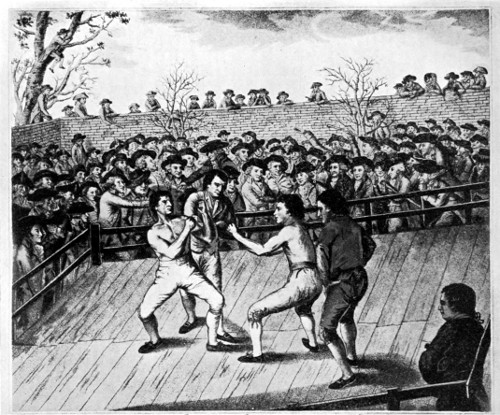
There was a delightful simplicity about the old boxing
matches. The men fought to a finish; that is, until one or other
of them failed to come up to the scratch, chalked in the mid-ring,
or until the seconds or backers gave in for them, which last
does not appear to have happened very often. A round ended
with a knock-down or a fall from wrestling, and half a minute
only was allowed for rest and recovery.
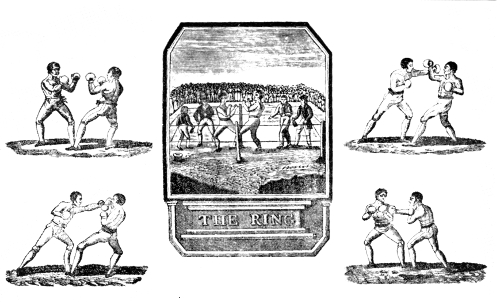
One of the illustrations in this book is taken from a print of
the original Rules governing Prize-Fights, “as agreed by several
gentlemen at Broughton’s Amphitheatre, Tottenham Court Road,
August, 16th, 1743.”
These Rules were as follows:—
I.—That a square of a Yard be chalked in the middle of the
Stage; and on each fresh set-to after a fall, or being from the
rails, each Second is to bring his Man to the side of the Square,
and place him opposite to the other, and until they are fairly set-to
at the Lines, it shall not be lawful for one to strike at the other.
THE RING
TO BE OBSERVED IN ALL BATTLES ON THE STAGE
I. That a square of a Yard be chalked in the
middle of the Stage; and on every fresh set-to
after a fall, or being parted from the rails, each
Second is to bring his Man to the side of the
square, and place him opposite to the other, and
till they are fairly set-to at the Lines, it shall not
be lawful for one to strike at the other.
II. That, in order to prevent any Disputes, the time
a Man lies after a fall, if the Second does not bring
his Man to the side of the square, within the space
of half a minute, he shall be deemed a beaten Man.
III. That in every main Battle, no person whatever
shall be upon the Stage, except the Principals and
their Seconds; the same rule to be observed in bye-battles,
except that in the latter, Mr. Broughton
is allowed to be upon the Stage to keep decorum,
and to assist Gentlemen in getting to their places,
provided always he does not interfere in the Battle;
and whoever pretends to infringe these Rules to
be turned immediately out of the house. Every
body is to quit the Stage as soon as the Champions
are stripped, before the set-to.
IV. That no Champion be deemed beaten, unless
he fails coming up to the line in the limited time,
or that his own Second declares him beaten. No
Second is to be allowed to ask his man’s Adversary
any questions, or advise him to give out.
V. That in bye-battles, the winning man to have
two-thirds of the Money given, which shall be
publicly divided upon the Stage, notwithstanding
any private agreements to the contrary.
VI. That to prevent Disputes, in every main Battle
the Principals shall, on coming on the Stage, choose
from among the gentlemen present two Umpires,
who shall absolutely decide all Disputes that may
arise about the Battle; and if the two Umpires
cannot agree, the said Umpires to choose a third,
who is to determine it.
VII. That no person is to hit his Adversary when
he is down, or seize him by the ham, the breeches,
or any part below the waist: a man on his knees
to be reckoned down.
As agreed by several Gentlemen at Broughton’s Amphitheatre,
Tottenham Court Road, August 16, 1743.
Reproduced by permission of “The Field.”
II.—That, in order to prevent any Disputes, the time a Man
lies after a fall, if the Second does not bring his Man to the side
of the square, within the space of half a minute, he shall be deemed
a beaten Man.
III.—That in every Main Battle, no person whatever shall
be upon the Stage, except the Principals and their Seconds; the
same rule to be observed in bye-battles, except that in the latter
Mr. Broughton is allowed to be upon the Stage to keep decorum,
and to assist Gentlemen in getting to their places, provided always
he does not interfere in the Battle; and whoever pretends to
infringe these Rules to be turned immediately out of the house.
Everybody is to quit the Stage as soon as the Champions are
stripped, before the set-to.
IV.—That no Champion be deemed beaten, unless he fails
coming up to the line in the limited time, or that his own Second
declares him beaten. No Second is to be allowed to ask his
Man’s adversary any questions, or advise him to give out.
V.—That in Bye-battles, the winning man have two-thirds
of the Money given, which shall be publicly divided upon the
Stage, notwithstanding private agreements to the contrary.
VI.—That to prevent Disputes, in every Main Battle the
Principals shall, on coming to the Stage, choose from among the
gentlemen present two Umpires, who shall absolutely decide all
Disputes that may arise about the Battle; and if the two Umpires
cannot agree, the said Umpires to choose a third, who is to determine
it.
VII.—That no person is to hit his Adversary when he is down,
or seize him by the ham, the breeches, or any part below the
waist; a man on his knees to be reckoned down.
It will be seen that all contingencies are by no means covered
by these regulations, but in those days far more was left to the
judgment and discretion of the Umpires and the Referee. Spectators,
even “interested” onlookers who had plunged on the
event, were usually willing to abide by their decisions; and, as
a general thing, though there was more elbow-room for rascality
than in later times, the men fought fairly. Anyhow, Egan says
that they did.
Whether the death of bare-knuckle fighting is to be mourned
is not a question to be dealt with in the first chapter. As George
Borrow observed very many years ago, “These are not the days
of pugilism,” and without attempting any discussion of the rights
and wrongs of the general problem, we may yet read the annals
of the Ring and draw our own conclusions from particular instances.
The “days of pugilism” are unlikely to return.
It is not, indeed, until we come to George Borrow that we find
the praises of boxing sung as a sport, as an outlet for energy, as
pure good fun. It is true that, being Borrow, he tells us in Romany
Rye of a character who regarded it “as a great defence against
Popery.” But Borrow, when he left Popery alone, had a splendid,
“Elizabethan” and full-blooded view of life, whether he was
concerned with the pleasures of milling or the “genial and
gladdening power of good ale, the true and proper drink of
Englishmen.”
“Can you box?” asks the old magistrate in Lavengro.
“I tell you what, my boy: I honour you.... Boxing is,
as you say, a noble art—a truly English art; may I never
see the day when Englishmen shall feel ashamed of it, or
blacklegs and blackguards bring it into disgrace! I am a
magistrate, and, of course, cannot patronise the thing very
openly, yet I sometimes see a prize-fight.”
“All I have to say,” Borrow continues later on in
Lavengro, “is, that the French still live on the other side of
the water, and are still casting their eyes hitherward—and
that in the days of pugilism it was no vain boast to say,
that one Englishman was a match for two of t’other
race.”
What would he have said had he lived to see a French
champion? The two words, “boxing” and “Frenchman,”
within half a mile of each other, so to put it, made a stock
joke in those days and for long after, even to within recent
memory.
Borrow had the true boxer’s joy in a fight for its own sake,
the violent exercise, the sense of personal contest which is more
manifest in fisticuffs than in any other sport.
“Dosta,” says Jasper Petulengro, “we’ll now go to
the tents and put on the gloves; and I’ll try to make you
feel what a sweet thing it is to be alive, brother!”
The following is his account of the crowd at a prize-fight,
the encounter itself being dismissed in a few lines:—
“I think I now see them upon the bowling-green, the
men of renown, amidst hundreds of people with no renown
at all, who gaze upon them with timid wonder. Fame,
after all, is a glorious thing, though it last only for a day.
There’s Cribb, the Champion of England, and perhaps the
best man in England: there he is with his huge, massive
figure, and a face wonderfully like that of a lion. There
is Belcher, the younger ... the most scientific pugilist who
ever entered a ring.... Crosses him, what a contrast!
Grim, savage Skelton, who has a civil word for nobody and
a hard blow for anybody—hard! one blow, given with the
proper play of his athletic arm, will unsense a giant. Yonder
individual, who strolls about with his hands behind him,
supporting his brown coat lappets, undersized, and also looks
anything but what he is, is the King of the Lightweights,
so-called—Randall! the terrible Randall, who has Irish blood
in his veins: not the better for that, nor the worse; not far
from him is his last antagonist, Ned Turner, who, though
beaten by him, still thinks himself as good a man, in which
he is, perhaps, right, for it was a near thing; and a better
‘shentleman,’ in which he is quite right, for he is a Welshman....
There was—what! shall I name the last? Ay,
why not? I believe that thou art the last of all that strong
family still above the sod, where may’st thou long continue—true
species of English stuff, Tom of Bedford—sharp as
Winter, kind as Spring.
“Hail to thee, Tom of Bedford.... Hail to thee, six-foot
Englishman of the brown eye, worthy to have carried a
six-foot bow at Flodden, where England’s yeomen triumphed
over Scotland’s king, his clans and chivalry. Hail to thee,
last of England’s bruisers, after all the many victories which
thou hast achieved—true English victories, unbought by
yellow gold....”
Borrow wrote of the Prize-Ring in its decline and of its best
days from a greater distance than did Egan, and his perspective
is therefore truer. Still we do learn a great deal from Boxiana
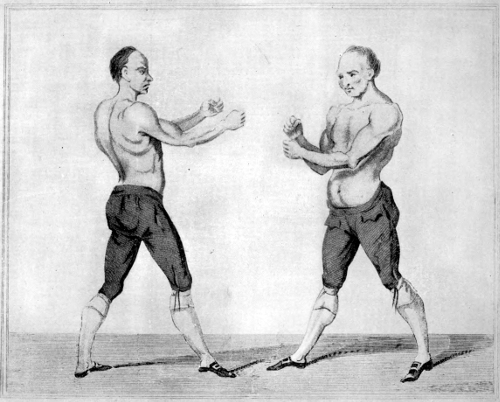
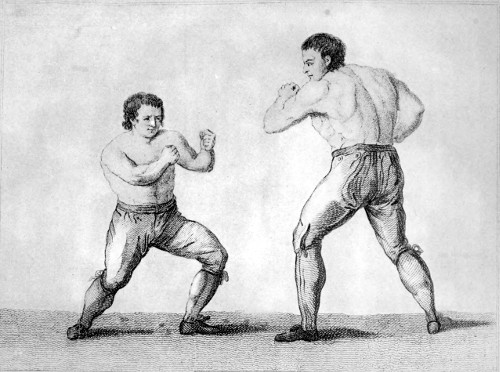
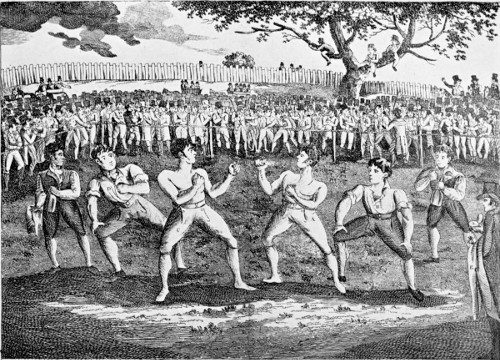
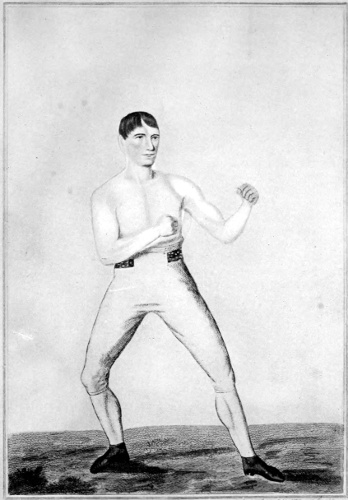
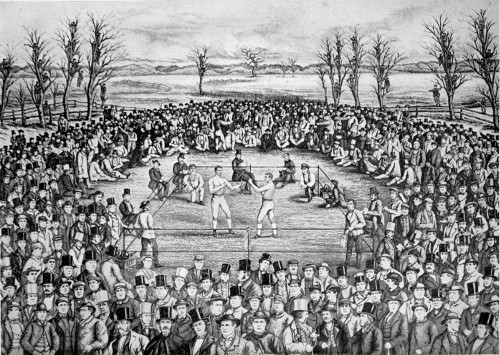
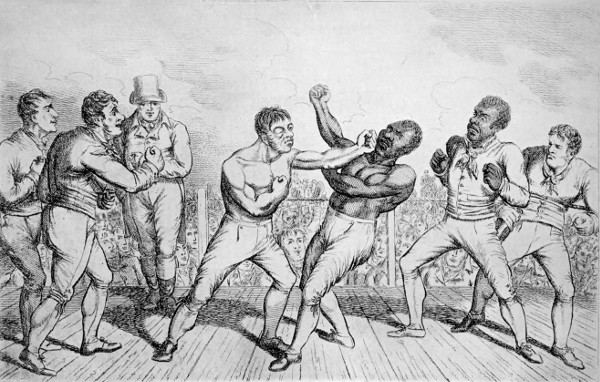
of the old giants; whilst contemporary engravings, some of which
will be found here, give us, more or less faithfully, the attitudes
of the fighters. Whether the artists observed the same fidelity
in regard to the muscular development of the principals we must
decide from our own experience. It is often said that if men were
to train themselves to this herculean scale they would be so muscle-bound
as to be almost immobile.
At the beginning of Volume III. of Boxiana, Egan tells us of
the extraordinary physique of the fighter.
“The frames, in general, of the boxers are materially
different, in point of appearance, from most other men; and
they are also formed to endure punishment in a very severe
degree.... The eyes of the pugilists are always small; but
their necks are very fine and large; their arms are also muscular
and athletic, with strong, well-turned shoulders. In general,
the chests of the Boxers are expanded; and some of their
backs and loins not only exhibit an unusual degree of strength,
but a great portion of anatomical beauty. The hips, thighs,
and legs of a few of the pugilists are very much to be admired
for their symmetry, and there is likewise a peculiar ‘sort of
a something’ about the head of a boxer, which tends to give
him character.”
And he adds a footnote: “The old Fanciers, or ‘good judges,’
prefer those of a snipe appearance.”—(An appearance which
obviously could not long have been maintained!)
Of scientific boxing, as we understand it, there was comparatively
little; though in the hey-day of the Prize-Ring (roughly
speaking, the first quarter of the nineteenth century) the foundations
of the exact science were well laid. However, the chief
qualifications for a good pugilist were strength and courage, even
as they are to-day. But, besides hitting, the fighters might close
and wrestle, and many a hard battle was lost by a good boxer
whose strength was worn out by repeated falls, falls made the
more damaging when a hulking opponent threw himself, as at
one time he was allowed to do, on top of him.
The other principal differences between old and modern
boxing were these: it was one of a man’s first considerations to
hit his antagonist hard about the eyes, so that they swelled up
and he could not see. Men strong and otherwise unhurt were
often beaten like that. Secondly, bare knuckles, in hard repeated
contact with hard heads, were apt to be “knocked up” after a
time. The use of gloves, though it probably makes a knock-out
easier and quicker, obviates these two difficulties. However,
even with the heavy “pudden” of an eight-ounce glove, the
danger to the striker, though much lessened, is not entirely
avoided, and I once put out two knuckles of my left, at the same
time breaking a bone at the back of my hand in contact with an
opponent’s elbow with which he guarded his ribs. This sort
of accident is very rare.
The chief interest in the fights described by Pierce Egan
and by others lies in their records of magnificent courage, for—there
is really no way out of it—the old Prize-Ring was, by the
prevalent standards of to-day, a somewhat brutal institution.
Horrible cruelty was seen and enjoyed, not as a rule the cruelty
of the two men engaged, fair or foul as may have been their
methods, but of their backers and seconds, who, with their money
on the issue, allowed a beaten man, sorely hurt, to go on fighting
on the off-chance of his winning by a lucky blow. Sometimes
their optimism was, within the limits of its intention, justified, and
an all but beaten man did win. Really, that sort of thing happens
more often in modern boxing, especially amateur boxing, to-day,
than it did in the Prize-Ring, and this is due, not to the callousness
of referees, but to their perspicacity. A thoroughly experienced
referee understands exactly how much a man can endure, particularly
when he has seen the individual in question box before.
He knows that he is not nearly so much hurt and “done” as he
looks, or rather as the average spectator thinks he looks; and he
gives him his chance. And, suddenly, to the wild surprise of
every one, except, perhaps, the referee, he puts in a “lucky”
blow and knocks out an opponent who had hitherto been “all
over” him.
On the other hand, a backer sometimes did withdraw his
man in the most humane fashion when he had been badly
punished, and very often to the deep resentment of the boxer
himself, who, left to his own devices, would have fought on so
long as his weakening legs would obey his iron will.
One more word upon the subject of “brutality” may be
forgiven me. Again and again has it been said, but never too
emphatically, how seldom it is that the men themselves were to
blame. It is the hangers-on, the parasites, the vermin of sport,
outside the ring, the field, the racecourse, who never risked nor
meant to risk a broken nose or a thick ear, who are out for money
and for money alone, by fair means for choice (as being on the
whole the better policy), but by foul means readily enough rather
than not at all—these are the men who bring every institution
upon which they batten into bad repute. Certainly the broken
ranks of this army were occasionally recruited from the less
successful or the more dissipated but quite genuine fighters, just
as the hired bully is not unknown amongst the boxers of to-day.
But the real villain, the man who gets the money out of rascality,
does so, if possible, with a whole skin.
The Prize-Ring served its turn. For nearly a hundred years—that
is, roughly, from 1740 to 1840—it was a genuine expression
of English life. Right or wrong as may have been the
methods used, it was spontaneous. After that, if we except
individual encounters, it was forced, laboured, and in vain. The
spontaneity was gone. In his Preface to Cashel Byron’s Profession,
Mr. Shaw tells us that pugilism was supposed to have died of
its own blackguardism: whereas “it lived by its blackguardism
and died of its intolerable tediousness.”
That is very true, but it must be remembered that the tediousness
sprang very largely from the blackguardism—that is to say,
towards the end of the bare-knuckle era the men used to stand
off from each other, doing as little damage as possible and earning
their money as easily as might be. Moreover, men who fought
a “cross” were, particularly in the latter half of the nineteenth
century, seldom good enough actors to appear beaten with any
degree of plausibility, when they could, in fact, have continued
fighting: and the result was that they stood about the ring, sparring
in a tentative fashion, wrestling now and again, and wasting
time, waiting for an opportunity to fall with some show of reality.
Thackeray, however, who, according to Mr. Shaw, loved a prize-fight
as he loved a fool, appeared to think that the sport died of hypocritical
respectability. There is, of course, plenty to be said upon both
sides; and Thackeray’s opinions will be more closely discussed in the
chapter dealing with the fight between Sayers and Heenan.
Of one disease or another, or of several complications, the
Prize-Ring died, and from its dust arose the gradually improving
sport of glove-fighting, the boxing of to-day.
The aim of this book is to cover the ground of bare-knuckle
fighting and of modern professional boxing from the inception
of the Ring to the present day, by making notes upon a number
of representative battles in their chronological order.
 MAX BEERBOHM IN PERSPECTIVE