If we reflect on the extreme feebleness of the natural means by
the help of which so many great problems have been attacked and
solved; if we consider that to obtain and measure the greater
part of the quantities now forming the basis of astronomical
computation, man has had greatly to improve the most delicate of
his organs, to add immensely to the power of his eye; if we remark
that it was not less requisite for him to discover methods adapted
to measuring very long intervals of time, up to the precision of
tenths of seconds; to combat against the most microscopic effects
that constant variations of temperature produce in metals, and
therefore in all instruments; to guard against the innumerable
illusions that a cold or hot atmosphere, dry or humid, tranquil or
agitated, impresses on the medium through which the observations
have inevitably to be made; the feeble being resumes all his
advantage: by the side of such wonderful labours of the mind, what
signifies the weakness, the fragility of our body; what signify the
dimensions of the planet, our residence, the grain of sand on which
it has happened to us to appear for a few moments!—Arago.
The conquests of science over the realms of matter in our day
would scarcely have affected Bacon with greater surprise than the
change in what we may call the social position of science. There
was a time, not so very far removed from his own, when scientific
truth was worshipped, if at all, with closed doors and in muffled
accents. Science, like religion, had her age of persecution and her
“church in the catacombs;” she, too, had heroes, and martyrs, and
confessors of her own, and won her way to popularity through an
ordeal of shame and suffering, the history of which remains to be
written. The philosopher of the Middle Ages shunned the haunts of
men; his crucible was heated in some secret or underground chamber;
his knowledge was a forbidden lore, and if it showed itself in the
command of new powers, was ascribed, not to inspiration from on
high, but to dealings with an agent which even modern credulity so
often proclaims as the source of intellectual mastery. From these
fiery trials science has emerged without even a scar upon her.
Militant she still is, but she is also triumphant, and vies with
the learning of “letters,” which was never branded with the like
infamy, in the number and dignity of her votaries. The change which
has come over her social status has reacted on her doctrines. There
are no longer any “mysteries” of science; “problems,” and even
“apparent contradictions,” remain, but mysteries, with everything
else that savours of the occult and esoteric, are exploded, and not
many difficulties are admitted.—Times.
Although Galileo only discovered the moons of Jupiter, we often and
unconsciously think of him as if he had been their creator, and had
first set them to play their untiring game of hide-and-seek round
the stately planet; and so also in no irreverent spirit we call
the laws which Kepler divined to regulate certain movements of the
heavenly bodies, “Kepler’s Laws,” although he disclaimed the title,
grandly affirming that God, whose laws they were, had waited some
thousand years before one man, even Kepler, had discerned them. And
so again, notwithstanding our conviction that the star Neptune has
been shining in the sky since what we shall be content to call “the
beginning,” and that all the tiny planets which have so rapidly
been added to our astronomical catalogues are probably as old as
the sun, we cannot help feeling as if Adams, Leverrier, Hind, and
their brethren, had just planted those lights in the sky, and that
midnight should be sensibly less dark because of their addition to
the heavens.
When we work as transformationalists we are like sculptors,
not evolving a pre-existent statue from a concealing mass, but
bestowing a statue on a block of marble. The hollow screw is
Archimedes’ screw; the condensing steam-engine, Watt’s engine;
the railway locomotive, Stephenson’s locomotive; the electric
telegraph, Oersted’s telegraph; the Crystal Palace, Fox and
Paxton’s palace. Yet as implied in what has been already said, we
treat discoverers as if they were inventors, and to make amends we
call inventors discoverers. And although, in strictness of speech,
it is inadmissible to speak of Watt, as accomplished men are
frequently found doing, as the discoverer of the steam-engine,
and only Sancho Panza thought of invoking blessings on the man who
first invented sleep, still the popular confusion between the
discoverer and the inventor shows how difficult it is to assign the
one higher praise than the other.—Prof. George Wilson.
Roger Bacon, writing about the year 1260, that is, six hundred
years ago, says:—“I call that Experimental Science which neglects
argumentation; for the strongest arguments prove nothing as long
as the conclusions are not verified by experience. Experimental
science does not receive truth at the hands of superior sciences.
It is itself mistress, and other sciences are its servants. It
has, in truth, the right to command all sciences, since it alone
certifies and sanctions their results. Experimental science is,
therefore, the queen of sciences and the limit of all speculation.”
The features in Bacon’s writings that have caused his name to be
handed down as a founder of physical science are very obvious. He
doubts wisely and has a profound reverence for facts. The theory
of a vacuum has come to him on the highest authority, but its
difficulties distress him. He speaks of experimental philosophy
as more perfect than all the natural sciences; “for it teaches
us to test by trial the noble conclusions of all the sciences,
which, in the others, are either proved by logical arguments or are
examined into on the imperfect evidence of nature; and this is its
prerogative.”
“As a workman in the laboratory, and with lenses, he himself
discovers the existence of explosive compounds, confirms the
tradition of history as to the effect of burning glasses, and
understands the principle of the camera. He points out the
faultiness of Cæsar’s calendar. His views of the limits of
medicine are excellent. ‘For, whereas a healthy rule of life
depends upon what is eaten and drank, on the hours of sleep and
waking, of exercise and rest, on climate and the temper of the
mind, and that all these should be observed from childhood in the
constitution they fit, scarcely any man cares to take thought of
these things, nay, not even physicians, such at least as we have
met with.’ Contrast this and his critical approval of the use of
charms to delude credulous patients into health with the science
ridiculed in the Malade Imaginaire, and the advantage will
not be found on the side of the seventeenth century. But, even
in physical science, Bacon’s splendid powers of generalization
prevail over the habit of analysis, and he is rather a prophet
than a teacher. He believes that the period of human life may
be prolonged many years by a sound system of dietetics; and the
averages of life in our own century confirm him. He believes that
‘engines of navigation may be made without oarsmen, so that the
greatest river and sea-ships with only one man to steer them, may
sail swifter than if they were fully manned. Moreover, chariots,’
he thinks, ‘may be made so as to be moved with incalculable
force without any beast drawing them.’ ‘And such things might be
made to infinity, as, for instance, bridges to traverse rivers
without pillars or any buttress.’ He even knows a wise man who
has determined to construct a flying machine; but Bacon’s tone
on this subject is a little less confident. That he himself
hoped for much that has since been proved impossible—for the
art of increasing gold, and for the discovery of an elixir of
life—cannot of course be questioned. Bacon summed up the science
of his times, and the analogies which guided him in his estimate
of the laws of motion could not teach him to anticipate by five
hundred years the individuality of the elements, or to understand
the texture of the human body. His error, after all, was chiefly
that he believed in Thought as a conqueror, and expected to
establish her kingdom on the ruins of the thrones of the visible
world.”—Saturday Review.
In an able summary in the Times of the contents of Sir Henry
Holland’s Essays on Scientific and other Subjects, we find the
following suggestive passages:—“The sciences are so interlacing
and coalescing that it would seem as if in a year or two we should
only have one huge science embracing all; or, at least, what are
now regarded as separate sciences should be considerably reduced
in number. This is more or less implied in the controversy on
the “Correlation of Forces.” The question is,—Are there really
“Forces” in nature? Or should we not rather say that there is but
one force appearing under different forms? Among these forces may
be mentioned light. The undulatory theory of the transmission of
light is as old as Huyghens, but its universal acceptance is an
incident of our own day; and it is in our own day that radiant
heat has been discovered to be subject to those great physical
laws which are the basis of the undulatory theory. Here, then,
we find in our time, within the last few years, that the three
great sciences of optics, of acoustics, and of heat, reduce their
principal facts to the same formula. Or again, take this science
of optics in another relation. It has within the last few years
proved itself to be the most delicate instrument of chemistry. By
the aid of a little starch the chemist can detect the millionth
part of iodine in solution. Mr. Faraday has found that a strong
ruby tint is given to a fluid by a proportion of gold not exceeding
the half-millionth part in weight. These are wonderful results
of ordinary chemical analysis; but what are they in comparison
with the results obtained through the analysis of the spectrum?
By means of it chymists have been able to detect in a compound
1-70,000,000th part of a grain of lithium, and the 1-180,000,000th
part of a grain of sodium, the metal of common salt. The method of
the analysis is very simple. If a little sodium, for instance, be
burnt in a flame, and during the process of this burning the rays
be made to pass through a prism, then in a certain defined portion
of the spectrum beyond there will appear a thin yellow line, so
vivid that it will show even when the sodium has been reduced to
the 1-180,000,000th part of a grain. By help of the same analysis
we pass on to astronomy, and discover the chemistry of the sun, the
moon, and the stars. In the photosphere, or luminous atmosphere
surrounding the body of the sun, there has in this way been
discovered no less than six known metals.
“In these few examples we indicate roughly but sufficiently the
intimate connexion of the physical sciences, and the necessity
which is imposed on the student in the present day to know all if
he would understand one. It has been said that he who has seen but
one work of ancient art has seen none, while he who has seen all
has seen but one. We may say the same of science. To know one is to
know none, and to know all is to know but one.”
Daily the conviction deepens among those who have studied the
matter, that with a few exceptions all the physical powers which
man wields as movers or transformers of matter are modifications
of Sun-force. It was bestowed upon antediluvian plants, and they
locked it up for a season in the woody tissue which it enabled
them to weave, and afterwards time changed that into coal; and the
steam-engine which we complacently call ours, and claim patents
for, burns that coal into lever-force and steam-hammer power, and
is in truth a sun-engine. And the plants of our own day receive as
liberally from the sun, and condense his force into the charcoal
which we extract from them, and expend in smelting metallic ores.
With the smelted metals we make voltaic batteries, and magnets, and
telegraph wires; and call the modified, sun-force electricity and
magnetism, and say it is ours, and ask if we may not do what we
like with our own.
And again, the plants we cultivate concentrate Sun-force in grass,
hay, oats, wheat, and other fibres and grains, which seem only
suitable to feed cattle and beasts of burden with. But by and by a
Spanish bull-fighter is transfixed by this force, through the horns
of a bull, and dies unaware of his classical fate, pierced to the
heart by an arrow from Apollo the Sun-god’s bow. On English commons
prizes are run for, by steeds which are truly coursers of the sun,
for his force is swelling in their muscles and throbbing in their
veins, and horse-power is but another name for sun-power. Nor is it
otherwise with their riders; for they too have been fed upon light,
and made strong with fruits and flesh which have been nourished
by the sun. His heat warms their blood, his light shines in their
eyes; they cannot deal a blow which is not a coup-de-soleil, a
veritable sun-stroke; nor express a thought without help from him.
In grave earnestness, let me remind you, that as force cannot be
annihilated any more than matter, but can only be changed in its
mode of manifestation, so it appears beyond doubt that the force
generated by the sun, and conveyed by his rays in the guise of
heat, light, and chemical power, to the earth, is not extinguished
there, but only changes its form. It apparently disappears when it
falls upon plants, which never grow without it; but we cannot doubt
that it is working in a new shape in their organs and tissues, and
reappears in the heat and light which they give out when they are
burned. This heat, which is sun-heat at second hand, we again
seem to lose when we use plants as fuel in our boiler-furnaces;
but it has only disguised itself, without loss of power, in the
elasticity of the steam, and will again seem lost, when it is
translated into the momentum of the heavy piston, and the whirling
power of a million of wheels.
The second-hand heat of the sun appears equally lost when vegetable
fuel is expended in reducing metals; but oxidize these metals
in a galvanic battery, and it will reappear as chemical force,
as electricity, as magnetism, as heat the most intense; and, in
the electro-carbon light, will return almost to the condition of
sunshine again.—Prof. George Wilson.
Sir William Armstrong maintains, as a half-truth, that Invention is
the fruit of the circumstances that call for it almost more than
of the mind from which it springs. In a sense it is true, as Sir
William Armstrong says, that “the seeds of invention exist, as it
were, in the air, ready to germinate whenever suitable conditions
arise;” but it depends not the less on the genius of individual
inventors to determine whether the germination shall happen in one
century or the next. The history of the locomotive is itself the
strongest argument against relying too much on these floating seeds
of invention and favouring circumstances, and taking too little
account of inventors. If the Killingworth brakesman had died in his
youth, it is scarcely too much to say that we should probably not
yet be travelling by steam. We owe it to George Stephenson’s keen
insight and resolute temper that the locomotive was forced upon an
unbelieving world, no one can say how long before circumstances
would otherwise have called it into existence. The seed had been
floating, it is true, and had been in a manner detected centuries
before; but it remained without life, not because the occasion had
not called it forth, but because the right man had not arisen.
The recklessness with which Patents are issued, and the dishonesty
on the part of the State in selling the same article to two or
more persons, and then coolly leaving them to litigation for the
possession of it, cannot be too strongly reprehended. The common
sense of the question is summed up by Dr. Percy, in these words: “I
cordially subscribe,” says the Doctor, “to the opinions expressed
by Mr. Grove, Q.C.—namely, that the real object of Patent Law was
‘to reward not trivial inventions, which stop the way to greater
improvements, but substantial boons to the public; not changes
such as any experimentalist makes a score a day in his laboratory,
but substantial practical discoveries, developed into an available
form.’”
The law with respect to Patents has been greatly simplified and
improved by the statute 15 and 16 Vict. c. 83: the fees payable
for a Patent have been reduced, and the payment of spread over
several years. One Patent now suffices for the United Kingdom,
and is no longer void, as formerly, for trifling inaccuracies in
the Specification, as these may be now disclaimed.
Before quitting the subject of Patents it may, perhaps, be
serviceable to call attention to the admirable Abridgments of
Specifications now publishing by the Patent Commissioners. In a few
minutes one can get exact information there which cannot otherwise
be obtained in as many hours. These Abridgments are in the form of
small 8vo volumes.
Hereafter we hope to see provided out of the revenues of the
Patent-office, a public library and museum, to constitute a
historical and educational institution for the benefit and
instruction of the skilled workman of the kingdom. Exact models
of machinery are to be exhibited in the subjects, showing the
progressive steps of improvement.
James Watt was a highly accomplished theorist, on every point on
which he worked; yet his name has been frequently cited, as a
proof that theory could be dispensed with. And his career, when
compared with that of Telford, will illustrate theory applied to
practice, as distinguished from practice alone, however acute.
It is impossible to contemplate the career of Telford without
a feeling of high interest, created by the comparison of his
apparently inadequate education with his startling successes.
Looking at the individual himself, there is everything for his
age to admire; and as long as his structures last, each of them
is the monumentum, but not ære perennius. The time will come
when his name shall be like that of the builder of the old London
bridge, who was, no doubt, the Telford of the day,—a stimulus to
his contemporaries, useful and honoured, but not the remembered of
succeeding ages. On the other hand, the discoveries of Watt, though
equally startling in what is called the practical point of view,
have the mind of the discoverer impressed upon them, and have been,
and must be, the guide of his successors, not merely to repetitions
of what he did himself, but to the enlargement of ideas, and the
conversion of principles into forms useful in art. Take away
the honourable qualities which enabled the two men to outstrip
their contemporaries, each in his line; qualities which are the
properties of the individual minds, and consider what is left,
namely their modes of proceeding: consider the effect of these two
modes on men in general, and there is nothing in that of Telford
which would raise a workman above a workman; while in that of Watt
there is the vital principle to which we owe all the mechanical
triumphs of civilization, and all the theoretical successes of
philosophy.—Penny Cyclopædia.
It seems impossible to exclude from a review, however slight, of
contemporary progress in the exact Sciences, the advantages which
have accrued to them, both directly, and as it were reflexively,
by the astonishing progress of the Mechanical Arts. The causes,
indeed, which called them forth are somewhat different from those
which are active in more abstract, though scarcely more difficult,
studies. Increasing national wealth, numbers, and enterprise,
are stimulants unlike the laurels, or even the gold medals, of
academies, and the quiet applause of a few studious men. But the
result is not less real, and the advance of knowledge scarcely more
indirect. The masterpieces of civil engineering—the steam-engine,
the locomotive-engine, and the tubular bridge—are only experiments
on the powers of nature on a gigantic scale, and are not to be
compassed without inductive skill, as remarkable and as truly
philosophic as any effort which the man of science exerts, save
only the origination of great theories, of which one or two in a
hundred years may be considered as a liberal allowance. Whilst,
then, we claim for Watt a place amongst the eminent contributors to
the progress of science in the eighteenth century, we must reserve
a similar claim for the Stephensons and the Brunels of the present;
and whilst we are proud of the changes wrought by the increase of
knowledge during the last twenty-five years on the face of society,
we must recollect that these very changes, and the inventions which
have occasioned them, have stamped perhaps the most characteristic
feature—its intense practicalness—on the science itself of the
same period.
It has long been the fashion of one party to lament “the Decline of
Science” in England; whilst another section has gravely declared
that Science in this country is but the growth of yesterday, having
been imported from Germany, and tenderly nurtured by the magnates
of the realm. In the House of Commons, in the Session of 1863,
a member stood up, and, with exultation, announced that Science
had at length found its way into that democratic assembly through
the individual exertions and influence of one now no more. From
the language which this scion of a great house employed it might
be inferred that Science had been previously almost unknown in
England. The member, no doubt, spoke according to his knowledge;
but it possibly escaped his memory that a man named Isaac Newton
once existed. Without justly exposing ourselves to the charge
of presumption, we might also boast of a few other names of
distinction among the dead as well as the living.
There is another point upon which the public appear to be much
misinformed—namely, that Science is in the receipt of large sums
from the State. The annual amount voted out of the taxes for
Science and Art is unquestionably large; but it should be borne in
mind that, comparatively, only a small portion is really devoted
to Science, while Art takes the lion’s share. Let it be so by all
means. True Science to be worth anything must never become the
creature of State bounty. We want no Institute with its salaried
members and its eternal jobbing. We need no patronizing Mecænas,
whether from the high-born or the self-exalted. What Science
earnestly desires is to be let alone, that she may follow her
destined course quietly, modestly, and without molestation. She
especially loathes the Pythonic embrace of meddlesome persons
who, knowing nothing of her, yet profess an intimate acquaintance
with her and a tender regard for her welfare, solely with the
object of puffing themselves into notoriety. She disdains them
utterly.—Times journal.
We hear much, too, of “Science and Art” now-a-days coupled
together, as if the strongest affinity existed between them;
although no two things can be more unlike each other. The Arctic
Circle and the Torrid Zone cannot be wider apart or in stronger
contrast; for Science is frigidly logical, and Art hotly emotional.
It has been proved by experiment, that the rapidity at the bottom
of a stream is everywhere less than in any part above it, and is
greatest at the surface. Also, that in the middle of the stream the
particles at the top move swifter than those at the sides. This
slowness of the lowest and side currents is produced by friction,
and when the rapidity is sufficiently great, the soil composing
the sides and bottom gives way. If the water flows at the rate of
three inches per second, it will tear up fine clay; six inches per
second, fine sand; twelve inches per second, fine gravel; and three
feet per second, stones of the size of an egg.—Lyell’s Geology.
Of late years experimental philosophers have been occupied with
the investigation of a profound problem. Formerly, the most
brilliant phenomena of nature were attributed to the existence
of imponderable fluids. But the Correlation of heat, light,
electricity, magnetism, and chemical affinity, as varying
manifestations of force, attributable to modifications of motion
in matter, now employs our subtlest thinkers—Faraday and Grove,
Wheatstone and De la Rive. These researches extend even to
the confines of the moral phenomena. The chemistry of nature
differs from that of the laboratory, and the difference has
been attributed, not simply to organization, but to the vital
force—a power found only in living organisms. Yet, at length, the
laboratory of Hoffman imitates the processes of nature, especially
in plants, and produces some of the most delicate of the perfumes
of flowers and fruits, and even seems on the very verge of the
manufacture of some of its greatest treasures—such as quinine.
Some are staggered by the steady march of scientific research into
the most sacred sanctuaries of life, and recoil from investigations
which trace the growth of the cell in the ovary into the perfect
man; as though mystery were essential to faith; or, if it were so,
as though there is the slightest risk that in ages to come man will
have so stolen the sacred fruit that no mystery will remain to be
solved.—Sir James Kay Shuttleworth on Public Education.
It was thought that this old idea had been completely disproved
by experiment; but, according to the Saturday Review, the very
contrary has been the result of recent experiments, in course
of which, at all events, waves on a pond, generated by the wind,
were completely stilled to a “glassy smoothness” by means of a
film of oil scarcely more than the 7,000,000th part of an inch in
thickness, and exhibiting the most brilliant zones of iridescent
colours from its extreme thinness. The modus operandi is believed
to consist simply in the wind ceasing to have a hold upon the water
by the intervention of the oil, which slips along the surface
with the wind, so that the oil must be applied to windward, and
it moves to leeward, smoothing the surface as it goes!
Of all errors upon the formation of beings, the most absurd is
Spontaneous Generation. Yet it is one of the most popular. If this
theory is admissible for inferior beings, such as intestinal worms,
infusoria, or polypi, why not for superior beings? The difficulty
becomes an impossibility in both cases. Can it be imagined that an
organized body, of which all the parts are intimately connected,
with an admirably contrived correlation, so full of profound
wisdom, is produced by a blind assemblage of physical elements?
The organized body must have derived its existence from elements
of which it was destitute! Then motion might proceed from inertia,
sensibility from insensibility, life from death!
In Mr. Ross’ translation of Dr. Tschudi’s Travels in Peru, 1847,
we are informed that the correct orthography is Huanu, and not
Guano. He states that it is a term in the Quichua dialect,
meaning “animal dung.” As the word is now generally used it is an
abbreviation of Pishu Huanu, bird dung. “The Spaniards,” he says,
“have converted the final syllable nu into no The European
orthography Guano, followed also in Spanish America, is quite
erroneous, for the Quichua language is deficient in the letter
G, as it is in several other consonants. The H, in the common
formation of the word, is strongly aspirated, whence the error of
the orthography of the Spaniards, who have sadly corrupted the
language of the Autochthones of Peru.”
Perspective is the science which furnishes us with the laws by
which we can give the apparent, as geometry those by which we can
give the real, forms of objects. These laws are obvious without
rules to thoughtful, artistic common-sense—but, to many, books
on the subject will always be useful, if not indispensable.
The science was called perspective, or seeing through, from
an impression that the correct foreshortening of objects could
be gained by viewing and tracing them through a pane of glass.
This plan only ensures correctness when the plane of the eye is
parallel to that of the medium upon which the drawing is made. A
picture in perspective is simply a plane parallel to the plane of
the eye intersecting the rays that come from the surface of the
objects represented. The points of these rays at the places of
their several intersections combine to form the true perspective
representation. This was the art that Mantegna made so much
of at Padua; and that with which Bellini, the painter of the
National Gallery “Doge,” delighted the Venetians. Without much
semi-scientific pedantry, the whole science may be understood
by balancing a half-crown on the top of the forefinger of your
right hand. Hold it up so that its broad plane is parallel to the
eye’s plane; put it nearer or further, and it seems to increase
or diminish in size. Turn it obliquely, and it appears an oval;
put the edge on a line with the eye, and it appears a mere thin
straight line. A sphere is the only geometric form that undergoes
no perspective changes. The eye is able to take in any given
space set at an angle of under sixty degrees. When both eyes view
a scene, instead of the circle one eye sees, we have an ellipse
formed by the continuation of the two circles of vision,—the
point of sight being opposite the centre of the space between the
two eyes. Perspective is of great use in Art; but the books upon
it are too abstruse, and imply a knowledge of mathematics. [This
common-sense explanation is from the pen of Professor Wallace,
M.A., in the first number of a journal edited by him and entitled
The Public Instructor.]
Till the discovery of the Stereoscope, naturalists were puzzled to
account for a single image resulting from double vision; and Gall
and Spurzheim endeavoured to explain it by the supposition that
one eye only was active at a time, the other only admitting light,
and that Nature had given us two merely to provide against the
accidental loss of one.—Leslie’s Handbook.
The danger from Lenses, when the heat of the sun is powerful,
is well known. As an illustration, we may relate an instance
which occurred on the premises of Messrs. Negretti and Zambra,
philosophical instrument makers, in Hatton Garden. There was a
smell of fire, but it could nowhere be detected, until a person
entered the shop from the street with the startling information
that the window was on fire, and such was really the fact: a large
reading-lens hanging in the window exposed to the sun, its focus
happening to be just within range of the woodwork of the window
fittings, set fire to them, and no doubt in a very few seconds some
serious damage would have been caused. Is it not possible that in
tropical climates, when vessels are becalmed, they may be set on
fire by the eye-deck lights everywhere observable on ships’ decks;
or, nearer home, in warehouses, &c., where such means of lighting
is resorted to? The matter merits serious consideration and should
serve as a caution.
In the proper use of Spectacles there is no circumstance of more
importance than their position on the head. They should be worn
so that the glasses may come as close to the eye as possible
without touching the eyelashes; they must also be placed so that
the glasses may be parallel to the paper when held in an easy
position. To accomplish this, let the sides of the spectacles bear
upon the swell of the head, about midway between the top of it and
the ear; the eyes will then look directly through the glasses
to the paper, and make the most advantageous use of them, instead
of looking obliquely through them to the paper, as in numerous
cases, where persons place the sides of their spectacles in contact
with, or very near, their ears—in which position they produce a
distorted image on the retina. The sides of the spectacles should
also be placed at an equal height upon the head; and the hands
being applied to the points of the sides, will generally direct
their equal height, as well as allow of their opening to the full
extent without injury.—Adams on the Human Eye.
Although the thoughts of men have been turned to the mineral
conditions of these islands for more than two thousand years;
and in that period the art of Mining has improved; and the
engineering appliances which have been brought to bear upon the
ventilation and the draining of mines, are fine examples of
mechanical ingenuity,—the science of Mining, however, can
scarcely be said to have, as yet, any existence. In 1856, Mr. John
Taylor, who must be regarded as a good authority, stated before
a Committee of the House of Commons, “That there were no greater
facilities for ascertaining the productive character of a mine now
than formerly. The difference was simply in improved machinery. Our
knowledge was not greater than that of our forefathers.” Whatever
was said in 1856, is true at the present moment.
The psychological influences of subterranean toil form a strange
but interesting subject of study. These and the effects of that
continued uncertainty as to the reward which labours of the
severest kind are to receive, are distinguishingly marked on every
miner. In occult powers they are believers; and when, about a
century since, the “Divining Rod” was introduced into Cornwall as
a means for finding mineral lodes, it was eagerly seized upon;
and, to the present day, several families are supposed to possess
remarkable powers as diviners, or, as they are commonly called,
“dowsers.”
Mr. Rawlinson observes that the existence of “diviners,” or
“dowsers,” for finding out the mineral lodes was a serious
reflection upon the present age; yet it was a curious fact, that
a French adventurer, who was supposed to have been successful in
finding water-beds in Africa, was introduced to the Government
during the Crimean war, and was sent out to trace, by the
divining-rod, water in that locality.
The most elementary laws of science are still a book sealed to
the large majority of miners, and while they are, of all men,
themselves the most theoretical, they always meet any attempt to
explain phenomena upon the evidences of inductive research, by
pronouncing the explanation to be a “theory,” which is of no value
to a “practical.”
Mr. Wallace, himself a miner, says: “The impossibility of arriving
at any knowledge of practical value respecting ore deposits in
veins, is avowed by those who, with singular inconsistency, attach
the greatest importance to individual experience. Even some
occupying high distinction as directors or proprietors of mines,
affirm, without qualification, that it is impossible to see through
solid rocks.”
It must be admitted that amongst the miners there is an entire
absence of any method by which a knowledge may be obtained of the
causes leading to the production of mineral deposits; while the
speculations of those philosophers who will not endure the toil
of subterranean investigations are wild, and are consequently
valueless.
The natural consequence of this imperfect knowledge is, that all
mining speculations are necessarily attended with much uncertainty.
From time to time a most productive mine is discovered. The
Devon Great Consols, first known as Huel Maria, has paid 826l.
dividends upon every share, one pound only being paid for shares
now worth 490l. each. Upon the shares of South Caradoc, near
Liskeard, the trifling sum of 25s. only was ever paid; the price
of these shares, in 1862, was 390l.; and 391l. profit had been
paid on every share.
There are other examples of great success in mining. Such results
as these are laid hold of by designing men, and used to bait the
hooks by which those who are in a hurry to be rich are caught.
Permission to search for minerals is obtained from the possessor of
the land near to some productive mine. A few trials are probably
made, and then comes the formation of a company to work “Huel
Chance” (or some more attractive name is adopted), through which
the lodes from the fortunate neighbour are shown, by the aid of a
parallel ruler, to run.
Mr. Rawlinson states, with regard to the pecuniary losses incurred
in mining speculations, that some years ago, whilst holding an
official inquiry in Cornwall, he was brought into connexion with
several of the large mining adventurers of that district; and
they stated it as their opinion that, if the value of all the ore
mines in Cornwall, and the cost of working them were compared,
the statement would stand as something like 25s. paid for every
pound’s worth of ore obtained.
Statistics show that about 350,000 persons are employed in the
production of minerals, to the value of nearly 35 millions per
annum, which gives, as the production of each miner, not more than
2l. per week, an amount so small that we can hardly conceive
it possible that it would remunerate the large capital which is
invested in these mines.—See Mr. Robert Hunt’s valuable Report,
1862.
Professor Tennant states there have been already described 500
minerals, more than half which number are found in the British
Isles; whilst more than 450 are found in our colonies. In the
International Exhibition of 1862, our vast colonial mineral wealth
was shown in remarkable specimens of gold, silver, copper, precious
stones, &c., many of which had been found by working miners who
had been sent out from this country. Yet, miners are generally
ignorant of the value of minerals, which they reject as not worth
collection: now, the gold they collect is worth 4l. per ounce;
but rough stones are often rejected, which are worth 50l. per
ounce, and some 500l. per ounce—they are diamonds. Mr. Tennant
believes that, in many of our colonies, these minerals are thrown
away, whereas a little knowledge of the use of the blowpipe would
enable miners to distinguish one substance from another.
Professor Morris describes the carboniferous series of rocks
in England which contain Coal as deposited above the old red
sandstone, or what have been called the Devonian rocks, and several
thousand feet in thickness, though the coal measures are of much
more limited depth, and the mines of coal vary from thirty feet to
only two inches thick. The distribution of Coal in England is much
greater than in any country in Europe; though in the United States
of America, near Pittsburg, the beds of coal extend over a vast
area, and one is of great thickness. The quantity of coal that is
raised from the pits in this country, however, exceeds that from
all the other coal-fields in the world.[14] The probable duration of
coal in England has formed an interesting subject of speculation
with some geologists, who have estimated the period variously at
from 300 to 1000 years. Sir William Armstrong, at the Meeting of
the British Association, in 1863, estimated the minimum period of
the northern coal-field at 200 years; but Mr. N. Wood, the great
coal-viewer of the North, is of opinion that of the northern
coal-field no conjecture, of practical utility, can yet be formed,
as more than one half of the basin, lying under the sea, has not
yet been explored.
Sir William Armstrong’s remark, however, was misunderstood,
and thought to refer to the coal supply of the whole kingdom,
whereas he limited the remark to the coal-field of Durham and
Northumberland. This misapprehension re-opened the question of the
exhaustion of our coal resources, and led to the communication
of some valuable evidence to the Times journal. Thus, Mr. E.
Hull, of the Geological Survey, states as the result of a series
of investigations of the British coal-fields, that adopting the
limit of depth at 4000 feet, he found there to be enough workable
coal, at the rate of consumption for that year, (about 71,000,000
tons,) for nearly 1000 years; and even if the consumption should
ultimately reach 100,000,000 of tons, that supply could be
maintained for 700 or 800 years.
With respect to the assumed depth, 4000 feet, Mr. Hull adds:
“Already a depth of nearly 1000 yards has been reached in a
Belgian colliery, and coal is now being extracted from depths of
700 and 800 yards in Lancashire. Even with the vertical limit of
4000 feet, I have since found reason to believe that the estimate
I arrived at in the case of the South Wales coal-field was rather
under than over the truth. In that coal-basin alone, with an area
of 906 square miles, I calculated that the rate of consumption
for 1859, of 9½ millions of tons, could be maintained for 1600
years; but it is only right to state, that Mr. H. Vivian, M.P.,
in a pamphlet published by him in 1861, controverts this view,
and arrives at the conclusion that ‘South Wales could supply all
England with coal for 500 years, and her own consumption for
5000.’
“As regards the absolute quantity of mineral fuel in this island,
it may be considered as practically inexhaustible. The seams of
coal outcrop in our coal-fields, and descend under the Permian
and Triassic formations to depths exceeding 10,000 feet. The
question of the available supply is therefore one depending on
the rapidity of production and the limit of depth.”
Dr. Buckland, in 1841, dwelt upon the wanton waste of coal at the
pits, which, in 1836, he had maintained would finally “exhaust the
Newcastle coal-field at a period earlier by at least one-third than
that to which it would last if wisely economized.” The waste has,
however, been much abated.
Mr. Robert Hunt, however, maintains the consumption to be greatly
understated. He says:
“All calculations on the probable duration of our coal-fields
have been founded on the very erroneous data which supposes
that not more than 36,000,000 of coals are raised annually.
We know that more than sixty-six millions of coals are now
annually produced, and the demands upon our resources are rapidly
increasing.”
Sir William Amstrong himself quotes Mr. Hunt as showing “that at
the end of 1861 the quantity of coal raised in the United Kingdom
had reached the enormous total of eighty-six millions of tons,
and that the average annual increase of the eight preceding years
amounted to 2¾ millions of tons.”
If, therefore, Dr. Buckland’s remarks were important in 1836 (when
his Bridgewater Treatise was first published), and of “greater
force” in 1858, how much more must they be worthy of most serious
consideration in 1863.—Communication to the Times by Mr. Frank
Buckland. Another Correspondent, however, adds this consolation:
“There may yet remain plenty of coal in the world. Three-fourths
of the globe are covered with water, and what geologist shall
presume to declare that there are no vast deposits of coal deep
below the ocean bed? We have been up and down below the waters
several times, and we shall probably sink again; but then the
bed of the Atlantic may become dry land and peopled with our
successors. Change is the law of the universe. The moon is stated
to be approximating to the earth at the rate of a fraction of an
inch in a century or so, and may one day come tumbling upon us.
The whole of the solar system seems to be travelling—some report
at the slow rate of 47,000 miles an hour—towards an unknown
region of infinite space. Great Britain, therefore, has no reason
to complain if she shares the common fate of all things, whether
in the heavens above or on the earth beneath.”
Monkwearmouth, Sunderland, is the deepest coal-mine in all England;
the coal being won at nearly two miles’ distance from the shaft,
and upwards of 1900 feet, or more than five times the height of St.
Paul’s, below the surface of the green fields and trees above. The
pit employs nearly 300 hands, and yields between 500 and 600 tons
of domestic coal per day; every few seconds, the tall cage shoots
up out of the gloom of the shaft, and the tubs, like miniature
railway-waggons, holding nearly half a ton each, are brought to the
bank, and wheeled away in different directions. Not for a single
instant does the work stop: it is coal—coal everywhere beneath and
around; the very atmosphere is made gloomy with its fine particles;
and all this, seen amid clanking of chains, roaring of steam, and
the rapid activity and whirl of hurried business, make it one of
the most curious and interesting scenes imaginable.
The dangers of the working are thus detailed. The boys in charge
of the trams carry the “Davy,” the wire-gauze of which is far
less liable to injury than the glass shade of the “Geordie,” or
Stephenson lamp; and with these the lads may safely pass the
“goafs” or worked-out seams, in which, though built up as far as
possible, gas always lurks, though the invisible enemy around them
is so thick that the gas will light inside their lamps and burn
with a ghastly blue flame. Beyond this steep incline or bank there
is still nearly a mile to be traversed to the “in-bye”—the face
of the working, the spot from which the coals are actually won:
where, too, the gas has its head-quarters, and has to be watched
and guarded against every hour and minute of the day and night, for
the work of a mine never stops, and day and night are meaningless
terms in such eternal gloom and silence. The heat at the bottom of
the bank, indeed in all parts of the mine, is very great in the
extreme depths of Monkwearmouth. It is seldom less than 84 or 85
deg., and at the workings often over 90 deg. So great is the heat,
in fact, that the men nearly always work almost naked, and in some
cases absolutely so. The heat certainly does not arise from want of
proper ventilation, which seems ample. Not much bratticing is used
to convey the air through the workings, and it is almost entirely
confined to the places where the coal is won. In fact, as far as
human ingenuity, skill, or experience can go, the pit is made safe
from gas at least. Its only risk seems to be from shaft accidents
or inundation, to both of which more or less all colleries in this
district and near to the sea are, to say the least, equally exposed
and equally protected against, as far as it is possible to do it.
The late Professor Cockerell, in a lecture on Architecture, at the
Royal Academy, observed upon the early employment of this material
in building:
The progress of architecture depends as much on discovery of new
materials and new methods of building as on taste. Iron was used
by Tubal Cain as a subsidiary material. It has been employed in
building ever since; but never in solid and in the gross as a
constituent part of the substance of building before Mr. Rennie
employed it as voussoirs in the Southwark Bridge. Sir Robert Smirke
has nobly followed in applying iron in trabeation, and so has
Mr. S. Smirke in the new reading-room of the British Museum, and
others; but the engineers have kept ahead of the architects, from
Mr. Rennie to Messrs. Stephenson, in displaying the powers of iron.
Iron has been cited in Deuteronomy as the essential and last fruit
of the promised land. Our interiors, as halls and churches, will
assume new development and grandeur by iron, since we have seen 200
feet span at Birmingham without abutment, and 150 feet at Paris in
still more enduring structure. The Pantheon of Rome, Sta. Sophia,
St. Peter’s, the Baths, and the great Riding-house at Moscow,
will hide their glories; and iron will henceforward dispense with
pillars and clerestory, flying buttresses and abutments, and roof
our churches in bold and single spans. With all due reverence
for antiquity and precedent, we ought to open our eyes to the
reconciliation of this new material and its peculiar faculties with
the laws of proportion and taste; and this is a problem worthy of
the best spirits, both as to the form of roofs or ceilings, and the
form of supports, which, in iron, with 1-40th part of substance of
stone, will give equal strength of support.
Iron may be termed the osteology of building. Hitherto the
architectural system has proceeded on statics and equipoise of
molecules, as if the human frame were built without bones. Now our
buildings will have bones, giving unity and strength which never
before existed. The nervures of the Gothic will now be in uniform
and single arcs, erected at once: the library at St. Généviève, by
Mons. Arbruste, exhibits an experiment in this way.
Professor Cockerell observes:—Concrete is a novelty characteristic
of the nineteenth century, or rather a resuscitation of ancient
practice, as shown by quoting Philibert de l’Orme; but in the
bridge of Alma, at Paris, concrete has taken a new and admirable
development, where three arches of about 140 feet span are cast on
the centreing, forming one vast stone from pier to pier. The only
voussoirs used are in the face of the arches. A peculiar cement and
hard fragmented stone has effected this with vast economy of cost
and time, and promises well. The so-called Temple of Peace at Rome
is ceiled and vaulted with a similar concrete. The coffering was
previously moulded in all its detail upon the centreing, and then
covered with grosser concrete, so that on removal of centreing all
was finished. A vast fragment now lies in the middle of the Temple,
and at Tivoli we find that Adrian employed the same simple process.
From an old pamphlet we learn that:—“Mr. Pepys, a scientific man,
in the reign of Charles the Second, suggested the great importance
of Sheathing Ships with Copper, and urged the advantages with sound
and persuasive arguments; and says, in some despair, ‘I wish it
were tried on one ship.’ But this experiment was delayed for nearly
a century; and when it was tried, although it answered beyond
expectation, yet the prejudice against innovation was so strong,
that in Admiral Keppel’s fleet, 1778, there was only one coppered
ship.”
A prodigious quantity of copper is obtained from Lake Superior.
Mr. Petherick, the well-known mining engineer, informed Dr. Percy
that at Minnesota, in 1854, not fewer than forty men were engaged
during twelve months in cutting up a single mass of native copper,
weighing about 500 tons! The native copper at Lake Superior in
some places occurs curiously intermingled, but generally not
alloyed, with native silver. The following anecdote is recounted
of the value of the gold in the residue from some South American
copper-ores, and which was communicated to Dr. Percy by Dr. Lyon
Playfair. At certain large chemical works where sulphate of copper
was prepared by dissolving copper in sulphuric acid, an insoluble
residue was produced in the process, which had been put aside from
time to time, and had fortunately not been thrown away. A small
sum was offered by certain persons for this residue, which had not
previously been regarded as of much value. Suspicion was excited,
especially by the quarter from which the offer proceeded, and it
was declined; whereupon the residue was examined, and was found to
contain 700l.-worth of gold!
Dr. Percy, the able metallurgist, extracts from history the
remarkable inference that the orichalcum of Cicero, and which
closely resembled gold, was really Brass; this alloy of copper and
zinc being the only metallic substance which it is possible to
conceive the ancients could have so mistaken. The modification of
brass which is termed “Muntz’s metal,” has been the subject of one
of the most lucrative patents known: when its well-known proprietor
died, his property was sworn under 600,000l.
The cause of the wonderful Brilliancy of the Diamond is not
popularly known. It has no inherent luminous power; it is simply
transparent, like common glass, and yet, if the latter were
cut into the form of a brilliant, it could no more be mistaken
for a real one than for a sapphire or an emerald. The secret,
therefore, of the brilliancy of the diamond must lie in something
other than its clearness or its transparency. It is owing to its
great refractive power. When rays of white light pass through
transparent substances they are refracted, or bent out of their
former course, and under certain circumstances are separated
into their constituent elements, and dispersed in the form of the
well-known prismatic colours. The cut drops of glass chandeliers
show a familiar example of these properties. Now, the degree in
which this effect is produced by any substance depends on the
refractive power it possesses, and it so happens that the diamond
has this power in an extraordinarily high degree, its index of
refraction being 2·47, while that of glass, or rock crystal,
is only about 1·6, and of water 1·3. The effect of this great
refractive capability, particularly when aided by judicious
cutting, is, instead of allowing the light to pass through, to
throw it about, backwards and forwards in the body of the stone,
and ultimately to dart it out again in all sorts of directions, and
in the most brilliant array of mingled colours; and this is the
marvellous effect that meets the eye. Sir David Brewster has shown
that the play of colours is enhanced by the small dispersive
power of the diamond, in comparison with its refractive properties.
The general value of diamonds has been rising of late years; for,
though the production is not scanty, the demand, owing to general
prosperity, and the extension of ornament to wider classes in
society, is largely on the increase.—Mr. Pole; Macmillan’s
Magazine.
It may be well to have one word, as transmutation, to indicate
chemical molecular change, and another, as transformation, to
indicate mechanical molecular change; but, as industrialists,
we must hesitate to marvel more at the one than the other.
How cheerfully they labour to a common end, like twin brother
and sister; the one strong by measurable strength, the other
by immeasurable fascinating power, we see in the case of that
great world-changer, that emblem of war, and minister of peace,
Gunpowder. It needs the strong brother to fell the oaks, and with a
hint from his twin to burn them into charcoal. It needs his stout
arms to quarry the sulphur, and bring the saltpetre from India;
to crush them into grains, and grind them together. But it also
needs his weird sister, in whose palm he lays the innocent dust, to
breathe upon it before the Alps are tunnelled, or Sebastopol lies
in ruins.—Prof. George Wilson.
The new Pear-flavouring is derived from an alcoholic solution
of pure acetate of amyloxide, considerable quantities of which
are manufactured by some distillers, and sold to confectioners,
who employ it chiefly in making Pear-drops, which are merely
barley-sugar, flavoured with this oil. There is, also, an
Apple-oil, which, according to analysis, is nothing but valerianate
of amyloxide.
Methylene is a highly volatile and inflammable liquid produced
from the destructive distillation of wood; whence Methylated
Spirit, or wood spirit. It is permitted to be used, duty free, in
arts and manufactures. Hitherto, no effort to obtain a potable
spirit from methylated alcohol has succeeded. A patent has been
granted for a process which professes not only to accomplish this
object, but to render wood spirit itself potable, and that, too,
at a cost almost nominal; and it has afforded matter for earnest
discussion among some of our leading pharmacologists, who, anxious
to preserve the integrity of medicinal preparations, have not
unreasonably been alarmed by the assertion that wood spirit can
be so far defecated as to render it almost indistinguishable from
vinous alcohol, and by the exhibition of specimens of such spirit
which might be used, instead of spirits of wine, for pharmaceutical
purposes. But after a series of experiments, Mr. Phillips, of the
Revenue Laboratory, has not been able by the process indicated to
render either methylated or wood spirit potable, although it was
submitted to numerous successive distillations, which from their
costliness could not be applied profitably on a commercial scale.
One of the latest Acts passed, Session 1863, was to reduce the duty
on rum. It recites that by the Act 18th and 19th Victoria, cap. 38,
spirit of wine was allowed to be methylated duty free; and that it
is expedient to allow foreign and colonial rum to be methylated,
on payment of reduced duty. Rum may now be “methylated” in the
Customs’ warehouse; but the wood naphtha, or methylic alcohol, or
other article to be mixed with the rum, is to be provided by the
Inland Revenue Commissioners; and the mixture is to be denominated
“methylated spirits,” and such spirits may be exported.
Meanwhile, the Inland Revenue returns in 1863 showed a decreased
consumption of spirit, from the fact of methylated spirit taking
the place of duty-paid or pure spirit. Of the one article of
spirit of nitre, very little is sold which is not distilled from
“methylated finish.” This increased quantity of sweet spirit of
nitre sold is not taken medicinally, but is extensively used in the
adulteration of potable spirits.
Phosphate of Lime, a minute constituent of all fertile soils
and of most waters, is of great value to the ivory-turner,
the manure-maker, the potter, the silver-assayer, the
drug-manufacturer, the dyer, and the lucifer-match maker. It
reaches all of them in the shape of the bones of dead animals;
dead cattle from our farms, dead horses from the Pampas of South
America, dead walrusses from the Arctic icebergs, dead whales from
the Pacific Ocean, dead men even from fields of battle. Land and
sea-plants have, as it were, milked this essential constituent of
their frames, drop by drop, from the breast of nature. Animals of
all classes, from the lowest to the highest, have robbed plants
of their hard-gotten gains, and made their bones strong with the
precious substance. Finally, the chartered robber man has robbed
them all, claiming even the relics of his brethren, and obtaining
in a handful of bone dust the phosphate of tons of rock and
water.—Prof. G. Wilson.
Its chief ingredients, charcoal and water, are uncostly and
abundant; but in themselves they are useless to the carpenter,
and he cannot change them into timber. So he calls to remembrance
that his great grandfather planted an acorn, which has turned
its first small capital to so excellent account that now it is
a timber-merchant on a large scale, and will contract with you
to build a ship of war out of oak of its own making. It is with
other trees as with this ancestral oak. Each, with its republic
of industrious roots and leaves, is a joint-stock company with
limited liability, engaging to furnish you with pine-stems for
masts, fir-wood for planking, logwood for dyeing, cork-bark for
bottling, oak-bark for tanning, walnut for tables, rosewood for
picture-frames, satinwood for looking-glasses, willow for cradles,
mahogany for wardrobes, ebony for will-chests, elm-tree for
coffins.—Those trees form the Worshipful Company of Woodmakers, an
ancient guild.—Ibid.
Cedar-wood will last 1000 years. The oil of cedar-wood, mixed
with oil of creosote and forced into timber by means of a pump,
will be found highly preservative of all timber for shipbuilding
and breakwaters. In very old buildings, the timbers where they
have been whitewashed, are often found in the highest state of
preservation. In olden days they cut the timber in the winter
season, when the sap was most out of it; but now, for the use of
tanners, it is felled in summer; the result of which is, that it
shrinks, chaps, and decays, sooner than it otherwise would. The
wood of the walnut-tree is very durable, and so is that of the
horse-chesnut-tree. Many very ancient barns about Gravesend are
built entirely of the last. In preparing wood for shipbuilding,
&c., it is best to lay it in a “running stream” for a few days
only, to extract the sap that remains in it, and then dry it in the
sun or air, by which it neither chaps, casts, nor cleaves. The use
of linseed-oil, tar, or such oleaginous matter, tends much to the
preservation of wood. Hesiod prescribes “smoking” timber in order
to preserve it:—
“Temonem in fumo poneres.”
Virgil advised the same method:—
“Et suspensa focis exploret Robora fumus.”
Others have advised the oil of smoke! [pyroligneous acid?] The
solid stems of trees most subject to decay, are commonly found in
the Irish “peat-bogs,” in such excellent preservation, that they
are esteemed equal to any timber for substantial buildings; the
peat being highly antiseptic and preservative. Larix (which can be
procured in blocks of any size from Dantzig) is the best kind of
wood for breakwaters, harbours, &c. It is capable of resisting the
weather for a length of time in those situations.—Correspondent
of the Builder.
The statistics of London Fires in one year (1858) show that, out
of the 1114 fires forming the total of serious conflagrations, the
following proportion was occasioned by the usual contrivances for
procuring flame, viz.:
| Children playing with lucifers | 12 |
| Lucifer matches accidentally ignited | 7 |
| ” ” making | 3 |
| ” ” careless use of | 17 |
| —— |
| 39 |
In the first of these instances the sacrifice of life and wholesale
destruction of property were traced principally to the fact of
children inserting lucifer matches into various nooks and crevices,
where an accidental concussion had produced their ignition. The
next in the series of casualties are accidents resulting from
the sudden ignition of boxes or bundles of phosphorized matches.
The necessity as well as the possibility of removing the fatal
cause of these accidents has long been felt; and by the following
contrivance such occurrences, which hitherto have led to so many
terrible disasters, may be completely obviated. This invention,
which has reached us from France, consists of a match which cannot
ignite by friction with ordinary substances, but which bursts into
flame when struck upon a chemically-prepared substance, owing to
the peculiar action occurring between the two bodies which are thus
brought into contact. Without the prepared strip, the matches may
be struck or trodden upon without the possibility of ignition. The
advantage of having these articles tipped with a material which
is not inflammable per se is sufficiently obvious, not only to
careful housewives, but to the owners of large establishments where
the ordinary “lucifers” are now used, and, we are afraid, often
left carelessly about.
The reputed inventor of the Lucifer Match died in 1859, in
Stockton, aged seventy-eight. The Gateshead Observer adds to this
announcement:—“In the year 1852 (August), correcting the history
of ‘matches’ in the ‘Jurors’ Reports’ (Great Exhibition), we
stated, says our authority, that ‘A quarter of a century ago, Mr.
John Walker, of Stockton-upon-Tees, then (as now) carrying on the
business of chemist and druggist in that town, was preparing some
lighting mixture for his own use. By the accidental friction on
the hearth of a match dipped in the mixture, a light was obtained.
The hint was not thrown away. Mr. Walker commenced the sale of
friction-matches: this was in April, 1827.’ Dr. Faraday, it is
said, first brought the discovery into general notice.”
There are three conditions locally necessary to the manufacture of
Earthenware: the first is the presence of coals, the second is the
existence of beds of clay and the accessibility of other materials
of minor importance, and the third is the requisite labour. The
great Wedgwood found these conditions to be mainly fulfilled in the
part of North Staffordshire now called Stoke-upon-Trent, and with
an enterprise, an industry, and a perseverance which is appreciated
there, set on foot a manufacture which has now become a staple,
and employs, directly or indirectly, upwards of 100,000 of the
population of this country, and which is at this time one of the
most important articles of our commercial interchange.
Where there is coal there is generally iron, and iron works and
earthenware manufactories naturally and unavoidably engender smoke;
but although the inhabitants of the Potteries have refused to
accept any compulsory measure, which, if recklessly carried out,
might completely annihilate their trade and deprive of employment
the vast number of the inhabitants of the district, yet there is no
place where greater efforts have been made by private individuals
voluntarily to adopt measures for the suppression of what they
admit to be an evil, not in any degree to the extent set forth.
The first use of flint in pottery has been thus explained. A potter
named Astbury, travelling to London, perceived something amiss
with one of his horse’s eyes, when an ostler at Dunstable said he
could cure him, and for that purpose put a common black flint into
the fire. The potter observing it when taken out to be of a fine
white, immediately conceived the idea of improving his ware by the
addition of this material to the clay.
Mechanical force, when exerted even as a motive-power, can be
employed by man on many a grand scale. The movements of massive
pieces of machinery, even though moving aimlessly, still more
when working for a purpose, always awaken in us the idea of
power; and often also create emotions of awe and sublimity akin
to those which are begotten by the spectacle of great natural
phenomena. The sweep of a railway train across the country, and
the dash of a war-steamer against the waves with which it measures
its strength, never become paltry pageants, even though we are
ignorant of the errands on which these swift coursers are bound.
Still more striking are those actions of machinery which involve
not only swift irresistible motion, but also transformation of the
materials on which the moving force is exerted. Take, for example,
a cotton-mill, which some never tire of representing as dreary and
prosaic. In the basement story revolves an immense steam-engine,
unresting and unhasting as a star, in its stately, orderly
movements. It stretches its strong iron arms in every direction
throughout the building; and into whatever chamber you enter, as
you climb stair after stair, you find its million hands in motion,
and its fingers, which are as skilful as they are nimble, busy at
work. They pick cotton and cleanse it, card it, rove it, twist
it, spin it, dye it, and weave it. They will work any pattern you
select, and in as many colours as you choose; and do all with such
celerity, dexterity, unexhausted energy, and skill, that you begin
to see what was prefigured in the legend of Michael Scott, and his
“sabbathless” demons (as Charles Lamb would have called them),
to whom the most hateful of all things was rest, and ropemaking,
though it were of sand, more welcome than idleness. For our own
part, we gaze with untiring wonder and admiration on the steam
Agathodæmons of a cotton-mill, the embodiments, all of them, of a
few very simple statical and dynamical laws; and yet able, with the
speed of race-horses, to transform a raw material, originally as
cheap as thistle-down, into endless useful and beautiful fabrics.
Michael Scott, had he lived to see them, would have dismissed his
demons and broken his wand.—Prof. George Wilson.[15]
In speaking of the power, or force which an engine exerts, it is
necessary to have some measure of force, or standard of inference.
That used in this country is a Horse-power, a force equal to
that which the average strength of a horse was believed capable
of exerting. This has been estimated at 33,000 lb. avoirdupois
weight, raised one foot high in a minute. There have been different
estimates as to the real power of horses; and it is now considered
that taking the most advantageous rate, for using horse-power,
the medium power of that animal is equal to 22,000 lb. raised one
foot high per minute. However, the other 33,000 lb. is taken as
the standard, and is what is meant when a horse-power is spoken
of. In comparing the power of a steam-engine with that of horses
applied to do the same work, it must be remembered that the
engine horse-power is 33,000 lb. raised one foot per minute; the
real horse-power only 22,000 lb.; and that the engine will work
unceasingly for twenty-four hours, while the horse works at that
rate only eight hours. The engine works three times as long as the
horse; hence, to do the same work in a day as the engine of one
horse-power, 4·5 horses would be required (33,000 × 3 = 99,000;
99,000 ÷ 22,000 = 4·5). The power of a man may be estimated at
one-fifth of the real power of a horse, or 44,000 lb. raised one
foot per minute.—Hugo Reid on the Steam-Engine.
Mr. Macquorn Rankine, in supporting the opinion of Mr. Benet
Woodcroft, that the title of the “first practical steamboat” is due
to that vessel in which the double-acting cranked steam-engine—in
short, Watt’s rotative engine—was first applied to drive the
propeller,—proceeds on the principle, that to constitute a
“practical” machine, that machine must be capable, not merely of
working well during a series of experiments, but of continuing
to work well for years, with ordinary care in its management and
repairs. Such certainly never was, and never could have been the
case, with any steam-boat in which the wheels were made to turn
by means of chains and rachet-work—a sort of mechanism which may
answer its purpose during an experiment, but which must rapidly
wear itself out by shocks and rattling. Such an engine is not
a “practical steam-engine;” and a vessel driven by it is not a
“practical steam-boat.” Hence the importance which Mr. Rankine
is disposed to ascribe to the first actual use of a permanently
efficient rotative steam-engine to drive a vessel.
It may be true that as an original inventor, Symington ought to be
ranked below his predecessors; because his steam-boat of 1801 was
only a new combination of parts which had previously been invented
separately by others—the paddle-wheel, by some unknown mechanic
of remote antiquity; the application of steam to drive vessels,
by a series of inventors, comprising Papin, Hulls, D. Bernouilli,
Jouffroy, Miller, and Taylor; and the rotative steam-engine
by Watt: still, the merit of having first used a “practical
steam-engine” to drive a vessel is due to Symington.—Communicated
to the Literary and Philosophical Society of Manchester, 1863.
Professor Tennant, in considering the effect of heavy seas upon
vessels of 400 to 600 feet long, remarks that the waves of the
Atlantic are stated, by some captains of American “liners,” to
attain an elevation of 20 feet, with a length of 160 feet, and a
velocity of 25 to 30 miles per hour. Dr. Scoresby, in his paper on
Atlantic waves, gives about the same mean elevation for the waves
in rather a hard gale a-head; on one occasion, with a hard gale
and heavy squalls, some few waves attained a height of 43 feet,
with a length of nearly 600 feet, and a velocity exceeding 30 miles
an hour. Other authorities assume even more than those heights
and distances. The amount of strength, to resist the impact of
such waves, must vary with the length and size of a ship, and the
materials of which it was constructed; and as the experience of the
Britannia Bridge shows, that a weight of 460 tons, at a velocity of
30 miles per hour, could be borne by a cellular tube of 460 feet
span, it was demonstrated, that by the use of iron, almost any
amount of strength could be given to a vessel; and as stability
could be imparted by proper proportions, efficient vessels could
be built of any dimensions, as has been exemplified by the Great
Britain, which after remaining ashore on rocks for several months,
had been got off without serious injury.
“Depend upon it, whenever this new mode of travelling comes into
operation, we shall become altogether a faster people,” was the
vaticination of a common-sense observer some thirty years since;
and experience has proved the soundness of the opinion. Increased
facility of moving from place to place must, more or less, affect
every one except the recluse shut up in his chamber from choice, or
the less fortunate one prostrated on the bed of suffering, or age—
“Lies he not bedrid? And again does nothing
But what he did, being childish.”—Shakspeare.
This quickening of locomotion has multiplied our desires by adding
to the means of gratifying them; a greater number of incidents and
opportunities of observation is thus gained; but, being crowded
into the same length of existence, the wear and tear becomes
greater; the knife wears out the sheath; and men grow old before
they reach mid-age; or rather, the finer portions of existence are
lost, and the residue approaches a caput mortuum.
Meanwhile, the Railway is yet an incomplete invention; and it is
contended that our passenger-trains are deficient in the requisite
accommodation for the comfort and even health of the passengers,
who are still exposed to an unnecessary vibration which, in the
course of continual travelling, produces nervous diseases. Mr.
Bridges Adams, the engineer, and therefore a practical authority
upon the subject, maintains that the railway companies are so
fettered in their operations as to be unable to make feasible
improvements: were these restrictions removed, Mr. Adams contends
the public would receive the advantage in many forms, in easier and
cheaper transit, and in reciprocal relations of town and country,
such as involve a revolution in our national economies. The same
acute writer anticipates the time when our towns shall have their
railway-streets, which may become a fact at no very distant future.
London has already its subterranean railway; above, the air is
grilled with the electric-wire railway; and the street-system is
being commenced upon the banks of the Thames, and the stream is
already bridged with viaducts.
The question of Railway Accidents involves the whole question of
railway management in detail. Accidents may be called the weak
points of the system, where imperfection is manifested, where
failure crops out, and where the line of demarcation may be drawn
between the practicable and the impracticable. “If the road is
perfect,” says Captain Huish, “if the engine is perfect, if the
carriages are perfect, and I will go on to say, if the signalman
is perfect, and if everything about the railway is perfect, almost
any amount of speed that can be got out of an engine may be done
with safety. But we deal not with theoretical excellence, but with
practical facts, and none of these things are perfect; and in a
large machine like a railway they cannot always be kept perfect.”
Safety to life and limb is of course the most important
consideration in the working of railway traffic. Yet the problem
is substantially this:—There are upwards of one hundred and
forty millions of passengers and seventy million tons of goods
per annum conveyed over our railways; assumed that all these must
be transported by railway, what is the best way to do it? It must
at the best be by a species of compromise; there must be a limit
to tentative measures, there must be a risk. “If you do not go at
all,” says Mr. Seymour Clarke, “there is no risk of an accident; if
you go one mile an hour it is more risky than if you stand still;
it is a natural attendant upon all travelling, that there is a
liability to accident of some sort.” And, again, Mr. Locke thinks
“that where you have the certainty of inflicting an inconvenience
on the public by a prospective advantage in the saving of an
accident, you should be very careful how you entail perpetually
recurring inconvenience for the sake of preventing an accident
which may never arise.”
The Evidence adduced before the Select Committee of the House of
Commons on railway accidents in 1858, from which the foregoing
extracts have been made, has led the committee to the conclusion,
that accidents on railways arise from three causes—inattention of
servants; defective material, either in the works or the rolling
stock; and excessive speed.
Of the accidents reported to the Board of Trade that happened
in 1857, there appears to have been twice as many by collision
between trains as by running off the rails; and of the accidents
by collision, five-sixths took place between passenger-trains and
goods trains; and only about one-sixth between passenger-trains
one against another. It further appears that a very small
proportion, not above one in twenty, of the accidents reported,
have directly arisen from excessive speed, but in every case
in conjunction with imperfections in the permanent way. It may
be observed that the greater proportion, if not all of these
accidents, may be traced primarily to the crowding of trains,
timed for unequal speeds, and the want of punctuality, which
involve the risk of every kind of accident as a consequence:—by
a want of perfect manifestation or apprehension of signals, or
by excessive speeds. As tentative measures, the free use of the
electric telegraph for giving intelligence of the exact relative
positions and circumstances of trains on the line, and the use
of the most powerful brakes for bringing up the trains in the
shortest practicable distance, are probably of the most urgent
necessity. Perfect brakes are also indisputably promotive of
safety in working traffic and in compensating for unavoidable
irregularities. With the usual amount of braking power, a train
at 50 miles per hour may not be stopped within 900 or 1200 yards.
An instantaneous brake is not of course what is wanted; on the
contrary, a length of 200 yards appears to be the shortest
desirable space within which a train at 50 or 60 miles per hour
should be stopped, so that the process of retardation should
not be accompanied by risk of carriages riding over each other,
or of violence to the passengers. This appears to have been
accomplished by powerful systems of train-brakes. Steam-brakes
applied to the locomotives and extended to the tenders, and even
to the brake-vans, have been found beneficial and capable of
stopping a train within half the usual distance.—Encyclopædia
Britannica, 8th edit.
The Volunteer Review at Brighton, in 1862, afforded a good
practical demonstration of the facility with which troops might be
moved towards a threatened point on the particular railway which
would be most likely to be required for such a duty in an actual
case of emergency. On the morning of the review, 6922 Volunteers
were despatched from London-bridge in 2 hours and 41 minutes, and
5170 from the Victoria Station in 2 hours and 20 minutes, without
difficulty. They were conveyed in 16 trains, each composed of an
engine and tender and 22 vehicles, and each carrying on an average
20 officers and 735 men; and they reached Brighton in an average
of 2 hours and 28 minutes from the time of starting. The Company
had also to provide for the Easter Monday traffic, and to convey
upwards of 2000 Volunteers along the south coast from the several
stations on their own line. Indeed, the total number of passengers
who travelled upon the London, Brighton, and South Coast Railway
on that day was 132,202, including Volunteers and the holders of
season and return tickets.
The vast power which the railways of this country place at the
disposal of the Government for the transport of troops is little
known. It is in practice limited only by the number of troops that
are forthcoming; and railway organization is highly favourable for
the concentration of all its energies upon this object whenever it
is worth while to interfere with the ordinary traffic.
Connected with the Brighton Railway system alone there are 145
locomotive engines, 1858 carriages or passenger vehicles, and
2588 waggons and trucks or merchandise vehicles, for working 240
miles: on the South-Eastern there are 179 engines, 972 carriages,
and 2535 waggons, for 286 miles; and on the South-Western, 177
engines, 850 carriages, and 3488 trucks, for 444 miles. These
numbers might be increased to any amount, if increase were
required, at a day’s notice, by aid from the gigantic resources of
the more extensive systems north of London. Excursion traffic is
more difficult to manage in many respects than military traffic.
A word from the commanding-officer procures an amount of order
in the one case which barriers and policemen fail to do in the
other. A hundred thousand men may at any time be conveyed without
fatigue from London to Brighton in a single day, and they may
further be transported along the coast from point to point, to
Portsmouth and Weymouth on the west, and to Dover on the east,
without break of gauge. They may also be brought from the north
through London, and from the north, via Reading, without coming
to London at all; and, indeed, the means of communication thus
afforded are of so much importance to successful defence, that the
railway system determines to a great extent in this country, as
it has notably done in America, the strategic lines along which
offensive operations must be carried on, and defensive movements
effected.—Quarterly Review, No. 223.
The industry of England owes much to the foreigners who have from
time to time become settled and naturalized amongst us. Dr. Percy
has stated, in his Metallurgy, that we are indebted to German
miners, introduced into England by the wisdom of Elizabeth, for the
early development of our mineral resources. It also appears that
the Dutch were our principal instructors in civil and mechanical
engineering; draining extensive marsh and fen lands along the east
coast in the reign of James I., and erecting for us pumping-engines
and mill-machinery of various kinds. Many of the Flemings, driven
from their own country by the Duke of Alva, sought and found an
asylum in England, bringing with them their skill in dyeing,
cloth-working, and horticulture; while the thousands who flocked
into the kingdom on the revocation of the Edict of Nantes by Louis
XIV., introduced the arts of manufacturing in glass, silk, velvet,
lace, and cambric, which have since become established branches
of industry. The religious persecutions in Belgium and France not
only banished from those countries free Protestant thought, but
at the same time expelled the best industrial skill, and England
eventually obtained the benefit of both.
Our mechanical proficiency, however, has been a comparatively
recent growth. Like many others of our national qualities, it has
come out suddenly and unexpectedly. But, though late learners, we
have been so apt that we have already outstripped our teachers;
and there is scarcely a branch of manufacture in which we have not
come up to, if indeed we have not surpassed, the most advanced
continental nations.
The invention of the steam-engine, towards the end of last century,
had the effect of giving an extraordinary impetus to improvement,
particularly in various branches of iron manufacture; and we began
to export machines, engines, and ironwork to France, Germany, and
the Low Countries, whence we had before imported them. Although
this great invention was perfected by Watt, much of the preliminary
investigation in connexion with the subject had been conducted
by eminent French refugees: as by Desaugliers, the author of the
well-known Course of Experimental Philosophy, and by Denis
Papin, for some time Curator of the Royal Society, whose many
ingenious applications of steam-power prove him to have been a
person of great and original ability. But the most remarkable of
these early inventors was unquestionably Thomas Savery—also said
to have been a French refugee, though very little is known of him
personally—who is entitled to the distinguished merit of having
invented and constructed the first working steam-engine. All these
men paved the way for Watt, who placed the copestone on the work of
which the distinguished Frenchmen had in a great measure laid the
foundations.
Many other men of eminence, descendants of the refugees, might be
named, who have from time to time added greatly to our scientific
and productive resources. Amongst names which incidentally occur
to us are those of Dollond the optician; and Fourdrinier, the
inventor of the paper-making machine. Passing over these, many
were the emigrés who flocked over to England at the outbreak
of the great French Revolution of 1789, and who maintained
themselves by teaching the practice of art, and by other industrial
pursuits. Of these, perhaps, the most distinguished was Marc
Isambard Brunel, who for the greater part of his life followed
the profession of an engineer, leaving behind him a son as
illustrious as himself,—Isambard Kingdom Brunel, the engineer of
the Great Western and other railways, the designer of the Great
Eastern steam-ship, and the architect of many important public
works.—Abridged from the Quarterly Review, No. 223.
Geologists who are familiar with the idea of Geological phenomena
worked out through periods of inconceivable duration will,
perhaps, be able to appreciate Mr. E. B. Hunt’s argument on the
growth and chronology of the great Florida reef. After stating the
dimensions of the reef, Mr. Hunt proceeds: “Taking the rate at
twenty-four years to the foot, we shall have for the total time 24
× 250 × 900, on the data, as stated; or we find the total period of
5,400,000 years as that required for the growth of the entire coral
limestone formation of Florida.”
We have already, at page 59, referred to these important evidences,
in connexion with the mode of life of the present inhabitants of
Tierra del Fuego. The geological inference must, however, be drawn
with extreme caution, which induces us to return to the subject.
The period of time long before history was, for convenience we
designate the “Stone Age.” We gather from manifold evidence that
during this period metals were unknown. Wherever their use was
introduced, there the “Stone Age” virtually ended. The recent
discovery of the flint instruments of the drift seems to carry
the “Stone Age” back to a period of which, till very lately, we
had no idea. The interval between the time when men fashioned
these thousands of implements already found in the drift, and the
earliest examples of the second “Stone Age” so to speak, as the
Danish “kjökkenmödding,” or the oldest Swiss “pfahlbau,” must be
long indeed.
It by no means follows that all the men who have used stone weapons
must necessarily have been savages. At least, a consideration of
the every-day life of the Swiss “pfahlbauten” would refute such a
proposition. There was progress even in the “Stone Age,” and the
iron swords of the Gauls of Brennus probably differed less from
the finest-tempered Damascus blade than do the flint implements
of the drift from those of Denmark; or, to come nearer home, from
the stone relics of our Channel Islands. There may have been an
all-pervading “Stone Age,” but universality is not implied in the
term. The people of the lands now Hungary and Transylvania seem to
have used copper implements, preceding those of bronze, when the
men of the West were fashioning their flints.
The present state of the tribes of Tierra del Fuego is their “Stone
Age,” and, if ever they become a nation hereafter, they will
probably collect in their museums the humble implements of their
earliest culture.
The above observations were communicated to the Times, April 30,
1863: it is but a glimpse of a great subject, but is so suggestive
as to be entitled to attention.
If it were possible for man to construct a globe 800 feet, or twice
the height of St. Paul’s Cathedral, in diameter, and to place
upon any one point of its surface an atom 1/4380th of an inch in
diameter, and 1/720th part of an inch in height, it would correctly
denote the proportion man bears to the earth upon which he stands.
Besides the confirmation of some of the most material points
of the theory of gravitation which results from the experiment
of “Weighing the Earth,”[16] it furnishes a presumption of the
strongest kind that the earth is solid to the centre, and not,
as many have supposed in every age, a hollow shell. The mean
density, 5⅔, is very much greater than that of the substances
which abound at the surface. All common rocks are under 3, and
nothing under the ores of the heaviest metals comes up to 5⅔.
The earth is as massive as if it were all composed of silver ore,
from the centre to the circumference, so that there must be an
increase of density towards the centre. If those who think the
earth to be a shell were to presume that its solidity ceased at 500
miles below the surface, they would then be compelled to give to
the terrestrial matter, one part with another, a density greater
than that of mercury, in order that the whole shell, the hollow
part included, might have the mean density which is found by this
experiment.—Penny Cyclopædia.
Lt.-Col. Sir Henry James writes to the Athenæum as follows:—In
verifying on a globe the interesting fact stated by Sir John
Herschel, in his Outlines of Astronomy, and by Sir Charles Lyell,
in his Principles of Geology, that the central point of the
hemisphere which contains the maximum of land, falls very nearly
upon London, or more exactly upon Falmouth, our most western port
of departure for all parts of the habitable globe, it occurred
to me to inquire what would be the central point of that portion
of the globe which should include the whole of Europe, Asia,
Africa, and America; and I found that the point lies in lat. 23°
3´ on northern tropical line, and in 15° E. long., near a place
called Ghad in Africa, about 700 miles south of Tripoli. But the
portion of the globe which, from this point as a centre, includes
the so-called four quarters of the world is as near as possible
two-thirds of the surface of the sphere; and I found that by
projecting this portion of the sphere upon a plane drawn parallel
to the great circle of which the above defined centre was in the
pole and at 20° from it, and from a point in the prolongation of
the axis of this great circle distant one-half of the radius from
the surface of the sphere, that the whole of the four quarters
of the globe could be represented on one strictly geometrical
projection. I have had this projection made by Mr. J. O’Farrell,
one of the highly intelligent assistants of the Ordnance Survey. I
believe this is the first time that two-thirds of a sphere has been
presented to the eye at one view.
It is a generally received belief among geologists, that the centre
of the earth is occupied by incandescent fluid matter, which is
gradually but constantly losing its heat. Adopting this theory,
which rests on mere conjecture, Professor William Thomson, in
a paper published in the Transactions of the Royal Society of
Edinburgh, endeavours to fix the date of the first consolidation
of the globe, supposed to have been once in a state of perfect
liquefaction. It is estimated that the temperature increases as
we descend towards the centre of the earth, at the average rate
of one degree of Fahrenheit per 50 British feet, or 105 degrees
per mile. Our author admits the temperature of melting rock to be
7000 degrees; supposing, therefore, the surface of the earth to
have been in a fluid state, its consolidation, he thinks, cannot
have taken place less than 20,000,000 years ago, since we should
otherwise have more underground heat than we actually have; nor
more than 400,000,000 years ago, because in that case we should
have much less. This, it must be allowed, is rather a wide range,
and is a curious instance of the strange results which calculation
affords when applied to a gratuitous hypothesis. Compared with the
earth’s radius, which is 3958 miles, the depths to which we have
been able to penetrate are utterly insignificant, and can afford
no reliable data whatever; the more so, as by Professor Thomson’s
own admission, the rate of increase of temperature decreases
progressively.
Our author, moreover, in the course of his arguments, meets with
difficulties, the importance of which does not seem to have
escaped him, since he endeavours to remove them by some rather
doubtful assertions. To those, for instance, who would object to
the supposition that any natural action could possibly produce at
one instant, and maintain for ever after, a 7000 degrees’ lowering
of the surface temperature of the earth, he replies:—“I answer
by saying, what I think cannot be denied, that a large mass of
rock exposed freely to our air and sky will, after it once becomes
crusted over, present in a few hours, or a few days, or at the most
a few weeks, a surface so cool that it can be walked over with
impunity.” Now we do confess ourselves very much inclined to deny
such a proposition. What kind of mass does our author mean? Is it
a small mass? then he need but visit a gun foundry, where he will
find pieces of ordnance still hot though cast several days before.
Or is it a large mass, like a mountain? The nearest approach to
it would be lava, which remains hot for weeks after the eruption,
and for any larger mass there is no evidence either in existence
or possible. But the immense difficulty of the subject may be
inferred from the fact, that Professor Thomson himself further
down makes an admission which is fatal to his own view, viz., that
“if at any time the earth were in the condition of a thin solid
shell of, suppose, 50 or 100 feet thick of granite, enclosing a
continuous melted mass of 20 per cent. less specific gravity in its
upper parts, where the pressure is small, this condition cannot
have lasted many minutes, since the rigidity of a solid shell of
superficial extent so vast in comparison with its thickness must
be as nothing, and the slightest disturbance would cause some
part to bend down, crack, and allow the liquid to run out over
the solid.” What then, we may ask, becomes of the liquid theory
altogether?—Galignani’s Messenger.
George Stephenson’s remark, that the sun is the agent that drives
our locomotives, has attained a wider and more definite meaning
from modern investigations. It is now known, not only that heat and
motion are mysteriously related, but that they are the same thing.
From the researches of Mayer and Joule, Thomson and Rankine, it is
ascertained that so much heat can be converted into so much motion,
and the motion reconverted into the original quantity of heat. Sir
William Armstrong says that a degree of Fahrenheit in a pound of
water is the same thing as the force required to lift 772 pounds a
foot high, thus testifying to the final and exact establishment of
the largest generalization which modern science has made; and among
the many fruits which cannot but flow from the discovery, one of
the earliest is its application, by Sir William Armstrong himself,
to test the waste of power in artillery practice, by observing the
heat called forth in the shot. Every degree of temperature added
to the projectile is part of the force intended to destroy the
target; and if it is asked what material makes the most effective
cannon-ball, it is only necessary to ascertain what substance will
keep coolest when it strikes the mark. It is observable that the
convertibility of heat and motion opens up a new light into the
ultimate constitution of matter. The marvellous experiments of
Professor Tyndall on the power of the minutest films of gas and
vapour to absorb heat, as a dark glass stops light, are equally
interesting as valuable contributions to meteorology, and as a new
mode of probing the molecular condition of the gases themselves.
The laws of the variation of atmospheric temperature were
unfathomable until it was discovered that the habitable quality
of the earth depends on the floating vapour which clothes it, and
which keeps it warm in exactly the same way as the coverings by
which we protect our bodies from the inclemency of the weather; but
the significance of these experiments goes far beyond the limits of
a single branch of science, and again we seem to be hovering on the
verge of large revelations as to the ultimate arrangement of the
particles of matter.
It is in the development of new powers of testing the
infinitesimal, and carrying research immeasurably beyond the
coarse limits of microscopic vision, that the strength of recent
effort has been displayed. The most startling result of this form
of investigation is the insight which has been gained into the
materials and the condition of the luminous atmosphere of the
sun. It could scarcely have been anticipated that the nature of
a body separated from us by millions of miles should have been
discovered by experiments which deal with qualities hidden in
the inconceivably minute dimensions which express the form and
distances of what, for want of better knowledge, may still be
termed the ultimate atoms of material substances; and yet it was
by testing the light-stopping power of thin films of different
vapours, that philosophers have felt themselves entitled to say
that some of the same substances which we are familiar with on
earth have contributed to the atmosphere of the sun.—Saturday
Review.
Dr. Percy, in his very able Treatise on Metallurgy, gives an
explanation of the principle that the sun is really the source
of the heat-producing power of all fuel; and we are inevitably
reminded of the question with which George Stephenson puzzled
Buckland. “Now, Buckland,” said Stephenson, as they were looking
at a train in motion, “can you tell me what is the power that
is driving that train?” “Well,” said the other, “I suppose it
is one of your big engines.” “But what drives the engine?” “Oh!
very likely a canny Newcastle driver.” “What do you say to the
light of the sun?” “How can that be?” asked the Doctor. “It is
nothing else,” said the engineer: “it is light bottled up in the
earth for tens of thousands of years; light, absorbed by plants
and vegetables, being necessary for the condensation of carbon
during the process of their growth, if it be not carbon in another
form,—and now, after being buried in the earth for long ages
in fields of coal, that latent light is again brought forth and
liberated, made to work, as in that locomotive, for great human
purposes.” Dr. Percy explains the process by which this light or
heat is stored, and discusses the question of fuel in all its
forms and branches. We find under this head, inter multa alia,
an account of the manufacture of the peat-bricks in South Bavaria,
which have for some years past been used for the boilers of
locomotives; again, an explanation of the failure of Mr. Vignoles’s
process of manufacturing iron in Ireland by means of peat charcoal,
in consequence of the value of the raw material so much exceeding
his estimate; besides an elaborate discussion on that litigated
question so differently judged by different tribunals, and still
undecided—“What is or is not coal?”
The earth is a spherical body, or, more correctly, an elliptic
spheroid. Its surface, therefore, may be considered equidistant
from its centre point within, and of uniform curvature. This is so
as regards the ocean, which is
“Unchangeable save to its wild waves’ play;”
but the surface of the land is very diversified. In parts it is
spread out into plains; in others, into easy undulations. Here
and there it rises into hills, with valleys and extensive basins
between them; while at places chains of mountains appear at varying
altitudes, some of which penetrate the clouds.
Although the irregularities of the small portion of land which we
can see at one view seem very considerable, and more especially the
largest mountains, yet these protuberances are insignificant when
compared to the magnitude of the earth itself.
Mount Everest, in Nepaul, is the loftiest point of the Himalaya
chain, and the highest mountain in the world. It rises 29,002
feet—equal to 5·49 miles,—above the level of the sea. This
height is only
| ( |
7912·40
————
5·49 |
) |
1
————
1441 |
part of the earth’s diameter; or equal to 1 inch placed on a globe
120 feet in diameter. It therefore bears the same proportion to the diameter of
the earth that a grain of sand, the ninetieth part of an inch in
diameter, does to a globe
16 inches in diameter.
“If we would construct a correct model of our earth, with its seas,
continents, and mountains, on a globe 16 inches in diameter, the
whole of the land, with the exception of a few prominent points
and ridges, must be comprised on it within the thickness of thin
writing paper; and the highest hills would be represented by the
smallest visible grains of sand.”[17]
Astronomers have measured the distances and weighed the masses of
the planets, yet the height of the atmosphere and the depths of the
ocean are unsolved problems. The bottom of “blue water” is almost
as unknown to us as the interior of the earth. It is a common
opinion that the greatest depths of the sea are about equal to the
greatest heights of the mountains. Attempts have been repeatedly
made to sound out its depths, but no reliance can be placed on
any reports of soundings beyond 8000 or 10,000 feet. One ran out
his sounding-line 34,000 feet, and did not touch bottom; another
39,000 feet with the same result; one reported bottom at 49,000
feet, another at 50,000 feet. But there are no such depths. There
are currents and counter-currents in the ocean, as in the air,
which operate upon the bight of the sounding-line, and cause it to
run out after the weight has reached the bottom, so that the shock
cannot be felt.
The oceanic circulation is as complete as that of the atmosphere,
and is possibly subject to, or governed by, the same laws; and
there appears to be a law of descent through “blue water,” the same
as there is a law of ascent through “blue air.” The one increases
in density downwards as the other decreases in density upwards; and
the development of this law proves that the sea is not so deep as
reports made it.
There is a set of currents in the sea by which its waters are
conveyed from place to place through regular and certain channels,
traversing from one ocean to the other with the regularity of the
machinery of a watch. The chief motive power of marine currents is
caused by heat. But an active agency in the system of circulation
is derived from the salts of the sea-water, by winds, marine
plants, and animals. These give the ocean great dynamical force.
The only reliable deep-sea soundings are those obtained by Brooke’s
plummet; and the greatest depths at which the bottom of the sea has
been reached with this plummet are in the North Atlantic Ocean, and
do not show it to be deeper than 25,000 feet, the deepest place
being immediately to the south of the Grand Banks of Newfoundland.
Thus, from the top of Mount Everest to the deepest reliable sea
bottom reached by sounding, we have a vertical height of nearly
10¼ miles, equal to
| ( |
7912·40
————
10·23 |
) |
1
——
773 |
rd part of the earth’s diameter.—
The Builder.The specific gravity of Sea-water varies of course with the
proportion of salts and the degree of heat it receives from the
sun, or by the intermixture of currents of various temperatures;
but in our own latitudes it is about 1·028—that is, a given volume
of pure distilled water weighing 1000 grains, the same volume of
sea-water weighs 1028 grains. Many useful substances are daily
extracted from the sea for the use of man, among which we may
mention pure water for the use of ships, salt, iodine, bromine,
&c. Many attempts have been made to purity sea-water in order to
render it potable, not only for supplying ships, but for the use of
maritime towns and villages, where pump-water is often brackish,
and where the inhabitants are frequently obliged to have recourse
to rain-water. Now, when sea-water is submitted to congelation, it
abandons its salt almost completely—a fact which appears to have
been discovered many years ago by Chevalier Lorgna, who found that
a mixture of three parts of pounded ice and two parts of common
salt produced a cold of about 4° below the zero of a Fahrenheit
thermometer, and that such a mixture caused sea-water to freeze
rapidly. A mixture of various chemical salts in proper proportions
produces a similar degree of cold. Lately, the cold produced by
the evaporation of ether has been proposed for the same purpose.
The purification is complete if the ice thus formed be melted and
frozen again. In the Polar regions the ice formed from salt-water
is more or less opaque, except it be in very small pieces, when it
transmits light of a bluish green shade. When melted, it produces
sometimes perfectly fresh water, and at other times water slightly
brackish. The fresh-water ice resulting from rain or melted snow,
as seen floating in the Arctic seas, is distinguished from the
salt-water ice by its black appearance, especially when in small
pieces, and by its transparency when removed from the water into
the air. Its transparency is so great, when compared with sea-ice,
that Dr. Scoresby used to amuse his sailors by cutting large lenses
out of this fresh-water ice, and using them as burning-glasses
to light the men’s pipes. Their astonishment was increased by
observing that the ice did not melt, while the solar rays emerging
from it were so hot that the hand could not be kept more than a
second or two at the focus.—Macmillan’s Magazine.
On the surface of the globe there is nowhere to be found so
inhospitable a desert as the “wide blue sea.” At any distance from
land there is nothing in it for man to eat, nothing in it that he
can drink. His tiny foot no sooner rests upon it, than he sinks
into his grave: it grows neither flowers nor fruits; it offers
monotony to the mind, restless motion to the body; and when,
besides all this, one reflects that it is to the most fickle of the
elements, the wind, that vessels of all sizes are to supplicate
for assistance in sailing in every direction to their various
destinations, it would almost seem that the ocean was divested of
its charms, and armed with storms, to prevent our being persuaded
to enter its dominions.
But though the situation of a vessel in a heavy gale of wind
appears indescribably terrific, yet, practically speaking, its
security is so great, that it is truly said that ships seldom or
never founder in deep water, except from accident or inattention.
How ships manage to get across that still region, that ideal line,
which separates the opposite trade-winds from each hemisphere; how
a small box of men manages, unlabelled, to be buffeted for months
up one side of a wave and down another; how they ever get out of
the abysses into which they sink; and how, after such pitching and
tossing, they reach in safety the very harbour in their native
country from which they originally departed—can and ought only to
be accounted for, by acknowledging how truly it has been written,
that “the Spirit of God moves upon the face of the waters.”
It is not, therefore, from the ocean itself that man has so much
to fear: the earth and the water each afford to man a life of
considerable security, yet there exists between these two elements
an everlasting war, into which no passing vessel can enter with
impunity; for of all the terrors of this world, there is surely
no one greater than that of being on a lee-shore in a gale of
wind, and in shallow water. On this account it is natural enough
that the fear of land is as strong in the sailor’s heart as is
his attachment to it; and when, homeward bound, he day after day
approaches his own latitude, his love and his fears of his native
shores increase as the distance between them diminishes. Two
fates, the most opposite in their extremes, are shortly to await
him. The sailor-boy fancifully pictures to himself that in a few
short hours he will be once again nestling in his mother’s arms.
The able seaman better knows that it may be decreed for him, as it
has been for thousands, that in gaining his point he shall lose
its object—that England, with all its virtue, may fade before his
eyes, and,
“While he sinks without an arm to save,
His country blooms, a garden and a grave.”
Nor can it be regarded as improbable that in the beds of the
present seas the edifices and works of nations, whose history
is altogether unknown to existing generations, are embedded and
preserved:
“What wealth untold,
Far down and shining through their stillness lies;
They have the starry gems, the burning gold,
Won from a thousand royal argosies.
Yet more—the depths have more—their waves have roll’d
Above the cities of a world gone by;
Sand hath fill’d up the palaces of old,
Sea-weed o’ergrown the halls of revelry.”
These limitations are great. Ages before the existence of
scientific astronomy, the question was put to the patriarch Job,
“Canst thou bind the sweet influences of Pleiades, or loose the
bands of Orion; canst thou bring forth Mazzaroth in his season?
or canst thou guide Arcturus with his sons?” And when Job in his
heart, if not with his lips, answered the Almighty, No, he answered
for all his successors as well as for himself. Astronomical
problems accumulate unsolved on our hands, because we cannot, as
mechanicians, chemists, or physiologists, experiment upon the
stars. Are they built of the same materials as our planet? Are they
inhabited? Are Saturn’s rings solid or liquid? Has the moon an
atmosphere? Are the atmospheres of the planets like ours? Are the
light and heat of the sun begotten of combustion? and what is the
fuel which feeds his unquenchable fires? These are but a few of the
questions which we ask, and variously answer, but leave in reality
unanswered, after all. A war of words regarding the revolution
of the moon round her axis may go on to the end of time, because
we cannot throw our satellite out of gearing, or bring her to a
momentary stand-still; and the problem of the habitability of the
stars awaits in vain an experimentum crucis.
The astronomer, accordingly, must be content to be the chronicler
of a spectacle, in which, except as an on-looker, he takes no part.
Like the sailor at the mast-head in his solitary night-watch, he
must see, as he sails through space in his small earthly bark, that
nothing escapes his view within the vast visible firmament. But he
stands, as it were, with folded arms, occupied solely in wistfully
gazing over the illimitable ocean, where the nearest vessel, like
his own, is far beyond summons or signal, and the greatest appears
but as a speck on the distant horizon. His course lies out of the
track of every other vessel; and year after year he repeats the
same voyage, without ever practically altering his relation to the
innumerable fleets which navigate those seas.—Professor George
Wilson, on the Physical Sciences, &c.
Mr. Hind, the astronomer, in a communication to the Times,
September 17, 1863, observes: “It may occasion surprise to many who
are accustomed to read of the precision now attained in the science
and practice of Astronomy, when it is stated that there are strong
grounds for supposing the generally received value of that great
unit of celestial measures—the mean Distance of the Earth from the
Sun—to be materially in error; and that, in fact, we are nearer to
the central luminary by some 4,000,000 miles than for many years
past has been commonly believed. The results of various researches
during the last ten years appear, however, to point to the same
conclusion.”
Mr. Hind then proceeds to describe the actual state of our
knowledge respecting it, extending through two entire columns of
the above Journal. We have only space for the results:
“To recapitulate briefly: a diminution in the measure of the sun’s
distance now adopted is implied by—1st, the theory of the moon, as
regards the parallactic equation, agreeably to the researches of
Professor Hansen and the Astronomer Royal; 2nd, the lunar equation
in the theory of the earth, newly investigated by M. Le Verrier;
3rd, the excess in the motion of the node of the orbit of Venus
beyond what can be due to the received values of the planetary
masses; 4th, the similar excess in the motion of the perihelion
of Mars, also detected within the past few years by the same
mathematician; 5th, the experiments of M. Foucault on the velocity
of light; and 6th, the results of observations of Mars when near
the earth about the opposition of 1862.
“Subjoined are a few of the numerical changes which will follow
upon the substitution of M. Le Verrier’s solar parallax (8´´·95)
for that of Professor Encke, on which reliance has so long been
placed. The earth’s mean distance from the sun becomes 91,328,600
miles, being a reduction of 4,036,000. The circumference of her
orbit, 599,194,000 miles, being a diminution of 25,360,000. Her
mean hourly velocity, 65,460 miles. The diameter of the sun
850,100 miles, which is smaller by nearly 38,000. The distances,
velocities, and dimensions of all the members of the planetary
system of course require similar corrections if we wish to
express them in miles; in the case of Neptune, the mean distance
is diminished by 30 times the amount of correction to that of
the earth, or about 122,000,000 miles. The velocity of light is
decreased by nearly 8000 miles per second, and becomes 183,470 if
based upon astronomical data alone. These numbers will illustrate
the great importance that attaches to a precise knowledge of the
sun’s parallax, in our appreciation of the various distances and
dimensions in the solar system.
“The evidence which has been adduced since the publication of M.
Le Verrier’s investigations, would rather induce us to adopt a
diminished measure of the earth’s distance from the sun, as the
most probable solution of the difficulty.
“M. Léon Foucault, of Paris, has succeeded in measuring
the absolute velocity of light by means of the ‘turning
mirror’—an experimental determination of no little interest
and significance. He concludes that it cannot differ much from
298,000,000 of French metres per second, or 185,170 English
miles, which is a notable diminution upon the velocity previously
derived from astronomical data alone. The time which light
requires to travel from the sun to the earth is known with great
precision; at the mean distance of the latter it is rather less
than 8´ 18´´, and if this number be combined with M. Foucault’s
measure of the velocity, it will be evident that the received
distance is too great by about one-thirtieth part—that light,
in fact, has not so far to travel before it reaches the earth as
generally supposed. The corresponding solar parallax is 8´ 86´´,
which approaches much nearer to M. Le Verrier’s theoretical value
than to the one depending on the transits of 1761 and 1769. So
curious a corroboration of the former deserves especial remark.”
Mr. Glaisher, in his Report of Scientific Balloon ascents made by
him and Mr. Coxwell, in 1863, remarks that the Colour of the Sky in
1862 was of a deeper blue generally than in 1863. On the 31st of
March the sky was of a deep Prussian blue, and on the 18th of April
it was of a faint blue only, exhibiting another great contrast
to the appearance of last year. Sir Isaac Newton considers this
colour as a “blue of the first order, though very faint and little,
for all vapours, when they begin to condense and coalesce into
small parcels, become first of that bigness, whereby such an azure
must be reflected.” Professor Clausius considers the vapours to be
vesicles or bladders, and ascribes the blue colour of the first
order to reflection from the thin pellicle of water. In reference
to these opinions the following facts are important:—1. The azure
colour of the sky, though resembling the blue of the first order
when the sky is viewed from the earth’s surface, becomes, as
observed by Mr. Glaisher in his balloon ascents, an exceedingly
deep Prussian blue, as we ascend to the height of five or six
miles, which is a deep blue of the second or third order. 2. The
maximum polarizing angle of the atmosphere being 45 deg. is that
of air, and not that of water, which is 55 deg. 3. At the greatest
height to which Mr. Glaisher ascended—namely, at the height of
five, six, and seven miles, where the blue is the brightest—“the
air is almost deprived of moisture.”
Hence it follows that the exceedingly deep Prussian blue cannot be
produced by vesicles of water, but must be caused by reflection
from the molecules of air, whose polarizing angle is 45 deg.
The faint blue which the sky exhibits at the earth’s surface is
therefore not the blue of the first order, and is merely the blue
of the second or third order, rendered paler by the light reflected
from the aqueous vapour in the lower regions of the atmosphere.
Mr. Glaisher speaks of the curious changes in colour that he and
Mr. Coxwell experienced in ascending, and remarked that they could
now easily go a mile higher without turning quite so blue as
before. In one descent they very nearly got into the sea, and only
escaped that fate by coming down at the rate of four miles in two
minutes.
It is a strange thing how little in general people know about the
Sky. It is the part of creation in which Nature has done more for
the sake of pleasing man, more for the sole and evident purpose of
talking to him and teaching him, than in any other of her works,
and it is just the part in which we least attend to her. There
are not many of her other works in which some more material or
essential purpose than the mere pleasing of man is not answered by
every part of their organization; but every essential purpose of
the sky might, as far as we know, be answered, if once in three
days, or thereabouts, a great black ugly rain-cloud were broken up
over the blue, and everything well watered, and so all left blue
again till next time, with perhaps a film of morning and evening
mist for dew. But, instead of this, there is not a moment of any
day of our lives when Nature is not producing scene after scene,
picture after picture, glory after glory, and working still upon
such exquisite and constant principles of the most perfect beauty,
that it is quite certain it is all done for us, and intended for
our perpetual pleasure.—John Ruskin.
Professor Owen has remarked the importance of the influences of
very high distances on the human frame, which is adapted of course
to a very different medium. The fact which Mr. Glaisher mentions as
to his feeling a greater power of resisting the influence of very
high temperatures is interesting in physiology, and in relation
to the series of facts with which we are acquainted. We know that
our lungs adapt themselves to atmospheres of different degrees
of gravity, so that there are people who live habitually on high
mountains, and feel no such difficulty in breathing as is felt at
once when the inhabitant of a plain or low country comes up to
these elevations. Now that depends upon the greater proportion
of the minute cells of the lungs which are open and receive an
attenuated atmosphere, in proportion to the minute cells that are
occupied by a quantity of mucus. Those on the plain do not make
so large a use of their breathing apparatus as those who live at
great altitudes. Hence more cells, occupied by mucus, will be taken
up, and opened to free course and play; and Professor Owen has no
doubt that is the solution of the interesting fact mentioned by
Mr. Glaisher. Physiologists are all agreed that one condition of
longevity is the capacity of the chest; and therefore it is hoped
the increased breathing capacity acquired by Mr. Glaisher and Mr.
Coxwell will tend to the prolongation of their lives.
The establishment of a Meteorological Department by the Board
of Trade is understood to have originated with the late Prince
Consort, who suggested that the more methodical observation of
the phenomena of the Weather might be rendered conducive to the
saving of many valuable lives. The plan had worked to February,
1861, when the Secretary of the Board of Trade wrote to the Royal
Society concerning the new features which the operations of the
Meteorological Department had assumed; and expressing an anxiety to
know whether the science of meteorology was now in such a state
as to admit of a permanent reliable system of storm-signals and
daily weather forecasts; also, whether the progress and useful
application of meteorological science would be more efficiently
promoted by devoting the money voted by Parliament to the original
objects contemplated—viz., the collection, tabulation, and
discussion of meteorological phenomena, or by devoting it to
the system of telegraphy and weather forecasts. The Secretary
of the Royal Society, after the lapse of a month, replied, on
behalf of the President and Council, to the effect that they were
assured by Admiral Fitzroy that the original objects for which
the Meteorological Department was formed were still kept in view.
“In the forewarnings of storms,” adds Dr. Sharpey, “much must as
yet undoubtedly be viewed as in a great measure tentative; but
there is one class of cases on which such premonitory information
is entitled to be regarded as resting on more assured scientific
relations. Admiral Fitzroy considers that he has satisfactorily
established the occasional occurrence of storms of a cyclonic
character, of very limited diameter, not much exceeding perhaps
that of the British islands themselves, and originating in their
vicinity. The practice of forewarning is specially suited to such
storms. They are characterized by great violence, and by frequent
and rapid changes in the direction of the wind. The key to their
comprehension is supplied by the telegraphic reports, which convey
to the central office a knowledge of the various simultaneous
directions of the wind in different localities; and, when once
comprehended, they are particularly suited for forewarning,
inasmuch as, in its general course, the advance of the cyclone is
steady in direction and moderate in rate.
“In connexion with this subject the President and Council revert
with satisfaction to a reply by Sir John Herschel to the Royal
Commission on Lights, Buoys, and Beacons, that ‘the most important
meteorological information which could be telegraphed would be
information first received by telegraph of a cyclone actually
in progress at a great distance, and working its way towards
the locality. There is no doubt that the progress of a cyclone
may be telegraphed, and might secure many a ship from danger by
forewarning.’ It is obvious that this remark, which refers to the
approach of a distant cyclone, is equally applicable to cyclones
originating in or near our islands, the existence of which has been
made known by the system of telegraphy which Admiral Fitzroy has
established.
“With respect to the ‘forecasts of the state of the weather,’
which are published in the newspapers, the President and Council
learn from Admiral Fitzroy that they really occasion no cost to
Government, and scarcely fall, therefore, within the questions
submitted for reply; moreover, the President and Council have
no data whereon to rest a conclusion in regard to the degree of
reliance to which these last-named forecasts may be entitled.”
A few of the more marked Signs of Weather—useful alike to seaman,
farmer, and gardener, are the following:
Whether clear or cloudy—a rosy sky at sunset presages fine
weather:—a red sky in the morning bad weather, or much wind
(perhaps rain):—a grey sky in the morning, fine weather:—a high
dawn, wind:—a low dawn, fair weather.
Soft-looking or delicate clouds foretell fine weather,
with moderate or light breezes:—hard edged, oily-looking
clouds,—wind. A dark, gloomy, blue sky is windy;—but a light
bright blue sky indicates fine weather. Generally, the softer
clouds look, the less wind (but perhaps more rain) may be
expected;—and the harder, more “greasy,” rolled, tufted, or
ragged,—the stronger the coming wind will prove. Also—a bright
yellow sky at sunset presages wind; a pale yellow, wet:—and
thus by the prevalence of red, yellow, or grey tints, the coming
weather may be foretold very nearly:—indeed, if aided by
instruments, almost exactly.
Small inky-looking clouds foretell rain:—light scud clouds
driving across heavy masses show wind and rain, but if alone, may
indicate wind only.
High upper clouds crossing the sun, moon, or stars, in a
direction different from that of the lower clouds, or the wind
then felt below, foretell a change of wind.
After fine clear weather, the first signs in the sky of a coming
change are usually light streaks, curls, wisps, or mottled
patches of white distant clouds, which increase and are followed
by an overcasting of murky vapour that grows into cloudiness.
This appearance, more or less oily or watery, as wind or rain
will prevail, is an infallible sign.
Usually the higher and more distant such clouds seem to be, the
more gradual but general the coming change of weather will prove.
Light, delicate, quiet tints or colours, with soft, undefined
forms of clouds, indicate and accompany fine weather; but gaudy,
or unusual hues, with hard, definitely outlined clouds, foretell
rain and probably strong wind. Misty clouds forming, or hanging
on heights, show wind and rain coming—if they remain, increase,
or descend. If they rise or disperse, the weather will improve or
become fine.
When sea birds fly out early and far to seaward, moderate wind
and fair weather may be expected.
When they hang about the land, or over it, sometimes flying
inland, expect a strong wind with stormy weather. As many
creatures besides birds are affected by the approach of rain or
wind, such indications should not be slighted by an observer
who wishes to foresee weather or compare its variations. There
are other signs of a coming change in the weather known less
generally than may be desirable, and therefore worth notice;
such as, when birds of long flight, rooks, swallows, or others,
hang about home and fly up and down or low, rain or wind may be
expected. Also when animals seek sheltered places, instead of
spreading over their usual range; when pigs carry straw to their
sties; when smoke from chimneys does not ascend readily (or
straight upwards during calm), an unfavourable change is probable.
Dew is an indication of fine weather, so is fog. Neither of these
two formations occur under an overcast sky, or when there is much
wind. One sees fog occasionally rolled away as it were by wind,
but seldom or never formed while it is blowing.
Remarkable clearness of atmosphere near the horizon: distant
objects, such as hills unusually visible, or raised (by
refraction), and what is called “a good hearing day,” may be
mentioned among signs of wet, if not wind, to be expected.
More than usual twinkling of the stars; indistinctness or
apparent multiplication of the moon’s horns; halos; “winddogs,”
and the rainbow; are more or less significant of increasing wind,
if not approaching rain, with or without wind.
Mr. Glaisher remarks, in the account of one of his recent balloon
ascents:—“It would also seem that, when the sky is overcast and
no rain falling, the Sun is shining on its upper surface, and both
these conclusions agree with all my own experiences. That double
strata or layers of clouds are indications of rain is shown by my
recent observations; but it is one of those facts which have so
far attracted the attention of some observers of nature as even to
have passed into proverbs. My friend, Mr. Sopwith, tells me that in
the mining districts, where he has resided so much, it is a common
saying that ‘it will be rain to-day; the clouds is twee ply thick;’
by which, in their homely phrase, they clearly express that their
expectations of rain are based on the observance of one range of
clouds flying in the air at a higher elevation than another.”
It has been well observed that the old lunar theory, still
implicitly received by country-folks, and held by many ladies as a
fact of direct experience—the theory that weather is apt to change
at the moon’s quarters, clearly applies rather to the earth than to
any particular spot on it. And all the various complicated forms
of that theory, invented to supply its apparent failures—such as
that a change from fine to wet may be expected if the new quarter
is entered on after midnight, and vice versâ for a post-meridian
change,—are liable to the same objection.
The late Marshal Bugeaud, says the Emancipation, when only a
captain, during the Spanish campaign under Napoleon I., once
read in a manuscript which by chance fell into his hands, that
from observations made in England and Florence during a period
of fifty years, the following law respecting the Weather had
been proved true:—‘Eleven times out of twelve the weather
remains the same during the whole moon as it is on the fifth
day, if it continues unchanged over the sixth day; and nine
times out of twelve like the fourth day, if the sixth resembles
the fourth.’ From 1815 to 1830 M. Bugeaud devoted his attention
to agriculture; and guided by the law just mentioned, avoided
the losses in hay time and vintage which many of his neighbours
experienced. When Governor of Algiers, he never entered on a
campaign till after the sixth day of the moon. His neighbours at
Excideuil and his lieutenants in Algeria would often exclaim,
‘How lucky he is in the weather.’ What they regarded as mere
chance was the result of observation. In counting the fourth and
sixth days, he was particular in beginning from the exact time of
new moon, and added three-quarters of an hour for each day for
the greater length of the lunar as compared with the solar day.
Mr. Shepherd, C.E., appears to prefer the planet Jupiter to the
moon, and has discovered an elaborate law for the variations of
our English weather, except so far as the principle is affected by
comets.
Mr. Shepherd is not quite without even higher authority. Sir
John Herschel has publicly intimated his suspicion that the
periodic expansion in the Sun’s spots had some close connexion
with the extraordinarily wet summer of 1860, and in his article
on Meteorology in the Encyclopædia Britannica, the same eminent
authority has connected this periodic change in the Sun’s spots,
which takes place in about twelve years, with the periodic time of
Jupiter’s revolution round the sun (which is nearly the same in
length), so that here we have an eminent astronomer half conceding
the same very dubious principle—that causes which affect equally,
if not the whole earth, at least all places which, in the diurnal
rotation, are brought into the same relative position towards the
sun or the planet, are the principal influences which determine our
local weather.
Yet, if this be so, how does it happen that the year 1860, which
was abnormally wet in Europe, was abnormally dry in many other
parts of the world? If Mr. Shepherd be right in connecting this
fact with the orbital position of Jupiter, or Sir John Herschel in
connecting it with the large spots on the Sun, it would scarcely
have merely affected the local distribution of heat; or, if it
could, the means by which these causes rob England to burn India
remain as dark as before.—Paper in the Spectator newspaper.
In one of his letters, Humboldt says that a Barometer should
be considered as necessary on a farm as a plough: but farmers
generally prefer to trust in the moon and other exploded nonsense
to purchasing a reliable instrument that would repay them tenfold.
A substitute, called Leoni’s Prognosticator, consists of a vial
full of a clear liquid, in which swims a snowy substance. In fine
weather that substance lies on the bottom, but before a storm it
rises to the surface, with a tendency to the side opposite the
quarter from which the storm is coming. The substances used are
kept secret. An ordinary barometer indicates the density of the
atmosphere. Leoni’s instrument evidently indicates its electric
state, and for that reason we are of opinion that it is a better
instrument to prognosticate the weather. The following is a
substitute that will not cost more than 1s., and for aught we know
it may be the identical thing itself. Dissolve some camphor in
alcohol and throw into the solution some soda; the camphor will be
precipitated in snowy flakes; collect these by passing the mixture
through a filter and put them in a vial with clear alcohol, in
which as much camphor as it would take has been dissolved. Cork
it, place it where it will not be disturbed, and examine it every
morning and night. This is termed a Storm-glass.
The intimate relation existing between the Climates of particular
seasons, and the discharge of Icebergs from the great Arctic
glaciers has long been perfectly understood and described by
both British and American naval officers. But the quantity of
ice annually released in the shape of bergs is so insignificant,
majestic as those frozen masses are, in proportion to the quantity
remaining behind, and to that annually engendered over the vast
area of the Arctic continental icefields, that any difference in
the amount of “average” annual discharge cannot materially disturb
the balance. Nor is the disengagement of the bergs, when viewed
on a large scale, a process depending on variable conditions. The
slow downward descent of glaciers towards the ocean (which is now
fully recognised as the result of a well-known law) is dependent
on forces of such vast magnitude and in such constant operation as
to admit of no perceptible modification owing to local atmospheric
influences.
What does materially affect climate, however, is the variation in
the annual range, Equator-wards, of the great Arctic currents,
which convey on their surface not only the bergs, but the
vast compact fields of pack-ice, extending over areas of many
thousands of square miles, and thus bringing about a reduction of
temperature, infinitely in excess of that produced by the bergs.
The exceptionally boisterous and rainy summer of 1860 was due to
the much increased southward range, along the eastern and southern
shores of Greenland, of the Spitzbergen drift, and was alluded to
by Dr. Wallich, in some observations published by him at the close
of that year.
So little is really known of this good Saint, that it is tedious to
wade through a mass of more or less probable conjecture.
The facts of St. Swithun’s life seem to be that he was born
near Winchester about the year 800—that he became a monk,
and afterwards prior of the old abbey of that city, and was
chosen by King Ecgberht the Bretwalda to be tutor of his son
Æthelwulf, heir to the throne of Wessex. From 852 to 863, when
he died, Swithun was Bishop of Winchester. He distinguished
himself as an architect by building a bridge of stone and a
tower to his cathedral, and as a Minister of State both to
Æthelwulf and his successor, Æthelbald. In 971, more than a
century after his death, he was exhumed, and “translated” and
beatified by his successor, the famous Bishop Æthelwold, in the
time of Archbishop St. Dunstan. Ridiculing, with Godwin De
Præsulibus, the idea taken up by Lord Campbell, that Swithun was
Æthelwulf’s “Chancellor,” in the modern sense of the word, Mr.
Earle (formerly Professor of Anglo-Saxon at Oxford) claims for
him the credit of having had a great share in the administration
of that King’s policy, and especially in the education of his
youngest son, the Great Alfred. Indeed, he surmises that Swithun
was Alfred’s companion in his journey to Rome in 853, though
the Saxon Chronicle says nothing about it. And he also argues
that Æthelwulf’s much-debated dedication of the tenth of his
land as tithes to religious purposes, in the year 855 (when
the Northmen first wintered in England), was due to Swithun’s
advice. “This was,” he says, “the culminating point of Swithun’s
policy.” Equally baseless is the hypothesis that Swithun was the
“intermediary,” the “prudent counsellor and successful diplomat”
who averted civil war when Æthelwulf returned from his pilgrimage
to Rome, bringing with him as wife the Frankish Princess Judith.
It is more certain, we think, that Swithun’s name continued to
be held in affectionate reverence among the people; and this
probably led to his beatification by popular consent. The formal
process of canonization had not yet been introduced.—Saturday
Review.
Mr. Earle discusses the legend which connects St. Swithun with
forty days of rain, and decides that it is wholly without
foundation. Mr. Howard, the meteorologist, many years since, by
his observations, gave a sort of currency to this notion; but it
has since received its quietus in the following facts, from the
Greenwich observations for 20 years:—It appears that St. Swithun’s
day was wet in 1841, and there were 23 rainy days up to the 24th of
August; 1845, 26 rainy days; 1851, 13 rainy days; 1853, 18 rainy
days; 1854, 16 rainy days; and in 1856, 14 rainy days. In 1842 and
following years St. Swithun’s day was dry, and the result was, in
1842, 12 rainy days; in 1843, 22 rainy days; 1844, 20 rainy days;
1846, 21 rainy days; 1847, 17 rainy days; 1848, 31 rainy days;
1849, 20 rainy days; 1850, 17 rainy days; 1852, 19 rainy days;
1855, 18 rainy days; 1857, 14 rainy days; 1858, 14 rainy days;
1859, 13 rainy days; and in 1860, 29 rainy days. These figures show
the superstition to be founded on a fallacy, as the average of 20
years proves rain to have fallen upon the largest number of days
when St. Swithun’s day was dry.
No event, or natural phenomenon which could be construed into such,
is alluded to by any of the various authors who wrote histories
of St. Swithun. On the contrary, the weather seems to have been
most propitious during his translation. How then did the popular
notion about St. Swithun’s Day arise? Most probably, as Mr. Earle
remarks, it was derived from primeval pagan belief regarding the
meteorologically prophetic character of some day about the same
period of the year as St. Swithun’s. Such adaptations, it is well
known, were frequent on the supplanting throughout Europe of
heathenism by Christianity. In confirmation of this view it is to
be observed, that in various countries of the European continent,
the same belief prevails, though differences exist as to the period
of the particular day in question. Thus, in France, St. Médard’s
Day, (June 8,) and the Day of St. Gervais and Protais, (June 19,)
have a similar character ascribed to them. In Belgium they have a
rainy saint, named St. Godeliève; whilst in Germany, among others,
a character of this description is ascribed to the day of the Seven
Sleepers.
Mr. G. V. Vernon has communicated to the Literary and Philosophical
Society of Manchester a Paper on the number of Days on which
Rain falls annually in London, from observations made during the
fifty-six years, 1807-1862. Howard’s Climate of London has been
used for the years 1807 to 1831; the Philosophical Transactions
for the years 1832 to 1840; and the Greenwich Observations for
the years 1841 to 1862. During the entire period of fifty-six
years, no month occurred in which rain did not fall.
The minimum number of days occurred in 1832, the cholera year, and
1834; the number of days being 86, 82 respectively. The maximum
number occurred in 1848, the number being 223 days.
Taking the quarterly values, we find that rain falls on the
greatest number of days in autumn, and the least in spring.
Taking the means of five yearly periods, there appears to be a kind
of periodicity in the number of days on which rain falls; having a
maximum in 1815 to 1817, and a minimum in 1845 to 1847.
A person may be killed by Lightning, although the explosion takes
place at the distance of twenty miles, by what is called the
back-stroke. Suppose that the two extremities of a cloud, highly
charged with electricity, hang down towards the earth, they will
repel the electricity from the earth’s surface, if it be of the
same kind with their own, and will attract the other kind; and if a
discharge should suddenly take place at one end of the cloud, the
equilibrium will instantly be restored by a flash at that point
of the earth which is under the other. Though the back-stroke
is often sufficiently powerful to destroy life, it is never so
terrible in its effects as the direct shot, which is frequently of
inconceivable intensity. Instances have occurred in which large
masses of iron and stone, and even many feet of a stone wall, have
been conveyed to a considerable distance by a stroke of lightning.
Rocks and the tops of mountains often bear the marks of fusion from
its action, and occasionally vitreous tubes, descending many feet
into banks of sand, mark the path of the electric fluid. Some years
ago, Dr. Fielder exhibited several of these fulgorites in London,
of considerable length, which had been dug out of the sandy plains
of Silesia and Eastern Prussia. One found at Paderborn was forty
feet long. Their ramifications generally terminate in pools or
springs of water below the sand, which are supposed to determine
the course of the electric fluid. No doubt the soil and substrata
must influence its direction, since it is found by experience
that places which have been struck by lightning are often struck
again. A school-house in Lammer-Muir, in East Lothian, has been
struck three different times.—Mrs. Somerville’s Connexion of the
Sciences.
The inquiries into the chances of refuge from lightning have been
attended with saving results. Here is an instance:
A few years since an awful thunderstorm occurred in the
neighbourhood of Inkpen, Berkshire. Three men, named Martin,
Buxey, and Palmer, were employed in mowing grass, when a storm
of thunder and lightning broke over the field, and one of them
suggested that they should run beneath a tree; Martin knowing
that trees generally attract lightning, immediately remarked,
“We had better go anywhere than under a tree.” Buxey and Palmer,
however, as the storm was severe, and the hail was falling
heavily at the time, ran and seated themselves beneath a large
lime-tree, but Martin walked off to a cottage, and was safely
sheltered. In about half-an-hour after the storm had abated, both
Buxey and Palmer were found lying on the grass beneath the tree,
quite dead from the lightning. The clothes of Buxey were found
to be on fire, and the hair of Palmer was much scorched.
It has been demonstrated that Moonlight has the power, per
se, of awakening the Sensitive Plant, and consequently that it
possesses an influence of some kind on Vegetation. It is true that
the influence is very feeble, compared with that of the sun; but
the action is established, and the question remains, what is the
practical value of the fact? “It will immediately,” says Professor
Lindley, “occur to the reader that possibly the screens which are
drawn down over hothouses at night, to prevent loss of heat by
radiation, may produce some unappreciated injury by cutting off the
rays of the moon, which Nature intended to fall upon plants as much
as the rays of the sun.”
Even artificial light is not wholly powerless. Decandolle succeeded
in making crocuses expand by lamplight; and Dr. Winn, of Truro,
has suggested that the oxyhydrogen lamp may be made subservient to
horticulture in the dark days of winter.
An extraordinary effect of Moonlight upon the human subject occured
in 1863. A boy, thirteen years of age, residing near Peckham Rye,
was expelled his home by his mother for disobedience. He ran away
to a corn-field close by, and on lying down in the open air, fell
asleep. He slept throughout the night, which was a moonlight one.
Some labourers on their way to work, next morning, seeing the
boy apparently asleep, aroused him; the lad opened his eyes, but
declared he could not see. He was conveyed home, and medical advice
was obtained: the surgeon affirmed that the total loss of sight
resulted from sleeping in the moonlight.
Mr. Piesse, the well-known operative chemist, has thus popularly
grouped some of the leading novelties of our age:
The inventions and discoveries of my time may truly be included
among some of the greatest and most wonderful which the world
has seen. I have not yet passed forty summers, but perfectly
recollect being one of the gaping crowd that first witnessed
lighting the streets with gas. Near to the Marble Arch, at the
top of Oxford-street, London, stands an iron post, on which is
inscribed “Here stood Tyburn Gate, 1829.” Now I well remember
this Oxford-street turnpike, and the oil-lamps ‘dimly burning,’
which enabled the University coach and the eight-horse waggons to
nearside the off-side gatepost; at that time all Oxford-street
and the shops therein protested against ‘the light of other
days,’ and became illumined with Murdoch’s gas: thus the
oil-lamps passed away for ever. Tunneling Primrose Hill for the
first railway into London was a fund of enjoyment to me; there I
learned my first practical lesson in mineralogy—to distinguish
iron pyrites from real gold nuggets, which it at times resembles.
One morning the newspapers teemed with an account of the late
Duke of Wellington witnessing the first electric telegram from
Drayton, twelve miles from London. People flocked to Paddington,
and paid a shilling to do the same; of course I was among them!
It appears to me but the other day when every housewife kept her
linen rags to make tinder. The bunch of matches, like a large
fan, the flint and steel were in every house. What a change
has the lucifer produced? After hearing Professor Brande one
night deliver a popular lecture at the Royal Institution, the
Secretary read a letter received that day from Paris, announcing
the discoveries of Daguerre. The assertion that the picture of
a camera could be fixed by the mere agency of light startled
belief, yet from that hour photography took its rise. Strange
discoveries now crowd upon the memory. The oxyhydrogen flame
that burns the diamond and volatilizes platinum; then came the
Drummond lime-light that is visible as a star sixty miles away;
now followed Dobereiner’s lamp that ignites itself when you lift
a latch. Electroplating becomes one of the arts of the country.
A new force of nature, actinism, was recognised. Wonderfully
active principles of plants—quinine, morphia, and strychnine,
are discovered. The food of plants and the balance of organic
nature are developed at Giessen. New metals are discovered and
are practically eliminated for the use of manufacturers; and so
we thus come to the present, when I now write with an aluminium
pen made from tiles laid in a wall when Constantine was crowned
at York.[18]
Mr. Akermann, in an elaborate series of “Notes on the Origin and
History of the Bayonet,” has been unable to verify the statement
that this weapon derives its name from Bayonne, the reputed place
of its invention. Voltaire alludes to it in the eighth book of
the Henriade. The results of the inquiry may be thus briefly
recited:—That “bayonette” was the name of a knife, which may
probably have been so designated either from its having been the
peculiar weapon of a crossbow-man, or from the individual who
first adopted it; that its first recorded use as a weapon of war
occurs in the Memoirs of Puysegur, and may be referred to the year
1647; that it is first mentioned in England by Sir J. Turner,
1670-71; that it was introduced into the English army in the first
half of the year 1672; that before the peace of Nimwegen Puysegur
had seen troops on the Continent armed with bayonets, furnished
with rings, which would go over the muzzles of the muskets; that in
1686 the device of the socket-bayonet was tested before the French
king, and failed; that in 1689 Mackay, by the adoption of the
ringed bayonet, successfully opposed the Highlanders at the battle
of Killicrankie; lastly, that the bayonet with the socket was in
general use in the year 1703.
William Cobbett, who had been a soldier, and carried the bayonet,
used to call it “King George’s Toasting-fork.”
This word, which so often occurs in the account of the late Indian
war, is simply the Hindustani for plunder. Noun, “loot,” plunder;
verb, “lootna,” to plunder. This is one of the many examples of
Hindustani words generally used in English conversation in India,
which gradually came into use at home, amongst the oldest and most
familiar of which is, perhaps, the slang term “that’s the cheez,”
for “that’s the thing,” “cheez” Hindustani for “thing.”
When this Indian term was first applied to our telegraphic
messages, a considerable amount of learned disquisition was wasted
in seeking its origin. Any one who has been in India must remember
the curious pronunciation by natives of many English proper names,
as well as of other words, for which they have no translation in
Hindustani; generally abbreviating a long difficult expression,
and sometimes even changing altogether the pronunciation. On
the introduction of the telegraph into India, there being no
Hindustani word, the natives were obliged to attempt English, and
the easiest way they could manage to pronounce telegraphic message
was “telegram.” This being an easy abbreviation was at once picked
up and adopted by the English in India, and then came home in
the same way that we got “loot” from India, and now again from
China.—Correspondent of the “Daily News.”
Archæology, far from being a mere unprofitable dilettantism, has
a positive money-value, one appreciable not only by the literary
or scientific mind, but even by those who look exclusively to
material interests—that commerce, in fine, no less than history
or art, is under obligations to archæology. In the case of our
pottery and earthenware manufacture,—now an important branch of
our national trade—at the time when Wedgwood first began his
operations, England was an importing country with regard to this
article of trade, drawing her supplies from Holland, France, and
Germany. About the year 1760, Wedgwood established himself in
Staffordshire. The models which he selected for imitation were
taken from the antique:—from the Portland Vase, Greek vases,
cameos, and old coins,—but, above all, from the magnificent
collection of Etruscan vases and earthenware, which was purchased
about that time from Sir William Hamilton, for the British
Museum. Such was the immediate improvement in classical elegance
and purity of design, which the manufactures derived from these
sources, that within very few years England became an exporting
country in this article; and the trade was steadily developed,
until, in the year 1857, the declared value of her exports nearly
reached a million and a half of money. Wedgwood’s own sense of his
obligation to ancient models was marked by the name he gave to the
new village formed around his works in Staffordshire, which he
called Etruria, in honour of them. More recently the collection
of Etruscan antiquities made by the Prince of Canino, and brought
to England by Signor Campanari, has marked another stage of
progress in this branch of industry; and, at this moment, the best
silversmiths and jewellers in London resort to the British Museum,
to study these models, and copy them for reproduction. Much of the
well-known Minton-ware is either copied from, or due to the study
and imitation of, the Majolica ware of Mediæval Italy; whilst
the smaller objects of Assyrian art, brought from Nineveh by Mr.
Layard, are extensively copied by artists, and reductions of them
made in Parian, in marble, or in bronze.—Address to the Cambrian
Archæological Association, by Mr. C. G. Wynne, M.P.
There is no hope of the diffusion of a better taste till all
classes of society are familiarized with the best works of the best
artists; and English manufactures will never be generally improved
in design till the purchasers as well as the producers know how to
appreciate what is beautiful, and till a better intuitive taste
prevails in the cottage as well as in the mansion. So long as it is
cheaper to reproduce familiar shapes and ornaments, so long will
it be vain to expect sufficient encouragement for improvements in
design. Theorists may preach for ever as to abstract beauty, but
the public will buy the old-fashioned, tasteless goods, if they
cost less.
We do not believe that a beautiful thing need be more expensive
than an ugly thing. At any rate, this is the lesson to impress
upon such of our manufacturers as may be disposed to join the
art-movement of the day. It is not enough to design a novelty in
really good taste—it must be at least as cheap as the monstrosity
which it is meant to supersede, and, if possible, cheaper. Is it
not worth while to inquire whether there may not be some deeper
reason than a supposed depraved taste for the hideous colouring,
so dubious and sombre, of our Manchester goods, for example? To
take an instance: we believe that Hoyle’s Prints, famous throughout
the world for their slates and lilacs, are dyed of those most
unpicturesque hues for no other reason than that they are the most
“fast” colours that can be produced. If our chemists could discover
the secret of making the primitive colours equally “fast,” and
if the needful pigments were no dearer, we believe that cotton
printing would be revolutionized. But, meanwhile, customers in
every market of the world will ask for Hoyle’s Fast Prints, in
preference to the brightest and most beautiful colours, which,
however charming to the eye when bran-new, would disappear in the
first wash.—Saturday Review.
From the profuse display of what are designated “gold chains” in
the windows of jewellers’ shops, there is evidently a large demand
for these articles, although the purchasers are little aware of the
value of the articles. The gold coin of the realm is, in technical
language, 22 carats fine—that is, it consists of 22 parts by
weight of fine, or pure gold, and 2 parts by weight of copper; and
gold plate, &c., is 18 carats fine—that is, it contains 18 parts
by weight of gold and 6 of copper in the 24. The alloy of which a
large proportion of gold chains is made contains only 8 or 10 parts
by weight of fine gold in the 24 parts, the remaining 16 or 14
parts being common brass. The application of brass for this purpose
is of comparatively recent date, and enables the manufacturer to
adulterate gold to a much greater extent than is practicable with
copper alone. This depends upon the fact that brass resembles gold
in colour, and copper does not. The brassy gold chains in question
are far inferior in colour to chains made of gold of 18 or 22
carats fine, and they would hardly be tolerated by many persons
when seen side by side with those of the latter description. They
are now manufactured on a very large scale by the aid of machinery,
and so great has been the decrease in their cost of production,
that the value of the labour upon certain kinds of chains has been
reduced from 30s. to 3s. 6d., or even less. It is usual to deposit
upon the finished chain an exceedingly thin coating of pure gold by
the electrotype process. This, of course, is speedily worn off by
friction, and consequently the original fine colour of the chain at
the time of purchase disappears. The propriety of this practice is
questionable. If the public like cheap brassy gold chains, and are
satisfied with their appearance, it is their own affair, and no one
has a right to say a word; but, in buying such articles, beware of
the small value of the materials in comparison with gold.[19]
Among the artistic triumphs in the International Exhibition of 1862
was the magnificent work in gold and enamel, by M. Payen, which
is stated to have cost him several years’ labour, or the sum of
6000l. In this work the late Prince Consort evinced considerable
interest when he was in Paris; and it was mainly to the Prince’s
kind interference on behalf of M. Payen, that the Great Seal of
England was sent to Paris, in order that it might be copied as one
of the great seals of the different nations, which form the border
of the work. The subject of the allegory is the Reward of Genius
and Industry: this is shown on a large centre-piece on a ground
of blue enamel; and the border, in which the seals of different
countries are emblazoned, is formed of filigree work in gold. There
was besides in the Exhibition an immense variety of works by M.
Payen, including gold rings from three francs to three thousand
francs each.
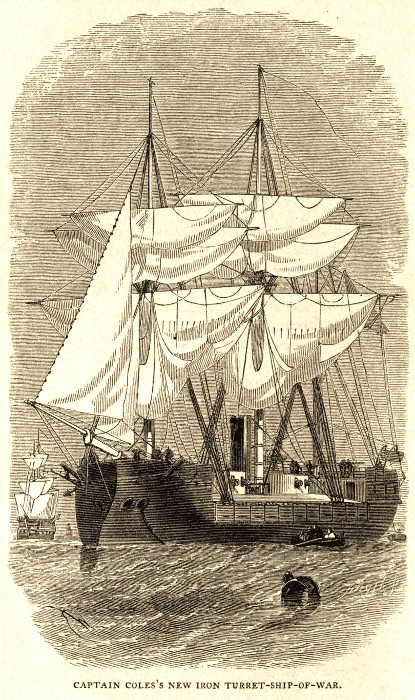
 The idea for this entirely original style of Enigmas is taken
from one said to have been written by Her Majesty for the Royal
children, which, with its Solution, is given.
The idea for this entirely original style of Enigmas is taken
from one said to have been written by Her Majesty for the Royal
children, which, with its Solution, is given. A
A