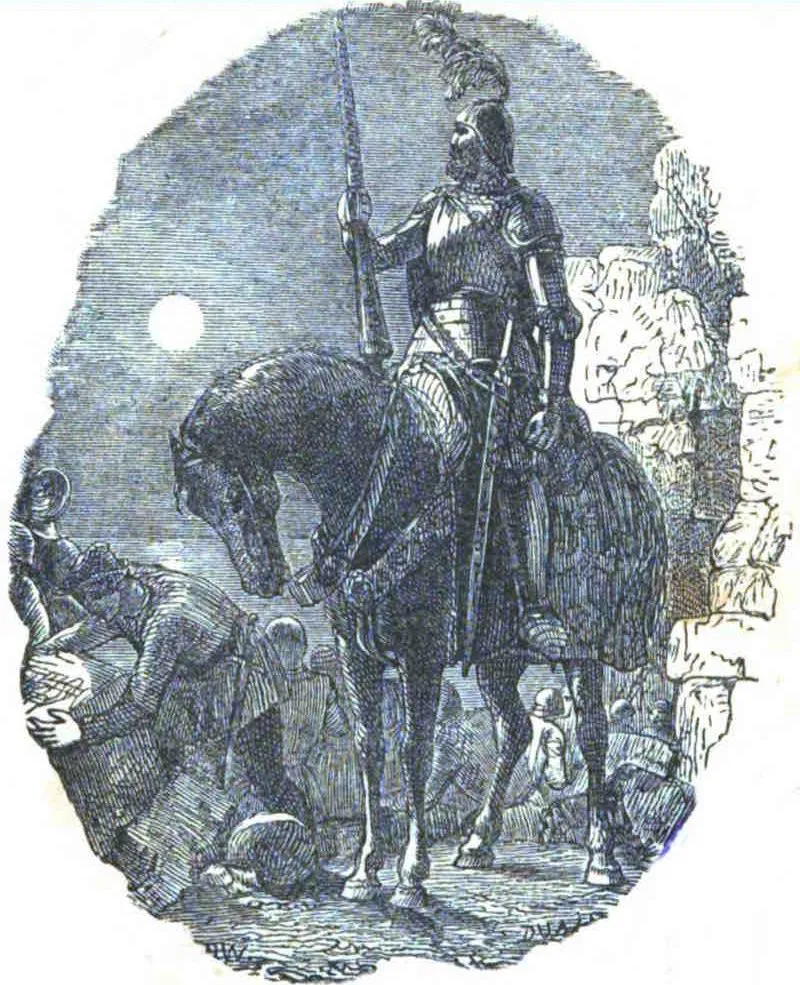
Religious state of Europe—Fall of Cyprus—Bragadino—Calepius—The
Christian league and armament—Rendezvous at Messina—Don
John of Austria, his character and conduct—Meeting of the
hostile fleets—Disposition of the ships—The battle—The Knights
of Malta—Cervantes—Utter defeat of the infidels—Magnanimity
of Don John—Results of the victory—Revelation made to
St. Pius—The joy of Christendom, and commemorations of the
Church.
The sixteenth century was drawing to its close,—a century
marked by the ravages of religious revolution, and
destined to be for ever honoured or deplored according
as men may think of it as the age of reformation or of
decay. Among the many social changes which arose
out of the new order of things, we can scarcely fail to
notice the growth of that exclusive nationality which
has lasted until our own time. The great tie of religious
unity was broken which had given the nations
of Europe a common interest even in the midst of the
continual warfare in which they were engaged, and
which had inspired them with so many generous enterprises
in defence of the faith. But when that bond of
brotherhood was lost, there was no longer a common
cause to fight for: a profound selfishness may thenceforward
be discovered in the whole history of Europe,
and the chance alliances of one power with another had
no nobler basis than the political interests of the hour.
This change began to be felt immediately after the
separation of the northern nations from the unity of the
Church, and the circumstance was not unobserved by
the great infidel power of the East. The enormous progress
of that power was almost coeval with the period
of the Reformation; and the distractions and divisions
among the Christians that followed that event were so
many gains to the Turks, who pushed their victorious
arms further and further, till the dreaded Crescent,—which
the long struggle of the crusades and of the heroic
ages of Christendom had kept at bay,—was displayed
under the very walls of Marseilles and the port
of Rome by the corsair-fleets which roved at large over
the waters of the Mediterranean, and scarcely found an
enemy to oppose them in their course. The republic of
Venice, indeed, was still master of many of the island-fortresses
of the Levant and the Archipelago; but as
the power of that state was now gradually declining,
the eyes of her foe were fastened with a bolder ambition
upon the dominions which she seemed helpless to
defend. The rich and beautiful island of Cyprus in particular
excited the cupidity of Selim II.,[50] who had succeeded
his father, Solyman the Magnificent, in the empire
of the East; and the report of a sudden disaster
which befell the republic in the explosion and destruction
of her arsenal, encouraged him to seize the occasion
of breaking, in the face of solemn treaties, a peace
which had remained undisturbed between the two states
for nearly thirty years.
When the hostile intentions of the Turkish sultan
became known, the republic was little prepared to recommence
the desperate struggle. Her utmost efforts
were spent in the equipment of a fleet which, when
assembled, was found wholly inadequate to meet the
enemy; and in her distress, crippled as she was by the
loss of her vast magazines, and drained of all resources,
she implored the assistance of the Roman Pontiff, and,
through him, of the other powers of Christendom. Pius
V. then filled the chair of St. Peter; and his sagacious
eye had long foreseen the danger; nor had he spared
any efforts to provide the necessary defences. But the
times were against him. A famine was ravaging the
fair fields of Italy; the government of France was too
busy with the Huguenots to have time or strength to
bestow on a quarrel with the Turks; and as to England—to
use the expression of a writer of the time—its ruler
was Elizabeth, “a greater enemy to Rome than the
Turks themselves.” Nevertheless, in spite of all discouragements,
the zeal of the Roman Pontiff was manifested
by an extraordinary activity. Every court of
Europe was visited by his ambassadors, who vainly
tried to rouse the spirit of the Christian princes against
a foe whose conquests were as rapid as they were blood-stained.
One after another they excused themselves on
the plea of domestic troubles and exhausted treasuries
and in the month of May 1570, when Pius had fondly
hoped to have seen his noble appeals as nobly responded
to by the universal voice of Christendom, he found himself
supported by the king of Spain alone out of all the
potentates of Europe.
Meanwhile the fall of Cyprus, attended by barbarities
which rivalled in cruelty and atrocity the torments
inflicted on the early Christian martyrs, signalised the
opening of the war, and gave to the Turkish arms the
prestige of the first success. A slight notice of that
terrible event may give our readers some idea of the
sort of adversary by whom Christendom was at this
time threatened.
Already the sultan had ordered the seizure of all
merchant vessels that chanced to be at anchor within
the ports of the Turkish empire, and the closing of all
the avenues by which relief could be afforded to the
doomed island; and yet in Venice itself counsels were
still divided: the doge was just dead, and the senate
was occupied with the nomination of his successor. To
the last no vigorous measures were taken by the republic
to throw a sufficient force into Cyprus, and the
commanders of the allied Venetian and Spanish fleets
strove in vain to convey the necessary succours. Sickness
and famine made fearful ravages among the troops,
and many thousands perished. The ships which had
on board Count Jerome Martinengo and 3000 men
were overtaken by a tremendous storm; an epidemic
broke out which carried off more than a third of the
number, and among them their renowned commander
himself; and they who, from the shores of the island
had long watched for the reinforcements, of which they
stood in such desperate need, saw at length but a few
shattered vessels come into harbour, bearing with them
the dead body of the man on whose bravery and skill
they had rested all their hopes of deliverance. To add
to the general consternation, Nicholas Dandolo, who
had but just taken on himself the office of governor,
was one in whose capacity and judgment neither soldiers
nor people felt they could place any reliance. Lala
Mustapha, a renegade already infamous for his foul and
treacherous practices, was the commander of the Ottoman
forces, numbering, as some historians have computed,
80,000 men; to oppose which vast armament
the Christians could not muster more than 500 or 600
horse, a small body of local militia, and 2000 foot-soldiers
fit for active service.
The city of Nicosia, the first object of attack,
was taken by storm, on the 9th of September 1570,
after an heroic resistance of seven weeks, during which
the inhabitants had again and again repulsed the assaults
of the Turks with a valour which struck such
terror into the besiegers, that more than once they all
but abandoned their attempts on the town. The ammunition
had failed, the fortifications were demolished,
most of the distinguished leaders had been slain; the
devoted bishop, who had given up all he possessed for
the support of the soldiery and people, had himself
fallen in a mêlée; the Count de Rochas, who ranked next
in command to the governor, was killed in defending
one of the ruined bastions, and the Turks, after grossly
outraging his body, thrust it into a mortar and launched
it into the town. Dandolo retreated into his palace as
soon as the enemy penetrated into the town, and the
wretched inhabitants were given up as a prey to their
infuriated assailants. In vain they threw themselves
on their knees before their vanquishers; they were massacred
without pity: for seven hours the horrible carnage
proceeded. The palace still held out. The pasha
offered the garrison their lives on condition of their laying
down their arms: they did so, and every soul was
put to the sword. The Bishop of Baffo, who, in the estimation
of his countrymen, was as capable of commanding
an army as of governing a diocese, was butchered
among the rest. The unhappy Dandolo, after suffering
frightful tortures at the hands of the infidels, was decapitated,
and his head sent to the governor of Cerino, the
third principal town of the island, as a token of what
he might himself expect if he did not instantly surrender
the place. The atrocities committed by the Turks
defy description. Mustapha, it is related, ordered the
children and old men, and all whom it was not worth
the victor’s while to preserve, to be piled one upon another
in the great square of the town and burnt alive; at
the same time, to show his hatred of the Christian name,
he directed numerous carcases of swine,—for which
the followers of Mahomet entertain a religious abhorrence,—to
be heaped upon his victims, and consumed together
with them. For three days the town was given
up to pillage, and every barbarity which an infernal
malice could suggest was perpetrated upon its despairing
population. Women threw themselves from the
house-tops to escape from their pursuers; mothers slew
their daughters with their own hands rather than that
they should fall into the power of the brutal foe. More
than 20,000 human beings were slaughtered on the day
of the assault: in the first paroxysm of their rage the
infidels spared neither sex nor age; 2000 alone were
reserved for a slavery more terrible than death. One
fearful act of vengeance marked the close of this memorable
siege. The Turks had collected in a single galleon
the most beautiful youths and maidens of the place,
together with the most precious portion of the booty,
with the intention of conveying them as presents to the
sultan, his eldest son, and the grand vizier. One of the
captives, a lady of noble family, knowing but too well
the wretched fate that awaited herself and her companions,
set fire to the powder-magazine, and blew the
vessel high into the air. Two others loaded with the
spoils of the town were involved in its destruction; great
numbers of the enemy perished, and among them many
Christians of distinction, and the flower of the youth of
either sex.
Mustapha now led his troops, flushed with victory
and outnumbering by thousands their Christian opponents,
under the walls of Famagosta. For eleven months
the brave Bragadino, with a scanty garrison and a few
thousands of armed citizens, withstood the Moslem
hosts.[51] In vain had they sought relief from Spain and
their own republic. The Spanish admiral weakly held
aloof; the Venetians succeeded only in throwing a
handful of men into the place. The besieged fought
with all the strength of despair: women not only laboured
in supplying arms and ammunition to the soldiers,
but combated by their side upon the walls, throwing
down stones and boiling-water on the assailants, or precipitating
themselves with deadly effect into the masses
of the foe, and causing many a Moslem warrior to bite
the dust. The bishop of the place, a Dominican by
profession, contributed not a little in re-animating the
spirits of the garrison, whose ranks were being every
day rapidly thinned by famine and the sword: his exhortations,
say the chroniclers, elicited prodigies of valour.
In the very heat of the assault he might be seen
for hours upon the ramparts, surrounded by his clergy,
holding aloft the crucifix, and calling on the people to
resist unto death fighting for the faith.[52] All in vain:
on the 1st of August 1571, the walls were nearly levelled
to the ground; the defences consisted only of bags of
earth and bales of cotton; the Italian and Greek auxiliaries,
whose prowess had done such execution on the
Turks, were all annihilated; there were left but seven
barrels of powder, and of food there was none remaining;
the combatants, emaciated by want and incessant
toil, could scarcely hold their weapons in their hands.
Further resistance was impossible, and Bragadino, yielding
at length to the piteous entreaties of the townspeople,
consented to sue for terms. But as the intrepid
governor bade the white flag be unfurled, he exclaimed,
“Officers and men, I call Heaven to witness
that it is not I who surrender this town to the infidels,
but the senate of Venice, who, by abandoning us to our
fate, have given us up into the hands of these barbarians.”
A capitulation was concluded, by which the
inhabitants were to remain in possession of their goods,
and to have the free exercise of their religion; all who
chose might quit the town, and sell or carry off their
effects; the garrison were to march out with their
arms and with all the honours of war, and to be transported
in Turkish vessels to Crete.
The terms were ratified; and on the morning of the
15th August, the Feast of the Assumption, Bragadino,
according to agreement, proceeded with two of his officers
and a small escort to the tent of the Turkish general
to deliver up into his own hands the keys of the town.
But no sooner had he entered the pavilion than he and
his attendants were treacherously seized on some frivolous
pretence; new conditions were imposed; and on the
governor’s remonstrating against the injustice of such
proceedings, Mustapha ordered his companions to be
beheaded on the spot before his eyes. Bragadino himself
he condemned to a like fate: three times he compelled
the noble Venetian to bow his head to receive
the murderer’s stroke, and as often,—as though he would
make his victim drink the bitter cup of torment drop
by drop,—arrested by a sign the executioner’s arm.
The tyrant had another and a more terrible death in
store for one who had so long defied his most furious
efforts; and he contented himself for the present with
ordering his captive’s nose and ears to be cut off in his
presence; which done, he had him loaded with chains,
and cast, bleeding as he was, into a dungeon, tauntingly
bidding him call now upon his Christ, for it was time
that He should help him. Three hundred Christians
who were in the camp were butchered in cold blood;
the rest of the garrison and the unhappy townspeople,
who were already on board the Turkish transports,
were reduced to slavery; while the hostages sent into
the Turkish quarters before the treaty was formally
signed, among whom was Henry Martinengo, nephew
of the count, were subjected to barbarous mutilation.
The fortifications were now ordered to be rebuilt; and
the Turk compelled his noble prisoner to carry loads of
earth upon his shoulders for the repair of the walls, and
to kiss his feet each time he passed before him; and not
yet satisfied with the indignities he heaped upon him,
he had him hoisted up aloft on the yard-arm of a vessel
in the harbour, where he kept him exposed for hours
to the gaze and scoff of the infidels, and then suddenly
plunged him into the sea. At last, after trampling him
under foot, he doomed him to be flayed alive in the public
square. The indomitable commander, who united in
himself the resolute courage of a chivalrous soldier with
the supernatural patience of a Christian martyr, amidst
his untold agonies betrayed not a sign of pain, uttered
not a murmur or a complaint against his torturers,
but, as they stripped the skin from his quivering flesh,
calmly prayed and recited aloud from time to time
verses from the Miserere and other Psalms. When
the Christians in the crowd heard him breathe the
words, Domine, in manus tuas commendo spiritum
meum,[53] they thought he was rendering up his life to
God; but there followed in tender accents,—as if to
show Whose sufferings in that hour of agony were
most present to his thoughts, and Whose meek and
loving spirit then filled his inflexible and dauntless soul,—Pater,
dimitte illis; non enim sciunt quid faciunt;[54]
and with this prayer for mercy on his tormentors the
brave soldier of Christ passed to receive the martyr’s
palm. But Turkish malice was not even yet exhausted.
Mustapha caused the brave man’s body to be cut into
four quarters, and each to be attached to the muzzle
of the largest guns. His skin was stuffed with straw,
and, together with a representation of our Divine Lord
in His adorable Passion, paraded through the camp
and through the town fastened on the back of a cow.
Finally, he despatched both figures as trophies to the
Sultan his master, with the head of Bragadino and those
of the two murdered commanders. At Constantinople
the skin of the heroic martyr was hung up as a spectacle
for the Christian galley-slaves.[55]
After the fall of Famagosta further resistance was
impossible; indeed (to their everlasting shame be it
written) the Greek population of the island sided actively
with the invaders, and, in their obstinate blindness,
not knowing what they did, delivered themselves
up to the degrading domination of the Turks. Every
where the most frightful scenes were enacted: the
Mussulman soldiery broke into the wine-cellars, and,
maddened with drink, indulged in orgies too revolting
for description. By the command of the renegade Mustapha
the tombs of the dead were opened, and their
contents scattered to the winds; the images and pictures
of the saints were demolished; the churches defiled
with abominations so loathsome that the pen of
the historian refuses to record them. Friday the 17th
of August, the day on which the noble Bragadino suffered,
was set apart for the deliberate perpetration of
horrors which rivalled in foulness and atrocity the infamous
mysteries of Venus, and the bloody rites at which
pagans offered sacrifices of human victims to the devils
whom they worshipped. A few days after, Lala Mustapha
made his triumphal entry into Constantinople with
the spoils of a conquest which had cost him 50,000 men.
During the dreadful scenes which accompanied the
fall of Cyprus, there were not wanting many who displayed
a spirit worthy of the best days of Christendom.
F. Angelo Calepius, a member of the Dominican order,
has left an interesting and valuable narrative of the
taking of Nicosia, of which place he was a native. He
himself played a distinguished part in its defence; for
during the seven weeks of siege which preceded the
entrance of the Turks, he was unwearied in his efforts
to rouse the inhabitants to an heroic resistance in the
cause of liberty and faith. In spite of the continual fire
of the enemy, Calepius was to be seen every where,
attending to the wounded and dying, and encouraging
the harassed and disheartened combatants. When at
length the place surrendered, and was abandoned for
three days to pillage and slaughter, the zeal and devotion
of this excellent man displayed itself under the very
swords of the infidels. The streets were flowing with
blood; yet wherever the danger was greatest and the
heaps of dead and dying lay the thickest, Father Angelo
might be seen, regardless of the ferocious soldiery who
surrounded him, administering the consolations of religion
to their victims, and endeavouring to comfort them
in that dreadful hour by the power of his words and of
his very presence.
Among those whose murder in cold blood he was
forced to witness, was his own mother Lucretia Calepia
and almost all his relatives, with numbers of the clergy
and his fellow religious; yet the thought of flight or
concealment never seemed to suggest itself to him amid
scenes which, with all their horrors, offered him a field
for his labours in defence of the faith and in aid of his
brethren. “He was,” says Echard, “a constant champion
and defender of the Christian faith.” But at length
his own turn came: he was seized, stripped of his religious
habit, and placed, loaded with chains, among the
other captives. After passing through many hands, he
was finally purchased by Osma, the captain of a Turkish
galley, and carried by him to Constantinople. Before
long, however, Angelo so far won the good graces of
his master, that he was no longer treated as a slave:
he was even suffered to sit at the same table, and permitted
to go through the city wherever he desired
without restraint, the only condition exacted from him
being, that he should not leave the walls. He had
no temptation to do so; for the sole use he made of
his liberty was to visit his fellow-captives, to console
them in their sufferings, and strengthen them in the
faith. There are some men who find their apostolate
every where, and such was Calepius. True to the great
instinct of his order, he was ready, like his great patriarch,
“to save souls any where, and as many as he
could.” In those days the chains and scourges of
the Moslems were a less terrible danger to their captives
than the temptations to apostasy, with which they
were careful to surround them. Men needed a living
and a lively faith to be able constantly to persevere
in the most appalling sufferings, when a few words
would purchase for them ease, liberty, and often the
highest rank in the sultan’s service,—for many of the
most distinguished commanders were Christian renegades;
and Calepius, who knew this, felt that no more
fitting field of missionary labour could have been granted
to him than he now found in the dungeons and bagnios
of Constantinople, confirming his weak brethren, and
sometimes winning back those who had strayed, to the
profession of their faith.
Meanwhile his order had not forgotten him; his
name had long been known in Rome, and Seraphin
Cavalli, the general of the Dominicans, who had his
liberation greatly at heart, succeeded at length in despatching
four hundred gold crowns to Constantinople
as the price of his ransom. Calepius was therefore free.
He might have returned to Cyprus, or made his way
to Rome, where he was sure of an honourable reception;
but ease and honour were the last things of which
he thought. He had chosen the damp vaults of the
slave-prisons for the scene of his ministry, and without
hesitation he determined on remaining at Constantinople,
and sacrificing liberty, advancement, nay, life itself if
need were, for the salvation of his brethren. So there
he stayed, a beggar at the doors of the ambassadors
and Christian merchants, carrying the alms he collected
to the miserable objects of his charity, some of whom
he was even enabled to set at liberty, rejoicing as he
did so rather at the deliverance of their souls than the
emancipation of their bodies. Many renegades were by
his means recalled to the faith, and a far greater number
preserved from falling. At length, however, his
unwearied labours drew on him the jealousy of the
Turks: he was forbidden to visit the slaves; but continuing
to do so by stealth, he was at length formally
accused of being a spy and an enemy to the Prophet.
The charge was a capital one; and on the 3d of February
1572, he was again seized and thrown into a wretched
dungeon. Calepius had never looked for any other
result; and joyfully hailing what he trusted was the
approach of martyrdom, he prepared for death with his
usual calmness. It was not so ordered, however; he
had many friends, both among the ambassadors and
even among the infidels themselves, and his release was
at length procured, on the condition, not a little flattering
to his influence and character, that he would instantly
quit the Turkish dominions. It was useless to
resist; and since he could no longer assist his captive
brethren by his presence, he determined not the less to
devote himself to their deliverance in another way. He
passed over to Italy, and became there what he had already
been in Constantinople—a beggar for the Christian
slaves. Naples, Bologna, Florence, Milan, and
Venice, and every other city whither the Cyprian refugees
had retired, was visited by him in turns. He
pleaded the cause of their poor countrymen with all the
skill of an advocate and all the tenderness of a father,
and represented their sufferings with so touching an
eloquence, that he effectually roused every one to give
according to his means. Another Dominican, by name
Stephen de Lusignan, of the royal house of Cyprus,
joined him in his work; and together these two men
were enabled to ransom great numbers of the captives,
devoting their entire energies to this undertaking for
many years.
It is at the end of De Lusignan’s Universal History
that the two narratives of Calepius on the taking of
Nicosia and Famagosta are inserted; and it is said
that the publication of these memoirs became the means
of exciting many to liberal alms on behalf of the sufferers.
Some years afterwards Angelo was nominated
by Gregory XIII. to the bishopric of Santarini, as a reward
for his zeal and perseverance.
So was lost the fair isle of Cyprus to Venice and to
Christian Europe: it passed under the dominion of the
Mahometan, and to this day it remains subject to the
same evil sway;[56] a monument alike of the treacherous
cruelty of the Turk and of the disastrous dissensions and
faithless jealousies of Christian states and princes.
The horror inspired by this catastrophe determined
the Catholic League to prepare for more vigorous measures
than had yet been attempted; and it is from this
period that we shall endeavour to take up the narrative,
and lay before our readers the details of a struggle
whose result has been found worthy of commemoration
not only in the pages of history, but in the office of the
Church.
And first, let us see what was the relative strength
of the parties about to enter into the combat. A fleet
of about 160 vessels, thinly manned, was furnished by
the Venetian states, under the command of Sebastian
Veniero, who had as his lieutenant Agostino Barbarigo,
a man of distinguished merit and courage. The Pope
had no naval force at his disposal, but undertook to
furnish and equip twelve of the Venetian galleys; Mark
Anthony Colonna, Duke of Paliano, was appointed to
the command; and, besides the regular forces in the
papal service, a considerable number of the Roman nobility
volunteered to join the enterprise. Every thing
had been done to give a character of religious solemnity
to the enrolment and departure of these troops. The
venerable Basilica of the Apostles had witnessed a
function of singular character and magnificence in the
June of the previous year, when after High Mass, sung
by the Cardinal Colonna, the Pope solemnly implored
the Divine benediction on the Christian arms, and blessed
the crimson standard, emblazoned with the crucifix and
with the figures of the two apostles of Rome, which was
committed to the Duke of Paliano; whilst the words
embroidered as a legend on the damask folds were given
to him as his watchword and assurance of success,—“In
hoc signo vinces.” Nor was another kind of assurance
wanting to encourage him and his followers. When,
attended by all his officers and by the crowd of noble
volunteers who had joined his company, he presented
himself to receive the parting benediction of his Holiness,
it was given to them accompanied by words which
from the mouth of such a speaker had something in
them of a prophetic character: “Go, my children,” he
said, “and fight in God’s name against the Turks; it is
in His name and on His part that I promise you the
victory.” Similar to this had been the message sent by
him to the Spanish leaders by the hands of his nuncio
Odescalchi, as well as to the other princes who had
joined in the enterprise; and to the Count de Carillo, as
he knelt at his feet, the holy Pontiff again repeated, “It
is in the name of the Most High that I promise you a
certain victory.”
Yet this assurance could scarcely be thought to arise
from the extent of the martial preparations. So far as
the co-operation of the European governments was concerned,
the embassies and negotiations of his ambassadors
had almost utterly failed. Nevertheless we must
remember that the influence of the Roman Pontiff over
the heart of Christendom rests on something deeper and
more powerful than the success of a political negotiation.
And so, notwithstanding the coldness and backwardness
of the Christian princes, the appeal of the Pope had been
royally and warmly received by many in every nation
whither his nuncios had been despatched. Besides the
regular armaments of Spain and Venice, and the forces
contributed by Genoa and the Duke of Savoy, by the
Knights of Malta, and several of the lesser Italian states,
the volunteers who joined the troops of the allies, to the
number of more than two thousand, were of all nations,
and included some of the most distinguished soldiers of
the day. But, more than this, it cannot be doubted
that the confidence which filled the heart of St. Pius
had another and a surer foundation. He could not
command the arms of Europe, but the prayers of Christendom
at least were at his disposal. Up from every
church in every country that owned his obedience there
had been arising for months a swell of fervent and
united supplication. The religious order to which he
himself belonged had been foremost in the use of this
great weapon of intercession; and every Confraternity
of the Rosary throughout Europe attached to the Dominican
body had been unwearied in their processions
and devotions for the success of the Christian arms.
How strong a feeling had been excited by the efforts
of the Pope may be judged by one fact: it was the period
of so-called reformation, when throughout a vast
portion of Europe the devout practices of former ages
were sinking into contempt; and yet we are told Loretto
had never seen such a year of pilgrimage. Every road
to the Holy House was crowded by devotees of all nations;
and all crowded thither with but one object—to
place the cause of the Christians under the patronage
of Mary.
The Spanish fleet had been hitherto commanded by
John Andrew Doria,[57] and some symptoms of jealousy
had arisen in the first movements of the allies between
him and the Roman leader, Colonna. These were,
however, happily placed at rest by the appointment to
the chief command of one whose rank as well as his
reputation raised him far above all the subordinate
generals of the league. This was Don John of Austria,
the natural son of the emperor Charles V., and the
captain-general of the navy of Spain. Colonna was,
with the consent of all parties, declared his lieutenant;
and his arrival was anxiously expected at Messina,
where the
various squadrons of the allied powers had
assembled towards the close of the month of August.
It was the 25th of the same month when he arrived at
the place of rendezvous; and his entrance into the city
seemed rather the triumph given to a conqueror than
the reception of one whose victory was yet to be hardly
earned. All the showy magnificence of the times was
displayed in the preparations made for welcoming him.
The city was filled with arches and triumphal columns,
and the shores covered with the gaily-emblazoned banners
of the various chiefs, whose martial appearance
recalled to the eye the costume at least, if it did not
represent something also of that chivalrous spirit which
was fast expiring before the progress of modern civilisation
and the eager pursuit of material interests. And
indeed there was much in this, almost the last of the
Christian leagues against the infidel, which was worthy
of the best days of chivalry. A great principle, even
when it has received its death-blow, is long in dying;
and the embers of that generous fire blazed up in many
a bright and flickering flame before they were wholly
quenched in darkness. We can scarcely fail, for instance,
to admire the generosity evinced by the Spanish government;
for, apart from the religious considerations
of the war, its main object was undoubtedly the relief
and protection of the Venetian states,—those very states
which but a short time previously had refused to assist
the Spaniards against the Turks, and by their refusal
had been in great part the cause of the fall of Rhodes.
Yet Philip II.,[58]—a monarch whose traditional unpopularity
in England, as the husband of Mary the Catholic,
has obscured the memory of his many great qualities,—never
seems to have given a moment’s place to the
petty yet not unnatural feeling of resentment which
might have led him to seize so favourable an opportunity
for retaliating on a humbled rival. No sooner did the
appeal of the Pope reach him than he gave orders to
Doria to render every assistance to the Venetian fleet,
without the exaction of any condition, or a symptom
of any sentiment but that of hearty and devoted adherence
to what he deemed the cause of God. There was,
moreover, a deeply religious feeling among those now
gathered on the shores of Messina. Many of the most
distinguished leaders in their ranks had earned their
laurels in the defence of the Catholic faith; not a few
of the most renowned of the French volunteers; such
as the Count de Ligny, and others, like the two Sforzas,
had gained their military reputation in the Huguenot
wars; whilst that of Don John himself had been
in great part acquired in long and successful struggles
with the Moors of Africa. But above all, a distinct
religious character was given to the enterprise by the
presence of Odescalchi, the papal nuncio, whose mission
in the Christian camp was not merely to bestow the
apostolic benediction on the soldiers, and to animate
them to the combat by the assurance of the favour of
Heaven, but, as we are told, to drive away all bandits,
assassins, thieves, and other public sinners, who might
have enlisted from the hope of booty, and who, unworthy
of fighting in a holy cause, might rather draw
down the anger of God by new crimes.
The chief appointed to lead the Christian forces,
whose arrival was being welcomed with such enthusiastic
manifestations of joy, was one every way worthy
of a great command. His German biographer thus
describes him: “He was of sanguine temperament and
lordly presence; in stature somewhat above the middle
height; of a frank and generous nature, possessing a
strong sense of justice, and gifted with a ready wit and
a retentive memory. He was remarkably vigorous and
strong; so much so, that he could swim in his armour
as if he had nothing on him. He was agreeable and
courteous in manner, a great respecter of letters and
arms, and an excellent horseman. He had a noble,
clear, and spacious forehead; his blue eyes were large
and bright, with a grave and kindly expression; his
countenance was handsome; he had little beard, and
was of a light and graceful figure.” By the terms of
the league the squadron was to consist of 300 vessels
and galleys, and 50,000 men. The actual combatants,
however, were not more than 29,000, although there
were more than 80,000 altogether in the fleet that was
now assembled under the eye of its commander. The
council of war having determined on seeking battle
with the Turks without loss of time, only a few days
were given to the marshalling of the armament, which
then sailed out of the port of Messina, presenting a
spectacle of naval magnificence which in those days
had rarely been equalled. One by one each vessel
passed in its allotted order out of the harbour, and fell
into its appointed place, whilst the nuncio Odescalchi
stood on the pier-head, blessing each in turn. The vessel
which bore the Spanish prince was conspicuous for its
beauty and decorations; it was the royal galley of
Spain, ornamented after the fanciful taste of the day
with “delicate carving and ingenious allegories.” The
order of battle, which was to be inviolably preserved
during the whole time of the expedition, was as follows:
Doria led the right wing, having fifty-four galleys
under his command, with orders to keep about six miles
in advance of the main body, so as to give the ships
plenty of sea-room. The left wing was under Agostino
Barbarigo, and consisted of an equal number of galleys.
The main body of sixty vessels was under the personal
command of Don John himself; whilst the reserve of
thirty more was intrusted to Don Alvaro di Bazzano,
Marquis of Santa Cruz. Don John of Cardona was
despatched with some Sicilian galleys a few miles
in advance, with orders to reconnoitre the enemy, and
fall into his place at the extremity of Doria’s wing, so
soon as he should have discovered him. The hoisting
of the consecrated standard was to be the signal for the
whole fleet falling into line and presenting a single
front; whilst a number of galleys were selected to form
a circle around the leading vessels of the three chief
divisions of the armament to act as a support. Besides
the advanced galleys of Cardona, Andrada, a Spanish
knight, had previously been sent by Don John, in a
light and swift vessel, to make secret observations on
the position and preparations of the Turks; whilst the
Christian squadrons meanwhile proceeded to the harbour
of Gomenizza, where the whole fleet was reviewed by
the commander in person, not without symptoms of
jealousy and opposition on the part of the Venetians.
But there was little time for the settlement of
mutual disputes; and the intelligence brought by the
Spanish spies soon induced all parties to lay aside their
rivalries, and prepare for the combat. The tidings of
the fall of Famagosta were now fully confirmed; Cyprus
was lost past recall; and the Turkish fleet, under the
command of Ali Pasha, was drawn up in the bay of
Lepanto, with orders from the sultan to seek and fight
the Christians wherever they might be. Some, indeed,
were found who, even at this juncture, advised defensive
measures; but their votes were overpowered by
the ardour of the Colonna and of Don John himself,
who, we are assured, had such faith in the sanctity of
Pius, and in the assurance of victory which he had
received from his mouth, that he relied more on his
words than even on the number and valour of his
soldiers. But it seemed as though his purpose of giving
battle must perforce be deferred. A sudden obstacle
presented itself; an adverse wind arose, which
rendered the advance of the armada all but impossible.
For two days it had kept steadily blowing from the
same quarter, and there seemed no indication of a
change; nevertheless (to use the words of the Spanish
historian, Rosell) “on the morning of the 7th of October,
a little before daybreak, Don John, defying the
opposition of the elements, and as though impelled by
an irresistible power, to the astonishment of all gave
the signal to weigh anchor.” It was obeyed; and
labouring against the contrary wind, the vessels began
to make their slow and difficult way, tossed and beaten
by the waves, as the morning light was breaking over
the horizon. Just as the sun rose over the glorious
coast of that island-group, anciently known as the
Echinades, the watchman on board the prince’s galley
made signal of a sail. It was quickly repeated by the
lookers-out in Doria’s squadron, and many who eagerly
ascended the rigging plainly discerned not one sail
alone, but, like so many dark specks on the flashing
surface of the western sea, the distant array of the
whole Turkish fleet. A battle was therefore felt to be
close at hand; and whilst the crimson folds of the consecrated
banner, to which a blessed rosary was affixed,
were displayed aloft on the royal vessel, and the signal-gun
gave notice for all to fall into position, loud acclamations
burst from every part of the Christian host in
token of their enthusiastic joy. The Turkish fleet consisted
of upwards of 400 vessels of all sizes,[59] manned
by not fewer than 120,000 men; in strength, therefore,
the Moslems far surpassed the Christians, and they had
the prestige of their late conquests in their favour. As
the fleets were still distant, the interval was spent by
the leaders of both parties in encouraging their followers
and preparing for hostilities. Some of the
Spanish generals, who still doubted the prudence of
provoking the contest, appeared on board the royal
galley to learn the final decision of the prince. They
received it in a few words: “Gentlemen,” he replied,
“you mistake; this is not the time for council, but for
combat;” and turning from them, he continued issuing
his orders. Then, taking a small and swift galley, he
went the rounds of the fleet, animating their crews with
a few of those brief and heroic phrases which fall with
such powerful effect from the lips of a great commander.
He had an appropriate word for all. The Venetians he
reminded of their injuries, and of the slaughter of Famagosta.
Sebastian Veniero, whose irritable and stubborn
temper had, at the first departure from Messina,
betrayed him into excesses which banished him from
the prince’s council, still bore himself morose and sullen
under his disgrace; but the judicious and courteous
kindness of Don John so won upon him, that he laid
aside his angry feelings and distinguished himself in
the subsequent battle among the most valiant and devoted
of the combatants. His address to the Spaniards
has been preserved: “My children,” he said, “we have
come here to die—to conquer, if Heaven so disposes.
Give not occasion to the enemy to say with impious
arrogance, ‘Where is now your God?’ Fight, then, in
His holy name; fallen, a victorious immortality will be
yours!” And now might be seen other galleys passing
from vessel to vessel on a different mission. These conveyed
the religious appointed to attend the armada by
the Pope, who went through every squadron publishing
the indulgence granted by his Holiness, hearing the
confessions of the soldiers, and preparing all for death.
Their labours were crowned with abundant fruit. So
soon as the prince had returned to his vessel the signal
throughout the squadrons was given for prayer; all the
soldiers, fully armed for the combat, fell upon their
knees, the crucifix was upraised on the deck of every
vessel, and for some minutes, as the two hosts drew
rapidly nearer to each other, every man on board the
Christian fleet was engaged in humbly imploring the
Divine blessing on its arms.
Gradually the whole battle-front of the enemy displayed
itself to view; and the sun, now risen high
above the horizon, shone over a spectacle as terrible as
it was magnificent. Three hundred and thirty large
Turkish vessels were to be seen, disposed in the form
of a vast crescent, and far outflanking their opponents’
line; but the courage of the Christian leaders remained
unmoved by the terrific sight. Although it became
evident that the reports of the Spanish spies had greatly
underrated the numbers and strength of their opponents,
yet, as Rosell relates, the heart of Don John was unappalled;
and placing his hopes in God, and fixing his
eyes upon the crucifix he ever carried with him, he gave
thanks aloud for his victory as already won. No sooner
were the words uttered than a token seemed to be given
him to assure him that his trust was not ill-founded.
We have said that hitherto the wind had been all in
favour of the Turks, whose enormous crescent was bearing
rapidly down on the Christian host, like some fierce
bird of prey with outstretched wings, when suddenly
the breeze fell, and the sails flapped idly on the masts;
there was a dead and profound calm. The sea, but a
moment before crested with foam, became motionless
and smooth as a sheet of glass: it seemed as though
they were going to fight on land rather than on water,
so still and quiet lay the ships but just now tossed and
beaten by the angry waves. Presently a soft rising
breeze was heard sighing among the cordage; by and
by it gathered strength; but this time it filled the Christian
sails, blowing right against the prows of the Turkish
ships, and the whole state of things was changed.
The Turkish line, which but a minute previously had
seemed to extend its wide arms as if to enfold its helpless
foe in a deadly embrace, was thrown into some confusion
by this sudden and extraordinary veering of the
wind; while the Christian vessels, carried forward by a
brisk and favourable breeze, bore down with impetuous
gallantry on the foe, and thus gained all the advantage
of attack. The Turks, however, fired the first shot,
which was quickly answered by the Spaniards; then,
placing himself in full armour on the prow of his galley,
Don John ordered the trumpets to sound the charge;
whilst in every vessel the crews and soldiers knelt to
receive the last general absolution, and this being given,
every thought was turned to the approaching struggle.
It was noon before the fight began; the brilliant
sun rode aloft in the clear azure of the Grecian sky, and
flashed brightly on the casques and armour of the warriors.
The Moslems received their assailants with loud
and horrible cries, which were met on the part of the
Christians by a profound silence. The flag-ship of Ali
Pasha commenced the cannonade; but the fire of the
Venetians opened on the Turks so suddenly, and with
such overwhelming violence, that at the first discharge
their advancing vessels recoiled as though from the
shock of a tremendous blow, and at the second broadside
two of their galleys were sunk. In addition to
the discouragement produced by this first incident in
the fight, the adverse wind carried all the smoke of the
Christian artillery right upon the decks of the Turks,
who were thus blinded and embarrassed; whilst their
enemies were able to direct every movement with facility,
and fought in the clear light of day. After this
first encounter the battle became general; Don John
eagerly made his way towards the pasha’s galley, and
Ali, on his part, did not decline the challenge. To form
any thing like a correct idea of a sea-fight in those days,
we must remember the nature of the vessels then in use,
propelled as they were by rowers seated on several tiers
of benches, and defended less by artillery than by the
armed combatants, who strove to grapple hand to hand
with their opponents. The galleys of war were armed
with long beaks, or pointed prows, with which they
dashed against the enemy’s vessels, and often sunk them
at the first shock. Terrible was the meeting of the
leaders of the two armaments; the long beak of Ali
Pasha’s galley was forced far among the benches of the
Christian rowers: his own rowers, be it said, were Christians
also,—slaves chained to their posts, and working
under the threat of death if they shrank from their task,
and the promise of liberty if the Turks should gain the
day. Then there rose the clash of arms; the combatants
met face to face, and their swords rang on the armour
of their opponents, whilst the waters were lashed into
fury by the strokes of a thousand oars. Wider and wider
the conflict spread: the Bey of Alexandria, at the head
of his galleys, made a furious attack on the Venetian
squadron; but he was met by Barbarigo and his men
with the most eager and determined courage; for the
memory of the cruelties practised on their countrymen
at Famagosta was fresh in their minds, and animated
them to vengeance. A shower of darts rained around
them, but they seemed regardless of all danger. One
of these deadly weapons struck Barbarigo himself in
the eye whilst in the very front of the battle; he was
carried to his cabin, where, after lingering three days,
he expired of his wound. The slaughter on both sides
was terrible, though the Venetians were finally successful
in repulsing their enemies; the galley of Contarini,
the nephew of Barbarigo, narrowly escaped being taken,
from the fact of almost every man on board of it being
slain, Contarini himself among the number.
Whilst matters proceeded thus in the left wing, the
right was engaged in an equally desperate struggle. To
the Spanish commander, Doria, was opposed, on the side
of the Turks, the famous renegade corsair Ouloudj Ali,
who, from the rank of a poor Neapolitan fisherman, had
risen, through his apostasy from the faith and his extraordinary
and ferocious valour, to the sovereignty of
Algiers, and had become one of the most distinguished
admirals of the day. In the course of the preceding year
he had surprised a large squadron of galleys belonging
to the Knights of Malta, three of which he succeeded in
capturing, whilst others, including the admiral’s vessel,
were severely injured and run aground off the coast of
Sicily. This circumstance had for the time so crippled
the squadron of the order, that it was able to contribute
no more than three[60] galleys to the Christian fleet. They
were commanded by Peter Giustiniani, grand prior of
Messina, one of that illustrious race which was ever
foremost when the cause was that of the Church, and
the enemy was the Mussulman, and whose boast it was,
to reckon the names of fifty saints among its lineage.
Giustiniani’s own vessel, the Capitana di Malta, was
posted in the very centre of the line of battle, the place
of honour being granted without opposition to the banner
of St. John; but the other galleys were attached
to Doria’s division, and received the first attack of Ouloudj
Ali. In spite of their heroic defence, they were
overpowered by numbers; the St. Stephen was assailed
by three Turkish vessels at once, and was in the utmost
danger of being taken, when Giustiniani, perceiving the
danger of his knights, hastened to their assistance, and
forced two of the enemy’s vessels to strike. The third
was on the point of doing the same, when Ouloudj Ali
brought up four other galleys, and then ensued one of
the most desperate and bloody combats that was witnessed
throughout the day. Every man on board the
prior’s vessel was slain, with the exception of himself and
two knights, who were all, however, severely wounded.
One of the knights fought till he could no longer stand,
and fell, as was supposed, dead; yet he afterwards recovered,
and lived for several years, with the loss of an
arm, a leg, and an eye, and was looked on in the order
as one of their trophies of Lepanto. Giustiniani himself
was wounded in fourteen places; and his galley, now
without defenders, fell into the hands of the Turks, who
immediately brought up their seven shattered vessels,
and towed her off in triumph.
It was with inexpressible grief that the Christian
fleet beheld the fall of the Maltese standard and the
capture of its chief galley; but the success of the infidels
was of short duration. The knights inspired with
fresh courage by the spectacle of their admiral’s misfortune,
attacked the vessel of the corsair-chief with
redoubled fury. He defended himself with extraordinary
obstinacy; but at length, after the loss of all his
bravest men, the banner of the Hospitallers was once
more seen to float over the Capitana di Malta, and
Giustiniani and his two wounded comrades were rescued
from the enemy’s hands.[61] No less than seventy-three
knights fell in this struggle. Among those who most
distinguished themselves was the Gascon hero, Maturin
de Lescat, better known as “the brave Romegas.” In
his own day he enjoyed a kind of romantic celebrity;
for it was said that in all his combats with the Moslems
they had never been known to gain a single advantage
over him. In the course of five years he is
said to have destroyed more than fifty Turkish vessels,
and to have delivered one thousand Christians from
slavery. Many of his most daring exploits had been
performed on the coasts of Sicily, where he was so great
a favourite, that, as Goussancourt informs us, whenever
he entered any city of that island, the people would
flock out of their houses only to behold him; not knowing
which to admire most, so much courage adorned
with such rare graces of person, or those graces sustained
by so undaunted a valour. Much of the old chivalrous
spirit was to be found in his character, defaced,
indeed, by an ambition which afterwards obscured his
fame; but at Lepanto that fame had as yet lost nothing
of its brilliancy, and Romegas was never higher
in estimation than when he led on the galleys of his
order to the rescue of the admiral. Before the battle
began he made a solemn vow that the first Turkish
captain who might fall into his hands should be offered
to God: it chanced that his first prisoner was a most
ferocious Turk, who had lost the use of his right arm,
as was said, in consequence of the violence he had used
in inflicting the torture on his Christian slaves. This
man was given by Romegas, in fulfilment of his vow, to
the church of St. John at Malta, and had good reason
to thank the brave Gascon for his happy fortune; for
his heart changed in his captivity, and he learnt to
weep over the actions wherein he had formerly placed
his glory; so that, embracing Christianity, he solicited
baptism from his masters, and died happily in the true
faith. The gallantry displayed by the Hospitallers in
the engagement forced the Venetian Contarini to acknowledge
that, in spite of their insignificant numbers,
their part in the victory almost surpassed that of Venice
herself; and in fact, when we remember that Don
John of Austria was himself a member of the order,[62]
we are bound to admit that their share in the honour
of the day has not been sufficiently acknowledged by
historians.
Among the combatants in Doria’s division, whose
courage equalled any of those engaged in the battle,
was one whose celebrity, great as ever in our own day,
rests, strange to say, rather on the wit, whose ridicule
gave the last blow to the chivalry of the middle ages,
than on the valour which made its owner himself worthy
of the highest chivalrous renown: it was Miguel Cervantes,
“brave as the bravest.” He lay sick of fever
in the cabin of his ship when the tumult of the battle
began; but he could no longer endure to remain inactive.
In spite of the entreaties of his friends, he
arose, and rushed into the hottest of the fight. Being
covered with wounds, his companions again urged him
to retire; but he replied, “Better for the soldier to
remain dead in battle than to seek safety in flight.
Wounds on the face and breast are like stars to guide
others to the heaven of honour.” Besides other less
important wounds, Cervantes lost in this battle his left
arm;[63] his right hand was destined to gain him another
kind of immortality.
The combat soon became too general for the different
divisions of the two armaments to preserve their
respective positions. Every portion of the hostile fleets
was engaged; but the most desperate fight was that
between the galleys of the rival generals, Ali Pasha
and Don John of Austria. Both commanders fought
in the thickest of the fray, regardless of their rank, and
with the bold temerity of simple men-at-arms. By the
side of the prince’s galley were those of Colonna and
Sebastian Veniero; and in them, and in the other vessels
that surrounded them, were assembled the very
flower of the Christian host. Here for the most part
were the noble French and Roman volunteers; hardly
a great house of Italy but had its representative among
the combatants: two of the Colonnas; Paul Orsini, the
chief of his name, with his brothers, Horace and Virginius;
Antonio Carrafa, Michel Bonelli, and Paul
Ghislieri, nephews of the Pope; and Farnese, prince of
Parma, who played a very hero’s part in the flag-ship
of the Genoese republic. The battle in the centre, led
on by such men, and met with equal valour and determination
on the part of their adversaries, lasted more
than two hours. Already had the Christians made two
gallant attempts to board the vessel of the pasha, and
each time they were driven back with loss so soon as
they reached his decks. The burning midday-sun
added to the heat of the engagement, and the thirst of
the soldiers was almost intolerable. The decks were
heaped with dead, and those still living were covered
with wounds, and well-nigh exhausted from loss of
blood, and still they maintained the conflict with
unabated courage. At length the signal was given for
a third charge. It was obeyed with an impetuosity nothing
could resist; and whilst Ali Pasha vainly strove,
as before, to drive back his desperate assailants, a shot
from an arquebuse struck him in the forehead. Staggering
from his wound, he fell, and his head was instantly
cut off by a blow from one of the galley-slaves,
and thrown into the sea. The event of the
battle after this was no longer doubtful; Don John
with his own hands pulled down the Turkish flag,
and shouted, “Victory!” whilst Santa Cruz, profiting
by the confusion, pushed forward with the reserve,
and completed the discomfiture of the foe. At this
critical moment the corsair Ouloudj Ali, seeing that
the whole Turkish centre was broken, and the day
irretrievably lost, hoisted all sail, and with forty galleys,
the only vessels that escaped out of that bloody
battle, passed safely through the midst of the Christian
fleet.
The Turks struggled long and desperately before
they finally gave way. It was four in the afternoon
ere the fight was over; and the lowering sky betokened
the gathering of a tempest. The remains of
the Turkish fleet fled in all directions, pursued, though
with difficulty, by the allies, whose wearied rowers
could scarcely hold the oars; whilst their numbers
were so thinned by the slaughter, that it was as much
as the commanders could do to find crews for their
vessels. Crippled as the Christians were, however, the
infidels were seized with panic, and ran their vessels
madly against the shore of Lepanto. In their terrified
efforts to land, many were drowned; whilst the galleys
were broken by the waves, or fell an easy prey to the
conquerors. The whole sea for miles presented most
terrible tokens of the battle; those clear waters, on
which the morning sun had shone so brightly, were
now dark and discoloured by human blood. Headless
corpses and the fragments of many a wreck floated about
in strange confusion; while the storm, which every
moment raged in wilder fury, added to the horror of
the scene, lit up as the night advanced by the flames
from the burning galleys, many of which were found
too much disabled to be of any use to their captors.
Twelve[64] of those belonging to the allies were destroyed;
but the extent of their victory may be estimated by the
fact that eighty vessels belonging to the Turks were
sunk, whilst 130 remained in the hands of the Christians.
The pasha’s galley, which was among those taken, was
a vessel of surpassing beauty. The deck, says Knolles,
was of walnut-wood, dark as ebony, “checkered and
wrought marvellously fine with divers lively colours
and variety of histories;” and her cabin glittered with
ornaments of gold, rich hangings, and precious gems.[65]
The enemy’s slain amounted to 30,000 men; and
15,000 of the Christian slaves who had been compelled
to work the Ottoman galleys were liberated. Yet the
victory, complete as it was, was dearly bought; the
loss of the allies was reckoned at about 8000 men; and
their ships, riddled with balls, and many of them dismasted,
presented a striking contrast to the gay and
gallant trim in which but a few days previously they
had left the harbour of Messina.
The conduct of Don John of Austria after the battle
justifies us in ranking him among the true heroes of
chivalry. He had been foremost in the day’s conflict,
where he had been seen, sword in hand, wherever the
danger was greatest and the blows hardest. He was
now equally conspicuous for his care of the wounded,
his generosity towards his prisoners, and his frank and
noble recognition of the services of a rival. Sebastian
Veniero, the disgraced leader of the Venetian forces,
had distinguished himself in the fight by a valour that
had made his gray hairs the centre round which the
most gallant of the young volunteers of France and
Italy had rallied during that eventful day. The prince
sent for him as soon as the confusion of the victory had
subsided, and (adds Rosell in his history of the battle),
“to show him that he harboured no resentment for
past offences, he advanced to meet him as far as the
ladder of his galley, embraced him affectionately, and,
calling him his father, extolled, as was just, his great
valour, and could not finish what he would have said
for the sobs and tears that choked his utterance. The
poor old man, who did not expect such a reception, wept
also, and so did all who witnessed the scene.” Whilst
this interview was taking place, the two sons of Ali
Pasha were brought prisoners into the prince’s presence.
“It was a piteous sight,” says the same historian, “to
see the tears they shed on finding themselves at once
prisoners and orphans.” But they met with a friend
and comforter in their generous captor; he embraced
them, and expressed the tenderest sympathy for their
misfortunes. The delicacy of his kindness showed itself
in more than words; he treated them rather as his guests
than as captives, lodging them in one of his own cabins,
and even ordering Turkish clothes to be provided for
them at his expense, that they might not be pained by
being obliged to adopt the European costume. Neither
was he less forward in returning thanks to God for the
victory granted to his arms than he had been in commending
to Him the event of the day’s conflict. Thus
the night closed: the vessels cast anchor amid the wreck
of battle, and the wearied combatants took a short and
necessary repose. So soon as day again broke, the sails
were hoisted, and, securing their prizes, they proceeded
to the port of Petala, to repair their damages and provide
for the necessities of the wounded.
Such was the celebrated battle of Lepanto, whose
results were in one way insignificant, owing to the losses
incurred by the Christian allies, and the limitation put
on the power of Don John by the cautious policy of
the Spanish king. Yet we should be wrong to estimate
the worth of any victory by the amount of its territorial
conquests, or its lists of killed and wounded. The
moral effects of the day of Lepanto are beyond calculation:
it was the turning point in the history of the
Ottoman Turks; from it may be dated the decline of
their dominion; for though indeed, during the following
century, the terror of Europe was still constantly
excited by their attacks on the frontier of the empire,
yet their naval power was never again formidable, and
the long prestige of continual success was broken.[66]
Moreover, whilst it is impossible to deny that the advantages
of the victory were never followed up, and that,
in consequence of the desertion of the Venetians, the
league itself was soon dissolved; yet it is also certain
that the further progress of the Ottomans westward
was checked from the hour of their defeat; whereas
every campaign during preceding years had
witnessed their gradual advance.
It only remains for us to speak of the manner in
which the news of the success of the Christian arms was
received by those who were so anxiously awaiting the
result of the expedition at the courts of Rome and
Madrid. Pius V., who may be considered as the originator
of the whole enterprise, had, from the first departure
of the fleet, ordered continual fasts and prayers
for its success. On the memorable 7th of October on
which the battle took place, and which fell that year
on a Sunday, all the confraternities of the Rosary had
assembled in the Dominican church of the Minerva to
offer their devotions for victory under the intercession
of Mary. All Rome was in prayer that day, and her
prayer was the Ave Maria. The Pope himself had attended
the procession; and on returning to the Vatican
after the conclusion of the ceremony, he was walking
to and fro through the long suites of rooms in the pontifical
palace, in conversation with some of the cardinals
and Baffotti, the treasurer, on various matters of business.
Suddenly he stopped as if listening to a distant
sound, then, leaving his companions, he approached one
of the windows, and threw it open; whilst those who
watched his movements observed that his eyes were
raised to heaven with the expression of one in ecstasy.
They themselves also listened, but were unable to catch
the faintest sound that could account for his singular
behaviour; and whilst they gazed at one another in
astonishment, unable to comprehend the scene, Pius
(says his biographer Maffei), “whose eyes had been
fixed upwards for a good space, shutting the window
again, and seemingly full of great things, turned graciously
to the treasurer, and said, ‘This is no time for
business; let us go and give God thanks, for our fleet
has fought with the Turks, and in this very hour has
conquered.’ He knelt down as he spoke, and gave
thanks to God with great fervour; then taking a pen,
he wrote down the day and the hour: it was the decisive
moment at which the battle had turned in favour
of the Christians.”
The actual intelligence of the victory did not reach
Rome until the 21st of October, owing to contrary winds
which delayed the couriers of Colonna; so that the first
news was brought by a messenger from the republic of
Venice. It was night when he arrived; but when word
was brought to the holy father of the happy realisation
of his hopes and of the Divine assurance he had received,
he sprang from his bed, and bursting into tears,
exclaimed, “There was a man sent from God, whose
name was John;” then, hurrying to his private chapel,
he summoned all his attendants and officers to meet him
there, to offer their thanksgivings for the great event.
A more solemn function was performed on the following
morning in the Basilica of the Apostles, and none
of those who had joined in the previous and reiterated
prayers by which the patronage of Mary had been invoked
on the Christian arms, failed to ascribe the success
which had been granted, to the power of her intercession,
especially as invoked in the holy devotion of
the Rosary, under whose banner, as it were, the battle
had been fought and won. The emotion displayed by
St. Pius was in accordance with the simplicity and tenderness
of his character. Not less characteristic, nor
less religious, though possibly less calculated to engage
the sympathy of our readers, was the calmness with
which the same intelligence was received by Philip of
Spain. He was at Vespers when the news was brought
him, and heard it without the smallest manifestation of
joy or surprise. When the office was concluded, he
desired the Te Deum to be sung; and on the following
day proceeded to Madrid, to be present at a solemn
Mass offered in thanksgiving for the victory. An entire
and rigid self-command was at once the virtue and the
cause of the unpopularity of this singular man. As a
virtue, it was the effect of natural impulse subdued and
annihilated; but along with this there doubtless mingled
much of constitutional reserve and coldness. As to
the Venetian republic, the charge of insensibility could
not certainly be brought against either its senate or
its people. The religious emotion of St. Pius, and the
austere self-restraint of King Philip, were there exchanged
for the tumultuous expressions of popular rejoicing.
The great Piazza of St. Mark was like a fair,
where doge and senator, nobles and citizens, all met to
congratulate one another; whilst the shouts and vivas
of the crowd rang far over the waters of the Adriatic;
and by an edict of the senate the prisons were thrown
open, and none of those whose relations had fallen in
the battle were allowed to wear mourning, or show any
outward demonstrations of grief; for their loss was
rather counted to them as glory.
We shall not dwell on the tokens of gratitude showered
on the victorious chiefs,—on those revivals of the
classic triumphs which filled the streets of Rome on the
entry of Colonna,—nor on all the laurel-wreaths and orations,
the poems and painted galleries, and other similar
memorials of the great event, which the gratitude and
the genius of the day presented to the conquerors of
Lepanto. There was another kind of gratitude owing,
and to a different victor; and the Church well knew
how to pay her debt. The voice of Catholic Christendom
agreed in attributing the victory to the intercession of
Mary; and the invocation, “Help of Christians,” was
introduced into the Litany of Loretto in memory of
the fact. But St. Pius was scarcely content with so
slender an acknowledgment as this. “In the revelation
granted to him of the victory,” says Maffei, “it had
been also made known to him that the prayers of the
brethren of the Holy Rosary had greatly contributed
to the same. Being therefore desirous of perpetuating
the memory of this, he instituted a feast, appointed for
the 7th of October, in honour of ‘Our Lady of Victories.’”
But Gregory XIII., admiring the modesty of
his predecessor, who, being a religious of the Order of
Friars Preachers, had not chosen to make mention of
the Rosary, for fear he should be thought rather to
have sought the honour of his order than that of truth,
desired that in future the feast of our Lady of Victories
should be kept on the first Sunday in October in
all Dominican churches, and wherever the Confraternity
of the Rosary existed, under the new title of the “Festival
of the Holy Rosary,” which was thenceforward
no longer to be celebrated on the 25th of March, as
in time past it had been. This was finally extended to
the whole of the Church by Clement XII., who changed
the wording of the Roman Martyrology to its present
form: “The Commemoration of our Lady of Victories,
which Pope Pius V. ordained to be observed every year,
in memory of a famous victory gained at sea this day
by the Christians over the Turks, through the help of
the Mother of God; and Gregory XIII. likewise ordained
the annual solemnity of the Rosary of the same
most Blessed Virgin to be kept on the first Sunday of
the month for the same cause.”
Baronius, in his notes on the Martyrology, has
commented on these words, saying they are but the
confirmation from the hand of Clement of that which
had been already declared by Gregory XIII., namely,
that by the common consent of the Catholic world the
victory of Lepanto was due to the intercession of Mary,
invoked and obtained by the prayers of the brethren of
the Rosary, and of the Dominican Order; not only the
prayers offered up before the battle, but those especially
which were rising to Heaven at the very moment when
the tide of victory turned in favour of the Christian
league.
On one of the northern hills of Rome may be seen
another monument of the Church’s gratitude to her
mother and protector: it is the Church of our Lady of
Victories. There, upon walls dazzling with the rich
colours of their jaspers and marbles, hang the tattered
and discoloured banners of the infidels. The church was
raised to receive them, and to be a witness to all ages
of the omnipotence of prayer.
Nor, considering how slight were the immediate and
apparent results of the victory of Lepanto,—so slight,
indeed, that historians have spoken of them as null,—will
the pious mind fail to note and admire how, with
prophetic eye reading futurity, the Church saw in that
event the crisis in the fortunes, and the incipient decay,
of that monstrous anti-Christian power, whose advances,
so far from being arrested, seemed only to be accelerated
by any check it might chance to encounter. The commemorations
of the Church are not only preludes of
victory, but triumphs already accomplished and secured.